ARRAY DIGITAL INFRASTRUCTURE, INC.
10-Ks and 10-Qs
|
|
|
|
|
|
|
|
|
|
|
|
|
|
|
|
|
|
|
|
|
|
|
|
|
|
|
|
|
|
|
|
|
|
|
|
|
|
|
|
|
|
|
|
|
|
|
|
|
|
|
|
|
|
|
|
|
|
|
UNITED STATES
SECURITIES AND EXCHANGE COMMISSION
Washington, D.C. 20549
FORM 10-Q
(Mark One) | |
QUARTERLY REPORT PURSUANT TO SECTION 13 OR 15(d) OF THE SECURITIES EXCHANGE ACT OF 1934 | |
OR
For the transition period from to
TRANSITION REPORT PURSUANT TO SECTION 13 OR 15(d) OF THE SECURITIES EXCHANGE ACT OF 1934 | |
Commission file number 001-09712

(Exact name of Registrant as specified in its charter)
(State or other jurisdiction of incorporation or organization) | (IRS Employer Identification No.) | |
(Address of principal executive offices) (Zip code)
Registrant's telephone number, including area code: (773) 399-8900
Securities registered pursuant to Section 12(b) of the Act: | ||||||
Title of each class | Trading Symbol | Name of each exchange on which registered | ||||
Indicate by check mark whether the registrant (1) has filed all reports required to be filed by Section 13 or 15(d) of the Securities Exchange Act of 1934 during the preceding 12 months (or for such shorter period that the registrant was required to file such reports), and (2) has been subject to such filing requirements for the past 90 days. | ☒ | No | ☐ | ||||
Indicate by check mark whether the registrant has submitted electronically every Interactive Data File required to be submitted pursuant to Rule 405 of Regulation S-T during the preceding 12 months (or for such shorter period that the registrant was required to submit such files). | ☒ | No | ☐ | ||||
Indicate by check mark whether the registrant is a large accelerated filer, an accelerated filer, a non-accelerated filer, a smaller reporting company, or an emerging growth company. See the definitions of “large accelerated filer,” “accelerated filer,” “smaller reporting company,” and “emerging growth company” in Rule 12b-2 of the Exchange Act. | |||||||
Large accelerated filer | ☐ | ☒ | |||||
Non-accelerated filer | ☐ | Smaller reporting company | |||||
Emerging growth company | |||||||
If an emerging growth company, indicate by check mark if the registrant has elected not to use the extended transition period for complying with any new or revised financial accounting standards provided pursuant to Section 13(a) of the Exchange Act. | ☐ | ||||||
Indicate by check mark whether the registrant is a shell company (as defined in Rule 12b-2 of the Exchange Act). | Yes | No | ☒ | ||||
The number of shares outstanding of each of the issuer's classes of common stock, as of September 30, 2019, is 53,140,600 Common Shares, $1 par value, and 33,005,900 Series A Common Shares, $1 par value.
United States Cellular Corporation | |
Quarterly Report on Form 10-Q | |
For the Period Ended September 30, 2019 | |
Index | Page No. |
 | United States Cellular Corporation Management’s Discussion and Analysis of Financial Condition and Results of Operations |
Executive Overview
The following discussion and analysis compares United States Cellular Corporation’s (U.S. Cellular) financial results for the three and nine months ended September 30, 2019, to the three and nine months ended September 30, 2018. It should be read in conjunction with U.S. Cellular’s interim consolidated financial statements and notes included herein, and with the description of U.S. Cellular’s business, its audited consolidated financial statements and Management's Discussion and Analysis (MD&A) of Financial Condition and Results of Operations included in U.S. Cellular’s Annual Report on Form 10-K (Form 10-K) for the year ended December 31, 2018. Certain numbers included herein are rounded to millions for ease of presentation; however, certain calculated amounts and percentages are determined using the unrounded numbers.
This report contains statements that are not based on historical facts, including the words “believes,” “anticipates,” “estimates,” “expects,” “plans,” “intends,” “projects” and similar expressions. These statements constitute and represent “forward looking statements” as this term is defined in the Private Securities Litigation Reform Act of 1995. Such forward looking statements involve known and unknown risks, uncertainties and other factors that may cause actual results, events or developments to be significantly different from any future results, events or developments expressed or implied by such forward looking statements. See Private Securities Litigation Reform Act of 1995 Safe Harbor Cautionary Statement for additional information.
U.S. Cellular uses certain “non-GAAP financial measures” and each such measure is identified in the MD&A. A discussion of the reason U.S. Cellular determines these metrics to be useful and a reconciliation of these measures to their most directly comparable measures determined in accordance with accounting principles generally accepted in the United States of America (GAAP) are included in the Supplemental Information Relating to Non-GAAP Financial Measures section within the MD&A of this Form 10-Q Report.
1
General
U.S. Cellular owns, operates, and invests in wireless markets throughout the United States. U.S. Cellular is an 82%-owned subsidiary of Telephone and Data Systems, Inc. (TDS). U.S. Cellular’s strategy is to attract and retain wireless customers through a value proposition comprised of a high-quality network, outstanding customer service, and competitive devices, plans, and pricing, all provided with a local focus.
OPERATIONS

▪ | Serves customers with 5.0 million connections including 4.4 million postpaid, 0.5 million prepaid and 0.1 million reseller and other connections |
▪ | Operates in 21 states |
▪ | Employs approximately 5,500 associates |
▪ | 4,123 owned towers |
▪ | 6,554 cell sites in service |
2
U.S. Cellular Mission and Strategy
U.S. Cellular’s mission is to provide exceptional wireless communication services which enhance consumers’ lives, increase the competitiveness of local businesses, and improve the efficiency of government operations in the mid-sized and rural markets served.
In 2019, U.S. Cellular continues to execute on its strategies to grow and protect its customer base, grow revenues, drive improvements in the overall cost structure, and invest in its network and system capabilities. Strategic efforts include:
▪ | U.S. Cellular continues to offer economical and competitively priced service plans and devices to its customers, and is focused on increasing revenues from sales of related products such as accessories and device protection plans and from new services such as fixed wireless broadband. In addition, U.S. Cellular is focused on expanding its solutions available to business and government customers, including a growing suite of connected machine-to-machine solutions and software applications across various categories. |
▪ | U.S. Cellular continues to devote efforts to enhance its network capabilities. VoLTE technology is now available to 67% of U.S Cellular's subscribers, and deployments in additional operating markets are expected in 2020 and 2021. VoLTE technology allows customers to utilize a 4G LTE network for both voice and data services, and offers enhanced services such as high definition voice and simultaneous voice and data sessions. |
▪ | U.S. Cellular also has begun to deploy 5G technology in its network and expects to launch commercial 5G services in selected markets in 2020. 5G technology is expected to help address customers' growing demand for data services as well as create opportunities for new services requiring high speed, reliability and low latency. U.S. Cellular is working with leading companies in the wireless infrastructure and handset ecosystem to provide rich 5G experiences for customers, initially focused on mobility services and using its low band spectrum. At the same time, as discussed below, U.S. Cellular has begun acquiring high band spectrum to enable the delivery of additional 5G services in the future. In the markets where U.S. Cellular commercially deploys 5G technology, customers using U.S. Cellular’s 4G LTE network will experience increased network speed due to U.S. Cellular's network modernization efforts. |
▪ | U.S. Cellular assesses its existing wireless interests on an ongoing basis with a goal of improving the competitiveness of its operations and maximizing its long-term return on capital. As part of this strategy, and to be able to expand its 5G service offerings, U.S. Cellular actively seeks attractive opportunities to acquire wireless spectrum licenses, including pursuant to FCC auctions. In June 2019, the FCC announced by way of public notice that U.S. Cellular was the provisional winning bidder for 408 wireless spectrum licenses in its 28 GHz auction (Auction 101) and 282 wireless spectrum licenses in its 24 GHz auction (Auction 102) for an aggregate purchase price of $256 million. The wireless spectrum licenses from Auction 101 were granted by the FCC on October 2, 2019, and the wireless spectrum licenses from Auction 102 are expected to be granted by the FCC during the fourth quarter of 2019. Additionally, in September 2019, U.S. Cellular filed an application to participate in Auction 103; bidding in that auction will commence on December 10, 2019. Auction 103 will offer 34 100 MHz blocks in the Upper 37 GHz, 39 GHz, and 47 GHz bands in all Partial Economic Areas. |
3
Terms Used by U.S. Cellular
The following is a list of definitions of certain industry terms that are used throughout this document:
▪ | 4G LTE – fourth generation Long-Term Evolution, which is a wireless technology that enables more network capacity for more data per user as well as faster access to data compared to third generation (3G) technology. |
▪ | 5G – fifth generation wireless technology that is expected to help address customers’ growing demand for data services as well as create opportunities for new services requiring high speed and reliability as well as low latency. |
▪ | Account – represents an individual or business financially responsible for one or multiple associated connections. An account may include a variety of types of connections such as handsets and connected devices. |
▪ | Churn Rate – represents the percentage of the connections that disconnect service each month. These rates represent the average monthly churn rate for each respective period. |
▪ | Connections – individual lines of service associated with each device activated by a customer. Connections are associated with all types of devices that connect directly to the U.S. Cellular network. |
▪ | Connected Devices – non-handset devices that connect directly to the U.S. Cellular network. Connected devices include products such as tablets, wearables, modems, and hotspots. |
▪ | EBITDA – refers to earnings before interest, taxes, depreciation, amortization and accretion and is used in the non-GAAP metric Adjusted EBITDA throughout this document. See Supplemental Information Relating to Non-GAAP Financial Measures within this MD&A for additional information. |
▪ | Free Cash Flow – non-GAAP metric defined as Cash flows from operating activities less Cash paid for additions to property, plant and equipment. See Supplemental Information Relating to Non-GAAP Financial Measures within this MD&A for additional information. |
▪ | Gross Additions – represents the total number of new connections added during the period, without regard to connections that were terminated during that period. |
▪ | Machine-to-Machine (M2M) – technology that involves the transmission of data between networked devices, as well as the performance of actions by devices without human intervention. U.S. Cellular sells and supports M2M solutions to customers, provides connectivity for M2M solutions via the U.S. Cellular network, and has agreements with device manufacturers and software developers which offer M2M solutions. |
▪ | Net Additions (Losses) – represents the total number of new connections added during the period, net of connections that were terminated during that period. |
▪ | OIBDA – refers to operating income before depreciation, amortization and accretion and is used in the non-GAAP metric Adjusted OIBDA throughout this document. See Supplemental Information Relating to Non-GAAP Financial Measures within this MD&A for additional information. |
▪ | Partial Economic Areas – service areas of certain FCC licenses based on geography. |
▪ | Postpaid Average Revenue per Account (Postpaid ARPA) – metric which is calculated by dividing total postpaid service revenues by the average number of postpaid accounts and by the number of months in the period. |
▪ | Postpaid Average Revenue per User (Postpaid ARPU) – metric which is calculated by dividing total postpaid service revenues by the average number of postpaid connections and by the number of months in the period. |
▪ | Retail Connections – the sum of postpaid connections and prepaid connections. |
▪ | Universal Service Fund (USF) – a system of telecommunications collected fees and support payments managed by the FCC intended to promote universal access to telecommunications services in the United States. |
▪ | VoLTE – Voice over Long-Term Evolution is a technology specification that defines the standards and procedures for delivering voice communications and related services over 4G LTE networks. |
4
Operational Overview

As of September 30, | 2019 | 2018 | |||
Retail Connections – End of Period | |||||
Postpaid | 4,395,000 | 4,466,000 | |||
Prepaid | 510,000 | 528,000 | |||
Total | 4,905,000 | 4,994,000 | |||
Q3 2019 | Q3 2018 | Q3 2019 vs. Q3 2018 | YTD 2019 | YTD 2018 | YTD 2019 vs. YTD 2018 | |||||||||||
Postpaid Activity and Churn | ||||||||||||||||
Gross Additions | ||||||||||||||||
Handsets | 124,000 | 133,000 | (7 | )% | 328,000 | 340,000 | (4 | )% | ||||||||
Connected Devices | 39,000 | 39,000 | – | 108,000 | 107,000 | 1 | % | |||||||||
Total Gross Additions | 163,000 | 172,000 | (5 | )% | 436,000 | 447,000 | (2 | )% | ||||||||
Net Additions (Losses) | ||||||||||||||||
Handsets | (2,000 | ) | 15,000 | N/M | (26,000 | ) | 3,000 | N/M | ||||||||
Connected Devices | (17,000 | ) | (16,000 | ) | (6 | )% | (51,000 | ) | (55,000 | ) | 7 | % | ||||
Total Net (Losses) | (19,000 | ) | (1,000 | ) | N/M | (77,000 | ) | (52,000 | ) | (48 | )% | |||||
Churn | ||||||||||||||||
Handsets | 1.09 | % | 1.02 | % | 1.02 | % | 0.97 | % | ||||||||
Connected Devices | 3.44 | % | 3.04 | % | 3.17 | % | 2.89 | % | ||||||||
Total Churn | 1.38 | % | 1.29 | % | 1.29 | % | 1.24 | % | ||||||||
N/M - Percentage change not meaningful
Total postpaid gross additions decreased for the three and nine months ended September 30, 2019, when compared to the same period last year, due to aggressive industry-wide competition.
Total postpaid churn increased for the three and nine months ended September 30, 2019, due primarily to aggressive industry-wide competition and an increase in defections of connected wearables, which were launched late in the second quarter of 2018.
Postpaid Revenue
Three Months Ended September 30, | Nine Months Ended September 30, | ||||||||||||||||||||
2019 | 2018 | 2019 vs. 2018 | 2019 | 2018 | 2019 vs. 2018 | ||||||||||||||||
Average Revenue Per User (ARPU) | $ | 46.16 | $ | 45.31 | 2 | % | $ | 45.82 | $ | 44.79 | 2 | % | |||||||||
Average Revenue Per Account (ARPA) | $ | 119.87 | $ | 119.42 | — | % | $ | 119.39 | $ | 118.71 | 1 | % | |||||||||
Postpaid ARPU and Postpaid ARPA increased for the three and nine months ended September 30, 2019, when compared to the same period last year, due to several factors including: a shift in mix to higher-priced service plans; having proportionately more smartphone connections, which on a per-unit basis contribute more revenue than feature phones and connected devices; and an increase in device protection plan revenues.
5
Financial Overview
Three Months Ended September 30, | Nine Months Ended September 30, | ||||||||||||||||||||
2019 | 2018 | 2019 vs. 2018 | 2019 | 2018 | 2019 vs. 2018 | ||||||||||||||||
(Dollars in millions) | |||||||||||||||||||||
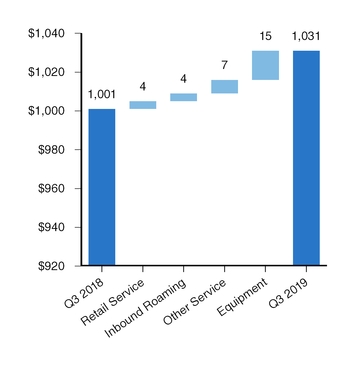
Retail service | $ | 663 | $ | 659 | 1 | % | $ | 1,984 | $ | 1,960 | 1 | % | |||||||||
Inbound roaming | 54 | 50 | 9 | % | 132 | 116 | 14 | % | |||||||||||||
Other | 57 | 50 | 13 | % | 156 | 148 | 5 | % | |||||||||||||
Service revenues | 774 | 759 | 2 | % | 2,272 | 2,224 | 2 | % | |||||||||||||
Equipment sales | 257 | 242 | 6 | % | 698 | 692 | 1 | % | |||||||||||||
Total operating revenues | 1,031 | 1,001 | 3 | % | 2,970 | 2,916 | 2 | % | |||||||||||||
System operations (excluding Depreciation, amortization and accretion reported below) | 199 | 200 | (1 | )% | 568 | 566 | – | ||||||||||||||
Cost of equipment sold | 266 | 258 | 3 | % | 724 | 716 | 1 | % | |||||||||||||
Selling, general and administrative | 358 | 346 | 3 | % | 1,027 | 1,014 | 1 | % | |||||||||||||
Depreciation, amortization and accretion | 181 | 160 | 13 | % | 524 | 478 | 10 | % | |||||||||||||
(Gain) loss on asset disposals, net | 5 | 3 | 66 | % | 13 | 5 | N/M | ||||||||||||||
(Gain) loss on sale of business and other exit costs, net | — | — | N/M | (1 | ) | — | N/M | ||||||||||||||
(Gain) loss on license sales and exchanges, net | 2 | — | N/M | — | (18 | ) | 98 | % | |||||||||||||
Total operating expenses | 1,011 | 967 | 5 | % | 2,855 | 2,761 | 3 | % | |||||||||||||
Operating income | $ | 20 | $ | 34 | (40 | )% | $ | 115 | $ | 155 | (26 | )% | |||||||||
Net income | $ | 24 | $ | 37 | (33 | )% | $ | 115 | $ | 143 | (20 | )% | |||||||||
Adjusted OIBDA (Non-GAAP)1 | $ | 208 | $ | 197 | 6 | % | $ | 651 | $ | 620 | 5 | % | |||||||||
Adjusted EBITDA (Non-GAAP)1 | $ | 256 | $ | 243 | 5 | % | $ | 793 | $ | 750 | 6 | % | |||||||||
Capital expenditures2 | $ | 170 | $ | 118 | 43 | % | $ | 467 | $ | 274 | 71 | % | |||||||||
N/M - Percentage change not meaningful
1 | Refer to Supplemental Information Relating to Non-GAAP Financial Measures within this MD&A for a reconciliation of this measure. |
2 | Refer to Liquidity and Capital Resources within this MD&A for additional information on Capital expenditures. |
6
Operating Revenues
Three Months Ended September 30, 2019 and 2018
(Dollars in millions)
Operating Revenues
Nine Months Ended September 30, 2019 and 2018
(Dollars in millions)

Service revenues consist of:
▪ | Retail Service - Charges for voice, data and value added services and recovery of regulatory costs |
▪ | Inbound Roaming - Charges to other wireless carriers whose customers use U.S. Cellular’s wireless systems when roaming |
▪ | Other Service - Amounts received from the Federal USF, tower rental revenues, and miscellaneous other service revenues |
Equipment revenues consist of:
▪ | Sales of wireless devices and related accessories to new and existing customers, agents, and third-party distributors |
Key components of changes in the statement of operations line items were as follows:
Total operating revenues
Retail service revenues increased for the three and nine months ended September 30, 2019, primarily as a result of the increase in Postpaid ARPU, which was previously discussed in the Operational Overview section.
Inbound roaming revenues increased for the three and nine months ended September 30, 2019, primarily driven by higher data usage, partially offset by lower rates.
Other service revenues increased for the three and nine months ended September 30, 2019, due primarily to an out-of-period adjustment to tower lease revenues recorded in the third quarter of 2019. See Note 8 — Leases in the Notes to Consolidated Financial Statements for additional information.
Equipment sales revenues increased for the three and nine months ended September 30, 2019, due to an increase in the average revenue per device sold and a shift in mix to smartphones, partially offset by a decrease in the number of devices sold.
Cost of equipment sold
Cost of equipment sold increased for the three and nine months ended September 30, 2019, due primarily to higher average cost per device sold and a shift in mix to smartphones, partially offset by a decrease in the number of devices sold.
7
Selling, general and administrative expenses
Selling, general and administrative expenses increased for the three and nine months ended September 30, 2019, due primarily to an increase in costs driven by information system initiatives, as well as an increase in bad debts expenses.
Depreciation, amortization and accretion
Depreciation, amortization, and accretion increased for the three and nine months ended September 30, 2019, due to (i) additional network assets being placed into service and (ii) accelerated depreciation of certain assets due to changes in network technology, which will continue throughout the remainder of 2019 and beyond.
Components of Other Income (Expense)
Three Months Ended September 30, | Nine Months Ended September 30, | ||||||||||||||||||||
2019 | 2018 | 2019 vs. 2018 | 2019 | 2018 | 2019 vs. 2018 | ||||||||||||||||
(Dollars in millions) | |||||||||||||||||||||
Operating income | $ | 20 | $ | 34 | (40 | )% | $ | 115 | $ | 155 | (26 | )% | |||||||||
Equity in earnings of unconsolidated entities | 44 | 42 | 5 | % | 128 | 120 | 7 | % | |||||||||||||
Interest and dividend income | 4 | 4 | 4 | % | 14 | 10 | 40 | % | |||||||||||||
Interest expense | (29 | ) | (29 | ) | 1 | % | (87 | ) | (87 | ) | – | ||||||||||
Total investment and other income | 19 | 17 | 12 | % | 55 | 43 | 27 | % | |||||||||||||
Income before income taxes | 39 | 51 | (23 | )% | 170 | 198 | (14 | )% | |||||||||||||
Income tax expense | 15 | 14 | 2 | % | 55 | 55 | 1 | % | |||||||||||||
Net income | 24 | 37 | (33 | )% | 115 | 143 | (20 | )% | |||||||||||||
Less: Net income attributable to noncontrolling interests, net of tax | 1 | 1 | 29 | % | 6 | 14 | (61 | )% | |||||||||||||
Net income attributable to U.S. Cellular shareholders | $ | 23 | $ | 36 | (34 | )% | $ | 109 | $ | 129 | (15 | )% | |||||||||
N/M - Percentage change not meaningful
Equity in earnings of unconsolidated entities
Equity in earnings of unconsolidated entities represents U.S. Cellular’s share of net income from entities in which it has a noncontrolling interest and that are accounted for by the equity method. U.S. Cellular’s investment in the Los Angeles SMSA Limited Partnership (LA Partnership) contributed $20 million for both the three months ended September 30, 2019 and 2018, and $60 million and $58 million for the nine months ended September 30, 2019 and 2018, respectively. See Note 7 — Investments in Unconsolidated Entities in the Notes to Consolidated Financial Statements for additional information.
Interest and dividend income
Interest and dividend income increased for the nine months ended September 30, 2019 as a result of an increase in U.S. Cellular's money market investments balance, classified within Cash and cash equivalents.
Income tax expense
The effective tax rate on Income before income taxes for the three months ended September 30, 2019 and 2018, was 37.4% and 28.2%, respectively. The effective tax rate on Income before income taxes for the nine months ended September 30, 2019 and 2018, was 32.5% and 27.7%, respectively. The effective tax rate for the three and nine months ended September 30, 2019 was higher than in the corresponding 2018 periods due primarily to an increase in projected unrecognized tax benefits for 2019 that had a disproportionate impact on the effective tax rate due to the relatively low pretax income in the 2019 quarter and year-to-date periods.
Net income attributable to noncontrolling interests, net of tax
Net income attributable to noncontrolling interests, net of tax decreased during the nine months ended September 30, 2019, due primarily to an out-of-period adjustment recorded in the first quarter of 2018. See Note 10 — Variable Interest Entities in the Notes to Consolidated Financial Statements for additional information.
8
Liquidity and Capital Resources
Sources of Liquidity
U.S. Cellular operates a capital-intensive business. Historically, U.S. Cellular has used internally-generated funds and also has obtained substantial funds from external sources for general corporate purposes. In the past, U.S. Cellular’s existing cash and investment balances, funds available under its revolving credit and receivables securitization agreements, funds from other financing sources, including a term loan and other long-term debt, and cash flows from operating and certain investing and financing activities, including sales of assets or businesses, provided sufficient liquidity and financial flexibility for U.S. Cellular to meet its normal day-to-day operating needs and debt service requirements, to finance the build-out and enhancement of markets and to fund acquisitions, primarily of wireless spectrum licenses. There is no assurance that this will be the case in the future. See Market Risk for additional information regarding maturities of long-term debt.
Although U.S. Cellular currently has a significant cash balance, U.S. Cellular has incurred negative free cash flow at times in the past and this could occur in the future. However, U.S. Cellular believes that existing cash and investment balances, funds available under its revolving credit and receivables securitization agreements, and expected cash flows from operating and investing activities will provide sufficient liquidity for U.S. Cellular to meet its normal day-to-day operating needs and debt service requirements for the coming year.
U.S. Cellular may require substantial additional capital for, among other uses, funding day-to-day operating needs including working capital, acquisitions of providers of wireless telecommunications services, wireless spectrum license or system acquisitions, capital expenditures, debt service requirements, the repurchase of shares, the payment of dividends, or making additional investments. It may be necessary from time to time to increase the size of the existing revolving credit agreements, to put in place new credit agreements, or to obtain other forms of financing in order to fund potential expenditures. U.S. Cellular made payments related to wireless spectrum license auctions (see Regulatory Matters - Millimeter Wave Spectrum Auctions) and debt repayments during 2019, and U.S. Cellular expects capital expenditures in 2019 to be higher than in 2018, due primarily to investments to enhance network speed and capacity and to deploy 5G technology on its network. U.S. Cellular’s liquidity would be adversely affected if, among other things, U.S. Cellular is unable to obtain financing on acceptable terms, U.S. Cellular makes significant wireless spectrum license purchases, the LA Partnership discontinues or significantly reduces distributions compared to historical levels, or Federal USF and/or other regulatory support payments decline.
U.S. Cellular’s credit rating currently is sub-investment grade. There can be no assurance that sufficient funds will continue to be available to U.S. Cellular or its subsidiaries on terms or at prices acceptable to U.S. Cellular. Insufficient cash flows from operating activities, changes in U.S. Cellular's credit ratings, defaults of the terms of debt or credit agreements, uncertainty of access to capital, deterioration in the capital markets, reduced regulatory capital at banks which in turn limits their ability to borrow and lend, other changes in the performance of U.S. Cellular or in market conditions or other factors could limit or restrict the availability of financing on terms and prices acceptable to U.S. Cellular, which could require U.S. Cellular to reduce its acquisition, capital expenditure and business development programs, reduce the acquisition of wireless spectrum licenses, and/or reduce or cease share repurchases. Any of the foregoing developments would have an adverse impact on U.S. Cellular’s business, financial condition or results of operations. U.S. Cellular cannot provide assurance that circumstances that could have a material adverse effect on its liquidity or capital resources will not occur.
Cash and Cash Equivalents
Cash and cash equivalents include cash and money market investments. The primary objective of U.S. Cellular’s Cash and cash equivalents is for use in its operations and acquisition, capital expenditure and business development programs.
Cash and Cash Equivalents
(Dollars in millions)

At September 30, 2019, U.S. Cellular's cash and cash equivalents totaled $570 million compared to $580 million at December 31, 2018.
The majority of U.S. Cellular’s Cash and cash equivalents is held in bank deposit accounts and in money market funds that purchase only debt issued by the U.S. Treasury or U.S. government agencies across a range of eligible money market investments that may include, but are not limited to, government agency repurchase agreements, government agency debt, U.S. Treasury repurchase agreements, U.S. Treasury debt, and other securities collateralized by U.S. government obligations. U.S. Cellular monitors the financial viability of the money market funds and the financial institutions with which U.S. Cellular has deposits and believes that the credit risk associated with these funds and institutions is low.
9
Financing
U.S. Cellular has an unsecured revolving credit agreement available for general corporate purposes including wireless spectrum license purchases and capital expenditures. This credit agreement matures in May 2023. As of September 30, 2019, there were no outstanding borrowings under the revolving credit agreement, except for letters of credit, and the unused borrowing capacity was $298 million.
In March 2019, U.S. Cellular amended its senior term loan credit agreement in order to reduce the interest rate. There were no changes to the maturity date and no significant changes to other key terms of the agreement. In October 2019, U.S. Cellular made a $100 million principal prepayment on its senior term loan.
U.S. Cellular believes that it was in compliance with all of the financial covenants and requirements set forth in its revolving credit agreement and the senior term loan credit agreement as of September 30, 2019.
U.S. Cellular, through its subsidiaries, also has a receivables securitization agreement to permit securitized borrowings for general corporate purposes using its equipment installment plan receivables. The unused capacity under this agreement was $200 million as of September 30, 2019, subject to sufficient collateral to satisfy the asset borrowing base provisions of the agreement. In September 2019, U.S. Cellular amended this agreement extending the expiration date of the agreement to December 15, 2021. There were no significant changes to other key terms of the agreement. U.S. Cellular believes that it was in compliance with all of the financial covenants and requirements set forth in its receivables securitization agreement as of September 30, 2019.
U.S. Cellular has in place an effective shelf registration statement on Form S-3 to issue senior or subordinated debt securities.
As of September 30, 2019, long-term debt payments due for the remainder of 2019 and the next four years are $191 million, which represent 12% of the total gross long-term debt obligation.
Capital Expenditures
Capital expenditures (i.e., additions to property, plant and equipment and system development expenditures), which include the effects of accruals and capitalized interest, for the nine months ended September 30, 2019 and 2018, were as follows:
Capital Expenditures
(Dollars in millions)
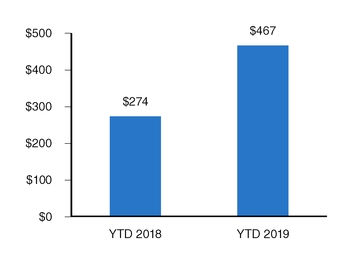
U.S. Cellular’s capital expenditures for the nine months ended September 30, 2019 and 2018, were $467 million and $274 million, respectively.
Capital expenditures for the full year 2019 are expected to be between $625 million and $725 million. These expenditures are expected to be used principally for the following purposes:
▪ | Enhance and maintain U.S. Cellular's network coverage, including continuing to deploy VoLTE technology in certain markets and providing additional speed and capacity to accommodate increased data usage by current customers; |
▪ | Begin deploying 5G technology on its network; and |
▪ | Invest in information technology to support existing and new services and products. |
U.S. Cellular intends to finance its capital expenditures for 2019 using primarily Cash flows from operating activities, existing cash balances and, if required, its receivables securitization and/or revolving credit agreements.
Acquisitions, Divestitures and Exchanges
U.S. Cellular may be engaged from time to time in negotiations (subject to all applicable regulations) relating to the acquisition, divestiture or exchange of companies, properties or wireless spectrum licenses. In general, U.S. Cellular may not disclose such transactions until there is a definitive agreement. U.S. Cellular assesses its existing wireless interests on an ongoing basis with a goal of improving the competitiveness of its operations and its long-term return on capital. As part of this strategy, U.S. Cellular actively seeks attractive opportunities to acquire wireless spectrum licenses, including pursuant to FCC auctions. U.S. Cellular also may seek to divest outright or include in exchanges for other wireless interests those interests that are not strategic to its long-term success.
10
In June 2019, the FCC announced by way of public notice that U.S. Cellular was the provisional winning bidder for 408 wireless spectrum licenses in its 28 GHz auction (Auction 101) and 282 wireless spectrum licenses in its 24 GHz auction (Auction 102) for an aggregate purchase price of $256 million. U.S. Cellular paid substantially all of the $256 million in the first half of 2019. The wireless spectrum licenses from Auction 101 were granted by the FCC on October 2, 2019, and the wireless spectrum licenses from Auction 102 are expected to be granted by the FCC during the fourth quarter of 2019.
Variable Interest Entities
U.S. Cellular consolidates certain “variable interest entities” as defined under GAAP. See Note 10 — Variable Interest Entities in the Notes to Consolidated Financial Statements for additional information related to these variable interest entities. U.S. Cellular may elect to make additional capital contributions and/or advances to these variable interest entities in future periods in order to fund their operations.
Common Share Repurchase Program
U.S. Cellular has repurchased and expects to continue to repurchase its Common Shares, subject to its repurchase program. During the three and nine months ended September 30, 2019, U.S. Cellular repurchased 590,300 Common Shares for $21 million at an average cost per share of $35.45. As of September 30, 2019, the total cumulative amount of U.S. Cellular Common Shares authorized to be purchased is 5,310,549. For additional information related to the current repurchase authorization, see Unregistered Sales of Equity Securities and Use of Proceeds.
Contractual and Other Obligations
There were no material changes outside the ordinary course of business between December 31, 2018 and September 30, 2019, to the Contractual and Other Obligations disclosed in Management’s Discussion and Analysis of Financial Condition and Results of Operations included in U.S. Cellular’s Form 10-K for the year ended December 31, 2018.
On September 27, 2019, U.S. Cellular executed a new Master Service Agreement, Master Statement of Work for Managed Services and certain other documents with Amdocs Tethys Limited, effective October 1, 2019, to continue using the Billing and Operational Support System (B/OSS) and certain support functions offered by Amdocs Tethys Limited. The committed, non-cancellable amount to be paid to Amdocs Tethys Limited with respect to the new agreements is $241 million over five years.
Off-Balance Sheet Arrangements
U.S. Cellular had no transactions, agreements or other contractual arrangements with unconsolidated entities involving “off-balance sheet arrangements,” as defined by SEC rules, that had or are reasonably likely to have a material current or future effect on its financial condition, results of operations, liquidity, capital expenditures or capital resources.
11
Consolidated Cash Flow Analysis
U.S. Cellular operates a capital- and marketing-intensive business. U.S. Cellular makes substantial investments to acquire wireless spectrum licenses and properties and to construct and upgrade wireless telecommunications networks and facilities as a basis for creating long-term value for shareholders. In recent years, rapid changes in technology and new opportunities have required substantial investments in potentially revenue‑enhancing and cost-saving upgrades to U.S. Cellular’s networks. U.S. Cellular utilizes cash on hand, cash from operating activities, cash proceeds from divestitures and dispositions of investments, and short-term and long-term debt financing to fund its acquisitions (including wireless spectrum licenses), construction costs, operating expenses and share repurchases. Cash flows may fluctuate from quarter to quarter and year to year due to seasonality, the timing of acquisitions and divestitures, capital expenditures and other factors. The following discussion summarizes U.S. Cellular's cash flow activities for the nine months ended September 30, 2019 and 2018.
2019 Commentary
U.S. Cellular’s Cash, cash equivalents and restricted cash decreased $8 million. Net cash provided by operating activities was $687 million due to net income of $115 million plus non-cash items of $486 million and distributions received from unconsolidated entities of $99 million, including $33 million in distributions from the LA Partnership. This was offset by changes in working capital items which decreased net cash by $13 million. The more significant working capital changes were increases in accounts receivables and equipment installment plan receivables, offset by an increase to accrued taxes.
Cash flows used for investing activities were $647 million. Cash paid for additions to property, plant and equipment totaled $439 million. Cash payments for wireless spectrum license acquisitions were $257 million. These were partially offset by Cash received from divestitures and exchanges of $32 million and cash received from the redemption of short-term Treasury bills of $29 million.
Cash flows used for financing activities were $48 million, reflecting the repurchase of $21 million of Common Shares and ordinary activity such as the scheduled repayments of debt.
2018 Commentary
U.S. Cellular’s Cash, cash equivalents and restricted cash increased $380 million. Net cash provided by operating activities was $600 million due to net income of $143 million plus non-cash items of $436 million and distributions received from unconsolidated entities of $90 million, including $33 million in distributions from the LA Partnership. This was offset by changes in working capital items which decreased net cash by $69 million. The working capital changes were primarily influenced by an increase in equipment installment plan receivables.
Cash flows used for investing activities were $203 million. Cash paid for additions to property, plant and equipment totaled $277 million. This was partially offset by cash received from the redemption of short-term Treasury bills of $50 million and Cash received from divestitures and exchanges of $23 million.
Cash flows used for financing activities were $17 million, reflecting ordinary activity such as the scheduled repayments of debt.
12
Consolidated Balance Sheet Analysis
The following discussion addresses certain captions in the consolidated balance sheet and changes therein. This discussion is intended to highlight the significant changes and is not intended to fully reconcile the changes. Changes in financial condition during 2019 were as follows:
Assets held for sale
Assets held for sale decreased $45 million. Certain sale and exchange agreements that U.S. Cellular entered into in 2018 closed in the first quarter of 2019. This was partially offset by certain sale agreements that U.S. Cellular entered into in the third quarter of 2019, which are expected to close in the fourth quarter of 2019.
Licenses
Licenses increased $275 million due primarily to wireless spectrum license rights acquired through FCC auctions. See Note 6 — Intangible Assets in the Notes to Consolidated Financial Statements for additional information.
Operating lease right-of-use assets
Operating lease right-of-use assets increased $897 million due to the adoption of Accounting Standards Codification (ASC) 842. See Note 8 — Leases in the Notes to Consolidated Financial Statements for additional information.
Accrued taxes
Accrued taxes increased $58 million due primarily to the excess of current income tax expense over federal estimated payments made during the nine months ended September 30, 2019.
Short-term operating lease liabilities
Short-term operating lease liabilities increased $104 million due to the adoption of ASC 842. See Note 8 — Leases in the Notes to Consolidated Financial Statements for additional information.
Long-term operating lease liabilities
Long-term operating lease liabilities increased $864 million due to the adoption of ASC 842. See Note 8 — Leases in the Notes to Consolidated Financial Statements for additional information.
Other deferred liabilities and credits
Other deferred liabilities and credits decreased $77 million due primarily to the adoption of ASC 842. See Note 8 — Leases in the Notes to Consolidated Financial Statements for additional information.
13
Supplemental Information Relating to Non-GAAP Financial Measures
U.S. Cellular sometimes uses information derived from consolidated financial information but not presented in its financial statements prepared in accordance with U.S. GAAP to evaluate the performance of its business. Specifically, U.S. Cellular has referred to the following measures in this Form 10-Q Report:
▪ | EBITDA |
▪ | Adjusted EBITDA |
▪ | Adjusted OIBDA |
▪ | Free cash flow |
Certain of these measures are considered “non-GAAP financial measures” under U.S. Securities and Exchange Commission Rules. Following are explanations of each of these measures.
EBITDA, Adjusted EBITDA and Adjusted OIBDA
EBITDA, Adjusted EBITDA and Adjusted OIBDA are defined as net income adjusted for the items set forth in the reconciliation below. EBITDA, Adjusted EBITDA and Adjusted OIBDA are not measures of financial performance under GAAP and should not be considered as alternatives to Net income or Cash flows from operating activities, as indicators of cash flows or as measures of liquidity. U.S. Cellular does not intend to imply that any such items set forth in the reconciliation below are non-recurring, infrequent or unusual; such items may occur in the future.
Management uses Adjusted EBITDA and Adjusted OIBDA as measurements of profitability and, therefore, reconciliations to Net income are deemed appropriate. Management believes Adjusted EBITDA and Adjusted OIBDA are useful measures of U.S. Cellular’s operating results before significant recurring non-cash charges, gains and losses, and other items as presented below as they provide additional relevant and useful information to investors and other users of U.S. Cellular’s financial data in evaluating the effectiveness of its operations and underlying business trends in a manner that is consistent with management’s evaluation of business performance. Adjusted EBITDA shows adjusted earnings before interest, taxes, depreciation, amortization and accretion, and gains and losses, while Adjusted OIBDA reduces this measure further to exclude Equity in earnings of unconsolidated entities and Interest and dividend income in order to more effectively show the performance of operating activities excluding investment activities. The following table reconciles EBITDA, Adjusted EBITDA and Adjusted OIBDA to the corresponding GAAP measures, Net income and Operating income.
14
Three Months Ended September 30, | Nine Months Ended September 30, | ||||||||||||||
2019 | 2018 | 2019 | 2018 | ||||||||||||
(Dollars in millions) | |||||||||||||||
Net income (GAAP) | $ | 24 | $ | 37 | $ | 115 | $ | 143 | |||||||
Add back: | |||||||||||||||
Income tax expense | 15 | 14 | 55 | 55 | |||||||||||
Interest expense | 29 | 29 | 87 | 87 | |||||||||||
Depreciation, amortization and accretion | 181 | 160 | 524 | 478 | |||||||||||
EBITDA (Non-GAAP) | 249 | 240 | 781 | 763 | |||||||||||
Add back or deduct: | |||||||||||||||
(Gain) loss on asset disposals, net | 5 | 3 | 13 | 5 | |||||||||||
(Gain) loss on sale of business and other exit costs, net | — | — | (1 | ) | — | ||||||||||
(Gain) loss on license sales and exchanges, net | 2 | — | — | (18 | ) | ||||||||||
Adjusted EBITDA (Non-GAAP) | 256 | 243 | 793 | 750 | |||||||||||
Deduct: | |||||||||||||||
Equity in earnings of unconsolidated entities | 44 | 42 | 128 | 120 | |||||||||||
Interest and dividend income | 4 | 4 | 14 | 10 | |||||||||||
Adjusted OIBDA (Non-GAAP) | 208 | 197 | 651 | 620 | |||||||||||
Deduct: | |||||||||||||||
Depreciation, amortization and accretion | 181 | 160 | 524 | 478 | |||||||||||
(Gain) loss on asset disposals, net | 5 | 3 | 13 | 5 | |||||||||||
(Gain) loss on sale of business and other exit costs, net | — | — | (1 | ) | — | ||||||||||
(Gain) loss on license sales and exchanges, net | 2 | — | — | (18 | ) | ||||||||||
Operating income (GAAP) | $ | 20 | $ | 34 | $ | 115 | $ | 155 | |||||||
Free Cash Flow
The following table presents Free cash flow, which is defined as Cash flows from operating activities less Cash paid for additions to property, plant and equipment. Free cash flow is a non-GAAP financial measure which U.S. Cellular believes may be useful to investors and other users of its financial information in evaluating liquidity, specifically, the amount of net cash generated by business operations after deducting Cash paid for additions to property, plant and equipment.
Nine Months Ended September 30, | |||||||
2019 | 2018 | ||||||
(Dollars in millions) | |||||||
Cash flows from operating activities (GAAP) | $ | 687 | $ | 600 | |||
Less: Cash paid for additions to property, plant and equipment | 439 | 277 | |||||
Free cash flow (Non-GAAP) | $ | 248 | $ | 323 | |||
15
Application of Critical Accounting Policies and Estimates
U.S. Cellular prepares its consolidated financial statements in accordance with GAAP. U.S. Cellular’s significant accounting policies are discussed in detail in Note 1 — Summary of Significant Accounting Policies and Recent Accounting Pronouncements and Note 2 — Revenue Recognition in the Notes to Consolidated Financial Statements and U.S. Cellular’s Application of Critical Accounting Policies and Estimates is discussed in detail in Management’s Discussion and Analysis of Financial Condition and Results of Operations, both of which are included in U.S. Cellular’s Form 10-K for the year ended December 31, 2018.
Recent Accounting Pronouncements
See Note 1 — Basis of Presentation and Note 8 — Leases in the Notes to Consolidated Financial Statements for information on recent accounting pronouncements.
Regulatory Matters
Millimeter Wave Spectrum Auctions
During 2018, the FCC established procedures for two auctions of wireless spectrum licenses in the 28 GHz and 24 GHz bands. The 28 GHz auction (Auction 101) commenced on November 14, 2018 and closed on January 24, 2019. Auction 101 offered two 425 MHz licenses in the 28 GHz band over portions of the United States that do not have incumbent licensees. The 24 GHz auction (Auction 102) commenced on March 14, 2019 and closed on May 28, 2019. Auction 102 offered up to seven 100 MHz licenses in the 24 GHz band in Partial Economic Areas covering most of the United States. On June 3, 2019, the FCC announced by way of public notice that U.S. Cellular was the provisional winning bidder for 408 wireless spectrum licenses in Auction 101 and 282 wireless spectrum licenses in Auction 102 for an aggregate purchase price of $256 million. The wireless spectrum licenses from Auction 101 were granted by the FCC on October 2, 2019, and the wireless spectrum licenses from Auction 102 are expected to be granted by the FCC during the fourth quarter of 2019.
On July 11, 2019, the FCC released a Public Notice establishing procedures for an additional Millimeter Wave auction offering wireless spectrum licenses in the 37, 39 and 47 GHz bands (Auction 103). On August 21, 2019, the FCC released a Public Notice announcing that all 39 GHz incumbents have agreed to relinquish their licenses in return for incentive payments. Consequently, Auction 103 will offer 34 100 MHz blocks in the Upper 37 GHz, 39 GHz, and 47 GHz bands in all Partial Economic Areas. On September 9, 2019, U.S. Cellular filed an application to participate in Auction 103; bidding in this auction will commence on December 10, 2019.
16
Private Securities Litigation Reform Act of 1995
Safe Harbor Cautionary Statement
This Form 10-Q, including exhibits, contains statements that are not based on historical facts and represent forward-looking statements, as this term is defined in the Private Securities Litigation Reform Act of 1995. All statements, other than statements of historical facts, that address activities, events or developments that U.S. Cellular intends, expects, projects, believes, estimates, plans or anticipates will or may occur in the future are forward-looking statements. The words “believes,” “anticipates,” “estimates,” “expects,” “plans,” “intends,” “projects” and similar expressions are intended to identify these forward-looking statements, but are not the exclusive means of identifying them. Such forward-looking statements involve known and unknown risks, uncertainties and other factors that may cause actual results, events or developments to be significantly different from any future results, events or developments expressed or implied by such forward-looking statements. Such risks, uncertainties and other factors include, but are not limited to, those set forth below, as more fully described under “Risk Factors” in U.S. Cellular’s Form 10-K for the year ended December 31, 2018. Each of the following risks could have a material adverse effect on U.S. Cellular’s business, financial condition or results of operations. However, such factors are not necessarily all of the important factors that could cause actual results, performance or achievements to differ materially from those expressed in, or implied by, the forward-looking statements contained in this document. Other unknown or unpredictable factors also could have material adverse effects on future results, performance or achievements. U.S. Cellular undertakes no obligation to update publicly any forward-looking statements whether as a result of new information, future events or otherwise. You should carefully consider the Risk Factors in U.S. Cellular’s Form 10-K for the year ended December 31, 2018, the following factors and other information contained in, or incorporated by reference into, this Form 10-Q to understand the material risks relating to U.S. Cellular’s business, financial condition or results of operations.
▪ | Intense competition in the markets in which U.S. Cellular operates could adversely affect U.S. Cellular’s revenues or increase its costs to compete. |
▪ | A failure by U.S. Cellular to successfully execute its business strategy (including planned acquisitions, spectrum acquisitions, divestitures and exchanges) or allocate resources or capital effectively could have an adverse effect on U.S. Cellular’s business, financial condition or results of operations. |
▪ | Uncertainty in U.S. Cellular’s future cash flow and liquidity or the inability to access capital, deterioration in the capital markets, other changes in U.S. Cellular’s performance or market conditions, changes in U.S. Cellular’s credit ratings or other factors could limit or restrict the availability of financing on terms and prices acceptable to U.S. Cellular, which could require U.S. Cellular to reduce its construction, development or acquisition programs, reduce the amount of spectrum licenses acquired, and/or reduce or cease share repurchases. |
▪ | U.S. Cellular has a significant amount of indebtedness which could adversely affect its financial performance and in turn adversely affect its ability to make payments on its indebtedness, comply with terms of debt covenants and incur additional debt. |
▪ | Changes in roaming practices or other factors could cause U.S. Cellular's roaming revenues to decline from current levels, roaming expenses to increase from current levels and/or impact U.S. Cellular's ability to service its customers in geographic areas where U.S. Cellular does not have its own network, which could have an adverse effect on U.S. Cellular's business, financial condition or results of operations. |
▪ | A failure by U.S. Cellular to obtain access to adequate radio spectrum to meet current or anticipated future needs and/or to accurately predict future needs for radio spectrum could have an adverse effect on U.S. Cellular’s business, financial condition or results of operations. |
▪ | To the extent conducted by the FCC, U.S. Cellular may participate in FCC auctions for additional spectrum or for funding in certain Universal Service programs in the future directly or indirectly and, during certain periods, will be subject to the FCC’s anti-collusion rules, which could have an adverse effect on U.S. Cellular. |
▪ | Failure by U.S. Cellular to timely or fully comply with any existing applicable legislative and/or regulatory requirements or changes thereto could adversely affect U.S. Cellular’s business, financial condition or results of operations. |
▪ | An inability to attract people of outstanding talent throughout all levels of the organization, to develop their potential through education and assignments, and to retain them by keeping them engaged, challenged and properly rewarded could have an adverse effect on U.S. Cellular's business, financial condition or results of operations. |
▪ | U.S. Cellular’s assets and revenue are concentrated in the U.S. wireless telecommunications industry. Consequently, its operating results may fluctuate based on factors related primarily to conditions in this industry. |
▪ | U.S. Cellular’s smaller scale relative to larger competitors that may have greater financial and other resources than U.S. Cellular could cause U.S. Cellular to be unable to compete successfully, which could adversely affect its business, financial condition or results of operations. |
17
▪ | Changes in various business factors, including changes in demand, customer preferences and perceptions, price competition, churn from customer switching activity and other factors, could have an adverse effect on U.S. Cellular’s business, financial condition or results of operations. |
▪ | Advances or changes in technology could render certain technologies used by U.S. Cellular obsolete, could put U.S. Cellular at a competitive disadvantage, could reduce U.S. Cellular’s revenues or could increase its costs of doing business. |
▪ | Complexities associated with deploying new technologies present substantial risk and U.S. Cellular investments in unproven technologies may not produce the benefits that U.S. Cellular expects. |
▪ | U.S. Cellular receives regulatory support and is subject to numerous surcharges and fees from federal, state and local governments, and the applicability and the amount of the support and fees are subject to great uncertainty, which could have an adverse effect on U.S. Cellular’s business, financial condition or results of operations. |
▪ | Performance under device purchase agreements could have a material adverse impact on U.S. Cellular's business, financial condition or results of operations. |
▪ | Changes in U.S. Cellular’s enterprise value, changes in the market supply or demand for wireless licenses, adverse developments in the business or the industry in which U.S. Cellular is involved and/or other factors could require U.S. Cellular to recognize impairments in the carrying value of its licenses and/or physical assets. |
▪ | Costs, integration problems or other factors associated with acquisitions, divestitures or exchanges of properties or licenses and/or expansion of U.S. Cellular’s business could have an adverse effect on U.S. Cellular’s business, financial condition or results of operations. |
▪ | A failure by U.S. Cellular to complete significant network construction and systems implementation activities as part of its plans to improve the quality, coverage, capabilities and capacity of its network, support and other systems and infrastructure could have an adverse effect on its operations. |
▪ | Difficulties involving third parties with which U.S. Cellular does business, including changes in U.S. Cellular's relationships with or financial or operational difficulties of key suppliers or independent agents and third party national retailers who market U.S. Cellular’s services, could adversely affect U.S. Cellular’s business, financial condition or results of operations. |
▪ | U.S. Cellular has significant investments in entities that it does not control. Losses in the value of such investments could have an adverse effect on U.S. Cellular’s financial condition or results of operations. |
▪ | A failure by U.S. Cellular to maintain flexible and capable telecommunication networks or information technology, or a material disruption thereof, could have an adverse effect on U.S. Cellular’s business, financial condition or results of operations. |
▪ | U.S. Cellular has experienced and, in the future, expects to experience cyber-attacks or other breaches of network or information technology security of varying degrees on a regular basis, which could have an adverse effect on U.S. Cellular's business, financial condition or results of operations. |
▪ | Changes in facts or circumstances, including new or additional information, could require U.S. Cellular to record adjustments to amounts reflected in the financial statements, which could have an adverse effect on U.S. Cellular’s business, financial condition or results of operations. |
▪ | Disruption in credit or other financial markets, a deterioration of U.S. or global economic conditions or other events could, among other things, impede U.S. Cellular’s access to or increase the cost of financing its operating and investment activities and/or result in reduced revenues and lower operating income and cash flows, which would have an adverse effect on U.S. Cellular’s business, financial condition or results of operations. |
▪ | Settlements, judgments, restraints on its current or future manner of doing business and/or legal costs resulting from pending and future litigation could have an adverse effect on U.S. Cellular’s business, financial condition or results of operations. |
▪ | The possible development of adverse precedent in litigation or conclusions in professional studies to the effect that radio frequency emissions from wireless devices and/or cell sites cause harmful health consequences, including cancer or tumors, or may interfere with various electronic medical devices such as pacemakers, could have an adverse effect on U.S. Cellular’s business, financial condition or results of operations. |
▪ | Claims of infringement of intellectual property and proprietary rights of others, primarily involving patent infringement claims, could prevent U.S. Cellular from using necessary technology to provide products or services or subject U.S. Cellular to expensive intellectual property litigation or monetary penalties, which could have an adverse effect on U.S. Cellular’s business, financial condition or results of operations. |
▪ | There are potential conflicts of interests between TDS and U.S. Cellular. |
18
▪ | Certain matters, such as control by TDS and provisions in the U.S. Cellular Restated Certificate of Incorporation, may serve to discourage or make more difficult a change in control of U.S. Cellular or have other consequences. |
▪ | The market price of U.S. Cellular’s Common Shares is subject to fluctuations due to a variety of factors. |
▪ | Any of the foregoing events or other events could cause revenues, earnings, capital expenditures and/or any other financial or statistical information to vary from U.S. Cellular’s forward-looking estimates by a material amount. |
Risk Factors
In addition to the information set forth in this Form 10-Q, you should carefully consider the factors discussed in Part I, “Item 1A. Risk Factors” in U.S. Cellular’s Annual Report on Form 10-K for the year ended December 31, 2018, which could materially affect U.S. Cellular’s business, financial condition or future results. The risks described in this Form 10-Q and the Form 10-K for the year ended December 31, 2018, may not be the only risks that could affect U.S. Cellular. Additional unidentified or unrecognized risks and uncertainties could materially adversely affect U.S. Cellular’s business, financial condition and/or operating results. Subject to the foregoing, U.S. Cellular has not identified for disclosure any material changes to the risk factors as previously disclosed in U.S. Cellular’s Annual Report on Form 10-K for the year ended December 31, 2018.
Quantitative and Qualitative Disclosures about Market Risk
Market Risk
Refer to the disclosure under Market Risk in U.S. Cellular’s Form 10-K for the year ended December 31, 2018, for additional information, including information regarding required principal payments and the weighted average interest rates related to U.S. Cellular’s Long-term debt. There have been no material changes to such information between December 31, 2018 and September 30, 2019.
See Note 3 — Fair Value Measurements in the Notes to Consolidated Financial Statements for additional information related to the fair value of U.S. Cellular’s Long-term debt as of September 30, 2019.
19
Financial Statements
United States Cellular Corporation
Consolidated Statement of Operations
(Unaudited)
Three Months Ended September 30, | Nine Months Ended September 30, | ||||||||||||||
2019 | 2018 | 2019 | 2018 | ||||||||||||
(Dollars and shares in millions, except per share amounts) | |||||||||||||||
Operating revenues | |||||||||||||||
Service | $ | $ | $ | $ | |||||||||||
Equipment sales | |||||||||||||||
Total operating revenues | |||||||||||||||
Operating expenses | |||||||||||||||
System operations (excluding Depreciation, amortization and accretion reported below) | |||||||||||||||
Cost of equipment sold | |||||||||||||||
Selling, general and administrative (including charges from affiliates of $22 million and $20 million, respectively, for the three months, and $61 million, and $60 million, respectively, for the nine months) | |||||||||||||||
Depreciation, amortization and accretion | |||||||||||||||
(Gain) loss on asset disposals, net | |||||||||||||||
(Gain) loss on sale of business and other exit costs, net | ( | ) | |||||||||||||
(Gain) loss on license sales and exchanges, net | ( | ) | |||||||||||||
Total operating expenses | |||||||||||||||
Operating income | |||||||||||||||
Investment and other income (expense) | |||||||||||||||
Equity in earnings of unconsolidated entities | |||||||||||||||
Interest and dividend income | |||||||||||||||
Interest expense | ( | ) | ( | ) | ( | ) | ( | ) | |||||||
Total investment and other income | |||||||||||||||
Income before income taxes | |||||||||||||||
Income tax expense | |||||||||||||||
Net income | |||||||||||||||
Less: Net income attributable to noncontrolling interests, net of tax | |||||||||||||||
Net income attributable to U.S. Cellular shareholders | $ | $ | $ | $ | |||||||||||
Basic weighted average shares outstanding | |||||||||||||||
Basic earnings per share attributable to U.S. Cellular shareholders | $ | $ | $ | $ | |||||||||||
Diluted weighted average shares outstanding | |||||||||||||||
Diluted earnings per share attributable to U.S. Cellular shareholders | $ | $ | $ | $ | |||||||||||
The accompanying notes are an integral part of these consolidated financial statements.
20
United States Cellular Corporation
Consolidated Statement of Cash Flows
(Unaudited)
Nine Months Ended September 30, | |||||||
2019 | 2018 | ||||||
(Dollars in millions) | |||||||
Cash flows from operating activities | |||||||
Net income | $ | $ | |||||
Add (deduct) adjustments to reconcile net income to net cash flows from operating activities | |||||||
Depreciation, amortization and accretion | |||||||
Bad debts expense | |||||||
Stock-based compensation expense | |||||||
Deferred income taxes, net | ( | ) | ( | ) | |||
Equity in earnings of unconsolidated entities | ( | ) | ( | ) | |||
Distributions from unconsolidated entities | |||||||
(Gain) loss on asset disposals, net | |||||||
(Gain) loss on sale of business and other exit costs, net | ( | ) | |||||
(Gain) loss on license sales and exchanges, net | ( | ) | |||||
Other operating activities | |||||||
Changes in assets and liabilities from operations | |||||||
Accounts receivable | ( | ) | ( | ) | |||
Equipment installment plans receivable | ( | ) | ( | ) | |||
Inventory | |||||||
Accounts payable | ( | ) | |||||
Customer deposits and deferred revenues | ( | ) | ( | ) | |||
Accrued taxes | |||||||
Accrued interest | |||||||
Other assets and liabilities | ( | ) | ( | ) | |||
Net cash provided by operating activities | |||||||
Cash flows from investing activities | |||||||
Cash paid for additions to property, plant and equipment | ( | ) | ( | ) | |||
Cash paid for licenses | ( | ) | ( | ) | |||
Cash received from investments | |||||||
Cash paid for investments | ( | ) | |||||
Cash received from divestitures and exchanges | |||||||
Other investing activities | ( | ) | |||||
Net cash used in investing activities | ( | ) | ( | ) | |||
Cash flows from financing activities | |||||||
Repayment of long-term debt | ( | ) | ( | ) | |||
Common Shares reissued for benefit plans, net of tax payments | ( | ) | |||||
Repurchase of Common Shares | ( | ) | |||||
Distributions to noncontrolling interests | ( | ) | ( | ) | |||
Other financing activities | ( | ) | ( | ) | |||
Net cash used in financing activities | ( | ) | ( | ) | |||
Net increase (decrease) in cash, cash equivalents and restricted cash | ( | ) | |||||
Cash, cash equivalents and restricted cash | |||||||
Beginning of period | |||||||
End of period | $ | $ | |||||
The accompanying notes are an integral part of these consolidated financial statements.
21
United States Cellular Corporation
Consolidated Balance Sheet — Assets
(Unaudited)
September 30, 2019 | December 31, 2018 | ||||||
(Dollars in millions) | |||||||
Current assets | |||||||
Cash and cash equivalents | $ | $ | |||||
Short-term investments | |||||||
Accounts receivable | |||||||
Customers and agents, less allowances of $69 and $66, respectively | |||||||
Roaming | |||||||
Affiliated | |||||||
Other, less allowances of $1 and $2, respectively | |||||||
Inventory, net | |||||||
Prepaid expenses | |||||||
Other current assets | |||||||
Total current assets | |||||||
Assets held for sale | |||||||
Licenses | |||||||
Investments in unconsolidated entities | |||||||
Property, plant and equipment | |||||||
In service and under construction | |||||||
Less: Accumulated depreciation and amortization | |||||||
Property, plant and equipment, net | |||||||
Operating lease right-of-use assets | |||||||
Other assets and deferred charges | |||||||
Total assets1 | $ | $ | |||||
The accompanying notes are an integral part of these consolidated financial statements.
22
United States Cellular Corporation
Consolidated Balance Sheet — Liabilities and Equity
(Unaudited)
September 30, 2019 | December 31, 2018 | ||||||
(Dollars and shares in millions, except per share amounts) | |||||||
Current liabilities | |||||||
Current portion of long-term debt | $ | $ | |||||
Accounts payable | |||||||
Affiliated | |||||||
Trade | |||||||
Customer deposits and deferred revenues | |||||||
Accrued taxes | |||||||
Accrued compensation | |||||||
Short-term operating lease liabilities | |||||||
Other current liabilities | |||||||
Total current liabilities | |||||||
Liabilities held for sale | |||||||
Deferred liabilities and credits | |||||||
Deferred income tax liability, net | |||||||
Long-term operating lease liabilities | |||||||
Other deferred liabilities and credits | |||||||
Long-term debt, net | |||||||
Commitments and contingencies | |||||||
Noncontrolling interests with redemption features | |||||||
Equity | |||||||
U.S. Cellular shareholders’ equity | |||||||
Series A Common and Common Shares | |||||||
Authorized 190 shares (50 Series A Common and 140 Common Shares) | |||||||
Issued 88 shares (33 Series A Common and 55 Common Shares) | |||||||
Outstanding 86 shares (33 Series A Common and 53 Common Shares) | |||||||
Par Value ($1.00 per share) ($33 Series A Common and $55 Common Shares) | |||||||
Additional paid-in capital | |||||||
Treasury shares, at cost, 2 Common Shares | ( | ) | ( | ) | |||
Retained earnings | |||||||
Total U.S. Cellular shareholders' equity | |||||||
Noncontrolling interests | |||||||
Total equity | |||||||
Total liabilities and equity1 | $ | $ | |||||
The accompanying notes are an integral part of these consolidated financial statements.
1 | The consolidated total assets as of September 30, 2019 and December 31, 2018, include assets held by consolidated variable interest entities (VIEs) of $ |
23
United States Cellular Corporation
Consolidated Statement of Changes in Equity
(Unaudited)
U.S. Cellular Shareholders | |||||||||||||||||||||||||||
Series A Common and Common shares | Additional paid-in capital | Treasury shares | Retained earnings | Total U.S. Cellular shareholders' equity | Noncontrolling interests | Total equity | |||||||||||||||||||||
(Dollars in millions) | |||||||||||||||||||||||||||
June 30, 2019 | $ | $ | $ | ( | ) | $ | $ | $ | $ | ||||||||||||||||||
Net income attributable to U.S. Cellular shareholders | — | — | — | — | |||||||||||||||||||||||
Repurchase of Common Shares | — | — | ( | ) | — | ( | ) | — | ( | ) | |||||||||||||||||
Incentive and compensation plans | — | — | — | ||||||||||||||||||||||||
Stock-based compensation awards | — | — | — | — | |||||||||||||||||||||||
September 30, 2019 | $ | $ | $ | ( | ) | $ | $ | $ | $ | ||||||||||||||||||
The accompanying notes are an integral part of these consolidated financial statements.
24
United States Cellular Corporation
Consolidated Statement of Changes in Equity
(Unaudited)
U.S. Cellular Shareholders | |||||||||||||||||||||||||||
Series A Common and Common shares | Additional paid-in capital | Treasury shares | Retained earnings | Total U.S. Cellular shareholders' equity | Noncontrolling interests | Total equity | |||||||||||||||||||||
(Dollars in millions) | |||||||||||||||||||||||||||
June 30, 2018 | $ | $ | $ | ( | ) | $ | $ | $ | $ | ||||||||||||||||||
Net income attributable to U.S. Cellular shareholders | — | — | — | — | |||||||||||||||||||||||
Net income attributable to noncontrolling interests classified as equity | — | — | — | — | |||||||||||||||||||||||
Incentive and compensation plans | — | — | ( | ) | — | ||||||||||||||||||||||
Stock-based compensation awards | — | — | — | — | |||||||||||||||||||||||
Distributions to noncontrolling interests | — | — | — | — | ( | ) | ( | ) | |||||||||||||||||||
September 30, 2018 | $ | $ | $ | ( | ) | $ | $ | $ | $ | ||||||||||||||||||
The accompanying notes are an integral part of these consolidated financial statements.
25
United States Cellular Corporation
Consolidated Statement of Changes in Equity
(Unaudited)
U.S. Cellular Shareholders | |||||||||||||||||||||||||||
Series A Common and Common shares | Additional paid-in capital | Treasury shares | Retained earnings | Total U.S. Cellular shareholders' equity | Noncontrolling interests | Total equity | |||||||||||||||||||||
(Dollars in millions) | |||||||||||||||||||||||||||
December 31, 2018 | $ | $ | $ | ( | ) | $ | $ | $ | $ | ||||||||||||||||||
Cumulative effect of accounting change | — | — | — | — | |||||||||||||||||||||||
Net income attributable to U.S. Cellular shareholders | — | — | — | — | |||||||||||||||||||||||
Net income attributable to noncontrolling interests classified as equity | — | — | — | — | |||||||||||||||||||||||
Repurchase of Common Shares | — | — | ( | ) | — | ( | ) | — | ( | ) | |||||||||||||||||
Incentive and compensation plans | — | ( | ) | ( | ) | ( | ) | — | ( | ) | |||||||||||||||||
Stock-based compensation awards | — | — | — | — | |||||||||||||||||||||||
Distributions to noncontrolling interests | — | — | — | — | ( | ) | ( | ) | |||||||||||||||||||
September 30, 2019 | $ | $ | $ | ( | ) | $ | $ | $ | $ | ||||||||||||||||||
The accompanying notes are an integral part of these consolidated financial statements.
26
United States Cellular Corporation
Consolidated Statement of Changes in Equity
(Unaudited)
U.S. Cellular Shareholders | |||||||||||||||||||||||||||
Series A Common and Common shares | Additional paid-in capital | Treasury shares | Retained earnings | Total U.S. Cellular shareholders' equity | Noncontrolling interests | Total equity | |||||||||||||||||||||
(Dollars in millions) | |||||||||||||||||||||||||||
December 31, 2017 | $ | $ | $ | ( | ) | $ | $ | $ | $ | ||||||||||||||||||
Cumulative effect of accounting change | — | — | — | ||||||||||||||||||||||||
Net income attributable to U.S. Cellular shareholders | — | — | — | — | |||||||||||||||||||||||
Net income attributable to noncontrolling interests classified as equity | — | — | — | — | |||||||||||||||||||||||
Incentive and compensation plans | — | — | ( | ) | — | ||||||||||||||||||||||
Stock-based compensation awards | — | — | — | — | |||||||||||||||||||||||
Distributions to noncontrolling interests | — | — | — | — | ( | ) | ( | ) | |||||||||||||||||||
September 30, 2018 | $ | $ | $ | ( | ) | $ | $ | $ | $ | ||||||||||||||||||
The accompanying notes are an integral part of these consolidated financial statements.
27
United States Cellular Corporation
Notes to Consolidated Financial Statements
Note 1 Basis of Presentation
United States Cellular Corporation (U.S. Cellular), a Delaware Corporation, is an 82 %-owned subsidiary of Telephone and Data Systems, Inc. (TDS).
The accounting policies of U.S. Cellular conform to accounting principles generally accepted in the United States of America (GAAP) as set forth in the Financial Accounting Standards Board (FASB) Accounting Standards Codification (ASC). Unless otherwise specified, references to accounting provisions and GAAP in these notes refer to the requirements of the FASB ASC. The consolidated financial statements include the accounts of U.S. Cellular, subsidiaries in which it has a controlling financial interest, general partnerships in which U.S. Cellular has a majority partnership interest and certain entities in which U.S. Cellular has a variable interest that require consolidation under GAAP. All material intercompany accounts and transactions have been eliminated.
The unaudited consolidated financial statements included herein have been prepared by U.S. Cellular pursuant to the rules and regulations of the Securities and Exchange Commission (SEC). Certain information and disclosures normally included in annual financial statements prepared in accordance with GAAP have been condensed or omitted pursuant to such rules and regulations. However, U.S. Cellular believes that the disclosures included herein are adequate to make the information presented not misleading. Certain numbers included herein are rounded to millions for ease of presentation; however, certain calculated amounts and percentages are determined using the unrounded numbers. These unaudited consolidated financial statements should be read in conjunction with the consolidated financial statements and the notes thereto included in U.S. Cellular’s Annual Report on Form 10-K (Form 10-K) for the year ended December 31, 2018.
The accompanying unaudited consolidated financial statements contain all adjustments (consisting of normal recurring items, unless otherwise disclosed) necessary for the fair statement of U.S. Cellular’s financial position as of September 30, 2019 and December 31, 2018, its results of operations and changes in equity for the three and nine months ended September 30, 2019 and 2018, and its cash flows for the nine months ended September 30, 2019 and 2018. The Consolidated Statement of Comprehensive Income was not included because comprehensive income for the three and nine months ended September 30, 2019 and 2018, equaled net income. These results are not necessarily indicative of the results to be expected for the full year. U.S. Cellular has not changed its significant accounting and reporting policies from those disclosed in its Form 10-K for the year ended December 31, 2018, except as disclosed in Note 8 — Leases.
Restricted Cash
U.S. Cellular presents restricted cash with cash and cash equivalents in the Consolidated Statement of Cash Flows. The following table provides a reconciliation of Cash and cash equivalents and restricted cash reported in the Consolidated Balance Sheet to the total of the amounts in the Consolidated Statement of Cash Flows as of September 30, 2019 and December 31, 2018.
September 30, 2019 | December 31, 2018 | ||||||
(Dollars in millions) | |||||||
Cash and cash equivalents | $ | $ | |||||
Restricted cash included in Other current assets | |||||||
Cash, cash equivalents and restricted cash in the statement of cash flows | $ | $ | |||||
Recently Issued Accounting Pronouncements Not Yet Adopted
In June 2016, the FASB issued Accounting Standards Update 2016-13, Financial Instruments - Credit Losses: Measurement of Credit Losses on Financial Instruments (ASU 2016-13). ASU 2016-13 requires entities to use a new forward-looking, expected loss model to estimate credit losses. It also requires additional disclosure relating to the credit quality of trade and other receivables, including information relating to management’s estimate of credit allowances. U.S. Cellular is required to adopt ASU 2016-13 on January 1, 2020, using the modified retrospective approach. Early adoption is permitted; however, U.S. Cellular does not intend to adopt early. The adoption of ASU 2016-13 is not expected to have a significant impact on U.S. Cellular's financial position or results of operations.
28
Note 2 Revenue Recognition
Disaggregation of Revenue
In the following table, revenue is disaggregated by type of service and timing of revenue recognition. Service revenues are recognized over time and Equipment sales are point in time.
Three Months Ended September 30, | Nine Months Ended September 30, | ||||||||||||||
2019 | 2018 | 2019 | 2018 | ||||||||||||
(Dollars in millions) | |||||||||||||||
Revenues from contracts with customers: | |||||||||||||||
Retail service | $ | $ | $ | $ | |||||||||||
Inbound roaming | |||||||||||||||
Other service | |||||||||||||||
Service revenues from contracts with customers | |||||||||||||||
Equipment sales | |||||||||||||||
Total revenues from contracts with customers1 | $ | $ | $ | $ | |||||||||||
1 | Revenue line items in this table will not agree to amounts presented in the Consolidated Statement of Operations as the amounts in this table only include revenue resulting from contracts with customers. |
Contract Balances
The accounts receivable balance related to amounts billed and not paid on contracts with customers, net of allowances, is shown in the table below.
September 30, 2019 | December 31, 2018 | ||||||
(Dollars in millions) | |||||||
Accounts receivable | |||||||
Customer and agents | $ | $ | |||||
Roaming | |||||||
Other | |||||||
Total1 | $ | $ | |||||
1 | Accounts receivable line items presented in this table will not agree to amounts presented in the Consolidated Balance Sheet as the amounts in this table only include receivables resulting from contracts with customers. |
The following table provides a rollforward of contract assets from contracts with customers, which are recorded in Other current assets and Other assets and deferred charges in the Consolidated Balance Sheet.
Contract Assets | |||
(Dollars in millions) | |||
Balance at December 31, 2018 | $ | ||
Contract additions | |||
Reclassified to receivables | ( | ) | |
Balance at September 30, 2019 | $ | ||
29
The following table provides a rollforward of contract liabilities from contracts with customers, which are recorded in Customer deposits and deferred revenues and Other deferred liabilities and credits in the Consolidated Balance Sheet.
Contract Liabilities | |||
(Dollars in millions) | |||
Balance at December 31, 20181 | $ | ||
Contract additions | |||
Terminated contracts | ( | ) | |
Revenue recognized | ( | ) | |
Balance at September 30, 2019 | $ | ||
1 | The Balance at December 31, 2018 differs from the amount reported in Note 2 — Revenue Recognition of the 2018 Form 10-K, as the previously reported amount included certain lease-related balances that did not result from contracts with customers. |
Transaction price allocated to the remaining performance obligations
The following table includes estimated service revenues expected to be recognized related to performance obligations that are unsatisfied (or partially unsatisfied) at the end of the reporting period. These estimates represent service revenues to be recognized when wireless services are delivered to customers pursuant to service plan contracts and under certain roaming agreements with other carriers. These estimates are based on contracts in place as of September 30, 2019, and may vary from actual results. As a practical expedient, revenue related to contracts of less than one year, generally month-to-month contracts, are excluded from these estimates.
Service Revenues | |||
(Dollars in millions) | |||
Remainder of 2019 | $ | ||
2020 | |||
Thereafter | |||
Total | $ | ||
U.S. Cellular has certain contracts in which it bills an amount equal to a fixed per-unit price multiplied by a variable quantity (e.g., certain roaming agreements with other carriers). Because U.S. Cellular invoices for such items in an amount that corresponds directly with the value of the performance completed to date, U.S. Cellular may recognize revenue in that amount. As a practical expedient, these contracts are excluded from the estimate of future revenues expected to be recognized related to performance obligations that are unsatisfied as of the end of a reporting period.
Contract Cost Assets
30
Note 3 Fair Value Measurements
As of September 30, 2019 and December 31, 2018, U.S. Cellular did not have any material financial or nonfinancial assets or liabilities that were required to be recorded at fair value in its Consolidated Balance Sheet in accordance with GAAP.
The provisions of GAAP establish a fair value hierarchy that contains three levels for inputs used in fair value measurements. Level 1 inputs include quoted market prices for identical assets or liabilities in active markets. Level 2 inputs include quoted market prices for similar assets and liabilities in active markets or quoted market prices for identical assets and liabilities in inactive markets. Level 3 inputs are unobservable. A financial instrument’s level within the fair value hierarchy is based on the lowest level of any input that is significant to the fair value measurement. A financial instrument’s level within the fair value hierarchy is not representative of its expected performance or its overall risk profile and, therefore, Level 3 assets are not necessarily higher risk than Level 2 assets or Level 1 assets.
U.S. Cellular has applied the provisions of fair value accounting for purposes of computing the fair value of financial instruments for disclosure purposes as displayed below.
September 30, 2019 | December 31, 2018 | ||||||||||||||||
Level within the Fair Value Hierarchy | Book Value | Fair Value | Book Value | Fair Value | |||||||||||||
(Dollars in millions) | |||||||||||||||||
Cash and cash equivalents | 1 | $ | $ | $ | $ | ||||||||||||
Short-term investments | 1 | ||||||||||||||||
Long-term debt | |||||||||||||||||
Retail | 2 | ||||||||||||||||
Institutional | 2 | ||||||||||||||||
Other | 2 | ||||||||||||||||
The fair values of Cash and cash equivalents and Short-term investments approximate their book values due to the short-term nature of these financial instruments. Long-term debt excludes lease obligations, other installment arrangements, the current portion of Long-term debt and debt financing costs. The fair value of “Retail” Long-term debt was estimated using market prices for the 7.25 % 2063 Senior Notes, 7.25 % 2064 Senior Notes and 6.95 % Senior Notes. U.S. Cellular’s “Institutional” debt consists of the 6.7 % Senior Notes which are traded over the counter. U.S. Cellular’s “Other” debt consists of a senior term loan credit agreement. U.S. Cellular estimated the fair value of its Institutional and Other debt through a discounted cash flow analysis using the interest rates or estimated yield to maturity for each borrowing, which ranged from 3.80 % to 5.96 % and 5.03 % to 6.97 % at September 30, 2019 and December 31, 2018, respectively.
31
Note 4 Equipment Installment Plans
U.S. Cellular sells devices to customers under equipment installment plans over a specified time period. For certain equipment installment plans, after a specified period of time or amount of payments, the customer may have the right to upgrade to a new device and have the remaining unpaid equipment installment contract balance waived, subject to certain conditions, including trading in the original device in good working condition and signing a new equipment installment contract. U.S. Cellular values this trade-in right as a guarantee liability. The guarantee liability is initially measured at fair value and is determined based on assumptions including the probability and timing of the customer upgrading to a new device and the fair value of the device being traded-in at the time of trade-in. When a customer exercises the trade-in option, both the outstanding receivable and guarantee liability balances related to the respective device are reduced to zero, and the value of the used device that is received in the transaction is recognized as inventory. If the customer does not exercise the trade-in option at the time of eligibility, U.S. Cellular begins amortizing the liability and records this amortization as additional equipment revenue. As of September 30, 2019 and December 31, 2018, the guarantee liability related to these plans was $9 million and $11 million, respectively, and is reflected in Customer deposits and deferred revenues in the Consolidated Balance Sheet.
The following table summarizes equipment installment plan receivables as of September 30, 2019 and December 31, 2018.
September 30, 2019 | December 31, 2018 | ||||||
(Dollars in millions) | |||||||
Equipment installment plan receivables, gross | $ | $ | |||||
Allowance for credit losses | ( | ) | ( | ) | |||
Equipment installment plan receivables, net | $ | $ | |||||
Net balance presented in the Consolidated Balance Sheet as: | |||||||
Accounts receivable — Customers and agents (Current portion) | $ | $ | |||||
Other assets and deferred charges (Non-current portion) | |||||||
Equipment installment plan receivables, net | $ | $ | |||||
U.S. Cellular uses various inputs, including internal data, information from credit bureaus and other sources, to evaluate the credit profiles of its customers. From this evaluation, a credit class is assigned to the customer that determines the number of eligible lines, the amount of credit available, and the down payment requirement, if any. Customers assigned to credit classes requiring no down payment represent a lower risk category, whereas those assigned to credit classes requiring a down payment represent a higher risk category. The balance and aging of the equipment installment plan receivables on a gross basis by credit category were as follows:
September 30, 2019 | December 31, 2018 | ||||||||||||||||||||||
Lower Risk | Higher Risk | Total | Lower Risk | Higher Risk | Total | ||||||||||||||||||
(Dollars in millions) | |||||||||||||||||||||||
Unbilled | $ | $ | $ | $ | $ | $ | |||||||||||||||||
Billed — current | |||||||||||||||||||||||
Billed — past due | |||||||||||||||||||||||
Equipment installment plan receivables, gross | $ | $ | $ | $ | $ | $ | |||||||||||||||||
Activity for the nine months ended September 30, 2019 and 2018, in the allowance for credit losses for equipment installment plan receivables was as follows:
September 30, 2019 | September 30, 2018 | ||||||
(Dollars in millions) | |||||||
Allowance for credit losses, beginning of period | $ | $ | |||||
Bad debts expense | |||||||
Write-offs, net of recoveries | ( | ) | ( | ) | |||
Allowance for credit losses, end of period | $ | $ | |||||
32
Note 5 Earnings Per Share
Basic earnings per share attributable to U.S. Cellular shareholders is computed by dividing Net income attributable to U.S. Cellular shareholders by the weighted average number of Common Shares outstanding during the period. Diluted earnings per share attributable to U.S. Cellular shareholders is computed by dividing Net income attributable to U.S. Cellular shareholders by the weighted average number of Common Shares outstanding during the period adjusted to include the effects of potentially dilutive securities. Potentially dilutive securities primarily include incremental shares issuable upon the exercise of outstanding stock options and the vesting of performance and restricted stock units.
The amounts used in computing earnings per common share and the effects of potentially dilutive securities on the weighted average number of Common Shares were as follows:
Three Months Ended September 30, | Nine Months Ended September 30, | ||||||||||||||
2019 | 2018 | 2019 | 2018 | ||||||||||||
(Dollars and shares in millions, except per share amounts) | |||||||||||||||
Net income attributable to U.S. Cellular shareholders | $ | $ | $ | $ | |||||||||||
Weighted average number of shares used in basic earnings per share | |||||||||||||||
Effects of dilutive securities | |||||||||||||||
Weighted average number of shares used in diluted earnings per share | |||||||||||||||
Basic earnings per share attributable to U.S. Cellular shareholders | $ | $ | $ | $ | |||||||||||
Diluted earnings per share attributable to U.S. Cellular shareholders | $ | $ | $ | $ | |||||||||||
Certain Common Shares issuable upon the exercise of stock options or vesting of performance and restricted stock units were not included in average diluted shares outstanding for the calculation of Diluted earnings per share attributable to U.S. Cellular shareholders because their effects were antidilutive. The number of such Common Shares excluded was 1 million and less than 1 million for the three and nine months ended September 30, 2019, respectively, and 2 million and 3 million for the three and nine months ended September 30, 2018, respectively.
33
Note 6 Intangible Assets
Activity related to Licenses for the nine months ended September 30, 2019, is presented below:
Licenses | |||
(Dollars in millions) | |||
Balance at December 31, 2018 | $ | ||
Acquisitions | |||
Transferred to Assets held for sale | ( | ) | |
Exchanges - Licenses received | |||
Balance at September 30, 2019 | $ | ||
Note 7 Investments in Unconsolidated Entities
Investments in unconsolidated entities consist of amounts invested in entities in which U.S. Cellular holds a noncontrolling interest.
U.S. Cellular’s Investments in unconsolidated entities are accounted for using either the equity method or measurement alternative method as shown in the table below. The measurement alternative method was elected for investments without readily determinable fair values formerly accounted for under the cost method. The carrying value of measurement alternative method investments represents cost minus any impairments plus or minus any observable price changes.
September 30, 2019 | December 31, 2018 | ||||||
(Dollars in millions) | |||||||
Equity method investments | $ | $ | |||||
Measurement alternative method investments | |||||||
Total investments in unconsolidated entities | $ | $ | |||||
The following table, which is based in part on information provided by third parties, summarizes the combined results of operations of U.S. Cellular’s equity method investments.
Three Months Ended September 30, | Nine Months Ended September 30, | ||||||||||||||
2019 | 2018 | 2019 | 2018 | ||||||||||||
(Dollars in millions) | |||||||||||||||
Revenues | $ | $ | $ | $ | |||||||||||
Operating expenses | |||||||||||||||
Operating income | |||||||||||||||
Other income (expense), net | ( | ) | ( | ) | ( | ) | ( | ) | |||||||
Net income | $ | $ | $ | $ | |||||||||||
34
Note 8 Leases
Change in Accounting Policy
In February 2016, the FASB issued Accounting Standards Update 2016-02, Leases and has since amended the standard with Accounting Standards Update 2018-01, Leases: Land Easement Practical Expedient for Transition to Topic 842, Accounting Standards Update 2018-10, Codification Improvements to Topic 842, Leases, Accounting Standards Update 2018-11, Leases: Targeted Improvements, and Accounting Standards Update 2018-20, Leases: Narrow-Scope Improvements for Lessors, collectively referred to as ASC 842. This standard replaces the previous lease accounting standard under ASC 840 - Leases and requires lessees to record a right-of-use (ROU) asset and lease liability for the majority of leases. U.S. Cellular adopted the provisions of ASC 842 on January 1, 2019, using a modified retrospective method. Under this method, U.S. Cellular elected to apply the new accounting standard only to the most recent period presented, recognizing the cumulative effect of the accounting change, if any, as an adjustment to the beginning balance of retained earnings. Accordingly, prior periods have not been recast to reflect the new accounting standard. The cumulative effect of applying the provisions of ASC 842 had no material impact on retained earnings.
U.S. Cellular elected transitional practical expedients for existing leases which eliminated the requirements to reassess existing lease classification, initial direct costs, and whether contracts contain leases. U.S. Cellular also elected the practical expedient related to land easements that allows it to carry forward the accounting treatment for pre-existing land easement agreements.
The cumulative effect of the adoption of ASC 842 on U.S. Cellular’s Consolidated Balance Sheet as of January 1, 2019 is presented below.
December 31, 2018 | ASC 842 Adjustment | January 1, 2019 | |||||||
(Dollars in millions) | |||||||||
Prepaid expenses | $ | $ | ( | ) | $ | ||||
Operating lease right-of-use assets | |||||||||
Other assets and deferred charges | ( | ) | |||||||
Short-term operating lease liabilities | |||||||||
Other current liabilities | ( | ) | |||||||
Long-term operating lease liabilities | |||||||||
Other deferred liabilities and credits | ( | ) | |||||||
In connection with the adoption of ASC 842, U.S. Cellular recorded ROU assets and lease liabilities for its operating leases in its Consolidated Balance Sheet as of January 1, 2019. The amounts for ROU assets and lease liabilities initially were calculated as the discounted value of future lease payments. The difference between the ROU assets and the corresponding lease liabilities at January 1, 2019 as shown in the table above resulted from adjustments to ROU assets to account for various lease prepayments and straight-line expense recognition deferral balances which existed as of December 31, 2018. Finance leases are included in Property, plant and equipment and Long-term debt, net consistent with the presentation under prior accounting standards.
Lessee Agreements
A lease is generally present in a contract if the lessee controls the use of identified property, plant or equipment for a period of time in exchange for consideration. Nearly all of U.S. Cellular’s leases are classified as operating leases, although it does have a small number of finance leases. U.S. Cellular’s most significant leases are for land and tower spaces, network facilities, retail spaces, and offices.
U.S. Cellular has agreements with both lease and nonlease components, which are accounted for separately. As part of the present value calculation for the lease liabilities, U.S. Cellular uses an incremental borrowing rate as the rates implicit in the leases are not readily determinable. The incremental borrowing rates used for lease accounting are based on U.S. Cellular's unsecured rates, adjusted to approximate the rates at which U.S. Cellular would be required to borrow on a collateralized basis over a term similar to the recognized lease term. U.S. Cellular applies the incremental borrowing rates to lease components using a portfolio approach based upon the length of the lease term. The cost of nonlease components in U.S. Cellular’s lease portfolio (e.g., utilities and common area maintenance) are not typically predetermined at lease commencement and are expensed as incurred at their relative standalone price.
Variable lease expense occurs when, subsequent to the lease commencement, lease payments are made that were not originally included in the lease liability calculation. U.S. Cellular’s variable lease payments are primarily a result of leases with escalations that are tied to an index. The incremental changes due to the index changes are recorded as variable lease expense and are not included in the ROU assets or lease liabilities.
Lease term recognition determines the periods to which expense is allocated and also has a significant impact on the ROU asset and lease liability calculations. Many of U.S. Cellular’s leases include renewal and early termination options. At lease commencement, the lease terms include options to extend the lease when U.S. Cellular is reasonably certain that it will exercise the options. The lease terms do not include early termination options unless U.S. Cellular is reasonably certain to exercise the options. Certain asset classes have similar lease characteristics; therefore, U.S. Cellular has applied the portfolio approach for lease term recognition for its tower space, retail, and certain ground lease asset classes.
35
The following table shows the components of lease cost included in the Consolidated Statement of Operations:
Three Months Ended September 30, 2019 | Nine Months Ended September 30, 2019 | ||||||
(Dollars in millions) | |||||||
Operating lease cost | $ | $ | |||||
Financing lease cost: | |||||||
Amortization of ROU assets | |||||||
Variable lease cost | |||||||
Total lease cost | $ | $ | |||||
The following table shows supplemental cash flow information related to lease activities:
Nine Months Ended September 30, 2019 | |||
(Dollars in millions) | |||
Cash paid for amounts included in the measurement of lease liabilities: | |||
Operating cash flows from operating leases | $ | ||
ROU assets obtained in exchange for lease obligations: | |||
Operating leases | $ | ||
The following table shows the classification of U.S. Cellular’s operating and finance leases in its Consolidated Balance Sheet:
September 30, 2019 | |||
(Dollars in millions) | |||
Operating Leases | |||
Operating lease right-of-use assets | $ | ||
Short-term operating lease liabilities | $ | ||
Long-term operating lease liabilities | |||
Total operating lease liabilities | $ | ||
Finance Leases | |||
Property, plant and equipment | $ | ||
Less: Accumulated depreciation and amortization | |||
Property, plant and equipment, net | $ | ||
Current portion of long-term debt | $ | ||
Long-term debt, net | |||
Total finance lease liabilities | $ | ||
The table below shows a weighted-average analysis for lease term and discount rate for all leases:
September 30, 2019 | ||
Weighted Average Remaining Lease Term | ||
Operating leases | ||
Finance leases | ||
Weighted Average Discount Rate | ||
Operating leases | % | |
Finance leases | % | |
36
The maturities of lease liabilities are as follows:
Operating Leases | Finance Leases | ||||||
(Dollars in millions) | |||||||
Remainder of 2019 | $ | $ | |||||
2020 | |||||||
2021 | |||||||
2022 | |||||||
2023 | |||||||
Thereafter | |||||||
Total lease payments1 | $ | $ | |||||
Less: Imputed interest | |||||||
Present value of lease liabilities | $ | $ | |||||
1 | Lease payments exclude $ |
Lessor Agreements
U.S. Cellular's most significant lessor leases are for tower space. All of U.S. Cellular’s lessor leases are classified as operating leases. A lease is generally present in a contract if the lessee controls the use of identified property, plant, or equipment for a period of time in exchange for consideration. U.S. Cellular’s lessor agreements with lease and nonlease components are generally accounted for separately.
Lease term recognition determines the periods to which revenue is allocated over the term of the lease. Many of U.S. Cellular’s leases include renewal and early termination options. At lease commencement, lease terms include options to extend the lease when U.S. Cellular is reasonably certain that lessees will exercise the options. Lease terms would not include periods after the date of a termination option that lessees are reasonably certain to exercise.
Variable lease income occurs when, subsequent to the lease commencement, lease payments are received that were not originally included in the lease receivable calculation. U.S. Cellular’s variable lease income is primarily a result of leases with escalations that are tied to an index. The incremental increases due to the index changes are recorded as variable lease income.
The following table shows the components of lease income which are included in service revenues in the Consolidated Statement of Operations:
Three Months Ended September 30, 2019 | Nine Months Ended September 30, 2019 | ||||||
(Dollars in millions) | |||||||
Operating lease income1 | $ | $ | |||||
1 | During the third quarter of 2019, U.S. Cellular recorded an out-of-period adjustment attributable to 2009 through the second quarter of 2019 due to errors in the timing of recognition of revenue for certain tower leases. This out-of-period adjustment had the impact of increasing operating lease income by $ |
The maturities of expected lease payments to be received are as follows:
Operating Leases | |||
(Dollars in millions) | |||
Remainder of 2019 | $ | ||
2020 | |||
2021 | |||
2022 | |||
2023 | |||
Thereafter | |||
Total future lease maturities | $ | ||
37
Disclosures under ASC 840
As of December 31, 2018, future minimum rental payments required under operating leases and rental receipts expected under operating leases that have noncancellable lease terms in excess of one year were as follows:
Operating Leases Future Minimum Rental Payments | Operating Leases Future Minimum Rental Receipts | ||||||
(Dollars in millions) | |||||||
2019 | $ | $ | |||||
2020 | |||||||
2021 | |||||||
2022 | |||||||
2023 | |||||||
Thereafter | |||||||
Total | $ | $ | |||||
Note 9 Commitments and Contingencies
Purchase Obligations
On September 27, 2019, U.S. Cellular executed a new Master Service Agreement, Master Statement of Work for Managed Services and certain other documents with Amdocs Tethys Limited, effective October 1, 2019, to continue using the Billing and Operational Support System (B/OSS) and certain support functions offered by Amdocs Tethys Limited. The committed, non-cancellable amount to be paid to Amdocs Tethys Limited with respect to the new agreements is $241 million over five years.
Note 10 Variable Interest Entities
Consolidated VIEs
U.S. Cellular consolidates VIEs in which it has a controlling financial interest as defined by GAAP and is therefore deemed the primary beneficiary. A controlling financial interest will have both of the following characteristics: (a) the power to direct the VIE activities that most significantly impact economic performance; and (b) the obligation to absorb the VIE losses and the right to receive benefits that are significant to the VIE. U.S. Cellular reviews these criteria initially at the time it enters into agreements and subsequently when events warranting reconsideration occur. These VIEs have risks similar to those described in the “Risk Factors” in U.S. Cellular’s Form 10-K for the year ended December 31, 2018.
During 2017, U.S. Cellular formed USCC EIP LLC (Seller/Sub-Servicer), USCC Receivables Funding LLC (Transferor) and the USCC Master Note Trust (Trust), collectively the special purpose entities (SPEs), to facilitate a securitized borrowing using its equipment installment plan receivables. Under a Receivables Sale Agreement, U.S. Cellular wholly-owned, majority-owned and unconsolidated entities, collectively referred to as “affiliated entities”, transfer device equipment installment plan contracts to the Seller/Sub-Servicer. The Seller/Sub-Servicer aggregates device equipment installment plan contracts, and performs servicing, collection and all other administrative activities related to accounting for the equipment installment plan contracts. The Seller/Sub-Servicer sells the eligible equipment installment plan receivables to the Transferor, a bankruptcy remote entity, which subsequently sells the receivables to the Trust. The Trust, which is bankruptcy remote and isolated from the creditors of U.S. Cellular, will be responsible for issuing asset-backed variable funding notes (Notes), which are collateralized by the equipment installment plan receivables owned by the Trust. Given that U.S. Cellular has the power to direct the activities of these SPEs, and that these SPEs lack sufficient equity to finance their activities, U.S. Cellular is deemed to have a controlling financial interest in the SPEs and, therefore, consolidates them. All transactions with third parties (e.g., issuance of the asset-backed variable funding notes) will be accounted for as a secured borrowing due to the pledging of equipment installment plan contracts as collateral, significant continuing involvement in the transferred assets, subordinated interests of the cash flows, and continued evidence of control of the receivables.
The following VIEs were formed to participate in FCC auctions of wireless spectrum licenses and to fund, establish, and provide wireless service with respect to any FCC wireless spectrum licenses won in the auctions:
▪ | Advantage Spectrum, L.P. (Advantage Spectrum) and Sunshine Spectrum, Inc., the general partner of Advantage Spectrum; and |
▪ | King Street Wireless, L.P. (King Street Wireless) and King Street Wireless, Inc., the general partner of King Street Wireless. |
38
These particular VIEs are collectively referred to as designated entities. The power to direct the activities that most significantly impact the economic performance of these VIEs is shared. Specifically, the general partner of these VIEs has the exclusive right to manage, operate and control the limited partnerships and make all decisions to carry on the business of the partnerships. The general partner of each partnership needs the consent of the limited partner, an indirect U.S. Cellular subsidiary, to sell or lease certain wireless spectrum licenses, to make certain large expenditures, admit other partners or liquidate the limited partnerships. Although the power to direct the activities of these VIEs is shared, U.S. Cellular has the most significant level of exposure to the variability associated with the economic performance of the VIEs, indicating that U.S. Cellular is the primary beneficiary of the VIEs. Therefore, in accordance with GAAP, these VIEs are consolidated.
U.S. Cellular also consolidates other VIEs that are limited partnerships that provide wireless service. A limited partnership is a variable interest entity unless the limited partners hold substantive participating rights or kick-out rights over the general partner. For certain limited partnerships, U.S. Cellular is the general partner and manages the operations. In these partnerships, the limited partners do not have substantive kick-out or participating rights and, further, such limited partners do not have the authority to remove the general partner. Therefore, these limited partnerships are also recognized as VIEs and are consolidated under the variable interest model.
The following table presents the classification and balances of the consolidated VIEs’ assets and liabilities in U.S. Cellular’s Consolidated Balance Sheet.
September 30, 2019 | December 31, 2018 | ||||||
(Dollars in millions) | |||||||
Assets | |||||||
Cash and cash equivalents | $ | $ | |||||
Short-term investments | |||||||
Accounts receivable | |||||||
Inventory, net | |||||||
Other current assets | |||||||
Assets held for sale | |||||||
Licenses | |||||||
Property, plant and equipment, net | |||||||
Operating lease right-of-use assets | |||||||
Other assets and deferred charges | |||||||
Total assets | $ | $ | |||||
Liabilities | |||||||
Current liabilities | $ | $ | |||||
Liabilities held for sale | |||||||
Long-term operating lease liabilities | |||||||
Other deferred liabilities and credits | |||||||
Total liabilities | $ | $ | |||||
Unconsolidated VIEs
U.S. Cellular manages the operations of and holds a variable interest in certain other limited partnerships, but is not the primary beneficiary of these entities and, therefore, does not consolidate them under the variable interest model.
U.S. Cellular’s total investment in these unconsolidated entities was $5 million and $4 million at September 30, 2019 and December 31, 2018, respectively, and is included in Investments in unconsolidated entities in U.S. Cellular’s Consolidated Balance Sheet. The maximum exposure from unconsolidated VIEs is limited to the investment held by U.S. Cellular in those entities.
Other Related Matters
U.S. Cellular made contributions, loans and/or advances to its VIEs totaling $229 million and $92 million, during the nine months ended September 30, 2019 and 2018, respectively; of which $199 million in 2019 and $66 million in 2018, are related to USCC EIP LLC as discussed above. U.S. Cellular may agree to make additional capital contributions and/or advances to these or other VIEs and/or to their general partners to provide additional funding for operations or the development of wireless spectrum licenses granted in various auctions. U.S. Cellular may finance such amounts with a combination of cash on hand, borrowings under its revolving credit agreement and/or other long-term debt. There is no assurance that U.S. Cellular will be able to obtain additional financing on commercially reasonable terms or at all to provide such financial support.
39
The limited partnership agreements of Advantage Spectrum and King Street Wireless also provide the general partner with a put option whereby the general partner may require the limited partner, a subsidiary of U.S. Cellular, to purchase its interest in the limited partnership. The general partner’s put options related to its interests in King Street Wireless will become exercisable in the fourth quarter of 2019. The general partner’s put options related to its interest in Advantage Spectrum will become exercisable in 2021 and 2022. The greater of the carrying value of the general partner's investment or the value of the put option, net of any borrowings due to U.S. Cellular is recorded as Noncontrolling interests with redemption features in U.S. Cellular’s Consolidated Balance Sheet. Also in accordance with GAAP, minority share of income or changes in the redemption value of the put options, net of interest accrued on the loans, are recorded as a component of Net income attributable to noncontrolling interests, net of tax, in U.S. Cellular’s Consolidated Statement of Operations.
During the first quarter of 2018, U.S. Cellular recorded an out-of-period adjustment attributable to 2016 and 2017 due to errors in the application of accounting guidance applicable to the calculation of Noncontrolling interests with redemption features related to King Street Wireless, Inc. This out-of-period adjustment had the impact of increasing Net income attributable to noncontrolling interests, net of tax, by $8 million and decreasing Net income attributable to U.S. Cellular shareholders by $8 million for the nine months ended September 30, 2018. U.S. Cellular determined that this adjustment was not material to any of the periods impacted.
40
United States Cellular Corporation
Additional Required Information
Controls and Procedures
Evaluation of Disclosure Controls and Procedures
U.S. Cellular maintains disclosure controls and procedures (as defined in Rules 13a-15(e) and 15d-15(e) under the Securities Exchange Act of 1934, as amended (the Exchange Act)) that are designed to ensure that information required to be disclosed in its reports filed or submitted under the Exchange Act is processed, recorded, summarized and reported within the time periods specified in the SEC’s rules and forms, and that such information is accumulated and communicated to U.S. Cellular’s management, including its principal executive officer and principal financial officer, as appropriate, to allow for timely decisions regarding required disclosure. In designing and evaluating the disclosure controls and procedures, management recognizes that any controls and procedures, no matter how well designed and operated, can provide only reasonable assurance of achieving the desired control objectives.
As required by SEC Rules 13a-15(b), U.S. Cellular carried out an evaluation, under the supervision and with the participation of management, including its principal executive officer and principal financial officer, of the effectiveness of the design and operation of U.S. Cellular’s disclosure controls and procedures as of the end of the period covered by this Quarterly Report. Based on this evaluation, U.S. Cellular’s principal executive officer and principal financial officer concluded that U.S. Cellular’s disclosure controls and procedures were effective as of September 30, 2019, at the reasonable assurance level.
Changes in Internal Control Over Financial Reporting
There have been no changes in internal controls over financial reporting that have occurred during the nine months ended September 30, 2019, that have materially affected, or are reasonably likely to materially affect, U.S. Cellular’s internal control over financial reporting, except as follows: U.S. Cellular implemented internal controls to ensure that, upon adoption of the new lease accounting standard codified in ASC 842, effective January 1, 2019, and for all periods thereafter, the financial statements will be presented in accordance with this new accounting standard.
Legal Proceedings
The United States Department of Justice (DOJ) has notified U.S. Cellular and its parent, TDS, that it is conducting inquiries of U.S. Cellular and TDS under the federal False Claims Act. The DOJ is investigating U.S. Cellular’s participation in wireless spectrum license auctions 58, 66, 73 and 97 conducted by the FCC. U.S. Cellular is a limited partner in several limited partnerships which qualified for the 25% bid credit in each auction. TDS and U.S. Cellular are cooperating with the DOJ’s review. TDS and U.S. Cellular believe that U.S. Cellular’s arrangements with the limited partnerships and the limited partnerships’ participation in the FCC auctions complied with applicable law and FCC rules. At this time, U.S. Cellular cannot predict the outcome of this review.
Refer to the disclosure under Legal Proceedings in U.S. Cellular’s Form 10-K for the year ended December 31, 2018, for additional information. There have been no material changes to such information since December 31, 2018.
41
Unregistered Sales of Equity Securities and Use of Proceeds
In November 2009, U.S. Cellular announced by Form 8-K that the Board of Directors of U.S. Cellular authorized the repurchase of up to 1,300,000 additional Common Shares on an annual basis beginning in 2009 and continuing each year thereafter, on a cumulative basis. In December 2016, the U.S. Cellular Board amended this authorization to provide that, beginning on January 1, 2017, the increase in the authorized repurchase amount with respect to a particular year will be any amount from zero to 1,300,000 Common Shares, as determined by the Pricing Committee of the Board of Directors, and that if the Pricing Committee did not specify an additional amount for any year, such additional amount would be zero for such year. The Pricing Committee has not specified any increase in the authorization since that time. The Pricing Committee also was authorized to decrease the cumulative amount of the authorization at any time, but has not taken any action to do so at this time. The authorization provides that share repurchases will be made pursuant to open market purchases, block purchases, private purchases, or otherwise, depending on market prices and other conditions. This authorization does not have an expiration date. U.S. Cellular did not determine to terminate the foregoing Common Share repurchase program, as amended, or cease making further purchases thereunder, during the third quarter of 2019.
The following table provides certain information with respect to all purchases made by or on behalf of U.S. Cellular, and any open market purchases made by any "affiliated purchaser" (as defined by the SEC) of U.S. Cellular, of U.S. Cellular Common Shares during the quarter covered by this Form 10-Q.
Period | Total Number of Shares Purchased | Average Price Paid per Share | Total Number of Shares Purchased as Part of Publicly Announced Plans or Programs | Maximum Number of Shares that May Yet Be Purchased Under the Plans or Programs | |||||
July 1 - 31, 2019 | — | $ | — | — | 5,900,849 | ||||
August 1 - 31, 2019 | 590,300 | $ | 35.45 | 590,300 | 5,310,549 | ||||
September 1 - 30, 2019 | — | $ | — | — | 5,310,549 | ||||
Total for or as of the end of the quarter ended September 30, 2019 | 590,300 | $ | 35.45 | 590,300 | 5,310,549 | ||||
Other Information
The following information is being provided to update prior disclosures made pursuant to the requirements of Form 8-K, Item 2.03 — Creation of a Direct Financial Obligation or an Obligation Under an Off-Balance Sheet Arrangement of a Registrant.
U.S. Cellular did not borrow or repay any cash amounts under its revolving credit agreement in the third quarter of 2019 or through the filing date of this Form 10-Q. U.S. Cellular had no cash borrowings outstanding under its revolving credit agreement as of September 30, 2019, or as of the filing date of this Form 10-Q.
Further, U.S. Cellular did not borrow or repay any cash amounts under its receivables securitization agreement in the third quarter of 2019 or through the filing date of this Form 10-Q, and had no cash borrowings outstanding under its receivables securitization agreement as of September 30, 2019, or as of the filing date of this Form 10-Q.
42
Exhibits
Exhibit Number | Description of Documents |
Exhibit 3.1 | |
Exhibit 4.1 | |
Exhibit 4.2 | |
Exhibit 4.3* | |
Exhibit 10.1 | |
Exhibit 10.2 | |
Exhibit 10.3 | |
Exhibit 10.4 | |
Exhibit 10.5 | |
Exhibit 10.6* | |
Exhibit 10.7* | |
Exhibit 10.8* | |
Exhibit 10.9* | |
Exhibit 10.10* | |
Exhibit 31.1 | |
Exhibit 31.2 | |
Exhibit 32.1 | |
Exhibit 32.2 | |
43
Exhibit 101.INS | XBRL Instance Document - the instance document does not appear in the Interactive Data File because its XBRL tags are embedded within the Inline XBRL document. |
Exhibit 101.SCH | Inline XBRL Taxonomy Extension Schema Document |
Exhibit 101.PRE | Inline XBRL Taxonomy Presentation Linkbase Document |
Exhibit 101.CAL | Inline XBRL Taxonomy Calculation Linkbase Document |
Exhibit 101.LAB | Inline XBRL Taxonomy Label Linkbase Document |
Exhibit 101.DEF | Inline XBRL Taxonomy Extension Definition Linkbase Document |
Exhibit 104 | Cover Page Interactive Data File - the cover page interactive data file does not appear in the Interactive Data File because its XBRL tags are embedded within the inline document. |
The foregoing exhibits include only the exhibits that relate specifically to this Form 10-Q or that supplement the exhibits identified in U.S. Cellular’s Form 10-K for the year ended December 31, 2018. Reference is made to U.S. Cellular’s Form 10-K for the year ended December 31, 2018, for a complete list of exhibits, which are incorporated herein except to the extent supplemented or superseded above.
* Portions of this Exhibit have been omitted pursuant to Item 601(b)(10)(iv) of Regulation S-K promulgated under the Exchange Act.
44
Form 10-Q Cross Reference Index | |||
Item Number | Page No. | ||
Part I. | Financial Information | ||
Part II. | Other Information | ||
45
SIGNATURES
Pursuant to the requirements of the Securities Exchange Act of 1934, the registrant has duly caused this report to be signed on its behalf by the undersigned thereunto duly authorized.
UNITED STATES CELLULAR CORPORATION | ||||
(Registrant) | ||||
Date: | October 31, 2019 | /s/ Kenneth R. Meyers | ||
Kenneth R. Meyers President and Chief Executive Officer (principal executive officer) | ||||
Date: | October 31, 2019 | /s/ Douglas W. Chambers | ||
Douglas W. Chambers Senior Vice President, Chief Financial Officer and Treasurer (principal financial officer) | ||||
Date: | October 31, 2019 | /s/ Anita J. Kroll | ||
Anita J. Kroll Chief Accounting Officer (principal accounting officer) | ||||
Date: | October 31, 2019 | /s/ Jeffrey S. Hoersch | ||
Jeffrey S. Hoersch Vice President and Controller | ||||
46
TABLE OF CONTENTS
Note 1 Basis Of PresentationNote 2 Revenue RecognitionNote 3 Fair Value MeasurementsNote 4 Equipment Installment PlansNote 5 Earnings Per ShareNote 6 Intangible AssetsNote 7 Investments in Unconsolidated EntitiesNote 8 LeasesNote 9 Commitments and ContingenciesNote 10 Variable Interest Entities