|
|
|
|
|
|
|
|
|
|
|
|
|
|
|
|
|
|
|
|
|
|
|
|
|
|
|
|
|
|
|
|
|
|
|
|
|
|
|
|
|
|
|
|
|
|
|
|
|
|
|
|
|
|
|
|
|
|
|
UNITED STATES
SECURITIES AND EXCHANGE COMMISSION
Washington, D.C. 20549
FORM 10-Q
QUARTERLY REPORT PURSUANT TO SECTION 13 OR 15(d) OF THE SECURITIES EXCHANGE ACT OF 1934
|
For the quarterly period ended September 30, 2013 |
Commission File Number 1-8787 |

American International Group, Inc.
(Exact name of registrant as specified in its charter)
|
Delaware
(State or other jurisdiction of incorporation or organization) |
13-2592361
(I.R.S. Employer Identification No.) |
|||||
|
|
|
180 Maiden Lane, New York, New York (Address of principal executive offices) |
|
10038 (Zip Code) |
|
|
Registrant's telephone number, including area code: (212) 770-7000
Indicate by check mark whether the registrant (1) has filed all reports required to be filed by Section 13 or 15(d) of the Securities Exchange Act of 1934 during the preceding 12 months (or for such shorter period that the registrant was required to file such reports), and (2) has been subject to such filing requirements for the past 90 days. Yes þ No o
Indicate by check mark whether the registrant has submitted electronically and posted on its corporate Web site, if any, every Interactive Data File required to be submitted and posted pursuant to Rule 405 of Regulation S-T (§232.405 of this chapter) during the preceding 12 months (or for such shorter period that the registrant was required to submit and post such files). Yes þ No o
Indicate by check mark whether the registrant is a large accelerated filer, an accelerated filer, a non-accelerated filer, or a smaller reporting company. See the definitions of "large accelerated filer," "accelerated filer" and "smaller reporting company" in Rule 12b-2 of the Exchange Act.
| Large accelerated filer þ | Accelerated filer o |
Non-accelerated filer
o
(Do not check if a smaller reporting company) |
Smaller reporting company o |
Indicate by check mark whether the registrant is a shell company (as defined in Rule 12b-2 of the Exchange Act). Yes o No þ
As of October 25, 2013, there were 1,472,346,407 shares outstanding of the registrant's common stock.
AMERICAN INTERNATIONAL GROUP, INC.
QUARTERLY REPORT ON FORM 10-Q FOR THE QUARTERLY PERIOD ENDED
SEPTEMBER 30, 2013
TABLE OF CONTENTS
1
ITEM 1. / FINANCIAL STATEMENTS
CONDENSED CONSOLIDATED BALANCE SHEETS
(unaudited)
|
|
|
|
|||||
|---|---|---|---|---|---|---|---|
|
(in millions, except for share data)
|
September 30,
|
December 31,
2012 |
|||||
|
Assets: |
|
|
|
||||
|
Investments: |
|
|
|
||||
|
Fixed maturity securities: |
|
|
|
||||
|
Bonds available for sale, at fair value (amortized cost: 2013 – $249,062; 2012 – $246,149) |
$
|
259,901
|
|
$ | 269,959 | ||
|
Bond trading securities, at fair value |
|
22,884
|
|
24,584 | |||
|
Equity securities: |
|
|
|
||||
|
Common and preferred stock available for sale, at fair value (cost: 2013 – $1,626; 2012 – $1,640) |
|
3,378
|
|
3,212 | |||
|
Common and preferred stock trading, at fair value |
|
807
|
|
662 | |||
|
Mortgage and other loans receivable, net of allowance (portion measured at fair value: 2013 – $0; 2012 – $134) |
|
19,707
|
|
19,482 | |||
|
Other invested assets (portion measured at fair value: 2013 – $8,071; 2012 – $7,056) |
|
29,168
|
|
29,117 | |||
|
Short-term investments (portion measured at fair value: 2013 – $5,373; 2012 – $8,056) |
|
22,457
|
|
28,808 | |||
|
Total investments |
|
358,302
|
|
375,824 | |||
|
|
|
|
|||||
|
Cash |
|
2,058
|
|
1,151 | |||
|
Accrued investment income |
|
3,008
|
|
3,054 | |||
|
Premiums and other receivables, net of allowance |
|
13,715
|
|
13,989 | |||
|
Reinsurance assets, net of allowance |
|
26,264
|
|
25,595 | |||
|
Deferred income taxes |
|
21,671
|
|
17,466 | |||
|
Deferred policy acquisition costs |
|
9,188
|
|
8,182 | |||
|
Derivative assets, at fair value |
|
1,723
|
|
3,671 | |||
|
Other assets, including restricted cash of $902 in 2013 and $1,878 in 2012 (portion measured at fair value: |
|
|
|
||||
|
2013 – $486; 2012 – $696) |
|
8,736
|
|
10,399 | |||
|
Separate account assets, at fair value |
|
65,959
|
|
57,337 | |||
|
Assets held for sale |
|
30,120
|
|
31,965 | |||
|
Total assets |
$
|
540,744
|
|
$ | 548,633 | ||
|
Liabilities: |
|
|
|
||||
|
Liability for unpaid claims and claims adjustment expense |
$
|
83,228
|
|
$ | 87,991 | ||
|
Unearned premiums |
|
23,606
|
|
22,537 | |||
|
Future policy benefits for life and accident and health insurance contracts |
|
40,111
|
|
40,523 | |||
|
Policyholder contract deposits (portion measured at fair value: 2013 – $387; 2012 – $1,257) |
|
121,441
|
|
122,980 | |||
|
Other policyholder funds |
|
5,115
|
|
6,267 | |||
|
Derivative liabilities, at fair value |
|
2,722
|
|
4,061 | |||
|
Other liabilities (portion measured at fair value: 2013 – $766; 2012 – $1,080) |
|
31,368
|
|
32,068 | |||
|
Long-term debt (portion measured at fair value: 2013 – $6,981; 2012 – $8,055) |
|
42,231
|
|
48,500 | |||
|
Separate account liabilities |
|
65,959
|
|
57,337 | |||
|
Liabilities held for sale |
|
25,448
|
|
27,366 | |||
|
Total liabilities |
|
441,229
|
|
449,630 | |||
|
Contingencies, commitments and guarantees (see Note 10) |
|
|
|
||||
|
|
|
|
|||||
|
Redeemable noncontrolling interests (see Note 12) |
|
66
|
|
334 | |||
|
|
|
|
|||||
|
AIG shareholders' equity: |
|
|
|
||||
|
Common stock, $2.50 par value; 5,000,000,000 shares authorized; shares issued:
|
|
4,766
|
|
4,766 | |||
|
Treasury stock, at cost; 2013 – 434,289,707; 2012 – 430,289,745 shares of common stock |
|
(14,115
|
)
|
(13,924 | ) | ||
|
Additional paid-in capital |
|
80,497
|
|
80,410 | |||
|
Retained earnings |
|
21,136
|
|
14,176 | |||
|
Accumulated other comprehensive income |
|
6,509
|
|
12,574 | |||
|
Total AIG shareholders' equity |
|
98,793
|
|
98,002 | |||
|
Non-redeemable noncontrolling interests (including $100 associated with businesses held for sale) |
|
656
|
|
667 | |||
|
Total equity |
|
99,449
|
|
98,669 | |||
|
Total liabilities and equity |
$
|
540,744
|
|
$ | 548,633 | ||
See accompanying Notes to Condensed Consolidated Financial Statements.
2
ITEM 1. / FINANCIAL STATEMENTS
AMERICAN INTERNATIONAL GROUP, INC.
|
|
|
|
|
|
|||||||||
|---|---|---|---|---|---|---|---|---|---|---|---|---|---|
|
|
Three Months Ended
September 30, |
Nine Months Ended
September 30, |
|||||||||||
|
(dollars in millions, except per share data)
|
2013
|
2012
|
2013
|
2012
|
|||||||||
|
Revenues: |
|
|
|
|
|
|
|||||||
|
Premiums |
$
|
9,352
|
|
$ | 9,512 |
$
|
27,924
|
|
$ | 28,611 | |||
|
Policy fees |
|
645
|
|
580 |
|
1,883
|
|
1,731 | |||||
|
Net investment income |
|
3,573
|
|
4,650 |
|
11,581
|
|
16,236 | |||||
|
Net realized capital gains: |
|
|
|
|
|
|
|||||||
|
Total other-than-temporary impairments on available for sale securities |
|
(33
|
)
|
(34 | ) |
|
(90
|
)
|
(301 | ) | |||
|
Portion of other-than-temporary impairments on available for sale fixed maturity securities recognized in Other comprehensive income (loss) |
|
(6
|
)
|
(36 | ) |
|
(17
|
)
|
(372 | ) | |||
|
Net other-than-temporary impairments on available for sale securities recognized in net income |
|
(39
|
)
|
(70 | ) |
|
(107
|
)
|
(673 | ) | |||
|
Other realized capital gains |
|
291
|
|
716 |
|
2,250
|
|
1,467 | |||||
|
Total net realized capital gains |
|
252
|
|
646 |
|
2,143
|
|
794 | |||||
|
Other income |
|
1,004
|
|
1,334 |
|
4,498
|
|
3,068 | |||||
|
Total revenues |
|
14,826
|
|
16,722 |
|
48,029
|
|
50,440 | |||||
|
Benefits, claims and expenses: |
|
|
|
|
|
|
|||||||
|
Policyholder benefits and claims incurred |
|
7,416
|
|
8,002 |
|
22,234
|
|
22,910 | |||||
|
Interest credited to policyholder account balances |
|
924
|
|
1,189 |
|
2,913
|
|
3,305 | |||||
|
Amortization of deferred acquisition costs |
|
1,220
|
|
1,522 |
|
3,859
|
|
4,341 | |||||
|
Other acquisition and insurance expenses |
|
2,251
|
|
2,214 |
|
6,734
|
|
6,736 | |||||
|
Interest expense |
|
516
|
|
602 |
|
1,628
|
|
1,734 | |||||
|
Loss on extinguishment of debt |
|
81
|
|
– |
|
459
|
|
9 | |||||
|
Other expenses |
|
1,239
|
|
635 |
|
3,044
|
|
2,712 | |||||
|
Total benefits, claims and expenses |
|
13,647
|
|
14,164 |
|
40,871
|
|
41,747 | |||||
|
Income from continuing operations before income tax expense |
|
1,179
|
|
2,558 |
|
7,158
|
|
8,693 | |||||
|
Income tax expense (benefit) |
|
(993
|
)
|
734 |
|
123
|
|
1,324 | |||||
|
Income from continuing operations |
|
2,172
|
|
1,824 |
|
7,035
|
|
7,369 | |||||
|
Income (loss) from discontinued operations, net of income tax expense |
|
(42
|
)
|
37 |
|
84
|
|
280 | |||||
|
Net income |
|
2,130
|
|
1,861 |
|
7,119
|
|
7,649 | |||||
|
Less: |
|
|
|
|
|
|
|||||||
|
Net income (loss) from continuing operations attributable to noncontrolling interests: |
|
|
|
|
|
|
|||||||
|
Nonvoting, callable, junior and senior preferred interests |
|
–
|
|
– |
|
–
|
|
208 | |||||
|
Other |
|
(40
|
)
|
5 |
|
12
|
|
45 | |||||
|
Total net income (loss) from continuing operations attributable to noncontrolling interests |
|
(40
|
)
|
5 |
|
12
|
|
253 | |||||
|
Net income attributable to AIG |
$
|
2,170
|
|
$ | 1,856 |
$
|
7,107
|
|
$ | 7,396 | |||
|
Income (loss) per common share attributable to AIG: |
|
|
|
|
|
|
|||||||
|
Basic: |
|
|
|
|
|
|
|||||||
|
Income from continuing operations |
$
|
1.50
|
|
$ | 1.11 |
$
|
4.76
|
|
$ | 4.05 | |||
|
Income (loss) from discontinued operations |
$
|
(0.03
|
)
|
$ | 0.02 |
$
|
0.06
|
|
$ | 0.16 | |||
|
Net Income attributable to AIG |
$
|
1.47
|
|
$ | 1.13 |
$
|
4.82
|
|
$ | 4.21 | |||
|
Diluted: |
|
|
|
|
|
|
|||||||
|
Income from continuing operations |
$
|
1.49
|
|
$ | 1.11 |
$
|
4.74
|
|
$ | 4.05 | |||
|
Income (loss) from discontinued operations |
$
|
(0.03
|
)
|
$ | 0.02 |
$
|
0.06
|
|
$ | 0.16 | |||
|
Net Income attributable to AIG |
$
|
1.46
|
|
$ | 1.13 |
$
|
4.80
|
|
$ | 4.21 | |||
|
Weighted average shares outstanding: |
|
|
|
|
|
|
|||||||
|
Basic |
|
1,475,053,126
|
|
1,642,472,814 |
|
1,476,007,034
|
|
1,757,955,937 | |||||
|
Diluted |
|
1,485,322,858
|
|
1,642,502,251 |
|
1,481,410,873
|
|
1,757,984,154 | |||||
|
Dividends declared per common share |
$
|
0.10
|
|
$ | – |
$
|
0.10
|
|
$ | – | |||
See accompanying Notes to Condensed Consolidated Financial Statements.
3
ITEM 1. / FINANCIAL STATEMENTS
AMERICAN INTERNATIONAL GROUP, INC.
CONDENSED CONSOLIDATED STATEMENTS OF COMPREHENSIVE INCOME
(unaudited)
|
|
|
|
|
|
|||||||||
|---|---|---|---|---|---|---|---|---|---|---|---|---|---|
|
|
Three Months Ended
September 30, |
Nine Months Ended
September 30, |
|||||||||||
|
(in millions)
|
2013
|
2012
|
2013
|
2012
|
|||||||||
|
Net income |
$
|
2,130
|
|
$ | 1,861 |
$
|
7,119
|
|
$ | 7,649 | |||
|
Other comprehensive income (loss), net of tax |
|
|
|
|
|
|
|||||||
|
Change in unrealized appreciation (depreciation) of fixed maturity investments on which other-than-temporary credit impairments were taken |
|
(23
|
)
|
497 |
|
172
|
|
1,127 | |||||
|
Change in unrealized appreciation (depreciation) of all other investments |
|
(434
|
)
|
2,331 |
|
(5,668
|
)
|
4,617 | |||||
|
Change in foreign currency translation adjustments |
|
(49
|
)
|
240 |
|
(627
|
)
|
(96 | ) | ||||
|
Change in net derivative gains arising from cash flow hedging activities |
|
–
|
|
2 |
|
–
|
|
25 | |||||
|
Change in retirement plan liabilities adjustment |
|
(26
|
)
|
29 |
|
35
|
|
61 | |||||
|
Other comprehensive income (loss) |
|
(532
|
)
|
3,099 |
|
(6,088
|
)
|
5,734 | |||||
|
Comprehensive income |
|
1,598
|
|
4,960 |
|
1,031
|
|
13,383 | |||||
|
Comprehensive income attributable to noncontrolling nonvoting, callable, junior and senior preferred interests |
|
–
|
|
– |
|
–
|
|
208 | |||||
|
Comprehensive income (loss) attributable to other noncontrolling interests |
|
(42
|
)
|
8 |
|
(11
|
)
|
45 | |||||
|
Total comprehensive income (loss) attributable to noncontrolling interests |
|
(42
|
)
|
8 |
|
(11
|
)
|
253 | |||||
|
Comprehensive income attributable to AIG |
$
|
1,640
|
|
$ | 4,952 |
$
|
1,042
|
|
$ | 13,130 | |||
See accompanying Notes to Condensed Consolidated Financial Statements.
4
ITEM 1. / FINANCIAL STATEMENTS
AMERICAN INTERNATIONAL GROUP, INC.
CONDENSED CONSOLIDATED STATEMENT OF EQUITY
(unaudited)
|
Nine Months Ended
September 30, 2013 (in millions) |
Common
Stock |
Treasury
Stock |
Additional
Paid-in Capital |
Retained
Earnings |
Accumulated
Other Comprehensive Income |
Total AIG
Share- holders' Equity |
Non-
redeemable Non- controlling Interests |
Total
Equity |
|||||||||||||||||
|---|---|---|---|---|---|---|---|---|---|---|---|---|---|---|---|---|---|---|---|---|---|---|---|---|---|
|
Balance, beginning of year |
$ | 4,766 | $ | (13,924 | ) | $ | 80,410 | $ | 14,176 | $ | 12,574 | $ | 98,002 | $ | 667 | $ | 98,669 | ||||||||
|
Purchase of common stock |
– | (192 | ) | – | – | – | (192 | ) | – | (192 | ) | ||||||||||||||
|
Net income attributable to AIG or other noncontrolling interests |
– | – | – | 7,107 | – | 7,107 | 12 | 7,119 | |||||||||||||||||
|
Dividends |
– | – | – | (147 | ) | – | (147 | ) | – | (147 | ) | ||||||||||||||
|
Other comprehensive loss |
– | – | – | – | (6,065 | ) | (6,065 | ) | (6 | ) | (6,071 | ) | |||||||||||||
|
Deferred income taxes |
– | – | (9 | ) | – | – | (9 | ) | – | (9 | ) | ||||||||||||||
|
Net increase due to consolidation |
– | – | – | – | – | – | 1 | 1 | |||||||||||||||||
|
Contributions from noncontrolling interests |
– | – | – | – | – | – | 25 | 25 | |||||||||||||||||
|
Distributions to noncontrolling interests |
– | – | – | – | – | – | (37 | ) | (37 | ) | |||||||||||||||
|
Other |
– | 1 | 96 | – | – | 97 | (6 | ) | 91 | ||||||||||||||||
|
Balance, end of period |
$ | 4,766 | $ | (14,115 | ) | $ | 80,497 | $ | 21,136 | $ | 6,509 | $ | 98,793 | $ | 656 | $ | 99,449 | ||||||||
See accompanying Notes to Condensed Consolidated Financial Statements.
5
CONDENSED CONSOLIDATED STATEMENTS OF CASH FLOWS
(unaudited)
|
|
|
|
|||||
|---|---|---|---|---|---|---|---|
|
Nine Months Ended September 30,
(in millions) |
2013
|
2012
|
|||||
|
Cash flows from operating activities: |
|
|
|
||||
|
Net income |
$
|
7,119
|
|
$ | 7,649 | ||
|
Income from discontinued operations |
|
(84
|
)
|
(280 | ) | ||
|
Adjustments to reconcile net income to net cash provided by operating activities: |
|
|
|
||||
|
Noncash revenues, expenses, gains and losses included in income: |
|
|
|
||||
|
Net gains on sales of securities available for sale and other assets |
|
(2,164
|
)
|
(2,813 | ) | ||
|
Net losses on extinguishment of debt |
|
459
|
|
9 | |||
|
Unrealized gains in earnings — net |
|
(1,771
|
)
|
(4,590 | ) | ||
|
Equity in income from equity method investments, net of dividends or distributions |
|
(945
|
)
|
(527 | ) | ||
|
Depreciation and other amortization |
|
3,510
|
|
4,019 | |||
|
Impairments of assets |
|
408
|
|
1,150 | |||
|
Changes in operating assets and liabilities: |
|
|
|
||||
|
Property casualty and life insurance reserves |
|
768
|
|
(1,119 | ) | ||
|
Premiums and other receivables and payables — net |
|
(137
|
)
|
1,022 | |||
|
Reinsurance assets and funds held under reinsurance treaties |
|
(336
|
)
|
272 | |||
|
Capitalization of deferred policy acquisition costs |
|
(4,412
|
)
|
(4,260 | ) | ||
|
Current and deferred income taxes — net |
|
(255
|
)
|
948 | |||
|
Other, net |
|
(236
|
)
|
(890 | ) | ||
|
Total adjustments |
|
(5,111
|
)
|
(6,779 | ) | ||
|
Net cash provided by operating activities — continuing operations |
|
1,924
|
|
590 | |||
|
Net cash provided by operating activities — discontinued operations |
|
2,024
|
|
2,249 | |||
|
Net cash provided by operating activities |
|
3,948
|
|
2,839 | |||
|
Cash flows from investing activities: |
|
|
|
||||
|
Proceeds from (payments for) |
|
|
|
||||
|
Sales or distribution of: |
|
|
|
||||
|
Available for sale investments |
|
27,961
|
|
30,070 | |||
|
Trading securities |
|
4,174
|
|
15,704 | |||
|
Other invested assets |
|
3,942
|
|
10,770 | |||
|
Maturities of fixed maturity securities available for sale |
|
19,907
|
|
16,179 | |||
|
Principal payments received on and sales of mortgage and other loans receivable |
|
2,688
|
|
2,214 | |||
|
Purchases of: |
|
|
|
||||
|
Available for sale investments |
|
(50,639
|
)
|
(38,869 | ) | ||
|
Trading securities |
|
(1,880
|
)
|
(11,844 | ) | ||
|
Other invested assets |
|
(3,585
|
)
|
(3,225 | ) | ||
|
Mortgage and other loans receivable |
|
(3,109
|
)
|
(2,110 | ) | ||
|
Net change in restricted cash |
|
977
|
|
651 | |||
|
Net change in short-term investments |
|
6,801
|
|
1,800 | |||
|
Other, net |
|
(869
|
)
|
(177 | ) | ||
|
Net cash provided by investing activities — continuing operations |
|
6,368
|
|
21,163 | |||
|
Net cash provided by (used in) investing activities — discontinued operations |
|
150
|
|
(2,005 | ) | ||
|
Net cash provided by investing activities |
|
6,518
|
|
19,158 | |||
|
Cash flows from financing activities: |
|
|
|
||||
|
Proceeds from (payments for) |
|
|
|
||||
|
Policyholder contract deposits |
|
11,348
|
|
10,092 | |||
|
Policyholder contract withdrawals |
|
(12,481
|
)
|
(10,426 | ) | ||
|
Issuance of long-term debt |
|
1,742
|
|
4,504 | |||
|
Repayments of long-term debt |
|
(7,381
|
)
|
(6,171 | ) | ||
|
Repayment of Department of the Treasury SPV Preferred Interests |
|
–
|
|
(8,636 | ) | ||
|
Purchase of Common Stock |
|
(192
|
)
|
(13,000 | ) | ||
|
Dividends paid |
|
(147
|
)
|
– | |||
|
Other, net |
|
(195
|
)
|
2,055 | |||
|
Net cash used in financing activities — continuing operations |
|
(7,306
|
)
|
(21,582 | ) | ||
|
Net cash used in financing activities — discontinued operations |
|
(2,166
|
)
|
(272 | ) | ||
|
Net cash used in financing activities |
|
(9,472
|
)
|
(21,854 | ) | ||
|
Effect of exchange rate changes on cash |
|
(79
|
)
|
(9 | ) | ||
|
Net increase in cash |
|
915
|
|
134 | |||
|
Cash at beginning of year |
|
1,151
|
|
1,474 | |||
|
Change in cash of businesses held for sale |
|
(8
|
)
|
– | |||
|
Cash at end of period |
$
|
2,058
|
|
$ | 1,608 | ||
|
|
|
|
|||||
|
Supplementary Disclosure of Condensed Consolidated Cash Flow Information |
|
|
|
||||
|
Cash paid during the period for: |
|
|
|
||||
|
Interest |
$
|
2,951
|
|
$ | 3,056 | ||
|
Taxes |
$
|
378
|
|
$ | 403 | ||
|
Non-cash investing/financing activities: |
|
|
|
||||
|
Interest credited to policyholder contract deposits included in financing activities |
$
|
2,977
|
|
$ | 3,375 | ||
See accompanying Notes to Condensed Consolidated Financial Statements.
6
ITEM 1 / NOTE 1. BASIS OF PRESENTATION
NOTES TO CONDENSED CONSOLIDATED FINANCIAL STATEMENTS (unaudited)
American International Group, Inc. (AIG) is a leading international insurance organization serving customers in more than 130 countries. AIG companies serve commercial, institutional and individual customers through one of the most extensive worldwide property-casualty networks of any insurer. In addition, AIG companies are leading providers of life insurance and retirement services in the United States. AIG Common Stock, par value $2.50 per share (AIG Common Stock), is listed on the New York Stock Exchange (NYSE: AIG) and the Tokyo Stock Exchange. Unless the context indicates otherwise, the terms "AIG," "we," "us" or "our" mean American International Group, Inc. and its consolidated subsidiaries and the term "AIG Parent" means American International Group, Inc. and not any of its consolidated subsidiaries.
These unaudited condensed consolidated financial statements do not include all disclosures that are normally included in annual financial statements prepared in accordance with accounting principles generally accepted in the United States (GAAP) and should be read in conjunction with the audited consolidated financial statements and the related notes included in our Annual Report on Form 10-K for the year ended December 31, 2012 (2012 Annual Report). The condensed consolidated financial information as of December 31, 2012 included herein has been derived from audited consolidated financial statements in the 2012 Annual Report.
Certain of our foreign subsidiaries included in the condensed consolidated financial statements report on different fiscal-period bases. The effect on our condensed consolidated financial condition and results of operations of all material events occurring at these subsidiaries through the date of each of the periods presented in these condensed consolidated financial statements has been recorded. In the opinion of management, these condensed consolidated financial statements contain normal recurring adjustments, including eliminations of material intercompany accounts and transactions, necessary for a fair statement of the results presented herein.
Interim period operating results may not be indicative of the operating results for a full year. We evaluated the need to recognize or disclose events that occurred subsequent to September 30, 2013 and prior to the issuance of these condensed consolidated financial statements.
Presentation Changes
Advisory fee income, and the related commissions and advisory fee expenses of AIG Life and Retirement's broker dealer business, are now being presented on a gross basis within Other income and Other expenses, respectively. Previously, these amounts were included on a net basis within Policy fees in AIG's Condensed Consolidated Statements of Income and in AIG Life and Retirement's segment results.
In addition, policyholder benefits related to certain payout annuities, primarily with life contingent features, are now being presented in the Condensed Consolidated Balance Sheets as Future policy benefits for life and accident and health insurance contracts instead of as Policyholder contract deposits.
Prior period amounts were conformed to the current period presentation. These changes did not affect Income from continuing operations before income tax expense, Net income attributable to AIG or Total liabilities.
Use of Estimates
The preparation of financial statements in accordance with GAAP requires the application of accounting policies that often involves a significant degree of judgment. Accounting policies that are most dependent on the application of estimates and assumptions are considered our critical accounting estimates and are related to the determination of:
- •
-
classification of International Lease Finance Corporation (ILFC) as held for sale and related fair value measurement;
- •
-
insurance liabilities, including property casualty and mortgage guaranty unpaid claims and claims adjustment expense and
future policy benefits for life and accident and health contracts;
- •
-
income tax assets and liabilities, including recoverability of our net deferred tax asset and the predictability of future
tax operating profitability of the character necessary to realize the net deferred tax asset;
- •
- recoverability of assets, including reinsurance assets;
7
NOTES TO CONDENSED CONSOLIDATED FINANCIAL STATEMENTS (unaudited)
- •
-
estimated gross profits for investment-oriented products;
- •
-
other-than-temporary impairments of financial instruments;
- •
-
liabilities for legal contingencies; and
- •
- fair value measurements of certain financial assets and liabilities.
These accounting estimates require the use of assumptions about matters, some of which are highly uncertain at the time of estimation. To the extent actual experience differs from the assumptions used, our consolidated financial condition, results of operations and cash flows could be materially affected.
2. SUMMARY OF SIGNIFICANT ACCOUNTING POLICIES
Accounting Standards Adopted During 2013
Testing Indefinite-Lived Intangible Assets for Impairment
In July 2012, the Financial Accounting Standards Board (FASB) issued an accounting standard that allows a company, as a first step in an impairment review, to assess qualitatively whether it is more likely than not that an indefinite-lived intangible asset is impaired. We are not required to calculate the fair value of an indefinite-lived intangible asset and perform a quantitative impairment test unless we determine, based on the results of the qualitative assessment, that it is more likely than not the asset is impaired.
The standard became effective for annual and interim impairment tests performed for fiscal years beginning after September 15, 2012. We adopted the standard on its required effective date of January 1, 2013. The adoption of this standard had no material effect on our consolidated financial condition, results of operations or cash flows.
Disclosures about Offsetting Assets and Liabilities
In January 2013, the FASB issued an accounting standard that clarifies the scope of transactions subject to disclosures about offsetting assets and liabilities. The standard applies to derivatives, repurchase agreements and reverse repurchase agreements, and securities borrowing and securities lending transactions that are offset either in accordance with specific criteria contained in the FASB Accounting Standards Codification or subject to a master netting arrangement or similar agreement.
The standard became effective for fiscal years and interim periods beginning on or after January 1, 2013. We adopted the standard on its required effective date of January 1, 2013 and applied it retrospectively to all comparative periods presented. The adoption of this standard had no material effect on our consolidated financial condition, results of operations or cash flows.
Reporting of Amounts Reclassified Out of Accumulated Other Comprehensive Income
In February 2013, the FASB issued an accounting standard requiring us to disclose the effect of reclassifying significant items out of accumulated other comprehensive income on the respective line items of net income or to provide a cross-reference to other disclosures required under GAAP.
The standard became effective for annual and interim reporting periods beginning after December 15, 2012. We adopted the standard on its required effective date of January 1, 2013. The adoption of this standard had no effect on our consolidated financial condition, results of operations or cash flows.
Inclusion of the Federal Funds Effective Swap Rate as a Benchmark Interest Rate for Hedge Accounting Purposes
In July 2013, the FASB issued an accounting standard that permits the Federal Funds Effective Swap Rate (or Overnight Index Swap Rate) to be used as a U.S. benchmark interest rate for hedge accounting purposes in addition to U.S. Treasury rates and LIBOR. The standard also removes the prohibition on the use of differing benchmark rates when entering into similar hedging relationships.
The standard became effective on a prospective basis for qualifying new or redesignated hedging relationships entered into on or after July 17, 2013 to the extent the Federal Funds Effective Swap Rate is used as a U.S. benchmark interest rate for hedge accounting purposes. We adopted the standard on its effective date of July 17, 2013. The adoption of this standard had no material effect on our consolidated financial condition, results of operations or cash flows.
8
ITEM 1 / NOTE 2. SUMMARY OF SIGNIFICANT ACCOUNTING POLICIES
NOTES TO CONDENSED CONSOLIDATED FINANCIAL STATEMENTS (unaudited)
Future Application of Accounting Standards
Certain Obligations Resulting from Joint and Several Liability Arrangements
In February 2013, the FASB issued an accounting standard that requires us to measure obligations resulting from joint and several liability arrangements for which the total amount of the obligation is fixed at the reporting date as the sum of (i) the amount we agreed to pay on the basis of our arrangement among our co-obligors and (ii) any additional amount we expect to pay on behalf of our co-obligors.
The standard is effective for fiscal years and interim periods beginning after December 15, 2013, but earlier adoption is permitted. Upon adoption, the standard should be applied retrospectively to all prior periods presented. We plan to adopt the standard on its required effective date of January 1, 2014 and do not expect the adoption of the standard to have a material effect on our consolidated financial condition, results of operations or cash flows.
Parent's Accounting for the Cumulative Translation Adjustment upon Derecognition of an Investment within a Foreign Entity or of an Investment in a Foreign Entity
In March 2013, the FASB issued an accounting standard addressing whether consolidation guidance or foreign currency guidance applies to the release of the cumulative translation adjustment into net income when a parent sells all or a part of its investment in a foreign entity or no longer holds a controlling financial interest in a subsidiary or net assets that are a business (other than a sale of in-substance real estate) within a foreign entity. The guidance also resolves the diversity in practice for the cumulative translation adjustment treatment in business combinations achieved in stages involving foreign entities.
Under this standard, the entire amount of the cumulative translation adjustment associated with the foreign entity should be released into earnings when there has been: (i) a sale of a subsidiary or group of net assets within a foreign entity and the sale represents a complete or substantially complete liquidation of the foreign entity in which the subsidiary or the net assets had resided; (ii) a loss of a controlling financial interest in an investment in a foreign entity; or (iii) a change in accounting method from applying the equity method to an investment in a foreign entity to consolidating the foreign entity.
The standard is effective for fiscal years and interim periods beginning after December 15, 2013, and will be applied prospectively. We plan to adopt the standard on its required effective date of January 1, 2014 and do not expect the adoption of the standard to have a material effect on our consolidated financial condition, results of operations or cash flows.
Investment Company Guidance
In June 2013, the FASB issued an accounting standard that amends the criteria a company must meet to qualify as an investment company, clarifies the measurement guidance, and requires new disclosures for investment companies. An entity that is regulated by the Securities and Exchange Commission under the Investment Company Act of 1940 (the 1940 Act) qualifies as an investment company. Entities that are not regulated under the 1940 Act must have certain fundamental characteristics and must consider other characteristics to determine whether they qualify as investment companies. An entity's purpose and design should be considered when making the assessment.
The standard is effective for fiscal years and interim periods beginning after December 15, 2013. Earlier adoption is prohibited. An entity that no longer meets the requirements to be an investment company as a result of this standard should present the change in its status as a cumulative-effect adjustment to retained earnings as of the beginning of the period of adoption. An entity that is an investment company should apply the guidance prospectively as an adjustment to opening net assets as of the effective date. The adjustment to net assets represents both the difference between the fair value and the carrying amount of the entity's investments and any amount previously recognized in accumulated other comprehensive income. We plan to adopt the standard on its required effective date of January 1, 2014 and do not expect the adoption of the standard to have a material effect on our consolidated financial condition, results of operations or cash flows.
9
NOTES TO CONDENSED CONSOLIDATED FINANCIAL STATEMENTS (unaudited)
Presentation of Unrecognized Tax Benefits
In July 2013, the FASB issued an accounting standard that requires a liability related to unrecognized tax benefits to be presented as a reduction to the related deferred tax asset for a net operating loss carryforward or a tax credit carryforward (the Carryforwards). When the Carryforwards are not available at the reporting date under the tax law of the applicable jurisdiction or the tax law of the applicable jurisdiction does not require, and the entity does not intend to use, the deferred tax asset for such purpose, the unrecognized tax benefit will be presented in the financial statements as a liability and will not be combined with the related deferred tax asset.
The standard is effective for fiscal years and interim periods beginning after December 15, 2013, but earlier adoption is permitted. Upon adoption, the standard should be applied prospectively to unrecognized tax benefits that existed at the effective date. Retrospective application is permitted. We plan to adopt the standard prospectively on its required effective date of January 1, 2014 and do not expect the adoption of the standard to have a material effect on our consolidated financial condition, results of operations or cash flows.
We report the results of our operations through two reportable segments: AIG Property Casualty and AIG Life and Retirement. We evaluate performance based on revenues and pre-tax income (loss), excluding results from discontinued operations, because we believe this provides more meaningful information on how our operations are performing.
AIG Property Casualty Investment Income Allocation
Investment income is allocated to the Commercial Insurance and Consumer Insurance operating segments based on an internal investment income allocation model. The model estimates investable funds based primarily on loss reserves and allocated capital. Commencing in the first quarter of 2013, AIG Property Casualty began applying similar duration and risk-free yields (plus an illiquidity premium) to the allocated capital of Commercial Insurance and Consumer Insurance as is applied to reserves.
AIG Life and Retirement Operating Segment Change
In 2012, AIG Life and Retirement announced several key organizational structure and management changes intended to better serve the organization's distribution partners and customers. Key aspects of the new structure include distinct product manufacturing divisions, shared annuity and life operations platforms and a unified all-channel distribution organization with access to all AIG Life and Retirement products.
AIG Life and Retirement fully implemented these changes during the first quarter of 2013 and now presents its operating results in the following two operating segments:
Retail - product lines include life insurance and accident and health (A&H), fixed annuities, retirement income solutions (including variable and indexed annuities), brokerage services and retail mutual funds.
Institutional - product lines include group retirement, group benefits and institutional markets. The institutional markets product line consists of stable value wrap products, structured settlement and terminal funding annuities, high net worth products, guaranteed investment contracts (GICs), and corporate- and bank-owned life insurance.
These changes align financial reporting with the manner in which AIG's chief operating decision makers review the business to assess performance and to allocate resources. Prior period amounts have been revised to reflect the new structure, which did not affect previously reported pre-tax income from continuing operations for AIG Life and Retirement. Prior to the first quarter of 2013, AIG Life and Retirement was presented as two operating segments: Life Insurance and Retirement Services.
10
NOTES TO CONDENSED CONSOLIDATED FINANCIAL STATEMENTS (unaudited)
The following table presents AIG's operations by reportable segment:
|
|
|
|
|
||||||||||
|---|---|---|---|---|---|---|---|---|---|---|---|---|---|
|
|
2013 | 2012 | |||||||||||
|
Three Months Ended September 30,
(in millions) |
Total Revenues
|
Pre-tax Income
|
Total Revenues
|
Pre-tax Income
(Loss) from continuing operations |
|||||||||
|
AIG Property Casualty |
|
|
|
|
|
|
|||||||
|
Commercial Insurance |
$
|
5,760
|
|
$
|
610
|
|
$ | 5,927 | $ | 371 | |||
|
Consumer Insurance |
|
3,359
|
|
|
93
|
|
3,582 | 152 | |||||
|
Other |
|
489
|
|
|
326
|
|
640 | 426 | |||||
|
Total AIG Property Casualty |
|
9,608
|
|
|
1,029
|
|
10,149 | 949 | |||||
|
AIG Life and Retirement |
|
|
|
|
|
|
|||||||
|
Retail |
|
2,884
|
|
|
941
|
|
2,747 | 531 | |||||
|
Institutional |
|
1,760
|
|
|
300
|
|
2,000 | 358 | |||||
|
Total AIG Life and Retirement |
|
4,644
|
|
|
1,241
|
|
4,747 | 889 | |||||
|
Other Operations |
|
|
|
|
|
|
|||||||
|
Mortgage Guaranty |
|
236
|
|
|
43
|
|
218 | 6 | |||||
|
Global Capital Markets |
|
87
|
|
|
29
|
|
235 | 190 | |||||
|
Direct Investment book |
|
147
|
|
|
52
|
|
506 | 406 | |||||
|
Retained Interests |
|
–
|
|
|
–
|
|
857 | 857 | |||||
|
Corporate & Other |
|
217
|
|
|
(1,250
|
)
|
412 | (566 | ) | ||||
|
Consolidation and elimination |
|
(9
|
)
|
|
1
|
|
(15 | ) | (2 | ) | |||
|
Total Other Operations |
|
678
|
|
|
(1,125
|
)
|
2,213 | 891 | |||||
|
AIG Consolidation and elimination |
|
(104
|
)
|
|
34
|
|
(387 | ) | (171 | ) | |||
|
Total AIG Consolidated |
$
|
14,826
|
|
$
|
1,179
|
|
$ | 16,722 | $ | 2,558 | |||
|
|
|
|
|
||||||||||
|---|---|---|---|---|---|---|---|---|---|---|---|---|---|
|
|
2013 | 2012 | |||||||||||
|
Nine Months Ended September 30,
(in millions) |
Total Revenues
|
Pre-tax Income
|
Total Revenues
|
Pre-tax Income
(Loss) from continuing operations |
|||||||||
|
AIG Property Casualty |
|
|
|
|
|
|
|||||||
|
Commercial Insurance |
$
|
17,229
|
|
$
|
2,186
|
|
$ | 17,871 | $ | 1,761 | |||
|
Consumer Insurance |
|
10,212
|
|
|
337
|
|
10,758 | 578 | |||||
|
Other |
|
1,892
|
|
|
1,278
|
|
1,338 | 481 | |||||
|
Total AIG Property Casualty |
|
29,333
|
|
|
3,801
|
|
29,967 | 2,820 | |||||
|
AIG Life and Retirement |
|
|
|
|
|
|
|||||||
|
Retail |
|
9,326
|
|
|
3,114
|
|
7,647 | 1,356 | |||||
|
Institutional |
|
6,106
|
|
|
1,416
|
|
5,430 | 1,172 | |||||
|
Total AIG Life and Retirement |
|
15,432
|
|
|
4,530
|
|
13,077 | 2,528 | |||||
|
Other Operations |
|
|
|
|
|
|
|||||||
|
Mortgage Guaranty |
|
710
|
|
|
162
|
|
642 | 62 | |||||
|
Global Capital Markets |
|
592
|
|
|
431
|
|
405 | 253 | |||||
|
Direct Investment book |
|
1,373
|
|
|
1,084
|
|
1,434 | 1,139 | |||||
|
Retained Interests |
|
–
|
|
|
–
|
|
4,717 | 4,717 | |||||
|
Corporate & Other |
|
1,030
|
|
|
(2,949
|
)
|
925 | (2,659 | ) | ||||
|
Consolidation and elimination |
|
(28
|
)
|
|
3
|
|
(38 | ) | (1 | ) | |||
|
Total Other Operations |
|
3,677
|
|
|
(1,269
|
)
|
8,085 | 3,511 | |||||
|
AIG Consolidation and elimination |
|
(413
|
)
|
|
96
|
|
(689 | ) | (166 | ) | |||
|
Total AIG Consolidated |
$
|
48,029
|
|
$
|
7,158
|
|
$ | 50,440 | $ | 8,693 | |||
11
ITEM 1 / NOTE 4. HELD-FOR-SALE CLASSIFICATION AND DISCONTINUED OPERATIONS
NOTES TO CONDENSED CONSOLIDATED FINANCIAL STATEMENTS (unaudited)
4. HELD-FOR-SALE CLASSIFICATION AND DISCONTINUED OPERATIONS
International Lease Finance Corporation Sale
On December 9, 2012, AIG Parent, AIG Capital Corporation (Seller), a wholly-owned direct subsidiary of AIG Parent and the sole shareholder of ILFC, and Jumbo Acquisition Limited (Purchaser) entered into a definitive agreement (the Share Purchase Agreement) for the sale of 80.1 percent of the common stock of ILFC for approximately $4.2 billion in cash (the ILFC Transaction). The Share Purchase Agreement permits the Purchaser to elect to purchase an additional 9.9 percent of the common stock of ILFC for $522.5 million (the Option). On June 15, 2013, AIG Parent, Seller and Purchaser entered into an amendment (the Amendment) to the Share Purchase Agreement, as amended by Amendment No. 1, dated May 10, 2013. The Amendment extended to July 31, 2013, the date on which any of AIG Parent, Seller or Purchaser may terminate the Share Purchase Agreement, as amended, if the closing of the ILFC Transaction had not yet occurred. Under the Amendment, AIG Parent and Seller may pursue (but not enter into definitive documentation for, or consummate) other offers for ILFC and may continue to pursue (but not engage in widespread solicitation of orders for, or request effectiveness of) the alternative of a public offering.
On July 15, 2013, the Purchaser delivered notice that it intended to exercise the Option, raising the size of the total purchase to 90 percent of the common stock of ILFC.
As of October 31, 2013, the closing of the ILFC Transaction has not occurred. As a result, no assurance can be given that the Share Purchase Agreement will not be terminated. We continue to consider ILFC as a non-core business and we are continuing to pursue other options including an alternative sale or an initial public offering. We determined ILFC met the criteria for held for sale and discontinued operations accounting at September 30, 2013 and December 31, 2012.
The following table summarizes the components of assets and liabilities held-for sale:
|
|
|
|
|||||
|---|---|---|---|---|---|---|---|
|
(in millions)
|
September 30,
|
December 31,
2012 |
|||||
|
Assets: |
|
|
|
||||
|
Equity securities |
$
|
2
|
|
$ | 1 | ||
|
Mortgage and other loans receivable, net |
|
178
|
|
117 | |||
|
Flight equipment primarily under operating leases, net of accumulated depreciation |
|
35,256
|
|
34,468 | |||
|
Short-term investments |
|
548
|
|
1,861 | |||
|
Cash |
|
71
|
|
63 | |||
|
Premiums and other receivables, net of allowance |
|
300
|
|
308 | |||
|
Other assets |
|
2,238
|
|
1,864 | |||
|
Assets held for sale |
|
38,593
|
|
38,682 | |||
|
Less: Loss accrual |
|
(8,473
|
)
|
(6,717 | ) | ||
|
Total assets held for sale |
$
|
30,120
|
|
$ | 31,965 | ||
|
Liabilities: |
|
|
|
||||
|
Other liabilities |
$
|
3,195
|
|
$ | 3,043 | ||
|
Long-term debt |
|
22,253
|
|
24,323 | |||
|
Total liabilities held for sale |
$
|
25,448
|
|
$ | 27,366 | ||
12
NOTES TO CONDENSED CONSOLIDATED FINANCIAL STATEMENTS (unaudited)
The following table summarizes income from discontinued operations:
|
|
|
|
|
|
|||||||||
|---|---|---|---|---|---|---|---|---|---|---|---|---|---|
|
|
Three Months Ended
September 30, |
Nine Months Ended
September 30, |
|||||||||||
|
(in millions)
|
2013
|
2012
|
2013
|
2012
|
|||||||||
|
Revenues: |
|
|
|
|
|
|
|||||||
|
Aircraft leasing revenue |
$
|
1,120
|
|
$ | 1,147 |
$
|
3,313
|
|
$ | 3,426 | |||
|
Net realized capital gains |
|
1
|
|
1 |
|
–
|
|
– | |||||
|
Other income (loss) |
|
(3
|
)
|
(5 | ) |
|
(10
|
)
|
(14 | ) | |||
|
Total revenues |
|
1,118
|
|
1,143 |
|
3,303
|
|
3,412 | |||||
|
Benefits, claims and expenses, excluding Aircraft leasing expenses |
|
341
|
|
386 |
|
1,112
|
|
1,184 | |||||
|
Aircraft leasing expenses |
|
196
|
|
720 |
|
376
|
|
1,991 | |||||
|
Income from discontinued operations |
|
581
|
|
37 |
|
1,815
|
|
237 | |||||
|
Gain (loss) on sale |
|
(609
|
)
|
– |
|
(1,636
|
)
|
12 | |||||
|
Income (loss) from discontinued operations, before income tax (benefit) expense |
|
(28
|
)
|
37 |
|
179
|
|
249 | |||||
|
Income tax (benefit) expense |
|
14
|
|
– |
|
95
|
|
(31 | ) | ||||
|
Income (loss) from discontinued operations, net of income tax |
$
|
(42
|
)
|
$ | 37 |
$
|
84
|
|
$ | 280 | |||
We recorded a $6.7 billion pre-tax loss and a $4.4 billion after-tax loss on the sale of ILFC for the year ended December 31, 2012. In the three- and nine-month periods ended September 30, 2013, we recorded additional pre-tax losses of $582 million and $1.8 billion, respectively, on the sale, largely offsetting ILFC operating results for the periods. ILFC operating results did not include depreciation and amortization expense as a result of its classification as held for sale, because depreciation and amortization expense is not recorded on the assets of a business after the business is classified as held-for-sale.
Impairment in ILFC Separate-Company Financial Statements
ILFC recognized a $1.1 billion impairment charge related to flight equipment held for use in their separate-company financial statements for the three- and nine-month periods ended September 30, 2013. ILFC concluded that the net book value of certain four-engine widebody aircraft in their fleet is no longer supportable based upon the latest cash flow estimates because the estimated holding period is not likely to be as long as previously anticipated. Sustained high fuel prices, the introduction of more fuel-efficient aircraft, and the success of competing aircraft models have resulted in a shrinking operator base for these aircraft types. These factors along with the latest updates to airline fleet plans and recent efforts to remarket these aircraft resulted in the impairment charge. Approximately $1.0 billion of the $1.1 billion in the impairment charges recorded in the three months ended September 30, 2013, resulted from the four-engine widebody aircraft and in particular the Airbus A340-600s. This had no effect on AIG's consolidated financial condition, results of operations, or cash flows as a result of the loss on sale AIG recognized for the year ended December 31, 2012.
ALICO
In connection with the sale of American Life Insurance Company (ALICO) to MetLife, Inc. (MetLife), we recognized a pre-tax loss of $27 million and pre-tax gain of $118 million for the three- and nine-month periods ended September 30, 2013, respectively, primarily attributable to the refund of taxes, interest and penalties, together with other matters.
13
ITEM 1 / NOTE 5. FAIR VALUE MEASUREMENTS
NOTES TO CONDENSED CONSOLIDATED FINANCIAL STATEMENTS (unaudited)
Fair Value Measurements on a Recurring Basis
We carry certain of our financial instruments at fair value. We define the fair value of a financial instrument as the amount that would be received from the sale of an asset or paid to transfer a liability in an orderly transaction between market participants at the measurement date. You should read the following in conjunction with Note 6 to the Consolidated Financial Statements in the 2012 Annual Report for a complete discussion of our accounting policies and procedures regarding fair value measurements.
Assets and liabilities recorded at fair value in the Condensed Consolidated Balance Sheets are classified in accordance with a fair value hierarchy consisting of three "levels" based on the observability of inputs available in the marketplace used to measure the fair values as discussed below:
- •
-
Level 1:
Fair value
measurements based on quoted prices (unadjusted) in active markets that we have the ability to access for identical assets or liabilities. Market price data generally is obtained from exchange or
dealer markets. We do not adjust the quoted price for such instruments.
- •
-
Level 2:
Fair value
measurements based on inputs other than quoted prices included in Level 1 that are observable for the asset or liability, either directly or indirectly. Level 2 inputs include quoted
prices for similar assets and liabilities in active markets, quoted prices for identical or similar assets or liabilities in markets that are not active, and inputs other than quoted prices that are
observable for the asset or liability, such as interest rates and yield curves that are observable at commonly quoted intervals.
- •
- Level 3: Fair value measurements based on valuation techniques that use significant inputs that are unobservable. Both observable and unobservable inputs may be used to determine the fair values of positions classified in Level 3. The circumstances for using these measurements include those in which there is little, if any, market activity for the asset or liability. Therefore, we must make certain assumptions as to the inputs a hypothetical market participant would use to value that asset or liability. In certain cases, the inputs used to measure fair value may fall into different levels of the fair value hierarchy. In those cases, the level in the fair value hierarchy within which the fair value measurement in its entirety falls is determined based on the lowest level input that is significant to the fair value measurement in its entirety.
14
ITEM 1 / NOTE 5. FAIR VALUE MEASUREMENTS
NOTES TO CONDENSED CONSOLIDATED FINANCIAL STATEMENTS (unaudited)
Assets and Liabilities Measured at Fair Value on a Recurring Basis
The following table presents information about assets and liabilities measured at fair value on a recurring basis and indicates the level of the fair value measurement based on the observability of the inputs used:
|
September 30, 2013
(in millions) |
Level 1
|
Level 2
|
Level 3
|
Counterparty
Netting (a) |
Cash
Collateral (b) |
Total
|
|||||||||||||
|---|---|---|---|---|---|---|---|---|---|---|---|---|---|---|---|---|---|---|---|
|
Assets: |
|||||||||||||||||||
|
Bonds available for sale: |
|||||||||||||||||||
|
U.S. government and government sponsored entities |
$ | 100 | $ | 3,335 | $ | – | $ | – | $ | – | $ | 3,435 | |||||||
|
Obligations of states, municipalities and political subdivisions |
– | 29,827 | 1,054 | – | – | 30,881 | |||||||||||||
|
Non-U.S. governments |
424 | 22,589 | 21 | – | – | 23,034 | |||||||||||||
|
Corporate debt |
– | 142,726 | 1,442 | – | – | 144,168 | |||||||||||||
|
RMBS |
– | 22,390 | 14,086 | – | – | 36,476 | |||||||||||||
|
CMBS |
– | 5,896 | 5,616 | – | – | 11,512 | |||||||||||||
|
CDO/ABS |
– | 3,744 | 6,651 | – | – | 10,395 | |||||||||||||
|
Total bonds available for sale |
524 | 230,507 | 28,870 | – | – | 259,901 | |||||||||||||
|
Bond trading securities: |
|||||||||||||||||||
|
U.S. government and government sponsored entities |
83 | 5,784 | – | – | – | 5,867 | |||||||||||||
|
Obligations of states, municipalities and political subdivisions |
– | 181 | – | – | – | 181 | |||||||||||||
|
Non-U.S. governments |
– | 2 | – | – | – | 2 | |||||||||||||
|
Corporate debt |
– | 1,147 | – | – | – | 1,147 | |||||||||||||
|
RMBS |
– | 1,363 | 815 | – | – | 2,178 | |||||||||||||
|
CMBS |
– | 623 | 831 | – | – | 1,454 | |||||||||||||
|
CDO/ABS |
– | 3,174 | 8,881 | – | – | 12,055 | |||||||||||||
|
Total bond trading securities |
83 | 12,274 | 10,527 | – | – | 22,884 | |||||||||||||
|
Equity securities available for sale: |
|||||||||||||||||||
|
Common stock |
2,991 | – | 27 | – | – | 3,018 | |||||||||||||
|
Preferred stock |
– | 29 | 48 | – | – | 77 | |||||||||||||
|
Mutual funds |
276 | 7 | – | – | – | 283 | |||||||||||||
|
Total equity securities available for sale |
3,267 | 36 | 75 | – | – | 3,378 | |||||||||||||
|
Equity securities trading |
721 | 86 | – | – | – | 807 | |||||||||||||
|
Mortgage and other loans receivable |
– | – | – | – | – | – | |||||||||||||
|
Other invested assets |
5 | 2,318 | 5,748 | – | – | 8,071 | |||||||||||||
|
Derivative assets: |
|||||||||||||||||||
|
Interest rate contracts |
5 | 3,970 | 38 | – | – | 4,013 | |||||||||||||
|
Foreign exchange contracts |
– | 41 | – | – | – | 41 | |||||||||||||
|
Equity contracts |
113 | 57 | 83 | – | – | 253 | |||||||||||||
|
Commodity contracts |
– | – | 1 | – | – | 1 | |||||||||||||
|
Credit contracts |
– | 1 | 55 | – | – | 56 | |||||||||||||
|
Other contracts |
– | – | 33 | – | – | 33 | |||||||||||||
|
Counterparty netting and cash collateral |
– | – | – | (1,863 | ) | (811 | ) | (2,674 | ) | ||||||||||
|
Total derivative assets |
118 | 4,069 | 210 | (1,863 | ) | (811 | ) | 1,723 | |||||||||||
|
Short-term investments |
339 | 5,034 | – | – | – | 5,373 | |||||||||||||
|
Separate account assets |
62,944 | 3,015 | – | – | – | 65,959 | |||||||||||||
|
Other assets |
– | 486 | – | – | – | 486 | |||||||||||||
|
Total |
$ | 68,001 | $ | 257,825 | $ | 45,430 | $ | (1,863 | ) | $ | (811 | ) | $ | 368,582 | |||||
|
Liabilities: |
|||||||||||||||||||
|
Policyholder contract deposits |
$ | – | $ | – | $ | 387 | $ | – | $ | – | $ | 387 | |||||||
|
Derivative liabilities: |
|||||||||||||||||||
|
Interest rate contracts |
– | 3,960 | 165 | – | – | 4,125 | |||||||||||||
|
Foreign exchange contracts |
– | 275 | – | – | – | 275 | |||||||||||||
|
Equity contracts |
– | 94 | 1 | – | – | 95 | |||||||||||||
|
Commodity contracts |
– | 4 | – | – | – | 4 | |||||||||||||
|
Credit contracts |
– | – | 1,561 | – | – | 1,561 | |||||||||||||
|
Other contracts |
– | 25 | 164 | – | – | 189 | |||||||||||||
|
Counterparty netting and cash collateral |
– | – | – | (1,863 | ) | (1,664 | ) | (3,527 | ) | ||||||||||
|
Total derivative liabilities |
– | 4,358 | 1,891 | (1,863 | ) | (1,664 | ) | 2,722 | |||||||||||
|
Long-term debt |
– | 6,538 | 443 | – | – | 6,981 | |||||||||||||
|
Other liabilities |
73 | 693 | – | – | – | 766 | |||||||||||||
|
Total |
$ | 73 | $ | 11,589 | $ | 2,721 | $ | (1,863 | ) | $ | (1,664 | ) | $ | 10,856 | |||||
15
ITEM 1 / NOTE 5. FAIR VALUE MEASUREMENTS
NOTES TO CONDENSED CONSOLIDATED FINANCIAL STATEMENTS (unaudited)
|
December 31, 2012
(in millions) |
Level 1
|
Level 2
|
Level 3
|
Counterparty
Netting (a) |
Cash
Collateral (b) |
Total
|
|||||||||||||
|---|---|---|---|---|---|---|---|---|---|---|---|---|---|---|---|---|---|---|---|
|
Assets: |
|||||||||||||||||||
|
Bonds available for sale: |
|||||||||||||||||||
|
U.S. government and government sponsored entities |
$ | – | $ | 3,483 | $ | – | $ | – | $ | – | $ | 3,483 | |||||||
|
Obligations of states, municipalities and political subdivisions |
– | 34,681 | 1,024 | – | – | 35,705 | |||||||||||||
|
Non-U.S. governments |
1,004 | 25,782 | 14 | – | – | 26,800 | |||||||||||||
|
Corporate debt |
– | 149,625 | 1,487 | – | – | 151,112 | |||||||||||||
|
RMBS |
– | 22,730 | 11,662 | – | – | 34,392 | |||||||||||||
|
CMBS |
– | 5,010 | 4,905 | – | – | 9,915 | |||||||||||||
|
CDO/ABS |
– | 3,492 | 5,060 | – | – | 8,552 | |||||||||||||
|
Total bonds available for sale |
1,004 | 244,803 | 24,152 | – | – | 269,959 | |||||||||||||
|
Bond trading securities: |
|||||||||||||||||||
|
U.S. government and government sponsored entities |
266 | 6,528 | – | – | – | 6,794 | |||||||||||||
|
Non-U.S. governments |
– | 2 | – | – | – | 2 | |||||||||||||
|
Corporate debt |
– | 1,320 | – | – | – | 1,320 | |||||||||||||
|
RMBS |
– | 1,331 | 396 | – | – | 1,727 | |||||||||||||
|
CMBS |
– | 1,424 | 803 | – | – | 2,227 | |||||||||||||
|
CDO/ABS |
– | 3,969 | 8,545 | – | – | 12,514 | |||||||||||||
|
Total bond trading securities |
266 | 14,574 | 9,744 | – | – | 24,584 | |||||||||||||
|
Equity securities available for sale: |
|||||||||||||||||||
|
Common stock |
3,002 | 3 | 24 | – | – | 3,029 | |||||||||||||
|
Preferred stock |
– | 34 | 44 | – | – | 78 | |||||||||||||
|
Mutual funds |
83 | 22 | – | – | – | 105 | |||||||||||||
|
Total equity securities available for sale |
3,085 | 59 | 68 | – | – | 3,212 | |||||||||||||
|
Equity securities trading |
578 | 84 | – | – | – | 662 | |||||||||||||
|
Mortgage and other loans receivable |
– | 134 | – | – | – | 134 | |||||||||||||
|
Other invested assets |
125 | 1,542 | 5,389 | – | – | 7,056 | |||||||||||||
|
Derivative assets: |
|||||||||||||||||||
|
Interest rate contracts |
2 | 5,521 | 956 | – | – | 6,479 | |||||||||||||
|
Foreign exchange contracts |
– | 104 | – | – | – | 104 | |||||||||||||
|
Equity contracts |
104 | 63 | 54 | – | – | 221 | |||||||||||||
|
Commodity contracts |
– | 144 | 1 | – | – | 145 | |||||||||||||
|
Credit contracts |
– | – | 60 | – | – | 60 | |||||||||||||
|
Other contracts |
– | – | 38 | – | – | 38 | |||||||||||||
|
Counterparty netting and cash collateral |
– | – | – | (2,467 | ) | (909 | ) | (3,376 | ) | ||||||||||
|
Total derivative assets |
106 | 5,832 | 1,109 | (2,467 | ) | (909 | ) | 3,671 | |||||||||||
|
Short-term investments |
285 | 7,771 | – | – | – | 8,056 | |||||||||||||
|
Separate account assets |
54,430 | 2,907 | – | – | – | 57,337 | |||||||||||||
|
Other assets |
– | 696 | – | – | – | 696 | |||||||||||||
|
Total |
$ | 59,879 | $ | 278,402 | $ | 40,462 | $ | (2,467 | ) | $ | (909 | ) | $ | 375,367 | |||||
|
Liabilities: |
|||||||||||||||||||
|
Policyholder contract deposits |
$ | – | $ | – | $ | 1,257 | $ | – | $ | – | $ | 1,257 | |||||||
|
Derivative liabilities: |
|||||||||||||||||||
|
Interest rate contracts |
– | 5,582 | 224 | – | – | 5,806 | |||||||||||||
|
Foreign exchange contracts |
– | 174 | – | – | – | 174 | |||||||||||||
|
Equity contracts |
– | 114 | 7 | – | – | 121 | |||||||||||||
|
Commodity contracts |
– | 146 | – | – | – | 146 | |||||||||||||
|
Credit contracts |
– | – | 2,051 | – | – | 2,051 | |||||||||||||
|
Other contracts |
– | 6 | 200 | – | – | 206 | |||||||||||||
|
Counterparty netting and cash collateral |
– | – | – | (2,467 | ) | (1,976 | ) | (4,443 | ) | ||||||||||
|
Total derivative liabilities |
– | 6,022 | 2,482 | (2,467 | ) | (1,976 | ) | 4,061 | |||||||||||
|
Long-term debt |
– | 7,711 | 344 | – | – | 8,055 | |||||||||||||
|
Other liabilities |
30 | 1,050 | – | – | – | 1,080 | |||||||||||||
|
Total |
$ | 30 | $ | 14,783 | $ | 4,083 | $ | (2,467 | ) | $ | (1,976 | ) | $ | 14,453 | |||||
(a) Represents netting of derivative exposures covered by a qualifying master netting agreement.
(b) Represents cash collateral posted and received. Securities collateral posted for derivative transactions that is reflected in Fixed maturity securities in the Condensed Consolidated Balance Sheets, and collateral received, not reflected in the Condensed Consolidated Balance Sheets, was $1.4 billion and $160 million, respectively, at September 30, 2013 and $1.9 billion and $299 million, respectively, at December 31, 2012.
16
ITEM 1 / NOTE 5. FAIR VALUE MEASUREMENTS
NOTES TO CONDENSED CONSOLIDATED FINANCIAL STATEMENTS (unaudited)
Transfers of Level 1 and Level 2 Assets and Liabilities
Our policy is to record transfers of assets and liabilities between Level 1 and Level 2 at their fair values as of the end of each reporting period, consistent with the date of the determination of fair value. Assets are transferred out of Level 1 when they are no longer transacted with sufficient frequency and volume in an active market. Conversely, assets are transferred from Level 2 to Level 1 when transaction volume and frequency are indicative of an active market. During the three- and nine-month periods ended September 30, 2013, we transferred $174 million and $731 million of securities issued by Non-U.S. government entities from Level 1 to Level 2, respectively, as they are no longer considered actively traded. For similar reasons, during the three- and nine-month periods ended September 30, 2013, we transferred $263 million and $356 million, respectively, of securities issued by the U.S. government and U.S. government-sponsored entities from Level 1 to Level 2. We had no material transfers from Level 2 to Level 1 during the three- and nine-month periods ended September 30, 2013.
During the three- and nine-month periods ended September 30, 2012, we transferred $148 million and $284 million of investments in securities issued by Non-U.S. governments from Level 1 to Level 2, respectively, as they were no longer considered actively traded. We had no material transfers from Level 2 to Level 1 during the three- and nine-month periods ended September 30, 2012.
17
ITEM 1 / NOTE 5. FAIR VALUE MEASUREMENTS
NOTES TO CONDENSED CONSOLIDATED FINANCIAL STATEMENTS (unaudited)
Changes in Level 3 Recurring Fair Value Measurements
The following tables present changes during the three- and nine-month periods ended September 30, 2013 and 2012 in Level 3 assets and liabilities measured at fair value on a recurring basis, and the realized and unrealized gains (losses) related to the Level 3 assets and liabilities in the Condensed Consolidated Balance Sheets at September 30, 2013 and 2012:
|
(in millions)
|
Fair Value
Beginning of Period (a) |
Net
Realized and Unrealized Gains (Losses) Included in Income |
Other
Comprehensive Income (Loss) |
Purchases,
Sales, Issues and Settlements, Net |
Gross
Transfers in |
Gross
Transfers out |
Fair Value
End of Period |
Changes in
Unrealized Gains (Losses) Included in Income on Instruments Held at End of Period |
|||||||||||||||||
|---|---|---|---|---|---|---|---|---|---|---|---|---|---|---|---|---|---|---|---|---|---|---|---|---|---|
|
Three Months Ended September 30, 2013 |
|||||||||||||||||||||||||
|
Assets: |
|||||||||||||||||||||||||
|
Bonds available for sale: |
|||||||||||||||||||||||||
|
Obligations of states, municipalities and political subdivisions |
$ | 945 | $ | 4 | $ | (28 | ) | $ | 160 | $ | – | $ | (27 | ) | $ | 1,054 | $ | – | |||||||
|
Non-U.S. governments |
20 | – | – | 1 | – | – | 21 | – | |||||||||||||||||
|
Corporate debt |
1,634 | (3 | ) | 5 | – | 39 | (233 | ) | 1,442 | – | |||||||||||||||
|
RMBS |
13,694 | 216 | (60 | ) | 127 | 167 | (58 | ) | 14,086 | – | |||||||||||||||
|
CMBS |
5,455 | 4 | 55 | 102 | – | – | 5,616 | – | |||||||||||||||||
|
CDO/ABS |
6,142 | 37 | (47 | ) | 363 | 289 | (133 | ) | 6,651 | – | |||||||||||||||
|
Total bonds available for sale |
27,890 | 258 | (75 | ) | 753 | 495 | (451 | ) | 28,870 | – | |||||||||||||||
|
Bond trading securities: |
|||||||||||||||||||||||||
|
RMBS |
782 | 14 | – | (8 | ) | 27 | – | 815 | 13 | ||||||||||||||||
|
CMBS |
820 | 33 | – | (53 | ) | 31 | – | 831 | 29 | ||||||||||||||||
|
CDO/ABS |
8,972 | 243 | – | (557 | ) | 223 | – | 8,881 | 217 | ||||||||||||||||
|
Total bond trading securities |
10,574 | 290 | – | (618 | ) | 281 | – | 10,527 | 259 | ||||||||||||||||
|
Equity securities available for sale: |
|||||||||||||||||||||||||
|
Common stock |
76 | – | (1 | ) | (48 | ) | – | – | 27 | – | |||||||||||||||
|
Preferred stock |
48 | – | – | – | – | – | 48 | – | |||||||||||||||||
|
Total equity securities available for sale |
124 | – | (1 | ) | (48 | ) | – | – | 75 | – | |||||||||||||||
|
Other invested assets |
5,639 | (25 | ) | 78 | 55 | 1 | – | 5,748 | – | ||||||||||||||||
|
Total |
$ | 44,227 | $ | 523 | $ | 2 | $ | 142 | $ | 777 | $ | (451 | ) | $ | 45,220 | $ | 259 | ||||||||
|
Liabilities: |
|||||||||||||||||||||||||
|
Policyholder contract deposits |
$ | (586 | ) | $ | 250 | $ | – | $ | (51 | ) | $ | – | $ | – | $ | (387 | ) | $ | 218 | ||||||
|
Derivative liabilities, net: |
|||||||||||||||||||||||||
|
Interest rate contracts |
779 | 6 | – | (912 | ) | – | – | (127 | ) | 3 | |||||||||||||||
|
Equity contracts |
70 | 12 | – | (1 | ) | 1 | – | 82 | 10 | ||||||||||||||||
|
Commodity contracts |
1 | – | – | – | – | – | 1 | – | |||||||||||||||||
|
Credit contracts |
(1,594 | ) | 52 | – | 36 | – | – | (1,506 | ) | 91 | |||||||||||||||
|
Other contracts |
(105 | ) | 16 | (25 | ) | (16 | ) | (1 | ) | – | (131 | ) | 8 | ||||||||||||
|
Total derivative liabilities, net |
(849 | ) | 86 | (25 | ) | (893 | ) | – | – | (1,681 | ) | 112 | |||||||||||||
|
Long-term debt (b) |
(419 | ) | (25 | ) | – | 1 | – | – | (443 | ) | (19 | ) | |||||||||||||
|
Total |
$ | (1,854 | ) | $ | 311 | $ | (25 | ) | $ | (943 | ) | $ | – | $ | – | $ | (2,511 | ) | $ | 311 | |||||
18
ITEM 1 / NOTE 5. FAIR VALUE MEASUREMENTS
NOTES TO CONDENSED CONSOLIDATED FINANCIAL STATEMENTS (unaudited)
|
(in millions)
|
Fair Value
Beginning of Period (a) |
Net
Realized and Unrealized Gains (Losses) Included in Income |
Other
Comprehensive Income (Loss) |
Purchases,
Sales, Issues and Settlements, Net |
Gross
Transfers in |
Gross
Transfers out |
Fair Value
End of Period |
Changes in
Unrealized Gains (Losses) Included in Income on Instruments Held at End of Period |
|||||||||||||||||
|---|---|---|---|---|---|---|---|---|---|---|---|---|---|---|---|---|---|---|---|---|---|---|---|---|---|
|
Nine Months Ended September 30, 2013 |
|||||||||||||||||||||||||
|
Assets: |
|||||||||||||||||||||||||
|
Bonds available for sale: |
|||||||||||||||||||||||||
|
Obligations of states, municipalities and political subdivisions |
$ | 1,024 | $ | 29 | $ | (178 | ) | $ | 365 | $ | – | $ | (186 | ) | $ | 1,054 | $ | – | |||||||
|
Non-U.S. governments |
14 | – | – | 7 | 1 | (1 | ) | 21 | – | ||||||||||||||||
|
Corporate debt |
1,487 | (7 | ) | (9 | ) | 30 | 371 | (430 | ) | 1,442 | – | ||||||||||||||
|
RMBS |
11,662 | 624 | 279 | 1,393 | 186 | (58 | ) | 14,086 | – | ||||||||||||||||
|
CMBS |
5,124 | 15 | 75 | 290 | 161 | (49 | ) | 5,616 | – | ||||||||||||||||
|
CDO/ABS |
4,841 | 134 | (47 | ) | 1,383 | 668 | (328 | ) | 6,651 | – | |||||||||||||||
|
Total bonds available for sale |
24,152 | 795 | 120 | 3,468 | 1,387 | (1,052 | ) | 28,870 | – | ||||||||||||||||
|
Bond trading securities: |
|||||||||||||||||||||||||
|
RMBS |
396 | 24 | – | 130 | 265 | – | 815 | (27 | ) | ||||||||||||||||
|
CMBS |
812 | 44 | – | (193 | ) | 282 | (114 | ) | 831 | (13 | ) | ||||||||||||||
|
CDO/ABS |
8,536 | 1,096 | – | (1,566 | ) | 843 | (28 | ) | 8,881 | 434 | |||||||||||||||
|
Total bond trading securities |
9,744 | 1,164 | – | (1,629 | ) | 1,390 | (142 | ) | 10,527 | 394 | |||||||||||||||
|
Equity securities available for sale: |
|||||||||||||||||||||||||
|
Common stock |
24 | – | 4 | (1 | ) | – | – | 27 | – | ||||||||||||||||
|
Preferred stock |
44 | – | 4 | – | – | – | 48 | – | |||||||||||||||||
|
Total equity securities available for sale |
68 | – | 8 | (1 | ) | – | – | 75 | – | ||||||||||||||||
|
Other invested assets |
5,389 | 144 | 88 | 95 | 345 | (313 | ) | 5,748 | – | ||||||||||||||||
|
Total |
$ | 39,353 | $ | 2,103 | $ | 216 | $ | 1,933 | $ | 3,122 | $ | (1,507 | ) | $ | 45,220 | $ | 394 | ||||||||
|
Liabilities: |
|||||||||||||||||||||||||
|
Policyholder contract deposits |
$ | (1,257 | ) | $ | 865 | $ | – | $ | 5 | $ | – | $ | – | $ | (387 | ) | $ | 825 | |||||||
|
Derivative liabilities, net: |
|||||||||||||||||||||||||
|
Interest rate contracts |
732 | 20 | – | (879 | ) | – | – | (127 | ) | 33 | |||||||||||||||
|
Equity contracts |
47 | 49 | – | (14 | ) | – | – | 82 | 40 | ||||||||||||||||
|
Commodity contracts |
1 | – | – | (1 | ) | – | 1 | 1 | (1 | ) | |||||||||||||||
|
Credit contracts |
(1,991 | ) | 365 | – | 120 | – | – | (1,506 | ) | 486 | |||||||||||||||
|
Other contracts |
(162 | ) | 35 | (16 | ) | 13 | (1 | ) | – | (131 | ) | 8 | |||||||||||||
|
Total derivative liabilities, net |
(1,373 | ) | 469 | (16 | ) | (761 | ) | (1 | ) | 1 | (1,681 | ) | 566 | ||||||||||||
|
Long-term debt (b) |
(344 | ) | (120 | ) | – | 23 | (2 | ) | – | (443 | ) | (41 | ) | ||||||||||||
|
Total |
$ | (2,974 | ) | $ | 1,214 | $ | (16 | ) | $ | (733 | ) | $ | (3 | ) | $ | 1 | $ | (2,511 | ) | $ | 1,350 | ||||
19
ITEM 1 / NOTE 5. FAIR VALUE MEASUREMENTS
NOTES TO CONDENSED CONSOLIDATED FINANCIAL STATEMENTS (unaudited)
|
(in millions)
|
Fair value
Beginning of Period (a) |
Net
Realized and Unrealized Gains (Losses) Included in Income |
Other
Comprehensive Income (Loss) |
Purchases,
Sales, Issues and Settlements, Net |
Gross
Transfers In |
Gross
Transfers Out |
Fair value
End of Period |
Changes in
Unrealized Gains (Losses) Included in Income on Instruments Held at End of Period |
|||||||||||||||||
|---|---|---|---|---|---|---|---|---|---|---|---|---|---|---|---|---|---|---|---|---|---|---|---|---|---|
|
Three Months Ended September 30, 2012 |
|||||||||||||||||||||||||
|
Assets: |
|||||||||||||||||||||||||
|
Bonds available for sale: |
|||||||||||||||||||||||||
|
Obligations of states, municipalities |
|||||||||||||||||||||||||
|
and political subdivisions |
$ | 1,013 | $ | 16 | $ | – | $ | 102 | $ | 25 | $ | (52 | ) | $ | 1,104 | $ | – | ||||||||
|
Non-U.S. governments |
13 | 1 | (1 | ) | 2 | – | (1 | ) | 14 | – | |||||||||||||||
|
Corporate debt |
1,306 | 10 | 35 | 94 | 233 | (66 | ) | 1,612 | – | ||||||||||||||||
|
RMBS |
10,488 | 197 | 1,029 | (678 | ) | 566 | (114 | ) | 11,488 | – | |||||||||||||||
|
CMBS |
4,643 | (17 | ) | 271 | 115 | 1 | – | 5,013 | – | ||||||||||||||||
|
CDO/ABS |
5,074 | 87 | 82 | (129 | ) | 63 | (528 | ) | 4,649 | – | |||||||||||||||
|
Total bonds available for sale |
22,537 | 294 | 1,416 | (494 | ) | 888 | (761 | ) | 23,880 | – | |||||||||||||||
|
Bond trading securities: |
|||||||||||||||||||||||||
|
Corporate debt |
3 | – | – | (1 | ) | – | – | 2 | – | ||||||||||||||||
|
RMBS |
290 | 40 | – | (56 | ) | 97 | (1 | ) | 370 | 12 | |||||||||||||||
|
CMBS |
457 | (3 | ) | – | 1 | 157 | – | 612 | (19 | ) | |||||||||||||||
|
CDO/ABS |
14,647 | 581 | – | (6,780 | ) | 57 | – | 8,505 | 427 | ||||||||||||||||
|
Total bond trading securities |
15,397 | 618 | – | (6,836 | ) | 311 | (1 | ) | 9,489 | 420 | |||||||||||||||
|
Equity securities available for sale: |
|||||||||||||||||||||||||
|
Common stock |
41 | – | (1 | ) | – | – | – | 40 | – | ||||||||||||||||
|
Preferred stock |
139 | 15 | (12 | ) | (104 | ) | 8 | (1 | ) | 45 | – | ||||||||||||||
|
Total equity securities available for sale |
180 | 15 | (13 | ) | (104 | ) | 8 | (1 | ) | 85 | – | ||||||||||||||
|
Mortgage and other loans receivable |
1 | – | – | – | – | – | 1 | – | |||||||||||||||||
|
Other invested assets |
7,049 | 22 | 8 | (90 | ) | 126 | (45 | ) | 7,070 | – | |||||||||||||||
|
Total |
$ | 45,164 | $ | 949 | $ | 1,411 | $ | (7,524 | ) | $ | 1,333 | $ | (808 | ) | $ | 40,525 | $ | 420 | |||||||
|
Liabilities: |
|||||||||||||||||||||||||
|
Policyholder contract deposits |
$ | (1,188 | ) | $ | (45 | ) | $ | (72 | ) | $ | (3 | ) | $ | – | $ | – | $ | (1,308 | ) | $ | (100 | ) | |||
|
Derivative liabilities, net: |
|||||||||||||||||||||||||
|
Interest rate contracts |
761 | (55 | ) | – | 47 | – | – | 753 | (7 | ) | |||||||||||||||
|
Equity contracts |
28 | 18 | – | (4 | ) | 1 | – | 43 | – | ||||||||||||||||
|
Commodity contracts |
2 | 4 | – | (3 | ) | – | (2 | ) | 1 | – | |||||||||||||||
|
Credit contracts |
(2,587 | ) | 208 | – | 89 | – | – | (2,290 | ) | 238 | |||||||||||||||
|
Other contracts |
(154 | ) | (122 | ) | (6 | ) | 73 | 16 | – | (193 | ) | (17 | ) | ||||||||||||
|
Total derivatives liabilities, net |
(1,950 | ) | 53 | (6 | ) | 202 | 17 | (2 | ) | (1,686 | ) | 214 | |||||||||||||
|
Long-term debt (b) |
(407 | ) | (27 | ) | – | 61 | (34 | ) | – | (407 | ) | (25 | ) | ||||||||||||
|
Total |
$ | (3,545 | ) | $ | (19 | ) | $ | (78 | ) | $ | 260 | $ | (17 | ) | $ | (2 | ) | $ | (3,401 | ) | $ | 89 | |||
20
ITEM 1 / NOTE 5. FAIR VALUE MEASUREMENTS
NOTES TO CONDENSED CONSOLIDATED FINANCIAL STATEMENTS (unaudited)
|
(in millions)
|
Fair value
Beginning of Period (a) |
Net
Realized and Unrealized Gains (Losses) Included in Income |
Other
Comprehensive Income (Loss) |
Purchases,
Sales, Issues and Settlements, Net |
Gross
Transfers In |
Gross
Transfers Out |
Fair value
End of Period |
Changes in
Unrealized Gains (Losses) Included in Income on Instruments Held at End of Period |
|||||||||||||||||
|---|---|---|---|---|---|---|---|---|---|---|---|---|---|---|---|---|---|---|---|---|---|---|---|---|---|
|
Nine Months Ended September 30, 2012 |
|||||||||||||||||||||||||
|
Assets: |
|||||||||||||||||||||||||
|
Bonds available for sale: |
|||||||||||||||||||||||||
|
Obligations of states, municipalities |
|||||||||||||||||||||||||
|
and political subdivisions |
$ | 960 | $ | 48 | $ | 11 | $ | 139 | $ | 70 | $ | (124 | ) | $ | 1,104 | $ | – | ||||||||
|
Non-U.S. governments |
9 | 1 | – | – | 5 | (1 | ) | 14 | – | ||||||||||||||||
|
Corporate debt |
1,935 | (7 | ) | 104 | 96 | 579 | (1,095 | ) | 1,612 | – | |||||||||||||||
|
RMBS |
10,877 | 322 | 1,832 | 32 | 921 | (2,496 | ) | 11,488 | – | ||||||||||||||||
|
CMBS |
3,955 | (84 | ) | 572 | 618 | 44 | (92 | ) | 5,013 | – | |||||||||||||||
|
CDO/ABS |
4,220 | 127 | 348 | (150 | ) | 669 | (565 | ) | 4,649 | – | |||||||||||||||
|
Total bonds available for sale |
21,956 | 407 | 2,867 | 735 | 2,288 | (4,373 | ) | 23,880 | – | ||||||||||||||||
|
Bond trading securities: |
|||||||||||||||||||||||||
|
Corporate debt |
7 | – | – | (5 | ) | – | – | 2 | – | ||||||||||||||||
|
RMBS |
303 | 68 | – | (94 | ) | 97 | (4 | ) | 370 | 18 | |||||||||||||||
|
CMBS |
554 | 46 | – | (121 | ) | 193 | (60 | ) | 612 | 45 | |||||||||||||||
|
CDO/ABS |
8,432 | 3,646 | – | (3,630 | ) | 57 | – | 8,505 | 2,635 | ||||||||||||||||
|
Total bond trading securities |
9,296 | 3,760 | – | (3,850 | ) | 347 | (64 | ) | 9,489 | 2,698 | |||||||||||||||
|
Equity securities available for sale: |
|||||||||||||||||||||||||
|
Common stock |
57 | 23 | (13 | ) | (33 | ) | 6 | – | 40 | – | |||||||||||||||
|
Preferred stock |
99 | 17 | (35 | ) | (35 | ) | 11 | (12 | ) | 45 | – | ||||||||||||||
|
Total equity securities available for sale |
156 | 40 | (48 | ) | (68 | ) | 17 | (12 | ) | 85 | – | ||||||||||||||
|
Mortgage and other loans receivable |
1 | – | – | – | – | – | 1 | – | |||||||||||||||||
|
Other invested assets |
6,618 | (157 | ) | 284 | (57 | ) | 886 | (504 | ) | 7,070 | – | ||||||||||||||
|
Total |
$ | 38,027 | $ | 4,050 | $ | 3,103 | $ | (3,240 | ) | $ | 3,538 | $ | (4,953 | ) | $ | 40,525 | $ | 2,698 | |||||||
|
Liabilities: |
|||||||||||||||||||||||||
|
Policyholder contract deposits |
$ | (918 | ) | $ | (314 | ) | $ | (72 | ) | $ | (4 | ) | $ | – | $ | – | $ | (1,308 | ) | $ | (325 | ) | |||
|
Derivative liabilities, net: |
|||||||||||||||||||||||||
|
Interest rate contracts |
785 | (9 | ) | – | (23 | ) | – | – | 753 | 12 | |||||||||||||||
|
Foreign exchange contracts |
2 | – | – | (2 | ) | – | – | – | – | ||||||||||||||||
|
Equity contracts |
28 | 7 | – | 9 | (1 | ) | – | 43 | – | ||||||||||||||||
|
Commodity contracts |
2 | 4 | – | (5 | ) | – | – | 1 | – | ||||||||||||||||
|
Credit contracts |
(3,273 | ) | 409 | – | 574 | – | – | (2,290 | ) | 876 | |||||||||||||||
|
Other contracts |
33 | (110 | ) | (4 | ) | (5 | ) | (107 | ) | – | (193 | ) | (29 | ) | |||||||||||
|
Total derivatives liabilities, net |
(2,423 | ) | 301 | (4 | ) | 548 | (108 | ) | – | (1,686 | ) | 859 | |||||||||||||
|
Long-term debt (b) |
(508 | ) | (405 | ) | (77 | ) | 197 | (34 | ) | 420 | (407 | ) | (223 | ) | |||||||||||
|
Total |
$ | (3,849 | ) | $ | (418 | ) | $ | (153 | ) | $ | 741 | $ | (142 | ) | $ | 420 | $ | (3,401 | ) | $ | 311 | ||||
(a) Total Level 3 derivative exposures have been netted in these tables for presentation purposes only.
(b) Includes guaranteed investment agreements (GIAs), notes, bonds, loans and mortgages payable.
21
ITEM 1 / NOTE 5. FAIR VALUE MEASUREMENTS
NOTES TO CONDENSED CONSOLIDATED FINANCIAL STATEMENTS (unaudited)
Net realized and unrealized gains and losses related to Level 3 items shown above are reported in the Condensed Consolidated Statements of Income as follows:
|
(in millions)
|
Net
Investment Income |
Net Realized
Capital Gains (Losses) |
Other
Income |
Total
|
|||||||||
|---|---|---|---|---|---|---|---|---|---|---|---|---|---|
|
Three Months Ended September 30, 2013 |
|||||||||||||
|
Bonds available for sale |
$ | 264 | $ | (21 | ) | $ | 15 | $ | 258 | ||||
|
Bond trading securities |
86 | 7 | 197 | 290 | |||||||||
|
Equity securities available for sale |
– | – | – | – | |||||||||
|
Other invested assets |
(12 | ) | (5 | ) | (8 | ) | (25 | ) | |||||
|
Policyholder contract deposits |
– | 250 | – | 250 | |||||||||
|
Derivative liabilities, net |
11 | 8 | 67 | 86 | |||||||||
|
Long-term debt |
– | – | (25 | ) | (25 | ) | |||||||
|
Three Months Ended September 30, 2012 |
|||||||||||||
|
Bonds available for sale |
$ | 218 | $ | 51 | $ | 25 | $ | 294 | |||||
|
Bond trading securities |
491 | – | 127 | 618 | |||||||||
|
Equity securities available for sale |
– | 15 | – | 15 | |||||||||
|
Other invested assets |
6 | (16 | ) | 32 | 22 | ||||||||
|
Policyholder contract deposits |
– | (45 | ) | – | (45 | ) | |||||||
|
Derivative liabilities, net |
– | (39 | ) | 92 | 53 | ||||||||
|
Long-term debt |
– | – | (27 | ) | (27 | ) | |||||||
|
Nine Months Ended September 30, 2013 |
|||||||||||||
|
Bonds available for sale |
$ | 713 | $ | (8 | ) | $ | 90 | $ | 795 | ||||
|
Bond trading securities |
114 | 8 | 1,042 | 1,164 | |||||||||
|
Equity securities available for sale |
– | – | – | – | |||||||||
|
Other invested assets |
142 | (34 | ) | 36 | 144 | ||||||||
|
Policyholder contract deposits |
– | 865 | – | 865 | |||||||||
|
Derivative liabilities, net |
26 | 25 | 418 | 469 | |||||||||
|
Long-term debt |
– | – | (120 | ) | (120 | ) | |||||||
|
Nine Months Ended September 30, 2012 |
|||||||||||||
|
Bonds available for sale |
$ | 683 | $ | (333 | ) | $ | 57 | $ | 407 | ||||
|
Bond trading securities |
3,330 | – | 430 | 3,760 | |||||||||
|
Equity securities available for sale |
– | 40 | – | 40 | |||||||||
|
Other invested assets |
(3 | ) | (189 | ) | 35 | (157 | ) | ||||||
|
Policyholder contract deposits |
– | (314 | ) | – | (314 | ) | |||||||
|
Derivative liabilities, net |
(1 | ) | 22 | 280 | 301 | ||||||||
|
Long-term debt |
– | – | (405 | ) | (405 | ) | |||||||
22
ITEM 1 / NOTE 5. FAIR VALUE MEASUREMENTS
NOTES TO CONDENSED CONSOLIDATED FINANCIAL STATEMENTS (unaudited)
The following tables present the gross components of purchases, sales, issues and settlements, net, shown above:
|
(in millions)
|
Purchases
|
Sales
|
Settlements
|
Purchases,
Sales, Issues and Settlements, Net (a) |
|||||||||
|---|---|---|---|---|---|---|---|---|---|---|---|---|---|
|
Three Months Ended September 30, 2013 |
|||||||||||||
|
Assets: |
|||||||||||||
|
Bonds available for sale: |
|||||||||||||
|
Obligations of states, municipalities and political subdivisions |
$ | 194 | $ | (34 | ) | $ | – | $ | 160 | ||||
|
Non-U.S. governments |
1 | – | – | 1 | |||||||||
|
Corporate debt |
146 | – | (146 | ) | – | ||||||||
|
RMBS |
750 | – | (623 | ) | 127 | ||||||||
|
CMBS |
179 | (3 | ) | (74 | ) | 102 | |||||||
|
CDO/ABS |
628 | – | (265 | ) | 363 | ||||||||
|
Total bonds available for sale |
1,898 | (37 | ) | (1,108 | ) | 753 | |||||||
|
Bond trading securities: |
|||||||||||||
|
RMBS |
31 | (12 | ) | (27 | ) | (8 | ) | ||||||
|
CMBS |
– | (9 | ) | (44 | ) | (53 | ) | ||||||
|
CDO/ABS |
– | (66 | ) | (491 | ) | (557 | ) | ||||||
|
Total bond trading securities |
31 | (87 | ) | (562 | ) | (618 | ) | ||||||
|
Equity securities available for sale |
– | – | (48 | ) | (48 | ) | |||||||
|
Other invested assets |
249 | (3 | ) | (191 | ) | 55 | |||||||
|
Total assets |
$ | 2,178 | $ | (127 | ) | $ | (1,909 | ) | $ | 142 | |||
|
Liabilities: |
|||||||||||||
|
Policyholder contract deposits |
$ | – | $ | (4 | ) | $ | (47 | ) | $ | (51 | ) | ||
|
Derivative liabilities, net |
4 | – | (897 | ) | (893 | ) | |||||||
|
Long-term debt (b) |
– | – | 1 | 1 | |||||||||
|
Total liabilities |
$ | 4 | $ | (4 | ) | $ | (943 | ) | $ | (943 | ) | ||
|
Three Months Ended September 30, 2012 |
|||||||||||||
|
Assets: |
|||||||||||||
|
Bonds available for sale: |
|||||||||||||
|
Obligations of states, municipalities and political subdivisions |
$ | 189 | $ | (53 | ) | $ | (34 | ) | $ | 102 | |||
|
Non-U.S. governments |
3 | – | (1 | ) | 2 | ||||||||
|
Corporate debt |
139 | (6 | ) | (39 | ) | 94 | |||||||
|
RMBS |
198 | (360 | ) | (516 | ) | (678 | ) | ||||||
|
CMBS |
299 | (127 | ) | (57 | ) | 115 | |||||||
|
CDO/ABS |
210 | – | (339 | ) | (129 | ) | |||||||
|
Total bonds available for sale |
1,038 | (546 | ) | (986 | ) | (494 | ) | ||||||
|
Bond trading securities: |
|||||||||||||
|
Corporate debt |
– | – | (1 | ) | (1 | ) | |||||||
|
RMBS |
– | (45 | ) | (11 | ) | (56 | ) | ||||||
|
CMBS |
11 | – | (10 | ) | 1 | ||||||||
|
CDO/ABS |
2,191 | (6 | ) | (8,965 | ) | (6,780 | ) | ||||||
|
Total bond trading securities |
2,202 | (51 | ) | (8,987 | ) | (6,836 | ) | ||||||
|
Equity securities available for sale |
– | (22 | ) | (82 | ) | (104 | ) | ||||||
|
Other invested assets |
129 | (30 | ) | (189 | ) | (90 | ) | ||||||
|
Total assets |
$ | 3,369 | $ | (649 | ) | $ | (10,244 | ) | $ | (7,524 | ) | ||
|
Liabilities: |
|||||||||||||
|
Policyholder contract deposits |
$ | – | $ | (6 | ) | $ | 3 | $ | (3 | ) | |||
|
Derivative liabilities, net |
6 | – | 196 | 202 | |||||||||
|
Long-term debt (b) |
– | – | 61 | 61 | |||||||||
|
Total liabilities |
$ | 6 | $ | (6 | ) | $ | 260 | $ | 260 | ||||
23
ITEM 1 / NOTE 5. FAIR VALUE MEASUREMENTS
NOTES TO CONDENSED CONSOLIDATED FINANCIAL STATEMENTS (unaudited)
|
(in millions)
|
Purchases
|
Sales
|
Settlements
|
Purchases,
Sales, Issues and Settlements, Net (a) |
|||||||||
|---|---|---|---|---|---|---|---|---|---|---|---|---|---|
|
Nine Months Ended September 30, 2013 |
|||||||||||||
|
Assets: |
|||||||||||||
|
Bonds available for sale: |
|||||||||||||
|
Obligations of states, municipalities and political subdivisions |
$ | 502 | $ | (137 | ) | $ | – | $ | 365 | ||||
|
Non-U.S. governments |
9 | – | (2 | ) | 7 | ||||||||
|
Corporate debt |
454 | (114 | ) | (310 | ) | 30 | |||||||
|
RMBS |
3,462 | (231 | ) | (1,838 | ) | 1,393 | |||||||
|
CMBS |
872 | (167 | ) | (415 | ) | 290 | |||||||
|
CDO/ABS |
2,099 | (159 | ) | (557 | ) | 1,383 | |||||||
|
Total bonds available for sale |
7,398 | (808 | ) | (3,122 | ) | 3,468 | |||||||
|
Bond trading securities: |
|||||||||||||
|
RMBS |
244 | (12 | ) | (102 | ) | 130 | |||||||
|
CMBS |
19 | (67 | ) | (145 | ) | (193 | ) | ||||||
|
CDO/ABS |
318 | (66 | ) | (1,818 | ) | (1,566 | ) | ||||||
|
Total bond trading securities |
581 | (145 | ) | (2,065 | ) | (1,629 | ) | ||||||
|
Equity securities available for sale |
58 | (11 | ) | (48 | ) | (1 | ) | ||||||
|
Other invested assets |
697 | (49 | ) | (553 | ) | 95 | |||||||
|
Total assets |
$ | 8,734 | $ | (1,013 | ) | $ | (5,788 | ) | $ | 1,933 | |||
|
Liabilities: |
|||||||||||||
|
Policyholder contract deposits |
$ | – | $ | (16 | ) | $ | 21 | $ | 5 | ||||
|
Derivative liabilities, net |
9 | (1 | ) | (769 | ) | (761 | ) | ||||||
|
Long-term debt (b) |
– | – | 23 | 23 | |||||||||
|
Total liabilities |
$ | 9 | $ | (17 | ) | $ | (725 | ) | $ | (733 | ) | ||
|
Nine Months Ended September 30, 2012 |
|||||||||||||
|
Assets: |
|||||||||||||
|
Bonds available for sale: |
|||||||||||||
|
Obligations of states, municipalities and political subdivisions |
$ | 394 | $ | (219 | ) | $ | (36 | ) | $ | 139 | |||
|
Non-U.S. governments |
4 | (3 | ) | (1 | ) | – | |||||||
|
Corporate debt |
280 | (59 | ) | (125 | ) | 96 | |||||||
|
RMBS |
2,308 | (722 | ) | (1,554 | ) | 32 | |||||||
|
CMBS |
1,021 | (260 | ) | (143 | ) | 618 | |||||||
|
CDO/ABS |
730 | (4 | ) | (876 | ) | (150 | ) | ||||||
|
Total bonds available for sale |
4,737 | (1,267 | ) | (2,735 | ) | 735 | |||||||
|
Bond trading securities: |
|||||||||||||
|
Corporate debt |
– | – | (5 | ) | (5 | ) | |||||||
|
RMBS |
– | (45 | ) | (49 | ) | (94 | ) | ||||||
|
CMBS |
194 | (106 | ) | (209 | ) | (121 | ) | ||||||
|
CDO/ABS |
7,216 | (6 | ) | (10,840 | ) | (3,630 | ) | ||||||
|
Total bond trading securities |
7,410 | (157 | ) | (11,103 | ) | (3,850 | ) | ||||||
|
Equity securities available for sale |
67 | (55 | ) | (80 | ) | (68 | ) | ||||||
|
Other invested assets |
529 | (63 | ) | (523 | ) | (57 | ) | ||||||
|
Total assets |
$ | 12,743 | $ | (1,542 | ) | $ | (14,441 | ) | $ | (3,240 | ) | ||
|
Liabilities: |
|||||||||||||
|
Policyholder contract deposits |
$ | – | $ | (20 | ) | $ | 16 | $ | (4 | ) | |||
|
Derivative liabilities, net |
8 | – | 540 | 548 | |||||||||
|
Long-term debt (b) |
– | – | 197 | 197 | |||||||||
|
Total liabilities |
$ | 8 | $ | (20 | ) | $ | 753 | $ | 741 | ||||
(a) There were no issuances during the three- and nine-month periods ended September 30, 2013 and 2012.
(b) Includes GIAs, notes, bonds, loans and mortgages payable.
Both observable and unobservable inputs may be used to determine the fair values of positions classified in Level 3 in the tables above. As a result, the unrealized gains (losses) on instruments held at September 30, 2013 and 2012
24
ITEM 1 / NOTE 5. FAIR VALUE MEASUREMENTS
NOTES TO CONDENSED CONSOLIDATED FINANCIAL STATEMENTS (unaudited)
may include changes in fair value that were attributable to both observable (e.g., changes in market interest rates) and unobservable inputs (e.g., changes in unobservable long-dated volatilities).
Transfers of Level 3 Assets and Liabilities
We record transfers of assets and liabilities into or out of Level 3 at their fair values as of the end of each reporting period, consistent with the date of the determination of fair value. As a result, the Net realized and unrealized gains (losses) included in income or other comprehensive income as shown in the table above excludes $43 million of net gains and $12 million of net losses related to assets and liabilities transferred into Level 3 during the three- and nine-month periods ended September 30, 2013, respectively, and includes $18 million and $30 million of net gains related to assets and liabilities transferred out of Level 3 during the three- and nine-month periods ended September 30, 2013, respectively.
Transfers of Level 3 Assets
During the three- and nine-month periods ended September 30, 2013, transfers into Level 3 assets included certain investments in private placement corporate debt, residential mortgage-backed securities (RMBS), commercial mortgage-backed securities (CMBS), collateralized debt obligations (CDO)/asset-backed securities (ABS), and investments in hedge funds and private equity funds.
- •
-
The transfers of investments in RMBS, CMBS and CDO and certain ABS into Level 3 assets were due to decreases in
market transparency and liquidity for individual security types.
- •
-
Transfers of private placement corporate debt and certain ABS into Level 3 assets were primarily the result of
limited market pricing information that required us to determine fair value for these securities based on inputs that are adjusted to better reflect our own assumptions regarding the characteristics
of a specific security or associated market liquidity.
- •
-
Certain investments in hedge funds were transferred into Level 3 as a result of limited market activity due to
fund-imposed redemption restrictions.
- •
- Certain private equity fund investments were transferred into Level 3 due to these investments being carried at fair value and no longer being accounted for using the equity method of accounting, consistent with the changes in our ownership and the lack of ability to exercise more than minor influence over the respective investments.
Assets are transferred out of Level 3 when circumstances change such that significant inputs can be corroborated with market observable data. This may be due to a significant increase in market activity for the asset, a specific event, one or more significant input(s) becoming observable or a long-term interest rate significant to a valuation becoming short-term and thus observable. In addition, transfers out of Level 3 assets also occur when investments are no longer carried at fair value as the result of a change in the applicable accounting methodology, given changes in the nature and extent of our ownership interest.
During the three- and nine-month periods ended September 30, 2013, transfers out of Level 3 assets primarily related to certain investments in municipal securities, private placement corporate debt, CMBS, CDO/ABS and investments in hedge funds.
- •
-
Transfers of certain investments in municipal securities, CMBS and CDO/ABS out of Level 3 assets were based on
consideration of market liquidity as well as related transparency of pricing and associated observable inputs for these investments.
- •
-
Transfers of private placement corporate debt and certain ABS out of Level 3 assets were primarily the result of
using observable pricing information that reflects the fair value of those securities without the need for adjustment based on our own assumptions regarding the characteristics of a specific security
or the current liquidity in the market.
- •
- The removal or easing of fund-imposed redemption restrictions resulted in the transfer of certain hedge fund investments out of Level 3 assets.
25
ITEM 1 / NOTE 5. FAIR VALUE MEASUREMENTS
NOTES TO CONDENSED CONSOLIDATED FINANCIAL STATEMENTS (unaudited)
Transfers of Level 3 Liabilities
There were no significant transfers of derivative or other liabilities into or out of Level 3 for the three- and nine-month periods ended September 30, 2013.
We use various hedging techniques to manage risks associated with certain positions, including those classified within Level 3. Such techniques may include the purchase or sale of financial instruments that are classified within Level 1 and/or Level 2. As a result, the realized and unrealized gains (losses) for assets and liabilities classified within Level 3 presented in the table above do not reflect the related realized or unrealized gains (losses) on hedging instruments that are classified within Level 1 and/or Level 2.
Quantitative Information About Level 3 Fair Value Measurements
The table below presents information about the significant unobservable inputs used for recurring fair value measurements for certain Level 3 instruments, and includes only those instruments for which information about the inputs is reasonably available to us, such as data from pricing vendors and from internal valuation models. Because input information with respect to certain Level 3 instruments may not be reasonably available to us, balances shown below may not equal total amounts reported for such Level 3 assets and liabilities:
|
(in millions)
|
Fair Value at
|
Valuation
Technique |
Unobservable Input
(a)
|
Range
(Weighted Average) (a) |
||||||
|---|---|---|---|---|---|---|---|---|---|---|
|
Assets: |
|
|
|
|||||||
|
|
|
|
||||||||
|
Corporate debt |
$
|
1,082
|
|
Discounted cash flow | Yield (b) | 4.20% – 10.58% (7.39%) | ||||
|
|
|
|
||||||||
|
RMBS |
|
13,752
|
|
Discounted cash flow | Constant prepayment rate (c) | 0.00% – 9.94% (4.59%) | ||||
|
|
|
|
|
Loss severity (c) | 42.05% – 79.27% (60.66%) | |||||
|
|
|
|
|
Constant default rate (c) | 3.91% – 12.51% (8.21%) | |||||
|
|
|
|
|
Yield (c) | 2.80% – 7.74% (5.27%) | |||||
|
|
|
|
||||||||
|
Certain CDO/ABS |
|
5,421
|
|
Discounted cash flow | Constant prepayment rate (c) | 5.30% – 13.10% (9.30%) | ||||
|
|
|
|
|
Loss severity (c) | 43.00% – 64.80% (54.00%) | |||||
|
|
|
|
|
Constant default rate (c) | 3.40% – 15.70% (8.50%) | |||||
|
|
|
|
|
Yield (c) | 5.40% – 12.00% (9.80%) | |||||
|
|
|
|
||||||||
|
CMBS |
|
6,244
|
|
Discounted cash flow | Yield (b) | 0.00% – 14.10% (5.63%) | ||||
|
|
|
|
||||||||
|
CDO/ABS — Direct |
|
|
|
Binomial Expansion | Recovery rate (b) | 5.00% – 63.00% (24.00%) | ||||
|
Investment Book |
|
559
|
|
Technique (BET) | Diversity score (b) | 5 – 36 (13) | ||||
|
|
|
|
|
Weighted average life (b) | 1.00 – 9.47 years (4.91 years) | |||||
|
Liabilities: |
|
|
|
|||||||
|
|
|
|
||||||||
|
Policyholder contract deposits — GMWB |
|
387
|
|
Discounted cash flow | Equity implied volatility (b) | 6.00% – 39.00% | ||||
|
|
|
|
|
Base lapse rate (b) | 1.00% – 40.00% | |||||
|
|
|
|
|
Dynamic lapse rate (b) | 0.20% – 60.00% | |||||
|
|
|
|
|
Mortality rate (b) | 0.50% – 40.00% | |||||
|
|
|
|
|
Utilization rate (b) | 0.50% – 25.00% | |||||
|
|
|
|
||||||||
|
Derivative Liabilities — Credit contracts |
|
1,123
|
|
BET | Recovery rate (b) | 5.00% – 34.00% (17.00%) | ||||
|
|
|
|
|
Diversity score (b) | 9 – 36 (13) | |||||
|
|
|
|
|
Weighted average life (b) | 4.68 – 9.47 years (5.76 years) | |||||
26
ITEM 1 / NOTE 5. FAIR VALUE MEASUREMENTS
NOTES TO CONDENSED CONSOLIDATED FINANCIAL STATEMENTS (unaudited)
|
(in millions)
|
Fair Value at
December 31, 2012 |
Valuation
Technique |
Unobservable Input
(a)
|
Range
(Weighted Average) (a) |
||||||
|---|---|---|---|---|---|---|---|---|---|---|
|
Assets: |
||||||||||
|
Corporate debt |
$ | 775 | Discounted cash flow | Yield (b) | 0.08% – 6.55% (3.31%) | |||||
|
RMBS |
10,650 | Discounted cash flow | Constant prepayment rate (c) | 0.00% – 10.76% (5.03%) | ||||||
|
|
Loss severity (c) | 43.70% – 78.72% (61.21%) | ||||||||
|
|
Constant default rate (c) | 4.21% – 13.30% (8.75%) | ||||||||
|
|
Yield (c) | 2.23% – 9.42% (5.82%) | ||||||||
|
Certain CDO/ABS (d) |
7,844 | Discounted cash flow | Constant prepayment rate (c) | 0.00% – 32.25% (11.82%) | ||||||
|
|
Loss severity (c) | 0.00% – 29.38% (6.36%) | ||||||||
|
|
Constant default rate (c) | 0.00% – 4.05% (1.18%) | ||||||||
|
|
Yield (c) | 5.41% – 10.67% (8.04%) | ||||||||
|
CMBS |
3,251 | Discounted cash flow | Yield (b) | 0.00% – 19.95% (7.76%) | ||||||
|
CDO/ABS — Direct |
Binomial Expansion | Recovery rate (b) | 3.00% – 63.00% (27.00%) | |||||||
|
Investment Book |
1,205 | Technique (BET) | Diversity score (b) | 4 – 44 (13) | ||||||
|
|
Weighted average life (b) | 1.27 – 9.11 years (4.91 years) | ||||||||
|
Liabilities: |
||||||||||
|
Policyholder contract deposits — GMWB |
1,257 | Discounted cash flow | Equity implied volatility (b) | 6.00% – 39.00% | ||||||
|
|
Base lapse rate (b) | 1.00% – 40.00% | ||||||||
|
|
Dynamic lapse rate (b) | 0.20% – 60.00% | ||||||||
|
|
Mortality rate (b) | 0.50% – 40.00% | ||||||||
|
|
Utilization rate (b) | 0.50% – 25.00% | ||||||||
|
Derivative Liabilities — Credit contracts |
1,436 | BET | Recovery rate (b) | 3.00% – 37.00% (17.00%) | ||||||
|
|
Diversity score (b) | 9 – 38 (14) | ||||||||
|
|
Weighted average life (b) | 5.10 – 8.45 years (5.75 years) | ||||||||
(a) The unobservable inputs and ranges for the constant prepayment rate, loss severity and constant default rate relate to each of the individual underlying mortgage loans that comprise the entire portfolio of securities in the RMBS and CDO securitization vehicles and not necessarily to the securitization vehicle bonds (tranches) purchased by us. The ranges of these inputs do not directly correlate to changes in the fair values of the tranches purchased by us because there are other factors relevant to the specific tranches owned by us including, but not limited to, purchase price, position in the waterfall, senior versus subordinated position and attachment points.
(b) Represents discount rates, estimates and assumptions that we believe would be used by market participants when valuing these assets and liabilities.
(c) Information received from independent third-party valuation service providers.
(d) Yield was the only input available for $6.6 billion of total fair value at December 31, 2012.
The ranges of reported inputs for Corporate debt, RMBS, CDO/ABS, and CMBS valued using a discounted cash flow technique consist of plus/minus one standard deviation in either direction from the value-weighted average. The preceding table does not give effect to our risk management practices that might offset risks inherent in these investments.
Sensitivity to Changes in Unobservable Inputs
We consider unobservable inputs to be those for which market data is not available and that are developed using the best information available to us about the assumptions that market participants would use when pricing the asset or liability. Relevant inputs vary depending on the nature of the instrument being measured at fair value. The following is a general description of sensitivities of significant unobservable inputs along with interrelationships between and among the significant unobservable inputs and their impact on the fair value measurements. The effect of a change in a particular assumption in the sensitivity analysis below is considered independently of changes in any other assumptions. In practice, simultaneous changes in assumptions may not always have a linear effect on the inputs. Interrelationships may also exist between observable and unobservable inputs. Such relationships have not been
27
ITEM 1 / NOTE 5. FAIR VALUE MEASUREMENTS
NOTES TO CONDENSED CONSOLIDATED FINANCIAL STATEMENTS (unaudited)
included in the discussion below. For each of the individual relationships described below, the inverse relationship would also generally apply.
Corporate Debt
Corporate debt securities included in Level 3 are primarily private placement issuances that are not traded in active markets or that are subject to transfer restrictions. Fair value measurements consider illiquidity and non-transferability. When observable price quotations are not available, fair value is determined based on discounted cash flow models using discount rates based on credit spreads, yields or price levels of publicly-traded debt of the issuer or other comparable securities, considering illiquidity and structure. The significant unobservable input used in the fair value measurement of corporate debt is the yield. The yield is affected by the market movements in credit spreads and U.S. Treasury yields. In addition, the migration in credit quality of a given security generally has a corresponding effect on the fair value measurement of the securities. For example, a downward migration of credit quality would increase spreads. Holding U.S. Treasury rates constant, an increase in corporate credit spreads would decrease the fair value of corporate debt.
RMBS and Certain CDO/ABS
The significant unobservable inputs used in fair value measurements of RMBS and certain CDO/ABS valued by third-party valuation service providers are constant prepayment rates (CPR), loss severity, constant default rates (CDR), and yield. A change in the assumptions used for the probability of default will generally be accompanied by a corresponding change in the assumption used for the loss severity and an inverse change in the assumption used for prepayment rates. In general, increases in CPR, loss severity, CDR, and yield, in isolation, would result in a decrease in the fair value measurement. Changes in fair value based on variations in assumptions generally cannot be extrapolated because the relationship between the directional change of each input is not usually linear.
CMBS
The significant unobservable input used in fair value measurements for CMBS is the yield. Prepayment assumptions for each mortgage pool are factored into the yield. CMBS generally feature a lower degree of prepayment risk than RMBS because commercial mortgages generally contain a penalty for prepayment. In general, increases in the yield would decrease the fair value of CMBS.
CDO/ABS — Direct Investment book
The significant unobservable inputs used for certain CDO/ABS securities valued using the BET are recovery rates, diversity score, and the weighted average life of the portfolio. An increase in recovery rates and diversity score will have a directionally similar corresponding impact on the fair value of the portfolio. An increase in the weighted average life will decrease the fair value.
Policyholder contract deposits
The significant unobservable inputs used for embedded derivatives in policyholder contract deposits measured at fair value, mainly guaranteed minimum withdrawal benefits (GMWB) for variable annuity products, are equity implied volatility, base and dynamic lapse rates, mortality rates and utilization rates. Lapse, mortality, and utilization rates may vary significantly depending upon age groups and duration. In general, increases in volatility and utilization rates will increase the fair value of the liability associated with GMWB, while increases in lapse rates and mortality rates will decrease the fair value of the liability.
Derivative liabilities — credit contracts
The significant unobservable inputs used for Derivatives liabilities — credit contracts are recovery rates, diversity scores, and the weighted average life of the portfolio. Our non-performance risk is also considered in the
28
ITEM 1 / NOTE 5. FAIR VALUE MEASUREMENTS
NOTES TO CONDENSED CONSOLIDATED FINANCIAL STATEMENTS (unaudited)
measurement of those liabilities. See Note 6 to the Consolidated Financial Statements in the 2012 Annual Report for a discussion of our accounting policies and procedures regarding incorporation of our credit risk in fair value measurements.
An increase in recovery rates and diversity score will decrease the fair value of the liability. An increase in the weighted average life will increase the fair value measurement of the liability.
Investments in Certain Entities Carried at Fair Value Using Net Asset Value Per Share
The following table includes information related to our investments in certain other invested assets, including private equity funds, hedge funds and other alternative investments that calculate net asset value per share (or its equivalent). For these investments, which are measured at fair value on a recurring basis, we use the net asset value per share as a practical expedient to measure fair value.
|
|
|
September 30, 2013 | December 31, 2012 | |||||||||||||
|---|---|---|---|---|---|---|---|---|---|---|---|---|---|---|---|---|
|
(in millions)
|
Investment Category Includes
|
Fair Value
|
Unfunded
|
Fair Value
Using Net Asset Value Per Share (or its equivalent) |
Unfunded
Commitments |
|||||||||||
|
Investment Category |
|
|
|
|
|
|
||||||||||
|
Private equity funds: |
|
|
|
|
|
|
||||||||||
|
Leveraged buyout |
Debt and/or equity investments made as part of a transaction in which assets of mature companies are acquired from the current shareholders, typically with the use of financial leverage |
$
|
2,654
|
|
$
|
605
|
|
$ | 2,529 | $ | 669 | |||||
|
|
|
|
|
|
|
|||||||||||
|
Real Estate / Infrastructure |
Investments in real estate properties and infrastructure positions, including power plants and other energy generating facilities |
|
337
|
|
|
74
|
|
251 | 52 | |||||||
|
|
|
|
|
|
|
|||||||||||
|
Venture capital |
Early-stage, high-potential, growth companies expected to generate a return through an eventual realization event, such as an initial public offering or sale of the company |
|
141
|
|
|
13
|
|
157 | 16 | |||||||
|
|
|
|
|
|
|
|||||||||||
|
Distressed |
Securities of companies that are already in default, under bankruptcy protection, or troubled |
|
190
|
|
|
39
|
|
184 | 36 | |||||||
|
|
|
|
|
|
|
|||||||||||
|
Other |
Includes multi-strategy and mezzanine strategies |
|
134
|
|
|
229
|
|
112 | 100 | |||||||
|
Total private equity funds |
|
3,456
|
|
|
960
|
|
3,233 | 873 | ||||||||
|
Hedge funds: |
|
|
|
|
|
|
||||||||||
|
Event-driven |
Securities of companies undergoing material structural changes, including mergers, acquisitions and other reorganizations |
|
937
|
|
|
2
|
|
788 | 2 | |||||||
|
|
|
|
|
|
|
|||||||||||
|
Long-short |
Securities that the manager believes are undervalued, with corresponding short positions to hedge market risk |
|
1,548
|
|
|
–
|
|
1,318 | – | |||||||
|
|
|
|
|
|
|
|||||||||||
|
Macro |
Investments that take long and short positions in financial instruments based on a top-down view of certain economic and capital market conditions |
|
515
|
|
|
–
|
|
320 | – | |||||||
|
|
|
|
|
|
|
|||||||||||
|
Distressed |
Securities of companies that are already in default, under bankruptcy protection or troubled |
|
525
|
|
|
18
|
|
316 | – | |||||||
|
|
|
|
|
|
|
|||||||||||
|
Emerging markets |
Investments in the financial markets of developing countries |
|
245
|
|
|
–
|
|
– | – | |||||||
|
|
|
|
|
|
|
|||||||||||
|
Other |
Includes multi-strategy and relative value strategies |
|
86
|
|
|
–
|
|
66 | – | |||||||
|
Total hedge funds |
|
3,856
|
|
|
20
|
|
2,808 | 2 | ||||||||
|
Total |
$
|
7,312
|
|
$
|
980
|
|
$ | 6,041 | $ | 875 | ||||||
29
ITEM 1 / NOTE 5. FAIR VALUE MEASUREMENTS
NOTES TO CONDENSED CONSOLIDATED FINANCIAL STATEMENTS (unaudited)
Private equity fund investments included above are not redeemable, as distributions from the funds will be received when underlying investments of the funds are liquidated. Private equity funds are generally expected to have 10-year lives at their inception, but these lives may be extended at the fund manager's discretion, typically in one or two-year increments. At September 30, 2013, assuming average original expected lives of 10 years for the funds, 64 percent of the total fair value using net asset value per share (or its equivalent) presented above would have expected remaining lives of less than three years, 33 percent between three and seven years and 3 percent between seven and 10 years.
Generally, the hedge fund investments included above are redeemable monthly (13 percent), quarterly (44 percent), semi-annually (22 percent) and annually (21 percent), with redemption notices ranging from one day to 180 days. At September 30, 2013, however, investments representing approximately 71 percent of the total fair value of the hedge fund investments cannot be currently redeemed, either in whole or in part, because the investments include various contractual restrictions. The majority of these contractual restrictions, which may have been put in place at a fund's inception or thereafter, have pre-defined end dates and are generally expected to be lifted by the end of 2015. The restrictions that do not have stated end dates were primarily put in place prior to 2009. The fund investments for which redemption is restricted only in part generally relate to certain hedge funds that hold at least one investment that the fund manager deems to be illiquid.
Fair Value Option
The following table presents the gains or losses recorded related to the eligible instruments for which we elected the fair value option:
|
|
Gain (Loss) Three Months
Ended September 30, |
Gain (Loss) Nine Months
Ended September 30, |
|||||||||||
|---|---|---|---|---|---|---|---|---|---|---|---|---|---|
|
(in millions)
|
2013
|
2012
|
2013
|
2012
|
|||||||||
|
Assets: |
|
|
|
|
|
|
|||||||
|
Mortgage and other loans receivable |
$
|
1
|
|
$ | 10 |
$
|
3
|
|
$ | 41 | |||
|
Bonds and equity securities |
|
331
|
|
875 |
|
963
|
|
1,782 | |||||
|
Trading — ML II interest |
|
–
|
|
– |
|
–
|
|
246 | |||||
|
Trading — ML III interest |
|
–
|
|
330 |
|
–
|
|
2,888 | |||||
|
Retained interest in AIA |
|
–
|
|
527 |
|
–
|
|
1,829 | |||||
|
Alternative Investments (a) |
|
23
|
|
11 |
|
229
|
|
11 | |||||
|
Other, including Short-term investments |
|
3
|
|
3 |
|
8
|
|
16 | |||||
|
Liabilities: |
|
|
|
|
|
|
|||||||
|
Long-term debt (b) |
|
(51
|
)
|
(86 | ) |
|
271
|
|
(750 | ) | |||
|
Other liabilities |
|
(4
|
)
|
(9 | ) |
|
(10
|
)
|
(31 | ) | |||
|
Total gain (loss) (c) |
$
|
303
|
|
$ | 1,661 |
$
|
1,464
|
|
$ | 6,032 | |||
(a) Includes hedge funds, private equity funds, affordable housing partnerships and other investment partnerships.
(b) Includes GIAs, notes, bonds, loans and mortgages payable.
(c) Excludes discontinued operations.
See Notes 6 and 7 to the Consolidated Financial Statements in the 2012 Annual Report for additional information about our policies for electing the fair value option and for recognizing, measuring, and disclosing interest and dividend income and interest expense.
We recognized losses of $22 million and $37 million during the three- and nine-month periods ended September 30, 2013, respectively, and losses of $126 million and $621 million during the three- and nine-month periods ended September 30, 2012, respectively, attributable to the observable effect of changes in credit spreads on our own liabilities for which the fair value option was elected. We calculate the effect of these credit spread changes using discounted cash flow techniques that incorporate current market interest rates, our observable credit spreads on these liabilities and other factors that mitigate the risk of nonperformance such as cash collateral posted.
30
NOTES TO CONDENSED CONSOLIDATED FINANCIAL STATEMENTS (unaudited)
The following table presents the difference between fair values and the aggregate contractual principal amounts of mortgage and other loans receivable and long-term debt for which the fair value option was elected:
|
|
September 30, 2013 | December 31, 2012 | |||||||||||||||||
|---|---|---|---|---|---|---|---|---|---|---|---|---|---|---|---|---|---|---|---|
|
(in millions)
|
Fair Value
|
Outstanding
|
Difference
|
Fair Value
|
Outstanding
Principal Amount |
Difference
|
|||||||||||||
|
Assets: |
|
|
|
|
|
|
|
|
|
||||||||||
|
Mortgage and other loans receivable |
$
|
–
|
|
$
|
–
|
|
$
|
–
|
|
$ | 134 | $ | 141 | $ | (7 | ) | |||
|
Liabilities: |
|
|
|
|
|
|
|
|
|
||||||||||
|
Long-term debt * |
$
|
6,981
|
|
$
|
5,374
|
|
$
|
1,607
|
|
$ | 8,055 | $ | 5,705 | $ | 2,350 | ||||
* Includes GIAs, notes, bonds, loans and mortgages payable.
There were no mortgage or other loans receivable for which the fair value option was elected that were 90 days or more past due or in non-accrual status at September 30, 2013 and December 31, 2012.
FAIR VALUE MEASUREMENTS ON A NON-RECURRING BASIS
The following table presents assets measured at fair value on a non-recurring basis at the time of impairment and the related impairment charges recorded during the periods presented:
|
|
|
|
|
|
Impairment Charges | ||||||||||||||||||||
|---|---|---|---|---|---|---|---|---|---|---|---|---|---|---|---|---|---|---|---|---|---|---|---|---|---|
|
|
Assets at Fair Value | ||||||||||||||||||||||||
|
|
Three Months Ended
September 30, |
Nine Months Ended
September 30, |
|||||||||||||||||||||||
|
|
Non-Recurring Basis | ||||||||||||||||||||||||
|
(in millions)
|
Level 1
|
Level 2
|
Level 3
|
Total
|
2013
|
2012
|
2013
|
2012
|
|||||||||||||||||
|
September 30, 2013 |
|
|
|
|
|
|
|
|
|
|
|
|
|||||||||||||
|
Alternative investments |
$
|
–
|
|
$
|
–
|
|
$
|
1,798
|
|
$
|
1,798
|
|
$ | 66 | $ | 97 | $ | 225 | $ | 273 | |||||
|
Other assets |
|
–
|
|
|
10
|
|
|
31
|
|
|
41
|
|
2 | – | 26 | 9 | |||||||||
|
Total |
$
|
–
|
|
$
|
10
|
|
$
|
1,829
|
|
$
|
1,839
|
|
$ | 68 | $ | 97 | $ | 251 | $ | 282 | |||||
|
December 31, 2012 |
|||||||||||||||||||||||||
|
Alternative investments |
$
|
–
|
|
$
|
–
|
|
$
|
2,062
|
|
$
|
2,062
|
|
|||||||||||||
|
Other assets |
|
–
|
|
|
3
|
|
|
18
|
|
|
21
|
|
|||||||||||||
|
Total |
$
|
–
|
|
$
|
3
|
|
$
|
2,080
|
|
$
|
2,083
|
|
|||||||||||||
FAIR VALUE INFORMATION ABOUT FINANCIAL INSTRUMENTS NOT MEASURED AT FAIR VALUE
The following table presents the carrying value and estimated fair value of our financial instruments not measured at fair value and indicates the level in the fair value hierarchy of the estimated fair value measurement based on the observability of the inputs used:
|
|
Estimated Fair Value |
Carrying
|
||||||||||||||
|---|---|---|---|---|---|---|---|---|---|---|---|---|---|---|---|---|
|
(in millions)
|
Level 1
|
Level 2
|
Level 3
|
Total
|
Value
|
|||||||||||
|
September 30, 2013 |
||||||||||||||||
|
Assets: |
||||||||||||||||
|
Mortgage and other loans receivable |
$ | – | $ | 618 | $ | 20,170 | $ | 20,788 | $ | 19,707 | ||||||
|
Other invested assets |
– | 59 | 3,912 | 3,971 | 4,932 | |||||||||||
|
Short-term investments |
– | 17,084 | – | 17,084 | 17,084 | |||||||||||
|
Cash |
2,058 | – | – | 2,058 | 2,058 | |||||||||||
|
Liabilities: |
||||||||||||||||
|
Policyholder contract deposits associated with investment-type contracts |
– | 202 | 113,828 | 114,030 | 104,734 | |||||||||||
|
Other liabilities |
– | 5,080 | 531 | 5,611 | 5,613 | |||||||||||
|
Long-term debt |
– | 36,785 | 2,104 | 38,889 | 35,250 | |||||||||||
|
December 31, 2012 |
||||||||||||||||
|
Assets: |
||||||||||||||||
|
Mortgage and other loans receivable |
$ | – | $ | 823 | $ | 19,396 | $ | 20,219 | $ | 19,348 | ||||||
|
Other invested assets |
– | 237 | 3,521 | 3,758 | 4,932 | |||||||||||
|
Short-term investments |
– | 20,752 | – | 20,752 | 20,752 | |||||||||||
|
Cash |
1,151 | – | 1,151 | 1,151 | ||||||||||||
|
Liabilities: |
||||||||||||||||
|
Policyholder contract deposits associated with investment-type contracts |
– | 245 | 123,860 | 124,105 | 105,979 | |||||||||||
|
Other liabilities |
– | 3,981 | 818 | 4,799 | 4,800 | |||||||||||
|
Long-term debt |
– | 43,966 | 1,925 | 45,891 | 40,445 | |||||||||||
31
ITEM 1 / NOTE 6. INVESTMENTS
NOTES TO CONDENSED CONSOLIDATED FINANCIAL STATEMENTS (unaudited)
Securities Available for Sale
The following table presents the amortized cost or cost and fair value of our available for sale securities:
|
(in millions)
|
Amortized
Cost or Cost |
Gross
Unrealized Gains |
Gross
Unrealized Losses |
Fair
Value |
Other-Than-
Temporary Impairments in AOCI (a) |
|||||||||||
|---|---|---|---|---|---|---|---|---|---|---|---|---|---|---|---|---|
|
September 30, 2013 |
||||||||||||||||
|
Bonds available for sale: |
||||||||||||||||
|
U.S. government and government sponsored entities |
$ | 3,278 | $ | 190 | $ | (33 | ) | $ | 3,435 | $ | – | |||||
|
Obligations of states, municipalities and political subdivisions |
29,967 | 1,319 | (405 | ) | 30,881 | 2 | ||||||||||
|
Non-U.S. governments |
22,580 | 793 | (339 | ) | 23,034 | – | ||||||||||
|
Corporate debt |
138,286 | 8,644 | (2,762 | ) | 144,168 | 78 | ||||||||||
|
Mortgage-backed, asset-backed and collateralized: |
||||||||||||||||
|
RMBS |
33,833 | 3,094 | (451 | ) | 36,476 | 1,554 | ||||||||||
|
CMBS |
11,203 | 605 | (296 | ) | 11,512 | 89 | ||||||||||
|
CDO/ABS |
9,915 | 648 | (168 | ) | 10,395 | 62 | ||||||||||
|
Total mortgage-backed, asset-backed and collateralized |
54,951 | 4,347 | (915 | ) | 58,383 | 1,705 | ||||||||||
|
Total bonds available for sale (b) |
249,062 | 15,293 | (4,454 | ) | 259,901 | 1,785 | ||||||||||
|
Equity securities available for sale: |
||||||||||||||||
|
Common stock |
1,284 | 1,748 | (14 | ) | 3,018 | – | ||||||||||
|
Preferred stock |
53 | 25 | (1 | ) | 77 | – | ||||||||||
|
Mutual funds |
289 | 4 | (10 | ) | 283 | – | ||||||||||
|
Total equity securities available for sale |
1,626 | 1,777 | (25 | ) | 3,378 | – | ||||||||||
|
Total |
$ | 250,688 | $ | 17,070 | $ | (4,479 | ) | $ | 263,279 | $ | 1,785 | |||||
|
December 31, 2012 |
||||||||||||||||
|
Bonds available for sale: |
||||||||||||||||
|
U.S. government and government sponsored entities |
$ | 3,161 | $ | 323 | $ | (1 | ) | $ | 3,483 | $ | – | |||||
|
Obligations of states, municipalities and political subdivisions |
33,042 | 2,685 | (22 | ) | 35,705 | 2 | ||||||||||
|
Non-U.S. governments |
25,449 | 1,395 | (44 | ) | 26,800 | – | ||||||||||
|
Corporate debt |
135,728 | 15,848 | (464 | ) | 151,112 | 115 | ||||||||||
|
Mortgage-backed, asset-backed and collateralized: |
||||||||||||||||
|
RMBS |
31,330 | 3,379 | (317 | ) | 34,392 | 1,330 | ||||||||||
|
CMBS |
9,449 | 770 | (304 | ) | 9,915 | (79 | ) | |||||||||
|
CDO/ABS |
7,990 | 806 | (244 | ) | 8,552 | 82 | ||||||||||
|
Total mortgage-backed, asset-backed and collateralized |
48,769 | 4,955 | (865 | ) | 52,859 | 1,333 | ||||||||||
|
Total bonds available for sale (b) |
246,149 | 25,206 | (1,396 | ) | 269,959 | 1,450 | ||||||||||
|
Equity securities available for sale: |
||||||||||||||||
|
Common stock |
1,492 | 1,574 | (37 | ) | 3,029 | – | ||||||||||
|
Preferred stock |
55 | 23 | – | 78 | – | |||||||||||
|
Mutual funds |
93 | 12 | – | 105 | – | |||||||||||
|
Total equity securities available for sale |
1,640 | 1,609 | (37 | ) | 3,212 | – | ||||||||||
|
Total |
$ | 247,789 | $ | 26,815 | $ | (1,433 | ) | $ | 273,171 | $ | 1,450 | |||||
(a) Represents the amount of other-than-temporary impairments recognized in Accumulated other comprehensive income. Amount includes unrealized gains and losses on impaired securities relating to changes in the value of such securities subsequent to the impairment measurement date.
(b) At September 30, 2013 and December 31, 2012, bonds available for sale held by us that were below investment grade or not rated totaled $31.1 billion and $29.6 billion, respectively.
32
ITEM 1 / NOTE 6. INVESTMENTS
NOTES TO CONDENSED CONSOLIDATED FINANCIAL STATEMENTS (unaudited)
Securities Available for Sale in a Loss Position
The following table summarizes the fair value and gross unrealized losses on our available for sale securities in a loss position, aggregated by major investment category and length of time that individual securities have been in a continuous unrealized loss position:
|
|
Less than 12 Months | 12 Months or More | Total | ||||||||||||||||
|---|---|---|---|---|---|---|---|---|---|---|---|---|---|---|---|---|---|---|---|
|
(in millions)
|
Fair
Value |
Gross
Unrealized Losses |
Fair
Value |
Gross
Unrealized Losses |
Fair
Value |
Gross
Unrealized Losses |
|||||||||||||
|
September 30, 2013 |
|||||||||||||||||||
|
Bonds available for sale: |
|||||||||||||||||||
|
U.S. government and government sponsored entities |
$ | 825 | $ | 29 | $ | 32 | $ | 4 | $ | 857 | $ | 33 | |||||||
|
Obligations of states, municipalities and political subdivisions |
5,512 | 352 | 273 | 53 | 5,785 | 405 | |||||||||||||
|
Non-U.S. governments |
5,156 | 291 | 253 | 48 | 5,409 | 339 | |||||||||||||
|
Corporate debt |
38,230 | 2,417 | 2,890 | 345 | 41,120 | 2,762 | |||||||||||||
|
RMBS |
7,617 | 318 | 1,001 | 133 | 8,618 | 451 | |||||||||||||
|
CMBS |
2,685 | 190 | 994 | 106 | 3,679 | 296 | |||||||||||||
|
CDO/ABS |
3,204 | 62 | 963 | 106 | 4,167 | 168 | |||||||||||||
|
Total bonds available for sale |
63,229 | 3,659 | 6,406 | 795 | 69,635 | 4,454 | |||||||||||||
|
Equity securities available for sale: |
|||||||||||||||||||
|
Common stock |
113 | 13 | 2 | 1 | 115 | 14 | |||||||||||||
|
Preferred stock |
5 | 1 | – | – | 5 | 1 | |||||||||||||
|
Mutual funds |
157 | 10 | – | – | 157 | 10 | |||||||||||||
|
Total equity securities available for sale |
275 | 24 | 2 | 1 | 277 | 25 | |||||||||||||
|
Total |
$ | 63,504 | $ | 3,683 | $ | 6,408 | $ | 796 | $ | 69,912 | $ | 4,479 | |||||||
|
December 31, 2012 |
|||||||||||||||||||
|
Bonds available for sale: |
|||||||||||||||||||
|
U.S. government and government sponsored entities |
$ | 153 | $ | 1 | $ | – | $ | – | $ | 153 | $ | 1 | |||||||
|
Obligations of states, municipalities and political subdivisions |
692 | 11 | 114 | 11 | 806 | 22 | |||||||||||||
|
Non-U.S. governments |
1,555 | 19 | 442 | 25 | 1,997 | 44 | |||||||||||||
|
Corporate debt |
8,483 | 201 | 3,229 | 263 | 11,712 | 464 | |||||||||||||
|
RMBS |
597 | 28 | 1,661 | 289 | 2,258 | 317 | |||||||||||||
|
CMBS |
404 | 8 | 1,481 | 296 | 1,885 | 304 | |||||||||||||
|
CDO/ABS |
393 | 3 | 1,624 | 241 | 2,017 | 244 | |||||||||||||
|
Total bonds available for sale |
12,277 | 271 | 8,551 | 1,125 | 20,828 | 1,396 | |||||||||||||
|
Equity securities available for sale: |
|||||||||||||||||||
|
Common stock |
247 | 36 | 18 | 1 | 265 | 37 | |||||||||||||
|
Mutual funds |
3 | – | – | – | 3 | – | |||||||||||||
|
Total equity securities available for sale |
250 | 36 | 18 | 1 | 268 | 37 | |||||||||||||
|
Total |
$ | 12,527 | $ | 307 | $ | 8,569 | $ | 1,126 | $ | 21,096 | $ | 1,433 | |||||||
33
ITEM 1 / NOTE 6. INVESTMENTS
NOTES TO CONDENSED CONSOLIDATED FINANCIAL STATEMENTS (unaudited)
At September 30, 2013, we held 6,217 and 97 individual fixed maturity and equity securities, respectively, that were in an unrealized loss position, of which 688 individual fixed maturity securities were in a continuous unrealized loss position for longer than 12 months. We did not recognize the unrealized losses in earnings on these fixed maturity securities at September 30, 2013 because we neither intend to sell the securities nor do we believe that it is more likely than not that we will be required to sell these securities before recovery of their amortized cost basis. Furthermore, we expect to recover the entire amortized cost basis of these securities. In performing this evaluation, we considered the recovery periods for securities in previous periods of broad market declines. For fixed maturity securities with significant declines, we performed fundamental credit analyses on a security-by-security basis, which included consideration of credit enhancements, expected defaults on underlying collateral, review of relevant industry analyst reports and forecasts and other available market data.
Contractual Maturities of Securities Available for Sale
The following table presents the amortized cost and fair value of fixed maturity securities available for sale by contractual maturity:
|
|
Total Fixed Maturity Securities
Available for Sale |
Fixed Maturity Securities
in a Loss Position Available for Sale |
|||||||||||
|---|---|---|---|---|---|---|---|---|---|---|---|---|---|
|
September 30, 2013
(in millions) |
|||||||||||||
|
Amortized Cost
|
Fair Value
|
Amortized Cost
|
Fair Value
|
||||||||||
|
Due in one year or less |
$ | 9,884 | $ | 10,097 | $ | 680 | $ | 670 | |||||
|
Due after one year through five years |
51,912 | 54,768 | 7,975 | 7,816 | |||||||||
|
Due after five years through ten years |
69,813 | 72,610 | 20,182 | 19,212 | |||||||||
|
Due after ten years |
62,502 | 64,043 | 27,873 | 25,473 | |||||||||
|
Mortgage-backed, asset-backed and collateralized |
54,951 | 58,383 | 17,379 | 16,464 | |||||||||
|
Total |
$ | 249,062 | $ | 259,901 | $ | 74,089 | $ | 69,635 | |||||
Actual maturities may differ from contractual maturities because certain borrowers have the right to call or prepay certain obligations with or without call or prepayment penalties.
The following table presents the gross realized gains and gross realized losses from sales or redemptions of our available for sale securities:
|
|
|
|
|
|
|
|
|||||||||||||||||||
|---|---|---|---|---|---|---|---|---|---|---|---|---|---|---|---|---|---|---|---|---|---|---|---|---|---|
|
|
Three Months Ended September 30, | Nine Months Ended September 30, | |||||||||||||||||||||||
|
|
2013 | 2012 | 2013 | 2012 | |||||||||||||||||||||
|
(in millions)
|
Gross
|
Gross
|
Gross
Realized Gains |
Gross
Realized Losses |
Gross
|
Gross
|
Gross
Realized Gains |
Gross
Realized Losses |
|||||||||||||||||
|
Fixed maturity securities |
$
|
516
|
|
$
|
26
|
|
$ | 943 | $ | 82 |
$
|
2,216
|
|
$
|
153
|
|
$ | 2,308 | $ | 121 | |||||
|
Equity securities |
|
18
|
|
|
6
|
|
38 | 22 |
|
101
|
|
|
15
|
|
503 | 26 | |||||||||
|
Total |
$
|
534
|
|
$
|
32
|
|
$ | 981 | $ | 104 |
$
|
2,317
|
|
$
|
168
|
|
$ | 2,811 | $ | 147 | |||||
For the three- and nine-month periods ended September 30, 2013, the aggregate fair value of available for sale securities sold was $8.4 billion and $27.7 billion, respectively, which resulted in net realized capital gains of $0.5 billion and $2.1 billion, respectively.
For the three- and nine-month periods ended September 30, 2012, the aggregate fair value of available for sale securities sold was $8.8 billion and $30.3 billion, respectively, which resulted in net realized capital gains of $0.9 billion and $2.7 billion, respectively.
34
ITEM 1 / NOTE 6. INVESTMENTS
NOTES TO CONDENSED CONSOLIDATED FINANCIAL STATEMENTS (unaudited)
Trading Securities
The following table presents the fair value of our trading securities:
|
|
September 30, 2013 | December 31, 2012 | |||||||||||
|---|---|---|---|---|---|---|---|---|---|---|---|---|---|
|
(in millions)
|
Fair
|
Percent
|
Fair
Value |
Percent
of Total |
|||||||||
|
Fixed maturity securities: |
|
|
|
|
|
|
|||||||
|
U.S. government and government sponsored entities |
$
|
5,867
|
|
|
25
|
%
|
$ | 6,794 | 27 | % | |||
|
Obligations of states, territories and political subdivisions |
|
181
|
|
|
1
|
|
– | – | |||||
|
Non-U.S. governments |
|
2
|
|
|
–
|
|
2 | – | |||||
|
Corporate debt |
|
1,147
|
|
|
5
|
|
1,320 | 5 | |||||
|
Mortgage-backed, asset-backed and collateralized: |
|
|
|
|
|
|
|||||||
|
RMBS |
|
2,178
|
|
|
9
|
|
1,727 | 7 | |||||
|
CMBS |
|
1,454
|
|
|
6
|
|
2,227 | 9 | |||||
|
CDO/ABS and other collateralized (a) |
|
12,048
|
|
|
51
|
|
12,506 | 50 | |||||
|
Total mortgage-backed, asset-backed and collateralized |
|
15,680
|
|
|
66
|
|
16,460 | 66 | |||||
|
Other |
|
7
|
|
|
–
|
|
8 | – | |||||
|
Total fixed maturity securities |
|
22,884
|
|
|
97
|
|
24,584 | 98 | |||||
|
Equity securities |
|
807
|
|
|
3
|
|
662 | 2 | |||||
|
Total (b) |
$
|
23,691
|
|
|
100
|
%
|
$ | 25,246 | 100 | % | |||
(a) Includes $1.0 billion of U.S. Government agency backed ABS.
(b) Securities presented herein are measured at fair value based on our election of the fair value option.
Net Investment Income
The following table presents the components of Net investment income:
|
|
|
|
|
|
|||||||||
|---|---|---|---|---|---|---|---|---|---|---|---|---|---|
|
|
Three Months Ended
September 30, |
Nine Months Ended
September 30, |
|||||||||||
|
(in millions)
|
2013
|
2012
|
2013
|
2012
|
|||||||||
|
Fixed maturity securities, including short-term investments |
$
|
3,005
|
|
$ | 3,263 |
$
|
8,969
|
|
$ | 9,547 | |||
|
Change in fair value of ML II |
|
–
|
|
– |
|
–
|
|
246 | |||||
|
Change in fair value of ML III |
|
–
|
|
330 |
|
–
|
|
2,888 | |||||
|
Change in fair value of AIA securities including realized gain |
|
–
|
|
527 |
|
–
|
|
1,829 | |||||
|
Equity securities |
|
98
|
|
53 |
|
123
|
|
85 | |||||
|
Interest on mortgage and other loans |
|
292
|
|
270 |
|
862
|
|
799 | |||||
|
Alternative investments * |
|
288
|
|
340 |
|
1,892
|
|
1,194 | |||||
|
Real estate |
|
32
|
|
35 |
|
99
|
|
93 | |||||
|
Other investments |
|
(22
|
)
|
(11 | ) |
|
59
|
|
(9 | ) | |||
|
Total investment income |
|
3,693
|
|
4,807 |
|
12,004
|
|
16,672 | |||||
|
Investment expenses |
|
120
|
|
157 |
|
423
|
|
436 | |||||
|
Net investment income |
$
|
3,573
|
|
$ | 4,650 |
$
|
11,581
|
|
$ | 16,236 | |||
* Includes hedge funds, private equity funds, affordable housing partnerships and other investment partnerships.
35
ITEM 1 / NOTE 6. INVESTMENTS
NOTES TO CONDENSED CONSOLIDATED FINANCIAL STATEMENTS (unaudited)
Net Realized Capital Gains and Losses
The following table presents the components of Net realized capital gains (losses):
|
|
|
|
|
|
|||||||||
|---|---|---|---|---|---|---|---|---|---|---|---|---|---|
|
|
Three Months Ended
September 30, |
Nine Months Ended
September 30, |
|||||||||||
|
(in millions)
|
2013
|
2012
|
2013
|
2012
|
|||||||||
|
Sales of fixed maturity securities |
$
|
490
|
|
$ | 861 |
$
|
2,063
|
|
$ | 2,187 | |||
|
Sales of equity securities |
|
12
|
|
16 |
|
86
|
|
477 | |||||
|
Other-than-temporary impairments: |
|
|
|
|
|
|
|||||||
|
Severity |
|
–
|
|
(1 | ) |
|
(5
|
)
|
(15 | ) | |||
|
Change in intent |
|
(1
|
)
|
(5 | ) |
|
(4
|
)
|
(27 | ) | |||
|
Foreign currency declines |
|
–
|
|
(1 | ) |
|
–
|
|
(7 | ) | |||
|
Issuer-specific credit events |
|
(55
|
)
|
(107 | ) |
|
(200
|
)
|
(895 | ) | |||
|
Adverse projected cash flows |
|
–
|
|
– |
|
(7
|
)
|
(4 | ) | ||||
|
Provision for loan losses |
|
(33
|
)
|
51 |
|
(38
|
)
|
77 | |||||
|
Foreign exchange transactions |
|
(276
|
)
|
(54 | ) |
|
135
|
|
(101 | ) | |||
|
Derivative instruments |
|
192
|
|
(203 | ) |
|
209
|
|
(862 | ) | |||
|
Other |
|
(77
|
)
|
89 |
|
(96
|
)
|
(36 | ) | ||||
|
Net realized capital gains |
$
|
252
|
|
$ | 646 |
$
|
2,143
|
|
$ | 794 | |||
Change in Unrealized Appreciation of Investments
The following table presents the increase (decrease) in unrealized appreciation of our available for sale securities:
|
|
|
|
|
|
|||||||||
|---|---|---|---|---|---|---|---|---|---|---|---|---|---|
|
|
Three Months Ended
September 30, |
Nine Months Ended
September 30, |
|||||||||||
|
(in millions)
|
2013
|
2012
|
2013
|
2012
|
|||||||||
|
Increase (decrease) in unrealized appreciation of investments: |
|
|
|
|
|
|
|||||||
|
Fixed maturities |
$
|
(1,696
|
)
|
$ | 5,000 |
$
|
(12,971
|
)
|
$ | 10,013 | |||
|
Equity securities |
|
189
|
|
131 |
|
180
|
|
(459 | ) | ||||
|
Other investments |
|
50
|
|
24 |
|
57
|
|
392 | |||||
|
Total Increase (decrease) in unrealized appreciation of investments |
$
|
(1,457
|
)
|
$ | 5,155 |
$
|
(12,734
|
)
|
$ | 9,946 | |||
Evaluating Investments for Other-Than-Temporary Impairments
For a discussion of our policy for evaluating investments for other-than-temporary impairments, see Note 7 to the Consolidated Financial Statements in the 2012 Annual Report.
36
ITEM 1 / NOTE 6. INVESTMENTS
NOTES TO CONDENSED CONSOLIDATED FINANCIAL STATEMENTS (unaudited)
Credit Impairments
The following table presents a rollforward of the cumulative credit losses in other-than-temporary impairments recognized in earnings for our available for sale fixed maturity securities:
|
|
|
|
|
|
|||||||||
|---|---|---|---|---|---|---|---|---|---|---|---|---|---|
|
|
Three Months Ended
September 30, |
Nine Months Ended
September 30, |
|||||||||||
|
(in millions)
|
2013
|
2012
|
2013
|
2012
|
|||||||||
|
Balance, beginning of period |
$
|
4,236
|
|
$ | 6,090 |
$
|
5,164
|
|
$ | 6,504 | |||
|
Increases due to: |
|
|
|
|
|
|
|||||||
|
Credit impairments on new securities subject to impairment losses |
|
6
|
|
– |
|
33
|
|
172 | |||||
|
Additional credit impairments on previously impaired securities |
|
29
|
|
45 |
|
59
|
|
421 | |||||
|
Reductions due to: |
|
|
|
|
|
|
|||||||
|
Credit impaired securities fully disposed for which there was no prior intent or requirement to sell |
|
(68
|
)
|
(297 | ) |
|
(626
|
)
|
(815 | ) | |||
|
Credit impaired securities for which there is a current intent or anticipated requirement to sell |
|
–
|
|
(5 | ) |
|
–
|
|
(5 | ) | |||
|
Accretion on securities previously impaired due to credit * |
|
(184
|
)
|
(215 | ) |
|
(611
|
)
|
(668 | ) | |||
|
Other |
|
–
|
|
(3 | ) |
|
–
|
|
6 | ||||
|
Balance, end of period |
$
|
4,019
|
|
$ | 5,615 |
$
|
4,019
|
|
$ | 5,615 | |||
* Represents both accretion recognized due to changes in cash flows expected to be collected over the remaining expected term of the credit impaired securities and the accretion due to the passage of time.
Purchased Credit Impaired (PCI) Securities
In 2011, we began purchasing certain RMBS securities that have experienced deterioration in credit quality since their issuance. We determined, based on our expectations as to the timing and amount of cash flows expected to be received, that it was probable at the date of acquisition that we would not collect all contractually required payments for these PCI securities, including both principal and interest after considering the effects of prepayments. At acquisition, the timing and amount of the undiscounted future cash flows expected to be received on each PCI security was determined based on our best estimate using key assumptions, such as interest rates, default rates and prepayment speeds. At acquisition, the difference between the undiscounted expected future cash flows of the PCI securities and the recorded investment in the securities represents the initial accretable yield, which is to be accreted into net investment income over their remaining lives on a level-yield basis. Additionally, the difference between the contractually required payments on the PCI securities and the undiscounted expected future cash flows represents the non-accretable difference at acquisition. The accretable yield and the non-accretable difference will change over time, based on actual payments received and changes in estimates of undiscounted expected future cash flows, which are discussed further below.
On a quarterly basis, the undiscounted expected future cash flows associated with PCI securities are re-evaluated based on updates to key assumptions. Declines in undiscounted expected future cash flows due to further credit deterioration as well as changes in the expected timing of the cash flows can result in the recognition of an other-than-temporary impairment charge, as PCI securities are subject to our policy for evaluating investments for other-than-temporary impairment. Changes to undiscounted expected future cash flows due solely to the changes in the contractual benchmark interest rates on variable rate PCI securities will change the accretable yield prospectively. Significant increases in undiscounted expected future cash flows for reasons other than interest rate changes are recognized prospectively as adjustments to the accretable yield.
37
ITEM 1 / NOTE 6. INVESTMENTS
NOTES TO CONDENSED CONSOLIDATED FINANCIAL STATEMENTS (unaudited)
The following tables present information on our PCI securities, which are included in bonds available for sale:
|
(in millions)
|
At Date of Acquisition
|
|||
|---|---|---|---|---|
|
Contractually required payments (principal and interest) |
$ | 23,784 | ||
|
Cash flows expected to be collected * |
18,763 | |||
|
Recorded investment in acquired securities |
12,268 | |||
* Represents undiscounted expected cash flows, including both principal and interest.
|
|
|
|
|||||
|---|---|---|---|---|---|---|---|
|
(in millions)
|
September 30, 2013
|
December 31, 2012
|
|||||
|
Outstanding principal balance |
$
|
14,104
|
|
$ | 11,791 | ||
|
Amortized cost |
|
9,609
|
|
7,718 | |||
|
Fair value |
|
10,685
|
|
8,823 | |||
The following table presents activity for the accretable yield on PCI securities:
|
|
|
|
|
|
|||||||||
|---|---|---|---|---|---|---|---|---|---|---|---|---|---|
|
|
Three Months Ended
September 30, |
Nine Months Ended
September 30, |
|||||||||||
|
(in millions)
|
2013
|
2012
|
2013
|
2012
|
|||||||||
|
Balance, beginning of period |
$
|
5,901
|
|
$ | 4,950 |
$
|
4,766
|
|
$ | 4,135 | |||
|
Newly purchased PCI securities |
|
202
|
|
114 |
|
1,308
|
|
1,532 | |||||
|
Disposals |
|
–
|
|
(130 | ) |
|
(60
|
)
|
(298 | ) | |||
|
Accretion |
|
(187
|
)
|
(165 | ) |
|
(517
|
)
|
(510 | ) | |||
|
Effect of changes in interest rate indices |
|
282
|
|
(39 | ) |
|
388
|
|
(200 | ) | |||
|
Net reclassification from non-accretable difference, including effects of prepayments |
|
405
|
|
53 |
|
718
|
|
124 | |||||
|
Balance, end of period |
$
|
6,603
|
|
$ | 4,783 |
$
|
6,603
|
|
$ | 4,783 | |||
Pledged Investments
Secured Financing and Similar Arrangements
We enter into financing transactions whereby certain securities are transferred to financial institutions in exchange for cash or other liquid collateral. Securities transferred by us under these financing transactions may be sold or repledged by the counterparties. As collateral for the securities transferred by us, counterparties transfer assets to us, such as cash or high quality fixed maturity securities. Collateral levels are monitored daily and are generally maintained at an agreed-upon percentage of the fair value of the transferred securities during the life of the transactions. Where we receive fixed maturity securities as collateral, we do not have the right to sell or repledge the collateral unless an event of default occurs by the counterparties. At the termination of the transactions, we and our counterparties are obligated to return the collateral provided and the securities transferred, respectively. We treat these transactions as secured financing arrangements.
Secured financing transactions also include securities sold under agreements to repurchase (repurchase agreements), in which we transfer securities in exchange for cash, with an agreement by us to repurchase the same or substantially similar securities. In the majority of these repurchase agreements, the securities transferred by us may be sold or repledged by the counterparties. Repurchase agreements entered into by our Direct Investment book (DIB) are carried at fair value based on market-observable interest rates. All other repurchase agreements are recorded at their contracted repurchase amounts plus accrued interest.
38
NOTES TO CONDENSED CONSOLIDATED FINANCIAL STATEMENTS (unaudited)
The following table presents the fair value of securities pledged to counterparties under secured financing transactions:
|
|
|
|
|||||
|---|---|---|---|---|---|---|---|
|
(in millions)
|
September 30, 2013
|
December 31, 2012
|
|||||
|
Securities available for sale |
$
|
4,064
|
|
$ | 8,180 | ||
|
Trading securities |
|
2,881
|
|
2,985 | |||
We also enter into agreements in which we purchase securities under agreements to resell (reverse repurchase agreements), which are accounted for as secured financing transactions and reported as short-term investments or other assets, depending on their terms. These agreements are recorded at their contracted resale amounts plus accrued interest, other than those that are accounted for at fair value. Such agreements entered into by the DIB are carried at fair value based on market observable interest rates. In all reverse repurchase transactions, we take possession of or obtain a security interest in the related securities, and we have the right to sell or repledge the collateral received.
The following table presents information on the fair value of securities pledged to us under reverse repurchase agreements:
|
|
|
|
|||||
|---|---|---|---|---|---|---|---|
|
(in millions)
|
September 30, 2013
|
December 31, 2012
|
|||||
|
Securities collateral pledged to us |
$
|
10,222
|
|
$ | 11,039 | ||
|
Amount repledged by us |
|
60
|
|
33 | |||
Insurance — Statutory and Other Deposits
Total carrying values of cash and securities deposited by our insurance subsidiaries under requirements of regulatory authorities or other insurance-related arrangements, including certain annuity-related obligations and certain reinsurance treaties, were $7.2 billion and $8.9 billion at September 30, 2013 and December 31, 2012, respectively.
Other Pledges
Certain of our subsidiaries are members of Federal Home Loan Banks (FHLBs) and such membership requires the members to own stock in these FHLBs. We owned an aggregate of $61 million and $84 million of stock in FHLBs at September 30, 2013 and December 31, 2012, respectively. To the extent we borrow from the FHLB, our ownership interest in the stock of FHLBs will be pledged to the FHLB. In addition, we have pledged securities available for sale with a fair value of $76 million and $341 million at September 30, 2013 and December 31, 2012, respectively, associated with advances from the FHLBs.
Certain GIAs have provisions that require collateral to be posted or payments to be made by us upon a downgrade of our long-term debt ratings. The actual amount of collateral required to be posted to the counterparties in the event of such downgrades, and the aggregate amount of payments that we could be required to make, depend on market conditions, the fair value of outstanding affected transactions and other factors prevailing at and after the time of the downgrade. The fair value of securities pledged as collateral with respect to these obligations approximated $4.4 billion at both September 30, 2013 and December 31, 2012. This collateral primarily consists of securities of the U.S. government and government sponsored entities and generally cannot be repledged or resold by the counterparties.
39
NOTES TO CONDENSED CONSOLIDATED FINANCIAL STATEMENTS (unaudited)
The following table presents the composition of Mortgage and other loans receivable:
|
|
|
|
|||||
|---|---|---|---|---|---|---|---|
|
(in millions)
|
September 30, 2013
|
December 31, 2012
|
|||||
|
Commercial mortgages * |
$
|
14,741
|
|
$ | 13,788 | ||
|
Life insurance policy loans |
|
2,844
|
|
2,952 | |||
|
Commercial loans, other loans and notes receivable |
|
2,520
|
|
3,147 | |||
|
Total mortgage and other loans receivable |
|
20,105
|
|
19,887 | |||
|
Allowance for losses |
|
(398
|
)
|
(405 | ) | ||
|
Mortgage and other loans receivable, net |
$
|
19,707
|
|
$ | 19,482 | ||
* Commercial mortgages primarily represent loans for office, retail and industrial properties, with exposures in California and New York representing the largest geographic concentrations (aggregating approximately 18 percent and 17 percent at September 30, 2013, respectively, and approximately 22 percent and 15 percent at December 31, 2012, respectively).
The following table presents the credit quality indicators for commercial mortgages:
|
|
Number
of Loans |
Class |
|
Percent
of Total $ |
||||||||||||||||||||||||
|---|---|---|---|---|---|---|---|---|---|---|---|---|---|---|---|---|---|---|---|---|---|---|---|---|---|---|---|---|
|
September 30, 2013
(dollars in millions) |
|
|||||||||||||||||||||||||||
|
Apartments
|
Offices
|
Retail
|
Industrial
|
Hotel
|
Others
|
Total
(c)
|
||||||||||||||||||||||
|
Credit Quality Indicator: |
||||||||||||||||||||||||||||
|
In good standing |
974 | $ | 2,313 | $ | 4,605 | $ | 2,920 | $ | 1,583 | $ | 1,339 | $ | 1,570 | $ | 14,330 | 97 | % | |||||||||||
|
Restructured (a) |
9 | 54 | 207 | 7 | – | – | 88 | 356 | 3 | |||||||||||||||||||
|
90 days or less delinquent |
– | – | – | – | – | – | – | – | – | |||||||||||||||||||
|
>90 days delinquent or in process of foreclosure |
9 | – | 55 | – | – | – | – | 55 | – | |||||||||||||||||||
|
Total (b) |
992 | $ | 2,367 | $ | 4,867 | $ | 2,927 | $ | 1,583 | $ | 1,339 | $ | 1,658 | $ | 14,741 | 100 | % | |||||||||||
|
Valuation allowance |
$ | 10 | $ | 109 | $ | 8 | $ | 20 | $ | 3 | $ | 53 | $ | 203 | 1 | % | ||||||||||||
(a) Loans that have been modified in troubled debt restructurings and are performing according to their restructured terms. For additional discussion of troubled debt restructurings see Note 8 to the Consolidated Financial Statements in the 2012 Annual Report.
(b) Does not reflect valuation allowances.
(c) Approximately 99 percent of the commercial mortgages held at such respective dates were current as to payments of principal and interest.
Allowance for Credit Losses
See Note 8 to the Consolidated Financial Statements in the 2012 Annual Report for a discussion of our accounting policy for evaluating mortgage and other loans receivable for impairment.
The following table presents a rollforward of the changes in the allowance for losses on Mortgage and other loans receivable:
|
|
|
|
|
|
|||||||||||||||
|---|---|---|---|---|---|---|---|---|---|---|---|---|---|---|---|---|---|---|---|
|
|
2013 | 2012 | |||||||||||||||||
|
Nine Months Ended September 30,
(in millions) |
Commercial
|
Other
|
Total
|
Commercial
Mortgages |
Other
Loans |
Total
|
|||||||||||||
|
Allowance, beginning of year |
$
|
159
|
|
$
|
246
|
|
$
|
405
|
|
$ | 305 | $ | 435 | $ | 740 | ||||
|
Loans charged off |
|
(5
|
)
|
|
(37
|
)
|
|
(42
|
)
|
(12 | ) | (6 | ) | (18 | ) | ||||
|
Recoveries of loans previously charged off |
|
3
|
|
|
6
|
|
|
9
|
|
6 | – | 6 | |||||||
|
Net charge-offs |
|
(2
|
)
|
|
(31
|
)
|
|
(33
|
)
|
(6 | ) | (6 | ) | (12 | ) | ||||
|
Provision for loan losses |
|
47
|
|
|
(16
|
)
|
|
31
|
|
(106 | ) | 33 | (73 | ) | |||||
|
Other |
|
(1
|
)
|
|
(4
|
)
|
|
(5
|
)
|
– | – | – | |||||||
|
Activity of discontinued operations |
|
–
|
|
|
–
|
|
|
–
|
|
– | (167 | ) | (167 | ) | |||||
|
Allowance, end of period |
$
|
203
|
*
|
$
|
195
|
|
$
|
398
|
|
$ | 193 * | $ | 295 | $ | 488 | ||||
* Of the total allowance at the end of the period, $102 million and $38 million relates to individually assessed credit losses on $267 million and $332 million of commercial mortgage loans at September 30, 2013 and 2012, respectively.
No significant loans were modified in a troubled debt restructuring during the nine-month periods ended September 30, 2013 and 2012.
40
ITEM 1 / NOTE 8. VARIABLE INTEREST ENTITIES
NOTES TO CONDENSED CONSOLIDATED FINANCIAL STATEMENTS (unaudited)
We enter into various arrangements with variable interest entities (VIEs) in the normal course of business. Our involvement with VIEs is primarily through our insurance companies as a passive investor in debt securities (rated and unrated) and equity interests issued by VIEs. Our exposure is generally limited to those interests held.
For VIEs with attributes consistent with that of an investment company or a money market fund, the primary beneficiary is the party or group of related parties that absorbs a majority of the expected losses of the VIE, receives the majority of the expected residual returns of the VIE, or both.
For all other VIEs, the primary beneficiary is the entity that has both (1) the power to direct the activities of the VIE that most significantly affect the VIE's economic performance and (2) the obligation to absorb losses or the right to receive benefits that could be potentially significant to the VIE. While also considering these factors, the consolidation conclusion depends on the breadth of our decision-making ability and our ability to influence activities that significantly affect the economic performance of the VIE.
Balance Sheet Classification and Exposure to Loss
The following table presents the total assets and total liabilities associated with our variable interests in consolidated VIEs, as classified in the Condensed Consolidated Balance Sheets:
|
(in millions)
|
Real estate
and investment funds (c) |
Securitization
vehicles |
Structured
investment vehicles |
Affordable
housing partnerships |
Other
|
Total
|
|||||||||||||
|---|---|---|---|---|---|---|---|---|---|---|---|---|---|---|---|---|---|---|---|
|
September 30, 2013 |
|||||||||||||||||||
|
Assets: |
|||||||||||||||||||
|
Available for sale securities |
$ | – | $ | 11,111 | $ | – | $ | – | $ | – | $ | 11,111 | |||||||
|
Trading securities |
– | – | 745 | – | 117 | 862 | |||||||||||||
|
Mortgage and other loans receivable |
– | – | – | – | 301 | 301 | |||||||||||||
|
Other invested assets |
924 | – | – | 2,068 | 862 | 3,854 | |||||||||||||
|
Other assets |
65 | – | 646 | 36 | 707 | 1,454 | |||||||||||||
|
Total assets (a)(b) |
$ | 989 | $ | 11,111 | $ | 1,391 | $ | 2,104 | $ | 1,987 | $ | 17,582 | |||||||
|
Liabilities: |
|||||||||||||||||||
|
Long-term debt |
$ | 74 | $ | 151 | $ | 87 | $ | 194 | $ | 198 | $ | 704 | |||||||
|
Other liabilities |
47 | – | 61 | 79 | 257 | 444 | |||||||||||||
|
Total liabilities |
$ | 121 | $ | 151 | $ | 148 | $ | 273 | $ | 455 | $ | 1,148 | |||||||
|
December 31, 2012 |
|||||||||||||||||||
|
Assets: |
|||||||||||||||||||
|
Available for sale securities |
$ | 198 | $ | 2,422 | $ | – | $ | – | $ | 324 | $ | 2,944 | |||||||
|
Trading securities |
15 | – | 792 | – | 204 | 1,011 | |||||||||||||
|
Mortgage and other loans receivable |
– | – | – | – | 398 | 398 | |||||||||||||
|
Other invested assets |
1,122 | – | – | 2,230 | 1,023 | 4,375 | |||||||||||||
|
Other assets |
59 | – | 902 | 33 | 2,013 | 3,007 | |||||||||||||
|
Total assets (a) (b) |
$ | 1,394 | $ | 2,422 | $ | 1,694 | $ | 2,263 | $ | 3,962 | $ | 11,735 | |||||||
|
Liabilities: |
|||||||||||||||||||
|
Long-term debt |
$ | 157 | $ | 25 | $ | 9 | $ | 133 | $ | 424 | $ | 748 | |||||||
|
Other liabilities |
20 | – | 43 | 68 | 1,044 | 1,175 | |||||||||||||
|
Total liabilities |
$ | 177 | $ | 25 | $ | 52 | $ | 201 | $ | 1,468 | $ | 1,923 | |||||||
(a) The assets of each VIE can be used only to settle specific obligations of that VIE.
(b) At September 30, 2013 and December 31, 2012 includes approximately $12.2 billion and $3.6 billion, respectively, of primarily investment-grade debt securities held by certain securitization vehicles that issued beneficial interests in these investments. The majority of the beneficial interests issued are held by AIG.
(c) At September 30, 2013 and December 31, 2012, off-balance sheet exposure, primarily consisting of commitments to real estate and investment funds, was $50.8 million and $48.7 million, respectively.
41
NOTES TO CONDENSED CONSOLIDATED FINANCIAL STATEMENTS (unaudited)
We calculate our maximum exposure to loss to be (i) the amount invested in the debt or equity of the VIE, (ii) the notional amount of VIE assets or liabilities where we have also provided credit protection to the VIE with the VIE as the referenced obligation, and (iii) other commitments and guarantees to the VIE. Interest holders in VIEs sponsored by us generally have recourse only to the assets and cash flows of the VIEs and do not have recourse to us, except in limited circumstances when we have provided a guarantee to the VIE's interest holders.
The following table presents total assets of unconsolidated VIEs in which we hold a variable interest, as well as our maximum exposure to loss associated with these VIEs:
|
|
|
Maximum Exposure to Loss | |||||||||||
|---|---|---|---|---|---|---|---|---|---|---|---|---|---|
|
(in millions)
|
Total VIE
Assets |
On-Balance
Sheet * |
Off-Balance
Sheet |
Total
|
|||||||||
|
September 30, 2013 |
|||||||||||||
|
Real estate and investment funds |
$ | 20,087 | $ | 2,203 | $ | 193 | $ | 2,396 | |||||
|
Affordable housing partnerships |
474 | 473 | – | 473 | |||||||||
|
Other |
1,181 | 166 | 87 | 253 | |||||||||
|
Total |
$ | 21,742 | $ | 2,842 | $ | 280 | $ | 3,122 | |||||
|
December 31, 2012 |
|||||||||||||
|
Real estate and investment funds |
$ | 16,662 | $ | 1,881 | $ | 169 | $ | 2,050 | |||||
|
Affordable housing partnerships |
498 | 498 | – | 498 | |||||||||
|
Other |
1,018 | 79 | – | 79 | |||||||||
|
Total |
$ | 18,178 | $ | 2,458 | $ | 169 | $ | 2,627 | |||||
* At September 30, 2013 and December 31, 2012, $2.8 billion and $2.5 billion, respectively, of our total unconsolidated VIE assets were recorded as Other invested assets.
See Note 11 to the Consolidated Financial Statements in the 2012 Annual Report for additional information on VIEs.
9. DERIVATIVES AND HEDGE ACCOUNTING
We use derivatives and other financial instruments as part of our financial risk management programs and as part of our investment operations. See Note 12 to the Consolidated Financial Statements in the 2012 Annual Report for a discussion of our accounting policies and procedures regarding derivatives and hedge accounting.
The following table presents the notional amounts and fair values of our derivative instruments:
|
|
|
|
|
|
|
||||||||||||||||||||
|---|---|---|---|---|---|---|---|---|---|---|---|---|---|---|---|---|---|---|---|---|---|---|---|---|---|
|
|
September 30, 2013 | December 31, 2012 | |||||||||||||||||||||||
|
|
Gross Derivative Assets | Gross Derivative Liabilities | Gross Derivative Assets | Gross Derivative Liabilities | |||||||||||||||||||||
|
(in millions)
|
Notional
|
Fair
|
Notional
|
Fair
|
Notional
Amount |
Fair
Value (a) |
Notional
Amount |
Fair
Value (a) |
|||||||||||||||||
|
Derivatives designated as hedging instruments: |
|
|
|
|
|
|
|
|
|
|
|
|
|||||||||||||
|
Interest rate contracts (b) |
$
|
–
|
|
$
|
–
|
|
$
|
119
|
|
$
|
7
|
|
$ | – | $ | – | $ | – | $ | – | |||||
|
Foreign exchange contracts |
|
468
|
|
|
6
|
|
|
1,054
|
|
|
78
|
|
– | – | – | – | |||||||||
|
Derivatives not designated as hedging instruments: |
|
|
|
|
|
|
|
|
|
|
|
|
|||||||||||||
|
Interest rate contracts (b) |
|
54,968
|
|
|
4,013
|
|
|
52,688
|
|
|
4,177
|
|
63,463 | 6,479 | 63,482 | 5,806 | |||||||||
|
Foreign exchange contracts |
|
934
|
|
|
35
|
|
|
5,427
|
|
|
197
|
|
8,325 | 104 | 10,168 | 174 | |||||||||
|
Equity contracts (c) |
|
6,131
|
|
|
257
|
|
|
29,533
|
|
|
491
|
|
4,990 | 221 | 25,626 | 1,377 | |||||||||
|
Commodity contracts |
|
17
|
|
|
1
|
|
|
13
|
|
|
4
|
|
625 | 145 | 622 | 146 | |||||||||
|
Credit contracts |
|
71
|
|
|
56
|
|
|
15,608
|
|
|
1,561
|
|
70 | 60 | 16,244 | 2,051 | |||||||||
|
Other contracts (d) |
|
27,518
|
|
|
33
|
|
|
1,293
|
|
|
189
|
|
20,449 | 38 | 1,488 | 206 | |||||||||
|
Total derivatives not designated as hedging instruments |
|
89,639
|
|
|
4,395
|
|
|
104,562
|
|
|
6,619
|
|
97,922 | 7,047 | 117,630 | 9,760 | |||||||||
|
Total derivatives, gross |
$
|
90,107
|
|
$
|
4,401
|
|
$
|
105,735
|
|
$
|
6,704
|
|
$ | 97,922 | $ | 7,047 | $ | 117,630 | $ | 9,760 | |||||
(a) Fair value amounts are shown before the effects of counterparty netting adjustments and offsetting cash collateral.
(b) Includes cross-currency swaps.
(c) Notional amount of derivative assets and fair value of derivative assets include $1.1 billion and $4 million, respectively, at September 30, 2013, related to bifurcated embedded derivatives. Notional amount of derivative liabilities and fair value of derivative liabilities include $27 billion and $0.4 billion, respectively, at September 30, 2013, and $23 billion and $1.3 billion, respectively, at December 31, 2012, related to bifurcated embedded derivatives. A bifurcated embedded derivative is generally presented with the host contract in the Condensed Consolidated Balance Sheets.
(d) Consists primarily of contracts with multiple underlying exposures.
42
ITEM 1 / NOTE 9. DERIVATIVES AND HEDGE ACCOUNTING
NOTES TO CONDENSED CONSOLIDATED FINANCIAL STATEMENTS (unaudited)
The following table presents the fair values of derivative assets and liabilities in the Condensed Consolidated Balance Sheets:
|
|
|
|
|
|
|
||||||||||||||||||||
|---|---|---|---|---|---|---|---|---|---|---|---|---|---|---|---|---|---|---|---|---|---|---|---|---|---|
|
|
September 30, 2013 | December 31, 2012 | |||||||||||||||||||||||
|
|
Derivative Assets | Derivative Liabilities | Derivative Assets | Derivative Liabilities | |||||||||||||||||||||
|
(in millions)
|
Notional
|
Fair
|
Notional
|
Fair
|
Notional
Amount |
Fair
Value |
Notional
Amount |
Fair
Value |
|||||||||||||||||
|
Global Capital Markets derivatives: |
|
|
|
|
|
|
|
|
|
|
|
|
|||||||||||||
|
AIG Financial Products |
$
|
46,395
|
|
$
|
2,761
|
|
$
|
56,908
|
|
$
|
3,959
|
|
$ | 59,854 | $ | 4,725 | $ | 66,717 | $ | 5,506 | |||||
|
AIG Markets |
|
12,420
|
|
|
981
|
|
|
15,367
|
|
|
1,543
|
|
14,028 | 1,308 | 18,774 | 1,818 | |||||||||
|
Total Global Capital Markets derivatives |
|
58,815
|
|
|
3,742
|
|
|
72,275
|
|
|
5,502
|
|
73,882 | 6,033 | 85,491 | 7,324 | |||||||||
|
Non-Global Capital Markets derivatives (a) |
|
31,292
|
|
|
659
|
|
|
33,460
|
|
|
1,202
|
|
24,040 | 1,014 | 32,139 | 2,436 | |||||||||
|
Total derivatives, gross |
$
|
90,107
|
|
|
4,401
|
|
$
|
105,735
|
|
|
6,704
|
|
$ | 97,922 | 7,047 | $ | 117,630 | 9,760 | |||||||
|
Counterparty netting (b) |
|
|
|
|
(1,863
|
)
|
|
|
|
|
(1,863
|
)
|
(2,467 | ) | (2,467 | ) | |||||||||
|
Cash collateral (c) |
|
|
|
|
(811
|
)
|
|
|
|
|
(1,664
|
)
|
(909 | ) | (1,976 | ) | |||||||||
|
Total derivatives, net |
|
|
|
|
1,727
|
|
|
|
|
|
3,177
|
|
3,671 | 5,317 | |||||||||||
|
Less: Bifurcated embedded derivatives |
|
|
|
|
4
|
|
|
|
|
|
455
|
|
– | 1,256 | |||||||||||
|
Total derivatives on consolidated balance sheet |
|
|
|
$
|
1,723
|
|
|
|
|
$
|
2,722
|
|
$ | 3,671 | $ | 4,061 | |||||||||
(a) Represents derivatives used to hedge the foreign currency and interest rate risk associated with insurance operations as well as embedded derivatives included in insurance contracts. Bifurcated embedded derivatives are recorded in Policyholder contract deposits in the Condensed Consolidated Balance Sheets.
(b) Represents netting of derivative exposures covered by a qualifying ISDA Master Agreement.
(c) Represents cash collateral posted and received that is eligible for netting.
Collateral
We engage in derivative transactions directly with unaffiliated third parties, which generally provide for collateral postings to such unaffiliated third parties or (in the case of derivative transactions subject to clearing) centralized clearing organizations at various ratings and threshold levels. The collateral posting provisions are generally contained in Credit Support Annexes (CSAs) included in International Swaps and Derivatives Association, Inc. (ISDA) Master Agreements or (in the case of derivative transactions subject to clearing) clearing agreements with futures commission merchants.
Collateral posted by us to third parties for derivative transactions was $3.4 billion and $4.5 billion at September 30, 2013 and December 31, 2012, respectively. In the case of collateral posted under derivative transactions that are not subject to clearing, this collateral can generally be repledged or resold by the counterparties. Collateral provided to us from third parties for derivative transactions was $1.1 billion and $1.4 billion at September 30, 2013 and December 31, 2012, respectively. We generally can repledge or resell this collateral to the extent it is posted under derivative transactions that are not subject to clearing.
Offsetting
We have elected to present all derivative receivables and derivative payables, and the related cash collateral received and paid, on a net basis on our Condensed Consolidated Balance Sheets when a legally enforceable ISDA Master Agreement exists between us and our derivative counterparty. An ISDA Master Agreement is an agreement between two counterparties, who may have multiple derivative contracts with each other, and such ISDA Master Agreement may provide for the net settlement of all or a specified group of these derivative contracts, as well as cash collateral, through a single payment, in a single currency, in the event of a default on or affecting any one derivative contract or a termination event affecting all or a specified group of derivative contracts.
43
ITEM 1 / NOTE 9. DERIVATIVES AND HEDGE ACCOUNTING
NOTES TO CONDENSED CONSOLIDATED FINANCIAL STATEMENTS (unaudited)
Hedge Accounting
We designated certain derivatives entered into by Global Capital Markets (GCM) with third parties as fair value hedges of available-for-sale investment securities held by our insurance subsidiaries. The fair value hedges include foreign currency forwards designated as hedges of the change in fair value of foreign currency denominated available-for-sale securities attributable to changes in foreign exchange rates. We also designated certain interest rate cross-currency swaps as hedges of the change in fair value of fixed-rate GICs attributable to changes in benchmark interest rates and foreign exchange rates.
We use foreign currency denominated debt and cross-currency swaps as hedging instruments in net investment hedge relationships to mitigate the foreign exchange risk associated with certain non-U.S. dollar functional currency foreign subsidiaries. We assess the hedge effectiveness and measure the amount of ineffectiveness for these hedge relationships based on changes in spot exchange rates. For the three- and nine-month periods ended September 30, 2013, we recognized losses of $108 million and $13 million, respectively, and for the three- and nine-month periods ended September 30, 2012, we recognized losses of $70 million and $13 million, respectively, included in Foreign currency translation adjustments in Other comprehensive income related to the net investment hedge relationships.
A qualitative methodology is utilized to assess hedge effectiveness for net investment hedges, while regression analysis is employed for all other hedges.
The following table presents the gain (loss) recognized in earnings on our derivative instruments in fair value hedging relationships in the Condensed Consolidated Statements of Income:
|
|
|
|
|
|
|||||||||
|---|---|---|---|---|---|---|---|---|---|---|---|---|---|
|
|
Three Months Ended
September 30, |
Nine Months Ended
September 30, |
|||||||||||
|
(in millions)
|
2013
|
2012
|
2013
|
2012
|
|||||||||
|
Interest rate contracts: (a) |
|
|
|
|
|
|
|||||||
|
Gain (loss) recognized in earnings on derivatives |
$
|
2
|
|
$ | – |
$
|
2
|
|
$ | (2 | ) | ||
|
Gain recognized in earnings on hedged items (b) |
|
17
|
|
19 |
|
70
|
|
99 | |||||
|
Gain (loss) recognized in earnings for ineffective portion |
|
–
|
|
– |
|
–
|
|
– | |||||
|
Foreign exchange contracts: (a) |
|
|
|
|
|
|
|||||||
|
Gain (loss) recognized in earnings on derivatives |
|
(21
|
)
|
– |
|
(61
|
)
|
– | |||||
|
Gain (loss) recognized in earnings on hedged items |
|
19
|
|
– |
|
66
|
|
– | |||||
|
Gain (loss) recognized in earnings for amounts excluded from effectiveness testing |
|
(2
|
)
|
– |
|
5
|
|
– | |||||
(a) Gains and losses recognized in earnings on derivatives are recorded in Net realized capital gains and Interest credited to policyholder account balances. Gains and losses recognized in earnings on hedged items are recorded in Net realized capital gains, Interest credited to policyholder account balances, and Other income. Gains and losses recognized in earnings from the ineffective portion and amounts excluded from effectiveness testing, if any, are recorded in Net realized capital gains.
(b) Includes $19 million and $18 million for the three-month periods ended September 30, 2013 and 2012, respectively, and $72 million and $97 million, for the nine-month periods ended September 30, 2013 and 2012, respectively, representing the amortization of debt basis adjustment following the discontinuation of hedge accounting.
44
ITEM 1 / NOTE 9. DERIVATIVES AND HEDGE ACCOUNTING
NOTES TO CONDENSED CONSOLIDATED FINANCIAL STATEMENTS (unaudited)
Derivatives Not Designated as Hedging Instruments
The following table presents the effect of derivative instruments not designated as hedging instruments in the Condensed Consolidated Statements of Income:
|
|
|
|
|
|
|||||||||
|---|---|---|---|---|---|---|---|---|---|---|---|---|---|
|
|
Gains (Losses) Recognized in Earnings | ||||||||||||
|
|
Three Months Ended
September 30, |
Nine Months Ended
September 30, |
|||||||||||
|
(in millions)
|
2013
|
2012
|
2013
|
2012
|
|||||||||
|
By Derivative Type: |
|
|
|
|
|
|
|||||||
|
Interest rate contracts (a) |
$
|
35
|
|
$ | (220 | ) |
$
|
(250
|
)
|
$ | (208 | ) | |
|
Foreign exchange contracts |
|
(83
|
)
|
(93 | ) |
|
64
|
|
(3 | ) | |||
|
Equity contracts (b) |
|
158
|
|
(206 | ) |
|
670
|
|
(601 | ) | |||
|
Commodity contracts |
|
(1
|
)
|
2 |
|
(3
|
)
|
– | |||||
|
Credit contracts |
|
52
|
|
200 |
|
365
|
|
414 | |||||
|
Other contracts |
|
14
|
|
(4 | ) |
|
74
|
|
(56 | ) | |||
|
Total |
$
|
175
|
|
$ | (321 | ) |
$
|
920
|
|
$ | (454 | ) | |
|
By Classification: |
|
|
|
|
|
|
|||||||
|
Policy fees |
$
|
56
|
|
$ | 42 |
$
|
149
|
|
$ | 115 | |||
|
Net investment income |
|
(7
|
)
|
– |
|
22
|
|
1 | |||||
|
Net realized capital gains (losses) |
|
200
|
|
(183 | ) |
|
200
|
|
(843 | ) | |||
|
Other income (losses) |
|
(71
|
)
|
(180 | ) |
|
560
|
|
273 | ||||
|
Policyholder benefits and claims incurred |
|
(3
|
)
|
– |
|
(11
|
)
|
– | |||||
|
Total |
$
|
175
|
|
$ | (321 | ) |
$
|
920
|
|
$ | (454 | ) | |
(a) Includes cross currency swaps.
(b) Includes embedded derivative gains of $266 million and $1.0 billion for the three- and nine-month periods ended September 30, 2013, respectively, and embedded derivative losses of $75 million and $268 million for the three- and nine-month periods ended September 30, 2012, respectively.
Global Capital Markets Derivatives
Derivative transactions between AIG and its subsidiaries and third parties are generally centralized through GCM. One of GCM's entities generally acts as the derivatives intermediary between AIG and its subsidiaries and third parties to provide hedging services for AIG entities. The portfolio of this entity consists primarily of interest rate and currency derivatives and also includes legacy credit derivatives that have been novated to this entity.
Another of GCM's entities also enters into derivatives to mitigate market risk in its exposures (interest rates, currencies, credit, commodities and equities) arising from its transactions. At September 30, 2013, this entity has entered into credit derivative transactions with respect to $68 million of securities to economically hedge its credit risk. In most cases, this entity has not hedged its exposures related to the credit default swaps it has written.
GCM follows a policy of minimizing interest rate, currency, commodity, and equity risks associated with investment securities by entering into offsetting positions, thereby offsetting a significant portion of the unrealized appreciation and depreciation.
Super Senior Credit Default Swaps
Credit default swap transactions were entered into with the intention of earning revenue on credit exposure. In the majority of these transactions, we sold credit protection on a designated portfolio of loans or debt securities. Generally, we provided such credit protection on a "second loss" basis, meaning we would incur credit losses only after a shortfall of principal and/or interest, or other credit events, in respect of the protected loans and debt securities, exceeded a specified threshold amount or level of "first losses."
45
ITEM 1 / NOTE 9. DERIVATIVES AND HEDGE ACCOUNTING
NOTES TO CONDENSED CONSOLIDATED FINANCIAL STATEMENTS (unaudited)
The following table presents the net notional amount, fair value of derivative (asset) liability and unrealized market valuation gain (loss) of the super senior credit default swap portfolio, including credit default swaps written on mezzanine tranches of certain regulatory capital relief transactions, by asset class:
|
|
|
|
|
|
|
|
|
|
|||||||||||||||||
|---|---|---|---|---|---|---|---|---|---|---|---|---|---|---|---|---|---|---|---|---|---|---|---|---|---|
|
|
Net Notional Amount at (a) |
Fair Value of
Derivative Liability at (b) |
Unrealized Market
Valuation Gain (c) |
||||||||||||||||||||||
|
|
September 30,
|
December 31,
|
September 30,
|
December 31,
|
Three Months Ended
September 30, |
Nine Months Ended
September 30, |
|||||||||||||||||||
|
(in millions)
|
2013
|
2012
|
2013
|
2012
|
2013
|
2012
|
2013
|
2012
|
|||||||||||||||||
|
Regulatory Capital: |
|
|
|
|
|
|
|
|
|
|
|
|
|||||||||||||
|
Prime residential mortgages |
$
|
2
|
|
$ | 97 |
$
|
–
|
|
$ | – |
$
|
–
|
|
$ | – |
$
|
–
|
|
$ | – | |||||
|
Other |
|
–
|
|
– |
|
–
|
|
– |
|
–
|
|
6 |
|
–
|
|
9 | |||||||||
|
Total |
|
2
|
|
97 |
|
–
|
|
– |
|
–
|
|
6 |
|
–
|
|
9 | |||||||||
|
Arbitrage: |
|
|
|
|
|
|
|
|
|
|
|
|
|||||||||||||
|
Multi-sector CDOs (d) |
|
3,399
|
|
3,944 |
|
1,460
|
|
1,910 |
|
49
|
|
142 |
|
330
|
|
336 | |||||||||
|
Corporate debt/CLOs (e) |
|
11,836
|
|
11,832 |
|
34
|
|
60 |
|
5
|
|
42 |
|
26
|
|
53 | |||||||||
|
Total |
|
15,235
|
|
15,776 |
|
1,494
|
|
1,970 |
|
54
|
|
184 |
|
356
|
|
389 | |||||||||
|
Mezzanine tranches |
|
–
|
|
– |
|
–
|
|
– |
|
–
|
|
14 |
|
–
|
|
3 | |||||||||
|
Total |
$
|
15,237
|
|
$ | 15,873 |
$
|
1,494
|
|
$ | 1,970 |
$
|
54
|
|
$ | 204 |
$
|
356
|
|
$ | 401 | |||||
(a) Net notional amounts presented are net of all structural subordination below the covered tranches. The decrease in the total net notional amount from December 31, 2012 to September 30, 2013 was due to amortization of $745 million and terminations and maturities of $67 million, partially offset by foreign exchange rate movement of $176 million.
(b) Fair value amounts are shown before the effects of counterparty netting adjustments and offsetting cash collateral.
(c) Includes credit valuation adjustment losses of $2 million and $12 million for the three-month periods ended September 30, 2013 and 2012, respectively, and losses of $3 million and $36 million for the nine-month periods ended September 30, 2013 and 2012, respectively, representing the effect of changes in our credit spreads on the valuation of the derivatives liabilities.
(d) During the nine-month period ended September 30, 2013, we paid $120 million to counterparties with respect to multi-sector CDOs, which was previously included in the fair value of the derivative liability as an unrealized market valuation loss. Multi-sector CDOs also include $3.0 billion and $3.4 billion in net notional amount of credit default swaps written with cash settlement provisions at September 30, 2013 and December 31, 2012, respectively. Collateral postings with regards to multi-sector CDOs were $1.2 billion and $1.6 billion at September 30, 2013 and December 31, 2012, respectively.
(e) Corporate debt/Collateralized Loan Obligations (CLOs) include $1.1 billion and $1.2 billion in net notional amount of credit default swaps written on the super senior tranches of CLOs at September 30, 2013 and December 31, 2012, respectively. Collateral postings with regards to corporate debt/CLOs were $394 million and $420 million at September 30, 2013 and December 31, 2012, respectively.
The expected weighted average maturity of the super senior credit derivative portfolios as of September 30, 2013 was less than one year for the regulatory capital prime residential mortgage portfolio, six years for the multi-sector CDO arbitrage portfolio and two years for the corporate debt/CLO portfolio.
Given the current performance of the underlying portfolios, the level of subordination of the credit protection written and the assessment of the credit quality of the underlying portfolio, as well as the risk mitigants inherent in the transaction structures, we do not expect that we will be required to make payments pursuant to the contractual terms of those transactions providing regulatory relief.
Because of long-term maturities of the CDS in the arbitrage portfolio, we are unable to make reasonable estimates of the periods during which any payments would be made. However, the net notional amount represents the maximum exposure to loss on the super senior credit default swap portfolio.
46
ITEM 1 / NOTE 9. DERIVATIVES AND HEDGE ACCOUNTING
NOTES TO CONDENSED CONSOLIDATED FINANCIAL STATEMENTS (unaudited)
Written Single Name Credit Default Swaps
We have legacy credit default swap contracts referencing single-name exposures written on corporate, index and asset-backed credits with the intention of earning spread income on credit exposure. Some of these transactions were entered into as part of a long-short strategy to earn the net spread between CDS written and purchased. At September 30, 2013, the net notional amount of these written CDS contracts was $399 million, including ABS CDS transactions purchased from a liquidated multi-sector super senior CDS transaction. These exposures have been partially hedged by purchasing offsetting CDS contracts of $51 million in net notional amount. The net unhedged position of $348 million represents the maximum exposure to loss on these CDS contracts. The average maturity of the written CDS contracts is three years. At September 30, 2013, the fair value of the derivative liability (which represents the carrying value) of the portfolio of CDS was $39 million.
Upon a triggering event (e.g., a default) with respect to the underlying credit, we would have the option to either settle the position through an auction process (cash settlement) or pay the notional amount of the contract to the counterparty in exchange for a bond issued by the underlying credit obligor (physical settlement).
These CDS contracts were written under ISDA Master Agreements. The majority of these ISDA Master Agreements include CSAs that provide for collateral postings based on the market value of the relevant reference obligations. At September 30, 2013, collateral posted by us under these contracts was $52 million prior to offsets for other transactions.
All Other Derivatives
Our businesses, other than GCM, also use derivatives and other instruments as part of their financial risk management. Interest rate derivatives (such as interest rate swaps) are used to manage interest rate risk associated with embedded derivatives contained in insurance contract liabilities, fixed maturity securities, outstanding medium- and long-term notes as well as other interest rate sensitive assets and liabilities. Foreign exchange derivatives (principally foreign exchange forwards and options) are used to economically mitigate risk associated with non-U.S. dollar denominated debt, net capital exposures, and foreign currency transactions. Equity derivatives are used to mitigate financial risk embedded in certain insurance liabilities. The derivatives are effective economic hedges of the exposures that they are meant to offset.
In addition to hedging activities, we also enter into derivative instruments with respect to investment operations, which include, among other things, credit default swaps and purchasing investments with embedded derivatives, such as equity-linked notes and convertible bonds.
Credit Risk-Related Contingent Features
The aggregate fair value of our derivative instruments that contain credit risk-related contingent features that were in a net liability position at September 30, 2013, was approximately $2.9 billion. The aggregate fair value of assets posted as collateral under these contracts at September 30, 2013, was $3.4 billion.
We estimate that at September 30, 2013, based on our outstanding financial derivative transactions, a one-notch downgrade of our long-term senior debt ratings to BBB+ by Standard & Poor's Financial Services LLC, a subsidiary of The McGraw-Hill Companies, Inc. (S&P), would permit counterparties to make additional collateral calls and permit certain counterparties to elect early termination of contracts, resulting in a negligible amount of corresponding collateral postings and termination payments; a one-notch downgrade to Baa2 by Moody's Investors' Service, Inc. (Moody's) and an additional one-notch downgrade to BBB by S&P would result in approximately $69 million in additional collateral postings and termination payments, and a further one-notch downgrade to Baa3 by Moody's and BBB- by S&P would result in approximately $140 million in additional collateral postings and termination payments.
Additional collateral postings upon downgrade are estimated based on the factors in the individual collateral posting provisions of the CSA with each counterparty and current exposure as of September 30, 2013. Factors considered in estimating the termination payments upon downgrade include current market conditions, the complexity of the derivative transactions, historical termination experience and other observable market events such as bankruptcy and downgrade events that have occurred at other companies. Our estimates are also based on the assumption that
47
NOTES TO CONDENSED CONSOLIDATED FINANCIAL STATEMENTS (unaudited)
counterparties will terminate based on their net exposure to us. The actual termination payments could significantly differ from our estimates given market conditions at the time of downgrade and the level of uncertainty in estimating both the number of counterparties who may elect to exercise their right to terminate and the payment that may be triggered in connection with any such exercise.
Hybrid Securities with Embedded Credit Derivatives
We invest in hybrid securities (such as credit-linked notes) with the intent of generating income, and not specifically to acquire exposure to embedded derivative risk. As is the case with our other investments in RMBS, CMBS, CDOs and ABS, our investments in these hybrid securities are exposed to losses only up to the amount of our initial investment in the hybrid security. Other than our initial investment in the hybrid securities, we have no further obligation to make payments on the embedded credit derivatives in the related hybrid securities.
We elect to account for our investments in these hybrid securities with embedded written credit derivatives at fair value, with changes in fair value recognized in Net investment income or Other income. Our investments in these hybrid securities are reported as Bond trading securities in the Condensed Consolidated Balance Sheets. The fair value of these hybrid securities was $6.4 billion at September 30, 2013. These securities have a current par amount of $13.7 billion and have remaining stated maturity dates that extend to 2052.
10. CONTINGENCIES, COMMITMENTS AND GUARANTEES
In the normal course of business, various contingent liabilities and commitments are entered into by AIG and our subsidiaries. In addition, AIG Parent guarantees various obligations of certain subsidiaries.
Although we cannot currently quantify our ultimate liability for unresolved litigation and investigation matters, including those referred to below, it is possible that such liability could have a material adverse effect on our consolidated financial condition or our consolidated results of operations or consolidated cash flows for an individual reporting period.
Legal Contingencies
Overview. In the normal course of business, AIG and our subsidiaries are, like others in the insurance and financial services industries in general, subject to litigation, including claims for punitive damages. In our insurance and mortgage guaranty operations, litigation arising from claims settlement activities is generally considered in the establishment of our liability for unpaid claims and claims adjustment expense. However, the potential for increasing jury awards and settlements makes it difficult to assess the ultimate outcome of such litigation. AIG is also subject to derivative, class action and other claims asserted by its shareholders and others alleging, among other things, breach of fiduciary duties by its directors and officers and violations of insurance laws and regulations, as well as federal and state securities laws. In the case of any derivative action brought on behalf of AIG, any recovery would accrue to the benefit of AIG.
Various regulatory and governmental agencies have been reviewing certain public disclosures, transactions and practices of AIG and our subsidiaries in connection with industry-wide and other inquiries into, among other matters, our liquidity, compensation paid to certain employees, payments made to counterparties, and certain business practices and valuations of current and former operating insurance subsidiaries. We have cooperated, and will continue to cooperate, in producing documents and other information in response to subpoenas and other requests.
AIG's Subprime Exposure, AIGFP Credit Default Swap Portfolio and Related Matters
AIG, AIGFP and certain directors and officers of AIG, AIGFP and other AIG subsidiaries have been named in various actions relating to our exposure to the U.S. residential subprime mortgage market, unrealized market valuation losses on AIGFP's super senior credit default swap portfolio, losses and liquidity constraints relating to our securities lending program and related disclosure and other matters (Subprime Exposure Issues).
48
ITEM 1 / NOTE 10. CONTINGENCIES, COMMITMENTS AND GUARANTEES
NOTES TO CONDENSED CONSOLIDATED FINANCIAL STATEMENTS (unaudited)
Consolidated 2008 Securities Litigation. Between May 21, 2008 and January 15, 2009, eight purported securities class action complaints were filed against AIG and certain directors and officers of AIG and AIGFP, AIG's outside auditors, and the underwriters of various securities offerings in the United States District Court for the Southern District of New York (the Southern District of New York), alleging claims under the Securities Exchange Act of 1934, as amended (the Exchange Act), or claims under the Securities Act of 1933, as amended (the Securities Act). On March 20, 2009, the Court consolidated all eight of the purported securities class actions as In re American International Group, Inc. 2008 Securities Litigation (the Consolidated 2008 Securities Litigation).
On May 19, 2009, the lead plaintiff in the Consolidated 2008 Securities Litigation filed a consolidated complaint on behalf of purchasers of AIG Common Stock during the alleged class period of March 16, 2006 through September 16, 2008, and on behalf of purchasers of various AIG securities offered pursuant to AIG's shelf registration statements. The consolidated complaint alleges that defendants made statements during the class period in press releases, AIG's quarterly and year-end filings, during conference calls, and in various registration statements and prospectuses in connection with the various offerings that were materially false and misleading and that artificially inflated the price of AIG Common Stock. The alleged false and misleading statements relate to, among other things, the Subprime Exposure Issues. The consolidated complaint alleges violations of Sections 10(b) and 20(a) of the Exchange Act and Sections 11, 12(a)(2), and 15 of the Securities Act. On August 5, 2009, defendants filed motions to dismiss the consolidated complaint, and on September 27, 2010, the Court denied the motions to dismiss.
On April 1, 2011, the lead plaintiff in the Consolidated 2008 Securities Litigation filed a motion to certify a class of plaintiffs. On November 2, 2011, the Court terminated the motion without prejudice to an application for restoration. On March 30, 2012, the lead plaintiff filed a renewed motion to certify a class of plaintiffs.
On April 26, 2013, the Court granted a motion for judgment on the pleadings brought by the defendants. The Court's order dismissed all claims against the outside auditors in their entirety, and it also reduced the scope of the Securities Act claims against AIG and defendants other than the outside auditors.
On September 23, 2013, at the request of the parties, the Court terminated lead plaintiff's motion for class certification without prejudice to reinstatement. We have accrued our current estimate of probable loss with respect to this litigation.
Individual Securities Litigations. On November 18, 2011, January 20, 2012, June 11, 2012, August 8, 2012 and May 17, 2013, five separate, though similar, securities actions were brought by the Kuwait Investment Authority, various Oppenheimer Funds, eight foreign funds and investment entities led by the British Coal Staff Superannuation Scheme, Pacific Life Funds and Pacific Select Fund and the Teachers Retirement System of the State of Illinois against AIG and certain directors and officers of AIG and AIGFP (the action by the British Coal Staff Superannuation Scheme also names as defendants AIG's outside auditors and the underwriters of various securities offerings). The parties have agreed to stay discovery in these actions until the earlier of (i) the Court deciding the motion for class certification pending in the Consolidated 2008 Securities Litigation following 30 days' notice from any party in their respective action, (ii) the preliminary approval of any settlement in the Consolidated 2008 Securities Litigation, (iii) December 27, 2013, or (iv) such earlier or other date as the Court may order.
On August 6, 2013, September 13, 2013, and September 16, 2013, four separate, though similar, securities actions were brought by 25 funds (collectively, the Dow 30 SM plaintiffs), the Regents of the University of California, 12 foreign funds and management companies (collectively, the Stichting plaintiffs), and GIC Private Limited, respectively, against AIG and certain officers of AIG and AIGFP (the action by GIC Private Limited only named AIG as a defendant). The Dow 30 SM action was filed in the Northern District of Illinois and the action filed by the Regents of the University of California was filed in the Northern District of California. The Stichting and GIC Private Limited actions were filed in the Southern District of New York. We have accrued our current estimate of probable loss with respect to these litigations.
ERISA Actions — Southern District of New York. Between June 25, 2008, and November 25, 2008, AIG, certain directors and officers of AIG, and members of AIG's Retirement Board and Investment Committee were named as defendants in eight purported class action complaints asserting claims on behalf of participants in certain pension plans sponsored by AIG or its subsidiaries. The Court subsequently consolidated these eight actions as In re
49
ITEM 1 / NOTE 10. CONTINGENCIES, COMMITMENTS AND GUARANTEES
NOTES TO CONDENSED CONSOLIDATED FINANCIAL STATEMENTS (unaudited)
American International Group, Inc. ERISA Litigation II. On September 4, 2012, lead plaintiffs' counsel filed a second consolidated amended complaint. The action purports to be brought as a class action under the Employee Retirement Income Security Act of 1974, as amended (ERISA), on behalf of all participants in or beneficiaries of certain benefit plans of AIG and its subsidiaries that offered shares of AIG Common Stock. In the second consolidated amended complaint, plaintiffs allege, among other things, that the defendants breached their fiduciary responsibilities to plan participants and their beneficiaries under ERISA, by continuing to offer the AIG Stock Fund as an investment option in the plans after it allegedly became imprudent to do so. The alleged ERISA violations relate to, among other things, the defendants' purported failure to monitor and/or disclose certain matters, including the Subprime Exposure Issues.
On November 20, 2012, defendants filed motions to dismiss the second consolidated amended complaint. On May 24, 2013, the parties informed the Court of a mediation scheduled for August 21-22, 2013, and requested that the Court defer consideration of defendants' motions pending the outcome of the mediation. On the same day, the Court granted the parties' request, terminating defendants' motions without prejudice to reinstatement on request following the August mediation, if necessary. On August 26, 2013, the parties informed the Court that the mediation did not result in a resolution of the action, and defendants requested that the Court reinstate their motions to dismiss. On September 4, 2013, the Court reinstated defendants' motions to dismiss.
As of October 31, 2013, discovery is ongoing, and the Court has not determined if a class action is appropriate or the size or scope of any class. As a result, we are unable to reasonably estimate the possible loss or range of losses, if any, arising from the litigation.
Canadian Securities Class Action — Ontario Superior Court of Justice. On November 12, 2008, an application was filed in the Ontario Superior Court of Justice for leave to bring a purported class action against AIG, AIGFP, certain directors and officers of AIG and Joseph Cassano, the former Chief Executive Officer of AIGFP, pursuant to the Ontario Securities Act. If the Court grants the application, a class plaintiff will be permitted to file a statement of claim against defendants. The proposed statement of claim would assert a class period of March 16, 2006 through September 16, 2008 and would allege that during this period defendants made false and misleading statements and omissions in quarterly and annual reports and during oral presentations in violation of the Ontario Securities Act.
On April 17, 2009, defendants filed a motion record in support of their motion to stay or dismiss for lack of jurisdiction and forum non conveniens. On July 12, 2010, the Court adjourned a hearing on the motion pending a decision by the Supreme Court of Canada in a pair of actions captioned Club Resorts Ltd. v. Van Breda 2012 SCC 17 (Van Breda). On April 18, 2012, the Supreme Court of Canada clarified the standard for determining jurisdiction over foreign and out-of-province defendants, such as AIG, by holding that a defendant must have some form of "actual," as opposed to a merely "virtual," presence in order to be deemed to be "doing business" in the jurisdiction. The Supreme Court of Canada also suggested that in future cases, defendants may contest jurisdiction even when they are found to be doing business in a Canadian jurisdiction if their business activities in the jurisdiction are unrelated to the subject matter of the litigation. The matter has been stayed pending further developments in the Consolidated 2008 Securities Litigation.
In plaintiff's proposed statement of claim, plaintiff alleged general and special damages of $500 million and punitive damages of $50 million plus prejudgment interest or such other sums as the Court finds appropriate. As of October 31, 2013 the Court has not determined whether it has jurisdiction or granted plaintiff's application to file a statement of claim, no merits discovery has occurred and the action has been stayed. As a result, we are unable to reasonably estimate the possible loss or range of losses, if any, arising from the litigation.
Starr International Litigation
On November 21, 2011, Starr International Company, Inc. (SICO) filed a complaint against the United States in the United States Court of Federal Claims (the Court of Federal Claims), bringing claims, both individually and on behalf of the classes defined below and derivatively on behalf of AIG (the SICO Treasury Action). The complaint challenges the government's assistance of AIG, pursuant to which AIG entered into a credit facility with the Federal Reserve Bank of New York (the FRBNY, and such credit facility, the FRBNY Credit Facility) and the United States received an
50
ITEM 1 / NOTE 10. CONTINGENCIES, COMMITMENTS AND GUARANTEES
NOTES TO CONDENSED CONSOLIDATED FINANCIAL STATEMENTS (unaudited)
approximately 80 percent ownership in AIG. The complaint alleges that the interest rate imposed on AIG and the appropriation of approximately 80 percent of AIG's equity was discriminatory, unprecedented, and inconsistent with liquidity assistance offered by the government to other comparable firms at the time and violated the Equal Protection, Due Process, and Takings Clauses of the U.S. Constitution.
On November 21, 2011, SICO also filed a second complaint in the Southern District of New York against the FRBNY bringing claims, both individually and on behalf of all others similarly situated and derivatively on behalf of AIG (the SICO New York Action). This complaint also challenges the government's assistance of AIG, pursuant to which AIG entered into the FRBNY Credit Facility and the United States received an approximately 80 percent ownership in AIG. The complaint alleges that the FRBNY owed fiduciary duties to AIG as our controlling shareholder, and that the FRBNY breached these fiduciary duties by "divert[ing] the rights and assets of AIG and its shareholders to itself and favored third parties" through transactions involving Maiden Lane III LLC (ML III), an entity controlled by the FRBNY, and by "participating in, and causing AIG's officers and directors to participate in, the evasion of AIG's existing Common Stock shareholders' right to approve the massive issuance of the new Common Shares required to complete the government's taking of a nearly 80 percent interest in the Common Stock of AIG." SICO also alleges that the "FRBNY has asserted that in exercising its control over, and acting on behalf of, AIG it did not act in an official, governmental capacity or at the direction of the United States," but that "[t]o the extent the proof at or prior to trial shows that the FRBNY did in fact act in a governmental capacity, or at the direction of the United States, the improper conduct . . . constitutes the discriminatory takings of the property and property rights of AIG without due process or just compensation."
On January 31, 2012 and February 1, 2012, amended complaints were filed in the Court of Federal Claims and the Southern District of New York, respectively.
In rulings dated July 2, 2012, and September 17, 2012, the Court of Federal Claims largely denied the United States' motion to dismiss in the SICO Treasury Action. Discovery is proceeding.
On November 19, 2012, the Southern District of New York granted the FRBNY's motion to dismiss the SICO New York Action. On December 21, 2012, SICO filed a notice of appeal in the United States Court of Appeals for the Second Circuit, which appeal is still pending.
In both of the actions commenced by SICO, the only claims naming AIG as a party (as a nominal defendant) are derivative claims on behalf of AIG. On September 21, 2012, SICO made a pre-litigation demand on our Board demanding that we pursue the derivative claims in both actions or allow SICO to pursue the claims on our behalf. On January 9, 2013, our Board unanimously refused SICO's demand in its entirety and on January 23, 2013, counsel for the Board sent a letter to counsel for SICO describing the process by which our Board considered and refused SICO's demand and stating the reasons for our Board's determination.
On March 11, 2013, SICO filed a second amended complaint in the SICO Treasury Action alleging that its demand was wrongfully refused. On June 26, 2013, the Court of Federal Claims granted AIG's and the United States' motions to dismiss SICO's derivative claims in the SICO Treasury Action and denied the United States motion to dismiss SICO's direct claims. On August 16, 2013, the United States filed a motion to certify the Court's June 26, 2013 order for interlocutory appeal. On September 27, 2013, the Court denied the United States' motion to certify the June 26, 2013 order for interlocutory appeal.
On March 11, 2013, the Court of Federal Claims in the SICO Treasury Action granted SICO's motion for class certification of two classes with respect to SICO's non-derivative claims: (1) persons and entities who held shares of AIG Common Stock on or before September 16, 2008 and who owned those shares on September 22, 2008; and (2) persons and entities who owned shares of AIG Common Stock on June 30, 2009 and were eligible to vote those shares at AIG's June 30, 2009 annual meeting of shareholders. SICO has provided notice of class certification to potential members of the class, who, pursuant to a court order issued on April 25, 2013, had to return opt-in consent forms by September 16, 2013 in order to participate in either class.
The United States has alleged, as an affirmative defense in its answer, that AIG is obligated to indemnify the FRBNY and its representatives, including the Federal Reserve Board of Governors and the United States (as the FRBNY's principal), for any recovery in the SICO Treasury Action, and seeks a contingent offset or recoupment for the value
51
ITEM 1 / NOTE 10. CONTINGENCIES, COMMITMENTS AND GUARANTEES
NOTES TO CONDENSED CONSOLIDATED FINANCIAL STATEMENTS (unaudited)
of net operating loss benefits the United States alleges that we received as a result of the government's assistance. On September 11, 2013, SICO filed a motion to strike the United States' affirmative defenses.
The FRBNY has also requested indemnification in connection with the SICO New York Action from AIG under the FRBNY Credit Facility and from ML III under the Master Investment and Credit Agreement and the Amended and Restated Limited Liability Company Agreement of ML III.
Other Litigation Related to AIGFP
As previously disclosed, on September 30, 2009, Brookfield Asset Management, Inc. and Brysons International, Ltd. (together, Brookfield) filed a complaint against AIG and AIGFP in the Southern District of New York that sought a declaration that a 1990 interest rate swap agreement (the swap agreement) between Brookfield and AIGFP (guaranteed by AIG) terminated upon the occurrence of certain alleged events that Brookfield contended constituted defaults under the swap agreement's standard "bankruptcy" default provision. Brookfield claimed that it was excused from all future payment obligations under the swap agreement on the basis of the purported termination.
On August 26, 2013, we agreed to the termination of the swap agreement in exchange for the payment from Brookfield to AIGFP of $905 million. This swap agreement was part of the remaining derivatives portfolio of AIGFP and was carried on AIG's June 30, 2013 balance sheet at $900 million. Upon a stipulation of the parties, the court dismissed Brookfield's claims with prejudice on September 24, 2013. The settlement had no material effect on our results of operations for the three- and nine-month periods ended September 30, 2013.
Employment Litigation against AIG and AIG Global Real Estate Investment Corporation
On December 9, 2009, AIG Global Real Estate Investment Corporation's (AIGGRE) former President, Kevin P. Fitzpatrick, several entities he controls, and various other single purpose entities (the SPEs) filed a complaint in the Supreme Court of the State of New York, New York County against AIG and AIGGRE (the Defendants). The case was removed to the Southern District of New York, and an amended complaint was filed on March 8, 2010. The amended complaint asserts that the Defendants violated fiduciary duties to Fitzpatrick and his controlled entities and breached Fitzpatrick's employment agreement and agreements of SPEs that purportedly entitled him to carried interest arising out of the sale or disposition of certain real estate. Fitzpatrick has also brought derivative claims on behalf of the SPEs, purporting to allege that the Defendants breached contractual and fiduciary duties in failing to fund the SPEs with various amounts allegedly due under the SPE agreements. Fitzpatrick has also requested injunctive relief, an accounting, and that a receiver be appointed to manage the affairs of the SPEs. He has further alleged that the SPEs are subject to a constructive trust. Fitzpatrick also has alleged a violation of ERISA relating to retirement benefits purportedly due. Fitzpatrick has claimed that he is currently owed damages totaling approximately $274 million (inclusive of interest as of September 3, 2013). Fitzpatrick also seeks a declaratory judgment that he will be entitled to unspecified profit interests whenever AIG sells eight buildings (one of which AIG contends it never owned and another of which AIG has already sold). In addition, Fitzpatrick claims punitive damages for the alleged breaches of fiduciary duties, and he applied to the Court on August 15, 2013 for attorneys' fees in light of discovery sanctions that the Court ordered against AIG in May. Defendants have paid Fitzpatrick all amounts that they believe are currently due and owing pursuant to the various agreements through which he seeks recovery. On February 26, 2013, the Court granted in part and denied in part the parties' cross-motions for partial summary judgment, reserving most issues for trial but finding that summary judgment was appropriate as to one group of properties and that those properties were potentially eligible for carried interest (subject to the resolution of other issues at trial). On June 26, 2013, the Court granted Defendants' motion for reconsideration of that ruling, finding that the jury should decide whether those properties are potentially eligible for carried interest. The Court also ruled that Fitzpatrick may amend his complaint to plead a claim for past due carried interest payments arising out of SPEs created for the purpose of allowing Fitzpatrick and others to invest their own capital in real estate ventures alongside AIG, its affiliates or co-venturers. On March 26, 2013, Fitzpatrick filed a motion for leave to amend his complaint to assert those claims, to add certain additional SPEs as derivative plaintiffs, to clarify and conform to his employment agreement allegations in support of an existing claim for declaratory judgment related to the vesting of carried interest and to assert a claim for declaratory judgment and specific performance, and the court granted that motion on April 25, 2013. Defendants answered and filed their affirmative defenses to that complaint on June 13, 2013. On June 24, 2013, the Court set
52
ITEM 1 / NOTE 10. CONTINGENCIES, COMMITMENTS AND GUARANTEES
NOTES TO CONDENSED CONSOLIDATED FINANCIAL STATEMENTS (unaudited)
November 4, 2013 as the first day of trial. On September 27, 2013, the Court granted Fitzpatrick's motion for reconsideration of the June 26, 2013 order granting Defendants' motion for reconsideration. As set forth above, the possible range of our loss is up to $274 million, although Fitzpatrick claims that he is also entitled to additional unspecified amounts of carried interest and punitive damages.
False Claims Act Complaint
On February 25, 2010, a complaint was filed in the United States District Court for the Southern District of California by two individuals (Relators) seeking to assert claims on behalf of the United States against AIG and certain other defendants, including Goldman Sachs and Deutsche Bank, under the False Claims Act. Relators filed a first amended complaint on September 30, 2010, adding certain additional defendants, including Bank of America and Société Générale. The first amended complaint alleged that defendants engaged in fraudulent business practices in respect of their activities in the over-the-counter market for collateralized debt obligations, and submitted false claims to the United States in connection with the FRBNY Credit Facility and Maiden Lane II LLC (ML II) and ML III entities (the Maiden Lane Interests) through, among other things, misrepresenting AIG's ability and intent to repay amounts drawn on the FRBNY Credit Facility, and misrepresenting the value of the securities that the Maiden Lane Interests acquired from AIG and certain of its counterparties. The first amended complaint sought unspecified damages pursuant to the False Claims Act in the amount of three times the damages allegedly sustained by the United States as well as interest, attorneys' fees, costs and expenses. The complaint and the first amended complaint were initially filed and maintained under seal while the United States considered whether to intervene in the action. On or about April 28, 2011, after the United States declined to intervene, the District Court lifted the seal, and Relators served the first amended complaint on us on July 11, 2011. On April 19, 2013, the Court granted AIG's motion to dismiss, dismissing the first amended complaint in its entirety, without prejudice, giving the Relators the opportunity to file a second amended complaint. On May 24, 2013, the Relators filed a second amended complaint, which attempts to plead the same claims as the prior complaints and does not specify an amount of alleged damages. AIG and its co-defendants filed motions to dismiss the second amended complaint on August 9, 2013. As a result of the absence of a statement of damages and the early stage of this litigation, we are unable to reasonably estimate the possible loss or range of losses, if any, arising from the litigation.
Litigation Matters Relating to AIG's Insurance Operations
Caremark. AIG and certain of its subsidiaries have been named defendants in two putative class actions in state court in Alabama that arise out of the 1999 settlement of class and derivative litigation involving Caremark Rx, Inc. (Caremark). The plaintiffs in the second-filed action intervened in the first-filed action, and the second-filed action was dismissed. An excess policy issued by a subsidiary of AIG with respect to the 1999 litigation was expressly stated to be without limit of liability. In the current actions, plaintiffs allege that the judge approving the 1999 settlement was misled as to the extent of available insurance coverage and would not have approved the settlement had he known of the existence and/or unlimited nature of the excess policy. They further allege that AIG, its subsidiaries, and Caremark are liable for fraud and suppression for misrepresenting and/or concealing the nature and extent of coverage.
The complaints filed by the plaintiffs and the intervenors request compensatory damages for the 1999 class in the amount of $3.2 billion, plus punitive damages. AIG and its subsidiaries deny the allegations of fraud and suppression, assert that information concerning the excess policy was publicly disclosed months prior to the approval of the settlement, that the claims are barred by the statute of limitations, and that the statute cannot be tolled in light of the public disclosure of the excess coverage. The plaintiffs and intervenors, in turn, have asserted that the disclosure was insufficient to inform them of the nature of the coverage and did not start the running of the statute of limitations.
On August 15, 2012, the trial court entered an order granting plaintiffs' motion for class certification. AIG and the other defendants have appealed that order to the Alabama Supreme Court, and the case in the trial court will be stayed until that appeal is resolved. General discovery has not commenced and AIG is unable to reasonably estimate the possible loss or range of losses, if any, arising from the litigation.
53
ITEM 1 / NOTE 10. CONTINGENCIES, COMMITMENTS AND GUARANTEES
NOTES TO CONDENSED CONSOLIDATED FINANCIAL STATEMENTS (unaudited)
Regulatory and Related Matters
Our life insurance companies have received and responded to industry-wide regulatory inquiries, including a multi-state audit and market conduct examination covering compliance with unclaimed property laws and a directive from the New York Insurance Department regarding claims settlement practices and other related state regulatory inquiries. The inquiries concern the use of the Social Security Death Master File (SSDMF) to identify potential claims not yet presented to us in the normal course of business. In connection with the resolution of the multi-state examination relating to these matters in the third quarter of 2012, we paid an $11 million regulatory assessment to the various state insurance departments that are parties to the regulatory settlement to defray costs of their examinations and monitoring. Although we have enhanced our claims practices to include use of the SSDMF, it is possible that the settlement remediation requirements, remaining inquiries, other regulatory activity or litigation could result in the payment of additional amounts. AIG has also received a demand letter from a purported AIG shareholder requesting that the Board of Directors investigate these matters, and bring appropriate legal proceedings against any person identified by the investigation as engaging in misconduct. AIG believes it has adequately reserved for such claims, but there can be no assurance that the ultimate cost will not vary, perhaps materially, from its estimate.
In connection with the previously disclosed multi-state examination of certain accident and health products, including travel products, issued by National Union Fire Insurance Company of Pittsburgh, Pa. (National Union), Chartis Inc., on behalf of itself, National Union, and certain of Chartis Inc.'s insurance and non-insurance companies (collectively, the Chartis parties) entered into a Regulatory Settlement Agreement with regulators from 50 U.S. jurisdictions effective November 29, 2012. Under the agreement, and without admitting any liability for the issues raised in the examination, the Chartis parties (i) paid a civil penalty of $50 million, (ii) entered into a corrective action plan describing agreed-upon specific steps and standards for evaluating the Chartis parties' ongoing compliance with laws and regulations governing the issues identified in the examination, and (iii) agreed to pay a contingent fine in the event that the Chartis parties fail to satisfy certain terms of the corrective action plan. National Union and other AIG companies are also currently subject to civil litigation relating to the conduct of their accident and health business, and may be subject to additional litigation relating to the conduct of such business from time to time in the ordinary course. There can be no assurance that any regulatory action resulting from the issues identified will not have a material adverse effect on our ongoing operations of the business subject to the agreement, or on similar business written by other AIG carriers.
Industry-wide examinations conducted by the Minnesota Department of Insurance and the Department of Housing and Urban Development (HUD) on captive reinsurance practices by lenders and mortgage insurance companies, including UGC, have been ongoing for several years. In 2011, the Consumer Financial Protection Bureau (CFPB) assumed responsibility for violations of the Real Estate Settlement Procedures Act from HUD, and assumed HUD's aforementioned ongoing investigation. In June 2012, the CFPB issued a Civil Investigative Demand (CID) to UGC and other mortgage insurance companies, requesting the production of documents and answers to written questions. The CFPB agreed to toll the deadlines associated with the CID pending discussions that could resolve the investigation. UGC and the CFPB reached a settlement, entered on April 8, 2013 by the United States District Court for the Southern District of Florida, where UGC consented to discontinue its remaining captive reinsurance practices and to pay a civil monetary penalty of $4.5 million to the CFPB. The settlement includes a release for all liability related to UGC's captive reinsurance practices and resolves the CFPB's investigation. UGC has received a proposed consent order from the Minnesota Commissioner of Commerce (the MN Commissioner) which alleges that UGC violated the Real Estate Settlement Procedures Act, the Fair Credit Reporting Act and other state and federal laws in connection with its practices with captive reinsurance companies owned by lenders. UGC is engaged in discussions with the MN Commissioner with respect to the terms of the proposed consent order. UGC cannot predict if or when a consent order may be entered into or, if entered into, what the terms of the final consent order will be. UGC is also currently subject to civil litigation relating to its placement of reinsurance with captives owned by lenders, and may be subject to additional litigation relating to the conduct of such business from time to time in the ordinary course.
AIG is responding to requests for information and documents by the New York Department of Financial Services (DFS), the Manhattan District Attorney's Office (DANY), and other governmental authorities relating to AIG's formerly wholly owned subsidiaries, ALICO and Delaware American Life Insurance Company (DelAm), and other related business units, which were sold by AIG to MetLife in November 2010. The inquiries relate to whether ALICO, DelAm
54
ITEM 1 / NOTE 10. CONTINGENCIES, COMMITMENTS AND GUARANTEES
NOTES TO CONDENSED CONSOLIDATED FINANCIAL STATEMENTS (unaudited)
and their representatives conducted insurance business in New York over an extended period of time without a license, and whether certain representations by ALICO concerning its activities in New York were accurate. See Guarantees — Asset Dispositions — ALICO Sale below.
Other Contingencies
Liability for unpaid claims and claims adjustment expense
Although we regularly review the adequacy of the established Liability for unpaid claims and claims adjustment expense, there can be no assurance that our loss reserves will not develop adversely and have a material adverse effect on our results of operations. Estimation of ultimate net losses, loss expenses and loss reserves is a complex process, particularly for long-tail casualty lines of business, which include, but are not limited to, general liability, commercial automobile liability, environmental, workers' compensation, excess casualty and crisis management coverages, insurance and risk management programs for large corporate customers and other customized structured insurance products, as well as excess and umbrella liability, directors and officers and products liability. Generally, actual historical loss development factors are used to project future loss development. However, there can be no assurance that future loss development patterns will be the same as in the past. Moreover, any deviation in loss cost trends or in loss development factors might not be identified for an extended period of time subsequent to the recording of the initial loss reserve estimates for any accident year. There is the potential for reserves with respect to a number of years to be significantly affected by changes in loss cost trends or loss development factors that were relied upon in setting the reserves. These changes in loss cost trends or loss development factors could be attributable to changes in economic conditions in the United States and abroad, changes in the legal, regulatory, judicial and social environment, changes in medical cost trends (inflation, intensity and utilization of medical services), underlying policy pricing, terms and conditions, and claims handling practices.
Commitments
Flight Equipment Related to Business Held for Sale
At September 30, 2013, ILFC had committed to purchase 338 new aircraft with aggregate estimated total remaining payments of approximately $21.8 billion, which include 10 aircraft through sale-leaseback transactions with airlines, deliverable from 2013 through 2022. ILFC had also committed to purchase two used aircraft and nine new spare engines. ILFC will be required to find lessees for any aircraft acquired and to arrange financing for a substantial portion of the purchase price. These commitments are related to discontinued operations. See Note 4 for a discussion of the ILFC transaction.
Other Commitments
In the normal course of business, we enter into commitments to invest in limited partnerships, private equity funds and hedge funds and to purchase and develop real estate in the U.S. and abroad. These commitments totaled $2.5 billion at September 30, 2013.
Guarantees
Subsidiaries
We have issued unconditional guarantees with respect to the prompt payment, when due, of all present and future payment obligations and liabilities of AIG Financial Products Corp. and AIG Trading Group Inc. and their respective subsidiaries (collectively, AIGFP) and of AIG Markets, Inc. (AIG Markets) arising from transactions entered into by AIG Markets.
In connection with AIGFP's business activities, AIGFP has issued, in a limited number of transactions, standby letters of credit or similar facilities to equity investors in an amount equal to the termination value owing to the equity investor by the lessee in the event of a lessee default (the equity termination value). The total amount outstanding at
55
NOTES TO CONDENSED CONSOLIDATED FINANCIAL STATEMENTS (unaudited)
September 30, 2013 was $306 million. In those transactions, AIGFP has agreed to pay such amount if the lessee fails to pay. The amount payable by AIGFP is, in certain cases, partially offset by amounts payable under other instruments typically equal to the present value of scheduled payments to be made by AIGFP. In the event that AIGFP is required to make a payment to the equity investor, the lessee is unconditionally obligated to reimburse AIGFP. To the extent that the equity investor is paid the equity termination value from the standby letter of credit and/or other sources, including payments by the lessee, AIGFP takes an assignment of the equity investor's rights under the lease of the underlying property. Because the obligations of the lessee under the lease transactions are generally economically defeased, lessee bankruptcy is the most likely circumstance in which AIGFP would be required to pay without reimbursement.
Asset Dispositions
General
We are subject to financial guarantees and indemnity arrangements in connection with the completed sales of businesses pursuant to our asset disposition plan. The various arrangements may be triggered by, among other things, declines in asset values, the occurrence of specified business contingencies, the realization of contingent liabilities, developments in litigation or breaches of representations, warranties or covenants provided by us. These arrangements are typically subject to various time limitations, defined by the contract or by operation of law, such as statutes of limitation. In some cases, the maximum potential obligation is subject to contractual limitations, while in other cases such limitations are not specified or are not applicable.
We are unable to develop a reasonable estimate of the maximum potential payout under certain of these arrangements. Overall, we believe that it is unlikely we will have to make any material payments related to completed sales under these arrangements, and no material liabilities related to these arrangements have been recorded in the Condensed Consolidated Balance Sheets.
ALICO Sale
Pursuant to the terms of the ALICO stock purchase agreement, we have agreed to provide MetLife with certain indemnities. The most significant remaining indemnities include:
- •
-
Indemnifications related to specific product, investment, litigation and other matters that are excluded from the general
representations and warranties indemnity. These indemnifications provide for various deductible amounts, which in certain cases are zero, and maximum exposures, which in certain cases are unlimited,
and may extend for various periods after the completion of the sale.
- •
- Tax indemnifications related to insurance reserves that extend for taxable periods ending on or before December 31, 2013 and that are limited to an aggregate of $200 million, and certain other tax-related representations and warranties that extend to the expiration of the statute of limitations and are subject to an aggregate deductible of $50 million.
In connection with the indemnity obligations described above, approximately $20 million of proceeds from the sale of ALICO remained in escrow as of September 30, 2013.
Other
- •
-
See Note 8 for commitments and guarantees associated with VIEs.
- •
-
See Note 9 for disclosures about derivatives.
- •
- See Note 16 for additional disclosures about guarantees of outstanding debt.
56
ITEM 1 / NOTE 11. EQUITY
NOTES TO CONDENSED CONSOLIDATED FINANCIAL STATEMENTS (unaudited)
Shares Outstanding
The following table presents a rollforward of outstanding shares:
|
|
Common
Stock Issued |
Treasury
Stock |
Common Stock
Outstanding |
|||||||
|---|---|---|---|---|---|---|---|---|---|---|
|
Nine Months Ended September 30, 2013 |
||||||||||
|
Shares, beginning of year |
1,906,611,680 | (430,289,745 | ) | 1,476,321,935 | ||||||
|
Shares issued |
21,749 | 23,984 | 45,733 | |||||||
|
Shares repurchased |
– | (4,023,946 | ) | (4,023,946 | ) | |||||
|
Shares, end of period |
1,906,633,429 | (434,289,707 | ) | 1,472,343,722 | ||||||
Dividends and Repurchase of AIG Common Stock
Payment of future dividends to our shareholders depends in part on the regulatory framework that we are currently subject to and that will ultimately be applicable to us, including as a savings and loan holding company, a systemically important financial institution under the Dodd-Frank Wall Street Reform and Consumer Protection Act (Dodd-Frank) and a global systemically important insurer. In addition, dividends will be payable on AIG Common Stock only when, as and if declared by our Board of Directors in its discretion, from funds legally available therefor. In considering whether to pay a dividend or purchase shares of AIG Common Stock, our Board of Directors will take into account such matters as the performance of our businesses, our consolidated financial condition, results of operations and liquidity, available capital, the existence of investment opportunities, contractual, legal and regulatory restrictions on the payment of dividends by our subsidiaries, rating agency considerations, including the potential effect on our debt ratings, and such other factors as our Board of Directors may deem relevant.
On September 26, 2013, AIG paid a dividend of $0.10 per share on AIG Common Stock. On October 31, 2013, our Board of Directors declared a cash dividend of $0.10 per share on AIG Common Stock. See Note 17 herein for further discussion.
On August 1, 2013, our Board of Directors authorized the repurchase of shares of AIG Common Stock, with an aggregate purchase price of up to $1.0 billion, from time to time in the open market, private purchases, through forward, derivative, accelerated repurchase or automatic repurchase transactions or otherwise. The timing of such repurchases will depend on market conditions, our financial condition, results of operations, liquidity and other factors. For the three- and nine-month periods ended September 30, 2013, we repurchased approximately four million shares of AIG Common Stock for an aggregate purchase price of approximately $192 million pursuant to this authorization.
See Note 20 to the Consolidated Financial Statements in the 2012 Annual Report for a discussion of restrictions on payments of dividends to AIG Parent by its subsidiaries.
57
ITEM 1 / NOTE 11. EQUITY
NOTES TO CONDENSED CONSOLIDATED FINANCIAL STATEMENTS (unaudited)
Accumulated Other Comprehensive Income
The following table presents a rollforward of Accumulated other comprehensive income:
|
(in millions)
|
Unrealized Appreciation
(Depreciation) of Fixed Maturity Investments on Which Other-Than- Temporary Credit Impairments Were Recognized |
Unrealized
Appreciation (Depreciation) of All Other Investments |
Foreign
Currency Translation Adjustments |
Net Derivative
Gains (Losses) Arising from Cash Flow Hedging Activities |
Change in
Retirement Plan Liabilities Adjustment |
Total
|
|||||||||||||
|---|---|---|---|---|---|---|---|---|---|---|---|---|---|---|---|---|---|---|---|
|
Balance, December 31, 2012, net of tax |
$ | 575 | $ | 13,446 | $ | (403 | ) | $ | – | $ | (1,044 | ) | $ | 12,574 | |||||
|
Change in unrealized appreciation (depreciation) of investments |
314 | (13,048 | ) | – | – | – | (12,734 | ) | |||||||||||
|
Change in deferred acquisition costs adjustment and other |
(108 | ) | 939 | – | – | – | 831 | ||||||||||||
|
Change in future policy benefits |
80 | 2,727 | – | – | – | 2,807 | |||||||||||||
|
Change in foreign currency translation adjustments |
– | – | (709 | ) | – | – | (709 | ) | |||||||||||
|
Net actuarial gain |
– | – | – | – | 94 | 94 | |||||||||||||
|
Prior service cost |
– | – | – | – | (39 | ) | (39 | ) | |||||||||||
|
Change in deferred tax asset (liability) |
(114 | ) | 3,714 | 82 | – | (20 | ) | 3,662 | |||||||||||
|
Total other comprehensive income (loss) |
172 | (5,668 | ) | (627 | ) | – | 35 | (6,088 | ) | ||||||||||
|
Noncontrolling interests |
– | (16 | ) | (7 | ) | – | – | (23 | ) | ||||||||||
|
Balance, September 30, 2013, net of tax |
$ | 747 | $ | 7,794 | $ | (1,023 | ) | $ | – | $ | (1,009 | ) | $ | 6,509 | |||||
58
ITEM 1 / NOTE 11. EQUITY
NOTES TO CONDENSED CONSOLIDATED FINANCIAL STATEMENTS (unaudited)
The following table presents the other comprehensive income reclassification adjustments for the three- and nine-month periods ended September 30, 2013 and 2012:
|
(in millions)
|
Unrealized Appreciation
(Depreciation) of Fixed Maturity Investments on Which Other-Than- Temporary Credit Impairments Were Recognized |
Unrealized
Appreciation (Depreciation) of All Other Investments |
Foreign
Currency Translation Adjustments |
Net Derivative
Gains (Losses) Arising from Cash Flow Hedging Activities |
Change in
Retirement Plan Liabilities Adjustment |
Total
|
|||||||||||||
|---|---|---|---|---|---|---|---|---|---|---|---|---|---|---|---|---|---|---|---|
|
Three Months Ended September 30, 2013 |
|||||||||||||||||||
|
Unrealized change arising during period |
$ | (30 | ) | $ | (652 | ) | $ | (143 | ) | $ | – | $ | (44 | ) | $ | (869 | ) | ||
|
Less: Reclassification adjustments included in net income |
1 | 219 | – | – | (22 | ) | 198 | ||||||||||||
|
Total other comprehensive loss, before income tax expense (benefit) |
(31 | ) | (871 | ) | (143 | ) | – | (22 | ) | (1,067 | ) | ||||||||
|
Less: Income tax expense (benefit) |
(8 | ) | (437 | ) | (94 | ) | – | 4 | (535 | ) | |||||||||
|
Total other comprehensive loss, net of income tax expense (benefit) |
$ | (23 | ) | $ | (434 | ) | $ | (49 | ) | $ | – | $ | (26 | ) | $ | (532 | ) | ||
|
Three Months Ended September 30, 2012 |
|||||||||||||||||||
|
Unrealized change arising during period |
$ | 922 | $ | 3,600 | $ | 258 | $ | (1 | ) | $ | 1 | $ | 4,780 | ||||||
|
Less: Reclassification adjustments included in net income |
16 | 198 | – | (4 | ) | (19 | ) | 191 | |||||||||||
|
Total other comprehensive income, before income tax expense |
906 | 3,402 | 258 | 3 | 20 | 4,589 | |||||||||||||
|
Less: Income tax expense (benefit) |
409 | 1,071 | 18 | 1 | (9 | ) | 1,490 | ||||||||||||
|
Total other comprehensive income, net of income tax expense (benefit) |
$ | 497 | $ | 2,331 | $ | 240 | $ | 2 | $ | 29 | $ | 3,099 | |||||||
|
Nine Months Ended September 30, 2013 |
|||||||||||||||||||
|
Unrealized change arising during period |
$ | 342 | $ | (8,784 | ) | $ | (709 | ) | $ | – | $ | (18 | ) | $ | (9,169 | ) | |||
|
Less: Reclassification adjustments included in net income |
56 | 598 | – | – | (73 | ) | 581 | ||||||||||||
|
Total other comprehensive income (loss), before income tax expense (benefit) |
286 | (9,382 | ) | (709 | ) | – | 55 | (9,750 | ) | ||||||||||
|
Less: Income tax expense (benefit) |
114 | (3,714 | ) | (82 | ) | – | 20 | (3,662 | ) | ||||||||||
|
Total other comprehensive income (loss), net of income tax expense (benefit) |
$ | 172 | $ | (5,668 | ) | $ | (627 | ) | $ | – | $ | 35 | $ | (6,088 | ) | ||||
|
Nine Months Ended September 30, 2012 |
|||||||||||||||||||
|
Unrealized change arising during period |
$ | 1,949 | $ | 8,072 | $ | (167 | ) | $ | (2 | ) | $ | 5 | $ | 9,857 | |||||
|
Less: Reclassification adjustments included in net income |
12 | 1,475 | – | (13 | ) | (61 | ) | 1,413 | |||||||||||
|
Total other comprehensive income (loss), before income tax expense (benefit) |
1,937 | 6,597 | (167 | ) | 11 | 66 | 8,444 | ||||||||||||
|
Less: Income tax expense (benefit) |
810 | 1,980 | (71 | ) | (14 | ) | 5 | 2,710 | |||||||||||
|
Total other comprehensive income (loss), net of income tax expense (benefit) |
$ | 1,127 | $ | 4,617 | $ | (96 | ) | $ | 25 | $ | 61 | $ | 5,734 | ||||||
59
NOTES TO CONDENSED CONSOLIDATED FINANCIAL STATEMENTS (unaudited)
The following table presents the effect of the reclassification of significant items out of Accumulated other comprehensive income on the respective line items in the Condensed Consolidated Statements of Income:
|
|
Amount Reclassified from Accumulated
Other Comprehensive Income |
|
|||||||
|---|---|---|---|---|---|---|---|---|---|
|
(in millions)
|
Three Months
Ended September 30, 2013 |
Nine Months
Ended September 30, 2013 |
Affected Line Item in the Condensed
Consolidated Statements of Income |
||||||
|
Unrealized appreciation (depreciation) of fixed maturity investments on which other-than-temporary credit impairments were recognized |
|||||||||
|
Investments |
$ | 1 | $ | 56 | Other realized capital gains | ||||
|
Total |
1 | 56 | |||||||
|
Unrealized appreciation (depreciation) of all other investments |
|||||||||
|
Investments |
501 | 2,093 | Other realized capital gains | ||||||
|
Deferred acquisition costs adjustment |
(39 | ) | (33 | ) | Amortization of deferred acquisition costs | ||||
|
Future policy benefits |
(243 | ) | (1,462 | ) | Policyholder benefits and claims incurred | ||||
|
Total |
219 | 598 | |||||||
|
Change in retirement plan liabilities adjustment |
|||||||||
|
Prior-service costs |
13 | 35 | * | ||||||
|
Actuarial gains/(losses) |
(35 | ) | (108 | ) | * | ||||
|
Total |
(22 | ) | (73 | ) | |||||
|
Total reclassifications for the period |
$ | 198 | $ | 581 | |||||
* These Accumulated other comprehensive income components are included in the computation of net periodic pension cost. See Note 14 to the Condensed Consolidated Financial Statements.
60
NOTES TO CONDENSED CONSOLIDATED FINANCIAL STATEMENTS (unaudited)
The following table presents a rollforward of noncontrolling interests:
|
|
Redeemable
Noncontrolling interests |
|
|||||||||||
|---|---|---|---|---|---|---|---|---|---|---|---|---|---|
|
(in millions)
|
Held by
Department of Treasury |
Other
|
Total
|
Non-redeemable
Noncontrolling interests |
|||||||||
|
Nine Months Ended September 30, 2013 |
|||||||||||||
|
Balance, beginning of year |
$ | – | $ | 334 | $ | 334 | $ | 667 | |||||
|
Contributions from noncontrolling interests |
– | 48 | 48 | 25 | |||||||||
|
Distributions to noncontrolling interests |
– | (153 | ) | (153 | ) | (37 | ) | ||||||
|
Consolidation (deconsolidation) |
– | (146 | ) | (146 | ) | 1 | |||||||
|
Comprehensive income (loss): |
|||||||||||||
|
Net income (loss) |
– | – | – | 12 | |||||||||
|
Other comprehensive income (loss), net of tax: |
|||||||||||||
|
Unrealized losses on investments |
– | (15 | ) | (15 | ) | – | |||||||
|
Foreign currency translation adjustments |
– | (2 | ) | (2 | ) | (6 | ) | ||||||
|
Total other comprehensive income (loss), net of tax |
– | (17 | ) | (17 | ) | (6 | ) | ||||||
|
Total comprehensive income (loss) |
– | (17 | ) | (17 | ) | 6 | |||||||
|
Other |
– | – | – | (6 | ) | ||||||||
|
Balance, end of period |
$ | – | $ | 66 | $ | 66 | $ | 656 | |||||
|
Nine Months Ended September 30, 2012 |
|||||||||||||
|
Balance, beginning of year |
$ | 8,427 | $ | 96 | $ | 8,523 | $ | 855 | |||||
|
Repayment to Department of the Treasury |
(8,635 | ) | – | (8,635 | ) | – | |||||||
|
Contributions from noncontrolling interests |
– | 59 | 59 | 58 | |||||||||
|
Distributions to noncontrolling interests |
– | – | – | (175 | ) | ||||||||
|
Consolidation (deconsolidation) |
– | (5 | ) | (5 | ) | – | |||||||
|
Comprehensive income: |
|||||||||||||
|
Net income |
208 | 5 | 213 | 40 | |||||||||
|
Other comprehensive income (loss), net of tax: |
|||||||||||||
|
Unrealized gains on investments |
– | 4 | 4 | 3 | |||||||||
|
Foreign currency translation adjustments |
– | – | – | (7 | ) | ||||||||
|
Total other comprehensive income (loss), net of tax |
– | 4 | 4 | (4 | ) | ||||||||
|
Total comprehensive income |
208 | 9 | 217 | 36 | |||||||||
|
Other |
– | – | – | (26 | ) | ||||||||
|
Balance, end of period |
$ | – | $ | 159 | $ | 159 | $ | 748 | |||||
61
NOTES TO CONDENSED CONSOLIDATED FINANCIAL STATEMENTS (unaudited)
The basic EPS computation is based on the weighted average number of common shares outstanding, adjusted to reflect all stock dividends and stock splits. The diluted EPS computation is based on those shares used in the basic EPS computation plus shares that would have been outstanding assuming issuance of common shares for all dilutive potential common shares outstanding, and adjusted to reflect all stock dividends and stock splits.
The following table presents the computation of basic and diluted EPS:
|
|
|
|
|
|
|||||||||
|---|---|---|---|---|---|---|---|---|---|---|---|---|---|
|
|
Three Months Ended
September 30, |
Nine Months Ended
September 30, |
|||||||||||
|
(dollars in millions, except per share data)
|
|||||||||||||
|
2013
|
2012
|
2013
|
2012
|
||||||||||
|
Numerator for EPS: |
|
|
|
|
|
|
|||||||
|
Income from continuing operations |
$
|
2,172
|
|
$ | 1,824 |
$
|
7,035
|
|
$ | 7,369 | |||
|
Less: Net income (loss) from continuing operations attributable to noncontrolling interests: |
|
|
|
|
|
|
|||||||
|
Nonvoting, callable, junior and senior preferred interests |
|
–
|
|
– |
|
–
|
|
208 | |||||
|
Other |
|
(40
|
)
|
5 |
|
12
|
|
45 | |||||
|
Total net income (loss) from continuing operations attributable to noncontrolling interests |
|
(40
|
)
|
5 |
|
12
|
|
253 | |||||
|
Income attributable to AIG from continuing operations |
|
2,212
|
|
1,819 |
|
7,023
|
|
7,116 | |||||
|
Income (loss) attributable to AIG from discontinued operations |
|
(42
|
)
|
37 |
|
84
|
|
280 | |||||
|
Net income attributable to AIG |
$
|
2,170
|
|
$ | 1,856 |
$
|
7,107
|
|
$ | 7,396 | |||
|
Denominator for EPS: |
|
|
|
|
|
|
|||||||
|
Weighted average shares outstanding — basic |
|
1,475,053,126
|
|
1,642,472,814 |
|
1,476,007,034
|
|
1,757,955,937 | |||||
|
Dilutive shares |
|
10,269,732
|
|
29,437 |
|
5,403,839
|
|
28,217 | |||||
|
Weighted average shares outstanding — diluted * |
|
1,485,322,858
|
|
1,642,502,251 |
|
1,481,410,873
|
|
1,757,984,154 | |||||
|
Income (loss) per common share attributable to AIG: |
|
|
|
|
|
|
|||||||
|
Basic: |
|
|
|
|
|
|
|||||||
|
Income from continuing operations |
$
|
1.50
|
|
$ | 1.11 |
$
|
4.76
|
|
$ | 4.05 | |||
|
Income (loss) from discontinued operations |
$
|
(0.03
|
)
|
$ | 0.02 |
$
|
0.06
|
|
$ | 0.16 | |||
|
Net Income attributable to AIG |
$
|
1.47
|
|
$ | 1.13 |
$
|
4.82
|
|
$ | 4.21 | |||
|
Diluted: |
|
|
|
|
|
|
|||||||
|
Income from continuing operations |
$
|
1.49
|
|
$ | 1.11 |
$
|
4.74
|
|
$ | 4.05 | |||
|
Income (loss) from discontinued operations |
$
|
(0.03
|
)
|
$ | 0.02 |
$
|
0.06
|
|
$ | 0.16 | |||
|
Net Income attributable to AIG |
$
|
1.46
|
|
$ | 1.13 |
$
|
4.80
|
|
$ | 4.21 | |||
* Dilutive shares are calculated using the treasury stock method and include dilutive shares from share-based employee compensation plans, a weighted average portion of the warrants issued to AIG shareholders as part of the recapitalization in January 2011 and a weighted average portion of the warrants issued to the Department of the Treasury in 2009 that we repurchased in the first quarter of 2013. The number of shares excluded from diluted shares outstanding were 0.4 million and 51 million for the three- and nine-month periods ended September 30, 2013, respectively, and 78 million for both the three- and nine-month periods ended September 30, 2012, because the effect of including those shares in the calculation would have been anti-dilutive.
62
NOTES TO CONDENSED CONSOLIDATED FINANCIAL STATEMENTS (unaudited)
The following table presents the components of net periodic benefit cost with respect to pensions and other postretirement benefits:
|
|
Pension | Postretirement | |||||||||||||||||
|---|---|---|---|---|---|---|---|---|---|---|---|---|---|---|---|---|---|---|---|
|
|
|
Non-U.S. Plans
|
|
|
Non-U.S. Plans
|
|
|||||||||||||
|
(in millions)
|
U.S. Plans
|
Total
|
U.S. Plans
|
Total
|
|||||||||||||||
|
Three Months Ended September 30, 2013 |
|||||||||||||||||||
|
Components of net periodic benefit cost: |
|||||||||||||||||||
|
Service cost |
$ | 71 | $ | 12 | $ | 83 | $ | 1 | $ | 1 | $ | 2 | |||||||
|
Interest cost |
53 | 7 | 60 | 2 | – | 2 | |||||||||||||
|
Expected return on assets |
(64 | ) | (4 | ) | (68 | ) | – | – | – | ||||||||||
|
Amortization of prior service (credit) cost |
(8 | ) | (1 | ) | (9 | ) | (3 | ) | – | (3 | ) | ||||||||
|
Amortization of net (gain) loss |
40 | 3 | 43 | (1 | ) | – | (1 | ) | |||||||||||
|
Net periodic benefit cost |
$ | 92 | $ | 17 | $ | 109 | $ | (1 | ) | $ | 1 | $ | – | ||||||
|
Three Months Ended September 30, 2012 |
|||||||||||||||||||
|
Components of net periodic benefit cost: |
|||||||||||||||||||
|
Service cost |
$ | 40 | $ | 13 | $ | 53 | $ | 1 | $ | 1 | $ | 2 | |||||||
|
Interest cost |
49 | 8 | 57 | 3 | 1 | 4 | |||||||||||||
|
Expected return on assets |
(60 | ) | (5 | ) | (65 | ) | – | – | – | ||||||||||
|
Amortization of prior service (credit) cost |
(8 | ) | (1 | ) | (9 | ) | (3 | ) | – | (3 | ) | ||||||||
|
Amortization of net (gain) loss |
29 | 3 | 32 | – | – | – | |||||||||||||
|
Other |
– | – | – | – | (1 | ) | (1 | ) | |||||||||||
|
Net periodic benefit cost |
$ | 50 | $ | 18 | $ | 68 | $ | 1 | $ | 1 | $ | 2 | |||||||
|
Nine Months Ended September 30, 2013 |
|||||||||||||||||||
|
Components of net periodic benefit cost: |
|||||||||||||||||||
|
Service cost |
$ | 159 | $ | 36 | $ | 195 | $ | 4 | $ | 3 | $ | 7 | |||||||
|
Interest cost |
151 | 22 | 173 | 6 | 1 | 7 | |||||||||||||
|
Expected return on assets |
(193 | ) | (14 | ) | (207 | ) | – | – | – | ||||||||||
|
Amortization of prior service (credit) cost |
(25 | ) | (2 | ) | (27 | ) | (8 | ) | – | (8 | ) | ||||||||
|
Amortization of net (gain) loss |
106 | 9 | 115 | – | – | – | |||||||||||||
|
Net periodic benefit cost |
$ | 198 | $ | 51 | $ | 249 | $ | 2 | $ | 4 | $ | 6 | |||||||
|
Nine Months Ended September 30, 2012 |
|||||||||||||||||||
|
Components of net periodic benefit cost: |
|||||||||||||||||||
|
Service cost |
$ | 116 | $ | 39 | $ | 155 | $ | 4 | $ | 2 | $ | 6 | |||||||
|
Interest cost |
149 | 25 | 174 | 8 | 2 | 10 | |||||||||||||
|
Expected return on assets |
(180 | ) | (15 | ) | (195 | ) | – | – | – | ||||||||||
|
Amortization of prior service (credit) cost |
(25 | ) | (3 | ) | (28 | ) | (8 | ) | – | (8 | ) | ||||||||
|
Amortization of net (gain) loss |
87 | 10 | 97 | – | – | – | |||||||||||||
|
Other |
– | – | – | – | (1 | ) | (1 | ) | |||||||||||
|
Net periodic benefit cost |
$ | 147 | $ | 56 | $ | 203 | $ | 4 | $ | 3 | $ | 7 | |||||||
For the nine-month period ended September 30, 2013, we contributed $82 million to our U.S. and non-U.S. pension plans and estimate that we will contribute an additional $18 million for the remainder of 2013. These estimates are subject to change because contribution decisions are affected by various factors, including our liquidity, market performance and management discretion.
63
ITEM 1 / NOTE 15. INCOME TAXES
NOTES TO CONDENSED CONSOLIDATED FINANCIAL STATEMENTS (unaudited)
Interim Tax Calculation Method
We use the estimated annual effective tax rate method in computing our interim tax provision. Certain items, including those deemed to be unusual, infrequent or that cannot be reliably estimated, are excluded from the estimated annual effective tax rate. In these cases, the actual tax expense or benefit is reported in the same period as the related item. Certain tax effects are also not reflected in the estimated annual effective tax rate, primarily certain changes in the realizability of deferred tax assets and uncertain tax positions.
Interim Tax Expense (Benefit)
For the three- and nine-month periods ended September 30, 2013, the effective tax rate on income from continuing operations was (84.2) percent and 1.7 percent, respectively. The effective tax rate for the three- and nine-month periods ended September 30, 2013, on income from continuing operations differs from the statutory tax rate of 35 percent primarily due to tax effects associated with tax exempt interest income, effective settlements of certain uncertain tax positions, and decreases primarily in AIG Life and Retirement's capital loss carryforward valuation allowance and certain other valuation allowances associated with foreign jurisdictions. The decrease in the capital loss carryforward valuation allowance was primarily attributable to the actual and projected gains from AIG Life and Retirement's available-for-sale securities. For the nine-month period ended September 30, 2013, these items were partially offset by changes in uncertain tax positions.
For the three- and nine-month periods ended September 30, 2012, the effective tax rate on income from continuing operations was 28.7 percent and 15.2 percent, respectively. The effective tax rate for the three- and nine-month periods ended September 30, 2012, on income from continuing operations differs from the statutory tax rate of 35 percent primarily due to tax effects associated with tax exempt interest income and investments in partnerships, and decreases primarily in AIG Life and Retirement's capital loss carryforward valuation allowance related to the actual and projected gains from AIG Life and Retirement's available-for-sale securities. These items were partially offset by changes in uncertain tax positions.
Assessment of Deferred Tax Asset Valuation Allowance
The evaluation of the recoverability of our deferred tax asset and the need for a valuation allowance requires us to weigh all positive and negative evidence to reach a conclusion that it is more likely than not that all or some portion of the deferred tax asset will not be realized. The weight given to the evidence is commensurate with the extent to which it can be objectively verified. The more negative evidence that exists, the more positive evidence is necessary and the more difficult it is to support a conclusion that a valuation allowance is not needed.
Our framework for assessing the recoverability of the deferred tax asset requires us to consider all available evidence, including:
- •
-
the nature, frequency, and amount of cumulative financial reporting income and losses in recent years;
- •
-
the sustainability of recent operating profitability of our subsidiaries;
- •
-
the predictability of future operating profitability of the character necessary to realize the net deferred tax asset;
- •
-
the carryforward period for the net operating loss, capital loss and foreign tax credit carryforwards, including the
effect of reversing taxable temporary differences; and
- •
- prudent and feasible actions and tax planning strategies that would be implemented, if necessary, to protect against the loss of the deferred tax asset.
As a result of sales in the ordinary course of business to manage our investment portfolio and the application of prudent and feasible tax planning strategies, during the three-month period ended September 30, 2013, we determined that an additional portion of primarily AIG Life and Retirement's capital loss carryforwards will more-likely-than-not be realized prior to their expiration.
For the three-month period ended September 30, 2013, we recognized a $0.9 billion decrease to our deferred tax asset valuation allowance associated with AIG Life and Retirement's capital loss carryforwards, of which $0.8 billion
64
NOTES TO CONDENSED CONSOLIDATED FINANCIAL STATEMENTS (unaudited)
was allocated to income from continuing operations and $0.1 billion was allocated to other comprehensive income. During the three-month period ended September 30, 2013, we also recognized a $0.3 billion decrease to our deferred tax asset valuation allowance associated with certain foreign jurisdictions, primarily attributable to our ability to demonstrate profits within those jurisdictions over the relevant carryforward periods.
For the nine-month period ended September 30, 2013, we recognized a $2.3 billion decrease to our deferred tax asset valuation allowance associated with AIG Life and Retirement's capital loss carryforwards, of which $2.1 billion was allocated to income from continuing operations and $0.2 billion was allocated to other comprehensive income. During the nine-month period ended September 30, 2013, we also recognized a $0.5 billion decrease to our deferred tax asset valuation allowance associated with certain state, local and foreign jurisdictions, primarily attributable to our ability to demonstrate profits within those jurisdictions over the relevant carryforward periods.
For the three-month period ended September 30, 2012, we recognized a $0.2 billion decrease to our deferred tax asset valuation allowance associated with AIG Life and Retirement's capital loss carryforwards, all of which was allocated to income from continuing operations. For the nine-month period ended September 30, 2012, we recognized a $1.7 billion decrease to our deferred tax asset valuation allowance associated with AIG Life and Retirement's capital loss carryforwards, of which $1.6 billion was allocated to income from continuing operations and $0.1 billion was allocated to other comprehensive income.
Additional AIG Life and Retirement's capital loss carryforwards may be realized in the future if and when other prudent and feasible tax planning strategies are identified. Changes in market conditions, including rising interest rates above our projections, may result in a reduction in projected taxable gains and increases to certain deferred tax asset valuation allowances.
Tax Examinations and Litigation
On March 29, 2013, the U.S. District Court for the Southern District of New York, denied our motion for partial summary judgment related to the disallowance of foreign tax credits associated with cross border financing transactions. On April 17, 2013, we initiated a request for certification of the court's decision for immediate appeal to the United States Court of Appeals for the Second Circuit. We will vigorously defend our position, and continue to believe that we have adequate reserves for any liability that could result from the IRS actions.
Accounting for Uncertainty in Income Taxes
At September 30, 2013 and December 31, 2012, our unrecognized tax benefits, excluding interest and penalties, were $4.6 billion and $4.4 billion, respectively. The increase from December 31, 2012 was primarily due to foreign tax credits associated with cross border financing transactions, partially offset by certain benefits realized due to the partial completion of the IRS examination covering the years 2003-2005. At September 30, 2013 and December 31, 2012, our unrecognized tax benefits included $0.01 billion and $0.2 billion, respectively, related to tax positions that if recognized would not affect the effective tax rate because they relate to the timing, rather than the permissibility, of the deduction. Accordingly, at September 30, 2013 and December 31, 2012, the amounts of unrecognized tax benefits that, if recognized, would favorably affect the effective tax rate were $4.6 billion and $4.2 billion, respectively.
Interest and penalties related to unrecognized tax benefits are recognized in income tax expense. At September 30, 2013 and December 31, 2012, we accrued $890 million and $935 million, respectively, for the payment of interest (net of the federal benefit) and penalties. For the nine-month periods ended September 30, 2013 and 2012, we recognized $(45) million and $181 million, respectively, of income tax expense (benefit) for interest net of the federal benefit (expense) and penalties.
We regularly evaluate adjustments proposed by taxing authorities. At September 30, 2013, such proposed adjustments would not have resulted in a material change to our consolidated financial condition, although it is possible that the effect could be material to our consolidated results of operations for an individual reporting period. Although it is reasonably possible that a change in the balance of unrecognized tax benefits may occur within the next 12 months, based on the information currently available, we do not expect any change to be material to our consolidated financial condition or results of operations.
65
ITEM 1 / NOTE 16. INFORMATION PROVIDED IN CONNECTION WITH OUTSTANDING DEBT
NOTES TO CONDENSED CONSOLIDATED FINANCIAL STATEMENTS (unaudited)
16. INFORMATION PROVIDED IN CONNECTION WITH OUTSTANDING DEBT
The following condensed consolidating financial statements reflect the results of AIG Life Holdings, Inc. (AIGLH), a holding company and a wholly owned subsidiary of AIG. AIG provides a full and unconditional guarantee of all outstanding debt of AIGLH.
Condensed Consolidating Balance Sheets
|
(in millions)
|
American
International Group, Inc. (As Guarantor) |
AIGLH
|
Other
Subsidiaries |
Reclassifications
and Eliminations |
Consolidated
AIG |
|||||||||||
|---|---|---|---|---|---|---|---|---|---|---|---|---|---|---|---|---|
|
September 30, 2013 |
||||||||||||||||
|
Assets: |
||||||||||||||||
|
Short-term investments |
$ | 12,612 | $ | – | $ | 11,741 | $ | (1,896 | ) | $ | 22,457 | |||||
|
Other investments (a) |
7,361 | – | 328,484 | – | 335,845 | |||||||||||
|
Total investments |
19,973 | – | 340,225 | (1,896 | ) | 358,302 | ||||||||||
|
Cash |
62 | 5 | 1,991 | – | 2,058 | |||||||||||
|
Loans to subsidiaries (b) |
31,376 | – | 955 | (32,331 | ) | – | ||||||||||
|
Investment in consolidated subsidiaries (b) |
68,252 | 39,624 | – | (107,876 | ) | – | ||||||||||
|
Other assets, including deferred income taxes |
26,342 | 97 | 124,712 | (887 | ) | 150,264 | ||||||||||
|
Assets held for sale |
– | – | 30,120 | – | 30,120 | |||||||||||
|
Total assets |
$ | 146,005 | $ | 39,726 | $ | 498,003 | $ | (142,990 | ) | $ | 540,744 | |||||
|
Liabilities: |
||||||||||||||||
|
Insurance liabilities |
$ | – | $ | – | $ | 273,501 | $ | – | $ | 273,501 | ||||||
|
Long-term debt |
31,393 | 1,352 | 9,486 | – | 42,231 | |||||||||||
|
Other liabilities, including intercompany balances (a)(c) |
14,908 | 114 | 87,732 | (2,705 | ) | 100,049 | ||||||||||
|
Loans from subsidiaries (b) |
911 | 268 | 31,334 | (32,513 | ) | – | ||||||||||
|
Liabilities held for sale |
– | – | 25,448 | – | 25,448 | |||||||||||
|
Total liabilities |
47,212 | 1,734 | 427,501 | (35,218 | ) | 441,229 | ||||||||||
|
Redeemable noncontrolling interests (see Note 12) |
– | – | 66 | – | 66 | |||||||||||
|
Total AIG shareholders' equity |
98,793 | 37,992 | 69,780 | (107,772 | ) | 98,793 | ||||||||||
|
Non-redeemable noncontrolling interests |
– | – | 656 | – | 656 | |||||||||||
|
Total equity |
98,793 | 37,992 | 70,436 | (107,772 | ) | 99,449 | ||||||||||
|
Total liabilities and equity |
$ | 146,005 | $ | 39,726 | $ | 498,003 | $ | (142,990 | ) | $ | 540,744 | |||||
|
December 31, 2012 |
||||||||||||||||
|
Assets: |
||||||||||||||||
|
Short-term investments |
$ | 14,764 | $ | – | $ | 18,323 | $ | (4,279 | ) | $ | 28,808 | |||||
|
Other investments (a) |
3,902 | – | 345,706 | (2,592 | ) | 347,016 | ||||||||||
|
Total investments |
18,666 | – | 364,029 | (6,871 | ) | 375,824 | ||||||||||
|
Cash |
81 | 73 | 997 | – | 1,151 | |||||||||||
|
Loans to subsidiaries (b) |
35,064 | – | 5,169 | (40,233 | ) | – | ||||||||||
|
Investment in consolidated subsidiaries (b) |
70,781 | 43,891 | (28,239 | ) | (86,433 | ) | – | |||||||||
|
Other assets, including deferred income taxes |
23,153 | 150 | 121,345 | (4,955 | ) | 139,693 | ||||||||||
|
Assets held for sale |
– | – | 31,965 | – | 31,965 | |||||||||||
|
Total assets |
$ | 147,745 | $ | 44,114 | $ | 495,266 | $ | (138,492 | ) | $ | 548,633 | |||||
|
Liabilities: |
||||||||||||||||
|
Insurance liabilities |
$ | – | $ | – | $ | 280,533 | $ | (235 | ) | $ | 280,298 | |||||
|
Long-term debt |
36,366 | 1,638 | 10,197 | 299 | 48,500 | |||||||||||
|
Other liabilities, including intercompany balances (a)(c) |
12,375 | 261 | 89,976 | (9,146 | ) | 93,466 | ||||||||||
|
Loans from subsidiaries (b) |
1,002 | 472 | 41,754 | (43,228 | ) | – | ||||||||||
|
Liabilities held for sale |
– | – | 27,366 | – | 27,366 | |||||||||||
|
Total liabilities |
49,743 | 2,371 | 449,826 | (52,310 | ) | 449,630 | ||||||||||
|
Redeemable noncontrolling interests (see Note 12) |
– | – | 192 | 142 | 334 | |||||||||||
|
Total AIG shareholders' equity |
98,002 | 41,743 | 44,955 | (86,698 | ) | 98,002 | ||||||||||
|
Non-redeemable noncontrolling interests |
– | – | 293 | 374 | 667 | |||||||||||
|
Total equity |
98,002 | 41,743 | 45,248 | (86,324 | ) | 98,669 | ||||||||||
|
Total liabilities and equity |
$ | 147,745 | $ | 44,114 | $ | 495,266 | $ | (138,492 | ) | $ | 548,633 | |||||
(a) Includes intercompany derivative positions, which are reported at fair value before credit valuation adjustment.
(b) Eliminated in consolidation.
(c) For September 30, 2013 and December 31, 2012, includes intercompany tax payables of $8.6 billion and $6.1 billion, respectively, and intercompany derivative liabilities of $353 million and $602 million, respectively, for American International Group, Inc. (As Guarantor) and intercompany tax receivables for $82 million and $120 million, respectively, for AIGLH.
66
ITEM 1 / NOTE 16. INFORMATION PROVIDED IN CONNECTION WITH OUTSTANDING DEBT
NOTES TO CONDENSED CONSOLIDATED FINANCIAL STATEMENTS (unaudited)
Condensed Consolidating Statements of Income
|
(in millions)
|
American
International Group, Inc. (As Guarantor) |
AIGLH
|
Other
Subsidiaries |
Reclassifications
and Eliminations |
Consolidated
AIG |
|||||||||||
|---|---|---|---|---|---|---|---|---|---|---|---|---|---|---|---|---|
|
Three Months Ended September 30, 2013 |
||||||||||||||||
|
Revenues: |
||||||||||||||||
|
Equity in earnings of consolidated subsidiaries * |
$ | 1,992 | $ | 1,368 | $ | – | $ | (3,360 | ) | $ | – | |||||
|
Other income |
64 | 1 | 14,866 | (105 | ) | 14,826 | ||||||||||
|
Total revenues |
2,056 | 1,369 | 14,866 | (3,465 | ) | 14,826 | ||||||||||
|
Expenses: |
||||||||||||||||
|
Interest expense |
465 | 29 | 59 | (37 | ) | 516 | ||||||||||
|
Loss on extinguishment of debt |
81 | – | – | – | 81 | |||||||||||
|
Other expenses |
668 | 3 | 12,410 | (31 | ) | 13,050 | ||||||||||
|
Total expenses |
1,214 | 32 | 12,469 | (68 | ) | 13,647 | ||||||||||
|
Income (loss) from continuing operations before income tax expense (benefit) |
842 | 1,337 | 2,397 | (3,397 | ) | 1,179 | ||||||||||
|
Income tax expense (benefit) |
(1,328 | ) | (13 | ) | 361 | (13 | ) | (993 | ) | |||||||
|
Income (loss) from continuing operations |
2,170 | 1,350 | 2,036 | (3,384 | ) | 2,172 | ||||||||||
|
Loss from discontinued operations, net of income taxes |
– | – | (42 | ) | – | (42 | ) | |||||||||
|
Net income (loss) |
2,170 | 1,350 | 1,994 | (3,384 | ) | 2,130 | ||||||||||
|
Less: |
||||||||||||||||
|
Net loss from continuing operations attributable to noncontrolling interests |
– | – | (40 | ) | – | (40 | ) | |||||||||
|
Net income (loss) attributable to AIG |
$ | 2,170 | $ | 1,350 | $ | 2,034 | $ | (3,384 | ) | $ | 2,170 | |||||
|
Three Months Ended September 30, 2012 |
||||||||||||||||
|
Revenues: |
||||||||||||||||
|
Equity in earnings of consolidated subsidiaries * |
$ | 1,811 | $ | 1,580 | $ | – | $ | (3,391 | ) | $ | – | |||||
|
Change in fair value of ML III |
330 | – | – | – | 330 | |||||||||||
|
Other income |
373 | – | 16,080 | (61 | ) | 16,392 | ||||||||||
|
Total revenues |
2,514 | 1,580 | 16,080 | (3,452 | ) | 16,722 | ||||||||||
|
Expenses: |
||||||||||||||||
|
Interest expense |
550 | 38 | 74 | (60 | ) | 602 | ||||||||||
|
Other expenses |
173 | – | 13,389 | – | 13,562 | |||||||||||
|
Total expenses |
723 | 38 | 13,463 | (60 | ) | 14,164 | ||||||||||
|
Income (loss) from continuing operations before income tax expense (benefit) |
1,791 | 1,542 | 2,617 | (3,392 | ) | 2,558 | ||||||||||
|
Income tax expense (benefit) |
(65 | ) | 117 | 682 | – | 734 | ||||||||||
|
Income (loss) from continuing operations |
1,856 | 1,425 | 1,935 | (3,392 | ) | 1,824 | ||||||||||
|
Income from discontinued operations, net of income taxes |
– | – | 37 | – | 37 | |||||||||||
|
Net income (loss) |
1,856 | 1,425 | 1,972 | (3,392 | ) | 1,861 | ||||||||||
|
Less: |
||||||||||||||||
|
Net income from continuing operations attributable to noncontrolling interests: |
||||||||||||||||
|
Other |
– | – | 5 | – | 5 | |||||||||||
|
Net income from continuing operations attributable to noncontrolling interests |
– | – | 5 | – | 5 | |||||||||||
|
Net income (loss) attributable to AIG |
$ | 1,856 | $ | 1,425 | $ | 1,967 | $ | (3,392 | ) | $ | 1,856 | |||||
67
ITEM 1 / NOTE 16. INFORMATION PROVIDED IN CONNECTION WITH OUTSTANDING DEBT
NOTES TO CONDENSED CONSOLIDATED FINANCIAL STATEMENTS (unaudited)
|
(in millions)
|
American
International Group, Inc. (As Guarantor) |
AIGLH
|
Other
Subsidiaries |
Reclassifications
and Eliminations |
Consolidated
AIG |
|||||||||||
|---|---|---|---|---|---|---|---|---|---|---|---|---|---|---|---|---|
|
Nine Months Ended September 30, 2013 |
||||||||||||||||
|
Revenues: |
||||||||||||||||
|
Equity in earnings of consolidated subsidiaries * |
$ | 6,257 | $ | 2,792 | $ | – | $ | (9,049 | ) | $ | – | |||||
|
Other income |
1,031 | 1 | 47,255 | (258 | ) | 48,029 | ||||||||||
|
Total revenues |
7,288 | 2,793 | 47,255 | (9,307 | ) | 48,029 | ||||||||||
|
Expenses: |
||||||||||||||||
|
Interest expense |
1,475 | 97 | 177 | (121 | ) | 1,628 | ||||||||||
|
Loss on extinguishment of debt |
388 | – | 71 | – | 459 | |||||||||||
|
Other expenses |
1,261 | 74 | 37,537 | (88 | ) | 38,784 | ||||||||||
|
Total expenses |
3,124 | 171 | 37,785 | (209 | ) | 40,871 | ||||||||||
|
Income (loss) from continuing operations before income tax expense (benefit) |
4,164 | 2,622 | 9,470 | (9,098 | ) | 7,158 | ||||||||||
|
Income tax expense (benefit) |
(2,946 | ) | (27 | ) | 3,113 | (17 | ) | 123 | ||||||||
|
Income (loss) from continuing operations |
7,110 | 2,649 | 6,357 | (9,081 | ) | 7,035 | ||||||||||
|
Income (loss) from discontinued operations, net of income taxes |
(3 | ) | – | 87 | – | 84 | ||||||||||
|
Net income (loss) |
7,107 | 2,649 | 6,444 | (9,081 | ) | 7,119 | ||||||||||
|
Less: |
||||||||||||||||
|
Net income from continuing operations attributable to noncontrolling interests |
– | – | 12 | – | 12 | |||||||||||
|
Net income (loss) attributable to AIG |
$ | 7,107 | $ | 2,649 | $ | 6,432 | $ | (9,081 | ) | $ | 7,107 | |||||
|
Nine Months Ended September 30, 2012 |
||||||||||||||||
|
Revenues: |
||||||||||||||||
|
Equity in earnings of consolidated subsidiaries * |
$ | 5,757 | $ | 1,716 | $ | – | $ | (7,473 | ) | $ | – | |||||
|
Change in fair value of ML III |
2,287 | – | 601 | – | 2,888 | |||||||||||
|
Other income |
1,074 | 49 | 46,759 | (330 | ) | 47,552 | ||||||||||
|
Total revenues |
9,118 | 1,765 | 47,360 | (7,803 | ) | 50,440 | ||||||||||
|
Expenses: |
||||||||||||||||
|
Interest expense |
1,719 | 136 | 207 | (328 | ) | 1,734 | ||||||||||
|
Net loss on extinguishment of debt |
9 | – | – | – | 9 | |||||||||||
|
Other expenses |
1,278 | – | 38,726 | – | 40,004 | |||||||||||
|
Total expenses |
3,006 | 136 | 38,933 | (328 | ) | 41,747 | ||||||||||
|
Income (loss) from continuing operations before income tax expense (benefit) |
6,112 | 1,629 | 8,427 | (7,475 | ) | 8,693 | ||||||||||
|
Income tax expense (benefit) |
(1,284 | ) | 580 | 2,028 | – | 1,324 | ||||||||||
|
Income (loss) from continuing operations |
7,396 | 1,049 | 6,399 | (7,475 | ) | 7,369 | ||||||||||
|
Income from discontinued operations, net of income taxes |
– | – | 280 | – | 280 | |||||||||||
|
Net income (loss) |
7,396 | 1,049 | 6,679 | (7,475 | ) | 7,649 | ||||||||||
|
Less: |
||||||||||||||||
|
Net income (loss) from continuing operations attributable to noncontrolling interests: |
||||||||||||||||
|
Nonvoting, callable, junior and senior preferred interests |
– | – | – | 208 | 208 | |||||||||||
|
Other |
– | – | 45 | – | 45 | |||||||||||
|
Net income from continuing operations attributable to noncontrolling interests |
– | – | 45 | 208 | 253 | |||||||||||
|
Net income (loss) attributable to AIG |
$ | 7,396 | $ | 1,049 | $ | 6,634 | $ | (7,683 | ) | $ | 7,396 | |||||
* Eliminated in consolidation.
68
ITEM 1 / NOTE 16. INFORMATION PROVIDED IN CONNECTION WITH OUTSTANDING DEBT
NOTES TO CONDENSED CONSOLIDATED FINANCIAL STATEMENTS (unaudited)
Condensed Consolidating Statements of Comprehensive Income
|
(in millions)
|
American
International Group, Inc. (As Guarantor) |
AIGLH
|
Other
Subsidiaries |
Reclassifications
and Eliminations |
Consolidated
AIG |
|||||||||||
|---|---|---|---|---|---|---|---|---|---|---|---|---|---|---|---|---|
|
Three Months Ended September 30, 2013 |
||||||||||||||||
|
Net income (loss) |
$ | 2,170 | $ | 1,350 | $ | 1,994 | $ | (3,384 | ) | $ | 2,130 | |||||
|
Other comprehensive income (loss) |
(530 | ) | (299 | ) | (498 | ) | 795 | (532 | ) | |||||||
|
Comprehensive income (loss) |
1,640 | 1,051 | 1,496 | (2,589 | ) | 1,598 | ||||||||||
|
Total comprehensive loss attributable to noncontrolling interests |
– | – | (42 | ) | – | (42 | ) | |||||||||
|
Comprehensive income (loss) attributable to AIG |
$ | 1,640 | $ | 1,051 | $ | 1,538 | $ | (2,589 | ) | $ | 1,640 | |||||
|
Three Months Ended September 30, 2012 |
||||||||||||||||
|
Net income (loss) |
$ | 1,856 | $ | 1,425 | $ | 1,972 | $ | (3,392 | ) | $ | 1,861 | |||||
|
Other comprehensive income (loss) |
3,096 | 1,995 | 3,096 | (5,088 | ) | 3,099 | ||||||||||
|
Comprehensive income (loss) |
4,952 | 3,420 | 5,068 | (8,480 | ) | 4,960 | ||||||||||
|
Total comprehensive income attributable to noncontrolling interests |
– | – | 8 | – | 8 | |||||||||||
|
Comprehensive income (loss) attributable to AIG |
$ | 4,952 | $ | 3,420 | $ | 5,060 | $ | (8,480 | ) | $ | 4,952 | |||||
|
Nine Months Ended September 30, 2013 |
||||||||||||||||
|
Net income (loss) |
$ | 7,107 | $ | 2,649 | $ | 6,444 | $ | (9,081 | ) | $ | 7,119 | |||||
|
Other comprehensive income (loss) |
(6,065 | ) | (4,289 | ) | (6,125 | ) | 10,391 | (6,088 | ) | |||||||
|
Comprehensive income (loss) |
1,042 | (1,640 | ) | 319 | 1,310 | 1,031 | ||||||||||
|
Total comprehensive loss attributable to noncontrolling interests |
– | – | (11 | ) | – | (11 | ) | |||||||||
|
Comprehensive income (loss) attributable to AIG |
$ | 1,042 | $ | (1,640 | ) | $ | 330 | $ | 1,310 | $ | 1,042 | |||||
|
Nine Months Ended September 30, 2012 |
||||||||||||||||
|
Net income (loss) |
$ | 7,396 | $ | 1,049 | $ | 6,679 | $ | (7,475 | ) | $ | 7,649 | |||||
|
Other comprehensive income (loss) |
5,734 | 3,754 | 6,791 | (10,545 | ) | 5,734 | ||||||||||
|
Comprehensive income (loss) |
13,130 | 4,803 | 13,470 | (18,020 | ) | 13,383 | ||||||||||
|
Total comprehensive income attributable to noncontrolling interests |
– | – | 45 | 208 | 253 | |||||||||||
|
Comprehensive income (loss) attributable to AIG |
$ | 13,130 | $ | 4,803 | $ | 13,425 | $ | (18,228 | ) | $ | 13,130 | |||||
69
ITEM 1 / NOTE 16. INFORMATION PROVIDED IN CONNECTION WITH OUTSTANDING DEBT
NOTES TO CONDENSED CONSOLIDATED FINANCIAL STATEMENTS (unaudited)
Condensed Consolidating Statements of Cash Flows
|
(in millions)
|
American
International Group, Inc. (As Guarantor) |
AIGLH
|
Other
Subsidiaries and Eliminations |
Consolidated
AIG |
|||||||||
|---|---|---|---|---|---|---|---|---|---|---|---|---|---|
|
Nine Months Ended September 30, 2013 |
|||||||||||||
|
Net cash (used in) provided by operating activities — continuing operations |
$ | 3,078 | $ | 3,082 | $ | (4,236 | ) | $ | 1,924 | ||||
|
Net cash provided by operating activities — discontinued operations |
– | – | 2,024 | 2,024 | |||||||||
|
Net cash (used in) provided by operating activities |
3,078 | 3,082 | (2,212 | ) | 3,948 | ||||||||
|
Cash flows from investing activities: |
|||||||||||||
|
Sales of investments |
1,065 | – | 57,607 | 58,672 | |||||||||
|
Purchase of investments |
(4,981 | ) | – | (54,232 | ) | (59,213 | ) | ||||||
|
Loans to subsidiaries — net |
3,491 | – | (3,491 | ) | – | ||||||||
|
Contributions to subsidiaries — net |
(240 | ) | (1 | ) | 241 | – | |||||||
|
Net change in restricted cash |
428 | – | 549 | 977 | |||||||||
|
Net change in short-term investments |
2,552 | – | 4,249 | 6,801 | |||||||||
|
Other, net |
194 | – | (1,063 | ) | (869 | ) | |||||||
|
Net cash (used in) provided by investing activities — continuing operations |
2,509 | (1 | ) | 3,860 | 6,368 | ||||||||
|
Net cash provided by investing activities — discontinued operations |
– | – | 150 | 150 | |||||||||
|
Net cash (used in) provided by investing activities |
2,509 | (1 | ) | 4,010 | 6,518 | ||||||||
|
Cash flows from financing activities: |
|||||||||||||
|
Issuance of long-term debt |
1,020 | – | 722 | 1,742 | |||||||||
|
Repayments of long-term debt |
(5,866 | ) | (245 | ) | (1,270 | ) | (7,381 | ) | |||||
|
Purchase of Common Stock |
(192 | ) | – | – | (192 | ) | |||||||
|
Intercompany loans — net |
(89 | ) | (205 | ) | 294 | – | |||||||
|
Cash dividends paid |
(147 | ) | (2,699 | ) | 2,699 | (147 | ) | ||||||
|
Other, net |
(332 | ) | – | (996 | ) | (1,328 | ) | ||||||
|
Net cash (used in) provided by financing activities — continuing operations |
(5,606 | ) | (3,149 | ) | 1,449 | (7,306 | ) | ||||||
|
Net cash (used in) financing activities — discontinued operations |
– | – | (2,166 | ) | (2,166 | ) | |||||||
|
Net cash (used in) financing activities |
(5,606 | ) | (3,149 | ) | (717 | ) | (9,472 | ) | |||||
|
Effect of exchange rate changes on cash |
– | – | (79 | ) | (79 | ) | |||||||
|
Change in cash |
(19 | ) | (68 | ) | 1,002 | 915 | |||||||
|
Cash at beginning of year |
81 | 73 | 997 | 1,151 | |||||||||
|
Reclassification to assets held for sale |
– | – | (8 | ) | (8 | ) | |||||||
|
Cash at end of period |
$ | 62 | $ | 5 | $ | 1,991 | $ | 2,058 | |||||
|
Nine Months Ended September 30, 2012 |
|||||||||||||
|
Net cash (used in) provided by operating activities — continuing operations |
$ | 1,275 | $ | 2,243 | $ | (2,928 | ) | $ | 590 | ||||
|
Net cash provided by operating activities — discontinued operations |
– | – | 2,249 | 2,249 | |||||||||
|
Net cash (used in) provided by operating activities |
1,275 | 2,243 | (679 | ) | 2,839 | ||||||||
|
Cash flows from investing activities: |
|||||||||||||
|
Sales of investments |
9,806 | – | 65,131 | 74,937 | |||||||||
|
Purchase of investments |
(4,339 | ) | – | (51,709 | ) | (56,048 | ) | ||||||
|
Loans to subsidiaries — net |
1,730 | – | (1,730 | ) | – | ||||||||
|
Contributions to subsidiaries — net |
954 | – | (954 | ) | – | ||||||||
|
Net change in restricted cash |
(381 | ) | – | 1,032 | 651 | ||||||||
|
Net change in short-term investments |
4,881 | – | (3,081 | ) | 1,800 | ||||||||
|
Other, net |
252 | – | (429 | ) | (177 | ) | |||||||
|
Net cash provided by investing activities — continuing operations |
12,903 | – | 8,260 | 21,163 | |||||||||
|
Net cash (used in) investing activities — discontinued operations |
– | – | (2,005 | ) | (2,005 | ) | |||||||
|
Net cash provided by investing activities |
12,903 | – | 6,255 | 19,158 | |||||||||
|
Cash flows from financing activities: |
|||||||||||||
|
Issuance of long-term debt |
3,754 | – | 750 | 4,504 | |||||||||
|
Repayments of long-term debt |
(2,995 | ) | – | (3,176 | ) | (6,171 | ) | ||||||
|
Intercompany loans — net |
(1,944 | ) | (2,256 | ) | 4,200 | – | |||||||
|
Purchase of common stock |
(13,000 | ) | – | – | (13,000 | ) | |||||||
|
Other, net |
(44 | ) | – | (6,871 | ) | (6,915 | ) | ||||||
|
Net cash (used in) financing activities — continuing operations |
(14,229 | ) | (2,256 | ) | (5,097 | ) | (21,582 | ) | |||||
|
Net cash (used in) financing activities — discontinued operations |
– | – | (272 | ) | (272 | ) | |||||||
|
Net cash (used in) financing activities |
(14,229 | ) | (2,256 | ) | (5,369 | ) | (21,854 | ) | |||||
|
Effect of exchange rate changes on cash |
– | – | (9 | ) | (9 | ) | |||||||
|
Change in cash |
(51 | ) | (13 | ) | 198 | 134 | |||||||
|
Cash at beginning of year |
176 | 13 | 1,285 | 1,474 | |||||||||
|
Cash at end of period |
$ | 125 | $ | – | $ | 1,483 | $ | 1,608 | |||||
70
NOTES TO CONDENSED CONSOLIDATED FINANCIAL STATEMENTS (unaudited)
Supplementary Disclosure of Condensed Consolidating Cash Flow Information
|
(in millions)
|
American
International Group, Inc. (As Guarantor) |
AIGLH
|
Other
Subsidiaries and Eliminations |
Consolidated
AIG |
|||||||||
|---|---|---|---|---|---|---|---|---|---|---|---|---|---|
|
Cash (paid) received during the nine month period ended September 30, 2013 period for: |
|||||||||||||
|
Interest: |
|||||||||||||
|
Third party |
$ | (1,473 | ) | $ | (98 | ) | $ | (1,380 | ) | $ | (2,951 | ) | |
|
Intercompany |
(9 | ) | (21 | ) | 30 | – | |||||||
|
Taxes: |
|||||||||||||
|
Income tax authorities |
$ | (160 | ) | $ | – | $ | (218 | ) | $ | (378 | ) | ||
|
Intercompany |
1,116 | (78 | ) | (1,038 | ) | – | |||||||
|
Cash (paid) received during the nine month period ended September 30, 2012 period for: |
|||||||||||||
|
Interest: |
|||||||||||||
|
Third party |
$ | (1,535 | ) | $ | (109 | ) | $ | (1,412 | ) | $ | (3,056 | ) | |
|
Intercompany |
(129 | ) | (49 | ) | 178 | – | |||||||
|
Taxes: |
|||||||||||||
|
Income tax authorities |
$ | (6 | ) | $ | – | $ | (397 | ) | $ | (403 | ) | ||
|
Intercompany |
884 | (41 | ) | (843 | ) | – | |||||||
American International Group, Inc. (As Guarantor) supplementary disclosure of non-cash activities:
|
|
|
|
|||||
|---|---|---|---|---|---|---|---|
|
Nine Months Ended September 30,
(in millions) |
2013
|
2012
|
|||||
|
Intercompany non-cash financing and investing activities: |
|
|
|
||||
|
Capital contributions |
|
|
|
||||
|
in the form of bond available for sale securities |
$
|
–
|
|
$ | 959 | ||
|
to subsidiaries through forgiveness of loans |
|
341
|
|
||||
|
Return of capital and dividend received |
|
|
|
||||
|
in the form of cancellation of intercompany loan |
|
–
|
|
9,303 | |||
|
in the form of bond trading securities |
|
–
|
|
3,320 | |||
|
Other capital contributions — net |
|
523
|
|
339 | |||
Debt Issuance
On October 2, 2013, we issued $1.0 billion aggregate principal amount of 4.125% senior notes due 2024.
Dividends Declared
On October 31, 2013, our Board of Directors declared a cash dividend on AIG Common Stock of $0.10 per share, payable on December 19, 2013 to shareholders of record on December 5, 2013. The payment of any future dividends will be at the discretion of our Board of Directors and will depend on various factors, including the regulatory framework applicable to us. See Note 11 for further discussion.
71
GLOSSARY AND ACRONYMS OF SELECTED INSURANCE TERMS AND REFERENCES
Throughout this Management's Discussion and Analysis of Financial Condition and Results of Operations (MD&A), we use certain terms and abbreviations that are defined in the Glossary and Acronyms on pages 186 and 190, respectively.
American International Group, Inc. (AIG) has incorporated into this discussion a number of cross-references to additional information included elsewhere in this Quarterly Report on Form 10-Q to assist readers seeking additional information related to a particular subject.
In this Quarterly Report on Form 10-Q, unless otherwise mentioned or unless the context indicates otherwise, we use the terms "AIG," the "Company," "we," "us" and "our" to refer to American International Group, Inc., a Delaware corporation, and its consolidated subsidiaries. We use the term "AIG Parent" to refer solely to American International Group, Inc., and not to any of its consolidated subsidiaries.
CAUTIONARY STATEMENT REGARDING FORWARD-LOOKING INFORMATION
This Quarterly Report on Form 10-Q and other publicly available documents may include, and officers and representatives of AIG may from time to time make, projections, goals, assumptions and statements that may constitute "forward-looking statements" within the meaning of the Private Securities Litigation Reform Act of 1995. These projections, goals, assumptions and statements are not historical facts but instead represent only AIG's belief regarding future events, many of which, by their nature, are inherently uncertain and outside AIG's control. These projections, goals, assumptions and statements include statements preceded by, followed by or including words such as "believe," "anticipate," "expect," "intend," "plan," "view," "target" or "estimate." These projections, goals, assumptions and statements may address, among other things:
|
• the monetization of AIG's interests in International Lease Finance Corporation (ILFC), including whether AIG's proposed sale of up to 90 percent of ILFC will be completed and if completed, the timing and final terms of such sale; • AIG's exposures to subprime mortgages, monoline insurers, the residential and commercial real estate markets, state and municipal bond issuers and sovereign bond issuers; • AIG's exposure to European governments and European financial institutions; • AIG's strategy for risk management; |
• AIG's generation of deployable capital; • AIG's return on equity and earnings per share long-term aspirational goals; • AIG's strategies to grow net investment income, efficiently manage capital and reduce expenses; • AIG's strategies for customer retention, growth, product development, market position, financial results and reserves; and • the revenues and combined ratios of AIG's subsidiaries. |
72
It is possible that AIG's actual results and financial condition will differ, possibly materially, from the results and financial condition indicated in these projections, goals, assumptions and statements. Factors that could cause AIG's actual results to differ, possibly materially, from those in the specific projections, goals, assumptions and statements include:
|
•
changes in market
conditions;
• the occurrence of catastrophic events, both natural and man-made; |
• judgments concerning the recognition of deferred tax assets; and • such other factors discussed in: |
|
• significant legal proceedings; • the timing and applicable requirements of any new regulatory framework to which AIG is subject as a savings and loan holding company (SLHC), as a systemically important financial institution (SIFI) and as a global systemically important insurer (G-SII); • concentrations in AIG's investment portfolios; • actions by credit rating agencies; • judgments concerning casualty insurance underwriting and insurance liabilities; |
• this Part I, Item 2. MD&A of this Quarterly Report on Form 10-Q; •
• Part I, Item 1A. Risk Factors and Part II, Item 7. MD&A in our Annual Report on Form 10-K for the year ended December 31, 2012 (2012 Annual Report). |
AIG is not under any obligation (and expressly disclaims any obligation) to update or alter any projections, goals, assumptions or other statements, whether written or oral, that may be made from time to time, whether as a result of new information, future events or otherwise.
73
The MD&A is organized as follows:
INDEX TO ITEM 2
74
ITEM 2 / USE OF NON-GAAP MEASURES
Throughout this MD&A, we present our financial condition and results of operations in the way we believe will be most meaningful, representative and most transparent. Some of the measurements we use are "non-GAAP financial measures" under SEC rules and regulations. GAAP is the acronym for "accounting principles generally accepted in the United States." The non-GAAP financial measures we present may not be comparable to similarly-named measures reported by other companies.
Book Value Per Common Share Excluding Accumulated Other Comprehensive Income (Loss) (AOCI) is used to show the amount of our net worth on a per-share basis. We believe Book Value Per Common Share Excluding AOCI is useful to investors because it eliminates the effect of non-cash items that can fluctuate significantly from period to period, including changes in fair value of our available for sale securities portfolio and foreign currency translation adjustments. Book Value Per Common Share Excluding AOCI is derived by dividing Total AIG shareholders' equity, excluding AOCI, by Total common shares outstanding. The reconciliation to book value per common share, the most comparable GAAP measure, is presented in the Executive Overview section of this MD&A.
We use the following operating performance measures because we believe they enhance understanding of the underlying profitability of continuing operations and trends of AIG and our business segments. We believe they also allow for more meaningful comparisons with our insurance competitors. When we use these measures, reconciliations to the most comparable GAAP measure are provided in the Results of Operations section of this MD&A.
- •
-
AIG —
After-tax operating income (loss) attributable to
AIG
is derived by excluding the following items from net income (loss) attributable to AIG: income (loss) from discontinued operations, net loss
(gain) on sale of divested businesses and properties, income from divested businesses, legacy tax adjustments primarily related to certain changes in uncertain tax positions and other tax adjustments,
legal reserves (settlements) related to "legacy crisis matters," deferred income tax valuation allowance (releases) charges, changes in fair values of AIG Life and Retirement fixed maturity securities
designated to hedge living benefit liabilities (net of interest expense), changes in benefit reserves and deferred policy acquisition costs (DAC), value of business acquired (VOBA), and sales
inducement assets (SIA) related to net realized capital (gains) losses, (gain) loss on extinguishment of debt, net realized capital (gains) losses, non-qualifying derivative hedging activities,
excluding net realized capital (gains) losses, and bargain purchase gain. "Legacy crisis matters" include favorable and unfavorable settlements related to events leading up to and resulting from our
September 2008 liquidity crisis and legal fees incurred by AIG as the plaintiff in connection with such legal matters.
- •
-
AIG Property Casualty
- •
-
Pre-tax operating income (loss):
includes both underwriting income (loss)
and net investment income, but excludes net realized capital (gains) losses, other (income) expense, legal settlements related to legacy crisis matters described above and bargain purchase gain.
Underwriting income (loss) is derived by reducing net premiums earned by claims and claims adjustment expenses incurred, acquisition expenses and general operating expenses.
- •
-
Ratios:
AIG Property Casualty, along with most
property and casualty insurance companies, uses the loss ratio, the expense ratio and the combined ratio as measures of underwriting performance. These ratios are relative measurements that describe,
for every $100 of net premiums earned, the amount of claims and claims adjustment expense, and the amount of other underwriting expenses that would be incurred. A combined ratio of less than 100
indicates underwriting income and a combined ratio of over 100 indicates an underwriting loss. The underwriting environment varies across countries and products, as does the degree of litigation
activity, all of which affect such ratios. In addition, investment returns, local taxes, cost of capital, regulation, product type and competition can have an effect on pricing and consequently on
profitability as reflected in underwriting income and associated ratios.
- •
- Accident year loss and combined ratios, as adjusted: both the accident year loss and combined ratios, as adjusted, exclude catastrophe losses and related reinstatement premiums, prior year development, net of premium adjustments, and the impact of reserve discounting. Catastrophe losses are generally weather or seismic events having a net impact on AIG Property Casualty in excess of $10 million each.
75
- •
-
AIG Life and Retirement
- •
-
Pre-tax operating income (loss):
is derived by
excluding the following items from pre-tax income (loss): legal settlements related to legacy crisis matters described above, changes in fair values of fixed maturity securities designated to hedge
living benefit liabilities (net of interest expense), net realized capital (gains) losses, and changes in benefit reserves and DAC, VOBA, and SIA related to net realized capital (gains) losses.
- •
-
Premiums and deposits:
includes amounts received
on traditional life insurance policies, group benefit policies and deposits on life-contingent payout annuities, as well as deposits received on universal life, investment-type annuity contracts,
guaranteed investment contracts (GICs) and mutual funds.
- •
- Other Operations — Pre-tax operating income (loss): pre-tax income (loss) excluding certain legal reserves (settlements) related to legacy crisis matters described above, (gain) loss on extinguishment of debt, net realized capital (gains) losses, net loss (gain) on sale of divested businesses and properties, and income from divested businesses.
Results from discontinued operations are excluded from all of these measures.
This overview of management's discussion and analysis highlights selected information and may not contain all of the information that is important to current or potential investors in AIG's securities. You should read this Quarterly Report on Form 10-Q, together with the 2012 Annual Report, in its entirety for a complete description of events, trends, uncertainties, risks and critical accounting estimates affecting AIG and its subsidiaries.
We report our results of operations as follows:
- •
-
AIG Property Casualty
— AIG
Property Casualty offers property and casualty insurance products and services to businesses and individuals worldwide. Commercial insurance products for large and small businesses are primarily
distributed through insurance brokers. Major lines of business include casualty, property, financial and specialty (including aerospace, environmental, surety, marine, trade credit and political risk
insurance). Consumer insurance products are distributed to individual consumers or groups of consumers through insurance brokers, agents, and on a direct-to-consumer basis. Consumer insurance products
include accident & health (A&H) and personal insurance. In addition, Fuji Fire & Marine Insurance Company Limited (Fuji) in Japan offers life insurance products through Fuji Life Insurance Company
(Fuji Life), which are included in A&H.
- •
-
AIG Life and Retirement
— AIG
Life and Retirement offers a comprehensive suite of products and services to individuals and groups, including term life, universal life, A&H, fixed and variable deferred annuities, fixed payout
annuities, mutual funds and financial planning. AIG Life and Retirement offers its products and services through a diverse, multi-channel distribution network that includes banks, national, regional
and independent broker-dealers, affiliated financial advisors, independent marketing organizations, independent and career insurance agents, structured settlement brokers, benefit consultants and
direct-to-consumer platforms. During the first quarter of 2013, AIG Life and Retirement completed its previously announced reporting structure changes and now presents its results in the following two
operating segments: Retail and Institutional. See Segment Results — AIG Life and Retirement for additional information.
- •
- Other Operations — AIG's Other Operations include results from Mortgage Guaranty operations (conducted through United Guaranty Corporation (UGC)), Global Capital Markets (GCM) operations (consisting of the operations of AIG Markets, Inc. (AIG Markets) and the remaining derivatives portfolio of AIG Financial Products Corp. and AIG Trading Group Inc. and their respective subsidiaries (collectively, AIGFP)), Direct Investment book (DIB), including the Matched Investment Program (MIP) and certain non-derivative assets and liabilities of AIGFP, Retained Interests and Corporate & Other operations (after certain allocations to AIG's business segments).
76
ITEM 2 / EXECUTIVE OVERVIEW
Executive Summary
Financial Performance
AIG Property Casualty pre-tax operating income improved in the three- and nine-month periods ended September 30, 2013 compared to the same periods in 2012. Underwriting performance improved in the three-and nine-month periods ended September 30, 2013, as evidenced by the accident year combined ratio, as adjusted, which declined to 98.0 and 97.2, respectively, compared to 100.1 and 99.6 in the same periods in the prior year. The improvement in pre-tax operating income also reflected lower catastrophe losses in the three- and nine-month periods ended September 30, 2013 compared to the same periods in the prior year. Net investment income declined in the three-month period ended September 30, 2013 compared to the same period in 2012 due to decreases in returns on alternative investments and mutual funds. However, net investment income increased in the nine-month period ended September 30, 2013 compared to the same period in 2012 due to an increase in alternative investment income and income associated with PICC Property & Casualty Company Limited (PICC P&C) shares.
AIG Life and Retirement reported growth in assets under management since December 31, 2012 from strong sales of variable annuities, retail mutual funds and stable value wraps, as well as strong equity market performance. Pre-tax operating income improved in the three- and nine-month periods ended September 30, 2013 compared to the same periods in 2012 from effective spread management, growth in fee income, and adjustments to update certain estimated gross profit assumptions used to amortize DAC and related items in our interest-sensitive product lines.
Mortgage Guaranty pre-tax operating income improved in the three- and nine-month periods ended September 30, 2013 compared to the same periods in 2012 due to a decline in delinquency rates and improving cure rates. New insurance written increased in the three- and nine-month periods ended September 30, 2013 compared to the same periods in 2012 due to the market acceptance of UGC's risk-based pricing model by an increasing number of lenders as well as the addition and expansion of distribution channels.
Our investment portfolio performance, excluding gains recognized in 2012 from our previous investments in Maiden Lane II LLC (ML II), Maiden Lane III LLC (ML III) and AIA Group Limited (AIA), declined in the three-month period ended September 30, 2013 compared to the same period in 2012 primarily due to a decrease in alternative investment income as a result of unfavorable equity market performance and the reinvestment of portfolio cash flows in a low interest rate environment. The investment portfolio performance improved in the nine-month period ended September 30, 2013 compared to the same period in 2012 primarily due to an increase in alternative investment income largely as a result of favorable equity market performance in the nine-month period ended September 30, 2013, partially offset by the effect of our reinvestment in a low interest rate environment.
Net realized capital gains declined in the three-month period ended September 30, 2013 compared to the same period in 2012 due to relatively lower gains from sales of certain assets in unrealized gain positions as part of our program to utilize capital loss carryforwards. Net realized capital gains improved in the nine-month period ended September 30, 2013 compared to the same period in 2012 due to relatively higher gains from sales of certain assets in unrealized gain positions as part of our program to utilize capital loss carryforwards and continued low levels of other-than-temporary impairments.
Liquidity and Capital Resources 2013 Highlights
We maintained financial flexibility in the first nine months of 2013 through $1.5 billion in cash dividends from AIG Property Casualty subsidiaries and $3.1 billion in cash dividends and loan repayments from AIG Life and Retirement subsidiaries.
Our Board of Directors authorized the repurchase of shares of AIG Common Stock on August 1, 2013, with an aggregate purchase price of up to $1.0 billion, from time to time in the open market, private purchases, through forward, derivative, accelerated repurchase or automatic repurchase transactions or otherwise. During the three months ended September 30, 2013, we repurchased approximately four million shares of AIG Common Stock, par value $2.50 per share (AIG Common Stock) under this authorization at a total cost of approximately $192 million.
We paid a cash dividend on AIG Common Stock of $0.10 per share on September 26, 2013.
Our Board of Directors declared a cash dividend on AIG Common Stock on October 31, 2013 of $0.10 per share, payable on December 19, 2013 to shareholders of record on December 5, 2013.
77
ITEM 2 / EXECUTIVE OVERVIEW
Our Performance — Selected Indicators
|
|
|
|
|
|
|||||||||
|---|---|---|---|---|---|---|---|---|---|---|---|---|---|
|
|
Three Months Ended
September 30, |
Nine Months Ended
September 30, |
|||||||||||
|
(in millions, except per share data and ratios)
|
2013
|
2012
|
2013
|
2012
|
|||||||||
|
Results of operations data: |
|
|
|
|
|
|
|||||||
|
Total revenues |
$
|
14,826
|
|
$ | 16,722 |
$
|
48,029
|
|
$ | 50,440 | |||
|
Income from continuing operations |
|
2,172
|
|
1,824 |
|
7,035
|
|
7,369 | |||||
|
Net income attributable to AIG |
|
2,170
|
|
1,856 |
|
7,107
|
|
7,396 | |||||
|
Net income per common share attributable to AIG (diluted) |
|
1.46
|
|
1.13 |
|
4.80
|
|
4.21 | |||||
|
After-tax operating income attributable to AIG |
|
1,421
|
|
1,621 |
|
5,058
|
|
6,345 | |||||
|
Key metrics: |
|
|
|
|
|
|
|||||||
|
AIG Property Casualty combined ratio |
|
101.6
|
|
105.0 |
|
100.5
|
|
103.2 | |||||
|
AIG Property Casualty accident year combined ratio, as adjusted |
|
98.0
|
|
100.1 |
|
97.2
|
|
99.6 | |||||
|
AIG Life and Retirement premiums and deposits |
$
|
8,422
|
|
$ | 4,785 |
$
|
20,767
|
|
$ | 15,779 | |||
|
AIG Life and Retirement assets under management |
|
304,399
|
|
275,479 |
|
304,399
|
|
275,479 | |||||
|
Mortgage Guaranty new insurance written |
|
14,437
|
|
10,741 |
|
39,074
|
|
25,880 | |||||
|
|
|
|
|||||
|---|---|---|---|---|---|---|---|
|
(in millions, except per share data)
|
September 30,
|
December 31,
2012 |
|||||
|
Balance sheet data: |
|
|
|
||||
|
Total assets |
$
|
540,744
|
|
$ | 548,633 | ||
|
Long-term debt |
|
42,231
|
|
48,500 | |||
|
Total AIG shareholders' equity |
|
98,793
|
|
98,002 | |||
|
Book value per common share |
|
67.10
|
|
66.38 | |||
|
Book value per common share, excluding AOCI |
|
62.68
|
|
57.87 | |||
The following table presents a reconciliation of Book value per common share to Book value per common share, excluding accumulated other comprehensive income, which is a non-GAAP measure. See Use of Non-GAAP Measures for additional information.
|
|
|
|
|||||
|---|---|---|---|---|---|---|---|
|
(in millions, except per share data)
|
September 30,
|
December 31,
2012 |
|||||
|
Total AIG shareholders' equity |
$
|
98,793
|
|
$ | 98,002 | ||
|
Accumulated other comprehensive income |
|
6,509
|
|
12,574 | |||
|
Total AIG shareholders' equity, excluding accumulated other comprehensive income |
$
|
92,284
|
|
$ | 85,428 | ||
|
Total common shares outstanding |
|
1,472,343,722
|
|
1,476,321,935 | |||
|
Book value per common share |
$
|
67.10
|
|
$ | 66.38 | ||
|
Book value per common share, excluding accumulated other comprehensive income |
$
|
62.68
|
|
$ | 57.87 | ||
78
ITEM 2 / EXECUTIVE OVERVIEW

79
ITEM 2 / EXECUTIVE OVERVIEW
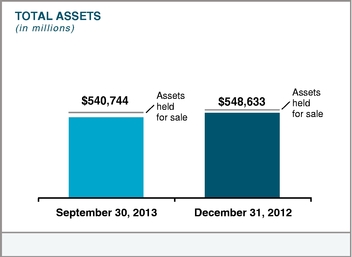
|

|
|

|
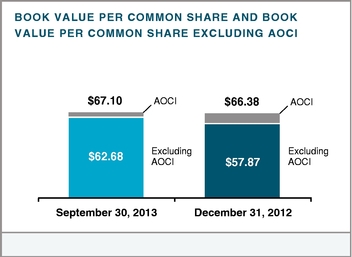
|
Investment Highlights
Net investment income decreased 23 percent and 29 percent to $3.6 billion and $11.6 billion for the three-month and nine-month periods ended September 30, 2013 compared to the prior year period, respectively, primarily due to gains recognized in 2012 from our previous investments in ML II, ML III, and AIA.
Net investment income for our insurance operations decreased by approximately $173 million and increased by approximately $234 million for the three-month and nine-month periods ended September 30, 2013, respectively, compared to the same periods in the prior year. The decrease for the three-month period is due to lower returns on alternative investments and lower reinvestment yields. The increase for the nine-month period is due to higher alternative investment income, driven primarily by favorable equity market performance, which was partially offset by gains recognized in 2012 from our previous investment in ML II. While corporate debt securities represented the core of new investment allocations, we continued to make investments in structured securities and fixed income securities with favorable risk versus return characteristics to improve yields and increase net investment income.
Net unrealized gains in our available for sale portfolio declined to approximately $13 billion as of September 30, 2013 from approximately $25 billion as of December 31, 2012 due to rising interest rates over the period and the realization of approximately $2.1 billion in gains from sales of securities.
Other-than-temporary impairments were significantly lower for the nine-month period ended September 30, 2013 relative to the prior year period partly driven by strong performance in our structured products portfolios due to favorable developments in the housing sector.
The overall credit rating of our fixed maturity portfolio was largely unchanged for this quarter.
80
ITEM 2 / EXECUTIVE OVERVIEW
Presentation Changes
Prior period revenues and expenses were conformed to the current period presentation. These changes did not affect Income from continuing operations before income tax expense or Net income attributable to AIG. Also, the presentation of the operating segments within the AIG Life and Retirement segment was revised in the first quarter of 2013 to reflect two new operating segments: Retail and Institutional. For further discussion, see Notes 1 and 3 to the Condensed Consolidated Financial Statements.
Strategic Outlook
Industry Trends
Our business is affected by industry and economic factors such as interest rates, credit and equity market conditions, catastrophic claims events, regulation, tax policy, competition, and general economic, market and political conditions. We continue to operate under difficult market conditions in 2013, characterized by factors such as historically low interest rates, instability in the global markets due to the negotiations over the U.S. debt ceiling, the U.S. Government shutdown and slow growth in the U.S. economy.
Although there has been a recent rise in interest rates in the U.S. fixed income market, interest rates remain low relative to historical levels, which has affected our industry by reducing investment returns. In addition, current market conditions may not necessarily permit insurance companies to increase pricing across all our product lines.
AIG Priorities for 2013 and Beyond
AIG remains focused on the following priorities for 2013 and beyond:
- •
-
Strengthen and improve the operating performance of our core businesses;
- •
-
Consummate the sale or monetization of our interest in ILFC;
- •
-
Enhance the yield on our investments while maintaining focus on credit quality;
- •
-
Manage our capital and interest expense more efficiently by improving our capital structure and redeploying excess capital
in areas that promote profitable growth;
- •
-
Work with the Board of Governors of the Federal Reserve System (the FRB) in its capacity as our principal regulator; and
- •
- Reduce operating expenses by leveraging our scale and driving increased standardization through investments in infrastructure.
Outlook for Our Operating Businesses
The outlook for each of our businesses and management initiatives to improve growth and performance in 2013 and over the longer term is summarized below. See our 2012 Annual Report for additional information concerning strategic initiatives and opportunities for each of our businesses.
81
ITEM 2 / EXECUTIVE OVERVIEW
AIG PROPERTY CASUALTY STRATEGIC INITIATIVES AND OUTLOOK
Executive Overview
- •
-
Business Mix Shift
—
Continue
shifting toward higher value business to increase profitability and expand in attractive growth economies, specifically in Asia Pacific, Central Europe, the Middle East, Africa and Latin America.
- •
-
Underwriting Excellence
—
Enhance risk selection and pricing to earn returns commensurate to the risk assumed.
- •
-
Claims Best Practices
—
Implement improved claims practices and advanced technology to lower the loss ratio.
- •
-
Operating Expense Discipline
—
Apply operating expense discipline and increase efficiencies by taking full advantage of our global footprint.
- •
-
Capital Efficiency
—
Continue
to streamline our legal entity structure to enhance transparency with regulators and optimize capital and tax efficiency.
- •
- Investment Strategy — Continue to execute our investment strategy, which includes increased asset diversification and yield-enhancement opportunities that meet our liquidity, risk and return objectives.
Market Conditions and Industry Trends
We expect the current low interest rate environment and ongoing uncertainty in global economic conditions will continue to challenge the growth of net investment income and limit growth in some markets. Due to these conditions, coupled with overcapacity in the property casualty insurance industry, we have sought to modify terms and conditions, exit unprofitable business and develop advanced data analytics to improve profitability.
We have observed improving trends in certain key indicators that may offset the effect of current economic challenges. Commencing in the second quarter of 2011, we have benefitted from favorable pricing trends, particularly in our U.S. commercial business. The property casualty insurance industry is experiencing modest growth as a result of this positive rate trend and an increase in overall exposures in some markets. We also expect that expansion in certain growth economies will occur at a faster pace than in developed countries, although at levels lower than those previously expected due to revised economic assumptions.
Strategic Initiatives and Opportunities
Business Mix Shift
As part of our strategy to expand our consumer operations in growth economies, on May 29, 2013, we entered into a joint venture agreement with PICC Life Insurance Company Limited (PICC Life), a subsidiary of The People's Insurance Company (Group) of China Limited (PICC Group), to form an agency distribution company in China. Products under consideration to be distributed by the joint venture company include jointly developed life and retirement insurance products, existing PICC Life products, PICC Property & Casualty Company Limited (PICC P&C) insurance products, AIG Property Casualty products, as well as other products aimed at meeting the needs of this developing market. We will own 24.9 percent of the joint venture company with PICC Life holding the remaining 75.1 percent. Our participation in the joint venture will be managed by AIG Property Casualty. The joint venture is planned to commence operations by the first quarter of 2014 subject to regulatory approval.
On June 6, 2013, we also exercised rights to purchase shares in connection with the rights offering of PICC P&C, a subsidiary of the PICC Group, for a purchase price of approximately $93 million. Immediately prior to and after the rights offering, we owned 9.9 percent of the outstanding shares in PICC P&C.
82
ITEM 2 / EXECUTIVE OVERVIEW
Capital Efficiency
We continue to execute capital management initiatives by enhancing broad-based risk tolerance guidelines for our operating units, implementing underwriting strategies to increase return on equity by line of business and reducing exposure to businesses with inadequate pricing and increased loss trends. In addition, we remain focused on enhancing our global reinsurance strategy to improve capital efficiency.
We continue to streamline our legal entity structure to enhance transparency with regulators and optimize capital and tax efficiency. In the nine months ended September 30, 2013, we completed 29 legal entity and branch restructuring transactions. We continue to implement restructuring plans in various jurisdictions. Our overall legal entity restructuring is expected to be mostly completed by the end of 2014, subject to regulatory approvals in those jurisdictions.
On July 16, 2013, we announced the planned merger of AIU Insurance Company Ltd. and Fuji, scheduled to take place in the second half of 2015 or later, subject to regulatory approvals. The merger is consistent with our growth strategy for the Japan market, and is intended to combine the expertise and experience of these companies to meet our customers' and partners' needs and provide products and services that will target higher levels of customer satisfaction in a cost-effective manner.
We continued our strategy to improve the allocation of our reinsurance between traditional reinsurance markets and capital markets. On July 9, 2013, we entered into a five-year catastrophe bond transaction, which will provide $125 million of indemnity protection against U.S., Caribbean and Gulf of Mexico named storms, and U.S. and Canadian earthquakes. The transaction provides us with fully collateralized coverage against losses from the events described above on a per-occurrence basis through June 2018. In addition, effective May 31, 2013, we modified certain internal reinsurance arrangements from our Japan entities to simplify operations and facilitate efficient capital allocation.
On September 1, 2013, we transferred the ownership of AIG Europe Holdings Limited from AIG Overseas Association and AIG Overseas Limited to AIG Property Casualty International LLC. This transaction is expected to enhance capital efficiency and increase dividend capacity in the future.
AIG LIFE AND RETIREMENT STRATEGIC INITIATIVES AND OUTLOOK
Executive Overview
- •
-
Grow Assets Under
Management
—
Leverage our unified distribution organization, innovative product design and financial discipline to increase
sales of profitable products across all distribution channels.
- •
-
Deliver Innovative Products
—
Develop superior,
differentiated product solutions that meet consumer needs for financial and retirement security.
- •
-
Pursue Operational Efficiencies
—
Continue to
streamline our life insurance and annuity platforms, operations and administrative systems.
- •
-
Increase Return on Equity
—
Deliver solid
earnings and increase capital efficiency within our life insurance entities.
- •
- Investment Strategy — Maintain a diversified, high quality portfolio of fixed maturity securities and match the duration characteristics of liabilities with assets of comparable duration and pursue yield-enhancement opportunities that meet our liquidity, risk and return objectives.
Market Conditions and Industry Trends
Market Conditions
Strong equity market performance and low volatility, coupled with positive demographic trends, have provided a favorable environment for sales of individual variable annuities, and contributed to growth in separate account assets under management in both our Retirement Income Solutions and Group Retirement product lines, which has resulted in higher fee income. Equity market volatility and changes in interest rates affect the level of reserves for variable
83
ITEM 2 / EXECUTIVE OVERVIEW
annuity guaranteed benefit features and may affect the recoverability and amortization rate of DAC assets for such products. Innovative product design and our comprehensive dynamic hedging program are critical tools for managing volatility for products where we have equity market exposure.
The low interest rate environment relative to historical levels continues to affect our business as well as the life and annuity industry overall. Continued low interest rates put pressure on long-term investment returns, negatively affect sales of interest rate sensitive products such as fixed annuities, and reduce future profits on certain existing fixed rate products. Products such as payout annuities and traditional life insurance that are not rate-adjustable may require increases in reserves if future investment yields fall to a level that results in expected future losses. In addition, low interest rates can affect future investment margins and may also affect the recoverability and amortization rate of DAC assets in our variable annuity, fixed annuity and universal life businesses.
We will continue to address the impact of low interest rates. We actively manage renewal crediting rates and have a disciplined approach to pricing new sales of interest rate sensitive products, including reduced minimum rate guarantees. Also, as market conditions change, we manage our asset and liability interest rate exposures and strategic asset allocation to emphasize lower or higher durations in the portfolio. Overall, the recent modest increase in interest rates has improved our outlook for sales and profitability.
Rapid and significant increases from current market interest rates, however, could result in elevated surrender activity in interest sensitive products, primarily fixed annuities with lower guaranteed minimum interest rates. The extent of elevated surrender activity, if any, will depend on the level of minimum guarantees in existing contracts relative to the pace and extent of market interest rate increases.
Industry Trends
Consumer demand for guaranteed income features and changes in the competitive landscape for individual variable annuities have provided a positive environment for sales of our Retirement Income Solutions products. Assuming no significant changes in market conditions, strong sales of these products are expected to continue as consumers seek to address their need for financial and retirement security.
Industry fixed annuity sales, which have been challenged by the sustained, historically low interest rate environment, have benefited recently from the modest increase in interest rates. Sales and net flows in our Fixed Annuities product line are improving as increasing market interest rates and steepening of the yield curve make fixed annuity products more attractive compared to alternatives such as bank deposits.
The life insurance marketplace continues to be highly competitive. We are continuing to execute our strategy of leveraging our scale, utilizing our expertise in pricing and risk selection, and creating differentiated products utilizing our consumer-focused research. This has resulted in a series of new product offerings and new term life rates, which we expect will drive additional sales. Utilizing the AIG Life and Retirement unified distribution organization as well as new distribution opportunities, we intend to expand our distribution footprint for life products.
OTHER OPERATIONS STRATEGIC INITIATIVES AND OUTLOOK
Mortgage Guaranty (UGC)
Executive Overview
- •
-
Risk Selection
—
Ensure
the high quality of our business through a continuous focus on risk selection and a risk based pricing using a proprietary, multi-variant risk evaluation model and disciplined underwriting approach.
- •
-
Innovation
—
Development
and enhancement of products, technology, and processes, addressing the needs of stakeholders in the mortgage system.
- •
-
Ease of Use
—
Reduce
complexity in the mortgage insurance system.
- •
- Expense Management — Streamline our processes through the use of technology and shared services.
84
ITEM 2 / EXECUTIVE OVERVIEW
Market Conditions and Industry Trends
During the first half of 2013, the U.S. mortgage market showed increasing levels of mortgage originations, home value appreciation and elevated mortgage underwriting standards. These factors, combined with improving U.S. macroeconomic conditions and low interest rates, favorably impacted mortgage loan volumes, the quality of new business written and our overall operating results during the nine-month period ended September 30, 2013.
However, recent increases in interest rates are expected to reduce new mortgage loan volumes for the remainder of 2013 and into 2014 due to reduced refinancing activity, which we expect to be partially offset by strength in mortgage lending for home purchases. While increasing interest rates generally have an unfavorable impact on new mortgage loan volumes, UGC expects that increasing interest rates will have a favorable impact on the persistency of business written over the last several quarters since refinancing of loans would be unattractive to homeowners who originated mortgages at the historically low interest rates prevalent during those periods.
In addition, UGC expects cure rates to improve as a result of home value appreciation since such appreciation will encourage homeowners with delinquent mortgages to sell and purchase another home, or to refinance their existing mortgages. We believe the combination of higher persistency and improving cure rates, partially offset by changes in new mortgage loan volumes, will continue to strengthen UGC's operating results throughout 2014.
Strategic Initiatives and Opportunities
Risk Selection
For the remainder of 2013 and during 2014, UGC expects to continue as a leading provider of mortgage insurance and will differentiate itself from its competitors by utilizing a risk-based pricing strategy. This pricing strategy provides UGC's customers with mortgage insurance products that are priced commensurate with underwriting risk, which we believe will result in an appropriately priced, high-quality book of business. UGC plans to continue to execute this strategy through 2014. The new business generated under this strategy, since 2009, accounts for approximately 51 percent of net premiums earned for the nine months ended September 30, 2013.
Global Capital Markets
AIG Markets acts as the derivatives intermediary between AIG and its subsidiaries and third parties to provide hedging services for AIG entities. The derivative portfolio of AIG Markets consists primarily of interest rate and currency derivatives.
The remaining derivatives portfolio of AIG Financial Products Corp. and AIG Trading Group, Inc. and their respective subsidiaries (collectively, AIGFP) consists primarily of hedges of the assets and liabilities of the DIB and a portion of the legacy hedges for AIG and its subsidiaries. AIGFP's derivatives portfolio consists primarily of interest rate, currency, credit, commodity and equity derivatives. Additionally, AIGFP has a credit default swap portfolio being managed for economic benefit and with limited risk. The AIGFP portfolio continues to be wound down and is managed consistent with our risk management objectives. Although the portfolio may experience periodic fair value volatility, it consists predominantly of transactions that we believe are of low complexity, low risk or currently not economically appropriate to unwind based on a cost versus benefit analysis.
Direct Investment Book
The DIB consists of a portfolio of assets and liabilities held directly by AIG Parent in the MIP and certain non-derivative assets and liabilities of AIGFP. The DIB portfolio is being wound down and is managed with the objective of ensuring that at all times it maintains the liquidity we believe is necessary to meet all of its liabilities, as they come due, even under stress scenarios, and to maximize returns consistent with our risk management objectives. We are focused on meeting the DIB's liquidity needs, including the need for contingent liquidity arising from collateral posting for debt positions of the DIB, without relying on resources beyond the DIB. As part of this program management, we may from time to time access the capital markets, including issuing and repurchasing debt, and selling assets on an opportunistic basis, in each case subject to market conditions.
85
From time to time, we may utilize cash allocated to the DIB that is not required to meet the risk target for DIB for general corporate purposes unrelated to the DIB.
The DIB's assets consist primarily of cash, short-term investments, fixed maturity securities issued by corporations, U.S. government and government sponsored entities and mortgage and asset backed securities. The value of these assets is impacted by macro-economic trends in U.S. and core European markets, including corporate credit spreads, commercial and residential real estate markets, and to a lesser extent, interest rates and foreign exchange rates, among other factors. The majority of these assets are carried at fair value with changes in fair value recognized through earnings. The DIB has both liabilities that are held at cost and liabilities that are held at fair value. The liabilities held at fair value vary in price based on changes in AIG's credit spreads with changes in fair value reflected in earnings. Changes in the fundamental drivers of the fair value of DIB assets and liabilities will create earnings volatility for the DIB on a period-to-period comparative basis.
The overall hedging activity for the assets and liabilities of the DIB is executed by GCM. The value of hedges related to the non-derivative assets and liabilities of AIGFP in the DIB is included within the assets and liabilities and operating results of GCM and is not included within the DIB operating results, assets or liabilities.
86
ITEM 2 / RESULTS OF OPERATIONS
The following section provides a comparative discussion of our Results of Operations on a reported basis for the three- and nine-month periods ended September 30, 2013 and 2012. Factors that relate primarily to a specific business segment are discussed in more detail within that business segment discussion. For a discussion of the Critical Accounting Estimates that affect the Results of Operations, see the Critical Accounting Estimates section herein and in Part II. Item 7. MD&A, in the 2012 Annual Report.
The following table presents AIG's condensed consolidated results of operations:
|
|
|
|
|
|
|
|
|||||||||||||
|---|---|---|---|---|---|---|---|---|---|---|---|---|---|---|---|---|---|---|---|
|
|
Three Months Ended
September 30, |
|
Nine Months Ended
September 30, |
|
|||||||||||||||
|
|
Percentage
Change |
Percentage
Change |
|||||||||||||||||
|
(in millions)
|
2013
|
2012
|
2013
|
2012
|
|||||||||||||||
|
Revenues: |
|
|
|
|
|
|
|||||||||||||
|
Premiums |
$
|
9,352
|
|
$ | 9,512 | (2 | )% |
$
|
27,924
|
|
$ | 28,611 | (2 | )% | |||||
|
Policy fees |
|
645
|
|
580 | 11 |
|
1,883
|
|
1,731 | 9 | |||||||||
|
Net investment income |
|
3,573
|
|
4,650 | (23 | ) |
|
11,581
|
|
16,236 | (29 | ) | |||||||
|
Net realized capital gains |
|
252
|
|
646 | (61 | ) |
|
2,143
|
|
794 | 170 | ||||||||
|
Other income |
|
1,004
|
|
1,334 | (25 | ) |
|
4,498
|
|
3,068 | 47 | ||||||||
|
Total revenues |
|
14,826
|
|
16,722 | (11 | ) |
|
48,029
|
|
50,440 | (5 | ) | |||||||
|
Benefits, claims and expenses: |
|
|
|
|
|
|
|||||||||||||
|
Policyholder benefits and claims incurred |
|
7,416
|
|
8,002 | (7 | ) |
|
22,234
|
|
22,910 | (3 | ) | |||||||
|
Interest credited to policyholder account balances |
|
924
|
|
1,189 | (22 | ) |
|
2,913
|
|
3,305 | (12 | ) | |||||||
|
Amortization of deferred acquisition costs |
|
1,220
|
|
1,522 | (20 | ) |
|
3,859
|
|
4,341 | (11 | ) | |||||||
|
Other acquisition and insurance expenses |
|
2,251
|
|
2,214 | 2 |
|
6,734
|
|
6,736 | – | |||||||||
|
Interest expense |
|
516
|
|
602 | (14 | ) |
|
1,628
|
|
1,734 | (6 | ) | |||||||
|
Loss on extinguishment of debt |
|
81
|
|
– | NM |
|
459
|
|
9 | NM | |||||||||
|
Other expenses |
|
1,239
|
|
635 | 95 |
|
3,044
|
|
2,712 | 12 | |||||||||
|
Total benefits, claims and expenses |
|
13,647
|
|
14,164 | (4 | ) |
|
40,871
|
|
41,747 | (2 | ) | |||||||
|
Income from continuing operations before income tax expense (benefit) |
|
1,179
|
|
2,558 | (54 | ) |
|
7,158
|
|
8,693 | (18 | ) | |||||||
|
Income tax expense (benefit) |
|
(993
|
)
|
734 | NM |
|
123
|
|
1,324 | (91 | ) | ||||||||
|
Income from continuing operations |
|
2,172
|
|
1,824 | 19 |
|
7,035
|
|
7,369 | (5 | ) | ||||||||
|
Income (loss) from discontinued operations, net of income tax expense (benefit) |
|
(42
|
)
|
37 | NM |
|
84
|
|
280 | (70 | ) | ||||||||
|
Net income |
|
2,130
|
|
1,861 | 14 |
|
7,119
|
|
7,649 | (7 | ) | ||||||||
|
Less: Net income (loss) attributable to noncontrolling interests |
|
(40
|
)
|
5 | NM |
|
12
|
|
253 | (95 | ) | ||||||||
|
Net income attributable to AIG |
$
|
2,170
|
|
$ | 1,856 | 17 | % |
$
|
7,107
|
|
$ | 7,396 | (4 | )% | |||||
87
ITEM 2 / RESULTS OF OPERATIONS
AIG Consolidated Quarterly and Year-to-Date Comparison for 2013 and 2012
Income from continuing operations before income tax expense was $1.2 billion for the three-month period ended September 30, 2013 compared to $2.6 billion for the same period in 2012, and reflected the following:
- •
-
pre-tax income from insurance operations (including Mortgage Guaranty, which is reported in Other Operations) of $2.3
billion and $1.8 billion for the three-month periods ended September 30, 2013 and 2012, respectively;
- •
-
aggregate pre-tax income from GCM and DIB of $81 million and $596 million for the three-month periods ended September 30,
2013 and 2012, respectively; and
- •
- net investment income in 2012 included an increase in fair value of AIG's interest in AIA ordinary shares of $527 million, and net investment income for the three-month period ended September 30, 2012 reflected an increase in fair value of AIG's interest in ML III of $330 million based in part on sales of ML III assets by the Federal Reserve Bank of New York (the FRBNY).
Income from continuing operations before income tax expense was $7.2 billion for the nine-month period ended September 30, 2013 compared to $8.7 billion for the same period in 2012, and reflected the following:
- •
-
pre-tax income from insurance operations (including Mortgage Guaranty, which is reported in Other Operations) of $8.5
billion and $5.4 billion in the nine-month periods ended September 30, 2013 and 2012, respectively;
- •
-
aggregate pre-tax income from GCM and DIB of $1.5 billion and $1.4 billion for the nine-month periods ended September 30,
2013 and 2012, respectively;
- •
-
loss on extinguishment of debt of $459 million resulting from redemptions and repurchases of, and cash tender offers for,
certain debt securities in the nine months ended September 30, 2013; and
- •
- net investment income in 2012 reflected an increase in fair value of AIG's interests in AIA ordinary shares and ML III of $1.8 billion and $2.9 billion; respectively.
For the three- and nine-month periods ended September 30, 2013, the effective tax rate on income from continuing operations was (84.2) percent and 1.7 percent, respectively. The effective tax rate for the three- and nine-month periods ended September 30, 2013, on income from continuing operations differs from the statutory tax rate of 35 percent primarily due to tax effects associated with tax exempt interest income, effective settlements of certain uncertain tax positions, and decreases primarily in AIG Life and Retirement's capital loss carryforward valuation allowance and certain other valuation allowances associated with foreign jurisdictions. The decrease in the capital loss carryforward valuation allowance was primarily attributable to the actual and projected gains from AIG Life and Retirement's available-for-sale securities. For the nine-month period ended September 30, 2013, these items were partially offset by changes in uncertain tax positions.
For the three- and nine-month periods ended September 30, 2012, the effective tax rate on income from continuing operations was 28.7 percent and 15.2 percent, respectively. The effective tax rate for the three- and nine-month periods ended September 30, 2012 on income from continuing operations differs from the statutory tax rate of 35 percent primarily due to tax effects associated with tax exempt interest income and investments in partnerships, and decreases primarily in AIG Life and Retirement's capital loss carryforward valuation allowance related to the actual and projected gains from AIG Life and Retirement's available-for-sale securities. These items were partially offset by changes in uncertain tax positions.
88
ITEM 2 / RESULTS OF OPERATIONS
The following table presents a reconciliation of net income attributable to AIG to after-tax operating income attributable to AIG:
|
|
|
|
|
|
|||||||||
|---|---|---|---|---|---|---|---|---|---|---|---|---|---|
|
|
Three Months Ended
September 30, |
Nine Months Ended
September 30, |
|||||||||||
|
(in millions)
|
2013
|
2012
|
2013
|
2012
|
|||||||||
|
Net income attributable to AIG |
$
|
2,170
|
|
$ | 1,856 |
$
|
7,107
|
|
$ | 7,396 | |||
|
(Income) loss from discontinued operations, net of income tax expense |
|
42
|
|
(37 | ) |
|
(84
|
)
|
(280 | ) | |||
|
Net loss on sale of divested businesses |
|
–
|
|
– |
|
31
|
|
2 | |||||
|
Uncertain tax positions and other tax adjustments |
|
36
|
|
12 |
|
726
|
|
343 | |||||
|
Legal reserves (settlements) related to legacy crisis matters |
|
260
|
|
5 |
|
(61
|
)
|
482 | |||||
|
Deferred income tax valuation allowance releases |
|
(1,159
|
)
|
(219 | ) |
|
(2,697
|
)
|
(1,795 | ) | |||
|
Changes in fair value of AIG Life and Retirement fixed maturity securities designated to hedge living benefit liabilities, net of interest expense |
|
19
|
|
2 |
|
83
|
|
(31 | ) | ||||
|
Changes in benefit reserves and DAC, VOBA and SIA related to net realized capital gains |
|
176
|
|
393 |
|
1,065
|
|
729 | |||||
|
Loss on extinguishment of debt |
|
52
|
|
– |
|
298
|
|
6 | |||||
|
Net realized capital gains |
|
(175
|
)
|
(386 | ) |
|
(1,410
|
)
|
(489 | ) | |||
|
Non-qualifying derivative hedging gains, excluding net realized capital gains |
|
–
|
|
(5 | ) |
|
–
|
|
(18 | ) | |||
|
After-tax operating income attributable to AIG |
$
|
1,421
|
|
$ | 1,621 |
$
|
5,058
|
|
$ | 6,345 | |||
After-tax operating income attributable to AIG decreased in the three-and nine-month periods ended September 30, 2013 compared to the same periods in 2012, primarily due to fair value gains on AIG's previously held interests in AIA ordinary shares, ML II, and ML III, discussed above, partially offset by increases in income from insurance operations.
For the three months ended September 30, 2013 and 2012, the effective tax rate on pre-tax operating income was 18.0 percent and 35.5 percent, respectively. For the nine months ended September 30, 2013 and 2012, the effective tax rate on pre-tax operating income was 27.7 percent and 32.0 percent, respectively. The significant factors that contributed to the difference from the statutory rate included tax benefits resulting from tax exempt interest income and other permanent tax items, and the impact of discrete tax benefits.
89
ITEM 2 / RESULTS OF OPERATIONS
Quarterly and Year-to-Date Segment Results
We report the results of our operations through two reportable segments: AIG Property Casualty and AIG Life and Retirement. The Other Operations category consists of businesses and items not allocated to our reportable segments.
The following table summarizes the operations of each reportable segment. See also Note 3 to the Condensed Consolidated Financial Statements.
|
|
|
|
|
|
|
|
|||||||||||||
|---|---|---|---|---|---|---|---|---|---|---|---|---|---|---|---|---|---|---|---|
|
|
Three Months Ended
September 30, |
|
Nine Months Ended
September 30, |
|
|||||||||||||||
|
|
Percentage
Change |
Percentage
Change |
|||||||||||||||||
|
(in millions)
|
2013
|
2012
|
2013
|
2012
|
|||||||||||||||
|
Total revenues: |
|
|
|
|
|
|
|||||||||||||
|
AIG Property Casualty |
$
|
9,608
|
|
$ | 10,149 | (5 | )% |
$
|
29,333
|
|
$ | 29,967 | (2 | )% | |||||
|
AIG Life and Retirement |
|
4,644
|
|
4,747 | (2 | ) |
|
15,432
|
|
13,077 | 18 | ||||||||
|
Total reportable segments |
|
14,252
|
|
14,896 | (4 | ) |
|
44,765
|
|
43,044 | 4 | ||||||||
|
Other Operations |
|
678
|
|
2,213 | (69 | ) |
|
3,677
|
|
8,085 | (55 | ) | |||||||
|
Consolidation and eliminations |
|
(104
|
)
|
(387 | ) | 73 |
|
(413
|
)
|
(689 | ) | 40 | |||||||
|
Total |
$
|
14,826
|
|
$ | 16,722 | (11 | ) |
$
|
48,029
|
|
$ | 50,440 | (5 | ) | |||||
|
Pre-tax income (loss): |
|
|
|
|
|
|
|||||||||||||
|
AIG Property Casualty |
$
|
1,029
|
|
$ | 949 | 8 |
$
|
3,801
|
|
$ | 2,820 | 35 | |||||||
|
AIG Life and Retirement |
|
1,241
|
|
889 | 40 |
|
4,530
|
|
2,528 | 79 | |||||||||
|
Total reportable segments |
|
2,270
|
|
1,838 | 24 |
|
8,331
|
|
5,348 | 56 | |||||||||
|
Other Operations |
|
(1,125
|
)
|
891 | NM |
|
(1,269
|
)
|
3,511 | NM | |||||||||
|
Consolidation and eliminations |
|
34
|
|
(171 | ) | NM |
|
96
|
|
(166 | ) | NM | |||||||
|
Total |
$
|
1,179
|
|
$ | 2,558 | (54 | ) |
$
|
7,158
|
|
$ | 8,693 | (18 | ) | |||||
90
ITEM 2 / RESULTS OF OPERATIONS
TOTAL REVENUES
(in millions)
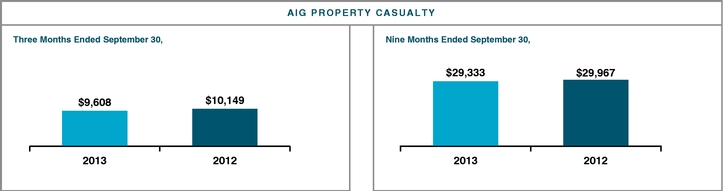
|
||

|
||
A discussion of significant items affecting pre-tax segment income follows. Factors that affect pre-tax operating income for a specific business segment are discussed in the detailed business segment analysis.
91
ITEM 2 / RESULTS OF OPERATIONS
Quarterly and Year-to-date Pre-tax Income for 2013 and 2012
AIG Property Casualty — Pre-tax income increased in the three- and nine-month periods ended September 30, 2013 compared to the same periods in 2012, primarily as a result of improved underwriting results. The improved underwriting results are attributable to lower accident year losses, which reflect the continued shift to higher value business, enhanced risk selection and improved pricing. The improvement in pre-tax income also reflected lower catastrophe losses in the three- and nine-month periods ended September 30, 2013 compared to the same periods in 2012. Net investment income decreased in the three-month period ended September 30, 2013 compared to the same period in 2012 due to decreases in returns on alternative investments and mutual funds. Net investment income increased in the nine-month period ended September 30, 2013 compared to the same period in 2012 due to the strong performance of alternative investments and income associated with the PICC P&C shares.
AIG Life and Retirement — Pre-tax income increased in the three- and nine-month periods ended September 30, 2013 compared to the same periods in 2012, primarily due to increased fee income from growth in our variable annuity account value and continued active spread management related to our interest rate sensitive businesses. The 2013 periods included a $118 million net increase in pre-tax operating income from adjustments to update certain estimated gross profit assumptions used to amortize DAC and related items in our interest-sensitive product lines. The nine-month period ended September 30, 2013 also included income from legal settlements. These increases were partially offset by the absence of fair value gains recognized in the prior year nine-month period from our investment in ML II, which was liquidated in March 2012. Net realized capital gains decreased in the three-month period and increased in the nine-month period ended September 30, 2013 compared to the same periods in 2012, primarily due to gains on different volumes of sales activity in connection with our program to utilize capital loss carryforwards, which were partially offset by the triggering of additional loss recognition reserves, reflected in Policyholder benefits and claims incurred, from the subsequent reinvestment of the proceeds from these sales at lower yields.
Other Operations — Other operations reported a pre-tax loss in the three-month period ended September 30, 2013 compared to pre-tax income in the same period of 2012 primarily due to decreases in pre-tax income from GCM and DIB. The pre-tax income in 2012 included fair value gains from our previously held interests in AIA ordinary shares and ML III. Other operations reported a pre-tax loss in the nine-month period ended September 30, 2013 compared to pre-tax income in the same period in 2012. The pre-tax loss in the nine-month period ended September 30, 2013 included a loss on extinguishment of debt resulting from the redemptions and repurchases of, and cash tender offers, for certain debt securities, partially offset by an increase in pre-tax income from GCM and Mortgage Guaranty. The pre-tax income in the three- and nine-month periods ended September 30, 2012 included fair value gains from our previously held interests in AIA ordinary shares and ML III.
Mortgage Guaranty's pre-tax operating income increased in the three- and nine-month periods of September 30, 2013 compared to the same periods of 2012 due to higher net premiums earned in the first-lien business and a decline in newly reported delinquencies and improving cure rates.
92
ITEM 2 / RESULTS OF OPERATIONS
The following table presents reconciliations of pre-tax income (loss) to pre-tax operating income (loss) by reportable segment and after-tax operating income attributable to AIG, which are non-GAAP measures. See Use of Non-GAAP Measures for additional information.
|
|
|
|
|
|
|||||||||
|---|---|---|---|---|---|---|---|---|---|---|---|---|---|
|
|
Three Months Ended
September 30, |
Nine Months Ended
September 30, |
|||||||||||
|
(in millions)
|
2013
|
2012
|
2013
|
2012
|
|||||||||
|
AIG Property Casualty |
|
|
|
|
|
|
|||||||
|
Pre-tax income |
$
|
1,029
|
|
$ | 949 |
$
|
3,801
|
|
$ | 2,820 | |||
|
Net realized capital (gains) losses |
|
12
|
|
(161 | ) |
|
(73
|
)
|
(49 | ) | |||
|
Other (income) expense — net |
|
3
|
|
(2 | ) |
|
(10
|
)
|
(6 | ) | |||
|
Pre-tax operating income |
$
|
1,044
|
|
$ | 786 |
$
|
3,718
|
|
$ | 2,765 | |||
|
AIG Life and Retirement |
|
|
|
|
|
|
|||||||
|
Pre-tax income |
$
|
1,241
|
|
$ | 889 |
$
|
4,530
|
|
$ | 2,528 | |||
|
Legal settlements * |
|
–
|
|
– |
|
(467
|
)
|
– | |||||
|
Changes in fair value of fixed maturity securities designated to hedge living benefit liabilities, net of interest expense |
|
30
|
|
3 |
|
128
|
|
(48 | ) | ||||
|
Changes in benefit reserves and DAC, VOBA and SIA related to net realized capital gains |
|
271
|
|
604 |
|
1,482
|
|
1,120 | |||||
|
Net realized capital gains |
|
(398
|
)
|
(670 | ) |
|
(1,984
|
)
|
(530 | ) | |||
|
Pre-tax operating income |
$
|
1,144
|
|
$ | 826 |
$
|
3,689
|
|
$ | 3,070 | |||
|
Other Operations |
|
|
|
|
|
|
|||||||
|
Pre-tax income (loss) |
$
|
(1,125
|
)
|
$ | 891 |
$
|
(1,269
|
)
|
$ | 3,511 | |||
|
Net realized capital (gains) losses |
|
104
|
|
(47 | ) |
|
(107
|
)
|
(403 | ) | |||
|
Net loss on sale of divested businesses |
|
–
|
|
– |
|
47
|
|
3 | |||||
|
Legal reserves |
|
400
|
|
10 |
|
425
|
|
744 | |||||
|
Legal settlements * |
|
–
|
|
– |
|
(48
|
)
|
– | |||||
|
(Gain) loss on extinguishment of debt |
|
81
|
|
– |
|
459
|
|
9 | |||||
|
Pre-tax operating income (loss) |
$
|
(540
|
)
|
$ | 854 |
$
|
(493
|
)
|
$ | 3,864 | |||
|
Total |
|
|
|
|
|
|
|||||||
|
Pre-tax operating income of reportable segments and Other Operations |
$
|
1,648
|
|
$ | 2,466 |
$
|
6,914
|
|
$ | 9,699 | |||
|
Consolidations, eliminations and other adjustments |
|
61
|
|
56 |
|
124
|
|
(2 | ) | ||||
|
Pre-tax operating income |
|
1,709
|
|
2,522 |
|
7,038
|
|
9,697 | |||||
|
Income tax expense |
|
(307
|
)
|
(896 | ) |
|
(1,947
|
)
|
(3,100 | ) | |||
|
Noncontrolling interests excluding net realized capital (gains) losses |
|
19
|
|
(5 | ) |
|
(33
|
)
|
(252 | ) | |||
|
After-tax operating income attributable to AIG |
$
|
1,421
|
|
$ | 1,621 |
$
|
5,058
|
|
$ | 6,345 | |||
* Reflects income in the nine-month period ended September 30, 2013 from settlements with financial institutions that participated in the creation, offering and sale of RMBS from which AIG realized losses during the financial crisis.
93
ITEM 2 / RESULTS OF OPERATIONS
PRE-TAX INCOME (LOSS)
(in millions)

|
||
94
PRE-TAX OPERATING INCOME (LOSS)
(in millions)
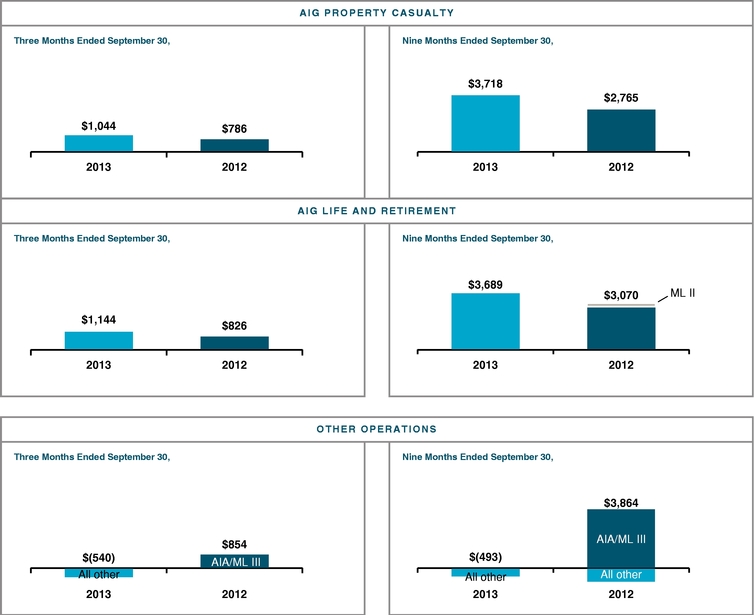
AIG Property Casualty presents its financial information in two operating segments — Commercial Insurance and Consumer Insurance — as well as an Other category.
Commercial Insurance provides insurance solutions for large and small businesses. Commercial Insurance products are distributed through a network of independent retail and wholesale brokers, branches, and through an independent agency network in the Asia Pacific and EMEA regions.
Consumer Insurance provides personal insurance solutions for individuals, organizations and families. Consumer Insurance products are distributed through agents and brokers, as well as through direct marketing, partner organizations and the internet.
The Other category consists primarily of certain run-off lines of business, including excess workers' compensation written on a stand-alone basis, reserves for asbestos and environmental (1986 and prior) claims, and certain environmental liability businesses written prior to 2004. It also includes a portion of AIG Property Casualty expenses relating to global corporate initiatives, expense allocations from AIG Parent not attributable to the Commercial Insurance or Consumer Insurance operating segments, unallocated net investment income, net realized capital gains and losses, and other income (expense).
95
ITEM 2 / RESULTS OF OPERATIONS / AIG PROPERTY CASUALTY
See Part I. Item 1. Business — AIG Property Casualty in AIG's 2012 Annual Report for further discussion of AIG Property Casualty's products and geographic regions where it distributes its products.
We are developing new value-based metrics that provide management with measures to evaluate our profitability, such as a risk-adjusted profitability model. Along with underwriting results, this risk-adjusted profitability model incorporates elements of capital allocations, costs of capital and net investment income. We believe that such performance measures will allow us to better assess the true economic returns of our business.
AIG Property Casualty Quarterly and Year-to-Date 2013 Highlights
Net premiums written decreased by one percent for both the three- and nine-month periods ended September 30, 2013 compared to the same periods in the prior year due to the effect of foreign exchange as a result of the strengthening of the U.S. dollar against the Japanese yen and an increase in specific Casualty reinsurance arrangements to better manage our exposures. This decrease was partially offset by the growth of new business and rate increases.
Also, in the first quarter of 2013, we began to recognize ceded premiums written under excess of loss reinsurance agreements at the inception of the contract rather than ratably over the contract period. The negative impact on net premiums written from this change in the first quarter of 2013 began to reverse in the second quarter of 2013 and will continue to reverse throughout the rest of 2013. For the three-month period ended September 30, 2013, the impact of the change in the timing of recognizing the excess of loss ceded premiums written increased net premiums written by $204 million, while for the nine-month period ended September 30, 2013, this impact decreased net premiums written by $122 million. Excluding the impact of this change and the effect of foreign exchange, Commercial Insurance net premiums written were unchanged and increased by approximately two percent for the three- and nine-month periods ended September 30, 2013, respectively, compared to the same periods in the prior year. Excluding the impact of this change and the effect of foreign exchange, Consumer Insurance net premiums written increased by approximately four percent in both the three- and nine-month periods ended September 30, 2013, compared to the same periods in the prior year.
The loss ratio improved by 4.1 points and 3.3 points for the three- and nine-month periods ended September 30, 2013, respectively, compared to the same periods in the prior year, primarily due to the benefit from positive pricing trends and the continued effect of the execution of our strategic initiatives, which we began implementing in the second half of 2011. These improvements included decreases in net adverse prior year development, including related premium adjustments, as well as lower catastrophe losses, partially offset by increases in severe losses of $71 million and $46 million for the three- and nine-month periods ended September 30, 2013, respectively, compared to the same periods in the prior year. For the nine-month period ended September 30, 2013 net adverse prior year development included $136 million of adverse development from Storm Sandy. Additionally, losses for the nine-month period ended September 30, 2012, benefitted from an increase in reserve discount.
The acquisition ratio increased by 0.2 points for the three-month period ended September 30, 2013 and was unchanged for the nine-month period ended September 30, 2013, compared to the same periods in the prior year, due in both cases to changes in business mix and costs in growth-targeted lines of business in Consumer Insurance, which were partially offset by decreases in the Commercial Insurance acquisition ratio related to changes in business mix and the timing of insurance-related assessments.
The general operating expense ratio increased by 0.5 points and 0.6 points for the three- and nine-month periods ended September 30, 2013, respectively, compared to the same periods in the prior year as a result of the increase in the cost of our employee incentive plans, partially offset by a decrease in bad debt expense and reduced costs for infrastructure projects. For the three- and nine-month periods ended September 30, 2013, the lower net premiums earned base contributed approximately 0.5 points to the general operating expense ratio.
Net investment income decreased by four percent for the three-month period ended September 30, 2013, compared to the same period in the prior year, primarily due to lower returns on alternative investments and mutual funds. Net investment income increased by seven percent for the nine-month period ended September 30, 2013, compared to the same period in the prior year, primarily due to increases in alternative investment returns and income associated with the PICC P&C shares that are accounted for under the fair value option.
Cash dividends paid to AIG Parent were $716 million and $1.5 billion in the three- and nine-month periods ended September 30, 2013, respectively.
96
ITEM 2 / RESULTS OF OPERATIONS / AIG PROPERTY CASUALTY
AIG Property Casualty Results
The following table presents AIG Property Casualty results:
|
|
|
|
|
|
|
|
|||||||||||||
|---|---|---|---|---|---|---|---|---|---|---|---|---|---|---|---|---|---|---|---|
|
|
Three Months Ended
September 30, |
|
Nine Months Ended
September 30, |
|
|||||||||||||||
|
|
Percentage
Change |
Percentage
Change |
|||||||||||||||||
|
(in millions)
|
2013
|
2012
|
2013
|
2012
|
|||||||||||||||
|
Commercial Insurance |
|
|
|
|
|
|
|||||||||||||
|
Underwriting results: |
|
|
|
|
|
|
|||||||||||||
|
Net premiums written |
$
|
5,222
|
|
$ | 5,099 | 2 | % |
$
|
16,001
|
|
$ | 15,890 | 1 | % | |||||
|
(Increase) decrease in unearned premiums |
|
(80
|
)
|
140 | NM |
|
(658
|
)
|
(149 | ) | (342 | ) | |||||||
|
Net premiums earned |
|
5,142
|
|
5,239 | (2 | ) |
|
15,343
|
|
15,741 | (3 | ) | |||||||
|
Claims and claims adjustment expenses incurred |
|
3,692
|
|
4,087 | (10 | ) |
|
10,706
|
|
11,593 | (8 | ) | |||||||
|
Acquisition expenses |
|
812
|
|
819 | (1 | ) |
|
2,479
|
|
2,667 | (7 | ) | |||||||
|
General operating expenses |
|
646
|
|
650 | (1 | ) |
|
1,858
|
|
1,850 | – | ||||||||
|
Underwriting income (loss) |
|
(8
|
)
|
(317 | ) | 97 |
|
300
|
|
(369 | ) | NM | |||||||
|
Net investment income |
|
618
|
|
688 | (10 | ) |
|
1,886
|
|
2,130 | (11 | ) | |||||||
|
Pre-tax operating income |
$
|
610
|
|
$ | 371 | 64 | % |
$
|
2,186
|
|
$ | 1,761 | 24 | % | |||||
|
Consumer Insurance |
|
|
|
|
|
|
|||||||||||||
|
Underwriting results: |
|
|
|
|
|
|
|||||||||||||
|
Net premiums written |
$
|
3,441
|
|
$ | 3,630 | (5 | )% |
$
|
10,363
|
|
$ | 10,755 | (4 | )% | |||||
|
Increase in unearned premiums |
|
(171
|
)
|
(157 | ) | (9 | ) |
|
(430
|
)
|
(337 | ) | (28 | ) | |||||
|
Net premiums earned |
|
3,270
|
|
3,473 | (6 | ) |
|
9,933
|
|
10,418 | (5 | ) | |||||||
|
Claims and claims adjustment expenses incurred |
|
1,922
|
|
2,025 | (5 | ) |
|
5,807
|
|
6,098 | (5 | ) | |||||||
|
Acquisition expenses |
|
852
|
|
891 | (4 | ) |
|
2,544
|
|
2,532 | – | ||||||||
|
General operating expenses |
|
492
|
|
514 | (4 | ) |
|
1,524
|
|
1,550 | (2 | ) | |||||||
|
Underwriting income |
|
4
|
|
43 | (91 | ) |
|
58
|
|
238 | (76 | ) | |||||||
|
Net investment income |
|
89
|
|
109 | (18 | ) |
|
279
|
|
340 | (18 | ) | |||||||
|
Pre-tax operating income |
$
|
93
|
|
$ | 152 | (39 | )% |
$
|
337
|
|
$ | 578 | (42 | )% | |||||
|
Other |
|
|
|
|
|
|
|||||||||||||
|
Underwriting results: |
|
|
|
|
|
|
|||||||||||||
|
Net premiums written |
$
|
(3
|
)
|
$ | (17 | ) | 82 | % |
$
|
(4
|
)
|
$ | (18 | ) | 78 | % | |||
|
Decrease in unearned premiums |
|
18
|
|
57 | (68 | ) |
|
60
|
|
119 | (50 | ) | |||||||
|
Net premiums earned |
|
15
|
|
40 | (63 | ) |
|
56
|
|
101 | (45 | ) | |||||||
|
Claims and claims adjustment expenses incurred |
|
55
|
|
140 | (61 | ) |
|
248
|
|
549 | (55 | ) | |||||||
|
Acquisition expenses |
|
–
|
|
(1 | ) | NM |
|
–
|
|
– | NM | ||||||||
|
General operating expenses |
|
91
|
|
68 | 34 |
|
295
|
|
259 | 14 | |||||||||
|
Underwriting loss |
|
(131
|
)
|
(167 | ) | 22 |
|
(487
|
)
|
(707 | ) | 31 | |||||||
|
Net investment income |
|
472
|
|
430 | 10 |
|
1,682
|
|
1,133 | 48 | |||||||||
|
Pre-tax operating income |
|
341
|
|
263 | 30 |
|
1,195
|
|
426 | 181 | |||||||||
|
Net realized capital gains (losses) |
|
(12
|
)
|
161 | NM |
|
73
|
|
49 | 49 | |||||||||
|
Other income (expense) — net |
|
(3
|
)
|
2 | NM |
|
10
|
|
6 | 67 | |||||||||
|
Pre-tax income |
$
|
326
|
|
$ | 426 | (23 | )% |
$
|
1,278
|
|
$ | 481 | 166 | % | |||||
|
Total AIG Property Casualty |
|
|
|
|
|
|
|||||||||||||
|
Underwriting results: |
|
|
|
|
|
|
|||||||||||||
|
Net premiums written |
$
|
8,660
|
|
$ | 8,712 | (1 | )% |
$
|
26,360
|
|
$ | 26,627 | (1 | )% | |||||
|
(Increase) decrease in unearned premiums |
|
(233
|
)
|
40 | NM |
|
(1,028
|
)
|
(367 | ) | (180 | ) | |||||||
|
Net premiums earned |
|
8,427
|
|
8,752 | (4 | ) |
|
25,332
|
|
26,260 | (4 | ) | |||||||
|
Claims and claims adjustment expenses incurred |
|
5,669
|
|
6,252 | (9 | ) |
|
16,761
|
|
18,240 | (8 | ) | |||||||
|
Acquisition expenses |
|
1,664
|
|
1,709 | (3 | ) |
|
5,023
|
|
5,199 | (3 | ) | |||||||
|
General operating expenses |
|
1,229
|
|
1,232 | – |
|
3,677
|
|
3,659 | – | |||||||||
|
Underwriting loss |
|
(135
|
)
|
(441 | ) | 69 |
|
(129
|
)
|
(838 | ) | 85 | |||||||
|
Net investment income |
|
1,179
|
|
1,227 | (4 | ) |
|
3,847
|
|
3,603 | 7 | ||||||||
|
Pre-tax operating income |
|
1,044
|
|
786 | 33 |
|
3,718
|
|
2,765 | 34 | |||||||||
|
Net realized capital gains (losses) |
|
(12
|
)
|
161 | NM |
|
73
|
|
49 | 49 | |||||||||
|
Other income (expense) — net |
|
(3
|
)
|
2 | NM |
|
10
|
|
6 | 67 | |||||||||
|
Pre-tax income |
$
|
1,029
|
|
$ | 949 | 8 | % |
$
|
3,801
|
|
$ | 2,820 | 35 | % | |||||
97
ITEM 2 / RESULTS OF OPERATIONS / AIG PROPERTY CASUALTY
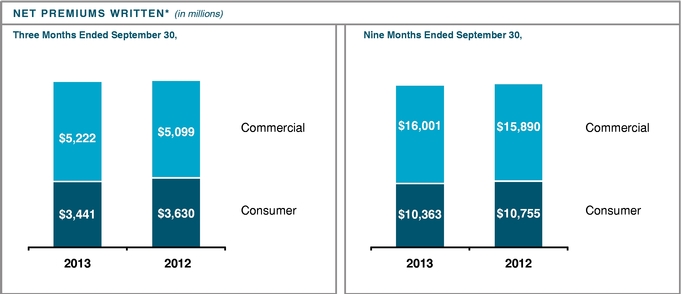

* The operations reported as part of Other do not have meaningful levels of Net premiums written.
AIG Property Casualty Quarterly Results
Pre-tax operating income increased in the three-month period ended September 30, 2013 compared to the same period in the prior year, due to an improvement in underwriting results, which was partially offset by a decrease in net investment income. The improvement in underwriting results in the third quarter of 2013 compared to the same period in the prior year reflects improved current accident year losses, decreases in net adverse development and lower catastrophe losses. Net investment income decreased in the three-month period ended September 30, 2013 compared to the same period in the prior year, primarily due to lower returns on alternative investments and mutual funds reflective of overall lower market performance for the period. Net adverse development including premium adjustments was $72 million and $145 million for the three-month periods ended September 30, 2013 and 2012, respectively. Catastrophe losses were $222 million and $261 million for the three-month periods ended September 30, 2013 and 2012, respectively.
See Liability for Unpaid Claims and Claims Adjustment Expense for further discussion of prior year development.
Acquisition expenses decreased in the three-month period ended September 30, 2013 compared to the same period in the prior year, primarily due to changes in business mix in both Commercial and Consumer Insurance.
General operating expenses decreased slightly in the three-month period ended September 30, 2013 compared to the same period in the prior year primarily due to decreases in bad debt expense and reduced costs for infrastructure projects. These decreases were partially offset by an increase in the cost of our employee incentive
98
ITEM 2 / RESULTS OF OPERATIONS / AIG PROPERTY CASUALTY
plans of $47 million, primarily due to the alignment of employee performance with the overall performance of the organization, including our stock performance. Bad debt expense and infrastructure project expenses, in the aggregate, decreased in the three-month period ended September 30, 2013 by $61 million from $127 million in the same period in the prior year.
AIG Property Casualty Year-to-Date Results
Pre-tax operating income increased in the nine-month period ended September 30, 2013 compared to the same period in the prior year due to an improvement in underwriting results and an increase in net investment income. The improvement in underwriting results in the nine-month period ended September 30, 2013 compared to the same period in the prior year reflected an improvement in current accident year losses, decreases in net adverse developments as well as lower catastrophe losses. Net investment income increased in the nine-month period ended September 30, 2013 compared to the same period in the prior year due to increases in alternative investment returns and income associated with the PICC P&C shares that are accounted for under the fair value option. The asset diversification strategies that we executed during 2012 enabled us to maintain similar yields in the portfolio despite the continued low interest rate environment in 2013. Net adverse development including premium adjustments was $199 million and $329 million for the nine-month periods ended September 30, 2013 and 2012, respectively. Catastrophe losses were $579 million and $669 million for the nine-month periods ended September 30, 2013 and 2012, respectively.
Acquisition expenses decreased in the nine-month period ended September 30, 2013 compared to the same period in the prior year, primarily due to the timing of certain guaranty funds and other assessments in Commercial Insurance, which were partially offset by an increase in acquisition expenses in Consumer Insurance due to the change in business mix.
General operating expenses increased in the nine-month period ended September 30, 2013 compared to the same period in the prior year, due to an increase in the cost of our employee incentive plans of $158 million and a $42 million increase due to the implementation of a voluntary early retirement plan in Japan. The increase in the cost of our employee incentive plans was primarily due to the alignment of employee performance with the overall performance of the organization, including our stock performance, and accelerated vesting provisions for retirement-eligible individuals in the 2013 share-based plan. This was partially offset by decreases in bad debt expense and reduced costs for infrastructure projects. Bad debt expense and infrastructure project expenses, in the aggregate, decreased to $152 million in the nine-month period ended September 30, 2013 compared to $324 million in the same period in the prior year.
Commercial Insurance Quarterly Results
Pre-tax operating income increased in the three-month period ended September 30, 2013 compared to the same period in the prior year, primarily due to an improvement in underwriting results in the third quarter of 2013, which was partially offset by a decrease in allocated net investment income primarily due to a decrease in risk-free rates. Commercial Insurance underwriting results improved primarily due to improved current accident year losses, rate increases, enhanced risk selection, lower catastrophe losses, and a decrease in net adverse developments. The current accident year losses for the three-month period ended September 30, 2013 also included severe losses of $211 million compared to severe losses of $120 million incurred in the same period in the prior year. Net adverse development, including related premium adjustments, was $104 million in the three-month period ended September 30, 2013 compared to $123 million in the same period in the prior year. In the three-month period ended September 30, 2013, catastrophe losses were $182 million compared to $239 million in the same period in 2012.
Acquisition expenses decreased slightly in the three-month period ended September 30, 2013 compared to the same period in the prior year due to the change in business mix.
General operating expenses decreased slightly in the three-month period ended September 30, 2013 compared to the same period in the prior year primarily due to a decrease in bad debt expense, which was partially offset by the increase in employee incentive plan expense previously discussed.
Commercial Insurance Year-to-Date Results
Pre-tax operating income increased in the nine-month period ended September 30, 2013 compared to the same period in the prior year, primarily due to underwriting income in the nine-month period ended September 30, 2013
99
ITEM 2 / RESULTS OF OPERATIONS / AIG PROPERTY CASUALTY
compared to an underwriting loss in the same period of 2012, partially offset by a decrease in allocated net investment income as a result of a decrease in risk-free rates. Commercial Insurance generated underwriting income in the nine-month period ended September 30, 2013 compared to an underwriting loss in the same period of the prior year, primarily due to improved current accident year losses, rate increases, enhanced risk selection and lower catastrophe losses, which were partially offset by an increase in net adverse development. The current accident year losses for the nine-month period ended September 30, 2013 also included severe losses of $309 million compared to the severe losses of $230 million incurred in the same period of the prior year. In the nine-month period ended September 30, 2013, catastrophe losses were $522 million compared to $603 million in the same period in 2012. Net adverse development, including related premium adjustments was $245 million in the nine-month period ended September 30, 2013, which includes $165 million of adverse development related to Storm Sandy, compared to $153 million in the prior year. The adverse development related to Storm Sandy resulted from higher severities on a small number of existing large and complex commercial claims. These increased severities were driven by a number of factors, including the extensive damage caused to properties in the downtown New York metropolitan area. Additionally, the nine-month period ended September 30, 2012, benefitted from an increase in reserve discount.
Acquisition expenses decreased in the nine-month period ended September 30, 2013 compared to the same period in the prior year due to the timing of guaranty funds and other assessments, as well as change in business mix.
General operating expenses increased slightly in the nine-month period ended September 30, 2013 compared to the same period in the prior year, primarily due to the increase in employee incentive plan expense previously discussed, which was partially offset by a decrease in bad debt expense.
Consumer Insurance Quarterly Results
Pre-tax operating income decreased in the three-month period ended September 30, 2013 compared to the same period in the prior year due to a decrease in underwriting income and allocated net investment income. Underwriting income decreased due to the combination of higher accident year losses, reflecting higher warranty retail program losses, higher catastrophe losses, and investment in strategic business expansion in growth economy nations, partially offset by improvement of auto underwriting income, higher net favorable development, and the change in business mix towards higher value products. Allocated net investment income decreased primarily due to a decrease in risk-free rates. Catastrophe losses for the three-month period ended September 30, 2013 were $40 million, compared to $22 million during the same period in the prior year. Net favorable development was $30 million in the three-month period ended September 30, 2013, compared to net favorable development of $2 million in the prior year.
Acquisition expenses decreased in the three-month period ended September 30, 2013 compared to the same period in the prior year, primarily due to the strengthening of the U.S. dollar against the Japanese yen. Excluding the effect of foreign exchange, the acquisition expenses increased due to the change in business mix. Direct marketing expenses, excluding commissions, was $110 million for each of the three-month periods ended September 30, 2013 and 2012, respectively. These expenses, while not deferrable, are expected to generate business that has an average expected overall persistency of approximately five years and, in Japan, approximately nine years.
General operating expenses decreased in the three-month period ended September 30, 2013 compared to the same period in the prior year. Excluding the effect of foreign exchange, general operating expenses increased in the three-month period ended September 30, 2013 compared to the same period in the prior year due to investment in strategic business expansion in growth economy nations and the increase in employee incentive plan expense previously discussed.
Consumer Insurance Year-to-Date Results
Pre-tax operating income decreased in the nine-month period ended September 30, 2013 compared to the same period in the prior year, primarily due to a decrease in both underwriting income and allocated net investment income. Underwriting income decreased due to higher warranty retail program losses, increases in acquisition expenses, investment in strategic business expansion in growth economy nations, and the change in business mix, offset in part by improved underwriting performance of auto and personal property, lower catastrophe losses and higher net favorable development. Allocated net investment income decreased due to a decrease in risk-free rates. Catastrophe losses for the nine-month period ended September 30, 2013 were $57 million, compared to $66 million during the same period in the prior year. Net favorable development was $125 million in the nine-month period ended
100
ITEM 2 / RESULTS OF OPERATIONS / AIG PROPERTY CASUALTY
September 30, 2013, compared to $53 million in the prior year period. The first nine months of 2013 included approximately $51 million of favorable development from Storm Sandy driven primarily by the reduction of reserves for excess flood policies indicated from completed property inspections and lower than expected severity on certain other policy claims.
Acquisition expenses increased in the nine-month period ended September 30, 2013 compared to the same period in the prior year primarily due to the change in business mix and costs in growth-targeted lines of business. Direct marketing expenses, excluding commissions, for the nine-month period ended September 30, 2013 were $335 million, compared to $319 million during the same period in the prior year. These expenses, while not deferrable, are expected to generate business that has an average expected overall persistency of approximately five years and, in Japan, approximately nine years. Excluding the effect of foreign exchange, direct marketing expenses increased by approximately $15 million in the nine-month period ended September 30, 2013 compared to the same period in the prior year.
General operating expenses decreased in the nine-month period ended September 30, 2013 compared to the same period in the prior year, primarily due to reduced costs for infrastructure projects, which were partially offset by the increase in employee incentive plan expense previously discussed and the strategic expansion in growth economy nations.
AIG Property Casualty Net Premiums Written
The following table presents AIG Property Casualty net premiums written by major line of business:
|
|
|
|
|
|
|
|
|||||||||||||
|---|---|---|---|---|---|---|---|---|---|---|---|---|---|---|---|---|---|---|---|
|
|
Three Months Ended
September 30, |
|
Nine Months Ended
September 30, |
|
|||||||||||||||
|
|
Percentage
Change |
Percentage
Change |
|||||||||||||||||
|
(in millions)
|
2013
|
2012
|
2013
|
2012
|
|||||||||||||||
|
Commercial Insurance |
|
|
|
|
|
|
|||||||||||||
|
Casualty |
$
|
1,924
|
|
$ | 2,195 | (12 | )% |
$
|
6,278
|
|
$ | 6,728 | (7 | )% | |||||
|
Property |
|
1,350
|
|
1,063 | 27 |
|
3,803
|
|
3,482 | 9 | |||||||||
|
Specialty |
|
898
|
|
873 | 3 |
|
2,752
|
|
2,727 | 1 | |||||||||
|
Financial lines |
|
1,050
|
|
968 | 8 |
|
3,168
|
|
2,953 | 7 | |||||||||
|
Total net premiums written |
$
|
5,222
|
|
$ | 5,099 | 2 | % |
$
|
16,001
|
|
$ | 15,890 | 1 | % | |||||
|
Consumer Insurance |
|
|
|
|
|
|
|||||||||||||
|
Accident & Health |
$
|
1,651
|
|
$ | 1,819 | (9 | )% |
$
|
5,089
|
|
$ | 5,322 | (4 | )% | |||||
|
Personal lines |
|
1,790
|
|
1,811 | (1 | ) |
|
5,274
|
|
5,433 | (3 | ) | |||||||
|
Total net premiums written |
$
|
3,441
|
|
$ | 3,630 | (5 | )% |
$
|
10,363
|
|
$ | 10,755 | (4 | )% | |||||
|
Other |
|
(3
|
)
|
(17 | ) | 82 |
|
(4
|
)
|
(18 | ) | 78 | |||||||
|
Total AIG Property Casualty net premiums written |
$
|
8,660
|
|
$ | 8,712 | (1 | )% |
$
|
26,360
|
|
$ | 26,627 | (1 | )% | |||||
101
ITEM 2 / RESULTS OF OPERATIONS / AIG PROPERTY CASUALTY
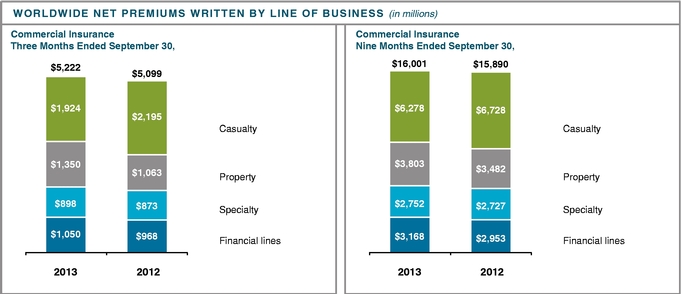
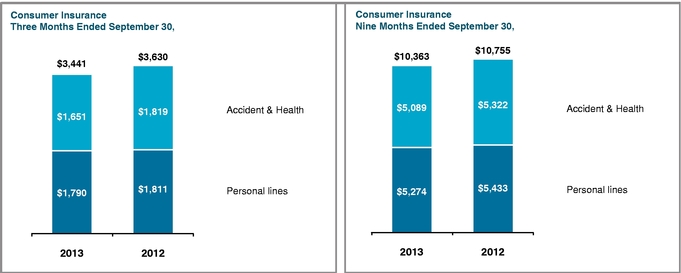
Commercial Insurance Quarterly and Year-to-Date Net Premiums Written
During the three- and nine-month periods ended September 30, 2013, Commercial Insurance continued to focus on the execution of its strategic objectives.
Casualty net premiums written decreased in the three- and nine-month periods ended September 30, 2013 compared to the same periods in the prior year, primarily due to the execution of our strategy to enhance risk selection, particularly in the Americas and EMEA, as well as to increase specific reinsurance purchases to better manage our exposures. Changes in reinsurance strategy decreased net premiums written by $38 million and $173 million in the three- and nine-month periods ended September 30, 2013, respectively, compared to the same periods in the prior year. In addition, Casualty net premiums written decreased due to less additional premium in the loss sensitive business in the three-month period ended September 30, 2013. The additional premium was $3 million and $66 million in the three-month periods ended September 30, 2013 and 2012, respectively. We implemented rate increases in retained business, especially in the U.S., that partially offset these premium decreases.
Property net premiums written increased in the three- and nine-month periods ended September 30, 2013 compared to the same periods in the prior year, primarily due to growth in new business across all regions, favorable retention in renewal businesses and increases in coverage limits and changes to our per-risk reinsurance program to retain more favorable risks, while continuing to manage aggregate exposure. The increase in the three-month period ended September 30, 2013 also reflected a $159 million benefit from the impact of a change in the timing of recognizing the excess of loss ceded premiums written described below. Catastrophe-exposed businesses in the Americas also benefitted from rate increases.
102
ITEM 2 / RESULTS OF OPERATIONS / AIG PROPERTY CASUALTY
Effective January 1, 2013, we began to recognize the annual ceded premiums written under excess of loss reinsurance agreements at the inception of the contract rather than ratably over the contract period. Previously, we recognized ceded premiums written on these agreements based on the quarterly contractual remittance requirements, and recorded an adjustment at the end of the contract term to reflect the actual ceded premiums written amounts. This change resulted in the acceleration of ceded premiums written to earlier quarters, but had only a de minimis effect on net premiums earned. As a result of this change, ceded premiums written for the three-month period ended September 30, 2013 decreased by $159 million compared to the same period in the prior year. For the nine-month period ended September 30, 2013, ceded premiums written increased by $42 million compared to the same period in the prior year. The impact on net premiums written from this change will continue to reverse throughout the rest of 2013.
Net premiums written also reflected the timing of catastrophe bond issuances. We have continued our strategy of improving the allocation of our reinsurance between traditional reinsurance markets and capital markets. As part of this strategy, during the third quarter of 2013, we entered into a five-year catastrophe bond transaction, which will provide $125 million of indemnity protection against U.S., Caribbean and Gulf of Mexico named storms, and U.S. and Canadian earthquakes. The transaction provides us with fully collateralized coverage against losses from the events described above on a per-occurrence basis through June 2018. During the first quarter of 2013, we secured a three-year catastrophe bond providing for up to $400 million in protection against U.S. hurricanes and earthquakes to the extent both industry losses and our actual losses exceed specific thresholds. The bond transactions reduced net premiums written by $44 million and $140 million in the three- and nine-month periods ended September 30, 2013, respectively. Our previous catastrophe bond issuance occurred in the fourth quarter of 2011.
Specialty net premiums written increased in the three- and nine-month periods ended September 30, 2013 compared to the same periods in the prior year, primarily due to rate increases in environmental business, small-and medium-sized enterprise markets in the Americas region, new business growth in EMEA, as well as the restructuring of our reinsurance program to retain more favorable risks while continuing to manage aggregate exposure, which increased net premiums written by $68 million and $133 million, respectively, compared to the same periods in the prior year.
Financial lines net premiums written increased in the three- and nine-month periods ended September 30, 2013 compared to the same periods in the prior year, reflecting growth in new business related to targeted growth products, particularly in the EMEA region as well as an improved rate environment globally. Global professional indemnity net premiums written increased by $11 million and $71 million in the three- and nine-month periods ended September 30, 2013, respectively, due to improved rates, strong new business growth and the restructuring of our reinsurance program, as part of our decision to retain more favorable risks while continuing to manage aggregate exposure.
Consumer Insurance Quarterly and Year-to-Date Net Premiums Written
Consumer Insurance net premiums written decreased in the three- and nine-month periods ended September 30, 2013 compared to the same periods in the prior year, primarily due to the impact of foreign exchange as the U.S. dollar strengthened against the Japanese yen. The decrease for the nine-month period ended September 30, 2013 also reflected the effect of a change in the timing of recognizing ceded written premiums for excess of loss reinsurance and the catastrophe bond issuances discussed above. Excluding these items, net premiums written in the three- and nine-month periods ended September 30, 2013 increased compared to the same periods in the prior year as the business continued to build momentum through multiple distribution channels and continuing focus on direct marketing. In the three- and nine-month periods ended September 30, 2013, excluding the impact of foreign exchange, net premiums written generated by direct marketing increased by approximately 3.1 percent and 5.6 percent, respectively, compared to the same periods in the prior year, and accounted for approximately 15.7 percent and 16.1 percent, respectively, of Consumer Insurance net premiums written.
A&H net premiums written, excluding the effect of foreign exchange, increased slightly in the three-month period ended September 30, 2013 compared to the same period in the prior year primarily due to our focus on the growth of Fuji Life products, direct marketing, individual A&H in Asia Pacific, and travel business which continued to increase in most geographies across the globe. This was partially offset by the non-renewal of several programs in the U.S. region that did not meet underwriting targets. Americas continued its strategy of repositioning U.S. direct marketing operations and maintaining our pricing discipline and underwriting targets. Net premiums written, excluding the effect of foreign exchange, increased in the nine-month period ended September 30, 2013 compared to the same period in
103
ITEM 2 / RESULTS OF OPERATIONS / AIG PROPERTY CASUALTY
the prior year, primarily due to the growth of Fuji Life products, direct marketing, travel business and individual A&H in Asia Pacific.
Personal lines net premiums written, excluding the effects of foreign exchange, increased in the three- and nine-month periods ended September 30, 2013 compared to the same periods in the prior year. The increases were driven by growth in U.S. private client group and warranty business, automobile products and the continued execution of our strategic initiative to grow higher value lines of business in non-automobile products. For the three-month period ended September 30, 2013, the impact of the change in the timing of recognizing the excess of loss ceded premiums written increased net premiums written by $28 million, while for the nine-month period ended September 30, 2013, the impact of this change decreased net premiums written by $58 million. In addition, the impact of the timing of the catastrophe bond issuances was $8 million and $28 million for the three- and nine-month periods ended September 30, 2013 compared to the prior year periods, respectively.
AIG Property Casualty Net Premiums Written by Region
The following table presents AIG Property Casualty's net premiums written by region:
|
|
|
|
|
|
|
|
|
|
|||||||||||||||||
|---|---|---|---|---|---|---|---|---|---|---|---|---|---|---|---|---|---|---|---|---|---|---|---|---|---|
|
|
Three Months Ended
September 30, |
|
|
Nine Months Ended
September 30, |
|
|
|||||||||||||||||||
|
|
Percentage
Change in U.S. dollars |
Percentage
Change in Original Currency |
Percentage
Change in U.S. dollars |
Percentage
Change in Original Currency |
|||||||||||||||||||||
|
(in millions)
|
2013
|
2012
|
2013
|
2012
|
|||||||||||||||||||||
|
Commercial Insurance: |
|
|
|
|
|
|
|||||||||||||||||||
|
Americas |
$
|
3,548
|
|
$ | 3,520 | 1 | % | 1 | % |
$
|
10,627
|
|
$ | 10,565 | 1 | % | 1 | % | |||||||
|
Asia Pacific |
|
523
|
|
530 | (1 | ) | 10 |
|
1,540
|
|
1,520 | 1 | 10 | ||||||||||||
|
EMEA |
|
1,151
|
|
1,049 | 10 | 9 |
|
3,834
|
|
3,805 | 1 | 1 | |||||||||||||
|
Total net premiums written |
$
|
5,222
|
|
$ | 5,099 | 2 | % | 4 | % |
$
|
16,001
|
|
$ | 15,890 | 1 | % | 2 | % | |||||||
|
Consumer Insurance: |
|
|
|
|
|
|
|||||||||||||||||||
|
Americas |
$
|
1,085
|
|
$ | 1,054 | 3 | % | 5 | % |
$
|
2,990
|
|
$ | 3,029 | (1 | )% | – | % | |||||||
|
Asia Pacific |
|
1,900
|
|
2,161 | (12 | ) | 4 |
|
5,858
|
|
6,338 | (8 | ) | 4 | |||||||||||
|
EMEA |
|
456
|
|
415 | 10 | 7 |
|
1,515
|
|
1,388 | 9 | 9 | |||||||||||||
|
Total net premiums written |
$
|
3,441
|
|
$ | 3,630 | (5 | )% | 5 | % |
$
|
10,363
|
|
$ | 10,755 | (4 | )% | 4 | % | |||||||
|
Other: |
|
|
|
|
|
|
|||||||||||||||||||
|
Americas |
$
|
(3
|
)
|
$ | (17 | ) | 82 | % | NM | % |
$
|
(4
|
)
|
$ | (20 | ) | 80 | % | NM | % | |||||
|
Asia Pacific |
|
–
|
|
– | NM | NM |
|
–
|
|
2 | NM | NM | |||||||||||||
|
Total net premiums written |
$
|
(3
|
)
|
$ | (17 | ) | 82 | % | NM | % |
$
|
(4
|
)
|
$ | (18 | ) | 78 | % | NM | % | |||||
|
Total AIG Property Casualty: |
|
|
|
|
|
|
|||||||||||||||||||
|
Americas |
$
|
4,630
|
|
$ | 4,557 | 2 | % | 2 | % |
$
|
13,613
|
|
$ | 13,574 | – | % | 1 | % | |||||||
|
Asia Pacific |
|
2,423
|
|
2,691 | (10 | ) | 5 |
|
7,398
|
|
7,860 | (6 | ) | 5 | |||||||||||
|
EMEA |
|
1,607
|
|
1,464 | 10 | 9 |
|
5,349
|
|
5,193 | 3 | 3 | |||||||||||||
|
Total net premiums written |
$
|
8,660
|
|
$ | 8,712 | (1 | )% | 4 | % |
$
|
26,360
|
|
$ | 26,627 | (1 | )% | 2 | % | |||||||
104
ITEM 2 / RESULTS OF OPERATIONS / AIG PROPERTY CASUALTY
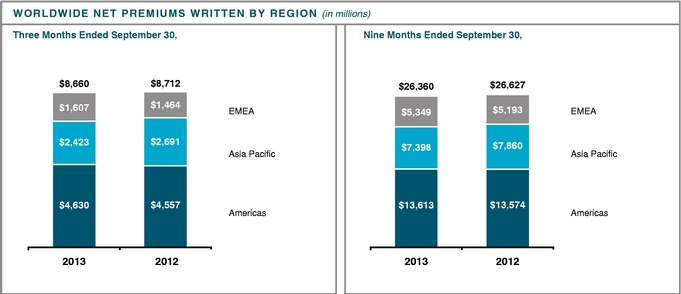
The Americas net premiums written increased in the three- and nine-month periods ended September 30, 2013 compared to the same periods in the prior year, primarily due to the rate increases in Commercial Insurance and continued growth in the personal property and private client group and rate actions for the warranty retail program in Consumer Insurance. This was partially offset by decreases in casualty businesses reflecting the execution of our strategy to enhance risk selection and the effect of the timing of the catastrophe bond issuances which was approximately $55 million and approximately $175 million, for the three- and nine-month periods ended September 30, 2013, respectively. Additionally, for the three-month period ended September 30, 2013, the change in timing of recognizing ceded premiums written under excess of loss reinsurance agreements, discussed above, increased net premiums written by approximately $147 million, while it decreased net premiums written for the nine-month period ended September 30, 2013 by approximately $2 million.
Asia Pacific net premiums written decreased in the three- and nine-month periods ended September 30, 2013 compared to the same periods in the prior year, primarily due to the strengthening of the U.S. dollar against the Japanese yen. Excluding the effect of foreign exchange, net premiums written increased primarily due to an increase in Consumer Insurance, reflecting growth of Fuji Life products and direct marketing business in Japan. The expansion of business in Asia Pacific countries outside of Japan also continued in the three- and nine-month periods ended September 30, 2013, supported by growth in individual personal accident insurance, direct marketing and personal lines products. Commercial Insurance increased in the nine-month period ended September 30, 2013 in the Asia Pacific region primarily due to organic growth and rate increases in Property, Specialty, and Casualty. In addition, our decision to retain more favorable risks in Property and Financial lines increased net premiums written during the three- and nine-month periods ended September 30, 2013.
EMEA net premiums written increased in the three- and nine-month periods ended September 30, 2013 compared to the same periods in the prior year, reflecting Commercial Insurance growth due to new business growth, particularly in Property and Financial lines, a change in reinsurance strategies to retain more favorable risks in Property and Financial lines, and rate improvements on retained business, as well as growth in Consumer Insurance personal accident, travel, warranty, automobile and specialty personal lines products. Additionally, for the three-month period ended September 30, 2013, the change in timing of recognizing ceded premiums written under excess of loss reinsurance agreements, discussed above, increased net premiums written by approximately $55 million, while for the nine-month period ended September 30, 2013, it decreased net premiums written by approximately $118 million.
105
ITEM 2 / RESULTS OF OPERATIONS / AIG PROPERTY CASUALTY
AIG Property Casualty Underwriting Ratios
The following table presents the AIG Property Casualty combined ratios based on GAAP data and reconciliation to the accident year combined ratio, as adjusted:
|
|
|
|
|
|
|
|
|||||||||||||
|---|---|---|---|---|---|---|---|---|---|---|---|---|---|---|---|---|---|---|---|
|
|
Three Months Ended
September 30, |
|
Nine Months Ended
September 30, |
|
|||||||||||||||
|
|
Increase
(Decrease) |
Increase
(Decrease) |
|||||||||||||||||
|
|
2013
|
2012
|
2013
|
2012
|
|||||||||||||||
|
Commercial Insurance |
|
|
|
|
|
|
|||||||||||||
|
Loss ratio |
|
71.8
|
|
78.0 | (6.2 | ) |
|
69.8
|
|
73.6 | (3.8 | ) | |||||||
|
Catastrophe losses and reinstatement premiums |
|
(3.5
|
)
|
(4.5 | ) | 1.0 |
|
(3.4
|
)
|
(3.8 | ) | 0.4 | |||||||
|
Prior year development net of premium adjustments |
|
(2.1
|
)
|
(2.7 | ) | 0.6 |
|
(1.7
|
)
|
(1.1 | ) | (0.6 | ) | ||||||
|
Change in discount |
|
–
|
|
– | – |
|
–
|
|
0.7 | (0.7 | ) | ||||||||
|
Accident year loss ratio, as adjusted |
|
66.2
|
|
70.8 | (4.6 | ) |
|
64.7
|
|
69.4 | (4.7 | ) | |||||||
|
Acquisition ratio |
|
15.8
|
|
15.6 | 0.2 |
|
16.2
|
|
16.9 | (0.7 | ) | ||||||||
|
General operating expense ratio |
|
12.6
|
|
12.4 | 0.2 |
|
12.1
|
|
11.8 | 0.3 | |||||||||
|
Expense ratio |
|
28.4
|
|
28.0 | 0.4 |
|
28.3
|
|
28.7 | (0.4 | ) | ||||||||
|
Combined ratio |
|
100.2
|
|
106.0 | (5.8 | ) |
|
98.1
|
|
102.3 | (4.2 | ) | |||||||
|
Catastrophe losses and reinstatement premiums |
|
(3.5
|
)
|
(4.5 | ) | 1.0 |
|
(3.4
|
)
|
(3.8 | ) | 0.4 | |||||||
|
Prior year development net of premium adjustments |
|
(2.1
|
)
|
(2.7 | ) | 0.6 |
|
(1.7
|
)
|
(1.1 | ) | (0.6 | ) | ||||||
|
Change in discount |
|
–
|
|
– | – |
|
–
|
|
0.7 | (0.7 | ) | ||||||||
|
Accident year combined ratio, as adjusted |
|
94.6
|
|
98.8 | (4.2 | ) |
|
93.0
|
|
98.1 | (5.1 | ) | |||||||
|
Consumer Insurance |
|
|
|
|
|
|
|||||||||||||
|
Loss ratio |
|
58.8
|
|
58.3 | 0.5 |
|
58.5
|
|
58.5 | – | |||||||||
|
Catastrophe losses and reinstatement premiums |
|
(1.2
|
)
|
(0.6 | ) | (0.6 | ) |
|
(0.6
|
)
|
(0.6 | ) | – | ||||||
|
Prior year development net of premium adjustments |
|
0.9
|
|
– | 0.9 |
|
1.2
|
|
0.5 | 0.7 | |||||||||
|
Accident year loss ratio, as adjusted |
|
58.5
|
|
57.7 | 0.8 |
|
59.1
|
|
58.4 | 0.7 | |||||||||
|
Acquisition ratio |
|
26.1
|
|
25.7 | 0.4 |
|
25.6
|
|
24.3 | 1.3 | |||||||||
|
General operating expense ratio |
|
15.0
|
|
14.8 | 0.2 |
|
15.3
|
|
14.9 | 0.4 | |||||||||
|
Expense ratio |
|
41.1
|
|
40.5 | 0.6 |
|
40.9
|
|
39.2 | 1.7 | |||||||||
|
Combined ratio |
|
99.9
|
|
98.8 | 1.1 |
|
99.4
|
|
97.7 | 1.7 | |||||||||
|
Catastrophe losses and reinstatement premiums |
|
(1.2
|
)
|
(0.6 | ) | (0.6 | ) |
|
(0.6
|
)
|
(0.6 | ) | – | ||||||
|
Prior year development net of premium adjustments |
|
0.9
|
|
– | 0.9 |
|
1.2
|
|
0.5 | 0.7 | |||||||||
|
Accident year combined ratio, as adjusted |
|
99.6
|
|
98.2 | 1.4 |
|
100.0
|
|
97.6 | 2.4 | |||||||||
|
Total AIG Property Casualty |
|
|
|
|
|
|
|||||||||||||
|
Loss ratio |
|
67.3
|
|
71.4 | (4.1 | ) |
|
66.2
|
|
69.5 | (3.3 | ) | |||||||
|
Catastrophe losses and reinstatement premiums |
|
(2.7
|
)
|
(2.9 | ) | 0.2 |
|
(2.3
|
)
|
(2.6 | ) | 0.3 | |||||||
|
Prior year development net of premium adjustments |
|
(0.8
|
)
|
(2.0 | ) | 1.2 |
|
(0.9
|
)
|
(1.3 | ) | 0.4 | |||||||
|
Change in discount |
|
(0.1
|
)
|
– | (0.1 | ) |
|
(0.1
|
)
|
0.3 | (0.4 | ) | |||||||
|
Accident year loss ratio, as adjusted |
|
63.7
|
|
66.5 | (2.8 | ) |
|
62.9
|
|
65.9 | (3.0 | ) | |||||||
|
Acquisition ratio |
|
19.7
|
|
19.5 | 0.2 |
|
19.8
|
|
19.8 | – | |||||||||
|
General operating expense ratio |
|
14.6
|
|
14.1 | 0.5 |
|
14.5
|
|
13.9 | 0.6 | |||||||||
|
Expense ratio |
|
34.3
|
|
33.6 | 0.7 |
|
34.3
|
|
33.7 | 0.6 | |||||||||
|
Combined ratio |
|
101.6
|
|
105.0 | (3.4 | ) |
|
100.5
|
|
103.2 | (2.7 | ) | |||||||
|
Catastrophe losses and reinstatement premiums |
|
(2.7
|
)
|
(2.9 | ) | 0.2 |
|
(2.3
|
)
|
(2.6 | ) | 0.3 | |||||||
|
Prior year development net of premium adjustments |
|
(0.8
|
)
|
(2.0 | ) | 1.2 |
|
(0.9
|
)
|
(1.3 | ) | 0.4 | |||||||
|
Change in discount |
|
(0.1
|
)
|
– | (0.1 | ) |
|
(0.1
|
)
|
0.3 | (0.4 | ) | |||||||
|
Accident year combined ratio, as adjusted |
|
98.0
|
|
100.1 | (2.1 | ) |
|
97.2
|
|
99.6 | (2.4 | ) | |||||||
106
ITEM 2 / RESULTS OF OPERATIONS / AIG PROPERTY CASUALTY

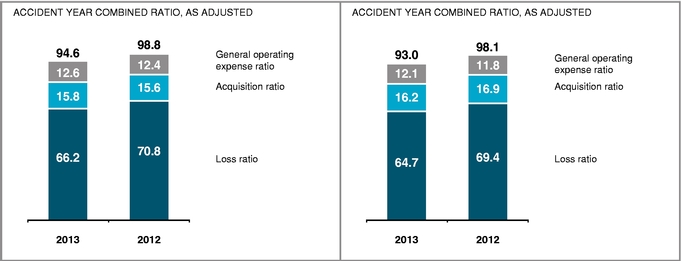
107
ITEM 2 / RESULTS OF OPERATIONS / AIG PROPERTY CASUALTY
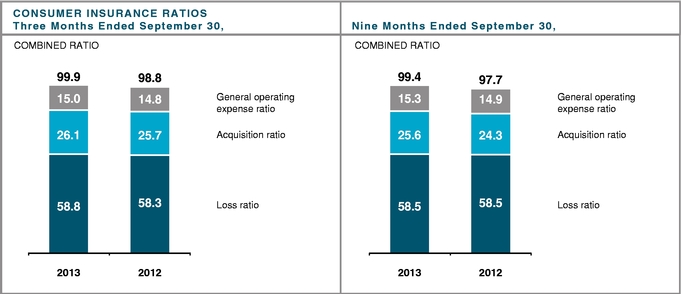
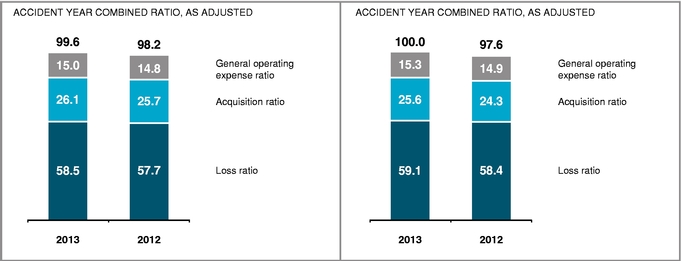
Given the nature of the lines of business and the expenses included in Other, we have determined that the traditional underwriting measures of loss ratio, acquisition ratio, general operating expense ratio and combined ratio do not provide an appropriate measure of underwriting performance. Therefore, these ratios are not separately presented for Other.
108
ITEM 2 / RESULTS OF OPERATIONS / AIG PROPERTY CASUALTY
The following table presents AIG Property Casualty accident year catastrophe losses by region:
|
|
2013 | 2012 | |||||||||||||||||||||||||||||
|---|---|---|---|---|---|---|---|---|---|---|---|---|---|---|---|---|---|---|---|---|---|---|---|---|---|---|---|---|---|---|---|
|
(in millions)
|
# of
|
Americas
|
Asia
|
EMEA
|
Total
|
# of
Events |
Americas
|
Asia
Pacific |
EMEA
|
Total
|
|||||||||||||||||||||
|
Three Months Ended September 30, |
|
|
|
|
|
|
|
|
|
|
|
|
|
|
|
||||||||||||||||
|
Flooding |
|
2
|
|
$
|
106
|
|
$
|
–
|
|
$
|
–
|
|
$
|
106
|
|
1 | $ | – | $ | – | $ | 3 | $ | 3 | |||||||
|
Windstorms and hailstorms |
|
2
|
|
|
29
|
|
|
–
|
|
|
34
|
|
|
63
|
|
7 | 38 | 1 | – | 39 | |||||||||||
|
Wildfire |
|
1
|
|
|
13
|
|
|
–
|
|
|
–
|
|
|
13
|
|
1 | 98 | – | – | 98 | |||||||||||
|
Tropical cyclone |
|
1
|
|
|
–
|
|
|
40
|
|
|
–
|
|
|
40
|
|
1 | 121 | – | – | 121 | |||||||||||
|
Total catastrophe-related charges |
|
6
|
|
$
|
148
|
|
$
|
40
|
|
$
|
34
|
|
$
|
222
|
|
10 | $ | 257 | $ | 1 | $ | 3 | $ | 261 | |||||||
|
Commercial Insurance |
|
|
|
$
|
129
|
|
$
|
21
|
|
$
|
32
|
|
$
|
182
|
|
$ | 235 | $ | 1 | $ | 3 | $ | 239 | ||||||||
|
Consumer Insurance |
|
|
|
$
|
19
|
|
$
|
19
|
|
$
|
2
|
|
$
|
40
|
|
$ | 22 | $ | – | $ | – | $ | 22 | ||||||||
|
Total severe losses |
|
8
|
|
|
|
|
|
|
|
|
|
|
$
|
211
|
|
12 | $ | 140 | |||||||||||||
|
Nine Months Ended September 30, |
|
|
|
|
|
|
|
|
|
|
|
|
|
|
|
||||||||||||||||
|
Flooding |
|
7
|
|
$
|
267
|
|
$
|
9
|
|
$
|
45
|
|
$
|
321
|
|
2 | $ | – | $ | – | $ | 23 | $ | 23 | |||||||
|
Windstorms and hailstorms |
|
8
|
|
|
171
|
|
|
–
|
|
|
34
|
|
|
205
|
|
8 | 360 | 67 | – | 427 | |||||||||||
|
Wildfire |
|
1
|
|
|
13
|
|
|
–
|
|
|
–
|
|
|
13
|
|
1 | 98 | – | – | 98 | |||||||||||
|
Tropical cyclone |
|
1
|
|
|
–
|
|
|
40
|
|
|
–
|
|
|
40
|
|
1 | 121 | – | – | 121 | |||||||||||
|
Total catastrophe-related charges |
|
17
|
|
$
|
451
|
|
$
|
49
|
|
$
|
79
|
|
$
|
579
|
|
12 | $ | 579 | $ | 67 | $ | 23 | $ | 669 | |||||||
|
Commercial Insurance |
|
|
|
$
|
417
|
|
$
|
29
|
|
$
|
76
|
|
$
|
522
|
|
$ | 540 | $ | 40 | $ | 23 | $ | 603 | ||||||||
|
Consumer Insurance |
|
|
|
$
|
34
|
|
$
|
20
|
|
$
|
3
|
|
$
|
57
|
|
$ | 39 | $ | 27 | $ | – | $ | 66 | ||||||||
|
Total severe losses |
|
14
|
|
|
|
|
|
|
|
|
|
|
$
|
309
|
|
19 | $ | 263 | |||||||||||||
* Events shown in the above table are catastrophic insured events having a net impact in excess of $10 million each. Severe losses are defined as non-catastrophe individual first party losses and surety losses greater than $10 million, net of related reinsurance.
Commercial Insurance Quarterly and Year-to-Date Ratios
The accident year combined ratio, as adjusted, improved by 4.2 points and 5.1 points for the three- and nine-month periods ended September 30, 2013, respectively, compared to the same periods in 2012.
The improvement in the accident year loss ratio, as adjusted, for the three- and nine-month periods ended September 30, 2013 reflects the realization of benefits from the continued execution of our multi-faceted strategy to enhance risk selection, pricing discipline, exposure management and claims processing. Although the execution of these strategies resulted in a reduction of Casualty net premiums written in both the Americas and EMEA regions, it also improved the accident year loss ratio, as adjusted. The accident year loss ratio, as adjusted, for Financial lines improved due to rate strengthening, restructuring and re-underwriting of certain products. Severe losses in the three-and nine-month periods ended September 30, 2013 represented approximately 4.1 points and 2.0 points, respectively, compared to 2.3 points and 1.5 points in the same periods in the prior year, respectively, and are included in the accident year loss ratio, as adjusted. Net adverse development including related premium adjustments, represented 2.1 points and 1.7 points of the loss ratio in the three- and nine-month periods ended September 30, 2013, respectively, compared to net adverse development of 2.7 points and 1.1 points in the respective prior-year periods. Adverse development on Storm Sandy added 1.2 points to the loss ratio for the nine-month period ended September 30, 2013.
The acquisition ratio increased by 0.2 points in the three- month period ended September 30, 2013 compared to the same period in the prior year primarily due to a change in business mix. The acquisition ratio decreased by 0.7 points in the nine-month period ended September 30, 2013 primarily due to a change in business mix and the timing of insurance-related assessments.
109
ITEM 2 / RESULTS OF OPERATIONS / AIG PROPERTY CASUALTY
The general operating expense ratio increased by 0.2 points and 0.3 points, respectively, in the three- and nine-month periods ended September 30, 2013 compared to the same periods in the prior year. The increase in employee incentive compensation plan expense, previously discussed, was offset by decreases in bad debt expenses. The lower net premiums earned base contributed approximately 0.2 points and 0.3 points, respectively, to the general operating expense ratio. The increase in employee incentive plan expense contributed approximately 0.7 points and 0.9 points, respectively, to the increase in the general operating expense ratio. A reduction in bad debt expense in the three- and nine-month periods ended September 30, 2013 represented a decrease to the general operating ratio of approximately 0.7 points and 0.4 points, respectively, over the same periods in 2012.
Consumer Insurance Quarterly and Year-to-Date Ratios
The accident year combined ratio, as adjusted, increased by 1.4 points and 2.4 points, respectively, for the three- and nine-month periods ended September 30, 2013 compared to the same periods in 2012.
The accident year loss ratio, as adjusted, increased by 0.8 points and 0.7 points in the three- and nine-month periods ended September 30, 2013, respectively, compared to the same periods in the prior year, primarily due to higher losses associated with a warranty retail program, which increased the loss ratio by 1.0 point and 0.8 points, respectively. This was partially offset by improvements in automobile and personal property, as a result of rate and underwriting actions taken in current and prior years. Storm Sandy favorable development reduced the loss ratio by 0.5 points in the nine-month period ended September 30, 2013.
The acquisition ratio increased by 0.4 points and 1.3 points in the three- and nine-month periods ended September 30, 2013, respectively, compared to the same periods in the prior year, primarily due to the change in business mix and higher costs in growth-targeted lines of business.
The general operating expense ratio increased by 0.2 points and 0.4 points in the three- and nine-month periods ended September 30, 2013, respectively, compared to the same periods in the prior year. The general operating expense ratio increased primarily due to the increase in employee incentive compensation expense previously discussed for both periods. For the nine-month period ended September 30, 2013, the increase in employee incentive compensation expense was partially offset by lower infrastructure project costs.
Other Category
We incurred higher general operating expenses in the three-month period ended September 30, 2013 compared to the same period in the prior year due to personnel costs, partially offset by the reduced costs for infrastructure projects that are not specific to either Commercial Insurance or Consumer Insurance. This contributed approximately 0.3 points to the decrease to the AIG Property Casualty general operating expense ratio in the three-month period ended September 30, 2013 compared to the same period in the prior year. We continue to invest in a number of infrastructure projects, including the implementation of global finance and information systems, compliance with the regulatory requirements of the FRB, legal entity restructuring, and underwriting and claims improvement initiatives.
We incurred higher general operating expenses in the nine-month period ended September 30, 2013 compared to the same period in the prior year, primarily related to our implementation of a voluntary early retirement plan in Japan, which contributed approximately 0.2 points in the nine-month period ended September 30, 2013 to the AIG Property Casualty general operating expense ratio.
110
ITEM 2 / RESULTS OF OPERATIONS / AIG PROPERTY CASUALTY
AIG Property Casualty Investing and Other Results
The following table presents AIG Property Casualty's investing and other results:
|
|
|
|
|
|
|
|
|||||||||||||
|---|---|---|---|---|---|---|---|---|---|---|---|---|---|---|---|---|---|---|---|
|
|
Three Months Ended
September 30, |
|
Nine Months Ended
September 30, |
|
|||||||||||||||
|
|
Percentage
Change |
Percentage
Change |
|||||||||||||||||
|
(in millions)
|
2013
|
2012
|
2013
|
2012
|
|||||||||||||||
|
Net investment income |
|
|
|
|
|
|
|||||||||||||
|
Commercial Insurance |
$
|
618
|
|
$ | 688 | (10 | )% |
$
|
1,886
|
|
$ | 2,130 | (11 | )% | |||||
|
Consumer Insurance |
|
89
|
|
109 | (18 | ) |
|
279
|
|
340 | (18 | ) | |||||||
|
Other |
|
472
|
|
430 | 10 |
|
1,682
|
|
1,133 | 48 | |||||||||
|
Total net investment income |
|
1,179
|
|
1,227 | (4 | ) |
|
3,847
|
|
3,603 | 7 | ||||||||
|
Net realized capital gains (losses) |
|
(12
|
)
|
161 | NM |
|
73
|
|
49 | 49 | |||||||||
|
Other income — net |
|
(3
|
)
|
2 | NM |
|
10
|
|
6 | 67 | |||||||||
|
Investing and other results |
$
|
1,164
|
|
$ | 1,390 | (16 | )% |
$
|
3,930
|
|
$ | 3,658 | 7 | % | |||||
We manage and account for our invested assets on a legal entity basis in conformity with regulatory requirements. Within a legal entity, invested assets are available to pay claims and expenses of both Commercial Insurance and Consumer Insurance operating segments as well as the Other category. Invested assets are not segregated or otherwise separately identified for the Commercial Insurance and Consumer Insurance operating segments.
Investment income is allocated to the Commercial Insurance and Consumer Insurance operating segments based on an internal investment income allocation model. The model estimates investable funds based primarily on loss reserves, unearned premiums and a capital allocation for each segment. The investment income allocation is calculated based on the estimated investable funds and risk-free yields (plus an illiquidity premium) consistent with the approximate duration of the liabilities. The actual yields in excess of the allocated amounts and the investment income from the assets not attributable to the Commercial Insurance and the Consumer Insurance operating segments are assigned to the Other category. Commencing in the first quarter of 2013, we began applying similar duration and risk-free yields (plus an illiquidity premium) to the allocated capital of Commercial Insurance and Consumer Insurance as is applied to loss reserves.
Net realized capital gains (losses) and Other income (expense) — net are not allocated to Commercial Insurance and Consumer Insurance, but are reported as part of the Other category.
Quarterly and Year-to-Date Net Investment Income
Net investment income over time is influenced by a number of factors, including the amounts and timing of cash flows, the interest rate environment and changes in overall asset allocation. Certain of our structured securities and our additional investment in PICC P&C shares acquired in the PICC P&C rights offering are accounted for under the fair value option, which may also increase the volatility of our net investment income. Net investment income decreased by $48 million, or 4 percent, in the three-month period ended September 30, 2013, compared to the same period in 2012, primarily due to the lower returns on alternative investments and mutual funds. Net investment income increased by $244 million, or 7 percent, in the nine-month period ended September 30, 2013, compared to the same period in 2012, primarily due to the strong performance in alternative investments.
Corporate debt securities continues to be our largest asset category. We continued to reduce our concentration in lower yielding tax-exempt municipal bond holdings and focus on risk-weighted opportunistic investments in higher yielding assets such as structured securities. This asset diversification has achieved similar average yields while the overall credit ratings of our fixed maturity investments were largely unchanged. We expect to continue to execute our investment strategy in 2013 to meet our liquidity, duration and credit quality objectives as well as current risk-return and tax objectives.
Net investment income from investment categories other than debt securities decreased by $44 million in the three-month period ended September 30, 2013, compared to the same period in 2012. In the three-month period ended September 30, 2013, the alternative investment and mutual fund performance decreased by approximately $40 million as a result of overall lower market performance for the period. Net investment income from investment categories other than debt securities increased by $299 million in the nine-month period ended September 30, 2013,
111
compared to the same period in 2012. In the nine-month period ended September 30, 2013, approximately $240 million was attributable to the strong performance of alternative investments in the period. Additionally, net investment income for the three- and nine-month periods ended September 30, 2013 includes $35 million and $93 million, respectively, in gains related to the PICC P&C shares which was accounted for under the fair value option. Income from the life settlement portfolios also increased by approximately $13 million and $53 million, respectively, during the three- and nine-month periods ended September 30, 2013 compared to the same periods in 2012.
Quarterly Net Realized Capital Gains (Losses)
Net realized capital loss in the three- month period ended September 30, 2013 was driven by impairment charges on life settlement contracts of approximately $62 million, partially offset by gains recognized on the sale of fixed maturity and equity securities of $46 million.
Net realized capital gains for the three-month period ended September 30, 2012 were primarily driven by gains recognized on the sale of fixed maturity and equity securities in the amount of $169 million. This was partially offset by other-than-temporary impairments of $31 million, primarily attributable to publicly traded and privately held equity securities in the Japan portfolios and a decrease in recoverable values for structured securities. In addition, impairment charges of $59 million related to life settlement contracts were recorded during the period.
Year-to-Date Net Realized Capital Gains (Losses)
Net realized capital gains in the nine-month period ended September 30, 2013 were driven by gains of $205 million recognized on the sale of fixed maturity and equity securities, partially offset by impairment charges on life settlement contracts of approximately $149 million.
Net realized capital gains for the nine-month period ended September 30, 2012 were primarily driven by gains recognized on the sale of fixed maturity securities of $490 million, which were partially offset by other-than-temporary impairments of $330 million, primarily attributable to a decrease in recoverable values for structured securities, and alternative investments and equity securities in an unrealized loss position for more than 12 months. In addition, impairment charges of $174 million related to life settlement contracts were recorded during the period.
Liability for Unpaid Claims and Claims Adjustment Expense
The following discussion of the consolidated liability for unpaid claims and claims adjustment expense (loss reserves) presents loss reserves for AIG Property Casualty as well as the loss reserves pertaining to the Mortgage Guaranty reporting unit, which is reported in Other Operations.
The following table presents the components of AIG's gross loss reserves by major lines of business on a U.S. statutory basis*:
|
(in millions)
|
September 30,
|
December 31,
2012 |
|||||
|---|---|---|---|---|---|---|---|
|
Other liability occurrence |
$
|
20,125
|
|
$ | 21,533 | ||
|
International |
|
16,481
|
|
17,453 | |||
|
Workers' compensation (net of discount) |
|
16,876
|
|
17,319 | |||
|
Other liability claims made |
|
11,033
|
|
11,443 | |||
|
Property |
|
4,183
|
|
4,961 | |||
|
Auto liability |
|
2,978
|
|
3,060 | |||
|
Products liability |
|
2,172
|
|
2,195 | |||
|
Medical malpractice |
|
1,632
|
|
1,651 | |||
|
Mortgage guaranty / credit |
|
1,425
|
|
1,957 | |||
|
Accident and health |
|
1,498
|
|
1,518 | |||
|
Commercial multiple peril |
|
1,359
|
|
1,310 | |||
|
Aircraft |
|
1,169
|
|
1,065 | |||
|
Fidelity/surety |
|
563
|
|
647 | |||
|
Other |
|
1,734
|
|
1,879 | |||
|
Total |
$
|
83,228
|
|
$ | 87,991 | ||
* Presented by lines of business pursuant to statutory reporting requirements as prescribed by the National Association of Insurance Commissioners.
112
ITEM 2 / RESULTS OF OPERATIONS / LIABILITY FOR UNPAID CLAIMS AND CLAIMS ADJUSTMENT EXPENSE
AIG's gross loss reserves represent the accumulation of estimates of ultimate losses, including estimates for incurred but not reported (IBNR) and loss expenses, less applicable discount for future investment income. We regularly review and update the methods and assumptions used to determine loss reserve estimates and to establish the resulting reserves. Any adjustments resulting from this review are reflected in pre-tax operating income. Because loss reserve estimates are subject to the outcome of future events, changes in estimates are unavoidable given that loss trends vary and time is often required for changes in trends to be recognized and confirmed. Reserve changes that increase prior years' estimates of ultimate cost are referred to as unfavorable or adverse development or reserve strengthening. Reserve changes that decrease prior years' estimates of ultimate cost are referred to as favorable development.
The net loss reserves represent loss reserves reduced by reinsurance recoverable, net of an allowance for unrecoverable reinsurance, less applicable discount for future investment income.
The following table presents the components of net loss reserves:
|
(in millions)
|
September 30,
|
December 31,
2012 |
|||||
|---|---|---|---|---|---|---|---|
|
Gross loss reserves before reinsurance and discount |
$
|
86,458
|
|
$ | 91,237 | ||
|
Less: discount |
|
(3,230
|
)
|
(3,246 | ) | ||
|
Gross loss reserves, net of discount, before reinsurance |
|
83,228
|
|
87,991 | |||
|
Less: reinsurance recoverable |
|
(18,450
|
)
|
(19,209 | ) | ||
|
Net liability for unpaid claims and claims adjustment expense |
$
|
64,778
|
|
$ | 68,782 | ||
The following table classifies the components of net loss reserves by business unit:
|
(in millions)
|
September 30,
|
December 31,
2012 |
|||||
|---|---|---|---|---|---|---|---|
|
AIG Property Casualty: |
|
|
|
||||
|
Commercial Insurance |
$
|
53,480
|
|
$ | 56,462 | ||
|
Consumer Insurance |
|
5,314
|
|
5,592 | |||
|
Other |
|
4,624
|
|
4,895 | |||
|
Total AIG Property Casualty |
|
63,418
|
|
66,949 | |||
|
Other Operations — Mortgage Guaranty |
|
1,360
|
|
1,833 | |||
|
Net liability for unpaid claims and claims adjustment expense |
$
|
64,778
|
|
$ | 68,782 | ||
Discounting of Reserves
The following table presents the components of AIG Property Casualty's loss reserve discount included above:
|
(in millions)
|
September 30,
|
December 31,
2012 |
|||||
|---|---|---|---|---|---|---|---|
|
U.S. workers' compensation: |
|
|
|
||||
|
Tabular |
$
|
801
|
|
$ | 801 | ||
|
Non-tabular |
|
2,394
|
|
2,394 | |||
|
Asbestos |
|
35
|
|
51 | |||
|
Total |
$
|
3,230
|
|
$ | 3,246 | ||
The following table presents the net reserve discount benefit (charge):
|
|
Three Months Ended
September 30, |
Nine Months Ended
September 30, |
|||||||||||
|---|---|---|---|---|---|---|---|---|---|---|---|---|---|
|
(in millions)
|
2013
|
2012
|
2013
|
2012
|
|||||||||
|
Change in loss reserve discount — current accident year |
$
|
71
|
|
$ | 85 |
$
|
213
|
|
$ | 255 | |||
|
Change in loss reserve discount — prior year development |
|
–
|
|
– |
|
–
|
|
87 | |||||
|
Accretion of reserve discount |
|
(77
|
)
|
(91 | ) |
|
(229
|
)
|
(273 | ) | |||
|
Net reserve discount benefit (charge) |
$
|
(6
|
)
|
$ | (6 | ) |
$
|
(16
|
)
|
$ | 69 | ||
113
ITEM 2 / RESULTS OF OPERATIONS / LIABILITY FOR UNPAID CLAIMS AND CLAIMS ADJUSTMENT EXPENSE
Quarterly Reserving Conclusion
AIG net loss reserves represent our best estimate of our liability for net losses and loss expenses as of September 30, 2013. While we regularly review the adequacy of established loss reserves, there can be no assurance that our ultimate loss reserves will not develop adversely and materially exceed our loss reserves as of September 30, 2013. In our opinion, such adverse development and resulting increase in reserves are not likely to have a material adverse effect on our consolidated financial condition, although such events could have a material adverse effect on our consolidated results of operations for an individual reporting period.
The following table presents the rollforward of net loss reserves:
|
|
|
|
|
|
|||||||||
|---|---|---|---|---|---|---|---|---|---|---|---|---|---|
|
|
Three Months Ended
September 30, |
Nine Months Ended
September 30, |
|||||||||||
|
(in millions)
|
2013
|
2012
|
2013
|
2012
|
|||||||||
|
Net liability for unpaid claims and claims adjustment expense at beginning of period |
$
|
65,592
|
|
$ | 68,365 |
$
|
68,782
|
|
$ | 70,825 | |||
|
Foreign exchange effect |
|
29
|
|
351 |
|
(880
|
)
|
(261 | ) | ||||
|
Other, including dispositions |
|
–
|
|
– |
|
(79
|
)
|
– | |||||
|
Change due to NICO reinsurance transaction |
|
19
|
|
22 |
|
85
|
|
55 | |||||
|
Losses and loss expenses incurred: |
|
|
|
|
|
|
|||||||
|
Current year, undiscounted |
|
5,539
|
|
6,079 |
|
16,330
|
|
17,982 | |||||
|
Prior years, undiscounted * |
|
100
|
|
167 |
|
260
|
|
278 | |||||
|
Change in discount |
|
6
|
|
6 |
|
16
|
|
(69 | ) | ||||
|
Losses and loss expenses incurred |
|
5,645
|
|
6,252 |
|
16,606
|
|
18,191 | |||||
|
Losses and loss expenses paid |
|
6,507
|
|
6,903 |
|
19,736
|
|
20,723 | |||||
|
Net liability for unpaid claims and claims adjustment expense at end of period |
$
|
64,778
|
|
$ | 68,087 |
$
|
64,778
|
|
$ | 68,087 | |||
* See tables below for details of prior year development by business unit, accident year and major class of business.
The following table summarizes development, (favorable) or unfavorable, of incurred losses and loss expenses for prior years, net of reinsurance, by accident year:
|
|
Three Months Ended
September 30, |
Nine Months Ended
September 30, |
|||||||||||
|---|---|---|---|---|---|---|---|---|---|---|---|---|---|
|
(in millions)
|
2013
|
2012
|
2013
|
2012
|
|||||||||
|
Prior accident year development by accident year: |
|
|
|
|
|
|
|||||||
|
Accident Year |
|
|
|
|
|
|
|||||||
|
2012 |
$
|
(82
|
)
|
$ | – |
$
|
(48
|
)
|
$ | – | |||
|
2011 |
|
(33
|
)
|
64 |
|
(70
|
)
|
(260 | ) | ||||
|
2010 |
|
(282
|
)
|
14 |
|
(292
|
)
|
(61 | ) | ||||
|
2009 |
|
(7
|
)
|
(34 | ) |
|
(23
|
)
|
(17 | ) | |||
|
2008 |
|
77
|
|
(4 | ) |
|
105
|
|
(31 | ) | |||
|
2007 |
|
93
|
|
(6 | ) |
|
119
|
|
12 | ||||
|
2006 |
|
(37
|
)
|
(33 | ) |
|
(15
|
)
|
(40 | ) | |||
|
2005 |
|
21
|
|
59 |
|
61
|
|
117 | |||||
|
2004 |
|
63
|
|
16 |
|
51
|
|
1 | |||||
|
2003 and prior |
|
287
|
|
91 |
|
372
|
|
557 | |||||
|
Total |
$
|
100
|
|
$ | 167 |
$
|
260
|
|
$ | 278 | |||
114
ITEM 2 / RESULTS OF OPERATIONS / LIABILITY FOR UNPAID CLAIMS AND CLAIMS ADJUSTMENT EXPENSE
Quarterly and Year-to-Date Net Loss Development by Accident Year
For the three- and nine-month periods ended September 30, 2013, the favorable development in accident year 2010 was primarily the result of favorable claims emergence from domestic excess casualty and from liability coverage policies that are on a claims-made basis. Also for the same periods, the adverse development from accident years 2003 and prior were primarily driven by loss development on toxic tort and construction general liability claims.
For the nine-month period ended September 30, 2012, the favorable development in accident year 2011 was driven primarily by the favorable development on natural catastrophes, primarily the Japan Earthquake, and the adverse development in accident years 2003 and prior was primarily the result of the increase in reserves on environmental business (policies written after 1987).
For certain categories of claims (e.g., construction defect claims and environmental claims) and for reinsurance recoverables, losses may sometimes be reclassified to an earlier or later accident year as more information about the date of occurrence becomes available to AIG. These reclassifications are shown as development in the respective years in the table above.
The following table summarizes development, (favorable) or unfavorable, of incurred losses and loss expenses for prior years, net of reinsurance, by major class of business:
|
|
Three Months Ended
September 30, |
Nine Months Ended
September 30, |
|||||||||||
|---|---|---|---|---|---|---|---|---|---|---|---|---|---|
|
(in millions)
|
2013
|
2012
|
2013
|
2012
|
|||||||||
|
Prior accident year development by major class of business: |
|
|
|
|
|
|
|||||||
|
Commercial Insurance: |
|
|
|
|
|
|
|||||||
|
Excess casualty — U.S. |
$
|
(104
|
)
|
$ | (12 | ) |
$
|
(114
|
)
|
$ | 122 | ||
|
Environmental (post 1986 – ongoing) — U.S. |
|
112
|
|
53 |
|
112
|
|
160 | |||||
|
Healthcare — U.S. |
|
–
|
|
23 |
|
–
|
|
68 | |||||
|
Primary workers' compensation — U.S. |
|
1
|
|
42 |
|
1
|
|
45 | |||||
|
Property — U.S. |
|
(17
|
)
|
(23 | ) |
|
(79
|
)
|
(85 | ) | |||
|
Primary casualty — U.S.: |
|
|
|
|
|
|
|||||||
|
Loss-sensitive |
|
3
|
|
74 |
|
83
|
|
68 | |||||
|
Other |
|
208
|
|
66 |
|
267
|
|
142 | |||||
|
Natural catastrophes: |
|
|
|
|
|
|
|||||||
|
U.S. |
|
(37
|
)
|
– |
|
142
|
|
(155 | ) | ||||
|
International |
|
(24
|
)
|
23 |
|
(47
|
)
|
(67 | ) | ||||
|
All other, net: |
|
|
|
|
|
|
|||||||
|
U.S. |
|
(25
|
)
|
43 |
|
(19
|
)
|
47 | |||||
|
International |
|
(12
|
)
|
(100 | ) |
|
(45
|
)
|
(140 | ) | |||
|
Total all other, net |
|
(37
|
)
|
(57 | ) |
|
(64
|
)
|
(93 | ) | |||
|
Total Commercial Insurance |
|
105
|
|
189 |
|
301
|
|
205 | |||||
|
Total Consumer Insurance |
|
(30
|
)
|
(2 | ) |
|
(125
|
)
|
(53 | ) | |||
|
Other |
|
|
|
|
|
|
|||||||
|
Asbestos and environmental (1986 and prior) |
|
|
|
|
|
|
|||||||
|
U.S. |
|
(2
|
)
|
– |
|
31
|
|
70 | |||||
|
International |
|
–
|
|
– |
|
11
|
|
5 | |||||
|
Total asbestos and environmental |
|
(2
|
)
|
– |
|
42
|
|
75 | |||||
|
Environmental (1987 – 2003) — U.S. |
|
–
|
|
24 |
|
37
|
|
166 | |||||
|
All other, net |
|
–
|
|
– |
|
–
|
|
(12 | ) | ||||
|
Total Other |
|
(2
|
)
|
24 |
|
79
|
|
229 | |||||
|
Total AIG Property Casualty |
|
73
|
|
211 |
|
255
|
|
381 | |||||
|
Other Operations — Mortgage Guaranty |
|
27
|
|
(44 | ) |
|
5
|
|
(103 | ) | |||
|
Total |
$
|
100
|
|
$ | 167 |
$
|
260
|
|
$ | 278 | |||
115
ITEM 2 / RESULTS OF OPERATIONS / LIABILITY FOR UNPAID CLAIMS AND CLAIMS ADJUSTMENT EXPENSE
Quarterly and Year-to-Date Net Loss Development
In determining the loss development from prior accident years, we analyze and evaluate the change in estimated ultimate loss for each accident year by class of business. For example, if loss emergence for a class of business is different than expected for certain accident years, we examine the indicated effect such emergence would have on the reserves of that class of business. In some cases, the higher or lower than expected emergence may result in no clear change in the ultimate loss estimate for the accident years in question, and no adjustment would be made to the reserves for the class of business for prior accident years. In other cases, the higher or lower than expected emergence may result in a larger change, either favorable or unfavorable. As appropriate, we make adjustments for the difference between the actual and expected loss emergence. As part of our reserving process, we also consider notices of claims received with respect to emerging and/or evolving issues.
For the three- and nine-month periods ended September 30, 2013, the net adverse development was driven by reserve increases on claims in the Commercial Insurance operating segment that were partially offset by net favorable development in the Consumer Insurance operating segment. The net adverse development in Commercial Insurance was primarily attributable to the increase in reserves on domestic primary casualty mostly due to the increase in reserves in construction general liability lines and by adverse development in the domestic environmental business (policies written after 1987) including adverse development on toxic tort claims in that line of business and the domestic excess casualty business. The adverse development on those classes was partially offset by favorable other claims emergence in the domestic excess casualty line of business. In addition, the nine-month period ended September 30, 2013 included adverse development in Commercial Insurance, attributable to catastrophe-related domestic property exposures primarily due to the increase in reserves for Storm Sandy.
The favorable development in Consumer Insurance was due to lower than expected losses in Personal lines, including decreases in reserves for Storm Sandy, and non-catastrophe losses.
For the three- and nine-month periods ended September 30, 2012, the net adverse development was driven by reserve increases on claims in Commercial Insurance and Other, which was partially offset by net favorable development in reserves in Consumer Insurance. The net adverse development in Commercial Insurance was primarily attributable to the increase in reserves on primary casualty and domestic environmental business (policies written after 1987), partially offset by favorable development in domestic property exposures and catastrophe losses. The favorable development in Consumer Insurance was due to lower than expected losses on natural catastrophe losses in Personal lines.
AIG Property Casualty recognized additional premiums on loss-sensitive business of $3 million and $83 million for the three- and nine-month periods ended September 30, 2013, respectively, compared to returned premiums of $66 million and $52 million in the same periods in the prior year, respectively. In addition, we incurred reinstatement premiums of $2 million and $27 million for the three-and nine-month periods ended September 30, 2013, respectively, associated with the development on prior years' catastrophes.
See AIG Property Casualty Results herein and Other Operations — Other Operations Results — Mortgage Guaranty for further discussion of net loss development.
Asbestos and Environmental Reserves
The estimation of loss reserves relating to asbestos and environmental claims on insurance policies written many years ago is subject to greater uncertainty than other types of claims due to inconsistent court decisions as well as judicial interpretations and legislative actions that in some cases have tended to broaden coverage beyond the original intent of such policies and in others have expanded theories of liability.
As described more fully in the 2012 Annual Report, AIG's reserves relating to asbestos and environmental claims reflect a comprehensive ground-up analysis performed periodically. In the nine-month period ended September 30, 2013, AIG increased its gross asbestos reserves by $33 million and its net asbestos reserves by $17 million to reflect a small amount of uncollectible reinsurance, minor changes to reserves from two accounts and accretion of discount. In the nine-month period ended September 30, 2013, AIG increased its gross environmental reserves by $61 million and its net environmental reserves by $38 million as a result of actuarial analyses performed during the year as well as development on one large account.
116
In addition to the U.S. asbestos and environmental reserve amounts shown in the tables below, AIG Property Casualty also has asbestos reserves relating to foreign risks written by non-U.S. entities of $121 million gross and $100 million net as of September 30, 2013. The asbestos reserves relating to non-U.S. risks written by non-U.S. entities were $140 million gross and $116 million net as of December 31, 2012.
The following table provides a summary of reserve activity, including estimates for applicable IBNR, relating to asbestos and environmental claims:
|
|
|
|
|
||||||||||
|---|---|---|---|---|---|---|---|---|---|---|---|---|---|
|
As of or for the Nine Months Ended September 30,
|
2013 | 2012 | |||||||||||
|
(in millions)
|
Gross
|
Net
|
Gross
|
Net
|
|||||||||
|
Asbestos: |
|
|
|
|
|
|
|||||||
|
Liability for unpaid claims and claims adjustment expense at beginning of year |
$
|
4,896
|
|
$
|
427
|
|
$ | 5,226 | $ | 537 | |||
|
Change in net loss reserves due to retroactive reinsurance: |
|
|
|
|
|
|
|||||||
|
Paid losses recoverable under retroactive reinsurance contracts |
|
–
|
|
|
89
|
|
– | 74 | |||||
|
Re-estimation of amounts recoverable under retroactive reinsurance contracts (a) |
|
–
|
|
|
(4
|
)
|
– | (20 | ) | ||||
|
Change in net loss reserves due to retroactive reinsurance |
|
–
|
|
|
85
|
|
– | 54 | |||||
|
Dispositions |
|
(12
|
)
|
|
(12
|
)
|
– | – | |||||
|
Loss and loss expenses incurred: |
|
|
|
|
|
|
|||||||
|
Undiscounted |
|
(5
|
)
|
|
4
|
|
– | – | |||||
|
Change in discount |
|
38
|
|
|
17
|
|
69 | 32 | |||||
|
Losses and loss expenses incurred (b) |
|
33
|
|
|
21
|
|
69 | 32 | |||||
|
Losses and loss expenses paid (b) |
|
(347
|
)
|
|
(112
|
)
|
(289 | ) | (180 | ) | |||
|
Liability for unpaid claims and claims adjustment expense at end of period |
$
|
4,570
|
|
$
|
409
|
|
$ | 5,006 | $ | 443 | |||
|
Environmental: |
|
|
|
|
|
|
|||||||
|
Liability for unpaid claims and claims adjustment expense at beginning of year |
$
|
309
|
|
$
|
163
|
|
$ | 204 | $ | 119 | |||
|
Dispositions |
|
(1
|
)
|
|
(1
|
)
|
– | – | |||||
|
Losses and loss expenses incurred |
|
61
|
|
|
38
|
|
150 | 75 | |||||
|
Losses and loss expenses paid |
|
(69
|
)
|
|
(43
|
)
|
(31 | ) | (21 | ) | |||
|
Liability for unpaid claims and claims adjustment expense at end of period |
$
|
300
|
|
$
|
157
|
|
$ | 323 | $ | 173 | |||
|
Combined: |
|
|
|
|
|
|
|||||||
|
Liability for unpaid claims and claims adjustment expense at beginning of year |
$
|
5,205
|
|
$
|
590
|
|
$ | 5,430 | $ | 656 | |||
|
Change in net loss reserves due to retroactive reinsurance: |
|
|
|
|
|
|
|||||||
|
Paid losses recoverable under retroactive reinsurance contracts |
|
–
|
|
|
89
|
|
– | 74 | |||||
|
Re-estimation of amount recoverable under retroactive reinsurance contracts |
|
–
|
|
|
(4
|
)
|
– | (20 | ) | ||||
|
Change in net loss reserves due to retroactive reinsurance |
|
–
|
|
|
85
|
|
– | 54 | |||||
|
Dispositions |
|
(13
|
)
|
|
(13
|
)
|
– | – | |||||
|
Losses and loss expenses incurred: |
|
|
|
|
|
|
|||||||
|
Undiscounted |
|
56
|
|
|
42
|
|
150 | 75 | |||||
|
Change in discount |
|
38
|
|
|
17
|
|
69 | 32 | |||||
|
Losses and loss expenses incurred |
|
94
|
|
|
59
|
|
219 | 107 | |||||
|
Losses and loss expenses paid |
|
(416
|
)
|
|
(155
|
)
|
(320 | ) | (201 | ) | |||
|
Liability for unpaid claims and claims adjustment expense at end of period |
$
|
4,870
|
|
$
|
566
|
|
$ | 5,329 | $ | 616 | |||
(a) Re-estimation of amounts recoverable under retroactive reinsurance contracts includes effect of changes in reserve estimates and changes in discount.
(b) These amounts exclude benefit from retroactive reinsurance.
117
ITEM 2 / RESULTS OF OPERATIONS / AIG LIFE AND RETIREMENT
In 2012, we announced several key organizational structure and management changes intended to better serve our distribution partners and customers. Key aspects of the new structure are distinct product lines, shared annuity and life operations platforms and a unified all-channel distribution organization with access to all AIG Life and Retirement products. During the first quarter of 2013, we fully implemented these changes to reflect our new structure and now present our operating results in the two operating segments described below. All prior period amounts presented have been revised to reflect the new structure.
Retail
Institutional
The Retail operating segment product lines include Life Insurance and Accident and Health (A&H), Fixed Annuities, Retirement Income Solutions, Brokerage Services and Retail Mutual Funds. These products are marketed under the following brands — American General, AGLA, Western National and SunAmerica.
Life Insurance and A&H: Primary products include term life insurance, universal life insurance and A&H products. Life insurance and A&H products are primarily distributed through independent marketing organizations and independent insurance agents under the American General brand. Career agents distribute Life Insurance and A&H products under the AGLA brand. AIG Direct is a proprietary direct-to-consumer distributor of term life insurance and A&H products. The Life Insurance and A&H product line will continue to focus on innovative product development and delivering differentiated life insurance solutions to producers and customers.
Fixed Annuities: Products are primarily marketed under the Western National brand and include single and flexible premium deferred fixed annuities and single premium immediate annuities. The Fixed Annuities business line maintains its leading industry position in the bank distribution channel by designing products in cooperation with banks and offering an efficient and flexible administration platform.
Retirement Income Solutions: Primary products include variable and fixed index annuities that provide asset accumulation and lifetime income through innovative design and hedging strategies. Marketed under the SunAmerica Retirement Markets brand, variable annuities are distributed through banks and national, regional and independent broker-dealer firms. Fixed index annuities are distributed through banks under the Western National brand and through career and independent insurance agents under the American General brand.
Brokerage Services: Includes the operations of Advisor Group, which is one of the largest networks of independent financial advisors in the U.S. Brands include Royal Alliance, SagePoint, FSC Securities and, since its acquisition in November 2012, Woodbury Financial Services, Inc. (Woodbury Financial).
Retail Mutual Funds: Includes the mutual fund and related administration and servicing operations of SunAmerica Asset Management.
The Institutional operating segment product lines include Group Retirement, Group Benefits and Institutional Markets. These products and services are marketed through a variety of brands described below.
Group Retirement: Products are marketed under the Variable Annuity Life Insurance Company (VALIC) brand and include fixed and variable group annuities, group mutual funds, and group administrative and compliance services. VALIC career financial advisors and independent financial advisors provide retirement plan participants with enrollment support and comprehensive financial planning services.
Group Benefits: In 2012, AIG Life and Retirement and AIG Property Casualty combined their U.S. group benefits businesses, and the combined business now operates as AIG Benefit Solutions. This business will continue to market a wide range of insurance and benefits products for employees (both employer-paid and voluntary) and affinity groups. Primary product offerings include life insurance, accidental death, business travel accident, disability income, medical excess (stop loss), dental, vision and worksite universal life, critical illness and accident.
Institutional Markets: Products primarily include stable value wrap products, structured settlement and terminal funding annuities, high net worth products, corporate-and bank-owned life insurance and guaranteed investment contracts (GICs). These products are marketed under the American General brand through independent marketing organizations and structured settlement brokers. Institutional Markets has a disciplined and opportunistic approach to growth in these product lines.
118
ITEM 2 / RESULTS OF OPERATIONS / AIG LIFE AND RETIREMENT
AIG Life and Retirement Quarterly and Year-to-Date 2013 Highlights
Net flows on investment products improved in the three- and nine-month periods ended September 30, 2013 compared to the same periods in the prior year, primarily due to continued strong sales of variable annuities in our Retirement Income Solutions product line and increased Retail Mutual Fund sales. Net flows from our Fixed Annuities product line for the three-and nine-month periods ended September 30, 2013, while still negative, improved compared to the same periods in the prior year as a result of the recent modest rise in interest rates.
Pre-tax operating income increased in the three- and nine-month periods ended September 30, 2013 compared to the same periods in the prior year due to higher fee income from growth in variable annuity separate accounts under management and active spread management in our interest rate sensitive product lines. The 2013 periods also included a $118 million net increase in pre-tax operating income from adjustments to update certain estimated gross profit assumptions used to amortize DAC and related items in our interest-sensitive product lines. These adjustments increased pre-tax operating income in our Retail operating segment by $198 million and decreased pre-tax operating income in our Institutional operating segment by $80 million in both the three- and nine-month periods ended September 30, 2013. See AIG Life and Retirement Reserves and DAC/VOBA for additional discussion of updated estimated gross profit assumptions. The increases in pre-tax operating income compared to the same periods of the prior year also reflected additional expenses recorded in the 2012 periods related to the resolution of multi-state regulatory examinations of death claims practices and a comprehensive review of reserves for the GIC portfolio.
Changes in benefit reserves and DAC, VOBA and SIA related to net realized capital gains (losses) included loss recognition for certain of our traditional fixed-rate products, including payout annuities, which required us to record additional future policy benefit reserves in the three- and nine-month periods ended September 30, 2013 and 2012, to reflect lower future investment returns from reinvestment of investment sale proceeds. See AIG Life and Retirement Reserves and DAC/VOBA – Other Reserve Changes for additional discussion of loss recognition.
Legal settlements with financial institutions that participated in the creation, offering and sale of RMBS from which AIG and its subsidiaries realized losses during the financial crisis resulted in income of $467 million in the nine-month period ended September 30, 2013.
Net realized capital gains from investment sales to utilize capital loss carryforwards continued and increased for the nine-month period ended September 30, 2013 compared to the same period in the prior year; however, reinvestment of these sales proceeds at lower current yields has contributed to lower future investment returns, pressuring spreads in interest sensitive product lines, and resulting in loss recognition for certain traditional product lines in the three- and nine-month periods ended September 30, 2013 and 2012.
Dividends paid by AIG Life and Retirement subsidiaries to AIG Parent were $1.2 billion in the three-month period ended September 30, 2013, as we continue to pursue capital efficiency and leverage our streamlined legal structure. Dividends and loan repayments paid by AIG Life and Retirement subsidiaries to AIG Parent totaled $3.1 billion in the nine-month period ended September 30, 2013.
119
ITEM 2 / RESULTS OF OPERATIONS / AIG LIFE AND RETIREMENT
AIG Life and Retirement Results
The following table presents AIG Life and Retirement results:
|
|
|
|
|
|
|
|
|||||||||||||
|---|---|---|---|---|---|---|---|---|---|---|---|---|---|---|---|---|---|---|---|
|
|
Three Months Ended
September 30, |
|
Nine Months Ended
September 30, |
|
|||||||||||||||
|
|
Percentage
Change |
Percentage
Change |
|||||||||||||||||
|
(in millions)
|
2013
|
2012
|
2013
|
2012
|
|||||||||||||||
|
Retail |
|
|
|
|
|
|
|||||||||||||
|
Revenue: |
|
|
|
|
|
|
|||||||||||||
|
Premiums |
$
|
403
|
|
$ | 373 | 8 | % |
$
|
1,150
|
|
$ | 1,174 | (2 | )% | |||||
|
Policy fees |
|
509
|
|
458 | 11 |
|
1,487
|
|
1,374 | 8 | |||||||||
|
Net investment income |
|
1,445
|
|
1,524 | (5 | ) |
|
4,612
|
|
4,655 | (1 | ) | |||||||
|
Other income |
|
409
|
|
290 | 41 |
|
1,156
|
|
855 | 35 | |||||||||
|
Operating expenses: |
|
|
|
|
|
|
|||||||||||||
|
Policyholder benefits and claims incurred |
|
765
|
|
697 | 10 |
|
2,089
|
|
2,014 | 4 | |||||||||
|
Interest credited to policyholder account balances |
|
503
|
|
643 | (22 | ) |
|
1,698
|
|
1,945 | (13 | ) | |||||||
|
Amortization of deferred acquisition costs |
|
2
|
|
181 | (99 | ) |
|
342
|
|
557 | (39 | ) | |||||||
|
Other acquisition and insurance expenses |
|
650
|
|
576 | 13 |
|
1,939
|
|
1,698 | 14 | |||||||||
|
Pre-tax operating income |
|
846
|
|
548 | 54 |
|
2,337
|
|
1,844 | 27 | |||||||||
|
Legal settlements |
|
–
|
|
– | NM |
|
297
|
|
– | NM | |||||||||
|
Changes in fair value of fixed maturity securities designated to hedge living benefit liabilities, net of interest expense |
|
(30
|
)
|
(3 | ) | NM |
|
(128
|
)
|
48 | NM | ||||||||
|
Changes in benefit reserves and DAC, VOBA and SIA related to net realized capital gains (losses) |
|
(23
|
)
|
(119 | ) | 81 |
|
(144
|
)
|
(77 | ) | (87 | ) | ||||||
|
Net realized capital gains (losses) |
|
148
|
|
105 | 41 |
|
752
|
|
(459 | ) | NM | ||||||||
|
Pre-tax income |
$
|
941
|
|
$ | 531 | 77 | % |
$
|
3,114
|
|
$ | 1,356 | 130 | % | |||||
|
Institutional |
|
|
|
|
|
|
|||||||||||||
|
Revenue: |
|
|
|
|
|
|
|||||||||||||
|
Premiums |
$
|
318
|
|
$ | 211 | 51 | % |
$
|
840
|
|
$ | 656 | 28 | % | |||||
|
Policy fees |
|
136
|
|
122 | 11 |
|
396
|
|
357 | 11 | |||||||||
|
Net investment income |
|
1,022
|
|
1,073 | (5 | ) |
|
3,369
|
|
3,348 | 1 | ||||||||
|
Other income |
|
34
|
|
29 | 17 |
|
99
|
|
80 | 24 | |||||||||
|
Operating expenses: |
|
|
|
|
|
|
|||||||||||||
|
Policyholder benefits and claims incurred |
|
551
|
|
427 | 29 |
|
1,508
|
|
1,290 | 17 | |||||||||
|
Interest credited to policyholder account balances |
|
421
|
|
546 | (23 | ) |
|
1,214
|
|
1,360 | (11 | ) | |||||||
|
Amortization of deferred acquisition costs |
|
74
|
|
21 | 252 |
|
124
|
|
79 | 57 | |||||||||
|
Other acquisition and insurance expenses |
|
166
|
|
163 | 2 |
|
506
|
|
486 | 4 | |||||||||
|
Pre-tax operating income |
|
298
|
|
278 | 7 |
|
1,352
|
|
1,226 | 10 | |||||||||
|
Legal settlements |
|
–
|
|
– | NM |
|
170
|
|
– | NM | |||||||||
|
Changes in benefit reserves and DAC, VOBA and SIA related to net realized capital gains (losses) |
|
(248
|
)
|
(485 | ) | 49 |
|
(1,338
|
)
|
(1,043 | ) | (28 | ) | ||||||
|
Net realized capital gains (losses) |
|
250
|
|
565 | (56 | ) |
|
1,232
|
|
989 | 25 | ||||||||
|
Pre-tax income |
$
|
300
|
|
$ | 358 | (16 | )% |
$
|
1,416
|
|
$ | 1,172 | 21 | % | |||||
|
Total AIG Life and Retirement |
|
|
|
|
|
|
|||||||||||||
|
Revenue: |
|
|
|
|
|
|
|||||||||||||
|
Premiums |
$
|
721
|
|
$ | 584 | 23 | % |
$
|
1,990
|
|
$ | 1,830 | 9 | % | |||||
|
Policy fees |
|
645
|
|
580 | 11 |
|
1,883
|
|
1,731 | 9 | |||||||||
|
Net investment income |
|
2,467
|
|
2,597 | (5 | ) |
|
7,981
|
|
8,003 | – | ||||||||
|
Other income |
|
443
|
|
319 | 39 |
|
1,255
|
|
935 | 34 | |||||||||
|
Operating expenses: |
|
|
|
|
|
|
|||||||||||||
|
Policyholder benefits and claims incurred |
|
1,316
|
|
1,124 | 17 |
|
3,597
|
|
3,304 | 9 | |||||||||
|
Interest credited to policyholder account balances |
|
924
|
|
1,189 | (22 | ) |
|
2,912
|
|
3,305 | (12 | ) | |||||||
|
Amortization of deferred acquisition costs |
|
76
|
|
202 | (62 | ) |
|
466
|
|
636 | (27 | ) | |||||||
|
Other acquisition and insurance expenses |
|
816
|
|
739 | 10 |
|
2,445
|
|
2,184 | 12 | |||||||||
|
Pre-tax operating income |
|
1,144
|
|
826 | 38 |
|
3,689
|
|
3,070 | 20 | |||||||||
|
Legal settlements |
|
–
|
|
– | NM |
|
467
|
|
– | NM | |||||||||
|
Changes in fair value of fixed maturity securities designated to hedge living benefit liabilities, net of interest expense |
|
(30
|
)
|
(3 | ) | NM |
|
(128
|
)
|
48 | NM | ||||||||
|
Changes in benefit reserves and DAC, VOBA and SIA related to net realized capital gains (losses) |
|
(271
|
)
|
(604 | ) | 55 |
|
(1,482
|
)
|
(1,120 | ) | (32 | ) | ||||||
|
Net realized capital gains (losses) |
|
398
|
|
670 | (41 | ) |
|
1,984
|
|
530 | 274 | ||||||||
|
Pre-tax income |
$
|
1,241
|
|
$ | 889 | 40 | % |
$
|
4,530
|
|
$ | 2,528 | 79 | % | |||||
120
ITEM 2 / RESULTS OF OPERATIONS / AIG LIFE AND RETIREMENT
Prior period amounts were conformed to the current period presentation. These changes did not affect pre-tax operating income or pre-tax income. See Note 1 to the Condensed Consolidated Financial Statements for further discussion.
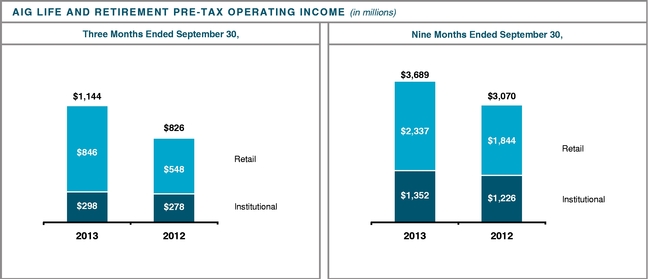
AIG Life and Retirement Quarterly and Year-to-Date Results
Pre-tax operating income increased in the three- and nine-month periods ended September 30, 2013 compared to the same periods in the prior year, reflecting higher fee income from variable annuities driven by growth in separate account assets under management, and continued active spread management in interest rate sensitive product lines. Pre-tax operating income in the 2013 periods included a net increase of $118 million from adjustments to update gross profit assumptions used to amortize DAC and related items in our interest-sensitive product lines. Net investment income for the three-month period ended September 30, 2013 was lower than the same period in the prior year due to lower income from alternative investments and other enhancements, as well as lower yields resulting from portfolio cash flows and investment sale proceeds being reinvested at yields lower than the average yield of the existing portfolio. For the nine-month period ended September 30, 2013, net investment income was down slightly compared to the same period in the prior year, due to ML II fair value gains recognized in 2012, reinvestment at lower rates and lower calls and other enhancements, partially offset by higher income from alternative investments. The increase in pre-tax operating income for both periods compared to the same periods in the prior year also reflected additional expenses recorded in the same periods in 2012, which were related to the resolution of multi-state regulatory examinations of death claims practices in the Retail operating segment and a comprehensive review of reserves for the GIC portfolio in the Institutional operating segment.
Retail Quarterly and Year-to-Date Results
Pre-tax operating income for our Retail operating segment increased in the three- and nine-month periods ended September 30, 2013 compared to the same periods in the prior year, due in part to higher fee income in the Retirement Income Solutions product line, which reflected growth in separate account assets under management driven by strong sales and positive equity market performance. Base spreads (defined as net investment income excluding alternative investments and other enhancements, less interest credited) improved for the three- and nine-month periods ended September 30, 2013 compared to the same periods in the prior year as a result of active spread management in our interest-sensitive product lines. Pre-tax operating income for the Retail operating segment in the three- and nine-month periods ended September 30, 2013 included $198 million of net favorable adjustments to update estimated gross profit assumptions for annuity spreads, surrender rates and life insurance mortality. See AIG Life and Retirement Reserves and DAC/VOBA for additional discussion of estimated gross profit assumptions. The increases in Other income and in Other acquisition and insurance expenses in the three-and nine-month periods ended September 30, 2013 compared to the same periods in the prior year included additional activity in our Brokerage Services product line principally due to the acquisition of Woodbury Financial in November 2012. Pre-tax operating income for the Retail operating segment in the 2012 periods included $66 million of expenses related to the resolution of multi-state regulatory examinations of death claims practices.
121
ITEM 2 / RESULTS OF OPERATIONS / AIG LIFE AND RETIREMENT
Institutional Quarterly and Year-to-Date Results
Pre-tax operating income for our Institutional operating segment increased in the three-and nine-month periods ended September 30, 2013 compared to the same periods in the prior year, due in part to higher fee income in the Group Retirement product line, which benefited from growth in separate account assets under management driven by favorable equity market performance. In addition, we continued active spread management in our interest rate sensitive product lines, which included lowering renewal crediting rates and disciplined new business pricing, particularly in our Group Retirement product line. The increases to pre-tax operating income for the Institutional operating segment compared to the same periods in the prior year were partially offset by an $80 million unfavorable adjustment in the three- and nine-month periods ended September 30, 2013 primarily due to updated estimated gross profit assumptions for annuity spreads in the Group Retirement product line. See AIG Life and Retirement Reserves and DAC/VOBA for additional discussion of estimated gross profit assumptions. The increases in pre-tax operating income for the three- and nine-month periods ended September 30, 2013 compared to the same periods in the prior year also reflected $110 million of additional interest credited expense recorded in the same periods of 2012 resulting from a comprehensive review of reserves for the GIC portfolio.
AIG Life and Retirement Premiums, Deposits and Net Flows
Premiums and Deposits
Premiums increased in the three- and nine-month periods ended September 30, 2013 compared to the same periods in the prior year, primarily from higher structured settlement and terminal funding annuity premiums in the Institutional Markets product line and higher immediate annuity premiums in the Fixed Annuities product line.
Premiums represent amounts received on traditional life insurance policies, group benefit policies and deposits on life-contingent payout annuities. Premiums and deposits is a non-GAAP financial measure that includes premiums as well as deposits received on universal life insurance, investment-type annuity contracts, GICs and mutual funds.
The following table presents a reconciliation of premiums and deposits to GAAP premiums:
|
|
|
|
|
|
|||||||||
|---|---|---|---|---|---|---|---|---|---|---|---|---|---|
|
|
Three Months Ended
September 30, |
Nine Months Ended
September 30, |
|||||||||||
|
(in millions)
|
2013
|
2012
|
2013
|
2012
|
|||||||||
|
Premiums and deposits |
$
|
8,422
|
|
$ | 4,785 |
$
|
20,767
|
|
$ | 15,779 | |||
|
Deposits |
|
(7,543
|
)
|
(4,102 | ) |
|
(18,304
|
)
|
(13,514 | ) | |||
|
Other |
|
(158
|
)
|
(99 | ) |
|
(473
|
)
|
(435 | ) | |||
|
Premiums |
$
|
721
|
|
$ | 584 |
$
|
1,990
|
|
$ | 1,830 | |||
The following table presents premiums and deposits by operating segment and product line:
|
|
|
|
|
|
|
|
|||||||||||||
|---|---|---|---|---|---|---|---|---|---|---|---|---|---|---|---|---|---|---|---|
|
|
Three Months Ended
September 30, |
|
Nine Months Ended
September 30, |
|
|||||||||||||||
|
|
Percentage
Change |
Percentage
Change |
|||||||||||||||||
|
(in millions)
|
2013
|
2012
|
2013
|
2012
|
|||||||||||||||
|
Retail |
|
|
|
|
|
|
|||||||||||||
|
Life Insurance and A&H |
$
|
822
|
|
$ | 819 | – | % |
$
|
2,497
|
|
$ | 2,500 | – | % | |||||
|
Fixed Annuities |
|
1,188
|
|
173 | NM |
|
1,919
|
|
1,222 | 57 | |||||||||
|
Retirement Income Solutions |
|
2,460
|
|
1,056 | 133 |
|
6,106
|
|
3,570 | 71 | |||||||||
|
Retail Mutual Funds |
|
1,633
|
|
740 | 121 |
|
3,682
|
|
2,108 | 75 | |||||||||
|
Closed blocks |
|
30
|
|
31 | (3 | ) |
|
81
|
|
111 | (27 | ) | |||||||
|
Total premiums and deposits |
$
|
6,133
|
|
$ | 2,819 | 118 | % |
$
|
14,285
|
|
$ | 9,511 | 50 | % | |||||
|
Institutional |
|
|
|
|
|
|
|||||||||||||
|
Group Retirement |
$
|
1,838
|
|
$ | 1,623 | 13 | % |
$
|
5,283
|
|
$ | 5,205 | 1 | % | |||||
|
Institutional Markets |
|
293
|
|
178 | 65 |
|
697
|
|
553 | 26 | |||||||||
|
Group Benefits |
|
158
|
|
165 | (4 | ) |
|
502
|
|
510 | (2 | ) | |||||||
|
Total premiums and deposits |
|
2,289
|
|
1,966 | 16 |
|
6,482
|
|
6,268 | 3 | |||||||||
|
Total Life and Retirement premiums and deposits |
$
|
8,422
|
|
$ | 4,785 | 76 | % |
$
|
20,767
|
|
$ | 15,779 | 32 | % | |||||
122
ITEM 2 / RESULTS OF OPERATIONS / AIG LIFE AND RETIREMENT
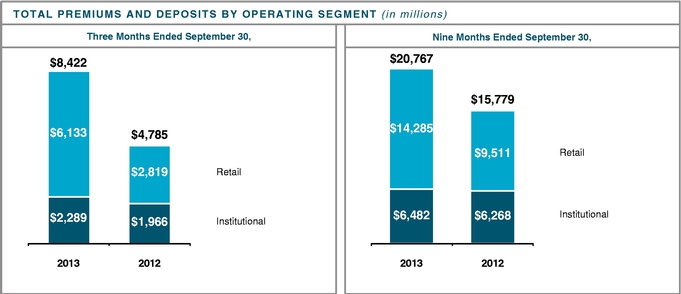
Net Flows
Net flows are presented for our investment product lines, which include Fixed Annuities, Retirement Income Solutions, Retail Mutual Funds and Group Retirement. Annuities net flows included in Fixed Annuities, Retirement Income Solutions and Group Retirement represent premiums and deposits less death, surrender and other withdrawal benefits. Mutual fund net flows included in Retail Mutual Funds and Group Retirement represent deposits less withdrawals. Net flows presented below exclude activity related to closed blocks of fixed and variable annuities, which have reserves of approximately $6 billion at September 30, 2013.
The following table summarizes net flows for our investment product lines:
|
|
|
|
|
|
|||||||||
|---|---|---|---|---|---|---|---|---|---|---|---|---|---|
|
|
Three Months Ended
September 30, |
Nine Months Ended
September 30, |
|||||||||||
|
(in millions)
|
2013
|
2012
|
2013
|
2012
|
|||||||||
|
Net flows |
|
|
|
|
|
|
|||||||
|
Fixed Annuities |
$
|
(104
|
)
|
$ | (1,149 | ) |
$
|
(2,367
|
)
|
$ | (2,976 | ) | |
|
Retirement Income Solutions |
|
1,638
|
|
274 |
|
3,501
|
|
1,197 | |||||
|
Retail Mutual Funds |
|
1,119
|
|
364 |
|
2,108
|
|
943 | |||||
|
Group Retirement |
|
(159
|
)
|
52 |
|
(575
|
)
|
517 | |||||
|
Total net flows |
$
|
2,494
|
|
$ | (459 | ) |
$
|
2,667
|
|
$ | (319 | ) | |
Quarterly and Year-to-Date Net Flows
Total net flows from annuities and mutual funds for our investment product lines increased in the three- and nine-month periods ended September 30, 2013 compared to the same periods in the prior year. A discussion of the significant variances in net flows for each of these product lines, including variances in premiums and deposits which is a key component of net flows, follows.
Retail
Fixed Annuities net flows and premiums and deposits showed improvement in the three- and nine-month periods ended September 30, 2013 compared to the same periods in the prior year, due to recent modest increases in interest rates and steepening of the yield curve, which made fixed annuity products more attractive in the marketplace compared to competing products such as bank deposits. Negative net flows for this product line in both of the nine-month periods ended September 30, 2013 and 2012 reflected the challenges of the sustained low interest rate environment, as consumers were reluctant to purchase these products at the relatively low crediting rates offered, which have been priced to maintain our targeted spreads. Fixed Annuities net flows also reflected slightly
123
ITEM 2 / RESULTS OF OPERATIONS / AIG LIFE AND RETIREMENT
higher surrender rates in the three- and nine-month periods ended September 30, 2013 compared to the same periods in the prior year, primarily on in-force business that had reached the end of the surrender charge period.
Retirement Income Solutions premiums and deposits and net flows increased in the three- and nine-month periods ended September 30, 2013 compared to the same periods in the prior year, reflecting higher variable annuity sales, which have benefitted from innovative product enhancements and expanded distribution as well as a more favorable competitive environment.
Retail Mutual Fund deposits and net flows increased in the three- and nine-month periods ended September 30, 2013 compared to the same periods in the prior year, driven primarily by sales of our Focused Dividend Strategy product offerings.
Institutional
Group Retirement net flows, which include net flows from mutual funds sold in group retirement markets, decreased in the three-month period ended September 30, 2013 compared to the same period in the prior year, primarily due to higher surrenders of individual participant contracts as well as higher large group surrenders, partially offset by higher premiums and deposits. Net flows for the nine-month period ended September 30, 2013 decreased compared to the same period in the prior year, primarily due to higher individual and large group surrenders.
The following table presents reserves for selected product lines by surrender charge category at September 30, 2013 and 2012, and surrender rates for the nine-month periods ended September 30, 2013 and 2012:
|
|
2013 | 2012 | |||||||||||||||||
|---|---|---|---|---|---|---|---|---|---|---|---|---|---|---|---|---|---|---|---|
|
At September 30,
(in millions) |
Group
|
Individual
|
Retirement
|
Group
Retirement Products (a) |
Individual
Fixed Annuities |
Retirement
Income Solutions |
|||||||||||||
|
No surrender charge (b) |
$
|
58,884
|
|
$
|
29,380
|
|
$
|
1,714
|
|
$ | 55,906 | $ | 25,052 | $ | 1,935 | ||||
|
0% – 2% |
|
1,665
|
|
|
2,474
|
|
|
16,580
|
|
1,285 | 4,008 | 15,094 | |||||||
|
Greater than 2% – 4% |
|
1,534
|
|
|
3,825
|
|
|
2,297
|
|
1,296 | 4,054 | 2,299 | |||||||
|
Greater than 4% |
|
5,897
|
|
|
18,591
|
|
|
16,630
|
|
4,779 | 23,715 | 9,755 | |||||||
|
Non-surrenderable |
|
330
|
|
|
3,037
|
|
|
213
|
|
711 | 3,062 | 1,340 | |||||||
|
Total reserves |
$
|
68,310
|
|
$
|
57,307
|
|
$
|
37,434
|
|
$ | 63,977 | $ | 59,891 | $ | 30,423 | ||||
|
Surrender rates |
|
9.3
|
%
|
|
6.5
|
%
|
|
9.0
|
%
|
8.1 | % | 6.1 | % | 10.3 | % | ||||
(a) Excludes mutual fund assets under management of $13.8 billion and $11.3 billion at September 30, 2013 and 2012, respectively.
(b) Group Retirement Products include reserves of approximately $6.1 billion and $6.0 billion at September 30, 2013 and 2012, respectively, that are subject to 20 percent annual withdrawal limitations.
AIG Life and Retirement Investments and Spread Management
Investments
We invest primarily in fixed maturity securities issued by corporations, municipalities and other governmental agencies; structured securities collateralized by, among other assets, residential and commercial real estate; and commercial mortgage loans. In addition, we seek to enhance our returns through investments in a diversified portfolio of private equity funds, hedge funds, affordable housing partnerships, and to a lesser extent, common and preferred stocks. Although these alternative investments are subject to periodic volatility, they have historically achieved yields in excess of the fixed maturity portfolio yields.
Our fundamental investment strategy is to maintain primarily a diversified, high quality portfolio of fixed maturity securities with the intent to match established duration targets based on the characteristics of our liabilities. An extended low interest rate environment may result in a lengthening of liability maturities from initial estimates, primarily due to lower lapses. See Investments for additional discussion of our asset liability management process.
124
ITEM 2 / RESULTS OF OPERATIONS / AIG LIFE AND RETIREMENT
NAIC Designations
The Securities Valuation Office (SVO) of the NAIC evaluates the investments of U.S. insurers for statutory reporting purposes and assigns fixed maturity securities to one of six categories called 'NAIC Designations.' In general, NAIC Designations of '1' highest quality, or '2' high quality, include fixed maturity securities considered investment grade, while NAIC Designations of '3' through '6' generally include fixed maturity securities referred to as below investment grade. The NAIC has adopted revised rating methodologies for certain structured securities, including non-agency RMBS and CMBS, which are intended to enable a more precise assessment of the value of such structured securities and increase the accuracy in assessing expected losses to better determine the appropriate capital requirement for such structured securities. These methodologies result in an improved NAIC Designation for such securities compared to the rating typically assigned by the three major rating agencies. The following tables summarize the ratings distribution of our fixed maturity security portfolio by NAIC Designation, and the distribution by composite AIG credit rating, which is generally based on ratings of the three major rating agencies. See Investments — Credit Ratings herein for a full description of the composite AIG credit ratings.
The following table presents the fixed maturity security portfolio of AIG Life and Retirement categorized by NAIC Designation, at fair value:
|
September 30, 2013
(in millions) |
NAIC Designation
|
Other Fixed
Maturity Securities |
Mortgage Backed,
Asset Backed and Collateralized |
Total
*
|
||||||||
|---|---|---|---|---|---|---|---|---|---|---|---|---|
|
Investment grade: |
||||||||||||
|
|
1 | $ | 46,945 | $ | 36,639 | $ | 83,584 | |||||
|
|
2 | 61,321 | 1,573 | 62,894 | ||||||||
|
|
Subtotal investment grade | 108,266 | 38,212 | 146,478 | ||||||||
|
Below investment grade: |
||||||||||||
|
|
3 | 4,007 | 958 | 4,965 | ||||||||
|
|
4 | 1,952 | 591 | 2,543 | ||||||||
|
|
5 | 418 | 399 | 817 | ||||||||
|
|
6 | 111 | 1,193 | 1,304 | ||||||||
|
|
Subtotal below investment grade | 6,488 | 3,141 | 9,629 | ||||||||
|
Total |
$ | 114,754 | $ | 41,353 | $ | 156,107 | ||||||
* Excludes $483 million of fixed maturity securities for which no NAIC Designation is available because they are not held in legal entities within AIG Life and Retirement that require a statutory filing.
The following table presents the fixed maturity security portfolio of AIG Life and Retirement categorized by composite AIG credit rating, at fair value:
|
September 30, 2013
(in millions) |
Composite AIG Credit Rating
|
Other Fixed
Maturity Securities |
Mortgage Backed,
Asset Backed and Collateralized |
Total
*
|
||||||||
|---|---|---|---|---|---|---|---|---|---|---|---|---|
|
Investment grade: |
||||||||||||
|
|
AAA/AA/A | $ | 46,040 | $ | 23,294 | $ | 69,334 | |||||
|
|
BBB | 62,201 | 3,097 | 65,298 | ||||||||
|
|
Subtotal investment grade | 108,241 | 26,391 | 134,632 | ||||||||
|
Below investment grade: |
||||||||||||
|
|
BB | 4,048 | 1,902 | 5,950 | ||||||||
|
|
B | 1,965 | 1,870 | 3,835 | ||||||||
|
|
CCC and Lower | 500 | 11,190 | 11,690 | ||||||||
|
|
Subtotal below investment grade | 6,513 | 14,962 | 21,475 | ||||||||
|
Total |
$ | 114,754 | $ | 41,353 | $ | 156,107 | ||||||
* Excludes $483 million of fixed maturity securities for which no NAIC Designation is available because they are not held in legal entities within AIG Life and Retirement that require a statutory filing.
125
ITEM 2 / RESULTS OF OPERATIONS / AIG LIFE AND RETIREMENT
Yield and Net Investment Income
Overall, our yields have been declining since the second half of 2012 as investment purchases have been made at yields lower than the weighted average yield of the existing portfolio. During prolonged periods of low or declining interest rates, we generally must invest new net flows and reinvest the cash flows from investment sales, interest and principal payments of our portfolio in lower yielding securities.
Opportunistic investments in structured securities, private placement corporate debt securities and commercial mortgage loans continue to be made to improve yields, increase net investment income and help to offset the impact of the lower interest rate environment.
We maintain investment portfolios for each product line which, to the extent practicable, match established duration targets based on the characteristics of our liabilities. We allocate net investment income from assets that support liabilities to the product line they support. Net investment income from investments in excess of liabilities, which include the majority of our alternative investments, is allocated to the product lines using a capital-based internal allocation model.
Net investment income for the three-month period ended September 30, 2013 decreased compared to the same period in the prior year, reflecting a $30 million decrease in base net investment income (excluding alternative investments and other enhancements) due to the reinvestment of maturing investments and asset sale proceeds in the low interest rate environment, $33 million lower income from alternative investments, $38 million lower call and tender income, and a $32 million decrease in accretion of discount for certain highly rated structured securities, which was driven by recent increases in market interest rates. These decreases were partially offset by $14 million in fair value gains on our investment in PICC Group.
Net investment income in the nine-month period ended September 30, 2013 decreased slightly compared to the same period of the prior year, primarily due to fair value gains of $246 million recognized in the same period of 2012 on our investment in ML II, which was liquidated in March 2012, when we received a distribution of $1.6 billion from the sale by the FRBNY of the securities held in ML II. Base net investment income in the nine-month period ended September 30, 2013 decreased by $130 million compared to the same period in the prior year due to reinvestment of maturing investments and asset sale proceeds in the low interest rate environment. The decrease in net investment income for the nine-month period ended September 30, 2013 compared to the same period in the prior year also reflected net fair value losses of $38 million from our investment in PICC Group and a $41 million decrease in accretion of discount for certain highly rated structured securities, which was driven by recent increases in market interest rates. These decreases were largely offset by a $440 million increase in alternative investment income, including higher private equity and hedge fund income due to favorable equity market conditions and several large redemptions from hedge funds, and an increase in call and tender income of $35 million in the nine-month period ended September 30, 2013 compared to the same period in the prior year.
Spread Management
The contractual provisions for renewal of crediting rates and guaranteed minimum crediting rates included in our products may have the effect, in a continued low interest rate environment, of reducing our spreads and thus reducing future profitability. Although we partially mitigate this interest rate risk through our asset-liability management process, product design elements and crediting rate strategies, a prolonged low interest rate environment may negatively affect future profitability.
Disciplined pricing on new business resulted in lower new fixed annuity deposits in the first six months of 2013 relative to the same period in the prior year, due to the relatively low crediting rates offered; however, deposits improved in the three-month period ended September 30, 2013 compared to the same period in the prior year due to the recent modest increase in market interest rates. In the current interest rate environment, we continue to pursue new sales of life and annuity products at targeted net investment spreads. We have a dynamic product management process designed to ensure that new business product offerings appropriately reflect the current interest rate environment. To the extent that we cannot achieve targeted net investment spreads on new business, products are
126
ITEM 2 / RESULTS OF OPERATIONS / AIG LIFE AND RETIREMENT
re-priced or no longer sold. Additionally, current products with higher minimum rate guarantees have been re-filed with lower rates as permitted under state insurance product regulations.
- •
-
New sales of fixed annuity products generally have minimum interest rate guarantees of 1
percent.
- •
- Universal life insurance interest rate guarantees are generally 2 to 3 percent on new non-indexed products and zero to 2 percent on new indexed products, and are designed to be sufficient to meet targeted net investment spreads. We are in the process of lowering the minimum guaranteed interest rates on new products, and expect this process to be substantially completed in 2014.
Active management of renewal crediting rates is done under contractual provisions in our annuity and universal life products that were designed to allow crediting rates to be reset at pre-established intervals subject to minimum crediting rate guarantees. We have adjusted, and will continue to adjust, crediting rates to maintain targeted net investment spreads on both new business and in-force business where crediting rates are above minimum guarantees. In addition to annuity and universal life products, certain traditional long-duration products for which we do not have the ability to adjust interest rates, such as payout annuities, are exposed to reduced earnings and potential loss recognition reserve increases in a prolonged low interest rate environment. See AIG Life and Retirement Reserves and DAC/VOBA — Other Reserve Changes for additional discussion of loss recognition.
The three- and nine-month periods ended September 30, 2012 included $110 million of additional interest credited expense resulting from a comprehensive review of reserves for the GIC portfolio.
As indicated in the table below, approximately 75 percent of our annuity and universal life account values were at their minimum crediting rates as of September 30, 2013, an increase from 61 percent at December 31, 2012. These products have minimum guaranteed interest rates as of September 30, 2013 ranging from 1 percent to 5.5 percent, with the higher rates representing guarantees on older products.
The following table presents our universal life and fixed annuity account values by contractual minimum guaranteed interest rate and current crediting rates:
|
September 30, 2013
|
Current Crediting Rates | ||||||||||||
|---|---|---|---|---|---|---|---|---|---|---|---|---|---|
|
Contractual Minimum Guaranteed
Interest Rate (in millions) |
At Contractual
Minimum Guarantee |
1-50 Basis
Points Above Minimum Guarantee |
More than 50
Basis Points Above Minimum Guarantee |
Total
|
|||||||||
|
Universal life insurance |
|||||||||||||
|
1% |
$ | 44 | $ | – | $ | 11 | $ | 55 | |||||
|
> 1% – 2% |
27 | 57 | 220 | 304 | |||||||||
|
> 2% – 3% |
448 | 261 | 1,288 | 1,997 | |||||||||
|
> 3% – 4% |
2,097 | 323 | 1,385 | 3,805 | |||||||||
|
> 4% – 5% |
4,241 | 189 | – | 4,430 | |||||||||
|
> 5% – 5.5% |
316 | – | – | 316 | |||||||||
|
Subtotal |
$ | 7,173 | $ | 830 | $ | 2,904 | $ | 10,907 | |||||
|
Fixed annuities * |
|||||||||||||
|
1% |
$ | 3,576 | $ | 4,212 | $ | 6,284 | $ | 14,072 | |||||
|
> 1% – 2% |
13,488 | 3,070 | 5,593 | 22,151 | |||||||||
|
> 2% – 3% |
32,818 | 250 | 3,462 | 36,530 | |||||||||
|
> 3% – 4% |
13,842 | 100 | 74 | 14,016 | |||||||||
|
> 4% – 5% |
8,148 | – | 5 | 8,153 | |||||||||
|
> 5% – 5.5% |
236 | – | 5 | 241 | |||||||||
|
Subtotal |
$ | 72,108 | $ | 7,632 | $ | 15,423 | $ | 95,163 | |||||
|
Total |
$ | 79,281 | $ | 8,462 | $ | 18,327 | $ | 106,070 | |||||
|
Percentage of total |
75 | % | 8 | % | 17 | % | 100 | % | |||||
* Fixed annuities include fixed options within variable annuities sold in Group Retirement markets.
127
ITEM 2 / RESULTS OF OPERATIONS / AIG LIFE AND RETIREMENT
Quarterly and Year-to-Date Net Realized Capital Gains (Losses)
Net realized capital gains were $398 million in the three-month period ended September 30, 2013 compared to $670 million in the same period in the prior year, due to lower gains from investment sales activity in connection with utilizing capital loss carryforwards, partially offset by fair value gains on embedded derivatives, net of hedges, which had net gains of $19 million compared to net losses of $279 million in the same period of the prior year. The embedded derivative gains, net of hedges, were primarily related to variable annuities with guarantee features, and the change in fair value gains in both the three- and nine-month periods ended September 30, 2013 compared to the same periods in the prior year was primarily due to increases in long-term interest rates.
Net realized capital gains were $2.0 billion for the nine-month period ended September 30, 2013 compared to $530 million in the same period in the prior year. The improvement compared to the same period in the prior year was due to higher gains from sales activity in connection with utilizing capital loss carryforwards, lower other-than-temporary impairments, and fair value gains on embedded derivatives, net of hedges, which had net gains of $150 million in the nine-month period ended September 30, 2013 compared to net losses of $751 million in the same period of the prior year.
Changes in Fair Value of Fixed Maturity Securities Designated to Hedge Living Benefits Liabilities
Changes in fair value of fixed maturity securities designated to hedge living benefit liabilities, which are excluded from Pre-tax operating income, reflect AIG Life and Retirement's dynamic hedging program designed to manage economic risk exposure associated with changes in equity markets, interest rates and volatilities related to embedded derivative liabilities contained in guaranteed benefit features of variable annuities. We substantially hedge our exposure to equity markets. Due to regulatory capital considerations, however, a portion of our interest rate exposure is unhedged. In the first quarter of 2012, we began purchasing U.S. Treasury bonds as a capital-efficient strategy to reduce our interest rate risk exposure over time. As a result of subsequent increases in interest rates on U.S. Treasury bonds, the fair value of the U.S. Treasury bonds used for hedging, net of financing costs, decreased by $30 million and $128 million in the three-month and nine-month periods ended September 30, 2013, respectively, compared to a decrease of $3 million and an increase of $48 million, respectively, in the same periods of the prior year.
128
ITEM 2 / RESULTS OF OPERATIONS / AIG LIFE AND RETIREMENT
AIG Life and Retirement Reserves and DAC/VOBA
The following table presents AIG Life and Retirement insurance reserves and mutual fund assets under management:
|
|
|
|
|
|
|||||||||
|---|---|---|---|---|---|---|---|---|---|---|---|---|---|
|
|
Three Months Ended
September 30, |
Nine Months Ended
September 30, |
|||||||||||
|
(in millions)
|
2013
|
2012
|
2013
|
2012
|
|||||||||
|
Retail |
|
|
|
|
|
|
|||||||
|
Balance at beginning of period, gross |
$
|
128,027
|
|
$ | 122,266 |
$
|
123,699
|
|
$ | 120,396 | |||
|
Premiums and deposits |
|
6,133
|
|
2,819 |
|
14,285
|
|
9,511 | |||||
|
Surrenders and withdrawals |
|
(2,248
|
)
|
(2,116 | ) |
|
(7,316
|
)
|
(6,732 | ) | |||
|
Death, and other contract benefits |
|
(853
|
)
|
(875 | ) |
|
(2,627
|
)
|
(2,714 | ) | |||
|
Subtotal |
|
3,032
|
|
(172 | ) |
|
4,342
|
|
65 | ||||
|
Change in fair value of underlying assets and reserve accretion, net of policy fees |
|
1,355
|
|
1,316 |
|
2,998
|
|
2,358 | |||||
|
Cost of funds |
|
546
|
|
604 |
|
1,678
|
|
1,825 | |||||
|
Other reserve changes |
|
(301
|
)
|
(269 | ) |
|
(58
|
)
|
(899 | ) | |||
|
Balance at end of period |
|
132,659
|
|
123,745 |
|
132,659
|
|
123,745 | |||||
|
Reserves related to unrealized appreciation of investments |
|
9
|
|
442 |
|
9
|
|
442 | |||||
|
Reinsurance ceded |
|
(1,493
|
)
|
(1,497 | ) |
|
(1,493
|
)
|
(1,497 | ) | |||
|
Total insurance reserves and retail mutual funds assets under management |
$
|
131,175
|
|
$ | 122,690 |
$
|
131,175
|
|
$ | 122,690 | |||
|
Institutional |
|
|
|
|
|
|
|||||||
|
Balance at beginning of period, gross |
$
|
113,857
|
|
$ | 106,543 |
$
|
110,494
|
|
$ | 103,315 | |||
|
Premiums and deposits |
|
2,289
|
|
1,966 |
|
6,482
|
|
6,268 | |||||
|
Surrenders and withdrawals |
|
(2,980
|
)
|
(1,516 | ) |
|
(8,078
|
)
|
(5,439 | ) | |||
|
Death, and other contract benefits |
|
(525
|
)
|
(481 | ) |
|
(1,498
|
)
|
(1,464 | ) | |||
|
Subtotal |
|
(1,216
|
)
|
(31 | ) |
|
(3,094
|
)
|
(635 | ) | |||
|
Change in fair value of underlying assets and reserve accretion, net of policy fees |
|
2,903
|
|
2,125 |
|
6,518
|
|
4,899 | |||||
|
Cost of funds |
|
396
|
|
545 |
|
1,174
|
|
1,358 | |||||
|
Other reserve changes |
|
159
|
|
364 |
|
1,007
|
|
609 | |||||
|
Balance at end of period |
|
116,099
|
|
109,546 |
|
116,099
|
|
109,546 | |||||
|
Reserves related to unrealized appreciation of investments |
|
–
|
|
2,364 |
|
–
|
|
2,364 | |||||
|
Reinsurance ceded |
|
(211
|
)
|
(236 | ) |
|
(211
|
)
|
(236 | ) | |||
|
Total insurance reserves and group mutual fund assets under management |
$
|
115,888
|
|
$ | 111,674 |
$
|
115,888
|
|
$ | 111,674 | |||
|
Total AIG Life and Retirement: |
|
|
|
|
|
|
|||||||
|
Balance at beginning of period, gross |
$
|
241,884
|
|
$ | 228,809 |
$
|
234,193
|
|
$ | 223,711 | |||
|
Premiums and deposits |
|
8,422
|
|
4,785 |
|
20,767
|
|
15,779 | |||||
|
Surrenders and withdrawals |
|
(5,228
|
)
|
(3,632 | ) |
|
(15,394
|
)
|
(12,171 | ) | |||
|
Death, and other contract benefits |
|
(1,378
|
)
|
(1,356 | ) |
|
(4,125
|
)
|
(4,178 | ) | |||
|
Subtotal |
|
1,816
|
|
(203 | ) |
|
1,248
|
|
(570 | ) | |||
|
Change in fair value of underlying assets and reserve accretion, net of policy fees |
|
4,258
|
|
3,441 |
|
9,516
|
|
7,257 | |||||
|
Cost of funds |
|
942
|
|
1,149 |
|
2,852
|
|
3,183 | |||||
|
Other reserve changes |
|
(142
|
)
|
95 |
|
949
|
|
(290 | ) | ||||
|
Balance at end of period |
|
248,758
|
|
233,291 |
|
248,758
|
|
233,291 | |||||
|
Reserves related to unrealized appreciation of investments |
|
9
|
|
2,806 |
|
9
|
|
2,806 | |||||
|
Reinsurance ceded |
|
(1,704
|
)
|
(1,733 | ) |
|
(1,704
|
)
|
(1,733 | ) | |||
|
Total insurance reserves and mutual fund assets under management |
$
|
247,063
|
|
$ | 234,364 |
$
|
247,063
|
|
$ | 234,364 | |||
129
ITEM 2 / RESULTS OF OPERATIONS / AIG LIFE AND RETIREMENT
Other Reserve Changes
Other reserve changes in the table above include loss recognition on certain long-term payout annuity contracts. In connection with our program to utilize capital loss carryforwards, we sold investment securities in the three- and nine-month periods ended September 30, 2013 and September 30, 2012. These and other investment sales with subsequent reinvestment at lower yields triggered recording of loss recognition reserves of $244 million in the three-month period ended September 30, 2013, and $598 million in the same period in 2012, on certain long-term payout annuity contracts. For the nine-month periods ended September 30, 2013 and 2012, loss recognition totaled $1.5 billion and $1.1 billion, respectively. Additional sales of such investment securities are contemplated in the remainder of 2013, which could result in additional loss recognition. Assumptions related to investment yields, mortality experience and expenses are reviewed periodically and updated as appropriate, which could also result in additional loss recognition reserves.
Loss recognition is excluded from Pre-tax operating income and reported within Changes in benefit reserves and DAC, VOBA and SIA related to net realized capital gains (losses) in the AIG Life and Retirement Results table herein.
DAC/VOBA and Reserves Related to Unrealized Appreciation of Investments
The change in DAC/VOBA and reserves related to unrealized appreciation of investments increased in the three- and nine-month periods ended September 30, 2013 compared to the change in the same periods of the prior year, as a result of the decrease in unrealized appreciation of investments driven by recent increases in market interest rates.
DAC/VOBA Rollforward
The following table summarizes the major components of the changes in AIG Life and Retirement DAC/VOBA:
|
|
|
|
|||||
|---|---|---|---|---|---|---|---|
|
Nine Months Ended September 30,
(in millions) |
2013
|
2012
|
|||||
|
Balance, beginning of year |
$
|
5,672
|
|
$ | 6,502 | ||
|
Acquisition costs deferred |
|
665
|
|
548 | |||
|
Amortization expense |
|
(489
|
)
|
(746 | ) | ||
|
Change related to unrealized depreciation (appreciation) of investments |
|
661
|
|
(616 | ) | ||
|
Balance, end of period* |
$
|
6,509
|
|
$ | 5,688 | ||
* DAC/VOBA balance excluding the amount related to unrealized depreciation (appreciation) of investments was $7.7 billion and $7.6 billion at September 30, 2013 and 2012, respectively.
Estimated Gross Profits for Interest-Sensitive Products
Policy acquisition costs and policy issuance costs related to universal life and investment-type products (collectively, interest-sensitive products) are deferred and amortized, with interest, in relation to the incidence of estimated gross profits to be realized over the estimated lives of the contracts. Estimated gross profits include net investment income and spreads, net realized investment gains and losses, fees, surrender charges, expenses, and mortality and morbidity gains and losses. If the assumptions used for estimated gross profits change significantly, DAC and related reserves are recalculated using the new assumptions, and any resulting adjustment is included in income. Updating such assumptions may result in acceleration of amortization in some products and deceleration of amortization in other products.
In the three-month period ended September 30, 2013, we completed our comprehensive annual review and update of estimated gross profit assumptions used to amortize DAC and related items for our interest-sensitive products. The result of this review was a $118 million net increase in pre-tax operating income for the three- and nine-month periods ended September 30, 2013, which included a $198 million net increase in our Retail operating segment and an $80 million decrease in our Institutional operating segment. The net increase in Retail pre-tax operating income was primarily due to a favorable adjustment in our Fixed Annuities product line from updated spread assumptions due to active management of crediting rates and higher future investment yields than those previously assumed. In the Life Insurance and A&H, Retirement Income Solutions and Group Retirement product lines, the update of
130
assumptions for variable annuity spreads, surrender rates, and life insurance mortality had an unfavorable impact on pre-tax operating income. The life insurance mortality assumptions, while unfavorable compared to the previous assumption set, are still within pricing expectations.
The $118 million increase in pre-tax operating income to reflect updated assumptions was comprised of a $98 million net decrease in DAC amortization expense, a $61 million decrease in SIA amortization expense within Interest credited to policyholder account balances, and a $28 million decrease in unearned revenue amortization within Policy fees, partially offset by a $69 million increase in Future policy benefits for life and health insurance contracts. The net adjustment to DAC amortization represented less than 2 percent of the DAC/VOBA balance excluding the amount related to unrealized depreciation (appreciation) of investments as of September 30, 2013.
The effect of short-term fluctuations in the equity markets on the estimated gross profits of products with guaranteed benefit features is mitigated in part through the use of a "reversion to the mean" methodology, which allows us to maintain our long-term assumptions, while also giving consideration to the effect of short-term deviations from these assumptions occurring in the current period. If favorable equity market performance continues for the remainder of 2013, an update of estimated gross profit assumptions used to amortize DAC and related items for certain of our Group Retirement products could result in a favorable adjustment to pre-tax operating income.
AIG's Other Operations include results from Mortgage Guaranty, GCM, DIB, Retained Interests and Corporate & Other (after allocations to AIG's business segments) as presented below.
Mortgage Guaranty (United Guaranty Corporation or UGC) offers private residential mortgage guaranty insurance, which protects mortgage lenders and investors from loss due to borrower default and loan foreclosure. The coverage we provide — which is called mortgage guaranty insurance, mortgage insurance, or simply "MI" — enables borrowers to purchase a house with a modest down payment by protecting lenders against the increased risk of borrower default related to high loan-to-value (LTV) mortgages — those with less than 20 percent equity.
Global Capital Markets consists of the operations of AIG Markets and the remaining derivatives portfolio of AIGFP. AIG Markets acts as the derivatives intermediary between AIG and its subsidiaries and third parties to provide hedging services for AIG entities. The AIGFP portfolio continues to be wound down and is managed consistent with AIG's risk management objectives. Although the portfolio may experience periodic fair value volatility, it consists predominantly of transactions that AIG believes are of low complexity, low risk, or are currently not economically appropriate to unwind based on a cost versus benefit analysis.
Direct Investment Book consists of a portfolio of assets and liabilities held directly by AIG Parent in the MIP and certain non-derivative assets and liabilities of AIGFP. The management of the DIB portfolio is focused on an orderly wind down to maximize returns consistent with AIG's risk management objectives. Certain non-derivative assets and liabilities of the DIB are accounted for under the fair value option and thus operating results are subject to periodic market volatility.
Retained Interests includes the fair value gains or losses, prior to their sale in 2012, of the AIA ordinary shares retained following the AIA initial public offering and the fair value gains or losses, prior to the FRBNY liquidation of ML III assets in 2012, on the retained interest in ML III.
131
ITEM 2 / RESULTS OF OPERATIONS / OTHER OPERATIONS
Corporate & Other consists primarily of interest expense, consolidation and eliminations, expenses of corporate staff not attributable to specific reportable segments, certain expenses related to internal controls and the financial and operating platforms, corporate initiatives, certain compensation plan expenses, corporate level net realized capital gains and losses, certain litigation-related charges and credits, the results of AIG's real estate investment operations and net loss and gain on sale of divested businesses and properties that did not meet the criteria for discontinued operations accounting treatment.
Other Operations Results
The following table presents AIG's Other operations results:
|
|
Three Months Ended
September 30, |
|
Nine Months Ended
September 30, |
|
|||||||||||||||
|---|---|---|---|---|---|---|---|---|---|---|---|---|---|---|---|---|---|---|---|
|
|
Percentage
Change |
Percentage
Change |
|||||||||||||||||
|
(in millions)
|
2013
|
2012
|
2013
|
2012
|
|||||||||||||||
|
Mortgage Guaranty |
$
|
43
|
|
$ | 3 | NM | % |
$
|
157
|
|
$ | 54 | 191 | % | |||||
|
Global Capital Markets |
|
29
|
|
190 | (85 | ) |
|
431
|
|
257 | 68 | ||||||||
|
Direct Investment book |
|
110
|
|
428 | (74 | ) |
|
1,030
|
|
706 | 46 | ||||||||
|
Retained interests: |
|
|
|
|
|
|
|||||||||||||
|
Change in fair value of AIA securities, including realized gain in 2012 |
|
–
|
|
527 | NM |
|
–
|
|
1,829 | NM | |||||||||
|
Change in fair value of ML III |
|
–
|
|
330 | NM |
|
–
|
|
2,888 | NM | |||||||||
|
Corporate & Other: |
|
|
|
|
|
|
|||||||||||||
|
Other interest expense |
|
(334
|
)
|
(416 | ) | 20 |
|
(1,084
|
)
|
(1,189 | ) | 9 | |||||||
|
Corporate expenses, net |
|
(282
|
)
|
(166 | ) | (70 | ) |
|
(796
|
)
|
(563 | ) | (41 | ) | |||||
|
Real estate and other non-core businesses |
|
(107
|
)
|
(40 | ) | (168 | ) |
|
(234
|
)
|
(117 | ) | (100 | ) | |||||
|
Total Corporate & Other operating loss |
|
(723
|
)
|
(622 | ) | (16 | ) |
|
(2,114
|
)
|
(1,869 | ) | (13 | ) | |||||
|
Consolidation and eliminations |
|
1
|
|
(2 | ) | NM |
|
3
|
|
(1 | ) | NM | |||||||
|
Total Other operations pre-tax operating income (loss) |
|
(540
|
)
|
854 | NM |
|
(493
|
)
|
3,864 | NM | |||||||||
|
Legal reserves |
|
(400
|
)
|
(10 | ) | NM |
|
(425
|
)
|
(744 | ) | 43 | |||||||
|
Legal settlements* |
|
–
|
|
– | NM |
|
48
|
|
– | NM | |||||||||
|
Loss on extinguishment of debt |
|
(81
|
)
|
– | NM |
|
(459
|
)
|
(9 | ) | NM | ||||||||
|
Net realized capital gains (losses) |
|
(104
|
)
|
47 | NM |
|
107
|
|
403 | (73 | ) | ||||||||
|
Net gain (loss) on sale of divested businesses |
|
–
|
|
– | NM |
|
(47
|
)
|
(3 | ) | NM | ||||||||
|
Total Other Operations pre-tax income (loss) |
$
|
(1,125
|
)
|
$ | 891 | NM | % |
$
|
(1,269
|
)
|
$ | 3,511 | NM | % | |||||
* Reflects income in the first nine months of 2013 from settlements with financial institutions that participated in the creation, offering and sale of RMBS from which AIG and its subsidiaries realized losses during the financial crisis.

132
ITEM 2 / RESULTS OF OPERATIONS / OTHER OPERATIONS
Mortgage Guaranty
The following table presents Mortgage Guaranty results:
|
|
Three Months Ended
September 30, |
|
Nine Months Ended
September 30, |
|
|||||||||||||||
|---|---|---|---|---|---|---|---|---|---|---|---|---|---|---|---|---|---|---|---|
|
|
Percentage
Change |
Percentage
Change |
|||||||||||||||||
|
(dollars in millions)
|
2013
|
2012
|
2013
|
2012
|
|||||||||||||||
|
Underwriting results: |
|
|
|
|
|
|
|||||||||||||
|
Net premiums written |
$
|
272
|
|
$ | 219 | 24 | % |
$
|
793
|
|
$ | 622 | 27 | % | |||||
|
Increase in unearned premiums |
|
(68
|
)
|
(42 | ) | (62 | ) |
|
(187
|
)
|
(97 | ) | (93 | ) | |||||
|
Net premiums earned |
|
204
|
|
177 | 15 |
|
606
|
|
525 | 15 | |||||||||
|
Claims and claims adjustment expenses incurred |
|
136
|
|
163 | (17 | ) |
|
386
|
|
434 | (11 | ) | |||||||
|
Underwriting expenses |
|
57
|
|
49 | 16 |
|
162
|
|
146 | 11 | |||||||||
|
Underwriting income (loss) |
|
11
|
|
(35 | ) | NM |
|
58
|
|
(55 | ) | NM | |||||||
|
Net investment income |
|
32
|
|
38 | (16 | ) |
|
99
|
|
109 | (9 | ) | |||||||
|
Pre-tax operating income |
|
43
|
|
3 | NM |
|
157
|
|
54 | 191 | |||||||||
|
Net realized capital gains |
|
–
|
|
3 | NM |
|
5
|
|
8 | (38 | ) | ||||||||
|
Pre-tax income |
$
|
43
|
|
$ | 6 | NM | % |
$
|
162
|
|
$ | 62 | 161 | % | |||||
|
Key metrics: |
|
|
|
|
|
|
|||||||||||||
|
New insurance written |
$
|
14,437
|
|
$ | 10,741 | 34 | % |
$
|
39,074
|
|
$ | 25,880 | 51 | % | |||||
|
Domestic first-lien: |
|
|
|
|
|
|
|||||||||||||
|
Risk in force |
|
|
|
$
|
34,674
|
|
$ | 27,781 | |||||||||||
|
60+ day delinquency ratio on primary loans (a) |
|
|
|
|
6.4
|
%
|
9.6 | % | |||||||||||
|
Domestic second-lien: |
|
|
|
|
|
|
|||||||||||||
|
Risk in force (b) |
|
|
|
$
|
1,063
|
|
$ | 1,311 | |||||||||||
(a) Based on number of policies.
(b) Represents
the full amount of second-lien loans insured reduced for contractual aggregate loss limits on certain pools of loans, usually 10 percent of the full amount of loans insured
in each pool. Certain second-lien pools have reinstatement provisions, which will expire as the loan balances are repaid.
133
ITEM 2 / RESULTS OF OPERATIONS / OTHER OPERATIONS

Mortgage Guaranty Quarterly Results
Pre-tax operating income in the three-month period ended September 30, 2013 increased compared to the same period in 2012. Net premiums earned increased, reflecting a $37 million increase in first-lien net premiums earned due to growth of the book of business, partially offset by premium declines in the second-lien, and international businesses, both of which were placed in run-off during 2008. Additionally, the decline in claims and claims adjustment expenses incurred reflected a $50 million decrease in first-lien claims and claims adjustment expenses partially offset by a $23 million increase in second-lien claims and claims adjustment expenses. The decline in first-lien claims and claims adjustment expenses is the result of an 18 percent decline in newly reported delinquencies and improving cure rates, partially offset by unfavorable prior year reserve development during the third quarter of 2013 compared to favorable development in the same period of 2012. The increase in second-lien claims and claims adjustment expenses reflected lower favorable development and an increase in the overturn of previously denied claims in the third quarter of 2013 compared to the same period of 2012. These increases to pre-tax operating income were partially offset by an increase in underwriting expenses due to the increased expenses related to higher volumes of new business.
New insurance written, which represents the original principal balance of the insured mortgages, increased due to the market acceptance of UGC's risk-based pricing model by an increasing number of lenders as well as the addition and expansion of distribution channels. See Outlook — Other Operations — Mortgage Guaranty for further discussion.
Mortgage Guaranty Year-to-Date Results
Pre-tax operating income in the nine-month period ended September 30, 2013 increased compared to the same period in 2012. Net premiums earned increased, due primarily to a $100 million increase in first-lien net premiums earned, partially offset by declines in second-lien, student loan and international businesses, all of which were placed
134
ITEM 2 / RESULTS OF OPERATIONS / OTHER OPERATIONS
into run-off during 2008. Additionally, the decline in claims and claims adjustment expenses reflected decreases in first-lien, student loan and international claims and claims adjustment expenses of $35 million, $17 million and $10 million, respectively, which were partially offset by a $14 million increase in second-lien claims and claims adjustment expense. The decline in first-lien claims and claims adjustment expenses incurred was primarily the result of reduced newly reported delinquencies and increasing cure rates. The decline in student loan claims and claims adjustment expenses incurred reflect recoveries on prior paid losses. The decline in international claims and claims adjustment expenses incurred reflect improved loss experience during the year and the de-risking of the international business through commutations. Second-lien claims and claims adjustment expenses incurred increased primarily reflecting increased overturns of previously denied claims.
New insurance written increased during the nine-month period ended September 30, 2013 compared to the same period in 2012 due to the market acceptance of UGC's risk-based pricing model discussed above.
Global Capital Markets Operations
Global Capital Markets Quarterly Results
GCM pre-tax income and pre-tax operating income decreased in the three-month period ended September 30, 2013 compared to the same period in 2012 primarily due to a decline in unrealized market valuation gains related to the super senior credit default swap (CDS) portfolio.
Unrealized market valuation gains of $54 million and $204 million were recognized in the three-month periods ended September 30, 2013 and 2012, respectively. The decline resulted primarily from CDS transactions written on multi-sector collateralized debt obligations (CDOs) driven by price movements and amortization within the CDS portfolio.
Global Capital Markets Year-to-Date Results
GCM's pre-tax income and pre-tax operating income increased in the nine-month period ended September 30, 2013 compared to the same period in 2012 primarily due to an improvement in net credit valuation adjustments on derivative assets and liabilities, partially offset by a decline in unrealized market valuation gains related to the CDS portfolio.
Net credit valuation adjustment gains of $153 million were recognized in the nine-month period ended September 30, 2013 compared to net credit valuation losses of $76 million for the same period in 2012. The improvement resulted primarily from lower losses on derivative liabilities due to less significant tightening of AIG's credit spreads in the nine-month period ended September 30, 2013 compared to the same period in 2012 and higher gains on derivative assets due to more significant tightening of counterparty credit spreads in the nine-month period ended September 30, 2013 compared to the same period in 2012.
Unrealized market valuation gains of $356 million and $401 million were recognized in the nine-month periods ended September 30, 2013 and 2012, respectively. The decline resulted primarily from CDS transactions written on multi-sector CDOs driven by amortization, terminations and maturities within the CDS portfolio.
Direct Investment Book Results
The following table presents Direct Investment book results:
|
|
Three Months Ended
September 30, |
|
Nine Months Ended
September 30, |
|
|||||||||||||||
|---|---|---|---|---|---|---|---|---|---|---|---|---|---|---|---|---|---|---|---|
|
|
Percentage
Change |
Percentage
Change |
|||||||||||||||||
|
(in millions)
|
2013
|
2012
|
2013
|
2012
|
|||||||||||||||
|
Pre-tax operating income |
$
|
110
|
|
$ | 428 | (74 | )% |
$
|
1,030
|
|
$ | 706 | 46 | % | |||||
|
Legal settlements |
|
–
|
|
– | NM |
|
27
|
|
– | NM | |||||||||
|
Loss on extinguishment of debt |
|
–
|
|
– | NM |
|
(4
|
)
|
– | NM | |||||||||
|
Net realized capital gains (losses) |
|
(58
|
)
|
(22 | ) | (164 | ) |
|
31
|
|
433 | (93 | ) | ||||||
|
Pre-tax income |
$
|
52
|
|
$ | 406 | (87 | )% |
$
|
1,084
|
|
$ | 1,139 | (5 | )% | |||||
135
ITEM 2 / RESULTS OF OPERATIONS / OTHER OPERATIONS
Direct Investment Book Quarterly Results
DIB pre-tax income and pre-tax operating income decreased in the three-month period ended September 30, 2013 compared to the same period in 2012 primarily due to a decline in net credit valuation adjustments on assets and liabilities for which the fair value option was elected, partially offset by fair value appreciation of $84 million on asset-backed security (ABS) CDOs that were acquired in the fourth quarter of 2012.
Net credit valuation adjustment gains of $39 million and $323 million were recognized for the three-month periods ended September 30, 2013 and 2012, respectively. The decrease resulted primarily from a decline in the portfolio size due to sales and maturities as well as lower gains on assets due to less significant tightening of counterparty credit spreads, partially offset by lower losses on liabilities due to less significant tightening of AIG's credit spreads in the three-month period ended September 30, 2013 compared to the same period in 2012.
Direct Investment Book Year-to-Date Results
DIB pre-tax income decreased in the nine-month period ended September 30, 2013 compared to the same period in 2012 primarily due to a one time realized capital gain recorded in 2012 on the sale of common units of The Blackstone Group L.P., partially offset by improvements in pre-tax operating income and unrealized gains on interest rate swap hedge positions in 2013. DIB pre-tax operating income increased in the nine-month period ended September 30, 2013 compared to the same period in 2012 primarily due to fair value appreciation on ABS CDOs that were acquired in the fourth quarter of 2012, partially offset by a decline in net credit valuation adjustments on assets and liabilities for which the fair value option was elected and a decline in gains realized upon unwinding certain positions.
Fair value appreciation on ABS CDOs was $670 million for the nine-month period ended September 30, 2013 driven primarily by improved collateral pricing due to improvements in home price indices and amortization of the underlying collateral.
Net credit valuation adjustment gains of $332 million and $453 million were recognized for the nine-month periods ended September 30, 2013 and 2012, respectively. The decrease resulted primarily from a decline in the portfolio size due to sales and maturities as well as lower gains on assets due to less significant tightening of counterparty credit spreads, partially offset by lower losses on liabilities due to less significant tightening of AIG's credit spreads in the nine-month period ended September 30, 2013 compared to the same period in 2012.
The change in Net realized capital gains for the nine-month period ended September 30, 2013 compared to the same period in 2012 was driven by a $426 million gain on the sale of 35.7 million common units of The Blackstone Group L.P. in the first quarter of 2012, partially offset by unrealized gains on interest rate swap hedge positions in 2013 as a result of interest rate increases.
The following table presents credit valuation adjustment gains (losses) for the DIB (excluding intercompany transactions):
|
|
Three Months Ended
September 30, |
Nine Months Ended
September 30, |
|||||||||||
|---|---|---|---|---|---|---|---|---|---|---|---|---|---|
|
(in millions)
|
2013
|
2012
|
2013
|
2012
|
|||||||||
|
Counterparty Credit Valuation Adjustment on Assets: |
|
|
|
|
|
|
|||||||
|
Bond trading securities |
$
|
60
|
|
$ | 446 |
$
|
359
|
|
$ | 1,048 | |||
|
Loans and other assets |
|
1
|
|
3 |
|
10
|
|
26 | |||||
|
Increase in assets |
|
61
|
|
449 |
|
369
|
|
1,074 | |||||
|
AIG's Own Credit Valuation Adjustment on Liabilities: |
|
|
|
|
|
|
|||||||
|
Notes and bonds payable |
|
(24
|
)
|
(101 | ) |
|
(64
|
)
|
(500 | ) | |||
|
Guaranteed Investment Agreements |
|
4
|
|
(17 | ) |
|
32
|
|
(90 | ) | |||
|
Other liabilities |
|
(2
|
)
|
(8 | ) |
|
(5
|
)
|
(31 | ) | |||
|
Increase in liabilities |
|
(22
|
)
|
(126 | ) |
|
(37
|
)
|
(621 | ) | |||
|
Net increase to pre-tax operating income |
$
|
39
|
|
$ | 323 |
$
|
332
|
|
$ | 453 | |||
136
Retained Interests
Change in Fair Value of AIA Securities Prior to Their Sale
On March 7, 2012, AIG sold approximately 1.72 billion ordinary shares of AIA and recognized a gain of $0.6 billion. On September 11, 2012, AIG sold approximately 600 million ordinary shares of AIA for a loss of $19 million. The fair value of AIG's then remaining interest in AIA securities increased $527 million and $1.8 billion for the three- and nine-month periods ended September 30, 2012, respectively.
Change in Fair Value of ML III Prior to Liquidation
The gains attributable to AIG's interest in ML III for the nine months ended September 30, 2012 were based in part on the completion of the final auction of ML III assets by the FRBNY, in the third quarter of 2012.
Corporate & Other
Quarterly and Year-to-Date Corporate & Other Results
Corporate & Other reported an increase in operating losses in the three- and nine-month periods ended September 30, 2013 compared to the same periods in 2012 primarily due to higher incentive compensation costs due to performance relative to incentive targets in 2013. In addition, Corporate expenses in the three- and nine-month periods ended September 30, 2012 included reductions in expenses of $117 million and $184 million, respectively, from the decrease in the estimate of the liability for the Department of the Treasury's underwriting fees in connection with the sales of AIG Common Stock.
Legal Reserves
Legal reserves relate to increased estimated litigation liability based on developments in several actions.
Loss on Extinguishment of Debt
The increase in loss on extinguishment of debt in the three- and nine-month periods ended September 30, 2013 compared to the same periods in 2012 resulted from redemptions and repurchases of, and cash tender offers for, certain debt securities in 2013.
Net Loss on Sale of Divested Businesses
On May 15, 2013, we entered into an arrangement to sell certain non-core insurance subsidiaries, which we expect, subject to customary closing conditions, will close before the end of the year. We recognized a pre-tax loss in connection with this sale of approximately $47 million during the nine-month period ended September 30, 2013.
137
Income (loss) from Discontinued Operations is comprised of the following:
|
|
Three Months Ended
September 30, |
Nine Months Ended
September 30, |
|||||||||||
|---|---|---|---|---|---|---|---|---|---|---|---|---|---|
|
(in millions)
|
2013
|
2012
|
2013
|
2012
|
|||||||||
|
ILFC |
$
|
581
|
|
$ | 37 |
$
|
1,815
|
|
$ | 237 | |||
|
Net gain (loss) on sale |
|
(609
|
)
|
– |
|
(1,636
|
)
|
12 | |||||
|
Income from discontinued operations |
|
(28
|
)
|
37 |
|
179
|
|
249 | |||||
|
Income tax expense (benefit) |
|
14
|
|
– |
|
95
|
|
(31 | ) | ||||
|
Income from discontinued operations, net of tax |
$
|
(42
|
)
|
$ | 37 |
$
|
84
|
|
$ | 280 | |||
Significant items affecting the comparison of results from discontinued operations in the three- and nine-month periods ended September 30, 2013 included pre-tax income of $581 million and $1.8 billion, respectively, largely offset by a pre-tax loss on the sale of ILFC of $582 million and $1.8 billion for the three- and nine-month periods ended September 30, 2013, respectively, both reflecting the absence of depreciation and amortization expense because ILFC is classified as held for sale, and a pre-tax loss of $27 million and pre-tax gain of $118 million for the three- and nine-month periods ended September 30, 2013, respectively, in connection with the sale of American Life Insurance Company (ALICO) primarily attributable to the refund of taxes, interest and penalties, together with other matters.
See Note 4 to the Condensed Consolidated Financial Statements for further discussion of discontinued operations.
138
ITEM 2 / LIQUIDITY AND CAPITAL RESOURCES
Liquidity and Capital Resources
Liquidity refers to the ability to generate sufficient cash resources to meet our payment obligations. It is defined as cash and unencumbered assets that can be monetized in a short period of time at a reasonable cost. We manage our liquidity prudently through various risk committees, policies and procedures, and a stress testing and liquidity framework established by Enterprise Risk Management (ERM). Our liquidity framework is designed to measure both the amount and composition of our liquidity to meet financial obligations in both normal and stressed markets. See Part II, Item 7. MD&A — Enterprise Risk Management — Risk Appetite, Identification, and Measurement in the 2012 Annual Report and Enterprise Risk Management — Liquidity Risk Management below for additional information.
Capital refers to the long-term financial resources available to support the operation of our businesses, fund business growth, and cover financial and operational needs that arise from adverse circumstances. Our primary source of ongoing capital generation is the profitability of our insurance subsidiaries. We and our insurance subsidiaries must comply with numerous constraints on our minimum capital positions. These constraints drive the requirements for capital adequacy for both AIG and the individual businesses and are based on internally-defined risk tolerances, regulatory requirements, rating agency and creditor expectations and business needs. Actual capital levels are monitored on a regular basis, and using ERM's stress testing methodology, we evaluate the capital impact of potential macroeconomic, financial and insurance stresses in relation to the relevant capital constraints of both AIG and our insurance subsidiaries.
We believe that we have sufficient liquidity and capital resources to satisfy future requirements and meet our obligations to policyholders, customers, creditors and debt-holders, including reasonably foreseeable contingencies or events.
Nevertheless, some circumstances may cause our cash or capital needs to exceed projected liquidity or capital resources. Additional collateral calls, deterioration in investment portfolios or reserve strengthening affecting statutory surplus, higher surrenders of annuities and other policies, downgrades in credit ratings, or catastrophic losses may result in significant additional cash or capital needs, loss of some sources of liquidity or capital, or both. In addition, regulatory, and other legal restrictions could limit our ability to transfer funds freely, either to or from our subsidiaries.
Depending on market conditions, regulatory and rating agency considerations and other factors, we may take various liability and capital management actions. Liability management actions may include, but are not limited to repurchasing or redeeming outstanding debt, issuing new debt or engaging in debt exchange offers. Capital management actions may include, but are not limited to, paying dividends to our shareholders, share purchases and acquisitions.
139
ITEM 2 / LIQUIDITY AND CAPITAL RESOURCES
Liquidity and Capital Resources Highlights During the Nine Months Ended
September 30, 2013
Sources
- •
-
AIG Parent Funding from Subsidiaries
During the first nine months of 2013, we collected $1.5 billion in cash dividends from AIG Property Casualty subsidiaries and approximately $3.1 billion in cash dividends and loan repayments from AIG Life and Retirement subsidiaries.
- •
-
Legal Settlement
On August 26, 2013, we agreed to the termination of an interest rate swap agreement with Brookfield Asset Management, Inc. and Brysons International, Ltd, in exchange for a payment to AIGFP of $905 million.
- •
-
Debt Issuances
On August 9, 2013, we issued $1.0 billion aggregate principal amount of 3.375% senior notes due 2020. *
- •
-
ALICO Escrow Release
On May 1, 2013, $547 million held in escrow to secure indemnifications provided to MetLife, Inc. (MetLife) under the ALICO stock purchase agreement was released to AIG.
Uses
- •
-
Debt Reduction
During the first nine months of 2013, we repaid approximately $7.6 billion of debt as follows:
We redeemed $1.1 billion aggregate principal amount of our 7.70% Series A-5 Junior Subordinated Debentures and $750 million aggregate principal amount of our 6.45% Series A-4 Junior Subordinated Debentures, in each case, for a redemption price of 100 percent of the principal amount, plus accrued and unpaid interest.
We redeemed $500 million aggregate principal amount of our 3.650% senior notes due 2014 for a redemption price of 101.1 percent of the principal amount, plus accrued and unpaid interest.
We purchased, in cash tender offers, for an aggregate purchase price of approximately $1.3 billion, an aggregate principal amount of approximately $1.0 billion of our junior subordinated debentures, capital securities issued by three statutory trusts controlled by AIG Life Holdings, Inc. (AIGLH) and senior debentures we had assumed that were originally issued by SunAmerica Inc.
We also made other repayments of approximately $4.3 billion, which include repayments by AIG Parent of $2.6 billion. **
- •
-
Purchase of Warrants
We paid approximately $25 million in the first quarter of 2013 to purchase warrants issued in 2008 and 2009 to the Department of the Treasury.
- •
-
Dividend
We paid a cash dividend of $0.10 per share on AIG Common Stock in the third quarter of 2013.
- •
-
Repurchase of Common Stock
We repurchased approximately 4 million shares of AIG Common Stock in the third quarter of 2013, for an aggregate purchase price of approximately $192 million.
* On October 2, 2013, we also issued $1.0 billion aggregate principal amount of 4.125% senior notes due 2024.
** Since September 30, 2013, AIG Parent has repurchased approximately $770 million of debt.
140
ITEM 2 / LIQUIDITY AND CAPITAL RESOURCES
See Liquidity and Capital Resources of AIG Parent and Subsidiaries — AIG Parent — Sources and Uses of Liquidity and Capital Resources of AIG Parent herein for further discussion.
Analysis of Sources and Uses of Cash
The following table presents selected data from AIG's Condensed Consolidated Statements of Cash Flows:
|
|
|
|
|||||
|---|---|---|---|---|---|---|---|
|
Nine Months Ended September 30,
(in millions) |
2013
|
2012
|
|||||
|
Sources: |
|
|
|
||||
|
Net cash provided by operating activities — continuing operations |
$
|
1,924
|
|
$ | 590 | ||
|
Net cash provided by operating activities — discontinued operations |
|
2,024
|
|
2,249 | |||
|
Net cash provided by changes in restricted cash (a) |
|
977
|
|
651 | |||
|
Net cash provided by other investing activities |
|
5,541
|
|
18,507 | |||
|
Issuance of long-term debt |
|
1,742
|
|
4,504 | |||
|
Net cash provided by other financing activities |
|
–
|
|
1,783 | |||
|
Total sources |
|
12,208
|
|
28,284 | |||
|
Uses: |
|
|
|
||||
|
Change in policyholder contract balances |
|
(1,133
|
)
|
(334 | ) | ||
|
Repayments of long-term debt |
|
(7,381
|
)
|
(6,171 | ) | ||
|
Repayment of Department of Treasury SPV Preferred Interests |
|
–
|
|
(8,636 | ) | ||
|
Purchases of AIG Common Stock |
|
(192
|
)
|
(13,000 | ) | ||
|
Net cash used in other financing activities (b) |
|
(2,508
|
)
|
– | |||
|
Total uses |
|
(11,214
|
)
|
(28,141 | ) | ||
|
Effect of exchange rate changes on cash |
|
(79
|
)
|
(9 | ) | ||
|
Increase in cash |
$
|
915
|
|
$ | 134 | ||
(a) Includes ALICO Escrow Release.
(b) Includes payment of cash dividend.
The following table presents a summary of AIG's Condensed Consolidated Statements of Cash Flows:
|
|
|
|
|||||
|---|---|---|---|---|---|---|---|
|
Nine Months Ended September 30,
(in millions) |
2013
|
2012
|
|||||
|
Summary: |
|
|
|
||||
|
Net cash provided by (used in) operating activities |
$
|
3,948
|
|
$ | 2,839 | ||
|
Net cash provided by (used in) investing activities |
|
6,518
|
|
19,158 | |||
|
Net cash provided by (used in) financing activities |
|
(9,472
|
)
|
(21,854 | ) | ||
|
Effect of exchange rate changes on cash |
|
(79
|
)
|
(9 | ) | ||
|
Increase in cash |
|
915
|
|
134 | |||
|
Cash at beginning of year |
|
1,151
|
|
1,474 | |||
|
Change in cash of businesses held for sale |
|
(8
|
)
|
– | |||
|
Cash at end of period |
$
|
2,058
|
|
$ | 1,608 | ||
Operating Cash Flow Activities
Insurance companies generally receive most premiums in advance of the payment of claims or policy benefits. The ability of insurance companies to generate positive cash flow is affected by the frequency and severity of losses under their insurance policies, policy retention rates and operating expenses.
Interest payments totaled $3.0 billion for the nine months ended September 30, 2013 compared to $3.1 billion in the first nine months of 2012. Cash provided by operating activities excluding interest payments was $6.9 billion for the
141
ITEM 2 / LIQUIDITY AND CAPITAL RESOURCES
first nine months of 2013 and $5.9 billion for the first nine months of 2012. Operating cash flow activities for the first nine months of 2013 include:
- •
-
$0.1 billion used by AIG Property Casualty compared to cash provided of $1.1 billion in the first nine months of 2012,
primarily reflecting the timing of the payments related to catastrophe losses;
- •
-
$2.1 billion provided by AIG Life and Retirement compared to cash provided of $1.4 billion in the first nine months of
2012, primarily due to higher pre-tax operating income; and
- •
- $2.0 billion provided by discontinued operations compared to cash provided of $2.3 billion for the first nine months of 2012.
Investing Cash Flow Activities
Net cash provided by investing activities for the nine months ended September 30, 2013 includes approximately $1.1 billion of cash collateral received in connection with the securities lending program launched during 2012 by AIG Life and Retirement.
Net cash provided by investing activities in the first nine months of 2012 includes:
- •
-
approximately $1.0 billion of cash collateral received in connection with the securities lending program launched during
2012 by AIG Life and Retirement;
- •
-
approximately $1.6 billion of distributions from AIG Life and Retirement subsidiaries related to the sale of the
underlying assets held by ML II;
- •
-
approximately $8.0 billion of gross proceeds from the sale of approximately 2.3 billion AIA ordinary shares; and
- •
- approximately $8.5 billion of payments received in connection with the dispositions of ML III assets by the FRBNY.
Financing Cash Flow Activities
Net cash used in financing activities for the first nine months of 2013 includes:
- •
-
approximately $147 million to pay a dividend of $0.10 per share on AIG Common Stock;
- •
-
approximately $192 million to purchase approximately 4 million shares of AIG Common Stock; and
- •
- approximately $7.4 billion to repay long term debt; see Debt — Debt Maturities below.
Net cash used in financing activities for the first nine months of 2012 includes:
- •
-
$8.6 billion to pay down the Department of the Treasury's AIA SPV preferred interests; and
- •
- approximately $13.0 billion to purchase approximately 421 million shares of AIG Common Stock.
Liquidity and Capital Resources of AIG Parent and Subsidiaries
AIG Parent
As of September 30, 2013, AIG Parent had approximately $16.9 billion in liquidity sources. AIG Parent's liquidity sources are held in the form of cash, short-term investments and publicly traded, intermediate-term investment grade rated fixed maturity securities. Fixed maturity securities consist of U.S. government and government sponsored entity securities, U.S. agency mortgage-backed securities, and corporate and municipal bonds. AIG Parent actively manages its assets and liabilities in terms of products, counterparties and tenor. During the first nine months of 2013, upon an assessment of its immediate and longer-term funding needs, AIG Parent purchased publicly traded, intermediate-term investment grade rated fixed maturity securities that can be readily monetized through sales or repurchase agreements. These securities allow us to diversify sources of liquidity while reducing the cost of maintaining sufficient liquidity. AIG Parent liquidity sources are monitored through the use of various internal liquidity risk measures. AIG Parent's primary sources of liquidity are dividends, distributions, loans, and other payments from subsidiaries, as well as credit and contingent liquidity facilities. AIG Parent's primary uses of liquidity are for debt service, capital and liability management, operating expenses and subsidiary capital needs.
142
ITEM 2 / LIQUIDITY AND CAPITAL RESOURCES
AIG Parent has unconditional capital maintenance agreements (CMAs) in place with certain AIG Property Casualty, AIG Life and Retirement and Mortgage Guaranty subsidiaries to facilitate the transfer of capital and liquidity within AIG. We expect these CMAs to continue to enhance AIG's capital management practices, and help manage the flow of capital between AIG Parent and these subsidiaries. We have entered into CMAs with certain insurance subsidiaries in 2013. See AIG Property Casualty, AIG Life and Retirement and Other Operations — Mortgage Guaranty below for additional information. Nevertheless, regulatory and other legal restrictions could limit our ability to transfer capital freely, either to or from our subsidiaries.
We believe that we have sufficient liquidity and capital resources to satisfy future requirements and meet our obligations to our creditors, debt-holders and insurance company subsidiaries. We expect to access the debt markets from time to time to meet funding requirements as needed.
The following table presents AIG Parent's liquidity sources:
|
(In millions)
|
As of
|
|||
|---|---|---|---|---|
|
Cash and short-term investments (a)(b) |
$
|
9,776
|
|
|
|
Unencumbered fixed maturity securities (c) |
|
2,960
|
|
|
|
Total AIG Parent liquidity |
|
12,736
|
|
|
|
Available capacity under syndicated credit facility (d) |
|
3,627
|
|
|
|
Available capacity under contingent liquidity facility (e) |
|
500
|
|
|
|
Total AIG Parent liquidity sources |
$
|
16,863
|
|
|
(a) Cash and short-term investments include reverse repurchase agreements totaling $7.9 billion as of September 30, 2013.
(b) $5.9 billion of cash and short-term investments are allocated toward future maturities of liabilities and contingent liquidity stress needs of DIB and GCM as of September 30, 2013.
(c) Unencumbered securities consist of publicly traded, intermediate-term investment grade rated fixed maturity securities. Fixed maturity securities consist of U.S. government and government sponsored entity securities, U.S. agency mortgage-backed securities, and corporate and municipal bonds.
(d) For additional information relating to this syndicated credit facility, see Credit Facilities below.
(e) For additional information relating to the contingent liquidity facility, see Contingent Liquidity Facilities below.
143
ITEM 2 / LIQUIDITY AND CAPITAL RESOURCES
Sources and Uses of Liquidity and Capital Resources of AIG Parent During
The Nine Months Ended September 30, 2013
Sources
- •
-
AIG Parent Funding from Subsidiaries
During the first nine months of 2013 we collected $1.5 billion in cash dividends from AIG Property Casualty subsidiaries and approximately $3.1 billion in cash dividends and loan repayments from AIG Life and Retirement subsidiaries.
- •
-
Debt Issuances
On August 9, 2013, we issued $1.0 billion aggregate principal amount of 3.375% senior notes due 2020.
- •
-
ALICO Escrow Release
On May 1, 2013, $547 million held in escrow to secure indemnifications provided to MetLife under the ALICO stock purchase agreement was released to AIG.
Uses
- •
-
Debt Reduction
During the first nine months of 2013, we:
- •
-
redeemed $1.1 billion aggregate principal amount of our 7.70% Series A-5 Junior Subordinated Debentures and $750 million
aggregate principal amount of our 6.45% Series A-4 Junior Subordinated Debentures, in each case for a redemption price of 100 percent of the principal amount, plus accrued and unpaid interest; and
- •
- redeemed $500 million aggregate principal amount of our 3.650% senior notes due 2014 for a redemption price of 101.1 percent of the principal amount, plus accrued and unpaid interest.
- •
-
for an aggregate purchase price of approximately $1 billion, approximately 77 million British pounds aggregate principal
amount of our 8.625% Series A-8 Junior Subordinated Debentures, approximately 182 million Euro aggregate principal amount of our 8.000% Series A-7 Junior Subordinated Debentures, approximately $79
million aggregate principal amount of our 6.25% Series A-1 Junior Subordinated Debentures and approximately $366 million aggregate principal amount of our 8.175% Series A-6 Junior Subordinated
Debentures;
- •
-
for an aggregate purchase price of approximately $211 million, approximately $19 million liquidation amount of
8
1
/
2
% Capital Trust Pass-Through Securities, approximately $114 million liquidation amount of 7.57% Capital Securities, Series A and approximately $29 million liquidation amount of
8
1
/
8
% Capital Securities, Series B, all of which were issued by statutory trusts controlled by AIGLH; and
- •
- for an aggregate purchase price of approximately $61 million, approximately $62 million aggregate principal amount of 5.60% Senior Debentures we had assumed that were originally issued by SunAmerica Inc.
We purchased, during the first nine months of 2013, in cash tender offers:
During the first nine months of 2013, we also repaid $2.6 billion of debt, including $883 million of MIP long-term debt, and made interest payments totaling $1.5 billion.
- •
-
Purchase of Warrants
We paid approximately $25 million in the first quarter 2013 in the aggregate to purchase a warrant issued to the Department of the Treasury in 2008 that provided the right to purchase approximately 2.7 million shares of AIG Common Stock at $50.00 per share and a warrant issued to the Department of the Treasury in 2009 that provided the right to purchase up to 150 shares of AIG Common Stock at $0.00002 per share.
- •
-
Dividend
We paid a cash dividend of $0.10 per share on AIG Common Stock in the third quarter of 2013.
- •
-
Repurchase of Common Stock
We repurchased approximately 4 million shares of AIG Common Stock, for an aggregate purchase price of approximately $192 million in the third quarter of 2013.
144
ITEM 2 / LIQUIDITY AND CAPITAL RESOURCES
AIG Property Casualty
We expect that AIG Property Casualty subsidiaries will be able to continue to satisfy future liquidity requirements and meet their obligations, including those arising from reasonably foreseeable contingencies or events, through cash from operations and, to the extent necessary, monetization of invested assets. AIG Property Casualty subsidiaries' liquidity resources are held in the form of cash, short-term investments and publicly traded, investment grade rated fixed maturity securities.
AIG Property Casualty paid cash dividends to AIG Parent of $716 million and $1.5 billion in the three- and nine-month period ended September 30, 2013, respectively.
AIG Parent could be required to provide additional funding to AIG Property Casualty subsidiaries to meet capital or liquidity needs under certain circumstances, including:
- •
-
large catastrophes that may require AIG to provide additional support to our affected operations;
- •
-
downgrades in AIG's credit ratings that could put pressure on the insurer financial strength ratings of AIG's
subsidiaries, which could result in non-renewals or cancellations by policyholders and adversely affect the subsidiary's ability to meet its own obligations;
- •
-
increases in market interest rates that may adversely affect the financial strength ratings of our subsidiaries, as rating
agency capital models may reduce the amount of available capital relative to required capital; and
- •
- other potential events that could cause a liquidity strain, including economic collapse of a nation or region significant to our operations, nationalization, catastrophic terrorist acts, pandemics or other events causing economic or political upheaval.
AIG Parent, AIG Property Casualty Inc. and certain AIG Property Casualty domestic insurance subsidiaries are parties to a consolidated CMA. Among other things, the CMA provides that AIG Parent will maintain the total adjusted capital of these AIG Property Casualty insurance subsidiaries, measured as a group (the Fleet), at or above the specified minimum percentage of the Fleet's projected total authorized control level Risk-Based Capital (RBC). In addition, the CMA provides that if the total adjusted capital of the Fleet exceeds that same specified minimum percentage of the Fleet's total authorized control level RBC, subject to approval by their respective boards, and compliance with applicable insurance laws, the AIG Property Casualty insurance subsidiaries would declare and pay ordinary dividends to their respective equity holders up to an amount necessary to reduce the Fleet's projected or actual total adjusted capital to a level equal to or not materially greater than such specified minimum percentage. As of September 30, 2013, the specified minimum percentage was 325 percent.
For the first nine months of 2013, cash dividends of approximately $1.0 billion were paid pursuant to the CMA and AIG Parent was not required to make any capital contributions pursuant to the CMA.
On May 17, 2013, Lexington Insurance Company (Lexington) purchased stock in the Federal Home Loan Bank (FHLB) of Boston, thereby becoming a member of the FHLB of Boston. Additionally, National Union Fire Insurance Company of Pittsburgh, Pa. (NUFI) is a member of the FHLB of Pittsburgh and Chartis Specialty Insurance Company (CSI) is a member of the FHLB of Chicago. FHLB membership provides participants with access to various services, including access to low-cost advances through pledging of certain mortgage-backed securities, government and agency securities and other qualifying assets. These advances may be used to provide an additional source of liquidity for balance sheet management or contingency funding purposes. As of September 30, 2013, there were no FHLB advances outstanding for NUFI, CSI or Lexington.
On April 29, 2013, we entered into a new $625 million Ascot Corporate Name Limited (ACNL) letter of credit facility, which replaced the prior $725 million ACNL letter of credit facility. Under the new facility, AIG Parent replaced AIG Property Casualty Inc. as a direct obligor. ACNL, as a member of the Lloyd's of London insurance syndicate (Lloyd's), is required to hold capital at Lloyd's, known as Funds at Lloyds (FAL). Under the new facility, which supports the 2013, 2014 and 2015 years of account, the entire FAL requirement of $564 million, as of April 29, 2013, was satisfied with a letter of credit issued under the facility.
145
ITEM 2 / LIQUIDITY AND CAPITAL RESOURCES
AIG Life and Retirement
We expect that AIG Life and Retirement subsidiaries will be able to continue to satisfy future liquidity requirements and meet their obligations, including those arising from reasonably foreseeable contingencies or events, through cash from operations and, to the extent necessary, monetization of invested assets. AIG Life and Retirement subsidiaries' liquidity resources are held in the form of cash, short-term investments and publicly traded, investment grade rated fixed maturity securities.
In the first nine months of 2013, AIG Life and Retirement provided $3.1 billion of liquidity to AIG Parent, which was funded by the payment of dividends and loan repayments from AIG Life and Retirement's insurance subsidiaries.
The need to fund product surrenders, withdrawals and maturities creates a significant potential liquidity requirement for AIG Life and Retirement's insurance subsidiaries. We believe that because of the size and liquidity of our investment portfolios, AIG Life and Retirement does not face a significant liquidity risk due to normal deviations from projected claim or surrender experience. Furthermore, AIG Life and Retirement's products contain certain features that mitigate surrender risk, including surrender charges. As part of its risk management framework, AIG Life and Retirement continues to evaluate and, where appropriate, pursue strategies and programs to improve its liquidity position and facilitate AIG Life and Retirement's ability to maintain a fully invested asset portfolio. AIG Life and Retirement also has developed a robust contingent liquidity plan to address any unforeseen liquidity needs.
AIG Life and Retirement executes programs, which began in 2012, that lend securities from its investment portfolio to supplement liquidity or for other uses as deemed appropriate by management. Under these programs, AIG Life and Retirement insurance subsidiaries lend securities to financial institutions and receive collateral equal to 102 percent of the fair value of the loaned securities. Reinvestment of cash collateral received is restricted to liquid investments. Additionally, the aggregate amount of securities that an AIG Life and Retirement insurance company may lend under its program at any time is limited to five percent of its general account admitted assets. AIG Life and Retirement's liability to the borrower for collateral received was $4.1 billion as of September 30, 2013. In addition, certain AIG Life and Retirement insurance subsidiaries are members of the FHLBs in their respective districts. As of September 30, 2013, AIG Life and Retirement had outstanding borrowings of $50 million from the FHLBs. Borrowings from the FHLBs are used to supplement liquidity or for other general corporate purposes.
AIG Parent is party to CMAs with certain AIG Life and Retirement insurance subsidiaries. Among other things, the CMAs provide that AIG Parent will maintain the total adjusted capital of each of these AIG Life and Retirement insurance subsidiaries at or above a specified minimum percentage of the subsidiary's projected company action level RBC. In addition, the CMAs provide that if the total adjusted capital of these AIG Life and Retirement insurance subsidiaries is in excess of that same specified minimum percentage of their respective total company action level RBC, subject to approval by their respective boards and compliance with applicable insurance laws, the subsidiaries would declare and pay ordinary dividends to their respective equity holders up to an amount necessary to reduce projected or actual total adjusted capital to a level equal to or not materially greater than such specified minimum percentage. As of September 30, 2013, the specified minimum percentage was 385 percent, except for the CMA with AGC Life Insurance Company, where the specified minimum percentage is 250 percent.
For the nine-month period ended September 30, 2013, approximately $3.1 billion was distributed under the CMAs and AIG Parent was not required to make any capital contributions under the CMAs.
Other Operations
Mortgage Guaranty
We expect that Mortgage Guaranty subsidiaries will be able to continue to satisfy future liquidity requirements and meet their obligations, including those arising from reasonably foreseeable contingencies or events, through cash from operations and, to the extent necessary, monetization of invested assets. Mortgage Guaranty's liquidity resources are held in the form of cash, short-term investments and publicly traded, investment grade rated, fixed maturity securities. These securities could be monetized in the event liquidity levels are insufficient to meet obligations.
Mortgage Guaranty paid no dividends to AIG Parent in the first nine months of 2013.
146
ITEM 2 / LIQUIDITY AND CAPITAL RESOURCES
On July 1, 2013, AIG Parent entered into a CMA with a Mortgage Guaranty insurance subsidiary. Among other things, the CMA provides that AIG Parent will maintain capital and surplus of this Mortgage Guaranty insurance subsidiary at or above a specified minimum required capital based on a specified risk-to-capital ratio. In addition, the CMA provides that if capital and surplus of this Mortgage Guaranty insurance subsidiary is in excess of that same specified minimum required capital, subject to board approval and compliance with applicable insurance laws, this Mortgage Guaranty insurance subsidiary would declare and pay ordinary dividends to its equity holders up to an amount necessary to reduce projected or actual capital and surplus to a level equal to or not materially greater than such specified minimum required capital. As structured, the CMA contemplates that the specified minimum required capital would be reviewed and agreed upon at least annually. As of September 30, 2013, the minimum required capital is based on a risk-to-capital ratio of 21 to 1.
For the third quarter of 2013, no dividends were paid pursuant to the CMA, and AIG Parent was not required to make any capital contributions under the CMA.
Global Capital Markets
Derivative transactions between AIG and its subsidiaries and third parties are generally centralized through GCM. One of GCM's entities generally acts as the derivatives intermediary between AIG and its subsidiaries and third parties to provide hedging services for AIG entities. Commencing June 10, 2013, GCM was required to clear certain derivatives transactions through central regulated clearing organizations pursuant to the Dodd-Frank Wall Street Reform and Consumer Protection Act (Dodd-Frank). To the extent a derivatives transaction is subject to a clearing obligation, GCM is required to post collateral in amounts determined by the relevant clearing organization and GCM's clearing agreements with its futures commission merchants. To the extent a derivatives transaction is not subject to a clearing obligation, these derivative transactions are governed by bilateral master agreements, the form of which is published by the International Swaps and Derivatives Association, Inc. (ISDA). These agreements, primarily between GCM and third party financial institutions, require collateral postings. Many of GCM's transactions with AIG and its subsidiaries also include collateral posting requirements, the purpose of which are to provide collateral to GCM, which in turn is used to satisfy posting requirements with third parties, including the margin requirements of clearing organizations and futures commission merchants.
In addition, most of GCM's CDSs are subject to collateral posting provisions. The collateral posting provisions contained in the ISDA Master Agreements and related transaction documents with respect to CDSs differ among counterparties and asset classes. The amount of future collateral posting requirements for super senior CDSs is a function of our credit ratings, the rating of the relevant reference obligations and the market value of the relevant reference obligations, with the latter being the most significant factor. We estimate the amount of potential future collateral postings associated with the super senior CDSs using various methodologies. The contingent liquidity requirements associated with such potential future collateral postings are incorporated into our liquidity planning assumptions.
As of September 30, 2013 and December 31, 2012, respectively, GCM had total assets of $8.0 billion in both periods and total liabilities of $3.4 billion and $4.9 billion. GCM's assets consist primarily of cash, short-term investments, other receivables, net of allowance, and unrealized gains on swaps, options and forwards. GCM's liabilities consist primarily of trade payables and unrealized losses on swaps, options and forwards. Collateral posted by GCM to third parties was $3.3 billion and $4.2 billion at September 30, 2013 and December 31, 2012, respectively. GCM obtained collateral from third parties totaling $604 million and $846 million at September 30, 2013 and December 31, 2012, respectively. The collateral amounts reflect counterparty netting adjustments available under ISDA Master Agreements and are inclusive of collateral that exceeded the fair value of derivatives as of the reporting date.
Direct Investment Book
The DIB portfolio is being wound down and is managed with the objective of ensuring that at all times it maintains the liquidity we believe is necessary to meet all of its liabilities, as they come due, even under stress scenarios, and to maximize returns consistent with our risk management objectives. If the DIB's risk target is breached, we expect to take appropriate actions to increase the DIB's liquidity sources or reduce liquidity requirements to maintain the risk target, although no assurance can be given that this can be achieved under then-prevailing market conditions. Any additional liquidity shortfalls would need to be funded by AIG Parent.
147
ITEM 2 / LIQUIDITY AND CAPITAL RESOURCES
The DIB's assets consist primarily of cash, short-term investments, fixed maturity securities issued by corporations, U.S. government and government sponsored entities and mortgage and asset backed securities. The DIB's liabilities consist primarily of notes and other borrowings supported by assets as well as other short-term financing obligations. As of September 30, 2013 and December 31, 2012, respectively, the DIB had total assets of $23.7 billion and $28.5 billion and total liabilities of $20.8 billion and $23.8 billion.
The overall hedging activity for the assets and liabilities of the DIB is executed by GCM. The value of hedges related to the non-derivative assets and liabilities of AIGFP in the DIB is included within the assets and liabilities and operating results of GCM and is not included within the DIB operating results, assets or liabilities.
Collateral posted by operations included in the DIB to third parties was $4.3 billion at both September 30, 2013 and December 31, 2012. This collateral primarily consists of securities of the U.S. government and government sponsored entities and generally cannot be repledged or resold by the counterparties.
We maintain a committed revolving four-year syndicated credit facility (the Four-Year Facility) as a potential source of liquidity for general corporate purposes. The Four-Year Facility also provides for the issuance of letters of credit. We currently expect to replace or extend the Four-Year Facility on or prior to its expiration in October 2016, although no assurance can be given that the Four-Year Facility will be replaced on favorable terms or at all.
The Four-Year Facility provides for $4.0 billion of unsecured revolving loans, which includes a $2.0 billion letter of credit sublimit. As of September 30, 2013, a total of approximately $3.6 billion remains available under the Four-Year Facility, of which approximately $1.6 billion remains available for letters of credit. During the third quarter of 2013, we reduced our utilization of letters of credit under the Four-Year Facility. Our ability to borrow under the Four-Year Facility is not contingent on our credit ratings. However, our ability to borrow under the Four-Year Facility is conditioned on the satisfaction of certain legal, operating, administrative and financial covenants and other requirements contained in the Four-Year Facility. These include covenants relating to our maintenance of a specified total consolidated net worth and total consolidated debt to total consolidated capitalization. Failure to satisfy these and other requirements contained in the Four-Year Facility would restrict our access to the Four-Year Facility and could have a material adverse effect on our financial condition, results of operations and liquidity. We expect to borrow under the Four-Year Facility from time to time, and may use the proceeds for general corporate purposes.
Contingent Liquidity Facilities
AIG Parent has access to a contingent liquidity facility of up to $500 million as a potential source of liquidity for general corporate purposes. Under this facility, we have the unconditional right, prior to December 15, 2015, to issue up to $500 million in senior debt to the counterparty, based on a put option agreement between AIG Parent and the counterparty.
Our ability to borrow under this facility is not contingent on our credit ratings.
148
ITEM 2 / LIQUIDITY AND CAPITAL RESOURCES
The following table summarizes contractual obligations in total, and by remaining maturity:
|
|
|
Payments due by Period | |||||||||||||||||
|---|---|---|---|---|---|---|---|---|---|---|---|---|---|---|---|---|---|---|---|
|
September 30, 2013
(in millions) |
Total
Payments |
Remainder
of 2013 |
2014 –
2015 |
2016 –
2017 |
2018
|
Thereafter
|
|||||||||||||
|
Insurance operations |
|||||||||||||||||||
|
Loss reserves |
$ | 86,458 | $ | 22,344 | $ | 24,743 | $ | 12,774 | $ | 4,152 | $ | 22,445 | |||||||
|
Insurance and investment contract liabilities |
229,502 | 4,024 | 27,878 | 26,726 | 12,240 | 158,634 | |||||||||||||
|
Borrowings |
1,651 | – | 51 | 7 | 3 | 1,590 | |||||||||||||
|
Interest payments on borrowings |
2,734 | 13 | 220 | 220 | 110 | 2,171 | |||||||||||||
|
Other long-term obligations |
31 | 6 | 12 | 8 | 4 | 1 | |||||||||||||
|
Total |
$ | 320,376 | $ | 26,387 | $ | 52,904 | $ | 39,735 | $ | 16,509 | $ | 184,841 | |||||||
|
Other |
|||||||||||||||||||
|
Borrowings (a) |
$ | 60,950 | $ | 1,622 | $ | 11,192 | $ | 15,752 | $ | 9,959 | $ | 22,425 | |||||||
|
Interest payments on borrowings |
37,136 | 903 | 6,477 | 5,134 | 1,787 | 22,835 | |||||||||||||
|
Aircraft purchase commitments |
21,808 | 376 | 4,899 | 7,646 | 4,367 | 4,520 | |||||||||||||
|
Other long-term obligations |
207 | 1 | 89 | 3 | – | 114 | |||||||||||||
|
Total |
$ | 120,101 | $ | 2,902 | $ | 22,657 | $ | 28,535 | $ | 16,113 | $ | 49,894 | |||||||
|
Consolidated |
|||||||||||||||||||
|
Loss reserves |
$ | 86,458 | $ | 22,344 | $ | 24,743 | $ | 12,774 | $ | 4,152 | $ | 22,445 | |||||||
|
Insurance and investment contract liabilities |
229,502 | 4,024 | 27,878 | 26,726 | 12,240 | 158,634 | |||||||||||||
|
Borrowings (a) |
62,601 | 1,622 | 11,243 | 15,759 | 9,962 | 24,015 | |||||||||||||
|
Interest payments on borrowings |
39,870 | 916 | 6,697 | 5,354 | 1,897 | 25,006 | |||||||||||||
|
Aircraft purchase commitments |
21,808 | 376 | 4,899 | 7,646 | 4,367 | 4,520 | |||||||||||||
|
Other long-term obligations (b) |
238 | 7 | 101 | 11 | 4 | 115 | |||||||||||||
|
Total (c) |
$ | 440,477 | $ | 29,289 | $ | 75,561 | $ | 68,270 | $ | 32,622 | $ | 234,735 | |||||||
(a) Includes $22.3 billion of borrowings related to ILFC which is reported as discontinued operations.
(b) Primarily includes contracts to purchase future services and other capital expenditures.
(c) Does not reflect unrecognized tax benefits of $4.6 billion ($4.3 billion excluding ILFC), the timing of which is uncertain.
Loss Reserves
Loss reserves relate to the AIG Property Casualty and the Mortgage Guaranty businesses, and represent future loss and loss adjustment expense payments estimated based on historical loss development payment patterns. Due to the significance of the assumptions used, the payments by period presented above could be materially different from actual required payments. We believe that AIG Property Casualty and Mortgage Guaranty subsidiaries maintain adequate financial resources to meet the actual required payments under these obligations.
149
ITEM 2 / LIQUIDITY AND CAPITAL RESOURCES
Insurance and Investment Contract Liabilities
Insurance and investment contract liabilities, including GIC liabilities, relate to AIG Life and Retirement businesses. These liabilities include various investment-type products with contractually scheduled maturities, including periodic payments of a term certain nature. These liabilities also include benefit and claim liabilities, of which a significant portion represents policies and contracts that do not have stated contractual maturity dates and may not result in any future payment obligations. For these policies and contracts (i) we are currently not making payments until the occurrence of an insurable event, such as death or disability, (ii) payments are conditional on survivorship or (iii) payment may occur due to a surrender or other non-scheduled event out of our control.
We have made significant assumptions to determine the estimated undiscounted cash flows of these contractual policy benefits. These assumptions include mortality, morbidity, future lapse rates, expenses, investment returns and interest crediting rates, offset by expected future deposits and premiums on in-force policies. Due to the significance of the assumptions, the periodic amounts presented could be materially different from actual required payments. The amounts presented in this table are undiscounted and exceed the future policy benefits and policyholder contract deposits included in the Condensed Consolidated Balance Sheets.
We believe that AIG Life and Retirement subsidiaries have adequate financial resources to meet the payments actually required under these obligations. These subsidiaries have substantial liquidity in the form of cash and short-term investments. In addition, AIG Life and Retirement businesses maintain significant levels of investment-grade rated fixed maturity securities, including substantial holdings in government and corporate bonds, and could seek to monetize those holdings in the event operating cash flows are insufficient. We expect liquidity needs related to GIC liabilities to be funded through cash flows generated from maturities and sales of invested assets.
Borrowings
Our borrowings exclude those incurred by consolidated investments and include hybrid financial instrument liabilities recorded at fair value. We expect to repay the long-term debt maturities and interest accrued on borrowings by AIG through maturing investments and dispositions of invested assets, future cash flows from operations, cash flows generated from invested assets, future debt issuance and other financing arrangements.
150
ITEM 2 / LIQUIDITY AND CAPITAL RESOURCES
Off-Balance Sheet Arrangements and Commercial Commitments
The following table summarizes Off-Balance Sheet Arrangements and Commercial Commitments in total, and by remaining maturity:
|
|
|
Amount of Commitment Expiring | |||||||||||||||||
|---|---|---|---|---|---|---|---|---|---|---|---|---|---|---|---|---|---|---|---|
|
September 30, 2013
(in millions) |
Total Amounts
Committed |
Remainder
of 2013 |
2014-
2015 |
2016-
2017 |
2018
|
Thereafter
|
|||||||||||||
|
Insurance operations |
|||||||||||||||||||
|
Guarantees: |
|||||||||||||||||||
|
Standby letters of credit |
$ | 932 | $ | 134 | $ | 157 | $ | 564 | $ | 77 | $ | – | |||||||
|
Guarantees of indebtedness |
176 | – | – | – | – | 176 | |||||||||||||
|
All other guarantees (a) |
8 | – | – | 1 | – | 7 | |||||||||||||
|
Commitments: |
|||||||||||||||||||
|
Investment commitments (b) |
2,032 | 1,514 | 359 | 159 | – | – | |||||||||||||
|
Commitments to extend credit |
1,197 | 1,025 | 172 | – | – | – | |||||||||||||
|
Letters of credit |
9 | – | 9 | – | – | – | |||||||||||||
|
Other commercial commitments |
644 | – | – | – | – | 644 | |||||||||||||
|
Total (c) |
$ | 4,998 | $ | 2,673 | $ | 697 | $ | 724 | $ | 77 | $ | 827 | |||||||
|
Other |
|||||||||||||||||||
|
Guarantees: |
|||||||||||||||||||
|
Liquidity facilities (d) |
$ | 101 | $ | – | $ | – | $ | – | $ | – | $ | 101 | |||||||
|
Standby letters of credit |
307 | 299 | 6 | 2 | – | – | |||||||||||||
|
All other guarantees (a) |
199 | – | 40 | 32 | 31 | 96 | |||||||||||||
|
Commitments: |
|||||||||||||||||||
|
Investment commitments (b) |
445 | 253 | 125 | – | 25 | 42 | |||||||||||||
|
Commitments to extend credit |
540 | 538 | 2 | – | – | – | |||||||||||||
|
Letters of credit |
20 | 5 | 15 | – | – | – | |||||||||||||
|
Other commercial commitments (e) |
36 | 34 | 2 | – | – | – | |||||||||||||
|
Total (c)(f) |
$ | 1,648 | $ | 1,129 | $ | 190 | $ | 34 | $ | 56 | $ | 239 | |||||||
|
Consolidated |
|||||||||||||||||||
|
Guarantees: |
|||||||||||||||||||
|
Liquidity facilities (d) |
$ | 101 | $ | – | $ | – | $ | – | $ | – | $ | 101 | |||||||
|
Standby letters of credit |
1,239 | 433 | 163 | 566 | 77 | – | |||||||||||||
|
Guarantees of indebtedness |
176 | – | – | – | – | 176 | |||||||||||||
|
All other guarantees (a) |
207 | – | 40 | 33 | 31 | 103 | |||||||||||||
|
Commitments: |
|||||||||||||||||||
|
Investment commitments (b) |
2,477 | 1,767 | 484 | 159 | 25 | 42 | |||||||||||||
|
Commitments to extend credit |
1,737 | 1,563 | 174 | – | – | – | |||||||||||||
|
Letters of credit |
29 | 5 | 24 | – | – | – | |||||||||||||
|
Other commercial commitments (e) |
680 | 34 | 2 | – | – | 644 | |||||||||||||
|
Total (c)(f) |
$ | 6,646 | $ | 3,802 | $ | 887 | $ | 758 | $ | 133 | $ | 1,066 | |||||||
(a) Includes residual value guarantees associated with aircraft and AIG Life and Retirement construction guarantees connected to affordable housing investments. Excludes potential amounts for indemnification obligations included in asset sales agreements. See Note 10 to the Condensed Consolidated Financial Statements for further information on indemnification obligations.
(b) Includes commitments to invest in private equity funds, hedge funds and mutual funds and commitments to purchase and develop real estate in the United States and abroad. The commitments to invest in private equity funds, hedge funds and other funds are called at the discretion of each fund, as needed for funding new investments or expenses of the fund. The expiration of these commitments is estimated in the table above based on the expected life cycle of the related fund, consistent with past trends of requirements for funding. Investors under these commitments are primarily insurance and real estate subsidiaries.
(c) Does not include guarantees, capital maintenance agreements or other support arrangements among AIG consolidated entities.
(d) Primarily represents liquidity facilities provided in connection with certain municipal swap transactions and collateralized bond obligations.
(e) Excludes commitments with respect to pension plans. The remaining pension contribution for 2013 is expected to be approximately $18 million for U.S. and non-U.S. plans
(f) Includes $335 million attributable to ILFC, which is reported as discontinued operations.
151
ITEM 2 / LIQUIDITY AND CAPITAL RESOURCES
Arrangements with Variable Interest Entities
Although we enter into various arrangements with variable interest entities (VIEs) in the normal course of business, our involvement with VIEs is primarily as a passive investor in fixed maturity securities (rated and unrated) and equity interests issued by VIEs. We consolidate a VIE when we are the primary beneficiary of the entity. For a further discussion of our involvement with VIEs, see Note 8 to the Condensed Consolidated Financial Statements.
Indemnification Agreements
We are subject to financial guarantees and indemnity arrangements in connection with our sales of businesses. These arrangements may be triggered by declines in asset values, specified business contingencies, the realization of contingent liabilities, litigation developments, or breaches of representations, warranties or covenants provided by us. These arrangements are typically subject to time limitations, defined by the contract or by operation of law, such as by prevailing statutes of limitation. Depending on the specific terms of the arrangements, the maximum potential obligation may or may not be subject to contractual limitations. For additional information regarding our indemnification agreements, see Note 10 to the Condensed Consolidated Financial Statements.
We have recorded liabilities for certain of these arrangements where it is possible to estimate them. These liabilities are not material in the aggregate. We are unable to develop a reasonable estimate of the maximum potential payout under some of these arrangements. Overall, we believe that it is unlikely we will have to make any material payments under these arrangements.
The following table provides the rollforward of AIG's total debt outstanding:
|
|
|
|
|
|
|
|
|||||||||||||
|---|---|---|---|---|---|---|---|---|---|---|---|---|---|---|---|---|---|---|---|
|
Nine Months Ended September 30, 2013
(in millions) |
Balance at
December 31, 2012 |
Issuances
|
Maturities
and Repayments |
Effect of
Foreign Exchange |
Other
Changes |
Balance at
|
|||||||||||||
|
Debt issued or guaranteed by AIG: |
|
|
|
||||||||||||||||
|
AIG general borrowings: |
|
|
|
||||||||||||||||
|
Notes and bonds payable |
$ | 14,084 | $ | 1,025 | $ | (1,562 | ) | $ | 19 | $ | 16 |
$
|
13,582
|
|
|||||
|
Subordinated debt |
250 | – | – | – | – |
|
250
|
|
|||||||||||
|
Junior subordinated debt |
9,416 | – | (3,388 | ) | (3 | ) | 5 |
|
6,030
|
|
|||||||||
|
Loans and mortgages payable |
79 | – | (2 | ) | – | 2 |
|
79
|
|
||||||||||
|
AIGLH notes and bonds payable |
298 | – | – | – | 1 |
|
299
|
|
|||||||||||
|
AIGLH junior subordinated debt (a) |
1,339 | – | (286 | ) | – | 1 |
|
1,054
|
|
||||||||||
|
Total AIG general borrowings |
25,466 | 1,025 | (5,238 | ) | 16 | 25 |
|
21,294
|
|
||||||||||
|
AIG borrowings supported by assets: (b) |
|
|
|
||||||||||||||||
|
MIP notes payable |
9,296 | – | (883 | ) | (130 | ) | (40 | ) |
|
8,243
|
|
||||||||
|
Series AIGFP matched notes and bonds payable |
3,544 | – | (33 | ) | – | (26 | ) |
|
3,485
|
|
|||||||||
|
GIAs, at fair value |
6,501 | 389 | (635 | ) | – | (476 | ) (c) |
|
5,779
|
|
|||||||||
|
Notes and bonds payable, at fair value |
1,554 | 19 | (573 | ) | – | 202 | (c) |
|
1,202
|
|
|||||||||
|
Total AIG borrowings supported by assets |
20,895 | 408 | (2,124 | ) | (130 | ) | (340 | ) |
|
18,709
|
|
||||||||
|
Total debt issued or guaranteed by AIG |
46,361 | 1,433 | (7,362 | ) | (114 | ) | (315 | ) |
|
40,003
|
|
||||||||
|
Debt not guaranteed by AIG: |
|
|
|
||||||||||||||||
|
Other subsidiaries notes, bonds, loans and mortgages payable |
325 | 174 | (154 | ) | – | 1 |
|
346
|
|
||||||||||
|
Debt of consolidated investments (d) |
1,814 | 135 | (117 | ) | – | 50 |
|
1,882
|
|
||||||||||
|
Total debt not guaranteed by AIG |
2,139 | 309 | (271 | ) | – | 51 |
|
2,228
|
|
||||||||||
|
Total debt (e) |
$ | 48,500 | $ | 1,742 | $ | (7,633 | ) | $ | (114 | ) | $ | (264 | ) |
$
|
42,231
|
|
|||
(a) On July 11, 2013, AIGLH junior subordinated debentures with the same terms as the trust preferred securities were distributed to holders of the trust preferred securities, and the trust preferred securities were cancelled.
(b) AIG Parent guarantees all DIB debt, except for MIP notes payable and Series AIGFP matched notes and bonds payable, which are direct obligations of AIG Parent.
(c) Primarily represents adjustments to the fair value of debt.
(d) At September 30, 2013, includes debt of consolidated investments primarily held through AIG Global Real Estate Investment Corp., AIG Credit Corp. and AIG Life and Retirement of $1.6 billion, $118 million and $208 million, respectively.
(e) Excludes $22.3 billion related to ILFC as it is classified as a held for sale business at September 30, 2013.
152
ITEM 2 / LIQUIDITY AND CAPITAL RESOURCES
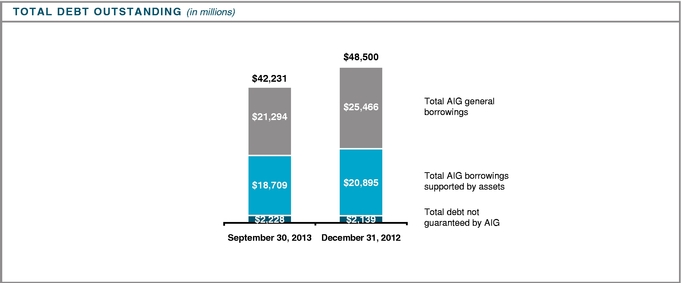
The decrease in total debt outstanding as of September 30, 2013, compared to December 31, 2012, was due to maturities and repayments of debt, including cash tender offers, redemptions and repurchases of certain debt securities discussed above.
Debt Maturities
The following table summarizes maturing debt at September 30, 2013 of AIG (excluding $1.9 billion of borrowings of consolidated investments) for the next four quarters:
|
(in millions)
|
Fourth
Quarter 2013 |
First
Quarter 2014 |
Second
Quarter 2014 |
Third
Quarter 2014 |
Total
|
|||||||||||
|---|---|---|---|---|---|---|---|---|---|---|---|---|---|---|---|---|
|
AIG general borrowings |
$ | 547 | $ | – | $ | – | $ | – | $ | 547 | ||||||
|
AIG borrowings supported by assets |
195 | 365 | 526 | 1,288 | 2,374 | |||||||||||
|
Other subsidiaries notes, bonds, loans and mortgages payable |
1 | – | – | 6 | 7 | |||||||||||
|
Total |
$ | 743 | $ | 365 | $ | 526 | $ | 1,294 | $ | 2,928 | ||||||
AIG borrowings supported by assets consisted of debt under the DIB. At September 30, 2013, all of the debt maturities in the DIB through September 30, 2014 are supported by short-term investments and maturing investments.
153
ITEM 2 / LIQUIDITY AND CAPITAL RESOURCES
The following table presents maturities of long-term debt (including unamortized original issue discount, hedge accounting valuation adjustments and fair value adjustments, when applicable), excluding $1.9 billion in borrowings of consolidated investments:
|
September 30, 2013
|
|
Remainder
|
Year Ending | ||||||||||||||||||||||
|---|---|---|---|---|---|---|---|---|---|---|---|---|---|---|---|---|---|---|---|---|---|---|---|---|---|
|
(in millions)
|
Total
|
of 2013
|
2014
|
2015
|
2016
|
2017
|
2018
|
Thereafter
|
|||||||||||||||||
|
General borrowings: |
|||||||||||||||||||||||||
|
Notes and bonds payable |
$ | 13,582 | $ | 469 | $ | – | $ | 999 | $ | 1,763 | $ | 1,460 | $ | 2,494 | $ | 6,397 | |||||||||
|
Subordinated debt |
250 | – | – | 250 | – | – | – | – | |||||||||||||||||
|
Junior subordinated debt |
6,030 | – | – | – | – | – | – | 6,030 | |||||||||||||||||
|
Loans and mortgages payable |
79 | 78 | – | 1 | – | – | – | – | |||||||||||||||||
|
AIGLH notes and bonds payable |
299 | – | – | – | – | – | – | 299 | |||||||||||||||||
|
AIGLH junior subordinated debt (a) |
1,054 | – | – | – | – | – | – | 1,054 | |||||||||||||||||
|
AIG general borrowings |
$ | 21,294 | $ | 547 | $ | – | $ | 1,250 | $ | 1,763 | $ | 1,460 | $ | 2,494 | $ | 13,780 | |||||||||
|
Borrowings supported by assets: |
|||||||||||||||||||||||||
|
MIP notes payable |
8,243 | – | 1,590 | 1,009 | 1,267 | 3,929 | 448 | – | |||||||||||||||||
|
Series AIGFP matched notes and bonds payable |
3,485 | – | – | – | – | 10 | 3,241 | 234 | |||||||||||||||||
|
GIAs, at fair value |
5,779 | 91 | 611 | 596 | 312 | 250 | 656 | 3,263 | |||||||||||||||||
|
Notes and bonds payable, at fair value |
1,202 | 104 | 28 | 222 | 226 | 128 | 161 | 333 | |||||||||||||||||
|
AIG borrowings supported by assets |
18,709 | 195 | 2,229 | 1,827 | 1,805 | 4,317 | 4,506 | 3,830 | |||||||||||||||||
|
Other subsidiaries notes, bonds, loans and mortgages payable |
346 | 1 | 8 | 45 | 3 | 5 | 3 | 281 | |||||||||||||||||
|
Total |
$ | 40,349 | $ | 743 | $ | 2,237 | $ | 3,122 | $ | 3,571 | $ | 5,782 | $ | 7,003 | $ | 17,891 | |||||||||
(a) On July 11, 2013, AIGLH junior subordinated debentures with the same terms as the trust preferred securities were distributed to holders of the trust preferred securities and the trust preferred securities were cancelled.
Credit ratings estimate a company's ability to meet its obligations and may directly affect the cost and availability of financing to that company. The following table presents the credit ratings of AIG and certain of its subsidiaries as of October 16, 2013. Figures in parentheses indicate the relative ranking of the ratings within the agency's rating categories; that ranking refers only to the major rating category and not to the modifiers assigned by the rating agencies.
|
|
Short-Term Debt | Senior Long-Term Debt | |||||||||
|---|---|---|---|---|---|---|---|---|---|---|---|
|
|
Moody's
|
S&P
|
Moody's
(a)
|
S&P
(b)
|
Fitch
(c)
|
||||||
|
AIG |
P-2 (2nd of 3) | A-2 (2nd of 8) | Baa 1 (4th of 9) | A- (3rd of 8) | BBB (4th of 9) | ||||||
|
|
Stable Outlook | Stable Outlook | Negative Outlook | Stable Outlook | |||||||
|
AIG Financial Products Corp. (d) |
P-2 | A-2 | Baa 1 | A- | – | ||||||
|
|
Stable Outlook | Stable Outlook | Negative Outlook | ||||||||
|
AIG Funding, Inc. (d) |
P-2 | A-2 | – | – | – | ||||||
|
|
Stable Outlook | ||||||||||
(a) Moody's appends numerical modifiers 1, 2 and 3 to the generic rating categories to show relative position within the rating categories.
(b) S&P ratings may be modified by the addition of a plus or minus sign to show relative standing within the major rating categories.
(c) Fitch ratings may be modified by the addition of a plus or minus sign to show relative standing within the major rating categories.
(d) AIG guarantees all obligations of AIG Financial Products Corp. and AIG Funding, Inc.
154
These credit ratings are current opinions of the rating agencies. They may be changed, suspended or withdrawn at any time by the rating agencies as a result of changes in, or unavailability of, information or based on other circumstances. Ratings may also be withdrawn at our request.
We are party to some agreements that contain "ratings triggers". Depending on the ratings maintained by one or more rating agencies, these triggers could result in (i) the termination or limitation of credit availability or require accelerated repayment, (ii) the termination of business contracts or (iii) requirement to post collateral for the benefit of counterparties.
In the event of adverse actions on our long-term debt ratings by the major rating agencies, AIGFP would be required to post additional collateral under some derivative transactions, or could experience termination of the transactions. Such transactions could adversely affect our business, our consolidated results of operations in a reporting period or our liquidity. In the event of a further downgrade of AIG's long-term senior debt ratings, AIGFP would be required to post additional collateral, and certain additional AIGFP counterparties would be permitted to terminate their contracts early.
The actual amount of collateral that we would be required to post to counterparties in the event of such downgrades, or the aggregate amount of payments that we could be required to make, depend on market conditions, the fair value of outstanding affected transactions and other factors prevailing at the time of the downgrade.
For a discussion of the effects of downgrades in the financial strength ratings of our insurance companies or our credit ratings, see Note 9 to the Condensed Consolidated Financial Statements herein and Part I, Item 1A. Risk Factors — Liquidity, Capital and Credit in the 2012 Annual Report.
Dividends and Repurchases of AIG Common Stock
On August 1, 2013, our Board of Directors declared a cash dividend on AIG Common Stock of $0.10 per share, which was paid on September 26, 2013 to shareholders of record on September 12, 2013.
On October 31, 2013, our Board of Directors declared a cash dividend on AIG Common Stock of $0.10 per share, payable on December 19, 2013 to shareholders of record on December 5, 2013. The payment of any future dividends will be at the discretion of our Board of Directors and will depend on various factors, including the regulatory framework applicable to us, as discussed further in Note 11 to the Condensed Consolidated Financial Statements.
On August 1, 2013, our Board of Directors authorized the repurchase of shares of AIG Common Stock, with an aggregate purchase price of up to $1.0 billion, from time to time in the open market, private purchases, through forward, derivative, accelerated repurchase or automatic repurchase transactions or otherwise. The timing of such repurchases will depend on market conditions, our financial condition, results of operations, liquidity and other factors. As of September 30, 2013, we have repurchased approximately four million shares of AIG Common Stock for an aggregate purchase price of approximately $192 million pursuant to this authorization.
Payments of dividends to AIG by its insurance subsidiaries are subject to certain restrictions imposed by regulatory authorities. See Note 20 to the Consolidated Financial Statements in the 2012 Annual Report for additional discussion of restrictions on payments of dividends by AIG's subsidiaries.
155
ITEM 2 / INVESTMENTS
Our investment strategies are tailored to the specific business needs of each operating unit. The investment objectives are driven by the respective business models for AIG Property Casualty, AIG Life and Retirement, and AIG Parent including the DIB. The primary objectives are generation of investment income, preservation of capital, liquidity management and growth of surplus to support the insurance products. The majority of assets backing our insurance liabilities consist of intermediate and long duration fixed maturity securities.
Investments Highlights During the Nine Months Ended September 30, 2013
- •
-
An increase in interest rates on investment grade fixed maturity securities, particularly during the second quarter of
2013, partially offset by narrowing spreads of high yield securities, resulted in net unrealized losses in the investment portfolio. Net unrealized gains in our available-for-sale portfolio declined
to approximately $13 billion as of September 30, 2013 from approximately $25 billion as of December 31, 2012.
- •
-
We continued to make investments in structured securities and other fixed maturity securities with favorable risk versus
return characteristics to improve yields and increase net investment income.
- •
-
Net investment income benefited from higher returns on alternative investments primarily due to the performance of equity
markets.
- •
-
Blended investment yields on new AIG Life and Retirement and AIG Property Casualty investments were lower than blended
rates on investments that were sold, matured or called.
- •
- Other-than-temporary-impairments remained at low levels, with a small portion of impairments attributable to structured securities.
At the local operating unit level, investment strategies are based on considerations that include the local market, general market conditions, liability duration and cash flow characteristics, rating agency and regulatory capital considerations, legal investment limitations, tax optimization and diversification.
- •
-
In the case of AIG Life and Retirement, as well as in the DIB, our fundamental investment strategy is to match the
duration characteristics of the liabilities with assets of comparable duration, to the extent practicable.
- •
-
Fixed maturity securities held by the domestic insurance companies included in AIG Property Casualty historically have
consisted primarily of laddered holdings of tax-exempt municipal bonds, which provided attractive after-tax returns and limited credit risk. To meet the current risk-return and tax objectives of AIG
Property Casualty, cash flows from the investment portfolio and insurance operations are generally being reinvested by the domestic property and casualty companies in taxable instruments which meet
the companies' liquidity, duration and credit quality objectives as well as current risk-return and tax objectives.
- •
-
Outside of the U.S., fixed maturity securities held by AIG Property Casualty companies consist primarily of intermediate
duration high-grade securities generally denominated in the currencies of the countries in which we operate.
- •
- AIG Parent's liquidity resources are held in the form of cash, short-term investments and publicly traded, intermediate-term investment grade rated fixed maturity securities. AIG Parent actively manages its assets and liabilities in terms of products, counterparties and tenor. During the first nine months of 2013, upon an assessment of its immediate and longer-term funding needs, AIG Parent purchased publicly traded, intermediate term, investment grade rated fixed maturity securities that can be readily monetized through sales or repurchase agreements. These securities allow us to diversify sources of liquidity while reducing the cost of maintaining sufficient liquidity.
156
ITEM 2 / INVESTMENTS
At September 30, 2013, approximately 89 percent of fixed maturity securities were held by our domestic entities. Approximately 18 percent of such securities were rated AAA by one or more of the principal rating agencies, and approximately 16 percent were rated below investment grade or not rated. Our investment decision process relies primarily on internally generated fundamental analysis and internal risk ratings. Third-party rating services' ratings and opinions provide one source of independent perspective for consideration in the internal analysis.
A significant portion of our foreign entities' fixed maturity securities portfolio is rated by Moody's, S&P or similar foreign rating services. Rating services are not available for some foreign issued securities. Our Credit Risk Management department closely reviews the credit quality of the foreign portfolio's non-rated fixed maturity securities. At September 30, 2013, approximately 17 percent of such investments were either rated AAA or, on the basis of our internal analysis, were equivalent from a credit standpoint to securities rated AAA, and approximately 3 percent were rated below investment grade or not rated. Approximately 47 percent of the foreign entities' fixed maturity securities portfolio is comprised of sovereign fixed maturity securities supporting policy liabilities in the country of issuance
Composite AIG Credit Ratings
With respect to our fixed maturity investments, the credit ratings in the table below and in subsequent tables reflect: (a) a composite of the ratings of the three major rating agencies, or when agency ratings are not available, the rating assigned by the NAIC Securities Valuations Office (SVO) (over 99 percent of total fixed maturity investments), or (b) our equivalent internal ratings when these investments have not been rated by any of the major rating agencies or the NAIC. The "Non-rated" category in those tables consists of fixed maturity securities that have not been rated by any of the major rating agencies, the NAIC or us.
See Enterprise Risk Management herein for a discussion of credit risks associated with Investments.
157
ITEM 2 / INVESTMENTS
The following table presents the composite AIG credit ratings of our fixed maturity securities calculated on the basis of their fair value:
|
|
Available for Sale | Trading | Total | ||||||||||||||||
|---|---|---|---|---|---|---|---|---|---|---|---|---|---|---|---|---|---|---|---|
|
|
September 30,
|
December 31,
2012 |
September 30,
|
December 31,
2012 |
September 30,
|
December 31,
2012 |
|||||||||||||
|
Rating: |
|
|
|
|
|
|
|
|
|
||||||||||
|
Other fixed maturity securities |
|
|
|
|
|
|
|
|
|
||||||||||
|
AAA |
$
|
18,389
|
|
$ | 21,433 |
$
|
5,649
|
|
$ | 6,047 |
$
|
24,038
|
|
$ | 27,480 | ||||
|
AA |
|
41,643
|
|
44,224 |
|
242
|
|
636 |
|
41,885
|
|
44,860 | |||||||
|
A |
|
57,067
|
|
62,824 |
|
522
|
|
588 |
|
57,589
|
|
63,412 | |||||||
|
BBB |
|
74,983
|
|
78,554 |
|
472
|
|
468 |
|
75,455
|
|
79,022 | |||||||
|
Below investment grade |
|
9,307
|
|
9,775 |
|
312
|
|
265 |
|
9,619
|
|
10,040 | |||||||
|
Non-rated |
|
129
|
|
290 |
|
–
|
|
112 |
|
129
|
|
402 | |||||||
|
Total |
$
|
201,518
|
|
$ | 217,100 |
$
|
7,197
|
|
$ | 8,116 |
$
|
208,715
|
|
$ | 225,216 | ||||
|
Mortgage-backed, asset-backed and collateralized |
|
|
|
|
|
|
|
|
|
||||||||||
|
AAA |
$
|
22,422
|
|
$ | 21,151 |
$
|
3,077
|
|
$ | 2,843 |
$
|
25,499
|
|
$ | 23,994 | ||||
|
AA |
|
3,605
|
|
3,162 |
|
2,452
|
|
2,889 |
|
6,057
|
|
6,051 | |||||||
|
A |
|
6,734
|
|
5,533 |
|
642
|
|
928 |
|
7,376
|
|
6,461 | |||||||
|
BBB |
|
3,972
|
|
3,497 |
|
696
|
|
807 |
|
4,668
|
|
4,304 | |||||||
|
Below investment grade |
|
21,591
|
|
19,390 |
|
8,619
|
|
8,957 |
|
30,210
|
|
28,347 | |||||||
|
Non-rated |
|
59
|
|
126 |
|
201
|
|
44 |
|
260
|
|
170 | |||||||
|
Total |
$
|
58,383
|
|
$ | 52,859 |
$
|
15,687
|
|
$ | 16,468 |
$
|
74,070
|
|
$ | 69,327 | ||||
|
Total |
|
|
|
|
|
|
|
|
|
||||||||||
|
AAA |
$
|
40,811
|
|
$ | 42,584 |
$
|
8,726
|
|
$ | 8,890 |
$
|
49,537
|
|
$ | 51,474 | ||||
|
AA |
|
45,248
|
|
47,386 |
|
2,694
|
|
3,525 |
|
47,942
|
|
50,911 | |||||||
|
A |
|
63,801
|
|
68,357 |
|
1,164
|
|
1,516 |
|
64,965
|
|
69,873 | |||||||
|
BBB |
|
78,955
|
|
82,051 |
|
1,168
|
|
1,275 |
|
80,123
|
|
83,326 | |||||||
|
Below investment grade |
|
30,898
|
|
29,165 |
|
8,931
|
|
9,222 |
|
39,829
|
|
38,387 | |||||||
|
Non-rated |
|
188
|
|
416 |
|
201
|
|
156 |
|
389
|
|
572 | |||||||
|
Total |
$
|
259,901
|
|
$ | 269,959 |
$
|
22,884
|
|
$ | 24,584 |
$
|
282,785
|
|
$ | 294,543 | ||||
158
ITEM 2 / INVESTMENTS
The following tables summarize the composition of AIG's investments by reportable segment:
|
|
Reportable Segment |
|
|
|
||||||||||||
|---|---|---|---|---|---|---|---|---|---|---|---|---|---|---|---|---|
|
|
|
Consolidation
and Eliminations |
|
|||||||||||||
|
(in millions)
|
AIG Property
Casualty |
AIG Life and
Retirement |
Other
Operations |
Total
|
||||||||||||
|
September 30, 2013 |
||||||||||||||||
|
Fixed maturity securities: |
||||||||||||||||
|
Bonds available for sale, at fair value |
$ | 99,023 | $ | 154,160 | $ | 10,693 | $ | (3,975 | ) | $ | 259,901 | |||||
|
Bond trading securities, at fair value |
1,947 | 2,430 | 18,834 | (327 | ) | 22,884 | ||||||||||
|
Equity securities: |
||||||||||||||||
|
Common and preferred stock available for sale, at fair value |
3,267 | 98 | 13 | – | 3,378 | |||||||||||
|
Common and preferred stock trading, at fair value |
181 | 523 | 103 | – | 807 | |||||||||||
|
Mortgage and other loans receivable, net of allowance |
1,437 | 18,705 | 1,176 | (1,611 | ) | 19,707 | ||||||||||
|
Other invested assets |
13,271 | 12,816 | 3,210 | (129 | ) | 29,168 | ||||||||||
|
Short-term investments |
4,464 | 7,123 | 12,846 | (1,976 | ) | 22,457 | ||||||||||
|
Total investments * |
123,590 | 195,855 | 46,875 | (8,018 | ) | 358,302 | ||||||||||
|
Cash |
1,337 | 462 | 259 | – | 2,058 | |||||||||||
|
Total invested assets |
$ | 124,927 | $ | 196,317 | $ | 47,134 | $ | (8,018 | ) | $ | 360,360 | |||||
|
December 31, 2012 |
||||||||||||||||
|
Fixed maturity securities: |
||||||||||||||||
|
Bonds available for sale, at fair value |
$ | 102,563 | $ | 163,550 | $ | 6,580 | $ | (2,734 | ) | $ | 269,959 | |||||
|
Bond trading securities, at fair value |
1,597 | 1,856 | 21,362 | (231 | ) | 24,584 | ||||||||||
|
Equity securities: |
||||||||||||||||
|
Common and preferred stock available for sale, at fair value |
3,093 | 111 | 8 | – | 3,212 | |||||||||||
|
Common and preferred stock trading, at fair value |
– | 562 | 100 | – | 662 | |||||||||||
|
Mortgage and other loans receivable, net of allowance |
2,839 | 18,755 | 2,015 | (4,127 | ) | 19,482 | ||||||||||
|
Other invested assets |
12,720 | 12,737 | 3,280 | 380 | 29,117 | |||||||||||
|
Short-term investments |
7,935 | 7,392 | 14,432 | (951 | ) | 28,808 | ||||||||||
|
Total investments * |
130,747 | 204,963 | 47,777 | (7,663 | ) | 375,824 | ||||||||||
|
Cash |
649 | 297 | 205 | – | 1,151 | |||||||||||
|
Total invested assets |
$ | 131,396 | $ | 205,260 | $ | 47,982 | $ | (7,663 | ) | $ | 376,975 | |||||
* At September 30, 2013 approximately 89 percent and 11 percent of investments were held by domestic and foreign entities, respectively, compared to approximately 88 percent and 12 percent, respectively, at December 31, 2012.
AIG Property Casualty
In our property casualty business, the duration of liabilities for long-tail casualty lines is greater than that for other lines. As differentiated from the life insurance and retirement services companies, the focus is not on asset-liability matching, but on preservation of capital and growth of surplus.
Fixed maturity securities of AIG Property Casualty domestic operations, with an average duration of 4.1 years, are currently comprised primarily of tax-exempt securities, which provide attractive risk-adjusted after-tax returns as well as taxable municipal bonds, government and agency bonds, and corporate bonds. The majority of these high quality investments are rated A or higher based on composite ratings.
159
ITEM 2 / INVESTMENTS
Fixed maturity securities held in AIG Property Casualty foreign operations are of high quality and short to intermediate duration, averaging 4.1 years.
While invested assets backing reserves are primarily invested in conventional fixed maturity securities in AIG Property Casualty domestic operations, a modest portion of surplus is allocated to alternative investments, including private equity and hedge funds. These investments have provided a combination of added diversification and attractive long-term returns over time.
AIG Life and Retirement
With respect to AIG Life and Retirement, we use asset-liability management as a tool to determine the composition of the invested assets. Our objective is to maintain an average duration in our asset and liability structure, although we may occasionally determine that it is economically advantageous to be temporarily in an unmatched position. To the extent that we have maintained a matched asset-liability structure, the economic effect of interest rate fluctuations is partially mitigated.
Our investment strategy for AIG Life and Retirement is to produce cash flows greater than maturing insurance liabilities. There exists a future investment risk associated with certain policies currently in-force which will have premium receipts in the future. That is, the investment of these future premium receipts may be at a yield below that required to meet future policy liabilities.
AIG Life and Retirement frequently reviews its interest rate assumptions and actively manages the crediting rates used for its new and in force business. Business strategies continue to evolve to maintain profitability of the overall business in a low interest rate environment.
The investment of insurance cash flows and reinvestment of the proceeds from investment activity requires active management of investment yields while maintaining satisfactory investment quality and liquidity.
A number of guaranteed benefits, such as living benefits and guaranteed minimum death benefits, are offered on certain variable and indexed annuity products. The fair value of these benefits is measured based on actuarial and capital market assumptions related to projected cash flows over the expected lives of the contracts. We manage our exposure resulting from these long-term guarantees through reinsurance or capital market hedging instruments. We actively review underlying assumptions of policyholder behavior and persistency related to these guarantees. We have taken positions in certain derivative financial instruments in order to hedge the impact of changes in equity markets and interest rates on these benefit guarantees. We execute listed futures and options contracts on equity indexes to hedge certain guarantees of variable and indexed annuity products. We also enter into various types of futures and options contracts, primarily to hedge changes in value of certain guarantees of variable and indexed annuities due to fluctuations in interest rates. We use several instruments to hedge interest rate exposure, including listed futures on government securities, listed options on government securities and the purchase of government securities.
With respect to over-the-counter derivatives, we deal with highly rated counterparties and do not expect the counterparties to fail to meet their obligations under the contracts. We have controls in place to monitor credit exposures by limiting transactions with specific counterparties within specified dollar limits and assessing the creditworthiness of counterparties periodically. We generally use ISDA Master Agreements and Credit Support Annexes (CSAs) with bilateral collateral provisions to reduce counterparty credit exposures.
Fixed maturity securities of AIG Life and Retirement, with an average duration of 6.7 years, are comprised of taxable corporate bonds, as well as municipal and government bonds, and agency and non-agency structured securities. The majority of these investments are held in the available for sale portfolio and are rated investment grade based on our composite ratings.
160
ITEM 2 / INVESTMENTS
Available-for-Sale Investments
The following table presents the fair value of AIG's available-for-sale securities:
|
|
|
|
|||||
|---|---|---|---|---|---|---|---|
|
(in millions)
|
Fair Value at
|
Fair Value at
December 31, 2012 |
|||||
|
Bonds available for sale: |
|
|
|
||||
|
U.S. government and government sponsored entities |
$
|
3,435
|
|
$ | 3,483 | ||
|
Obligations of states, municipalities and political subdivisions |
|
30,881
|
|
35,705 | |||
|
Non-U.S. governments |
|
23,034
|
|
26,800 | |||
|
Corporate debt |
|
144,168
|
|
151,112 | |||
|
Mortgage-backed, asset-backed and collateralized: |
|
|
|
||||
|
RMBS |
|
36,476
|
|
34,392 | |||
|
CMBS |
|
11,512
|
|
9,915 | |||
|
CDO/ABS |
|
10,395
|
|
8,552 | |||
|
Total mortgage-backed, asset-backed and collateralized |
|
58,383
|
|
52,859 | |||
|
Total bonds available for sale * |
|
259,901
|
|
269,959 | |||
|
Equity securities available for sale: |
|
|
|
||||
|
Common stock |
|
3,018
|
|
3,029 | |||
|
Preferred stock |
|
77
|
|
78 | |||
|
Mutual funds |
|
283
|
|
105 | |||
|
Total equity securities available for sale |
|
3,378
|
|
3,212 | |||
|
Total |
$
|
263,279
|
|
$ | 273,171 | ||
* At September 30, 2013 and December 31, 2012, bonds available for sale held by us that were below investment grade or not rated totaled $31.1 billion and $29.6 billion, respectively.
Investments in Municipal Bonds
At September 30, 2013, the U.S. municipal bond portfolio of AIG Property Casualty was composed primarily of essential service revenue bonds and high-quality tax-backed bonds with over 98 percent of the portfolio rated A or higher.
The following table presents the fair values of our available for sale U.S. municipal bond portfolio by state and municipal bond type:
|
September 30, 2013
(in millions) |
State
General Obligation |
Local
General Obligation |
Revenue
|
Total
Fair Value |
|||||||||
|---|---|---|---|---|---|---|---|---|---|---|---|---|---|
|
State: |
|||||||||||||
|
Texas |
$ | 227 | $ | 2,165 | $ | 1,976 | $ | 4,368 | |||||
|
California |
627 | 1,004 | 2,645 | 4,276 | |||||||||
|
New York |
27 | 786 | 3,452 | 4,265 | |||||||||
|
Washington |
594 | 213 | 684 | 1,491 | |||||||||
|
Massachusetts |
748 | – | 725 | 1,473 | |||||||||
|
Illinois |
149 | 594 | 691 | 1,434 | |||||||||
|
Florida |
290 | 9 | 885 | 1,184 | |||||||||
|
Virginia |
88 | 114 | 816 | 1,018 | |||||||||
|
Georgia |
470 | 155 | 369 | 994 | |||||||||
|
Arizona |
– | 148 | 726 | 874 | |||||||||
|
Ohio |
171 | 114 | 432 | 717 | |||||||||
|
Maryland |
410 | 77 | 159 | 646 | |||||||||
|
Wisconsin |
291 | 48 | 298 | 637 | |||||||||
|
All other states |
1,411 | 1,092 | 5,001 | 7,504 | |||||||||
|
Total (a)(b) |
$ | 5,503 | $ | 6,519 | $ | 18,859 | $ | 30,881 | |||||
(a) Excludes certain university and not- for- profit entities that issue their bonds in the corporate debt market. Includes industrial revenue bonds.
(b) Includes $7.0 billion of pre-refunded municipal bonds.
161
ITEM 2 / INVESTMENTS
Investments in Corporate Debt Securities
The following table presents the industry categories of our available for sale corporate debt securities:
|
|
|
|
|||||
|---|---|---|---|---|---|---|---|
|
Industry Category
(in millions) |
Fair Value at
|
Fair Value at
December 31, 2012 |
|||||
|
Financial institutions: |
|
|
|
||||
|
Money Center /Global Bank Groups |
$
|
11,826
|
|
$ | 12,300 | ||
|
Regional banks — other |
|
636
|
|
885 | |||
|
Life insurance |
|
3,783
|
|
4,180 | |||
|
Securities firms and other finance companies |
|
482
|
|
636 | |||
|
Insurance non-life |
|
4,810
|
|
5,429 | |||
|
Regional banks — North America |
|
6,767
|
|
7,729 | |||
|
Other financial institutions |
|
7,802
|
|
7,633 | |||
|
Utilities |
|
23,225
|
|
24,993 | |||
|
Communications |
|
10,858
|
|
11,744 | |||
|
Consumer noncyclical |
|
17,247
|
|
17,307 | |||
|
Capital goods |
|
9,031
|
|
9,697 | |||
|
Energy |
|
11,399
|
|
11,275 | |||
|
Consumer cyclical |
|
10,689
|
|
10,781 | |||
|
Basic |
|
9,496
|
|
9,753 | |||
|
Other |
|
16,117
|
|
16,770 | |||
|
Total * |
$
|
144,168
|
|
$ | 151,112 | ||
* At September 30, 2013 and December 31, 2012, approximately 94 percent of these investments were rated investment grade, respectively.
162
ITEM 2 / INVESTMENTS
Investments in RMBS
The following table presents AIG's RMBS available for sale investments by year of vintage:
|
|
|
|
|||||
|---|---|---|---|---|---|---|---|
|
(in millions)
|
Fair Value at
|
Fair Value at
December 31, 2012 |
|||||
|
Total RMBS |
|
|
|
||||
|
2013 |
$
|
1,887
|
|
$ | – | ||
|
2012 |
|
2,434
|
|
1,630 | |||
|
2011 |
|
6,389
|
|
7,545 | |||
|
2010 |
|
1,966
|
|
2,951 | |||
|
2009 |
|
239
|
|
378 | |||
|
2008 and prior * |
|
23,561
|
|
21,888 | |||
|
Total RMBS |
$
|
36,476
|
|
$ | 34,392 | ||
|
Agency |
|
|
|
||||
|
2013 |
$
|
1,819
|
|
$ | – | ||
|
2012 |
|
2,229
|
|
1,395 | |||
|
2011 |
|
4,495
|
|
5,498 | |||
|
2010 |
|
1,914
|
|
2,812 | |||
|
2009 |
|
178
|
|
321 | |||
|
2008 and prior |
|
2,575
|
|
3,548 | |||
|
Total Agency |
$
|
13,210
|
|
$ | 13,574 | ||
|
Alt-A |
|
|
|
||||
|
2010 |
|
41
|
|
53 | |||
|
2008 and prior |
|
10,074
|
|
7,871 | |||
|
Total Alt-A |
$
|
10,115
|
|
$ | 7,924 | ||
|
Subprime |
|||||||
|
2008 and prior |
$
|
2,337
|
|
$ | 2,151 | ||
|
Total Subprime |
$
|
2,337
|
|
$ | 2,151 | ||
|
Prime non-agency |
|
|
|
||||
|
2013 |
$
|
20
|
|
$ | – | ||
|
2012 |
|
205
|
|
235 | |||
|
2011 |
|
1,894
|
|
2,047 | |||
|
2010 |
|
12
|
|
86 | |||
|
2009 |
|
61
|
|
58 | |||
|
2008 and prior |
|
8,111
|
|
7,910 | |||
|
Total Prime non-agency |
$
|
10,303
|
|
$ | 10,336 | ||
|
Total Other housing related |
$
|
511
|
|
$ | 407 | ||
* Includes approximately $10.7 billion and $8.8 billion at September 30, 2013 and December 31, 2012, respectively of Purchased Credit Impaired securities that were purchased at a significant discount to amortized cost commencing in the second quarter of 2011.
163
ITEM 2 / INVESTMENTS
The following table presents our RMBS available for sale investments by credit rating:
|
|
|
|
|||||
|---|---|---|---|---|---|---|---|
|
(in millions)
|
Fair Value at
|
Fair Value at
December 31, 2012 |
|||||
|
Rating: |
|
|
|
||||
|
Total RMBS |
|
|
|
||||
|
AAA |
$
|
15,851
|
|
$ | 16,048 | ||
|
AA |
|
452
|
|
795 | |||
|
A |
|
615
|
|
411 | |||
|
BBB |
|
1,093
|
|
744 | |||
|
Below investment grade (a) |
|
18,445
|
|
16,283 | |||
|
Non-rated |
|
20
|
|
111 | |||
|
Total RMBS (b) |
$
|
36,476
|
|
$ | 34,392 | ||
|
Agency RMBS |
|
|
|
||||
|
AAA |
$
|
13,204
|
|
$ | 13,464 | ||
|
AA |
|
6
|
|
110 | |||
|
Total Agency |
$
|
13,210
|
|
$ | 13,574 | ||
|
Alt-A RMBS |
|
|
|
||||
|
AAA |
$
|
31
|
|
$ | 57 | ||
|
AA |
|
61
|
|
195 | |||
|
A |
|
120
|
|
83 | |||
|
BBB |
|
398
|
|
314 | |||
|
Below investment grade (a) |
|
9,505
|
|
7,275 | |||
|
Total Alt-A |
$
|
10,115
|
|
$ | 7,924 | ||
|
Subprime RMBS |
|
|
|
||||
|
AAA |
$
|
32
|
|
$ | 38 | ||
|
AA |
|
86
|
|
170 | |||
|
A |
|
234
|
|
129 | |||
|
BBB |
|
270
|
|
185 | |||
|
Below investment grade (a) |
|
1,715
|
|
1,629 | |||
|
Total Subprime |
$
|
2,337
|
|
$ | 2,151 | ||
|
Prime non-agency |
|
|
|
||||
|
AAA |
$
|
2,525
|
|
$ | 2,487 | ||
|
AA |
|
287
|
|
317 | |||
|
A |
|
258
|
|
196 | |||
|
BBB |
|
387
|
|
208 | |||
|
Below investment grade (a) |
|
6,826
|
|
7,017 | |||
|
Non-rated |
|
20
|
|
111 | |||
|
Total prime non-agency |
$
|
10,303
|
|
$ | 10,336 | ||
|
Total Other housing related |
$
|
511
|
|
$ | 407 | ||
(a) Commencing in the second quarter of 2011, we began purchasing certain RMBS that had experienced deterioration in credit quality since their origination. See Note 6 to the Condensed Consolidated Financial Statements, Investments — Purchased Credit Impaired (PCI) Securities, for additional discussion.
(b) The weighted average expected life was 6 years at both September 30, 2013 and December 31, 2012.
Our underwriting practices for investing in RMBS, other asset-backed securities and CDOs take into consideration the quality of the originator, the manager, the servicer, security credit ratings, underlying characteristics of the mortgages, borrower characteristics, and the level of credit enhancement in the transaction.
164
ITEM 2 / INVESTMENTS
Investments in CMBS
The following table presents our CMBS available for sale investments:
|
|
|
|
|||||
|---|---|---|---|---|---|---|---|
|
(in millions)
|
Fair Value at
|
Fair Value at
December 31, 2012 |
|||||
|
CMBS (traditional) |
$
|
9,349
|
|
$ | 7,880 | ||
|
Agency |
|
1,624
|
|
1,486 | |||
|
Other |
|
539
|
|
549 | |||
|
Total * |
$
|
11,512
|
|
$ | 9,915 | ||
* The increase in value is primarily attributable to net purchases of approximately $2.4 billion of highly rated CMBS securities, partially offset by changes in net unrealized losses.
The following table presents the fair value of our CMBS holdings by rating agency designation and by vintage year:
|
|
||||||||||||||||||||||
|---|---|---|---|---|---|---|---|---|---|---|---|---|---|---|---|---|---|---|---|---|---|---|
|
(in millions)
|
AAA
|
AA
|
A
|
BBB
|
Below
Investment Grade |
Non-Rated
|
Total
|
|||||||||||||||
|
September 30, 2013 |
||||||||||||||||||||||
|
Year: |
||||||||||||||||||||||
|
2013 |
$ | 1,954 | $ | 352 | $ | 74 | $ | 26 | $ | – | $ | – | $ | 2,406 | ||||||||
|
2012 |
1,064 | 57 | 26 | 36 | – | 14 | 1,197 | |||||||||||||||
|
2011 |
1,141 | 19 | 36 | 20 | – | – | 1,216 | |||||||||||||||
|
2010 |
176 | 473 | – | – | – | – | 649 | |||||||||||||||
|
2009 |
5 | – | – | – | – | – | 5 | |||||||||||||||
|
2008 and prior |
1,226 | 847 | 705 | 1,087 | 2,174 | – | 6,039 | |||||||||||||||
|
Total |
$ | 5,566 | $ | 1,748 | $ | 841 | $ | 1,169 | $ | 2,174 | $ | 14 | $ | 11,512 | ||||||||
|
December 30, 2012 |
||||||||||||||||||||||
|
Year: |
||||||||||||||||||||||
|
2012 |
$ | 1,314 | $ | 46 | $ | 24 | $ | 28 | $ | – | $ | 15 | $ | 1,427 | ||||||||
|
2011 |
1,220 | 81 | 24 | 22 | – | – | 1,347 | |||||||||||||||
|
2010 |
265 | 501 | 41 | – | – | – | 807 | |||||||||||||||
|
2009 |
44 | – | – | – | – | – | 44 | |||||||||||||||
|
2008 and prior |
1,433 | 963 | 719 | 1,178 | 1,997 | – | 6,290 | |||||||||||||||
|
Total |
$ | 4,276 | $ | 1,591 | $ | 808 | $ | 1,228 | $ | 1,997 | $ | 15 | $ | 9,915 | ||||||||
The following table presents our CMBS available for sale investments by geographic region:
|
|
|
|
|||||
|---|---|---|---|---|---|---|---|
|
(in millions)
|
Fair Value at
|
Fair Value at
December 31, 2012 |
|||||
|
Geographic region: |
|
|
|
||||
|
New York |
$
|
2,285
|
|
$ | 1,833 | ||
|
California |
|
1,273
|
|
923 | |||
|
Texas |
|
694
|
|
574 | |||
|
Florida |
|
511
|
|
395 | |||
|
New Jersey |
|
402
|
|
267 | |||
|
Virginia |
|
388
|
|
319 | |||
|
Illinois |
|
349
|
|
288 | |||
|
Georgia |
|
243
|
|
185 | |||
|
Pennsylvania |
|
238
|
|
198 | |||
|
Hawaii |
|
221
|
|
217 | |||
|
Massachusetts |
|
217
|
|
183 | |||
|
Arizona |
|
216
|
|
127 | |||
|
All Other * |
|
4,475
|
|
4,406 | |||
|
Total |
$
|
11,512
|
|
$ | 9,915 | ||
* Includes Non-U.S. locations.
165
ITEM 2 / INVESTMENTS
The following table presents our CMBS available for sale investments by industry:
|
|
|
|
|||||
|---|---|---|---|---|---|---|---|
|
(in millions)
|
Fair Value at
|
Fair Value at
December 31, 2012 |
|||||
|
Industry: |
|
|
|
||||
|
Office |
$
|
3,127
|
|
$ | 2,696 | ||
|
Multi-family * |
|
2,643
|
|
2,423 | |||
|
Retail |
|
3,034
|
|
2,409 | |||
|
Lodging |
|
1,394
|
|
1,215 | |||
|
Industrial |
|
558
|
|
552 | |||
|
Other |
|
756
|
|
620 | |||
|
Total |
$
|
11,512
|
|
$ | 9,915 | ||
* Includes Agency-backed CMBS.
The fair value of CMBS holdings remained stable during the third quarter of 2013. The majority of our investments in CMBS are in tranches that contain substantial protection features through collateral subordination. The majority of CMBS holdings are traditional conduit transactions, broadly diversified across property types and geographical areas.
Investments in CDOs
The following table presents our CDO available for sale investments by collateral type:
|
|
|
|
|||||
|---|---|---|---|---|---|---|---|
|
(in millions)
|
Fair value at
|
Fair value at
December 31, 2012 |
|||||
|
Collateral Type: |
|
|
|
||||
|
Bank loans (CLO) |
$
|
3,982
|
|
$ | 2,579 | ||
|
Synthetic investment grade |
|
–
|
|
25 | |||
|
Other |
|
608
|
|
643 | |||
|
Subprime ABS |
|
–
|
|
10 | |||
|
Total |
$
|
4,590
|
|
$ | 3,257 | ||
The following table presents our CDO available for sale investments by credit rating:
|
|
|
|
|||||
|---|---|---|---|---|---|---|---|
|
(in millions)
|
Fair Value at
|
Fair Value at
December 31, 2012 |
|||||
|
Rating: |
|
|
|
||||
|
AAA |
$
|
378
|
|
$ | 145 | ||
|
AA |
|
1,201
|
|
543 | |||
|
A |
|
1,881
|
|
1,303 | |||
|
BBB |
|
536
|
|
524 | |||
|
Below investment grade |
|
594
|
|
742 | |||
|
Total |
$
|
4,590
|
|
$ | 3,257 | ||
166
ITEM 2 / INVESTMENTS
Commercial Mortgage Loans
At September 30, 2013, we had direct commercial mortgage loan exposure of $14.7 billion. At that date, over 99 percent of the loans were current.
The following table presents the commercial mortgage loan exposure by location and class of loan based on amortized cost:
|
September 30, 2013 (dollars in millions) |
Number
of Loans |
Class |
|
Percent
of Total |
||||||||||||||||||||||||
|---|---|---|---|---|---|---|---|---|---|---|---|---|---|---|---|---|---|---|---|---|---|---|---|---|---|---|---|---|
|
Apartments
|
Offices
|
Retails
|
Industrials
|
Hotels
|
Others
|
Total
|
||||||||||||||||||||||
|
State: |
||||||||||||||||||||||||||||
|
California |
143 | $ | 32 | $ | 806 | $ | 282 | $ | 530 | $ | 390 | $ | 673 | $ | 2,713 | 18 | % | |||||||||||
|
New York |
83 | 645 | 1,297 | 205 | 72 | 101 | 112 | 2,432 | 17 | |||||||||||||||||||
|
New Jersey |
56 | 521 | 336 | 300 | 5 | 31 | 43 | 1,236 | 8 | |||||||||||||||||||
|
Florida |
92 | 87 | 171 | 379 | 87 | 20 | 150 | 894 | 6 | |||||||||||||||||||
|
Texas |
55 | 32 | 254 | 166 | 183 | 150 | 28 | 813 | 6 | |||||||||||||||||||
|
Connecticut |
22 | 279 | 143 | 5 | 44 | – | – | 471 | 3 | |||||||||||||||||||
|
Pennsylvania |
53 | 47 | 98 | 156 | 111 | 16 | 13 | 441 | 3 | |||||||||||||||||||
|
Maryland |
22 | 20 | 140 | 201 | 12 | 4 | 6 | 383 | 3 | |||||||||||||||||||
|
Illinois |
24 | 36 | 175 | 27 | 83 | 36 | – | 357 | 2 | |||||||||||||||||||
|
Ohio |
44 | 146 | 34 | 94 | 62 | – | 2 | 338 | 2 | |||||||||||||||||||
|
Other states |
337 | 521 | 1,277 | 1,112 | 326 | 491 | 510 | 4,237 | 29 | |||||||||||||||||||
|
Foreign |
61 | 1 | 136 | – | 68 | 100 | 121 | 426 | 3 | |||||||||||||||||||
|
Total * |
992 | $ | 2,367 | $ | 4,867 | $ | 2,927 | $ | 1,583 | $ | 1,339 | $ | 1,658 | $ | 14,741 | 100 | % | |||||||||||
* Excludes portfolio valuation losses.
See Note 7 to the Consolidated Financial Statements in the 2012 Annual Report for further discussion.
The following table presents impairments by investment type:
|
|
|
|
|
|
|||||||||
|---|---|---|---|---|---|---|---|---|---|---|---|---|---|
|
|
Three Months Ended
September 30, |
Nine Months Ended
September 30, |
|||||||||||
|
(in millions)
|
2013
|
2012
|
2013
|
2012
|
|||||||||
|
Fixed maturity securities, available for sale |
$
|
36
|
|
$ | 51 |
$
|
94
|
|
$ | 605 | |||
|
Equity securities, available for sale |
|
3
|
|
19 |
|
13
|
|
68 | |||||
|
Private equity funds and hedge funds |
|
17
|
|
44 |
|
109
|
|
275 | |||||
|
Subtotal |
|
56
|
|
114 |
|
216
|
|
948 | |||||
|
Life settlement contracts * |
|
62
|
|
60 |
|
149
|
|
174 | |||||
|
Alternative investments |
|
–
|
|
– |
|
1
|
|
– | |||||
|
Real estate * |
|
–
|
|
– |
|
19
|
|
7 | |||||
|
Total |
$
|
118
|
|
$ | 174 |
$
|
385
|
|
$ | 1,129 | |||
* Impairments of investments in Life settlement contracts and Real estate are recorded in Other realized losses.
167
ITEM 2 / INVESTMENTS
Other-Than-Temporary Impairments
To determine other-than-temporary impairments, we use fundamental credit analyses of individual securities without regard to rating agency ratings. Based on this analysis, we expect to receive cash flows sufficient to cover the amortized cost of all below investment grade securities for which credit impairments were not recognized.
The following tables present other-than-temporary impairment charges recorded in earnings on fixed maturity securities, equity securities, private equity funds and hedge funds.
Other-than-temporary impairment charges by reportable segment and impairment type:
|
|
|||||||||||||
|---|---|---|---|---|---|---|---|---|---|---|---|---|---|
|
|
Reportable Segment |
|
|
||||||||||
|
(in millions)
|
AIG Property
Casualty |
AIG Life and
Retirement |
Other
Operations |
Total
|
|||||||||
|
Three Months Ended September 30, 2013 |
|||||||||||||
|
Impairment Type: |
|||||||||||||
|
Severity |
$ | – | $ | – | $ | – | $ | – | |||||
|
Change in intent |
– | – | 1 | 1 | |||||||||
|
Foreign currency declines |
– | – | – | – | |||||||||
|
Issuer-specific credit events |
13 | 42 | – | 55 | |||||||||
|
Adverse projected cash flows |
– | – | – | – | |||||||||
|
Total |
$ | 13 | $ | 42 | $ | 1 | $ | 56 | |||||
|
Three Months Ended September 30, 2012 |
|||||||||||||
|
Impairment Type: |
|||||||||||||
|
Severity |
$ | – | $ | 1 | $ | – | $ | 1 | |||||
|
Change in intent |
1 | – | 4 | 5 | |||||||||
|
Foreign currency declines |
1 | – | – | 1 | |||||||||
|
Issuer-specific credit events |
29 | 78 | – | 107 | |||||||||
|
Adverse projected cash flows |
– | – | – | – | |||||||||
|
Total |
$ | 31 | $ | 79 | $ | 4 | $ | 114 | |||||
|
Nine Months Ended September 30, 2013 |
|||||||||||||
|
Impairment Type: |
|||||||||||||
|
Severity |
$ | 5 | $ | – | $ | – | $ | 5 | |||||
|
Change in intent |
2 | – | 2 | 4 | |||||||||
|
Foreign currency declines |
– | – | – | – | |||||||||
|
Issuer-specific credit events |
33 | 167 | – | 200 | |||||||||
|
Adverse projected cash flows |
1 | 6 | – | 7 | |||||||||
|
Total |
$ | 41 | $ | 173 | $ | 2 | $ | 216 | |||||
|
Nine Months Ended September 30, 2012 |
|||||||||||||
|
Impairment Type: |
|||||||||||||
|
Severity |
$ | 9 | $ | 6 | $ | – | $ | 15 | |||||
|
Change in intent |
3 | 20 | 4 | 27 | |||||||||
|
Foreign currency declines |
7 | – | – | 7 | |||||||||
|
Issuer-specific credit events |
310 | 558 | 27 | 895 | |||||||||
|
Adverse projected cash flows |
1 | 3 | – | 4 | |||||||||
|
Total |
$ | 330 | $ | 587 | $ | 31 | $ | 948 | |||||
168
ITEM 2 / INVESTMENTS
Other-than-temporary impairment charges by investment type and impairment type:
|
|
|||||||||||||||||||
|---|---|---|---|---|---|---|---|---|---|---|---|---|---|---|---|---|---|---|---|
|
(in millions)
|
RMBS
|
CDO/ABS
|
CMBS
|
Other Fixed
Maturity |
Equities/Other
Invested Assets * |
Total
|
|||||||||||||
|
Three Months Ended September 30, 2013 |
|||||||||||||||||||
|
Impairment Type: |
|||||||||||||||||||
|
Severity |
$ | – | $ | – | $ | – | $ | – | $ | – | $ | – | |||||||
|
Change in intent |
1 | – | – | – | – | 1 | |||||||||||||
|
Foreign currency declines |
– | – | – | – | – | – | |||||||||||||
|
Issuer-specific credit events |
9 | 1 | 10 | 15 | 20 | 55 | |||||||||||||
|
Adverse projected cash flows |
– | – | – | – | – | – | |||||||||||||
|
Total |
$ | 10 | $ | 1 | $ | 10 | $ | 15 | $ | 20 | $ | 56 | |||||||
|
Three Months Ended September 30, 2012 |
|||||||||||||||||||
|
Impairment Type: |
|||||||||||||||||||
|
Severity |
$ | – | $ | – | $ | – | $ | – | $ | 1 | $ | 1 | |||||||
|
Change in intent |
4 | – | – | 1 | – | 5 | |||||||||||||
|
Foreign currency declines |
– | – | – | 1 | – | 1 | |||||||||||||
|
Issuer-specific credit events |
19 | 1 | 27 | – | 60 | 107 | |||||||||||||
|
Adverse projected cash flows |
– | – | – | – | – | – | |||||||||||||
|
Total |
$ | 23 | $ | 1 | $ | 27 | $ | 2 | $ | 61 | $ | 114 | |||||||
|
Nine Months Ended September 30, 2013 |
|||||||||||||||||||
|
Impairment Type: |
|||||||||||||||||||
|
Severity |
$ | – | $ | – | $ | – | $ | – | $ | 5 | $ | 5 | |||||||
|
Change in intent |
1 | – | – | 1 | 2 | 4 | |||||||||||||
|
Foreign currency declines |
– | – | – | – | – | – | |||||||||||||
|
Issuer-specific credit events |
18 | 4 | 38 | 25 | 115 | 200 | |||||||||||||
|
Adverse projected cash flows |
7 | – | – | – | – | 7 | |||||||||||||
|
Total |
$ | 26 | $ | 4 | $ | 38 | $ | 26 | $ | 122 | $ | 216 | |||||||
|
Nine Months Ended September 30, 2012 |
|||||||||||||||||||
|
Impairment Type: |
|||||||||||||||||||
|
Severity |
$ | – | $ | – | $ | – | $ | – | $ | 15 | $ | 15 | |||||||
|
Change in intent |
4 | – | – | 1 | 22 | 27 | |||||||||||||
|
Foreign currency declines |
– | – | – | 7 | – | 7 | |||||||||||||
|
Issuer-specific credit events |
419 | 6 | 144 | 21 | 305 | 895 | |||||||||||||
|
Adverse projected cash flows |
4 | – | – | – | – | 4 | |||||||||||||
|
Total |
$ | 427 | $ | 6 | $ | 144 | $ | 29 | $ | 342 | $ | 948 | |||||||
* Includes other-than-temporary impairment charges on private equity funds, hedge funds and direct private equity investments.
169
ITEM 2 / INVESTMENTS
Other-than-temporary impairment charges by investment type and credit rating:
|
|
|||||||||||||||||||
|---|---|---|---|---|---|---|---|---|---|---|---|---|---|---|---|---|---|---|---|
|
(in millions)
|
RMBS
|
CDO/ABS
|
CMBS
|
Other Fixed
Maturity |
Equities/Other
Invested Assets * * |
Total
|
|||||||||||||
|
Three Months Ended September 30, 2013 |
|||||||||||||||||||
|
Rating: |
|||||||||||||||||||
|
AAA |
$ | – | $ | – | $ | – | $ | – | $ | – | $ | – | |||||||
|
AA |
1 | – | – | – | – | 1 | |||||||||||||
|
A |
1 | – | – | – | – | 1 | |||||||||||||
|
BBB |
– | – | – | – | – | – | |||||||||||||
|
Below investment grade |
8 | 1 | 10 | 15 | – | 34 | |||||||||||||
|
Non-rated |
– | – | – | – | 20 | 20 | |||||||||||||
|
Total |
$ | 10 | $ | 1 | $ | 10 | $ | 15 | $ | 20 | $ | 56 | |||||||
|
Three Months Ended September 30, 2012 |
|||||||||||||||||||
|
Rating: |
|||||||||||||||||||
|
AAA |
$ | – | $ | – | $ | – | $ | 2 | $ | – | $ | 2 | |||||||
|
AA |
5 | – | – | – | – | 5 | |||||||||||||
|
A |
– | – | – | – | – | – | |||||||||||||
|
BBB |
– | – | – | – | – | – | |||||||||||||
|
Below investment grade |
18 | 1 | 27 | – | – | 46 | |||||||||||||
|
Non-rated |
– | – | – | – | 61 | 61 | |||||||||||||
|
Total |
$ | 23 | $ | 1 | $ | 27 | $ | 2 | $ | 61 | $ | 114 | |||||||
|
Nine Months Ended September 30, 2013 |
|||||||||||||||||||
|
Rating: |
|||||||||||||||||||
|
AAA |
$ | 1 | $ | – | $ | – | $ | – | $ | – | $ | 1 | |||||||
|
AA |
1 | – | – | – | – | 1 | |||||||||||||
|
A |
1 | – | – | – | – | 1 | |||||||||||||
|
BBB |
– | – | – | – | – | – | |||||||||||||
|
Below investment grade |
23 | 4 | 38 | 25 | – | 90 | |||||||||||||
|
Non-rated |
– | – | – | 1 | 122 | 123 | |||||||||||||
|
Total |
$ | 26 | $ | 4 | $ | 38 | $ | 26 | $ | 122 | $ | 216 | |||||||
|
Nine Months Ended September 30, 2012 |
|||||||||||||||||||
|
Rating: |
|||||||||||||||||||
|
AAA |
$ | – | $ | – | $ | – | $ | 2 | $ | – | $ | 2 | |||||||
|
AA |
7 | – | – | – | – | 7 | |||||||||||||
|
A |
1 | 2 | – | 4 | – | 7 | |||||||||||||
|
BBB |
2 | – | – | – | – | 2 | |||||||||||||
|
Below investment grade |
417 | 4 | 144 | 23 | – | 588 | |||||||||||||
|
Non-rated |
– | – | – | – | 342 | 342 | |||||||||||||
|
Total |
$ | 427 | $ | 6 | $ | 144 | $ | 29 | $ | 342 | $ | 948 | |||||||
* Includes other-than-temporary impairment charges on private equity funds, hedge funds and direct private equity investments.
We recorded other-than-temporary impairment charges in the three- and nine-month periods ended September 30, 2013 and 2012 related to:
- •
-
issuer-specific credit events;
- •
-
securities for which we have changed our intent from hold to sell;
- •
-
declines due to foreign exchange rates;
- •
-
adverse changes in estimated cash flows on certain structured securities;
- •
-
securities that experienced severe market valuation declines; and
- •
- other impairments, including equity securities, private equity funds, hedge funds, direct private equity investments, aircraft trusts and investments in life settlement contracts.
170
There was no significant impact to our consolidated financial condition or results of operations from other-than-temporary impairment charges for any one single credit. Also, no individual other-than-temporary impairment charge exceeded 0.02 percent and 0.10 percent of total equity at September 30, 2013 and 2012, respectively.
In periods subsequent to the recognition of an other-than-temporary impairment charge for available for sale fixed maturity securities that is not foreign-exchange related, we generally prospectively accrete into earnings the difference between the new amortized cost and the expected undiscounted recovery value over the remaining life of the security. The accretion that was recognized for these securities in earnings was $184 million and $215 million for the three-month periods ended September 30, 2013 and 2012, respectively, and $611 million and $668 million for the nine-month periods ended September 30, 2013 and 2012, respectively. For a discussion of AIG's other-than-temporary impairment accounting policy, see Note 7 to the Consolidated Financial Statements in the 2012 Annual Report.
The following table shows the aging of the pre-tax unrealized losses of fixed maturity and equity securities, the extent to which the fair value is less than amortized cost or cost, and the number of respective items in each category:
|
September 30, 2013
|
|
Less Than or Equal
to 20% of Cost (b) |
|
Greater Than 20%
to 50% of Cost (b) |
|
Greater Than 50%
of Cost (b) |
|
Total | |||||||||||||||||||||||||||||||||||||
|---|---|---|---|---|---|---|---|---|---|---|---|---|---|---|---|---|---|---|---|---|---|---|---|---|---|---|---|---|---|---|---|---|---|---|---|---|---|---|---|---|---|---|---|---|---|
|
Aging
(a)
(dollars in millions) |
|
Cost
(c)
|
Unrealized
Loss |
Items
(e)
|
|
Cost
(c)
|
Unrealized
Loss |
Items
(e)
|
|
Cost
(c)
|
Unrealized
Loss |
Items
(e)
|
|
Cost
(c)
|
Unrealized
Loss (d) |
Items
(e)
|
|||||||||||||||||||||||||||||
|
Investment grade bonds |
|||||||||||||||||||||||||||||||||||||||||||||
|
0 – 6 months |
$ | 55,198 | $ | 2,753 | 4,003 | $ | 320 | $ | 70 | 32 | $ | – | $ | – | – | $ | 55,518 | $ | 2,823 | 4,035 | |||||||||||||||||||||||||
|
7 – 11 months |
4,532 | 397 | 574 | 308 | 74 | 30 | – | – | – | 4,840 | 471 | 604 | |||||||||||||||||||||||||||||||||
|
12 months or more |
4,099 | 355 | 298 | 421 | 101 | 21 | 11 | 9 | 2 | 4,531 | 465 | 321 | |||||||||||||||||||||||||||||||||
|
Total |
$ | 63,829 | $ | 3,505 | 4,875 | $ | 1,049 | $ | 245 | 83 | $ | 11 | $ | 9 | 2 | $ | 64,889 | $ | 3,759 | 4,960 | |||||||||||||||||||||||||
|
Below investment grade bonds |
|||||||||||||||||||||||||||||||||||||||||||||
|
0 – 6 months |
$ | 5,817 | $ | 255 | 791 | $ | 163 | $ | 48 | 9 | $ | 6 | $ | 4 | 1 | $ | 5,986 | $ | 307 | 801 | |||||||||||||||||||||||||
|
7 – 11 months |
483 | 40 | 83 | 61 | 18 | 6 | – | – | – | 544 | 58 | 89 | |||||||||||||||||||||||||||||||||
|
12 months or more |
2,232 | 187 | 295 | 391 | 112 | 60 | 47 | 31 | 12 | 2,670 | 330 | 367 | |||||||||||||||||||||||||||||||||
|
Total |
$ | 8,532 | $ | 482 | 1,169 | $ | 615 | $ | 178 | 75 | $ | 53 | $ | 35 | 13 | $ | 9,200 | $ | 695 | 1,257 | |||||||||||||||||||||||||
|
Total bonds |
|||||||||||||||||||||||||||||||||||||||||||||
|
0 – 6 months |
$ | 61,015 | $ | 3,008 | 4,794 | $ | 483 | $ | 118 | 41 | $ | 6 | $ | 4 | 1 | $ | 61,504 | $ | 3,130 | 4,836 | |||||||||||||||||||||||||
|
7 – 11 months |
5,015 | 437 | 657 | 369 | 92 | 36 | – | – | – | 5,384 | 529 | 693 | |||||||||||||||||||||||||||||||||
|
12 months or more |
6,331 | 542 | 593 | 812 | 213 | 81 | 58 | 40 | 14 | 7,201 | 795 | 688 | |||||||||||||||||||||||||||||||||
|
Total (e) |
$ | 72,361 | $ | 3,987 | 6,044 | $ | 1,664 | $ | 423 | 158 | $ | 64 | $ | 44 | 15 | $ | 74,089 | $ | 4,454 | 6,217 | |||||||||||||||||||||||||
|
Equity securities |
|||||||||||||||||||||||||||||||||||||||||||||
|
0 – 11 months |
$ | 280 | $ | 19 | 74 | $ | 19 | $ | 5 | 21 | $ | – | $ | – | – | $ | 299 | $ | 24 | 95 | |||||||||||||||||||||||||
|
12 months or more |
2 | – | 1 | 1 | 1 | 1 | – | – | – | 3 | 1 | 2 | |||||||||||||||||||||||||||||||||
|
Total |
$ | 282 | $ | 19 | 75 | $ | 20 | $ | 6 | 22 | $ | – | $ | – | – | $ | 302 | $ | 25 | 97 | |||||||||||||||||||||||||
(a) Represents the number of consecutive months that fair value has been less than cost by any amount.
(b) Represents the percentage by which fair value is less than cost at September 30, 2013.
(c) For bonds, represents amortized cost.
(d) The effect on Net income of unrealized losses after taxes will be mitigated upon realization because certain realized losses will result in current decreases in the amortization of certain DAC.
(e) Item count is by CUSIP by subsidiary.
Change in Unrealized Appreciation of Investments
The increases in unrealized depreciation of investments in the first nine months of 2013 were primarily attributable to depreciation in bonds available for sale due to an increase in interest rates on investment grade fixed maturity securities, particularly during the second quarter of 2013, partially offset by narrowing spreads of higher yielding securities.
The increases in unrealized appreciation of investments in the first nine months of 2012 were primarily attributable to appreciation in bonds available for sale due to continued improvements in financial market conditions and significant spread tightening partially offset by higher U.S. Treasury rates.
For the nine-month period ended September 30, 2013, net unrealized gains related to fixed maturity and equity securities decreased by $12.8 billion primarily due to the increase in interest rates for investment grade fixed maturity securities, which more than offset the narrowing of credit spreads for higher yielding securities and the realization of approximately $2.1 billion in gains from sales of securities.
See also Note 6 to the Condensed Consolidated Financial Statements for further discussion of our investment portfolio.
171
ITEM 2 / ENTERPRISE RISK MANAGEMENT
Risk management includes the identification and measurement of various forms of risk, the establishment of risk thresholds and the creation of processes intended to maintain risks within these thresholds while optimizing returns. We consider risk management an integral part of managing our core businesses and a key element of our approach to corporate governance.
|
Overview
|
||
|
We have an integrated process for managing risks throughout our organization in accordance with our firm-wide risk appetite. Our Board of Directors has oversight responsibility for the management of risk. Our Enterprise Risk Management (ERM) Department supervises and integrates the risk management functions in each of our business units, providing senior management with a consolidated view of the firm's major risk positions. Within each business unit, senior leaders and executives approve risk-taking policies and targeted risk tolerance within the framework provided by ERM. ERM supports our businesses and management in the embedding of enterprise risk management in all of our key day to day business processes and in identifying, assessing, quantifying, managing and mitigating the risks taken by us and our businesses. For a further discussion of AIG's risk management program, see Part II, Item 7. MD&A — Enterprise Risk Management in the 2012 Annual Report. |
Enterprise Risk Management (ERM)
• Our ERM framework provides senior management with a consolidated view of our risk appetite and major risk positions. • In each of our business units, senior leaders and executives approve risk-taking policies and targeted risk tolerance within the ERM framework while working with ERM to mitigate risks across the firm. • Risk management is an integral part of how we manage our core businesses. |
|
Overview
Credit risk is defined as the risk that our customers or counterparties are unable or unwilling to repay their contractual obligations when they become due. Credit risk may also result from a downgrade of counterparty's credit ratings.
We devote considerable resources to managing our direct and indirect credit exposures. These exposures may arise from fixed maturity investments, equity securities, deposits, reverse repurchase agreements and repurchase agreements, commercial paper, corporate and consumer loans, leases, reinsurance recoverables, counterparty risk arising from derivatives activities, collateral extended to counterparties, insurance risk cessions to third parties, financial guarantees and letters of credit accepted as collateral.
Our credit risks are managed at the corporate level within ERM. ERM is assisted by credit functions headed by seasoned credit officers in all the business units, whose primary role is to assure appropriate credit risk management relative to our credit risk parameters. Our Chief Credit Officer (CCO) and credit executives are primarily responsible for the development and maintenance of credit risk policies and procedures.
Responsibilities of the CCO and credit executives include:
- •
-
developing and implementing our company-wide credit policies;
- •
-
approving delegated credit authorities to our credit executives;
- •
- managing the approval process for requests for credit limits, program limits and credit transactions above authorities or where concentrations of risk may exist or be incurred;
172
ITEM 2 / ENTERPRISE RISK MANAGEMENT
- •
-
aggregating globally all credit exposure data by counterparty, country, sector and industry and reporting risk
concentrations regularly to and reviewing with senior management;
- •
-
administering regular portfolio credit reviews of investment, derivative and credit-incurring business units and
recommending corrective actions where required;
- •
-
conducting credit research on countries, sectors and asset classes where risk concentrations may exist;
- •
-
developing methodologies for quantification and assessment of credit risks, including the establishment and maintenance of
our internal risk rating process; and
- •
- approving appropriate credit reserves, credit-related other-than-temporary impairments and corresponding methodologies in all credit portfolios.
We monitor and control our company-wide credit risk concentrations and attempt to avoid unwanted or excessive risk accumulations, whether funded or unfunded. To minimize the level of credit risk in some circumstances, we may require third-party guarantees, reinsurance or collateral, such as cash, letters of credit and trust collateral accounts. We treat these guarantees, reinsurance recoverables, letters of credit and trust collateral accounts as credit exposure and include them in our risk concentration exposure data. We identify our aggregate credit exposures to our underlying counterparty risks.
Largest Credit Concentrations
Our single largest credit exposure, the U.S. Government, was 24 percent of Total equity at September 30, 2013 and 25 percent of Total equity at December 31, 2012. Exposure to the U.S. Government primarily includes credit exposure related to U.S. Treasury and government agency securities and to direct and guaranteed exposures to U.S. government-sponsored entities, primarily the Federal National Mortgage Association (Fannie Mae) and the Federal Home Loan Mortgage Corporation (Freddie Mac) based upon their U.S. Government conservatorship. Based on our internal risk ratings, at September 30, 2013, our largest below investment grade-rated credit exposure, apart from ILFC leasing arrangements secured by aircraft with airlines having below investment grade ratings, was related to a non-financial corporate counterparty. That exposure was 0.6 percent of Total equity at both September 30, 2013 and December 31, 2012.
Government Credit Concentrations (non-U.S.)
Our total direct and guaranteed credit exposure to non-U.S. governments is $23.2 billion at September 30, 2013, compared to $23.7 billion in December 31, 2012. Our single largest concentration in this sector was to the government of Japan in the amount of $6.6 billion at September 30, 2013. Most of these securities were held in the investment portfolios of our Japanese insurance operations and are yen denominated.
The following table presents our aggregate credit exposures to non-U.S. governments and their agencies, dependent state-owned enterprises, financial institutions and local governments:
|
|
|
|
|||||
|---|---|---|---|---|---|---|---|
|
(in millions)
|
September 30,
|
December 31,
2012 * |
|||||
|
Japan |
$
|
6,576
|
|
$ | 8,109 | ||
|
Canada |
|
2,760
|
|
2,718 | |||
|
France |
|
1,882
|
|
1,207 | |||
|
Germany |
|
1,371
|
|
1,446 | |||
|
Brazil |
|
1,292
|
|
601 | |||
|
China |
|
1,027
|
|
926 | |||
|
South Korea |
|
677
|
|
693 | |||
|
Singapore |
|
623
|
|
631 | |||
|
United Kingdom |
|
599
|
|
816 | |||
|
Mexico |
|
574
|
|
552 | |||
|
Other |
|
5,856
|
|
6,032 | |||
|
Total |
$
|
23,237
|
|
$ | 23,731 | ||
* The prior period has been changed to reflect the inclusion of Brazil and the exclusion of Australia.
173
ITEM 2 / ENTERPRISE RISK MANAGEMENT
Financial Institution Concentrations
Our single largest industry credit exposure at September 30, 2013 was to the global financial institutions sector as a whole, which includes banks and finance companies, securities firms, and insurance and reinsurance companies, many of which can be highly correlated at times of market stress. As of September 30, 2013, credit exposure to this sector was $78.4 billion, or 79 percent of Total equity, compared to 87 percent at December 31, 2012.
At September 30, 2013:
- •
-
$73.6 billion, or 94 percent, of these global financial institution credit exposures were considered investment grade
based on our internal ratings.
- •
-
$4.8 billion, or 6 percent, were considered non-investment grade based on our internal ratings. Aggregate credit exposure
to the ten largest below investment grade-rated financial institutions was $1.9 billion.
- •
-
Our aggregate credit exposure to fixed maturity securities of the financial institution sector amounted to $32.4 billion.
- •
-
Short-term bank deposit placements, reverse repurchase agreements, repurchase agreements and commercial paper issued by
financial institutions (primarily commercial banks), operating account balances with banks and bank-issued commercial letters of credit supporting insurance credit exposures were $12.9 billion, or 16
percent of the total global financial institution credit exposure.
- •
- The remaining credit exposures to this sector were primarily related to reinsurance recoverables, collateral extended to counterparties mostly pursuant to derivative transactions, derivatives, and captive fronting risk management programs for these financial institutions.
European Concentrations
We actively monitor our European credit exposures, especially those exposures to issuers in the Euro-Zone periphery. We use various stress assumptions to identify issuers and securities warranting review by senior management and to determine the need for mitigating actions. As a mitigating action, we typically decide not to renew maturing exposures or, when the opportunity presents itself, to sell or to tender securities. To date, we have not actively used credit default protection. We periodically evaluate the financial condition of issuers and adjust internal risk ratings as warranted.
The result of these continuing reviews has led us to believe that our combined credit risk exposures in the Euro-Zone are manageable risks given the type and size of exposure and the credit quality and size of the issuers.
174
ITEM 2 / ENTERPRISE RISK MANAGEMENT
The following table presents our aggregate United Kingdom and European credit exposures (excluding ILFC) by major sector:
|
|
|
|
|||||||||||||||||
|---|---|---|---|---|---|---|---|---|---|---|---|---|---|---|---|---|---|---|---|
|
|
September 30, 2013 |
|
|||||||||||||||||
|
(in millions)
|
Sovereign
|
Financial
|
Non-
|
Structured
|
Total
|
December 31,
2012 Total |
|||||||||||||
|
Euro-Zone countries: |
|
|
|
|
|
|
|
|
|
|
|
|
|
|
|
||||
|
France |
$
|
1,882
|
|
$
|
2,859
|
|
$
|
7,298
|
|
$
|
186
|
|
$
|
12,225
|
|
$ | 10,533 | ||
|
Germany |
|
1,371
|
|
|
4,006
|
|
|
4,460
|
|
|
61
|
|
|
9,898
|
|
9,248 | |||
|
Netherlands |
|
235
|
|
|
4,427
|
|
|
2,284
|
|
|
1,590
|
|
|
8,536
|
|
8,333 | |||
|
Spain |
|
158
|
|
|
725
|
|
|
2,330
|
|
|
212
|
|
|
3,425
|
|
4,067 | |||
|
Italy |
|
95
|
|
|
363
|
|
|
1,907
|
|
|
221
|
|
|
2,586
|
|
2,848 | |||
|
Belgium |
|
419
|
|
|
208
|
|
|
973
|
|
|
–
|
|
|
1,600
|
|
1,174 | |||
|
Ireland |
|
–
|
|
|
258
|
|
|
1,026
|
|
|
–
|
|
|
1,284
|
|
1,018 | |||
|
Luxembourg |
|
–
|
|
|
17
|
|
|
644
|
|
|
49
|
|
|
710
|
|
666 | |||
|
Finland |
|
141
|
|
|
33
|
|
|
322
|
|
|
–
|
|
|
496
|
|
432 | |||
|
Austria |
|
115
|
|
|
153
|
|
|
203
|
|
|
–
|
|
|
471
|
|
523 | |||
|
Other Euro-Zone |
|
30
|
|
|
28
|
|
|
196
|
|
|
11
|
|
|
265
|
|
306 | |||
|
Total Euro-Zone |
$
|
4,446
|
|
$
|
13,077
|
|
$
|
21,643
|
|
$
|
2,330
|
|
$
|
41,496
|
|
$ | 39,148 | ||
|
Remainder of Europe |
|
|
|
|
|
|
|
|
|
|
|
|
|
|
|
||||
|
United Kingdom |
$
|
599
|
|
$
|
7,867
|
|
$
|
15,653
|
|
$
|
4,844
|
|
$
|
28,963
|
|
$ | 30,372 | ||
|
Switzerland |
|
73
|
|
|
5,286
|
|
|
2,631
|
|
|
–
|
|
|
7,990
|
|
7,290 | |||
|
Sweden |
|
117
|
|
|
2,699
|
|
|
570
|
|
|
–
|
|
|
3,386
|
|
3,643 | |||
|
Other remainder of Europe |
|
1,072
|
|
|
1,045
|
|
|
3,292
|
|
|
689
|
|
|
6,098
|
|
5,612 | |||
|
Total remainder of Europe |
$
|
1,861
|
|
$
|
16,897
|
|
$
|
22,146
|
|
$
|
5,533
|
|
$
|
46,437
|
|
$ | 46,917 | ||
|
Total |
$
|
6,307
|
|
$
|
29,974
|
|
$
|
43,789
|
|
$
|
7,863
|
|
$
|
87,933
|
|
$ | 86,065 | ||
* Other represents mortgage guaranty insurance risk-in-force ($417 million), primarily in Italy ($173 million) and Spain ($110 million).
Aggregate credit exposure to European governments totaled $6.3 billion at September 30, 2013, compared to $6.0 billion at December 31, 2012. Many of the European governments' ratings have been downgraded by one or more of the major rating agencies, occurring mostly in countries in the Euro-Zone periphery where our government credit exposures (Spain, Italy and Portugal) totaled $256 million at September 30, 2013. The downgrades primarily reflect continued recessionary conditions, large government budget deficits, rising government debt-to-GDP ratios and large financing requirements of these countries. These credit exposures primarily included available-for-sale and trading securities (at fair value) issued by these governments. At September 30, 2013, we had no direct or guaranteed credit exposure to the governments of Greece, Ireland, or Cyprus.
Our exposure to European financial institutions at September 30, 2013 included $18.3 billion of credit exposures to European banks, of which $17.0 billion were considered investment grade based on our internal ratings. Aggregate below investment grade-rated credit exposures to European banks were $1.3 billion. Our credit exposures to banks domiciled in the Euro-Zone countries totaled $8.3 billion at September 30, 2013, of which $4.6 billion were fixed maturity securities. Credit exposures to banks based in the Euro-Zone periphery (Spain, Italy, Ireland, Greece, and Portugal) totaled $1.1 billion, of which $770 million were fixed maturity securities. These credit exposures were primarily to the largest banks in Spain and Italy. Credit exposures to banks based in France totaled $1.8 billion at September 30, 2013, of which $880 million were fixed maturity securities.
In addition, our exposure at September 30, 2013 to European financial institutions included $11.7 billion of aggregate credit exposure to non-bank institutions, mostly insurers and reinsurers, with $9.1 billion, or 77 percent, of credit exposure representing reinsurance recoverable balances. Reinsurance recoverables were primarily to highly rated reinsurers based in Switzerland, Germany and the United Kingdom. At September 30, 2013, $1.5 billion of the aggregate credit exposure to non-banks was fixed maturity securities, all of which were considered investment grade based on our internal ratings.
Of the $21.6 billion of non-financial institution corporate exposure to Euro-Zone countries at September 30, 2013, 94 percent was to fixed maturity securities ($11.3 billion) and insurance-related products ($9.0 billion), with the majority
175
ITEM 2 / ENTERPRISE RISK MANAGEMENT
of the insurance exposures being trade credit insurance ($3.5 billion), captive fronting programs ($3.4 billion), and surety bonds ($1.4 billion). Our exposure to France of $7.3 billion at September 30, 2013 represented the largest single non-financial corporate country exposure within the Euro-Zone, of which $2.8 billion were fixed maturity securities. Approximately two-thirds of the French exposures were to issuers in the utilities, oil and gas, and telecommunications industries. Euro-Zone periphery non-financial institution corporate exposures ($5.4 billion) at September 30, 2013 were heavily weighted towards large multinational corporations or issuers in relatively stable industries, such as regulated utilities (22 percent), telecommunications (14 percent), and oil and gas (9 percent).
Of the $7.4 billion at September 30, 2013 of United Kingdom and European structured product exposures (largely consisting of residential mortgage-backed, commercial mortgage-backed and other asset-backed securities), United Kingdom structured products accounted for 72 percent, while the Netherlands and France comprised 21 percent and 3 percent, respectively. Structured product exposures to the Euro-Zone periphery accounted for 2 percent of the total. Approximately 83 percent of the United Kingdom and European structured products exposures were rated A or better at September 30, 2013 based on external rating agency ratings.
In addition, we had commercial real estate related net equity investments in Europe totaling $325 million and related unfunded commitments of $82 million at September 30, 2013.
The following table presents our aggregate United Kingdom and European credit exposures (excluding ILFC) by product type:
|
|
September 30, 2013 |
|
||||||||||||||||||||
|---|---|---|---|---|---|---|---|---|---|---|---|---|---|---|---|---|---|---|---|---|---|---|
|
(in millions)
|
Fixed
|
Cash and
|
Insurance
|
Reinsurance
|
Other
(d)
|
Total
|
December 31,
2012 Total |
|||||||||||||||
|
Euro-Zone countries: |
|
|
|
|
|
|
|
|
|
|
|
|
|
|
|
|
|
|
||||
|
France |
$
|
5,104
|
|
$
|
571
|
|
$
|
3,739
|
|
$
|
557
|
|
$
|
2,254
|
|
$
|
12,225
|
|
$ | 10,533 | ||
|
Germany |
|
4,460
|
|
|
241
|
|
|
2,512
|
|
|
2,390
|
|
|
295
|
|
|
9,898
|
|
9,248 | |||
|
Netherlands |
|
6,128
|
|
|
21
|
|
|
1,743
|
|
|
641
|
|
|
3
|
|
|
8,536
|
|
8,333 | |||
|
Spain |
|
1,855
|
|
|
112
|
|
|
1,378
|
|
|
54
|
|
|
26
|
|
|
3,425
|
|
4,067 | |||
|
Italy |
|
1,516
|
|
|
1
|
|
|
990
|
|
|
68
|
|
|
11
|
|
|
2,586
|
|
2,848 | |||
|
Belgium |
|
883
|
|
|
–
|
|
|
432
|
|
|
4
|
|
|
281
|
|
|
1,600
|
|
1,174 | |||
|
Ireland |
|
845
|
|
|
41
|
|
|
323
|
|
|
–
|
|
|
75
|
|
|
1,284
|
|
1,018 | |||
|
Luxembourg |
|
312
|
|
|
3
|
|
|
394
|
|
|
1
|
|
|
–
|
|
|
710
|
|
666 | |||
|
Finland |
|
332
|
|
|
7
|
|
|
151
|
|
|
6
|
|
|
–
|
|
|
496
|
|
432 | |||
|
Austria |
|
263
|
|
|
3
|
|
|
193
|
|
|
9
|
|
|
3
|
|
|
471
|
|
523 | |||
|
Other Euro-Zone |
|
84
|
|
|
9
|
|
|
171
|
|
|
1
|
|
|
–
|
|
|
265
|
|
306 | |||
|
Total Euro-Zone |
$
|
21,782
|
|
$
|
1,009
|
|
$
|
12,026
|
|
$
|
3,731
|
|
$
|
2,948
|
|
$
|
41,496
|
|
$ | 39,148 | ||
|
Remainder of Europe |
|
|
|
|
|
|
|
|
|
|
|
|
|
|
|
|
|
|
||||
|
United Kingdom |
$
|
16,398
|
|
$
|
1,104
|
|
$
|
7,996
|
|
$
|
1,972
|
|
$
|
1,493
|
|
$
|
28,963
|
|
$ | 30,372 | ||
|
Switzerland |
|
3,023
|
|
|
241
|
|
|
803
|
|
|
3,833
|
|
|
90
|
|
|
7,990
|
|
7,290 | |||
|
Sweden |
|
1,585
|
|
|
1,412
|
|
|
321
|
|
|
3
|
|
|
65
|
|
|
3,386
|
|
3,643 | |||
|
Other remainder of Europe |
|
3,283
|
|
|
448
|
|
|
2,178
|
|
|
103
|
|
|
86
|
|
|
6,098
|
|
5,612 | |||
|
Total remainder of Europe |
$
|
24,289
|
|
$
|
3,205
|
|
$
|
11,298
|
|
$
|
5,911
|
|
$
|
1,734
|
|
$
|
46,437
|
|
$ | 46,917 | ||
|
Total |
$
|
46,071
|
|
$
|
4,214
|
|
$
|
23,324
|
|
$
|
9,642
|
|
$
|
4,682
|
|
$
|
87,933
|
|
$ | 86,065 | ||
(a) Fixed maturity securities primarily includes available-for-sale and trading securities reported at fair value of $43.4 billion ($43.4 billion amortized cost), and $2.7 billion ($2.6 billion amortized cost), respectively.
(b) Cash and short-term investments include bank deposit placements ($2.5 billion), collateral posted to counterparties against structured products ($1.4 billion), securities purchased under agreements to resell ($168 million) and operating accounts ($69 million).
(c) Insurance credit exposures primarily consist of captive fronting management programs ($10.4 billion), trade credit insurance ($7.3 billion), surety bonds ($1.9 billion), commercial letters of credit supporting insurance credit exposures ($768 million) and mortgage guaranty insurance risk-in-force ($417 million).
(d) Other primarily consists of derivative transactions reported at fair value.
176
ITEM 2 / ENTERPRISE RISK MANAGEMENT
At September 30, 2013, approximately 90 percent of fixed maturity securities in the United Kingdom and European exposures were considered investment grade based on our internal ratings. European financial institution fixed maturity securities exposure was $9.9 billion, of which $1.1 billion were covered bonds (debt securities secured by a pool of financial assets sufficient to cover any bondholder claims and that have full recourse to the issuing bank). During the third quarter of 2013, $4.6 billion of fixed maturity securities were issued by banks domiciled in the Euro-Zone countries. Our subordinated debt holdings and Tier 1 and preference share securities in these banks totaled $850 million and $303 million, respectively, at September 30, 2013. These exposures were predominantly to the largest banks in those countries.
Other Credit Concentrations
We have a risk concentration in the U.S. municipal sector, primarily through the investment portfolios of our insurance companies. A majority of these securities were held in available-for-sale portfolios of our domestic property and casualty insurance companies. See Investments — Available for Sale Investments herein for further details. We had $521 million of additional exposure to the municipal sector outside of our insurance company portfolios at September 30, 2013, compared to $464 million at December 31, 2012. These exposures consisted of derivatives and trading securities (at fair value), and exposure related to other insurance and financial services operations.
We have a risk concentration in the residential mortgage sector in the form of non-agency RMBS, CDO of RMBS as well as our mortgage guaranty insurance business. See Investments — Available for Sale Investments herein for further details on RMBS and CDO investments. The net risk-in-force for UGC was $37.5 billion at September 30, 2013, of which exposure in the United States was $35.9 billion. At September 30, 2013, UGC had no concentration of exposure in any one state that exceeded 10 percent of UGC's total United States exposure.
We also have a risk concentration in the commercial real estate sector in the form of non-agency CMBS, CDO and CMBS as well as commercial mortgage whole loans and equity investments in commercial real estate. See Investments — Available for Sale Investments and Investments — Commercial Mortgage Loans herein for further details.
We also monitor our aggregate cross-border exposures by country and region. Cross-border exposure is defined as an underlying risk that is taken within a country or jurisdiction other than the country or jurisdiction in which an AIG business unit taking the risk is domiciled. These cross-border exposures include both aggregated cross-border credit exposures to unrelated third parties and cross-border investments in our own international subsidiaries. Six countries had cross-border exposures in excess of 10 percent of Total equity at both September 30, 2013 and December 31, 2012. Based on our internal risk ratings, at September 30, 2013, three countries were rated AAA, two were rated AA, and one was rated A. The two largest cross-border exposures were to the United Kingdom and Bermuda.
We regularly review concentration reports in the categories listed above as well as credit trends by risk ratings and credit spreads. We periodically adjust limits and review exposures for risk mitigation to provide reasonable assurance that we do not incur excessive levels of credit risk and that our credit risk profile is properly calibrated across business units.
Market risk is defined as the potential loss arising from adverse fluctuations in interest rates, credit spreads, equity and commodity prices, foreign currencies, and their levels of volatility.
We are exposed to market risks, primarily within our insurance businesses and GCM. In our insurance operations, market risk results primarily from potential mismatches in our asset-liability exposures, rather than speculative positioning. Specifically, our life insurance and retirement businesses collect premiums or deposits from policyholders and invest the proceeds in predominantly long-term, fixed maturity securities. We earn a spread between the asset yield and the cost payable to policyholders. We manage the business so that the cash flows from invested assets are sufficient to meet policyholder obligations when they become due, without the need to sell assets prematurely into a potentially distressed market. In periods of severe market volatility, depressed and illiquid fair values on otherwise performing investments diminish shareholders' equity even without actual credit event related losses.
177
ITEM 2 / ENTERPRISE RISK MANAGEMENT
Our market exposures can be categorized as follows:
- •
-
Benchmark interest rates.
Benchmark interest rates are associated with
either the government/treasury yield curve or the swap curve. The fair value of our significant fixed maturity securities portfolio changes as benchmark interest rates change.
- •
-
Credit spread or risk premium.
Credit spread risk is the potential for
loss due to a change in an instrument's risk premium or yield relative to that of a comparable duration, default-free instrument.
- •
-
Equity and alternative investment prices.
We are exposed to equity and
alternative investment prices affecting a variety of instruments. These include direct investments in common stock and mutual funds, minimum benefit guarantees embedded in the structure of certain
variable annuity and variable life insurance products and other equity-like investments, such as hedge funds and private equity funds, private equity investments, commercial real estate and real
estate funds.
- •
- Foreign currency exchange rates. We are a globally diversified enterprise with significant income, assets and liabilities denominated in, and significant capital deployed in, a variety of currencies.
We use a number of measures and approaches to measure and quantify our market risk exposure, including:
Duration/key rate duration. Duration is the measure of the sensitivities of a fixed-income instrument to the changes in the benchmark yield curve. Key rate duration measures sensitivities to the movement at a given term point on the yield curve.
Scenario analysis. Scenario analysis uses historical, hypothetical, or forward-looking macroeconomic scenarios to assess and report exposures. Examples of hypothetical scenarios include a 100 basis point parallel shift in the yield curve or a 10 percent immediate and simultaneous decrease in world-wide equity markets.
Stress testing. Stress testing is a special form of scenario analysis in which the scenarios are designed to lead to a material adverse outcome. Examples of such scenarios include the stock market crash of October 1987 or the widening of yields or spread of RMBS or CMBS during 2008.
VaR. Value at Risk (VaR) is a summary statistical measure that uses the estimated volatility and correlation of market factors, and a management-determined level of confidence, to estimate how frequently a portfolio of risk exposures could be expected to lose at least a specified amount. As an example, Federal Reserve's Market Risk Measure specifies a VaR based approach to calculate market risk equivalent assets for capital ratio calculations.
Insurance Operations Portfolio Sensitivities
The following table provides estimates of our sensitivity to changes in yield curves, equity prices and foreign currency exchange rates:
|
|
|
|
|
|
|
||||||||||
|---|---|---|---|---|---|---|---|---|---|---|---|---|---|---|---|
|
|
Exposure |
|
Effect | ||||||||||||
|
(dollars in millions)
|
September 30,
|
December 31,
2012 |
Sensitivity Factor
|
September 30,
|
December 31,
2012 |
||||||||||
|
Yield sensitive assets |
$
|
291,211
|
|
$ | 305,809 | 100 bps parallel increase in all yield curves |
$
|
(14,956
|
)
|
$ | (15,786 | ) | |||
|
Equity and alternative |
|
|
|
20% decline in stock prices and value of |
|
|
|
||||||||
|
investments exposure |
$
|
27,511
|
|
$ | 27,131 | alternative investments |
$
|
(5,502
|
)
|
$ | (5,426 | ) | |||
|
Foreign currency exchange |
|
|
|
10% depreciation of all foreign currency |
|
|
|
||||||||
|
rates net exposure |
$
|
9,200
|
|
$ | 9,106 | exchange rates against the U.S. dollar |
$
|
(920
|
)
|
$ | (911 | ) | |||
Exposures to yield curve movements include fixed maturity securities, loans, finance receivables and short-term investments, but exclude consolidated separate account assets. Total yield-sensitive assets decreased 4.8 percent, or approximately $14.6 billion, compared to December 31, 2012, primarily due to a net decrease in fixed income securities and other fixed assets of $12.2 billion, and a decrease in cash equivalents of $2.4 billion.
Exposures to equity and alternative investment prices include investments in common stock, preferred stocks, mutual funds, hedge funds, private equity funds, commercial real estate and real estate funds, but exclude consolidated
178
separate account assets and consolidated managed partnerships and funds. Total exposure in these areas increased 1.4 percent, or approximately $380 million, compared to December 31, 2012, primarily due to an increase of $310 million related to alternative investments and an increase in common equity securities of $311 million. These increases were partially offset by a decrease in other equity investments of $126 million, a decrease in real estate investments of $70 million and decrease in mutual fund value of $45 million.
Exposures to foreign currency exchange rates reflect our consolidated non-U.S. dollar net capital investments on a GAAP basis. Foreign currency exchange rates net exposure increased 1.0 percent, or $94 million, compared to December 31, 2012. This was primarily due to an increase in Hong Kong dollar exposure of $592 million resulting from AIG Life and Retirement's investment in PICC Group, an increase in Japanese yen exposure of $499 million resulting from AIG Property Casualty Japan's operations and unrealized appreciation of investments, and an increase in Israeli shekel exposure of $101 million resulting from the increase in our ownership of AIG Israel Insurance Company Limited to 100 percent from 50 percent. The increase was partially offset by a decrease in Canadian dollar exposure of $232 million from the operations of AIG Insurance Company of Canada, a decrease in Euro exposure of $202 million resulting from the operations of AIG Europe Limited (France branch), a decrease in Euro exposure of $149 resulting from AI Overseas Associations (AIOA) IBNR reserves adjustments, and decreases in the British pound and Australian dollar exposures of $137 million and $102 million, respectively, resulting from the weakening of these currencies against the U.S. dollar.
For illustrative purposes, we modeled our sensitivities based on a 100 basis point increase in yield curves, a 20 percent decline in equities and alternative assets, and a 10 percent depreciation of all foreign currency exchange rates against the U.S. dollar. This should not be taken as a prediction, but only as a demonstration of the potential effects of such events.
Liquidity risk is defined as the risk that our financial condition will be adversely affected by the inability or perceived inability to meet our short-term cash, collateral or other financial obligations.
The failure to appropriately manage liquidity risk can result in reduced operating flexibility, increased costs, and reputational harm. Because liquidity is critically important, our liquidity governance includes a number of liquidity and funding policies and monitoring tools to address both AIG-specific, broader industry and market related liquidity events.
Sources of Liquidity risk can include, but are not limited to:
- •
-
financial market movements — significant changes in interest rates can provide incentives for
policyholders to surrender their policies. Changes in markets can impact collateral posting requirements or limit our ability to sell assets at reasonable values to meet liquidity needs due to
unfavorable market conditions, inadequate market depth, or other investors seeking to sell the same or similar assets;
- •
-
potential reputational events or credit downgrade — changes can have an impact on policyholder
cancellations and withdrawals or impact collateral posting requirements; and
- •
- catastrophic events, including natural and man-made disasters, that can increase policyholder claims.
The principal objective of ERM's liquidity risk framework is to protect AIG's liquidity position and identify a diversity of funding sources available to meet actual and contingent liabilities during both normal and stress periods.
We defined our risk appetite to include a liquidity target. AIG Parent liquidity risk tolerance levels are established for base and stress scenarios over a two-year time horizon designed to ensure that funding needs are met under varying market conditions. If we project that we will breach the tolerance, we will assess and determine the appropriate liquidity management actions. However, the market conditions in effect at that time may not permit us to achieve an increase in liquidity sources or a reduction in liquidity requirements.
Additionally, each business unit is responsible for managing liquidity within a framework designed for the measurement and monitoring of liquidity risks inherent in that business. Current cash and liquidity positions are reviewed for changes and against minimum liquidity levels. Future cash inflows and outflows are tracked through cash flow forecasting. If the business unit projects a breach of the minimum liquidity levels, the amount of required liquidity resources will be identified and we will determine any actions to be taken. Business unit level key indicators are assessed to provide advance warning of potential liquidity risks.
179
ITEM 2 / CRITICAL ACCOUNTING ESTIMATES
The preparation of financial statements in accordance with GAAP requires the application of accounting policies that often involve a significant degree of judgment.
The accounting policies that we believe are most dependent on the application of estimates and assumptions, which are critical accounting estimates, are related to the determination of:
- •
-
Classification of ILFC as held for sale and related fair value measurement;
- •
-
Insurance liabilities, including property casualty and mortgage guaranty unpaid claims and claims adjustment expense and
future policy benefits for life and accident and health contracts;
- •
-
Income tax assets and liabilities, including recoverability of our net deferred tax asset and the predictability of future
tax operating profitability of the character necessary to realize the net deferred tax asset;
- •
-
Recoverability of assets, including reinsurance assets;
- •
-
Estimated gross profits for investment-oriented products;
- •
-
Other-than-temporary impairments of financial instruments;
- •
-
Liabilities for legal contingencies; and
- •
- Fair value measurements of certain financial assets and liabilities.
See Note 1 to the Condensed Consolidated Financial Statements for additional information.
These accounting estimates require the use of assumptions about matters that may be highly uncertain at the time of estimation. To the extent actual experience differs from the assumptions used, our consolidated financial condition and results of operations could be materially affected. The following discussion updates critical accounting estimates included in the 2012 Annual Report. For a complete discussion of our critical accounting estimates, you should read this section in conjunction with Part II, Item 7. MD&A — Critical Accounting Estimates in the 2012 Annual Report.
Classification of ILFC as Held for Sale and Related Fair Value Measurement
We report a business as held for sale when management has approved or received approval to sell the business and is committed to a formal plan, the business is available for immediate sale, the business is being actively marketed, the sale is anticipated to occur during the next 12 months, which may require significant judgment, and certain other specified criteria are met. A business classified as held for sale is recorded at the lower of its carrying amount or estimated fair value less cost to sell. If the carrying amount of the business exceeds its estimated fair value, a loss is recognized.
On December 9, 2012, American International Group, Inc. (AIG Parent), AIG Capital Corporation (Seller), a wholly-owned direct subsidiary of AIG Parent and the sole shareholder of International Lease Finance Corporation (ILFC), and Jumbo Acquisition Limited (Purchaser) entered into a definitive agreement (the Share Purchase Agreement) for the sale of 80.1 percent of the common stock of ILFC for approximately $4.2 billion in cash (the ILFC Transaction). The Share Purchase Agreement permits the Purchaser to elect to purchase an additional 9.9 percent of the common stock of ILFC for $522.5 million (the Option). On June 15, 2013, AIG Parent, Seller and Purchaser entered into an amendment (the Amendment) to the Share Purchase Agreement, as amended by Amendment No. 1, dated May 10, 2013. The Amendment extended to July 31, 2013, the date on which any of AIG Parent, Seller or Purchaser may terminate the Share Purchase Agreement, as amended, if the closing of the ILFC Transaction had not yet occurred. Under the Amendment, AIG Parent and Seller may pursue (but not enter into definitive documentation for, or consummate) other offers for ILFC and may continue to pursue (but not engage in widespread solicitation of orders for, or request effectiveness of) the alternative of a public offering.
180
ITEM 2 / CRITICAL ACCOUNTING ESTIMATES
On July 15, 2013, the Purchaser delivered notice that it intended to exercise the Option, raising the size of the total purchase to 90 percent of the common stock of ILFC.
As of October 31, 2013, the closing of the ILFC Transaction has not occurred. We continue to consider ILFC as a non-core business and we are continuing to pursue other options including a sale or initial public offering. We determined ILFC met the criteria for held for sale and discontinued operations accounting at September 30, 2013 and December 31, 2012.
Recoverability of Net Deferred Tax Asset
The evaluation of the recoverability of our net deferred tax asset and the need for a valuation allowance requires us to weigh all positive and negative evidence to reach a conclusion that it is more likely than not that all or some portion of the net deferred tax asset will not be realized. The weight given to the evidence is commensurate with the extent to which it can be objectively verified. The more negative evidence that exists, the more positive evidence is necessary and the more difficult it is to support a conclusion that a valuation allowance is not needed.
We consider a number of factors in order to reliably estimate future taxable income, so we can determine the extent of our ability to realize net operating losses (NOLs), foreign tax credits (FTCs) and other capital loss carryforwards. These factors include forecasts of future income for each of our businesses and actual and planned business and operational changes, both of which include assumptions about future macroeconomic and AIG-specific conditions and events. We also subject the forecasts to stresses of key assumptions and evaluate the effect on tax attribute utilization. We also apply stresses to our assumptions about the effectiveness of relevant prudent and feasible tax planning strategies. Our income forecasts, coupled with our tax planning strategies and stress scenarios, all resulted in sufficient taxable income to achieve realization of the tax attributes (other than life-insurance-business capital loss carryforwards) prior to their expiration.
Our ability to utilize AIG Life and Retirement's capital loss carryforwards depends, in part, on our ability to sell fixed maturity securities in a gain position. Changes in market conditions, including interest rates rising in excess of our projections, may result in a reduction in projected taxable gains and increases to certain deferred tax asset valuation allowances.
See Note 15 to the Condensed Consolidated Financial Statements for a discussion of our framework for assessing the recoverability of our deferred tax asset.
Fair Value Measurements of Certain Financial Assets and Liabilities
See Note 5 to the Condensed Consolidated Financial Statements for additional information about the measurement of fair value of financial assets and financial liabilities and our accounting policy regarding the incorporation of credit risk in fair value measurements.
The following table presents the fair value of fixed maturity and equity securities by source of value determination:
|
September 30, 2013
(in billions) |
Fair
Value |
Percent
of Total |
|||||
|---|---|---|---|---|---|---|---|
|
Fair value based on external sources (a) |
$ | 269 | 94 | % | |||
|
Fair value based on internal sources |
18 | 6 | |||||
|
Total fixed maturity and equity securities (b) |
$ | 287 | 100 | % | |||
(a) Includes $25 billion for which the primary source is broker quotes.
(b) Includes available for sale and trading securities.
Level 3 Assets and Liabilities
Assets and liabilities recorded at fair value in the Condensed Consolidated Balance Sheets are measured and classified in a hierarchy for disclosure purposes consisting of three "levels" based on the observability of inputs available in the marketplace used to measure the fair value. See Note 5 to the Condensed Consolidated Financial Statements for additional information.
181
ITEM 2 / CRITICAL ACCOUNTING ESTIMATES
The following table presents the amount of assets and liabilities measured at fair value on a recurring basis and classified as Level 3:
|
|
|
|
|
||||||||||
|---|---|---|---|---|---|---|---|---|---|---|---|---|---|
|
(in billions)
|
September 30,
|
Percentage
|
December 31,
2012 |
Percentage
of Total |
|||||||||
|
Assets |
$
|
45.4
|
|
|
8.4
|
%
|
$ | 40.5 | 7.4 | % | |||
|
Liabilities |
|
2.7
|
|
|
0.6
|
|
4.1 | 0.9 | |||||
Level 3 fair value measurements are based on valuation techniques that use at least one significant input that is unobservable. We consider unobservable inputs to be those for which market data is not available and that are developed using the best information available about the assumptions that market participants would use when valuing the asset or liability. Our assessment of the significance of a particular input to the fair value measurement in its entirety requires judgment.
We classify fair value measurements for certain assets and liabilities as Level 3 when they require significant unobservable inputs in their valuation, including contractual terms, prices and rates, yield curves, credit curves, measures of volatility, prepayment rates, default rates, mortality rates and correlations of such inputs.
The following paragraphs describe the methods we use to measure fair value on a recurring basis for super senior credit default swaps classified in Level 3. See Note 6 to the Consolidated Financial Statements in the 2012 Annual Report for a discussion of the valuation methodologies for other assets classified in Level 3, including certain fixed maturity securities and certain other invested assets, and Note 5 to the Condensed Consolidated Financial Statements herein for a discussion of transfers of Level 3 assets and liabilities.
Super Senior Credit Default Swap Portfolio
The entities included in GCM wrote credit protection on the super senior risk layer of collateralized loan obligations (CLOs), multi-sector CDOs and diversified portfolios of corporate debt and prime residential mortgages through 2006. In these transactions, we are at risk of credit performance on the super senior risk layer related to such assets.
See Notes 5 and 9 to the Condensed Consolidated Financial Statements for information about the Regulatory Capital, Multi-Sector CDO, Corporate Debt/CLO and other portfolios.
We utilize sensitivity analyses that estimate the effects of using alternative pricing and other key inputs on our calculation of the unrealized market valuation loss related to the super senior credit default swap portfolio. For the purposes of estimating sensitivities for the super senior multi-sector CDO credit default swap portfolio, the change in valuation derived using the Binomial Expansion Technique (BET) model is used to estimate the change in the fair value of the derivative liability. Of the total $3.4 billion net notional amount of CDS written on multi-sector CDOs outstanding at September 30, 2013, a BET value is available for $2.3 billion net notional amount. No BET value is determined for $1.1 billion of CDS written on European multi-sector CDOs because prices on the underlying securities held by these CDOs are not provided by collateral managers; instead these CDS are valued using counterparty prices. Therefore, sensitivities disclosed below apply only to the net notional amount of $2.3 billion.
182
The following table presents key inputs used in the BET model, and the potential increase (decrease) to the fair value of the derivative liability by ABS category at September 30, 2013 corresponding to changes in these key inputs:
|
|
|
|
|
Increase (Decrease) to Fair Value of Derivative Liability | ||||||||||||||||||||||||||
|---|---|---|---|---|---|---|---|---|---|---|---|---|---|---|---|---|---|---|---|---|---|---|---|---|---|---|---|---|---|---|
|
(dollars in millions)
|
Average
Inputs Used at September 30, 2013 |
Change
|
|
Entire
Portfolio |
|
RMBS
Prime |
RMBS
Alt-A |
RMBS
Subprime |
CMBS
|
CDOs
|
Other
|
|||||||||||||||||||
|
Bond prices |
46 points | Increase of 5 points | $ | (113 | ) | $ | (2 | ) | $ | (6 | ) | $ | (49 | ) | $ | (39 | ) | $ | (8 | ) | $ | (9 | ) | |||||||
|
|
Decrease of 5 points | 115 | 2 | 6 | 45 | 40 | 8 | 14 | ||||||||||||||||||||||
|
Weighted |
Increase of 1 year | 8 | – | – | 5 | 3 | – | – | ||||||||||||||||||||||
|
average life |
5.76 years | Decrease of 1 year | (10 | ) | – | – | (7 | ) | (3 | ) | – | – | ||||||||||||||||||
|
Recovery rates |
17% | Increase of 10% | (7 | ) | – | (1 | ) | (4 | ) | (1 | ) | (1 | ) | – | ||||||||||||||||
|
|
Decrease of 10% | 10 | – | 1 | 7 | 1 | 1 | – | ||||||||||||||||||||||
|
Diversity score (a) |
13 | Increase of 5 | (3 | ) | ||||||||||||||||||||||||||
|
|
Decrease of 5 | 8 | ||||||||||||||||||||||||||||
|
Discount curve (b) |
N/A | Increase of 100bps | 2 | |||||||||||||||||||||||||||
(a) The diversity score is an input at the CDO level. A calculation of sensitivity to this input by type of security is not possible.
(b) The discount curve is an input at the CDO level. A calculation of sensitivity to this input by type of security is not possible. Furthermore, for this input it is not possible to disclose a weighted average input as a discount curve consists of a series of data points.
183
ITEM 2 / REGULATORY ENVIRONMENT
Our operations around the world are subject to regulation by many different types of regulatory authorities, including insurance, securities, investment advisory, banking and thrift regulators in the United States and abroad.
Our insurance subsidiaries are subject to regulation and supervision by the states and jurisdictions in which they do business. The insurance and financial services industries generally have been subject to heightened regulatory scrutiny and supervision in recent years.
In addition to the information set forth in this Quarterly Report on Form 10-Q, our regulatory status is also discussed in Part II, Item 1A. Risk Factors in our Quarterly Report on Form 10-Q for the quarterly period ended June 30, 2013 and in Part I, Item 1. Business — Regulation, Part I, Item 1A. Risk Factors — Regulation, Part II, Item 7. MD&A — Liquidity and Capital Resources — Regulation and Supervision and Note 20 to the Consolidated Financial Statements in the 2012 Annual Report.
Federal Reserve Supervision
On July 8, 2013, AIG received notice from the U.S. Treasury that the Financial Stability Oversight Council (Council) has made a final determination that AIG should be supervised by the Board of Governors of the Federal Reserve System (FRB) as a systemically important financial institution (SIFI) pursuant to the Dodd-Frank Wall Street Reform and Consumer Protection Act (Dodd-Frank). As a SIFI, we are regulated by the FRB both in that capacity and, for as long as AIG continues to control an insured depository institution, in our capacity as a savings and loan holding company (SLHC). The regulations applicable to SIFIs and to SLHCs, when all have been adopted as final rules, may differ materially from each other. We will also be subject to additional regulatory requirements, including heightened prudential standards. For a description of those standards as currently proposed and a discussion of the potential effects on us as a SIFI, see Part II, Item 1A. Risk Factors — Regulation in our Quarterly Report on Form 10-Q for the quarterly period ended June 30, 2013. AIG is working to restructure AIG Federal Savings Bank into a trust-only thrift and deregister AIG as a SLHC.
Other Regulatory Developments
As described below, AIG has been designated as a Global Systemically Important Insurer (G-SII).
In addition to the adoption of Dodd-Frank in the United States, regulators and lawmakers around the world are actively reviewing the causes of the financial crisis and taking steps to avoid similar problems in the future. The Financial Stability Board (FSB), consisting of representatives of national financial authorities of the G20 nations, has issued a series of frameworks and recommendations intended to produce significant changes in how financial companies, particularly global systemically important financial institutions, should be regulated. These frameworks and recommendations address such issues as financial group supervision, capital and solvency standards, systemic economic risk, corporate governance including compensation, and a number of related issues associated with responses to the financial crisis. The FSB has directed the International Association of Insurance Supervisors (the IAIS, headquartered in Basel, Switzerland) to create standards relative to these areas and incorporate them within that body's Insurance Core Principles (ICPs). IAIS's ICPs form the baseline threshold against which countries' financial services regulatory efforts in the insurance sector are measured. That measurement is made by periodic Financial Sector Assessment Program (FSAP) reviews conducted by the World Bank and the International Monetary Fund and the reports thereon spur the development of country-specific additional or amended regulatory changes. Lawmakers and regulatory authorities in a number of jurisdictions in which our subsidiaries conduct business have already begun implementing legislative and regulatory changes consistent with these recommendations, including proposals governing consolidated regulation of insurance holding companies by the Financial Services Agency in Japan, financial and banking regulation adopted in France and compensation regulations proposed or adopted by the financial regulators in Germany and the United Kingdom Prudential Regulation Authority.
The FSB has also charged the IAIS with developing a template for measuring systemic risks posed by insurer groups. The IAIS has requested data from selected insurers around the world to determine which elements of the insurance sector, if any, could materially and adversely impact other parts of the global financial services sector (e.g., commercial and investment banking, securities trading, etc.). The IAIS has provided its assessment template to the
184
FSB. Based on this assessment template, on July 18, 2013, the FSB, in consultation with the IAIS and national authorities, identified an initial list of G-SIIs, which includes AIG. As a G-SII, AIG will be subject to a policy framework that includes recovery and resolution planning requirements, enhanced group-wide supervision and higher loss absorbency capital requirements. It is expected that the G-SII policy framework will be fully implemented by 2019.
The IAIS is also developing a ComFrame, a Common Framework for the Supervision of Internationally Active Insurance Groups (IAIGs), which includes additional supervisory oversight based on its ICPs but also adds requirements and supervisory processes pertaining to the international business activities of IAIGs. As currently delineated under the ComFrame, AIG meets the parameters set forth to define an IAIG. While we currently do not know when any ComFrame directives will be finalized and become effective, the IAIS will undertake a field testing of the ComFrame, including the possibility of additional capital requirements for IAIGs, which is expected to commence in the beginning of 2014. It is expected that implementation of the ComFrame would begin in 2019.
Legislation in the European Union could also affect our international insurance operations. The Solvency II Directive (2009/138/EEC) (Solvency II), which was adopted on November 25, 2009 and is expected to become effective in 2016, reforms the insurance industry's solvency framework, including minimum capital and solvency requirements, governance requirements, risk management and public reporting standards. The impact on us will depend on whether the U.S. insurance regulatory regime is deemed "equivalent" to Solvency II; if the U.S. insurance regulatory regime is not equivalent, then we, along with other insurance companies, could be required to be supervised under Solvency II standards. Whether the U.S. insurance regulatory regime will be deemed "equivalent" is still under consideration by European authorities and remains uncertain, so we are not currently able to predict the impact of Solvency II.
We expect that the regulations applicable to us and our regulated entities will continue to evolve for the foreseeable future.
The National Association of Insurance Commissioners' (NAIC) Model Regulation "Valuation of Life Insurance Policies" (Regulation XXX) requires insurers to establish additional statutory reserves for term life insurance policies with long-term premium guarantees and universal life policies with secondary guarantees (ULSGs). NAIC Actuarial Guideline 38 (Guideline AXXX) clarifies the application of Regulation XXX as to these guarantees, including certain ULSGs.
On September 11, 2013, the New York Department of Financial Services (NYDFS) announced it would no longer implement a modified principles-based reserving approach for certain in-force ULSGs, which had been developed by a Joint Working Group of the NAIC. As a result, New York-licensed insurers will be required to record additional reserves on a statutory basis for ULSG products issued between July 1, 2005 and December 31, 2012. The decision from the NYDFS does not affect reserves for products issued on or after January 1, 2013.
AIG Life and Retirement expects to record a total of approximately $200 million of additional reserves on a statutory basis by December 31, 2013 to fully comply with the NYDFS decision. This additional statutory reserve requirement will not affect AIG's capital management strategy, and our Life and Retirement insurance subsidiaries will continue to maintain capital at or above a specified minimum percentage of the subsidiary's projected company action level RBC under the CMAs. In the three-month period ended September 30, 2013, our AIG Life and Retirement New York-domiciled insurance subsidiary paid an extraordinary dividend, which was ultimately funded to AIG Parent, in the amount of $219 million.
185
ITEM 2 / GLOSSARY
Accident year The annual calendar accounting period in which loss events occurred, regardless of when the losses are actually reported, booked or paid.
Accident year combined ratio, as adjusted the combined ratio excluding catastrophe losses and related reinstatement premiums, prior year development, net of premium adjustments, and the impact of reserve discounting.
Accident year loss ratio, as adjusted the loss ratio excluding catastrophe losses and related reinstatement premiums, prior year development, net of premium adjustments, and the impact of reserve discounting.
Acquisition ratio acquisition costs divided by net premiums earned. Acquisition costs are those costs incurred to acquire new and renewal insurance contracts and also include the amortization of VOBA. Acquisition costs vary with sales and include, but are not limited to, commissions, premium taxes, direct marketing costs, certain costs of personnel engaged in sales support activities such as underwriting, and the change in deferred acquisition costs. Acquisition costs that are incremental and directly related to successful sales efforts are deferred and recognized over the coverage periods of related insurance contracts. Acquisition costs that are not incremental and directly related to successful sales efforts are recognized as incurred.
Additional premium/Return premium is a premium due either to or from an insured as a result of a change in coverage (e.g. increase/decrease limits or risk) or cancellation of an existing policy. In addition, certain policies provide for adjustments to the original premium amount charged based on the experience of the policy, e.g. workers' compensation policies and loss sensitive policies where changes to the original premium are based on variances of the loss history against estimates built into the determination of the original premium.
AIG — After-tax operating income (loss) attributable to AIG is derived by excluding the following items from net income (loss) attributable to AIG: income (loss) from discontinued operations, net loss (gain) on sale of divested businesses and properties, income from divested businesses, legacy tax adjustments primarily related to certain changes in uncertain tax positions and other tax adjustments, legal reserves (settlements) related to "legacy crisis matters," deferred income tax valuation allowance (releases) charges, changes in fair values of AIG Life and Retirement fixed maturity securities designated to hedge living benefit liabilities (net of interest expense), changes in benefit reserves and deferred policy acquisition costs (DAC), value of business acquired (VOBA), and sales inducement assets (SIA) related to net realized capital (gains) losses, (gain) loss on extinguishment of debt, net realized capital (gains) losses, non-qualifying derivative hedging activities, excluding net realized capital (gains) losses, and bargain purchase gain. "Legacy crisis matters" include favorable and unfavorable settlements related to events leading up to and resulting from our September 2008 liquidity crisis and legal fees incurred by AIG as the plaintiff in connection with such legal matters.
AIG Life and Retirement — Pre-tax operating income (loss) Pre-tax operating income (loss) is derived by excluding the following items from pre-tax income (loss): legal settlements related to legacy crisis matters, changes in fair values of fixed maturity securities designated to hedge living benefit liabilities (net of interest expense), net realized capital (gains) losses, and changes in benefit reserves and DAC, VOBA, and SIA related to net realized capital (gains) losses.
AIG Life and Retirement — Premiums and deposits includes amounts received on traditional life insurance policies, group benefit policies and deposits on life-contingent payout annuities, as well as deposits received on universal life, investment-type annuity contracts, guaranteed investment contracts and mutual funds.
AIG Property Casualty — Net premiums written represent the sales of an insurer, adjusted for reinsurance premiums assumed and ceded, during a given period. Net premiums earned are the revenue of an insurer for covering risk during a given period. Net premiums written are a measure of performance for a sales period while Net premiums earned are a measure of performance for a coverage period. From the period in which the premiums are written until the period in which they are earned, the amount is presented as Unearned premium reserves in the Condensed Consolidated Balance Sheets.
AIG Property Casualty — Pre-tax operating income (loss) includes both underwriting income (loss) and net investment income, but excludes net realized capital (gains) losses, other (income) expense, legal settlements related
186
ITEM 2 / GLOSSARY
to legacy crisis matters and bargain purchase gain. Underwriting income (loss) is derived by reducing net premiums earned by claims and claims adjustment expenses incurred, acquisition expenses and general operating expenses.
BET Binomial Expansion Technique A model that generates expected loss estimates for CDO tranches and derives a credit rating for those tranches.
Book Value Per Common Share Excluding Accumulated Other Comprehensive Income (loss) (AOCI) is used to show the amount of our net worth on a per-share basis. Book Value Per Common Share Excluding AOCI is derived by dividing Total AIG shareholders' equity, excluding AOCI, by Total common shares outstanding.
Casualty insurance Insurance that is primarily associated with the losses caused by injuries to third persons, i.e., not the insured, and the legal liability imposed on the insured as a result.
Catastrophe losses are generally weather or seismic events having a net impact on AIG Property Casualty in excess of $10 million each.
Combined ratio Sum of the loss ratio and the acquisition and general operating expense ratios.
CSA Credit Support Annex A legal document that provides for collateral postings at various ratings and threshold levels.
DAC Deferred Policy Acquisition Costs Deferred costs that are incremental and directly related to the successful acquisition of new business or renewal of existing business.
DAC Related to Unrealized Appreciation (Depreciation) of Investments An adjustment to DAC for investment-oriented products, equal to the change in DAC amortization that would have been recorded if fixed maturity and equity securities available for sale had been sold at their stated aggregate fair value and the proceeds reinvested at current yields (also referred to as "shadow DAC"). The change in this adjustment, net of tax, is included with the change in net unrealized appreciation (depreciation) of investments that is credited or charged directly to Other comprehensive income (loss).
Expense ratio Sum of acquisition expenses and general operating expenses, divided by net premiums earned.
First-Lien Priority over all other subordinate liens or claims on a property in the event of default on a mortgage.
General operating expense ratio general operating expenses divided by net premiums earned. General operating expenses are those costs that are generally attributed to the support infrastructure of the organization and include but are not limited to personnel costs, projects and bad debt expenses. General operating expenses exclude claims adjustment expenses, acquisition expenses, and investment expenses.
GIC/GIA Guaranteed Investment Contract/Guaranteed Investment Agreement A contract whereby the seller provides a guaranteed repayment of principal and a fixed or floating interest rate for a predetermined period of time.
G-SII Global Systemically Important Insurer An insurer that is deemed globally systemically important (that is, an insurer is of such size, market importance and global interconnectedness that the distress or failure of the insurer would cause significant dislocation in the global financial system and adverse economic consequences across a range of countries) by the Financial Stability Board, in consultation with and based on a methodology developed by the International Association of Insurance Supervisors.
IBNR Incurred But Not Reported Estimates of claims that have been incurred but not reported to us.
LAE Loss Adjustment Expenses The expenses of settling claims, including legal and other fees and the portion of general expenses allocated to claim settlement costs.
Loss Ratio Claims and claims adjustment expenses incurred divided by net premiums earned. Claims adjustment expenses are directly attributed to settling and paying claims of insureds and include, but are not limited to, legal fees, adjuster's fees, and claims department personnel costs.
Loss Recognition Related to Unrealized Appreciation (Depreciation) of Investments An adjustment to DAC and future policy benefits for long-duration traditional products, equal to the adjustments that would be required if fixed maturity and equity securities available for sale had been sold at their stated aggregate fair value and the proceeds reinvested at current yields, and such reinvestment would not be sufficient to recover DAC and meet policyholder obligations (also referred to as "shadow loss recognition"). The change in this adjustment, net of tax, is included with
187
ITEM 2 / GLOSSARY
the change in net unrealized appreciation (depreciation) of investments that is credited or charged directly to Other comprehensive income (loss).
Loss reserve development The increase or decrease in incurred claims and claims adjustment expenses as a result of the re-estimation of claims and claims adjustment expense reserves at successive valuation dates for a given group of claims.
Loss reserves Liability for unpaid claims and claims adjustment expense. The estimated ultimate cost of settling claims relating to insured events that have occurred on or before the balance sheet date, whether or not reported to the insurer at that date.
LTV Loan-to-Value Ratio Principal amount of loan amount divided by appraised value of collateral securing the loan.
Master netting agreement An agreement between two counterparties who have multiple derivative contracts with each other that provides for the net settlement of all contracts, as well as cash collateral, through a single payment, in a single currency, in the event of default on or upon termination of any one contract.
Net premiums written Represent the sales of an insurer, adjusted for reinsurance premiums assumed and ceded, during a given period. Net premiums earned are the revenue of an insurer for covering risk during a given period. Net premiums written are a measure of performance for a sales period while Net premiums earned are a measure of performance for a coverage period. From the period in which the premiums are written until the period in which they are earned, the amount is presented as Unearned premium reserves in the Condensed Consolidated Balance Sheets.
Noncontrolling interest The portion of equity ownership in a consolidated subsidiary not attributable to the controlling parent company.
Other Operations — Pre-tax operating income (loss): pre-tax income (loss) excluding certain legal reserves (settlements) related to legacy crisis matters, (gain) loss on extinguishment of debt, Net realized capital (gains) losses, net loss (gain) on sale of divested businesses and properties, and income from divested businesses.
Policy fees An amount added to a policy premium, or deducted from a policy cash value or contract holder account, to reflect the cost of issuing a policy, establishing the required records, sending premium notices and other related expenses.
Prior year development Increase or decrease in estimates of losses and loss expenses for prior years that is included in earnings.
RBC Risk-Based Capital A formula designed to measure the adequacy of an insurer's statutory surplus compared to the risks inherent in its business.
Reinstatement premium Additional premiums payable to reinsurers to restore coverage limits that have been exhausted as a result of reinsured losses under certain excess of loss reinsurance treaties.
Reinsurance The practice whereby one insurer, the reinsurer, in consideration of a premium paid to that insurer, agrees to indemnify another insurer, the ceding company, for part or all of the liability of the ceding company under one or more policies or contracts of insurance which it has issued.
Rescission Denial of claims and termination of coverage on loans related to fraudulent or undocumented claims, underwriting guideline violations and other deviations from contractual terms.
Retained Interest Category within AIG's Other Operations that includes the fair value gains or losses, prior to their sale, of the AIA ordinary shares retained following the AIA Group Limited initial public offering and the MetLife, Inc. securities that were received as consideration from the sale of American Life Insurance Company and the fair value gains or losses, prior to the FRBNY liquidation of Maiden Lane III LLC assets in 2012, on the retained interest in Maiden Lane III LLC.
Second-lien Subordinate in ranking to the first-lien holder claims on a property in the event of default on a mortgage.
Severe losses Individual non-catastrophe first party losses and surety losses greater than $10 million, net of related reinsurance.
188
SIA Sales Inducement Asset Represents amounts that are credited to policyholder account balances related to the enhanced crediting rates that a seller offers on certain of its annuity products.
SIFI Systemically Important Financial Institutions Financial institutions are deemed systemically important (that is, the failure of the financial institution could pose a threat to the financial stability of the United States) by the Financial Stability Oversight Council (FSOC) based on a three-stage analytical process.
SLHC Savings and Loan Holding Company A company (other than a bank holding company) that controls a savings association or that controls another company that is a savings and loan holding company. Savings and loan holding companies are subject to regulation and supervision by the Board of Governors of the Federal Reserve System.
Solvency II Legislation in the European Union which reforms the insurance industry's solvency framework, including minimum capital and solvency requirements, governance requirements, risk management and public reporting standards. The Solvency II Directive (2009/138/EEC), was adopted on November 25, 2009 and is expected to become effective in January 2016.
SSDMF Social Security Death Master File A database of deceased individuals, most of whom were issued a social security number during their lifetimes, maintained by the U.S. Social Security Administration.
Surrender charge A charge levied against an investor for the early withdrawal of funds from a life insurance or annuity contract, or for the cancellation of the agreement.
Unearned premium reserve Liabilities established by insurers and reinsurers to reflect unearned premiums which are usually refundable to policyholders if an insurance or reinsurance contract is canceled prior to expiration of the contract term.
VOBA Value of Business Acquired Present value of projected future gross profits from in-force policies from acquired businesses.
189
|
A&H Accident and Health Insurance ABS Asset-Backed Security CDO Collateralized Debt Obligation CDS Credit Default Swap CLO Collateralized Loan Obligations CMA Capital Maintenance Agreement CMBS Commercial Mortgage-Backed Securities FASB Financial Accounting Standards Board FRBNY Federal Reserve Bank of New York GAAP Accounting principles generally accepted in the United States of America GMDB Guaranteed Minimum Death Benefits |
GMWB Guaranteed Minimum Withdrawal Benefits ISDA International Swaps and Derivatives Association, Inc. NAIC National Association of Insurance Commissioners NM Not Meaningful OTC Over-the-Counter OTTI Other-Than-Temporary Impairment RMBS Residential Mortgage-Backed Securities S&P Standard & Poor's Financial Services LLC SEC Securities and Exchange Commission VIE Variable Interest Entity |
190
ITEM 3. / QUANTITATIVE AND QUALITATIVE DISCLOSURES ABOUT MARKET RISK
Included in Part I, Item 2. Management Discussion and Analysis of Financial Condition and Results of Operations — Enterprise Risk Management.
Disclosure controls and procedures are designed to ensure that information required to be disclosed in reports filed or submitted under the Securities Exchange Act of 1934 (the Exchange Act) is recorded, processed, summarized and reported within the time periods specified in SEC rules and forms and that such information is accumulated and communicated to management, including the Chief Executive Officer and Chief Financial Officer, to allow timely decisions regarding required disclosures. In connection with the preparation of this Quarterly Report on Form 10-Q, an evaluation was carried out by AIG's management, with the participation of AIG's Chief Executive Officer and Chief Financial Officer, of the effectiveness of AIG's disclosure controls and procedures (as defined in Rules 13a-15(e) and 15d-15(e) under the Exchange Act). Based on that evaluation, AIG's Chief Executive Officer and Chief Financial Officer have concluded that AIG's disclosure controls and procedures were effective as of September 30, 2013.
There has been no change in AIG's internal control over financial reporting (as defined in Rule 13a-15(f) under the Exchange Act) that occurred during the quarter ended September 30, 2013 that has materially affected, or is reasonably likely to materially affect, AIG's internal control over financial reporting.
191
For a discussion of legal proceedings, see Note 10 to the Condensed Consolidated Financial Statements, which is incorporated herein by reference.
In addition to the other information set forth in this Quarterly Report on Form 10-Q, you should carefully consider the factors discussed in Part II, Item 1A. Risk Factors in our Quarterly Report on Form 10-Q for the quarterly period ended June 30, 2013 and throughout Part I, Item 1A. Risk Factors in our Annual Report on Form 10-K for the year ended December 31, 2012.
The following table provides the information with respect to purchases made by or on behalf of AIG or any "affiliated purchaser" (as defined in Rule 10b-18(a)(3) under the Securities Exchange Act of 1934) of AIG Common Stock during the three months ended September 30, 2013:
|
Period
|
Total Number
of Shares Repurchased |
Average
Price Paid per Share |
Total Number of Shares
Purchased as Part of Publicly Announced Plans or Programs * |
Approximate Dollar Value of Shares
that May Yet Be Purchased Under the Plans or Programs (in millions) |
|||||||||
|---|---|---|---|---|---|---|---|---|---|---|---|---|---|
|
July 1 – 31 |
– | $ | – | – | $ | – | |||||||
|
August 1 – 31 |
2,560,505 | 47.34 | 2,560,505 | 879 | |||||||||
|
September 1 – 30 |
1,463,441 | 48.34 | 1,463,441 | 808 | |||||||||
|
Total |
4,023,946 | $ | 47.70 | 4,023,946 | $ | 808 | |||||||
* On August 1, 2013, our Board of Directors authorized the repurchase of shares of AIG Common Stock, with an aggregate purchase price of up to $1.0 billion, from time to time in the open market, private purchases, through forward, derivative, accelerated repurchase or automatic repurchase transactions or otherwise. The authorization has no set expiration or termination date. AIG purchased approximately four million shares of AIG Common Stock solely pursuant to the authorization in the third quarter of 2013 for an aggregate purchase amount of approximately $192 million.
Not applicable.
On December 9, 2012, American International Group, Inc. (AIG Parent), AIG Capital Corporation (Seller), a wholly-owned direct subsidiary of AIG Parent and the sole shareholder of International Lease Finance Corporation (ILFC), and Jumbo Acquisition Limited (Purchaser) entered into a definitive agreement (the Share Purchase Agreement) for the sale of 80.1 percent of the common stock of ILFC for approximately $4.2 billion in cash (the ILFC Transaction). The Share Purchase Agreement permits the Purchaser to elect to purchase an additional 9.9 percent of the common stock of ILFC for $522.5 million (the Option). On June 15, 2013, AIG, Seller and Purchaser entered into an amendment (the Amendment) to the Share Purchase Agreement, as amended by Amendment No. 1, dated May 10, 2013. The Amendment extended to July 31, 2013, the date on which any of AIG Parent, Seller or Purchaser may terminate the Share Purchase Agreement, as amended, if the closing of the ILFC Transaction had not yet occurred. Under the Amendment, AIG Parent and Seller may pursue (but not enter into definitive documentation for, or
192
consummate) other offers for ILFC and may continue to pursue (but not engage in widespread solicitation of orders for, or request effectiveness of) the alternative of a public offering.
On July 15, 2013, the Purchaser delivered notice that it intended to exercise the Option, raising the size of the total purchase to 90 percent of the common stock of ILFC.
As of October 31, 2013, the closing of the ILFC Transaction has not occurred.
See accompanying Exhibit Index.
193
Pursuant to the requirements of the Securities Exchange Act of 1934, the registrant has duly caused this report to be signed on its behalf by the undersigned thereunto duly authorized.
|
|
AMERICAN INTERNATIONAL GROUP, INC. | |||
|
|
(Registrant) | |||
|
|
/s/ DAVID L. HERZOG
|
|||
|
|
David L. Herzog
Executive Vice President Chief Financial Officer Principal Financial Officer |
|||
|
|
/s/ DON W. CUMMINGS
|
|||
|
|
Don W. Cummings
Vice President Controller Principal Accounting Officer |
|||
Dated: October 31, 2013
194
EXHIBIT INDEX
|
Exhibit
Number |
Description
|
Location
|
||||
|---|---|---|---|---|---|---|
| 4 | Instruments defining the rights of security holders, including indentures | |||||
|
|
|
|
(1) Nineteenth Supplemental Indenture, dated as of August 9, 2013, between AIG and The Bank of New York Mellon, as Trustee |
|
Incorporated by reference to Exhibit 4.1 to AIG's Current Report on Form 8-K filed with the SEC on August 9, 2013 (File No. 1-8787). |
|
|
|
|
|
(2) Twentieth Supplemental Indenture, dated as of October 2, 2013, between AIG and The Bank of New York Mellon, as Trustee |
|
Incorporated by reference to Exhibit 4.1 to AIG's Current Report on Form 8-K filed with the SEC on October 2, 2013 (File No. 1-8787). |
|
|
|
|
|
(3) Form of the 2020 Notes (included in Exhibit 4(1)) |
|
|
|
|
|
|
|
(4) Form of the 2024 Notes (included in Exhibit 4(2)) |
|
|
|
|
|
10 |
|
Material Contracts |
|
|
|
|
|
|
|
(1) Unconditional Capital Maintenance Agreement, dated as of July 1, 2013, between AIG and United Guaranty Residential Insurance Company |
|
Incorporated by reference to Exhibit 10(7) to AIG's Quarterly Report on Form 10-Q for the quarter ended June 30, 2013 (File No. 1-8787). |
|
|
|
11 |
|
Statement re: Computation of Per Share Earnings |
|
Included in Note 13 to the Condensed Consolidated Financial Statements. |
|
|
|
12 |
|
Computation of Ratios of Earnings to Fixed Charges |
|
Filed herewith. |
|
|
|
31 |
|
Rule 13a-14(a)/15d-14(a) Certifications |
|
Filed herewith. |
|
|
|
32 |
|
Section 1350 Certifications* |
|
Filed herewith. |
|
|
|
101 |
|
Interactive data files pursuant to Rule 405 of Regulation S-T: (i) the Condensed Consolidated Balance Sheets as of September 30, 2013 and December 31, 2012, (ii) the Condensed Consolidated Statements of Income for the three and nine months ended September 30, 2013 and 2012, (iii) the Condensed Consolidated Statement of Equity for the nine months ended September 30, 2013, (iv) the Condensed Consolidated Statements of Cash Flows for the nine months ended September 30, 2013 and 2012, (v) the Condensed Consolidated Statements of Comprehensive Income for the three and nine months ended September 30, 2013 and 2012 and (vi) the Notes to the Condensed Consolidated Financial Statements. |
|
Filed herewith. |
|
* This information is furnished and not filed for purposes of Sections 11 and 12 of the Securities Act of 1933 and Section 18 of the Securities Exchange Act of 1934.
195