ACADIA REALTY TRUST
10-Ks and 10-Qs
|
|
|
|
|
|
|
|
|
|
|
|
|
|
|
|
|
|
|
|
|
|
|
|
|
|
|
|
|
|
|
|
|
|
|
|
|
|
|
|
|
|
|
|
|
|
|
|
|
|
|
UNITED STATES SECURITIES AND EXCHANGE COMMISSION
|
|
Washington, D.C. 20549
|
|
FORM 10-K
|
|
ý
|
ANNUAL REPORT PURSUANT TO SECTION 13 OR 15(d) OF THE SECURITIES EXCHANGE ACT OF 1934
|
|
For the fiscal year ended December 31, 2017
|
|
|
o
|
TRANSITION REPORT PURSUANT TO SECTION 13 OR 15(d) OF THE SECURITIES EXCHANGE ACT OF 1934
|
|
For the transition period from to
Commission File Number 1-12002
|
|
|
ACADIA REALTY TRUST
|
|
|
(Exact name of registrant as specified in its charter)
|
|
|
Maryland
|
23-2715194
|
|
(State of incorporation)
|
(I.R.S. employer identification no.)
|
|
411 Theodore Fremd Avenue, Suite 300 Rye, NY 10580
|
|
|
(Address of principal executive offices)
|
|
|
(914) 288-8100
|
|
|
(Registrant’s telephone number)
|
|
|
Securities registered pursuant to Section 12(b) of the Act:
|
|
|
Common Shares of Beneficial Interest, $0.001 par value
|
|
|
(Title of Class)
|
|
|
New York Stock Exchange
|
|
|
(Name of Exchange on which registered)
|
|
|
Securities registered pursuant to Section 12(g) of the Act:
|
|
None
|
|
Indicate by check mark if the Registrant is a well-known seasoned issuer, as defined in Rule 405 of the Securities Act.
|
|
YES
x
NO
o
|
|
Indicate by check mark if the Registrant is not required to file reports pursuant to Section 13 or Section 15 (d) of the Securities Act.
|
|
YES
o
NO
x
|
|
Indicate by check mark whether the Registrant (1) has filed all reports required to be filed by Section 13 or 15(d) of the Securities Exchange Act of 1934 during the preceding 12 months (or for such shorter period that the registrant was required to file such reports) and (2) has been subject to such filing requirements for the past 90 days.
|
|
YES
x
NO
o
|
|
Indicate by check mark whether the registrant has submitted electronically and posted on its corporate Web site, if any, every Interactive Data File required to be submitted and posted pursuant to Rule 405 of Regulation S-T (§ 232.405 of this chapter) during the preceding 12 months (or for such shorter period that the registrant was required to submit and post such files).
|
|
YES
x
NO
o
|
|
Indicate by check mark if disclosure of delinquent filers pursuant to Item 405 of Regulation S-K (§ 229.405 of this chapter)
is not contained herein, and will not be contained, to the best of registrant’s knowledge, in definitive proxy or information statements incorporated by reference in Part III of this Form 10-K or any amendment to this Form 10-K.
o
|
|
Indicate by check mark whether the registrant is a large accelerated filer, an accelerated filer, or a non-accelerated filer (as defined in Rule 12b-2 of the Act).
|
|
Large Accelerated Filer
x
Accelerated Filer
o
Non-accelerated Filer
o
Smaller Reporting Company
o
|
|
If an emerging growth company, indicate by check mark if the registrant has elected not to use the extended transition period for complying with any new or revised financial accounting standards provided pursuant to Section 139a) of the Exchange Act.
o
|
|
Indicate by checkmark whether the registrant is a shell company (as defined in Rule 12b-2 of the Act) YES
o
NO
x
|
|
The aggregate market value of the voting and non-voting common equity held by non-affiliates of the registrant as of the last business day of the registrant’s most recently completed second fiscal quarter was approximately $2,347.5 million, based on a price of $28.06 per share, the average sales price for the registrant’s common shares of beneficial interest on the New York Stock Exchange on that date.
|
|
The number of shares of the registrant’s common shares of beneficial interest outstanding on February 20, 2018 was 83,735,086.
|
|
DOCUMENTS INCORPORATED BY REFERENCE
|
|
Part III – Portions of the registrant’s definitive proxy statement relating to its 2018 Annual Meeting of Shareholders presently scheduled to be held May 10, 2018 to be filed pursuant to Regulation 14A.
|
ACADIA REALTY TRUST AND SUBSIDIARIES
FORM 10-K
INDEX
|
|
|
|
|
|
Item No.
|
Description
|
|
Page
|
|
|
|
|
|
|
1.
|
|
||
|
1A.
|
|
||
|
1B.
|
|
||
|
2.
|
|
||
|
3.
|
|
||
|
4.
|
|
||
|
|
|||
|
|
|
||
|
5.
|
|
||
|
6.
|
|
||
|
7.
|
|
||
|
7A.
|
|
||
|
8.
|
|
||
|
9.
|
|
||
|
9A.
|
|
||
|
9B.
|
|
||
|
|
|||
|
|
|
||
|
10.
|
|
||
|
11.
|
|||
|
12.
|
|
||
|
13.
|
|
||
|
14.
|
|
||
|
|
|||
|
|
|
||
|
15.
|
|
||
|
16.
|
|
||
|
2
|
||
SPECIAL NOTE REGARDING FORWARD-LOOKING STATEMENTS
Certain statements contained in this
Annual Report on Form 10-K
(the “Report”) may contain forward-looking statements within the meaning of Section 27A of the Securities Act of 1933 and Section 21E of the Securities and Exchange Act of 1934, as amended (the “Exchange Act”) and as such may involve known and unknown risks, uncertainties and other factors which may cause our actual results, performance or achievements to be materially different from future results, performance or achievements expressed or implied by such forward-looking statements. Forward-looking statements, which are based on certain assumptions and describe our future plans, strategies and expectations are generally identifiable by use of the words “may,” “will,” “should,” “expect,” “anticipate,” “estimate,” “believe,” “intend” or “project” or the negative thereof or other variations thereon or comparable terminology. Factors which could have a material adverse effect on our operations and future prospects include, but are not limited to those set forth under the headings “
Item 1A. Risk Factors
” and “
Item 7. Management’s Discussion and Analysis of Financial Condition and Results of Operations
” in this Report. These risks and uncertainties should be considered in evaluating any forward-looking statements contained or incorporated by reference herein.
SPECIAL NOTE REGARDING CERTAIN REFERENCES
All references to “Notes” throughout the document refer to the footnotes to the consolidated financial statements of the registrant referenced in Part II,
Item 8. Financial Statements
.
|
3
|
||
|
ITEM 1.
|
BUSINESS.
|
GENERAL
Acadia Realty Trust (the “Trust”) was formed on March 4, 1993 as a Maryland real estate investment trust (“REIT”). All references to “Acadia,” “we,” “us,” “our” and “Company” refer to the Trust and its consolidated subsidiaries. We are a fully integrated REIT focused on the ownership, acquisition, development and management of high-quality retail properties located primarily in high-barrier-to-entry, supply-constrained, densely-populated metropolitan areas in the United States. We currently own, or have an ownership interest in these properties through our Core Portfolio and our Funds (each as defined below).
All of our assets are held by, and all of our operations are conducted through, Acadia Realty Limited Partnership (the “Operating Partnership”) and entities in which the Operating Partnership owns an interest. As of
December 31, 2017
, the Trust controlled
95%
of the Operating Partnership as the sole general partner. As the general partner, the Trust is entitled to share, in proportion to its percentage interest, in the cash distributions and profits and losses of the Operating Partnership. The limited partners primarily represent entities or individuals that contributed their interests in certain properties or entities to the Operating Partnership in exchange for common or preferred units of limited partnership interest (“Common OP Units” or “Preferred OP Units,” respectively, and collectively, “OP Units”) and employees who have been awarded restricted Common OP Units as long-term incentive compensation (“LTIP Units”). Limited partners holding Common OP and LTIP Units are generally entitled to exchange their units on a one-for-one basis for our common shares of beneficial interest of the Trust (“Common Shares”). This structure is referred to as an umbrella partnership REIT, or “UPREIT.”
BUSINESS OBJECTIVES AND STRATEGIES
Our primary business objective is to acquire and manage commercial retail properties that will provide cash for distributions to shareholders while also creating the potential for capital appreciation to enhance investor returns. We focus on the following fundamentals to achieve this objective:
|
•
|
Own and operate a Core Portfolio of high-quality retail properties located primarily in high-barrier-to-entry, densely-populated metropolitan areas. Our goal is to create value through accretive development and re-tenanting activities within our existing portfolio and grow this platform through the acquisition of high-quality assets that have the long-term potential to outperform the asset class.
|
|
•
|
Generate additional growth through our Funds in which we co-invest with high-quality institutional investors. Our Fund strategy focuses on opportunistic yet disciplined acquisitions with high inherent opportunity for the creation of additional value, execution on this opportunity and the realization of value through the sale of these assets. In connection with this strategy, we focus on:
|
|
◦
|
value-add investments in street retail properties, located in established and “next-generation” submarkets, with re-tenanting or repositioning opportunities,
|
|
◦
|
opportunistic acquisitions of well-located real estate anchored by distressed retailers, and
|
|
◦
|
other opportunistic acquisitions, which vary based on market conditions and may include high-yield acquisitions and purchases of distressed debt.
|
Some of these investments historically have also included, and may in the future include, joint ventures with private equity investors for the purpose of making investments in operating retailers with significant embedded value in their real estate assets.
|
•
|
Maintain a strong and flexible balance sheet through conservative financial practices while ensuring access to sufficient capital to fund future growth.
|
Investment Strategy — Generate External Growth through our Dual Platforms; Core Portfolio and Funds
The requirements that acquisitions be accretive on a long-term basis based on our cost of capital, as well as increase the overall Core Portfolio quality and value, are key strategic considerations to the growth of our Core Portfolio. As such, we constantly evaluate the blended cost of equity and debt and adjust the amount of acquisition activity to align the level of investment activity with capital flows.
|
4
|
||
Given the growing importance of technology and e-commerce, many of our retail tenants are appropriately focused on omni-channel sales and how to best utilize e-commerce initiatives to drive sales at their stores. In light of these initiatives, we have found retailers are becoming more selective as to the location, size and format of their next-generation stores and are focused on dense, high-traffic retail corridors, where they can utilize smaller and more productive formats closer to their shopping population. Accordingly, our focus for Core Portfolio and Fund acquisitions is on those properties which we believe will not only remain relevant to our tenants, but become even more so in the future.
In addition to our Core Portfolio investments in real estate assets, we have also capitalized on our expertise in the acquisition, development, leasing and management of retail real estate by establishing discretionary opportunity funds. Our Fund platform is an investment vehicle where the Operating Partnership invests, along with outside institutional investors, including, but not limited to, endowments, foundations, pension funds and investment management companies, in primarily opportunistic and value-add retail real estate. To date, we have launched five funds (“Funds”); Acadia Strategic Opportunity Fund, LP (“Fund I,” which was liquidated in 2015), Acadia Strategic Opportunity Fund II, LLC (“Fund II”), Acadia Strategic Opportunity Fund III LLC (“Fund III”), Acadia Strategic Opportunity Fund IV LLC (“Fund IV”) and Acadia Strategic Opportunity Fund V LLC (“Fund V,” and our “current fund”). Due to our level of control, we consolidate these Funds for financial reporting purposes. Fund I and Fund II have also included investments in operating companies through Acadia Mervyn Investors I, LLC (“Mervyns I”), Acadia Mervyn Investors II, LLC (“Mervyns II”) and, in certain instances, directly through Fund II, all on a non-recourse basis. These investments comprise, and are referred to as, the Company's Retailer Controlled Property Venture (“RCP Venture”).
The Operating Partnership is the sole general partner or managing member of the Funds and Mervyns I and II and earns priority distributions or fees for asset management, property management, construction, development, leasing and legal services. Cash flows from the Funds and the RCP Venture are distributed pro-rata to their respective partners and members (including the Operating Partnership) until each receives a certain cumulative return (“Preferred Return”), and the return of all capital contributions. Thereafter, remaining cash flows are distributed 20% to the Operating Partnership (“Promote”) and 80% to the partners or members (including the Operating Partnership).
See
Note 1
in the Notes to Consolidated Financial Statements, included in
Item 8
of this Report (“Notes to Consolidated Financial Statements”), for a detailed discussion of the Funds.
Capital Strategy — Balance Sheet Focus and Access to Capital
Our primary capital objective is to maintain a strong and flexible balance sheet through conservative financial practices, including moderate use of leverage within our Core Portfolio, while ensuring access to sufficient capital to fund future growth. We intend to continue financing acquisitions and property development with sources of capital determined by management to be the most appropriate based on, among other factors, availability in the current capital markets, pricing and other commercial and financial terms. The sources of capital may include the issuance of public equity, unsecured debt, mortgage and construction loans, and other capital alternatives including the issuance of OP Units. We manage our interest rate risk through the use of fixed-rate debt and, where we use variable-rate debt, through the use of certain derivative instruments, including London Interbank Offered Rate (“LIBOR”) swap agreements and interest rate caps as discussed further in
Item 7A.
of this Form 10-K.
We launched an at-the-market (“ATM”) equity issuance program in 2012 which provides us an efficient and low-cost vehicle for raising public equity to fund our capital needs. Through this program, we have been able to effectively “match-fund” a portion of the required equity for our Core Portfolio and Fund acquisitions through the issuance of Common Shares over extended periods employing a price averaging strategy. In addition, from time to time, we have issued and intend to continue to issue equity in follow-on offerings separate from our ATM program. Net proceeds raised through our ATM program and follow-on offerings are primarily used for acquisitions, both for our Core Portfolio and our pro-rata share of Fund acquisitions and for other general corporate purposes.
|
5
|
||
Common Share issuances for each of the years ended
December 31, 2017
, 2016 and 2015 are summarized as follows:
|
(shares and dollars in millions)
|
2017
|
2016
|
2015
|
||||||
|
ATM Issuance
|
|||||||||
|
Common Shares issued
|
—
|
|
4.5
|
|
2.0
|
|
|||
|
Gross proceeds
|
$
|
—
|
|
$
|
157.6
|
|
$
|
65.6
|
|
|
Net proceeds
|
$
|
—
|
|
$
|
155.7
|
|
$
|
64.4
|
|
|
Follow-on Offering Issuances
|
|||||||||
|
Common Shares issued
|
—
|
|
8.4
|
|
—
|
|
|||
|
Gross proceeds
|
$
|
—
|
|
$
|
302.0
|
|
$
|
—
|
|
|
Net proceeds
|
$
|
—
|
|
$
|
296.6
|
|
$
|
—
|
|
During 2016, we also issued OP Units equating to 0.9 million Common Shares in connection with the acquisition of properties. See
Note 10
for further details.
Operating Strategy — Experienced Management Team with Proven Track Record
Our senior management team has decades of experience in the real estate industry. We have capitalized on our expertise in the acquisition, development, leasing and management of retail real estate by creating value through property development, re-tenanting and establishing joint ventures, such as the Funds, in which we earn, in addition to a return on our equity interest, Promotes, priority distributions and fees.
Operating functions such as leasing, property management, construction, finance and legal (collectively, the “Operating Departments”) are generally provided by our personnel, providing for a vertically integrated operating platform. By incorporating the Operating Departments in the acquisition process, acquisitions are appropriately priced giving effect to each asset’s specific risks and returns and transition time is minimized allowing management to immediately execute on its strategic plan for each asset.
INVESTING ACTIVITIES
Core Portfolio
Our Core Portfolio consists primarily of high-quality street retail and urban assets, as well as suburban properties located in high-barrier-to-entry, densely-populated trade areas.
During the year ended
December 31, 2017
, we exchanged a portion of our Core notes receivable to acquire interests in two properties we previously had undivided interests in. As a result, we increased our ownership in each property, one of which we now consolidate. See
Note 2
and
Note 4
, for a detailed discussion of these transactions and
Item 2. Properties
for a description of the other properties in our Core Portfolio.
As we typically hold our Core Portfolio properties for long-term investment, we periodically review the portfolio and implement programs to renovate and re-tenant targeted properties to enhance their market position. This in turn is expected to strengthen the competitive position of the leasing program to attract and retain quality tenants, increasing cash flow, and consequently, property values. From time to time, we also identify certain properties for disposition and redeploy the capital for acquisitions and for the repositioning of existing properties with greater potential for capital appreciation. During 2017, there were no dispositions within the Core Portfolio.
We also make investments in first mortgages and other notes receivable collateralized by real estate, (“Structured Finance Program”) either directly or through entities having an ownership interest therein. During 2017, we made investments totaling
$10.0 million
in this program and as of
December 31, 2017
had
$101.7 million
invested in this program and we exchanged a portion of our notes receivable for interests in two properties as described above. See
Note 3
, for a detailed discussion of our Structured Finance Program.
|
6
|
||
Funds
Acquisitions
See
Note 2
for a detailed discussion of these acquisitions.
Fund IV –
During 2017, Fund IV acquired two consolidated properties for an aggregate purchase price of
$44.5 million
.
Fund V –
During 2017, Fund V acquired four consolidated properties for an aggregate purchase price of
$167.2 million
.
Dispositions
See
Note 2
and
Note 4
for a detailed discussion of our consolidated and unconsolidated dispositions, respectively.
Fund II –
During 2017, Fund II sold three consolidated properties for an aggregate of
$232.3 million
.
Fund III –
During 2017, Fund III sold one consolidated property for
$22.1 million
and one unconsolidated property for
$28.8 million
.
Fund IV –
During 2017, Fund IV sold one consolidated property for
$27.0 million
and seven unconsolidated properties for an aggregate sales price of
$35.6 million
.
Development Activities
As part of our investing strategy, we invest in real estate assets that may require significant development. As of
December 31, 2017
, there were two Core and four Fund development projects, consisting of five consolidated properties and one unconsolidated property. During the
year ended December 31, 2017
, the Company placed five consolidated and three unconsolidated properties into service, reclassified one consolidated property as held for sale and placed one consolidated property into development. See
Item 2. Properties—Development Activities
and
Note 2
.
INFLATION
Our long-term leases contain provisions designed to mitigate the adverse impact of inflation on our net income. Such provisions include clauses enabling us to receive percentage rents based on tenants’ gross sales, which generally increase as prices rise, and/or, in certain cases, escalation clauses, which generally increase rental rates during the terms of the leases. Such escalation clauses are often related to increases in the consumer price index or similar inflation indexes. In addition, many of our leases are for terms of less than ten years, which permits us to seek to increase rents upon re-rental at market rates if current rents are below the then existing market rates. Most of our leases require the tenants to pay their share of operating expenses, including common area maintenance, real estate taxes, insurance and utilities, thereby reducing our exposure to increases in costs and operating expenses resulting from inflation.
ENVIRONMENTAL LAWS
For information relating to environmental laws that may have an impact on our business, please see “
Item 1A. Risk Factors
— We are exposed to possible liability relating to environmental matters.”
COMPETITION
There are numerous entities that compete with us in seeking properties for acquisition and tenants that will lease space in our properties. Our competitors include other REITs, financial institutions, insurance companies, pension funds, private companies and individuals. Our properties compete for tenants with similar properties primarily on the basis of location, total occupancy costs (including base rent and operating expenses) and the design and condition of the improvements.
|
7
|
||
FINANCIAL INFORMATION ABOUT MARKET SEGMENTS
We have three reportable segments: Core Portfolio, Funds and Structured Financing. Structured Financing consists of our first mortgages and notes receivable and related interest income. The accounting policies of the segments are the same as those described in the summary of significant accounting policies set forth in
Note 1
in the Notes to Consolidated Financial Statements. See
Note 12
in the Notes to Consolidated Financial Statements for information regarding, among other things, revenues from external customers, a measure of profit and loss and total assets with respect to each of our segments. Our profits and losses for both our business and each of our segments are not seasonal.
CORPORATE HEADQUARTERS AND EMPLOYEES
Our executive office is located at 411 Theodore Fremd Avenue, Suite 300, Rye, New York 10580, and our telephone number is (914) 288-8100. As of
December 31, 2017
, we had 118 employees, of which 97 were located at our executive office and 21 were located at regional property management offices. None of our employees are covered by collective bargaining agreements. Management believes that its relationship with employees is good.
COMPANY WEBSITE
All of our filings with the Securities and Exchange Commission, including our annual reports on Form 10-K, quarterly reports on Form 10-Q and current reports on Form 8-K and amendments to those reports filed or furnished pursuant to Section 13(a) or 15(d) of the Securities Exchange Act of 1934, are available at no cost at our website at www.acadiarealty.com, as soon as reasonably practicable after we electronically file such material with, or furnish it to, the Securities and Exchange Commission. These filings can also be accessed through the Securities and Exchange Commission’s website at www.sec.gov. Alternatively, we will provide paper copies of our filings at no cost upon request. If you wish to receive a copy of the Form 10-K, you may contact Jason Blacksberg, Corporate Secretary, at Acadia Realty Trust, 411 Theodore Fremd Avenue, Suite 300, Rye, NY 10580. You may also call (914) 288-8100 to request a copy of the Form 10-K. Information included or referred to on our website is not incorporated by reference in or otherwise a part of this Form 10-K.
CODE OF ETHICS AND WHISTLEBLOWER POLICIES
The Board of Trustees adopted a Code of Business Conduct and Ethics applicable to all employees, as well as a “Whistleblower Policy.” Copies of these documents are available in the Investor Information section of our website. We intend to disclose future amendments to, or waivers from (with respect to our senior executive financial officers), our Code of Ethics in the Investor Information section of our website within four business days following the date of such amendment or waiver.
|
8
|
||
|
ITEM 1A.
|
RISK FACTORS.
|
Set forth below are the risk factors that we believe are material to our investors. You should carefully consider these risk factors, together with all of the other information included in this Form 10-K, including our consolidated financial statements and the related notes thereto, before you decide whether to make an investment in our securities. The occurrence of any of the following risks could adversely affect our business, results of operations, financial condition and value of our Common Shares. In such case, the value of our Common Shares and the trading price of our securities could decline, and you may lose all or a significant part of your investment. This section includes or refers to certain forward-looking statements. Refer to the explanation of the qualifications and limitations on such forward-looking statements discussed in the beginning of this Form 10-K.
The following risk factors are not exhaustive. Other sections of this report may include additional factors that could adversely affect our business and financial performance. Moreover, we operate in a very competitive and rapidly changing environment. New risk factors emerge from time to time and it is not possible for us to predict all risk factors, nor can we assess the impact of all risk factors on our business or the extent to which any factor, or combination of factors, may affect our business. Investors should also refer to our quarterly reports on Form 10-Q and current reports on Form 8-K for future periods for material updates to these risk factors.
RISKS RELATED TO OUR BUSINESS AND OUR PROPERTIES
There are risks relating to investments in real estate that may adversely affect our income and cash flow.
Real property investments are subject to multiple risks. Real estate values are affected by a number of factors, including: changes in the general economic climate, local conditions (such as an oversupply of space or a reduction in demand for real estate in an area), the quality and philosophy of management, competition from other available space, the ability of the owner to provide adequate maintenance and insurance and to control variable operating costs. Retail properties, in particular, may be affected by changing perceptions of retailers or shoppers regarding the safety, convenience and attractiveness of the property and by the overall climate for the retail industry. Real estate values are also affected by such factors as government regulations, interest rate levels, the availability of financing and potential liability under, and changes in, environmental, zoning, tax and other laws. A significant portion of our income is derived from rental income from real property. Our income and cash flow would be adversely affected if we were unable to rent our vacant space to viable tenants on economically favorable terms. In the event of default by a tenant, we may experience delays in enforcing, as well as incur substantial costs to enforce, our rights as a landlord. In addition, certain significant expenditures associated with each equity investment (such as mortgage payments, real estate taxes and maintenance costs) are generally not reduced even though there may be a reduction in income from the investment.
We rely on revenues derived from tenants, in particular our key tenants, and a decrease in those revenues may adversely affect our ability to make distributions.
Revenue from our properties depends primarily on the ability of our tenants to pay the full amount of rent and other charges due under their leases on a timely basis. We derive significant revenues from a concentration of certain key tenants that occupy space at more than one property. We could be adversely affected in the event of the bankruptcy or insolvency of, or a downturn in the business of, any of our key tenants, or in the event that any such tenant does not renew its leases as they expire or renews such leases at lower rental rates. See “
Item 2. Properties—Major Tenants
” in this Annual Report on Form 10-K for quantified information with respect to the percentage of our minimum rents received from major tenants.
Anchor tenants and co-tenancy are crucial to the success of retail properties and vacated anchor space directly and indirectly affects our rental revenues.
We own properties which are supported by “anchor” tenants. Anchor tenants pay a significant portion of the total rents at a property and contribute to the success of other tenants by drawing large numbers of customers to a property. Vacated anchor space not only directly reduces rental revenues, but, if not re-tenanted with a similar tenant, or one with equal consumer attraction, could adversely affect the entire shopping center primarily through the loss of customer drawing power. This can also occur through the exercise of the right that most anchors have, to vacate and prevent re-tenanting by paying rent for the balance of the lease term (“going dark”), as would the departure of a “shadow” anchor tenant that is owned by another landlord. In addition, in the event that certain anchor tenants cease to occupy a property, such an action may result in a significant number of other tenants having the contractual right to terminate their leases, or pay a reduced rent based on a percentage of the tenant's sales, at the affected property, which could adversely affect the future income from such property (“co-tenancy”). Although it may not directly reduce our rental revenues, and there are no contractual co-tenancy conditions, vacant retail space adjacent to, or even on the same block as our street and urban properties may similarly affect shopper traffic and re-tenanting activities at our properties. See “
Item 2. Properties—Major
|
9
|
||
Tenants
” in this Annual Report on Form 10-K for quantified information with respect to the percentage of our minimum rents received from major tenants.
The bankruptcy of, or a downturn in the business of, any of our major tenants or a significant number of our smaller tenants may adversely affect our cash flows and property values.
The bankruptcy of, or a downturn in the business of, any of our major tenants causing them to reject their leases, or to not renew their leases as they expire, or renew at lower rental rates, may adversely affect our cash flows and property values. Furthermore, the impact of vacated anchor space and the potential reduction in customer traffic may adversely impact the balance of tenants at a shopping center.
Historically and from time to time, certain of our tenants experienced financial difficulties and filed for bankruptcy protection, typically under Chapter 11 of the United States Bankruptcy Code (“Chapter 11 Bankruptcy”). Pursuant to bankruptcy law, tenants have the right to reject some or all of their leases. In the event a tenant exercises this right, the landlord generally has the right to file a claim for lost rent equal to the greater of either one year's rent (including tenant expense reimbursements) for remaining terms greater than one year, or 15% of the rent remaining under the balance of the lease term, but not to exceed three years rent. Actual amounts to be received in satisfaction of those claims will be subject to the tenant's final bankruptcy plan and the availability of funds to pay its creditors.
Our experience shows that there can be no assurance that one or more of our major tenants will be immune from bankruptcy.
We may not be able to renew current leases or the terms of re-letting (including the cost of concessions to tenants) may be less favorable to us than current lease terms.
Upon the expiration of current leases for space located in our properties, we may not be able to re-let all or a portion of that space, or the terms of re-letting (including the cost of concessions to tenants) may be less favorable to us than current lease terms. If we are unable to re-let promptly all or a substantial portion of the space located in our properties or if the rental rates we receive upon re-letting are significantly lower than current rates, our net income and ability to make expected distributions to our shareholders will be adversely affected due to the resulting reduction in revenues. There can be no assurance that we will be able to retain tenants in any of our properties upon the expiration of their leases. See “
Item 2. Properties—Lease Expirations
” in this Annual Report on Form 10-K for additional information as to the scheduled lease expirations in our portfolio.
Our business is significantly influenced by demand for retail space generally, and a decrease in such demand may have a greater adverse effect on our business than if we owned a more diversified real estate portfolio.
A decrease in the demand for retail space, due to the economic factors discussed above or otherwise, may have a greater adverse effect on our business and financial condition than if we owned a more diversified real estate portfolio. The market for retail space has been, and could continue to be, adversely affected by weakness in the national, regional and local economies, the adverse financial condition of some large retailing companies, the ongoing consolidation in the retail sector, the excess amount of retail space in a number of markets, and increasing consumer purchases through the Internet. To the extent that any of these conditions occur, they are likely to negatively affect market rents for retail space and could materially and adversely affect our financial condition, results of operations, cash flow, the trading price of our common shares and our ability to satisfy our debt service obligations and to pay distributions to our shareholders.
E-commerce can have an impact on our business because it may cause a downturn in the business of our current tenants and affect future leases.
The use of the internet by consumers continues to gain in popularity. The migration toward e-commerce is expected to continue. This increase in internet sales could result in a downturn in the business of our current tenants in their “brick and mortar” locations and could affect the way future tenants lease space.
While we devote considerable effort and resources to analyze and respond to tenant trends, preferences and consumer spending patterns, we cannot predict with certainty what future tenants will want, what future retail spaces will look like and how much revenue will be generated at traditional “bricks and mortar” locations. If we are unable to anticipate and respond promptly to trends in the market because of the illiquid nature of real estate (See the Risk Factor entitled, “Our ability to change our portfolio is limited because real estate investments are illiquid” below), our occupancy levels and financial results could suffer.
|
10
|
||
The economic environment may cause us to lose tenants and may impair our ability to borrow money to purchase properties, refinance existing debt or finance our current development projects.
Our operations and performance depend on general economic conditions, including the health of the consumer. The U.S. economy has historically experienced financial downturns from time to time, including a decline in consumer spending, credit tightening and high unemployment.
While we currently believe we have adequate sources of liquidity, there can be no assurance that we will be able to obtain secured or unsecured loan facilities to meet our needs, including to purchase additional properties, to complete current development projects, or to successfully refinance our properties as loans become due. To the extent that the availability of credit is limited, it would also adversely impact our notes receivable as counterparties may not be able to obtain the financing required to repay the loans upon maturity.
Certain sectors of the United States economy are still experiencing weakness. Over the past several years, this structural weakness has resulted in periods of high unemployment, the bankruptcy or weakened financial condition of a number of retailers, decreased consumer spending, increased home foreclosures, low consumer confidence, and reduced demand and rental rates for certain retail space. There can be no assurance that the recovery will continue. General economic factors that are beyond our control, including, but not limited to, economic recessions, decreases in consumer confidence, reductions in consumer credit availability, increasing consumer debt levels, rising energy costs, higher tax rates, continued business layoffs, downsizing and industry slowdowns, and/or rising inflation, could have a negative impact on the business of our retail tenants. In turn, this could have a material adverse effect on our business because current or prospective tenants may, among other things, (i) have difficulty paying their rent obligations as they struggle to sell goods and services to consumers, (ii) be unwilling to enter into or renew leases with us on favorable terms or at all, (iii) seek to terminate their existing leases with us or request rental concessions on such leases, or (iv) be forced to curtail operations or declare bankruptcy.
Political and economic uncertainty could have an adverse effect on our business.
We cannot predict how current political and economic uncertainty, including uncertainty related to taxation, will affect our critical tenants, joint venture partners, lenders, financial institutions and general economic conditions, including the health and confidence of the consumer and the volatility of the stock market.
Political and economic uncertainty poses a risk to us in that it may cause consumers to postpone discretionary spending in response to tighter credit, reduced consumer confidence and other macroeconomic factors affecting consumer spending behavior, resulting in a downturn in the business of our tenants. In the event current political and economic uncertainty results in financial turmoil affecting the banking system and financial markets generally or significant financial service institution failures, there could be a new or incremental tightening in the credit markets, low liquidity, and extreme volatility in fixed income, credit, currency and equity markets. Each of these could have an adverse effect on our business, financial condition and operating results.
Inflation may adversely affect our financial condition and results of operations.
Increased inflation could have a more pronounced negative impact on our mortgage and debt interest and general and administrative expenses, as these costs could increase at a rate higher than our rents. Also, inflation may adversely affect tenant leases with stated rent increases or limits on such tenant’s obligation to pay its share of operating expenses, which could be lower than the increase in inflation at any given time. It may also limit our ability to recover all of our operating expenses. Inflation could also have an adverse effect on consumer spending, which could impact our tenants’ sales and, in turn, our average rents, and in some cases, our percentage rents, where applicable. In addition, renewals of leases or future leases may not be negotiated on current terms, in which event we may recover a smaller percentage of our operating expenses.
Many of our real estate costs are fixed, even if income from our properties decreases, which would cause a decrease in revenue.
Our financial results depend primarily on leasing space at our properties to tenants on terms favorable to us. Costs associated with real estate investment, such as real estate taxes, insurance and maintenance costs, generally are not reduced even when a property is not fully occupied, rental rates decrease, or other circumstances cause a reduction in income from the property. As a result, cash flow from the operations of our properties may be reduced if a tenant does not pay its rent or we are unable to fully lease our properties on favorable terms. Additionally, properties that we develop or redevelop may not produce any significant revenue immediately, and the cash flow from existing operations may be insufficient to pay the operating expenses and debt service associated with such projects until they are fully occupied.
|
11
|
||
Our ability to change our portfolio is limited because real estate investments are illiquid.
Equity investments in real estate are relatively illiquid and, therefore, our ability to change our portfolio promptly in response to changed conditions is limited, which could adversely affect our financial condition and results of operations and our ability to pay dividends and make distributions. In addition, the Code contains restrictions on a REITs ability to dispose of properties that are not applicable to other types of real estate companies. Our Board of Trustees may establish investment criteria or limitations as it deems appropriate, but our Board of Trustees currently does not limit the number of properties in which we may seek to invest or on the concentration of investments in any one geographic region. As discussed under the heading “Our Board of Trustees may change our investment policy without shareholder approval” below, we could change our investment, disposition and financing policies and objectives without a vote of our shareholders, but such change may be delayed or more difficult to implement due to the illiquidity of real estate.
Although we have historically used moderate levels of leverage, if we employed higher levels of leverage, it would result in increased risk of default on our obligations and in an increase in debt service requirements, which could adversely affect our financial condition and results of operations and our ability to pay dividends and make distributions. In addition, the viability of the interest rate hedges we use is subject to the strength of the counterparties.
We have incurred, and expect to continue to incur, indebtedness to support our activities. As of
December 31, 2017
, our outstanding indebtedness was
$1,438.4 million
, of which
$538.7 million
was variable rate indebtedness. None of our Declaration of Trust, our bylaws or any policy statement formally adopted by our Board of Trustees limits either the total amount of indebtedness or the specified percentage of indebtedness that we may incur. Accordingly, we could become more highly leveraged, resulting in increased risk of default on our financial obligations and in an increase in debt service requirements. This in turn could adversely affect our financial condition, results of operations and our ability to make distributions.
Variable rate debt exposes us to changes in interest rates. Interest expense on our variable rate debt as of
December 31, 2017
would increase by
$5.4 million
annually for a 100-basis-point increase in interest rates. This exposure would increase if we seek additional variable rate financing based on pricing and other commercial and financial terms.
We enter into interest rate hedging transactions, including interest rate swap and cap agreements, with counterparties, generally, the same lenders who made the loan in question. There can be no guarantee that the future financial condition of these counterparties will enable them to fulfill their obligations under these agreements.
Increases in interest rates would cause our borrowing costs to rise and may limit our ability to refinance debt.
Although a significant amount of our outstanding debt has fixed interest rates, we also borrow funds at variable interest rates. Increases in interest rates would increase our interest expense on any outstanding unhedged variable rate debt and would affect the terms under which we refinance our existing debt as it matures, which would adversely affect our cash flow, financial condition and results of operations.
Competition may adversely affect our ability to purchase properties and to attract and retain tenants.
There are numerous commercial developers, real estate companies, financial institutions and other investors with greater financial resources than we have that compete with us in seeking properties for acquisition and tenants who will lease space in our properties. Our competitors include other REITs, financial institutions, private funds, insurance companies, pension funds, private companies, family offices, sovereign wealth funds and individuals. This competition may result in a higher cost for properties than we wish to pay. In addition, retailers at our properties (both in our Core Portfolio and in the portfolios of the Funds) face increasing competition from outlet malls, discount shopping clubs, e-commerce, direct mail and telemarketing, which could (i) reduce rents payable to us and (ii) reduce our ability to attract and retain tenants at our properties leading to increased vacancy rates at our properties.
We could be adversely affected by poor market conditions where our properties are geographically concentrated.
Our performance depends on the economic conditions in markets in which our properties are concentrated. We have significant exposure to the greater New York and Chicago metropolitan regions, from which we derive
34%
and
27%
of the annual base rents within our Core Portfolio, respectively and
34%
and
6%
of annual base rents within our Funds, respectively. Our operating results could be adversely affected if market conditions, such as an oversupply of space or a reduction in demand for real estate, in these areas occur.
|
12
|
||
We have pursued, and may in the future continue to pursue extensive growth opportunities, including investing in new markets, which may result in significant demands on our operational, administrative and financial resources.
We are pursuing extensive growth opportunities, some of which have been, and in the future may be, in locations in which we have not historically invested. This expansion places significant demands on our operational, administrative and financial resources. The continued growth of our real estate portfolio can be expected to continue to place a significant strain on our resources. Our future performance will depend in part on our ability to successfully attract and retain qualified management personnel to manage the growth and operations of our business. In addition, the acquired properties may fail to operate at expected levels due to the numerous factors that may affect the value of real estate. There can be no assurance that we will have sufficient resources to identify and manage the properties.
Our inability to raise capital for our Funds or to carry out our growth strategy could adversely affect our financial condition and results of operations.
Our earnings growth strategy is based on the acquisition and development of additional properties, including acquisitions of core properties through our Operating Partnership and our high return investment programs through our Fund platform. The consummation of any future acquisitions will be subject to satisfactory completion of our extensive valuation analysis and due diligence review and to the negotiation of definitive documentation. We cannot be sure that we will be able to implement our strategy because we may have difficulty finding new properties, obtaining necessary entitlements, negotiating with new or existing tenants or securing acceptable financing. Furthermore, if we were unable to obtain sufficient investor capital commitments in order to initiate future Funds, this would adversely impact our current growth strategy.
Acquisitions of additional properties entail the risk that investments will fail to perform in accordance with expectations, including operating and leasing expectations. In the context of our business plan, “development” generally means an expansion or renovation of an existing property. Development is subject to numerous risks, including risks of construction delays, cost overruns or uncontrollable events that may increase project costs, new project commencement risks such as the receipt of zoning, occupancy and other required governmental approvals and permits, and incurring development costs in connection with projects that are not pursued to completion.
Historically, a component of our growth strategy has been through private-equity type investments made through our RCP Venture. These have included investments in operating retailers. The inability of the retailers to operate profitably would have an adverse impact on income realized from these investments. Through our investments in joint ventures we have also invested in operating businesses that have operational risk in addition to the risks associated with real estate investments, including among other risks, human capital issues, adequate supply of product and material, and merchandising issues.
Our development and construction activities could affect our operating results.
We intend to continue the selective development and construction of retail properties, with our project at City Point currently being our largest development project (see “
Item 1. Business
—Investing Activities–Funds–Development Activities” for a description of the City Point project).
As opportunities arise, we may delay construction until sufficient pre-leasing is reached and financing is in place. Our development and construction activities include risks that:
|
•
|
We may abandon development opportunities after expending resources to determine feasibility;
|
|
•
|
Construction costs of a project may exceed our original estimates;
|
|
•
|
Occupancy rates and rents at a newly completed property may not be sufficient to make the property profitable;
|
|
•
|
Financing for development of a property may not be available to us on favorable terms;
|
|
•
|
We may not complete construction and lease-up on schedule, resulting in increased debt service expense and construction costs, including labor and material costs; and
|
|
•
|
We may not be able to obtain, or may experience delays in obtaining necessary zoning and land use approvals as well as building, occupancy and other required governmental permits and authorizations.
|
In addition, the entitlement and development of real estate entails extensive approval processes, sometimes involving multiple regulatory jurisdictions. It is common for a project to require multiple approvals, permits and consents from U.S. federal, state and local governing and regulatory bodies. Compliance with these and other regulations and standards is time intensive and costly and may require additional long range infrastructure review and approvals which can add to project cost. In addition, development of properties containing delineated wetlands may require one or more permits from the U.S. federal government and/or state and
|
13
|
||
local governmental agencies. Any of these issues can materially affect the cost, timing and economic viability of our development and redevelopment projects.
At times, we may also be required to use unionized construction workers or to pay the prevailing wage in a jurisdiction to unionized workers. Due to the highly labor intensive and price competitive nature of the construction business, the cost of unionization and/or prevailing wage requirements for new developments or redevelopments could be substantial. Unionization and prevailing wage requirements could adversely affect a project’s profitability. In addition, union activity or a union workforce could increase the risk of a strike, which would adversely affect our ability to meet our construction timetables, which could adversely affect our reputation and our results of operations.
Additionally, the time frame required for development, construction and lease-up of these properties means that we may not realize a significant cash return for several years. If any of the above events occur, the development of properties may hinder our growth and have an adverse effect on our results of operations and cash flows. In addition, new development activities, regardless of whether or not they are ultimately successful, typically require substantial time and attention from management.
Developments and acquisitions may fail to perform as expected which could adversely affect our results of operations.
Our investment strategy includes the development and acquisition of retail properties in supply constrained markets in densely populated areas with high average household incomes and significant barriers to entry. The development and acquisition of properties entails risks that include the following, any of which could adversely affect our results of operations and our ability to meet our obligations:
|
•
|
The property may fail to achieve the returns we have projected, either temporarily or for extended periods;
|
|
•
|
We may not be able to identify suitable properties to acquire or may be unable to complete the acquisition of the properties we identify;
|
|
•
|
We may not be able to integrate an acquisition into our existing operations successfully;
|
|
•
|
Properties we redevelop or acquire may fail to achieve the occupancy or rental rates we project, within the time frames we project, in each case, at the time we make the decision to invest, which may result in the properties' failure to achieve the returns we projected;
|
|
•
|
Our pre-acquisition evaluation of the physical condition of each new investment may not detect certain defects or identify necessary repairs until after the property is acquired, which could significantly increase our total acquisition costs or decrease cash flow from the property; and
|
|
•
|
Our investigation of a property or building prior to our acquisition, and any representations we may receive from the seller of such building or property, may fail to reveal various liabilities, which could reduce the cash flow from the property or increase our acquisition cost.
|
We operate through a partnership structure, which could have an adverse effect on our ability to manage our assets.
Our primary property-owning vehicle is the Operating Partnership, of which we are the general partner. Our acquisition of properties through the Operating Partnership in exchange for interests in the Operating Partnership may permit certain tax deferral advantages to limited partners who contribute properties to the Operating Partnership. Since properties contributed to the Operating Partnership may have unrealized gains attributable to the differences between the fair market value and adjusted tax basis in such properties prior to contribution, the sale of such properties could cause adverse tax consequences to the limited partners who contributed such properties. Although we, as the general partner of the Operating Partnership, generally have no obligation to consider the tax consequences of our actions to any limited partner, we own several properties subject to material contractual restrictions for varying periods of time designed to minimize the adverse tax consequences to the limited partners who contributed such properties. Such restrictions may result in significantly reduced flexibility to manage some of our assets.
We currently have an exclusive obligation to seek investments for our Funds which may prevent us from making acquisitions directly.
Under the terms of the organizational documents of our current Fund, our primary goal is to seek investments for the Fund, subject to certain exceptions. We may only pursue opportunities to acquire retail properties directly through the Operating Partnership if (i) the ownership of the acquisition opportunity by the Fund would create a material conflict of interest for us; (ii) we require the acquisition opportunity for a “like-kind” exchange; (iii) the consideration payable for the acquisition opportunity is our Common Shares, OP Units or other securities or (iv) the investment is outside the parameters of our investment goals for the Fund (which, in general, seeks more opportunistic level returns). As a result, we may not be able to make attractive acquisitions directly and instead may only receive a minority interest in such acquisitions through the Fund.
|
14
|
||
Our joint venture investments carry additional risks not present in our direct investments.
Partnership or joint venture investments may involve risks not otherwise present for investments made solely by us, including the possibility that our partner or co-venturer might become bankrupt, and that our partner or co-venturer may take action contrary to our instructions, requests, policies or objectives, including with respect to maintaining our qualification as a REIT. Other risks of joint venture investments include impasse on decisions, such as a sale, because neither we nor a joint venture partner may have full control over the joint venture. Also, there is no limitation under our organizational documents as to the amount of our funds that may be invested in joint ventures.
Additionally, our partners or co-venturers may engage in malfeasance in spite of our efforts to perform a high level of due diligence on them. Such acts may or may not be covered by insurance. Finally, partners and co-venturers may engage in illegal activities which may jeopardize an investment and/or subject us to reputational risk.
Any disputes that may arise between joint venture partners and us may result in litigation or arbitration that would increase our expenses and prevent our officers and/or trustees from focusing their time and effort on our business. Consequently, actions by or disputes with joint venture partners might result in subjecting properties owned by the joint venture to additional risk. In addition, we may in certain circumstances be liable for the actions of our third-party joint venture partners.
Historically, Fund I, Mervyns I and Fund III have provided Promote income. There can be no assurance that our joint ventures will continue to operate profitably and thus provide additional Promote income in the future. These factors could limit the return that we receive from such investments or cause our cash flows to be lower than our estimates. In addition, a partner or co-venturer may not have access to sufficient capital to satisfy its funding obligations to the joint venture.
Our structured financing portfolio is subject to specific risks relating to the structure and terms of the instruments and the underlying collateral.
We invest in notes receivables and preferred equity investments that are collateralized by the underlying real estate, a direct interest or the borrower’s ownership interest in the entities that own the properties and/or by the borrower’s personal guarantee. The underlying assets are sometimes subordinate in payment and collateral to more senior loans. The ability of a borrower or entity to make payments on these investments may be subject to the senior lender and/or the performance of the underlying real estate. In the event of a default by the borrower or entity on its senior loan, our investment will only be satisfied after the senior loan and we may not be able to recover the full value of the investment. In the event of a bankruptcy of an entity in which we have a preferred equity interest, or in which the borrower has pledged its interest, the assets of the entity may not be sufficient to satisfy our investment.
Market factors could have an adverse effect on our share price and our ability to access the public equity markets.
The market price of our Common Shares or other securities may fluctuate significantly in response to many factors, including:
|
•
|
actual or anticipated variations in our operating results, funds from operations, cash flows or liquidity;
|
|
•
|
changes in our earnings estimates or those of analysts;
|
|
•
|
changes in our dividend policy;
|
|
•
|
impairment charges affecting the carrying value of one or more of our Properties or other assets;
|
|
•
|
publication of research reports about us, the retail industry or the real estate industry generally;
|
|
•
|
increases in market interest rates that lead purchasers of our securities to seek higher dividend or interest rate yields;
|
|
•
|
changes in market valuations of similar companies;
|
|
•
|
adverse market reaction to the amount of our outstanding debt at any time, the amount of our maturing debt in the near and medium term and our ability to refinance such debt and the terms thereof or our plans to incur additional debt in the future;
|
|
•
|
additions or departures of key management personnel;
|
|
•
|
actions by institutional security holders;
|
|
•
|
proposed or adopted regulatory or legislative changes or developments;
|
|
•
|
speculation in the press or investment community;
|
|
•
|
the occurrence of any of the other risk factors included in, or incorporated by reference in, this report; and
|
|
•
|
general market and economic conditions.
|
|
15
|
||
Many of the factors listed above are beyond our control. Those factors may cause the market price of our Common Shares or other securities to decline significantly, regardless of our financial performance and condition and prospects. It is impossible to provide any assurance that the market price of our Common Shares or other securities will not fall in the future, and it may be difficult for holders to sell such securities at prices they find attractive, or at all. A decline in our share price, as a result of this or other market factors, could unfavorably impact our ability to raise additional equity in the public markets.
RISKS RELATED TO STRUCTURE AND MANAGEMENT
The loss of a key executive officer could have an adverse effect on us.
Our success depends on the contribution of key management members. The loss of the services of Kenneth F. Bernstein, President and Chief Executive Officer, or other key executive-level employees could have a material adverse effect on our results of operations. Management continues to strengthen our team and provide for succession planning, but there can be no assurance that such planning will be capable of implementation or of the success of such efforts. We have obtained key-man life insurance for Mr. Bernstein. In addition, we have entered into an employment agreement with Mr. Bernstein; however, the employment agreement can be terminated by Mr. Bernstein at his discretion. We have not entered into employment agreements with other key executive-level employees.
Our Board of Trustees may change our investment policy or objectives without shareholder approval.
Our Board of Trustees may determine to change our investment and financing policies or objectives, our growth strategy and our debt, capitalization, distribution, acquisition, disposition and operating policies. Our Board of Trustees may establish investment criteria or limitations as it deems appropriate, but currently does not limit the number of properties in which we may seek to invest or on the concentration of investments in any one geographic region. Although our Board of Trustees has no present intention to revise or amend our strategies and policies, it may do so at any time without a vote by our shareholders. Accordingly, the results of decisions made by our Board of Trustees as implemented by management may or may not serve the interests of all of our shareholders and could adversely affect our financial condition or results of operations, including our ability to distribute cash to shareholders or qualify as a REIT.
Distribution requirements imposed by law limit our operating flexibility.
To maintain our status as a REIT for Federal income tax purposes, we are generally required to distribute to our shareholders at least 90% of our taxable income for each calendar year. Our taxable income is determined without regard to any deduction for dividends paid and by excluding net capital gains. To the extent that we satisfy the distribution requirement, but distribute less than 100% of our taxable income, we will be subject to Federal corporate income tax on our undistributed income. In addition, we will incur a 4% nondeductible excise tax on the amount, if any, by which our distributions in any year are less than the sum of (i) 85% of our ordinary income for that year; (ii) 95% of our capital gain net income for that year; and (iii) 100% of our undistributed taxable income from prior years. We intend to continue to make distributions to our shareholders to comply with the distribution requirements of the Internal Revenue Code and to minimize exposure to Federal income and excise taxes. Differences in timing between the receipt of income and the payment of expenses in determining our income as well as required debt amortization payments and the capitalization of certain expenses could require us to borrow funds on a short-term basis to meet the distribution requirements that are necessary to achieve the tax benefits associated with qualifying as a REIT. The distribution requirements also severely limit our ability to retain earnings to acquire and improve properties or retire outstanding debt.
Changes in accounting standards may adversely impact our financial results.
The Financial Accounting Standards Board (the “FASB”), in conjunction with the U.S. Securities and Exchange Commission, has issued several key pronouncements that will impact how we currently account for our material transactions, including, but not limited to, lease accounting, business combinations and the recognition of other revenues. In addition, the FASB has the ability to introduce new projects to its agenda which may also impact how we account for our material transactions. At this time, we are unable to predict with certainty which, if any, proposals may be passed, what new legislation may be implemented or what level of impact any such proposal could have on the presentation of our consolidated financial statements, our results of operations and our financial ratios required by our debt covenants.
|
16
|
||
Concentration of ownership by certain investors.
As of
December 31, 2017
, five institutional shareholders own 5% or more individually, and 59.5% in the aggregate, of our Common Shares. While this ownership concentration does not jeopardize our qualification as a REIT (due to certain “look-through provisions”), a significant concentration of ownership may allow an investor or a group of investors to exert a greater influence over our management and affairs and may have the effect of delaying, deferring or preventing a change in control of us.
Restrictions on a potential change of control could prevent changes that would be beneficial to our shareholders.
Our Board of Trustees is authorized by our Declaration of Trust to establish and issue one or more series of preferred shares of beneficial interest without shareholder approval. We have not established any series of preferred shares other than the Series A and Series C Preferred Operating Partnership Units. However, the establishment and issuance of a class or series of preferred shares could make a change of control of us that could be in the best interests of the shareholders more difficult. In addition, we have entered into an employment agreement with our Chief Executive Officer and severance agreements are in place with certain of our executives which provide that, upon the occurrence of a change in control of us and either the termination of their employment without cause (as defined) or their resignation for good reason (as defined), those executive officers would be entitled to certain termination or severance payments made by us (which may include a lump sum payment equal to defined percentages of annual salary and prior years' average bonuses, paid in accordance with the terms and conditions of the respective agreement), which could deter a change of control of us that could be in the best interests of our shareholders generally.
Certain provisions of Maryland law may limit the ability of a third party to acquire control of our Company.
Under the Maryland General Corporation Law, as amended, which we refer to as the “MGCL,” as applicable to REITs, certain “business combinations,” including certain mergers, consolidations, share exchanges and asset transfers and certain issuances and reclassifications of equity securities, between a Maryland REIT and any person who beneficially owns 10% or more of the voting power of the REIT's outstanding voting shares or an affiliate or an associate, as defined in the MGCL, of the REIT who, at any time within the two-year period immediately prior to the date in question, was the beneficial owner of 10% or more of the voting power of the then-outstanding shares of beneficial interest of the REIT, which we refer to as an “interested shareholder,” or an affiliate of the interested shareholder, are prohibited for five years after the most recent date on which the interested shareholder becomes an interested shareholder. After that five-year period, any such business combination must be recommended by the board of trustees of the REIT and approved by the affirmative vote of at least (i) 80% of the votes entitled to be cast by holders of outstanding voting shares of beneficial interest of the REIT and (ii) two-thirds of the votes entitled to be cast by holders of voting shares of the REIT other than shares held by the interested shareholder with whom, or with whose affiliate, the business combination is to be effected or held by an affiliate or associate of the interested shareholder, unless, among other conditions, the REIT's common shareholders receive a minimum price, as defined in the MGCL, for their shares and the consideration is received in cash or in the same form as previously paid by the interested shareholder for its Common Shares.
These provisions of the MGCL do not apply, however, to business combinations that are approved or exempted by the board of trustees of the REIT before the interested shareholder becomes an interested shareholder, and a person is not an interested shareholder if the board of trustees approved in advance the transaction by which the person otherwise would have become an interested shareholder. In approving a transaction, our Board of Trustees may provide that its approval is subject to compliance, at or after the time of approval, with any terms and conditions determined by the Board. We have not elected to opt out of the business combination statute.
The MGCL also provides that holders of “control shares” of a Maryland REIT (defined as voting shares that, when aggregated with all other shares owned by the acquirer or in respect of which the acquirer is entitled to exercise or direct the exercise of voting power (except solely by virtue of a revocable proxy), would entitle the acquirer to exercise one of three increasing ranges of voting power in electing trustees) acquired in a “control share acquisition” (defined as the direct or indirect acquisition of ownership or control of “control shares”) have no voting rights except to the extent approved by the affirmative vote of holders of at least two-thirds of all the votes entitled to be cast on the matter, excluding shares owned by the acquirer, by officers or by employees who are also trustees of the REIT. Our Bylaws contain a provision exempting from the control share acquisition statute any and all acquisitions by any person of our shares of beneficial interest. Our Bylaws can be amended by our Board of Trustees by majority vote, and there can be no assurance that this provision will not be amended or eliminated at any time in the future.
Additionally, Title 3, Subtitle 8 of the MGCL permits our Board of Trustees, without shareholder approval and regardless of what is currently provided in our Declaration of Trust or Bylaws, to elect to be subject to certain provisions relating to corporate governance that may have the effect of delaying, deferring or preventing a transaction or a change of control of our Company that might involve a premium to the market price of our Common Shares or otherwise be in the best interests of our shareholders. We are subject to some of these provisions (for example, a two-thirds vote requirement for removing a trustee) by provisions of our
|
17
|
||
Declaration of Trust and Bylaws unrelated to Subtitle 8. However, pursuant to the Articles Supplementary filed November 9, 2017, which are referenced in Part IV Item 15 hereto, the Board of Trustees approved a resolution to opt out of Section 3-803 of Subtitle 8 of Title 3 of the MGCL that allows the Board, without shareholder approval, to elect to classify into three classes with staggered three-year terms. The Articles Supplementary prohibit the Company, without the affirmative vote of a majority of the votes cast on the matter by shareholders entitled to vote generally in the election of trustees, from classifying the Board.
Becoming subject to, or the potential to become subject to, these provisions of the MGCL could inhibit, delay or prevent a transaction or a change of control of our Company that might involve a premium price for our shareholders or otherwise be in our or their best interests. In addition, the provisions of our Declaration of Trust on removal of trustees and the provisions of our Bylaws regarding advance notice of shareholder nominations of trustees and other business proposals and restricting shareholder action outside of a shareholders meeting unless such action is taken by unanimous written consent could have a similar effect.
Our rights and shareholders' rights to take action against trustees and officers are limited, which could limit recourse in the event of actions not in the best interests of shareholders.
As permitted by Maryland law, our Declaration of Trust eliminates the liability of our trustees and officers to the Company and its shareholders for money damages, except for liability resulting from:
|
•
|
actual receipt of an improper benefit or profit in money, property or services; or
|
|
•
|
a final judgment based upon a finding of active and deliberate dishonesty by the trustee or officer that was material to the cause of action adjudicated.
|
In addition, our Declaration of Trust authorizes, and our Bylaws obligate, us to indemnify each present or former trustee or officer, to the maximum extent permitted by Maryland law, who is made a party to any proceeding because of his or her service to our Company in those or certain other capacities. As part of these indemnification obligations, we may be obligated to fund the defense costs incurred by our trustees and officers.
Outages, computer viruses and similar events could disrupt our operations.
We rely on information technology networks and systems, some of which are owned and operated by third parties, to process, transmit and store electronic information. Any of these systems may be susceptible to outages due to fire, floods, power loss, telecommunications failures, terrorist or cyber-attacks and similar events. Despite the implementation of network security measures, our systems and those of third parties on which we rely may also be vulnerable to computer viruses and similar disruptions. If we or the third parties on whom we rely are unable to prevent such outages and breaches, our operations could be disrupted.
Increased Information Technology (“IT”) security threats and more sophisticated computer crime could pose a risk to our systems, networks and services.
Cyber incidents can result from deliberate attacks or unintentional events. There have been an increased number of significant cyber-attacks targeted at the retail, insurance, financial and banking industries that include, but are not limited to, gaining unauthorized access to digital systems for purposes of misappropriating assets or sensitive information, corrupting data or causing operational disruption. Cyber-attacks may also be carried out in a manner that does not require gaining unauthorized access, such as by causing denial-of-service attacks on websites. Cyber-attacks by third parties or insiders utilize techniques that range from highly sophisticated efforts to electronically circumvent network security or overwhelm a website to more traditional intelligence gathering and social engineering aimed at obtaining information necessary to gain access.
Increased global IT security threats are more sophisticated and targeted computer crimes pose a risk to the security of our systems and networks and the confidentiality, availability and integrity of our data. The open nature of interconnected technologies may allow for a network or Web outage or a privacy breach that reveals sensitive data or transmission of harmful/malicious code to business partners and clients. The techniques used to obtain unauthorized access, disable or degrade service, or sabotage systems change frequently and may be difficult to detect for long periods of time, we may be unable to anticipate these techniques or implement adequate preventive measures.
Cyber-attacks may cause substantial cost and other negative consequences, which may include, but are not limited to:
|
•
|
Compromising of confidential information;
|
|
•
|
Manipulation and destruction of data;
|
|
•
|
Loss of trade secrets;
|
|
•
|
System downtimes and operational disruptions;
|
|
18
|
||
|
•
|
Remediation cost that may include liability for stolen assets or information and repairing system damage that may have been caused. Remediation may include incentives offered to customers, tenants or other business partners in an effort to maintain the business relationships or due to legal requirements imposed;
|
|
•
|
Loss of revenues resulting from unauthorized use of proprietary information;
|
|
•
|
Cost to deploy additional protection strategies, training employees and engaging third party experts and consultants;
|
|
•
|
Reputational damage adversely affecting investor confidence; and
|
|
•
|
Litigation.
|
While we attempt to mitigate these risks by employing a number of measures, including a dedicated IT team, employee training and background checks, maintenance of backup systems, utilization of third party service providers to provide redundancy over multiple locations, and comprehensive monitoring of our networks and systems along with purchasing cyber security insurance coverage, our systems, networks and services remain potentially vulnerable to advanced threats.
If a Third-Party Vendor fails to provide agreed upon services, we may suffer losses.
We are dependent and rely on third party vendors including Cloud providers for redundancy of our network, system data, security and data integrity. If a vendor fails to provide services as agreed, suffers outages, business interruptions, financial difficulties or bankruptcy we may experience service interruption, delays or loss of information. Cloud computing is dependent upon having access to an internet connection in order to retrieve data. If a natural disaster, blackout or other unforeseen event were to occur that disrupted the ability to obtain an internet connection we may experience a slowdown or delay in our operations. We conduct appropriate due diligence on all services providers and restrict access, use and disclosure of personal information. We engage vendors with formal written agreements clearly defining the roles of the parties specifying privacy and data security responsibilities.
Use of social media may adversely impact our reputation and business.
There has been a significant increase in the use of social media platforms, including weblogs, social media websites and other forms of Internet-based communications, which allow individuals access to a broad audience, including our significant business constituents. The availability of information through these platforms is virtually immediate as is its impact and may be posted at any time without affording us an opportunity to redress or correct it timely. This information may be adverse to our interests, may be inaccurate and may harm our reputation, brand image, goodwill, performance, prospects or business. Furthermore, these platforms increase the risk of unauthorized disclosure of material non-public Company information.
Climate change and catastrophic risk from natural perils could adversely affect our properties.
Some of our current properties could be subject to potential natural or other disasters. We may acquire properties that are located in areas which are subject to natural disasters. Any properties located in coastal regions would therefore be affected by any future increases in sea levels or in the frequency or severity of hurricanes and tropical storms, whether such increases are caused by global climate changes or other factors.
Climate change is a long-term change in the statistical distribution of weather patterns over periods of time that range from decades to millions of years. It may be a change in the average weather conditions or a change in the distribution of weather events with respect to an average, for example, greater or fewer extreme weather events. Climate change may be limited to a specific region, or may occur across the whole Earth.
There may be significant physical effects of climate change that have the potential to have a material effect on our business and operations. These effects can impact our personnel, physical assets, tenants and overall operations.
Physical impacts of climate change may include:
|
•
|
Increased storm intensity and severity of weather (e.g., floods or hurricanes);
|
|
•
|
Sea level rise; and
|
|
•
|
Extreme temperatures.
|
As a result of these physical impacts from climate-related events, we may be vulnerable to the following:
|
•
|
Risks of property damage to our retail properties;
|
|
•
|
Indirect financial and operational impacts from disruptions to the operations of major tenants located in our retail properties from severe weather, such as hurricanes or floods;
|
|
•
|
Increased insurance premiums and deductibles, or a decrease in the availability of coverage, for properties in areas subject to severe weather;
|
|
19
|
||
|
•
|
Increased insurance claims and liabilities;
|
|
•
|
Increases in energy costs impacting operational returns;
|
|
•
|
Changes in the availability or quality of water or other natural resources on which the tenant's business depends;
|
|
•
|
Decreased consumer demand for consumer products or services resulting from physical changes associated with climate change (e.g., warmer temperatures or decreasing shoreline could reduce demand for residential and commercial properties previously viewed as desirable);
|
|
•
|
Incorrect long-term valuation of an equity investment due to changing conditions not previously anticipated at the time of the investment; and
|
|
•
|
Economic disruptions arising from the above.
|
We are exposed to possible liability relating to environmental matters.
Under various Federal, state and local environmental laws, statutes, ordinances, rules and regulations, as an owner of real property, we may be liable for the costs of removal or remediation of certain hazardous or toxic substances at, on, in or under our property, as well as certain other potential costs relating to hazardous or toxic substances (including government fines and penalties and damages for injuries to persons and adjacent property). These laws may impose liability without regard to whether we knew of, or were responsible for, the presence or disposal of those substances. This liability may be imposed on us in connection with the activities of an operator of, or tenant at, the property. The cost of any required remediation, removal, fines or personal or property damages and our liability therefore could exceed the value of the property and/or our aggregate assets. In addition, the presence of those substances, or the failure to properly dispose of or remove those substances, may adversely affect our ability to sell or rent that property or to borrow using that property as collateral, which, in turn, could reduce our revenues and affect our ability to make distributions.
A property can also be adversely affected either through physical contamination or by virtue of an adverse effect upon value attributable to the migration of hazardous or toxic substances, or other contaminants that have or may have emanated from other properties. Although our tenants are primarily responsible for any environmental damages and claims related to the leased premises, in the event of the bankruptcy or inability of any of our tenants to satisfy any obligations with respect to the property leased to that tenant, we may be required to satisfy such obligations. In addition, we may be held directly liable for any such damages or claims irrespective of the provisions of any lease.
From time to time, in connection with the conduct of our business, and prior to the acquisition of any property from a third party or as required by our financing sources, we authorize the preparation of Phase I environmental reports and, when necessary, Phase II environmental reports, with respect to our properties. Based upon these environmental reports and our ongoing review of our properties, we are currently not aware of any environmental condition with respect to any of our properties that we believe would be reasonably likely to have a material adverse effect on us. There can be no assurance, however, that the environmental reports will reveal all environmental conditions at our properties or that the following will not expose us to material liability in the future:
|
•
|
The discovery of previously unknown environmental conditions;
|
|
•
|
Changes in law;
|
|
•
|
Activities of tenants; and
|
|
•
|
Activities relating to properties in the vicinity of our properties.
|
Changes in laws increasing the potential liability for environmental conditions existing on properties or increasing the restrictions on discharges or other conditions may result in significant unanticipated expenditures or may otherwise adversely affect the operations of our tenants, which could adversely affect our financial condition or results of operations.
Uninsured losses or a loss in excess of insured limits could adversely affect our financial condition.
We carry comprehensive general liability, all-risk property, extended coverage, loss of rent insurance, and environmental liability on our properties, with policy specifications and insured limits customarily carried for similar properties. However, with respect to those properties where the leases do not provide for abatement of rent under any circumstances, we maintain a minimum of twelve months loss of rent insurance. In addition, there are certain types of losses, such as losses resulting from wars, terrorism or acts of God that generally are not insured because they are either uninsurable or not economically insurable. Should an uninsured loss or a loss in excess of insured limits occur, we could lose capital invested in a property, as well as the anticipated future revenues from a property, while remaining obligated for any mortgage indebtedness or other financial obligations related to the property. Any loss of these types would adversely affect our financial condition.
|
20
|
||
Future terrorist attacks or civil unrest could harm the demand for, and the value of, our properties.
Over the past several years, a number of highly publicized terrorist acts and shootings have occurred at domestic and international retail properties. Future terrorist attacks, civil unrest and other acts of terrorism or war could harm the demand for, and the value of, our properties. Terrorist attacks could directly impact the value of our properties through damage, destruction, loss or increased security costs, and the availability of insurance for such acts may be limited or may be subject to substantial cost increases. To the extent that our tenants are impacted by future attacks, their ability to continue to honor obligations under their existing leases could be adversely affected. A decrease in retail demand could make it difficult for us to renew or re-lease our properties at lease rates equal to or above historical rates. These acts might erode business and consumer confidence and spending, and might result in increased volatility in national and international financial markets and economies. Any one of these events might decrease demand for real estate, decrease or delay the occupancy of our properties, and limit our access to capital or increase our cost of raising capital.
We may from time to time be subject to litigation that may negatively impact our cash flow, financial condition, results of operations and the trading price of our Common Shares.
We may from time to time be a defendant in lawsuits and regulatory proceedings relating to our business. Such litigation and proceedings may result in defense costs, settlements, fines or judgments against us, some of which may not be covered by insurance. Due to the inherent uncertainties of litigation and regulatory proceedings, we cannot accurately predict the ultimate outcome of any such litigation or proceedings. An unfavorable outcome could negatively impact our cash flow, financial condition, results of operations and trading price of our Common Shares.
Compliance with the Americans with Disabilities Act and fire, safety and other regulations may require us to make unplanned expenditures that adversely affect our cash flows.
All of our properties are required to comply with the Americans with Disabilities Act, or ADA. The ADA has separate compliance requirements for “public accommodations” and “commercial facilities,” but generally requires that buildings be made accessible to people with disabilities. Compliance with the ADA requirements could require removal of access barriers, and non-compliance could result in imposition of fines by the U.S. government or an award of damages to private litigants, or both. While the tenants to whom we lease properties are obligated by law to comply with the ADA provisions, and are typically obligated to cover costs of compliance, if required changes involve greater expenditures than anticipated, or if the changes must be made on a more accelerated basis than anticipated, the ability of these tenants to cover costs could be adversely affected. As a result of the foregoing or if a tenant is not obligated to cover the cost of compliance, we could be required to expend funds to comply with the provisions of the ADA, which could adversely affect our results of operations and financial condition and our ability to make distributions to shareholders. In addition, we are required to operate our properties in compliance with fire and safety regulations, building codes and other land use regulations, as they may be adopted by governmental agencies and bodies and become applicable to the properties. We may be required to make substantial capital expenditures to comply with those requirements, and these expenditures could have a material adverse effect on our ability to meet our financial obligations and make distributions to shareholders.
RISKS RELATED TO OUR REIT STATUS
There can be no assurance we have qualified or will remain qualified as a REIT for Federal income tax purposes.
We believe that we have consistently met the requirements for qualification as a REIT for Federal income tax purposes beginning with our taxable year ended December 31, 1993, and we intend to continue to meet these requirements in the future. However, qualification as a REIT involves the application of highly technical and complex provisions of the Internal Revenue Code, for which there may be only limited judicial or administrative interpretations. No assurance can be given that we have qualified or will remain qualified as a REIT. The Internal Revenue Code provisions and income tax regulations applicable to REITs differ significantly from those applicable to other entities. The determination of various factual matters and circumstances not entirely within our control can potentially affect our ability to continue to qualify as a REIT. In addition, no assurance can be given that future legislation, regulations, administrative interpretations or court decisions will not significantly change the requirements for qualification as a REIT or adversely affect the Federal income tax consequences of such qualification. Under current law, if we fail to qualify as a REIT, we would not be allowed a deduction for dividends paid to shareholders in computing our net taxable income. In addition, our income would be subject to tax at the regular corporate rates. Also, we could be disqualified from treatment as a REIT for the four taxable years following the year during which qualification was lost. Cash available for distribution to our shareholders would be significantly reduced for each year in which we do not qualify as a REIT. In that event, we would not be required to continue to make distributions. Although we currently intend to continue to qualify as a REIT, it is possible that future economic, market, legal, tax or other considerations may cause us, without the consent of our shareholders, to revoke the REIT election or to otherwise take action that would result in disqualification.
|
21
|
||
Legislative or regulatory tax changes could have an adverse effect on us.
There are a number of issues associated with an investment in a REIT that are related to the Federal income tax laws, including, but not limited to, the consequences of our failing to continue to qualify as a REIT. At any time, the Federal income tax laws governing REITs or the administrative interpretations of those laws may be amended or modified. Any new laws or interpretations may take effect retroactively and could adversely affect us or our shareholders. Reduced tax rates applicable to certain corporate dividends paid to most domestic noncorporate shareholders are not generally available to REIT shareholders since a REIT's income generally is not subject to corporate level tax. As a result, investment in non-REIT corporations may be viewed as relatively more attractive than investment in REITs by domestic noncorporate investors. Moreover, in the event that there is a reduction in tax rates applicable to corporate dividends, or a reduction in the corporate tax rate, such views may strengthen as the perceived benefits of investing in REITs by domestic noncorporate investors may decline. The foregoing factors could adversely affect the market price of our shares.
The Tax Cuts and Jobs Act (the “Act”) signed into law by the President on December 22, 2017 makes significant changes to the Code, including changes that impact REITs and their shareholders, among others. In particular, the Act reduces the maximum corporate tax rate from 35% to 21%. In addition, for tax years beginning before January 1, 2026, the Act permits up to a 20% deduction for individuals, trusts, and estates with respect to their receipt of “qualified REIT dividends”, which are dividends from a REIT that are not capital gain dividends and are not qualified dividend income. These changes generally result in an effective maximum U.S. federal income tax rate on such dividends of 29.6%, if the deduction is allowed in full. However, by reducing the corporate tax rate, it is possible that the Act will nevertheless reduce the relative attractiveness to investors (as compared with potential alternative investments) of the generally single level of taxation on REIT distributions. Although certain changes to the Code are generally advantageous to REITs and their shareholders, the full ramifications of the Act remain unclear and will likely remain unclear for an indeterminate period of time. Key provisions of the Act that could impact us and the market price of our shares include the following:
|
•
|
temporarily reducing individual U.S. federal income tax rates on ordinary income; the highest individual U.S. federal income tax rate is reduced from 39.6% to 37% (through tax years beginning before January 1, 2026), while eliminating miscellaneous itemized deductions and limiting state and local tax deductions;
|
|
•
|
reducing the maximum corporate income tax rate from 35% to 21%, which reduces, but does not eliminate, the competitive advantage that REITs enjoy relative to non-REIT corporations;
|
|
•
|
permitting (subject to certain limitations) a deduction for certain pass-through business income, including, as noted above, dividends received by our shareholders that are not designated by us as capital gain dividends or qualified dividend income, which will allow individuals, trusts, and estates to deduct up to 20% of such amounts, generally resulting in an effective maximum U.S. federal income tax rate of 29.6% on such dividends, if the deduction is allowed in full (through tax years beginning before January 1, 2026);
|
|
•
|
reducing the highest rate of withholding with respect to our distributions to non-U.S. shareholders that are treated as attributable to gains from the sale or exchange of U.S. real property interests from 35% to 21%;
|
|
•
|
limiting our deduction for net operating losses to 80% of taxable income (prior to the application of the dividends paid deduction), where taxable income is determined without regarding to the net operating loss deduction itself, and generally eliminating net operating loss carrybacks and allowing unused net operating losses to be carried forward indefinitely;
|
|
•
|
amending the limitation on the deduction of net interest expense for all businesses, other than certain electing real estate businesses (which could adversely affect any of our taxable REIT subsidiaries (each, a “TRS”), including any new TRS that we may form);
|
|
•
|
expanding the ability of businesses to deduct the cost of certain purchases of property in the year in which such property is purchased; and
|
|
•
|
eliminating the corporate alternative minimum tax.
|
In addition to the foregoing, the Act may impact our tenants, the retail real estate market, and the overall economy, which may have an effect on us. It is not possible to state with certainty at this time the effect of the Tax Reform Act on us and on an investment in our shares
|
22
|
||
We may be required to borrow funds or sell assets to satisfy our REIT distribution requirements.
Our cash flows may be insufficient to fund distributions required to maintain our qualification as a REIT as a result of differences in timing between the actual receipt of income and the recognition of income for U.S. Federal income tax purposes, or the effect of non-deductible expenditures, such as capital expenditures, payments of compensation for which Section 162(m) of the Code denies a deduction, the creation of reserves or required amortization payments. If we do not have other funds available in these situations, we may need to borrow funds on a short-term basis or sell assets, even if the then- prevailing market conditions are not favorable for these borrowings or sales, in order to satisfy our REIT distribution requirements. Such actions could adversely affect our cash flow and results of operations.
Dividends payable by REITs generally do not qualify for reduced tax rates
.
Certain qualified dividends paid by corporations to individuals, trusts and estates that are U.S. shareholders are taxed at capital gain rates, which are lower than ordinary income rates. Dividends of current and accumulated earnings and profits payable by REITs, however, are taxed at ordinary income rates as opposed to the capital gain rates. From 2018 through 2025, certain REIT shareholders will be permitted to deduct 20% of ordinary REIT dividends received. Dividends payable by REITs in excess of these earnings and profits generally are treated as a non-taxable reduction of the shareholders’ basis in the shares to the extent thereof and thereafter as taxable gain. The more favorable rates applicable to regular corporate dividends could cause investors who are individuals, trusts and estates to perceive investments in REITs, including us, to be relatively less attractive than investments in the stock of non-REIT corporations that pay dividends, which may negatively impact the trading prices of our securities.
Complying with REIT requirements may cause us to forego otherwise attractive opportunities or liquidate otherwise attractive investments.
To qualify as a REIT, we must continually satisfy tests concerning, among other things, the sources of our income, the nature and diversification of our assets, the amounts we distribute to our shareholders and the ownership of our Common Shares. In order to meet these tests, we may be required to forego investments we might otherwise make and refrain from engaging in certain activities. Thus, compliance with the REIT requirements may hinder our performance.
In addition, if we fail to comply with certain asset ownership tests at the end of any calendar quarter, we must correct the failure within 30 days after the end of the calendar quarter or qualify for certain statutory relief provisions to avoid losing our REIT qualification. As a result, we may be required to liquidate otherwise attractive investments.
We have limits on ownership of our shares of beneficial interest.
For us to qualify as a REIT for Federal income tax purposes, among other requirements, not more than 50% of the value of our shares of beneficial interest may be owned, directly or indirectly, by five or fewer individuals (as defined in the Internal Revenue Code to include certain entities) at any time during the last half of each taxable year, and such shares of beneficial interest must be beneficially owned by 100 or more persons during at least 335 days of a taxable year of 12 months or during a proportionate part of a shorter taxable year (in each case, other than the first such year). Our Declaration of Trust includes certain restrictions regarding transfers of our shares of beneficial interest and ownership limits that are intended to assist us in satisfying these limitations, among other purposes. These restrictions and limits may not be adequate in all cases, however, to prevent the transfer of our shares of beneficial interest in violation of the ownership limitations. The ownership limits contained in our Declaration of Trust may have the effect of delaying, deferring or preventing a change of control of us.
Actual or constructive ownership of our shares of beneficial interest in excess of the share ownership limits contained in our Declaration of Trust would cause the violative transfer or ownership to be null and void from the beginning and subject to purchase by us at a price equal to the fair market value of such shares (determined in accordance with the rules set forth in our Declaration of Trust). As a result, if a violative transfer were made, the recipient of the shares would not acquire any economic or voting rights attributable to the transferred shares. Additionally, the constructive ownership rules for these limits are complex and groups of related individuals or entities may be deemed a single owner and consequently in violation of the share ownership limits.
|
ITEM 1B.
|
UNRESOLVED STAFF COMMENTS.
|
None.
|
23
|
||
ITEM 2.
PROPERTIES.
Retail Properties
The discussion and tables in this Item 2. include wholly-owned and partially-owned properties held through our Core Portfolio and our Funds. We define our Core Portfolio as those properties either 100% owned by, or partially owned through joint venture interests by the Operating Partnership or subsidiaries thereof, not including those properties owned through our Funds.
As of
December 31, 2017
, there are
116
operating properties in our Core Portfolio totaling approximately
6.3 million
square feet of gross leasable area (“GLA”) excluding
two
properties under development. The Core Portfolio properties are located in 12 states and the District of Columbia and primarily consist of street retail and dense suburban shopping centers. These properties are diverse in size, ranging from approximately 1,000 to 800,000 square feet and as of
December 31, 2017
, were in total, excluding the properties under development,
93.5%
occupied.
As of
December 31, 2017
, we owned and operated
54
properties totaling approximately
4.2 million
square feet of GLA in our Funds, excluding
four
properties under development. In addition to shopping centers, the Funds have invested in mixed-use properties, which generally include retail activities. The Fund properties are located in 13 states and the District of Columbia and as of
December 31, 2017
, were in total, excluding the properties under development,
86.5%
occupied.
Within our Core Portfolio and Funds, we had approximately 900 leases as of
December 31, 2017
. A majority of our rental revenues were from national retailers and consist of rents received under long-term leases. These leases generally provide for the monthly payment of fixed minimum rent and the tenants' pro-rata share of the real estate taxes, insurance, utilities and common area maintenance of the shopping centers. Certain of our leases also provide for the payment of rent based on a percentage of a tenant's gross sales in excess of a stipulated annual amount, either in addition to, or in place of, minimum rents. Minimum rents, percentage rents and expense reimbursements accounted for approximately
97%
of our total revenues for the year ended
December 31, 2017
.
Five of our Core Portfolio properties and two of our Fund properties are subject to long-term ground leases in which a third party owns and has leased the underlying land to us. We pay rent for the use of the land and are responsible for all costs and expenses associated with the building and improvements at all of these locations.
No individual property contributed in excess of 10% of our total revenues for the years ended
December 31, 2017
, 2016 or 2015. See
Note 7
in the Notes to Consolidated Financial Statements, for information on the mortgage debt pertaining to our properties.
The following table sets forth more specific information with respect to each of our Core properties at
December 31, 2017
:
|
Year Acquired
|
Acadia's Interest
|
Gross Leasable Area (GLA)
|
In Place Occupancy
|
Leased Occupancy
|
Annualized Base Rent (ABR)
|
ABR/ Per Square Foot
|
||||||||||||||||||
|
Property
(a)
|
Key Tenants
|
|||||||||||||||||||||||
|
STREET AND URBAN RETAIL
|
||||||||||||||||||||||||
|
Chicago Metro
|
||||||||||||||||||||||||
|
664 N. Michigan Avenue
|
Tommy Bahama, Ann Taylor Loft
|
2013
|
100.0
|
%
|
18,141
|
|
100.0
|
%
|
100.0
|
%
|
$
|
4,597,909
|
|
$
|
253.45
|
|
||||||||
|
840 N. Michigan Avenue
|
H & M, Verizon Wireless
|
2014
|
88.4
|
%
|
87,135
|
|
100.0
|
%
|
100.0
|
%
|
7,673,433
|
|
88.06
|
|
||||||||||
|
Rush and Walton Streets Collection - 5 properties
|
Lululemon, BHLDN, Marc Jacobs
|
2011/12
|
100.0
|
%
|
32,501
|
|
85.3
|
%
|
85.3
|
%
|
5,854,996
|
|
211.19
|
|
||||||||||
|
651-671 West Diversey
|
Trader Joe's, Urban Outfitters
|
2011
|
100.0
|
%
|
46,259
|
|
100.0
|
%
|
100.0
|
%
|
2,008,816
|
|
43.43
|
|
||||||||||
|
Clark Street and W. Diversey Collection - 3 properties
|
Ann Taylor, Akira
|
2011/12
|
100.0
|
%
|
23,531
|
|
91.3
|
%
|
91.3
|
%
|
1,244,789
|
|
57.94
|
|
||||||||||
|
Halsted and Armitage Collection - 9 properties
|
Club Monaco
|
2011/12
|
100.0
|
%
|
45,151
|
|
75.9
|
%
|
75.9
|
%
|
1,235,966
|
|
36.07
|
|
||||||||||
|
North Lincoln Park Chicago Collection - 6 properties
|
Forever 21, Aldo, Carhartt
|
2011/14
|
100.0
|
%
|
50,961
|
|
85.0
|
%
|
85.0
|
%
|
1,733,715
|
|
40.02
|
|
||||||||||
|
State and Washington
|
H & M, Nordstrom Rack
|
2016
|
100.0
|
%
|
78,819
|
|
100.0
|
%
|
100.0
|
%
|
2,969,482
|
|
37.67
|
|
||||||||||
|
151 N. State Street
|
Walgreens
|
2016
|
100.0
|
%
|
27,385
|
|
100.0
|
%
|
100.0
|
%
|
1,430,000
|
|
52.22
|
|
||||||||||
|
North and Kingsbury
|
Old Navy, Pier 1 Imports
|
2016
|
100.0
|
%
|
41,700
|
|
100.0
|
%
|
100.0
|
%
|
1,608,789
|
|
38.58
|
|
||||||||||
|
Concord and Milwaukee
|
—
|
2016
|
100.0
|
%
|
13,105
|
|
87.8
|
%
|
87.8
|
%
|
355,976
|
|
30.94
|
|
||||||||||
|
California and Armitage
|
—
|
2016
|
100.0
|
%
|
18,275
|
|
70.6
|
%
|
70.6
|
%
|
612,519
|
|
47.47
|
|
||||||||||
|
Roosevelt Galleria
|
Petco, Vitamin Shoppe
|
2015
|
100.0
|
%
|
37,995
|
|
63.4
|
%
|
63.4
|
%
|
701,982
|
|
29.14
|
|
||||||||||
|
Sullivan Center
|
Target, DSW
|
2016
|
100.0
|
%
|
176,181
|
|
98.6
|
%
|
100.0
|
%
|
6,444,079
|
|
37.10
|
|
||||||||||
|
24
|
||
|
Year Acquired
|
Acadia's Interest
|
Gross Leasable Area (GLA)
|
In Place Occupancy
|
Leased Occupancy
|
Annualized Base Rent (ABR)
|
ABR/ Per Square Foot
|
||||||||||||||||||
|
Property
(a)
|
Key Tenants
|
|||||||||||||||||||||||
|
New York Metro
|
||||||||||||||||||||||||
|
Soho Collection - 4 properties
|
Paper Source, Kate Spade, 3x1 Jeans
|
2011/14
|
100.0
|
%
|
12,511
|
|
—
|
|
82.4
|
%
|
—
|
|
82.4
|
%
|
—
|
|
3,157,177
|
|
306.25
|
|
||||
|
5-7 East 17th Street
|
Union Fare
|
2008
|
100.0
|
%
|
11,467
|
|
100.0
|
%
|
100.0
|
%
|
1,300,014
|
|
113.37
|
|
||||||||||
|
200 West 54th Street
|
Stage Coach Tavern
|
2007
|
100.0
|
%
|
5,777
|
|
77.8
|
%
|
77.8
|
%
|
1,941,814
|
|
432.04
|
|
||||||||||
|
61 Main Street
|
—
|
2014
|
100.0
|
%
|
3,400
|
|
—
|
%
|
—
|
%
|
—
|
|
—
|
|
||||||||||
|
181 Main Street
|
TD Bank
|
2012
|
100.0
|
%
|
11,350
|
|
100.0
|
%
|
100.0
|
%
|
870,274
|
|
76.68
|
|
||||||||||
|
4401 White Plains Road
|
Walgreens
|
2011
|
100.0
|
%
|
12,964
|
|
100.0
|
%
|
100.0
|
%
|
625,000
|
|
48.21
|
|
||||||||||
|
Bartow Avenue
|
Mattress Firm
|
2005
|
100.0
|
%
|
14,590
|
|
100.0
|
%
|
100.0
|
%
|
485,495
|
|
33.28
|
|
||||||||||
|
239 Greenwich Avenue
|
Betteridge Jewelers
|
1998
|
75.0
|
%
|
16,553
|
|
100.0
|
%
|
100.0
|
%
|
1,546,912
|
|
93.45
|
|
||||||||||
|
252-256 Greenwich Avenue
|
Madewell, Jack Wills
|
2014
|
100.0
|
%
|
7,986
|
|
71.0
|
%
|
71.0
|
%
|
1,027,271
|
|
181.17
|
|
||||||||||
|
2914 Third Avenue
|
Planet Fitness
|
2006
|
100.0
|
%
|
40,320
|
|
100.0
|
%
|
100.0
|
%
|
963,001
|
|
23.88
|
|
||||||||||
|
868 Broadway
|
Dr. Martens
|
2013
|
100.0
|
%
|
2,031
|
|
100.0
|
%
|
100.0
|
%
|
745,315
|
|
366.97
|
|
||||||||||
|
313-315 Bowery
(b)
|
John Varvatos, Patagonia
|
2013
|
100.0
|
%
|
6,600
|
|
100.0
|
%
|
100.0
|
%
|
479,160
|
|
72.60
|
|
||||||||||
|
120 West Broadway
|
HSBC Bank
|
2013
|
100.0
|
%
|
13,838
|
|
100.0
|
%
|
100.0
|
%
|
2,255,814
|
|
163.02
|
|
||||||||||
|
2520 Flatbush Avenue
|
Bob's Discount Furniture, Capital One
|
2014
|
100.0
|
%
|
29,114
|
|
100.0
|
%
|
100.0
|
%
|
1,064,374
|
|
36.56
|
|
||||||||||
|
991 Madison Avenue
|
Vera Wang, Perrin Paris
|
2016
|
100.0
|
%
|
7,513
|
|
65.6
|
%
|
65.6
|
%
|
1,553,292
|
|
315.16
|
|
||||||||||
|
Shops at Grand
|
Stop & Shop (Ahold)
|
2014
|
100.0
|
%
|
99,975
|
|
92.7
|
%
|
92.7
|
%
|
2,873,056
|
|
31.00
|
|
||||||||||
|
Gotham Plaza
|
Bank of America, Children's Place
|
2016
|
49.0
|
%
|
26,182
|
|
68.6
|
%
|
68.6
|
%
|
1,064,361
|
|
59.26
|
|
||||||||||
|
San Francisco Metro
|
||||||||||||||||||||||||
|
City Center
|
City Target, Best Buy
|
2015
|
100.0
|
%
|
204,648
|
|
98.1
|
%
|
98.1
|
%
|
7,759,488
|
|
38.65
|
|
||||||||||
|
555 9th Street
|
Bed, Bath & Beyond, Nordstrom Rack
|
2016
|
100.0
|
%
|
148,832
|
|
100.0
|
%
|
100.0
|
%
|
6,105,614
|
|
41.02
|
|
||||||||||
|
District of Columbia Metro
|
||||||||||||||||||||||||
|
1739-53 & 1801-03 Connecticut Avenue
|
Ruth Chris Steakhouse, TD Bank
|
2012
|
100.0
|
%
|
20,669
|
|
100.0
|
%
|
100.0
|
%
|
1,266,138
|
|
61.26
|
|
||||||||||
|
Rhode Island Place Shopping Center
|
Ross Dress for Less
|
2012
|
100.0
|
%
|
57,667
|
|
45.5
|
%
|
93.4
|
%
|
1,246,065
|
|
47.49
|
|
||||||||||
|
M Street and Wisconsin Corridor -
25 Properties
(c)
|
Lululemon, North Face, Coach
|
2011/16
|
25.4
|
%
|
241,182
|
|
91.5
|
%
|
91.5
|
%
|
15,168,759
|
|
68.74
|
|
||||||||||
|
Boston Metro
|
||||||||||||||||||||||||
|
330-340 River Street
|
Whole Foods
|
2012
|
100.0
|
%
|
54,226
|
|
100.0
|
%
|
100.0
|
%
|
1,200,045
|
|
22.13
|
|
||||||||||
|
165 Newbury Street
|
Starbucks
|
2016
|
100.0
|
%
|
1,050
|
|
100.0
|
%
|
100.0
|
%
|
261,777
|
|
249.31
|
|
||||||||||
|
Total Street and Urban Retail
|
1,747,584
|
|
92.4
|
%
|
94.2
|
%
|
93,432,667
|
|
57.86
|
|
||||||||||||||
|
Acadia Share Total Street and Urban Retail
|
1,540,088
|
|
92.8
|
%
|
95.1
|
%
|
80,531,452
|
|
56.35
|
|
||||||||||||||
|
SUBURBAN PROPERTIES
|
||||||||||||||||||||||||
|
New Jersey
|
||||||||||||||||||||||||
|
Elmwood Park Shopping Center
|
Walgreens, Acme
|
1998
|
100.0
|
%
|
143,910
|
|
97.2
|
%
|
97.2
|
%
|
4,046,223
|
|
28.93
|
|
||||||||||
|
Marketplace of Absecon
|
Rite Aid, Dollar Tree
|
1998
|
100.0
|
%
|
104,556
|
|
90.3
|
%
|
90.3
|
%
|
1,362,152
|
|
14.43
|
|
||||||||||
|
60 Orange Street
|
Home Depot
|
2012
|
98.0
|
%
|
101,715
|
|
100.0
|
%
|
100.0
|
%
|
695,000
|
|
6.83
|
|
||||||||||
|
New York
|
||||||||||||||||||||||||
|
Village Commons Shopping Center
|
—
|
1998
|
100.0
|
%
|
87,128
|
|
91.1
|
%
|
91.1
|
%
|
2,612,204
|
|
32.91
|
|
||||||||||
|
Branch Plaza
|
LA Fitness, The Fresh Market
|
1998
|
100.0
|
%
|
123,378
|
|
92.2
|
%
|
92.2
|
%
|
3,024,863
|
|
26.59
|
|
||||||||||
|
Amboy Center
|
Stop & Shop (Ahold)
|
2005
|
100.0
|
%
|
63,290
|
|
100.0
|
%
|
100.0
|
%
|
2,072,234
|
|
32.74
|
|
||||||||||
|
Pacesetter Park Shopping Center
|
Stop & Shop (Ahold)
|
1999
|
100.0
|
%
|
97,806
|
|
100.0
|
%
|
100.0
|
%
|
1,338,641
|
|
13.69
|
|
||||||||||
|
LA Fitness
|
LA Fitness
|
2007
|
100.0
|
%
|
55,000
|
|
100.0
|
%
|
100.0
|
%
|
1,485,287
|
|
27.01
|
|
||||||||||
|
Crossroads Shopping Center
|
Home Goods, PetSmart, Kmart, DSW
|
1998
|
49.0
|
%
|
311,958
|
|
94.6
|
%
|
94.6
|
%
|
6,834,714
|
|
23.16
|
|
||||||||||
|
New Loudon Center
|
Price Chopper, Marshalls
|
1993
|
100.0
|
%
|
255,673
|
|
100.0
|
%
|
100.0
|
%
|
2,153,484
|
|
8.42
|
|
||||||||||
|
28 Jericho Turnpike
|
Kohl's
|
2012
|
100.0
|
%
|
96,363
|
|
100.0
|
%
|
100.0
|
%
|
1,815,000
|
|
18.84
|
|
||||||||||
|
Bedford Green
|
Shop Rite, CVS
|
2014
|
100.0
|
%
|
90,589
|
|
84.9
|
%
|
84.9
|
%
|
2,495,885
|
|
32.45
|
|
||||||||||
|
Connecticut
|
||||||||||||||||||||||||
|
Town Line Plaza
(d)
|
Wal-Mart, Stop & Shop (Ahold)
|
1998
|
100.0
|
%
|
206,346
|
|
98.7
|
%
|
98.7
|
%
|
1,756,884
|
|
16.32
|
|
||||||||||
|
Massachusetts
|
||||||||||||||||||||||||
|
Methuen Shopping Center
|
Wal-Mart, Market Basket
|
1998
|
100.0
|
%
|
130,021
|
|
100.0
|
%
|
100.0
|
%
|
1,360,858
|
|
10.47
|
|
||||||||||
|
Crescent Plaza
|
Home Depot, Shaw's (Supervalu)
|
1993
|
100.0
|
%
|
218,148
|
|
90.9
|
%
|
90.9
|
%
|
1,764,520
|
|
8.90
|
|
||||||||||
|
201 Needham Street
|
Michael's
|
2014
|
100.0
|
%
|
20,409
|
|
100.0
|
%
|
100.0
|
%
|
591,861
|
|
29.00
|
|
||||||||||
|
163 Highland Avenue
|
Staples, Petco
|
2015
|
100.0
|
%
|
40,505
|
|
100.0
|
%
|
100.0
|
%
|
1,311,747
|
|
32.38
|
|
||||||||||
|
Vermont
|
||||||||||||||||||||||||
|
The Gateway Shopping Center
|
Shaw's (Supervalu)
|
1999
|
100.0
|
%
|
101,655
|
|
95.3
|
%
|
98.2
|
%
|
1,956,540
|
|
20.20
|
|
||||||||||
|
Illinois
|
||||||||||||||||||||||||
|
Hobson West Plaza
|
Garden Fresh Markets
|
1998
|
100.0
|
%
|
99,137
|
|
83.0
|
%
|
85.8
|
%
|
897,118
|
|
10.90
|
|
||||||||||
|
25
|
||
|
Year Acquired
|
Acadia's Interest
|
Gross Leasable Area (GLA)
|
In Place Occupancy
|
Leased Occupancy
|
Annualized Base Rent (ABR)
|
ABR/ Per Square Foot
|
||||||||||||||||||
|
Property
(a)
|
Key Tenants
|
|||||||||||||||||||||||
|
Indiana
|
||||||||||||||||||||||||
|
Merrillville Plaza
|
Jo-Ann Fabrics, TJ Maxx
|
1998
|
100.0
|
%
|
236,087
|
|
96.8
|
%
|
96.8
|
%
|
3,350,975
|
|
14.66
|
|
||||||||||
|
Michigan
|
||||||||||||||||||||||||
|
Bloomfield Town Square
|
Best Buy, Home Goods, TJ Maxx, Dick's Sporting Goods
|
1998
|
100.0
|
%
|
235,786
|
|
90.6
|
%
|
90.6
|
%
|
3,266,797
|
|
15.29
|
|
||||||||||
|
Ohio
|
||||||||||||||||||||||||
|
Mad River Station
|
Babies 'R' Us
|
1999
|
100.0
|
%
|
123,335
|
|
77.1
|
%
|
82.7
|
%
|
1,255,391
|
|
13.20
|
|
||||||||||
|
Delaware
|
||||||||||||||||||||||||
|
Town Center
|
Lowes, Bed Bath & Beyond, Target, Dick's Sporting Goods
|
2003
|
61.1
|
%
|
824,411
|
|
89.2
|
%
|
93.8
|
%
|
12,107,759
|
|
16.46
|
|
||||||||||
|
Market Square Shopping Center
|
Trader Joe's, TJ Maxx
|
2003
|
100.0
|
%
|
102,047
|
|
100.0
|
%
|
100.0
|
%
|
3,034,567
|
|
29.74
|
|
||||||||||
|
Naamans Road
|
—
|
2006
|
100.0
|
%
|
19,850
|
|
30.1
|
%
|
63.9
|
%
|
433,785
|
|
72.60
|
|
||||||||||
|
Pennsylvania
|
||||||||||||||||||||||||
|
Mark Plaza
|
Kmart
|
1993
|
100.0
|
%
|
106,856
|
|
100.0
|
%
|
100.0
|
%
|
244,279
|
|
2.29
|
|
||||||||||
|
Plaza 422
|
Home Depot
|
1993
|
100.0
|
%
|
156,279
|
|
100.0
|
%
|
100.0
|
%
|
850,978
|
|
5.45
|
|
||||||||||
|
Route 6 Plaza
|
Kmart
|
1994
|
100.0
|
%
|
175,589
|
|
100.0
|
%
|
100.0
|
%
|
1,327,169
|
|
7.56
|
|
||||||||||
|
Chestnut Hill
|
—
|
2006
|
100.0
|
%
|
37,646
|
|
100.0
|
%
|
100.0
|
%
|
953,589
|
|
25.33
|
|
||||||||||
|
Abington Towne Center
(e)
|
Target, TJ Maxx
|
1998
|
100.0
|
%
|
216,278
|
|
94.5
|
%
|
94.5
|
%
|
914,927
|
|
16.50
|
|
||||||||||
|
Total Suburban Properties
|
4,581,751
|
|
93.9
|
%
|
95.1
|
%
|
67,315,431
|
|
16.57
|
|
||||||||||||||
|
Acadia Share Total Suburban Properties
|
4,099,922
|
|
94.3
|
%
|
95.3
|
%
|
59,105,909
|
|
16.30
|
|
||||||||||||||
|
TOTAL CORE PROPERTIES
|
6,329,335
|
|
93.5
|
%
|
94.9
|
%
|
160,748,098
|
|
28.30
|
|
||||||||||||||
|
Acadia Share Total Core Properties
|
5,640,010
|
|
93.9
|
%
|
95.3
|
%
|
139,637,361
|
|
27.61
|
|
||||||||||||||
__________
|
(a)
|
The above occupancy and rent amounts do not include space which is currently leased, other than "leased occupancy," but for which rent payment has not yet commenced. Residential and office GLA are excluded.
|
|
(b)
|
Represents the annual base rent paid to Acadia pursuant to a master lessee and does not reflect the rent paid by the retail tenants at the property.
|
|
(c)
|
Excludes 94,000 square feet of office GLA.
|
|
(d)
|
Anchor GLA includes a 97,300 square foot Wal-Mart store which is not owned by the Company. This square footage has been excluded for calculating annualized base rent per square foot.
|
|
(e)
|
Anchor GLA includes a 157,616 square foot Target store which is not owned by the Company. This square footage has been excluded for calculating annualized base rent per square foot.
|
The following table sets forth more specific information with respect to each of our Fund properties at
December 31, 2017
:
|
Year Acquired
|
Acadia's Interest
|
Gross Leasable Area (GLA)
|
In Place Occupancy
|
Leased Occupancy
|
Annualized Base Rent (ABR)
|
ABR/ Per Square Foot
|
|||||||||||||||
|
Property
(a)
|
Key Tenants
|
||||||||||||||||||||
|
Fund II Portfolio Detail
|
|||||||||||||||||||||
|
New York
|
|||||||||||||||||||||
|
City Point - Phase I and II
|
—
|
2007
|
26.7
|
%
|
475,000
|
|
72.6
|
%
|
80.1
|
%
|
$
|
9,384,250
|
|
$
|
27.21
|
|
|||||
|
Total - Fund II
|
475,000
|
|
72.6
|
%
|
80.1
|
%
|
$
|
9,384,250
|
|
$
|
27.21
|
|
|||||||||
|
Fund III Portfolio Detail
|
|||||||||||||||||||||
|
New York
|
|||||||||||||||||||||
|
654 Broadway
|
—
|
2011
|
24.5
|
%
|
2,896
|
|
—
|
%
|
—
|
%
|
$
|
—
|
|
$
|
—
|
|
|||||
|
640 Broadway
|
Swatch
|
2012
|
15.5
|
%
|
4,247
|
|
70.6
|
%
|
70.6
|
%
|
975,313
|
|
325.28
|
|
|||||||
|
3104 M Street
|
—
|
2012
|
19.6
|
%
|
3,608
|
|
—
|
%
|
—
|
%
|
—
|
|
—
|
|
|||||||
|
Nostrand Avenue
|
—
|
2013
|
24.5
|
%
|
42,628
|
|
87.3
|
%
|
96.8
|
%
|
1,738,116
|
|
46.71
|
|
|||||||
|
Total - Fund III
|
53,379
|
|
75.3
|
%
|
82.9
|
%
|
$
|
2,713,429
|
|
$
|
67.51
|
|
|||||||||
|
26
|
||
|
Year Acquired
|
Acadia's Interest
|
Gross Leasable Area (GLA)
|
In Place Occupancy
|
Leased Occupancy
|
Annualized Base Rent (ABR)
|
ABR/ Per Square Foot
|
|||||||||||||||
|
Property
(a)
|
Key Tenants
|
||||||||||||||||||||
|
Fund IV Portfolio Detail
|
|||||||||||||||||||||
|
New York
|
|||||||||||||||||||||
|
801 Madison Avenue
|
—
|
2015
|
23.1
|
%
|
2,625
|
|
—
|
%
|
—
|
%
|
$
|
—
|
|
$
|
—
|
|
|||||
|
210 Bowery
|
—
|
2012
|
23.1
|
%
|
2,300
|
|
—
|
%
|
—
|
%
|
—
|
|
—
|
|
|||||||
|
27 East 61st Street
|
—
|
2014
|
23.1
|
%
|
4,177
|
|
—
|
%
|
—
|
%
|
—
|
|
—
|
|
|||||||
|
17 East 71st Street
|
The Row
|
2014
|
23.1
|
%
|
8,432
|
|
100.0
|
%
|
100.0
|
%
|
1,988,159
|
|
235.79
|
|
|||||||
|
1035 Third Avenue
(b)
|
—
|
2015
|
23.1
|
%
|
7,617
|
|
67.1
|
%
|
67.1
|
%
|
982,035
|
|
192.14
|
|
|||||||
|
Colonie Plaza
|
Price Chopper, Big Lots
|
2016
|
23.1
|
%
|
153,483
|
|
96.9
|
%
|
96.9
|
%
|
1,680,527
|
|
11.30
|
|
|||||||
|
New Jersey
|
|||||||||||||||||||||
|
Paramus Plaza
|
Babies R Us, Ashley Furniture
|
2013
|
11.6
|
%
|
152,509
|
|
88.3
|
%
|
88.3
|
%
|
2,385,448
|
|
17.71
|
|
|||||||
|
Massachusetts
|
|||||||||||||||||||||
|
Restaurants at Fort Point
|
—
|
2016
|
23.1
|
%
|
15,711
|
|
100.0
|
%
|
100.0
|
%
|
329,155
|
|
20.95
|
|
|||||||
|
Maine
|
|||||||||||||||||||||
|
Airport Mall
|
Hannaford, Marshalls
|
2016
|
23.1
|
%
|
221,830
|
|
89.2
|
%
|
89.2
|
%
|
1,272,679
|
|
6.43
|
|
|||||||
|
Wells Plaza
|
Reny's, Dollar Tree
|
2016
|
23.1
|
%
|
90,434
|
|
92.4
|
%
|
94.4
|
%
|
680,143
|
|
8.14
|
|
|||||||
|
Shaw's Plaza (Waterville)
|
Shaw's
|
2016
|
23.1
|
%
|
119,015
|
|
100.0
|
%
|
100.0
|
%
|
1,407,316
|
|
11.82
|
|
|||||||
|
Shaw's Plaza (Windham)
|
Shaw's
|
2017
|
23.1
|
%
|
124,330
|
|
86.5
|
%
|
86.5
|
%
|
1,008,393
|
|
9.38
|
|
|||||||
|
JFK Plaza
|
Hannaford, TJ Maxx
|
2016
|
23.1
|
%
|
151,107
|
|
78.0
|
%
|
78.0
|
%
|
761,510
|
|
6.46
|
|
|||||||
|
Pennsylvania
|
|||||||||||||||||||||
|
Dauphin Plaza
|
Price Rite, Ashley Furniture
|
2016
|
23.1
|
%
|
205,727
|
|
84.2
|
%
|
84.2
|
%
|
1,656,365
|
|
9.56
|
|
|||||||
|
Mayfair Shopping Center
|
—
|
2016
|
23.1
|
%
|
115,411
|
|
62.4
|
%
|
62.4
|
%
|
1,365,002
|
|
18.95
|
|
|||||||
|
Virginia
|
|||||||||||||||||||||
|
Promenade at Manassas
|
Home Depot
|
2013
|
22.8
|
%
|
265,442
|
|
86.4
|
%
|
86.4
|
%
|
2,978,427
|
|
12.99
|
|
|||||||
|
Lake Montclair
|
Food Lion
|
2013
|
23.1
|
%
|
105,832
|
|
98.5
|
%
|
98.5
|
%
|
2,009,651
|
|
19.28
|
|
|||||||
|
Delaware
|
|||||||||||||||||||||
|
Eden Square
|
Giant Food, LA Fitness
|
2014
|
22.8
|
%
|
231,044
|
|
73.9
|
%
|
88.9
|
%
|
2,432,867
|
|
14.25
|
|
|||||||
|
Illinois
|
|||||||||||||||||||||
|
938 W. North Avenue
|
Sephora
|
2013
|
23.1
|
%
|
33,228
|
|
16.1
|
%
|
16.1
|
%
|
326,350
|
|
61.00
|
|
|||||||
|
Lincoln Place
|
Kohl's, Marshall's
|
2017
|
23.1
|
%
|
271,866
|
|
91.2
|
%
|
91.2
|
%
|
2,884,796
|
|
11.63
|
|
|||||||
|
Georgia
|
|||||||||||||||||||||
|
Broughton Street Portfolio - 19 properties
|
J. Crew, L'Occitane, Lululemon, Michael Kors
|
2014
|
11.6
|
%
|
115,640
|
|
76.3
|
%
|
76.3
|
%
|
3,441,130
|
|
39.00
|
|
|||||||
|
North Carolina
|
|||||||||||||||||||||
|
Wake Forest Crossing
|
—
|
2016
|
23.1
|
%
|
203,131
|
|
98.5
|
%
|
98.5
|
%
|
2,955,442
|
|
14.77
|
|
|||||||
|
California
|
|||||||||||||||||||||
|
146 Geary Street
|
—
|
2015
|
23.1
|
%
|
11,436
|
|
—
|
%
|
—
|
%
|
—
|
|
—
|
|
|||||||
|
Union and Fillmore Collection - 4 properties
|
—
|
2015
|
20.8
|
%
|
10,048
|
|
71.1
|
%
|
71.1
|
%
|
689,790
|
|
96.55
|
|
|||||||
|
Total - Fund IV
|
2,622,375
|
|
85.3
|
%
|
86.7
|
%
|
$
|
33,235,185
|
|
$
|
14.86
|
|
|||||||||
|
Fund V Portfolio Detail
|
|||||||||||||||||||||
|
New Mexico
|
|||||||||||||||||||||
|
Plaza Santa Fe
|
TJ Maxx, Best Buy, Ross Dress for Less
|
2017
|
20.1
|
%
|
224,223
|
|
88.3
|
%
|
97.3
|
%
|
$
|
3,401,093
|
|
$
|
17.18
|
|
|||||
|
Michigan
|
|||||||||||||||||||||
|
New Towne Plaza
|
Kohl's, Jo-Ann's, DSW
|
2017
|
20.1
|
%
|
190,530
|
|
96.3
|
%
|
96.3
|
%
|
2,163,338
|
|
11.79
|
|
|||||||
|
Fairlane Green
|
TJ Maxx, Bed Bath & Beyond, Michaels
|
2017
|
20.1
|
%
|
252,904
|
|
100.0
|
%
|
100.0
|
%
|
5,225,804
|
|
20.66
|
|
|||||||
|
North Carolina
|
|||||||||||||||||||||
|
Hickory Ridge
|
Kohl's, Best Buy, Dick's
|
2017
|
20.1
|
%
|
380,565
|
|
98.7
|
%
|
98.7
|
%
|
4,140,630
|
|
11.02
|
|
|||||||
|
Total - Fund V
|
1,048,222
|
|
96.4
|
%
|
98.3
|
%
|
$
|
14,930,865
|
|
$
|
14.78
|
|
|||||||||
|
TOTAL FUND PROPERTIES
|
4,198,976
|
|
86.5
|
%
|
88.8
|
%
|
$
|
60,263,729
|
|
$
|
16.59
|
|
|||||||||
|
Acadia Share of Total Fund Properties
|
923,247
|
|
86.3
|
%
|
88.5
|
%
|
$
|
13,058,882
|
|
$
|
16.39
|
|
|||||||||
__________
|
(a)
|
Excludes properties under development, see “Development Activities” section below. The above occupancy and rent amounts do not include space which is currently leased, other than "leased occupancy," but for which rent payment has not yet commenced. Residential and office GLA are excluded.
|
|
(b)
|
Property also includes 12,371 square feet of 2nd floor office space and a 29,760 square foot parking garage (131 spaces).
|
|
27
|
||
Major Tenants
No individual retail tenant accounted for more than
5.3%
of base rents for the year ended
December 31, 2017
, or occupied more than
6.5%
of total leased GLA as of
December 31, 2017
. The following table sets forth certain information for the 20 largest retail tenants by base rent for leases in place as of
December 31, 2017
. The amounts below include our pro-rata share of GLA and annualized base rent for the Operating Partnership’s partial ownership interest in properties, including the Funds (GLA and Annualized Base Rent in thousands):
|
Number of
Stores in Portfolio
(a)
|
Percentage of Total
Represented by Retail Tenant |
|||||||||||||||
|
Retail Tenant
|
Total GLA
|
Annualized Base Rent
(a)
|
Total Portfolio
GLA |
Annualized Base Rent
|
||||||||||||
|
Target
|
3
|
|
367
|
|
$
|
7,424
|
|
6.5
|
%
|
5.3
|
%
|
|||||
|
H & M
|
2
|
|
81
|
|
5,310
|
|
1.4
|
%
|
3.8
|
%
|
||||||
|
Royal Ahold
(b)
|
4
|
|
208
|
|
3,653
|
|
3.7
|
%
|
2.6
|
%
|
||||||
|
Walgreens
|
5
|
|
78
|
|
3,599
|
|
1.4
|
%
|
2.6
|
%
|
||||||
|
Best Buy
(c)
|
2
|
|
87
|
|
3,595
|
|
1.5
|
%
|
2.6
|
%
|
||||||
|
Nordstrom, Inc.
|
2
|
|
89
|
|
3,339
|
|
1.6
|
%
|
2.4
|
%
|
||||||
|
Albertsons Companies
(d)
|
3
|
|
171
|
|
3,304
|
|
3.0
|
%
|
2.4
|
%
|
||||||
|
Bed, Bath, and Beyond
(e)
|
3
|
|
115
|
|
2,797
|
|
2.0
|
%
|
2.0
|
%
|
||||||
|
Ascena Retail Group
(f)
|
5
|
|
23
|
|
2,567
|
|
0.4
|
%
|
1.8
|
%
|
||||||
|
LA Fitness International LLC
|
2
|
|
100
|
|
2,525
|
|
1.8
|
%
|
1.8
|
%
|
||||||
|
Lululemon
|
2
|
|
8
|
|
2,268
|
|
0.1
|
%
|
1.6
|
%
|
||||||
|
Trader Joe's
|
3
|
|
41
|
|
2,226
|
|
0.7
|
%
|
1.6
|
%
|
||||||
|
TJX Companies
(g)
|
7
|
|
208
|
|
2,095
|
|
3.7
|
%
|
1.5
|
%
|
||||||
|
Home Depot
|
3
|
|
313
|
|
1,894
|
|
5.5
|
%
|
1.4
|
%
|
||||||
|
Gap
|
3
|
|
37
|
|
1,747
|
|
0.7
|
%
|
1.3
|
%
|
||||||
|
Tapestry
8
|
2
|
|
4
|
|
1,463
|
|
0.1
|
%
|
1.0
|
%
|
||||||
|
JP Morgan Chase
|
7
|
|
29
|
|
1,405
|
|
0.5
|
%
|
1.0
|
%
|
||||||
|
Ulta Salon Cosmetic & Fragrance
|
3
|
|
31
|
|
1,395
|
|
0.6
|
%
|
1.0
|
%
|
||||||
|
DSW
|
2
|
|
36
|
|
1,319
|
|
0.6
|
%
|
0.9
|
%
|
||||||
|
Mattress Firm
|
8
|
|
39
|
|
1,289
|
|
0.7
|
%
|
0.9
|
%
|
||||||
|
Total
|
71
|
|
2,065
|
|
$
|
55,214
|
|
36.6
|
%
|
39.5
|
%
|
|||||
__________
|
(a)
|
Does not include tenants that operate at only one Acadia Core location
|
|
(b)
|
Stop and Shop (4 locations)
|
|
(c)
|
One of these Best Buy leases with GLA of 57,298 square feet was terminated in January 2018
|
|
(d)
|
Shaw’s (2 locations), Acme (1 location)
|
|
(e)
|
Bed Bath and Beyond (2 locations), Christmas Tree Shops (1 location)
|
|
(f)
|
Ann Taylor Loft (2 locations), Catherine’s (1 location), Dress Barn (1 location), Lane Bryant (1 location)
|
|
(g)
|
TJ Maxx (4 locations), Marshalls (1 location), HomeGoods (2 locations)
|
|
28
|
||
Lease Expirations
The following tables show scheduled lease expirations on a pro rata basis for retail tenants in place as of
December 31, 2017
, assuming that none of the tenants exercise renewal options (GLA and Annualized Base Rent in thousands):
Core Portfolio
|
Annualized Base Rent
(a, b)
|
GLA
|
|||||||||||||||
|
Leases Maturing in
|
Number of Leases
|
Current Annual Rent
|
Percentage of Total
|
Square Feet
|
Percentage of Total
|
|||||||||||
|
Month to Month
|
8
|
|
$
|
525
|
|
0.4
|
%
|
28
|
|
0.4
|
%
|
|||||
|
2018
|
55
|
|
9,734
|
|
7.0
|
%
|
313
|
|
2.9
|
%
|
||||||
|
2019
|
56
|
|
9,391
|
|
6.7
|
%
|
508
|
|
10.1
|
%
|
||||||
|
2020
|
58
|
|
12,592
|
|
9.0
|
%
|
595
|
|
9.7
|
%
|
||||||
|
2021
|
78
|
|
17,065
|
|
12.2
|
%
|
837
|
|
10.8
|
%
|
||||||
|
2022
|
56
|
|
12,320
|
|
8.8
|
%
|
426
|
|
15.7
|
%
|
||||||
|
2023
|
44
|
|
16,588
|
|
11.9
|
%
|
517
|
|
8.4
|
%
|
||||||
|
2024
|
44
|
|
15,202
|
|
10.9
|
%
|
485
|
|
6.9
|
%
|
||||||
|
2025
|
41
|
|
11,446
|
|
8.2
|
%
|
262
|
|
9.4
|
%
|
||||||
|
2026
|
30
|
|
5,203
|
|
3.7
|
%
|
133
|
|
5.3
|
%
|
||||||
|
2027
|
27
|
|
5,270
|
|
3.8
|
%
|
172
|
|
2.6
|
%
|
||||||
|
Thereafter
|
38
|
|
24,301
|
|
17.4
|
%
|
763
|
|
17.8
|
%
|
||||||
|
Total
|
535
|
|
$
|
139,637
|
|
100.0
|
%
|
5,039
|
|
100.0
|
%
|
|||||
Funds
|
Annualized Base Rent
(a, b)
|
GLA
|
|||||||||||||||
|
Leases Maturing in
|
Number of Leases
|
Current Annual Rent
|
Percentage of Total
|
Square Feet
|
Percentage of Total
|
|||||||||||
|
Month to Month
|
8
|
|
$
|
63
|
|
0.6
|
%
|
4
|
|
0.5
|
%
|
|||||
|
2018
|
41
|
|
604
|
|
4.6
|
%
|
37
|
|
4.6
|
%
|
||||||
|
2019
|
33
|
|
545
|
|
5.7
|
%
|
45
|
|
4.2
|
%
|
||||||
|
2020
|
44
|
|
1,205
|
|
13.8
|
%
|
110
|
|
9.2
|
%
|
||||||
|
2021
|
68
|
|
2,031
|
|
16.9
|
%
|
134
|
|
15.6
|
%
|
||||||
|
2022
|
43
|
|
1,266
|
|
9.9
|
%
|
78
|
|
9.7
|
%
|
||||||
|
2023
|
30
|
|
842
|
|
8.6
|
%
|
69
|
|
6.4
|
%
|
||||||
|
2024
|
18
|
|
956
|
|
5.9
|
%
|
47
|
|
7.3
|
%
|
||||||
|
2025
|
20
|
|
769
|
|
2.9
|
%
|
23
|
|
5.9
|
%
|
||||||
|
2026
|
27
|
|
782
|
|
5.1
|
%
|
40
|
|
6.0
|
%
|
||||||
|
2027
|
20
|
|
824
|
|
4.4
|
%
|
35
|
|
6.3
|
%
|
||||||
|
Thereafter
|
21
|
|
3,172
|
|
21.6
|
%
|
172
|
|
24.3
|
%
|
||||||
|
Total
|
373
|
|
$
|
13,059
|
|
100.0
|
%
|
794
|
|
100.0
|
%
|
|||||
__________
|
(a)
|
Base rents do not include percentage rents, additional rents for property expense reimbursements, nor contractual rent escalations.
|
|
(b)
|
No single market represents a material amount of exposure to the Company as it relates to the rents from these leases. Given the diversity of these markets, properties and characteristics of the individual spaces, the Company cannot make any general representations as it relates to the expiring rents and the rates for which these spaces may be re-leased.
|
|
29
|
||
Geographic Concentrations
The following table summarizes our operating retail properties by region as of
December 31, 2017
. The amounts below include our pro-rata share of GLA and annualized base rent for the Operating Partnership’s partial ownership interest in properties, including the Funds (GLA and Annualized Base Rent in thousands):
|
Percentage of Total
Represented by Region |
||||||||||||||||||||
|
Region
|
GLA
(a,c)
|
% Occupied
(b)
|
Annualized
Base Rent (b,c) |
Annualized Base
Rent per Occupied Square Foot (c) |
GLA
|
Annualized
Base Rent |
||||||||||||||
|
Core Portfolio:
|
|
|
|
|
|
|
|
|
|
|
|
|
||||||||
|
Operating Properties:
|
|
|
|
|
|
|
|
|
|
|
||||||||||
|
New York Metro
|
1,675
|
|
87
|
%
|
$
|
47,459
|
|
$
|
32.53
|
|
30
|
%
|
34
|
%
|
||||||
|
New England
|
772
|
|
96
|
%
|
10,204
|
|
15.66
|
|
14
|
%
|
7
|
%
|
||||||||
|
Chicago Metro
|
687
|
|
93
|
%
|
37,583
|
|
58.88
|
|
12
|
%
|
27
|
%
|
||||||||
|
Midwest
|
694
|
|
89
|
%
|
8,770
|
|
14.16
|
|
12
|
%
|
6
|
%
|
||||||||
|
Washington D.C. Metro
|
140
|
|
75
|
%
|
6,600
|
|
63.36
|
|
2
|
%
|
5
|
%
|
||||||||
|
San Francisco Metro
|
354
|
|
99
|
%
|
13,865
|
|
39.68
|
|
6
|
%
|
10
|
%
|
||||||||
|
Mid-Atlantic
|
1,318
|
|
94
|
%
|
15,157
|
|
13.91
|
|
24
|
%
|
11
|
%
|
||||||||
|
Total Core Operating Properties
|
5,640
|
|
94
|
%
|
$
|
139,638
|
|
$
|
27.61
|
|
100
|
%
|
100
|
%
|
||||||
|
Fund Portfolio:
|
||||||||||||||||||||
|
Operating Properties:
|
||||||||||||||||||||
|
New York Metro
|
198
|
|
78
|
%
|
$
|
4,434
|
|
$
|
28.66
|
|
21
|
%
|
34
|
%
|
||||||
|
San Francisco Metro
|
5
|
|
31
|
%
|
143
|
|
96.56
|
|
1
|
%
|
1
|
%
|
||||||||
|
Chicago Metro
|
70
|
|
83
|
%
|
742
|
|
12.68
|
|
8
|
%
|
6
|
%
|
||||||||
|
Northeast
|
241
|
|
85
|
%
|
1,959
|
|
9.56
|
|
26
|
%
|
15
|
%
|
||||||||
|
Midwest
|
89
|
|
98
|
%
|
1,485
|
|
16.93
|
|
10
|
%
|
11
|
%
|
||||||||
|
Southeast
|
137
|
|
96
|
%
|
1,914
|
|
14.51
|
|
15
|
%
|
15
|
%
|
||||||||
|
Southwest
|
45
|
|
88
|
%
|
684
|
|
17.18
|
|
5
|
%
|
5
|
%
|
||||||||
|
Mid-Atlantic
|
138
|
|
84
|
%
|
1,698
|
|
14.72
|
|
14
|
%
|
13
|
%
|
||||||||
|
Total Fund Operating Properties
|
923
|
|
86
|
%
|
$
|
13,059
|
|
$
|
16.39
|
|
100
|
%
|
100
|
%
|
||||||
__________
|
(a)
|
Property GLA includes a total of 255,000 square feet, which is not owned by us. This square footage has been excluded for calculating annualized base rent per square foot.
|
|
(b)
|
The above occupancy and rent amounts do not include space that is currently leased, but for which payment of rent had not commenced as of
December 31, 2017
.
|
|
(c)
|
The amounts presented reflect the Operating Partnership's pro-rata shares of properties included within each region.
|
|
30
|
||
Development Activities
As part of our strategy, we invest in real estate assets that may require significant development. As of
December 31, 2017
, we had
6
development projects, of which two are under construction and four are in various stages of the development process.
|
Property
|
Location
|
Costs
to Date |
Anticipated
Additional Costs (a) |
Status
|
Square
Feet Upon Completion |
Estimated Stabilization Date
|
||||||||||||||
|
(dollars in millions)
|
||||||||||||||||||||
|
Cortlandt Crossing
|
Mohegan Lake, NY
|
$
|
40.4
|
|
$
|
20.0
|
|
to
|
$
|
25.0
|
|
Construction commenced
|
130,000
|
2019
|
||||||
|
Broad Hollow Commons
|
Farmingdale, NY
|
16.5
|
|
33.5
|
|
to
|
43.5
|
|
Pre-construction
|
180,000 - 200,000
|
2020
|
|||||||||
|
Total Fund III
|
56.9
|
|
53.5
|
|
68.5
|
|
||||||||||||||
|
650 Bald Hill Road
(b,c)
|
Warwick, RI
|
33.0
|
|
2.5
|
|
to
|
3.5
|
|
Construction commenced
|
161,000
|
2018
|
|||||||||
|
717 N. Michigan Avenue
|
Chicago, IL
|
109.2
|
|
10.8
|
|
to
|
18.3
|
|
Pre-construction
|
62,000
|
2018
|
|||||||||
|
Total Fund IV
|
142.2
|
|
13.3
|
|
21.8
|
|
||||||||||||||
|
613-623 West Diversey
|
Chicago, IL
|
16.1
|
|
6.9
|
|
to
|
8.4
|
|
Construction commenced
|
30,000
|
2018
|
|||||||||
|
56 E. Walton Street
|
Chicago, IL
|
8.5
|
|
2.0
|
|
to
|
3.0
|
|
Construction commenced
|
TBD
|
2018
|
|||||||||
|
Total Core
|
24.6
|
|
8.9
|
|
11.4
|
|
||||||||||||||
|
Total
|
$
|
223.7
|
|
$
|
75.7
|
|
$
|
101.7
|
|
|||||||||||
__________
|
(a)
|
Anticipated additional costs are estimated ranges for completing the projects and include costs for tenant improvements and leasing commissions.
|
|
(b)
|
These projects are being redeveloped in joint ventures with unaffiliated entities.
|
|
(c)
|
Represents an unconsolidated property.
|
|
ITEM 3.
|
LEGAL PROCEEDINGS.
|
We are involved in various matters of litigation arising in the normal course of business. While we are unable to predict with certainty the outcome of any particular matter, Management is of the opinion that, when such litigation is resolved, our resulting exposure to loss contingencies, if any, will not have a significant effect on our consolidated financial position, results of operations, or liquidity.
|
ITEM 4.
|
MINE SAFETY DISCLOSURES.
|
Not applicable.
|
31
|
||
|
ITEM 5.
|
MARKET FOR REGISTRANT’S COMMON EQUITY, RELATED STOCKHOLDER MATTERS AND ISSUER PURCHASES OF EQUITY SECURITIES AND PERFORMANCE GRAPH.
|
Market Information, Dividends and Holders of Record of our Common Shares
The following table shows, for the period indicated, the high and low sales price for our Common Shares as reported on the New York Stock Exchange, and cash dividends declared during the two years ended
December 31, 2017
and 2016:
|
Quarter Ended
|
Dividend
|
|||||||||||
|
2017
|
High
|
Low
|
Per Share
|
|||||||||
|
March 31, 2017
|
$
|
33.45
|
|
$
|
29.23
|
|
$
|
0.26
|
|
|||
|
June 30, 2017
|
32.02
|
|
26.70
|
|
0.26
|
|
||||||
|
September 30, 2017
|
30.36
|
|
26.97
|
|
0.26
|
|
||||||
|
December 31, 2017
|
30.63
|
|
26.85
|
|
0.27
|
|
||||||
|
2016
|
|
|
|
|
|
|
||||||
|
March 31, 2016
|
$
|
35.24
|
|
$
|
30.25
|
|
$
|
0.25
|
|
|||
|
June 30, 2016
|
35.98
|
|
32.76
|
|
0.25
|
|
||||||
|
September 30, 2016
|
38.01
|
|
34.91
|
|
0.25
|
|
||||||
|
December 31, 2016
|
(a)
|
36.02
|
|
31.31
|
|
0.41
|
|
|||||
__________
|
(a)
|
Includes a special dividend of $0.15 for the quarter ended December 31, 2016
|
At February 20, 2018, there were 280 holders of record of our Common Shares.
We have determined for income tax purposes that 78% of the total dividends distributed to shareholders during 2017 represented ordinary income and 22% represented capital gains. The dividend for the quarter ended
December 31, 2017
, was paid on January 12, 2018, and is taxable in 2017. Our cash flow is affected by a number of factors, including the revenues received from rental properties, our operating expenses, the interest expense on our borrowings, the ability of lessees to meet their obligations to us and unanticipated capital expenditures. Future dividends paid by us will be at the discretion of the Board of Trustees and will depend on our actual cash flows, our financial condition, capital requirements, the annual distribution requirements under the REIT provisions of the Internal Revenue Code and such other factors as the Board of Trustees deem relevant. In addition, we have the ability to pay dividends in cash, Common Shares or a combination thereof, subject to a minimum of 10% paid in cash.
Securities Authorized for Issuance Under Equity Compensation Plans
At the 2016 annual shareholders’ meeting, the shareholders' approved the Second Amended and Restated 2006 Incentive Plan (the “Second Amended 2006 Plan”). This plan replaced all previous share incentive plans and increased the authorization to issue options, Restricted Shares and LTIP Units (collectively “Awards”) available to officers and employees by 1.6 million shares, for a total of 3.7 million shares available to be issued. See
Note 13
in the Notes to Consolidated Financial Statements, for a summary of our Share Incentive Plans.
|
32
|
||
The following table provides information related to the Second Amended 2006 Plan as of
December 31, 2017
:
|
|
Equity Compensation Plan Information
|
|
||||||||
|
(a)
|
(b)
|
(c)
|
||||||||
|
Number of securities to
be issued upon exercise of outstanding options, warrants and rights |
Weighted - average
exercise price of outstanding options, warrants and rights |
Number of securities
remaining available for future issuance under equity compensation plans (excluding securities reflected in column (a)) |
||||||||
|
Equity compensation plans approved by security holders
|
—
|
|
$
|
—
|
|
1,727,407
|
|
|||
|
Equity compensation plans not approved by security holders
|
—
|
|
—
|
|
—
|
|
||||
|
Total
|
—
|
|
$
|
—
|
|
1,727,407
|
|
|||
Remaining Common Shares available under the Amended 2006 Plan are as follows:
|
|
|
|
|
Outstanding Common Shares as of December 31, 2017
|
83,708,140
|
|
|
Outstanding OP Units as of December 31, 2017
|
4,716,572
|
|
|
Total Outstanding Common Shares and OP Units
|
88,424,712
|
|
|
Common Shares and OP Units pursuant to the Second Amended 2006 Plan
|
8,893,681
|
|
|
Total Common Shares available under equity compensation plans
|
8,893,681
|
|
|
|
|
|
|
Less: Issuance of Restricted Shares and LTIP Units Granted
|
(4,394,501
|
)
|
|
Issuance of Options Granted
|
(2,771,773
|
)
|
|
Number of Common Shares remaining available
|
1,727,407
|
|
Share Price Performance
The following graph compares the cumulative total shareholder return for our Common Shares for the period commencing December 31, 2012, through
December 31, 2017
, with the cumulative total return on the Russell 2000 Index (“Russell 2000”), the NAREIT All Equity REIT Index (the “NAREIT”) and the SNL Shopping Center REITs (the “SNL”) over the same period. Total return values for the Russell 2000, the NAREIT, the SNL and the Common Shares were calculated based upon cumulative total return assuming the investment of $100.00 in each of the Russell 2000, the NAREIT, the SNL and our Common Shares on December 31, 2012, and assuming reinvestment of dividends. The shareholder return as set forth in the table below is not necessarily indicative of future performance. The information in this section is not “soliciting material,” is not deemed “filed” with the SEC, and is not to be incorporated by reference into any of our filings under the Securities Act or the Exchange Act, whether made before or after the date hereof and irrespective of any general incorporation language contained in such filing.
|
33
|
||
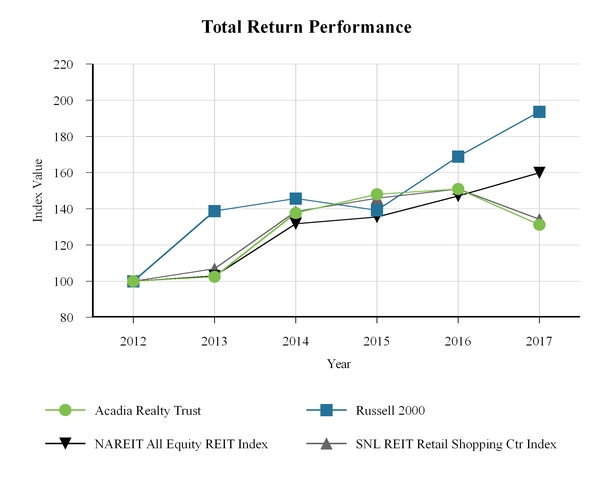
|
At December 31,
|
||||||||||||||||||||||||
|
Index
|
2012
|
2013
|
2014
|
2015
|
2016
|
2017
|
||||||||||||||||||
|
Acadia Realty Trust
|
$
|
100.00
|
|
$
|
102.39
|
|
$
|
137.70
|
|
$
|
148.00
|
|
$
|
150.95
|
|
$
|
131.10
|
|
||||||
|
Russell 2000
|
100.00
|
|
138.82
|
|
145.62
|
|
139.19
|
|
168.85
|
|
193.58
|
|
||||||||||||
|
NAREIT All Equity REIT Index
|
100.00
|
|
102.86
|
|
131.68
|
|
135.40
|
|
147.09
|
|
159.85
|
|
||||||||||||
|
SNL REIT Retail Shopping Ctr Index
|
100.00
|
|
106.84
|
|
138.44
|
|
145.85
|
|
150.94
|
|
134.21
|
|
||||||||||||
Recent Sales of Unregistered Securities Use of Proceeds from Registered Securities
None.
Issuer Purchases of Equity Securities
We have an existing share repurchase program that authorizes management, at its discretion, to repurchase up to $20.0 million of our outstanding Common Shares. The program may be discontinued or extended at any time and there is no assurance that we will purchase the full amount authorized. There were no Common Shares repurchased by us during the year ended
December 31, 2017
. Under this program we have repurchased 2.1 million Common Shares, none of which were repurchased after December 2001. As of
December 31, 2017
, management may repurchase up to approximately $7.5 million of our outstanding Common Shares under this program. On February 20, 2018, this plan was revised as discussed in
Note 17
.
|
34
|
||
|
ITEM 6.
|
SELECTED FINANCIAL DATA
|
The following table sets forth, on a historical basis, our selected financial data. This information should be read in conjunction with our audited Consolidated Financial Statements and Management’s Discussion and Analysis of Financial Condition and Results of Operations appearing elsewhere in this Form 10-K. Funds from operations (“FFO”) amounts for the year ended
December 31, 2017
have been adjusted as set forth in “Item 7. Management’s Discussion and Analysis of Financial Condition and Results of Operations – Reconciliation of Net Income to Funds from Operations.”
|
Year Ended December 31,
|
||||||||||||||||||||
|
(dollars in thousands, except per share amounts)
|
2017
|
2016
|
2015
|
2014
|
2013
|
|||||||||||||||
|
OPERATING DATA:
|
|
|
|
|
|
|
|
|
|
|
||||||||||
|
Revenues
|
$
|
250,262
|
|
$
|
189,939
|
|
$
|
199,063
|
|
$
|
179,681
|
|
$
|
156,486
|
|
|||||
|
Operating expenses, excluding depreciation and reserves
|
(113,554
|
)
|
(98,039
|
)
|
(88,850
|
)
|
(79,104
|
)
|
(72,108
|
)
|
||||||||||
|
Depreciation and amortization
|
(104,934
|
)
|
(70,011
|
)
|
(60,751
|
)
|
(49,645
|
)
|
(40,299
|
)
|
||||||||||
|
Impairment charges
|
(14,455
|
)
|
—
|
|
(5,000
|
)
|
—
|
|
(1,500
|
)
|
||||||||||
|
Equity in earnings and gains unconsolidated affiliates inclusive of gains on
disposition of properties
|
23,371
|
|
39,449
|
|
37,330
|
|
111,578
|
|
12,382
|
|
||||||||||
|
Interest income
|
29,143
|
|
25,829
|
|
16,603
|
|
12,607
|
|
11,800
|
|
||||||||||
|
Gain on change in control and other
|
5,571
|
|
—
|
|
1,596
|
|
2,724
|
|
—
|
|
||||||||||
|
Interest expense
|
(58,978
|
)
|
(34,645
|
)
|
(37,297
|
)
|
(39,426
|
)
|
(40,239
|
)
|
||||||||||
|
Income from continuing operations before income taxes
|
16,426
|
|
52,522
|
|
62,694
|
|
138,415
|
|
26,522
|
|
||||||||||
|
Income tax (provision) benefit
|
(1,004
|
)
|
105
|
|
(1,787
|
)
|
(629
|
)
|
(19
|
)
|
||||||||||
|
Income from continuing operations before
gain on disposition of properties |
15,422
|
|
52,627
|
|
60,907
|
|
137,786
|
|
26,503
|
|
||||||||||
|
Income from discontinued operations, net of tax
|
—
|
|
—
|
|
—
|
|
1,222
|
|
18,137
|
|
||||||||||
|
Gain on disposition of properties, net of tax
|
48,886
|
|
81,965
|
|
89,063
|
|
13,138
|
|
—
|
|
||||||||||
|
Net income
|
64,308
|
|
134,592
|
|
149,970
|
|
152,146
|
|
44,640
|
|
||||||||||
|
(Income) loss attributable to noncontrolling interests:
|
|
|
|
|
|
|
|
|
|
|
||||||||||
|
Continuing operations
|
(2,838
|
)
|
(61,816
|
)
|
(84,262
|
)
|
(80,059
|
)
|
7,523
|
|
||||||||||
|
Discontinued operations
|
—
|
|
—
|
|
—
|
|
(1,023
|
)
|
(12,048
|
)
|
||||||||||
|
Net income attributable to noncontrolling interests
|
(2,838
|
)
|
(61,816
|
)
|
(84,262
|
)
|
(81,082
|
)
|
(4,525
|
)
|
||||||||||
|
Net income attributable to Acadia
|
$
|
61,470
|
|
$
|
72,776
|
|
$
|
65,708
|
|
$
|
71,064
|
|
$
|
40,115
|
|
|||||
|
Supplemental Information:
|
|
|
|
|
|
|
|
|
|
|
||||||||||
|
Income from continuing operations attributable to Acadia
|
$
|
61,470
|
|
$
|
72,776
|
|
$
|
65,708
|
|
$
|
70,865
|
|
$
|
34,026
|
|
|||||
|
Income from discontinued operations attributable to Acadia
|
—
|
|
—
|
|
—
|
|
199
|
|
6,089
|
|
||||||||||
|
Net income attributable to Acadia
|
$
|
61,470
|
|
$
|
72,776
|
|
$
|
65,708
|
|
$
|
71,064
|
|
$
|
40,115
|
|
|||||
|
Basic earnings per share:
|
|
|
|
|
|
|
|
|
|
|
||||||||||
|
Income from continuing operations
|
$
|
0.73
|
|
$
|
0.94
|
|
$
|
0.94
|
|
$
|
1.18
|
|
$
|
0.61
|
|
|||||
|
Income from discontinued operations
|
—
|
|
—
|
|
—
|
|
—
|
|
0.11
|
|
||||||||||
|
Basic earnings per share
|
$
|
0.73
|
|
$
|
0.94
|
|
$
|
0.94
|
|
$
|
1.18
|
|
$
|
0.72
|
|
|||||
|
Diluted earnings per share:
|
|
|
|
|
|
|
|
|
|
|
||||||||||
|
Income from continuing operations
|
$
|
0.73
|
|
$
|
0.94
|
|
$
|
0.94
|
|
$
|
1.18
|
|
$
|
0.61
|
|
|||||
|
Income from discontinued operations
|
—
|
|
—
|
|
—
|
|
—
|
|
0.11
|
|
||||||||||
|
Diluted earnings per share
|
$
|
0.73
|
|
$
|
0.94
|
|
$
|
0.94
|
|
$
|
1.18
|
|
$
|
0.72
|
|
|||||
|
Weighted average number of Common Shares outstanding
|
|
|
|
|
|
|
|
|
|
|
||||||||||
|
Basic
|
83,683
|
|
76,231
|
|
68,851
|
|
59,402
|
|
54,919
|
|
||||||||||
|
Diluted
|
83,685
|
|
76,244
|
|
68,870
|
|
59,426
|
|
54,982
|
|
||||||||||
|
Cash dividends declared per Common Share
|
$
|
1.05
|
|
$
|
1.16
|
|
$
|
1.22
|
|
$
|
1.23
|
|
$
|
0.86
|
|
|||||
|
35
|
||
|
|
|
|
|
|
|
|
|
|
|
|
||||||||||
|
Real estate before accumulated depreciation
|
$
|
3,466,482
|
|
$
|
3,382,000
|
|
$
|
2,736,283
|
|
$
|
2,208,595
|
|
$
|
1,819,053
|
|
|||||
|
Total assets
|
3,960,247
|
|
3,995,960
|
|
3,032,319
|
|
2,720,721
|
|
2,264,957
|
|
||||||||||
|
Total indebtedness
|
1,424,409
|
|
1,488,718
|
|
1,358,606
|
|
1,118,602
|
|
1,039,997
|
|
||||||||||
|
Total common shareholders’ equity
|
1,567,199
|
|
1,588,577
|
|
1,100,488
|
|
1,055,541
|
|
704,236
|
|
||||||||||
|
Noncontrolling interests
|
648,440
|
|
589,548
|
|
420,866
|
|
380,416
|
|
417,352
|
|
||||||||||
|
Total equity
|
2,215,639
|
|
2,178,125
|
|
1,521,354
|
|
1,435,957
|
|
1,121,588
|
|
||||||||||
|
OTHER:
|
|
|
|
|
|
|
|
|
|
|
||||||||||
|
Funds from operations attributable to Common Shareholders and Common OP Unit holders
(a)
|
134,667
|
|
117,070
|
|
111,560
|
|
78,882
|
|
67,161
|
|
||||||||||
|
Cash flows provided by (used in):
|
|
|
|
|
|
|
|
|
|
|
||||||||||
|
Operating activities
|
119,833
|
|
111,760
|
|
113,598
|
|
82,519
|
|
65,233
|
|
||||||||||
|
Investing activities
|
10,082
|
|
(610,970
|
)
|
(354,503
|
)
|
(268,516
|
)
|
(87,879
|
)
|
||||||||||
|
Financing activities
|
(126,897
|
)
|
498,239
|
|
96,101
|
|
324,388
|
|
10,022
|
|
||||||||||
|
(a)
|
Funds from operations is a non-GAAP measure. For an explanation of the measure and a reconciliation to the nearest GAAP measure, see “
Item 7. Management’s Discussion and Analysis — Supplemental Financial Measures.
”
|
|
36
|
||
|
ITEM 7.
|
MANAGEMENT’S DISCUSSION AND ANALYSIS OF FINANCIAL CONDITION AND RESULTS OF OPERATIONS.
|
OVERVIEW
As of
December 31, 2017
, there were
176
properties, which we own or have an ownership interest in, within our Core Portfolio and Funds. Our Core Portfolio consists of those properties either 100% owned, or partially owned through joint venture interests by the Operating Partnership, or subsidiaries thereof, not including those properties owned through our Funds. These properties primarily consist of street and urban retail, and dense suburban shopping centers. See
Item 2. Properties
for a summary of our wholly-owned and partially-owned retail properties and their physical occupancies at
December 31, 2017
.
The majority of our operating income is derived from rental revenues from operating properties, including expense recoveries from tenants, offset by operating and overhead expenses. As our RCP Venture invests in operating companies, the Operating Partnership invests through a taxable REIT subsidiary (“TRS”).
Our primary business objective is to acquire and manage commercial retail properties that will provide cash for distributions to shareholders while also creating the potential for capital appreciation to enhance investor returns. We focus on the following fundamentals to achieve this objective:
|
•
|
Own and operate a Core Portfolio of high-quality retail properties located primarily in high-barrier-to-entry, densely-populated metropolitan areas and create value through accretive development and re-tenanting activities coupled with the acquisition of high-quality assets that have the long-term potential to outperform the asset class as part of our Core asset recycling and acquisition initiative.
|
|
•
|
Generate additional external growth through an opportunistic yet disciplined acquisition program within our Funds. We target transactions with high inherent opportunity for the creation of additional value through:
|
|
◦
|
value-add investments in street retail properties, located in established and “next generation” submarkets, with re-tenanting or repositioning opportunities,
|
|
◦
|
opportunistic acquisitions of well-located real-estate anchored by distressed retailers, and
|
|
◦
|
other opportunistic acquisitions which may include high-yield acquisitions and purchases of distressed debt.
|
Some of these investments historically have also included, and may in the future include, joint ventures with private equity investors for the purpose of making investments in operating retailers with significant embedded value in their real estate assets.
|
•
|
Maintain a strong and flexible balance sheet through conservative financial practices while ensuring access to sufficient capital to fund future growth.
|
SIGNIFICANT DEVELOPMENTS DURING THE YEAR ENDED DECEMBER 31, 2017
Investments
During the
year ended
December 31, 2017
, within our Core and Fund portfolios we invested in six new properties as follows (
Note 2
):
|
•
|
On December 20, 2017, Fund V acquired a consolidated suburban shopping center in Allen Park, Michigan for $62.0 million referred to as “Fairlane Green.”
|
|
•
|
On August 4, 2017, Fund V acquired a consolidated suburban shopping center in Canton, Michigan for $26.0 million referred to as “New Towne Plaza.”
|
|
•
|
On July 27, 2017, Fund V acquired a consolidated suburban shopping center in Hickory, North Carolina for $44.0 million referred to as “Hickory Ridge.”
|
|
•
|
On June 5, 2017, Fund V acquired a consolidated suburban shopping center in Santa Fe, New Mexico for $35.2 million referred to as “Plaza Santa Fe.”
|
|
•
|
On March 13, 2017, Fund IV acquired a consolidated shopping center for $35.4 million referred to as “Lincoln Place” in Fairview Heights, Illinois.
|
|
•
|
In our Core portfolio one of our investments, in which we hold a 20% interest (
Note 4
), acquired a property in Alexandria, Virginia for $3.0 million referred to as “907 King Street” on January 4, 2017.
|
|
37
|
||
In addition, we converted existing notes receivable (
Note 3
) into interests in the underlying real estate collateral as follows:
|
•
|
On May 1 and November 16, 2017, we exchanged a total of
$92.7 million
of our $153.4 million Core notes receivable plus accrued interest of
$1.8 million
for the remaining undivided interest in Market Square, which was subsequently consolidated, as well as an incremental 38.89% undivided interest in Town Center (
Note 4
).
|
|
•
|
On June 30, 2017, Fund IV exchanged a $9.0 million note receivable for a consolidated shopping center located in Windham, Maine referred to as “Shaw’s Plaza – Windham.”
|
Dispositions of Real Estate
During the
year ended
December 31, 2017
, within our Funds we sold
13
properties for an aggregate sales price of
$345.8 million
and our proportionate share of the aggregate gains was
$15.6 million
as follows (
Note 2
,
Note 4
):
|
•
|
On December 21 and October 3, 2017, Fund IV sold five unconsolidated properties for aggregate proceeds of
$11.0 million
and recognized a gain of
$0.6 million
, of which our pro-rata share was
$0.1 million
and was recognized within equity in earnings of unconsolidated affiliates in the consolidated statements of income.
|
|
•
|
On December 13, 2017, Fund II sold a consolidated property, 260 East 161st Street, for
$105.7 million
and recognized a gain of
$31.5 million
, of which our share was
$9.0 million
net of amounts attributable to noncontrolling interests.
|
|
•
|
On November 16, 2017, Fund IV sold a consolidated property, 1151 Third Avenue, for
$27 million
and recognized a gain of
$5.2 million
, of which our share was
$1.2 million
net of amounts attributable to noncontrolling interests.
|
|
•
|
On October 13, 2017, Fund II sold a consolidated property, City Point Tower I, for
$96 million
and recognized a loss of
$0.8 million
, of which our share was
$1.6 million
net of amounts attributable to noncontrolling interests. In addition, we recognized an impairment charge of
$3.8 million
, inclusive of an amount attributable to a noncontrolling interest of
$2.7 million
on the property (
Note 8
).
|
|
•
|
On September 11, 2017, Fund II sold a consolidated property, 216th Street, for
$30.6 million
and recognized a gain of
$6.5 million
, of which our share was
$1.8 million
net of amounts attributable to noncontrolling interests.
|
|
•
|
On July 6, 2017, Fund III sold a consolidated property, New Hyde Park Shopping Center, for
$22.1 million
and recognized a gain of
$6.4 million
, of which our share was
$1.6 million
net of amounts attributable to noncontrolling interests.
|
|
•
|
On June 30, 2017, Fund IV sold an unconsolidated property, 1701 Belmont Avenue, for
$5.6 million
for which the gain was
$3.3 million
of which our pro-rata share was
$0.8 million
and was recognized within equity in earnings of unconsolidated affiliates in the consolidated statements of income.
|
|
•
|
On February 15, 2017, Fund III sold an unconsolidated property, Arundel Plaza, for
$28.8 million
for which the gain was
$8.2 million
of which our pro-rata share was
$1.3 million
and was recognized within equity in earnings of unconsolidated affiliates in the consolidated statements of income.
|
|
•
|
On January 31, 2017, Fund IV sold an unconsolidated property, 2819 Kennedy Boulevard, for
$19.0 million
, for which the gain was
$6.3 million
of which our pro-rata share was
$1.4 million
and was recognized within equity in earnings of unconsolidated affiliates in the consolidated statements of income.
|
Financings
During the
year ended
December 31, 2017
, we obtained aggregate financing of $352.9 million including (
Note 7
):
|
•
|
We obtained an aggregate of
$162.9 million
in financings with
eleven
new non-recourse mortgages, primarily for Fund IV.
|
|
•
|
On September 30, 2017, Fund II closed on a new
$40.0 million
term loan.
|
|
•
|
On May 4, 2017, Fund V closed on a new
$150.0 million
subscription line.
|
We also repaid
thirteen
mortgages aggregating
$280.8 million
.
Structured Financing
During the
year ended
December 31, 2017
(
Note 3
) we entered into the following structured financing transactions:
|
•
|
On May 1 and November 16, 2017, we exchanged a total of
$92.7 million
of our $153.4 million Core notes receivable plus accrued interest of
$1.8 million
for the remaining undivided interest in Market Square, which was subsequently consolidated, as well as an incremental 38.89% undivided interest in Town Center (
Note 4
).
|
|
•
|
On June 30, 2017, Fund IV exchanged a
$9.0 million
note receivable plus accrued interest of
$0.1 million
thereon for an investment in a shopping center in Windham, Maine (
Note 2
).
|
|
38
|
||
|
•
|
We received full settlement of a
$12.0 million
Core note receivable plus $4.8 million interest and fees thereon. The note had previously been in default and was settled in bankruptcy proceedings during the second quarter.
|
|
•
|
We funded an additional
$10.0 million
on an existing $10.0 million note receivable, all of which was subsequently repaid.
|
Retail Real Estate Trends
Our performance is driven, in part, by factors affecting the retail sector. Trends affecting the retail sector over the past few years include changes related to: department stores, apparel spending, consumer demographics and retail technology including internet shopping; as well as the maturity of the retail industry. The number of full-line department stores has been declining steadily and many tenants are reducing both the number and size of stores they lease. Further, consumers are spending less on apparel and housewares and more on entertainment and dining out. Although internet sales are continuing to trend up, these sales constitute a relatively small portion of total consumer spending. As delivery costs impede growth, internet retailers are continuing to move towards an “omni-channel” retailing approach whereby brick and mortar retail still plays a critical role in attracting and retaining consumers. We have and will continue to focus on owning assets in locations that maximize our potential to address these ongoing industry changes and challenges.
Tax Cuts and Jobs Act
The Tax Cuts and Jobs Act (the ‘‘Act’’) enacted in December 2017, makes substantial changes to the Federal income tax laws. These changes include a reduction in the generally applicable corporate tax rate to 21%, substantial limitations on the deductibility of interest, and preferential rates of taxation on most ordinary REIT dividends and certain business income derived by non-corporate taxpayers. The Act also limits the use of net operating losses, which may require us to make additional distributions to our stockholders. The effect of these, and the many other, changes made in the Act is highly uncertain, both in terms of their direct effect on the taxation of an investment in our common stock and their indirect effect on the value of our assets or market conditions generally. Furthermore, many of the provisions of the Act will require guidance through the issuance of Treasury regulations in order to assess their effect. There may be a substantial delay before such regulations are promulgated, increasing the uncertainty as to the ultimate effect of the Act on us. There may be technical corrections legislation with respect to the Act this year, the effect of which cannot be predicted. However, the Company has recorded an adjustment of $2.0 million to its deferred tax assets at
December 31, 2017
owned by its taxable subsidiaries to reflect the lower Federal corporate tax rate and other provisions effective in 2018.
Share Repurchase Plan
In February 2018, our board of trustees elected to terminate the existing repurchase program and authorized a new common share repurchase program under which we may repurchase, from time to time, up to a maximum of $200.0 million of our common shares (
Note 17
). The shares may be repurchased in the open market or in privately negotiated transactions. The timing and actual number of shares repurchased will depend on a variety of factors, including, share price in relation to the estimated value of our assets, corporate and regulatory requirements, market conditions and other corporate liquidity requirements and priorities. The common share repurchase program does not obligate us to repurchase any specific number of shares and may be suspended or terminated at any time at our discretion without prior notice.
|
39
|
||
RESULTS OF OPERATIONS
See
Note 12
in the Notes to Consolidated Financial Statements for an overview of our three reportable segments.
Comparison of Results for the Year Ended
December 31, 2017
to the Year Ended
December 31, 2016
The results of operations by reportable segment for the year ended
December 31, 2017
compared to the year ended
December 31, 2016
are summarized in the table below (in millions, totals may not add due to rounding):
|
Year Ended December 31, 2017
|
Year Ended December 31, 2016
|
Increase (Decrease)
|
||||||||||||||||||||||||||||||||||||||||||||||
|
Core
|
Funds
|
SF
|
Total
|
Core
|
Funds
|
SF
|
Total
|
Core
|
Funds
|
SF
|
Total
|
|||||||||||||||||||||||||||||||||||||
|
Revenues
|
$
|
170.0
|
|
$
|
80.3
|
|
$
|
—
|
|
$
|
250.3
|
|
$
|
150.2
|
|
$
|
39.7
|
|
$
|
—
|
|
$
|
189.9
|
|
$
|
19.8
|
|
$
|
40.6
|
|
$
|
—
|
|
$
|
60.4
|
|
||||||||||||
|
Depreciation and amortization
|
(61.7
|
)
|
(43.2
|
)
|
—
|
|
(104.9
|
)
|
(54.6
|
)
|
(15.4
|
)
|
—
|
|
(70.0
|
)
|
7.1
|
|
27.8
|
|
—
|
|
34.9
|
|
||||||||||||||||||||||||
|
Property operating expenses, other operating and real estate taxes
|
(45.3
|
)
|
(34.4
|
)
|
—
|
|
(79.8
|
)
|
(39.6
|
)
|
(17.8
|
)
|
—
|
|
(57.4
|
)
|
5.7
|
|
16.6
|
|
—
|
|
22.4
|
|
||||||||||||||||||||||||
|
Impairment charges
|
—
|
|
(14.5
|
)
|
—
|
|
(14.5
|
)
|
—
|
|
—
|
|
—
|
|
—
|
|
—
|
|
14.5
|
|
—
|
|
14.5
|
|
||||||||||||||||||||||||
|
General and administrative expenses
|
—
|
|
—
|
|
—
|
|
(33.8
|
)
|
—
|
|
—
|
|
—
|
|
(40.6
|
)
|
—
|
|
—
|
|
—
|
|
(6.8
|
)
|
||||||||||||||||||||||||
|
Operating income
|
62.9
|
|
(11.8
|
)
|
—
|
|
17.3
|
|
56.0
|
|
6.5
|
|
—
|
|
21.9
|
|
6.9
|
|
(18.3
|
)
|
—
|
|
(4.6
|
)
|
||||||||||||||||||||||||
|
Gain on disposition of properties
|
—
|
|
48.9
|
|
—
|
|
48.9
|
|
—
|
|
82.0
|
|
—
|
|
82.0
|
|
—
|
|
(33.1
|
)
|
—
|
|
(33.1
|
)
|
||||||||||||||||||||||||
|
Interest income
|
—
|
|
—
|
|
29.1
|
|
29.1
|
|
—
|
|
—
|
|
25.8
|
|
25.8
|
|
—
|
|
—
|
|
3.3
|
|
3.3
|
|
||||||||||||||||||||||||
|
Gain on change in control
|
5.6
|
|
—
|
|
—
|
|
5.6
|
|
—
|
|
—
|
|
—
|
|
—
|
|
5.6
|
|
—
|
|
—
|
|
5.6
|
|
||||||||||||||||||||||||
|
Equity in earnings and gains of unconsolidated affiliates inclusive of gains on disposition of properties
|
3.7
|
|
19.6
|
|
—
|
|
23.4
|
|
3.8
|
|
35.7
|
|
—
|
|
39.4
|
|
(0.1
|
)
|
(16.1
|
)
|
—
|
|
(16.0
|
)
|
||||||||||||||||||||||||
|
Interest expense
|
(28.6
|
)
|
(30.4
|
)
|
—
|
|
(59.0
|
)
|
(27.4
|
)
|
(7.2
|
)
|
—
|
|
(34.6
|
)
|
1.2
|
|
23.2
|
|
—
|
|
24.4
|
|
||||||||||||||||||||||||
|
Income tax (provision) benefit
|
—
|
|
—
|
|
—
|
|
(1.0
|
)
|
—
|
|
—
|
|
—
|
|
0.1
|
|
—
|
|
—
|
|
—
|
|
(1.1
|
)
|
||||||||||||||||||||||||
|
Net income
|
43.6
|
|
26.3
|
|
29.1
|
|
64.3
|
|
32.4
|
|
116.9
|
|
25.8
|
|
134.6
|
|
11.2
|
|
(90.6
|
)
|
3.3
|
|
(70.3
|
)
|
||||||||||||||||||||||||
|
Net income attributable to noncontrolling interests
|
(1.1
|
)
|
(1.7
|
)
|
—
|
|
(2.8
|
)
|
(3.4
|
)
|
(58.4
|
)
|
—
|
|
(61.8
|
)
|
(2.3
|
)
|
(56.7
|
)
|
—
|
|
(59.0
|
)
|
||||||||||||||||||||||||
|
Net income attributable to Acadia
|
$
|
42.5
|
|
$
|
24.6
|
|
$
|
29.1
|
|
$
|
61.5
|
|
$
|
29.0
|
|
$
|
58.5
|
|
$
|
25.8
|
|
$
|
72.8
|
|
$
|
13.5
|
|
$
|
(33.9
|
)
|
$
|
3.3
|
|
$
|
(11.3
|
)
|
||||||||||||
Core Portfolio
The results of operations for our Core Portfolio segment are depicted in the table above under the headings labeled “Core.” Segment net income attributable to Acadia for our Core Portfolio increased by
$13.5 million
for the year ended
December 31, 2017
compared to the prior year as a result of the changes as further described below.
Revenues from our Core Portfolio increased by
$19.8 million
for the year ended
December 31, 2017
compared to the prior year due to $22.7 million related to Core property acquisitions in 2016 partially offset by $3.8 million attributable to the deconsolidation of the Brandywine Portfolio in 2016.
Depreciation and amortization for our Core Portfolio increased by
$7.1 million
for the year ended
December 31, 2017
compared to the prior year due to $10.3 million of additional depreciation related to Core property acquisitions in 2016 partially offset by $3.4 million of additional depreciation and amortization related to an adjustment for tenant kick-out options in 2016 (
Note 1
).
Property operating, other operating expenses and real estate taxes for our Core Portfolio increased by
$5.7 million
for the year ended
December 31, 2017
compared to the prior year primarily due to Core property acquisitions in 2016.
|
40
|
||
The gain on change in control of
$5.6 million
during the year ended
December 31, 2017
resulted from the consolidation of our investment in Market Square upon acquisition of the outstanding third party interests (
Note 4
).
Interest expense for the Core Portfolio increased
$1.2 million
for the year ended
December 31, 2017
compared to the prior year due to $2.1 million from higher average principal balance in 2017 and a $0.9 million increase in capital lease interest in 2017, partially offset by $1.0 million due to lower average interest rates.
Net income attributable to noncontrolling interests decreased
$2.3 million
due to the change in control of the Brandywine Portfolio in 2016.
Funds
The results of operations for our Funds segment are depicted in the table above under the headings labeled “Funds.” Segment net income attributable to Acadia for the Funds decreased by
$33.9 million
for the year ended
December 31, 2017
compared to the prior year as a result of the changes described below.
Revenues from the Funds increased by
$40.6 million
for the year ended
December 31, 2017
compared to the prior year primarily due to $26.1 million related to Fund property acquisitions in 2016 and 2017 as well as $13.6 million from development projects being placed in service during 2017 (
Note 2
).
Depreciation and amortization for the Funds increased by
$27.8 million
for the year ended
December 31, 2017
compared to the prior year
primarily due to $15.9 million related to Fund property acquisitions in 2016 and 2017 as well as $11.0 million from the
development projects being placed in service during 2017
.
Property operating, other operating expenses and real estate taxes for the Funds increased by
$16.6 million
for the year ended
December 31, 2017
compared to the prior year due to $8.5 million from the development projects placed into service in 2017 as well as $6.8 million from Fund property acquisitions in 2016 and 2017.
Impairment charges during the year ended
December 31, 2017
totaled
$14.5 million
, comprised of charges of
$10.6 million
for a property classified as held for sale in 2017 and
$3.8 million
,
for a property sold in 2017 (
Note 8
).
Gain on disposition of properties for the Funds decreased by
$33.1 million
for the year ended
December 31, 2017
compared to the prior year. Gains during the current year period comprised
$31.5 million
from the sale of Fund II’s 260 E. 161st Street property,
$6.5 million
from the sale of Fund II’s 216th Street property,
$5.2 million
from Fund IV’s 1151 Third Avenue property and
$6.4 million
from the sale of Fund III’s New Hyde Park Shopping Center. Gains during the prior year period comprised $16.6 million from the sale of Fund III’s Heritage Shops and $65.4 million from the sale of a 65% interest in Cortlandt Town Center.
Equity in earnings of unconsolidated affiliates for the Funds decreased by
$16.1 million
for the year ended
December 31, 2017
compared to the prior year primarily due to the Fund’s proportionate share of $14.8 million in aggregate gains from the sales of 1701 Belmont Avenue, Arundel Plaza and 2819 Kennedy Boulevard during the current year period as well as distributions in excess of our carrying value related to investments in Mervyn’s and Albertsons (
Note 4
) versus the Fund’s proportionate share of $36.0 million from the sale of Cortlandt Town Center in 2016.
Interest expense for the Funds increased
$23.2 million
for the year ended
December 31, 2017
compared to the prior year due to $7.8 million less interest capitalized during 2017, a $6.0 million increase related to higher average interest rates in 2017, a $5.1 million increase related to higher average outstanding borrowings in 2017, and a $2.9 million increase in amortization of additional loan costs in 2017.
Net income attributable to noncontrolling interests in the Funds decreased by
$56.7 million
for the year ended
December 31, 2017
compared to the prior year due to the noncontrolling interests’ share of the variances discussed above.
Structured Financing
The results of operations for our Structured Financing segment are depicted in the table above under the headings labeled “SF.” Net income for Structured Financing increased by
$3.3 million
compared to the prior year
primarily due to the recognition of additional interest of $3.6 million during the current year on the repayment of a note (
Note 3
) and new loans originated during 2016. These increases were partially offset by the conversion of a portion of a note receivable into increased ownership in the real estate (
Note 4
).
|
41
|
||
Unallocated
The Company does not allocate general and administrative expense and income taxes to its reportable segments. These unallocated amounts are
depicted in the table above under the headings labeled
“Total.” General and administrative expenses decreased by
$6.8 million
primarily as a result of the
acceleration of equity-based compensation awards related to retirements in 2016 totaling $4.2 million
as well as increased compensation expense in 2016, which included $3.9 million related to the Program (
Note 13
).
The income tax provision for 2017 relates to increased income of the taxable REIT subsidiaries and adjustments to reflect the new provisions of the
Tax Cuts and Jobs Act (
Note 14
)
.
Comparison of Results for the
Year Ended
December 31, 2016
to the
Year Ended
December 31, 2015
The results of operations by reportable segment for the
year
ended
December 31, 2016
compared to the
year
ended December 31, 2015 are summarized in the table below (in millions, totals may not add due to rounding):
|
Year Ended December 31, 2016
|
Year Ended December 31, 2015
|
Increase (Decrease)
|
||||||||||||||||||||||||||||||||||||||||||||||
|
Core
|
Funds
|
SF
|
Total
|
Core
|
Funds
|
SF
|
Total
|
Core
|
Funds
|
SF
|
Total
|
|||||||||||||||||||||||||||||||||||||
|
Revenues
|
$
|
150.2
|
|
$
|
39.7
|
|
$
|
—
|
|
$
|
189.9
|
|
$
|
150.0
|
|
$
|
49.0
|
|
$
|
—
|
|
$
|
199.1
|
|
$
|
0.2
|
|
$
|
(9.3
|
)
|
$
|
—
|
|
$
|
(9.2
|
)
|
||||||||||||
|
Depreciation and amortization
|
(54.6
|
)
|
(15.4
|
)
|
—
|
|
(70.0
|
)
|
(46.2
|
)
|
(14.5
|
)
|
—
|
|
(60.8
|
)
|
8.4
|
|
0.9
|
|
—
|
|
9.2
|
|
||||||||||||||||||||||||
|
Property operating expenses, other operating and real estate taxes
|
(39.6
|
)
|
(17.8
|
)
|
—
|
|
(57.4
|
)
|
(37.3
|
)
|
(21.2
|
)
|
—
|
|
(58.5
|
)
|
2.3
|
|
(3.4
|
)
|
—
|
|
(1.1
|
)
|
||||||||||||||||||||||||
|
Impairment charges
|
—
|
|
—
|
|
—
|
|
—
|
|
(5.0
|
)
|
—
|
|
—
|
|
(5.0
|
)
|
(5.0
|
)
|
—
|
|
—
|
|
(5.0
|
)
|
||||||||||||||||||||||||
|
General and administrative expenses
|
—
|
|
—
|
|
—
|
|
(40.6
|
)
|
—
|
|
—
|
|
—
|
|
(30.4
|
)
|
—
|
|
—
|
|
—
|
|
10.2
|
|
||||||||||||||||||||||||
|
Operating income (loss)
|
56.0
|
|
6.5
|
|
—
|
|
21.9
|
|
61.5
|
|
13.3
|
|
—
|
|
44.5
|
|
(5.5
|
)
|
(6.8
|
)
|
—
|
|
(22.6
|
)
|
||||||||||||||||||||||||
|
Gain on disposition of properties
|
—
|
|
82.0
|
|
—
|
|
82.0
|
|
—
|
|
89.1
|
|
—
|
|
89.1
|
|
—
|
|
(7.1
|
)
|
—
|
|
(7.1
|
)
|
||||||||||||||||||||||||
|
Interest income
|
—
|
|
—
|
|
25.8
|
|
25.8
|
|
—
|
|
—
|
|
16.6
|
|
16.6
|
|
—
|
|
—
|
|
9.2
|
|
9.2
|
|
||||||||||||||||||||||||
|
Equity in earnings and gains of unconsolidated affiliates inclusive of gains on disposition of properties
|
3.8
|
|
35.7
|
|
—
|
|
39.4
|
|
1.2
|
|
36.2
|
|
—
|
|
37.3
|
|
2.6
|
|
(0.5
|
)
|
—
|
|
2.1
|
|
||||||||||||||||||||||||
|
Other
|
—
|
|
—
|
|
—
|
|
—
|
|
—
|
|
—
|
|
1.6
|
|
1.6
|
|
—
|
|
—
|
|
(1.6
|
)
|
(1.6
|
)
|
||||||||||||||||||||||||
|
Interest expense
|
(27.4
|
)
|
(7.2
|
)
|
—
|
|
(34.6
|
)
|
(27.9
|
)
|
(9.4
|
)
|
—
|
|
(37.3
|
)
|
(0.5
|
)
|
(2.2
|
)
|
—
|
|
(2.7
|
)
|
||||||||||||||||||||||||
|
Income tax benefit (provision)
|
—
|
|
—
|
|
—
|
|
0.1
|
|
—
|
|
—
|
|
—
|
|
(1.8
|
)
|
—
|
|
—
|
|
—
|
|
1.9
|
|
||||||||||||||||||||||||
|
Net income (loss)
|
32.4
|
|
116.9
|
|
25.8
|
|
134.6
|
|
34.8
|
|
129.2
|
|
18.2
|
|
150.0
|
|
(2.4
|
)
|
(12.3
|
)
|
7.6
|
|
(15.4
|
)
|
||||||||||||||||||||||||
|
Net (income) loss attributable to noncontrolling interests
|
$
|
(3.4
|
)
|
$
|
(58.4
|
)
|
$
|
—
|
|
$
|
(61.8
|
)
|
$
|
(0.1
|
)
|
$
|
(84.1
|
)
|
$
|
—
|
|
$
|
(84.3
|
)
|
$
|
3.3
|
|
$
|
(25.7
|
)
|
$
|
—
|
|
$
|
(22.5
|
)
|
||||||||||||
|
Net income attributable to Acadia
|
$
|
29.0
|
|
$
|
58.5
|
|
$
|
25.8
|
|
$
|
72.8
|
|
$
|
34.6
|
|
$
|
45.0
|
|
$
|
18.2
|
|
$
|
65.7
|
|
$
|
(5.6
|
)
|
$
|
13.5
|
|
$
|
7.6
|
|
$
|
7.1
|
|
||||||||||||
Core Portfolio
Segment net income attributable to Acadia for our Core Portfolio decreased by
$5.6 million
for the
year
ended
December 31, 2016
compared to the prior year as a result of the changes described below.
Revenues from our Core Portfolio increased by
$0.2 million
for the
year
ended
December 31, 2016
compared to the prior year
as a result of Core property acquisitions in 2016 and 2015 partially offset by a $9.3 million decrease in revenues due to the change in control of the Brandywine Portfolio in 2016 (
Note 4
).
|
42
|
||
Depreciation and amortization for our Core Portfolio increased by
$8.4 million
for the
year
ended
December 31, 2016
compared to the prior year due to Core property acquisitions in 2016 and 2015.
Property operating, other operating expenses and real estate taxes for our Core Portfolio increased by
$2.3 million
for the
year
ended
December 31, 2016
compared to the prior year due to r
eal estate taxes related to the
Core property acquisitions in 2016 and 2015
and a general increase in real estate taxes.
Impairment charges of
$5.0 million
in 2015 relate
to a property within the Brandywine Portfolio (
Note 8
).
Equity in earnings of unconsolidated affiliates for the Core Portfolio increased by
$2.6 million
due to the change in control of the Brandywine Portfolio in 2016 of $1.3 million and the Company's new investment in Gotham Plaza of $0.8 million.
Net income attributable to noncontrolling interests in our Core Portfolio increased by
$3.3 million
for the
year
ended
December 31, 2016
compared to the prior year primarily due to the deconsolidation of the Brandywine Portfolio during 2016
(
Note 4
).
Funds
Segment net income attributable to Acadia for the Funds increased by
$13.5 million
for the
year
ended
December 31, 2016
compared to the prior year as a result of the changes described below.
Revenues from the Funds decreased by
$9.3 million
for the
year
ended
December 31, 2016
compared to the prior year primarily
as a result of a decrease of $12.7 million relating to Fund property dispositions in 2016 and 2015 partially offset by additional rental income of $4.3 million related to Fund property acquisitions in 2016 and 2015.
Property operating, other operating expenses and real estate taxes for the Funds decreased by
$3.4 million
for the
year
ended
December 31, 2016
compared to the prior year due to r
eal estate taxes, which decreased $2.1 million primarily as a result of the Fund property dispositions in 2016.
Gain on disposition of properties for the Funds decreased by
$7.1 million
for the
year
ended
December 31, 2016
compared to the prior year (
Note 2
).
The gain on disposition of properties in the Funds during 2016 of $82.0 million represents our gain on sale from 65% of Cortlandt Town Center and Heritage Shops. Gain on disposition of properties in the Funds in 2015 of $89.1 million represents our gain on sale from Lincoln Park Center, Liberty Avenue and the air rights at Fund II's City Point project.
Equity in earnings of unconsolidated affiliates for the Funds decreased by
$0.5 million
for the
year
ended
December 31, 2016
compared to the prior year
(
Note 4
)
.
The amount for 2016 includes a $36.0 million gain on disposition of properties of unconsolidated affiliates in the Funds representing our pro-rata share from the sale of 35% of Cortlandt Town Center. The amount for 2015 includes a $24.0 million gain on disposition of properties of unconsolidated affiliates in the Funds representing our pro-rata share from the sales of White City Shopping Center and Parkway Crossing. This was offset by distributions at the Mervyns/Shopko investments of $5.3 million in 2015 and additional depreciation expense related to the demolition of a building at Arundel Plaza for $5.6 million in 2015.
Interest expense for the Funds decreased by
$2.2 million
for the
year
ended
December 31, 2016
compared to the prior year due to $4.7 million more interest capitalized and a $0.3 million decrease in amortization of additional loan costs in 2016. These were offset by a $1.6 million increase related to higher average outstanding borrowings in 2016 and a $1.2 million increase related to higher average interest rates in 2016.
Net income attributable to noncontrolling interests in the Funds decreased by
$25.7 million
for the
year
ended compared to the prior year due to the noncontrolling interests’ share of the variances discussed above.
Structured Financing
Interest income and segment net income attributable to Acadia from Structured Financing increased by
$9.2 million
for the
year
ended
December 31, 2016
compared to the prior year primarily due to
earnings from loans originated during 2015 and 2016 and the recapture of previously established reserves of $3.4 million during 2016. Other income decreased
$1.6 million
for the
year
ended
December 31, 2016
compared to the prior year
due to the collection of a note receivable, default interest and other costs, in excess of carrying value during 2015.
|
43
|
||
Unallocated
The Company does not allocate general and administrative expense and income taxes to its reportable segments. General and administrative expenses increased by
$10.2 million
or the
year
ended
December 31, 2016
compared to the prior year
due to the acceleration of equity-based compensation awards related to retirements in 2016 totaling $4.2 million as well as increased compensation expense of $4.7 million, which included $3.9 million related to the Program (
Note 13
). The remaining $1.3 million relates to an increase in other professional fees.
The provision for income taxes changed by
$1.9 million
primarily as a
result of 2015 corporate Federal income taxes incurred by a Fund IV investor.
SUPPLEMENTAL FINANCIAL MEASURES
Net Property Operating Income
The following discussion of net property operating income (“NOI”) and rent spreads on new and renewal leases includes the activity from both our consolidated and our pro-rata share of unconsolidated properties within our Core Portfolio. Our Funds invest primarily in properties that typically require significant leasing and development. Given that the Funds are finite-life investment vehicles, these properties are sold following stabilization. For these reasons, we believe NOI and rent spreads are not meaningful measures for our Fund investments.
NOI represents property revenues less property expenses. We consider NOI and rent spreads on new and renewal leases for our Core Portfolio to be appropriate supplemental disclosures of portfolio operating performance due to their widespread acceptance and use within the REIT investor and analyst communities. NOI and rent spreads on new and renewal leases are presented to assist investors in analyzing our property performance, however, our method of calculating these may be different from methods used by other REITs and, accordingly, may not be comparable to such other REITs.
A reconciliation of consolidated operating income to net operating income - Core Portfolio follows (in thousands):
|
Year Ended December 31,
|
||||||||||||
|
2017
|
2016
|
2015
|
||||||||||
|
Consolidated Operating Income
|
$
|
17,319
|
|
$
|
21,889
|
|
$
|
44,462
|
|
|||
|
Add back:
|
||||||||||||
|
General and administrative
|
33,756
|
|
40,648
|
|
30,368
|
|
||||||
|
Depreciation and amortization
|
104,934
|
|
70,011
|
|
60,751
|
|
||||||
|
Impairment charges
|
14,455
|
|
—
|
|
5,000
|
|
||||||
|
Less:
|
||||||||||||
|
Above/below market rent, straight-line rent and other adjustments
|
(21,110
|
)
|
(5,313
|
)
|
(8,192
|
)
|
||||||
|
Consolidated NOI
|
149,354
|
|
127,235
|
|
132,389
|
|
||||||
|
Noncontrolling interest in consolidated NOI
|
(28,379
|
)
|
(20,872
|
)
|
(34,675
|
)
|
||||||
|
Less: Operating Partnership's interest in Fund NOI included above
|
(7,927
|
)
|
(4,981
|
)
|
(5,767
|
)
|
||||||
|
Add: Operating Partnership's share of
unconsolidated joint ventures NOI (a) |
19,539
|
|
16,547
|
|
10,382
|
|
||||||
|
NOI - Core Portfolio
|
$
|
132,587
|
|
$
|
117,929
|
|
$
|
102,329
|
|
|||
__________
|
(a)
|
Does not include the Operating Partnership’s share of NOI from unconsolidated joint ventures within the Funds
|
|
44
|
||
Same-Property NOI includes Core Portfolio properties that we owned for both the current and prior periods presented, but excludes those properties which we acquired, sold or expected to sell, and developed during these periods. The following table summarizes Same-Property NOI for our Core Portfolio (in thousands):
|
Year Ended December 31,
|
||||||||
|
2017
|
2016
|
|||||||
|
Core Portfolio NOI
|
$
|
132,587
|
|
$
|
117,929
|
|
||
|
Less properties excluded from Same-Property NOI
|
(31,778
|
)
|
(17,172
|
)
|
||||
|
Same-Property NOI
|
$
|
100,809
|
|
$
|
100,757
|
|
||
|
Percent change from prior year period
|
0.1
|
%
|
||||||
|
Components of Same-Property NOI:
|
||||||||
|
Same-Property Revenues
|
$
|
137,590
|
|
$
|
133,086
|
|
||
|
Same-Property Operating Expenses
|
(36,781
|
)
|
(32,329
|
)
|
||||
|
Same-Property NOI
|
$
|
100,809
|
|
$
|
100,757
|
|
||
Rent Spreads on Core Portfolio New and Renewal Leases
The following table summarizes rent spreads on both a cash basis and straight-line basis for new and renewal leases based on leases executed within our Core Portfolio for the
year ended
December 31, 2017
. Cash basis represents a comparison of rent most recently paid on the previous lease as compared to the initial rent paid on the new lease. Straight-line basis represents a comparison of rents as adjusted for contractual escalations, abated rent and lease incentives for the same comparable leases.
|
Year Ended
December 31, 2017 |
||||||||
|
Core Portfolio New and Renewal Leases
|
Cash Basis
|
Straight-Line Basis
|
||||||
|
Number of new and renewal leases executed
|
72
|
|
72
|
|
||||
|
GLA commencing
|
500,028
|
|
500,028
|
|
||||
|
New base rent
|
$
|
23.63
|
|
$
|
24.23
|
|
||
|
Expiring base rent
|
$
|
21.66
|
|
$
|
20.48
|
|
||
|
Percent growth in base rent
|
9.1
|
%
|
18.3
|
%
|
||||
|
Average cost per square foot
|
$
|
6.16
|
|
$
|
6.16
|
|
||
|
Weighted average lease term (years)
|
5.3
|
|
5.3
|
|
||||
__________
|
(a)
|
The average cost per square foot includes tenant improvement costs, leasing commissions and tenant allowances.
|
Funds from Operations
We consider funds from operations (“FFO”) as defined by the National Association of Real Estate Investment Trusts (“NAREIT”) to be an appropriate supplemental disclosure of operating performance for an equity REIT due to its widespread acceptance and use within the REIT and analyst communities. FFO is presented to assist investors in analyzing our performance. It is helpful as it excludes various items included in net income that are not indicative of the operating performance, such as gains (losses) from sales of depreciated property, depreciation and amortization, and impairment of depreciable real estate. Our method of calculating FFO may be different from methods used by other REITs and, accordingly, may not be comparable to such other REITs. FFO does not represent cash generated from operations as defined by generally accepted accounting principles (“GAAP”) and is not indicative of cash available to fund all cash needs, including distributions. It should not be considered as an alternative to net income for the purpose of evaluating our performance or to cash flows as a measure of liquidity. Consistent with the NAREIT definition, we define FFO as net income (computed in accordance with GAAP), excluding gains (losses) from sales of depreciated property and impairment of depreciable real estate, plus depreciation and amortization, and after adjustments for unconsolidated partnerships
|
45
|
||
and joint ventures. A reconciliation of net income attributable to Acadia to FFO follows (dollars in thousands, except per share amounts):
|
(dollars in thousands except per share data)
|
Year Ended December 31,
|
|||||||||||
|
2017
|
2016
|
2015
|
||||||||||
|
Net income attributable to Acadia
|
$
|
61,470
|
|
$
|
72,776
|
|
$
|
65,708
|
|
|||
|
|
|
|||||||||||
|
Depreciation of real estate and amortization of leasing costs (net of noncontrolling interests' share)
|
83,515
|
|
67,446
|
|
52,013
|
|
||||||
|
Impairment charges (net of noncontrolling interests’ share)
|
1,088
|
|
—
|
|
1,111
|
|
||||||
|
Gain on sale (net of noncontrolling interests’ share)
|
(15,565
|
)
|
(28,154
|
)
|
(11,114
|
)
|
||||||
|
Income attributable to Common OP Unit holders
|
3,609
|
|
4,442
|
|
3,811
|
|
||||||
|
Distributions - Preferred OP Units
|
550
|
|
560
|
|
31
|
|
||||||
|
Funds from operations attributable to Common Shareholders and Common OP Unit holders
|
$
|
134,667
|
|
$
|
117,070
|
|
$
|
111,560
|
|
|||
|
Funds From Operations per Share - Diluted
|
||||||||||||
|
Basic weighted-average shares outstanding,
GAAP earnings |
83,682,789
|
|
76,231,000
|
|
68,851,083
|
|
||||||
|
Weighted-average OP Units outstanding
|
4,741,058
|
|
4,435,041
|
|
3,894,542
|
|
||||||
|
Basic weighted-average shares outstanding, FFO
|
88,423,847
|
|
80,666,041
|
|
72,745,625
|
|
||||||
|
Assumed conversion of Preferred OP Units
to common shares |
505,045
|
|
435,274
|
|
25,067
|
|
||||||
|
Assumed conversion of options, LTIP units and
restricted share units to common shares |
69,488
|
|
150,843
|
|
296,815
|
|
||||||
|
Diluted weighted-average number of Common Shares
and Common OP Units outstanding, FFO |
88,998,380
|
|
81,252,158
|
|
73,067,507
|
|
||||||
|
Diluted Funds from operations, per Common Share
and Common OP Unit |
$
|
1.51
|
|
$
|
1.44
|
|
$
|
1.53
|
|
|||
LIQUIDITY AND CAPITAL RESOURCES
Uses of Liquidity and Cash Requirements
Our principal uses of liquidity are (i) distributions to our shareholders and OP unit holders, (ii) investments which include the funding of our capital committed to the Funds and property acquisitions and development/re-tenanting activities within our Core Portfolio, (iii) distributions to our Fund investors and (iv) debt service and loan repayments.
Distributions
In order to qualify as a REIT for Federal income tax purposes, we must currently distribute at least 90% of our taxable income to our shareholders. During the
year ended
December 31, 2017
, we paid dividends and distributions on our Common Shares, Common OP Units and Preferred OP Units totaling $106.7 million. This amount included a $13.3 million special dividend that was paid in January 2017, which related to the Operating Partnership’s share of cash proceeds from property dispositions during 2016. The balance of the distributions were funded from the Operating Partnership’s share of operating cash flow.
Distributions of $8.4 million were made to noncontrolling interests in Fund III during the
year ended
December 31, 2017
. These resulted from proceeds related to the dispositions of New Hyde Park Shopping Center (
Note 2
) and Arundel Plaza (
Note 4
).
Distributions of $23.5 million were made to noncontrolling interests in Fund IV during the
year ended
December 31, 2017
. These resulted from proceeds related to the dispositions of 1151 Third Avenue (
Note 2
), 2819 Kennedy Boulevard, 1701 Belmont Avenue, and five properties within our Broughton Street Portfolio (
Note 4
).
|
46
|
||
Investments in Real Estate
During the
year ended
December 31, 2017
, within our Core and Fund portfolios we acquired seven properties aggregating $214.7 million as follows:
|
•
|
Fund V acquired four consolidated properties totaling $
167.2 million
(
Note 2
);
|
|
•
|
Fund IV acquired a consolidated property for
$35.4 million
(
Note 2
);
|
|
•
|
|
•
|
In our Core portfolio, our Renaissance investment, in which we hold a 20% interest, acquired a $3.0 million property (
Note 4
).
|
Capital Commitments
During the
year ended
December 31, 2017
, we made capital contributions of $11.1 million to Fund IV, $9.2 million to Fund V, and $3.6 million to Fund III in connection with acquisitions and development costs. At
December 31, 2017
, our share of the remaining capital commitments to our Funds aggregated $131.9 million as follows:
|
•
|
Fund II was launched in June 2004 with total committed capital of $300.0 million of which our share was $85.0 million, which has been fully funded.
|
|
•
|
$9.5 million to Fund III. Fund III was launched in May 2007 with total committed capital of $450.0 million of which our original share was $89.6 million. During 2015, we acquired an additional interest, which had an original capital commitment of $20.9 million.
|
|
•
|
$27.1 million to Fund IV. Fund IV was launched in May 2012 with total committed capital of $530.0 million of which our original share was $122.5 million.
|
|
•
|
$95.3 million to Fund V. Fund V was launched in August 2016 with total committed capital of $520.0 million of which our initial share is $104.5 million.
|
Development Activities
During the
year ended
December 31, 2017
, capitalized costs associated with development activities totaled $
108.1 million
. These costs primarily related to Fund II’s City Point project. At
December 31, 2017
, we had
6
properties under development for which the estimated total cost to complete these projects through 2020 was $
75.7 million
to $
101.7 million
and our share was approximately $
25.1 million
to $
33.2 million
.
A summary of our consolidated debt, which includes the full amount of Fund related obligations and excludes our pro rata share of debt at our unconsolidated subsidiaries, is as follows (in thousands):
|
December 31,
|
December 31,
|
|||||||
|
2017
|
2016
|
|||||||
|
Total Debt - Fixed and Effectively Fixed Rate
|
$
|
899,650
|
|
$
|
860,486
|
|
||
|
Total Debt - Variable Rate
|
538,736
|
|
645,185
|
|
||||
|
1,438,386
|
|
1,505,671
|
|
|||||
|
Net unamortized debt issuance costs
|
(14,833
|
)
|
(18,289
|
)
|
||||
|
Unamortized premium
|
856
|
|
1,336
|
|
||||
|
Total Indebtedness
|
$
|
1,424,409
|
|
$
|
1,488,718
|
|
||
As of
December 31, 2017
, our consolidated outstanding mortgage and notes payable aggregated
$1,438.4 million
, excluding unamortized premium of
$0.9 million
and unamortized loan costs of
$14.8 million
, and were collateralized by
42
properties and related tenant leases. Interest rates on our outstanding indebtedness ranged from
1.00%
to
5.89%
with maturities that ranged from
May 1, 2018
, to
April 15, 2035
. Taking into consideration
$504.0 million
of notional principal under variable to fixed-rate swap agreements currently in effect,
$899.7 million
of the portfolio debt, or
62.5%
, was fixed at a
3.74%
weighted-average interest rate and
$538.7 million
, or
37.5%
was floating at a
3.44%
weighted average interest rate as of
December 31, 2017
. Our variable-rate debt includes $196.4 million of debt subject to interest rate caps.
|
47
|
||
There is
$87.7 million
of debt maturing in
2018
at a weighted-average interest rate of
4.17%
; there is
$6.7 million
of scheduled principal amortization due in
2018
; and our share of scheduled remaining
2018
principal payments and maturities on our unconsolidated debt was
$7.9 million
at
December 31, 2017
. In addition,
$213.6 million
of our total consolidated debt and
$1.0 million
of our pro-rata share of unconsolidated debt will come due in
2019
. As it relates to the maturing debt in
2018
and
2019
, we may not have sufficient cash on hand to repay such indebtedness, and, therefore, we expect to refinance at least a portion of this indebtedness or select other alternatives based on market conditions as these loans mature; however, there can be no assurance that we will be able to obtain financing at acceptable terms.
A mortgage loan in the Company’s Core Portfolio for
$26.3 million
was in default at
December 31, 2017
and
December 31, 2016
(
Note 7
). In April 2017, the lender on this mortgage initiated a lawsuit against the Company for the full balance of the principal, accrued interest as well as penalties and fees aggregating approximately
$32.1 million
. The Company’s management believes that the mortgage is not recourse to the Company and that the suit is without merit.
Sources of Liquidity
Our primary sources of capital for funding our liquidity needs include (i) the issuance of both public equity and OP Units, (ii) the issuance of both secured and unsecured debt, (iii) unfunded capital commitments from noncontrolling interests within our Funds, (iv) future sales of existing properties and (v) cash on hand and future cash flow from operating activities. Our cash on hand in our consolidated subsidiaries at
December 31, 2017
totaled $
74.8 million
. Our remaining sources of liquidity are described further below.
Issuance of Equity
We have an at-the-market (“ATM”) equity issuance program which provides us an efficient and low-cost vehicle for raising public equity to fund our capital needs. Through this program, we have been able to effectively “match-fund” the required equity for our Core Portfolio and Fund acquisitions through the issuance of Common Shares over extended periods employing a price averaging strategy. In addition, from time to time, we have issued and intend to continue to issue, equity in follow-on offerings separate from our ATM program. Net proceeds raised through our ATM program and follow-on offerings are primarily used for acquisitions, both for our Core Portfolio and our pro-rata share of Fund acquisitions, and for general corporate purposes. There were no issuances of equity under the ATM program during the
year ended
December 31, 2017
.
Fund Capital
During the
year ended
December 31, 2017
, noncontrolling interest capital contributions to Fund IV of $37.0 million, to Fund V of $36.6 million, and to Fund III of $11.2 million were primarily used to fund recent acquisitions and development activities. At
December 31, 2017
, unfunded capital commitments from noncontrolling interests within our Funds III, IV and V were
$29.1 million
,
$90.2 million
and
$378.9 million
, respectively.
Asset Sales
As previously discussed, during the
year ended
December 31, 2017
, within our Fund portfolio we sold five consolidated and eight unconsolidated properties for an aggregate sales price of
$345.8 million
for which our proportionate share of the aggregate gains was
$15.6 million
(
Note 2
,
Note 4
).
Structured Financing Repayments
During 2017, we received total collections on our notes receivable of
$32.0 million
, including full repayment of two notes issued in prior periods (
Note 3
). Scheduled principal collections for 2018 total
$41.0 million
.
Financing and Debt
As of
December 31, 2017
, we had $166.5 million of additional capacity under existing revolving debt facilities. In addition, at that date we had 71 unleveraged consolidated properties with an aggregate carrying value of approximately $1.6 billion and 25 unleveraged unconsolidated properties for which our share of the carrying value was $62.9 million, although there can be no assurance that we would be able to obtain financing for these properties at favorable terms, if at all.
|
48
|
||
HISTORICAL CASH FLOW
Cash Flows for 2017 Compared to 2016
The following table compares the historical cash flow for the
year ended
December 31, 2017
with the cash flow for the
year ended
December 31, 2016
(in millions):
|
|
Year Ended December 31,
|
|||||||||||
|
2017
|
2016
|
Variance
|
||||||||||
|
Net cash provided by operating activities
|
$
|
119.8
|
|
$
|
111.8
|
|
$
|
8.0
|
|
|||
|
Net cash provided by (used in) investing activities
|
10.1
|
|
(611.0
|
)
|
621.1
|
|
||||||
|
Net cash (used in) provided by financing activities
|
(126.9
|
)
|
498.2
|
|
(625.1
|
)
|
||||||
|
Increase (decrease) in cash and cash equivalents
|
$
|
3.0
|
|
$
|
(1.0
|
)
|
$
|
4.0
|
|
|||
Operating Activities
Our operating activities provided
$8.0 million
more cash during the
year ended
December 31, 2017
, primarily due to additional cash flow from 2016 and 2017 Core and Fund acquisitions partially offset by a $27.0 million rent prepayment received from a tenant in 2016.
Investing Activities
During the
year ended
December 31, 2017
as compared to the
year ended
December 31, 2016
, our investing activities used
$621.1 million
less cash, primarily due to (i) $
291.8 million
less cash used for the acquisition of real estate, (ii) $
146.8 million
less cash used for the issuance of notes receivable, (iii)
$111.8 million
more cash received from disposition of properties, including unconsolidated affiliates, (iv) $
65.6 million
less cash used for investments and advances to unconsolidated investments, and (v) $
41.3 million
less cash used for development and property improvement costs. These items were partially offset by (i) $
30.5 million
less cash received from return of capital from unconsolidated affiliates, and (ii) $
10.8 million
less cash received from repayments of notes receivable.
Financing Activities
Our financing activities provided
$625.1 million
less cash during the
year ended
December 31, 2017
, primarily from (i) $
450.1 million
less cash received from the issuance of Common Shares, (ii) a decrease in cash of $
209.9 million
from capital contributions from noncontrolling interests, and (iii) a decrease of $
19.4 million
of cash provided from net borrowings. These items were partially offset by a decrease of $
66.1 million
in cash distributions to noncontrolling interests.
Cash Flows for 2016 Compared to 2015
The following table compares the historical cash flow for the year ended December 31, 2016 with the cash flow for the year ended December 31, 2015 (dollars in millions):
|
|
Year Ended December 31,
|
|||||||||||
|
2016
|
2015
|
Variance
|
||||||||||
|
Net cash provided by operating activities
|
$
|
111.8
|
|
$
|
113.6
|
|
$
|
(1.8
|
)
|
|||
|
Net cash used in investing activities
|
(611.0
|
)
|
(354.5
|
)
|
(256.5
|
)
|
||||||
|
Net cash provided by financing activities
|
498.2
|
|
96.1
|
|
402.1
|
|
||||||
|
Total
|
$
|
(1.0
|
)
|
$
|
(144.8
|
)
|
$
|
143.8
|
|
|||
Operating Activities
Our operating activities provided $1.8 million less cash during 2016, primarily due to (i) $7.8 million of lease payments relating to 991 Madison Avenue during 2016, and (ii) additional distributions from the Mervyns I & II portfolios during 2015. These items were partially offset by additional cash flow from 2016 acquisitions.
|
49
|
||
Investing Activities
During 2016, our investing activities used an additional $256.5 million of cash, primarily for (i) an additional $156.9 million used for the acquisition of real estate, (ii) $108.9 million of additional cash used for the issuance of notes receivable, (iii) $47.9 million more cash used in investments and advances to unconsolidated affiliates, and (iii) $32.3 million less cash received from the disposition of properties, including unconsolidated affiliates. These items were partially offset by (i) $42.8 million more cash received from return of capital from unconsolidated affiliates (ii) $26.8 million more cash received from repayments of notes receivable and (iii) $14.9 million less cash used for development and property improvement costs,
Financing Activities
Our financing activities provided $402.1 million more cash during 2016, primarily from (i) $386.9 million more cash received from the issuance of Common Shares and (ii) an increase of $259.6 million from capital contributions from noncontrolling interests. These items were partially offset by (i) a decrease of $210.7 million of cash provided from net borrowings, (ii) distributions to noncontrolling interests increased $21.4 million, (iii) $7.3 million more cash used for deferred financing and other costs, and (iv) an additional $5.0 million of cash used to pay dividends to Common Shareholders.
CONTRACTUAL OBLIGATIONS
The following table summarizes: (i) principal and interest obligations under mortgage and other notes, (ii) rents due under non-cancelable operating and capital leases, which includes ground leases at seven of our properties and the lease for our corporate office and (iii) construction commitments as of
December 31, 2017
(in millions):
|
Payments Due by Period
|
||||||||||||||||||||
|
Contractual Obligations
|
Total
|
Less than
1 Year |
1 to 3
Years |
3 to 5
Years |
More than
5 Years |
|||||||||||||||
|
Principal obligations on debt
|
$
|
1,438.4
|
|
$
|
94.4
|
|
$
|
790.0
|
|
$
|
353.9
|
|
$
|
200.1
|
|
|||||
|
Interest obligations on debt
|
217.3
|
|
60.7
|
|
92.5
|
|
34.4
|
|
29.7
|
|
||||||||||
|
Lease obligations
(a)
|
207.2
|
|
4.5
|
|
8.9
|
|
8.7
|
|
185.1
|
|
||||||||||
|
Construction commitments
(b)
|
92.2
|
|
92.2
|
|
—
|
|
—
|
|
—
|
|
||||||||||
|
Total
|
$
|
1,955.1
|
|
$
|
251.8
|
|
$
|
891.4
|
|
$
|
397.0
|
|
$
|
414.9
|
|
|||||
__________
|
(a)
|
A ground lease expiring during 2078 provides the Company with an option to purchase the underlying land during 2031. If we do not exercise the option, the rents that will be due are based on future values and as such are not determinable at this time. Accordingly, the above table does not include rents for this lease beyond 2031.
|
|
(b)
|
In conjunction with the development of our Core Portfolio and Fund properties, we have entered into construction commitments with general contractors. We intend to fund these requirements with existing liquidity.
|
OFF-BALANCE SHEET ARRANGEMENTS
We have the following investments made through joint ventures for the purpose of investing in operating properties. We account for these investments using the equity method of accounting. As such, our financial statements reflect our investment and our share of income and loss from, but not the individual assets and liabilities, of these joint ventures.
See
Note 4
in the Notes to Consolidated Financial Statements, for a discussion of our unconsolidated investments. The Operating Partnership’s pro-rata share of unconsolidated non-recourse debt related to those investments is as follows (dollars in millions):
|
50
|
||
|
Operating
Partnership
Ownership Percentage
|
Operating
Partnership
Pro-rata Share of Mortgage Debt
|
|||||||||||
|
Investment
|
Interest Rate at December 31, 2017
|
Maturity Date
|
||||||||||
|
230/240 W. Broughton
|
11.6
|
%
|
$
|
1.2
|
|
4.37
|
%
|
May 2018
|
||||
|
Promenade at Manassas
|
22.8
|
%
|
5.7
|
|
3.07
|
%
|
November 2018
|
|||||
|
650 Bald Hill
|
20.8
|
%
|
2.9
|
|
4.02
|
%
|
April 2020
|
|||||
|
Eden Square
|
22.8
|
%
|
5.1
|
|
3.52
|
%
|
June 2020
|
|||||
|
Gotham Plaza
(a)
|
49.0
|
%
|
10.0
|
|
2.97
|
%
|
June 2023
|
|||||
|
Renaissance Portfolio
|
20.0
|
%
|
32.0
|
|
3.07
|
%
|
August 2023
|
|||||
|
Crossroads
|
49.0
|
%
|
33.0
|
|
3.94
|
%
|
October 2024
|
|||||
|
840 N. Michigan
|
88.4
|
%
|
65.0
|
|
4.36
|
%
|
February 2025
|
|||||
|
Georgetown Portfolio
|
50.0
|
%
|
8.4
|
|
4.72
|
%
|
December 2027
|
|||||
|
Total
|
$
|
163.3
|
|
|
|
|
||||||
|
(a)
|
Our unconsolidated affiliate is a party to an interest rate LIBOR swap with a notional value of
$20.4 million
, which effectively fixes the interest rate at 3.49% and matures in June 2023.
|
CRITICAL ACCOUNTING POLICIES
Management’s discussion and analysis of financial condition and results of operations is based upon our Consolidated Financial Statements, which have been prepared in accordance with U.S. GAAP. The preparation of these Consolidated Financial Statements requires management to make estimates and judgments that affect the reported amounts of assets, liabilities, revenues and expenses. We base our estimates on historical experience and assumptions that are believed to be reasonable under the circumstances, the results of which form the basis for making judgments about carrying value of assets and liabilities that are not readily apparent from other sources. Actual results may differ from these estimates under different assumptions or conditions. We believe the following critical accounting policies affect the significant judgments and estimates used by us in the preparation of our Consolidated Financial Statements.
Valuation of Properties
On a quarterly basis, we review the carrying value of properties held for use and for sale as well as our development properties. We perform an impairment analysis by calculating and reviewing net operating income on a property-by-property basis. We evaluate leasing projections and perform other analyses to conclude whether an asset is impaired. We record impairment losses and reduce the carrying value of properties when indicators of impairment are present and the expected undiscounted cash flows related to those properties are less than their carrying amounts. In cases where we do not expect to recover our carrying costs on properties held for use, we reduce our carrying cost to fair value. For properties held for sale, we reduce our carrying value to the fair value less costs to sell.
See
Note 8
of the Notes to the Consolidated Financial Statements for a discussion of impairments recognized during the periods presented.
Investments in and Advances to Unconsolidated Joint Ventures
We periodically review our investment in unconsolidated joint ventures for other than temporary declines in market value. Any decline that is not expected to be recovered in the next twelve months is considered other-than-temporary and an impairment charge is recorded as a reduction in the carrying value of the investment. No impairment charges related to our investment in unconsolidated joint ventures were recognized for the years ended
December 31, 2017
, 2016 and 2015.
Bad Debts
We maintain an allowance for doubtful accounts for estimated losses resulting from the inability of tenants to make payments on arrearages in billed rents, as well as the likelihood that tenants will not have the ability to make payments on unbilled rents including estimated expense recoveries. We also maintain a reserve for straight-line rent receivables. For the years ended
December 31, 2017
and 2016, the allowance for doubtful accounts totaled
$5.9 million
and
$5.7 million
, respectively. If the financial condition
of our tenants were to deteriorate, resulting in an impairment of their ability to make payments, additional allowances may be required.
Real Estate
Real estate assets are stated at cost less accumulated depreciation. Expenditures for acquisition, development, construction and improvement of properties, as well as significant renovations are capitalized. Interest costs are capitalized until construction is substantially complete. Construction in progress includes costs for significant property expansion and development. Depreciation is computed on the straight-line basis over estimated useful lives of 40 years for buildings, the shorter of the useful life or lease term for tenant improvements and five years for furniture, fixtures and equipment. Expenditures for maintenance and repairs are charged to operations as incurred.
Upon acquisitions of real estate, we assess the fair value of acquired assets (including land, buildings and improvements, and identified intangibles such as above and below market leases and acquired in-place leases and customer relationships) and acquired liabilities in accordance with the FASB Accounting Standards Codification (“ASC”)
Topic 805 “Business Combinations”
and ASC
Topic 350 “Intangibles – Goodwill and Other,”
and allocate purchase price based on these assessments. We assess fair value based on estimated cash flow projections that utilize appropriate discount and capitalization rates and available market information. Estimates of future cash flows are based on a number of factors including the historical operating results, known trends, and market/economic conditions that may affect the property.
Revenue Recognition and Accounts Receivable
Leases with tenants are accounted for as operating leases. Minimum rents are recognized on a straight-line basis over the non-cancelable term of the respective leases, beginning when the tenant takes possession of the space. Certain of these leases also provide for percentage rents based upon the level of sales achieved by the tenant. Percentage rent is recognized in the period when the tenants’ sales breakpoint is met. In addition, leases typically provide for the reimbursement to us of real estate taxes, insurance and other property operating expenses. These reimbursements are recognized as revenue in the period the expenses are incurred.
We make estimates of the uncollectability of our accounts receivable related to tenant revenues. An allowance for doubtful accounts has been provided against certain tenant accounts receivable that are estimated to be uncollectible. See “Bad Debts” above. Once the amount is ultimately deemed to be uncollectible, it is written off.
Structured Financings
Real estate notes receivable investments and preferred equity investments (“Structured Financings”) are intended to be held to maturity and are carried at cost. Interest income from Structured Financings are recognized on the effective interest method over the expected life of the loan. Under the effective interest method, interest or fees to be collected at the origination of the Structured Financing investment is recognized over the term of the loan as an adjustment to yield.
Allowances for Structured Financing investments are established based upon management’s quarterly review of the investments. In performing this review, management considers the estimated net recoverable value of the investment as well as other factors, including the fair value of any collateral, the amount and status of any senior debt, and the prospects for the borrower. Because this determination is based upon projections of future economic events, which are inherently subjective, the amounts ultimately realized from the Structured Financings may differ materially from the carrying value at the balance sheet date. Interest income recognition is generally suspended for investments when, in the opinion of management, a full recovery of income and principal becomes doubtful. Income recognition is resumed when the suspended investment becomes contractually current and performance is demonstrated to be resumed.
Recently Issued Accounting Pronouncements
Reference is made to
Note 1
for information about recently issued accounting pronouncements.
|
51
|
||
|
ITEM 7A.
|
QUANTITATIVE AND QUALITATIVE DISCLOSURES ABOUT MARKET RISK.
|
Information as of
December 31, 2017
Our primary market risk exposure is to changes in interest rates related to our mortgage and other debt. See
Note 7
in the Notes to Consolidated Financial Statements, for certain quantitative details related to our mortgage and other debt.
Currently, we manage our exposure to fluctuations in interest rates primarily through the use of fixed-rate debt and interest rate swap and cap agreements. As of
December 31, 2017
, we had total mortgage and other notes payable of
$1,438.4 million
, excluding the unamortized premium of
$0.9 million
and unamortized loan costs of
$14.8 million
, of which
$899.7 million
, or
62.5%
was fixed-rate, inclusive of debt with rates fixed through the use of derivative financial instruments, and
$538.7 million
, or
37.5%
, was variable-rate based upon LIBOR or Prime rates plus certain spreads. As of
December 31, 2017
, we were party to
27
interest rate swap and
four
interest rate cap agreements to hedge our exposure to changes in interest rates with respect to
$504.0 million
and
$196.4 million
of LIBOR-based variable-rate debt, respectively.
The following table sets forth information as of
December 31, 2017
concerning our long-term debt obligations on a pro-rata share basis, including principal cash flows by scheduled maturity and weighted average interest rates of maturing amounts (dollars in millions):
Core Consolidated Mortgage and Other Debt
|
Year
|
Scheduled
Amortization |
Maturities
|
Total
|
Weighted-Average
Interest Rate |
|||||||||||
|
2018
|
$
|
3.1
|
|
$
|
45.9
|
|
$
|
49.0
|
|
4.2
|
%
|
||||
|
2019
|
3.0
|
|
—
|
|
3.0
|
|
—
|
%
|
|||||||
|
2020
|
3.1
|
|
91.5
|
|
94.6
|
|
2.7
|
%
|
|||||||
|
2021
|
3.2
|
|
200.0
|
|
203.2
|
|
2.7
|
%
|
|||||||
|
2022
|
3.4
|
|
50.0
|
|
53.4
|
|
3.0
|
%
|
|||||||
|
Thereafter
|
17.4
|
|
147.7
|
|
165.1
|
|
3.7
|
%
|
|||||||
|
|
$
|
33.2
|
|
$
|
535.1
|
|
$
|
568.3
|
|
|
|
||||
Fund Consolidated Mortgage and Other Debt
|
Year
|
Scheduled
Amortization |
Maturities
|
Total
|
Weighted-Average
Interest Rate |
|||||||||||
|
2018
|
$
|
0.7
|
|
$
|
5.1
|
|
$
|
5.8
|
|
3.6
|
%
|
||||
|
2019
|
0.8
|
|
46.0
|
|
46.8
|
|
4.2
|
%
|
|||||||
|
2020
|
0.5
|
|
111.8
|
|
112.3
|
|
3.9
|
%
|
|||||||
|
2021
|
0.5
|
|
11.3
|
|
11.8
|
|
3.5
|
%
|
|||||||
|
2022
|
0.4
|
|
10.1
|
|
10.5
|
|
3.4
|
%
|
|||||||
|
Thereafter
|
0.1
|
|
7.0
|
|
7.1
|
|
3.6
|
%
|
|||||||
|
|
$
|
3.0
|
|
$
|
191.3
|
|
$
|
194.3
|
|
|
|
||||
Mortgage Debt in Unconsolidated Partnerships (at our Pro-Rata Share)
|
Scheduled
Amortization |
Maturities
|
Total
|
Weighted-Average
Interest Rate |
||||||||||||
|
2018
|
$
|
1.0
|
|
$
|
6.9
|
|
$
|
7.9
|
|
3.1
|
%
|
||||
|
2019
|
1.0
|
|
—
|
|
1.0
|
|
—
|
%
|
|||||||
|
2020
|
1.1
|
|
8.0
|
|
9.1
|
|
1.9
|
%
|
|||||||
|
2021
|
1.1
|
|
—
|
|
1.1
|
|
—
|
%
|
|||||||
|
2022
|
1.2
|
|
—
|
|
1.2
|
|
—
|
%
|
|||||||
|
Thereafter
|
2.6
|
|
140.4
|
|
143.0
|
|
3.9
|
%
|
|||||||
|
|
$
|
8.0
|
|
$
|
155.3
|
|
$
|
163.3
|
|
|
|
||||
|
52
|
||
In 2018,
$94.4 million
of our total consolidated debt and
$7.9 million
of our pro-rata share of unconsolidated outstanding debt will become due. In addition,
$213.6 million
of our total consolidated debt and
$1.0 million
of our pro-rata share of unconsolidated debt will become due in
2019
. As we intend on refinancing some or all of such debt at the then-existing market interest rates, which may be greater than the current interest rate, our interest expense would increase by approximately
$3.1 million
annually if the interest rate on the refinanced debt increased by 100 basis points. After giving effect to noncontrolling interests, our share of this increase would be
$1.0 million
. Interest expense on our variable-rate debt of
$538.7 million
, net of variable to fixed-rate swap agreements currently in effect, as of
December 31, 2017
, would increase
$5.4 million
if LIBOR increased by 100 basis points. After giving effect to noncontrolling interests, our share of this increase would be
$1.3 million
. We may seek additional variable-rate financing if and when pricing and other commercial and financial terms warrant. As such, we would consider hedging against the interest rate risk related to such additional variable-rate debt through interest rate swaps and protection agreements, or other means.
Based on our outstanding debt balances as of
December 31, 2017
, the fair value of our total consolidated outstanding debt would decrease by approximately
$15.9 million
if interest rates increase by 1%. Conversely, if interest rates decrease by 1%, the fair value of our total outstanding debt would increase by approximately
$17.3 million
.
As of
December 31, 2017
, and
December 31, 2016
, we had consolidated notes receivable of
$153.8 million
and
$276.2 million
, respectively. We determined the estimated fair value of our notes receivable by discounting future cash receipts utilizing a discount rate equivalent to the rate at which similar notes receivable would be originated under conditions then existing.
Based on our outstanding notes receivable balances as of
December 31, 2017
, the fair value of our total outstanding notes receivable would decrease by approximately
$1.9 million
if interest rates increase by 1%. Conversely, if interest rates decrease by 1%, the fair value of our total outstanding notes receivable would increase by approximately
$2.0 million
.
Summarized Information as of December 31, 2016
As of
December 31, 2016
, we had total mortgage and other notes payable of
$1,505.7 million
, excluding the unamortized premium of $1.3 million and unamortized loan costs of $18.3 million, of which
$860.5 million
, or 57.1% was fixed-rate, inclusive of interest rate swaps, and
$645.2 million
, or 42.9%, was variable-rate based upon LIBOR plus certain spreads. As of
December 31, 2016
, we were party to 18 interest rate swap and four interest rate cap agreements to hedge our exposure to changes in interest rates with respect to $365.3 million and $196.4 million of LIBOR-based variable-rate debt, respectively.
Interest expense on our variable-rate debt of
$645.2 million
as of
December 31, 2016
, would have increased $6.5 million if LIBOR increased by 100 basis points. Based on our outstanding debt balances as of
December 31, 2016
, the fair value of our total outstanding debt would have decreased by approximately $20.3 million if interest rates increased by 1%. Conversely, if interest rates decreased by 1%, the fair value of our total outstanding debt would have increased by approximately $22.8 million.
Changes in Market Risk Exposures from 2016 to 2017
Our interest rate risk exposure from
December 31, 2016
, to
December 31, 2017
, has decreased on an absolute basis, as the
$645.2 million
of variable-rate debt as of
December 31, 2016
, has decreased to
$538.7 million
as of
December 31, 2017
. As a percentage of our overall debt, our interest rate risk exposure has decreased as our variable-rate debt accounted for 42.9% of our consolidated debt as of
December 31, 2016
, and decreased to
37.5%
as of
December 31, 2017
.
|
53
|
||
|
ITEM 8.
|
FINANCIAL STATEMENTS.
|
ACADIA REALTY TRUST AND SUBSIDIARIES
INDEX TO FINANCIAL STATEMENTS
|
|
|
Page
|
|
Financial Statements:
|
||
|
|
||
|
|
||
|
|
||
|
|
||
|
|
||
|
|
||
|
|
||
|
Financial Statement Schedules:
|
||
|
|
||
|
|
||
|
54
|
||
Report of Independent Registered Public Accounting Firm
To the Shareholders and Board of Trustees of Acadia Realty Trust
Opinion on the Consolidated Financial Statements
We have audited the accompanying consolidated balance sheets of Acadia Realty Trust and subsidiaries (the “Company”) as of
December 31, 2017
and 2016, and the related consolidated statements of income, comprehensive income, shareholders’ equity, and cash flows for each of the three years in the period ended
December 31, 2017
and the related notes and financial statement schedules listed in the Index at Item 15 (collectively referred to as the “financial statements”). In our opinion, the financial statements present fairly, in all material respects, the financial position of the Company at
December 31, 2017
and 2016, and the results of its operations and its cash flows for each of the three years in the period ended
December 31, 2017
,
in conformity with accounting principles generally accepted in the United States of America.
We also have audited, in accordance with the standards of the Public Company Accounting Oversight Board (United States) (“PCAOB”), the Company’s internal control over financial reporting as of
December 31, 2017
, based on criteria established in
Internal Control - Integrated Framework (2013)
issued by the Committee of Sponsoring Organizations of the Treadway Commission and our report dated
February 27, 2018
, expressed an unqualified opinion thereon.
Basis for Opinion
These financial statements are the responsibility of the Company’s management. Our responsibility is to express an opinion on the Company’s financial statements based on our audits. We are a public accounting firm registered with the PCAOB and are required to be independent with respect to the Company in accordance with the U.S. federal securities laws and the applicable rules and regulations of the Securities and Exchange Commission and the PCAOB.
We conducted our audits in accordance with the standards of the PCAOB. Those standards require that we plan and perform the audit to obtain reasonable assurance about whether the financial statements are free of material misstatement, whether due to error or fraud. Our audits included performing procedures to assess the risks of material misstatement of the financial statements, whether due to error or fraud, and performing procedures that respond to those risks. Such procedures included examining, on a test basis, evidence regarding the amounts and disclosures in the financial statements. Our audits also included evaluating the accounting principles used and significant estimates made by management, as well as evaluating the overall presentation of the financial statements. We believe that our audits provide a reasonable basis for our opinion.
/s/ BDO USA, LLP
We have served as the Company’s auditor since 2005.
New York, New York
February 27, 2018
|
55
|
||
ACADIA REALTY TRUST AND SUBSIDIARIES
CONSOLIDATED BALANCE SHEETS
|
|
December 31,
|
|||||||
|
(dollars in thousands, except per share amounts)
|
2017
|
2016
|
||||||
|
ASSETS
|
||||||||
|
Investments in real estate, at cost
|
|
|
|
|
||||
|
Operating real estate, net
|
$
|
2,952,918
|
|
$
|
2,551,448
|
|
||
|
Real estate under development
|
173,702
|
|
543,486
|
|
||||
|
Net investments in real estate
|
3,126,620
|
|
3,094,934
|
|
||||
|
Notes receivable, net
|
153,829
|
|
276,163
|
|
||||
|
Investments in and advances to unconsolidated affiliates
|
302,070
|
|
272,028
|
|
||||
|
Other assets, net
|
214,959
|
|
192,786
|
|
||||
|
Cash and cash equivalents
|
74,823
|
|
71,805
|
|
||||
|
Rents receivable, net
|
51,738
|
|
43,842
|
|
||||
|
Restricted cash
|
10,846
|
|
22,904
|
|
||||
|
Assets of properties held for sale
|
25,362
|
|
21,498
|
|
||||
|
Total assets
|
$
|
3,960,247
|
|
$
|
3,995,960
|
|
||
|
LIABILITIES
|
|
|
|
|
||||
|
Mortgage and other notes payable, net
|
$
|
909,174
|
|
$
|
1,055,728
|
|
||
|
Unsecured notes payable, net
|
473,735
|
|
432,990
|
|
||||
|
Unsecured line of credit
|
41,500
|
|
—
|
|
||||
|
Accounts payable and other liabilities
|
210,052
|
|
208,672
|
|
||||
|
Capital lease obligation
|
70,611
|
|
70,129
|
|
||||
|
Dividends and distributions payable
|
24,244
|
|
36,625
|
|
||||
|
Distributions in excess of income from, and investments in, unconsolidated affiliates
|
15,292
|
|
13,691
|
|
||||
|
Total liabilities
|
1,744,608
|
|
1,817,835
|
|
||||
|
Commitments and contingencies
|
|
|
|
|
||||
|
EQUITY
|
|
|
|
|
||||
|
Acadia Shareholders' Equity
|
||||||||
|
Common shares, $0.001 par value, authorized 200,000,000 and 100,000,000 shares, issued and outstanding 83,708,140 and 83,597,741 shares, respectively
|
84
|
|
84
|
|
||||
|
Additional paid-in capital
|
1,596,514
|
|
1,594,926
|
|
||||
|
Accumulated other comprehensive loss
|
2,614
|
|
(798
|
)
|
||||
|
Distributions in excess of accumulated earnings
|
(32,013
|
)
|
(5,635
|
)
|
||||
|
Total Acadia shareholders’ equity
|
1,567,199
|
|
1,588,577
|
|
||||
|
Noncontrolling interests
|
648,440
|
|
589,548
|
|
||||
|
Total equity
|
2,215,639
|
|
2,178,125
|
|
||||
|
Total liabilities and equity
|
$
|
3,960,247
|
|
$
|
3,995,960
|
|
||
The accompanying notes are an integral part of these consolidated financial statements
|
56
|
||
ACADIA REALTY TRUST AND SUBSIDIARIES
|
Year Ended December 31,
|
||||||||||||
|
(in thousands except per share amounts)
|
2017
|
2016
|
2015
|
|||||||||
|
Revenues
|
||||||||||||
|
Rental income
|
$
|
198,941
|
|
$
|
152,814
|
|
$
|
158,632
|
|
|||
|
Expense reimbursements
|
44,907
|
|
32,282
|
|
36,306
|
|
||||||
|
Other
|
6,414
|
|
4,843
|
|
4,125
|
|
||||||
|
Total revenues
|
250,262
|
|
189,939
|
|
199,063
|
|
||||||
|
Operating expenses
|
|
|
|
|
||||||||
|
Depreciation and amortization
|
104,934
|
|
70,011
|
|
60,751
|
|
||||||
|
General and administrative
|
33,756
|
|
40,648
|
|
30,368
|
|
||||||
|
Real estate taxes
|
35,946
|
|
25,630
|
|
25,384
|
|
||||||
|
Property operating
|
41,668
|
|
24,244
|
|
28,423
|
|
||||||
|
Other operating
|
2,184
|
|
7,517
|
|
4,675
|
|
||||||
|
Impairment charges
|
14,455
|
|
—
|
|
5,000
|
|
||||||
|
Total operating expenses
|
232,943
|
|
168,050
|
|
154,601
|
|
||||||
|
Operating income
|
17,319
|
|
21,889
|
|
44,462
|
|
||||||
|
Equity in earnings and gains of unconsolidated affiliates inclusive of gains on disposition of properties of $15,336, $35,950 and $24,043, respectively
|
23,371
|
|
39,449
|
|
37,330
|
|
||||||
|
Interest income
|
29,143
|
|
25,829
|
|
16,603
|
|
||||||
|
Interest expense
|
(58,978
|
)
|
(34,645
|
)
|
(37,297
|
)
|
||||||
|
Gain on change in control and other
|
5,571
|
|
—
|
|
1,596
|
|
||||||
|
Income from continuing operations
before income taxes |
16,426
|
|
52,522
|
|
62,694
|
|
||||||
|
Income tax (provision) benefit
|
(1,004
|
)
|
105
|
|
(1,787
|
)
|
||||||
|
Income from continuing operations before gain
on disposition of properties |
15,422
|
|
52,627
|
|
60,907
|
|
||||||
|
Gain on disposition of properties, net of tax
|
48,886
|
|
81,965
|
|
89,063
|
|
||||||
|
Net income
|
64,308
|
|
134,592
|
|
149,970
|
|
||||||
|
Net income attributable to noncontrolling interests
|
(2,838
|
)
|
(61,816
|
)
|
(84,262
|
)
|
||||||
|
Net income attributable to Acadia
|
$
|
61,470
|
|
$
|
72,776
|
|
$
|
65,708
|
|
|||
|
|
||||||||||||
|
Basic and diluted earnings per share
|
$
|
0.73
|
|
$
|
0.94
|
|
$
|
0.94
|
|
|||
The accompanying notes are an integral part of these consolidated financial statements
|
57
|
||
ACADIA REALTY TRUST AND SUBSIDIARIES
CONSOLIDATED STATEMENTS OF COMPREHENSIVE INCOME
|
|
Year Ended December 31,
|
|||||||||||
|
(in thousands)
|
2017
|
2016
|
2015
|
|||||||||
|
Net income
|
$
|
64,308
|
|
$
|
134,592
|
|
$
|
149,970
|
|
|||
|
Other comprehensive income (loss):
|
||||||||||||
|
Unrealized income (loss) on valuation of swap agreements
|
634
|
|
(646
|
)
|
(5,061
|
)
|
||||||
|
Reclassification of realized interest on swap agreements
|
3,317
|
|
4,576
|
|
5,524
|
|
||||||
|
Other comprehensive income
|
3,951
|
|
3,930
|
|
463
|
|
||||||
|
Comprehensive income
|
68,259
|
|
138,522
|
|
150,433
|
|
||||||
|
Comprehensive income attributable to noncontrolling interests
|
(3,377
|
)
|
(62,081
|
)
|
(85,183
|
)
|
||||||
|
Comprehensive income attributable to Acadia
|
$
|
64,882
|
|
$
|
76,441
|
|
$
|
65,250
|
|
|||
The accompanying notes are an integral part of these consolidated financial statements.
|
58
|
||
ACADIA REALTY TRUST AND SUBSIDIARIES
CONSOLIDATED STATEMENTS OF SHAREHOLDERS’ EQUITY
Years Ended December 31, 2017, 2016 and 2015
|
Acadia Shareholders
|
||||||||||||||||||||||||||||||
|
(in thousands, except per share amounts)
|
Common Shares
|
Share Amount
|
Additional
Paid-in
Capital
|
Accumulated
Other
Comprehensive
(Loss) Income
|
(Distributions in Excess of Accumulated Earnings) Retained Earnings
|
Total
Common
Shareholders’
Equity
|
Noncontrolling
Interests
|
Total
Equity
|
||||||||||||||||||||||
|
Balance at
January 1, 2017 |
83,598
|
|
$
|
84
|
|
$
|
1,594,926
|
|
$
|
(798
|
)
|
$
|
(5,635
|
)
|
$
|
1,588,577
|
|
$
|
589,548
|
|
$
|
2,178,125
|
|
|||||||
|
Conversion of OP Units to Common Shares by limited partners of the Operating Partnership
|
87
|
|
—
|
|
1,541
|
|
—
|
|
—
|
|
1,541
|
|
(1,541
|
)
|
—
|
|
||||||||||||||
|
Dividends/distributions declared ($1.05 per Common Share/OP Unit)
|
—
|
|
—
|
|
—
|
|
—
|
|
(87,848
|
)
|
(87,848
|
)
|
(6,453
|
)
|
(94,301
|
)
|
||||||||||||||
|
Employee and trustee stock compensation, net
|
23
|
|
—
|
|
698
|
|
—
|
|
—
|
|
698
|
|
10,457
|
|
11,155
|
|
||||||||||||||
|
Noncontrolling interest distributions
|
—
|
|
—
|
|
—
|
|
—
|
|
—
|
|
—
|
|
(32,805
|
)
|
(32,805
|
)
|
||||||||||||||
|
Noncontrolling interest contributions
|
—
|
|
—
|
|
—
|
|
—
|
|
—
|
|
—
|
|
85,206
|
|
85,206
|
|
||||||||||||||
|
Reallocation of noncontrolling interests
|
—
|
|
—
|
|
(651
|
)
|
—
|
|
—
|
|
(651
|
)
|
651
|
|
—
|
|
||||||||||||||
|
Comprehensive income
|
—
|
|
—
|
|
—
|
|
3,412
|
|
61,470
|
|
64,882
|
|
3,377
|
|
68,259
|
|
||||||||||||||
|
Balance at
December 31, 2017 |
83,708
|
|
|
$
|
84
|
|
|
$
|
1,596,514
|
|
|
$
|
2,614
|
|
|
$
|
(32,013
|
)
|
|
$
|
1,567,199
|
|
|
$
|
648,440
|
|
|
$
|
2,215,639
|
|
|
Balance at
January 1, 2016
|
70,258
|
|
$
|
70
|
|
$
|
1,092,239
|
|
$
|
(4,463
|
)
|
$
|
12,642
|
|
$
|
1,100,488
|
|
$
|
420,866
|
|
$
|
1,521,354
|
|
|||||||
|
Conversion of OP Units to Common Shares by limited partners of the Operating Partnership
|
351
|
|
1
|
|
7,891
|
|
—
|
|
—
|
|
7,892
|
|
(7,892
|
)
|
—
|
|
||||||||||||||
|
Issuance of Common Shares, net of issuance costs
|
12,961
|
|
13
|
|
450,117
|
|
—
|
|
—
|
|
450,130
|
|
—
|
|
450,130
|
|
||||||||||||||
|
Issuance of OP Units to acquire real estate
|
—
|
|
—
|
|
—
|
|
—
|
|
—
|
|
—
|
|
31,429
|
|
31,429
|
|
||||||||||||||
|
Dividends/distributions declared ($1.16 per Common Share/OP Unit)
|
—
|
|
—
|
|
—
|
|
—
|
|
(91,053
|
)
|
(91,053
|
)
|
(6,753
|
)
|
(97,806
|
)
|
||||||||||||||
|
Acquisition of noncontrolling interests
|
—
|
|
—
|
|
7,546
|
|
—
|
|
—
|
|
7,546
|
|
(25,925
|
)
|
(18,379
|
)
|
||||||||||||||
|
Employee and trustee stock compensation, net
|
28
|
|
—
|
|
926
|
|
—
|
|
—
|
|
926
|
|
12,768
|
|
13,694
|
|
||||||||||||||
|
Change in control of previously unconsolidated investment
|
—
|
|
—
|
|
—
|
|
—
|
|
—
|
|
—
|
|
(75,713
|
)
|
(75,713
|
)
|
||||||||||||||
|
Windfall tax benefit
|
—
|
|
—
|
|
555
|
|
—
|
|
—
|
|
555
|
|
—
|
|
555
|
|
||||||||||||||
|
Noncontrolling interest distributions
|
—
|
|
—
|
|
—
|
|
—
|
|
—
|
|
—
|
|
(80,769
|
)
|
(80,769
|
)
|
||||||||||||||
|
Noncontrolling interest contributions
|
—
|
|
—
|
|
—
|
|
—
|
|
—
|
|
—
|
|
295,108
|
|
295,108
|
|
||||||||||||||
|
Comprehensive income
|
—
|
|
—
|
|
—
|
|
3,665
|
|
72,776
|
|
76,441
|
|
62,081
|
|
138,522
|
|
||||||||||||||
|
Reallocation of noncontrolling interests
|
—
|
|
—
|
|
35,652
|
|
—
|
|
—
|
|
35,652
|
|
(35,652
|
)
|
—
|
|
||||||||||||||
|
Balance at
December 31, 2016 |
83,598
|
|
|
$
|
84
|
|
|
$
|
1,594,926
|
|
|
$
|
(798
|
)
|
|
$
|
(5,635
|
)
|
|
$
|
1,588,577
|
|
|
$
|
589,548
|
|
|
$
|
2,178,125
|
|
|
59
|
||
ACADIA REALTY TRUST AND SUBSIDIARIES
CONSOLIDATED STATEMENTS OF SHAREHOLDERS’ EQUITY
Years Ended December 31, 2017, 2016 and 2015
|
Acadia Shareholders
|
||||||||||||||||||||||||||||||
|
(in thousands, except per share amounts)
|
Common Shares
|
Share Amount
|
Additional
Paid-in
Capital
|
Accumulated
Other
Comprehensive
(Loss) Income
|
(Distributions in Excess of Accumulated Earnings) Retained Earnings
|
Total
Common
Shareholders’
Equity
|
Noncontrolling
Interests
|
Total
Equity
|
||||||||||||||||||||||
|
(Continued)
|
||||||||||||||||||||||||||||||
|
Balance at
January 1, 2015 |
68,109
|
|
$
|
68
|
|
$
|
1,027,861
|
|
$
|
(4,005
|
)
|
$
|
31,617
|
|
$
|
1,055,541
|
|
$
|
380,416
|
|
$
|
1,435,957
|
|
|||||||
|
Conversion of OP Units to Common Shares by limited partners of the Operating Partnership
|
101
|
|
—
|
|
2,451
|
|
—
|
|
—
|
|
2,451
|
|
(2,451
|
)
|
—
|
|
||||||||||||||
|
Issuance of Common Shares, net of issuance costs
|
1,973
|
|
2
|
|
64,415
|
|
—
|
|
—
|
|
64,417
|
|
—
|
|
64,417
|
|
||||||||||||||
|
Acquisition of noncontrolling interests
|
—
|
|
—
|
|
(4,409
|
)
|
—
|
|
—
|
|
(4,409
|
)
|
(3,561
|
)
|
(7,970
|
)
|
||||||||||||||
|
Dividends/distributions declared ($1.22 per Common Share/OP Unit)
|
—
|
|
—
|
|
—
|
|
—
|
|
(84,683
|
)
|
(84,683
|
)
|
(5,983
|
)
|
(90,666
|
)
|
||||||||||||||
|
Employee and trustee stock compensation, net
|
75
|
|
—
|
|
1,921
|
|
—
|
|
—
|
|
1,921
|
|
6,723
|
|
8,644
|
|
||||||||||||||
|
Noncontrolling interest distributions
|
—
|
|
—
|
|
—
|
|
—
|
|
—
|
|
—
|
|
(74,950
|
)
|
(74,950
|
)
|
||||||||||||||
|
Noncontrolling interest contributions
|
—
|
|
—
|
|
—
|
|
—
|
|
—
|
|
—
|
|
35,489
|
|
35,489
|
|
||||||||||||||
|
Comprehensive (loss) income
|
—
|
|
—
|
|
—
|
|
(458
|
)
|
65,708
|
|
65,250
|
|
85,183
|
|
150,433
|
|
||||||||||||||
|
Balance at
December 31, 2015 |
70,258
|
|
$
|
70
|
|
$
|
1,092,239
|
|
$
|
(4,463
|
)
|
$
|
12,642
|
|
$
|
1,100,488
|
|
$
|
420,866
|
|
$
|
1,521,354
|
|
|||||||
The accompanying notes are an integral part of these consolidated financial statements.
|
60
|
||
ACADIA REALTY TRUST AND SUBSIDIARIES
|
|
Year Ended December 31,
|
|||||||||||
|
(in thousands)
|
2017
|
2016
|
2015
|
|||||||||
|
CASH FLOWS FROM OPERATING ACTIVITIES
|
|
|
|
|
||||||||
|
Net income
|
$
|
64,308
|
|
$
|
134,592
|
|
$
|
149,970
|
|
|||
|
Adjustments to reconcile net income to net cash
provided by operating activities: |
|
|
|
|
||||||||
|
Gain on disposition of properties
|
(48,886
|
)
|
(81,965
|
)
|
(89,063
|
)
|
||||||
|
Gain on change in control
|
(5,571
|
)
|
—
|
|
—
|
|
||||||
|
Depreciation and amortization
|
104,934
|
|
70,011
|
|
60,751
|
|
||||||
|
Distributions of operating income from unconsolidated affiliates
|
9,249
|
|
7,256
|
|
12,291
|
|
||||||
|
Equity in earnings and gains of unconsolidated affiliates
|
(23,371
|
)
|
(39,449
|
)
|
(37,330
|
)
|
||||||
|
Stock compensation expense
|
11,155
|
|
13,695
|
|
7,438
|
|
||||||
|
Amortization of financing costs
|
5,985
|
|
3,204
|
|
3,537
|
|
||||||
|
Impairment charges
|
14,455
|
|
—
|
|
5,000
|
|
||||||
|
Other, net
|
(10,610
|
)
|
(8,095
|
)
|
(6,483
|
)
|
||||||
|
Changes in assets and liabilities:
|
||||||||||||
|
Other liabilities
|
(4,285
|
)
|
26,532
|
|
5,354
|
|
||||||
|
Prepaid expenses and other assets
|
(6,498
|
)
|
(11,677
|
)
|
12,690
|
|
||||||
|
Rents receivable, net
|
(11,274
|
)
|
(4,847
|
)
|
(5,673
|
)
|
||||||
|
Restricted cash
|
11,474
|
|
1,912
|
|
(6,168
|
)
|
||||||
|
Accounts payable and accrued expenses
|
8,768
|
|
591
|
|
1,284
|
|
||||||
|
Net cash provided by operating activities
|
119,833
|
|
111,760
|
|
113,598
|
|
||||||
|
CASH FLOWS FROM INVESTING ACTIVITIES
|
|
|
|
|
||||||||
|
Acquisition of real estate
|
(200,429
|
)
|
(495,644
|
)
|
(338,700
|
)
|
||||||
|
Development and property improvement costs
|
(108,142
|
)
|
(149,434
|
)
|
(164,315
|
)
|
||||||
|
Issuance of or advances on notes receivable
|
(10,600
|
)
|
(157,352
|
)
|
(48,500
|
)
|
||||||
|
Proceeds from the disposition of properties
|
260,711
|
|
150,378
|
|
168,895
|
|
||||||
|
Investments in and advances to unconsolidated affiliates
|
(6,535
|
)
|
(72,098
|
)
|
(24,168
|
)
|
||||||
|
Return of capital from unconsolidated affiliates
|
23,946
|
|
54,444
|
|
11,892
|
|
||||||
|
Proceeds from notes receivable
|
32,000
|
|
42,819
|
|
15,984
|
|
||||||
|
Deposits for properties under contract
|
(2,000
|
)
|
1,424
|
|
(5,776
|
)
|
||||||
|
Proceeds from disposition of properties of unconsolidated affiliates
|
26,045
|
|
24,586
|
|
38,392
|
|
||||||
|
Payment of deferred leasing costs
|
(5,202
|
)
|
(7,515
|
)
|
(8,207
|
)
|
||||||
|
Change in control of previously unconsolidated (consolidated) affiliate
|
288
|
|
(2,578
|
)
|
—
|
|
||||||
|
Net cash provided by (used in) investing activities
|
10,082
|
|
(610,970
|
)
|
(354,503
|
)
|
||||||
|
61
|
||
ACADIA REALTY TRUST AND SUBSIDIARIES
CONSOLIDATED STATEMENTS OF CASH FLOWS
|
|
Year Ended December 31,
|
|||||||||||
|
(Continued)
|
2017
|
2016
|
2015
|
|||||||||
|
CASH FLOWS FROM FINANCING ACTIVITIES
|
|
|
|
|
||||||||
|
Principal payments on mortgage and other notes
|
(306,119
|
)
|
(394,864
|
)
|
(148,423
|
)
|
||||||
|
Principal payments on unsecured debt
|
(277,134
|
)
|
(541,790
|
)
|
(234,815
|
)
|
||||||
|
Proceeds received on mortgage and other notes
|
156,344
|
|
222,071
|
|
90,234
|
|
||||||
|
Proceeds from unsecured debt
|
359,625
|
|
666,716
|
|
417,425
|
|
||||||
|
Proceeds from issuance of Common Shares, net of
issuance costs of $0, $9,238 and $1,150, respectively |
—
|
|
450,130
|
|
63,234
|
|
||||||
|
Capital contributions from noncontrolling interests
|
85,206
|
|
295,108
|
|
35,489
|
|
||||||
|
Distributions to noncontrolling interests
|
(39,942
|
)
|
(105,994
|
)
|
(84,610
|
)
|
||||||
|
Dividends paid to Common Shareholders
|
(99,527
|
)
|
(91,334
|
)
|
(86,353
|
)
|
||||||
|
Deferred financing and other costs
|
(6,211
|
)
|
(11,678
|
)
|
(4,376
|
)
|
||||||
|
Loan proceeds held as restricted cash
|
861
|
|
9,874
|
|
48,676
|
|
||||||
|
Purchase of convertible notes payable
|
—
|
|
—
|
|
(380
|
)
|
||||||
|
Net cash (used in) provided by financing activities
|
(126,897
|
)
|
498,239
|
|
96,101
|
|
||||||
|
|
||||||||||||
|
Increase (decrease) in cash and cash equivalents
|
3,018
|
|
(971
|
)
|
(144,804
|
)
|
||||||
|
Cash and cash equivalents, beginning of the year
|
71,805
|
|
72,776
|
|
217,580
|
|
||||||
|
Cash and cash equivalents, end of the year
|
$
|
74,823
|
|
$
|
71,805
|
|
$
|
72,776
|
|
|||
|
Supplemental disclosure of cash flow information
|
|
|
|
|
||||||||
|
Cash paid during the period for interest, net of
capitalized interest of $13,509, $21,109 and $16,447, respectively |
$
|
49,942
|
|
$
|
42,279
|
|
$
|
47,960
|
|
|||
|
Cash paid for income taxes, net of (refunds)
|
$
|
875
|
|
$
|
2,036
|
|
$
|
2,038
|
|
|||
|
Supplemental disclosure of non-cash investing activities
|
|
|
|
|
||||||||
|
Acquisition of real estate through assumption of debt
|
$
|
—
|
|
$
|
120,672
|
|
$
|
91,885
|
|
|||
|
Acquisition of real estate through issuance of OP Units
|
$
|
—
|
|
$
|
29,336
|
|
$
|
—
|
|
|||
|
Acquisition of capital lease obligation
|
$
|
—
|
|
$
|
76,461
|
|
$
|
—
|
|
|||
|
Mortgage debt financed at time of acquisition
|
$
|
—
|
|
$
|
63,900
|
|
$
|
—
|
|
|||
|
Assumption of accounts payable and accrued expenses
through acquisition of real estate |
$
|
2,173
|
|
$
|
3,587
|
|
$
|
—
|
|
|||
|
Assumption of prepaid expenses and other
assets through acquisition of real estate |
|
|
$
|
2,226
|
|
$
|
—
|
|
||||
|
Disposition of air rights through issuance of notes receivable
|
$
|
—
|
|
|
|
$
|
(29,539
|
)
|
||||
|
Acquisition of real estate through assumption of restricted cash
|
$
|
—
|
|
|
|
$
|
(28,912
|
)
|
||||
|
Acquisition of real estate through conversion of note receivable
|
$
|
9,000
|
|
$
|
—
|
|
$
|
13,386
|
|
|||
|
Acquisition of undivided interest in a property
through conversion of notes receivable |
$
|
60,695
|
|
$
|
—
|
|
$
|
—
|
|
|||
|
Change in control of previously unconsolidated (consolidated) investment
|
|
|
|
|
|
|||||||
|
(Increase) decrease in real estate, net
|
$
|
(39,322
|
)
|
$
|
90,559
|
|
$
|
—
|
|
|||
|
Gain on change in control
|
5,571
|
|
—
|
|
—
|
|
||||||
|
Decrease in notes receivable
|
32,010
|
|
—
|
|
—
|
|
||||||
|
Decrease (increase) in investments in
and advances to unconsolidated affiliates |
4,159
|
|
(21,421
|
)
|
—
|
|
||||||
|
Decrease in noncontrolling interest
|
—
|
|
(75,713
|
)
|
—
|
|
||||||
|
Change in other assets and liabilities
|
(2,130
|
)
|
3,997
|
|
—
|
|
||||||
|
Increase (decrease) in cash upon change of control
|
$
|
288
|
|
$
|
(2,578
|
)
|
$
|
—
|
|
|||
The accompanying notes are an integral part of these consolidated financial statements.
|
62
|
||
ACADIA REALTY TRUST AND SUBSIDIARIES
NOTES TO FINANCIAL STATEMENTS
1. Organization, Basis of Presentation and Summary of Significant Accounting Policies
Organization
Acadia Realty Trust and subsidiaries (collectively, the “Company”) is a fully-integrated equity real estate investment trust (“REIT”) focused on the ownership, acquisition, development, and management of retail properties located primarily in high-barrier-to-entry, supply-constrained, densely-populated metropolitan areas in the United States.
All of the Company’s assets are held by, and all of its operations are conducted through, Acadia Realty Limited Partnership (the “Operating Partnership”) and entities in which the Operating Partnership owns an interest. As of
December 31, 2017
and
December 31, 2016
, the Company controlled approximately
95%
of the Operating Partnership as the sole general partner and is entitled to share, in proportion to its percentage interest, in the cash distributions and profits and losses of the Operating Partnership. The limited partners primarily represent entities or individuals that contributed their interests in certain properties or entities to the Operating Partnership in exchange for common or preferred units of limited partnership interest (“Common OP Units” or “Preferred OP Units”) and employees who have been awarded restricted Common OP Units (“LTIP Units”) as long-term incentive compensation (
Note 13
). Limited partners holding Common OP and LTIP Units are generally entitled to exchange their units on a one-for-one basis for common shares of beneficial interest of the Company (“Common Shares”). This structure is referred to as an umbrella partnership REIT or “UPREIT.”
As of
December 31, 2017
, the Company has ownership interests in
118
properties within its core portfolio, which consist of those properties either
100%
owned, or partially owned through joint venture interests, by the Operating Partnership, or subsidiaries thereof, not including those properties owned through its funds (“Core Portfolio”). The Company also has ownership interests in
58
properties within its opportunity funds, Acadia Strategic Opportunity Fund II, LLC (“Fund II”), Acadia Strategic Opportunity Fund III LLC (“Fund III”), Acadia Strategic Opportunity Fund IV LLC (“Fund IV”), and Acadia Strategic Opportunity Fund V LLC (“Fund V”). Acadia Strategic Opportunity Fund I, LP (“Fund I,” together with Funds II, III, IV, and V, the “Funds”) was liquidated in 2015. The
176
Core Portfolio and Fund properties primarily consist of street and urban retail, and suburban shopping centers. In addition, the Company, together with the investors in the Funds, invest in operating companies through Acadia Mervyn Investors I, LLC (“Mervyns I”), Acadia Mervyn Investors II, LLC (“Mervyns II”) and Fund II, all on a non-recourse basis. The Company consolidates the Funds as it has (i) the power to direct the activities that most significantly impact the Funds’ economic performance, (ii) is obligated to absorb the Funds’ losses and (iii) has the right to receive benefits from the Funds that could potentially be significant.
The Operating Partnership is the sole general partner or managing member of the Funds and Mervyns I and II and earns fees or priority distributions for asset management, property management, construction, development, leasing, and legal services. Cash flows from the Funds and Mervyns I and II are distributed pro-rata to their respective partners and members (including the Operating Partnership) until each receives a certain cumulative return (“Preferred Return”) and the return of all capital contributions. Thereafter, remaining cash flow is distributed
20%
to the Operating Partnership (“Promote”) and
80%
to the partners or members (including the Operating Partnership). All transactions between the Funds and the Operating Partnership have been eliminated in consolidation.
The following table summarizes the general terms and Operating Partnership’s equity interests in the Funds and Mervyns II (dollars in millions):
|
Entity
|
Formation Date
|
Operating Partnership Share of Capital
|
Capital Called as of
December 31, 2017
|
Unfunded Commitment
|
Equity Interest Held By Operating Partnership
(a)
|
Preferred Return
|
Total Distributions as of
December 31, 2017
(b)
|
||||||
|
Fund II and Mervyns II
|
6/2004
|
28.33%
|
$
|
347.1
|
|
$
|
—
|
|
28.33%
|
8%
|
$
|
131.6
|
|
|
Fund III
|
5/2007
|
24.54%
|
411.5
|
|
38.5
|
|
24.54%
|
6%
|
551.9
|
|
|||
|
Fund IV
|
5/2012
|
23.12%
|
412.7
|
|
117.3
|
|
23.12%
|
6%
|
131.5
|
|
|||
|
Fund V
|
8/2016
|
20.10%
|
45.8
|
|
474.2
|
|
20.10%
|
6%
|
—
|
|
|||
__________
|
(a)
|
Amount represents the current economic ownership at
December 31, 2017
, which could differ from the stated legal ownership based upon the cumulative preferred returns of the respective fund.
|
|
(b)
|
Represents the total for the Funds, including the Operating Partnership and noncontrolling interests’ shares.
|
|
63
|
||
ACADIA REALTY TRUST AND SUBSIDIARIES
NOTES TO FINANCIAL STATEMENTS
Basis of Presentation
Segments
At
December 31, 2017
, the Company had
three
reportable operating segments: Core Portfolio, Funds and Structured Financing. The Company’s chief operating decision maker may review operational and financial data on a property basis and does not differentiate properties on a geographical basis for purposes of allocating resources or capital. Each property is considered a separate operating segment; however, each property on a stand-alone basis represents less than 10% of revenues, profit or loss, and assets of the combined reported operating segment and meets the majority of the aggregations criteria under the applicable standard.
Principles of Consolidation
The consolidated financial statements include the consolidated accounts of the Company and its investments in partnerships and limited liability companies in which the Company has control in accordance with Financial Accounting Standards Board (“FASB”) Accounting Standards Codification (“ASC”) Topic 810 “Consolidation” (“ASC Topic 810”). The ownership interests of other investors in these entities are recorded as noncontrolling interests. All significant intercompany balances and transactions have been eliminated in consolidation. Investments in entities for which the Company has the ability to exercise significant influence over, but does not have financial or operating control, are accounted for using the equity method of accounting. Accordingly, the Company’s share of the earnings (or losses) of these entities are included in consolidated net income.
Cost Method Investments
The Company has certain investments to which it applies the cost method of accounting. The Company recognizes as income distributions from net accumulated earnings of the investee since the date of acquisition. The net accumulated earnings of an investee subsequent to the date of investment are recognized by the Company only to the extent distributed by the investee. Distributions received in excess of earnings subsequent to the date of investment are considered a return of investment and are recorded as reductions of cost of the investment. For the periods presented, there have been no events or changes in circumstances that may have a significant adverse effect on the fair value of the Company's cost-method investments.
Out-of-Period Adjustments
During the year ended December 31, 2016, the Company identified and recorded out-of-period adjustments related to accounting for certain leases whose tenants have early termination and renewal options and for interest expense related to a loan that is in default. The Company's management concluded that these non-cash adjustments are not material to the consolidated financial statements for any of the periods presented. The net impact of the adjustments on the consolidated statement of income for the year ended December 31, 2016 is reflected as a decrease to rental income of
$2.1 million
, an increase to depreciation and amortization expense of
$1.7 million
, an increase in interest expense of
$0.7 million
and an increase to equity in earnings of unconsolidated affiliates of
$0.2 million
, resulting in a net decrease to net income of
$4.2 million
, of which
$1.6 million
was attributable to noncontrolling interests.
During the second quarter of 2016, management determined that certain transactions involving the issuance of Common Shares of the Company and Common OP Units, Preferred OP Units, and LTIP Units of the Operating Partnership, should have resulted in an adjustment to the Operating Partnership’s non-controlling interest (“OPU NCI”) and the Company’s Additional Paid-in-Capital (“APIC”) to reflect the difference between the fair value of the consideration received or paid and the book value of the Common Shares, Common OP Units, Preferred OP Units, and LTIP Units involving these changes in ownership (the “Rebalancing”). During the year ended December 31, 2016, the Company increased its APIC with an offsetting reduction to the OPU NCI of approximately
$35.7 million
, of which approximately
$31.8 million
of this Rebalancing related to prior years. Management concluded that the Rebalancing adjustments were not meaningful to the Company’s financial position for any of the prior years, and the quarterly periods in 2016, and as such, this cumulative change was recorded in the consolidated balance sheet and statement of shareholder’s equity in the second quarter of 2016 as an out-of-period adjustment. The misclassification had no impact on the previously reported consolidated assets, liabilities or total equity or on the consolidated statements of income, comprehensive income, or cash flows.
Use of Estimates
GAAP requires the Company’s management to make estimates and assumptions that affect the amounts reported in the financial statements and accompanying notes. The most significant assumptions and estimates relate to the valuation of real estate, depreciable lives, revenue recognition and the collectability of notes receivable and rents receivable. Application of these estimates
|
64
|
||
ACADIA REALTY TRUST AND SUBSIDIARIES
NOTES TO FINANCIAL STATEMENTS
and assumptions requires the exercise of judgment as to future uncertainties and, as a result, actual results could differ from these estimates.
Summary of Significant Accounting Policies
Real Estate
Land, buildings, and personal property are carried at cost less accumulated depreciation. Improvements and significant renovations that extend the useful life of the properties are capitalized, while replacements, maintenance, and repairs that do not improve or extend the lives of the respective assets are expensed as incurred. Real estate under development includes costs for significant property expansion and development.
Depreciation is computed on the straight-line basis over estimated useful lives of the assets as follows:
Buildings and improvements Useful lives of
40
years for buildings and
15
years for improvements
Furniture and fixtures Useful lives, ranging from
five
years to
20
years
Tenant improvements Shorter of economic life or lease terms
Purchase Accounting –
Upon acquisitions of real estate, the Company assesses the fair value of acquired assets and assumed liabilities (including land, buildings and improvements, and identified intangibles such as above- and below-market leases and acquired in-place leases and customer relationships) and acquired liabilities in accordance with
ASC Topic 805, “Business Combinations”
and
ASC Topic 350
“
Intangibles – Goodwill and Other,”
and allocates the acquisition price based on these assessments.
The Company assesses fair value of its tangible assets acquired and assumed liabilities based on estimated cash flow projections that utilize appropriate discount and capitalization rates and available market information at the measurement period. Estimates of future cash flows are based on a number of factors including the historical operating results, known trends, and market/economic conditions that may affect the property.
In determining the value of above- and below-market leases, the Company estimates the present value difference between contractual rent obligations and estimated market rate of leases at the time of the transaction. To the extent there were fixed-rate options at below-market rental rates, the Company included these along with the current term below-market rent in arriving at the fair value of the acquired leases. The discounted difference between contract and market rents is being amortized to rental income over the remaining applicable lease term, inclusive of any option periods.
In determining the value of acquired in-place leases and customer relationships, the Company considers market conditions at the time of the transaction and values the costs to execute similar leases during the expected lease-up period from vacancy to existing occupancy, including carrying costs. The value assigned to in-place leases and tenant relationships is amortized over the estimated remaining term of the leases. If a lease were to be terminated prior to its scheduled expiration, all unamortized costs relating to that lease would be written off.
The Company estimates the value of any assumption of mortgage debt based on market conditions at the time of acquisitions including prevailing interest rates, terms and ability to obtain financing for a similar asset. Mortgage debt discounts or premiums are amortized into interest expense over the remaining term of the related debt instrument.
Real Estate Under Development –
The Company capitalizes certain costs related to the development of real estate. Interest and real estate taxes incurred during the period of the construction, expansion or development of real estate are capitalized and depreciated over the estimated useful life of the building. The Company will cease the capitalization of these costs when construction activities are substantially completed and the property is available for occupancy by tenants, but no later than one year from the completion of major construction activity at which time the project is placed in service and depreciation commences. If the Company suspends substantially all activities related to development of a qualifying asset, the Company will cease capitalization of interest and taxes until activities are resumed.
Real Estate Impairment
– The Company reviews its real estate and real estate under development for impairment when there is an event or a change in circumstances that indicates that the carrying amount may not be recoverable. In cases where the Company does not expect to recover its carrying costs on properties held for use, the Company reduces its carrying costs to fair value. The determination of anticipated undiscounted cash flows is inherently subjective, requiring significant estimates made by management, and considers the most likely expected course of action at the balance sheet date based on current plans, intended holding periods and available market information. If the Company is evaluating the potential sale of an asset, the undiscounted future cash flows
|
65
|
||
ACADIA REALTY TRUST AND SUBSIDIARIES
NOTES TO FINANCIAL STATEMENTS
analysis is probability-weighted based upon management’s best estimate of the likelihood of the alternative courses of action as of the balance sheet date. Such cash flow projections consider factors such as expected future operating income, trends and prospects, as well as the effects of demand, competition and other factors. If an impairment is indicated, an impairment loss is recognized based on the excess of the carrying amount of the asset over its fair value. See
Note 8
for information about impairment charges incurred during the periods presented.
Dispositions of Real Estate –
The Company recognizes property sales in accordance with
ASC Topic 970
“
Real Estate.”
Sales of real estate include the sale of land, operating properties and investments in real estate joint ventures. Gains from dispositions are recognized using the full accrual or partial sale methods, provided that various criteria relating to the terms of sale and any subsequent involvement by the Company with the asset sold are met.
Real Estate Held for Sale –
The Company generally considers assets to be held for sale when it has entered into a contract to sell the property, all material due diligence requirements have been satisfied, and management believes it is probable that the disposition will occur within one year. Assets that are classified as held for sale are recorded at the lower of their carrying amount or fair value, less cost to sell.
Notes Receivable
Notes receivable include certain loans that are held for investment and are collateralized by real estate-related investments and may be subordinate to other senior loans. Notes receivable are recorded at stated principal amounts or at initial investment less accretive yield for loans purchased at a discount, which is accreted over the life of the note. The Company defers loan origination and commitment fees, net of origination costs, and amortizes them over the term of the related loan. The Company evaluates the collectability of both principal and interest based upon an assessment of the underlying collateral value to determine whether it is impaired. A reserve is recorded when, based upon current information and events, it is probable that the Company will be unable to collect all amounts due according to the existing contractual terms. The amount of the reserve is calculated by comparing the recorded investment to the value of the underlying collateral. As the underlying collateral for a majority of the notes receivable is real estate-related investments, the same valuation techniques are used to value the collateral as those used to determine the fair value of real estate investments for impairment purposes. Given the small number of notes outstanding, the Company does not provide for an additional reserve based on the grouping of loans, as the Company believes the characteristics of its notes are not sufficiently similar to allow an evaluation of these notes as a group for a possible loan loss allowance. As such, all of the Company’s notes are evaluated individually for this purpose. Interest income on performing notes is accrued as earned. A note is placed on non-accrual status when, based upon current information and events, it is probable that the Company will not be able to collect all amounts due according to the existing contractual terms. Recognition of interest income on an accrual basis on non-performing notes is resumed when it is probable that the Company will be able to collect amounts due according to the contractual terms.
Investments in and Advances to Unconsolidated Joint Ventures
Some of the Company’s joint ventures obtain non-recourse third-party financing on their property investments, contractually limiting the Company’s exposure to losses. The Company recognizes income for distributions in excess of its investment where there is no recourse to the Company and no intention or obligation to contribute additional capital. For investments in which there is recourse to the Company or an obligation or intention to contribute additional capital exists, distributions in excess of the investment are recorded as a liability.
When characterizing distributions from equity investees within the Company's consolidated statements of cash flows, all distributions received are first applied as returns on investment to the extent there are cumulative earnings related to the respective investment and are classified as cash inflows from operating activities. If cumulative distributions are in excess of cumulative earnings, distributions are considered return of investment. In such cases, the distribution is classified as cash inflows from investing activities.
To the extent that the Company’s carrying basis in an unconsolidated affiliate is different from the basis reflected at the joint venture level, the basis difference is amortized over the life of the related assets and included in the Company’s share of equity in net income (loss) of investments in unconsolidated affiliates the joint venture.
The Company periodically reviews its investments in unconsolidated joint ventures for other-than-temporary losses in investment value. Any decline that is not expected to be recovered based on the underlying assets of the investment, is considered other than temporary and an impairment charge is recorded as a reduction in the carrying value of the investment. During the periods presented there were no impairment charges related to the Company’s investments in unconsolidated joint ventures.
|
66
|
||
ACADIA REALTY TRUST AND SUBSIDIARIES
NOTES TO FINANCIAL STATEMENTS
Cash and Cash Equivalents
The Company considers all highly liquid investments with an original maturity of three months or less when purchased to be cash equivalents. Cash and cash equivalents are maintained at financial institutions and, at times, balances may exceed the limits insured by the Federal Deposit Insurance Corporation.
Restricted Cash
Restricted cash consists principally of cash held for real estate taxes, construction costs, property maintenance, insurance, minimum occupancy and property operating income requirements at specific properties as required by certain loan agreements.
Deferred Costs
Fees and costs paid in the successful negotiation of leases are deferred and amortized on a straight-line basis over the terms of the respective leases. Fees and costs incurred in connection with obtaining financing are deferred and amortized as a component of interest expense over the term of the related debt obligation on a straight-line basis, which approximates the effective interest method. The Company capitalizes salaries, commissions and benefits related to time spent by leasing and legal department personnel involved in originating leases.
Derivative Instruments and Hedging Activities
The Company measures derivative instruments at fair value and records them as assets or liabilities, depending on its rights or obligations under the applicable derivative contract. Derivatives that are not designated as hedges must be adjusted to fair value through earnings. For a derivative designated and that qualified as a cash flow hedge, the effective portion of the change in fair value of the derivative is recognized in Other comprehensive (loss) income until the hedged item is recognized in earnings. The ineffective portion of a derivative’s change in fair value is immediately recognized in earnings.
Although the Company's derivative contracts are subject to master netting arrangements, which serve as credit mitigants to both the Company and its counterparties under certain situations, the Company does not net its derivative fair values or any existing rights or obligations to cash collateral on the consolidated balance sheets. The Company does not use derivatives for trading or speculative purposes. For the periods presented, all of the Company's derivatives qualified and were designated as cash flow hedges, and none of its derivatives were deemed ineffective.
Noncontrolling Interests
Noncontrolling interests represent the portion of equity that the Company does not own in those entities it consolidates. The Company identifies its noncontrolling interests separately within the equity section on the Company’s consolidated balance sheets. The amounts of consolidated net earnings attributable to the Company and to the noncontrolling interests are presented separately on the Company’s consolidated statements of income. Noncontrolling interests also include amounts related to common and preferred OP Units issued to unrelated third parties in connection with certain property acquisitions. In addition, the Company periodically issues common OP Units to certain employees of the Company under its share-based incentive program. Unit holders generally have the right to redeem their units for shares of the Company's common stock subject to blackout and other limitations. Common and restricted OP Units are included in the caption Noncontrolling interest within the equity section on the Company’s consolidated balance sheets.
Revenue Recognition and Accounts Receivable
Minimum rents from tenants are recognized using the straight-line method over the non-cancelable lease term of the respective leases. Lease termination fees are recognized upon the effective termination of a tenant’s lease when the Company has no further obligations under the lease. As of
December 31, 2017
and
2016
, unbilled rents receivable relating to the straight-lining of rents of
$37.3 million
and
$34.9 million
, respectively, are included in Rents Receivable, net on the accompanying consolidated balance sheets. Certain of these leases also provide for percentage rents based upon the level of sales achieved by the tenant. Percentage rent is recognized in the period when the tenants’ sales breakpoint is met. In addition, leases typically provide for the reimbursement to the Company of real estate taxes, insurance and other property operating expenses. These reimbursements are recognized as revenue in the period the related expenses are incurred.
The Company makes estimates of the uncollectability of its accounts receivable related to tenant revenues. An allowance for doubtful accounts has been provided against certain tenant accounts receivable that are estimated to be uncollectible. Once the
|
67
|
||
ACADIA REALTY TRUST AND SUBSIDIARIES
NOTES TO FINANCIAL STATEMENTS
amount is ultimately deemed to be uncollectible, it is written off. Rents receivable at
December 31, 2017
and
2016
are shown net of an allowance for doubtful accounts of
$5.9 million
and
$5.7 million
, respectively.
Stock-Based Compensation
Stock-based compensation expense for all equity-classified stock-based compensation awards is based on the grant date fair value estimated in accordance with current accounting guidance for share-based payments. The Company recognizes these compensation costs for only those shares or units expected to vest on a straight-line or graded-vesting basis, as appropriate, over the requisite service period of the award. The Company includes stock-based compensation within the Additional paid-in capital caption of equity.
Income Taxes
The Company has made an election to be taxed, and believes it qualifies, as a REIT under Sections 856 through 860 of the Internal Revenue Code of 1986, as amended (the “Code”). To maintain REIT status for Federal income tax purposes, the Company is generally required to distribute at least 90% of its REIT taxable income to its shareholders as well as comply with certain other income, asset and organizational requirements as defined in the Code. Accordingly, the Company is generally not subject to Federal corporate income tax to the extent that it distributes 100% of its REIT taxable income each year.
In connection with the REIT Modernization Act, the Company is permitted to participate in certain activities and still maintain its qualification as a REIT, so long as these activities are conducted in entities that elect to be treated as taxable subsidiaries under the Code. As such, the Company is subject to Federal and state income taxes on the income from these activities. The Protecting Americans from Tax Hikes Act (PATH Act) was enacted in December 2015, and included numerous law changes applicable to REITs. The provisions have various effective dates beginning as early as 2016. These changes did not materially impact the Company's operations or consolidated financial statements.
The Tax Cuts and Jobs Act was enacted in December 2017 and is generally effective for tax years beginning in 2018. This new legislation is not expected to have a material adverse effect on the Company’s business and contains several potentially favorable provisions. However, the Company has recorded an reduction of
$2.0 million
to its deferred tax assets to reflect the lower Federal corporate tax rate and other provisions effective in 2018.
Although it may qualify for REIT status for Federal income tax purposes, the Company is subject to state income or franchise taxes in certain states in which some of its properties are located. In addition, taxable income from non-REIT activities managed through the Company’s taxable REIT subsidiaries (“TRS”) is fully subject to Federal, state and local income taxes.
The Company accounts for TRS income taxes under the liability method as required by ASC Topic 740, “Income Taxes.” Under the liability method, deferred income taxes are recognized for the temporary differences between the GAAP basis and tax basis of the TRS income, assets and liabilities.
The Company records net deferred tax assets to the extent it believes it is more likely than not that these assets will be realized and would record a valuation allowance to reduce deferred tax assets when it has determined that an uncertainty exists regarding their realization, which would increase the provision for income taxes. In making such determination, the Company considers all available positive and negative evidence, including forecasts of future taxable income, the reversal of other existing temporary differences, available net operating loss carry-forwards, tax planning strategies and recent results of operations. Several of these considerations require assumptions and significant judgment about the forecasts of future taxable income and are consistent with the plans and estimates that the Company is utilizing to manage its business. To the extent facts and circumstances change in the future, adjustments to the valuation allowances may be required.
Recently Issued Accounting Pronouncements
In May 2014, the FASB issued Accounting Standards Update
(“ASU”) No. 2014-09
, Revenue from Contracts with Customers.
ASU 2014-09 is a comprehensive new revenue recognition model requiring a company to recognize revenue to depict the transfer of goods or services to a customer at an amount reflecting the consideration it expects to receive in exchange for those goods or services. ASU 2014-09 does not apply to the Company’s lease revenues, but will apply to reimbursed tenant costs. Additionally, this guidance modifies disclosures regarding the nature, amount, timing and uncertainty of revenue and cash flows arising from contracts with customers. In August 2015, the FASB issued ASU 2015-14, which defers the effective date of ASU 2014-09 for all entities by one year, until years beginning in 2018, with early adoption permitted but not before 2017. Entities may adopt ASU 2014-09 using either a full retrospective approach reflecting the application of the standard in each prior reporting period with the
|
68
|
||
ACADIA REALTY TRUST AND SUBSIDIARIES
NOTES TO FINANCIAL STATEMENTS
option to elect certain practical expedients or a modified retrospective approach with the cumulative effect recognized at the date of adoption. Substantially all of the Company’s revenue is derived from its leases and therefore falls outside of the scope of this guidance. With respect to its fee-derived revenue, the Company does not anticipate any significant changes to the timing of the Company’s revenue recognition; however, the recognition of gains on sales of properties may be impacted prospectively under limited circumstances under which collectability may not be reasonably assured or if the Company has continuing involvement with a sold property. The Company intends to implement the standard using the modified retrospective approach with the cumulative effect recognized in retained earnings at the date of application.
In February 2016, the FASB issued ASU No. 2016-02
, Leases.
ASU 2016-02 outlines a new model for accounting by lessees, whereby their rights and obligations under substantially all leases, existing and new, would be capitalized and recorded on the balance sheet. As a lessee, the Company is party to various equipment, ground, and office leases with future payment obligations aggregating
$207.2 million
at
December 31, 2017
(
Note 11
) for which the Company expects to record right-of-use assets upon adoption of ASU 2016-02. For lessors, however, the accounting remains largely unchanged from the current model, with the distinction between operating and financing leases retained, but updated to align with certain changes to the lessee model and the new revenue recognition standard discussed above. The new guidance also requires that internal leasing costs be expensed as incurred, as opposed to capitalized and deferred. The Company expects that it will no longer capitalize a significant portion of internal leasing costs that were previously capitalized. The Company capitalized
$1.0 million
,
$1.1 million
and
$1.4 million
of internal leasing costs during the years ended
December 31, 2017
, 2016 and 2015, respectively. ASU 2016-02 will also require extensive quantitative and qualitative disclosures and is effective beginning after December 15, 2018, but early adoption is permitted.
In June 2016, the FASB issued ASU No. 2016-13
, Financial Instruments – Credit Losses.
ASU 2016-13 introduces a new model for estimating credit losses for certain types of financial instruments, including loans receivable, held-to-maturity debt securities, and net investments in direct financing leases, amongst other financial instruments. ASU 2016-13 also modifies the impairment model for available-for-sale debt securities and expands the disclosure requirements regarding an entity’s assumptions, models, and methods for estimating the allowance for losses. ASU 2016-13 is effective for periods beginning after December 15, 2019, with adoption permitted for fiscal years beginning after December 15, 2018. Retrospective adjustments shall be applied through a cumulative-effect adjustment to retained earnings. The adoption of ASU 2016-13 is not expected to have a material impact on the Company’s consolidated financial statements.
In August 2016, the FASB issued ASU No. 2016-15
, Statement of Cash Flows – Classification of Certain Cash Receipts and Cash Payments.
ASU 2016-15 provides guidance on certain specific cash flow issues, including, but not limited to, debt prepayment or extinguishment costs, contingent consideration payments made after a business combination and distributions received from equity method investees. ASU 2016-15 is effective for periods beginning after December 15, 2017, with early adoption permitted and shall be applied retrospectively where practicable. The Company expects to elect the “cumulative distribution approach” whereby distributions received from equity method investments would be classified as cash flows from operations to the extent of equity earnings and then as cash flows from investing activities thereafter. Upon the adoption of ASU 2016-15, the Company expects to reclassify
$6.3 million
and
$0
of its cash inflows from investing activities to cash flows from operating activities in its historical presentation of cash flows related to its equity method investments for the years ended
December 31, 2017
and 2016, respectively.
In January 2017, the FASB issued ASU No. 2017-01,
Business Combinations – Clarifying the Definition of a Business.
ASU 2017-01 clarifies that to be considered a business, the elements must include, at a minimum, an input and a substantive process that together significantly contribute to the ability to create output. The new standard illustrates the circumstances under which real estate with in-place leases would be considered a business and provides guidance for the identification of assets and liabilities in purchase accounting. ASU 2017-01 is effective for periods beginning after December 15, 2017 and early adoption is permitted. It is expected that the new standard will reduce the number of future real estate acquisitions that will be accounted for as business combinations and, therefore, reduce the amount of acquisition costs that will be expensed. The Company expensed
$2.1 million
and
$8.2 million
of acquisition costs during the
year ended
December 31, 2017
and 2016, respectively.
In January 2017, the FASB issued ASU No. 2017-03
Accounting Changes and Error Corrections (Topic 250) and Investments – Equity Method and Joint Ventures (Topic 323).
ASU 2017-03 amends certain SEC guidance in the FASB Accounting Standards Codification in response to SEC staff announcements made during 2016 Emerging Issues Task Force (“EITF”) meetings which addressed (i) the additional qualitative disclosures that a registrant is expected to provide when it cannot reasonably estimate the impact that ASUs 2014-09, 2016-02 and 2016-13 will have in applying the guidance in Staff Accounting Bulletin Topic 11.M and (ii) guidance in ASC 323 related to the amendments made by ASU 2014-01 regarding use of the proportional amortization method in accounting for investments in qualified affordable housing projects (announcement made at the November 17, 2016, EITF meeting). The adoption of ASU 2017-03 is not expected to have a material impact on the Company’s consolidated financial statements.
|
69
|
||
ACADIA REALTY TRUST AND SUBSIDIARIES
NOTES TO FINANCIAL STATEMENTS
In February 2017, the FASB issued ASU 2017-05,
Other Income—Gains and Losses from the Derecognition of Nonfinancial Assets (Subtopic 610-20): Clarifying the Scope of Asset Derecognition Guidance and Accounting for Partial Sales of Nonfinancial Assets,
which amends the guidance on nonfinancial assets in ASC 610-20. The amendments clarify that (i) a financial asset is within the scope of ASC 610-20 if it meets the definition of an in substance nonfinancial asset and may include nonfinancial assets transferred within a legal entity to a counter-party, (ii) an entity should identify each distinct nonfinancial asset or in substance nonfinancial asset promised to a counter-party and de-recognize each asset when a counter-party obtains control of it, and (iii) an entity should allocate consideration to each distinct asset by applying the guidance in ASC 606 on allocating the transaction price to performance obligations. Further, ASU 2017-05 provides guidance on accounting for partial sales of nonfinancial assets. The amendments are effective at the same time as the amendments in ASU 2014-09. The adoption of ASU 2017-05 is not expected to have a material impact on the Company's consolidated financial statements.
In May 2017, the FASB issued ASU 2017-09,
Compensation—Stock Compensation (Topic 718): Scope of Modification Accounting,
which clarifies the scope of modification accounting with respect to changes to the terms or conditions of a share-based payment award. Modification accounting would not apply if a change to an award does not affect the total current fair value (or other applicable measurement), vesting conditions, or the classification of the award. For all entities, ASU 2017-09 is effective prospectively for awards modified in fiscal years beginning after December 15, 2017, and interim periods within those annual periods and early adoption is permitted. The adoption of ASU 2017-09 is not expected to have a material impact on the Company's consolidated financial statements because the Company has not historically had significant modifications of its awards.
In August 2017, the Financial Accounting Standards Board issued ASU 2017-12,
Derivatives and Hedging:
Targeted Improvements to Accounting for Hedging Activities
. The purpose of this updated guidance is to better align a company’s financial reporting for hedging activities with the economic objectives of those activities. ASU 2017-12 is effective for fiscal years beginning after December 15, 2018, with early adoption, including adoption in an interim period, permitted. The Company plans to adopt ASU 2017-12 effective January 1, 2018. ASU 2017-12 requires a modified retrospective transition method in which the Company will recognize the cumulative effect of the change on the opening balance of each affected component of equity in the statement of financial position as of the date of adoption. The adoption will not have a material impact on the Company’s consolidated financial statements.
|
70
|
||
ACADIA REALTY TRUST AND SUBSIDIARIES
NOTES TO FINANCIAL STATEMENTS
2. Real Estate
The Company’s consolidated real estate is comprised of the following (in thousands):
|
December 31, 2017
|
December 31, 2016
|
|||||||
|
Land
|
$
|
658,835
|
|
$
|
693,252
|
|
||
|
Buildings and improvements
|
2,406,488
|
|
1,916,288
|
|
||||
|
Tenant improvements
|
131,850
|
|
132,220
|
|
||||
|
Construction in progress
|
18,642
|
|
19,789
|
|
||||
|
Properties under capital lease
|
76,965
|
|
76,965
|
|
||||
|
Total
|
3,292,780
|
|
2,838,514
|
|
||||
|
Less: Accumulated depreciation
|
(339,862
|
)
|
(287,066
|
)
|
||||
|
Operating real estate, net
|
2,952,918
|
|
2,551,448
|
|
||||
|
Real estate under development, at cost
|
173,702
|
|
543,486
|
|
||||
|
Net investments in real estate
|
$
|
3,126,620
|
|
$
|
3,094,934
|
|
||
|
71
|
||
ACADIA REALTY TRUST AND SUBSIDIARIES
NOTES TO FINANCIAL STATEMENTS
Acquisitions and Conversions
During the years ended
December 31, 2017
and
December 31, 2016
, the Company acquired the following consolidated retail properties (dollars in thousands):
|
Property and Location
|
Percent Acquired
|
Date of Acquisition
|
Purchase Price
|
Debt Assumed
|
|||||
|
2017 Acquisitions and Conversions
|
|||||||||
|
Core
|
|||||||||
|
Market Square Shopping Center - Wilmington, DE (Conversion) (
Note 4
)
|
100%
|
Nov 16, 2017
|
$
|
42,800
|
|
$
|
—
|
|
|
|
Subtotal Core
|
42,800
|
|
—
|
|
|||||
|
Fund IV
|
|||||||||
|
Lincoln Place - Fairview Heights, IL
|
100%
|
Mar 13, 2017
|
35,350
|
|
—
|
|
|||
|
Shaw's Plaza - Windham, ME (Conversion) (
Note 3
)
|
100%
|
Jun 30, 2017
|
9,142
|
|
—
|
|
|||
|
Subtotal Fund IV
|
44,492
|
|
—
|
|
|||||
|
Fund V
|
|||||||||
|
Plaza Santa Fe - Santa Fe, NM
|
100%
|
Jun 5, 2017
|
35,220
|
|
—
|
|
|||
|
Hickory Ridge - Hickory, NC
|
100%
|
Jul 27, 2017
|
44,020
|
|
—
|
|
|||
|
New Towne Plaza - Canton, MI
|
100%
|
Aug 4, 2017
|
26,000
|
|
—
|
|
|||
|
Fairlane Green - Allen Park, MI
|
100%
|
Dec 20, 2017
|
62,000
|
|
—
|
|
|||
|
Subtotal Fund V
|
167,240
|
|
—
|
|
|||||
|
Total 2017 Acquisitions and Conversions
|
$
|
254,532
|
|
$
|
—
|
|
|||
|
2016 Acquisitions
|
|||||||||
|
Core Portfolio
|
|||||||||
|
991 Madison Avenue - New York, NY
(a)
|
100%
|
Mar 26, 2016
|
$
|
76,628
|
|
$
|
—
|
|
|
|
165 Newbury Street - Boston, MA
|
100%
|
May 13, 2016
|
6,250
|
|
—
|
|
|||
|
Concord & Milwaukee - Chicago, IL
|
100%
|
Jul 28, 2016
|
6,000
|
|
2,902
|
|
|||
|
151 North State Street - Chicago, IL
|
100%
|
Aug 10, 2016
|
30,500
|
|
14,556
|
|
|||
|
State & Washington - Chicago, IL
|
100%
|
Aug 22, 2016
|
70,250
|
|
25,650
|
|
|||
|
North & Kingsbury - Chicago, IL
|
100%
|
Aug 29, 2016
|
34,000
|
|
13,409
|
|
|||
|
Sullivan Center - Chicago, IL
|
100%
|
Aug 31, 2016
|
146,939
|
|
—
|
|
|||
|
California & Armitage - Chicago, IL
|
100%
|
Sep 12, 2016
|
9,250
|
|
2,692
|
|
|||
|
555 9th Street - San Francisco, CA
|
100%
|
Nov 2, 2016
|
139,775
|
|
60,000
|
|
|||
|
Subtotal Core Portfolio
|
519,592
|
|
119,209
|
|
|||||
|
Fund IV
|
|||||||||
|
Restaurants at Fort Point - Boston, MA
|
100%
|
Jan 14, 2016
|
11,500
|
|
—
|
|
|||
|
1964 Union Street - San Francisco, CA
(a)
|
90%
|
Jan 28, 2016
|
2,250
|
|
1,463
|
|
|||
|
Wake Forest Crossing - Wake Forest, NC
|
100%
|
Sep 27, 2016
|
36,600
|
|
—
|
|
|||
|
Airport Mall - Bangor, ME
|
100%
|
Oct 28, 2016
|
10,250
|
|
—
|
|
|||
|
Colonie Plaza - Albany, NY
|
100%
|
Oct 28, 2016
|
15,000
|
|
—
|
|
|||
|
Dauphin Plaza - Harrisburg, PA
|
100%
|
Oct 28, 2016
|
16,000
|
|
—
|
|
|||
|
JFK Plaza - Waterville, ME
|
100%
|
Oct 28, 2016
|
6,500
|
|
—
|
|
|||
|
Mayfair Shopping Center - Philadelphia, PA
|
100%
|
Oct 28, 2016
|
16,600
|
|
—
|
|
|||
|
Shaw's Plaza - Waterville, ME
|
100%
|
Oct 28, 2016
|
13,800
|
|
—
|
|
|||
|
Wells Plaza - Wells, ME
|
100%
|
Oct 28, 2016
|
5,250
|
|
—
|
|
|||
|
717 N Michigan - Chicago, IL
|
100%
|
Dec 1, 2016
|
103,500
|
|
—
|
|
|||
|
Subtotal Fund IV
|
237,250
|
|
1,463
|
|
|||||
|
Total 2016 Acquisitions
|
$
|
756,842
|
|
$
|
120,672
|
|
|||
|
72
|
||
ACADIA REALTY TRUST AND SUBSIDIARIES
NOTES TO FINANCIAL STATEMENTS
__________
|
(a)
|
These acquisitions were accounted for as asset acquisitions as the underlying properties did not meet the definition of a business.
|
All of the above acquisitions and conversions were deemed to be business combinations except 991 Madison Avenue and 1964 Union Street.
The Company expensed
$
2.1 million
of acquisition costs for the
year ended
December 31, 2017
, of which
$1.2 million
related to the Core Portfolio and $
0.9 million
related to the Funds and $
8.2 million
of acquisition costs for the
year ended
December 31, 2016
, of which $
5.5 million
related to the Core Portfolio and $
2.7 million
related to the
Funds.
Revenues, net loss and loss per share from the Company’s consolidated 2017 acquisitions and conversions totaled
$10.2 million
,
$3.5 million
and
$0.04
, respectively for the year ended
December 31, 2017
. Revenues, net loss and loss per share from the Company’s consolidated 2016 acquisitions totaled
$15.3 million
,
$4.7 million
and
$0.06
, respectively for the year ended
December 31, 2016
.
Purchase Price Allocations
The purchase prices for the business combinations were allocated to the acquired assets and assumed liabilities based on their estimated fair values at the dates of acquisition. The following table summarizes the allocation of the purchase price of properties acquired during the years ended
December 31, 2017
and
December 31, 2016
(in thousands):
|
Year Ended
December 31, 2017 |
Year Ended December 31, 2016
|
||||||
|
Net Assets Acquired
|
|||||||
|
Land
|
$
|
48,138
|
|
$
|
225,729
|
|
|
|
Buildings and improvements
|
173,576
|
|
458,525
|
|
|||
|
Other assets
|
84
|
|
3,481
|
|
|||
|
Acquisition-related intangible assets (in Acquired lease intangibles, net)
|
44,269
|
|
63,606
|
|
|||
|
Acquisition-related intangible liabilities (in Acquired lease intangibles, net)
|
(11,535
|
)
|
(72,985
|
)
|
|||
|
Above and below market debt assumed (included in Mortgages and other notes payable, net)
|
—
|
|
(119,601
|
)
|
|||
|
Net assets acquired
|
$
|
254,532
|
|
$
|
558,755
|
|
|
|
Consideration
|
|||||||
|
Cash
|
$
|
200,429
|
|
$
|
439,546
|
|
|
|
Conversion of note receivable
|
41,010
|
|
—
|
|
|||
|
Debt assumed
|
—
|
|
119,209
|
|
|||
|
Liabilities assumed
|
3,363
|
|
—
|
|
|||
|
Existing interest in previously unconsolidated investment
|
4,159
|
|
—
|
|
|||
|
Change in control of previously unconsolidated investment
|
5,571
|
|
—
|
|
|||
|
Total Consideration
|
$
|
254,532
|
|
$
|
558,755
|
|
|
|
73
|
||
ACADIA REALTY TRUST AND SUBSIDIARIES
NOTES TO FINANCIAL STATEMENTS
Dispositions
During the years ended
December 31, 2017
and
December 31, 2016
, the Company disposed of the following consolidated properties (in thousands):
|
Property and Location
|
Owner
|
Date Sold
|
Sale Price
|
Gain/(Loss) on Sale
|
|||||
|
2017 Dispositions
|
|||||||||
|
New Hyde Park Shopping Center - New Hyde Park, NY
|
Fund III
|
Jul 6, 2017
|
$
|
22,075
|
|
$
|
6,433
|
|
|
|
216th Street - New York, NY
|
Fund II
|
Sep 11, 2017
|
30,579
|
|
6,543
|
|
|||
|
City Point Condominium Tower I - Brooklyn, NY
|
Fund II
|
Oct 13, 2017
|
96,000
|
|
(810
|
)
|
|||
|
1151 Third Avenue - New York, NY
|
Fund IV
|
Nov 16, 2017
|
27,000
|
|
5,183
|
|
|||
|
260 E 161st Street - Bronx, NY
|
Fund II
|
Dec 13, 2017
|
105,684
|
|
31,537
|
|
|||
|
Total 2017 Dispositions
|
$
|
281,338
|
|
$
|
48,886
|
|
|||
|
2016 Dispositions
|
|||||||||
|
Cortlandt Town Center (65%) - Mohegan Lake, NY (
Note 4
)
|
Fund III
|
Jan 28, 2016
|
$
|
107,250
|
|
$
|
65,393
|
|
|
|
Heritage Shops - Chicago, IL
|
Fund III
|
Apr 26, 2016
|
46,500
|
|
16,572
|
|
|||
|
Total 2016 Dispositions
|
$
|
153,750
|
|
$
|
81,965
|
|
|||
The Company has recognized impairment charges during the periods presented related to certain properties classified as held for sale and or sold (
Note 8
).
The aggregate rental revenue, expenses and pre-tax income reported within continuing operations for the aforementioned consolidated properties that were sold during the years ended
December 31, 2017
,
2016
and
2015
were as follows (in thousands):
|
Year Ended
December 31,
|
||||||||||||
|
2017
|
2016
|
2015
|
||||||||||
|
Rental revenues
|
$
|
13,021
|
|
$
|
16,946
|
|
$
|
31,935
|
|
|||
|
Expenses
|
(18,964
|
)
|
(13,653
|
)
|
(27,265
|
)
|
||||||
|
Loss on extinguishment of debt
|
(1,380
|
)
|
(81
|
)
|
(111
|
)
|
||||||
|
(Loss) income from continuing operations of
disposed properties before gain on disposition of properties |
(7,323
|
)
|
3,212
|
|
4,559
|
|
||||||
|
Gain on disposition of properties, net of tax
|
48,886
|
|
81,965
|
|
89,063
|
|
||||||
|
Net income attributable to noncontrolling interests
|
(30,072
|
)
|
(70,850
|
)
|
(1,732
|
)
|
||||||
|
Net income attributable to Acadia
|
$
|
11,491
|
|
$
|
14,327
|
|
$
|
91,890
|
|
|||
Properties Held For Sale
At
December 31, 2017
, the Company had
one
property in Fund II classified as held-for-sale, Sherman Avenue, with total assets of
$25.4 million
and recognized an impairment charge of
$10.6 million
inclusive of an amount attributable to a noncontrolling interest of
$7.6 million
(
Note 8
). This property had a net loss of
$12.0 million
and
$0.8 million
and
$0.0
for the years ended
December 31, 2017
,
2016
, and 2015, respectively. At
December 31, 2015
, the property was under development.
At
December 31, 2016
, the Company had
one
property in Fund II classified as held-for-sale with total assets of
$21.5 million
and subject to a mortgage of
$25.5 million
.
|
74
|
||
ACADIA REALTY TRUST AND SUBSIDIARIES
NOTES TO FINANCIAL STATEMENTS
Pro Forma Financial Information (Unaudited)
The following unaudited pro forma consolidated operating data is presented for the
year ended
December 31, 2017
, as if the acquisitions of the properties acquired during that period were completed on January 1, 2016 and as if the acquisition of the properties acquired during the
year ended December 31, 2016
were completed on January 1, 2015. The related acquisition expenses of
$2.1 million
and
$8.2 million
reported during the years ended
December 31, 2017
and 2016, respectively have been reflected as pro forma charges at January 1, 2016 and January 1, 2015, respectively. The unaudited supplemental pro forma operating data is not necessarily indicative of what the actual results of operations of the Company would have been, assuming the transactions had been completed as set forth above, nor do they purport to represent the Company’s results of operations for future periods.
|
Year Ended December 31,
|
|||||||||||
|
2017
|
2016
|
2015
|
|||||||||
|
Pro forma revenues
|
$
|
266,485
|
|
$
|
247,843
|
|
$
|
243,237
|
|
||
|
Pro forma income from continuing operations
|
21,878
|
|
63,681
|
|
52,442
|
|
|||||
|
Pro forma net income attributable to Acadia
|
64,107
|
|
82,485
|
|
58,232
|
|
|||||
|
Pro forma basic and diluted earnings per share
|
0.77
|
|
1.02
|
|
0.79
|
|
|||||
Real Estate Under Development and Construction in Progress
Real estate under development represents the Company’s consolidated properties that have not yet been placed into service while undergoing substantial development or construction.
Depreciation and amortization expense for the
year ended December 31, 2017
includes
$2.0 million
of accelerated depreciation related to a building under development that was demolished.
Development activity for the Company’s consolidated properties comprised the following during the periods presented (dollars in thousands):
|
December 31, 2016
|
Year Ended December 31, 2017
|
December 31, 2017
|
|||||||||||||||||||||||
|
Number of Properties
|
Carrying Value
|
Transfers In
|
Capitalized Costs
|
Transfers Out
|
Number of Properties
|
Carrying Value
|
|||||||||||||||||||
|
Core
|
1
|
|
$
|
3,499
|
|
$
|
22,422
|
|
$
|
819
|
|
$
|
4,843
|
|
2
|
|
$
|
21,897
|
|
||||||
|
Fund II
|
2
|
|
443,012
|
|
—
|
|
6,851
|
|
444,955
|
|
—
|
|
4,908
|
|
|||||||||||
|
Fund III
|
3
|
|
50,452
|
|
—
|
|
22,572
|
|
9,085
|
|
2
|
|
63,939
|
|
|||||||||||
|
Fund IV
|
4
|
|
46,523
|
|
80,508
|
|
2,158
|
|
46,231
|
|
1
|
|
82,958
|
|
|||||||||||
|
Total
|
10
|
|
$
|
543,486
|
|
$
|
102,930
|
|
$
|
32,400
|
|
$
|
505,114
|
|
5
|
|
$
|
173,702
|
|
||||||
During the
year ended December 31, 2017
, the Company placed substantially all of Fund II’s City Point project into service as well as three Fund IV properties, reclassified Fund II’s Sherman Avenue property as held for sale and placed one Core property into development. In addition to the consolidated projects noted above, the Company had one unconsolidated project remaining in development after placing three of its four unconsolidated Fund IV development properties into service during the year ended
December 31, 2017
.
Construction in progress pertains to construction activity at the Company’s operating properties which are in service and continue to operate during the construction period.
|
75
|
||
ACADIA REALTY TRUST AND SUBSIDIARIES
NOTES TO FINANCIAL STATEMENTS
3. Notes Receivable, Net
The Company’s notes receivable, net were collateralized either by the underlying properties or the borrower’s ownership interest in the entities that own the properties, and were as follows (dollars in thousands):
|
December 31,
|
December 31,
|
December 31, 2017
|
||||||||||||
|
Description
|
2017
|
2016
|
Number
|
Maturity Date
|
Interest Rate
|
|||||||||
|
Core Portfolio
|
$
|
101,695
|
|
$
|
216,400
|
|
3
|
June 2018 - April 2019
|
6.0% - 8.1%
|
|||||
|
Fund II
|
31,778
|
|
31,007
|
|
1
|
May 2020
|
2.5%
|
|||||||
|
Fund III
|
5,106
|
|
4,506
|
|
1
|
July 2020
|
18.0%
|
|||||||
|
Fund IV
|
15,250
|
|
24,250
|
|
1
|
February 2021
|
15.3%
|
|||||||
|
$
|
153,829
|
|
$
|
276,163
|
|
6
|
||||||||
During the
year ended
December 31, 2017
, the Company:
|
•
|
recovered the full value of a
$12.0 million
Core note receivable, which was previously in default, plus accrued interest and fees aggregating
$16.8 million
as further described below;
|
|
•
|
exchanged
$92.7 million
of Core notes receivable plus accrued interest thereon of
$1.8 million
for additional undivided interests in the Market Square and Town Center properties (
Note 4
);
|
|
•
|
funded an additional
$10.0 million
on an existing Core note receivable, which had a total commitment of
$20.0 million
, and was subsequently repaid in full during the fourth quarter;
|
|
•
|
entered into an agreement to extend the maturity of a
$15.0 million
Core note receivable to
June 1, 2018
;
|
|
•
|
increased the balance of a Fund II note receivable by the interest accrued of
$0.8 million
;
|
|
•
|
advanced an additional
$0.6 million
on a Fund III note receivable; and
|
|
•
|
exchanged a
$9.0 million
Fund IV note receivable plus accrued interest of
$0.1 million
thereon for an investment in a shopping center in Windham, Maine (
Note 2
).
|
During the year ended
December 31, 2016
, the Company:
|
•
|
issued
one
Core note receivable and
three
Fund IV notes receivable aggregating
$47.5 million
with a weighted-average effective interest rate of
9.8%
, which were collateralized by
four
mixed-use real estate properties;
|
|
•
|
received total collections of
$42.8 million
, including full repayment of
five
notes issued in prior periods aggregating
$29.6 million
; and
|
|
•
|
restructured a
$30.9 million
Core mezzanine loan, which bore interest at
15.0%
, and replaced it with a new
$153.4 million
loan collateralized by a first mortgage in the borrower’s tenancy-in-common interest. The loan bears interest at
8.1%
(
Note 4
).
|
At
December 31, 2016
, one of the Core notes receivable in the amount of
$12.0 million
was in default. As discussed above, the Company recovered its full carrying value of principal and interest and recognized additional interest income and expense reimbursements of
$2.2 million
in the first quarter of 2017 and
$1.4 million
in the second quarter of 2017 upon settlement of this transaction.
The Company monitors the credit quality of its notes receivable on an ongoing basis and considers indicators of credit quality such as loan payment activity, the estimated fair value of the underlying collateral, the seniority of the Company’s loan in relation to other debt secured by the collateral and the prospects of the borrower.
Earnings from these notes and mortgages receivable are reported within the Company’s Structured Financing segment (
Note 12
).
|
76
|
||
ACADIA REALTY TRUST AND SUBSIDIARIES
NOTES TO FINANCIAL STATEMENTS
4. Investments In and Advances to Unconsolidated Affiliates
The Company accounts for its investments in and advances to unconsolidated affiliates primarily under the equity method of accounting as it has the ability to exercise significant influence, but does not have financial or operating control over the investment, which is maintained by each of the unaffiliated partners who co-invest with the Company. The Company’s investments in and advances to unconsolidated affiliates consist of the following (dollars in thousands):
|
Nominal Ownership Interest
|
December 31, 2017
|
December 31, 2016
|
||||||||
|
Fund
|
Property
|
December 31, 2017
|
||||||||
|
Core:
|
||||||||||
|
840 N. Michigan
(a)
|
88.43%
|
$
|
69,846
|
|
$
|
74,131
|
|
|||
|
Renaissance Portfolio
|
20%
|
35,041
|
|
36,437
|
|
|||||
|
Gotham Plaza
|
49%
|
29,416
|
|
29,421
|
|
|||||
|
Market Square
(a, b)
|
100%
|
—
|
|
5,469
|
|
|||||
|
Town Center
(a, b)
|
61.11%
|
78,801
|
|
15,286
|
|
|||||
|
Georgetown Portfolio
|
50%
|
3,479
|
|
4,287
|
|
|||||
|
216,583
|
|
165,031
|
|
|||||||
|
Mervyns I & II:
|
KLA/Mervyn's, LLC
(c)
|
10.5%
|
—
|
|
—
|
|
||||
|
Fund III:
|
||||||||||
|
Fund III Other Portfolio
|
90%
|
167
|
|
8,108
|
|
|||||
|
Self Storage Management
(d)
|
95%
|
206
|
|
241
|
|
|||||
|
373
|
|
8,349
|
|
|||||||
|
Fund IV:
|
||||||||||
|
Broughton Street Portfolio
(e)
|
50%
|
48,335
|
|
54,839
|
|
|||||
|
Fund IV Other Portfolio
|
90%
|
20,199
|
|
21,817
|
|
|||||
|
650 Bald Hill Road
|
90%
|
13,609
|
|
18,842
|
|
|||||
|
82,143
|
|
95,498
|
|
|||||||
|
Various Funds:
|
Due from Related Parties
(f)
|
2,415
|
|
2,193
|
|
|||||
|
Other
(g)
|
556
|
|
957
|
|
||||||
|
Investments in and advances to unconsolidated affiliates
|
$
|
302,070
|
|
$
|
272,028
|
|
||||
|
Core:
|
||||||||||
|
Crossroads
(h)
|
49%
|
$
|
15,292
|
|
$
|
13,691
|
|
|||
|
Distributions in excess of income from,
and investments in, unconsolidated affiliates |
$
|
15,292
|
|
$
|
13,691
|
|
||||
__________
|
(a)
|
Represents a tenancy-in-common interest.
|
|
(b)
|
During May and November 2017, as discussed below, the Company increased its ownership in Market Square and Town Center, which was formerly included under the caption “Brandywine Portfolio.”
|
|
(c)
|
Distributions have exceeded the Company’s non-recourse investment, therefore the carrying value is zero.
|
|
(d)
|
Represents a variable interest entity.
|
|
(e)
|
The Company is entitled to a
15%
return on its cumulative capital contribution which was
$15.4 million
and
$14.5 million
at
December 31, 2017
and
December 31, 2016
, respectively. In addition, the Company is entitled to a
9%
preferred return on a portion of its equity, which was
$36.8 million
and
$45.4 million
at
December 31, 2017
and
December 31, 2016
, respectively.
|
|
(f)
|
Represents deferred fees.
|
|
(g)
|
Includes a cost-method investment in Albertson’s (
Note 8
) and other investments.
|
|
77
|
||
ACADIA REALTY TRUST AND SUBSIDIARIES
NOTES TO FINANCIAL STATEMENTS
|
(h)
|
Distributions have exceeded the Company’s investment; however, the Company recognizes a liability balance as it may be required to fund future obligations of the entity.
|
Core Portfolio
The Company owns a
49%
interest in a
311,000
square foot shopping center located in White Plains, New York (“Crossroads”), a
50%
interest in a
28,000
square foot retail portfolio located in Georgetown, Washington D.C. (the “Georgetown Portfolio”), an
88.43%
tenancy-in-common interest in an
87,000
square foot retail property located in Chicago, Illinois (“840 N. Michigan”), and a
49%
interest in an approximately
123,000
square foot retail property located in Manhattan, New York (“Gotham Plaza”).
Acquisition of Unconsolidated Investment
On January 4, 2017, an entity in which the Company owns a
20%
noncontrolling interest (the “Renaissance Portfolio”), acquired a
6,200
square foot property in Alexandria, Virginia referred to as (“907 King Street”) for
$3.0 million
. The Renaissance Portfolio is now a
213,000
square-foot portfolio of
18
mixed-use properties,
16
of which are located in Georgetown, Washington D.C. and
two
of which are located in Alexandria, Virginia.
Brandywine Portfolio, Market Square and Town Center
The Company owns an interest in an approximately
one million
square foot retail portfolio (the “Brandywine Portfolio” joint venture) located in Wilmington, Delaware, which includes two properties referred to as “Market Square” and “Town Center.” Prior to the second quarter of 2016, the Company had a controlling interest in the Brandywine Portfolio, and it was therefore consolidated within the Company’s financial statements. During April 2016, the arrangement with the partners of the Brandywine Portfolio was modified to change the legal ownership from a partnership to a tenancy-in-common interest, as well as to provide certain participating rights to the outside partners. As a result of these modifications, the Company de-consolidated the Brandywine Portfolio and accounted for its interest under the equity method of accounting effective May 1, 2016. Furthermore, as the owners of the Brandywine Portfolio had consistent ownership interests before and after the modification and the underlying net assets were unchanged, the Company reflected the change from consolidation to equity method based upon its historical cost. The Brandywine Portfolio and Market Square ventures do not include the property held by Brandywine Holdings, an entity consolidated by the Company.
Additionally, in April 2016, the Company repaid the outstanding balance of
$140.0 million
of non-recourse debt collateralized by the Brandywine Portfolio and provided a note receivable collateralized by the partners’ tenancy-in-common interest in the Brandywine Portfolio for their proportionate share of the repayment. On May 1, 2017, the Company exchanged
$16.0 million
of the
$153.4 million
notes receivable (the “Brandywine Notes Receivable”) (
Note 3
) plus accrued interest of
$0.3 million
for one of the partner’s
38.89%
tenancy-in-common interests in Market Square. The Company already had a
22.22%
interest in Market Square and continued to apply the equity method of accounting for its aggregate
61.11%
noncontrolling interest in Market Square and its
22.22%
interest in Town Center through November 16, 2017. The incremental investment in Market Square was recorded at
$16.3 million
and the excess of this amount over the venture’s book value associated with this interest, or
$9.8 million
, was being amortized over the remaining depreciable lives of the venture’s assets through November 16, 2017. On November 16, 2017, the Company exchanged an additional
$16.0 million
of Brandywine Notes Receivable plus accrued interest of
$0.6 million
for the remaining
38.89%
interest in Market Square, thereby obtaining a 100% controlling interest in the property. The exchange was deemed to be a business combination and as a result, the property was consolidated and a gain on change of control of
$5.6 million
was recorded (
Note 2
).
On November 16, 2017, the Company exchanged
$60.7 million
of the Brandywine Notes Receivable plus accrued interest of
$0.9 million
for one of the partner’s
38.89%
tenancy-in-common interests in Town Center. The incremental investment in Town Center was recorded at
$61.6 million
and the excess of this amount over the venture’s book value associated with this interest, or
$34.5 million
, will be amortized over the remaining depreciable lives of the venture’s assets. The Company already had a
22.22%
interest in Town Center and continues to apply the equity method of accounting for its aggregate
61.11%
noncontrolling interest in Town Center.
At December 31, 2017, a
$60.7 million
of Brandywine Note Receivable remains (
Note 3
), which is collateralized by the remaining
38.89%
undivided interest in Town Center.
|
78
|
||
ACADIA REALTY TRUST AND SUBSIDIARIES
NOTES TO FINANCIAL STATEMENTS
Fund Investments
Fund III Other Portfolio includes the Company’s investment in Arundel Plaza (through its date of sale). Fund IV Other Portfolio includes the Company’s investment in Promenade at Manassas, Eden Square, 2819 Kennedy Boulevard (through its date of sale) and 1701 Belmont Avenue (through its date of sale). Self-Storage Management, a Fund III investment, was determined to be a variable interest entity. Management has evaluated the applicability of ASC Topic 810 to this joint venture and determined that the Company is not the primary beneficiary and, therefore, consolidation of this venture is not required.
Mervyn’s I & II
In 2017, Mervyn’s I and Mervyn’s II received a total of
$1.1 million
in distributions from certain investments. The Company had already reduced the carrying amount of its investments in Mervyn’s I and Mervyn’s II to
zero
, and consequently the entire amount received has been reflected as equity in earnings and gains of unconsolidated affiliates in the consolidated statements of income.
Albertson’s
“Other” includes Fund II’s cost method investment in Albertson’s supermarkets among other investments. In 2017, the Company received
$2.4 million
in distributions from Albertson’s. The Company reduced the carrying amount of the investment to
zero
and reflected the remaining
$2.0 million
as equity in earnings and gains of unconsolidated affiliates in the consolidated statements of income.
Dispositions of Unconsolidated Investments
On January 31, 2017, Fund IV completed the disposition of 2819 Kennedy Boulevard, for
$19.0 million
less
$8.4 million
debt repayment for net proceeds of
$10.6 million
, resulting in a gain on disposition of
$6.3 million
at the property level, of which the Fund’s share was
$6.2 million
, which is included in equity in earnings and gains from unconsolidated affiliates in the consolidated statements of income. The Operating Partnership’s proportionate share of the gain was
$1.4 million
, net of noncontrolling interests.
On February 15, 2017, Fund III completed the disposition of Arundel Plaza, for
$28.8 million
less
$10.0 million
debt repayments for net proceeds of
$18.8 million
, resulting in a gain on disposition of
$8.2 million
at the property level, of which the Fund’s share was
$5.3 million
, which is included in equity in earnings and gains from unconsolidated affiliates in the consolidated statements of income. The Operating Partnership’s proportionate share of the gain was
$1.3 million
, net of noncontrolling interests.
On June 30, 2017, Fund IV completed the disposition of 1701 Belmont Avenue, for
$5.6 million
less
$2.9 million
debt repayments for net proceeds of
$2.7 million
, resulting in a gain on disposition of
$3.3 million
at the property level, of which the Fund’s share was
$3.3 million
, which is included in equity in earnings and gains from unconsolidated affiliates in the consolidated statements of income. The Operating Partnership’s proportionate share of the gain was
$0.8 million
, net of noncontrolling interests.
On October 3 and December 21, 2017, Fund IV’s Broughton Street Portfolio venture sold a total of
five
properties for aggregate proceeds of
$11.0 million
resulting in a net gain of
$1.2 million
at the property level, of which the Fund’s share was
$0.6 million
, which is included in equity in earnings and gains from unconsolidated affiliates in the consolidated financial statements. The Operating Partnership’s proportionate share of the gain was
$0.1 million
, net of noncontrolling interests. At
December 31, 2017
, the Broughton Street portfolio had
18
remaining properties; however, during January 2018,
two
additional Broughton Street Portfolio properties were sold (
Note 17
).
On January 28, 2016, Fund III completed the disposition of a
65%
interest in Cortlandt Town Center for
$107.3 million
resulting in a gain of
$65.4 million
and the deconsolidation of its remaining interest (
Note 2
). On December 21, 2016, Fund III completed the disposition of its remaining
35%
interest in Cortlandt Town Center for
$57.8 million
less
$32.6 million
debt repayment for a net sales price of
$25.2 million
resulting in a gain on sale of
$36.0 million
, of which the Operating Partnership’s share was
$8.8 million
, which is included in equity in earnings and gains from unconsolidated affiliates in the consolidated financial statements.
Fees from Unconsolidated Affiliates
The Company earned property management, construction, development, legal and leasing fees from its investments in unconsolidated partnerships totaling $
1.3 million
, $
1.2 million
, and $
0.3 million
for the
year ended
December 31, 2017
,
2016
, and
2015
respectively, which is included in other revenues in the consolidated financial statements.
|
79
|
||
ACADIA REALTY TRUST AND SUBSIDIARIES
NOTES TO FINANCIAL STATEMENTS
In addition, the Company paid to certain unaffiliated partners of its joint ventures, $
2.0 million
, $
2.4 million
and $
2.5 million
during the
year ended
December 31, 2017
,
2016
, and
2015
respectively, for leasing commissions, development, management, construction and overhead fees.
Summarized Financial Information of Unconsolidated Affiliates
The following combined and condensed Balance Sheets and Statements of Income, in each period, summarize the financial information of the Company’s investments in unconsolidated affiliates (in thousands):
|
December 31,
|
||||||||
|
2017
|
2016
|
|||||||
|
Combined and Condensed Balance Sheets
|
|
|
|
|
||||
|
Assets:
|
|
|
|
|
||||
|
Rental property, net
|
$
|
518,900
|
|
$
|
576,505
|
|
||
|
Real estate under development
|
26,681
|
|
18,884
|
|
||||
|
Investment in unconsolidated affiliates
|
6,853
|
|
6,853
|
|
||||
|
Other assets
|
100,901
|
|
75,254
|
|
||||
|
Total assets
|
$
|
653,335
|
|
$
|
677,496
|
|
||
|
Liabilities and partners’ equity:
|
|
|
|
|
||||
|
Mortgage notes payable
|
$
|
405,652
|
|
$
|
407,344
|
|
||
|
Other liabilities
|
61,932
|
|
30,117
|
|
||||
|
Partners’ equity
|
185,751
|
|
240,035
|
|
||||
|
Total liabilities and partners’ equity
|
$
|
653,335
|
|
$
|
677,496
|
|
||
|
Company's share of accumulated equity
|
$
|
185,533
|
|
$
|
191,049
|
|
||
|
Basis differential
|
95,358
|
|
61,827
|
|
||||
|
Deferred fees, net of portion related to the Company's interest
|
3,472
|
|
3,268
|
|
||||
|
Amounts receivable by the Company
|
2,415
|
|
2,193
|
|
||||
|
Investments in and advances to unconsolidated affiliates, net of Company's share of distributions in excess of income from and investments in unconsolidated affiliates
|
$
|
286,778
|
|
$
|
258,337
|
|
||
|
|
Year Ended December 31,
|
|||||||||||
|
2017
|
2016
|
2015
|
||||||||||
|
Combined and Condensed Statements of Income
|
||||||||||||
|
Total revenues
|
$
|
83,222
|
|
$
|
84,218
|
|
$
|
43,990
|
|
|||
|
Operating and other expenses
|
(24,711
|
)
|
(25,724
|
)
|
(13,721
|
)
|
||||||
|
Interest expense
|
(18,733
|
)
|
(16,300
|
)
|
(9,178
|
)
|
||||||
|
Equity in earnings of unconsolidated affiliates
|
—
|
|
—
|
|
66,655
|
|
||||||
|
Depreciation and amortization
|
(24,192
|
)
|
(35,432
|
)
|
(12,154
|
)
|
||||||
|
Loss on debt extinguishment
|
(154
|
)
|
—
|
|
—
|
|
||||||
|
Gain (loss) on disposition of properties
|
18,957
|
|
(1,340
|
)
|
32,623
|
|
||||||
|
Net income attributable to unconsolidated affiliates
|
$
|
34,389
|
|
$
|
5,422
|
|
$
|
108,215
|
|
|||
|
Company’s share of equity in
net income of unconsolidated affiliates |
$
|
26,039
|
|
$
|
40,538
|
|
$
|
37,722
|
|
|||
|
Basis differential amortization
|
(2,668
|
)
|
(1,089
|
)
|
(392
|
)
|
||||||
|
Company’s equity in earnings of unconsolidated affiliates
|
$
|
23,371
|
|
$
|
39,449
|
|
$
|
37,330
|
|
|||
|
80
|
||
ACADIA REALTY TRUST AND SUBSIDIARIES
NOTES TO FINANCIAL STATEMENTS
5. Other Assets, Net and Accounts Payable and Other Liabilities
Other assets, net and accounts payable and other liabilities are comprised of the following for the periods presented:
|
December 31,
|
||||||||
|
(in thousands)
|
2017
|
2016
|
||||||
|
Other assets, net:
|
||||||||
|
Lease intangibles, net (
Note 6
)
|
$
|
127,571
|
|
$
|
114,584
|
|
||
|
Deferred charges, net
(a)
|
24,589
|
|
25,221
|
|
||||
|
Prepaid expenses
|
16,838
|
|
14,351
|
|
||||
|
Other receivables
|
11,356
|
|
9,514
|
|
||||
|
Accrued interest receivable
|
11,668
|
|
9,354
|
|
||||
|
Deposits
|
6,296
|
|
4,412
|
|
||||
|
Due from seller
|
4,300
|
|
4,300
|
|
||||
|
Deferred tax assets
|
2,096
|
|
3,733
|
|
||||
|
Derivative financial instruments (
Note 8
)
|
4,402
|
|
2,921
|
|
||||
|
Due from related parties
|
1,479
|
|
1,655
|
|
||||
|
Corporate assets
|
2,369
|
|
1,241
|
|
||||
|
Income taxes receivable
|
1,995
|
|
1,500
|
|
||||
|
$
|
214,959
|
|
$
|
192,786
|
|
|||
|
(a) Deferred charges, net:
|
||||||||
|
Deferred leasing and other costs
|
$
|
41,020
|
|
$
|
40,728
|
|
||
|
Deferred financing costs
|
7,786
|
|
5,915
|
|
||||
|
48,806
|
|
46,643
|
|
|||||
|
Accumulated amortization
|
(24,217
|
)
|
(21,422
|
)
|
||||
|
Deferred charges, net
|
$
|
24,589
|
|
$
|
25,221
|
|
||
|
Accounts payable and other liabilities:
|
||||||||
|
Lease intangibles, net (
Note 6
)
|
$
|
104,478
|
|
$
|
105,028
|
|
||
|
Accounts payable and accrued expenses
|
61,420
|
|
48,290
|
|
||||
|
Deferred income
|
31,306
|
|
35,267
|
|
||||
|
Tenant security deposits, escrow and other
|
10,029
|
|
14,975
|
|
||||
|
Derivative financial instruments (
Note 8
)
|
1,467
|
|
3,590
|
|
||||
|
Income taxes payable
|
176
|
|
1,287
|
|
||||
|
Other
|
1,176
|
|
235
|
|
||||
|
$
|
210,052
|
|
$
|
208,672
|
|
|||
|
81
|
||
ACADIA REALTY TRUST AND SUBSIDIARIES
NOTES TO FINANCIAL STATEMENTS
6. Lease Intangibles
Upon acquisitions of real estate, the Company assesses the fair value of acquired assets (including land, buildings and improvements, and identified intangibles such as above- and below-market leases, including below- market options and acquired in-place leases) and assumed liabilities. The lease intangibles are amortized over the remaining terms of the respective leases, including option periods where applicable.
Intangible assets and liabilities are summarized as follows (in thousands):
|
December 31, 2017
|
December 31, 2016
|
||||||||||||||||||||||
|
Gross Carrying Amount
|
Accumulated Amortization
|
Net Carrying Amount
|
Gross Carrying Amount
|
Accumulated Amortization
|
Net Carrying Amount
|
||||||||||||||||||
|
Amortizable Intangible Assets
|
|||||||||||||||||||||||
|
In-place lease intangible assets
|
$
|
193,821
|
|
$
|
(72,749
|
)
|
$
|
121,072
|
|
$
|
156,420
|
|
$
|
(47,827
|
)
|
$
|
108,593
|
|
|||||
|
Above-market rent
|
16,786
|
|
(10,287
|
)
|
6,499
|
|
16,649
|
|
(10,658
|
)
|
5,991
|
|
|||||||||||
|
$
|
210,607
|
|
$
|
(83,036
|
)
|
$
|
127,571
|
|
$
|
173,069
|
|
$
|
(58,485
|
)
|
$
|
114,584
|
|
||||||
|
Amortizable Intangible Liabilities
|
|||||||||||||||||||||||
|
Below-market rent
|
$
|
(147,232
|
)
|
$
|
43,391
|
|
$
|
(103,841
|
)
|
$
|
(137,032
|
)
|
$
|
32,004
|
|
$
|
(105,028
|
)
|
|||||
|
Above-market ground lease
|
(671
|
)
|
34
|
|
(637
|
)
|
—
|
|
—
|
|
—
|
|
|||||||||||
|
$
|
(147,903
|
)
|
$
|
43,425
|
|
$
|
(104,478
|
)
|
$
|
(137,032
|
)
|
$
|
32,004
|
|
$
|
(105,028
|
)
|
||||||
During the
year ended
December 31, 2017
, the Company acquired in-place lease intangible assets of
$41.6 million
, above-market rents of
$2.7 million
, below-market rents of
$10.9 million
, and an above-market ground lease of
$0.7 million
with weighted-average useful lives of
4.1
,
4.8
,
12.1
, and
11.5
years, respectively. Amortization of in-place lease intangible assets is recorded in depreciation and amortization expense and amortization of above-market rent and below-market rent is recorded as a reduction to and increase to rental income, respectively, in the consolidated statements of income. Amortization of above-market ground leases are recorded as a reduction to rent expense in the consolidated statements of income.
The scheduled amortization of acquired lease intangible assets and assumed liabilities as of
December 31, 2017
is as follows (in thousands):
|
Years Ending December 31,
|
Net Increase in Lease Revenues
|
Increase to Amortization
|
Reduction of Rent Expense
|
Net Income (Expense)
|
||||||||||||
|
2018
|
$
|
10,005
|
|
$
|
(29,005
|
)
|
$
|
58
|
|
$
|
(18,942
|
)
|
||||
|
2019
|
9,642
|
|
(21,678
|
)
|
58
|
|
(11,978
|
)
|
||||||||
|
2020
|
8,655
|
|
(16,797
|
)
|
58
|
|
(8,084
|
)
|
||||||||
|
2021
|
7,503
|
|
(12,524
|
)
|
58
|
|
(4,963
|
)
|
||||||||
|
2022
|
7,185
|
|
(8,778
|
)
|
58
|
|
(1,535
|
)
|
||||||||
|
Thereafter
|
54,352
|
|
(32,290
|
)
|
347
|
|
22,409
|
|
||||||||
|
Total
|
$
|
97,342
|
|
$
|
(121,072
|
)
|
$
|
637
|
|
$
|
(23,093
|
)
|
||||
|
82
|
||
ACADIA REALTY TRUST AND SUBSIDIARIES
NOTES TO FINANCIAL STATEMENTS
7. Debt
A summary of the Company’s consolidated indebtedness is as follows (dollars in thousands):
|
Interest Rate at December 31,
|
Maturity Date at
|
Carrying Value at December 31,
|
|||||||||||
|
2017
|
2016
|
December 31, 2017
|
2017
|
2016
|
|||||||||
|
Mortgages Payable
|
|||||||||||||
|
Core Fixed Rate
|
3.88%-5.89%
|
3.88%-6.65%
|
February 2024 - April 2035
|
$
|
179,870
|
|
$
|
234,875
|
|
||||
|
Core Variable Rate - Swapped
(a)
|
1.71%-3.77%
|
1.71%-3.77%
|
July 2018 - July 2027
|
74,152
|
|
82,250
|
|
||||||
|
Total Core Mortgages Payable
|
254,022
|
|
317,125
|
|
|||||||||
|
Fund II Fixed Rate
|
1.00%-4.75%
|
1.00%-5.80%
|
August 2019 - May 2020
|
205,262
|
|
249,762
|
|
||||||
|
Fund II Variable Rate
|
LIBOR+1.39%
|
LIBOR+0.62%-LIBOR+2.50%
|
November 2021
|
—
|
|
142,750
|
|
||||||
|
Fund II Variable Rate - Swapped
(a)
|
2.88%
|
2.88%
|
November 2021
|
19,560
|
|
19,779
|
|
||||||
|
Total Fund II Mortgages Payable
|
224,822
|
|
412,291
|
|
|||||||||
|
Fund III Variable Rate
|
Prime+0.50% -LIBOR+4.65%
|
Prime+0.50%-LIBOR+4.65%
|
May 2018 - December 2021
|
65,866
|
|
83,467
|
|
||||||
|
Fund IV Fixed Rate
|
3.4%-4.50%
|
3.4%-4.50%
|
October 2025-June 2026
|
10,503
|
|
10,503
|
|
||||||
|
Fund IV Variable Rate
|
LIBOR+1.70%-LIBOR+3.95%
|
LIBOR+1.70%-LIBOR+3.95%
|
January 2018 - April 2022
|
250,584
|
|
233,139
|
|
||||||
|
Fund IV Variable Rate - Swapped
(a)
|
1.78%
|
1.78%
|
May 2019 - April 2022
|
86,851
|
|
14,509
|
|
||||||
|
Total Fund IV Mortgages Payable
|
347,938
|
|
258,151
|
|
|||||||||
|
Fund V Variable Rate
|
LIBOR+2.25%
|
—
|
October 2020
|
28,613
|
|
—
|
|
||||||
|
Net unamortized debt issuance costs
|
(12,943
|
)
|
(16,642
|
)
|
|||||||||
|
Unamortized premium
|
856
|
|
1,336
|
|
|||||||||
|
Total Mortgages Payable
|
$
|
909,174
|
|
$
|
1,055,728
|
|
|||||||
|
Unsecured Notes Payable
|
|||||||||||||
|
Core Unsecured Term Loans
|
LIBOR+1.30%-LIBOR+1.60%
|
LIBOR+1.30%-LIBOR+1.60%
|
July 2020 - December 2022
|
$
|
—
|
|
$
|
51,194
|
|
||||
|
Core Variable Rate Unsecured
Term Loans - Swapped (a) |
1.24%-3.77%
|
1.24%-3.77%
|
July 2018 - March 2025
|
300,000
|
|
248,806
|
|
||||||
|
Total Core Unsecured Notes Payable
|
300,000
|
|
300,000
|
|
|||||||||
|
Fund II Unsecured Notes Payable
|
LIBOR+1.40%
|
—
|
September 2020
|
31,500
|
|
—
|
|
||||||
|
Fund IV Term Loan/Subscription Facility
|
LIBOR+1.65%-LIBOR+2.75%
|
LIBOR+1.65%-LIBOR+2.75%
|
December 2018 - October 2019
|
40,825
|
|
134,636
|
|
||||||
|
Fund V Subscription Facility
|
LIBOR+1.60%
|
—
|
May 2020
|
103,300
|
|
—
|
|
||||||
|
Net unamortized debt issuance costs
|
(1,890
|
)
|
(1,646
|
)
|
|||||||||
|
Total Unsecured Notes Payable
|
$
|
473,735
|
|
$
|
432,990
|
|
|||||||
|
Unsecured Line of Credit
|
|||||||||||||
|
Core Unsecured Line of Credit
|
LIBOR+1.40%
|
LIBOR+1.40%
|
June 2020
|
$
|
18,048
|
|
$
|
—
|
|
||||
|
Core Unsecured Line of Credit - Swapped
(a)
|
1.24%-3.77%
|
—
|
July 2018 - March 2025
|
23,452
|
|
—
|
|
||||||
|
Total Unsecured Line of Credit
|
$
|
41,500
|
|
$
|
—
|
|
|||||||
|
Total Debt - Fixed Rate
(b)
|
$
|
899,650
|
|
$
|
860,486
|
|
|||||||
|
Total Debt - Variable Rate
(c)
|
538,736
|
|
645,185
|
|
|||||||||
|
Total Debt
|
1,438,386
|
|
1,505,671
|
|
|||||||||
|
Net unamortized debt issuance costs
|
(14,833
|
)
|
(18,289
|
)
|
|||||||||
|
Unamortized premium
|
856
|
|
1,336
|
|
|||||||||
|
Total Indebtedness
|
$
|
1,424,409
|
|
$
|
1,488,718
|
|
|||||||
__________
|
83
|
||
ACADIA REALTY TRUST AND SUBSIDIARIES
NOTES TO FINANCIAL STATEMENTS
|
(a)
|
At
December 31, 2017
, the stated rates ranged from LIBOR +
1.65%
to LIBOR +
1.90%
for Core variable-rate debt; LIBOR +
1.39%
for Fund II variable-rate debt; PRIME +
0.50%
to LIBOR +
4.65%
for Fund III variable-rate debt; LIBOR +
1.70%
to LIBOR +
3.95%
for Fund IV variable-rate debt, LIBOR + 2.25% for Fund V and LIBOR +
1.30%
to LIBOR +
1.60%
for Core variable-rate unsecured notes.
|
|
(b)
|
Includes
$504,018
and
$365,343
, respectively, of variable-rate debt that has been fixed with interest rate swap agreements as of the periods presented.
|
|
(c)
|
Includes
$141.1 million
and
$186.6 million
, respectively, of variable-rate debt that is subject to interest cap agreements.
|
Mortgages Payable
During the
year ended
December 31, 2017
, the Company obtained
eleven
new non-recourse mortgages totaling
$162.9 million
with a weighted-average interest rate of LIBOR +
3.47%
collateralized by
eleven
properties, which mature between February 14, 2020 and December 1, 2022. The Company entered into interest rate swap contracts to effectively fix the variable portion of the interest rates of
eight
of these obligations with a notional value of
$73.3 million
at a weighted-average rate of
2.11%
. During 2017, the Company repaid
thirteen
mortgages in full, which had a total balance of
$280.8 million
and a weighted-average interest rate of
3.90%
, and made scheduled principal payments of
$1.0 million
. At
December 31, 2017
and
December 31, 2016
, the Company’s mortgages were collateralized by
42
and
39
properties, respectively, and the related tenant leases. Certain loans are cross-collateralized and contain cross-default provisions. The loan agreements contain customary representations, covenants and events of default. Certain loan agreements require the Company to comply with affirmative and negative covenants, including the maintenance of debt service coverage and leverage ratios. A portion of the Company’s variable-rate mortgage debt has been effectively fixed through certain cash flow hedge transactions (
Note 8
).
The mortgage loan related to Brandywine Holdings in the Company’s Core Portfolio amounted to
$26.3 million
and was in default at
December 31, 2017
and
December 31, 2016
. This loan bears interest at
5.99%
, excluding default interest of
5%
, and is collateralized by a property, in which the Company holds a
22%
controlling interest. During the year ended December 31, 2015, the Company recognized an impairment charge on this property (
Note 8
). In April 2017, the lender on this mortgage initiated a lawsuit against the Company for the full balance of the principal, accrued interest as well as penalties and fees aggregating approximately
$32.1 million
. The Company’s management believes that the mortgage is not recourse to the Company and that the suit is without merit.
See
Note 17
for information about additional financing obtained after
December 31, 2017
.
Unsecured Notes Payable
Unsecured notes payable for which total availability was
$70.3 million
and
$9.9 million
at
December 31, 2017
and
December 31, 2016
, respectively, are comprised of the following:
|
•
|
In the Core portfolio there are outstanding at both
December 31, 2017
and
December 31, 2016
$300.0 million
of unsecured term loans including a
$150.0 million
term loan and
three
$50.0 million
term loans. All of the Core term loans are swapped to fixed rates. The Core unsecured term loans were refinanced in February 2018 (
Note 17
).
|
|
•
|
During 2017, Fund II obtained a
$40.0 million
term loan secured by the real estate assets of City Point Phase II with an interest rate of LIBOR plus
140 basis points
and maturing in September 2020. The Fund II loan is also guaranteed by the Company and the Operating Partnership. The outstanding balance and total available credit of the Fund II term loan was
$31.5 million
and
$8.5 million
, respectively, at
December 31, 2017
.
|
|
•
|
At Fund IV there are a
$41.8 million
bridge facility and a
$21.5 million
subscription line. The outstanding balance of the Fund IV bridge facility was
$40.8 million
and
$40.1 million
at
December 31, 2017
and
December 31, 2016
, respectively. Total availability was
$1.0 million
and
$0
at December 31, 2017 and December 31, 2016. The outstanding balance of the Fund IV subscription line was
$0.0 million
and
$94.5 million
and total available credit was
$14.1 million
and
$5.5 million
at
December 31, 2017
and
December 31, 2016
, reflecting letters of credit of
$7.4 million
and
$0
, respectively.
|
|
•
|
During 2017, Fund V obtained a
$150.0 million
subscription line collateralized by Fund V’s unfunded capital commitments with an interest rate of LIBOR plus
160 basis points
and maturing in May 2020. The Fund V subscription line is also guaranteed by the Operating Partnership. The outstanding balance and total available credit of the Fund V subscription line was
$103.3 million
and
$46.7 million
, respectively, at
December 31, 2017
.
|
Unsecured Line of Credit
The Company had a total of
$96.2 million
and
$138.7 million
available under its
$150.0 million
Core unsecured revolving line of credit reflecting borrowings of
$41.5 million
and
$0
and letters of credit of
$12.3 million
and
$11.3 million
at
December 31, 2017
and
December 31, 2016
, respectively. At December 31, 2017 a portion of the Core unsecured revolving line of credit was swapped to a fixed rate. The Core unsecured revolving line of credit was refinanced in February 2018 (
Note 17
).
|
84
|
||
ACADIA REALTY TRUST AND SUBSIDIARIES
NOTES TO FINANCIAL STATEMENTS
Scheduled Debt Principal Payments
The scheduled principal repayments of the Company’s consolidated indebtedness, as of
December 31, 2017
are as follows (in thousands):
|
Year Ending December 31,
|
|||
|
2018
|
$
|
94,400
|
|
|
2019
|
213,573
|
|
|
|
2020
|
576,379
|
|
|
|
2021
|
255,027
|
|
|
|
2022
|
98,840
|
|
|
|
Thereafter
|
200,167
|
|
|
|
|
1,438,386
|
|
|
|
Unamortized fair market value of assumed debt
|
856
|
|
|
|
Net unamortized debt issuance costs
|
(14,833
|
)
|
|
|
Total indebtedness
|
$
|
1,424,409
|
|
See
Note 4
for information about liabilities of the Company’s unconsolidated affiliates.
8. Financial Instruments and Fair Value Measurements
The fair value of an asset is defined as the exit price, which is the amount that would either be received when an asset is sold or paid to transfer a liability in an orderly transaction between market participants at the measurement date. The guidance establishes a three-tier fair value hierarchy based on the inputs used in measuring fair value. These tiers are: Level 1, for which quoted market prices for identical instruments are available in active markets, such as money market funds, equity securities, and U.S. Treasury securities; Level 2, for which there are inputs other than quoted prices included within Level 1 that are observable for the instrument, such as certain derivative instruments including interest rate caps and interest rate swaps; and Level 3, for financial instruments or other assets/liabilities that do not fall into Level 1 or Level 2 and for which little or no market data exists, therefore requiring the Company to develop its own assumptions.
Items Measured at Fair Value on a Recurring Basis
The methods and assumptions described below were used to estimate the fair value of each class of financial instrument. For significant Level 3 items, the Company has also provided the unobservable inputs along with their weighted-average ranges.
Money Market Funds — The Company has money market funds, which are included in Cash and cash equivalents in the consolidated financial statements, are comprised of government securities and/or U.S. Treasury bills. These funds were classified as Level 1 as we used quoted prices from active markets to determine their fair values.
Derivative Assets — The Company has derivative assets, which are included in Other assets, net in the consolidated financial statements, are comprised of interest rate swaps and caps. The derivative instruments were measured at fair value using readily observable market inputs, such as quotations on interest rates, and were classified as Level 2 as these instruments are custom, over-the-counter contracts with various bank counterparties that are not traded in an active market. See “Derivative Financial Instruments,” below.
Derivative Liabilities — The Company has derivative liabilities, which are included in Accounts payable and other liabilities in the consolidated financial statements, are comprised of interest rate swaps and caps. These derivative instruments were measured at fair value using readily observable market inputs, such as quotations on interest rates, and were classified as Level 2 because they are custom, over-the-counter contracts with various bank counterparties that are not traded in an active market. See “Derivative Financial Instruments,” below.
The Company did not have any transfers into or out of Level 1, Level 2, and Level 3 measurements during the years ended December 31, 2017 , 2016 or 2015.
|
85
|
||
ACADIA REALTY TRUST AND SUBSIDIARIES
NOTES TO FINANCIAL STATEMENTS
The following table presents the Company’s fair value hierarchy for those assets and liabilities measured at fair value on a recurring basis (in thousands):
|
December 31, 2017
|
December 31, 2016
|
|||||||||||||||||||||||
|
Level 1
|
Level 2
|
Level 3
|
Level 1
|
Level 2
|
Level 3
|
|||||||||||||||||||
|
Assets
|
||||||||||||||||||||||||
|
Money Market Funds
|
$
|
3
|
|
$
|
—
|
|
$
|
—
|
|
$
|
20,001
|
|
$
|
—
|
|
$
|
—
|
|
||||||
|
Derivative financial instruments
|
—
|
|
4,402
|
|
—
|
|
—
|
|
2,921
|
|
—
|
|
||||||||||||
|
Liabilities
|
|
|
|
|
|
|||||||||||||||||||
|
Derivative financial instruments
|
—
|
|
1,467
|
|
—
|
|
—
|
|
3,590
|
|
—
|
|
||||||||||||
In instances where the determination of the fair value measurement is based on inputs from different levels of the fair value hierarchy, the level in the fair value hierarchy within which the entire fair value measurement falls is based on the lowest level input that is significant to the fair value measurement in its entirety. The Company’s assessment of the significance of a particular input to the fair value measurement in its entirety requires judgment, and considers factors specific to the asset or liability.
Items Measured at Fair Value on a Nonrecurring Basis (Including Impairment Charges)
During the
year ended
December 31, 2017
, the Company recognized an impairment charge of
$3.8 million
, inclusive of an amount attributable to a noncontrolling interest of
$2.7 million
, on Fund II’s City Point Condominium Tower I property, which was classified as held for sale at September 30, 2017, in order to reduce the carrying value of the property to its estimated fair value. In addition, the Company recognized an impairment charge of
$10.6 million
, inclusive of an amount attributable to a noncontrolling interest of
$7.6 million
, on a property classified as held for sale at
December 31, 2017
(
Note 2
), in order to reduce the carrying value of the property to its estimated fair value. These fair value measurements approximated the estimated selling prices less estimated costs to sell.
The Company did not record any impairment charges during the year ended
December 31, 2016
. During the year ended
December 31, 2015
, as a result of the loss of a key anchor tenant at a property located in Wilmington, Delaware, the Company recorded an impairment charge of
$5.0 million
on its Brandywine Holdings property, which is included in the consolidated statement of income for the year ended
December 31, 2015
. The Operating Partnership's share of this charge, net of the noncontrolling interest, was
$1.1 million
. The property is collateral for
$26.3 million
of non-recourse mortgage debt which matured July 1, 2016 and is currently in default (
Note 7
).
|
86
|
||
ACADIA REALTY TRUST AND SUBSIDIARIES
NOTES TO FINANCIAL STATEMENTS
Derivative Financial Instruments
The Company had the following interest rate swaps for the periods presented (dollars in thousands):
|
Aggregate
Notional Amount |
Strike Rate
|
Balance Sheet Location
|
Fair Value
|
|||||||||||||
|
Derivative Instrument
|
Effective Date
|
Maturity Date
|
Low
|
High
|
December 31, 2017
|
December 31, 2016
|
||||||||||
|
Core
|
||||||||||||||||
|
Interest Rate Swaps
|
$
|
149,036
|
|
Oct 2011 - March 2015
|
July 2018 - Mar 2025
|
1.38%
|
—
|
3.77%
|
Other Liabilities
|
$
|
(1,438
|
)
|
$
|
(3,218
|
)
|
|
|
Interest Rate Swaps
|
248,571
|
|
Sep 2012 - July 2017
|
July 2020 - July 2027
|
1.24%
|
—
|
3.77%
|
Other Assets
|
4,076
|
|
2,609
|
|
||||
|
$
|
397,607
|
|
$
|
2,638
|
|
$
|
(609
|
)
|
||||||||
|
Fund II
|
||||||||||||||||
|
Interest Rate Swap
|
$
|
19,560
|
|
October 2014
|
November 2021
|
2.88%
|
—
|
2.88%
|
Other Liabilities
|
$
|
(29
|
)
|
$
|
(228
|
)
|
|
|
Interest Rate Cap
|
29,500
|
|
April 2013
|
April 2018
|
4.00%
|
—
|
4.00%
|
Other Assets
|
—
|
|
—
|
|
||||
|
$
|
49,060
|
|
$
|
(29
|
)
|
$
|
(228
|
)
|
||||||||
|
Fund III
|
||||||||||||||||
|
Interest Rate Cap
|
$
|
58,000
|
|
Dec 2016
|
Jan 2020
|
3.00%
|
—
|
3.00%
|
Other Assets
|
$
|
14
|
|
$
|
127
|
|
|
|
Fund IV
|
||||||||||||||||
|
Interest Rate Swaps
|
$
|
86,851
|
|
May 2014 - March 2017
|
May 2019 - April 2022
|
1.78%
|
—
|
2.11%
|
Other Assets
|
$
|
295
|
|
$
|
—
|
|
|
|
Interest Rate Swaps
|
—
|
|
May 2014 - March 2017
|
May 2019 - April 2022
|
1.78%
|
—
|
2.11%
|
Other Liabilities
|
—
|
|
$
|
(144
|
)
|
|||
|
Interest Rate Caps
|
108,900
|
|
July 2016 - November 2016
|
August 2019 - December 2019
|
3.00%
|
—
|
3.00%
|
Other Assets
|
17
|
|
185
|
|
||||
|
$
|
195,751
|
|
$
|
312
|
|
$
|
41
|
|
||||||||
|
Total asset derivatives
|
$
|
4,402
|
|
$
|
2,921
|
|
||||||||||
|
Total liability derivatives
|
$
|
(1,467
|
)
|
$
|
(3,590
|
)
|
||||||||||
All of the Company’s derivative instruments have been designated as cash flow hedges and hedge the future cash outflows on variable-rate debt (
Note 7
). It is estimated that approximately
$0.6 million
included in accumulated other comprehensive (loss) income related to derivatives will be reclassified to interest expense in the 2018 results of operation. As of
December 31, 2017
and 2016, no derivatives were designated as fair value hedges or hedges of net investments in foreign operations. Additionally, the Company does not use derivatives for trading or speculative purposes and currently does not have any derivatives that are not designated hedges.
Risk Management Objective of Using Derivatives
The Company is exposed to certain risks arising from both its business operations and economic conditions. The Company manages economic risks, including interest rate, liquidity and credit risk, primarily by managing the amount, sources and duration of its debt funding and, from time to time, through the use of derivative financial instruments. The Company enters into derivative financial instruments to manage exposures that result in the receipt or payment of future known and uncertain cash amounts, the values of which are determined by interest rates. The Company’s derivative financial instruments are used to manage differences in the amount, timing and duration of the Company’s known or expected cash receipts and its known or expected cash payments principally related to the Company’s investments and borrowings.
|
87
|
||
ACADIA REALTY TRUST AND SUBSIDIARIES
NOTES TO FINANCIAL STATEMENTS
The Company is exposed to credit risk in the event of non-performance by the counterparties to the Swaps if the derivative position has a positive balance. The Company believes it mitigates its credit risk by entering into Swaps with major financial institutions. The Company continually monitors and actively manages interest costs on its variable-rate debt portfolio and may enter into additional interest rate swap positions or other derivative interest rate instruments based on market conditions. The Company has not entered, and does not plan to enter, into any derivative financial instruments for trading or speculative purposes.
The following table presents the location in the financial statements of the income (losses) recognized related to the Company’s cash flow hedges (in thousands):
|
Year Ended December 31,
|
|||||||||||
|
2017
|
2016
|
2015
|
|||||||||
|
Amount of (loss) income related to the effective portion recognized in other comprehensive income
|
$
|
634
|
|
$
|
(646
|
)
|
$
|
(5,061
|
)
|
||
|
Amount of loss related to the effective portion subsequently reclassified to earnings
|
—
|
|
—
|
|
—
|
|
|||||
|
Amount of gain (loss) related to the ineffective portion and amount excluded from effectiveness testing
|
—
|
|
—
|
|
—
|
|
|||||
Credit Risk-Related Contingent Features
The Company has agreements with each of its Swap counterparties that contain a provision whereby if the Company defaults on certain of its unsecured indebtedness the Company could also be declared in default on its swaps, resulting in an acceleration of payment under the swaps.
Other Financial Instruments
The Company’s other financial instruments had the following carrying values and fair values as of the dates shown (dollars in thousands):
|
December 31, 2017
|
December 31, 2016
|
|||||||||||||||||
|
Level
|
Carrying
Amount |
Estimated
Fair Value |
Carrying
Amount |
Estimated
Fair Value |
||||||||||||||
|
Notes Receivable
(a)
|
3
|
$
|
153,829
|
|
$
|
151,712
|
|
$
|
276,163
|
|
$
|
272,052
|
|
|||||
|
Mortgage and Other Notes Payable, net
(a)
|
3
|
909,174
|
|
921,891
|
|
1,055,728
|
|
1,077,926
|
|
|||||||||
|
Investment in non-traded equity securities
(b)
|
3
|
411
|
|
22,824
|
|
802
|
|
25,194
|
|
|||||||||
|
Unsecured notes payable and Unsecured line of credit, net
(c)
|
2
|
515,235
|
|
515,330
|
|
434,636
|
|
435,779
|
|
|||||||||
__________
|
(a)
|
The Company determined the estimated fair value of these financial instruments using a discounted cash flow model with rates that take into account the credit of the borrower or tenant, where applicable, and interest rate risk. The Company also considered the value of the underlying collateral, taking into account the quality of the collateral, the credit quality of the borrower, the time until maturity and the current market interest rate environment.
|
|
(b)
|
Represents Fund II’s cost-method investment in Albertson’s supermarkets (
Note 4
).
|
|
(c)
|
The Company determined the estimated fair value of the unsecured notes payable and unsecured line of credit using quoted market prices in an open market with limited trading volume where available. In cases where there was no trading volume, the Company determined the estimated fair value using a discounted cash flow model using a rate that reflects the average yield of similar market participants.
|
The Company’s cash and cash equivalents, restricted cash, accounts receivable, accounts payable and certain financial instruments included in other assets and other liabilities had fair values that approximated their carrying values at
December 31, 2017
.
|
88
|
||
ACADIA REALTY TRUST AND SUBSIDIARIES
NOTES TO FINANCIAL STATEMENTS
9. Commitments and Contingencies
The Company is involved in various matters of litigation arising in the normal course of business. While the Company is unable to predict with certainty the amounts involved, the Company’s management and counsel are of the opinion that, when such litigation is resolved, the Company’s resulting liability, if any, will not have a significant effect on the Company’s consolidated financial position, results of operations, or liquidity. The Company's policy is to accrue legal expenses as they are incurred.
Commitments and Guaranties
In conjunction with the development and expansion of various properties, the Company has entered into agreements with general contractors for the construction or development of properties aggregating approximately
$92.2 million
and
$85.4 million
as of
December 31, 2017
and
December 31, 2016
, respectively.
At each of
December 31, 2017
and
December 31, 2016
, the Company had letters of credit outstanding of
$19.7 million
and
$11.3 million
, respectively. The Company has not recorded any obligation associated with these letters of credit. The majority of the letters of credit are collateral for existing indebtedness and other obligations of the Company.
10. Shareholders’ Equity, Noncontrolling Interests and Other Comprehensive Income
Common Shares
The Company completed the following transactions in its common shares during the
year ended
December 31, 2017
:
|
•
|
The Company withheld
4,314
Restricted Shares to pay the employees’ statutory minimum income taxes due on the value of the portion of their Restricted Shares that vested.
|
|
•
|
The Company recognized Common Share and Common OP Unit-based compensation totaling
$8.4 million
in connection with Restricted Shares and Units (
Note 13
).
|
|
•
|
At the May 10 Shareholder Meeting, Shareholders approved an amendment to the Company’s Declaration of Trust to increase the authorized share capital of the Company from
100 million
shares of beneficial interest to
200 million
shares which became effective on July 24, 2017.
|
The Company completed the following transactions in its common shares during the year ended
December 31, 2016
:
|
•
|
The Company issued
4,500,000
Common Shares under its at-the-market (“ATM”) equity programs, generating gross proceeds of
$157.6 million
and net proceeds of
$155.7 million
. The Company has established a new ATM equity program, effective July 2016, with an additional aggregate offering amount of up to
$250.0 million
of gross proceeds from the sale of Common Shares, replacing its
$200.0 million
program that was launched in 2014. As of
December 31, 2016
and
December 31, 2017
, there was
$218.0 million
remaining under this
$250.0 million
program.
|
|
•
|
The Company entered into a forward sale agreement to issue
3,600,000
Common Shares for gross proceeds of
$126.8 million
and net proceeds of
$124.5 million
. As of
December 31, 2016
, these shares have been physically settled.
|
|
•
|
The Company issued
4,830,000
Common Shares in a public offering, generating gross proceeds of
$175.2 million
and net proceeds of
$172.1 million
.
|
|
•
|
The Company withheld
3,152
Restricted Shares to pay the employees’ statutory minimum income taxes due on the value of the portion of their Restricted Shares that vested.
|
|
•
|
The Company recognized accrued Common Share and Common OP Unit-based compensation totaling
$10.9 million
in connection with the vesting of Restricted Shares and Units (
Note 13
).
|
Share Repurchases
The Company has a share repurchase program that authorizes management, at its discretion, to repurchase up to
$20.0 million
of its outstanding Common Shares. The program may be discontinued or extended at any time. There were
no
Common Shares repurchased by the Company during the
year ended
December 31, 2017
or the year ended
December 31, 2016
. Under this program the Company has repurchased
2.1 million
Common Shares, none of which were repurchased after December 2001. As of
December 31, 2017
, management may repurchase up to approximately
$7.5 million
of the Company’s outstanding Common Shares under this program. During 2018, the Company revised its share repurchase program (
Note 17
).
|
89
|
||
ACADIA REALTY TRUST AND SUBSIDIARIES
NOTES TO FINANCIAL STATEMENTS
Dividends and Distributions
On November 8, 2017, the Board of Trustees declared an increase of
$0.01
to the
$0.27
per Common Share regular quarterly cash dividend, which was paid on January 13, 2018 to holders of record as of December 29, 2017.
On November 8, 2016, the Board of Trustees declared an increase of
$0.01
to the regular quarterly cash dividend of
$0.25
to
$0.26
per Common Share, which was paid on January 13, 2017 to holders of record as of December 30, 2016. In addition, on November 8, 2016, the Board of Trustees declared a special cash dividend of
$0.15
per Common Share with the same record and payment date as the regular quarterly dividend. The special dividend is a result of the taxable capital gains for 2016 arising from property dispositions within the Funds.
Accumulated Other Comprehensive Income
The following table sets forth the activity in accumulated other comprehensive (loss) income for the
year ended
December 31, 2017
and 2016 (in thousands):
|
Gains or Losses on Derivative Instruments
|
|||
|
Balance at January 1, 2017
|
$
|
(798
|
)
|
|
Other comprehensive loss before reclassifications
|
634
|
|
|
|
Reclassification of realized interest on swap agreements
|
3,317
|
|
|
|
Net current period other comprehensive loss
|
3,951
|
|
|
|
Net current period other comprehensive loss attributable to noncontrolling interests
|
(539
|
)
|
|
|
Balance at December 31, 2017
|
$
|
2,614
|
|
|
Balance at January 1, 2016
|
$
|
(4,463
|
)
|
|
Other comprehensive loss before reclassifications
|
(646
|
)
|
|
|
Reclassification of realized interest on swap agreements
|
4,576
|
|
|
|
Net current period other comprehensive loss
|
3,930
|
|
|
|
Net current period other comprehensive loss attributable to noncontrolling interests
|
(265
|
)
|
|
|
Balance at December 31, 2016
|
$
|
(798
|
)
|
|
90
|
||
ACADIA REALTY TRUST AND SUBSIDIARIES
NOTES TO FINANCIAL STATEMENTS
Noncontrolling Interests
The following table summarizes the change in the noncontrolling interests for the
year ended
December 31, 2017
and 2016 (dollars in thousands):
|
Noncontrolling Interests in Operating Partnership
(a)
|
Noncontrolling Interests in Partially-Owned Affiliates
(b)
|
Total
|
|||||||||
|
Balance at January 1, 2017
|
$
|
95,422
|
|
$
|
494,126
|
|
$
|
589,548
|
|
||
|
Distributions declared of $1.05 per Common OP Unit
|
(6,453
|
)
|
—
|
|
(6,453
|
)
|
|||||
|
Net income (loss) for the period January 1 through December 31, 2017
|
4,159
|
|
(1,321
|
)
|
2,838
|
|
|||||
|
Conversion of 5,000 Preferred and 81,453 Common OP Units to
Common Shares by limited partners of the Operating Partnership |
(1,541
|
)
|
—
|
|
(1,541
|
)
|
|||||
|
Other comprehensive income - unrealized loss
on valuation of swap agreements |
85
|
|
(232
|
)
|
(147
|
)
|
|||||
|
Reclassification of realized interest expense on swap agreements
|
141
|
|
545
|
|
686
|
|
|||||
|
Noncontrolling interest contributions
|
—
|
|
85,206
|
|
85,206
|
|
|||||
|
Noncontrolling interest distributions
|
—
|
|
(32,805
|
)
|
(32,805
|
)
|
|||||
|
Employee Long-term Incentive Plan Unit Awards
|
10,457
|
|
—
|
|
10,457
|
|
|||||
|
Rebalancing adjustment
(d)
|
651
|
|
—
|
|
651
|
|
|||||
|
Balance at December 31, 2017
|
$
|
102,921
|
|
$
|
545,519
|
|
$
|
648,440
|
|
||
|
Balance at January 1, 2016
|
$
|
96,340
|
|
$
|
324,526
|
|
$
|
420,866
|
|
||
|
Distributions declared of $1.16 per Common OP Unit
|
(6,753
|
)
|
—
|
|
(6,753
|
)
|
|||||
|
Net income for the period January 1 through December 31, 2016
|
5,002
|
|
56,814
|
|
61,816
|
|
|||||
|
Conversion of 351,250 Common OP Units to Common Shares
by limited partners of the Operating Partnership |
(7,892
|
)
|
—
|
|
(7,892
|
)
|
|||||
|
Issuance of Common and Preferred OP Units to acquire real estate
|
31,429
|
|
—
|
|
31,429
|
|
|||||
|
Acquisition of noncontrolling interests
(c)
|
—
|
|
(25,925
|
)
|
(25,925
|
)
|
|||||
|
Other comprehensive income - unrealized loss
on valuation of swap agreements |
(43
|
)
|
(289
|
)
|
(332
|
)
|
|||||
|
Change in control of previously unconsolidated investment
|
—
|
|
(75,713
|
)
|
(75,713
|
)
|
|||||
|
Reclassification of realized interest expense on swap agreements
|
223
|
|
374
|
|
597
|
|
|||||
|
Noncontrolling interest contributions
|
—
|
|
295,108
|
|
295,108
|
|
|||||
|
Noncontrolling interest distributions
|
—
|
|
(80,769
|
)
|
(80,769
|
)
|
|||||
|
Employee Long-term Incentive Plan Unit Awards
|
12,768
|
|
—
|
|
12,768
|
|
|||||
|
Rebalancing adjustment
(d)
|
(35,652
|
)
|
—
|
|
(35,652
|
)
|
|||||
|
Balance at December 31, 2016
|
$
|
95,422
|
|
$
|
494,126
|
|
$
|
589,548
|
|
||
__________
|
(a)
|
Noncontrolling interests in the Operating Partnership are comprised of (i) the limited partners’
3,328,873
and
3,308,875
Common OP Units at
December 31, 2017
and 2016, respectively; (ii)
188
Series A Preferred OP Units at December 31, 2017 and 2016; (iii)
136,593
and
141,593
Series C Preferred OP Units at
December 31, 2017
and 2016, respectively; and (iv)
2,274,147
and
1,997,099
LTIP units as of
December 31, 2017
and 2016, respectively, as discussed in Share Incentive Plan (
Note 13
). Distributions declared for Preferred OP Units are reflected in net income in the table above.
|
|
(b)
|
Noncontrolling interests in partially-owned affiliates comprise third-party interests in Funds II, III, IV and V, and Mervyns I and II, and six other subsidiaries.
|
|
(c)
|
During the first quarter of 2016, the Company acquired an additional
8.3%
interest in Fund II from a limited partner for
$18.4 million
, giving the Company an aggregate
28.33%
interest. Amount in the table above represents the book value of this transaction.
|
|
91
|
||
ACADIA REALTY TRUST AND SUBSIDIARIES
NOTES TO FINANCIAL STATEMENTS
|
(d)
|
Adjustment reflects the difference between the fair value of the consideration received or paid and the book value of the Common Shares, Common OP Units, Preferred OP Units, and LTIP Units involving changes in ownership (the “Rebalancing”).
|
Preferred OP Units
There were
no
issuances of Preferred OP Units and
5,000
Series C Preferred OP Units were exchanged for common shares of the Company during the
year ended
December 31, 2017
.
In 1999 the Operating Partnership issued
1,580
Series A Preferred OP Units in connection with the acquisition of a property, which have a stated value of
$1,000
per unit, and are entitled to a preferred quarterly distribution of the greater of (i)
$22.50
(
9%
annually) per Series A Preferred OP Unit or (ii) the quarterly distribution attributable to a Series A Preferred OP Unit if such unit was converted into a Common OP Unit. Through
December 31, 2016
,
1,392
Series A Preferred OP Units were converted into
185,600
Common OP Units and then into Common Shares. The
188
remaining Series A Preferred OP Units are currently convertible into Common OP Units based on the stated value divided by
$7.50
. Either the Company or the holders can currently call for the conversion of the Series A Preferred OP Units at the lesser of
$7.50
or the market price of the Common Shares as of the conversion date.
During the first quarter of 2016, the Operating Partnership issued
442,478
Common OP Units and
141,593
Series C Preferred OP Units to a third party to acquire Gotham Plaza (
Note 4
). The Series C Preferred OP Units have a value of
$100.00
per unit and are entitled to a preferred quarterly distribution of
$0.9375
per unit and are convertible into Common OP Units at a rate based on the share price at the time of conversion. If the share price is below
$28.80
on the conversion date, each Series C Preferred OP Unit will be convertible into
3.4722
Common OP Units. If the share price is between
$28.80
and
$35.20
on the conversion date, each Series C Preferred OP Unit will be convertible into a number of Common OP Units equal to
$100.00
divided by the closing share price. If the share price is above
$35.20
on the conversion date, each Series C Preferred OP Unit will be convertible into
2.8409
Common OP Units. The Series C Preferred OP Units have a mandatory conversion date of December 31, 2025, at which time all units that have not been converted will automatically be converted into Common OP Units based on the same calculations.
11. Leases
Operating Leases
The Company is engaged in the operation of shopping centers and other retail properties that are either owned or, with respect to certain shopping centers, operated under long-term ground leases that expire at various dates through June 20, 2066, with renewal options. Space in the shopping centers is leased to tenants pursuant to agreements that provide for terms ranging generally from one month to ninety-nine years and generally provide for additional rents based on certain operating expenses as well as tenants’ sales volumes.
The Company leases land at
seven
of its shopping centers, which are accounted for as operating leases and generally provide the Company with renewal options. Ground rent expense was
$1.4 million
,
$1.2 million
and
$1.7 million
(including capitalized ground rent at a property under development of
$0.1 million
,
$0.6 million
and
$0.9 million
) for the years ended December 31, 2017, 2016 and 2015, respectively. The leases terminate at various dates between 2020 and 2066. These leases provide the Company with options to renew for additional terms aggregating from
25
to
71
years. The Company also leases space for its corporate office. Office rent expense under this lease was
$1.0 million
,
$1.0 million
and
$1.4 million
for the years ended
December 31, 2017
, 2016 and 2015, respectively.
Capital Lease
During 2016, the Company entered into a
49
-year master lease at 991 Madison Avenue, which is accounted for as a capital lease. During the years ended
December 31, 2017
and 2016, payments for this lease totaled
$2.5 million
and
$1.3 million
respectively. The lease was initially valued at
$76.6
million, which represents the total discounted payments to be made under the lease. The property under the capital lease is included in
Note 2
.
|
92
|
||
ACADIA REALTY TRUST AND SUBSIDIARIES
NOTES TO FINANCIAL STATEMENTS
Lease Obligations
The scheduled future minimum (i) rental revenues from rental properties under the terms of all non-cancelable tenant leases, assuming no new or renegotiated leases or option extensions for such premises and (ii) rental payments under the terms of all non-cancelable operating and capital leases in which the Company is the lessee, principally for office space and ground leases, as of
December 31, 2017
, are summarized as follows (in thousands):
|
Year Ending December 31,
|
Minimum Rental Revenues
|
Minimum Rental Payments
|
||||||
|
2018
|
$
|
165,893
|
|
$
|
4,540
|
|
||
|
2019
|
163,576
|
|
4,560
|
|
||||
|
2020
|
149,453
|
|
4,356
|
|
||||
|
2021
|
130,834
|
|
4,302
|
|
||||
|
2022
|
111,958
|
|
4,395
|
|
||||
|
Thereafter
|
514,271
|
|
185,014
|
|
||||
|
Total
|
$
|
1,235,985
|
|
$
|
207,167
|
|
||
A ground lease expiring during 2078 provides the Company with an option to purchase the underlying land during 2031. If the Company does not exercise the option, the rents that will be due are based on future values and as such are not determinable at this time. Accordingly, the above table does not include rents for this lease beyond 2031.
During the years ended
December 31, 2017
, 2016 and 2015, no single tenant collectively comprised more than
10%
of the Company’s consolidated total revenues.
12. Segment Reporting
The Company has
three
reportable segments: Core Portfolio, Funds and Structured Financing. The Company’s Core Portfolio consists primarily of high-quality retail properties located primarily in high-barrier-to-entry, densely-populated metropolitan areas with a long-term investment horizon. The Company’s Funds hold primarily retail real estate in which the Company co-invests with high-quality institutional investors. The Company’s Structured Financing segment consists of earnings and expenses related to notes and mortgages receivable which are held within the Core Portfolio or the Funds (
Note 3
). Fees earned by the Company as the general partner or managing member of the Funds are eliminated in the Company’s consolidated financial statements and are not presented in the Company’s segments.
|
93
|
||
ACADIA REALTY TRUST AND SUBSIDIARIES
NOTES TO FINANCIAL STATEMENTS
The following tables set forth certain segment information for the Company (in thousands):
|
As of or for the Year Ended December 31, 2017
|
||||||||||||||||||||
|
|
Core Portfolio
|
Funds
|
Structured Financing
|
Unallocated
|
Total
|
|||||||||||||||
|
Revenues
|
$
|
169,975
|
|
$
|
80,287
|
|
$
|
—
|
|
$
|
—
|
|
$
|
250,262
|
|
|||||
|
Depreciation and amortization
|
(61,705
|
)
|
(43,229
|
)
|
—
|
|
—
|
|
(104,934
|
)
|
||||||||||
|
Property operating expenses, other operating and real estate taxes
|
(45,349
|
)
|
(34,449
|
)
|
—
|
|
—
|
|
(79,798
|
)
|
||||||||||
|
Impairment charges
|
—
|
|
(14,455
|
)
|
—
|
|
—
|
|
(14,455
|
)
|
||||||||||
|
General and administrative expenses
|
—
|
|
—
|
|
—
|
|
(33,756
|
)
|
(33,756
|
)
|
||||||||||
|
Operating income
|
62,921
|
|
(11,846
|
)
|
—
|
|
(33,756
|
)
|
17,319
|
|
||||||||||
|
Gain on disposition of properties
|
—
|
|
48,886
|
|
—
|
|
—
|
|
48,886
|
|
||||||||||
|
Interest income
|
—
|
|
—
|
|
29,143
|
|
—
|
|
29,143
|
|
||||||||||
|
Equity in earnings of unconsolidated affiliates inclusive of gains on disposition of properties
|
3,735
|
|
19,636
|
|
—
|
|
—
|
|
23,371
|
|
||||||||||
|
Interest expense
|
(28,618
|
)
|
(30,360
|
)
|
—
|
|
—
|
|
(58,978
|
)
|
||||||||||
|
Gain on change in control
|
5,571
|
|
—
|
|
—
|
|
—
|
|
5,571
|
|
||||||||||
|
Income tax provision
|
—
|
|
—
|
|
—
|
|
(1,004
|
)
|
(1,004
|
)
|
||||||||||
|
Net income
|
43,609
|
|
26,316
|
|
29,143
|
|
(34,760
|
)
|
64,308
|
|
||||||||||
|
Net income attributable to noncontrolling interests
|
(1,107
|
)
|
(1,731
|
)
|
—
|
|
—
|
|
(2,838
|
)
|
||||||||||
|
Net income attributable to Acadia
|
$
|
42,502
|
|
$
|
24,585
|
|
$
|
29,143
|
|
$
|
(34,760
|
)
|
$
|
61,470
|
|
|||||
|
Real estate at cost
|
$
|
2,032,485
|
|
$
|
1,433,997
|
|
$
|
—
|
|
$
|
—
|
|
$
|
3,466,482
|
|
|||||
|
Total assets
|
$
|
2,305,663
|
|
$
|
1,500,755
|
|
$
|
153,829
|
|
$
|
—
|
|
$
|
3,960,247
|
|
|||||
|
Cash paid for acquisition of real estate
|
$
|
—
|
|
$
|
200,429
|
|
$
|
—
|
|
$
|
—
|
|
$
|
200,429
|
|
|||||
|
Cash paid for development and property improvement costs
|
$
|
49,339
|
|
$
|
66,116
|
|
$
|
—
|
|
$
|
—
|
|
$
|
115,455
|
|
|||||
|
As of or for the Year Ended December 31, 2016
|
||||||||||||||||||||
|
Core Portfolio
|
Funds
|
Structured Financing
|
Unallocated
|
Total
|
||||||||||||||||
|
Revenues
|
$
|
150,211
|
|
$
|
39,728
|
|
$
|
—
|
|
$
|
—
|
|
$
|
189,939
|
|
|||||
|
Depreciation and amortization
|
(54,582
|
)
|
(15,429
|
)
|
—
|
|
—
|
|
(70,011
|
)
|
||||||||||
|
Property operating expenses, other operating and real estate taxes
|
(39,598
|
)
|
(17,793
|
)
|
—
|
|
—
|
|
(57,391
|
)
|
||||||||||
|
General and administrative expenses
|
—
|
|
—
|
|
—
|
|
(40,648
|
)
|
(40,648
|
)
|
||||||||||
|
Operating income
|
56,031
|
|
6,506
|
|
—
|
|
(40,648
|
)
|
21,889
|
|
||||||||||
|
Gain on disposition of properties
|
—
|
|
81,965
|
|
—
|
|
—
|
|
81,965
|
|
||||||||||
|
Interest income
|
—
|
|
—
|
|
25,829
|
|
—
|
|
25,829
|
|
||||||||||
|
Equity in earnings of unconsolidated affiliates inclusive of gains on disposition of properties
|
3,774
|
|
35,675
|
|
—
|
|
—
|
|
39,449
|
|
||||||||||
|
Interest expense
|
(27,435
|
)
|
(7,210
|
)
|
—
|
|
—
|
|
(34,645
|
)
|
||||||||||
|
Income tax benefit
|
—
|
|
—
|
|
—
|
|
105
|
|
105
|
|
||||||||||
|
Net income
|
32,370
|
|
116,936
|
|
25,829
|
|
(40,543
|
)
|
134,592
|
|
||||||||||
|
Net income attributable to noncontrolling interests
|
(3,411
|
)
|
(58,405
|
)
|
—
|
|
—
|
|
(61,816
|
)
|
||||||||||
|
Net income attributable to Acadia
|
$
|
28,959
|
|
$
|
58,531
|
|
$
|
25,829
|
|
$
|
(40,543
|
)
|
$
|
72,776
|
|
|||||
|
Real estate at cost
|
$
|
1,982,763
|
|
$
|
1,399,237
|
|
$
|
—
|
|
$
|
—
|
|
$
|
3,382,000
|
|
|||||
|
Total assets
|
$
|
2,271,620
|
|
$
|
1,448,177
|
|
$
|
276,163
|
|
$
|
—
|
|
$
|
3,995,960
|
|
|||||
|
Cash paid for acquisition of real estate
|
$
|
323,880
|
|
$
|
171,764
|
|
$
|
—
|
|
$
|
—
|
|
$
|
495,644
|
|
|||||
|
Cash paid for development and property improvement costs
|
$
|
13,434
|
|
$
|
136,000
|
|
$
|
—
|
|
$
|
—
|
|
$
|
149,434
|
|
|||||
|
94
|
||
ACADIA REALTY TRUST AND SUBSIDIARIES
NOTES TO FINANCIAL STATEMENTS
|
As of or for the Year Ended December 31, 2015
|
||||||||||||||||||||
|
Core Portfolio
|
Funds
|
Structured Financing
|
Unallocated
|
Total
|
||||||||||||||||
|
Revenues
|
$
|
150,015
|
|
$
|
49,048
|
|
$
|
—
|
|
$
|
—
|
|
$
|
199,063
|
|
|||||
|
Depreciation and amortization
|
(46,223
|
)
|
(14,528
|
)
|
—
|
|
—
|
|
(60,751
|
)
|
||||||||||
|
Property operating expenses, other operating and real estate taxes
|
(37,259
|
)
|
(21,223
|
)
|
—
|
|
—
|
|
(58,482
|
)
|
||||||||||
|
Impairment charges
|
(5,000
|
)
|
—
|
|
—
|
|
—
|
|
(5,000
|
)
|
||||||||||
|
General and administrative expenses
|
—
|
|
—
|
|
—
|
|
(30,368
|
)
|
(30,368
|
)
|
||||||||||
|
Operating income
|
61,533
|
|
13,297
|
|
—
|
|
(30,368
|
)
|
44,462
|
|
||||||||||
|
Gain on disposition of properties
|
—
|
|
89,063
|
|
—
|
|
—
|
|
89,063
|
|
||||||||||
|
Interest income
|
—
|
|
—
|
|
16,603
|
|
—
|
|
16,603
|
|
||||||||||
|
Equity in earnings of unconsolidated affiliates inclusive of gains on disposition of properties
|
1,169
|
|
36,161
|
|
—
|
|
—
|
|
37,330
|
|
||||||||||
|
Other
|
—
|
|
—
|
|
1,596
|
|
—
|
|
1,596
|
|
||||||||||
|
Interest expense
|
(27,945
|
)
|
(9,352
|
)
|
—
|
|
—
|
|
(37,297
|
)
|
||||||||||
|
Income tax provision
|
—
|
|
—
|
|
—
|
|
(1,787
|
)
|
(1,787
|
)
|
||||||||||
|
Net income
|
34,757
|
|
129,169
|
|
18,199
|
|
(32,155
|
)
|
149,970
|
|
||||||||||
|
Net income attributable to noncontrolling interests
|
(140
|
)
|
(84,122
|
)
|
—
|
|
—
|
|
(84,262
|
)
|
||||||||||
|
Net income attributable to Acadia
|
$
|
34,617
|
|
$
|
45,047
|
|
$
|
18,199
|
|
$
|
(32,155
|
)
|
$
|
65,708
|
|
|||||
|
Real estate at cost
|
$
|
1,572,681
|
|
$
|
1,163,602
|
|
$
|
—
|
|
$
|
—
|
|
$
|
2,736,283
|
|
|||||
|
Total assets
|
$
|
1,662,092
|
|
$
|
1,223,039
|
|
$
|
147,188
|
|
$
|
—
|
|
$
|
3,032,319
|
|
|||||
|
Cash paid for acquisition of real estate
|
$
|
181,884
|
|
$
|
156,816
|
|
$
|
—
|
|
$
|
—
|
|
$
|
338,700
|
|
|||||
|
Cash paid for development and property improvement costs
|
$
|
16,505
|
|
$
|
147,810
|
|
$
|
—
|
|
$
|
—
|
|
$
|
164,315
|
|
|||||
|
95
|
||
ACADIA REALTY TRUST AND SUBSIDIARIES
NOTES TO FINANCIAL STATEMENTS
13. Share Incentive and Other Compensation
Share Incentive Plan
The Second Amended and Restated 2006 Incentive Plan (the “Share Incentive Plan”) authorizes the Company to issue options, Restricted Shares, LTIP Units and other securities (collectively “Awards”) to, among others, the Company’s officers, trustees and employees. At
December 31, 2017
a total of
1,756,317
shares remained available to be issued under the Share Incentive Plan.
Restricted Shares and LTIP Units
During the
year ended
December 31, 2017
, the Company issued
306,635
LTIP Units and
7,628
Restricted Share Units to employees of the Company pursuant to the Share Incentive Plan. These awards were measured at their fair value on the grant date, which was established as the market price of the Company’s Common Shares as of the close of trading on the day preceding the grant date. The total value of the above Restricted Share Units and LTIP Units as of the grant date was $
9.5 million
, of which $
2.2 million
was recognized as compensation expense in 2016, and $
7.3 million
will be recognized as compensation expense over the remaining vesting period. Total long-term incentive compensation expense, including the expense related to the Share Incentive Plan, was
$8.4 million
and
$10.9 million
for the
year ended
December 31, 2017
and 2016, respectively and is recorded in General and Administrative on the Consolidated Statements of Income.
In addition, members of the Board of Trustees (the “Board”) have been issued shares and units under the Share Incentive Plan. During 2017, the Company issued
11,814
Restricted Shares and
11,105
LTIP Units to Trustees of the Company in connection with Trustee fees. Vesting with respect to
3,864
of the Restricted Shares and
5,805
of the LTIP Units will be on the first anniversary of the date of issuance and
7,950
of the Restricted Shares and
5,300
of the LTIP Units vest over
three
years with
33%
vesting on each of the next three anniversaries of the issuance date. The Restricted Shares do not carry voting rights or other rights of Common Shares until vesting and may not be transferred, assigned or pledged until the recipients have a vested non-forfeitable right to such shares. Dividends are not paid currently on unvested Restricted Shares, but are paid cumulatively from the issuance date through the applicable vesting date of such Restricted Shares. Total trustee fee expense, including the expense related to the Share Incentive Plan, was
$1.2 million
and
$1.1 million
for the
year ended
December 31, 2017
and 2016, respectively.
In 2009, the Company adopted the Long Term Investment Alignment Program (the “Program”) pursuant to which the Company may grant awards to employees, entitling them to receive up to
25%
of any potential future payments of Promote to the Operating Partnership from Funds III and IV. The Company has granted such awards to employees representing
25%
of the potential Promote payments from Fund III to the Operating Partnership and
14.4%
of the potential Promote payments from Fund IV to the Operating Partnership. Payments to senior executives under the Program require further Board approval at the time any potential payments are due pursuant to these grants. Compensation relating to these awards will be recognized in each reporting period in which Board approval is granted.
As payments to other employees are not subject to further Board approval, compensation relating to these awards will be recorded based on the estimated fair value at each reporting period in accordance with ASC Topic 718,
Compensation– Stock Compensation.
The awards in connection with Fund IV were determined to have no intrinsic value as of
December 31, 2017
.
Compensation expense of
$0.6 million
and $
5 million
was recognized for the
year ended
December 31, 2017
and 2016, respectively, related to the Program in connection with Fund III.
|
96
|
||
ACADIA REALTY TRUST AND SUBSIDIARIES
NOTES TO FINANCIAL STATEMENTS
A summary of the status of the Company’s unvested Restricted Shares and LTIP Units is presented below:
|
Unvested Restricted Shares
and LTIP Units |
Common Restricted
Shares |
Weighted
Grant-Date Fair Value |
LTIP Units
|
Weighted
Grant-Date Fair Value |
||||||||||
|
Unvested at January 1, 2016
|
49,899
|
|
$
|
25.90
|
|
1,020,121
|
|
$
|
23.92
|
|
||||
|
Granted
|
21,675
|
|
33.35
|
|
359,484
|
|
34.40
|
|
||||||
|
Vested
|
(24,886
|
)
|
29.17
|
|
(522,680
|
)
|
26.08
|
|
||||||
|
Forfeited
|
(189
|
)
|
35.37
|
|
(48
|
)
|
35.37
|
|
||||||
|
Unvested at December 31, 2016
|
46,499
|
|
27.58
|
|
856,877
|
|
26.99
|
|
||||||
|
Granted
|
19,442
|
|
29.85
|
|
310,551
|
|
31.80
|
|
||||||
|
Vested
|
(23,430
|
)
|
30.47
|
|
(257,124
|
)
|
28.27
|
|
||||||
|
Forfeited
|
(1,184
|
)
|
32.65
|
|
(205
|
)
|
32.49
|
|
||||||
|
Unvested at December 31, 2017
|
41,327
|
|
$
|
26.92
|
|
910,099
|
|
$
|
28.28
|
|
||||
The weighted-average grant date fair value for Restricted Shares and LTIP Units granted for the
year ended
December 31, 2017
and the year ended
December 31, 2016
were
$31.69
and
$34.34
, respectively. As of
December 31, 2017
, there was
$14.3 million
of total unrecognized compensation cost related to unvested share-based compensation arrangements granted under the Share Incentive Plan. That cost is expected to be recognized over a weighted-average period of
2.2
years. The total fair value of Restricted Shares that vested for each of the
year ended
December 31, 2017
and the year ended
December 31, 2016
, was
$0.7 million
. The total fair value of LTIP Units that vested during the
year ended
December 31, 2017
and the year ended
December 31, 2016
, was
$7.3 million
and
$13.6 million
, respectively.
Other Plans
On a combined basis, the Company incurred a total of
$0.2 million
related to the following employee benefit plans for each of the years ended
December 31, 2017
and 2016, respectively:
Employee Share Purchase Plan
The Acadia Realty Trust Employee Share Purchase Plan (the “Purchase Plan”), allows eligible employees of the Company to purchase Common Shares through payroll deductions. The Purchase Plan provides for employees to purchase Common Shares on a quarterly basis at a
15%
discount to the closing price of the Company’s Common Shares on either the first day or the last day of the quarter, whichever is lower. A participant may not purchase more the
$25,000
in Common Shares per year. Compensation expense will be recognized by the Company to the extent of the above discount to the closing price of the Common Shares with respect to the applicable quarter. During the years ended
December 31, 2017
and 2016, a total of
4,514
and
4,016
Common Shares, respectively, were purchased by employees under the Purchase Plan.
Deferred Share Plan
During May of 2006, the Company adopted a Trustee Deferral and Distribution Election, under which the participating Trustees earn deferred compensation.
Employee 401(k) Plan
The Company maintains a 401(k) plan for employees under which the Company currently matches
50%
of a plan participant’s contribution up to
6%
of the employee’s annual salary. A plan participant may contribute up to a maximum of
15%
of their compensation, up to
$18,000
, for the year ended December 31, 2017.
|
97
|
||
ACADIA REALTY TRUST AND SUBSIDIARIES
NOTES TO FINANCIAL STATEMENTS
14. Federal Income Taxes
The Company has elected to qualify as a REIT in accordance with Sections 856 through 860 of the Code, and intends at all times to qualify as a REIT under the Code. To qualify as a REIT, the Company must meet a number of organizational and operational requirements, including a requirement that it currently distribute at least 90% of its annual REIT taxable income to its shareholders. As a REIT, the Company generally will not be subject to corporate Federal income tax, provided that distributions to its shareholders equal at least the amount of its REIT taxable income as defined under the Code. As the Company distributed sufficient taxable income for the years ended
December 31, 2017
, 2016 and 2015, no U.S. Federal income or excise taxes were incurred. If the Company fails to qualify as a REIT in any taxable year, it will be subject to Federal income taxes at the regular corporate rates (including any applicable alternative minimum tax) and may not be able to qualify as a REIT for the four subsequent taxable years. Even though the Company qualifies for taxation as a REIT, the Company is subject to certain state and local taxes on its income and property and Federal income and excise taxes on any undistributed taxable income. In addition, taxable income from non-REIT activities managed through the Company’s TRS’s is subject to Federal, state and local income taxes. For taxable years beginning after 2017, no more than 20% of the value of our total assets may consist of the securities of one or more taxable REIT subsidiaries.
In the normal course of business, the Company or one or more of its subsidiaries is subject to examination by Federal, state and local jurisdictions as well as certain jurisdictions outside the United States, in which it operates, where applicable. The Company expects to recognize interest and penalties related to uncertain tax positions, if any, as income tax expense. For the three years ended
December 31, 2017
, the Company recognized no material adjustments regarding its tax accounting treatment for uncertain tax provisions. As of
December 31, 2017
, the tax years that remain subject to examination by the major tax jurisdictions under applicable statutes of limitations are generally the year 2014 and forward.
Reconciliation of Net Income to Taxable Income
Reconciliation of GAAP net income attributable to Acadia to taxable income is as follows:
|
Year Ended December 31,
|
||||||||||||
|
(in thousands)
|
2017
|
2016
|
2015
|
|||||||||
|
Net income attributable to Acadia
|
$
|
61,470
|
|
$
|
72,776
|
|
$
|
65,708
|
|
|||
|
Deferred cancellation of indebtedness income
|
2,050
|
|
2,050
|
|
2,050
|
|
||||||
|
Deferred rental and other income
(a)
|
(934
|
)
|
1,610
|
|
82
|
|
||||||
|
Book/tax difference - depreciation and amortization
(a)
|
21,334
|
|
15,189
|
|
9,983
|
|
||||||
|
Straight-line rent and above- and below-market rent adjustments
(a)
|
(10,559
|
)
|
(7,882
|
)
|
(8,041
|
)
|
||||||
|
Book/tax differences - equity-based compensation
|
5,325
|
|
10,307
|
|
5,833
|
|
||||||
|
Joint venture equity in earnings, net
(a)
|
9,114
|
|
(2,011
|
)
|
5,776
|
|
||||||
|
Impairment charges and reserves
|
—
|
|
769
|
|
(714
|
)
|
||||||
|
Acquisition costs
(a)
|
1,135
|
|
5,116
|
|
1,190
|
|
||||||
|
Gains
|
(5,181
|
)
|
—
|
|
(760
|
)
|
||||||
|
Book/tax differences - miscellaneous
|
930
|
|
(4,924
|
)
|
2,573
|
|
||||||
|
Taxable income
|
$
|
84,684
|
|
$
|
93,000
|
|
$
|
83,680
|
|
|||
|
Distributions declared
|
$
|
87,848
|
|
$
|
91,053
|
|
$
|
84,683
|
|
|||
__________
|
(a)
|
Adjustments from certain subsidiaries and affiliates, which are consolidated for financial reporting but not for tax reporting, are included in the reconciliation item "Joint venture equity in earnings, net."
|
|
98
|
||
ACADIA REALTY TRUST AND SUBSIDIARIES
NOTES TO FINANCIAL STATEMENTS
Characterization of Distributions
The Company has determined that the cash distributed to the shareholders for the periods presented is characterized as follows for Federal income tax purposes:
|
|
Year Ended December 31,
|
|||||||||||||||||||
|
2017
|
2016
|
2015
|
||||||||||||||||||
|
Per Share
|
%
|
Per Share
|
%
|
Per Share
|
%
|
|||||||||||||||
|
Ordinary income
|
$
|
0.82
|
|
78
|
%
|
$
|
0.77
|
|
66
|
%
|
$
|
0.83
|
|
68
|
%
|
|||||
|
Qualified dividend
|
—
|
|
—
|
%
|
—
|
|
—
|
%
|
—
|
|
—
|
%
|
||||||||
|
Capital gain
|
0.23
|
|
22
|
%
|
0.39
|
|
34
|
%
|
0.39
|
|
32
|
%
|
||||||||
|
Total
|
$
|
1.05
|
|
100
|
%
|
$
|
1.16
|
|
100
|
%
|
$
|
1.22
|
|
100
|
%
|
|||||
Taxable REIT Subsidiaries
Income taxes have been provided for using the liability method as required by ASC Topic 740, “Income Taxes.” The Company’s TRS income and provision for income taxes associated with the TRS for the periods presented are summarized as follows (in thousands):
|
Year Ended December 31,
|
||||||||||||
|
2017
|
2016
|
2015
|
||||||||||
|
TRS income (loss) before income taxes
|
$
|
(3,604
|
)
|
$
|
(1,583
|
)
|
$
|
1,008
|
|
|||
|
(Provision) benefit for income taxes:
|
||||||||||||
|
Federal
|
(982
|
)
|
378
|
|
(526
|
)
|
||||||
|
State and local
|
423
|
|
97
|
|
(134
|
)
|
||||||
|
TRS net income (loss) before noncontrolling interests
|
(4,163
|
)
|
(1,108
|
)
|
348
|
|
||||||
|
Noncontrolling interests
|
8
|
|
(9
|
)
|
(208
|
)
|
||||||
|
TRS net income (loss)
|
$
|
(4,155
|
)
|
$
|
(1,117
|
)
|
$
|
140
|
|
|||
The income tax provision for the Company differs from the amount computed by applying the statutory Federal income tax rate to income before income taxes as follows. Amounts are not adjusted for temporary book/tax differences (in thousands):
|
Year Ended December 31,
|
||||||||||||
|
2017
|
2016
|
2015
|
||||||||||
|
Federal tax provision (benefit) at statutory tax rate
|
$
|
(1,225
|
)
|
$
|
(538
|
)
|
$
|
343
|
|
|||
|
TRS state and local taxes, net of Federal benefit
|
(190
|
)
|
(84
|
)
|
53
|
|
||||||
|
Tax effect of:
|
||||||||||||
|
Permanent differences, net
|
1,131
|
|
1,663
|
|
396
|
|
||||||
|
Prior year (over) under-accrual, net
|
(1,541
|
)
|
—
|
|
938
|
|
||||||
|
Effect of Tax Cuts and Jobs Act
|
1,982
|
|
—
|
|
—
|
|
||||||
|
Other
|
404
|
|
(1,516
|
)
|
(131
|
)
|
||||||
|
REIT state and local income and franchise taxes
|
443
|
|
370
|
|
188
|
|
||||||
|
Total provision (benefit) for income taxes
|
$
|
1,004
|
|
$
|
(105
|
)
|
$
|
1,787
|
|
|||
As of December 31, 2017, and 2016, the Company’s deferred tax assets (net of applicable reserves) in its taxable REIT subsidiaries consisted of the following: additional tax basis in RCP investments of
$1.0 million
and
$1.7 million
, deferred interest of
$0
and
$0.8 million
and net operating loss carryovers of
$1.1 million
and
$1.3 million
, respectively.
|
99
|
||
ACADIA REALTY TRUST AND SUBSIDIARIES
NOTES TO FINANCIAL STATEMENTS
15. Earnings Per Common Share
Basic earnings per Common Share is computed by dividing net income attributable to Common Shareholders by the weighted average Common Shares outstanding. During the periods presented, the Company had unvested LTIP Units which provide for non-forfeitable rights to dividend equivalent payments. Accordingly, these unvested LTIP Units are considered participating securities and are included in the computation of basic earnings per Common Share pursuant to the two-class method.
Diluted earnings per Common Share reflects the potential dilution of the conversion of obligations and the assumed exercises of securities including the effects of restricted share units (“Restricted Share Units”) and share option awards issued under the Company’s Share Incentive Plans (
Note 13
). The effect of such shares is excluded from the calculation of earnings per share when anti-dilutive as indicated in the table below.
The effect of the conversion of Common OP Units is not reflected in the computation of basic and diluted earnings per share, as they are exchangeable for Common Shares on a one-for-one basis. The income allocable to such units is allocated on this same basis and reflected as noncontrolling interests in the accompanying consolidated financial statements. As such, the assumed conversion of these units would have no net impact on the determination of diluted earnings per share.
|
Year Ended December 31,
|
||||||||||||
|
(dollars in thousands)
|
2017
|
2016
|
2015
|
|||||||||
|
Numerator:
|
||||||||||||
|
Net income attributable to Acadia
|
$
|
61,470
|
|
$
|
72,776
|
|
$
|
65,708
|
|
|||
|
Less: net income attributable to participating securities
|
(642
|
)
|
(793
|
)
|
(927
|
)
|
||||||
|
Income from continuing operations net of income
attributable to participating securities |
$
|
60,828
|
|
$
|
71,983
|
|
$
|
64,781
|
|
|||
|
|
||||||||||||
|
Denominator:
|
||||||||||||
|
Weighted average shares for basic earnings per share
|
83,682,789
|
|
76,231,000
|
|
68,851,083
|
|
||||||
|
Effect of dilutive securities:
|
||||||||||||
|
Employee unvested restricted shares
|
2,682
|
|
12,550
|
|
18,556
|
|
||||||
|
Denominator for diluted earnings per share
|
83,685,471
|
|
76,243,550
|
|
68,869,639
|
|
||||||
|
Basic and diluted earnings per Common Share from
continuing operations attributable to Acadia |
$
|
0.73
|
|
$
|
0.94
|
|
$
|
0.94
|
|
|||
|
Anti-Dilutive Shares Excluded from Denominator:
|
||||||||||||
|
Series A Preferred OP Units
|
188
|
|
188
|
|
188
|
|
||||||
|
Series A Preferred OP Units - Common share equivalent
|
25,067
|
|
25,067
|
|
25,067
|
|
||||||
|
Series C Preferred OP Units
|
136,593
|
|
141,593
|
|
—
|
|
||||||
|
Series C Preferred OP Units - Common share equivalent
|
479,978
|
|
410,207
|
|
—
|
|
||||||
|
100
|
||
ACADIA REALTY TRUST AND SUBSIDIARIES
NOTES TO FINANCIAL STATEMENTS
16. Summary of Quarterly Financial Information (Unaudited)
The quarterly results of operations of the Company for the years ended
December 31, 2017
and 2016 are as follows (in thousands, except per share amounts):
|
Three Months Ended
(a,b,c,d)
|
||||||||||||||||
|
March 31, 2017
|
June 30, 2017
|
September 30, 2017
|
December 31, 2017
|
|||||||||||||
|
Revenues
|
$
|
61,999
|
|
$
|
59,504
|
|
$
|
62,678
|
|
$
|
66,081
|
|
||||
|
Net income
|
19,971
|
|
6,108
|
|
13,285
|
|
24,944
|
|
||||||||
|
Net (income) loss attributable to
noncontrolling interests |
(4,340
|
)
|
5,952
|
|
(418
|
)
|
(4,032
|
)
|
||||||||
|
Net income attributable to Acadia
|
15,631
|
|
12,060
|
|
12,867
|
|
20,912
|
|
||||||||
|
Earnings per share attributable to Acadia:
|
||||||||||||||||
|
Basic
|
$
|
0.18
|
|
$
|
0.14
|
|
$
|
0.15
|
|
$
|
0.25
|
|
||||
|
Diluted
|
0.18
|
|
0.14
|
|
0.15
|
|
0.25
|
|
||||||||
|
Weighted average number of shares:
|
||||||||||||||||
|
Basic
|
83,635
|
|
83,662
|
|
83,700
|
|
83,733
|
|
||||||||
|
Diluted
|
83,646
|
|
83,662
|
|
83,700
|
|
83,733
|
|
||||||||
|
Cash dividends declared per Common Share
|
$
|
0.26
|
|
$
|
0.26
|
|
$
|
0.26
|
|
$
|
0.27
|
|
||||
__________
|
(a)
|
The three months ended March 31, 2017 includes the Company’s
$2.7 million
proportionate share of aggregate gains of
$14.5 million
on the sales of
two
unconsolidated properties (
Note 4
).
|
|
(b)
|
The three months ended June 30, 2017 includes the Company’s
$0.8 million
proportionate share of a
$3.3 million
gain on sale of an unconsolidated property (
Note 4
).
|
|
(c)
|
The three months ended September 30, 2017 includes an aggregate
$13.0 million
gain on the sales of
two
consolidated properties (
Note 2
), of which
$10.7 million
was attributable to noncontrolling interests as well as an impairment charge of
$3.8 million
, inclusive of an amount attributable to a noncontrolling interest of
$2.7 million
(
Note 8
).
|
|
(d)
|
The three months ended December 31, 2017 includes a
$5.6 million
gain on change in control of interests (
Note 4
), an aggregate
$35.9 million
gain on the sales of
three
consolidated properties (
Note 2
), of which
$26.7 million
was attributable to noncontrolling interests; and an impairment charge of
$10.6 million
, of which
$7.6 million
was attributable to noncontrolling interests (
Note 8
).
|
|
101
|
||
ACADIA REALTY TRUST AND SUBSIDIARIES
NOTES TO FINANCIAL STATEMENTS
|
Three Months Ended
(a, b, c, d)
|
||||||||||||||||
|
March 31, 2016
|
June 30, 2016
|
September 30, 2016
|
December 31, 2016
|
|||||||||||||
|
Revenues
|
$
|
48,045
|
|
$
|
43,918
|
|
$
|
43,855
|
|
$
|
54,121
|
|
||||
|
Net income
|
73,875
|
|
26,155
|
|
326
|
|
34,236
|
|
||||||||
|
Net (income) loss attributable to
noncontrolling interests |
(44,950
|
)
|
(8,237
|
)
|
5,786
|
|
(14,415
|
)
|
||||||||
|
Net income attributable to Acadia
|
28,925
|
|
17,918
|
|
6,112
|
|
19,821
|
|
||||||||
|
Earnings per share attributable to Acadia:
|
||||||||||||||||
|
Basic
|
$
|
0.40
|
|
$
|
0.24
|
|
$
|
0.08
|
|
$
|
0.24
|
|
||||
|
Diluted
|
0.40
|
|
0.24
|
|
0.08
|
|
0.24
|
|
||||||||
|
Weighted average number of shares:
|
||||||||||||||||
|
Basic
|
70,756
|
|
72,896
|
|
78,449
|
|
82,728
|
|
||||||||
|
Diluted
|
71,215
|
|
72,896
|
|
78,624
|
|
82,728
|
|
||||||||
|
Cash dividends declared per Common Share
|
$
|
0.25
|
|
$
|
0.25
|
|
$
|
0.25
|
|
$
|
0.41
|
|
||||
__________
|
(a)
|
The three months ended March 31, 2016 includes Fund III's
$65.4 million
gain on sale of its
65%
consolidated interest in Cortlandt Town Center of which
$49.4 million
was attributable to noncontrolling interests (
Note 2
).
|
|
(b)
|
The three months ended June 30, 2016 includes a
$16.6 million
gain on sale of Fund III's consolidated Heritage Shops property of which
$12.5 million
was attributable to noncontrolling interests (
Note 2
).
|
|
(c)
|
The three months ended June 30, 2016, September 30, 2016 and
December 31, 2016
reflect the impact of the de-consolidation of the Company's investment in the Brandywine portfolio, which was effective May 1, 2016 (
Note 4
).
|
|
(d)
|
The three months ended
December 31, 2016
reflect the impact of an out-of-period adjustment resulting in a net decrease to net income of
$4.2 million
, of which
$1.6 million
was attributable to noncontrolling interests (
Note 1
).
|
17. Subsequent Events
Acquisition
On February 21, 2018, Fund V acquired a shopping center located in Trussville, Alabama for
$45.2 million
. It is not practicable to disclose the preliminary purchase price allocation or consolidated pro forma financial information for this transaction given the short period of time between the acquisition date and the filing of this Report.
Financings
On January 24, 2018, Fund V obtained mortgage financing of
$22.9 million
for its recently acquired Plaza Santa Fe property (
Note 2
).
On January 29, 2018, Fund V obtained mortgage financing of
$16.9 million
for its recently acquired New Towne Plaza property (
Note 2
).
On February 20, 2018, the Company completed a
$500.0 million
senior unsecured credit facility (the “Credit Facility”), comprised of a
$150.0 million
senior unsecured revolving credit facility (the “Revolver”), and a
$350.0 million
senior unsecured term loan (the “Term Loan”). The Credit Facility refinanced the Company’s existing
$300.0 million
credit facility (comprised of the
$150.0 million
Core unsecured revolving line of credit and the
$150.0 million
term loan),
$150.0 million
in Core unsecured term loans (
Note 7
) and repaid a
$40.4 million
mortgage secured by its 664 North Michigan Property. The Revolver and Term Loans mature on March 31, 2022 and March 31, 2023, respectively.
|
102
|
||
ACADIA REALTY TRUST AND SUBSIDIARIES
NOTES TO FINANCIAL STATEMENTS
Dispositions
On January 18, 2018, Fund IV’s Broughton Street Portfolio venture (
Note 4
) sold its 108 W. Broughton and 110 W. Broughton Street properties for a total of
$8.0 million
.
Structured Financing
On January 24, 2018, the Company received full settlement of one of its Core notes receivable with a principal amount of
$26.0 million
(
Note 3
).
Other
On February 20, 2018, the Company’s Board of Trustees elected to terminate the existing repurchase program and authorized a new Common Share repurchase program under which the Company may repurchase, from time to time, up to a maximum of
$200.0 million
of its common shares. The shares may be repurchased in the open market or in privately negotiated transactions. The common share repurchase program does not obligate the Company to repurchase any specific number of shares and may be suspended or terminated at any time at the Company’s discretion without prior notice.
|
103
|
||
ACADIA REALTY TRUST
SCHEDULE II - VALUATION AND QUALIFYING ACCOUNTS
|
Balance at Beginning of Year
|
Charged to Expenses
|
Adjustments to Valuation Accounts
|
Deductions
|
Balance at End of Year
|
|||||||||||||||
|
Year ended December 31, 2017:
|
|||||||||||||||||||
|
Allowance for deferred tax asset
|
$
|
859
|
|
$
|
—
|
|
$
|
671
|
|
$
|
—
|
|
$
|
1,530
|
|
||||
|
Allowance for uncollectible accounts
|
5,720
|
|
200
|
|
—
|
|
—
|
|
5,920
|
|
|||||||||
|
Allowance for notes receivable
|
—
|
|
—
|
|
—
|
|
—
|
|
—
|
|
|||||||||
|
Year ended December 31, 2016:
|
|||||||||||||||||||
|
Allowance for deferred tax asset
|
—
|
|
—
|
|
859
|
|
—
|
|
859
|
|
|||||||||
|
Allowance for uncollectible accounts
|
7,451
|
|
—
|
|
—
|
|
(1,731
|
)
|
5,720
|
|
|||||||||
|
Allowance for notes receivable
|
—
|
|
—
|
|
—
|
|
—
|
|
—
|
|
|||||||||
|
Year ended December 31, 2015:
|
|||||||||||||||||||
|
Allowance for deferred tax asset
|
—
|
|
—
|
|
—
|
|
—
|
|
—
|
|
|||||||||
|
Allowance for uncollectible accounts
|
5,952
|
|
1,499
|
|
—
|
|
—
|
|
7,451
|
|
|||||||||
|
Allowance for notes receivable
|
—
|
|
—
|
|
—
|
|
—
|
|
—
|
|
|||||||||
|
104
|
||
ACADIA REALTY TRUST
SCHEDULE III - REAL ESTATE AND ACCUMULATED DEPRECIATION
December 31, 2017
|
Initial Cost
to Company |
Amount at Which
Carried at December 31, 2017 |
|||||||||||||||||||||||||||||||||||||
|
Description and Location
|
Encumbrances
|
Land
|
Buildings &
Improvements |
Increase (Decrease) in Net Investments
|
Land
|
Buildings &
Improvements |
Total
|
Accumulated
Depreciation |
Date of
Acquisition (a) Construction (c) |
Life on which Depreciation in Latest Statement of Income is Compared
|
||||||||||||||||||||||||||||
|
Core Portfolio:
|
|
|
|
|
|
|
|
|
|
|
|
|
|
|
|
|
|
|
||||||||||||||||||||
|
Crescent Plaza Brockton, MA
|
—
|
|
1,147
|
|
7,425
|
|
3,194
|
|
1,147
|
|
10,619
|
|
11,766
|
|
7,749
|
|
1993
|
(a)
|
40 years
|
|||||||||||||||||||
|
New Loudon Center Latham, NY
|
—
|
|
505
|
|
4,161
|
|
14,118
|
|
505
|
|
18,279
|
|
18,784
|
|
14,486
|
|
1993
|
(a)
|
40 years
|
|||||||||||||||||||
|
Mark Plaza Edwardsville, PA
|
—
|
|
—
|
|
3,396
|
|
—
|
|
—
|
|
3,396
|
|
3,396
|
|
2,934
|
|
1993
|
(c)
|
40 years
|
|||||||||||||||||||
|
Plaza 422 Lebanon, PA
|
—
|
|
190
|
|
3,004
|
|
2,765
|
|
190
|
|
5,769
|
|
5,959
|
|
5,192
|
|
1993
|
(c)
|
40 years
|
|||||||||||||||||||
|
Route 6 Mall Honesdale, PA
|
—
|
|
1,664
|
|
—
|
|
12,446
|
|
1,664
|
|
12,446
|
|
14,110
|
|
9,234
|
|
1994
|
(c)
|
40 years
|
|||||||||||||||||||
|
Abington Towne Center Abington, PA
|
—
|
|
799
|
|
3,197
|
|
2,870
|
|
799
|
|
6,067
|
|
6,866
|
|
3,890
|
|
1998
|
(a)
|
40 years
|
|||||||||||||||||||
|
Bloomfield Town Square Bloomfield Hills, MI
|
—
|
|
3,207
|
|
13,774
|
|
23,557
|
|
3,207
|
|
37,331
|
|
40,538
|
|
21,396
|
|
1998
|
(a)
|
40 years
|
|||||||||||||||||||
|
Elmwood Park Shopping Center Elmwood Park, NJ
|
—
|
|
3,248
|
|
12,992
|
|
15,857
|
|
3,798
|
|
28,299
|
|
32,097
|
|
19,237
|
|
1998
|
(a)
|
40 years
|
|||||||||||||||||||
|
Merrillville Plaza Hobart, IN
|
—
|
|
4,288
|
|
17,152
|
|
5,661
|
|
4,288
|
|
22,813
|
|
27,101
|
|
12,260
|
|
1998
|
(a)
|
40 years
|
|||||||||||||||||||
|
Marketplace of Absecon Absecon, NJ
|
—
|
|
2,573
|
|
10,294
|
|
4,900
|
|
2,577
|
|
15,190
|
|
17,767
|
|
8,107
|
|
1998
|
(a)
|
40 years
|
|||||||||||||||||||
|
239 Greenwich Avenue Greenwich, CT
|
27,000
|
|
1,817
|
|
15,846
|
|
1,032
|
|
1,817
|
|
16,878
|
|
18,695
|
|
7,830
|
|
1998
|
(a)
|
40 years
|
|||||||||||||||||||
|
Hobson West Plaza Naperville, IL
|
—
|
|
1,793
|
|
7,172
|
|
1,983
|
|
1,793
|
|
9,155
|
|
10,948
|
|
5,095
|
|
1998
|
(a)
|
40 years
|
|||||||||||||||||||
|
Village Commons Shopping Center Smithtown, NY
|
—
|
|
3,229
|
|
12,917
|
|
4,265
|
|
3,229
|
|
17,182
|
|
20,411
|
|
9,389
|
|
1998
|
(a)
|
40 years
|
|||||||||||||||||||
|
Town Line Plaza Rocky Hill, CT
|
—
|
|
878
|
|
3,510
|
|
7,736
|
|
907
|
|
11,217
|
|
12,124
|
|
9,062
|
|
1998
|
(a)
|
40 years
|
|||||||||||||||||||
|
Branch Shopping Center Smithtown, NY
|
—
|
|
3,156
|
|
12,545
|
|
15,935
|
|
3,401
|
|
28,235
|
|
31,636
|
|
11,247
|
|
1998
|
(a)
|
40 years
|
|||||||||||||||||||
|
Methuen Shopping Center Methuen, MA
|
—
|
|
956
|
|
3,826
|
|
1,260
|
|
961
|
|
5,081
|
|
6,042
|
|
2,518
|
|
1998
|
(a)
|
40 years
|
|||||||||||||||||||
|
The Gateway Shopping Center South Burlington, VT
|
—
|
|
1,273
|
|
5,091
|
|
12,262
|
|
1,273
|
|
17,353
|
|
18,626
|
|
9,521
|
|
1999
|
(a)
|
40 years
|
|||||||||||||||||||
|
Mad River Station Dayton, OH
|
—
|
|
2,350
|
|
9,404
|
|
2,102
|
|
2,350
|
|
11,506
|
|
13,856
|
|
5,597
|
|
1999
|
(a)
|
40 years
|
|||||||||||||||||||
|
Pacesetter Park Shopping Center Ramapo, NY
|
—
|
|
1,475
|
|
5,899
|
|
3,602
|
|
1,475
|
|
9,501
|
|
10,976
|
|
4,976
|
|
1999
|
(a)
|
40 years
|
|||||||||||||||||||
|
Brandywine Holdings Wilmington, DE
|
26,250
|
|
5,063
|
|
15,252
|
|
2,495
|
|
5,201
|
|
17,609
|
|
22,810
|
|
6,796
|
|
2003
|
(a)
|
40 years
|
|||||||||||||||||||
|
Bartow Avenue Bronx, NY
|
—
|
|
1,691
|
|
5,803
|
|
1,184
|
|
1,691
|
|
6,987
|
|
8,678
|
|
2,958
|
|
2005
|
(c)
|
40 years
|
|||||||||||||||||||
|
Amboy Road Staten Island, NY
|
—
|
|
—
|
|
11,909
|
|
2,483
|
|
—
|
|
14,392
|
|
14,392
|
|
6,564
|
|
2005
|
(a)
|
40 years
|
|||||||||||||||||||
|
Chestnut Hill Philadelphia, PA
|
—
|
|
8,289
|
|
5,691
|
|
4,509
|
|
8,289
|
|
10,200
|
|
18,489
|
|
3,877
|
|
2006
|
(a)
|
40 years
|
|||||||||||||||||||
|
2914 Third Avenue Bronx, NY
|
—
|
|
11,108
|
|
8,038
|
|
4,768
|
|
11,855
|
|
12,059
|
|
23,914
|
|
2,757
|
|
2006
|
(a)
|
40 years
|
|||||||||||||||||||
|
West Shore Expressway Staten Island, NY
|
—
|
|
3,380
|
|
13,499
|
|
—
|
|
3,380
|
|
13,499
|
|
16,879
|
|
4,114
|
|
2007
|
(a)
|
40 years
|
|||||||||||||||||||
|
West 54th Street Manhattan, NY
|
—
|
|
16,699
|
|
18,704
|
|
1,236
|
|
16,699
|
|
19,940
|
|
36,639
|
|
5,480
|
|
2007
|
(a)
|
40 years
|
|||||||||||||||||||
|
5-7 East 17th Street Manhattan, NY
|
—
|
|
3,048
|
|
7,281
|
|
5,183
|
|
3,048
|
|
12,464
|
|
15,512
|
|
2,426
|
|
2008
|
(a)
|
40 years
|
|||||||||||||||||||
|
651-671 W Diversey Chicago, IL
|
—
|
|
8,576
|
|
17,256
|
|
8
|
|
8,576
|
|
17,264
|
|
25,840
|
|
2,841
|
|
2011
|
(a)
|
40 years
|
|||||||||||||||||||
|
15 Mercer Street New York, NY
|
—
|
|
1,887
|
|
2,483
|
|
—
|
|
1,887
|
|
2,483
|
|
4,370
|
|
404
|
|
2011
|
(a)
|
40 years
|
|||||||||||||||||||
|
4401 White Plains Bronx, NY
|
—
|
|
1,581
|
|
5,054
|
|
—
|
|
1,581
|
|
5,054
|
|
6,635
|
|
800
|
|
2011
|
(a)
|
40 years
|
|||||||||||||||||||
|
Chicago Street Retail Portfolio
|
—
|
|
17,527
|
|
49,501
|
|
5,544
|
|
17,565
|
|
55,007
|
|
72,572
|
|
11,383
|
|
2012
|
(a)
|
40 years
|
|||||||||||||||||||
|
105
|
||
ACADIA REALTY TRUST
SCHEDULE III - REAL ESTATE AND ACCUMULATED DEPRECIATION
|
Initial Cost
to Company |
Amount at Which
Carried at December 31, 2017 |
|||||||||||||||||||||||||||||||||||||
|
Description and Location
|
Encumbrances
|
Land
|
Buildings &
Improvements |
Increase (Decrease) in Net Investments
|
Land
|
Buildings &
Improvements |
Total
|
Accumulated
Depreciation |
Date of
Acquisition (a) Construction (c) |
Life on which Depreciation in Latest Statement of Income is Compared
|
||||||||||||||||||||||||||||
|
1520 Milwaukee Avenue Chicago, IL
|
—
|
|
2,110
|
|
1,306
|
|
2
|
|
2,110
|
|
1,308
|
|
3,418
|
|
193
|
|
2012
|
(a)
|
40 years
|
|||||||||||||||||||
|
330-340 River St Cambridge, MA
|
11,644
|
|
8,404
|
|
14,235
|
|
—
|
|
8,404
|
|
14,235
|
|
22,639
|
|
2,179
|
|
2012
|
(a)
|
40 years
|
|||||||||||||||||||
|
Rhode Island Place Shopping Center Washington, D.C.
|
—
|
|
7,458
|
|
15,968
|
|
1,708
|
|
7,458
|
|
17,676
|
|
25,134
|
|
2,709
|
|
2012
|
(a)
|
40 years
|
|||||||||||||||||||
|
930 Rush Street Chicago, IL
|
—
|
|
4,933
|
|
14,587
|
|
—
|
|
4,933
|
|
14,587
|
|
19,520
|
|
2,097
|
|
2012
|
(a)
|
40 years
|
|||||||||||||||||||
|
28 Jericho Turnpike Westbury, NY
|
14,402
|
|
6,220
|
|
24,416
|
|
—
|
|
6,220
|
|
24,416
|
|
30,636
|
|
3,575
|
|
2012
|
(a)
|
40 years
|
|||||||||||||||||||
|
181 Main Street Westport, CT
|
—
|
|
1,908
|
|
12,158
|
|
333
|
|
1,908
|
|
12,491
|
|
14,399
|
|
1,612
|
|
2012
|
(a)
|
40 years
|
|||||||||||||||||||
|
83 Spring Street Manhattan, NY
|
—
|
|
1,754
|
|
9,200
|
|
—
|
|
1,754
|
|
9,200
|
|
10,954
|
|
1,265
|
|
2012
|
(a)
|
40 years
|
|||||||||||||||||||
|
60 Orange Street Bloomfield, NJ
|
7,522
|
|
3,609
|
|
10,790
|
|
—
|
|
3,609
|
|
10,790
|
|
14,399
|
|
1,562
|
|
2012
|
(a)
|
40 years
|
|||||||||||||||||||
|
179-53 & 1801-03 Connecticut Avenue Washington, D.C.
|
—
|
|
11,690
|
|
10,135
|
|
802
|
|
11,690
|
|
10,937
|
|
22,627
|
|
1,522
|
|
2012
|
(a)
|
40 years
|
|||||||||||||||||||
|
639 West Diversey Chicago, IL
|
—
|
|
4,429
|
|
6,102
|
|
779
|
|
4,429
|
|
6,881
|
|
11,310
|
|
1,069
|
|
2012
|
(a)
|
40 years
|
|||||||||||||||||||
|
664 North Michigan Chicago, IL
|
40,584
|
|
15,240
|
|
65,331
|
|
—
|
|
15,240
|
|
65,331
|
|
80,571
|
|
7,973
|
|
2013
|
(a)
|
40 years
|
|||||||||||||||||||
|
8-12 E. Walton Chicago, IL
|
—
|
|
5,398
|
|
15,601
|
|
939
|
|
5,398
|
|
16,540
|
|
21,938
|
|
1,879
|
|
2013
|
(a)
|
40 years
|
|||||||||||||||||||
|
3200-3204 M Street Washington, DC
|
—
|
|
6,899
|
|
4,249
|
|
168
|
|
6,899
|
|
4,417
|
|
11,316
|
|
547
|
|
2013
|
(a)
|
40 years
|
|||||||||||||||||||
|
868 Broadway Manhattan, NY
|
—
|
|
3,519
|
|
9,247
|
|
5
|
|
3,519
|
|
9,252
|
|
12,771
|
|
942
|
|
2013
|
(a)
|
40 years
|
|||||||||||||||||||
|
313-315 Bowery Manhattan, NY
|
—
|
|
—
|
|
5,516
|
|
—
|
|
—
|
|
5,516
|
|
5,516
|
|
893
|
|
2013
|
(a)
|
40 years
|
|||||||||||||||||||
|
120 West Broadway Manhattan, NY
|
—
|
|
—
|
|
32,819
|
|
1,116
|
|
—
|
|
33,935
|
|
33,935
|
|
2,192
|
|
2013
|
(a)
|
40 years
|
|||||||||||||||||||
|
11 E. Walton Chicago, IL
|
—
|
|
16,744
|
|
28,346
|
|
192
|
|
16,744
|
|
28,538
|
|
45,282
|
|
2,923
|
|
2014
|
(a)
|
40 years
|
|||||||||||||||||||
|
61 Main St. Westport, CT
|
—
|
|
4,578
|
|
2,645
|
|
182
|
|
4,578
|
|
2,827
|
|
7,405
|
|
307
|
|
2014
|
(a)
|
40 years
|
|||||||||||||||||||
|
865 W. North Avenue Chicago, IL
|
—
|
|
1,893
|
|
11,594
|
|
23
|
|
1,893
|
|
11,617
|
|
13,510
|
|
1,105
|
|
2014
|
(a)
|
40 years
|
|||||||||||||||||||
|
152-154 Spring St. Manhattan, NY
|
—
|
|
8,544
|
|
27,001
|
|
—
|
|
8,544
|
|
27,001
|
|
35,545
|
|
2,509
|
|
2014
|
(a)
|
40 years
|
|||||||||||||||||||
|
2520 Flatbush Ave Brooklyn, NY
|
—
|
|
6,613
|
|
10,419
|
|
193
|
|
6,613
|
|
10,612
|
|
17,225
|
|
1,026
|
|
2014
|
(a)
|
40 years
|
|||||||||||||||||||
|
252-256 Greenwich Avenue Greenwich, CT
|
—
|
|
10,175
|
|
12,641
|
|
119
|
|
10,175
|
|
12,760
|
|
22,935
|
|
1,300
|
|
2014
|
(a)
|
40 years
|
|||||||||||||||||||
|
Bedford Green Bedford Hills, NY
|
—
|
|
12,425
|
|
32,730
|
|
1,929
|
|
12,425
|
|
34,659
|
|
47,084
|
|
3,228
|
|
2014
|
(a)
|
40 years
|
|||||||||||||||||||
|
131-135 Prince Street Manhattan, NY
|
—
|
|
—
|
|
57,536
|
|
135
|
|
—
|
|
57,671
|
|
57,671
|
|
8,969
|
|
2014
|
(a)
|
40 years
|
|||||||||||||||||||
|
Shops at Grand Ave Queens, NY
|
—
|
|
20,264
|
|
33,131
|
|
312
|
|
20,264
|
|
33,443
|
|
53,707
|
|
2,746
|
|
2014
|
(a)
|
40 years
|
|||||||||||||||||||
|
201 Needham St. Newton, MA
|
—
|
|
4,550
|
|
4,459
|
|
105
|
|
4,550
|
|
4,564
|
|
9,114
|
|
419
|
|
2014
|
(a)
|
40 years
|
|||||||||||||||||||
|
City Center San Francisco, CA
|
—
|
|
36,063
|
|
109,098
|
|
2,604
|
|
36,063
|
|
111,702
|
|
147,765
|
|
7,731
|
|
2015
|
(a)
|
40 years
|
|||||||||||||||||||
|
163 Highland Avenue Needham, MA
|
9,112
|
|
12,679
|
|
11,213
|
|
—
|
|
12,679
|
|
11,213
|
|
23,892
|
|
911
|
|
2015
|
(a)
|
40 years
|
|||||||||||||||||||
|
Roosevelt Galleria Chicago, IL
|
—
|
|
4,838
|
|
14,574
|
|
—
|
|
4,838
|
|
14,574
|
|
19,412
|
|
856
|
|
2015
|
(a)
|
40 years
|
|||||||||||||||||||
|
Route 202 Shopping Center Wilmington, DE
|
—
|
|
—
|
|
6,346
|
|
13
|
|
—
|
|
6,359
|
|
6,359
|
|
467
|
|
2015
|
(a)
|
40 years
|
|||||||||||||||||||
|
991 Madison Avenue New York, NY
|
—
|
|
—
|
|
76,965
|
|
175
|
|
—
|
|
77,140
|
|
77,140
|
|
2,749
|
|
2016
|
(a)
|
40 years
|
|||||||||||||||||||
|
165 Newbury Street Boston, MA
|
—
|
|
1,918
|
|
3,980
|
|
—
|
|
1,918
|
|
3,980
|
|
5,898
|
|
166
|
|
2016
|
(a)
|
40 years
|
|||||||||||||||||||
|
Concord & Milwaukee Chicago, IL
|
2,802
|
|
2,739
|
|
2,746
|
|
—
|
|
2,739
|
|
2,746
|
|
5,485
|
|
103
|
|
2016
|
(a)
|
40 years
|
|||||||||||||||||||
|
State & Washington Chicago, IL
|
24,974
|
|
3,907
|
|
70,943
|
|
—
|
|
3,907
|
|
70,943
|
|
74,850
|
|
2,365
|
|
2016
|
(a)
|
40 years
|
|||||||||||||||||||
|
106
|
||
ACADIA REALTY TRUST
SCHEDULE III - REAL ESTATE AND ACCUMULATED DEPRECIATION
|
Initial Cost
to Company |
Amount at Which
Carried at December 31, 2017 |
|||||||||||||||||||||||||||||||||||||
|
Description and Location
|
Encumbrances
|
Land
|
Buildings &
Improvements |
Increase (Decrease) in Net Investments
|
Land
|
Buildings &
Improvements |
Total
|
Accumulated
Depreciation |
Date of
Acquisition (a) Construction (c) |
Life on which Depreciation in Latest Statement of Income is Compared
|
||||||||||||||||||||||||||||
|
151 N. State Street Chicago, IL
|
14,179
|
|
1,941
|
|
25,529
|
|
—
|
|
1,941
|
|
25,529
|
|
27,470
|
|
904
|
|
2016
|
(a)
|
40 years
|
|||||||||||||||||||
|
North & Kingsbury Chicago, IL
|
12,931
|
|
18,731
|
|
16,292
|
|
—
|
|
18,731
|
|
16,292
|
|
35,023
|
|
564
|
|
2016
|
(a)
|
40 years
|
|||||||||||||||||||
|
Sullivan Center Chicago, IL
|
—
|
|
13,443
|
|
137,327
|
|
54
|
|
13,443
|
|
137,381
|
|
150,824
|
|
4,578
|
|
2016
|
(a)
|
40 years
|
|||||||||||||||||||
|
California & Armitage Chicago, IL
|
2,622
|
|
6,770
|
|
2,292
|
|
2
|
|
6,770
|
|
2,294
|
|
9,064
|
|
84
|
|
2016
|
(a)
|
40 years
|
|||||||||||||||||||
|
555 9th Street San Francisco, CA
|
60,000
|
|
75,591
|
|
73,268
|
|
—
|
|
75,591
|
|
73,268
|
|
148,859
|
|
2,154
|
|
2016
|
(a)
|
40 years
|
|||||||||||||||||||
|
Market Square Wilmington, DE
|
—
|
|
8,100
|
|
31,221
|
|
157
|
|
8,100
|
|
31,379
|
|
39,479
|
|
75
|
|
2017
|
(a)
|
40 years
|
|||||||||||||||||||
|
Undeveloped Land
|
—
|
|
100
|
|
—
|
|
—
|
|
100
|
|
—
|
|
100
|
|
—
|
|
||||||||||||||||||||||
|
Fund II:
|
||||||||||||||||||||||||||||||||||||||
|
City Point
Brooklyn, NY |
224,820
|
|
—
|
|
100,316
|
|
455,125
|
|
—
|
|
555,441
|
|
555,441
|
|
13,628
|
|
2007
|
(c)
|
40 years
|
|||||||||||||||||||
|
Fund III:
|
||||||||||||||||||||||||||||||||||||||
|
654 Broadway
Manhattan, NY |
—
|
|
9,040
|
|
3,654
|
|
2,883
|
|
9,040
|
|
6,537
|
|
15,577
|
|
921
|
|
2011
|
(a)
|
40 years
|
|||||||||||||||||||
|
640 Broadway
Manhattan, NY |
49,470
|
|
12,503
|
|
19,960
|
|
12,921
|
|
12,503
|
|
32,881
|
|
45,384
|
|
4,694
|
|
2012
|
(a)
|
40 years
|
|||||||||||||||||||
|
3104 M St. Washington, DC
|
4,419
|
|
750
|
|
2,115
|
|
5,139
|
|
750
|
|
7,254
|
|
8,004
|
|
283
|
|
2013
|
(c)
|
40 years
|
|||||||||||||||||||
|
3780-3858 Nostrand Avenue
Brooklyn, NY |
10,617
|
|
6,229
|
|
11,216
|
|
6,139
|
|
6,229
|
|
17,355
|
|
23,584
|
|
2,157
|
|
2013
|
(a)
|
40 years
|
|||||||||||||||||||
|
Fund IV:
|
—
|
|
—
|
|
||||||||||||||||||||||||||||||||||
|
210 Bowery Manhattan, NY
|
10,919
|
|
1,875
|
|
5,625
|
|
17,104
|
|
1,875
|
|
22,729
|
|
24,604
|
|
142
|
|
2012
|
(c)
|
40 years
|
|||||||||||||||||||
|
Paramus Plaza
Paramus, NJ |
18,454
|
|
11,052
|
|
7,037
|
|
11,560
|
|
11,052
|
|
18,597
|
|
29,649
|
|
1,739
|
|
2013
|
(a)
|
40 years
|
|||||||||||||||||||
|
Lake Montclair Center
Dumfries, VA |
14,098
|
|
7,077
|
|
12,028
|
|
702
|
|
7,077
|
|
12,730
|
|
19,807
|
|
1,482
|
|
2013
|
(a)
|
40 years
|
|||||||||||||||||||
|
938 W. North Avenue
Chicago, IL |
14,100
|
|
2,314
|
|
17,067
|
|
2,044
|
|
2,314
|
|
19,111
|
|
21,425
|
|
1,733
|
|
2013
|
(a)
|
40 years
|
|||||||||||||||||||
|
27 E. 61st Street Manhattan, NY
|
—
|
|
4,813
|
|
14,438
|
|
6,693
|
|
4,813
|
|
21,131
|
|
25,944
|
|
131
|
|
2014
|
(c)
|
40 years
|
|||||||||||||||||||
|
17 E. 71st Street
Manhattan, NY |
19,000
|
|
7,391
|
|
20,176
|
|
266
|
|
7,391
|
|
20,442
|
|
27,833
|
|
1,680
|
|
2014
|
(a)
|
40 years
|
|||||||||||||||||||
|
Broughton St. Portfolio Savannah, GA
|
24,699
|
|
—
|
|
—
|
|
—
|
|
—
|
|
—
|
|
—
|
|
—
|
|
2014
|
(c)
|
40 years
|
|||||||||||||||||||
|
1035 Third Ave
Manhattan, NY |
41,387
|
|
12,759
|
|
37,431
|
|
4,648
|
|
14,099
|
|
40,739
|
|
54,838
|
|
2,992
|
|
2015
|
(a)
|
40 years
|
|||||||||||||||||||
|
801 Madison Avenue
Manhattan, NY |
—
|
|
4,178
|
|
28,470
|
|
4,474
|
|
4,178
|
|
32,945
|
|
37,123
|
|
206
|
|
2015
|
(c)
|
40 years
|
|||||||||||||||||||
|
2208-2216 Fillmore Street
San Francisco, CA |
5,606
|
|
3,027
|
|
6,376
|
|
26
|
|
3,027
|
|
6,402
|
|
9,429
|
|
348
|
|
2015
|
(a)
|
40 years
|
|||||||||||||||||||
|
146 Geary Street
San Francisco, CA |
27,700
|
|
9,500
|
|
28,500
|
|
7
|
|
9,500
|
|
28,507
|
|
38,007
|
|
1,544
|
|
2015
|
(a)
|
40 years
|
|||||||||||||||||||
|
2207 Fillmore Street
San Francisco, CA |
1,120
|
|
1,498
|
|
1,735
|
|
119
|
|
1,498
|
|
1,854
|
|
3,352
|
|
93
|
|
2015
|
(a)
|
40 years
|
|||||||||||||||||||
|
1861 Union St. San Francisco, CA
|
2,315
|
|
2,188
|
|
1,293
|
|
8
|
|
2,188
|
|
1,301
|
|
3,489
|
|
67
|
|
2015
|
(a)
|
40 years
|
|||||||||||||||||||
|
1964 Union Street San Francisco, CA
|
1,463
|
|
563
|
|
1,688
|
|
2,577
|
|
563
|
|
4,265
|
|
4,828
|
|
44
|
|
2016
|
(c)
|
40 years
|
|||||||||||||||||||
|
Restaurants at Fort Point
Boston, MA |
6,425
|
|
1,041
|
|
10,905
|
|
—
|
|
1,041
|
|
10,905
|
|
11,946
|
|
545
|
|
2016
|
(a)
|
40 years
|
|||||||||||||||||||
|
Wakeforest Crossing
Wake Forest, NC |
24,000
|
|
7,570
|
|
24,829
|
|
196
|
|
7,570
|
|
25,025
|
|
32,595
|
|
989
|
|
2016
|
(a)
|
40 years
|
|||||||||||||||||||
|
Airport Mall Bangor, ME
|
5,613
|
|
2,294
|
|
7,067
|
|
74
|
|
2,294
|
|
7,141
|
|
9,435
|
|
278
|
|
2016
|
(a)
|
40 years
|
|||||||||||||||||||
|
Colonie Plaza Albany, NY
|
11,890
|
|
2,852
|
|
9,619
|
|
4
|
|
2,852
|
|
9,623
|
|
12,475
|
|
338
|
|
2016
|
(a)
|
40 years
|
|||||||||||||||||||
|
Dauphin Plaza Harrisburg, PA
|
10,270
|
|
5,290
|
|
9,464
|
|
317
|
|
5,290
|
|
9,781
|
|
15,071
|
|
351
|
|
2016
|
(a)
|
40 years
|
|||||||||||||||||||
|
JFK Plaza Waterville, ME
|
4,490
|
|
751
|
|
5,991
|
|
7
|
|
751
|
|
5,998
|
|
6,749
|
|
222
|
|
2016
|
(a)
|
40 years
|
|||||||||||||||||||
|
Mayfair Shopping Center Philadelphia, PA
|
—
|
|
6,178
|
|
9,266
|
|
32
|
|
6,178
|
|
9,298
|
|
15,476
|
|
294
|
|
2016
|
(a)
|
40 years
|
|||||||||||||||||||
|
Shaw's Plaza Waterville, ME
|
8,035
|
|
828
|
|
11,814
|
|
—
|
|
828
|
|
11,814
|
|
12,642
|
|
388
|
|
2016
|
(a)
|
40 years
|
|||||||||||||||||||
|
107
|
||
ACADIA REALTY TRUST
SCHEDULE III - REAL ESTATE AND ACCUMULATED DEPRECIATION
|
Initial Cost
to Company |
Amount at Which
Carried at December 31, 2017 |
|||||||||||||||||||||||||||||||||||||
|
Description and Location
|
Encumbrances
|
Land
|
Buildings &
Improvements |
Increase (Decrease) in Net Investments
|
Land
|
Buildings &
Improvements |
Total
|
Accumulated
Depreciation |
Date of
Acquisition (a) Construction (c) |
Life on which Depreciation in Latest Statement of Income is Compared
|
||||||||||||||||||||||||||||
|
Wells Plaza Wells, ME
|
3,368
|
|
1,892
|
|
2,585
|
|
—
|
|
1,892
|
|
2,585
|
|
4,477
|
|
124
|
|
2016
|
(a)
|
40 years
|
|||||||||||||||||||
|
717 N. Michigan Chicago, IL
|
18,199
|
|
20,674
|
|
10,093
|
|
—
|
|
20,674
|
|
10,093
|
|
30,767
|
|
270
|
|
2016
|
(c)
|
40 years
|
|||||||||||||||||||
|
Shaw's Plaza North Windham, ME
|
5,988
|
|
1,876
|
|
6,696
|
|
—
|
|
1,876
|
|
6,696
|
|
8,572
|
|
94
|
|
2017
|
(a)
|
40 years
|
|||||||||||||||||||
|
Lincoln Place Fairview Heights, IL
|
23,100
|
|
7,149
|
|
22,201
|
|
55
|
|
7,149
|
|
22,256
|
|
29,405
|
|
545
|
|
2017
|
(a)
|
40 years
|
|||||||||||||||||||
|
Fund V:
|
||||||||||||||||||||||||||||||||||||||
|
Plaza Santa Fe Santa Fe, NM
|
—
|
|
—
|
|
28,214
|
|
—
|
|
—
|
|
28,214
|
|
28,214
|
|
452
|
|
2017
|
(a)
|
40 years
|
|||||||||||||||||||
|
Hickory Ridge Hickory, NC
|
28,613
|
|
7,852
|
|
29,998
|
|
—
|
|
7,852
|
|
29,998
|
|
37,850
|
|
312
|
|
2017
|
(a)
|
40 years
|
|||||||||||||||||||
|
New Towne Plaza Canton, MI
|
—
|
|
5,040
|
|
17,391
|
|
1
|
|
5,040
|
|
17,392
|
|
22,432
|
|
208
|
|
2017
|
(a)
|
40 years
|
|||||||||||||||||||
|
Fairlane Green Allen Park, MI
|
—
|
|
18,121
|
|
37,626
|
|
—
|
|
18,121
|
|
37,626
|
|
55,747
|
|
—
|
|
2017
|
(a)
|
40 years
|
|||||||||||||||||||
|
Real Estate Under Development
|
47,061
|
|
88,108
|
|
31,473
|
|
54,122
|
|
88,108
|
|
85,594
|
|
173,702
|
|
—
|
|
||||||||||||||||||||||
|
Debt of Assets Held for Sale
|
—
|
|
—
|
|
—
|
|
—
|
|
—
|
|
—
|
|
—
|
|
—
|
|
||||||||||||||||||||||
|
Unamortized Loan Costs
|
(12,943
|
)
|
—
|
|
—
|
|
—
|
|
—
|
|
—
|
|
—
|
|
—
|
|
||||||||||||||||||||||
|
Unamortized Premium
|
856
|
|
—
|
|
—
|
|
—
|
|
—
|
|
—
|
|
—
|
|
—
|
|
||||||||||||||||||||||
|
Total
|
$
|
909,174
|
|
$
|
743,847
|
|
$
|
1,960,389
|
|
$
|
762,245
|
|
$
|
746,943
|
|
$
|
2,719,539
|
|
$
|
3,466,482
|
|
$
|
339,862
|
|
||||||||||||||
Notes:
|
1.
|
Depreciation on buildings and improvements reflected in the consolidated statements of income is calculated over the estimated useful life of the assets as follows: Buildings at
40
years and improvements at the shorter of lease term or useful life.
|
|
2.
|
The aggregate gross cost of property included above for Federal income tax purposes was approximately
$3.4 billion
as of December 31, 2017.
|
The following table reconciles the activity for real estate properties from January 1, 2015 to
December 31, 2017
(in thousands):
|
Year Ended December 31,
|
||||||||||||
|
2017
|
2016
|
2015
|
||||||||||
|
Balance at beginning of year
|
$
|
3,382,000
|
|
$
|
2,736,283
|
|
$
|
2,208,595
|
|
|||
|
Other improvements
|
55,763
|
|
152,129
|
|
162,760
|
|
||||||
|
Property acquisitions
|
179,292
|
|
761,400
|
|
418,396
|
|
||||||
|
Property dispositions or held for sale assets
|
(189,895
|
)
|
(134,332
|
)
|
(66,359
|
)
|
||||||
|
Prior year purchase price allocation adjustments
|
—
|
|
(9,844
|
)
|
—
|
|
||||||
|
Deconsolidation of previously consolidated investments
|
—
|
|
(123,636
|
)
|
—
|
|
||||||
|
Consolidation of previously unconsolidated investments
|
39,322
|
|
—
|
|
12,891
|
|
||||||
|
Balance at end of year
|
$
|
3,466,482
|
|
$
|
3,382,000
|
|
$
|
2,736,283
|
|
|||
|
108
|
||
ACADIA REALTY TRUST
SCHEDULE III - REAL ESTATE AND ACCUMULATED DEPRECIATION
The following table reconciles accumulated depreciation from January 1, 2015 to
December 31, 2017
(in thousands):
|
Year Ended December 31,
|
||||||||||||
|
2017
|
2016
|
2015
|
||||||||||
|
Balance at beginning of year
|
$
|
287,066
|
|
$
|
298,703
|
|
$
|
256,015
|
|
|||
|
Depreciation related to real estate
|
73,268
|
|
49,269
|
|
49,775
|
|
||||||
|
Property dispositions
|
(20,472
|
)
|
(27,829
|
)
|
(7,087
|
)
|
||||||
|
Deconsolidation of previously consolidated investments
|
—
|
|
(33,077
|
)
|
—
|
|
||||||
|
Balance at end of year
|
$
|
339,862
|
|
$
|
287,066
|
|
$
|
298,703
|
|
|||
|
109
|
||
ACADIA REALTY TRUST
SCHEDULE IV - MORTGAGE LOANS ON REAL ESTATE
December 31, 2017
(in thousands)
|
Description
|
Effective
Interest Rate |
Final Maturity Date
|
Face Amount of Notes Receivable
|
Net Carrying Amount of Notes Receivable as of December 31, 2017
|
||||||||
|
First Mortgage Loan
|
6.0%
|
6/1/2018
|
$
|
15,000
|
|
$
|
15,000
|
|
||||
|
First Mortgage Loan
|
LIBOR + 7.1%
|
6/25/2018
|
26,000
|
|
26,000
|
|
||||||
|
First Mortgage Loan
|
8.1%
|
4/30/2019
|
153,400
|
|
60,695
|
|
||||||
|
Zero Coupon Loan
|
2.5%
|
5/31/2020
|
29,793
|
|
31,778
|
|
||||||
|
Mezzanine Loan
|
18.0%
|
7/1/2020
|
3,007
|
|
5,106
|
|
||||||
|
Preferred Equity
|
15.3%
|
2/3/2021
|
14,000
|
|
15,250
|
|
||||||
|
Total
|
$
|
241,200
|
|
$
|
153,829
|
|
||||||
The Company monitors the credit quality of its notes receivable on an ongoing basis and considers indicators of credit quality such as loan payment activity, the estimated fair value of the underlying collateral, the seniority of the Company's loan in relation to other debt secured by the collateral, the personal guarantees of the borrower and the prospects of the borrower.
The following table reconciles the activity for loans on real estate from January 1, 2015 to
December 31, 2017
(in thousands):
|
Reconciliation of Loans on Real Estate
|
|||||||||||
|
Year Ended December 31,
|
|||||||||||
|
2017
|
2016
|
2015
|
|||||||||
|
Balance at beginning of year
|
$
|
276,163
|
|
$
|
147,188
|
|
$
|
102,286
|
|
||
|
Additions
|
11,371
|
|
171,794
|
|
48,500
|
|
|||||
|
Disposition of air rights through issuance of notes
|
—
|
|
—
|
|
29,539
|
|
|||||
|
Repayments
|
(32,000
|
)
|
(42,819
|
)
|
(15,984
|
)
|
|||||
|
Conversion to real estate through receipt of deed or through foreclosure
|
(101,705
|
)
|
—
|
|
(13,386
|
)
|
|||||
|
Other
|
—
|
|
—
|
|
(3,767
|
)
|
|||||
|
Balance at end of year
|
$
|
153,829
|
|
$
|
276,163
|
|
$
|
147,188
|
|
||
|
110
|
||
|
ITEM 9.
|
CHANGES IN AND DISAGREEMENTS WITH ACCOUNTANTS ON ACCOUNTING AND FINANCIAL DISCLOSURES.
|
None.
|
ITEM 9A.
|
CONTROLS AND PROCEDURES.
|
Disclosure Controls and Procedures
We conducted an evaluation, under the supervision and with the participation of management including our Chief Executive Officer and Chief Financial Officer, of the effectiveness of our disclosure controls and procedures. Based on that evaluation, the Chief Executive Officer and Chief Financial Officer concluded that our disclosure controls and procedures were effective as of
December 31, 2017
to provide reasonable assurance that information required to be disclosed by us in reports that we file or submit under the Exchange Act is recorded, processed, summarized, and reported within the time periods specified in SEC rules and forms, and is accumulated and communicated to management, including our Chief Executive Officer and Chief Financial Officer, as appropriate to allow timely decisions regarding required disclosure.
Management’s Report on Internal Control Over Financial Reporting
Management of Acadia Realty Trust is responsible for establishing and maintaining adequate internal control over financial reporting, as such term is defined in the Securities Exchange Act of 1934 Rule 13(a)-15(f). Under the supervision and with the participation of our management, including our principal executive officer and principal financial officer, we conducted an assessment of the effectiveness of our internal control over financial reporting as of
December 31, 2017
as required by the Securities Exchange Act of 1934 Rule 13(a)-15(c). In making this assessment, we used the criteria set forth in the framework in Internal Control–Integrated Framework (2013 Framework) issued by the Committee of Sponsoring Organizations of the Treadway Commission (the “COSO criteria”). Based on our evaluation under the COSO criteria, our management concluded that our internal control over financial reporting was effective as of
December 31, 2017
to provide reasonable assurance regarding the reliability of financial reporting and the preparation of financial statements for external reporting purposes in accordance with U.S. generally accepted accounting principles.
BDO USA, LLP, an independent registered public accounting firm that audited our Financial Statements included in this Annual Report, has issued an attestation report on our internal control over financial reporting as of
December 31, 2017
, which appears in paragraph (b) of this Item 9A.
Acadia Realty Trust
Rye, New York
February 27, 2018
Changes in Internal Control Over Financial Reporting
During the three months ended
December 31, 2017
, there were no changes in the Company’s internal control over financial reporting that materially affected or are reasonably likely to materially affect the Company’s internal control over financial reporting.
Report of Independent Registered Public Accounting Firm
To the Shareholders and Board of Trustees of Acadia Realty Trust
Opinion on Internal Control over Financial Reporting
We have audited Acadia Realty Trust and subsidiaries’ (the “Company”) internal control over financial reporting as of
December 31, 2017
, based on criteria established in
Internal Control - Integrated Framework (2013)
issued by the Committee of Sponsoring Organizations of the Treadway Commission (the “COSO criteria”). In our opinion, the Company maintained, in all material respects, effective internal control over financial reporting as of December 31, 2017, based on the COSO criteria.
We also have audited, in accordance with the standards of the Public Company Accounting Oversight Board (United States) (“PCAOB”), the consolidated balance sheets of the Company as of December 31, 2017 and 2016, and the related consolidated statements of income, comprehensive income, shareholders’ equity, and cash flows for each of the three years in the period ended December 31, 2017, and the related notes and schedules, and our report dated
February 27, 2018
, expressed an unqualified opinion thereon.
|
111
|
||
Basis for Opinion
The Company’s management is responsbile for maintaining effective internal control over financial reporting and for its assessment of the effectiveness of internal control over financial reporting, included in the accompanying Item 9A, Management’s Report on Internal Control over Financial Reporting. Our responsibility is to express an opinion on the Company’s internal control over financial reporting based on our audit. We are a public accounting firm registered with the PCAOB and are required to be independent with respect to the Company in accordance with U.S. federal securities laws and the applicable rules and regulations of the Securities and Exchange Commission and the PCAOB.
We conducted our audit in accordance with the standards of the PCAOB. Those standards require that we plan and perform the audit to obtain reasonable assurance about whether effective internal control over financial reporting was maintained in all material respects. Our audit included obtaining an understanding of internal control over financial reporting, assessing the risk that a material weakness exists, and testing and evaluating the design and operating effectiveness of internal control based on the assessed risk. Our audit also included performing such other procedures as we considered necessary in the circumstances. We believe that our audit provides a reasonable basis for our opinion.
Definition and Limitations of Internal Control over Financial Reporting
A company’s internal control over financial reporting is a process designed to provide reasonable assurance regarding the reliability of financial reporting and the preparation of financial statements for external purposes in accordance with generally accepted accounting principles. A company’s internal control over financial reporting includes those policies and procedures that (1) pertain to the maintenance of records that, in reasonable detail, accurately and fairly reflect the transactions and dispositions of the assets of the company; (2) provide reasonable assurance that transactions are recorded as necessary to permit preparation of financial statements in accordance with generally accepted accounting principles, and that receipts and expenditures of the company are being made only in accordance with authorizations of management and directors of the company; and (3) provide reasonable assurance regarding prevention or timely detection of unauthorized acquisition, use, or disposition of the company’s assets that could have a material effect on the financial statements.
Because of its inherent limitations, internal control over financial reporting may not prevent or detect misstatements. Also, projections of any evaluation of effectiveness to future periods are subject to the risk that controls may become inadequate because of changes in conditions, or that the degree of compliance with the policies or procedures may deteriorate.
/s/ BDO USA, LLP
New York, New York
February 27, 2018
|
ITEM 9B.
|
OTHER INFORMATION.
|
None.
|
112
|
||
In accordance with the rules of the SEC, certain information required by Part III is omitted and is incorporated by reference into this Form 10-K from our definitive proxy statement relating to our 2018 annual meeting of stockholders (our “2018 Proxy Statement”) that we intend to file with the SEC no later than
April 30, 2018
.
|
ITEM 10.
|
DIRECTORS, EXECUTIVE OFFICERS AND CORPORATE GOVERNANCE.
|
The information under the following headings in the 2018 Proxy Statement is incorporated herein by reference:
|
•
|
“PROPOSAL 1 — ELECTION OF TRUSTEES”
|
|
•
|
“MANAGEMENT”
|
|
•
|
“SECTION 16(a) BENEFICIAL OWNERSHIP REPORTING COMPLIANCE”
|
|
ITEM 11.
|
EXECUTIVE COMPENSATION.
|
The information under the following headings in the 2018 Proxy Statement is incorporated herein by reference:
|
•
|
“ACADIA REALTY TRUST COMPENSATION COMMITTEE REPORT”
|
|
•
|
“COMPENSATION DISCUSSION AND ANALYSIS”
|
|
•
|
“BOARD OF TRUSTEES COMPENSATION”
|
|
•
|
“COMPENSATION COMMITTEE INTERLOCKS AND INSIDER PARTICIPATION”
|
|
ITEM 12.
|
SECURITY OWNERSHIP OF CERTAIN BENEFICIAL OWNERS AND MANAGEMENT.
|
The information under the heading “SECURITY OWNERSHIP OF CERTAIN BENEFICIAL OWNERS AND MANAGEMENT” in the 2018 Proxy Statement is incorporated herein by reference.
The information under
Item 5.
of this Form 10-K under the heading “(c) Securities authorized for issuance under equity compensation plans” is incorporated herein by reference.
|
ITEM 13.
|
CERTAIN RELATIONSHIPS AND RELATED TRANSACTIONS AND DIRECTOR INDEPENDENCE.
|
The information under the following headings in the 2018 Proxy Statement is incorporated herein by reference:
|
•
|
“CERTAIN RELATIONSHIPS AND RELATED TRANSACTIONS”
|
|
•
|
“PROPOSAL 1 — ELECTION OF TRUSTEES—Trustee Independence”
|
|
ITEM 14.
|
PRINCIPAL ACCOUNTING FEES AND SERVICES.
|
The information under the heading “AUDIT COMMITTEE INFORMATION” in the 2018 Proxy Statement is incorporated herein by reference.
|
113
|
||
|
ITEM 15.
|
EXHIBITS AND FINANCIAL STATEMENT SCHEDULES.
|
|
1.
|
Financial Statements: See “
Index to Financial Statements
” at Item 8.
|
|
2.
|
Financial Statement Schedule: See “
Schedule II—Valuation and Qualifying Accounts
” at Item 8.
|
|
3.
|
Financial Statement Schedule: See “
Schedule III—Real Estate and Accumulated Depreciation
” at Item 8.
|
|
4.
|
Financial Statement Schedule: See “
Schedule IV—Mortgage Loans on Real Estate
” at Item 8.
|
|
5.
|
Exhibits: The index of exhibits below is incorporated herein by reference.
|
The following is an index to all exhibits including (i) those filed with this Annual Report on Form 10-K and (ii) those incorporated by reference herein:
|
Exhibit No.
|
Description
|
Method of Filing
|
|
Declaration of Trust of the Company
|
Incorporated by reference to the copy thereof filed as Exhibit 3.1 to the Company's Annual Report on Form 10-K filed for the year ended December 31, 2012.
|
|
|
First Amendment to Declaration of Trust of the Company
|
Incorporated by reference to the copy thereof filed as Exhibit 3.2 to the Company's Annual Report on Form 10-K filed for the year ended December 31, 2012.
|
|
|
Second Amendment to Declaration of Trust of the Company
|
Incorporated by reference to the copy thereof filed as Exhibit 3.3 to the Company's Annual Report on Form 10-K filed for the year ended December 31, 2012.
|
|
|
Third Amendment to Declaration of Trust of the Company
|
Incorporated by reference to the copy thereof filed as Exhibit 3.4 to the Company's Annual Report on Form 10-K filed for the year ended December 31, 2012.
|
|
|
3.5
|
Fourth Amendment to Declaration of Trust
|
Incorporated by reference to the copy thereof filed as Exhibit 3.1 (a) to the Company's Quarterly Report on Form 10-Q filed for the quarter ended September 30, 1998.
|
|
Fifth Amendment to Declaration of Trust
|
Incorporated by reference to the copy thereof filed as Exhibit 3.4 to the Company's Quarterly Report on Form 10-Q filed for the quarter ended March 31, 2009.
|
|
|
Amended and Restated Bylaws of the Company
|
Incorporated by reference to the copy thereof filed as Exhibit 3.1 to the Company's Current Report on Form 8-K filed on November 18, 2013.
|
|
|
Amendment No. 1 to Amended and Restated Bylaws of the Company
|
Incorporated by reference to the copy thereof filed as Exhibit 3.1 to the Company's Current Report on Form 8-K filed on April 29, 2014.
|
|
|
Articles Supplementary
|
Incorporated by reference to the copy therefore filed as Exhibit 3.1 to the Company’s Current Report on Form 8-K filed on November 9, 2017.
|
|
|
Amended and Restated Acadia Realty Trust 2006 Share Incentive Plan
(a)
|
Incorporated by reference to the copy thereof filed as Appendix A to the Company's Definitive Proxy Statement on Schedule 14A filed on April 5, 2012.
|
|
|
Certain information regarding the compensation arrangements with certain officers of registrant
|
Incorporated by reference to the copy thereof filed as to Item 5.02 of the registrant's Form 8-K filed with the SEC on February 4, 2008.
|
|
|
Description of Long Term Investment Alignment Program
|
Incorporated by reference to page 20 to the Company’s 2009 Annual Proxy Statement filed with the SEC April 9, 2009.
|
|
|
10.4
|
Registration Rights and Lock-Up Agreement (RD Capital Transaction)
|
Incorporated by reference to the copy thereof filed as Exhibit 99.1 (a) to the Company's Registration Statement on Form S-3 filed on March 3, 2000.
|
|
10.5
|
Contribution and Share Purchase Agreement dated as of April 15, 1998 among Mark Centers Trust, Mark Centers Limited Partnership, the Contributing Owners and Contributing Entities named therein, RD Properties, L.P. VI, RD Properties, L.P. VIA and RD Properties, L.P. VIB
|
Incorporated by reference to the copy thereof filed as Exhibit 10.1 to the Company's Form 8-K filed on April 20, 1998.
|
|
114
|
||
|
Exhibit No.
|
Description
|
Method of Filing
|
|
Amended and Restated Employment agreement between the Company and Kenneth F. Bernstein
(a)
|
Incorporated by reference to the copy thereof filed as Exhibit 10.1 to the Company's Current Report on Form 8-K filed on April 1, 2014.
|
|
|
Form of Amended and Restated Severance Agreement, effective as of February 26, 2018, with each of: Joel Braun, Executive Vice President and Chief Investment Officer; John Gottfried, Senior Vice President and Chief Financial Officer; Jason Blacksberg, Senior Vice President, General Counsel, Chief Compliance Officer and Secretary; Christopher Conlon, Executive Vice President and Chief Operating Officer and Joseph M. Napolitano, Senior Vice President and Chief Administrative Officer
(a)
|
Filed herewith.
|
|
|
Revolving Credit Agreement Dated as of November 21, 2012 by and among Acadia Strategic Opportunity Fund IV LLC as Borrower, Acadia Realty Acquisition IV LLC as Borrowers Managing Member, Acadia Realty Limited Partnership as Guarantor, Acadia Realty Trust as Guarantor General Partner, Acadia Investors IV Inc. as Pledgor and Bank of America, N.A. as Administrative Agent, Structuring Agent, Sole Bookrunner, Sole Lead Arranger, Letter of Credit Issuer, and Lender
|
Incorporated by reference to the copy thereof filed as Exhibit 10.23 to the Company's Annual Report on Form 10-K filed for the year ended December 31, 2012.
|
|
|
Amended and Restated Credit Agreement, dated as of February 20, 2018, among Acadia Realty Limited Partnership, as the Borrower, and Acadia Realty Trust and Certain Subsidiaries of Acadia Realty Limited Partnership from time to time party thereto, as Guarantors, Bank of America, N.A., as Administrative Agent, Swing Line Lender, L/C Issuer, and as a Lender, PNC Bank, National Association and Wells Fargo Bank, National Association, as Co-Documentation Agents, Merrill Lynch, Pierce, Fenner & Smith Incorporated, as a Joint Lead Arranger and Sole Bookrunner and PNC Bank, National Association and Wells Fargo Securities, LLC, as Joint Lead Arrangers
|
Filed herewith.
|
|
|
Agreement and Plan Of Merger Dated as of December 22, 2005 by and among Acadia Realty Acquisition I, LLC, Ara Btc LLC, ARA MS LLC, ARA BS LLC, ARA BC LLC and ARA BH LLC, Acadia Investors, Inc., AII BTC LLC, AII MS LLC, AII BS LLC, AII BC LLC And AII BH LLC, Samuel Ginsburg 2000 Trust Agreement #1, Martin Ginsburg 2000 Trust Agreement #1, Martin Ginsburg, Samuel Ginsburg and Adam Ginsburg, and GDC SMG, LLC, GDC Beechwood, LLC, Aspen Cove Apartments, LLC and SMG Celebration, LLC
|
Incorporated by reference to the copy thereof filed as Exhibit 99.1 to the Company's Current Report on Form 8-K filed on January 4, 2006.
|
|
|
Form of Assignments and Assumptions of Carried Interest with respect to the Company's Long-Term Incentive Alignment Program
|
Incorporated by reference to the copy thereof filed as Exhibit 10.4 to the Company's Quarterly Report on Form 10-Q filed for the quarter ended June 30, 2015.
|
|
|
Form of Omnibus Amendment to the Series of Assignments and Assumptions of Carried Interest with respect to the Company's Long-Term Incentive Alignment Program
|
Incorporated by reference to the copy thereof filed as Exhibit 10.5 to the Company's Quarterly Report on Form 10-Q filed for the quarter ended June 30, 2015.
|
|
|
Form of 2018 Long-Term Incentive Plan Award Agreement (Time Based Only)
|
Filed herewith
|
|
|
Form of 2018 Long-Term Incentive Plan Award Agreement (Time and Performance Based)
|
Filed herewith
|
|
|
115
|
||
|
Exhibit No.
|
Description
|
Method of Filing
|
|
List of Subsidiaries of Acadia Realty Trust
|
Filed herewith
|
|
|
Consent of Registered Public Accounting Firm to incorporation by reference its reports into Forms S-3 and Forms S-8
|
Filed herewith
|
|
|
Certification of Chief Executive Officer pursuant to rule 13a-14(a)/15d-14(a) of the Securities Exchange Act of 1934, as adopted pursuant to Section 302 of the Sarbanes-Oxley Act of 2002
|
Filed herewith
|
|
|
Certification of Chief Financial Officer pursuant to rule 13a-14(a)/15d-14(a) of the Securities Exchange Act of 1934, as adopted pursuant to Section 302 of the Sarbanes-Oxley Act of 2002
|
Filed herewith
|
|
|
Certification of Chief Executive Officer pursuant to 18 U.S.C. Section 1350, as adopted pursuant to Section 906 of the Sarbanes-Oxley Act of 2002
|
Filed herewith
|
|
|
Certification of Chief Financial Officer pursuant to 18 U.S.C. Section 1350, as adopted pursuant to Section 906 of the Sarbanes-Oxley Act of 2002
|
Filed herewith
|
|
|
99.1
|
Amended and Restated Agreement of Limited Partnership of the Operating Partnership (not including immaterial amendments)
|
Incorporated by reference to the copy thereof filed as Exhibit 10.1 (c) to the Company's Registration Statement on Form S-3 filed on March 3, 2000.
|
|
Third Amendment to Amended and Restated Agreement of Limited Partnership of the Operating Partnership
|
Incorporated by reference to the copy thereof filed as Exhibit 99.2 to the Company's Quarterly Report on Form 10-Q filed for the quarter ended June 30, 2015.
|
|
|
Eighth Amendment to Amended and Restated Agreement of Limited Partnership of the Operating Partnership
|
Incorporated by reference to the copy thereof filed as Exhibit 10.8 to the Company's Registration Statement on Form S-3 filed on March 12, 2009.
|
|
|
99.4
|
Certificate of Designation of Series A Preferred Operating Partnership Units of Limited Partnership Interest of Acadia Realty Limited Partnership
|
Incorporated by reference to the copy thereof filed as Exhibit 99.5 to the Company's Quarterly Report on Form 10-Q filed for the quarter ended June 30, 1997.
|
|
101.INS
|
XBRL Instance Document
|
Filed herewith
|
|
101.SCH
|
XBRL Taxonomy Extension Schema Document
|
Filed herewith
|
|
101.CAL
|
XBRL Taxonomy Extension Calculation Document
|
Filed herewith
|
|
101.DEF
|
XBRL Taxonomy Extension Definitions Document
|
Filed herewith
|
|
101.LAB
|
XBRL Taxonomy Extension Labels Document
|
Filed herewith
|
|
101.PRE
|
XBRL Taxonomy Extension Presentation Document
|
Filed herewith
|
__________
|
(a)
|
The referenced exhibit is a management contract or compensation plan or arrangement required to be filed as an exhibit pursuant to Item 15 (a)(3) of Form 10-K.
|
|
ITEM 16.
|
Form 10-K SUMMARY.
|
None.
|
116
|
||
SIGNATURES
Pursuant to the requirements of Section 13 or 15(d) of the Securities Exchange Act of 1934, the registrant has duly caused this report to be signed on its behalf by the undersigned, thereto duly authorized.
|
|
|
ACADIA REALTY TRUST
|
|
|
|
(Registrant)
|
|
|
|
|
|
|
By:
|
/s/ Kenneth F. Bernstein
|
|
|
|
Kenneth F. Bernstein
|
|
|
|
Chief Executive Officer,
|
|
|
|
President and Trustee
|
|
|
|
|
|
|
By:
|
/s/ John Gottfried
|
|
|
|
John Gottfried
|
|
|
|
Senior Vice President and
|
|
|
|
Chief Financial Officer
|
|
|
|
|
|
|
By:
|
/s/ Richard Hartmann
|
|
|
|
Richard Hartmann
|
|
|
|
Senior Vice President and
|
|
|
|
Chief Accounting Officer
|
Dated:
February 27, 2018
Pursuant to the requirements of the Securities Exchange Act of 1934, this report has been signed below by the following persons on behalf of the Registrant and in the capacities and on the dates indicated.
|
Signature
|
Title
|
Date
|
||
|
/s/ Kenneth F. Bernstein
(Kenneth F. Bernstein)
|
Chief Executive Officer,
President and Trustee
(Principal Executive Officer)
|
February 27, 2018
|
||
|
|
|
|
||
|
/s/ John Gottfried
(John Gottfried)
|
Senior Vice President
and Chief Financial Officer
(Principal Financial Officer)
|
February 27, 2018
|
||
|
|
|
|
||
|
/s/ Richard Hartmann
(Richard Hartmann)
|
Senior Vice President
and Chief Accounting Officer
(Principal Accounting Officer)
|
February 27, 2018
|
||
|
|
|
|
||
|
/s/ Douglas Crocker II
(Douglas Crocker II)
|
Trustee
|
February 27, 2018
|
||
|
|
|
|
||
|
/s/ Lorrence T. Kellar
(Lorrence T. Kellar)
|
Trustee
|
February 27, 2018
|
||
|
|
|
|
||
|
/s/ Wendy Luscombe
(Wendy Luscombe)
|
Trustee
|
February 27, 2018
|
||
|
|
|
|
||
|
/s/ William T. Spitz
(William T. Spitz)
|
Trustee
|
February 27, 2018
|
||
|
|
|
|||
|
/s/ Lynn Thurber
(Lynn Thurber)
|
Trustee
|
February 27, 2018
|
||
|
/s/ Lee S. Wielansky
(Lee S. Wielansky)
|
Trustee
|
February 27, 2018
|
||
|
/s/ C. David Zoba
(C. David Zoba)
|
Trustee
|
February 27, 2018
|
||
|
117
|
||
TABLE OF CONTENTS
Part IItem 1. BusinessItem 1A. Risk FactorsItem 1B. Unresolved Staff CommentsItem 2. PropertiesItem 3. Legal ProceedingsItem 4. Mine Safety DisclosuresPart IIItem 5. Market For Registrant S Common Equity, Related Stockholder Matters and Issuer Purchases Of Equity Securities and Performance GraphItem 6. Selected Financial DataItem 7. Management S Discussion and Analysis Of Financial Condition and Results Of OperationsItem 7A. Quantitative and Qualitative Disclosures About Market RiskItem 8. Financial StatementsItem 9. Changes in and Disagreements with Accountants on Accounting and Financial DisclosuresItem 9A. Controls and ProceduresItem 9B. Other InformationPart IIIItem 10. Directors, Executive Officers and Corporate GovernanceItem 11. Executive CompensationItem 12. Security Ownership Of Certain Beneficial Owners and ManagementItem 13. Certain Relationships and Related Transactions and Director IndependenceItem 14. Principal Accounting Fees and ServicesPart IVItem 15. Exhibits and Financial Statement SchedulesItem 16. Form 10-k Summary