UNITED STATES
SECURITIES AND EXCHANGE COMMISSION
Washington, D.C. 20549
|
FORM 20-F
|
(Mark One)
|
o
|
REGISTRATION STATEMENT PURSUANT TO SECTION 12(b) OR (g) OF THE SECURITIES EXCHANGE ACT OF 1934
|
OR
|
x
|
ANNUAL REPORT PURSUANT TO SECTION 13 OR 15(d) OF THE SECURITIES EXCHANGE ACT OF 1934
|
For the fiscal year ended
December 31, 2019
OR
|
o
|
TRANSITION REPORT PURSUANT TO SECTION 13 OR 15(d) OF THE SECURITIES EXCHANGE ACT OF 1934
|
for the transition period from
to
OR
|
o
|
SHELL COMPANY REPORT PURSUANT TO SECTION 13 OR 15(d) OF THE SECURITIES EXCHANGE ACT OF 1934
|
Date of event requiring this shell company report
Commission file number:
001-38547
Autolus Therapeutics plc
(Exact name of Registrant as specified in its charter)
N/A
(Translation of Registrant’s name into English)
England and Wales
(Jurisdiction of incorporation)
Forest House
58 Wood Lane
London W12 7RZ United Kingdom
(Address of principal executive offices)
Christian Itin
Chief Executive Officer
Autolus Therapeutics plc
58 Wood Lane
London W12 7RZ United Kingdom
+44 20 3829 6230
Email: ir@autolus.com
|
(Name, Telephone, E-mail and/or Facsimile number and Address of Company Contact Person)
|
||
Securities registered or to be registered, pursuant to Section 12(b) of the Act
|
Title of each class
|
Trading Symbol
|
|
Name of each exchange on which registered
|
|
|
American Depository Shares, each representing one ordinary share, nominal value
$0.000042
per share
|
AUTL
|
The Nasdaq Stock Market LLC
|
||
Securities registered or to be registered pursuant to Section 12(g) of the Act: None
Securities for which there is a reporting obligation pursuant to Section 15(d) of the Act: None
Indicate the number of outstanding shares of each of the issuer’s classes of capital stock or common stock as of the close of business covered by the annual report.
Ordinary shares, nominal value
$0.000042
per share:
44,983,006
as of
December 31, 2019
Indicate by check mark if the registrant is a well-known seasoned issuer, as defined in Rule 405 of the Securities Act.
Yes
o
No
x
If this report is an annual or transition report, indicate by check mark if the registrant is not required to file reports pursuant to Section 13 or 15(d) of the Securities Exchange Act of 1934.
Yes
o
No
x
Indicate by check mark whether the registrant (1) has filed all reports required to be filed by Section 13 or 15(d) of the Securities Exchange Act of 1934 during the preceding 12 months (or for such shorter period that the registrant was required to file such reports), and (2) has been subject to such filing requirements for the past 90 days.
Yes
x
No
o
Indicate by check mark whether the registrant has submitted every Interactive Data File required to be submitted pursuant to Rule 405 of Regulation S-T during the preceding 12 months (or for such shorter period that the registrant was required to submit such files).
Yes
x
No
o
Indicate by check mark whether the registrant is a large accelerated filer, an accelerated filer, a non-accelerated filer, or an emerging growth company. See the definitions of “large accelerated filer,” “accelerated filer,” and “emerging growth company” in Rule 12b-2 of the Exchange Act.
Large accelerated filer
o
Accelerated filer
x
Non-accelerated filer
o
Emerging growth company
x
If an emerging growth company that prepares its financial statements in accordance with U.S. GAAP, indicate by check mark if the registrant has elected not to use the extended transition period for complying with any new or revised financial accounting standards † provided pursuant to Section 13(a) of the Exchange Act.
x
† The term “new or revised financial accounting standard” refers to any update issued by the Financial Accounting Standards Board to its Accounting Standards Codification after April 5, 2012.
Indicate by check mark which basis of accounting the registrant has used to prepare the financial statements included in this filing:
|
U.S. GAAP
x
|
International Financial Reporting Standards as issued
by the International Accounting Standards Board
o
|
Other
o
|
||
If “Other” has been checked in response to the previous question indicate by check mark which financial statement item the registrant has elected to follow.
Item 17
o
Item 18
o
If this is an annual report, indicate by check mark whether the registrant is a shell company (as defined in Rule 12b-2 of the Exchange Act).
Yes
o
No
x
TABLE OF CONTENTS
|
Page
|
||
|
PART I
|
||
|
ITEM 1.
|
IDENTITY OF DIRECTORS, SENIOR MANAGEMENT AND ADVISERS
|
|
|
ITEM 2.
|
OFFER STATISTICS AND EXPECTED TIMETABLE
|
|
|
ITEM 3.
|
KEY INFORMATION
|
|
|
A. Selected financial data
|
||
|
B. Capitalization and indebtedness
|
||
|
C. Reasons for the offer and use of proceeds
|
||
|
D. Risk factors
|
||
|
ITEM 4.
|
INFORMATION ON THE COMPANY
|
|
|
A. History and development of the company
|
||
|
B. Business overview
|
||
|
C. Organizational structure
|
||
|
D. Property, plant and equipment
|
||
|
ITEM 4A.
|
UNRESOLVED STAFF COMMENTS
|
|
|
ITEM 5.
|
OPERATING AND FINANCIAL REVIEW AND PROSPECTS
|
|
|
A. Operating results
|
||
|
B. Liquidity and capital resources
|
||
|
C. Research and development, patents and licenses, etc.
|
||
|
D. Trend information
|
||
|
E. Off-balance sheet arrangements
|
||
|
F. Tabular disclosure of contractual obligations
|
||
|
G. Other disclosures
|
||
|
ITEM 6.
|
DIRECTORS, SENIOR MANAGEMENT AND EMPLOYEES
|
|
|
A. Directors and senior management
|
||
|
B. Compensation
|
||
|
C. Board practices
|
||
|
D. Employees
|
||
|
E. Share ownership
|
||
|
ITEM 7.
|
MAJOR SHAREHOLDERS AND RELATED PARTY TRANSACTIONS
|
|
|
A. Major shareholders
|
||
|
B. Related party transactions
|
||
|
C. Interests of experts and counsel
|
||
|
ITEM 8.
|
FINANCIAL INFORMATION
|
|
|
A. Consolidated statements and other financial information
|
||
|
B. Significant changes
|
||
|
ITEM 9.
|
THE OFFER AND LISTING
|
|
|
A. Offer and listing details
|
||
3
|
B. Plan of distribution
|
||
|
C. Markets
|
||
|
D. Selling shareholders
|
||
|
E. Dilution
|
||
|
F. Expense of the issue
|
||
|
ITEM 10.
|
ADDITIONAL INFORMATION
|
|
|
A. Share capital
|
||
|
B. Memorandum and articles of association
|
||
|
C. Material contracts
|
||
|
D. Exchange controls
|
||
|
E. Taxation
|
||
|
F. Dividends and paying agents
|
||
|
G. Statement by experts
|
||
|
H. Documents on display
|
||
|
I. Subsidiary information
|
||
|
ITEM 11.
|
QUANTITATIVE AND QUALITATIVE DISCLOSURES ABOUT MARKET RISK
|
|
|
ITEM 12.
|
DESCRIPTION OF SECURITIES OTHER THAN EQUITY SECURITIES
|
|
|
A. Debt securities
|
||
|
B. Warrants and rights
|
||
|
C. Other securities
|
||
|
D. American Depositary Shares
|
||
|
PART II
|
||
|
ITEM 13.
|
DEFAULTS, DIVIDEND ARREARAGES AND DELINQUENCIES
|
|
|
ITEM 14.
|
MATERIAL MODIFICATIONS TO THE RIGHTS OF SECURITY HOLDERS AND USE OF PROCEEDS
|
|
|
ITEM 15.
|
CONTROLS AND PROCEDURES
|
|
|
ITEM 16
|
[Reserved].
|
|
|
ITEM 16A
|
Audit committee financial expert
|
|
|
ITEM 16B
|
Code of ethics
|
|
|
ITEM 16C
|
Principal accountant fees and services
|
|
|
ITEM 16D
|
Exemptions from the listing standards for audit committees
|
|
|
ITEM 16E
|
Purchases of equity securities by the issuer and affiliated purchasers
|
|
|
ITEM 16F
|
Changes in registrant’s certifying accountant
|
|
|
ITEM 16G
|
Corporate governance
|
|
|
ITEM 16H
|
Mine safety disclosure
|
|
|
PART III
|
||
|
ITEM 17.
|
FINANCIAL STATEMENTS
|
|
|
ITEM 18.
|
FINANCIAL STATEMENTS
|
|
|
ITEM 19.
|
EXHIBITS
|
|
4
GENERAL INFORMATION
All references in this Annual Report on Form 20-F, or Annual Report, to “Autolus,” the “company,” “we,” “us” and “our” refer to Autolus Therapeutics plc and its consolidated subsidiaries, except where the context otherwise requires.
PRESENTATION OF FINANCIAL AND OTHER INFORMATION
The consolidated financial statement data as of
December 31, 2019
and 2018 and for the year ended
December 31, 2019
, the three months ended December 31, 2018, and the years ended September 30, 2018 and 2017 have been derived from our consolidated financial statements, as presented elsewhere in this Annual Report, which have been prepared in accordance with generally accepted accounting principles in the United States, or U.S. GAAP, as issued by the Financial Accounting Standards Board, or FASB.
All references in this Annual Report to “$” are to U.S. dollars and all references to “£” are to pounds sterling. Solely for the convenience of the reader, unless otherwise indicated, all pounds sterling amounts as of and for the year ended
December 31, 2019
have been translated into U.S. dollars on the last business day of our fiscal year ended
December 31, 2019
, using the exchange rate of £1.00 = $1.3268. These translations should not be considered representations that any such amounts have been, could have been or could be converted into U.S. dollars at that or any other exchange rate as at that or any other date.
5
CAUTIONARY STATEMENT REGARDING FORWARD-LOOKING STATEMENTS
This Annual Report contains forward-looking statements within the meaning of Section 27A of the Securities Act of 1933, as amended, or the Securities Act, and Section 21E of the Securities Exchange Act of 1934, as amended, or the Exchange Act, that involve substantial risks and uncertainties. The forward-looking statements are contained principally in Part I, Item 4.B “Business Overview,” Part I, Item 3.D. “Risk Factors,” and Part I, Item 5. “Operating and Financial Review and Prospects,” but are also contained elsewhere in this Annual Report. In some cases, you can identify forward-looking statements by the words “may,” “might,” “will,” “could,” “would,” “should,” “expect,” “intend,” “plan,” “objective,” “anticipate,” “believe,” “estimate,” “predict,” “potential,” “continue” and “ongoing,” or the negative of these terms, or other comparable terminology intended to identify statements about the future. These statements involve known and unknown risks, uncertainties and other important factors that may cause our actual results, levels of activity, performance or achievements to be materially different from the information expressed or implied by these forward-looking statements. The forward-looking statements contained in this Annual Report are based upon information available to us as of the date of this Annual Report and, while we believe we have a reasonable basis for each forward-looking statement contained this Annual Report, we caution you that these statements are based on a combination of facts and factors currently known by us and our expectations of the future, about which we cannot be certain. Forward-looking statements include statements about:
|
•
|
the development of our product candidates, including statements regarding the timing of initiation, completion and the outcome of clinical studies or trials and related preparatory work, the period during which the results of the trials will become available and our research and development programs;
|
|
•
|
our ability to advance our product candidates into, and successfully complete, clinical trials;
|
|
•
|
our ability to obtain and maintain regulatory approval of our product candidates in the indications for which we plan to develop them, and any related restrictions, limitations or warnings in the label of an approved drug or therapy;
|
|
•
|
our ability to license additional intellectual property relating to our product candidates from third parties and to comply with our existing license agreement;
|
|
•
|
our plans to research, develop, manufacture and commercialize our product candidates;
|
|
•
|
the timing of our regulatory filings for our product candidates, along with regulatory developments in the United States, European Union and other foreign countries;
|
|
•
|
the size and growth potential of the markets for our product candidates, if approved, and the rate and degree of market acceptance of our product candidates, including reimbursement that may be received from payors;
|
|
•
|
our ability to raise additional capital;
|
|
•
|
our commercialization, marketing and manufacturing capabilities and strategy;
|
|
•
|
our expectations regarding our ability to obtain and maintain intellectual property protection;
|
|
•
|
our ability to attract and retain qualified employees and key personnel;
|
|
•
|
our ability to contract with third-party suppliers and manufacturers and their ability to perform adequately;
|
|
•
|
the scalability and commercial viability of our manufacturing methods and processes;
|
|
•
|
the success of competing therapies that are or may become available;
|
|
•
|
whether we are classified as a PFIC for current and future periods; and
|
|
•
|
our estimates regarding future expenses, revenues and needs for additional financing and the accuracy thereof.
|
You should refer to Item 3.D. "Risk Factors" for a discussion of important factors that may cause our actual results to differ materially from those expressed or implied by our forward-looking statements. As a result of these factors, we cannot assure you that the forward-looking statements in this Annual Report will prove to be accurate. Furthermore, if our forward-looking statements prove to be inaccurate, the inaccuracy may be material. In light of the significant uncertainties in these forward-looking statements, you should not regard these
6
statements as a representation or warranty by us or any other person that we will achieve our objectives and plans in any specified time frame, or at all. We undertake no obligation to publicly update any forward-looking statements, whether as a result of new information, future events or otherwise, except as required by law. You should, therefore, not rely on these forward-looking statements as representing our views as of any date subsequent to the date of this Annual Report.
7
Not applicable.
Not applicable.
A. Selected financial data.
We have historically conducted our business through Autolus Limited and, therefore, our historical consolidated financial statements previously presented the results of operations of Autolus Limited. Following the completion of our initial public offering, or IPO, of American Depositary Shares, or ADSs, in June 2018, our consolidated financial statements present the consolidated results of operations of Autolus Therapeutics plc. The consolidated statements of operations data for the year ended
December 31, 2019
, the three months ended December 31, 2018, and the years ended September 30, 2018 and 2017 and the consolidated balance sheet data as of
December 31, 2019
and
2018
and the years ended September 30, 2018 and 2017 are derived from our audited consolidated financial statements, which are included elsewhere in this Annual Report. The selected consolidated statements of operations data for the year ended September 30, 2016 and the consolidated balance sheet data as of September 30, 2016 is derived from our audited consolidated financial statements not included in this Annual Report.
The following tables set forth our selected consolidated financial and other data for the year ended December 31, 2019, the three months ended December 31, 2018, and the years ended September 30, 2018, 2017 and 2016 (in thousands, except share and per share data). The following selected consolidated financial data should be read in conjunction with our consolidated financial statements and the related notes which are included elsewhere in this Annual Report and “Item 5. Operating and Financial Review and Prospects” of this Annual Report. Our historical results for any prior period are not necessarily indicative of results to be expected for any future period. We prepare our consolidated financial statements in accordance with U.S. GAAP as issued by the FASB.
Our functional currency is the pound sterling. However, for financial reporting purposes, our financial statements, which are prepared using the functional currency, have been translated into U.S. dollars. Our assets and liabilities are translated at the exchange rates at the balance sheet date, our revenue and expenses are translated at average exchange rates and shareholders’ equity is translated based on historical exchange rates. Translation adjustments are not included in determining net income (loss) but are included in foreign exchange translation adjustment to other comprehensive income (loss), a component of shareholders’ equity.
Foreign currency transactions in currencies different from the functional currency are translated into the functional currency using the exchange rates prevailing at the dates of the transactions. Foreign exchange differences resulting from the settlement of such transactions and from the translation at period-end exchange rates of monetary assets and liabilities denominated in foreign currencies are recorded in other income (expense), net in the statement of operations and comprehensive income (loss).
8
|
Year Ended December 31,
|
Three Months Ended December 31,
|
Year Ended September 30,
|
||||||||||||||||||
|
2019
|
2018
|
2018
|
2017
|
2016
|
||||||||||||||||
|
(in thousands, except share and per share data)
|
||||||||||||||||||||
|
Comprehensive Loss Data:
|
||||||||||||||||||||
|
Grant income
|
$
|
2,908
|
|
$
|
296
|
|
$
|
1,407
|
|
$
|
1,693
|
|
$
|
1,212
|
|
|||||
|
Operating expenses:
|
||||||||||||||||||||
|
Research and development
|
(105,418
|
)
|
(17,713
|
)
|
(36,150
|
)
|
(16,012
|
)
|
(10,436
|
)
|
||||||||||
|
General and administrative
|
(39,452
|
)
|
(7,593
|
)
|
(22,790
|
)
|
(9,099
|
)
|
(5,152
|
)
|
||||||||||
|
Total operating expenses, net
|
(146,064
|
)
|
(25,010
|
)
|
(57,533
|
)
|
(23,418
|
)
|
(14,376
|
)
|
||||||||||
|
Other income (expense):
|
||||||||||||||||||||
|
Interest income
|
2,542
|
|
660
|
|
1,532
|
|
84
|
|
75
|
|
||||||||||
|
Other income (expense)
|
4,514
|
|
1,097
|
|
3,970
|
|
(46
|
)
|
(26
|
)
|
||||||||||
|
Total other income, net
|
7,056
|
|
1,757
|
|
5,502
|
|
38
|
|
49
|
|
||||||||||
|
Net loss before income tax
|
(139,008
|
)
|
(23,253
|
)
|
$
|
(52,031
|
)
|
(23,380
|
)
|
(14,327
|
)
|
|||||||||
|
Income tax benefit
|
15,159
|
|
2,605
|
|
7,280
|
|
3,653
|
|
1,777
|
|
||||||||||
|
Net loss attributable to ordinary shareholders
|
(123,849
|
)
|
(20,648
|
)
|
$
|
(44,751
|
)
|
$
|
(19,727
|
)
|
$
|
(12,550
|
)
|
|||||||
|
Other comprehensive income (loss):
|
||||||||||||||||||||
|
Foreign exchange translation adjustment
|
6,797
|
|
(5,568
|
)
|
(6,071
|
)
|
802
|
|
(2,942
|
)
|
||||||||||
|
Total comprehensive loss
|
(117,052
|
)
|
(26,216
|
)
|
(50,822
|
)
|
$
|
(18,925
|
)
|
$
|
(15,492
|
)
|
||||||||
|
Basic and diluted net loss per ordinary share
|
$
|
(2.88
|
)
|
$
|
(0.52
|
)
|
$
|
(1.42
|
)
|
$
|
(1.43
|
)
|
$
|
(1.26
|
)
|
|||||
|
As of December 31,
|
As of September 30,
|
|||||||||||||||||||
|
2019
|
2018
|
2018
|
2017
|
2016
|
||||||||||||||||
|
(in thousands)
|
||||||||||||||||||||
|
|
||||||||||||||||||||
|
Cash
|
$
|
210,643
|
|
$
|
217,450
|
|
$
|
247,089
|
|
$
|
137,070
|
|
$
|
28,059
|
|
|||||
|
Working capital
(1)
|
224,272
|
|
211,890
|
|
242,139
|
|
137,449
|
|
28,191
|
|
||||||||||
|
Net Assets
|
254,839
|
|
232,642
|
|
255,465
|
|
142,601
|
|
30,687
|
|
||||||||||
|
Total assets
|
303,533
|
|
254,210
|
|
273,205
|
|
148,662
|
|
34,180
|
|
||||||||||
|
Ordinary shares
|
2
|
|
2
|
|
2
|
|
1
|
|
—
|
|
||||||||||
|
Additional paid-in-capital
|
500,560
|
|
361,311
|
|
255,465
|
|
142,601
|
|
30,687
|
|
||||||||||
|
Ordinary Shares
|
44,983,006
|
|
40,145,617
|
|
40,146,182
|
|
29,962,742
|
|
13,921,544
|
|
||||||||||
(1)
We define working capital as current assets less current liabilities.
Not applicable.
C. Reasons for the offer and use of proceeds.
Not applicable.
9
|
D.
|
Risk factors.
|
An investment in our ADSs involves a high degree of risk. You should carefully consider the risks described below, and all other information appearing elsewhere in this Annual Report, including our consolidated financial statements and the related notes hereto, before making an investment decision regarding our securities. The occurrence of any of the events or developments described below could harm our business, financial condition, results of operations and growth prospects.
Risks Related to Our Financial Position and Need For Capital
We have incurred significant losses in every year since our inception. We expect to continue to incur losses over the next several years and may never achieve or maintain profitability.
We are a clinical-stage biopharmaceutical company with a limited operating history and we have incurred significant net losses since our inception in 2014.
We have incurred
losses of
$123.8 million
for the year ended December 31, 2019, and
$44.8 million
and
$19.7 million
for the years ended
September 30, 2018
and 2017, respectively. As of
December 31, 2019
, we had an accumulated deficit of
$237.2 million
. We have funded our operations to date primarily with proceeds from the sale of our equity securities.
We have no products approved for commercial sale, have not generated any product revenue, and are devoting substantially all of our financial resources and efforts to research and development of our programmed T cell product candidates as well as to building out our manufacturing infrastructure, T cell programming technologies and management team. Investment in biopharmaceutical product development is highly speculative because it entails substantial upfront capital expenditures and significant risk that any potential product candidate will fail to demonstrate adequate effect or an acceptable safety profile, gain regulatory approval and become commercially viable.
We expect that it will take at least several years until any of our product candidates receive marketing approval and are commercialized, and we may never be successful in obtaining marketing approval and commercializing product candidates. We expect to continue to incur significant expenses and increasing operating losses for the foreseeable future. These net losses will adversely impact our shareholders’ equity and net assets and may fluctuate significantly from quarter to quarter and year to year. We anticipate that our expenses will increase substantially as we:
|
•
|
continue our ongoing and planned research and development of our current programmed T cell product candidates for the treatment of hematological cancers and solid tumors;
|
|
•
|
initiate preclinical studies and clinical trials for any additional product candidates that we may pursue in the future, including our planned development of additional T cell therapies for the treatment of hematological cancers and solid tumors;
|
|
•
|
seek to discover and develop additional product candidates and further expand our clinical product pipeline;
|
|
•
|
seek regulatory approvals for any product candidates that successfully complete clinical trials;
|
|
•
|
continue to scale up internal and external manufacturing capacity with the aim of securing sufficient quantities to meet our capacity requirements for clinical trials and potential commercialization;
|
|
•
|
establish sales, marketing and distribution infrastructure to commercialize any product candidate for which we may obtain regulatory approval;
|
|
•
|
make required milestone and royalty payments to UCL Business plc, or UCLB, the technology-transfer company of University College London, or UCL, or other third parties, under license agreements pursuant to which we were granted some of our intellectual property rights;
|
|
•
|
develop, maintain, expand and protect our intellectual property portfolio;
|
|
•
|
acquire or in-license other product candidates and technologies;
|
|
•
|
hire additional clinical, quality control and manufacturing personnel;
|
|
•
|
add clinical, operational, financial and management information systems and personnel, including personnel to support our product development and planned future commercialization efforts;
|
|
•
|
expand our operations in the United States, Europe and other geographies; and
|
|
•
|
incur additional legal, accounting and other expenses associated with operating as a public company.
|
10
To become and remain profitable, we must succeed in developing and eventually commercializing products that generate significant revenue. This will require us to be successful in a range of challenging activities, including completing preclinical studies and clinical trials of our product candidates, obtaining regulatory approval, manufacturing, marketing and selling any products for which we may obtain regulatory approval, as well as discovering and developing additional product candidates. We may never succeed in these activities and, even if we do, may never generate revenues that are significant enough to achieve profitability.
Because of the numerous risks and uncertainties associated with the development, manufacturing, delivery and commercialization of complex autologous cell therapies, we are unable to accurately predict the timing or amount of expenses or when, or if, we will be able to achieve profitability. If we are required by regulatory authorities to perform studies in addition to those currently expected, or if there are any delays in the initiation and completion of our clinical trials or the development of any of our product candidates, our expenses could increase and profitability could be further delayed.
Even if we achieve profitability, we may not be able to sustain or increase profitability on a quarterly or annual basis. Our failure to become and remain profitable would depress the value of our ADSs and could impair our ability to raise capital, expand our business, maintain our research and development efforts or continue our operations. A decline in the value of our ADSs could also cause you to lose all or part of your investment.
Our limited operating history may make it difficult for you to evaluate the success of our business to date and to assess our future viability.
We are a clinical-stage biopharmaceutical company with a limited operating history. As an organization, we have not demonstrated an ability to successfully complete late-stage clinical trials, obtain regulatory approvals, manufacture our product candidates at commercial scale or arrange for a third party to do so on our behalf, conduct sales and marketing activities necessary for successful commercialization, or obtain reimbursement in the countries of sale. We may encounter unforeseen expenses, difficulties, complications, and delays in achieving our business objectives. Our very short history as an operating company makes any assessment of our future success or viability subject to significant uncertainty. If we do not address these risks successfully or are unable to transition at some point from a company with a research and development focus to a company capable of supporting commercial activities, then our business will suffer.
We will need additional funding to complete the development of our product candidates, which may not be available on acceptable terms, if at all.
We will require substantial additional funding to meet our financial needs and to pursue our business objectives. If we are unable to raise capital when needed, we could be forced to delay, reduce or altogether cease our product development programs or commercialization efforts.
Since our inception, we have devoted substantially all of our resources to fund the operating expenses and capital expenditure requirements associated with the research and development of our product candidates. These programs are described in greater detail under the heading “Our Pipeline” in the section titled “Business Overview” of this Annual Report. Our current funding will not be sufficient for us to fund any of our programmed T cell product candidates through regulatory approval, and we will need to raise additional capital to complete the development and commercialization of our programmed T cell product candidates, and in connection with our continuing operations and other planned activities. Our future capital requirements will depend on many factors, including:
|
•
|
the progress, results and costs of laboratory testing, manufacturing, and preclinical and clinical development of our current and future product candidates;
|
|
•
|
the timing and amounts of any milestone or royalty payments we may be required to make under current or future license agreements;
|
|
•
|
the costs of leasing, building out, equipping, and operating the facilities necessary to research, develop, manufacture and commercialize our product candidates, as well as to support our continuing operations;
|
|
•
|
the costs of hiring additional clinical, quality control and manufacturing personnel;
|
|
•
|
the costs, timing and outcome of regulatory review of our product candidates;
|
|
•
|
the costs and timing of future commercialization activities, including product manufacturing, marketing, sales and distribution, for any of our product candidates for which we receive marketing approval;
|
11
|
•
|
the revenue, if any, received from commercial sales of our product candidates for which we receive marketing approval;
|
|
•
|
the costs and timing of preparing, filing and prosecuting patent applications, maintaining and enforcing our intellectual property rights and defending any intellectual property-related claims; and
|
|
•
|
the costs of operating as a public company.
|
Identifying potential product candidates and conducting preclinical testing and clinical trials is a time-consuming, expensive and uncertain process that takes years to complete, and we may never generate the necessary data or results required to obtain regulatory approval and achieve product sales. In addition, our product candidates, if approved, may not achieve commercial success. Our product revenues, if any, will be derived from sales of product candidates that we do not expect to be commercially available for several years, if at all. Accordingly, we will need to continue to rely on additional financing to achieve our business objectives. Adequate additional financing may not be available to us on acceptable terms, or at all. In addition, we may seek additional capital due to favorable market conditions or strategic considerations even if we believe we have sufficient funds for our current or future operating plans. If we raise additional funds through collaboration and licensing arrangements with third parties, we may have to relinquish some rights to our technologies or our product candidates on terms that are not favorable to us. Any additional capital raising efforts may divert our management from their day-to-day activities, which may adversely affect our ability to develop and commercialize our current and future product candidates, if approved. If we are unable to raise capital when needed or on attractive terms, we could be forced to delay, reduce or altogether cease our research and development programs or future commercialization efforts.
Risks Related to the Development of Our Product Candidates
We are early in our development efforts. All of our product candidates are in clinical development or in preclinical development. If we are unable to advance our product candidates through clinical development, obtain regulatory approval and ultimately commercialize our product candidates, or experience significant delays in doing so, our business will be materially harmed.
We have established clinical proof-of-concept for only one of our product candidates. There is no assurance that our current or any other future clinical trials of our product candidates will be successful or will generate positive clinical data and we may not receive marketing approval from the U.S. Food and Drug Administration, or FDA, or other regulatory agencies, including the European Medicines Agency, or EMA, for any of our product candidates. Except for AUTO3, we have not submitted an Investigational New Drug Application, or IND, with the FDA for our current clinical-stage product candidates, which must be in effect before commencing clinical trials in the United States. There can be no assurance that the FDA will permit any IND to go into effect in a timely manner or at all. Trials in the United States must be conducted pursuant to an active IND.
Biopharmaceutical development is a long, expensive and uncertain process, and delay or failure can occur at any stage of any of our clinical trials. Failure to obtain regulatory approval for our product candidates will prevent us from commercializing and marketing our product candidates. The success in the development of our programmed T cell product candidates will depend on many factors, including:
|
•
|
completing preclinical studies and receiving regulatory approvals or clearance for conducting clinical trials for our preclinical-stage programs;
|
|
•
|
obtaining positive results in our clinical trials demonstrating efficacy, safety, and durability of effect of our product candidates;
|
|
•
|
receiving approvals for commercialization of our product candidates from regulatory authorities;
|
|
•
|
manufacturing our product candidates at an acceptable cost; and
|
|
•
|
maintaining and growing an organization of scientists, medical professionals and business people who can develop and commercialize our products and technology.
|
Many of these factors are beyond our control, including the time needed to adequately complete clinical testing and the regulatory submission process. It is possible that none of our product candidates will ever obtain regulatory approval, even if we expend substantial time and resources seeking such approval. If we do not achieve one or more of these factors in a timely manner or at all, or any other factors impacting the successful development of biopharmaceutical products, we could experience significant delays or an inability to successfully develop our product candidates, which would materially harm our business.
12
Our proprietary, next-generation T cell programming technologies, our modular approach for engineering T cells and our manufacturing platform for our programmed T cell product candidates, represent emerging approaches to cancer treatment that face significant challenges and hurdles.
We have concentrated our research and development efforts on our T cell technology platform using our expertise in tumor biology and cell programming, and our future success is highly dependent on the successful development and manufacture of our programmed T cell product candidates. We do not currently have any approved or commercialized products. One of our most advanced product candidates employs a dual-targeting mechanism. By targeting two separate antigens on the cancer cell surface, we believe this product candidate has the potential to improve durability of treatment response and reduce the frequency of cancer relapse as compared to other currently available single-targeting T cell therapies. Our product candidate for the treatment of T-cell lymphoma employs a novel approach to
killing malignant T cells that aims to preserve approximately half of the normal, healthy T cells.
Some of our product candidates include a “safety switch” that is designed to allow for the elimination of the engineered T cells if a patient experiences severe adverse side effects from the treatment. However, this “safety switch” technology has not been used to date in our clinical studies, and we do not know whether it would have the intended effect if used. Additionally, as with other targeted therapies, off-tumor or off-target activity could delay development or require us to re-engineer or abandon a particular product candidate. Because programmed T cell therapies represent a relatively new field of cellular immunotherapy and cancer treatment generally, developing and commercializing our product candidates subjects us to a number of risks and challenges, including:
|
•
|
obtaining regulatory approval for our product candidates, as the FDA, the EMA and other regulatory authorities have limited experience with programmed T cell therapies for cancer;
|
|
•
|
sourcing clinical and, if approved, commercial supplies of the materials used to manufacture our product candidates;
|
|
•
|
developing programming modules with the desired properties, while avoiding adverse reactions;
|
|
•
|
creating viral vectors capable of delivering multiple programming modules;
|
|
•
|
developing a reliable and consistent vector and cell manufacturing process;
|
|
•
|
establishing manufacturing capacity suitable for the manufacture of our product candidates in line with expanding enrollment in our clinical studies and our projected commercial requirements;
|
|
•
|
achieving cost efficiencies in the scale-up of our manufacturing capacity;
|
|
•
|
developing protocols for the safe administration of our product candidates;
|
|
•
|
educating medical personnel regarding our programmed T cell therapies and the potential side effect profile of each of our product candidates, such as potential adverse side effects related to cytokine release syndrome;
|
|
•
|
establishing integrated solutions in collaboration with specialty treatment centers in order to reduce the burdens and complex logistics commonly associated with the administration of T cell therapies;
|
|
•
|
establishing sales and marketing capabilities to successfully launch and commercialize our product candidates if and when we obtain any required regulatory approvals, and risks associated with gaining market acceptance of a novel therapy if we receive approval; and
|
|
•
|
obtaining coverage and adequate reimbursement from third-party payors for our novel and personalized therapies in connection with commercialization of any approved product candidates.
|
We may not be able to successfully develop our programmed T cell product candidates or our T cell programming technologies in a manner that will yield products that are safe and effective, scalable or profitable.
Additionally, because our technology involves the genetic modification of patient cells
ex vivo
, we are subject to additional regulatory challenges and risks, including regulatory requirements governing genetically modified organisms that have changed frequently and will likely continue to change in the future, and that may limit or delay our ability to import our product candidates into certain countries for use in clinical trials or for commercial sale even if we receive applicable marketing approvals.
13
Moreover, public perception and awareness of T cell therapy safety issues may adversely influence the willingness of subjects to participate in clinical trials of our product candidates, or if approved, of physicians to prescribe our products. Physicians, hospitals and third-party payors often are slow to adopt new products, technologies and treatment practices that require additional upfront costs and training. Treatment centers may not be willing or able to devote the personnel and establish other infrastructure required for the administration of programmed T cell therapies. Physicians may not be willing to undergo training to adopt this novel and personalized therapy, may decide the therapy is too complex to adopt without appropriate training and may choose not to administer the therapy. Based on these and other factors, hospitals and payors may decide that the benefits of this new therapy do not or will not outweigh its costs.
Our future success is highly dependent on the regulatory approval of our current clinical-stage programmed T cell product candidates and our preclinical programs. All of our product candidates will require significant clinical or preclinical testing before we can seek regulatory approval for and launch a product commercially.
We do not have any products that have gained regulatory approval. Our business is substantially dependent on our ability to obtain regulatory approval for, and, if approved, to successfully commercialize our programmed T cell product candidates.
We cannot commercialize product candidates in the United States without first obtaining regulatory approval for the product from the FDA; similarly, we cannot commercialize product candidates in countries outside of the United States without obtaining regulatory approval from comparable regulatory authorities in relevant jurisdictions, such as the EMA in Europe. Before obtaining regulatory approvals for the commercial sale of any product candidate for a particular indication, we must demonstrate with substantial evidence gathered in preclinical and clinical studies, that the product candidate is safe and effective for that indication and that the manufacturing facilities, processes and controls are adequate with respect to such product candidate. To date, we have had only limited interaction with both the FDA and the EMA regarding our product candidates. Prior to seeking approval for any of our product candidates, we will need to confer with the FDA, the EMA and other regulatory authorities regarding the design of our clinical trials and the type and amount of clinical data necessary to seek and gain approval for our product candidates.
The time required to obtain approval by the FDA, the EMA and other regulatory authorities is unpredictable but typically takes many years following the commencement of preclinical studies and clinical trials and depends upon numerous factors, including the substantial discretion of the regulatory authorities. In addition, approval policies, regulations, or the type and amount of clinical data necessary to gain approval may change during the course of a product candidate’s clinical development and may vary among jurisdictions. It is possible that none of our existing product candidates or any future product candidates will ever obtain regulatory approval.
Our product candidates could fail to receive regulatory approval from the FDA, the EMA or other regulatory authorities for many reasons, including:
|
•
|
disagreement with the design, protocol or conduct of our clinical trials;
|
|
•
|
failure to demonstrate that a product candidate is safe and effective for its proposed indication;
|
|
•
|
failure of clinical trials to meet the level of statistical significance required for approval;
|
|
•
|
failure to demonstrate that a product candidate’s clinical and other benefits outweigh its safety risks;
|
|
•
|
disagreement with our interpretation of data from preclinical studies or clinical trials;
|
|
•
|
insufficiency of data collected from clinical trials of our product candidates to support the submission and filing of a Biologics License Application, or BLA, or other submission or to obtain regulatory approval;
|
|
•
|
failure to obtain approval of the manufacturing processes or our facilities;
|
|
•
|
changes in the approval policies or regulations that render our preclinical and clinical data insufficient for approval; or
|
|
•
|
lack of adequate funding to complete a clinical trial in a manner that is satisfactory to the applicable regulatory authority.
|
The FDA, the EMA or a comparable regulatory authority may require more information, including additional preclinical or clinical data to support approval, including data that would require us to perform additional clinical trials or modify our manufacturing processes, which may delay or prevent approval and our commercialization plans, or we may decide to abandon the development
14
program. If we change our manufacturing processes, we may be required to conduct additional clinical trials or other studies, which also could delay or prevent approval of our product candidates. If we were to obtain approval, regulatory authorities may approve any of our product candidates for fewer indications than we request (including failing to approve the most commercially promising indications), may limit indications, may grant approval contingent on the performance of costly post-marketing clinical trials or other post-marketing commitments, or may approve a product candidate with a label that does not include the labeling claims necessary or desirable for the successful commercialization of that product candidate.
Depending on results we observe in our clinical trials, our development strategy may include the pursuit of expedited approvals from the FDA or the EMA, such as through the accelerated approval pathway, and we may seek to achieve breakthrough therapy designation or regenerative medicine advanced therapy, or RMAT, designation from the FDA or the PRIority MEdicines, or PRIME, designation from the EMA. Our product candidates may not qualify for such designations, and the clinical data obtained from trials of our product candidates may not be sufficient to qualify for any expedited approval program.
Even if a product candidate were to successfully obtain approval from the FDA, the EMA or other comparable regulatory authorities in other jurisdictions, any approval might contain significant limitations related to use restrictions for specified age groups, warnings, precautions or contraindications, or may be subject to burdensome post-approval study or risk management requirements. If we are unable to obtain regulatory approval for one of our product candidates in one or more jurisdictions, or any approval contains significant limitations, we may not be able to obtain sufficient funding to continue the development of that product or generate revenues attributable to that product candidate. Also, any regulatory approval of our current or future product candidates, once obtained, may be withdrawn. See the risk factor titled “—Even if we complete the necessary preclinical studies and clinical trials, the regulatory approval process is expensive, time-consuming and uncertain and may prevent us from obtaining approvals for the commercialization of some or all of our product candidates. As a result, we cannot predict when or if, and in which territories, we will obtain marketing approval to commercialize a product candidate.”
We may not be successful in our efforts to build a pipeline of product candidates.
A key element of our strategy is to use our expertise in tumor biology and cell programming and our proprietary and modular T cell programming technologies to develop what we believe are safer and more effective T cell therapies. Our initial focus is on the development of a pipeline of product candidates for the treatment of hematological cancers and the progression of these product candidates through clinical development. We also intend to develop follow-on, or next-generation, product candidates with additional elements of programming built into the programmed T cell product candidate to offer enhanced characteristics as compared to the earlier product generation, such as pharmacological control or insensitivity to checkpoint inhibition. However, we may not be able to develop product candidates that are safe and effective, or which compare favorably with our existing product candidates. Even if we are successful in continuing to build our pipeline and developing next-generation product candidates or expanding into solid tumor indications, the potential product candidates that we identify may not be suitable for clinical development, including as a result of lack of safety, lack of tolerability, lack of anti-tumor activity, or other characteristics that indicate that they are unlikely to be products that will receive marketing approval, achieve market acceptance or obtain reimbursements from third-party payors. If we do not successfully develop and commercialize product candidates or collaborate with others to do so, we will not be able to obtain product revenue in future periods, which could significantly harm our financial position and adversely affect the trading price of our ADSs.
Our preclinical programs may experience delays or may never advance to clinical trials, which would adversely affect our ability to obtain regulatory approvals or to commercialize these programs on a timely basis or at all, which would have an adverse effect on our business.
AUTO5, AUTO7, AUTO8 and all of our next generation product candidates are still in the preclinical
development stage. The risk of failure
of preclinical programs is high. Before we can commence clinical trials for a product candidate, we must complete extensive preclinical testing and studies to obtain regulatory clearance to initiate human clinical trials, including based on INDs in the United States and clinical trial applications, or CTAs, in Europe. We cannot be certain of the timely completion or outcome of our preclinical testing and studies and cannot predict if the FDA, the EMA or other regulatory authorities will accept our proposed clinical programs or if the outcome of our preclinical testing and studies will ultimately support the further development of our programs. As a result, we cannot be sure that we will be able to submit INDs or similar applications for our preclinical programs on the timelines we expect, if at all, and we cannot be sure that submission of INDs or similar applications will result in the FDA, the EMA or other regulatory authorities allowing clinical trials to begin.
15
Clinical trials are difficult to design and implement, involve uncertain outcomes and may not be successful.
Human clinical trials are difficult to design and implement, in part because they are subject to rigorous regulatory requirements. The design of a clinical trial can determine whether its results will support approval of a product, and flaws in the design of a clinical trial may not become apparent until the clinical trial is well advanced. As an organization, we have limited experience designing clinical trials and may be unable to design and execute a clinical trial to support regulatory approval. There is a high failure rate for biologic products proceeding through clinical trials, which may be higher for our product candidates because they are based on new technology and engineered on a patient-by-patient basis. Many companies in the pharmaceutical and biotechnology industries have suffered significant setbacks in late-stage clinical trials even after achieving promising results in preclinical testing and earlier-stage clinical trials. Data obtained from preclinical and clinical activities are subject to varying interpretations, which may delay, limit or prevent regulatory approval. In addition, we may experience regulatory delays or rejections as a result of many factors, including changes in regulatory policy during the period of our product candidate development. Any such delays could negatively impact our business, financial condition, results of operations and prospects.
Success in preclinical studies or clinical trials may not be indicative of results in future clinical trials.
Results from preclinical studies are not necessarily predictive of future clinical trial results, and interim results of a clinical trial are not necessarily indicative of final results.
For example, we have treated only a small number of patients in all of our ongoing clinical trials.
For that reason, we do not know whether these candidates will be effective for the intended indications or safe in humans. Our product candidates may fail to show the desired safety and efficacy in clinical development despite positive results in preclinical studies or having successfully advanced through initial clinical trials. This failure to establish sufficient efficacy and safety could cause us to abandon clinical development of our product candidates.
We depend on enrollment of patients in our clinical trials for our product candidates. If we encounter difficulties enrolling patients in our clinical trials, our clinical development activities could be delayed or otherwise adversely affected.
Identifying and qualifying patients to participate in clinical trials of our product candidates is critical to our success. We may experience difficulties in patient enrollment in our clinical trials for a variety of reasons. The timely completion of clinical trials in accordance with their protocols depends, among other things, on our ability to enroll a sufficient number of patients who remain in the study until its conclusion. The enrollment of patients depends on many factors, including:
|
•
|
the patient eligibility criteria defined in the protocol;
|
|
•
|
the number of patients with the disease or condition being studied;
|
|
•
|
the perceived risks and benefits of the product candidate in the trial;
|
|
•
|
clinicians’ and patients’ perceptions as to the potential advantages of the product candidate being studied in relation to other available therapies, including any new drugs that may be approved for the indications we are investigating or drugs that may be used off-label for these indications;
|
|
•
|
the size and nature of the patient population required for analysis of the trial’s primary endpoints;
|
|
•
|
the proximity of patients to study sites;
|
|
•
|
the design of the clinical trial;
|
|
•
|
our ability to recruit clinical trial investigators with the appropriate competencies and experience;
|
|
•
|
competing clinical trials for similar therapies or other new therapeutics not involving T cell-based immunotherapy;
|
|
•
|
our ability to obtain and maintain patient consents; and
|
|
•
|
the risk that patients enrolled in clinical trials will drop out of the clinical trials before completion of their treatment.
|
In particular, some of our clinical trials will look to enroll patients with characteristics which are found in a very small population. For example, our clinical trial for AUTO4 seeks to enroll patients with peripheral T-cell lymphoma, a rare and heterogeneous form of non-Hodgkin lymphoma, or NHL. Other companies are conducting clinical trials with their redirected T cell therapies in multiple myeloma, pediatric relapsed or refractory acute B lymphocytic leukemia, or pediatric ALL, and relapsed or refractory diffuse large
B-cell lymphoma,
or DLBCL, and seek to enroll patients in their studies that may otherwise be eligible for our clinical trials, which could lead to slow recruitment and delays in our clinical programs. In addition, since the number of qualified clinical investigators is limited, we expect to conduct some of our clinical trials at the same clinical trial sites that some of our competitors use, which could further reduce the number of patients who are available for our clinical trials in these clinical trial sites. Moreover, because our product
16
candidates represent a departure from more commonly used methods for cancer treatment, potential study participants and their doctors may be inclined to use conventional therapies, such as chemotherapy and antibody therapy, rather than participate in our clinical trials.
Delays in patient enrollment may result in increased costs or may affect the timing or outcome of the planned clinical trials, which could prevent completion of these clinical trials and adversely affect our ability to advance the development of our product candidates. In addition, many of the factors that may lead to a delay in the commencement or completion of clinical trials may also ultimately lead to the denial of regulatory approval of our product candidates.
The market opportunities for certain of our product candidates may be limited to those patients who are ineligible for or have failed prior treatments and may be small, and our projections regarding the size of the addressable market may be incorrect.
Cancer therapies are sometimes characterized as first line, second line or third line, and the FDA often approves new therapies initially only for third line use. When blood cancers are detected, they are treated with the first line of therapy with the intention of curing the cancer. This generally consists of chemotherapy, radiation, antibody drugs, tumor-targeted small molecules, or a combination of these. In addition, sometimes a bone marrow transplantation can be added to the first line therapy after the combination chemotherapy is given. If the patient’s cancer relapses, then they are given a second line or third line therapy, which can consist of more chemotherapy, radiation, antibody drugs, tumor-targeted small molecules, or a combination of these, or a bone marrow transplant. Generally, the higher the line of therapy, the lower the chance of a cure. With third or higher line, the goal of the therapy in the treatment of lymphoma and myeloma is to control the growth of the tumor and extend the life of the patient, as a cure is unlikely to happen. Patients are generally referred to clinical trials in these situations.
We are initially developing AUTO1 as second line therapy for patients with ALL who are considered at high risk for relapse and as third line therapy for other patients with ALL,
AUTO3 as a third line therapy for DLBCL and AUTO4 as a second line therapy
for TRBC1-positive T-cell lymphoma patients. If AUTO3 is approved as a third line therapy, we would expect to initiate a trial to potentially position it to an earlier line of therapy. Similarly, a clinical trial with AUTO4 may be initiated to position it as a consolidation therapy after first line chemotherapy in T-cell lymphoma, but there is no guarantee that any of our product candidates, even if approved, would be approved for an earlier line of therapy. In addition, we may have to conduct additional large randomized clinical trials prior to gaining approval for the earlier line of therapy.
Our projections of both the number of people who have the cancers we are targeting, as well as the size of the patient population subset of people with these cancers in a position to receive first, second, third and fourth line therapy and who have the potential to benefit from treatment with our product candidates, are based on our beliefs and estimates. These estimates have been derived from a variety of sources, including scientific literature, surveys of clinics, patient foundations, or market research and may prove to be incorrect. Further, new studies may change the estimated incidence or prevalence of these cancers. The number of patients may turn out to be fewer than expected. Additionally, the potentially addressable patient population for our product candidates may be limited or may not be amenable to treatment with our product candidates. For instance, in our clinical trial for AUTO4, we are initially targeting a small patient population that suffers from peripheral T-cell lymphoma, a rare and heterogeneous form of NHL. Even if we obtain significant market share for our product candidates, because the potential target populations are small, we may never achieve significant revenues without obtaining regulatory approval for additional indications or as part of earlier lines of therapy.
Adverse side effects or other safety risks associated with our product candidates could delay or preclude approval, cause us to suspend or discontinue clinical trials, cause us to abandon product candidates, limit the commercial profile of an approved label, or result in significant negative consequences following any potential marketing approval.
In clinical trials conducted by other companies involving CAR T cells, the most prominent acute toxicities included symptoms thought to be associated with cytokine release syndrome, or CRS, such as fever, low blood pressure and kidney dysfunction. Some patients also experienced toxicity of the central nervous system, or neurotoxicity, such as confusion, tremor, cranial nerve dysfunction, seizures and speech impairment. Adverse events with the worst grades and attributed to CAR T cells were severe and life threatening in some patients. The life threatening events were related to kidney dysfunction and neurotoxicity. Severe and life threatening toxicities occurred mostly in the first two weeks after cell infusion and generally resolved within three weeks, but several patients died in clinical trials involving CAR T cells developed by other companies and academic institutions. In initial clinical trials of AUTO1, we have observed Grade 1 and Grade 2 CRS,
as well as one case of Grade 3 CRS. In the CARPALL trial of AUTO1, 13 of 25 patients experienced Grade 4 cytopenias persisting beyond 28 days. Grade 3 or higher neutropenias were common in the ALLCAR study, with five of 16 patients reporting such neutropenias prior to treatment with AUTO1 and eight of 14 patients reporting neutropenias 28 days after treatment with AUTO1, with most resolving by within two or three months after treatment.
We have also observed severe neurotoxicity in the trials, with one patient on the CARPALL trial experiencing Grade 4 neurotoxicity, which was deemed more consistent with fludarabine than CAR-associated neurotoxicity and three patients experiencing Grade 3 neurotoxicity that resolved swiftly with steroids, two within 24 hours and one within 72 hours.
In addition, in the AMELIA
17
trial of AUTO3, one patient treated in the low dose cohort had Grade 3 encephalopathy which was considered likely related to prior intrathecal methotrexate. There can be no assurance that patients in ongoing or future trials of AUTO1, AUTO3 or any of our other product candidates will not experience more severe CRS, unacceptable levels of neurotoxicity or other serious adverse events.
Our clinical trials include cancer patients who are very sick and whose health is deteriorating, and we expect that additional clinical trials of our other product candidates will include similar patients with deteriorating health. It is possible that some of these patients may experience similar adverse side effects as were observed in clinical trials conducted by other companies and academic institutions involving CAR T cells, and that additional patients may die during our clinical trials for various reasons, including as a result of receiving our product candidates, because the patient’s disease is too advanced, or because the patient experiences medical problems that may not be related to our product candidate. Even if the deaths are not related to our product candidate, the deaths could affect perceptions regarding the safety of our product candidate.
Patient deaths and severe side effects caused by our product candidates, or by products or product candidates of other companies that are thought to have similarities with our therapeutic candidates, could result in the delay, suspension, clinical hold or termination of clinical trials by us, the FDA, the EMA or other regulatory authorities for a number of reasons. If we elect or are required to delay, suspend or terminate any clinical trial of any product candidates that we develop, the commercial prospects of such product candidates will be harmed and our ability to generate product revenues from any of these product candidates would be delayed or eliminated. Serious adverse events observed in clinical trials could hinder or prevent market acceptance of the product candidate at issue. Any of these occurrences may harm our business, prospects, financial condition and results of operations significantly.
If the clinical trials of any of our product candidates fail to demonstrate safety and efficacy to the satisfaction of the FDA, the EMA or other comparable regulatory authorities, or do not otherwise produce favorable results, we may incur additional costs or experience delays in completing, or ultimately be unable to complete, the development and commercialization of our product candidates.
We may not commercialize, market, promote or sell any product candidate without obtaining marketing approval from the FDA, the EMA or other comparable regulatory authority, and we may never receive such approvals. It is impossible to predict accurately when or if any of our product candidates will prove effective or safe in humans and will receive regulatory approval. Before obtaining marketing approval from regulatory authorities for the commercial sale of any of our product candidates, we must demonstrate through lengthy, complex and expensive preclinical testing and clinical trials that our product candidates are both safe and effective for use in each target indication. Clinical testing is expensive, difficult to design and implement, can take many years to complete and is uncertain as to outcome. A failure of one or more clinical trials can occur at any stage of testing.
We may experience numerous unforeseen events prior to, during, or as a result of, clinical trials that could delay or prevent our ability to receive marketing approval or commercialize any of our product candidates, including:
|
•
|
the FDA, the EMA or other comparable regulatory authority may disagree as to the number, design or implementation of our clinical trials, or may not interpret the results from clinical trials as we do;
|
|
•
|
regulators or institutional review boards may not authorize us or our investigators to commence a clinical trial or conduct a clinical trial at a prospective trial site;
|
|
•
|
we may not reach agreement on acceptable terms with prospective clinical trial sites, the terms of which can be subject to extensive negotiation and may vary significantly among different clinical trial sites;
|
|
•
|
clinical trials of our product candidates may produce negative or inconclusive results;
|
|
•
|
we may decide, or regulators may require us, to conduct additional clinical trials or abandon product development programs;
|
|
•
|
the number of patients required for clinical trials of our product candidates may be larger than we anticipate, enrollment in these clinical trials may be slower than we anticipate, participants may drop out of these clinical trials at a higher rate than we anticipate or we may fail to recruit suitable patients to participate in a trial;
|
|
•
|
our third-party contractors may fail to comply with regulatory requirements or meet their contractual obligations to us in a timely manner, or at all;
|
|
•
|
regulators may issue a clinical hold, or regulators or institutional review boards may require that we or our investigators suspend or terminate clinical research for various reasons, including noncompliance with regulatory requirements or a finding that the participants are being exposed to unacceptable health risks;
|
18
|
•
|
the cost of clinical trials of our product candidates may be greater than we anticipate;
|
|
•
|
the FDA, the EMA or other comparable regulatory authorities may fail to approve our manufacturing processes or facilities;
|
|
•
|
the supply or quality of our product candidates or other materials necessary to conduct clinical trials of our product candidates may be insufficient or inadequate;
|
|
•
|
our product candidates may have undesirable side effects or other unexpected characteristics, particularly given their novel, first-in-human application, such as cytokine-induced toxicity and T cell aplasia, causing us or our investigators, regulators or institutional review boards to suspend or terminate the clinical trials; and
|
|
•
|
the approval policies or regulations of the FDA, the EMA or other comparable regulatory authorities may significantly change in a manner rendering our clinical data insufficient for approval.
|
To the extent that the results of the trials are not satisfactory for the FDA, the EMA or regulatory authorities in other countries or jurisdiction to approve our BLA, Marketing Approval Application, or MAA, or other comparable application, the commercialization of our product candidates may be significantly delayed, or we may be required to expend significant additional resources, which may not be available to us, to conduct additional trials in support of potential approval of our product candidates.
We may not be able to successfully create our own manufacturing infrastructure for supply of our requirements of programmed T cell product candidates for use in clinical trials and for commercial sale.
Our manufacturing and commercialization strategy is based on establishing a fully integrated vein-to-vein product delivery cycle. Over time, we expect to establish regional manufacturing hubs to service major markets to meet projected needs for commercial sale quantities. However, we do not currently own any facility that may be used as our clinical-scale manufacturing and processing facility
and we currently use facilities and equipment at the Cell and Gene Therapy Catapult and King’s College London for vector and cell manufacturing.
We are establishing our viral vector and cell manufacturing capacity by taking occupancy of manufacturing suites at the Cell and Gene Therapy Catapult manufacturing center in Stevenage, United Kingdom. The Cell and Gene Therapy Catapult manufacturing center provides shared infrastructure to collaborators working in segregated manufacturing suites. We have little to no control over the actions of other collaborators and their actions could inadvertently damage or delay our ability to manufacture our product candidates. In addition, we
rely on the use of vector manufacturing suites at King’s College London, where our employees currently perform or supervise viral vector manufacturing for our product candidates. Our long-term plan is to establish additional manufacturing sites in the United States and in Europe as needed. The implementation of this plan is subject to many risks. For example, the establishment of a cell-therapy manufacturing facility is a complex endeavor requiring knowledgeable individuals. Creating an internal manufacturing infrastructure will rely upon finding personnel with an appropriate background and training to staff and operate the facility. Should we be unable to find these individuals, we may need to rely on external contractors or train additional personnel to fill the needed roles. There are a small number of individuals with experience in cell therapy and the competition for these individuals is high.
We expect that the establishment of our own commercial cell manufacturing facilities will provide us with enhanced control of product supply for both clinical trials and the commercial market, enable the more rapid implementation of process changes, and allow for better long-term cost margins. However, we have no experience as a company in designing and operating a commercial manufacturing facility and may never be successful in developing our own manufacturing facility or capability. We may establish additional manufacturing sites as we expand our commercial footprint to multiple geographies, which may lead to regulatory delays or prove costly. Even if we are successful, our manufacturing operations could be affected by cost-overruns, unexpected delays, equipment failures, labor shortages, natural disasters, power failures and numerous other factors, or we may not be successful in establishing sufficient capacity to produce our product candidates in sufficient quantities to meet the requirements for the potential launch or to meet potential future demand, all of which could prevent us from realizing the intended benefits of our manufacturing strategy and have a material adverse effect on our business.
We may not be successful in achieving cost of goods at commercial scale that provide for an attractive margin.
We believe that our current, fully enclosed manufacturing processes are fit for commercial scale and we anticipate they will enable commercial supply at an economical cost. However, we have not yet established manufacturing capacity at commercial scale and may underestimate the cost and time required to do so, or overestimate cost reductions from economies of scale that can be realized
19
with our manufacturing processes. We may ultimately be unable to manage the cost of goods for our product candidates to levels that will allow for a margin in line with our expectations and return on investment if and when those product candidates are commercialized.
Our product candidates are biologics and the manufacture of our product candidates is complex and we may encounter difficulties in production, particularly with respect to process development or scaling-out of our manufacturing capabilities. If we encounter such difficulties, our ability to provide supply of our product candidates for clinical trials or our products for patients, if approved, could be delayed or stopped.
We have developed a process for manufacturing programmed T cells in a fully enclosed system designed to minimize the risk of contamination, and we have improved the viral transduction process to help eliminate processing inconsistencies. We believe that our current processes are suitable for commercialization. While we have established a process which we believe is scalable for commercial production, each manufacturing process must be validated through the performance of process validation runs to guarantee that the facility, personnel, equipment, and process work as designed. We have not yet manufactured or processed our product candidates on a commercial scale and may not be able to do so for any of our product candidates.
We, like other manufacturers of biologic products, may encounter difficulties in production, particularly in scaling up or out, validating the production process, and assuring high reliability of the manufacturing process. These problems include delays or break-downs in logistics and shipping, difficulties with production costs and yields, quality control, and product testing, operator error, lack of availability of qualified personnel, as well as failure to comply with strictly enforced federal, state and foreign regulations.
Furthermore, if microbial, viral or other contaminations are discovered in our supply of product candidates or in the manufacturing facilities, such manufacturing facilities may need to be closed for an extended period of time to investigate and remedy the contamination. We cannot assure you that any of these or other issues relating to the manufacture of our product candidates will not occur in the future. Any delay or interruption in the supply of clinical trial supplies could delay the completion of clinical trials, increase the costs associated with maintaining clinical trial programs and, depending upon the period of delay, require us to begin new clinical trials at additional expense or terminate clinical trials completely.
The manufacture and delivery of programmed T cell therapies to patients involves complex, integrated processes, including harvesting T cells from patients, programming the T cells
ex vivo
, multiplying the T cells to obtain the desired dose, and ultimately infusing the T cells back into a patient’s body. As a result of the complexities, the cost to manufacture biologics in general, and our programmed T cell product candidates in particular, is generally higher than traditional small molecule chemical compounds, and the manufacturing process is less reliable and is more difficult and costly to reproduce. In addition, our manufacturing process will be susceptible to product loss or failure due to logistical issues associated with the collection of white blood cells from the patient, shipping such patient material to the manufacturing site, storing and processing such patient material, shipping the patient material with the programmed T cells back to the patient, and infusing the patient with the final product. Other manufacturing issues include the differences in patient starting materials, inconsistency in cell growth, variability in product characteristics, interruptions in the manufacturing process, equipment or reagent failure, improper installation or operation of equipment, and vendor or operator error. Even minor deviations from normal manufacturing processes could result in reduced production yields, product defects, and other supply disruptions.
For example, in clinical trials of AUTO1 conducted by UCL using a manufacturing process that differs from our semi-automated manufacturing process, UCL experienced product failures for three patients enrolled in the CARPALL trial and produced only a partial dose for one patient in the ALLCAR19 trial.
If we lose, destroy or otherwise impair the patient materials at any point in the vein-to-vein supply chain, the manufacturing process for that patient will need to be restarted and the resulting delay may adversely affect that patient’s outcome due to the risk of disease progression. In addition, because our product candidates are manufactured for each particular patient, we will be required to maintain a chain of identity with respect to materials as they move from the patient to the manufacturing facility, through the manufacturing process, and back to the patient. Maintaining such a chain of identity is difficult and complex, and failure to do so could result in adverse patient outcomes, loss of product, or regulatory action including withdrawal of our products from the market. Further, as product candidates are developed through preclinical to late stage clinical trials towards approval and commercialization, it is common that various aspects of the development program, such as manufacturing methods, are altered along the way in an effort to optimize processes and results. Such changes carry the risk that they will not achieve these intended objectives, and any of these changes could cause our product candidates to perform differently and affect the results of planned clinical trials or other future clinical trials.
Our manufacturing facilities also require commissioning and validation activities to demonstrate that they operate as designed, and are subject to government inspections by the FDA, the EMA and other comparable regulatory authorities. If we are unable to reliably produce products to specifications acceptable to the regulatory authorities, we may not obtain or maintain the approvals we need to manufacture our products. Further, our facilities may fail to pass government inspections prior to or after the commercial launch of our product candidates, which would cause significant delays and additional costs required to remediate any deficiencies identified by the regulatory authorities. Any of these challenges could delay completion of clinical trials, require bridging clinical trials or the repetition of one or more clinical trials, increase clinical trial costs, delay approval of our product candidate, impair
20
commercialization efforts, increase our cost of goods, and have an adverse effect on our business, financial condition, results of operations and growth prospects.
Prior treatments can alter the cancer and negatively impact chances for achieving clinical activity with our programmed T cells.
Patients with hematological cancers receive highly toxic lympho-depleting chemotherapy as their initial treatments.
These therapies
can impact the viability of the T cells collected from the patient and can contribute to highly variable responses to programmed T cell therapies. Patients could also have received prior therapies that target the same target antigen on the cancer cells as our intended programmed T cell product candidate and thereby lead to a selection of cancer cells with low or no expression of the target. As a result, our programmed T cell product candidates may not recognize the cancer cell and may fail to achieve clinical activity. Both of our most advanced product candidates, AUTO1 and AUTO3, may face this challenge. For example, ALL patients could have received blinatumomab or Kymriah, or a CD19 ADC, or a CD22 targeting CAR T, or CD22 ADC, like inotuzomab, or similar products or product candidates prior to receiving AUTO1; and DLBCL patients could have received Yescarta, Kymriah, JCAR-17, inotuzomab, CD22-targeting CAR or blinatumomab, or similar products or product candidates prior to receiving AUTO3. If any of our product candidates do not achieve a sufficient level of clinical activity, we may discontinue the development of that product candidate, which could have an adverse effect on the value of our ADSs.
We may expend our resources to pursue a particular product candidate or indication and fail to capitalize on product candidates or indications that may be more profitable or have a greater likelihood of success.
Because we have limited financial and management resources, we focus on research programs and product candidates that we identify for specific indications. As a result, we may forego or delay pursuit of opportunities with other product candidates or for other indications that later prove to have greater commercial potential. Our resource allocation decisions may cause us to fail to capitalize on viable commercial products or profitable market opportunities. Our spending on current and future research and development programs and product candidates for specific indications may not yield any commercially viable products. If we do not accurately evaluate the commercial potential or target market for a particular product candidate, we may relinquish valuable rights to that product candidate through collaboration, licensing or other royalty arrangements in cases in which it would have been more advantageous for us to retain sole development and commercialization rights to such product candidate.
We plan to seek, but may fail to obtain “breakthrough therapy” designation
or “regenerative medicine advanced therapy” (RMAT) designation
from the FDA and “PRIME” designation from the EMA, and may pursue accelerated approval for some or all of our programmed T cell product candidates, which may prolong the regulatory approval process for our product candidates.
In 2012, the FDA established a breakthrough therapy designation which is intended to expedite the development and review of product candidates that treat serious or life-threatening diseases when “preliminary clinical evidence indicates that the drug may demonstrate substantial improvement over existing therapies on one or more clinically significant endpoints, such as substantial treatment effects observed early in clinical development.” The designation of a product candidate as a breakthrough therapy provides potential benefits that include more frequent meetings with FDA to discuss the development plan for the product candidate and ensure collection of appropriate data needed to support approval; more frequent written correspondence from the FDA about such things as the design of the proposed clinical trials and use of biomarkers; guidance on an efficient drug development program, beginning as early as Phase 1; organizational commitment involving senior managers; and eligibility for rolling review and priority review. The frequency of communication from the FDA is intended to allow for questions and issues to be resolved quickly, which often leads to earlier drug approval and access by patients.
RMAT was introduced as a new designation under the 21st Century Cures Act for the development and review of certain regenerative medicine therapies. To receive RMAT designation, a regenerative medicine product candidate must be intended to treat, modify, reverse, or cure a serious or life-threatening disease or condition with preliminary clinical evidence indicating that the drug has the potential to address unmet medical need. RMAT designation does not require evidence to indicate that the drug may offer a substantial improvement over available therapies, as breakthrough designation requires. In November 2017, the FDA released draft guidance that clarified that gene therapies, including genetically modified cells, that lead to a durable modification of cells or tissues, may meet the definition of a regenerative medicine therapy for RMAT designation. Similar to breakthrough designation, an RMAT product candidate receives: intensive guidance on an efficient drug development program; intensive involvement of senior managers and experienced staff on a proactive, collaborative and cross-disciplinary review; and a rolling review. Regenerative medicine therapies that qualify for RMAT designation may also qualify for other FDA expedited programs, if they meet the criteria for such programs.
Similarly, the EMA has established the PRIME scheme to expedite the development and review of product candidates that show a potential to address to a significant extent an unmet medical need, based on early clinical data.
We intend to seek breakthrough therapy
designation, RMAT designation
or PRIME designation for some or all of our programmed T cell product candidates that may qualify. There is no assurance that we will obtain breakthrough therapy designation
21
or RMAT designation,
or that we will obtain access to PRIME for any of our product candidates. Breakthrough therapy designation and PRIME eligibility do not change the standards for product approval, and there is no assurance that such designation or eligibility will result in expedited review or approval. Additionally, breakthrough therapy designation and access to PRIME can each be revoked if the criteria for eligibility cease to be met as clinical data emerges.
We may also seek accelerated approval for certain of our product candidates. Under the FDA’s fast track and accelerated approval programs, the FDA may approve a drug or biologic for a serious or life-threatening illness that provides meaningful therapeutic benefit to patients over existing treatments based upon a surrogate endpoint that is reasonably likely to predict clinical benefit, or on a clinical endpoint that can be measured earlier than irreversible morbidity or mortality, that is reasonably likely to predict an effect on irreversible morbidity or mortality or other clinical benefit, taking into account the severity, rarity, or prevalence of the condition and the availability or lack of alternative treatments. For drugs granted accelerated approval, post-marketing confirmatory trials have been required to describe the anticipated effect on irreversible morbidity or mortality or other clinical benefit. These confirmatory trials must be completed with due diligence. Moreover, the FDA may withdraw approval of our indication approved under the accelerated approval pathway if, for example:
|
•
|
the trial or trials required to verify the predicted clinical benefit of our product candidates fail to verify such benefit or do not demonstrate sufficient clinical benefit to justify the risks associated with the drug;
|
|
•
|
other evidence demonstrates that our product candidates are not shown to be safe or effective under the conditions of use;
|
|
•
|
we fail to conduct any required post-approval trial of our product candidates with due diligence; or
|
|
•
|
we disseminate false or misleading promotional materials relating to the relevant product candidate.
|
Risks Related to our Business Operations
As a company based outside of the United States, our business is subject to economic, political, regulatory and other risks associated with international operations.
Our business is subject to risks associated with conducting business outside of the United States, as our company is based in the United Kingdom and conducts operations internationally. Many of our suppliers and clinical trial relationships are located outside the United States. Accordingly, our future results could be harmed by a variety of factors, including:
|
•
|
economic weakness, including inflation, or political instability in particular non-U.S. economies and markets;
|
|
•
|
differing and changing regulatory requirements for product approvals;
|
|
•
|
differing jurisdictions could present different issues for securing, maintaining or obtaining freedom to operate in such jurisdictions;
|
|
•
|
potentially reduced protection for intellectual property rights;
|
|
•
|
difficulties in compliance with different, complex and changing laws, regulations and court systems of multiple jurisdictions and compliance with a wide variety of foreign laws, treaties and regulations;
|
|
•
|
changes in non-U.S. regulations and customs, tariffs and trade barriers;
|
|
•
|
changes in non-U.S. currency exchange rates of the pound sterling, U.S. dollar, euro and currency controls;
|
|
•
|
changes in a specific country’s or region’s political or economic environment, including the implications of the United Kingdom's withdrawal from the European Union;
|
|
•
|
trade protection measures, import or export licensing requirements or other restrictive actions by governments;
|
|
•
|
differing reimbursement regimes and price controls in certain non-U.S. markets;
|
|
•
|
negative consequences from changes in tax laws;
|
|
•
|
compliance with tax, employment, immigration and labor laws for employees living or traveling abroad, including, for example, the variable tax treatment in different jurisdictions of options granted under our share option schemes or equity incentive plans;
|
|
•
|
workforce uncertainty in countries where labor unrest is more common than in the United States;
|
22
|
•
|
litigation or administrative actions resulting from claims against us by current or former employees or consultants individually or as part of class actions, including claims of wrongful terminations, discrimination, misclassification or other violations of labor law or other alleged conduct;
|
|
•
|
difficulties associated with staffing and managing international operations, including differing labor relations;
|
|
•
|
production shortages resulting from any events affecting raw material supply or manufacturing capabilities abroad; and
|
|
•
|
business interruptions resulting from geo-political actions, including war and terrorism, natural disasters--including earthquakes, typhoons, floods and fires--or health epidemics, such as the recent outbreak of the Coronavirus first identified in Wuhan, Hubei Province, China.
|
Exchange rate fluctuations may materially affect our results of operations and financial condition.
Our functional currency and that of our subsidiaries is the pound sterling and our reporting currency is the U.S. dollar. Given that our functional currency and that of our subsidiaries is the pound sterling, but our reporting currency is the U.S. dollar, fluctuations in currency exchange rates between the U.S. dollar and the pound sterling could materially and adversely affect our business. There may be instances in which costs and revenue will not be matched with respect to currency denomination. Currently, we do not have any exchange rate hedging arrangements in place.
Additionally, although we are based in the United Kingdom, we source research and development, manufacturing, consulting and other services from the United States and other countries. Further, potential future revenue may be derived from the United States, countries within the euro zone, and various other countries around the world. As a result, our business and the price of our ADSs may be affected by fluctuations in foreign exchange rates not only between the pound sterling and the U.S. dollar, but also the euro and other currencies, which may have a significant impact on our results of operations and cash flows from period to period. As a result, to the extent we continue our expansion on a global basis, we expect that increasing portions of our revenue, cost of revenue, assets and liabilities will be subject to fluctuations in currency valuations. We may experience economic loss and a negative impact on earnings or net assets solely as a result of currency exchange rate fluctuations.
We will need to grow the size of our organization, and we may experience difficulties in managing this growth.
As of December 31, 2019, we had 292 employees, 290 of whom are full-time. As our development and commercialization plans and strategies develop, and as we further develop as a public company, we expect to need additional managerial, operational, financial and other personnel, including personnel to support our product development and planned future commercialization efforts. Future growth will impose significant added responsibilities on members of management, including:
|
•
|
identifying, recruiting, integrating, maintaining and motivating additional employees;
|
|
•
|
managing our internal development efforts effectively, including the clinical, FDA and EMA review processes for our product candidates; and
|
|
•
|
improving our operational, financial and management controls, reporting systems and procedures.
|
There are a small number of individuals with experience in cell therapy and the competition for these individuals is high. Our future financial performance and our ability to commercialize our product candidates will depend, in part, on our ability to effectively manage any future growth, and our management may also have to divert a disproportionate amount of its attention away from day-to-day activities in order to devote a substantial amount of time to managing these growth activities.
If we are not able to effectively expand our organization by hiring new employees, we may not be able to successfully implement the tasks necessary to further develop and commercialize our product candidates and, accordingly, may not achieve our research, development and commercialization goals.
In addition to expanding our organization, we are increasing the size of our facilities and building out our development and manufacturing capabilities, which requires significant capital expenditures. If these capital expenditures are higher than expected, it may adversely affect our financial condition and capital resources. In addition, if the increase in the size of our facilities is delayed, it may limit our ability to rapidly expand the size of our organization in order to meet our corporate goals.
23
Our future success depends on our ability to retain key members of senior management and to attract, retain and motivate qualified personnel.
Our ability to compete in the highly competitive biopharmaceutical industry depends upon our ability to attract and retain highly qualified management, research and development, clinical, financial and business development personnel. We are highly dependent on our management, scientific and medical personnel, including Dr. Christian Itin, our Chief Executive Officer and Dr. Martin Pulé, our scientific founder, Senior Vice President and Chief Scientific Officer.
Each member of our senior management may terminate their employment with us at any time. We do not maintain ‘‘key person’’ insurance for any of our employees.
Recruiting and retaining qualified scientific and clinical personnel and, if we progress the development of any of our product candidates, commercialization, manufacturing and sales and marketing personnel, will be critical to our success. The loss of the services of members of our senior management or other key employees could impede the achievement of our research, development and commercialization objectives and seriously harm our ability to successfully implement our business strategy. Furthermore, replacing members of our senior management and key employees may be difficult and may take an extended period of time because of the limited number of individuals in our industry with the breadth of skills and experience required to successfully develop, gain regulatory approval of and commercialize our product candidates. Our success also depends on our ability to continue to attract, retain and motivate highly skilled junior, mid-level and senior managers, as well as junior, mid-level and senior scientific and medical personnel. Competition to hire from this limited candidate pool is intense, and we may be unable to hire, train, retain or motivate these key personnel on acceptable terms given the competition among numerous pharmaceutical and biotechnology companies for similar personnel. We also experience competition for the hiring of scientific and clinical personnel from universities and research institutions. In addition, we rely on consultants and advisors, including scientific and clinical advisors, to assist us in formulating our research and development and commercialization strategy. Our consultants and advisors may have commitments under consulting or advisory contracts with other entities that may limit their availability to us. If we are unable to continue to attract and retain high-quality personnel, our ability to pursue our growth strategy will be limited.
If we engage in future acquisitions or strategic collaborations, this may increase our capital requirements, dilute our shareholders, cause us to incur debt or assume contingent liabilities and subject us to other risks.
From time to time, we may evaluate various acquisitions and strategic collaborations, including licensing or acquiring complementary products, intellectual property rights, technologies or businesses, as we may deem appropriate to carry out our business plan. Any potential acquisition or strategic collaboration may entail numerous risks, including:
|
•
|
increased operating expenses and cash requirements;
|
|
•
|
the assumption of additional indebtedness or contingent liabilities;
|
|
•
|
assimilation of operations, intellectual property and products of an acquired company, including difficulties associated with integrating new personnel;
|
|
•
|
the diversion of our management’s attention from our existing programs and initiatives in pursuing such a strategic partnership, merger or acquisition;
|
|
•
|
retention of key employees, the loss of key personnel and uncertainties in our ability to maintain key business relationships;
|
|
•
|
risks and uncertainties associated with the other party to such a transaction, including the prospects of that party and their existing products or product candidates and regulatory approvals; and
|
|
•
|
our inability to generate revenue from acquired technology sufficient to meet our objectives in undertaking the acquisition or even to offset the associated acquisition and maintenance costs.
|
Additionally, if we undertake acquisitions, we may issue dilutive securities, assume or incur debt obligations, incur large one-time expenses and acquire intangible assets that could result in significant future amortization expenses. Moreover, we may not be able to locate suitable acquisition opportunities and this inability could impair our ability to grow or obtain access to technology or products that may be important to the development of our business.
Our internal computer systems, or those of our future collaborators or other contractors or consultants, may fail or suffer security breaches, which could result in a significant disruption of our product development programs and our ability to operate our business effectively.
Our internal computer systems and those of our current and any future collaborators and other contractors or consultants are vulnerable to damage from computer viruses, unauthorized access, natural disasters, terrorism, war and telecommunication and electrical failures. While we have not experienced any significant system failure, accident or security breach to date, if such an event were to occur and cause interruptions in our operations, it could result in a disruption of our development programs and our business
24
operations, whether due to a loss of our trade secrets or other proprietary information or other similar disruptions. For example, the loss of clinical trial data from completed or future clinical trials could result in delays in our regulatory approval efforts and significantly increase our costs to recover or reproduce the data. To the extent that any disruption or security breach were to result in a loss of, or damage to, our data or applications, or inappropriate disclosure of confidential or proprietary information, we could incur liability, our competitive position could be harmed and the further development and commercialization of our product candidates could be delayed.
Additionally, the collection, use, disclosure, transfer, or other processing of personal data (including data concerning health and/or genetic data) regarding individuals in the European Union, or otherwise carried out in the context of any establishment in the European Union, is subject to the provisions of the EU General Data Protection Regulation, or the GDPR, which became effective and enforceable across all then-current member states of the European Union on May 25, 2018. In the United Kingdom, the Data Protection Act 2018 complements the GDPR. Following the United Kingdom’s withdrawal from the European Union on January 31, 2020, pursuant to the transitional arrangements agreed between the United Kingdom and European Union, the GDPR will continue to have effect in United Kingdom law, until December 31, 2020, in the same fashion as was the case prior to that withdrawal as if the United Kingdom remained a member state of the European Union for such purposes. Following December 31, 2020, it is likely that the data protection obligations of the GDPR will continue to apply in substantially unvaried form and fashion, for at least the short term thereafter, in relation to relevant processing activities carried out in the context of establishments, and/or relating to data subjects, in the United Kingdom. For this reason, in this limited context and pending variation to the anticipated position described above, references to the GDPR and the European Union should be construed so as to include equivalent reference to the Data Protection Act 2018 and the United Kingdom (where the context permits and requires).
The GDPR enhances data protection obligations for both processors and controllers of personal data, including by materially expanding the definition of what is expressly noted to constitute personal data, requiring additional disclosures about how personal data is used, imposing limitations on retention of personal data, creating mandatory data breach notification requirements in certain circumstances, and establishing onerous obligations on processors who process personal data simply on behalf of others, imposing conditions in relation to the processing of special categories of personal data, and enhancing obligations to ensure the security and confidentiality of personal data. The GDPR also imposes strict rules on the transfer of personal data out of the European Economic Area, or EEA, to so-called third countries that are not subject to an ‘adequacy decision’ (including the United States and the United Kingdom after December 31, 2020 (unless an adequacy decision is reached before such date)). The GDPR has an extended territorial scope that extends to include any business, regardless of whether or not it is established in the European Union that processes personal data in relation to the offering of goods or services to individuals in the European Union and/or the monitoring of their behavior in the European Union. This expansion means that current and future clinical trial activities carried out in EU member states would need to be conducted subject to and in accordance with applicable provisions of the GDPR (and local implementing, and/or supplementary, data protection and privacy legislation in relevant member states (for the purposes of this paragraph, “Local Implementing Legislation”)).
The GDPR and such Local Implementing Legislation impose special conditions in respect of the processing of “special categories of personal data”, which includes data concerning a data subject’s health and/or their genetic data. The GDPR has greatly expanded the nature and scope of the rights granted to individuals in respect of their personal data, including granting such individuals (in certain specified circumstances) the opportunity to object to the processing of their personal data, and the right to request deletion of personal data. Failure to comply with the requirements of the GDPR permits data protection authorities to impose large penalties, including fines of up to €20 million or 4% of an undertaking’s total global annual turnover for the preceding financial year, whichever is greater.
In addition to administrative fines, a wide variety of other potential enforcement powers are available to competent authorities in respect of potential and suspected violations of the GDPR, including extensive audit and inspection rights, and powers to order temporary or permanent bans on all or some processing of personal data carried out by noncompliant actors. The GDPR also confers a private right of action on data subjects and consumer associations to lodge complaints with supervisory authorities, seek judicial remedies, and obtain compensation for damages (whether material or non‑material in nature) resulting from violations of the GDPR. Achieving and maintaining compliance with the GDPR and Local Implementing Legislation from time-to-time will be a rigorous and time-intensive process that may increase our cost of doing business or require us to change our business practices. While we have taken steps to comply with the GDPR, and applicable Local Implementing Legislation, including by seeking to establish appropriate lawful bases for our various processing activities, endeavoring to ensure (where necessary) that we benefit from an exemption to the general prohibition on the processing of ‘special categories of personal data’, reviewing our security procedures and entering into data processing agreements with relevant contractors, service providers, and business partners, we cannot assure you that our efforts to achieve and remain in compliance have been and/or will continue to be fully successful. Accordingly, there is a risk that we may be subject to data protection-related audits by our contractual partners, audits and investigations by applicable supervisory authorities, administrative fines and penalties, other enforcement action (such as prohibitions on processing), litigation, and/or reputational harm in connection with our processing of personal data that is subject to the territorial scope of the GDPR.
25
Business disruptions could seriously harm our future revenue and financial condition and increase our costs and expenses.
Our operations, and those of our vendors and suppliers, could be subject to earthquakes, power shortages, telecommunications failures, water shortages, floods, hurricanes, typhoons, fires, extreme weather conditions, medical epidemics and other natural or man-made disasters or business interruptions, for which we are predominantly self-insured. The occurrence of any of these business disruptions could seriously harm our operations and financial condition and increase our costs and expenses. We currently rely on third-party suppliers to produce and process our product candidates on a patient-by-patient basis. Our ability to obtain clinical supplies of our product candidates could be disrupted if the operations of these suppliers are affected by a man-made or natural disaster or other business interruption.
Risks Related to Our Dependence on Third Parties
We are dependent on licensed intellectual property, and if we were to fail to comply with our obligations under our existing and any future intellectual property licenses with third parties, we could lose license rights that are important to our business and we may not be able to continue developing or commercializing our product candidates, if approved.
We are party to an exclusive intellectual property license agreement with UCL Business plc, or UCLB, the technology-transfer company of University College London, or UCL,
which is important to our business and under which we in-license patent rights related to 25 patent families and other intellectual property related to our business. We expect to enter into additional license agreements in the future. Our existing license agreement with UCLB imposes, and we expect that future license agreements will impose, various due diligence, milestone payment, royalty, insurance and other obligations on us. Any uncured, material breach under the UCLB license agreement could result in our loss of rights to practice the patent rights and other intellectual property licensed to us, and could compromise our development and commercialization efforts for our current or any future product candidates.
Licensing of intellectual property is of critical importance to our business and involves complex legal, business and scientific issues. For example, under our license agreement with UCLB, our exclusive license under certain of the patent rights is subject to specified exclusions. Our right to enforce any patents that may issue from such patent rights similarly excludes enforcing them in such excluded fields, and obligates us to coordinate our enforcement efforts with a licensee, if any, with rights in that excluded field. If a third party-licensee has the right to enforce those patents in their field, it could put a patent that may issue from this family at risk of being invalidated or construed narrowly, in which case we would no longer have the benefit of the patents for our own exclusivity. Disputes may arise between us and our licensors regarding intellectual property subject to a license agreement, including disputes regarding:
|
•
|
the scope of rights granted under the license agreement and other interpretation-related issues;
|
|
•
|
whether and the extent to which our technology and processes infringe on intellectual property of the licensor that is not subject to the licensing agreement;
|
|
•
|
our rights to third parties;
|
|
•
|
our diligence obligations with respect to the use of the licensed technology in relation to our development and commercialization of our product candidates, and what activities satisfy those diligence obligations;
|
|
•
|
the ownership of inventions and know-how resulting from the joint creation or use of intellectual property by our licensors and us;
|
|
•
|
our right to transfer or assign the license; and
|
|
•
|
the effects of termination.
|
If disputes over intellectual property that we have licensed prevent or impair our ability to maintain our current licensing arrangement on acceptable terms, we may be unable to successfully develop and commercialize the affected product candidates.
See the section of this Annual Report titled “Business Overview - Our License Agreement with UCL Business plc” for a more detailed description of our license agreement with UCLB, as well as our rights and obligations under the agreement.
We rely, and expect to continue to rely, on third parties to conduct the preclinical and clinical trials for our product candidates, and those third parties may not perform satisfactorily, including failing to meet deadlines for the completion of such trials or failing to comply with applicable regulatory requirements.
26
We depend and will continue to depend upon independent investigators and collaborators, such as universities, medical institutions, and strategic partners to conduct our preclinical and clinical trials. Agreements with such third parties might terminate for a variety of reasons, including a failure to perform by the third parties. If we need to enter into alternative arrangements, our product development activities would be delayed.
Our reliance on these third parties for research and development activities will reduce our control over these activities but will not relieve us of our responsibilities. For example, we will remain responsible for ensuring that each of our clinical trials is conducted in accordance with the general investigational plan and protocols for the trial. Moreover, the FDA requires us to comply with regulatory standards, commonly referred to as good laboratory practices, or GLP, and good clinical practices, or GCP, for conducting, recording and reporting the results of preclinical and clinical trials to assure that data and reported results are credible and accurate and that the rights, integrity and confidentiality of trial participants are protected. Similar regulatory requirements apply outside the United States, including the International Council for Harmonisation of Technical Requirements for the Registration of Pharmaceuticals for Human Use, or ICH. We are also required to register certain ongoing clinical trials and post the results of certain completed clinical trials on a government-sponsored database, ClinicalTrials.gov, within specified timeframes. Failure to do so by us or third parties can result in FDA refusal to approve applications based on the clinical data, enforcement actions, adverse publicity and civil and criminal sanctions.
Furthermore, these third parties may also have relationships with other entities, some of which may be our competitors. If these third parties do not successfully carry out their contractual duties, meet expected deadlines or conduct our clinical trials in accordance with regulatory requirements or our stated protocols, we will not be able to obtain, or may be delayed in obtaining, marketing approvals for our product candidates and will not be able to, or may be delayed in our efforts to, successfully commercialize our product candidates.
In addition, principal investigators for our clinical trials may serve as scientific advisors or consultants to us from time to time and may receive cash or equity compensation in connection with such services. If these relationships and any related compensation result in perceived or actual conflicts of interest, or the FDA concludes that the financial relationship may have affected the interpretation of the trial, the integrity of the data generated at the applicable clinical trial site may be questioned and the utility of the clinical trial itself may be jeopardized, which could result in the delay or rejection by the FDA. Any such delay or rejection could prevent us from commercializing our clinical-stage product candidates or any future product candidates.
Cell-based therapies rely on the availability of reagents, specialized equipment, and other specialty materials, which may not be available to us on acceptable terms or at all. For some of these reagents, equipment, and materials, we rely or may rely on sole source vendors or a limited number of vendors, which could impair our ability to manufacture and supply our products.
Manufacturing our product candidates will require many reagents, which are substances used in our manufacturing processes to bring about chemical or biological reactions, and other specialty materials and equipment, some of which are manufactured or supplied by small companies with limited resources and experience to support commercial biologics production. We currently depend on a limited number of vendors for access to facilities and supply of certain materials and equipment used in the manufacture of our product candidates. For example, we currently use facilities and equipment at the Cell and Gene Therapy Catapult and King’s College London for vector and cell manufacturing. In addition, we purchase equipment and reagents critical for the manufacture of our product candidates from Miltenyi Biotec GmbH and other suppliers on a purchase order basis. Some of our suppliers may not have the capacity to support commercial products manufactured under cGMP by biopharmaceutical firms or may otherwise be ill-equipped to support our needs. We also do not have supply contracts with many of these suppliers, and may not be able to obtain supply contracts with them on acceptable terms or at all. Accordingly, we may not be able to obtain key materials and equipment to support clinical or commercial manufacturing.
For some of these reagents, equipment, and materials, we rely and may in the future rely on sole source vendors or a limited number of vendors. An inability to continue to source product from any of these suppliers, which could be due to regulatory actions or requirements affecting the supplier, adverse financial or other strategic developments experienced by a supplier, labor disputes or shortages, unexpected demands, or quality issues, could adversely affect our ability to satisfy demand for our product candidates, which could adversely and materially affect our product sales and operating results or our ability to conduct clinical trials, either of which could significantly harm our business.
As we continue to develop and scale our manufacturing process, we may need to obtain rights to and supplies of certain materials and equipment to be used as part of that process. We may not be able to obtain rights to such materials on commercially reasonable terms, or at all, and if we are unable to alter our process in a commercially viable manner to avoid the use of such materials or find a suitable substitute, it would have a material adverse effect on our business.
27
Risks Related to Regulatory Approval of Our Product Candidates and Other Legal Compliance Matters
Even if we complete the necessary preclinical studies and clinical trials, the regulatory approval process is expensive, time-consuming and uncertain and may prevent us from obtaining approvals for the commercialization of some or all of our product candidates. As a result, we cannot predict when or if, and in which territories, we will obtain marketing approval to commercialize a product candidate.
Our product candidates and the activities associated with their development and commercialization, including their design, research, testing, manufacture, safety, efficacy, quality control, recordkeeping, labeling, packaging, storage, approval, advertising, promotion, sale, distribution, import, export, and reporting of safety and other post-market information, are subject to comprehensive regulation by the FDA, the EMA and other comparable regulatory authorities in other jurisdictions. Failure to obtain marketing approval for a product candidate will prevent us from commercializing the product candidate. We have not received approval to market any of our product candidates from regulatory authorities in any jurisdiction. We have only limited experience in filing and supporting the applications necessary to gain marketing approvals and may rely on third-party contract research organizations, or CROs, to assist us in this process. Securing marketing approval requires the submission of extensive preclinical and clinical data and supporting information to regulatory authorities for each therapeutic indication to establish the product candidate’s safety and efficacy. Securing marketing approval also requires the submission of information about the product manufacturing process to, and inspection of manufacturing facilities by, the regulatory authorities. Our product candidates may not be effective, may be only moderately effective or may prove to have undesirable or unintended side effects, toxicities or other characteristics that may preclude our obtaining marketing approval or prevent or limit commercial use. If any of our product candidates receives marketing approval, the accompanying label may limit its approved use, which could limit sales of the product.
The process of obtaining marketing approvals, both in the United States and abroad, is expensive and may take many years, if approval is obtained at all, and can vary substantially based upon a variety of factors, including the type, complexity and novelty of the product candidates involved. Securing marketing approval requires the submission of extensive preclinical and clinical data and supporting information to regulatory authorities for each therapeutic indication to establish the product candidate’s safety and efficacy. Securing marketing approval also requires the submission of information about the product manufacturing process to, and inspection of manufacturing facilities by, the regulatory authorities. The FDA, the EMA or other regulatory authorities may determine that our product candidates are not safe and effective, only moderately effective or have undesirable or unintended side effects, toxicities or other characteristics that preclude our obtaining marketing approval or prevent or limit commercial use.
In addition, we are developing a proprietary diagnostic test for use with our AUTO4 and AUTO5 product candidates. This test will require separate regulatory approval in addition to the regulatory approval of AUTO4 and AUTO5, respectively. Failure to obtain marketing approval for the diagnostic test could prevent us from commercializing either AUTO4 or AUTO5 unless another similar diagnostic test for distinguishing TRBC1-positive and TRBC2-positive T-cell lymphomas is commercially available.
In addition, changes in marketing approval policies during the development period, changes in or the enactment of additional statutes or regulations, or changes in regulatory review for each submitted product application, may cause delays in the approval or rejection of an application. Regulatory authorities have substantial discretion in the approval process and may refuse to accept any application or may decide that our data is insufficient for approval and require additional preclinical, clinical or other studies. In addition, varying interpretations of the data obtained from preclinical and clinical testing could delay, limit or prevent marketing approval of a product candidate. Any marketing approval we ultimately obtain may be limited or subject to restrictions or post-approval commitments that render the approved product not commercially viable.
If we experience delays in obtaining approval or if we fail to obtain approval of our product candidates, the commercial prospects for our product candidates may be harmed and our ability to generate revenues will be impaired.
In order to market and sell our products in the European Union and any other jurisdictions, we must obtain separate marketing approvals and comply with numerous and varying regulatory requirements. The approval procedure varies among countries and can involve additional testing. The time required to obtain approval may differ substantially from that required to obtain approval from the FDA. The regulatory approval process outside the United States generally includes all of the risks associated with obtaining approval from the FDA. In addition, in many countries outside the United States, it is required that the product be approved for reimbursement before the product can be approved for sale in that country. We may not obtain approvals from regulatory authorities outside the United States on a timely basis, if at all. Approval by the FDA does not ensure approval by regulatory authorities in other countries or jurisdictions, and approval by one regulatory authority outside the United States does not ensure approval by regulatory authorities in other countries or jurisdictions or by the FDA. However, failure to obtain approval in one jurisdiction may impact our ability to obtain approval elsewhere. We may not be able to file for marketing approvals and may not receive necessary approvals to commercialize our products in any market.
28
Obtaining and maintaining regulatory approval of our product candidates in one jurisdiction does not mean that we will be successful in obtaining regulatory approval of our product candidates in other jurisdictions.
Obtaining and maintaining regulatory approval of our product candidates in one jurisdiction does not guarantee that we will be able to obtain or maintain regulatory approval in any other jurisdiction, but a failure or delay in obtaining regulatory approval in one jurisdiction may have a negative effect on the regulatory approval process in others. For example, even if the FDA grants marketing approval of a product candidate, comparable regulatory authorities in other jurisdictions must also approve the manufacturing, marketing and promotion of the product candidate in those countries. Approval procedures vary among jurisdictions and can involve requirements and administrative review periods different from those in the United States, including additional preclinical studies or clinical trials as clinical studies conducted in one jurisdiction may not be accepted by regulatory authorities in other jurisdictions. In many jurisdictions outside the United States, a product candidate must be approved for reimbursement before it can be approved for sale in that jurisdiction. In some cases, the price that we intend to charge for our products is also subject to approval.
Obtaining foreign regulatory approvals and compliance with foreign regulatory requirements could result in significant delays, difficulties and costs for us and could delay or prevent the introduction of our products in certain countries. If we fail to comply with the regulatory requirements in international markets and/or to receive applicable marketing approvals, our target market will be reduced and our ability to realize the full market potential of our product candidates will be harmed.
The withdrawal of the United Kingdom from the European Union, commonly referred to as “Brexit,” may adversely impact our ability to obtain regulatory approvals of our product candidates in the European Union, result in restrictions or imposition of taxes and duties for importing our product candidates into the European Union, and may require us to incur additional expenses in order to develop, manufacture and commercialize our product candidates in the European Union.
Following the result of a referendum in 2016, the United Kingdom left the European Union on January 31, 2020, commonly referred to as Brexit. Pursuant to the formal withdrawal arrangements agreed between the United Kingdom and the European Union, the United Kingdom will be subject to a transition period until December 31, 2020, or the Transition Period, during which European Union rules will continue to apply. Negotiations between the United Kingdom and the European Union are expected to continue in relation to the customs and trading relationship between the United Kingdom and the European Union following the expiry of the Transition Period.
Since a significant proportion of the regulatory framework in the United Kingdom applicable to our business and our product candidates is derived from EU directives and regulations, the withdrawal could materially impact the regulatory regime with respect to the development, manufacture, importation, approval and commercialization of our product candidates in the United Kingdom or the European Union. Following the Transition Period, the United Kingdom will no longer be covered by the centralized procedures for obtaining European Union-wide marketing authorization from the EMA and, unless a specific agreement is entered into, a separate process for authorization of drug products, including our product candidates, will be required in the United Kingdom, the potential process for which is currently unclear. Any delay in obtaining, or an inability to obtain, any marketing approvals, as a result of Brexit or otherwise, would prevent us from commercializing our product candidates in the United Kingdom or the European Union and restrict our ability to generate revenue and achieve and sustain profitability. In addition, we may be required to pay taxes or duties or be subjected to other hurdles in connection with the importation of our product candidates into the European Union, or we may incur expenses in establishing a manufacturing facility in the European Union in order to circumvent such hurdles. If any of these outcomes occur, we may be forced to restrict or delay efforts to seek regulatory approval in the United Kingdom or the European Union for our product candidates, or incur significant additional expenses to operate our business, which could significantly and materially harm or delay our ability to generate revenues or achieve profitability of our business. In the near term, there is a risk of disrupted import and export processes due to a lack of administrative processing capacity by the respective U.K. and EU customs agencies that may delay time-sensitive shipments and may negatively impact our product supply chain. Any further changes in international trade, tariff and import/export regulations as a result of Brexit or otherwise may impose unexpected duty costs or other non-tariff barriers on us. These developments, or the perception that any of them could occur, may significantly reduce global trade and, in particular, trade between the impacted nations and the United Kingdom. It is also possible that Brexit may negatively affect our ability to attract and retain employees, particularly those from the European Union.
Even if we obtain marketing approvals for our product candidates, the terms of approvals and ongoing regulation of our products may limit how we manufacture and market our products and compliance with such requirements may involve substantial resources, which could materially impair our ability to generate revenue.
Even if marketing approval of a product candidate is granted, an approved product and its manufacturer and marketer are subject to ongoing review and extensive regulatory requirements for manufacturing processes, labeling, packaging, distribution, adverse event reporting, storage, advertising, promotion, sampling, and recordkeeping, including the potential requirements to implement a risk evaluation and mitigation strategy, or REMS, program or to conduct costly post-marketing studies or clinical trials and surveillance to monitor the safety or efficacy of the product. We must also comply with requirements concerning advertising and
29
promotion for any of our product candidates for which we obtain marketing approval. Promotional communications with respect to prescription drugs are subject to a variety of legal and regulatory restrictions and must be consistent with the information in the product’s approved labeling. Thus, we will not be able to promote any products we develop for indications or uses for which they are not approved. In addition, manufacturers of approved products and those manufacturers’ facilities are required to comply with extensive regulatory requirements of the FDA, the EMA and other regulatory authorities, including ensuring that quality control and manufacturing procedures conform to cGMP and other comparable regulations and standards, which include requirements relating to quality control and quality assurance as well as the corresponding maintenance of records and documentation and reporting requirements. We or our suppliers could be subject to periodic unannounced inspections by the FDA, the EMA, or other regulatory authorities to monitor and ensure compliance with cGMP.
Accordingly, assuming we receive marketing approval for one or more of our product candidates, we and suppliers will continue to expend time, money and effort in all areas of regulatory compliance, including manufacturing, production, product surveillance and quality control. If we are not able to comply with post-approval regulatory requirements, we could have the marketing approvals for our products withdrawn by regulatory authorities and our ability to market any future products could be limited, which could adversely affect our ability to achieve or sustain profitability.
Thus, the cost of compliance with post-approval regulations may have a negative effect on our operating results and financial condition.
Any product candidate for which we obtain marketing approval could be subject to post-marketing restrictions or recall or withdrawal from the market, and we may be subject to penalties if we fail to comply with regulatory requirements or if we experience unanticipated problems with our product candidates, when and if any of them are approved.
The FDA and other federal and state agencies, including the U.S. Department of Justice, or DOJ, closely regulate compliance with all requirements governing prescription drug products, including requirements pertaining to marketing and promotion of products in accordance with the provisions of the approved labeling and manufacturing of products in accordance with cGMP requirements. The FDA and DOJ impose stringent restrictions on manufacturers’ communications regarding off-label use and if we do not market our products for their approved indications, or if other of our marketing claims are deemed false or misleading, we may be subject to enforcement action. Violations of such requirements may lead to investigations alleging violations of the Food, Drug and Cosmetic Act
, or FDCA, and other statutes, including the U.S. federal False Claims Act and other federal and state healthcare fraud and abuse laws as well as state consumer protection laws.
Our failure to comply with all regulatory requirements, and later discovery of previously unknown adverse events or other problems with our products, manufacturers or manufacturing processes, may yield various results, including:
|
•
|
litigation involving patients taking our products;
|
|
•
|
restrictions on such products, manufacturers or manufacturing processes;
|
|
•
|
restrictions on the labeling or marketing of a product;
|
|
•
|
restrictions on product distribution or use;
|
|
•
|
requirements to conduct post-marketing studies or clinical trials;
|
|
•
|
warning or untitled letters;
|
|
•
|
withdrawal of the products from the market;
|
|
•
|
refusal to approve pending applications or supplements to approved applications that we submit;
|
|
•
|
recall of products;
|
|
•
|
fines, restitution or disgorgement of profits or revenues;
|
|
•
|
suspension or withdrawal of marketing approvals;
|
|
•
|
suspension of any ongoing clinical trials;
|
30
|
•
|
damage to relationships with any potential collaborators;
|
|
•
|
unfavorable press coverage and damage to our reputation;
|
|
•
|
refusal to permit the import or export of our products;
|
|
•
|
product seizure; or
|
|
•
|
injunctions or the imposition of civil or criminal penalties.
|
Non-compliance by us or any future collaborator with regulatory requirements regarding safety monitoring or pharmacovigilance, and with requirements related to the development of products for the pediatric population, can also result in significant financial penalties. Similarly, failure to comply with regulatory requirements regarding the protection of personal information can also lead to significant penalties and sanctions.
Non-compliance with EU requirements regarding safety monitoring or pharmacovigilance, and with requirements related to the development of products for the pediatric population, also can result in significant financial penalties. Similarly, failure to comply with the European Union’s requirements regarding the protection of personal information can also lead to significant penalties and sanctions.
If any of these events occurs, our ability to sell such product may be impaired, and we may incur substantial additional expense to comply with regulatory requirements, which could adversely affect our business, financial condition and results of operations.
Our employees, independent contractors, principal investigators, consultants, commercial partners and vendors may engage in misconduct or other improper activities, including non-compliance with regulatory standards and requirements.
We are exposed to the risk of employee fraud or other misconduct or failure to comply with applicable regulatory requirements. Misconduct by employees and independent contractors, such as principal investigators, consultants, commercial partners, and vendors, could include failures to comply with regulations of the FDA, the EMA and other comparable regulatory authorities, to provide accurate information to such regulators, to comply with manufacturing standards we have established, to comply with healthcare fraud and abuse laws, to report financial information or data accurately or to disclose unauthorized activities to us. In particular, sales, marketing and other business arrangements in the healthcare industry are subject to extensive laws and regulations intended to prevent fraud, misconduct, kickbacks, self-dealing and other abusive practices. These laws and regulations may restrict or prohibit a wide range of business activities, including, but not limited to, research, manufacturing, distribution, pricing, discounting, marketing and promotion, sales commission, customer incentive programs and other business arrangements. Employee and independent contractor misconduct could also involve the improper use of individually identifiable information, including, without limitation, information obtained in the course of clinical trials, which could result in regulatory sanctions and serious harm to our reputation.
In addition, federal procurement laws impose substantial penalties for misconduct in connection with government contracts and require certain contractors to maintain a code of business ethics and conduct.
It is not always possible to identify and deter employee and independent contractor misconduct, and any precautions we take to detect and prevent improper activities may not be effective in controlling unknown or unmanaged risks or losses or in protecting us from governmental investigations or other actions or lawsuits stemming from a failure to be in compliance with such laws. If any such actions are instituted against us, those actions could have a significant impact on our business, including the imposition of civil, criminal and administrative penalties, damages, monetary fines, disgorgement of profits, possible exclusion from participation in Medicare, Medicaid and other federal healthcare programs, National Health Service in the United Kingdom, or other government supported healthcare in other jurisdictions, contractual damages, reputational harm, diminished profits and future earnings, additional reporting or oversight obligations if we become subject to a corporate integrity agreement or other agreement to resolve allegations of non-compliance with the law and curtailment or restructuring of our operations, any of which could adversely affect our ability to operate.
Our business operations and current and future relationships with healthcare professionals, principal investigators, consultants, customers and third-party payors in the United States and elsewhere may be subject, directly or indirectly, to applicable anti-kickback, fraud and abuse, false claims, physician payment transparency, health information privacy and security and other healthcare laws and regulations, which could expose us to substantial penalties.
31
Healthcare providers, physicians and third-party payors in the United States and elsewhere will play a primary role in the recommendation and prescription of any product candidates for which we obtain marketing approval. Our current and future arrangements with healthcare professionals, principal investigators, consultants, customers and third-party payors may expose us to broadly applicable fraud and abuse and other healthcare laws, including, without limitation, the U.S. federal Anti-Kickback Statute and the U.S. federal False Claims Act, that may constrain the business or financial arrangements and relationships through which we sell, market and distribute any product candidates for which we obtain marketing approval. In addition, we may be subject to physician payment transparency laws and patient privacy and security regulation by the U.S. federal government and by the states and foreign jurisdictions in which we conduct our business. The applicable federal, state and foreign healthcare laws that may affect our ability to operate include the following:
|
•
|
the U.S. federal Anti-Kickback Statute, which prohibits, among other things, persons or entities from knowingly and willfully soliciting, offering, receiving or providing remuneration, directly or indirectly, in cash or in kind, to induce or reward, or in return for, either the referral of an individual for, or the purchase, lease, order or recommendation of, any good, facility, item or service, for which payment may be made, in whole or in part, under federal and state healthcare programs such as Medicare and Medicaid. The term ‘‘remuneration’’ has been broadly interpreted to include anything of value. This statute has been interpreted to apply to arrangements between pharmaceutical manufacturers on the one hand and prescribers, purchasers and formulary managers on the other hand. Although there are a number of statutory exceptions and regulatory safe harbors protecting certain common activities from prosecution or other regulatory sanctions, the exceptions and safe harbors are drawn narrowly, and practices that involve remuneration that are alleged to be intended to induce prescribing, purchases or recommendations may be subject to scrutiny if they do not qualify for an exception or safe harbor. Failure to meet all of the requirements of a particular applicable statutory exception or regulatory safe harbor does not make the conduct per se illegal under the U.S. federal Anti-Kickback Statute. Instead, the legality of the arrangement will be evaluated on a case-by-case basis based on a cumulative review of all its facts and circumstances. Several courts have interpreted the statute’s intent requirement to mean that if any one purpose of an arrangement involving remuneration is to induce referrals of federal healthcare covered business, the U.S. federal Anti-Kickback Statute has been violated;
|
|
•
|
U.S. federal civil and criminal false claims laws, including the U.S. federal False Claims Act, which can be enforced though civil whistleblower or qui tam actions, and civil monetary penalty laws, which prohibit, among other things, individuals or entities from knowingly presenting, or causing to be presented, to the federal government, including the Medicare and Medicaid programs, claims for payment that are false or fraudulent or making a false statement to avoid, decrease or conceal an obligation to pay money to the federal government. Pharmaceutical and other healthcare companies have been prosecuted under these laws for, among other things, allegedly inflating drug prices they report to pricing services, which in turn were used by the government to set Medicare and Medicaid reimbursement rates, and for allegedly providing free product to customers with the expectation that the customers would bill federal programs for the product. In addition, certain marketing practices, including off-label promotion, may also violate false claims laws. Further, pharmaceutical manufacturers can be held liable under the U.S. federal False Claims Act even when they do not submit claims directly to government payors if they are deemed to “cause” the submission of false or fraudulent claims;
|
|
•
|
the U.S. federal Health Insurance Portability and Accountability Act of 1996, or HIPAA, which created new federal criminal statutes that prohibit knowingly and willfully executing, or attempting to execute, a scheme to defraud any healthcare benefit program or obtain, by means of false or fraudulent pretenses, representations or promises, any of the money or property owned by, or under the custody or control of, any healthcare benefit program, regardless of whether the payor is public or private, knowingly and willfully embezzling or stealing from a healthcare benefit program, willfully obstructing a criminal investigation of a healthcare offense and knowingly and willfully falsifying, concealing or covering up by any trick or device a material fact or making any materially false statements in connection with the delivery of, or payment for, healthcare benefits, items or services relating to healthcare matters;
|
|
•
|
HIPAA, as amended by the Health Information Technology for Economic and Clinical Health Act of 2009, or HITECH, and their respective implementing regulations, which impose obligations on “covered entities,” including certain healthcare providers, health plans, and healthcare clearinghouses, as well as their respective “business associates” that create, receive, maintain or transmit individually identifiable health information for or on behalf of a covered entity, with respect to safeguarding the privacy, security and transmission of individually identifiable health information. Additionally, HITECH also created four new tiers of civil monetary penalties, amended HIPAA to make civil and criminal penalties directly applicable to business associates, and gave state attorneys general new authority to file civil actions for damages or injunctions in U.S. federal courts to enforce HIPAA and seek attorneys’ fees and costs associated with pursuing federal civil actions;
|
|
•
|
the FDCA, which prohibits, among other things, the adulteration or misbranding of drugs, biologics and medical devices;
|
|
•
|
the U.S. federal Physician Payments Sunshine Act, created under Section 6002 of Patient Protection and Affordable Care Act, as amended by the Health Care and Education Reconciliation Act, or collectively, the ACA, and its implementing regulations, created annual reporting requirements for certain manufacturers of drugs, devices, biologicals and medical supplies for which payment is available under Medicare, Medicaid or the Children’s Health Insurance Program (with certain
|
32
exceptions), to annually report to the Centers for Medicare and Medicaid Services, or CMS, information related to certain payments and “transfers of value” provided to physicians (defined to include doctors, dentists, optometrists, podiatrists and chiropractors) and teaching hospitals, as well as ownership and investment interests held by physicians and their immediate family members. Beginning in 2022, applicable manufacturers also will be required to report information regarding payments and “transfers of value” provided, or ownership and investment interests held, during the previous year to physician assistants, nurse practitioners, clinical nurse specialists, certified nurse anesthetists, and certified nurse-midwives;
|
•
|
analogous state laws and regulations and foreign laws, such as state anti-kickback and false claims laws, which may apply to sales or marketing arrangements and claims involving healthcare items or services reimbursed by non-governmental third-party payors, including private insurers; state and foreign laws that require pharmaceutical companies to comply with the pharmaceutical industry’s voluntary compliance guidelines and the relevant compliance guidance promulgated by the federal government or to adopt compliance programs as prescribed by state laws and regulations, or that otherwise restrict payments that may be made to healthcare providers; state and foreign laws that require drug manufacturers to report information related to payments and other transfers of value to physicians and other healthcare providers or marketing expenditures; state and local laws that require the registration of pharmaceutical sales representatives; and state and foreign laws governing the privacy and security of health information in certain circumstances, many of which differ from each other in significant ways and often are not preempted by HIPAA, thus complicating compliance efforts; and
|
|
•
|
similar healthcare laws and regulations in the European Union and other jurisdictions, including reporting requirements detailing interactions with and payments to healthcare providers and laws governing the privacy and security of certain protected information, such as GDPR, which imposes obligations and restrictions on the collection and use of personal data relating to individuals located in the European Union (including health data).
|
Further, the ACA, among other things, amended the intent requirement of the U.S. federal Anti-Kickback Statute and certain criminal statutes governing healthcare fraud.
A person or entity no longer needs to have actual knowledge of the statute or specific intent to violate it in order to have committed a violation. In addition, the ACA provided that the government may assert that a claim including items or services resulting from a violation of the U.S. federal Anti-Kickback Statute constitutes a false or fraudulent claim for purposes of the U.S. federal False Claims Act.
Because of the breadth of these laws and the narrowness of their exceptions and safe harbors, it is possible that our business activities can be subject to challenge under one or more of such laws. The scope and enforcement of each of these laws is uncertain and subject to rapid change in the current environment of healthcare reform. Federal and state enforcement bodies have continued their scrutiny of interactions between healthcare companies and healthcare providers, which has led to a number of significant investigations, prosecutions, convictions and settlements in the healthcare industry.
Efforts to ensure that our internal operations and future business arrangements with third parties will comply with applicable healthcare laws and regulations will involve substantial costs. If our operations are found to be in violation of any of these laws or any other governmental regulations that may apply to us, we may be subject to significant civil, criminal and administrative penalties, including, without limitation, damages, monetary fines, imprisonment, disgorgement of profits, possible exclusion from participation in Medicare, Medicaid and other federal healthcare programs, contractual damages, reputational harm, diminished profits and future earnings, additional reporting or oversight obligations if we become subject to a corporate integrity agreement or other agreement to resolve allegations of non-compliance with the law and curtailment or restructuring of our operations, any of which could adversely affect our ability to operate our business and pursue our strategy. If any of the physicians or other healthcare providers or entities with whom we expect to do business, including future collaborators, are found not to be in compliance with applicable laws, they may be subject to criminal, civil or administrative sanctions, including exclusions from participation in government healthcare programs, which could also affect our business.
Our product candidates are subject to government price controls in certain jurisdictions that may affect our revenue.
There has been heightened governmental scrutiny in the United Kingdom, United States, European Union and other jurisdictions of pharmaceutical pricing practices in light of the rising cost of prescription drugs and biologics. In the United States, such scrutiny has resulted in several recent Congressional inquiries and proposed and enacted federal and state legislation designed to, among other things, bring more transparency to product pricing, review the relationship between pricing and manufacturer patient programs, and reform government program reimbursement methodologies for products. At the federal level, the Trump administration’s budget proposal for fiscal year 2020 contains further drug price control measures that could be enacted during the 2020 budget process or in other future legislation, including, for example, measures to permit Medicare Part D plans to negotiate the price of certain drugs under Medicare Part B, to allow some states to negotiate drug prices under Medicaid, and to eliminate cost sharing for generic drugs for low-income patients. Additionally, the Trump administration released a “Blueprint” to lower drug prices and reduce out of pocket costs of drugs that contains additional proposals to increase manufacturer competition, increase the negotiating power of certain federal healthcare programs, incentivize manufacturers to lower the list price of their products and reduce the out of pocket costs of
33
drug products paid by consumers. The U.S. Department of Health and Human Services has solicited feedback on some of these measures and has implemented others under its existing authority. For example, in May 2019, CMS issued a final rule to allow Medicare Advantage plans the option to use step therapy for Part B drugs beginning January 1, 2020. This final rule codified CMS’s policy change that was effective January 1, 2019.
Although a number of these, and other measures may require additional authorization to become effective, Congressional leadership and the Trump administration have each indicated that they will continue to seek new legislative and/or administrative measures to control drug costs. At the state level, legislatures have increasingly enacted legislation and implemented regulations designed to control pharmaceutical and biological product pricing, including price or patient reimbursement constraints, discounts, restrictions on certain product access and marketing cost disclosure and transparency measures, and, in some cases, designed to encourage importation from other countries and bulk purchasing.
Outside of the United States, particularly in the European Union, the pricing of prescription pharmaceuticals is subject to governmental control. In these countries, pricing negotiations with governmental authorities can take considerable time after the receipt of marketing approval for a product. To obtain coverage and reimbursement or pricing approval in some countries, we may be required to conduct a clinical trial that compares the cost-effectiveness of our product candidate to other available therapies. If reimbursement of our products is unavailable or limited in scope or amount, or if pricing is set at unsatisfactory levels, our business could be harmed.
Recently enacted and future legislation in the United States and other countries may affect the prices we may obtain for our product candidates and increase the difficulty and cost for us to commercialize our product candidates.
In the United States and many other countries, rising healthcare costs have been a concern for governments, patients and the health insurance sector, which
has resulted in
a number of changes to laws and regulations, and may result in further legislative and regulatory action regarding the healthcare and health insurance systems that could affect our ability to profitably sell any product candidates for which we obtain marketing approval. For a detailed discussion of healthcare reform initiatives of importance to the pharmaceutical industry, see the section titled “Business—Government Regulation and Product Approval—Healthcare Reform Efforts.”
For example, the ACA was enacted in the United States in March 2010 with the stated goals of containing healthcare costs, improving quality and expanding access to healthcare, and includes measures to change healthcare delivery, increase the number of individuals with insurance, ensure access to certain basic healthcare services, and contain the rising cost of care. Since January 2017, President Trump has signed two executive orders and other directives designed to delay, circumvent, or loosen certain requirements mandated by the ACA. Concurrently, Congress has considered legislation that would repeal or repeal and replace all or part of the ACA. While Congress has not passed repeal legislation, several bills affecting the implementation of certain taxes under the ACA have been signed into law. H.R. 1: An Act to provide for reconciliation pursuant to titles II and V of the concurrent resolution on the budget for fiscal year 2018, or the Tax Cuts and Jobs Act of 2017, includes a provision repealing, effective January 1, 2019, the tax-based shared responsibility payment imposed by the ACA on certain individuals who fail to maintain qualifying health coverage for all or part of a year that is commonly referred to as the “individual mandate”. Additionally, the 2020 federal spending package permanently eliminated, effective January 1, 2020, the ACA-mandated “Cadillac” tax on high-cost employer-sponsored health coverage and medical device tax and, effective January 1, 2021, also eliminates the health insurer tax. Further, the Bipartisan Budget Act of 2018, among other things, amended the ACA, effective January 1, 2019, to increase from 50% to 70% the point-of-sale discount that is owed by pharmaceutical manufacturers who participate in Medicare Part D and to close the coverage gap in most Medicare drug plans, commonly referred to as the “donut hole”. Additionally, in December 2018, CMS published a new final rule permitting further collections and payments to and from certain ACA qualified health plans and health insurance issuers under the ACA risk adjustment program in response to the outcome of federal district court litigation regarding the method CMS uses to determine this risk adjustment. On December 14, 2018, a Texas U.S. District Court Judge ruled that the ACA is unconstitutional in its entirety because the “individual mandate” was repealed by Congress as part of the Tax Act. Additionally, on December 18, 2019, the U.S. Court of Appeals for the 5
th
Circuit upheld the District Court ruling that the individual mandate was unconstitutional and remanded the case back to the District Court to determine whether the remaining provisions of the ACA are invalid as well. It is unclear how this decision, future decisions, subsequent appeals, and other efforts to repeal and replace the ACA will impact the ACA and our business.
In addition, other federal health reform measures have been proposed and adopted in the United States. For example, as a result of the Budget Control Act of 2011, providers are subject to Medicare payment reductions of 2% per fiscal year through 2029 unless additional Congressional action is taken. Further, the American Taxpayer Relief Act of 2012 reduced Medicare payments to several providers and increased the statute of limitations period for the government to recover overpayments from providers from three to five years. The Medicare Access and CHIP Reauthorization Act of 2015 also introduced a quality payment program, or Quality Payment Program, under which certain individual Medicare providers will be subject to certain incentives or penalties based on new program quality standards. The Quality Payment Program provides clinicians with two ways to participate, including through the
34
Advanced Alternative Payment Models, or APMs, and the Merit-based Incentive Payment System, or MIPS. In November 2019, CMS issued a final rule finalizing the changes to the Quality Payment Program. At this time, it is unclear how the introduction of the Quality Payment Program will impact overall physician reimbursement under the Medicare program. Any reduction in reimbursement from Medicare or other government programs may result in a similar reduction in payments from private payors.
The combination of healthcare cost containment measures, increased health insurance costs, reduction of the number of people with health insurance coverage, as well as future legislation and regulations focused on reducing healthcare costs by reducing the cost of or reimbursement and access to pharmaceutical products, may limit or delay our ability to generate revenue, attain profitability, or commercialize our products.
We are subject to the U.K. Bribery Act 2010, or the Bribery Act, the U.S. Foreign Corrupt Practices Act of 1977, as amended, or the FCPA, and other anti-corruption laws, as well as export control laws, import and customs laws, trade and economic sanctions laws and other laws governing our operations.
Our operations are subject to anti-corruption laws, including the Bribery Act, the FCPA, the U.S. domestic bribery statute contained in 18 U.S.C. §201, the U.S. Travel Act, and other anti-corruption laws that apply in countries where we do business. The Bribery Act, the FCPA and these other laws generally prohibit us and our employees and intermediaries from authorizing, promising, offering, or providing, directly or indirectly, improper or prohibited payments, or anything else of value, to government officials or other persons to obtain or retain business or gain some other business advantage.
Under the Bribery Act, we may also be liable for failing to prevent a person associated with us from committing a bribery offense. We and those acting on our behalf operate in a number of jurisdictions that pose a high risk of potential Bribery Act or FCPA violations, and we participate in collaborations and relationships with third parties whose corrupt or illegal activities could potentially subject us to liability under the Bribery Act, FCPA or local anticorruption laws, even if we do not explicitly authorize or have actual knowledge of such activities. In addition, we cannot predict the nature, scope or effect of future regulatory requirements to which our international operations might be subject or the manner in which existing laws might be administered or interpreted.
Compliance with the Bribery Act, the FCPA and these other laws is expensive and difficult, particularly in countries in which corruption is a recognized problem. In addition, anti-corruption laws present particular challenges in the pharmaceutical industry, because, in many countries, hospitals are operated by the government, and doctors and other hospital employees are considered foreign officials. Certain payments to hospitals in connection with clinical trials and other work have been deemed to be improper payments to government officials and have led to enforcement actions.
We are also subject to other laws and regulations governing our international operations, including regulations administered by the governments of the United States and the United Kingdom, and authorities in the European Union, including applicable export control regulations, economic sanctions and embargoes on certain countries and persons, anti-money laundering laws, import and customs requirements and currency exchange regulations, collectively referred to as the Trade Control laws.
There is no assurance that we will be completely effective in ensuring our compliance with all applicable anti-corruption laws, including the Bribery Act, the FCPA or other legal requirements, including Trade Control laws. If we are not in compliance with the Bribery Act, the FCPA and other anti-corruption laws or Trade Control laws, we may be subject to criminal and civil penalties, disgorgement and other sanctions and remedial measures, and legal expenses, which could have an adverse impact on our business, financial condition, results of operations and liquidity. Likewise, any investigation of any potential violations of the Bribery Act, the FCPA, other anti-corruption laws or Trade Control laws by United States, United Kingdom or other authorities could also have an adverse impact on our reputation, our business, results of operations and financial condition. Further, the failure to comply with laws governing international business practices may result in substantial civil and criminal penalties and suspension or debarment from government contracting.
If we fail to comply with environmental, health and safety laws and regulations, we could become subject to fines or penalties or incur costs that could harm our business.
We are subject to numerous environmental, health and safety laws and regulations, including those governing laboratory procedures and the handling, use, storage, treatment and disposal of hazardous materials and wastes. Our operations involve the use of hazardous materials, including chemicals and biological materials. Our operations also produce hazardous waste products. We generally contract with third parties for the disposal of these materials and wastes. We cannot eliminate the risk of contamination or injury from these materials. In the event of contamination or injury resulting from our use of hazardous materials, we could be held liable for any resulting damages, and any liability could exceed our resources. We also could incur significant costs associated with civil or criminal fines and penalties for failure to comply with such laws and regulations.
35
Although we maintain insurance to cover us for costs and expenses we may incur due to injuries to our employees resulting from the use of hazardous materials, this insurance may not provide adequate coverage against potential liabilities. We do not maintain insurance for environmental liability or toxic tort claims that may be asserted against us in connection with our storage or disposal of biological or hazardous materials.
In addition, we may incur substantial costs in order to comply with current or future environmental, health and safety laws and regulations. These current or future laws and regulations may impair our research, development or production efforts. Our failure to comply with these laws and regulations also may result in substantial fines, penalties or other sanctions.
Risks Related to the Commercialization of Our Product Candidates
If we are unable to establish sales, marketing and distribution capabilities for our product candidates, or enter into sales, marketing and distribution agreements with third parties, we may not be successful in commercializing our product candidates, if and when they are approved.
We currently plan to work to build our global commercialization capabilities internally over time such that we are able to commercialize any product candidate for which we may obtain regulatory approval. However, we currently have no sales, marketing or distribution capabilities and have no experience in marketing or distributing pharmaceutical products. To achieve commercial success for any product candidate for which we may obtain marketing approval, we will need to establish a sales and marketing organization and establish logistics and distribution processes to commercialize and deliver our product candidates to patients and healthcare providers. The development of sales, marketing and distribution capabilities will require substantial resources, will be time-consuming and could delay any product launch.
If we are unable or decide not to establish internal sales, marketing and distribution capabilities, we would have to pursue collaborative arrangements regarding the sales and marketing of our products. However, we may not be successful in entering into arrangements with third parties to sell, market and distribute our product candidates or may be unable to do so on terms that are favorable to us, or if we are able to do so, that they would be effective and successful in commercializing our products. Our product revenues and our profitability, if any, would likely to be lower than if we were to sell, market and distribute any product candidates that we develop ourselves. In addition, we would have limited control over such third parties, and any of them may fail to devote the necessary resources and attention to sell and market our product candidates effectively.
If we do not establish sales, marketing and distribution capabilities successfully, either on our own or in collaboration with third parties, we will not be successful in commercializing our product candidates in the United States or elsewhere.
We operate in a rapidly changing industry and face significant competition, which may result in others discovering, developing or commercializing products before or more successfully than we do.
The development and commercialization of new biopharmaceutical products is highly competitive and subject to rapid and significant technological advancements. We face competition from major multi-national pharmaceutical companies, biotechnology companies and specialty pharmaceutical companies with respect to our current and future product candidates that we may develop and commercialize in the future. There are a number of large pharmaceutical and biotechnology companies that currently market and sell products or are pursuing the development of product candidates for the treatment of cancer. Smaller or early-stage companies may also prove to be significant competitors, particularly through collaborative arrangements with large, established companies. Potential competitors also include academic institutions, government agencies and other public and private research organizations. Due to their promising clinical therapeutic effect in clinical exploratory trials, engineered T cell therapies, redirected T cell therapies in general and antibody-drug conjugates are being pursued by multiple biotechnology and pharmaceutical companies, including Novartis AG, or Novartis, Gilead Sciences, Inc., or Gilead, Bristol-Myers Squibb, or BMS, Janssen Biotech Inc., bluebird bio, Inc., or bluebird bio, Roche Holding AG, Seattle Genetics, and Amgen Inc. Our competitors may succeed in developing, acquiring or licensing technologies and products that are more effective, more effectively marketed and sold or less costly than any product candidates that we may develop, which could render our product candidates non-competitive and obsolete.
We are developing AUTO3, our dual-targeting CD19/CD22 programmed T cell product candidate for the treatment of relapsed or refractory DLBCL, and AUTO1, our CD19-targeting programmed T cell product candidate for the treatment of adult ALL. Novartis and Gilead have received marketing approval for their anti-CD19 CAR T cell therapy, and BMS submitted their Biologics License Application in December 2019 to the FDA for approval of another anti-CD19 CAR T cell therapy. AUTO1 and AUTO3 are expected to compete directly with these companies and therapies. In addition, some companies, such as Cellectis, Inc., Les Laboratoires Servier SAS and Allogene Therapeutics Inc., are pursuing allogeneic T cell products that could compete with our programmed T cell product candidates.
36
Novartis and Gilead may be successful in establishing a strong market position for their CD19-targeted CAR T cell products, and we may not be able to compete effectively against these therapies once they have been established. In addition, our competitors with development-stage programs may obtain marketing approval from the FDA, the EMA or other comparable regulatory authorities for their product candidates more rapidly than we do, and they could establish a strong market position before we are able to enter the market.
Many of our competitors, either alone or with their strategic collaborators, have substantially greater financial, technical and human resources than we do. Accordingly, our competitors may be more successful than we are in obtaining approval for treatments and achieving widespread market acceptance, which may render our treatments obsolete or non-competitive. Mergers and acquisitions in the biotechnology and pharmaceutical industries may result in even more resources being concentrated among a smaller number of our competitors. These competitors also compete with us in recruiting and retaining qualified scientific and management personnel and establishing clinical study sites and patient registration for clinical studies, as well as in acquiring technologies complementary to, or necessary for, our programs. Smaller or early-stage companies may also prove to be significant competitors, particularly through collaborative arrangements with large and established companies.
Our commercial opportunity could be reduced or eliminated if our competitors develop and commercialize products that are safer, more effective, have fewer or less severe side effects, are more convenient or are less expensive or better reimbursed than any products that we may commercialize. Our competitors also may obtain FDA, EMA or other regulatory approval for their products more rapidly than we may obtain approval for ours, which could result in our competitors establishing a strong market position for either the product or a specific indication before we are able to enter the market.
Even if any of our product candidates receives marketing approval, it may fail to achieve the degree of market acceptance by physicians, patients, third-party payors and others in the medical community necessary for commercial success.
Even if we obtain approvals from the FDA, the EMA or other comparable regulatory agencies and are able to initiate commercialization of our clinical-stage product candidates or any other product candidates we develop, the product candidate may not achieve market acceptance among physicians, patients, hospitals, including pharmacy directors, and third-party payors and, ultimately, may not be commercially successful. The degree of market acceptance of our product candidates, if approved for commercial sale, will depend on a number of factors, including:
|
•
|
the clinical indications for which our product candidates are approved;
|
|
•
|
physicians, hospitals, cancer treatment centers, and patients considering our product candidates as a safe and effective treatment;
|
|
•
|
hospitals and cancer treatment centers establishing the infrastructure required for the administration of redirected T cell therapies;
|
|
•
|
the potential and perceived advantages of our product candidates over alternative treatments;
|
|
•
|
the prevalence and severity of any side effects;
|
|
•
|
product labeling or product insert requirements of the FDA, the EMA or other regulatory authorities;
|
|
•
|
limitations or warnings contained in the labeling approved by the FDA or the EMA;
|
|
•
|
the timing of market introduction of our product candidates as well as competitive products;
|
|
•
|
the cost of treatment in relation to alternative treatments;
|
|
•
|
the amount of upfront costs or training required for physicians to administer our product candidates;
|
|
•
|
the availability of coverage, adequate reimbursement, and pricing by third-party payors and government authorities;
|
|
•
|
the willingness of patients to pay out-of-pocket in the absence of comprehensive coverage and adequate reimbursement by third-party payors and government authorities;
|
|
•
|
relative convenience and ease of administration, including as compared to alternative treatments and competitive therapies; and
|
|
•
|
the effectiveness of our sales and marketing efforts and distribution support.
|
Our efforts to educate physicians, patients, third-party payors and others in the medical community on the benefits of our products, if approved, may require significant resources and may never be successful. Such efforts may require more resources than are typically required due to the complexity and uniqueness of our product candidates. Because we expect sales of our product
37
candidates, if approved, to generate substantially all of our product revenue for the foreseeable future, the failure of our product candidates to find market acceptance would harm our business and could require us to seek additional financing.
In addition, although we are not utilizing embryonic stem cells or replication competent vectors, adverse publicity due to the ethical and social controversies surrounding the therapeutic use of such technologies, and reported side effects from any clinical trials using these technologies or the failure of such trials to demonstrate that these therapies are safe and effective, may limit market acceptance our product candidates. If our product candidates are approved but fail to achieve market acceptance among physicians, patients, hospitals, cancer treatment centers or others in the medical community, we will not be able to generate significant revenue.
Even if our products achieve market acceptance, we may not be able to maintain that market acceptance over time if new products or technologies are introduced that are more favorably received than our products, are more cost effective or render our products obsolete.
Coverage and adequate reimbursement may not be available for our current or any future product candidates, which could make it difficult for us to sell profitably, if approved.
Market acceptance and sales of any product candidates that we commercialize, if approved, will depend in part on the extent to which reimbursement for these products and related treatments will be available from third-party payors, including government health administration authorities, managed care organizations and private health insurers. Third-party payors decide which therapies they will pay for and establish reimbursement levels. Third-party payors in the United States often rely upon Medicare coverage policy and payment limitations in setting their own coverage and reimbursement policies. However, decisions regarding the extent of coverage and amount of reimbursement to be provided for any product candidates that we develop will be made on a payor-by-payor basis.
One payor’s determination to provide coverage for a drug does not assure that other payors will also provide coverage for the drug.
Additionally, a third-party payor’s decision to provide coverage for a therapy does not imply that an adequate reimbursement rate will be approved. Third-party payors are increasingly challenging the price, examining the medical necessity and reviewing the cost-effectiveness of medical products, therapies and services, in addition to questioning their safety and efficacy. We may incur significant costs to conduct expensive pharmaco-economic studies in order to demonstrate the medical necessity and cost-effectiveness of our product candidates, in addition to the costs required to obtain FDA approvals. Our product candidates may not be considered medically necessary or cost-effective.
Each payor determines whether or not it will provide coverage for a therapy, what amount it will pay the manufacturer for the therapy, and on what tier of its list of covered drugs, or formulary, it will be placed. The position on a payor’s formulary, generally determines the co-payment that a patient will need to make to obtain the therapy and can strongly influence the adoption of such therapy by patients and physicians. Patients who are prescribed treatments for their conditions and providers prescribing such services generally rely on third-party payors to reimburse all or part of the associated healthcare costs. Patients are unlikely to use our products, and providers are unlikely to prescribe our products, unless coverage is provided and reimbursement is adequate to cover a significant portion of the cost of our products and their administration. Therefore, coverage and adequate reimbursement is critical to new medical product acceptance.
A primary trend in the U.S. healthcare industry and elsewhere is cost containment. Third-party payors have attempted to control costs by limiting coverage and the amount of reimbursement for particular medications. We cannot be sure that coverage and reimbursement will be available for any drug that we commercialize and, if reimbursement is available, what the level of reimbursement will be. Even if favorable coverage and reimbursement status is attained for one or more product candidates for which we receive regulatory approval, less favorable coverage policies and reimbursement rates may be implemented in the future. Inadequate coverage and reimbursement may impact the demand for, or the price of, any drug for which we obtain marketing approval. If coverage and adequate reimbursement are not available, or are available only to limited levels, we may not be able to successfully commercialize our current and any future product candidates that we develop.
Additionally, we are developing a proprietary diagnostic test for use with certain of our product candidates. We will be required to obtain coverage and reimbursement for this test separate and apart from the coverage and reimbursement we seek for our product candidates, if approved. There is significant uncertainty regarding our ability to obtain coverage and adequate reimbursement for this proprietary diagnostic test for reasons similar to those applicable to our product candidates.
Product liability lawsuits against us could cause us to incur substantial liabilities and to limit commercialization of any products that we may develop.
We face an inherent risk of product liability exposure related to the testing of our product candidates in human clinical trials and will face an even greater risk if we commercially sell any products that we may develop. If we cannot successfully defend ourselves
38
against claims that our product candidates or products caused injuries, we will incur substantial liabilities. Regardless of merit or eventual outcome, liability claims may result in:
|
•
|
reduced resources of our management to pursue our business strategy;
|
|
•
|
decreased demand for any product candidates or products that we may develop;
|
|
•
|
injury to our reputation and significant negative media attention;
|
|
•
|
withdrawal of clinical trial participants;
|
|
•
|
initiation of investigations by regulators;
|
|
•
|
product recalls, withdrawals or labeling, marketing or promotional restrictions;
|
|
•
|
significant costs to defend the resulting litigation;
|
|
•
|
substantial monetary awards paid to clinical trial participants or patients;
|
|
•
|
loss of revenue; and
|
|
•
|
the inability to commercialize any products that we may develop.
|
We currently hold £1.0 million in product liability insurance coverage in the aggregate, with a per incident limit of £1.0 million, which may not be adequate to cover all liabilities that we may incur. We may need to increase our insurance coverage as we expand our clinical trials or if we commence commercialization of our product candidates. Insurance coverage is increasingly expensive. We may not be able to maintain insurance coverage at a reasonable cost or in an amount adequate to satisfy any liability that may arise.
Risks Related to Our Intellectual Property
If we are unable to obtain and maintain patent protection for our T cell programming technologies and product candidates, or if the scope of the patent protection obtained is not sufficiently broad, our competitors could develop and commercialize technology and biologics similar or identical to ours, and our ability to successfully commercialize our technology and product candidates may be impaired.
Our success depends, in large part, on our ability to obtain and maintain patent protection in the United States, the European Union and other countries with respect to our product candidates. We seek to protect our proprietary position by filing patent applications related to our technology and product candidates in the major pharmaceutical markets, including the United States, major countries in Europe and Japan. If we do not adequately protect our intellectual property, competitors may be able to use our technologies and erode or negate any competitive advantage that we may have, which could harm our business and ability to achieve profitability.
To protect our proprietary positions, we file patent applications in the United States and other countries related to our novel technologies and product candidates that are important to our business. The patent application and prosecution process is expensive and time-consuming. We may not be able to file and prosecute all necessary or desirable patent applications at a reasonable cost or in a timely manner. We may also fail to identify patentable aspects of our research and development before it is too late to obtain patent protection. It is possible that defects of form in the preparation or filing of our patents or patent applications may exist, or may arise in the future, such as with respect to proper priority claims, inventorship, claim scope or patent term adjustments. If any current or future licensors or licensees are not fully cooperative or disagree with us as to the prosecution, maintenance or enforcement of any patent rights, such patent rights could be compromised and we might not be able to prevent third parties from making, using and selling competing products. If there are material defects in the form or preparation of our patents or patent applications, such patents or applications may be invalid and unenforceable. Moreover, our competitors may independently develop equivalent knowledge, methods and know-how. Any of these outcomes could impair our ability to prevent competition from third parties.
Prosecution of our owned and in-licensed patent portfolio is at an early stage. We currently have nine patents which have been issued from our pending applications in the United States, and eleven patents which have been issued from our pending applications in Europe. Much of our patent portfolio consists of pending priority applications that are not examined and pending applications under the Patent Cooperation Treaty, or PCT. Neither priority applications nor PCT applications can themselves give rise to issued patents. Rather, protection for the inventions disclosed in these applications must be further pursued by applicable deadlines via applications that are subject to examination. As applicable deadlines for the priority and PCT applications become due, we will need to decide whether and in which countries or jurisdictions to pursue patent protection for the various inventions claimed in these applications, and we will only have the opportunity to pursue and obtain patents in those jurisdictions where we pursue protection.
39
It is also possible that we will fail to identify patentable aspects of our research and development output before it is too late to obtain patent protection. The patent applications that we own or in-license may fail to result in issued patents with claims that cover our current and future product candidates in the United States or in other foreign countries. Our patent applications cannot be enforced against third parties practicing the technology claimed in such applications unless, and until, a patent issues from such applications, and then only to the extent the issued claims cover the technology.
If the patent applications we hold or have in-licensed with respect to our development programs and product candidates fail to issue, if their breadth or strength of protection is threatened, or if they fail to provide meaningful exclusivity for our current and future product candidates, it could threaten our ability to commercialize our product candidates. Any such outcome could have a negative effect on our business.
The patent position of biotechnology and pharmaceutical companies generally is highly uncertain. Changes in either the patent laws or interpretation of the patent laws in the United States and other countries may diminish the value of our patents or narrow the scope of our patent protection. In addition, the protections offered by laws of different countries vary. No consistent policy regarding the breadth of claims allowed in biotechnology and pharmaceutical patents has emerged to date in the United States or in many foreign jurisdictions. In addition, the determination of patent rights with respect to pharmaceutical compounds and technologies commonly involves complex legal and factual questions, which has in recent years been the subject of much litigation. As a result, the issuance, scope, validity, enforceability and commercial value of our patent rights, whether owned or in-licensed, are highly uncertain. Furthermore, recent changes in patent laws in the United States, may affect the scope, strength and enforceability of our patent rights or the nature of proceedings that may be brought by or against us related to our patent rights. Additionally, the U.S. Supreme Court has ruled on several patent cases in recent years either narrowing the scope of patent protection available in certain circumstances or weakening the rights of patent owners in certain situations. In addition to increasing uncertainty with regard to our ability to obtain patents in the future, this combination of events has created uncertainty with respect to the value of patents, once obtained. Depending on decisions by the U.S. Congress, the U.S. federal courts, and the USPTO, the laws and regulations governing patents could change in unpredictable ways that could weaken our ability to obtain patents or to enforce any patents that we might obtain in the future.
We may not be aware of all third-party intellectual property rights potentially relating to our current and future our product candidates. Publications of discoveries in the scientific literature often lag behind the actual discoveries, and patent applications in the United States and other jurisdictions are typically not published until 18 months after filing, or in some cases not at all. Therefore, we cannot be certain that we or our licensors were the first to make the inventions claimed in our patents or pending patent applications, or that we or our licensors were the first to file for patent protection of such inventions. Similarly, should we own or in-license any patents or patent applications in the future, we may not be certain that we or the applicable licensor were the first to file for patent protection for the inventions claimed in such patents or patent applications. As a result, the issuance, scope, validity and commercial value of our patent rights cannot be predicted with any certainty. Moreover, we may be subject to a third-party pre-issuance submission of prior art to the U.S. Patent and Trademark Office, or USPTO, or become involved in opposition, derivation, reexamination,
inter partes
review or interference proceedings, in the United States or elsewhere, challenging our patent rights or the patent rights of others. An adverse determination in any such submission, proceeding or litigation could reduce the scope of, or invalidate, our patent rights, allow third parties to commercialize our technology or product candidates and compete directly with us, without payment to us, or result in our inability to manufacture or commercialize products without infringing third-party patent rights, which could significantly harm our business and results of operations.
Our pending and future patent applications, whether owned or in-licensed, may not result in patents being issued that protect our technology or product candidates, in whole or in part, or which effectively prevent others from commercializing competitive technologies and products. Even if our patent applications issue as patents, they may not issue in a form that will provide us with any meaningful protection against competing products or processes sufficient to achieve our business objectives, prevent competitors from competing with us or otherwise provide us with any competitive advantage. Our competitors may be able to circumvent our owned or licensed patents, should they issue, by developing similar or alternative technologies or products in a non-infringing manner. Our competitors may seek approval to market their own products similar to or otherwise competitive with our products. In these circumstances, we may need to defend and/or assert our patents, including by filing lawsuits alleging patent infringement. In any of these types of proceedings, a court or other agency with jurisdiction may find our patents invalid and/or unenforceable.
The issuance of a patent is not conclusive as to its inventorship, scope, validity or enforceability, and our owned and licensed patents may be challenged in the courts or patent offices in the United States and abroad. Such challenges may result in loss of exclusivity or freedom to operate or in patent claims being narrowed, invalidated or held unenforceable, in whole or in part, which could limit our ability to stop others from using or commercializing similar or identical technology and products, or limit the duration of the patent protection of our technology and products. In addition, given the amount of time required for the development, testing and regulatory review of new product candidates, patents protecting such candidates might expire before or shortly after such candidates are commercialized.
40
Third parties may initiate legal proceedings alleging that we are infringing their intellectual property rights, the outcome of which would be uncertain and could significantly harm our business.
Our commercial success depends, in part, on our ability to develop, manufacture, market and sell our product candidates and use our proprietary and modular T cell programming technology without infringing the intellectual property and other proprietary rights of third parties. Numerous third-party U.S. and non-U.S. issued patents exist in the area of biotechnology, including in the area of programmed T cell therapies and including patents held by our competitors. If any third-party patents cover our product candidates or technologies, we may not be free to manufacture or commercialize our product candidates as planned.
There is a substantial amount of intellectual property litigation in the biotechnology and pharmaceutical industries, and we may become party to, or threatened with, litigation or other adversarial proceedings regarding intellectual property rights with respect to our technology or product candidates, including interference proceedings before the USPTO. Intellectual property disputes arise in a number of areas including with respect to patents, use of other proprietary rights and the contractual terms of license arrangements. Third parties may assert claims against us based on existing or future intellectual property rights and claims may also come from competitors against whom our own patent portfolio may have no deterrent effect. The outcome of intellectual property litigation is subject to uncertainties that cannot be adequately quantified in advance. Other parties may allege that our product candidates or the use of our technologies infringes patent claims or other intellectual property rights held by them or that we are employing their proprietary technology without authorization. As we continue to develop and, if approved, commercialize our current and future product candidates, competitors may claim that our technology infringes their intellectual property rights as part of business strategies designed to impede our successful commercialization. There are and may in the future be additional third-party patents or patent applications with claims to, for example, materials, compositions, formulations, methods of manufacture or methods for treatment related to the use or manufacture of any one or more of our product candidates. For example, we are aware of third-party U.S. patents that claim technology related to AUTO1. These U.S. patents will expire between 2023 and 2025, and there are no counterpart patents in Europe or the rest of the world that extend beyond the earliest expected regulatory approval date of AUTO1. If regulatory approval is received for AUTO1, unless we are able to obtain a license or licenses to the third-party U.S. patent or patents on commercially reasonable terms or any applicable patent or patents are invalidated, held to be unenforceable, or deemed uninfringed by our activities, we currently intend to launch AUTO1 outside the United States first, and delay the commercial launch of AUTO1 in the United States until the expiration of any applicable third-party patent or patents covering AUTO1. As a result, the future commercial opportunity of AUTO1 in the United States could be adversely impacted. Moreover, we may fail to identify relevant third party patents or patent applications, or we may incorrectly conclude that the claims of an issued patent are invalid or are not infringed by our activities. Because patent applications can take many years to issue, third parties may have currently pending patent applications which may later result in issued patents that any of our product candidates may infringe, or which such third parties claim are infringed by our technologies.
If we are found to infringe a third party’s intellectual property rights, we could be forced, including by court order, to cease developing, manufacturing or commercializing the infringing product candidate or product. Alternatively, we may be required or may choose to obtain a license from such third party in order to use the infringing technology and continue developing, manufacturing or marketing the infringing product candidate. However, we may not be able to obtain any required license on commercially reasonable terms or at all. Even if we were able to obtain a license, it could be non-exclusive, thereby giving our competitors access to the same technologies licensed to us. In addition, we could be found liable for monetary damages, including treble damages and attorneys’ fees if we are found to have willfully infringed a patent. A finding of infringement could prevent us from commercializing our product candidates or force us to cease some of our business operations. Claims that we have misappropriated the confidential information or trade secrets of third parties could have a similar negative effect on our business. Even if successful, the defense of any claim of infringement or misappropriation is time-consuming, expensive and diverts the attention of our management from our ongoing business operations.
We may need to license intellectual property from third parties, and such licenses may not be available or may not be available on commercially reasonable terms.
A third party may hold intellectual property rights, including patent rights, that are important or necessary to the development or manufacture of our product candidates. It may be necessary for us to use the patented or proprietary technology of third parties to commercialize our product candidates, in which case we would be required to obtain a license from these third parties. Such a license may not be available on commercially reasonable terms, or at all, and we could be forced to accept unfavorable contractual terms. If we are unable to obtain such licenses on commercially reasonable terms, our business could be harmed.
We may become involved in lawsuits to protect or enforce our intellectual property, which could be expensive, time-consuming and unsuccessful.
Competitors may infringe our patents, if issued, trademarks, copyrights or other intellectual property. To counter infringement or unauthorized use, we may be required to file infringement claims, which can be expensive and time-consuming and divert the time
41
and attention of our management and scientific personnel. Any claims we assert against perceived infringers could provoke these parties to assert counterclaims against us alleging that we infringe their patents, trademarks, copyrights or other intellectual property. In addition, in a patent infringement proceeding, there is a risk that a court will decide that a patent of ours is invalid or unenforceable, in whole or in part, and that we do not have the right to stop the other party from using the invention at issue. There is also a risk that, even if the validity of such patents is upheld, the court will construe the patent’s claims narrowly or decide that we do not have the right to stop the other party from using the invention at issue on the grounds that our patents do not cover the invention. An adverse outcome in a litigation or proceeding involving our patents could limit our ability to assert our patents against those parties or other competitors and may curtail or preclude our ability to exclude third parties from making and selling similar or competitive products. Similarly, if we assert trademark infringement claims, a court may determine that the marks we have asserted are invalid or unenforceable, or that the party against whom we have asserted trademark infringement has superior rights to the marks in question. In this case, we could ultimately be forced to cease use of such trademarks.
In any infringement litigation, any award of monetary damages we receive may not be commercially valuable. Furthermore, because of the substantial amount of discovery required in connection with intellectual property litigation, there is a risk that some of our confidential information could be compromised by disclosure during litigation. In addition, there could be public announcements of the results of hearings, motions or other interim proceedings or developments and if securities analysts or investors perceive these results to be negative, it could have a substantial adverse effect on the price of our ADSs. Moreover, there can be no assurance that we will have sufficient financial or other resources to file and pursue such infringement claims, which typically last for years before they are concluded. Some of our competitors may be able to sustain the costs of such litigation or proceedings more effectively than we can because of their greater financial resources and more mature and developed intellectual property portfolios. Even if we ultimately prevail in such claims, the monetary cost of such litigation and the diversion of the attention of our management and scientific personnel could outweigh any benefit we receive as a result of the proceedings. Accordingly, despite our efforts, we may not be able to prevent third parties from infringing, misappropriating or successfully challenging our intellectual property rights. Uncertainties resulting from the initiation and continuation of patent litigation or other proceedings could have a negative impact on our ability to compete in the marketplace.
We may be subject to claims by third parties asserting that we or our employees have misappropriated their intellectual property, or claiming ownership of what we regard as our own intellectual property.
Many of our employees were previously employed at universities or other biotechnology or pharmaceutical companies, and our founder and Chief Scientific Officer, Dr. Martin Pulé, is currently employed both by us and UCL. Although we try to ensure that our employees do not use the proprietary information or know-how of third parties in their work for us, we may be subject to claims that these employees or we have inadvertently or otherwise used intellectual property, including trade secrets or other proprietary information, of any such employee’s former employer. We may also in the future be subject to claims that we have caused an employee to breach the terms of his or her non-competition or non-solicitation agreement. Litigation may be necessary to defend against these potential claims.
In addition, while it is our policy to require our employees and contractors who may be involved in the development of intellectual property to execute agreements assigning such intellectual property to us, such employees and contractors may breach the agreement and claim the developed intellectual property as their own.
As of December 31, 2019, our patent portfolio is comprised of 96 patent families, of which 25 patent families are in-licensed from UCLB, the technology-transfer company of UCL, three patent families are in-licensed from Noile-Immune Biotech, Inc., and 68 patent families we own and have originated from our own research. Because we license certain of our patents from UCLB and Noile-Immune Biotech, Inc, we must rely on their prior practices with regard to the assignment of such intellectual property. Our and their assignment agreements may not be self-executing or may be breached, and we may be forced to bring claims against third parties or defend claims they may bring against us, to determine the ownership of what we regard as our intellectual property.
If we fail in prosecuting or defending any such claims, in addition to paying monetary damages, we may lose valuable intellectual property rights or personnel. A court could prohibit us from using technologies or features that are essential to our products if such technologies or features are found to incorporate or be derived from the trade secrets or other proprietary information of the former employers. Even if we are successful in prosecuting or defending against such claims, litigation could result in substantial costs and could be a distraction to management. In addition, any litigation or threat thereof may adversely affect our ability to hire employees or contract with independent service providers. Moreover, a loss of key personnel or their work product could hamper or prevent our ability to commercialize our products.
We may be subject to claims challenging the inventorship or ownership of our owned or in-licensed patent rights and other intellectual property.
42
We generally enter into confidentiality and intellectual property assignment agreements with our employees, consultants, outside scientific collaborators, sponsored researchers and other advisors. However, these agreements may not be honored and may not effectively assign intellectual property rights to us. For example, disputes may arise from conflicting obligations of consultants or others who are involved in developing our technology and product candidates. Litigation may be necessary to defend against these and other claims challenging inventorship or ownership. The owners of intellectual property in-licensed to us could also face such claims. If we or our licensors fail in defending any such claims, in addition to paying monetary damages, we may lose valuable intellectual property rights, such as exclusive ownership of, or right to use, valuable intellectual property. Such an outcome could have a material adverse effect on our business. Even if we or our licensors are successful in defending against such claims, litigation could result in substantial costs and be a distraction to management and other employees.
Any trademarks we may obtain may be infringed or successfully challenged, resulting in harm to our business.
We expect to rely on trademarks as one means to distinguish any of our product candidates that are approved for marketing from the products of our competitors. We have not yet selected trademarks for our product candidates and have not yet begun the process of applying to register trademarks for our product candidates. Once we select trademarks and apply to register them, our trademark applications may not be approved. Third parties may oppose our trademark applications, or otherwise challenge our use of the trademarks. In the event that our trademarks are successfully challenged, we could be forced to rebrand our products, which could result in loss of brand recognition and could require us to devote resources to advertising and marketing new brands. Our competitors may infringe our trademarks and we may not have adequate resources to enforce our trademarks.
In addition, any proprietary name we propose to use with our clinical-stage product candidates or any other product candidate in the United States must be approved by the FDA, regardless of whether we have registered it, or applied to register it, as a trademark. The FDA typically conducts a review of proposed product names, including an evaluation of the potential for confusion with other product names. If the FDA objects to any of our proposed proprietary product names, we may be required to expend significant additional resources in an effort to identify a suitable proprietary product name that would qualify under applicable trademark laws, not infringe the existing rights of third parties and be acceptable to the FDA.
If we are unable to protect the confidentiality of our trade secrets, our business and competitive position would be harmed.
In addition to seeking patent and trademark protection for our product candidates, we also rely on trade secrets, including unpatented know-how, technology and other proprietary information, to maintain our competitive position. We seek to protect our trade secrets, in part, by entering into non-disclosure and confidentiality agreements with parties who have access to them, such as our employees, consultants, advisors and other third parties. We also enter into confidentiality and invention or patent assignment agreements with our employees and consultants. Despite these efforts, any of these parties may breach the agreements and disclose our proprietary information, including our trade secrets. Monitoring unauthorized uses and disclosures of our intellectual property is difficult, and we do not know whether the steps we have taken to protect our intellectual property will be effective. In addition, we may not be able to obtain adequate remedies for any such breaches. Enforcing a claim that a party illegally disclosed or misappropriated a trade secret is difficult, expensive and time-consuming, and the outcome is unpredictable. In addition, some courts inside and outside the United States are less willing or unwilling to protect trade secrets.
Moreover, our competitors may independently develop knowledge, methods and know-how equivalent to our trade secrets. Competitors could purchase our products and replicate some or all of the competitive advantages we derive from our development efforts for technologies on which we do not have patent protection. If any of our trade secrets were to be lawfully obtained or independently developed by a competitor, we would have no right to prevent them, or those to whom they communicate it, from using that technology or information to compete with us. If any of our trade secrets were to be disclosed to or independently developed by a competitor, our competitive position would be harmed.
We may not be able to protect our intellectual property rights throughout the world.
Filing, prosecuting and defending patents on product candidates in all countries throughout the world would be prohibitively expensive, and our intellectual property rights in some countries outside the United States could be less extensive than those in the United States. In some cases, we may not be able to obtain patent protection for certain technology outside the United States. In addition, the laws of some foreign countries do not protect intellectual property rights to the same extent as federal and state laws in the United States, even in jurisdictions where we do pursue patent protection. Consequently, we may not be able to prevent third parties from practicing our inventions in all countries outside the United States, even in jurisdictions where we do pursue patent protection or from selling or importing products made using our inventions in and into the United States or other jurisdictions.
Competitors may use our technologies in jurisdictions where we have not pursued and obtained patent protection to develop their own products and, further, may export otherwise infringing products to territories where we have patent protection, but
43
enforcement is not as strong as that in the United States. These products may compete with our product candidates and preclinical programs and our patents or other intellectual property rights may not be effective or sufficient to prevent them from competing.
Many companies have encountered significant problems in protecting and defending intellectual property rights in foreign jurisdictions. The legal systems of certain countries, particularly certain developing countries, do not favor the enforcement of patents, trade secrets and other intellectual property protection, particularly those relating to biotechnology products, which could make it difficult for us to stop the infringement of our patents, if pursued and obtained, or marketing of competing products in violation of our proprietary rights generally. Proceedings to enforce our patent rights in foreign jurisdictions could result in substantial costs and divert our efforts and attention from other aspects of our business, could put our patents at risk of being invalidated or interpreted narrowly and our patent applications at risk of not issuing and could provoke third parties to assert claims against us. We may not prevail in any lawsuits that we initiate, and the damages or other remedies awarded, if any, may not be commercially meaningful. Accordingly, our efforts to enforce our intellectual property rights around the world may be inadequate to obtain a significant commercial advantage from the intellectual property that we develop or license.
Obtaining and maintaining our patent protection depends on compliance with various procedural, document submission, fee payment and other requirements imposed by governmental patent agencies, and our patent protection could be reduced or eliminated for non-compliance with these requirements.
Periodic maintenance and annuity fees on any issued patent are due to be paid to the USPTO and patent agencies outside the United States in several stages over the lifetime of the patent. The USPTO and various foreign governmental patent agencies require compliance with a number of procedural, documentary, fee payment and other similar provisions during the patent application process. While an inadvertent lapse can in many cases be cured by payment of a late fee or by other means in accordance with the applicable rules, there are situations in which noncompliance can result in abandonment or lapse of the patent or patent application, resulting in partial or complete loss of patent rights in the relevant jurisdiction. Non-compliance events that could result in abandonment or lapse of a patent or patent application include failure to respond to official actions within prescribed time limits, non-payment of fees and failure to properly legalize and submit formal documents. If we or our licensors fail to maintain the patents and patent applications covering our products or product candidates, our competitors might be able to enter the market, which would harm our business. In addition, to the extent that we have responsibility for taking any action related to the prosecution or maintenance of patents or patent application in-licensed from a third party, any failure on our part to maintain the in-licensed rights could jeopardize our rights under the relevant license and may expose us to liability.
Risks Related to Ownership of Our Securities
and Our Status as a Public Company
An active trading market for our ADSs may not continue to develop or be sustained.
Prior to our IPO in June 2018, there was no public market for our ordinary shares or our ADSs. Although our ADSs are listed on The Nasdaq Global Select Market, we cannot assure you that an active trading market for our ADSs will continue to develop or be sustained. If an active market for our ADSs does not continue to develop or is not sustained, it may be difficult for investors to sell ADSs without depressing the market price for the ADSs or to sell the ADSs at all.
The trading price of our ADSs may be highly volatile and may fluctuate due to factors beyond our control.
We completed our initial public offering in June 2018, and there has been a public market for the ADSs for only a short period of time. From January 1, 2019 to February 29, 2020, the closing sale price of our ADSs ranged from a high of $34.71 to a low of $8.18 per ADS. The trading price of our ADSs is likely to continue to be subject to wide fluctuations in response to various factors, some of which are beyond our control, including limited trading volume. In addition to the factors discussed in this “Risk Factors” section and elsewhere in this Annual Report, these factors include:
|
•
|
the commencement, enrollment or results of our planned and future clinical trials;
|
|
•
|
positive or negative results from, or delays in, testing and clinical trials by us, collaborators or competitors;
|
|
•
|
the loss of any of our key scientific or management personnel;
|
|
•
|
regulatory or legal developments in the United States, United Kingdom and other countries;
|
|
•
|
the success of competitive products or technologies;
|
|
•
|
adverse actions taken by regulatory agencies with respect to our clinical trials or manufacturers;
|
|
•
|
changes or developments in laws or regulations applicable to our product candidates and preclinical program;
|
44
|
•
|
changes to our relationships with collaborators, manufacturers or suppliers;
|
|
•
|
concerns regarding the safety of our product candidates or programmed T cells in general;
|
|
•
|
announcements concerning our competitors or the pharmaceutical industry in general;
|
|
•
|
actual or anticipated fluctuations in our operating results;
|
|
•
|
changes in financial estimates or recommendations by securities analysts;
|
|
•
|
potential acquisitions, financing, collaborations or other corporate transactions;
|
|
•
|
the results of our efforts to discover, develop, acquire or in-license additional product candidates;
|
|
•
|
the trading volume of our ADSs on The Nasdaq Global Select Market;
|
|
•
|
sales of our ADSs or ordinary shares by us, members of our senior management and directors or our shareholders or the anticipation that such sales may occur in the future;
|
|
•
|
general economic, political, and market conditions and overall fluctuations in the financial markets in the United States or the United Kingdom;
|
|
•
|
price and volume fluctuations of the listed securities comparable companies and, in particular, those that operate in the biopharmaceutical industry;
|
|
•
|
investors’ general perception of us and our business; and
|
|
•
|
other events and factors, many of which are beyond our control.
|
These and other market and industry factors may cause the market price and demand for our ADSs to fluctuate substantially, regardless of our actual operating performance, which may limit or prevent investors from selling their ADSs and may otherwise negatively affect the liquidity of our ADSs.
In addition, the stock market in general, and biopharmaceutical companies in particular, have experienced extreme price and volume fluctuations that have often been unrelated or disproportionate to the operating performance of these companies.
Some companies that have experienced volatility in the trading price of their shares have been the subject of securities class action litigation. Any lawsuit to which we are a party, with or without merit, may result in an unfavorable judgment. We also may decide to settle lawsuits on unfavorable terms.
Any such negative outcome could result in payments of substantial damages or fines, damage to our reputation or adverse changes to our business practices. Defending against litigation is costly and time-consuming and could divert our management’s attention and our resources. Furthermore, during the course of litigation, there could be negative public announcements of the results of hearings, motions or other interim proceedings or developments, which could have a negative effect on the market price of our ADSs.
Future sales of our ADSs in the public market could cause our share price to decline
As of February 29, 2020, approximately 52.2 million of our ordinary shares (including ordinary shares in the form of ADSs) were issued and outstanding. Sales of a substantial number of shares of our ADSs in the public market, or the perception that these sales might occur, could depress the market price of our ADSs and could impair our ability to raise capital through the sale of additional equity securities.
We previously filed a registration statement on Form S-8 under the Securities Act to register ordinary shares subject to options or other equity awards issued or reserved for future issuance under our equity incentive plans, and we have also filed a "shelf" registration statement on Form F-3 under the Securities Act to register securities having an aggregate offering price not to exceed $300 million. In addition, in the future, we may issue ordinary shares or other securities if we need to raise additional capital. The number of new ordinary shares, or securities convertible into our ordinary shares, issued in connection with raising additional capital could represent a material portion of our then-outstanding ordinary shares.
Additionally, the holders of an aggregate of approximately 14.9 million of our ordinary shares, or their transferees, have rights, subject to some conditions, to require us to file one or more registration statements covering their shares or to include their shares in registration statements that we may file for ourselves or other shareholders. If we were to register the resale of these shares, they could be freely sold in the public market. If these additional shares are sold, or if it is perceived that they will be sold, in the public market, the trading price of our ADSs could decline.
45
If we fail to implement and maintain effective internal controls over financial reporting, our ability to produce accurate financial statements on a timely basis could be impaired.
We are subject to the reporting requirements of the Securities Exchange Act of 1934, the Sarbanes-Oxley Act of 2002 and the rules and regulations of The Nasdaq Global Market. Pursuant to Section 404 of the Sarbanes-Oxley Act of 2002, beginning with this Annual Report, we were required to perform system and process evaluation and testing of our internal control over financial reporting to allow our management to report on the effectiveness of our internal control over financial reporting. However, while we remain an emerging growth company, we will not be required to include an attestation report on internal control over financial reporting issued by our independent registered public accounting firm. We will incur substantial additional professional fees and internal costs to expand our accounting and finance functions and that we expend significant management efforts.
Under standards established by the Public Company Accounting Oversight Board, a material weakness is a deficiency, or combination of deficiencies, in internal control over financial reporting such that there is a reasonable possibility that a material misstatement of a company’s annual or interim financial statements will not be prevented or detected and corrected on a timely basis. In the course of auditing our financial statements as of and for the years ended September 30, 2017 and 2016 in preparation for our IPO, our independent registered public accounting firm identified a material weakness related to our financial statement closing process. Although we made significant progress to enhance our in-house accounting and finance function, in connection with the audit of our financial statements as of and for the year ended September 30, 2018, our independent registered public accounting firm concluded that the material weakness had not yet been fully remediated as of September 30, 2018. This material weakness primarily related to our lack of controls over the review of new complex accounting issues involving significant judgment or estimates in the financial statement closing process, and insufficient management review controls over identifying the accounting impact of changes to contractual arrangements in the financial statement closing process, including the impact on our financial statements and disclosures.
In 2018 and 2019, we have hired additional finance and accounting personnel with appropriate expertise to perform specific functions and build out our financial infrastructure, implemented improved processes and internal controls and further developed and documented our accounting policies and financial reporting procedures, including ongoing senior management review and audit committee oversight. Our independent registered public accounting firm concluded that the material weakness was remediated as of December 31, 2019.
If other material weaknesses are identified in the future or we are not able to comply with the requirements of Section 404 in a timely manner, the accuracy and timing of our financial reporting may be adversely affected. If we are unable to maintain effective internal controls, we may not have adequate, accurate or timely financial information, and we may be unable to meet our reporting obligations as a public company, including the requirements of the Sarbanes-Oxley Act, we may be unable to accurately report our financial results in future periods, or report them within the timeframes required by the requirements of the SEC, Nasdaq or the Sarbanes-Oxley Act. Failure to comply with the Sarbanes-Oxley Act, when and as applicable, could also potentially subject us to sanctions or investigations by the SEC or other regulatory authorities. Any failure to maintain or implement required new or improved controls, or any difficulties we encounter in their implementation, could result in identification of additional material weaknesses or significant deficiencies, cause us to fail to meet our reporting obligations or result in material misstatements in our financial statements. Furthermore, if we cannot provide reliable financial reports or prevent fraud, our business and results of operations could be harmed, and investors could lose confidence in our reported financial information.
Raising additional capital may cause dilution to our holders restrict our operations or require us to relinquish rights to our technologies or product candidates.
We expect that significant additional capital may be needed in the future to continue our planned operations, including conducting clinical trials, commercialization efforts, expanded research and development activities and costs associated with operating a public company. Until such time, if ever, as we can generate substantial product revenues, we expect to finance our cash needs through any or a combination of securities offerings, debt financings, license and collaboration agreements and research grants. If we raise capital through securities offerings, such sales may also result in material dilution to our existing shareholders, and new investors could gain rights, preferences and privileges senior to the holders of our ADSs or ordinary shares.
To the extent that we raise additional capital through the sale of equity or convertible debt securities, your ownership interest will be diluted, and the terms of these securities may include liquidation or other preferences that adversely affect your rights as a shareholder. Debt financing and preferred equity financing, if available, could result in fixed payment obligations, and we may be required to accept terms that restrict our ability to incur additional indebtedness, force us to maintain specified liquidity or other ratios or restrict our ability to pay dividends or make acquisitions.
If we raise additional funds through collaborations, strategic alliances or marketing, distribution or licensing arrangements with third parties, we may be required to relinquish valuable rights to our technologies, future revenue streams, research programs or
46
product candidates or to grant licenses on terms that may not be favorable to us. In addition, we could also be required to seek funds through arrangements with collaborators or others at an earlier stage than otherwise would be desirable. If we raise funds through research grants, we may be subject to certain requirements, which may limit our ability to use the funds or require us to share information from our research and development. If we are unable to raise additional funds through equity or debt financings when needed, we may be required to delay, limit, reduce or terminate our product development or future commercialization efforts or grant rights to a third party to develop and market product candidates that we would otherwise prefer to develop and market ourselves. Raising additional capital through any of these or other means could adversely affect our business and the holdings or rights of our shareholders and may cause the market price of our ADSs to decline.
Concentration of ownership of our ordinary shares among our existing senior management, directors and principal shareholders may prevent new investors from influencing significant corporate decisions and matters submitted to shareholders for approval.
As of December 31, 2019, members of our senior management, directors and current beneficial owners of 5% or more of our ordinary shares and their respective affiliates beneficially owned, in the aggregate, approximately 67% of our outstanding ordinary shares (including ordinary shares in the form of ADSs). This concentration of ownership may harm the market price of our ADSs by:
•
delaying, deferring, or preventing a change in control;
•
entrenching our management and/or the board of directors;
•
impeding a merger, consolidation, takeover, or other business combination involving us; or
•
discouraging a potential acquirer from making a tender offer or otherwise attempting to obtain control of us.
In addition, some of these persons or entities may have interests different than yours. For example, because many of these shareholders purchased their shares at prices substantially lower than our current trading price and have held their shares for a longer period, they may be more interested in selling our company to an acquirer than other investors, or they may want us to pursue strategies that deviate from the interests of other shareholders.
The rights of our shareholders may differ from the rights typically offered to shareholders of a U.S. corporation.
We are incorporated under English law. The rights of holders of ordinary shares and, therefore, certain of the rights of holders of our ADSs, are governed by English law, including the provisions of the U.K. Companies Act 2006, or the Companies Act, and by our Articles of Association. These rights differ in certain respects from the rights of shareholders in typical U.S. corporations. See the section titled “Differences in Corporate Law” set below for a description of the principal differences between the provisions of the Companies Act applicable to us and, for example, the Delaware General Corporation Law relating to shareholders’ rights and protections.
Holders of our ADSs may not have the same voting rights as the holders of our ordinary shares and may not receive voting materials in time to be able to exercise their right to vote.
Holders of the ADSs do not have the same rights as our shareholders and in accordance with the provisions of the deposit agreement, will not be able to exercise voting rights attaching to the ordinary shares evidenced by the ADSs on an individual basis. The depositary or its nominee will act as the representative for the holders of the ADSs and will exercise the voting rights attached to the ordinary shares represented by the ADSs. Holders of our ADSs may not receive voting materials in time to instruct the depositary to vote, and it is possible that they, or persons who hold their ADSs through brokers, dealers or other third parties, will not have the opportunity to exercise a right to vote. Furthermore, the depositary will not be liable for any failure to carry out any instructions to vote, for the manner in which any vote is cast or for the effect of any such vote. As a result, holders of our ADSs may not be able to exercise voting rights and may lack recourse if their ADSs are not voted as requested. In addition, holders of our ADSs will not be able to call a shareholders’ meeting.
Holders of our ADSs may not receive distributions on our ordinary shares represented by the ADSs or any value for them if it is illegal or impractical to make them available to holders of ADSs.
Although we do not have any present plans to declare or pay any dividends, in the event we declare and pay any dividend, the depositary for the ADSs has agreed to pay to holders of our ADSs the cash dividends or other distributions it or the custodian receives on our ordinary shares or other deposited securities after deducting its fees and expenses. Holders of our ADSs will receive these distributions in proportion to the number of our ordinary shares their ADSs represent. However, in accordance with the limitations set forth in the deposit agreement, it may be unlawful or impractical to make a distribution available to holders of the ADSs. We have no obligation to take any other action to permit distribution on the ADSs, ordinary shares, rights or anything else to holders of the
47
ADSs. This means that holders of our ADSs may not receive the distributions we make on our ordinary shares or any value from them if it is unlawful or impractical to make them available to you. These restrictions may have an adverse effect on the value of the ADSs.
Because we do not anticipate paying any cash dividends on our ADSs in the foreseeable future, capital appreciation, if any, will be our ADS holders’ and shareholders’ sole source of gains and they may never receive a return on their investment.
Under current English law, a company’s accumulated realized profits must exceed its accumulated realized losses (on a non-consolidated basis) before dividends can be paid. Therefore, we must have distributable profits before issuing a dividend. We have never declared or paid a dividend on our ordinary shares in the past, and we currently intend to retain our future earnings, if any, to fund the development and growth of our business. As a result, capital appreciation, if any, on our ADSs will be our ADS holders’ sole source of gains for the foreseeable future, and they will suffer a loss on their investment if they are unable to sell their ADSs at or above the price at which they purchased the ADSs.
If we are a passive foreign investment company, there could be adverse U.S. federal income tax consequences to U.S. Holders.
Under the Internal Revenue Code of 1986, as amended, or the Code, we will be a passive foreign investment company, or PFIC, for any taxable year in which (1) 75% or more of our gross income consists of passive income or (2) 50% or more of the average quarterly value of our assets consists of assets that produce, or are held for the production of, passive income, including cash. For purposes of these tests, passive income includes dividends, interest, gains from the sale or exchange of investment property and certain rents and royalties. In addition, for purposes of the above calculations, a non-U.S. corporation that directly or indirectly owns at least 25% by value of the shares of another corporation is treated as if it held its proportionate share of the assets and received directly its proportionate share of the income of such other corporation. If we are a PFIC for any taxable year during which a U.S. Holder (as defined in Item 10.E. “Taxation - Material U.S. Federal Income Tax Considerations for U.S. Holders”) holds our ADSs, the U.S. Holder may be subject to adverse tax consequences regardless of whether we continue to qualify as a PFIC, including ineligibility for any preferred tax rates on capital gains or on actual or deemed dividends, interest charges on certain taxes treated as deferred, and additional reporting requirements.
We do not believe we were a PFIC for our taxable year ended December 31, 2019. Based on our current estimates of expected gross assets and income, we do not believe we will be a PFIC for our taxable year ending December 31, 2020. However, no assurances regarding our PFIC status can be provided for any past, current or future taxable years. The determination of whether we are a PFIC is a fact-intensive determination made on an annual basis and the applicable law is subject to varying interpretation. In particular, the characterization of our assets as active or passive may depend in part on our current and intended future business plans, which are subject to change. In addition, for our current and future taxable years, the total value of our assets for PFIC testing purposes may be determined in part by reference to the market price of our ordinary shares or ADSs from time to time, which may fluctuate considerably. Under the income test, our status as a PFIC depends on the composition of our income which will depend on the transactions we enter into in the future and our corporate structure. The composition of our income and assets is also affected by how, and how quickly, we spend the cash we raise in any offering. Our U.S. counsel expresses no opinion with respect to our PFIC status for our taxable year ended December 31, 2019, and also expresses no opinion with regard to our expectations regarding our PFIC status in the future.
If we are a PFIC, U.S. Holders (as defined in Item 10.E. “Taxation - Material U.S. Federal Income Tax Considerations for U.S. Holders) of our ADSs would be subject to adverse U.S. federal income tax consequences, such as ineligibility for any preferred tax rates on capital gains or on actual or deemed dividends, interest charges on certain taxes treated as deferred, and additional reporting requirements under U.S. federal income tax laws and regulations. For further discussion of the PFIC rules and the adverse U.S. federal income tax consequences in the event we are classified as a PFIC, see Item 10.E. “Taxation - Material U.S. Federal Income Tax Considerations for U.S. Holders” in this Annual Report.
If a United States person is treated as owning at least 10% of our ordinary shares, including ordinary shares represented by ADSs, such holder may be subject to adverse U.S. federal income tax consequences.
If a U.S. Holder is treated as owning (directly, indirectly or constructively through the application of attribution rules) at least 10% of the value or voting power of our ordinary shares, including ordinary shares represented by ADSs, such U.S. Holder may be treated as a “United States shareholder” with respect to each “controlled foreign corporation” in our group (if any). Because our group includes at least one U.S. subsidiary (Autolus Inc.), certain of our non-U.S. subsidiaries may be treated as controlled foreign corporations (regardless of whether Autolus Therapeutics plc is treated as a controlled foreign corporation). A United States shareholder of a controlled foreign corporation may be required to annually report and include in its U.S. taxable income its pro rata share of “Subpart F income,” “global intangible low-taxed income” and investments in U.S. property by controlled foreign corporations, regardless of whether we make any distributions. An individual that is a United States shareholder with respect to a controlled foreign corporation generally would not be allowed certain tax deductions or foreign tax credits that would be allowed to a United States shareholder that
48
is a U.S. corporation. We cannot provide any assurances that we will assist investors in determining whether any of our non-U.S. subsidiaries, if any, are treated as a controlled foreign corporation or whether such investor is treated as a United States shareholder with respect to any of such controlled foreign corporations. Further, we cannot provide any assurances that we will furnish to any U.S. shareholder information that may be necessary to comply with the reporting and tax paying obligations discussed above. Failure to comply with these reporting obligations may subject you to significant monetary penalties and may prevent the statute of limitations with respect to your U.S. federal income tax return for the year for which reporting was due from starting. U.S. Holders should consult their tax advisors regarding the potential application of these rules to their investment in our ADSs.
Future changes to tax laws could materially adversely affect our company and reduce net returns to our shareholders.
The tax treatment of the company is subject to changes in tax laws, regulations and treaties, or the interpretation thereof, tax policy initiatives and reforms under consideration and the practices of tax authorities in jurisdictions in which we operate, as well as tax policy initiatives and reforms related to the Organisation for Economic Co-Operation and Development’s, or OECD, Base Erosion and Profit Shifting, or BEPS, Project, the European Commission’s state aid investigations and other initiatives.
Such changes may include (but are not limited to) the taxation of operating income, investment income, dividends received or (in the specific context of withholding tax) dividends paid. We are unable to predict what tax reform may be proposed or enacted in the future or what effect such changes would have on our business, but such changes, to the extent they are brought into tax legislation, regulations, policies or practices, could affect our financial position and overall or effective tax rates in the future in countries where we have operations, reduce post-tax returns to our shareholders, and increase the complexity, burden and cost of tax compliance.
Tax authorities may disagree with our positions and conclusions regarding certain tax positions, resulting in unanticipated costs, taxes or non-realization of expected benefits.
A tax authority may disagree with tax positions that we have taken, which could result in increased tax liabilities. For example, Her Majesty’s Revenue & Customs, or HMRC, the U.S. Internal Revenue Service or another tax authority could challenge our allocation of income by tax jurisdiction and the amounts paid between our affiliated companies pursuant to our intercompany arrangements and transfer pricing policies, including amounts paid with respect to our intellectual property development. Similarly, a tax authority could assert that we are subject to tax in a jurisdiction where we believe we have not established a taxable connection, often referred to as a ‘‘permanent establishment’’ under international tax treaties, and such an assertion, if successful, could increase our expected tax liability in one or more jurisdictions. A tax authority may take the position that material income tax liabilities, interest and penalties are payable by us, in which case, we expect that we might contest such assessment. Contesting such an assessment may be lengthy and costly and if we were unsuccessful in disputing the assessment, the implications could increase our anticipated effective tax rate, where applicable.
We may be unable to use U.K. carryforward tax losses to reduce future tax payments or benefits from favorable U.K. tax legislation.
As a U.K. resident trading entity, we are subject to U.K. corporate taxation. Due to the nature of our business, we have generated losses since inception. As of December 31, 2019, we had cumulative carryforward tax losses of
$115.4 million
. Subject to any relevant restrictions (including those that limit the percentage of profits that can be reduced by carried forward losses and those that can restrict the use of carried forward losses where there is a change of ownership of more than half the ordinary shares of the company and a major change in the nature, conduct or scale of the trade), we expect these to be available to carry forward and offset against future operating profits. As a company that carries out extensive research and development activities, we benefit from the U.K. research and development tax credit regime under the scheme for small and medium-sized enterprises, or SMEs, and also claim a Research and Development Expenditure Credit, or RDEC, to the extent that our projects are grant funded. Under the SME scheme, we are able to surrender some of our trading losses that arise from our qualifying research and development activities for a cash rebate of up to 33.35% of such qualifying research and development expenditures. The net tax benefit of the RDEC is expected to be 12% in 2019 and future periods. Qualifying expenditures largely are comprised of employment costs for research staff, consumables, outsourced CRO costs and utilities costs incurred as part of research projects. Specified subcontracted qualifying research expenditures are eligible for a cash rebate up to 21.67%.
In the event we generate revenues in the future, we may benefit from the U.K. “patent box” regime that allows profits attributable to revenues from patents or patented products to be taxed at an effective rate of 10%. We are the exclusive licensee or owner of one patent and several patent applications which, if issued, would cover our product candidates, and accordingly, future upfront fees, milestone fees, product revenues and royalties could be taxed at this tax rate. When taken in combination with the enhanced relief available on our research and development expenditures, we expect a long-term lower effective rate of corporation tax to apply to us. A policy paper was published on October 29, 2018 setting out HMRC’s intention from April 2020 to cap the amount of cash rebate that a qualifying loss-making business can receive in any one year under the research and development tax credit regime for SMEs at three times the company’s total liability for National Insurance contributions and income tax under the Pay As You Earn system. In addition, if there are unexpected adverse changes to the U.K. research and development tax credit regime or the “patent
49
box” regime, or for any reason we are unable to qualify for such advantageous tax legislation, or we are unable to use net operating loss and tax credit carryforwards and certain built-in losses to reduce future tax payments, our business, results of operations, and financial condition may be adversely affected.
We will incur significantly increased costs and demands upon management as a result of being a public company, and our management will be required to devote substantial time to new compliance initiatives.
As a public company listed in the United States, we have and will continue to incur significant legal, accounting and other expenses that we did not incur previously. These expenses will likely be even more significant after we no longer qualify as an emerging growth company. The Sarbanes-Oxley Act, the Dodd-Frank Wall Street Reform and Consumer Protection Act, the listing requirements of Nasdaq and other applicable securities rules and regulations impose various requirements on public companies in the United States, including the establishment and maintenance of effective disclosure and financial controls and corporate governance practices. Our senior management and other personnel will need to devote a substantial amount of time to these compliance initiatives. Moreover, these rules and regulations will increase our legal and financial compliance costs and will make some activities more time-consuming and costly. For example, we expect that these rules and regulations may make it more difficult and more expensive for us to maintain director and officer liability insurance, which in turn could make it more difficult for us to attract and retain qualified senior management personnel or members for our board of directors.
We are an “emerging growth company” and as a result of the reduced disclosure and governance requirements applicable to emerging growth companies, our ADSs may be less attractive to investors.
We are an “emerging growth company” as defined in the Jumpstart Our Business Startups Act of 2012, or the JOBS Act. For as long as we continue to be an emerging growth company, we may take advantage of exemptions from various reporting requirements that are applicable to other public companies that are not emerging growth companies, including not being required to comply with the auditor attestation requirements of Section 404, exemptions from the requirements of holding a nonbinding advisory vote on executive compensation and shareholder approval of any golden parachute payments not previously approved. As an emerging growth company, we are able to report only two years of financial results and selected financial data compared to three and five years, respectively, for comparable data reported by other public companies. We may take advantage of these exemptions until we are no longer an emerging growth company. We could be an emerging growth company for up to five years, although circumstances could cause us to lose that status earlier, including if the aggregate market value of our ordinary shares, including ordinary shares represented by ADSs, held by non-affiliates exceeds $700 million as of the end of our second fiscal quarter before that time, in which case we would no longer be an emerging growth company as of the following December 31 (the last day of our fiscal year). We cannot predict if investors will find our ADSs less attractive because we may rely on these exemptions. If some investors find our ADSs less attractive as a result, there may be a less active trading market for our ADSs and the price of our ADSs may be more volatile.
Under Section 107(b) of the JOBS Act, emerging growth companies can delay adopting new or revised accounting standards until such time as those standards apply to private companies. We have irrevocably elected not to avail ourselves of this exemption from new or revised accounting standards and, therefore, we are subject to the same new or revised accounting standards as other public companies that are not emerging growth companies.
As a foreign private issuer, we are permitted to and follow certain home country practices in relation to corporate governance matters that differ significantly from Nasdaq corporate governance listing standards. These practices may afford less protection to shareholders than they would enjoy if we complied fully with Nasdaq corporate governance listing standards.
As a foreign private issuer, we are permitted to and follow certain home country corporate governance practices as opposed to those requirements that would otherwise be required by the Nasdaq Stock Market for domestic U.S. issuers. Following our home country governance practices allows us to follow English corporate law and the Companies Act with regard to certain corporate governance matters as opposed to the requirements that would otherwise apply to U.S. companies listed on Nasdaq may provide less protection to our shareholders than what is accorded to investors under the Nasdaq rules applicable to domestic U.S. issuers.
As a foreign private issuer, we are exempt from the rules and regulations under the Exchange Act related to the furnishing and content of proxy statements. Our officers, directors and principal shareholders are also exempt from the reporting and short-swing profit recovery provisions contained in Section 16 of the Exchange Act. In addition, we are not required under the Exchange Act to file reports and financial statements with the SEC as frequently or as promptly as U.S. domestic companies whose securities are registered under the Exchange Act and we are exempt from filing quarterly reports with the SEC under the Exchange Act. We also intend to continue to follow English corporate governance practices in lieu of the following corporate governance requirements of Nasdaq: (i) disclosure requirement within four business days of any determination to grant a waiver of the code of business conduct and ethics to directors and officers and (ii) requirement to obtain shareholder approval for certain issuances of securities, including shareholder approval of option plans. Moreover, we are not required to comply with Regulation FD, which restricts the selective
50
disclosure of material information, although we have voluntarily adopted a corporate disclosure policy substantially similar to Regulation FD. These exemptions and leniencies will reduce the frequency and scope of information and protections to which you may otherwise have been eligible in relation to a U.S. domestic issuer.
We may lose our foreign private issuer status in the future, which could result in significant additional costs and expenses.
As discussed above, we are a foreign private issuer, and therefore, we are not required to comply with all of the periodic disclosure and current reporting requirements of the Exchange Act. The determination of foreign private issuer status is made annually on the last business day of an issuer’s most recently completed second fiscal quarter, and, accordingly, the next determination will be made with respect to us on June 30, 2020. We would lose our foreign private issuer status if, for example, more than 50% of our ordinary shares are directly or indirectly held by residents of the U.S. and we fail to meet additional requirements necessary to maintain our foreign private issuer status.
If we lose our foreign private issuer status on this determination date, we will be required to file with the SEC periodic reports and registration statements on U.S. domestic issuer forms beginning on January 1, 2021, which are more detailed and extensive than the forms available to a foreign private issuer. We will also have to mandatorily comply with U.S. federal proxy requirements, and our officers, directors and principal shareholders will become subject to the short-swing profit disclosure and recovery provisions of Section 16 of the Exchange Act. In addition, we will lose our ability to rely upon exemptions from certain corporate governance requirements under the Nasdaq listing rules. As a U.S. listed public company that is not a foreign private issuer, we would incur significant additional legal, accounting and other expenses that we do not currently incur as a foreign private issuer, as well as increased accounting, reporting and other expenses in order to maintain a listing on a U.S. securities exchange.
Provisions in the U.K. City Code on Takeovers and Mergers that may have anti-takeover effects do not apply to us.
The U.K. City Code on Takeovers and Mergers, or the Takeover Code, applies to an offer for, among other things, a public company whose registered office is in the United Kingdom if the company is considered by the Panel on Takeovers and Mergers, or the Takeover Panel, to have its place of central management and control in the United Kingdom (or the Channel Islands or the Isle of Man). This is known as the “residency test.” The test for central management and control under the Takeover Code is different from that used by the U.K. tax authorities. Under the Takeover Code, the Takeover Panel will determine whether we have our place of central management and control in the United Kingdom by looking at various factors, primarily where the directors are resident.
In June 2019, the Takeover Panel Executive confirmed that, based on our current circumstances, we are not subject to the Takeover Code. As a result, our shareholders are not entitled to the benefit of certain takeover offer protections provided under the Takeover Code. We believe that this position is unlikely to change at any time in the near future but, in accordance with good practice, we will review the situation on a regular basis and consult with the Takeover Panel if there is any change in our circumstances which may have a bearing on whether the Takeover Panel would determine our place of central management and control to be in the United Kingdom.
You may face difficulties in protecting your interests, and your ability to protect your rights through the U.S. federal courts may be limited, because we are incorporated under the laws of England and Wales, conduct most of our operations outside the United States and most of our directors and senior management reside outside the United States.
We are incorporated and have our registered office in, and are currently existing under the laws of, England and Wales. In addition, most of our tangible assets are located, and most of our senior management and directors reside, outside of the United States. As a result, it may not be possible to serve process within the United States on certain directors or us or to enforce judgments obtained in U.S. courts against such directors or us based on civil liability provisions of the securities laws of the United States. As a result, it may not be possible for investors to effect service of process within the United States upon such persons or to enforce judgments obtained in U.S. courts against them or us, including judgments predicated upon the civil liability provisions of the U.S. federal securities laws.
The United States and the United Kingdom do not currently have a treaty providing for recognition and enforcement of judgments (other than arbitration awards) in civil and commercial matters. Consequently, a final judgment for payment given by a court in the United States, whether or not predicated solely upon U.S. securities laws, would not automatically be recognized or enforceable in the United Kingdom. In addition, uncertainty exists as to whether English courts would entertain original actions brought in the United Kingdom against us or our directors or senior management predicated upon the securities laws of the United States or any state in the United States. Any final and conclusive monetary judgment for a definite sum obtained against us in U.S. courts would be treated by English courts as a cause of action in itself and sued upon as a debt at common law so that no retrial of the issues would be necessary, provided that certain requirements are met.
51
Whether these requirements are met in respect of a judgment based upon the civil liability provisions of the U.S. securities laws, including whether the award of monetary damages under such laws would constitute a penalty, is subject to determination by the court making such decision. If an English court gives judgment for the sum payable under a U.S. judgment, the English judgment will be enforceable by methods generally available for this purpose. These methods generally permit the English court discretion to prescribe the manner of enforcement.
As a result, U.S. investors may not be able to enforce against us or certain of our directors any judgments obtained in U.S. courts in civil and commercial matters, including judgments under the U.S. federal securities laws.
As an English public limited company, certain capital structure decisions will require shareholder approval, which may limit our flexibility to manage our capital structure.
On June 18, 2018, we altered the legal status of our company under English law from a private limited company by re-registering as a public limited company and changing our name from Autolus Therapeutics Limited to Autolus Therapeutics plc. English law provides that a board of directors may only allot shares (or rights to subscribe for or convertible into shares) with the prior authorization of shareholders, such authorization stating the aggregate nominal amount of shares that it covers and valid for a maximum period of five years, each as specified in the articles of association or relevant shareholder resolution. We have obtained authority from our shareholders to allot additional shares for a period of five years from June 2018 (being the date on which we adopted our articles of association containing the relevant authorization), up to a maximum nominal amount of $8,400, which authorization will need to be renewed upon expiration (i.e., at least every five years) but may be sought more frequently for additional five-year terms (or any shorter period).
English law also generally provides shareholders with preemptive rights when new shares are issued for cash. However, it is possible for the articles of association, or for shareholders to pass a special resolution at a general meeting, being a resolution passed by at least 75% of the votes cast, to disapply preemptive rights. Such a disapplication of preemptive rights may be for a maximum period of up to five years from the date of adoption of the articles of association, if the disapplication is contained in the articles of association, or from the date of the shareholder special resolution, if the disapplication is by shareholder special resolution. In either case, this disapplication would need to be renewed by our shareholders upon its expiration (i.e., at least every five years). We have obtained authority from our shareholders to disapply preemptive rights for a period of five years from June 2018 (being the date at which we adopted our articles of association containing the relevant disapplication) up to a maximum nominal amount of $8,400, which disapplication will need to be renewed upon expiration (i.e., at least every five years) to remain effective, but may be sought more frequently for additional five-year terms (or any shorter period).
English law also generally prohibits a public company from repurchasing its own shares without the prior approval of shareholders by ordinary resolution, being a resolution passed by a simple majority of votes cast, and other formalities. Such approval may be for a maximum period of up to five years.
Our articles of association designates that the U.S. federal district courts will be the exclusive forum for the resolution of any complaint asserting a cause of action arising under the Securities Act.
Our articles of association provides that the U.S. federal district courts will be the exclusive forum for resolving any complaint asserting a cause of action arising under the Securities Act. This choice of forum provision may limit a shareholder’s ability to bring a claim in a judicial forum that it finds favorable for disputes with us or our directors, officers or other employees, which may discourage such lawsuits. If a court were to find either choice of forum provision contained in our articles of association to be inapplicable or unenforceable in an action, we may incur additional costs associated with resolving such action in other jurisdictions, which could adversely affect our results of operations and financial condition.
If equity research analysts do not publish research or reports, or publish unfavorable research or reports, about us, our business or our market, the price and trading volume of our ADSs could decline.
The trading market for our ADSs is influenced by the research and reports that equity research analysts publish about us and our business. As a newly public company, we have only limited research coverage by equity research analysts. Equity research analysts may elect not to provide research coverage of our ADSs, and such lack of research coverage may adversely affect the market price of our ADSs. Even if we have equity research analyst coverage, we will not have any control over the analysts, or the content and opinions included in their reports. The price of our ADSs could decline if one or more equity research analysts downgrade our ADSs or issue other unfavorable commentary or research about us. If one or more equity research analysts ceases coverage of us or fails to
52
publish reports on us regularly, demand for our ADSs could decrease, which in turn could cause the trading price or trading volume of our ADSs to decline.
|
A.
|
History and development of the company.
|
We are a public limited company, originally incorporated pursuant to the laws of England and Wales in February 2018 as a private company with limited liability called Autolus Therapeutics Limited. Autolus Limited was originally incorporated under the laws of England and Wales in July 2014. Pursuant to the terms of a corporate reorganization, the shareholders of Autolus Limited exchanged each of the shares held by them in Autolus Limited for the same number and class of newly issued shares of Autolus Therapeutics Limited and, as a result, Autolus Limited became a wholly owned subsidiary of Autolus Therapeutics Limited, a holding company incorporated in February 2018 with nominal assets and liabilities, which had not conducted any operations prior to the share exchange other than actions incidental to the exchange and its incorporation. On June 18, 2018, Autolus Therapeutics Limited re-registered as a public limited company and was renamed Autolus Therapeutics plc. Following the re-registration of Autolus Therapeutics Limited as a public limited company, Autolus Limited reduced its issued share capital pursuant to Part 17 of the Companies Act by way of the cancellation of all of its issued series A preferred shares, C ordinary shares, deferred shares and all but 100 B ordinary shares. On June 22, 2018, the different classes of our issued share capital were converted into a single class of ordinary shares and various classes of deferred shares, and we completed our IPO on the Nasdaq Global Select Market. Our ADSs are traded under the symbol AUTL. Our ordinary shares are not listed.
Our registered office and
principal executive offices are
located at Forest House, 58 Wood Lane, White City, London W12 7RZ, United Kingdom and our telephone number is +44 20 3829 6230. Our website address is
www.autolus
.com
. Information contained in, or that can be accessed through, our website is not a part of, and shall not be incorporated by reference into, this document. We have included our website address in this document solely as an inactive textual reference.
Our agent for service of process in the United States is Corporation Service Company, 1180 Avenue of the Americas, Suite 210, New York, New York 10036.
Our actual capital expenditures for the year ended
December 31, 2019
, the three months ended December 31, 2018, and years ended September 30, 2018 and 2017 amounted to
$18.3 million
, $4.4 million, $9.5 million, and $2.9 million, respectively. These capital expenditures primarily consisted of leasehold improvements, laboratory equipment, and computer and office equipment in the United Kingdom. We expect our capital expenditures to increase in absolute terms in the near term as we continue to advance our research and development programs, to expand our internal manufacturing capabilities, and otherwise to grow our operations. We anticipate our capital expenditures in 2020 to be financed from the proceeds from our existing cash and cash equivalents, including the net proceeds from our recent follow-on capital raises.
B. Business overview
.
We are a biopharmaceutical company developing next-generation programmed T cell therapies for the treatment of cancer. Using our broad suite of proprietary and modular T cell programming technologies, we are engineering precisely targeted, controlled and highly active T cell therapies that are designed to better recognize cancer cells, break down their defense mechanisms and eliminate these cells. We believe our programmed T cell therapies have the potential to be best-in-class and offer cancer patients substantial benefits over the existing standard of care, including the potential for cure in some patients.
Cancers thrive on their ability to fend off T cells by evading recognition by T cells and by establishing other defense mechanisms, such as checkpoint inhibition and creating a hostile microenvironment. Our next-generation T cell programming technologies allow us to tailor our therapies to address the specific cancer we are targeting and introduce new programming modules into a patient’s T cells to give those T cells improved properties to better recognize cancer cells and overcome fundamental cancer defense mechanisms. We believe our leadership in T cell programming technologies will provide us with a competitive advantage as we look to develop future generations of T cell therapies targeting both hematological cancers and solid tumors.
Our clinical-stage pipeline comprises four programs being developed in five hematological and solid tumor indications. These clinical programs are adaptive and designed to allow collection of sufficient data in the expansion phase of the trials to potentially support registration. We have worldwide commercial rights to all of our programmed T cell therapies.
53
The following table summarizes key information about our clinical-stage programmed T cell product candidates.
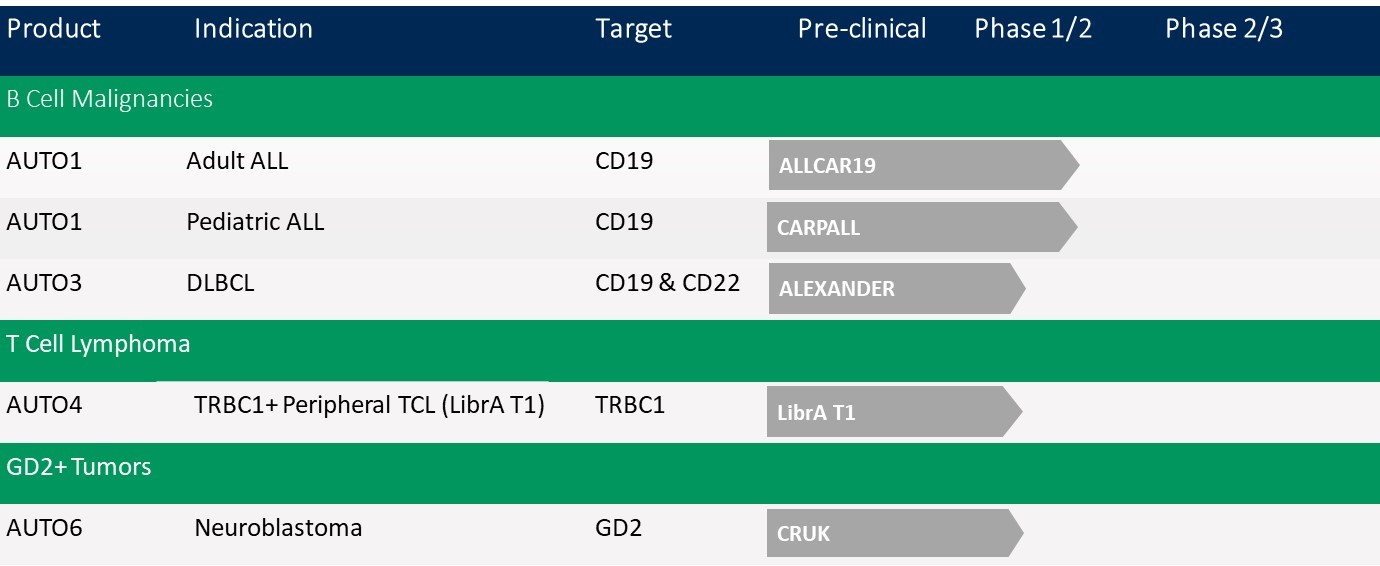
The following table summarizes key information about our pre-clinical-stage programmed T cell product candidates.

Our current clinical-stage programs are:
|
AUTO1:
|
a CD19-targeting programmed T cell therapy with a CD19 binder designed to improve the efficacy and safety profile of AUTO1 compared to the first generation CAR-T products approved for commercial sale. In December 2019, we announced updated data that support the anti-leukemia activity of AUTO1 in the absence of severe cytokine release syndrome, or severe CRS, in two ongoing Phase 1 trials of both pediatric and adult patients with relapsed or refractory acute B lymphocytic leukemia (ALL). We expect to initiate a Phase 2 clinical trial of AUTO1 for the treatment of adult ALL in 2020. This trial may potentially be a registrational trial. In addition, we will pursue a pediatric label through a pediatric investigational program. Further, we will also commence in 2020 a Phase 1 study in pediatric relapsed or refractory acute B lymphocytic leukemia with our next generation product candidate, AUTO1NG.
|
|
AUTO3:
|
the first dual-targeting, bicistronic, or having two chimeric antigen receptors within one vector, programmed T cell therapy for the treatment of relapsed or refractory diffuse large B-cell lymphoma, or r/r DLBCL, and pediatric ALL, independently targeting B-lymphocyte antigens CD19 and CD22.
|
54
•
DLBCL (ALEXANDER Trial)
: We initiated a Phase 1/2 clinical trial of AUTO3 in DLBCL in the third quarter of 2017 and reported initial data from the dose-escalation phase of the trial in the fourth quarter of 2018. In December 2019 and January 2020, we reported updated safety and efficacy results indicating that AUTO3 was generally well tolerated. This preliminary data shows encouraging indications of durability of effect in patients who achieved complete response after AUTO3 treatment.
•
Pediatric ALL (AMELIA Trial)
: We initiated a Phase 1/2 clinical trial of AUTO3 in pediatric ALL in the third quarter of 2017 and reported initial data in the fourth quarter of 2018. We provided updated safety and durability of effect results in March 2019 and December 2019. Based on preliminary data published to date, AUTO3 has a manageable safety profile, and at high dose levels, high response rates and encouraging indications of durability of effect. We announced during the year that we would not be taking AUTO3 forward in pediatric ALL. Our focus in pediatric ALL will be with AUTO1 and AUTO1NG.
|
AUTO4:
|
a programmed T cell therapy for the treatment of peripheral T-cell lymphoma targeting TRBC1. We initiated a Phase 1/2 clinical trial in the fourth quarter of 2018 and we expect to report Phase 1 interim data in the fourth quarter of 2020.
|
|
AUTO6:
|
a programmed T cell therapy targeting GD2 in development for the treatment of neuroblastoma. A Phase 1 clinical trial with AUTO6 is being sponsored and conducted by Cancer Research UK, or CRUK, and preliminary data has shown initial anti-tumor activity in this solid tumor indication. We are developing a next-generation product candidate, which we refer to as AUTO6NG, incorporating additional programming modules designed to improve the efficacy, safety and persistence of AUTO6. We presented preclinical data of AUTO6NG in November 2019. We expect to initiate the first of two planned Phase 1/2 clinical trials of AUTO6NG in the second half of 2020.
|
Our product pipeline is built on our core principles of modular innovation with protein-based cell programing focused on advanced targeting, pharmacological control and enhancement of activity.
Our product candidate, AUTO1 has an optimized engagement of the CD19 target designed to enhance the persistence of AUTO1. We believe that these properties may enable AUTO1 to be a suitable candidate for the treatment of adult patients with ALL, who tend to be less tolerant of severe toxicity than children with ALL. There are currently no programmed T cell therapies approved for the treatment of adult ALL.
AUTO3 is designed to address a key escape route used by hematological cancers in response to T cell therapies. Cancer cells often mutate and cease to express the antigen that current therapies were designed to recognize. This loss of the target antigen leads to leukemia relapse. Consequently, we have developed AUTO3 to employ a dual-targeting mechanism because we believe it may improve durability of treatment response and reduce the frequency of cancer relapse when compared to other currently approved single-targeting T cell therapies, including other chimeric antigen receptor, or CAR, T cell therapies and T cell engager approaches.
AUTO4, which we are developing for the treatment of peripheral T-cell lymphoma, employs a novel and differentiated treatment approach. AUTO4 is designed to selectively kill cancerous T cells in a manner that we believe will preserve a portion of the patient’s normal, healthy T cells to maintain immunity. Since our AUTO4 approach is a novel mechanism to target T cells, we have also programmed the product candidate with a “safety switch” in order to allow physicians to manage toxicity by eliminating the programmed T cells if a patient experiences severe adverse side effects from the treatment.
We are developing AUTO6NG, which builds upon AUTO6 clinical data by incorporating additional programming modules intended to enhance efficacy by aiming to extend persistence and address the layers of defense that cancer cells deploy to evade T cell killing.
We previously developed AUTO2, a dual-targeting programmed T cell therapy for the treatment of relapsed or refractory multiple myeloma targeting BCMA and the transmembrane activator and CAML interactor, or TACI. In August 2019, we announced that we were discontinuing development of AUTO2 and shifting our focus to the development of AUTO8, our next-generation product candidate for multiple myeloma which targets both BCMA and a second, undisclosed target. In December 2019, we reported preliminary data from our Phase 1 clinical trial of AUTO2. Preliminary results suggested that AUTO2 may have a manageable safety profile, even at the highest dose level evaluated, and patients treated with doses of 225 x 10
6
CAR T cells and above achieved a response rate of 43%. We believe this response rate may have been affected by a lower-than-expected expression of BCMA in the majority of patients in this trial. These data indicated a manageable safety profile, but insufficient levels of clinical activity to warrant further development. We plan to incorporate two additional programming modules into AUTO8, a dominant negative TGFbRII protein and a truncated SHP2 protein, designed to enhance resilience towards the tumor microenvironment. We believe that the design of AUTO8 has the
55
potential to induce deep and durable responses and extend the durability of effect over other BCMA CARs currently in development. We expect to initiate a Phase 1 clinical trial of AUTO8 in multiple myeloma in 2020.
We expect to continue to expand our suite of cell programming technologies to include programming modules designed for allogeneic applications in 2020. A first novel allogeneic application is expected to enter the clinic in the fourth quarter of 2020.
The manufacture and delivery of programmed T cell therapies to patients involves complex, integrated processes, including harvesting T cells from patients, programming the T cells
ex vivo
, or outside the body, multiplying the programmed T cells to obtain the desired dose, and ultimately infusing the programmed T cells back into a patient’s body. Providing T cell therapies to patients in a commercially successful manner requires a manufacturing process that is reliable, scalable and economical. We are using a semi-automated, fully enclosed system for cell manufacturing, which is designed to provide a common platform suitable for manufacturing all of our product candidates and to allow for rapid development of our product candidates through clinical trial phases and the regulatory approval processes. In addition, this platform allows for parallel processing and the ability to scale for commercial supply in a controlled environment and at an economical cost. We intend to continue building internal manufacturing and supply capabilities as well as to utilize the expertise of collaborators on some of the aspects of product delivery, logistics and capacity expansion. We believe having established manufacturing processes suitable for commercialization early in the development of our T cell therapies will allow us to focus on expanding manufacturing capacity during our clinical trials.
We anticipate that the market for T cell therapies will be characterized by rapid cycling of product improvements. We believe our modular approach to T cell programming and the common manufacturing platform used across all our T cell therapies will position us to more quickly develop follow-on, or next-generation, product candidates with enhanced characteristics, such as pharmacological control, insensitivity to checkpoint inhibition or other desirable features.
Our management team has a strong track record of accomplishments in the fields of redirected T cell therapies, gene therapy, transplantation and oncology. Their collective experience spans key areas of expertise required of a fully integrated company delivering advanced programmed T cell therapies, including fundamental innovation in therapeutic design, translational medicine and clinical development, process sciences, manufacturing and commercialization. We are led by Dr. Christian Itin, our Chairman and Chief Executive Officer. His prior experience includes serving as the Chief Executive Officer of Micromet, Inc., a public biotechnology company acquired by Amgen Inc. in 2012 for $1.2 billion, where he led the development of blinatumomab, which in 2014 became the first redirected T cell therapy approved by the U.S. Food and Drug Administration, or FDA. Our proprietary and modular T cell programming technologies were invented by Dr. Martin Pulé, our scientific founder and Senior Vice President and Chief Scientific Officer. Dr. Pulé has been an innovator in the field of genetic engineering of T cells for cancer treatment for almost 20 years.
Background on T Cells and Cancer Treatment Approaches
Cancers originate from individual cells that have developed mutations in essential cellular programs, driving increased cell division and growth. A key control mechanism to detect and eliminate such cells is the patient’s own T cells. T cells are a type of white blood cells used by the human immune system to defend the body against infectious pathogens and cancerous cells. Using their T cell receptor like a molecular scanner, T cells are able to discriminate between normal human cells and ones that contain a mutation that alters their function. If the T cell recognizes an altered cell, it becomes activated and kills that particular cell. For a cancer to grow to the detriment of the patient, cancer cells evolve mechanisms to evade recognition by, or establish other defenses against, T cells.
T Cell Activation- and Redirection-Based Therapies
Cancer immunotherapy treatment requires the activation and expansion of cancer-specific T cells, which kill cancer cells by recognizing antigen targets expressed on cancer cells. Studies have shown that tumors develop escape mechanisms that prevent T cell-mediated destruction through immune checkpoint proteins, which shut down anti-tumor immunity. Clinical trials have shown that treatment with immune checkpoint inhibitors can restore T cell activity and results in durable clinical responses. These observations have led to the FDA approval of several checkpoint inhibitors including ipilimumab (anti-CTLA-4), nivolumab (anti-PD-1), pembrolizumab (anti-PD-1),durvalumab (anti-PD-L1) and atezolizumab (anti-PD-L1). Treatment with checkpoint inhibitors has shown the ability to activate CD8+ T cells, shrink tumors, and improve patient survival. While these approaches collectively represented major advances in cancer treatment, they all lack active redirection of the patient’s T cells to the cancer, eventually limiting clinical activity.
More recently, redirected T cell therapies that are designed to give the patient’s T cells a new specificity to recognize cancer cells have been developed. The first approved product of this class is a bi-specific T cell engager called blinatumomab (Blincyto
®
) from Amgen Inc. Blinatumomab targets the CD19 antigen on the surface of B cells and cancers derived from B cells. Blinatumomab received an accelerated approval for the treatment of patients with relapsed or refractory B cell acute lymphoblastic leukemia, or B-ALL, in 2014, followed by a full approval for all age groups in B-ALL in 2017. In 2017, the first two genetically programmed redirected
56
T cell therapies were approved, both also targeting CD19, CAR-T therapy Kymriah
®
by Novartis AG for pediatric B-ALL and Yescarta
®
by Kite Pharma, Inc. (acquired by Gilead Sciences, Inc.) for DLBCL. All three of these therapies received breakthrough therapy designation and showed high response rates and, in a subset of patients, prolonged treatment effects. For those patients experiencing a relapse, the common causes for relapse are insufficient survival of the programmed T cells, loss of the CD19 target on the cancer cells and upregulation of checkpoint inhibitor PD-L1 on the cancer cells.
In view of the limitations of current therapies, there remains a critical unmet medical need for improved T cell therapies. We believe that improving efficacy and durability over the products currently on the market or in development for the treatment of cancers requires addressing target antigen loss, countering checkpoint inhibition and adding novel targets to expand the range of indications amenable to programmed T cell therapy. We believe our clinical-stage product candidates and our approach to T cell programming have the potential to address these limitations.
Programmed T Cell Therapies
Process of T Cell Programming
Existing programmed T cell therapies for oncology have focused on engineering CAR T cells. CARs are membrane-bound proteins, combining the tumor-recognition properties of an antibody with the naturally occurring T cell activation mechanism. CARs are designed such that a portion on the outside of the T cell binds to a structure on the surface of a cancer cell and a portion on the inside of a T cell transmits an activating signal and leads the T cell to attack the cancer cell. The actual steps to create CAR T cells start with leukapheresis, a process in which white blood cells are collected from the patient and separated from the blood. The sample is then enriched by stimulating the T cells, which causes them to replicate. During that process, a viral gene vector is used to introduce the genetic information encoding the CAR into the DNA of the T cells. T cells then read this information and produce CARs on their cell surface. The programmed T cells are then infused back into the patient intravenously following a short course of chemotherapy to condition the bone marrow to accept the programmed T cells.
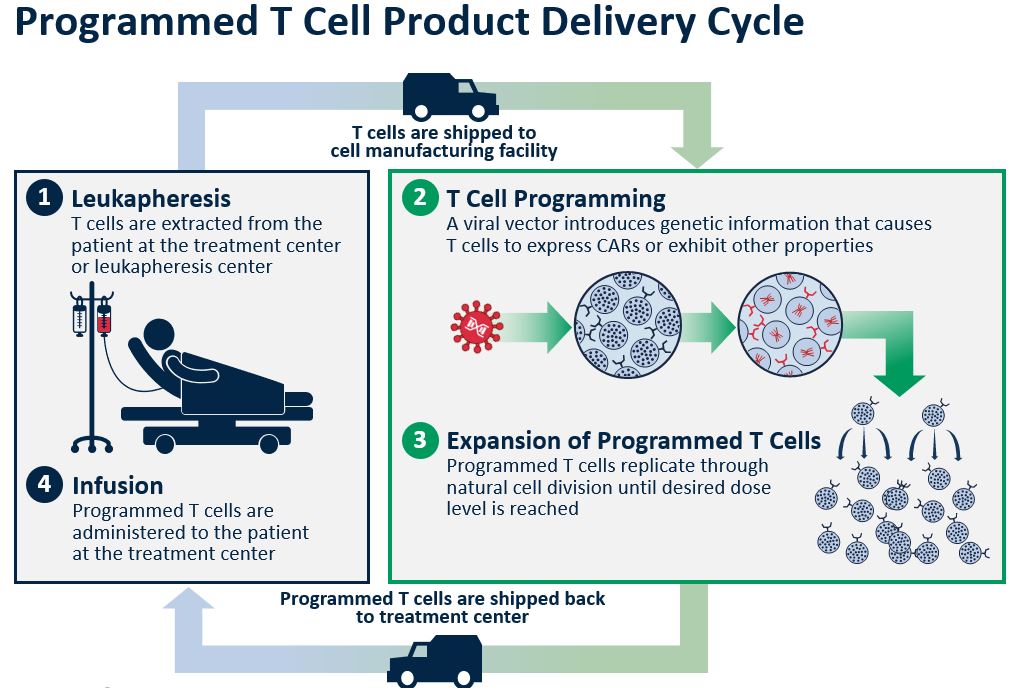
Limitations of Current T Cell Immunotherapies
Although existing T cell immunotherapies, including CAR T therapies, have shown significant efficacy in hematological malignancies, the extent and duration of the treatment effects and disease remission remain unknown. Optimizing the targeting module of a programmed T cell may enhance its effect and safety. Also, in response to targeted therapies, cancer cells often mutate and cease to express the antigen the therapy was designed to recognize. This loss of target antigen leads to patient relapse. Additionally, numerous challenges, including lack of T cell persistence and upregulation of checkpoint inhibitors, represent significant hurdles that need to be addressed by new therapies. T cell immunotherapies also have the capacity to elicit toxicities including CRS, neurologic toxicity and the elimination of normal cells via on-target off tumor recognition. Further, manufacturing T cells can be prohibitively costly if the manufacturing process is not appropriately designed to support parallel processing and automation. Finally, realization of the
57
potential of this approach across a broad range of solid tumor types will require multiple technology solutions in order to address limitations of the current generation of therapies. Our broad array of proprietary and modular T cell programming technologies are designed to address these limitations.
Our Solution: Advanced T Cell Programming Using a Modular Approach
We are applying our broad array of T cell programming technologies and capabilities to engineer precisely targeted, controlled and highly active T cell therapies that are designed to better recognize cancer cells, break down their defense mechanisms and attack and kill these cells. The breadth of our technology platform allows us to select from a range of programming modules, and our modular approach is designed to enable us to tailor our therapies to address the specific cancer we are targeting, or to improve an already established therapy, such as by making it suitable for outpatient use. We believe this capability represents a competitive advantage in the field and will allow us to position our product candidates to have the potential to be best-in-class.
After identifying a cancer target, we select the suite of programming modules that we believe is best suited to target that particular cancer based on our latest clinical data and the results of our cancer research. The particular modules selected may vary, and not every product candidate, including our current product candidates, contain all categories of modules. A viral vector is used to introduce combinations of these modules into the DNA of the T cells, as depicted in the graphic below. With the exception of AUTO1, all of our product candidates contain two or more programming modules.
The diagram below shows how our programming modules relate to our product candidates.
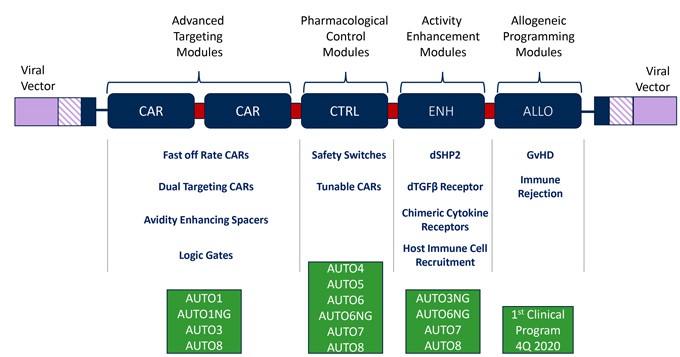
58
Advanced Targeting Technologies Used in our Modular Approach
We have developed advanced antigen targeting modules to improve the ability of our programmed T cell therapies to selectively identify, target and destroy cancer cells and overcome shortcomings of the current generation of T cell therapies. These targeting technologies include innovative binders, novel targets, dual-targeting and pattern recognition.
Innovative Binders and Novel Targets
Binding domains allow for selective targeting of cancer cells, and the properties of binders are crucial to the performance of T cell therapies. The binders of each of our programs have been optimized, are novel binders, or bind to novel targets.
The T cells of other CD19 CAR T cell therapies that have been approved or that are in clinical development are engineered to express high affinity binders that can engage their targets for an extended period of time. This can lead to excessive T cell activation and toxicities caused by cytokine release, as well as exhaustion of the CAR T cell. The programmed T cells of AUTO1 express a CD19 binder with a fast off-rate, which refers to the rate at which a T cell disengages from a target antigen. This is similar to the off-rate of naturally occurring T cells. AUTO1, with this enhanced kinetic profile, appears to result in reduced CRS and in increased T cell engraftment compared to data reported for other CAR T cell product candidates in clinical development for ALL that use high affinity binders.
AUTO3 includes an optimized CD22 binder that increases the avidity for the CD22 target. It is challenging to target CD22 for immunotherapy because of its large size and extensive post-translational modifications. Our optimized CD22 binder combines five CAR binding domains to allow for suitable orientation and efficient target engagement compared to a traditional CAR.
Each of the TRBC1 binder used in AUTO4 and TRBC2 binder used in AUTO5 are highly selective for one of two highly related variants of the constant domain in T cell receptor beta chains. These binders allow AUTO4 to target TRBC1-positive T cell lymphoma cells without affecting healthy TRBC2-positive T cells and allow AUTO5 to target TRBC2-positive T cell lymphoma cells without affecting healthy TRBC1-positive T cells
AUTO6 is designed to target GD2 with an optimized anti-GD2 binder which uses a humanized targeting domain. Initial clinical data from an ongoing Phase 1 clinical trial sponsored by CRUK indicates early signs of clinical activity in the absence of neurotoxicity.
Dual-Targeting Technology
Escape from T cell recognition by losing the antigen, the very structure the programmed T cell is designed to recognize, is a fundamental defense mechanism of hematological cancers. All clinical programs targeting CD19, CD22 or BCMA in a single-target approach have reported patients relapsing with cells that no longer have detectable levels of the target antigen. A notable example of this defense mechanism of cancer cells was reported for children relapsing under CD19-targeting Kymriah treatment, with more than half the children at time of relapse showing a loss of the CD19 antigen on the recurring cancer cells.
We believe that directly targeting two antigens on a cancer cell will reduce the chances for relapse and may also improve a response in those patients with low levels of expression of a target antigen on their cancer cells. AUTO8, our programmed T cell therapy for the treatment of multiple myeloma, binds to two receptors, BCMA and a second undisclosed target. AUTO3, the first dual-targeting programmed T cell therapy for the treatment of pediatric ALL and DLBCL, targets both the CD19 and CD22 antigens, both of which are B-cell antigens with similar patterns of expression.
Pattern Recognition Technology
Programmed T cells are very powerful and must be highly selective for the cancer cells in order to avoid unwanted side effects. Particularly for the treatment of solid tumors, which have greater complexity, achieving a sufficient level of selectivity based on a single target to avoid toxicity can be challenging. For such cancers, we have developed a programming module designed to make a kill decision based on the presence of two or more targets on the cancer cell. This technology is designed to allow us to program T cells to eliminate tumor cells only if two different targets are both present on the surface of the cell, thereby sparing healthy cells that express only one of these targets in isolation. We are also developing technology that we believe will allow us to program T cells to eliminate a tumor if only the tumor target, but not a target only found on healthy cells, is present on the cancer cell.
59
Pharmacological Control of T Cell Activity
Management of toxicity is a critical step in the successful application of programmed T cell therapies. We have developed multiple technologies designed to pharmacologically control T cell activity. These technologies fall into two distinct categories: safety switches and tunable T cells.
Safety Switches
Also referred to as “off switches” or “suicide switches,” safety switches selectively eliminate the programmed T cells and are intended to be triggered in the event a patient suffers certain serious adverse events related to the T cell therapy, such as CRS or neurotoxicity. We incorporate the RQR8 safety switch into some of our programmed T cell product candidates, which allows us to selectively eliminate the programmed T cells by the administration of the commercially available monoclonal antibody rituximab, or Rituxan
®
, which binds to the surface of the T cell and thereby triggers cell death. We use the RQR8 safety switch in our AUTO4 and AUTO6 programs. The next generation of our safety switches, which we plan to incorporate in our solid tumor programs, utilizes rapamycin activated Caspase 9 (rapaCasp9), a cell therapy safety switch that allows for selective elimination of programmed T cells using a single therapeutic dose of the commercially available product rapamycin, such as sirolimus or Rapamune
®
. Rapamycin is a small molecule drug, which we expect will have the benefit of better tissue penetration and may require less time to take effect as compared to a monoclonal antibody-activated safety switch.
Tunable T Cells
Eliminating programmed T cells with a safety switch like RQR8 has the potential to allow the patient to recover from treatment-related side effects but also to preclude the anti-tumor activity following elimination of the programmed T cells, which could lead to relapse. To avoid this undesirable consequence of the safety switch, we are developing several programming modules that are designed to allow tunable programmed T cell responses by reducing programmed T cell activity if a patient experiences severe toxicity, while also allowing for the subsequent reactivation of programmed T cells, thereby allowing for the possibility of persistence and sustained anti-tumor activity. One such system we have developed is designed to reversibly dampen the activity of the programmed T cells by temporarily dislocating the signaling domain on the inside of the T cell from the cancer cell recognition domain with two commercially available antibiotics, tetracycline and minocycline.
Enhanced T Cell Activity Technologies
We have also developed a wide range of technologies designed to inhibit the immunosuppressive effects of the tumor microenvironment and enhance T cell persistence.
Evading Hostile Tumor Microenvironments Including Checkpoint Inhibition
Proteins expressed on tumor cells can trigger inhibitory receptors on T cells to block their ability to eliminate the tumor, such as PD-L1/PD-1 immune checkpoints. These inhibitory receptors act through a common signaling pathway inside the T cell that prevents normal T cell activation. We have developed a programming module designed to cause T cells to express a modified version of an adaptor protein, SHP2, that in preclinical studies has been shown to efficiently counteracts the inhibition of T cells resulting from the PD-L1/PD-1checkpoint interaction. Unlike methods that rely on blocking one inhibitory receptor using antibodies that are separately administered to the patient and are known to have significant side effects on their own, we have designed this programming module to be engineered into the T cells and not to require the administration of a separate pharmaceutical agent. In addition, it is designed to simultaneously disarm multiple inhibitory receptors on the cancer cell.
Enhanced T Cell Persistence
Programmed T cell therapies that target hematological malignancies are regularly stimulated by engaging tumor and normal cells in the bone marrow and lymph tissue. This continued stimulation helps the programmed T cell survive and persist, allowing them to attack the tumor for an extended period of time. One of the challenges of targeting some solid tumors is the lack of such easily accessible stimulation for programmed T cells, leading to poor persistence and a weak anti-tumor activity. Programmed T cell therapies have been co-administered with cytokines that boost T cell activity and persistence in an attempt to enhance their effect on solid tumors. However, systemic or local administration of cytokines can be toxic. Therefore, we have developed a technology that is designed to deliver a cytokine signal directly inside our programmed T cells without administration of cytokines themselves. Depending on the tumor microenvironment, the cytokine persistence signal may be further enhanced by antigens secreted by the tumor. We believe our approach will be more potent and will have the potential to be less toxic, when compared to approaches that rely on systemic or local delivery of cytokines.
60
Advanced T Cell Programming is Key for Solid Tumor Programs
Achieving a meaningful and durable response with programmed T cell therapies in the treatment of solid tumors is more challenging than in hematological cancers for a variety of reasons. Solid tumors have fewer suitably selective, single antigen targets that can be used as a basis for tumor recognition, and solid tumors employ multiple sophisticated lines of defense to evade T cell killing.
Consequently, in order to be able to tackle the more complex biology of solid tumors, we anticipate that programmed T cell products will need to employ multiple modules of technology to overcome these challenges. With our broad array of proprietary programming modules and our ability to incorporate multiple elements into our programmed T cell product candidates, we believe we are well positioned to design these types of product candidates and expand our pipeline into solid tumor indications, including with our development of
AUTO6NG and AUTO7.
Advanced T Cell Programming for Allogeneic Programs
We expect to continue to expand our suite of cell programming technologies to include programming modules designed for allogeneic applications in 2020. There are two key challenges for allogenic T cell therapies. The first is to address Graft vs Host Disease, which is mediated by the T cell Receptor (TCR) of the donor cells used to make the product candidate attacking the patient’s tissues. This can be life threatening for the patient. The second challenge is to address immune rejection where the patient T cells recognize and reject the engineered T cell as foreign tissue, thus preventing it from persisting and potentially limiting its anti-tumor activity. We have developed novel approaches using protein-based programming that integrate with our existing T cell programming and manufacturing platform. TCR expression is disrupted by intracellular retention and degradation using a single programming module and programming modules are also in development to protect the donor cells from immune rejection. These approaches avoid technical and intellectual property complexities of gene editing. A first novel allogeneic application is expected to enter the clinic in the fourth quarter of 2020.
Our Product Candidates for the Treatment of Hematological Cancers
Our three clinical-stage product candidates targeting hematological cancers are AUTO1, AUTO3 and AUTO4. We have additional hematological product candidates AUTO1NG, AUTO3NG, AUTO5, and AUTO8 in preclinical development.
AUTO1: Our Programmed T Cell Therapy for the Treatment of ALL
Introduction to AUTO1
CD19 is a protein expressed by B cell lymphomas and leukemia. CD19 CAR T cell therapies have proven effective in treating leukemia and lymphoma, with efficacy dependent on engraftment and expansion of the CAR T cells. However, rapid activation and expansion of CAR T cells can result in CRS, which in some cases can be life-threatening, particularly for elderly patients and patients with higher tumor burden that have a poor tolerance for toxicity. Furthermore, excessive activation of CAR T cells can lead to cell exhaustion and limit their persistence, which may impact the durability of therapeutic effect. AUTO1 is an investigational therapy in which a patient’s T cells are genetically modified to express a novel CD19-specific binder designed to reduce cytokine release-related side effects.
AUTO1, currently the subject of separate Phase 1 trials in pediatric ALL and adult ALL, has been designed to recognize CD19 and interact with the target with a fast off-rate. This property allows the AUTO1 cells to efficiently recognize cancer cells, inject cytotoxic proteins to initiate the natural self-destruction process present in all human cells and then rapidly disengage from them in order to engage the next cancer cell, a process also known as serial killing. Rapid disengagement from the target antigen is expected to minimize excessive activation of the programmed T cells, reduce toxicity and may also reduce T cell exhaustion.
Our academic partner, UCL, is conducting two separate Phase 1 clinical trials evaluating the safety and efficacy of AUTO1. The first Phase 1 clinical trial in pediatric ALL patients is named the CARPALL trial the second Phase 1 clinical trial in adult ALL patients is named the ALLCAR19 trial.
AUTO1 Phase 1 Clinical Trial in Pediatric ALL (CARPALL Trial)
The CARPALL trial was initiated by UCL in the second quarter of 2016 and is a single-arm, open label, multi-center Phase 1 trial enrolling patients aged 24 years or younger with high-risk relapsed or refractory CD19 positive B-lineage ALL. The main
61
objective of the trial is to evaluate the safety and efficacy of AUTO1 when administered at a single dose of 1 million cells/kg. Currently, the trial is being conducted at sites in the United Kingdom.
As of the data cut-off date of November 22, 2019, the trial has enrolled a total of 25 patients, which were stratified into two cohorts; one cohort utilized a manual manufacturing process (cohort 1) and one cohort utilized a semi-automated fully enclosed manufacturing process (cohort 2). Product was generated for 14 of 17 patients in cohort 1 and the median follow-up for the 14 treated patients was 23 months. Seven patients were treated in cohort 2. The aim of cohort 2 was to increase feasibility of manufacture at scale; one patient died before infusion and product was generated for 100% of patients. Median follow-up for patients in cohort 2 was seven months.
None of the patients experienced Grade 3 or higher CRS and one patient out of 21 (5%) experienced Grade 4 neurotoxicity, which was deemed more consistent with fludarabine than CAR-associated neurotoxicity. Two patients experienced Grade 5 sepsis and death, one in the context of progressive disease and the second was considered related to AUTO1. This patient was in MRD-negative CR and had ongoing Grade 4 cytopenia associated with resistant HSV encephalitis. 13 patients experienced Grade 4 cytopenias that were ongoing at day 28. One patient had a lung infection considered related to treatment as well as fungal chest infection. Nineteen of 21 treated patients (90%) achieved molecular complete remission at post-infusion. Consistent with preclinical results, CAR T cell expansion and persistence was excellent and CARs were detectable by flow for up to 36 months in four of the patients in cohort 1 who had ongoing responses beyond 12 months. Persistence was noted in 15 of 21 patients at last follow-up, up to 36 months. All of the patients in cohort 2 achieved molecular complete remission at one month post-infusion.
For cohort 1, the overall survival at six and 12 months was 86% and 71%, respectively, and event-free survival at six and 12 months was 71% and 54%, respectively. In cohort 2, at a median follow-up of 7 months, five patients remain in complete molecular remission and two patients relapsed. Five of eight evaluable relapses in cohort 1 and cohort 2 combined were due to CD19 negative escape.
Clinical Development of AUTO1 in Adult ALL
Background of Adult ALL
AUTO1 is being tested in a Phase 1 clinical trial for the treatment of adult ALL, which according to the American Cancer Society is predicted to affect approximately 5,960 adults in the United States in 2018. Combination chemotherapy enables 90% of adult patients to experience
complete remission, or
CR. Despite this, and in contrast to pediatric ALL, the prognosis of adult ALL is still poor and has not changed significantly during the last two to three decades, with long-term remission rates limited to 30-40%. Approximately 50% of all adult ALL patients will relapse, and data from the Medical Research Council’s UKALL12/ECOG 2993 study, published in 2007, found that five-year overall survival, or OS, rate in adults who relapse following standard multi-agent chemotherapy is 7%. The only curative option for relapsed or refractory ALL consists of achieving a second CR by salvage therapy followed by an allogeneic hematopoietic stem cell transplant, or allo-HSCT. Without allo-HSCT, a subsequent relapse occurs in nearly all patients. However, less than half of patients achieve a second CR, and therefore only a subset will be eligible for this procedure. Even then, less than one-third of patients receiving the transplant are expected to sustain long-term disease-free survival. Further, allo-HSCT is associated with severe morbidity and significant mortality. Many patients with relapsed or refractory ALL will have been maximally treated with chemotherapy, and often do not achieve a second CR with standard-of-care chemotherapy in order to be eligible for allo-HSCT.
Recently, two new targeted therapies have shown promise in the treatment of adult ALL: blinatumomab and inotuzumab ozogamicin. Both of these therapies achieve high complete response rates, but durability is limited. In a randomized Phase 3 clinical trial of blinatumomab in heavily pretreated B-cell precursor ALL, the blinatumomab arm achieved a complete response rate of 44%, of which 76% also achieved MRD-negative CR, and the median duration of remission was 7.3 months. The median OS in those patients, though significantly improved compared to chemotherapy, was still only 7.7 months. Similarly, in a Phase 3 clinical trial of inotuzumab ozogamicin, a higher percentage of patients achieved MRD-negative CR when treated with inotuzumab compared to standard-of-care chemotherapy, but the median duration of remission was 4.6 months and median OS was 7.7 months.
CD19 CAR T cell therapies have been tested in pediatric ALL patients and have shown sustained responses without allo-HSCT. In adult ALL, however, one of the major challenges has been severe toxicity, including death due to CAR T cell-mediated toxicity observed in the clinical trials of these products. AUTO1 has been designed to reduce toxicity but still sustain durable CRs, and we believe it has the potential to become a standalone therapy for adult ALL
.
AUTO1 Phase 1 Clinical Trial in Adult ALL (ALLCAR19 Trial)
62
In the first quarter of 2018, our academic partner University College London, or UCL, initiated a single-arm, open label, multi-center Phase 1 clinical trial of AUTO1, named the ALLCAR19 trial, in patients aged 16 to 65 years with high-risk, relapsed or refractory CD19 positive B-lineage ALL. The clinical trial is currently being conducted at sites in the United Kingdom. The trial enrolled patients with a high tumor burden; 44% of patients had 50% or greater bone marrow blasts. To date, AUTO1 product has been manufactured for 19 patients; product for 13 of those patients was manufactured using a semi-automated, fully-enclosed process, which we anticipate using for commercial supply if approved.
As of the most recent cut-off date of November 25, 2019, 16 patients had received at least one dose of AUTO1. Based on this preliminary data, we have observed a manageable safety profile for AUTO1, with no patients experiencing Grade 3 or higher CRS (using the Lee grading criteria, which is the standard currently adopted by the medical community for grading CRS and enables comparison of clinical trial safety data across clinical studies) and three patients (19%) experiencing Grade 3 neurotoxicity that resolved swiftly with steroids, two within 24 hours and one within 72 hours. Using the Penn criteria, which is the grading scale set forth in our clinical protocol, one patient treated with AUTO1 was observed to have a Grade 3 CRS. Grade 3 or higher neutropenias were common, with five of 16 patient reporting such neutropenias prior to treatment with AUTO1 and 8 of 14 patients reporting neutropenias 28 days after treatment with AUTO1, with most resolving by month two or three. Five patients died while enrolled in the trial, of which three deaths were determined to be due to the progression of leukemia and the two remaining deaths were determined to be due to infectious complications (a common complication of advanced ALL). Since the most recent cut-off date of November 25, 2019, one additional patient has died due to infectious complications assessed as unrelated to AUTO1. Of the 15 patients evaluable for efficacy, 13 patients (87%) achieved minimal residual disease, or MRD, negative complete responses at one month and all 15 patients had ongoing CAR-T cell persistence at last follow-up. Three of the 13 patients with a complete response relapsed, 10 of the 15 evaluable patients (67%) remain disease-free at a median follow up of 11 months (range of 0.5 month - 21 months). Of the 16 patients dosed, ten patients were dosed with AUTO1 manufactured using our semi-automated, fully enclosed system for manufacturing. In this cohort, nine patients were currently evaluable as of data cut-off and achieved MRD-negative complete response at one month. The median follow-up in this cohort was 6.7 months (range of 1.1 month-14.5 months) and achieved the six-month event-free survival, or EFS, and overall survival, or OS, rates of 100%. The EFS and OS data are preliminary considering the small number of patients.
In October 2019, we announced that the U.S. Food and Drug Administration, or FDA, granted orphan drug designation for AUTO1 for the treatment of ALL.
Development Strategy for Adult ALL
The trial continues to enroll patients up to a total of approximately 20 treated patients and we anticipate reporting updated safety and efficacy data throughout 2020. We intend to seek breakthrough therapy designation or RMAT designation from the FDA for AUTO1 based on the significant medical unmet need among these patients. We intend to initiate a multicenter, single-arm Phase 2 trial of AUTO1 in adult ALL in 2020. This trial may potentially be a registrational trial. The final number of patients to be enrolled in the trial and the trial endpoints will be determined based on feedback from regulatory authorities.
AUTO3: Our Programmed T Cell Therapy for the Treatment of Pediatric ALL and Adult DLBCL
Introduction to AUTO3
We are developing AUTO3, the first dual-targeting programmed T cell product candidate that targets B cell antigens CD19 and CD22, for the treatment of pediatric patients with relapsed or refractory ALL, as well as the treatment of adult patients with DLBCL.
By simultaneously targeting both B cell antigens, we believe the novel molecular design of AUTO3 addresses a major limitation of current CAR T cell products that target only CD19 or CD22; the loss of the target antigen on the surface of the cancer cell, which leads to relapse of the cancer.
Background of Pediatric ALL
Pediatric ALL is a type of cancer in which the bone marrow makes too many immature lymphocytes, which are a type of white blood cell. According to the American Cancer Society, ALL is most common in early childhood, peaking between two and four years of age. As per the National Cancer Institute Surveillance, Epidemiology and End Results statistics database, there are approximately 3,400 new cases of pediatric ALL diagnosed in the United States each year.
The current standard of care for both pediatric and adult ALL patients is a standard regimen of combination chemotherapy. Pediatric patients typically respond well to the complex first-line treatment. According to the American Cancer Society, the five-year survival rate for children with ALL is more than 85% overall. However, 10 to 20% of pediatric ALL patients relapse with chemotherapy-
63
resistant disease. These patients are re-treated with intensive chemotherapy, and those that respond well proceed to receiving an allogenic stem cell transplant, or SCT. However, SCT is associated with significant long-term morbidity due to the risk of developing graft-versus-host disease, or GVHD, and treatment-related mortality, although the risk of death declines with better post-transplant management.
Patients with high-risk clinical or genetic features including gene abnormalities, as well as those who have an inadequate response to initial chemotherapy, typically do poorly and receive a more intensive therapy regimen, with a five-year OS rate of approximately 15%. Patients relapsing after SCT have a very poor prognosis. Long-term survival rates are only approximately 10 to 20% among patients receiving a second SCT and negligible in those unable to proceed to a second transplant.
There is a significant unmet need in pediatric patients with high-risk relapsed or refractory ALL. CD19 CAR T cell therapies have been developed for these patients, with an 80 to 90% complete response rate observed. However, at six months after treatment, approximately 40% of the patients relapse. In one study of CD19-targeting Kymriah treatment, approximately two-thirds of relapses were determined to have been due to loss of CD19 on the target cells.
Clinical Development of AUTO3 for Pediatric ALL
We conducted preclinical testing of AUTO3 and subsequently initiated our clinical development program of AUTO3 for pediatric ALL. Clinical trials of AUTO3 are designed to evaluate AUTO3 in pediatric patients with ALL that is refractory or in second or later relapse.
Preclinical Studies of AUTO3
We have evaluated AUTO3 in preclinical
in vitro
and
in vivo
animal models of disease. In these studies, AUTO3 cells targeting both CD19 and CD22 were observed to eliminate tumor cells expressing these antigens. The specificity and functionality of the CD19/CD22 programmed T cells was established
in vitro
using the relevant human cell line. In addition, the dual targeting AUTO3 cells had similar functionality relative to the single CD19 and CD22 CAR T cells. Moreover, the ability of the dual targeting AUTO3 cells to efficiently kill CD19-negative variants was confirmed in an
in vitro
model of antigen-escape, a common mechanism of relapse in patients following treatment with a CD19 targeting CAR T cell therapy.
AUTO3 Phase 1/2 Clinical Trial in Pediatric ALL (AMELIA Trial)
We initiated a single-arm, open label, multi-center Phase 1/2 clinical trial of AUTO3 in patients up to 24 years of age with high-risk relapsed or refractory B-lineage ALL in the third quarter of 2017. We refer to this trial as the AMELIA Trial. We presented updated results from this clinical trial in December 2019, with a data cut-off date of October 21, 2019.
Product was successfully manufactured for 14 of the 15 patients who underwent leukapheresis. AUTO3 has been observed to have a manageable safety profile, with no patients experiencing Grade 3 or higher CRS. One patient treated in the low dose (0.3 x10
6
/kg) had Grade 3 encephalopathy which was considered likely related to prior intrathecal methotrexate. The majority of Grade 3 or higher adverse events were determined to be hematological in nature. No patient deaths have been determined to be related to AUTO3. The cytokine profile is consistent with the low intensity of CRS. In the four patients treated at <3 x 10
6
CAR T cells/kg which was considered subtherapeutic, two of four patients achieved molecular remission but progressed at three and five months. In the 10 patients treated at a dose level of 3 x 10
6
CAR T cells/kg, we observed a complete molecular remission rate of 80%. At a median follow-up of 9.7 months (range of 1.8 months -18 months), the estimated six and 12 months event free survival in these patients was 57% and 45%, respectively. The EFS data is preliminary considering the small number of patients. Two patients had ongoing complete molecular remission at 12 and 15 months post-infusion, at the data cut-off date. The most common cause of relapse was due to the absence of CAR T cell persistence. The median persistence was 170 days. Based on this small number of patients, the preliminary estimate of the overall survival rate at 12 months is 100%, which we believe indicates a potential clinical benefit of this therapy in the pediatric and young adult relapsed/refractory ALL setting.
Development Strategy for Pediatric ALL
In August 2019, we reported that we would not be continuing development of AUTO3 in pediatric ALL but instead will continue development in a pediatric setting with AUTO1 in the form a Pediatric Investigational Program, required by the European Medicines Agency, or EMA, and with AUTO1NG, a next generation version of AUTO1, which incorporates the CD19 CAR of AUTO1 and a novel CD22 CAR. We expect to initiate clinical development of AUTO1NG in 2020.
64
Background of DLBCL
Non-Hodgkin lymphoma, or NHL, consists of a diverse group of malignant neoplasms. According to the American Cancer Society, DLBCL is the most common subtype of NHL, accounting for approximately one-third of the approximately 72,000 adult NHL patients diagnosed in 2017 in the United States. DLBCL arises from a mature B cell that generally express CD19 and CD22 antigens on the surface. DLBCL is classified as an aggressive lymphoma, in which survival is measured in months rather than years.
First-line therapy usually consists of a chemotherapy regimen known as R-CHOP, which combines the monoclonal antibody rituximab with the drugs cyclophosphamide, doxorubicin, vincristine and prednisone. Approximately 50% to 60% of DLBCL patients are cured with first-line therapy and do not have recurrence of their lymphoma.
For patients who relapse or are refractory to first-line therapy, the current standard of care for second-line therapy consists of a platinum-based chemotherapy regimen with rituximab. These second-line chemotherapy regimens are either R-ICE, consisting of rituximab, ifosfamide, carboplatin and etoposide, or R-DHAP, consisting of rituximab, dexamethasone, cytarabine and cisplatin. Patients who respond to second-line therapy may go on to receive autologous hematopoietic stem cell transplantation, or HSCT. Patients who are not candidates for HSCT or those who do not respond to second-line therapy or who relapse after HSCT are typically treated with a third-line salvage chemotherapy. These patients have a poor prognosis, and treatment is generally palliative to try to prevent further cancer growth without the intent to cure.
Indolent lymphomas account for 40% of all NHL cases. The subtypes of indolent lymphoma, including follicular lymphoma and others, initially respond well to chemotherapy or antibody therapy, or a combination of both. However, in patients with progressive disease or relapse after CR, there is no defined standard of care, and such patients are generally encouraged to participate in clinical trials whenever possible. Relapsed patients who are symptomatic or need treatment are usually treated with chemotherapy, which is unfortunately not curative. Additionally, a minority of these patients are eligible to receive HSCT, which provides long-term disease free survival in some cases.
AUTO3 Phase 1/2 Clinical Trial in Adult DLBCL (ALEXANDER Trial)
We have designed AUTO3 to address limitations of current therapies for DLBCL. Simultaneous targeting of both CD19 and CD22 antigens is designed to reduce CD19 antigen negative disease relapses as seen in a third of the patients relapsing after treatment with Yescarta. Our clinical trial design also includes the administration of three doses of an anti-checkpoint inhibitor, designed to address tumor relapse due to upregulation of checkpoints in DLBCL patients treated with CAR T cell therapy. We are initially developing AUTO3 as a third-line therapy for DLBCL.
In September 2017, we initiated a single-arm, open label, multi-center Phase 1/2 clinical trial of AUTO3, followed by limited duration of consolidation with the anti-PD-1 antibody pembrolizumab. The trial is ongoing and currently enrolling adult DLBCL patients who have chemotherapy-refractory disease or with relapsed disease after two lines of prior therapy. We refer to this trial as the ALEXANDER Trial and we expect to enroll approximately 100 patients in the trial, which is being conducted at sites in the United Kingdom and the United States.
As of the data cut-off date of
January 21, 2020
(data availability as of
January 28, 2020
), 18 patients in the ALEXANDER Phase 1/2 clinical trial of AUTO3 were evaluable for safety and efficacy with minimum 28-day follow-up. In the cohorts dosed at 450 x 10
6
AUTO3 cells plus pembrolizumab, five out of seven patients (ORR=71%) achieved a response (complete response + partial response) and four out of seven patients (CRR=57%) achieved a complete response. Across all dose levels, seven out of eight complete responders (87%) had ongoing complete responses at a median follow up of six months (range of one month - 18 months). All seven out of seven complete responders (100%) treated with AUTO3 and pembrolizumab have ongoing complete responses as of
January 21, 2020
at a median follow up of three months (range of one month - 18 months). AUTO3 was generally well tolerated, with no patients experiencing dose limiting toxicity, and there were no treatment-related deaths. One patient experienced Grade 4 lung infection due to para-influenza virus that was considered to be possibly related to treatment and the patient is recovering. Such infections are a common event in late stage DLBCL patients. No patients experiencing Grade 3 or higher Cytokine Release Syndrome (CRS) were reported with primary treatment (one patient experienced Grade 3 CRS on retreatment), and one of 18 patients experienced a Grade 3 neurotoxicity that resolved swiftly with administration of steroids. As of the data cut-off, no patient has experienced neurotoxicity of any grade in cohorts treated with AUTO3 and pembrolizumab.
Development Strategy for Adult DLBCL
We continue to enroll patients in this trial, with pembrolizumab administered one day before the AUTO3 infusion. We anticipate making a decision with respect to the initiation of the Phase 2 portion of the trial in mid-2020.
65
If the safety and efficacy data from the Phase 2 portion of our ongoing trial are positive, we plan to submit a BLA to the FDA and seek accelerated approval of AUTO3 as a third-line therapy for DLBCL patients. If AUTO3 is approved as a third-line therapy for DLBCL, we would expect to initiate a trial to potentially position AUTO3 as a second-line therapy. Such a trial may include a randomized trial of AUTO3 with pembrolizumab administered one day before the AUTO3 infusion versus standard of care followed by auto transplant. We may also pursue additional trials including a randomized trial of standard of care based upon advice from regulatory authorities or in order to move to an earlier line of therapy.
Other Potential Indications and Future Generations for AUTO3
In addition, we plan to investigate the activity of AUTO3 in other aggressive and indolent lymphomas, such as follicular lymphoma, primary mediastinal B-cell lymphoma, mantle cell lymphoma and chronic lymphocytic leukemia. We will also consider consolidation of AUTO3 with anti-PD1 antibodies and other agents in these indications.
We believe our modular approach to T cell programming and the common manufacturing platform used across all our T cell therapies will position us to more quickly develop next-generation product candidates with enhanced characteristics such as pharmacological control, insensitivity to checkpoint inhibition or other desirable features. Building on our prior clinical work and using our advanced T cell programming, we are developing next-generation product candidates of AUTO3 with the intent of providing an improved safety, efficacy and durability profile. One next-generation version of AUTO3, AUTO3NG is being developed to include (i) a modified SHP2 adaptor protein in order to counteract immune checkpoint inhibition, which may eliminate the need for the separate administration of anti-PD1/PDL-1 antibodies and (ii) a dominant negative TGFbRII protein designed to block inhibitor signals from TGFb. A decision to advance such enhancements into clinical development will depend, in part, on the emerging safety and efficacy profile of AUTO3.
AUTO4: Our Programmed T-Cell Lymphoma Program
Introduction to AUTO4
We are developing a programmed T cell product candidate, AUTO4, as a potential treatment for T-cell lymphomas. We are developing this product candidate with a unique targeting approach that is designed to avoid the severe immunosuppression typically associated with current treatment options for this disease.
T cells have one of two functionally identical genes, known as TRBC1 and TRBC2. A normal T cell population contains a mix of cells expressing either TRBC1 or TRBC2. Both forms are active and provide the body with natural immunity, including antiviral immunity. Because T-cell lymphomas are clonal tumors that develop from a single T cell, they are either entirely TRBC1-positive or entirely TRBC2-positive. Currently available products for the treatment of T-cell lymphoma indiscriminately target all T cells, leading to the severe immunosuppression associated with these treatments.
We have designed AUTO4 as a programmed T cell to specifically target and deplete cells expressing TRBC1, while preserving healthy T cells that express TRBC2. A normal T cell population consists of varying amounts of TRBC1-positive and TRBC2-positive T cells. Based on the typical distribution of TRBC1-positive and TRBC2-positive T cells, we believe that patients treated with AUTO4 should be left with a population of healthy, functional T cells, which provides the immune system of these patients the ability to respond with these remaining healthy T cells to bacterial and viral infections and other pathogens. In addition, both product candidates will have a built-in safety switch designed to eliminate the programmed T cells in the event a patient suffers certain serious adverse events related to the T cell therapy, such as CRS or neurotoxicity.
Companion Diagnostic for AUTO4
We are developing a proprietary diagnostic test to distinguish between TRBC1-positive T cells and TRBC2-positive T cells. When a patient presents with T-cell lymphoma, this diagnostic is designed to test the patient’s tumor to assess whether the tumor is TRBC1-positive or TRBC2-positive, which will determine whether the patient is potentially a candidate to receive AUTO4.
Background of T-Cell Lymphoma
Mature T cell lymphomas are aggressive, treatment resistant cancers that are associated with poor prognosis. Clinical application of immunotherapeutic approaches has been limited by a lack of target antigens that discriminate malignant from healthy T cells.
T-cell lymphoma is a rare and heterogeneous form of NHL, representing approximately 10 to 20% of NHL cases and 3 to 4% of all hematological malignancies. While T-cell lymphoma is a smaller percentage of all lymphomas as compared to B cell lymphomas, T-cell lymphoma is an aggressive disease with a very poor prognosis for patients. Most T-cell lymphomas are peripheral T-cell lymphomas, or PTCL, the initial indication for which we are developing AUTO4. We estimate that PTCL affects approximately 2,900 patients in
66
the United States each year. PTCL generally involves high-grade tumors and occurs at a similar age as aggressive B cell lymphomas, with a relatively high proportion of patients becoming rapidly unwell with malaise and fevers. The five-year survival rate ranges from 18% to 24%. The three most common subtypes of PTCL are peripheral T-cell lymphoma not otherwise specified, or PTCL-NOS, anaplastic large-cell lymphoma, or ALCL, and angioimmunoblastic T-cell lymphoma, or AITL, together accounting for approximately 70% of all PTCLs in the United States.
The first-line treatment for PTCL consists of the combination chemotherapy CHOP, consisting of cyclophosphamide, vincristine, doxorubicin and prednisolone. However, treatment with chemotherapy introduces toxicity concerns, including low blood cell counts, nausea, vomiting, diarrhea, hair loss, mouth sores, and increased risk of infections. Additionally, with CHOP chemotherapy, complete response rates are lower than in DLBCL and relapse is more common. In many treatment centers, CHOP chemotherapy is consolidated with high-dose chemotherapy and autologous or allogenic stem cell transplantation.
Little is understood in terms of treatment guidance for the other PTCL subtypes and these lymphomas lack clear treatment guidelines. A large proportion of T-cell lymphoma patients are refractory to or relapse following treatment with standard therapies and there remains a need to develop an effective therapy for this currently unmet need.
Unlike B cell lymphomas, T-cell lymphomas have not benefited from advances in immunotherapeutic approaches. This is mainly due to the lack of therapeutic development in T-cell lymphomas to identify suitable target antigens to distinguish malignant T cells from normal T cells. While a similar problem exists with B cell lymphomas, targeting a pan B cell antigen is an acceptable strategy, as the concomitant depletion of the normal B cell compartment is well tolerated, and some targeted approaches may be ameliorated by the administration of immunoglobulin. In contrast, targeting a pan T cell antigen would result in severe immunosuppression, where there is currently no available rescue medication. Some competitors that are pursuing this approach are planning to include an allogenic SCT as a rescue following removal of all T cells. There is currently no programmed T cell therapy that is being developed as a standalone treatment.
Preclinical Studies
We have evaluated AUTO4 in pre-clinical
in vitro
studies and in animal models of disease. The specificity and functionality of AUTO4 was established
in vitro
using the relevant cell line and primary human cells. In these studies, the AUTO4 cells selectively and effectively eliminated TRBC1-expressing tumor cells. The activity of AUTO4 was also established
in vivo
in a tumor xenograft mouse model using immune-compromised mice where the AUTO4 cells caused tumor regression and disease clearance by selectively and effectively killing target cancer cells.
We have evaluated AUTO5 in a preclinical study in which we rationally designed a mutant version of TRBC1 binder that was specific for TRBC2 and had a 1000-fold decreased affinity towards TRBC1.We have utilized structural biology and rational protein design to generate CAR-T cells capable of specifically targeting TRBC2. In this preclinical study, we demonstrated that our anti-TRBC2 CAR showed specificity, cytokine release and cytotoxicity in 72 hour co-cultures against TRBC2+ cell lines but not TRBC1+ cell lines or cell lines that did not express TCR on the surface.
Clinical Development of AUTO4
Because AUTO4 represent a novel approach to treating T-cell lymphomas, our development strategy for these product candidates is based on initially commencing a Phase 1/2 clinical trial of AUTO4 for the treatment of TRBC1-positive T-cell lymphoma. Prior to initiation of the Phase 1/2 trial, a diagnostic test for the identification of TRBC1 and TRBC2 may be required.
Phase 1/2 Clinical Trial of AUTO4
In the fourth quarter of 2018, we began enrolling patients in a single-arm, open label, multi-center Phase 1/2 clinical trial in patients with PTCL-NOS, AITL and ALCL, the three most common subtypes of PTCL that express TRBC1, for which patients have failed, or have relapsed disease following, at least one prior therapy. We have received approval from the Medicines and Healthcare products Regulatory Agency, or MHRA, to begin enrollment and we are in the process of enrolling patients. We refer to this trial as the LibrA-T1 trial, which will initially be conducted at sites in the United Kingdom. Provided that data from the initial patients in the trial is satisfactory, we intend to submit an IND and initiate additional sites for this trial in the United States.
The main objective of the Phase 1 portion of the trial is to evaluate the safety of AUTO4 and to determine a recommended dose for the Phase 2 portion of the trial. The main objective of the Phase 2 portion will be to further evaluate the safety of the treatment and evaluate efficacy endpoints, such as overall response rate and complete response rate.
67
We have designed the trial to evaluate up to three dose levels of AUTO4, beginning with a low dose of 25 million AUTO4 cells/kg in cohorts of three to six patients. Assuming that we do not observe any DLT, the dose escalation phase of the trial will continue to higher doses of 75 million AUTO4 cells/kg and 225 million AUTO4 cells/kg. Based on emerging data, we may also consider split dose regimens. We expect that we will enroll a total of up to 25 patients in the Phase 1 portion of the trial. Once a recommended dose has been identified in the Phase 1 portion of the trial, we intend to treat up to 30 patients in the Phase 2 portion of the trial.
Development Strategy for AUTO4
Based on our expected enrollment rates for the trial, we anticipate generating clinical proof of concept data in 2020. If the preliminary efficacy data from the Phase 2 portion of the trial is positive, we intend to discuss with the FDA the possibility of converting the Phase 2 portion into a single-arm trial that, subject to discussions with regulatory authorities, may be a registrational trial. The final number of patients to be enrolled in the trial, specific endpoints and other aspects of the design of the trial will be determined based on feedback from regulatory authorities. If the safety and efficacy data from the Phase 2 portion of the trial are positive, we plan to submit a BLA and seek accelerated approval of AUTO4 as a second-line therapy for TRBC1-positive T-cell lymphoma patients.
Our Solid Tumor Programs
Solid tumors present a particular challenge to CAR T cell therapies, since solid tumors tend to fend off T cells with upregulation of checkpoint inhibition and a hostile microenvironment. In addition, contrary to hematological cancer cells that are readily accessible to programmed T cells in the circulating blood of a patient, solid tumors are more difficult for programmed T cells to track down in sufficient numbers to impact the disease. In addition, the persistence of programmed T cells tends to be limited, which also leads to a reduced effect on solid tumor cells. In addition to the programs we are currently pursuing described below, we intend to continue to evaluate other possible solid tumor indications.
AUTO6: Our Neuroblastoma Program
Introduction to AUTO6 and AUTO6NG
We have been granted an exclusive, worldwide license under our license agreement with UCLB to AUTO6 (1RG-CART), a programmed T cell product candidate targeting the glycosphingolipid GD2. CRUK is conducting an exploratory Phase 1 clinical trial of AUTO6 in pediatric patients with neuroblastoma. We are developing a next-generation product candidate, which we refer to as AUTO6NG, incorporating additional programming modules designed to improve efficacy, safety and persistence of AUTO6. We expect to initiate two Phase 1/2 clinical trials of AUTO6NG, with the first clinical trial expected to commence in the second half of 2020.
Background of Neuroblastoma
Neuroblastoma is a cancer that develops from immature nerve cells found in several areas of the body, and most commonly arises in and around the adrenal glands, which have similar origins to nerve cells and sit atop the kidneys. However, neuroblastoma can also develop in other areas of the abdomen and in the chest, neck and near the spine, where groups of nerve cells exist. Neuroblastoma most commonly affects children age five or younger, though it may rarely occur in older children. According to the American Cancer Society, there are approximately 700 new cases of neuroblastoma each year in the United States.
Preclinical Studies of AUTO6
In preclinical
in vitro
studies, AUTO6 selectively, effectively and efficiently killed GD2-expressing tumor cells while sparing cells that did not express GD2. In addition, the RQR8 safety switch activation by rituximab was tested
in vitro
, where the addition of rituximab was shown to activate the safety switch and eliminate the programmed T cells from the culture, and residual cells did not possess any intrinsic anti-GD2 activity. This safety switch activation was also observed
in vivo
in a mouse model, where the murine analogue of rituximab was able to deplete the GD2-targeting programmed T cell product candidate from the bone marrow, blood, lymph node and spleen of animals that had previously been engrafted with programmed T cells.
In November 2019, we reported preclinical data of AUTO6NG. AUTO6 had previously shown clinical responses in two of our patients treated at the highest dose without inducing neurotoxicity in pediatric patients with relapsed/refractory neuroblastoma. Building on AUTO6, in AUTO6NG we introduced additional programming modules in order to help the programmed T cells persist in and withstand the hostile tumor microenvironment. AUTO6NG is a programmed T cell therapy incorporating the GD2-targeted CAR T and RQR8 safety switch from AUTO6 but also incorporating three additional programming modules: (i) an IL7 chimeric cytokine receptor designed to increase persistence, (ii) a dominant negative TGFbRII protein designed to block inhibitor signals from TGFb and
68
(iii) a truncated SHP2 protein designed to block inhibitor signals from PD1. These modules are delivered, or transduced, into the T cells via two viral vectors. Both single- and dual-transduced CAR T cells were evaluated
in vitro
for anti-tumor activity, cytokine secretion, T cell proliferation, survival, and resistance to immunosuppressive pathways. The addition of these three modules in the AUTO6NG product candidate significantly augmented its function by extending T cell persistence and rendering modified T cells resistant to TGFb- and PD1/PDL1-driven immune inhibition when compared to AUTO6
in vitro
. Additionally, intravenous delivery of AUTO6NG in mice with established tumor burden exhibited potent anti-tumor activity and extended survival, whereas AUTO6 showed no activity in that model. We believe these data support the continued development of AUTO6NG, and we expect to initiate the first of two planned Phase 1/2 clinical trials of AUTO6NG in the second half of 2020.
Phase 1 Dose Escalation Trial of AUTO6 by CRUK in Relapsed or Refractory Neuroblastoma
In the first quarter of 2016, CRUK initiated a single-arm Phase 1 dose escalation trial of AUTO6 in relapsed or refractory neuroblastoma at two pediatric cancer centers in the United Kingdom. The trial evaluated the safety profile of AUTO6. The Phase 1 trial is also evaluating escalating intensity of the pre-conditioning regimen along with AUTO6 dose escalation. CRUK plans to enroll 15 to 27 patients in this trial.
As presented at the Annual Meeting of the American Association for Cancer Research in April 2018, twelve patients with relapsed or refractory neuroblastoma with measurable disease in bone (n=11), bone marrow (n=7) or soft tissue sites (n=9) have been enrolled in the trial. Ten patients have been treated, with the first six patients receiving a dose of 10 million AUTO6 cells/m
2
, four without preconditioning, one with cyclophosphamide alone and one with a combination of cyclophosphamide and fludarabine, or cy/flu. A further three patients were treated with a dose of 100 million AUTO6 cells/m
2
with cy/flu preconditioning. In the next cohort, a further patient was treated with a dose of one billion AUTO6 cells/m
2
with cy/flu preconditioning. The trial is continuing to enroll patients at the dose of one billion AUTO6 cells/m
2
.
Based on the current preliminary data from this Phase 1 trial, no DLT has been observed so far. In patients treated at the first dose level, AUTO6 could not be detected in peripheral blood, and no clinical responses were seen. In contrast, expansion of AUTO6 cells was detected by flow cytometry and qPCR in the four patients treated at the 100 million AUTO6 cells/m2 and one billion AUTO6 cells/m2 dose levels. One patient at the 100 million AUTO6 cells/m2 dose developed Grade 2 CRS at day five and biochemical evidence of tumor lysis at day 21. Disease reassessment on day 28 showed response in many sites of bone/bone marrow disease as measured by MIBG scintigraphy, commonly known as an MIBG Scan, and near complete tumor clearance in the bone marrow, which at baseline was heavily infiltrated with neuroblastoma cells. A second patient, at the one billion AUTO6 cells/m2 dose, also developed Grade 1 CRS accompanied by anti-tumor activity at the site of the tumor in the neck. The anti-tumor activity was accompanied by signs of inflammation on the skin overlying the tumor, consistent with immune activity. On-target anti-tumor activity of AUTO6 was observed in two pediatric patients, in bone, soft tissue and bone marrow disease sites at a≥ 100 million AUTO6 cells/m2 dose. Disease progression occurred on day 45, at which time AUTO6 cells were no longer detectable by flow cytometry. We believe this is the first anti-GD2 CAR T cell product candidate that has shown significant expansion, CRS and tumor lysis syndrome in a solid tumor indication. More importantly, anti-tumor activity was noted in the absence of neurotoxicity or pain syndrome.
Clinical Development Strategy of AUTO6NG
Based on preliminary data from proof-of-concept in CRUK’s ongoing Phase 1 trial, we believe it is possible to safely target GD2-expressing cancers or tumors with a CAR. We are currently developing a next-generation T cell product candidate, which we refer to as AUTO6NG, which builds on AUTO6 by incorporating additional programming modules intended to enhance the efficacy, safety and persistence of AUTO6.
Because GD2 is expressed in numerous pediatric and adult tumors including neuroblastoma, osteosarcoma, soft tissue sarcoma, melanoma, astrocytoma and small cell lung cancer, or SCLC, our clinical development strategy is to develop AUTO6NG in parallel in neuroblastoma and in additional indications. To that end, we are planning to initiate two Phase 1/2 trials. The first trial will be in pediatric patients and is expected to commence in early 2020 and the second one will be in adult patients and is expected to commence in 2020.
In the first Phase 1/2 trial, we plan to enroll pediatric patients with relapsed or refractory neuroblastoma and osteosarcoma. Osteosarcoma is the most common type of bone cancer in children and teens, with approximately 800 to 900 new cases diagnosed each year in the United States, the majority of which will be GD2 positive. Following evaluation of safety and selection of the recommended Phase 2 dose, we plan to initiate the three-arm Phase 2 portion of the clinical trial, which will enroll patients with neuroblastoma, osteosarcoma and other GD2-positive tumors, respectively, in each individual arm of the trial. If the preliminary efficacy data from the Phase 2 portion of the trial based on appropriate criteria for individual tumor types is positive in one or more arms, we intend to discuss with the FDA the possibility of converting the Phase 2 portion into a registrational trial, with separate arms for each indication. The final number of patients to be enrolled in the trial and endpoints for each individual indication will be determined based on feedback from regulatory authorities.
69
The second Phase 1/2 trial, evaluating AUTO6NG in adults, will be staggered with the first Phase 1/2 trial in order to incorporate learnings from the early dose cohorts of the first Phase1/2 trial in pediatric patients. We anticipate that prior to initiation of this second Phase 1/2 trial, a diagnostic assay for GD2 assessment may be needed. This trial will enroll adult patients with metastatic melanoma, SCLC and other GD2-positive malignancies and who have received at least one prior therapy. Melanoma is one of the most common types of cancer, with approximately 90,000 new cases diagnosed each year in the United States. SCLC accounts for about 10-15% of all lung cancer cases, with 30,000 new cases diagnosed each year in the United States. It has been reported that approximately half of the patients are positive for the GD2 antigen. Following selection of the recommended Phase 2 dose, we plan to initiate the three-arm Phase 2 portion of the clinical trial, which will enroll patients with melanoma, SCLC and other GD2-positive tumors, respectively, in each individual arm of the trial. If the preliminary efficacy data such as overall response rate from the Phase 2 portion of the trial is promising in one or more arms, we intend to discuss with the FDA the possibility of converting the Phase 2 portion into a single-arm registration trial, with separate arms for each indication. The final number of patients to be enrolled in the trial and endpoints for each individual indication will be determined based on feedback from regulatory authorities.
AUTO7—Our Prostate Cancer Program
We are in preclinical development of AUTO7, a programmed T cell product candidate designed to target and treat prostate cancer. According to the American Cancer Society, other than skin cancer, prostate cancer is the most common cancer in American men, with approximately 165,000 new cases diagnosed each year. This program incorporates enhanced safety modules including our small molecule mediated safety switch and enhanced T cell activity modules that we are developing to overcome the immuno-suppressive effects of the tumor micro-environment and enhance T cell persistence. We have incorporated a technology in AUTO7 that is designed to deliver a cytokine signal directly inside our programmed T cells. This cytokine persistence signal is further enhanced by engagement with antigens secreted by the tumor. We intend to initiate our clinical development of AUTO7 in 2021. We anticipate starting a Phase 1/2 trial in patients with metastatic castration-resistant prostate cancer to evaluate the safety and identify the optimum Phase 2 dose of AUTO7 in the Phase 1 part of the trial and preliminary efficacy in the Phase 2 portion of the trial.
Manufacture and Delivery of Programmed T Cell Therapies to Patients
We are devoting significant resources to process development and manufacturing in order to optimize the safety and efficacy of our product candidates, as well as to reduce our per unit manufacturing costs and time to market if we obtain regulatory approval for any of our programmed T cell product candidates.
The manufacture and delivery of programmed T cell therapies to patients involves complex, integrated processes, including harvesting T cells from patients, manufacturing viral vectors with nucleic acid content encoded with our programming modules, manufacturing programmed T cells using the viral vectors
ex vivo
, multiplying the T cells to obtain the desired dose, and ultimately infusing the T cells back into a patient’s body.
Commercial success in T cell therapies requires a manufacturing process that is reliable, scalable and economical. We have established a manufacturing process that is scalable and serves as a manufacturing platform designed to support rapid development of our programmed T cell therapy product candidates through clinical trial phases and regulatory approval processes. We are using a semi-automated, fully enclosed system for cell manufacturing, which is designed to provide a common platform suitable for manufacturing all of our product candidates. This platform allows for parallel processing and we believe has the ability to scale for commercial supply in a controlled environment and at an economical cost. We have improved the viral transduction process to help eliminate processing inconsistencies.
Our manufacturing and logistics process is designed to ensure that product integrity is maintained during shipment along with accurate tracking and tracing of shipments. We plan to build internal manufacturing and supply capabilities as well as to utilize the expertise of collaborators on some of the aspects of product delivery, logistics and capacity expansion.
Our manufacturing and commercialization strategy requires a fully integrated vein-to-vein product delivery cycle. We believe having established manufacturing processes suitable for commercialization early in the development of our T cell therapies will allow us to focus on expanding manufacturing capacity during our clinical trials. Over time, we expect to establish regional manufacturing hubs to meet projected product requirements for commercialization. We believe that anticipated future commercial requirements can be met, although we cannot be certain that we will be successful in establishing manufacturing sites in a manner that would not result in significant delay or material additional costs.
We believe our scalable closed-system manufacturing process, along with our proprietary and modular T cell programming technologies, would be challenging and costly for potential competitors to replicate.
70
Manufacturing Agreements
We have manufacturing agreements with King’s College London for vector manufacturing. Our employees currently perform or supervise the viral vector manufacturing at manufacturing suites on-site at King’s College London, which have Current Good Manufacturing Practice, or cGMP, compliant manufacturing facilities. The manufacturing agreements governing these arrangements also provide for access to services including quality management systems, qualified persons for product release, office space, frozen storage and warehousing services.
We are establishing our cell manufacturing capacity by taking occupancy of a manufacturing suite at the Cell and Gene Therapy Catapult in Stevenage, United Kingdom. Our agreement with the Cell and Gene Therapy Catapult provides for access to architecturally and operationally segregated manufacturing suites to manufacture the programmed T cell product candidates for our clinical trials and also allows us to manufacture viral vector.
In March 2018, we entered into a strategic, long-term supply agreement with Miltenyi Biotec GmbH, or Miltenyi, for the supply of Miltenyi’s CliniMACS Prodigy instruments, reagents and disposables for the manufacture of our programmed T cell therapies for preclinical and clinical use and, if approved, for commercial use, as well as support services. The supply agreement sets forth procedures to ensure continuity of supply to us of Miltenyi’s products, both during the clinical phase and any future commercial phase of our product candidates. After the initial ten year term of the agreement, we have two separate options to renew the agreement, each for an additional five year term. The supply agreement contains customary termination provisions, allowing for termination by a party upon the other party’s uncured material breach, upon the other party’s bankruptcy or insolvency or upon the other party being subject to an extended period of force majeure events. We may also terminate the supply agreement upon advance written notice, if we decide to suspend or discontinue the development or commercialization of our product candidates. The supply agreement is governed under the laws of Germany.
Commercialization
Given our stage of development, we have not yet established a commercial infrastructure or distribution capabilities. We are developing our clinical-stage programs for the treatment of patients with late-stage or rare hematological cancers and solid tumors, most of whom are treated in specialized treatment centers or hospitals. With our experience in gene therapy, transplantation and oncology, we aim to provide high levels of service and scientific engagement at these treatment centers, and to pilot and establish systems necessary for product delivery by the time of launch. We believe this approach will require less investment in commercial infrastructure compared to the current standard of care. By focusing on these centers, we can begin to build our commercialization capabilities with limited resources.
We have retained worldwide commercial rights for our product candidates. We currently plan to build our global commercialization capabilities internally over time such that we are able to commercialize any product candidate for which we may obtain regulatory approval. We may selectively pursue strategic collaborations with third parties in order to maximize the commercial potential of our product candidates. We generally expect to launch any of our products that receive regulatory approval in the United States first, followed by the
European Union and subsequently in other major markets
. For AUTO1, we may look to commercialize first in markets outside the United States, if any, where we receive regulatory approvals, with a launch following regulatory approval in the United States occurring after the earlier of either the expected expiration of any applicable third-party patents covering AUTO1 that expire between 2023 and 2025, the invalidation of such patents or the receipt of a license to such patents on commercially reasonable terms. See “Risk Factors–Risks Related to our Intellectual Property–Third parties may initiate legal proceedings alleging that we are infringing their intellectual property rights, the outcome of which would be uncertain and could significantly harm our business.”
Intellectual Property
Intellectual property is of vital importance in our field and in biotechnology generally. We seek to protect and enhance proprietary technology, inventions and improvements that are commercially important to the development of our business by seeking, maintaining and defending patent rights, whether developed internally or licensed from third parties. We will also seek to rely on regulatory protection afforded through orphan drug designations, data exclusivity, market exclusivity and patent term extensions where available.
Our intellectual property estate, which includes in-licensed intellectual property and intellectual property that we own, is designed to provide multiple layers of protection. For example, we are pursuing patent protection for core constructs used in our product candidates, various methods of treatment for particular therapeutic indications using our approach, specific product candidates, innovative manufacturing processes, and constructs that may be used in future product candidates to improve the ability of our programmed T cells to better recognize and kill cancer cells. A portion of our patent portfolio is directed to certain current product
71
candidates or technologies deployed in certain product candidates, and the remainder of the portfolio is directed to alternative approaches, technologies or modules that are not currently deployed in our current product candidates.
Prosecution of our owned and in-licensed patent portfolio is at an early stage, but we already have nine patents which have issued from our pending applications in the United States, and eleven patents have issued from our pending applications in Europe.
As of December 31, 2019, our patent portfolio is comprised of 96 patent families, of which 25 patent families are in-licensed from UCLB, the technology-transfer company of UCL, three patent families are in-licenced from Noile-Immune Biotech, Inc., and 68 patent families we own and have originated from our own research. Prosecution of our owned and in-licensed patent portfolio is at an early stage, but we already have nine patents which have issued from our pending applications in the United States, and eleven patents have issued from our pending applications in Europe. We believe that our current patent portfolio, together with our ongoing efforts to develop and patent new technologies, will provide us with substantial intellectual property protection for our product candidates and other technologies that are not currently deployed in our product candidates.
Commercially or strategically important non-U.S. jurisdictions in which certain patent applications that we have in-licensed are currently pending include: Europe, Australia, Canada, Japan, China, Brazil, Chile, Israel, India, Republic of Korea, Hong Kong, Mexico, New Zealand, Russian Federation, Singapore, South Africa, Colombia, Peru, Cuba, Indonesia, Malaysia and Philippines.
Our strategy is to develop and obtain additional intellectual property covering innovative manufacturing processes and methods for genetically engineering T cells expressing new constructs with properties that are designed to improve the ability of our programmed T cells to recognize and kill cancer cells. To support this effort, we have established expertise and development capabilities focused in the areas of T cell programming, preclinical and clinical research and development, and manufacturing and manufacturing process scale-up, and we expect that our ongoing research and development activities will yield additional patentable inventions and patent applications that will expand our intellectual property portfolio.
The term of individual patents depends upon the legal term of the patents in the countries in which they are obtained. In most countries in which we file, the patent term is 20 years from the date of filing of the first non-provisional application to which priority is claimed. In the United States, a patent’s term may be lengthened by patent term adjustment, which compensates a patentee for administrative delays by the U.S. Patent and Trademark Office in granting a patent or may be shortened if a patent is terminally disclaimed over an earlier-filed patent. The term of a patent that covers an FDA-approved drug may also be eligible for a patent term restoration of up to five years under the Hatch-Waxman Act, which is designed to compensate for the patent term lost during the FDA regulatory review process. The length of the patent term restoration is calculated based on the length of time the drug is under regulatory review. A patent term restoration under the Hatch-Waxman Act cannot extend the remaining term of a patent beyond a total of 14 years from the date of product approval and only one patent applicable to an approved drug may be restored. Moreover, a patent can only be restored once, and thus, if a single patent is applicable to multiple products, it can only be extended based on one product. Similar provisions are available in Europe and certain other foreign jurisdictions to extend the term of a patent that covers an approved drug. If and when possible, we expect to apply for patent term extensions for patents covering our product candidates or their methods of use.
Our commercial success may depend in part on our ability to obtain and maintain patent and other proprietary protection for commercially important technology, inventions and know-how related to our business, defend and enforce our patents, preserve the confidentiality of our trade secrets, and operate without infringing the valid enforceable patents and proprietary rights of third parties. Our ability to stop third parties from making, using, selling, offering to sell or importing our products may depend on the extent to which we have rights under valid and enforceable patents or trade secrets that cover these activities. With respect to both licensed and company-owned intellectual property, we cannot be sure that patents will be granted with respect to any of our pending patent applications or with respect to any patent applications filed by us in the future, nor can we be sure that any patents, if granted, will be commercially useful in protecting our commercial products and methods of manufacturing the same. Development and commercialization of products can be subject to substantial delays and it is possible that, at the time of commercialization, any patent covering the product has expired or will be in force for only a short period of time following commercialization. Numerous third-party U.S. and non-U.S. issued patents exist in the area of programmed T cell therapies, including patents held by our competitors. We cannot predict with any certainty if any third-party U.S. or foreign patent rights, or other proprietary rights, will be deemed infringed by the use of our technology. Nor can we predict with certainty which, if any, of these rights will or may be asserted against us by third parties. Should we need to defend ourselves against any such claims, substantial costs may be incurred. Furthermore, parties making such claims may be able to obtain injunctive or other equitable relief, which could effectively block our ability to develop or commercialize some or all our products in the United States, European Union and other major markets.
We may rely, in some circumstances, on trade secrets to protect our technology. However, trade secrets can be difficult to protect. We seek to protect our proprietary technology and processes, in part, by entering into confidentiality agreements with our employees, consultants, scientific advisors and contractors. We also seek to preserve the integrity and confidentiality of our data and
72
trade secrets by maintaining physical security of our premises and physical and electronic security of our information technology systems. While we have confidence in these individuals, organizations and systems, agreements or security measures may be breached, and we may not have adequate remedies for any breach. In addition, our trade secrets may otherwise become known or be independently discovered by competitors. To the extent that our consultants, contractors or collaborators use intellectual property owned by others in their work for us, disputes may arise as to the rights in related or resulting know-how and inventions.
Our License Agreement with UCL Business plc
In September 2014, we entered into an exclusive license agreement with UCLB, the technology-transfer company of UCL, for the development and commercialization rights to certain T cell programming modules. The license agreement was amended and restated in March 2016 to also include certain development and commercialization rights to improvements and new T cell programming modules. The license agreement was further amended and restated in March 2018 to include a license to AUTO1, for which UCL is conducting Phase 1 clinical trials in pediatric and adult ALL patients. Under the license agreement, subject to certain limitations, exceptions and retained rights of UCLB, we received an exclusive license of certain patent rights and know-how owned by UCLB covering T cell programming modules. The licensed rights cover our AUTO1, AUTO3, AUTO4/5 and AUTO6 targeting modules, as well as additional T cell programming modules and technologies, including dual-targeting technology, pattern recognition technology, safety switches (including RQR8), tunable T cells, manufacturing processes as well as certain technology for evading tumor micro-environments. We also have option rights and rights of first negotiation to obtain an exclusive license for development and commercialization rights to certain new T cell programming modules.
In exchange for the rights under the original license agreement, we granted UCLB 4,769,994 B ordinary shares of Autolus Limited, which, in connection with our corporate reorganization in June 2018, were converted to 1,497,643 ordinary shares of Autolus Therapeutics plc.
We also agreed to pay a management fee, milestone payments and royalties upon future net sales of any products that use the in-licensed rights. The management fee of £120,000 was payable in equal installments on the first four anniversaries of our entry into the original license agreement. In exchange for the additional rights we received in March 2016 when the license agreement was amended, we issued UCLB an additional 1,000,000 B ordinary shares,
which, in connection with our corporate reorganization in June 2018, were converted to 313,971 ordinary shares of Autolus Therapeutics plc,
and made a one-time payment of £150,000. In exchange for the additional rights we received in March 2018 when the license agreement was further amended, we made an initial payment of £1.5 million and we are obligated to pay an additional £0.5 million in connection with UCLB’s transfer of clinical data to us.
Under the license agreement, we are obligated to pay UCLB milestone payments upon the receipt of specified regulatory approvals in an aggregate amount of £35.5 million, the start of commercialization in an aggregate amount of £18 million, and the achievement of net sales levels in an aggregate amount of £51 million. On a per-product basis, these milestone payments range from £1 million to £18.5 million, depending on which T cell programming modules are used in the product achieving the milestone. Under the terms of the license, we have the right to grant sub-licenses to third parties, subject to certain restrictions. If we receive any income in connection with such sublicenses, we must pay UCLB a percentage of the income allocable to the value of the sublicensed intellectual property rights ranging from low twenties to mid-single digits, decreasing based on the development expenses incurred by us and the passage of time. UCLB has retained the right to use the licensed T cell programming modules for academic research purposes at UCL and with other academic institutions, subject to certain restrictions.
Upon commercialization of any of our products that use the in-licensed patent rights, we are obligated to pay UCLB a flat royalty for each licensed product ranging from the low- to mid-single digits, depending on which technologies are deployed in the licensed product, based on worldwide annual net sales of each licensed product, subject to certain reductions, including for the market entry of competing products and for loss of patent coverage of licensed products. We may deduct from the royalties payable to UCLB half of any payments made to a third party to obtain a license to such third party’s intellectual property that is necessary to exploit any licensed products. Once net sales of a licensed product have reached a certain specified threshold, we may exercise an option to buy out UCLB’s rights to the remaining milestone payments, royalty payments, and sublicensing revenue payments for such licensed product, on terms to be negotiated at the time.
We may acquire ownership of the licensed patent rights under the license agreement (with the exception of the RQR8 patent rights and certain other patent rights) at any time following our Nasdaq listing. Our payment and diligence obligations would remain unaffected by the assignment of the licensed patent rights to us.
Under the license agreement, we are solely responsible, at our expense, for developing the products that use the in-licensed patent rights and obtaining all regulatory approvals for such products worldwide. We are also solely responsible, at our expense, for commercializing the products worldwide after receiving regulatory approval. Further, we are obligated to use commercially
73
reasonable efforts to develop certain products using the patent rights pertaining to the T cell programming modules we have licensed from UCLB. Failure to achieve diligence obligations may result in loss of exclusivity or termination of the license on a program-by-program basis.
The license agreement expires on a product-by-product and country-by-country basis upon the expiration of the royalty term with respect to each product in each country. We may unilaterally terminate the license agreement for any reason upon advance notice to UCLB. Either party may terminate the license agreement for the uncured material breach by the other party or for the insolvency of the other party. If UCLB terminates the license agreement following our insolvency or our material breach of the agreement, or if we terminate the agreement unilaterally, all rights and licenses granted to us will terminate, and all patent rights and know-how transferred to us pursuant to the agreement will revert back to UCLB, unless and to the extent we have exercised our option to acquire ownership of the licensed patent rights. In addition, UCLB has the right to negotiate with us for the grant of an exclusive license to our improvements to the T cell programming modules we have licensed on terms to be agreed upon at the time.
Competition
Presently, the biotechnology and pharmaceutical industries put significant resources in developing novel and proprietary therapies for the treatment of cancer. While we believe that our differentiated product candidates and scientific expertise in the field of cellular immunotherapy provide us with competitive advantages, we face potential competition from various sources, including larger and better-funded pharmaceutical, specialty pharmaceutical and biotechnology companies, as well as from academic institutions, governmental agencies and public and private research institutions. We anticipate that we will face intense and increasing competition as new drugs and therapies enter the market and advanced technologies become available. Due to their promising clinical therapeutic effect in clinical exploratory trials, advanced T cell therapies, redirected T cell therapies in general and antibody-drug conjugates are being pursued by multiple biotechnology and pharmaceutical companies, including Novartis AG, or Novartis, Gilead Sciences, Inc., or Gilead, Briston-Myers Squibb, or BMS, Janssen Biotech Inc., bluebird bio, Inc., or bluebird bio, Roche Holding AG, Seattle Genetics, and Amgen Inc. Our competitors may succeed in developing, acquiring or licensing technologies and products that are more effective, more effectively marketed and sold or less costly than any product candidates that we may develop, which could render our product candidates non-competitive and obsolete.
In particular, Novartis and Gilead have received marketing approval for their anti-CD19 CAR T cell therapy, and BMS
submitted a Biologics License Application in December 2019 to the FDA for approval of another anti-CD19 CAR T cell therapy
. These companies and products will compete directly with AUTO3, our dual-targeting CD19/CD22 programmed T cell product candidate and AUTO1, our CD19 targeting programmed T cell product candidate.
bluebird bio, in collaboration with BMS, is developing a BCMA CAR T cell therapy for the treatment of multiple myeloma. Nanjing Legend Biotech and Janssen Biotech, Inc., a subsidiary of Johnson & Johnson, are collaborating on the development of a similar therapy. In addition, some companies, such as Gilead, BMS and Poseida Therapeutics Inc. are also developing BCMA CAR T cell therapies for the treatment of multiple myeloma. Some companies like Amgen, BMS and Genentech, Inc., a member of the Roche Group, are developing BCMA-targeting T cell engagers for the treatment of multiple myeloma, which are expected to compete directly with CAR-T approaches. All of these therapies will compete directly with our AUTO8 product candidate.
While we believe that other known types of immunotherapies may potentially be used in conjunction with CAR T cell therapies, such as checkpoint inhibitors, to enhance efficacy, we do not currently expect substantial direct competition from these other types of immunotherapies. However, we cannot predict whether other types of immunotherapies may be enhanced and show greater efficacy, and we may have direct and substantial competition from such immunotherapies in the future.
In addition, more effective small molecules, cancer vaccines and other approaches may be developed and used as first line or second line treatments, which would reduce the market opportunity for our programmed T cell therapies.
Many of our competitors, either alone or with their strategic collaborators, have substantially greater financial, technical and human resources than we do. Accordingly, our competitors may be more successful than we are in obtaining approval for treatments and achieving widespread market acceptance and may render our treatments obsolete or non-competitive. Mergers and acquisitions in the biotechnology and pharmaceutical industries may result in even more resources being concentrated among a smaller number of our competitors. These competitors also compete with us in recruiting and retaining qualified scientific and management personnel and establishing clinical study sites and patient registration for clinical studies, as well as in acquiring technologies complementary to, or necessary for, our programs. Smaller or early-stage companies may also prove to be significant competitors, particularly through collaborative arrangements with large and established companies.
74
We anticipate that we will face intense and increasing competition as new products and therapies enter the market and advanced technologies become available. We expect any treatments that we develop and commercialize to compete on the basis of, among other things, efficacy, safety, delivery, price and the availability of reimbursement from government and other third-party payors.
Our commercial opportunity could be reduced or eliminated if our competitors develop and commercialize products that are safer, more effective, have fewer or less severe side effects, are more convenient or are less expensive or better reimbursed than any products that we may commercialize. Our competitors also may obtain FDA, EMA or other regulatory approval for their products more rapidly than we may obtain approval for ours, which could result in our competitors establishing a strong market position for either the product or a specific indication before we are able to enter the market.
Government Regulation and Product Approval
As a biopharmaceutical company, we are subject to extensive regulation. Our programmed T cell product candidates, if approved, will be regulated as biologics. With this classification, commercial production of our products will need to occur in registered and licensed facilities in compliance with current Good Manufacturing Practices, or cGMPs, for biologics.
Human immunotherapy products are a new category of therapeutics. The FDA categorizes human cell- or tissue-based products as either minimally manipulated or more than minimally manipulated and has determined that more than minimally manipulated products require clinical trials to demonstrate product safety and efficacy and the submission of a Biologics License Application, or BLA, for marketing authorization.
Government authorities in the United States (at the federal, state and local level) and in other countries and jurisdictions, including the European Union, extensively regulate, among other things, the research, development, preclinical and clinical testing, manufacturing, quality control, labeling, packaging, storage, record-keeping, promotion, advertising, sale, distribution, post-approval monitoring and reporting, marketing and export and import of biopharmaceutical products such as those we are developing. Our product candidates must be approved by the FDA before they may be legally marketed in the United States and by the appropriate foreign regulatory agency before they may be legally marketed in foreign countries. Generally, our activities in other countries will be subject to regulation that is similar in nature and scope as that imposed in the United States, although there can be important differences. Additionally, some significant aspects of regulation in Europe are addressed in a centralized way, but country-specific regulation remains essential in many respects. The process for obtaining regulatory marketing approvals and the subsequent compliance with applicable federal, state, local and foreign statutes and regulations require the expenditure of substantial time and financial resources.
U.S. Product Development Process
In the United States, the FDA regulates biological products under the Public Health Service Act, or PHSA, and the Federal Food, Drug and Cosmetic Act, or FDCA, and implementing regulations. Products are also subject to other federal, state and local statutes and regulations. The process of obtaining regulatory approvals and the subsequent compliance with appropriate federal, state, local and foreign statutes and regulations require the expenditure of substantial time and financial resources. Failure to comply with the applicable U.S. requirements at any time during the product development process, approval process or after approval, may subject an applicant to administrative or judicial sanctions. FDA sanctions could include, among other actions, refusal to approve pending applications, withdrawal of an approval, a clinical hold, warning letters and similar public notice of alleged non-compliance with laws, product recalls or withdrawals from the market, product seizures, total or partial suspension of production or distribution, fines, refusals of government contracts, restitution, disgorgement of profits, or civil or criminal penalties. Any agency or judicial enforcement action could have a material adverse effect on us. The process required by the FDA before a biological product may be approved for marketing in the United States generally involves the following:
|
•
|
completion of preclinical laboratory tests and animal studies according to Good Laboratory Practices, or GLPs, and applicable requirements for the humane use of laboratory animals or other applicable regulations;
|
|
•
|
submission to the FDA of an Investigational New Drug Application, or IND, which must become effective before human clinical trials may begin;
|
|
•
|
performance of adequate and well-controlled human clinical trials according to the FDA’s regulations commonly referred to as Good Clinical Practices, or GCPs, and any additional requirements for the protection of human research subjects and their health information, to establish the safety and efficacy of the proposed biological product for its intended use;
|
|
•
|
preparation and submission to the FDA of a Biologics License Application, or BLA, for marketing approval that includes substantive evidence of safety, purity, and potency from results of nonclinical testing and clinical trials;
|
75
|
•
|
satisfactory completion of one or more FDA inspections of the manufacturing facility or facilities where the biological product is produced to assess compliance with cGMP to assure that the facilities, methods and controls used in product manufacture are adequate to preserve the biological product’s identity, strength, quality and purity and, if applicable, the FDA’s current Good Tissue Practices, or GTPs, for the use of human cellular and tissue products;
|
|
•
|
potential FDA audit of the nonclinical study and clinical trial sites that generated the data in support of the BLA;
|
|
•
|
payment of user fees for FDA review of the BLA; and
|
|
•
|
FDA acceptance, review and approval, or licensure, of the BLA, which might include review by an advisory committee, a panel typically consisting of independent clinicians and other experts who provide recommendations as to whether the application should be approved and under what conditions.
|
Before testing any biological product candidate, including our product candidates, in humans, the product candidate must undergo rigorous the preclinical testing. Preclinical tests, also referred to as nonclinical studies, include laboratory evaluations as well as
in vitro
and
animal studies to assess the potential safety and efficacy of the product candidate. After sufficient preclinical testing has been conducted, the conduct of the preclinical tests must comply with federal regulations and requirements including GLPs. The clinical trial sponsor must submit an IND to the FDA before clinical testing can begin in the United States. An IND must contain the results of the preclinical tests, manufacturing information, analytical data, any available clinical data or literature, a proposed clinical protocol, an investigator’s brochure, a sample informed consent form, and other materials. Clinical trial protocols detail, among other things, the objectives of the clinical trial, dosing procedures, subject selection and exclusion criteria, and the parameters to be used to monitor subject safety, including stopping rules that assure a clinical trial will be stopped if certain adverse events should occur. Each protocol and any amendments to the protocol must be submitted to the FDA as part of the IND. Some preclinical testing, such as toxicity studies, may continue even after the IND is submitted.
The IND automatically becomes effective 30 days after receipt by the FDA, unless the FDA raises concerns or questions regarding the proposed clinical trials or places the trial on a clinical hold within that 30-day time period. In such a case, the IND sponsor and the FDA must resolve any outstanding concerns before the clinical trial can begin. The FDA may also impose clinical holds on a biological product candidate at any time before or during clinical trials due to safety concerns or non-compliance. If the FDA imposes a clinical hold, trials may not recommence without FDA authorization and then only under terms authorized by the FDA. Accordingly, we cannot be sure that submission of an IND will result in the FDA allowing clinical trials to begin, or that, once begun, issues will not arise that suspend or terminate such trials.
Further, each clinical trial must be reviewed and approved by an independent institutional review board, or IRB, at or servicing each institution at which the clinical trial will be conducted. An IRB is charged with protecting the welfare and rights of trial participants and considers such items as whether the risks to individuals participating in the clinical trials are minimized and are reasonable in relation to anticipated benefits. The IRB also approves the form and content of the informed consent that must be signed by each clinical trial subject or his or her legal representative and must monitor the clinical trial until completed. Clinical trials involving recombinant or synthetic nucleic acid molecules also must be reviewed by an institutional biosafety committee, or IBC, a local institutional committee that reviews and oversees basic and clinical research conducted at that institution. The IBC assesses the safety of the research and identifies any potential risk to public health or the environment.
Clinical trials involve the administration of the biological product candidate to healthy volunteers or patients under the supervision of qualified investigators, generally physicians not employed by or under the trial sponsor’s control. Clinical trials must be conducted and monitored in accordance with the FDA’s regulations comprising the GCP requirements, including the requirement that all research patients provide informed consent.
Human clinical trials are typically conducted in three sequential phases that may overlap or be combined:
|
•
|
Phase 1
. The biological product is initially introduced into healthy human subjects and tested for safety. In the case of some products for severe or life-threatening diseases, especially when the product may be too inherently toxic to ethically administer to healthy volunteers, the initial human testing is often conducted in patients with the target disease or condition.
|
|
•
|
Phase 2
. The biological product is evaluated in a limited patient population to identify possible adverse effects and safety risks, to preliminarily evaluate the efficacy of the product for specific targeted diseases and to determine dosage tolerance, optimal dosage and dosing schedule.
|
|
•
|
Phase 3
. Clinical trials are undertaken to further evaluate dosage, clinical efficacy, potency, and safety in an expanded patient population, generally at geographically dispersed clinical trial sites. These clinical trials are intended to generate enough
|
76
data to statistically evaluate the efficacy and safety of the product for approval, to establish the overall risk to benefit profile of the product and to provide an adequate basis for product labeling.
Phase 1, Phase 2 and Phase 3 clinical trials may not be completed successfully within any specified period, if at all.
Post-approval clinical trials, sometimes referred to as Phase 4 clinical trials, may be conducted after initial marketing approval. These clinical trials are used to gain additional experience from the treatment of patients in the intended therapeutic indication, particularly for long-term safety follow-up.
During all phases of clinical development, regulatory agencies require extensive monitoring and auditing of all clinical activities, clinical data, and clinical trial investigators. Annual progress reports detailing the results of the clinical trials must be submitted to the FDA. Written IND safety reports must be promptly submitted to the FDA, and the investigators for serious and unexpected adverse events, any findings from other studies, tests in laboratory animals or
in vitro
testing that suggest a significant risk for human patients, or any clinically important increase in the rate of a serious suspected adverse reaction over that listed in the protocol or investigator brochure. The sponsor must submit an IND safety report within 15 calendar days after the sponsor determines that the information qualifies for reporting. The sponsor also must notify the FDA of any unexpected fatal or life-threatening suspected adverse reaction within seven calendar days after the sponsor’s initial receipt of the information. The FDA or the sponsor or its data safety monitoring board, an independent group of experts that evaluates study data for safety and makes recommendations concerning continuation, modification, or termination of clinical trials, may suspend or terminate a clinical trial at any time on various grounds, including a finding that the research patients are being exposed to an unacceptable health risk, including risks inferred from other unrelated immunotherapy trials. Similarly, an IRB can suspend or terminate approval of a clinical trial at its institution if the clinical trial is not being conducted in accordance with the IRB’s requirements or if the biological product has been associated with unexpected serious harm to patients.
Because this is a relatively new and expanding area of novel therapeutic interventions, there can be no assurance as to the length of the trial period, the number of patients the FDA will require to be enrolled in the trials in order to establish the safety, efficacy, purity and potency of immunotherapy products, or that the data generated in these trials will be acceptable to the FDA to support marketing approval.
Concurrently with clinical trials, companies usually complete additional nonclinical studies and must also develop additional information about the physical characteristics of the biological product as well as finalize a process for manufacturing the product in commercial quantities in accordance with cGMP requirements. To help reduce the risk of the introduction of adventitious agents with use of biological products, the PHSA emphasizes the importance of manufacturing control for products whose attributes cannot be precisely defined. The manufacturing process must be capable of consistently producing quality batches of the product candidate and, among other things, the sponsor must develop methods for testing the identity, strength, quality, potency and purity of the final biological product. Additionally, appropriate packaging must be selected and tested and stability studies must be conducted to demonstrate that the biological product candidate does not undergo unacceptable deterioration over its shelf life.
U.S. Review and Approval Processes
After the completion of clinical trials of a biological product, FDA approval of a BLA must be obtained before commercial marketing of the biological product. The BLA must include results of product development, laboratory and animal studies, human trials, information on the manufacture and composition of the product, proposed labeling and other relevant information. The testing and approval processes require substantial time and effort and there can be no assurance that the FDA will accept the BLA for filing and, even if filed, that any approval will be granted on a timely basis, if at all as the FDA has significant discretion to approve or reject the BLA and to require additional preclinical or clinical studies.
Under the Prescription Drug User Fee Act, or PDUFA, as amended, each BLA must be accompanied by a significant user fee. The FDA adjusts the PDUFA user fees on an annual basis. PDUFA also imposes an annual program fee for approved biological products. Fee waivers or reductions are available in certain circumstances, including a waiver of the application fee for the first application filed by a small business. Additionally, no user fees are assessed on BLAs for products designated as orphan drugs, unless the product also includes a non-orphan indication.
Within 60 days following submission of the application, the FDA reviews a BLA submitted to determine if it is substantially complete before the agency accepts it for filing. The FDA may refuse to file any BLA that it deems incomplete or not properly reviewable at the time of submission and may request additional information. In this event, the BLA must be resubmitted with the additional information. The resubmitted application also is subject to review before the FDA accepts it for filing. Once the submission is accepted for filing, the FDA begins an in-depth substantive review of the BLA. The FDA reviews the BLA to determine, among
77
other things, whether the proposed product is safe, potent, and/or effective for its intended use, and has an acceptable purity profile, and whether the product is being manufactured in accordance with cGMP to assure and preserve the product’s identity, safety, strength, quality, potency and purity. The FDA may refer applications for novel biological products or biological products that present difficult questions of safety or efficacy to an advisory committee, typically a panel that includes clinicians and other experts, for review, evaluation and a recommendation as to whether the application should be approved and under what conditions. The FDA is not bound by the recommendations of an advisory committee, but it considers such recommendations carefully when making decisions. During the biological product approval process, the FDA also will determine whether a Risk Evaluation and Mitigation Strategy, or REMS, is necessary to ensure that the benefits of the product outweigh its risks and to assure the safe use of the biological product, which could include medication guides, physician communication plans, or elements to assure safe use, such as restricted distribution methods, patient registries and other risk minimization tools. FDA determines the requirement for a REMS, as well as the specific REMS provisions, on a case-by-case basis. If the FDA concludes a REMS is needed, the sponsor of the BLA must submit a proposed REMS. The FDA will not approve a BLA without a REMS, if required.
Before approving a BLA, the FDA will inspect the facilities at which the product is manufactured. The FDA will not approve the product unless it determines that the manufacturing processes and facilities are in compliance with cGMP requirements and adequate to assure consistent production of the product within required specifications. For immunotherapy products, the FDA also will not approve the product if the manufacturer is not in compliance with the GTPs, to the extent applicable. These are FDA regulations and guidance documents that govern the methods used in, and the facilities and controls used for, the manufacture of human cells, tissues, and cellular and tissue based products, or HCT/Ps, which are human cells or tissue intended for implantation, transplant, infusion, or transfer into a human recipient. The primary intent of the GTP requirements is to ensure that cell and tissue based products are manufactured in a manner designed to prevent the introduction, transmission and spread of communicable disease. FDA GTP regulations also require tissue establishments to register and list their HCT/Ps with the FDA and, when applicable, to evaluate donors through screening and testing. Additionally, before approving a BLA, the FDA will typically inspect one or more clinical sites to assure that the clinical trials were conducted in compliance with IND trial requirements and GCP requirements.
To assure cGMP, GTP and GCP compliance, an applicant must incur significant expenditure of time, money and effort in the areas of training, recordkeeping, production, and quality control.
Notwithstanding the submission of relevant data and information, the FDA may ultimately decide that the BLA does not satisfy its regulatory criteria for approval and deny approval. If the agency decides not to approve the BLA in its present form, the FDA will issue a Complete Response Letter, which generally outlines the specific deficiencies in the BLA identified by the FDA and may require additional clinical or other data or impose other conditions that must be met in order to secure final approval of the application. The deficiencies identified may be minor, for example, requiring labeling changes, or major, for example, requiring additional clinical trials. Even with the submission of additional information, the FDA may ultimately decide that the application does not satisfy the regulatory criteria for approval. If a Complete Response Letter is issued, the applicant may either resubmit the BLA, addressing all of the deficiencies identified in the letter, or withdraw the application.
If a product receives regulatory approval, the approval is limited to the conditions of use (
e.g.
, patient population, indication) described in the application.
Further, the FDA may require that certain contraindications, warnings or precautions be included in the product labeling, or otherwise limit the scope of any approval. In addition, the FDA may require post marketing clinical trials, sometimes referred to as Phase 4 clinical trials, designed to further assess a biological product’s safety and effectiveness, and testing and surveillance programs to monitor the safety of approved products that have been commercialized. After approval, many types of changes to the approved product, such as adding new indications, manufacturing changes and additional labeling claims, are subject to further testing requirements and FDA review and approval.
In addition, under the Pediatric Research Equity Act, or PREA, a BLA or supplement to a BLA must contain data to assess the safety and effectiveness of the product for the claimed indications in all relevant pediatric subpopulations and to support dosing and administration for each pediatric subpopulation for which the product is safe and effective. The FDA may grant deferrals for submission of data or full or partial waivers.
Post-Approval Requirements
Any products for which we receive FDA approvals are subject to continuing regulation by the FDA, including, among other things, record-keeping requirements, reporting of adverse experiences with the product, providing the FDA with updated safety and efficacy information, product sampling and distribution requirements, and complying with FDA promotion and advertising requirements, which include, among others, standards for direct-to-consumer advertising, restrictions on promoting products for uses or in patient populations that are not described in the product’s approved uses (known as “off-label use”), limitations on industry-
78
sponsored scientific and educational activities, and requirements that important safety information and material facts related to the product be disclosed. Although physicians may prescribe legally available products for off-label uses, if the physicians deem to be appropriate in their professional medical judgment, manufacturers may not market or promote such off-label uses. The FDA and other agencies actively enforce the laws and regulations prohibiting the promotion of off-label uses, and a company that is found to have improperly promoted off-label uses may be subject to significant
civil, criminal and administrative
liability.
In addition, quality control and manufacturing procedures must continue to conform to applicable manufacturing requirements after approval to ensure the long-term stability of the product. We rely, and expect to continue to rely, on third parties for the production of clinical and commercial quantities of our products in accordance with cGMP regulations. cGMP regulations require among other things, quality control and quality assurance as well as the corresponding maintenance of records and documentation and the obligation to investigate and correct any deviations from cGMP. Manufacturers and other entities involved in the manufacture and distribution of approved products are required to register their establishments with the FDA and certain state agencies, and are subject to periodic unannounced inspections by the FDA and certain state agencies for compliance with cGMP and other laws. Accordingly, manufacturers must continue to expend time, money, and effort in the area of production and quality control to maintain cGMP compliance. Discovery of problems with a product after approval may result in restrictions on a product, manufacturer, or holder of an approved BLA, including, among other things, recall or withdrawal of the product from the market.
The FDA also may require post-marketing testing, known as Phase 4 testing, and surveillance to monitor the effects of an approved product. Discovery of previously unknown problems with a product, including adverse events of unanticipated severity or frequency, with manufacturing processes, or the failure to comply with applicable FDA requirements can have negative consequences, including adverse publicity, judicial or administrative enforcement, complete withdrawal from the market, product recalls, warning letters from the FDA, mandated corrective advertising or communications with doctors, product seizure or detention, injunctions, and civil or criminal penalties, among others. Newly discovered or developed safety or effectiveness data may require changes to a product’s approved labeling, including the addition of new warnings and contraindications, and also may require the implementation of other risk management measures. Also, new government requirements, including those resulting from new legislation, may be established, or the FDA’s policies may change, which could delay or prevent regulatory approval of our products under development.
U.S. Marketing Exclusivity
The Biologics Price Competition and Innovation Act amended the PHSA to authorize the FDA to approve similar versions of innovative biologics, commonly known as biosimilars. Biosimilars are approved pursuant to an abbreviated pathway whereby applicants need not submit the full slate of preclinical and clinical data, and approval is based in part on the FDA’s findings of safety, purity, and potency for the original biologic (i.e., the reference product). Original BLAs are eligible to receive 12 years of exclusivity from the time of first licensure of the product, which prevents the FDA from approving any biosimilars to the reference product through the abbreviated pathway, but does not prevent approval of BLAs that are accompanied by a full data package and that do not rely on the reference product. A biosimilar may be approved if the product is highly similar to the reference product notwithstanding minor differences in clinically inactive components and there are no clinically meaningful differences with the reference product in terms of the safety, purity, and potency.
Pediatric exclusivity is another type of regulatory market exclusivity in the United States. Pediatric exclusivity, if granted, adds six months to existing exclusivity periods and patent terms. This six-month exclusivity, which runs from the end of other exclusivity protection or patent term, may be granted based on the voluntary completion of a pediatric trial in accordance with an FDA-issued “Written Request” for such a trial.
Coverage, Pricing and Reimbursement
Significant uncertainty exists as to the coverage and reimbursement status of any product candidates for which we obtain regulatory approval. In the United States and markets in other countries, sales of any products for which we receive regulatory approval for commercial sale will depend, in significant part, on the extent to which third-party payors provide coverage, and establish adequate reimbursement levels for such products. In the United States, third-party payors include federal and state healthcare programs, private
managed care organizations,
health insurers and other organizations.
The process for determining whether a third-party payor will provide coverage for a product may be separate from the process of establishing the reimbursement rate that such a payor will pay for the product.
Third-party payors may limit coverage to specific products on an approved list, also known as a formulary, which might not include all of the FDA-approved products for a particular indication. Third-party payors are increasingly challenging the price, examining the medical necessity of and reviewing the cost-effectiveness of medical products, therapies and services, in addition to questioning their safety and efficacy.
Reimbursement may impact the demand for, and/or the price of, any product candidate which obtains marketing approval. Even if coverage and reimbursement is obtained for a given product candidate by a third-party payor, the resulting reimbursement
79
payment rates may not be adequate or may require co-payments that patients find unacceptably high. Patients who are prescribed medications for the treatment of their conditions, and their prescribing physicians, generally rely on third-party payors to reimburse all or part of the costs associated with those medications. Patients are unlikely to use a product, and physicians may be less likely to prescribe a product, unless coverage is provided and reimbursement is adequate to cover all or a significant portion of the cost of the product. Therefore, coverage and adequate reimbursement is critical to new drug product acceptance.
Additionally, we are developing a proprietary diagnostic test for use with certain of our product candidates. The diagnostic test will require separate regulatory approval in addition to the regulatory approval of AUTO4 and AUTO5. Failure to obtain marketing approval for the diagnostic test could prevent us from commercializing either AUTO4 or AUTO5 unless another similar diagnostic test for distinguishing TRBC1-positive and TRBC2-positive T cell lymphomas is commercially available.
Different pricing and reimbursement schemes exist in other countries. In the EU, governments influence the price of pharmaceutical products through their pricing and reimbursement rules and control of national healthcare systems that fund a large part of the cost of those products to consumers. Some jurisdictions operate positive and negative list systems under which products may only be marketed once a reimbursement price has been agreed. To obtain reimbursement or pricing approval, some of these countries may require the completion of additional clinical trials that compare the cost-effectiveness of a particular product candidate to currently available therapies. Other member states allow companies to fix their own prices for medicines, but monitor and control company profits. In addition, in some countries, cross-border imports from low-priced markets exert a commercial pressure on pricing within a country.
The downward pressure on healthcare costs in general, particularly prescription drugs and biologics, has become very intense. Governments have shown significant interest in implementing cost-containment programs, including price controls, restrictions on reimbursement and requirements for substitution of generic products. As a result, increasingly high barriers are being erected to the entry of new products.
The marketability of any product candidates for which we receive regulatory approval for commercial sale may suffer if the government and third-party payors fail to provide coverage and adequate reimbursement.
In addition, emphasis on managed care in the United States has increased and we expect will continue to increase the pressure on healthcare pricing. Coverage policies and third-party reimbursement rates may change at any time. Even if favorable coverage and reimbursement status is attained for one or more products for which we receive regulatory approval, less favorable coverage policies and reimbursement rates may be implemented in the future.
Healthcare Laws Governing Interactions with Healthcare Providers
In addition to FDA restrictions on marketing of pharmaceutical products, several other types of state and federal laws restrict our business activities, including certain marketing practices. These laws include, without limitation, anti-kickback laws, false claims laws, data privacy and security laws, as well as transparency laws regarding payments or other items of value provided to healthcare providers.
The U.S. federal Anti-Kickback Statute prohibits any person or entity from,
among other things, knowingly and willfully offering, paying, soliciting or receiving remuneration, directly or indirectly, in cash or in kind, to induce or reward, or in return for, purchasing, leasing, ordering or arranging for the purchase, lease or order of any healthcare item, good, facility or service reimbursable, in whole or in part, under Medicare, Medicaid or other federal healthcare programs. The term ‘‘remuneration’’ has been broadly interpreted to include anything of value. This statute has been interpreted to apply to arrangements between pharmaceutical manufacturers on the one hand and prescribers, purchasers and formulary managers on the other hand. Although there are a number of statutory exceptions and regulatory safe harbors protecting certain common activities from prosecution or other regulatory sanctions, the exceptions and safe harbors are drawn narrowly, and practices that involve remuneration that are alleged to be intended to induce prescribing, purchases or recommendations may be subject to scrutiny if they do not qualify for an exception or safe harbor. Failure to meet all of the requirements of a particular applicable statutory exception or regulatory safe harbor does not make the conduct per se illegal under the
U.S. federal Anti-Kickback Statute
. Instead, the legality of the arrangement will be evaluated on a case-by-case basis based on a cumulative review of all its facts and circumstances. Several courts have interpreted the statute’s intent requirement to mean that if any one purpose of an arrangement involving remuneration is to induce referrals of federal healthcare covered business,
the U.S. federal Anti-Kickback Statute
has been violated. Additionally, the intent standard under
the U.S. federal Anti-Kickback Statute
was amended by the Patient Protection and Affordable Care Act of 2010, as amended by the Health Care and Education Reconciliation Act of 2010, collectively the Affordable Care Act, or ACA, to a stricter standard such that a person or entity no longer needs to have actual knowledge of the statute or specific intent to violate it in order to have committed a violation.
In addition, the ACA codified case law that a claim including items or services resulting from a violation of the U.S. federal Anti-Kickback Statute constitutes a false or fraudulent claim for purposes of the U.S. federal False Claims Act.
80
Federal civil and criminal false claims laws and civil monetary penalties laws, including the U.S. federal False Claims Act, , which can be enforced through civil whistleblower or qui tam actions, prohibit any person or entity from, among other things, knowingly presenting, or causing to be presented, a false claim for payment to the federal government, or knowingly making, or causing to be made, a false statement to have a false claim paid. Pharmaceutical and other healthcare companies have been prosecuted under these laws for, among other things, allegedly inflating drug prices they report to pricing services, which in turn were used by the government to set Medicare and Medicaid reimbursement rates, and for allegedly providing free product to customers with the expectation that the customers would bill federal programs for the product. In addition, certain marketing practices, including off-label promotion, may also violate false claims laws. Further, pharmaceutical manufacturers can be held liable under the U.S. federal False Claims Act even when they do not submit claims directly to government payors if they are deemed to “cause” the submission of false or fraudulent claims.
The U.S. federal Health Insurance Portability and Accountability Act of 1996, or HIPAA, created new federal criminal statutes that prohibit among other actions, knowingly and willfully executing, or attempting to execute, a scheme to defraud any healthcare benefit program, including private third- party payors, knowingly and willfully embezzling or stealing from a healthcare benefit program, willfully obstructing a criminal investigation of a healthcare offense, and knowingly and willfully falsifying, concealing or covering up a material fact or making any materially false, fictitious or fraudulent statement in connection with the delivery of or payment for healthcare benefits, items or services.
Like the U.S. federal Anti-Kickback Statute
, the ACA amended the intent standard for certain healthcare fraud under HIPAA such that a person or entity no longer needs to have actual knowledge of the statute or specific intent to violate it in order to have committed a violation.
HIPAA, as amended by the Health Information Technology for Economic and Clinical Health Act, or HITECH, and their implementing regulations, impose certain requirements on “covered entities,” including certain healthcare providers, health plans and healthcare clearinghouses, as well as their respective “business associates” that create, receive, maintain or transmit individually identifiable health information for or on behalf of a covered entity, relating to the privacy, security, transmission and breach of individually identifiable health information. Further, HITECH also created four new tiers of civil monetary penalties, amended HIPAA to make civil and criminal penalties directly applicable to business associates, and gave state attorneys general new authority to file civil actions for damages or injunctions in U.S. federal courts to enforce HIPAA and seek attorneys’ fees and costs associated with pursuing federal civil actions.
Additionally, the federal Physician Payments Sunshine Act, created under the ACA, and its implementing regulations, require certain manufacturers of drugs, devices, biologics and medical supplies for which payment is available under Medicare, Medicaid or the Children’s Health Insurance Program (with certain exceptions) to annually report to the Centers for Medicare and Medicaid Services, or CMS, information related to certain payments or other transfers of value provided to physicians (defined to include doctors, dentists, optometrists, podiatrists and chiropractors) and teaching hospitals, or to entities or individuals at the request of, or designated on behalf of, the physicians and teaching hospitals as well as certain ownership and investment interests held by physicians and their immediate family members. Beginning in 2022, applicable manufacturers also will be required to report information regarding payments and transfers of value provided to physician assistants, nurse practitioners, clinical nurse specialists, certified nurse anesthetists, and certified nurse-midwives.
Additionally, similar healthcare laws and regulations in the European Union and other jurisdictions, including reporting requirements detailing interactions with and payments to healthcare providers and laws governing the privacy and security of certain protected information, such as GDPR, which imposes obligations and restrictions on the collection and use of personal data relating to individuals located in the European Union (including health data).
Finally,
the majority of states also have statutes or regulations similar to the aforementioned federal laws, some of which are broader in scope and apply to items and services reimbursed under Medicaid and other state programs, or, in several states, apply regardless of the payor. Some state laws require pharmaceutical companies to comply with the pharmaceutical industry’s voluntary compliance guidelines and the relevant compliance guidance promulgated by the federal government in addition to requiring drug manufacturers to report information related to payments to clinicians and other healthcare providers or marketing expenditures. Some states and local jurisdictions require the registration of pharmaceutical sales representatives. State and foreign laws also govern the privacy and security of health information in some circumstances, many of which differ from each other in significant ways and often are not preempted by HIPAA, thus complicating compliance efforts.
Because of the breadth of these laws and the narrowness of their exceptions and safe harbors, it is possible that business activities can be subject to challenge under one or more of such laws. The scope and enforcement of each of these laws is uncertain and subject to rapid change in the current environment of healthcare reform, especially in light of the lack of applicable precedent and regulations. Federal and state enforcement bodies have recently increased their scrutiny of interactions between healthcare companies and healthcare providers, which has led to a number of investigations, prosecutions, convictions and settlements in the healthcare industry.
81
Ensuring that business arrangements with third parties comply with applicable healthcare laws and regulations is costly and time consuming. If business operations are found to be in violation of any of the laws described above or any other applicable governmental regulations a pharmaceutical manufacturer may be subject to penalties, including civil, criminal and administrative penalties, damages, fines, disgorgement, individual imprisonment, exclusion from governmental funded healthcare programs, such as Medicare and Medicaid, contractual damages, reputational harm, diminished profits and future earnings, additional reporting obligations and oversight if subject to a corporate integrity agreement or other agreement to resolve allegations of non-compliance with these laws, and curtailment or restructuring of operations, any of which could adversely affect a pharmaceutical manufacturer’s ability to operate its business and the results of its operations.
Healthcare Reform Efforts
A primary trend in the United States healthcare industry and elsewhere is cost containment. Over the last several years, there have been federal and state proposals and legislation enacted regarding the pricing of pharmaceutical and biopharmaceutical products, limiting coverage and reimbursement for drugs and other medical products, and making changes to healthcare financing and the delivery of care in the United States.
In March 2010, the ACA was enacted, which includes measures that have significantly changed healthcare financing by both governmental and private insurers. The provisions of the ACA of importance to the pharmaceutical and biotechnology industry are, among others, following:
|
•
|
an annual, nondeductible fee on any entity that manufactures or imports certain branded prescription drug agents or biologic agents, which is apportioned among these entities according to their market share in certain government healthcare programs;
|
|
•
|
an increase in the rebates a manufacturer must pay under the Medicaid Drug Rebate Program to 23.1% and 13% of the average manufacturer price for branded and generic drugs, respectively;
|
|
•
|
a new Medicare Part D coverage gap discount program, in which manufacturers must agree to offer 50% (70% commencing January 1, 2019) point-of-sale discounts to negotiated prices of applicable brand drugs to eligible beneficiaries during their coverage gap period, as a condition for the manufacturer’s outpatient drugs to be covered under Medicare Part D;
|
|
•
|
extension of manufacturers’ Medicaid rebate liability to covered drugs dispensed to individuals who are enrolled in Medicaid managed care organizations, unless the drug is subject to discounts under the 340B drug discount program;
|
|
•
|
a new methodology by which rebates owed by manufacturers under the Medicaid Drug Rebate Program are calculated for drugs that are inhaled, infused, instilled, implanted or injected;
|
|
•
|
expansion of eligibility criteria for Medicaid programs by, among other things, allowing states to offer Medicaid coverage to additional individuals and by adding new mandatory eligibility categories for certain individuals with income at or below 133% of the federal poverty level, thereby potentially increasing manufacturers’ Medicaid rebate liability;
|
|
•
|
expansion of the entities eligible for discounts under the Public Health Service pharmaceutical pricing program;
|
|
•
|
new requirements under the federal Physician Payments Sunshine Act for drug manufacturers to report information related to payments and other transfers of value made to physicians and teaching hospitals as well as ownership or investment interests held by physicians and their immediate family members;
|
|
•
|
a new Patient-Centered Outcomes Research Institute to oversee, identify priorities in, and conduct comparative clinical effectiveness research, along with funding for such research;
|
|
•
|
establishment of a Center for Medicare and Medicaid Innovation at CMS to test innovative payment and service delivery models to lower Medicare and Medicaid spending, potentially including prescription drug spending; and
|
|
•
|
a licensure framework for follow on biologic products.
|
Some of the provisions of the ACA have yet to be implemented, and there have been legal and political challenges to certain aspects of the ACA. Since January 2017, President Trump has signed two executive orders and other directives designed to delay, circumvent or loosen certain requirements mandated by the ACA. Concurrently, Congress has considered legislation that would repeal or repeal and replace all or part of the ACA. While Congress has not passed repeal legislation, two bills affecting the implementation of certain taxes under the ACA have been signed into law. H.R. 1: An Act to provide for reconciliation pursuant to titles II and V of
82
the concurrent resolution on the budget for fiscal year 2018, or the Tax Cuts and Jobs Act of 2017, includes a provision repealing, effective January 1, 2019, the tax-based shared responsibility payment imposed by the ACA on certain individuals who fail to maintain qualifying health coverage for all or part of a year that is commonly referred to as the “individual mandate”. Additionally, on January 22, 2018, President Trump signed a continuing resolution on appropriations for fiscal year 2018 that delayed the implementation of certain ACA-mandated fees, including the so-called “Cadillac” tax on certain high cost employer-sponsored insurance plans, the annual fee imposed on certain health insurance providers based on market share, and the medical device excise tax on non-exempt medical devices.
Further, the Bipartisan Budget Act of 2018, among other things, amends the ACA, effective January 1, 2019, to close the coverage gap in most Medicare drug plans, commonly referred to as the “donut hole”. More recently, in July 2018, CMS published a final rule permitting further collections and payments to and from certain ACA qualified health plans and health insurance issuers under the ACA risk adjustment program in response to the outcome of federal district court litigation regarding the method CMS uses to determine this risk adjustment. Congress may consider other legislation to repeal or replace elements of the ACA.
In addition, other federal health reform measures have been proposed and adopted in the United States since the ACA was enacted. For example, as a result of the Budget Control Act of 2011, providers are subject to Medicare payment reductions of 2% per fiscal year through 2027 unless additional Congressional action is taken. Further, the American Taxpayer Relief Act of 2012 reduced Medicare payments to several providers and increased the statute of limitations period for the government to recover overpayments from providers from three to five years. The Medicare Access and CHIP Reauthorization Act of 2015 also introduced a quality payment program under which certain individual Medicare providers will be subject to certain incentives or penalties based on new program quality standards. Payment adjustments for the Medicare quality payment program will begin in 2019. At this time, it is unclear how the introduction of the quality payment program will impact overall physician reimbursement under the Medicare program.
Further, there has been heightened governmental scrutiny in the United States of pharmaceutical pricing practices in light of the rising cost of prescription drugs and biologics. Such scrutiny has resulted in several recent Congressional inquiries and proposed and enacted federal and state legislation designed to, among other things, bring more transparency to product pricing, review the relationship between pricing and manufacturer patient programs, and reform government program reimbursement methodologies for products. At the federal level, the Trump administration’s budget proposal for fiscal year 2019 contains further drug price control measures that could be enacted during the 2019 budget process or in other future legislation, including, for example, measures to permit Medicare Part D plans to negotiate the price of certain drugs under Medicare Part B, to allow some states to negotiate drug prices under Medicaid, and to eliminate cost sharing for generic drugs for low-income patients. Additionally, the Trump administration released a “Blueprint” to lower drug prices and reduce out of pocket costs of drugs that contains additional proposals to increase manufacturer competition, increase the negotiating power of certain federal healthcare programs, incentivize manufacturers to lower the list price of their products and reduce the out of pocket costs of drug products paid by consumers. The U.S. Department of Health and Human Services, or HHS, has already started the process of soliciting feedback on some of these measures and, at the same, is immediately implementing others under its existing authority. For example, in September 2018, CMS announced that it will allow Medicare Advantage plans the option to use step therapy for Part B drugs beginning January 1, 2019, and in October 2018, CMS proposed a new rule that would require direct-to-consumer television advertisements of prescription drugs and biological products, for which payment is available through or under Medicare or Medicaid, to include in the advertisement the Wholesale Acquisition Cost, or list price, of that drug or biological product. Although a number of these, and other proposed measures will require authorization through additional legislation to become effective, Congress and the Trump administration have each indicated that it will continue to seek new legislative and/or administrative measures to control drug costs. At the state level, legislatures have increasingly enacted legislation and implemented regulations designed to control pharmaceutical and biological product pricing, including price or patient reimbursement constraints, discounts, restrictions on certain product access and marketing cost disclosure and transparency measures, and, in some cases, designed to encourage importation from other countries and bulk purchasing. In addition, regional healthcare authorities and individual hospitals are increasingly using bidding procedures to determine what pharmaceutical products and which suppliers will be included in their prescription drug and other healthcare programs.
Additionally, on May 30, 2018, the Trickett Wendler, Frank Mongiello, Jordan McLinn, and Matthew Bellina Right to Try Act of 2017, or the Right to Try Act, was signed into law. The law, among other things, provides a federal framework for certain patients to access certain investigational new drug products that have completed a Phase 1 clinical trial and that are undergoing investigation for FDA approval. Under certain circumstances, eligible patients can seek treatment without enrolling in clinical trials and without obtaining FDA permission under the FDA expanded access program. There is no obligation for a drug manufacturer to make its drug products available to eligible patients as a result of the Right to Try Act.
FCPA, the Bribery Act and Other Laws
The FCPA, prohibits any U.S. individual or business from paying, offering, or authorizing payment or offering of anything of value, directly or indirectly, to any foreign official, political party or candidate for the purpose of influencing any act or decision of the foreign entity in order to assist the individual or business in obtaining or retaining business. The FCPA also obligates companies
83
whose securities are listed in the United States to comply with accounting provisions requiring the company to maintain books and records that accurately and fairly reflect all transactions of the corporation, including international subsidiaries, and to devise and maintain an adequate system of internal accounting controls for international operations. Activities that violate the FCPA, even if they occur wholly outside the United States, can result in criminal and civil fines, imprisonment, disgorgement, oversight, and debarment from government contracts.
Our operations are also subject to non-U.S. anti-corruption laws such as the Bribery Act. As with the FCPA, these laws generally prohibit us and our employees and intermediaries from authorizing, promising, offering, or providing, directly or indirectly, improper or prohibited payments, or anything else of value, to government officials or other persons to obtain or retain business or gain some other business advantage. Under the Bribery Act, we may also be liable for failing to prevent a person associated with us from committing a bribery offense.
We are also subject to other laws and regulations governing our international operations, including regulations administered by the governments of the United Kingdom and the United States and authorities in the European Union, including applicable export control regulations, economic sanctions and embargoes on certain countries and persons, anti-money laundering laws, import and customs requirements and currency exchange regulations, collectively referred to as trade control laws.
Failure to comply with the Bribery Act, the FCPA and other anti-corruption laws and trade control laws could subject us to criminal and civil penalties, disgorgement and other sanctions and remedial measures, and legal expenses.
Review and Approval of New Drug Products in the European Union
In the European Union, medicinal products, including advanced therapy medicinal products, or ATMPs, are subject to extensive pre- and post-market regulation by regulatory authorities at both the European Union and national levels. ATMPs comprise gene therapy products, somatic-cell therapy products and tissue engineered products, which are cells or tissues that have undergone substantial manipulation and that are administered to human beings in order to regenerate, repair or replace a human tissue. We anticipate that our T cell therapy products will be regulated as ATMPs in the European Union. There is legislation at a European Union level relating to the standards of quality and safety for the collection and testing of human blood and blood components for use in cell-based therapies, which could apply to our products. Additionally, there may be local legislation in various European Union Member States, which may be more restrictive than the European Union legislation, and we would need to comply with such legislation to the extent it applies.
Clinical Trials
Clinical trials of medicinal products in the European Union must be conducted in accordance with European Union and national regulations and the International Conference on Harmonization, or ICH, guidelines on Good Clinical Practices, or GCP. Additional GCP guidelines from the European Commission, focusing in particular on traceability, apply to clinical trials of ATMPs. The sponsor must take out a clinical trial insurance policy, and in most European Union countries, the sponsor is liable to provide “no fault” compensation to any study subject injured in the clinical trial.
Prior to commencing a clinical trial, the sponsor must obtain a clinical trial authorization from the competent authority, and a positive opinion from an independent ethics committee. The application for a clinical trial authorization must include, among other things, a copy of the trial protocol and an investigational medicinal product dossier containing information about the manufacture and quality of the medicinal product under investigation. Currently, clinical trial authorization applications must be submitted to the competent authority in each EU Member State in which the trial will be conducted. Under the new Regulation on Clinical Trials, which is expected to take effect in October 2020, there will be a centralized application procedure where one national authority takes the lead in reviewing the application and the other national authorities have only a limited involvement. Any substantial changes to the trial protocol or other information submitted with the clinical trial applications must be notified to or approved by the relevant competent authorities and ethics committees. Medicines used in clinical trials must be manufactured in accordance with cGMP. Other national and European Union-wide regulatory requirements also apply.
During the development of a medicinal product, the EMA and national medicines regulators within the European Union provide the opportunity for dialogue and guidance on the development program. At the EMA level, this is usually done in the form of scientific advice, which is given by the Scientific Advice Working Party of the Committee for Medicinal Products for Human Use, or CHMP. A fee is incurred with each scientific advice procedure. Advice from the EMA is typically provided based on questions concerning, for example, quality (chemistry, manufacturing and controls testing), nonclinical testing and clinical studies, and pharmacovigilance plans and risk-management programs. Given the current stage of the development of our product candidates, we have not yet sought any such advice from the EMA. However, to the extent that we do obtain such scientific advice in the future, such
84
advice will, in accordance with the EMA’s policy, be not legally binding with regard to any future marketing authorization application of the product concerned.
Marketing Authorizations
In order to market a new medicinal product in the European Union, a company must submit and obtain approval from regulators of a marketing authorization application, or MAA. The process for doing this depends, among other things, on the nature of the medicinal product.
The centralized procedure results in a single marketing authorization, or MA, granted by the European Commission that is valid across the EEA (i.e., the European Union as well as Iceland, Liechtenstein and Norway). The centralized procedure is compulsory for human drugs that are: (i) derived from biotechnology processes, such as genetic engineering, (ii) contain a new active substance indicated for the treatment of certain diseases, such as HIV/AIDS, cancer, diabetes, neurodegenerative diseases, autoimmune and other immune dysfunctions and viral diseases, (iii) officially designated orphan medicines and (iv) advanced-therapy medicines, such as gene therapy, somatic cell therapy or tissue-engineered medicines. The centralized procedure may at the request of the applicant also be used in certain other cases. Therefore, the centralized procedure would be mandatory for the products we are developing.
The Committee for Advanced Therapies, or CAT, is responsible in conjunction with the CHMP for the evaluation of ATMPs. The CAT is primarily responsible for the scientific evaluation of ATMPs and prepares a draft opinion on the quality, safety and efficacy of each ATMP for which a marketing authorization application is submitted. The CAT’s opinion is then taken into account by the CHMP when giving its final recommendation regarding the authorization of a product in view of the balance of benefits and risks identified. Although the CAT’s draft opinion is submitted to the CHMP for final approval, the CHMP may depart from the draft opinion, if it provides detailed scientific justification. The CHMP and CAT are also responsible for providing guidelines on ATMPs and have published numerous guidelines, including specific guidelines on gene therapies and cell therapies. These guidelines provide additional guidance on the factors that the EMA will consider in relation to the development and evaluation of ATMPs and include, among other things, the preclinical studies required to characterize ATMPs; the manufacturing and control information that should be submitted in a marketing authorization application; and post-approval measures required to monitor patients and evaluate the long term efficacy and potential adverse reactions of ATMPs. Although these guidelines are not legally binding, we believe that our compliance with them is likely necessary to gain and maintain approval for any of our product candidates.
Under the centralized procedure in the European Union, the maximum timeframe for the evaluation of an MAA by the EMA is 210 days. This excludes so-called clock stops, during which additional written or oral information is to be provided by the applicant in response to questions asked by the CHMP. At the end of the review period, the CHMP provides an opinion to the European Commission. If this is opinion favorable, the Commission may then adopt a decision to grant an MA. In exceptional cases, the CHMP might perform an accelerated review of an MAA in no more than 150 days. This is usually when the product is of major interest from the point of view of public health and, in particular, from the viewpoint of therapeutic innovation.
The European Commission may grant a so-called “marketing authorization under exceptional circumstances”. Such authorization is intended for products for which the applicant can demonstrate that it is unable to provide comprehensive data on the efficacy and safety under normal conditions of use, because the indications for which the product in question is intended are encountered so rarely that the applicant cannot reasonably be expected to provide comprehensive evidence, or in the present state of scientific knowledge, comprehensive information cannot be provided, or it would be contrary to generally accepted principles of medical ethics to collect such information. Consequently, marketing authorization under exceptional circumstances may be granted subject to certain specific obligations, which may include the following:
|
•
|
the applicant must complete an identified program of studies within a time period specified by the competent authority, the results of which form the basis of a reassessment of the benefit/risk profile;
|
|
•
|
the medicinal product in question may be supplied on medical prescription only and may in certain cases be administered only under strict medical supervision, possibly in a hospital and in the case of a radiopharmaceutical, by an authorized person; and
|
|
•
|
the package leaflet and any medical information must draw the attention of the medical practitioner to the fact that the particulars available concerning the medicinal product in question are as yet inadequate in certain specified respects.
|
A marketing authorization under exceptional circumstances is subject to annual review to reassess the risk-benefit balance in an annual reassessment procedure. Continuation of the authorization is linked to the annual reassessment and a negative assessment could potentially result in the marketing authorization being suspended or revoked. The renewal of a marketing authorization of a medicinal product under exceptional circumstances, however, follows the same rules as a “normal” marketing authorization. Thus, a
85
marketing authorization under exceptional circumstances is granted for an initial five years, after which the authorization will become valid indefinitely, unless the EMA decides that safety grounds merit one additional five-year renewal.
The European Commission may also grant a so-called “conditional marketing authorization” prior to obtaining the comprehensive clinical data required for an application for a full marketing authorization. Such conditional marketing authorizations may be granted for product candidates (including medicines designated as orphan medicinal products), if (i) the risk-benefit balance of the product candidate is positive, (ii) it is likely that the applicant will be in a position to provide the required comprehensive clinical trial data, (iii) the product fulfills an unmet medical need and (iv) the benefit to public health of the immediate availability on the market of the medicinal product concerned outweighs the risk inherent in the fact that additional data are still required. A conditional marketing authorization may contain specific obligations to be fulfilled by the marketing authorization holder, including obligations with respect to the completion of ongoing or new studies, and with respect to the collection of pharmacovigilance data. Conditional marketing authorizations are valid for one year, and may be renewed annually, if the risk-benefit balance remains positive, and after an assessment of the need for additional or modified conditions and/or specific obligations. The timelines for the centralized procedure described above also apply with respect to the review by the CHMP of applications for a conditional marketing authorization.
The European Union medicines rules expressly permit the EU Member States to adopt national legislation prohibiting or restricting the sale, supply or use of any medicinal product containing, consisting of or derived from a specific type of human or animal cell, such as embryonic stem cells. While the products we have in development do not make use of embryonic stem cells, it is possible that the national laws in certain EU Member States may prohibit or restrict us from commercializing our products, even if they have been granted an EU marketing authorization.
Data Exclusivity
Marketing authorization applications for generic medicinal products do not need to include the results of preclinical and clinical trials, but instead can refer to the data included in the marketing authorization of a reference product for which regulatory data exclusivity has expired. If a marketing authorization is granted for a medicinal product containing a new active substance, that product benefits from eight years of data exclusivity, during which generic marketing authorization applications referring to the data of that product may not be accepted by the regulatory authorities, and a further two years of market exclusivity, during which such generic products may not be placed on the market. The two-year period may be extended to three years if during the first eight years a new therapeutic indication with significant clinical benefit over existing therapies is approved.
There is a special regime for biosimilars, or biological medicinal products that are similar to a reference medicinal product but that do not meet the definition of a generic medicinal product, for example, because of differences in raw materials or manufacturing processes. For such products, the results of appropriate preclinical or clinical trials must be provided, and guidelines from the EMA detail the type of quantity of supplementary data to be provided for different types of biological product. There are no such guidelines for complex biological products, such as gene or cell therapy medicinal products, and so it is unlikely that biosimilars of those products will currently be approved in the European Union. However, guidance from the EMA states that they will be considered in the future in light of the scientific knowledge and regulatory experience gained at the time.
Pediatric Development
In the European Union, companies developing a new medicinal product must agree to a Pediatric Investigation Plan, or PIP, with the EMA and must conduct pediatric clinical trials in accordance with that PIP, unless a deferral or waiver applies, (e.g., because the relevant disease or condition occurs only in adults). The marketing authorization application for the product must include the results of pediatric clinical trials conducted in accordance with the PIP, unless a waiver applies, or a deferral has been granted, in which case the pediatric clinical trials must be completed at a later date. Products that are granted a marketing authorization on the basis of the pediatric clinical trials conducted in accordance with the PIP are eligible for a six month extension of the protection under a supplementary protection certificate (if any is in effect at the time of approval) or, in the case of orphan medicinal products, a two year extension of the orphan market exclusivity. This pediatric reward is subject to specific conditions and is not automatically available when data in compliance with the PIP are developed and submitted.
Post-Approval Controls
The holder of a marketing authorization must establish and maintain a pharmacovigilance system and appoint an individual qualified person for pharmacovigilance, or QPPV, who is responsible for oversight of that system. Key obligations include expedited reporting of suspected serious adverse reactions and submission of periodic safety update reports, or PSURs.
All new marketing authorization applications must include a risk management plan, or RMP, describing the risk management system that the company will put in place and documenting measures to prevent or minimize the risks associated with the product.
86
The regulatory authorities may also impose specific obligations as a condition of the marketing authorization. Such risk-minimization measures or post-authorization obligations may include additional safety monitoring, more frequent submission of PSURs, or the conduct of additional clinical trials or post-authorization safety studies. RMPs and PSURs are routinely available to third parties requesting access, subject to limited redactions. All advertising and promotional activities for the product must be consistent with the approved summary of product characteristics, and therefore all off-label promotion is prohibited. Direct-to-consumer advertising of prescription medicines is also prohibited in the European Union. Although general requirements for advertising and promotion of medicinal products are established under EU directives, the details are governed by regulations in each EU Member State and can differ from one country to another.
Pricing and Reimbursement in the European Union
Governments influence the price of medicinal products in the European Union through their pricing and reimbursement rules and control of national healthcare systems that fund a large part of the cost of those products to consumers. Some jurisdictions operate positive and negative list systems under which products may only be marketed once a reimbursement price has been agreed. To obtain reimbursement or pricing approval, some of these countries may require the completion of clinical trials that compare the cost-effectiveness of a particular product candidate to currently available therapies. Other EU Member States allow companies to fix their own prices for medicines, but monitor and control company profits. The downward pressure on healthcare costs in general, particularly prescription medicines, has become very intense. As a result, increasingly high barriers are being erected to the entry of new products.
Brexit and the Regulatory Framework in the United Kingdom
On June 23, 2016, the electorate in the United Kingdom voted in favor of leaving the European Union (commonly referred to as ‘‘Brexit’’) and the United Kingdom officially withdrew from the European Union on January 31, 2020. The United Kingdom and the European Union are currently in the Transition Period during which European Union Rules will continue to apply in the United Kingdom and the United Kingdom and the European Union are negotiating additional arrangements, including their future trading arrangement. The United Kingdom has stated that it wants the Transition Period to expire, and the future customs and trading terms to be agreed, by December 31, 2020.
Since the regulatory framework for pharmaceutical products in the United Kingdom covering quality, safety and efficacy of pharmaceutical products, clinical trials, marketing authorization, commercial sales and distribution of pharmaceutical products is derived from European Union directives and regulations, immediately following the Transition Period, it is expected that the United Kingdom’s regulatory regime will remain aligned to European regulations. It remains to be seen how Brexit will impact regulatory requirements for product candidates and products in the United Kingdom. However, given that European Union law requires that European Union marketing authorization holders are established in the European Union and requires that certain activities are performed in the European Union (or the European Economic Area), there may be requirements to adapt processes and procedures in order to ensure that the company remains in compliance with European Union law. In the longer term, Brexit could materially impact the future regulatory regime which applies to products and the approval of product candidates in the United Kingdom. In the short term, following the expiry of the Transition Period, there is a risk of disrupted import and export processes due to a lack of administrative processing capacity by the respective U.K. and EU customs agencies that may delay time-sensitive shipments and may negatively impact our product supply chain.
C. Organizational structure.
The following diagram illustrates our corporate structure:
87
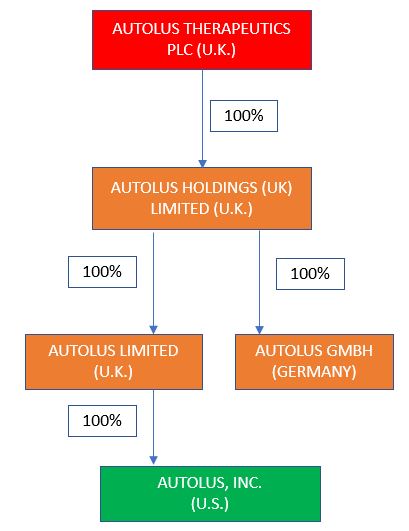
D. Property, plant and equipment.
Our corporate headquarters are located at 58 Wood Lane, White City, London W12 7RZ, United Kingdom, where we lease approximately 14,908 square feet of office space. The lease is non-cancellable and is scheduled to terminate in August 2025. We have a one-time right, upon six months' notice, to terminate the lease effective in September 2020. In addition, from September 2020 onward, the landlord has the option to terminate the lease on 12 months' notice. We also sublease a manufacturing suite, consisting of approximately 8,750 square feet of manufacturing space, at the Cell and Gene Therapy Catapult manufacturing center in Stevenage, United Kingdom. The lease is non-cancellable and is scheduled to terminate in September 2023, with the option to renew or terminate the lease in May 2021.
In August 2018, we entered into a binding arrangement for a lease for a manufacturing facility, consisting of approximately 39,558 square feet, in Enfield, United Kingdom. The lease term is 15 years, commenced in February 2019 and will expire in February 2034. We initially planned on initiating manufacturing activities at this facility in 2020; however, following a strategic review of our manufacturing plan, we chose to discontinue the fit-out of manufacturing capability at the Enfield facility.
In October 2018, we entered into a sublease for 27,502 square feet of office space in Rockville, Maryland. On February 27, 2020, we terminated the sublease of this office space and concurrently entered into a direct lease with the building owner for the same premises. The lease is non-cancellable and is scheduled to terminate in March 2025.
In November 2018, we entered into a lease for approximately 32,673 square feet of office space in White City Place, London, due to our increased headcount. This new space will serve as our new corporate headquarters; we took occupancy in January 2019. The lease term expires in 2026.
In January 2019 we entered into a lease for 84,264 square feet of office and manufacturing space in Rockville, Maryland, under which the lease term is expected to commence in June 2020 and expires in June 2036.
We anticipate leasing additional office and manufacturing space as we add employees, and we believe that suitable additional or substitute space will be available as needed to accommodate any such expansion of our operations.
Not applicable.
88
The following discussion and analysis of our financial condition and results of operations should be read together with Item 3.A. “Selected Consolidated Financial Data” and our consolidated financial statements and related notes appearing elsewhere in this Annual Report. Some of the information contained in this discussion and analysis or set forth elsewhere in this Annual Report, including information with respect to our plans and strategy for our business and related financing, includes forward-looking statements that involve risks and uncertainties. As a result of many factors, including those set forth in the Item 3.D. “Risk Factors” section of this Annual Report, our actual results could differ materially from the results described in or implied by these forward-looking statements. Please also see the section titled “Cautionary Statement Regarding Forward-Looking Statements.”
We maintain our books and records in pounds sterling, our results are subsequently converted to U.S. dollars and we prepare our consolidated financial statements in accordance with U.S. GAAP, as issued by FASB. All references in this Annual Report to “$” are to U.S. dollars and all references to “£” are to pounds sterling. Our consolidated financial statements as of and for the year ended
December 31, 2019
, three months ended December 31, 2018, and years ended September 30, 2018 and 2017 have been translated from pounds sterling into U.S. dollars at the rate of £1.00 to $1.3268, £1.00 to $1.2763,
£1.00 to $1.3053 and £1.00 to $1.3402. These translations should not be considered representations that any such amounts have been, could have been or could be converted into U.S. dollars at that or any other exchange rate as of that or any other date.
We have historically conducted our business through Autolus Limited, and therefore our historical consolidated financial statements previously presented the consolidated results of operations of Autolus Limited. Following the completion of our IPO in June 2018, our consolidated financial statements present the consolidated results of operations of Autolus Therapeutics plc.
|
A.
|
Operating results
.
|
Overview
We are a biopharmaceutical company developing next-generation programmed T cell therapies for the treatment of cancer. Using our broad suite of proprietary and modular T cell programming technologies, we are engineering precisely targeted, controlled and highly active T cell therapies that are designed to better recognize cancer cells, break down their defense mechanisms and attack and kill these cells. We believe our programmed T cell therapies have the potential to be best-in-class and offer cancer patients substantial benefits over the existing standard of care, including the potential for cure in some patients.
Since our inception in July 2014, we have devoted substantially all of our resources to conducting preclinical studies and clinical trials, organizing and staffing our company, business planning, raising capital and establishing our intellectual property portfolio. We do not have any products approved for sale and have not generated any revenue from product sales. We have funded our operations to date primarily with sales of our equity securities, including American Depositary Shares, or ADSs. As of
December 31, 2019
,
we had received net proceeds of $442.1 million from sales of our equity securities and on January 27, 2020, we closed an underwritten public offering of ADSs which resulted in net proceeds of approximately $75.0 million after underwriting discounts and offering expenses. We do not expect to generate significant revenue unless and until we obtain marketing approval for and commercialize one of our product candidates.
Since our inception, we have incurred
significant
operating losses.
For the year
ended
December 31, 2019
, the three months ended December 31, 2018, and the years ended September 30,
2018
and
2017
,
we incurred net losses of
$123.8 million
,
$20.6
million,
$44.8
million, and
$19.7
million, respectively. As of
December 31, 2019
, we had an accumulated deficit of
$237.2 million
.
We expect to continue to incur significant expenses for the foreseeable future as we advance our product candidates through preclinical and clinical development, seek regulatory approval and pursue commercialization of any approved product candidates. In addition, if we obtain marketing approval for any of our product candidates, we expect to incur significant commercialization expenses related to product manufacturing, marketing, sales and distribution. In addition, we may incur expenses in connection with the in-license or acquisition of additional product candidates. Furthermore, we have incurred and expect to continue to incur, additional costs associated with operating as a public company, including significant legal, accounting, investor relations and other expenses that we did not incur as a private company.
As a result, we will need substantial additional funding to support our continuing operations and pursue our growth strategy. Until such time as we can generate significant revenue from product sales, if ever, we expect to finance our operations through the sale of equity, debt financings or other capital sources, including potential collaborations with other companies or other strategic transactions. We may be unable to raise additional funds or enter into such other agreements or arrangements when needed on favorable terms, or at all. If we fail to raise capital or enter into such agreements as, and when, needed, we may have to significantly delay, scale back or discontinue the development and commercialization of one or more of our drug candidates or delay our pursuit of potential in-licenses or acquisitions.
89
As of
December 31, 2019
, we had cash on hand of
$210.6
million.
Based on our current clinical development plans, we believe our existing cash and cash equivalents will be able to fund our current and planned operating expenses and capital expenditure requirements through at least the next 12 months from the date of this Annual Report. The forecast of cash resources is forward-looking information that involves risks and uncertainties, and the actual amount of our expenses could vary materially and adversely as a result of a number of factors. We have based these estimates on assumptions that may prove to be wrong, and our expenses could prove to be significantly higher than we currently anticipate. Management does not know whether additional financing will be on terms favorable or acceptable to us when needed, if at all. If adequate additional funds are not available when required, or if we are unsuccessful in entering into partnership agreements for further development of our product candidates, management may need to curtail its development efforts and planned operations.
Components of Our Results of Operations
Grant Income
Grant income consists of proceeds from government research grants used to perform specific research and development activities. We recognize grant income over the period in which we recognize the related costs covered under the terms and conditions of the grant. We have received grants from the U.K. government, which are repayable under certain circumstances, including breach or noncompliance with the terms of the grant. For grants with refund provisions, we review the grant to determine the likelihood of repayment. If the likelihood of repayment of the grant is determined to be remote, then the grant is recognized as grant income.
Operating Expenses
Research and Development Expenses
Research and development expenses consist of costs incurred in connection with the research and development of our product candidates, which are partially offset by research and development expenditure tax credits provided by Her Majesty’s Revenue & Customs, or HMRC. We expense research and development costs as incurred. These expenses include:
|
•
|
expenses incurred under agreements with contract research organizations, or CROs, as well as investigative sites and consultants that conduct our clinical trials, preclinical studies and other scientific development services;
|
|
•
|
manufacturing scale-up expenses and the cost of acquiring and manufacturing preclinical and clinical trial materials;
|
|
•
|
employee-related expenses, including salaries, related benefits, travel and share-based compensation expense for employees engaged in research and development functions;
|
|
•
|
expenses incurred for outsourced professional scientific development services;
|
|
•
|
costs for laboratory materials and supplies used to support our research activities;
|
|
•
|
allocated facilities costs, depreciation and other expenses, which include rent and utilities; and
|
|
•
|
upfront, milestone and management fees for maintaining licenses under our third-party licensing agreements.
|
We recognize external development costs based on an evaluation of the progress to completion of specific tasks using information provided to us by our service providers.
Our direct research and development expenses are tracked on a program-by-program basis for our product candidates and consist primarily of external costs, such as fees paid to outside consultants and CROs in connection with our preclinical development, manufacturing and clinical development activities. Our direct research and development expenses by program also include fees incurred under license agreements. We do not allocate employee costs or facility expenses, including depreciation or other indirect costs, to specific programs because these costs are deployed across multiple programs and, as such, are not separately classified. We use internal resources primarily to oversee research and development as well as for managing our preclinical development, process development, manufacturing and clinical development activities.
90
The following table summarizes our research and development expenses incurred by program (in thousands):
|
Year Ended December 31,
|
2019 - 2018
|
||||||||||
|
(unaudited)
|
|||||||||||
|
2019
|
2018
|
Change
|
|||||||||
|
(in thousands)
|
|||||||||||
|
Direct research and development expenses by program:
|
|||||||||||
|
B cell malignancies (AUTO1 & AUTO3)
|
$
|
15,346
|
|
5,436
|
|
$
|
9,910
|
|
|||
|
T cell lymphoma (AUTO4 & AUTO 5)
|
1,495
|
|
1,234
|
|
261
|
|
|||||
|
Multiple myeloma (AUTO2 & AUTO8)
|
846
|
|
2,586
|
|
(1,740
|
)
|
|||||
|
Solid Tumors (AUTO6 & AUTO7)
|
2,027
|
|
178
|
|
1,849
|
|
|||||
|
Total direct research and development expense
|
19,714
|
|
9,434
|
|
10,280
|
|
|||||
|
Research and discovery and unallocated costs:
|
|||||||||||
|
Personnel related (including share-based compensation)
|
54,187
|
|
21,453
|
|
32,734
|
|
|||||
|
Indirect research and development expense
|
31,517
|
|
17,412
|
|
14,105
|
|
|||||
|
Total research and development expenses
|
$
|
105,418
|
|
48,299
|
|
$
|
57,119
|
|
|||
Research and development activities are central to our business model. Product candidates in later stages of clinical development generally have higher development costs than those in earlier stages of clinical development, primarily due to the increased size and duration of later-stage clinical trials. As a result, we expect that our research and development expenses will increase substantially over the next few years as we increase personnel costs, initiate and conduct additional clinical trials and prepare regulatory filings related to our product candidates. We also expect to incur additional expenses related to milestone, royalty payments and maintenance fees payable to third parties with whom we have entered into license agreements to acquire the rights related to our product candidates.
The successful development and commercialization of our product candidates is highly uncertain. At this time, we cannot reasonably estimate or know the nature, timing and costs of the efforts that will be necessary to complete the clinical development of any of our product candidates or when, if ever, material net cash inflows may commence from sales of any of our product candidates. This uncertainty is due to the numerous risks and uncertainties associated with development and commercialization activities, including the uncertainty of:
|
•
|
the scope, progress, outcome and costs of our clinical trials and other research and development activities, including establishing an appropriate safety profile with IND-directed studies;
|
|
•
|
successful patient enrollment in, and the initiation and completion of, clinical trials;
|
|
•
|
the timing, receipt and terms of any marketing approvals from applicable regulatory authorities;
|
|
•
|
establishing commercial manufacturing capabilities or making arrangements with third-party manufacturers;
|
|
•
|
development and timely delivery of commercial-grade drug formulations that can be used in our clinical trials and for commercial manufacturing;
|
|
•
|
obtaining, maintaining, defending and enforcing patent claims and other intellectual property rights;
|
|
•
|
significant and changing government regulation;
|
|
•
|
launching commercial sales of our product candidates, if and when approved, whether alone or in collaboration with others;
|
|
•
|
maintaining a continued acceptable safety profile of the product candidates following approval; and
|
|
•
|
significant competition and rapidly changing technologies within the biopharmaceutical industry.
|
We may never succeed in achieving regulatory approval for any of our product candidates. We may obtain unexpected results from our clinical trials. We may elect to discontinue, delay or modify clinical trials of some product candidates or focus on others. Any changes in the outcome of any of these variables with respect to the development of our product candidates in clinical development could
91
mean a significant change in the costs and timing associated with the development of these product candidates.
For example, if the EMA, the FDA,
or another regulatory authority were to delay our planned start of clinical trials or require us to conduct clinical trials or other testing beyond those that we currently expect or if we experience significant delays in enrollment in any of our planned clinical trials, we could be required to expend significant additional financial resources and time on the completion of clinical development of that product candidate. Commercialization of our product candidates will take several years and millions of dollars in development costs.
General and Administrative Expenses
General and administrative expenses consist primarily of salaries, related benefits, travel and share-based compensation expense for personnel in executive, finance, legal and administrative functions. General and administrative expenses also include allocated facility-related costs, patent filing and prosecution costs and professional fees for marketing, insurance, legal, consulting, accounting and audit services.
We anticipate that our general and administrative expenses will increase in the future as we increase our headcount to support the planned development of our product candidates. We have experienced, and expect to continue to experience, increased expense with being a public company, including increased accounting, audit, legal, regulatory and compliance costs associated with maintaining compliance with Nasdaq listing rules and SEC requirements, director and officer insurance premiums, as well as higher investor and public relations costs.
Additionally, if we believe a regulatory approval of one of our product candidates appears likely, we would anticipate an increase in payroll and expense as a result of our preparation for commercial operations, especially as it relates to the sales and marketing of our product candidate.
Other Income (Expense)
Other income consists primarily of interest income earned on our cash balances held at a commercial bank. Other expense consists primarily of foreign currency transaction losses.
Income Tax Benefit
We are subject to corporate taxation in the United Kingdom and in the United States. Due to the nature of our business, we have generated losses since inception. Our income tax credit recognized represents the sum of the research and development tax credits recoverable in the United Kingdom and income tax payable in the United States.
As a company that carries out extensive research and development activities, we benefit from the U.K. research and development tax credit regime under the scheme for small or medium-sized enterprises, or SMEs, and also claim a Research and Development Expenditure Credit, or RDEC, to the extent that our projects are grant funded. Under the SME regime, we are able to surrender some of our trading losses that arise from our qualifying research and development activities for a cash rebate ranging from 33.35% to 21.67% of such qualifying research and development expenditure. The net tax benefit of the RDEC is expected to be 12% in 2020 and future periods. We meet the conditions of the SME regime, but also can make claims under the RDEC regime to the extent that our projects are grant funded. Qualifying expenditures largely comprise employment costs for research staff, consumables, outsourced CRO costs and utilities costs incurred as part of research projects. Certain subcontracted qualifying research and development expenditures are eligible for a cash rebate of up to 21.67%. A large portion of costs relating to our research and development, clinical trials and manufacturing activities are eligible for inclusion within these tax credit cash rebate claims.
We may not be able to continue to claim research and development tax credits under the
SME regime in the future because
we may no longer qualify as a small or medium-sized company. However, we should continue to be able to make claims under the RDEC regime.
Un-surrendered U.K. losses may be carried forward indefinitely to be offset against future taxable profits, subject to numerous utilization criteria and restrictions. The amount that can be offset each year is limited to £5.0 million plus an incremental 50% of U.K. taxable profits. After accounting for tax credits receivable, there were accumulated tax losses for carry forward in the United Kingdom of
$115.4 million
as of
December 31, 2019
. We currently do not recognize a deferred tax asset from our accumulated losses and r
ecord a full valuation allowance against the net deferred tax asset as the recoverability due to future taxable profits is unknown.
In the event we generate revenues in the future, we may benefit from the new U.K. “patent box” regime that allows profits attributable to revenues from patents or patented products to be taxed at effective rate of 10%.
92
Value Added Tax, or VAT, is broadly charged on all taxable supplies of goods and services by VAT-registered businesses. Under current rates, an amount of 20% of the value, as determined for VAT purposes, of the goods or services supplied is added to all sales invoices and is payable to HMRC. Similarly, VAT paid on purchase invoices is generally reclaimable from HMRC.
Results of Operations
Comparison of Years Ended
December 31, 2019
and 2018
The following table summarizes our results of operations for the years ended
December 31, 2019
and 2018.
The unaudited information for the year ended December 31, 2018 has been calculated by adding (i) our results for the nine months ended September 30, 2018, derived from our audited consolidated financial statements for the fiscal year ended September 30, 2018 included in our Annual Report on Form 20-F with the SEC on November 23, 2018 and (ii) our results for the three month transition period ended December 31, 2018, derived from the audited consolidated financial statements included in our Transition Report on Form 20-F with the SEC on February 25, 2019.
|
Year Ended
|
|||||||||||
|
(unaudited)
|
|||||||||||
|
December 31, 2019
|
December 31, 2018
|
Change
|
|||||||||
|
Grant income
|
$
|
2,908
|
|
$
|
1,472
|
|
$
|
1,436
|
|
||
|
Operating expenses:
|
|||||||||||
|
Research and development
|
(105,418
|
)
|
(48,299
|
)
|
(57,119
|
)
|
|||||
|
General and administrative
|
(39,452
|
)
|
(27,299
|
)
|
(12,153
|
)
|
|||||
|
Loss on impairment of leasehold improvements
|
(4,102
|
)
|
—
|
|
(4,102
|
)
|
|||||
|
Total operating expenses, net
|
(146,064
|
)
|
(74,126
|
)
|
(71,938
|
)
|
|||||
|
Other income (expense):
|
|||||||||||
|
Interest income
|
2,542
|
|
2,011
|
|
531
|
|
|||||
|
Other income (expense)
|
4,514
|
|
5,752
|
|
(1,238
|
)
|
|||||
|
Total other income, net
|
7,056
|
|
7,763
|
|
(707
|
)
|
|||||
|
Net loss before income tax
|
(139,008
|
)
|
(66,363
|
)
|
(72,645
|
)
|
|||||
|
Income tax benefit
|
15,159
|
|
8,488
|
|
6,671
|
|
|||||
|
Net loss attributable to ordinary shareholders
|
$
|
(123,849
|
)
|
$
|
(57,875
|
)
|
$
|
(65,974
|
)
|
||
Grant Income
Grant income increased
to
$2.9
million
for the year ended
December 31, 2019
from $1.5 million for the year ended December 31, 2018. The in
crease in grant income of $1.4 million was
related to an increase in reimbursable expenditures submitted in 2019 to the UK government.
Research and Development Expenses
Research and development expenses increased to
$105.4
million for the year ended
December 31, 2019
from
$48.3 million
for the year ended December 31, 2018.
Cash costs, which exclude depreciation as well as share-based compensation, increased to $83.4 million from $41.5 million. The increase in research and development cash costs of $41.9 million consisted primarily of an increase in compensation-related costs of $20.0 million primarily due to an increase in headcount to support the advancement of our product candidates in clinical development and investment in manufacturing facilities and equipment, an increase of $4.1 million in research and manufacturing consumables, in part due to the migration and expansion of our research and process development laboratories from Forest House to our new location in the Media Works facility, preparations in advance of any potential disruption to supply arrangements that may occur due to Brexit, as well as validation and training costs as part of the start-up at the Catapult facility, an increase of $10.2 million in facility costs primarily related to the increased leased facilities, an increase of $3.8 million in project expenses related to the activities necessary to prepare, activate, and monitor clinical trial programs, an increase of $1.5 million in legal and professional fees that includes a decrease in milestone payments of $0.5 million consisting of a milestone payable to UCL Business plc in 2018 and a milestone payable to Noile-Immune Biotech Inc. in 2019, and an increase in IT and general office expenses of $2.3 million.
Non-cash costs
increased to $22.0 million for the year ended
December 31, 2019
from $6.7 million for the year ended December 31, 2018. The $15.3 million increase is related to an increase of $12.7 million
share-based compensation expense as a result of an increase
93
in headcount, and consequent increase in the number of options granted, and an increase in the fair value of stock for options expensed during the year ended December 31, 2019, and an increase of $2.6 million of depreciation related to the purchase of equipment to support our clinical trials and research activities and leasehold improvements.
General and Administrative Expenses
General and administrative expenses increased to
$39.5
million for the year ended
December 31, 2019
from
$27.3 million
for the year ended December 31, 2018.
Cash costs, which exclude depreciation as well as share-based compensation increased to $26.6 million from $21.4 million. The increase of $5.2 million consisted primarily of an increase in compensation-related costs of $2.6 million due to an overall increase in headcount, an increase of $1.9 million in commercial costs, an increase in legal and professional fees of $1.0 million, and an increase of $0.7 million in facility costs related to lease and maintenance costs, offset in part by a decrease of $1.0 million in IT charges, project expenses, and other office expenses.
Non-cash costs
increased to $12.9 million for the year ended
December 31, 2019
from $5.9 million for the year ended December 31, 2018. The increase is primarily due to an increase of $7.3 million
share-based compensation expense as a result of an increase in headcount, and consequent increase in the number of options granted, and an increase in the fair value of stock for options expensed during the period, an increase of $0.1 million of depreciation, offset in part by impairment expense of $0.4 million related to discontinued software that occurred in 2018.
Loss on impairment of leasehold improvements
Loss on impairment of leasehold improvements of
$4.1 million
for the year ended
December 31, 2019
related to the impairment of leasehold improvements as we discontinued the fit-out of our manufacturing capacity at the Enfield, U.K. facility. No such loss of leasehold improvements occurred in 2018.
Interest Income
Interest income increased to
$2.5
million for the year ended
December 31, 2019
from
$2.0 million
for the year ended December 31, 2018 primarily due to a higher cash balance related to our capital raise activity in 2018 and 2019.
Other Income (Expense)
Other income decreased to
$4.5
million for the year ended
December 31, 2019
from
$5.8 million
for the year ended December 31, 2018 primarily due to foreign currency gains related to the U.S dollar strength relative to the
British pound during 2019 as compared to 2018.
Income Tax Benefits
Income tax benefits increased to
$15.2
million for the year ended
December 31, 2019
from $8.5 million for the year ended December 31, 2018 due to additional U.K. research and development tax credits receivable from HMRC. Research and development credits are obtained at a maximum rate of 33.35% of our qualifying research and development expenses, and the increase in the net credit was primarily attributable to an increase in our eligible research and development expenses.
Comparison of the Three Months Ended December 31, 2018 and 2017
A comparison of the three months ended December 31, 2018 and 2017 has been omitted from this Annual Report, but may be found in “Item 5. Operating and Financial Review and Prospects” of our
Transition Report on Form 20-F for the period ended December 31, 2018, filed with the SEC on February 25, 2019
.
Comparison of Years Ended September 30, 2018 and 2017
A comparison of the years ended September 30, 2018 and 2017 has been omitted from this Annual Report, but may be found in “Item 5. Operating and Financial Review and Prospects” of our
Annual Report on Form 20-F for the year ended September 30, 2018, filed with the SEC on November 23, 2018
.
B. Liquidity and capital resources.
Since our inception, we have not generated any product revenue and have incurred operating losses and negative cash flows from our operations. We expect to incur significant expenses and operating losses for the foreseeable future as we advance our product candidates through preclinical and clinical development, seek regulatory approval and pursue commercialization of any approved product candidates.
94
We expect that our research and development and general and administrative costs will increase in connection with our planned research activities. As a result, we will need additional capital to fund our operations until such time as we can generate significant revenue from product sales.
We do not currently have any approved products and have never generated any revenue from product sales or otherwise. We have funded our operations to date primarily with proceeds from government grants and sales of our preferred and ordinary shares. Through
December 31, 2019
, we have received aggregate net cash proceeds of $442.1 million from sales of our equity securities. As of
December 31, 2019
, we had cash of
$210.6 million
.
We currently have no ongoing material financing commitments, such as lines of credit or guarantees, that are expected to affect our liquidity over the next five years, other than our lease obligations and supplier purchase commitments described below.
Cash Flows
The following table summarizes our cash flows for each of the periods presented:
|
Year Ended December 31,
|
|||||||
|
(unaudited)
|
|||||||
|
2019
|
2018
|
||||||
|
(in thousands)
|
|||||||
|
Net cash used in operating activities
|
$
|
(101,484
|
)
|
$
|
(42,525
|
)
|
|
|
Net cash used in investing activities
|
(18,668
|
)
|
(13,189
|
)
|
|||
|
Net cash provided by financing activities
|
108,863
|
|
156,487
|
|
|||
|
Effect of exchange rate changes on cash
|
5,164
|
|
(12,202
|
)
|
|||
|
Net (decrease) increase in cash
|
$
|
(6,125
|
)
|
$
|
88,571
|
|
|
Net Cash Used in Operating Activities
During the year ended
December 31, 2019
, operating activities used
$101.5 million
of cash, resulting from our net loss of
$123.8 million
, and net cash used resulting from changes in our operating assets and liabilities of
$16.2 million
, partially offset by non-cash charges of
$38.6 million
, primarily related to shared based compensation of
$30.2 million
and leasehold improvement impairment of
$4.1 million
. Net cash used resulting from changes in our operating assets and liabilities for the year ended December 31, 2019 consisted primarily of a
$21.0 million
increase in prepaid expenses and other assets, offset in part by a
$3.5 million
increase in accounts payable and accrued expenses.
During the year ended December 31, 2018, operating activities used $42.5 million of cash, resulting from our net loss of $57.9 million, offset in part by net cash provided by changes in our operating assets and liabilities of $3.7 million and non-cash charges of $11.7 million. Net cash used in changes in our operating assets and liabilities for the year ended December 31, 2018 consisted primarily of a $9.3 million increase in prepaid expenses and other assets and a $1.3 million increase in long-term deposits, partially offset by a $12.9 million increase in accrued expenses and a $1.3 million increase in accounts payable.
Net Cash Used in Investing Activities
During the years ended
December 31, 2019
and 2018, we used
$18.7 million
and $13.2 million, respectively, of cash in investing activities, all of which consisted primarily of purchases of property and equipment.
Net Cash Provided by Financing Activities
During the year ended
December 31, 2019
and 2018, net cash provided by financing activities was
$108.9 million
and $156.5 million, respectively, consisting of net cash proceeds from our April 2019 follow-on capital raise and June 2018 IPO.
95
Cash Denomination
The following table reflects cash denominations in U.S. dollars and pound sterling as of:
|
December 31,
|
|||||||
|
2019
|
2018
|
||||||
|
(in thousands)
|
|||||||
|
Total cash held
|
$
|
210,643
|
|
$
|
217,450
|
|
|
|
U.S. dollars
|
$
|
29,800
|
|
$
|
49,000
|
|
|
|
British sterling
|
£
|
136,900
|
|
£
|
132,100
|
|
|
Funding Requirements
We expect our expenses to increase substantially in connection with our ongoing activities, particularly as we advance the preclinical activities and clinical trials of our product candidates. Our expenses will increase as we:
|
•
|
seek regulatory approvals for any product candidates that successfully complete preclinical and clinical trials;
|
|
•
|
establish a sales, marketing and distribution infrastructure in anticipation of commercializing of any product candidates for which we may obtain marketing approval and intend to commercialize on our own or jointly;
|
|
•
|
hire additional clinical, medical, and development personnel;
|
|
•
|
expand our infrastructure and facilities to accommodate our growing employee base; and
|
|
•
|
maintain, expand and protect our intellectual property portfolio.
|
Our primary uses of capital are, and we expect will continue to be, compensation and related expenses, clinical costs, external research and development services, laboratory and related supplies, legal and other regulatory expenses, and administrative and overhead costs. Our future funding requirements will be heavily determined by the resources needed to support development of our product candidates.
Based on our current clinical development plans, we believe
our existing cash of
$210.6 million
at
December 31, 2019
will enable us to fund our current and planned operating expenses and capital expenditure requirements for at least the next 12 months. We have based these estimates on assumptions that may prove to be wrong, and we could utilize our available capital resources sooner than we expect. If we receive regulatory approval for our other product candidates, we expect to incur significant commercialization expenses related to product manufacturing, sales, marketing and distribution, depending on where we choose to commercialize. We may also require additional capital to pursue in-licenses or acquisitions of other product candidates.
Because of the numerous risks and uncertainties associated with research, development and commercialization of pharmaceutical product candidates, we are unable to estimate the exact amount of our working capital requirements. Our future funding requirements will depend on and could increase significantly as a result of many factors, including:
|
•
|
the scope, progress, outcome and costs of our clinical trials and other research and development activities;
|
|
•
|
the costs, timing, receipt and terms of any marketing approvals from applicable regulatory authorities;
|
|
•
|
the costs of future activities, including product sales, medical affairs, marketing, manufacturing and distribution, for any of our product candidates for which we receive marketing approval;
|
|
•
|
the revenue, if any, received from commercial sale of our products, should any of our product candidates receive marketing approval;
|
|
•
|
the costs and timing of hiring new employees to support our continued growth;
|
|
•
|
the costs of preparing, filing and prosecuting patent applications, maintaining and enforcing our intellectual property rights and defending intellectual property-related claims; and
|
|
•
|
the extent to which we in-license or acquire additional product candidates or technologies.
|
96
Until such time, if ever, that we can generate product revenue sufficient to achieve profitability, we expect to finance our cash needs through equity offerings. To the extent that we raise additional capital through the sale of equity, your ownership interest will be diluted. If we raise additional funds through other third-party funding, collaborations agreements, strategic alliances, licensing arrangements or marketing and distribution arrangements, we may have to relinquish valuable rights to our technologies, future revenue streams, research programs or product candidates or grant licenses on terms that may not be favorable to us. If we are unable to raise additional funds through equity financings when needed, we may be required to delay, limit, reduce or terminate our product development or future commercialization efforts or grant rights to develop and market products or product candidates that we would otherwise prefer to develop and market ourselves.
Critical Accounting Policies and Significant Judgments and Estimates
Our financial statements are prepared in accordance with U.S. GAAP. The preparation of our financial statements and related disclosures requires us to make estimates and judgments that affect the reported amounts of assets, liabilities, costs and expenses, and the disclosure of contingent assets and liabilities in our financial statements. We base our estimates on historical experience, known trends and events and various other factors that we believe are reasonable under the circumstances, the results of which form the basis for making judgments about the carrying values of assets and liabilities that are not readily apparent from other sources. We evaluate our estimates and assumptions on an ongoing basis. Our actual results may differ from these estimates under different assumptions or conditions.
While our significant accounting policies are described in more detail in Note 2 to our financial statements appearing at the end of this Annual Report, we believe that the following accounting policies are those most critical to the judgments and estimates used in the preparation of our financial statements.
Share-Based Compensation
We issue ordinary shares as well as options and other securities exercisable for or convertible into
ordinary shares or
ADSs, as incentives to our employees and directors,
and employees and consultants of our subsidiaries
. To the extent such incentives are in the form of share options, the options are granted pursuant to the terms of our 2017 Share Option Plan, or the 2017 Plan, or pursuant to the terms of our 2018 Equity Incentive Plan, or the 2018 Plan. Options granted under the 2017 Plan and 2018 Plan, as well as shares granted as employee incentives, typically vest over a four-year service period with 25% of the award vesting on the first anniversary of the commencement date and the balance vesting monthly over the remaining three years, unless the awards contain specific performance vesting provisions. For equity awards issued that have both a performance vesting condition and a services condition, or performance awards, once the performance criteria is achieved, the performance awards are then subject to a four-year service vesting with 25% of the performance award vesting on the first anniversary of the performance condition being achieved, with the balance vesting monthly over the remaining three years. For certain members of senior management and directors, the board has approved an alternative vesting schedule for the equity awards. The options granted under the 2017 Plan and 2018 Plan generally expire ten years from the date of grant. We expect our share-based compensation expense for awards granted to employees, directors and other service providers to increase in future periods due to the planned increases in our headcount.
We recognize compensation expense for equity awards based on the grant date fair value of the award. For equity awards that vest based on a service condition, the share-based compensation expense is recognized on a straight-line basis over the requisite service period. For equity awards that contain both performance and service conditions, we recognize share-based compensation expense ratably over the requisite service period when the achievement of a performance-based milestone is probable based on the relative satisfaction of the performance condition as of the reporting date. We use the fair value of our ordinary shares to determine the fair value of restricted share awards.
Share-based compensation is recognized as an expense in the financial statements based on the grant date fair value over the requisite service period. For awards granted to our employees and directors that vest based on service conditions, we use the accelerated method to allocate compensation expense to reporting periods. We do not adjust share-based compensation for estimated forfeitures and account for forfeitures when they occur.
We use the Black-Scholes option pricing model to estimate the fair value of share options. This option-pricing model requires the input of various subjective assumptions, including the option’s expected life and the price volatility of the security.
The fair value of each share option grant is estimated on the date of grant using the Black-Scholes option pricing model and applying assumptions used in connection with option grants made during the periods covered by these financial statements. Assumptions used in the option pricing model include the following:
Expected volatility.
We lack company-specific historical and implied volatility information for our ADSs. Therefore, we estimate the expected share volatility based on the historical volatility of publicly traded peer companies and expect to continue to do so until such time as we have adequate historical data regarding the volatility of our own traded security price.
97
Expected term
. The expected term of options granted represents the weighted average period of time that options granted are expected to be outstanding giving consideration to vesting schedules and our historical exercise patterns. The expected term of our share options has been determined utilizing the “simplified” method for awards that qualify as “plain-vanilla” options.
Risk-free interest rate
. The risk-free interest rate is determined by reference to the U.S. Treasury yield curve in effect at the time of grant of the award for time periods that are approximately equal to the expected term of the award.
Expected dividend.
Expected dividend yield of zero is based on the fact that we have never paid cash dividends on ordinary shares and do not expect to pay any cash dividends in the foreseeable future.
Fair value of ordinary shares.
Options granted after our IPO are issued at the fair market value of our ADSs at the date the grant is approved by the Board.
Prior to the IPO, we calculated the fair value of our ordinary shares in accordance with the guidelines in the American Institute of Certified Public Accountants’ Accounting and Valuation Guide,
Valuation of Privately-Held-Company Equity Securities Issued as Compensation
. The valuations of ordinary shares were prepared using a market approach, based on precedent transactions in the shares, to estimate our total equity value using the option-pricing method, or OPM, which used a combination of market approaches and an income approach to estimate our enterprise value.
The OPM derives an equity value such that the value indicated is consistent with the investment price, and it provides an allocation of this equity value to each class of our securities. The OPM treats the various classes of shares as call options on the total equity value of a company, with exercise prices based on the value thresholds at which the allocation among the various holders of a company’s securities changes. Under this method, each class of shares has value only if the funds available for distribution to shareholders exceed the value of the share liquidation preferences of the class or classes of shares with senior preferences at the time of the liquidity event. Key inputs and assumptions used in the OPM calculation include the following:
Expected volatility.
We applied re-levered equity volatility based on the historical unlevered and re-levered equity volatility of publicly traded peer companies.
Expected dividend.
Expected dividend yield of zero is based on the fact that the Company has never paid cash dividends on ordinary shares and does not expect to pay any cash dividends in the foreseeable future.
Expected term
. The expected term of the option or the estimated time until a liquidation event.
Risk-free interest rate
. The risk-free interest rate is determined by reference to the U.S. Treasury yield curve for the period commensurate with the expected of the exit event.
When considering the fair value of options granted in the period prior to the IPO, management considered probability-weighted scenarios based on the relative likelihoods of completing the IPO and remaining a privately-held company. In the IPO scenarios, the fair value was calculated by dividing our total estimated equity value by the number of fully diluted ordinary shares outstanding, and then discounting the implied per-share value at a rate intended to approximate our cost of equity between the share option grant date and the expected IPO date. The stay-private scenario utilized an OPM "Backsolve" calculation to estimate our equity value implied by the purchase price of the series A preference shares in September 2017.
Income Taxes
We account for income taxes under the asset and liability method which includes the recognition of deferred tax assets and liabilities for the expected future tax consequences of events that have been included in our financial statements. Under this approach, deferred taxes are recorded for the future tax consequences expected to occur when the reported amounts of assets and liabilities are recovered or paid. The provision for income taxes represents income taxes paid or payable for the current year plus deferred taxes. Deferred taxes result from differences between the financial statements and tax bases of our assets and liabilities, and are adjusted for changes in tax rates and tax laws when changes are enacted. The effects of future changes in income tax laws or rates are not anticipated.
We are subject to corporation taxes in the United Kingdom and the United States. The calculation of our tax provision involves the application of U.K. tax law and requires judgment and estimates.
We evaluate the realizability of our deferred tax assets at each reporting date, and we establish a valuation allowance when it is more likely than not that all or a portion of our deferred tax assets will not be realized.
The ultimate realization of deferred tax assets is dependent upon the generation of future taxable income of the same character and in the same jurisdiction. We consider all available positive and negative evidence in making this assessment, including, but not limited to, the scheduled reversal of deferred tax liabilities, projected future taxable income, and tax planning strategies. In circumstances where there is sufficient negative evidence indicating that our deferred tax assets are not more likely than not realizable, we establish a valuation allowance.
98
We use a two-step approach to recognizing and measuring uncertain tax positions. The first step is to evaluate tax positions taken or expected to be taken in a tax return by assessing whether they are more likely than not sustainable, based solely on their technical merits, upon examination, and including resolution of any related appeals or litigation process. The second step is to measure the associated tax benefit of each position as the largest amount that we believe is more likely than not realizable. Differences between the amount of tax benefits taken or expected to be taken in our income tax returns and the amount of tax benefits recognized in our financial statements represent our unrecognized income tax benefits, which we either record as a liability or as a reduction of deferred tax assets.
Deferred Tax and Current Tax Credits
Tax on the profit or loss for the year comprises current and deferred tax. Tax is recognized in the statement of operations, except to the extent that it relates to items recognized directly in equity, in which case it is recognized in equity. Current tax is the expected tax payable on the taxable income or loss for the year, using tax rates enacted or substantively enacted at the balance sheet date, and any adjustment to tax payable in respect of previous years. Tax credits are accrued for the year based on calculations that conform to the U.K. research and development tax credit regime, under both the SME and large company regimes. We meet the conditions of the SME regime, but also can make claims under the RDEC regime to the extent that our projects are grant funded.
We may not be able to continue to claim research and development tax credits under the SME regime in the future because we may no longer qualify as a small or medium-sized company. However, we should continue to be able to make claims under the RDEC regime.
Deferred tax is recognized on temporary differences between the carrying amounts of assets and liabilities for financial reporting purposes and the amounts used for taxation purposes. The amount of deferred tax is based on the expected manner of realization or settlement of the carrying amount of assets and liabilities, using tax rates enacted or substantively enacted at the balance sheet date. A deferred tax asset is recognized only to the extent that it is probable that future taxable profits will be available against which the asset can be utilized. No deferred tax assets are recognized on our losses carried forward and other attributes because there is currently no indication that we will make sufficient profits to utilize these attributes.
JOBS Act
On April 5, 2012, the Jumpstart Our Business Startups Act, or the JOBS Act, was enacted. The JOBS Act provides that, among other things, an emerging growth company can take advantage of an extended transition period for complying with new or revised accounting standards. As an emerging growth company, we have irrevocably elected not to take advantage of the extended transition period afforded by the JOBS Act for implementation of new or revised accounting standards and, as a result, we will comply with new or revised accounting standards on the relevant dates on which adoption of such standards is required for non-emerging growth public companies.
In addition, we intend to rely on the other exemptions and reduced reporting requirements provided by the JOBS Act. Subject to certain conditions set forth in the JOBS Act, we are entitled to rely on certain exemptions as an “emerging growth company,” we are not required to, among other things, (i) provide an auditor’s attestation report on our system of internal controls over financial reporting pursuant to Section 404(b), (ii) provide all of the compensation disclosure that may be required of non-emerging growth public companies under the Dodd-Frank Wall Street Reform and Consumer Protection Act, (iii) comply with any requirement that may be adopted by the Public Company Accounting Oversight Board regarding mandatory audit firm rotation or a supplement to the auditor’s report providing additional information about the audit and the financial statements (auditor discussion and analysis), and (iv) disclose certain executive compensation-related items such as the correlation between executive compensation and performance and comparisons of the chief executive officer’s compensation to median employee compensation. These exemptions will apply for a period of five years following the completion of our IPO or until we no longer meet the requirements of being an emerging growth company, whichever is earlier.
Recently Issued Accounting Pronouncements
A description of recently issued accounting pronouncements that may potentially impact our financial position and results of operations is disclosed in Note 2, “Summary of Significant Accounting Policies,” to our consolidated financial statements included in this Annual Report.
|
C.
|
Research and development, patents and licenses, etc.
|
Full details of our research and development activities and expenditures are given in Item 4.B. "Information on the Company – Business Overview” and Item 5.A. "Operating Results” within this Annual Report.
99
D. Trend information.
See Item 5.A. "Operating Results” and Item 5.B. "Liquidity and Capital Resources” within this Annual Report.
E. Off-balance sheet arrangements.
We did not have
any off-balance sheet arrangements
during the periods presented, and we do not currently have any off-balance sheet arrangements, as defined in the rules and regulations of the Securities and Exchange Commission.
F. Tabular disclosure of contractual obligations.
The following table summarizes our contractual obligations as of
December 31, 2019
and the effects that such obligations are expected to have on our liquidity and cash flows in future periods (in thousands)
:
|
Payments Due by Period
|
|||||||||||||||||||||
|
Total
|
Less than 1 Year
|
1 to 3
Years |
4 to 5 Years
|
More than
5 Years |
|||||||||||||||||
|
Operating lease obligations
(1)
|
$
|
34,435
|
|
$
|
4,486
|
|
$
|
9,499
|
|
$
|
8,228
|
|
$
|
12,222
|
|
||||||
|
(1) Amounts in the table reflect minimum payments due for our leases of office, laboratory and manufacturing space and payments required to reimburse the landlord for leasehold improvements related to operating leases.
|
|||||||||||||||||||||
Operating Leases
Operating lease obligations relate to (i) the agreement we entered into in September 2015 to lease office space for our corporate headquarters at Forest House in White City Place, London (ii) the amendment to the lease agreement we entered into in October 2016 to lease additional office space in the same building in White City, London, (iii) the sublease for our manufacturing suite at the Cell and Gene Therapy Catapult manufacturing center in Stevenage, United Kingdom, (iv) our October 2018 agreement to sublease office space in Rockville, Maryland, (v) an arrangement we entered into in June 2018 for additional office space at MediaWorks in White City Place, London, under which the lease commenced in November 2018, and (vi) a lease agreement we entered into September 2018 for additional manufacturing space in Enfield, United Kingdom, under which the lease commenced in February 2019.
Not included in the table above is a lease agreement we entered into January 2019 for office and manufacturing space in Rockville, Maryland, under which the lease term is expected to commence in June 2020 and expires in June 2036 with an annual minimum payments of approximately $3.6 million over the term of the lease.
Purchase and Other Obligations
We enter into contracts in the normal course of business with CROs and other third parties for clinical trials and preclinical research studies and testing. These contracts are generally cancelable by us upon prior notice. Payments due upon cancellation consist only of payments for services provided or expenses incurred, including noncancelable obligations of our service providers, up to the date of cancellation. These payments are not included in the table above, as the amount and timing of such payments are not known as of
December 31, 2019
.
We have not included any contingent payment obligations that we may incur upon achievement of clinical, regulatory and commercial milestones, as applicable, or royalty payments that we may be required to make under our license agreement with UCL Business plc, as the amount, timing and likelihood of such payments are not known as of
December 31, 2019
.
G. Safe harbor.
This Annual Report contains forward-looking statements within the meaning of Section 27A of the Securities Act and Section 21E of the Exchange Act and as defined in the Private Securities Litigation Reform Act of 1995. See the section titled “Cautionary Statement Regarding Forward-Looking Statements” at the beginning of this Annual Report.
100
|
A.
|
Directors and senior management.
|
The following table sets forth information regarding members of our senior management and our directors, including their ages as of
December 31, 2019
.
|
NAME
|
AGE
|
POSITION(S)
|
||
|
Senior Management:
|
||||
|
Christian Itin, Ph.D.
|
55
|
Chief Executive Officer and Chairman of the Board of Directors
|
||
|
Andrew Oakley
|
57
|
Senior Vice President, Chief Financial Officer
|
||
|
Martin Pulé, MBBS
|
47
|
Senior Vice President, Founder, Chief Scientific Officer and Director
|
||
|
Muhammad Al-Hajj, Ph.D.
|
49
|
Senior Vice President, Translational Sciences
|
||
|
Vijay Peddareddigari, M.D.
|
48
|
Senior Vice President, Chief Medical Officer
|
||
|
Christopher Vann
|
55
|
Senior Vice President, Chief Operating Officer
|
||
|
Matthias Alder
|
54
|
Senior Vice President, Chief Business Officer and Company Secretary
|
||
|
David Brochu
|
63
|
Senior Vice President, Product Delivery
|
||
|
Adam Hacker
|
50
|
Senior Vice President for Regulatory Affairs and Quality
|
||
|
Non-Executive Directors:
|
||||
|
Joseph Anderson, Ph.D.
|
60
|
Director
|
||
|
Linda Bain
|
49
|
Director
|
||
|
John Berriman
|
71
|
Director
|
||
|
Cynthia Butitta
|
65
|
Director
|
||
|
Kapil Dhingra, M.D.
|
60
|
Director
|
||
|
Martin Murphy, Ph.D.
|
51
|
Director
|
||
Senior Management
Christian Itin, Ph.D.
has served as our Chief Executive Officer since March 2016 and as Chairman of our board of directors since October 2014. Prior to joining us, Dr. Itin served as chief executive officer and chairman of the board of directors at Cytos Biotechnology Ltd, a biotechnology company, from November 2012 until it merged with Kuros Biosurgery Holding Ltd in January 2016. From January 2016 until June 2018, he served as chairman, and from June 2018 to May 2019 as non-executive director, of Kuros Biosciences Ltd. Prior to that, Dr. Itin served as president, chief executive officer and director of Micromet, Inc., a biopharmaceutical company, from 2006 until it was acquired by Amgen Inc. in 2012. From 1999 until 2006, he served in a number of capacities with Micromet, Inc.’s subsidiary, Micromet AG, including head of IP and licensing, vice president of business and corporate development, chief business officer and ultimately as its chief executive officer. Before joining Micromet, Dr. Itin was a co-founder of Zyomyx, a protein chip company. Dr. Itin also serves as a non-executive director of Kymab Ltd., a privately held biopharmaceutical company. Dr. Itin received a Diploma in Biology and a Ph.D. in Cell Biology from the University of Basel, Switzerland. In addition, he also performed post-doctoral research at the Biocenter of University of Basel and at the Stanford University School of Medicine. We believe that Dr. Itin is qualified to serve on our board of directors because of his deep knowledge of our company and his extensive experience serving in executive and non-executive leadership positions at other public and private biotechnology companies.
Andrew Oakley
has served as our Chief Financial Officer since June 2018. Prior to joining Autolus, Mr. Oakley served as the chief financial officer for Sosei Group from February 2017 until June 2018 and as its executive vice president from August 2017 to June 2018. From January 2015 until June 2016, Mr. Oakley served as chief financial officer, company secretary and executive board member of Vectura group plc. From January 2003 until August 2013, Mr. Oakley served as the chief financial officer for Actelion Ltd. He also previously served in a senior finance capacity for the global holding companies of Accenture, held executive positions in major multinational building material companies and spent several years as an equity analyst with banks in Australia, the United Kingdom and the United States. Mr. Oakley holds a Bachelor of Economics Degree from Macquarie University and an M.B.A. from London Business School. Mr. Oakley is a member of the Australian Institute of Chartered Accountants.
Martin Pulé,
MBBS
has served as our Senior Vice President, Founder and Chief Scientific Officer since August 2014. He also served as a member of our board of directors from August 2014 to June 2018. Dr. Pulé has served as a clinical senior lecturer in the Department of Haematology at University College London Cancer Institute since 2010 and as an Honorary Consultant in Haematology at University College London Hospital since 2010. He entered the T cell engineering field in 2001 as a travelling Fulbright Scholar at
101
the Center for Cell and Gene Therapy at Baylor College of Medicine, Houston, Texas. Dr. Pulé holds a Bachelor of Medicine and Bachelor of Surgery (MBBS) from University College Dublin and is a Fellow of the Royal College of Pathologists.
Muhammad Al-Hajj, Ph.D.
has served as our Senior Vice President, Translational Sciences since July 2017. Prior to joining us, he served as vice president, discovery and translational medicine at Sanford Burnham Medical Institute from July 2015 to July 2017. Prior to that, he served as senior director, biology and translational medicine in oncology research and development at GlaxoSmithKline plc from 2009 to June 2015. His other experience at large pharmaceutical companies includes serving as group leader in oncology research and development at AstraZeneca AB from 2007 to 2009 and as lab head and group leader in oncology research and development at Novartis from 2003 to 2007. Dr. Al-Hajj earned his B.S. in mathematics and biology from the American University of Beirut. He holds a Ph.D. in molecular genetics from the Wayne State University and completed a postdoctoral fellowship in cancer and stem cell biology at the University of Michigan Medical School.
Vijay Peddareddigari, M.D.
has served as our Senior Vice President, Chief Medical Officer since March 2016. Prior to joining us, Dr. Peddareddigari served as senior director and clinical leader at Janssen Oncology (Johnson & Johnson) from August 2013 to February 2016, specializing in early and mid-stage clinical development. Prior to this, he worked at GlaxoSmithKline plc from October 2009 to July 2013, working and leading numerous programs in different areas of oncology such as signal transduction, cancer epigenetics and immune oncology from pre-candidate selection stage up to late development. At GlaxoSmithKline, as the lead early development physician on the MEK inhibitor (Trametinib) program, he was responsible for the transition to late stage development, leading to subsequent approval of the product candidate for treatment of metastatic melanoma. Dr. Peddareddigari served as an adjunct assistant professor of thoracic medical oncology, hematology-oncology division at the Hospital of the University of Pennsylvania from July 2010 until January 2016. Dr. Peddareddigari holds a Bachelor of Medicine and Bachelor of Surgery (MBBS) from Sri Venkateshwara Medical College in Tirupati, India and his M.D. in Biochemistry and Molecular Biology from All India Institute of Medical Sciences in New Delhi, India. He also completed a residency in internal medicine at Albert Einstein Medical Center and a fellowship in medical oncology at the University of Texas MD Anderson Cancer Center.
Christopher Vann
has served as our Senior Vice President, Chief Operating Officer since October 2016. Prior to joining us, he worked at Hoffmann-La Roche’s Swiss headquarters from February 1994 to September 2016, most recently serving as its commercial director from December 2011 to September 2016 where he was primarily responsible for leading the lung cancer commercial team and general management of the Tarceva brand. Mr. Vann has significant experience of global lifecycle management of oncology products as well as implementing marketing strategy at a regional and national level. This includes launching several oncology, immunology and transplant products in the United States, United Kingdom, Romania, Russia, South Africa and countries in Asia, including Japan. Mr. Vann holds a B.S. in Toxicology and Pharmacology from the School of Pharmacy, University of London.
Matthias Alder
has served as our Senior Vice President, Chief Business Officer and Company Secretary since July 2017, and as our General Counsel between July 2017 and August 2018. Prior to joining us, he served as executive vice president for business development and licensing from October 2014 to March 2017 and as general counsel and corporate secretary from May 2015 to July 2017 at Sucampo Pharmaceuticals, Inc., a biopharmaceutical company which was subsequently acquired by Mallinckrodt Pharmaceuticals. Prior to this, Mr. Alder served as executive vice president of corporate development and legal affairs and corporate secretary at Cytos Biotechnology AG, a biopharmaceutical company focused on the development of targeted immunotherapies, from 2013 to October 2014. From 2006 to 2012, Mr. Alder held various executive management roles at Micromet, Inc., serving as senior vice president for administration, general counsel and secretary at the time of the acquisition of Micromet by Amgen Inc. in 2012. He was also a partner in the Life Sciences Transactions Practice at Cooley LLP from 1997 to 2006, where he represented biotech companies in strategic transactions with pharmaceutical companies. Earlier in his career, Mr. Alder was in-house counsel at Ciba-Geigy and Novartis. Mr. Alder holds law degrees from the University of Basel and the University of Miami and is qualified to practice law in Switzerland and the United States.
David Brochu
has served as our Senior Vice President, Product Delivery since October 2019. Prior to joining us, he served as vice president of technical operations and program head for Kedrion SpA’s next generation IVIG development and industrialization effort at Kedrion USA from October 2011 to March 2019. Prior to this, from September 2007 to August 2011, he served as vice president of plasma collection operations for Talecris Biotherapeutics (formerly Bayer HealthCare LLC) where he led the operations build out in the Western United States. From May 2002 to September 2007, Mr. Brochu was the senior director of process development and technology at Talecris leading the preparation and implementation of the technology, process development, and facilities investment strategy for the plasma products business. He received a B.S. in chemical engineering from Northeastern University.
Adam Hacker
has served as our Senior Vice President, Regulatory Affairs and Quality since August 2018. Prior to joining us, Mr. Hacker spent a decade at Janssen Pharmaceuticals from 2008 to 2018, where he most recently served as Vice President, Head of Vaccines and Scientific Innovation Projects, Global Regulatory Affairs. In this role, Mr. Hacker was responsible for leading regulatory activities across all scientific innovation projects. During his tenure at Janssen, he also oversaw all regulatory aspects of the company’s Ebola vaccine and therapeutic product development, as well as leading hematology and oncology therapeutic areas regulatory and medical affairs functions for Europe, the Middle East and Africa. He earned a Ph.D. in developmental molecular biology from the National Institute of Medical Research, London and holds an undergraduate degree in Pure & Applied Biology from The Queen’s College, Oxford University.
102
Non-Executive Directors
Joseph Anderson, Ph.D.
has served on our board of directors since February 2016. He is the chief executive officer and a member of the board of directors of Arix Bioscience plc, a global life sciences company, where he has held such positions since January 2016. He has founded and managed public equity funds and been a member of the following boards of directors: Algeta ASA (acquired by Bayer AG) from 2009 to 2013, Amarin plc from October 2009 to 2013, Cytos Biotechnology Ltd, a biotechnology company, from 2012 until it merged with Kuros Biosurgery Holding Ltd in January 2016 and Epigenomics AG from 2012 to 2014. He was a partner at Abingworth LLP, an international investment group dedicated to the life sciences and healthcare sectors, from January 2004 through December 2015. From October 1999 through December 2003, Dr. Anderson was previously at First State Investments in London, part of the Commonwealth Bank of Australia, where he was head of global healthcare equities and portfolio manager. Prior to this, he was a pharmaceuticals analyst at investment bank, Dresdner Kleinwort Benson from June 1998 through October 1999. From 1990 to 1998, Dr. Anderson established and was head of the strategy unit at The Wellcome Trust, one of the world’s largest medical foundations. Dr. Anderson holds a Doctor of Philosophy in Biochemistry from the University of Aston and a Bachelor of Science in Biological Science from Queen Mary College, University of London. He was originally nominated to our board of directors by Arix Bioscience Holdings Limited pursuant to our March 2016 Subscription and Shareholders’ Agreement, which granted Arix the right to appoint one individual as a director, and re-elected to a three-year term at our 2019 Annual General Meeting of Shareholders. We believe that Dr. Anderson is qualified to serve on our board of directors because of his extensive experience serving on boards of directors of life science companies.
Linda Bain
has served on our board of directors since June 2018. She currently serves as the chief financial officer of Codiak BioSciences, Inc., a position she has held since December 2015. Prior to then, Ms. Bain served as the chief financial officer and treasurer of Avalanche Biotechnologies, Inc. from April 2014 until November 2015. Previously, Ms. Bain served at bluebird bio, Inc., a gene therapy biotechnology company, as vice president of finance and business operations from October 2011 to March 2014, and chief accounting officer and treasurer from June 2013 to March 2014. From September 2008 to September 2011, Ms. Bain served as vice president of finance at Genzyme Corporation. From September 2007 to September 2008, she served as vice president at Fidelity Investments, and from May 2000 to September 2007, she held a number of positions at AstraZeneca plc. She received her B.S. degree in Accounting and Business Administration and an Honors Degree in Accounting and Business Administration from the University of the Free State in South Africa. Ms. Bain is a certified public accountant. We believe that Ms. Bain is qualified to serve on our board of directors because of her extensive experience in our industry, her background in accounting and finance and her leadership skills.
John Berriman
has served on our board of directors since August 2014. He has served as chairman of the boards of directors of Confo Therapeutics NV since December 2016, Depixus SAS since December 2015, ReNeuron Group plc since April 2015 and Autifony Therapeutics Ltd since 2011. He previously served as chairman of the board of directors of Heptares Therapeutics Ltd from 2007 until it was sold to Sosei Group in February 2015; as chairman of the board of directors of Algeta ASA from 2004 through its listing on the Oslo Stock Exchange in 2007 and subsequently served as deputy chairman from 2008 until it was sold to Bayer AG in 2014; and as a director of Micromet, Inc. from May 2006 until it was sold to Amgen Inc. in 2012. Prior to this, from 1997 to 2004, he was a director of Abingworth Management, an international healthcare venture capital firm, where he was involved in founding, financing and serving as a director of several biotechnology companies in Europe and the United States, many of which obtained listings on public stock exchanges. Prior to that, Mr. Berriman spent 14 years with Celltech Group plc and was a member of its board when it listed on the London Stock Exchange in 1994. He holds a Master’s degree in Chemical Engineering from the University of Cambridge and an M.B.A. from the London Business School. We believe that Mr. Berriman is qualified to serve on our board of directors because of his extensive experience in our industry, including his strategic management and operational experience, his experience serving on public company boards and his experience with public offerings, private investments and mergers.
Cynthia Butitta
has served on our board of directors since March 2018. Ms. Butitta served as the executive vice president and chief financial officer of Kite Pharma Inc., a biopharmaceutical company, from January 2014 to May 2016 and as its chief operating officer from March 2014 to September 2017. From May 2011 to December 2012, she was senior vice president and chief financial officer at NextWave Pharmaceuticals, Inc., a specialty pharmaceutical company. Prior to that, Ms. Butitta served as chief operating officer of Telik, Inc., a biopharmaceutical company, from March 2001 to December 2010 and as its chief financial officer from August 1998 to December 2010. Ms. Butitta also served as principal accounting officer of Telik, Inc. until December 2010. She has served as a director of UroGen Pharma Ltd., a publicly held biopharmaceutical company, since October 2017. Ms. Butitta holds a B.S. degree with honors in Business and Accounting from Edgewood College in Madison, Wisconsin and an M.B.A. in Finance from the University of Wisconsin, Madison. We believe that Ms. Butitta is qualified to serve on our board of directors because of her extensive financial and operational experience within the biotechnology and high-technology industries, as well as her leadership skills.
Kapil Dhingra, M.D.
has served on our board of directors since August 2014. Dr. Dhingra currently serves as the managing member of KAPital Consulting, LLC, a healthcare consulting firm that he founded in June 2008. Dr. Dhingra has over 25 years of experience in oncology clinical research and drug development. From 1999 to 2008, Dr. Dhingra worked at Hoffmann-La Roche,where he served in roles of increasing responsibility, most recently as vice president, head of the oncology disease biology leadership team and head of oncology clinical development. From 2000 to 2008, he held a clinical affiliate appointment at Memorial Sloan Kettering Cancer Center. From 1996 to 1999, Dr. Dhingra worked at Eli Lilly and Company where he served in roles of increasing
103
responsibility, most recently as senior clinical research physician. Dr. Dhingra also served as a clinical associate professor of medicine at the Indiana University School of Medicine from 1997 to 1999. Prior to Eli Lilly and Company, Dr. Dhingra was a member of the faculty of the MD Anderson Cancer Center of the University of Texas from 1989 to 1996. Dr. Dhingra has served on the boards of directors of Replimune Limited, a biotechnology company, since July 2017, Median Technologies, a medical imaging software company, since June 2017, Five Prime Therapeutics, Inc., a biotechnology company, since December 2015. Dr. Dhingra previously served as a member of the boards of directors of BioVex from 2009 until its acquisition by Amgen Inc. in 2011, Micromet, Inc. from February 2009 until its acquisition by Amgen Inc. in 2012, YM Biosciences Inc. from 2012 until its acquisition by Gilead Sciences, Inc. in February 2013, Algeta ASA from 2010 until its acquisition by Bayer in March 2014 and EpiTherapeutics ApS from January 2014 until its acquisition by Gilead in May 2015
, Advanced Accelerator Applications S.A., a pharmaceutical company, from April 2014 until its acquisition by Novartis in January 2018, and Exosome Diagnostics from 2012 until its acquisition by Bio-Techne Corporation in August 2018
. Dr. Dhingra holds an M.D. from the All India Institute of Medical Services in New Delhi, India and has performed postgraduate work at the All India Institute of Medical Services, the Lincoln Medical and Mental Health Center of New York Medical College and Emory University School of Medicine. We believe that Dr. Dhingra is qualified to serve on our board of directors because of his extensive experience in executive positions with several pharmaceutical companies and in the clinical development of pharmaceuticals in several therapeutic areas, including in oncology, and his experience serving on the boards of several publicly traded life science companies.
Martin Murphy, Ph.D.
has served on our board of directors since September 2014. He has served as the chief executive officer of Syncona Investment Management Limited, part of the global life science company Syncona Ltd, since December 2016 and previously founded Syncona Partners LLP and served as its chief executive officer from May 2012 to December 2016. Previously, he was a partner at MVM Life Science Partners LLP, a venture capital company focused on life science and healthcare investments, from 2003 to 2012. During his time at MVM, Dr. Murphy was a member of the management and investment committees and led MVM’s European operations. Before MVM, Dr. Murphy worked at 3i Group plc and McKinsey & Company. He has a Ph.D. in Biochemistry from the University of Cambridge. Dr. Murphy was originally nominated to our board of directors by Syncona Portfolio Limited pursuant to our September 2014 Subscription and Shareholders’ Agreement, which granted Syncona the right to appoint two individuals as directors, and re-elected to a three-year term at our 2019 Annual General Meeting of Shareholders. We believe that Dr. Murphy is qualified to serve on our board of directors because of his extensive experience as an investor, particularly in the life sciences industry.
Family Relationships
There are no family relationships among any of our senior management or our directors.
B. Compensation.
The following discussion provides the amount of compensation paid, and benefits in-kind granted, by us and our subsidiaries to our directors, members of our senior management and non-employee directors for services in all capacities to us and our subsidiaries for the year ended
December 31, 2019
, as well as the amount contributed by us or our subsidiaries into money purchase plans for the year ended
December 31, 2019
to provide pension, retirement or similar benefits to, our directors, members of our senior management and non-employee directors.
104
Director Compensation
For the year ended
December 31, 2019
, the table below sets forth the compensation paid to our directors. In the case of Dr. Itin, our chief executive officer, the table below sets forth the compensation paid to him for services as a member of our senior management. He does not receive any compensation for serving as a non-executive director. All such amounts are established and paid in pounds sterling.
|
Name
|
Salary/Fees
|
Annual Bonus
|
Pension
Benefit
|
All Other
Compensation
|
Total
|
||||||||||
|
Christian Itin, Ph.D.
Executive Director
|
£
|
390,000
|
|
£
|
160,875
|
|
£
|
1,997
|
|
£
|
3,426,497
|
|
£
|
3,979,369
|
|
|
Joseph Anderson, Ph.D.
Non-Executive Director
|
£
|
39,000
|
|
£
|
—
|
|
£
|
—
|
|
£
|
342,420
|
|
£
|
381,420
|
|
|
Linda Bain
Non-Executive Director
|
£
|
45,000
|
|
£
|
—
|
|
£
|
—
|
|
£
|
465,986
|
|
£
|
510,986
|
|
|
John Berriman
Non-Executive Director
|
£
|
51,000
|
|
£
|
—
|
|
£
|
—
|
|
£
|
389,720
|
|
£
|
440,720
|
|
|
Cynthia Butitta
Non-Executive Director
|
£
|
40,500
|
|
£
|
—
|
|
£
|
—
|
|
£
|
420,630
|
|
£
|
461,130
|
|
|
Kapil Dhingra, M.D.
Non-Executive Director
|
£
|
36,000
|
|
£
|
—
|
|
£
|
—
|
|
£
|
389,720
|
|
£
|
425,720
|
|
|
Martin Murphy, Ph.D.
Non-Executive Director
|
£
|
34,500
|
|
£
|
—
|
|
£
|
—
|
|
£
|
342,421
|
|
£
|
376,921
|
|
Non-Executive Letters of Appointment
Non-executive directors are engaged on letters of appointment that set out their duties and responsibilities. The non-executive do not receive benefits upon termination or resignation from their respective positions as directors.
Non-Executive Director Compensation Policy
In March 2018, following market research and advice from its compensation consultant, our board of directors adopted a non-executive director compensation policy, to be effective immediately upon the closing of our IPO. This policy was subsequently amended in September 2018 and December 2019.
Under this policy, effective January 1, 2020, we pay each of our non-executive directors a cash retainer for service on our board of directors and committees of our board of directors. Our lead independent director also receives an additional cash retainer. These retainers are payable in arrears in twelve equal monthly installments at the end of each calendar month, provided that the amount of such payment will be prorated for any portion of such month that the director is not serving on our board. Non-executive directors residing outside the United Kingdom will be paid the applicable amounts converted from pounds sterling into a currency of their request at the time of payment. We will also reimburse our directors for their reasonable out-of-pocket expenses in connection with attending board and committee meetings.
105
Directors are eligible to receive cash compensation as follows:
|
Annual Cash Retainer
(
£)
|
||
|
Annual retainer
|
30,000
|
|
|
Additional retainer for lead independent director
|
12,000
|
|
|
Additional retainer for audit committee chair
|
12,000
|
|
|
Additional retainer for audit committee member
|
6,000
|
|
|
Additional retainer for compensation committee chair
|
9,000
|
|
|
Additional retainer for compensation committee member
|
4,500
|
|
|
Additional retainer for nominating and governance committee chair
|
6,000
|
|
|
Additional retainer for nominating and governance committee member
|
3,000
|
|
|
Additional retainer for research and development committee chair (effective 1 Jan 2020)
|
12,000
|
|
Equity Compensation
In addition to cash compensation, each non-executive director is eligible to receive share options under our equity incentive plans. Any share options granted under this policy shall have a term of ten years from the date of grant, subject to earlier termination in connection with a termination of service. Vesting schedules for equity awards are subject to the non-executive director’s continuous service on each applicable vesting date.
Notwithstanding any vesting schedule, for each non-executive director who remains in continuous service with us until immediately prior to the closing of a change in control (as such term is defined in our 2018 Plan), the shares subject to his or her then-outstanding initial or annual equity awards that were granted pursuant to this policy will become fully vested immediately prior to the closing of such change in control.
Upon the termination of the membership of the non-executive director on the board for any reason, his or her options granted under this policy shall remain exercisable for three months following his or her date of termination (or such longer period as the board may determine in its discretion on or after the date of grant of such options).
Initial Award
Each new non-executive director elected to our board of directors will be granted an initial, one-time equity award of options to purchase 25,000 of our ADSs or ordinary shares on the date of such director’s initial election or appointment to the board of directors, which will vest in equal monthly installments through the third anniversary of the grant date.
Annual Awards
On the date of each annual meeting of shareholders of our company, each non-executive director that continues to serve will be granted an option to purchase 12,500 of our ADSs or ordinary shares, which will vest in equal monthly installments through the first anniversary of the grant date.
Senior Management Compensation
The compensation for each member of our executive management comprises the following elements: base salary, annual bonus, personal benefits, pension or 401(k) plan and long-term incentives. For the year ended
December 31, 2019
, the aggregate compensation accrued or paid to the members of our senior management for services, whether or not a director, in all capacities was $13.7 million. The amount set aside or accrued by us to provide pension, retirement or similar benefits to members of senior management amounted to a total of $13,000 in the year ended
December 31, 2019
.
Bonus Plan
Management Incentive Compensation Plan
106
On May 17, 2016, the board of directors adopted the Management Incentive Compensation Plan. The Management Incentive Compensation Plan is designed to offer annual incentive compensation to our members of senior management and managers by rewarding the achievement of corporate goals and specifically measured personal goals that are consistent with and support the achievement of the corporate goals. The key terms of the Management Incentive Compensation Plan are summarized below.
Administration and Eligibility
The Chief Executive Officer is responsible for the administration of the Management Incentive Compensation Plan; however, the compensation committee of the board of directors is responsible for approving any incentive awards to our Chief Executive Officer and other members of our senior management.
In order to be eligible to receive an incentive award under the Management Incentive Compensation Plan, an individual must have been employed with us for at least three consecutive months during a plan year, which runs from January 1 to December 31, and must achieve a rating of at least 75% of his or her personal goal.
Form and Determination of Incentive Awards
Incentive award payments may be made in cash, or, at the discretion of the compensation committee and subject to the approval of our board of directors, through the issuance of equity.
An individual’s potential incentive award is calculated by multiplying his or her base salary as of the end of the plan year by the participant’s “target award multiplier,” which is a percentage ranging from 10% to 50%. The resulting amount is then divided between a corporate component and an individual component based on the weighting assigned for the individual’s management level. After the end of the plan year, the actual achievement of the corporate and individual goals is determined, each expressed as a percentage of complete achievement, resulting in the calculation of the individual’s total incentive award.
Annual performance reviews for participants in the Management Incentive Compensation Plan are completed following the end of the applicable plan year, with payment of incentive awards made as soon as practicable thereafter.
Termination of Employment
If a participant in the Management Incentive Compensation Plan gives or receives notice of termination or his or her employment is terminated prior to the payment of an incentive award under the Management Incentive Compensation Plan, our board of directors has discretion as to whether or not to pay an incentive award and whether to pay the full amount of the incentive award or a portion thereof.
Amendment
Our board of directors may abolish or alter the Management Incentive Compensation Plan at any time before, during or after a plan year is completed.
Senior Management Employment Arrangements
We have entered into arrangements with members of our senior management to grant restricted shares that are subject to vesting and a repurchase right in favor of us in the event the individual terminates his or her employment prior to the vesting date.
In order to align the interests of our executive management with our shareholders, members of our executive management are eligible to receive share-based awards pursuant to our equity incentive plans. The amount of the awards will generally be subject to the discretion of our board of directors and our compensation committee.
Outstanding Equity Awards, Grants and Option Exercise
The following table summarizes the options that we granted to members of our board of directors and senior management pursuant to the terms of the 2017 Plan or 2018 Plan during the year ended December 31, 2019:
107
|
Name
|
Ordinary Share Underlying Option
|
Exercise Price
|
Grant
Date
|
Expiration
Date
|
|||
|
Senior Management
|
|||||||
|
Christian Itin, Ph.D.
|
300,000
|
|
$
|
13.00
|
|
12/12/2019
|
12/12/2029
|
|
Andrew Oakley
|
90,000
|
|
12.65
|
|
12/13/2019
|
12/13/2029
|
|
|
Martin Pulé, MBBS
|
90,000
|
|
12.65
|
|
12/13/2019
|
12/13/2029
|
|
|
Muhammad Al-Hajj, Ph.D.
|
80,000
|
|
12.65
|
|
12/13/2019
|
12/13/2029
|
|
|
Vijay Peddareddigari, M.D.
|
90,000
|
|
12.65
|
|
12/13/2019
|
12/13/2029
|
|
|
Christopher Vann
|
110,000
|
|
12.65
|
|
12/13/2019
|
12/13/2029
|
|
|
Matthias Alder
|
90,000
|
|
12.65
|
|
12/13/2019
|
12/13/2029
|
|
|
Adam Hacker
|
100,000
|
|
12.65
|
|
12/13/2019
|
12/13/2029
|
|
|
David Brochu
|
35,000
|
|
24.70
|
|
3/15/2019
|
3/15/2029
|
|
|
David Brochu
|
100,000
|
|
12.35
|
|
10/7/2019
|
10/7/2029
|
|
|
David Brochu
|
50,000
|
|
12.65
|
|
12/13/2019
|
12/13/2029
|
|
|
Non-Executive Directors
|
|
|
|
|
|||
|
Joseph Anderson, Ph.D.
|
25,000
|
|
30.24
|
|
3/28/2019
|
3/28/2029
|
|
|
Linda Bain
|
25,000
|
|
30.24
|
|
3/28/2019
|
3/28/2029
|
|
|
John Berriman
|
25,000
|
|
30.24
|
|
3/28/2019
|
3/28/2029
|
|
|
Cynthia Butitta
|
25,000
|
|
30.24
|
|
3/28/2019
|
3/28/2029
|
|
|
Kapil Dhingra, M.D.
|
25,000
|
|
30.24
|
|
3/28/2019
|
3/28/2029
|
|
|
Martin Murphy, Ph.D.
|
25,000
|
|
30.24
|
|
3/28/2019
|
3/28/2029
|
|
As of December 31, 2019, members of our board of directors and senior management held options to purchase an aggregate of 3,389,000 ordinary shares and restricted share awards covering an aggregate of 1,656,000 ordinary shares. No options were exercised by any members of our board of directors and senior management during the year ended December 31, 2019.
Equity Incentive Plans
We have granted equity securities under a share option plan and an equity incentive plan, which are summarized in this section.
2017 Share Option Plan
In 2017, our board of directors and shareholders approved the 2017 Plan to provide equity incentives to certain eligible employees and directors, consultants and advisors. The 2017 Plan provided for the grant of potentially tax-favored Enterprise Management Incentives, or EMI, options to our U.K. employees and for the grant of options to our U.S. employees. The 2017 Plan terminated in connection with our IPO; accordingly, as of September 30, 2018, there were no shares available for future grants under the 2017 Plan. Options previously granted pursuant to the 2017 Plan and that are currently outstanding remain subject to the terms of the 2017 Plan.
2018 Equity Incentive Plan
The 2018 Plan was approved by our board of directors and shareholders in June 2018 and became effective as of our IPO. The 2018 Plan allows for the grant of equity-based incentive awards to our employees and directors, including directors who are also our employees. Except where the context indicates otherwise, references hereunder to our ordinary shares shall be deemed to include a number of ADSs equal to the number of ordinary shares. The material terms of the 2018 Plan are summarized below:
Eligibility and Administration
Our employees and directors, and employees and consultants of our subsidiaries, referred to as service providers are eligible to receive awards under the 2018 Plan. The 2018 Plan is administered by our board of directors, which may delegate its duties and responsibilities to one or more committees of our directors and/or officers (referred to as the plan administrator below), subject to
108
certain limitations imposed under the 2018 Plan, and other applicable laws and stock exchange rules. Our board of directors has delegated concurrent authority to administer the 2018 Plan to the compensation committee. The plan administrator has the authority to take all actions and make all determinations under the 2018 Plan, to interpret the 2018 Plan and award agreements and to adopt, amend and repeal rules for the administration of the 2018 Plan as it deems advisable. The plan administrator also has the authority to determine which eligible service providers receive awards, grant awards, set the terms and conditions of all awards under the 2018 Plan, including any vesting and vesting acceleration provisions, and designate whether such awards will cover our ordinary shares or ADSs, subject to the conditions and limitations in the 2018 Plan.
Shares Available for Awards
The maximum number of ordinary shares that may be issued under our 2018 Plan was initially 3,281,622 shares, which consists of 3,025,548 ordinary shares under the 2018 Plan at the time of its adoption and 256,074 ordinary shares that remained available for future grants under the 2017 Plan at the time of its termination. Additionally, the number of ordinary shares reserved for issuance under the 2018 Plan will automatically increase on October 1st of each year, for a period of not more than ten years, commencing on October 1, 2018 and ending on (and including) October 1, 2027, by an amount equal to the lesser of (i) 4% of the total number of ordinary shares outstanding on September 30 of the same calendar year or (ii) such fewer number of ordinary shares as the board of directors may designate prior to the applicable October 1st date. As of December 31, 2019, an updated maximum of 6,686,764 ordinary shares may be issued under the 2018 Plan, of which
2,190,934
were available for future grant as of that date. No more than 14,000,000 shares may be issued under the 2018 Plan upon the exercise of incentive share options. Shares issued under the 2018 Plan may be authorized but unissued shares, shares purchased on the open market, treasury shares or ADSs.
If an award under the 2018 Plan, or any prior equity incentive plan, expires, lapses or is terminated, exchanged for cash, surrendered, repurchased, canceled without having been fully exercised or forfeited, any unused shares subject to the award will, as applicable, become or again be available for new grants under the 2018 Plan. Awards granted under the 2018 Plan in substitution for any options or other equity or equity-based awards granted by an entity before the entity’s merger or consolidation with us or our acquisition of the entity’s property or stock will not reduce the shares available for grant under the 2018 Plan, but will count against the maximum number of shares that may be issued upon the exercise of incentive options.
Awards
The 2018 Plan provides for the grant of options, share appreciation rights, or SARs, restricted shares, dividend equivalents, restricted share units, or RSUs, and other share-based awards. All awards under the 2018 Plan will be set forth in award agreements, which will detail the terms and conditions of awards, including any applicable vesting and payment terms, change of control provisions and post-termination exercise limitations. A brief description of each award type follows.
Options and SARs
. Options provide for the purchase of our ordinary shares in the future at an exercise price set on the grant date. SARs entitle their holder, upon exercise, to receive from us an amount equal to the appreciation of the shares subject to the award between the grant date and the exercise date. The plan administrator will determine the number of shares covered by each option and SAR, the exercise price of each option and SAR and the conditions and limitations applicable to the exercise of each option and SAR.
Restricted Shares and RSUs
. Restricted shares are an award of nontransferable ordinary shares that remain forfeitable unless and until specified conditions are met and which may be subject to a purchase price. RSUs are contractual promises to deliver our ordinary shares in the future, which may also remain forfeitable unless and until specified conditions are met and may be accompanied by the right to receive the equivalent value of dividends paid on our ordinary shares prior to the delivery of the underlying shares. The plan administrator may provide that the delivery of the shares underlying RSUs will be deferred on a mandatory basis or at the election of the participant. The terms and conditions applicable to restricted shares and RSUs will be determined by the plan administrator, subject to the conditions and limitations contained in the 2018 Plan.
Other Share-Based Awards
. Other share-based awards are awards of fully vested ordinary shares and other awards valued wholly or partially by referring to, or otherwise based on, our ordinary shares or other property. Other share-based awards may be granted to participants and may also be available as a payment form in the settlement of other awards, as standalone payments and as payment in lieu of compensation to which a participant is otherwise entitled. The plan administrator will determine the terms and conditions of other share-based awards, which may include any purchase price, performance goal, transfer restrictions and vesting conditions.
Performance Criteria
The plan administrator may select performance criteria for an award to establish performance goals for a performance period.
109
Certain Transactions
In connection with certain corporate transactions and events affecting our ordinary shares, including a change of control, another similar corporate transaction or event, another unusual or nonrecurring transaction or event affecting us or our financial statements or a change in any applicable laws or accounting principles, the plan administrator has broad discretion to take action under the 2018 Plan to prevent the dilution or enlargement of intended benefits, facilitate the transaction or event or give effect to the change in applicable laws or accounting principles. This includes canceling awards for cash or property, accelerating the vesting of awards, providing for the assumption or substitution of awards by a successor entity, adjusting the number and type of shares subject to outstanding awards and/or with respect to which awards may be granted under the 2018 Plan and replacing or terminating awards under the 2018 Plan. In addition, in the event of certain non-reciprocal transactions with our shareholders, the plan administrator will make equitable adjustments to the 2018 Plan and outstanding awards as it deems appropriate to reflect the transaction.
Plan Amendment and Termination
Our board of directors may amend or terminate the 2018 Plan at any time; however, no amendment, other than an amendment that increases the number of shares available under the 2018 Plan, may materially and adversely affect an award outstanding under the 2018 Plan without the consent of the affected participant and shareholder approval will be obtained for any amendment to the extent necessary to comply with applicable laws. Further, the plan administrator cannot, without the approval of our shareholders, amend any outstanding option or SAR to reduce its price per share or cancel any outstanding option or SAR in exchange for cash or another award under the 2018 Plan with an exercise price per share that is less than the exercise price per share of the original option or SAR. The 2018 Plan will remain in effect until the tenth anniversary of its effective date unless earlier terminated by our board of directors. No awards may be granted under the 2018 Plan after its termination.
Transferability and Participant Payments
Except as the plan administrator may determine or provide in an award agreement, awards under the 2018 Plan are generally non-transferrable, except by will or the laws of descent and distribution, or, subject to the plan administrator’s consent, pursuant to a domestic relations order, and are generally exercisable only by the participant. With regard to tax withholding obligations arising in connection with awards under the 2018 Plan, and exercise price obligations arising in connection with the exercise of options under the 2018 Plan, the plan administrator may, in its discretion, accept cash, wire transfer or cheque, our ordinary shares that meet specified conditions, a promissory note, a “market sell order,” such other consideration as the plan administrator deems suitable or any combination of the foregoing.
Non-U.S. Participants
The plan administrator may modify awards granted to participants who are non-U.S. nationals or employed outside the United States or establish sub-plans or procedures to address differences in laws, rules, regulations or customs of such foreign jurisdictions.
U.S. Taxpayers
Awards may be granted under the 2018 Plan to U.S. taxpayers.
2018 Non-Employee Sub Plan
The 2018 Non-Employee Sub Plan will govern equity awards granted to our non-executive directors and our service providers. The 2018 Non-Employee Sub Plan was adopted under the 2018 Plan and provides for equity- and cash-based awards to be made on identical terms to awards made under our 2018 Plan. If all or any part of an award granted under the 2018 Non-Employee Sub Plan expires, lapses or is terminated, exchanged for cash, surrendered, repurchased, canceled without having been fully exercised or forfeited, any unused shares covered by the award will become or again be available for new grants under the 2018 Non-Employee Sub Plan.
C. Board practices.
Composition of Our Board of Directors
110
Our board of directors presently has seven members. As a foreign private issuer, under the listing requirements and rules of Nasdaq, we are not required to have independent directors on our board of directors, except that our audit committee is required to consist fully of independent directors, subject to certain phase-in schedules. However, our board of directors has determined that Drs. Anderson, Dhingra and Murphy, Mses. Butitta and Bain and Mr. Berriman, representing six of our seven directors, do not have a relationship that would interfere with the exercise of independent judgment in carrying out the responsibilities of director and that each of these directors is “independent” as that term is defined under Nasdaq rules.
In accordance with our Articles of Association, our board of directors are divided into three classes with staggered three-year terms. At each annual general meeting of shareholders, the directors whose terms expire will retire and are eligible for re-appointment by ordinary resolution at such annual general meeting. At each annual general meeting, the successors to directors whose terms then expire or the directors who have been re-appointed will be elected to serve from the time of election and qualification until the third annual meeting following election. Our directors are divided among the three classes as follows:
|
•
|
Class I, which consists of Joseph Anderson and Martin Murphy, whose terms will expire at our 2022 annual general meeting;
|
|
•
|
Class II, which consists of John Berriman and Kapil Dhingra, whose terms will expire at our 2020 annual general meeting; and
|
|
•
|
Class III, which consists of Christian Itin, Cynthia Butitta and Linda Bain, whose terms will expire at our 2021 annual general meeting.
|
Each director shall serve until his or her successor is duly elected and qualified or until his or her earlier death, resignation or removal.
Committees of Our Board of Directors
Our board of directors has four standing committees: an audit committee, a compensation committee, a nominating and corporate governance committee, and a research and development committee.
The board has adopted a written charter for each of the committees below that is available to shareholders on our website at http://www.autolus.com/investor-relations/corporate-governance/documents-charters.
Audit Committee
The audit committee is composed of Ms. Bain (chair), Dr. Anderson and Ms. Butitta, and assists the board of directors in overseeing our accounting and financial reporting processes. The audit committee consists exclusively of members of our board who are financially literate, and our board of directors has determined that Ms. Bain is an “audit committee financial expert” as defined by applicable SEC rules and has the requisite financial sophistication as defined under the applicable Nasdaq rules and regulations. Our board of directors has determined that each member of the audit committee is an independent director under Nasdaq listing rules and under Rule 10A-3 under the Exchange Act. Our audit committee meets at least four times per year and oversees and reviews our internal controls, accounting policies and financial reporting, and provides a forum through which our independent registered public accounting firm reports. Our audit committee meets regularly with our independent registered public accounting firm without management present.
The primary functions of the audit committee include:
|
•
|
recommending the appointment of the independent auditor to shareholders for approval at the general meeting of shareholders;
|
|
•
|
the appointment, compensation, retention and oversight of any accounting firm engaged for the purpose of preparing or issuing an audit report or performing other audit services;
|
|
•
|
pre-approving the audit services and non-audit services to be provided by our independent auditor before the auditor is engaged to render such services;
|
|
•
|
evaluating the independent auditor’s qualifications, performance and independence, and presenting its conclusions to the full board of directors on at least an annual basis;
|
|
•
|
reviewing and discussing with management and our independent registered public accounting firm our financial statements and our financial reporting process; and
|
|
•
|
reviewing, approving or ratifying any related party transactions.
|
Compensation Committee
111
The compensation committee
is composed
of Mr. Berriman (chairman), Ms. Butitta and Dr. Murphy. Under SEC and Nasdaq rules, there are heightened independence standards for members of the compensation committee, including a prohibition against the receipt of any compensation from us other than standard board member fees.
Although foreign private issuers are not required to meet this heightened standard, all of our compensation committee members meet this heightened standard.
The primary functions of the compensation committee include:
|
•
|
identifying, reviewing, overseeing and proposing policies relevant to the compensation and benefits of our directors and senior management;
|
|
•
|
evaluating the performance of senior management in light of such policies and reporting to the board; and
|
|
•
|
overseeing and administering our share option plan, equity incentive plan and other benefit plans in operation from time to time.
|
Nominating and Corporate Governance Committee
The nominating and corporate governance committee
is composed of
Dr. Dhingra (chairman), Dr. Anderson and Ms. Bain.
The primary functions of the nominating and corporate governance committee include:
|
•
|
drawing up selection criteria and appointment procedures for directors;
|
|
•
|
recommending nominees for appointment to our board of directors and its corresponding committees; and
|
|
•
|
assessing the functioning of individual members of our board of directors and management and reporting the results of such assessment to the full board of directors.
|
Research and Development Committee
The research and development committee is composed of Drs. Dhingra (chairman), Itin and Murphy.
The primary functions of the research and development committee include:
|
•
|
overseeing the Company's scientific, technical, research and development strategy, and the implementation thereof;
|
|
•
|
advising our board of directors and management regarding program prioritization, clinical development strategy, regulatory strategy and interactions, intellectual property, product manufacture and supply, and related matters; and
|
|
•
|
reviewing and assessing business development opportunities related to research collaborations, licensing or strategic transactions.
|
112
D. Employees.
As of
December 31, 2019
, we had 290 full-time employees, 97
of whom hold Ph.D. or M.D. degrees. Of these 290 employees, 247 are engaged in research and development activities and 43 are engaged in business development, finance, information systems, facilities, human resources or administrative support. None of our employees is subject to a collective bargaining agreement. We consider our relationship with our employees to be good.
|
At December 31,
|
At September 30,
|
||||||
|
2019
|
2018
|
2018
|
2017
|
||||
|
Function:
|
|||||||
|
Administrative
|
43
|
38
|
33
|
14
|
|||
|
Research and development
|
247
|
162
|
133
|
86
|
|||
|
Total
|
290
|
200
|
166
|
100
|
|||
|
Geography:
|
|||||||
|
United Kingdom
|
251
|
177
|
153
|
99
|
|||
|
Germany and Switzerland
|
6
|
3
|
2
|
1
|
|||
|
United States
|
33
|
20
|
11
|
-
|
|||
E. Share ownership.
For information regarding the share ownership of our directors and members senior management, see Item 6.B—"Compensation” and Item 7.A—"Major Shareholders.”
A.
Major shareholders.
The following table sets forth information with respect to the beneficial ownership of our ordinary shares as of January 31, 2020 by:
|
•
|
each beneficial owner of 5% or more of our outstanding ordinary shares;
|
|
•
|
each of our directors and each member of our senior management; and
|
|
•
|
all of our directors and senior management as a group.
|
Beneficial ownership is determined in accordance with the rules of the SEC. These rules generally attribute beneficial ownership of securities to persons who possess sole or shared voting power or investment power with respect to those securities and include ordinary shares that can be acquired within 60 days of January 31, 2020. These ordinary shares, however, are not included in the computation of the percentage ownership of any other person. Percentage ownership calculations are based on 52,234,928
ordinary shares outstanding (including ordinary shares in the form of ADSs) as of January 31, 2020.
Except as otherwise indicated, all of the shares reflected in the table are ordinary shares and all persons listed below have sole voting and investment power with respect to the shares beneficially owned by them, subject to applicable community property laws. The information is not necessarily indicative of beneficial ownership for any other purpose.
Except as otherwise indicated, the addresses of the persons listed in the table is c/o Autolus Therapeutics plc, 58 Wood Lane, White City, London W12 7RZ, United Kingdom.
|
NAME OF BENEFICIAL OWNER
|
Number of Ordinary Shares Beneficially Owned (#)
|
Percent of Ordinary Shares Beneficially Owned (%)
|
||||
|
5% or Greater Shareholders:
|
||||||
|
Syncona Portfolio Limited (1)
|
15,955,734
|
|
30.6
|
%
|
||
113
|
PPF Capital Partners Fund B.V. (2)
|
10,955,724
|
|
21.0
|
%
|
||
|
Arix Bioscience Holdings Limited (3)
|
3,369,868
|
|
6.5
|
%
|
||
|
Senior Management and Directors:
|
||||||
|
Christian Itin, Ph.D. (4)
|
1,234,689
|
|
2.4
|
%
|
||
|
Andrew Oakley (5)
|
144,235
|
|
*
|
|
||
|
Martin Pulé, MBBS (6)
|
751,600
|
|
1.4
|
%
|
||
|
Muhammad Al-Hajj, Ph.D. (7)
|
103,221
|
|
*
|
|
||
|
Vijay Peddareddigari, M.D. (8)
|
236,556
|
|
*
|
|
||
|
Christopher Vann (9)
|
194,477
|
|
*
|
|
||
|
Matthias Alder (10)
|
207,854
|
|
*
|
|
||
|
Adam Hacker (11)
|
55,996
|
|
*
|
|
||
|
David Brochu
|
0
|
|
*
|
|
||
|
Joseph Anderson, Ph.D. (12)
|
3,394,868
|
|
6.5
|
%
|
||
|
Linda Bain (13)
|
38,736
|
|
*
|
|
||
|
John Berriman (14)
|
169,506
|
|
*
|
|
||
|
Cynthia Butitta (15)
|
48,547
|
|
*
|
|
||
|
Kapil Dhingra, M.D. (16)
|
106,712
|
|
*
|
|
||
|
Martin Murphy, Ph.D. (17)
|
15,980,734
|
|
30.6
|
%
|
||
|
All directors and senior management as a group (14 persons) (18)
|
22,667,731
|
|
43.4
|
%
|
||
|
* Represents beneficial ownership of less than one percent.
|
||||||
|
(1) The information shown is based, in part, upon disclosures filed on a Schedule 13G/A on February 11, 2020 by Syncona Portfolio Limited. The number reported consists of (i) 12,180,333 ordinary shares and (ii) 3,775,401 ADSs. Syncona Portfolio Limited is a wholly owned subsidiary of Syncona Holdings Limited, which, in turn, is a wholly controlled subsidiary of Syncona Limited, a publicly-listed company. Each of Syncona Holdings Limited and Syncona Limited may be deemed to have voting and dispositive power over the securities held by Syncona Portfolio Limited. Investment and voting decisions with respect to these securities are made by Syncona Portfolio Limited acting upon the recommendation of an investment committee of Syncona Investment Management Limited, also a subsidiary of Syncona Holdings Limited. The members of this investment committee consist of Nigel Keen, Martin Murphy and Chris Hollowood. The address for Syncona Portfolio Limited is Arnold House, St Julian's Avenue, St Peter Port, Guernsey GY1 3RD, Channel Islands.
|
||||||
|
(2) The information shown is based, in part, upon disclosures filed on a Schedule 13D on January 24, 2020 by PPF Capital Partners Fund B.V., PPF Group N.V. and Petr Kellner. The number reported consists of 10,955,724 ADSs. The principal shareholder of PPF Capital Partners Fund B.V. is PPF Group N.V., which is ultimately beneficially owned by Petr Kellner. The address of the principal office of each of PPF Group and PPF Capital is Strawinskylaan 933, 1077XX Amsterdam, The Netherlands. The address of the principal office of Petr Kellner is c/o PPF a.s., Evropská 2690/17, P.O. Box 177, 160 41 Prague 6, Czech Republic.
|
||||||
|
(3) The information shown is based, in part, upon disclosures filed on a Schedule 13D on July 7, 2018 by Arix Bioscience plc and Arix Bioscience Holdings Limited. The number reported consists of (i) 2,736,535 ordinary shares and (ii) 633,333 ADSs. Investment and voting decisions with respect to these securities are made by Arix Bioscience Holdings Limited acting upon the recommendation of an investment committee. The members of this investment committee consist of Joseph Anderson, Johnathan Tobin, Mark Chin, Daniel O'Connell and Edward Rayner. The address for Arix Bioscience Holdings Limited is 20 Berkeley Square, London, W1J 6EQ, United Kingdom.
|
||||||
|
(4) Consists of (i) 1,066,009 ordinary shares issuable upon conversion of restricted ordinary shares and (ii) 168,680 ordinary shares underlying options that are vested and exercisable within 60 days of January 31, 2020.
|
||||||
|
(5) Consists of ordinary shares underlying options that are vested and exercisable within 60 days of January 31, 2020.
|
||||||
|
(6) Consists of (i) 538,677 ordinary shares, (ii) 160,064 ordinary shares issuable upon conversion of restricted ordinary shares, and (iii) 52,859 ordinary shares underlying options that are vested and exercisable within 60 days of January 31, 2020.
|
||||||
|
(7) Consists of ordinary shares underlying options that are vested and exercisable within 60 days of January 31, 2020.
|
||||||
|
(8) Consists of (i) 45,435 ordinary shares issuable upon conversion of restricted ordinary shares and (ii) 191,121 ordinary shares underlying options that are vested and exercisable within 60 days of January 31, 2020.
|
||||||
|
(9) Consists of (i) 112,211 ordinary shares issuable upon conversion of restricted ordinary shares and (ii) 82,266 ordinary shares underlying options that are vested and exercisable within 60 days of January 31, 2020.
|
||||||
|
(10) Consists of (i) 125,588 ordinary shares issuable upon conversion of restricted ordinary shares and (ii) 82,266 ordinary shares underlying options that are vested and exercisable within 60 days of January 31, 2020.
|
||||||
|
(11) Consists of ordinary shares underlying options that are vested and exercisable within 60 days of January 31, 2020.
|
||||||
|
(12) Consists of (i) shares set forth in footnote (3) above. Dr. Anderson is the chief executive officer of Arix Bioscience plc, the parent company of Arix Bioscience Holdings Limited and (ii) 25,000 ordinary shares underlying options that are vested and exercisable within 60 days of January 31, 2020.
|
||||||
|
(13) Consists of ordinary shares underlying options that are vested and exercisable within 60 days of January 31, 2020.
|
||||||
|
(14) Consists of (i) 62,794 ordinary shares and (ii) 73,537 ordinary shares issuable upon conversion of restricted ordinary shares, and (iii) 33,175 ordinary shares underlying options that are vested and exercisable within 60 days of January 31, 2020.
|
||||||
|
(15) Consists of ordinary shares underlying options that are vested and exercisable within 60 days of January 31, 2020.
|
||||||
|
(16) Consists of (i) 73,537 ordinary shares issuable upon conversion of restricted ordinary shares and (ii) 33,175 ordinary shares underlying options that are vested and exercisable within 60 days of January 31, 2020.
|
||||||
|
(17) Consists of (i) the shares set forth in footnote (1) above. Dr. Murphy is the chief executive officer of Syncona Investment Management Limited (both Syncona Investment Management Limited and Syncona Portfolio Limited are subsidiaries of Syncona Limited) and (ii) and 25,000 ordinary shares underlying options that are vested and exercisable within 60 days of January 31, 2020.
|
||||||
114
|
(18) Consists of (i) 19,927,073 ordinary shares, (ii) 1,656,381 ordinary shares issuable upon conversion of restricted ordinary shares and (ii) 1,084,277 ordinary shares underlying options that are vested and exercisable within 60 days of January 31, 2020.
|
||||||
The significant changes in the beneficial ownership percentage held by our major shareholders during the past three years result from our June 2018 initial public offering of ADSs, and our April 2019 and January 2020 follow-on offerings of ADSs and the dilution resulting from these offerings. Additionally, we are aware that entities affiliated with Woodford Investment Management Ltd, which in the aggregate beneficially owned approximately 26.4% of our securities in June 2018, have decreased their holdings to below 5% of our shares outstanding as of December 31, 2019. PPF Capital Partners Fund B.V. initially became a 5% holder of our securities in September 2019 and currently holds approximately 21.0%.
As of December 31, 2019, assuming that all of our ordinary shares represented by ADSs are held by residents of the United States other than ADSs held by the entities set forth in the table above and certain other holders that we know to be non-residents of the United States, we estimate that approximately 16% of our outstanding ordinary shares (including ordinary shares underlying ADSs) were held in the United States by 43 holders of record. The actual number of holders is greater than these numbers of record holders, and includes beneficial owners whose ordinary shares are held in street name by brokers and other nominees. This number of holders of record also does not include holders whose shares may be held in trust by other entities.
B. Related party transactions.
Policies and Procedures for Related Person Transactions
We have adopted a related person transaction policy that sets forth our procedures for the identification, review, consideration and approval or ratification of related person transactions. For purposes of our policy only, a related person transaction is a transaction, arrangement or relationship, or any series of similar transactions, arrangements or relationships, in which we or any of our subsidiaries and any related person are, were or will be participants in which the amount involved exceeds $120,000 or which is unusual in its nature or conditions. Transactions involving compensation for services provided to us as an employee or director are not covered by this policy. A related person is any executive officer, director or beneficial owner of more than 5% of any class of our voting securities, including any of their immediate family members and any entity owned or controlled by such persons.
For so long as we qualify as a foreign private issuer, a related person will be any:
|
•
|
enterprise that directly or indirectly controls or is controlled by or is under common control with us;
|
|
•
|
enterprise over which we have a significant influence or which has significant influence over us;
|
|
•
|
individual owning, directly or indirectly, an interest in our voting power that gives them significant influence over us, and close members of any such individual’s family;
|
|
•
|
persons having authority or responsibility for planning, directing or controlling our activities, including directors and senior management and close members of such individuals’ families; or
|
|
•
|
enterprise in which a substantial interest in our voting power is owned, directly or indirectly, by any person described above or over which such a person is able to exercise significant influence, including enterprises owned by our directors or major shareholders and enterprises that have a member of key management in common with us.
|
If we cease to be a foreign private issuer, then, under our policy, a related person will be any:
|
•
|
person who is, or at any time since the beginning of our last fiscal year was, a director or member of senior management of us or a nominee to become a director of us;
|
|
•
|
security holder known by us to be the beneficial owner of more than 5% of any class of our voting securities;
|
|
•
|
immediate family member of any of the foregoing; and
|
|
•
|
firm, corporation or other entity in which any of the foregoing persons is an executive, partner or principal or similar control position or in which such person has a 5% or greater beneficial ownership interest.
|
Under the policy, if a transaction has been identified as a related person transaction, including any transaction that was not a related person transaction when originally consummated or any transaction that was not initially identified as a related person transaction prior to consummation, our management must present information regarding the related person transaction to our audit committee, or, if audit committee approval would be inappropriate, to another independent body of our board of directors for review, consideration and approval or ratification. The presentation must include a description of, among other things, the material facts, the interests, direct and indirect, of the related persons, the benefits to us of the transaction and whether the transaction is on terms that are comparable to the terms available to or from, as the case may be, an unrelated third party or to or from employees generally. Under the policy, we will collect information that we deem reasonably necessary from each director, member of senior management and, to the extent feasible,
115
significant shareholder to enable us to identify any existing or potential related person transactions and to effectuate the terms of the policy. In addition, under our Code of Business Conduct and Ethics, our employees, members of senior management and directors have an affirmative responsibility to disclose any transaction or relationship that reasonably could be expected to give rise to a conflict of interest.
Transactions with Our Principal Shareholders, Directors and Members of our Senior Management
The following is a description of related party transactions we have entered into since January 1, 2019 with our directors, members of our senior management and holders of more than 5% of our outstanding voting securities and their affiliates, whom we refer to as our related persons, in which the amount involved exceeds $120,000 and that are material to us, other than the compensation arrangements we describe in Item 6.B. “Management - Compensation of Senior Management and Directors.”
Participation in April 2019 Public Offering
In our April 2019 public offering, Syncona Portfolio Limited and Arix Bioscience Holdings Limited purchased 1,000,000 ADSs and 208,333 ADSs, respectively. This purchase was made through the underwriters at the offering price.
Participation in January 2020 Public Offering
In our January 2020 public offering, Syncona Portfolio Limited purchased 1,363,636 ADSs. This purchase was made through the underwriters at the offering price.
Agreements with Our Senior Management and Directors
We have entered into service agreements with the members of our senior management and non-executive directors. See Item 6.B. “Management—Compensation of Senior Management and Directors.” These agreements contain customary provisions and representations, including confidentiality, non-competition, non-solicitation and inventions assignment undertakings by the members of our senior management. However, the enforceability of the non-competition provisions may be limited under applicable law.
Indemnification Agreements
We entered into a deed of indemnity with each of our directors and members of our senior management. These agreements and our Articles of Association require us to indemnify our directors and senior management to the fullest extent permitted by law.
Registration Rights Agreement
We have entered into a registration rights agreement with certain of our existing shareholders pursuant to which we have granted them customary registration rights for the resale of the common shares held by certain of our existing shareholders.
C. Interests of experts and counsel.
Not applicable.
A.
Consolidated Statements and Other Financial Information.
Our consolidated financial statements are appended at the end of this Annual Report, starting on page F-1.
Dividend Policy
We have never declared or paid a dividend, and we do not anticipate declaring or paying dividends in the foreseeable future. We intend to retain all available funds and any future earnings to fund the development and expansion of our business.
Under English law, among other things, we may only pay dividends if we have sufficient distributable reserves (on a non-consolidated basis), which are our accumulated realized profits that have not been previously distributed or capitalized less our accumulated realized losses, so far as such losses have not been previously written off in a reduction or reorganization of capital.
116
Legal Proceedings
We are not currently a party to any material legal proceedings. From time to time, we may be a party to litigation or subject to claims incident to the ordinary course of business. Although the results of litigation and claims cannot be predicted with certainty, we currently believe that the final outcome of these ordinary course matters will not have a significant effect on our financial position or profitability. Regardless of the outcome, litigation can have an adverse impact on us because of defense and settlement costs, diversion of management resources and other factors.
B. Significant Changes.
Not applicable.
|
A.
|
Offer and listing details.
|
Our ADS began trading on the Nasdaq Global Select Market under the symbol “AUTL” since June 22, 2018. Prior to that date, there was no public trading market for ADSs or our ordinary shares.
B. Plan of distribution.
Not applicable.
C. Markets.
Our ADSs have been listed on the Nasdaq Global Select Market under the symbol “AUTL” since June 22, 2018.
D. Selling shareholders.
Not applicable.
E. Dilution.
Not applicable.
F. Expenses of the issue
.
Not applicable.
A. Share capital.
Not applicable.
B. Memorandum and articles of association.
General
We are a public limited company, originally incorporated pursuant to the laws of England and Wales in February 2018 as a private company with limited liability called Autolus Therapeutics Limited. Autolus Limited was originally incorporated under the laws of England and Wales in July 2014. Pursuant to the terms of our corporate reorganization, the shareholders of Autolus Limited exchanged each of the shares held by them in Autolus Limited for the same number and class of newly issued shares of Autolus Therapeutics Limited and, as a result, Autolus Limited became a wholly owned subsidiary of Autolus Therapeutics Limited. On June 18, 2018, Autolus Therapeutics Limited re-registered as a public limited company and was renamed Autolus Therapeutics plc. On June 22, 2018, our
117
outstanding preferred and ordinary shares were converted into a single class of ordinary shares and various classes of deferred shares, and we completed our initial public offering of ADSs on the Nasdaq Global Select Market.
We are registered with the Registrar of Companies in England and Wales under number 11185179, and our registered office is at Forest House, 58 Wood Lane, White City, London W12 7RZ, United Kingdom.
Certain resolutions were passed by our shareholders in connection with our initial public offering, including a special resolution approving the adoption of new articles of association that became effective upon the admission of our ADSs to trading on Nasdaq. Our articles of association authorize our directors, for the purposes of section 551 of the U.K. Companies Act 2006, or the Companies Act, to issue shares in the company and grant rights to subscribe for or convert any securities into shares in the company up to a maximum aggregate nominal amount of $8,400 for a period of five years. See “Key Provisions of Our Articles of Association” below for further information.
Issued Share Capital
Effective from June 26, 2018, the board of directors has the authority to allot new ordinary shares or to grant rights to subscribe for or to convert any security into ordinary shares in the Company up to a maximum aggregate nominal amount of $8,400. This authority runs for five years and will expire on June 26, 2023. Effective from June 26, 2018, the board also has the authority to allot ordinary shares for cash or to grant rights to subscribe for or to convert any security into ordinary shares in the Company without first offering them to existing shareholders in proportion to their existing holdings up to an aggregate maximum nominal amount of $8,400. This authority runs for five years and will expire on June 26, 2023.
As of December 31, 2019, our issued capital share consisted of 44,983,006 ordinary shares, with a nominal value of $0.000042 per share, (ii) 34,425 deferred shares, with a nominal value of £0.00001 per share, (iii) 88,893,548 B deferred shares, with a nominal value of £0.00099 per share and (iv) 1 C deferred share, with a nominal value of £0.000008. Each issued share has been fully paid.
Ordinary Shares
Our ordinary shares have the rights and restrictions described in “Key Provisions of Our Articles of Association” below. The following summarizes the rights of holders of our ordinary shares:
•
each holder of our ordinary shares is entitled to one vote per ordinary share on all matters to be voted on by shareholders generally;
•
the holders of the ordinary shares shall be entitled to receive notice of, attend, speak and vote at our general meetings; and
•
holders of our ordinary shares are entitled to receive such dividends as are recommended by our directors and declared by our shareholders.
Registered Shares
We are required by the Companies Act to keep a register of our shareholders. Under English law, the ordinary shares are deemed to be issued when the name of the shareholder is entered in our register of members. The register of members therefore is prima facie evidence of the identity of our shareholders, and the shares that they hold. The register of members generally provides limited, or no, information regarding the ultimate beneficial owners of our ordinary shares. Our register of members is maintained by our registrar, Computershare Investor Services plc.
Holders of our ADSs will not be treated as our shareholders and their names will therefore not be entered in our share register. The depositary, the custodian or their nominees will be the holder of the ordinary shares underlying our ADSs. Holders of our ADSs have a right to receive the ordinary shares underlying their ADSs. For discussion on our ADSs and ADS holder rights, see “Description of American Depositary Shares” in this Annual Report.
Under the Companies Act, we must enter an allotment of shares in our register of members as soon as practicable and in any event within two months of the allotment. We also are required by the Companies Act to register a transfer of shares (or give the transferee notice of and reasons for refusal as the transferee may reasonably request) as soon as practicable and in any event within two months of receiving notice of the transfer.
118
We, any of our shareholders or any other affected person may apply to the court for rectification of the register of members if:
•
the name of any person, without sufficient cause, is wrongly entered in or omitted from our register of members; or
•
there is a default or unnecessary delay in entering on the register the fact of any person having ceased to be a member or on which we have a lien, provided that such delay does not prevent dealings in the shares taking place on an open and proper basis.
Registration Rights
We and the holders of certain of our ordinary shares are parties to a registration rights agreement that provides the following registration rights:
Demand Registration on Form F-1
- each holder shall be entitled to demand registrations on Form F-1, provided that these demand registration rights may only be exercised by holders who hold, in the aggregate, not less than 25% of the aggregate number of shares then outstanding and held by all holders who are party to the agreement, and provided further that the we shall not be required to effect a demand registration statement after we have effected two demand registration statements, and such registration statements have been declared or ordered effective.
Demand Registration on Form F-3
- each holder shall be entitled to unlimited demand registrations on Form F-3, if we are eligible to register shares on Form F-3, provided that these demand registration rights may only be exercised by holders who hold, in the aggregate, not less than 10% of the aggregate number of shares then outstanding and held by all holders who are party to the agreement. These demand registration rights may not be exercised more than twice in any twelve-month period.
Piggyback Registration
- each holder shall be entitled to piggyback registration rights, subject, in the case of an underwritten offering, to customary reductions by the underwriter, provided that the aggregate number of securities of the holders included in the registration may not be reduced to less than 30% of the total number of securities registered.
Expenses
- We will pay all registration expenses relating to the exercise of the registration rights above, including the reasonable fees and expenses of legal counsel to the participating holders up to a maximum of $50,000 in the aggregate per registration.
Preemptive Rights
English law generally provides shareholders with statutory preemptive rights when new shares are issued for cash; however, it is possible for the articles of association, or shareholders by way of a special resolution at a general meeting, to disapply preemptive rights. Such a disapplication of preemptive rights may be for a maximum period of up to five years from the date of adoption of the articles of association, if the disapplication is contained in the articles of association, or from the date of the shareholder special resolution, if the disapplication is by shareholder special resolution. In either case, this disapplication would need to be renewed by our shareholders upon its expiration (i.e., at least every five years). Our articles of association disapply preemptive rights for a period of five years from the date of adoption, which was June 26, 2018. This disapplication will need to be renewed upon expiration (i.e., at least every five years) to remain effective, but may be sought more frequently for additional five-year terms (or any shorter period). Such preemption rights have been disapplied by our articles of association that became effective upon the completion of our initial public offering in June 2018 and which remain in force at the date of this Annual Report.
Purchase of Own Shares
English law permits a public limited company to purchase its own shares out of the distributable profits of the company or the proceeds of a fresh issue of shares made for the purpose of financing the purchase, subject to complying with procedural requirements under the Companies Act and provided that its articles of association do not prohibit it from doing so. Our articles of association, a summary of which is provided below, do not prohibit us from purchasing our own shares. A public limited company must not purchase its own shares if, as a result of the purchase, there would no longer be any issued shares of the company other than redeemable shares or shares held as treasury shares.
Any such purchase will be either a “market purchase” or “off market purchase,” each as defined in the Companies Act. A “market purchase” is a purchase made on a “recognized investment exchange” (other than an overseas exchange) as defined in the UK Financial Services and Markets Act 2000, or FSMA. An “off market purchase” is a purchase that is not made on a “recognized investment exchange.” Both “market purchases” and “off market purchases” require prior shareholder approval by way of an ordinary resolution. In the case of an “off market purchase,” a company’s shareholders, other than the shareholders from whom the company is purchasing shares, must approve the terms of the contract to purchase shares and in the case of a “market purchase,” the shareholders must approve the maximum number of shares that can be purchased and the maximum and minimum prices to be paid by the company.
119
The Nasdaq Global Select Market is an “overseas exchange” for the purposes of the Companies Act and does not fall within the definition of a “recognized investment exchange” for the purposes of FSMA and any purchase made by us would accordingly need to comply with the procedural requirements under the Companies Act that regulate “off market purchases.”
Distributions and Dividends
Under the Companies Act, before a company can lawfully make a distribution or dividend, it must ensure that it has sufficient distributable reserves, as determined on a non-consolidated basis. The basic rule is that a company’s profits available for the purpose of making a distribution are its accumulated, realized profits, so far as not previously utilized by distribution or capitalization, less its accumulated, realized losses, so far as not previously written off in a reduction or reorganization of capital duly made. The requirement to have sufficient distributable reserves before a distribution or dividend can be paid applies to us and to each of our subsidiaries that has been incorporated under English law.
As a public company, it will not be sufficient that we have made a distributable profit for the purpose of making a distribution. An additional capital maintenance requirement will be imposed on us to ensure that the net worth of the company is at least equal to the amount of its capital. A public company can only make a distribution:
if, at the time that the distribution is made, the amount of its net assets (that is, the total excess of assets over liabilities) is not less than the total of its called up share capital and undistributable reserves; and
if, and to the extent that, the distribution itself, at the time that it is made, does not reduce the amount of its net assets to less than that total.
Disclosure of Interest in Shares
Pursuant to Part 22 of the Companies Act, we are empowered to give by notice in writing to any person whom we know or have reasonable cause to believe to be interested in our shares, or at any time during the three years immediately preceding the date on which the notice is issued has been so interested, within a reasonable time to disclose to us particulars of that person’s interest and, so far as is within his or her knowledge, particulars of any other interest that subsists or subsisted in those shares.
Under our articles of association, if a person defaults in supplying us with the required particulars in relation to the shares in question, or default shares within the prescribed period, our board of directors may by notice direct that:
the relevant shareholder shall not be entitled in respect of the default shares to be present or vote, either in person or by proxy, at any general meeting or separate meeting of the holders of a class of shares or upon any poll or to exercise any other right conferred by the membership in relation to any such meeting;
where the default shares represent at least 0.25% of their class, (a) any dividend or other money payable in respect of the default shares shall be retained by us without liability to pay interest, and/or (b) no transfers by the relevant shareholder of any default shares may be registered, unless the shareholder himself or herself is not in default and the shareholder proves to the satisfaction of the board of directors that no person in default as regards to supplying such information is interested in any of the default shares; and/or
any shares held by the relevant shareholder in uncertificated form shall be converted into certificated form.
Key Provisions of Our Articles of Association
The following is a summary of certain key provisions of our articles of association, which were adopted by a special resolution of our shareholders passed in June 2018. Please note that this is only a summary and is not intended to be exhaustive. For further information please refer to the full version of our articles of association, which is included as an exhibit to this Annual Report
The articles of association contain no specific restrictions on our purpose and therefore, by virtue of section 31(1) of the Companies Act, our purpose is unrestricted.
120
The articles of association contain, among other things, provisions to the following effect:
Share Capital
Our share capital currently consists of ordinary shares, deferred shares, B deferred shares and C deferred shares. We may issue shares with such rights or restrictions as may be determined by ordinary resolution, including shares which are to be redeemed, or are liable to be redeemed at our option or the option of the holder of such shares.
Voting
Holders of ordinary shares have the right to receive notice of, and to vote at, our general meetings. Any resolution put to the vote of a general meeting must be decided exclusively on a poll. Each shareholder who is present in person (or, being a corporation, by representative) or by proxy has one vote in respect of every share held by him.
Variation of Rights
Whenever our share capital is divided into different classes of shares, the special rights attached to any class may be varied or abrogated either (i) with the consent in writing of the holders of three-quarters in nominal value of the issued shares of that class, (ii) with the authority of a special resolution passed at a separate meeting of the holders of the shares of that class or (iii) in any other way as expressly provided for in relation to such rights, and may be so varied and abrogated while the company is a going concern.
Dividends
We may, subject to the provisions of the Companies Act and our articles of association, by ordinary resolution from time to time declare dividends to be paid to shareholders not exceeding the amount recommended by our board of directors. Subject to the provisions of the Companies Act, in the discretion of board of directors, on the basis that our profits justify such payments, the board of directors may pay interim dividends on any class of our shares.
Any dividend unclaimed after a period of 12 years from the date such dividend was declared or became payable shall, if the board of directors resolve, be forfeited, cease to remain owing and shall revert to us. No dividend or other moneys payable on or in respect of a share shall bear interest as against us.
Transfer of Ordinary Shares
Each member may transfer all or any of his shares which are in certificated form by means of an instrument of transfer in writing in any usual form or in any other form which the board of directors may approve.
The board of directors may, in its absolute discretion, refuse to register a transfer of certificated shares unless:
|
(i)
|
it is for a share which is fully paid up;
|
|
(ii)
|
it is for a share upon which the company has no lien;
|
|
(iii)
|
it is only for one class of share;
|
|
(iv)
|
it is in favor of a single transferee or no more than four joint transferees;
|
|
(v)
|
it is duly stamped or is duly certificated or otherwise shown to the satisfaction of the board of directors to be exempt from stamp duty; and
|
|
(vi)
|
it is delivered for registration to the registered office of the company (or such other place as the board of directors may determine), accompanied (except in the case of a transfer by a person to whom the company is not required by law to issue a certificate and to whom a certificate has not been issued or in the case of a renunciation) by the certificate for the shares to which it relates and such other evidence as the board of directors may reasonably require to prove the title of the transferor (or person renouncing) and the due execution of the transfer or renunciation by him or, if the transfer or renunciation is executed by some other person on his behalf, the authority of that person to do so.
|
Allotment of Shares and Preemption Rights
Subject to the Companies Act and to any rights attached to existing shares, any share may be issued with or have attached to it such rights and restrictions as the company may by ordinary resolution determine, or if no ordinary resolution has been passed or so far as the resolution does not make specific provision, as the board of directors may determine (including shares which are to be redeemed, or are liable to be redeemed at the option of the company or the holder of such shares).
121
In accordance with section 551 of the Companies Act, the board of directors may be generally and unconditionally authorized to exercise for each prescribed period all the powers of the company to allot shares up to an aggregate nominal amount equal to the amount stated in the relevant ordinary resolution authorizing such allotment. The authorities referred to above are included in our articles of association that became effective upon the completion of our initial public offering in June 2018 and which remain in force at the date of this Annual Report.
The provisions of section 561 of the Companies Act (which confer on shareholders rights of preemption in respect of the allotment of equity securities which are paid up in cash) apply to the company except to the extent disapplied by special resolution of the shareholders of the company, or in the company’s articles of association. Such preemption rights have been disapplied by our articles of association that became effective upon the completion of our initial public offering in June 2018 and which remain in force at the date of this Annual Report.
Alteration of Share Capital
In accordance with the Companies Act, the company may by ordinary resolution consolidate its share capital into shares of larger nominal value than its existing shares, or sub-divide its shares into shares of a smaller amount than the existing shares, and may in each case determine that the shares resulting from such sub-division or share consolidation may have a preference or advantage or be subject to a particular restriction.
The company may, in accordance with the Companies Act, reduce or cancel its share capital or any capital redemption reserve or share premium account in any manner and with and subject to any conditions, authorities and consents required by law.
Board of Directors
Unless otherwise determined by the company by ordinary resolution, the number of directors (other than any alternate directors) shall not be less than two and not more than 15.
Subject to the articles of association and the Companies Act, the company may by ordinary resolution appoint a person who is willing to act as a director and the board of directors shall have power at any time to appoint any person who is willing to act as a director, in both cases either to fill a vacancy or as an addition to the existing board of directors, provided the total number of directors shall not exceed the maximum number of 15.
Our articles of association provide that our board of directors is divided into three classes, each of which will consist, as nearly as possible, of one-third of the total number of directors constituting our entire board and which will serve staggered three-year terms. At each annual general meeting, the successors to directors whose terms then expire will be elected to serve from the time of election and qualification until the third annual meeting following election.
At every subsequent annual general meeting, any director who either (i) has been appointed by the board of directors since the last annual general meeting or (ii) was not appointed or reappointed at one of the preceding two annual general meetings, must retire from office and may offer themselves for reappointment by the shareholders by ordinary resolution.
Subject to the provisions of the articles of association, the board of directors may regulate their proceedings as they deem appropriate. A director may, and the secretary at the request of a director shall, call a meeting of the directors.
The quorum for a meeting of the board of directors may be determined by the board and until otherwise determined, it is set at two directors.
Questions and matters requiring resolution arising at a meeting shall be decided by a majority of votes of the participating directors, with each director having one vote. In the case of an equality of votes, the chairman will have a casting vote or second vote, unless he or she is not entitled to vote on the resolution in question.
Directors shall be entitled to receive such compensation as the board shall determine for their services to the company as directors, and for any other service which they undertake for the company provided that the aggregate fees payable to the directors must not exceed $2,500,000 per annum or such higher amount as may from time to time be decided by ordinary resolution. The directors shall also be entitled to be paid all reasonable expenses properly incurred by them in connection with their attendance at meetings of shareholders or class meetings, board of director or committee meetings or otherwise in connection with the exercise of their powers and the discharge of their responsibilities in relation to the company.
122
The board of directors may, in accordance with the requirements in the articles of association, authorize any matter proposed to them by any director which would, if not authorized, involve a director breaching their duty under the Companies Act, to avoid conflicts of interests.
A director seeking authorization in respect of such conflict shall declare to the board of directors the nature and extent of his interest in a conflict as soon as is reasonably practicable. The director shall provide the board with such details of the matter as are necessary for the board to decide how to address the conflict together with such additional information as may be requested by the board.
Any authorization by the board of directors will be effective only if:
|
(i)
|
to the extent permitted by the Companies Act, the matter in question shall have been proposed by any director for consideration in the same way that any other matter may be proposed to the directors under the provisions of the articles of association;
|
|
(ii)
|
any requirement as to the quorum for consideration of the relevant matter is met without counting the conflicted director and any other conflicted director; and
|
|
(iii)
|
the matter is agreed to without the conflicted director voting or would be agreed to if the conflicted director’s and any other interested director’s vote is not counted.
|
Subject to the provisions of the Companies Act, every director, secretary or other officer of the company (other than an auditor) is entitled to be indemnified against all losses and liabilities incurred in connection with his or her duties and powers.
General Meetings
The company must convene and hold annual general meetings once a year in accordance with the Companies Act. Under the Companies Act, an annual general meeting must be called by notice of at least 21 days.
No business shall be transacted at any general meeting unless a quorum is present when the meeting proceeds to business, but the absence of a quorum shall not preclude the choice or appointment of a chairman of the meeting which shall not be treated as part of the business of the meeting. Unless otherwise provided by the articles of association, two shareholders present in person or by proxy and entitled to vote shall be a quorum for all purposes.
Borrowing Powers
Subject to the articles of association and the Companies Act, the board of directors may exercise all of the powers of the company to:
|
(a)
|
borrow money;
|
|
(b)
|
indemnify and guarantee;
|
|
(c)
|
mortgage or charge the assets of the company;
|
|
(d)
|
create and issue debentures and other securities; and
|
|
(e)
|
give security either outright or as collateral security for any debt, liability or obligation of the company or of any third party.
|
Capitalization of Profits
The directors may, if they are so authorized by an ordinary resolution of the shareholders, decide to capitalize any undivided profits of the company not required for paying any preferential dividend (whether or not they are available for distribution), or any sum standing to the credit of the company’s share premium account, capital redemption reserve or any other reserve or fund of the company which is available for distribution. The directors may also, subject to the aforementioned ordinary resolution, appropriate any sum which they so decide to capitalize to the persons who would have been entitled to it if it were distributed by way of dividend and in the same proportions.
Uncertificated Shares
Subject to the Companies Act, the board of directors may permit title to shares of any class to be issued or held otherwise than by a certificate and to be transferred by means of a “relevant system” (
e.g.
, DTC) without a certificate.
123
The board of directors may take such steps as it sees fit in relation to the evidencing of and transfer of title to uncertificated shares, any records relating to the holding of uncertificated shares and the conversion of uncertificated shares to certificated shares, or
vice versa.
The company may by notice in writing to the holder of an uncertificated share, require that share to be converted into certificated form.
The board of directors may take such other action that the board considers appropriate to achieve the sale, transfer, disposal, forfeiture, re-allotment or surrender of an uncertified share or otherwise to enforce a lien in respect of it.
Choice of Forum
Our articles of association will provide that the U.S. federal district courts will be the exclusive forum for resolving any complaint asserting a cause of action arising under the Securities Act.
Other Relevant United Kingdom Laws and Regulations
Mandatory Bid
|
(i)
|
The Takeover Code does not apply to the company. However if the company were to become subject to the Takeover Code in the future, the following provisions will apply. Under Rule 9 of the Takeover Code, where:
|
|
a.
|
any person, together with persons acting in concert with him, acquires, whether by a series of transactions over a period of time or not, an interest in shares which (taken together with shares in which he is already interested, and in which persons acting in concert with him are interested) carry 30% or more of the voting rights of a company; or
|
|
b.
|
any person who, together with persons acting in concert with him, is interested in shares which in the aggregate carry not less than 30% of the voting rights of a company but does not hold shares carrying more than 50% of such voting rights and such person, or any person acting in concert with him, acquires an interest in any other shares which increases the percentage of shares carrying voting rights in which he is interested;
|
such person shall, except in limited circumstances, be obliged to extend offers, on the basis set out in Rules 9.3, 9.4 and 9.5 of the Takeover Code, to the holders of any class of equity share capital, whether voting or non-voting, and also to the holders of any other class of transferable securities carrying voting rights. Offers for different classes of equity share capital must be comparable; the Takeover Panel should be consulted in advance in such cases.
|
(ii)
|
An offer under Rule 9 of the Takeover Code must be in cash and at the highest price paid for any interest in the shares by the person required to make an offer or any person acting in concert with him during the 12 months prior to the announcement of the offer.
|
|
(iii)
|
Under the Takeover Code, a “concert party” arises where persons acting together pursuant to an agreement or understanding (whether formal or informal and whether or not in writing) actively cooperate, through the acquisition by them of an interest in shares in a company, to obtain or consolidate control of the company. “Control” means holding, or aggregate holdings, of an interest in shares carrying 30% or more of the voting rights of the company, irrespective of whether the holding or holdings give
de facto
control.
|
Squeeze-out
|
(i)
|
Under sections 979 to 982 of the Companies Act, if an offeror were to acquire, or unconditionally contract to acquire, not less than 90% in value of the ordinary shares of the company and 90% of the voting rights carried by the ordinary shares of the company, it could then compulsorily acquire the remaining 10%. It would do so by sending a notice to outstanding shareholders telling them that it will compulsorily acquire their shares, provided that no such notice may be served after the end of: (a) the period of three months beginning with the day after the last day on which the offer can be accepted; or (b) if earlier, and the offer is not one to which section 943(1) of the Companies Act applies, the period of six months beginning with the date of the offer.
|
|
(ii)
|
Six weeks following service of the notice, the offeror must send a copy of it to the company together with the consideration for the ordinary shares to which the notice relates, and an instrument of transfer executed on behalf of the outstanding shareholder(s) by a person appointed by the offeror.
|
|
(iii)
|
The company will hold the consideration on trust for the outstanding shareholders.
|
124
Sell-out
|
(i)
|
Sections 983 to 985 of the Companies Act also give minority shareholders in the company a right to be bought out in certain circumstances by an offeror who has made a takeover offer. If a takeover offer relating to all the ordinary shares of the company is made at any time before the end of the period within which the offer could be accepted and the offeror held or had agreed to acquire not less than 90% of the ordinary shares, any holder of shares to which the offer related who had not accepted the offer could by a written communication to the offeror require it to acquire those shares. The offeror is required to give any shareholder notice of his right to be bought out within one month of that right arising. The offeror may impose a time limit on the rights of minority shareholders to be bought out, but that period cannot end less than three months after the end of the acceptance period, or, if longer a period of three months from the date of the notice.
|
|
(ii)
|
If a shareholder exercises his rights, the offeror is bound to acquire those shares on the terms of the offer or on such other terms as may be agreed.
|
Differences in Corporate Law
The applicable provisions of the Companies Act differ from laws applicable to U.S. corporations and their shareholders. Set forth below is a summary of certain differences between the provisions of the Companies Act applicable to us and the General Corporation Law of the State of Delaware relating to shareholders’ rights and protections. This summary is not intended to be a complete discussion of the respective rights and it is qualified in its entirety by reference to Delaware law and English law.
|
ENGLAND
|
DELAWARE
|
|
|
Number of Directors
|
Under the Companies Act, a public limited company must have at least two directors and the number of directors may be fixed by or in the manner provided in a company’s articles of association.
|
Under Delaware law, a corporation must have at least one director and the number of directors shall be fixed by or in the manner provided in the bylaws.
|
125
|
ENGLAND
|
DELAWARE
|
|
|
Removal of Directors
|
Under the Companies Act, shareholders may remove a director without cause by an ordinary resolution (which is passed by a simple majority of those voting in person or by proxy at a general meeting) irrespective of any provisions of any service contract the director has with the company, provided 28 clear days’ notice of the resolution has been given to the company and its shareholders. On receipt of notice of an intended resolution to remove a director, the company must forthwith send a copy of the notice to the director concerned. Certain other procedural requirements under the Companies Act must also be followed, such as allowing the director to make representations against his or her removal either at the meeting or in writing.
|
Under Delaware law, any director or the entire board of directors may be removed, with or without cause, by the holders of a majority of the shares then entitled to vote at an election of directors, except (i) unless the certificate of incorporation provides otherwise, in the case of a corporation whose board of directors is classified, stockholders may effect such removal only for cause, or (ii) in the case of a corporation having cumulative voting, if less than the entire board of directors is to be removed, no director may be removed without cause if the votes cast against his removal would be sufficient to elect him if then cumulatively voted at an election of the entire board of directors, or, if there are classes of directors, at an election of the class of directors of which he is a part.
|
|
ENGLAND
|
DELAWARE
|
|
|
Vacancies of Board of Directors
|
Under English law, the procedure by which directors, other than a company’s initial directors, are appointed is generally set out in a company’s articles of association, provided that where two or more persons are appointed as directors of a public limited company by resolution of the shareholders, resolutions appointing each director must be voted on individually.
|
Under Delaware law, vacancies and newly created directorships may be filled by a majority of the directors then in office (even though less than a quorum) or by a sole remaining director unless (i) otherwise provided in the certificate of incorporation or bylaws of the corporation or (ii) the certificate of incorporation directs that a particular class of stock is to elect such director, in which case a majority of the other directors elected by such class, or a sole remaining director elected by such class, will fill such vacancy.
|
126
|
ENGLAND
|
DELAWARE
|
|
|
Annual General Meeting
|
Under the Companies Act, a public limited company must hold an annual general meeting in each six-month period following the company’s annual accounting reference date.
|
Under Delaware law, the annual meeting of stockholders shall be held at such place, on such date and at such time as may be designated from time to time by the board of directors or as provided in the certificate of incorporation or by the bylaws.
|
|
ENGLAND
|
DELAWARE
|
|
|
General Meeting
|
Under the Companies Act, a general meeting of the shareholders of a public limited company may be called by the directors.
Shareholders holding at least 5% of the paid-up capital of the company carrying voting rights at general meetings (excluding any paid up capital held as treasury shares) can require the directors to call a general meeting and, if the directors fail to do so within a certain period, may themselves convene a general meeting.
|
Under Delaware law, special meetings of the stockholders may be called by the board of directors or by such person or persons as may be authorized by the certificate of incorporation or by the bylaws.
|
127
|
ENGLAND
|
DELAWARE
|
|
|
Notice of General Meeting
|
Under the Companies Act, at least 21 days’ notice must be given for an annual general meeting and any resolutions to be proposed at the meeting. Subject to a company’s articles of association providing for a longer period, at least 14 days’ notice is required for any other general meeting of a public limited company. In addition, certain matters, such as the removal of directors or auditors, require special notice, which is 28 days’ notice. The shareholders of a company may in all cases consent to a shorter notice period, the proportion of shareholders’ consent required being 100% of those entitled to attend and vote in the case of an annual general meeting and, in the case of any other general meeting, a majority in number of the members having a right to attend and vote at the meeting, being a majority who together hold not less than 95% in nominal value of the shares giving a right to attend and vote at the meeting.
|
Under Delaware law, unless otherwise provided in the certificate of incorporation or bylaws, written notice of any meeting of the stockholders must be given to each stockholder entitled to vote at the meeting not less than ten nor more than 60 days before the date of the meeting and shall specify the place, date, hour and purpose or purposes of the meeting.
|
|
ENGLAND
|
DELAWARE
|
|
|
Proxy
|
Under the Companies Act, at any meeting of shareholders, a shareholder may designate another person to attend, speak and vote at the meeting on their behalf by proxy.
|
Under Delaware law, at any meeting of stockholders, a stockholder may designate another person to act for such stockholder by proxy, but no such proxy shall be voted or acted upon after three years from its date, unless the proxy provides for a longer period. A director of a Delaware corporation may not issue a proxy representing the director’s voting rights as a director.
|
128
|
ENGLAND
|
DELAWARE
|
|
|
Preemptive Rights
|
Under the Companies Act, “equity securities,” being (i) shares in the company other than shares that, with respect to dividends and capital, carry a right to participate only up to a specified amount in a distribution, referred to as “ordinary shares,” or (ii) rights to subscribe for, or to convert securities into, ordinary shares, proposed to be allotted for cash must be offered first to the existing equity shareholders in the company in proportion to the respective nominal value of their holdings, unless an exception applies or a special resolution to the contrary has been passed by shareholders in a general meeting or the articles of association provide otherwise in each case in accordance with the provisions of the Companies Act.
|
Under Delaware law, shareholders have no preemptive rights to subscribe to additional issues of stock or to any security convertible into such stock unless, and except to the extent that, such rights are expressly provided for in the certificate of incorporation.
|
|
ENGLAND
|
DELAWARE
|
|
|
Authority to Allot
|
Under the Companies Act, the directors of a company must not allot shares or grant rights to subscribe for or convert any security into shares unless an exception applies or an ordinary resolution to the contrary has been passed by shareholders in a general meeting or the articles of association provide otherwise, in each case in accordance with the provisions of the Companies Act.
|
Under Delaware law, if the corporation’s charter or certificate of incorporation so provides, the board of directors has the power to authorize the issuance of stock. The board may authorize capital stock to be issued for consideration consisting of cash, any tangible or intangible property or any benefit to the corporation or any combination thereof. It may determine the amount of such consideration by approving a formula. In the absence of actual fraud in the transaction, the judgment of the directors as to the value of such consideration is conclusive.
|
129
|
ENGLAND
|
DELAWARE
|
|
|
Liability of Directors and Officers
|
Under the Companies Act, any provision, whether contained in a company’s articles of association or any contract or otherwise, that purports to exempt a director of a company, to any extent, from any liability that would otherwise attach to him in connection with any negligence, default, breach of duty or breach of trust in relation to the company, is void. Any provision by which a company directly or indirectly provides an indemnity, to any extent, for a director of the company or of an associated company against any liability attaching to him in connection with any negligence, default, breach of duty or breach of trust in relation to the company of which he is a director is also void except as permitted by the Companies Act, which provides exceptions for the company to (i) purchase and maintain insurance against such liability; (ii) provide a “qualifying third party indemnity,” or an indemnity against liability incurred by the director to a person other than the company or an associated company or criminal proceedings in which he is convicted; and (iii) provide a “qualifying pension scheme indemnity,” or an indemnity against liability incurred in connection with the company’s activities as trustee of an occupational pension plan.
|
Under Delaware law, a corporation’s certificate of incorporation may include a provision eliminating or limiting the personal liability of a director to the corporation and its stockholders for damages arising from a breach of fiduciary duty as a director. However, no provision can limit the liability of a director for:
any breach of the director’s duty of loyalty to the corporation or its stockholders;
acts or omissions not in good faith or that involve intentional misconduct or a knowing violation of law;
intentional or negligent payment of unlawful
|
|
ENGLAND
|
DELAWARE
|
|
130
|
Voting Rights
|
Under English law, unless a poll is demanded by the shareholders of a company or is required by the chairman of the meeting or the company’s articles of association, shareholders shall vote on all resolutions on a show of hands. Under the Companies Act, a poll may be demanded by (i) not fewer than five shareholders having the right to vote on the resolution; (ii) any shareholder(s) representing not less than 10% of the total voting rights of all the shareholders having the right to vote on the resolution (excluding any voting rights attaching to treasury shares); or (iii) any shareholder(s) holding shares in the company conferring a right to vote on the resolution (excluding any voting rights attaching to treasury shares) being shares on which an aggregate sum has been paid up equal to not less than 10% of the total sum paid up on all the shares conferring that right. A company’s articles of association may provide more extensive rights for shareholders to call a poll.
Under English law, an ordinary resolution is passed on a show of hands if it is approved by a simple majority (more than 50%) of the votes cast by shareholders present (in person or by proxy) and entitled to vote. If a poll is demanded, an ordinary resolution is passed if it is approved by holders representing a simple majority of the total voting rights of shareholders present, in person or by proxy, who, being entitled to vote, vote on the resolution. Special resolutions require the affirmative vote of not less than 75% of the votes cast by shareholders present, in person or by proxy, at the meeting.
|
Delaware law provides that, unless otherwise provided in the certificate of incorporation, each stockholder is entitled to one vote for each share of capital stock held by such stockholder.
|
131
|
ENGLAND
|
DELAWARE
|
|
|
Shareholder Vote on Certain Transactions
|
The Companies Act provides for schemes of arrangement, which are arrangements or compromises between a company and any class of shareholders or creditors and used in certain types of reconstructions, amalgamations, capital reorganizations or takeovers. These arrangements require:
the approval at a shareholders’ or creditors’ meeting convened by order of the court, of a majority in number of shareholders or creditors representing 75% in value of the capital held by, or debt owed to, the class of shareholders or creditors, or class thereof present and voting, either in person or by proxy; and
the approval of the court.
|
Generally, under Delaware law, unless the certificate of incorporation provides for the vote of a larger portion of the stock, completion of a merger, consolidation, sale, lease or exchange of all or substantially all of a corporation’s assets or dissolution requires:
the approval of the board of directors; and
the approval by the vote of the holders of a majority of the outstanding stock or, if the certificate of incorporation provides for more or less than one vote per share, a majority of the votes of the outstanding stock of the corporation entitled to vote on the matter.
|
|
ENGLAND
|
DELAWARE
|
|
132
|
Standard of Conduct for Directors
|
Under English law, a director owes various statutory and fiduciary duties to the company, including:
to act in the way he considers, in good faith, would be most likely to promote the success of the company for the benefit of its members as a whole;
to avoid a situation in which he has, or can have, a direct or indirect interest that conflicts, or possibly conflicts, with the interests of the company;
to act in accordance with the company’s constitution and only exercise his powers for the purposes for which they are conferred;
to exercise independent judgment;
to exercise reasonable care, skill and diligence;
not to accept benefits from a third party conferred by reason of his being a director or doing, or not doing, anything as a director; and
to declare any interest that he has, whether directly or indirectly, in a proposed or existing transaction or arrangement with the company.
|
Delaware law does not contain specific provisions setting forth the standard of conduct of a director. The scope of the fiduciary duties of directors is generally determined by the courts of the State of Delaware. In general, directors have a duty to act without self-interest, on a well-informed basis and in a manner they reasonably believe to be in the best interest of the stockholders.
Directors of a Delaware corporation owe fiduciary duties of care and loyalty to the corporation and to its shareholders. The duty of care generally requires that a director acts in good faith, with the care that an ordinarily prudent person would exercise under similar circumstances. Under this duty, a director must inform himself of all material information reasonably available regarding a significant transaction. The duty of loyalty requires that a director act in a manner he reasonably believes to be in the best interests of the corporation. He must not use his corporate position for personal gain or advantage. In general, but subject to certain exceptions, actions of a director are presumed to have been made on an informed basis, in good faith and in the honest belief that the action taken was in the best interests of the corporation. However, this presumption may be rebutted by evidence of a breach of one of the fiduciary duties. Delaware courts have also imposed a heightened standard of conduct upon directors of a Delaware corporation who take any action designed to defeat a threatened change in control of the corporation.
In addition, under Delaware law, when the board of directors of a Delaware corporation approves the sale or break-up of a corporation, the board of directors may, in certain circumstances, have a duty to obtain the highest value reasonably available to the shareholders.
|
133
|
ENGLAND
|
DELAWARE
|
|
|
Shareholder Litigation
|
Under English law, generally, the company, rather than its shareholders, is the proper claimant in an action in respect of a wrong done to the company or where there is an irregularity in the company’s internal management. Notwithstanding this general position, the Companies Act provides that (i) a court may allow a shareholder to bring a derivative claim (that is, an action in respect of and on behalf of the company) in respect of a cause of action arising from a director’s negligence, default, breach of duty or breach of trust and (ii) a shareholder may bring a claim for a court order where the company’s affairs have been or are being conducted in a manner that is unfairly prejudicial to some of its shareholders.
|
Under Delaware law, a stockholder may initiate a derivative action to enforce a right of a corporation if the corporation fails to enforce the right itself. The complaint must:
state that the plaintiff was a stockholder at the time of the transaction of which the plaintiff complains or that the plaintiff’s shares thereafter devolved on the plaintiff by operation of law; and
allege with particularity the efforts made by the plaintiff to obtain the action the plaintiff desires from the directors and the reasons for the plaintiff’s failure to obtain the action; or
state the reasons for not making the effort.
Additionally, the plaintiff must remain a stockholder through the duration of the derivative suit. The action will not be dismissed or compromised without the approval of the Delaware Court of Chancery.
|
C. Material contracts.
In addition to the contracts described elsewhere in this Annual Report, the following are summaries of each material contract to which we are a party for the two years preceding the date of this Annual Report.
Underwriting Agreements
We entered into an underwriting agreement with Goldman Sachs & Co. LLC and Jefferies LLC as representatives of the underwriters, on June 21, 2018, with respect to the ADSs sold in our IPO. We have agreed to indemnify the underwriters against certain liabilities, including liabilities under the Securities Act, and to contribute to payments the underwriters may be required to make in respect of such liabilities.
We entered into an underwriting agreement with Goldman Sachs & Co. LLC and Jefferies LLC as representatives of the underwriters, on April 10, 2019, with respect to the ADSs sold in our April 2019 public offering. We have agreed to indemnify the underwriters against certain liabilities, including liabilities under the Securities Act, and to contribute to payments the underwriters may be required to make in respect of such liabilities.
For additional information on our material contracts, please see “Item 4. Information on the Company,” “Item 6. Directors, Senior Management and Employees,” and “Item 7.B. Related Party Transactions” of this Annual Report.
134
D. Exchange controls.
There are no governmental laws, decrees, regulations or other legislation in the United Kingdom that may affect the import or export of capital, including the availability of cash and cash equivalents for use by us, or that may affect the remittance of dividends, interest, or other payments by us to non-resident holders of our ordinary shares or ADSs, other than withholding tax requirements. There is no limitation imposed by the laws of England and Wales or our articles of association on the right of non-residents to hold or vote shares.
E. Taxation.
The following summary contains a description of material U.K. and U.S. federal income tax consequences of the acquisition, ownership and disposition of our ADSs. This summary should not be considered a comprehensive description of all the tax considerations that may be relevant to beneficial owners of ADSs.
Material U.S. Federal Income Tax Considerations for U.S. Holders
The following is a description of the material U.S. federal income tax consequences to the U.S. Holders described below of owning and disposing of our ADSs. It is not a comprehensive description of all tax considerations that may be relevant to a particular person’s decision to acquire securities. This discussion applies only to a U.S. Holder that holds our ADSs as a capital asset for tax purposes (generally, property held for investment). In addition, it does not describe all of the tax consequences that may be relevant in light of a U.S. Holder’s particular circumstances, including state and local tax consequences, estate tax consequences, alternative minimum tax consequences, the potential application of the Medicare contribution tax, and tax consequences applicable to U.S. Holders subject to special rules, such
as:
|
•
|
banks, insurance companies, and certain other financial institutions;
|
|
•
|
U.S. expatriates and certain former citizens or long-term residents of the United States;
|
|
•
|
dealers or traders in securities who use a mark-to-market method of tax accounting;
|
|
•
|
persons holding ADSs as part of a hedging transaction, “straddle,” wash sale, conversion transaction or integrated transaction or persons entering into a constructive sale with respect to ADSs;
|
|
•
|
persons whose “functional currency” for U.S. federal income tax purposes is not the U.S. dollar;
|
|
•
|
brokers, dealers or traders in securities, commodities or currencies;
|
|
•
|
tax-exempt entities or government organizations;
|
|
•
|
S corporations, partnerships, or other entities or arrangements classified as partnerships for U.S. federal income tax purposes (and investors therein);
|
|
•
|
regulated investment companies or real estate investment trusts;
|
|
•
|
persons who acquired ADSs pursuant to the exercise of any employee share option or otherwise as compensation;
|
|
•
|
persons that own or are deemed to own 10 percent or more of our shares including shares represented by ADSs (by vote or value); and
|
|
•
|
persons holding our ADSs in connection with a trade or business, permanent establishment, or fixed base outside the United States.
|
If an entity that is classified as a partnership for U.S. federal income tax purposes holds ADSs, the U.S. federal income tax treatment of a partner will generally depend on the status of the partner and the activities of the partnership. Partnerships holding ADSs and partners in such partnerships are encouraged to consult their tax advisers as to the particular U.S. federal income tax consequences of holding and disposing of ADSs.
U.S. Holders that own (directly, indirectly, or constructively through the application of attribution rules) 10% or more of our total combined voting power or value could be subject to adverse U.S. federal income tax consequences pursuant to the controlled foreign corporation rules due to our ownership of a U.S. subsidiary. Such prospective Holders should consult with their tax advisors as to the tax consequences of acquiring, owning and disposing of our ADSs.
135
The discussion is based on the Internal Revenue Code of 1986, as amended, or the Code, administrative pronouncements, judicial decisions, final, temporary and proposed Treasury Regulations, and the income tax treaty between the United Kingdom and the United States, or the Treaty, all as of the date hereof, changes to any of which may affect the tax consequences described herein—possibly with retroactive effect.
A “U.S. Holder” is a holder who, for U.S. federal income tax purposes, is a beneficial owner of ADSs who is eligible for the benefits of the Treaty and is:
|
(i)
|
a citizen or individual resident of the United States;
|
|
(ii)
|
a corporation, or other entity taxable as a corporation, created or organized in or under the laws of the United States, any state therein or the District of Columbia;
|
|
(iii)
|
an estate the income of which is subject to U.S. federal income taxation regardless of its source; or
|
|
(iv)
|
a trust if (1) a U.S. court is able to exercise primary supervision over the administration of the trust and one or more U.S. persons have authority to control all substantial decisions of the trust or (2) the trust has a valid election to be treated as a U.S. person under applicable U.S. Treasury Regulations.
|
U.S. Holders are encouraged to consult their tax advisers concerning the U.S. federal, state, local and foreign tax consequences of owning and disposing of ADSs in their particular circumstances.
THESE PARAGRAPHS ARE A SUMMARY OF CERTAIN U.S. TAX CONSIDERATIONS AND ARE INTENDED AS A GENERAL GUIDE ONLY. IT IS RECOMMENDED THAT ALL HOLDERS OF ADSs OBTAIN ADVICE AS TO THE CONSEQUENCES OF THE ACQUISITION, OWNERSHIP AND DISPOSAL OF THE ADSs IN THEIR OWN SPECIFIC CIRCUMSTANCES FROM THEIR OWN TAX ADVISORS
.
The discussion below assumes that the representations contained in the deposit agreement are true and that the obligations in the deposit agreement and any related agreement will be complied with in accordance with their terms. A U.S. Holder of an ADS will generally be treated for U.S. federal income tax purposes as the beneficial owner of the ordinary shares represented by the ADS, and, accordingly, no gain or loss will be recognized upon an exchange of ADSs for ordinary shares.
Passive Foreign Investment Company Rules
If we are classified as a passive foreign investment company, or a PFIC in any taxable year, a U.S. Holder will be subject to special rules generally intended to reduce or eliminate any benefits from the deferral of U.S. federal income tax that a U.S. Holder could derive from investing in a non-U.S. company that does not distribute all of its earnings on a current basis.
A non-U.S. corporation will be classified as a PFIC for any taxable year in which, after applying certain look-through rules, either:
|
•
|
at least 75% of its gross income is passive income (such as interest income); or
|
|
•
|
at least 50% of its gross assets (determined on the basis of a quarterly average) is attributable to assets that produce passive income or are held for the production of passive income.
|
We will be treated as owning our proportionate share of the assets and earning our proportionate share of the income of any other corporation, the equity of which we own, directly or indirectly, 25% or more (by value).
Based on our current estimates of expected gross assets and income for the current taxable year, we do not believe we will be a PFIC for the year ending December 31, 2019. However, the application of the PFIC rules is subject to uncertainty in several respects, and therefore, no assurances can be provided with respect to our PFIC status for our taxable year ending December 31, 2019 or with regard to our PFIC status in the past or in the future.
A separate determination must be made after the close of each taxable year as to whether we are a PFIC for that year. As a result, our PFIC status may change from year to year. The total value of our assets for purposes of the asset test generally will be calculated using the market price of the ADSs, which may fluctuate considerably. Fluctuations in the market price of the ADSs may result in our being a PFIC for any taxable year.
If we are classified as a PFIC in any year with respect to which a U.S. Holder owns ADSs, we will continue to be treated as a PFIC with respect to such U.S. Holder in all succeeding years during which the U.S. Holder owns the ADSs, regardless of whether we
136
continue to meet the tests described above unless (i) we cease to be a PFIC and the U.S. Holder has made a “deemed sale” election under the PFIC rules, (ii) we cease to be a PFIC and the U.S. Holder has a valid mark-to- market election in effect (as described below) or (iii) the U.S. Holder makes a Qualified Electing Fund Election, or QEF Election, with respect to all taxable years during such U.S. Holders holding period in which we are a PFIC. However, a U.S. Holder may make a QEF Election with respect to our ADSs only if we annually provide such U.S. Holder with certain tax information, and we currently do not intend to prepare or provide such information. As a result, the QEF Election is not expected to be available to a U.S. Holder and the remainder of this discussion assumes that such election will not be available. If the “deemed sale” election is made, a U.S. Holder will be deemed to have sold the ADSs the U.S. Holder holds at their fair market value and any gain from such deemed sale would be subject to the rules described below. After the deemed sale election, so long as we do not become a PFIC in a subsequent taxable year, the U.S. Holder’s ADSs with respect to which such election was made will not be treated as shares in a PFIC and the U.S. Holder will not be subject to the rules described below with respect to any “excess distribution” the U.S. Holder receives from us or any gain from an actual sale or other disposition of the ADSs. U.S. Holders should consult their tax advisors as to the possibility and consequences of making a deemed sale election if we cease to be a PFIC and such election becomes available.
For each taxable year we are treated as a PFIC with respect to U.S. Holders, U.S. Holders will be subject to special tax rules with respect to any “excess distribution” such U.S. Holder receives and any gain such U.S. Holder recognizes from a sale or other disposition (including a pledge) of ADSs, unless (i) such U.S. Holder makes a QEF Election with respect to all taxable years of a U.S. Holder’s holding period during which we are a PFIC or makes a purging election to cause a deemed sale of the ADSs at their fair market value in conjunction with a QEF election (however, as discussed above, such elections are expected and assumed not to be available) or (ii) our ADSs constitute “marketable“ securities, and such U.S. Holder makes a mark-to-market election as discussed below. Distributions a U.S. Holder receives in a taxable year that are greater than 125% of the average annual distributions a U.S. Holder received during the shorter of the three preceding taxable years or the U.S. Holder’s holding period for the ADSs will be treated as an excess distribution. Under these special tax rules:
|
•
|
the excess distribution or gain will be allocated ratably over a U.S. Holder’s holding period for the ADSs;
|
|
•
|
the amount allocated to the current taxable year, and any taxable year prior to the first taxable year in which we became a PFIC, will be treated as ordinary income; and
|
|
•
|
the amount allocated to each other year will be subject to the highest tax rate in effect for that year and the interest charge generally applicable to underpayments of tax will be imposed on the resulting tax attributable to each such year.
|
The tax liability for amounts allocated to years prior to the year of disposition or the year of an “excess distribution” cannot be offset by any net operating losses for such years, and gains (but not losses) realized on the sale of the ADSs cannot be treated as capital, even if a U.S. Holder holds the ADSs as capital assets.
If we are a PFIC, a U.S. Holder will generally be subject to similar rules with respect to distributions we receive from, and our dispositions of the stock of, any of our direct or indirect subsidiaries that also are PFICs, as if such distributions were indirectly received by, and/or dispositions were indirectly carried out by, such U.S. Holder. U.S. Holders should consult their tax advisors regarding the application of the PFIC rules to our subsidiaries.
U.S. Holders can avoid the interest charge on excess distributions or gain relating to the ADSs by making a mark-to-market election with respect to the ordinary shares, provided that the ADSs are “marketable.” ADSs will be marketable if they are “regularly traded” on certain U.S. stock exchanges or on a foreign stock exchange that meets certain conditions. For these purposes, the ordinary shares or ADSs will be considered regularly traded during any calendar year during which they are traded, other than in de minimis quantities, on at least 15 days during each calendar quarter. Any trades that have as their principal purpose meeting this requirement will be disregarded. Our ADSs are listed on Nasdaq, which is a qualified exchange for these purposes. Consequently, if our ADSs remain listed on Nasdaq and are regularly traded, and you are a holder of ADSs, we expect the mark-to-market election would be available to U.S. Holders if we are a PFIC. Each U.S. Holder should consult its tax advisor as to the whether a mark-to-market election is available or advisable with respect to the ADSs.
A U.S. Holder that makes a mark-to-market election must include as ordinary income for each year an amount equal to the excess, if any, of the fair market value of the ADSs at the close of the taxable year over the U.S. Holder’s adjusted tax basis in the ADSs. Accordingly, such mark-to-market election may accelerate the recognition of income without a corresponding receipt of cash. An electing holder may also claim an ordinary loss deduction for the excess, if any, of the U.S. Holder’s adjusted basis in the ADSs over the fair market value of the ADSs at the close of the taxable year, but this deduction is allowable only to the extent of any net mark-to-market gains for prior years. Gains from an actual sale or other disposition of the ADSs will be treated as ordinary income, and any losses incurred on a sale or other disposition of the ADSs will be treated as an ordinary loss to the extent of any net mark-to-market gains for prior years.
137
Once made, the election cannot be revoked without the consent of the Internal Revenue Service, or the IRS, unless the ADSs cease to be marketable.
However, a mark-to-market election generally cannot be made for equity interests in any lower- tier PFICs that we own, unless shares of such lower-tier PFIC are themselves “marketable.” As a result, even if a U.S. Holder validly makes a mark-to-market election with respect to our ADSs, the U.S. Holder may continue to be subject to the PFIC rules (described above) with respect to its indirect interest in any of our investments that are treated as an equity interest in a PFIC for U.S. federal income tax purposes. U.S. Holders should consult their tax advisors as to the availability and desirability of a mark-to-market election, as well as the impact of such election on interests in any lower-tier PFICs.
Unless otherwise provided by the U.S. Treasury, each U.S. shareholder of a PFIC is required to file an annual report containing such information as the U.S. Treasury may require. A U.S. Holder’s failure to file the annual report will cause the statute of limitations for such U.S. Holder’s U.S. federal income tax return to remain open with regard to the items required to be included in such report until three years after the U.S. Holder files the annual report, and, unless such failure is due to reasonable cause and not willful neglect, the statute of limitations for the U.S. Holder’s entire U.S. federal income tax return will remain open during such period. U.S. Holders should consult their tax advisors regarding the requirements of filing such information returns under these rules.
ADSs
A U.S. Holder of ADSs will generally be treated for U.S. federal income tax purposes as the owner of the underlying ordinary shares that such ADSs represent. Accordingly, no gain or loss will be recognized if a U.S. Holder exchanges ADSs for the underlying shares represented by those ADSs.
The U.S. Treasury has expressed concern that parties to whom ADSs are released before shares are delivered to the depositary or intermediaries in the chain of ownership between holders and the issuer of the security underlying the ADSs, may be taking actions that are inconsistent with the claiming of foreign tax credits by U.S. Holders of ADSs. These actions would also be inconsistent with the claiming of the reduced rate of tax, described below, applicable to dividends received by certain non-corporate U.S. Holders. Accordingly, the creditability of non-U.S. withholding taxes (if any), and the availability of the reduced tax rate for dividends received by certain non-corporate U.S. Holders, each described below, could be affected by actions taken by such parties or intermediaries.
Taxation of Distributions
Subject to the discussion above under “Passive Foreign Investment Company Rules,” distributions paid on ADSs, other than certain pro rata distributions of ADSs, will generally be treated as dividends to the extent paid out of our current or accumulated earnings and profits (as determined under U.S. federal income tax principles). Because we may not calculate our earnings and profits under U.S. federal income tax principles, we expect that distributions generally will be reported to U.S. Holders as dividends. Subject to applicable limitations, dividends paid to certain non-corporate U.S. Holders may be taxable at preferential rates applicable to “qualified dividend income.” However, the qualified dividend income treatment will not apply if we are treated as a PFIC with respect to the U.S. Holder for the taxable year in which a dividend is paid or the preceding year. The amount of the dividend will be treated as foreign-source dividend income to U.S. Holders and will not be eligible for the dividends-received deduction generally available to U.S. corporations under the Code. Dividends will generally be included in a U.S. Holder’s income on the date of the U.S. Holder’s receipt of the dividend. The amount of any dividend income paid in foreign currency will be the U.S. dollar amount calculated by reference to the exchange rate in effect on the date of actual or constructive receipt, regardless of whether the payment is in fact converted into U.S. dollars. If the dividend is converted into U.S. dollars on the date of receipt, a U.S. Holder should not be required to recognize foreign currency gain or loss in respect of the dividend income. A U.S. Holder may have foreign currency gain or loss if the dividend is converted into U.S. dollars after the date of receipt. Such gain or loss would generally be treated as U.S.-source ordinary income or loss. The amount of any distribution of property other than cash (and other than certain pro rata distributions of ADSs or rights to acquire ADSs) will be the fair market value of such property on the date of distribution.
For foreign tax credit limitation purposes, our dividends will generally be treated as passive category income. Because no U.K. income taxes will be withheld from dividends on ADSs, there will be no creditable foreign taxes associated with any dividends that a U.S. Holder will receive.
Sale or Other Taxable Disposition of ADSs
Subject to the discussion above under “Passive Foreign Investment Company Rules,” gain or loss realized on the sale or other taxable disposition of ADSs will be capital gain or loss, and will be a long-term capital gain or loss if the U.S. Holder held the ADSs for more than one year. The amount of the gain or loss will equal the difference between the U.S. Holder’s tax basis in the ADSs disposed
138
of and the amount realized on the disposition, in each case as determined in U.S. dollars. This gain or loss will generally be U.S.-source gain or loss for foreign tax credit purposes. The deductibility of capital losses is subject to limitations.
If the consideration received by a U.S. Holder is not paid in U.S. dollars, the amount realized will be the U.S. dollar value of the payment received determined by reference to the spot rate of exchange on the date of the sale or other disposition. However, if the ADSs are treated as traded on an “established securities market” and a U.S. Holder is either a cash basis taxpayer or an accrual basis taxpayer that has made a special election (which must be applied consistently from year to year and cannot be changed without the consent of the IRS), such U.S. Holder will determine the U.S. dollar value of the amount realized in a non-U.S. dollar currency by translating the amount received at the spot rate of exchange on the settlement date of the sale. If a U.S. Holder is an accrual basis taxpayer that is not eligible to or does not elect to determine the amount realized using the spot rate on the settlement date, such U.S. Holder will recognize foreign currency gain or loss to the extent of any difference between the U.S. dollar amount realized on the date of sale or disposition and the U.S. dollar value of the currency received at the spot rate on the settlement date.
WE STRONGLY URGE YOU TO CONSULT YOUR TAX ADVISOR REGARDING THE IMPACT OF OUR PFIC STATUS ON YOUR INVESTMENT IN THE ADSs AS WELL AS THE APPLICATION OF THE PFIC RULES TO YOUR INVESTMENT IN THE ADSs.
Information Reporting and Backup Withholding
Payments of dividends and sales proceeds that are made within the United States or through certain U.S.-related financial intermediaries generally are subject to information reporting, and may be subject to backup withholding, unless (i) the U.S. Holder is a corporation or other exempt recipient or (ii) in the case of backup withholding, the U.S. Holder provides a correct taxpayer identification number and certifies that it is not subject to backup withholding (generally, by providing an IRS Form W-9).
Backup withholding is not an additional tax. The amount of any backup withholding from a payment to a U.S. Holder will be allowed as a credit against the holder’s U.S. federal income tax liability and may entitle it to a refund, provided that the required information is timely furnished to the IRS.
Information with Respect to Foreign Financial Assets
Certain U.S. Holders who are individuals (and, under regulations, certain entities) may be required to report information relating to the ordinary shares or ADSs, subject to certain exceptions (including an exception for ordinary shares or ADSs held in accounts maintained by certain U.S. financial institutions). Such U.S. Holders who fail to timely furnish the required information may be subject to a penalty. Additionally, if a U.S. Holder does not file the required information, the statute of limitations with respect to tax returns of the U.S. Holder to which the information relates may not close until three years after such information is filed. U.S. Holders should consult their tax advisers regarding their reporting obligations with respect to their ownership and disposition of the ADSs.
U.K. Taxation
The
following is intended as a general guide to current U.K. tax law and HM Revenue & Customs, or HMRC, published practice applying as at the date of this Annual Report (both of which are subject to change at any time, possibly with retrospective effect) relating to the holding of ADSs. It does not constitute legal or tax advice and does not purport to be a complete analysis of all U.K. tax considerations relating to the holding of ADSs, or all of the circumstances in which holders of ADSs may benefit from an exemption or relief from U.K. taxation. It is written on the basis that we do not (and will not) directly or indirectly derive 75% or more of our qualifying asset value from U.K. land, and that we are and remain solely resident in the United Kingdom for tax purposes and will therefore be subject to the U.K. tax regime and not the U.S. tax regime save as set out above under “Material U.S. Federal Income Tax Considerations for U.S. Holders
.”
Except
to the extent that the position of non-U.K. resident persons is expressly referred to, this guide relates only to persons who are resident (and, in the case of individuals, domiciled or deemed domiciled) for tax purposes solely in the United Kingdom and do not have a permanent establishment or fixed base in any other jurisdiction with which the holding of the ADSs is connected, or U.K. Holders, who are absolute beneficial owners of the ADSs (where the ADSs are not held through an Individual Savings Account or a Self-Invested Personal Pension) and who hold the ADSs as investments
.
This guide may not relate to certain classes of U.K. Holders, such as (but not limited to):
|
•
|
persons who are connected with the company;
|
|
•
|
financial institutions;
|
139
|
•
|
insurance companies;
|
|
•
|
charities or tax-exempt organizations;
|
|
•
|
collective investment schemes;
|
|
•
|
pension schemes;
|
|
•
|
market makers, intermediaries, brokers or dealers in securities;
|
|
•
|
persons who have (or are deemed to have) acquired their ADSs by virtue of an office or employment or who are or have been officers or employees of the company or any of its affiliates; and
|
|
•
|
individuals who are subject to U.K. taxation on a remittance basis.
|
The
decision of the First-tier Tribunal (Tax Chamber) in HSBC Holdings PLC and The Bank of New York Mellon Corporation v HMRC (2012) cast some doubt on whether a holder of a depositary receipt is the beneficial owner of the underlying shares. However, based on published HMRC guidance we would expect that HMRC will regard a holder of ADSs as holding the beneficial interest in the underlying shares and therefore these paragraphs assume that a holder of ADSs is the beneficial owner of the underlying ordinary shares and any dividends paid in respect of the underlying ordinary shares (where the dividends are regarded for U.K. purposes as that person’s own income) for U.K. direct tax purposes
.
THESE PARAGRAPHS ARE A SUMMARY OF CERTAIN U.K. TAX CONSIDERATIONS AND ARE INTENDED AS A GENERAL GUIDE ONLY. IT IS RECOMMENDED THAT ALL HOLDERS OF ADSs OBTAIN ADVICE AS TO THE CONSEQUENCES OF THE ACQUISITION, OWNERSHIP AND DISPOSAL OF THE ADSs IN THEIR OWN
SPECIFIC
CIRCUMSTANCES FROM THEIR OWN TAX ADVISORS. IN PARTICULAR, NON-U.K. RESIDENT OR DOMICILED PERSONS ARE ADVISED TO CONSIDER THE POTENTIAL IMPACT OF ANY RELEVANT DOUBLE TAXATION AGREEMENTS.
Dividends
Withholding Tax
Dividends paid by us will not be subject to any withholding or deduction for or on account of U.K. tax.
Income Tax
An
individual U.K. Holder may, depending on his or her particular circumstances, be subject to U.K. tax on dividends received from us. An individual holder of ADSs who is not resident for tax purposes in the United Kingdom should not be chargeable to U.K. income tax on dividends received from us unless he or she carries on (whether solely or in partnership) a trade, profession or vocation in the
United Kingdom
through a branch or agency to which the ADSs are attributable.
There are certain exceptions for trading in the United Kingdom through independent agents, such as some brokers and investment managers.
All
dividends received by an individual U.K. Holder from us or from other sources will form part of that U.K. Holder’s total income for income tax purposes and will constitute the top slice of that income. A nil rate of income tax will apply to the first £2,000 of taxable dividend income received by the individual U.K. Holder in a tax year. Income within the nil rate band will be taken into account in determining whether income in excess of the £2,000 tax-free allowance falls within the basic rate, higher rate or additional rate tax bands. Dividend income in excess of the tax-free allowance will (subject to the availability of any income tax personal allowance) be taxed at 7.5% to the extent that the excess amount falls within the basic rate tax band, 32.5% to the extent that the excess amount falls within the higher rate tax band and 38.1% to the extent that the excess amount falls within the additional rate tax
band.
Corporation Tax
A corporate holder of ADSs who is not resident for tax purposes in the United Kingdom should not be chargeable to U.K. corporation tax on dividends received from us unless it carries on (whether solely or in partnership) a trade in the United Kingdom through a permanent establishment to which the ADSs are attributable.
Corporate U.K. Holders should not be subject to U.K. corporation tax on any dividend received from us so long as the dividends qualify for exemption, which should be the case, although certain conditions must be met. If the conditions for the exemption are not
140
satisfied, or such U.K. Holder elects for an otherwise exempt dividend to be taxable, U.K. corporation tax will be chargeable on the amount of any dividends
(at the current rate of
19%).
Chargeable Gains
A
disposal or deemed disposal of ADSs by a U.K. Holder may, depending on the U.K. Holder’s circumstances and subject to any available exemptions or reliefs (such as the annual exemption), give rise to a chargeable gain or an allowable loss for the purposes of U.K. capital gains tax and corporation tax on chargeable
gains.
If
an individual U.K. Holder who is subject to U.K. income tax at either the higher or the additional rate is liable to U.K. capital gains tax on the disposal of ADSs, the current applicable rate will be 20%. For an individual U.K. Holder who is subject to U.K. income tax at the basic rate and liable to U.K. capital gains tax on such disposal, the current applicable rate would be 10%, save to the extent that any capital gains, when aggregated with the U.K. Holder’s other taxable income and gains in the relevant tax year, exceed the unused basic rate tax band. In that case, the rate currently applicable to the excess would be
20%
If
a corporate U.K. Holder becomes liable to U.K. corporation tax on the disposal (or deemed disposal) of ADSs, the main rate of U.K. corporation tax (currently 19%) would apply. Indexation allowance is not available in respect of disposals of ADSs acquired on or after January 1, 2018 (and only covers the movement in the retail prices index up until December 31, 2017, in respect of assets acquired prior to that
date).
A
holder of ADSs which is not resident for tax purposes in the United Kingdom should not normally be liable to U.K. capital gains tax or corporation tax on chargeable gains on a disposal (or deemed disposal) of ADSs unless the person is carrying on (whether solely or in partnership) a trade, profession or vocation in the United Kingdom through a branch or agency (or, in the case of a corporate holder of ADSs, through a permanent establishment) to which the ADSs are attributable. However, an individual holder of ADSs who has ceased to be resident for tax purposes in the United Kingdom for a period of less than five years and who disposes of ADSs during that period may be liable on his or her return to the United Kingdom to U.K. tax on any capital gain realized (subject to any available exemption or
relief).
Stamp Duty and Stamp Duty Reserve Tax
The
discussion below relates to the holders of our ordinary shares or ADSs wherever resident, however it should be noted that special rules may apply to certain persons such as market makers, brokers, dealers or
intermediaries.
Issue of Ordinary Shares
No
U.K. stamp duty or stamp duty reserve tax, or SDRT, is payable on the issue of the underlying ordinary shares in the
company.
Transfers of Ordinary Shares
An
unconditional agreement to transfer ordinary shares in certificated form will normally give rise to a charge to SDRT at the rate of 0.5% of the amount or value of the consideration payable for the transfer. The purchaser of the shares is liable for the SDRT. Transfers of ordinary shares in certificated form are generally also subject to stamp duty at the rate of 0.5% of the amount or value of the consideration given for the transfer (rounded up to the next £5.00). Stamp duty is normally paid by the purchaser. The charge to SDRT will be canceled or, if already paid, repaid (generally with interest), where a transfer instrument has been duly stamped within six years of the charge arising (either by paying the stamp duty or by claiming an appropriate relief) or if the instrument is otherwise exempt from stamp
duty.
An
unconditional agreement to transfer ordinary shares to, or to a nominee or agent for, a person whose business is or includes the issue of depositary receipts or the provision of clearance services will generally be subject to SDRT (or, where the transfer is effected by a written instrument, stamp duty) at a higher rate of 1.5% of the amount or value of the consideration given for the transfer unless the clearance service has made and maintained an election under section 97A of the U.K. Finance Act 1986, or a section 97A election. It is understood that HMRC regards the facilities of DTC as a clearance service for these purposes and we are not aware of any section 97A election having been made by
DTC.
Based
on current published HMRC practice and recent case law, no SDRT is generally payable where the transfer of ordinary shares to a clearance service or depositary receipt system is an integral part of an issue of share
capital.
Any
stamp duty or SDRT payable on a transfer of ordinary shares to a depositary receipt system or clearance service will in practice generally be paid by the participants in the clearance service or depositary receipt
system.
141
Issue or Transfers of ADSs
No U.K. stamp duty or SDRT is payable on the issue or transfer of (including an agreement to transfer) ADSs in the company.
F. Dividends and paying agents.
Not applicable.
G. Statement by experts
.
Not applicable.
H. Documents on display.
We are subject to the information reporting requirements of the Exchange Act applicable to foreign private issuers and file reports under those requirements with the SEC. Those reports may be inspected without charge at the locations described below. As a foreign private issuer, we are exempt from the rules under the Exchange Act related to the furnishing and content of proxy statements, and our officers, directors and principal shareholders are exempt from the reporting and short-swing profit recovery provisions contained in Section 16 of the Exchange Act. In addition, we are not required under the Exchange Act to file periodic reports and financial statements with the SEC as frequently or as promptly as U.S. companies whose securities are registered under the Exchange Act.
We maintain a corporate website at www.autolus.com. Information contained in, or that can be accessed through, our website is not a part of, and shall not be incorporated by reference into, this Annual Report. We have included our website address in this Annual Report solely as an inactive textual reference.
The SEC maintains a website (www.sec.gov) that contains reports, proxy and information statements and other information regarding registrants, such as us, that file electronically with the SEC.
With respect to references made in this Annual Report to any contract or other document of our company, such references are not necessarily complete and you should refer to the exhibits attached or incorporated by reference to this Annual Report for copies of the actual contract or document.
I. Subsidiary Information.
Not applicable.
We are exposed to market risks in the ordinary course of our business, which are principally limited to interest rate fluctuations and foreign currency exchange rate fluctuations. We maintain significant amounts of cash and cash equivalents that are in excess of federally insured limits in various currencies, placed with one or more financial institutions for varying periods according to expected liquidity requirements.
Interest Rate Risk
As of
December 31, 2019
and 2018, we had cash of
$210.6 million
and
$217.5 million
, respectively. Our exposure to interest rate sensitivity is impacted by changes in the underlying U.S. and U.K. bank interest rates. Our surplus cash and cash equivalents have been invested in interest-bearing savings and money market accounts from time to time. We have not entered into investments for trading or speculative purposes. Due to the conservative nature of our investment portfolio, which is predicated on capital preservation of investments with short-term maturities, we do not believe an immediate one percentage point change in interest rates would have a material effect on the fair market value of our portfolio, and we, therefore, do not expect our operating results or cash flows to be significantly affected by changes in market interest rates.
Foreign Currency Exchange Risk
We maintain our consolidated financial statements in our functional currency, which is pounds sterling. Monetary assets and liabilities denominated in currencies other than the functional currency are translated into the functional currency at rates of exchange prevailing at the balance sheet dates. Non-monetary assets and liabilities denominated in foreign currencies are translated into the functional
142
currency at the exchange rates prevailing at the date of the transaction. Exchange gains or losses arising from foreign currency transactions are included in the determination of net income (loss) for the respective periods. We recorded foreign exchange gains of
$4.6 million
for the year ended
December 31, 2019
,
$1.1 million
for the three months ended December 31, 2018, and
$4.0 million
and foreign exchange loss of
$25,000
for the years ended
September 30, 2018
and 2017, respectively, which are included in other income in the statements of operations and comprehensive loss.
For financial reporting purposes, our consolidated financial statements are prepared using the functional currency and translated into the U.S. dollar. Assets and liabilities are translated at the exchange rates at the balance sheet dates and revenue and expenses are translated at the average exchange rates and shareholders’ equity is translated based on historical exchange rates. Translation adjustments are not included in determining net income (loss) but are included in foreign exchange adjustment to accumulated other comprehensive income (loss), a component of shareholders’ equity.
We do not currently engage in currency hedging activities in order to reduce our currency exposure, but we may begin to do so in the future. Instruments that may be used to hedge future risks may include foreign currency forward and swap contracts. These instruments may be used to selectively manage risks, but there can be no assurance that we will be fully protected against material foreign currency fluctuations.
A.
Debt Securities.
Not applicable.
B. Warrants and Rights.
Not applicable.
C. Other Securities.
Not applicable.
D. American Depositary Shares.
Citibank, N.A., as depositary bank, registers and delivers our American Depositary Shares, also referred to as ADSs. Each ADS represents one ordinary share (or a right to receive one ordinary share) deposited with Citibank, N.A., London Branch, or any successor, as custodian for the depositary. Each ADS will also represent any other securities, cash or other property which may be held by the depositary in respect of the depositary facility. The depositary’s corporate office at which the ADSs are administered is located at 388 Greenwich Street, New York, New York 10013. A deposit agreement among us, the depositary and the ADS holders sets out ADS holder rights as well as the rights and obligations of the depositary. A form of the deposit agreement is incorporated by reference as an exhibit to this Annual Report.
Fees and Charges
The following table shows the fees and charges that a holder of our ADSs may have to pay, either directly or indirectly. The majority of these costs are set by the depositary bank and are subject to change:
143
|
SERVICE
|
FEE
|
|
|
Issuance of ADSs (e.g., an issuance of ADS upon a deposit of ordinary shares or upon a change in the ADS(s)-to-ordinary shares ratio), excluding ADS issuances as a result of distributions of ordinary shares
|
Up to $0.05 per ADS issued
|
|
|
Cancellation of ADSs (e.g., a cancellation of ADSs for delivery of deposited property or upon a change in the ADS(s)-to-ordinary shares ratio, or for any other reason)
|
Up to $0.05 per ADS canceled
|
|
|
Distribution of cash dividends or other cash distributions (e.g., upon a sale of rights and other entitlements)
|
Up to $0.05 per ADS held
|
|
|
Distribution of ADSs pursuant to (i) share dividends or other free share distributions, or (ii) exercise of rights to purchase additional ADSs
|
Up to $0.05 per ADS held
|
|
|
Distribution of securities other than ADSs or rights to purchase additional ADSs (e.g., upon a spin-off)
|
Up to $0.05 per ADS held
|
|
|
ADS Services
|
Up to $0.05 per ADS held on
the applicable record date(s) established by the depositary |
|
As an ADS holder, you will also be responsible to pay certain charges such as:
|
•
|
taxes (including applicable interest and penalties) and other governmental charges;
|
|
•
|
the registration fees as may from time to time be in effect for the registration of ordinary shares on the share register and applicable to transfers of ordinary shares to or from the name of the custodian, the depositary or any nominees upon the making of deposits and withdrawals, respectively;
|
|
•
|
certain cable, telex and facsimile transmission and delivery expenses;
|
|
•
|
the expenses and charges incurred by the depositary in the conversion of foreign currency;
|
|
•
|
the fees and expenses incurred by the depositary in connection with compliance with exchange control regulations and other regulatory requirements applicable to ordinary shares, ADSs and ADRs; and
|
|
•
|
the fees and expenses incurred by the depositary, the custodian or any nominee in connection with the servicing or delivery of deposited property.
|
144
Not applicable.
A. Not applicable.
B.
Not applicable.
C. Not applicable.
D. Not applicable.
E. Use of Proceeds.
Not applicable.
|
A.
|
Disclosure Controls and Procedures.
|
We maintain “disclosure controls and procedures,” as defined in Rules 13a-15(e) and 15d-15(e) under the Securities Exchange Act of 1934, as amended, or the Exchange Act, that are designed to ensure that information required to be disclosed by us in the reports that we file or submit under the Exchange Act is recorded, processed, summarized and reported, within the time periods specified in the SEC’s rules and forms, and is accumulated and communicated to our management, including our Chief Executive Officer and Chief Financial Officer, as appropriate to allow timely decisions regarding required disclosure. Our management, with the participation of our Chief Executive Officer and Chief Financial Officer, has evaluated the effectiveness of our disclosure controls and procedures (as defined in Exchange Act Rules 13a-15(e) and 15d-15(e)) as of December 31, 2019. Based on such evaluation, our Chief Executive Officer and Chief Financial Officer have concluded that, as of December 31, 2019, our disclosure controls and procedures were effective.
B. Management’s Annual Report on Internal Control over Financial Reporting.
Our management is responsible for establishing and maintaining adequate internal control over our financial reporting, as such term is defined in Rule 13a-15(f) under the Exchange Act.
Our management conducted an assessment of the effectiveness of our internal control over financial reporting based on the criteria set forth in “Internal Control - Integrated Framework (2013)” issued by the Committee of Sponsoring Organizations of the Treadway Commission.
Based on this assessment, our management concluded that, as of December 31, 2019, our internal control over financial reporting was effective.
C. Attestation Report of the Registered Public Accounting Firm.
This Annual Report does not include an attestation report of our registered public accounting firm due to a transition period established by rules of the SEC for newly public companies. For so long as we qualify as an "emerging growth company" as defined under the JOBS Act, our independent registered accounting firm is not required to issue an attestation report on our internal control over financial reporting.
145
D. Changes in Internal Control Over Financial Reporting.
Other than the remediation of our previously disclosed material weakness that related to our internal control infrastructure as of September 30, 2018, 2017 and 2016, there were no changes in our internal control over financial reporting (as defined in Rule 13a-15(f) of the Exchange Act) that occurred during the period covered by this Annual Report that has materially affected, or is reasonably likely to materially affect, our internal control over financial reporting.
Not applicable.
Our Board has determined that Ms. Bain is an “audit committee financial expert” as defined by SEC rules and has the requisite financial sophistication under the applicable rules and regulations of the Nasdaq Stock Market. Ms. Bain is independent as such term is defined in Rule 10A-3 under the Exchange Act and under the listing standards of the Nasdaq Stock Market.
We have adopted a Code of Business Conduct and Ethics that is applicable to all of our employees, officers and directors and is available on our website at https://www.autolus.com/investor-relations/corporate-governance/documents-charters. Information contained on, or that can be accessed through, our website does not constitute a part of this report and is not incorporated by reference herein. If we make any amendment to the Code of Business Conduct and Ethics or grant any waivers, including any implicit waiver, from a provision of the code of ethics, we will disclose the nature of such amendment or waiver on our website to the extent required by the rules and regulations of the SEC. Under Item 16B of Form 20-F, if a waiver or amendment of the Code of Business Conduct and Ethics applies to our principal executive officer, principal financial officer, principal accounting officer or controller and relates to standards promoting any of the values described in Item 16B(b) of Form 20-F, we are required to disclose such waiver or amendment on our website in accordance with the requirements of Instruction 4 to such Item 16B.
Ernst &Young LLP has served as our independent registered public accountant since September 2017 and has audited our consolidated financial statements for the years ended
December 31, 2019
, the three months ended December 31, 2018 and the years ended 2017 and 2016.
The following table shows the aggregate fees for services rendered by Ernst & Young LLP to us and our subsidiaries for the year ended
December 31, 2019
, the three months ended December 31, 2018, and the years ended September 30, 2018 and 2017.
|
Year Ended December 31,
|
Three Months Ended December 31,
|
Year Ended September 30,
|
|||||||||||||
|
2019
|
2018
|
2018
|
2017
|
||||||||||||
|
(in thousands)
|
|||||||||||||||
|
Audit fees
|
$
|
518
|
|
$
|
184
|
|
$
|
283
|
|
$
|
380
|
|
|||
|
Audit-related fees
|
114
|
|
193
|
|
392
|
|
—
|
|
|||||||
|
Total
|
$
|
632
|
|
$
|
377
|
|
$
|
675
|
|
$
|
380
|
|
|||
Audit fees
. Audit fees consisted of fees for the audit of our annual financial statements and other professional services provided in connection with the statutory and regulatory filings or engagements.
Audit-related fees.
Audit related fees include fees for assurance reporting on our current and historical financial information included in our SEC registration statements in connection with our follow-on capital raise reviews and also fees for the review of the interim financial information.
146
Audit Committee Pre-Approval Policies and Procedures
Our audit committee reviews and pre-approves the scope and the cost of audit services related to us and permissible non-audit services performed by the independent auditors, other than those for
de minimis
services which are approved by the audit committee prior to the completion of the audit. All of the services related to us provided by Ernst & Young LLP during the last fiscal year have been pre-approved by the audit committee.
Not applicable
Not applicable.
Not applicable
We are a “foreign private issuer,” as defined by the SEC. As a result, in accordance with Nasdaq listing requirements, we may rely on home country governance requirements and certain exemptions thereunder rather than complying with Nasdaq corporate governance standards. While we voluntarily follow most Nasdaq corporate governance rules, we may choose to take advantage of the following limited exemptions:
|
▪
|
Exemption from filing quarterly reports on Form 10-Q containing unaudited financial and other specified information or current reports on Form 8-K upon the occurrence of specified significant events.
|
|
▪
|
Exemption from Section 16 rules requiring insiders to file public reports of their share ownership and trading activities and liability for insiders who profit from trades in a short period of time, which will provide less data in this regard than shareholders of U.S. companies that are subject to the Exchange Act.
|
|
▪
|
Exemption from the requirement that our board have a compensation committee that is composed entirely of independent directors with a written charter addressing the committee’s purpose and responsibilities.
|
|
▪
|
Exemption from the requirement to have independent director oversight of director nominations.
|
We intend to follow U.K. corporate governance practices in lieu of Nasdaq corporate governance requirements as follows:
|
▪
|
We do not intend to follow Nasdaq Rule 5620(c) regarding quorum requirements applicable to meetings of shareholders. Such quorum requirements are not required under English law. In accordance with generally accepted business practice, our Articles of Association provide alternative quorum requirements that are generally applicable to meetings of shareholders.
|
|
▪
|
We do not intend to follow Nasdaq Rule 5605(b)(2), which requires that independent directors regularly meet in executive sessions where only independent directors are present. Our independent directors may choose to meet in executive sessions at their discretion.
|
Although we may rely on certain home country corporate governance practices, we must comply with Nasdaq’s Notification of Noncompliance requirement (Nasdaq Rule 5625) and the Voting Rights requirement (Nasdaq Rule 5640). Further, we must have an audit committee that satisfies Nasdaq Rule 5605(c)(3), which addresses audit committee responsibilities and authority and requires that the audit committee consist of members who meet the independence requirements of Nasdaq Rule 5605(c)(2)(A)(ii).
147
We intend to take all actions necessary for us to maintain compliance as a foreign private issuer under the applicable corporate governance requirements of the Sarbanes-Oxley Act, the rules adopted by the SEC and Nasdaq listing rules. Accordingly, our shareholders will not have the same protections afforded to shareholders of companies that are subject to all of the corporate governance requirements of Nasdaq.
Not applicable
148
See the financial statements beginning on page F-1 of this Annual Report.
Not applicable.
|
INCORPORATED BY REFERENCE
|
||||||||||
|
EXHIBIT
NUMBER
|
DESCRIPTION OF EXHIBIT
|
SCHEDULE/
FORM
|
FILE NUMBER
|
EXHIBIT
|
FILE
DATE
|
|||||
|
Articles of Association of Autolus Therapeutics plc.
|
Form F-1/A
|
333-224720
|
3.1
|
6/19/18
|
||||||
|
Deposit Agreement by and among the registrant, Citibank, N.A., as the depositary bank and the holders and beneficial owners of American Depositary Shares issued thereunder.
|
Form F-6/A
|
333-224837
|
99.(a)
|
6/19/18
|
||||||
|
Form of American Depositary Receipt (included in exhibit 2.1).
|
Form F-6/A
|
333-224837
|
99.(a)
|
6/19/18
|
||||||
|
Autolus Therapeutics plc, Registration Rights Agreement, dated as June 26, 2018
|
||||||||||
|
License Agreement, dated as of September 25, 2014 by and between the registrant and UCL Business plc, as amended on March 2, 2016 and March 28, 2018.
|
Form F-1/A
|
333-224720
|
10.1
|
5/10/18
|
||||||
|
Supply Agreement, dated as of March 23, 2018, by and between the registrant and Miltenyi Biotec GmbH.
|
Form F-1/A
|
333-224720
|
10.2
|
6/8/18
|
||||||
|
Autolus Therapeutics plc 2018 Equity Incentive Plan.
|
Form F-1/A
|
333-224720
|
10.3
|
6/19/18
|
||||||
|
Non-employee Sub Plan to the Autolus Therapeutics plc 2018 Equity Incentive Plan.
|
Form F-1/A
|
333-224720
|
10.4
|
6/19/18
|
||||||
|
Management Incentive Compensation Plan.
|
Form F-1/A
|
333-224720
|
10.5
|
6/8/18
|
||||||
|
Form of Deed of Indemnity between the registrant and each of its members of senior management and directors.
|
Form F-1/A
|
333-224720
|
10.6
|
6/8/18
|
||||||
|
Description of Securities
|
||||||||||
|
Subsidiaries of the registrant.
|
||||||||||
|
Certification of Principal Executive Officer Pursuant to Rules 13a-14(a) and 15d-14(a) under the Securities Exchange Act of 1934, as Adopted Pursuant to Section 302 of the Sarbanes-Oxley Act of 2002.
|
||||||||||
149
|
Certification of Principal Financial Officer Pursuant to Rules 13a-14(a) and 15d-14(a) under the Securities Exchange Act of 1934, as Adopted Pursuant to Section 302 of the Sarbanes-Oxley Act of 2002.
|
||||||||||
|
Certification of Principal Executive Officer and Principal Financial Officer Pursuant to 18 U.S.C. Section 1350, as Adopted Pursuant to Section 906 of the Sarbanes-Oxley Act of 2002.
|
||||||||||
|
15.1
*
|
Consent of Ernst & Young LLP.
|
|||||||||
|
101.INS*
|
XBRL Instance Document
|
|||||||||
|
101.SCH*
|
XBRL Taxonomy Extension Schema Document
|
|||||||||
|
101.CAL*
|
XBRL Taxonomy Extension Calculation Linkbase Document
|
|||||||||
|
101.DEF*
|
XBRL Taxonomy Extension Definition Linkbase Document
|
|||||||||
|
101.LAB*
|
XBRL Taxonomy Extension Label Linkbase Document
|
|||||||||
|
101.PRE*
|
XBRL Taxonomy Extension Presentation Linkbase Document
|
|||||||||
|
+
|
Indicates management contract or compensatory plan.
|
|
#
|
Confidential treatment has been granted as to portions of the exhibit (indicated by asterisks). Confidential materials omitted and filed separately with the Securities and Exchange Commission.
|
|
*
|
Filed herewith.
|
|
**
|
Furnished herewith.
|
150
SIGNATURES
The registrant hereby certifies that it meets all of the requirements for filing on Form 20-F and that it has duly caused and authorized the undersigned to sign this annual report on its behalf.
|
AUTOLUS THERAPEUTICS PLC
|
|||
|
Date: March 3, 2020
|
By:
|
/s/ Christian Itin
|
|
|
Christian Itin
|
|||
|
Chief Executive Officer
|
|||
151
INDEX TO CONSOLIDATED FINANCIAL STATEMENTS
|
Consolidated Balance Sheets as of December 31, 2019 and 2018
|
|
|
Consolidated Statements of Operations and Comprehensive Loss for the year ended December 31, 2019, the three months ended December 31, 2018, and the years ended September 30, 2018 and 2017
|
|
|
Consolidated Statements of Shareholders’ Equity for the year ended December 31, 2019, the three months ended December 31, 2018, and the years ended September 30, 2018 and 2017
|
|
|
Consolidated Statements of Cash Flows for the year ended December 31, 2019, the three months ended December 31, 2018, and the years ended September 30, 2018 and 2017
|
|
F-1
Report of Independent Registered Public Accounting Firm
To the Shareholders and the Board of Directors of Autolus Therapeutics plc
Opinion on the Financial Statements
We have audited the accompanying consolidated balance sheets of Autolus Therapeutics plc (the Company) as of December 31, 2019 and 2018, the related consolidated statements of operations and comprehensive loss, shareholders' equity and cash flows for the year ended December 31, 2019, the three-month period ended December 31, 2018, and the years ended September 30, 2018 and September 30, 2017, and the related notes (collectively referred to as the “consolidated financial statements”). In our opinion, the consolidated financial statements present fairly, in all material respects, the financial position of the Company at December 31, 2019 and 2018, and the results of its operations and its cash flows for the year ended December 31, 2019, the three-month period ended December 31, 2018 and the years ended September 30, 2018 and September 30, 2017, in conformity with U.S. generally accepted accounting principles.
Adoption of ASU No. 2016-02
As discussed in Note 2 to the consolidated financial statements, the Company changed its method of accounting for leases in 2019 due to the adoption of Accounting Standard Update (ASU) No. 2016-02,
Leases
(Topic 842) and the related amendments.
Basis for Opinion
These financial statements are the responsibility of the Company's management. Our responsibility is to express an opinion on the Company’s financial statements based on our audits. We are a public accounting firm registered with the Public Company Accounting Oversight Board (United States) (PCAOB) and are required to be independent with respect to the Company in accordance with the U.S. federal securities laws and the applicable rules and regulations of the Securities and Exchange Commission and the PCAOB.
We conducted our audits in accordance with the standards of the PCAOB. Those standards require that we plan and perform the audit to obtain reasonable assurance about whether the financial statements are free of material misstatement, whether due to error or fraud. The Company is not required to have, nor were we engaged to perform, an audit of its internal control over financial reporting. As part of our audits we are required to obtain an understanding of internal control over financial reporting but not for the purpose of expressing an opinion on the effectiveness of the Company's internal control over financial reporting. Accordingly, we express no such opinion.
Our audits included performing procedures to assess the risks of material misstatement of the financial statements, whether due to error or fraud, and performing procedures that respond to those risks. Such procedures included examining, on a test basis, evidence regarding the amounts and disclosures in the financial statements. Our audits also included evaluating the accounting principles used and significant estimates made by management, as well as evaluating the overall presentation of the financial statements. We believe that our audits provide a reasonable basis for our opinion.
/s/ Ernst & Young LLP
We have served as the Company’s auditor since 2017.
Reading, United Kingdom
March 3, 2020
F-2
AUTOLUS THERAPEUTICS PLC
Consolidated Balance Sheets
(In thousands, except share and per share amounts)
|
December 31,
|
||||||||
|
2019
|
2018
|
|||||||
|
Assets
|
||||||||
|
Current assets:
|
||||||||
|
Cash
|
$
|
210,643
|
|
$
|
217,450
|
|
||
|
Restricted cash
|
787
|
|
105
|
|
||||
|
Prepaid expenses and other current assets
|
37,826
|
|
15,411
|
|
||||
|
Total current assets
|
249,256
|
|
232,966
|
|
||||
|
Non-current assets:
|
||||||||
|
Property and equipment, net
|
28,164
|
|
19,968
|
|
||||
|
Right of use asset, net
|
23,409
|
|
—
|
|
||||
|
Long-term deposits
|
2,040
|
|
1,276
|
|
||||
|
Deferred tax asset
|
410
|
|
—
|
|
||||
|
Intangible assets, net
|
254
|
|
—
|
|
||||
|
Total assets
|
$
|
303,533
|
|
$
|
254,210
|
|
||
|
Liabilities and shareholders' equity
|
||||||||
|
Current liabilities:
|
||||||||
|
Accounts payable
|
1,075
|
|
2,022
|
|
||||
|
Accrued expenses and other liabilities
|
21,398
|
|
19,054
|
|
||||
|
Lease liability
|
2,511
|
|
—
|
|
||||
|
Total current liabilities
|
24,984
|
|
21,076
|
|
||||
|
Non-current liabilities:
|
||||||||
|
Lease liability
|
23,710
|
|
—
|
|
||||
|
Long-term lease incentive obligation
|
—
|
|
207
|
|
||||
|
Other long-term payables
|
—
|
|
285
|
|
||||
|
Total liabilities
|
48,694
|
|
21,568
|
|
||||
|
Shareholders' equity:
|
||||||||
|
Ordinary shares, $0.000042 par value; 200,000,000 shares authorized at December 31, 2019 and 2018, 44,983,006 and 40,145,617 shares issued and outstanding at December 31, 2019 and 2018
|
2
|
|
2
|
|
||||
|
Deferred shares, £0.00001 par value; 34,425 shares authorized, issued and outstanding at December 31, 2019 and 2018
|
—
|
|
—
|
|
||||
|
Deferred B shares, £0.00099 par value; 88,893,548 shares authorized, issued and outstanding at December 31, 2019 and 2018
|
118
|
|
118
|
|
||||
|
Deferred C shares, £0.000008 par value; 1 share authorized, issued and outstanding at December 31, 2019 and 2018
|
—
|
|
—
|
|
||||
|
Additional paid-in capital
|
500,560
|
|
361,311
|
|
||||
|
Accumulated other comprehensive loss
|
(8,691
|
)
|
(15,488
|
)
|
||||
|
Accumulated deficit
|
(237,150
|
)
|
(113,301
|
)
|
||||
|
Total shareholders' equity
|
254,839
|
|
232,642
|
|
||||
|
Total liabilities and shareholders' equity
|
$
|
303,533
|
|
$
|
254,210
|
|
||
The accompanying notes are an integral part of these consolidated financial statements.
F-3
AUTOLUS THERAPEUTICS PLC
Consolidated Statements of Operations and Comprehensive Loss
(In thousands, except share and per share amounts)
|
For the Year Ended December 31,
|
For the three-months ended December 31,
|
For the Year Ended September 30,
|
|||||||||||||
|
2019
|
2018
|
2018
|
2017
|
||||||||||||
|
Grant income
|
$
|
2,908
|
|
$
|
296
|
|
$
|
1,407
|
|
$
|
1,693
|
|
|||
|
Operating expenses:
|
|||||||||||||||
|
Research and development
|
(105,418
|
)
|
(17,713
|
)
|
(36,150
|
)
|
(16,012
|
)
|
|||||||
|
General and administrative
|
(39,452
|
)
|
(7,593
|
)
|
(22,790
|
)
|
(9,099
|
)
|
|||||||
|
Loss on impairment of leasehold improvements
|
(4,102
|
)
|
—
|
|
—
|
|
—
|
|
|||||||
|
Total operating expenses, net
|
(146,064
|
)
|
(25,010
|
)
|
(57,533
|
)
|
(23,418
|
)
|
|||||||
|
Other income (expense):
|
|||||||||||||||
|
Interest income
|
2,542
|
|
660
|
|
1,532
|
|
84
|
|
|||||||
|
Other income (expense)
|
4,514
|
|
1,097
|
|
3,970
|
|
(46
|
)
|
|||||||
|
Total other income, net
|
7,056
|
|
1,757
|
|
5,502
|
|
38
|
|
|||||||
|
Net loss before income tax
|
(139,008
|
)
|
(23,253
|
)
|
(52,031
|
)
|
(23,380
|
)
|
|||||||
|
Income tax benefit
|
15,159
|
|
2,605
|
|
7,280
|
|
3,653
|
|
|||||||
|
Net loss attributable to ordinary shareholders
|
(123,849
|
)
|
(20,648
|
)
|
(44,751
|
)
|
(19,727
|
)
|
|||||||
|
Other comprehensive (loss) income:
|
|||||||||||||||
|
Foreign currency exchange translation adjustment
|
6,797
|
|
(5,568
|
)
|
(6,071
|
)
|
802
|
|
|||||||
|
Total comprehensive loss
|
(117,052
|
)
|
(26,216
|
)
|
(50,822
|
)
|
(18,925
|
)
|
|||||||
|
Basic and diluted net loss per ordinary share
|
$
|
(2.88
|
)
|
$
|
(0.52
|
)
|
$
|
(1.42
|
)
|
$
|
(1.43
|
)
|
|||
|
Weighted-average basic and diluted ordinary shares
|
43,065,542
|
|
39,366,634
|
31,557,034
|
|
13,783,222
|
|
||||||||
The accompanying notes are an integral part of these consolidated financial statements.
F-4
AUTOLUS THERAPEUTICS PLC
Consolidated Statements of Shareholders’ Equity
(In thousands, except share amounts)
|
Ordinary shares
|
Deferred Shares
|
Deferred B shares
|
Deferred C Shares
|
||||||||||||||||||||||||||||||||||||||||||
|
Shares
|
Amount
|
Shares
|
Amount
|
Shares
|
Amount
|
Shares
|
Amount
|
Additional Paid in Capital
|
Accumulated other comprehensive loss
|
Accumulated deficit
|
Total
|
||||||||||||||||||||||||||||||||||
|
Balance at September 30, 2016
|
13,921,544
|
|
$
|
—
|
|
—
|
|
$
|
—
|
|
—
|
|
$
|
—
|
|
—
|
|
$
|
—
|
|
$
|
63,513
|
|
$
|
(4,651
|
)
|
$
|
(28,175
|
)
|
$
|
30,687
|
|
|||||||||||||
|
Issuance of ordinary shares, net of issuance costs
|
16,041,198
|
|
1
|
|
—
|
|
—
|
|
—
|
|
—
|
|
—
|
|
—
|
|
127,685
|
|
—
|
|
—
|
|
127,686
|
|
|||||||||||||||||||||
|
Share-based compensation expense
|
—
|
|
—
|
|
—
|
|
—
|
|
—
|
|
—
|
|
—
|
|
—
|
|
3,153
|
|
—
|
|
—
|
|
3,153
|
|
|||||||||||||||||||||
|
Unrealized loss on foreign currency translation
|
—
|
|
—
|
|
—
|
|
—
|
|
—
|
|
—
|
|
—
|
|
—
|
|
—
|
|
802
|
|
—
|
|
802
|
|
|||||||||||||||||||||
|
Net loss
|
—
|
|
—
|
|
—
|
|
—
|
|
—
|
|
—
|
|
—
|
|
—
|
|
—
|
|
—
|
|
(19,727
|
)
|
$
|
(19,727
|
)
|
||||||||||||||||||||
|
Balance at September 30, 2017
|
29,962,742
|
|
$
|
1
|
|
—
|
|
$
|
—
|
|
—
|
|
$
|
—
|
|
—
|
|
$
|
—
|
|
$
|
194,351
|
|
$
|
(3,849
|
)
|
$
|
(47,902
|
)
|
$
|
142,601
|
|
|||||||||||||
|
Issuance of ordinary shares, net of issuance costs
|
10,183,440
|
|
1
|
|
—
|
|
—
|
|
—
|
|
—
|
|
—
|
|
156,802
|
|
—
|
|
156,803
|
|
|||||||||||||||||||||||||
|
Issuance of deferred shares
|
—
|
|
34,425
|
|
—
|
|
88,893,548
|
|
118
|
|
1
|
|
—
|
|
—
|
|
—
|
|
—
|
|
118
|
|
|||||||||||||||||||||||
|
Share-based compensation expense
|
—
|
|
—
|
|
—
|
|
—
|
|
—
|
|
—
|
|
—
|
|
6765
|
|
—
|
|
—
|
|
6,765
|
|
|||||||||||||||||||||||
|
Unrealized loss on foreign currency translation
|
—
|
|
—
|
|
—
|
|
—
|
|
—
|
|
—
|
|
—
|
|
—
|
|
(6,071
|
)
|
—
|
|
(6,071
|
)
|
|||||||||||||||||||||||
|
Net loss
|
—
|
|
—
|
|
—
|
|
—
|
|
—
|
|
—
|
|
—
|
|
—
|
|
—
|
|
(44,751
|
)
|
$
|
(44,751
|
)
|
||||||||||||||||||||||
|
Balance at September 30, 2018
|
40,146,182
|
|
$
|
2
|
|
34,425
|
|
$
|
—
|
|
88,893,548
|
|
$
|
118
|
|
1
|
|
$
|
—
|
|
$
|
357,918
|
|
$
|
(9,920
|
)
|
$
|
(92,653
|
)
|
$
|
255,465
|
|
|||||||||||||
|
Share-based compensation expense
|
—
|
|
—
|
|
—
|
|
—
|
|
—
|
|
—
|
|
—
|
|
—
|
|
3,393
|
|
—
|
|
—
|
|
3,393
|
|
|||||||||||||||||||||
|
Restricted shares - forfeited
|
(565
|
)
|
—
|
|
—
|
|
—
|
|
—
|
|
—
|
|
—
|
|
—
|
|
—
|
|
—
|
|
—
|
|
—
|
|
|||||||||||||||||||||
|
Unrealized gain on foreign currency translation
|
—
|
|
—
|
|
—
|
|
—
|
|
—
|
|
—
|
|
—
|
|
—
|
|
—
|
|
(5,568
|
)
|
—
|
|
(5,568
|
)
|
|||||||||||||||||||||
|
Net loss
|
—
|
|
—
|
|
—
|
|
—
|
|
—
|
|
—
|
|
—
|
|
—
|
|
—
|
|
—
|
|
(20,648
|
)
|
$
|
(20,648
|
)
|
||||||||||||||||||||
|
Balance at December 31, 2018
|
40,145,617
|
|
$
|
2
|
|
34,425
|
|
$
|
—
|
|
88,893,548
|
|
$
|
118
|
|
1
|
|
$
|
—
|
|
$
|
361,311
|
|
$
|
(15,488
|
)
|
$
|
(113,301
|
)
|
$
|
232,642
|
|
|||||||||||||
|
Issuance of ordinary shares, net of issuance costs
|
4,830,000
|
|
—
|
|
—
|
|
—
|
|
—
|
|
—
|
|
—
|
|
—
|
|
108,815
|
|
—
|
|
—
|
|
108,815
|
|
|||||||||||||||||||||
|
Share-based compensation expense
|
—
|
|
—
|
|
—
|
|
—
|
|
—
|
|
—
|
|
—
|
|
—
|
|
30,386
|
|
—
|
|
—
|
|
30,386
|
|
|||||||||||||||||||||
|
Restricted shares - forfeited
|
(4,335
|
)
|
—
|
|
—
|
|
—
|
|
—
|
|
—
|
|
—
|
|
—
|
|
—
|
|
—
|
|
—
|
|
—
|
|
|||||||||||||||||||||
|
Exercise of stock options
|
11,724
|
|
—
|
|
—
|
|
—
|
|
—
|
|
—
|
|
—
|
|
—
|
|
48
|
|
—
|
|
—
|
|
48
|
|
|||||||||||||||||||||
|
Unrealized gain on foreign currency translation
|
—
|
|
—
|
|
—
|
|
—
|
|
—
|
|
—
|
|
—
|
|
—
|
|
—
|
|
6,797
|
|
—
|
|
6,797
|
|
|||||||||||||||||||||
|
Net loss
|
—
|
|
—
|
|
—
|
|
—
|
|
—
|
|
—
|
|
—
|
|
—
|
|
—
|
|
—
|
|
(123,849
|
)
|
(123,849
|
)
|
|||||||||||||||||||||
|
Balance at December 31, 2019
|
44,983,006
|
|
$
|
2
|
|
34,425
|
|
—
|
|
88,893,548
|
|
$
|
118
|
|
$
|
1
|
|
—
|
|
$
|
500,560
|
|
$
|
(8,691
|
)
|
$
|
(237,150
|
)
|
$
|
254,839
|
|
||||||||||||||
The accompanying notes are an integral part of these consolidated financial statements.
F-5
AUTOLUS THERAPEUTICS PLC
(In thousands)
|
Year Ended December 31,
|
Three Months Ended December 31,
|
Year Ended September 30,
|
|||||||||||||
|
2019
|
2018
|
2018
|
2017
|
||||||||||||
|
Cash flows from operating activities:
|
|||||||||||||||
|
Net loss
|
$
|
(123,849
|
)
|
$
|
(20,648
|
)
|
$
|
(44,751
|
)
|
$
|
(19,727
|
)
|
|||
|
Adjustments to reconcile net loss to net cash used in operating activities:
|
|||||||||||||||
|
Depreciation
|
4,611
|
|
645
|
|
1,709
|
|
1,009
|
|
|||||||
|
Loss on disposal of fixed assets and intangible assets
|
43
|
|
394
|
|
8
|
|
—
|
|
|||||||
|
Non-cash share-based compensation (net of amount capitalized)
|
30,212
|
|
3,393
|
|
6,765
|
|
3,153
|
|
|||||||
|
Loss on impairment of leasehold improvements
|
4,102
|
|
—
|
|
—
|
|
—
|
|
|||||||
|
Deferred income tax
|
(399
|
)
|
—
|
|
—
|
|
—
|
|
|||||||
|
Changes in operating assets and liabilities
|
|||||||||||||||
|
Prepaid expenses and other current assets
|
(21,008
|
)
|
(3,521
|
)
|
(7,132
|
)
|
(2,317
|
)
|
|||||||
|
Long-term deposits
|
(702
|
)
|
(1,285
|
)
|
—
|
|
—
|
|
|||||||
|
Right of use asset, net
|
2,551
|
|
—
|
|
—
|
|
—
|
|
|||||||
|
Accounts payable
|
(1,451
|
)
|
(723
|
)
|
838
|
|
434
|
|
|||||||
|
Accrued expenses and other liabilities
|
4,958
|
|
1,960
|
|
11,026
|
|
1,088
|
|
|||||||
|
Lease liabilities
|
(552
|
)
|
—
|
|
—
|
|
—
|
|
|||||||
|
Net cash used in operating activities
|
(101,484
|
)
|
(19,785
|
)
|
(31,537
|
)
|
(16,360
|
)
|
|||||||
|
Cash flows from investing activities:
|
|||||||||||||||
|
Purchases of property and equipment
|
(18,341
|
)
|
(4,422
|
)
|
(9,119
|
)
|
(2,876
|
)
|
|||||||
|
Purchase of intangible assets
|
(327
|
)
|
—
|
|
(412
|
)
|
—
|
|
|||||||
|
Net cash used in investing activities
|
(18,668
|
)
|
(4,422
|
)
|
(9,531
|
)
|
(2,876
|
)
|
|||||||
|
Cash flows from financing activities:
|
|||||||||||||||
|
Proceeds of issuance of ordinary shares, net of issuance costs
|
108,863
|
|
—
|
|
156,920
|
|
127,686
|
|
|||||||
|
Net cash provided by financing activities
|
108,863
|
|
—
|
|
156,920
|
|
127,686
|
|
|||||||
|
Effect of exchange rate changes on cash
|
5,164
|
|
(5,327
|
)
|
(5,833
|
)
|
561
|
|
|||||||
|
Net increase in cash
|
(6,125
|
)
|
(29,534
|
)
|
110,019
|
|
109,011
|
|
|||||||
|
Cash and restricted cash, beginning of period
|
217,555
|
|
247,089
|
|
137,070
|
|
28,059
|
|
|||||||
|
Cash and restricted cash, end of period
|
$
|
211,430
|
|
$
|
217,555
|
|
$
|
247,089
|
|
$
|
137,070
|
|
|||
|
Supplemental cash flow information
|
|||||||||||||||
|
Cash paid for taxes
|
$
|
1,535
|
|
$
|
—
|
|
$
|
—
|
|
$
|
—
|
|
|||
|
Supplemental non-cash flow information
|
|||||||||||||||
|
Property and equipment purchases included in accounts payable or accrued
|
$
|
2,818
|
|
$
|
3,343
|
|
$
|
328
|
|
$
|
—
|
|
|||
|
Reduction in right of use asset
|
$
|
1,919
|
|
$
|
—
|
|
$
|
—
|
|
$
|
—
|
|
|||
|
Capitalized share-based compensation
|
$
|
174
|
|
$
|
—
|
|
$
|
—
|
|
$
|
—
|
|
|||
|
Reconciliation of cash and restricted cash reported within the consolidated balance sheets
|
|||||||||||||||
|
Cash
|
$
|
210,643
|
|
$
|
217,450
|
|
$
|
246,984
|
|
$
|
137,070
|
|
|||
|
Short-term restricted cash
|
787
|
|
105
|
|
105
|
|
—
|
|
|||||||
|
Total cash and restricted cash
|
$
|
211,430
|
|
$
|
217,555
|
|
$
|
247,089
|
|
$
|
137,070
|
|
|||
F-6
AUTOLUS THERAPEUTICS PLC
The accompanying notes are an integral part of these consolidated financial statements.
F-7
AUTOLUS THERAPEUTICS PLC
Notes to Consolidated Financial Statements
Autolus Therapeutics plc (the “Company”) is a biopharmaceutical company developing next-generation programmed T cell therapies for the treatment of cancer. Using its broad suite of proprietary and modular T cell programming technologies, the Company is engineering precisely targeted, controlled and highly active T cell therapies that are designed to better recognize cancer cells, break down their defense mechanisms and attack and kill these cells. The Company believes its programmed T cell therapies have the potential to be best-in-class and offer cancer patients substantial benefits over the existing standard of care, including the potential for cure in some patients.
The Company is a public limited company incorporated in England and Wales. On June 22, 2018, the Company completed its initial public offering ("IPO") of American Depositary Shares (“ADSs”). In the IPO, the Company sold an aggregate of
10,147,059
ADSs representing the same number of ordinary shares, including
1,323,529
ADSs pursuant to the underwriters’ option to purchase additional ADSs, at a public offering price of
$17.00
per ADS. Net proceeds were
$156.5 million
, after deducting underwriting discounts and commissions and offering expenses paid by the Company.
On April 15, 2019, the Company completed an underwritten public offering of
4,830,000
ADSs representing
4,830,000
ordinary shares, at a public offering price of
$24.00
per ADS, which includes an additional
630,000
ADSs issued upon the exercise in full of the underwriters’ option to purchase additional ADSs. Aggregate net proceeds to the Company, after underwriting discounts and offering expenses, were
$108.8 million
.
On January 27, 2020, the Company completed an underwritten public offering of
7,250,000
ADSs representing
7,250,000
ordinary shares, at a public offering price of
$11.00
per ADS. Aggregate net proceeds to the Company, after underwriting discounts, were
$75.0 million
.
Autolus Therapeutics plc is a continuation of Autolus Limited and its subsidiaries. In connection with the IPO, the Company completed a corporate reorganization, which has been accounted for as a combination of entities under common control. The corporate reorganization has been given retrospective effect in these financial statements and such financial statements represent the financial statements of Autolus Therapeutics plc. In connection with the corporate reorganization, outstanding restricted share awards and option grants of Autolus Limited were exchanged for share awards and option grants of Autolus Therapeutics plc with identical restrictions.
The Company is subject to risks and uncertainties common to early-stage companies in the biotechnology industry, including, but not limited to, development by competitors of new technological innovations, dependence on key personnel, protection of proprietary technology, compliance with government regulations and the ability to secure additional capital to fund operations. Product candidates currently under development will require significant additional research and development efforts, including preclinical and clinical testing and regulatory approval, prior to commercialization. These efforts require significant amounts of capital, adequate personnel and infrastructure and extensive compliance-reporting capabilities. Even if the Company’s product development efforts are successful, it is uncertain when, if ever, the Company will realize revenue from its product sales.
The Company has funded its operations primarily with proceeds from the sale of its equity securities. The Company has incurred recurring losses since its inception, including net losses of
$123.8 million
for the year ended
December 31, 2019
,
$20.6 million
for the three months ended December 31, 2018, and
$44.8 million
and
$19.7 million
for the years ended
September 30, 2018
and 2017, respectively. In addition, as of
December 31,
2019
and
2018
, the Company had an accumulated deficit of
$237.2 million
and
$113.3 million
, respectively. The Company expects to continue to generate operating losses for the foreseeable future. The future viability of the Company beyond that point is dependent on its ability to raise additional capital to finance its operations. The Company’s inability to raise additional capital as and when needed could have a negative impact on its financial condition and ability to pursue its business strategies. There can be no assurances, however, that the current operating plan will be achieved or that additional funding will be available on terms acceptable to the Company, or at all. The Company believes the cash on hand at
December 31, 2019
of
$210.6 million
will be sufficient to fund the Company’s operations for at least
12
months from the issuance date of these financial statements.
F-8
AUTOLUS THERAPEUTICS PLC
Notes to Consolidated Financial Statements — Continued
Basis of Presentation
The accompanying consolidated financial statements include those of the Company, Autolus Limited, and its U.S. subsidiary, Autolus Inc., and have been prepared in conformity with accounting principles generally accepted in the United States of America (“U.S. GAAP”). All intercompany accounts and transactions have been eliminated upon consolidation.
Use of Estimates
The preparation of consolidated financial statements in conformity with U.S. GAAP requires management to make estimates and assumptions that affect the reported amounts of assets and liabilities, the disclosure of contingent assets and liabilities at the date of the consolidated financial statements and the reported amounts of income and expenses during the reporting periods. Significant estimates and assumptions reflected in these consolidated financial statements include, but are not limited to, the accrual for research and development expenses, the fair value of ordinary shares, share-based compensation and income taxes. Estimates are periodically reviewed in light of changes in circumstances, facts and experience. Changes in estimates are recorded in the period in which they become known. Actual results could differ materially from those estimates.
Cash and Cash Equivalents
The Company considers cash and cash equivalents in the consolidated financial statements to include cash at banks with a maturity of less than three months, which is subject to an insignificant risk of changes in value.
Restricted Cash
The Company entered into a lease that requires a letter of credit supported by
$0.6 million
deposit held by the Company's bank for the duration of the lease and a credit card arrangement that requires a security deposit of
$0.2 million
. The Company includes the restricted cash balance in cash and cash equivalents when reconciling beginning-of-period and end-of-period total amounts shown on the Company's consolidated statements of cash flows.
Fair Value Measurements
The carrying amounts reported in the balance sheets for cash, prepaid expenses and other assets, accounts payable and accrued expenses and other liabilities approximate their fair value because of the short-term nature of these instruments.
Concentration of Credit Risk
Financial instruments that subject the Company to credit risk consist primarily of cash and cash equivalents. The Company places cash and cash equivalents in established financial institutions. The Company has no significant off-balance-sheet risk or concentration of credit risk, such as foreign exchange contracts, options contracts, or other foreign hedging arrangements.
Property and Equipment
Property and equipment are recorded at cost and depreciated or amortized using the straight-line method over the estimated useful lives of the respective assets. As of
December 31,
2019
and
2018
, the Company’s property and equipment consisted of office equipment, lab equipment, furniture and fixtures, and leasehold improvements. The office equipment has an estimated useful life of
three years
, lab equipment has an estimated useful life of
five
or
ten years
, and furniture and fixtures have an estimated useful life of
five years
. Leasehold improvements are depreciated over the shorter of the lease term or the estimated useful life of the asset. Assets under construction consist of costs incurred with leasehold improvements and, once placed into service, will be depreciated over the shorter of the lease term or the estimated useful life of the asset. Upon retirement or sale, the cost of assets disposed of, and the related accumulated depreciation, are removed from the accounts and any resulting gain or loss is included in the statement of operations and other comprehensive loss. Repairs and maintenance expenditures, which are not considered improvements and do not extend the useful life of property and equipment, are expensed as incurred.
The Company evaluates an asset for potential impairment when events or changes in circumstances indicate the carrying value of the asset may not be recoverable. Recoverability is measured by comparing the book value of the asset to the expected future net undiscounted cash flows that the asset is expected to generate. If such asset is considered to be impaired, the impairment to be recognized is measured by the amount by which the book value of the asset exceeds the fair value. The Company recognized a loss on impairment
F-9
AUTOLUS THERAPEUTICS PLC
Notes to Consolidated Financial Statements — Continued
of
$4.1 million
for the year ended
December 31, 2019
related to leasehold improvements as the Company chose to discontinue the fit-out of the Company's manufacturing capacity at the Enfield, U.K. facility,
no
impairments or disposals for the three months ended December 31, 2018, an asset disposal of less than
$10,000
for the year ended
September 30, 2018
, and did not recognize any impairment losses from its inception through
September 30, 2017
.
The Company routinely evaluates the useful life attributed to its assets. During the second quarter ended June 30, 2019, the Company determined that the useful lives of certain lab equipment should be increased from
five
-years to
ten
-years based on expectation of future usability. The Company accounted for this as a change in estimate that was applied prospectively, effective April 1, 2019. This change in useful life resulted in a reduction of depreciation expense of
$0.3 million
, and an increase in basic and diluted earnings per share of
$0.01
, for the year ended December 31, 2019.
Leases
Effective January 1, 2019, the Company adopted Accounting Standards Codification (“ASC”), Topic 842, Leases (“ASC 842”), using the required modified retrospective approach and utilizing the effective date as its date of initial application, for which prior periods are presented in accordance with the previous guidance in ASC 840, Leases.
At the inception of an arrangement, the Company determines whether the arrangement is or contains a lease based on the unique facts and circumstances present. Most leases with a term greater than one year are recognized on the balance sheet as right-of-use assets, lease liabilities and, if applicable, long-term lease liabilities. The Company has elected not to recognize on the balance sheet leases with terms of one year or less. Operating lease liabilities and their corresponding right-of-use assets are recorded based on the present value of lease payments over the expected remaining lease term. However, certain adjustments to the right-of-use asset may be required for items such as incentives received, initial direct costs, or prepayments. The interest rate implicit in lease contracts is typically not readily determinable. As a result, the Company utilizes its incremental borrowing rates, which are the rates incurred to borrow on a collateralized basis over a similar term an amount equal to the lease payments in a similar economic environment.
In accordance with the guidance in ASC 842, components of a lease should be split into three categories: lease components (e.g. land, building, etc.), non-lease components (e.g. common area maintenance, consumables, etc.), and non-components (e.g. property taxes, insurance, etc.). Then the fixed and in-substance fixed contract consideration (including any related to non-components) must be allocated based on the respective relative fair values to the lease components and non-lease components.
Although separation of lease and non-lease components is required, certain practical expedients are available. Entities may elect the practical expedient to not separate lease and non-lease components. Rather, they would account for each lease component and the related non-lease component together as a single component. For new and amended leases beginning in 2019, the Company has elected this practical expedient to account for the lease and non-lease components for leases for classes of all underlying assets and allocate all of the contract consideration to the lease component only. The Company determined the underlying lease to be the predominant component, and therefore, the entire agreement will be accounted for under ASC 842.
Intangible Assets Subject to Amortization
The Company’s intangible assets have been related to acquired software licenses with finite lives are amortized over their useful lives and reviewed for impairment whenever events or changes in circumstances indicate that the carrying amount of the asset may not be recoverable. If any indicators were present, the Company would test for recoverability by comparing the carrying amount of the asset to the net undiscounted cash flows expected to be generated from the asset. If those net undiscounted cash flows do not exceed the carrying amount (i.e., the asset is not recoverable), the Company would perform the next step, which is to determine the fair value of the asset and record an impairment loss, if any. The Company evaluates the useful lives for these intangible assets each reporting period to determine whether events and circumstances warrant a revision in their remaining useful lives. The Company did
no
t recognize an impairment loss in the year ended December 31, 2019. The Company recognized an impairment loss of
$0.4 million
for the three months ended December 31, 2018 related to software the Company elected to discontinue. The Company did
no
t recognize an impairment loss in the years ended September 30, 2018 and 2017.
Segment Information
Operating segments are defined as components of an enterprise about which separate discrete information is available for evaluation by the chief operating decision maker in deciding how to allocate resources and assess performance. The Company and the Company’s chief operating decision maker, the Company’s Chief Executive Officer, view the Company’s operations and manages its business as a single operating segment, which is the business of developing and commercializing gene therapies. The Company operates in
two
geographic regions: the United Kingdom and the United States. Substantially all of the Company’s assets are held in the United Kingdom.
F-10
AUTOLUS THERAPEUTICS PLC
Notes to Consolidated Financial Statements — Continued
Deferred Rent and Lease Incentives
Prior to the adoption of ASC 842, rent expense and lease incentives from operating leases were recognized on a straight-line basis over the lease term. The Company has operating leases that include rent escalation payment terms and a rent free period. Deferred rent represents the difference between actual operating lease payments and straight-line rent expense over the term of the lease. Upon adoption of ASC 842, the Company no longer records or presents deferred rent.
Research and Development Costs
Research and development costs are expensed as incurred. Research and development expenses consist of costs incurred in performing research and development activities, including salaries, share-based compensation and benefits, depreciation expense, third-party license fees, external costs of outside vendors engaged to conduct clinical development activities, clinical trials, costs to manufacture clinical trial materials and certain tax credits associated with research and development activities. The Company recorded the U.K.'s research and development expenditure credit, RDEC, of
$0.2 million
for the year end December 31, 2019,
$37,000
for the three months ended December 31, 2018, and
$0.2 million
and
$0.2 million
for the years ended
September 30, 2018
and 2017, respectively, as reductions of research and development expenses within the Company’s statement of operations and comprehensive loss.
Accrued Research and Development Expenses
As part of the process of preparing consolidated financial statements, the Company is required to estimate accruals for research and development expenses. This process involves reviewing and identifying services which have been performed by third parties on the Company’s behalf and determining the value of these services. In addition, the Company makes estimates of costs incurred to date but not yet invoiced, in relation to external Clinical Research Organizations and clinical site costs. The Company analyzes the progress of clinical trials, including levels of patient enrollment; invoices received and contracted costs, when evaluating the adequacy of the accrued liabilities for research and development. The Company makes judgments and estimates in determining the accrued balance in any accounting period.
Share-Based Compensation
The Company recognizes compensation expense for equity awards based on the grant date fair value of the award. The Company recognizes share-based compensation expense for awards granted to employees that have a graded vesting schedule based on a service condition only on a straight-line basis over the requisite service period for each separately vesting portion of the award as if the award was, in substance, multiple awards (the “graded-vesting attribution method”), based on the estimated grant date fair value for each separately vesting tranche. For equity awards with a graded vesting schedule and a combination of service and performance conditions, the Company recognizes share-based compensation expense using a graded-vesting attribution method over the requisite service period when the achievement of a performance-based milestone is probable, based on the relative satisfaction of the performance condition as of the reporting date. The Company accounts for forfeitures as they occur.
For share-based awards granted to consultants and non-employees, compensation expense is recognized using the graded-vesting attribution method over the period during which services are rendered by such consultants and non-employees until completed. The measurement date for employee awards is the date of grant, and share-based compensation costs are recognized as expense over the employees’ requisite service period, which is the vesting period, on an accelerated basis. The Company has adopted Accounting Standards Update (“ASU”) No. 2018-07, “Compensation —Stock Compensation (Topic 718): Improvements to Non-employee Share-Based Payment Accounting” (“ASU No. 2018-07”), as discussed below under “Recently Adopted Accounting Pronouncements,” prior to which the measurement date for non-employee awards was generally the date the services were completed, resulting in financial reporting period adjustments to share-based compensation during the vesting terms for changes in the fair value of the awards. After the adoption of ASU No. 2018-07, the measurement date for non-employee awards is the later of the adoption date of ASU No. 2018-07 or the date of grant, without changes in the fair value of the award.
The fair value of each share option grant is estimated on the date of grant using the Black-Scholes option pricing model. See Note 7 for the Company’s assumptions used in connection with option grants made during the periods covered by these consolidated financial statements. Assumptions used in the option pricing model include the following:
Expected volatility.
The Company lacks company-specific historical and implied volatility information for its ADSs. Therefore, the Company estimates the expected share volatility based on the historical volatility of publicly traded peer companies and expects to continue to do so until such time as it has adequate historical data regarding the volatility of its own traded share price.
Expected term
. The expected term of the Company’s share options has been determined utilizing the “simplified” method for awards that qualify as “plain-vanilla” options.
F-11
AUTOLUS THERAPEUTICS PLC
Notes to Consolidated Financial Statements — Continued
Risk-free interest rate
. The risk-free interest rate is determined by reference to the U.S. Treasury yield curve in effect at the time of grant of the award for time periods that are approximately equal to the expected term of the award.
Expected dividend.
Expected dividend yield of zero is based on the fact that the Company has never paid cash dividends on ordinary shares and does not expect to pay any cash dividends in the foreseeable future.
Fair value of ordinary shares.
Options granted after the Company’s IPO are issued at the fair market value of the Company’s ADS at the date the grant is approved by the Board.
Prior to the IPO, the Company calculated the fair value of its ordinary shares in accordance with the guidelines in the American Institute of Certified Public Accountants’ Accounting and Valuation Guide,
Valuation of Privately-Held-Company Equity Securities Issued as Compensation
. The Company’s valuations of ordinary shares were prepared using a market approach, based on precedent transactions in the shares, to estimate the Company’s total equity value using the option-pricing method (“OPM”), which used a combination of market approaches and an income approach to estimate the Company’s enterprise value.
The OPM derives an equity value such that the value indicated is consistent with the investment price, and it provides an allocation of this equity value to each class of the Company’s securities. The OPM treats the various classes of shares as call options on the total equity value of a company, with exercise prices based on the value thresholds at which the allocation among the various holders of a company’s securities changes. Under this method, each class of shares has value only if the funds available for distribution to shareholders exceed the value of the share liquidation preferences of the class or classes of shares with senior preferences at the time of the liquidity event. Key inputs and assumptions used in the OPM calculation include the following:
Expected volatility.
The Company applied re-levered equity volatility based on the historical unlevered and re-levered equity volatility of publicly traded peer companies.
Expected dividend.
Expected dividend yield of zero is based on the fact that the Company has never paid cash dividends on ordinary shares and does not expect to pay any cash dividends in the foreseeable future.
Expected term
. The expected term of the option or the estimated time until a liquidation event.
Risk-free interest rate
. The risk-free interest rate is determined by reference to the U.S. Treasury yield curve for the period commensurate with the expected of the exit event.
When considering the fair value of options granted in the period prior to the IPO, the Company considered probability-weighted scenarios based on the relative likelihoods of completing the IPO and remaining a privately-held company. In the IPO scenarios, the fair value was calculated by dividing the total estimated equity value by the number of fully diluted ordinary shares outstanding, and then discounting the implied per-share value at a rate intended to approximate the Company's cost of equity between share option grant date and the expected IPO date. The stay-private scenario utilized an OPM "Backsolve" calculation to estimate its equity value implied by the purchase price of the series A preference shares in September 2017. In March and May 2018, the Company issued share option grants to employees that applied a
50%
and
80%
probability weighting of an IPO, respectively, to the fair value of the underlying ordinary share utilized in the Black-Scholes option pricing model.
Foreign Currency Translation
The Company maintains its financial statements in its functional currency, which is the pounds sterling. Monetary assets and liabilities denominated in currencies other than the functional currency are translated into the functional currency at rates of exchange prevailing at the balance sheet dates. Non-monetary assets and liabilities denominated in foreign currencies are translated into the functional currency at the exchange rates prevailing at the date of the transaction. Exchange gains or losses arising from foreign currency transactions are included in the determination of net income (loss) for the respective periods. The Company recorded foreign exchange gain of
$4.6 million
for the year ended
December 31, 2019
,
$1.1 million
foreign exchange gain for the three months ended December 31, 2018, and a
$4.0 million
foreign exchange gain and foreign exchange loss of
$25,000
for the years ended
September 30, 2018
and 2017, respectively, which are included in other income in the statements of operations and comprehensive loss.
For financial reporting purposes, the financial statements of the Company have been translated into U.S. dollars. Assets and liabilities have been translated at the exchange rates at the balance sheet dates, while revenue and expenses are translated at the average exchange rates over the reporting period and shareholders’ equity amounts are translated based on historical exchange rates as of the date of each transaction. Translation adjustments are not included in determining net income (loss) but are included in foreign exchange adjustment to other comprehensive loss, a component of shareholders’ equity.
F-12
AUTOLUS THERAPEUTICS PLC
Notes to Consolidated Financial Statements — Continued
Patent Costs
The Company expenses patent prosecution and related legal costs as they are incurred and classifies such costs as general and administrative expenses in the accompanying statements of operations and comprehensive loss. The Company recorded patent expenses of
$2.0 million
for the year ended
December 31, 2019
,
$0.2 million
for the three months ended December 31, 2018, and
$1.0 million
and
$0.5 million
for the years ended
September 30, 2018
and 2017, respectively.
Grant Income
The Company has received research grants under which it is reimbursed for specific research and development activities. Payments received are recognized as income in the statements of operations and comprehensive loss over the period in which the Company recognizes the related costs. At the time the Company recognizes grant income, it has complied with the conditions attached to it and the receipt of the reimbursement is reasonably assured. The Company has received grants from the U.K. government, which are repayable under certain circumstances, including breach or noncompliance. For grants with refund provisions, the Company reviews the grant to determine the likelihood of repayment. If the likelihood of repayment of the grant is determined to be remote, then the grant is recognized as grant income. The Company has determined that the likelihood of any repayment events included in its current grants is remote.
Income Taxes
The Company accounts for income taxes under the asset and liability method which includes the recognition of deferred tax assets and liabilities for the expected future tax consequences of events that have been included in the Company’s financial statements. Under this approach, deferred taxes are recorded for the future tax consequences expected to occur when the reported amounts of assets and liabilities are recovered or paid. The provision for income taxes represents income taxes paid or payable for the current year plus deferred taxes. Deferred taxes result from differences between the financial statements and tax bases of the Company’s assets and liabilities, and are adjusted for changes in tax rates and tax law when changes are enacted. The effects of future changes in income tax laws or rates are not anticipated.
The Company is subject to income taxes in the United Kingdom and the United States. The calculation of the Company’s tax provision involves the application of United Kingdom tax law and requires judgement and estimates.
The Company evaluates the realizability of its deferred tax assets at each reporting date, and establishes a valuation allowance when it is more likely than not that all or a portion of its deferred tax assets will not be realized.
The ultimate realization of deferred tax assets is dependent upon the generation of future taxable income of the same character and in the same jurisdiction. The Company considers all available positive and negative evidence in making this assessment, including, but not limited to, the scheduled reversal of deferred tax liabilities, projected future taxable income, and tax planning strategies. In circumstances where there is sufficient negative evidence indicating that the Company’s deferred tax assets are not more likely than not realizable, the Company establishes a valuation allowance.
The Company uses a two-step approach for recognizing and measuring uncertain tax positions. The first step is to evaluate tax positions taken or expected to be taken in a tax return by assessing whether they are more likely than not sustainable, based solely on their technical merits, upon examination, and including resolution of any related appeals or litigation process. The second step is to measure the associated tax benefit or each position as the largest amount that the Company believes is more likely than not realizable. Differences between the amount of tax benefits taken or expected to be taken in the Company’s income tax returns and the amount of tax benefits recognized in the its financial statements represent the Company’s unrecognized income tax benefits, which it either records as a liability or reduction of deferred tax assets.
Income Tax Credit
The Company benefits from the U.K. research and development tax credit regime under both the small and medium sized enterprise, or SME, scheme and by claiming an RDEC in respect of grant funded projects. Under the SME regime, a portion of the Company’s losses can be surrendered for a cash rebate of up to
33.35%
of eligible expenditures. Such credits are accounted for within the tax provision in the year in which the expenditures were incurred.
Comprehensive Loss
The Company follows the provisions of the Financial Accounting Standards Board (“FASB”) Accounting Standards Codification (“ASC”) Topic 220,
Comprehensive Income
, which establishes standards for the reporting and display of comprehensive income and its
F-13
AUTOLUS THERAPEUTICS PLC
Notes to Consolidated Financial Statements — Continued
components. Comprehensive gain or loss is defined to include all changes in equity during a period except those resulting from investments by owners and distributions to owners. The Company recorded a gain of
$6.8 million
for the year ended
December 31, 2019
, a loss of
$5.6 million
for the three months ended December 31, 2018, a loss
$6.1 million
for the year ended September 30, 2018 and a gain of
$0.8 million
for the years ended September 30, 2017, respectively to foreign currency translation.
Net Loss per Share
Basic and diluted net loss per ordinary share is determined by dividing net loss by the weighted average number of ordinary shares outstanding during the period. For all periods presented, the preferred shares and outstanding but unvested restricted shares and share options have been excluded from the calculation, because their effects would be anti-dilutive. Therefore, the weighted average shares outstanding used to calculate both basic and diluted loss per share are the same for all periods presented.
The following potentially dilutive securities have been excluded from the calculation of diluted net loss per share due to their anti-dilutive effect:
|
Year Ended December 31,
|
Three Months Ended December 31,
|
Years Ended September 30,
|
||||||||||
|
2019
|
2018
|
2018
|
2017
|
|||||||||
|
Unvested restricted shares and units
|
814,744
|
|
708,834
|
|
815,632
|
|
1,358,317
|
|
||||
|
Incentive share options
|
5,963,239
|
|
3,711,274
|
|
2,065,481
|
|
570,309
|
|
||||
|
Total
|
6,777,983
|
|
4,420,108
|
|
2,881,113
|
|
1,928,626
|
|
||||
Ordinary Share Conversion
On the date of the IPO, the Company converted its outstanding preferred and ordinary shares as discussed in Note 6. All share and per share information has been retroactively adjusted to reflect the share conversion.
Emerging Growth Company Status
The Company is an “emerging growth company,” as defined in the Jumpstart Our Business Startups Act (“JOBS Act”) and may take advantage of certain exemptions from various reporting requirements that are applicable to other public companies that are not emerging growth companies. The Company may take advantage of these exemptions until the Company is no longer an emerging growth company. Section 107 of the JOBS Act provides that an emerging growth company can take advantage of the extended transition period afforded by the JOBS Act for the implementation of new or revised accounting standards. The Company has elected not to use the extended transition period for complying with any new or revised financial accounting standards provided pursuant to Section 7(a)(2)(B) of the Securities Act.
These exemptions provided by the JOBS Act will apply up until the last day of the fiscal year following the
fifth
anniversary of the IPO or such earlier time that the Company is no longer meets the requirements of being an emerging growth company. The Company would cease to be an emerging growth company if it has more than
$1.07 billion
in annual revenue, has more than
$700 million
in market value of its securities held by non-affiliates (and it has been a public company for at least
12
months, and has filed one annual report on Form 20-F), or it issues more than
$1 billion
of non-convertible debt securities over a
three
-year period.
JOBS Act
On April 5, 2012, the Jumpstart Our Business Startups Act, or the JOBS Act, was enacted. The JOBS Act provides that, among other things, an emerging growth company can take advantage of an extended transition period for complying with new or revised accounting standards. As an emerging growth company, the Company has irrevocably elected not to take advantage of the extended transition period afforded by the JOBS Act for the implementation of new or revised accounting standards and, as a result, the Company will comply with new or revised accounting standards on the relevant dates on which adoption of such standards is required for non-emerging growth public companies.
In addition, the Company intends to rely on the other exemptions and reduced reporting requirements provided by the JOBS Act. Subject to certain conditions set forth in the JOBS Act, the Company is entitled to rely on certain exemptions as an “emerging growth company.” As an emerging growth company, the Company is not required to, among other things, (i) provide an auditor’s attestation report on the Company’s system of internal controls over financial reporting pursuant to Section 404(b), (ii) provide all of the compensation
F-14
AUTOLUS THERAPEUTICS PLC
Notes to Consolidated Financial Statements — Continued
disclosure that may be required of non-emerging growth public companies under the Dodd-Frank Wall Street Reform and Consumer Protection Act, (iii) comply with any requirement that may be adopted by the Public Company Accounting Oversight Board regarding mandatory audit firm rotation or a supplement to the auditor’s report providing additional information about the audit and the financial statements (auditor discussion and analysis), and (iv) disclose certain executive compensation-related items such as the correlation between executive compensation and performance and comparisons of the chief executive officer’s compensation to median employee compensation. These exemptions will apply for a period of
five
years following the completion of the IPO or until the Company no longer meets the requirements of being an emerging growth company, whichever is earlier.
Recently issued accounting pronouncements adopted
In February 2016, the FASB issued ASU 2016-02, Leases (Topic 842) (“ASU 2016-02”), which requires a lessee to recognize assets and liabilities on the balance sheet for most leases and changes many key definitions, including the definition of a lease. The new standard includes a short-term lease exception for leases with a term of 12 months or less, as part of which a lessee can make an accounting policy election not to recognize lease assets and lease liabilities. Lessees will continue to differentiate between finance leases (previously referred to as capital leases) and operating leases using classification criteria that are substantially similar to the previous guidance.
ASU 2016-02 became effective beginning January 1, 2019 requiring the use of a modified retrospective transition approach applied at the beginning of the earliest comparative period presented in the financial statements. In July 2018, the FASB issued ASU 2018-11, Leases, Targeted Improvements, (“ASU 2018-11”), which contains certain amendments to ASU 2016-02 intended to provide relief in implementing the new standard. ASU 2018-11 provides registrants with an option to not restate comparative periods presented in the financial statements. The Company elected this new transition approach using a cumulative-effect adjustment on the effective date of the standard, for which comparative periods are to be presented in accordance with the previous guidance in ASC 840, Leases.
In adopting the new standard the Company elected to utilize the available package of practical expedients permitted under the transition guidance within the new standard, which does not require the reassessment of the following: i) whether existing or expired arrangements are or contain a lease, ii) the lease classification of existing or expired leases, and iii) whether previous initial direct costs would qualify for capitalization under the new lease standard. Additionally, the Company made an accounting policy election to keep leases with a term of 12 months or less off of its balance sheet. Upon adoption of the standard on January 1, 2019, the Company recognized
$6.3 million
and
$5.6 million
of operating lease liabilities and right-of-use assets, respectively, on the Company’s balance sheet relating to its leases of its London, United Kingdom corporate office and manufacturing leases, and its Rockville, Maryland office lease. The adoption of the standard did not have a material effect on the Company's statements of operations or statement of cash flows.
In June 2018, the FASB issued ASU 2018-07, Compensation—Stock Compensation (Topic 718) Improvements to Nonemployee Share-Based Payment Accounting (“ASU 2018-07”). These amendments expand the scope of Topic 718, Compensation—Stock Compensation (which currently only includes share-based payments to employees) to include share-based payments issued to nonemployees for goods or services. Consequently, the accounting for share-based payments to nonemployees and employees will be substantially aligned. The ASU supersedes Subtopic 505-50, Equity—Equity-Based Payments to Non-Employees. This standard is effective for public companies for annual periods beginning after December 15, 2018, including interim periods within those fiscal years. The Company adopted this guidance effective January 1, 2019. The adoption of ASU No. 2018-07 did not have a material effect on the Company’s consolidated financial statements.
Recently issued accounting pronouncements not adopted
In August 2018, the FASB issued ASU 2018-15, Customer’s Accounting for Implementation Costs Incurred in a Cloud Computing Arrangement That Is a Service Contract, a new standard on a customer's accounting for implementation, set-up, and other upfront costs incurred in a cloud computing arrangement (CCA) that aligns the requirements for capitalizing implementation costs in a CCA service contract with existing internal-use software guidance. The standard also provides classification guidance on these implementation costs as well as additional quantitative and qualitative disclosures. The standard is effective for interim and annual periods beginning after December 15, 2019, with early adoption permitted, and can be adopted prospectively or retrospectively. The Company adopted the new standard on January 1, 2020 on a prospective basis and are continuing to establish new processes and internal controls that may be required to comply with the new cloud computing standard.
Prepaid expenses and other current assets consisted of the following (in thousands):
F-15
AUTOLUS THERAPEUTICS PLC
Notes to Consolidated Financial Statements — Continued
|
December 31,
|
||||||||
|
2019
|
2018
|
|||||||
|
Research and development claims receivable
|
$
|
27,567
|
|
$
|
10,272
|
|
||
|
Prepayments
|
7,023
|
|
2,069
|
|
||||
|
VAT receivable
|
1,928
|
|
1,973
|
|
||||
|
Other asset
|
279
|
|
—
|
|
||||
|
Grant income receivable
|
547
|
|
661
|
|
||||
|
Other receivable
|
482
|
|
436
|
|
||||
|
Total prepaid expenses and other current assets
|
$
|
37,826
|
|
$
|
15,411
|
|
||
The increase to research and development claims receivable is the result of the increased income tax benefit from increased research and development expenses.
Property and equipment, net consisted of the following (in thousands):
|
December 31,
|
||||||||
|
2019
|
2018
|
|||||||
|
Lab equipment
|
$
|
18,214
|
|
$
|
10,771
|
|
||
|
Office equipment
|
2,211
|
|
1,610
|
|
||||
|
Furniture and fixtures
|
1,301
|
|
599
|
|
||||
|
Leasehold improvements
|
10,316
|
|
2,076
|
|
||||
|
Assets under construction
|
4,687
|
|
8,620
|
|
||||
|
Less: accumulated depreciation
|
(8,565
|
)
|
(3,708
|
)
|
||||
|
Total property and equipment, net
|
$
|
28,164
|
|
$
|
19,968
|
|
||
Depreciation expense recorded for the year ended
December 31,
2019
was
$4.6 million
, the three months ended December 31, 2018 was
$0.6 million
and, for the years ended
September 30, 2018
and 2017 were
$1.7 million
and
$1.0 million
, respectively. The increase in leasehold improvements is related to the build out of the Company's Media Works facility.
The following table summarizes the carrying amount of the Company's intangible assets, net of accumulated amortization:
|
December 31, 2019
|
||||||||||||||
|
Estimated Life
(years) |
Cost
|
Accumulated Amortization
|
Net
|
|||||||||||
|
Software license
|
3
|
$
|
336
|
|
$
|
(82
|
)
|
$
|
254
|
|
||||
Amortization expense for the year ended December 31, 2019 was
$47,000
.
Assuming no changes in the gross cost basis of intangible assets, the total estimated amortization expense for finite-lived intangible assets is approximately
$104,000
,
$88,000
, and
$62,000
for each of the years ending December 31, 2020 through December 31, 2022.
F-16
AUTOLUS THERAPEUTICS PLC
Notes to Consolidated Financial Statements — Continued
Accrued expenses and other liabilities consisted of the following (in thousands):
|
December 31,
|
||||||||
|
2019
|
2018
|
|||||||
|
Compensation and benefits
|
$
|
6,568
|
|
$
|
3,296
|
|
||
|
Research and development costs
|
10,449
|
|
9,362
|
|
||||
|
UCLB milestone
|
663
|
|
638
|
|
||||
|
Professional fees
|
2,611
|
|
4,130
|
|
||||
|
Deferred rent
|
0
|
|
561
|
|
||||
|
Corporate tax
|
391
|
|
620
|
|
||||
|
Other liabilities
|
716
|
|
447
|
|
||||
|
Total accrued expenses and other liabilities
|
$
|
21,398
|
|
$
|
19,054
|
|
||
Other liabilities primarily consist of the current portion lease incentive liability, together amounts of
$0.3 million
and
$0.4 million
are recorded as of
December 31, 2019
and
2018
, respectively.
Ordinary Shares
Each holder of ordinary shares is entitled to one vote per ordinary share and to receive dividends when and if such dividends are recommended by the board of directors and declared by the shareholders. As of
December 31, 2019
, the Company has not declared any dividends.
Effective from June 26, 2018, the board of directors has the authority to allot new ordinary shares or to grant rights to subscribe for or to convert any security into ordinary shares in the Company up to a maximum aggregate nominal amount of
$8,400
. This authority runs for five years and will expire on June 26, 2023. Effective from June 26, 2018, the board also has the authority to allot ordinary shares for cash or to grant rights to subscribe for or to convert any security into ordinary shares in the Company without first offering them to existing shareholders in proportion to their existing holdings up to an aggregate maximum nominal amount of
$0
. This authority runs for five years and will expire on June 26, 2023.
As of December 31, 2019, the Company’s issued capital share consisted of
44,983,006
ordinary shares, with a nominal value of
$0.000042
per share, (ii)
34,425
deferred shares, with a nominal value of
£0.00001
per share, (iii)
88,893,548
B deferred shares, with a nominal value of
£0.00099
per share and (iv)
1
C deferred share, with a nominal value of
£0.000008
. Each issued share has been fully paid.
Initial Public Offering and Impact of Corporate Reorganization
On June 18, 2018, Autolus Therapeutics Limited re-registered as a public limited company and its name was changed from Autolus Therapeutics Limited to Autolus Therapeutics plc (see Note 1).
On June 26, 2018, the Company closed its IPO. In the IPO, the Company sold an aggregate of
10,147,059
ADSs representing the same number of ordinary shares at a public offering price of
$17.00
per ADS, which included the full exercise by the underwriters of their option to purchase additional ADSs. Net proceeds were approximately
$156.5 million
, after deducting underwriting discounts, and commissions and offering expenses paid by the Company of
$16.0 million
. Upon the closing of the IPO, each separate class of ordinary shares of Autolus Therapeutics plc was converted into a single class of ordinary shares of Autolus Therapeutics plc as described further below.
Prior to the Company’s June 2018 reorganization and IPO, the Company had issued series A preferred shares, ordinary B shares, and ordinary C shares to fund its operations and upon the Company completed its IPO of ADSs, the different classes of shares were converted into a single class of ordinary shares on a
3.185
-for-1 basis and created various classes of deferred shares.
F-17
AUTOLUS THERAPEUTICS PLC
Notes to Consolidated Financial Statements — Continued
The following Deferred shares classes were created:
Deferred Shares
- The
34,425
deferred shares, aggregate nominal value less than
$1.00
, existed in Autolus Limited and were re-created in Autolus Therapeutics plc as part of the share exchange to place Autolus Therapeutics as the ultimate parent entity. The Company was required to replicate the shares to ensure the existing share has the correct nominal value to ensure stamp duty mirroring relief is available on the subsequent share for share exchange. These deferred shares have no voting rights.
Deferred B Shares
- The deferred shares were the product of the reorganization of the series A preferred shares and ordinary B shares into ordinary shares. The nominal residual value was utilized by management as the required
£50,000
of share capital to re-register Autolus Therapeutics Limited as Autolus Therapeutics plc. The resulting
88,893,548
deferred shares, aggregate nominal value of
$118,000
, is presented as a separate class of equity on the balance sheet and statement of shareholder’s equity. These deferred B shares have no voting rights.
Deferred C Share
- The deferred share, nominal value less than
$1.00
, was created when the shares in the Company were redenominated from GBP to USD as part of the capital reduction to deal with rounding issues that would otherwise have unbalanced the company’s nominal share capital. This deferred C share has no voting rights.
The shares in the consolidated Balance sheets reflect the number of ordinary shares and deferred shares authorized, issued, and outstanding at
December 31, 2019
and
2018
, and also reflects the conversion of preferred and ordinary shares on
3.185
-for-1 basis upon completion of the Company's IPO.
|
December 31,
|
September 30,
|
|||||||||||
|
2019
|
2018
|
2018
|
2017
|
|||||||||
|
Series A preferred shares
|
—
|
|
—
|
|
—
|
|
24,490,705
|
|
||||
|
Class B ordinary shares
|
—
|
|
—
|
|
—
|
|
3,375,196
|
|
||||
|
Class C ordinary shares
|
—
|
|
—
|
|
—
|
|
2,096,840
|
|
||||
|
Ordinary Shares
|
44,983,006
|
|
40,145,617
|
|
40,146,182
|
|
—
|
|
||||
|
Deferred shares
|
34,425
|
|
34,425
|
|
34,425
|
|
—
|
|
||||
|
Deferred B shares
|
88,893,548
|
|
88,893,548
|
|
88,893,548
|
|
—
|
|
||||
|
Deferred C share
|
1
|
|
1
|
|
1
|
|
—
|
|
||||
|
Total Ordinary and Deferred Shares
|
133,910,980
|
|
129,073,591
|
|
129,074,156
|
|
29,962,741
|
|
||||
In February 2017, the Company’s board of directors adopted the 2017 Share Option Plan, or the 2017 Plan. The 2017 Plan was set to expire on February 21, 2027. The 2017 Plan provided for the grant of potentially tax-favored Enterprise Management Incentives, or EMI, options to the Company's U.K. employees and for the grant of options to its U.S. employees.
In June 2018, as part of the Company's reorganization and IPO, the Company’s board of directors and shareholders approved the 2018 Equity Incentive Plan, or the 2018 Plan. The initial maximum number of ordinary shares that may be issued under the 2018 Plan was
3,281,622
. This number consists of
3,025,548
new ordinary shares and
256,074
ordinary shares that would have otherwise remained available for future grants under the 2017 Plan. The number of ordinary shares reserved for issuance under the 2018 Plan will automatically increase on October 1st of each year, for a period of not more than
ten years
, commencing on October 1, 2018 and ending on (and including) October 1, 2027, by an amount equal to the lesser of (i)
4%
of the total number of ordinary shares outstanding on September 30th of the same calendar year or (ii) such fewer number of ordinary shares as the board of directors may designate prior to the applicable October 1st date. The updated maximum number of ordinary shares that may be issued under the 2018 Plan is
6,686,764
as of December 31, 2019. The total Shares issued under the 2018 Plan may be authorized but unissued shares, shares purchased on the open market, treasury shares or ADSs. No more than
14,000,000
shares may be issued under the 2018 Plan upon the exercise of incentive share options.
Options granted under the 2018 Plan and 2017 Plan, as well as restricted shares granted as employee incentives, typically vest over a
four
-year service period with
25%
of the award vesting on the first anniversary of the commencement date and the balance vesting monthly over the remaining
three years
, unless the award contains specific performance vesting provisions. For equity awards issued that have both a performance vesting condition and a services condition, once the performance criteria is achieved, the awards are then
F-18
AUTOLUS THERAPEUTICS PLC
Notes to Consolidated Financial Statements — Continued
subject to a
four
-year service vesting with
25%
of the award vesting on the first anniversary of the performance condition being achieved and the balance vesting monthly over the remaining
three years
. Options granted under the 2018 Plan and 2017 Plan generally expire
10 years
from the date of grant. For certain senior members of management and directors, the board of directors has approved an alternative vesting schedule. Restricted stock units awarded in December 2019 vest over a
3
-year service period with
50%
of the award vesting one-and-half years from commencement date and the remaining
50%
of the award vesting at the end of the third year.
Share Option Valuation
The assumptions (see Note 2) used in the Black-Scholes option pricing model to determine the fair value of the share options granted to employees and directors during the year ended
December 31, 2019
and
2018
were as follows:
|
Year Ended December 31,
|
Three Months Ended December 31,
|
Year Ended September 30,
|
|||||
|
2019
|
2018
|
2018
|
2017
|
||||
|
Expected option life (years)
|
5.27 to 6.08
|
6.08
|
6.08
|
6.08
|
|||
|
Risk-free interest rate
|
1.39% to 2.66%
|
2.70% to 3.09%
|
2.61% to 3.00%
|
1.91% to 2.05%
|
|||
|
Expected volatility
|
72.30% to 76.22%
|
69.52% to 71.26%
|
68.15% to 72.99%
|
68.61% to 68.93%
|
|||
|
Expected dividend yield
|
—%
|
—%
|
—%
|
—%
|
|||
Share Options
The table below summarizes activity for the year ended December 31, 2019.
|
Number of
Options |
Weighted-
Average Exercise Price |
Weighted-
Average Remaining Contractual Term (Years) |
Aggregate
Intrinsic Value |
|||||||||||
|
Outstanding as of December 31, 2018
|
3,711,274
|
|
$
|
19.25
|
|
9.47
|
|
$
|
51,464
|
|
||||
|
Granted
|
2,438,145
|
|
15.22
|
|
—
|
|
—
|
|
||||||
|
Exercised
|
(11,724
|
)
|
3.94
|
|
—
|
|
$
|
198
|
|
|||||
|
Forfeited
|
(201,456
|
)
|
19.72
|
|
—
|
|
—
|
|
||||||
|
Outstanding as of December 31, 2019
|
5,936,239
|
|
$
|
17.71
|
|
9.02
|
|
$
|
11,873
|
|
||||
|
Exercisable as of December 31, 2019
|
1,466,625
|
|
$
|
16.34
|
|
8.63
|
|
$
|
6,124
|
|
||||
|
Vested and expected to vest as of December 31, 2019
|
5,936,239
|
|
$
|
17.71
|
|
9.02
|
|
$
|
11,873
|
|
||||
The aggregate intrinsic value of share options is calculated as the difference between the exercise price of the share options and the fair value of the Company’s restricted ordinary shares for those share options that had exercise prices lower than the fair value of the Company’s restricted ordinary shares.
The weighted average grant-date fair value of share options granted was
$10.07
,
$20.04
,
$8.55
and
$4.04
per share for the year ended December 31, 2019, for the three months ended December 31, 2018, and for the years ended September 30, 2018 and 2017, respectively.
As of December 31, 2019, the total unrecognized compensation expense related to unvested options was
$34.0 million
, which the Company expects to recognize over a weighted average vesting period of
3.4 years
.
Restricted Ordinary Shares
The assumptions (Note 2) used in the OPM to determine the fair value of the ordinary shares for the following dates are as follows:
F-19
AUTOLUS THERAPEUTICS PLC
Notes to Consolidated Financial Statements — Continued
|
March 2,
2016 |
April 26,
2017 |
September 25,
2017 |
March 31, 2018
|
May 31, 2018
|
|||||||||||
|
Expected term
|
2.8 years
|
|
1.2 years
|
|
0.8 years
|
|
1.8 years
|
|
1.8 years
|
|
|||||
|
Risk-free interest rate
|
1.0
|
%
|
1.0
|
%
|
1.3
|
%
|
2.1
|
%
|
2.1
|
%
|
|||||
|
Expected volatility
|
73.2
|
%
|
76.6
|
%
|
71.0
|
%
|
71
|
%
|
71
|
%
|
|||||
|
Expected dividend yield
|
0.0
|
%
|
0.0
|
%
|
0.0
|
%
|
0.0
|
%
|
0.0
|
%
|
|||||
A summary of the changes in the Company’s restricted ordinary shares during the years ended
December 31, 2019
and
2018
are as follows and reflect the conversion of ordinary shares in the current and previous years.
|
Number of
restricted shares |
Weighted average
grant date fair value |
||||||
|
Unvested and outstanding at December 31, 2018
|
708,834
|
|
$
|
4.10
|
|
||
|
Granted
|
0
|
|
0.00
|
|
|||
|
Vested
|
(389,755
|
)
|
4.31
|
|
|||
|
Forfeited
|
(4,335
|
)
|
4.43
|
|
|||
|
Unvested and outstanding at December 31, 2019
|
314,744
|
|
9.05
|
|
|||
As of
December 31, 2019
, there was unrecognized compensation of
$0.3 million
, which will be recognized over
1.5 years
.
Restricted Stock Units
A restricted stock unit (“RSU”) represents the right to receive one of the Company’s ADSs upon vesting of the RSU. The fair value of each RSU is based on the closing price of the Company’s ADSs on the date of grant. The Company grants RSUs with service conditions that vest over
3
-year service period with
50%
of the award vesting one-and-half years from commencement date and the remaining
50%
of the award vesting at the end of the third year.
During the year ended December 31, 2019, the Company granted
500,000
RSUs under the 2018 Plan. The following is a summary of RSU activity for the 2018 Plan for the years ended December 31, 2019 and 2018, respectively:
|
Number of
restricted units |
Weighted average
grant date fair value |
||||||
|
Unvested and outstanding at December 31, 2018
|
—
|
|
$
|
—
|
|
||
|
Granted
|
500,000
|
|
12.09
|
|
|||
|
Vested
|
—
|
|
—
|
|
|||
|
Forfeited
|
—
|
|
—
|
|
|||
|
Unvested and outstanding at December 31, 2019
|
500,000
|
|
12.09
|
|
|||
As of December 31, 2019, there was
$5.9 million
of unrecognized compensation costs related to unvested RSUs, which are expected to be recognized over a weighted average period of
3 years
.
F-20
AUTOLUS THERAPEUTICS PLC
Notes to Consolidated Financial Statements — Continued
Share-based Compensation Expense
Share-based compensation expense recorded as research and development and general and administrative expenses is as follows (in thousands):
|
Year Ended December 31,
|
Three Months December 31,
|
Years Ended September 30,
|
|||||||||||||
|
2019
|
2018
|
2018
|
2017
|
||||||||||||
|
Research and development
|
$
|
17,761
|
|
$
|
1,906
|
|
$
|
3,116
|
|
$
|
1,145
|
|
|||
|
General and administrative
|
12,451
|
|
1,487
|
|
3,649
|
|
2,008
|
|
|||||||
|
Capitalized to fixed assets
|
174
|
|
—
|
|
—
|
|
—
|
|
|||||||
|
Total share-based compensation
|
$
|
30,386
|
|
$
|
3,393
|
|
$
|
6,765
|
|
$
|
3,153
|
|
|||
University College of London Business (UCLB) plc License
In September 2014, the Company entered into an exclusive license agreement (the “License”) with UCLB, to obtain licenses to certain technology rights in the field of cancer therapy and diagnosis. In March 2016, the License was amended to include additional rights.
As part of the consideration for the License in September 2014, the Company issued
1,497,643
ordinary shares to UCLB. The Company paid upfront fees of
$0.3 million
and issued an additional
313,971
ordinary shares to UCLB when the License was amended in March 2016.
In March 2018, the License was further amended and restated in March 2018 to include a license to AUTO1, for which UCL is conducting Phase 1 clinical trials in pediatric and adult ALL patients. The Company paid an upfront fee of
£1.5 million
for consideration for the Amended and Restated License Agreement and are obligated to pay an additional
£0.5 million
in connection with UCLB's transfer of clinical data to the Company. No equity was issued as part of the upfront fee consideration.
The License requires the Company to make annual license payments of
£30,000
through the year ending
September 30, 2018
. Additionally, the Company may be obligated to make payments to UCLB under the Amended and Restated License Agreement upon the receipt of specified regulatory approvals in an aggregate amount of
£35.5 million
, the start of commercialization in an aggregate amount of
£18 million
, and the achievement of net sales levels in an aggregate amount of
£51 million
, as well as royalty payments based on possible future sales resulting from the utilization of the licensed technologies. On a per-product basis, these milestone payments range from
£1 million
to
£18.5 million
, depending on which T cell programming modules are used in the product achieving the milestone.
Upon commercialization of any of the Company’s products that use the in-licensed patent rights, the Company will be obligated to pay UCLB a flat royalty for each licensed product ranging from the low- to mid-single digits, depending on which technologies are deployed in the licensed product, based on worldwide annual net sales of each licensed product, subject to certain reductions, including for the market entry of competing products and for loss of patent coverage of licensed products. The Company may deduct from the royalties payable to UCLB half of any payments made to a third party to obtain a license to such third party’s intellectual property that is necessary to exploit any licensed products. Once net sales of a licensed product have reached a certain specified threshold, the Company may exercise an option to buy out UCLB’s rights to the remaining milestone payments, royalty payments, and sublicensing revenue payments for such licensed product, on terms to be negotiated at the time.
The License expires on a product-by-product and country-by-country basis upon the expiration of the royalty term with respect to each product in each country. The Company may unilaterally terminate the license agreement for any reason upon advance notice to UCLB. Either party may terminate the License for the uncured material breach by the other party or for the insolvency of the other party. If UCLB terminates the License following the Company’s insolvency or the Company’s material breach of the License, or if the Company terminates the License unilaterally, all rights and licenses granted to the Company will terminate, and all patent rights and know-how transferred to the Company pursuant to the License will revert back to UCLB, unless and to the extent the Company has exercised its option to acquire ownership of the licensed patent rights. In addition, UCLB has the right to negotiate with the Company for the grant of an exclusive license to the Company’s improvements to the T cell programming modules the Company has licensed on terms to be agreed upon at the time.
Noile-Immune Biotech Inc.
F-21
AUTOLUS THERAPEUTICS PLC
Notes to Consolidated Financial Statements — Continued
In November 2019, the Company entered into an exclusive license agreement (the “License”) with Noile-Immune Biotech Inc. ("Noile"). The Company will have the right to develop CAR T cell therapies incorporating Noile’s PRIME (proliferation-inducing and migration-enhancing) technology. The PRIME technology is designed to improve proliferation and trafficking into solid tumors of both engineered CAR T cells as well as the patient’s own T cells.
The Company paid an upfront fee and may be obligated to make additional payments to Noile under the License Agreement upon the achievement of development milestones and receipt of regulatory approvals product sale milestones, as well as royalty payments based on possible future sales resulting from the utilization of the licensed technology.
The Company recorded an income tax benefit of
$15.2 million
,
$2.6 million
,
$7.3 million
and
$3.7 million
for the year ended
December 31, 2019
, the three months ended December 31, 2018, and the years ended September 30,
2018
and 2017, respectively.
A reconciliation of income tax expense (benefit) at the statutory corporate income tax rate to the income tax expense (benefit) at the Company’s effective income tax rates is as follows (in thousands):
|
Year ended December 31,
|
Three months ended December 31,
|
Year ended September 30,
|
||||||||||||||
|
2019
|
2018
|
2018
|
2017
|
|||||||||||||
|
Net loss before taxes
|
$
|
(139,008
|
)
|
$
|
(23,253
|
)
|
$
|
(52,031
|
)
|
$
|
(23,380
|
)
|
||||
|
U.K. statutory tax rate
|
19.0
|
%
|
19.0
|
%
|
19.0
|
%
|
19.5
|
%
|
||||||||
|
Income tax benefit at U.K. statutory tax rate
|
(26,411
|
)
|
(4,423
|
)
|
(9,886
|
)
|
(4,559
|
)
|
||||||||
|
Tax incentives / credits
|
(16,312
|
)
|
(3,234
|
)
|
(7,296
|
)
|
(3,702
|
)
|
||||||||
|
Non-deductible expenses
|
4,048
|
|
127
|
|
1,553
|
|
609
|
|
||||||||
|
Adjustments in respect of prior years
|
96
|
|
265
|
|
(13
|
)
|
13
|
|
||||||||
|
Operating losses
|
21,643
|
|
3,605
|
|
7,317
|
|
3,754
|
|
||||||||
|
Tax on property, plant, equipment and intangibles
|
267
|
|
140
|
|
233
|
|
113
|
|
||||||||
|
Other, net
|
1,510
|
|
915
|
|
812
|
|
119
|
|
||||||||
|
Total income tax benefit
|
$
|
(15,159
|
)
|
$
|
(2,605
|
)
|
$
|
(7,280
|
)
|
$
|
(3,653
|
)
|
||||
|
Current income tax benefit
|
(14,749
|
)
|
(2,605
|
)
|
(7,280
|
)
|
(3,653
|
)
|
||||||||
|
Deferred income tax benefit
|
(410
|
)
|
—
|
|
—
|
|
—
|
|
||||||||
|
Effective rate of income tax
|
10.9
|
%
|
11.2
|
%
|
14.0
|
%
|
15.6
|
%
|
||||||||
The effective tax rates in the above table for the year ended
December 31, 2019
, the three months ended December 31,
2018
, and the years ended September 30, 2018 and 2017 is lower than the main rate of U.K. tax primarily due to administration of the U.K. research and development tax credit, which is included within the tax incentive/credits line in the table above.
Deferred tax assets and liabilities consisted of the following at
December 31, 2019
and
2018
(in thousands):
F-22
AUTOLUS THERAPEUTICS PLC
Notes to Consolidated Financial Statements — Continued
|
December 31,
|
||||||||
|
2019
|
2018
|
|||||||
|
Deferred tax assets:
|
||||||||
|
Other differences
|
$
|
1,522
|
|
$
|
2,870
|
|
||
|
Tax losses
|
19,624
|
|
7,851
|
|
||||
|
Fixed assets
|
896
|
|
621
|
|
||||
|
Total deferred tax assets
|
22,042
|
|
11,342
|
|
||||
|
Valuation allowances
|
(21,632
|
)
|
(11,342
|
)
|
||||
|
Net deferred tax asset (liability)
|
$
|
410
|
|
$
|
—
|
|
||
Deferred tax assets resulting from loss carry forwards, fixed assets and retirement benefits, with total deferred tax assets increasing by
$10.7 million
in
2019
. The Company has recorded a valuation allowance against the net deferred tax asset where the recoverability due to future taxable profits is unknown. The
$0.4 million
deferred tax asset balance is related to the Company's U.S. entity.
At
December 31, 2019
, the Company had U.K. trading losses carry forward of
$115.4 million
. These losses are carried forward indefinitely under local law, but are subject to numerous utilization criteria and restrictions.
As required by the authoritative guidance on accounting for income taxes, the Company evaluates the realizability of deferred tax assets at each reporting date. Accounting for income taxes guidance requires that a valuation allowance be established when it is more likely than not that all or a portion of the deferred tax assets will not be realized. In circumstances where this is sufficient negative evidence indicating that the deferred tax assets are not more likely than not realizable, the Company establishes a valuation allowance. The Company recorded valuation allowances in the amounts of
$21.6 million
and
$11.3 million
at
December 31, 2019
and
2018
, respectively.
License Agreement
The Company has entered into an exclusive license agreement, as amended, with UCLB (see Note 8). In connection with the UCLB license agreement, the Company is required to make annual license payments and may be required to make payments upon the achievement of specified milestones. The Company has estimated the probability of the Company achieving each potential milestone in accordance with ASC 450,
Contingencies
. The Company concluded that, as of
December 31, 2019
there was a
$0.7 million
milestone that was considered probable related to the receipt of clinical data for its AUTO1 program, and accordingly the Company has accrued a liability of
$0.7 million
as of December 31, 2019. As of
December 31, 2019
, there were
no
other milestones for which the likelihood of achievement was probable.
Legal Proceedings
From time to time, the Company may be a party to litigation or subject to claims incident to the ordinary course of business. Regardless of the outcome, litigation can have an adverse impact on the Company because of defense and settlement costs, diversion of management resources and other factors. The Company was not a party to any litigation and did not have contingency reserves established for any liabilities as of
December 31, 2019
.
Leases
The Company leases certain office space, laboratory space, and equipment. At the inception of an arrangement, the Company determines whether the arrangement is or contains a lease based on the unique facts and circumstances present. The Company does not recognize right-of-use assets or lease liabilities for leases determined to have a term of 12 months or less. Many of the Company's leases contain variable non-lease components such as maintenance, taxes, insurance, and similar costs for the spaces it occupies. For new and amended leases beginning in 2019, the Company has elected the practical expedient not to separate these non-lease components of leases for classes of all underlying assets and instead account for them as a single lease component for all leases. The Company recognizes on a straight-lines basis the net fixed payments of operating leases over the lease term. Variable executory costs, as it relates to net leases, are excluded from the calculation of the lease liability and the Company expenses the variable lease payments in the period in which it incurs the obligation to pay such variable amounts and will be included in variable lease costs in the leases footnote disclosure.
These variable lease payments are not included in the Company's calculation of its right-of-use assets or lease liabilities.
F-23
AUTOLUS THERAPEUTICS PLC
Notes to Consolidated Financial Statements — Continued
In adopting ASC 842, the Company elected the package of practical expedients which, among other things, allowed it to retain the classification of its leases in place at the effective date of ASC 842.
The Company’s corporate headquarters are located in London, United Kingdom. As of
December 31, 2019
and
2018
, the Company leased space at this location from Imperial (Forest House) Limited under a
ten
year lease, the term of which commenced in September 2015. The lease included an option for the Company to lease additional space within a
15
-month period, which the Company exercised in October 2016. The exercise of the option resulted in a separate new lease with a concurrent term through August 2025. The Company and the landlord has the option to early terminate both leases in September 2020 and the landlord has the option to give notice to terminate the lease from September 2020 onward. The Company has measured its right-of-use assets and lease liabilities based on lease terms ending in September 2025, as the Company is reasonably certain it will not terminate the lease prior to September 2025. In addition to base rent, the Company is obligated to pay its proportionate share of building operating expenses and real estate taxes in excess of base year amounts. These costs are considered to be variable lease payments and are not included in the determination of the lease’s right-of-use asset or lease liability.
Prior to the lease commencement date of the Forest House leases, the Company, in conjunction with the landlord, made improvements to the leased space. The total cost of these improvements was funded by the landlord, a portion of the cost will be reimbursed by the Company over the term of the leases. The total cost of the improvements was capitalized as leasehold improvements on the Company’s balance sheet, with an offset to long-term lease incentive obligation for the portion funded by the landlord and other long-term payables for the portion to be repaid to the landlord. The lease related to this facility is classified as an operating lease.
In September 2017, the Company executed an arrangement with Catapult Limited to lease a manufacturing suite at the Cell and Gene Therapy Catapult manufacturing center in Stevenage, United Kingdom for a term through May 2021, at which time the Company has the option to renew or terminate the lease. The lease related to this facility is classified as an operating lease. The lease has a
six
-month rent-free period. In addition to base rent, the Company is obligated to pay its proportionate share of building operating expenses and real estate taxes in excess of base year amounts. These costs are considered to be variable lease payments and are not included in the determination of the lease’s right-of-use asset or lease liability. In December 2018, the Company executed an additional lease arrangement for additional manufacturing space for a term through September 2023, at which time the Company has the option to renew or terminate the lease.
In June 2018, the Company signed a binding letter of intent to enter into a lease for office and laboratory space in White City, London. The letter of intent required the Company to enter into a
ten
-year lease provided that the landlord completed the required leasehold improvements described in the agreement. The leasehold improvements were completed and the lease commenced in January 2019. The Company has the option to terminate the lease in November 2026. In addition to base rent, the Company is obligated to pay its proportionate share of building operating expenses and real estate taxes in excess of base year amounts. These costs are considered to be variable lease payments and are not included in the determination of the lease’s right-of-use asset or lease liability. The lease agreement includes an option to lease additional space. As of December 31, 2019, the Company capitalized
$8.2 million
as leasehold improvements.
In September 2018, the Company signed a binding letter of intent to enter into a lease for manufacturing space in Enfield, United Kingdom. The letter of intent required the Company to enter into a
15
-year lease provided that the landlord completed the required leasehold improvements described in the agreement. The Company executed lease agreements for
three
manufacturing space units, each for
15
-year lease terms. The leases commenced in February 2019 with option to terminate the lease in February 2029. In addition to base rent, the Company is obligated to pay its proportionate share of building operating expenses and real estate taxes in excess of base year amounts. These costs are considered to be variable lease payments and are not included in the determination of the lease’s right-of-use asset or lease liability. The Company expensed
$4.1 million
of leasehold improvements from assets under construction as of December 31, 2019 as a result of discontinuing the fit-out of the manufacturing facility. The Company reduced the right-of-use asset and lease liability based on the contractual option termination date. The Company is actively seeking to sub-lease or assign the lease arrangement to a third party. The Company completed an asset impairment analysis of the right-of-use lease concluding the undiscounted cash flow exceeded the carry value as of December 31, 2019.
In October 2018, the Company executed an agreement to sublease office space in Rockville, Maryland for a term through October 2021. The lease related to this facility is classified as an operating lease. The lease had a
four
-month rent-free period. In addition to base rent, the Company is obligated to pay its proportionate share of building operating expenses and real estate taxes in excess of base year amounts. These costs are considered to be variable lease payments and are not included in the determination of the lease’s right-of-use asset or lease liability.
F-24
AUTOLUS THERAPEUTICS PLC
Notes to Consolidated Financial Statements — Continued
In January 2019, the Company executed a lease agreement to lease additional office and manufacturing space in Rockville, Maryland. The lease agreement required the Company to enter into a
16
-year lease provided that the landlord completes the required leasehold improvements described in the agreement. The Company expects the lease to commence in June 2020 for a term through June 2036. The Company has capitalized
$2.2 million
in leasehold improvements as assets under construction as of
December 31, 2019
. The Company excluded the
$57.9 million
of undiscounted future minimum lease payments in the maturity of lease liabilities table as the lease had not yet commenced as of
December 31, 2019
.
The Company identified and assessed the following significant assumptions in recognizing its right-of-use assets and corresponding lease liabilities:
|
•
|
As the Company's leases do not provide an implicit rate, it estimated the incremental borrowing rate for each lease based on a yield curve analysis, utilizing the interest rate derived from the fair value analysis of its existing leases and adjusting it for factors that appropriately reflect the profile of secured borrowing over the lease term. For leases existing as of the adoption date, the Company has utilized its incremental borrowing rate based on the remaining lease term as of the adoption date. For leases that commenced after the adoption date, the Company determined the incremental borrowing rate based on the lease term as determined at the commencement date of the lease.
|
|
•
|
The expected lease terms include both contractual lease periods and, when applicable, cancelable option periods where failure to exercise such options would result in an economic penalty.
|
|
•
|
Since the Company elected to account for each lease component and its associated non-lease components as a single combined lease component, all contract consideration was allocated to the combined lease component.
|
|
Leases (in thousands)
|
Balance Sheet Classification
|
As of December 31, 2019
|
||||
|
Assets
|
||||||
|
Operating lease assets
|
Operating right-of-use assets
|
$
|
23,409
|
|
||
|
Liabilities
|
||||||
|
Current
|
||||||
|
Operating lease liabilities
|
Current liabilities: Operating lease liabilities
|
$
|
2,511
|
|
||
|
Noncurrent
|
||||||
|
Operating lease liabilities
|
Non-current liabilities: Operating lease liabilities
|
$
|
23,710
|
|
||
|
Total lease liabilities
|
$
|
26,221
|
|
|||
|
Lease cost (in thousands)
|
Statement of Operations Classification
|
Year Ended December 31, 2019
|
||||
|
Operating lease cost
|
Operating expenses: research and development
|
$
|
3,156
|
|
||
|
Variable lease cost
|
Operating expenses: research and development
|
1,222
|
|
|||
|
Operating lease cost
|
Operating expenses: general and administrative
|
1,241
|
|
|||
|
Variable lease cost
|
Operating expenses: general and administrative
|
250
|
|
|||
|
Short term lease costs
|
270
|
|
||||
|
Total lease cost
|
$
|
6,139
|
|
|||
F-25
AUTOLUS THERAPEUTICS PLC
Notes to Consolidated Financial Statements — Continued
|
Other information (in thousands)
|
December 31, 2019
|
|||
|
Cash paid for amounts included in the measurement of lease liabilities
|
||||
|
Operating cash flows from operating leases
|
$
|
2,415
|
|
|
|
Right-of-use assets obtained in exchange for new operating lease liabilities
|
$
|
26,124
|
|
|
|
Weighted-average remaining lease term — operating leases (years)
|
7.7
|
|
||
|
Weighted-average discount rate — operating leases
|
6.8
|
%
|
||
Future fixed payments for non-cancellable operating leases in effect as of
December 31, 2019
are payable as follows:
|
Operating Leases
|
|||
|
Maturity of lease liabilities for the years ending December 31,
|
(in thousands)
|
||
|
2020
|
4,232
|
|
|
|
2021
|
5,039
|
|
|
|
2022
|
4,460
|
|
|
|
2023
|
4,359
|
|
|
|
2024
|
3,869
|
|
|
|
Thereafter
|
12,222
|
|
|
|
Total lease payments
|
34,181
|
|
|
|
Less: imputed interest
|
(7,943
|
)
|
|
|
Less: foreign exchange (gain)/loss
|
(17
|
)
|
|
|
Present value of lease liabilities
|
26,221
|
|
|
The above table excludes
$57.9 million
of minimum lease payments for leases signed but not yet commenced as of
December 31, 2019
.
The following table summarizes the future minimum lease payments due under operating leases as of December 31, 2018 prior to the adoption of ASC 842 (in thousands):
|
Year ending December 31,
|
||||
|
2019
|
$
|
2,244
|
|
|
|
2020
|
2,332
|
|
||
|
2021
|
1,934
|
|
||
|
2022
|
1,324
|
|
||
|
2023
|
1,196
|
|
||
|
Thereafter
|
1,121
|
|
||
|
Total
|
$
|
10,151
|
|
|
The Company recognized rent expense on a straight-line basis over the respective lease period and has recorded deferred rent for rent expense incurred but not yet paid prior to the adoption of ASC 842.
The Company recorded rent expense totaling
$0.5 million
for the three months ended December 31, 2018, and
$0.9 million
and
$0.6 million
for the years ended
September 30, 2018
and 2017, respectively.
In the United Kingdom, the Company makes contributions to private defined benefit pension schemes on behalf of its employees. The Company expensed
$1.0 million
,
$0.2 million
,
$0.5 million
, and
$0.3 million
in contributions in the year ended
December 31, 2019
, three months ended December 2018, and the years ended
September 30, 2018
and 2017, respectively.
F-26
AUTOLUS THERAPEUTICS PLC
Notes to Consolidated Financial Statements — Continued
In the United States, the Company established a defined contribution savings plan under Section 401(k) of the Internal Revenue Code subsequent to September 30, 2018. The plan covers substantially all U.S. employees who meet minimum age and service requirements and allows participants to defer a portion of their annual compensation on a pre-tax basis. The Company matches employee contributions up to
four
percent of the employee’s annual salary. The Company expensed
$0.2 million
and
$18,000
in contributions in the year ended
December 31, 2019
and the three months ended December 31, 2018, respectively.
No
matching contributions were recorded for the years ended September 30, 2018, and 2017. The Company pays all administrative fees related to the Plan.
The Company evaluated subsequent events through March 3, 2020, the date on which these financial statements were issued.
On January 27, 2020, the Company completed an underwritten public offering of
7,250,000
ADSs representing
7,250,000
ordinary shares, at a public offering price of
$11.00
per ADS. Aggregate net proceeds to the Company, after underwriting discounts, were
$75.0 million
.
On February 27, 2020, the Company terminated its sublease for
27,502
square feet of office space in Rockville, Maryland and concurrently entered into a direct lease with the building owner for the same premises. The lease is non-cancellable and is scheduled to terminate in March 2025.
F-27
TABLE OF CONTENTS
Part IItem 1. Identity Of Directors, Senior Management and AdvisersItem 2. Offer Statistics and Expected TimetableItem 3. Key InformationItem 4. Information on The CompanyItem 4A. Unresolved Staff CommentsItem 5. Operating and Financial Review and ProspectsItem 6. Directors, Senior Management and EmployeesItem 7. Major Shareholders and Related Party TransactionsItem 8. Financial InformationItem 9. The Offer and ListingItem 10. Additional InformationItem 11. Quantitative and Qualitative Disclosures About Market RiskItem 12. Description Of Securities Other Than Equity SecuritiesPart IIItem 13. Defaults, Dividend Arrearages and DelinquenciesItem 14. Material Modifications To The Rights Of Security Holders and Use Of ProceedsItem 15. Controls and ProceduresItem 15T. Controls and ProceduresItem 16. [reserved]Item 16A. Audit Committee Financial ExpertItem 16B. Code Of EthicsItem 16C. Principal Accountant Fees and ServicesItem 16D. Exemptions From The Listing Standards For Audit CommitteesItem 16E Purchases Of Equity Securities By The Issuer and Affiliated PurchasersItem 16F. Change in Registrant S Certifying AccountantItem 16G. Corporate GovernanceItem 16H. Mine Safety DisclosurePart IIIItem 17. Financial StatementsItem 18. Financial StatementsItem 19. ExhibitsNote 1. Nature Of The BusinessNote 2. Summary Of Significant Accounting PoliciesNote 3. Prepaid Expenses and Other Current AssetsNote 4. Property and Equipment, NetNote 5. Intangible AssetNote 6. Accrued Expenses and Other LiabilitiesNote 7. Shareholders EquityNote 8. Share Based CompensationNote 9. License AgreementsNote 10. Income TaxesNote 11. Commitments and ContingenciesNote 12. Employee Benefit PlansNote 13. Subsequent Events