UNITED STATES
SECURITIES AND EXCHANGE COMMISSION
Washington, D.C. 20549
FORM 20-F
|
o |
REGISTRATION STATEMENT PURSUANT TO SECTION 12(b) OR (g) OF THE SECURITIES EXCHANGE ACT OF 1934 |
|
|
|
|
OR |
|
|
|
|
|
x |
ANNUAL REPORT PURSUANT TO SECTION 13 OR 15(d) OF THE SECURITIES EXCHANGE ACT OF 1934 For the fiscal year ended December 31, 2018 |
|
|
|
|
OR |
|
|
|
|
|
o |
TRANSITION REPORT PURSUANT TO SECTION 13 OR 15(d) OF THE SECURITIES EXCHANGE ACT OF 1934 |
|
|
|
|
OR |
|
|
|
|
|
o |
SHELL COMPANY REPORT PURSUANT TO SECTION 13 OR 15(d) OF THE SECURITIES EXCHANGE ACT OF 1934 |
Commission File Number: 001-34129
|
CENTRAIS ELÉTRICAS BRASILEIRAS S.A. — ELETROBRAS |
|
(exact name of registrant as specified in its charter) |
|
|
|
BRAZILIAN ELECTRIC POWER COMPANY |
|
(translation of registrant’s name into English) |
|
|
|
Federative Republic of Brazil |
|
(jurisdiction of incorporation or organization) |
|
|
|
Rua da Quitanda 196, 9th floor, Centro, CEP 20091-005, Rio de Janeiro, RJ, Brazil |
|
(address of principal executive offices) |
|
|
|
Elvira Baracuhy Cavalcanti Presta Chief Financial Officer and Chief Investor Relations Officer (55 21) 2514-6435 — df@eletrobras.com.br Rua da Quitanda 196, 23rd floor, 20091-005 - Rio de Janeiro — RJ — Brazil |
|
(Name, telephone, e-mail and/or facsimile number and address of company contact person) |
Securities registered or to be registered pursuant to Section 12(b) of the Act:
|
Title of each class |
|
Name of each exchange on which registered |
|
|
|
|
|
American Depositary Shares, evidenced by American Depositary Receipts, each representing one Common Share |
|
New York Stock Exchange |
|
|
|
|
|
Common Shares, no par value* |
|
New York Stock Exchange |
|
|
|
|
|
American Depositary Shares, evidenced by American Depositary Receipts, each representing one Class B Preferred Share |
|
New York Stock Exchange |
|
|
|
|
|
Preferred Shares, no par value* |
|
New York Stock Exchange |
* Not for trading but only in connection with the registration of the American Depositary Shares pursuant to the requirements of the SEC.
Securities registered or to be registered pursuant to Section 12(g) of the Act: None.
Securities for which there is a reporting obligation pursuant to Section 15(d) of the Act: None.
The number of outstanding shares of each of the issuer’s classes of capital or common stock as of December 31, 2018 was:
|
|
1,087,050,297 Common Shares (EBR-A) |
|
|
146,920 Class A Preferred Shares |
|
|
265,436,883 Class B Preferred Shares (EBR-B) |
Indicate by check mark if the registrant is a well-known seasoned issuer, as defined in Rule 405 of the Securities Act.
o Yes x No
If this report is an annual or transition report, indicate by check mark if the registrant is not required to file reports pursuant to Section 13 or 15(d) of the Securities Exchange Act of 1934.
o Yes x No
Indicate by checkmark whether the registrant (1) has filed all reports required to be filed by Section 13 or 15(d) of the Securities Exchange Act of 1934 during the preceding 12 months (or for such shorter period that the registrant was required to file such reports), and (2) has been subject to such filing requirements for the past 90 days
x Yes o No
Indicate by check mark whether the registrant has submitted electronically every Interactive Data File required to be submitted pursuant to Rule 405 of Regulation S-T (§232.405 of this chapter) during the preceding 12 months (or for such shorter period that the registrant was required to submit such files).
o Yes x No
Indicate by check mark whether the registrant is a large accelerated filer, an accelerated filer, a non-accelerated filer, or an emerging growth company. See the definitions of “large accelerated filer,” “accelerated filer,” and “emerging growth company” in Rule 12b-2 of the Exchange Act. (Check one):
|
Large accelerated filer x |
|
Accelerated filer o |
|
Non-accelerated filer o |
|
Emerging growth company o |
If an emerging growth company that prepares its financial statements in accordance with U.S. GAAP, indicate by check mark if the registrant has elected not to use the extended transition period for complying with any new or revised financial accounting standards* provided pursuant to Section 13(a) of the Exchange Act. o
*The term “new or revised financial accounting standard” refers to any update issued by the Financial Accounting Standards Board to its Accounting Standards Codification after April 5, 2012.
Indicate by check mark which basis of accounting the registrant has used to prepare the financial statements included in this filing:
|
U.S. GAAP o |
|
IFRS x |
|
Other o |
Indicate by check mark which financial statement item the registrant has elected to follow.
o Item 17 x Item 18
If this is an annual report, indicate by check mark whether the registrant is a shell company (as defined in Rule 12b 2 of the Exchange Act.).
o Yes x No
|
|
|
Page |
|
|
|
|
|
9 |
||
|
9 |
||
|
9 |
||
|
36 |
||
|
97 |
||
|
97 |
||
|
124 |
||
|
131 |
||
|
132 |
||
|
140 |
||
|
149 |
||
|
163 |
||
|
164 |
||
|
165 |
||
|
Material Modifications to the Rights of Security Holders and Use of Proceeds |
165 |
|
|
165 |
||
|
166 |
||
|
166 |
||
|
166 |
||
|
168 |
||
|
168 |
||
|
Purchases of Equity Securities by the Issuer and Affiliated Purchasers |
169 |
|
|
169 |
||
|
169 |
||
|
170 |
||
|
170 |
||
|
170 |
||
|
F-1 |
||
PRESENTATION OF FINANCIAL AND OTHER INFORMATION
In this annual report, unless otherwise indicated or the context otherwise requires, all references to “we,” “our,” “ours,” “us” or similar terms refer to Centrais Elétricas Brasileiras S.A.—Eletrobras and its consolidated subsidiaries.
We have prepared our consolidated annual financial statements as of and for the years ended December 31, 2018, 2017 and 2016 (the “Consolidated Financial Statements”) in compliance with International Financial Reporting Standards (“IFRS”) as issued by the International Accounting Standards Board (“IASB”).
For certain statutory purposes, such as providing reports to our shareholders located in Brazil and determining dividend payments, other profit distributions and tax liabilities in Brazil, we also prepare, as is required, a parent company and consolidated statutory financial statements in accordance with accounting practices adopted in Brazil and with IFRS as issued by the IASB, which must be filed with the Brazilian Exchange Commission ( Comissão de Valores Mobiliários or “CVM”) within three months after the year end and approved by our shareholders general ordinary meeting to comply with the Brazilian Corporate Law.
From January 1, 2018, we were required to adopt IFRS 9 and IFRS 15. We are not required to retrospectively apply IFRS 9 and IFRS 15 to any periods prior to January 1, 2018. IFRS 9 introduced changes to the measurement and classification of financial instruments, as well as changes to the method for calculating impairment of financial instruments. IFRS 15 established a new method to recognize revenue from contracts with customers by applying a five-step analysis, including contract identification, performance obligation identification, transaction price determination, transaction price allocation and recognition of revenue. Our financial statements as of and for the year ended December 31, 2018 reflect the adoption of IFRS 9 and IFRS 15. We did not restate our financial statements as of and for the years ended December 31, 2017 and 2016 for the adoption of IFRS 9 and IFRS 15. Accordingly, our financial statements as of and for the year ended December 31, 2018 and our financial statements as of December 31, 2017 and for the years ended December 31, 2017 and 2016 are not directly comparable. For more information regarding the adoption of IFRS 9 and IFRS 15 and its effects on our financial statements, see note 3.1.3 to our Consolidated Financial Statements included in “Item 18. Financial Statements.”
Our 2015 consolidated financial statements included the accounting of subsequent events that had a quantitative impact under IAS 10 — Events after the Reporting Period, as they provided evidence of conditions that existed at the reporting date (i.e. year ended December 31, 2015). Our 2015 consolidated financial statements reflect the conclusions of the Independent Investigation which resulted in the expensing of R$15.996 million of costs in 2015 that had been improperly capitalized to our assets and a reversal of impairment losses recorded of R$132.443 million in 2015. We reflected this subsequent event in our 2016 statutory financial statements filed with CVM. We did not restate or adjust our 2015 financial statements filed with the CVM in Brazil, which speak as of their respective date of authorization for their issue. As we made a number of adjustments to our statutory accounts for 2016, our consolidated financial statements included herein as of and for the year ended December 31, 2016 differ from our statutory financial statements for that year. As the event mentioned above was already reflected in our statutory financial statements and the financial statements included herein on or prior to December 31, 2016, our shareholders equity as of December 31, 2016 and all other information derived from our financial statements as from January 1, 2017 is the same in both sets of financial statements.
The table set out below describes the differences between our Profit as per our statutory Brazilian consolidated financial statements filed with the CVM and our Profit as per our consolidated financial statements included herein as of and for the year ended December 31, 2016:
|
|
|
12/31/2016 |
|
|
|
|
(R$ thousands) |
|
|
Profit for the year under statutory Consolidated Financial Statements (CVM Filed) |
|
3,513,276 |
|
|
|
|
|
|
|
Reversal Impairment Angra III - 2014 |
|
(129,799 |
) |
|
Reversal Impairment Simplicio - 2014 |
|
(2,644 |
) |
|
Reversal Impairment Angra III - 2015 |
|
(11,514 |
) |
|
Investigation Findings Angra III |
|
141,313 |
|
|
Investigation Findings Simplicio |
|
2,644 |
|
|
Investigation Findings Maua 3 |
|
67,166 |
|
|
Investigation Findings - equity (SPEs) |
|
91,464 |
|
|
|
|
|
|
|
Total |
|
158,630 |
|
|
|
|
|
|
|
Profit for the year under Consolidated Financial Statements (SEC Filed) |
|
3,671,906 |
|
On February 23, 2018, our Board of Directors approved the sale of interests owned by us and our subsidiaries Chesf, Furnas, Eletronorte and Eletrosul in 71 SPEs divided into eighteen lots. The corresponding auction took place on September 27, 2018 at B3
Exchange and as a result we sold eleven of the eighteen lots offered to the market and raised approximately R$1.3 billion. The lots with wind generation SPEs located in Rio Grande do Sul, Piauí and Rio Grande do Norte and the lots with transmission SPEs in Goiás, Amazonas and Pará did not receive any bids. The sale of the SPEs is subject to approval by banks who are creditors of these companies, the Council for Economic Defense ( Conselho Administrativo de Defesa Economica ) (“CADE”), ANEEL and the non-exercise of pre-emption rights by the SPE’s shareholders, which is ongoing and is expected to be concluded in the second quarter of 2019. On December 28, 2018, we signed a purchase and sale agreement with Equatorial Energia S.A. (“Equatorial Energia”), transferring our shares held in Integraçao Transmissora de Energia S.A. — INTESA for R$280 million. On March 28, 2019 we entered into a sale and purchase agreement with Brennand Energia S.A. for the sale of Pedra Branca S.A., São Pedro do Lago S.A., Sete Gameleiras S.A., Baraúnas I Energética S.A., Mussambê Energética S.A., Morro Branco I Energética S.A., Baraúnas II Energética S.A. and Banda de Couro Energética S.A. The SPEs that have not been sold are classified as assets held for sale in our financial statements for the year ended December 31, 2018. The sale of the SPEs is subject to approval by banks who are creditors of these companies, the Council for Economic Defense ( Conselho Administrativo de Defesa Economica ) (“CADE”), ANEEL and the non-exercise of pre-emption rights by the SPE’s shareholders, which is ongoing and is expected to be concluded in the second quarter of 2019.
In February 2018, at the 170 th Extraordinary Shareholders Meeting, our shareholders ratified their decision taken in 2016 to sell our six distribution companies, except we would retain one common share, as well as the assumption by us of these distribution companies’ rights to the CCC Account and the CDE Account in the total amount of R$8.4 billion recognized in their respective financial statements considering adjustments through June 30, 2017. The sales occurred in 2018. As of the date of this annual report, we auctioned our participations in all six distribution companies. The assets (and related liabilities) of Cepisa, Ceron and Boa Vista Energia were classified as assets held for sale, in accordance with IFRS 5, in the year ended December 31, 2017. The contracts for the purchase and sale of shares of CEAL and Amazonas D were not signed prior to December 31, 2018 and, therefore, the assets and liabilities of these companies were classified as held for sale as of December 31, 2018, in accordance with note 44 to our Consolidated Financial Statements as of that date. As these companies accounted for all the operations of the distribution segment, we have presented the transactions in this segment in these financial statements as discontinued operations. Accordingly, the information on the results and cash flow statements of the comparative fiscal years of 2017 and 2016 is being restated in accordance with IFRS 5, to present these transactions in the distribution segment separately from the continued operations.
Through auctions on the B3 Exchange, we auctioned our participation in (i) Cepisa to Equatorial Energia for R$45.5 thousand on July 26, 2018, (ii) Eletroacre and Ceron to Energisa S.A. for R$45.5 thousand each on August 30, 2018, (iii) Boa Vista Energia to the Oliveira Energia & Atem Consortium for R$45.5 thousand on August 30, 2018, (iv) Amazonas D to the Oliveira Energia & Atem Consortium for R$45.5 thousand on December 10, 2018, and (v) Ceal to Equatorial Energia for R$45.5 thousand on December 28, 2019. We have received approvals from CADE and ANEEL for the sale of Eletroacre, Cepisa, Ceron, Boa Vista Energia, Ceal and Amazonas D. We transferred our control in Cepisa, Ceron, Eletroacre, Boa Vista Energia, Ceal and Amazonas D on October 17, 2018, October 30, 2018, December 6, 2018, December 10, 2018, March 18, 2019 and April 10, 2019, respectively .
The assets (and related liabilities) of Eletroacre, Ceron, Cepisa and Boa Vista Energia were classified as assets held for sale as of December 31, 2017, while Ceal and Amazonas D were classified as assets held for sale as of December 31, 2018, in accordance with IFRS 5 . As of December 31, 2016, assets held for sale included the assets of CELG-D, as further explained in note 44 to our Consolidated Financial Statements.
On September 26, 2014, our shareholders approved the acquisition of a 50.9% interest in CELG-D. We acquired this interest in CELG-D on January 27, 2015 for R$59.5 million. On February 14, 2017, we entered into a sale and purchase agreement with Companhia Celg de Participações—CELGPAR and Enel Brasil S.A. and sold our shares in CELG-D for R$1,525 million.
In this annual report, the term “Brazil” refers to the Federative Republic of Brazil and the phrase “Brazilian Government” refers to the federal government of Brazil. The term “Central Bank” refers to the Brazilian Central Bank. The terms “ real ” and “ reais ” and the symbol “R$” refer to the legal currency of Brazil. The terms “U.S. dollar” and “U.S. dollars” and the symbol “U.S.$” refer to the legal currency of the United States of America.
Certain figures in this document have been subject to rounding adjustments. Accordingly, figures shown as totals in certain tables may not be an arithmetic aggregation of the figures that precede them.
Terms contained within this annual report have the following meanings:
· AFAC : Advance for Future Capital Increase;
· Amazonas D : Amazonas Distribuidora de Energia S.A. , a distribution company operating in the state of Amazonas;
· Amazonas GT : Amazonas Geração e Transmissão de Energia S.A. , a generation and transmission company operating in the state of Amazonas;
· ANEEL : Agência Nacional de Energia Elétrica , the Brazilian Electric Power Agency;
· B3 or B3 Exchange: B3 S.A.—Brasil, Bolsa Balcão, the São Paulo Stock Exchange, formerly known as the BM&F Bovespa;
· Basic Network : interconnected transmission lines, dams, energy transformers and equipment with voltage equal to or higher than 230 kV, or installations with lower voltage as determined by ANEEL;
· BNDES : Banco Nacional de Desenvolvimento Econômico e Social , the Brazilian Development Bank;
· Boa Vista Energia : Boa Vista Energia S.A., a distribution company operating in the city of Boa Vista, in the state of Roraima;
· Brazilian Anticorruption Law: Collectively, Law No. 12,846/13 and Decree No. 8,420/15;
· Brazilian Corporate Law : Law No. 6,404/76, as amended;
· Brazilian Government : República Federativa do Brazil , the Brazilian Federal Government;
· BRR: Base de Remuneração Regulatória , Regulatory Remuneration Base;
· CADE: Conselho Administrativo de Defesa Econômica, the Brazilian Antitrust Authority;
· Capacity charge: the charge for purchases or sales based on contracted firm capacity whether or not consumed;
· CCC Account : Conta de Consumo de Combustivel , or Fuel Consumption Account;
· CCEAR : Contratos de Comercialização de Energia no Ambiente Regulado , contracts for the commercialization of energy in the Regulated Market;
· CCEE: C âmara de Comercialização de Energia Elétrica , the Brazilian electric energy trading chamber;
· CDE Account : Conta de Desenvolvimento Energetico , the energy development account;
· CEA: Companhia de Eletricidade do Amapá S.A. ;
· Ceal : Companhia Energética de Alagoas , a distribution company operating in the state of Alagoas;
· CELG-D : CELG-Distribuição S.A. , a former distribution subsidiary of Eletrobras;
· CELPE: Companhia Energética de Pernambuco S.A. (CELPE) ;
· Central Bank : the Brazilian Central Bank;
· Cepel : Centro de Pesquisas de Energia Elétrica , a research center of the Brazilian electric sector;
· Cepisa : Companhia Energética de Piauí , a distribution company operating in the state of Piauí;
· Ceron : Centrais Elétricas de Rondônia , a distribution company operating in the state of Rondônia;
· CERR : Companhia Energética de Roraima — CERR , a generation and distribution company operating in the state of Roraima;
· CESP: Companhia Energética de São Paulo a generation subsidiary of Eletrobras;
· CGE : Câmara de Gestão da Crise de Energia Elétrica , the Brazilian Energy Crisis Management Committee;
· CGTEE : Companhia de Geração Térmica de Energia Elétrica , a generation subsidiary of Eletrobras;
· Chesf : Companhia Hidro Elétrica do São Francisco , a generation and transmission subsidiary of Eletrobras;
· CMN: Conselho Monetario Nacional, the highest authority responsible for Brazilian monetary and financial policy;
· CNEN : Comissão Nacional de Energia Nuclear S.A ., the Brazilian national commission for nuclear energy;
· CNPE : Conselho Nacional de Política Energética , the advisory agency to the President of the Republic of Brazil for the formulation of policies and guidelines in the energy sector;
· Code of Ethical Conduct and Integrity : Código de Ética das Empresas Eletrobras , our Code of Ethical Conduct and Integrity published in 2016;
· Concessionaires or concessionaire companies : companies to which the Brazilian Government transfers rights to supply electrical energy services (generation, transmission, distribution) to a particular region in accordance with agreements entered into between the companies and the Brazilian Government pursuant to Law No. 8,987/95 and Law No. 9,074/95 (together, the “Concessions Laws”);
· CPPI : Conselho do Programa de Parcerias de Investimentos , the council of the investment partnership program;
· CTEEP : Companhia de Transmissão de Energia Elétrica Paulista - CTEEP , a transmission affiliate of Eletrobras;
· CVM : Comissão de Valores Mobiliarios , the Brazilian Securities and Exchange Commission;
· Distribution : the transfer of electricity from the transmission lines at grid supply points and its delivery to consumers through a distribution system. Electricity reaches consumers such as residential consumers, small industries, commercial properties and public utilities at a voltage of 220/127 volts;
· Distributor : an entity supplying electrical energy to a group of customers by means of a distribution network;
· DoJ : the U.S. Department of Justice;
· EIA — Estudo de Impacto Ambiental ;
· Electricity Regulatory Law : Law No. 10,848/04 ( Lei do Novo Modelo do Setor Elétrico ), enacted on March 15, 2004, which regulates the operations of companies in the electricity industry;
· Eletroacre : Companhia de Eletricidade de Acre , a distribution company operating in the state of Acre;
· Eletrobras : Centrais Elétricas Brasileiras S.A. — Eletrobras;
· Eletronorte : Centrais Elétricas do Norte do Brasil S.A. , a generation and transmission subsidiary of Eletrobras;
· Eletronuclear : Eletrobras Termonuclear S.A. , a generation subsidiary of Eletrobras;
· Eletropar : Eletrobras Participações S.A ., a holding company subsidiary created to hold equity investments (formerly, Light Participações S.A. — LightPar );
· Eletrosul : Eletrosul Centrais Elétricas S.A. , a generation and transmission subsidiary of Eletrobras;
· Energy charge: the variable charge for purchases or sales based on actual electricity consumed;
· EPE : Empresa de Pesquisa Energética , the Brazilian Energy Research Company;
· ERP: Integrated Management System
· Exchange Act : the U.S. Securities Exchange Act of 1934, as amended;
· Final consumer (end user) : a party who uses electricity for its own needs;
· FND : Fundo National do Desestatização , the national privatization fund;
· Free consumers : customers that were connected to the system after July 8, 1995 and have a contracted demand above 3 MW at any voltage level; or customers that were connected to the system prior to July 8, 1995 and have a contracted demand above 3 MW at voltage level higher than or equal to 69 kV;
· Free Market or ACL : Ambiente de Contratação Livre , the Brazilian unregulated energy market;
· Furnas : Furnas Centrais Elétricas S.A. , a generation and transmission subsidiary of Eletrobras;
· GAG Melhoria: Custo da Gestão dos Ativos de Geração , Generation Asset Management Costs;
· Gigawatt (GW) : one billion watts;
· Gigawatt hour (GWh) : one gigawatt of power supplied or demanded for one hour, or one billion watt hours;
· High voltage : a class of nominal system voltages equal to or greater than 100,000 volts (100 kVs) and less than 230,000 volts (230 kVs);
· Hydroelectric plant or hydroelectric facility or hydroelectric power unity (HPU) : a generating unit that uses water power to drive the electric generator;
· IBAMA : Instituto Brasileiro do Meio Ambiente e Recursos Naturais Renováveis, the Brazilian Environmental Authority;
· IBGC : Instituto Brasileiro de Governança Corporativa, the Brazilian Institute of Corporate Governance;
· IBGE : Instituto Brasileiro de Geografia e Estatística , the Brazilian Institute of Geography and Statistics;
· IFRS : International Financial Reporting Standards as issued by the International Accounting Standards Board;
· IGP-M : Indice Geral de Preços-Mercado , the Brazilian general market price index, similar to the retail price index;
· Independent Investigation : the independent internal investigation carried out by the law firm, Hogan Lovells US LLP, for the purpose of assessing the potential existence of irregularities, including violations of the FCPA, the Brazilian Anticorruption Law and our Code of Ethical Conduct and Integrity;
· Installed capacity : the level of electricity which can be delivered from a particular generating unit on a full-load continuous basis under specified conditions as designated by the manufacturer;
· Interconnected Power System: Sistema Interligado Nacional , the system or network for the transmission of energy, connected together by means of one or more links (lines and/or transformers);
· Isolated System : generation facilities in the North of Brazil not connected to the Interconnected Power System;
· Itaipu : Itaipu Binacional , the hydroelectric generation facility owned equally by Brazil and Paraguay;
· Kilovolt (kV) : one thousand volts;
· Kilowatt (kW) : 1,000 watts;
· Kilowatt Hour (kWh) : one kilowatt of power supplied or demanded for one hour;
· Lava Jato Investigation : see “Item 3.D Key Information—Risk Factors—Risks Relating to our Company,” “Item 3.D Key Information—Risk Factors—Risks Relating to Brazil,” “Item 4.E Information on the Company—Compliance,” “Item 15 Controls and Procedures” and “Item 18 Financial Statements;”
· Law of Government-Controlled Companies : Law No. 13,303/16;
· LI : Licença de Instalação , Installation License;
· LO : Licença de Operação , Operating License;
· LP : Licença Prévia , Preliminary License;
· Megawatt (MW) : one million watts;
· Megawatt hour (MWh) : one megawatt of power supplied or demanded for one hour, or one million watt hours;
· Mixed capital company : pursuant to Brazilian Corporate Law, a company with public and private sector shareholders, but controlled by the public sector;
· MME : Ministério de Minas e Energia , the Brazilian Ministry of Mines and Energy;
· MRE : Mercado Regulado de Energia , the Brazilian Energy Regulated Market;
· National Environmental Policy Act: Law No. 6,938/81, as amended;
· Northeast region : the states of Alagoas, Bahia, Ceará, Maranhão, Paraíba, Pernambuco, Piauí, Rio Grande do Norte and Sergipe;
· Odebrecht: Odebrecht S.A. , a Brazilian conglomerate that provides engineering and infrastructure construction services;
· OECD : the Organisation for Economic Co-operation and Development;
· ONS : Operador Nacional do Sistema Elétrico , the national electricity system operator;
· PAE : Plano de Aposentadoria Extraordinária (PAE) , the Extraordinary Retirement Plan launched by Eletrobras in 2017;
· PDC : Plano de Demissão Consensual (PDC) , the Consensual Dismissal Plan launched by Eletrobras;
· PIEs : Independent Power Producers;
· PPI : Programa de Parceria de Investimentos da Presidência da República, the investments partnership program of the Brazilian Government created to expand and accelerate the partnerships between the Brazilian Government and private entities;
· Procel : Programa Nacional de Combate ao Desperdício de Energia Elétrica , the national electrical energy conservation program;
· Proinfa : Programa de Incentivo as Fontes Alternativas de Energia , the program for incentives to develop alternative energy sources;
· RAP : Receita Anual Permitida , the annual permitted revenues;
· RBNI : Rede Básica Novas Instalações, the Basic Network of New Installations;
· RBSE : Rede Básica do Sistema Existente , the Basic Network of the Existing System;
· Regulated Market: Ambiente de Contratação Regulada , the Brazilian regulated energy market;
· RGR Fund : Reserva Global de Reversão , a fund we administer, funded by consumers and providing compensation to all concessionaires for non-renewal or expropriation of their concessions used as source of funds for the expansion and improvement of the electrical energy sector;
· SEC : the U.S. Securities and Exchange Commission;
· Securities Act : the U.S. Securities Act of 1933;
· SELIC rate : an official overnight government rate applied to funds traded through the purchase and sale of public debt securities established by the special system for custody and settlement;
· Small Hydroelectric Power Plants : power plants with capacity from 1 MW to 30 MW;
· SPEs : Eletrobras’ special purpose entities;
· STF : Supremo Tribunal Federal , the Brazilian Federal Supreme Court;
· STJ: Superior Tribunal de Justiça , the Brazilian Superior Court of Justice;
· Substation : an assemblage of equipment which switches and/or changes or regulates the voltage of electricity in a transmission and distribution system;
· TCE : Tribunal de Contas do Estado , the State Audit Court;
· TCU : Tribunal de Contas da União , the Brazilian Federal Audit Court;
· TFSEE : Taxa de Fiscalização de Serviços de Energia Elétrica , the fee for the supervision of electricity energy services;
· Thermoelectric plant or thermoelectric power unity (TPU) : a generating unit which uses combustible fuel, such as coal, oil, diesel natural gas or other hydrocarbon as the source of energy to drive the electric generator;
· Transmission : the bulk transfer of electricity from generating facilities to the distribution system at load center station by means of the transmission grid (in lines with capacity between 69 kV and 525 kV);
· TUSD : a tariff for the use of the distribution system;
· TUST : is a tariff for the use of the transmission system;
· TWh : Terawatt hour (1,000 Gigawatt hours);
· U.S. GAAP : United States generally accepted accounting principles;
· UBP Fund: Fundo de Uso de Bem Publico, the public asset use fund;
· Volt (V) : the basic unit of electric force analogous to water pressure in pounds per square inch; and
· Watt : the basic unit of electrical power.
CAUTIONARY STATEMENT REGARDING FORWARD-LOOKING INFORMATION
This annual report includes certain forward-looking statements, including statements regarding our intent, belief or current expectations or those of our officers with respect to, among other things, our financing plans, trends affecting our financial condition or results of operations and the impact of future plans and strategies. These forward-looking statements are subject to risks, uncertainties and contingencies including, but not limited to, the following:
· general economic, regulatory, political and business conditions in Brazil and abroad;
· interest rate fluctuations, inflation and the value of the real in relation to the U.S. dollar;
· changes in volumes and patterns of customer electricity usage;
· our ability to maintain our current market share;
· the consequences of a capital increase that is under discussion, which would dilute the Brazilian Government’s ownership of our common shares or any other model that is being discussed that might result in our further privatization;
· competitive conditions in Brazil’s electricity generation market and transmission market through auctions;
· our level of debt and ability to obtain financing;
· the likelihood that we will receive payment in connection with account receivables;
· changes in rainfall and the water levels in the reservoirs used to run our hydroelectric power generation facilities;
· our financing and capital expenditure plans;
· our ability to serve our customers on a satisfactory basis;
· our ability to execute our business strategy, including our growth strategy;
· existing and future governmental regulation as to electricity rates, electricity usage, competition in our concession area, hydraulic risk and other matters;
· adoption of measures by the granting authorities in connection with our concession agreements;
· changes in other laws and regulations, including, among others, those affecting tax and environmental matters;
· future actions that may be taken by the Brazilian Government, our controlling shareholder, with respect to our Board of Directors, acquisition and disposition of subsidiaries and affiliated entities, selling parts or all of their investment in us, and other matters;
· the outcome of the ongoing corruption investigations and any new facts or information that may arise in relation to the Lava Jato Investigation, or any other corruption-related investigations in Brazil, including any accounting, legal, reputational and political effects;
· our ability to renew our concessions;
· the likelihood that we will receive all payments that we claimed under the CCC Account;
· the outcome of our tax, civil and other legal proceedings, including class actions or enforcement or other proceedings brought by governmental and regulatory agencies; and
· other risk factors as described in “Item 3.D Risk Factors.”
The forward-looking statements referred to above also include information with respect to our capacity expansion projects that are in the planning and development stages. In addition to the above risks and uncertainties, our potential expansion projects involve engineering, construction, regulatory and other significant risks, which may:
· delay or prevent successful completion of one or more projects;
· increase the costs of projects; and
· result in the failure of facilities to operate or generate income in accordance with our expectations.
The words “believe,” “may,” “will,” “could,” “should,” “would,” “plan,” “potential,” “estimate,” “project,” “target,” “continue,” “anticipate,” “intend,” “expect” and similar words are intended to identify forward-looking statements. We undertake no obligation to update publicly or revise any forward-looking statements as a result of new information, future events or otherwise. In light of these risks and uncertainties, the forward-looking information, events and circumstances discussed in this annual report might not occur. Our actual results and performance could differ substantially from those anticipated in our forward-looking statements.
Not applicable.
Not applicable.
Background
The tables below present our selected financial data as of and for years ended December 31, 2018, 2017, 2016, 2015, and 2014 as applicable.
Our selected financial data as of December 31, 2018, 2017, as applicable, and for each of the years in the three-year period ended December 31, 2018 were derived from our Consolidated Financial Statements, which appear elsewhere in this annual report prepared in accordance with IFRS, as issued by the IASB. The selected consolidated financial data set out below as of December 31, 2016, 2015 and 2014, and for the years ended December 31, 2015 and 2014, were derived from our Consolidated Financial Statements as of and for the years ended December 31, 2016, 2015 and 2014 that are not included in this annual report.
On February 23, 2018, our Board of Directors approved the sale of interests owned by us and our subsidiaries Chesf, Furnas, Eletronorte and Eletrosul in 71 SPEs divided into eighteen lots. The corresponding auction took place on September 27, 2018 at B3 Exchange and as a result we sold eleven of the eighteen lots offered to the market and raised approximately R$1.3 billion . The SPEs that have not been sold are classified as assets held for sale in our financial statements for the year ended December 31, 2018. The sale of the SPEs is subject to approval by banks who are creditors of these companies, the Council for Economic Defense ( Conselho Administrativo de Defesa Economica ) (“CADE”), ANEEL and the non-exercise of pre-emption rights by the SPE’s shareholders, which is ongoing and is expected to be concluded in the second quarter of 2019.
In February 2018, at the 170 th Extraordinary Shareholders Meeting, our shareholders ratified their decision taken in 2016 to sell our six distribution companies, except we would retain one common share, as well as the assumption by us of these distribution companies’ rights to the CCC Account and the CDE Account in the total amount of R$8.4 billion recognized in their respective financial statements considering adjustments through June 30, 2017. The sales occurred in 2018. On April 24, 2019, Provisional Measure No. 879/19 was published. Provisional Measure No. 879/19, among other issues, deals with the recognition of expenses reimbursement rights associated with certain distribution concessions, amending Law No. 10,438/22 and Law No. 12,119/09. The contracts for the purchase and sale of shares of CEAL and Amazonas D were not signed before December 31, 2018 and, therefore, the assets and liabilities of these companies were classified as assets held for sale in accordance with note 44 to our Consolidated Financial Statements.
On September 26, 2014, our shareholders approved the acquisition of a 50.9% interest in CELG-D. We acquired this interest in CELG-D on January 27, 2015 for R$59.5 million. On February 14, 2017, we entered into a sale and purchase agreement with Companhia Celg de Participações—CELGPAR and Enel Brasil S.A. and effectively sold our shares in CELG-D for R$1,525 million.
The paragraphs above discuss some important features of the presentation of the selected financial data and our consolidated financial statements. These features should be considered when evaluating the selected financial data. For further information, see “Presentation of Financial and Other Information.”
A. Selected Financial Data
The following tables present our selected consolidated financial and operating information prepared in accordance with IFRS/IASB as issued by the IASB as of the dates and for each of the periods indicated. You should read the following information in conjunction with our Consolidated Financial Statements and their related notes and the information under “Presentation of Financial Information” and “Item 5. Operating and Financial Review and Prospects” in this annual report.
The selected consolidated financial data set out below as of December 31, 2018 and 2017, and for the years ended December 31, 2018, 2017 and 2016, were derived from our Consolidated Financial Statements included elsewhere in this annual report. The selected consolidated financial data set out below as of December 31, 2015 and 2014, and for the years ended December 31, 2015 and 2014, were derived from our Consolidated Financial Statements as of and for the years ended December 31, 2015 and 2014 that are not included in this annual report.
Selected Consolidated Balance Sheet Data
|
|
|
As of December 31, |
|
||||||||
|
|
|
2018 (1) |
|
2017 |
|
2016 |
|
2015 |
|
2014 |
|
|
|
|
(R$ thousands) |
|
||||||||
|
|
|
|
|
|
|
|
|
|
|
|
|
|
Cash and cash equivalents |
|
583,352 |
|
792,252 |
|
495,855 |
|
1,393,973 |
|
1,407,078 |
|
|
Marketable securities |
|
6,408,104 |
|
6,924,358 |
|
5,681,791 |
|
6,842,774 |
|
3,730,345 |
|
|
Accounts receivable |
|
4,079,221 |
|
4,662,368 |
|
4,402,278 |
|
4,137,501 |
|
4,427,216 |
|
|
Financial and contractual assets of concession agreements |
|
6,013,891 |
|
7,224,354 |
|
2,337,513 |
|
965,212 |
|
3,437,521 |
|
|
Loans and financings |
|
3,903,084 |
|
2,471,960 |
|
3,025,938 |
|
3,187,226 |
|
2,696,021 |
|
|
Reimbursement rights |
|
454,139 |
|
1,567,794 |
|
1,657,962 |
|
2,265,242 |
|
3,673,639 |
|
|
Assets held for sale |
|
15,424,359 |
|
5,825,879 |
|
4,406,213 |
|
4,623,785 |
|
— |
|
|
Other receivables |
|
9,979,263 |
|
7,889,762 |
|
7,265,102 |
|
6,021,683 |
|
7,441,078 |
|
|
Total current assets |
|
46,845,413 |
|
37,358,727 |
|
29,272,652 |
|
29,437,396 |
|
30,551,193 |
|
|
Total non-current assets |
|
134,364,795 |
|
135,616,632 |
|
141,226,775 |
|
120,049,383 |
|
113,926,357 |
|
|
Total assets |
|
181,210,208 |
|
172,975,359 |
|
170,499,429 |
|
149,486,779 |
|
144,477,550 |
|
|
|
|
|
|
|
|
|
|
|
|
|
|
|
Liabilities and shareholders’ equity |
|
|
|
|
|
|
|
|
|
|
|
|
Current liabilities |
|
36,523,971 |
|
34,186,952 |
|
31,138,510 |
|
28,099,643 |
|
19,284,008 |
|
|
Non-current liabilities |
|
88,677,289 |
|
96,035,875 |
|
95,295,992 |
|
79,806,543 |
|
71,540,193 |
|
|
Capital stock |
|
31,305,331 |
|
31,305,331 |
|
31,305,331 |
|
31,305,331 |
|
31,305,331 |
|
|
Non-Controlling shareholding |
|
466,042 |
|
413,155 |
|
(138,543 |
) |
(352,792 |
) |
308,949 |
|
|
Other shareholders’ equity |
|
24,237,575 |
|
11,034,046 |
|
12,898,139 |
|
10,628,054 |
|
22,039,069 |
|
|
Total liabilities and shareholders’ equity |
|
181,210,208 |
|
172,975,359 |
|
170,499,429 |
|
149,486,779 |
|
144,477,550 |
|
(1) As of December 31, 2018, we adopted IFRS 15 and IFRS 9, but we did not adjust our balance sheet dated as of December 31, 2017 and 2016.
Selected Consolidated Statements of Profit and Loss Data
|
|
|
2018 (1) |
|
2017 (2) |
|
2016 (2) |
|
|
|
|
(R$ thousands) |
|
||||
|
|
|
|
|
|
|
|
|
|
Net operating revenue (3) |
|
24,975,747 |
|
29,441,332 |
|
50,400,113 |
|
|
Operating expenses/costs |
|
(11,039,284 |
) |
(25,914,836 |
) |
(33,568,368 |
) |
|
Financial result |
|
(578,073 |
) |
(1,736,116 |
) |
(1,216,563 |
) |
|
Result/(loss) before participation in associates and other investments |
|
13,358,390 |
|
1,790,380 |
|
15,615,182 |
|
|
Result of participation in associates and other investments |
|
1,384,850 |
|
1,167,484 |
|
3,201,248 |
|
|
Income before income tax and social contribution |
|
14,743,240 |
|
2,957,864 |
|
18,816,429 |
|
|
Income tax and Social Contribution |
|
(2,483,718 |
) |
(1,510,634 |
) |
(8,510,819 |
) |
|
Net income of Continued Operations |
|
12,259,522 |
|
1,447,230 |
|
10,305,610 |
|
|
Attributable to controlling shareholders |
|
12,056,145 |
|
1,399,758 |
|
10,085,647 |
|
|
Attributable to non-controlling shareholders |
|
203,377 |
|
47,472 |
|
219,963 |
|
|
Net Income (loss) of continuing operations per share (Basic - ON) |
|
9.62 |
|
(1.30 |
) |
2.48 |
|
|
Net Income (loss) of continuing operations per share (Basic – PN) |
|
10.58 |
|
(1.30 |
) |
2.73 |
|
|
Net Income (loss) of continuing operations per share (Diluted - ON) |
|
9.49 |
|
(1.30 |
) |
2.45 |
|
|
Net Income (loss) of continuing operations per share (Diluted - PN) |
|
10.44 |
|
(1.30 |
) |
2.70 |
|
|
Net income (loss) of Discontinued Operations |
|
1,088,055 |
|
(3,172,921 |
) |
(6,633,706 |
) |
|
Attributable to controlling shareholders |
|
1,206.233 |
|
(3,163,563 |
) |
(6,659,748 |
) |
|
Attributable to non-controlling shareholders |
|
(118,178 |
) |
(9,358 |
) |
26,043 |
|
|
Net income (loss) for the period |
|
13,347,577 |
|
(1,725,691 |
) |
3,671,905 |
|
|
Attributable to controlling shareholders |
|
13,262,378 |
|
(1,763,805 |
) |
3,425,899 |
|
|
Attributable to non-controlling shareholders |
|
85,199 |
|
38,114 |
|
246,006 |
|
|
Net Income of the period per share (Basic - ON) |
|
8.74 |
|
1.02 |
|
7.31 |
|
|
Net Income of the period per share (Basic - PN) |
|
9.62 |
|
1.02 |
|
8.04 |
|
|
Net Income of the period per share (Diluted - ON) |
|
8.63 |
|
1.02 |
|
7.22 |
|
|
Net Income of the period per share (Diluted - PN) |
|
9.49 |
|
1.02 |
|
7.95 |
|
(1) For 2018, we adopted IFRS 15 and IFRS 9, but we did not adjust our results of the comparative periods for 2017 and 2016.
(2) Data for the years ended December 31, 2017 and 2016 have been reclassified to reflect the fact that we now present our distribution segment as discontinued operations.
(3) Our net operating revenue for 2018, 2017 and 2016 includes R$3.5 billion, R$4.9 billion and R$28.6 billion, respectively, attributable to the transmission RBSE receivable asset.
|
|
|
2015 (1) |
|
2014 (1) |
|
|
|
|
|
|
(R$ thousands) |
|
|
|
||
|
|
|
|
|
|
|
|
|
|
Net operating revenue |
|
32,180,843 |
|
30,137,807 |
|
|
|
|
Operating expenses/costs |
|
(42,630,214 |
) |
(33,786,137 |
) |
|
|
|
Investigation Findings |
|
(15,996 |
) |
(195,127 |
) |
|
|
|
Financial result |
|
(1,273,103 |
) |
694,625 |
|
|
|
|
Result/(loss) before participation in associates and other investments |
|
(11,738,470 |
) |
(3,148,832 |
) |
|
|
|
Result of participation in associates and other investments |
|
531,446 |
|
(1,308,304 |
) |
|
|
|
Income/(loss) before income tax and social contribution |
|
(11,207,024 |
) |
(4,457,135 |
) |
|
|
|
Income tax and Social Contribution |
|
(710,112 |
) |
(1,700,518 |
) |
|
|
|
Net income (loss) for the year |
|
(11,917,136 |
) |
(6,157,653 |
) |
|
|
|
Attributable to controlling shareholders |
|
(11,405,085 |
) |
(6,226,206 |
) |
|
|
|
Attributable to non-controlling shareholders |
|
(512,051 |
) |
68,553 |
|
|
|
|
Net Income (loss) of the year per share (Basic) |
|
(8.43 |
) |
(4.60 |
) |
|
|
|
Net Income (loss) of the year per share (Diluted) |
|
(8.43 |
) |
(4.60 |
) |
|
|
(1) Data for the years ended December 31, 2014 and 2015 does not include the reclassification to reflect the fact that we now present our distribution segment as discontinued operations, and as such is not comparable with the data for the years ended December 2018, 2017 and 2016.
Brazilian Corporate Law and our Bylaws provide that we must pay our shareholders mandatory dividends equal to at least 25% of our adjusted net income for the preceding fiscal year , subject to certain discretionary measures proposed by the Board of Directors and approved by shareholders in the Annual Meeting. In addition, our Bylaws require us to give: (i) class “A” preferred shares a priority in the distribution of dividends, at 8% each year over the capital linked to those shares; and (ii) class “B” preferred shares that were issued on or after June 23, 1969 a priority in the distribution of dividends, at 6% each year over the capital linked to those shares. In addition, preferred shares must receive a dividend at least 10% higher than the dividend paid to the common shares. For further information regarding dividend payments and circumstances in which dividend payments may not be made, see “Item 3.D, Key Information—Risk Factors—Risks Relating to our Shares and ADS—Shareholders of any class may not receive dividend payments if we incur net losses or our net profit does not reach certain levels.”
The following table sets out our proposed dividends for the periods indicated:
|
|
|
Year |
|
||||
|
|
|
2018 |
|
2017 (1) |
|
2016 (2) |
|
|
|
|
(R$) |
|
||||
|
Common Shares |
|
0.81057158320 |
|
— |
|
— |
|
|
Class A Preferred Shares |
|
1.85151809872 |
|
— |
|
2.17825658673 |
|
|
Class B Preferred Shares |
|
1.38863857404 |
|
— |
|
1.63369244005 |
|
(1) Due to the net loss in the fiscal year ended December 31, 2017, our management proposed that the loss of R$1,764 million be absorbed by the existing profit reserves, which was approved at our General Shareholders Meeting held on April 27, 2018.
(2) Dividend proposed by our management. Our General Shareholders Meeting held on April 28, 2017 approved the adjustment of these amounts by the SELIC rate between January 1, 2017 and the payment date, which occurred in December 31, 2017.
Due to the net gain in the fiscal year ended December 31, 2018, our dividend declared per share for the periods is presented below on the date declared.
Dividend per Share
|
|
|
|
|
|
|
Declared |
|
Paid (1) |
|
|
|
|
|
||||
|
|
|
|
|
|
|
On 12/31/2013 |
|
05/29/2014 |
|
|
|
|
|
||||
|
|
|
|
|
|
|
R$ |
|
US$ |
|
R$ |
|
US$ |
|
|
|
|
|
|
Common |
|
|
|
|
|
0.399210837 |
|
0.17043540 |
|
0.415794302 |
|
0.18689064 |
|
|
|
|
|
|
Preferred A |
|
|
|
|
|
2.178256587 |
|
0.92996481 |
|
2,268742714 |
|
1,01975131 |
|
|
|
|
|
|
Preferred B |
|
|
|
|
|
1.633692440 |
|
0.69747361 |
|
1,701557036 |
|
0,76481348 |
|
|
|
|
|
|
|
|
Declared |
|
Paid (1) |
|
Declared |
|
Paid (1) |
|
||||||||
|
|
|
On 12/31/2014 |
|
On 6/30/2015 |
|
On 12/31/2015 |
|
On 6/30/2016 |
|
||||||||
|
|
|
R$ |
|
US$ |
|
R$ |
|
US$ |
|
R$ |
|
US$ |
|
R$ |
|
US$ |
|
|
Common |
|
0.00 |
|
0.00 |
|
0.00 |
|
0.00 |
|
— |
|
— |
|
— |
|
— |
|
|
Preferred A |
|
0.00 |
|
0.00 |
|
0.10384693436 |
|
0.033474715 |
|
— |
|
— |
|
— |
|
— |
|
|
Preferred B |
|
0.00 |
|
0.00 |
|
0.10384693436 |
|
0.033474715 |
|
— |
|
— |
|
— |
|
— |
|
|
|
|
Declared |
|
Paid |
|
Declared |
|
Paid (1) |
|
||||||||
|
|
|
On 12/31/2016 |
|
On 12/19/2017 |
|
On 12/31/2017 |
|
2018 |
|
||||||||
|
|
|
R$ |
|
US$ |
|
R$ |
|
US$ |
|
R$ |
|
US$ |
|
R$ |
|
US$ |
|
|
Common |
|
— |
|
— |
|
— |
|
|
|
— |
|
— |
|
— |
|
— |
|
|
Preferred A |
|
2.17825658673 |
|
0.66842291 |
|
2.38969340156 |
|
0.72672609 |
|
— |
|
— |
|
— |
|
— |
|
|
Preferred B |
|
1.63369244005 |
|
0.50131718 |
|
1.79227005117 |
|
0.545044567 |
|
— |
|
— |
|
— |
|
— |
|
|
|
|
|
|
|
|
Declared (2) |
|
Paid (1) |
|
|
|
|
|
||||
|
|
|
|
|
|
|
On 12/31/2018 |
|
2019 |
|
|
|
|
|
||||
|
|
|
|
|
|
|
R$ |
|
US$ |
|
R$ |
|
US$ |
|
|
|
|
|
|
Common |
|
|
|
|
|
0.81057158320 |
|
0.30094349 |
|
— |
|
— |
|
|
|
|
|
|
Preferred A |
|
|
|
|
|
1.85151809872 |
|
0.47787278 |
|
— |
|
— |
|
|
|
|
|
|
Preferred B |
|
|
|
|
|
1.38863857404 |
|
0.35840459 |
|
— |
|
— |
|
|
|
|
|
(1) Adjusted by the SELIC rate.
(2) Considering the net income verified in the fiscal year ended December 31, 2018, our management proposed the payment of R$1,250 million in dividends and the amount of R$2,291 million as Retained Special Dividend Reserve. This proposal was approved at our General Shareholders Meeting on April 29, 2019.
*Values shown in US$ are the average of the exchange rates of purchases and sales of the relevant date.
B. Capitalization and Indebtedness
Not applicable.
C. Reasons for the Offer and Use of Proceeds
Not applicable.
D. Risk Factors
Risks Relating to our Company
If we do not remedy the material weakness in our internal controls, the reliability of our financial statements may be materially affected.
Pursuant to SEC regulations, we evaluate through our internal auditors the effectiveness of our controls and procedures, including the effectiveness of our internal controls over financial reporting, aiming to ensure the reliability of the information disclosed to the market and compliance with applicable accounting principles.
We design our internal controls over financial reporting to provide reasonable assurance regarding the reliability of financial reporting and the preparation of consolidated financial statements for external purposes in accordance with generally accepted accounting principles. The internal controls department works in partnership with the managers of our business to identify the processes that are under their responsibility and to implement controls to mitigate risks identified by the risk management department.
During the 2018 certification process, we and our independent auditor conducted independent tests and identified inconsistencies in our internal controls, which resulted in one material weakness included in our 2018 annual report filed on Form 20-F.
The material weakness identified was:
As in previous years, we did not maintain adequate controls regarding the preparation of our financial statements and related disclosures. The matters involved: (i) insufficient involvement of trained personnel on a timely basis, including at relevant subsidiaries; (ii) ineffective general information technology controls (GITC) regarding management and monitoring of privileged accesses; and (iii) ineffective management review and/or processes level controls over the financial reporting, where: (a) for continued operations, adoption of IFRS 9 and 15 standards on transmission operations; contingencies, fixed assets, impairments of assets and related accounts; and (b) for discontinued operations, contingencies; accounts payable; accounts receivable; revenue; taxes, and related accounts; were not designed or operating at a sufficient level of precision to identify material misstatements.
During the course of 2018, we attempted to remedy this material weakness by hiring a consulting firm to assist in the implementation and evaluation of 400 remedial steps designed by the managers of each respective process. These action plans were designed based on (i) controls classified as ineffective in the previous year, and (ii) tests carried out by our management. Our internal controls department is responsible for overseeing the implementation of these action plans and reports periodically to the Board of Directors and the Audit Committee.
If our future efforts are not sufficient to remedy all the inconsistencies identified, we could continue to experience material weakness in our internal controls in future periods .
Our operational and consolidated financial results are partially dependent on the results of the SPEs, affiliates and consortia in which we invest.
We conduct our business mainly through our generation and transmission operating subsidiaries. In addition, we and our subsidiaries conduct some of our business through SPEs, which are created specifically to participate in public auctions for enterprises in the generation and transmission segments. Usually the SPEs are structured in partnership with other companies to exploit new energy sources and transmission lines. Our ability to meet our financial obligations is therefore related in part to the cash flow and earnings of our subsidiaries and SPEs and the distribution or other transfers of earnings to us in the form of dividends, loans or other advances and payments. For the purposes of Rule 3-09 of Regulation S-X, for the years ended December 31, 2017 and 2016, only CTEEP was considered a material affiliate.
As we generally do not control the SPEs, their practices may not be fully aligned up with ours. As the SPEs are not government-controlled, they are not required to follow operational and financial processes applicable to government-controlled entities.
Additionally, as the SPEs are separate legal entities, any right we may have to receive assets of any SPE or other payments upon their liquidation or reorganization will be effectively subordinated to the claims of the creditors of that SPE (including tax authorities and trade creditors).
In order to standardize the management and monitoring of the financial and operational performance of the SPEs, we have instituted internal controls and established a specific department dedicated to the management of participations in the SPEs, with the aim of improving the flow of information and management. The guidelines and the applied principles are set out in the SPEs Manual ( Manual de SPEs ) approved by our Board of Directors.
Due to the high level of financial leverage of our subsidiaries and the difficulties in obtaining financing mainly as a result of our reduced cash flow following the implementation of Law No. 12,783/13, our prior and current Business and Management Plans ( Plano Diretor de Negócios e Gestão ) 2019-2023 contemplated the sale of our shares in certain SPEs, in order to reduce our consolidated indebtedness and increase our cash flows. In order to facilitate the sale of these SPEs, we transferred the ownership of the SPEs from subsidiary level to our holding company. As we do not have the control of the administration of the SPE, we might face operational issues. We created a specific working group to oversee the sale of these SPEs. On September 27, 2018, we sold 26 of the 71 SPEs offered for sale. We expect to receive in aggregate approximately R$1.3 billion for the sale of the 26 SPEs by June 2019, reflecting an average premium of 2% in relation to the minimum price. This amount will be adjusted in accordance with the auction guidelines. The book value of the other 45 SPEs was R$1.75 billion as of December 31, 2018. We also expect that the conclusion of the sale operation, which depends on the approval of external agents, over which we have no control, will occur until the end of 2019.
We cannot assure investors that the sale will not be contested by third parties such as the TCU or the CGU. Similarly, although we count on the support of external advisors, we cannot ensure that the sale of the remaining SPEs will be successful, and sale prices may be lower than we expect. Further, as a result of auctioning the SPEs, we incurred a loss of R$553 million for the year ended December 31, 2018, resulting from the difference between the book value and the sale value (based on the auction price) of certain SPEs that were classified as held for sale. If any of these risks materialize, it may have a material effect on our results of operations and financial position. Additionally, with the sale of the above assets, we cannot guarantee that we will maintain our current market share in
generation and transmission in Brazil.
There are certain risks associated with our recent sale of the six distribution subsidiaries located in the North and Northeast region of Brazil.
Through auctions on the B3 exchange, we auctioned our participations in (i) Cepisa and Ceal to Equatorial Energia, (ii) Eletroacre and Ceron to Energisa S.A., and (iii) Boa Vista Energia and Amazonas D to the Oliveira Energia & Atem Consortium. As various labor unions initiated proceedings to stop the sales of certain of the distribution companies prior to their auctions, we cannot assure you that similar bodies might not bring further legal actions against us, the distribution companies or the purchasers in due course.
In connection with the sale of our distribution companies, we agreed to assume debt owed by the distribution companies to Petróleo Brasileiro S.A. — Petrobras (“Petrobras”) and certain of its subsidiaries , including Amazonas D (R$10.5 billion), Ceron (R$2.1 billion), Boa Vista Energia (R$0.3 billion) and Eletroacre (R$0.3 billion). In connection with the assumption of this debt, we agreed to pledge certain receivables to Petrobras as security for the debt.
We also agreed to assume R$0.9 billion of debt of Cigás, a supplier to Amazonas D.
In addition, we loaned these companies R$6 billion as of December 31, 2018, in return for receivables they pledged to us. However, there is no assurance that these receivables will be paid.
In exchange for the assumption of the debt , we are due to receive certain credits from the CCC Account. However, there is currently uncertainty as to the receipt of these credits since these credits are subject to validation by ANEEL and, to date, the amounts recognized are lower than those granted by the distribution companies.
For further details, see “Item 3.D Key Information—Risk Factors—Risks Relating to our Company—We may not fully receive the receivables from the CCC Account transferred during the sale process of our distribution companies.”
We may not receive the full value of receivables from the CCC Account transferred during the sale process of our distribution companies.
Our 170 th Extraordinary Shareholders’ Meeting held on February 8, 2018 ratified the decision to sell our distribution companies and approved the capitalization of those companies, in accordance with the CPPI’s guidelines. Our shareholders also approved the assumption of R$8.5 billion of receivables recorded in the distribution companies’ balance sheets, considering adjustments through June 30, 2017. As these receivables relate to the CCC Account, they have been the subject of discussions with ANEEL.
Currently, ANEEL is examining the distribution companies regarding the credits they hold in respect of the CCC Account for the period from July 2009 to June 2016 (first round inspection) in order to identify any asset or liability under Resolution No. 427/11. The agency has already prepared a technical opinion on the review process at our subsidiaries Amazonas D, Eletroacre, Ceron and Boa Vista Energia, questioning the amounts paid by the CCC Account to these companies and the method of processing and formation of the total generation costs to be reimbursed to these companies. We, as managers of the CCC Account during the monitoring period, together with our subsidiaries, challenged the decision issued by ANEEL and the criteria they applied. See note 11 to our Consolidated Financial Statements for a further description of the receivables from the CCC Account.
On March 7, 2018, technical notes of ANEEL noted a credit of R$163 million in favor of Eletroacre, and a credit of R$1.6 billion in favor of Ceron, as of December 31, 2017. On April 16, 2018, ANEEL issued technical opinion No. 65/18 establishing that the final amount to be reimbursed to Boa Vista after the review is R$69.6 million (as adjusted to December 31, 2017). ANEEL also affirmed that, due to the “inefficiency” cost of Boa Vista’s fuel, the Brazilian National Treasury should pay Boa Vista R$20 million, possibly subject to adjustment. This decision is subject to appeal and these amounts could increase as all three companies presented further requests to ANEEL. These amounts are already accounted for by us, on December 31, 2018. If we only consider the values already recognized by ANEEL, restated as of December 31, 2018, we should make an additional provision of R$997 million.
On March 19, 2019 ANEEL concluded its process of inspection and processing of the benefits reimbursed by the CCC Account to Amazonas D, for the period between July 30, 2009 and July 30, 2016, partially complying with the litigation and administrative processes filed by us and Amazonas D. Through Technical Note 60/2019-SFF-SFG-SRG/ANEEL, we should receive R$1,621.9 million (as of March 2019), from resources from the CCC Account. These credits were transferred by Amazonas D to us, during the privatization. Approximately R$1.3 billion of this amount was taken into account by ANEEL due to Provisional Measure No. 855/18. However, we believe that ANEEL’s approval under the Provisional Measure is binding. Additionally, ANEEL will discuss the value of the “fuel inefficiency” with the Ministry of Economy that was calculated to be R$1,357.8 million (already accounted for), to be paid by the Brazilian National Treasury. There has been no decision on how the amount of the “fuel inefficiency” may be adjusted.
However, if it is adjusted by the SELIC rate, as is typical, the adjusted amount would be R$2,225.8 million (adjusted to September 2018). This amount to be paid by the Brazilian Government is also linked to Provisional Measure No. 879/19. However, this amount is not included in the Brazilian Government’s budget, if this Provisional Measure is not converted into law, we could lose our right to this credit.
With respect to the second inspection period of the disbursements of payments from the CCC Account to Amazonas D, from July 2016 to April 2017, ANEEL, through Technical Note 60/19-SFF-SFG-SRG/ANEEL, stated that there was an excessive reimbursement from the CCC Account to Amazonas D, in the amount of R$1,723 million (as of March 31, 2019), which should be reimbursed to the CCC Account, and therefore deducted from the credits from the CCC Account approved by the Board of Directors of ANEEL for the period from July 2009 to June 2016. We filed an appeal with ANEEL on April 2, 2019 which is pending. If Provisional Measure No. 879/19 is not converted into law or any other Brazilian Government measure is provided, this reimbursement could increase by approximately R$350 million.
ANEEL has not yet disclosed new technical notes on the first inspection period for any reimbursements claimed by Eletroacre, Boa Vista Energia and Ceron.
ANEEL has published a schedule for the conclusion of its inspection process for the first period (June 2009 — June 2016) and will undertake a second inspection process (for Amazonas D only) (July 2016 — April 2017) in April 2019. For Eletroacre, Boa Vista Energia and Ceron, the inspection process should conclude in May 2019.
Accordingly, the amounts to be received from the CCC Account are dependent on ANEEL’s discretion regarding the process of inspection and processing of the benefits to be reimbursed from the CCC Account. While management has recorded its best estimate, the termination of the discussions with ANEEL regarding the credits from the CCC Account is crucial for the provision of an amount to be received by us and our subsidiaries from the CCC Account.
In view of the above, considering that we are still discussing the credits of the CCC Account with ANEEL, we may receive an amount that is lower than the one we originally assumed or be required to reimburse amounts to the CCC Account.
If the amounts that are to be recognized by ANEEL are lower than those granted by the distribution companies or the Provisional Measure No. 879/19 is not converted into law, we may have to make new provisions or write-offs. In the case of Amazonas D, for example, in the process of privatization, credits of about R$4.1 billion were transferred by Amazonas D to us; however, to date, considering the current position of ANEEL and credits recognized by the Provisional Measure No. 879/19, we would receive only the partial value of approximately R$2.6 billion, which could result in the need for an accounting provision of approximately R$1.5 billion. Additionally, if there is no conversion of the Provisional Measure No. 879/19 into law, we may suffer losses related to the value of the inefficiency clause (R$2.2 billion for Amazonas D and R$0.02 million for Boa Vista Energia). These amounts are recorded in the consolidated assets as receivables, by historical amounts of R$1.3 billion and R$20 million, respectively. We may also lose the benefit of R$350 million in reimbursements with regards to an ANEEL requirement pertaining to pipeline transportation, concerning the second period of inspection of Amazonas D, as mentioned above. However, the establishment of Provisional Measure No. 879/19 extended the term of the provisions, delaying the possible loss of the benefit. Provisional Measures in Brazil have a sixty-day term, that can be renewed once for another sixty days. Therefore, when Provisional Measure No. 879/19 expires, we will once again face the risk of not being fully reimbursed.
We are exposed to mismanagement claims for managing certain sectorial funds and programs in the past.
We were responsible for the management of the financing agreements granted with funds from the RGR Fund, until May 2017 and the CDE and the CCC Accounts until April 2017, when the management was transferred to the Electricity Trading Chamber ( Câmara de Comercialização de Energia Elétrica (the “CCEE”)). However, we will remain responsible for managing the financing arrangements entered into prior to November 17, 2016 under article 28 of Decree No. 9,022/17, and to reimburse the RGR Fund for funds received as amortization, interest and reserve rate credit.
We are also the managers of certain governmental programs ( Luz para Todos, Proinfa and Procel ). These programs are subject to the regulations of ANEEL and the MME and are subject to the supervisory bodies for the period we managed the sectorial funds.
From July 2009 to June 2016, ANEEL has examined into the electricity distribution companies that benefit from the CCC Account. For more information, see “Item 3.D—Risk Factors—Risks relating to the Company—We may not receive the full value of the receivables from the CCC Account transferred during the sale process of our distribution companies . ”
ANEEL also reported differences over the CCC Account of a debit of R$0.1 million for CERR, and credits of R$94 million for CEA, R$21 million for CELPE and R$54 million for Energisa, respectively.
As managers of the CCC Account until April 2017, we questioned how the amounts were calculated and the methodology applied by ANEEL. However, ANEEL has not yet responded to our queries. Accordingly, we may be liable for possible failures in the management of the CCC Account, as well as other sectorial funds, in which could negatively impact our financial condition and reputation.
The amount of any payments to be received following the renewal of our transmission concessions may not be sufficient to cover our investments in these concessions. Further, we cannot estimate when and on what terms we will receive indemnity payments for our generation concessions.
By agreeing to the renewal of our generation and transmission concessions, which were due to expire between 2015 and 2017, we agreed to receive certain payments as compensation for the unamortized undepreciated portion of our assets that relate to the renewed concessions. Based on the provisions of Law No.12,783/13, we have filed claims with ANEEL for our renewed transmission concessions, the RBSE assets and the RBNI assets. The indemnification relating to the RBNI assets was paid in instalments between 2013 and 2015 (at the historical value of approximately R$8.1 billion as of December 31, 2012). After analyzing the appraisal reports, ANEEL approved the compensation for RBSE assets for 2015 and 2016 (at the historical value of approximately R$17.7 billion as of December 31, 2012).
MME Ordinance No. 120/16 established the conditions for receipt of this unamortized and/or undepreciated remuneration related to the RBSE assets. According to ANEEL, the order stipulates that the cost of capital of the concessionaires referring to these assets will be included in the respective RAP, as of July 1, 2017, with two components:
1. The Economic Component: the cost of capital of assets with a residual useful life on July 1, 2017, to be received for the remaining term of the assets’ useful life; and
2. The Financial Component: the cost of capital not incorporated from January 1, 2013 to June 30, 2017, updated and remunerated by the cost of equity, to be received within eight tariff cycles, each cycle commencing on July 1 of one year and ending on June 30 of the following year.
For the 2017/2018 cycle, ANEEL stipulated an additional RAP of RBSE assets for our subsidiaries of approximately R$7.8 billion, of which R$4.2 billion is related to the financial component and R$3.6 billion is related to the incorporation of the amount still undepreciated from the BRR.
Certain associations of energy consumers have argued that these adjusted obligations should not be passed on to consumers. On April 10, 2017, ANEEL partially adjusted the position of these associations as a result of a preliminary judicial injunction and reduced the additional RAP accordingly. As of the date of this annual report, ANEEL is contesting the preliminary injunction.
Pursuant to Resolution No. 2,258, of June 27, 2017 ANEEL provided an additional RAP for the 2017/2018 cycle of approximately R$6.8 billion, of which R$3.2 billion is the financial component and R$3.6 billion is the economic component. Therefore, in that cycle, the decision would reduce by 13.4% the additional RAP to be received by our subsidiaries.
In relation to the 2018/2019 cycle, ANEEL identified issues that require further analysis and remain undetermined. Accordingly, ANEEL published Resolution No. 2,408, of June 28, 2018, that postponed the revision of the tariff to June 2019 and established a provisional RAP, which will be adjusted when the definitive process is concluded in 2019, with retroactive effect to June 2018 and compensation in equal instalments until the next tariff review. The provisional tariff establishes that: (i) for the RBSE economic component, the relevant criteria will be depreciation, demobilization, monetary adjustment and amortization of the income; and (ii) for the other components (such as the financial component), the criteria will only be the monetary adjustment.
We cannot predict if further reductions will be made in the future. In the event of further reductions in RBSE payments or if consumers were to prevail, leading to a reduction in RAP, it could lead us to a write off, negatively impacting our financial condition and our results of operations.
Regarding the generation assets, our subsidiaries petitioned ANEEL for a complementary indemnification of approximately R$6.2 billion. However, ANEEL has not yet approved the indemnification amounts.
Accordingly, as part of ANEEL’s regulatory agenda for 2018-2019, in January 2019 ANEEL commenced Public Hearing No. 03/19 regarding the revision of Normative Resolution No. 596/13, due to the need to adapt the regulations to define the remaining value of the indemnification for generation assets related to concessions renewed in accordance with Law No. 12,783/13. Accordingly, ANEEL has not confirmed what amounts, if any, will be paid to us this year. Currently the regulation sets forth that any indemnity, when determined and if paid, should be discounted from the amount of investments (GAG Melhoria) which is part of the tariff (Annual Generation Revenue ( Receita Anual de Geração ) (the “RAG”)) of the specific hydroelectric plants. Public Hearing No. 03/19 refers the concept of renouncing the amount of indemnity to maintain the totality of the amount of GAG Melhoria. It should be noted
that the accounting practice applied in relation to GAG Melhoria may be revised whenever new facts and/or new estimates of associated expenses and/or revenues arise.
Under the current rules for the tariff review for generation and transmission concessions, we might not receive the full amount to compensate us for costs incurred in the operation and maintenance of these concessions and any expenses in relation to these assets.
In Brazil, the regulatory model for transmission companies is based on the price/revenue cap model. According to this model, ANEEL establishes the revenues to be charged by the companies, which must consider any reasonable costs of capital, operation and maintenance. The transmission companies use the regulatory mechanisms which comprise the tariff review that occurs every five years, and the annual tariff readjustment, which is a monetary adjustment of the tariffs charged. These mechanisms depend on the concession agreement of each company. At the time of the tariff review, ANEEL’s goal is to recalculate the costs for the efficient operation and maintenance of the system managed by the transmission company.
ANEEL is also responsible for determining the revenues to be charged by the generation companies with concession agreements in accordance with Law No. 12,783/13. The RAG is the amount that the generation companies are entitled to receive as consideration for supplying energy produced at hydroelectric plants. The RAG is calculated taking into account the regulatory costs of operation and maintenance of the hydroelectric plants, adjusted annually and reviewed every five years.
On February 8, 2018, ANEEL opened the second phase of the Public Hearing No. 16/17 for comments on the proposed rule regarding the periodic review of the RAG for hydroelectric plants subject to the physical guarantee and power quote regime (Law No. 12,783/13). The public hearing resulted in the publication of Resolution No. 818/18, which increased the RAG for these hydroelectric plants and established revenues based on a level of investments needed to ensure the provision of an adequate service ( GAG Melhoria), the revenue for investments being R$1,034 million.
For transmission companies, the extended concession contracts provide for a tariff review for the 2018/2019 cycle. On July 31, 2017, ANEEL started the first phase of Public Hearing No. 41/17 to receive comments and suggestions related to the periodic review of the transmission assets RAP, specifically regarding the rules for the BRR and other income. On September 26, 2017, ANEEL started the second phase of this public hearing to receive comments and suggestions related to the rules regarding the Operating Costs ( Custos Operacionais ) and the Weighted Average Cost of Capital ( Custo Médio Ponderado de Capital ). However, ANEEL identified several issues that require further analysis and has not reached a conclusion yet. Accordingly, ANEEL published Resolution No. 2,408, of June 28, 2018, that postponed the revision of the tariff to June 2019 and established a provisional RAP which shall be adjusted when the definitive process is concluded in 2019, with retroactive effects to June 2018 and compensation in equal instalments until the next tariff review. As established by Resolution No. 2,408/18, applying the provisional tariff review reduced our RAP by R$516 million. On August 15, 2018 ANEEL started the third phase of this public hearing to receive comments and suggestions regarding the review of the RAP in light of operational costs and investment in minor improvements.
Depending on ANEEL’s decision on the review of the tariffs to be charged by our generation and transmission companies, we may not be adequately compensated for the costs and expenses of our investments in our generation and transmission assets, which could negatively impact our financial condition and results of operations.
In March 2019, ANEEL commenced Public Hearing No. 09/19 to discuss a revision of the weighted average cost of capital (“WACC”) . However, ANEEL has not yet published any official rules or regulations.
There are no guarantees that our existing concession contracts will be renewed and, if so, on what terms.
We carry out our generation and transmission activities pursuant to concession agreements entered into with the Brazilian Government through ANEEL.
The Brazilian Government may renew any existing transmission concessions that were not renewed pursuant to Law No. 12,783/13 or Law No. 13,182/15, for an additional period of 30 years without the need to carry out a new public bidding process.
The Brazilian Government may renew any existing hydropower concessions under article 19 of Law No. 9,074/95, for an additional period of 30 years, and any thermal concessions that were not previously renewed, for an additional 20 years pursuant to Law No. 12,783/13 or Law No. 13,182/15, without the need to carry out a new public bidding process. The renewal may or may not be carried out by the Brazilian Government. Should the Brazilian Government decide to renew the concessions it may do so on less favorable terms. In relation to our generation assets, if the concession for our Tucuruí plant is renewed under the terms of the applicable law (considering the quota allocation system), our income from the Tucuruí plant will decrease significantly, affecting our results of operations.
We cannot assure that our concessions will be renewed on similar terms or at all. Given the Brazilian Government’s discretion in relation to the renewal of concessions, we may face competition during the renewal process. Consequently, we cannot assure you that we will maintain our concessions.
We cannot predict on what terms the Itaipu Treaty will be revised.
The Itaipu Treaty, entered into between the Governments of Brazil and Paraguay, regulates the activities of the Itaipu Binacional hydroelectric plant and will terminate in 2023. The two countries have recently begun discussions on the revision of several clauses of the treaty, including Annex C, which regulates the financial basis of the plant.
The treaty provides that both countries have priority in purchasing the portion of energy produced and not consumed by the other party. Also defined in the treaty are the payment of royalties, the payment of capital income, the cost of energy produced and the conditions for the transfer of energy.
We are now responsible for the commercialization of the portion of energy produced that belongs to Brazil, as well as of the surpluses ceded by Paraguay. However, we cannot say on what terms the treaty will be renegotiated by the two governments and there is no certainty as to the terms of the sale of energy for the Brazilian market.
Every five years the physical guarantees for our hydroelectric plants can be revalued and we may incur additional costs having to purchase energy to comply with existing agreements.
Decree No. 2,655/98 establishes that the physical guarantees in place for hydroelectric plants must be revised every five years. Any potential reduction in the value of the physical guarantee is limited to 10% of the original amount of the concession agreement. In addition, at each review, the reduction of the physical guarantee of the plant may not exceed 5% in relation to the previous review.
MME Ordinance No. 178/17 specifies the revised amounts for physical guarantees in effect as from 2018. Based on these revised amounts, the physical guarantee for our plants decreased in average by 4% in relation to the original amount of the plants’ physical guarantee, including our plants in respect of which the concessions were renewed pursuant to Law No. 12,783/13, Itaipu and some of our SPEs. As there are further revision cycles, the amounts attributable to our physical guarantees may be reduced in the future.
With respect to some of our plants, there was no recalculation of their physical guarantees as part of this ordinary review. However, a recalculation of the physical guarantees of these plants could occur in the next review cycle.
The reduction of the physical guarantee for those plants could impact our revenues and expenses due to the need to purchase energy to comply with sale and purchase agreements already in effect. In relation to this matter, there is a smaller risk with plants that are governed by the quota allocation system.
There is a possibility of a reduction of the physical guarantee of the plants in respect of which the concessions were renewed according to Law No. 12,783/13, in values above the 10% limit. This could also affect Itaipu starting in 2023.
We are controlled by the Brazilian Government, the policies and priorities of which directly affect our operations and may conflict with the interests of our investors.
The Brazilian Government, as our controlling shareholder, exercises substantial influence on the strategic orientation of our business. The Brazilian Government also has the power to appoint eight out of the eleven members of our Board of Directors and, through them, influence the choice of a majority of the executive officers responsible for our day-to-day management. Additionally, it currently holds the majority of our voting shares. Consequently, the Brazilian Government has the majority of votes at our shareholders’ meetings, which empowers it to approve most matters prescribed by law, including the following: (i) the partial or total sale of the shares of our subsidiaries and affiliates; (ii) increase our capital stock (which could dilute the Brazilian Government’s interest); (iii) determine our dividend distribution policy, as long as it complies with the minimum dividend distribution regulated by law; (iv) issuances of securities in the domestic market and internationally; (v) corporate spin-offs and mergers; (vi) swaps of our shares or other securities; and (vii) the redemption of different classes of our shares, independent from approval by holders of the shares and classes that are subject to redemption.
Our operations impact the commercial, industrial and social development policies promoted by the Brazilian Government, and the Brazilian Government may pursue certain of its macroeconomic and social objectives through us. Therefore, we may, subject to legal and bylaw limitations, engage in activities that give preference to the objectives of the Brazilian federal government rather than to our own economic and business objectives, which may incur costs or engage in transactions that may not necessarily meet the interest of our other investors.
We cannot predict the financial and operational consequences of the proposed capital dilution.
On August 21, 2017, the Brazilian Government proposed our capital increase which would dilute the government’s ownership interest in our common voting shares, directly or indirectly, from 60.4% to less than 50%.
On January 22, 2018, the acting Brazilian President presented to the Brazilian Congress the bill for our capital dilution. The newly elected government is evaluating the prior proposals as well as new models for our proposed privatization which include the proposed capital dilution or the direct sale of interests in certain of our subsidiaries. We cannot predict which model will be selected and the consequences of the selected model.
Our further privatization could distract our management and result in less government support for us. Certain groups could challenge the proposal, which could lead to time consuming political and legal issues for us. In addition, it could increase our debt costs (due to the possibility that the Brazilian Government would control less than 50% of our common shares) and could constitute an event of default under our loans which, if not waived, could allow certain of our creditors to accelerate the debt. Also, the golden share proposed under one of the models may require the approval of the NYSE for our ADSs to remain listed on the NYSE. Under our outstanding bonds, we are required to make an offer to purchase the bonds at a price equal to 101% of their principal amount plus accrued and unpaid interest in case the government ceases to own directly or indirectly at least 51 percent of our voting share capital. We cannot assure that we will have sufficient financial resources at such time to make the change of control offer under the bonds, which could lead to an acceleration of the bonds, which in turn could trigger cross-default clauses under our outstanding loans. In addition, depending on the model chosen, we cannot assure you that there will be no dilution of the participation of minority shareholders that do not fully comply with any capital increase.
We may not be able to maintain our market share unless we make a change to our capital structure.
In 2018 and 2017, we invested R$4.6 billion and R$5.2 billion, respectively, in capital expenditures for expansion, modernization, research, infrastructure and environmental projects. For 2019, our budget includes R$5.7 billion in similar capital expenditures. As of December 31, 2018, we have undertaken studies that have shown we would need to invest approximately R$14 billion in capital expenditures per year if we want to maintain our current market share of 30.5% in the generation segment and 47.3% in the transmission segment. As we and our principal shareholder, the Brazilian Government, do not have resources available to make capital expenditures of that magnitude, the Brazilian Government is considering the alternatives described in “ —We cannot predict the financial and operational consequences of the proposed capital dilution.” that would allow us to raise enough capital to make the requisite investments. However, we cannot assure investors that the Brazilian Congress will approve any changes to our capital structure or business model and, accordingly, we might lose some of our market share in the generation and transmission segments.
We have substantial financial liabilities and are exposed to short-term liquidity constraints, which could make it difficult to obtain financing for our planned investments.
The cash flow from our subsidiaries’ operations in recent years has not been sufficient to fund our capital and operational expenditures, debt service and payment of dividends. The reduction of our subsidiaries’ operational income was a direct consequence of the early extension of the concessions pursuant to Law No. 12,783/13. Accordingly, our debt has significantly increased since 2012.
As of December 31, 2018, 74.1% of our debt, totaling R$42,950 million, will mature in the next five years.
In order to meet our growth objectives, maintain our ability to fund our operations and amortize scheduled debt maturities, we have relied upon, and may continue to rely upon, a combination of cash flows provided by our operations, drawdowns under our credit facilities, our cash and short-term financial investments balance, the incurrence of additional indebtedness, the receipt of indemnifications for the concessions renewed pursuant to Law No. 12,783/13 and the sale of assets.
Bonds issued by us in the international market will mature in 2019 in the principal amount of US$1 billion (R$3.87 billion as of December 31, 2018) and in 2021 in the principal amount of US$1.75 billion (R$6.78 billion as of December 31, 2018). Depending on the liquidity of the financial markets and our credit risk classification, we may face difficulties refinancing that debt on favorable terms, which could increase the difficulty and the cost of refinancing those obligations.
In addition, in 2018 with the completion of the privatization process of the distribution companies Boa Vista Energia, Ceron and Eletroacre, we assumed part of their debts with Petrobras and BR Distribuidora, which may bring challenges in terms of refinancing. On December 31, 2018, the balance of these debts amounted to R$2,530 million, of which R$1,483 million was owed to Petrobras and R$1,047 million was owed to BR Distribuidora .
If, for any reason, we are faced with difficulties in financings or there is any delay in us receiving amounts due to us as indemnification payments from the Brazilian Government, this could hamper our ability to make capital and operational expenditures in the amounts needed to maintain our current level of investments and our long-term targets.
Violations of the FCPA and the Brazilian Anticorruption Law may materially affect us and may expose us and our employees to criminal and civil claims and sanctions.
As a result of our New York Stock Exchange (the “NYSE”) listing, we are subject to the FCPA and the disclosure requirements under the Exchange Act, as well as we are subject to Brazilian Anticorruption Law and the Law of Government-Controlled Companies.
In 2009, the Federal Police commenced the Lava Jato Investigation, which related to a corruption scheme involving Brazilian companies acting in various sectors of the Brazilian economy. Since 2014, the Office of the Federal Prosecutor ( Ministério Público Federal ) (the “MPF”) has focused part of its investigation on irregularities involving contractors and suppliers used by state-owned companies and uncovered a broad payment scheme involving a range of participants.
In addition to criminal charges in Brazil, the SEC and the DoJ also commenced investigations in relation to the Lava Jato findings. Although no criminal charges have been brought against us as part of the Lava Jato Investigation, as a response to allegations of illegal activities appearing in the media in 2015 relating to companies that provided services to our subsidiary Eletronuclear (specifically, the Angra III nuclear power plant), and to certain SPEs in which we hold a minority stake, our Board of Directors, although not required to do so, hired the law firm Hogan Lovells US LLP (“Hogan Lovells”) on June 10, 2015 to undertake an internal independent investigation (the “Independent Investigation”) for the purpose of assessing the potential existence of irregularities, including violations of the FCPA, the Brazilian Anticorruption Law and our Code of Ethical Conduct and Integrity.
The Independent Investigation focused on identifying potential illegal activities that could have an impact on our financial statements and was subject to oversight of an independent committee whose creation was approved by our Board of Directors on July 31, 2015 ( Comissão Independente para Gestão da Investigação ) (the “Independent Committee”).
We and the Independent Committee closely monitored the investigations and cooperated with Brazilian and United States authorities, including the Brazilian Federal Courts ( Justiça Federal ); the MPF; the CVM; CADE; the Brazilian Federal Audit Court ( Tribunal de Contas da União ) (the “TCU”); and the Office of the Controller General ( Controladoria Geral da União ) (the “CGU”), the DoJ and the SEC, among others, and have responded to requests for information and documents from these authorities in instances where the Independent Investigation identified contracts where irregularities may have occurred. We evaluated those contracts and, when applicable, suspended or canceled them. We also took administrative measures in relation to employees and officers involved in the activities identified by the independent investigation, adopting, when applicable, the respective sanctioning procedure.
In April 2018, we presented the results of the Independent Investigation to our Board of Directors and the Independent Committee approved the results and subsequently concluded the Independent Investigation.
In May 2018, we entered into a memorandum of understanding to settle the investor class action lawsuit for U.S.$14.75 million (R$59.1 million) in return for full releases. The settlement does not represent admission of an illegal act of misconduct by us and we deny the accusations in the claim. In June 2018, the parties submitted to the court the stipulation of settlement and other supporting documents. The settlement was preliminarily approved on August 17, 2018 and confirmed by the court on December 12, 2018. As the settlement was not appealed, it is now fully effective. For further information about the settlement, see “ Item 8.A Financial Information—Consolidated Financial Statements and Other Information—Investor Class Actions.”
In August 2018, we learned that the DoJ decided not to prosecute for any potential FCPA violations or impose any other contingencies or conditions on us such as having a compliance monitor.
In December 2018, Hogan Lovells assisted us with the negotiation of a settlement with the SEC whereby we agreed to pay a U.S.$2.5 million settlement for inadequate internal controls, and the SEC agreed to terminate its investigation into alleged irregularities during the Lava Jato Investigation. See “ Item 8.A Financial Information—Consolidated Financial Statements and Other Information—Criminal Proceedings.”
Given the DoJ’s decision not to prosecute us and the approval of the settlement with the SEC, there are no further actions pending before the U.S. regulatory agencies. Accordingly, the DoJ and SEC officially ended their investigations without the recognition of wrongdoing on our part.
In 2018, we acceded to an agreement with the CGU and Odebrecht pursuant to which Odebrecht will reimburse us an aggregate amount of R$161.9 million for losses incurred in relation to projects in which we directly or indirectly participated which were uncovered in the Lava Jato Investigation. This amount was treated in the Consolidated Financial Statements for the year ended December 31, 2018 as financial assets receivable. The losses relating to the Santo Antônio and Belo Monte projects were already recorded as a result of the findings of the Independent Investigation.
Despite our efforts in the Internal Investigation and the corrective measures against possible violations, we cannot ensure that we will not become the subject of any new criminal or further civil anti-corruption action brought under U.S. or Brazilian laws if any further illegal acts or regulatory failures come to light. Any potential future anti-corruption-related action could result in charges against us or members of our management, significant fines and penalties, civil damages, reputational harm, distraction from our ongoing business and other unforeseen material adverse effects.
Although our financial statements reflect our best knowledge of the facts, as the Lava Jato Investigation is ongoing and the MPF may take considerable time to conclude its investigations, new relevant information may come to light and if the findings lead to the identification of materially significant differences in the amounts recorded in our balance sheet, we may have to restate our financial statements, which may have a negative impact on the market value of our securities. Further, there may be further investigations related to Lava Jato and related proceedings, including, but not limited to, ongoing administrative actions related to Angra III and Belo Monte.
We have been investigating events allegedly incompatible with our ethics and integrity standards. Eventual failures to timely detect or remedy any events of this nature could subject us to sanctions and penalties.
We are enhancing our compliance program under our “Eletrobras 5 Dimensions Program” based on the guidelines for government-controlled entities issued by the CGU, in compliance with Decree No. 8,420/15. The program aims to comply with international corporate governance standards, laws and regulations, including the Sarbanes-Oxley Act of 2002, the FCPA, the Brazilian Anticorruption Law, the rules and guidelines published by the SEC, the CVM, the IBGC and the OECD, among others, and adopt the best management and corporate governance practices.
In addition, we recently improved the management and handling of complaints with the launch of a Consequences Policy ( Política de Consequências das Empresas Eletrobras ) and an external and independent ombudsman channel. We implemented several internal policies and behavior commitments, such as the update of our Code of Ethical Conduct and Integrity, the inclusion of ethics and integrity issues in our stakeholder’s policies (such as suppliers and sponsors), and the reinforcement of our principles and standards of ethical behavior and professional conduct.
Despite our efforts to implement the “Eletrobras 5 Dimensions Program,” we are subject to the risk that employees and management, whether of our companies or of the SPEs in which we hold equity interests, our contractors, or any person doing business with us may engage in fraudulent activity, corruption or bribery and fail to comply with our internal controls and procedures. Although we have a number of controls in place intended to identify, monitor and mitigate these risks, including contractual provisions requiring compliance with anti-corruption laws and performance of due diligence in the hiring and monitoring process of contractors, such controls may not be effective in all circumstances .
Any breach of these principles, the corporate governance obligations, or the applicable regulatory obligations could lead to delays in the construction schedules, investigations, higher costs and expenses, reduced management focus on our ongoing business and lower levels of revenues and profits from any affected projects as well as jeopardize our reputation and limit our capacity to obtain credit, causing a material negative effect on our financial condition and the results of our operations.
Finally, considering the complexity of the “Eletrobras 5 Dimensions Program,” until it is fully in place or in case it presents any failure and we are not able to identify corruption or fraud or to properly remedy any issues, we may be subject to restrictions on the offering of securities or civil and criminal liability in the United States and in Brazil.
We are subject to certain covenants, non-compliance with which may allow the lenders under the relevant facilities to accelerate accordingly.
We are party to a number of international and Brazilian financing facilities as borrower or guarantor. The bonds we issued in the international capital markets and our existing credit facilities require that we comply with a number of financial and non-financial covenants, such as the provision of financial statements by certain deadlines and the provision of an unqualified audit report, among others. These agreements also require us to obtain previous creditors’ waivers to perform some acts, such as the change of control or the sale of relevant assets.
For example, we act as guarantor of 49% of the first issuance of debentures by Teles Pires Participações S.A. issued in 2012, which requires us to comply with certain financial ratios. As we did not comply with these financial ratios, we had to obtain a waiver from the sole debenture holder waiving our compliance with these ratios through the end of 2018.
We also obtained waivers of certain lenders in respect of the sale of our interests in the distribution companies and the related pledge of assets to certain creditors of the distribution companies on March 7, 2019. In addition, we solicited and obtained the consents of the holders of our 2019 Bonds and our 2021 Bonds pursuant to a consent solicitation permitting the pledge of certain assets to Petrobras.
In addition, certain of the financing agreements for the development of our plants, some of which are guaranteed by us, contain acceleration clauses which could be triggered upon default. Any defaults or the acceleration of any financing agreements may also give other lenders the right to accelerate pursuant to cross-default provisions. Accordingly, acceleration of these financing agreements could adversely affect our financial condition and the results of our operations.
We are subject to rules limiting the acquisition of loans by public sector companies.
As a state-controlled company, we are subject to certain rules limiting our indebtedness and investments and must submit our proposed annual budgets, including estimates of the amounts of our financing requirements to the Ministry of the Economy and the Brazilian Congress for approval. Thus, if our operations do not fall within the parameters and conditions established by the Brazilian Government, we may have difficulty in obtaining the necessary financing authorizations, which could create difficulties in raising funds.
If we are unable to obtain approval to increase our funding, our ability to invest may be impacted, which would materially affect the execution of our growth strategy, particularly our investment in large scale projects, which could materially affect our financial condition and the results of our operations.
Our strategic plan is challenging and requires the synchronization and implementation of several projects.
Our medium-term strategic plan, the Business and Management Master Plan ( PDNG ), is based on our 2015-2030 Strategic Plan and is prepared for a five-year period and reviewed annually. The Business and Management Master Plan has a list of projects that aim to overcome the challenges posed by the current macroeconomic scenario and the situation of the electricity sector.
The PDNG 2019-2023 is structured along five Strategic Guidelines that demonstrate our purpose and ambition:
· Profitable Growth;
· Operational Excellence;
· Enhancement of Governance and Compliance;
· Sustainable Performance; and
· Appreciation of Personnel.
As in prior years, linked to the strategic guidelines, we established a set of indicators with even more challenging goals, which aim to enhance our overall performance.
The implementation of the initiatives listed in the Business and Management Master Plan 2019-2023 is intended to bring benefits to the group, such as a lower financial leverage, higher operational efficiency and costs consistent with regulatory parameters, continuing the advances already achieved in the previous plan. However, the implementation of these projects requires significant operational and managerial changes in all of our group companies.
Thus, despite the efforts of our management, if the schedule or the delivery of the projects are delayed, we may face difficulties in achieving the strategic planning goals and eventually fail to obtain, in whole or in part, the benefits related to revenue growth or cost reduction.
If any of our assets are considered deemed assets dedicated to providing an essential public service, they will not be available for liquidation and will not be subject to attachment to secure a judgment.
The Law No. 11,101/05 governs judicial recovery, extrajudicial recovery and liquidation proceedings and replaces the judicial debt reorganization proceeding known as concordata with judicial and extrajudicial recovery. The law also states that its provisions do not apply to government owned and mixed capital companies such as our subsidiaries and us. However, the Brazilian Federal Constitution establishes that mixed capital companies, such as us, which operate a commercial business, will be subject to the legal regime applicable to private corporations in respect of civil, commercial, labor and tax matters. Accordingly, it is unclear whether or not the provisions relating to judicial and extrajudicial recovery and liquidation proceedings of Law No. 11,101/05 would apply to us. Nevertheless, Law No. 12,767/12 provides that judicial and extrajudicial recovery do not apply to public entity concessionaires until the termination of those concessions.
We believe that a substantial portion of our assets, including our generation assets and our transmission network, would be deemed by Brazilian courts to be related to providing an essential public service. Accordingly, these assets would not be available for liquidation
or attachment to secure a judgment. In either case, these assets would revert to the Brazilian Government pursuant to Brazilian law and our concession agreements. Although the Brazilian Government would in such circumstances be under an obligation to compensate us in respect of the reversion of these assets, we cannot assure you that the level of compensation received would be equal to the market value of the assets and, accordingly, our financial condition may be affected.
We may be liable for damages and have difficulty obtaining financing if there are accidents involving our subsidiary Eletronuclear.
Our subsidiary Eletronuclear, as an operator of nuclear power plants, is subject to strict liability under Brazilian law for damages in the event of a nuclear accident caused by the operations of nuclear plants Angra I and Angra II, pursuant to the Vienna Convention on Civil Liability for Nuclear Accidents.
The Angra I and Angra II plants operate under the supervision of the Brazilian Nuclear Regulatory Authority ( Comissão Nacional de Energia Nuclear S.A .) (“CNEN”), and are subject to periodic inspections by international agencies, such as the International Atomic Energy Agency (IAEA) and the World Association of Nuclear Operators (WANO). Eletronuclear invests R$100 million per year in the modernization and incorporation of the latest safety requirements for the plants.
Eletronuclear carried out an extensive reassessment of the risk associated with environmental issues and in response made minor adjustments to certain protection barriers. In addition, Eletronuclear verified the conditions for responding to accidents following the stress test procedures adopted by the European Union for nuclear plants under construction or in operation in Europe. As a result of this verification process, Eletronuclear implemented several complementary safety measures.
We insure our nuclear plants against nuclear accidents. Angra I is insured for US$600 million (R$2.324 billion) and Angra II for US$3.0 billion (R$11.624 billion) as of December 31, 2018. Angra I has a maximum limited guarantee of US$450 million (R$1.743 billion) and Angra II of US$550 million (R$2.131 billion) to cover property and casualty damages, and both are insured for US$239.7 million (R$928.8 million) for civil liability for nuclear damage.
Eletronuclear seeks to comply with all preventive and safety actions; however, it cannot guarantee that, in the event of a nuclear accident that its insurance will be sufficient. Accordingly, our financial condition, the results of our operations and our reputation and image may be affected if a nuclear accident were to occur.
Until we complete the construction of our Angra III nuclear power plant, our financial condition and results of operations may be materially adversely affected.
In 2009, our subsidiary Eletronuclear started the construction of a new nuclear plant, called Angra III. Construction stopped in 2015 due to allegations of potential illegal activities by companies that provide services to Eletronuclear in relation to Angra III. As of December 31, 2018, Eletronuclear had completed approximately 62.7% of the original project and invested R$10.9 billion in the project.
In 2018, we revised the total budget for Angra III, which now totals R$21.4 billion (of which R$14.4 billion is pending implementation) and changed the forecasted date for operation of Angra III to January 2026. For further information, see “Item 4. Information on the Company—Business Overview—Generation.”
On October 9, 2018, the CNPE granted our request and approved the new reference price for the energy to be produced by Angra III setting it at R$480 per MWh, which is in accordance with international market standards. We believe that this new tariff will make Angra III a more attractive business opportunity for potential partnerships and will facilitate the renegotiation of our financial agreements. If we are not successful, we may be required to prepay a financing granted by BNDES to Eletronuclear (under which R$3.6 billion were outstanding as of December 31, 2018), as we are Eletronuclear’s guarantors, or have difficulties repaying a loan granted by Caixa Econômica Federal (under which R$3.3 billion were outstanding as of December 31, 2018) which may lead us to make new provisions of impairments, in addition to other accounting liabilities which we may record, which could materially adversely affect our financial condition and the results of our operations. The CNPE is also working on a business model to enable us to find a private partner for this project. Eletronuclear is currently preparing a market sounding to be launched in the second quarter of 2019 to assess the attractiveness and viability of the business models currently under evaluation for this partnership. If we are not able to establish the partnership for the completion of this project, we may not have the financial capacity to complete this project.
As of December 31, 2018, the amount of impairments, accumulated and recognized on our balance sheet, totaled R$4.0 billion since due to the tariff revision, there was a complete reversal of cumulative onerous contracts (R$0.7 billion) and partial reversal of accumulated impairment (R$6.5 billion). We continue to monitor the estimates and the associated risks in determining the recoverable value of this project and, as new negotiations, new studies or new information are undertaken and require changes in the business plan of the projects, they will be updated to reflect such changes.
We may incur losses and spend time and money defending pending litigation and administrative proceedings.
We are currently a party to numerous legal proceedings relating to civil, administrative, environmental, labor, tax and corporate claims filed against us. These claims involve substantial amounts of money and other remedies. Several individual disputes account for a significant part of the total amount of claims against us. We have established provisions for all amounts in dispute that represent a present obligation as a result of a past event and is probable there will be outflow of resources that embodies economic benefits to settle the referred obligation in the view of our legal advisors and in relation to those disputes that are covered by laws, administrative decrees, decrees or court rulings that have proven to be unfavorable. As of December 31, 2018, we provisioned a total aggregate amount of R$24.2 billion in respect of our legal proceedings, of which R$22.3 billion related to civil claims, R$1.6 billion to labor claims, and R$350 million to tax claims (See “Item 8.A Financial Information—Consolidated Financial Statements and Other Information—Litigation” and note 28 to our Consolidated Financial Statements).
Legal proceedings, if decided against us, could have a material adverse effect on our consolidated financial position, results of operations and cash flows in the future.
In the event that claims involving a material amount for which we have no provisions were to be decided against us, or in the event that the estimated losses turn out to be significantly higher that the provisions made, the aggregate cost of unfavorabl e decisions could have a material adverse effect on our financial condition. In addition, our management may be required to direct its time and attention to defending these claims, which could preclude them from focusing on our core business. Depending on the outcome, certain litigation could result in restrictions in our operations and have a material adverse effect on certain of our businesses.
We may incur losses in legal proceedings in respect of compulsory loans made from 1962 through to 1993.
The Compulsory Loan on electricity consumption, instituted by Law No. 4,156/62 with the purpose of generating funds for the expansion of the Brazilian electricity sector, was abolished by Law No. 7,181/83, which fixed the date of December 31, 1983 as the final collection deadline.
In the first phase of this Compulsory Loan, closed with the enactment of Decree-Law No. 1,512/76, the collection of the tax reached several classes of energy consumers, and taxpayers ’ credits were represented by bonds issued by the Company. Although we believe that we have no further liability to these bonds because they are expired, any legal interpretation that the bonds have not expired could adversely affect our financial condition and the results of our operations.
In the second phase, under the provisions of the Decree-Law, the Compulsory Loan was charged only to industries with monthly energy consumption of more than 2,000 kwh, and taxpayers’ credits were no longer represented by bonds held by the company. Most of these compulsory loan taxpayers’ claims have been converted into preferred shares, as authorized by law, at four general shareholders’ meetings, held in 1988, 1990, 2005 and 2008.
However, there is a remaining balance of compulsory loans not yet converted into preferred shares. The balance of the remaining Compulsory Loans, after the fourth conversion into shares, relates to credits from 1988 to 1994, is recorded in current and noncurrent liabilities, payable from 2008 at the rate of 6% per year to the date of their conversion into shares, plus monetary adjustment based on the variation of the IPCA-E - Special Extended Consumer Price Index, corresponding, on December 31, 2018, to R$493.1 million (R$501.1 million on December 31, 2017), of which R$477.5 million are noncurrent assets (R$458.9 million on December 31, 2017) .
In addition, there is litigation related to the Compulsory Loans challenging the criteria for monetary adjustment of the book-entry credits on electricity consumption, which were determined by the legislation and applied by us, as well as the application of inflationary adjustments arising from the economic plans implemented in Brazil.
The matter was decided by the STJ, but is currently subject to appeal to the Federal Supreme Court (STF). While this appeal is pending, we and the claimants have agreed on the method to calculate the amounts owed.
The most relevant issue concerns the time gap of the application of interest rates of 6% per year. Based on the current STJ precedent, the SELIC rate applied to the difference of monetary restatement (if any), as there are charges for judicial debts (monetary restatement is applied from the date of maturity and default interest is applied from the date of determination). In addition, we believe that consideration must be given to the five-year time limit for payment of compensation interest, as of the date of the lawsuit filing. We make provisions for these claims in accordance with this understanding, substantiated in Special Appeal 1003955/RS.
Despite our understanding, on February 27, 2019, the STJ re-opened a judgment of the Embargo de Divergência em Agravo in Special Appeal No. 790288/PR to reconsider the applicable period for remunerative interest. The claimant argues that the credits arising from the judicial decisions from differences in inflationary adjustments should apply continuously at 6% per year from the 143rd
Extraordinary General Meeting on June 30, 2005.
Of the ten judges, four have voted against our position, two in favor, and four have yet to deliver their decisions. If the claimants prevail in this judgment, we believe it is fact specific and may not be applicable to other Compulsory Loan litigation. Therefore, we have not changed our provision relating to Compulsory Loan litigation. In addition, any outcome of the current reconsideration by the STJ may be subject to appeal.
However, if there is a change in the ruling of the STJ against us, specifically referring to the application of remunerative interest after the conversion meeting, the estimate of the provision, now recognized by Management, may change.
As of December 31, 2018, we had provisioned R$17.9 billion to cover losses arising from unfavorable decisions relating to these lawsuits. Despite our efforts to reduce losses related to these lawsuits, we cannot ensure that we will succeed, and if we are not successful, it could adversely affect our financial condition and our results of operations.
We and our subsidiaries may be required to make substantial contributions to the pension plans of our current and former employees which we sponsor.
Pursuant to Laws No. 108/01 and No. 109/01 and the rules of the pensions plans themselves, we and our subsidiaries may be required to make contributions to the pension plans of our current and former employees. If there is a mismatch in the reserves of the pension plans and the amount of resources available to the plans, in case these plans are defined benefit plans, we (as sponsors) and the pension plan beneficiaries may be required to contribute to the pension plan to re-establish its balance, as provided by the specific regulations established by the regulatory body National Superintendency of Complementary Pensions ( Superintendência Nacional de Previdência Complementar ) (the “Previc”).
During the year ended December 31, 2018, the pension plans that we and our subsidiaries sponsor recorded a deficit of R$3.0 billion. We and our subsidiaries made contributions to our respective pension plans which amounted to R$294.9 million for the year ended December 31, 2018.
The implementation of a remediation plan may result in the payment of extraordinary contributions by the participants and sponsors, in order to restore the balance of the plan. These amounts could be subject to litigation by the participants, due to a possible disagreement regarding the amounts. Such payments may materially adversely affect our cash flow in the long term.
Judgments may not be enforceable vis-à-vis our directors or officers.
All of our directors and officers named in this annual report reside in Brazil. We, our directors and officers and the members of our Audit Committee have not agreed to receive service in the United States. Substantially all our and these people’s assets are located in Brazil. As a result, it may not be possible to file service within the United States or other jurisdictions outside of Brazil to such persons, pledge their assets, or enforce decisions under civil liability or securities laws of the United States or the laws of other jurisdictions against them or us in the courts of the United States, or in the courts of other jurisdictions outside of Brazil.
Our insurance policies may be insufficient to cover potential losses.
Our business is generally subject to a number of risks, including operational accidents, labor disputes, unexpected geological conditions, changes in the regulatory environment, environmental hazards and weather and other natural phenomena. Additionally, we and our subsidiaries are liable to third parties for losses and damages caused by any failure to provide generation and transmission services.
Our insurance covers only part of the losses that we may incur. We are currently seeking, whenever possible, to renegotiate our insurance policies at a group level to ensure a more uniform coverage and adequate protection for all our operations at competitive costs. We believe that we maintain insurance in sufficient amounts to cover potential material damages to our plants caused by weather conditions, fire, general third-party liability for accidents and operational risks. If we are unable to eventually renew our insurance policies from time to time or losses or other liabilities occur that are not covered by insurance or that exceed our insurance limits, we could be subject to significant unexpected additional losses.
Under Brazilian law, we are strictly liable for direct and indirect damages resulted from the inadequate supply of electricity, such as abrupt interruptions or problems related to generation, transmission or distribution systems. Therefore, we can be liable for damages even if we not due to our negligence.
Thus, if we are liable for the payment of damages in a material amount, our financial condition as well as our reputation and image could be adversely affected.
We do not have alternative supply sources for the key raw materials that our thermal and nuclear plants use.
Our thermal plants operate on coal, natural gas and/or oil and our nuclear plants rely on processed uranium. In each case, we are entirely dependent on third parties, sometimes monopolies, for the provision of these raw materials. In the event that supplies of these raw materials become unavailable or may not be purchased on reasonable terms for any reason, we do not have alternative supply sources and, therefore, the ability of our thermal and/or nuclear plants, as applicable, to generate electricity would be materially adversely affected, which may materially adversely affect our financial condition and results of operations.
Strikes, work stoppages or labor unrest by our employees or by the employees of our suppliers or contractors could adversely affect our results of operations and our business.
All of our employees are represented by labor unions. Disagreements on issues involving divestments or changes in our business strategy, reductions in our personnel, as well as potential employee contributions, could lead to labor unrest. We cannot ensure that strikes affecting our production levels will not occur in the future. Strikes, work stoppages or other forms of labor unrest at any of our major suppliers, contractors or their facilities could impair our ability to operate our business, complete major projects and adversely impact our ability to achieve our long-term objectives.
Economic and political instability and uncertainties in Venezuela may adversely affect our reputation and operations.
As further discussed in “Item 4. Information on the Company —B. Business Overview—International Activities—Venezuela,” Eletronorte has a 20-year contract, with us as the Guarantor, from July 15, 2001 to purchase electric power from Venezuela. The relations between Corpoelec and us are limited to the commercial agreement made to supply energy to Roraima, which is disconnected from the Interconnected Power System. The demand of Boa Vista, the capital of Roraima, is 233 MW, less than 0.4% of the demand of the Interconnected Power System. However, since the imposition of sanctions on Venezuela, Eletronorte has faced difficulties paying the invoices to Corpoelec. The economic and political situation in Venezuela has become more unstable in recent months and Brazil has agreed, together with the United States, other Latin American and European countries, to recognize Juan Guaidó, the President of the National Assembly of Venezuela, as the legitimate president of Venezuela, although Nicolás Maduro generally still holds power over the country and the military. Given the fluidity of the current political situation and the sanctions and other actions that the United States has imposed on the Maduro regime in support of Mr. Guaidó, as well as the humanitarian challenges facing Venezuela and the frequency of power outages, we may face criticism and reputational damage given our relationship with Corpoelec in light of the current complex and sensitive environment in Venezuela.
Risks Relating to Brazil
Allegations of political corruption against the Brazilian Government and the legislative branch could create economic and political instability.
Several members of the federal government and the Brazilian legislative branch have faced allegations of corruption. As a result, some politicians, including senior federal officials and congressmen, resigned or have been arrested. Currently, sitting and former elected officials and other public officials in Brazil are being investigated for allegations of unethical and illegal conduct identified during Lava Jato Investigation being conducted by the MPF.
In August 2016, Brazil’s Vice President at the time Michel Temer, was named the new President of Brazil following the impeachment of Dilma Rousseff for breach of the Fiscal Responsibility Law. Throughout 2017, Acting President Temer was accused of passive corruption, criminal organization and obstruction of justice by the Attorney General’s Office, however, those complaints were barred by the chamber of deputies. Recently, there have been reports about the alleged influence of former Acting President Michel Temer on our subsidiary Eletronuclear, through its current CEO, Leonam dos Santos Guimarães, which we have been investigating. See “Item 3.D Key Information—Risk Factors—Risks Relating to our Company—Violations of the FCPA and the Brazilian Anticorruption Law may materially affect us and may expose us and our employees to criminal and civil claims and sanctions.”
The outcome and potential results of the ongoing investigations are unknown and may have adverse impacts in the market’s perception about the Brazilian economy’s future, influencing consumer’s and investors’ trust. The uncertainties caused by the revelations of possible corruption scandals continue to negatively impact GDP growth, as well as volatility in the stock market, the strength of the real and prices of securities issued by Brazilian issuers. Therefore, if new allegations against Brazilian government officials arise, we cannot predict the outcome of any such allegations or their effect on the Brazilian economy and on us.
Brazil’s economy is vulnerable to external and internal shocks, which may have a material adverse effect on Brazil’s economic growth and on the liquidity of, and trading markets for, securities.
Brazil’s economy is vulnerable to external shocks, including adverse economic and financial developing levels in other countries and market developments. A significant increase in interest rates in the international financial markets may adversely affect the liquidity of, and trading markets for, securities. In addition, a significant drop in the price of commodities produced by Brazil could adversely affect the Brazilian economy. A significant decline in the economic growth or demand for imports of any of Brazil’s major trading partners, such as China, the European Union, or the United States, could also have a material adverse impact on Brazil’s exports and adversely affect Brazil’s economic growth.
In addition, because international investors’ reactions to the events occurring in one emerging market country sometimes produce a “contagion” effect, in which an entire region or class of investment is disfavored by international investors, Brazil could be adversely affected by negative economic or financial developments in other countries. Brazil has been adversely affected by such contagion effects on a number of occasions, including following the 1997 Asian crisis, the 1998 Russian crisis, the 2001 Argentine crisis and the 2008 global economic crisis.
We cannot assure you that any situations like those described above will not negatively affect investor confidence in mature market economies, emerging markets or the economies of the principal countries in Latin America, including Brazil. In addition, we cannot assure you that these events will not adversely affect Brazil’s economy.
Brazil’s economy is also subject to risks arising from the development of several macroeconomic factors in Brazil. These include general economic and business conditions of the country, the level of consumer demand, the confidence that domestic consumers and foreign investors have in the economic and political conditions in Brazil, present and future exchange rates, the level of domestic debt, domestic inflation, the ability of the Brazil government to generate budget surpluses, the level of foreign direct and portfolio investment, the level of domestic interest rates, the degree of political uncertainty in Brazil.
Any of these events may lead to timely interventions by the Brazilian Government over monetary, credit, foreign exchange and other policies to influence the Brazilian economy. For instance, recently the Central Bank has established through the Monetary Policy Committee ( Comitê de Política Monetária ) the basic rate of interest in order to achieve the inflation goals determined by the National Monetary Council ( Conselho Monetário Nacional ) (the “CMN”). We have no control over, and cannot assume, which other measures or policies the Brazilian Government may take in the future to balance the Brazilian economy.
Our operating conditions have been, and will continue to be, affected by the growth rate of GDP in Brazil, because of the great relation between this variable and the demand for energy. Therefore, any change in the level of economic activity may adversely affect the liquidity of, and the market for, our securities and consequently our financial conditions and the results of our operations.
The Brazilian federal government has exercised, and continues to exercise, significant influence over the Brazilian economy. Political and economic conditions and investor perception of these conditions can have a direct impact on our business, financial condition, results of operations and prospects.
The Brazilian federal government frequently intervenes in the country’s economy and occasionally makes significant changes to monetary, credit, exchange, fiscal, regulatory and other policies to influence Brazil’s economy. The Brazilian Government’s actions to control inflation have in the past included wage and price controls, depreciation of the real , controls over remittances of funds abroad, intervention by the Central Bank to affect base interest rates and other measures.
In 2015, the economy contracted by 3.9% and further contracted by 3.6% in 2016. In 2017, the economy rebounded, growing by 1%. The growth continued in 2018 and by December 31, 2018 the growth rate was 1.1%. We cannot assure investors that Brazil’s economy will resume its growth in the future. Another recession could result in a material decrease in Brazil’s fiscal revenues, or a significant depreciation of the real over an extended period of time could adversely affect Brazil’s debt/Brazilian Gross Domestic Product (“GDP”) ratio, which could have a material adverse effect on public finances and on the market price of our securities. Additionally, S&P may further downgrade Brazil’s rating in the event the Brazilian Congress does not approve a pending pension plan proposal.
Uncontrolled inflation, large exchange variations, social instability and other political, economic and diplomatic events, as well as the Brazilian Government’s response to those events, could also negatively affect our business and our strategy. Our business, results of operations and financial condition may be adversely affected by changes in government policies, as well as other factors including, without limitation:
· expansion or contraction of the global or Brazilian economy;
· economic and social instability;
· changes in labor regulations;
· fluctuations in the exchange rate;
· inflation;
· changes in interest rates;
· fiscal policy;
· political elections;
· other political, diplomatic, social and economic developments which may affect Brazil or the international markets;
· liquidity of the domestic markets for capital and loans;
· development of the electricity sector;
· controls on foreign exchange and restrictions on remittances out of the country; and/or
· limits on international trade.
Uncertainty on whether the Brazilian Government will make changes in policy or regulation that affect these or other factors in the future might contribute to the economic uncertainty in Brazil and to greater volatility of the Brazilian securities markets and the markets for securities issued outside Brazil by companies. Measures by the Brazilian Government to maintain economic stability, and also speculation on any future acts of the Brazilian Government, might generate uncertainties in the Brazilian economy, and increase the volatility of the domestic capital markets, adversely affecting our business, results of operations and financial condition. We have no control over, and cannot predict what measures or policies the Brazilian Government may take in the future.
Political uncertainty has led to an economic slowdown and volatility in securities issued by Brazilian companies.
Brazilian politics have historically affected the performance of the Brazilian economy, and past political crises have affected the confidence of investors and the public, generally resulting in an economic slowdown and volatility of securities issued by Brazilian companies. The impeachment of President Dilma Rouseff, and attempts to remove her successor, President Michel Temer, as well as wide-scale protests throughout Brazil focused on economic and political reform, have led to a climate of growing uncertainty. Brazilian presidents have substantial power to determine public policy, as well as to introduce measures affecting the Brazilian economy and the operations and financial results of companies such as ours. The conviction of former President Luiz Inácio Lula da Silva and ongoing judicial appeals has further increased political and economic instability. In addition, Mr. Temer’s presidency was marked by significant economic and political turmoil resulting from, among other factors, the continued emergence of political corruption scandals, political gridlock, a slow economic recovery, mass strikes, general discontent among the Brazilian population and foreign trade disputes.
Jair Bolsonaro became Brazil’s president on January 1, 2019. It is unclear if and for how long the political divisions in Brazil that arose prior to the elections will continue under Mr. Bolsonaro’s presidency and the effects that any such divisions will have on Mr. Bolsonaro’s ability to govern Brazil and implement reforms. Any continuation of such divisions could result in congressional deadlock, political unrest and massive demonstrations and/or strikes, including strikes that materially adversely affect our operations. It is also unclear what changes the new government will make to the electricity sector and if it is considering our potential further privatization .
In addition, uncertainty over whether the acting Brazilian government will have the political power or will to implement other needed policies or regulations affecting the country in the future may also contribute to economic uncertainty in Brazil and to heightened volatility in the securities issued abroad by Brazilian companies.
The stability of the Brazilian real is affected by its relationship with the U.S. dollar, inflation and Brazilian Government policy regarding exchange rates. Our business could be adversely affected by any recurrence of volatility affecting our foreign currency-linked receivables and obligations.
In the past, the Brazilian Government implemented several economic plans, using different exchange control mechanisms to control the large volatility of the Brazilian currency. After a period of stability after 1999, the real returned to volatility against the U.S. dollar
during the global financial crisis of 2008, in 2014 and 2015 and more recently in the middle of 2017. During 2015, the real depreciated by 32%, ending the year at an exchange rate of R$3.9048 per U.S.$1.00. During 2016, the real appreciated by 20%, ending the year at an exchange rate of R$3.2591 per U.S.$1.00. During 2017, the real depreciated by 2%, ending the year at an exchange rate of R$3.3080 per U.S.$1.00. During 2018, the real further depreciated by 17.1%, ending the year at an exchange rate of R$3.8748 per U.S.$1.00. On April 26, 2019, the exchange rate between the real and the U.S. dollar was R$3.9353 per U.S.$1.00. There is no guarantee that the real will not depreciate, or appreciate, in relation to the U.S. dollar in the future.
Because of the volatility and the uncertainty of the factors that impact the exchange rate, it is difficult to predict future movements in the exchange rate. In addition, the Brazilian Government may change its foreign currency policy. Any governmental interference, or the implementation of exchange control mechanisms or remittance of debt, could influence the exchange rate and the investments in the country. The different exchange rate scenarios may have adverse effects on us as they may affect the value of our receivables from Itaipu, which are denominated in U.S. dollars, as well as any of our indebtedness denominated in U.S. dollars.
As of December 31, 2018, 23.19% of our total consolidated indebtedness of R$54,373 million was denominated in foreign currencies. As of December 31, 2018, our total consolidated indebtedness denominated in foreign currencies was R$12,608 million and 98.06% of this debt was denominated in U.S. dollars. As of December 31, 2017, 25.0% of our total consolidated indebtedness of R$45,122 million was denominated in foreign currencies. As of December 31, 2017, our total consolidated indebtedness denominated in foreign currencies was R$11,148 million and 97.7% of this debt was denominated in U.S. dollars.
Inflation, and the Brazilian Government’s measures to curb inflation, may further contribute significantly to economic uncertainty in Brazil and materially adversely impact our operating results.
The Brazilian government’s measures to control inflation have often included maintaining a tight monetary policy with high interest rates, thereby limiting the availability of credit and reducing economic growth. Inflation, actions to combat inflation and public speculation about possible additional actions have also contributed materially to economic uncertainty in Brazil in the past and to heightened volatility in the Brazilian securities markets. More recently, inflation rates were 3.75% in 2018, 2.95% in 2017, 6.29% in 2016, 10.67% in 2015, 6.41% in 2014, 5.91% in 2013 and 5.84% in 2012, as measured by the IPCA.
While the current inflation rate is at historical lows for the past number of years, Brazil may experience high levels of inflation in the future. The Brazilian Government may introduce policies to reduce inflationary pressures, which could have the effect of reducing the overall performance of the Brazilian economy. Some of these policies may have an effect on our ability to access foreign capital or reduce our ability to execute our future business and management plans.
The Brazilian Government’s measures to control inflation have often included maintaining a tight monetary policy with high real interest rates. These policies have contributed to limiting the size and attractiveness of the local debt markets, requiring borrowers like us to seek additional foreign currency funding in the international capital markets. To the extent that there is economic uncertainty in Brazil, which weakens our ability to obtain external financing on favorable terms, the local Brazilian market may be insufficient to meet our financing needs, which in turn may materially adversely affect us.
Changes in tax or accounting laws, tax incentives and benefits or differing interpretations of tax or accounting laws may adversely affect our results of operations.
The Brazilian tax authorities have frequently implemented changes to tax regimes that may affect us and ultimately the demand of our customers for the products we sell. These measures include changes in prevailing tax rates and enactment of taxes, both temporary and permanent. Some of these changes may increase our tax burden, which may increase the prices we charge for the products we sell, restrict our ability to do business in our existing markets and, therefore, materially adversely affect our profitability. There can be no assurance that we will be able to maintain our projected cash flow and profitability following any increases in Brazilian taxes that apply to us and our operations. In addition, we currently receive certain tax benefits. There can be no assurance that these benefits will be maintained or renewed. Also, given the current Brazilian political and economic environment, there can be no assurance that the tax benefits we receive will not be judicially challenged as unconstitutional. If we are unable to renew our tax benefits, such benefits may be modified, limited, suspended, or revoked, which may adversely affect us. Moreover, certain tax laws may be subject to controversial interpretation by tax authorities. In the event that tax authorities interpret tax laws in a manner that is inconsistent with our interpretations, we may be adversely affected. Additionally, changes in accounting policies as a result of the adoption of new standards under IFRS may lead to incomparability of financial statements or to potential adverse effects on our financial results.
Any further downgrading of Brazil’s credit rating could adversely affect the price of the ADS and our cost of funding in the capital markets.
Credit ratings affect investors’ perceptions of risk and, as a result, the trading value of securities and yields required on future issuances in the capital markets. Rating agencies regularly evaluate Brazil and its sovereign ratings, which are based on a number of
factors including macroeconomic trends, fiscal and budgetary conditions, indebtedness metrics and the prospect of changes in any of these factors. Rating agencies began the classification review of Brazil’s sovereign credit rating in September 2015 and as a consequence, Brazil lost its investment grade condition by the three main rating agencies. In January 2018, S&P lowered its long-term rating for Brazil’s sovereign credit from BB to BB-, with a stable outlook, citing less timely and effective reform policymaking. In March 2017, Moody’s Investors Service, Ind., or Moody’s, affirmed its Ba2 rating but changed its outlook from negative to stable, citing stabilization of macroeconomic conditions, signs of recovery in the economy, falling inflation rates and a clearer fiscal outlook as reasons for the change. In February 2018, Fitch Ratings Inc., or Fitch lowered its long-term rating for Brazil’s sovereign credit from BB to BB-, with a stable outlook. As a result, Brazil’s rating continues to be below investment grade with all three major rating agencies and consequently the trading prices of securities of the Brazilian debt and equity markets is negatively affected. A prolongation of the Brazilian Government inability to gather the required support in the Brazilian congress to pass additional specific reforms, along with further economic recession could lead to further ratings downgrades. Any further downgrade of Brazil’s sovereign credit ratings could heighten investors’ perception of risk and, as a result, negatively affect our rating which is aligned to the sovereign rating. This may increase our future cost of issuances in the capital markets and adversely affect the price of the ADS.
Risks Relating to the Brazilian Power Industry
We are subject to impacts related to the hydrological conditions.
The main source of electric power generation in Brazil is hydroelectric plants. Our companies are exposed to hydrological risk. When the total energy generated by the entire hydroelectric system is below the aggregate supply (physical guarantee) of all the hydroelectric plants, the Energy Reallocation Mechanism ( Mecanismo de Realocação de Energia ) mitigates the related risks. When a deficit in the energy generation occurs, a Generation Scaling Factor (“GSF”) is applied to all the plants in the system. In this situation, the companies must liquidate their negative balance contractual positions in the short-term market at the current Price of Settlement of Differences ( Preço de Liquidação das Diferenças ) (the “PLD”) at the CCEE. The PLD is considered a short-term market price and it can be highly volatile, depending on the level of the GSF considered.
In recent years, adverse hydrological conditions associated with factors that influence the generation dispatch resulted in a material reduction of the GSF, affecting agents with allocated energy lower than their sales contracts, exposing them to the volatility of the PLD. In 2015, to reduce exposures, ANEEL reduced the PLD threshold by more than 50%. Even so, this reduction was insufficient to settle the differences, creating a significant increase of default within the scope of the CCEE.
This situation led to judicial claims by the affected parties, including our subsidiaries, to minimize the losses with GSF degradation. This led to the publication of Law No. 13,203/15, which established the conditions for the renegotiation of the hydrological risk. The conditions were different for physical guarantee installments committed in contracts within the Regulated Market ( Ambiente de Contratação Regulada ) (“ACR”) and those negotiated within the Free Contracting Environment ( Ambiente de Contratação Livre ) (“ACL”).
For the instalments contracted within the ACR, the renegotiation of the hydrological risk was allowed with its transference to the consumers in exchange of the payment of a risk premium by generators who adhered the renegotiation. For the ACL, there is the possibility of renegotiation in consideration of contracting hedge. Our subsidiaries have adhered to the renegotiation of hydrological risk in ACR, except for Chesf due to certain characteristics of its Sobradinho plant. As for the amounts negotiated in the ACL, the option was not to renegotiate the risk.
Among the measures under discussion to improve the legal framework of the electricity sector, initially embodied in Public Hearing No. 33/17 (“CP-33”), is the discussion of a special regime for the plants, aiming to promote a better allocation of risk.
Currently, it is up to consumers to pay for the hydrological risk of power plants that have had concessions renewed through Law No. 12,783/13 by making a complementary payment for the use of more expensive thermoelectric plants. CP-33 proposes that the hydrological risk is assumed by those who acquire energy from the generation companies in specific auctions, rather than by the consumers.
Unfavorable hydrological conditions that result in a reduction of the supply of electricity to the market could cause, among other things, the implementation of broad electricity conservation programs, including mandatory reductions in electricity consumption or the imposition of special taxes or charges on the sector to finance the costs of production of new thermal power plants, which usually have higher costs when compared to hydroelectric power plants.
Accordingly, ANEEL has enacted Resolution No. 792/2017 in order to establish a mechanism intended to compensate large consumers, especially in the industrial sector, if they reduce energy demand in periods of high costs in the energy sector. This mechanism will allow the National System Operator (“ONS”) to suspend the dispatch of the thermal plants with the most expensive
generation costs, making the average cost of power lower and also increasing the reliability of the electrical system, especially at times of greater demand. This Resolution provides that this mechanism will be tested until June 30, 2019.
Accordingly, in periods of lower precipitation levels and reduction in the GSF we may incur higher costs due to the offer to decrease in supply or the need to acquire electric energy at higher prices in the short-term market for our concessions which were not renewed by Law No. 12,783/13.
We can be held responsible for impacts on the population and the environment in the event of an accident involving the dams at our hydroelectric plants.
Our generation plants have large structures such as dams and floodgates which are used in water storage and reservoir level control. Such structures contain complex engineering works that have to comply with several technical and safety standards. Specific laws and regulations provide safety guidelines for these structures, such as Law No. 12,334/10, which established the National Dams Safety Policy ( Política Nacional de Segurança de Barragens ), and ANEEL Resolution No. 696/15, which establishes the methodology for risk classification of the dams, the safety standards and annual inspections of dams.
Accordingly, our subsidiaries have programs to regularly review and monitor all installations related to dams at their hydroelectric plants in order to identify any issues that could compromise their safety. The plants also have operational contingency plans. All the relevant information is submitted to ANEEL, which performs local inspections annually, according to the risk classification of the dam.
However, in the event of an accident to our subsidiaries’ dams, we may have to incur in high costs to compensate possible damages suffered by the population and any impacts on the environment, which could severely impact our operations, our financial condition and our image and reputation.
Following a recent Brazilian legal precedent, a court could find a parent entity such as us liable for environmental damages without needing to demonstrate a lack of resources at the subsidiary level, as further described in “Item 4. Information on the Company—B. Business Overview—Environmental—General.”
Construction, expansion and operation of our electricity generation and transmission facilities and equipment involve significant risks that could lead to lost revenues or increased expenses.
The construction, expansion and operation of facilities for the generation and transmission of electricity involve many risks, including:
· the difficulty to obtain required governmental permits and approvals;
· the unavailability of equipment;
· supply interruptions;
· work stoppages;
· labor and social unrest;
· interruptions by weather and hydrological conditions;
· unforeseen engineering and environmental problems;
· construction delays, or unanticipated cost overruns;
· the unavailability of adequate funding;
· expenses related to the operation and maintenance not fully approved by ANEEL; and
· communities based near our facilities.
For example, we experienced work stoppages during the construction of our Jirau, Santo Antônio and Belo Monte hydroelectric plants in which we participate through SPEs. We do not have insurance coverage for some of these risks, particularly for some of those related to certain weather conditions or manmade or natural disasters.
Furthermore, the implementation of projects we have in the transmission sector has suffered delays due to the difficulty to obtain the necessary government permits and approvals.
If we experience any of these or other unforeseen risks, we may not be able to generate and transmit electricity in amounts consistent with our projections and we may face heavy fines or other regulatory penalties, which may have a material adverse effect on our financial condition and the results of our operations.
We may be subject to administrative intervention or lose our concessions if we provide our services in an inadequate manner or violate contractual obligations.
Law No. 12,767/12 permits ANEEL to intervene in electric power concessions considered part of the public service in order to guarantee adequate levels of service as well as compliance with the terms and conditions under the concession contract, regulations and other relevant legal obligations.
If ANEEL were to intervene in concessions as part of an administrative procedure, we would have to present a recovery plan to correct any violations and failures that gave rise to the intervention. Should the recovery plan be dismissed or not presented within the timelines stipulated by the regulations, ANEEL may, among other things, recommend to the MME the expropriation and the concession loss, reallocate our assets or adopt measures which may alter our shareholding structure, including in relation to possible changes in the shareholding control of the companies involved. For instance, the intervention in the energy distribution concessionaries from the Rede group involved the implementation of a recovery plan which resulted in the change in their shareholding control to Energisa group.
If the holders of our concessions are subject to an administrative intervention, we and our subsidiaries may be subject to an internal reorganization in accordance with the recovery plan presented by management, which may adversely affect us. In addition, should the recovery plan be rejected by the administrative authorities, ANEEL would be able to use its powers described above.
As of December 31, 2018, we believed that we were in compliance with all the terms and conditions with respect to substantially all of our operation assets. However, we cannot guarantee that we will not be penalized by ANEEL for a future violation of our concession contracts or that our concession contracts will not be terminated in the future, which could have an adverse impact on our financial condition and the results of our operations.
Our generation and transmission activities are regulated and supervised by ANEEL. Our business could be adversely affected by any regulatory changes or by termination of the concessions prior to their expiration dates, and any indemnity payments for the early terminations may be less than the full amount of our investments.
According to Brazilian law, ANEEL has the authority to regulate and supervise the generation and transmission activities of energy concessionaries, including investments, additional expenses, tariffs and the passing of costs to customers, among other matters. Regulatory changes in the energy sector are hard to predict and may have a material adverse impact on our financial condition and the results of our operations.
Concessions may be terminated early through expropriation, forfeiture, or mandatory transfer of control by the concessionaire. Granting authorities may expropriate concessions in the interest of the public as expressly provided for by law, in which case granting authorities carry out the service during the concession period. A granting authority may declare the forfeiture of concessions after ANEEL or the MME conduct an administrative procedure and declare that the concessionaire (a) did not provide proper service for more than 30 consecutive days and did not present any acceptable alternative to ANEEL or to the ONS, or failed to comply with the applicable law or regulation; (b) lost the technical, financial or economic conditions required to provide the service properly; and/or (c) did not comply with the fines charged by the granting authority. Law No. 13,360/16 sets forth that the concessionaire can submit a change of control plan as an alternative to the termination of the concessions.
Penalties are set forth in ANEEL Resolution No. 63/04, and include warnings, substantial fines (in certain cases up to 2.0% of the revenue for the fiscal year immediately preceding the evaluation), restrictions on the concessionaire’s operations, intervention or termination of the concession.
For example, the MME declared the termination of the transmission concession agreement No. 01/15, entered into with Eletrosul. In October 2018, Eletrosul invested R$163.8 million in the project. ANEEL fined the company R$292.3 million. We have provisioned R$45.9 with respect to this fine.
Accordingly, in relation to the regulatory issues, we may contest any expropriation or forfeiture and will be entitled to receive compensation for our investments in expropriated assets that have not been fully amortized or depreciated. However, the indemnity payments may not be sufficient to fully recover our investments. In these cases, our financial condition and the results of our operations may be adversely affected.
A new regulatory framework is currently being discussed under Public Consultation No. 33/17, Bill No. 1, 917/15, and Ordinance No. 187/2019, in order to develop proposals for the modernization of the energy sector involving the expansion of options for consumers without prejudicing the security of the system, increasing competition in order to lower energy prices, readjusting the distribution costs, reducing subsidies and increasing appreciation of benefits, suspension of the quota allocation system of the concessions renewed by Law No. 12,783/13, dividing grant resources with consumers, decarburizing the energy matrix, incorporating new technological arrangements, increasing the financial strength of the market, protecting low-income consumers, and reducing litigation risks and limits for contracting energy in the Free Market, as further described in “Item 4. Information on the Company—Possible New Regulatory Framework.” All of these regulatory changes may cause material adverse effects on our financial condition and results of operations.
Failures in our information technology systems , information security systems and telecommunications systems and services or discontinuity in our SAP ERP implementation project, can adversely impact our operations and reputation .
Our operations are heavily dependent on information technology and telecommunication systems and services. Interruptions in these systems, caused by obsolescence, technical failures intentional acts or discontinuity in the implementation of technological solutions such as the SAP ERP system, can disrupt or even paralyze our business and adversely impact our operations and reputation. In addition, security failures related to sensitive information due to intentional or unintentional actions, such as cyberterrorism, or internal actions, including negligence or misconduct of our employees, may have a negative impact on our reputation, our relationship with external entities (government, regulators, partners and suppliers, among others), our strategic positioning with relation to our competitors, and our results, due to the leakage of information or unauthorized use of such information .
Considering the incidents occurring in facilities similar to ours in other countries, in order to face such challenges we have created and maintained an information security program which is reviewed and updated based on the demands of the senior management, and an analysis of gaps performed annually in all companies of the group, following the CyberSecurity Framework of the National Institute of Standards and Technology - NIST. This program and its actions are monitored quarterly by the Board of Directors.
We and our subsidiaries have not experienced any incidents that compromised our information, corporate systems or operational facilities. We currently do not have insurance coverage specific to cyber risk. We are aware that the costs we may incur to eliminate or address any security vulnerabilities before or after a cyber-incident could be significant. We also understand that we are responsible, as provided in the Brazilian General Law of the Protection of Data ( Lei Geral de Proteção de Dados ) (LGPD), for any improper handling of personal data. Our remediation efforts may not be successful and could result in interruptions, delays or cessation of services that may impede our critical functions.
We are subject to strict safety, health and environmental laws and regulations that may become more stringent in the future and may result in increased liabilities and increased capital expenditures.
Our operations are subject to comprehensive federal, state and local safety, health and environmental legislation as well as supervision by agencies of the Brazilian Government that are responsible for the implementation of such laws. Among other things, these laws require us to obtain environmental licenses for the construction and operation of new facilities or the installation and operation of new equipment required for our business. The rules about these subjects are complex and may be changed over time, making the ability to comply with the requirements more difficult or even impossible, thereby precluding our continuing, present or future generation, transmission and distribution operations. In particular, the environmental legislation is currently under review by the Brazilian Congress and we cannot predict whether any changes to such legislation that the Brazilian Congress approves will have a negative impact on us.
We see increasing health and safety requirements as a trend in our industry. Moreover, private individuals, non-governmental organizations and public authorities have certain rights to commence legal proceedings to obtain injunctions to suspend or cancel the licensing process in case of any noncompliance with the applicable law.
The failure to comply with environmental laws and regulations can result in administrative and criminal penalties, irrespective of the recovery of damages or indemnification payments for irreversible damages in the context of civil proceedings. Administrative penalties may include summons, fines, temporary or permanent bans, the suspension of subsidies by public bodies and the temporary or permanent shutdown of commercial activities. With regard to criminal liability, individual transgressors are subject to the following criminal sanctions: (i) custodial sentence—imprisonment or confinement; (ii) temporary interdiction of rights; and (iii) fines. The sanctions imposed on legal entities are: (a) temporary interdiction of rights; (b) fines; and (c) rendering of services to the community. The penalties relating to the temporary interdiction of rights applicable to legal entities can correspond to the partial or total interruption of activities, the temporary shutdown of establishment, construction work or activity and the prohibition of contracting with governmental authorities and obtaining governmental subsides, incentives or donations. In addition, the failure to comply with environmental laws and regulations can cause damage to our reputation and image.
Environmental regulations require us to perform environmental impact studies on future projects and obtain regulatory permits to operate our enterprises.
Our operations are subject to federal, state and local environmental legislation, as well as the supervision of government agencies responsible for implementing the laws. Among other provisions, these laws require that we obtain environmental licenses for the construction of new plants and for the installation and operation of new projects. The rules on these matters are complex. The legislation related to the environmental licensing is currently under review, with the proposed changes being discussed and examined by the Brazilian Congress. We follow all proposals for amendments to environmental laws and the relevant case law.
The lack of control and compliance with the requirements and deadlines imposed by the competent authorities can cause significant penalties for us in terms of loss of revenue, fines, stoppages and damages to our reputation and image. For the parties responsible for the projects, the penalties can be determined in civil, administrative and criminal proceedings. See “Item 3.D Key Information—Risk Factors—Risks Relating to Brazil—We are subject to strict safety, health and environmental laws and regulations that may become more stringent in the future and may result in increased liabilities and increased capital expenditures.”
We and our subsidiaries have implemented environmental policies with clear principles and guidelines related to environmental management. Our companies have tested and formalized procedures for the treatment of waste and effluents and the management of supplies and pollutant agents, as well as contingency plans for any accidents. In generation projects, the non-compliance with environmental and /or failures in the use of materials and solid waste, for example, may, in case of inspection by the environmental body, lead to the shutdown of a plant and its consequent unavailability to the system, exposing the project to fines, damage to our image, civil, administrative, and, in certain cases, criminal liabilities.
In addition, we adopt good market practices to improve our compliance with sustainability principles, transparency and engagement with stakeholders, showing our environmental performance and avoiding damage to our reputation and image.
Accordingly, we seek to prevent any breach of environmental law and regulations, including those that may result in administrative and criminal penalties. However, we cannot assure you that our environmental impact studies will be approved by the relevant regulatory agencies, that public opposition will not result in delays or modifications to any proposed project or that laws or regulations will not change or be interpreted in a manner that could materially adversely affect our operations or plans for the projects in which we have an investment. We believe that concern for environmental protection is also an increasing trend in our industry. Although we consider environmental protection when developing our business strategy, changes in environmental regulations, or changes in the policy of enforcement of existing environmental regulations, or our inability to comply with those regulations, could materially adversely affect our financial condition and the results of our operations.
Risks Relating to our Shares and ADS
If you hold our preferred shares, you will have extremely limited voting rights.
In accordance with the Brazilian Corporate Law and our by-laws, holders of the preferred shares, and, by extension, holders of the ADS representing them, are not entitled to vote at our shareholders’ meetings, except in very limited circumstances. This means, among other things, that a preferred shareholder is not entitled to vote on corporate transactions, including mergers or consolidations with other companies, and systems of the CVM. Our principal shareholder, who holds the majority of common shares with voting rights and controls us, is therefore able to approve corporate measures without the approval of holders of our preferred shares. Accordingly, an investment in our preferred shares is not suitable for you if voting rights are an important consideration in your investment decision.
Exercise of voting rights with respect to common and preferred shares involves additional procedural steps.
When holders of common shares are entitled to vote, and in the limited circumstances where the holders of preferred shares are able to vote, holders may exercise voting rights with respect to the shares represented by ADS only in accordance with the provisions of the deposit agreement relating to the ADS. There are no provisions under Brazilian law or under our by-laws that limit ADS holders’ ability to exercise their voting rights through the depositary bank with respect to the underlying shares. However, there are practical limitations upon the ability of ADS holders to exercise their voting rights due to the additional procedural steps involved in communicating with such holders. For example, in addition to the legally mandated publication of notices in newspapers and on CVM’s system, holders of our shares will receive notice and will be able to exercise their voting rights by either attending the meeting in person or voting by proxy or also voting at distance through a voting bulletin. ADS holders, by comparison, will not receive notice directly from us. Rather, in accordance with the deposit agreement, we will provide the notice to the depositary bank, which will in turn, as soon as practicable thereafter, mail to holders of ADS the notice of such meeting and a statement as to the manner in which instructions may be given by holders. To exercise their voting rights, ADS holders must then instruct the depositary bank how to vote their shares. Because of this extra procedural step involving the depositary bank, the process for exercising voting rights will take
longer for ADS holders than for holders of shares. ADS for which the depositary bank does not receive timely voting instructions will not be voted at any meeting.
If we issue new shares or our shareholders sell shares in the future, the market price of your ADS may be reduced.
Sales of a substantial number of shares, or the belief that this may occur, could decrease the prevailing market price of our common and preferred shares and ADS by decreasing the shares’ value. If we issue new shares or our existing shareholders sell shares they hold, the market price of our common and preferred shares, and of the ADS, may decrease significantly. Such issuances and sales also might make it more difficult for us to issue shares or ADS in the future at a time and a price that we deem appropriate and for you to sell your securities at or above the price you paid for them. Our controlling shareholder, the Brazilian Government, may decide to capitalize us for a variety of reasons therefore diluting existing shareholders and ADS holders.
Political, economic and social events as well as the perception of risk in Brazil and in other countries, including the United States, European Union and emerging countries, may affect the market prices for securities in Brazil, including our shares.
The Brazilian securities market is influenced by economic and market conditions in Brazil, as well as in other countries, including the United States, European Union and emerging countries. Despite the significant different economic conjecture between these countries and Brazil, investors’ reactions to events in these countries may have a relevant adverse effect on the market value of Brazilian securities, especially those listed on the stock exchange. Crisis in the United States, European Union or emerging countries may reduce investors’ interest in Brazilian companies, including us. For example, the prices of shares listed on B3 have been historically affected by fluctuations of the American interest rate as well as the variations of the main indexes for North-American shares. Events in other countries and capital markets may adversely affect the market price of our shares to the extent that, in the future, it could difficult or prevent access to capital markets and investment financing on acceptable terms.
Exchange controls and restrictions on remittances abroad may adversely affect holders of ADS.
You may be adversely affected by the imposition of restrictions on the remittance to foreign investors of the proceeds of their investments in Brazil and the conversion of reais into foreign currencies. The Brazilian Government imposed remittance restrictions for approximately three months in late 1989 and early 1990. Restrictions like these would hinder or prevent the conversion of dividends, distributions or the proceeds from any sale of our shares, as the case may be, from reais into U.S. dollars and the remittance of the U.S. dollars abroad. We cannot assure you that the Brazilian Government will not take similar measures in the future.
Exchanging ADS for the underlying shares may have unfavorable consequences.
As an ADS holder, you benefit from the electronic certificate of foreign capital registration obtained by the custodian for our preferred shares underlying the ADS in Brazil, which permits the custodian to convert dividends and other distributions with respect to the preferred shares into non-Brazilian currency and remit the proceeds abroad. If you surrender your ADS and withdraw preferred shares, you will be entitled to continue to rely on the custodian’s electronic certificate of foreign capital registration for only five business days from the date of withdrawal. Thereafter, upon the disposition of or distributions relating to the preferred shares unless you obtain your own electronic certificate of foreign capital registration or you qualify under Brazilian foreign investment regulations that entitle some foreign investors to buy and sell shares on Brazilian stock exchanges without obtaining separate electronic certificates of foreign capital registration you would not be able to remit abroad non-Brazilian currency. In addition, if you do not qualify under the foreign investment regulations you will generally be subject to less favorable tax treatment of dividends and distributions on, and the proceeds from any sale of, our preferred shares.
If you attempt to obtain your own electronic certificate of foreign capital registration, you may incur expenses or suffer delays in the application process, which could delay your ability to receive dividends or distributions relating to our preferred shares or the return of your capital in a timely manner. The depositary’s electronic certificate of foreign capital registration may also be adversely affected by future legislative changes.
You may not receive dividend payments if we incur net losses or our net profit does not reach certain levels.
Under Brazilian Corporate Law and our by-laws, we must pay our shareholders a mandatory distribution equal to at least 25% of our adjusted net profit for the preceding fiscal year, with holders of preferred shares having priority of payment. Our by-laws require us to prioritize payments to holders of our preferred shares of annual dividends equal to the lessor of 8% (in the case of our class “A” preferred shares (subscribed up to June 23, 1969)) and 6% (in the case of our class “B” preferred shares (subscribed after June 24, 1969)), calculated by reference to the capital stock portion of each type and class of stock.
If we realize a net profit in an amount sufficient to make dividend payments, as a rule, at least the mandatory dividend is payable to holders of our preferred and common shares. However, we may not pay mandatory dividends, even in the case of profits, if we declare an inability to pay, as occurred for the year ended December 31, 2018. In this case, mandatory dividends must be retained in a special
reserve and paid as soon as our financial situation permits. This special reserve can be used to absorb losses in future years. Excluding the mandatory dividend, we can retain profits as statutory profit reserves for investments or capital reserves. If we incur net losses or realize net profits in an amount insufficient to make dividend payments, including the mandatory dividend, our management may recommend that dividend payments be made using the statutory profit reserve after accounting for the net losses for the year and any losses carried forward from previous years, although it is an option and not an obligation. In the event that we are able to declare dividends, our management may nevertheless decide to defer payment of dividends or, in limited circumstances, not to declare dividends at all. We cannot make dividend payments from our reserves in certain circumstances established by Brazilian Corporate Law.
Additionally, in accordance with the Brazilian Corporate Law if we post net income for the year which is characterized, in whole or in part, as not having been financially unrealized, according to the parameters defined in this law, management may choose to create a reserve of unrealized profits. This reserve can be used to absorb any losses. Any amounts remaining after absorption of losses will be distributed as a dividend when the profit which is subject to this retention is financially realized and such dividend payment will be added to any dividend payment made in the year in which such profit is realized.
You may not be able to exercise preemptive rights with respect to the preferred or common shares.
You may not be able to exercise the preemptive rights relating to the preferred or common shares underlying your ADS unless a registration statement under the United States Securities Act of 1933, as amended, (the “Securities Act”), is effective with respect to those rights or an exemption from the registration requirements of the Securities Act is available. We are not obligated to file a registration statement with respect to the shares relating to these preemptive rights, and we cannot assure you that we will file any such registration statement. Unless we file a registration statement or an exemption from registration applies, you may receive only the net proceeds from the sale of your preemptive rights by the depositary or, if the preemptive rights cannot be sold, they will be allowed to lapse and accordingly your ownership position relating to the preferred or common shares will be diluted.
Changes in Brazilian tax laws may have an adverse impact on the taxes applicable to a disposition of our shares or ADS.
Law No. 10,833 of December 29, 2003 provides that the disposition of assets located in Brazil by a non-resident to either a Brazilian resident or a non-resident is subject to taxation in Brazil, regardless of whether the disposition occurs outside or within Brazil. This provision results in the imposition of income tax on the gains arising from a disposition of our common or preferred shares by a non-resident of Brazil to another non-resident of Brazil. There is no judicial guidance as to the application of Law No. 10,833 and, accordingly, we are unable to predict whether Brazilian courts may decide that it applies to dispositions of our ADS between non-residents of Brazil. However, in the event that the disposition of assets is interpreted to include a disposition of our ADS, this tax law would accordingly result in the imposition of withholding taxes on the disposition of our ADS by a non-resident of Brazil to another non-resident of Brazil.
Overview
Directly and through our subsidiaries, we are involved in the generation and transmission of electricity in Brazil. Our distribution of electricity activities in Brazil were discontinued in early January 2019. As of December 31, 2018, we contributed, including our subsidiaries, SPEs and 50% of Itaipu to approximately 31% of the installed power generating capacity within Brazil. We share control of Itaipu but do neither consolidate, nor participate in, their results. Through our subsidiaries, we are also responsible for approximately 49% of the installed transmission capacity above 230 kV in Brazil. As of December 31, 2018 our revenues derive mainly from:
· the generation of electricity and its sale to electricity distribution companies and free consumers; and
· the transmission of electricity on behalf of other electricity concessionaires.
For the year ended December 31, 2018, we derived 69.8%, and 33.6% of our net operating revenues (before eliminations among our segments) from our electricity generation and transmission businesses, respectively. For 2018, 2017, and 2016, we were also involved in the distribution of energy, but as we have sold our distribution subsidiaries, this segment is now presented as discontinued operations. For the year ended December 31, 2018, our net revenues after eliminations among our segments were R$25.0 billion, compared to R$29.4 billion for the year ended December 31, 2017.
Our capital expenditures for fixed assets, intangible assets and concession assets for the years ended December 31, 2018, 2017 and 2016 were R$1.7 billion, R$3.0 billion and R$3.7 billion, respectively.
A. History and Development
General
We were established on June 11, 1962, pursuant to Law 3,890-A, dated April 25, 1961, as a mixed-capital company with limited liability and unlimited duration. We are subject to Brazilian Corporate Law. Our executive offices are located at Rua da Quitanda 196, Centro, CEP 20091-005, Rio de Janeiro, RJ, Brazil. Our telephone number is + 55 21 2514 4637. Our legal name is Centrais Elétricas Brasileiras S.A. — Eletrobras and our commercial name is Eletrobras.
Capital Expenditures
In the last three years, as per the table below, we invested an average of R$6,174.79 million per year in expansion, modernization, research, infrastructure and environmental quality. Over the same period, we invested 48.1% in our generation segment, 30.6% in our transmission segment, 13.7% in our distribution segment and 4.6% in research, infrastructure and environmental quality.
|
|
|
As of December 31, |
|
||||
|
Nature of Investments |
|
2018 |
|
2017 |
|
2016 |
|
|
|
|
(R$ millions) |
|
||||
|
|
|
|
|
|
|
|
|
|
Generation |
|
677.37 |
|
762.40 |
|
1,092.34 |
|
|
Transmission |
|
1,059.77 |
|
772.96 |
|
1,204.92 |
|
|
Distribution |
|
330.84 |
|
467.30 |
|
861.15 |
|
|
Maintenance - Generation |
|
351.11 |
|
207.81 |
|
201.16 |
|
|
Maintenance - Transmission |
|
293.15 |
|
273.51 |
|
315.62 |
|
|
Maintenance — Distribution |
|
202.79 |
|
397.94 |
|
274.78 |
|
|
Other (Research, Infrastructure and Environmental Quality) |
|
421.67 |
|
167.70 |
|
265.59 |
|
|
Subtotal Own Investments |
|
3,336.71 |
|
3,049.60 |
|
4,215.55 |
|
|
|
|
|
|
|
|
|
|
|
Generation |
|
1,185.51 |
|
1,542.21 |
|
3,450.52 |
|
|
Transmission |
|
77.55 |
|
621.80 |
|
1,044.92 |
|
|
Subtotal Financial Investments |
|
1,263.06 |
|
2,164.01 |
|
4,495.44 |
|
|
Total |
|
4,599.77 |
|
5,213.62 |
|
8,710.99 |
|
Our core business is the generation and transmission of energy and we intend to invest in these segments in the upcoming years.
Companies are, in general, selected to construct new generation units and transmission lines through a tender process or might purchase interests in existing projects. It is, therefore, difficult to predict the precise amounts that we will invest in these segments going forward. We intend to invest approximately R$2,146.41 million in the transmission segment through direct investments of our subsidiaries, which represents 45.8% of our budget for 2019, aiming to modernize and automate the energy transmission system in Brazil. In addition, we made investments in our generation business through our SPEs in the construction of Belo Monte and for the expansion of certain wind farms owned by Furnas and Chesf. Through December 31, 2018 we invested R$468.8 million in Belo Monte.
Through auctions on the B3 Exchange, we auctioned our participation in (i) Cepisa to Equatorial Energia for R$45.5 thousand on July 26, 2018, (ii) Eletroacre and Ceron to Energisa S.A. for R$45.5 thousand each on August 30, 2018, (iii) Boa Vista Energia to the Oliveira Energia & Atem Consortium for R$45.5 thousand on August 30, 2018, (iv) Amazonas D to the Oliveira Energia & Atem Consortium for R$45.5 thousand on December 10, 2018, and (v) Ceal to Equatorial Energia for R$45.5 thousand on December 28, 2019. We have received approvals from CADE and ANEEL for the sale of Eletroacre, Cepisa, Ceron, Boa Vista Energia, Ceal and Amazonas D. We transferred our control in Cepisa, Ceron, Eletroacre, Boa Vista Energia, Ceal and Amazonas D on October 17, 2018, October 30, 2018, December 6, 2018, December 10, 2018, March 18, 2019 and April 10, 2019, respectively .
Under the EPE’s 10 Year Plan, it is estimated that Brazil will have 197,000 km of transmission lines and 216 GW of installed generation capacity by 2027 from 163.4 GW as of December 31, 2018.
In accordance with our business plan launched in December 2018, we believe that from 2019 to 2023 we will invest approximately R$30.1 billion in our generation and transmission segments. We expect to use the funding derived from our net cash flows as well as from accessing national and international capital markets and through bank financings and asset disposals.
Our capital expenditures for fixed assets, intangible assets and concession assets for the years ended December 31, 2018, 2017 and 2016 were R$1.7 billion, R$3.0 billion and R$3.7 billion, respectively. These values are the expenditure values and do not match the cash flow amounts as amounts capitalized but not yet paid are not presented as cash flow.
B. Business Overview
Strategy
Our main strategic objectives are to achieve sustained growth and profitability, while maintaining our position as a leader in the Brazilian electricity sector.
The Strategic Plan, prepared for the period from 2015 to 2030, presents the Strategic Guidelines to achieve sustained growth and profitability, while maintaining our position as a leader in the Brazilian electricity sector. The main components of our Strategic Plan are represented as an overview in the following figure:
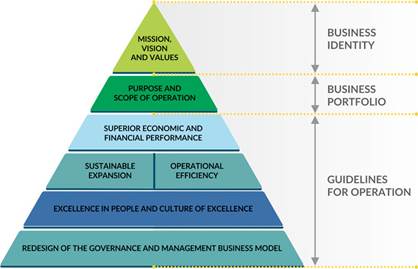
In order to achieve these objectives, our main strategies are as follows:
· Simplify our structure to focus on generation and transmission business and reduce our leverage and exposure to non-core businesses . Our business is focused on our core operations in the Brazilian generation and transmission markets. Our strategy is to simplify our structure and select and optimize opportunities that arise in the auction process for new generation plants and transmission lines in accordance with the Electricity Regulatory Law. By focusing on generation and transmission, we believe that we will be able to generate sustainable and dependable cash flows by improving efficiency in the operation and maintenance of our assets and capitalizing on opportunities arising from greenfield projects or from the selective acquisition of existing assets. As part of our strategy to reduce our leverage and our exposure to our non-core business, we have sold some of our assets including our distribution companies, and will continue to attempt to sell some of our assets including our stakes in up to 71 SPEs. As of the date of this annual report, we have sold our stakes in six distribution companies for an aggregate sale price of R$273 thousand and 26 SPEs in the generation and transmission segments for an aggregate sale price of R$1.3 billion. For further information about these sales, see “ — Organizational Structure.”
· Achieve a global leadership position in clean energy production. Our Corporate Strategy Plan for 2015 to 2030 reinforces our target to achieve a global leadership position in clean energy production by 2030, while maintaining competitive rates of return. For the years ended December 31, 2018 and 2017, respectively, we generated 71% and 87% of our energy from renewable sources, including 89% and 98% from hydroelectric power, and 2% from wind and solar power. For further information, see “—Generation” below. We intend to achieve this goal by continuing to focus on renewable energy sources whilst also streamlining our business model by continuing to divest non-core assets and improve our operating costs.
· We seek to maintain high corporate governance and transparency standards. Our transition over the years from being a fully state-owned company to listing on the B3 Exchange, the Madrid Stock Exchange, through the LATIBEX Program, and the New York Stock Exchange, where our shares trade as Level 2 American Depositary Receipts, has resulted in us having to comply with enhanced corporate governance standards. Accordingly, we have established controls and procedures intended to comply with the Sarbanes Oxley Act of 2002 and have made several changes to our bylaws and policies to comply with the provisions of the Law of Government-Controlled Companies, the U.S. Foreign Corrupt Practices Act of 1977 (the “FCPA”), Law No. 12,846/13 and Decree No. 8,420/15 (the “Brazilian Anticorruption Law”), the rules and guidelines issued by the SEC, the CVM, the Brazilian Institute of
Corporate Governance ( Instituto Brasileiro de Governança Corporativa ) (the “IBGC”) and the Organisation for Economic Co-operation and Development (“OECD”), among others. In addition, the effects of the Lava Jato Investigation on Brazil generally and on us specifically has led to an increase focus on legal and regulatory compliance and internal controls over financial reporting, including identified material weaknesses. The effects of these improvements are embodied in our “Eletrobras 5 Dimensions Program.” Examples of the changes we made in recent years include (i) appointing a chief compliance officer, (ii) establishing an external and independent ombudsman channel, (iii) approving dividends and related parties policies, (iv) updating our Code of Ethical Conduct and Integrity ( Código de Ética das Empresas Eletrobras ), (v) increasing the number of independent directors on our board and (vi) creating the following committees to act as advisors to our Board of Directors: the Strategy, Governance and Sustainability Committee, the Management, People and Eligibility Committee and the Audit Committee. These and other changes have led us to receive (i) the Governance-IG-SEST stamp, which is an innovative tool, developed by the Secretary of Coordination and Governance of State Enterprises (SEST), that seeks compliance with best market practices and a higher level of excellence for state-owned companies and (ii) the Corporate Governance Stamp for state-owned companies from B3 Exchange.
In 2018, the Business and Management Plan 2018-2022 (“PDNG 2018-2022”) was in compliance with its strategic ambition and achieved significant results.
The following figure shows the five pillars with the main set goals and the results of 2018 :
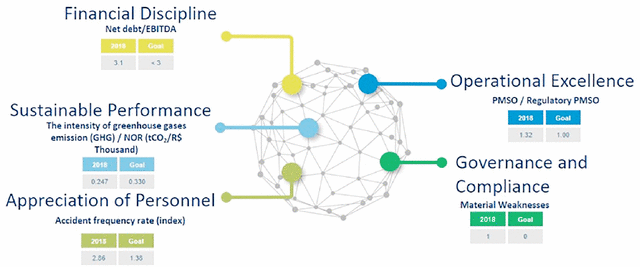
In 2018 the Board of Directors approved the Business and Management Master Plan for the five-year period 2019-2023 (“PDNG 2019-2023”). The PDNG 2019-2023 presents some updates to PDNG 2018-2022.
This PDNG 2019-2023 is structured in five Strategic Guidelines that demonstrate our purpose and ambition: Profitable Growth, Operational Excellence, Governance and Compliance, Sustainable Performance and Evaluation of Personnel. As in previous years, it is linked to the Strategic Guidelines, a set of indicators with even more challenging goals, which aims to improve our overall performance.
The following figure shows the five strategic guidelines with our main set of goals we intend to achieve in 2019:
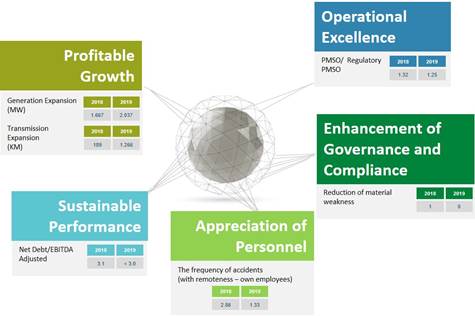
The implementation of the initiatives listed in the PDNG 2019-2023 is intended to bring benefits to us, such as lower financial leverage, higher operational efficiency and costs consistent with regulatory parameters, continuing the advances already achieved under the previous plan.
Generation
Our principal activity is the generation of electricity. Net revenues from generation represented 69.8%, 56.6% and 31.4% of our net operating revenues (before eliminations) in the years ended December 31, 2018, 2017 and 2016, respectively.
Pursuant to Law No. 5,899/73, and Decree 4,550/02, we must transfer all energy contracted by Itaipu to distribution companies in the southern, southeastern and midwestern regions of Brazil. We act as agent for Itaipu, which is a pass through entity.
We had an installed capacity of 49,801 MW as of December 31, 2018, 48,134 MW as of December 31, 2017 and 46,856 MW as of December 31, 2016. This total capacity in 2018 includes 7,000 MW related to the Itaipu plant and 10,184 MW related to the proportion of the SPEs in which we hold a stake. Additionally, we have approximately 5,850 MW in projects planned throughout Brazil until 2026, out of which approximately 5,730 MW are currently under construction and approximately 123 MW with construction yet to begin. The 5,850 MW include partnerships and corporate ventures and approximately 3,815 MW are equivalent to the capacity of our subsidiaries. We entered into feasibility studies for an additional capacity of approximately 18,865 MW, although the studies are not a guarantee of the implementation of projects by us, nor will they be corporate partnerships. For instance, Angra III, which is currently under development, is expected to have an installed capacity of 1,405 MW at the start of its commercial operation.
The map below shows the geographic location of our generation assets as of December 31, 2018:
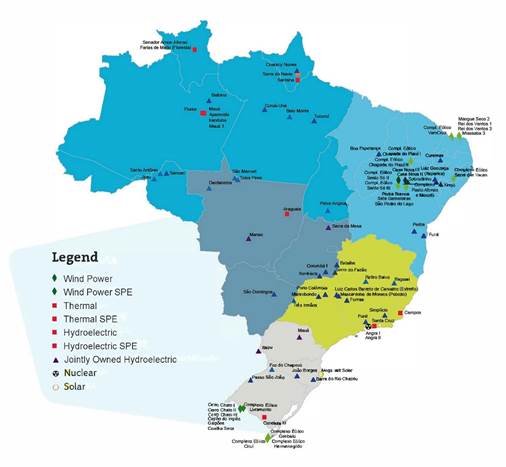
As of December 31, 2018, we operated under the following concessions/authorizations granted by ANEEL for our generation business. The numbers related to the installed capacity of our operational projects were obtained directly from ANEEL. For the projects under development, we considered the total installed capacity.
|
Concessions/Authorizations |
|
State |
|
Type of Plant |
|
Installed
|
|
End of Concession |
|
Began Service or
|
|
|
|
|
|
|
|
(MW) |
|
|
|
|
|
Operational projects |
|
|
|
|
|
|
|
|
|
|
|
|
|
|
|
|
|
|
|
|
|
|
|
CGTEE |
|
|
|
|
|
|
|
|
|
|
|
Candiota III - Phase C |
|
Rio Grande do Sul |
|
Thermal |
|
350.00 |
|
July 2041 |
|
January 2011 |
|
|
|
|
|
|
|
|
|
|
|
|
|
Chesf |
|
|
|
|
|
|
|
|
|
|
|
Boa Esperança (Castelo Branco) |
|
Piauí |
|
Hydro |
|
237.30 |
|
December 2042 |
|
April 1970 |
|
|
|
|
|
|
|
|
|
|
|
|
|
Casa Nova II (1) |
|
Bahia |
|
Wind |
|
32.90 |
|
May 2049 |
|
December 2017 |
|
Casa Nova III (2) |
|
Bahia |
|
Wind |
|
28.20 |
|
May 2049 |
|
February 2018 |
|
Complexo de Paulo Afonso e Apolônio Sales |
|
Bahia |
|
Hydro |
|
4,279.60 |
|
December 2042 |
|
January 1955 |
|
Curemas |
|
Paraíba |
|
Hydro |
|
3.52 |
|
November 2024 |
|
January 1957 |
|
Funil |
|
Bahia |
|
Hydro |
|
30.00 |
|
December 2042 |
|
August 1962 |
|
Luiz Gonzaga (Itaparica) |
|
Pernambuco |
|
Hydro |
|
1,479.60 |
|
December 2042 |
|
June 1988 |
|
Pedra |
|
Bahia |
|
Hydro |
|
20.01 |
|
December 2042 |
|
November 1978 |
|
Sobradinho |
|
Bahia |
|
Hydro |
|
1,050.30 |
|
February 2052 |
|
November 1979 |
|
Xingó |
|
Sergipe |
|
Hydro |
|
3,162.00 |
|
December 2042 |
|
December 1994 |
|
|
|
|
|
|
|
|
|
|
|
|
|
Eletronorte |
|
|
|
|
|
|
|
|
|
|
|
Araguaia (3) |
|
Mato Grosso |
|
Thermal |
|
23.10 |
|
Undetermined |
|
April 2016 |
|
Coaracy Nunes |
|
Amapá |
|
Hydro |
|
78.00 |
|
December 2042 |
|
December 1975 |
|
Complexo de Tucuruí |
|
Pará |
|
Hydro |
|
8,535.00 |
|
August 2024 |
|
December 1984 |
|
Curuá-Una (4) |
|
Pará |
|
Hydro |
|
30.30 |
|
July 2028 |
|
January 1977 |
|
Concessions/Authorizations |
|
State |
|
Type of Plant |
|
Installed
|
|
End of Concession |
|
Began Service or
|
|
|
|
|
|
|
|
(MW) |
|
|
|
|
|
Samuel |
|
Rondônia |
|
Hydro |
|
216.75 |
|
September 2029 |
|
July 1989 |
|
Santana |
|
Amapá |
|
Thermal |
|
24.00 |
|
December 2024 |
|
March 1993 |
|
|
|
|
|
|
|
|
|
|
|
|
|
Senador Arnon Afonso Farias de Mello (5) |
|
Roraima |
|
Thermal |
|
85.99 |
|
September 2019 |
|
January 1990 |
|
|
|
|
|
|
|
|
|
|
|
|
|
Furnas |
|
|
|
|
|
|
|
|
|
|
|
Batalha |
|
Minas Gerais |
|
Hydro |
|
52.50 |
|
August 2041 |
|
May 2014 |
|
Corumbá I |
|
Goiás |
|
Hydro |
|
375.00 |
|
December 2042 |
|
October 1996 |
|
Funil |
|
Rio de Janeiro |
|
Hydro |
|
216.00 |
|
December 2042 |
|
March 1970 |
|
Furnas |
|
Minas Gerais |
|
Hydro |
|
1,216.00 |
|
December 2042 |
|
March 1963 |
|
Itumbiara |
|
Goiás/Minas Gerais |
|
Hydro |
|
2,082.00 |
|
February 2020 |
|
February 1980 |
|
Luis Carlos Barreto (Estreito) |
|
SP/Minas Gerais |
|
Hydro |
|
1,050.00 |
|
December 2042 |
|
January 1969 |
|
Manso (6) |
|
Mato Grosso |
|
Hydro |
|
210.00 |
|
February 2035 |
|
November 2000 |
|
Marimbondo |
|
SP/Minas Gerais |
|
Hydro |
|
1,440.00 |
|
December 2042 |
|
October 1975 |
|
Mascarenhas de Moraes |
|
Minas Gerais |
|
Hydro |
|
476.00 |
|
January 2024 |
|
April 1957 |
|
Porto Colômbia |
|
Minas Gerais/SP |
|
Hydro |
|
320.00 |
|
December 2042 |
|
June 1973 |
|
Roberto Silveira (Campos) |
|
Rio de Janeiro |
|
Thermal |
|
30.00 |
|
July 2027 |
|
December 1968 |
|
Santa Cruz (7) |
|
Rio de Janeiro |
|
Thermal |
|
350.00 |
|
July 2015 |
|
July 1967 |
|
Serra da Mesa (6) |
|
Goiás |
|
Hydro |
|
1,275.00 |
|
September 2040 |
|
April 1998 |
|
Simplício (8) |
|
Minas Gerais |
|
Hydro |
|
305.70 |
|
August 2041 |
|
June 2013 |
|
Anta (9) |
|
Rio de Janeiro |
|
Hydro |
|
28.00 |
|
August 2041 |
|
August 2018 |
|
|
|
|
|
|
|
|
|
|
|
|
|
Eletronuclear |
|
|
|
|
|
|
|
|
|
|
|
Angra I |
|
Rio de Janeiro |
|
Nuclear |
|
640.00 |
|
December 2024 |
|
January 1985 |
|
Angra II |
|
Rio de Janeiro |
|
Nuclear |
|
1,350.00 |
|
August 2040 |
|
September 2000 |
|
|
|
|
|
|
|
|
|
|
|
|
|
Eletrosul |
|
|
|
|
|
|
|
|
|
|
|
Barra do Rio Chapéu |
|
Santa Catarina |
|
Hydro |
|
15.15 |
|
May 2034 |
|
February 2013 |
|
Capão do Inglês |
|
Rio Grande do Sul |
|
Wind |
|
10.00 |
|
May 2049 |
|
December 2015 |
|
Coxilha Seca |
|
Rio Grande do Sul |
|
Wind |
|
30.00 |
|
May 2049 |
|
December 2015 |
|
Wind Cerro Chato I |
|
Rio Grande do Sul |
|
Wind |
|
30.00 |
|
August 2045 |
|
January 2012 |
|
Wind Cerro Chato II |
|
Rio Grande do Sul |
|
Wind |
|
30.00 |
|
August 2045 |
|
August 2011 |
|
Wind Cerro Chato III |
|
Rio Grande do Sul |
|
Wind |
|
30.00 |
|
August 2045 |
|
June 2011 |
|
Galpões |
|
Rio Grande do Sul |
|
Wind |
|
8.00 |
|
May 2049 |
|
December 2015 |
|
João Borges |
|
Santa Catarina |
|
Hydro |
|
19.00 |
|
December 2035 |
|
July 2013 |
|
Megawatt Solar |
|
Santa Catarina |
|
Solar |
|
0.93 |
|
Not applicable |
|
September 2014 |
|
Passo São João |
|
Rio Grande do Sul |
|
Hydro |
|
77.00 |
|
August 2041 |
|
March 2012 |
|
São Domingos |
|
Mato Grosso do Sul |
|
Hydro |
|
48.00 |
|
December 2037 |
|
June 2013 |
|
Governandor Jayme Canet Junior (Previously Mauá) |
|
Paraná |
|
Hydro |
|
363.14 |
|
July 2042 |
|
November 2012 |
|
Amazonas GT |
|
|
|
|
|
|
|
|
|
|
|
Aparecida |
|
Amazonas |
|
Thermal |
|
166.00 |
|
July 2020 |
|
February 1984 |
|
Balbina |
|
Amazonas |
|
Hydro |
|
249.75 |
|
March 2027 |
|
January 1989 |
|
Flores (10) |
|
Amazonas |
|
Thermal |
|
80 |
|
March 2019 |
|
February 2008 |
|
Iranduba (10) |
|
Amazonas |
|
Thermal |
|
25 |
|
March 2019 |
|
November 2010 |
|
Mauá |
|
Amazonas |
|
Thermal |
|
260 |
|
July 2020 |
|
April 1973 |
|
Mauá 3 (11) |
|
Amazonas |
|
Thermal |
|
590.75 |
|
November 2044 |
|
September 2017 |
|
|
|
|
|
|
|
|
|
|
|
|
|
Operational SPEs |
|
|
|
|
|
|
|
|
|
|
|
Baguari |
|
Minas Gerais |
|
Hydro |
|
140 |
|
August 2041 |
|
September 2009 |
|
Banda de Couro (19) |
|
Bahia |
|
Wind |
|
32.9 |
|
July 2049 |
|
March 2016 |
|
Baraunas II (19) |
|
Bahia |
|
Wind |
|
25.9 |
|
July 2049 |
|
March 2016 |
|
Baraúnas I, Mussambê e Morro Branco I (19) |
|
Bahia |
|
Wind |
|
98.70 |
|
February 2049 |
|
October 2015 |
|
Belo Monte (12) |
|
Pará |
|
Hydro |
|
7,566.42 |
|
August 2045 |
|
April 2016 |
|
Caiçara I e II, Junco I e II (13) |
|
Rio Grande do Norte |
|
Wind |
|
93.00 |
|
July 2047 |
|
December 2015 |
|
Cerro Chato IV, V, VI, Ibirapuitã e Trindade |
|
Rio Grande do Sul |
|
Wind |
|
25.20 |
|
February 2047 |
|
August 2015 |
|
Chuí 09 |
|
Rio Grande do Sul |
|
Wind |
|
17.90 |
|
May 2049 |
|
October 2015 |
|
Chuí I to V, and Minuano I and II |
|
Rio Grande do Sul |
|
Wind |
|
144.00 |
|
April 2047 |
|
May 2015 |
|
Dardanelos |
|
Mato Grosso |
|
Hydro |
|
261.00 |
|
July 2042 |
|
August 2011 |
|
Foz de Chapecó |
|
Rio Grande do Sul/Santa Catarina |
|
Hydro |
|
855.00 |
|
November 2036 |
|
October 2010 |
|
Geribatu I a X |
|
Rio Grande do Sul |
|
Wind |
|
258.00 |
|
February 2047 |
|
February 2015 |
|
Jirau |
|
Rondônia |
|
Hydro |
|
3,750.00 |
|
August 2043 |
|
September 2013 |
|
Mangue Seco 2 |
|
Rio Grande do Norte |
|
Wind |
|
26.00 |
|
June 2032 |
|
September, 2011 |
|
Concessions/Authorizations |
|
State |
|
Type of Plant |
|
Installed
|
|
End of Concession |
|
Began Service or
|
|
|
|
|
|
|
|
(MW) |
|
|
|
|
|
Parque Eólico Miassaba 3 (19) |
|
Rio Grande do Norte |
|
Wind |
|
68.47 |
|
August 2045 |
|
May 2014 |
|
Parque Eólico Rei dos Ventos 1 (19) |
|
Rio Grande do Norte |
|
Wind |
|
58.45 |
|
December 2045 |
|
May 2014 |
|
Parque Eólico Rei dos Ventos 3 (19) |
|
Rio Grande do Norte |
|
Wind |
|
60.12 |
|
December 2045 |
|
May 2014 |
|
Pedra Branca (19) |
|
Bahia |
|
Wind |
|
30.00 |
|
February 2046 |
|
March 2013 |
|
Peixe Angical |
|
Tocantins |
|
Hydro |
|
498.75 |
|
November 2036 |
|
June 2006 |
|
Retiro Baixo |
|
Minas Gerais |
|
Hydro |
|
82.00 |
|
August 2041 |
|
March 2010 |
|
Santa Joana I (14) |
|
Piauí |
|
Wind |
|
28.90 |
|
June 2049 |
|
January 2016 |
|
Santa Joana III (14) |
|
Piauí |
|
Wind |
|
29.60 |
|
June 2049 |
|
March 2016 |
|
Santa Joana IV (14) |
|
Piauí |
|
Wind |
|
28.90 |
|
May 2049 |
|
January 2016 |
|
Santa Joana V (14) |
|
Piauí |
|
Wind |
|
28.90 |
|
June 2049 |
|
January 2016 |
|
Santa Joana VII (14) |
|
Piauí |
|
Wind |
|
27.20 |
|
June 2049 |
|
January 2016 |
|
Santo Augusto IV (11) |
|
Piauí |
|
Wind |
|
28.90 |
|
June 2049 |
|
February 2016 |
|
Santa Joana IX, X, XI, XII, XIII, XV e XVI (15) |
|
Piauí |
|
Wind |
|
205.10 |
|
March 2049 |
|
July 2015 |
|
Santo Antônio |
|
Rondônia |
|
Hydro |
|
3,568.80 |
|
June 2043 |
|
March 2012 |
|
São Manoel (16) |
|
Pará/Mato Grosso |
|
Hydro |
|
700.0 |
|
Abril 2049 |
|
December 2017 |
|
São Pedro do Lago (19) |
|
Bahia |
|
Wind |
|
30.0 |
|
February 2046 |
|
March 2013 |
|
Serra das Vacas I, II, III e IV (17) (19) |
|
Pernambuco |
|
Wind |
|
90.76 |
|
June 2049 |
|
December 2015 |
|
Serra do Facão |
|
Goiás |
|
Hydro |
|
212.58 |
|
November 2036 |
|
July 2010 |
|
Serra do Navio (20) |
|
Amapá |
|
Thermal |
|
23.28 |
|
June 2014 |
|
June 2008 |
|
Sete Gameleiras (19) |
|
Bahia |
|
Wind |
|
30.00 |
|
February 2046 |
|
March 2013 |
|
Teles Pires |
|
Pará/Mato Grosso |
|
Hydro |
|
1,819.80 |
|
June 2046 |
|
November 2015 |
|
Três Irmãos (18) |
|
SP |
|
Hydro |
|
807.50 |
|
September 2044 |
|
October 2014 |
|
Verace 24 to 27 |
|
Rio Grande do Sul |
|
Wind |
|
57.28 |
|
June 2049 |
|
November 2015 |
|
Verace 28 to 31 |
|
Rio Grande do Sul |
|
Wind |
|
57.28 |
|
June 2049 |
|
December 2015 |
|
Verace 34 to 36 |
|
Rio Grande do Sul |
|
Wind |
|
48.33 |
|
June 2049 |
|
December 2015 |
|
|
|
|
|
|
|
|
|
|
|
|
|
Corporate projects in development |
|
|
|
|
|
|
|
|
|
|
|
Angra III |
|
Rio de Janeiro |
|
Nuclear |
|
1,405.00 |
|
December 2064 |
|
January 2026 |
|
Casa Nova I |
|
Bahia |
|
Wind |
|
180.00 |
|
Not applicable |
|
Undefined |
|
|
|
|
|
|
|
|
|
|
|
|
|
SPE projects in development |
|
|
|
|
|
|
|
|
|
|
|
Acauã |
|
Bahia |
|
Wind |
|
6.00 |
|
April 2049 |
|
June 2019 |
|
Angical 2 |
|
Bahia |
|
Wind |
|
10.00 |
|
April 2049 |
|
April 2019 |
|
Arapapá |
|
Bahia |
|
Wind |
|
4.00 |
|
April 2049 |
|
June 2019 |
|
Belo Monte |
|
Pará |
|
Hydro |
|
11,233.10 |
|
August 2045 |
|
April 2016 |
|
Caititú 2 |
|
Bahia |
|
Wind |
|
10.00 |
|
April 2049 |
|
October 2019 |
|
Caititú 3 |
|
Bahia |
|
Wind |
|
10.00 |
|
April 2049 |
|
October 2019 |
|
Carcará |
|
Bahia |
|
Wind |
|
10.00 |
|
April 2049 |
|
September 2019 |
|
Coqueirinho 2 |
|
Bahia |
|
Wind |
|
16.00 |
|
May 2049 |
|
April 2019 |
|
Corrupião 3 |
|
Bahia |
|
Wind |
|
10.00 |
|
April 2049 |
|
September 2019 |
|
Papagaio |
|
Bahia |
|
Wind |
|
10.00 |
|
May 2049 |
|
May 2019 |
|
Sinop |
|
Mato Grosso |
|
Hydro |
|
408.00 |
|
February 2049 |
|
March 2019 |
|
Tamanduá Mirim 2 |
|
Bahia |
|
Wind |
|
16.00 |
|
June 2049 |
|
May 2019 |
|
Teiú 2 |
|
Bahia |
|
Wind |
|
8.00 |
|
April 2049 |
|
July 2019 |
|
|
|
|
|
|
|
|
|
|
|
|
|
SPE that did not start construction yet |
|
|
|
|
|
|
|
|
|
|
|
Jandaia |
|
Ceará |
|
Wind |
|
27.00 |
|
August 2047 |
|
November 2019 |
|
Jandaia I |
|
Ceará |
|
Wind |
|
24.00 |
|
July 2047 |
|
November 2019 |
|
Nossa Senhora de Fátima |
|
Ceará |
|
Wind |
|
30.00 |
|
August 2047 |
|
November 2019 |
|
São Clemente |
|
Ceará |
|
Wind |
|
21.00 |
|
July 2047 |
|
November 2019 |
|
São Januário |
|
Ceará |
|
Wind |
|
21.00 |
|
June 2047 |
|
November 2019 |
|
(1) |
Windfarm Casa Nova II began commercial operation on December 9, 2017, according to Order No. 4,153/17. The physical guarantee of the plant was amended by Ordinance No. 385/17. |
|
(2) |
Windfarm Casa Nova III began commercial operation on February 28, 2018. The physical guarantee of the plant was amended by Ordinance No. 385/17. |
|
(3) |
Ordinance MME 331 of August 14, 2018 - DOU August 15, 2018, authorizes the termination of the contract, in its entirety, with the thermoelectric generating plant denominated UTE Araguaia. Eletronorte, through CE-CRR-0118, dated June 20, 2018, requested ANEEL to revoke the authorization granted to UTE Araguaia. However, the Association of Municipalities of Araguaia - AMA filed the Public Civil Action No. 2803-972018.811.008 against Eletronorte in the Court of Mato Grosso, and an njunction was granted. Eletronorte, through CE-CRR-0144, dated August 7, 2018, requested ANEEL to halt the process. On October 11, 2018, Eletronorte filed a lawsuit before the Federal Court (Case No. 1021506-05.2018.4.01.3400) to discuss the matter, which is still pending judgment. |
|
(4) |
ANEEL Ordinance No. 7,010/18 authorized the raise of the installed capacity from 30,300 Kw to 42,800 Kw and extended Curuá-Una’s concession for 20 years as from May 9, 2018, conditioned to the commercial start of the generation unit 4 operation until the current expiration date of the concession. |
|
(5) |
ANEEL Ordinance No. 2,894/11 transfers the Usina Termelétrica Senador Arnon Farias de Mello from Eletronorte to Boa Vista Energia until February 10, 2012. ANEEL Ordinance No. 318/14 extends this period until the effective connection of the Boa Vista isolated system to the Interconnected Power System. |
|
(6) |
Shared UHE, however, Furnas acquired its partner’s participation through energy purchase contracts - considering the physical guarantee and the total generation of each UHE. MME Ordinance No. 178/17 revised the physical guarantee amounts of the hydroelectric plants that use the Interconnected Power System as from January 1, 2018. |
|
(7) |
The total of 500MW does not include the generation capacity of units 3 and 4, which had their operations temporarily suspended by ANEEL, pursuant to Order No. 3,263/12. This amount, however, includes 150 MW that is currently unavailable, due to delays in the construction of the plant. When the plant is complete, units 11 and 21 will operate in combination |
|
|
with units 1 and 2. The physical guarantee of 401.2 MW is related to the installed capacity of 500 MW. An extension of the concession until 2035 was requested to ANEEL and is pending a decision. Until ANEEL issues a decision the concession contract remains in force. |
|
(8) |
The average 175.40 MW only corresponds to the physical guarantee of the Simplício. The complex Simplício-Anta will have 191.30MW of physical guarantee when Anta starts its commercial operation. |
|
(9) |
UG01 went into operation under test on July 7, 2018 and in commercial operation on October 8, 2018; UG2 went into operation under test on September 9, 2018 and in commercial operation on November 10, 2018. The values of installed capacity and physical guarantee were updated based on the start-up of the UG2. |
|
(10) |
The Installed Capacity and Assured Energy of Flores and Iranduba UTEs are in accordance with MME Ordinance No. 492/2017. Prediction of service is dependent on MME Ordinance No. 492/2017. |
|
(11) |
The Installed Capacity of Mauá 3 UTE is in accordance with ANEEL Authorization No. 4,950/2014. Energy Assurance of Mauá 3 UTE is in accordance with MME Ordinance Nº 387/2017. ANEEL Order No. 3,017 of September 18 initiated the commercial operation of the CMUGG 01 unit of Mauá 3 UTE, for a fixed term, from September 19 to December 31, 2018. ANEEL Order Nº 2,998 of December 12 initiated the commercial operation of CMUGG 01 and CMUGG 02 units of Mauá 3 UTE, for an indefinite period. ANEEL Order No. 3,136 of December 21 initiated the commercial operation of the CMUGV 03 unit of Mauá 3 UTE, starting on December 22, 2018. |
|
(12) |
Eighteen generating units in commercial operation totaling 7,566.30 MW. |
|
(13) |
The shares of the SPEs Caiçara I S.A., Caiçara II S.A., Junco I S.A. and Junco II S.A were merged into Veamcruz I Participações S.A. |
|
(14) |
The shares of the SPEs Santa Joana I, III, IV, V, VII and Santo Augusto IV Energias Renováveis S.A. were merged into Chapada do Piauí II Holding S.A. |
|
(15) |
The shares of the SPEs Santa Joana IX, X, XI, XII, XIII, XV and XIV Energia Renováveis S.A. were merged into Chapada do Piauí I Holding S.A. |
|
(16) |
Four UGs in commercial operation (700MW). As per the Process ANEEL No. 48500.000301/2014-32 ANEEL, the physical guarantee of São Manoel is 424.5 MW on average. |
|
(17) |
Serra das Vacas I, II, III and IV were merged into Serra das Vacas Holding S.A. |
|
(18) |
Tijoá operates Três Irmãos pursuant to a special administration regime (Law No. 12,783/13) |
|
(19) |
Concessions that belong to SPEs sold as of the date of this annual report. |
|
(20) |
Amapari is not in operation since July 4, 2014, with no data regarding generation and commercialization. |
Source: Eletrobras System.
As of December 31, 2018, we operated under the following concessions/authorizations granted by ANEEL for our distribution business in the isolated system.
|
Concessions/Authorizations |
|
State |
|
Type of Plant |
|
Installed
|
|
End of Concession |
|
Began Service or
|
|
|
|
|
|
|
|
|
(MW) |
|
|
|
|
|
|
Amazonas D |
|
|
|
|
|
|
|
|
|
|
|
|
Thermal plants of the Isolated System |
|
Amazonas |
|
Thermal |
|
406.47 |
|
From 1965 to 2010 |
|
Undefined |
|
Types of Plants
Hydroelectric power plants accounted for 78.6% as of December 31, 2018, 79.8% of our total power generated as of December 31, 2017 and 77.5% as of December 31, 2016.
We also generate electricity through our thermal, nuclear, wind and solar plants. Thermal plants accounted for 7.0% of our total power generated as of December 31, 2018, compared to 5.7% as of December 31, 2017 and 6.6% as of December 31, 2016. Nuclear plants accounted for 11.5% of our total power generated as of December 31, 2018, compared to 11.8% as of December 31, 2017 and 13.3% as of December 31, 2016. Wind plants accounted for 2.9% of our total power generated as of December 31, 2018, compared to 2.7% as of December 31, 2017 and 2.8% as of December 31, 2016. Solar plants accounted for 1MW of all our installed capacity for the years 2018, 2017, and 2016 representing an insignificant percentage of our total power generated.
The following table sets out the total amount of electricity generated in the periods indicated, measured in megawatt hours, broken down by type of plant:
|
|
|
As of December 31, |
|
||||
|
|
|
2018 |
|
2017 |
|
2016 |
|
|
|
|
|
|
(MWh) |
|
|
|
|
Type of plant: |
|
|
|
|
|
|
|
|
|
|
|
|
|
|
|
|
|
Hydroelectric (1) |
|
106,735,388.94 |
|
106,935,182.08 |
|
92,277,549.67 |
|
|
Thermal |
|
9,502,954.86 |
|
7,681,985.62 |
|
7,841,685.90 |
|
|
Nuclear |
|
15,674,654.62 |
|
15,741,207.50 |
|
15,864,289.07 |
|
|
Wind |
|
3,873,837.96 |
|
3,594,335.17 |
|
3,076,728.63 |
|
|
Total |
|
135,786,836.38 |
|
133,952,710.37 |
|
119,366,624.15 |
|
(1) Excluding electricity generated by Itaipu plant.
Hydroelectric Plants
Hydroelectric plants are our most cost-efficient source of electricity, although efficiency is significantly dependent on meteorological factors, such as the level of rainfall. Based on our experience with both types of plants, we believe construction costs for hydroelectric plants are higher than for thermal plants; however, the average useful life of hydroelectric plants is longer. We use our hydro-powered plants to provide the bulk of our primary and back-up electricity generated during peak periods of high demand. During periods of rapid change in supply and demand, hydroelectric plants also provide greater production flexibility than our other forms of electric generation because we are able to instantly increase (or decrease) output from these sources, in contrast to thermal or nuclear facilities where there is a time lag while output is adjusted.
As of December 31, 2018, we owned and operated 32 hydroelectric plants. In addition, we hold a 50.0% interest in Itaipu, the other 50.0% of which is owned by a Paraguayan governmental entity and participations in the Peixe Angical (40.0%), Jirau (40.0%), Serra do Facão (49.5%), Retiro Baixo (49.0%), Foz do Chapecó (40.0%), Baguari (15.0%), Dardanelos (49.0%), Santo Antônio (43.1%), Teles Pires (49.44%), Três Irmãos (49.9%), Belo Monte (49.98%) and São Manoel (33.3%) plants. We have participations in the Serra Mesa (48.5%), Manso (70.0%) and Mauá (49.0%). The ONS is solely responsible for determining how much electricity each of our plants should generate per year. As of December 31, 2018, the total installed capacity of our hydroelectric plants was 44,221.05 MW (including 50.0% of Itaipu and our participations in the SPEs referred to above). The following table sets out information with respect to hydroelectric plants owned by us and with partners as of December 31, 2018 and for the year then ended:
|
|
|
Installed (1) Capacity |
|
Assured Energy (2) |
|
Began Service |
|
|
|
|
|
|
(MW) |
|
|
|
|
Hydroelectric plants: |
|
|
|
|
|
|
|
|
Anta |
|
28.00 |
|
15.90 |
|
August 2018 |
|
|
Baguari (3) |
|
140.00 |
|
84.70 |
|
September 2009 |
|
|
Balbina |
|
249.75 |
|
132.30 |
|
January 1989 |
|
|
Barra do Rio Chapéu |
|
15.15 |
|
8.61 |
|
February 2013 |
|
|
Batalha |
|
52.50 |
|
48.80 |
|
May 2014 |
|
|
Belo Monte (17) |
|
7,566.42 |
|
4,571.00 |
|
April 2016 |
|
|
Boa Esperança (Castelo Branco) |
|
237.30 |
|
143.00 |
|
April 1970 |
|
|
Coaracy Nunes |
|
78.00 |
|
62.6 |
|
December 1975 |
|
|
Complexo de Paulo Afonso (4) |
|
4,279.60 |
|
2,225.00 |
|
January 1955 |
|
|
Corumbá I |
|
375.00 |
|
217.40 |
|
October 1996 |
|
|
Curemas |
|
3.52 |
|
1.00 |
|
January 1957 |
|
|
Curuá-Una |
|
30.30 |
|
24.80 |
|
January 1977 |
|
|
Dardanelos (5) |
|
261.00 |
|
154.90 |
|
August 2011 |
|
|
Foz do Chapecó (6) |
|
855.00 |
|
427.20 |
|
October 2010 |
|
|
Funil |
|
216.00 |
|
115.00 |
|
March 1970 |
|
|
Funil (Chesf) |
|
30.00 |
|
10.91 |
|
August 1962 |
|
|
Furnas |
|
1,216.00 |
|
582.00 |
|
September 1963 |
|
|
Itaipu (7) |
|
14,000.00 |
|
8,577.00 |
|
March 1985 |
|
|
Itumbiara |
|
2,082.00 |
|
964.30 |
|
April 1980 |
|
|
Jirau (8) |
|
3,750.00 |
|
2,205.06 |
|
September 2013 |
|
|
João Borges |
|
19.00 |
|
10.14 |
|
July 2013 |
|
|
Luis Carlos Barreto (Estreito) |
|
1,050.00 |
|
495.00 |
|
March 1969 |
|
|
Luiz Gonzaga (Itaparica) |
|
1,479.60 |
|
959.00 |
|
June 1988 |
|
|
Manso (70%) (9) |
|
210.00 |
|
87.80 |
|
November 2000 |
|
|
Marimbondo |
|
1,440.00 |
|
689.70 |
|
October 1975 |
|
|
Mascarenhas de Moraes |
|
476.00 |
|
289.50 |
|
April 1957 |
|
|
Gov. Jayme Canet Jr. (Previously Mauá) (10) |
|
363.14 |
|
197.70 |
|
November 2012 |
|
|
Passo São João |
|
77.00 |
|
41.10 |
|
March 2012 |
|
|
Pedra |
|
20.01 |
|
3.74 |
|
November 1978 |
|
|
Peixe Angical (11) |
|
498.75 |
|
280.50 |
|
June 2006 |
|
|
Porto Colômbia |
|
320.00 |
|
186.00 |
|
June 1973 |
|
|
Retiro Baixo (12) |
|
82.00 |
|
36.60 |
|
March 2010 |
|
|
Samuel |
|
216.75 |
|
92.70 |
|
July 1989 |
|
|
Santo Antônio (13) |
|
3,568.00 |
|
2,385.10 |
|
March 2012 |
|
|
São Domingos |
|
48.00 |
|
36.40 |
|
June 2013 |
|
|
São Manoel (14) |
|
700.00 |
|
424.50 |
|
December 2017 |
|
|
Serra da Mesa (48.5%) (9) |
|
1,275.00 |
|
637.50 |
|
April 1998 |
|
|
Serra do Facão (15) |
|
212.58 |
|
178.80 |
|
July 2010 |
|
|
Simplício |
|
305.70 |
|
175.4 |
|
June 2013 |
|
|
Sobradinho |
|
1,050.30 |
|
531.00 |
|
November 1979 |
|
|
Teles Pires |
|
1,819.80 |
|
930.7 |
|
November 2015 |
|
|
Três Irmãos (16) |
|
807.50 |
|
217.50 |
|
October 2014 |
|
|
Tucuruí |
|
8,535.00 |
|
4,019.10 |
|
December 1984 |
|
|
Xingó |
|
3,162.00 |
|
2,139.10 |
|
December 1994 |
|
(1) The installed capacity of Itaipu is 14,000 MW. Itaipu is equally owned by Brazil and Paraguay.
(2) Assured energy is the maximum amount per year that each plant is permitted to sell in auctions/supply to the Interconnected Power System, an amount determined by ONS. Any energy produced in excess of assured energy is sold in the Free Market.
(3) We own 15.0% of the Baguari plant. Figures in this table refer to the entire capacity/utilization of the plant.
(4) Complexo de Paulo Afonso has five (5) plants.
(5) We own 49.0% of the Dardanelos plant. Figures in this table refer to the entire capacity/utilization of the plant.
(6) We own 40.0% of the Foz do Chapecó plant. Figures in this table refer to the entire capacity/utilization of the plant.
(7) We own 50.0% of the Itaipu plant. Figures in this table refer to the entire capacity/utilization of the plant.
(8) We own 40.0% of the Jirau plant. Figures in this table refer to the entire capacity/utilization of the plant.
(9) We own 48.46% of the Serra Mesa plant and 70.0% of the Manso plant. Figures in this table refer to the entire capacity/utilization of each plant.
(10) We own 49.0% of the Mauá plant. Figures in this table refer to the entire capacity/utilization of the plant.
(11) We own 40.0% of the Peixe Angical plant. Figures in this table refer to the entire capacity/utilization of the plant.
(12) We own 49.0% of the Retiro Baixo plant. Figures in this table refer to the entire capacity/utilization of the plant.
(13) We own 43.1% of the Santo Antônio plant. As of December 31, 2018, the installed operating capacity was 3,568.00 MW.
(14) We own 33.3% of the São Manoel plant. Figures in this table refer to the entire capacity/utilization of the plant.
(15) We own 49.5% of the Serra do Facão plant. Figures in this table refer to the entire capacity/utilization of the plant.
(16) We own 49.9% of the Três Irmãos plant. Figures in this table refer to the entire capacity/utilization of the plant.
(17) 18 generator units in commercial operation that amounts 7.566,42 MW.
The following table describes the energy generated by the hydroelectric plants owned by us, the assured energy and the actual operational utilization as of December 31, 2018. We have converted the measurement of the assured energy to MWh so that we can compare it against the energy generated.
|
|
|
Assured
|
|
Generated
|
|
Actual
|
|
|
|
|
(MWh) |
|
(%) |
|
||
|
Hydroelectric plants: |
|
|
|
|
|
|
|
|
Anta |
|
139,284.00 |
|
60,889.45 |
|
44 |
% |
|
Balbina |
|
1,158,948.0 |
|
770,876.85 |
|
67 |
% |
|
Barra do Rio Chapéu |
|
75,423.60 |
|
56,450.27 |
|
75 |
% |
|
Batalha |
|
427,488.0 |
|
185,268.94 |
|
43 |
% |
|
Boa Esperança (Castelo Branco) |
|
1,252,680 |
|
1,207,648.51 |
|
96 |
% |
|
Coaracy Nunes |
|
548,376.0 |
|
569,288.51 |
|
104 |
% |
|
Complexo de Paulo Afonso |
|
19,491,000 |
|
5,043,915.15 |
|
26 |
% |
|
Corumbá I |
|
1,904,424 |
|
1,535,809.64 |
|
81 |
% |
|
Curemas |
|
8,760 |
|
0 |
|
0 |
% |
|
Curuá-Una |
|
217,248 |
|
226,872.85 |
|
104 |
% |
|
Funil(Furnas) |
|
1,007,400 |
|
744,831.18 |
|
74 |
% |
|
Funil (Chesf) |
|
95,571.60 |
|
39,467.66 |
|
41 |
% |
|
Furnas |
|
5,098,320 |
|
2,405,734.31 |
|
47 |
% |
|
Itumbiara |
|
8,447,268 |
|
4,347,677.65 |
|
51 |
% |
|
João Borges |
|
88,826.40 |
|
52,622.13 |
|
59 |
% |
|
Luis Carlos Barreto (Estreito) |
|
4,339,704 |
|
2,023,915.47 |
|
47 |
% |
|
Luiz Gonzaga (Itaparica) |
|
8,400,840 |
|
2,267,577.51 |
|
27 |
% |
|
Manso (70%) (2) |
|
769,128 |
|
807,921.20 |
|
105 |
% |
|
Marimbondo |
|
6,041,772 |
|
3,831,558.95 |
|
63 |
% |
|
Mascarenhas de Moraes |
|
2,536,020 |
|
1,160,671.03 |
|
46 |
% |
|
Gov. Jayme Canet Jr. (Previously Mauá) (3) |
|
1,731,852.00 |
|
1,876,686.60 |
|
108 |
% |
|
Passo São João |
|
360,036.00 |
|
397,342.79 |
|
110 |
% |
|
Pedra |
|
32,762,40 |
|
5,169.54 |
|
16 |
% |
|
Porto Colômbia |
|
1,629,360 |
|
1,192,506.46 |
|
73 |
% |
|
Samuel |
|
812,052.00 |
|
812,936.10 |
|
100 |
% |
|
São Domingos |
|
318,864.00 |
|
325,263.93 |
|
102 |
% |
|
Serra da Mesa (2) |
|
5,584,500 |
|
890,185.93 |
|
16 |
% |
|
Simplício |
|
1,536,504.00 |
|
1,157,062.55 |
|
75 |
% |
|
Sobradinho |
|
4,651,560 |
|
1,267,687.77 |
|
27 |
% |
|
Tucuruí |
|
35,207,316 |
|
31,399,936.38 |
|
89 |
% |
|
Xingó |
|
18,737,666.28 |
|
5,135,296.21 |
|
27 |
% |
|
Total |
|
132,650,954.28 |
|
71,799,071.50 |
|
54 |
% |
(1) Excluding (i) Itaipu, which is owned equally by Brazil and Paraguay; and (ii) any energy generated through our participation in SPEs.
(2) We own 48.46% of the Serra Mesa plant and 70.0% of the Manso plant. Figures in this table refer to the entire capacity/utilization of the plant.
(3) We own 49.0% of the Mauá plant. Figures in this table refer to the entire capacity/utilization of the plant.
See “—Concessions” for information on the hydroelectric power plants operated by Chesf, Eletronorte and Furnas.
Hydroelectric utilities in Brazil are required to pay a royalty fee of 6.7% of the power generated to the Brazilian states and municipalities in which a plant is located or in which land may have been flooded by a plant’s reservoir for the use of hydrological resources. Fees are established independently by each state and/or municipality as applicable and are based on the amount of energy generated by each utility and are paid directly to the states and municipalities. Fees for the states and municipalities in which we operate were RS$367 million for the year ended December 31, 2018, R$355 million for the year ended December 31, 2017 and R$362 million for the year ended December 31, 2016. These fees are included as operating costs in our consolidated financial statements.
Our subsidiaries have acquired concessions for the construction of new hydroelectric plants, as set out in the table below:
|
|
|
Installed
|
|
Construction
|
|
Service begins/began (1) |
|
|
|
|
(MW) |
|
|
|
|
|
|
New plants: |
|
|
|
|
|
|
|
|
Belo Monte (1) |
|
11,233.0 |
|
August 2011 |
|
April 2016 |
|
|
Sinop |
|
401.8 |
|
March 2014 |
|
March 2019 |
|
(1) Installed capacity of 7,566.42 MW in operation.
We have financed and intend to continue to finance these plants from cash flow from operations, future indemnification payments received pursuant to Law No. 12,783/13, receivables from loans granted to Itaipu and, if necessary, from financing obtained in the international capital markets and/or multilateral agencies as well as asset disposals.
Thermal Plants
As of December 31, 2018, we owned and operated 105 thermal plants, including a 49.0% interest in the Serra do Navio plant. Thermal plants include coal, oil and gas power generation units. The total installed capacity of our thermal plants was 2,403 MW as of December 31, 2018, compared to 2,634 MW as of December 31, 2017 and 2,992 MW as of December 31, 2016.
The following table sets out information regarding our thermal plants as of December 31, 2018:
|
|
|
Assured
|
|
Generated
|
|
Actual Operational
|
|
|
|
|
(MWh) |
|
(%) |
|
||
|
Araguaia (2) |
|
— |
|
49,004.42 |
|
— |
|
|
Aparecida |
|
1,314,000 |
|
1,157,652.46 |
|
88 |
% |
|
Camaçari (3) |
|
— |
|
— |
|
— |
|
|
Candiota III - Phase C |
|
1,587,294.74 |
|
1,489,641.49 |
|
94 |
% |
|
FO Flores |
|
700,800 |
|
657,079.31 |
|
94 |
% |
|
Iranduba |
|
219,000 |
|
203,753.19 |
|
93 |
% |
|
Mauá |
|
998,640.0 |
|
390,814.06 |
|
39 |
% |
|
Mauá 3 |
|
5,107,080 |
|
1,487,186.43 |
|
29 |
% |
|
Roberto Silveira (Campos) |
|
183,084.0 |
|
5,922.66 |
|
3 |
% |
|
Santa Cruz (4) |
|
3,514,512.0 |
|
2,419,296.61 |
|
69 |
% |
|
Santana |
|
— |
|
— |
|
— |
|
|
Total |
|
13,624,410.74 |
|
7,860,350.63 |
|
58 |
% |
(1) Generated Energy does not include energy generated through our participations in SPEs, neither through isolated system.
(2) Ordinance MME 331 of August 14, 2018 - DOU August 15, 2018, authorizes the termination of the contract, in its entirety, with the thermoelectric generating plant denominated UTE Araguaia. Eletronorte, through CE-CRR-0118, dated June 20, 2018, requested ANEEL to revoke the authorization granted to UTE Araguaia. However, the Association of Municipalities of Araguaia - AMA filed the Public Civil Action No. 2803-972018.811.008 against Eletronorte in the Court of Mato Grosso, and an njunction was granted. Eletronorte, through CE-CRR-0144, dated August 7, 2018, requested ANEEL to halt the process. On October 11, 2018, Eletronorte filed a lawsuit before the Federal Court (Case No. 1021506-05.2018.4.01.3400) to discuss the matter, which is still pending judgment.
(3) As per ANEEL Dispatch No. 3,247/16, of 12/13/16, the operation of the Camaçari plant was permanently suspended. On October 10, 2018, the UTE Camaçari concession was terminated.
(4) This considers the installed capacity of 350 MW, with commercial start-up of the remaining 150 MW by 2021. The physical guarantee (assured energy) of 401.2 MW relates to the installed capacity of 500 MW. ANEEL was requested to extend the concession in accordance with the legal conditions and deadline through the REQ.GCO.P.027.2013 application, dated May 7, 2013. The conditions of said concession remain in force.
Each of our thermal plants operates on coal, gas or oil. The fuel for the thermal plants is delivered by road, rail, pipeline or waterway, depending on the location of the relevant plant.
We seek to operate our thermal plants at a consistent, optimal level in order to provide a constant source of electricity production. Our thermal plants are significantly less efficient and have significantly shorter useful lives, than our hydroelectric plants. We incurred gross expenditure for fuel purchased for energy production of R$1,185 million as of December 31, 2018, compared to R$962 million as of December 31, 2017 and R$630 million as of December 31, 2016, which were reimbursed to us from the CCC Account in accordance with Law No. 12,111/09.
In respect of plants located in the Isolated System, we recover a substantial part of the plants’ high operational costs through reimbursements from the CCC Account. The Brazilian Government created the CCC Account in 1973 to establish financial reserves to cover the costs of acquiring fossil fuels to be used in the thermal plants of the Interconnected Power System. The account is funded through the annual contributions of consumers. Accordingly, the CCC Account operates as an insurance fund against any extraordinary situations, such as shortage of rainfall, which would require the greater use of thermal plants. The calculation of the total amount of required contributions per year was based on the estimated fuel cost for all thermal plants of that year. A proportional contribution corresponding to the ratio between its sale of energy to final consumers and the total sales of energy in the country in the previous year was assigned to each distributor.
In 1993, the scope of the CCC Account was extended to the Isolated System. Part of the costs of the acquisition of fuel for thermal generation in these remote areas of the northern region which were not included in the Interconnected Power System started to receive funds from the CCC Account. Currently, CCC is a charge of the Brazilian electricity sector that is paid for by all electricity distribution and transmission concessionaires in order to subsidize annual generation costs in areas not yet integrated with the Interconnected Power System, called Isolated Systems, whose management of the fund has been the CCEE since May 2017.
Since the enactment of Law No. 12,111/09, the reimbursement for the thermal plants located in the Isolated System is no longer related to the cost of fuel acquisition, but part of the total cost of generation to serve each electric system not included in the Interconnected Power System. With the enactment of Law No. 12,783/13, the portion referring to the CCC Account is no longer included in the final consumer tariff and, consequently, the collection of the annual contribution by the distributors no longer exists. The additional costs for the fuel used in the operation of thermoelectric plants began to be covered by funds from the CDE Account. The CDE Account is also used to reimburse the costs resulting from the acquisition of national mineral coal for thermal coal generation in the Interconnected Power System. We managed the CDE and CCC Accounts until May 2017, when the management of the funds was transferred to the CCEE in compliance with Law No. 13,360/16.
The following tables set forth information relating to the price paid and amount of fuel purchased for use in our thermal plants in the periods indicated:
|
|
|
Year ended December 31, |
|
||||
|
|
|
2018 |
|
2017 |
|
2016 |
|
|
|
|
(R$ thousands) |
|
||||
|
Type of fuel |
|
|
|
|
|
|
|
|
Coal |
|
89,711 |
|
81,325 |
|
120,750 |
|
|
Light oil |
|
1,730,291 |
|
1,518,439 |
|
1.732.720 |
|
|
Crude Oil |
|
9,852 |
|
19,212 |
|
38,580 |
|
|
Gas |
|
3,881,238 |
|
2,221,128 |
|
1,936,632 |
|
|
Others |
|
71,946 |
|
33,504 |
|
56,490 |
|
|
Total |
|
5,783,037 |
|
3,873,608 |
|
3,885,172 |
|
|
|
|
Year Ended December 31, |
|
||||
|
|
|
2018 |
|
2017 |
|
2016 |
|
|
Type of fuel |
|
|
|
|
|
|
|
|
Coal (tons) |
|
1,357,011 |
|
1,145,776 |
|
2,562,911 |
|
|
Light oil (liters) |
|
458,688,400 |
|
452,639,001 |
|
520,472,422 |
|
|
Crude Oil (tons) |
|
5,731 |
|
11,281 |
|
23,032 |
|
|
Gas (m 3 ) |
|
2,044,376,904 |
|
1,731,858,759 |
|
1,814,616,225 |
|
|
Others |
|
89,331,180 |
|
73,133,485 |
|
98,525,050 |
|
Nuclear Plants
Nuclear power plants represent approximately 2.7% of the total installed electricity generation capacity in Brazil as of December 31, 2018. The ONS considers that it is important to have nuclear power plants in operation in Brazil. According to the Brazilian Constitution, the ownership and operation of nuclear power plants must remain a monopoly of the Brazilian state. Accordingly, we continue to own 99.9% of Eletronuclear.
Through Eletronuclear, we operate two nuclear power plants, Angra I, with an installed capacity of 640 MW and Angra II an installed capacity of 1,350 MW.
The following table sets out information regarding our Angra I and Angra II nuclear plants as of December 31, 2018 and for the year then ended:
|
|
|
Installed
|
|
Generated
|
|
Assured
|
|
Began Service (3) |
|
|
|
|
(MW) |
|
(MWh) |
|
|
|
||
|
Nuclear plant: |
|
|
|
|
|
|
|
|
|
|
Angra I |
|
640.0 |
|
4,972,688.2 |
|
4,465,848.0 |
|
January, 1985 |
|
|
Angra II |
|
1,350.0 |
|
10,700,009.5 |
|
10,553,172.0 |
|
September, 2000 |
|
|
|
|
|
|
|
|
|
|
|
|
|
Total |
|
1,990.0 |
|
15,672,697.7 |
|
15,019,020.0 |
|
|
|
(1) Gross Generated Energy.
(2) For our nuclear plants, assured energy is defined by the MME.
(3) Commercial operation in: Angra I - January 1985 and Angra II - September 2000.
Angra I operated at 88.0% capacity as of December 31, 2018 in line with industry standards. Accordingly, the gross generated energy of Angra I was 4,972,688.2 MWh/yr. as of December 31, 2018. Angra I had its refueling and maintenance outage during the period from October to December 2018.
Angra II operated at 90.3% capacity as of December 31, 2018 in line with industry standards. Accordingly, the gross generated energy of Angra II was 10,700,009.5 MWh/yr. as of December 31, 2018. Angra II had its refueling and maintenance outage during February and March 2018.
Both Angra I and Angra II utilize uranium obtained pursuant to a contract with Indústrias Nucleares Brasileiras, a Brazilian Government-owned company responsible for processing uranium used at our Angra I and Angra II nuclear plants. The fuel elements are shipped by truck to the nuclear plant and under the terms of the contract, Eletronuclear bears responsibility for the safe delivery of that fuel. To date, Eletronuclear (and the previous owner of Angra I - Furnas) has experienced no material difficulty in the transportation of fuel to Angra I and Angra II. On March 19, 2019 the convoy transporting fuel for recharging at the Angra II reactor passed through a public security concern on the route, with no consequences to nuclear safety. In addition, low-level nuclear waste (such as filters and certain resins) is stored in specially designed containers at an interim storage site on the grounds of the plants. As is the case with many other countries, Brazil has not yet devised a permanent storage solution for nuclear waste. Spent nuclear fuel is stored in compact storage racks in the fuel pools inside nuclear power plants. An additional spent fuel dry storage solution is being installed on site and expected to be operational in 2021. The liability relating to the decommissioning of nuclear power plants Angra I and Angra II is provided for in our financial statements. The amount of this provision is supported by a Preliminary Decommissioning Plan duly presented by the National Safety Authority in 2014.
In relation to Angra I, the estimated decommissioning cost as of December 31, 2018 is, at present value, R$1,588 million and in relation to Angra II, the estimated decommissioning cost as of December 31, 2018 is, at present value, R$1,032 million. The economic useful life of the plants was estimated to be 40 years. However, there are studies to extend the useful life of Angra I. Eletronuclear makes monthly provisions for the estimated present values of the decommissioning costs related to Angra I and Angra II to be paid to a federal fund managed by Banco do Brasil. The plant has an operation license until 2024 (40 years). We are taking the actions necessary to present to the National Safety Authority the requirements for a license renewal in October 2019 until 2044 (60 years), according to US NRC standards. The amount of this provision is supported by a Decommissioning Cost Estimate - DCE developed by Eletronuclear and applied to the National Safety Authority in 2018. The DCE is part of last version of Preliminary Decommissioning Plan.
The electricity generated by Eletronuclear during the year ended December 31, 2018 was sold pro rata among a group of energy distribution companies at a regulated price pursuant to ANEEL Resolution No. 2,359/17 as of December 16, 2017. These sales resulted in income of R$3,316 million during the year ended December 31, 2018 and R$3,087 million during the year ended December 31, 2017.
In addition, Eletronuclear started the construction of a new nuclear plant, called Angra III, during the second half of 2009. Respectively, on March 5, 2009 and May 31, 2010, the Brazilian Environmental Authority ( Instituto Brasileiro do Meio Ambiente e Recursos Naturais Renovaveis ) (“IBAMA”) and CNEN issued the installation license and the construction license for Angra III. The Angra III plant is estimated to have a generation capacity of 1,405 MW.
However, construction stopped in 2015 when the media reported allegations of potential illegal activities by companies that provide services to Eletronuclear in relation to Angra III (see “Item 4.E Information on the Company—Compliance—Independent Investigation” for further information). Eletronuclear was also having difficulties making the required capital contributions under the loans it had received from BNDES and Caixa Econômica Federal. However, Eletronuclear is continuing to make the minimum payments required to preserve the existing structures and to maintain the equipment and materials already purchased out of receivables from Angra I and Angra II.
We estimate that the resumption of the project in sustainable conditions requires a further investment of approximately R$14.6 billion. If Eletronuclear receives the necessary funding and is in a financial condition to invest further substantial sums in the project, then the start of commercial operation is estimated to commence at the beginning of 2026. To achieve this, Eletronuclear hired Alvarez e Marsal — A&M in April 2018 to assist it in (i) structuring the necessary business model, (ii) the Angra III tariff review claim, and (iii) the financial and operational structuring of a potential partnership with a most likely foreign investor.
To make a partnership attractive for potential investors, Eletronuclear applied to the CNPE for a review of the tariff for Angra III. On October 9, 2018, the CNPE granted its request for a revised tariff (including taxes) of R$480 per MWh with a reference date of July 2018. In addition, the CNPE requested that the MME through the CPPI defines the exact business model to form the framework for the partnership. The CPPI is currently in the process of making this evaluation and we estimate that a partnership agreement will be signed at the end of 2020.
However, in order for any partnership and the resumption of the project to be successful, the financial condition of Eletronuclear has to improve significantly as the business model requires cash flows of almost R$60 million per month, or about R$0.7 billion per year to be invested by Eletronuclear in Angra III. To achieve this, Eletronuclear has to negotiate waivers from BNDES and Caixa Econômica Federal as well as the renegotiation of the loans required for the completion of the project.
We have recorded impairments in respect of Angra III. As of December 31, 2018 and December 31, 2017, we recorded an accumulated impairment and onerous contracts of R$4,047 million and R$9,900 million, respectively. Due to the revised tariff granted by the CNPE, as of December 31, 2018 there was a complete reversal of the accumulated onerous contracts (R$736 million) and a partial reversal of the accumulated impairment (R$6,506 million). For further information, see note 18 to our Consolidated Financial Statements and “Item 3.D Key Information—Risk Factors—Risks Relating to our Company—Until we complete the construction of our Angra III nuclear power plant, our financial condition and results of operations may be materially adversely affected . ”
Sales of Electricity Generated
We sold R$19,594 million of electricity in the year ended December 31, 2018, compared to R$20,457 million in the year ended December 31, 2017 and R$19,252 million in the year ended December 31, 2016. These sales are made only to distribution companies (which constitute the main sources of sales of electricity generated) or free consumers. We own certain distribution companies that operate in the midwestern, northern and northeastern regions of Brazil and we sell a relatively small portion of the electricity we generate to these distribution companies, which does not give rise to revenues in our generation segment as discussed in “—Distribution.”
We sell energy in two marketing environments available in the Brazilian market. In the Free Marketing Environment (ACL) the contracts are freely agreed with energy traders, free consumers or other generators. In the Regulated Marketing Environment (ACR) the contracts are executed with the energy distributors and are agreed through public procurement auctions. The following table sets forth, by type of sale, sales of electricity generated in the regions we served in the periods presented:
|
|
|
Year Ended December 31, |
|
||||||||||
|
|
|
2018 |
|
2017 |
|
2016 |
|
||||||
|
|
|
(MWh) |
|
(R$
|
|
(MWh) |
|
(R$
|
|
(MWh) |
|
(R$
|
|
|
Type of sale (1) : |
|
|
|
|
|
|
|
|
|
|
|
|
|
|
Through auctions (energy charge) |
|
31,107,029 |
|
13,268,869 |
|
33,763,512 |
|
14,698,137 |
|
46,078,399 |
|
12,885,622 |
|
|
Maintenance and operating revenue |
|
65,288,826 |
|
2,708,451 |
|
67,929,273 |
|
2,198,347 |
|
68,130,390 |
|
2,178,699 |
|
|
Through free market agreements or bilateral contracts (energy charge) |
|
40,011,246 |
|
3,616,383 |
|
39,711,314 |
|
3,560,393 |
|
25,354,950 |
|
4,187,522 |
|
|
|
|
|
|
|
|
|
|
|
|
|
|
|
|
|
Total |
|
136,407,102 |
|
19,593,703 |
|
141,404,098 |
|
20,456,877 |
|
139,563,739 |
|
19,251,843 |
|
(1) Energy sold in the regulated market and according to a new methodology which excludes CCEE’s energy liquidation, does not consider the energy sales from Itaipu.
With respect to supply contracts, the amount that we receive from each sale is determined on the basis of a “capacity charge” and “energy charge” (or, in some cases, both). A capacity charge is based on a guaranteed capacity amount specified in MW and is charged without regard to the amount of electricity actually delivered. The charge is for a fixed amount (and so is not dependent on the amount of electricity that is actually supplied). In contrast, an energy charge is based on the amount of electricity actually used by the recipient (and is expressed in MWh). Our purchases of Itaipu electricity, and our trade of Itaipu electricity to distributors, are paid for on the basis of a capacity charge (including a charge for transmission paid to Furnas). Some of our sales of electricity (through our subsidiaries Chesf and Eletronorte) to final consumers, especially to industrial customers, are billed on the basis of both a capacity charge and an energy charge. With respect to auction sales, as discussed in “—The Brazilian Power Industry,” invitations to participate in auctions are prepared by ANEEL and, in the event that we are successful, we enter into sale and purchase contracts with the relevant distribution company for an amount of electricity that is proportionate to such company’s estimated demand over the contract period.
Proinfa
In 2002, the Brazilian Government established the Proinfa program to create certain incentives for the development of alternative sources of energy, such as wind energy projects, small hydroelectric power plants and biomass projects. As with some other social programs, we are involved in the administration of the Proinfa program.
Under the Proinfa program, we purchase electricity generated by these alternative sources for a period of up to 20 years and transfer it to free consumers and certain electricity distribution companies (which are responsible for including the costs of the program in the tariffs for all final consumers in their respective concession area, except for low-income consumers). In its initial phase, the Proinfa program is limited to a total contracted capacity of 3,300 MW (1,100 MW for each of the three alternative energy sources).
Upon the adoption of IFRS 15, from January 1, 2018, we no longer record revenue from Proinfa as part of our revenues from generation (as we are deemed an agent, we began to offset revenues against related costs).
Transmission
In Brazil’s interconnected power system, the majority of hydroelectric plants are located away from the large centers of power consumption, and therefore, in order to reach consumers, an extensive transmission system has been developed. The system that provides energy at high voltages (from 230 kV to 800 kV, in AC and DC technologies) is known as the Main Grid. Additionally, there is a small portion of Brazil’s transmission system that is still isolated from the Interconnected Power System.
We own 63,479 km of transmission lines as of December 31, 2018, compared to 63,833 km of transmission lines as of December 31, 2017. Including private partnerships, we owned approximately 71,068 km in operation as of December 31, 2018 and 71,684 km in operation as of December 31, 2017. Total transmission lines in 2018 include 7,589 km related to the proportion of our stake in SPEs. For further information, see “—Lending and Financing Activities—Equity Participation.” In 2018, Eletronorte sold the facilities with voltage levels less than 230kv in the Amapá system to the Companhia de Eletricidade do Amapá (CEA), a total of 505 km of corporate transmission lines. Additionally, in 2018, the sale of 49% of the equity interest of the SPE Integração Transmissora de Energia S.A. (INTESA) represented a decrease of 340.55 km of transmission lines, when considering the equity interest in the SPE. The transmission line Costa Oeste, with 74.24 km of extension and the Marumbi Transmissora de Energia S.A, with 5.8 km of transmission lines were transferred to Eletrosul to Copel - Companhia Paranaense de Energia, through an exchange.
The following map shows the geographic location of our transmission system, as of December 31, 2018:
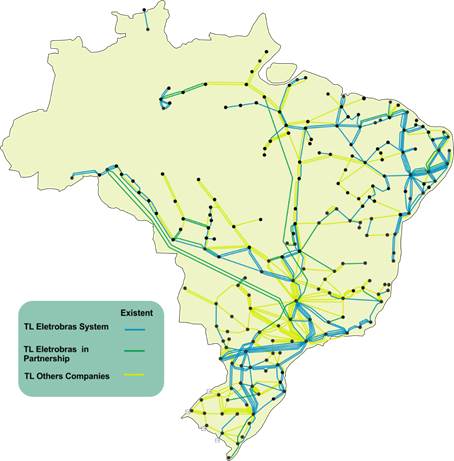
As of December 31, 2018, the total length of our transmission lines, by subsidiary, were:
|
|
|
Total
|
|
Voltage
|
|
|
|
|
(km) |
|
(kV) |
|
|
Furnas |
|
20,414 |
|
25 — 765 |
|
|
Chesf |
|
20,586 |
|
69 — 500 |
|
|
Eletrosul |
|
11,077 |
|
69 — 525 |
|
|
Eletronorte |
|
11,012 |
|
69 — 500 |
|
|
Amazonas GT |
|
390 |
|
230 |
|
As of December 31, 2018, the total length of our transmission lines, by subsidiary and by voltage level, excluding partnerships, were:
|
|
|
765 kV |
|
±600 kV
|
|
525/500
|
|
345 kV |
|
230 kV |
|
138 kV |
|
132/13.8kV |
|
Total
|
|
|
Company: |
|
|
|
|
|
|
|
|
|
|
|
|
|
|
|
|
|
|
Chesf |
|
— |
|
— |
|
5,373 |
|
— |
|
14,495 |
|
463 |
|
255 |
|
20,586 |
|
|
Eletronorte |
|
— |
|
— |
|
3,243 |
|
— |
|
7,112 |
|
652 |
|
5 |
|
11,012 |
|
|
Eletrosul |
|
— |
|
— |
|
3,643 |
|
— |
|
5,447 |
|
1,918 |
|
69 |
|
11,077 |
|
|
Furnas |
|
2,698 |
|
1,612 |
|
4,874 |
|
6,306 |
|
2,249 |
|
2,510 |
|
165 |
|
20,414 |
|
|
Amazonas GT |
|
— |
|
— |
|
— |
|
— |
|
390 |
|
— |
|
— |
|
390 |
|
|
Total |
|
2,698 |
|
1,612 |
|
17,133 |
|
6,306 |
|
29,693 |
|
5,543 |
|
494 |
|
63,479 |
|
(1) DC means “direct current.”
As of December 31, 2018, our transmission system was composed of approximately 64,833 kilometers of transmission lines with voltage levels equal to 230 kV or higher, including partnerships, corresponding to approximately 47.3% of the total transmission lines in the Main Grid. The following table presents this percentage by voltage level:
|
|
|
±800 kV |
|
765 kV |
|
±600 kV
|
|
525/500
|
|
400 kV |
|
345 kV |
|
230 kV |
|
Total |
|
|
Entity: |
|
|
|
|
|
|
|
|
|
|
|
|
|
|
|
|
|
|
Eletrobras |
|
49.00 |
|
100.00 |
|
61.76 |
|
39.57 |
|
0.00 |
|
62.15 |
|
52.73 |
|
47.3 |
|
|
OtherCompanies |
|
51.00 |
|
0.00 |
|
38.24 |
|
60.43 |
|
100.00 |
|
37.85 |
|
47.27 |
|
52.7 |
|
|
Total |
|
100.00 |
|
100.00 |
|
100.00 |
|
100.00 |
|
100.00 |
|
100.00 |
|
100.00 |
|
100.00 |
|
(1) DC means direct current.
Losses of electricity in our transmission system were, as of December 31, 2018, approximately 1.62 % of all electricity transmitted in the system.
Transmission lines have a contractual annual revenue, or “RAP,” Annual Allowed Revenue ( Receita Annual Permitida ), which is set by ANEEL and takes into account the investment, operation and maintenance costs of a transmission project. The RAP is updated annually pursuant to the rules of ANEEL. Similar to the generation of concessions, a large part of our transmission concessions was renewed under Law No. 12,783/13 and began to be remunerated through operation and maintenance tariffs.
The amount of our RAP was R$10,765 million as of December 31, 2018, compared to R$11,244 million as of December 31, 2017.
Through our subsidiary, Furnas, we received 9,794.44 R$/MW per month (as of July 1, 2018) for the transmission of electricity generated by Itaipu. The transmission charge from the Itaipu power plant is used to remunerate Furnas for providing its transmission system available for the exclusive use of this power plant. This system comprises the 750 kV AC Itaipu/Ivaiporã and the ±600 kV DC Itaipu/Ibiúna transmission lines, that are not part of the Main Grid.
Net revenues from transmission represented 33.6% of total net revenues before eliminations among our segments for the year ended December 31, 2018, compared to 34.4% for the same period in 2017.
In addition to operating and maintaining its transmission system, in accordance with the standards of performance and quality required by ANEEL, we have actively participated in the expansion of the transmission system, through concessions conducted by ANEEL, through corporate ventures or partnerships.
The major transmission projects currently under development, are:
· a 847 km long 500 kV transmission line, in the southeastern region of Brazil. The planned investment is R$1.57 billion and the project is expected to be completed by 2019;
· a 152 km long 230 kV transmission line, in the northeastern region of Brazil. The planned investment is R$115 million and the project is expected to be completed by 2019;
· a 715 km long 500 kV transmission line, in the northern region of Brazil. The planned investment is R$1.11 billion and the project is expected to be completed by 2021; and
· a 192 km long 230 kV transmission line, in the northeastern region of Brazil. The planned investment is R$169 million and the project is expected to be completed by 2019.
In 2018, we invested R$1.4 billion in transmission activities, of which R$1,060 million was invested in our facilities, R$78 million was invested through partnerships with special purpose entities and R$293 million were invested in maintenance, representing 53% of the total investment budget for 2018 in transmission activities in the amount of R$2.7 billion .
Distribution
Distribution of Electricity
In 2016, we had distribution companies operating in six Brazilian states through concessions granted by the Brazilian Government. During the Extraordinary General Meeting held on July 22, 2016, our shareholders decided that Cepisa, Ceal, Electroacre, Ceron, Boa Vista Energia and Amazonas D should not renew their concessions for distribution of electricity in the country.
In July 2016, the MME issued MME Ordinance No. 388/16 which defined the parameters for the continued operation of the distribution companies following the expiration of the concessions.
In August 2016, the MME issued MME Ordinances No. 420, 421 422, 423, 424 and 425 making Amazonas D, Eletroacre, Ceron, Cepisa, Ceal and Boa Vista Energia responsible for providing electricity distribution services in their regions until the earlier of July 31, 2018 or the date of transfer to the new concessionaire. The MME postponed this deadline under Ordinance No. 246/18 until December 31, 2018 for Ceal, and under Ordinance No. 502/18 until April 15, 2019 for Amazonas D.
In 2016, Companhia Energética de Roraima, a company controlled by the state of Roraima, was not allowed to renew its electricity distribution concession and the MME made Boa Vista Energia responsible for the provision of electricity distribution services within Roraima as of December 31, 2016.
On November 29, 2016, ANEEL issued Normative Resolution No. 748/16, establishing the terms and conditions for the provision of the public electricity distribution service by the relevant distribution company, in accordance with article 9 of Law No. 12,783/13 and MME Ordinance No. 388/16. The Brazilian Government included Amazonas D, Eletroacre, Ceron, Cepisa, Ceal and Boa Vista Energia in the PPI and we received the privatization model of our distribution companies in November 2017.
On February 8, 2018, at our 170th Extraordinary Shareholders Meeting, our shareholders ratified their decision taken in 2016 to sell our six distribution companies, except we would retain one common share, as well as the assumption by us of these distribution companies’ rights to the CCC Account and the CDE Account of R$8.4 billion, as adjusted, through June 30, 2017. The assets (and related liabilities) of Eletroacre, Ceron, Cepisa and Boa Vista Energia were classified as assets held for sale as of December 31, 2017, while those of Ceal and Amazonas D were classified as amounts held for sale as of December 31, 2018, in accordance with IFRS 5. The effect of the termination of the concessions of Ceal and Amazonas D will continue to impact future periods.
The sale of each distribution company was done through an auction on the B3 Exchange. With respect to the sale of each distribution company, we must retain one common share in the distribution company under the CPPI’s Resolution No. 20/2018; approximately ten percent of the shares of each company will be offered to current employees and retirees; and we also have the right to increase our shareholding by up to 30% in each distribution company within six months of the date of transfer.
· We auctioned our participation in Cepisa to Equatorial Energia for R$45.5 thousand (recognizing 100% of tariff flexibility losses and costs with people, materials, third party services and other expenses, in addition to the granting of a bonus of R$95 million) on July 26, 2018. We received CADE’s approval on August 27, 2018 and ANEEL’s approval on September 10, 2018 to consummate the sale. We entered into the share purchase agreement on October 17, 2018 and transferred 89.94% of our shares. The option to acquire up to 30% of Cepisa’s shares expired without us exercising this option.
· We auctioned our participation in Eletroacre to Energisa for R$45.5 thousand (representing no gain) on August 30, 2018. We received CADE’s approval on September 27, 2018 and ANEEL’s approval on September 28, 2018 to consummate the sale. We entered into the share purchase agreement on December 6, 2018 and transferred 90.26% of our shares.
· We auctioned our participation in Ceron to Energisa for R$45.5 thousand (representing no gain) on August 30, 2018. We received ANEEL’s approval on September 20, 2018 and CADE’s approval on September 25, 2018 to consummate the sale. We entered into the share purchase agreement on October 30, 2018 and transferred 90% of our shares.
· We auctioned our participation in Boa Vista Energia to Oliveira Energia & ATEM Consortium for R$45.5 thousand (representing no gain) on August 30, 2018. We received CADE’s approval on October 17, 2018 and ANEEL’s approval on October 24, 2018 to consummate the sale. We entered into the share purchase agreement on December 10, 2018 and transferred 90% of our shares.
· We auctioned our participation in Ceal to Equatorial Energia on December 28, 2018, for R$45.5 thousand (representing no gain). We received CADE’s approval on January 25, 2019 and ANEEL’s approval on February 19, 2019 to consummate the sale. We entered into the share purchase agreement on March 18, 2019 and transferred 89.94% of our shares.
· We auctioned our participation in Amazonas D to Oliveira Energia & ATEM Consortium for R$45.5 thousand (representing no gain) on December 10, 2018. We received CADE’s approval on March 20, 2019 and ANEEL’s approval on March 21, 2019 to consummate the sale. We entered into the share purchase agreement on April 10, 2019 and transferred 90% of our shares.
On April 30, 2018, we signed an assumption of debt agreement with Petrobras agreeing to guarantee: (i) R$8.0 billion in respect of Amazonas D, (ii) R$2.3 billion in respect of Ceron, (iii) R$0.5 billion in respect of Eletroacre, and (iv) R$0.3 billion in respect of Boa Vista Energia.
In respect of this guarantee we agreed to pledge the following receivables owed to us: (i) treasury credits in the amount of R$3.5 billion, (ii) receivables due from Eletropaulo in the amount of R$1.4 billion, (iii) receivables due from Eletronorte in the amount of R$0.6 billion, (iv) receivables due from Furnas in the amount of R$2.8 billion, (v) receivables due from the CCC Account in the amount of R$1.3 billion, (vi) receivables due from Amazonas GT in the amount of R$1.1 billion, and (vii) receivables due from Eletrosul in the amount of R$0.4 billion.
We obtained waivers of certain lenders in respect of the sale of our interests in the distribution companies and the related pledge of assets to certain creditors of the distribution companies on March 7, 2019. In addition, we solicited and obtained the consents of the holders of our 2019 Bonds and our 2021 Bonds pursuant to a consent solicitation permitting the pledge of certain assets to Petrobras.
Provisional Measure No. 879/19 authorizes the Brazilian Government to reimburse us for up to R$3.5 billion to cover debts from the state’s distribution companies for fuel expenses incurred in the past. The payment will be made through resources from the CDE Account until the year 2021, subject to budget and financial availability. According to this Provisional Measure, the resources available to the CDE Account to reimburse these amounts will come from the payment of a bonus for the granting of auctions or from other sources defined by the Ministry of Economy.
Distribution Companies
The table below indicates relevant operational numbers of our distribution companies as of the dates indicated below:
|
|
|
Number of
|
|
Number of
|
|
Distribution
|
|
Substations |
|
|
Company: |
|
|
|
|
|
|
|
|
|
|
Amazonas D (as of December 31, 2018) |
|
1,001,390 |
|
62 |
|
33,626 |
|
24 |
|
|
Ceal (as of December 31, 2018) |
|
1,158,036 |
|
102 |
|
43,403 |
|
40 |
|
|
Cepisa (as of September 30, 2018) |
|
1,277,381 |
|
224 |
|
94,827 |
|
88 |
|
|
Ceron (as of September 30, 2018) |
|
638,927 |
|
52 |
|
58,050 |
|
60 |
|
|
Eletroacre (as of September 30, 2018) |
|
269,248 |
|
22 |
|
21,497 |
|
13 |
|
|
Boa Vista Energia and CERR (as of September 30, 2018) |
|
116,178 |
|
15 |
|
3,729 |
* |
4 |
* |
*Excluding CERR
Amazonas D, Ceal, Cepisa, Ceron, Boa Vista Energia and Eletroacre operated in particularly challenging market conditions. The distribution companies in the North region still operate in some isolated systems, mainly in the State of Roraima, which is served by Boa Vista Energia, which is the only State not connected to the Interconnected Power System. Additionally, the North and Northeastern regions of Brazil are among the poorest regions in the country. One of our principal challenges in respect of these companies has been reducing the amount of commercial losses (principally being the theft of electricity) and customer defaults that these companies suffer from.
Transmission and Distribution System
Our transmission and distribution network consist of overhead transmission lines and sub-stations with varying voltage ranges. The clients we serve through our distribution network are classified by voltage level. With respect to our distribution to state utilities and industrial companies, we distribute electricity at higher voltage levels (up to 765 kV), while we distribute to residential and certain commercial companies at lower voltage levels (either at 230 kV, 138 kV, 88 kV, 69 kV, 44 kV and 2.3 kV).
System Performance
The following table sets forth information concerning our electricity losses for our distribution companies, and the frequency and duration of electricity outages per customer per year for the periods indicated:
|
|
|
Year Ended December 31, |
|
||||
|
|
|
2018 (4) |
|
2017 (3) |
|
2016 (2) |
|
|
|
|
|
|
|
|
|
|
|
Technical losses |
|
9.6 |
% |
9.7 |
% |
9.5 |
% |
|
Commercial losses |
|
24.8 |
% |
23.0 |
% |
16.7 |
% |
|
Total electricity losses (1) |
|
34.4 |
% |
32.7 |
% |
26.2 |
% |
|
|
|
|
|
|
|
|
|
|
Outages: |
|
|
|
|
|
|
|
|
Frequency of outages per customer per year (number of outages) |
|
15.3 |
|
16.2 |
|
21.2 |
|
|
Duration of outages per customer per year (in hours) |
|
25.2 |
|
25.5 |
|
30.9 |
|
|
Average response time (in minutes) |
|
371.2 |
|
336.0 |
|
322.0 |
|
(1) Electricity losses are based on an average period of 12 months.
(2) Including CELG-D.
(3) Including CERR and excluding CELG-D.
(4) As noted above we auctioned certain of our distribution companies prior to December 31, 2018 and these companies are only included until the date of their sale.
We experience two types of electricity losses: technical losses and commercial losses. Technical losses are those that occur in the ordinary course of our distribution of electricity. Commercial losses are those that result from illegal connections, fraud or billing errors. Total electricity losses for our distribution business were 34.4% of energy generated and bought in the year ended December 31, 2018 compared to 32.7% of energy generated and bought in the year ended December 31, 2017 (excluding CELG-D) and 26.2% of energy generated and bought in the year ended December 31, 2016 (including CELG-D).
Commercial losses at these companies reached 24.8% of the electricity generated and sold during the year ended December 31, 2018. Compared to the year ended December 31, 2017, there was a decrease of 1.7%, due to the slowdown in Brazil’s economic activity, which led to a reduction in household income and to a decrease in consumption by industries.
Our distribution companies received U.S.$270.5 million (or R$842.0 million) in funds through a loan agreement signed in February 2011 with the World Bank, under a project called the Energy + project. As of December 31, 2018, we have drawn on U.S.$213.9 million (R$649.8 million) of the loan. This amount was applied to improve the quality of our services and reduce losses and, consequently, to strengthen the operational revenues of the distributors. As these distribution companies are up for sale, we have suspended the loan and will not request any further disbursements.
The following table sets out information regarding total losses in our distribution segment recorded by each distribution company set forth below:
|
|
|
Year ended December 31, |
|
||||
|
|
|
2018 (2) |
|
2017 |
|
2016 |
|
|
|
|
(%) |
|
||||
|
Company: |
|
|
|
|
|
|
|
|
Amazonas D |
|
(43.9 |
) |
(43.7 |
) |
(43.2 |
) |
|
Boa Vista Energia |
|
(14.6 |
) |
(13.5 |
) |
(12.4 |
) |
|
Ceal |
|
(23.7 |
) |
(22.9 |
) |
(26.7 |
) |
|
CELG-D (1) |
|
— |
|
— |
|
(12.8 |
) |
|
Cepisa |
|
(27.2 |
) |
(28.0 |
) |
(30.7 |
) |
|
Ceron |
|
(27.3 |
) |
(28.3 |
) |
(29.8 |
) |
|
Eletroacre |
|
(20.7 |
) |
(21.8 |
) |
(24.3 |
) |
(1) For the years ended December 31, 2018 and 2017, CELG-D was not consolidated with our distribution segment.
(2) As noted above we auctioned certain of our distribution companies prior to December 31, 2018 and these companies are only included until the date of their sale.
Emergencies in the Electrical System
The following table shows the average total response time to reinstate the supply of energy to the consumers in the years ended December 31, 2018 and 2017 (in minutes).
|
|
|
AST—Average service time
|
|
||
|
|
|
Year Ended December 31,
|
|
Year Ended December 31,
|
|
|
Company: |
|
|
|
|
|
|
Eletroacre |
|
351.81 |
|
376.44 |
|
|
Ceal |
|
238.01 |
|
334.23 |
|
|
Amazonas D |
|
669.51 |
|
396.77 |
|
|
Cepisa |
|
462.71 |
|
426.92 |
|
|
Ceron |
|
332.68 |
|
356.60 |
|
|
Boa Vista Energia |
|
172.98 |
|
126.63 |
|
(1) As noted above we auctioned certain of our distribution companies prior to December 31, 2018 and these companies are only included until the date of their sale.
Customers
The following table sets forth our total distribution of electricity in terms of MWh, by type of user, for the periods indicated:
|
|
|
Year Ended December 31, |
|
||||
|
Distribution to: |
|
2018 (1) |
|
2017 |
|
2016 |
|
|
|
|
(MWh) |
|
||||
|
Industrial |
|
1,218,532 |
|
2,331,713 |
|
4,599,425 |
|
|
Residential |
|
6,247,915 |
|
8,284,238 |
|
11,525,285 |
|
|
Commercial |
|
3,019,267 |
|
4,067,067 |
|
6,027,120 |
|
|
Rural |
|
691,764 |
|
1,135,932 |
|
2,180,303 |
|
|
Public Lighting |
|
726,797 |
|
1,073,585 |
|
1,480,825 |
|
|
Other |
|
1,795,699 |
|
2,274,324 |
|
2,968,575 |
|
|
Total |
|
13,699,976 |
|
19,166,860 |
|
28,781,531 |
|
(1) As noted above we auctioned certain of our distribution companies prior to December 31, 2018 and these companies are only included until the date of their sale.
Tariffs
The energy tariff is the price charged per unit of energy (R$/kWh). The price of electric energy is based on the costs incurred from the generation until it becomes available to consumers, as well as its availability, which is 24 hours per day, seven days per week.
The price of energy should therefore be sufficient to cover the costs of operation and expansion of all the electrical elements that make up the system, from the generating plant to the low voltage connecting branch to consumers. These costs should basically cover the investments made in the network and its daily operation, which should result in low failure rates and shorter service times for possible repairs.
As expected, besides these costs, which are directly related to the physical components of the system, there are charges and taxes. In summary, the electric energy tariff for the consumers in the concession area of the distributing companies is composed of:
· Electric energy purchase costs;
· Costs related to the use of the distribution system;
· Costs related to the use of the transmission system;
· Technical and commercial losses; and
· Sector charges and taxes.
Energy purchase costs are those arising from the contracting of amounts of energy through regulated auctions. The distribution company buys an amount of energy that it considers sufficient to service its captive market. Energy costs are allocated to the so-called Energy Tariff (ET) and passed on to consumers without profit margins.
Costs related to the use of the distribution system are included in the tariff for the use of the distribution system, such as capital expenses and costs of operation and maintenance of the distribution networks.
Costs related to electrical losses are divided into two: technical losses and commercial losses. Technical losses are inherent in any electrical circuit. Any conductor wire has electrical resistance, which will cause the transformation of the passage of electric current into heat. Thus, all consumers pay for the technical energy losses derived from their own consumption. Non-technical losses are due to theft and measurement problems. In Brazil, depending on the concession area, non-technical losses account for a large part of the cost of electricity. This means that regular consumers pay part of the irregular consumption of consumers making use of these illegal practices.
Taxes are divided into: PIS/PASEP, COFINS and VAT. VAT, which varies from state to state, can account for up to 30.0% of a costumer’s electricity bill.
Sector Charges
Charges are those contributions that are included in the electric energy tariff, but are not taxes, they are contributions established by law, whose values are established by resolutions or orders from ANEEL. Each charge aims at obtaining resources and financing specific needs of the electricity segment.
|
Charge |
|
Purpose |
|
|
|
|
|
CCC - Fuel Consumption Account ( Conta de Consumo de Combustíveis ) (Law No. 12,111/2009 and Resolution No. 801/2017-ANEEL) |
|
To subsidize the thermal generation in the Isolated System (mainly in the northern region of Brazil). |
|
RGR - Global Reversal Reserve ( Reserva Global de Reversão ) (Resolution No. 674/2015-ANEEL) |
|
To indemnify assets related to the concession and promote the expansion of the electric energy sector. |
|
TFSEE - Inspection Fee for Electric Energy Services (Law No. 9,427/1996 and Decree No. 2,410/1997) |
|
To provide funds for ANEEL’s operation. |
|
CDE - Energy Development Account (Article 13 of Law No. 10,438/02, Resolution No. 800/2017-ANEEL) |
|
To promote energy development from alternative sources; provide for the globalization of the energy service; subsidize the tariff of low-income residential consumers; and fund the RGR Fund and CCC Account. |
|
ESS - System Service Charges ( Encargos de Serviço do Sistema ) |
|
To subsidize the maintenance of the reliability and stability of the Interconnected Power System. |
|
ERR — Reserve Energy Charge ( Encargo de Energia de Reserva) (Law No. 10,848/2004 and Resolution No. 337/2018-ANEEL) |
|
To subsidize costs related to the contracting of reserve energy, including administrative, financial and tax-related charges. |
|
Proinfa - Alternative Sources Incentive Program ( Programa de Incentivo às Fontes Alternativas ) (Law No. 10,438/02) |
|
To subsidize alternative energy sources, generally more expensive than the conventional sources. |
|
P&D - Research and Development and Energy Efficiency ( Pesquisa e Desenvolvimento e Eficiência Energética ) (Resolution No. 316/2008-ANEEL) |
|
To promote scientific and technological research related to electricity and the sustainable use of natural resources. |
|
Contribution to ONS - System National Operator ( Operador Nacional do Sistema ) |
|
To coordinate and control of the operation of the electric power generation and transmission facilities in the Interconnected Power System by planning the operation of the Isolated System. |
|
CFURH - Financial Compensation for the Use of Water Resources ( Compensação Financeira pelo Uso de Recursos Hídricos ) (Resolution No. 711/2016-ANEEL) |
|
To provide financial compensation for the use of water and productive land for the purpose of electric power generation. |
Tariff Flags
Another cost added to the energy tariffs is the tariff flag, in which the seasonal cost of energy generation, i.e. the price variation to generate electricity according to the time of year, rainfall volume, water availability, among other variables, is signaled directly to the final consumer.
Groups, Sub-Groups, Classes and Sub-Classes:
For the supply and corresponding tariff, some definitions are established allowing us to distinguish the network users. Groups are defined according to the service voltage. The sub-groups of group A are defined according to the service voltage. Group B is divided into type of customer and service:
· Group A à Service with voltage equal to or higher than 2.3 kV and lower than 2.3 kV when in the underground system; and
· Group B à Service with voltage lower than 2.3 kV.
The sub-groups of group A are defined according to the service voltage:
· Service with voltage equal to or higher than 230 kV;
· Service with voltage from 88 kV to 138 kV;
· Service with 69 kV;
· Service with voltage from 30 kV to 44 kV;
· Service with voltage from 2.3 kV to 25 kV; and
· Service with voltage lower than 2.3 kV (underground system).
The sub-groups of group B are defined according to the type of customer/service:
· Home service;
· Rural service;
· Other types of service; and
· Public Lighting Service.
Billing Procedures
The procedure we use for billing and payment for electricity supplied to our customers is determined by customer category. Meter readings and invoicing take place on a monthly basis for low voltage consumers, with the exception of rural consumers whose meters are read in intervals varying from one to three months, as authorized by relevant regulation. Bills are prepared from meter readings or on the basis of estimated usage. Low voltage customers are billed within five business days after the invoice date. In case of nonpayment, a notification of nonpayment accompanied by the next month’s invoice is sent to the customer and a period of 15 days is provided to satisfy the amount owed to us. If payment is not received within three business days after the 15-day period, the customer’s electricity supply is suspended. High voltage customers are billed on a monthly basis with payment required within five business days after the invoice date. In the event of non-payment, a notice is sent to the customer two business days after the due date, giving a deadline of 15 days to make payment. If payment is not made within three business days after the notice, the customer is subject to discontinuation of service.
As of December 31, 2018, 2017 and 2016, delinquent customers represented, on average, 14.9%, 11.5% and 9.6%, respectively.
Purchase of Electricity for Distribution
We purchased 10,001,499 MWh of electricity for distribution in the year ended December 31, 2018, compared to 28,865,640 in the year ended December 31, 2017 and 27,068,462 MWh in the year ended December 31, 2016. Our distribution companies purchased electricity from suppliers through bilateral contracts and through contracts resulting from the public auction process of a set of generation companies that offer bids that set the maximum price at which they will deliver electricity. After all bids are received, the average price of all bids is calculated, and this is the price that will be paid for the auction contracts. The contracting is done with all the generation companies that won the auction.
Lending and Financing Activities
Loans Made by Us
Brazilian law allows us to only lend to our subsidiaries. Historically, Brazilian law allowed us to act as lender to our subsidiaries and to public energy utilities under our control. While certain of these companies are no longer subsidiaries nor in our group, the majority of our loans are to related parties. Prior to the privatization of the Brazilian electricity industry that began in 1996, this was a particularly widespread part of our operations because most companies in the industry were state-owned, allowing us to engage in lending activities to them. However, as the result of privatization, the number of companies to whom we may lend has diminished and lending is no longer a significant aspect of our business. The total amounts we recorded on our balance sheet: R$13.9 billion as of December 31, 2018, R$10.3 billion as of December 31, 2017 and R$13.2 billion as of December 31, 2016. Of this total amount, loans to Itaipu accounted for R$8.0 billion as of December 31, 2018, R$8.7 billion as of December 31, 2017 and R$10.8 billion as of December 31, 2016.
Sources of Funds
We obtain funding for our lending activities from loans from financial institutions and offerings in the international capital markets. As of December 31, 2018, our consolidated long-term debt was R$42,306 million. As of December 31, 2017, our consolidated long-term debt was R$39,236 million, compared to R$39,787 million as of December 31, 2016, with the majority of our foreign currency debt (approximately 19.4% over the three-year period) denominated in U.S. dollars. In 2018, our foreign currency debt in U.S. dollars was 25% of the total debt. Further details of our borrowings are set out in “—Liquidity and Capital Resources—Cash Flows.”
In addition, we utilize borrowings from the RGR Fund to on-lend to our subsidiaries and other electricity companies. As of December 31, 2018 2017 and 2016, we incurred interest at 5.0% in respect of borrowings from the RGR Fund and charge an average administrative fee of up to 0.9% on funds which we on-lend to subsidiaries and other entities.
Equity Participation
We act as a minority participant in private sector generation and transmission companies and joint ventures. We are also authorized to issue guarantees for those companies in which we participate as an equity investor. We are constantly considering investments in a number of such companies, focusing primarily on those in line with our strategy of building on our core businesses of generation and transmission, see “Item 7.B Major Shareholders and Related Party Transactions—Related Party Transactions . ”
The current participations that we have are in private sector generation and transmission companies and joint ventures. Participation is determined primarily on merit and profitability criteria based on our managerial controls. On February 23, 2018, our Board of Directors approved the sale of interests owned by us and our subsidiaries Chesf, Furnas, Eletronorte and Eletrosul in 71 SPEs divided into eighteen lots. The corresponding auction took place on September 27, 2018 at B3 Exchange and as a result we sold eleven of the eighteen lots offered to the market and raised approximately R$1.3 billion. The lots with wind generation SPEs located in Rio Grande do Sul, Piauí and Rio Grande do Norte and the lots with transmission SPEs in Goiás, Amazonas and Pará did not receive any bids. The sale of the SPEs is subject to approval by banks who are creditors of these companies, CADE, ANEEL and the non-exercise of pre-emption rights by the SPE’s shareholders, which is ongoing and is expected to be concluded in the second quarter of 2019.
The table below shows the total percentage of our participation in all of our transmission lines as of December 31, 2018:
|
Special Purpose Company/Consortium |
|
Object of investment |
|
Eletrobras Participation |
|
Belo Monte Transmissora de Energia S.A. |
|
Transmission Line with ±800 kV Xingu - Estreito. |
|
Eletronorte (24.5%)
|
|
Fronteira Oeste Transmissora de Energia S.A. |
|
Santo Ângelo/Maçambará
|
|
Eletrosul (51.0%) |
|
Mata de Santa Genebra Transmissora S.A. |
|
Itatiba — Bateias;
|
|
Furnas (49.9%) |
|
Paraíso Transmissora de Energia S.A. |
|
Paraíso 2-Chapadão;
|
|
Eletrosul (100.0%) |
|
Paranaíba Transmissora de Energia S.A. |
|
Barreiras II — Rio das Éguas;
|
|
Furnas (24.5%) |
|
TDG Transmissora Delmiro Gouveia S.A. |
|
Transmission Line São Luiz II/ São Luiz III |
|
Chesf (49.0%) |
|
Transenergia Goiás S.A. |
|
Serra da Mesa — Niquelândia; Niquelândia — Barro Alto |
|
Furnas (99.0%) |
|
Transnorte Energia S.A. |
|
Eng. Lechuga (AM) — Equador (RR) e Equador (RR) — Boa Vista (RR), double circuit and Substations Equador (RR) Boa Vista (RR) |
|
Eletronorte (49.0%) |
|
Triângulo Mineiro Transmissora S.A. |
|
Marimbondo II — Assis |
|
Furnas (49.0%) |
|
Vale do São Bartolomeu Transmissora
|
|
Luziânia — Brasília Leste;
|
|
Furnas (39.0%) |
|
Companhia de Transmissão Centroeste de Minas S.A.* |
|
LT 345 kV Furnas - Pimenta - C2 |
|
Eletrobras (49.0%) |
|
Companhia Transirapé de Transmissão* |
|
LT 230 kV Irapé - Araçuaí 2 |
|
Eletrobras (24.5%) |
|
Companhia Transleste de Transmissão* |
|
LT 345 kV Montes Claros - Irapé |
|
Eletrobras (24.0%) |
|
Companhia Transudeste de Transmissão* |
|
LT 345 kV Itutinga - Juiz de Fora |
|
Eletrobras (25.0%) |
|
Energia Olímpica S.A. |
|
|
|
Furnas (49.0%) |
|
Goiás Transmissão S.A. |
|
LT 500kV Rio Verde Norte - Trindade, CD; LT 230kV Trindade - Xavantes, CD; LT 230kV Trindade - Carajás, CS, & SE Trindade - 500/230 kV. |
|
Furnas (49.0%) |
|
IE Madeira - Interligação Elétrica
|
|
Transmission associated to UHE Jirau and Sto. Antônio. LT +/- 600 kV Porto Velho - Araraquara 2 C1. |
|
Furnas (24.5%) / Chesf (24.5%) |
|
Lago Azul Transmissão S.A. |
|
LT 230 kV Barro Alto - Itapaci |
|
Furnas (49.9%) |
|
MGE Transmissão S.A. |
|
LT 500 kV Mesquita - Viana 2; LT 345 kV Viana 2 - Viana & SE Viana 2 - 500/345 kV. |
|
Furnas (49.0%) |
|
Transenergia Renovável S.A. |
|
LT 230 kV Chapadão - Jataí, CD; LT 230 kV Barra dos Coqueiros - Quirinópolis, CS; LT 230 kV Palmeiras - Edéia, CS |
|
Furnas (49.0%) |
|
ETN - Extremoz Transmissora
|
|
Construction of approximately 312 km of transmission lines and three new substations in the state of Rio Grande do Norte. |
|
Chesf (100.0%) |
|
IEG - Interligação Elétrica Garanhuns S.A. |
|
Construction of 716 km of transmission lines in the states of AL, PE and PB, and two new substations. |
|
Chesf (49.0%) |
|
STN - Sistema de Transmissão
|
|
LT 500 kV Teresina II (PI) - Sobral III (CE) - Fortaleza II (CE), with 546 Km. |
|
Chesf (49.0%) |
|
ETAU - Empresa de Transmissão
|
|
LT 230kV Campos Novos - Barra Grande - Lagoa Vermelha 2 - Santa Marta |
|
Eletrobras (27.4%) |
|
TSBE - Transmissora Sul Brasileira
|
|
LT 525kV Salto Santiago — Itá — Nova Santa Rita (494 km) LT 230kV Nova Santa Rita — Camaquã 3 — Quinta (291 km) |
|
Eletrosul (100.0%) |
|
TSLE - Transmissora Sul
|
|
Construction of 489 km of transmission lines in the state of Rio Grande do Sul |
|
Eletrosul (51.0%) |
|
Uirapuru Transmissora de Energia S.A. |
|
LT 525 kV Ivaiporã — Londrina Circuito 2 (PR) with 120 Km |
|
Eletrobras (75.0%) |
|
AETE — Amazônia
|
|
LT 230 KV Coxipó - Cuiabá - Rondonópolis. |
|
Eletrobras (49.0%) |
|
Norte Brasil Transmissora de Energia S.A. |
|
LT Porto Velho / Araraquara 2, nº 2, in 600 kV, extension: 2.375 km — states of Rondônia, Mato Grosso, Mato Grosso do Sul, Goiás and Minas Gerais |
|
Eletronorte (49.0%) |
|
Brasnorte Transmissora de Energia S.A.* |
|
LT Jauru - Juba CD 230kV; LT Brasnorte - Nova Mutum CD 230kV |
|
Eletrobras (49.7%) |
|
Manaus TR - Manaus
|
|
LT Oriximiná / Silves / Lechuga, in 500 kV, extension: 586 km, states of Amazonas and Pará |
|
Eletrobras (49.5%) |
|
TME - Transmissora Matogrossense
|
|
LT Jauru - Cuiabá & SE Jauru - 500/230kV |
|
Eletrobras (49.0%) |
* Sold as of the date of this annual report.
The table below shows an estimate of the total percentage of our participation in all our transmission substations as of December 31, 2018:
|
Special Purpose Company/Consortium |
|
Object of investment |
|
Eletrobras Participation |
|
Belo Monte Transmissora de Energia S.A. |
|
Converter Station CA/CC,±800 kV, -4,000 MW, with Substation 500 kV Xingu;
|
|
Furnas (24.5%)
|
|
Fronteira Oeste Transmissora de Energia
|
|
Pinhalzinho, with 230/138 kV (ATF1);
|
|
Eletrosul (51.0%) |
|
Mata de Santa Genebra Transmissora S.A. |
|
Substation Santa Bárbara D’Oeste 440 kV, Static Compensation (-300+300) Mvar
|
|
Furnas (49.9%) |
|
Paraíso Transmissora de Energia S.A. |
|
Substation Campo Grande 2 with 1 three-phase reactor 230 kV of 20 Mvar. |
|
Eletrosul (100%) |
|
Special Purpose Company/Consortium |
|
Object of investment |
|
Eletrobras Participation |
|
|
|
Chapadão EL PAR2;
|
|
|
|
Triângulo Mineiro Transmissora S.A. |
|
Substation Marimbondo II, 04 single-phase reactors 500 kV of 45.3 Mvar (each) and Substation Assis, 7 single-phase reactors 500 kV of 45.3 Mvar (each). |
|
Furnas (49.0%) |
|
Vale do São Bartolomeu Transmissora de Energia S.A. |
|
Substation Brasília Leste, 6 single-phase transformers 500/138 of 180 MVA (each). |
|
Furnas (39.0%) |
|
Paranaíba Transmissora de Energia S.A. |
|
500 kV Transmission Line in Substation Barreiras II, Rio das Éguas, Luziânia and Pirapora II. |
|
Furnas (24.5%) |
|
TDG Transmissora Delmiro Gouveia S.A. |
|
Substation Aquiraz 2, 03 three-phase transformers 230/69kV, 150 MVA (each) and Substation Pecém 2, 9 single-phase autotransformers 500/230kV, 400 MVA (each) |
|
Chesf (49.0%) |
|
Transenergia Goiás S.A. |
|
230 kV Transmission Line at Substation Serra da Mesa, Niquelândia and Barro Alto |
|
Furnas (99.0%) |
|
Transnorte Energia S.A. |
|
SE Boa Vista, 2 three-phase autotransformers 500/230 kV de 400 MVA (each) and 1 static compensator 230 kV -120/150 Mvar. |
|
Eletronorte (49.0%) |
|
|
|
|
|
|
|
Caldas Novas Transmissão S.A. |
|
SE Corumbá - 345/138 KV |
|
Furnas (49.9%) |
|
Energia Olímpica S.A. |
|
|
|
Furnas (49.0%) |
|
Goiás Transmissão S.A. |
|
SE Trindade - 500/230 kV. |
|
Furnas (49.0%) |
|
IE Madeira - Interligação
|
|
|
|
Furnas (24.5%) / Chesf (24.5%) |
|
Luziânia — Niquelândia Transmissora S.A. |
|
SE Niquelândia, 230/69 kV
|
|
Eletrobras (49.0%) |
|
MGE Transmissão S.A. |
|
SE Viana 2 - 500/345 kV. |
|
Furnas (49.0%) |
|
Transenergia Renovável S.A. |
|
SE Jataí; SE Quirinopóli |
|
Furnas (49.0%) |
|
Transenergia São Paulo S.A. |
|
SE Itatiba |
|
Furnas (49.0%) |
|
ETN - Extremoz
|
|
Construction of approximately 312 km of transmission lines and three new substations in the state of Rio Grande do Norte |
|
Chesf (100.0%) |
|
IEG - Interligação Elétrica
|
|
Construction of approximately 716 km of transmission lines in the states of AL, PE and PB, and two new substations. |
|
Chesf (49.0%) |
|
Costa Oeste Transmissora
|
|
SE Umuarama 230/138kV - 2X150 MVA & |
|
Eletrosul (49.0%) |
|
Marumbi Transmissora
|
|
SE Curitiba Leste (3+1R) x 224 MVA. |
|
Eletrosul (20.0%) |
|
TSLE - Transmissora Sul
|
|
Construction of 489 km of transmission lines in the RS and 3 substations. |
|
Eletrosul (51.0%) |
|
Brasnorte Transmissora de Energia S.A. |
|
SE Brasnorte 230/138kV |
|
Eletrobras (49.7%) |
|
Manaus TR - Manaus Transmissora de Energia S.A. |
|
SE Silves 500/138kV and SE Cariri 500/230kV |
|
Eletronorte (30.0%) / Chesf (19.5%) |
|
TME - Transmissora Matogrossense de Energia S.A. |
|
SE Jauru - 500/230kV |
|
Eletrobras (49.0%) |
* Sold as of the date of this annual report.
The table below shows the total percentage of our participation in generation assets as of December 31, 2018:
|
Special Purpose Company - SPE |
|
Scope of Investment |
|
Eletrobras Participation |
|
Companhia Hidrelétrica Teles Pires S.A. |
|
Teles Pires |
|
Furnas (24.7%) / Eletrosul (24.7%) |
|
Baguari Energia S.A. |
|
Baguari |
|
Furnas (30.6%) |
|
Chapecoense Geração S.A. |
|
Foz do Chapecó |
|
Furnas (40.0%) |
|
Empresa de Energia São Manoel S.A. |
|
São Manoel |
|
Furnas (33.3%) |
|
Enerpeixe S.A. |
|
Peixe Angical |
|
Furnas (40.0%) |
|
Retiro Baixo Energética S.A. |
|
Retiro Baixo |
|
Furnas (49.0%) |
|
MESA — Madeira Energia S.A. |
|
Santo Antônio |
|
Furnas (43.1%) |
|
Serra do Facão Energia S.A. |
|
Serra do Facão |
|
Furnas (49.5%) |
|
Tijoá Participações e Investimentos S.A. |
|
Três Irmãos |
|
Furnas (49.9%) |
|
Bom Jesus Eólica S.A. |
|
Eólica Bom Jesus |
|
Furnas (49.0%) |
|
Cachoeira Eólica S.A. |
|
Eólica Cachoeira |
|
Furnas (49.0%) |
|
São Caetano Eólica S.A. |
|
Eólica São Caetano |
|
Furnas (49.0%) |
|
São Caetano I Eólica S.A. |
|
Eólica São Caetano I |
|
Furnas (49.0%) |
|
Special Purpose Company - SPE |
|
Scope of Investment |
|
Eletrobras Participation |
|
São Galvão Eólica S.A. |
|
Eólica São Galvão |
|
Furnas (49.0%) |
|
Pitimbu Eólica S.A. |
|
Eólica Pitimbu |
|
Furnas (49.0%) |
|
Central Eólica Famosa I S.A. |
|
Eólica Famosa I |
|
Furnas (49.0%) |
|
Central Eólica Pau Brasil S.A. |
|
Eólica Pau Brasil |
|
Furnas (49.0%) |
|
Central Eólica Rosada S.A. |
|
Eólica Rosada |
|
Furnas (49.0%) |
|
Central Eólica São Paulo S.A. |
|
Eólica São Paulo |
|
Furnas (49.0%) |
|
Carnaúba I Eólica S.A. |
|
Eólica Carnaúba I |
|
Furnas (49.0%) |
|
Carnaúba II Eólica S.A. |
|
Eólica Carnaúba II |
|
Furnas (49.0%) |
|
Carnaúba III Eólica S.A. |
|
Eólica Carnaúba III |
|
Furnas (49.0%) |
|
Carnaúba V Eólica S.A. |
|
Eólica Carnaúba V |
|
Furnas (49.0%) |
|
Cervantes I Eólica S.A. |
|
Eólica Cervantes I |
|
Furnas (49.0%) |
|
Cervantes II Eólica S.A. |
|
Eólica Cervantes II |
|
Furnas (49.0%) |
|
Punaú I Eólica S.A. |
|
Eólica Punaú I |
|
Furnas (49.0%) |
|
Energia dos Ventos V S.A. |
|
Eólica São Januário |
|
Furnas (100.0%) |
|
Energia dos Ventos VI S.A. |
|
Eólica Nossa Senhora de Fátima |
|
Furnas (100.0%) |
|
Energia dos Ventos VII S.A. |
|
Eólica Jandaia |
|
Furnas (100.0%) |
|
Energia dos Ventos VIII S.A. |
|
Eólica São Clemente |
|
Furnas (100.0%) |
|
Energia dos Ventos IX S.A. |
|
Eólica Jandaia I |
|
Furnas (100.0%) |
|
Holding Brasil Ventos Energia S.A. |
|
|
|
Furnas (100.0%) |
|
Central Eólica Arara Azul Ltda. |
|
Eólica Arara Azul |
|
Furnas (90.0%) |
|
Central Eólica Bentevi Ltda. |
|
Eólica Bentevi |
|
Furnas (90.0%) |
|
Central Eólica Ouro Verde I Ltda. |
|
Eólica Ouro Verde I |
|
Furnas (90.0%) |
|
Central Eólica Ouro Verde II Ltda. |
|
Eólica Ouro Verde II |
|
Furnas (90.0%) |
|
Central Eólica Ouro Verde III Ltda. |
|
Eólica Ouro Verde III |
|
Furnas (90.0%) |
|
Central Eólica Santa Rosa Ltda. |
|
Eólica Santa Rosa |
|
Furnas (90.0%) |
|
Central Eólica Uirapuru Ltda. |
|
Eólica Uirapuru |
|
Furnas (90.0%) |
|
Central Eólica Ventos de Angelim Ltda. |
|
Eólica Ventos de Angelim |
|
Furnas (90.0%) |
|
Holding Itaguaçu da Bahia |
|
|
|
Furnas (98.0%) |
|
Geradora Eólica Itaguaçu da Bahia SPE S.A. |
|
Eólica Itaguaçu da Bahia |
|
Furnas (98.0%) |
|
Geradora Eólica Ventos de Santa Luiza SPE S.A. |
|
Eólica Ventos de Santa Luiza |
|
Furnas (98.0%) |
|
Geradora Eólica Ventos de Santa Madalena SPE S.A. |
|
Eólica Ventos de Santa Madalena |
|
Furnas (98.0%) |
|
Geradora Eólica Ventos de Santa Marcella SPE S.A. |
|
Eólica Ventos de Santa Marcella |
|
Furnas (98.0%) |
|
Geradora Eólica Ventos de Santa Vera SPE S.A. |
|
Eólica Ventos de Santa Vera |
|
Furnas (98.0%) |
|
Geradora Eólica Ventos de Santo Antônio SPE S.A. |
|
Eólica Ventos de Santo Antônio |
|
Furnas (98.0%) |
|
Geradora Eólica Ventos de São Bento SPE S.A. |
|
Eólica Ventos de São Bento |
|
Furnas (98.0%) |
|
Geradora Eólica Ventos de São Cirilo S.A. |
|
Eólica Ventos de São Cirilo |
|
Furnas (98.0%) |
|
Geradora Eólica Ventos de São João SPE S.A. |
|
Eólica Ventos de São João |
|
Furnas (98.0%) |
|
Geradora Eólica Ventos de São Rafael S.A. |
|
Eólica Ventos de São Rafael |
|
Furnas (98.0%) |
|
Acauã Energia S.A. |
|
Eólica Acauã |
|
Chesf (99.93%) |
|
Angical 2 Energia S.A. |
|
Eólica Angical 2 |
|
Chesf (99.96%) |
|
Arapapá Energia S.A. |
|
Eólica Arapapá |
|
Chesf (99.9%) |
|
Caititú 2 Energia S.A. |
|
Eólica Caititú 2 |
|
Chesf (99.96%) |
|
Caititú 3 Energia S.A. |
|
Eólica Caititú 3 |
|
Chesf (99.96%) |
|
Carcará Energia S.A. |
|
Eólica Carcará |
|
Chesf (99.96%) |
|
Corrupião 3 Energia S.A. |
|
Eólica Corrupião 3 |
|
Chesf (99.96%) |
|
Teiú 2 Energia S.A. |
|
Eólica Teiú 2 |
|
Chesf (99.95%) |
|
Coqueirinho 2 Energia S.A. |
|
Eólica Coqueirinho 2 |
|
Chesf (99.98%) |
|
Papagaio Energia S.A. |
|
Eólica Papagaio |
|
Chesf (99.96%) |
|
Tamanduá Mirim II Energia S.A. |
|
Eólica Tamanduá Mirim II |
|
Chesf (83.03%) |
|
Pedra Branca S.A.* |
|
Eólica Pedra Branca |
|
Eletrobras (49.0%) |
|
São Pedro do Lago S.A.* |
|
Eólica São Pedro do Lago |
|
Eletrobras (49.0%) |
|
Sete Gameleiras S.A.* |
|
Eólica Sete Gameleiras |
|
Eletrobras (49.0%) |
|
Baraúnas I Energética S.A.* |
|
Eólica Baraúnas I |
|
Chesf (49.0%) |
|
Morro Branco I Energética S.A.* |
|
Eólica Morro Branco I |
|
Chesf (49.0%) |
|
Mussambê Energética S.A.* |
|
Eólica Mussambê |
|
Chesf (49.0%) |
|
Banda de Couro Energética S.A.* |
|
Eólica Banda de Couro |
|
Chesf (1.7%) |
|
Baraúnas II Energética S.A.* |
|
Eólica Baraúnas II |
|
Chesf (1.5%) |
|
Vamcruz I Participações Holding S.A. |
|
|
|
Chesf (49.0%) |
|
Usina de Energia Eólica Junco
|
|
Eólica Junco I |
|
Chesf (49.0%) |
|
Usina de Energia Eólica Junco II S.A. |
|
Eólica Junco II |
|
Chesf (49.0%) |
|
Usina de Energia Eólica Caiçara I S.A. |
|
Eólica Caiçara I |
|
Chesf (49.0%) |
|
Usina de Energia Eólica Caiçara II S.A. |
|
Eólica Caiçara II |
|
Chesf (49.0%) |
|
Chapada do Piauí I Holding S.A. |
|
|
|
Chesf (49.0%) |
|
Ventos de Santa Joana IX Energias Renováveis S.A. |
|
Eólica Santa Joana IX |
|
Chesf (49.0%) |
|
Special Purpose Company - SPE |
|
Scope of Investment |
|
Eletrobras Participation |
|
Ventos de Santa Joana X Energias Renováveis S.A. |
|
Eólica Santa Joana X |
|
Chesf (49.0%) |
|
Ventos de Santa Joana XI Energias Renováveis S.A. |
|
Eólica Santa Joana XI |
|
Chesf (49.0%) |
|
Ventos de Santa Joana XII Energias Renováveis S.A. |
|
Eólica Santa Joana XII |
|
Chesf (49.0%) |
|
Ventos de Santa Joana XIII Energias Renováveis S.A. |
|
Eólica Santa Joana XIII |
|
Chesf (49.0%) |
|
Ventos de Santa Joana XV Energias Renováveis S.A. |
|
Eólica Santa Joana XV |
|
Chesf (49.0%) |
|
Ventos de Santa Joana XVI Energias Renováveis S.A. |
|
Eólica Santa Joana XVI |
|
Chesf (49.0%) |
|
Chapada do Piauí II Holding S.A. |
|
|
|
Eletrobras (49.0%) |
|
Ventos de Santa Joana I Energias Renováveis S.A. |
|
Eólica Santa Joana I |
|
Eletrobras (49.0%) |
|
Ventos de Santa Joana III Energias Renováveis S.A. |
|
Eólica Santa Joana III |
|
Eletrobras (49.0%) |
|
Ventos de Santa Joana IV Energias Renováveis S.A. |
|
Eólica Santa Joana IV |
|
Eletrobras (49.0%) |
|
Ventos de Santa Joana V Energias Renováveis S.A. |
|
Eólica Santa Joana V |
|
Eletrobras (49.0%) |
|
Ventos de Santa Joana VII Energias Renováveis S.A. |
|
Eólica Santa Joana VII |
|
Eletrobras (49.0%) |
|
Ventos de Santo Augusto IV
|
|
Eólica Santo Augusto IV |
|
Eletrobras (49.0%) |
|
Eólica Serra das Vacas Holding
|
|
|
|
Eletrobras (49.0%) |
|
Eólica Serra das Vacas I S.A.* |
|
Eólica Serra das Vacas I |
|
Eletrobras (49.0%) |
|
Eólica Serra das Vacas II S.A.* |
|
Eólica Serra das Vacas II |
|
Eletrobras (49.0%) |
|
Eólica Serra das Vacas III S.A.* |
|
Eólica Serra das Vacas III |
|
Eletrobras (49.0%) |
|
Eólica Serra das Vacas IV S.A.* |
|
Eólica Serra das Vacas IV |
|
Eletrobras (49.0%) |
|
ESBR - Energia Sustentável do Brasil S.A. |
|
Jirau |
|
Eletrosul (20%) / Chesf (20%) |
|
Eólica Chuí IX S.A. |
|
Parque Eólico Chuí 09 |
|
Eletrobras (99.99%) |
|
Eólica Hermenegildo I S.A. |
|
Parques eólicos Verace 24 a 27 |
|
Eletrobras (99.99%) |
|
Eólica Hermenegildo II S.A. |
|
Parques eólicos Verace 28 a 31 |
|
Eletrobras (99.99%) |
|
Eólica Hermenegildo III S.A. |
|
Parques eólicos Verace 34 a 36 |
|
Eletrobras (99.99%) |
|
Chuí Holding S.A. |
|
|
|
Eletrobras (78%) |
|
Eólica Chuí I S.A. |
|
Parque eólicos Chuí I |
|
Eletrobras (78%) |
|
Eólica Chuí II S.A. |
|
Parque eólicos Chuí II |
|
Eletrobras (78%) |
|
Eólica Chuí IV S.A. |
|
Parque eólicos Chuí IV |
|
Eletrobras (78%) |
|
Eólica Chuí V S.A. |
|
Parque eólicos Chuí V |
|
Eletrobras (78%) |
|
Eólica Chuí VI S.A. |
|
Parque eólicos Chuí VI |
|
Eletrobras (78%) |
|
Eólica Chuí VII S.A. |
|
Parque eólicos Chuí VII |
|
Eletrobras (78%) |
|
Santa Vitória do Palmar Holding
|
|
|
|
Eletrobras (78%) |
|
Eólica Geribatú I S.A. |
|
Parque eólico Geribatu I |
|
Eletrobras (78%) |
|
Eólica Geribatú II S.A. |
|
Parque eólico Geribatu II |
|
Eletrobras (78%) |
|
Eólica Geribatú III S.A. |
|
Parque eólico Geribatu III |
|
Eletrobras (78%) |
|
Eólica Geribatú IV S.A. |
|
Parque eólico Geribatu IV |
|
Eletrobras (78%) |
|
Eólica Geribatú V S.A. |
|
Parque eólico Geribatu V |
|
Eletrobras (78%) |
|
Eólica Geribatú VI S.A. |
|
Parque eólico Geribatu VI |
|
Eletrobras (78%) |
|
Eólica Geribatú VII S.A. |
|
Parque eólico Geribatu VII |
|
Eletrobras (78%) |
|
Eólica Geribatú VIII S.A. |
|
Parque eólico Geribatu VIII |
|
Eletrobras (78%) |
|
Eólica Geribatú IX S.A. |
|
Parque eólico Geribatu IX |
|
Eletrobras (78%) |
|
Eólica Geribatú X S.A. |
|
Parque eólico Geribatu X |
|
Eletrobras (78%) |
|
Livramento Holding S.A. |
|
|
|
Eletrosul (74.8%) |
|
Eólica Cerro Chato IV S.A. |
|
Parque eólico Cerro Chato IV |
|
Eletrosul (74.8%) |
|
Eólica Cerro Chato V S.A. |
|
Parque eólico Cerro Chato V |
|
Eletrosul (74.8%) |
|
Eólica Cerro Chato VI S.A. |
|
Parque eólico Cerro Chato VI |
|
Eletrosul (74.8%) |
|
Eólica Cerro dos Trindade S.A. |
|
Parque eólico Cerro Trindade |
|
Eletrosul (74.8%) |
|
Eólica Ibirapuitã S.A. |
|
Parque eólico Ibirapuitã |
|
Eletrosul (74.8%) |
|
Norte Energia S.A. |
|
Belo Monte |
|
Eletronorte (19.98%) / Chesf (15%) /
|
|
Companhia Energética Sinop S.A. |
|
Sinop |
|
Eletronorte (24.5%) / Chesf (24.5%) |
|
EAPSA - Energética Águas da Pedra S.A. |
|
Dardanelos |
|
Eletronorte (24.5%) / Chesf (24.5%) |
|
Amapari Energia S.A. |
|
Serra do Navio |
|
Eletronorte (49%) |
|
Brasventos Eolo Geradora de Energia S.A.* |
|
Parque Eólico Rei dos Ventos 1 |
|
Eletrobras (49.0%) |
|
Brasventos Miassaba 3 Geradora de Energia S.A.* |
|
Parque Eólico Miassaba 3 |
|
Eletrobras (49.0%) |
|
Rei dos Ventos 3 Geradora de Energia S.A.* |
|
Parque Eólico Rei dos Ventos 3 |
|
Eletrobras (49.0%) |
|
IGESA / EGASUR - Inambari Geração de Energia S.A. |
|
Inambari |
|
Furnas (19.6%) / Eletrobras (29.4%) |
|
Rouar S.A. |
|
Rouar |
|
Eletrobras (50%) |
|
Special Purpose Company - SPE |
|
Scope of Investment |
|
Eletrobras Participation |
|
Mangue Seco 2 |
|
Eolica Mangue Seco 2 |
|
Eletrobras (49%) |
* SPEs sold as of the date of this annual report.
International Activities
In 2018, we continued our international strategy, seeking to develop projects related to regional integration and renewable energy generation in Latin America. Accordingly, we are further conducting studies to evaluate the hydroelectric potential at the border with Bolivia and Argentina and the related interconnection, in addition to studies about the integration of inter-regional transmission systems involving Brazil, Guyana, French Guyana and Suriname. Simultaneously, we maintain our energy supply contracts with Uruguay and Venezuela.
Arco Norte Project (Brazil, Guyana, French Guiana and Suriname)
We have advanced the feasibility studies related to the Arco Norte Project recently. This project is a transmission system of approximately 1,900 km that will allow the transfer of energy through new generation ventures among Brazil, Guyana, Suriname and French Guiana. The pre-feasibility studies were sponsored and coordinated by the Inter-American Development Bank and were concluded in November 2016. In June 2017, the countries involved signed the “ Declaration of Paramaribo ” in which they decided to proceed with additional studies in order to further advance the project. Some bilateral studies were performed, and the results were presented in a technical meeting held in June 2018, in Georgetown, Guyana. The conclusions of the studies will support a high-level meeting scheduled for the second half of 2019, where the next steps of the project will be decided.
Bolivia
Through a partnership established between us, Empresa Nacional de Electricidad (“ENDE”) and CAF, the company Worleyparsons Engenharia S.A. was hired to carry out studies in part of the Madeira River basin to evaluate the hydroelectric potential along the Brazilian and Bolivian border. The studies have already started and are expected to finish by the end of 2019. Additionally, we and ENDE are proceeding with other studies to evaluate the conditions for electric interconnection between Brazil and Bolivia in order to allow energy exchange. On May 30, 2018, we, ENDE and the Inter-American Development Bank entered into a technical cooperation agreement to select a consultant to perform studies related to the electrical integration between Bolivia and Brazil. A consortium formed by Sigla S.A, Universidad Pontificia Comillas and MRC Consultants and Transaction Advisers S.L, was hired to carry out the studies for the interconnection to be commenced in May 2019. We expect these studies to be finished by June 2020.
Uruguay
The partnership between us and the Uruguayan state-owned company Administración Nacional de Usinas y Transmisiones Elétricas (“UTE”), led to the development of the wind farm Artilleros (Wind Park Artilleros - 65MW). This project received its permanent qualification as part of Uruguay’s electric power network in 2016. We also received the authorization to import electricity from Uruguay and, since 2016, have been responsible for selling power from power plants in the Brazilian market.
Venezuela
On April 11, 1997, Eletronorte entered into a contract, with us as the Guarantor, for the supply of electricity to the Brazilian state of Roraima with the Venezuelan company C.V.G. Eletrificación del Caroni, CA-Edelca (which was later incorporated into Corporación Eléctrica Nacional S.A. - Corpoelec) (“Corpoelec”). The contract has a 20-year term from July 15, 2001, the beginning of the commercial operation of the Brazil-Venezuela interconnected transmission line. Since then, the capital of Roraima, which is the only Brazilian capital not yet connected to the Interconnected Power System, has been supplied with electric power from Venezuela.
Up to November 2017, Eletronorte made regular payments for the purchase of electric power from Venezuela. However, since the imposition of sanctions on Venezuela, Eletronorte has faced difficulties paying the invoices to Corpoelec, mainly because Venezuelan banking institutions were unable to accept payments in U.S. dollars as a result of certain OFAC restrictions. Eletronorte and Corpoelec have since been working on restructuring the payments. The postponement of improvement works for the transmission line as well as a lack of maintenance of the transmission line in Venezuela has caused recent blackouts as well as a large number of disconnections over the last three years. For further information about our relationship with Corpoelec, see “Item 3.D—Risk Factors—Risks relating to the Company— Economic and political instability and uncertainties in Venezuela may adversely affect our reputation and operations . ”
Environmental
General
Environmental issues can significantly impact our operations. For example, large hydroelectric plants can cause the flooding of large areas of land and the relocation of large numbers of people. The Brazilian Constitution gives both the Brazilian Government and state and local governments power to enact laws designed to protect the environment and to issue regulations under such laws. While the Brazilian Government has the power to promulgate general environmental regulations, state and local governments have the power to enact more stringent environmental regulations. Accordingly, most of the environmental regulations in Brazil are state and local rather than federal.
It is important to note that environmental liabilities may arise in the civil, administrative and criminal spheres, with the application of administrative and criminal sanctions, in addition to the obligation to repair the damages caused. The absence of a conviction in one of the spheres does not necessarily exonerate the agent from liability in the remaining spheres.
In the civil sphere, civil liability is established through the National Environmental Policy ( Política Nacional do Meio Ambiente ), established by the Federal Law No. 6,938/1981, which institutes strict liability for the matter —i.e. it is independent of the existence of fault — it being sufficient to proof the damage and the causal connection between the damage and the activity of a company for characterization of the obligation of environmental redress.
The entrepreneur, irrespective of the existence of fault, has to indemnify or repair the damages caused to the environment and to third parties affected by its activities. Civil environmental liability is attributed to whomever is responsible, individual or legal entity, directly or indirectly, for the activity which causes environmental degradation, in accordance with Federal Law No. 6,938/1981.
Environmental legislation provides for the joint and several liability between the polluters. The victim of the environmental damage and/or the person authorized by law is not obliged to sue all polluters in the same lawsuit. One person can be chosen among all polluting companies — the one having all necessary requirements to serve as defendant in the lawsuit or the one having the better economic situation. The polluter so sued shall be entitled to the right of recourse against the remaining polluters.
Any failure to comply with environmental laws and regulations may result in criminal liability, irrespective of the strict liability to perform environmental remediation and to indemnify third parties for environmental damages. These failures may also subject us to administrative penalties such as fines, suspension of public agency subsidies or injunctions requiring us to discontinue, temporarily or permanently, the prohibited activities.
Accordingly, in theory, the shareholders of a corporation may be held liable for the indemnification of the harm caused by their corporation to the environment and to pay for environmental damage independent of the entity responsible for the damage. The Mariana mining accident involving Samarco represented a milestone in the applicability of environmental liability. We believe that the courts could continue to apply environmental liability in the same manner as they did in the Mariana mining accident.
The Mariana case allowed for the piercing of the corporate veil in lawsuits seeking compensation for environmental damages. The shareholders of Samarco, BHP Billiton and Vale S.A. were included as defendants along with Samarco (the mine operator) in the lawsuits. The plaintiffs were not required to prove the lack of resources of Samarco to as a condition to seek compensation from the shareholders. This case could have implications for us to the extent our subsidiaries or affiliates were accused of environmental damages.
In order to build a hydroelectric plant, Brazilian electricity companies must comply with a number of environmental safeguards. For projects for which the environment impact is considered significant, such as generation projects with an output above 10 MW, as well as transmission lines above 230 kV, together with certain other environmentally sensitive projects, first, a full scope environmental impact study ( Estudo de Impacto Ambiental “EIA” ) must be prepared by external experts who should make recommendations as to how to minimize or compensate the impact of the plant on the environment. The study, together with a specific environmental report ( Relatório de Impacto Ambiental ) on the project prepared by the company, is then submitted to federal, state or local governmental authorities, depending on the projected impact, for analysis and approval. Such study and report are used for the environmental licensing of the project, which is generally carried out by means of a three-stage licensing process, which comprises (i) a license to attest the feasibility of the project ( Licença Prévia ), (ii) a license to begin work ( Licença de Instalação ), and (iii) a license to operate the project ( Licença de Operação ).
In addition, the company is required by law to devote a percentage of the total cost of any investment in new projects with a significant environmental impact to environmental preservation. According to federal law and a recent decision by the STF, such percentage shall range from zero to 0.5%. However, in the state of Rio de Janeiro, the State determined that the compensation percentage shall range from 0.5% to 1.1%. Therefore, due to the incoherence between the state law and the federal law, this amount
may be judicially challenged or changed by the competent authority by publication of a further law. Since the early 1980’s, the Brazilian electricity sector has endeavored to improve its treatment of the social and environmental aspects of power project planning, implementation and operation. In general, our generation subsidiaries are in compliance with applicable environmental regulations in Brazil, and the environmental policies and guidelines of the electricity sector. Our generation and transmission facilities benefit from certain exemptions to licensing requirements because their operations commenced before the applicable environmental legislation. Nonetheless, some environmental authorities have issued notices of infringement alleging the absence of environmental licenses. See “Item 8.A Financial Information—Consolidated Financial Statements and Other Information—Environmental Proceedings . ”
As of December 31, 2018, our subsidiary Eletronuclear operates two nuclear power plants in the state of Rio de Janeiro, Angra I and Angra II, and a third nuclear power plant, Angra III, is under construction. Because Eletronuclear initiated its activities before the enactment of an environmental legislation, Angra I was licensed by the CNEN under the nuclear and environmental regulations in effect at that time. Currently, Brazilian law requires the issuance of: (i) an authorization for nuclear enterprises by CNEN; and (ii) an environmental license issued by IBAMA.
Regarding the environmental licenses, a study group formed by the MPF, CNEN, IBAMA, the Fundação Estadual de Engenharia do Meio Ambiente , which was one of the environmental authorities in the state of Rio de Janeiro, currently unified in one single entity, the Instituto Estadual do Ambiente , we and Eletronuclear and prepared a conduct adjustment agreement ( termo de ajustamento de conduta ) (“TAC”) according to which the guidelines for the environmental licensing update procedure should be established. Angra II has obtained all the environmental licenses necessary for its operations, but the MPF challenged its renewal, which it conditioned upon the compliance with a TAC and according to which Eletronuclear should implement a program in order to improve emergency plans, environmental monitoring programs and effluents treatment systems. Until these obligations are accomplished, IBAMA and CNEN should abstain from issuing any definitive licenses or authorizations for the operation of Angra II. An assessment comprising the accomplishments of the TAC was issued by IBAMA in June 2006. After evaluation of the status of completion of these conditions, IBAMA issued a report concluding that all technical conditions compiled in the TAC were satisfied. In March 2014, IBAMA issued a unified operation license for the nuclear installations in operation at the Central Nuclear Almirante Álvaro Alberto (the “CNAAA”), Angra I, Angra II and the Radwaste management center (including initial storage facilities), which is valid until March 2024.
For the environmental licensing of the Angra III, Eletronuclear has to comply with the conditions set forth in the LP No. 279/08 and the LI No. 591/09 granted by IBAMA. Eletronuclear entered into commitment agreements with the municipalities of Angra dos Reis in October 2009 and Paraty and Rio Claro in February 2010. As established in these commitment agreements, Eletronuclear has to implement public policy projects in the environmental, civil defense, social assistance, education, construction and public services, economic activities, health, sanitation and cultural areas of these municipalities until the commencement of operations at Angra III in January 2026. In the event Eletronuclear does not comply with the TCs, it may ultimately not obtain the operating license for the Angra III plant.
Regarding CNEN’s license, both nuclear power plants currently have their own authorization for permanent operation ( autorização de operação permanente ) (“AOP”). The AOP of Angra I will expire in August 2024, and the AOP of Angra II will expire in June 2041.
Eletronuclear is strictly liable for nuclear accidents as an operator of nuclear plants in Brazil. See “Item 3.D Key Information—Risk Factors—Risks Relating to Our Company—We may be liable for damages, subject to further regulation and have difficulty obtaining financing if there is a nuclear accident involving our subsidiary Eletronuclear.”
Energy Conservation
Over the past 20 years, the Brazilian Government has implemented a number of actions directed to energy conservation on the electricity sector. The Brazilian Government normally finances these actions and we administer them. The most important project in this area is the Procel.
The Procel program was created in 1985 to improve energy efficiency and rationalization of the use of natural resources throughout Brazil. MME coordinates the program and we are responsible for its execution. The main objective of the Procel program is to encourage cooperation among various sectors of Brazilian society to improve energy conservation both on the production and consumer sides.
Alternative Electricity Sources
In 2002 the Brazilian Government created the Proinfa program (the program for the development of alternative electricity sources), with the objective of diversifying the Brazilian energy matrix by searching for regional solutions with the use of renewable energy sources.
The Brazilian Power Industry
General Provisions
According to MME Ordinance No. 520/18, the MME approved a ten-year expansion plan ( plano decenal de expansão de energia elétrica ) (“PDE 2027”), which provides guidance to the Brazilian Government and to all agents in the Brazilian energy industry in order to ensure that there is a sustainable supply of energy in Brazil, including electricity, taking into consideration environmental needs, the Brazilian economy and a business’ technical capabilities.
The studies carried out in the PDE 2027 include a plan for the next ten years and are subject to annual reviews which take into account, among other aspects, changes in the forecast for the growth of electricity consumption and the re-evaluations of the economical and operational feasibility of the generation projects, as well as the estimates regarding the expansion of transmission lines.
According to ANEEL, Brazil had a total installed capacity of 163.4 GW as of December 31, 2018 when taking into account the Interconnected Power System generating units, the power generators installed in the Isolated System and individually-owned generators.
Currently, the Interconnected Power System is divided into four electric sub-systems: South-East/Mid-West, South, North-East and North.
In addition to the Interconnected Power System, there are also the Isolated System, which is constituted by all systems that are not part of the Interconnected Power System and which are generally located in the Northern and North-Eastern regions of Brazil. In the Isolated System, electricity is generated by coal-fired and oil-fueled thermal plants which are not environment friendly and have a generation cost three to four times higher than, for instance, electricity generated by hydro-electric power stations.
The CCC Account was introduced by article 13, III of Law No. 5899/73, as amended, to generate financial reserves to distribution companies and specific generation companies (all of which have to make annual contributions to the CCC Account) in order to cover some of the operational costs of thermoelectric plants in the event of adverse hydrological conditions, and also, as provided in Law No. 12,111/09, to subsidize the electricity generated by the Isolated Systems in order to reduce charges.
There is currently a significant discrepancy between charges paid by consumers in the Northern and Northeastern regions when compared to those in the Southern/South-Eastern regions.
Accordingly, the PDE 2027 further intends to integrate the Isolated System with the Interconnected Power System. Such integration would be carried out through the construction of the transmission lines of Lechuga/Equador/Boa Vista, with 716 km (500kV) expected to be concluded by 2024, Oriximiná/Jururti of 138 km (230 kV), Rio Branco/Feijó/Cruzeiro do Sul (230kV), and substation Caladinho II (230/138 kV) in the region of Humaitá.
Pursuant to the EPE’s 10-year plan, Brazil’s total installed power generation capacity is projected to increase to 216 GW by 2027, of which 171 GW is projected to be produced by hydroelectric plants, including the Itaipu plant and other renewable sources, 32 GW to be produced by non-renewable sources and 13 GW be produced by alternatives.
The Brazilian Government has already confirmed the development of a Transmission Line in order to integrate Roraima in the Interconnected Power System, by means of the construction of a Boa Vista (Roraima) — Manaus (Amazonas) transmission facility. All activities under the responsibility of our companies were carried out or are being executed, especially the preliminary services (topography, forest inventory and archeology) necessary for environmental licensing. The Brazilian Government is committed to accelerate the issuance of environmental permits that will allow the works to start and, if this authorization occurs in the first half of 2019, construction is expected to be completed by December 2021.
Directly and through our subsidiaries, we are currently involved in the generation and transmission and used to be involved in the distribution of electricity in Brazil. As of December 31, 2018, we contributed, including our subsidiaries, SPEs and 50.0% of Itaipu to approximately 30.5% of the installed power generating capacity within Brazil. We share control of Itaipu but neither consolidate, nor participate in, their results. Through our subsidiaries, we are also responsible for approximately 47.3% of the installed transmission capacity above 230 kV in Brazil. In addition, some Brazilian states control entities involved in the generation and transmission of electricity. The remainder of the market is held by several companies including Cemig, Copel, Engie, CPFL and Rio Paranapanema Energia. Certain of these companies have entered into joint venture arrangements in the past. In net revenue terms, we believe we are one of the largest generation and transmission companies in Brazil as of December 31, 2018.
Historical Background
The Brazilian Constitution provides that the development, use and sale of energy may be undertaken directly by the Brazilian Government or indirectly through the granting of concessions, permissions or authorizations. Historically, the Brazilian power industry has been dominated by generation, transmission and distribution concessionaires controlled by the Brazilian Government. This changed during Fernando Henrique Cardoso’s administration (1995-2002), during which many state-controlled companies were privatized in an effort to increase efficiency and competition. In recent years, the Brazilian Government has taken a number of measures to remodel the power industry. In general, these measures were aimed at increasing the role of private investment and eliminating foreign investment restrictions, thus increasing overall competition in the power industry.
In particular, the Brazilian Government has taken the following measures:
· The Brazilian Constitution was amended in 1995 by Constitutional Amendment No. 6 to allow foreign companies to invest in Brazilian companies that hold power generation concessions. Prior to this amendment, all generation concessions were held either by a Brazilian individual or an entity controlled by Brazilian individuals or by the Brazilian Government;
· The Brazilian Government enacted Law No. 8,987/95 as amended by Law No. 11,196/05 and Law No. 11,445/07 (the “Concessions Law”) and Law No. 9,074/95, as amended (the “Power Concessions Law”), that together: (i) required that all concessions for the provision of energy related services be granted through public bidding processes; (ii) gradually allowed certain electricity consumers with significant demand, designated “free consumers,” to purchase electricity directly from suppliers holding a concession, permission or authorization; (iii) provided the creation of generation entities (“Independent Power Producers”) which, by means of a concession, permission or authorization, may generate and sell, for their own account and at their own risk, all or part of their electricity to free consumers, distribution concessionaires and trading agents, among others; (iv) granted free consumers and electricity suppliers open access to all distribution and transmission systems; and (v) eliminated the need for a concession to construct and operate power projects with capacity from 1 MW to 30 MW, including small hydro plants, although an authorization or permission from ANEEL or MME is required, as the case may be;
· Beginning in 1995, a portion of the controlling interests held by us and various states in certain generation and distribution companies were sold to private investors. At the same time, certain state governments also sold their stakes in major distribution companies;
· In 1998, the Brazilian Government enacted Law No. 9,648/98 (the “Power Industry Law”) to overhaul the basic structure of the electricity industry. The Power Industry Law provided the following:
· the establishment of a self-regulated body responsible for coordinating the purchase and sale of electric energy available in the Interconnected Power System ( mercado atacadista de energia elétrica ) (the “MAE”) an entity which replaced the prior system of regulated generation prices and supply contracts. The MAE was later replaced by the CCEE;
· a requirement that distribution and generation companies enter into initial energy supply agreements (the “Initial Supply Contracts”) generally “take or pay” commitments, at prices and volumes approved by ANEEL. The main purpose of the Initial Supply Contracts was to ensure distribution companies access to a stable electricity supply at prices that guaranteed a fixed rate of return for the electricity generation companies during the transition period leading to the establishment of a free and competitive electricity market;
· the creation of the ONS, a non-profit, private entity responsible for the operational management of the generation and transmission activities of the Interconnected Power System; and
· the establishment of public bidding processes for concessions for the construction and operation of power plants and transmission facilities.
· In 2001, Brazil faced a serious energy crisis that lasted until the end of February 2002. As a result, the Brazilian Government implemented measures that included:
· a program for the rationing of electricity consumption in the most adversely affected regions, namely the southeast, central-west and northeast regions of Brazil; and
· the creation of the CGE, which passed a series of emergency measures that provided for reduced electricity consumption targets for residential, commercial and industrial consumers in the affected regions by introducing special tariff regimes that encouraged the reduction of electricity consumption.
· In March 2002, the CGE suspended the emergency measures and electricity rationing as a result of large increases in supply (due to a significant rise in reservoir levels) and a moderate reduction in demand, and accordingly, the Brazilian Government enacted new measures in April 2002 that, among other things, stipulated an extraordinary tariff readjustment to compensate financial losses incurred by the electricity suppliers as a result of the mandatory electricity rationing.
· On March 15, 2004, the Brazilian Government enacted the Electricity Regulatory Law and on July 30, 2004, Decree No. 5,163/04, in an effort to further restructure the power industry with the ultimate goal of providing consumers with secure electricity supplies combined with low tariffs, which law was regulated by a number of decrees enacted by the Brazilian Government in July and August of 2004 and is still subject to further regulation to be issued in the future. See “ — Principal Authorities—Challenges to the Constitutionality of the Electricity Regulatory Law.”
· At the end of 2012, the Brazilian Government enacted two provisional measures ( medidas provisórias ) that have considerably changed the Brazilian electric energy sector overview, namely Provisional Measure No. 577/12 and Provisional Measure No. 579/12. Both of them were approved and converted into Law No. 12,767/12 and Law No. 12,783/13, respectively. In general, the provisional measures provided the regulation in connection with the intervention of the granting authority in the concessions as well as the renewal of the electric energy generation, distribution and transmission concessions, respectively.
· In 2016, two further provisional measures were enacted by the Brazilian Government, namely Provisional Measure No. 706/15 and Provisional Measure No. 735/16. Both of them were approved, but only Provisional Measure No. 706/15 was converted into Law No. 13,299/16. Especially for the distribution sector, such acts are of major relevance as they give special treatment to the distribution concessions located in the regions not yet integrated with the SIN. Such measures aimed to create a new regulatory framework capable to provide more sustainable financial conditions to such concessions to meet their outstanding duties with their fuel suppliers and, therefore, create a more favorable environment for potential investors in the National Privatization Program (“PND”). Nonetheless, as such acts provide for some kind of special treatment to part of the distribution companies and also authorize the utilization of the CDE Account’s funds to cover the fuel debts of the concessionaires, we cannot guarantee that they would not have their legality/constitutionality challenged by other agents of the industry who might be adversely impacted, including the consumers and other concessionaires which will not benefit from the legal measures.
Concessions
The companies or consortia that wish to build or operate facilities for generation, transmission or distribution of electricity in Brazil must apply to the MME or to ANEEL, as representatives of the Brazilian Government, for a concession, permission or authorization, as the case may be. Concessions grant rights to generate, transmit or distribute electricity in the relevant concession area for a specified period, though a concession may be revoked at any time at the discretion of MME, following consultation with ANEEL. This period is usually 35 years for new generation concessions, and 30 years for new transmission or distribution concessions.
The Concession Law establishes, among other things, the conditions that the concessionaire must comply with when providing electricity services, the rights of the consumers, and the obligations of the concessionaire and the granting authority. Furthermore, the concessionaire must comply with regulations governing the electricity sector. The main provisions of the Concession Law are as follows:
· Adequate service . The concessionaire must render adequate service equally with respect to regularity, continuity, efficiency, safety, and accessibility.
· Use of land . The concessionaire may use public land or request the granting authority to expropriate necessary private land for the benefit of the concessionaire. In that case, the concessionaire must compensate the private landowners affected.
· Strict liability . The concessionaire is strictly liable for all damages arising from the provision of its services.
· Changes in controlling interest . The granting authority must approve any direct or indirect change in the concessionaire’s controlling interest.
· Intervention by the granting authority . The granting authority may intervene in the concession, by means of an administrative proceeding, to ensure the adequate performance of services, as well as full compliance with applicable contractual and regulatory provisions. Such intervention procedure was regulated by Provisional Measure No. 577/12, duly converted into Law No. 12,767/12.
· Termination of the concession . The termination of the concession agreement may be accelerated by means of expropriation and/or forfeiture. Expropriation is the early termination of a concession for reasons related to the public interest that must be expressly declared by law. Forfeiture must be declared by the granting authority after a final administrative ruling that the concessionaire, among other things: (i) has failed to render adequate service or to comply with applicable law or regulation; (ii) no longer has the technical, financial or economic capacity to provide adequate service; or (iii) has not complied with penalties assessed by the granting authority. The concessionaire may contest any expropriation or forfeiture in the courts. The concessionaire is entitled to indemnification for its investments in expropriated assets that have not been fully amortized or depreciated, after deduction of any amounts for fines and damages due by the concessionaire.
· Expiration . When the concession expires, all assets, rights and privileges that are materially related to the rendering of the electricity services revert to the Brazilian Government. Following the expiration, the concessionaire is entitled to indemnification for its investments in assets that have not been fully amortized or depreciated at the time of expiration.
Penalties
Law No. 9,427/96, as amended, enacted by the Brazilian Government and supplemented by ANEEL’s regulations governs the imposition of sanctions against the agents of the electricity sector. It also sets out the appropriate penalties based on the nature and importance of the breach (including warnings, fines, temporary suspension from the right to participate in bidding procedures for new concessions, licenses or authorizations and forfeiture). For each breach, the fines can be up to 2.0% of the revenue of the concessionaire in the twelve-month period preceding any assessment notice or, for independent producers or self-producers, the estimated amount of energy produced in the same period. Some infractions that may result in fines relate to the failure of the agent to request ANEEL’s approval, including for the following (pursuant to ANEEL Resolution No. 63/04, as amended from time to time):
· entering into certain related party transactions;
· sale or assignment of the assets related to services rendered as well as the imposition of any encumbrance (including any security, bond, guarantee, pledge and mortgage) on them or any other assets related to the concession or the revenues of the electricity services;
· changes in direct or indirect controlling interest of the holder of the authorization or concession; and
· non-compliance with the schedule for the beginning of the commercial operation of the power plant, as previously approved by ANEEL through the relevant contract.
With respect to contracts executed between related parties that are submitted for ANEEL’s approval, ANEEL may seek to impose restrictions on the terms and conditions of these contracts and, in extreme circumstances, determine that the contract be terminated early. ANEEL may also carry out the cancellation of the grant.
Furthermore, ANEEL has the institutional role of controlling the transactions of the energy industry, requiring that such transactions (i.e., the change of control of the agents of the electric energy sector) be submitted to its prior approval before its implementation.
Renewal of the Concessions—Law No. 12,783
In 2012, the Brazilian Government enacted Provisional Measure No. 579/12, which was converted into Law No. 12,783/13. Among other provisions, the main purpose of this normative act is to regulate the renewal conditions for electric energy generation, distribution and transmission concessions.
Law No. 12,783/13 (i) establishes the conditions for the renewal of electric energy generation, distribution and transmission concessions; (ii) assures a tariff reduction; and (iii) creates a quotas system, which is through the allocation of portions of the power generated by the hydroelectric plants to each distribution concessionaire operating in the Interconnected Power System.
The concessions for the Sobradinho and Itumbiara hydroelectric plants are an exception to Law No. 12,783/13 and were renewed pursuant to Law No. 13,182/15. Accordingly, these concessions are not subject to the quote allocation system through February 9, 2022, when these concessions will gradually transition to the quota-allocation system.
Conditions for the renewal of electric energy generation, distribution and transmission concessions
The granting authority may extend the maturing concessions of electric energy generation, distribution and transmission companies for a maximum period of 30 additional years, as long as the current concessionaires accept new specific conditions legally imposed in order to assure the continuity of the electric energy supply and the tariff-reduction.
The main terms and conditions for the renewal of concession imposed by Law No. 12,783/13 are:
· Hydroelectric generation: The renewal is subject to (i) a tariff determined by ANEEL, (ii) the commercialization in accordance with the quota allocation system and (iii) compliance with quality standards established by ANEEL;
· Self-Producer ( autoprodutor ): For the renewal of the concession the self-producer will be deemed to provide additional payment for the use of the public assets which will be used by the Brazilian Government to reduce the energy tariff charged to consumers;
· Thermal Generation: The renewal must be requested by the concessionaire at least twenty-four months prior to expiration of the concession. If requested, the renewal will be granted for a maximum period of twenty years;
· Power Transmission: The renewal of transmission concessions is subject to the reduction of the RAP, which is the annual value received by the concessionaire for rendering public transmission services calculated by ANEEL as well compliance with quality standards established by ANEEL.
· Power Distribution: The renewal is subject to specific conditions set forth in Decree No. 8,461/15 that regulates the criteria for the renewal of distribution concessions pursuant to Law No. 12,783/13. The renewal of distribution concessions pursuant to Decree No. 8,461/15 requires that concession holders meet certain criteria for: (i) the quality of the distribution services provided, and (ii) compliance with certain financial ratios. The concessions that are not renewed in accordance with the terms and conditions established by Law No. 12,783/13 will revert to ANEEL at the maturity of the existing concession. Any concessions reverted to ANEEL will be subject to a new bidding process conducted by ANEEL pursuant to Law No. 8,666/93. As a result of the bidding process, the generation, transmission or distribution assets will be granted to a concessionaire for a maximum period of 30 years. The concession holder will remain responsible for rendering public services, under the terms and conditions set forth in Law No. 12,783/13, until the new concession holder takes over the relevant distribution assets.
If a concession is renewed, the concessionaire will be entitled to a payment corresponding to the amount of investments made by the concessionaire for non-amortized reversible assets . These assets will be valued according to the methodology provided by ANEEL called the new replacement value ( valor novo de reposição ). Pursuant to this methodology, the value of an asset is calculated as if it were being acquired on the date of the calculation at the new replacement value. In general terms, the accumulated depreciation and amortization of an asset are considered as of the start of operations of the relevant asset through December 31, 2012.
ANEEL and the MME are responsible for determining the value of the non-amortized investments of the energy concessions to be renewed. As of December 31, 2015, we had received the full amount for the first tranche of indemnification payments made pursuant to Law No. 12,783/13. This amounted to R$14.4 billion, using values as of December 31, 2012.
As of December 31, 2018, the requested indemnification payments for the following generation assets in accordance with Normative Resolution ANEEL 596/13 were:
|
|
|
Amount accounted for |
|
Amount requested |
|
Amount approved by
|
|
|
|
|
(R$ millions) |
|
||||
|
Eletronorte |
|
— |
|
— |
|
— |
|
|
Chesf |
|
487 |
|
4,802 |
|
— |
|
|
Furnas |
|
995 |
|
1,266 |
|
— |
|
|
Eletrosul |
|
— |
|
— |
|
— |
|
|
Total |
|
1,482 |
|
6,068 |
|
— |
|
The table below shows amounts requested to ANEEL for the second tranche of indemnification payments made pursuant to Law No. 12,783/13, which totaled R$ 36.3 billion as of December 31, 2018. It also shows the compensation payments claimed for transmission assets, related to the RBSE, held on May 31, 2000, and other Transmission Facilities—RPC, not depreciated and not amortized, as per the second paragraph of article 15 of Law No. 12,783/13, which totaled R$38.2 billion as of December 31, 2017.
|
|
|
Amount
|
|
Amount
|
|
Amount
|
|
Amounts Received
|
|
VNR Update —
|
|
Account Balance as
|
|
|
|
|
(R$ millions) |
|
||||||||||
|
Chesf |
|
5,627 |
|
5,092 |
|
1,187 |
|
10,657 |
|
(975 |
) |
10,869 |
|
|
Eletronorte |
|
2,926 |
|
2,579 |
|
1,733 |
|
4,294 |
|
(482 |
) |
5,545 |
|
|
Eletrosul |
|
1,061 |
|
1,007 |
|
520 |
|
1,867 |
|
(243 |
) |
2,144 |
|
|
Furnas |
|
10,699 |
|
9,000 |
|
4,530 |
|
16,705 |
|
(1,556 |
) |
19,679 |
|
|
Total |
|
20,313 |
|
17,678 |
|
7,970 |
|
33,523 |
|
(3,256 |
) |
38,237 |
|
In 2018, we adopted new accounting standards that impacted our financial statements. Following the adoption of IFRS 9 - Financial Instruments, RBSE’s assets are being recognized as a financial asset classified as fair value through profit and losses. For further details, see note 3.1.2(a) to our Consolidated Financial Statements.
The table below shows the effects of the adoption of IFRS 9 from our own RBSE assets on our shareholders’ equity and the movement of balances during 2018.
|
|
|
Account Balance of
|
|
Adjustment for IFRS
|
|
Amounts received in
|
|
Fair value adjustments
|
|
Account Balance of
|
|
|
|
|
(R$ millions) |
|
||||||||
|
Chesf |
|
10,869 |
|
258 |
|
(1,856 |
) |
1,019 |
|
10,289 |
|
|
Eletronorte |
|
5,545 |
|
455 |
|
(980 |
) |
631 |
|
5,651 |
|
|
Eletrosul |
|
2,144 |
|
56 |
|
(418 |
) |
230 |
|
2,013 |
|
|
Furnas |
|
19,679 |
|
370 |
|
(3,402 |
) |
1,677 |
|
18,324 |
|
|
Total |
|
38,237 |
|
1,139 |
|
(6,655 |
) |
3,556 |
|
36,277 |
|
On April 20, 2016, the MME published Ordinance No. 120, which regulates the conditions for receiving the credits related to the RBSE assets, held on May 31, 2000, and other transmission facilities (RPC), not depreciated and not amortized, as per the second paragraph of article 15 of Law No. 12,783/13. According to MME Ordinance No. 120/16, the remuneration of these assets will be as follows:
· For the cost of capital corresponding to the assets, consisting of remuneration and depreciation, increased by taxes due under the 2017 tariff process. The remuneration will be the result of the weighted average capital cost and depreciation, which will be paid according to the useful life of each asset incorporated into the regulatory remuneration basis;
· The capital cost not incorporated, from the extension of the concessions to the tariff process, will be adjusted for inflation and remunerated at the capital cost;
· As of the 2017 tariff process, the cost of capital will be remunerated by the weighted average capital cost for a period of eight years.
Accordingly, on December 31, 2018, we estimated the adjusted value of those credits, considering the conditions of the MME Ordinance No. 120/16 and recorded such estimates in our accounting records in 2018. On December 31, 2018, we accounted for R$36.3 billion to be received in relation to the RBSE assets. Regarding the compensation for the generation segment, ANEEL and MME have not yet approved the final figures and payment conditions.
On December 31, 2018, we had accounted for R$36.3 billion as RBSE — Financial Assets, relating to transmission assets, while on December 31, 2017, we had accounted for R$38.2 billion.
In relation to potential reimbursement for generation assets, as ANEEL has not yet defined how, when and under what conditions those assets shall be reimbursed, we have not accounted for any remuneration higher than the historical cost basis.
Tariff-reduction
According to Law No. 12,783/13, the tariff reduction will be the result of: (i) the reduction of the sector charges, such as the CCC Account, the CDE Account and the RGR Fund; (ii) the new calculation of tariffs and RAPs of the renewed concessions as mentioned above; and (iii) investments provided by the Brazilian Government.
Quota Allocation System
Law No. 12,783/13 also creates a mechanism for the allocation of power generated by the hydroelectric plants connected to the SIN, which concessions were renewed under this new regulatory framework. The installed generation capacity of these plants is divided in equal quotas that are allocated to distribution companies, pursuant to regulations enacted by ANEEL. The purpose of the quotas allocation system is to increase the amount of energy available to the distribution concessionaires and reduce the tariff charged to the final consumer. The quotas and the portion of energy allocated to the distribution concessionaires will be reviewed by ANEEL from time to time.
Administrative Intervention in Concessions
In August 2012 the Brazilian Government enacted Law No. 12,767/12 in order to regulate ANEEL’s intervention in the concessionaires to ensure the quality of the services provided by concessionaires and the performance of legal, regulatory and contractual obligations.
In addition, Law No. 12,767/12 regulates the termination of the concession in case of liquidation or bankruptcy of the concessionaire or forfeiture of the concession. Furthermore, this law sets forth the administrative proceeding required to terminate a concession.
As for corporate reorganization procedures ( recuperação judicial ou extrajudicial ) involving energy concessionaires, Law No. 12,767/12 changed the regulatory framework as it forbids energy concessionaires to initiate judicial or extrajudicial procedures. See “Item 3.D Key Information—Risk Factors—Risks Relating to the Brazilian Power Industry” for further details.
Power Contracting Deficit of Distribution Companies
At the beginning of 2014, due to adverse hydrological conditions, electricity distribution companies faced a contractual deficit in connection with their consumers’ demand for nearly 3,500 MW. Accordingly, energy distribution companies had to purchase electricity from thermoelectric plants to secure the supply of Brazilian’s national electricity demand. This electricity was acquired at high rates.
On March 13, 2014, the Brazilian Government announced certain measures to assist distribution companies face these unexpected higher costs and expenses during the period between February to December 2014, namely: (i) an electricity commercialization auction held by ANEEL and the MME in April 2014 to offset the power contracting deficit of power distribution companies; and (ii) a financial contribution by the National Treasury of R$11.2 billion through the CDE Account.
The Brazilian Government also allowed CCEE to enter into financial transactions in the amount of up to R$17.8 billion to assist distribution companies. Accordingly, the Brazilian Government issued Decree No, 8,221, dated April 1, 2014, creating the regulated market account ( conta no ambiente de contratação regulada ) which will receive the funding required for hiring and payment of financial obligations. With the purpose to make payments related to the financing contracted by CCEE, distribution companies are obliged, after the 2015 tariff review cycle, to transfer specific amounts defined by ANEEL to the CDE Account.
The first loan, for R$11.2 billion was disbursed in April 2014, the second loan, for R$6.6 billion, was disbursed in August 2014 and the third loan, for R$3.4 billion, was disbursed in March 2015. Of this amount, R$619.5 million were allocated to the following distribution subsidiaries: Ceal (R$316.1 million), Cepisa (R$182.9 million), Amazonas D (R$27.2 million), Ceron (R$11.3 million) and Eletroacre (R$82 million).
In May 2013, ANEEL created a multi-tariff system, which adjusts the tariffs to reflect the cost of power generation. This system was in a test phase until the end of 2014 and became fully effective as of January 2015. The main purpose of the multi-tariff system is to present to consumers in a transparent way the cost of producing energy.
Principal Authorities
Ministry of Mines and Energy
The MME is the Brazilian Government’s primary regulator of the power industry acting as the granting authority on behalf of the Brazilian Government, and empowered with policy-making, regulatory and supervising capacities. The Brazilian Government, acting
primarily through the MME, will undertake certain duties that were previously under the responsibility of ANEEL, including drafting guidelines governing the granting of concessions and the issuance of directives governing the bidding process for concessions relating to public services and public assets.
ANEEL
The Brazilian power industry is regulated by ANEEL, an independent federal regulatory agency. ANEEL’s primary responsibility is to regulate and supervise the power industry in line with the policy dictated by the MME and to respond to matters which are delegated to it by the Brazilian Government and by the MME. ANEEL’s current responsibilities include, among others: (i) administration of concessions for electricity generation, transmission and distribution activities, including the approval of electricity tariffs; (ii) enacting regulations for the electricity industry; (iii) implementing and regulating the exploitation of energy sources, including the use of hydroelectric energy; (iv) promoting the public bidding process for new concessions; (v) settling administrative disputes among electricity generation entities and electricity purchasers; and (vi) defining the criteria and methodology for the determination of transmission tariffs.
National Energy Policy Council
On August 6, 1997, pursuant to article 2 of Law No. 9,478/97, CNPE was created to advise the Brazilian president with respect to the development and creation of national energy policy. The CNPE is presided over by the MME, and the majority of its members are ministers of the Brazilian Government. The CNPE was created to optimize the use of Brazil’s energy resources, to assure the supply of electricity to the country and to periodically review the use of regular and alternative energy to determine whether the nation is properly using a variety of sources of energy and is not heavily dependent on a particular source.
National Electricity System Operator
The ONS was created in 1998 by Law No. 9,648. The ONS is a non-profit private entity comprised of concessionaires, other legal entities holding permissions or authorizations in the electrical energy market, and consumers connected to Interconnected Power System. The Electricity Regulatory Law granted the Brazilian Government the power to nominate three executive officers to ONS’s board of executive officers. The primary role of the ONS is to coordinate and control the generation and transmission operations in the Interconnected Power System, subject to ANEEL’s regulation and supervision. The objectives and principal responsibilities of the ONS include: operational planning for the generation industry, organizing the use of the domestic Interconnected Power System and international interconnections, guaranteeing that all parties in the industry have access to the transmission network in a non-discriminatory manner, assisting in the expansion of the energy system, proposing plans to MME for extensions of the Basic Network (which proposals must be taken into account in planning expansion of the transmission system) and submitting rules for the operation of the transmission system for ANEEL’s approval. Generators must declare their availability to ONS, which then attempts to establish an optimal electricity dispatch program.
Energy Trading Chamber
On August 12, 2004, the Brazilian Government enacted a decree setting forth the regulations applicable to CCEE. On November 10, 2004, the CCEE succeeded the MAE, the market in which all large electricity generation companies, energy traders and importers and exporters of electricity had participated and on which the spot price of electricity was determined. CCEE assumed all of the assets and operations of the MAE (which had previously been regulated by ANEEL).
One of the principal roles of CCEE is to conduct public auctions on the regulated market, see “ — The Regulated Market.” In addition, the CCEE is responsible, among other things, for: (i) registering all the energy purchased through CCEARs, and the agreements resulting from market adjustments and the volume of electricity contracted in the Free Market, see “ — The Free Market;” and (ii) accounting and clearing of short-term transactions.
CCEE’s members include generation, distribution and trading companies, as well as free consumers. Its board of directors is composed of four directors appointed by its members and one director, who serves as chairman of the board of directors, appointed by the MME.
Energy Research Company
EPE, created by Law No. 10,847/04, is a state-owned company which is responsible for conducting strategic research on the energy industry, including with respect to electrical energy, oil, gas, coal and renewable energy sources. The research carried out by EPE is subsidized by the MME as part of its policymaking role in the energy industry.
Furthermore, EPE is the entity in charge of the technical qualification of the projects participating in the bids promoted by ANEEL for sale of energy.
Energy Industry Monitoring Committee
The Electricity Regulatory Law authorized the creation, under Federal Decree No. 5,175/04, of the Energy Industry Monitoring Committee ( Comitê de Monitoramento do Setor Elétrico ), (the “CMSE”), which acts under the direction of the MME. The CMSE is responsible for monitoring the supply conditions of the system and for proposing preventive action (including demand-related action and contracting for a supply-side reserve) to restore service conditions where applicable.
Electric Power Transmission in Brazil
Transportation of large volumes of electricity over long distances is made by way of a grid of transmission lines and substations with high voltages (from 230 kV to 765 kV), known as the Basic Network. Any electric power market agent that produces or consumes power is entitled to use the Basic Network.
Transmission lines in Brazil are usually very long, since most hydroelectric plants are usually located away from the large centers of power consumption. The country’s system is almost entirely interconnected. Only the state of Roraima and parts of the states of Pará, Amazonas, Amapá and Rondônia are still not connected to the Interconnected Power System. In these states, energy is produced at small thermal plants or hydroelectric plants located close to their respective capital cities.
The Interconnected Power System provides for the exchange of power among the different regions when a region faces problems generating hydroelectric power due to a drop in their reservoir levels. As the rainy seasons are different in the south, southeast, north and northeast of Brazil, the higher voltage transmission lines (500 kV or 765 kV) make it possible for locations with insufficient power output to be supplied by generating centers that are in a more favorable location.
The operation and management of the Basic Network is the responsibility of ONS, which is also responsible for managing power dispatching from plants on optimized conditions, including use of the Interconnected Power System hydroelectric reservoirs and fuel thermal plants.
Our transmission system, which consists of a set of transmission lines interconnected to substations, is comprised of approximately 65,173 kilometers of transmission lines, corresponding to approximately 48.9% of the total lines in Brazil with a voltage higher or equal to 230 KV.
Besides operating and maintaining this system in accordance with the standards of performance and quality required by ANEEL, we have actively participated in the expansion of transmission lines through concessions in auctions conducted by ANEEL, either alone or through consortiums, as well as through permits for reinforcements of the current system.
For the major transmission projects under development, see “Item 4. Information on the Company—Business Overview.”
Brazil has a total of seven medium and large interconnections with other countries in South America, five of them operated by us, as set forth below:
· with Paraguay, through four 500 kV transmission lines connecting the Itaipu plant to Margem Direita (Paraguay) substation and the Foz do Iguaçu in Brazil substation. Itaipu’s 50 Hz energy sector is then transported to the Ibiúna substation in São Paulo through a direct current transmission system with a capacity of 6,300 MW;
· with Uruguay, through: (i) Rivera’s frequency converter station in Uruguay, with a capacity of 70 MW and a 230 kV transmission line connecting it to the Livramento substation in Brazil; and (ii) a 500 kV transmission line, in 50 Hz with a capacity of 500 MW connecting the Melo converter (Uruguay) to substation Candiota (Brazil);
· with Argentina, through Uruguaiana’s frequency converter station in Brazil, with a capacity of 50 MW and a 132 kV transmission line connecting it to Paso de los Libres in Argentina; and
· with Venezuela, through a 230 kV transmission line with a capacity of 200 MW, which connects the city of Boa Vista, in the state of Roraima, to the city of Santa Elena in Venezuela.
The Electricity Regulatory Law, as amended by Law No. 12,783/13, introduced material changes to the regulation of the power industry with a view to: (i) remedying the deficiencies in the Brazilian electric system; and (ii) creating incentives to ensure growth in the electrical energy sector to support Brazilian economic and social development. Through this law, legislators attempted to protect
the distribution concessionaires’ captive consumers and to continue providing low cost electrical energy, which has a minimal environmental impact. The key features of the Electricity Regulatory Law included:
· Creation of: (i) the Regulated Market, in which the purchase and sale of electrical energy must follow the rules imposed by ANEEL and must occur through CCEE; and (ii) a market addressed to certain participants (e.g., free consumers and commercialization companies), that will allow a certain degree of competition with respect to the regulated market, called the Free Market, in which parties are free to negotiate the terms and conditions of their purchase and sale agreements;
· Restrictions on certain activities of distributors, so as to ensure that they focus only on their core business to guarantee more efficient and reliable services to captive consumers;
· Elimination of self-dealing, to provide an incentive to distributors to purchase electricity at the lowest available prices rather than buying electricity from related parties; and
· Respect for contracts executed prior to the Electricity Regulatory Law, in order to provide stability to transactions carried out before its enactment.
The Electricity Regulatory Law excluded us and our subsidiaries Furnas, Chesf, Eletronorte, Eletrosul, Electronuclear and CGTEE from the PND, which is a program created by the Brazilian Government in 1990 to promote the privatization process of government-controlled entities companies. On December 28, 2017, Acting President Temer issued Provisional Measure No. 814/17 revoking the specific disposition of the Electricity Regulatory Law that prohibited us and our subsidiaries from being included in the PND.
According to a recommendation made by the CPPI’s Resolution No. 13/17, our privatization process was included in the CPPI through Decree No. 9,351/18. The CPPI is the body that evaluates and recommends to the president the projects that will integrate the PPI program and decides about issues related to partnership agreements.
The purpose of the privatization is to reduce the Brazilian Government’s participation in our share capital whilst preserving its veto power to ensure it maintains control over strategic decisions for the country. For further information about our privatization process, see “Item 3.D Key Information—Risk Factors — Risks Relating to our Company—We cannot predict the financial and operational consequences of the proposed capital dilution.”
As of the date of this annual report, all of our distribution companies were sold to the private sector. For more information about the sale of our distribution companies, see “Item 4. Information on the Company—Business Overview—Distribution—Distribution of Electricity . ”
Challenges to the Constitutionality of the Electricity Regulatory Law
Some aspects of Provisional Measure No. 144/03, which originated the Electricity Regulatory Law, are being challenged in the STF in Direct Unconstitutionality Actions (“ADINs”) No. 3,090 and 3,100.
The most important aspects challenged by ADIN No. 3,090 are the violation by the Provisional Measure No. 144/03 of the constitutional principles of the federative unit, consumer defense, perfect legal act and the legal principle. The claim asks for the declaration of unconstitutionality of articles 1 to 21 of the Provisional Measure No. 144/03.
ADIN No. 3,100 argues that the Provisional Measure No. 144/03 is unconstitutional, as it promotes changes in the ONS, extinguishes the MAE, imposes the use of arbitration to solve conflicts, and promotes a change in ANEEL’s attributions.
The STF temporarily denied the injunctions to suspend the effects of Provisional Measure No. 144/03 in a decision published on October 26, 2007, however, a final decision on the matter is still pending. A final decision on this matter is subject to majority vote of the 11 Supreme Court justices, provided that a quorum of at least eight justices must be present. To date, the STF has not reached a final decision and we do not know when such a decision may be reached. Accordingly, the Electricity Regulatory Law is in force since March 15, 2004.
In the event all or a relevant portion of the Electricity Regulatory Law is determined unconstitutional by the Brazilian Supreme Court, the regulatory scheme introduced by the Electricity Regulatory Law may lose its effectiveness, generating uncertainty as to how the Brazilian Government will define the rules for the electrical energy sector. Considering that we have already purchased virtually all of our electricity needs through our subsidiaries both in the ACR and ACL and that the pass through to tariffs of such electricity is expected to continue to be regulated by the regime predating the Electricity Regulatory Law, irrespective of the outcome of the Supreme Court’s decision, we believe that in the short term, the effects of any such decision on our activities should be relatively
limited. The exact effect of an unfavorable outcome of the legal proceedings on us and the electricity industry as a whole is difficult to predict, but it could have an adverse impact on our business and results of operations even in the short term. See “Item 3.D Key Information—Risk Factors—Risks Relating to the Brazilian Power Industry.”
Markets for the Trading of Electricity
Under the Electricity Regulatory Law, electricity purchase and sale transactions may be carried out in two different market segments: (i) the Regulated Market, which contemplates the purchase by distribution companies through public bids of all electricity necessary to supply their captive consumers; and (ii) the Free Market, which encompasses the purchase of electricity by non-regulated entities (such as free consumers and energy traders).
Nevertheless, electricity generated by plants qualified under Proinfa, nuclear power plants, Itaipu and hydroelectric plants governed by the quota allocation system with their concession renewed pursuant to Law No. 12,783/13 are governed by a special regime for commercialization and, therefore, are not subject to either the Regulated Market or the Free Market. The electricity generated by Itaipu, the most relevant among energy sources governed by a separate regime including Decree No. 4,550/02, is sold to us and sold to distribution concessionaires in the south and center-south-eastern power markets in proportion to their market share in those markets. The rates at which Itaipu-generated electricity is traded are denominated in U.S. dollars and established pursuant to a treaty between Brazil and Paraguay. As a consequence, Itaipu rates rise or fall in accordance with the variation of the U.S. dollar/ real exchange rate. Changes in the price of Itaipu-generated electricity are, however, subject to full pass-through to distribution tariffs, and therefore do not materially impact us.
The Regulated Market
Distribution companies must meet market demand by supplying electricity primarily purchased at public auctions in the Regulated Market. Distribution companies, however, may purchase electricity from: (i) generation companies that are connected directly to such distribution company, except for hydro generation companies with capacity higher than 30 MW and certain thermo generation companies; (ii) electricity generation projects participating in the initial phase of the Proinfa program; and certain power distribution companies in the south and center-south-eastern power markets, and (iii) the Itaipu hydroelectric plant. Accordingly, it is important to state that the contracting of hydroelectric plants under the quota allocation system with their concession renewed pursuant to Law No. 12,783/13 does not occur by public auctions.
According to Decree No. 9,143/17, electricity public auctions for new generation projects are held: (i) six years before the initial delivery date (referred to as “A-6” auctions); (ii) five years before the initial delivery date (referred to as “A-5” auctions); (iii) four years before the initial delivery date (referred to as “A-4” auctions); and (iv) three years before the estimated initial delivery date (referred to as “A-3” auctions). Decree No. 9,143/17 also established that, whenever there is a clear need of the distribution concessionaires, ANEEL shall organize at least one A-3 Auction or a A-4 Auction and one A-5 Auction or a A-6 Auction per year. Electricity auctions from existing power generation facilities are held (i) five years before the initial delivery date (referred to as “A-5” auctions); (ii) four years before the initial delivery date (referred to as “A-4” auctions); (iii) three years before the estimated initial delivery date (referred to as “A-3” auctions); (iv) two years before the estimated initial delivery date (referred to as “A-2” auctions); (v) one year before the estimated initial delivery date (referred to as “A-1” auctions) and/or (vi) the same year of the estimated initial delivery date (referred to as “A” auctions). Moreover, ANEEL may also organize energy auctions dedicated to alternative energy sources, held: (i) six years before the initial delivery date (referred to as “A-6” auctions); (ii) five years before the initial delivery date (referred to as “A-5” auctions); (iii) four years before the initial delivery date (referred to as “A-4” auctions); (iv) three years before the estimated initial delivery date (referred to as “A-3” auctions); two years before the estimated initial delivery date (referred to as “A-2” auctions); one year before the estimated initial delivery date (referred to as “A-1” auctions). As an exception, whenever CNPE enacts a particular resolution approved by the Brazilian Republic President, ANEEL may organize a dedicated auction to all power generation facilities indicated in this CNPE resolution, varying from: (i) seven years before the initial delivery date (referred to as “A-7” auctions); (ii) six years before the initial delivery date (referred to as “A-6” auctions); and (iii) five years before the initial delivery date (referred to as “A-5” auctions). Additionally, the Brazilian Government, directly or indirectly through ANEEL, carries out public auctions for the sale of electrical energy to energy distributors to allow distributors to adjust their volume of electrical energy as necessary to meet their customers’ demands, or Market Adjustments.
The public auctions are prepared by ANEEL in compliance with guidelines established by the MME, including the requirement to use the lowest bid as the criteria to determine the winner of the auction.
Each generation company that participates in the auction must execute a contract for purchase and sale of electricity with each distribution company in proportion to the distribution companies’ respective estimated demand for electricity. The CCEARs for “A-6,” “A-5,” “A-4” and “A-3” auctions have a term of between 15 and 30 years, the CCEARs for alternative energy sources have a term between 10 and 30 years, and the CCEARs for existing power generation facilities have a term between one and 15 years. The CCEARs for “A” auctions have a term between one to 15 years. The CCEARS for alternative energy sources are between 10 and 30
years. The only exception to these rules relates to the market adjustment auction, in which the generation and the distribution companies will enter into two-year bilateral agreements that must be registered with ANEEL and CCEE.
The regulations also establish a pass-through tariff mechanism called Annual Reference Value (the “VR”), which limits the amounts of electric energy acquisition costs that can be passed through to final consumers. The VR corresponds to the weighted average of the electricity prices in the “A-6,” “A-5,” “A-4” and “A-3” auctions, calculated for all distribution companies.
The VR creates an incentive for distribution companies to contract for their expected electricity demand, based on a new formula, introduced by Decree No. 9,143/17. ANEEL allows companies to pass on their electrical energy acquisition costs to final consumers pursuant to the following criteria: (i) in the A-6 and A-5 new generation projects auctions, companies are permitted to pass on all costs to consumers; (ii) in the A-4 and A-3 auctions companies are permitted to: (a) pass all acquisition costs for energy acquired in A-5 auctions up to 2.0% of the difference between the energy acquired in A-4 and A-3 auctions during the year and the distributor’s energy requirements; and (b) pass of the lowest value between the weighted average acquisition value of energy of “A-6” and “A-5” and between the weighted average acquisition value of energy of “A-4” and “A-3;” (iii) in auctions from existing power generation facilities, companies are permitted to pass on all costs to consumer; (iv) in the Market Adjustments auctions and in the acquisitions of energy directly from a generation plant connected to the distributors’ electric system (except as set forth in law), companies are permitted to pass on all costs up to the VR to consumer; and (v) in the alternative energy source auctions and others determined by the Brazilian Government, companies are permitted to pass on all costs to consumer.
ANEEL maintains the economic value of the VR by adjusting the VR pursuant to the monetary adjustment index agreed upon in the CCEARs.
The Electricity Regulatory Law establishes the following limitations on the ability of distribution companies to pass through costs to consumers:
· No pass-through of costs for electricity purchases that exceed 105.0% of actual demand;
· MME will establish the maximum acquisition price for electricity generated by existing projects; and
· If distribution companies do not comply with the obligation to fully contract their demand, the pass-through of the costs from energy acquired in the CCEE short-term market will be the lower of the PLD and the VR. In this case, the pass-through is guaranteed if the distribution company did not cause this demand default.
Auctions in the Regulated Market, subject to the conditions set forth in the respective requests for proposals, may originate two types of CCEARs: (i) energy agreements ( contratos de quantidade de energia ); and (ii) capacity agreements ( contratos de disponibilidade de energia ).
Under an energy agreement, a generator commits to supply a certain amount of electricity and assumes the risk that the electricity supply could be adversely affected by hydrological conditions and low reservoir levels, among other conditions, that could interrupt the supply of electricity, in which case the generator will be required to purchase the electricity elsewhere in order to comply with its supply commitments. Under a capacity agreement, a generator commits to make a specified amount of capacity available to the Regulated Market. In this case, the revenue of the generator is guaranteed and the distribution companies face the risk of a supply shortage. However, the increased prices of electricity due to a supply shortage are passed on by the distribution companies to consumers.
The Electricity Regulatory Law provides that all electricity generation, distribution and trading companies, PIEs and free consumers must inform the MME, by the first of August of each year, of their estimated electricity demand or estimated electricity generation, as the case may be, for each of the subsequent five years. To encourage power distribution companies to make accurate estimates and to enter into power purchase agreements accordingly, pass-through tariffs, as mentioned above, are permitted provided that the purchased power stays within 105.0% of the distribution company’s actual power demand. Surpluses and shortages of power distribution companies concerning power acquisitions in the Regulated Market may be offset against each other by means of an offsetting mechanism managed by CCEE and the sale of distribution companies’ energy surplus. According to the Electricity Regulatory Law, electricity distribution entities are entitled to pass on to their customers the costs related to electricity purchased through public auctions as well as any taxes and industry charges related to public bids, subject to certain limitations related to the inability of distribution companies to accurately forecast demand.
Accordingly, it is important to mention that 2015 was marked by a substantial augmentation in the tariffs, leading to a drop in the energy consumption and to the migration of potentially free consumers to the Free Market. Fearing that this scenario would worsen, ANEEL approved Normative Resolution No. 711/16 dated as of April 19, 2016, aiming to develop a mechanism that would adequate the levels of contracting of energy by distributors. The resolution establishes criteria and conditions for possible bilateral agreements
between signatory parties of CCEARs. The bilateral agreement may involve the following forms: (i) entire or partial temporary reduction of the contracted energy; (ii) partial permanent reduction of the contracted energy or; (iii) contract termination. Overall, the Normative Resolution No. 711/16 introduces an important regulatory change by eliminating both the postponement of the start of the supply period and the transferring of the contractual position to another distributor.
Electrical Energy Trading Convention
ANEEL Resolutions No. 109, of October 26, 2004, No. 210, of February 24, 2006 and No. 637, of December 5, 2014, are the main regulations that govern the Electrical Energy Trading Convention ( Convenção de Comercialização de Energia Elétrica ) which regulates the organization and functioning of CCEE and the electrical energy trading conditions and defines, among others: (i) the rights and obligations of CCEE agents; (ii) the penalties to be imposed on defaulting agents; (iii) the means of dispute resolution; (iv) trading rules in the Regulated Market and the Free Market; and (v) the accounting and clearing process for short-term transactions.
CCEE is a non-profit organization whose members are all agents of the Brazilian power sector (certain agents are not mandatory members of CCEE and may be represented by other members). CCEE is responsible for (i) registering the conditions concerning power amounts and terms set forth in all power purchase agreements, whether entered into in the Regulated Market or the Free Market; and (ii) the accounting and liquidation of the power market, including the power surpluses and shortages spot market, among other attributions. CCEE is governed by a board of directors comprised of five members, four being nominated by the referred agents while its president is nominated by the MME.
With the publication of Decree No. 9,022/17, which regulated Law No. 13,360/16, the budget and management of the CDE Account, the CCC Account and the RGR Fund was under our responsibility until April 30, 2017 or until ANEEL’s decision to certify the transfer of these liabilities to CCEE.
On April 18, 2017, ANEEL issued Dispatch No. 1,079 establishing that we and CCEE shall carry out the transition of the CDE Account, the RGR Fund and the CCC Account from us to CCEE, in accordance with the schedule included in Annex I of this Dispatch, until May 3, 2017. Accordingly, as of May 1, 2017, CCEE became the administrative and financial manager of the sectoral funds CDE Account, the RGR Fund and the CCC Account.
The Free Market
The Free Market covers freely negotiated electricity sales between generation concessionaires, Independent Power Producers, self-generators, energy traders, importers of energy and free consumers. The Free Market also includes bilateral contracts between generators and distribution companies executed before the enactment of the Electricity Regulatory Law, until they expire. Upon expiration, new contracts must be entered into in accordance with the Electricity Regulatory Law guidelines, which only allows the distribution companies to negotiate power within the regulated market.
The guidelines provide for extended notice periods to assure that, if necessary, the construction of cost-efficient new generation could be concluded in order to supply the re-entry of free consumers into the Regulated Market. State-owned generators may sell electricity to free consumers, but as opposed to private generators, they are obligated to do so through a public process that guarantees transparency and equal access for all interested parties.
Free Consumers
According to the Electricity Regulatory Law, a free consumer may elect to: (i) continue to procure power from a local distribution company; (ii) purchase power directly from an independent producer or from self-producers with surplus power; (iii) purchase power from a power trade agent; or (iv) purchase energy from other free consumers by mans of assignment.
The Electricity Regulatory Law does not permit distribution concessionaires to sell power to free consumers directly (except under certain regulatory conditions).
The Electricity Regulatory Law further establishes that the option to become a free consumer is subject to the prior expiration or termination of its power purchase agreement with the power distribution company. In the event that the power purchase agreement has an indefinite term, the migration to the Free Market is permitted only in the year following receipt of a migration notice by the power distribution company, provided that this notice is presented by July 15 of such year. Once a consumer has migrated to the Free Market, it may only return to the Regulated Market once it has given the relevant distribution company five years’ notice, although the distribution company may reduce that term at its discretion.
The Electricity Regulatory Law has established certain conditions and power and consumption thresholds that define which consumers could qualify as “free consumers.” These thresholds may be gradually reduced over the years by ANEEL so as to allow an increasing
number of consumers to make this election, until such time as all consumers from all the different classes can choose which supplier they want to procure power from.
The law assures suppliers and their respective consumers free access to the grid subject to the payment of tariffs for the use of the electric power grids and connection costs. All regulatory charges to which captive consumers are subject are added to these tariffs in order to assure fair and equal treatment between captive and free consumers.
The regulations above are intended (i) to avoid arbitrage between captive and free markets by Free Consumers, prohibiting opportunistic migrations, as well as (ii) to protect power distribution companies by making the captive market more predictable. Further, ANEEL must regulate the migration to the Free Market without increasing captive market tariffs.
Restricted Activities of Distributors
Distribution companies are not permitted, except as otherwise provided by Law No. 9,074/95 to: (i) develop activities related to the generation or transmission of electricity; (ii) sell electricity to free consumers, except for those in their concession area and under the same conditions and tariffs maintained with respect to captive customers in the Regulated Market; (iii) hold, directly or indirectly, any interest in any other company, corporation or partnership; or (iv) develop commercial activities that are unrelated to their respective concessions, except for those permitted by law or in the relevant concession agreement. Generators are not allowed to hold equity interests in excess of 10.0% in distribution companies or to hold a controlling shareholding interest in distribution companies.
Elimination of Self-Dealing
Since the purchase of electricity for captive consumers is to be effected on the Regulated Market, so-called self-dealing is no longer permitted, except in the context of agreements that were duly approved by ANEEL before the enactment of the Electricity Regulatory Law. Distribution companies may, however, enter into power purchase agreements with related parties, provided that such agreements are the result of power auctions conducted on the Regulated Market. Before the Electricity Regulatory Law, such companies were permitted to meet up to 30% of their electricity needs through electricity that was acquired from affiliated companies.
Ownership Limitations
In 2000, ANEEL established limits on the concentration of certain services and activities within the power industry. Under such limits, with the exception of companies participating in the PND (which needed only comply with such limits once their final corporate restructuring is accomplished) no power company (including both its controlling and controlled companies) could: (i) own more than 20.0% of Brazil’s installed capacity, 25.0% of the installed capacity of the southern/southeastern/mid-western region of Brazil or 35.0% of the installed capacity of the northern/northeastern region of Brazil, except if such percentage corresponded to the installed capacity of a single generation plant; (ii) own more than 20.0% of Brazil’s distribution market, 25.0% of the southern/southeastern/mid-western distribution market or 35.0% of the northern/northeastern distribution market, except in the event of an increase in the distribution of electricity exceeding the national or regional growth rates; or (iii) own more than 20.0% of Brazil’s trading market with final consumers, 20.0% of Brazil’s trading market with non-final consumers or 25.0% of the sum of the above percentages.
In accordance with paragraph one, Article 31 of the Electricity Regulatory Law, we and our subsidiaries Furnas, Chesf, Eletronorte, Eletrosul, Electronuclear, and CGTEE were excluded from the PND. Accordingly, we were subject to the limits and conditions imposed on the participation of agents in the activities of the electricity sector, in accordance with ANEEL Resolution No. 278/00, which is aimed at achieving effective competition between agents and preventing a concentration in the services and activities undertaken by agents within the electricity sector.
On November 10, 2009, ANEEL issued Resolution No. 378, which revoked and replaced Resolution No. 278/00 and established that ANEEL, upon identifying an act that may result in unfair competition or in significant control of the generation, transmission and distribution markets, must notify the Secretary of Economic Law (Secretaria de Direito Econômico ) (“SDE”) of the Ministry of Justice, pursuant to articles 54 to 88 of Law No. 12,529/11. After notification, the SDE must inform CADE. If necessary, the SDE will require ANEEL to analyze potential infractions under Resolution No. 378, while CADE must determine any applicable punishment, which may vary from pecuniary penalties to the dissolution of the company, pursuant to articles 23 to 37 and 24 to 38 of this law.
Although the legislation currently in force does not provide for specific thresholds for the identification of market concentration, as we hold a participation in the Brazilian market as of December 31, 2018 equivalent to 30.5% of the total installed capacity of the country, our activities are under constant supervision by the regulators and we are requested, on a regular basis, to update our corporate chain and investments, as well as to detail our activities and influence in the Brazilian electricity market.
Possible New Regulatory Framework
MME has recently concluded Public Consultation No. 33/2017 in which the report “New Regulatory Framework” was discussed. Among the guiding principles that the Brazilian Government established are: (i) Creation of centralized transmission settlement in order to reduce systemic costs in the management of payments and receipts of transmission facilities; (ii) Costs incurred by the centralizer will be allocated among the users of the network, in the proportion of the tariffs defined by ANEEL; (iii) CCEE may act as the centralizer of the transmission contracts, if it so designates the granting authority.
It was also proposed to allocate the resources of the Global Reversion Reserve (“ RGR ”) for the payment of the tariff component of the assets of the transmission system not amortized and not indemnified. Also, in order to reduce litigation, such payment will only occur under the condition that the component is not litigated.
As a result of Public Consultation No. 33/2017, the Bill No. 1, 917/2015 (“ Bill ”), currently waiting for deliberation at the House of Representatives, has been amended. Accordingly, the Bill sets forth a series of innovations inspired by the Public Consultation. Its main aspects currently include changes related to the increase of energy efficiency, price reduction and development of renewable energy matrix.
Some of the Bill’s guidelines are the expansion of the options to the consumer, without prejudice to the security of the system, competition increase in order to lower energy prices, readjustment on cost distribution of the sector, decrease of subsidies and greater appreciation of benefits, division of grant resources with consumers, decarburization of the energy matrix, incorporation of new technological arrangements, greater financial strength of the market, reduction on the asymmetry of information, protection of low-income consumers, reduction of litigation risks, reduction in the limits for contracting energy in the Free Market.
In addition, the Bill also intends to increase renewable energy and distributed generation incentives, realign distributed generation costs with distribution, reduce insolvency risks within the terms of the Power Purchase Agreement (“ PPA ”), review of regulated auction’s ruling, withdrawal of the limit of acquisition and leasing of rural property by foreigners and changes in the remuneration of the transmission agreements.
Some of the main controversial aspects of the Bill are related to the financing of the expansion of energy supply, which nowadays is heavily backed by agreements in the Regulated environment. In a migration scenario for the Free Market, financing alternatives to new generation ventures should be implemented.
Also as a result of Public Consultation No. 33/2017, MME issued on April 5, 2019, the Ordinance No. 187/2019 (“ Ordinance ”), establishing a Working Group in order to develop proposals for the modernization of the energy sector, comprising the following topics: (i) market environment and feasibility mechanisms for the expansion of the energy system; (ii) pricing mechanisms; (iii) rationalization of costs and subsidies; (iv) Energy Reallocation Mechanism; (v) allocation of costs and risks; (vi) addition of new technologies; and (vii) sustainability of distribution services.
According to the Ordinance, the working group will be composed of members of the MME’s areas such as (i) the Executive Secretariat, which will coordinate the group; (ii) Energy; (iii) Planning and Energy Development; (iv) Special Advisor on Economic Affairs; and (v) Legal Consulting. ANEEL, CCEE, ONS and EPE may be invited to attend the meetings of the Working Group.
The deadline for conclusion of the works is 180 days, counted from the date of establishment of the Working Group, which can be extended for 90 days, provided that it is duly justified. At the end of its activities, the Working Group will present to the MME the final report containing the respective action plan and, if applicable, normative proposals.
Accordingly, this Ordinance is an important milestone in order to achieve and structure the New Regulatory Framework in Brazil, provided that the scope of the Working Group encompasses the Government’s intentions for the Brazilian Energy Sector, as discussed in “—Principal Authorities.”
Therefore, all of these possible future changes have direct impact in our operations, as the Brazilian Energy Sector can expect changes in its regulatory structure, in order to change the energy matrix, provide greater efficiency, reduce costs and litigations, better risk allocation, foster greenfield projects, as well as improvement of incentives and financing structure.
Tariffs for the Use of the Distribution and Transmission Systems
ANEEL oversees tariff regulations that govern access to the distribution and transmission systems and establish tariffs for the use of and access to said systems. The tariffs are: (i) network usage charges, which are charges for the use of the proprietary local grid of distribution companies; and (ii) the TUST. Additionally, distribution companies in the southern/southeastern Interconnected Power System pay specific charges for the transmission of electricity generated at Itaipu and for access to the transmission system.
TUSD
The TUSD is paid by generators, free consumers and special consumers for the use of the distribution system of the distribution company to which the relevant generator or free consumer is connected and are revised annually according to an inflation index. The amount to be paid is based on a formula set forth by ANEEL Resolution No. 657/15 and may vary pursuant to a number of different factors, including, for instance, costs of the network, operating costs and energy losses, among others. Our distribution companies received the TUSD paid by free consumers in their concession areas and by some other distribution companies which are connected to our distribution system.
TUST
The TUST is paid by distribution companies and users, including generators, free consumers and special consumers, for the use of the Basic Network. The amount to be paid is based on a formula set by ANEEL Resolution No. 67/04, as amended by ANEEL Resolution No. 442/11, and it may vary pursuant to a number of different factors. According to criteria established by ANEEL, owners of the different parts of the transmission grid have transferred the coordination of their facilities to the ONS in return for receiving regulated payments from users of the transmission system. Network users, including generation companies, distribution companies and free consumers, have signed contracts with the ONS entitling them to use the transmission grid in return for the payment of published tariffs. Other parts of the grid that are owned by transmission companies but which are not considered part of the transmission grid are made available directly to the interested users who pay a specified fee to the relevant transmission company.
Contract for Access to the Intermediary Connection System — Access Charge
Some distribution companies, especially in the state of São Paulo, access the Basic Network through an intermediary connection system located between their respective distribution lines and the Basic Network. This connection is formalized by means of a contract for the access to the intermediary connection system entered into with transmission concessionaires that own such facilities. Compensation for the transmission companies is regulated by ANEEL and is defined in accordance with the cost of the assets used, whether they are their exclusive property or shared among the electricity industry agents. The correspondent compensation incidental to the use of the intermediary connection system is revised annually by ANEEL according to an inflation index and to the costs relating to the assets.
Itaipu Transportation Charge
Itaipu has an exclusive transmission grid operating at alternating and continuous voltage, which is not considered to be part of the Basic Network or of the intermediary connection system. The use of this system is compensated by a specific charge, denominated the Itaipu transportation charge, paid by those companies entitled to quotas of the electricity from Itaipu, in proportion to their quotas.
Distribution Tariffs
Distribution tariff rates are subject to review by ANEEL, which has the authority to adjust and review tariffs in response to changes in electricity purchase costs and market conditions. When adjusting distribution tariffs ANEEL divides the costs of distribution companies between: (i) costs that are beyond the control of the distributor (“Parcel A costs”); and (ii) costs that are under the control of distributors (“Parcel B costs”). The readjustment of tariffs is based on a formula that takes into account the division of costs between the two categories.
Each distribution company’s concession agreement provides an annual tariff adjustment ( reajuste anual ). In general, Parcel A costs are fully passed through to consumers. Parcel B costs, however, are adjusted for inflation in accordance with the IGP-M index.
Electricity distribution companies are also entitled to revisions ( revisão periódica ) every five years. These revisions are aimed at: (i) assuring that revenues are sufficient to cover Parcel B operating costs and that adequate compensation for essential investments for the services within the scope of each such company’s concession; and (ii) determining the “X factor,” which is an efficiency factor based on three components: (a) expected gains of productivity from increase in scale; (b) evaluations by consumers (verified by ANEEL); and (c) efficiency track record for operational costs.
Accordingly, upon the completion of each periodic revision, application of the X factor requires distribution companies to share their productivity gains with final consumers.
The pass-through of electricity purchase costs under supply agreements negotiated before the enactment of the Electricity Regulatory Law is subject to a cap based on a value established by ANEEL for each different source of energy (such as hydroelectric, thermoelectric and alternative sources of energy). This cap is adjusted annually in order to reflect increases in costs incurred by generators. That adjustment takes into account: (i) inflation; (ii) costs incurred in hard currency; and (iii) fuel related costs (such supply of natural gas). Costs incurred correspond to at least 25.0% of all costs incurred by generators.
In addition, electricity distribution concessionaires are entitled to extraordinary revision ( revisão extraordinária ) of tariffs, on a case by case basis, to ensure their economic financial balance and compensation for unpredictable costs, including taxes, that significantly change their cost structure.
In terms of commercial conditions, ANEEL Resolution No. 547, of April 16, 2013 provided a new informative system for the consumers, with the inclusion of flags (green, yellow and red) in the consumers’ invoice which indicate whether the energy provider expects an increase or decrease in the energy price for the following month, according to the energy prices established by ANEEL for each subsystem. The additional revenue obtained by the concessionaire due to the use of this flag system will be considered in the readjustment and review procedures described above.
According to Provisional Measure No. 735/16 later converted into Law No. 13,360/16, the 2016 tariff review reflected the incorporation of the losses for 2015. From 2017 to 2025, an annual reduction of 10.0% of these incorporated losses is applied, regarding the 2015 tariff review established by ANEEL. The new rule allows the use of the resources obtained by the Brazilian Government in connection with the bid of the concessions ( bônus de outorga ) to cover the fuel expenses incurred, until April 2016, by the utilities companies located in the Isolated System, which did not have access to the resourced of the CDE Account due to the non-compliance with the efficiency goals.
For the concessions which were not renewed, the rules of MME Ordinance No. 388, dated July 26, 2016 will apply until the concession is rebidded and a new controller undertakes the services under a new concession agreement which will set forth the tariff policies. In general terms Ordinance No. 388/16 establishes the following regarding the costs split between Parcel A and Parcel B:
Parcel A includes:
(i) Energy sector charges;
(ii) Electricity purchased;
(iii) Connection and usage charges for the transmission and distribution systems; and
(iv) Non-recoverable revenues.
Parcel B costs, as usual, are determined by subtracting the entire Parcel A costs from the distribution company’s revenues.
ANEEL Normative Resolution No. 748/16 establishes the terms and conditions for the provision of the public electricity distribution service by a designated distributor pursuant to article 9 of Law No. 12,783/13 and MME Ordinance No. 388/2016, in order to ensure the continuity of the provision of the public electricity distribution service until the assumption by a new concessionaire to be awarded through a bidding process. Also, the proposed regulation could eventually be extended to the non-renewed concession agreements upon express adhesion. Accordingly, through the Ministerial Orders MME Nos. 420, 421, 422, 423, 424 and 425, dated as of August 2, 2016, the distributors Amazonas D, Eletroacre, Ceron, Cepisa, Ceal and Boa Vista Energia were assigned as responsible for the provision of distribution of electric energy public services, aiming to guarantee the continuity of the service in the defined areas.
Additionally, through the Ministerial Order MME No. 425 and through an order of the Ministry of Mines and Energy dated as of August 11, 2016, the concession of Companhia Energética de Roraima — CERR was terminated and Boa Vista Energia became, as of January 1, 2017, the temporary distribution service provider of the area that was formerly served by CERR.
On September 13, 2016, ANEEL enacted Resolution No. 748/16 to establish the conditions that will guarantee the continuity of the services rendered by the utilities companies located in the North and Northeast of Brazil following the termination of these concessions. The services will be temporarily rendered by our distribution companies and these conditions include the normalization of the transfer of sectorial funds, adjustment and review of the tariffs in order to guarantee tariff coverage, and access to loans from the RGR Fund.
Accordingly, ANEEL calculates the payment of the temporary distribution service provider in accordance with MME Ordinance No. 388/2016, as the temporary distribution company derives its revenues from the distribution tariff as calculated by ANEEL. In addition, in order to provide adequate compensation for the temporary distribution service provider and the economic feasibility of the temporary service, such revenue can also be originated from loans provided by the RGR Fund as per ANEEL Resolution No. 748/2016, in the event the tariff revenue is insufficient to cover the distribution costs. The temporary distribution service was terminated upon the execution of new concession agreements.
Incentive Programs for Alternative Sources of Electricity
Proinfa
In 2002, the Brazilian Government established the Proinfa program to create certain incentives for the development of alternative sources of energy, such as wind energy projects, small hydroelectric power plants and biomass projects. As with some other social programs, we are involved in the administration of the Proinfa program.
Under the Proinfa program, we purchase electricity generated by these alternative sources for a period of up to 20 years and transfer it to free consumers and certain electricity distribution companies (which are responsible for including the costs of the program in the tariffs for all final consumers in their respective concession area, except for low-income consumers). In its initial phase, the Proinfa program is limited to a total contracted capacity of 3,300 MW (1,100 MW for each of the three alternative energy sources).
Upon the adoption of IFRS 15, from January 1, 2018, we no longer record revenue from Proinfa as part of our revenues from generation (as we are deemed an agent, we began to offset revenues against related costs).
Sector Charges
In certain circumstances, power companies are compensated for assets used in connection with a concession if the concession is eventually revoked or not renewed. In 1971, the Brazilian Congress created the RGR Fund designed to provide funds for such compensation. In February 1999, ANEEL reviewed the assessment of a fee requiring all distributors and certain generators operating under public service regimes to make monthly contributions to the RGR Fund at an annual rate equal to 2.5% of the company’s fixed assets in service, but not to exceed 3.0% of total operating revenues in any year. In recent years, no concessions have been revoked or have failed to be renewed, and the RGR Fund has been used principally to finance generation and distribution projects. With the introduction of Provisional Measure No. 517/10, the RGR Fund is scheduled to be phased out by 2035, and ANEEL is required to revise the tariff so that the consumer will receive some benefit from the termination of the RGR Fund. In accordance with Law No. 12,783/13, distribution concessions, transmission concessions granted after September 12, 2012 and all renewed generation and transmission concessions are no longer required to pay RGR charges as of January 1, 2013. CCEE is now responsible for the management of the RGR Fund (started on May 2017), according to Provisional Measure No. 735/16, converted into Law No. 13,360/16.
Public Use
The Brazilian Government has imposed a fee on PIEs reliant on hydrological resources, except for small hydroelectric power plants, similar to the fee levied on public industry companies in connection with the RGR Fund. PIEs are required to make contributions to the Public Use ( Fundo de Uso de Bem Público ) (the “UBP Fund”) with a legal nature as a fee related for the use of public assets, according to the rules of the corresponding public bidding process for the granting of concessions. We received the UBP Fund payments until December 31, 2002. All payments to the UBP Fund since December 31, 2002 are paid directly to the Brazilian Government.
Fuel Consumption Account
Distribution companies, and generation companies that sell directly to final consumers, must contribute to the CCC Account. The CCC Account was created in 1973 to generate financial reserves to cover elevated costs associated with the increased use of thermoelectric energy plants, in the event of a shortage of rain, given the higher marginal operating costs of thermoelectric energy plants compared to hydroelectric energy plants. In February 1998, the Brazilian Government provided the phasing out of the CCC Account. Subsidies from the CCC Account have been phased out over a three-year period beginning in 2003 for thermoelectric energy plants constructed prior to February 1998 and belonging to the Interconnected Power System. Thermoelectric plants constructed after that date will not be entitled to subsidies from the CCC Account. In April 2002, the Brazilian Government established that subsidies from the CCC Account would continue to be paid to those thermoelectric plants located in isolated regions for a period of 20 years in order to promote generation of electricity in those regions.
Law No. 13,299/16 amended the formula for calculation of the CCC Account relating to the Isolated System, previously provided by Law No. 12,111/09. According to Law No. 12,111/09, the amount of the reimbursement through the CCC Account is equal to the total cost of generation minus the total amount of energy utilized by the agent at the average unitary energy price determined at auctions of the Interconnected Power System. The law determined that the energy sector fees were to be included in the calculation of the average cost of energy in the Regulated Market Law No. 13,299/16, in turn, sets forth the exclusion of the fees related to the average energy price from January 1, 2017 to December 31, 2020, increasing the value to be reimbursed to energy distributors in the Isolated System. Each year, from January 2021 to December 2034, 1/15 of the energy sector fees will be added to the average energy price until 2035, when the totality of the fees shall be dully incorporated into the price again.
However, Law No. 12,783/13 extinguished the apportionment of the benefit of reduction of the costs for fuel consumption within the Isolated System energy generation companies .
Pursuant to Law No. 13,360/16, regulated by Decree No. 9,022/17, and ANEEL Ordinance No. 1,079/17, CCEE became responsible for the budget and management of the CDE Account, the CCC Account and the RGR Fund as of May 1, 2017. Before CCEE was created, we used to be the entity responsible for the budget and administration of CDE Account, CCC Account and RGR Fund.
ANEEL approved that Amazonas D should receive a credit of R$398 million related to power hiring costs from May 2015 to July 2017 and the completion of the expenses calculations related to the power purchase agreement in the Interconnected Power System from January 2012 to April 2015.
According to Order No. 2,901/17, the amount above must be considered in the CDE Account’s annual budget for 2019, for payment by CCEE in twelve monthly installments, updated by the IPCA until the date of payment.
Energy Development Account
In 2002, the Brazilian Government instituted the Energy Development Account or CDE Account ( Conta de Desenvolvimento Energético ), which is funded through annual payments made by concessionaires for the use of public assets, penalties and fines imposed by ANEEL and, since 2003, the annual fees to be paid by agents offering electricity to final consumers, by means of a charge to be added to the tariffs for the use of the transmission and distribution systems. These fees are adjusted annually. The CDE Account was created to support the: (i) development of electricity production throughout the country; (ii) production of electricity by alternative energy sources; and (iii) universalization of energy services throughout Brazil. The CDE Account will be in effect for 25 years and is regulated by ANEEL and as of May 2017, the CDE Account is managed by CCEE, as provided in Law No. 13,360/16.
The Electricity Regulatory Law establishes that the failure to pay the contribution to the RGR Fund, Proinfa program, the CDE Account, the CCC Account, or payments due by virtue of purchase of electricity in the Regulated Market or from Itaipu prevents the non-paying party from receiving a tariff readjustment (except for an extraordinary review) or receiving resources arising from the RGR Fund, CDE Account or CCC Accounts.
Pursuant to Law No.13,360/16, regulated by Decree No. 9,022/17 and the ANEEL Ordinance No. 1,079, of April 18, 2017, the responsibility for the budget, management and movement of the CDE Account, the CCC Account and the RGR Fund was transferred to the CCEE as of May 1st, 2017. In view of the foregoing, and as described in the vote in said order, CCEE, as of May 1, 2017, became the administrative and financial manager of the Sectoral Funds CDE Account, CCC Account and RGR Fund.
Pursuant to Law No.13,360/16, regulated by Decree No. 9,022/17, and ANEEL Ordinance No. 1,079/17, CCEE became responsible for the budget and management of the CDE Account, the CCC Account and the RGR Fund as of May 1, 2017.
Electric Power Services Supervision Fee — TFSEE
ANEEL also collects the Electric Power Services Supervision Fee (“TFSEE”), which is a supervision fee from electric power services agents and concessionaires pursuant to Law No. 9,427/96, as amended by Law No. 12,111/09, and Law No. 12,783/13. The TFSEE is charged at the rate of 0.4% of the annual economic benefit posted by the agent or concessionaire. The economic benefit is determined based on the installed capacity of authorized generating and transmitting concessionaires or on annual sales income posted by distribution concessionaires. This fee is collected by ANEEL in twelve monthly installments.
Financial Compensation for Use of Water Resources (the “CFURH”)
The states, the Federal District, and municipalities, as well as direct public federal administration bodies all receive financial compensation from generating companies for the use of water resources and loss of productive land due to the flooding of the area for the construction and generation of electric power. CFURH is based on power output and paid to the states and municipalities in which the plant or reservoir is situated. ANEEL is responsible for the collection and management of this fee. This charge is not assessed on small hydroelectric power plants, as they are exempt from this requirement.
Reserve Energy Charge (the “REC”)
REC is intended to cover the costs arising from the contracting of reserve energy (including administrative, financial and tax costs) that are apportioned among all end users of electric power of the Interconnected Power System.
The Effects of the New Bankruptcy Law on Us
On February 9, 2005, the Brazilian Government enacted Law No. 11,101/05 (the “New Bankruptcy Law”), which came into effect on June 9, 2005, and governs judicial recovery, extrajudicial recovery and liquidation proceedings and replaces the debt reorganization judicial proceeding known as reorganization ( concordata ) for judicial recovery and extrajudicial recovery. The New Bankruptcy Law expressly provides that it does not apply to government owned and mixed capital companies, such as us. Although it can be argued that this provision of the New Bankruptcy Law is inconsistent with the Federal Constitution, which establishes that mixed capital companies, such as us, are subject to the special regime of the private entities, including in respect of civil liabilities, because the New Bankruptcy Law expressly provides that mixed capital companies are not subject to bankruptcy, a liquidation of the issuer would probably depend on the enactment of specific law in this regard, in which case certain creditors’ rights under a regular bankruptcy proceeding may not be available to the holders of the ADS.
Judicial Recovery
In order to request judicial recovery, a debtor must fulfill the following requirements: (i) conduct its business in a regular manner for more than two years; (ii) not be bankrupt (or, in the event that the debtor was bankrupt in the past, then all obligations arising therefrom must have been declared extinguished by a judgment not subject to appeal); (iii) not have been granted a judicial recovery or special judicial recovery in the five years prior to its request, respectively; and (iv) not have been convicted of (or not have a controlling partner or manager who has been convicted of) a bankruptcy crime. All claims in existence at the time of the request for judicial recovery are subject to such procedure (including potential claims), except for claims of tax authorities, creditors acting as fiduciary owners of real or personal properties, lessors, owners or committed sellers of real estate, including for real estate developments, or owners under sale agreements with a title retention clause (paragraph 3 of article 49 of the New Bankruptcy Law).
The judicial recovery can be implemented by means of one or more of the following transactions, amongst others (i) the granting of special terms and conditions for the payment of the debtor’s obligations; (ii) spin-off, merger, transformation of the company, incorporation of a wholly-owned subsidiary or the assignment of quotas or shares; (iii) transfer of corporate control; (iv) partial or total replacement of the debtor’s management, as well as the granting to its creditors the right to independently appoint management and the power of veto over certain matters; (v) capital increases; (vi) leasing of its premises; (vii) reduction in wages, compensation of hours and reduction of the workday, by means of collective bargaining arrangements; (viii) payment in kind or the renewal or extension of the debtor’s debts; (ix) creation of a company composed of creditors; (x) partial sale of assets; (xi) equalization of the debtor’s financial charges; (xii) creation of an usufruct on the company; (xiii) shared management of the company; (xiv) issuance of securities; and (xv) creation of a special purpose company for purposes of receiving the debtor’s assets.
However, pursuant to Law No. 12,767/12, energy concessionaires may no longer initiate judicial or extrajudicial corporate reorganization procedures ( recuperação judicial ou extrajudicial) until their concessions expire.
Extrajudicial Recovery
The New Bankruptcy Law also created the extrajudicial recovery mechanism, by means of which a debtor which meets the requirements for the judicial recovery (as outlined above) may propose and negotiate with its creditors an extrajudicial recovery plan, which must be submitted to the court for approval. Once approved, such a plan will constitute a valid means of enforcement. The extrajudicial recovery is not applicable, however, to any claims relating to labor- or workplace related accidents, as well as to any claims excluded from judicial recovery. In addition, the request for court approval of an extrajudicial recovery plan will does not impose a moratorium on the rights, suits and enforcement proceedings of creditors not subject to such plan, and those creditors will still be able to request the debtor’s bankruptcy.
As mentioned above, energy concessionaires may no longer initiate judicial or extrajudicial corporate reorganization procedures ( recuperação judicial or extrajudicial) until their concessions expire.
Liquidation
The New Bankruptcy Law changed the order in which claims are classified in the context of liquidation proceedings to the following order, which is set out in order of priority: (i) labor claims in general (limited to a maximum amount of 150 times the minimum monthly Brazilian wage per creditor) and labor claims related to indemnification for workplace accidents; (ii) claims of secured creditors (limited to the amount of the guarantee); (iii) tax claims (except for tax fines); (iv) personal claims enjoying special privileges (as defined in other statutes); (v) personal claims enjoying general privileges (among others, unsecured creditors who have provided goods or services to the debtor during its judicial recovery and creditors who are so defined in other statutes); (vi) unsecured debts (creditors not mentioned in the preceding items, labor creditors whose claims exceed the 150-minimum monthly wages limitation, and secured creditors whose claims exceed the amount of their respective security); (vii) contractual fines and monetary fines arising from the disobedience of statutes; and (viii) subordinated debts (as provided for by law or in an agreement, and creditors who are shareholders, quota holders or managers of the debtor company but not in the context of a labor relationship). The New Bankruptcy Law establishes that only a creditor claiming for an amount in excess of 40 times the minimum monthly Brazilian wage
can commence liquidation proceedings. However, it is permitted for creditors to commence a class action in order to comply with the minimum amount mentioned above. The New Bankruptcy Law also extended (i) the time period in which a debtor must present its defense in connection with a request for its bankruptcy from 24 hours to ten days, and (ii) the suspension period during which no assets may be sold or liquidated from 60 to 90 days (from either the date of filing the bankruptcy petition, the request for judicial recovery or from the date of the first protest of a note due to its non-payment by the company).
The Effects of Government-Controlled Companies Law on Us
The Law of Government-Controlled Companies establishes the rules applicable to state-owned companies, government-controlled companies and their subsidiaries, regulating the article 173 of the Constitution of the Republic of 1988.
The main subject of the Law of Government-Controlled Companies regards to governance rules that have become applicable to state-owned and government-controlled companies, which are now forced to adopt higher standards for disclosure of technical and financial information, and to follow some specified criteria for the appointment of their officers and executives.
Among the new criteria set forth by the law, there are two highlights: the appointee is required to have an academic background and previous business experience in areas related to the business of the state-owned or government-controlled company where they would be working; and it is prohibited to appoint members of political parties or members of the legislative branch, as well as third parties related to them.
In addition, the law strengthens the entire governance structure and internal and external controls of state-owned and government-controlled companies, establishing the obligation for periodic public disclosure of technical and financial reports, maintenance of a statutory independent committee of internal audit, and mandatory submission to external auditing by independent audit firms, as well as by the audit bodies of public administration, such as the federal, state and city accounting courts.
It was also defined by the Law of Government-Controlled Companies the social function of state-owned or government-controlled companies, which is the promotion of the public interest related to their business, which should be guided by an efficient economic management and a rational management of resources ensuring sustainable economic growth aiming to increase the access by consumers to the products and services provided by such company, to develop national technologies in order to for improve the products and provision of services and to promote environmentally sustained and socially responsible practices, always in an economically justified way.
Furthermore, the Law of Government-Controlled Companies establishes rules about public biddings for hiring and for the execution of contracts by state-owned or government-controlled companies, aiming to increase the transparency and effectiveness of internal and external controls connected to the appropriateness of the proceedings.
Although the rule came into force immediately after its publication, the state-owned or government-controlled companies had twenty-four months to adapt to the new legal requirements.
We have complied with all the requirements set out in the Law of Government-Controlled Companies relating to the disclosure of technical and financial reports, as well as to the audit and internal control structure. Our Board of Directors reviewed these provisions in order to strengthen and improve our governance structure. This is evident in our elections for the Board of Directors, which fully complied with the criteria for appointment of members and exceeds the percentage of participation of independent members set out in the rule. We also proposed amendments to our bylaws to comply with the Government-Controlled Companies Law.
On June 27, 2018 Ricardo Lewandowsky of the STF partially granted an injunction in a claim filed by class entities and policy parties to suspend the enforcement of certain articles of the Law of Government-Controlled Companies regarding a mandatory procedure for the government to follow when selling the control of government-controlled entities. There is no certainty as to when the STF will issue a final decision on this matter.
C. Organizational Structure
As of December 31, 2018, we operated generation, transmission and distribution activities in Brazil through the following regional subsidiaries, Itaipu and 172 SPEs (including two outside of Brazil) and non-controlling interests in 29 companies:
· Itaipu , a plant in which we and a Paraguayan governmental entity (ANDE) each hold a 50.0% interest and which we believe is one of the world’s largest hydroelectric plants by volume of energy generated;
· Furnas , which engages in generation and transmission activities in the southeast and part of the midwest region of Brazil;
· Chesf , which engages in generation and transmission in the northeast region of Brazil;
· Eletronorte , which engages in generation, transmission and limited distribution activities in the north and part of the midwest region of Brazil;
· Eletronuclear , which owns and operates two nuclear plants, Angra I and Angra II, and is constructing a third, Angra III;
· Amazonas D , which engages in distribution in the State of Amazonas. Amazonas D operates an area that, until March 2008, was operated by Ceam, which was previously directly held by us but no longer exists as a standalone operating company;
· Amazonas GT , which engages in generation and transmission activities in the State of Amazonas;
· Eletrosul , which engages in transmission activities in the State of Santa Catarina, Rio Grande do Sul, Mato Grosso do Sul and Paraná;
· Ceal , which engages in distribution activities in the State of Alagoas; and
· CGTEE , which owns and operates thermal plants in the southern region of Brazil.
As of the date of this annual report, we have auctioned the following distribution companies and have transferred their control to the respective purchasers: Ceal and Amazonas D.
We are the main sponsor of Cepel, the largest technological research and development center in the electricity industry in South America.
We also hold a majority interest in Eletropar, a company that holds minority interests in the following Brazilian distribution companies: (i) Energias do Brasil S.A. — Energias do Brasil; (ii) Companhia de Transmissão de Energia Elétrica Paulista — CTEEP; and (iii) Empresa Metropolitana de Águas e Energia S.A. — EMAE.
The following organizational chart shows our summarized shareholder structure and subsidiaries as of the date of this annual report (we also have minority shareholdings in 25 utility companies throughout Brazil, not indicated in this chart):
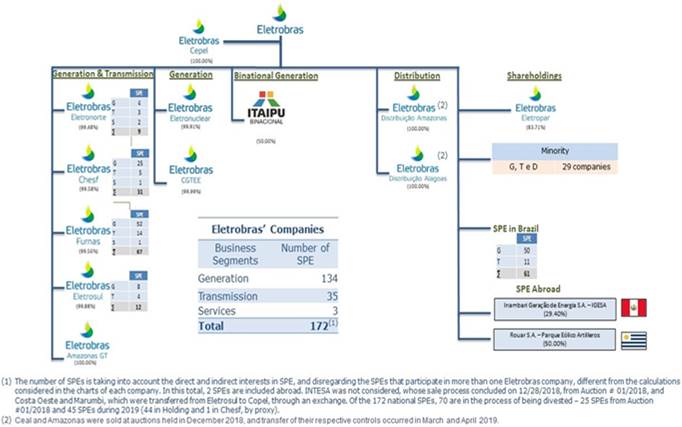
As of December 31, 2018, we held a stake in 172 SPEs in Brazil, of which 134 are generation companies, 35 are transmission companies and 3 are service companies, mostly with a participation of up to 49.0% of the share capital, and 2 other partnerships in SPEs located outside of Brazil, as well as minority interests in 29 electricity companies.
On February 23, 2018, our Board of Directors approved the sale of interests owned by us and our subsidiaries Chesf, Furnas, Eletronorte and Eletrosul in 71 SPEs divided into eighteen lots. The corresponding auction took place on September 27, 2018 at B3 Exchange and as a result we sold eleven of the eighteen lots offered to the market and raised approximately R$1.3 billion. The lots with wind generation SPEs located in Rio Grande do Sul, Piauí and Rio Grande do Norte and the lots with transmission SPEs in Goiás, Amazonas and Pará did not receive any bids. The sale of the SPEs is subject to approval by banks who are creditors of these companies, CADE, ANEEL and the non-exercise of pre-emption rights by the SPE’s shareholders, which is ongoing and is expected to be concluded in the second quarter of 2019. On December 28, 2018, we signed a purchase and sale agreement with Equatorial Energia S.A. (“Equatorial Energia”), transferring our shares held in Integraçao Transmissora de Energia S.A. — INTESA for R$280 million. On March 28, 2019 we entered into a sale and purchase agreement with Brennand Energia S.A. for the sale of Pedra Branca S.A., São Pedro do Lago S.A., Sete Gameleiras S.A., Baraúnas I Energética S.A., Mussambê Energética S.A., Morro Branco I Energética S.A., Baraúnas II Energética S.A. and Banda de Couro Energética S.A.
In February 2018, at the 170 th Extraordinary Shareholders Meeting, our shareholders ratified their decision taken in 2016 to sell our six distribution companies, except we would retain one common share, as well as the assumption by us of these distribution companies’ rights to the CCC Account and the CDE Account in the total amount of R$8.4 billion recognized in their respective financial statements considering adjustments through June 30, 2017. The sales occurred in 2018.
Through auctions on the B3 Exchange, we auctioned our participation in (i) Cepisa to Equatorial Energia for R$45.5 thousand on July 26, 2018, (ii) Eletroacre and Ceron to Energisa S.A. for R$45.5 thousand each on August 30, 2018, (iii) Boa Vista Energia to the Oliveira Energia & Atem Consortium for R$45.5 thousand on August 30, 2018, (iv) Amazonas D to the Oliveira Energia & Atem Consortium for R$45.5 thousand on December 10, 2018, and (v) Ceal to Equatorial Energia for R$45.5 thousand on December 28, 2019. We have received approvals from CADE and ANEEL for the sale of Eletroacre, Cepisa, Ceron, Boa Vista Energia, Ceal and Amazonas D. We transferred our control in Cepisa, Ceron, Eletroacre, Boa Vista Energia, Ceal and Amazonas D on October 17, 2018, October 30, 2018, December 6, 2018, December 10, 2018, March 18, 2019 and April 10, 2019, respectively .
During the third quarter of 2018, Chesf transferred to us 49% of the capital stock of the following SPEs: Serra das Vacas; Chapada do Piauí II; Pedra Branca; São Pedro do Lago e Sete Gameleiras. Furnas transferred to us all of its shares in the following SPEs: Brasventos Eolo (24.5%); Rei dos Ventos 3 (24.5%); Miassaba 3 (24.5%); Centroeste de Minas (49.0%); Luziânia-Niquelândia (49.0%); Companhia Transirapé de Transmissão (24.5%); Companhia Transleste de Transmissão (24.0%) and Companhia Transudeste de Transmissão (25.0%). Eletronorte also transferred to us all of its shares in SPE Amazônia Eletronorte Transmissora de Energia — AETE (49.0%) and Transmissora Matogrossense de Energia — TME (49.0%).
During the fourth quarter of 2018, Chesf transferred to us 49% of the capital stock of SPE Chapada do Piauí I and 19.5% of SPE Manaus Transmissora. Eletronorte transferred to us 30,0% of the capital stock of SPE Manaus Transmissora.
During the first quarter of 2018, we sold 21.8% of the capital stock of Energisa Mato Grosso-Distribuidora de Energia (“Energisa MT”) representing 540,000 common shares and 3,559,000 preferred shares. We received R$35.7 million for the sale and currently hold 400,000 common shares of Energisa MT, corresponding to 0.19% of its capital stock.
On December 29, 2017, Eletrosul transferred to us 99.99% of common shares held in the SPEs Eólica Chuí IX, Eólica Hermenegildo I, II and III. On the same date, Eletrosul transferred to us 605,788,000 common shares and 29,400,000 preferred shares of SPE Santa Vitória do Palmar Holding.
We made capital contributions to SPE Norte Energia, proportional to our 15.0% equity interest, which totaled R$140.7 million until December 31, 2018. Our subsidiaries, Chesf and Eletronorte, also made contributions to the capital of SPE Norte Energia in the total amount of R$140.7 million and R$187.4 million, respectively.
In December 2018, we participated in the capital increase of Energisa, in order to not dilute out interest, which remains at 2.31%.
Following the CELG-D Privatization Auction in November 2016, Enel Brasil S.A. acquired CELG-D for R$2.19 billion, with a premium of 28.0% over the minimum price approved by our shareholders. On February 14, 2017, in connection with the sale, we received approximately R$1.07 billion from Enel Brasil S.A. for our total equity interest and, in the first offer, we received approximately R$0.7 million from the employees of CELG-D who exercised their right to purchase CELG-D’s shares. Therefore, we received approximately R$1.14 billion in aggregate from the sale of CELG-D.
In 2016, we authorized Centrales Hidroeléctricas de CentroAmérica S.A. (CHC) to sell its shares in Centrales Hidroeléctricas de Nicarágua S.A. (CHN) for U.S.$44.2 million (R$143.0 million). We held a 50.0% interest in the company and, through a share repurchase process, we received U.S.$20.5 million (R$66.3 million). The liquidation of Centrales Hidroeléctricas de CentroAmérica S.A. (CHC) was approved by its shareholders on January 27, 2017, and since then the company is not part of our corporate structure.
In 2016, we subscribed for new shares in CTEEP for R$81.5 million and AES Tietê Energia S.A. for R$12.2 million in order not to dilute our shareholding in relation to the total share capital of these companies, which is 35.4% and 7.9%, respectively.
In 2016, we did not participate in the capital increase of Energisa and Energisa Mato Grosso-Distribuidora de Energia S.A., meaning that we were diluted and currently hold 2.3% and 22.0% respectively of the capital stock of those companies.
D. Property, Plant and Equipment
Our principal assets consist of hydroelectric generation plants which are located all over Brazil. The book value of our total property, plant and equipment as of December 31, 2018, December 31, 2017 and December 31, 2016 was R$32,370 million, R$27,966 million and R$26,813 million, respectively. As a result of the existing large hydroelectric power capacity still available in Brazil, we believe hydroelectric energy will continue to have a prominent role in providing for the growth in consumption of electrical energy.
E. Compliance
In accordance with our Code of Ethical Conduct and Integrity, we do not tolerate corruption or any other illegal business practices of our employees, contractors or suppliers, and, accordingly, we have undertaken the corporate governance and compliance initiatives described in this annual report.
In 2016, we improved through our compliance department our compliance program with the implementation of the “Eletrobras 5 Dimensions Program,” with the objective of strengthening our internal controls, including at our subsidiaries. The program seeks to achieve compliance with legal and regulatory standards and avoid, detect and treat any deviation or nonconformity that may be identified. This initiative is in compliance with international corporate governance standards and laws and regulations, including the U.S. Sarbanes-Oxley Act of 2002, the FCPA, the Brazilian Anticorruption Law, the Law of Government-Controlled Companies, the rules and guidelines issued by the SEC, the CVM, the IBGC and the OECD, among others.
The Eletrobras 5 Dimensions Program, provided for in the 2018-2022 PDNG, was implemented in all of our companies in order to comply with international corporate governance standards and to strengthen the corporate integrity management. The Eletrobras 5 Dimensions Program is present in the 2019-2023 PDNG, which provides, among the Strategic Guidelines, “Enhancing Governance and Corporate Integrity - Strengthening internal controls and corporate governance, ensuring business integrity.”
The Eletrobras 5 Dimensions program is based on the guidelines proposed by the Guide for the Implementation of Integrity Program in State Companies of the Federal Comptroller’s Office (CGU) and by the Committee of Sponsoring of the Treadway Commission (COSO). Among the benefits, it is expected the strengthening and continuous improvement of our internal controls related to the Compliance Program, by adopting the highest standards of Integrity through the maturity of the Eletrobras 5 Dimensions (Compliance) Program.
The structure of the “Eletrobras 5 Dimensions Program” is based on five elements that constitute the basis for developing a culture of integrity within the company, as shown in the following image:
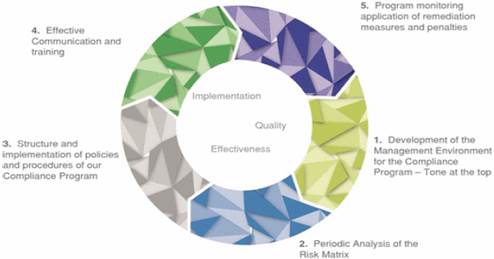
Each element of the “Eletrobras 5 Dimensions Program” has a set of activities with different characteristics, including:
1. Development of the Management Environment for the Compliance Program — To strengthen our governance structure, our Board of Directors approved in February 2016 the creation of a compliance board. The new compliance board is responsible for ensuring the compliance of our internal processes and controls with our internal regulations and Brazilian and foreign laws, in particular the FCPA, the Brazilian Anticorruption Law and our Code of Ethical Conduct and Integrity, mitigating risks and coordinating the corresponding activities in our subsidiaries. In addition, the compliance board is responsible for promoting the culture of compliance management and internal controls and supporting the “Eletrobras 5 Dimensions Program.” We highlight the following attributions of our compliance officers: (a) ensure procedural compliance and risk mitigation in our and our subsidiaries’ activities, prevent fraud and corruption, ensure compliance with internal regulations, standards and requirements included in the Law of Government-Controlled Companies; (b) promote our compliance program and take appropriate measures to investigate any complaints regarding any violation of such program; (c) prepare and issue guidelines for the evaluation of research activities and reduction of fraud and corruption risks, as well as corporate risks and internal controls, and follow the results for the report to our Board of Executive Officers and our Board of Directors.
2. Periodic Analysis of the Risk Matrix — We prepared a fraud and corruption risks matrix ( matriz de riscos de fraude e corrupção ) for our group companies in 2017, mapping out the risks of fraud and corruption inherent in the business and any specificities considering that we are controlled by the Brazilian Government and may be the damaged party, as well as be liable for committing an illicit when dealing with other entities that are also part of the Brazilian Government’s administration. Based on the fraud risk assessment model (FRA), the risk identification and assessment process followed the steps of the corporate scenario assessment, risk benchmarking, and interviews with key corporate personnel. We identified risks, divided them into three pillars and subdivided into subcategories, according to the nature and content of each risk. Subsequently, we applied techniques for risk analysis and classification, which will allow us to prioritize them by level of criticality and develop mitigating actions to direct efforts to the most critical issues as determined by our management. In 2018, we and our subsidiaries used the base
of fraud and corruption risk events for detail and subsequent prioritization. Since then, and according to the evidence presented with the status of this activity, the Compliance areas of our companies proposed a set of risk events for prioritization. In parallel, we developed a methodology to classify the level of fraud and corruption risk of our suppliers, establishing the concept of critical suppliers as part of an analysis of their ethics and integrity, to act in a preventive manner by means of monitoring actions.
3. Structure and implementation of policies and procedures of our compliance program — In order to consolidate the guidelines established by our compliance program considering its maturity, relevant issues in the context of enhancement of compliance have been included in specific documents that show to stakeholders the principles and guidelines accepted by our companies. The main documents of our compliance program is an anticorruption policy aiming to reinforce our commitment to ethics and integrity in our internal and external relations, as well as establishing guidelines to ensure that the members of our governing bodies (councils and Board of Directors), employees, representatives and third parties comply with the requirements of applicable anticorruption laws and that the highest standards of legality and transparency are adopted while conducting business.
In addition, some of our documents now provide for corporate integrity criteria to ensure that our compliance program is effectively applied and complied with within the company’s activities subject to a higher risk of fraud and corruption. In this regard, we highlight the inclusion of a supplier integrity assessment as one of the guidelines of the new tenders and contracts rules of our companies ( novo regulamento de licitações e contratos das empresas Eletrobras ). In addition, the suppliers’ commitment to integrity has been included in the supply logistics policy for our companies ( política de logística de suprimento das empresas Eletrobras ) and in the supplier’s conduct guide ( guia de conduta do fornecedor ). We have also reviewed our sponsorship policy ( política de patrocínios ) and our representative nomination policy ( política de indicações de representantes ) to include integrity aspects in our relationship with these third parties.
In 2017, we also approved our consequences policy. This policy aims to establish corporate commitments to fight against corruption, anticompetitive practices, conflicts of interest and other infractions and guide the application of consequences to actions and conduct in disagreement with our Code of Ethical Conduct and Integrity of Eletrobras Companies, the Compliance Program of our companies ( programa de integridade das empresas Eletrobras ) and internal and legal standards. This policy is part of the new centralized complaint management and treatment process established at our companies.
We also revised some of the formal documents of our companies in 2018 in order to include corporate integrity criteria in the most exposed to risk of fraud and corruption activities of the company, as well as compliance with current legislation. Among them, we highlight: the Code of Ethical Conduct and Integrity, the Sponsorship Policy, the Supply Policy, the Representatives’ Indication Policy, the Bidding and Contracts Regulation and the Social Responsibility Policy.
Accordingly, we implemented certain integrity mechanisms to be adopted by our companies in order to standardize the Third Party Integrity Assessment process of our companies prior to establishing the relationship; they are: suppliers, sponsorships, donations, partnerships, members of governance of our companies and new partners in SPE.
In compliance with the guidelines of the Integrity Program, in 2018, we issued approximately 200 Opinions on the Integrity of suppliers addressed to the members of the corporate governance of our companies.
4. Effective Communication and training — In 2018, we prepared the Integrity Program Training Plan (Compliance), with the objective of establishing training actions on a regular basis, in order to disseminate good practices of ethics and integrity, as well as to promote internalization and dissemination of the ethics and integrity commitments expressed in the Integrity Program’s policies and procedures and in the Code of Ethical Conduct and Integrity, with employees, senior management and other relationship public, enhancing the importance of establishing a mature integrity structure.
Among the actions carried out in 2018 we highlight:
· Training for our Senior Management and representatives of Subsidiaries, Affiliates and Partners (SPE). The Corporate Governance area maintains, within its Enhancement Program for Directors and Executive Officers, content related to Ethics and Integrity. A Workshop on Best Practices was carried out by Directors and Board Members, promoting integration and exchange of experiences.
· Online training on Integrity and Ethics offered by all of our subsidiaries to all employees, reaching a total of 88% of the employees of our companies. A new updated version of the course, including the evolution of the corporate integrity process achieved by us through the Eletrobras 5 Dimensions Program, is scheduled for 2019.
· Integrated Governance, Risk and Compliance (GRC) Course, training 30 persons of the integrity teams, and other related areas, promoting integrated action between the 2nd and 3rd lines of defense.
· Fraud and Corruption Risk Course at our subsidiaries, training the administration on the subject and clarifying the process of mapping and managing the risk of corruption in the company.
In 2018 , the fifth edition of Integrity and Ethics Week was also held, with speeches by internal and external experts on governance, risk and compliance, moral harassment, management and treatment of complaints, information security, social media and relationship with the sector public, among other topics related to the Eletrobras 5 Dimensions Integrity Program. At the time, a broad institutional campaign was launched, both internal and external, highlighting the advances of the Integrity Program, with emphasis on promoting ethical culture.
5. Program monitoring, application of remediation measures and penalties —One of the most important measures taken by us to remedy our material weakness in internal controls was the improvement of the reports’ management and treatment ( gestão e tratamento de denúncias ) process, based on three guidelines: (i) centralization of the receipt and management of denounces; (ii) outsourcing the whistleblowing channel, that became independent; and (iii) the creation of an integrity system committee ( comitê do sistema de integridade ) with representatives of our companies’ for an unified management of reports, centralizing the investigation and the processes of accountability and remediation of complaints. As of the date of this annual report, we have reduced our material weaknesses in internal controls from six to one, over the past years, and are in the process of remedying the remaining material weakness over internal controls.
Our companies’ internal audits started to include in their annual internal audit plan, an evaluation of the implementation of our compliance program, in order to ensure that the measures are being effective and achieving the expected results. We are also periodically evaluated by external oversight bodies, such as the CGU.
In 2018, several actions were implemented to consolidate the program, which allowed us to:
· Obtain the maximum score in the IG SEST Index for the second consecutive time;
· Receive the certification of the Outstanding Program on State Governance from B3 Exchange;
· Be one of the nine Brazilian companies to obtain the maximum score in the implementation of its integrity program, according to a survey conducted by International Transparency with the 110 largest companies in Brazil;
· Win the Ethics Award in Business, with the project “Integrity Mechanisms for Third Parties in Eletrobras Companies.” This is an initiative of the Brazilian Business Ethics Institute whose main objective is to foster ethics in the business environment through the construction and dissemination of best corporate practices;
· Be listed for the 11th time in the Corporate Sustainability Index (ISE) of B3 Exchange, having been absent from the list only in 2017, after ten consecutive years in the portfolio.
Independent Investigation
As a response to allegations of illegal activities appearing in the media in 2015 relating to companies that provide services to our subsidiary Eletronuclear (specifically, regarding the Angra III nuclear power plant), and to certain SPEs in which we hold a minority stake, our Board of Directors, although not required to do so, hired the law firm Hogan Lovells to undertake the Independent Investigation.
The Independent Investigation was subject to oversight by a commission that was created by our Board of Directors on July 31, 2015. This commission was composed of Ms. Ellen Gracie Northfleet, a retired STF justice, Mr. Durval José Soledade Santos, former director of the CVM, and the engineer Mr. Manuel Jeremias Leite Caldas, who was replaced by Mr. Julio Sergio Cardozo, a well-known accounting expert, in July 2017.
On April 29, 2015, the Federal Police commenced the “Operation Radioactivity” as part of the Lava Jato Investigation, which resulted in the imprisonment of a former officer of our subsidiary Eletronuclear. This former officer was sentenced to 43 years in prison for passive bribery, money laundering, obstruction of justice, tax evasion and participation in a criminal organization. On July 6, 2016, the Federal Police commenced “Operation Pripyat,” in which the Federal Police served arrest warrants issued by the 7 th Federal Court of the District of Rio de Janeiro against former officers of Eletronuclear who had already been suspended by our Board of Directors as well as other parties. Formal charges of corruption, money laundering and obstruction of justice were filed against these former officers by the MPF on July 27, 2016. On April 7, 2017, the 7 th Federal Court of the District of Rio de Janeiro revoked the provisional arrest order against these officers on the basis that they played a minor part in any possible corruption scheme. We are assisting the prosecution in these criminal proceedings.
The Independent Investigation team completed the investigation designed to identify potential illegal activities that could have an impact on our consolidated financial statements. As part of this first phase, the Independent Investigation discovered overcharges related to fraudulent bids arising from cartels and the payment of bribes that would have been paid through certain contractors and suppliers hired since 2008. The financial impacts of these findings were presented in our results for the years ended December 31, 2014 and December 31, 2015.
We continue to implement compliance procedures following the guidance of the Independent Investigation. As part of the continuation of the Independent Investigation, we are monitoring plea bargain agreements that are made public as well as other information published by the press and any other developments in the Lava Jato Investigation.
We have been closely monitoring the official investigations and cooperating with Brazilian and United States authorities, including Brazilian Federal Courts; MPF; CVM; CADE, TCU, DoJ, and SEC, among others, and have responded to requests for information and documents from these authorities.
We have also reviewed material contracts and identified suppliers that had their contracts terminated due to their involvement in the Lava Jato Investigation and commenced applicable administrative measures in order to suspend or terminate, when applicable, their contracts with us. In April 2017, as a consequence of the plea-bargaining agreements entered into by executives of the major Brazilian construction conglomerate, Odebrecht, the STF requested that investigations should be initiated to investigate the conduct of politicians who were referred to in those agreements. Other investigations may be initiated against individuals who are subject to the jurisdiction of lower courts.
Certain allegations of potential illegal acts were made public in April 2017 with respect to the Santo Antonio project, in which we hold an indirect minority stake through our subsidiary Furnas.
Finally, based on an amended investigation report issued in 2017, the amount of R$122.8 million was recognized as losses from irregularities related to our investment under the equity method in the SPE Santo Antônio, which did not impact our consolidated financial statements, since we recognized an impairment charge under IAS 36 - Impairment of Assets in an amount sufficient to cover the alleged values.
As a result of the Independent Investigation, we made the necessary adjustments to our consolidated financial statements as of and for the years ended December 31, 2014 and 2015. There were no such adjustments in 2016. In 2017, additional findings were recorded. Please see note 4.XII to our Consolidated Financial Statements for further information. To determine the financial impact to be recognized in our Consolidated Financial Statements, management took into consideration the conclusions reached and findings identified by the Independent Investigation and the conclusions reached and findings identified to date by the ongoing Lava Jato Investigation.
In 2018, we acceded to an agreement with the CGU and Odebrecht pursuant to which Odebrecht will reimburse us an aggregate amount of R$161.9 million for losses incurred in relation to projects in which we directly or indirectly participated which were uncovered in the Lava Jato Investigation. This amount was treated in the Consolidated Financial Statements for the year ended December 31, 2018 as financial assets receivable. The losses relating to the Santo Antônio and Belo Monte projects were already recorded as a result of the findings of the Independent Investigation.
The summary of these non-cumulative adjustments to our 2017, 2015 and 2014 consolidated balance sheets and consolidated statements of profit or losses are as follows:
|
|
|
December 2015 |
|
December 2014 |
|
|
|
|
(R$ thousands) |
|
||
|
Findings of the Investigation |
|
|
|
|
|
|
Angra III |
|
(11,514 |
) |
(129,799 |
) |
|
Mauá 3 |
|
(4,482 |
) |
(62,684 |
) |
|
Simplício |
|
— |
|
(2,644 |
) |
|
|
|
(15,996 |
) |
(195,127 |
) |
|
|
|
As of December 31, |
|
||||
|
|
|
2017 |
|
2015 |
|
2014 |
|
|
|
|
(R$ thousands) |
|
||||
|
|
|
|
|
|
|
|
|
|
Fixet Assets Costs |
|
— |
|
(15,996 |
) |
(195,127 |
) |
|
Impairment |
|
122,841 |
|
11,514 |
|
132,443 |
|
|
Equity Method Investments |
|
(122,841 |
) |
— |
|
(91,464 |
) |
|
|
|
— |
|
(4,482 |
) |
(154,148 |
) |
|
|
|
For the year ended December 31, |
|
||||
|
|
|
2017 |
|
2015 |
|
2014 |
|
|
|
|
(R$ thousands) |
|
||||
|
Statement of profit and loss |
|
|
|
|
|
|
|
|
Investigation findings |
|
— |
|
(15,996 |
) |
(195,127 |
) |
|
Impairment charges (Operating charges) |
|
122,841 |
|
11,514 |
|
132,443 |
|
|
Results of equity method investments |
|
(122,841 |
) |
— |
|
(91,464 |
) |
|
|
|
— |
|
(4,482 |
) |
(154,148 |
) |
In addition, we have undertaken the following measures:
· Changes to the management of our group companies by replacing a significative portion of the board of directors and our officers.
· measures to seek indemnification from contractors and individuals who have caused us damage, whether due to active corruption, payments of undue advantages to executives of our subsidiaries, or by charging a surcharge on the works carried out by our subsidiaries. We are also analyzing measures to seek damages and hold accountable our former executives who have been convicted under operations Radioactivity and Pripyat.
· Implementation of the “Eletrobras 5 Dimensions Program” which includes elaborating, reviewing, implementing and training our employees and suppliers in our policies and procedures, especially those related to management of suppliers, corruption risks and analysis of complaints.
· Update our Code of Ethical Conduct and Integrity.
· Implement a statutory Audit Committee, for further information see “Item 6.C Directors, Senior Management and Employees—Board Practices—Fiscal Council—Audit Committee.”
· Analyze compliance with the requirements of the Law of Government-Controlled Companies and implement proceedings such as background checks for all our potential officers, directors and members of the Fiscal Council as well as for our subsidiaries and the SPEs in which they, or we, invest. This has resulted in the independent evaluation of 200 board members and directors within our group companies and a further 190 board members at the SPEs and affiliates in which we hold a stake.
· Provide regular and specific training for certain target members of our staff who are most exposed to the risk of corruption.
· Standardization of the by-laws and approval levels across all our group companies.
· Provide ethics and integrity e-learning for all employees, including officers and directors.
· Adopt procedures for the hiring of an independent reporting channel. By implementing the independent reporting channel, we unified the management and analysis of reports for all our companies, as approved by our Board of Directors.
In April 2018, Hogan Lovells presented the results of the Independent Investigation, which was approved by the Independent Investigation commission and our Board of Directors. The Independent Investigation was concluded on April 30, 2018 and no further accounting adjustments were required.
On August 13, 2018, Hogan Lovells informed us that the DoJ decided not to prosecute for any potential FCPA violations or impose any contingencies or conditions on us such as having a compliance monitor. Hogan Lovells assisted us in the negotiation of a settlement with the SEC to terminate the investigation into irregularities during the Lava Jato Investigation, and on December 26, 2018, the SEC announced it would accept our payment of a settlement of U.S.$2.5 million for inadequate internal controls. The settlement does not represent an admission of an illegal act on our behalf.
We also settled an investor class action against us in 2018 with no admission of wrongdoing. For further information, see “ Item 8.A Financial Information—Consolidated Financial Statements and Other Information—Investor Class Actions.”
Not applicable.
The following discussion should be read in conjunction with our audited Consolidated Financial Statements included elsewhere in this annual report. As of and for the year ended December 31, 2018, the information provided in this Item 5 in relation to the consolidated income statements for the years ended December 31, 2017 and 2016 were restated, where applicable, to give effect to the reclassifications described in Note 46 to our Consolidated Financial Statements. For further information, see “Presentation of Financial and Other Information.”
Overview
Directly and through our subsidiaries, we are involved in the generation and transmission of electricity in Brazil. Our revenues derive mainly from:
· the generation of electricity through our subsidiaries and its sale to electricity distribution companies and free consumers, which in 2018, 2017 and 2016 accounted for R$17,759 million, or 71.1%, R$20,325 million, or 69.0% and R$17,755 million, or 34.9%, of our total net revenues, respectively. For the year ended December 31, 2018, of R$24,976 million in revenue, R$2,708 million was derived from operation and maintenance services provided and R$15,140 million was from our exploration services. For the year ended December 31, 2018, generation accounted for R$17,434 million, or 69.8%, of our total net revenues, as compared to R$19,914 million, or 67.6%, for the year ended December 31, 2017; and
· the transmission of electricity, which in 2018, 2017 and 2016 accounted for R$8,387 million, or 33.6%, R$10,126 million, or 34.4% and R$33,544 million, or 66.0% of our total net revenues, respectively. In 2018, of R$24,976 million in revenue, R$4,794 million was derived from operation and maintenance services provided. In 2018, R$3.5 billion (R$4.9 billion in 2017) of our transmission revenue is attributable to RBSE asset receivable as further described in “ — Principal Factors Affecting our Financial Performance—Transmission RBSE Payment.” For the year ended December 31, 2018, transmission accounted for R$8,387 million, or 33.6% of our total net revenues, as compared to R$10,126 million, or 34.4%, for the year ended December 31, 2017.
For the years ended December 31, 2016, 2017, and 2018, we also distributed electricity. As discussed herein, we auctioned those distribution companies and those operations are classified as discontinued operations during these periods.
Principal Factors Affecting our Financial Performance
The Effects of Law No. 12,783/13
In 2012, the Brazilian Congress converted Provisional Measure No. 579/12 into Law No. 12,783/13, which materially changed the Brazilian electricity sector. The law allowed current holders of concessions who operate electricity generation and transmission assets, which were due to expire during the years 2015 through 2017, to renew those concessions for an additional maximum period of 30 years effective on January 1, 2013, but at significantly lower tariff levels. As an option under the law, we and other concessionaires could have entered into a potentially competitive bidding process to renew their generation and transmission concessions. Law No. 12,783/13 also affected distribution concessions by lowering the tariffs.
In 2013, there was a change in the revenue framework with respect to the renewed generation and transmission concessions requiring the exploration method and the operating and maintenance methods to be separately disclosed pursuant to Law No. 12,783/13. Accordingly, as of 2013 companies that renewed generation and transmission concessions pursuant to Law No. 12,783/13 received lower tariff payments compared to payments received before Law No. 12,783/13 was enacted. The renewed generation concessions operate under a new business model, pursuant to which the tariff covers just a standard operating and maintenance cost plus a margin of 7.2% over the investments to maintain an adequate service, different from the non-renewed generation concession under which we could sell the generated energy in the open market.
Under Law No. 12,783/13, the Federal Government agreed to indemnify us and other electricity concessionaires for part of the non-amortized investments we and other concessionaires made during the term of their concessions. Some of these indemnity payments have been agreed and paid, while others have been estimated for purposes of financial statements based on information available to us, see note 2 (Public Service Electric Power Concessions) to our Consolidated Financial Statements.
Our shareholders approved the Brazilian Government’s conditions of renewal of generation and transmission concessions under the new law despite the non-recurring R$10.09 billion write off in our assets as of December 31, 2012, and the significant expected negative impact on revenues from the relevant concessions in subsequent periods.
Generation Scaling Factor
Over the course of 2015, our industry as a whole discussed the financial effects of the GSF on the generation companies which are part of the MRE.
This broad sector debate focused on the effects of and solutions for the GSF from an administrative, regulatory, business and legal perspective. Law No. 13,203/15, dated December 8, 2015, and ANEEL Resolution No. 684/15, dated December 11, 2015, established the criteria for the approval and the conditions for the renegotiation of the hydrological risk.
Prior to the enactment of Law No. 13,203/15, hydrological risk was assumed by the hydroelectric generation assets which were part of the MRE. Accordingly, when the GSF was valued below 1.0, that is, when the total hydroelectric generation for the power plants forming the MRE was below the total physical guarantee, the difference was shared among all hydroelectric generators, according to the proportions of their physical guarantees. Depending on the situation of each hydroelectric generator, it might have been required to acquire additional energy on the short-term market. After the enactment of Law No. 13,203/15, the generation companies may share the hydrologic risk with consumers, through the payment of a “risk premium.”
We participated in the GSF debates, particularly in the discussions relating to Itaipu’s GSF (Decree No. 8,401/15), during public hearings held by ANEEL, in the discussions with the Brazilian Association of Electric Energy Generating Companies ( Associação Brasileira das Empresas Geradoras de Energia Elétrica ) (“ABRAGE”), and in several meetings with the MME, and ABRAGE. Further, we also contributed by initiating proceedings with the aim of setting a limit for the GSF and removing the effects of defaults in the CCEE.
Our assessment of products available in the context of the renegotiation of the hydrological risk, such as those listed in Resolution No. 684/15, took into account the plant marketing profile for the regulated contracting environment and free environment, hedging strategy, contract termination predictions, energy simulations, economic and financial feasibility studies (VPL by product type), analysis of the accounting impact, duration of Concession Agreements, cost of risk premium, legal analysis, additional risks related to the contracting of energy reserves, projections for net price of differences and allocation of secondary energy, among others.
Following CP-33, Bill No. 1,917/2015 is currently being discussed in the house of representatives and intends to provide a more just division of costs for the sector, clearly dividing the costs among all consumers, free and regulated.
Bill No. 1,0985/2018, also being currently discussed in the House of Representatives, establishes that generation companies that agree to withdraw their lawsuits will have the right to extend their concession agreements. In addition, elements that affect GSF calculation, such as energy imports, thermoelectric generation out of the order of merit, delays related to transmission lines and physical guarantee anticipation of structuring plants will be removed from the calculation of hydrological risk.
Divestment of Distribution Companies
In 2016, we had distribution companies operating in six Brazilian states through concessions granted by the Brazilian Government. During the Extraordinary General Meeting held on July 22, 2016, our shareholders decided that Cepisa, Ceal, Electroacre, Ceron, Boa Vista Energia and Amazonas D should not renew their concessions for distribution of electricity in the country.
In July 2016, the MME issued MME Ordinance No. 388/16 which defined the parameters for the continued operation of the distribution companies following the expiration of the concessions.
In August 2016, the MME issued MME Ordinances No. 420, 421 422, 423, 424 and 425 making Amazonas D, Eletroacre, Ceron, Cepisa, Ceal and Boa Vista Energia responsible for providing electricity distribution services in their regions until July 31, 2018 or the assumption by a new concessionaire, whichever occurred first. This deadline was postponed by MME Ordinance No. 246/18 until December 31, 2018, for Ceal, by MME Ordinance No. 502/18 until March 31, 2019, and for Amazons D until April 15, 2019.
In 2016, Companhia Energética de Roraima, a company controlled by the state of Roraima, was not allowed to renew its electricity distribution concession and the MME made Boa Vista Energia responsible for the provision of electricity distribution services within Roraima as of December 31, 2016.
On November 29, 2016, ANEEL issued Normative Resolution No. 748/16, establishing the terms and conditions for the provision of the public electricity distribution service by the relevant distribution company, in accordance with article 9 of Law No. 12,783/13 and MME Ordinance No. 388/16. The Brazilian Government included Amazonas D, Eletroacre, Ceron, Cepisa, Ceal and Boa Vista Energia in the PPI and we received the privatization model of our distribution companies in November 2017.
On February 8, 2018, at our 170th Extraordinary Shareholders Meeting, our shareholders ratified their decision taken in 2016 to sell our six distribution companies, except we would retain one common share, as well as the assumption by us of these distribution companies’ rights to the CCC Account and the CDE Account of R$8.4 billion, as adjusted, through June 30, 2017. The assets (and related liabilities) of Eletroacre, Ceron, Cepisa and Boa Vista Energia were classified as assets held for sale as of December 31, 2017, while those of Ceal and Amazonas D were classified as amounts held for sale as of December 31, 2018, in accordance with IFRS 5. The effect of the termination of the concessions of Ceal and Amazonas D will continue to impact future periods.
Through auctions on B3, we auctioned our participation in Cepisa to Equatorial Energia for R$45.5 thousand ( recognizing 100% of tariff flexibility losses and costs with people, materials, third party services and other expenses, in addition to the granting of a bonus of R$95 million) on July 26, 2018, our respective participations in Eletroacre and Ceron to Energisa and our participation in Boa Vista Energia to Oliveira Energia, for R$45.5 thousand (representing no gain) on August 30, 2018 and our participation in Amazonas D to the Oliveira Energia & Atem Consortium for R$45.5 thousand (representing no gain) on December 10, 2018. We have received approvals from CADE and ANEEL for the sale of Eletroacre, Cepisa, Ceron and Boa Vista Energia and entered into sale agreements for each of those sales. The auction for the sale of our participation in Ceal was suspended in June 2018 as a result of an injunction granted by the STF, which was reversed in November 2018. Equatorial Energia won the auction for the sale of our participation in Ceal in December 2018 for R$45.5 thousand (representing no gain). Regarding Eletroacre and Boa Vista Energia, the transfer of control occurred on December 6, 2018 and December 10, 2018, respectively.
Transmission RBSE Payment
On April 20, 2016, the MME confirmed, through MME Ordinance No. 120/16, the basis for us to account for compensation of R$36.3 billion as receivables as of December 31, 2018 (R$38.2 billion as of December 31, 2017) with respect to reimbursements related to our transmission assets existing in 2000. We accounted for this compensation as R$6.1 billion in short-term assets and the remaining R$30.2 billion in long-term assets. For the year ended December 31, 2018 these reimbursements resulted in R$3.5 billion in transmission revenues; and for the year ended December 31, 2017, R$4.9 billion.
Certain associations of energy consumers have legally questioned these increases, claiming that these charges would be improper, especially the compensation for the cost of capital, and that those differences should be paid from public resources, and not passed on to consumers. On April 10, 2017, a partial injunction was granted in favor of these associations to exclude the tariff that the associations had to pay in relation to the compensation provided by MME Ordinance No. 120/16. However, based on a legal opinion from external counsel, we understand that the decisions rendered to date do not interfere with the right to receive RBSE assets as established by Law No. 12,783/13 and MME Ordinance No. 120/16 which guarantees the right to receive the amounts regarding the RBSE, even if it is through a direct payment by the Brazilian Government. For further information, see note 3 to our Consolidated Financial Statements and “Item 3.D Key Information—Risk Factors—Risks Relating to our Company—The amount of any payments to be received following the renewal of our transmission concessions may not be sufficient to cover our investments in these concessions. Further, we cannot estimate when and on what terms indemnifications in respect of generation concessions will be made.”
We have determined that the identification basis will be based on the VNR, for generation and transmission assets, and by the base value of RAB for distribution assets, based on its VNR value. These are the bases used to determine the indemnity at the end of the concession period for generation and transmission of electricity.
Brazilian Macroeconomic Conditions
Brazilian GDP
Brazil recorded a 1.1% increase in its GDP for the year ended December 31, 2018, a 1.0% increase in its GDP for the year ended December 31, 2017 and a 3.5% decrease in its GDP for the year ended December 31, 2016, as reported by the Central Bank using data provided by the IBGE.
This limited recovery in 2018 reflected growth of 1.3% in the services sector as compared to the previous year, especially in relation to real estate. The industrial sector also grew 0.6% in 2018, after years of stagnation. In terms of demand, the 1.9% increase in domestic consumption of households in 2018 had a positive influence on GDP, contributing to the recovery of the economy and stimulating the service sector.
SELIC rate
As of December 31, 2017, the SELIC rate was 7.0% and as of December 31, 2018, the SELIC rate was 6.5%, where it remains as of the date of this annual report.
Inflation
From January 1, 2016 to December 31, 2016 the IGP-M inflation index increased to 7.2%. From January 1, 2017 to December 31, 2017 the IGP-M inflation index decreased by 0.5%. In the year ended December 31, 2018 the IGP-M inflation index increased by 7.5%.
The IPCA inflation index for 2016 was 6.3%, lower than the rate in 2015. In 2017 the IPCA inflation index was 2.9%, which was below the target rate of 4.5% set by the CMN. For the year ended December 31, 2018, the inflation rate was 3.8%.
Exchange rate
The real exchange rate was R$3.87 against the U.S. dollar as of December 31, 2018, R$3.31 as of December 31, 2017 and R$3.26 as of December 31, 2016. In December 30, 2014 the Central Bank announced the extension of its foreign exchange intervention program, which it commenced in August 22, 2013. Pursuant to this program the Central Bank announced that it would offer US$0.5 billion of derivatives (swap agreements) until the end of March 2015. On March 24, 2015, the Central Bank announced that it would not extend the program. For further information on how the real to U.S. dollar exchange rates affect our results, see “ —Exchange Rate Variations .”
The following table shows data relating to Brazilian GDP growth, inflation and the real /U.S. dollar exchange rate for the periods indicated:
|
|
|
Year Ended December 31, |
|
|||||||
|
|
|
2018 |
|
2017 |
|
2016 |
|
|||
|
GDP growth (contraction) rate |
|
1.1 |
% |
1.0 |
% |
(3.5 |
)% |
|||
|
Inflation/(deflation) (IGP-M) |
|
7.5 |
% |
(0.5 |
)% |
7.2 |
% |
|||
|
Inflation (IPCA) |
|
3.8 |
% |
2.9 |
% |
6.3 |
% |
|||
|
Appreciation (depreciation) of the real vs. the U.S. dollar |
|
(17.1 |
)% |
(1.1 |
)% |
(16.5 |
)% |
|||
|
Period-end exchange rate — U.S.$1.00 |
|
R$ |
3.8748 |
|
R$ |
3.3080 |
|
R$ |
3.2591 |
|
|
Average exchange rate — U.S.$1.00 |
|
R$ |
3.6558 |
|
R$ |
3.1925 |
|
R$ |
3.4833 |
|
Sources: Fundação Getúlio Vargas, Ipeadata, Instituto Brasileiro de Geografia e Estatística and the Central Bank.
Electric Power Market
Electricity consumption in Brazil increased 0.8% in year ended December 31, 2017 and increased by 1.1% in the year ended December 31, 2018. In the year ended December 31, 2018, the increase of 1.1% reflected increases in: industry of 1.3%, residential of 1.2% and commercial of 0.6%. According to the Brazilian Energy Research Company ( Empresa de Pesquisa Energética ) (“EPE”), in the year ended December 31, 2018, the total power consumption in Brazil was 472,242 GWh, which represents an increase of 1.1% in comparison to the year ended December 31, 2017.
The electric power consumption in Brazil by geographic region as of December 31, 2018 and 2017 is presented below:
Energy Consumption in the Network (GWh)
|
|
|
|
|
Year ended December 31, |
|
|
|
||||||||
|
|
|
Consumption Class |
|
2018 |
|
2017 (1) |
|
Variation |
|
||||||
|
Region |
|
Residential |
|
Industrial |
|
Commercial |
|
Others |
|
Total |
|
Total |
|
% |
|
|
North |
|
9,384 |
|
13,206 |
|
4,952 |
|
4,982 |
|
32,524 |
|
34,510 |
|
(5.8 |
) |
|
Northeast |
|
27,650 |
|
22,443 |
|
14,541 |
|
16,272 |
|
80,907 |
|
79,731 |
|
1.5 |
|
|
Southeast |
|
65,493 |
|
92,170 |
|
46,871 |
|
31,664 |
|
236,199 |
|
232,515 |
|
1.6 |
|
|
South |
|
21,825 |
|
32,619 |
|
15,120 |
|
16,842 |
|
86,405 |
|
84,997 |
|
1.7 |
|
|
Mid-West |
|
11,670 |
|
9,111 |
|
7,330 |
|
8,096 |
|
36,207 |
|
35,408 |
|
2.3 |
|
Source: Permanent Committee of Analysis and Monitoring of Electric Power Market — Copam/EPE.
(1) The year ended December 31, 2017 data has been adjusted by EPE.
The electric power consumption in Brazil by geographic region as of December 31, 2017 and 2016 is presented below:
Energy Consumption in the Network (GWh):
|
|
|
|
|
Year ended December 31, |
|
|
|
||||||||
|
|
|
Consumption Class |
|
2017 (1) |
|
2016 |
|
Variation |
|
||||||
|
Region |
|
Residential |
|
Industrial |
|
Commercial |
|
Others |
|
Total |
|
Total |
|
% |
|
|
North |
|
9,501 |
|
15,199 |
|
4,907 |
|
4,660 |
|
34,510 |
|
34,071 |
|
0.6 |
|
|
Northeast |
|
27,051 |
|
22,137 |
|
14,255 |
|
15,846 |
|
79,731 |
|
79,396 |
|
(0.1 |
) |
|
Southeast |
|
64,873 |
|
87,800 |
|
46,794 |
|
31,141 |
|
232,515 |
|
229,970 |
|
0.3 |
|
|
South |
|
21,177 |
|
31,984 |
|
14,893 |
|
16,510 |
|
84,997 |
|
82,063 |
|
3.0 |
|
|
Mid-West |
|
11,302 |
|
8,764 |
|
7,279 |
|
7,874 |
|
35,408 |
|
34,579 |
|
1.9 |
|
Source: Permanent Committee of Analysis and Monitoring of Electric Power Market — Copam/EPE.
(1) The year ended December 31, 2017 data has been adjusted by EPE.
Itaipu
Itaipu, one of the world’s largest hydroelectric plants, is jointly owned by Brazil and Paraguay and was established and is operated pursuant to a treaty between those countries.
Pursuant to the Itaipu treaty, we are entitled to trade not only the 50.0% of electricity produced by Itaipu that Brazil owns through us, but also that part of Paraguay’s share of electricity not used by Paraguay. As a result, we act as a commercial agent of approximately 84.3% of the electricity produced by Itaipu. Articles 7 and 8 of Law No. 5,899/73 set out the framework which distribution companies use to calculate the total amount of energy purchased from Itaipu.
While Itaipu produces a large amount of electricity, the Itaipu treaty requires that sales of Itaipu electricity be made on a no-profit basis, with no net effect on our results of operations.
In order to effect the “no profit” requirement, profits from the sale of Itaipu electricity are credited in subsequent periods to residential and rural consumers of electricity through the Interconnected Power System through their electricity bills and losses are taken into account by ANEEL in calculating tariffs for electricity in subsequent periods.
Pursuant to Law No. 11,480/07, we were able to apply an “adjustment factor” to any financial contracts entered into between us and Itaipu and any credit assignments entered into between us and the Brazilian Treasury prior to December 31, 2007. The aim of this “adjustment factor” was to offset the impact of the rate of inflation in the United States on the U.S. dollar payments. Accordingly, this “adjustment factor” measured the rate of inflation by reference to the consumer price index (CPI) and another index which tracks changes in industry prices. This law was repealed, and Decree No. 6,265/07 came into force which determined that a rate equivalent to the previous “adjustment factor” is to be passed on to distribution companies on an annual basis.
For discussion of the accounting treatment of Itaipu, see note 3.9.4, subsection IV to our Consolidated Financial Statements.
Exchange Rate Variations
Fluctuations in the value of the real against the U.S. dollar, particularly devaluations and/or depreciation of the real , have had and will continue to have an effect on the results of our operations. In particular, pursuant to the Itaipu treaty, all revenues from Itaipu are denominated in U.S. dollars. Because the financial statements of Itaipu are prepared in U.S. dollars and translated to reais at the exchange rate published by the Central Bank at the period end, any movement in the exchange rate between the real and the U.S. dollar can have a major impact on our results, in particular the “Foreign exchange and monetary gain” component of the line item “Financial income (expense), net.”
However, as pursuant to the Itaipu treaty, the operation of Itaipu is not permitted to have any net effect on our operating results, any loss or gain incurred as a result of any appreciation or depreciation of the U.S. dollar against the real , among other things, will subsequently be compensated for the tariffs we charge to our residential and rural consumers. In our income statement, the effects of
Itaipu on the line items described above are netted out and recorded in the line item “Deferred loss from Itaipu.” Until that compensation takes place, the accumulated results of profits or losses from Itaipu operations, net of compensation through tariff adjustments, is carried on our balance sheet as a current asset under “Reimbursement rights.”
Fixed Transmission Revenues
Transmission lines have a fixed annual revenue, or “RAP,” Annual Allowed Revenue ( Receita Annual Permitida ), which is set by ANEEL and takes into account the investment, operation and maintenance costs of a transmission project. The RAP is updated annually pursuant to the rules of ANEEL.
Similarly to the energy generation, a large part of the electric transmission concessions were renewed under Law No. 12,783/13 and began to be remunerated through operation and maintenance tariffs , as well as remuneration and depreciation components, as per MME Ordinance No. 120/2016.
Due to the fact that the Brazilian generation industry largely uses hydro plants and the size of Brazil, the transmission cost is shared by all users. The transmission use of system charges are collected through a tariff for the use of the transmission system, or “TUST,” Tariff of Transmission Usage ( Tarifa de Uso de Transmissão ).
Critical Accounting Policies
In preparing the financial statements included in this annual report, we made estimates based on assumptions that we consider reasonable based on our historical experience and other factors. The presentation of our financial condition and results of operations requires that our management make estimates about inherently uncertain matters, such as the book value of our assets, our liabilities and, consequently, our results of operations. Our financial presentation would be materially affected if we were to use different estimates or if we were to change our estimates in response to future events. To provide an understanding of how our management forms its judgments about future events, including the factors and assumptions underlying those estimates, we have identified the following critical accounting policies. For further information please refer to note 3 to our Consolidated Financial Statements.
Current and deferred taxes assets and liabilities
The estimates of taxable income, the basis for the analysis of realization of net deferred tax assets are based on annual budgets and strategic plan, both reviewed periodically. However, future taxable income may be higher or lower than estimates made by management when the need to recognize or not the deferred tax asset amount was identified.
Uncertainty exists with respect to the interpretation of complex income tax regulations and the accounting as these require our management’s involvement in judgments regarding the classification of transactions and in estimates of probable outcomes of tax deductions. We establish provisions, based on our best estimates, for probable expected consequences of audits by the tax authorities. The amount of such provisions is based on various factors, such as our experience in previous tax audits, the judgement of our in-house and external tax consultants and differing interpretations of tax regulations by the taxable entity and the responsible tax authority. Due to the nature and complexity of our existing operations and our investing and divestment activities and participation in other entities, differences arising between the actual results and the assumptions made, or future changes to such assumptions, could necessitate future adjustments to tax income and expenses already recorded, which may reach R$1.5 billion, considering the worst-case scenario of an unlikely contingency .
Provision for impairment of long-lived assets
We adopt variables and assumptions in determining the recovery of long-lived assets in order to determine the recoverable value of assets and recognition of impairment when necessary. Our management established judgments based on historical experience related to the asset, the group of assets or the cash-generating unit that is applied. These judgments may not materialize in the future. Also, the useful life adopted by us is in accordance with the practices determined by ANEEL as applicable to assets linked to the concession of power, which may vary due to the periodic review of the economic useful life of assets in force. Additionally, the useful life is limited to the concession term.
Also, the variables and assumptions used by us and our subsidiaries in determining discounted cash flows for recognition of impairment of long-lived assets may vary due to inherently uncertain events. These events include maintenance of levels of energy consumption, growth rate of economic activity in the country, availability of water resources, and determination of the value of reversion at the end of the concession period. Law No. 12,783/13 defined the New Replacement Value (the “VNR”) as the identification basis for public service concessions. We have determined that the identification basis will be based on the VNR, for generation and transmission assets, and by the base value of Regulatory Asset Base ( Base Remuneração Regulatória ) (“RAB”) for distribution assets, based on its VNR value. These are the bases used to determine the indemnity at the end of the concession period for generation and transmission of electricity. For further information, please see note 4.II and changes in impairments made during
the relevant periods in note 18 to our Consolidated Financial Statements. Another significant variable is the discount rate used to discount cash flows.
Basis of determination of compensation by the Federal Government on concessions
We adopt, for the concessions not yet renewed, the assumption that the assets are reversible at the end of the concession contracts, with the right to receive compensation from Federal Government on investments not yet amortized at the lower of net book value and the new estimated replacement value. Following this assumption, for the concessions already renewed, we have maintained the receivables with the Federal Government relating to the RBSE, the investments made after the basic design of power plants and transmission lines (modernization and improvements), and the thermal generation assets. Such values are subject to approval by ANEEL. In 2016, MME enacted Instruction No. 120, which regulates the conditions under which the payments in connection with the RBSE transmission assets are to be received and establishes that the amounts homologated by ANEEL referring to these assets should be merged into the RAB, increased with respect to compensation for the cost of capital from January 1, 2013 to July 2017 when the tariff process will take place in order to include such payments, and, from this date, the compensation of these assets will be determined through WACC, the weighted average cost of capital, defined by ANEEL, until the effective date of payment. The WACC is calculated as an average between the cost of capital of the shareholders and of third parties, which is the cost of financial debts. The amounts related to RBSE, once updated and paid, will be added to the RAPs of the relevant projects which were renewed in 2012, as from the 2017 tariff review, increased by the compensation related to the cost of capital mentioned above. The compensation and depreciation installments will be defined according to the methodologies of the Periodic Tariff Review of Revenues from Existing Concessionaires ( Revisão Tarifária Periódica das Receitas das Concessionárias Existentes ), approved by ANEEL, and the Regulatory Asset Basis will be depreciated considering the residual life span of the assets and will be updated using the IPCA index. Starting with the 2017 tariff process, the compensation through the application of WACC will be applicable for an eight-year period. For further information regarding the effects of Law No. 12,783/13, please see note 2.1 to our Consolidated Financial Statements.
We have defined the VNR as a way of measuring the amount to be indemnified by the Federal Government for the share of generation and transmission assets not fully depreciated by the end of the concession, pursuant to Law No. 12,783/13. For transmission assets this was defined by the RAB.
Useful life of fixed assets
We adopt the criteria defined in ANEEL Resolution No. 367/09, in determining the estimated useful life of fixed assets, limited to the concession term, pursuant to the understanding that they fairly represent such lifespan.
Provision for asset decommission
We recognize provisions for decommissioning liabilities for the assets related to our thermonuclear power plants. In order to calculate the amount of the provision, assumptions and estimates are made regarding the discount rates, the expected decommissioning cost and removal of the entire power plant from the location and the expected period of the referred costs. The cost estimate is based on legal and environmental requirements for decommission and removal of the entire plant, as well as the prices of goods and services to be used at the end of the useful life.
Actuarial liabilities
Actuarial liabilities are determined by management applying actuarial calculations prepared by independent actuaries based on the life expectancy of the participant, average retirement age and inflation. However, the actual experiences could be different from these actuarial assumptions.
Provision for labor, tax and civil matters
Provisions for labor, tax and civil matters are based, on the evaluation of management and internal and external legal counsel. The provision amounts recognized based on the estimated amounts to settle the obligations. Contingent obligations do not result in recognition of provisions and the estimated possible losses are disclosed in our Consolidated Financial Statements. This assessment is supported by the judgment of management, along with its legal counsel, considering case law, decisions in the courts, the history of any agreements and decisions, the experience of management and legal counsel, as well as other relevant aspects.
Allowance for doubtful accounts
We adopted the simplified approach and calculated the expected loss, based on the expectation of default risk that occurs throughout the life of the financial instrument according to IFRS 9. This established a calculation matrix based on the expected loss rates for each customer segment (residential, industrial, commercial, rural and public sector), which together have common risk characteristics.
We consider a financial asset in default when: (i) it is unlikely that the creditor will fully pay its credit obligations to us without resorting to actions such as the guarantee (if any); or (ii) the financial asset is expired according to our current rules.
Valuation of financial instruments
We use valuation techniques that include information that are not based on observable market data to estimate the fair value of certain types of financial instruments. Note 40 to our Consolidated Financial Statements presents information on key assumptions used in determining the fair value of financial instruments, as well as the sensitivity analysis of these assumptions. We believe that the selected valuation techniques and assumptions used are appropriate for determining the fair value of financial instruments, but nevertheless to the extent they are based on estimates and assumptions, the actual results could be materially different.
Onerous contracts
We use the assumptions related to economic costs and benefits of each contract to determine the existence or not of an onerous contract. In the case of long term commitments as sale and purchase of energy, the estimate in determining the amount of provision for the future sale of the contract is the historical average PLD approved by our management as a basis for the calculation of the provision for onerous contracts, as well as the discount rate applied to the cash flows. The actual values of the PLD over the years may be higher or lower to the assumptions we used. In addition, we may have onerous contracts on concessions where the current expected cost for operation and maintenance is not fully covered by the revenues.
Measurement of financial instruments for the transmission assets of the Existing Basic Network System (RBSE)
With the adoption of IFRS 9, our management measured the portion of RBSE’s financial assets at fair value through profit or loss. The major assumptions for such estimate measurement were as follows: (i) Estimate of RAP (Annual permitted revenues) financial flow (RBSE) with criteria established in Ordinance MME 120 and ANEEL calculations; (ii) Calculation of fair value by the future revenue method according to item B of IFRS 13; (iii) Receipt term of 8 years as established by ANEEL; (iv) Segregation of the portion of the “ke” (Regulatory WACC) remuneration to include an additional risk discount to reflect the possibility of non-receipt of this installment due to the limitation imposed by Abrace’s lawsuit; and (v) Compatible discount rate of market similar to NTN-B, as the deemed discount rate that reflects the credit risk of the counterparty. Our best estimates are based on all available information at the time it was recorded. Nevertheless the actual values and circumstances could be different and such estimates could be updated as new information becomes available.
Evaluation of Contractual Transmission Assets
Our management used the following major assumptions to evaluate the contractual assets of transmission: (i) The renewal date of the concession as an initial measurement of the renewed concession agreements; (ii) Contract signature date as the best estimative of operation commencement date for the new concession agreements; (iii) regulatory revenue (RAP) established in the concession agreement as a basis to compute the concession cash flow; (iv) The amount of expected investments and costs to be made in the concession as a basis for attribution of construction and O&M margins; (v) Operation commencement date as established in the concession agreements; (vi) Depreciation rate considered in the concession agreement controls as best estimate for calculation of indemnification at end of concession term; (vii) Compatible market interest rate similar to NTN-B, as the deemed discount rate that reflects the credit risk of the counterparty; (viii) Construction and Operation and Maintenance Margins calculated according to the margins established in the concession agreement’s controls; (ix) Construction revenue calculated according to the concession contract and physical execution controls; and (x) Construction costs as incurred. Our best estimates are based on all available information. Nevertheless, the actual amounts and circumstances could be different and such estimates could be updated as new information becomes available.
Description of Principal Line Items
Operating Revenues
Electrical Energy Sales
We derive our revenues from the generation and transmission of electricity, as set out below:
· revenues in our generation segment derive from the commercialization and sale to distribution companies and free consumers of electricity that we have generated. Revenues from our electricity generation segment are recognized based on the output delivered at rates specified under contract terms or prevailing regulatory rates. For generation concessions renewed pursuant to Law No. 12,783/13, there was a change in the revenue framework, whereby the exploration method and the operating and maintenance methods are separately disclosed; and
· revenues from our transmission segment derive from the construction, operation and maintenance of transmission networks for third-party electricity concessionaires, and we generate revenues arising from applying inflation and
other indexes to the value of our investments. Revenues receivable from other concessionaires using our basic transmission network are recognized in the month that the services are provided to the other concessionaires. These revenues are fixed each year by the Brazilian Government. These revenues also include as financial revenue the value calculated over receivables registered as financial assets, based on fees calculated from the receipt of RAP (which is based on gross RAP minus the amount allocated for operations and maintenance revenue) until the concession agreements for energy transmission services terminate. In 2016, this line item included the R$28.6 billion in transmission RBSE receivables further described in “—Principal Factors Affecting our Financial Performance—Transmission RBSE Payment.” For transmission concessions renewed pursuant to Law No. 12,783/13, there was a change in the revenue framework, whereby the exploration method and the operating and maintenance methods are separately disclosed.
Other Operating Revenues
Other operating revenues derive from telecommunication companies using certain parts of our infrastructure to install telecommunication lines, and other revenues which are not related to the electricity services.
Taxes on Revenues
Taxes on revenues consist of Imposto sobre a Circulação de Mercadorias e Serviços (“VAT”), a sales tax charged on gross revenues. These taxes do not apply to revenues from the transmission RBSE payments described in “—Principal Factors Affecting our Financial Performance—Transmission RBSE Payment.” We are subject to different VAT rates in the different states in which we operate, with the VAT rates ranging from 7.0% to 27.0%. Pursuant to applicable regulations, we are not liable for any taxes on revenues in our transmission segment.
Additionally, we are subject to two federal taxes imposed on the gross revenues of corporate entities: the Program of Social Integration ( Programa de Integração Social ) (“PIS/PASEP”) and Contribution for the Financing of Social Security ( Contribuição para o Financiamento da Seguridade Social ) (“COFINS”).
Regulatory Charges on Revenues
These deductions from gross revenues comprise payments made to the CCC Account, the RGR Fund, the CDE Account, Proinfa program and similar charges levied on electricity sector participants. Regulatory charges are calculated in accordance with formulas established by ANEEL, which differ according to the type of sector charges, and thus there is no direct correlation between revenues and sector charges.
Operating Costs and Expenses
Personnel, Supplies and Services
Our operating costs and expenses related to personnel, supplies and services primarily consist of daily administrative expenses for employees, equipment and infrastructure, as well as expenses related to outsourcing security, maintenance and external consultants and advisors. Due to the diverse nature of these expenses, we apply certain subjective criteria to allocate such expenses to our operational activities. These expenses do not include raw material costs used to generate power.
Electricity Purchased for Resale
Our generation segment purchases electricity for resale. Electricity purchased in the generation segment represents the Paraguayan portion of the energy from Itaipu that is sold to distribution companies defined under the Itaipu treaty as well as to other generators or traders with a view to complying with the power load demand and the sales agreements we have entered into.
Fuel for Electricity Production
The cost of fuel is a significant component of our operating expenses. Most of these costs, under the Isolated System, are subsequently reimbursed from the CCC Account, pursuant to Law No. 12,111/09.
Use of the Grid
These costs represent charges for transmission of energy over the power lines of third parties.
Interest Payments and Penalties
These costs represent interest payments in respect of our financing with third parties as well as potential penalties for late payments.
Depreciation and Amortization
This represents depreciation and amortization for our property, plant, equipment and intangible assets. We record property, plant and equipment as construction or acquisition costs, as applicable, less accumulated depreciation calculated based on the straight-line method, at rates that take into consideration the estimated useful lives of the assets. Repair and maintenance costs that extend the useful lives of the related assets are capitalized, while other routine costs are charged to our result of operations. Interest relating to debt obtained from third parties incurred during the construction period is capitalized.
Operating Costs
This reflects charges we make in respect of: (i) legal proceedings to which we are party; (ii) bad debt expense; (iii) impairments; (iv) onerous contracts; and (v) other matters.
Donations and Contributions
This reflects expenses relating to investments in new information technology and research and development, as well as investments in cultural programs and sponsorships.
Other Operating Costs
Our other operating costs comprise a number of miscellaneous costs that we incur as part of our day-to-day operations. The most significant components are: (i) costs of leasing goods such as generation units for the Isolated System; (ii) costs of operations and maintenance of our facilities that provide for electricity services; (iii) telecommunication costs comprising primarily costs incurred for telephone and internet services; (iv) insurance costs, including insurance for our facilities and property; and (v) costs of disposal of assets, primarily transformers.
Results of Equity Method Investment
Results of equity method investment in the profit and loss of associates and joint ventures accounted for using the equity method.
Financial Income (Expenses), Net
Financial Income
This reflects interest income and commissions we receive from loans we made in accordance with the provisions of Brazilian law that permitted us to act as a lender to certain public utility companies (see “Item 4. Information on the Company—Business Overview—Lending and Financing Activities” for a description of our outstanding loans to other Brazilian utility companies).
Financial Expenses
This principally reflects debt and leasing expenses.
Foreign Exchange and Monetary Gain (Loss)
Foreign exchange gain (losses) mainly relate to our financial loan to Itaipu, as the underlying currency of this loan is the U.S. dollar, and this represents our largest exposure to foreign currency risk. A devaluation or depreciation of the real against the U.S. dollar increases our revenues, as it increases the value of our assets from Itaipu, although the effect of this contribution is netted out, as discussed above. An appreciation of the real decreases our revenues because it decreases the value of our assets from Itaipu, although the effect of this contribution is similarly netted out as a depreciation of the cost of construction of Itaipu.
IFRS 9 and IFRS 15
From January 1, 2018, we were required to adopt IFRS 9 and IFRS 15. We are not required to retrospectively apply IFRS 9 and IFRS 15 to any periods prior to January 1, 2018. IFRS 9 introduced changes to the measurement and classification of financial instruments, as well as changes to the method for calculating impairment of financial assets. IFRS 15 established a new method to recognize revenue from contracts with customers by applying a five-step analysis, including contract identification, performance obligation identification, transaction price determination, transaction price allocation and recognition of revenue. Our financial statements as of and for the year ended December 31, 2018 reflect the adoption of IFRS 9 and IFRS 15 .
Because we did not apply IFRS 9 and IFRS 15 retroactively, certain of our line items as of and for the year ended December 31, 2018 are non-comparable to the corresponding line items as of and for the years ended December 31, 2017 and 2016, including operating revenue, operating costs, financial results and returns on shareholdings. For further information, see Note 3.1 to our Consolidated Financial Statements.
A. Operating Results
Presentation of Segment Information
Segment information is intended to provide insight into the way we manage and evaluate our businesses. The accounting policies for each segment are the same as those described in the summary of significant accounting policies. We continue to segment our core operations in the Brazilian generation and transmission markets, but we no longer segment our distribution operations because we have sold all our distribution companies. Accordingly, they are now accounted for as discontinued operations in accordance with IFRS 5. Some revenues and expenses can also be classified as “Administration” segment when they are not related to any of the energy segments described above. Inter-segment balances have not been eliminated.
Please see Note 41 to our Consolidated Financial Statements for information on revenues from external customers and intersegment revenues.
The following table shows our revenues and operating expenses as a percentage of net operating revenues with eliminations:
|
|
|
Year Ended December 31, |
|
Year Ended December 31, |
|
||||||||
|
|
|
2018 |
|
2017 (1) |
|
2016 (1) |
|
2018 |
|
2017 (1) |
|
2016 (1) |
|
|
|
|
(%) |
|
(R$ thousands) |
|
||||||||
|
Revenues |
|
|
|
|
|
|
|
|
|
|
|
|
|
|
Electricity sales: |
|
|
|
|
|
|
|
|
|
|
|
|
|
|
|
|
|
|
|
|
|
|
|
|
|
|
|
|
|
Generation |
|
80.6 |
% |
76.0 |
% |
39.2 |
% |
20,139,077 |
|
22,370,117 |
|
19,750,402 |
|
|
Transmission |
|
36.3 |
% |
35.0 |
% |
66.6 |
% |
9,071,274 |
|
10,300,025 |
|
33,579,266 |
|
|
Other operating revenues |
|
3.5 |
% |
3.5 |
% |
1.3 |
% |
869,183 |
|
1,041,317 |
|
655,851 |
|
|
Taxes on revenues |
|
(14.0 |
)% |
(9.8 |
)% |
(4.4 |
)% |
(3,494,657 |
) |
(2,878,669 |
) |
(2,229,729 |
) |
|
Regulatory charges on revenues |
|
(6.4 |
)% |
(4.7 |
)% |
(2.7 |
)% |
(1,609,130 |
) |
(1,391,458 |
) |
(1,355,677 |
) |
|
Net operating revenues |
|
100.0 |
% |
100.0 |
% |
100.0 |
% |
24,975,747 |
|
29,441,332 |
|
50,400,113 |
|
|
|
|
|
|
|
|
|
|
|
|
|
|
|
|
|
Expenses |
|
|
|
|
|
|
|
|
|
|
|
|
|
|
Operating expenses |
|
(44.2 |
)% |
(88.0 |
)% |
(66.6 |
)% |
(11,039,284 |
) |
(25,914,836 |
) |
(33,568,368 |
) |
|
Financial income/(expenses), net |
|
(2.3 |
)% |
(5.9 |
)% |
(2.4 |
)% |
(578,073 |
) |
(1,736,116 |
) |
(1,216,563 |
) |
|
Gains/(losses) on results of affiliated companies |
|
5.5 |
% |
4.0 |
% |
6.4 |
% |
1,384,850 |
|
1,167,484 |
|
3,201,248 |
|
|
Income before income tax and social contribution |
|
59.0 |
% |
10.0 |
% |
37.3 |
% |
14,743,240 |
|
2,957,864 |
|
18,816,429 |
|
|
Income tax |
|
(9.9 |
)% |
(5.1 |
)% |
(16.9 |
)% |
(2,483,718 |
) |
(1,510,634 |
) |
(8,510,819 |
) |
|
Net income (loss) of Continued Operations |
|
49.1 |
% |
4.9 |
% |
20.4 |
% |
12,259,522 |
|
1,447,230 |
|
10,305,610 |
|
|
Net income (loss) of Discontinued Operations |
|
4.4 |
% |
(10.8 |
)% |
(13.2 |
)% |
1,088,055 |
|
(3,172,921 |
) |
(6,633,706 |
) |
|
Net income for the year |
|
53.4 |
% |
(5.9 |
)% |
7.3 |
% |
13,347,577 |
|
(1,725,691 |
) |
3,671,905 |
|
(1) Data for the years ended December 31, 2017 and 2016 have been reclassified to reflect the fact that we now present our distribution segment as discontinued operations.
The following table shows our revenues and operating expenses as a percentage of net operating revenues without inter-company eliminations:
|
|
|
Year Ended December 31, |
|
Year Ended December 31, |
|
||||||||
|
|
|
2018 |
|
2017 (1) |
|
2016 (1) |
|
2018 |
|
2017 (1) |
|
2016 (1) |
|
|
|
|
(%) |
|
(R$ thousands) |
|
||||||||
|
Revenues |
|
|
|
|
|
|
|
|
|
|
|
|
|
|
Electricity sales: |
|
|
|
|
|
|
|
|
|
|
|
|
|
|
Generation |
|
78.6 |
% |
74.6 |
% |
39.1 |
% |
20,502,046 |
|
22,576,542 |
|
19,951,530 |
|
|
Transmission |
|
37.5 |
% |
36.0 |
% |
66.6 |
% |
9,781,381 |
|
10,902,083 |
|
33,967,317 |
|
|
Other operating revenues |
|
3.5 |
% |
3.5 |
% |
1.3 |
% |
902,210 |
|
1,047,548 |
|
687,513 |
|
|
Taxes on revenues |
|
(13.4 |
)% |
(9.5 |
)% |
(4.4 |
)% |
(3,494,657 |
) |
(2,878,669 |
) |
(2,229,729 |
) |
|
Regulatory charges on revenues |
|
(6.2 |
)% |
(4.6 |
)% |
(2.7 |
)% |
(1,609,130 |
) |
(1,391,458 |
) |
(1,355,677 |
) |
|
Net operating revenues |
|
100.0 |
% |
100.0 |
% |
100.0 |
% |
26,081,850 |
|
30,256,046 |
|
51,020,954 |
|
|
Expenses |
|
|
|
|
|
|
|
|
|
|
|
|
|
|
Operating expenses |
|
(46.6 |
)% |
(88.3 |
)% |
(67.0 |
)% |
(12,145,387 |
) |
(26,729,550 |
) |
(34,189,209 |
) |
|
Financial income/(expenses), net |
|
(2.2 |
)% |
(5.7 |
)% |
(2.4 |
)% |
(578,073 |
) |
(1,736,116 |
) |
(1,216,563 |
) |
|
Gain (Loss) on results of affiliated companies |
|
5.3 |
% |
3.9 |
% |
6.3 |
% |
1,384,850 |
|
1,167,484 |
|
3,201,248 |
|
|
Income (loss) before income tax and social contribution |
|
56.5 |
% |
9.8 |
% |
36.9 |
% |
14,743,240 |
|
2,957,864 |
|
18,816,429 |
|
|
Income tax |
|
(9.5 |
)% |
(5.0 |
)% |
(16.7 |
)% |
(2,483,718 |
) |
(1,510,634 |
) |
(8,510,819 |
) |
|
Net income (loss) of Continued Operations |
|
47.0 |
% |
4.8 |
% |
20.2 |
% |
12,259,522 |
|
1,447,230 |
|
10,305,610 |
|
|
Net income (loss) of Discontinued Operations |
|
(4.2 |
)% |
(10.5 |
)% |
(13.0 |
)% |
1,088,055 |
|
(3,172,921 |
) |
(6,633,706 |
) |
|
Net income for the year |
|
51.2 |
% |
(5.7 |
)% |
7.2 |
% |
13,347,577 |
|
(1,725,691 |
) |
3,671,905 |
|
(1) Data for the years ended December 31, 2017 and 2016 have been reclassified to reflect the fact that we now present our distribution segment as discontinued operations.
Year ended December 31, 2018 compared to year ended December 31, 2017
This section is an overview of our consolidated results of operations, net of inter-segment eliminations, which are discussed in greater detail with respect to each segment below.
Net Operating Revenues
Net operating revenues for 2018 decreased by R$4,465 million, or 15.2%, to R$24,976 million in 2018 from R$29,441 million in 2017. This decrease was largely due to the adoption of IFRS 15, which changed the accounting treatment of energy sold and purchased under the Proinfa program. Previously we recorded any revenues from the Proinfa program under the line item “Electricity Sales” and any costs associated with the Proinfa program under the line item “Cost of Energy Purchased for Resale.” Following the adoption of IFRS 15, we now record all revenues and costs, net as part of the line item “Electricity Sales.” It was also affected by our recording of remuneration relating to RBSE credits for our transmission assets in 2017 and the change in the base value for the calculation of the remuneration, which as of January 1, 2018 started to be measured using the fair value in accordance with IFRS 9 and no longer the amortized cost. For further information, see “—Principal Factors Affecting our Financial Performance—Transmission RBSE Payment.”
Operating Costs and Expenses
Operating costs and expenses for 2018 decreased by R$14,875 million, or 57.4%, to R$11,039 million in 2018 from R$25,915 million in 2017.
The decrease was largely due to:
· operating provisions, which increased by R$9,954 million, or 214.3%, to income of R$5,308 million in 2018 from an expense of R$4,646 million in 2017, mainly due to the reversion of an impairment and onerous contracts in relation to Angra III in the amount of R$7,243 million and the reversion of a provision from the State of Pará tax in the amount of R$1,184 million; and
· electricity purchased for sale, which decreased by R$4,596 million, or 74.5%, to R$1,559 million in 2018 from R$6,155 million in 2017, mainly due to the adoption of IFRS 15, which affected the way we record revenues and related costs from the Proinfa program as further described under “—Net Operating Revenues” above.
This was partially offset by an increase in construction costs, which increased by R$340 million, or 35.1%, to R$1,310 million in 2018 from R$970 million in 2017, mainly due to improvements made to our transmission lines and the addition of 189 km of further transmission lines in 2018.
Financial Expenses
Financial expenses net of financial income resulted in an expense of R$578 million in 2018 compared to an expense of R$1,736 million in 2017. The decrease was mainly due to the impact of the settlement agreement we entered into with Eletropaulo to end the legal dispute between us which resulted in financial income of R$1,064 million and a reduction in the reference indices, considering that 63.0% of the loans and financing are indexed to reference indices, therefore, 24.4% of the SELIC rate and 19.6% of the CDI rate .
Income Taxes and social contributions
The effective tax rate for 2018 was 16.85% compared to 51.07% in 2017. Income taxes and social contribution increased by R$973 million, or 64.4%, to R$2,484 million in 2018 from an expense of R$1,510 million in 2017. The increase was mainly due to an increase in taxable income. The effective tax rate decreased as our accounting income increased, mainly due to the non-taxable reversion of certain unsecured liabilities due to the sale of our distribution companies and the reversion of certain impairments related to Angra III (as Eletronuclear did not recognize deferred taxes assets) that affected our pre-tax accounting but not our taxable income.
Discontinued Operations
In 2018, we reclassified the results of our subsidiaries in the distribution segment as discontinued operations for the years ended December 31, 2018, 2017, and 2016, as further described under “—Principal Factors Affecting our Financial Performance—Divestment of Distribution Companies.” The gains incurred from our discontinued operations in the distribution segment increased by R$4,2 billion, or 134.3%, to a profit of R$1.1 billion in 2018 from a loss of R$3.2 billion in 2017. This increase is largely due to the fact that we recognized a non-recurring gain of R$2,9 million. The gains from the sales of subsidiaries reflected the net liabilities of the entities sold and the results to each further explained in Note 45 to our Consolidated Financial Statements.
Net Income (Loss)
As a result of the factors discussed above, we reported net income of R$13,347 million in 2018 compared to a net loss of R$1,726 million in 2017.
Results of Generation Segment
Net Operating Revenues
Net operating revenues for the generation segment decreased by R$2,480 million, or 12.5%, to R$17,434 million in 2018 from R$19,914 million in 2017 due to the factors set out below.
Electricity Sales
Electricity sales decreased by R$2,332 million, or 13.1%, to R$15,439 million in 2018 from R$17,771 million in 2017. This decrease was mainly affected by the adoption of IFRS 15, which changed the accounting treatment of energy sold and purchased under the Proinfa program. Previously we recorded any revenues from the Proinfa program under the line item “Electricity Sales” and any costs associated with the Proinfa program under the line item “Cost of Energy Purchased for Resale.” Following the adoption of IFRS 15, we now record all revenues and costs, net as part of the line item “Electricity Sales,” which had a negative impact of approximately R$3.2 billion in 2018. In addition, the decrease was affected by the termination of an energy contract through the Regulated Contracting Environment ( Ambiente de Contratação Regulada) Product ACR 2015-2017, and the reversion of the physical guarantee for the plants owned by Furnas in 2018.
Operation and maintenance
Operation and maintenance for the generation segment increased by R$510 million, or 23.2%, to R$2,708 million in 2018 from R$2,198 million in 2017, due to the annual review by ANEEL of RAG for 2018-2019 for the generation assets we renewed. The revised RAG includes a component related to the GAG Melhoria which is intended to cover operation and maintenance costs for hydroelectric power plants. Between July and December 2018, we received R$517 million for the GAG Melhoria.
Operating Costs and Expenses
Operating costs and expenses for the generation segment decreased by R$15,130 million, or 84.7%, to R$2,728 million in 2018 from R$17,858 million in 2017.
The primary drivers of the decrease in operating costs and expenses were:
· operating provisions, which decreased by R$10,621 million, or 402.0%, due to the reversal of an impairment and onerous contract related to Angra III, in the amount of R$7,243 million. This reversal was due to the revised calculation of the present value of the project due to the fact that the CNPE increased the tariff to R$480,00/MWh starting in July 2018. This increase was a fundamental part in the determination of the recoverable value of Angra III and ultimately led to the partial reversal of the impairment and the onerous contract; and
· electricity purchased for resale, which decreased by R$4,439 million, or 69.8%, due mainly to the application of IFRS 15, changing the form of energy accounting sold and purchased under the Proinfa program. Previously we recorded any revenues from the Proinfa program under the line item “Electricity Sales” and any costs associated with the Proinfa program under the line item “Cost of Energy Purchased for Resale.” Following the adoption of IFRS 15, we now record all revenues and costs, net as part of the line item “Electricity Sales.”
Income Taxes and social contributions
Income taxes and social contribution resulted in a tax expense of R$1,210 million in 2018, compared to a tax expense of R$230 million in 2017. The change was primarily due to the fact that we recognized a pre-tax profit in the generation segment of R$12,936 million in 2018 as compared to pre-tax profit of R$315 million in 2017, which resulted in an increase in taxable income for the segment in 2018. Despite the increase in income tax and social contribution expense from 2017 to 2018, our effective tax rate decreased, as our pre-tax income was positively impacted by the reversal of provisions related to Angra III, which was not taxable (as Eletronuclear did not recognize deferred taxes assets).
Results of Transmission Segment
Net Operating Revenues
Net operating revenues for the transmission segment decreased by R$1,740 million, or 17.2%, to R$8,387 million in 2018 from R$10,126 million in 2017, due to the factors set out below.
Financial return on investment - RBSE
Financial return on investment - RBSE decreased by R$1,749 million, or 28.8%, to R$4,314 million in 2018 from R$6,063 million in 2017 due to the start of the monthly amortization of the assets in August 2017 and due to the change in the measurement method for the calculation of the remuneration, which from January 1, 2018 started to be measured using the fair value of the transmission financial asset in accordance with IFRS 9 and not its amortized cost. For further information, see “—Principal Factors Affecting our Financial Performance—Transmission RBSE Payment.”
Operation and Maintenance
Operation and maintenance increased by R$872 million, or 22.2%, to R$4,794 million in 2018 from R$3,922 million in 2017 primarily as a result of the adoption of IFRS 15 as of January 1, 2018, which changed the criteria for the recognition of operating and maintenance revenue related to transmission contracts. Under IFRS 15, the transmission assets have been recognized as contract assets, which changed the estimates of construction revenue and the rate that remunerates the significant finance component, consequently affecting the operation and maintenance transmission revenue.
Regulatory Charges on Revenues
Regulatory charges on revenues increased by R$185 million, or 67.7%, to an expense of R$459 million in 2018 from an expense of R$273 million in 2017. This variation is mainly due to ANEEL charges that increased with a higher operation and maintenance revenue for the segment.
Operating Costs and Expenses
Operating costs and expenses for the transmission segment increased by R$806 million, or 16.1%, to R$5,816 million in 2018 from R$5,010 million in 2017.
The primary drivers of the increase in operating costs and expenses was that provisions related to operating expenses resulted in a credit of R$630 million in 2017 compared to an expense of R$554 million in 2018. This increase was largely due to the reversion of an impairment for transmission assets at Chesf in 2017, which had a positive impact in 2017 of R$961 million, while the reversion of the impairment at Chesf in 2018 only had a positive impact of R$139 million.
Income Taxes and social contributions
Income taxes and social contribution expenses decreased by R$298 million, or 41.5%, to R$420 million in 2018, from a tax expense of R$718 million in 2017. The decrease was primarily due to the fact that we recognized lower taxable pre-tax profits in 2018 when compared to 2017.
Results of Administration Segment
Net Operating Revenues
Net operating revenues for the administration segment increased by R$45 million, or 21.0%, to R$261 million in 2018 from operating revenues of R$216 million in 2017. The variation is due to the increase in revenues from the provision of engineering, infrastructure and multimedia services of Eletronorte.
Operating Costs and Expenses
Operating costs and expenses for the administration segment decreased by R$260 million, or 6.7%, to R$3,601 million in 2018 from R$3,862 million in 2017.
The decrease wa s largely due to a decrease in operating provisions, which decreased by R$517 million, or 19.6%, to an expense of R$2,117 million in 2018 from an expense of R$2,634 million in 2017, mainly due to the impairment of the investments of the SPEs classified as held for sale in the amount of R$276 million and the recording of a provision for doubtful credit of R$291 million by Eletronorte.
Results of Equity Method Investees
Our equity in the results of investments accounted for using the equity method for the administration segment increased by R$217 million, or 18.6%, to R$1,385 million in 2018 from R$1,167 million in 2017, mainly due to increased profits from our equity investments, leveraging the transmission subsidiaries (primarily Norte Energia), and the positive impact of the adoption of IFRS 15 on our transmission investees.
Financial Results
Financial results for the administration segment increased by R$1,120 million, or 107.0%, to income of R$2,166 million in 2018 from income of R$1,046 million in 2017, mainly due to the impact of the settlement agreement we entered into with Eletropaulo to end the legal dispute between us which resulted in financial income of R$1,064 million.
Year ended December 31, 2017 compared to year ended December 31, 2016
This section is an overview of our consolidated results of operations, net of inter-segment eliminations, which are discussed in greater detail with respect to each segment below.
Net Operating Revenues
Net operating revenues for 2017 decreased by R$20,959 million, or 41.6%, to R$29,441 million in 2017 from R$50,400 million in 2016. This decrease was principally due to our recording of remuneration relating to RBSE credits for our transmission assets in 2016. For further information, see “—Principal Factors Affecting our Financial Performance—Transmission RBSE Payment.”
Operating Costs and Expenses
Operating costs and expenses for 2017 decreased by R$7,653 million, or 22.8%, to R$25,915 million in 2017 from R$33,568 million in 2016.
The decrease was largely due to operating provisions, which decreased by R$9,542 million, or 67.3%, to R$4,645 million in 2017 from R$14,188 million in 2016, mainly due to: (i) the decrease in provisions for impairment by R$5 billion, primarily due to: (1) Angra III, which had an additional provision of R$0.9 billion in 2017 compared to a provision of R$2.8 billion in 2016, (2) and our transmission asset CC 061/2001, which recorded a reversal of R$1 billion in 2017 compared to a provision of R$1.9 billion in 2016; and (ii) variation in the provision for onerous contracts by R$1.8 billion, from a provision of R$1.2 billion in 2016 to a reversal of R$0.6 billion in 2017 due to the recognition by Eletronuclear of a R$39 million provision as an impairment charge regarding Angra III in 2017 compared to a recognition of a R$1,350 million provision in 2016.
This was partially offset by an increase in:
· payroll and related charges, which increased by R$1,094 million, or 14.0%, to R$8,909 million in 2017 from R$7,815 million in 2016, mainly due to the impact of the launch and adhesion to the PAE in the amount of R$853 million, offset by the reduction in expenses with hiring for the independent investigation, which went from R$291 million in 2016 to R$71 million in 2017; and
· electricity purchased for reselling, which increased by R$516 million, or 9.1%, to R$6,155 million in 2017 from R$5,640 million in 2016, mainly due to the variation of the balances of energy purchase and the updating of prices of existing contracts, as well as the realization of new contracts of energy purchase and the change in the contract of power generation for the isolated system.
Financial Income (Expenses), Net
Financial income (expenses), net resulted in expenses of R$1,736 million in 2017 compared to R$1,216 million in 2016. The increase in expenses was mainly due to:
· The interest income and financial investment, which decreased 12% or R$138 million, to R$2,699 million in 2017, from R$2,837 million in 2016. Variation was mainly due to the lower availability of resources for investments; and
· Net exchange variation, which decreased R$197 million, an expense in 2017 in the amount of R$134 million, against a revenue in 2016 in the amount of R$331 million. This variation was mainly due to exchange variation in the period in relation to financing agreements and suppliers.
Results of Equity Method Investees
Our equity in the results of our investments accounted for under the equity method decreased by R$2,034 million to an income of R$1,167 million in 2017 from an income of R$3,201 million in 2016 , primarily due to the recognition of RBSE by CTEEP in 2016, with an impact of R$1,603 million on our income from equity method investees.
Income Taxes and Social Contribution
The effective tax rate for 2017 was 51.1% compared to 45.2% in 2016. The income taxes and social contribution increase was mainly due to the impact of deferred income tax on the recognition of the transmission revenue due to the accounting of the remuneration related to the credits of the Basic Network of the Existing System (RBSE), to R$1,674 million in 2017 from R$9,724 million in 2016. See “—Principal Factors Affecting our Financial Performance—Transmission RBSE Payment.”
Net Income (Loss)
As a result of the factors discussed above, we reported a net loss of R$1,726 million in 2017 compared to a net profit of R$3,672 million in 2016.
Results of Generation Segment
Net Operating Revenues
Net operating revenues for the generation segment increased by R$2,614 million, or 15.1%, to R$19,914 million in 2017 from R$17,300 million in 2016 due to the factors set out below.
Electricity Sales
Electricity sales increased by R$2,501 million, or 16.4%, to R$17,771 million in 2017 from R$15,270 million in 2016. This increase was mainly due to the change in the following subsidiaries: (i) Furnas - new contracts in the free contracting environment with variation in the average price due to the market conjunctures and the updating of prices of IPCA contracts; (ii) Eletrosul - IPCA contract readjustments, price variation in the ACL referring to power generated by PCHs, by wind power plants and energy resold in the ACL in short-term contracts and new contract as of April 2017 signed with SPE Teles Pires; and (iii) Eletronuclear - updating the contracted revenue according to ANEEL Resolution 2,193/16, which established the fixed revenue for the year 2017.
Operating Costs and Expenses
Operating costs and expenses for the generation segment decreased by R$2,776 million, or 13.5%, to R$17,858 million in 2017 from R$20,634 million in 2016.
The primary driver of the decrease in operating costs and expenses was operating provisions, which decreased by R$4 billion, or 62.1%, to R$3 billion in 2017 from R$7 billion in 2016 due to impairments decreasing to R$1.7 billion in 2017 from R$5.5 billion in 2016, of which R$1.9 billion relates to the variation between the expense of R$1 billion in 2017 and R$2.9 billion in 2016 in Angra III, reflecting delays in the date we expect the plant to become operational; and (ii) the reversal of onerous contracts in 2017 of R$612 million against a provision of expense in 2016 of R$1,905 million driven by Angra III (R$1,350 million provision in 2016 against R$39 million in 2017).
This decrease in costs and expenses was partially offset by:
· electricity purchased for resale, which increased by R$521 million, to R$6,362 million in 2017 from R$5,841 million in 2016, mainly due to purchases for complying with Eletronorte’s and Furnas’ contracts; and
· payroll and related charges, which increased by R$645 million to R$3,863 million in 2017 from R$3,217 million in 2016, mainly due to the impact of the launch and adherence to the PAE by the us and our subsidiaries.
Income Taxes and Social Contribution
Income taxes and social contribution was a expense of R$230 million in 2017, compared to a tax benefit of R$698 million in 2016. The change was primarily due to a reduction in deferred tax assets in 2017. In 2016, Eletronorte realized a tax credit which exceeded its income tax and social contribution expenses and, in 2017, it utilized these deferred credits.
Results of Transmission Segment
Net Operating Revenues
Net operating revenues for the transmission segment decreased by R$23,418 million, or 69.8%, to R$10,126 million in 2017 from R$33,544 million in 2016, due to the factors set out below.
Financial return on investment - RBSE
Financial return on investment - RBSE decreased by R$23,343 million, or 79.4%, to R$6,063 million in 2017 from R$29,406 million in 2016 due to the impact related to the RBSE in the amount of R$4,923 million in 2017 compared to R$28,601 million in 2016. The term “Financial return on investment” is used on the financial statements to define how the transmission assets are remunerated, as detailed explanatory note 3.9.5: “Financial Assets - Public Service Concessions.” For further information, please see “—Principal Factors Affecting our Financial Performance—Transmission RBSE Payment.”
Operation and Maintenance
Operation and maintenance increased by R$536 million, or 15.8%, to R$3,922 million in 2017 from R$3,386 million in 2016 primarily as a result of: (i) the deployment of new investments, namely by Furnas and Chesf, and (ii) the annual review of annual permitted revenues in line with inflation.
Regulatory Charges on Revenues
Regulatory charges on revenues increased by R$76 million, or 38.7%, to an expense of R$273 million in 2017 from an expense of R$197 million in 2016. For a description of the calculation of Regulatory Charges on revenues please see “—Description of Principal Line Items—Operating Revenues—Regulatory Charges on Revenues.”
Operating Costs and Expenses
Operating costs and expenses for the transmission segment decreased by R$2,338 million, or 31.8%, to R$5,010 million in 2017 from R$7,347 million in 2016.
The primary drivers of the decrease in operating costs and expenses were:
· operating provisions, which decreased by R$3,243 million, or 124.1%, to a reversal of expenses of R$630 million in 2017 from a R$2,613 million expense in 2016, mainly due to the variation of R$3,440 million in the impairment that, in 2017 incurred a reversal of R$1,077 million and in 2016 a provision of R$2,364 million. The main entity responsible for this impact was the subsidiary CHESF that presented a reversal of provision for impairment in 2017 of R$1 billion compared to a provision in 2016 of R$1.9 billion for the financial asset of transmission CC 061/2001; and
· construction cost — transmission, which decreased by R$257 million, or 21.9%, to R$917 million in 2017 from R$1,174 million in 2016, due to decreased investments in the transmission segment due to the adverse macroeconomic conditions in Brazil.
This decrease in these costs and expenses was partially offset by payroll and related charges, which increased by R$713 million, or 20.4%, to R$4,214 million in 2017 from R$3,501 million in 2016, due to an increase in salaries in line with inflation and the impact of the launch and adherence to the PAE by us and our subsidiaries.
Income Taxes and Social Contribution
Income taxes and social contribution benefit decreased by R$8,423 million, or 92%, to R$718 million in 2017, from a tax benefit of R$9,141 million in 2016. The decrease was primarily due to the recognition of deferred taxes in connection with the RBSE payment referred to above of R$1,674 million in 2017 and R$9,724 million in 2016.
Results of Administration Segment
Net Operating Revenues
Net operating revenues for the administration segment increased by R$39 million, or 21.7%, to R$216 million in 2017 from operating revenues of R$177 million in 2016. This variation was mainly due to the sale of CPFL shares of Eletropar in November 2017.
Operating Costs and Expenses
Operating costs and expenses for the administration segment decreased by R$2,346 million, or 37.8%, to R$3,862 million in 2017 from R$6,207 million in 2016.
The primary drivers of the decrease in operating costs and expenses was the decrease in operating charges by R$1,963 million, or 42.7%, from R$4,596 million in 2016 to R$2,634 million in 2017, mainly due to the variation in the impact of contingency provisions for the periods. In 2017, we provisioned for R$2,934 million compared to R$4,418 million in 2016 (variation of R$1,483 million).
Results of Equity Method Investees
Our equity in the results of investments accounted for using the equity method for the administration segment decreased by R$2,034 million, or 63.5%, to R$1,167 million in 2017 from R$3,201 million in 2016 mainly due to the recognition of RBSE by CTEEP in 2016, with an impact of R$1,603 million on our equity income, partially offset by the decrease from the findings in Belo Monte SPE (R$91 million), compared to a recognition of equity pick up of R$1,074 million in 2017.
Financial Results
Financial results for the administration segment increased by R$27 million, or 2.7%, to income of R$1,046 million in 2017 from an income of R$979 million in 2016 substantially due to exchange variations, net which decreased by R$465 million, to an expense of R$35 million in 2017 from an expense of R$500 million in 2016, due to the 12% depreciation of the real against the U.S. dollar in 2017 compared to 2016.
This decrease in financial expenses was partially offset by financing and loan income, financial application income and results from monetary variation, which decreased by R$134 million, R$73 million and R$95 million in 2017 when compared to 2016, respectively, mainly due to the lower interest and inflation rates in 2017 compared to 2016.
Income Taxes and Social Contributions
Income taxes and social contribution expense for the administration segment increased by R$495 million, or 732.8%, to R$563 million in 2017 from an expense of R$68 million in 2016. This variation was due to the reversal relating to a liability of deferred tax credits due to the depreciation of the real against the U.S. dollar in 2016, which did not affect us in 2017.
Discontinued Operations
In 2018, we began to classify the results of our distribution segment as a discontinued operation, as further described under “—Divestment of Distribution Companies.” Accordingly, the information on the results of the years ended 2017 and 2016 is being restated in accordance with IFRS 5 to present the distribution segment separately from the continued operations, as described in Note 46 to our Consolidated Financial Statements. In 2017, our losses from discontinued operations decreased by R$3.5 million, or 52.2%, to R$3.2 million 2017 from R$6.6 million in 2016. This was mainly due to the sale of CELG-D in February 2017, which meant that we no longer consolidated its results in 2017, reducing the loss of discontinued operations in the distribution segment in 2017 and, on February 14, 2017 we entered into a contract to sell all of our shares of CELG-D to ENEL Brasil S.A., recognizing a gain on this divestment of R$1,525 million.
B. Liquidity and Capital Resources
Our main sources of liquidity derive from the cash generated by our operations and from loans received from various sources, including the RGR Fund (established to compensate electricity concessionaires for uncompensated expenses when the concessions ended), loans from third parties, including certain international agencies, and withdrawals of various investments we have made with Banco do Brasil, Caixa Econômica Federal and the BNDES, with whom we are required by law to deposit any surplus cash assets. We also fund ourself through bond offerings in the capital markets.
We require funding principally in order to finance the upgrade and expansion of our generation and transmission facilities and in order to repay our maturing debt obligations. In addition, through our subsidiaries, we are bidding in auctions for new transmission lines and new generation contracts. In the event that we are successful in any of these auctions, we will need additional cash to fund investments necessary to expand the applicable operations.
From time to time, we consider potential new investment opportunities and we may finance such investments with cash generated by our operations, loans, issuances of debt and equity securities, capital increases or other sources of funding that may be available at the relevant time. As of December 31, 2018, we have the ability to fund up to R$4.3 billion of capital expenditure out of existing
resources without the need to access the capital markets in 2019. Those funds represent a portion of the revenues we have generated from our sales of electricity and the interest we have received from our lending activities.
Sources of financing for working capital and for investments in long-term assets
Our main sources of financing for working capital and investments in fixed assets in the last three years are: (i) indemnities from concessions renewed under the terms in Law No. 12,783/13 approved by the granting authority; (ii) receivables related to the financing granted to Itaipu, (iii) our own operational cash flows; (iv) loans from domestic and international lenders such as Caixa Econômica Federal, Banco do Brasil and BNDES; and (v) loans from international credit agencies. In addition, our sources of financing include investments that we are required to make with Banco do Brasil, considering that we are required to deposit available funds with this federal financial institution. By way of Central Bank Resolution No. 3,284 of May 25, 2005, it was established that any investment of resources resulting from revenues of public companies or mixed economy companies of the Indirect Federal Management can only be made in extra-market investment funds administered by the Federal Savings Bank and by Banco do Brasil S.A., so we and our subsidiaries invest their resources in extra-market funds backed by primarily long-term government bonds, use of which considers both the short-term corporate investment program, as well as the maintaining of our operating cash position.
The main uses of our resources by us refer to (i) payment or renegotiation of debt; (ii) funding the improvement and expansion of its generation, transmission and distribution projects; (iii) possibility of participation, through our subsidiaries, in public bidding processes in connection with new transmission lines and new generation agreements, since, if we succeed in any of these bidding processes, we will need additional resources to fund the required investments to expand the applicable operations.
Similar to other companies in our sector, we monitor our obligations based on the financial leverage ratio. This ratio corresponds to the net debt divided by total capital. The net debt corresponds to total loans and financings (excluding amounts related to the RGR Fund and including short-term and long-term loans and financings, as set forth in the consolidated balance sheet), minus cash and cash equivalents and markeatable securities. The total capital is calculated by adding-up the shareholders’ equity (as set forth in the consolidated balance sheet) and the net debt.
Our main uses of funds in the year ended December 31, 2018, were for investments in the amount of R$4,600 million and debt charges of R$2,681 million. In the year ended December 31, 2017, our main uses of funds were for investments in the amount of R$5,213 million and debt charges of R$ 3,450 million . We meet these requirements with (1) cash and cash equivalents, long-term financial investments and resources generated from operating activities (totaling R$4,357 million), (2) long-term financing (totaling R$1,024 million). Our management believes that we have sufficient sources of liquidity to meet our present financial commitments through the combined use of our operating cash flow, the receipt of indemnities already approved by the grantor as a result of Law No. 12,783/13, our issuances of debentures, and proceeds from loans and financings already contracted. Our Board of Directors has approved a strategic business plan aiming to reduce investments, privatize the distribution companies, sell administrative properties, sell certain SPEs, structure a tax planning strategy in order to optimize our tax costs and improve the use of tax credits, implement a voluntary redundancy plan and create a shared service center.
AFACs
On April 6 and September 9, 2016, the Brazilian Government, as our controlling shareholder, approved AFACs in the amounts of R$1,000 million and R$970 million, respectively. We used these funds to cover capital expenses for 2016, as provided in our budget. On November 22, 2016, the Brazilian Government approved an additional AFAC in the amount of R$963.1 million, which we used for the implementation of the Director Plan of Business and Management for the years 2017 to 2021.
Our outstanding short-term debt serves many purposes, including supporting our working capital. As of December 31, 2018, our total debt due in the short-term, including accrued interest, amounted to R$12,103 million, compared to R$6,070 million as of December 31, 2017.
Long-Term Debt
Our outstanding long-term debt consists primarily of loans from financial institutions and offerings in the international capital markets. As of December 31, 2018, our consolidated long-term debt was R$42,306 million. As of December 31, 2017, our consolidated long-term debt was R$39,236 million.
Cash Flows
Cash flow of continued operations
|
|
|
For the Year Ended December 31, |
|
||||
|
|
|
2018 |
|
2017 |
|
2016 |
|
|
|
|
(R$ thousands) |
|
||||
|
Net Cash Flows from Continued Operations : |
|
|
|
|
|
|
|
|
Provided by operating activities |
|
4,903,446 |
|
2,620,725 |
|
1,186,518 |
|
|
Provided by (used in) investing activities |
|
451,454 |
|
1,620,936 |
|
(3,470,521 |
) |
|
Provided by (used in) financing activities |
|
(5,563,800 |
) |
(3,971,022 |
) |
1,365,078 |
|
|
|
|
|
|
|
|
|
|
|
Total continued operations |
|
(208,900 |
) |
270,639 |
|
(918,925 |
) |
Cash flow of discontinued operations
|
|
|
For the Year Ended December 31, |
|
||||
|
|
|
2018 |
|
2017 |
|
2016 |
|
|
|
|
(R$ thousands) |
|
||||
|
Net Cash Flows from Discontinued Operations : |
|
|
|
|
|
|
|
|
Provided by operating activities |
|
(546,575 |
) |
(1,926,333 |
) |
(816,477 |
) |
|
Provided by investing activities |
|
(30,146 |
) |
(77,550 |
) |
(92,512 |
) |
|
Used in financing activities |
|
549,046 |
|
2,029,641 |
|
929,797 |
|
|
|
|
|
|
|
|
|
|
|
Total discontinued operations |
|
(27,675 |
) |
25,758 |
|
20,808 |
|
Cash Flow from Operating Activities — Continued Operations
Our cash flows from operating activities primarily result from:
· the sale and transmission of electricity to a stable and diverse base of retail and wholesale customers at fixed prices;
· the payment of financial charges;
· the payment of global reverse reserve charges;
· amounts received from allowed annual revenue;
· the payment of income taxes and social contributions;
· income received from investments in equity securities;
· the payment of legal provisions;
· judicial deposits; and
· restricted deposits for legal proceedings in cases where we are a plaintiff in a proceeding and are ordered to pay a deposit to the relevant court.
Cash flows from operating activities have been sufficient to meet operating and capital expenditures requirements during the periods under discussion.
In the year ended December 31, 2018, our flows from operating activities increased by R$ 2,282 million to R$ 4,903 million in 2018 from R$2,620 million in 2017. This variation was primarily due to the receipt of the RAP in the amount of R$7,846 million as of December 31, 2018 compared to R$4,137 million for the same period in 2017. This increase was partially offset by: (i) the increase of R$692 million in judicial deposits, (ii) the increase of R$434 million in the payment of contingent amounts in respect of certain legal proceedings, and (iii) the increase of R$349 million in the payment of income tax and social contributions.
In 2017, our cash flows from operating activities increased by R$1,434 million to R$2,620 million in 2017 from R$1,186 million in 2016. This variation was primarily due to the receipt of the RAP in the amount of R$4,137 million in 2017 compared to R$1,226 million
in 2016. This increase was partially offset by: (i) the increase of R$656 million in the payment of income and social contribution taxes, (ii) a decrease of R$400 million in financial charges.
Cash Flows from Investing Activities — Continued Operations
Our cash flows from investing activities primarily reflect:
· investment acquisitions (being partnerships) that we enter into with third parties in the private sector in relation to the operation of new plants;
· acquisition of fixed assets (primarily investments in equipment necessary for operational activities);
· loans and financing — payment and receipts;
· acquisition of fixed assets;
· acquisition of intangible assets;
· capital increase investment in equity investments; and
· investments for future capital increases.
In the year ended December 31, 2018, our cash flows from investing activities decreased by R$ 1,169 million to R$451 million in 2018 from R$1,621 million in 2017. This variation was largely due to: (i) the reduction of R$1,258 million in loans and financings, (ii) the reduction of R$367 million in the reduction of equity interests in certain subsidiaries and SPEs. This decrease was partially offset by an increase of R$727 million to R$1,065 million in the acquisition of shares.
In 2017, our cash flows from investing activities increased by R$5,091 million, from cash generation of R$1,620 million in 2017 to an outflow of R$3,470 million in 2016. This variation was due to: (i) the decrease of R$1,480 million in the acquisition of shares, (ii) the increase of R$1,263 million in loans and financing, (iii) an increase of R$1,082 million in acquisitions and capital contributions in equity investments, as well as the sale of equity investments in 2017 without corresponding cash inflows in 2016.
Cash Flows from Financing Activities — Continued Operations
Our cash flows used in financing activities primarily reflect payments we make from short-term and long-term loans and financing (including the RGR Fund).
In the year ended December 31, 2018, our cash flows from financing activities decreased by R$1,592 million, to R$5,564 million from an outflow of R$3,971 million in the year ended December 31, 2017. This variation was largely due to the increase of R$881 million in the payment of loans and financing as part of our strategy to decrease our leverage.
In 2017, our cash flows from financing activities decreased by R$5,336 million, to an outflow of R$3,971 million in 2017 from an inflow of R$1,365 million in 2016. This variation was mainly due to: (i) a decrease of R$2,197 million in advance of future capital increases by the Brazilian Government and an increase in loans and financing, (ii) a decrease in loans and financing in 2017 of R$1,614 million compared to 2016, and (iii) the increase in loan repayments of R$1,115 million as part of our strategy to decrease our leverage.
Cash Flows from Discontinued Operations
Cash flows from discontinued operating activities have been insufficient to meet operating and capital expenditures requirements during the periods under discussion.
In the year ended December 31, 2018, our cash flows from discontinued operations decreased by R$1,379 million. This variation was primarily due to: the decreased by 1,017 million, represented by variations in operating assets and liabilities, and should mainly for receipt of advances for future capital increase of R$1,946 million. This decreased was partially offset by: (i) the increase of R$153 million in the payment of income tax and social contributions, (ii) the increase of R$114 million in the payment of contingent amounts with respect to a certain legal proceeding, and (iii) the increase of R$102 million in payment of financial charges. In 2017, our cash flows from discontinued operating activities increased the cash spending by R$1,109 million compared to 2016.
In the year ended December 31, 2018, our cash flows from discontinued financing activities decreased the net cash generated by R$1,480 million. This variation was primarily due to the reduction in loans and financing in the amount of R$2,105 million and (ii) the increase in payments of loans and financing of R$866 million. This reduction was partially offset by: (i) the receipt of funds from the RGR Fund of R$1,484 million.
In 2017, our cash flows decreased cash flow by R$1,099 million compared to 2016. This variation was mainly due to a R$1,096 million decrease in loans and financing.
Relationship between Appropriated Retained Earnings and Cash Flows
As of December 31, 2018, our balance sheet reflected retained reserves of R$29,755 million, which consisted of our statutory reserves but do not include unpaid shareholders’ remuneration. See “Item 8.A, Consolidated Financial Statements and Other Information—Policy on Dividend Distribution.”
Capital Expenditures
From 2015 to 2017, we invested an average of R$8.1 billion per year in expansion, modernization, research, infrastructure and environmental quality. Over the same period, we invested 53.2% in our generation segment, 31.4% in our transmission segment, 12.4% in our distribution segment and 3% in research, infrastructure and environmental quality. In the year ended December 31, 2018, we invested R$4.6 billion in capital expenditures.
|
|
|
As of December 31, |
|
||||
|
Nature of Investments |
|
2018 |
|
2017 |
|
2016 |
|
|
|
|
(R$ millions) |
|
||||
|
|
|
|
|
|
|
|
|
|
Generation |
|
677.37 |
|
762.40 |
|
1,092.34 |
|
|
Transmission |
|
1,059.77 |
|
772.96 |
|
1,204.92 |
|
|
Distribution |
|
330.84 |
|
467.30 |
|
861.15 |
|
|
Maintenance - Generation |
|
351.11 |
|
207.81 |
|
201.16 |
|
|
Maintenance - Transmission |
|
293.15 |
|
273.51 |
|
315.62 |
|
|
Maintenance — Distribution |
|
202.79 |
|
397.94 |
|
274.78 |
|
|
Other (Research, Infrastructure and Environmental Quality) |
|
421.67 |
|
167.70 |
|
265.59 |
|
|
Subtotal Own Investments |
|
3,336.71 |
|
3,049.60 |
|
4,215.55 |
|
|
|
|
|
|
|
|
|
|
|
Generation |
|
1,185.51 |
|
1,542.21 |
|
3,450.52 |
|
|
Transmission |
|
77.55 |
|
621.80 |
|
1,044.92 |
|
|
Subtotal Financial Investments |
|
1,263.06 |
|
2,164.01 |
|
4,495.44 |
|
|
Total |
|
4,599.77 |
|
5,213.62 |
|
8,710.99 |
|
Our core business is the generation and transmission of energy and we intend to invest in these segments in the upcoming years.
Companies are, in general, selected to construct new generation units and transmission lines through a tender process or might purchase interests in existing projects. It is, therefore, difficult to predict the precise amounts that we will invest in these segments going forward. We intend to invest approximately R$2,146.41 million in the transmission segment through direct investments of our subsidiaries, which represents 45.8% of our budget for 2019, aiming to modernize and automate the energy transmission system in Brazil. In addition, we made investments in our generation business through our SPEs in the construction of Belo Monte and for the expansion of certain wind farms owned by Furnas and Chesf. Through December 31, 2018 we invested R$468.8 million in Belo Monte.
Through auctions on the B3 Exchange, we auctioned our participation in Cepisa to Equatorial Energia for R$45.5 thousand ( recognizing 100% of tariff flexibility losses and costs with people, materials, third party services and other expenses, in addition to the granting of a bonus of R$95 million) on July 26, 2018, our respective participations in Eletroacre and Ceron to Energisa and our participation in Boa Vista Energia to Oliveira Energia, for R$45.5 thousand (representing no gain) on August 30, 2018 and our participation in Amazonas D to the Oliveira Energia & Atem Consortium for R$45.5 thousand (representing no gain) on December 10, 2018. We have received approvals from CADE and ANEEL for the sale of Eletroacre, Cepisa, Ceron and Boa Vista Energia and entered into sale agreements for each of those sales. The auction for the sale of our participation in Ceal was suspended in June 2018 as a result of an injunction granted by the STF, which was reversed in November 2018. Equatorial Energia won the auction for the sale of our participation in Ceal on December 28, 2018 for R$45.5 thousand (representing no gain). Regarding Eletroacre and Boa Vista Energia, the transfer of control occurred on December 6, 2018 and December 10, 2018, respectively.
Under the EPE’s 10 Year Plan, it is estimated that Brazil will have 197,000 km of transmission lines and 216 GW of installed generation capacity by 2027 from 163.4 GW as of December 31, 2018.
In accordance with our business plan launched in December 2018, we believe that from 2019 to 2023 we will invest approximately R$30.1 billion in our generation and transmission segments. We expect to use the funding derived from our net cash flows as well as from accessing national and international capital markets and through bank financings and asset disposals.
Our capital expenditures for fixed assets, intangible assets and concession assets for the years ended December 31, 2018, 2017 and 2016 were R$1.7 billion, R$3.0 billion and R$3.7 billion, respectively. These values are the expenditure values and do not match the cash flow amounts as amounts capitalized but not yet paid are not presented as cash flow.
C. Research and Development, Patents and Licenses
Research and Development
The main activities of research, development and innovation for our group are carried out by Cepel, a non-profit entity founded in 1974 by us and our subsidiaries: Chesf, Eletronorte, Eletrosul and Furnas. The Center’s mission is to develop and deploy sustainable technology solutions for the generation, transmission and distribution of electricity by means of research, development and innovation activities (R & D + I) for the Brazilian electricity sector. We are the primary sponsor and provide technical support for Cepel in the coordination of important national programs such as Luz para Todos (light for all), the Programa Procel (electricity conservation program), the Proinfa program and the Reluz (efficient public lighting). Cepel also participates in the elaboration of our national energy and the decennial power plans. In order to support its research activities, Cepel has a complex of 34 laboratories, some of them accredited by the Brazilian National Metrology Institute ( Instituto Nacional de Metrologia — InMetro ), these laboratories can perform a wide variety of experiments, technology services and tests. Noteworthy are the laboratories of high-voltage and high-power (the largest of their kind in the southern hemisphere) and the laboratory of ultra-high voltage. In addition, the center has two reference and demonstration units: CRESESB, to promote the use of solar and wind energy, and CATE, to promote the efficient use of electricity. In line with the guidelines of the Committee of Technological Politics (CPT), Cepel prioritizes strategic and structuring projects, distributed among seven main research areas, each one carried on by specific department: (i) DEA: Energy Optimization and Environment; (ii) DRE: Electrical Networks; (iii) DAS: Systems Automation; (iv) DLE: Transmission Lines and Equipment; (v) DTD: Distribution Technology; (vi) DME: Materials, Energy Efficiency and Complementary Generation; and (vii) Laboratories (Experimental Research): DLA and DLF Departments.
Cepel’s activities have important role in supporting to our core business of generation, transmission, distribution and commercialization of electric energy.
Patents and Licenses
Among others, we have registered “Eletrobras” as a trademark with the Brazilian National Industrial Property Institute ( Instituto Nacional de Propriedade Industrial ) (“INPI”). Further, Cepel has twenty-eight patents, Eletrosul has four patents and Furnas has thirteen patents registered with the INPI relating to equipment and manufacturing processes. In addition, Furnas has one international patent, and Cepel has one international patent. Eletronorte accumulated 68 deposited patent applications, of which five were granted (with the issuance of a charter), ten were rejected by INPI and one was filed internationally and at INPI.
Insurance
We maintain insurance for, fire, natural disasters, accidents involving third parties, certain other risks associated with the transportation and assembly of equipment, construction of plants, and multi-risks. Our subsidiaries and Itaipu have similar insurance coverage. We do not have insurance coverage for business interruption risk because we do not believe that the high premiums are justified by the low risks of a major disruption, considering the energy available in the Interconnected Power System. We believe that we maintain insurance that is both customary in Brazil and adequate for the business in which we engage. For a further discussion about our insurance coverage relating to our nuclear energy assets, see “Item 3.D Key Information—Risk Factors—Risks Relating to our Company—We may be liable for damages and have difficulty obtaining financing if there are accidents involving our subsidiary Eletronuclear . ” Eletronorte filed 68 patent applications, of which five were granted (with the issuance of a charter), ten were rejected by INPI and one was filed internationally at INPI. The deposits guarantee us the rights as well as encourages creative and innovative processes in the company. In addition, we also have 24 softwares effectively registered with INPI. Eletrosul has one patent granted, nine requests for deposits and three applications jointly with UBEA/PUCRS.
D. Trend Information
Our management has identified the following key trends, which contain certain forward-looking information and should be read in conjunction with “Cautionary Statement Regarding Forward-Looking Information” and “Item 3.D Key Information—Risk Factors.” Fundamentally, we believe these trends will allow us to continue to grow our business and improve our corporate image:
· electricity is in constant demand: unlike certain industries which are particularly vulnerable to cyclical conditions in the market and/or seasonality, the demand for electricity is constant. We believe we will continue to have the ability to set tariffs in accordance with market conditions, particularly in the generation segment. Although tariffs in the transmission segment are set by the Brazilian Government each year, we believe that these tariffs will continue to increase;
· revenues from third parties for maintenance of facilities : although the core of our business will remain the generation and transmission segments, we have successfully increased our revenues in recent periods by using our expertise to provide maintenance services for other companies in our industry;
· an increasing focus on environmental, health and safety concerns : there is a trend in Brazil and globally towards increasing concerns for the protection of the environment. This impacts us in various ways, including dealing with social and political issues that may arise when we seek to construct new facilities (particularly in remote areas of Brazil) and reduced carbon emission targets from facilities that rely on fossil fuel. One of the key challenges for us will be to balance these environmental concerns against the growth of our business, as these concerns naturally can increase cost pressures. There is also an increasing trend in Brazil towards more stringent health and safety requirements with respect to operating permits for our facilities, which similarly imposes cost pressure challenges on our business. A sign of this trend is the approval in 2015 by the United Nations of the Agenda 2030 for Sustainable Development, which the Brazilian government promptly undertook and issued Decree No. 8,892, which creates the National Commission for the Sustainable Development Goals, with the purpose of internalizing, diffusing and giving transparency to the implementation of the Agenda 2030; and
· effect of Law No. 12,783/13 : Law No. 12,783/13 will continue to affect the manner in which we account for our concessions. We may decide to renew additional contracts for the maximum period of 30 years at significantly lower tariff levels. As a result, we may continue to write down the value of our renewed concessions and record “onerous contracts” in cash flow.
E. Off-Balance Sheet Arrangements
We act as guarantor, in proportion to our equity interests, in several projects. The amounts of those off-balance sheet arrangements are described below as of December 31, 2018:
|
Company |
|
Project |
|
Financing
|
|
Method |
|
Equity
|
|
Value of Financing |
|
Outstanding Balance
|
|
Balance of the
|
|
Guarantee
|
|
|
|
|
|
|
|
|
|
|
|
|
(R$millions) |
|
(R$millions) |
|
|
|
|
|
|
Eletronorte |
|
Belo Monte Transmissora de Energia S. A. |
|
BNDES |
|
SPE |
|
24.50 |
% |
412.8 |
|
452.9 |
|
15/08/2032 |
|
Belo Monte Transmissora de Energia S. A. |
|
|
Eletronorte |
|
Belo Monte Transmissora de Energia S. A. |
|
BNDES On-lending |
|
SPE |
|
24.50 |
% |
214.4 |
|
240.1 |
|
15/08/2032 |
|
Belo Monte Transmissora de Energia S. A. |
|
|
Furnas |
|
Belo Monte Transmissora de Energia S. A. |
|
BNDES |
|
SPE |
|
24.50 |
% |
412.8 |
|
452.9 |
|
15/08/2032 |
|
Belo Monte Transmissora de Energia S. A. |
|
|
Furnas |
|
Belo Monte Transmissora de Energia S. A. |
|
BNDES On-lending |
|
SPE |
|
24.50 |
% |
214.3 |
|
240.1 |
|
15/08/2032 |
|
Belo Monte Transmissora de Energia S. A. |
|
|
Furnas |
|
Caldas Novas Transmissão |
|
BNDES |
|
SPE |
|
49.90 |
% |
2.5 |
|
1.2 |
|
15/03/2023 |
|
Caldas Novas Transmissão |
|
|
Furnas |
|
Caldas Novas Transmissão |
|
BNDES |
|
SPE |
|
49.90 |
% |
5.5 |
|
3.9 |
|
15/03/2028 |
|
Caldas Novas Transmissão |
|
|
Eletrobras |
|
Centroeste de Minas |
|
BNDES |
|
SPE |
|
49.00 |
% |
13.8 |
|
6.5 |
|
15/04/2023 |
|
Centroeste de Minas |
|
|
Furnas |
|
Empresa de Energia São Manoel |
|
BNDES |
|
SPE |
|
33.33 |
% |
438.0 |
|
349.8 |
|
12/12/2038 |
|
Empresa de Energia São Manoel |
|
|
Eletrobras |
|
Eólica Serra das Vacas |
|
BNDES |
|
SPE |
|
49.00 |
% |
132.0 |
|
128.1 |
|
01/01/2032 |
|
Eólica Serra das Vacas |
|
|
Eletrobras |
|
Eólica Serra das Vacas |
|
Debenture issuance |
|
SPE |
|
49.00 |
% |
33.3 |
|
34.7 |
|
15/06/2028 |
|
Eólica Serra das Vacas |
|
|
Eletrosul |
|
ESBR |
|
BNDES |
|
SPE |
|
20.00 |
% |
727.0 |
|
843.7 |
|
15/08/2034 |
|
ESBR |
|
|
Eletrosul |
|
ESBR |
|
BNDES |
|
SPE |
|
20.00 |
% |
232.5 |
|
240.1 |
|
15/01/2035 |
|
ESBR |
|
|
Eletrosul |
|
ESBR |
|
BNDES On-lending |
|
SPE |
|
20.00 |
% |
717.0 |
|
861.0 |
|
15/08/2034 |
|
ESBR |
|
|
Eletrosul |
|
ESBR |
|
BNDES On-lending |
|
SPE |
|
20.00 |
% |
232.5 |
|
233.8 |
|
15/01/2035 |
|
ESBR |
|
|
Chesf |
|
ESBR |
|
BNDES |
|
SPE |
|
20.00 |
% |
727.0 |
|
843.7 |
|
15/08/2034 |
|
ESBR |
|
|
Chesf |
|
ESBR |
|
BNDES |
|
SPE |
|
20.00 |
% |
232.5 |
|
240.1 |
|
15/01/2035 |
|
ESBR |
|
|
Chesf |
|
ESBR |
|
BNDES On-lending |
|
SPE |
|
20.00 |
% |
717.0 |
|
861.0 |
|
15/08/2034 |
|
ESBR |
|
|
Chesf |
|
ESBR |
|
BNDES On-lending |
|
SPE |
|
20.00 |
% |
232.5 |
|
233.8 |
|
15/01/2035 |
|
ESBR |
|
|
Chesf |
|
IE Garanhuns S/A |
|
BNDES |
|
SPE |
|
49.00 |
% |
175.1 |
|
123.7 |
|
15/12/2028 |
|
IE Garanhuns S/A |
|
|
Chesf |
|
IE Madeira |
|
BASA |
|
SPE |
|
24.50 |
% |
65.4 |
|
75.0 |
|
10/07/2032 |
|
IE Madeira |
|
|
Chesf |
|
IE Madeira |
|
BNDES |
|
SPE |
|
24.50 |
% |
455.5 |
|
316.3 |
|
15/02/2030 |
|
IE Madeira |
|
|
Chesf |
|
IE Madeira |
|
Debenture issuance |
|
SPE |
|
24.50 |
% |
85.8 |
|
122.8 |
|
18/03/2025 |
|
IE Madeira |
|
|
Furnas |
|
IE Madeira |
|
BASA |
|
SPE |
|
24.50 |
% |
65.4 |
|
75.0 |
|
10/07/2032 |
|
IE Madeira |
|
|
Furnas |
|
IE Madeira |
|
BNDES |
|
SPE |
|
24.50 |
% |
455.5 |
|
316.3 |
|
15/02/2030 |
|
IE Madeira |
|
|
Furnas |
|
IE Madeira |
|
Debenture issuance |
|
SPE |
|
24.50 |
% |
85.8 |
|
122.8 |
|
18/03/2025 |
|
IE Madeira |
|
|
Eletrosul |
|
Livramento Holding |
|
BNDES |
|
SPE |
|
49.00 |
% |
29.3 |
|
19.3 |
|
15/06/2030 |
|
Livramento Holding |
|
|
Eletrobras |
|
Manaus Transmissora |
|
BNDES |
|
SPE |
|
49.50 |
% |
198.5 |
|
128.6 |
|
15/12/2026 |
|
Manaus Transmissora |
|
|
Eletrobras |
|
Manaus Transmissora |
|
BASA |
|
SPE |
|
49.50 |
% |
123.8 |
|
139.2 |
|
16/09/2031 |
|
Manaus Transmissora |
|
|
Eletrobras |
|
Manaus Transmissora |
|
BASA |
|
SPE |
|
49.50 |
% |
74.3 |
|
84.1 |
|
16/02/2029 |
|
Manaus Transmissora |
|
|
Eletrobras |
|
Mangue Seco 2 |
|
BNB |
|
SPE |
|
49.00 |
% |
41.0 |
|
33.5 |
|
14/10/2031 |
|
Mangue Seco 2 |
|
|
Eletronorte |
|
Norte Brasil Transmissora |
|
BNDES |
|
SPE |
|
49.00 |
% |
514.5 |
|
394.7 |
|
15/12/2029 |
|
Norte Brasil Transmissora |
|
|
Eletronorte |
|
Norte Brasil Transmissora |
|
Debenture issuance |
|
SPE |
|
49.00 |
% |
98.0 |
|
146.7 |
|
15/09/2026 |
|
Norte Brasil Transmissora |
|
|
Eletrobras |
|
Norte Energia |
|
BNDES |
|
SPE |
|
15.00 |
% |
2,025.0 |
|
2,438.7 |
|
15/01/2042 |
|
Norte Energia |
|
|
Eletrobras |
|
Norte Energia |
|
CEF |
|
SPE |
|
15.00 |
% |
1,050.0 |
|
1,350.0 |
|
15/01/2042 |
|
Norte Energia |
|
|
Eletrobras |
|
Norte Energia |
|
BTG Pactual |
|
SPE |
|
15.00 |
% |
300.0 |
|
385.7 |
|
15/01/2042 |
|
Norte Energia |
|
|
Eletrobras |
|
Norte Energia |
|
Contrato |
|
SPE |
|
15.00 |
% |
23.8 |
|
23.8 |
|
30/04/2019 |
|
Norte Energia |
|
|
Eletronorte |
|
Norte Energia |
|
BNDES |
|
SPE |
|
19.98 |
% |
2,697.3 |
|
3,248.4 |
|
15/01/2042 |
|
Norte Energia |
|
|
Company |
|
Project |
|
Financing
|
|
Method |
|
Equity
|
|
Value of Financing |
|
Outstanding Balance
|
|
Balance of the
|
|
Guarantee
|
|
|
|
|
|
|
|
|
|
|
|
|
|
|
|
|
|
|
|
|
|
Eletronorte |
|
Norte Energia |
|
CEF |
|
SPE |
|
19.98 |
% |
1,398.6 |
|
1,798.3 |
|
15/01/2042 |
|
Norte Energia |
|
|
Eletronorte |
|
Norte Energia |
|
BTG Pactual |
|
SPE |
|
19.98 |
% |
399.6 |
|
513.8 |
|
15/01/2042 |
|
Norte Energia |
|
|
Chesf |
|
Norte Energia |
|
BNDES |
|
SPE |
|
15.00 |
% |
2,025.0 |
|
2,438.7 |
|
15/01/2042 |
|
Norte Energia |
|
|
Chesf |
|
Norte Energia |
|
CEF |
|
SPE |
|
15.00 |
% |
1,050.0 |
|
1,350.0 |
|
15/01/2042 |
|
Norte Energia |
|
|
Chesf |
|
Norte Energia |
|
BTG Pactual |
|
SPE |
|
15.00 |
% |
300.0 |
|
385.7 |
|
15/01/2042 |
|
Norte Energia |
|
|
Eletrobras |
|
Rouar |
|
CAF |
|
SPE |
|
50.00 |
% |
37.8 |
|
37.8 |
|
2019 |
* |
Rouar |
|
|
Eletrosul |
|
Teles Pires |
|
BNDES |
|
SPE |
|
24.50 |
% |
296.9 |
|
316.8 |
|
15/02/2036 |
|
Teles Pires |
|
|
Eletrosul |
|
Teles Pires |
|
BNDES/Banco do Brasil |
|
SPE |
|
24.50 |
% |
294.0 |
|
314.4 |
|
15/02/2036 |
|
Teles Pires |
|
|
Eletrosul |
|
Teles Pires |
|
Debenture issuance |
|
SPE |
|
24.72 |
% |
160.7 |
|
170.8 |
|
30/05/2032 |
|
Teles Pires |
|
|
Furnas |
|
Teles Pires |
|
BNDES |
|
SPE |
|
24.50 |
% |
296.9 |
|
316.8 |
|
15/02/2036 |
|
Teles Pires |
|
|
Furnas |
|
Teles Pires |
|
BNDES/Banco do Brasil |
|
SPE |
|
24.50 |
% |
294.0 |
|
314.4 |
|
15/02/2036 |
|
Teles Pires |
|
|
Furnas |
|
Teles Pires |
|
Debenture issuance |
|
SPE |
|
24.72 |
% |
160.7 |
|
170.8 |
|
30/05/2032 |
|
Teles Pires |
|
|
Eletrobras |
|
Transmissora Matogrossense de Energia S.A. |
|
BASA |
|
SPE |
|
49.00 |
% |
39.2 |
|
30.9 |
|
01/02/2029 |
|
Transmissora Matogrossense de Energia S.A. |
|
|
Eletrobras |
|
Transmissora Matogrossense de Energia S.A. |
|
BNDES |
|
SPE |
|
49.00 |
% |
42.8 |
|
23.6 |
|
15/05/2026 |
|
Transmissora Matogrossense de Energia S.A. |
|
|
Furnas |
|
UHE Santo Antônio |
|
BNDES Direct Original |
|
SPE |
|
42.46 |
% |
1,313.1 |
|
1,533.1 |
|
15/09/2040 |
|
UHE Santo Antônio |
|
|
Furnas |
|
UHE Santo Antônio |
|
BNDES Direct Supplementary |
|
SPE |
|
39.00 |
% |
388.1 |
|
457.2 |
|
15/09/2040 |
|
UHE Santo Antônio |
|
|
Furnas |
|
UHE Santo Antônio |
|
BNDES On-lending Original |
|
SPE |
|
42.46 |
% |
1,291.9 |
|
1,582.8 |
|
15/09/2040 |
|
UHE Santo Antônio |
|
|
Furnas |
|
UHE Santo Antônio |
|
BNDES On-lending Supplementary |
|
SPE |
|
39.00 |
% |
388.0 |
|
468.3 |
|
15/09/2040 |
|
UHE Santo Antônio |
|
|
Furnas |
|
UHE Santo Antônio |
|
BASA |
|
SPE |
|
42.46 |
% |
213.8 |
|
238.8 |
|
10/03/2034 |
|
UHE Santo Antônio |
|
|
Furnas |
|
UHE Santo Antônio |
|
Debenture issuance |
|
SPE |
|
39.00 |
% |
163.8 |
|
220.7 |
|
27/12/2022 |
|
UHE Santo Antônio |
|
|
Furnas |
|
UHE Santo Antônio |
|
Debenture issuance |
|
SPE |
|
39.00 |
% |
273.0 |
|
362.1 |
|
15/04/2024 |
|
UHE Santo Antônio |
|
|
Eletronorte |
|
UHE Sinop |
|
BNDES |
|
SPE |
|
24.50 |
% |
256.3 |
|
268.8 |
|
15/06/2038 |
|
UHE Sinop |
|
|
Chesf |
|
UHE Sinop |
|
BNDES |
|
SPE |
|
24.50 |
% |
256.3 |
|
268.8 |
|
15/06/2038 |
|
UHE Sinop |
|
We do not have any other off-balance sheet arrangements that have or reasonably likely to have a current or future effect on its financial condition, revenues or expenses, results of operations, liquidity, capital expenditures or capital resources other than the transactions described above.
F. Contractual Obligations
We set out below, on a consolidated basis, our short and long-term debt, purchase obligations, leasing obligations, actuarial debt and obligations for asset retiring for the periods, including contractual interest obligations, when applicable, presented as follows:
|
|
|
Payments due by period as of December 31, 2018 |
|
|||||||||||
|
|
|
2019 |
|
2020 |
|
2021 |
|
2022 |
|
2023 |
|
2024
|
|
|
|
|
|
|
|
(R$ millions) |
|
|||||||||
|
|
|
|
|
|
|
|
|
|
|
|
|
|
|
|
|
Long-term debt obligations |
|
10,385 |
|
18,108 |
|
2,879 |
|
2,879 |
|
2,879 |
|
14,718 |
|
|
|
Leasing obligations |
|
152 |
|
304 |
|
101 |
|
101 |
|
101 |
|
216 |
|
|
|
Post-employment benefits |
|
1,638 |
|
1,700 |
|
1,724 |
|
1,774 |
|
1,725 |
|
20,102 |
|
|
|
Decommissioning of nuclear power plants (1) |
|
— |
|
— |
|
— |
|
— |
|
— |
|
2,620 |
|
|
|
Purchase obligations (Generation) |
|
1,733 |
|
1,610 |
|
1,586 |
|
1,352 |
|
1,126 |
|
8,588 |
|
|
|
Total |
|
13,908 |
|
21,722 |
|
6,290 |
|
6,106 |
|
5,831 |
|
46,244 |
|
|
(1) Decommissioning of nuclear power plants.
The decommissioning of nuclear power plants relates to the asset retirement obligation for these plants and the costs to be incurred at the end of their useful lives.
Decommissioning can be understood as a set of measures taken to safely decommission a nuclear plant, reducing residual radioactivity to levels that permit the site of the plant to be classified as of restricted use or of unrestricted use.
A. Board of Directors and Senior Management
We are managed by our Board of Directors ( Conselho de Administração ), composed of up to eleven members, and by our Board of Executive Officers ( Diretoria ), which currently consists of six members. Our by-laws also provide for a permanent Fiscal Council ( Conselho Fiscal ), which is made of five effective members and their respective alternates. Pursuant to our by-laws, all members of our Board of Directors, Board of Executive Officers and Fiscal Council must be Brazilian citizens.
Board of Directors
The members of our Board of Directors are elected at the general shareholders meeting for a term of two years, reelection being permitted up to three times. As our majority shareholder, the Brazilian Government has the right to appoint eight members of our Board of Directors, among which seven are appointed by the MME and one by the Ministry of the Economy. At least two of the appointed members must comply with the provisions set forth in article 25 of the Law of Government-Controlled Companies and article 39 of Decree No. 8,945/16. The minority shareholders have the right to elect one member and the holders of preferred shares without voting rights representing at least ten percent of our total capital have the right to elect one member, both of them shall comply with the provisions of the Law of Government-Controlled Companies. One director shall be elected as a representative of the employees of the company. Currently, our Board of Directors is composed of eleven members. One of the members of the Board of Directors is appointed as Chairman. The address of our Board of Directors is Rua da Quitanda 196, Centro, CEP 20091-005, Rio de Janeiro, RJ, Brazil.
According to our bylaws, approved at the 168 th General Shareholders Meeting held in November 2017, our Board of Directors must be comprised of at least 30.0% of independent members and in case of a conflict between the rules of the Law of Government-Controlled Companies and B3’s Corporate Governance for State Owned companies rules, the applicable criteria shall be the most restrictive.
Our Board of Directors relies on the support of the Audit Committee, the Management, People and Eligibility Committee, and Strategy, Governance and Sustainability Committee. The committees must have their operating rules established under their respective bylaws, according to the Law of Government-Controlled Companies and other applicable laws, and in 2018, all of the committees were comprised entirely of members of our Board of Directors.
In 2018, our Board of Directors met 33 times and when called by a majority of the directors or the Chairman. Among other duties, our Board of Directors is responsible for: (i) establishing our business guidelines; (ii) determining the corporate organization of our subsidiaries or any equity participation by us in other legal entities; (iii) approving our entering into any loan agreement and determining our financing policy; and (iv) approving any guarantee in favor of any of our subsidiaries in connection with any financial agreement.
The table below sets out the members of our Board of Directors and their respective positions on December 31, 2018. Luiz Eduardo dos Santos Monteiro was elected as a representative of our employees after the election occurred in March 2019. The mandates of José Guimarães Monforte, Mauro Gentile Rodrigues da Cunha, Vicente Falconi Campos, and Wilson Pinto Ferreira Junior were renewed at the General Shareholders’ Meeting held in 2019. On April 29, 2019, our shareholders elected Bruno Eustáquio Ferreira Castro de Carvalho, Felipe Villela Dias, Daniel Alves Ferreira, Marcelo de Siqueira Freitas, Ricardo Brandão Silva and Ruy Flaks Schneider as new members of the Board of Directors. They will officially become members following the execution of investiture documentation which we expect will occur in the near future. In addition, on December 31, 2018, Ms. Elvira Baracuhy Cavalcanti Presta, was a member of our Board of Directors and the Audit Committee until she assumed the role of Chief Financial Officer in March 2019. For more information regarding the role of our principal shareholder on the Board of Directors and management, see “Item 3.D—Key Information—Risk Factors—Risks Relating to our Company—We are controlled by the Brazilian Government, the policies and priorities of which directly affect our operations and may conflict with the interests of our investors.”
|
Name |
|
Position |
|
José Guimarães Monforte |
|
Chairman |
|
Wilson Pinto Ferreira Junior |
|
Director |
|
Vicente Falconi Campos |
|
Director |
|
Ariosto Nunes Culau |
|
Director |
|
Edvaldo Luis Risso |
|
Director |
|
Carlos Eduardo Rodrigues Pereira |
|
Director |
|
José Pais Rangel |
|
Director |
|
Mauro Gentile Rodrigues Cunha |
|
Director |
|
Walter Baère De Araújo Filho |
|
Director |
|
Manoel Arlindo Zaroni Torres |
|
Director |
José Guimarães Monforte — Chairman: Mr. José Guimarães Monforte holds a degree in Economics from Universidade Católica de Santos . He is a partner of Emax Consultoria, a member of the Advisory Board of Escola Britânica de Artes Criativas and a member of the Board of Directors of OTP S.A. He is also the chairman of the Advisory Board of Premix, chairman of the Advisory Board of Instituto Elos, a member of the Government Controlled Entities’ Governance Committee of the B3, a member of the Deliberative Council of the IDIS-Instituto para o Desenvolvimento do Investimento Social and a member of the Editorial Board of the Harvard Business Review Brasil. From 1998 to 2011, he had a role on the Board and the Risk Committee of Natura Cosméticos. Until 2011, he participated on the Board of Vivo S.A. He was also a member of the Board of Directors of Petrobras, BR Distribuidora, Rossi Residencial, Promon, Droga Raia, SABESP, Claro, Banco Nossa Caixa, Banco Tribanco, Canbrás, Pini Editora, Caramuru Alimentos, Klicknet, JHSF and Agrenco Ltd. He was a member of the Ethics Committee of IBRI and the Advisory Board of ABERJE, a member of the OCDE’s Advisory Panel on the Board of Directors’ Efficiency and a member of the Advisory Board-Americas Cabinet from the Chicago Graduate School of Business. He was involved in the development of the Brazilian Corporate Governance Institute, as a Board member in 2002, the Vice-President of the Board in 2003 and the Board’s Chairman from 2004 to 2008. He was the coordinator of the Committee for the B3’s IPO, Vice-President of ANBID and of the Conselho da Caixa de Liquidação da Bolsa de Mercadorias . He acted as a businessman at several banks and companies such as BANESPA, Banco Merrill Lynch, Banco Citibank NA, VBC Energia S/A e Janos Comércio, Administração e Participações LTDA, filling positions in Brazil and abroad. He was also the founding partner of Programa Gestão Patrimonial.
Wilson Pinto Ferreira Junior — Board Member : Mr. Wilson Pinto Ferreira Junior holds a degree in Electrical Engineering from Escola de Engenharia da Universidade Mackenzie as well as a degree in Business Administration from Faculdade de Ciências Econômicas, Contábeis e Administrativas da Universidade Mackenzie. He subsequently obtained a master’s degree in Energy from Universidade de São Paulo (USP) as well as several specializations, including Work Safety Engineering (Universidade Mackenzie), Marketing (Fundação Getúlio Vargas) and Electricity Distribution Administration (Swedish Power Co.). In CESP he held several positions, including Distribution Officer (1995 to 1998). He was Chief Executive Officer of RGE from 1998 to 2000, chairman of the Board of Directors of Bandeirante Energia S.A. from 2000 to 2001 and Chief Executive Officer of CPFL Paulista between 2000 and 2002. In 2002 he also was appointed Chief Executive Officer of CPFL Energia, position he has occupied up to 2016. He has also acted as President of Brazilian Association of Electricity Distributors — Abradee (Associação Brasileira de Distribuidores de Energia Elétrica) between the years of 2009 and 2010. He is the chairman of the board of directors of Furnas, Chesf, Eletronorte and Eletrosul.
Vicente Falconi Campos — Board Member : Mr. Vicente Falconi Campos holds a degree in Engineering from Universidade Federal de Minas Gerais (UFMG) in 1963 and holds diplomas of M.Sc. and Ph. D. in Engineering by Colorado School of Mines, USA, obtained in 1968 and 1971. Founder and chairman of the board of directors of FALCONI — Consultores de Resultados, the largest management consulting company in Brazil. He is a board member of AmBev. He is an emeritus professor of UFMG. He has been awarded the Medal Order of Rio Branco for services rendered to the nation. Chosen by the American Society for Quality Control as one of the “21 voices of the 21st century.” He has worked at JUSE — Union of Japanese Scientists and Engineers.
Ariosto Nunes Culau — Board Member: Mr. Culau holds a degree in Economics, with a specialization in Public Policies and Public Management. He is a federal government employee in the Planning and Budget area and built his expertise in Planning, Budget, Finance and Public Management, obtained at both the federal and state levels. He was the Federal Budget Secretary, Secretary of Planning and Management of the state of Rio Grande do Sul, Business and Finance Superintendent of the National Agency of Civil Aviation and Treasury Superintendent of the state of Goiás. Currently, he is the Treasury Minister’s subsecretary for economic issues. His experience in the corporative management area of government-controlled companies (at the state and federal levels) includes participation with the following Boards of Directors: Hospital de Clinicas de Porto Alegre — HCPA, Empresa Brasileira de Correios e Telégrafos, Petrobras Química S.A. He has served as the chairman of the Board of Directors of the following companies: Banco do Nordeste S.A (2015 to 2016), Empresa Gestora de Ativos — EMGEA (2016) and Transmissora Sul Litorânea de Energia S.A — TSLE (currently).
Edvaldo Luis Risso — Board Member: Mr. Risso holds a degree in electrical engineering from Faculdade de Engenharia da Fundação Educacional de Barretos , and a post-graduate degree in the regulation of the electric and natural gas sectors from the FIPE , in partnership with USP , UNIFEI and UNICAMP , and a specialization in energy conservation with the Japan International Cooperation Agency — JICA. He was a Production Superintendent at Ceron, managing generation, transmission and distribution of energy activities. In 1989, he started working at Eletronorte as an operations engineer, first as the Chief of the Regional Center of Operations and, afterward, the Manager of the Technical Coordination. Since 2002, he was assigned by Eletronorte to work for the MME, where he was the Chief of Cabinet of the Executive-Secretary and the Electric Energy Secretary and the General Coordinator of Monitoring the Electric System. In the MMG’s Cabinet, he was Chief of the Policy Monitoring and Sectorial Performance. Since 2015, he is the Assistant Executive Secretary of the MMG.
Carlos Eduardo Rodrigues Pereira — Board Member : Mr. Carlos Eduardo Rodrigues Pereira holds a degree in electrical engineer from Universidade Federal do Rio de Janeiro (UFRJ). He holds a master’s degree in electrical engineering from COPPE/UFRJ (with emphasis on Electromagnetic Transients). He holds an MBA in Economy and Energy Management from COPPEAD/UFRJ, a certificate from IBGC on Formation of Members of Boards of Directors, a certificate on International Accounting Rules from FIPECAFI and a certificate in Regulation from FGV. At the beginning of his career in the power industry he worked at the Transmission Management Office of ONS, the National System Operator, where he remained between 2003 and 2004. He has also worked, between 2006 and 2010, at the laboratories of Cepel, at the then denominated Lines and Stations Department ( Departamento de Linhas e Estações ), in researches related to the high-tension area. In 2010, he joined Eletrobras to work at the Transmission Planning Studies Division. In 2015, he started working at the Advisory Office for Regulation Management and Institutional Relations, where he remains up to this date.
José Pais Rangel — Board Member: Mr. José Pais Rangel is a lawyer with great experience in publicly-held companies, having exercised the following roles at the Central Bank: Capital Markets Inspector, Inspection Supervisor of Capital Markets, Inspection Regional Head of Capital Markets, Head of Public Debt Department, Market Transactions Manager, Project Coordinator and responsible for implementation of SELIC system in the Brazilian Financial Market, Founder and member of the Board of Trustees of CENTRUS — Fundação Banco Central de Previdência Privada, Coordinator of the Privatization Program of companies controlled by the Central Bank, Chairman of the board of directors of Cia. América Fabril, member of the board of directors of Cia. Fábrica de Tecidos Dona Isabel, Advisor of the Presidency of the Republic — SEPLAN/Special Privatization Committee, Chief Executive Officer of Cia. Nacional de Tecidos Nova América, and liquidator of the following state-owned companies: DIGIBRÁS (Empresa Digital Brasileira S.A.), DIGIDATA (Eletrônica S.A.) and PROEL (Processos Eletrônicos Ltda.). He currently holds the following positions: Vice-President of Banco Clássico S.A., member of the board of directors of Companhia Distribuidora de Gás do Rio de Janeiro—CEG, member of the board of directors of Tractebel Energia S.A., member of the board of directors of Kepler Weber S.A. and member of the board of directors of Cia. Energética de Minas Gerais — CEMIG (all publicly-held companies). He is an Investment Funds Manager duly authorized by the CVM.
Mauro Gentile Rodrigues Cunha — Board Member : For the last 23 years, Mauro Gentile Rodrigues Cunha has developed a career focused on capital markets and corporate governance. He was deeply involved in the legal and regulatory improvements of the Brazilian market, including the creation of the New Market (Novo Mercado). He also worked with companies and their controlling groups to improve corporate governance practices. One of his most significant achievements was related to IBGC leadership, which has become one of the world’s largest corporate governance institutes, building a national and international reputation for the quality of its content, its impact on society and its independence. Since March 2012, he is the chairman of the Associação de Investidores no Mercado de Capitais - Amec. Prior to that, he served as an investment manager and analyst at several institutions such as Opus, Franklin Templeton, Bradesco Templeton, Investidor Profissional, Morgan Stanley Asset Management, Deutsche Morgan Grenfell, Bank of America Latin American Private Equity Group and Banco Pactual. He was chairman of the board of IBGC between 2008 and 2009. He was a member of the Board of Directors of CESP, from May 7, 2013 until May 14, 2017. He was a member of the Petrobras Audit Committee, from May 17, 2013 to April 25, 2014 and member of the Board of Directors of Petrobras from April 30, 2013 to April 2, 2014 and from April 3, 2014 to April 29, 2015 and is currently a member of the Board of Directors of Totvs and BR Malls.
Walter Baère de Araújo Filho — Board Member: Mr. Walter Baère de Araújo Filho holds a degree from the Pontifical Catholic University of Rio de Janeiro (PUC/RJ) and a postgraduate degree in public law from the State University of Rio de Janeiro (UERJ), in administrative law from the Cândido Mendes University and in tax law from the Brazilian Institute of Tax Studies (IBET), a PhD in public law from the University of Coimbra - Portugal. He is a federal prosecutor and currently serves as deputy executive secretary to the Ministry of the Economy. He was a consultant in the legal consultancy of the former Ministry of Planning, Development and Management, a special advisor to the Minister of State for Mines and Energy, was responsible for the legal coordination of the Ministry of Mines and Energy and one of the coordinators of the drafting of the pre-salt bill and the mining sector bill. Mr. Walter Baere de Araújo Filho is the chairman of the Board of Directors of BNDES.
Manoel Arlindo Zaroni Torres — Board Member: Mr. Manoel A. Zaroni Torres holds a degree in electrical engineer from the Federal School of Engineering of Itajubá MG in 1972, with specialization in general administration by the European Center for Continuing Education CEDEP/INSEAD in France, 2002. In 2015, he participated in the Leading from the Chair program from INSEAD in
France. Between 1999 and 2016 he was Chief Executive Officer and member of the Board of Directors of Tractebel Energia and of its Subsidiaries. He was a member of the Board of Directors of Itá Energética and Energia Sustentável do Brasil, Chairman of the Plenary Council of the Steering Committee of the Machadinho Consortium and member of the Superior Council for Strategic Formulation of the Federation of Industries of the State of Santa Catarina - FIESC. In 2015, he was elected the best buy side CEO in Latin America by institutional investors and in 2014, the 4 th Best Executive President of Latin America, by IAE Business School. In 2013, he was elected the 29 th best president of the world by the Harvard Business Review and received the Order of Industrial Merit of Santa Catarina by the Federation of Industries of the State of Santa Catarina (FIESC). In 2012, he received the Merit Award by the Federal Council of Engineering and Agronomy (CONFEA). He is currently a member of the Board of Directors of Engie Brasil Energia (EBE).
Board of Executive Officers
Our Board of Executive Officers is currently made up of six members, required to have a minimum of three members, all of them elected by the Board of Directors, with a unified management term of two years, with a maximum of three consecutive renewals being allowed. Historically, our Board of Executive Officers meets every week, or when called by a majority of the officers or by the Chief Executive Officer. Our Board of Executive Officers determines our general business policy, is responsible for all matters related to our day-to-day management and operations and is the highest controlling body with regards to the execution of our guidelines. The address of our Board of Executive Officers is Rua da Quitanda 196, Centro, CEP 20090 070, Rio de Janeiro, RJ, Brazil.
The members of our current Board of Executive Officers were appointed by our Board of Directors and their names and titles are set out below:
|
Name |
|
Position |
|
Wilson Pinto Ferreira Junior |
|
Chief Executive Officer |
|
Elvira Baracuhy Cavalcanti Presta |
|
Chief Financial and Investor Relations Officer |
|
Antônio Varejão de Godoy |
|
Chief Generation Officer |
|
Luiz Augusto Pereira de Andrade Figueira |
|
Chief Administrative Officer |
|
Márcio Szechtman |
|
Chief Transmission Officer |
|
Lucia Maria Martins Casasanta |
|
Chief Compliance Officer |
Mr. Wilson Pinto Ferreira Junior — Chief Executive Officer : See “ —Board of Directors. ”
Elvira Baracuhy Cavalcanti Presta — Chief Financial and Investor Relations Officer: Ms. Presta holds a degree in business administration from UFPE (1990), a master’s degree in Corporate Management by the same institution (1997) and a postgraduate degree in Business Management by Fundação Dom Cabral (2001). She studied executive education programs at IMD (Switzerland 2015), ESADE (Spain 2016), University of Chicago Graduate School of Business (USA 2004) and Universidad Austral (Argentina 2006). In 2017, she took the training course of IBGC Board of Directors. She was also Executive Officer of Planning and Control of Neoenergia S.A. (October 2013 to August 2016), a holding company of the electricity sector (distribution, generation, transmission and sale of electricity) controlled by Previ, Banco do Brasil and Iberdrola and, for one year, tax advisor at Norte Energia S.A., as representative of Neoenergia. She was the finance director of MRS Logística (July 2010 to September 2013), concessionaire of the rail network of MG, RJ and SP. She was the controller of the Light group (August 2010 to June 2013), company responsible for the distribution, generation and commercialization of electric energy. She is currently an alternate member of the Fiscal Council of Oi S.A. She is a former board member of Eletrobras who resigned to hold the position of Chief Financial and Investor Relations Officer.
Mr. Antônio Varejão de Godoy — Chief Generation Officer: Mr. Godoy holds a degree in electrical engineering from Universidade Federal de Pernambuco (UFPE) in 1985, a master’s in electrical engineering from Universidade Estadual de Campinas — UNICAMP in 1989 and an MBA in Corporate Finance from Fundação Getúlio Vargas in 2000. He worked at Eletrobras since 1985 and began his career as a trainee at CHESF, working in the Division of Basic Substations Project. He held several positions at the company several times within the company: Engineer responsible for Basic Projects of Transmission Substations (1986 to 1992), Manager of Basic Projects and Equipment of Substations Division (1992 to 1995), Manager of the Transmission Engineer Department (1995 to 1996), Manager of the Project and Construction of Substations Department (1996 to 2001), Engineer of the Presidency Advisory (2003), Manager of the Human Resources Development Department (2003 to 2007), Engineer of the Office of the Superintendence of Transmission Design and Construction (2012 to 2014), CEO (2014 to 2015) and Officer of Engineer and Construction (2015 to 2017). Between 2002 and 2003, he was the Manager of the Special Projects Development Department of Eletrobras. He is also a member of the Board of Directors of ESBR (UHE Jirau) and Cigré Brasil.
Mr. Luiz Augusto Pereira de Andrade Figueira — Chief Administrative Officer: Luiz Augusto Pereira de Andrade Figueira has a bachelor’s degree in Mathematics from the Federal University of Rio de Janeiro (UFRJ), a post graduation degree in Finance from Fundação Getúlio Vargas (FGV-RJ), a post graduation degree in Management of Information Technology by the Federal University of Rio de Janeiro (Coppead-UFRJ) and master’s in Business Management by Pontifícia Universidade Católica (PUC-RJ). In the electricity sector since 1985, he has acted as chief of Strategy, Corporate Management and Sustainability in Eletrobras, where he also
was the chief of Compliance and Risk Management (2015-2016) and general coordinator of the company’s CEO (2008-2015) and CFO (2007-2008) and the manager of the Financial Department (2003-2005). He was also the chief of the company’s Financial Resources and Energetic Research (2005-2007).
Mr. Márcio Szechtman— Chief Transmission Officer: Marcio Szechtman has bachelor’s and master’s degrees in Electric Engineering by Escola Politécnica da Universidade de São Paulo (USP) and has acted in the electricity sector for 44 years. He started his career at Eletrobras Cepel in 1976. In 1996, he left the company and started acting as a consultant in the private sector. With a strong performance in the international arena, he has worked in approximately 15 countries. In Brazil, he has held positions as a manager in the consulting firm Mercados de Energia and acted as the officer of International and Regulatory Matters at Tema Participações. Since 2010, he has acted as technical consultant to the National Operator of the Electric System (ONS) in transmission projects liked to hydropower plants in Rio Madeira and Belo Monte.
Ms. Lucia Maria Martins Casasanta — Chief Compliance Officer : Ms. Casasanta is an Economist graduate from Universidade Federal de Minas Gerais in 1983, as well, as an Accountant graduate from Universidade Santa Úrsula , in Rio de Janeiro, in 1993. She also holds a master’s degree in business administration from IBMEC RJ in 2016, and a post-graduation certificate in Financial Management from Fundação Dom Cabral in 1984. Her professional experience includes 30 years working with Audit & Risk Management functions, of which 13 years as a Partner. Between 1984 and 2002 she acted as an auditor at Arthur Andersen, holding positions ranging from trainee to partner. From 2002 to 2013 she acted as an Audit and Risk Management partner at Deloitte. She is also a coordinator of Rio de Janeiro’s chapter of IBGC and a member of the Compliance Committee at Brazilian Fast Food Corp. — BFFC.
B. Compensation
The compensation of our Board of Directors, Board of Executive Officers and Fiscal Council is determined by our shareholders at the General Shareholders’ Meeting held within the first four months of the financial year. That compensation may also include a profit sharing amount if they achieve pre-established goals and at the discretion of our shareholders.
For 2018, 2017 and 2016 the aggregate consolidated compensation paid to our Directors, Officers and members of the Fiscal Council (excluding that paid by Itaipu) was R$43.5 million, R$41.7 million and R$52.3 million, respectively.
C. Board Practices
Service Contracts
We do not have service contracts with any member of our Board of Directors, Board of Executive Officers or Fiscal Council.
Fiscal Council
Our Fiscal Council is established on a permanent basis and as of December 31, 2018, consists of five members and four alternates elected at a general shareholders meeting for renewable two-year terms. The Brazilian Government has the right to appoint three of the members of our Fiscal Council, and both the minority shareholders and the holders of our preferred shares without voting rights, have the right to appoint one member each. In 2006 we made certain changes to our Fiscal Council to ensure its compliance with the Sarbanes-Oxley Act. Our Fiscal Council worked as an Audit Committee until May 2018, when the audit role was assumed by our Audit Committee, created in accordance with our bylaws amended in November 2017. Our Audit Committee has its own operating rules and complies with the Law of Government-Controlled Companies and other applicable laws.
Our Fiscal Council supervises management to ensure compliance with our bylaws and constitutive documents obligations.
The members of our Fiscal Council and respective alternates as of December 31, 2018 are set out in the table below and were elected during the General Shareholders’ Meeting held on April 28, 2017, except for Mr. Eduardo Coutinho Guerra, who was elected at the General Shareholders’ Meeting held on July 30, 2018 to replace Mr. Marcio Leão Coelho, who became his alternate. On April 29, 2019, our shareholders elected José Roberto Bueno Jr. and his alternate Lorena Melo Silva Perim; Thaís Marcia Fernandes Matano Lacerda, and her alternate Dario Spegiorin Silveira; Patricia Valente Stierli and her alternate Gaspar Carreira Junior; Mario Daud Filho and his alternate Giuliano Barbato Wolf as members of our Fiscal Council. They will officially become members following the execution of investiture documentation which we expect will occur in the near future.
The Fiscal Council’s meetings occur monthly, although, meetings may also occur on an ad hoc basis whenever called by the President of the Council.
|
Member |
|
Alternate |
|
José Wanderley Uchôa Barreto |
|
Dario Spegiorin Silveira |
|
Agnes Maria de Aragão da Costa |
|
Andre Krauss Queiroz |
|
Eduardo Coutinho Guerra |
|
Márcio Leão Coelho |
|
Patrícia Valente Stierli |
|
Charles René Lebarbenchon |
|
André Eduardo Dantas |
|
— |
Committees
In 2017, we reorganized the committees that provide assistance to our Board of Directors and we currently have three permanent committees: Audit Committee, Management Personnel and Eligibility Committee and Strategy, Governance and Sustainability Committee, all formed with at least three members of our Board of Directors. The committees assist our Board of Directors in establishing the essential guidelines and control procedures within our company. The committees are responsible for giving assistance, monitoring and submitting proposals in relation to their specific areas.
Audit Committee
Our Audit Committee is a permanent committee composed of a minimum of three and a maximum of five members. The principal role of this committee is to analyze and submit recommendations about risks and strategies to be followed by us in relation to internal controls, audit and risk management, providing more efficiency and quality to the Board of Directors’ decisions. The Audit Committee has its own bylaws and was formed and started operating in May 2018. One member of our Audit Committee is not a member of our Board of Directors, as further set forth in “Item 16D. Exemption from the Listing Standards for Audit Committees.”
|
Current Members |
|
Mauro Gentile Rodrigues Cunha (Coordinator) |
|
José Pais Rangel |
|
Luís Henrique Bassi Almeida |
Management Personnel and Eligibility Committee
Our Management Personnel and Eligibility Committee was created in May 2017. The principal role of this committee is to analyze and submit recommendations about our strategies, business, sustainability and governance practices, providing more efficiency and quality to the Board of Directors’ decisions. The Management, Personnel and Eligibility Committee has its own bylaws.
|
Current Members |
|
Walter Baère De Araújo Filho |
|
José Guimarães Monforte (Coordinator) |
|
Carlos Eduardo Rodrigues Pereira |
Strategy, Governance and Sustainability Committee
Our Strategy, Governance and Sustainability Committee was created in May 2017. This is the only new committee not included in our bylaws. The principal role of the Strategy, Governance and Sustainability Committee is to analyze and submit recommendations about our policies for the management of people and the description of the administrative structure of the management team and fiscal council members, providing more efficiency and quality to our Board of Directors’ decisions. The Management, Personnel and Eligibility Committee has its own bylaws.
|
Current Members |
|
José Guimarães Monforte (Coordinator) |
|
Carlos Eduardo Rodrigues Pereira |
|
Edvaldo Luis Risso |
D. Employees
As of December 31, 2018, we (excluding Itaipu and four distribution companies that were sold) had a total of 17,233 salaried employees compared to 21,563 salaried employees as of December 31, 2017 and 23,190 employees as of December 31, 2016. Eletrobras as a holding company, excluding Itaipu and other subsidiaries, had 816 emp loyees as of December 31, 2017 and it has 780 employees as of December 31, 2018.
As a mixed-capital company, we can hire employees only by a public process or by a legal decision. A public process involves placing advertisements in the Brazilian press for open positions and inviting applicants to take an examination. The last public process at the holding company took place in 2010, as a result of which we hired approximately 35 new employees. Eletronuclear have an ongoing
valid public contest until 2020 and Eletrosul had a valid contest until August 2018. In total, we hired 441 new employees in 2017, a 67% decrease compared to 2016, including Itaipu. In 2018, we hired 311 new employees, including Itaipu.
In 2017, CGTEE implemented a Extraordinary Retirement Plan and Plan of Exceptional Voluntary Demission to which 2,060 employees adhered to the plan. Given the guidelines in place under our Business and Management Plan 2018-2022 as well as our efforts to reduce costs, we launched a Demission Plan by Mutual Agreement in March 2018 and 905 employees left the company voluntarily by the end of 2018. The following table sets out the number of employees hired by our companies in the periods indicated:
|
|
|
Number of Hired Employees as of December 31, |
|
||||
|
|
|
2018 |
|
2017 |
|
2016 |
|
|
Subsidiary |
|
|
|
|
|
|
|
|
Eletrobras |
|
0 |
|
0 |
|
0 |
|
|
Cepel |
|
1 |
|
0 |
|
12 |
|
|
CGTEE |
|
0 |
|
0 |
|
1 |
|
|
Chesf |
|
19 |
|
7 |
|
31 |
|
|
Eletronorte |
|
1 |
|
1 |
|
0 |
|
|
Eletronuclear |
|
0 |
|
4 |
|
32 |
|
|
Eletrosul |
|
6 |
|
3 |
|
42 |
|
|
Furnas |
|
10 |
|
20 |
|
294 |
|
|
Eletroacre |
|
0 |
|
48 |
|
4 |
|
|
Ceal |
|
152 |
|
94 |
|
60 |
|
|
Amazonas D |
|
2 |
|
1 |
|
2 |
|
|
Amazonas GT |
|
28 |
|
0 |
|
0 |
|
|
Cepisa |
|
0 |
|
161 |
|
680 |
|
|
Ceron |
|
0 |
|
26 |
|
1 |
|
|
Boa Vista Energia |
|
0 |
|
0 |
|
67 |
|
|
Total |
|
219 |
|
365 |
|
1,226 |
|
|
Itaipu |
|
92 |
|
76 |
|
111 |
|
The National Collective Bargaining Agreement encompasses Eletrobras and all our subsidiaries and its purpose is to unify procedures and policies by having all negotiations with employees’ representatives taking place concurrently.
These negotiations are made on a national level with representatives of several unions and associations, such as: Federação Nacional dos Urbanitários, Federação Nacional dos Trabalhadores em Energia, Água e Meio Ambiente, Federação Nacional dos Engenheiros, Federação Nacional dos Administradores, Federação Interestadual de Sindicatos de Engenheiros, Federação Nacional dos Técnicos Industriais, Federação Regional dos Urbanitários do Nordeste, Federação Nacional das Secretárias e Secretários, Sindicato dos Administradores no Estado do Rio de Janeiro, Sindicato Nacional dos Advogados e Procuradores de Empresas Estatais , e os Sindicatos dos Urbanitários de Alagoas, Rio de Janeiro, Distrito Federal, Amapá, Rondônia, Roraima, Maranhão, Amazonas, Mato Grosso, Paraíba e Pernambuco, among others.
In relation to the Collective Bargaining Agreement 2018/2019, after six negotiation rounds with the unions, we set the salary and benefits adjustment at 1.69%, which is lower than the inflation rate between May 2017 and April 2018. The raise was effective from May 1, 2018.
E. Share Ownership
As of December 31, 2018 none of the members of the Fiscal Council held our shares. The following tables show current ownership of our shares by members of our Board of Directors and Board of Executive officers:
Board of Directors
|
Name |
|
Number of
|
|
Number of
|
|
|
Wilson Pinto Ferreira Junior |
|
— |
|
— |
|
|
Vicente Falconi Campos (1) |
|
2,460,800 |
|
— |
|
|
Carlos Eduardo Rodrigues Pereira |
|
— |
|
— |
|
|
José Pais Rangel |
|
56,000 |
|
70,000 |
|
|
José Guimarães Monforte |
|
— |
|
— |
|
|
Ariosto Antunes Culau |
|
— |
|
— |
|
|
Edvaldo Luis Risso |
|
— |
|
— |
|
|
Manoel Arlindo Zaroni Torres |
|
— |
|
— |
|
|
Mauro Gentile Rodrigues da Cunha |
|
— |
|
— |
|
|
Walter Baere de Araújo Filho |
|
— |
|
— |
|
(1) Through exclusive fund Star Tours.
Board of Executive Officers
|
Name |
|
Number of
|
|
Number of
|
|
|
Wilson Pinto Ferreira Junior |
|
— |
|
— |
|
|
Elvira Baracuhy Cavalcanti Presta |
|
— |
|
— |
|
|
Luiz Augusto Pereira de Andrade Figueira |
|
|
|
|
|
|
Antônio Varejão de Godoy |
|
— |
|
— |
|
|
Márcio Szechtman |
|
— |
|
— |
|
|
Lucia Maria Martins Casasanta |
|
— |
|
— |
|
A. Major Shareholders
As of December 31, 2018 and 2017, the aggregate amount of our outstanding capital stock was R$31.3 billion, consisting of 1,087,050,297 outstanding common shares, together with 146,920 outstanding class “A” preferred shares and 265,436,883 outstanding class “B” preferred shares. This represented 80.37%, 0.01% and 19.62% of our aggregate outstanding capital stock respectively. All of our issued capital is fully paid-up.
The following tables show information relating to beneficial ownership in our common and preferred shares as of December 31, 2018 and December 31, 2017:
As of December 31, 2018
|
|
|
Common Shares |
|
Class A Preferred Shares |
|
Class B Preferred Shares |
|
Total |
|
||||||||
|
Shareholder |
|
|
|
(%) |
|
|
|
(%) |
|
|
|
(%) |
|
|
|
(%) |
|
|
Brazilian Government |
|
554,395,652 |
|
51.00 |
% |
— |
|
— |
|
1,544 |
|
0.00 |
% |
554,397,196 |
|
40.99 |
% |
|
BNDES Participações S.A. |
|
141,757,951 |
|
13.04 |
% |
— |
|
— |
|
18,691,102 |
|
7.04 |
% |
160,449,053 |
|
11.86 |
% |
|
BNDES |
|
74,545,264 |
|
6.86 |
% |
— |
|
— |
|
18,262,671 |
|
6.88 |
% |
92,807,935 |
|
6.86 |
% |
|
FND |
|
45,621,589 |
|
4.20 |
% |
— |
|
— |
|
— |
|
0.00 |
% |
45,261,589 |
|
3.37 |
% |
|
FGHAB |
|
1,000,000 |
|
0.09 |
% |
— |
|
— |
|
— |
|
0.00 |
% |
1,000,000 |
|
0.07 |
% |
|
BoD |
|
70,001 |
|
0.01 |
% |
— |
|
— |
|
2,516,800 |
|
0.95 |
% |
2,586,801 |
|
0.19 |
% |
|
Shareholders not yet Identified |
|
— |
|
0.00 |
% |
42,775 |
|
29.11 |
% |
1,876,204 |
|
0.71 |
% |
1,876,204 |
|
0.14 |
% |
|
Others |
|
269,659,840 |
|
24.81 |
% |
104,145 |
|
70.89 |
% |
224,088,562 |
|
84.42 |
% |
493,852,547 |
|
36.51 |
% |
|
Under B3 - BRASIL, BOLSA, BALCÃO Custody |
|
268,401,977 |
|
24.69 |
% |
82,476 |
|
56.14 |
% |
208,347,531 |
|
78.49 |
% |
476,831,984 |
|
35.25 |
% |
|
Resident |
|
115,380,215 |
|
10.61 |
% |
82,475 |
|
56.14 |
% |
88,576,845 |
|
33.37 |
% |
204,039,535 |
|
15.08 |
% |
|
Non Resident |
|
123,710,844 |
|
11.38 |
% |
1 |
|
0.00 |
% |
109,141,447 |
|
41.12 |
% |
232,852,292 |
|
17.21 |
% |
|
ADR (Citibank) |
|
29,310,918 |
|
2.70 |
% |
— |
|
— |
% |
10,629,239 |
|
4.00 |
% |
39,940,157 |
|
2.95 |
% |
|
Others |
|
1,257,863 |
|
0.12 |
% |
21,669 |
|
14.75 |
% |
15,741,031 |
|
5.93 |
% |
17,020,563 |
|
1.26 |
% |
|
Resident |
|
1,257,617 |
|
0.12 |
% |
21,642 |
|
14.73 |
% |
15,740,818 |
|
5.93 |
% |
17,020,077 |
|
1.26 |
% |
|
Non Resident |
|
246 |
|
0.00 |
% |
27 |
|
0.02 |
% |
213 |
|
0.00 |
% |
486 |
|
0.00 |
% |
|
Total |
|
1,087,050,297 |
|
100 |
% |
146,920 |
|
100 |
% |
265,436,883 |
|
100 |
|
1,352,634,100 |
|
100 |
|
As of December 31, 2017
|
|
|
Common Shares |
|
Class A Preferred Shares |
|
Class B Preferred Shares |
|
Total |
|
||||||||
|
Shareholder |
|
|
|
(%) |
|
|
|
(%) |
|
|
|
(%) |
|
|
|
(%) |
|
|
Brazilian Government |
|
554,395,652 |
|
51.00 |
% |
|
|
|
|
1,544 |
|
0.00 |
% |
554,397,196 |
|
40.99 |
% |
|
BNDES Participações S.A. |
|
141,757,951 |
|
13.04 |
% |
|
|
|
|
18,691,102 |
|
7.04 |
% |
160,449,053 |
|
11.86 |
% |
|
BNDES |
|
74,545,264 |
|
6.86 |
% |
|
|
|
|
18,262,671 |
|
6.88 |
% |
92,807,935 |
|
6.86 |
% |
|
FND |
|
45,621,589 |
|
4.20 |
% |
|
|
|
|
— |
|
0.00 |
% |
45,621,589 |
|
3.37 |
% |
|
FGHAB |
|
1,000,000 |
|
0.09 |
% |
|
|
|
|
— |
|
0.00 |
% |
1,000,000 |
|
0.07 |
% |
|
BoD |
|
44,001 |
|
0.00 |
% |
|
|
|
|
2,516,800 |
|
0.95 |
% |
2,560,801 |
|
0.19 |
% |
|
Shareholders not yet Identified |
|
— |
|
0.00 |
% |
42,775 |
|
29.11 |
% |
2,580,585 |
|
0.97 |
% |
2,623,360 |
|
0.19 |
% |
|
Others |
|
269,685,840 |
|
24.81 |
% |
104,145 |
|
70.89 |
% |
223,384,181 |
|
84.16 |
% |
493,174,166 |
|
36.46 |
% |
|
Under B3 - BRASIL, BOLSA, BALCÃO Custody |
|
266,984,316 |
|
24.56 |
% |
82,291 |
|
56.01 |
% |
206,480,664 |
|
77.79 |
% |
473,547,271 |
|
35.01 |
% |
|
Resident |
|
127,973,006 |
|
11.77 |
% |
82,290 |
|
56.01 |
% |
88,837,362 |
|
33.47 |
% |
216,892,658 |
|
16.03 |
% |
|
Non Resident |
|
111,229,755 |
|
10.23 |
% |
1 |
|
0.00 |
% |
103,173,047 |
|
38.87 |
% |
214,402,803 |
|
15.85 |
% |
|
ADR (Citibank) |
|
27,781,555 |
|
2.56 |
% |
— |
|
— |
|
14,470,255 |
|
5.45 |
% |
42,251,810 |
|
3.12 |
% |
|
Others |
|
2,701,524 |
|
0.25 |
% |
21,854 |
|
14.87 |
% |
16,903,517 |
|
6.37 |
% |
19,626,895 |
|
1.45 |
% |
|
Resident |
|
2,701,278 |
|
0.25 |
% |
21,827 |
|
14.86 |
% |
16,903,304 |
|
6.37 |
% |
19,626,409 |
|
1.45 |
% |
|
Non Resident |
|
246 |
|
0.00 |
% |
27 |
|
0.02 |
% |
213 |
|
0.00 |
% |
486 |
|
0.00 |
% |
|
Total |
|
1,087,050,297 |
|
100 |
% |
146,920 |
|
100 |
% |
265,436,883 |
|
100 |
% |
1,352,634,100 |
|
100 |
% |
B. Related Party Transactions
We sometimes act together with other Brazilian state-owned companies or governmental entities. These activities are mainly in the areas of technical cooperation and research and development. In 2000, our Board of Directors approved the execution of a Technical and Financial Cooperation Agreement between ourselves and the MME, for us to perform feasibility studies in relation to the Brazilian hydrographic base, with the purpose of identifying potential sites for the future construction of hydroelectric plants.
In addition, we have also made a number of loans to our subsidiaries. For further details please see the description in “Item 4. Information on the Company—Business Overview—Lending and Financing Activities—Loans Made by Us.”
Our transactions with our subsidiaries, affiliates, special purpose entities and government agencies are carried out at prices and conditions that are defined by the parties, which take into consideration the terms that could be applied in the market with unrelated parties, if applicable.
In connection with the sale of our distribution companies we have pledged certain assets to Petrobras. For further information see “Item 4. Information on the Company—Business Overview—Distribution—Distribution Companies . ”
For further information see note 42 to our Consolidated Financial Statements.
C. Interests of Experts and Counsel
Not applicable.
A. Consolidated Financial Statements and Other Information
See “Item 18 Financial Statements.”
Litigation
As of December 31, 2018, we were a party to numerous legal proceedings relating to civil, administrative, environmental, labor and tax claims filed against us. These claims involve substantial amounts of money and other remedies. Several individual disputes account for a significant part of the total amount of claims against us. We have established provisions for all amounts in dispute considering that in this cases where there is a present obligation (legal or constructive) as a result of a past event, it is probable (more likely than not) there will be an outflow of resources that embodies economic benefits to settle the referred obligation, and the amount to settle the obligation can be estimated reliably. As of December 31, 2018, we provisioned a total aggregate amount of approximately R$24,128 million in respect of our legal proceedings, of which R$349 million were related to tax claims, R$22,211 million were related to civil claims and R$1,568 million were related to labor claims.
Investor Class Actions
Between July and August 2015, two putative securities class action complaints were filed against us and certain of our employees in the SDNY. In October 2015, these actions were consolidated, and the Court appointed lead plaintiffs, Dominique Lavoie and the City of Providence. The plaintiffs filed a consolidated amended complaint in December 2015 purportedly on behalf of investors who purchased our U.S. exchange-traded securities between August 17, 2010 and June 24, 2015 and filed a second amended complaint on February 26, 2016.
The plaintiffs alleged that we and certain of our officers violated Sections 10(b) and 20(a) of the Exchange Act and Rule 10b-5 promulgated thereunder, and among other things, that we and the individual defendants knew or should have knoswn about alleged fraud committed against us by a cartel of construction firms, as well as bribes and kickbacks allegedly solicited and received by our employees; that we and the individual defendants made material misstatements and omissions regarding the alleged fraud; and that our stock price declined when the alleged fraud was disclosed.
In March 2017, the Court granted in part and denied in part our motion to dismiss the second amended complaint. All claims against José Antonio Muniz Lopes, our former CEO, were dismissed, as were scheme liability claims against José da Costa Carvalho Neto, our former CEO, and Armando Casado de Araújo, our former CFO, under Section 10(b) of the Exchange Act and Rule 10b-5(a) and (c) promulgated thereunder. The motion to dismiss was otherwise denied as to the remaining claims. In May 2018, we entered into a memorandum of understanding to settle the investors’ class actions for U.S.$14.75 million to resolve all pending claims brought by the putative class of plaintiffs. The settlement does not represent admission of wrongdoing or an illegal act of misconduct by us and we deny the accusations in the claim.
In June 2018, the parties submitted to the court the stipulation of settlement and other supporting documents. The settlement was preliminarily approved on August 17, 2018 and confirmed by the court on December 12, 2018. On January 23, 2019, the deadline for appealing the decision that definitively approved the settlement was reached and no appeal has been brought. As a result of, the final settlement is fully effective, and, to our knowledge, no further judicial action is pending against us in the United States.
The full value of the aforementioned memorandum of understanding, U.S.$14.75 million, to settle the class action was covered by our Directors and Officers insurance policy.
Criminal Proceedings
With respect to the criminal proceedings involving former Eletronuclear employees within the ambit of the Lava Jato Investigation, we are cooperating with the prosecution, resulting in us being granted access to court documents and allowing us to question witnesses and co-defendants. See “Item 4.E Information on the Company—Compliance—Independent Investigation.”
Hogan Lovells assisted us in the negotiation of a settlement with the SEC to terminate the investigation into irregularities during the Lava Jato Investigation. On December 26, 2018, the SEC entered an order charging us with violating the books and records and the internal accounting controls provisions of the FCPA. Pursuant to the order, the SEC announced it would accept our payment of a settlement of U.S.$2.5 million. The settlement does not represent an admission of an illegal act on our behalf.
Compulsory Loans
The Compulsory Loans on electricity consumption, instituted by Law No. 4,156/1962 with the purpose of generating funds for the expansion of the Brazilian electricity sector, was abolished by Law No. 7,181, dated December 20, 1983, which fixed the date of December 31, 1983 as the final collection deadline.
In the first phase, which ended with the enactment of Decree-Law No. 1,512/1976, the collection of the tax with respect to Compulsory Loans reached several classes of energy consumers, and taxpayers’ credits were replaced by bonds issued by the Company. Although we believe that we have no further liability to these bonds because they have matured, any legal interpretation that the bonds have not matured could adversely affect our financial condition and the results of our operations.
We believe that the Bearer Bonds, issued as a result of the Compulsory Loans, do not constitute securities, are not tradable on any stock exchange, are not priced and are non-enforceable. Accordingly, our management clarifies that we do not have outstanding debentures relating to the Compulsory Loans.
The Superior Court of Justice has corroborated our understanding that these bonds are proscribed and not enforceable.
In the second phase, under the provisions of the Decree-Law, the Compulsory Loans was charged only to industries with monthly energy consumption of more than 2,000 kwh, and taxpayers’ credits were no longer represented by bonds held by the company. Most of these compulsory loan taxpayers’ claims have been converted into preferred shares, as authorized by law, at four general shareholders’ meetings, held in 1988, 1990, 2005 and 2008.
Lawsuits relating to Compulsory Loans challenge the criteria for monetary adjustment of the book-entry credits on electricity consumption, which were determined by the legislation and applied by us, as well as the application of inflationary adjustments arising from the economic plans implemented in Brazil.
The matter was decided by the STJ, but is currently subject to appeal to the Federal Supreme Court (STF). While this appeal is pending, we and the claimants have agreed on the method to calculate the amounts owed.
We maintain a provision for these civil contingencies of R$17,942 million as of December 31, 2018, of which: (i) R$6,373 million refers to the difference in principal arising from the monetary restatement, R$1,741 million of reflected compensatory interest, and, (iii) R$9,828 million of default interest, primarily the adjustment in accordance with the SELIC rate.
Conversion of Credits by Book Value
This is a claim brought by the Brazilian Association of Water and Electric Energy Consumers ( Associação Brasileira de Consumidores de Água e Energia Elétrica ), in course before the 17 th Federal Court of the Federal District under number 2005.34.00.036746-4, claiming the return of the compulsory loan based on the market value of the share instead of the book value of the share as currently applied.
As of December 2005, the original amount claimed was approximately R$2.4 billion. As of December 31, 2018, the updated amount is R$3.7 billion.
We understand that the book value of the share (instead of the market value) should be applied based on article 4 of Law No. 7,181/83 because this is a more objective criteria, which depends on factors not always directly related to the company performance. It should be noted that in 2009, the same subject was brought to Brazilian courts by means of a special appeal dealing with the same question of law and decided in a final judgement in accordance with our understanding.
After the first and second instance courts decided the matter in our favor ruling that the plaintiff was an illegitimate party to file the suit by the 17 th Federal Court of the Federal District, the plaintiff filed an appeal to the STJ in July 2017 and it is pending analysis since then. As current precedents reflect our position in this matter, we understand that this claim should be classified as possible and have, accordingly, not made any provision.
Tax Proceedings
Annulment Claim
This is a claim for annulment regarding a tax credit determined in administrative proceeding No. 16682.720330/2012 (collection of PIS/COFINS on RTE and Itaipu). On July 6, 2015, Furnas made a judicial deposit in the amount required at the time, totaling R$117.3 million. Currently, the process is in discovery phase. As of December 31, 2018, the provisioned amount was R$315 million.
Tax Judicial Proceeding No. 0075104-45.2016.814.030
This concerns a tax assessment notice concerning the lack of payment of the fee for the Control, Monitoring and Supervision of Activities of Exploration and Utilization of Water Resources, or TFHR, intended to finance the monitoring and use of water resources in the State of Pará from April to June 2015.
At the administrative sphere, the impugnation, appeal and motion for review were rejected. The administrative proceeding was subsequently dismissed. A judicial lawsuit was filed and is being discussed before the Pará State Court, or TJPA. An injunction was granted suspending the need for payment of the debt, as well as to avoid any action seeking the collection of TFRH, even if related to other periods. The State of Pará filed an interlocutory appeal. The injunction was suspended by the appeal judge responsible for the report on the interlocutory appeal. On account of this suspension Eletronorte filed a new appeal that is yet to be reviewed by TJPA. In addition, given that ANEEL informed it was an interested party to the lawsuit, the court records have been submitted to the Federal Courts, but the Federal judge rejected acceptance of the lawsuit due to lack of authority, and, accordingly, the court records were submitted back to TJPA, a State Court.
Without this injunction the tax became once again due, thus enabling the State of Pará to file a Tax Foreclosure (Lawsuit No. 0023173-66.2016.4.01.3900 in course before the 6 th Federal Court of Belém). In addition, the State of Pará made an out-of-court protest of bill that caused Eletronorte to file a claim to suspend the protest of bill (Lawsuit No. 0023107-86.2016.4.01.3900).
Pará state law is also being disputed before the Federal Supreme Court (STF) by means of Direct Action of Unconstitutionality ( Ação Direta de Inconstitucionalidade ) No. 5374 filed by Confederação Nacional da Indústria — CNI. Eletronorte has asked to join this lawsuit as amicus curiae and is currently waiting to be accepted. Under this lawsuit the Brazilian Government Attorney’s Office ( Procuradoria Geral da República ) has issued an opinion in which it requests this state law of Pará to be declared unconstitutional and that its effectiveness should be suspended. The amount involved is R$425 million as of June 30, 2018 related to the tax assessments.
Based on precedents, we understand there to be a strong likelihood that the collection of the fee will be declared unconstitutional. Accordingly, we changed the risk classification from probable to possible, thus reversing the entire June 2018 provision in the amount of R$1.18 million.
Tax Administrative Proceeding No. 16682.721.073/2014-51
Tax administrative proceedings relating to the collection of a fine regarding the social contribution and corporate income tax due as a result of the offset made by Furnas without using PER/DCOMP. A tax assessment notice was issued seeking to collect social contribution, default interest and a proportional fine because of the disallowance made by the tax agent due to the use of credits by Furnas related tax losses recorded in 2007. The filed appeal was upheld in part by a majority to dismiss the concurrent application of two separate fines. An additional special appeal was filed that is pending judgment. As of December 31, 2018, the amount involved was R$309.8 million.
Civil Proceedings
Expropriation of Lands
Our subsidiaries are normally involved in a number of legal proceedings related to the expropriation of land used for the construction of hydroelectric plants, particularly in the northern and northeastern regions. Most of those proceedings are related to the indemnification paid to the populations affected by the construction of the reservoirs and environmental or economic damages inflicted on the affected populations and neighboring cities. The main lawsuits related to expropriation involving our subsidiaries are described below.
In northern Brazil, Eletronorte is involved in several proceedings related to the expropriation of lands for the construction of the hydroelectric plant of Balbina, in the state of Amazonas. The lawsuits related to the Balbina expropriation involve the value to be paid for the expropriated land and the legality of the ownership of the affected land claimed by alleged landowners. As of December 31, 2018, the total amount involved, which has been fully provisioned, was R$291.8 million.
Mendes Jr.
Chesf was involved in significant litigation proceedings with Mendes Jr., a Brazilian construction contractor. Chesf and Mendes Jr. entered into an agreement in 1981 providing for certain construction work to be performed by Mendes Jr. The agreement, as amended, provided that, in the event of delays in payments due by Chesf to Mendes Jr., Mendes Jr. would be entitled to default interest at the rate of 1.0% per month, plus indexation to take account of inflation. During the performance of the work, payments by Chesf were delayed and Chesf subsequently paid default interest at the rate of 1.0%, plus indexation, on such delayed payments. Mendes Jr. alleged that as it had been required to fund itself in the market in order not to interrupt the construction work, it was entitled to be reimbursed in respect of such funding at market interest rates, which were much higher than the contractual default interest rate.
The lower court judge dismissed Mendes Jr.’s claims and Mendes Jr. appealed to the Appellate Court of the State of Pernambuco. The appellate court reinstated Mendes Jr.’s claims and ultimately declared Chesf liable for Mendes Jr.’s funding costs of the delayed payments at market rates, plus legal fees of 20.0% of the amount of the dispute, with the total indexed at market rates until payment. Chesf’s appeal of the Appellate Court’s order to the STJ was dismissed on jurisdictional grounds. Mendes Jr. then filed a second lawsuit in Pernambuco to order Chesf to pay for the actual losses incurred by Mendes Jr., and to determine the amount payable. In the enforcement proceedings, the lower court ruled in favor of Mendes Jr., but the Appellate Court ruled in favor of Chesf. Mendes Jr. appealed this ruling to the STJ and to the STF, but the appeals were rejected. In December 1997, the STJ decided that the second proceedings should be recommenced at the trial phase and should be heard before Brazilian Federal Courts instead of the state courts. Ultimately, the Regional Federal Court of the 5 th Region ruled the lawsuit had no merit. Mendes Junior filed an appeal against this decision before the 5 th Region Federal Court, which was denied.
Mendes Junior filed an appeal, which was rejected by the STJ on March 19, 2015. Mendes Junior then filed a final appeal before the STF. This final appeal was denied by the single Justice and a subsequent appeal was also denied. Another appeal was filed by Mendes Junior which was scheduled for judgment on March 22, 2019. On March 21, 2019, Mendes Junior requested deferral of the trial, which was rejected by Minister Rosa Weber. The majority denied the appeal on March 28, 2019.
The plaintiffs initially claimed damages of approximately R$7 billion (prior to any inflation adjustment). As of December 31, 2018, we made no provision related to this proceeding. In light of the decisions of the regional federal court, the STJ and the STF, we consider the risk of loss is remote.
See note 28 to our Consolidated Financial Statements for a further description of this ongoing litigation.
Xingó Plant “K Factor”
As of December 31, 2018, Chesf was also involved in litigation with the consortium responsible for building the Xingó plant, or the Xingó Consortium. In connection with the construction of the Xingó plant, Chesf and the Xingó Consortium entered into a construction agreement that was amended in 1988 to provide for the K Factor to be added to certain monetary correction payments required to be made by Chesf to the Xingó Consortium under the agreement. This amendment resulted in payments by Chesf to the Xingó Consortium that were higher than the payments that the original Request for Proposal (“RFP”), for this project indicated would be paid to the successful bidder.
In 1994, Chesf unilaterally ceased applying the K Factor to its payments to the Xingó Consortium (and consequently reduced its payments to the Xingó Consortium to the amount that Chesf would have had to pay if the K Factor had not been applied to those payments) and filed a lawsuit against the Xingó Consortium seeking reimbursement for the additional amounts paid due to the K Factor adjustment, claiming that the use of an indexation system more favorable to the Xingó Consortium than the one originally provided for by the RFP was illegal under public bidding rules. The Xingó Consortium presented a counterclaim against Chesf requiring full payment of the amounts due applying the K Factor. Chesf’s counterclaim was rejected and Xingó Consortium’s lawsuit was decided favorably to the plaintiff, ordering Chesf to pay the amounts corresponding to the application of the K Factor. Chesf appealed to the superior court, which granted one of Chesf’s appeals, reducing the amount of the claim, which reduced the attorney’s fees that would be paid in the lawsuit. The superior court rejected the remaining special appeals submitted by Chesf and the Federal Union, and therefore maintained the decision of the Pernambuco State Court, which dismissed the declaratory action filed by Chesf and granted the counterclaim submitted by the defendants.
The defendants have taken various actions before the Pernambuco State Court to enforce the counterclaim judgment.
In August 2013, the defendants obtained provisional enforcement of the Pernambuco State Court judgment. Chesf submitted a “pre-enforcement challenge,” which was dismissed and the court ordered Chesf to pay R$948.7. Chesf posted a surety bond of R$1.3 billion, which was accepted in August 2014. The Consortium appealed to have the amount of the judgment released to them.
The court granted the consortium a new award in February 2015. Under this new award the court accepted the liquidation offered by the defendant with the subsequent submission of the court records to the judicial accountant for the proper calculations. Chesf appealed this new award granted by the court. However, the interlocutory appeal was denied and, in April 2015, the court rejected Chesf’s appeal for amendment of judgment. The consortium submitted an interlocutory appeal which allowed the judge of the 12 th Civil Court of Recife to proceed with an account pledge of R$1 billion, excluding attorneys’ fees. In December 2015, the judiciary branch blocked R$360 million from that account. The consortium appealed requiring that 25.0% of Chesf’s revenues should be pledged and that the amount previously blocked should be released. However, the judge, and the Pernambuco State Court, rejected this appeal.
In February 2016, a new decision of the court granted a request to pledge government bonds of Chesf to supplement the amount that had already been blocked. The Court accepted preliminary procedures that sought to foreclose existing awards (“ cumprimento provisório de sentença ”). Under this process, which was requested by the consortium, (i) the court approved the calculation made by the judicial accountant that resulted in a preliminary principal amount award of approximately R$1.035 billion; (ii) the guarantee insurance presented by Chesf, which had been accepted by the judge, was subsequently rejected by the Pernambuco State Court; (iii) as of September 2016, Chesf pledged financial banking assets of approximately R$500 million; and (iv) Chesf filed interlocutory appeal and a claim that are yet to be reviewed by the Pernambuco State Court.
Chesf filed another special appeal with the STJ related to the settlement claim (“ ação de liquidação ”) and obtained, in December 2016, a decision by a single Justice that determined the suspension of the preliminary procedures that seek to foreclose existing awards and of the settlement claim, releasing, in January 2017, to the benefit of Chesf, the amounts pledged up to that date. The special appeal will be considered by the applicable STJ panel.
Considering the development of all of the proceedings referred to above and the appellate rulings, our management, based on the opinion of its legal advisors and on calculations that took into account the suspension of payments related to K Factor and their respective monetary correction, determined that as of December 31, 2018 the claim involved an amount of R$1.3 billion.
Chesf — Fazenda Aldeia Litigation
The trustees of the estate of Aderson Moura de Souza and his wife commenced a suit against Chesf seeking compensation with respect to the expropriation of 14,400 hectares of land. A lower court determined that there were grounds for the claim and ordered Chesf to pay R$50 million, corresponding to the principal amount plus interest and monetary restatement. In December 2008, Chesf filed an appeal with Court of Justice of the State of Bahia. On March 2009, this lawsuit was transferred to the federal courts, which nullified the order for damages.
The Federal Court of the 1st Region partially maintained the original order, but its decision had been suspended, since one of the judges had requested more time to decide on the case. On June 30, 2011, Chesf’s appeal to the Federal Regional Court of the 1st Region was partially upheld, and the author’s appeal was dismissed. On September 30, 2011, a Settlement Action (0054126-49.2011.4.01.0000) was filed with the Federal Regional Court of the 1st Region, and a preliminary injunction was granted on December 31, 2011, ordering suspension of the execution of the main proceedings, which continues until this moment. Since October 30, 2017, the case is in the Office of Federal Judge Neviton Guedes awaiting a judgment. Chesf has recognized a provision of R$161.1 million in relation to this proceeding.
Eletronorte civil lawsuit
Sul América Companhia Nacional de Seguros brought a cause of action against Eletronorte claiming the reimbursement of amounts paid by the plaintiff to Albrás Aluminio Brasileiro S.A., (“Albras”), pursuant to obligations due under insurance contracts.
The plaintiff claims that the insurance claim was for the interruption of the supply of electricity to the industrial complex, which is the subject of a specific contract between Albras and Eletronorte. Eletronorte argued that the statute of limitations should apply, absent strict liability, no fault and unforeseeable circumstances.
The first instance judge upheld the request of the plaintiff and ordered Eletronorte to pay the plaintiff R$55.7 million, including monetary restatement pursuant to the variation of the INPC index from the date of preparation of the calculations presented in the lawsuit and interest at a rate of 1.0% per month since service of process. The parties submitted appeals against the decision; Eletronorte’s appeal was dismissed and the plaintiff’s appeal was upheld.
Eletronorte filed a further appeal, and the court confirmed that in cases of late payments not involving individuals and upon absence of extrajudicial challenge by the party who caused the damage, the interest commences from time of service of process.
Eletronorte filed a motion for clarification, which was denied. Both the plaintiff and Eletronorte then filed special appeals with the STJ, which were admitted. The special appeals are pending judgement. As of December 31, 2018, the amount involved is of R$352 million.
Amazonas GT and Eletrobras
There are lawsuits filed against Amazonas GT in which we were included for having acted as guarantor and principal debtor of Amazonas GT in several energy supply contracts. The lawsuits claim payments, fines and charges for alleged delays and defaults of Amazonas GT in complying with its obligations. Specifically, in these energy supply contracts in which we acted as a guarantor, we maintain the provision of R$570 million as of December 31, 2018, backed by the same amount of assets of the subsidiary Amazonas GT.
Angramon
The Angramon Consortium consisting of Andrade Gutierrez Engenharia S/A, Construções e Comércio Camargo Corrêa S/A, Construtora Norberto Odebrecht S/A, UTC Engenharia; Techint Engenharia e Construção S/A, Empresa Brasileira de Engenharia S/A and Construtora Queiroz Galvão S/A filed a lawsuit (No. 0508930-19.2016.4.02.5101) against Eletronuclear asking for rescission of the contract for the electromechanical assembly of the Angra III plant on the grounds that Eletronuclear defaulted in its payment obligations under the contract. The lawsuit was initially filed in the state court (No. 0488193-93.2015.8.19.0001) but was later transferred to a federal court due to the Federal Government’s interest in the proceeding in the claim. Eletronuclear submitted its defense alleging that the case was not one of rescission but rather annulment since the Angramon Consortium committed fraud during the bidding process as per the leniency agreements and plea bargains of the construction companies and some of its executives. The judge rejected Eletronuclear’s argument and ruled in favor of the plaintiffs determining the rescission of the contract and the payment of R$31.2 thousand by Eletronuclear as attorney fees. Eletronuclear filed an appeal and is current awaiting the decision of the Tribunal Regional Federal who has no deadline to decide. In March 2019, Eletronuclear filed a compensation claim against the companies of the Angramon consortium in order to claim all that was paid other than what was incorporated into the equity. There was no provision for this proceeding because it is classified as possible.
Eletrosul
ANEEL Tender No. 004/2014 - Lot A
Pursuant to Order No. 2,194, ANEEL sent the MME a proposal for a declaration of expiration of Concession Contract No. 001/2015. In view of this fact, the Company filed a request for reconsideration with ANEEL filed in the face of Order No. 2,194.
ANEEL, at a meeting held on October 23, 2018, decided not to accept the request for reconsideration filed by the subsidiary, maintaining Order No. 2,194/2018, in its entirety, in which ANEEL’s Board of Directors decided to send the MME the proposed declaration of forfeiture of ANEEL electric energy transmission concession contract No. 001/2015 (ANEEL Tender No. 004/2014 - Lot A).
ANEEL’s Board of Directors also ordered ANEEL’s Superintendence of Concessions, Permissions and Authorizations for Transmission and Distribution - STC to evaluate the possibility of taking advantage of the environmental licenses for installation, projects and other aspects that may favor the speed of the installation, and in this case, indemnifying, insofar as possible and viable, the subsidiary for the expenses incurred on this basis.
The MME complied with the recommendation of ANEEL Order No. 2,194 and declared, on October 31, 2018, the expiration of Concession Agreement No. 001/2015, signed by the subsidiary Eletrosul.
Contractual sanctions may be applied to the subsidiary, including administrative fines, and it has a guarantee of faithful compliance with the contract, in the amount of R$ 163.8 million, which may be executed to pay said fine.
The subsidiary invested approximately R$ 134,730 in the project, which may be used, at ANEEL’s discretion, upon a new tender of the concession in question, in which case the subsidiary should be fully or partially reimbursed.
Accordingly, the subsidiary accrued the amount of R$ 45,927 related to the fine that will possibly be applied by ANEEL as a result of the expiration of concession contract No. 001/2015.
CGTEE
Case 2-12 0 236/12
KfW Bank postulates the collection of obligations arising from loans of CGTEE, which appeared as guarantor of this loan, considering the repayments due (recorded as contractual fines), interest on overdue loans, late payment interest on overdue repayments and a claim for damages.
NOER LLP’s office updated the probability of loss from probable to possible, based on the decisions taken by the relevant court, in this way the Company reversed the amount of R$ 384,953 that was provisioned on December 31, 2018.
Consumer class action
Lawsuit filed by the National Consumers Association (ANDECO).
ANDECO filed a class action in Brasília against us, Amazonas D, Eletroacre, Ceal, Cepisa, Ceron and Boa Vista Energia. ANDECO claims the historic amount of R$27,080 million.
The plaintiff alleges that, despite having ANEEL’s authorization, the prorated collection of non-technical losses (fraud, theft, measurement errors, billing and delivery without measurement) by the distribution companies is improper. Therefore, the distribution companies should be ordered to reimburse the consumers twice the amount erroneously charged, per article 42 of the Brazilian Consumer Protection Code ( Código de Defesa do Consumidor ) (“CDC”), from 2010 to 2014, according to their respective balance sheets. It also calls for the annulment of all ANEEL’s resolutions that allow the collection and inclusion of amounts charged for non-technical losses in the invoices.
The plaintiff requested a preliminary injunction to suspend collection and the enforceability of the related ANEEL’s resolutions, which was denied. As ANEEL is part of the suit, the claim was reassigned to a federal court.
In August 2016, the court issued an initial order maintaining the enforceability of ANEEL’s resolutions. In November 2017, the court issued a decision excluding ANEEL from the claim and for this reason the proceeding returned to state court.
As of December 31, 2018, the contingency amount for this claim is R$132.8 million.
Environmental Proceedings
We are required to comply with strict environmental laws and regulations that subjected us and/or our subsidiaries to be signatories to the following Conduct Adjustment and Consent Agreements ( Termos de Ajustamento de Conduta ) (“TACs”):
Commitment Agreements entered by and between Eletrobras Eletronuclear and the Cities of Angra dos Reis, Paraty and Rio Claro
Eletronuclear has to comply with the conditions set out in Previous License No. 279/2008 and Installation License No. 591/2009 from IBAMA for the environmental licensing process of the Angra III nuclear plant. Eletronuclear entered into commitment agreements with the municipalities of Angra dos Reis in October 2009 and Paraty and Rio Claro in February 2010. Eletronuclear is implementing public policy projects in the environmental, civil defense, social assistance, education, construction and public services, economic activities, health, sanitation and cultural areas of these municipalities until the commencement of operations of the Angra III plant. In the event of default, Eletronuclear may face difficulties obtaining the operating license for the Angra III plant.
Conduct Adjustment Agreement (TAC) entered by CGTEE
CGTEE entered into a TAC on April 13, 2011 (as amended on August 16, 2013) on account of (i) environmental adjustments in relation to phases A and B of the Presidente Médice plant, located in Candiota, the state of Rio Grande do Sul; and (ii) the expiration of the Operational License No. 057/99 in connection with the Candiota II thermoelectric plant. The TAC was entered into with the Brazilian Government, represented by the Federal Attorney General ( Advogado Geral da União ) (“AGU”), the MME, the Ministry of the Environment ( Ministro do Meio Ambiente ) (“MMA”), IBAMA, CGTEE and us. The TAC and its first amendment set out several obligations for CGTEE, requiring a total investment of R$241.8 million. After the TAC is concluded, we expect the operational license for the Presidente Médici plant to be renewed. The TAC’s final deadline was on December 31, 2017, but each measure agreed under the TAC had a specific deadline for its completion. On December 15, 2017 we submitted a report to IBAMA showing the entire completion of the TAC and we are now waiting for a final decision from them.
Non-compliance with any provision of the TAC subjects CGTEE to daily fines of R$30 thousand, as adjusted by official indexes, until the fulfillment of the agreed obligations. The imposition of the fines does not prevent the imposition of other applicable penalties, such as administrative fines and embargos whenever a violation to the environmental laws is verified or prevent ordinary oversight procedures conducted by IBAMA in the use of its prerogatives. In addition, non-compliance with any of the following obligations within the terms and deadlines set forth in the TAC may result in the immediate shutdown of the Candiota II complex: (i) shutdown of Phase A; (ii) conclusion of the environmental adequacy of the first unit of phase B; (iii) conclusion of the environmental adequacy of the second unit of phase B; and (iv) if the air quality violates the limits set forth in CONAMA Ordinance No. 03/90.
Conduct Adjustment Term - TAC - UHE Simplício - Furnas
Furnas entered into a TAC on February 20, 2013 with the MPF, the state prosecutors’ office, and the municipality of Sapucaia in connection with sewage treatment stations and water quality control near the Simplício plant. Furnas entered into this TAC due to environmental issues identified by the municipalities affected by the Simplicio plant in the Paraiba do Sul river led Furnas to enter into this TAC. Furnas committed to build and maintain sewage treatment plants and collecting networks until such facilities are transferred to the respective municipalities, as well as to monitor the water flow and quality. The items should have been concluded by 2015.
Furnas has concluded 18 items of the TAC and is monitoring together with the MPF the remaining 7 items in accordance with the Promoção de Arquivamento issued by the MPF on May 20, 2016. No fine was imposed to Furnas under this TAC in relation to the delay.
The TAC also requires us to comply with the conditions listed in the IBAMA Installation License No. 456/2007 and in Operation License No. 1074/2012 and lead to the extinction of Ação Civil Pública No. 2010.51.13.000406-9 that was in course in the 1st Federal Court of Três Rios.
Conduct Adjustment Term - TAC - LT Itaberá-Tijuco Preto — Furnas
Furnas entered into a TAC on December 15, 2000 with the Public Federal Ministry - MPF and IBAMA covering actions related to the National Indian Foundation ( Fundação Nacional do Índio ) (“FUNAI”), the Institute of Historical and Artistic Heritage National ( Instituto do Patrimônio Histórico e Artístico Nacional ) (“IPHAN”), the Green and Environment Secretary of the São Paulo municipality ( Secretaria do Verde e do Meio Ambiente do Município de São Paulo ) (“SVMA/SP”) and the Florestal Institute (Instituto Florestal) (“IF/SP”) to remediate the effects of the implementation of the Itaberá - Tijuco Preto III transmission line in the state of São Paulo and to obtain the extinction of the Public Class Action No. 1999.61.00.048465-6.
According to the TAC, Furnas committed to develop cultural and social projects and programs, aiming at the protection of fauna, indigenous communities, the historical and archaeological heritage, among others, related to environmental issues. In September 2016, Furnas presented to MPF a request to terminate the TAC arguing that, with the exception of a heritage education program, all commitments were fully implemented. In September 2018, MPF requested additional actions from Furnas related to SVMA/SP and FUNAI and the parties are currently negotiating.
Explanatory Notes
For a further discussion of ongoing litigation involving us and our subsidiaries see Note 28 to our Consolidated Financial Statements.
Policy on Dividend Distribution
The Dividend Distribution Policy of Eletrobras establishes the rules and procedures applicable to our distribution of dividends , in accordance with the law, statutory provisions and other internal rules. The decision to distribute dividends and other proceeds takes into account a number of factors and variables, such as our results, financial situation, cash requirements, future prospects of performance in current and potential markets, existing investment opportunities, maintenance and expansion of productive capacity. The Dividend Distribution Policy of Eletrobras aims to ensure our continuity and short, medium- and long-term financial sustainability, based on the need for financial flexibility and stability to operate its business.
Brazilian Corporate Law and our by-laws provide that we must pay our shareholders a mandatory distribution equal to at least 25.0% of our adjusted net income for the preceding fiscal year. Under the Brazilian Corporate Law, mandatory dividends may not be distributed in a fiscal year in which our management determines, at the Annual Shareholders’ Meeting, that it would be incompatible with our financial situation to distribute mandatory dividends. Profits not distributed in the scenario described above, if not absorbed by losses in subsequent years, will be distributed as soon as our financial situation permits it. In addition, our by-laws require us to give: (i) class “A” preferred shares a priority in the distribution of dividends, at 8% each year over the capital linked to those shares; and (ii) class “B” preferred shares that were issued on or after June 23, 1969 a priority in the distribution of dividends, at 6% each year over the capital linked to those shares. In addition, preferred shares must receive a dividend 10% over the dividend paid to the common shares.
On June 30, 2017, our Board of Directors approved the Eletrobras Dividend Distribution Policy. This policy is based on our legal, statutory and other internal requirements and other regulations, and its pillar is the commitment to good corporate governance practices, consolidating the main rules and guidelines applicable to our distribution of dividends according to the Law of Government-Controlled Companies. The Eletrobras’ Dividend Distribution Policy is filed at our headquarters and can be accessed on CVM’s website (www.cvm.gov.br) and on Eletrobras’ website (www.eletrobras.com/elb/ri).
The following table sets out our proposed dividends for the periods indicated:
|
|
|
Year |
|
||||
|
|
|
2018 |
|
2017 (1) |
|
2016 (2) |
|
|
|
|
(R$) |
|
||||
|
Common Shares |
|
0.81057158320 |
|
— |
|
— |
|
|
Class A Preferred Shares |
|
1.85151809872 |
|
— |
|
2.17825658673 |
|
|
Class B Preferred Shares |
|
1.38863857404 |
|
— |
|
1.63369244005 |
|
(1) Due to the net loss in the fiscal year ended December 31, 2017, our management proposed that the loss of R$1,764 million be absorbed by the existing profit reserves, which was approved at our General Shareholders Meeting held on April 27, 2018.
(2) Dividend proposed by our management. Our General Shareholders Meeting held on April 28, 2017 approved the adjustment of these amounts by the SELIC rate between January 1, 2017 and the payment date, which occurred in December 31, 2017.
If we realize a net profit in an amount sufficient to make dividend payments, as a rule, at least the mandatory dividend is payable to holders of our preferred and common shares. However, we may not pay mandatory dividends, even in the case of profits, if we declare an inability to pay, as occurred for the year ended December 31, 2018 according to the Administration Proposal of the 59 th Annual Meeting. In this case, mandatory dividends must be retained in a special reserve and paid as soon as our financial situation permits.
B. Significant Changes
None.
A. Offer and Listing Details
Offer and Listing Details
Our common shares commenced trading on the Brazilian stock exchanges on September 7, 1971. In the United States, our common shares and Class B preferred shares trade in the form of ADS. We have an insignificant number of Class A preferred shares, with no material effect on the trading volume on the B3.
As a result, as of December 31, 2018, our capital stock was comprised of a total of 1,352,634,100 shares, of which 1,087,050,297 are common shares, 146,920 are class “A” preferred shares and 265,436,883 are class “B” preferred shares.
There are no restrictions on ownership of our preferred shares or common shares by individuals or legal entities domiciled outside Brazil.
The right to convert dividend payments and proceeds from the sale of shares into foreign currency and to remit such amounts outside Brazil is subject to restrictions under foreign investment regulations which generally require, among other things, that the relevant investments have been registered with the Central Bank. Banco Bradesco S.A., as custodian for our common and class “B” preferred shares represented by the ADS, has registered with the Central Bank on behalf of the Depositary the common and class “B” preferred shares that it will hold. This enables holders of ADS to convert dividends, distributions or the proceeds from any sale of such common and class “B” preferred shares, as the case may be, into U.S. dollars and to remit such U.S. dollars abroad. However, holders of ADS could be adversely affected by delays in, or a refusal to grant any, required government approval for conversions of Brazilian currency payments and remittances abroad of the common and preferred “B” shares underlying our ADS.
In Brazil, there are a number of mechanisms available to foreign investors interested in trading directly on the Brazilian stock exchanges or on organized over-the-counter markets.
Under the regulations issued by the Resolution No. 4,373 issued by the National Monetary Council, foreign investors seeking to trade directly on a Brazilian stock exchange or on an organized over-the-counter market must meet the following requirements:
· investments must be registered with a custody, clearing or depositary system authorized by CVM or the Central Bank;
· trades of securities are restricted to transactions involving securities for acquisition or sale traded on the stock exchanges or organized over-the-counter markets authorized by the CVM, or such other cases as may be set forth in the applicable CVM regulations from time to time;
· they must establish a representative in Brazil which must be a financial institution or an institution duly authorized by the Central Bank;
· they must appoint at least one custodian duly authorized by the CVM; and
· they must register with the CVM and register the inflow of funds with the Central Bank.
If these requirements are met, foreign investors will be eligible to trade directly on the Brazilian stock exchanges or on organized over-the-counter markets. These rules extend favorable tax treatment to all foreign investors investing pursuant to these rules. See “Item 10.E Additional Information—Taxation.” These regulations contain certain restrictions on the offshore transfer of the title of the securities, except in the case of corporate reorganizations effected abroad by a foreign investor.
A certificate of foreign capital registration has been issued in the name of the Depositary with respect to the ADS and is maintained by Banco Bradesco S.A., as custodian for our common and class “B” preferred shares represented by the ADS, on behalf of the Depositary. Pursuant to such certificate of foreign capital registration, we expect that Depositary will be able to convert dividends and other distributions with respect to the common and class “B” preferred shares represented by ADS into foreign currency and remit the proceeds outside of Brazil.
In the event that a holder of ADS exchanges such ADS for common or class “B” preferred shares, such holder will be entitled to continue to rely on the Depositary’s certificate of foreign capital registration for five business days after such exchange, following which such holder must seek to obtain its own certificate of foreign capital registration with the Central Bank. Thereafter, any holder of common or class “B” preferred shares may not be able to convert into foreign currency and remit outside Brazil the proceeds from the disposition of, or distributions with respect to, such common and class “B” preferred shares, unless such holder qualifies under Resolution No. 4,373 or obtains its own certificate of foreign capital registration. A holder that obtains a certificate of foreign capital registration will be subject to less favorable Brazilian tax treatment than a holder of ADS. See “Item 10.E Additional Information—Taxation—Material Brazilian Tax Considerations.”
Under current Brazilian legislation, the Brazilian Government may impose temporary restrictions on remittances of foreign capital abroad in the event of a serious imbalance or an anticipated serious imbalance of Brazil’s balance of payments. For approximately six months in 1989 and early 1990, the Brazilian Government froze all dividend and capital repatriations held by the Central Bank that were owed to foreign equity investors in order to conserve Brazil’s foreign currency reserves. These amounts were subsequently released in accordance with Brazilian Government directives. There can be no assurance that the Brazilian Government will not impose similar restrictions on foreign repatriations in the future.
B. Plan of Distribution
Not applicable.
C. Markets
Our common shares are traded under the symbol “ELET3” and our class “B” preferred shares are traded under the symbol “ELET6” on the B3 Exchange. Stocks and bonds are traded exclusively on the B3. As of December 29, 2018, we had approximately 28,952 record holders. Our NYSE and LATIBEX tickers are “EBR” and “EBR.B” and “XELTO” and “XELTB” respectively.
Our ADSs are listed on the NYSE and our ADSs representing our common shares are traded under the symbol “EBR-A” and our ADSs representing our class B preferred shares are traded under the symbol “EBR-B.” As of December 31, 2018, we had approximately 2,733 beneficial and 16 registered holders of ADS representing common shares and approximately 685 beneficial and 11 registered holders of ADS representing preferred shares.
Trading, Settlement and Clearance
Regulation of the Brazilian Securities Market
The Brazilian securities markets are regulated by the CVM, which was granted regulatory authority over the stock exchanges and securities markets by Brazilian Law No. 6,385, enacted on December 7, 1976 (“Brazilian Securities Law”) and Brazilian Corporate Law, and also by CMN and the Central Bank which possesses, among other powers, licensing authority over brokerage firms and regulates foreign investment and foreign exchange transactions.
The Brazilian securities markets are governed by the Brazilian Securities Law and the Brazilian Corporate Law, as well as regulations issued by the CVM, the Central Bank and the CMN. These laws and regulations provide for, among other things, disclosure requirements applicable to issuers of traded securities, restrictions on insider trading and price manipulation and protection of minority shareholders. On January 3, 2002, the CVM issued Instruction No. 358 which amended the rules applicable to the disclosure of relevant facts, which became effective on April 18, 2002. The CVM has also issued several instructions regarding disclosure requirements, namely, Instructions No. 361 and No. 400 for the regulation of public offerings, Instruction No. 380 for the regulation of internet offerings and Instruction No. 381 for the regulation of independent auditors. Instruction No. 480 for the regulation of the registration of security issuers admitted to negotiation in regulated markets in Brazil, and Instruction No. 481 for the regulation of information and the public request of proxy for shareholders meetings. Instruction No. 480 also requests that publicly held companies disclose a reference form ( Formulário de Referência ) which maintains a permanently updated record containing relevant information on the issuer. We believe we are currently in accordance with all applicable Brazilian corporate governance standards.
Under the Brazilian Corporate Law, a company is either public, a companhia aberta , or private, a companhia fechada . All public companies are registered with the CVM and are subject to reporting and regulatory requirements. A company registered with the CVM may have its securities traded either on the Brazilian stock exchange markets, including the B3 Exchange, or in the Brazilian over-the-counter market. The shares of a public company may also be traded privately, subject to certain limitations. To be listed on the B3 Exchange, a company must apply for registration with the B3, and the CVM and is subject to regulatory requirements and disclosure requirements.
Trading on the B3 Exchange
In 2000, the trading activities of shares in Brazil were reorganized through the execution of memoranda of understanding by the Brazilian regional stock exchanges. Under the memoranda, all Brazilian shares are publicly traded exclusively on the B3.
BOVESPA was a not-for-profit entity owned by its member brokerage firms. In 2008, BOVESPA was converted into a Brazilian publicly-held company and renamed B3, as a result of a merger between BOVESPA and the Brazilian Mercantile & Futures Exchange ( Bolsa de Mercadorias e Futuros or “BM & F”). B3 is currently the most important Brazilian institution to intermediate equity market transactions and it is the only securities, commodities and futures exchange in the country. Trading on such exchange is carried out by member brokerage firms.
The trading of securities on the B3 may be suspended at the request of a company in anticipation of material announcement. Trading may also be suspended on the initiative of the B3 or the CVM based on or due to, among other reasons, a belief that a company has provided inadequate information regarding a significant event or has provided inadequate responses to inquiries by the CVM or the B3.
Trading in securities listed on the B3, including the Novo Mercado , Levels 1 and 2, and other two access segments named Bovespa Mais and Bovespa Mais Nível 1 Segments of Differentiated Corporate Governance Practices, may be carried out off the exchanges in the unorganized over-the-counter market in certain specific circumstances.
Although the Brazilian securities market is the largest in Latin America in terms of capitalization, it is smaller and less liquid than the major U.S. and European securities markets. Moreover, the B3 is significantly less liquid than the NYSE, or other major exchanges in the world.
Although all of the outstanding shares of a listed company may be traded on the B3, fewer than half of the listed shares are actually available for trading by the public, the remainder being held by small groups of controlling persons, by government entities or by one main shareholder. The relative volatility and illiquidity of the Brazilian securities markets may substantially limit your ability to sell the preferred shares at the time and price you desire and, as a result, could negatively impact the market price of these securities.
In order to reduce volatility, the B3 has adopted a “circuit breaker” system pursuant to which trading sessions may be suspended for a period of 30 minutes, one hour or a longer period whenever specified indices of the B3 fall below the limits of 10%, 15% and 20% respectively, in relation to the index levels for the previous trading session.
When shareholders trade in shares on the B3, the trade is settled in three business days after the trade date. The delivery of and payment for shares are made through B3, which handles the multilateral settlement of both financial obligations and transactions involving securities. According to applicable regulations, financial settlement is carried out through a Central Bank system and the transactions involving the sale and purchase of shares are settled through B3. All deliveries against final payment are irrevocable.
Trading on the Brazilian stock exchanges by non-residents of Brazil is subject to registration procedures.
Corporate Governance Practices
As of the effective date, in order to become a Nivel 1 (Level 1) company, in addition to the obligations imposed by applicable law, an issuer must agree to: (i) ensure that shares representing at least 25% of its total capital are effectively available for trading; (ii) adopt offering procedures that favor widespread ownership of shares whenever making a public offering; (iii) comply with minimum quarterly disclosure standards; (iv) follow stricter disclosure policies with respect to transactions made by its controlling shareholders, members of its board of directors and its officers involving securities issued by the issuer; (v) submit any existing shareholders’ agreements and stock option plans to the B3; (vi) make a schedule of corporate events available to its shareholders; (vii) elaborate and disclose a securities trading policy applicable to the company, its controlling shareholders, board members and management, as well as the members of other statutory bodies of the company with technical and consultancy functions; (viii) elaborate and disclose a code of conduct establishing the values and principles that shall serve as a guidelines for the company’s activities and relationship with the management, staff, service providers and other entities and individuals affected by the company; and (ix) prohibit holding dual positions as Chairman and Chief Executive Officer (or primary executive officer) of the company.
To become a Nivel 2 (Level 2) company, in addition to the obligations imposed by applicable law, an issuer must agree, among other things, to: (i) comply with all of the listing requirements for Level 1 companies; (ii) grant tag-along rights for all of its shareholders in connection with a transfer of control of the company, offering the same price paid per share for controlling block common shares; (iii) grant voting rights to holders of preferred shares in connection with certain corporate restructurings and related party transactions, such as: (a) any change of the company into another corporate entity; (b) any merger, consolidation or spin-off of the company; (c) approval of any transactions between the company and its controlling shareholder, including parties related to the controlling shareholder; (d) approval of any valuation of assets to be delivered to the company in payment for shares issued in a capital increase; (e) appointment of an expert to ascertain the fair value of the company’s shares in connection with any deregistration and delisting tender offer from Level 2; and (f) any changes to these voting rights, which will prevail as long as the agreement for adhesion to the Level 2 segment with the B3 is in effect; (iv) have a board of directors comprised of at least five members, out of which a minimum of 20% of the directors must be independent, with a term limited to two years; (v) prepare annual consolidated financial statements in English, including cash flow statements, in accordance with international accounting standards, such as U.S. GAAP or International Financial Reporting Standards, or IFRS; (vi) effect a tender offer by the company’s controlling shareholder (the minimum price of the shares to be offered will be determined by an appraisal process), if it elects to delist from the Level 2 segment; (vii) adhere exclusively to the rules of the B3 Arbitration Chamber for resolution of disputes between the company and its investors; (viii) cause the Board of Directors to elaborate and disclose a previous and justified opinion in relation to any and all public offers for the acquisition of shares issued by the company analyzing, among other aspects, the impacts of the offer on the company’s and shareholders’ interests, as well as on the liquidity of the shares issued by the company, and containing a final and justified recommendation for the acceptance or
rejection of the offer by the shareholders; and (ix) not to include in the company’s by-laws provisions that (a) restrict the number of votes of a shareholder or of a group of shareholders to percentages below 5% (five percent) of the voting shares, except for the cases of denationalization or of limits imposed by the laws and regulations applicable to the company; and, except as otherwise provided by the law or regulations (b) require a qualified quorum for matters that shall be submitted to the general shareholders’ meeting, or (c) restrict the exercise of a favorable vote by shareholders or burden shareholders that vote in favor of a suppression or change of by-laws provisions.
To be listed in the Novo Mercado segment of the B3 Exchange, an issuer must meet all of the requirements described above under Level 1 and Level 2, in addition to issuing only common (voting) shares. In January 2018 a new version of the Novo Mercado Rules entered in full effect and create new requirements for all of its participants, including requirements to create and keep committes of advisoring for the Board of Directors, new concecpts of independent director, among other new rules which are non applicable to us.
On September 26, 2006 we entered into an agreement with the B3 to list our preferred shares on the Level 1 segment, effective on the date immediately after the date of publication of the announcement in Brazil of the listing, pursuant to which we agreed to comply, and continue to be compliant with all of the requirements of a Level 1 listing.
B3 created a special corporate governance program named “ Programa Destaque em Governança de Estatais ” focused on state-owned publicly held companies, or state-owned companies that may issue an IPO, aiming to encourage these companies to improve their corporate governance practices.
The program intends to increase the trust in the relationship between investors and state-owned companies after the corruption episodes that occurred in Brazil. The program presents some concrete and direct measures that collaborate to decrease uncertainty regarding the management of the business as well as information disclosure, mainly regarding the public interest and its limits over the politician element related to it.
Joining the Program is voluntary and the companies can choose between two different categories according to their intended governance and disclosure levels.
As foreseen in our PDNG 2018-2022, on January 30, 2018 we requested to be certified by B3 under the Corporate Governance Program for State-Owned Companies (“Program”). The initiative to join the Program reinforces our commitment to continuously improve our governance, as well as to be in compliance with the best market practices. On March 6, 2018, B3 Exchange approved our certification in the Program.
In addition, on June 30, 2016, Brazilian Government enacted the Law of Government-Controlled Companies, which establishes the rules applicable to state-owned companies, government-controlled companies and their subsidiaries, regulating Article 173 of the Brazilian Constitution of 1988Law of Government-Controlled CompaniesLaw of Government-Controlled Companies.
The main subject of the Law of Government-Controlled Companies is linked to governance rules that have become applicable to state-owned and government-controlled companies, which are now forced to adopt higher standards of disclosure of technical and financial information, and to follow some specific criteria for the appointment of their officers and executives.
Among the new criteria set forth by the law, there are two highlights: the appointees are required to have an academic background and previous business experience in areas related to the business of the state-owned or government-controlled company where they would be working; and the state-owned companies are prohibited to appoint members of political parties or members of the legislative branch, as well as third parties related to them.
In addition, the law strengthens the entire governance structure and internal and external controls of state-owned and government-controlled companies, establishing the obligation for periodic public disclosure of technical and financial reports, maintenance of a statutory independent committee of internal audit, and mandatory submission to external auditing by independent audit firms, as well as by the audit bodies of public administration, such as the Federal, State and City Accounting Courts.
It was also defined by the Law of Government-Controlled Companies the social function of state-owned or government-controlled companies, which is the promotion of the public interest related to their business, which should be guided by an efficient economic management and a rational management of resources ensuring sustainable economic growth aiming to increase the access by consumers to the products and services provided by such company, to develop national technologies in order to improve the products and provision of services and to promote environmentally sustained and socially responsible practices, always in an economically justified way.
Furthermore, the Law of Government-Controlled Companies establishes rules about public biddings for hiring and for the execution of contracts by state-owned or government-controlled companies, aiming to increase the transparency and effectiveness of internal and external controls connected to the appropriateness of the proceedings.
Although the rule came into force immediately after its publication, the state-owned or government-controlled companies had 24 months to adapt to the new legal requirements.
Investment in our Preferred Shares by Non-Residents of Brazil
Investors residing outside Brazil, including institutional investors, are authorized to purchase equity instruments, including our preferred shares, on the Brazilian stock exchange provided that they comply with the registration requirements set forth in Resolution No. 4,373 of the CMN and CVM Instruction No. 560, as of March 27, 2015. With certain limited exceptions, under Resolution No. 4,373 investors are permitted to carry out any type of transaction in the Brazilian financial capital markets involving a security traded on a stock, future or organized over-the-counter market. Investments and remittances outside Brazil of gains, dividends, profits or other payments under our preferred shares are made through the exchange market.
In order to become a Resolution No. 4,373 investor, an investor residing outside Brazil must:
· appoint at least one representative in Brazil that will be responsible for complying with registration and reporting requirements and procedures with the Central Bank and the CVM. Such representative must be a financial institution or an institution duly authorized by the Central Bank that will be jointly and severally liable for the representative’s obligations;
· through its representative, register itself as a foreign investor with the CVM and register the investment with the Central Bank;
· appoint at least one custodian duly authorized by the CVM;
· appoint a representative in Brazil for taxation purposes;
· obtain a taxpayer identification number from the Brazilian federal tax authorities—Receita Federal (the Brazilian Internal Revenue); and
· securities and other financial assets held by foreign investors pursuant to Resolution No. 4,373 must be registered or maintained in deposit accounts or under the custody of an entity duly licensed by the Central Bank or the CVM. In addition, securities trading by foreign investors are generally restricted to transactions involving securities for acquisition or sale in stock exchanges or organized over-the-counter markets licensed by the CVM or such other cases as may be set forth in the applicable CVM regulations from time to time.
Significant Differences between our Corporate Governance Practices and NYSE Corporate Governance Standards
We are subject to the NYSE corporate governance listing standards. As a foreign private issuer, the standards applicable to us are considerably different to the standards applied to U.S. listed companies. Under the NYSE rules, we must comply with the following corporate governance rules: (i) we must satisfy the requirements of Rule 10A-3 of the Exchange Act, including having an audit committee or audit board, pursuant to an applicable exemption available to foreign private issuers, that meets certain requirements, as discussed below; (ii) we must provide the NYSE with annual and interim written affirmations as required under the NYSE corporate governance rules; (iii) we must provide prompt certification by our chief executive officer of any material non-compliance with any corporate governance rules; and (iv) we must provide a brief description of the significant differences between our corporate governance practices and the NYSE corporate governance practices required to be followed by U.S. listed companies. The discussion of the significant differences between our corporate governance practices and those required of U.S. listed companies follows below.
Majority of Independent Directors
The NYSE rules require that a majority of the board must consist of independent directors. Independence is defined by various criteria, including the absence of a material relationship between the director and the listed company. Although Brazilian law does not have a similar requirement, Novo Mercado and Level 2 rules require that listed companies have a board of directors comprised of at least five members, out of which a minimum of 20% of the directors must be independent pursuant to the different criteria defined in the regulations (such as absence of material relationship between a director and the listed company or the controlling shareholder). The Level 1 segment of B3 in which we are listed only requires the board to be comprised of a minimum of three members and does not require any participation by independent directors and, therefore, under Brazilian law and the rules of the Level
1, neither our Board of Directors nor our management is required to test the independence of directors before their election to the board. Nevertheless, both Brazilian Corporate Law and the CVM have established rules that require directors to meet certain qualification requirements and that address the compensation and duties and responsibilities of, as well as the restrictions applicable to, a company’s executive officers and directors. While our directors meet the qualification requirements of Brazilian Corporate Law and the CVM, as well as the Level 1 segment of B3, we do not believe that a majority of our directors would be considered independent under the NYSE test for director independence. Brazilian Corporate Law and our by-laws require that our directors be elected by our shareholders at a general shareholders’ meeting.
In addition, on June, 30, 2016, Brazilian Government promulgated the Law of Government-Controlled Companies that among other definitions, establishes minimum requirements for managers appointment, such as: I - (a) to have a minimum professional experience of ten years with public or private segment related to the intended state-owned company, or in other related segments regarding the superior managing position that he or she was appointed; or (b) to have a minimum professional experience of four years in one of such positions: superior manager position in similar companies considering the size or the business of the intended state-owned company; (b.1) to have occupied trustily positions or functions equal to and DAS-4 or superior in the public segment; (b.2) have been teacher or researcher in subjects related to the intended state-owned company business; (b.3) to have a minimum self-employed professional experience of four years in activities direct or indirectly related to the intended state-owned company business; (c) to have academic degree in areas that regard the intended state-owned company business; II — do not fall under the non-admission hypothesis; and III — do not be declared ineligible regarding Complementary Law No. 64 of 1990.
The Law of Government-Controlled Companies, and Decree No. 8,945 have established that a board of directors must be composed of at least 25% of independent members. In our Bylaws, this percentage is 30%. As of December 31, 2018, according to the Brazilian Law, of the eight directors, six were considered independent.
Although the Law of Government-Controlled Companies came into force immediately after its publication, the state-owned companies had 24 (twenty four) months to adapt to the new legal requirements. Regardless of this fact, the last election of our members of the Board of Directors and of our Executive Officers fully complied with these rules.
Accordingly, on November 30, 2017, we approved through the 168 th Extraordinary General Meeting, the full update of its Bylaws in accordance with the aforementioned Law of Government-Controlled Companies, explaining the eligibility requirements for its management (directors and executive officers), besides incorporating the following concepts:
· Criteria for appointing representatives in the Board of Directors, Board of Executive Officers and Fiscal Council - Appointment Policy of our companies.
· Requirements for the Audit Committee: management independence and professional experience compatible with the position;
· Creation of a Single Approval Policy for our companies;
· 30% of independent members on the Board of Directors and 25% in the board of directors of the subsidiaries;
· Formation and operation of the Audit Committee;
· Audit Committee and Management, People and Eligibility Committee, covering the subsidiaries;
· Addition of 1 director in the composition of the Audit Committee. Among those indicated by the MME, two should meet the Audit Committee’s requirements;
· Duties of the Board of Directors: discussing the shareholders’ agreements, approving corporate policies, personnel regulations, number of positions of trust, maximum number of personnel and public exam, of us and our subsidiaries.
· Evaluation of the performance of management, Fiscal Council members and members of the Committees;
· Inclusion of integrity, risk management and internal controls practices.
Executive Sessions
NYSE rules require that the non-management directors must meet at regularly scheduled executive sessions without management present. Brazilian Corporate Law does not have a similar provision. According to Brazilian Corporate Law, up to one-third of the members of the Board of Directors can be elected to the Board of Executive Officers. The remaining non-management directors are not expressly empowered to serve as a check on management, and there is no requirement that those directors meet regularly without management. As a result, the non-management directors on our board do not typically meet in executive session.
Nominating/Corporate Governance Committee
NYSE rules require that listed companies have a nominating/corporate governance committee composed entirely of independent directors and governed by a written charter addressing the committee’s required purpose and detailing its required responsibilities, which include, among other things, identifying and selecting qualified board member nominees and developing a set of corporate governance principles applicable to the company. Brazilian law does not have a similar requirement.
The Law of Government-Controlled Companies and Decree No. 8,945 establish the obligation to create an eligibility committee, which was fully incorporated by the recent amendment to our Bylaws.
The Law of Government-Controlled Companies also establishes that state-owned companies must have an Internal Committee to monitor and evaluate the appointment proceedings and the fulfillment of the minimum requirements for the new management members.
Although the Law of Government-Controlled Companies came into force immediately after its publication, the state-owned companies had 24 (twenty four) months to adapt to the new legal requirements. In January 25, 2017 we created an internal temporary commission of appointment to check the fulfillment of the indicated members for our management.
Compensation Committee
NYSE rules require that listed companies have a compensation committee composed entirely of independent directors and governed by a written charter addressing the committee’s required purpose and detailing its required responsibilities, which include, among other things, reviewing corporate goals relevant to the chief executive officer’s compensation, evaluating the chief executive officer’s performance, approving the chief executive officer’s compensation levels and recommending to the board non-chief executive officer compensation, incentive-compensation and equity-based plans. We are not required under applicable Brazilian law to have a compensation committee. Under Brazilian Corporate Law, the total amount available for compensation of our directors and executive officers and for profit-sharing payments to our executive officers is established by our shareholders at the annual general meeting. The Board of Directors is then responsible for determining the individual compensation and profit-sharing of each executive officer, as well as the compensation of our board and committee members. In making such determinations, the board reviews the performance of the executive officers, including the performance of our chief executive officer, who typically excuses himself from discussions regarding his performance and compensation.
The Management, People and Eligibility Committee is in charge of discussing the compensation of the management, submitting its decisions to the controlling shareholder and to be voted on at the annual general meeting. The Executive Officers are entitled to an Annual Variable Remuneration (RVA), which can add up to 2.5 remunerations and is conditional on the achievement of a positive result in the year and the annual agreed targets established between the Board of Directors and the Board of Executive Officers of each of our companies. The annual agreed targets consider the performance evaluation result of the Board of Executive Officers and reflect the alignment of the management to the long-term strategy and the Board of Directors guidelines, observing the economic, environmental and social impacts and risks.
Audit Committee
NYSE rules require that listed companies have an audit committee that: (i) is composed of a minimum of three independent directors who are all financially literate; (ii) meets the SEC rules regarding audit committees for listed companies; (iii) has at least one member who has accounting or financial management expertise; and (iv) is governed by a written charter addressing the committee’s required purpose and detailing its required responsibilities. However, as a foreign private issuer, we need only to comply with the requirement that the audit committee meet the SEC rules regarding audit committees for listed companies in accordance with Brazilian Corporate Law.
In addition, the new Law of Government-Controlled Companies establishes that state-owned companies must have an Internal Auditing Committee, which will have functions listed in the state-owned company’s bylaws, such as: (i) deciding about hiring and dismissing independent auditors; (ii) supervising the independent auditors activities, evaluating their independence, the provided service’s quality and if these services fit the company’s necessity; (iii) supervising the activities developed in the Internal Controls and
Internal Auditing department and the activity of financial statements production of the state-owned company; (iv) monitoring the quality and the integrity of the internal control mechanisms and about the financial statements and releases that were disclosed by the state-owned company; (v) evaluating and monitoring the company’s risk exposures related to: (a) management pay; (b) assets utilization; and (c) expenses; (vi) evaluating and monitoring the Internal Audit Department and the thirty parties transactions fulfillment in accordance with the management; (vii) releasing an annual report regarding information about activities, results, conclusions and recommendations from the Audit Committee, registering conflictual opinions about the financial statements from the management, the Internal Audit Department and the Internal Fiscal Council; and (viii) evaluating the reasonability of the standards about actuarial calculations, as well as actuarial results of retirement plans which was kept by pension fund when the state-owned company sponsors closed pension entities. Although the Law of Government-Controlled Companies came into force immediately after its publication, the state-owned companies had 24 (twenty four) months to adapt to the new legal requirements.
Our bylaws were amended on November 30, 2017 to incorporate the provisions set forth in the Law of Government-Controlled Companies and Decree 8,945, establishing an Audit Committee and requirements for the election of its representatives. We established our Audit Committee on May 18, 2018, which acts in accordance with the applicable Brazilian and U.S. laws and regulations.
The Audit Committee exercises its mandate in a unified manner, providing advice to our Boards of Directors and subsidiaries, in accordance with State Law and regulations, observing the rules approved by the Board of Directors. It is comprised of three to five independent members with a mandate of two years, with the possibility of re-election. All current members of the Audit Committee meet the independence criteria set forth in the Law of Government-Controlled Companies, the CVM regulations, as well as the independence criteria required by US law that applies to us and the criteria of the Brazilian Institute of Corporate Governance - IBGC.
On February 22, 2019, the Board of Directors approved the amendment of the internal regulations of the Audit Committee. For further information about our Audit Committee, see “Item 16D. Exemption from the Listing Standards for Audit Committees.”
Shareholder Approval of Equity Compensation Plans
NYSE rules require that shareholders be given the opportunity to vote on all equity compensation plans and material revisions thereto, with limited exceptions. Under Brazilian Corporate Law, shareholders must approve all stock option plans. In addition, any issuance of new shares is subject to shareholder approval.
NYSE rules require that listed companies adopt and disclose corporate governance guidelines. The Law of Government-Controlled Companies establishes that state-owned companies shall include in their bylaws an obligation to comply with corporate governance standards and disclose such policies and practices related to corporate governance. We have adopted corporate governance guidelines which are set forth in the Code of Corporate Governance Practices of Eletrobras (“ Código das Práticas de Governança Corporativa da Eletrobras ”). Additionally, we have also adopted and observe a disclosure policy, which requires the public disclosure of all relevant information pursuant to guidelines set forth by the CVM, as well as an insider trading policy, which, among other things, establishes black-out periods and requires insiders to inform management of all transactions involving our securities.
Code of Business Conduct and Ethics
NYSE rules require that listed companies adopt and disclose a code of business conduct and ethics for directors, officers and employees, and promptly disclose any waivers of the code for directors or executive officers. BM&F Bovespa has a similar requirement for companies that are listed under Level 1, Level 2 or in the Novo Mercado corporate governance segments, and in 2010 we have introduced the Ethics Code of Eletrobras Companies (“ Código de Ética Único das Empresas Eletrobras ”) which provides for the ethical principles to be observed by all the members of the board of directors, executive officers, employees, outsourced staff, service providers, trainees and young apprentices.
We recently updated our Code of Ethical Conduct and Integrity and adopted a number of conduct commitments and internal policies (such as guidelines for compliance with our Anti-Corruption Policy) designed to guide the behavior of the relevant parties, such as our management, employees and contractors and reinforce our principles and rules for ethical behavior and professional conduct.
The Law of Government-Controlled Companies establishes that all the state-owned companies must have their own Code of Conduct which will provide guidelines and conduct standards for all the activities developed by the state-owned company. Companies must create a division to receive complaints and denouncements related to non-compliance with the Code.
Although the Law of Government-Controlled Companies came into force immediately after its publication, the state-owned companies had 24 (twenty four) months to adapt to the new legal requirements.
Internal Audit Function
NYSE rules and Brazilian law require that listed companies maintain an internal audit function to provide management and the audit committee with ongoing assessments of the company’s risk management processes and system of internal control.
D. Selling Shareholders
Not applicable.
E. Dilution
Not applicable.
F. Expenses of the Issue
Not applicable.
A. Share Capital
Not applicable.
B. Memorandum and Articles of Association
Corporate Purpose
Our by-laws provide that our corporate purposes are:
(1) To realize studies of the design, construction and operation of power plants and transmission lines of electricity, as well as the commercialization of electric energy;
(2) to cooperate with the Ministry, to which it is linked, in the formulation of the Brazilian energy policy;
(3) to grant financing to controlled concessionaires of public electric power services, and to guarantee, in the country or abroad, in their favor, as well as to purchase debentures of their issuance;
(4) to grant financing and the guarantee, in the country or abroad, in favor of controlled technical and cientific entities of research;
(5) to promote and support research reagarding its business in the energy sector, related to the generation, transmission and distribution of electricity, as well as studies of the use of reservoirs for multiple purposes;
(6) to contribute to the formation of the technical personnel of the power energy sector, as well as for the preparation of qualified staff, means specialized courses and offering support to teaching business;
(7) to collaborate, technically and administratively, with its subsidiaries and with an organ of the Ministry to which it is linked;
(8) to participate in technical, scientific associations and other kind of groups or organizations, of regional, national or international scope, of interest to the power energy sector; and
(9) to participate, as defined by law, of programs of alternative sources of energy development, rational use of energy and implantation of intelligent networks of energy.
Our Board of Directors do not have the power to vote on compensation to themselves. Only our shareholders may approve such matters. There are no prescribed age limits for retirement of members of our Board of Directors.
Description of our Capital Stock
General
We are a mixed capital company, authorized by and constituted in accordance with Brazilian Law No. 3,890-A of April 25, 1961. We are registered with the Brazilian tax authorities with CNPJ no. 00.001.180/0001-26.
Our share capital is divided into three types of shares: common shares, class “A” preferred shares (which were issued before June 23, 1969) and class “B” preferred shares (which have been issued since June 23, 1969).
In September 2006, we entered into an agreement with the B3 Exchange to list our shares on the Level 1 segment of B3’s corporate governance, the effectiveness of which began on September 29, 2006. Trading in our shares on the Level 1 began on September 29, 2006.
History of our Capital Stock
Our share capital was R$31,305 million as of December 31, 2018.
Treasury Shares
We hold no treasury shares and we do not have a program for repurchasing our shares.
Rights Attaching to Our Shares
Common Shares
Each of our common shares entitles its holder to one vote on all matters submitted to a vote of shareholders at an annual or special shareholders’ general meeting. In addition, upon our liquidation, holders of our shares are entitled to share all of our remaining assets, after payment of all of our liabilities, ratably in accordance with their respective participation in the total amount of the issued and outstanding common shares. Holders of our common shares are entitled to participate on all future capital increases by us.
Preferred Shares
Our preferred shares have different attributes to our common shares as the holders of our preferred shares are not entitled to vote at annual or special shareholders’ general meetings but have preferential a right to reimbursement of capital, distribution of dividends and priority on insolvency. Our preferred shares cannot be converted into common shares.
Class “A” preferred shares, and bonus shares related to such shares, are entitled to a dividend of 8% per annum, in priority to the distribution of other dividends, to be divided equally between them. Class “B” preferred shares, and bonus shares related to such shares, are entitled to a dividend of 6% per annum, in priority to the distribution of other dividends, to be divided equally between them. An unpaid dividend is not payable in future years for Class “A” and Class “B” preferred shares. The Class “A” preferred shares and the class “B” preferred shares rank equally on a liquidation.
In addition, the preferred shares are entitled to receive a dividend at least ten percent above the dividend paid to each common share.
Transfer of Our Shares
Our shares are not subject to any share transfer restrictions. Whenever a transfer of ownership of shares occurs, the finance company with which such shares are deposited may collect from the transferring shareholder the cost of any services in connection with the Brazilian transfer thereof, subject to maximum rates established by the CVM.
Pre-emption Rights
No pre-emption rights apply on the transfer of our shares.
Redemption
We cannot redeem our shares.
Registration
Our shares are held in book-entry form with Citibank N.A., which will act as the custodian agent for our shares. Transfer of our shares will be carried out by means of book entry by Citibank N.A. in its accounting system, debiting the share account of the seller and
crediting the share account of the buyer, upon a written order of the transferor or a judicial authorization or order to affect such transfers.
Notification of Interests in Our Shares
Any shareholder that acquires or disposes of 5% or more of our capital stock of any class is obliged to notify us immediately upon completion of the transaction. Such obligation also applies to the holders of ADRs, convertible debentures and stock options. After the receipt of such notification, we shall inform such transaction by means of a notice which shall be uploaded in the site of CVM and duly update its corporate information in its Reference Form ( Formulário de Referência ) within seven business days of the occurrence of the transaction.
Shareholders’ General Meetings
The Brazilian Corporate Law does not allow shareholders to approve matters by written consent obtained as a response to a consent solicitation procedure. All matters subject to approval by the shareholders must be approved in a duly convened general meeting. There are two types of shareholders’ meetings: ordinary and extraordinary. Ordinary meetings take place once a year within 120 days of our fiscal year end and extraordinary meetings can be called whenever necessary.
Shareholders’ meetings are called by our board of directors. Notice of such meetings is posted to shareholders and, in addition, notices are placed in a newspaper of general circulation in our principal place of business and on our website at least 15 days before the meeting.
Shareholders’ meetings take place at our headquarters in Brasília. Shareholders may be represented at a shareholders’ meeting by attorneys-in-fact who are: (i) shareholders of the company; (ii) a Brazilian lawyer; (iii) a member of our management; or (iv) a financial institution.
At duly convened meetings, our shareholders are able to take any action regarding our business. The following actions can only be taken by our shareholders in general meeting:
· approving our annual accounts;
· electing and dismissing the members of our board of directors and our fiscal council;
· amending our by-laws;
· approving our merger, consolidation or spin-off;
· approving our dissolution or liquidation as well as the election and dismissal of liquidators and the approval of their accounts;
· granting stock awards and approving stock splits or reverse stock splits;
· approving stock option plans for our management and employees; and
· approving the payment of dividends.
Board of Directors, Board of Executive Officers and Fiscal Council
The Board of Directors is composed of eleven members, eight of which are appointed by the controlling shareholder; one by the minority shareholders, one by the minority shareholders holders of preferred shares; and one by the employees, all of them nominated for a period of two years, with a maximum of three consecutive renewals. In 2016, the election of the seven members of the Board of Directors appointed by the majority shareholder followed the multiple vote procedure, as a result of a request from a minority shareholder that represents more than 0.5% of our capital. Thus, the majority shareholder appointed seven members of the Board of Directors, one member was appointed by the minority shareholders and another was elected as employees representative. In 2017, out of the nine members of the Board of Directors, three members were independent members according to B3 and five were independent according to SEC rules. In 2018, out of the eight members of the Board of Directors, six members were independent members according to B3.
The Fiscal Council is responsible for overseeing the actions of the managers and opine on our financial health. Its attributions are set forth in our Bylaws and procedural rules included in our Internal Regulation. The Fiscal Council is a permanent management body and had acted as an Audit Committee since 2006. Since the installation of the Audit Committee on May 18, 2018, the Fiscal Council does not act as an Audit Committee.
The Fiscal Council is composed of five members and respective alternates, three of which are appointed by the controlling shareholder; one by the minority shareholders and one by the minority shareholders holders of preferred shares.
The Board of Executive Officers is responsible for the management of our business in accordance with the strategic guidelines established by the Board of Directors. The Board of Executive Officers is composed of seven members, including the CEO, elected by the Board of Directors. Its responsibilities are determined by our Internal Regulations and Bylaws, as well as by the applicable laws. The term of office of the Officers is up to three years, with the possibility of reelection, and there is no succession plan in place.
On July 22, 2016, the Board of Directors elected seven Officers, including our current CEO, Mr. Wilson Pinto Ferreira Junior. On July 28, 2017, Mr. José Guimarães Monforte was elected as chairman of the Board of Directors. On March 12, 2019, Mrs. Elvira Baracuhy Cavalcanti Presta took office as our Chief Financial and Investor Relations Officer.
Qualifications
All members of our Board of Directors, Board of Executive Officers and Fiscal Council must be Brazilian citizens. Our by-laws also provide that the certain people may not be appointed to the management of the company, including those who: are disqualified by the CVM, have been declared bankrupt or have been convicted of certain offenses such as bribery and crimes against the economy.
In addition, on June, 30, 2016, Brazilian Government promulgated the Law of Government-Controlled Companies that among other definitions, establishes minimum requirements for managers appointment, such as: I - (a) to have a minimum professional experience of ten years with public or private segment related to the intended state-owned company, or in other related segments regarding the superior managing position that he or she was appointed; or (b) to have a minimum professional experience of four years in one of such positions: superior manager position in similar companies considering the size or the business of the intended state-owned company; (b.1) to have occupied trustily positions or functions equal to and DAS-4 or superior in the public segment; (b.2) have been teacher or researcher in subjects related to the intended state-owned company business; (b.3) to have a minimum self-employed professional experience of four years in activities direct or indirectly related to the intended state-owned company business; (c) to have academic degree in areas that regard the intended state-owned company business; II — do not fall under the non-admission hypothesis; and III — do not be declared ineligible regarding Complementary Law No. 64 of 1990.
The minutes of the shareholders’ or directors’ meeting that appoints a member of the Board of Directors or the Board of Executive Officers, respectively, must detail the qualifications of such person and specify the period of their mandate.
On November 2017, our shareholders approved during the 168 th Shareholders General Meeting amendments to our Bylaws to comply with the Law of Government-Controlled Companies and other regulations.
Appointment
The members of our Board of Directors are elected at the general shareholders meeting for a term of two years, with a maximum of three consecutive renewals.
As our majority shareholder, the Brazilian Government has the right to appoint seven members of our Board of Directors, of which eight are appointed by the MME and one by the Ministry of the Economy, at least two of the appointed members must meet the conditions set forth in art. 25 of the Law of Government-Controlled Companies and in art. 39 of Decree No. 8,945/16. The other common shareholders have the right to elect one member, the holders of preferred shares without voting rights representing at least ten percent of our total capital have the right to elect one member, both meeting the requirements of Law No. 13,303/16, and one member shall be elected as the representative of the employees, by means of an election organized by the company and the union entities. One of the members of the Board of Directors is appointed President of the company.
The Board of Directors shall be formed by at least 30% of independent members. In case of conflict about the definition of independence between the Law of Government-Controlled Companies and the State-Owned Governance Program of Brasil, Bolsa, Balcão S.A. (B3), the most restrictive rule will apply.
Pursuant to Article 140 of the Brazilian Corporate Law, the members of the Board of Directors shall be elected by means of Shareholders Meetings and may be removed at any time.
Under Article 141, paragraph 4, of Brazilian Corporate Law, minority shareholders may appoint a member of the Board of Directors, as follows:
(i) holders of common shares representing at least 15% of the total common shares with voting rights may appoint one member to the Board of Directors and its respective alternate;
(ii) holders of preferred shares representing at least 10% of the total capital stock of a company may appoint one member to the Board of Directors and its respective alternate; and
(iii) if the percentages set forth in items (i) and (ii) are not met by the holders of common shares and preferred shares, holders of common shares and holders of preferred shares representing together more than 10% of the total capital of a company may jointly appoint one member to the Board of Directors and its respective alternate.
Those rights may only be exercised by shareholders that prove their continuous share ownership during the last three months prior to ourshareholders’ meeting.
Those rights are reflected in our bylaws (as stated above) and, accordingly, are not applicable in addition to such provisions.
In addition, Article 141 of the Brazilian Corporate Law and CVM regulations determine that shareholders holding more than 5% of the voting capital are entitled to request that cumulative voting rights ( voto múltiplo ) so as to increase their chances of electing at least one member to the Board of Directors. Under the cumulative voting process, each voting share is entitled to a number of votes equal to the number of board seats being filled at the relevant shareholders’ meeting, such votes which can be cast to a single or more candidates. As a result of cumulative voting, controlling shareholders may be prevented from controlling all seats of the board, while minority shareholders may be allowed to appoint at least one member of that body. Shares participating in the cumulative voting process will not be counted for the purposes of appointing board members in the circumstances described in (i) through (iii) above (and vice versa).
In order to ensure that the majority of board members is elected by the controlling shareholder, Brazilian Corporate Law provides that whenever the election of board members uses cumulative voting and holders of common or preferred shares elect board members in separate elections, the controlling shareholder will always have the right to elect such board members in a number equal to the number elected by the other shareholders plus one member, even if that results in the board having more members than the number set forth in the company’s bylaws (Article 141, paragraph 7, of the Brazilian Corporate Law).
Brazilian Corporate Law also provides that, whenever cumulative voting is adopted and the general shareholders meeting removes any member from office, all members will be automatically removed from office and a new election shall take place. In other situations of vacancy, if no substitute members were elected along with effective members, the next shareholders’ meeting shall elect all members of the board.
The members of our Board of Executive Officers are appointed by our Board of Directors for a term of two years, with a maximum of three consecutive renewals.
The Brazilian Government has the right to appoint three of the members of our Fiscal Council, and both the minority shareholders and the holders of our preferred shares have the right to appoint one member each.
Meetings
Under our by-laws, our Board of Directors shall meet at least once a year without the presence of the CEO and twice a year with the presence of our independent auditors. Historically, our Board of Directors meets once per month and when called by a majority of the directors or the Chairman. Among other duties, our Board of Directors is responsible for: (i) establishing our business guidelines; (ii) determining the corporate organization of our subsidiaries or any equity participation by us in other legal entities; (iii) determining our loans and financing policy; and (iv) approving any guarantee in favor of any of our subsidiaries on any financial agreement. Directors cannot participate in discussions or vote in relation to matters in which they are otherwise interested.
Our Board of Executive Officers ordinarily meets every week, or when called by a majority of the officers or by the President. Our Board of Executive Officers determines our general business policy, is responsible for all matters related to our day-to-day management and operations, and is the highest controlling body with regards to the execution of our guidelines. Members of our Board of Executive Officers cannot participate in discussions or vote in relation to matters in which they are otherwise interested.
The Fiscal Council meets once per month. Our Audit Committee typically meets at least four times per month, or when a meeting is called by its coordinator.
Disclosure Obligations
Our disclosure obligations are determined by the Disclosure Policy and Use of Relevant Information and Trading of Securities of Eletrobras Companies ( Política de Divulgação e Uso de Informações Relevantes e de Negociação de Valores Mobiliários das Empresas Eletrobras ), a copy of which is available on our website. Information found at this website is not incorporated by reference into this annual report.
C. Material Contracts
Our Itaipu operations are made pursuant to a treaty entered into on April 26, 1973 between the Brazilian Government and the government of Paraguay. A translation of this treaty is included as an exhibit to this annual report. The material terms of this treaty are described in “Item 5. Operating and Financial Review and Prospects.”
D. Exchange Controls
The right to convert dividend or interest payments and proceeds from the sale of shares into foreign currency and to remit such amounts outside Brazil is subject to restrictions under foreign investment legislation which generally requires, among other things, that the relevant investments have been registered with the Central Bank and the CVM. Such restrictions on the remittance of foreign capital abroad may hinder or prevent the custodian for our preferred shares represented by our ADS or the holders of our preferred shares from converting dividends, distributions or the proceeds from any sale of these preferred shares into U.S. dollars and remitting the U.S. dollars abroad. Holders of our ADS could be adversely affected by delays in, or refusal to grant any, required government approval to convert Brazilian currency payments on the preferred shares underlying our ADS and to remit the proceeds abroad.
Resolution No. 4,373 of the National Monetary Council provides for the issuance of depositary receipts in foreign markets in respect of shares and other securities of Brazilian publicly-held issuers. The ADS program was approved under Annex V to Resolution No. 1,289, known as Annex V Regulations by the Central Bank and the CVM prior to the issuance of the ADS. Accordingly, the proceeds from the sale of ADS by ADR holders outside Brazil are free of Brazilian foreign investment controls, and holders of the ADS are entitled to favorable tax treatment. See “—Taxation—Material Brazilian Tax Considerations.”
Under Resolution No. 4,373 of the CMN, foreign investors registered with the CVM may buy and sell Brazilian securities, including our preferred shares, on Brazilian stock exchanges without obtaining separate certificates of registration for each transaction. Registration is available to qualified foreign investors, which principally include foreign financial institutions, insurance companies, pension and investment funds, charitable foreign institutions and other institutions that meet certain minimum capital and other requirements. Resolution No. 4,373 also extends favorable tax treatment to registered investors. See “—Taxation—Material Brazilian Tax Considerations.”
Pursuant to the Resolution No. 4,373 foreign investors must: (i) appoint at least one representative in Brazil with the ability to perform actions regarding the foreign investment and which must be a financial institution or an institution duly authorized by the Central Bank; (ii) appoint at least one custodian duly authorized by the CVM; (iii) obtain registration as a foreign investor with CVM; and (iv) register the foreign investment with the Central Bank.
The securities and other financial assets held by a foreign investor pursuant to Resolution No. 4,373 must be registered or maintained in deposit accounts or under the custody of an entity duly licensed by the Central Bank or by the CVM or be registered in register, clearing and custody systems authorized by the Central Bank or by the CVM. In addition, the trading of securities is restricted to transactions carried out on the stock exchanges or over-the-counter markets licensed by the CVM or such other cases as may be set forth in the applicable CVM regulations from time to time.
Registered Capital
Amounts invested in our shares by a non-Brazilian holder who qualifies under Resolution No. 4,373 and obtains registration with the CVM, or by the depositary representing an ADS holder, are eligible for registration with the Central Bank. This registration (the amount so registered is referred to as registered capital) allows the remittance outside Brazil of foreign currency, converted at the commercial market rate, acquired with the proceeds of distributions on, and amounts realized through, dispositions of our shares. The registered capital per share purchased in the form of an ADS, or purchased in Brazil and deposited with the depositary in exchange for an ADS, will be equal to its purchase price (stated in U.S. dollars). The registered capital per share withdrawn upon cancellation of an ADS will be the U.S. dollar equivalent of: (i) the average price of a share on the Brazilian stock exchange on which the most shares
were traded on the day of withdrawal or; (ii) if no shares were traded on that day, the average price on the Brazilian stock exchange on which the most shares were traded in the fifteen trading sessions immediately preceding such withdrawal. The U.S. dollar equivalent will be determined on the basis of the average commercial market rates quoted by the Central Bank on these dates.
A non-Brazilian holder of shares may experience delays in effecting Central Bank registration, which may delay remittances abroad. This delay may adversely affect the amount in U.S. dollars, received by the non-Brazilian holder.
A certificate of registration has been issued in the name of the depositary with respect to the ADS and is maintained by the custodian on behalf of the depositary. Pursuant to the certificate of registration, the custodian and the depositary are able to convert dividends and other distributions with respect to the shares represented by our ADS into foreign currency and remit the proceeds outside Brazil. In the event that a holder of ADS exchanges such ADS for shares, such holder will be entitled to continue to rely on the depositary’s certificate of registration for five business days after such exchange, following which such holder must seek to obtain its own certificate of registration with the Central Bank. Thereafter, any holder of shares may not be able to convert into foreign currency and remit outside Brazil the proceeds from the disposition of, or distributions with respect to, such shares, unless the holder is a duly qualified investor under Resolution No. 4,373 or obtains its own certificate of registration. A holder that obtains a certificate of registration will be subject to less favorable Brazilian tax treatment than a holder of ADS. See “—Taxation—Material Brazilian Tax Considerations.”
If the holder does not qualify under Resolution No. 4,373 by registering with the CVM and the Central Bank and appointing a representative in Brazil, the holder will be subject to less favorable Brazilian tax treatment than a holder of ADS. Regardless of qualification under Resolution No. 4,373, residents in tax havens are subject to less favorable tax treatment than other foreign investors. See “—Taxation—Material Brazilian Tax Considerations.”
Under current Brazilian legislation, the Brazilian Government may impose temporary restrictions on remittances of foreign capital abroad in the event of a serious imbalance or an anticipated serious imbalance of Brazil’s balance of payments. For approximately six months in 1989 and early 1990, the Brazilian Government froze all dividend and capital repatriations held by the Central Bank that were owed to foreign equity investors, in order to conserve Brazil’s foreign currency reserves. These amounts were subsequently released in accordance with Brazilian Government directives. There can be no assurance that the Brazilian Government will not impose similar restrictions on foreign repatriations in the future. See “Item 3.D Key Information—Risk Factors—Risks Relating to Brazil.”
E. Taxation
The following discussion, subject to the limitations set forth below, describes material Brazilian, United States and European Union tax considerations relating to your ownership and disposition of the ADS. This discussion does not purport to be a complete analysis of all tax considerations in Brazil, the United States or the European Union and does not address tax treatment of holders of the ADS under the laws of other countries or taxing jurisdictions. All investors are urged to consult with their own tax advisors as to which countries’ tax laws could be relevant to them.
Material Brazilian Tax Considerations
The following discussion is a summary of the material Brazilian tax considerations regarding the acquisition, ownership and disposition of our shares or ADS by a holder that is not domiciled in Brazil for purposes of Brazilian taxation and which has registered its investment in such securities with the Central Bank (in each case, a Non-Resident Holder). The tax consequences described below do not take into account the effects of any tax treaties or reciprocity of tax treatment entered into by Brazil and other countries. The discussion also does not address any tax consequences under the tax laws of any state or municipality of Brazil.
Introduction
Pursuant to Brazilian law, foreign investors may invest in the shares under Central Bank Resolution No. 4,373.
Resolution No. 4,373 allows foreign investors to invest in Brazilian financial and capital markets, provided that some requirements therein described are fulfilled. In accordance with Resolution No. 4,373, the definition of foreign investor includes individuals, legal entities, mutual funds and other collective investment entities, domiciled or headquartered abroad.
Pursuant to Resolution No. 4,373, foreign investors must: (i) appoint at least one representative in Brazil with powers to perform actions relating to the foreign investment and which must be a financial institution or an institution duly authorized by the Central Bank; (ii) register the foreign investment with the Central Bank; (iii) appoint at least one custodian duly authorized by the CVM; (iv) appoint a representative in Brazil for Taxation purposes; and (v) obtain a taxpayer identification number from the Brazilian
Federal Tax Authorities (which will be requested by CVM). For more details about the requirements to be met in order to qualify as foreign investor under Resolution No. 4,373, see “Item 9.C, Markets—Investment in our Preferred Shares by Non-Residents of Brazil.”
Securities and other financial assets held by foreign investors pursuant to Resolution No. 4,373 must be registered or maintained in deposit accounts or under the custody of an entity duly licensed by the Central Bank or the CVM. In addition, securities trading is restricted to transactions carried out in stock exchanges or organized over-the-counter markets licensed by the CVM, except for such other cases as may be set forth in the applicable CVM regulations from time to time.
Income tax
For purposes of Brazilian taxation, there are two types of Non-Resident Holders of our shares or ADS: (i) Non-Resident Holders that are not resident or domiciled in a “Tax Haven” jurisdiction ( i.e. , a country or location that does not impose income tax or where the maximum income tax rate is lower than 17% - this rate was reduced from 20% to 17% as of December 1, 2014 - or where the internal legislation imposes restrictions to disclosure of shareholding composition or the ownership of the investment), and that, in the case of holders of our shares, are registered before the Central Bank and the CVM being able to invest in Brazil in accordance with Resolution No. 4,373 (“Registered Holder”); and (ii) other Non-Resident Holders, which include any and all non-residents of Brazil who invest in equity securities of Brazilian companies through any other means and all types of investor that are located in Tax Haven. The investors mentioned in item (i) above which are registered with the Central Bank and the CVM being able to invest in Brazil in accordance with Resolution No. 4,373, are subject to a favorable tax regime in Brazil, as described below. Nonetheless, there can be no assurance that the current preferential treatment for holders of ADS and Non-Resident Holders of preferred or common shares under Resolution No. 4,373 will continue or will not be changed in the future.
Dividends . Historically, dividends paid by a Brazilian company, such as us, including dividends paid to a Non-Resident Holder, were not subject to income tax withholding in Brazil, to the extent that such amounts were related to profits generated as of January 1, 1996.
Exception is made to dividends related to profits generated prior to January 1, 1996 and dividends distributesd based on accounting profits generated in 2014 and exceeding taxable profits, which may be subject to Brazilian withholding tax at varying rates, depending on the year the profits were generated.
Capital Gains. As a general rule, capital gains realized as a result of a disposition transaction are the positive difference between the amount received on the disposition of the assets and the respective acquisition cost. Under Brazilian law, income tax on such gains can vary depending on the domicile of the Non-Resident Holder, the type of registration of the investment by the Non-Resident Holder with the Central Bank and how the disposition is carried out, as described below.
(a) Sale of ADS
Gains realized outside Brazil by a Non-Resident Holder on the disposition of ADS to another Non-Resident Holder should not be subject to Brazilian tax. However, according to Law No. 10,833, enacted on December 29, 2003, gains recognized on the disposition of assets located in Brazil by a Non-Resident Holder, whether to other Non-Resident Holders or Brazilian holders, are subject to taxation in Brazil. This rule is applicable regardless of whether the disposition is conducted in Brazil or abroad. Although we believe that the ADS do not fall within the definition of assets located in Brazil for purposes of Law No. 10,833 because they represent securities issued and renegotiated in an offshore exchange market, considering the general and unclear scope of such provisions, as well as the lack of a judicial court ruling in respect thereto, we are unable to predict whether such understanding will ultimately prevail in the courts of Brazil. It is important to note, however, that even if ADSs were considered assets located in Brazil, investors that are resident in non-Tax Haven locations could apply for an exemption of capital gain tax according to article 81 of Law No. 8,981/95.
If such argument does not prevail, it is important to mention that with respect to the cost of acquisition to be adopted for calculating such gains, Brazilian law has conflicting provisions regarding the currency in which such amount must be determined. It is possible to sustain that the capital gains should be based on the positive difference between the cost of acquisition of the shares registered with the Brazilian Central Bank in foreign currency and the value of disposal of those shares in the same foreign currency. However, considering the unclear scope of applicable regulations, assessments have been issued adopting the cost of acquisition in Brazilian currency.
(b) Conversion of shares into ADS
The deposit of our shares in exchange for ADS may be subject to Brazilian tax on capital gains at the rate of up to 25%, if the acquisition cost of the shares, in the case of other market investors under Resolution No. 4,373, or the amount otherwise previously
registered with the Central Bank as a foreign investment in the preferred or common shares is lower than:
(i) the average price per preferred or common share on a Brazilian stock exchange on which the greatest number of such shares were sold on the day of deposit; or
(ii) if no preferred or common shares were sold on that day, the average price on the Brazilian stock exchange on which the greatest number of preferred or common shares were sold in the 15 trading sessions immediately preceding such deposit.
In such case, the difference between the amount previously registered, or the acquisition cost, as the case may be, and the average price of the shares calculated as set forth above will be considered to be a capital gain. Although there is no clear regulatory guidance, such taxation should not apply to the case of Registered Holders.
(c) Conversion of ADS into shares
Although there is no clear regulatory guidance, the exchange of ADS for shares should not be subject to Brazilian tax. Non-Resident Holders may exchange ADS for the underlying shares, sell the shares on a Brazilian stock exchange and remit abroad the proceeds of the sale within five business days from the date of exchange (in reliance on the depositary’s electronic registration), with no tax consequences.
Upon receipt of the underlying shares in exchange for ADS, Non-Resident Holders may also elect to register with the Central Bank the U.S. dollar value of such shares as a foreign portfolio investment under Resolution No. 4,373, which will entitle them to the tax treatment referred above.
Alternatively, the Non-Resident Holder is also entitled to register with the Central Bank the U.S. dollar value of such shares as a foreign direct investment under Law No. 4,131/62, in which case the respective sale would be subject to the tax treatment applicable to transactions carried out of by a Non-Resident Holder that is not a Registered Holder.
(d) Common and Preferred shares negotiated in Brazil
Capital gains realized by Non-Resident Holder on the disposition of shares sold on the Brazilian stock exchange (which includes the transactions carried out on the organized over-the-counter market):
· subject to progressive income tax rates ranging from 15% to 22.5% in case of gains realized by a Non-Resident Holder that (a) is not a 4,373 Holder, and (b) is not resident or domiciled in a “Tax Haven” jurisdiction. In this case, a withholding income tax of 0.005% over the sale price shall be applicable and withheld by the intermediary institution (i.e., a broker) that receives the order directly from the Non-Resident Holder, which and can be later offset against any income tax due on the capital gain and which will be collected by the Non-Resident Holder’s tax representative in Brazil; or
· subject to income tax at a 25% rate in case of gains realized by a Non-Resident Holder that is resident or domiciled in a “Tax Haven” jurisdiction.
Any other gains realized on a sale or disposition of common shares that is not carried out on a Brazilian stock exchange are:
· subject to income tax at the rate of 15%, when realized by a Non-Resident Holder that (i) is a 4,373 Holder; and (ii) is not resident or domiciled in a “Tax Haven” jurisdiction;
· subject to progressive income tax rates ranging from 15% to 22.5% in case of gains realized by a Non-Resident Holder that (a) is not a 4,373 Holder, and (b) is not resident or domiciled in a “Tax Haven” jurisdiction; and
· subject to income tax at a 25% rate in case of gains realized by a Non-Resident Holder that is resident or domiciled in a “Tax Haven” jurisdiction.
In the cases above, if the gains are related to transactions conducted on the Brazilian non-organized over-the-counter market with intermediation of a financial institution, the withholding income tax of 0.005% will apply and can be credited against the eventual income tax due on the capital gain.
Any exercise of preemptive rights relating to the preferred or common shares or ADS will not be subject to Brazilian withholding income tax. Any gain on the sale or assignment of preemptive rights relating to shares by the depositary on behalf of holders of ADS will be subject to Brazilian income taxation according to the same rules applicable to the sale or disposal of shares.
Payments of Interest Attributable to Shareholders’ Equity. In accordance with Law No. 9,249, dated December 26, 1995, as amended, Brazilian corporations may make payments to shareholders characterized as distributions of interest on own capital and treat those payments as a deductible expense for the purposes of calculating Brazilian corporate income tax and, as from 1997, social contribution on net profits, as far as certain limits are observed. Such interest is limited to the daily pro rata variation of the TJLP as determined by the Central Bank from time to time and the amount of deduction cannot exceed the greater of:
· 50% of the net income (after the social contribution on net profits and before the provision for corporate income tax, and the amounts attributable to shareholders as interest on net equity) for the period in respect of which the payment is made; or
· 50% of the sum of retained profits and profits reserves as of the date of the beginning of the period in respect of which the payment is made.
Payments of interest on own capital in respect of the preferred or common shares paid to shareholders who are either Brazilian residents or Non-Resident Residents, including holders of ADS, are subject to Brazilian income withholding tax at the rate of 15%, or 25% in case of shareholders domiciled in a “Tax Haven” jurisdiction and shall be deductible by us as long as the payment of a distribution of interest is approved by our shareholders.
These distributions may be included, at their net value, as part of any mandatory dividend. To the extent payment of interest on shareholders’ equity is so included, the corporation is required to distribute to shareholders an additional amount to ensure that the net amount received by them, after payment of the applicable Brazilian withholding income tax, plus the amount of declared dividends, is at least equal to the mandatory dividend.
If we pay interest attributable to shareholders’ equity in any year, and the payment is not recorded as part of the mandatory distribution, no additional amounts would be required to be paid by us, with respect to the mandatory dividend amount. The payment of interest on owner capital may be determined by our board of directors. We cannot assure you that our board of directors will not determine that future distributions of profits may be made by means of interest on owner capital instead of by means of dividends. Payments of interest on shareholder’s equity to Non-Resident Holders may be converted into U.S. dollars and remitted outside Brazil, subject to applicable exchange controls, to the extent that the investment is registered with the Central Bank.
Discussion on Tax Haven Jurisdictions and Privileged Tax Regimes
Law No. 11,727, enacted with effect as of January 1st, 2009, introduced the concept of “privileged tax regime,” in connection with transactions subject to Brazilian transfer pricing rules and also applicable to thin capitalization/cross border interest deductibility rules, which is broader than the concept of a Low or Nil Tax Jurisdiction. Under this new law, a “privileged tax regime” is considered to apply to a jurisdiction that meets any of the following requirements: (i) it does not tax income or taxes income at a maximum rate lower than 20%; (ii) it grants tax advantages to a non-resident entity or individual (a) without requiring substantial economic activity in the jurisdiction of such non-resident entity or individual or (b) to the extent such non-resident entity or individual does not conduct substantial economic activity in the jurisdiction of such non-resident entity or individual; (iii) it does not tax income generated abroad, or imposes tax on income generated abroad at a maximum rate lower than 20%; or (iv) restricts the ownership disclosure of assets and ownership rights or restricts disclosure about the execution of economic transactions.
In addition, on June 7, 2010, Brazilian Tax Authorities enacted Normative Ruling No. 1,037, listing (i) the countries and jurisdictions considered Tax Haven Jurisdictions, and (ii) the Privileged Tax Regimes. According to Section 24-B of Law No. 9,430, as amended by Law No. 11,727/08, the Executive Branch is empowered to reduce or reinstate the income tax rate of 20% as the element to define a Tax Haven Jurisdiction or a Privileged Tax Regime. Recently, on November 28, 2014, Ruling n° 488/2014 was published and established that the rate of 20% is reduced to 17% in connection with countries, locations and jurisdiction aligned with international tax transparency standards, as per definition to be provided by Brazilian Federal Revenue Service.
Notwithstanding the fact that the Privileged Tax Regime concept was enacted in connection with transfer pricing rules and is also applicable to thin capitalization/cross border interest deductibility rules, there is no assurance that Brazilian tax authorities will not attempt to apply the concept of Privileged Tax Regimes to other types of transactions. Prospective purchasers should consult with their own tax advisors regarding the consequences of the implementation of Law No. 11,727, Normative Ruling 1,037 and of any related Brazilian tax law or regulation concerning Tax Haven Jurisdictions and Privileged Tax Regimes.
Law No. 12,249 of June 11, 2010, applied the privileged tax regime concept to other income remitted abroad. Although the concept of privileged tax regime should not affect the tax treatment of a Non-Resident Holder described above, it is not certain whether subsequent legislation or interpretations by the Brazilian tax authorities regarding the definition of “privileged tax regime” will extend
such a concept to the tax treatment of a Non-Resident Holder described above.
Tax on Foreign Exchange and Financial Transactions
Foreign Exchange Transactions (IOF/Exchange)
Brazilian law imposes a Tax on Foreign Exchange Transactions, or “IOF/Exchange,” triggered by the conversion of reais into foreign currency and on the conversion of foreign currency into reais .
Pursuant to Decree No. 6,306/07, as amended, IOF/Exchange may be levied on foreign exchange transactions, affecting either or both the inflow or outflow of investments. The IOF rates are set by the Brazilian executive branch, and the highest applicable rate is 25%. Currently, for most exchange transactions, the rate of IOF/Exchange is 0.38%.
The rate of IOF/Exchange tax imposed on foreign exchange transactions carried out by a foreign investor for the purpose of investing in the financial and capital markets may vary from time to time as defined by the government and the rates may be different based on the type of investment as well as the time in which such investment is maintained in Brazil.
The inflow of foreign funds for the purchase of shares under Resolution No. 4,373 is subject to 0% IOF/Exchange rate and the same 0% rate levies on the remittance of dividends and payments of interest on shareholder’s equity. Although it is not clearly regulated, the conversion of reais into dollars for payment of dividends to holders of ADS should also benefit from the 0% IOF/Exchange rate. The inflow of funds derived from the ADS cancelation for purposes of investing in shares is also subject to a 0% rate of IOF/Exchange.
Tax on Transactions involving Bonds and Securities (IOF/Bonds Tax)
Brazilian law imposes a Tax on Transactions Involving Bonds and Securities, known as “IOF/Bonds Tax.” Currently, the rate of IOF/Bonds Tax applicable to transactions involving common or preferred shares is zero, although the Brazilian Government may increase such rate at any time, up to 1.5% per day, but only in respect to future transactions.
The conversion of shares into ADRs or shares into ADS was not taxable before November 17, 2009. Following the enactment of Decree No. 7,011 of November 18, 2009, these transactions started to be taxed by the IOF/Bonds Tax at the rate of 1.5% over the transaction value (obtained by multiplying the number of shares/units converted by its closing price at the day before the conversion, or, in the case no negotiation was made on that day, by the last closing price available). However, in view of a subsequent change in the applicable legislation (Decree No. 8,165 of December 23, 2013), the rate was reduced to 0%.
Other Relevant Brazilian Taxes
Some Brazilian states impose gift and inheritance tax on gifts or bequests made by individuals or entities not domiciled or residing in Brazil to individuals or entities domiciled or residing within such states. There are no Brazilian stamp, issue, registration or similar taxes or duties payable by holders of our shares or ADS.
Registered Capital. The amount of an investment in shares held by a Non-Brazilian Holder who qualifies under Resolution No. 4,373 and obtains registration with the CVM, or by the depositary, as the depositary representing such holder, is eligible for registration with the Central Bank. Such registration allows the remittance outside of Brazil of any proceeds of distributions on the shares, and amounts realized with respect to disposition of such shares. The amounts received in Brazilian currency are converted into foreign currency through the use of the then applicable commercial market rate. The registered capital for preferred or common shares purchased in the form of ADS or purchased in Brazil, and deposited with the depositary in exchange for ADS will be equal to their purchase price (in U.S. dollars) to the purchaser. The registered capital for shares that are withdrawn upon surrender of ADS, as applicable, will be the U.S. dollar equivalent of the market price of preferred or common shares, as applicable, on a Brazilian stock exchange on the day of withdrawal.
A Non-Resident Holder of our shares may experience delays in effecting such action, which may delay remittances abroad. Such a delay may adversely affect the amount, in U.S. dollars, received by the Non-Resident Holder.
Material United States Federal Income Tax Consequences
The following discussion describes the material United States federal income tax consequences of purchasing, holding and disposing of our shares or ADS. This discussion applies only to beneficial owners of our ADS or shares that are “U.S. Holders,” as defined below. This discussion is based on the U.S. Internal Revenue Code of 1986, as amended, or the Code, its legislative history, existing final, temporary and proposed Treasury Regulations, administrative pronouncements by the United States Internal Revenue Service, or IRS, and judicial decisions, all as currently in effect and all of which are subject to change (possibly on a retroactive basis) and to different interpretations.
This discussion does not purport to address all United States federal income tax consequences that may be relevant to a particular holder and you are urged to consult your own tax advisor regarding your specific tax situation. This discussion does not address any aspect of U.S. federal taxation other than U.S. federal income taxation (such as the estate and gift tax or the Medicare tax on net investment income). The discussion applies only to U.S. Holders who hold our shares or ADS as “capital assets” (generally, property held for investment) under the Code and does not address the tax consequences that may be relevant to U.S. Holders in special tax situations including, for example:
· financial institutions or insurance companies;
· tax-exempt organizations;
· broker-dealers;
· traders in securities that elect to mark to market;
· real estate investments trusts, regulated investment companies, partnership or grantor trusts;
· investors whose functional currency is not the United States dollar;
· United States expatriates;
· holders that hold our shares or ADS as part of a hedge, straddle or conversion transaction; or
· holders that own, directly, indirectly, or constructively, 10% or more of the total combined voting power or value, if any, of our shares or ADS.
Except where specifically described below, this discussion assumes that we are not a passive foreign investment company, or PFIC, for United States federal income tax purposes. Please see the discussion in “Item 10. E, Taxation—Material United States Federal Income Tax Consequences—Passive Foreign Investment Company Rules” below. Further, this discussion does not address the alternative minimum tax consequences of holding our shares or ADS or the indirect consequences to holders of equity interests in partnerships or other entities that own our shares or ADS. In addition, this discussion does not address the state, local and non-U.S. tax consequences of holding our shares or ADS.
You should consult your own tax advisor regarding the United States federal, state, local and non-U.S. income and other tax consequences of purchasing, owning, and disposing of our shares or ADS in your particular circumstances.
You are a “U.S. Holder” if you are a beneficial owner of shares or ADS and you are for United States federal income tax purposes:
· an individual who is a citizen or resident of the United States;
· a corporation, or any other entity taxable as a corporation, created or organized in or under the laws of the United States, any state thereof, or the District of Columbia;
· an estate the income of which is subject to United States federal income tax regardless of its source; or
· a trust if a court within the United States is able to exercise primary supervision over its administration and one or more United States persons have the authority to control all substantial decisions of the trust.
If a partnership holds shares or ADS, the tax treatment of a partner will generally depend upon the status of the partner and upon the activities of the partnership. A prospective investor who is a partner of a partnership holding our shares or ADS should consult its own tax advisor regarding the specific tax consequences of the purchase, ownership and disposition of the shares or ADS.
Ownership of ADS in General
For United States federal income tax purposes, if you are a holder of ADS, you generally will be treated as the owner of the shares represented by such ADS. Deposits and withdrawals of shares by a U.S. Holder in exchange for ADS generally will not result in the realization of gain or loss for United States federal income tax purposes.
The U.S. Treasury has expressed concerns that parties to whom receipts similar to the ADS are released may be taking actions that are inconsistent with the claiming of foreign tax credits by U.S. Holders of ADS and that would also be inconsistent with the claiming of the reduced tax rate described below applicable to dividends received by certain non-corporate U.S. Holders. Accordingly, the analysis of the creditability of Brazilian taxes and the availability of the reduced rate for dividends received by certain non-corporate holders could be affected by actions taken by parties to whom the ADS are released.
Distributions on Shares or ADS
The gross amount of distributions made to you of cash or property with respect to your shares or ADS, before reduction for any Brazilian taxes withheld therefrom, will be includible in your income as dividend income to the extent such distributions are paid out of our current or accumulated earnings and profits as determined under United States federal income tax principles. Such dividends will not be eligible for the dividends received deduction generally allowed to corporate U.S. Holders. Subject to applicable limitations, including holding period limitations, and the discussion above regarding concerns expressed by the U.S. Treasury, dividends paid to non-corporate U.S. Holders of ADS will be taxable at a maximum rate of 20.0%.
If you are a U.S. Holder, and we pay a dividend in Brazilian reais , any such dividend will be included in your gross income in an amount equal to the U.S. dollar value of Brazilian reais on the date of receipt by you or, in the case of ADS, the depositary, regardless of whether or when the payment is in fact converted into U.S. dollars. If the dividend is converted into U.S. dollars on the date of receipt, a U.S. Holder generally should not be required to recognize foreign currency gain or loss in respect of the dividend income.
If you are a U.S. Holder, dividends paid to you with respect to your shares or ADS will be treated as foreign source income, which may be relevant in calculating your foreign tax credit limitation. Subject to certain conditions and limitations, Brazilian tax withheld on dividends may be credited against your U.S. federal income tax liability. Instead of claiming a credit, you may, at your election, deduct such otherwise creditable Brazilian taxes in computing your taxable income, subject to generally applicable limitations under U.S. law. The rules governing foreign tax credits and deductions for non-U.S. taxes are complex and, therefore, you should consult your own tax advisor regarding the applicability of these rules in your particular circumstances.
Sale or Exchange or other Taxable Disposition of Shares or ADS
A U.S. Holder generally will recognize capital gain or loss upon the sale, exchange or other taxable disposition of our shares or ADS measured by the difference between the U.S. dollar value of the amount realized and the U.S. Holder’s adjusted tax basis in the shares or ADS. Any gain or loss will be long-term capital gain or loss if the shares or ADS have been held for more than one year. Long-term capital gains of certain U.S. holders (including individuals) are eligible for reduced rates of United States federal income taxation. The deductibility of capital losses is subject to certain limitations under the Code.
If Brazilian tax is withheld on the sale or other disposition of a share or ADS, the amount realized by a U.S. Holder will include the gross amount of the proceeds of that sale or other disposition before deduction of the Brazilian tax. Capital gain or loss, if any, realized by a U.S. Holder on the sale, exchange or other taxable disposition of a share or ADS generally will be treated as United States source income or loss for United States foreign tax credit purposes. Consequently, in the case of a disposition of a share that is subject to Brazilian tax imposed on the gain (or, in the case of a deposit, in exchange for an ADS or share, as the case may be, that is not registered pursuant to Resolution No. 4,373, on which a Brazilian capital gains tax is imposed), the U.S. Holder may not be able to benefit from the foreign tax credit for that Brazilian tax unless the U.S. Holder can apply the credit against United States federal income tax payable on other income from non-U.S. sources in the appropriate income category. Alternatively, the U.S. Holder may take a deduction for the Brazilian tax if it does not elect to claim a foreign tax credit for any non-U.S. taxes paid during the taxable year.
Passive Foreign Investment Company Rules
In general, a non-U.S. corporation is a PFIC with respect to a U.S. Holder if, for any taxable year in which the U.S. Holder holds stock in the non-U.S. corporation, at least 75% of its gross income is passive income or at least 50% of the value of its assets (determined on the basis of a quarterly average) produce passive income or are held for the production of passive income. For this purpose, passive income generally includes, among other things, dividends, interest, rents, royalties and gains from the disposition of investment assets (subject to various exceptions). Based upon the nature of our current and projected income, assets and activities, we do not believe the shares or ADS were for the preceding taxable year nor do we expect them to be, shares of a PFIC for United States federal income tax purposes. However, the determination of whether the shares or ADS constitute shares of a PFIC is a factual determination made annually and thus may be subject to change. Because these determinations are based on the nature of our income and assets from time to time, as well as certain items that are not directly in our control, such as the value of our shares and ADS and involve the
application of complex tax rules the application of which to our business is not always entirely clear, no assurances can be provided that we will not be considered a PFIC for the current or any past or future tax year.
If we are treated as a PFIC for any taxable year during which you are a U.S. Holder, various adverse consequences could apply to you. Neither gains nor dividends would be subject to the reduced tax rates discussed above that are applicable in certain situations. Rather, gain recognized by you on a sale or other disposition of the shares or ADS would be allocated ratably over your period for the shares or ADS. The amounts allocated to the taxable year of the sale or disposition and to any year before we became a PFIC would be taxed as ordinary income. The amount allocated to each other taxable year would be subject to tax at the highest rate in effect for individuals or corporations, as appropriate, and an interest charge would be imposed on such tax as if it had not been paid from the original due date for your tax return for such year. Further, any distribution in respect of shares or ADS in excess of 125 percent of the average of the annual distributions on shares or ADS received by you during the preceding three years or, if shorter, your holding period would be subject to taxation as described above. Certain elections may be available (including a mark to market election) to U.S. persons that may mitigate the adverse consequences resulting from PFIC status. In any case, you would be subject to additional U.S. tax form filing requirements.
Backup Withholding and Information Reporting
In general, dividends on our shares or ADS, and payments of the proceeds of a sale, exchange or other disposition of shares or ADS, paid within the United States or through certain United States-related financial intermediaries to a U.S. Holder are subject to information reporting and may be subject to backup withholding at a current maximum rate of 24% unless the holder: (i) establishes, if required to do so, that it is an exempt recipient; or (ii) in the case of backup withholding, provides an accurate taxpayer identification number and certifies that it is a U.S. person and has not lost its exemption from backup withholding.
You can credit amounts withheld under these rules against your United States federal income tax liability, or obtain a refund of such amounts that exceed your United States federal income tax liability, provided that the required information is furnished to the IRS.
You should consult your own tax advisors concerning any U.S. reporting requirements that may arise out of your ownership or disposition of ADS or shares in light of your particular circumstances. The penalty for failing to comply with reporting requirements can be significant.
F. Dividends and Paying Agents
Not applicable.
G. Statement by Experts
Not applicable.
H. Documents on Display
Statements contained in this annual report regarding the contents of any contract or other document are complete in all material respects, however, where the contract or other document is an exhibit to this annual report, each of these statements is qualified in all respects by the provisions of the actual contract or other documents.
We are subject to the informational requirements of the Exchange Act applicable to a foreign private issuer. Accordingly, we will be required to file reports and other information with the SEC, including annual reports on Form 20-F and reports on Form 6-K. You may inspect reports and copy reports and other information filed with or furnished to the SEC at the SEC’s Public Reference Room located at 100 F Street, N.E., Washington, D.C. 20549. For further information, call the SEC at 1-800-SEC-0330. In addition, the SEC maintains an internet website that contains filings, reports and other information regarding issuers who, like us, file electronically with the SEC. The address of that website is http://www.sec.gov.
As a foreign private issuer, we are exempt under the Exchange Act from, among other things, the rules prescribing the furnishing and content of proxy statements, and members of our Board of Directors and Board of Executive Officers and our principal shareholders are exempt from reporting and short-swing profit recovery provisions contained in Section 16 of the Exchange Act. In addition, as a foreign private issuer, we will not be required under the Exchange Act to file periodic reports and consolidated financial statements with the SEC as frequently or as promptly as U.S. companies whose securities are registered under the Exchange Act.
We also file periodic reports and consolidated financial statements with the CVM, located at Rua Sete de Setembro, 111, Rio de Janeiro, Rio de Janeiro 20159-900, Brazil.
I. Subsidiary Information
Not applicable.
The risks inherent in our market sensitive instruments are potential losses that may arise from adverse changes to interest rates and/or foreign exchange rates. We are subject to market risk resulting from changes in interest rates because such changes may affect the cost at which we obtain financing. We are subject to exchange rate risk with respect to our debt denominated in foreign currencies. We are also subject to the risk of volatility in the equity markets due to our investments in our affiliates and investments held at fair value.
Interest Rate Risks
As of December 31, 2018, our total indebtedness was R$54,373 million, of which 86.2%, or R$46,862 million, was related to variable interest rates. Our debts are mainly indexed to the following interest rates: (i) CDI (19.6% of our indebtedness), (ii) TJLP (12.0% of our indebtedness), (iii) LIBOR (2.0% of our indebtedness) and (iv) SELIC (24.4% of our indebtedness).
As of December 31, 2017, our total indebtedness was R$45,122 million, of which 45.0%, or R$19,328 million, was related to variable interest rates. Our debts are mainly indexed to the following interest rates: (i) CDI (27.0% of our indebtedness), (ii) TJLP (15.0% of our indebtedness), (iii) LIBOR (4.0% of our indebtedness) and (iv) SELIC (2.0% of our indebtedness) .
Exchange Rate Risks
As of December 31, 2018, 23.2% of our total consolidated indebtedness of R$54,373 million was denominated in foreign currencies. As of December 31, 2018, our total consolidated indebtedness denominated in foreign currencies was R$12,608 million, and 22.7% of this debt was denominated in U.S. dollars.
As of December 31, 2017, 25.0% of our total consolidated indebtedness of R$45,122 million was denominated in foreign currencies. As of December 31, 2017, total consolidated indebtedness denominated in foreign currencies R$11,412 million, and 98.0% of this debt was denominated in U.S. dollars.
Financial Hedge Policy
As a defense measure against these exposures we have a financial hedge policy, which has been approved by our Board of Executive Officers on October 30, 2009.
This policy contains a priority ranking, which emphasizes structural solutions by contemplating the natural balance of exposed positions.
Later, operations with other types of financial instruments may also be analyzed. Finally, the transactions with financial derivatives are analyzed, which will only be carried out in a complementary way and with the sole purpose of protecting those assets and liabilities indexed to us and to our subsidiaries which evidence mismatches, and which cannot constitute financial leverage or third parties lending operation.
With respect to the interest rate risk, much of the exposure to Libor was mitigated through derivative transactions in 2011 and 2012, and whose residual exposure is being reduced over time. As for the other floating rates to which we are exposed, we perform, in line with our financial hedge policy, ongoing assessments of the risks of existing interest rates in order to ascertain the need to carry out new hedging transactions to mitigate the risks that are deemed relevant.
With respect to the exchange rate risk, we have prioritized over the years the structural solution to mitigate the risk through foreign currency funding (between 2009 and 2011), thus substantially reducing the exchange rate risk to which we were exposed. As a result, the main focus of this risk for us has been having our cash flows denominated in foreign currency. For that purpose, we permanently assess the need to conduct operations to mitigate the exchange rate risks that are deemed relevant.
Not applicable.
Not applicable.
Not applicable.
12.D. American Depositary Shares
Fees payable by the holders of our ADS
As resolved at the meeting of our Board of Directors held on June 30, 2017, and approved by the CVM through Official Letter 483/2017/CVM/SER/GER-2, and filed with the SEC on August 18, 2017 (i) for Class B Preferred Shares, on Form F-6 Registration Statement No. 333-219599 and (ii) for Common Shares, on Form F-6 Registration Statement No. 333-219600, the provision of depositary bank services for our ADSs negotiated on the NYSE will be made by Citibank N.A. for both of our common and preferred ADS. ADR holders are required to pay various fees to the depositary, and the depositary may refuse to provide any service for which a fee is assessed until the applicable fee has been paid.
ADR holders are required to pay the depositary amounts in respect of expenses incurred by the depositary or its agents on behalf of ADR holders, including expenses arising from compliance with applicable law, taxes or other governmental charges, facsimile transmission, or conversion of foreign currency into U.S. dollars. In both cases, the depositary may decide in its sole discretion to seek payment by either billing holders or by deducting the fee from one or more cash dividends or other cash distributions.
ADR holders are also required to pay additional fees for certain services provided by the depositary, as set forth in the table below:
|
Depositary Action |
|
Associated fee |
|
Issuance of ADSs upon deposit of shares, upon a change in the ADS to Share ratio, or for any other reason, excluding issuances as a result of distributions described in the following item |
|
Up to US$5.00 per 100 ADSs (or fraction thereof) issued |
|
|
|
|
|
Distribution of securities other than ADSs or rights to purchase additional ADSs |
|
Up to US$5.00 per 100 ADSs (or fraction thereof) held |
|
|
|
|
|
Distribution of cash dividends or other cash distributions |
|
Up to US$5.00 per 100 ADSs (or fraction thereof) held |
|
|
|
|
|
Distribution of ADSs pursuant to (i) stock dividends or other free stock distributions, or (ii) exercise of rights to purchase additional ADSs |
|
Up to US$5.00 per 100 ADSs (or fraction thereof) held |
|
|
|
|
|
Cancellation of ADSs |
|
Up to US$5.00 per 100 ADSs (or fraction thereof) cancelled |
|
|
|
|
|
ADS Services |
|
Up to US$5.00 per 100 ADSs (or fraction thereof) held on the then applicable record date(s) established by the depositary |
Depositary reimbursements
In accordance with the deposit agreement entered between the depositary and us, the depositary reimburses us for certain expenses we incur in connection with the ADR programs and other expenses, subject to a ceiling agreed between us and the depositary from time to time. These reimbursable expenses currently include legal and accounting fees, listing fees, investor relations expenses and fees payable to service providers for the distribution of material to ADR holders. The depositary also agreed to make an additional reimbursement annually based on the issuance and cancellation fees, dividend fees and depositary service fees charged by the depositary to our ADS holders. Accordingly, for the year ended December 31, 2018, Citibank N.A. reimbursed us U.S.$1.2 million.
The depositary may deduct applicable depositary fees and charges from the funds being distributed in the case of cash distributions. For distributions other than cash, the depositary will invoice the amount of the applicable depositary fees to the applicable holders.
Not applicable.
Not applicable.
(a) Disclosure Controls and Procedures
We carried out an evaluation under the supervision of, and with participation of, our management, including our Chief Executive Officer and Chief Financial Officer, of the effectiveness of the design and operation of our disclosure controls and procedures, including those defined in United States Exchange Act Rule 13a-15e, as of the year ended December 31, 2018. There are inherent limitations to the effectiveness of any system of disclosure controls and procedures, including the possibility of human error and the circumvention or overriding of the controls and procedures. Accordingly, even effective controls and procedures can only provide reasonable assurance of achieving their control objectives.
As a result of this evaluation, our Chief Executive Officer and Chief Financial Officer concluded that our disclosure controls and procedures were not effective as of December 31, 2018, and that the design and operation of our disclosure controls and procedures were not effective to provide reasonable assurance that all material information relating to our company was reported as required because material weaknesses in the current operation of our internal control over financial reporting were identified as described below.
(b) Management’s Annual Report on Internal Control over Financial Reporting
Our management is responsible for establishing and maintaining adequate internal control over financial reporting as defined in Rules 13a-15(f) and 15d-15(f) under the Securities and Exchange Act of 1934. Our internal control over financial reporting is a process designed to provide reasonable assurance regarding the reliability of financial reporting and the preparation of consolidated financial statements for external purposes in accordance with generally accepted accounting principles. Our internal control over financial reporting includes those policies and procedures that (a) pertain to the maintenance of records that, in reasonable detail, accurately and fairly reflect the transactions and dispositions of our assets; (b) provide reasonable assurance that transactions are recorded as necessary to permit our receipts and expenditures to be made only in accordance with authorizations of our management and directors; and (c) provide reasonable assurance regarding prevention or timely detection of unauthorized acquisition, use or disposition of our assets that could have a material effect on the consolidated financial statements.
Because of its inherent limitations, internal control over financial reporting may not prevent or detect misstatements. Also, projections of any evaluation of the effectiveness of internal control to future periods are subject to the risk that controls may become inadequate because of changes in conditions, and that the degree of compliance with the policies or procedures may deteriorate.
Our management assessed the effectiveness of our internal controls over financial reporting as of December 31, 2018 based on the COSO (2013) Internal Control — Integrated Framework (Committee of Sponsoring Organizations of the Treadway Commission), implemented by us since 2015. We acquired Transmissora Sul Brasileira de Energia S.A. - TSBE, in August 2018 and management excluded from its assessment of the effectiveness of our internal control over financial reporting as of December 31, 2018, Transmissora Sul Brasileira de Energia S.A. - TSBE internal control over financial reporting associated with total assets of R$630.4 million included in our consolidated financial statements as of and for the year ended December 31, 2018. Based on this assessment, our management concluded that, as of December 31, 2018, our internal control over financial reporting was not effective because material weaknesses existed. A material weakness is a control deficiency, or combination of control deficiencies, in internal control over financial reporting such that there is a reasonable possibility that a material misstatement of the annual consolidated financial statements will not be prevented or detected on a timely basis. The material weakness identified was:
As in previous years, we did not maintain adequate controls regarding the preparation of our financial statements and related disclosures. The matters involved: (i) insufficient involvement of trained personnel on a timely basis, including at relevant subsidiaries; (ii) ineffective general information technology controls (GITC) regarding management and monitoring of privileged accesses; and (iii) ineffective management review and/or processes level controls over the financial reporting, where: (a) for continued operations, adoption of IFRS 9 and 15 standards on transmission operations; contingencies, fixed assets, impairments of assets and related accounts; and (b) for discontinued operations, contingencies; accounts payable; accounts receivable; revenue; taxes, and related accounts; were not designed or operating at a sufficient level of precision to identify material misstatements.
Remediation of Material Weakness
Regarding the insufficient involvement of trained personnel, in 2019, we are implementing the GRC-SAP (Governance Risk and Compliance) module, which reviews the control matrices of the processes, reinforcing the COSO-2013 principles for risk owners. Training about IFRS is included in the continuing education program for accountants at all of our companies.
In order to remediate the material weakness regarding the preparation of our financial statements and related disclosures, we are implementing some important initiatives. Regarding the issues of granting and revoking access to the IT system, it originated mainly from an issue of our subsidiary, Eletronuclear, which became part of our unified ERP, starting in 2019, where the concession, revision and revocation of access are now centralized, with strict, well-defined and documented criteria.
It should be noted that the process of implementing the new IFRS 9 and 15 accounting standards in our companies occurred in a similar form to other companies in the Brazilian electricity sector. After a thorough technical discussion during 2018 between representatives of transmission companies and external auditors, we sought alignment with our non-consolidated investees to decide on the method that would be used. In addition, our management carried out an analysis of IFRS application in the four transmission companies (Chesf, Eletronorte, Eletrosul and Furnas) and included in its documentation the internal controls regarding these issues.
Regarding contingencies, due to the complexity of the litigation processes, our management began a process of reviewing the systems that support the related operations.
Regarding fixed assets, the actions include improving the control of the reconciliation of the fixed asset accounting systems, to provide better accuracy in the revision of depreciation rates, apportionment rules for indirect costs in the SAP system and timing in the transfer of fixed assets in progress for fixed assets in service.
Regarding Impairment, the actions include enhancing the Management Review Controls of the events that could generate a trigger and estimates utilized in the determination of the corporate impairments and the SPEs.
Regarding the discontinued operations, specifically the operations of Amazonas D, its transfer of control occurred in April 2019, so it is no longer part of our operations.
Not applicable.
Our board of directors has determined that Mauro Gentile Rodrigues Cunha, a member and the coordinator of our Audit Committee, is an “audit committee financial expert” as defined by current SEC rules and meets the independence requirements of the SEC and the NYSE listing standards. For a discussion of the role of our Audit Committee, see “Item 6.C Directors, Senior Management and Employees—Board Practices—Audit Committee.”
The Code of Ethical Conduct and Integrity is the main document to guide the actions of our group, as it sets out and reinforces the commitments that we assume with our customers. The Code of Ethical Conduct and Integrity is applicable to our workforce, executive officers and board of directors.
Determined to act on the four pillars of governance - transparency, equity, accountability and corporate responsibility - we have been reshaping ourselves to face the new challenges that lie ahead. New legislation on the subject was the main driver for the revision of our Code of Ethical Conduct and Integrity, and internally, we created the Compliance Department in 2016, founded on three pillars: risk management, internal controls and corporate integrity.
In 2018, our Code of Ethical Conduct and Integrity was revised to comply with the new laws enacted in Brazil, which focus on ethics and integrity, and:
· Decree No. 7.203/10 (“Nepotism”)
· Law No. 12,257/11 (“Access to Information Law”);
· Law No. 12,529/11 (“Anti-Trust Law”);
· Law No. 12,813/13 (“Conflicts of Interest Law”);
· Law No. 12,846/13 (“Clean Company Law”) and Regulatory Decree No. 8,420, dated March 18, 2015;
· Law of Government-Controlled Companies; and
· Normative Instruction MP/CGU No. 01, dated May 10, 2016 (regarding Governance and Risk Management).
Following up on the internalization of an ethical culture, in 2018 the 5th edition of the Week of Integrity and Ethical Culture of Eletrobras companies took place, an annual event promoted by us open to all employees to address issues related to integrity and ethics. In 2018, the event addressed themes such as integrity mechanisms in relationships with suppliers and the public agencies, Code of Ethical Conduct and Integrity in practice; moral harassment, the Eletrobras Whistleblowing Channel and the management of whistleblowers.
Through the new Whistleblowing Channel, launched in 2017, anyone can report violations or suspected violations of the Code of Ethical Conduct and Integrity of our companies, the Corporate Integrity Program (Compliance) and anti-corruption laws through a centralized channel operated by an independent third party. The anonymity and confidentiality of the complaints are ensured, as well as non-retaliation to the whistleblower.
The following table sets forth by category of service the total fees for services provided to us by KPMG Auditores Independentes (“KPMG”) during the fiscal years ended December 31, 2018 and 2017.
|
|
|
2018 |
|
2017 |
|
|
|
|
(R$) |
|
||
|
Audit Fees |
|
11,987,268.24 |
|
19,433,864.40 |
|
|
Audit-Related Fees |
|
|
|
|
|
|
Tax Fees |
|
— |
|
— |
|
|
All Other Fees |
|
— |
|
— |
|
|
Total |
|
11,987,268.24 |
|
19,433,864.40 |
|
Audit Fees
Audit fees consist of the fees paid to KPMG and its affiliates, in connection with the audits of our annual consolidated financial statements and internal controls, interim reviews of our quarterly financial information comfort letters, procedures related to the audit of income tax provisions in connection with the audit and the review of our consolidated financial statements.
Audit-Related and Tax Fees
No audit-related and tax fees were paid to KPMG for the fiscal years ended December 31, 2018, 2017 and 2016.
All Other Fees
No other fees were paid to KPMG for the fiscal years ended December 31, 2018, 2017 and 2016.
Audit Committee Pre-Approval Policies and Procedures
The Audit Committee recommends to the Board of Directors for approval, the entity to be hired to provide independent audit services to us and our subsidiaries and its compensation, as well as its replacement. The engagement of an independent auditor for non-audit services is subject to prior approval of the Audit Committee to ensure compliance with independence rules. For more information regarding our Board of Directors and Audit Committee, see “Item 6.C Directors, Senior Management and Employees—Board Practices.”
The Board of Directors relies on the support of the Audit Committee. The committee was authorized in May 2017 and commenced operations as a statutory committee on May 18, 2018. Its operating rules are established under its bylaws, according to the Law of Government-Controlled Companies and other applicable laws. Its purpose is to advise the Board of Directors on the fulfillment of its responsibilities and guide our senior management, including by limiting the analysis and issuance of recommendations on risks and strategies to be adopted by us, concerning internal controls, auditing and management, to ensure greater efficiency and quality in matters related to its area of operation. The Audit Committee is also be responsible for our subsidiaries. The Audit Committee, which is permanent, consists of at least three members and a maximum of five members, and observes the conditions imposed by applicable national and foreign laws and regulations, including the provisions of the Sarbanes-Oxley Act and the rules issued by the SEC and the NYSE applicable to us. Our Audit Committee has internal regulations.
We are eligible to rely on and choose to rely on Securities Exchange Act Rule 10A-3 exemption 10A-3(c)(3), which provides a general exemption for a foreign private issuer from the requirements of Rule 10A-3(b)(1)-(5), subject to certain requirements.
We have established our Audit Committee pursuant to applicable Brazilian law. Our Audit Committee is composed of two members that are also members of our board of directors and one member that is not also a member of the board of directors. In accordance with the requirements of Brazilian law, as applicable to us, our Audit Committee must have at least three members and at least one member must have a different term from the other members, while all members of our board of directors must have unified terms. In order to ensure that at least one member of the Audit Committee has a different term, one member of the Audit Committee is not a member of the board of directors, and accordingly, has a different term from the other members of the Audit Committee.
We believe that our Audit Committee otherwise complies with Rule 10A-3(c)(3) to the extent permitted by Brazilian law.
Not applicable.
PricewaterhouseCoopers Auditores Independentes (“PwC”) will replace KPMG as our independent public accountants and will audit our financial statements for the fiscal years starting January 1, 2019. The change in auditors is being made pursuant to a regulation of the CVM that limits the consecutive terms that certain service providers may serve. Because of the limitations set forth in this regulation, we would not have been permitted to renew KPMG’s contract when it expired. The replacement of KPMG by PwC was recommended by our Audit Committee and approved by our Board of Directors. KPMG was engaged as our auditor until the filing of this Form 20-F with the SEC on April 30, 2019.
KPMG’s reports on our consolidated financial statements as of and for the years ended December 31, 2018, 2017 and 2016 did not contain any adverse opinion or a disclaimer of opinion, nor were those reports qualified or modified as to uncertainty, audit scope or accounting principles; however KPMG did express an opinion that we did not maintain effective internal control over financial reporting as of December 31, 2018, 2017 and 2016, because of the material weaknesses in internal control over financial reporting as described above.
During our three most recent fiscal years ended December 31, 2018, 2017 and 2016 there were no disagreements with KPMG on any matters of accounting principles and practices, financial statement disclosure, or auditing scope or procedure that, if not resolved to the satisfaction of KPMG, would have caused it to make reference to the disagreement in connection with its reports on our financial statements.
We have provided KPMG with a copy of the foregoing disclosure, and have requested that it furnish us with a letter addressed to the SEC stating whether or not it agrees with such disclosure. We are including as Exhibit 15.2 to this Form 20-F a copy of the letter from KPMG as required by Item 16F(a)(3) of Form 20-F.
During the fiscal years ended December 31, 2018, 2017 and 2016, we did not consult with PwC regarding the application of accounting principles to a specific completed or contemplated transaction or regarding the type of audit opinion that might be rendered by PwC on our financial statements. Further, PwC did not provide any written or oral advice that was an important factor considered by us in reaching a decision as to any such accounting, auditing or financial reporting or any matter being the subject of disagreement or “reportable event” or any other matter as defined in Item 16F(a)(v) of Form 20-F.
See “Item 9.C The Offering and Listing—Markets—Significant Differences between our Corporate Governance Practices and NYSE Corporate Governance Standards.”
See “Item 18 Financial Statements.”
Please see our consolidated financial statements beginning on page F-1. In 2017 and 2016, CTEEP met the 3-09 requirements of Regulation S-X and, accordingly, we filed the financial statements for that entity as of and for the three years ended December 31, 2017 as part of our annual report. In 2018, none of our affiliated entities was a significant entity under Rule 3-09 of Regulation S. In 2017 and 2016, KPMG is referring to other auditors for Norte Energia S.A. In 2016, KPMG is referring to other auditors for Madeira Energia S.A. These audit reports are referred to in the report of our external auditors, KPMG Auditores Independentes, with respect to our consolidated financial statements as of and for the year ended December 31, 2018.
|
2.1 |
|
|
|
|
|
|
|
2.2 |
|
The total amount of long-term debt securities of our company and our subsidiaries under any one instrument does not exceed 10% of the total assets of our company and our subsidiaries on a consolidated basis. We agree to furnish copies of any or all such instruments to the SEC upon request. |
|
|
|
|
|
3.2 |
|
|
|
|
|
|
|
4.1 |
|
|
|
|
|
|
|
8.1 |
|
|
|
|
|
|
|
12.1 |
|
|
|
|
|
|
|
12.2 |
|
|
|
|
|
|
|
13.1 |
|
|
|
|
|
|
|
13.2 |
|
|
|
|
|
|
|
15.2 |
|
SIGNATURES
The registrant hereby certifies that it meets all of the requirements for filing on Form 20-F and that it has duly caused and authorized the undersigned to sign this annual report on its behalf.
|
|
CENTRAIS ELÉTRICAS BRASILEIRAS S.A.—ELETROBRAS |
||
|
|
|
|
|
|
April 30, 2019 |
By: |
/s/ Wilson Pinto Ferreira Junior |
|
|
|
|
Name: |
Wilson Pinto Ferreira Junior |
|
|
|
Title: |
Chief Executive Officer |
|
|
|
|
|
|
|
By: |
/s/ Elvira Baracuhy Cavalcanti Presta |
|
|
|
|
Name: |
Elvira Baracuhy Cavalcanti Presta |
|
|
|
Title: |
Chief Financial and Investor Relations Officer |
CENTRAIS ELÉTRICAS BRASILEIRAS S.A.—ELETROBRAS
AND SUBSIDIARIES
CONSOLIDATED FINANCIAL STATEMENTS
As of December 31, 2018 and 2017, and for each of the years in the three-year period ended December 31, 2018.
Contents

Report of Independent Registered Public Accounting Firm
The Board of Directors and Stockholders
Centrais Elétricas Brasileiras S.A. — Eletrobras
Rio de Janeiro — RJ
Opinion on the Consolidated Financial Statements
We have audited the accompanying consolidated balance sheets of Centrais Elétricas Brasileiras S.A. — Eletrobras and subsidiaries (the “Company”) as of December 31, 2018 and 2017, and the related consolidated statements of profit and loss, comprehensive income, changes in equity, and cash flows for each of the years in the three-year period ended December 31, 2018 and the related notes. In our opinion, based on our audits and the reports of the other auditors, the consolidated financial statements referred to above present fairly, in all material respects, the financial position of Centrais Elétricas Brasileiras S.A. — Eletrobras and subsidiaries as of December 31, 2018 and 2017, and the results of their operations and their cash flows for each of the years in the three-year period ended December 31, 2018, in conformity with International Financial Reporting Standards (IFRS) as issued by the International Accounting Standards Board (IASB).
We did not audit the financial statements of Madeira Energia S.A (a 39.00 percent owned investee company) for the year ended December 31, 2016 and Norte Energia S.A (a 49.98 percent owned investee company) for the years ended December 31, 2017 and 2016. After consolidating adjustments, the Company’s equity in net loss of Madeira Energia S.A. was R$ 240,708 thousand for the year ended December 31, 2016, and the investment in Norte Energia S.A at December 31, 2017 was R$ 5,868,703 thousand, and equity in net loss of R$ 68,926 thousand and R$18,665 thousand, for the years ended December 31, 2017 and 2016, respectively. The financial statements of Madeira Energia S.A. and Norte Energia S.A. were audited by other auditors whose reports have been furnished to us, and our opinion, insofar as it relates to the amounts included for Madeira Energia S.A. and Norte Energia S.A. is based solely on the reports of the other auditors.
We also were engaged to audit, in accordance with the standards of the Public Company Accounting Oversight Board (United States) (PCAOB), the Company’s internal control over financial reporting as of December 31, 2018, based on on criteria established in Internal Control — Integrated Framework (2013) issued by the Committee of Sponsoring Organizations of the Treadway Commission (Coso), and our report dated April 30, 2019 expressed an adverse opinion on the effectiveness of the Company’s internal control over financial reporting.
Subsidiaries and investees ability to continue operations as a going concern
As further described in Note 14 to the consolidated financial statements, the subsidiary Amazonas Geração e Transmissão de Energia S.A. has continued to incur operating losses and has liabilities in excess of assets, and the subsidiary Eletrobras Termonuclear S.A. (Eletronuclear) and the investees Madeira Energia S.A., Norte Energia S.A., ESBR
Participações S.A. and Teles Pires Participações S.A. each have current liabilities in excess of their respective current assets on December 31, 2018. The financial statements of these subsidiaries and investees have been prepared assuming these subsidiaries and investees will continue as a going concern. The Company´s consolidated financial statements do not include any adjustments that might result from the outcome of this uncertainty.
Basis for Opinion
These consolidated financial statements are the responsibility of the Company’s management. Our responsibility is to express an opinion on these consolidated financial statements based on our audits. We are a public accounting firm registered with the Public Company Accounting Oversight Board (United States) (PCAOB) and are required to be independent with respect to the Company in accordance with the U.S. federal securities laws and the applicable rules and regulations of the Securities and Exchange Commission and the PCAOB. We conducted our audits in accordance with the standards of the PCAOB. Those standards require that we plan and perform the audit to obtain reasonable assurance about whether the consolidated financial statements are free of material misstatement, whether due to error or fraud. Our audits included performing procedures to assess the risks of material misstatement of the consolidated financial statements, whether due to error or fraud, and performing procedures that respond to those risks. Such procedures included examining, on a test basis, evidence regarding the amounts and disclosures in the consolidated financial statements. Our audits also included evaluating the accounting principles used and significant estimates made by management, as well as evaluating the overall presentation of the consolidated financial statements. We believe that our audits provide a reasonable basis for our opinion.
/s/ KPMG Auditores Independentes
We have served as the Company’s auditor since 2014.
Rio de Janeiro, Brazil
April 30, 2019

Report of Independent Registered Public Accounting Firm
The Board of Directors and Stockholders
Centrais Elétricas Brasileiras S.A. — Eletrobras
Rio de Janeiro — RJ
Opinion on Internal Control Over Financial Reporting
We have audited Centrais Elétricas Brasileiras S.A. — Eletrobras and subsidiaries’ (the Company) internal control over financial reporting as of December 31, 2018, based on criteria established in Internal Control — Integrated Framework (2013) issued by the Committee of Sponsoring Organizations of the Treadway Commission (COSO). In our opinion, because of the effect of the material weakness, described below, on the achievement of the objectives of the control criteria, the Company has not maintained effective internal control over financial reporting as of December 31, 2018, based on criteria established in Internal Control — Integrated Framework (2013) issued by the Committee of Sponsoring Organizations of the Treadway Commission (COSO).
We also have audited, in accordance with the standards of the Public Company Accounting Oversight Board (United States) (PCAOB), the consolidated balance sheets of the Company as of December 31, 2018 and 2017, the related consolidated statements of profit and loss, comprehensive income, changes in equity, and cash flows for each of the years in the three-year period ended December 31, 2018, and the related notes, and our report dated April 30, 2019 expressed an unqualified opinion on those consolidated financial statements.
A material weakness is a deficiency, or a combination of deficiencies, in internal control over financial reporting, such that there is a reasonable possibility that a material misstatement of the company’s annual or interim financial statements will not be prevented or detected on a timely basis. Material weakness related to (i) ineffective controls regarding the preparation of its financial statements and related disclosures has been identified and included in management’s assessment. The material weakness was considered in determining the nature, timing, and extent of audit tests applied in our audit of the 2018 consolidated financial statements, and this report does not affect our report on those consolidated financial statements.
The Company acquired Transmissora Sul Brasileira de Energia S.A.- TSBE in 2018, and management excluded from its assessment of the effectiveness of the Company’s internal control over financial reporting as of December 31, 2018, Transmissora Sul Brasileira de Energia S.A.- TSBE’s internal control over financial reporting associated with total assets of R$ 630,400 thousand included in the consolidated financial statements of the Company as of and for the year ended December 31, 2018. Our audit of internal control over financial reporting of the Company also excluded an evaluation of the internal control over financial reporting of Transmissora Sul Brasileira de Energia S.A.- TSBE.
Basis for Opinion
The Company’s management is responsible for maintaining effective internal control over financial reporting and for its assessment of the effectiveness of internal control over financial reporting, included in the accompanying “Managements Annual Report on Internal Control over Financial Reporting”. Our responsibility is to express an opinion on the Company’s internal control over financial reporting based on our audit. We are a public accounting firm registered with the PCAOB and are required to be independent with respect to the Company in accordance with the U.S. federal securities laws and the applicable rules and regulations of the Securities and Exchange Commission and the PCAOB.
We conducted our audit in accordance with the standards of the PCAOB. Those standards require that we plan and perform the audit to obtain reasonable assurance about whether effective internal control over financial reporting was maintained in all material respects. Our audit of internal control over financial reporting included obtaining an understanding of internal control over financial reporting, assessing the risk that a material weakness exists, and testing and evaluating the design and operating effectiveness of internal control based on the assessed risk. Our audit also included performing such other procedures as we considered necessary in the circumstances. We believe that our audit provides a reasonable basis for our opinion.
Definition and Limitations of Internal Control Over Financial Reporting
A company’s internal control over financial reporting is a process designed to provide reasonable assurance regarding the reliability of financial reporting and the preparation of financial statements for external purposes in accordance with generally accepted accounting principles. A company’s internal control over financial reporting includes those policies and procedures that (1) pertain to the maintenance of records that, in reasonable detail, accurately and fairly reflect the transactions and dispositions of the assets of the company; (2) provide reasonable assurance that transactions are recorded as necessary to permit preparation of financial statements in accordance with generally accepted accounting principles, and that receipts and expenditures of the company are being made only in accordance with authorizations of management and directors of the company; and (3) provide reasonable assurance regarding prevention or timely detection of unauthorized acquisition, use, or disposition of the company’s assets that could have a material effect on the financial statements.
Because of its inherent limitations, internal control over financial reporting may not prevent or detect misstatements. Also, projections of any evaluation of effectiveness to future periods are subject to the risk that controls may become inadequate because of changes in conditions, or that the degree of compliance with the policies or procedures may deteriorate.
/s/ KPMG Auditores Independentes
We have served as the Company’s auditor since 2014.
Rio de Janeiro, Brazil
April 30, 2019
Report of Independent Registered
Public Accounting Firm
To Board of Directors and Shareholders
Norte Energia S.A.
Opinion on the financial statements
We have audited the balance sheets of Norte Energia S.A. (The “Company”) as of December 31, 2017 and the related statements of operations, comprehensive loss, changes in equity and cash flows each of the two years in the period ended December 31, 2017, including the related notes (collectively referred to as the “financial statements”) (not presented herein). In our opinion, the financial statements present fairly, in all material respects, the financial position of the Company as of December 31, 2017 and December 31, 2016 and the results of their operations and their cash flows for each of the two years in the period ended December 31, 2017 in conformity with International Financial Reporting Standards as issued by the International Accounting Standards Board.
Basis for opinion
These financial statements are the responsibility of the Company’s management. Our responsibility is to express an opinion on the Company’s financial statements based on our audits. We are a public accounting firm registered with the Public Company Accounting Oversight Board (United States) (“PCAOB”) and are required to be independent with respect to the Company in accordance with the US federal securities laws and the applicable rules and regulations of the Securities and Exchange Commission and the PCAOB.
We conducted our audits of these financial statements in accordance with the auditing standards generally accepted in the United States of America and in accordance with the standards of the PCAOB. Those standards require that we plan and perform the audit to obtain reasonable assurance about whether the financial statements are free of material misstatement, whether due to error or fraud.
Our audits included performing procedures to assess the risks of material misstatement of the financial statements, whether due to error or fraud, and performing procedures that respond to those risks. Such procedures included examining, on a test basis, evidence regarding the amounts and disclosures in the financial statements. Our audits also included evaluating the accounting principles used and significant estimates made by management, as well as evaluating the overall presentation of the financial statements. We believe that our audits provide a reasonable basis for our opinion.
|
/s/ PricewaterhouseCoopers |
|
|
Auditores Independentes |
|
Brasilia – Brazil
April 30, 2018
We have served as the Company’s auditor since 2015.
To the Board of Directors and Shareholders
Madeira Energia S.A. — MESA
We have audited the consolidated statement of operations, comprehensive loss, changes in equity and of cash flows of Madeira Energia S.A. — MESA and its subsidiary (the “Company”) for the year ended December 31, 2016, including the related notes(collectively referred to as the “consolidated financial statements”)(not presented herein). These financial statements are the responsibility of the Company’s management. Our responsibility is to express an opinion on these financial statements based on our audits.
We conducted our audit in accordance with the auditing standards generally accepted in the United States of America and in accordance with the standards of the Public Company Accounting Oversight Board (United States). Those standards require that we plan and perform the audit to obtain reasonable assurance about whether the financial statements are free of material misstatement. An audit includes examining, on a test basis, evidence supporting the amounts and disclosures in the financial statements. An audit also includes assessing the accounting principles used and significant estimates made by management, as well as evaluating the overall financial statement presentation. We believe that our audit provides a reasonable basis for our opinion.
In our opinion, the consolidated financial statements referred to above present fairly, in all material respects, the results of their operations and their cash flows of Madeira Energia S.A. — MESA and its subsidiary for the year ended December 31, 2016 in conformity with International Financial Reporting Standards as issued by the International Accounting Standards Board.
São Paulo - Brazil
April 28, 2017
/s/PricewaterhouseCoopers
Auditores Independentes

CENTRAIS ELÉTRICAS BRASILEIRAS S.A - ELETROBRAS AND SUBSIDIARIES
BALANCE SHEET FOR THE PERIODS ENDED DECEMBER 31, 2018 AND 2017
(In thousands of reais)
|
|
|
NOTE |
|
12/31/2018 |
|
12/31/2017 |
|
|
ASSETS |
|
|
|
|
|
|
|
|
|
|
|
|
|
|
|
|
|
CURRENT |
|
|
|
|
|
|
|
|
Cash and cash equivalents |
|
5 |
|
583,352 |
|
792,252 |
|
|
Restricted cash |
|
5 |
|
1,560,088 |
|
1,329,876 |
|
|
Marketable Securities |
|
6 |
|
6,408,104 |
|
6,924,358 |
|
|
Accounts Receivable, net |
|
7 |
|
4,079,221 |
|
4,662,368 |
|
|
Financial assets - Concessions and Itaipu |
|
16 |
|
6,013,891 |
|
7,224,354 |
|
|
Financing and loans |
|
8 |
|
3,903,084 |
|
2,471,960 |
|
|
Contractual transmission assets |
|
16 |
|
1,302,959 |
|
— |
|
|
Dividends receivables |
|
9 |
|
219,895 |
|
245,577 |
|
|
Recoverable taxes |
|
10 |
|
1,216,261 |
|
1,066,207 |
|
|
Income tax and social contributions |
|
10 |
|
2,420,165 |
|
1,874,475 |
|
|
Reimbursement rights |
|
11 |
|
454,139 |
|
1,567,794 |
|
|
Inventory |
|
|
|
380,292 |
|
479,243 |
|
|
Nuclear fuel inventory |
|
12 |
|
510,638 |
|
465,152 |
|
|
Derivative financial instruments |
|
42 |
|
182,760 |
|
209,327 |
|
|
Hydrological Risk |
|
|
|
81,301 |
|
104,530 |
|
|
Assets held for sale |
|
44 |
|
15,424,359 |
|
5,825,879 |
|
|
Others |
|
|
|
2,104,904 |
|
2,115,375 |
|
|
TOTAL CURRENT ASSETS |
|
|
|
46,845,413 |
|
37,358,727 |
|
|
|
|
|
|
|
|
|
|
|
NON-CURRENT |
|
|
|
|
|
|
|
|
LONG-TERM RECEIVABLES |
|
|
|
|
|
|
|
|
Reimbursement rights |
|
11 |
|
5,802,172 |
|
6,509,032 |
|
|
Financing and loans |
|
8 |
|
9,971,857 |
|
7,794,891 |
|
|
Accounts Receivable, net |
|
7 |
|
8,413 |
|
462,376 |
|
|
Marketable Securities |
|
6 |
|
293,833 |
|
331,862 |
|
|
Nuclear fuel inventory |
|
12 |
|
828,410 |
|
831,008 |
|
|
Recoverable taxes |
|
10 |
|
265,805 |
|
1,635,142 |
|
|
Current income and social contribution taxes |
|
10 |
|
— |
|
471,568 |
|
|
Deferred income and social contribution taxes |
|
10 |
|
553,409 |
|
1,010,810 |
|
|
Guarantees and restricted deposits |
|
|
|
5,788,905 |
|
5,874,708 |
|
|
Conntractual transmission assets |
|
16 |
|
13,268,837 |
|
— |
|
|
Financial assets - Concessions and Itaipu |
|
16 |
|
34,100,453 |
|
50,660,769 |
|
|
Derivative financial instruments |
|
40 |
|
188,262 |
|
216,904 |
|
|
Advances for future capital increase |
|
13 |
|
459,563 |
|
959,838 |
|
|
Hydrological Risk |
|
|
|
227,083 |
|
325,132 |
|
|
Others |
|
|
|
1,604,403 |
|
1,108,629 |
|
|
|
|
|
|
73,361,405 |
|
78,192,669 |
|
|
|
|
|
|
|
|
|
|
|
INVESTMENTS |
|
|
|
|
|
|
|
|
Accounted for-by the equity method |
|
14 |
|
26,536,198 |
|
27,289,705 |
|
|
Maintained at fair value |
|
14 |
|
1,447,150 |
|
1,418,659 |
|
|
|
|
|
|
27,983,348 |
|
28,708,364 |
|
|
|
|
|
|
|
|
|
|
|
FIXED ASSETS, NET |
|
15 |
|
32,370,392 |
|
27,965,837 |
|
|
|
|
|
|
|
|
|
|
|
INTANGIBLE ASSETS, NET |
|
17 |
|
649,650 |
|
749,762 |
|
|
|
|
|
|
|
|
|
|
|
TOTAL NON-CURRENT ASSETS |
|
|
|
134,364,795 |
|
135,616,632 |
|
|
|
|
|
|
|
|
|
|
|
TOTAL ASSETS |
|
|
|
181,210,208 |
|
172,975,359 |
|
CENTRAIS ELÉTRICAS BRASILEIRAS S.A - ELETROBRAS AND SUBSIDIARIES
BALANCE SHEET FOR THE PERIODS ENDED DECEMBER 31, 2018 AND 2017
(In thousands of reais)
|
|
|
NOTE |
|
12/31/2018 |
|
12/31/2017 |
|
|
LIABILITIES AND EQUITY |
|
|
|
|
|
|
|
|
|
|
|
|
|
|
|
|
|
CURRENT |
|
|
|
|
|
|
|
|
Financing and loans |
|
21 |
|
12,066,912 |
|
5,886,141 |
|
|
Debentures |
|
22 |
|
36,073 |
|
183,432 |
|
|
Compulsory loan |
|
23 |
|
15,659 |
|
42,260 |
|
|
Suppliers |
|
19 |
|
3,360,550 |
|
10,443,752 |
|
|
Advances from clients |
|
20 |
|
421,002 |
|
654,853 |
|
|
Taxes payable |
|
24 |
|
1,277,051 |
|
1,173,319 |
|
|
Current income and social contribution taxes |
|
24 |
|
2,953,072 |
|
1,498,218 |
|
|
Provisions for Onerous contracts |
|
31 |
|
9,436 |
|
12,048 |
|
|
Shareholders’ Compensation |
|
26 |
|
1,305,633 |
|
18,339 |
|
|
Payroll |
|
|
|
1,366,376 |
|
1,204,222 |
|
|
Reimbursement obligations |
|
11 |
|
1,250,619 |
|
1,392,542 |
|
|
Post-employment benefits |
|
27 |
|
164,160 |
|
193,847 |
|
|
Provisions for litigation |
|
28 |
|
931,364 |
|
1,518,387 |
|
|
Regulatory fees |
|
25 |
|
653,017 |
|
728,180 |
|
|
Leasing |
|
21 |
|
152,122 |
|
145,324 |
|
|
Derivative financial instruments |
|
40 |
|
962 |
|
2,466 |
|
|
Liabilities associated to assets held for sale |
|
44 |
|
10,294,967 |
|
7,630,670 |
|
|
Others |
|
|
|
264,996 |
|
1,458,952 |
|
|
TOTAL CURRENT LIABILITIES |
|
|
|
36,523,971 |
|
34,186,952 |
|
|
|
|
|
|
|
|
|
|
|
NON-CURRENT |
|
|
|
|
|
|
|
|
Financing and loans |
|
21 |
|
42,305,886 |
|
39,235,650 |
|
|
Suppliers |
|
19 |
|
16,555 |
|
7,795,345 |
|
|
Debentures |
|
22 |
|
432,155 |
|
287,347 |
|
|
Advances from clients |
|
20 |
|
448,881 |
|
519,391 |
|
|
Compulsory loan |
|
23 |
|
477,459 |
|
458,874 |
|
|
Asset decomission obligation |
|
29 |
|
2,620,128 |
|
2,470,400 |
|
|
Provisions for litigation |
|
28 |
|
23,196,295 |
|
23,033,963 |
|
|
Post-employment benefits |
|
27 |
|
2,894,949 |
|
2,001,715 |
|
|
Provisions for Onerous contracts |
|
31 |
|
715,942 |
|
2,067,179 |
|
|
Reimbursement obligations |
|
11 |
|
— |
|
1,062,634 |
|
|
Leasing |
|
21 |
|
823,993 |
|
932,496 |
|
|
Concessions payable - use of public property |
|
|
|
64,144 |
|
63,082 |
|
|
Advances for future capital increase |
|
30 |
|
3,873,412 |
|
3,639,441 |
|
|
Derivative financial instruments |
|
40 |
|
25,459 |
|
39,594 |
|
|
Regulatory fees |
|
25 |
|
721,536 |
|
698,423 |
|
|
Taxes payable |
|
24 |
|
248,582 |
|
326,527 |
|
|
Deferred income tax and social contributions |
|
10 |
|
8,315,386 |
|
8,901,931 |
|
|
Others |
|
|
|
1,496,527 |
|
2,501,883 |
|
|
TOTAL NON-CURRENT LIABILITIES |
|
|
|
88,677,289 |
|
96,035,875 |
|
|
|
|
|
|
|
|
|
|
|
EQUITY |
|
|
|
|
|
|
|
|
Capital stock |
|
33 |
|
31,305,331 |
|
31,305,331 |
|
|
Capital reserves |
|
33 |
|
13,867,170 |
|
13,867,170 |
|
|
Profit reserves |
|
33 |
|
15,887,829 |
|
1,321,854 |
|
|
Adjustments to equity |
|
|
|
— |
|
22,434 |
|
|
Accumulated other comprehensive loss |
|
|
|
(5,517,424 |
) |
(4,177,412 |
) |
|
Non-controlling interests |
|
|
|
466,042 |
|
413,155 |
|
|
TOTAL EQUITY |
|
|
|
56,008,948 |
|
42,752,532 |
|
|
|
|
|
|
|
|
|
|
|
TOTAL LIABILITIES AND EQUITY |
|
|
|
181,210,208 |
|
172,975,359 |
|
CENTRAIS ELÉTRICAS BRASILEIRAS S.A. - ELETROBRAS AND SUBSIDIARIES
(In thousands of reais)
|
|
|
NOTE |
|
12/31/2018 |
|
12/31/2017
|
|
12/31/2016
|
|
|||
|
CONTINUED OPERATIONS |
|
|
|
|
|
|
|
|
|
|||
|
|
|
|
|
|
|
|
|
|
|
|||
|
NET OPERATING REVENUE |
|
|
|
21,419,356 |
|
24,518,505 |
|
21,799,560 |
|
|||
|
Finance - Return on Investment - RBSE |
|
|
|
3,556,391 |
|
4,922,827 |
|
28,600,553 |
|
|||
|
NET OPERATING REVENUE |
|
35 |
|
24,975,747 |
|
29,441,332 |
|
50,400,113 |
|
|||
|
|
|
|
|
|
|
|
|
|
|
|||
|
OPERATING EXPENSES |
|
|
|
|
|
|
|
|
|
|||
|
|
|
|
|
|
|
|
|
|
|
|||
|
Energy purchased for resale |
|
37 |
|
(1,559,533 |
) |
(6,155,563 |
) |
(5,639,864 |
) |
|||
|
Charges upon use of electricity network |
|
|
|
(1,482,125 |
) |
(1,372,439 |
) |
(1,477,751 |
) |
|||
|
Fuel to produce electricity |
|
|
|
(1,184,948 |
) |
(961,664 |
) |
(629,924 |
) |
|||
|
Construction |
|
|
|
(1,310,457 |
) |
(970,283 |
) |
(1,192,642 |
) |
|||
|
Personnel, supplies and services |
|
36 |
|
(7,804,361 |
) |
(8,909,209 |
) |
(7,814,771 |
) |
|||
|
Depreciation |
|
|
|
(1,607,273 |
) |
(1,441,077 |
) |
(1,479,242 |
) |
|||
|
Amortization |
|
|
|
(94,716 |
) |
(82,829 |
) |
(84,790 |
) |
|||
|
Donations and contributions |
|
|
|
(137,802 |
) |
(163,798 |
) |
(218,910 |
) |
|||
|
Operating charges (reversals), net |
|
38 |
|
5,308,185 |
|
(4,645,594 |
) |
(14,187,868 |
) |
|||
|
Others |
|
|
|
(1,166,254 |
) |
(1,212,380 |
) |
(842,606 |
) |
|||
|
|
|
|
|
(11,039,284 |
) |
(25,914,836 |
) |
(33,568,368 |
) |
|||
|
|
|
|
|
|
|
|
|
|
|
|||
|
OPERATING PROFIT (LOSS) BEFORE FINANCIAL RESULT |
|
|
|
13,936,463 |
|
3,526,496 |
|
16,831,745 |
|
|||
|
|
|
|
|
|
|
|
|
|
|
|||
|
FINANCIAL RESULT |
|
|
|
|
|
|
|
|
|
|||
|
|
|
|
|
|
|
|
|
|
|
|||
|
Financial Revenue |
|
|
|
|
|
|
|
|
|
|||
|
Income from interest, commissions and fees |
|
|
|
2,642,607 |
|
1,736,654 |
|
1,772,331 |
|
|||
|
Income from financial investments |
|
|
|
686,179 |
|
962,516 |
|
1,064,760 |
|
|||
|
Additional interest on energy |
|
|
|
248,407 |
|
169,712 |
|
140,238 |
|
|||
|
Monetary adjustment gain |
|
|
|
699,871 |
|
947,365 |
|
1,482,274 |
|
|||
|
Exchange variation gain |
|
|
|
4,150,664 |
|
930,835 |
|
4,935,319 |
|
|||
|
Gains on derivatives |
|
|
|
20,366 |
|
237,386 |
|
218,714 |
|
|||
|
Other financial income |
|
|
|
678,840 |
|
412,830 |
|
516,086 |
|
|||
|
|
|
|
|
|
|
|
|
|
|
|||
|
Financial Expenses |
|
|
|
|
|
|
|
|
|
|||
|
Debt charges |
|
|
|
(2,680,884 |
) |
(3,449,846 |
) |
(3,686,304 |
) |
|||
|
Lease Charges |
|
|
|
(308,770 |
) |
— |
|
— |
|
|||
|
Charges on shareholders' funds |
|
|
|
(270,533 |
) |
(388,408 |
) |
(200,857 |
) |
|||
|
Monetary adjustment loss |
|
|
|
(800,789 |
) |
(1,201,884 |
) |
(1,394,705 |
) |
|||
|
Exchange variation loss |
|
|
|
(4,364,256 |
) |
(1,065,028 |
) |
(5,266,624 |
) |
|||
|
Losses on derivatives |
|
|
|
(63,378 |
) |
(35,797 |
) |
— |
|
|||
|
Other financial expenses |
|
|
|
(1,216,397 |
) |
(992,451 |
) |
(797,795 |
) |
|||
|
|
|
|
|
(578,073 |
) |
(1,736,116 |
) |
(1,216,563 |
) |
|||
|
|
|
|
|
|
|
|
|
|
|
|||
|
PROFIT (LOSS) BEFORE RESULTS OF EQUITY INVESTMENTS, TAXES AND SOCIAL CONTRIBUTIONS |
|
|
|
13,358,390 |
|
1,790,380 |
|
15,615,182 |
|
|||
|
|
|
|
|
|
|
|
|
|
|
|||
|
RESULTS OF EQUITY METHOD INVESTMENTS |
|
|
|
1,384,850 |
|
1,167,484 |
|
3,201,248 |
|
|||
|
|
|
|
|
|
|
|
|
|
|
|||
|
PROFIT (LOSS) BEFORE TAXES AND SOCIAL CONTRIBUTIONS |
|
|
|
14,743,240 |
|
2,957,864 |
|
18,816,430 |
|
|||
|
|
|
|
|
|
|
|
|
|
|
|||
|
Current income tax and social contributions |
|
24 |
|
(3,141,578 |
) |
(1,193,291 |
) |
(619,044 |
) |
|||
|
Deferred income tax and social contributions |
|
24 |
|
657,860 |
|
(317,343 |
) |
(7,891,775 |
) |
|||
|
TOTAL INCOME TAXES AND SOCIAL CONTRIBUTIONS |
|
|
|
(2,483,718 |
) |
(1,510,634 |
) |
(8,510,819 |
) |
|||
|
|
|
|
|
|
|
|
|
|
|
|||
|
Net Income (Loss) for year of continued operations |
|
|
|
12,259,522 |
|
1,447,230 |
|
10,305,611 |
|
|||
|
|
|
|
|
|
|
|
|
|
|
|||
|
AMOUNT ATTRIBUTED TO OWNERS OF THE COMPANY |
|
|
|
12,056,145 |
|
1,399,758 |
|
10,085,647 |
|
|||
|
AMOUNT ATTRIBUTED TO NON-CONTROLLING INTERESTS |
|
|
|
203,377 |
|
47,472 |
|
219,963 |
|
|||
|
|
|
|
|
|
|
|
|
|
|
|||
|
DISCONTINUED OPERATION |
|
|
|
|
|
|
|
|
|
|||
|
|
|
|
|
|
|
|
|
|
|
|||
|
Net Income (Loss) for year of discontinued operations |
|
|
|
1,088,055 |
|
(3,172,921 |
) |
(6,633,706 |
) |
|||
|
|
|
|
|
|
|
|
|
|
|
|||
|
AMOUNT ATTRIBUTED TO OWNERS OF THE COMPANY |
|
|
|
1,206,233 |
|
(3,163,563 |
) |
(6,659,748 |
) |
|||
|
AMOUNT ATTRIBUTED TO NON-CONTROLLING INTERESTS |
|
|
|
(118,178 |
) |
(9,358 |
) |
26,043 |
|
|||
|
|
|
|
|
|
|
|
|
|
|
|||
|
Net Income (Loss) for year |
|
|
|
13,347,577 |
|
(1,725,691 |
) |
3,671,905 |
|
|||
|
|
|
|
|
|
|
|
|
|
|
|||
|
AMOUNT ATTRIBUTED TO OWNERS OF THE COMPANY |
|
|
|
13,262,378 |
|
(1,763,805 |
) |
3,425,899 |
|
|||
|
AMOUNT ATTRIBUTED TO NON-CONTROLLING INTERESTS |
|
|
|
85,199 |
|
38,114 |
|
246,006 |
|
|||
|
|
|
|
|
|
|
|
|
|
|
|||
|
PROFIT OR LOSS PER SHARE |
|
|
|
|
|
|
|
|
|
|||
|
|
|
|
|
|
|
|
|
|
|
|||
|
Profit (Loss) basic per share (ON) |
|
34 |
|
R$ |
9.62 |
|
R$ |
(1.30 |
) |
R$ |
2.48 |
|
|
Profit (Loss) basic per share (PN) |
|
34 |
|
R$ |
10.58 |
|
R$ |
(1.30 |
) |
R$ |
2.73 |
|
|
Profit (Loss) diluted per share (ON) |
|
34 |
|
R$ |
9.49 |
|
R$ |
(1.30 |
) |
R$ |
2.45 |
|
|
Profit (Loss) diluted per share (PN) |
|
34 |
|
R$ |
10.44 |
|
R$ |
(1.30 |
) |
R$ |
2.70 |
|
|
|
|
|
|
|
|
|
|
|
|
|
|
|
|
Continued Operation |
|
|
|
|
|
|
|
|
|
|
|
|
|
Profit (Loss) basic per share (ON) |
|
34 |
|
R$ |
8.74 |
|
R$ |
1.02 |
|
R$ |
7.31 |
|
|
Profit (Loss) basic per share (PN) |
|
34 |
|
R$ |
9.62 |
|
R$ |
1.02 |
|
R$ |
8.04 |
|
|
Profit (Loss) diluted per share (ON) |
|
34 |
|
R$ |
8.63 |
|
R$ |
1.02 |
|
R$ |
7.22 |
|
|
Profit (Loss) diluted per share (PN) |
|
34 |
|
R$ |
9.49 |
|
R$ |
1.02 |
|
R$ |
7.95 |
|
CENTRAIS ELÉTRICAS BRASILEIRAS S.A. - ELETROBRAS AND SUBSIDIARIESS
CONSOLIDATED STATEMENTS OF COMPREHENSIVE INCOME AND LOSS FOR YEARS ENDING ON DECEMBER 31, 2018, 2017 AND 2016
( In thousands of reais )
|
|
|
12/31/2018 |
|
12/31/2017
|
|
12/31/2016
|
|
|
|
|
|
|
|
|
|
|
|
Profit (loss) in the year |
|
13,347,577 |
|
(1,725,691 |
) |
3,671,906 |
|
|
|
|
|
|
|
|
|
|
|
Other comprehensive income |
|
|
|
|
|
|
|
|
|
|
|
|
|
|
|
|
|
Other comprehensive income (loss) which may not be reclassified to net profit or loss |
|
|
|
|
|
|
|
|
Financial instruments at fair value through ORA |
|
56,754 |
|
— |
|
— |
|
|
Deferred income tax and social contribution |
|
(19,296 |
) |
— |
|
— |
|
|
Actuarial gains or losses |
|
19,105 |
|
(114,214 |
) |
(1,143,119 |
) |
|
|
|
56,563 |
|
(114,214 |
) |
(1,143,119 |
) |
|
Other comprehensive income (loss) which may be reclassified to net profit or loss |
|
|
|
|
|
|
|
|
Foreign currency translation adjustments |
|
208,656 |
|
2,475 |
|
(32,284 |
) |
|
Cash flow hedges |
|
3,153 |
|
6,250 |
|
11,683 |
|
|
Acquisition of investees |
|
— |
|
(43,801 |
) |
— |
|
|
Fair value of financial instruments available for sale |
|
— |
|
107,072 |
|
165,863 |
|
|
Deferred income tax and social contribution |
|
— |
|
(36,404 |
) |
(56,393 |
) |
|
Comprehensive income of subsidiaries, associated and joint ventures companies |
|
(1,590,057 |
) |
67,681 |
|
280,682 |
|
|
Deferred income tax and social contribution |
|
(18,327 |
) |
5,023 |
|
9,296 |
|
|
|
|
(1,396,575 |
) |
108,296 |
|
378,847 |
|
|
|
|
|
|
|
|
|
|
|
Other items in comprehensive loss |
|
(1,340,012 |
) |
(5,918 |
) |
(764,272 |
) |
|
|
|
|
|
|
|
|
|
|
Total comprehensive income (loss) of the year |
|
12,007,565 |
|
(1,731,609 |
) |
2,907,634 |
|
|
|
|
|
|
|
|
|
|
|
Portion attributable to controlling shareholders owners of the Company |
|
11,922,366 |
|
(1,920,243 |
) |
2,693,385 |
|
|
Portion attributable to non-controlling shareholders interests |
|
85,199 |
|
188,634 |
|
214,249 |
|
|
|
|
|
|
|
|
|
|
|
|
|
12,007,565 |
|
(1,731,609 |
) |
2,907,634 |
|
CENTRAIS ELÉTRICAS BRASILEIRAS S.A - ELETROBRAS AND SUBSIDIARIES
CONSOLIDATED STATEMENTS OF CHANGES IN EQUITY AS OF DECEMBER 31, 2018, 2017 AND 2016
( In thousands of reais )
|
|
|
EARNINGS RESERVES |
|
|
|
|
|
|
|
||||||||||||||||||||
|
|
|
CAPITAL
|
|
CAPITAL
|
|
LEGAL |
|
RETAINED
|
|
UNREALIZED
|
|
STATUTORY |
|
SPECIAL
|
|
STATUTORY -
|
|
EQUITY
|
|
ACCUMULATED
|
|
ACCUMULATED
|
|
EQUITY
|
|
NON-
|
|
TOTAL
|
|
|
As of December 31, 2015 |
|
31,305,331 |
|
26,048,342 |
|
— |
|
— |
|
— |
|
— |
|
— |
|
— |
|
39,452 |
|
(12,339,801 |
) |
(3,119,939 |
) |
41,933,385 |
|
(352,792 |
) |
41,580,593 |
|
|
Accumulative conversion adjustments |
|
|
|
|
|
|
|
|
|
|
|
|
|
|
|
|
|
|
|
|
|
(32,286 |
) |
(32,286 |
) |
|
|
(32,286 |
) |
|
Post-employment benefit adjustments |
|
|
|
|
|
|
|
|
|
|
|
|
|
|
|
|
|
|
|
|
|
(178,854 |
) |
(178,854 |
) |
|
|
(178,854 |
) |
|
Fair value of financial instruments available for sale |
|
|
|
|
|
|
|
|
|
|
|
|
|
|
|
|
|
|
|
|
|
138,520 |
|
138,520 |
|
|
|
138,520 |
|
|
OCI associated to assets held for sale |
|
|
|
|
|
|
|
|
|
|
|
|
|
|
|
|
|
|
|
|
|
(9,891 |
) |
(9,891 |
) |
|
|
(9,891 |
) |
|
Deferred Income tax and social contribution over other comprehensive income |
|
|
|
|
|
|
|
|
|
|
|
|
|
|
|
|
|
|
|
|
|
(47,097 |
) |
(47,097 |
) |
|
|
(47,097 |
) |
|
Adjustment of Subsidiary / Associates |
|
|
|
|
|
|
|
|
|
|
|
|
|
|
|
|
|
|
|
|
|
(783,110 |
) |
(783,110 |
) |
126,872 |
|
(656,238 |
) |
|
Financial instruments - hedge |
|
|
|
|
|
|
|
|
|
|
|
|
|
|
|
|
|
|
|
|
|
11,683 |
|
11,683 |
|
|
|
11,683 |
|
|
Equity valuation adjustments |
|
|
|
|
|
|
|
|
|
|
|
|
|
|
|
|
|
(6,191 |
) |
10,442 |
|
|
|
4,251 |
|
|
|
4,251 |
|
|
Constitution of reserves |
|
|
|
|
|
171,295 |
|
713,803 |
|
386,375 |
|
1,747,209 |
|
|
|
|
|
|
|
(3,018,682 |
) |
|
|
— |
|
|
|
— |
|
|
Net Income (Loss) for year |
|
|
|
|
|
|
|
|
|
|
|
|
|
|
|
|
|
|
|
3,584,528 |
|
|
|
3,584,528 |
|
87,377 |
|
3,671,905 |
|
|
Proposed dividends |
|
|
|
|
|
|
|
|
|
|
|
|
|
|
|
|
|
|
|
(433,962 |
) |
|
|
(433,962 |
) |
|
|
(433,962 |
) |
|
Unclaimed shareholders’ compensation - statute of limitations |
|
|
|
|
|
|
|
|
|
|
|
|
|
|
|
|
|
|
|
16,303 |
|
|
|
16,303 |
|
|
|
16,303 |
|
|
Absorption of losses |
|
|
|
(12,181,172 |
) |
|
|
|
|
|
|
|
|
|
|
|
|
|
|
12,181,172 |
|
|
|
— |
|
|
|
— |
|
|
On December 31, 2016 |
|
31,305,331 |
|
13,867,170 |
|
171,295 |
|
713,803 |
|
386,375 |
|
1,747,209 |
|
— |
|
— |
|
33,261 |
|
— |
|
(4,020,974 |
) |
44,203,470 |
|
(138,543 |
) |
44,064,927 |
|
|
Sale of Investments |
|
|
|
|
|
|
|
|
|
|
|
|
|
|
|
|
|
|
|
|
|
— |
|
|
|
363,064 |
|
363,064 |
|
|
Accumulative conversion adjustments |
|
|
|
|
|
|
|
|
|
|
|
|
|
|
|
|
|
|
|
|
|
2,445 |
|
2,445 |
|
30 |
|
2,475 |
|
|
Post-employment benefit adjustments |
|
|
|
|
|
|
|
|
|
|
|
|
|
|
|
|
|
|
|
|
|
(193,024 |
) |
(193,024 |
) |
78,810 |
|
(114,214 |
) |
|
Fair value of financial instruments available for sale |
|
|
|
|
|
|
|
|
|
|
|
|
|
|
|
|
|
|
|
|
|
92,299 |
|
92,299 |
|
14,773 |
|
107,072 |
|
|
OCI associated to assets held for sale |
|
|
|
|
|
|
|
|
|
|
|
|
|
|
|
|
|
|
|
|
|
|
|
— |
|
— |
|
— |
|
|
Deferred Income tax and social contribution over other comprehensive income |
|
|
|
|
|
|
|
|
|
|
|
|
|
|
|
|
|
|
|
|
|
(31,382 |
) |
(31,382 |
) |
1 |
|
(31,381 |
) |
|
Adjustment of Subsidiary / Associates |
|
|
|
|
|
|
|
|
|
|
|
|
|
|
|
|
|
|
|
4,311 |
|
10,775 |
|
15,086 |
|
56,906 |
|
71,992 |
|
|
Result of the acquisition of investees |
|
|
|
|
|
|
|
|
|
|
|
|
|
|
|
|
|
|
|
28,874 |
|
(43,801 |
) |
(14,927 |
) |
|
|
(14,927 |
) |
|
Financial instruments - hedge |
|
|
|
|
|
|
|
|
|
|
|
|
|
|
|
|
|
|
|
|
|
6,250 |
|
6,250 |
|
|
|
6,250 |
|
|
Equity valuation adjustments |
|
|
|
|
|
|
|
|
|
|
|
|
|
|
|
|
|
(10,827 |
) |
10,827 |
|
|
|
— |
|
|
|
— |
|
|
Constitution of reserves |
|
|
|
|
|
|
|
|
|
|
|
|
|
|
|
|
|
|
|
— |
|
|
|
— |
|
|
|
— |
|
|
Net Income (Loss) for year |
|
|
|
|
|
|
|
|
|
|
|
|
|
|
|
|
|
|
|
(1,763,805 |
) |
|
|
(1,763,805 |
) |
38,114 |
|
(1,725,691 |
) |
|
Proposed dividends |
|
|
|
|
|
|
|
|
|
|
|
|
|
|
|
|
|
|
|
|
|
|
|
— |
|
|
|
— |
|
|
Unclaimed shareholders’ compensation - statute of limitations |
|
|
|
|
|
|
|
|
|
|
|
|
|
|
|
|
|
|
|
22,967 |
|
|
|
22,967 |
|
|
|
22,967 |
|
|
Absorption of losses |
|
|
|
|
|
|
|
|
|
|
|
(1,696,826 |
) |
|
|
|
|
|
|
1,696,826 |
|
|
|
— |
|
|
|
— |
|
|
On December 31, 2017 |
|
31,305,331 |
|
13,867,170 |
|
171,295 |
|
713,803 |
|
386,375 |
|
50,383 |
|
— |
|
— |
|
22,434 |
|
— |
|
- 4,177,412 |
|
42,339,379 |
|
413,155 |
|
42,752,534 |
|
|
Adoption adjustments - CPC 47 / IFRS 15 and CPC 48 / IFRS 09 |
|
— |
|
— |
|
— |
|
— |
|
— |
|
— |
|
— |
|
|
|
— |
|
2,525,081 |
|
— |
|
2,525,081 |
|
2,588 |
|
2,527,669 |
|
|
On January 1, 2018 |
|
31,305,331 |
|
13,867,170 |
|
171,295 |
|
713,803 |
|
386,375 |
|
50,383 |
|
— |
|
|
|
22,434 |
|
2,525,081 |
|
(4,177,412 |
) |
44,864,460 |
|
415,743 |
|
45,280,203 |
|
|
Accumulated conversion adjustments |
|
|
|
|
|
|
|
|
|
|
|
|
|
|
|
|
|
|
|
|
|
28,340 |
|
28,340 |
|
|
|
28,340 |
|
|
Post-employment benefit adjustment |
|
|
|
|
|
|
|
|
|
|
|
|
|
|
|
|
|
|
|
|
|
(616,468 |
) |
(616,468 |
) |
|
|
(616,468 |
) |
|
Financial instruments at fair value through ORA |
|
|
|
|
|
|
|
|
|
|
|
|
|
|
|
|
|
|
|
|
|
110,658 |
|
110,658 |
|
|
|
110,658 |
|
|
Deferred income tax and social contribution on OCI |
|
|
|
|
|
|
|
|
|
|
|
|
|
|
|
|
|
|
|
|
|
(37,624 |
) |
(37,624 |
) |
|
|
(37,624 |
) |
|
Adjustments to subsidiaries/associated companies |
|
|
|
|
|
|
|
|
|
|
|
|
|
|
|
|
|
|
|
5,721 |
|
(828,071 |
) |
(822,350 |
) |
(34,900 |
) |
(857,250 |
) |
|
|
|
|
|
|
|
|
|
|
|
|
|
|
|
|
|
|
|
|
|
|
|
|
|
|
|
|
|
|
|
|
Result of the acquisition of investees |
|
|
|
|
|
|
|
|
|
|
|
|
|
|
|
|
|
|
|
|
|
|
|
— |
|
|
|
— |
|
|
Financial hedges |
|
|
|
|
|
|
|
|
|
|
|
|
|
|
|
|
|
|
|
|
|
3,153 |
|
3,153 |
|
|
|
3,153 |
|
|
Realization of equity valuation adjustment |
|
|
|
|
|
|
|
|
|
|
|
|
|
|
|
|
|
(22,434 |
) |
22,434 |
|
|
|
— |
|
|
|
— |
|
|
Unclaimed shareholder remuneration - Prescribed |
|
|
|
|
|
|
|
|
|
|
|
|
|
|
|
|
|
|
|
362 |
|
|
|
362 |
|
|
|
362 |
|
|
Period net income |
|
|
|
|
|
|
|
|
|
|
|
|
|
|
|
|
|
|
|
13,262,378 |
|
|
|
13,262,378 |
|
85,199 |
|
13,347,577 |
|
|
Constitution of reserves |
|
|
|
|
|
663,119 |
|
5,233,529 |
|
(386,375 |
) |
132,624 |
|
2,291,889 |
|
6,631,189 |
|
|
|
(14,565,975 |
) |
|
|
— |
|
|
|
— |
|
|
Proposed dividends |
|
|
|
|
|
|
|
|
|
|
|
|
|
|
|
|
|
|
|
(1,250,000 |
) |
|
|
(1,250,000 |
) |
|
|
(1,250,000 |
) |
|
Approval of additional dividend by OGM |
|
|
|
|
|
|
|
|
|
|
|
|
|
|
|
|
|
|
|
|
|
|
|
|
|
|
|
— |
|
|
On December 31, 2018 |
|
31,305,331 |
|
13,867,170 |
|
834,414 |
|
5,947,332 |
|
— |
|
183,007 |
|
2,291,889 |
|
6,631,189 |
|
— |
|
— |
|
(5,517,424 |
) |
55,542,908 |
|
466,042 |
|
56,008,950 |
|
CENTRAIS ELÉTRICAS BRASILEIRAS S.A - ELETROBRAS AND SUBSIDIARIES
(In thousands of reais)
|
|
|
NOTE |
|
12/31/2018 |
|
12/31/2017
|
|
12/31/2016
|
|
|
CASH FLOWS FROM OPERATING ACTIVITIES |
|
|
|
|
|
|
|
|
|
|
|
|
|
|
|
|
|
|
|
|
|
Profit (Loss) before income tax and social contribution |
|
|
|
14,743,240 |
|
2,957,864 |
|
18,816,430 |
|
|
|
|
|
|
|
|
|
|
|
|
|
Adjustments to reconcile net profit (loss) to net cash provided by operating activities : |
|
|
|
|
|
|
|
|
|
|
Depreciation and amortization |
|
|
|
1,701,989 |
|
1,523,906 |
|
1,564,032 |
|
|
Net monetary variations |
|
|
|
100,918 |
|
301,249 |
|
324,348 |
|
|
Net exchange variations |
|
|
|
213,592 |
|
119,580 |
|
247,842 |
|
|
Financial charges |
|
|
|
13,523 |
|
1,048,041 |
|
1,641,929 |
|
|
Income from financial assets |
|
35 |
|
(4,314,136 |
) |
(6,062,642 |
) |
(29,406,261 |
) |
|
Result of equity method investees |
|
|
|
(1,384,850 |
) |
(1,167,484 |
) |
(3,201,248 |
) |
|
Construction revenue |
|
|
|
(1,092,930 |
) |
(1,034,868 |
) |
(1,225,053 |
) |
|
Bad debt expense (reversals) |
|
38 |
|
78,728 |
|
165,981 |
|
179,040 |
|
|
Provisions for litigation |
|
38 |
|
1,819,710 |
|
3,718,687 |
|
5,891,170 |
|
|
Impairment of assets |
|
38 |
|
(6,546,048 |
) |
714,611 |
|
5,758,225 |
|
|
Provisions (reversals) onerous contracts |
|
38 |
|
(1,353,849 |
) |
(584,170 |
) |
1,175,185 |
|
|
Impairment (reversal) for investment losses |
|
38 |
|
213,246 |
|
(335,592 |
) |
1,479,088 |
|
|
Provision (reversal) hydrological risk - GSF |
|
|
|
— |
|
— |
|
(451,340 |
) |
|
Provision CCC - ANEEL |
|
38 |
|
1,187,278 |
|
— |
|
— |
|
|
TFRH |
|
|
|
(1,183,583 |
) |
517,727 |
|
— |
|
|
Fees on the global reversal reserve |
|
|
|
333,524 |
|
587,885 |
|
— |
|
|
Minor shareholders’ share |
|
|
|
(154,796 |
) |
(74,994 |
) |
(132,389 |
) |
|
Interest on resources from shareholders’ |
|
|
|
270,533 |
|
388,408 |
|
— |
|
|
Derivatives |
|
|
|
43,012 |
|
(201,589 |
) |
(218,714 |
) |
|
Others |
|
|
|
(264,708 |
) |
503,420 |
|
496,113 |
|
|
|
|
|
|
(10,318,847 |
) |
128,155 |
|
(15,878,033 |
) |
|
|
|
|
|
|
|
|
|
|
|
|
Changes in: |
|
|
|
|
|
|
|
|
|
|
Accounts receivables |
|
|
|
350,086 |
|
2,203,377 |
|
(232,583 |
) |
|
Marketable securities |
|
|
|
578,652 |
|
(1,339,149 |
) |
1,015,563 |
|
|
Reimbursement rights |
|
11 |
|
(2,564,131 |
) |
2,852,983 |
|
2,384,511 |
|
|
Inventories |
|
|
|
98,951 |
|
(27,998 |
) |
81,186 |
|
|
Nuclear fuel inventory |
|
|
|
(42,888 |
) |
(165,154 |
) |
(150,128 |
) |
|
Financial asset - Itaipu and public service concessions |
|
16 |
|
232,797 |
|
21,120 |
|
1,036,633 |
|
|
Assets held for sale |
|
|
|
367,604 |
|
(2,902,573 |
) |
217,572 |
|
|
Hydrological Risk |
|
|
|
121,278 |
|
137,550 |
|
226,779 |
|
|
Others |
|
|
|
(1,423,307 |
) |
1,238,595 |
|
(1,269,117 |
) |
|
|
|
|
|
(2,280,957 |
) |
2,018,751 |
|
3,310,416 |
|
|
|
|
|
|
|
|
|
|
|
|
|
Suppliers |
|
|
|
(3,233,836 |
) |
(4,862,236 |
) |
(991,786 |
) |
|
Advances from clients |
|
|
|
(85,675 |
) |
(54,437 |
) |
(61,195 |
) |
|
Leasing |
|
|
|
(101,705 |
) |
320,061 |
|
303,380 |
|
|
Payroll |
|
|
|
304,408 |
|
101,172 |
|
76,674 |
|
|
Reimbursement obligations |
|
|
|
(1,108,515 |
) |
(188,961 |
) |
71,400 |
|
|
Regulatory fees |
|
25 |
|
(52,050 |
) |
168,739 |
|
82,584 |
|
|
Liabilities associated to assets held for sale |
|
|
|
3,497,047 |
|
2,455,657 |
|
(399,996 |
) |
|
Others |
|
|
|
1,037,991 |
|
631,908 |
|
(612,910 |
) |
|
|
|
|
|
257,666 |
|
(1,428,097 |
) |
(1,531,849 |
) |
|
|
|
|
|
|
|
|
|
|
|
|
Cash generated from operations |
|
|
|
2,401,102 |
|
3,676,673 |
|
4,716,963 |
|
|
|
|
|
|
|
|
|
|
|
|
|
Payment of interest |
|
|
|
(2,992,595 |
) |
(3,584,428 |
) |
(3,806,170 |
) |
|
Payment of global reverse reserve interest |
|
|
|
(190,527 |
) |
(185,152 |
) |
— |
|
|
Receipt of annual permitted revenue (financial assets) |
|
|
|
7,846,358 |
|
4,137,804 |
|
1,226,501 |
|
|
Receipt of interest |
|
|
|
736,601 |
|
722,091 |
|
1,122,490 |
|
|
Payment of income tax and social contributions |
|
|
|
(2,236,737 |
) |
(1,886,815 |
) |
(1,229,862 |
) |
|
Payment of refinancing of taxes and contributions - principal |
|
|
|
(51,883 |
) |
(152,168 |
) |
(121,097 |
) |
|
Dividend received from equity investments |
|
|
|
1,469,894 |
|
1,038,498 |
|
694,003 |
|
|
Pension plan payments |
|
|
|
(282,966 |
) |
(477,166 |
) |
(229,766 |
) |
|
Payment of legal provisions |
|
|
|
(1,086,695 |
) |
(652,199 |
) |
(716,101 |
) |
|
Judicial deposits |
|
|
|
(709,106 |
) |
(16,412 |
) |
(470,445 |
) |
|
|
|
|
|
|
|
|
|
|
|
|
Net cash from (used in) operating activities of continued operations |
|
|
|
4,903,446 |
|
2,620,725 |
|
1,186,517 |
|
|
Net cash from (used in) operating activities of discontinued operations |
|
|
|
(546,575 |
) |
(1,926,333 |
) |
(816,477 |
) |
|
Net cash from (used in) operating activities |
|
|
|
4,356,871 |
|
694,392 |
|
370,040 |
|
|
|
|
|
|
|
|
|
|
|
|
|
CASH FLOWS FROM FINANCING ACTIVITIES |
|
|
|
|
|
|
|
|
|
|
|
|
|
|
|
|
|
|
|
|
|
Loans and financing |
|
|
|
1,024,168 |
|
930,017 |
|
2,544,200 |
|
|
Payment of loans and financing - principal |
|
|
|
(6,374,321 |
) |
(5,493,574 |
) |
(4,377,984 |
) |
|
Payment of shareholders remuneration |
|
|
|
(64,499 |
) |
(381,436 |
) |
(5,790 |
) |
|
Advances for future capital increase from shareholders |
|
|
|
— |
|
— |
|
2,197,413 |
|
|
Global Reversion Reserve Resources |
|
|
|
— |
|
800,654 |
|
1,007,112 |
|
|
Others |
|
|
|
(149,148 |
) |
173,317 |
|
127 |
|
|
|
|
|
|
|
|
|
|
|
|
|
Net cash from (used in) financing activities of continued operations |
|
|
|
(5,563,800 |
) |
(3,971,022 |
) |
1,365,078 |
|
|
Net cash from (used in) financing activities of discontinued operations |
|
|
|
549,046 |
|
2,029,641 |
|
929,797 |
|
|
Net cash from (used in) financing activities |
|
|
|
(5,014,754 |
) |
(1,941,381 |
) |
2,294,875 |
|
|
|
|
|
|
|
|
|
|
|
|
|
CASH FLOWS FROM INVESTMENT ACTIVITIES |
|
|
|
|
|
|
|
|
|
|
|
|
|
|
|
|
|
|
|
|
|
Loans and financing - receipt |
|
|
|
(189,512 |
) |
— |
|
(242,154 |
) |
|
Loans and financing - payment |
|
|
|
2,403,651 |
|
3,662,208 |
|
2,398,790 |
|
|
Acquisition of fixed assets |
|
|
|
(1,132,006 |
) |
(1,206,337 |
) |
(1,638,470 |
) |
|
Acquisition of intangible assets |
|
|
|
(129,039 |
) |
(36,210 |
) |
(38,098 |
) |
|
Capital investment in equity investments |
|
|
|
(1,065,501 |
) |
(1,792,592 |
) |
(3,272,685 |
) |
|
Investiment for future capital increases |
|
|
|
(151,005 |
) |
(110,124 |
) |
(622,688 |
) |
|
Sale of investments in equity investments |
|
|
|
714,841 |
|
1,082,002 |
|
— |
|
|
Net cash flow from subsidiary acquired |
|
|
|
— |
|
(67,645 |
) |
— |
|
|
Others |
|
|
|
25 |
|
89,634 |
|
(55,214 |
) |
|
|
|
|
|
|
|
|
|
|
|
|
Net cash from (used in) investment activities of continued operations |
|
|
|
451,454 |
|
1,620,936 |
|
(3,470,519 |
) |
|
Net cash from (used in) investment activities of discontinued operations |
|
|
|
(30,146 |
) |
(77,550 |
) |
(92,512 |
) |
|
Net cash from (used in) investment activities |
|
|
|
421,308 |
|
1,543,386 |
|
(3,563,032 |
) |
|
|
|
|
|
|
|
|
|
|
|
|
Increase (decrease) in cash and cash equivalents |
|
|
|
(236,575 |
) |
296,397 |
|
(898,118 |
) |
|
|
|
|
|
|
|
|
|
|
|
|
Cash and cash equivalents at the beginning of the year of continued operations |
|
5 |
|
792,252 |
|
327,198 |
|
1,246,125 |
|
|
Cash and cash equivalents at the end of the year of continued operations |
|
5 |
|
583,352 |
|
597,837 |
|
327,198 |
|
|
Increase (decrease) in cash and cash equivalents of discontinued operations |
|
|
|
(27,675 |
) |
25,758 |
|
20,809 |
|
|
|
|
|
|
(236,575 |
) |
296,397 |
|
(898,118 |
) |
CENTRAIS ELÉTRICAS BRASILEIRAS S.A.
Eletrobras
(A publicly-held corporation)
CNPJ 00.001.180/0001-26
Notes to the Financial Statements as of December 31, 2018 and 2017 and for the years ended December 31, 2018, 2017 and 2016
(In thousands of Brazilian reais, unless otherwise indicated)
Centrais Elétricas Brasileiras S.A. (Eletrobras, Eletrobras System or the Company) is a publicly-held corporation, with headquarters in Brasília - DF - Setor Comercial Norte, Quadra 6, Conjunto A, Bloco A — Ed. Venâncio 3000, Asa Norte, registered with the Brazilian Securities Commission (CVM) and the Securities and Exchange Commission (SEC), with stock traded on the Exchanges of São Paulo (B3 S.A. — Brasil, Bolsa Balcão) in Brazil, Madrid (LATIBEX) in Spain, and New York (NYSE) in the United States of America. The Company is a mixed economy company controlled by the Federal Government. Its purpose is to carry out studies, projects, construction, and operation of power plants, transmission lines, and electricity distribution, as well as any business activities relating to these activities. Its purpose is also to provide financing and pledge guarantees, in Brazil and abroad, to its electricity utility subsidiaries and to technical/scientific research entities; to promote and support research of interest to the electricity sector, particularly with regard to generation, transmission, and distribution activities, as well as to conduct multi-purpose water basin utilization studies; to contribute to the training and preparation of the technical personnel necessary for the Brazilian electricity sector and of qualified operators, through the use of specialized courses, while also providing assistance to Brazilian educational institutions or scholarships abroad, and signing agreements with entities that collaborate in the training of specialized technical personnel; to collaborate in technical and administrative matters with the companies in which it holds equity stakes and with the Ministry of Mines and Energy (MME).
The Company also acts as a holding company, managing investments in equity interests, and holding direct control of the following twelve electricity generation and/or transmission companies:
Furnas Centrais Elétricas S.A. - FURNAS;
Centrais Elétricas do Norte do Brasil S.A. - ELETRONORTE;
Companhia Hidro Elétrica do São Francisco - CHESF;
Eletrosul Centrais Elétricas S.A. - ELETROSUL;
Eletrobras Termonuclear S.A. - ELETRONUCLEAR;
Companhia de Geração Térmica de Energia Elétrica - CGTEE;
Eólica Hermenegildo I S.A. — Hermenegildo I (a) (c);
Eólica Hermenegildo II S.A. — Hermenegildo II (a) (c);
Eólica Hermenegildo III S.A. — Hermenegildo III (a) (c);
Santa Vitória do Palmar Holding S.A. - Santa Vitória do Palmar (b) (c);
Companhia Eólica Chuí IX S.A.(a) (c); and
Uirapuru Transmissora de Energia S.A. (a) (c).
In addition to its majority stakes in the above electricity generation and/or transmission companies, the Company holds direct control of two electricity distribution companies:
Companhia Energética de Alagoas - Ceal (c) (d);
Amazonas Distribuidora de Energia S.A. - Amazonas Distribuidora (c) (e).
(a) Companies acquired through a transaction with subsidiaries.
(b) Company acquired on December 29, 2017.
(c) The assets and liabilities of these companies were classified as Assets Held for Sale, see note 44.
(d) Company auctioned on December 10, 2018. The transfer of control occurred on March 18, 2019, further details in notes 45 and 47.4. This subsidiary is also being presented as part of discontinued operations.
(e) Company auctioned on December 28, 2018, The transfer of control occurred on April 10, 2019, further details in note 45 and 47.9. This subsidiary is also being presented as part of discontinued operations.
During 2018, the Company transferred the control of the subsidiaries of the distribution segment listed below (see further details of the disposal in note 45):
· Boa Vista Energia S.A. — Boa Vista;
· Companhia de Eletricidade do Acre — Eletroacre;
· Centrais Elétricas de Rondônia — Ceron; and
· Companhia Energética do Piauí — Cepisa.
The Company still holds direct control of Eletrobras Participações S.A. - Eletropar. In addition, it holds equity interests in Itaipu Binacional - Itaipu (through a system of joint control as under the International Treaty signed by the Governments of Brazil and Paraguay), Inambari Geração de Energia S.A., and Rouar S.A. (through a system of joint control with the state-owned Uruguayan company Usinas y Transmisiones Eléctricas de Uruguay - UTE).
The Company has indirect subsidiaries and direct or indirect minority stakes in various other companies in the electricity generation, transmission, and distribution segments (see Note 14).
The Company is authorized, directly or through its subsidiaries, to form associations, with or without contributed funds, to held business consortiums or equity stakes abroad, with or without power of control, related indirectly or directly with electricity generation, transmission or distribution.
The Company acts as an electricity-marketing agent for Itaipu Binacional and for the agents participating in the Incentive Program for Alternative Electricity Sources - PROINFA.
The issuance of these consolidated financial statements was authorized by the Board of Directors on April 30, 2019.
Eletrobras, through its subsidiaries, jointly-controlled companies and affiliates, has 60.268 GW* of installed capacity in generation projects, 67.528 thousand km* of transmission lines.
The Company holds various electricity public utility concessions, whose breakdown, installed capacity and maturity dates are as follows:
I - Generation Concessions and Authorizations
|
Wind |
|
Location |
|
Installed
|
|
Due year |
|
Casa Nova I (3) |
|
BA |
|
180.0 |
|
2043 |
|
Mussambê |
|
BA |
|
32.9 |
|
2049 |
|
Banda de Couro |
|
BA |
|
32.9 |
|
2049 |
|
Baraúnas I |
|
BA |
|
32.9 |
|
2049 |
|
Casa Nova III |
|
BA |
|
24.0 |
|
2049 |
|
Nsa Sra de Fátima (3)(7) |
|
CE |
|
30.0 |
|
2047 |
|
Coxilha Seca |
|
RS |
|
30.0 |
|
2049 |
|
Morro Branco I |
|
BA |
|
32.9 |
|
2049 |
|
Cerro Chato I |
|
RS |
|
30.0 |
|
2045 |
|
Cerro Chato II |
|
RS |
|
30.0 |
|
2045 |
|
Cerro Chato III |
|
RS |
|
30.0 |
|
2045 |
|
Santa Joana XI |
|
PI |
|
29.6 |
|
2049 |
|
Santa Joana XIII |
|
PI |
|
29.6 |
|
2049 |
|
Santa Joana X |
|
PI |
|
29.6 |
|
2049 |
|
Santa Joana IX |
|
PI |
|
29.6 |
|
2049 |
|
Santa Joana III |
|
PI |
|
29.6 |
|
2049 |
|
Santa Joana XVI |
|
PI |
|
28.9 |
|
2049 |
|
Santa Joana XII |
|
PI |
|
28.9 |
|
2049 |
|
Santa Joana XV |
|
PI |
|
28.9 |
|
2049 |
|
Santa Joana V |
|
PI |
|
28.9 |
|
2049 |
|
Santo Augusto IV |
|
PI |
|
28.9 |
|
2049 |
|
Santa Joana IV |
|
PI |
|
28.9 |
|
2049 |
|
Santa Joana I |
|
PI |
|
28.9 |
|
2049 |
|
Casa Nova II |
|
BA |
|
28.2 |
|
2049 |
|
Santa Joana VII |
|
PI |
|
27.2 |
|
2049 |
|
Jandaia (3)(7) |
|
CE |
|
27.0 |
|
2047 |
|
Caiçara I |
|
RN |
|
27.0 |
|
2047 |
|
Baraúnas II |
|
BA |
|
25.9 |
|
2049 |
|
Ibirapuitã |
|
RS |
|
25.2 |
|
2047 |
|
Jandaia I (3)(7) |
|
CE |
|
24.0 |
|
2047 |
|
Junco I |
|
RN |
|
24.0 |
|
2047 |
|
Junco II |
|
RN |
|
24.0 |
|
2047 |
|
Cerro Chato IV |
|
RS |
|
10.0 |
|
2047 |
|
Serra das Vacas I |
|
PE |
|
23.9 |
|
2049 |
|
Serra das Vacas II |
|
PE |
|
22.3 |
|
2049 |
|
Serra das Vacas IV |
|
PE |
|
22.3 |
|
2049 |
|
Serra das Vacas III |
|
PE |
|
22.2 |
|
2049 |
|
Wind |
|
Location |
|
Installed
|
|
Due year |
|
São Januário (3)(7) |
|
CE |
|
21.0 |
|
2047 |
|
São Clemente (7) |
|
CE |
|
21.0 |
|
2047 |
|
Caiçara II |
|
RN |
|
18.0 |
|
2047 |
|
Coqueirinho 2 (3) |
|
BA |
|
16.0 |
|
2049 |
|
Tamanduá Mirim 2 (3) |
|
BA |
|
16.0 |
|
2049 |
|
Cerro Chato V |
|
RS |
|
12.0 |
|
2047 |
|
Cerro Chato VI |
|
RS |
|
24.0 |
|
2047 |
|
Angical 2 (3) |
|
BA |
|
10.0 |
|
2049 |
|
Caititú 2 (3) |
|
BA |
|
10.0 |
|
2049 |
|
Carcará (3) |
|
BA |
|
10.0 |
|
2049 |
|
Corrupião 3 (3) |
|
BA |
|
10.0 |
|
2049 |
|
Caititú 3 (3) |
|
BA |
|
10.0 |
|
2049 |
|
Papagaio (3) |
|
BA |
|
10.0 |
|
2049 |
|
Capão do Inglês |
|
RS |
|
10.0 |
|
2049 |
|
Teiú 2 (3) |
|
BA |
|
8.0 |
|
2049 |
|
Galpões |
|
RS |
|
8.0 |
|
2049 |
|
Cerro dos Trindades |
|
RS |
|
8.0 |
|
2047 |
|
Acauã Energia (3) |
|
BA |
|
6.0 |
|
2049 |
|
Arapapá Energia (3) |
|
BA |
|
4.0 |
|
2049 |
|
Hydraulics |
|
Location |
|
Installed
|
|
Due year |
|
HPP Belo Monte (3) |
|
PA |
|
11,233.0 |
|
2045 |
|
HPP Tucuruí |
|
PA |
|
8,535.0 |
|
2024 |
|
HPP Jirau |
|
RO |
|
3,750.0 |
|
2043 |
|
HPP Santo Antônio (Mesa) |
|
RO |
|
3,568.3 |
|
2043 |
|
HPP Xingó |
|
SE |
|
3,162.0 |
|
2042 |
|
HPP Paulo Afonso IV |
|
BA |
|
2,462.4 |
|
2042 |
|
HPP Itumbiara |
|
MS |
|
2,082.0 |
|
2020 |
|
HPP Teles Pires |
|
MT |
|
1,820.0 |
|
2046 |
|
HPP Luiz Gonzaga (Itaparica) |
|
BA |
|
1,479.6 |
|
2042 |
|
HPP Marimbondo |
|
SP/MG |
|
1,440.0 |
|
2047 |
|
HPP Serra da Mesa |
|
TO |
|
1,275.0 |
|
2039 |
|
HPP Furnas |
|
MG |
|
1,216.0 |
|
2045 |
|
HPP Sobradinho |
|
BA |
|
1,050.3 |
|
2022 |
|
HPP Luiz Carlos Barreto de Carvalho |
|
SP/MG |
|
1,050.0 |
|
2045 |
|
HPP Foz do Chapecó |
|
URU |
|
855.0 |
|
2036 |
|
HPP Três Irmãos |
|
SP |
|
807.5 |
|
2044 |
|
HPP Paulo Afonso III |
|
BA |
|
794.2 |
|
2042 |
|
HPP São Manoel |
|
PA |
|
700.0 |
|
2049 |
|
HPP Peixe Angical |
|
TO |
|
498.8 |
|
2036 |
|
Hydraulics |
|
Location |
|
Installed
|
|
Due year |
|
HPP Mascarenhas de Moraes |
|
MG |
|
476.0 |
|
2023 |
|
HPP Paulo Afonso II |
|
BA |
|
443.0 |
|
2042 |
|
HPP Sinop (3) |
|
MT |
|
408.0 |
|
2049 |
|
HPP Apolônio Sales (Moxotó) |
|
BA |
|
400.0 |
|
2042 |
|
HPP Corumbá I |
|
GO |
|
375.0 |
|
2044 |
|
HPP Aparecida |
|
AM |
|
283.0 |
|
2020 |
|
HPP Porto Colômbia |
|
SP/MG |
|
320.0 |
|
2047 |
|
HPP Simplício |
|
MG |
|
305.7 |
|
2041 |
|
HPP Dardanelos |
|
MT |
|
261.0 |
|
2042 |
|
HPP Balbina |
|
AM |
|
250.0 |
|
2027 |
|
HPP Boa Esperança (Castelo Branco) |
|
PI |
|
237.3 |
|
2042 |
|
HPP Samuel |
|
RO |
|
216.8 |
|
2029 |
|
HPP Funil |
|
RJ |
|
216.0 |
|
2045 |
|
HPP Serra do Facão |
|
GO |
|
212.6 |
|
2036 |
|
HPP Manso |
|
MT |
|
210.0 |
|
2035 |
|
HPP Paulo Afonso I |
|
BA |
|
180.0 |
|
2042 |
|
HPP Baguari |
|
MG |
|
140.0 |
|
2041 |
|
HPP Retiro Baixo |
|
MG |
|
82.0 |
|
2041 |
|
HPP Coaracy Nunes |
|
AP |
|
78.0 |
|
2042 |
|
HPP Passo São João |
|
RS |
|
77.0 |
|
2041 |
|
HPP Batalha |
|
MG/GO |
|
52.5 |
|
2041 |
|
HPP São Domingos |
|
MS |
|
48.0 |
|
2037 |
|
HPP Curuá-Una |
|
PA |
|
30.3 |
|
2038 |
|
HPP Funil |
|
BA |
|
30.0 |
|
2042 |
|
HPP Anta |
|
RJ |
|
28.0 |
|
2041 |
|
HPP Pedra |
|
BA |
|
20.0 |
|
2042 |
|
SHP Santo Cristo (2) |
|
SC |
|
20.0 |
|
2042 |
|
SHP João Borges |
|
SC |
|
19.0 |
|
2035 |
|
SHP Coxilha Rica (2) |
|
SC |
|
18.0 |
|
2042 |
|
SHP Barra do Rio Chapéu |
|
SC |
|
15.2 |
|
2034 |
|
HPP Curemas |
|
PB |
|
3.5 |
|
2024 |
|
Nuclear |
|
Location |
|
Installed
|
|
Due year |
|
Angra III (3) |
|
RJ |
|
1,405.0 |
|
— |
|
Angra II |
|
RJ |
|
1,350.0 |
|
2041 |
|
Angra I |
|
RJ |
|
640.0 |
|
2024 |
|
Solar Photovoltaic |
|
Location |
|
Installed
|
|
Due year |
|
Megawatt Solar |
|
SC |
|
0.9 |
|
— |
|
Telemetrics |
|
Location |
|
Installed
|
|
Due year |
|
TPP Mauá 3 |
|
AM |
|
590.7 |
|
2044 |
|
TPP Santa Cruz (1) |
|
RJ |
|
500.0 |
|
2015 |
|
TPP Candiota III (Fase C) (4) |
|
RS |
|
350.0 |
|
2041 |
|
TPP Mauá - Bloco 4 |
|
AM |
|
150.0 |
|
2020 |
|
TPP Mauá |
|
PR |
|
178.0 |
|
2042 |
|
TPP Electron |
|
AM |
|
121.0 |
|
2020 |
|
TPP Flores |
|
AM |
|
95.4 |
|
2019 |
|
TPP Senador Arnon Afonso Farias |
|
RR |
|
86.0 |
|
2019 |
|
TPP Iranduba |
|
AM |
|
50.0 |
|
2020 |
|
TPP Campos (Roberto Silveira) |
|
RJ |
|
30.0 |
|
2027 |
|
TPP Santana (5) |
|
AP |
|
24.0 |
|
2024 |
|
TPP Serra do Navio |
|
AP |
|
23.3 |
|
2037 |
|
TPP Araguaia (6) |
|
MT |
|
23.1 |
|
2019 |
|
TPP Codojás (8) |
|
AM |
|
5.5 |
|
— |
|
TPP Anori (8) |
|
AM |
|
4.6 |
|
— |
|
TPP Anamã (8) |
|
AM |
|
2.2 |
|
— |
|
TPP Caapiranga (8) |
|
AM |
|
2.2 |
|
— |
(1) ANEEL is requested to extend the concession accordance with the application terms, where the concession is still valid;
(2) Indefinite beginning of contruction and operation due to negative opinion of the National Historical and Artistic Heritage Institute;
(3) Developments still under implementation;
(4) Classification of assets held for sale, see note 46.
(5) ANEEL’s Authorization Resolution No. 6,956 of April 17, 2018 — DOU April 23, 2018 — changes the Installed Power of Santana TPP to 24 MW;
(6) Discharge of the plant in its entirety, authorized by MME ordinance No. 331 of August 14, 2018;
(7) The subsidiary Furnas holds 100% shares in Brasil Ventos and it is the majority shareholder in Eólicas do complexo Fortim; and
(8) Registered plants, therefore, they do not have an authorization end date;
(9) On November 22, 2016, the last generating units were released. On December 16, 2016, HPP Jirau was inaugurated with total installed capacity;
(10) The implementation of the Teles Pires HPP was completed in August, 2016 under the SPE regime, with commercial start-up of the last three generation units, with installed capacity totaling 1,819.80 MW (*)
(*) Not audited by independent auditors
Through ordinance No. 488/2018 of the MME, the concessions of the thermoelectric plants of Nutepa, Presidente Médici (Phases A and B) and São Jerônimo granted to CGTEE were declared extinct.
II - Concession of Electric Power Transmission
|
Contract |
|
Name |
|
Lines in (KM)
|
|
Location |
|
Term
|
|
Due date |
|
061/2001 |
|
Several LT Projects |
|
18,964.7 |
|
PE /CE /SE /BA /AL /PI /MA /PB /RN |
|
41 |
|
2042 |
|
062/2001 |
|
Several company owned projects achieved as per Law 12.783/2013 |
|
18,816.9 |
|
RJ/SP/PR/MG/GO/TO/DF/ES/MT |
|
30 |
|
2043 |
|
057/2001 |
|
38 Transmission substations and transmission lines at 525 Kv, 230 kv, 138kV and 69 kV |
|
9,513.3 |
|
— |
|
30 |
|
2042 |
|
015/2009 |
|
LT Coletora Porto Velho / Araraquara II, at 600 KV |
|
2,375.0 |
|
RO /SP |
|
30 |
|
2039 |
|
013/2009 |
|
SPE IE Madeira (Lot D) |
|
2,375.0 |
|
RO/SP |
|
30 |
|
2039 |
|
014/2014 |
|
SPE Belo Monte Transmissora |
|
2,092.0 |
|
PA/TO/GO/MG |
|
30 |
|
2044 |
|
001/2014 |
|
SPE Mata de Sta. Genebra Transmissora (3) |
|
1,732.0 |
|
SP/PR |
|
30 |
|
2044 |
|
007/2013 |
|
SPE Paranaíba Transmissora |
|
953.4 |
|
BA/MG/GO |
|
30 |
|
2043 |
|
- |
|
LT Ibiúna - Batéias |
|
664.0 |
|
— |
|
28 |
|
2031 |
|
009/2009 |
|
SPE Transenergia Renovável |
|
570.1 |
|
MS/GO |
|
30 |
|
2039 |
|
010/2008 |
|
LT Oriximiná - Silves - Lechunga (AM), at 500 kV |
|
559.0 |
|
PA /AM |
|
30 |
|
2038 |
|
005/2004 |
|
LT Teresina II - Sobral - Fortaleza, at 500 KV |
|
546.0 |
|
PI /CE |
|
30 |
|
2034 |
|
002/2005 |
|
LT Ivaiporã - Londrina (2) |
|
476.0 |
|
PR |
|
30 |
|
2035 |
|
004/2004 |
|
LT Salto Santiago - Ivaiporã - Cascavel Oeste |
|
371.9 |
|
PR |
|
30 |
|
2034 |
|
010/2005 |
|
LT Campos Novos - Blumenau C2 |
|
357.8 |
|
SC |
|
30 |
|
2035 |
|
004/2013 |
|
SPE Triângulo Mineiro Transmissora |
|
296.5 |
|
SP/MG |
|
30 |
|
2043 |
|
008/2010 |
|
SPE MGE Transmissão S.A. |
|
260.0 |
|
MG/ES |
|
30 |
|
2040 |
|
005/2009 |
|
SE Missões - 230/69 kV (150 MVA) |
|
257.4 |
|
— |
|
30 |
|
2036 |
|
005/2006 |
|
LT Campos Novos - Pólo 525kV |
|
257.4 |
|
SC,RS |
|
30 |
|
2036 |
|
005/2009 |
|
SPE Goiás Transmissão |
|
254.0 |
|
GO |
|
30 |
|
2040 |
|
022/2011 |
|
LT Garanhuns - Pau Ferro, at 500 kV |
|
239.0 |
|
AL/PE/PB |
|
30 |
|
2041 |
|
004/2008 |
|
LT P. Médici - Santa Cruz 1 230kV |
|
237.4 |
|
RS |
|
30 |
|
2038 |
|
002/2011 |
|
SE Foz do Chapecó |
|
231.3 |
|
SC |
|
30 |
|
2041 |
|
022/2011 |
|
LT Luis Gonzaga - Garanhuns, at 500 kV |
|
224.0 |
|
AL/PE/PB |
|
30 |
|
2041 |
|
005/2007 |
|
LT Funil - Itapebi, C3 (3) |
|
223.0 |
|
— |
|
30 |
|
2037 |
|
007/2005 |
|
LT Milagres - Tauá - 230 kv, C1 |
|
208.1 |
|
CE |
|
30 |
|
2035 |
|
008/2011 |
|
LT Ceará-Mirim II - Campina Grande III, at 500 kV |
|
192.0 |
|
RN/PB |
|
30 |
|
2041 |
|
022/2011 |
|
LT Garanhuns - Campina Grande III, at 500 KV |
|
190.0 |
|
AL/PE/PB |
|
30 |
|
2041 |
|
028/2009 |
|
SPE Transenergia Goiás |
|
189.0 |
|
GO |
|
30 |
|
2039 |
|
012/2007 |
|
LT Picos - Tauá II - 230 kv, C1 |
|
183.2 |
|
PI /CE |
|
30 |
|
2037 |
|
003/2009 |
|
LT Bom Despacho 3 - Ouro Preto 2 |
|
180.0 |
|
MG |
|
30 |
|
2039 |
|
014/2013 |
|
SPE Vale do S. Bartolomeu Transmissora |
|
161.5 |
|
DF |
|
30 |
|
2043 |
|
014/2008 |
|
LT 230 kV Eunápolis - Teixeira de Freitas II, C1 (3) |
|
145.0 |
|
BA |
|
30 |
|
2038 |
|
018/2009 |
|
LT Eunápolis - Teixeira de Freitas II - 230 kV, C2 (3) |
|
145.0 |
|
PE /PB /AL /RN |
|
30 |
|
2039 |
|
- |
|
LT Eletrodo de Terra - Ibiuna |
|
134.0 |
|
SP |
|
60 |
|
2025 |
|
012/2007 |
|
LT Paraíso - Açu II - 230 kv, C2 |
|
132.8 |
|
PI /CE /RN |
|
30 |
|
2037 |
|
019/2010 |
|
LT Paraíso - Açu II - 230 kV, C3 (3) |
|
123.0 |
|
BA |
|
30 |
|
2040 |
|
008/2005 |
|
LT Milagres - Coremas - 230 kv, C2 |
|
119.8 |
|
CE /PB |
|
30 |
|
2035 |
|
020/2010 |
|
LT Bom Jesus da Lapa II - Igaporã II - 230 kv |
|
115.0 |
|
BA |
|
30 |
|
2040 |
|
005/2008 |
|
LT Jardim - Penedo - 230 kv, C1 |
|
110.0 |
|
SE /AL |
|
30 |
|
2038 |
|
018/2012 |
|
LT Russas - Banabuiu - 230 kV (3) |
|
110.0 |
|
BA |
|
30 |
|
2042 |
|
019/2011 |
|
LT Camaçari IV - Sapeaçu - 230 kV (3) |
|
105.0 |
|
PE |
|
30 |
|
2041 |
|
006/2010 |
|
LT Mascarenhas - Linhares |
|
94.7 |
|
ES |
|
22 |
|
2040 |
|
010/2007 |
|
LT Ibicoara - Brumado - 230 kv, C1 |
|
94.5 |
|
BA |
|
30 |
|
2037 |
|
021/2010 |
|
LT Acaraú II-Sobral III, C2, at 230 kv |
|
91.3 |
|
CE |
|
30 |
|
2040 |
|
006/2005 |
|
LT Campos - Macaé 3 |
|
90.0 |
|
RJ |
|
30 |
|
2035 |
|
014/2011 |
|
LT Xavantes - Pirineus |
|
90.0 |
|
GO |
|
30 |
|
2041 |
|
061/2001 |
|
Several SE Projects |
|
86.0 |
|
PE /CE /SE /BA /AL /PI /MA /PB /RN |
|
41 |
|
2042 |
|
017/2009 |
|
LT Pau Ferro - Santa Rita II - 230kV (3) |
|
85.0 |
|
BA |
|
30 |
|
2039 |
|
019/2010 |
|
LT C. Mirim II - João Camara II - 230 kv, C1 |
|
74.5 |
|
RN |
|
30 |
|
2040 |
|
007/2006 |
|
LT Tijuco Preto - Itapeti - Nordeste |
|
71.0 |
|
SP |
|
30 |
|
2036 |
|
019/2010 |
|
LT Açu II - Mossoró II - 230 kV, C2 (3) |
|
69.0 |
|
RN |
|
30 |
|
2040 |
|
003/2014 |
|
SPE Lago Azul Transmissora |
|
69.0 |
|
GO |
|
30 |
|
2044 |
|
225/2014 |
|
LT Casa Nova II - Sobradinho - C1 |
|
67.1 |
|
BA |
|
35 |
|
2049 |
|
010/2011 |
|
LT Paraíso - Lagoa Nova II - 230 kV; |
|
65.4 |
|
RN/CE |
|
30 |
|
2041 |
|
009/2011 |
|
LT Morro do Chapéu II - Irecê - 230 kV |
|
64.1 |
|
BA |
|
30 |
|
2041 |
|
008/2011 |
|
LT Ceará-Mirim II- João Câmara III, at 500 kV |
|
64.0 |
|
RN/PB |
|
30 |
|
2041 |
|
554/2010 |
|
Brazil-Uruguay Interconnection |
|
63.8 |
|
— |
|
30 |
|
2040 |
|
018/2012 |
|
LT Ceará-Mirim II - Touros - 230 kV |
|
61.5 |
|
RN |
|
30 |
|
2042 |
|
019/2012 |
|
LT Igaporã III - Pindaí II - 230 kV |
|
49.5 |
|
BA |
|
30 |
|
2042 |
|
017/2011 |
|
LT Teresina II - Teresina III - 230 kV, C1/C2 |
|
45.6 |
|
PI |
|
30 |
|
2041 |
|
007/2006 |
|
SPE Retiro Baixo Energética S.A. (1) |
|
45.0 |
|
MG |
|
35 |
|
2041 |
|
015/2012 |
|
LT Camaçari IV - Pirajá - 230 kV (3) |
|
45.0 |
|
SE/AL/BA |
|
30 |
|
2042 |
|
018/2011 |
|
LT Recife II - Suape II - 230 kV - C2 (3) |
|
44.0 |
|
RN |
|
30 |
|
2041 |
|
006/2009 |
|
LT Pirapama II - Suape II - 230 kv, C1, C2 |
|
41.8 |
|
PE |
|
30 |
|
2039 |
|
002/2014 |
|
SPE SE São Manoel - SE Paranaíta (1) |
|
40.0 |
|
PA/MT |
|
35 |
|
2049 |
|
004/2010 |
|
LT São Luiz II - São Luiz III, at 230 kV (3) |
|
39.0 |
|
RN |
|
30 |
|
2040 |
|
130/2001 |
|
SPE Enerpeixe S.A. (1) |
|
37.0 |
|
TO |
|
35 |
|
2036 |
|
018/2012 |
|
LT Mossoró II - Mossoró IV - 230 kV |
|
36.1 |
|
RN |
|
30 |
|
2042 |
|
012/2010 |
|
LT Monte Claro - Garibaldi |
|
32.7 |
|
RS |
|
30 |
|
2040 |
|
129/2001 |
|
SPE Serra do Facão Energia S.A. (1) |
|
32.0 |
|
GO |
|
35 |
|
2036 |
|
Contract |
|
Name |
|
Lines in (KM)
|
|
Location |
|
Term
|
|
Due date |
|
019/2010 |
|
LT Extremoz II - C. Mirim - 230 kv, C1 |
|
31.4 |
|
RN |
|
30 |
|
2040 |
|
019/2011 |
|
LT Sapeaçu - Sto. Antonio de Jesus - 230 kV (3) |
|
31.0 |
|
BA |
|
30 |
|
2041 |
|
- |
|
LT Eletrodo de Terra - Foz do Iguaçu |
|
31.0 |
|
PR |
|
60 |
|
2025 |
|
- |
|
LT Jacarepaguá - Zona Oeste - ZIN |
|
29.9 |
|
RJ |
|
30 |
|
2046 |
|
- |
|
LT Jacarepaguá - Paciência - Palmares |
|
27.9 |
|
RJ |
|
30 |
|
2044 |
|
005/2012 |
|
LT Messias - Maceió II - 230 kV (3) |
|
20.0 |
|
SE/AL/BA |
|
30 |
|
2042 |
|
008/2011 |
|
LT Ceará-Mirim II - Extremoz II, at 230 kV |
|
19.0 |
|
RN/PB |
|
30 |
|
2041 |
|
022/2011 |
|
LT Garanhuns - Angelim I, at 230 kV |
|
13.0 |
|
AL/PE/PB |
|
30 |
|
2041 |
|
023/2014 |
|
1 Frequency Converter and Transmission Lines of 132 kv |
|
12.5 |
|
— |
|
7 |
|
2021 |
|
017/2009 |
|
LT Paulo Afonso III - Zebu II - 230 kv, C1, C2 |
|
10.8 |
|
PE /PB /AL /RN |
|
30 |
|
2039 |
|
019/2012 |
|
LT Igaporã II - Igaporã III - 230 KV, C1, C2 |
|
10.8 |
|
BA |
|
30 |
|
2042 |
|
008/2011 |
|
LT Campina Grande III - Campina Grande II, at 230 kV |
|
10.0 |
|
RN/PB |
|
30 |
|
2041 |
|
001/2008 |
|
SPE Madeira Energia S.A. (1) |
|
10.0 |
|
RO |
|
35 |
|
2043 |
|
- |
|
LT Santa Cruz - ZIN |
|
8.8 |
|
RJ |
|
30 |
|
2046 |
|
002/2011 |
|
SPE Teles Pires Participações S.A. (1) |
|
7.5 |
|
MT/PA |
|
35 |
|
2046 |
|
006/2009 |
|
LT Suape III - Suape II - 230 kv, C1, C2 |
|
7.2 |
|
PE |
|
30 |
|
2039 |
|
015/2012 |
|
LT Pituaçu - Pirajá - 230 kV (3) |
|
5.0 |
|
BA |
|
30 |
|
2042 |
|
017/2009 |
|
SE Santa Rita II - 230/69kV; SE Zebu - 230/69kV; SE Natal III - 230/69kV |
|
3.0 |
|
PE /PB /AL /RN |
|
30 |
|
2039 |
|
005/2012 |
|
SE Nossa Senhora do Socorro 230/69 kV; SE Maceió II, 230/69 kV; SE Poções II 230/138kV (3) |
|
3.0 |
|
BA |
|
30 |
|
2042 |
|
001/2006 |
|
SPE Baguari Energia S.A. (1) |
|
2.5 |
|
— |
|
35 |
|
2041 |
|
006/2009 |
|
SE Suape II - 500/230 kV (600 MVA); SE Suape III - 230/69 kV (200 MVA) |
|
2.0 |
|
PE |
|
30 |
|
2039 |
|
019/2012 |
|
SE Igaporã III 500/230 KV; SE Pindaí II 230 KV |
|
2.0 |
|
BA |
|
30 |
|
2042 |
|
004/2010 |
|
SE Pecém II, at 500/230 kV; SE Aquiraz II, at 230/69 kV |
|
2.0 |
|
MA/CE |
|
30 |
|
2040 |
|
008/2011 |
|
SE João Câmara II, at 500/138 kV; SE Ceará-Mirim II, at 500/230 kV. |
|
2.0 |
|
RN/PB |
|
30 |
|
2041 |
|
022/2011 |
|
SE Garanhuns, at 500/230 kV; SE Pau Ferro, at 500/230 kV |
|
2.0 |
|
AL/PE/PB |
|
30 |
|
2041 |
|
015/2009 |
|
Rectifying Station No. 02 CA/CC at 500/600 kV; Inverting Station No. 02 CC/CA at 600/500 kV |
|
2.0 |
|
RO/SP |
|
30 |
|
2039 |
|
010/2008 |
|
SE Silves (ex-Itacoatiara) 500/138 kV;
|
|
2.0 |
|
AM |
|
25 |
|
2038 |
|
005/2012 |
|
LT Jardim - Nossa Senhora do Socorro - 230 kV (3) |
|
1.3 |
|
BA |
|
30 |
|
2042 |
|
006/2004 |
|
SE Elev. Usina Apolônio Sales |
|
1.0 |
|
BA |
|
38 |
|
2042 |
|
006/2004 |
|
SE Elev. Usina Luiz Gonzaga |
|
1.0 |
|
BA |
|
38 |
|
2042 |
|
006/2004 |
|
SE Elev. Usina PAF I |
|
1.0 |
|
BA |
|
38 |
|
2042 |
|
006/2004 |
|
SE Elev. Usina PAF II |
|
1.0 |
|
BA |
|
38 |
|
2042 |
|
006/2004 |
|
SE Elev. Usina PAF III |
|
1.0 |
|
BA |
|
38 |
|
2042 |
|
006/2004 |
|
SE Elev. Usina PAF IV |
|
1.0 |
|
BA |
|
38 |
|
2042 |
|
006/2004 |
|
SE Elev. Usina Xingó |
|
1.0 |
|
BA |
|
38 |
|
2042 |
|
006/2004 |
|
SE Elev. Usina Boa Esperança |
|
1.0 |
|
BA |
|
38 |
|
2042 |
|
006/2004 |
|
SE Elev. Usina Funil |
|
1.0 |
|
BA |
|
38 |
|
2042 |
|
006/2004 |
|
SE Elev. Usina Pedra |
|
1.0 |
|
BA |
|
38 |
|
2042 |
|
006/2004 |
|
SE Elev. Usina Sobradinho |
|
1.0 |
|
BA |
|
48 |
|
2052 |
|
006/2004 |
|
SE Elev. Usina Curemas |
|
1.0 |
|
BA |
|
20 |
|
2024 |
|
006/2004 |
|
SE Elev. Usina Camaçari |
|
1.0 |
|
BA |
|
23 |
|
2027 |
|
225/2014 |
|
SE Elev. Usina Casa Nova II and III |
|
1.0 |
|
BA |
|
32 |
|
2049 |
|
007/2005 |
|
SE Tauá - 230 kV |
|
1.0 |
|
CE |
|
30 |
|
2035 |
|
010/2007 |
|
SE Ibicoara - 500/230 kV |
|
1.0 |
|
PE |
|
30 |
|
2037 |
|
007/2010 |
|
SE Camaçari IV - 500/230 kV |
|
1.0 |
|
BA |
|
30 |
|
2040 |
|
013/2010 |
|
SE Arapiraca III - 230/69 kv |
|
1.0 |
|
AL |
|
30 |
|
2040 |
|
019/2010 |
|
SE Extremoz II - 230 kv |
|
1.0 |
|
RN |
|
30 |
|
2040 |
|
019/2010 |
|
SE João Câmara - 230 kv |
|
1.0 |
|
RN |
|
30 |
|
2040 |
|
020/2010 |
|
SE Igaporã - 230 kv |
|
1.0 |
|
BA |
|
30 |
|
2040 |
|
021/2010 |
|
SE Acaraú II - 230 kv |
|
1.0 |
|
CE |
|
30 |
|
2040 |
|
010/2007 |
|
SE Brumado II |
|
1.0 |
|
BA |
|
30 |
|
2037 |
|
020/2010 |
|
SE Bom Jesus da Lapa II |
|
1.0 |
|
BA |
|
30 |
|
2040 |
|
010/2011 |
|
SE Lagoa Nova 230 kV |
|
1.0 |
|
RN/CE |
|
30 |
|
2041 |
|
010/2011 |
|
SE Ibiapina 230 kV |
|
1.0 |
|
RN/CE |
|
30 |
|
2041 |
|
014/2010 |
|
SE Pólo 230/69 kV |
|
1.0 |
|
BA |
|
30 |
|
2040 |
|
017/2012 |
|
SE Mirueira II 230/69 kV |
|
1.0 |
|
PE |
|
30 |
|
2042 |
|
018/2012 |
|
SE Touros, 230 kV |
|
1.0 |
|
RN |
|
30 |
|
2042 |
|
009/2011 |
|
SE Morro do Chapéu 230 kV |
|
1.0 |
|
BA |
|
30 |
|
2041 |
|
- |
|
SE Tabocas do Brejo Velho |
|
1.0 |
|
BA |
|
0 |
|
|
|
017/2011 |
|
SE Teresina III at 230/69 kV |
|
1.0 |
|
PI |
|
30 |
|
2041 |
|
018/2012 |
|
SE Mossoró IV, 230 kV. |
|
1.0 |
|
RN |
|
30 |
|
2042 |
|
225/2014 |
|
SE Casa Nova II |
|
1.0 |
|
BA |
|
35 |
|
2049 |
|
008/2011 |
|
SE Campina Grande III, at 500/230 kV |
|
1.0 |
|
RN/PB |
|
30 |
|
2041 |
|
017/2012 |
|
SE Jaboatão II 230/69 kV |
|
1.0 |
|
PE |
|
30 |
|
2042 |
|
- |
|
SE Ourolândia II |
|
1.0 |
|
— |
|
— |
|
— |
|
014/2008 |
|
SE Teixeira de Freitas II - 230/138 kv (3) |
|
1.0 |
|
MA/CE |
|
30 |
|
2038 |
|
015/2012 |
|
SE Pirajá 230/69 KV (3) |
|
1.0 |
|
SE/AL/BA |
|
30 |
|
2042 |
|
Contract |
|
Name |
|
Lines in (KM)
|
|
Location |
|
Term
|
|
Due date |
|
058/2001 |
|
Basic network transmission |
|
— |
|
PA/PI/RO/RR/TO |
|
42 |
|
2043 |
|
007/2008 |
|
LT 230 kV SE Ribeiro Gonçalves - SE Balsas, SE Ribeiro Gonçalves and SE Balsas |
|
— |
|
MA |
|
30 |
|
2038 |
|
001/2009 |
|
LT 230kV SE São Luís II - SE São Luís III and SE São Luís III |
|
— |
|
MA /PI |
|
30 |
|
2039 |
|
002/2009 |
|
SE Miranda II - 500/230 kV (450 MVA) |
|
— |
|
MA |
|
30 |
|
2039 |
|
010/2009 |
|
SE Coletora Porto Velho 500/230kV 2 Converting Stations CA/CC/CA Back-to-Back 400MW LT Coletora Porto Velho - Porto Velho - C1 and C2 - 230kV |
|
— |
|
RO |
|
30 |
|
2039 |
|
012/2009 |
|
Rectifying No. 01 CA/CC - 500/±600 kV - 3150 MW - Inverting Station No. 01 CC/CA ±600/500 kV - 2950 MW |
|
— |
|
RO /SP |
|
30 |
|
2039 |
|
021/2009 |
|
LT 230kV SE Jauru - SE Vilhena - SE Pimenta Bueno - SE Ji-Paraná - SE Ariquemes - SE Samuel - SE Porto Velho - C3 |
|
— |
|
MT/RO |
|
30 |
|
2039 |
|
022/2009 |
|
LT 230kV SE Porto Velho - SE Abunã - SE Rio Branco - C2 |
|
— |
|
RO /AC |
|
30 |
|
2039 |
|
009/2010 |
|
LT 230 kV SE Jorge Teixeira - SE Lechuga (ex-Cariri) |
|
— |
|
AM |
|
30 |
|
2040 |
|
004/2011 |
|
SE Lucas do Rio Verde 230/138 Kv |
|
— |
|
MT |
|
30 |
|
2041 |
|
012/2011 |
|
SE Miramar at 230/69 kV SE Tucuruí at 230/138 kV |
|
— |
|
AM/RR |
|
30 |
|
2041 |
|
013/2011 |
|
SE Nobres at 230/138 kV |
|
— |
|
MT |
|
30 |
|
2041 |
|
014/2012 |
|
LT 230 kV SE Lechuga - SE Jorge Teixeira C3 and SE Lechuga, 230/138 kV 3x150 MVA |
|
— |
|
AM |
|
30 |
|
2042 |
|
016/2009 |
|
Norte Brasil Transmissora de Energia Elétrica |
|
— |
|
RO |
|
30 |
|
2039 |
|
014/2014 |
|
Belo Monte Transmissora de Energia Elétrica |
|
— |
|
PA/MG |
|
30 |
|
2044 |
|
016/2012 |
|
SE Zona Oeste |
|
— |
|
RJ |
|
30 |
|
2042 |
|
006/2010 |
|
SE Linhares |
|
— |
|
ES |
|
30 |
|
2040 |
|
004/2011 |
|
SPE Caldas Novas |
|
— |
|
GO |
|
30 |
|
2041 |
|
015/2009 |
|
SPE IE Madeira (Lot F) |
|
— |
|
RO/SP |
|
30 |
|
2039 |
|
001/2009 |
|
SPE Transenergia São Paulo S.A. |
|
— |
|
SP |
|
30 |
|
2039 |
|
008/2014 |
|
SE 230/138 kV Ivinhema 2, 2 x 150 MVA |
|
— |
|
— |
|
30 |
|
2044 |
|
011/2010 |
|
SE Ijuí 2 SE Nova Petrópolis 2 SE Lajeado Grande SE Caxias 6 |
|
— |
|
RS |
|
30 |
|
2040 |
(1) Transmission facilities of restricted interest to the generating plant;
(2) Classification with assets held for sale, see note 44; and
(3) Projects still under implementation.
(*) Not audited by the independent auditors.
III - Energy Distribution
The Company, through the 165 th Extraordinary General Meeting, approved the non-extension of the concessions of the controlled energy distributors. In 2018, all subsidiaries whose activities were related to the distribution of energy were auctioned. The transfer of shareholding controls has been carried out according to the deadlines established in the tender notices, and only the companies Amazonas Distribuidora and CEAL were not transferred in 2018 and are classified as assets held for sale and presented as part of the discontinued operations in accordance with IFRS 5 (see further information in notes 44 and 46).
Through auctions on the B3 Exchange, we auctioned our participation in (i) Amazonas D to the Oliveira Energia & Atem Consortium for R$45.5 thousand on December 10, 2018, and (ii) Ceal to Equatorial Energia for R$45.5 thousand on December 28, 2019. We have received approvals from CADE and ANEEL for the sale of Eletroacre, Cepisa, Ceron, Boa Vista Energia, Ceal and Amazonas D. We transferred our control in Cepisa, Ceron, Eletroacre, Boa Vista Energia, Ceal and Amazonas D on October 17, 2018, October 30, 2018, December 6, 2018, December 10, 2018, March 18, 2019 and April 10, 2019, respectively.
IV - Concessions to be indemnified
Indemnities after Basic Design - modernization and improvements
Electric Power Generation Assets
On December 11, 2014, the subsidiary Chesf submitted documentation to the National Electric Energy Agency - ANEEL attesting to the investments associated with reversible goods, not yet amortized or depreciated, from the Xingó, Paulo Afonso I, II, III, and IV, Apolônio Sales (Moxotó), Luiz Gonzaga (Itaparica), Boa Esperança, Pedra, and Funil hydroelectric plants, with total installed capacity of 9,208.5 MW*, whose concessions were extended as per Law No. 12,783/2013, in order to request supplemental generation remuneration. The documentation submitted indicates a base value of R$ 4,802,300 for such supplemental remuneration, while the residual book value of the assets themselves, December 11, 2014, was R$ 487,822.
On October 2, 2015, the subsidiary Furnas submitted supporting documents for the investments related to the still non-amortized or non-depreciated reversible assets from the Corumbá, Funil, Furnas, Luiz Carlos de Barreto de Carvalho, Maribondo and Porto Colombia hydroelectric power plants, with an installed capacity of 4,617 MW, whose concessions were extended by means of Law No. 12,783/2013, for the application process for additional generation compensation. The document presented an amount of R$ 1,311,900 as the base value for said indemnity, whereas the book value of these assets, on that same date, October 2, 2015, was R$995,718.
(*) Information not audited by independent auditors.
Thermal Generation
The values reflect the residual amounts that will remain at the end of the concession period of the Santa Cruz HPP and Presidente Médici TPP thermoelectric projects.
|
|
|
12/31/2018 |
|
||||||
|
|
|
Chesf |
|
Furnas |
|
CGTEE |
|
Total |
|
|
Description |
|
|
|
|
|
|
|
|
|
|
Generation |
|
|
|
|
|
|
|
|
|
|
Upgrades and improvements |
|
487,822 |
|
995,718 |
|
— |
|
1,483,540 |
|
|
Thermal generation |
|
— |
|
731,988 |
|
378,034 |
|
1,110,022 |
|
|
|
|
487,822 |
|
1,727,706 |
|
378,034 |
|
2,593,562 |
|
|
|
|
12/31/2017 |
|
||||||
|
|
|
Chesf |
|
Furnas |
|
CGTEE |
|
Total |
|
|
Description |
|
|
|
|
|
|
|
|
|
|
Generation |
|
|
|
|
|
|
|
|
|
|
Upgrades and improvements |
|
487,822 |
|
995,718 |
|
— |
|
1,483,540 |
|
|
Thermal generation |
|
— |
|
454,064 |
|
356,937 |
|
1,061,729 |
|
|
|
|
487,822 |
|
1,700,510 |
|
356,937 |
|
2,545,269 |
|
The amounts presented in the table above still under evaluation of the regulators. ANEEL and the MME are responsible for determining the value of the non-amortized investments of the energy concessions to be renewed. If a concession is renewed, the concessionaire will be entitled to a payment corresponding to the amount of investments made by the concessionaire for non-amortized reversible assets. These assets will be valued according to the methodology provided by ANEEL called the new replacement value ( valor novo de reposição ). Pursuant to this methodology, the value of an asset is calculated as if it were being acquired on the date of the calculation at the new replacement value
The principal accounting policies applied in the preparation of these financial statements are described below. These policies have been consistently applied in all years presented, except for the new standards adopted at the beginning of the 2018 fiscal year described in note 3.1.2.
3.1. Basis of Preparation
The preparation of the financial statements requires the use of certain critical accounting estimates, as well as the judgment of the Company’s Management, in the application of the accounting policies of Eletrobras. The transactions, disclosures, or balances that require a greater level of judgment, that are more complex in nature, and for which assumptions and estimates are material, are reported in Note 4.
The consolidated financial statements were prepared on the basis of historic cost, except in the case of certain financial instruments calculated at fair value. Historic cost is generally based on the fair value of the considerations paid on the date of the transactions.
These consolidated financial statements are presented in Brazilian Reais, which is the operating currency of the Company and its subsidiaries, joint ventures, and associated companies. All financial statements are presented in thousands of Reais rounded to the nearest number, except when otherwise indicated.
The Company’s Management confirms that all information of relevance from the Financial Statements, and only that information, is displayed with evidence, corresponding to the same information used by the management in its activities.
3.1.1 - Financial statements
The financial statements of the Company are prepared in accordance with the accounting practices adopted in Brazil and with the International Financial Reporting Standards (IFRSs) as issued by the International Accounting Standards Board (IASB).
3.1.2 - Adoption of new standards and interpretations
The Company adopted standards (a) IFRS 9 - Financial Instruments and (b) IFRS 15 - Revenues from contracts with customers, on January 1, 2018 and did not restate comparative period presented.
(a) IFRS 9 - Financial Instruments
Classification and measurement of financial assets
According to IFRS 9, there are three main classification categories for financial assets: amortized cost (CA), equity instrument measured at fair value through other comprehensive income (FVTOCI) or measured at fair value through profit or loss (FVTPL).
Such classification and measurement is based on two conditions: (i) the Company’s business model for the management of financial assets; and (ii) the characteristics of the contractual cash flow of said financial asset.
In short, business models are divided into three categories presented below:
|
|
|
Model |
|
Context |
|
1 |
|
Hold to collect only contractual cash flows |
|
Those that present as characteristic the collection of contractual cash flows composed only of principal and interest, and whose objective is to hold this instrument until its maturity. Sales are incidental to this goal and are expected to be insignificant or infrequent. |
|
|
|
|
|
|
|
2 |
|
Hold both the receipt of contractual cash flows and the sale of financial assets |
|
Those that demonstrate as characteristic the collection of contractual cash flows of principal and interest and the sale of these assets, and whose objective is to sell them before their maturity. |
|
|
|
|
|
|
|
3 |
|
Other business models for the financial instruments |
|
Those that do not fall into either of the two previous models. |
The following accounting policies apply to the categories of classification and measurement of financial assets, as defined below:
|
Classification and Measurement - IFRS 9 |
||
|
|
|
|
|
Financial assets at amortized cost |
|
These assets are measured at amortized cost using the effective interest method and held within a business model whose objective is to hold financial assets to receive contractual cash flows, and their contractual terms generate, at a specific date, cash flows that are related to payment of principal and interest. The amortized cost is reduced by impairment losses. Interest income, foreign exchange gains and losses and impairment are recognized in the income statement. Any gain or loss on derecognition is recorded in the income statement. |
|
|
|
|
|
Financial assets measured at FVTPL |
|
These assets are measured at fair value, and the others are business models. Net income, including interest or dividend income, is recognized in the income statement. A financial asset shall be measured at fair value through profit and loss unless it is measured at amortised cost or at fair value through other comprehensive income. The recognition should occurs when the entity becomes party to the contractual provisions of the instrument. |
|
|
|
|
|
Debt instruments at FVTOCI |
|
These assets are measured at fair value and held within a business model whose objective is achieved by both the receipt of cash flows and the sale of financial assets, and their contractual terms generate, on specific dates, cash flows that are related to the payment of principal and interest. Interest income calculated using the effective interest method, currency exchange gains and losses and impairment are recognized in the income statement. Other net income is recognized in other comprehensive income. |
|
|
|
|
|
Equity instruments at FVTOCI |
|
These assets are measured at fair value. Dividends are recognized as a gain in income, unless the dividend represents a clear recovery of part of the cost of the investment. Other net income is recognized in other comprehensive income and is never reclassified for the income statement. |
The following table shows the original measurement categories in IAS 39 and the new measurement categories of IFRS 9 for each class of financial assets:
|
|
|
IAS 39 Classification |
|
IFRS 9 Classification |
|
Balance on
|
|
Balance on
|
|
|
FINANCIAL ASSETS Current / Non-current |
|
|
|
|
|
|
|
|
|
|
|
|
|
|
|
|
79,613,681 |
|
69,048,909 |
|
|
Cash and cash equivalents |
|
Loans and receivables |
|
Fair value through profit or loss |
|
792,252 |
|
792,252 |
|
|
Customers |
|
Loans and receivables |
|
Amortized cost |
|
5,124,744 |
|
5,044,920 |
|
|
Loans and financing |
|
Loans and receivables |
|
Amortized cost |
|
10,266,851 |
|
10,266,851 |
|
|
Reimbursement rights |
|
Loans and receivables |
|
Amortized cost |
|
8,076,826 |
|
8,076,826 |
|
|
Financial assets - Transmission (*) |
|
Loans and receivables |
|
Amortized cost |
|
11,623,493 |
|
— |
|
|
Financial assets - Generation |
|
Loans and receivables |
|
Amortized cost |
|
4,659,487 |
|
4,659,487 |
|
|
Financial assets - Transmission (RBSE) |
|
Loans and receivables |
|
Fair value through profit or loss |
|
38,238,015 |
|
39,376,560 |
|
|
Financial assets - Amounts receivable Parcel A |
|
Loans and receivables |
|
Amortized cost |
|
832,013 |
|
832,013 |
|
|
|
|
|
|
|
|
|
|
|
|
|
|
|
|
|
|
|
331,588 |
|
331,588 |
|
|
Marketable securities |
|
Maintained until maturity |
|
Amortized cost |
|
331,588 |
|
331,588 |
|
|
|
|
|
|
|
|
|
|
|
|
|
|
|
|
|
|
|
7,350,863 |
|
7,350,863 |
|
|
Marketable securities |
|
Measured at fair value through profir or loss |
|
Fair value through profit or loss |
|
6,924,632 |
|
6,924,632 |
|
|
Derivative financial instruments |
|
Measured at fair value through profit or loss |
|
Fair value through profit or loss |
|
426,231 |
|
426,231 |
|
|
|
|
|
|
|
|
|
|
|
|
|
|
|
|
|
|
|
3,950,774 |
|
3,950,774 |
|
|
Investments (equity) |
|
Available for sale |
|
Fair value through other comprehensive income |
|
1,418,659 |
|
1,418,659 |
|
|
Financial assets - Distribution |
|
Available for sale |
|
Fair value through profit or loss |
|
2,532,115 |
|
2,532,115 |
|
(*) Financial transmission assets are accounted for as contract assets in accordance with IFRS 15, as described in item (b) of this note.
Reduction in recoverable value (impairment ) of financial assets
At each balance sheet date, the Company assesses whether the financial assets accounted for at amortized cost and the debt securities measured at FVTOCI are experiencing recovery problems. A financial asset has “recovery problems” when one or more events with a detrimental impact on the estimated future cash flows of the financial asset occur.
The provision for losses on financial assets measured at amortized cost is deducted from the gross book value of the assets. For debt securities measured at FVTOCI, the provision for losses is recorded in the income statement and recognized in other comprehensive income.
The new impairment model applies to financial assets measured at amortized cost, contractual assets and debt instruments measured at FVTOCI, but it does not apply to investments in equity instruments (shares).
Measurement of provisions for losses according to the following bases:
|
IFRS 9 |
||
|
|
|
|
|
Expected credit losses for 12 months |
|
Those that result from potential default events within 12 months after the balance sheet date |
|
Expected credit losses throughout the life |
|
Those that result from all possible default events over the expected life of a financial instrument. |
The Company adopted the simplified approach and calculated the expected loss, based on the expectation of default risk that occurs throughout the life of the financial instrument. It established a calculation matrix based on the expected loss rates for each customer segment of the distributors (residential, industrial, commercial, rural and public sector), which together have common risk characteristics.
A financial asset is considered by the Company as in default when:
· It is unlikely that the creditor will fully pay its credit obligations to the Company, without resorting to actions such as the guarantee (if any); or
· The financial asset is past due according to the agreed upon terms.
The initial adoption of IFRS 9 increased the provision for expected losses in the distribution segments in the amount of R $ 79,824. In addition, the Company remeasured the transmission assets (RBSE) from amortized cost under IAS 39 to fair value, resulting in an increase in the amount of R$ 1,471,415, mainly justified by the difference between the discount rate used in the fair value (NTN-B) and index used for the projection (Proret). See further details in note 4 item IX.
Hedge accounting
According to IFRS 9, when applying this pronouncement for hedge accounting for the first time, an entity may choose whether to continue applying the hedge accounting requirements of IAS 39 or the requirements of this standard.
The Company has chosen to continue applying the hedge accounting requirements of IAS 39.
(b) IFRS 15 - Revenue from contracts with customers
IFRS 15 establishes a new concept for revenue recognition, replacing IAS 18 Revenue, IAS 11 Construction Contracts and related interpretations.
The Company adopted IFRS 15 using the cumulative effect method, with initial application as of January 1, 2018.
The standard sets a five-step model, which is to (1) identify the contract, (2) identify performance obligations, (3) determine the transaction price, (4) transaction price allocation and (5) revenue recognition, to determine when to recognize revenue, and by what amount. The model specifies that revenue must be recognized when (or according to) an entity transfers control of goods or services to customers at the amount that the entity expects to be entitled to receive. Depending on whether certain criteria are met, revenue is recognized:
· Over time, in a way that reflects the performance of the entity in the best possible way; or
· At any determined time, when the control of the good or service is transferred to the customer.
The standard establishes that the Company can only account for the effects of a contract with a customer when it is probable that it will receive the consideration to which it will be entitled in exchange for the goods or services that will be transferred. Contracts entered into with clients that have a long history of default and that for various reasons are not with the power supply suspended will no longer have their respective revenues recognized. The transmission concession assets were considered as contractual assets and recorded in accordance with IFRS 15.
Revenue related to electric energy transmission assets
Prior to the adoption of IFRS 15, the Company accounted for the operating and maintenance revenue, construction revenue, and the financial income attributed to the contract
remuneration rate as separate items and allocated the consideration receivable (the Allowed Annual Revenue - RAP) for each type of revenue using its best judgment at the time.
In accordance with IFRS 15, the Company assessed that there are two performance obligations in the concession contracts for the transmission of electric energy, being one the construction of the necessary infrastructure for the transmission lines and the other one the operation and maintenance of the infrastructure, making it available and operational.
Prior to the adoption of IFRS 15, the Company recognized financial assets of transmission in accordance with IFRIC 12 even if the receipt of the total consideration was conditional on the execution of the necessary services to maintain the availability of the transmission networks.
In accordance with IFRS 15, any consideration whose performance obligation has been executed and transferred to the client but is not yet a receivable must be recognized as a contract asset. Therefore, after the adoption of IFRS 15, the Company derecognized its financial transmission assets in the amount of R$ 11,755,690 and new contract assets were recognized in the amount of R$ 13,748,933. The difference between these balances was recorded in retained earnings, on January 1, 2018. The table Adjustment adoption below summarizes the impacts.
A contract asset is the right to consideration in exchange for goods or services transferred to the customer. If the Group performs its activities transferring goods or services to the customer before it pays the consideration or before payment is due, a contract asset is recognized for the consideration due.
Revenue from the Incentive Program for Alternative Energy Sources - PROINFA
Among other aspects, IFRS 15 establishes different guidelines than those of IAS 18 for situations where an entity must consider whether it acts as principal or agent, that is, when other parties are involved in the supply of goods or services to an entity’s customer, it must necessarily verify if its performance obligation (the contract) is to provide the good or service directly (principal) or arrange for another party to provide the good or service (agent).
In the relationship established between Eletrobras and the PROINFA agents/suppliers, the Company concluded that the suppliers control the energy they generate or have the capacity to generate and directly transfer energy control to the consumers without relevant interference of Eletrobras. Therefore, in this case, Eletrobras is not in a position to determine or interrupt the power supply, unless the supplier does not meet the accreditation conditions established by the regulation that created PROINFA. In this sense, based on the requirements contained in IFRS 15, the Company has concluded that it acts as an agent, since it does not obtain control of the goods or services that are subsequently sold to the consumer, as mentioned above, thus Eletrobras’ role is different, considering the conceptual changes in the “risks and benefits” model from standard IAS 18, mainly the disregard of credit risk and the less emphasis on the accreditation risks of Eletrobras for the acceptance regarding the energy source generated and the qualification of the supplier it accredited, and thus as from January 1, 2018, the revenues, costs and financial revenues of these operations are being presented net in the same line in the income statement.
In accordance with the transitional provisions of IFRS 15, the Company adopted the pronouncement retrospectively with recognition of the cumulative effects of the initial application on retained earnings as of January 1, 2018.
The table below summarizes the impacts, net of taxes, of the adoption of IFRS 15 and IFRS 9 on retained earnings as of January 1, 2018:
|
|
|
Ajustments adoption of IFRS 15 and IFRS 9 |
|
||||||
|
|
|
12/31/2017 |
|
IFRS 9 |
|
IFRS 15 |
|
01/01/2018 |
|
|
ASSETS |
|
|
|
|
|
|
|
|
|
|
Contractual assets - Transmission |
|
— |
|
— |
|
13,748,933 |
|
13,748,933 |
|
|
Financial assets - Transmission |
|
11,755,690 |
|
— |
|
(11,755,690 |
) |
— |
|
|
Financial assets - Transmission (RBSE) |
|
38,238,015 |
|
1,471,415 |
|
— |
|
39,709,430 |
|
|
Financial assets - Concessions and Itaipu |
|
7,891,418 |
|
— |
|
— |
|
7,891,418 |
|
|
ADA - Customers |
|
(600,835 |
) |
(79,824 |
) |
— |
|
(680,659 |
) |
|
Investments |
|
28,708,364 |
|
318,570 |
|
(459,449 |
) |
28,567,485 |
|
|
Others |
|
86,982,707 |
|
— |
|
— |
|
86,982,707 |
|
|
|
|
|
|
|
|
|
|
|
|
|
TOTAL ASSETS |
|
172,975,359 |
|
1,710,161 |
|
1,533,794 |
|
176,219,314 |
|
|
|
|
|
|
|
|
|
|
|
|
|
LIABILITIES |
|
|
|
|
|
|
|
|
|
|
|
|
|
|
|
|
|
|
|
|
|
Deferred income and social contribution taxes |
|
8,901,931 |
|
372,725 |
|
343,561 |
|
9,618,217 |
|
|
Others |
|
121,320,896 |
|
— |
|
— |
|
121,320,896 |
|
|
|
|
|
|
|
|
|
|
|
|
|
TOTAL LIABILITIES |
|
130,222,827 |
|
372,725 |
|
343,561 |
|
130,939,113 |
|
|
|
|
|
|
|
|
|
|
|
|
|
Retained earnings |
|
— |
|
1,337,436 |
|
1,190,233 |
|
2,527,669 |
|
|
Others |
|
42,752,532 |
|
— |
|
— |
|
42,752,532 |
|
|
|
|
|
|
|
|
|
|
|
|
|
TOTAL NET EQUITY |
|
42,752,532 |
|
1,337,436 |
|
1,190,233 |
|
45,280,201 |
|
The table below summarizes the impacts, of the adoption of IFRS 15 on income statements as of December 31, 2018:
|
|
|
Adoption of IFRS 15 |
|
||||
|
|
|
12/31/2018 -
|
|
Ajustments
|
|
12/31/2018 -
|
|
|
|
|
|
|
|
|
|
|
|
NET OPERATING REVENUE |
|
28,683,184 |
|
(3,707,437 |
) (a)/(b) |
24,975,747 |
|
|
OPERATING EXPENSES |
|
(14,677,720 |
) |
3,638,436 |
(b) |
(11,039,284 |
) |
|
OPERATING PROFIT BEFORE FINANCIAL RESULT |
|
14,005,464 |
|
(69,001 |
) |
13,936,463 |
|
|
|
|
|
|
|
|
|
|
|
FINANCIAL RESULT |
|
(479,972 |
) |
(98,101 |
) (b) |
(578,073 |
) |
|
RETURNS ON SHAREHOLDINGS |
|
923,743 |
|
461,107 |
(a) |
1,384,850 |
|
|
OPERATING RESULT BEFORE TAXES |
|
14,449,235 |
|
294,005 |
|
14,743,240 |
|
|
|
|
|
|
|
|
|
|
|
INCOME TAX AND SOCIAL CONTRIBUTIONS |
|
(2,483,718 |
) |
— |
|
(2,483,718 |
) |
|
|
|
|
|
|
|
|
|
|
NET EARNINGS OF CONTINUED OPERATIONS |
|
11,965,517 |
|
294,005 |
|
12,259,522 |
|
|
|
|
|
|
|
|
|
|
|
NET EARNINGS OF DISCONTINUED OPERATIONS |
|
1,088,055 |
|
— |
|
1,088,055 |
|
(a) Revenue from transmission assets - Change in the classification of the assets related to the transmission infrastructure. Considering the performance obligation during the concession period, represented by the availability, construction, operation and maintenance of the transmission lines, assets related to the transmission infrastructure that were previously recognized as financial assets until December 2017, were recognized from 2018 onwards as contractual assets. For further details on the accounting estimates utilized for the contractual transmission assets see note 4.
(b) Proinfa - Based on the requirements contained in IFRS 15, the Company has concluded that it acts as an agent, considering the conceptual changes in the “risks and benefits” model from standard IAS 18, mainly the disregard of credit risk and the less emphasis on the accreditation risks of Eletrobras for the acceptance regarding the energy source generated and the qualification of the supplier it accredited, and thus as from January 1, 2018, the revenues, costs and financial revenues of these operations are being presented net in the same line in the income statement.
New standards without relevant effects in the consolidated financial statements
In the current year, the Company applied a number of amendments and new interpretations to IFRSs issued by the IASB, respectively, which were mandatory for the year beginning January 1, 2018. These changes and annual improvements did not have material effects in the consolidated financial statements and are described below:
IFRS 10 Review - Consolidated Statements and IAS 28 - Investments in Affiliates, Subsidiaries and Joint Ventures
It clarifies that in a transaction between an investor and an associate or joint venture , recognition of gain or loss depends on whether the assets sold or contributed constitute a business. The IASB update is only to make it clear that this choice should be made separately, for each affiliate or joint venture at fair value, through profit or loss. Applicable for annual periods beginning on or after January 1, 2018.
IFRIC 22 - Transaction in Foreign Currency and Advance Payment
This interpretation assists in determining the transaction date when it occurs in foreign currency. Addressing how the “transaction date” should be defined in order to determine the exchange rate at the initial recognition of an asset, expense or income when the consideration of that item has been paid or received in advance in foreign currency, resulting in the recording of assets or non-monetary liabilities. Applicable for annual periods beginning on or after January 1, 2018.
3.1.3 - New standards and interpretations not yet in force
a) IFRS 16 - Leases
IFRS 16 will replace existing lease standards, including IAS 17 Leasing Operations (covering IFRIC 4, SIC 15 and SIC 27) - Complementary Aspects of Leasing Operations. The aforementioned new standard distinguishes between lease agreements and service contracts when an identified asset is controlled by a customer.
IFRS 16 introduces a single model for the accounting of leases in the balance sheet for lessees. A lessee recognizes a right of use asset that represents his right to use the leased asset and a lease liability that represents his obligation to make lease payments. The lessor’s accounting remains similar to the current standard, that is, lessors continue to classify leases as financial or operating.
The Company acts as a lessee and currently recognizes a linear operating lease expense during the lease term and recognizes assets and liabilities to the extent that there was a time difference between actual lease payments and recognized expenses.
The Company will recognize, as from the adoption of the new standard, new assets related to the right to use leased assets and liabilities for its operating leases. The nature of the expenses related to those leases will change because the Company will recognize an expense or cost of depreciation of right of use assets and interest expense on lease obligations, in a total amount different from that currently presented in lease expenses, impacting gross income, the operating result before the financial result, the net income for the year and other sub-totals of the income statement.
The Company is currently in the process of assessing this standard and evaluating the impact that the initial application of IFRS 16 will have on consolidated financial statements. The Company is identifying the leasing contracts, determining whether it holds the right to direct the use of the assets and analyzing the applicable discount rates for the identified asset groups. To date, the Company has identified leasing contracts that are mostly related to leases of office space, vehicles and some office equipment.
Transition
As a lessee, the Company may apply a transition regime for the adoption of the standard using a: (i) retrospective approach; or (ii) modified retrospective approach with optional practical files.
The Company intends to apply IFRS 16 initially on January 1, 2019, using the modified retrospective approach, initially applying the effects of the initial adoption of the standard as adjustments to the opening balance of retained earnings without restatement of the information comparatives.
Based on its transition options, the Group chose not to apply IFRS 16 to contracts that were not previously identified as containing a lease applying IAS 17 and IFRIC 4. For the lease contracts previously classified as operating lease (as per the previous standard - IAS 17), assets and liabilities will be recognized at the date of initial application in accordance with IFRS 16, considering:
· The liability measured at the present value of the remaining lease payments discounted using the incremental loan rate of the lessee, considering a transaction of value, term, guarantees and other similar characteristics; and
· The asset measured at the amount equivalent to the lease liability adjusted by the amount of any prepaid or accumulated lease payments related to that lease that was recognized in the balance sheet immediately before the initial application date.
The Company also intends to apply exemptions for short-term leases, leases for which the lease term ends within 12 months of the initial application date and for items whose underlying asset is of low value, which may be small office furniture items, phones and computers.
In addition, the Company intends to adopt a single discount rate on the lease portfolio with fairly similar characteristics (such as leases with a similar remaining lease term for a similar class of underlying asset in a similar economic environment).
Leases previously classified as financial leases
As the Company opted for the transition to this standard by the modified retrospective approach, for leases previously classified as financial leases, the Company will continue to record the right of use and lease liability at the amount currently recorded and disclosed in note 21.5.
b) IFRIC 23 - Uncertainty over Income Tax Treatments
IFRIC 23 is applicable starting on January 1, 2019. It clarifies how to apply the recognition and measurement requirements of when there is uncertainty about the treatment of income tax on profit. The Interpretation requires that the Company: (1) determines whether uncertain tax positions are assessed separately or as a group; and (2) assesses whether it is likely that the tax authority will accept the use of uncertain tax treatment, or proposed use by the Company. If so, the entity should determine its tax and accounting position in line with the tax treatment used or to be used in its income tax returns. If not, the Company should reflect the effect of the uncertainty in determining its tax and accounting position. The Company is evaluating the impacts of adopting this new standard, considering that it would use the modified retrospective method upon its adoption.
3.2 - Basis of consolidation and investments in subsidiaries, joint ventures and associates
The following accounting policies are applied in the preparation of the consolidated financial statements that include the equity interests of the Company and its subsidiaries.
In the consolidated financial statements, the financial information of subsidiaries and joint ventures, are recognized using the equity method and are initially recognized at cost and then adjusted for recognition purposes by the Company in profit or loss and other comprehensive income.
When necessary, the financial statements of the subsidiaries, joint ventures and affiliates are adjusted to match the accounting policies adopted by the Company.
The subsidiaries, joint ventures and affiliates are substantially domiciled in Brazil.
a) Subsidiaries
The Eletrobras System controls an entity when it is exposed or entitled to variable returns arising from its involvement with the entity and has the ability to interfere with those returns due to its power over the entity.
The consolidated financial statements include the financial statements of the Company and its subsidiaries.
The results of subsidiaries acquired or disposed of during the year are included in the consolidated statements of income and comprehensive income from the effective date of acquisition until the date of effective disposal, as applicable.
All transactions, balances, revenues and expenses between the Company’s companies are eliminated in full in the consolidated financial statements.
The Company adopts the following main consolidation practices:
1. Elimination of the investments of the investor in the investees, in exchange for their participation in the respective equity;
2. Elimination of intercompany receivable and payable balances;
3. Elimination of intercompany income and expenses;
4. Highlight of the participation of non-controlling shareholders in shareholders’ equity and in the income statement of consolidated investees.
The Company uses the consolidation criteria, as described in the table below.
Participation is determined over the total capital of the subsidiary.
|
|
|
12/31/2018 |
|
12/31/2017 |
|
||||
|
|
|
Shareholding |
|
Shareholding |
|
||||
|
Subsidiaries |
|
Direct |
|
Indirect |
|
Direct |
|
Indirect |
|
|
Amazonas Distribuidora (1) |
|
100.00 |
% |
— |
|
100.00 |
% |
— |
|
|
Amazonas GT |
|
100.00 |
% |
— |
|
— |
|
100.00 |
% |
|
Boa Vista Energia (3) |
|
— |
|
— |
|
100.00 |
% |
— |
|
|
Ceal (1) |
|
100.00 |
% |
— |
|
100.00 |
% |
— |
|
|
Cepisa (3) |
|
— |
|
— |
|
100.00 |
% |
— |
|
|
Ceron (3) |
|
— |
|
— |
|
100.00 |
% |
— |
|
|
CGTEE |
|
99.99 |
% |
— |
|
99.99 |
% |
— |
|
|
Chesf |
|
99.58 |
% |
— |
|
99.58 |
% |
— |
|
|
Eletroacre (3) |
|
— |
|
— |
|
96.71 |
% |
— |
|
|
Eletronorte |
|
99.48 |
% |
— |
|
99.48 |
% |
— |
|
|
Eletronuclear |
|
99.91 |
% |
— |
|
99.91 |
% |
— |
|
|
Eletropar |
|
83.71 |
% |
— |
|
83.71 |
% |
— |
|
|
Eletrosul |
|
99.88 |
% |
— |
|
99.88 |
% |
— |
|
|
Furnas |
|
99.56 |
% |
— |
|
99.56 |
% |
— |
|
|
Chuí IX (1) |
|
99.99 |
% |
— |
|
99.99 |
% |
— |
|
|
Santa Vitoria do Palmar (1) |
|
78.00 |
% |
— |
|
78.00 |
% |
— |
|
|
Hermenegildo I (1) |
|
99.99 |
% |
— |
|
99.99 |
% |
— |
|
|
Hermenegildo II (1) |
|
99.99 |
% |
— |
|
99.99 |
% |
— |
|
|
Hermenegildo III (1) |
|
99.99 |
% |
— |
|
99.99 |
% |
— |
|
|
Uirapuru (1) (2) |
|
75.00 |
% |
— |
|
— |
|
— |
|
|
Chuí Holding |
|
— |
|
78.00 |
% |
— |
|
100.00 |
% |
|
Geribatu I |
|
— |
|
100.00 |
% |
— |
|
100.00 |
% |
|
Geribatu II |
|
— |
|
100.00 |
% |
— |
|
100.00 |
% |
|
Geribatu III |
|
— |
|
100.00 |
% |
— |
|
100.00 |
% |
|
Geribatu IV |
|
— |
|
100.00 |
% |
— |
|
100.00 |
% |
|
Geribatu V |
|
— |
|
100.00 |
% |
— |
|
100.00 |
% |
|
Geribatu VI |
|
— |
|
100.00 |
% |
— |
|
100.00 |
% |
|
Geribatu VII |
|
— |
|
100.00 |
% |
— |
|
100.00 |
% |
|
Geribatu VIII |
|
— |
|
100.00 |
% |
— |
|
100.00 |
% |
|
Geribatu IX |
|
— |
|
100.00 |
% |
— |
|
100.00 |
% |
|
Geribatu X |
|
— |
|
100.00 |
% |
— |
|
100.00 |
% |
|
Livramento |
|
— |
|
78.00 |
% |
— |
|
78.00 |
% |
|
Paraíso |
|
— |
|
100.00 |
% |
— |
|
100.00 |
% |
|
Energia dos Ventos V |
|
— |
|
99.99 |
% |
— |
|
99.99 |
% |
|
Energia dos Ventos VI |
|
— |
|
99.99 |
% |
— |
|
99.99 |
% |
|
Energia dos Ventos VII |
|
— |
|
99.99 |
% |
— |
|
99.99 |
% |
|
Energia dos Ventos VIII |
|
— |
|
99.99 |
% |
— |
|
99.99 |
% |
|
Energia dos Ventos IX |
|
— |
|
99.99 |
% |
— |
|
99.99 |
% |
|
Extremoz Transmissora do Nordeste S.A. |
|
— |
|
100.00 |
% |
— |
|
100.00 |
% |
|
Transenergia Goiás S.A |
|
— |
|
99.99 |
% |
— |
|
99.99 |
% |
|
Brasil Ventos Energia S.A. |
|
— |
|
100.00 |
% |
— |
|
100.00 |
% |
|
Complexo Eólico Pindaí I |
|
|
|
|
|
|
|
|
|
|
Acauã Energia S.A. |
|
— |
|
99.93 |
% |
— |
|
99.93 |
% |
|
Angical 2 Energia S.A. |
|
— |
|
99.96 |
% |
— |
|
99.96 |
% |
|
Arapapá Energia S.A. |
|
— |
|
99.90 |
% |
— |
|
99.90 |
% |
|
Caititu 2 Energia S.A. |
|
— |
|
99.96 |
% |
— |
|
99.96 |
% |
|
Caititu 3 Energia S.A. |
|
— |
|
99.96 |
% |
— |
|
99.96 |
% |
|
Carcará Energia S.A. |
|
— |
|
99.96 |
% |
— |
|
99.96 |
% |
|
Corrupião 3 Energia S.A. |
|
— |
|
99.96 |
% |
— |
|
99.96 |
% |
|
Teiú 2 Energia S.A. |
|
— |
|
99.95 |
% |
— |
|
99.95 |
% |
|
Complexo Eólico Pindaí II |
|
|
|
|
|
|
|
|
|
|
Coqueirinho 2 Energia S.A. |
|
— |
|
99.98 |
% |
— |
|
99.98 |
% |
|
Papagaio Energia S.A. |
|
— |
|
99.96 |
% |
— |
|
99.96 |
% |
|
Complexo Eólico Pindaí III |
|
|
|
|
|
|
|
|
|
|
Tamanduá Mirim 2 Energia S.A. |
|
— |
|
83.01 |
% |
— |
|
83.01 |
% |
(1) The assets and liabilities of these companies were classified as held for sale, see note 44;
(2) Transfer of Eletrosul’s SPE to Eletrobras, see note 14.5; and
(3) Company with transferred shareholding control, see note 45.
3.3 - Cash and cash equivalents
Cash and cash equivalents include cash, bank deposits, other highly liquid short-term investments with original maturities of up to three months and with insignificant risk of change in value.
3.4 — Customers
The accounts receivable from customers (consumers and resellers) are composed of credits from the provision and supply of billed and unbilled electric energy, the latter by estimate, including those arising from energy transacted within the scope of the Electric Energy Trading Chamber - CCEE accounted for based on the accrual basis, and are initially recognized at fair value and subsequently measured at amortized cost minus the provision for doubtful accounts.
Accounts receivable are normally settled within a period of up to 45 days, which is why the book values substantially represent the fair values at the accounting closing dates.
If the term of receipt is less than one year, accounts receivable are classified in current assets. Otherwise, they are presented in non-current assets.
3.5 - Guarantees and Associated Deposits
The amounts registered are intended for legal and/or contractual service. These are stated at acquisition cost plus interest and monetary restatement based on legal provisions and adjusted for provision for loss on realization when applicable. Their redemption is conditioned to the completion of the legal proceedings to which these deposits are associated.
3.6 - Stock of Warehouse and Fuel
Inventories are recorded at average acquisition cost, net of provisions for losses, when applicable, and do not exceed replacement cost or net realizable value. The net realizable value corresponds to the estimated selling price of inventories, minus all estimated costs for completion and costs required to realize the sale.
Materials in stock of warehouse and fuel are classified in current assets and are recorded at average acquisition cost, which does not exceed the net realizable market value.
3.7 - Nuclear fuel inventory
Comprised of uranium concentrate in stock, the corresponding services and nuclear fuel elements used in the Angra 1 and Angra 2 nuclear power plants, and is recorded at acquisition cost.
In its initial stage of formation, uranium ore and the services necessary for its manufacture are acquired and classified as non-current assets - long-term assets, presented in the item Nuclear Fuel Stock. After the manufacturing process is completed, the portion related to the consumption estimate for the next 12 months is classified in current assets.
The consumption of nuclear fuel elements is appropriate to the result of the year in a proportional way, considering the monthly energy effectively generated in relation to the total energy estimated for each element of the fuel. Periodic inventories and evaluations concerning nuclear fuel elements that have gone through the process of electric power generation and are stored in the used fuel tank are carried out.
3.8 - Fixed Assets
Fixed Assets are measured at historical cost minus accumulated depreciation. The historical cost includes expenses directly attributed to the acquisition of assets, and also includes, in the case of qualifying assets, borrowing costs capitalized in accordance with the accounting policy of the Company. Such fixed assets are classified in the appropriate categories of property, plant and equipment when completed and ready for their intended use. The depreciation of these assets starts when they are ready for the intended use in the same base of the other fixed assets.
Depreciation is recognized based on the estimated useful life of each asset by the straight-line method, so that the cost value less its residual value after its useful life is fully written down (except for land and construction in progress). The Company considers that the estimated useful life of each asset is similar to the depreciation rates determined by ANEEL, which are considered by the market to be acceptable for adequately expressing the useful life of the assets. In addition, in connection with the Company’s understanding of the current regulatory framework for concessions, including Law No. 12,783/2013, the indemnity was considered at the end of the concession based on the lower value of the new replacement value (VNR) or accounting residual value which is considered in the measurement of Fixed Assets.
Assets held through finance leases are depreciated over the expected useful life in the same way as the assets or for a shorter period, if applicable, in accordance with the terms of the applicable lease.
An item of fixed assets is written off after disposal or when there are no future economic benefits resulting from the continued use of the asset. Any gains or losses on the sale or write-off of an item of fixed assets are determined by the difference between the amounts received in the sale and the book value of the asset and are recognized in profit or loss.
3.8.1 - Borrowing costs
The interest and, when applicable, the exchange variation incurred on the loans and financing are taken into account at the acquisition cost of the asset under consideration, considering the following criteria for capitalization:
a) The capitalization period occurs when the qualifying asset is in the construction phase, and the capitalization of interest is terminated when the item is available for use;
b) Interest is capitalized considering the weighted average rate of loans and financing in effect on the date of capitalization or, for those assets in which specific loans were obtained, the rates of these specific loans;
c) The monthly capitalized interest does not exceed the amount of interest expenses calculated in the capitalization period;
d) Capitalized interest is depreciated considering the same criteria and estimated useful life determined for the item to which they were incorporated.
Gains on investments arising from the temporary application of funds obtained from loans and financing that are not yet expensed with qualifying assets are deducted from loan and financing costs that are eligible for capitalization when the effect is material.
All other loan and financing costs are recognized in income for the year in which they are incurred.
3.8.2 - Decommissioning
Represents a set of measures taken to safely shut down a nuclear plant, reducing residual radioactivity to levels that allow the site to be released for restricted or unrestricted use.
The decommissioning is done in function of the operation of the nuclear plants and refers to the obligation to demobilize the assets of these plants to cover the costs to be incurred at the end of their economic useful life.
It is a fundamental premise for the formation of this decommissioning liability that the estimated value for its realization must be updated throughout the economic useful life of the plants, considering the technological advances, with the objective of allocating to the respective jurisdictional period of the operation, the costs being incurred with the technical-operational deactivation of the plants.
3.9 - Concession agreements and authorizations
The Company has concession contracts and authorizations in the generation, distribution and transmission segments, signed with the Granting Authority (Federal Government), for periods ranging from 20 years to 35 years, all of which have similarities in terms of rights and obligations of the concessionaire and the granting authority. The terms of the main concessions are described in Note 2.
The Company, when applicable, adopts IFRIC 12 - Service Concession Contracts, applicable to public-private concession contracts (done by analogy to public-public concession contracts) in which the public entity controls or regulates: (1) the type of services that can be provided using the underlying infrastructures; (2) the price at which the services are provided; and (3) a significant interest in the infrastructure at the end of the concession.
According to IFRIC 12, the concession infrastructures included in the standard are not recognized by the concessionaire as property, plant and equipment, since it is considered that the operator does not control such assets and is recognized according to one of the following models depending on the type of remuneration commitment of the operator assumed by the granting authority under the contract:
· Financial asset model
This model is applicable when the concessionaire has the unconditional right to receive certain monetary amounts regardless of the level of use of the infrastructure covered by the concession and results in the registration of a financial asset, which until December 31, 2017 was classified as loans and receivables or available for sale. After the adoption of IFRS 15, the Company classified some of the prior deemed financial assets as contract assets on January 1, 2018. Further information in note 3.1.2 (b).
· Intangible asset model
This model is applicable when the concessionaire, under the concession, is remunerated according to the degree of use of the infrastructures (demand risk) in relation to the concession and results in the recognition of an intangible asset.
· Bifurcated model
This model applies when the concession includes both remuneration commitments guaranteed by the granting authority and remuneration commitments depending on the level of use of concession infrastructures.
Based on the characteristics established in the Company’s electricity distribution concession contracts and the requirements of the standard, the following assets are recognized on the electricity distribution business:
a) Estimated portion of the investments realized and not amortized or depreciated up to the end of the concession classified as a financial asset because it is an unconditional right to receive cash or other financial assets directly from the granting authority; and
b) Remaining portion of the determination of the financial asset (residual value) is classified as an intangible asset because its recovery is subject to the use of the public service, in this case, the consumption of energy by consumers.
The infrastructure received or built from the distribution activity is recovered through two cash flows, namely:
a) Part through consumption of energy made by consumers (monthly billing of energy measurement and power consumed/sold) during the term of the concession; and
b) Part as indemnity for the reversible assets at the end of the term of the concession, which is to be received directly from the granting authority or from whom it delegates this task.
This indemnity will be made based on the installments of investments linked to reversible assets, which have not yet been amortized or depreciated, and which have been carried out with the purpose of guaranteeing the continuity and timeliness of the service granted.
The concessions for electricity distribution of the Company subsidiaries are not onerous. Thus, there are no fixed financial obligations and payments to be made to the granting authority. Remaining distribution activities are classified as held for sale and presented as part of discontinued operations as of December 31, 2018.
For the electricity transmission activity, the Allowed Annual Revenue (RAP) is received from companies that use their infrastructure through a transmission system usage rate (TUST). This rate results from the apportionment among transmission users of some specific values: (i) the RAP of all transmitters; (II) the services provided by the National System Operator (ONS); and (iii) regulatory charges.
The granting authority has delegated to the generators, distributors, free consumers, exporters and importers the obligation to make monthly payment of the RAP, which, as guaranteed by the regulatory framework of transmission, constitutes a future contractual right to receive cash, and these transmission assets are classified as contract assets, as they depend on the provision of the operation and maintenance services to become a receivable.
Revenue recognition is based on the availability of the transmission line and the Company must recognize and measure the revenue from services rendered in accordance with IFRS 15 (IFRIC 12 until December 31, 2017).
3.9.1 Charging System
a) The electric energy distribution charging system is set by ANEEL and these rates are adjusted annually and revised every four years, based on the maintenance of the concession’s economic and financial balance, considering the prudent investments made and the structure of costs and expenses of the reference company. The charge for services occurs directly to users, based on the volume of energy consumed and the authorized rate.
b) The electric energy transmission charging system is regulated by ANEEL and periodic rate revisions are made, establishing an Allowed Annual Revenue (RAP), updated annually by an inflation index and subject to periodic revisions to cover new investments and aspects of the economic-financial balance of the concession contracts.
c) As a result of changes in the sector’s regulation since 2004, in the generation segment, there are coexisting projects that receive rates regulated by ANEEL and others, which practice freely negotiated energy sales prices, when electric energy generators may be free to participate in electric energy tenders destined to the regulated market, the final sale price being determined through competition among the participants of the tender, or to sell the energy in the free market.
3.9.2. Transmission Concessions
The concession contracts regulate the operation of the public electricity transmission services by the Company, where:
· Transmission of electricity
a) The rate is regulated and denominated Allowed Annual Revenue (RAP). The electricity transmitter cannot negotiate with users. For some contracts, the RAP is fixed and monetarily restated by a price index once a year. For the other contracts, the RAP is monetarily restated by a price index once a year and reviewed every five years. Generally, the RAP of any electric power transmission company is subject to a rate review every five years due to the increase in assets and operating expenses resulting from modifications, reinforcements and expansions of facilities.
b) The assets are reversible to the Grantor at the end of the concession, with the right to receive indemnification (cash) from the granting authority on the portion of the investments not yet depreciated or amortized, determined by the new replacement value - VNR. There are still assets of renewed concessions, pending ANEEL approval, and, consequently, pending indemnification.
With the adoption of IFRS 15, the Company derecognized the prior recognized transmission financial assets and contract assets were recognized. Further information can be found in note 3.1.2 (b).
3.9.3 - Generation Concessions and Authorizations
a) Hydraulic and thermal generation - Concessions, not directly affected by Law No. 12,783/2013, are not within the scope of IFRIC 12, considering the characteristics of price and not regulated rate. Effective January 1, 2013, the concessions directly affected by Law No. 12,783/2013, which were previously outside the scope of IFRIC 12, became part of the scope of such standard, considering the change in the price regime;
b) Nuclear generation - It has a defined charging system, but differs from other generation contracts, since it is an authorization and not a concession. There is no deadline for the end of the authorization as well as there is no of significant control of the assets by the granting authority at the end of the authorization period.
3.9.4 - Itaipu Binacional
a) Itaipu Binacional is governed by a 1973 Binational Treaty in which the rate conditions were established, the rate formation base being determined exclusively to cover the expenses and service of the debt of that Entity;
b) The rate base and the terms of commercialization will be valid until 2023, which corresponds to the significant part of the useful life of the plant, when then the rate base and the terms of commercialization should be reviewed by the High Parties, which are the Brazilian and Paraguayan States;
c) Itaipu’s rate is a rate “by cost of service” and was established preponderantly to allow the payment of debt service of the entity, which has final maturity in 2023, and to maintain its operating and maintenance expenses;
d) According to the Treaty, the Company is responsible for the commercialization of Itaipu’s energy in the Brazilian market, but it originated from contracts previously signed with the distributors in which the payment conditions were defined;
e) Debts arising from the commercialization of energy from Itaipu Binacional were renegotiated with the Company, giving rise to financing contracts. These contracts were initially recorded at fair value and subsequently measured at amortized cost using the effective interest method.
f) The terms of the Treaty guarantee reimbursement to the Company even in cases of lack of capacity to generate power or operational problems with the plant. Thus, the Company acts as an agent of Itaipu.
3.9.5 - Financial assets - Public Service Concessions
The Company recognizes a receivable from the granting authority (or from whom the grantor has granted) when it has an unconditional right to receive cash at the end of the concession as compensation for the investments made by the distributors, transmitters and generators of electricity, and not recovered through the provision of services related to the concession. In the case of generation, only assets related to the concessions directly affected by Law No. 12,783/2013, and formed from said Law, are considered financial assets that will be remunerated in the same way as the transmitters, provided that the acquisition of such assets is homologated by MME and ANEEL.
These accounts receivable are classified as current and non-current considering the expectation of receiving these amounts, based on the date of closing of the concessions.
3.9.6 - Asset of a Transmission Contract (Effective as of January 1, 2018)
Contract asset is a right of the Company to the consideration in exchange for goods or services that the entity transferred to the customer. If the Company completes the performance through the transfer of goods or services to the customer before payment is due, the Company must present the related assets as a contract asset, excluding any amounts presented as receivables.
3.10 - Intangible assets
The Company recognizes as an intangible asset the right to charge users for the rendered services of electricity distribution. The intangible asset is determined as the residual value of the construction revenue earned for the construction or acquisition of the infrastructure performed by the Company in excess of the value of the financial asset related to the unconditional right to receive cash at the end of the concession as indemnity.
The asset is presented net of accumulated amortization and impairment losses, when applicable.
The amortization of the intangible asset reflects the pattern in which the future economic benefits of the asset are expected to be consumed by the Company, or the final term of the concession, whichever occurs first. The standard of consumption of the assets is related to its economic useful life, considering that the assets built by the Company are included in the calculation basis for the measurement of the rate for the provision of concession services.
The intangible asset has its amortization commenced when it is available for use, in its place and in the condition necessary for it to be able to operate in the manner intended by the Company. Amortization is terminated when the asset has been fully consumed or written off, and no longer forms part of the basis for calculating the concession service rate, whichever occurs first.
The Company annually tests for recoverability of its assets using the present value method of the future cash flows generated by the assets, considering that there is no active market for the assets linked to the concession, evaluating whether there is an indication that a loss event occurred after the initial recognition of the asset (Note 18).
Intangible assets basically comprise the rights to use the concession, but also include goodwill on the acquisition of specific investments and expenses associated with the acquisition of rights, plus the respective implementation costs, when applicable.
Intangible assets with a defined useful life, acquired separately, are recorded at cost less accumulated amortization and impairment losses. Amortization is recognized on a straight-line basis based on the estimated useful lives of the assets. The estimated useful life and the amortization method are reviewed at the end of each year and the effect of any changes in the estimates is accounted for prospectively.
Intangible assets with indefinite useful life, acquired separately are recorded at cost, minus accumulated impairment losses.
3.10.1 - Onerous Concessions (Use of Public Assets - UBP)
The Company and certain subsidiaries have concessionary contracts with the Federal Government for the use of hydraulic potentials, a public asset, for the generation of electricity in certain plants.
The amounts identified in the contracts are at future prices and therefore, the Company and these subsidiaries adjusted these contracts at present value based on the discount rate calculated on the date of the obligation.
The adjustment of the obligation based on the discount rate and the monetary variation, defined in the concession contract, is capitalized in assets, during the construction of the plants and, as from the date of commercial operation, is recognized directly in the income statement.
These assets are recorded as intangible assets against non-current liabilities.
3.10.2 - Expenses with Studies and Projects
Expenses incurred with studies and projects, including feasibility and hydroelectric exploitation inventories and transmission lines, are recognized as operating expenses, when incurred, and until confirmation of the economic feasibility of their exploration or granting of concession or authorization. After the concession and/or authorization to operate the public electric energy service, or the confirmation of the economic viability of the project, the expenses incurred will be capitalized as cost of the project development. Currently, the Company does not have capitalized amounts referring to expenses with studies and projects.
3.11 - Recognition of amounts receivable and Portion A obligations and other financial items
On November 25, 2014, ANEEL decided to amend the concession and permit contracts of the Brazilian electricity distribution companies with a view to eliminating eventual uncertainties regarding the recognition and realization of time differences, whose values are transferred annually in the electricity distribution rate - Portion A (CVA) and other financial components. In the term of the amendment issued by ANEEL, the regulatory body guarantees that the CVA values and other financial components will be included in the calculation of the indemnification, when the concession expires.
The addendum to the Concession Contracts, represented a new element that ensures, from the date of its signature, the right or imposes an obligation on the concessionaire receiving or paying for the assets and liabilities in relation to the counterparty — the Granting Authority. This event changed, from that date, the environment and the previously existing contractual terms and extinguished the uncertainties regarding the ability of realization of the asset or enforcement of the liability. These are conditions, therefore, that differ in essence from those which occurred previously.
The effects of the addendum to the concession agreement and permission are not the nature of the accounting policy change, but, indeed, of a new situation and, consequently, their application was prospective. Therefore, the record of the amounts receivable (obligations) was effected in asset (or financial liability) accounts, where appropriate, in contrast to the profit or loss for the financial year (income from sale of goods and services).
3.12 - Impairment of non-financial assets, excluding goodwill
At the end of each year, the Company assesses whether there is any indication that its non-financial assets have suffered any impairment losses. If there is such an indication, the recoverable amount of the asset is estimated for the purpose of measuring the amount of such loss. When it is not possible to estimate the recoverable amount of an asset individually, the Company calculates the recoverable amount of the cash-generating unit to which the asset belongs.
When a reasonable and consistent allocation base can be identified, the corporate assets are also allocated to the individual cash-generating units or to the smallest group of cash-generating units for which a reasonable and consistent allocation base can be identified.
In the valuation of value in use, estimated future cash flows are discounted at the present value by a discount rate, which reflects a current market valuation: of the currency value in time and the specific risks of the asset for which the estimate of cash flows have been made.
If the recoverable amount of a calculated asset (or cash-generating unit) is less than its book value, the book value of the asset (or cash-generating unit) is reduced to its recoverable amount. Impairment losses are recognized immediately in income.
When the impairment loss is reversed, subsequently the increase in the book value of the asset (or cash-generating unit) occurs, based on the revised estimate of its recoverable amount. Such increase may not exceed the book value that would have been determined had no impairment loss been recognized for the asset (or cash-generating unit) in prior years. The reversal of the impairment loss is recognized immediately in profit or loss.
3.13 - Goodwill
Goodwill arising on a business combination is stated at cost on the date of the business combination, net of the accumulated impairment loss, if applicable.
For impairment test purposes, goodwill is allocated to each of the Company’s cash-generating units (or groups of cash-generating units) that will benefit from the synergies of the combination.
Considering that the Company’s investment operations are linked to operations that have concession agreements, the result of the acquisition of such entities represents the concession right with a defined useful life, being recognized as an intangible asset of the concession, and the amortization carried out in accordance with the concession term.
3.14 - Non-current assets held for sale and discontinued operation
3.14.1 - Non-current assets held for sale
Non-current assets and groups of assets are classified as held for sale if their book value is recovered mainly through a sale transaction and not through continuous use. This condition is met only when the asset (or group of assets) is available for immediate sale in its current condition, subject only to usual and customary terms for the sale of that asset (or group of assets), and its sale is considered highly probable. Management must be committed to the sale, which is expected to be recognized as a sale completed within one year from the date of classification.
When the Company is committed to a sale plan that involves the loss of control of a subsidiary, when the criteria described in the previous paragraph are met, all assets and liabilities of this subsidiary are classified as held for sale in the consolidated financial statements, even if after the sale the Company still retains a minority stake in the Entity.
Non-current assets (or group of assets) classified as held for sale are measured at the lower of book value and fair value less sale costs. The related assets and liabilities are presented separately in the balance sheet.
3.14.2 - Discontinued operation
A discontinued operation is a component of a business of the Company that comprises operations and cash flows that may be clearly distinct from the rest of the Company’s operations and which:
· represents an important separate line of business or geographical area of operations;
· is part of a coordinated individual plan for the sale of an important separate line of business or geographic area of operations; or
· is a subsidiary acquired exclusively for the purpose of resale.
Classification as a discontinued operation occurs through disposal, or when the transaction meets the criteria to be classified as held for sale, if this occurs earlier.
3.15 - Business combination
In the consolidated financial statements, business acquisitions are accounted for using the acquisition method. The consideration transferred in a business combination is measured at fair value. Such fair value is calculated by the sum of the fair values of the assets transferred and of the liabilities assumed by the Company, on the date of acquisition, with the former controlling shareholders and the shares issued by the Company in exchange for control of the acquiree. Costs related to the acquisition are generally recognized in income, when incurred.
At the date of acquisition, assets acquired and liabilities assumed are recognized at fair value at the acquisition date, except for:
· deferred tax assets and liabilities and assets and liabilities related to employee benefit agreements that are recognized and measured in accordance with IAS 12 - Income Taxes and IAS 19 - Employee Benefits, respectively;
· liabilities or equity instruments related to the share-based payment arrangements of the acquiree or the Group-based payment arrangements executed in lieu of the acquiree’s share-based payment arrangements that are measured in accordance with IFRS 2 - Payment Based on Shares at the acquisition date; and
· assets (or disposal groups) classified as held for sale in accordance with IFRS 5 - Non-current Assets Held for Sale and Discontinued Operations that are measured in accordance with this standard.
Goodwill is measured as the excess of the sum: (1) of the consideration transferred; (2) of the value of the non-controlling interests in the acquiree; and (3) of the fair value of the acquirer’s holding previously held in the acquiree (if any) over the net values at the acquisition date of the identifiable assets acquired and liabilities assumed. If, after the valuation, the net values of the identifiable assets acquired and liabilities assumed at the date of acquisition are greater than the sum: (1) of the consideration transferred; (2) of
the value of the non-controlling interests in the acquiree; and (3) of the fair value of the acquirer’s holding previously held in the acquiree (if any), the excess is recognized immediately in profit or loss as gain.
Non-controlling interests that correspond to current holdings and entitle holders to a proportional portion of the entity’s net assets in the event of liquidation are initially measured at fair value. They may also be measured on the basis of the proportional portion of non-controlling interests in the recognized amounts of the identifiable net assets of the acquiree. The selection of the measurement method is done transaction by transaction. Other non-controlling interests are measured at fair value or, when applicable, as described in other IFRS.
When the consideration transferred by the Company in a business combination includes assets or liabilities resulting from a contingent consideration agreement, the contingent consideration is measured at fair value at the acquisition date. The changes in the fair value of the contingent consideration, classified as adjustments of the measurement period, are adjusted retroactively, with the corresponding adjustments in goodwill. The adjustments in the measurement period correspond to adjustments resulting from additional information obtained during the “measurement period” and related to facts and circumstances existing at the acquisition date. The measurement period may not exceed one year from the date of acquisition.
Subsequent accounting for changes in the fair value of the contingent consideration, not classified as adjustments to the measurement period, depends on the form of classification of the contingent consideration. The contingent consideration classified as equity is not revalued at the dates of the subsequent financial statements and its corresponding settlement is accounted for in equity. The contingent consideration classified as an asset or liability is revalued at the dates of the subsequent financial statements, in accordance with IFRS 9, or IAS 37 - Provisions, Contingent Liabilities and Contingent Assets, as applicable, and the corresponding gain or loss is recognized in profit or loss.
When a business combination is carried out in stages, the interest previously held by the Company in the acquiree is revalued at the fair value at the acquisition date (i.e., the date the Company acquires control) and the corresponding gain or loss, if any, is recognized in profit or loss. The amounts of interest in the acquiree, prior to the acquisition date, that were previously recognized under “Other comprehensive income” are reclassified in profit or loss, to the extent that such treatment is adequate if such interest is sold.
If the initial accounting for a business combination is incomplete at the end of the period in which this combination occurred, the Company records the provisional amounts of the items for which the accounting is incomplete. These provisional amounts are adjusted during the measurement period, or additional assets and liabilities are recognized to reflect the new information obtained in relation to facts and circumstances existing at the acquisition date that, if known, would have affected the amounts recognized on that date.
3.16 - Taxation
Income tax and social contribution expense represents the sum of current and deferred taxes. In addition, the option to calculate taxes on the Company’s results is based on the actual profit method.
3.16.1 - Current taxes
The provision for income tax (IRPJ) and social contribution (CSLL) is based on taxable income for the year. Taxable income differs from income presented in the statement of income because it excludes taxable income or deductible expenses in other years, as well as permanently excluding non-taxable or non-deductible items. The provision for income tax and social contribution is calculated individually by each company of the Company based on the rates in effect at the end of the year.
3.16.2 - Deferred taxes
Deferred income tax and social contribution are recognized at the end of each reporting period on temporary differences between the balances of assets and liabilities recognized in the financial statements and the corresponding tax bases used in the determination of taxable income, including the balance of losses when applicable. Deferred tax liabilities are generally recognized on all taxable temporary differences and deferred tax assets are recognized on all deductible temporary differences only when it is probable that the company will present future taxable income in a sufficient amount so that such deductible temporary differences can be used, while also considering the history of profitability.
The recovery of the deferred tax asset balance is reviewed at the end of each reporting period and, when it is no longer probable that future taxable income will be available to enable the recovery of all or part of the asset, the asset balance is adjusted by the amount that is expected to be recovered.
Deferred tax assets and liabilities are measured at the rates applicable in the period in which the liability is expected to be settled or the asset is realized, based on the rates established in the tax legislation in force at the end of each reporting period, or when new legislation has been adopted. The measurement of deferred tax assets and liabilities reflects the tax consequences that would result from the manner in which the Company expects, at the end of each reporting period, to recover or settle the book value of these assets and liabilities.
Current and deferred taxes are recognized in income, except when they correspond to items recorded in other comprehensive income, or directly to shareholders’ equity, in which case current and deferred taxes are also recognized in other comprehensive income or directly in shareholders’ equity, respectively. When current and deferred taxes arise from the initial accounting of a business combination, the tax effect is considered when accounting for the business combination.
3.17 - Financial instruments
3.17.1 - Recognition and measurement
Financial assets and liabilities are recognized when an entity of the Company is a party to the contractual provisions of the instrument.
Financial assets and liabilities are initially measured at fair value.
Transaction costs directly attributable to the acquisition or issuance of financial assets and liabilities (except for financial assets and liabilities recognized at fair value through profit or loss) are accrued or deducted from the fair value of financial assets or liabilities, if applicable, after initial recognition. Transaction costs directly attributable to the acquisition of financial
assets and liabilities at fair value through profit or loss are recognized immediately in profit or loss.
3.17.2 - Financial assets
3.17.2.1. Effective as of January 1, 2018
At initial recognition, financial assets may be classified as measured at amortized cost, debt instrument measured at fair value through other comprehensive income, equity instrument measured at fair value through other comprehensive income or measured at fair value through profit or loss. As described in note 3.1.2, the classification is based on the Company’s business model in which the asset is held and the contractual cash flow characteristics of the financial asset and is determined on the date of the initial recognition.
1) A financial asset is measured at amortized cost if it meets both of the following conditions and is not designated as measured at FVTPL:
a) It is maintained within a business model whose objective is to maintain financial assets to receive contractual cash flows; and
b) Its contractual terms generate, on specific dates, cash flows that are only related to the payment of principal and interest on the principal amount outstanding.
2) A debt instrument is measured at FVTOCI if it meets both of the following conditions and is not designated as measured at FVTPL:
a) It is maintained within a business model whose objective is achieved both by the receipt of contractual cash flows and by the sale of financial assets; and
b) Its contractual terms generate, on specific dates, cash flows that are only related to the payment of principal and interest on the principal amount outstanding.
In the initial recognition of an investment in an equity instrument that is not held for trading, the Company may irrevocably choose to present subsequent changes in the fair value of the investment in ORA. This choice is made investment by investment.
3) Financial assets not classified as measured at amortized cost or at FVTOCI, as described above, are classified as measured at fair value through profit or loss. At initial recognition, the Company may irrevocably designate a financial asset that otherwise meets the requirements to be measured at amortized cost or at FVTOCI and at FVTPL if it eliminates or significantly reduces an accounting mismatch that would otherwise arise.
· Evaluation of the business model
The Company performs an evaluation of the business model objective in which a financial asset is held in the portfolio because this better reflects the way in which the business is managed and the information is provided to Management. Further details on business models can be found in note 3.1.2.
· Evaluation of contractual cash flows
For evaluation purposes, if contractual cash flows are only principal and interest payments, the principal is defined as the fair value of the financial asset at the initial recognition. Interest is defined as a consideration for the time value of money and for the credit risk
associated with the outstanding principal amount for a given period of time and for the other risks and basic loan costs.
The Company considers the contractual terms of the instrument to assess whether contractual cash flows consist only of payments of principal and interest. This includes assessing whether the financial asset contains a contractual term that could change the timing or value of the contractual cash flows so that it would not meet that condition.
· Impairment of financial assets
For contract assets within the scope of accounting pronouncement IFRS 15 - Customer Contract Revenue, the entity adopted the simplified approach and measured the expected loss of credit based on the asset’s life value, as mentioned in note 3.1.2 on the adoption of the new standards.
3.17.2.2. Effective until December 31, 2017
Financial assets are classified in the following specific categories: financial assets at fair value through profit or loss, held-to-maturity investments, available-for-sale financial assets and loans and receivables. The classification depends on the nature and purpose of the financial assets and is determined on the date of initial recognition.
1) Financial assets at fair value through profit or loss
A financial asset is classified as held for trading if:
a) It is acquired primarily to be sold in the short term; or
b) At the initial recognition, it is part of a portfolio of identified financial instruments, which the Eletrobras System manages jointly and has a recent real pattern of obtaining short-term profits; or
c) It is a derivative that has not been designated as an effective hedge instrument.
A financial asset, other than those held for trading, may be designated at fair value through profit or loss on initial recognition if:
a) Such designation eliminates or significantly reduces an inconsistency of measurement or recognition that would otherwise arise; or
b) The financial asset is part of a managed group of financial assets or liabilities or both, and
c) Its performance is evaluated on a fair value basis, in accordance with the Company’s documented risk or investment management strategy, and when the information on the grouping is provided internally on the same basis; or
d) It is part of a contract containing one or more embedded derivatives and IAS 39 - Financial Instruments: Recognition and Measurement allows the combined contract (assets or liabilities) to be fully designated at fair value through profit or loss.
Financial assets are classified at fair value through profit or loss when they are held for trading for the purpose of selling in the short term or designated at fair value through profit or loss.
Financial assets measured at fair value through profit or loss are stated at fair value and any resulting gains or losses are recognized in profit or loss. Net gains and losses recognized in
profit or loss include dividends or interest earned on the financial assets, and are included in other financial income and expenses in the statement of income.
2) Held-to-maturity investments
Investments held to maturity correspond to non-derivative financial assets with fixed or determinable payments and fixed maturity date that the Company has the positive intention and ability to hold to maturity. After initial recognition, investments held to maturity are measured at amortized cost using the effective interest method, less any impairment loss.
3) Available-for-sale financial assets
Available-for-sale financial assets correspond to non-derivative financial assets designated as available-for-sale and not classified as:
a) Financial assets at fair value through profit or loss;
b) Held-to-maturity investments; or
c) Loans and receivables.
Changes in the book value of available-for-sale monetary financial assets related to changes in exchange rates, interest income calculated using the effective interest method and dividends on available-for-sale equity investments are recognized in income. Changes in the fair value of available-for-sale financial assets are recognized in other comprehensive income. When the investment is sold or there is a reduction in the recoverable amount, the accumulated gain or loss previously recognized in the account of other comprehensive income is reclassified to the income statement.
4) Loans and receivables
Loans and receivables are non-derivative financial assets with fixed or determinable payments that are not quoted in an active market. Loans and receivables (including trade accounts receivable and others, cash and cash equivalents, amounts receivable from Parcel A and others) are initially recorded at their acquisition value, which is the fair value of the price paid, including expenses transaction. After initial recognition they are measured at amortized cost using the effective interest method, less any impairment loss.
Interest income is recognized through the application of the effective interest rate.
· Impairment of financial assets
Financial assets, except for those designated at fair value through profit or loss, are measured by impairment at the end of each reporting period. Impairment losses are recognized if, and only if, there is objective evidence of a reduction in the recoverable amount of the financial asset as a result of one or more events that occurred after their initial recognition, with an impact on the estimated future cash flows of that asset.
In the case of equity investments classified as available for sale, a significant or prolonged decline in the fair value of the security, below its cost, is also evidence that the assets are impaired. If any such evidence exists for available-for-sale financial assets, the cumulative loss will be taken from equity and recognized in the consolidated statement of income. Such cumulative loss is measured as the difference between the acquisition cost and the current fair value less any impairment loss on the financial asset previously recognized in profit or loss. Impairment losses recognized in the statement of income in equity instruments are
not reversed. On the other hand, if, in a subsequent period, the fair value of a debt instrument classified as available for sale increases, and the increase can be objectively related to an event that occurred after the impairment loss was recognized in profit or loss, the impairment is reversed through profit or loss.
For certain categories of financial assets, such as accounts receivable, assets are evaluated collectively, even if they do not present evidence that they are recorded at a higher value than the recoverable amount, when evaluated individually. Objective evidence of impairment for a loan portfolio may include: past experience of the Company in collecting payments and an increase in the number of late payments after the average period of receipt, in addition to observable changes in national economic conditions or receivables defaults.
For financial assets recorded at amortized cost, the amount of the impairment recorded corresponds to: the difference between the book value of the asset and the present value of the estimated future cash flows, discounted by the original effective interest rate of the financial asset.
The book value of the financial asset is reduced directly by the impairment loss for all financial assets, except for accounts receivable, where the book value is reduced by the use of a provision. Subsequent recoveries of previously provisioned amounts are credited to the provision. Changes in the book value of the provision are recognized in the income statement.
For financial assets recorded at amortized cost, if in a subsequent period the value of the impairment loss decreases and the impairment can be objectively related to an event occurring after the impairment has been recognized, the previously recognized impairment loss is reversed as long as the book value of the investment on the date of such reversal does not exceed any amortized cost if the impairment had not been recognized.
3.17.3 - Write-off of financial assets
The Company writes off a financial asset only when the contractual rights to the cash flows arising from this asset expire or are transferred together with the risks and benefits of the property. If the Company does not transfer or retain substantially all the risks and rewards of ownership of the financial asset but continues to control the transferred asset, the Company recognizes the retained interest and the related liability in the amounts that it will have to pay. If it retains substantially all the risks and benefits of the asset from the transferred financial asset, the Company continues to recognize this asset.
When a financial asset is written off, the difference between the book value of the asset and the sum of the consideration received and receivable and any accumulated gain or loss recognized in other comprehensive income and accumulated in equity is recognized in the income statement.
3.17.4 - Financial liabilities and equity instruments
Debt and equity instruments issued by an entity of the Eletrobras System are classified as financial liabilities or equity, according to the nature of the contractual agreement and the definitions of financial liability and equity instrument. An equity instrument is a contract that evidences a residual interest in a company’s assets after deducting all of its obligations. Equity instruments issued by the Eletrobras System are recognized when funds are received or receivable, net of direct issuance costs.
Financial liabilities are classified as financial liabilities at fair value through profit or loss or amortized cost.
Financial liabilities, which include loans and financing, suppliers and other accounts payable, are measured at amortized cost using the effective interest method. Interest expense, exchange gains and losses are recognized in the income statement.
The effective interest method is used to calculate the amortized cost of a financial liability and allocate its interest expense for the respective period. The effective interest rate is the rate that accurately discounts estimated future cash flows (including fees and premiums paid or received that are an integral part of the effective interest rate, transaction costs, and other premiums or discounts) over the estimated life of the financial liability or, where appropriate, for a shorter period, for the initial recognition of the net book value.
3.17.5 - Write-off of financial liabilities
The Company writes off financial liabilities only when the Company’s obligations are extinguished and canceled or when they expire. The difference between the book value of the financial liability written off and the consideration paid and payable is recognized in the income statement.
3.17.6 - Financial guarantee contracts
A financial guarantee contract consists of a contract that requires the issuer to make specified payments in order to reimburse the holder for loss incurred due to the fact that the specified debtor fails to make the payment on the due date according to the initial or amended conditions of the instrument of debt.
Financial guarantees are initially recognized in the financial statements at fair value at the date of issue of the guarantee. Subsequently, collateral obligations are measured by the greater of the initial amount less the recognized amortization and the best estimate of the amount required to settle the collateral.
These estimates are based on the experience of similar transactions and on the history of past losses and on the judgment of the Company’s management. The fees received are recognized based on the straight-line method over the life of the guarantee. Any increase in obligations with respect to guarantees is presented when incurred in operating expenses (Note 21).
3.17.7 - Derivative financial instruments
The Company has derivative financial instruments to manage its exposure to interest rate and exchange rate risks, including interest rate swap contracts. Note 40 includes more detailed information on derivative financial instruments.
Derivatives are initially recognized at fair value, at the contracting date, and are subsequently remeasured at fair value at the end of the year. Any gains or losses are recognized in the income statement immediately, unless the derivative is designated and effective as a hedging instrument; in this case, the moment of recognition in the income statement depends on the nature of the hedging relationship (see item 3.17.8).
3.17.8 - Hedge accounting
The Company has a hedge accounting policy and the derivative financial instruments designated in hedge operations are initially recognized at fair value on the date the derivative contract is contracted and are subsequently revalued at fair value. Derivatives are presented as financial assets when the fair value of the instrument is positive, and as financial liabilities when the fair value is negative.
At the beginning of the hedging relationship, the Company documents the relationship between the hedging instrument and the hedged item, with its objectives in risk management and its strategy to undertake various hedge operations. In addition, at the inception of the hedge and on a continuous basis, the Company documents whether the hedging instrument used in a hedging relationship is highly effective in offsetting changes in the fair value or cash flow of the hedged item attributable to the hedged risk.
When applying IFRS 9 for the first time, the Company may choose whether its accounting policy continues to apply the hedge accounting requirements of IAS 39 instead of the requirements of the new standard. The Company has chosen to continue the accounting practices set forth by IAS 39, which uses the following classifications for hedge accounting purposes:
a) Fair value hedges
Changes in the fair value of derivatives designated and qualified as fair value hedges are recorded in the statement of operations with any changes in the fair value of the hedged items attributable to the hedged risk. Changes in the fair value of hedging instruments and in the hedged item, attributable to hedge risk, are recognized in the income statement.
Hedge accounting is discontinued prospectively when the Company cancels the hedging relationship, the hedging instrument is due or is sold, terminated or exercised, or when it no longer qualifies as hedge accounting. The adjustment to the fair value of the hedged item, arising from hedge risk, is recorded in the income statement as of that date.
b) Cash flow hedges
The effective portion of the changes in the fair value of the derivatives, which is designated and qualified as cash flow hedge , is recognized in other comprehensive income. Gains or losses related to the non-effective portion are recognized immediately in the income statement.
The amounts previously recognized in other comprehensive income and accumulated in equity are reclassified to income in the year in which the hedged item is recognized in the income statement.
Hedge accounting is discontinued when the Company cancels the hedging relationship, the hedging instrument expires or is sold, terminated or exercised, or no longer qualifies as hedge accounting. Any gains or losses recognized in other comprehensive income and accumulated in equity, on that date, remain in equity and are recognized when the expected transaction is finally recognized in the income statement. When the expected transaction is no longer expected to occur, accumulated or deferred gains or losses in equity are recognized immediately in the income statement.
The Company uses derivative financial instruments for its management of financial risks, as described in Note 40. With an initial date on October 1, 2013, the Company adopted hedge accounting procedures in accordance with the provisions of IAS 39 with a view to reducing volatility in the financial statements generated by mark-to-market of derivative financial instruments and greater transparency of the Company’s Risk Management activities.
At the initial date, the Company designated its interest rate hedges as Cash Flow Hedge , so the effective variation of the fair value of the hedging instruments will be impounded in the Other comprehensive income account. As the hedged debt is recognized in the financial statement, the fair value variation in the hedge’s Other comprehensive income is recognized in the financial result based on the effective interest rate. Each quarter, effectiveness tests are conducted to assess whether the derivative instruments have protected and should continue to effectively protect the pegged debt. If there is an ineffective portion during the effectiveness test, this amount will be recognized immediately in the financial statement.
Each hedging relationship is documented in a way that identifies the hedged debt, the designated derivative, the objective, the risk management strategy, the contractual terms designated for Hedge Accounting, and the prospective and retrospective efficacy measurement methodology.
3.18 - Post-employment benefits
3.18.1 - Retirement obligations
The Company and its subsidiaries sponsor various pension plans, which are generally financed by payments to these pension funds determined by periodic actuarial calculations. The Company has defined benefit plans and also defined and variable contribution plans. In defined contribution plans, the Company makes fixed contributions to a separate entity. In addition, it has no legal or constructive obligations to make contributions if the fund does not have sufficient assets to pay all benefits related to services rendered in current and prior years related to this plan. A defined benefit plan is different from a defined contribution plan because in such defined benefit plans a retirement benefit amount that an employee will receive on retirement is established, usually dependent on one or more factors such as age, length of service and remuneration. Under this type of plan, the Company has the obligation to honor the commitment assumed, if the fund does not have sufficient assets to pay, to all employees, the benefits related to the services provided in current and prior years related to this plan modality.
The liability recognized in the Balance Sheet, in relation to defined benefit plans, is the present value of the defined benefit obligation at the balance sheet date less the fair value of the plan assets. The defined benefit obligation is calculated annually by independent actuaries using the projected unit credit method. The present value of the defined benefit obligation is determined by discounting estimated future cash outflows. The interest rates used in this discount are consistent with market capitalization, which is denominated in the currency in which the benefits will be paid and which have maturity dates close to those of the respective pension obligation.
Actuarial gains and losses, resulting from adjustments based on experience, changes in actuarial assumptions and income from plan assets, are charged or credited to other comprehensive income.
Past service costs are recognized immediately in the income statement in the period in which a plan change occurs.
With regard to defined contribution plans, the Company makes the payment of contributions in a mandatory, contractual or voluntary manner. The Company has no additional obligation to pay after the contribution is made. Contributions are recognized as employee benefits expense, when due. Prepaid contributions are recognized as an asset to the extent that a cash refund or a reduction of future payments is available.
3.18.2 - Other post-employment obligations
Some of the Company’s subsidiaries offer post-retirement health care benefits to their employees, as well as life insurance for assets and inactive employees. The entitlement to these benefits is generally conditional on the employee’s continued employment until the retirement age and the completion of a minimum period of service or his/her invalidity as an active employee.
The expected costs of these benefits are accrued over the period of employment, using the same accounting methodology that is used for defined benefit pension plans. Actuarial gains and losses, resulting from adjustments based on experience and changes in actuarial assumptions, are charged or credited to other comprehensive income in the expected period of remaining employee service. These obligations are valued annually by qualified independent actuaries.
3.18.3 - Termination Benefits
Termination benefits are payable when the employment relationship is terminated by the Eletrobras System prior to the normal retirement date, or whenever an employee accepts voluntary termination in exchange for those benefits. The Eletrobras System recognizes the benefits of termination on the first of the following dates: (i) when the Eletrobras System can no longer withdraw the offer of these benefits; and (ii) when the entity recognizes restructuring costs that are within the scope of IAS 37 and involve the payment of termination benefits. In the case of an offer made to encourage voluntary termination, termination benefits are measured based on the number of employees who are expected to accept the offer. Benefits that mature after 12 months from the balance sheet date are discounted at present value.
3.19 - Provisions
Provisions are recognized for present obligations (legal or presumed) resulting from past events, whose settlement is probable and that it is possible to estimate the amounts reliably. The amount recognized as a provision is the best estimate of the considerations required to settle the obligation at the end of each reporting period, considering the risks and uncertainties related to the obligation. When the provision is measured based on the estimated cash flows to settle the obligation, its book value corresponds to the present value of these cash flows (where the effect of the time value of money is material).
When some or all of the economic benefits required for the settlement of a provision can be recovered from a third party, an asset is recognized if, and only if, the reimbursement is virtually certain and the amount can be measured reliably.
3.19.1 - Provision for asset demobilization
A provision is recorded over the economic useful life of thermonuclear power plants. The purpose of such provision is to allocate to the respective operating period the costs to be
incurred with its technical-operational deactivation, at the end of its useful life, estimated at forty years.
The amounts are allocated to the result of the year at present value, based on annual quotas, the ratio of 1/40 of the estimated and immediately recorded expenses (Note 29).
3.19.2 - Provision for legal obligations related to legal proceedings
Provisions for judicial contingencies are recognized for present obligations (legal or non-formalized) resulting from past events, in which it is possible to estimate the amounts reliably and whose settlement is probable. In this case, such contingency would result in a probable outflow of funds for the settlement of the obligations and the amounts involved would be measurable with sufficient reliability, taking into account the opinion of the legal advisors, the nature of the actions, similarity with previous cases, complexity and the positioning of courts (case law).
3.19.3 - Onerous contracts
Present obligations arising from onerous contracts are recognized and measured as provisions. An onerous contract exists when the unavoidable costs to satisfy the obligations of the contract exceed the economic benefits expected to be received during that contract.
3.20 - Advance for future capital increase
Advances of funds received from the controlling shareholder and intended to be paid in capital are irrevocably granted. They are classified as non-current liabilities when the number of shares to be issued is not known and initially recognized at fair value and subsequently restated by the contractually established index.
3.21 - Share capital
Common shares and preferred shares are classified in stockholders’ equity.
The incremental costs, directly attributable to the issuance of new shares, are shown in shareholders’ equity as a deduction from the amount collected, net of taxes.
When the Company purchases its own shares (treasury shares), the amount paid, including any directly attributable additional costs (net of income tax), is deducted from the capital attributable to the shareholders of the Company until the shares are canceled or reissued. When such shares are subsequently reissued, any amounts received, net of any directly attributable transaction costs and the respective income tax and social contribution effects, are included in the capital attributable to the Company’s shareholders.
3.22 - Interest on shareholders’ equity and dividends
In line with the Company’s Bylaws, the Policy ensures to its Shareholders the right, in each year, to dividends and/or interest on shareholders’ equity not less than twenty-five percent (25%) of adjusted net income, pursuant to the Brazilian Corporate Law and subsequent amendments and does not authorize the capital reserve to be used for dividend payments.
The amount of dividends above the mandatory minimum established in Law or other legal instrument, not yet approved by the General Meeting, is presented in the Shareholders’ Equity, in a specific account called special dividends reserve.
Interest on shareholders’ equity is charged to dividends for the year and is calculated based on a percentage of net equity, using the Long-Term Interest Rate (TJLP) established by the Brazilian Government, as required by law, limited to 50% of net profit of the fiscal year or 50% of profit reserves, before including the profit of the fiscal year itself, whichever is greater.
3.23 - Other comprehensive income
Other comprehensive income comprises items of income and expense that are not recognized in the income statement. Components of other comprehensive income include:
a) Actuarial gains and losses on defined benefit pension plans;
b) Gains and losses arising from the currency conversion of financial statements of operations abroad;
c) Adjustment of equity valuation relating to gains and losses on remeasurement of financial assets evaluated as fair value through other comprehensive income; and
d) Equity valuation adjustment related to the effective portion of gains or losses of hedge instruments in cash flow hedge .
3.24 - Revenue recognition
The fundamental principles of IFRS 15 are that an entity must recognize the revenue to represent the transfer or promise of goods or services to customers in the amount that reflects their consideration of what value they expect to be able to exchange for those goods or services as from January 1, 2018; further details of this practice are described in note 3.1.2.
Pursuant to IAS 18 applied until December 31, 2017, revenue was measured at the fair value of the consideration received or receivable, less any estimates of refunds and other similar deductions.
3.24.1 - Sale of energy and services
a) Generation and Distribution
Distribution revenues are classified as: i) Supply (sale) of Electric Energy to distributors; ii) Provision of Electric Energy to the consumer, and; iii) Electric Energy in the short-term market. Revenue is measured at the fair value of the consideration received or receivable, less taxes and any discounts thereon. Income from sales of energy and services is recognized when it is probable that the economic benefits associated with the transactions will flow to the Company; the value of revenue can be reliably measured; the risks and benefits related to the sale were transferred to the buyer; the costs incurred or to be incurred related to the transaction can be reliably measured; and the Company no longer holds control and responsibility for the energy sold. It also includes construction revenue related to part of the electric energy distribution segment and part of the generation covered by IFRIC 12.
For generation concessions extended in light of Law No. 12,783/2013, there was a change in the rate price regime, with periodic rate revision in the same way already applied to the transmission activity until then. The rate is calculated based on operating and maintenance costs, plus the 10% additional income rate, and revenue is recorded to cover operating and maintenance expenses based on cost incurred.
b) Transmission
· Effective as of January 1, 2018
Under the concession contract, an energy transmission company is responsible for transporting electric energy to the distribution points. To fulfill this responsibility, the transmitter has two distinct performance obligations: (i) to construct and (ii) to maintain and operate the infrastructure.
By complying with these two performance obligations, the energy transmitter maintains its transmission infrastructure available to users and, in return, receives a remuneration called Allowed Annual Revenue (RAP), for the duration of the concession contract. These receipts amortize the investments made in this transmission infrastructure. Possible non-amortized investments generate the right to indemnify against the Granting Authority (when foreseen in the concession contract), which receives the entire transmission infrastructure at the end of the concession contract.
Until December 31, 2017, the asset related to the constructed transmission infrastructure was classified as a financial asset under the scope of IFRIC 12 and measured at amortized cost. Management´s best estimate of construction and operating revenues were recorded, as well as revenue from the concession infrastructure financial remuneration based on the Internal Rate of Return calculated by each project, and when due added by the IPCA (inflation index) variation.
Upon adoption on January 1, 2018 of IFRS 15, revenues from transmission infrastructure are measured as follows:
(i) Recognition of construction revenue, based on the portion of RAP allocated to the construction of the infrastructure, which considers the construction margin in accordance with the initial forecast of the project. The entire construction margin is recognized during construction and positive or negative changes in construction cost are immediately allocated to the result at the time they are incurred. For estimates related to Construction Revenue, the Company used a model that calculates the cost of financing the client (in this case, the granting authority). The rate defined for the net present value of the construction (and operating) revenue is defined at the project’s initial period and is not changed afterwards, and is calculated according to the client’s credit risk and the financing term.
(ii) Recognition of operating and maintenance revenue is based on a profit margin that takes into account the costs incurred and required to meet operating and maintenance performance obligations provided for in the concession contract after the construction phase is completed.
(iii) Recognition of financial income from remuneration on the recognized contract assets, based upon the discount rate defined at the beginning of each project. This discount rate calculated on a contract-by-contract basis varies between 4.42% and 9.45% per year.
· Effective until December 31, 2017
1) Financial income arising from the remuneration of the financial asset, until the end of the concession period, earned at the effective interest rate, which takes into account the average rate of return on investments.
2) Revenue to cover operating and maintenance expenses based on cost incurred.
3) Infrastructure construction revenue was recognized in the income statement in accordance with the stage of completion of the project, according to IAS 11 and measured based on the estimates of the management at the time. Infrastructure construction costs were recognized as incurred.
3.24.2 - Dividend and interest income
Investment income from dividends is recognized when the shareholder’s right to receive such dividends is established and as long as it is probable that future economic benefits will flow to the Company and the amount of revenue can be measured reliably.
Revenue from interest financial assets is recognized when it is probable that future economic benefits will flow to the Company and the amount of revenue can be reliably measured. Interest income is recognized on the straight-line method, based on time and the effective interest rate on the outstanding principal amount. The effective interest rate is one that accurately discounts future cash receipts estimated over the estimated life of the financial asset in relation to the initial net book value of that asset.
3.25 - Leasing
The rights that the Company holds over tangible assets intended for the maintenance of its activities must be recorded in Fixed Assets, arising from financial leasing that transfer to the lessee the benefits, risks and control over the assets. At the inception of the finance lease, these assets are capitalized at the lower of the fair value of the leased asset and the present value of the minimum lease payments.
Financial leases are recorded as if they were a financed purchase, recognizing, at the time of acquisition, a fixed asset and a financing liability (lease). Each installment of the lease is allocated, part of the liability and part of the financial charges, so that a constant rate is obtained on the outstanding debt balance. The corresponding obligations, net of financial charges, are included in other long-term liabilities.
Interest and other financial expenses are recognized in the income statement during the period of the lease to produce a constant periodic rate of interest on the remaining balance of the liability for each period. Fixed assets acquired through financial leasing (a) is classified in Non-current Assets and is amortized over its useful life (Note 21.5).
3.26 - Government Grants
Government grants are not recognized until there is reasonable assurance that the Company will meet the related conditions and that the grants will be received. Government grants are systematically recognized in the financial statement in the years in which the Company recognizes as expenses the corresponding costs that the grants are intended to offset. Government grants receivable as compensation for expenses already incurred in order to provide immediate financial support to the Company, without corresponding future costs, are recognized in the income statement for the period in which they are received and appropriated to the profit reserve and are not intended for distribution of dividends.
3.27 - Scheduled shutdowns
Costs incurred before and during scheduled shutdowns of power plants and transmission lines are appropriated to the financial statement in the period in which they are incurred.
3.28 - Basic earnings and diluted earnings
Basic earnings per share are calculated by dividing the profit attributed to the Company’s shareholders by the weighted average number of shares outstanding (total shares less treasury shares). Diluted earnings per share are calculated by adjusting the weighted average number of outstanding shares to assume the conversion of all potentially dilutive shares.
3.29 - Presentation of business segments
Operating segments of a Company are defined as components:
a) That carry out activities from which they can earn revenues and incur expenses;
b) Whose operational results are regularly reviewed by Management, to make decisions about the resources to be allocated to the segments and to evaluate their performance; and
c) For which financial information is available.
The Company determined the following operating segments:
I. Generation, whose activities consist in the generation of electric energy and the sale of energy to distribution companies and to the free consumers, and commercialization;
II. Transmission, whose activities consist in the transmission of electric energy;
III. Management, whose activities mainly represent the cash management of the entire Eletrobras Group, the management of the compulsory loan and business management in SPEs, whose monitoring and management is done in a different way from corporate investments;
Eliminations, whose activities represent transactions between related parties eliminated for consolidation purposes.
Transactions between these operating segments are determined by prices and conditions defined between the parties, which take into account the terms applied to transactions with unrelated parties.
Due to the sale of CEPISA, CERON, Eletroacre and Boa Vista and the classification of the companies CEAL and Amazonas D as held for sale, which were the electric energy distribution segment, distribution is no longer presented as an operating segment.
In applying the accounting policies, the Company’s Management must make judgments and prepare estimates regarding the accounting values of revenues, expenses, assets and liabilities, as well as the disclosures in the notes to the financial statements. Estimates and assumptions are based on historical experience and other factors considered relevant. The underlying estimates and assumptions are reviewed at each reporting period. The effects of revisions to accounting estimates are recognized in the period when the estimates are reviewed, if the revision affects only this period, or also in subsequent periods if the revision affects both the present period and future periods.
Although these estimates and assumptions are continuously monitored and reviewed by the Management of the Company and its subsidiaries, the materialization of the book value of revenues, expenses, assets and liabilities is inherently uncertain, due to the use of judgment. As a consequence, the Company may suffer effects as a result of imprecision in these estimates and judgments that are substantial in future periods, which may have a material adverse effect on its financial condition, the results of its operations and/or its cash flows.
The main assumptions of the accounting estimates evaluated as the most critical by the Management of the Company and its subsidiaries are presented below, regarding the future and other main sources of uncertainty used that may lead to significant adjustments in the book values of assets and liabilities in the future periods includes:
I. Current and deferred taxes assets and liabilities
Estimates of future taxable income, the basis for the analysis of the realization of deferred tax assets, are based on the annual budgets and the strategic plan, both periodically reviewed and in the history of profitability. However, future taxable income may be higher or lower than the estimates considered by the management when determining whether or not to record the deferred tax asset (Note 10).
Uncertainty exist with respect to the interpretation of complex income tax regulations and the accounting for these require management’s involvement in judgments regarding classification of transactions and in estimates of probable outcomes of tax deductions. The Company establishes provisions, based on best estimates, for probable expected consequences of audits by the tax authorities. The amount of such provisions is based on various factors, such as the Company’s experience of previous tax audits, the judgement of Company’s in-house and external tax consultants and differing interpretations of tax regulations by the taxable entity and the responsible tax authority. Due to the nature and complexity of existing Company`s operations and its investing and divestment activities of participation in other entities, differences arising between the actual results and the assumptions made, or future changes to such assumptions, could necessitate future adjustments to tax income and expense already recorded, which may reach R$1.5 billion, considering the worst-case scenario of an unlikely contingency.
II. Provision for impairment of long-term assets
The Company’s Management considers assumptions and technical data to prepare the impairment testing for long-term assets in order to verify whether its fixed assets or intangible assets are not recorded in a book value higher than that which may be recoverable in the future, a situation in which it was recognized impairment , the devaluation through the constitution of a provision for losses. In this practice, assumptions based on historical experience in asset management, asset set or cash-generating unit, and valuation practices commonly used in the market are applied. Such assumptions may not be verified in the future, including regarding the estimated economic useful lives. Currently, the useful lives adopted by the Company are in accordance with the practices determined by ANEEL, applicable to the assets linked to the concession of the public electric energy service, which may vary due to the periodic analysis of the economic useful life of assets in force. Additionally, the useful life is limited to the term of concession.
Various inherently uncertain events also have an impact on the determination of the variables and assumptions used by the Management of the Company and its subsidiaries in determining discounted future cash flows for the purpose of recognizing the recoverable amount of long-term assets. These events include future rates for the purchase and sale of electric energy; date of entry into operation of projects under construction; the growth rate of the economic activity in the country; and availability of water resources; in addition to those inherent to the end of the concession periods for public electric power services, in particular the amount of their reversal at the end of the concession period. At this point, the premise was adopted that the indemnification is contractually envisaged, when applicable, by the VNR. These are the expected amounts of indemnification at the end of the concession period for generation and transmission of electric power (see accounting practice in Note 3.12 and the movement of provisions made in the year in Note 18).
III. Basis of determination of indemnification by the granting authority over concessions
The Company adopted the VNR as a way of measuring the amount to be indemnified by the Granting Authority, of the portion of the generation and transmission assets not fully depreciated until the end of the concession. For the distribution assets, the Regulatory Remuneration Basis - BRR was defined for such measurement.
IV. Useful life of fixed assets
The Company’s Management uses the criteria defined in resolution ANEEL 367, dated June 2, 2009, to determine the estimated useful life of fixed assets, limited to the concession term, since they adequately represent said useful life (Note 15).
V. Provision for assets decommissioning
The Company recognizes a provision for obligations with the deactivation of assets related to its nuclear power plants. In order to determine the value of the provision, assumptions and estimates are made in relation to the discount rates, the estimated cost for deactivating and removing the entire plant from the site and the expected time of said costs (Note 29). The cost estimate is based on the legal, regulatory and environmental requirements for the decommissioning and removal of the entire plant as well as the prices of products and services to be used at the end of its useful life.
VI. Actuarial liabilities
The actuarial obligations recorded are determined by actuarial calculations prepared by independent actuaries based on the participant’s life expectancy, average retirement age and inflation. However, the actual future results of the benefits may be different from those existing and recorded in the accounting (Note 27).
VII. Provision for labor, tax and civil risks
Provisions for labor, tax and civil risks, when there are existing obligations (legal or presumed) resulting from past events, whose settlement is probable and that it is possible to estimate the amounts reliably, based on the evaluation of the Administration and the internal and external legal advisors of the Company. The provisioned amounts are recorded based on the cost estimates of the outcomes of said contingencies. Contingent risks with possible expectation of loss are disclosed by the Management, and no provision is recorded. This evaluation is supported by the management’s judgment, together with its legal advisors, considering case-law, decisions in lower and higher courts, the history of possible agreements and decisions, the experience of the management and legal advisors, as well as other applicable aspects (Note 28).
VIII. Allowance for doubtful accounts - ADA
The Company records provisions on accounts receivable, loans granted and rights of reimbursement from CCC based on the expectation of receipt, considering the following criteria:
Clients’ ADA - The provision was constituted based on ANEEL criteria in the Accounting Manual of the Electric Sector. In summary, the amounts receivable of residential class consumers overdue for more than 90 days, business class overdue for more than 180 days and industrial, rural, public authorities, public lighting and public services overdue for more than 360 days are provisioned. It also considers an individual analysis of the securities receivable and the balance of each consumer, based on the Management’s experience in relation to actual losses and also on the existence of collateral.
As from January 1, 2018, the Company began to consider, in addition to the above criteria, the expected loss criterion (see note 3.1.2), based on the expectation of default risk that occurs throughout the life of the financial instrument in conjunction with the criteria described above.
IX. Valuation of financial instruments
The Company’s Management uses valuation techniques that include information that is not based on observable market data to estimate the fair value of certain types of financial instruments, such as expected future contractual flows, deadlines for the receipt of these flows and discount rates. Note 40 presents information on the main assumptions used in determining the fair value of financial instruments, as well as the sensitivity analysis of these assumptions. The Management of the Company and its subsidiaries believes that the valuation techniques selected and the assumptions used are adequate to determine the fair value of the financial instruments, but nevertheless to the extent they are based on estimates and assumptions, the actual results could be materially different.
Evaluation of financial instruments for the transmission assets of the Existing Basic Network System (RBSE)
With the adoption of IFRS 9, the Company’s Management measured the portion of RBSE’s financial assets at fair value through profit or loss. The major assumptions for such estimate measurement were as follows: (i) Estimate of RAP (A nnual permitted revenues) financial flow (RBSE) with criteria established in Ordinance MME 120 and ANEEL calculations; (ii) Calculation of fair value by the future revenue method according to item B of IFRS 13; (iii) Receipt term of 8 years as established by ANEEL; (iv) Segregation of the portion of the “ke” (Regulatory WACC) remuneration to include an additional risk discount to reflect the possibility of non-receipt of this installment due to the limitation imposed by Abrace’s lawsuit; and (v) Compatible discount rate of market similar to NTN-B, as the deemed discount rate that reflects the credit risk of the counterparty. Our best estimates are based on all available information at the time it was recorded. Nevertheless the actual values and circumstances could be different and such estimates could be updated as new information becomes available.
X. Onerous contracts
The Company and its subsidiaries use assumptions related to the economic costs and benefits of each contract to determine whether or not an onerous contract exists. In the case of long-term commitments such as the purchase and sale of energy, one of the critical estimates in determining the amount of provision for future sale of the contract is the historical average Settlement Price for Differences (PLD) approved by the Company’s Management as a premise for the calculation of the provision of the onerous contract exclusively for accounting purposes, as well as the discount rate used for the cash flows. The actual values of the PDL and/or elements considered within the discount rate over the years may be higher or lower than the assumptions used by the Company. In addition, the Company may have onerous contracts in concessions where the current cost expected for the operation and maintenance is not fully covered by revenues (Note 31).
XI. Valuation of Contractual Transmission Assets
The Company’s Management used the following major assumptions to evaluate the contractual assets of transmission: (i) The renewal date of the concession as an initial measurement of the renewed concession agreements; (ii) Contract signature date as the best estimative of operation commencement date for the new concession agreements; (iii) regulatory revenue (RAP) established in the concession agreement as a basis to compute the concession cash flow; (iv) The amount of expected investments and costs to be made in the concession as a basis for attribution of construction and O&M margins; (v) Operation commencement date as established in the concession agreements; (vi) Depreciation rate considered in the concession agreement controls as best estimate for calculation of indemnification at end of concession term; (vii) Compatible market interest rate similar to NTN-B, as the deemed discount rate that reflects the credit risk of the counterparty; (viii) Construction and Operation and Maintenance Margins calculated according to the margins established in the concession agreements controls; (ix) Construction revenue calculated according to the concession contract and physical execution controls; and (x) Construction cost as incurred. The Company’s best estimates are based on all available information. Nevertheless, the actual amounts and
circumstances could be different and such estimates could be updated as new information becomes available.
XII. Risks relating to legal and regulatory compliance
a) Lava Jato
In 2015, in response to investigations under “Lava Jato Operation” on irregularities involving employees, contractors and suppliers of Eletrobras and special purpose entities (SPE) in which it holds non-controlling interests, the Company hired a third party investigator (law firm), which is widely known for its specialization in investigatory actions, and established an Independent Investigation Management Commission (CIGI), an independent investigation in accordance with the principles adopted by the US Securities and Exchange Commission (“SEC”) and the US Department of Justice (USDOJ).
As a result of the independent investigation, Eletrobras made the accounting adjustments as presented in the annual financial statements for 2016 and 2017.
However, the official investigations of “Lava Jato Operation” have not yet been concluded by the Federal Prosecutor’s Office, and it may take considerable time to complete all the investigation and disclosure procedures. Accordingly, new material information may be disclosed in the future, which may lead Eletrobras to recognize additional adjustments to its financial statements.
In April 2018 Eletrobras’ Board of Directors was presented with the results of the proceedings of the 2nd phase of the independent investigation conducted by the international office Hogan Lovells closing, on April 30, 2018, the investigation activities object of the services contracted in relation to the Company, its subsidiaries and joint ventures. On the same date, the services provided by the members of the Independent Commission for Investigation Management were also closed.
In August 2018, Hogan Lovells reported that the USDOJ declined to sue Eletrobras for issues involving the Foreign Corrupt Practices Act (FCPA). USDOJ has set no contingency or condition and did not set monitoring procedures over the Company. Thus, there are no outstanding issues to be resolved before the USDOJ.
On December 26, 2018, the SEC accepted the agreement proposed by Eletrobras to put an end to the Class Action (SEC resolution process) filed in the United States, with the expected payment of US $ 2.5 million. The agreement does not represent recognition of an illegal act by Eletrobras.
To conclude the agreement, the SEC considered the remedial measures of material weaknesses in the internal controls adopted by the Company, the development of the compliance program and other anticorruption procedures, as well as its cooperative attitude adopted in the course of the investigation.
With this resolution there are no pending issues to be resolved with US regulators, and the investigations are closed with regard to said authorities.
b) Legal proceedings involving the Company - Class Action
On July 22, 2015, and August 15, 2015, two putative class actions of titles were filed against Eletrobras and some of its officers in the United States District Court in the Southern District
of New York, alleging in essence that the acts of corruption and fraud involving companies in which Eletrobras participates would have caused an important loss in relation to the securities acquired, since they had not been disclosed in the public records of the company. Such proceedings have been settled for further details, see note 28.
c) Leniency Agreement
In 2018, the term of commitment to the Leniency Agreement was signed between the Ministry for Transparency and the General Comptroller’s Office and Odebrecht S/A, with the intervention of the Federal Attorney General’s Office, for the purpose of reimbursement, in relation to undertakings in which it participates, directly or indirectly, through its subsidiaries (Leniency Agreement).
The Eletrobras companies that will benefit from the Leniency Agreement and the amounts receivable in 21 annual installments to be adjusted by SELIC, are described in the table below:
|
Receivable values |
|
||
|
|
|
||
|
Furnas |
|
117,684 |
|
|
Eletronorte |
|
17,669 |
|
|
Eletrobras |
|
13,263 |
|
|
Chesf |
|
13,263 |
|
|
Total |
|
161,879 |
|
The amounts receivable were calculated based upon the equity interests of Eletrobras companies in the projects of the Santo Antônio and Belo Monte hydroelectric plants, for which losses from the independent investigation findings contracted by Eletrobras had already been recorded in the amounts of R$ 122,841 and R$ 91,464, respectively, until December 31, 2018. The amount recorded as receivable by the Company was discounted based upon a discount rate that took into account the time value of money and Odebrecht´s estimated credit risk.
Adherence to the agreement is an opportunity to return to Eletrobras part of the resources to which the Company is entitled, in view of the losses caused.
|
|
|
12/31/2018 |
|
12/31/2017 |
|
|
I - Cash and Cash Equivalents: |
|
|
|
|
|
|
Cash and Banks |
|
194,968 |
|
422,819 |
|
|
Financial Investments |
|
388,384 |
|
369,433 |
|
|
|
|
583,352 |
|
792,252 |
|
|
|
|
|
|
|
|
|
II - Restricted Cash: |
|
|
|
|
|
|
Marketing - Itaipu |
|
836,872 |
|
2,665 |
|
|
Marketing - PROINFA |
|
553,105 |
|
1,162,561 |
|
|
PROCEL |
|
108,782 |
|
114,518 |
|
|
Resources of RGR |
|
61,329 |
|
50,132 |
|
|
|
|
1,560,088 |
|
1,329,876 |
|
|
|
|
2,143,440 |
|
2,122,128 |
|
I - The financial resources are held at Banco do Brasil S.A., as per the terms of the specific legislation for mixed economy companies under control of the Federal Government, as in Decree Law No. 1,290 of December 3, 1973, with the amendments resulting from Central Bank of Brazil Resolution 4,034 of November 30, 2011.
Financial funds of immediate liquidity are included in extra-market financial investment funds, which are targeted to achieve returns based on the average rate of reference from the Special Settlement and Custody System (SELIC).
The balances considered as cash equivalents are high-liquidity short-term investments that can promptly be converted to a known cash amount, subject to an insignificant risk of change in value and held with the purpose of meeting short-term cash commitments and are destined for the Company’s cash management. No public securities are classified as cash and cash equivalents.
II - Restricted cash - These are resources collected by the respective funds that are used exclusively to uphold the regulatory provisions, and are not available to the Company.
By way of Central Bank of Brazil Resolution No. 3,284 of May 25, 2005, it was established that any investment of resources resulting from revenues of public companies or mixed economy companies of the Indirect Federal Management can only be made in extra-market investment funds administered by the Federal Savings Bank and by Banco do Brasil S.A., so the Company and its subsidiaries invest their resources in extra-market Funds backed by primarily long-term government bonds, use of which considers both the short-term corporate investment program, as well as the maintaining of the Company’s operating cash position.
The breakdown of marketable securities is as follows:
|
CURRENT |
|
||||||||||
|
Marketable Securities |
|
Financial Custodian |
|
Due date |
|
Indexer |
|
12/31/2018 |
|
12/31/2017 |
|
|
LFT |
|
CEF |
|
After 90 days |
|
Fixed |
|
49,357 |
|
— |
|
|
LTN |
|
Banco do Brasil |
|
After 90 days |
|
Fixed |
|
4,467,274 |
|
5,153,684 |
|
|
LTN |
|
CEF |
|
After 90 days |
|
Fixed |
|
139,442 |
|
62,670 |
|
|
NTN- F |
|
Banco do Brasil |
|
After 90 days |
|
Fixed |
|
40,169 |
|
100,313 |
|
|
NTN- F |
|
CEF |
|
After 90 days |
|
Fixed |
|
— |
|
18,583 |
|
|
Fixed-income securities |
|
Banco do Brasil |
|
— |
|
— |
|
694,769 |
|
449,701 |
|
|
Fixed-income securities |
|
CEF |
|
— |
|
— |
|
375,970 |
|
168,586 |
|
|
Buyback transactions |
|
Banco do Brasil |
|
— |
|
— |
|
394,086 |
|
458,408 |
|
|
Buyback transactions |
|
CEF |
|
— |
|
— |
|
14,982 |
|
284,450 |
|
|
Fundo de Energia do Nordeste (b) |
|
— |
|
— |
|
— |
|
63,423 |
|
40,127 |
|
|
Others |
|
— |
|
— |
|
— |
|
168,632 |
|
187,836 |
|
|
Total current |
|
|
|
|
|
|
|
6,408,104 |
|
6,924,358 |
|
|
NON-CURRENT |
|
||||||
|
Marketable Securities |
|
Financial Custodian |
|
12/31/2018 |
|
12/31/2017 |
|
|
Participation certificates (a) |
|
— |
|
291,701 |
|
267,715 |
|
|
Referenced - DI |
|
BNDES |
|
— |
|
61,634 |
|
|
Others |
|
— |
|
2,132 |
|
2,513 |
|
|
Total Non-current |
|
|
|
293,833 |
|
331,862 |
|
(a) Beneficiary Parties - Marketable securities acquired as a result of the restructuring of the Company’s investment in the subsidiary INVESTCO S.A. These assets guarantee annual returns equal to 10% of the earnings of the aforecompanies mentioned below, paid together with dividends, and will be redeemed at maturity in October 2032, through
conversion to preferred shares in the capital stock of aforesaid companies. These marketable securities are adjusted to present value and are shown below:
|
|
|
12/31/2018 |
|
12/31/2017 |
|
|
Lajeado Energia |
|
451,375 |
|
451,375 |
|
|
Paulista Lajeado |
|
49,975 |
|
49,975 |
|
|
Ceb Lajeado |
|
151,225 |
|
151,225 |
|
|
Face value |
|
652,575 |
|
652,575 |
|
|
Adjustment to present value |
|
(360,874 |
) |
(384,860 |
) |
|
Present value |
|
291,701 |
|
267,715 |
|
(b) Fundo de Energia do Nordeste (FEN) - A sectoral fund that is composed of the resources that will be reverted to the fund and that correspond to the difference between the price paid by large consumers to CHESF and the cost of generating energy, according to the legislation, with the objective of providing resources for the implementation of electric energy projects in the Northeast Region of Brazil through a SPE.
|
|
|
12/31/2018 |
|
12/31/2017 |
|
||||||||
|
|
|
Due in the
|
|
Due within 90
|
|
+ de 90 days |
|
Renegotiated
|
|
Total |
|
Total |
|
|
CURRENT |
|
|
|
|
|
|
|
|
|
|
|
|
|
|
CEMIG |
|
64,155 |
|
16 |
|
— |
|
— |
|
64,171 |
|
66,979 |
|
|
LIGHT |
|
48,365 |
|
— |
|
123 |
|
— |
|
48,488 |
|
53,349 |
|
|
CEA |
|
2,735 |
|
457 |
|
69,567 |
|
16,195 |
|
88,954 |
|
50,946 |
|
|
COPEL |
|
39,642 |
|
— |
|
— |
|
— |
|
39,642 |
|
47,230 |
|
|
CELESC |
|
27,707 |
|
— |
|
— |
|
— |
|
27,707 |
|
44,230 |
|
|
COELBA |
|
49,275 |
|
— |
|
58 |
|
— |
|
49,333 |
|
41,438 |
|
|
CELPA |
|
27,245 |
|
41 |
|
9,327 |
|
— |
|
36,613 |
|
38,858 |
|
|
ELEKTRO |
|
32,619 |
|
— |
|
— |
|
— |
|
32,619 |
|
35,842 |
|
|
COELCE |
|
34,272 |
|
7,044 |
|
— |
|
— |
|
41,316 |
|
31,095 |
|
|
AES ELETROPAULO |
|
55,637 |
|
— |
|
2 |
|
— |
|
55,639 |
|
29,401 |
|
|
AMPLA |
|
25,084 |
|
2,531 |
|
— |
|
— |
|
27,615 |
|
26,086 |
|
|
CELPE |
|
30,947 |
|
— |
|
56 |
|
— |
|
31,003 |
|
26,342 |
|
|
RGE |
|
44,668 |
|
638 |
|
6 |
|
— |
|
45,312 |
|
24,558 |
|
|
CELG |
|
21,331 |
|
2,920 |
|
1 |
|
— |
|
24,252 |
|
— |
|
|
CPFL |
|
28,739 |
|
— |
|
342 |
|
— |
|
29,081 |
|
21,943 |
|
|
CEMAR |
|
20,469 |
|
1 |
|
— |
|
— |
|
20,470 |
|
20,654 |
|
|
CEEE |
|
12,227 |
|
— |
|
— |
|
— |
|
12,227 |
|
16,074 |
|
|
EBE |
|
7,962 |
|
— |
|
6 |
|
— |
|
7,968 |
|
11,165 |
|
|
ENERSUL |
|
11,639 |
|
— |
|
— |
|
— |
|
11,639 |
|
11,122 |
|
|
ESCELSA |
|
8,725 |
|
— |
|
— |
|
— |
|
8,725 |
|
9,589 |
|
|
PIRATININGA |
|
10,604 |
|
— |
|
— |
|
— |
|
10,604 |
|
8,074 |
|
|
CEB |
|
4,495 |
|
2,581 |
|
— |
|
— |
|
7,076 |
|
7,135 |
|
|
AES SUL |
|
1,781 |
|
— |
|
— |
|
— |
|
1,781 |
|
2,434 |
|
|
CESP |
|
2,533 |
|
— |
|
— |
|
— |
|
2,533 |
|
2,583 |
|
|
Use of the electricity network |
|
651,034 |
|
27,503 |
|
44,552 |
|
16 |
|
723,105 |
|
589,071 |
|
|
Marketing in CCEE (a) |
|
710,486 |
|
127,477 |
|
261,881 |
|
— |
|
1,099,844 |
|
390,910 |
|
|
Supply |
|
585,481 |
|
— |
|
— |
|
— |
|
585,481 |
|
711,420 |
|
|
PROINFA (a) |
|
22,921 |
|
303,499 |
|
2,214 |
|
30,576 |
|
359,210 |
|
502,236 |
|
|
Industrial consumer |
|
196,597 |
|
18,498 |
|
268,570 |
|
68,691 |
|
552,356 |
|
710,203 |
|
|
Residential consumer |
|
— |
|
— |
|
— |
|
— |
|
— |
|
653,542 |
|
|
Trade, services and other activities |
|
— |
|
— |
|
— |
|
— |
|
— |
|
310,286 |
|
|
Rural consumer |
|
— |
|
— |
|
— |
|
— |
|
— |
|
34,882 |
|
|
Public power |
|
— |
|
— |
|
— |
|
— |
|
— |
|
373,926 |
|
|
Others |
|
528,322 |
|
68,869 |
|
332,089 |
|
10,297 |
|
939,576 |
|
710,634 |
|
|
(-) PCLD (b) |
|
(1,045 |
) |
(54,325 |
) |
(758,113 |
) |
(91,636 |
) |
(905,119 |
) |
(1,074,892 |
) |
|
|
|
|
|
|
|
|
|
|
|
|
|
|
|
|
|
|
3,306,652 |
|
507,750 |
|
230,681 |
|
34,139 |
|
4,079,221 |
|
4,662,368 |
|
|
NON-CURRENT |
|
|
|
|
|
|
|
|
|
|
|
|
|
|
|
|
|
|
|
|
|
|
|
|
|
|
|
|
|
CELG |
|
— |
|
— |
|
— |
|
272,741 |
|
272,741 |
|
— |
|
|
Marketing in CCEE (a) |
|
— |
|
— |
|
293,560 |
|
— |
|
293,560 |
|
293,560 |
|
|
CEA |
|
— |
|
— |
|
— |
|
216,413 |
|
216,413 |
|
207,403 |
|
|
CEB |
|
— |
|
— |
|
9,548 |
|
— |
|
9,548 |
|
9,548 |
|
|
Use of the electricity network |
|
— |
|
— |
|
4,348 |
|
— |
|
4,348 |
|
4,347 |
|
|
PROINFA (a) |
|
— |
|
— |
|
— |
|
— |
|
— |
|
30,576 |
|
|
Public power |
|
— |
|
— |
|
— |
|
— |
|
— |
|
127,428 |
|
|
Residential consumer |
|
— |
|
— |
|
— |
|
— |
|
— |
|
61,100 |
|
|
Trade, services and other activities |
|
— |
|
— |
|
— |
|
— |
|
— |
|
281,184 |
|
|
Industrial consumer |
|
— |
|
— |
|
— |
|
— |
|
— |
|
45,072 |
|
|
Rural consumer |
|
— |
|
— |
|
— |
|
— |
|
— |
|
2,510 |
|
|
Others |
|
— |
|
— |
|
— |
|
8,413 |
|
8,413 |
|
13,551 |
|
|
(-) PCLD (b) |
|
— |
|
— |
|
(307,456 |
) |
(489,154 |
) |
(796,610 |
) |
(613,903 |
) |
|
|
|
|
|
|
|
|
|
|
|
|
|
|
|
|
|
|
— |
|
— |
|
— |
|
8,413 |
|
8,413 |
|
462,376 |
|
|
|
|
|
|
|
|
|
|
|
|
|
|
|
|
|
|
|
3,306,652 |
|
507,750 |
|
230,681 |
|
42,552 |
|
4,087,634 |
|
5,124,744 |
|
(a) Electricity Trading - PROINFA
Electricity trading in PROINFA generated a negative net balance of R$ 96,041 in the year ended December 31, 2018 (R$ 353,933 positive in the year ended December 31, 2017), and there was no effect on the net income of the Company’s fiscal year, this amount being included under the item “Reimbursement Obligations” (further details in note 20.II).
The increase in CCEE’s trade balance is due to delays in the receipt of amounts referring to short-term market energy for the subsidiaries Eletronorte, Furnas, Chesf and Amazonas GT.
(b) Allowance for doubtful accounts - ADA
The subsidiaries establish and maintain provisions, based on the analysis of the amounts included in accounts receivable overdue and due, analyzing the history of losses and the Company’s expectations with respect to expected losses on receivables, the amount of which is considered by the management to be sufficient to cover any expected losses on the realization of these assets overdue and due.
The balance of the ADA is as follows:
|
|
|
12/31/2018 |
|
12/31/2017 |
|
|
|
|
|
|
|
|
|
Resellers |
|
1,023,752 |
|
759,483 |
|
|
Consumers |
|
— |
|
401,891 |
|
|
CCEE - Short-term energy |
|
445,369 |
|
293,560 |
|
|
Companhia de Eletricidade do Amapá - CEA |
|
232,608 |
|
233,861 |
|
|
|
|
1,701,729 |
|
1,688,795 |
|
Changes in the ADA for customer electricity accounts in the consolidated statement are as follows:
|
Balance on December 31, 2015 |
|
1,719,648 |
|
|
|
|
|
|
|
(+) Constitution |
|
657,952 |
|
|
(-) Reversal |
|
(337,719 |
) |
|
(-) Disposal |
|
(144,215 |
) |
|
|
|
|
|
|
Balance on December 31, 2016 |
|
1,895,666 |
|
|
|
|
|
|
|
(+) Constitution |
|
782,289 |
|
|
(-) Reversal |
|
(261,920 |
) |
|
(-) Disposal |
|
(326,906 |
) |
|
(-) Classification - held for sale |
|
(400,334 |
) |
|
|
|
|
|
|
Balance on December 31, 2017 |
|
1,688,795 |
|
|
|
|
|
|
|
(+) IFRS 9 Adoption |
|
79,823 |
|
|
(+) Constitution |
|
1,776,727 |
|
|
(-) Reversal |
|
(602,444 |
) |
|
(-) Disposal |
|
(178,213 |
) |
|
(-) Classification - held for sale |
|
(1,062,959 |
) |
|
|
|
|
|
|
Balance on December 31, 2018 |
|
1,701,729 |
|
The establishing and reversal of the ADA were recorded in the year’s profits and losses as Operating Provisions (Note 38). The values of the ADA are recorded as definitive losses when there is no longer any expectation of recovery of the funds.
|
|
|
12/31/2018 |
|
||||||
|
|
|
CHARGES |
|
|
|
|
|
||
|
|
|
CURRENT |
|
PRINCIPAL |
|
||||
|
|
|
Average
|
|
Value |
|
CURRENT |
|
NON
|
|
|
|
|
|
|
|
|
|
|
|
|
|
ITAIPU |
|
7.08 |
|
11,731 |
|
2,357,818 |
|
5,620,167 |
|
|
ELETROPAULO |
|
10.00 |
|
— |
|
— |
|
1,491,811 |
|
|
CEPISA |
|
6.60 |
|
193,731 |
|
857,669 |
|
996,771 |
|
|
CERON |
|
7.21 |
|
9,861 |
|
98,461 |
|
515,564 |
|
|
ELETROACRE |
|
7.43 |
|
— |
|
194,401 |
|
275,127 |
|
|
BOA VISTA |
|
6.72 |
|
220 |
|
99,076 |
|
198,404 |
|
|
CELPA |
|
5.95 |
|
206 |
|
7,467 |
|
656,818 |
|
|
CEMAR |
|
0.34 |
|
377 |
|
27,814 |
|
87,470 |
|
|
ENERGISA - TO |
|
5.83 |
|
177 |
|
25,549 |
|
8,496 |
|
|
CEMIG |
|
5.17 |
|
180 |
|
13,930 |
|
20,259 |
|
|
COPEL |
|
5.04 |
|
113 |
|
10,226 |
|
12,276 |
|
|
COELCE |
|
5.00 |
|
110 |
|
8,546 |
|
13,477 |
|
|
CELESC DISTRIB. |
|
5.00 |
|
86 |
|
10,470 |
|
5,545 |
|
|
CEEE |
|
5.00 |
|
92 |
|
3,827 |
|
12,158 |
|
|
ESCELSA |
|
5.00 |
|
58 |
|
6,752 |
|
4,913 |
|
|
CESP |
|
5.11 |
|
29 |
|
5,136 |
|
33 |
|
|
OTHERS |
|
|
|
228,359 |
|
38,267 |
|
52,568 |
|
|
(-) ADA |
|
|
|
(235,613 |
) |
(72,042 |
) |
— |
|
|
|
|
|
|
|
|
|
|
|
|
|
|
|
|
|
209,717 |
|
3,693,367 |
|
9,971,857 |
|
|
|
|
12/31/2017 |
|
||||||
|
|
|
CHARGES |
|
|
|
|
|
||
|
|
|
CURRENT |
|
PRINCIPAL |
|
||||
|
|
|
Average
|
|
Value |
|
CURRENT |
|
NON
|
|
|
|
|
|
|
|
|
|
|
|
|
|
ITAIPU |
|
7.10 |
|
21,101 |
|
1,888,426 |
|
6,790,064 |
|
|
CEMIG |
|
5.17 |
|
262 |
|
16,357 |
|
33,171 |
|
|
CEEE |
|
5.00 |
|
116 |
|
4,465 |
|
15,642 |
|
|
AES ELETROPAULO |
|
10.00 |
|
340,493 |
|
10,561 |
|
— |
|
|
ENERGISA - TO |
|
6.31 |
|
359 |
|
30,047 |
|
31,742 |
|
|
CELPA |
|
5.93 |
|
252 |
|
7,467 |
|
628,313 |
|
|
CEMAR |
|
0.43 |
|
462 |
|
27,679 |
|
103,860 |
|
|
CESP |
|
5.10 |
|
57 |
|
5,569 |
|
4,752 |
|
|
COELCE |
|
5.00 |
|
149 |
|
9,265 |
|
20,591 |
|
|
COELBA |
|
5.00 |
|
185 |
|
7,340 |
|
29,620 |
|
|
ESCELSA |
|
5.00 |
|
97 |
|
8,316 |
|
11,144 |
|
|
CELESC DISTRIB. |
|
5.00 |
|
180 |
|
17,577 |
|
14,959 |
|
|
OTHERS |
|
|
|
206,751 |
|
137,347 |
|
111,034 |
|
|
(-) ADA |
|
|
|
(205,676 |
) |
(63,244 |
) |
— |
|
|
|
|
|
|
364,788 |
|
2,107,172 |
|
7,794,892 |
|
Financing and loans granted are made with the Company’s own resources, in addition to sector resources and external resources collected through international development agencies, financial institutions, and funds received from bond issuance in the international financial market.
Of the total loans granted by Eletrobras, on December 31, 2018, R$ 4,309,947 (R$ 4,848,676 on December 31, 2017) relate to transfers from the RGR sector fund, included under the Financing and Loans heading.
All financing and loans granted are backed by formal contracts signed with the borrowers. Receipt of these values, for the most part, is established in monthly installments, payable over an average period of 10 years, with an average interest rate of 6.91% per annum, weighted by the balance of the portfolio.
Financing and loans granted by the Company, with currency exchange adjustment clause, represent 30% of the total portfolio (28% on December 31, 2017). Those, which include adjustment based on indexes representing domestic prices in Brazil, correspond to 70% of the portfolio’s balance (72% on December 31, 2017).
The market values of these assets are similar with its accounting values, given that they are specific sector transactions formed in part through resources from Sector Funds, and that they do not have similar conditions as a parameter for market value valuation.
8.1 — Eletropaulo/CTEEP — Legal Action
In the Agreement between the Company and Eletropaulo Metropolitana Eletricidade de São Paulo (Eletropaulo), the parties have agreed that Eletropaulo undertakes to pay R$ 1,400,000 in favor of Eletrobras, with the purpose of settling the debt arising from the Legal Action, object of the collection action, now in liquidation, as follows:
· Payment of R$ 250,000 performed after the final res judicata of the Agreement;
· Payment of 3 annual installments of R$ 300,000 each, the first installment being paid 12 months after the final res judicata of the Agreement;
· Payment of R$ 250,000 performed 48 months after the final res judicata of the Agreement;
· All payments will be updated by CDI + 1% per annum until the effective date of payment of each installment, as from February 1, 2018.
The reference date considered for calculation of the amounts was January 31, 2018.
Eletropaulo also undertakes to liquidate the amount of R$ 100,000 for legal fees, calculated with the base date of January 31, 2018, as follows:
· Payment of 50% performed after the res judicata of: (a) judicial homologation of the Agreement; and (b) judicial homologation of the transaction with the lawyers regarding the burden of loss; whichever occurs last;
· Payment of the remaining balance at the end of 60 months from the payment of the first installment above, as from February 1, 2018;
· Payments will be adjusted by CDI + 1% per year, on the effective date of payment of each installment.
Eletropaulo filed a request to record in the file that the agreements between the parties were fully approved.
The Company has a receivable of R$ 1,491,810 as of December 31, 2018 (R$ 351,054 as of December 31, 2017), under the loans and financing item, corresponding to the portion considered uncontroversial by the Company. The Company maintained its classification in the loans and financing item in non-current assets due to the non-approval of the judicial agreement.
8.2 - Allowance for doubtful accounts - ADA
This provision is deemed sufficient by the management of the Company to cover any expected losses in these assets, based on an analysis of the portfolio’s behavior.
Changes in the ADA for financing and loans granted by the Company are as follows:
|
Balance on December 31, 2015 |
|
241,047 |
|
|
|
|
|
|
|
(+) Complement |
|
20,521 |
|
|
(-) Reversals |
|
(3,230 |
) |
|
|
|
|
|
|
Balance on December 31, 2016 |
|
258,338 |
|
|
|
|
|
|
|
(+) Complement |
|
36,024 |
|
|
(-) Reversals |
|
(25,442 |
) |
|
|
|
|
|
|
Balance on December 31, 2017 |
|
268,920 |
|
|
|
|
|
|
|
(+) Complement |
|
407,734 |
|
|
(-) Reversals |
|
(369,000 |
) |
|
|
|
|
|
|
Balance on December 31, 2018 |
|
307,654 |
|
The establishing and reversal of the ADA were recorded in the year’s profits and losses as Operating Provisions (Note 38). The amounts recorded as ADA are recorded as definitive losses (written off) when there is no longer any expectation of recovery of the funds.
The amounts shown refer to dividends and interest on equity receivable, net of Income Tax Withheld at Source, where applicable, resulting from permanent investments held by the Company.
|
|
|
12/31/2018 |
|
12/31/2017 |
|
|
CURRENT |
|
|
|
|
|
|
Chapecoense |
|
26,457 |
|
25,674 |
|
|
Transenergia São Paulo |
|
18,031 |
|
848 |
|
|
Tijoa Participações e Investimentos S.A. |
|
16,468 |
|
— |
|
|
Enerpeixe |
|
16,382 |
|
15,878 |
|
|
Paulista Lajeado |
|
15,223 |
|
— |
|
|
Belo Monte Transmissora SPE S.A. |
|
12,503 |
|
— |
|
|
Goiás Transmissão |
|
11,985 |
|
22,030 |
|
|
Lajeado Energia |
|
11,278 |
|
55,896 |
|
|
CEB Lajeado |
|
11,102 |
|
— |
|
|
EMAE |
|
10,813 |
|
12,753 |
|
|
Manaus Construtora |
|
9,178 |
|
9,229 |
|
|
Transmissora Sul Litorânea de Energia - TSLE |
|
8,694 |
|
— |
|
|
Paranaíba Transmissora de Energia S.A. |
|
8,567 |
|
— |
|
|
MGE Transmissão |
|
5,616 |
|
7,576 |
|
|
Retiro Baixo Energético S.A. |
|
5,616 |
|
2,535 |
|
|
Sete Gameleiras |
|
4,176 |
|
— |
|
|
Caldas Novas Transmissão S.A |
|
998 |
|
3,626 |
|
|
CEMAR |
|
61 |
|
30,963 |
|
|
Uirapuru |
|
— |
|
2,657 |
|
|
Transenergia Renovável |
|
— |
|
6,851 |
|
|
IE Madeira |
|
— |
|
20,737 |
|
|
Sist. de Transm. Nordeste S.A. - STN |
|
— |
|
7,839 |
|
|
EAPSA |
|
— |
|
4,675 |
|
|
Empresa de Transmissão do Alto Uruguai S.A. - ETAU |
|
— |
|
3,163 |
|
|
Manaus Transmissora |
|
— |
|
1,993 |
|
|
Others |
|
26,747 |
|
10,654 |
|
|
|
|
219,895 |
|
245,577 |
|
10.1 - Recoverable Taxes
|
|
|
12/31/2018 |
|
12/31/2017 |
|
|
Current assets: |
|
|
|
|
|
|
Income tax - source |
|
984,828 |
|
931,847 |
|
|
Offsetable PIS/PASEP/COFINS |
|
175,923 |
|
78,470 |
|
|
ICMS recoverable |
|
12,869 |
|
13,263 |
|
|
Others |
|
42,641 |
|
42,627 |
|
|
|
|
1,216,261 |
|
1,066,207 |
|
|
|
|
|
|
|
|
|
Non-current assets: |
|
|
|
|
|
|
ICMS recoverable (a) |
|
34,533 |
|
1,068,450 |
|
|
PIS/COFINS recoverable (a) |
|
193,613 |
|
547,205 |
|
|
Others |
|
37,659 |
|
19,487 |
|
|
|
|
265,805 |
|
1,635,142 |
|
(a) Recoverable ICMS, PIS/PASEP and COFINS
The Company recorded, on December 31, 2018, an amount of R$ 228,146, which refers to PIS, COFINS and ICMS recoverable on non-current assets (R$ 1,615,655 on December 31, 2017). Of the balance for the year ended December 2017, R$ 1,062,634 refers to taxes and contributions on acquisition of fuel by the subsidiary Amazonas D, which is held for sale as per Note 44.
Pursuant to Paragraph 8 of Law No. 12,111/2009, the aforementioned taxes and contributions that are part of the acquisition cost of fuels reimbursed by the CCC fund must be reimbursed to the fund when realized, and so a liability of the same amount is maintained in the amount of R$ 1,021,088 for the year ended December 2018 classified as held for sale as per note 44.
10.2 - Income tax and social contributions
|
|
|
12/31/2018 |
|
12/31/2017 |
|
|
Current assets: |
|
|
|
|
|
|
Anticipations / Negative balance of IRPJ and CSLL |
|
2,420,165 |
|
1,874,475 |
|
|
|
|
|
|
|
|
|
Non-current assets: |
|
|
|
|
|
|
Negative balance of IRPJ and CSLL |
|
— |
|
471,568 |
|
|
Deferred IRPJ and CSLL |
|
553,409 |
|
1,010,810 |
|
|
|
|
553,409 |
|
1,482,378 |
|
|
|
|
|
|
|
|
|
Non-current liabilities: |
|
|
|
|
|
|
Deferred IRPJ and CSLL |
|
8,315,386 |
|
8,901,931 |
|
10.3 - Composition of deferred income tax and social contribution
|
|
|
12/31/2018 |
|
12/31/2017 |
|
||||||||
|
Deferred assets |
|
Assets |
|
Liabilities |
|
Net Effect
|
|
Assets |
|
Liabilities |
|
Net Effect
|
|
|
|
|
|
|
|
|
|
|
|
|
|
|
|
|
|
Eletronorte |
|
1,868,051 |
|
(1,314,642 |
) |
553,409 |
|
2,278,753 |
|
(1,400,319 |
) |
878,434 |
|
|
Hermenegildo I |
|
— |
|
— |
|
— |
|
40,254 |
|
— |
|
40,254 |
|
|
Hermenegildo II |
|
— |
|
— |
|
— |
|
43,118 |
|
— |
|
43,118 |
|
|
Hermenegildo III |
|
— |
|
— |
|
— |
|
37,509 |
|
— |
|
37,509 |
|
|
Chuí IX |
|
— |
|
— |
|
— |
|
11,495 |
|
— |
|
11,495 |
|
|
Subtotal |
|
1,868,051 |
|
(1,314,642 |
) |
553,409 |
|
2,411,129 |
|
(1,400,319 |
) |
1,010,810 |
|
|
|
|
12/31/2018 |
|
12/31/2017 |
|
||||||||
|
Deferred liabilities |
|
Assets |
|
Liabilities |
|
Net Effect
|
|
Assets |
|
Liabilities |
|
Net Effect
|
|
|
|
|
|
|
|
|
|
|
|
|
|
|
|
|
|
Eletrosul |
|
443,849 |
|
(894,572 |
) |
(450,723 |
) |
362,655 |
|
(829,665 |
) |
(467,010 |
) |
|
Eletrobras |
|
— |
|
(432,582 |
) |
(432,582 |
) |
— |
|
(394,958 |
) |
(394,958 |
) |
|
Furnas |
|
969,179 |
|
(5,230,099 |
) |
(4,260,920 |
) |
611,808 |
|
(5,463,470 |
) |
(4,851,662 |
) |
|
Chesf |
|
918 |
|
(3,166,663 |
) |
(3,165,745 |
) |
180,823 |
|
(3,331,821 |
) |
(3,150,998 |
) |
|
Eletropar |
|
— |
|
(5,416 |
) |
(5,416 |
) |
— |
|
(4,408 |
) |
(4,408 |
) |
|
Amazonas GT |
|
— |
|
— |
|
— |
|
— |
|
(32,895 |
) |
(32,895 |
) |
|
Eletronuclear |
|
679,409 |
|
(679,409 |
) |
— |
|
— |
|
— |
|
— |
|
|
Subtotal |
|
2,093,355 |
|
(10,408,741 |
) |
(8,315,386 |
) |
1,155,286 |
|
(10,057,217 |
) |
(8,901,931 |
) |
|
|
|
12/31/2018 |
|
12/31/2017 |
|
|
Deferred tax assets: |
|
|
|
|
|
|
|
|
|
|
|
|
|
Taxes Losses carryforwards IRPJ and CSLL |
|
2,178,837 |
|
2,503,633 |
|
|
Operating Provisions |
|
909,887 |
|
523,544 |
|
|
Ajustment of Law 11,638/2007- RTT (IFRS) |
|
41,694 |
|
222,762 |
|
|
Provision for litigation |
|
233,215 |
|
122,061 |
|
|
Provision for doubtful accounts (PCLD) |
|
208,758 |
|
108,657 |
|
|
Others |
|
389,015 |
|
85,758 |
|
|
Total Assets |
|
3,961,406 |
|
3,566,415 |
|
|
|
|
|
|
|
|
|
Deferred tax liabilities: |
|
|
|
|
|
|
|
|
|
|
|
|
|
Remuneration of the existing basic system grid |
|
9,380,308 |
|
9,888,318 |
|
|
Tax debt |
|
484,228 |
|
410,698 |
|
|
Financial assets VJORA |
|
432,582 |
|
— |
|
|
Financial assets available for sale |
|
— |
|
394,958 |
|
|
Accelerated depreciation |
|
12,029 |
|
350,531 |
|
|
Ajustment of Law 11,638/2007- RTT (IFRS) |
|
(79,709 |
) |
51,964 |
|
|
Others |
|
1,493,946 |
|
361,067 |
|
|
Total Liabilities |
|
11,723,383 |
|
11,457,536 |
|
10.4 - Income tax and social contribution recorded in other comprehensive income
|
|
|
12/31/2018 |
|
12/31/2017 |
|
|
Deferred taxes |
|
|
|
|
|
|
As a result of revenues and expenses recognized in other comprehensive income: |
|
|
|
|
|
|
Remeasurement of the fair value of financial instruments through ORA |
|
(28,466 |
) |
— |
|
|
Remeasurement of the fair value of available-for-sale financial instruments |
|
— |
|
(36,404 |
) |
|
Shareholding of subsidiaries, associated companies and jointly-controlled subsidiaries |
|
(9,158 |
) |
5,023 |
|
|
Total current income and social contribution taxes recognized in other comprehensive income |
|
(37,624 |
) |
(31,381 |
) |
The generation and transmission subsidiaries prepare their future taxable income projections, which are expected to be carried out within 10 years. This amount reflects the best estimate as to its realization and its base is formed by the tax loss and the temporary differences between the accounting profit and the taxable profit of each entity.
|
|
|
12/31/2018 |
|
12/31/2017 |
|
|
Reimbursement rights |
|
|
|
|
|
|
CURRENT ASSETS |
|
|
|
|
|
|
CCC |
|
454,139 |
|
2,967,693 |
|
|
Provision CCC - PECLD |
|
— |
|
(1,439,090 |
) |
|
Reimbursement of CDE |
|
— |
|
39,191 |
|
|
|
|
454,139 |
|
1,567,794 |
|
|
|
|
|
|
|
|
|
NON-CURRENT ASSETS |
|
|
|
|
|
|
CCC |
|
8,827,501 |
|
9,497,829 |
|
|
Provision CCC - PECLD |
|
(3,025,329 |
) |
— |
|
|
Portion of gas transportation |
|
— |
|
(2,988,797 |
) |
|
|
|
5,802,172 |
|
6,509,032 |
|
|
Total of reimbursement rights |
|
6,256,311 |
|
8,076,826 |
|
|
|
|
|
|
|
|
|
Reimbursement obligations |
|
|
|
|
|
|
CURRENT LEABILITIES |
|
|
|
|
|
|
PROINFA |
|
1,250,619 |
|
1,346,660 |
|
|
Reimbursement of CDE |
|
— |
|
45,882 |
|
|
|
|
1,250,619 |
|
1,392,542 |
|
|
|
|
|
|
|
|
|
NON-CURRENT LEABILITIES |
|
|
|
|
|
|
CCC |
|
— |
|
1,062,634 |
|
|
|
|
— |
|
1,062,634 |
|
|
Total of reimbursement obligations |
|
1,250,619 |
|
2,455,176 |
|
Fuel consumption account - CCC
The fuel consumption account refers to the amounts receivable and payable in the respective years. The Company, on December 31, 2018, presented an amount receivable of R$ 6,256,311 (R$ 12,465,522 as of December 31, 2017), and the balance of liability for reimbursement was settled in 2018 (R$ 1,062,634 as of December 31, 2017).
After the enactment of Law No. 12,783, Eletrobras has no longer the obligation to make contributions to the CCC Account. Despite this, the CCC Account has not been eliminated. Available balances will continue to be distributed to generation and distribution companies which incurred additional expenses as a result of the use of thermoelectric plants in case of unfavorable hydroelectric conditions. In order to ensure the viability of the CCC Account, Law No. 12,783 allows transfers to be made between the Energy Development Account (CDE) and the CCC Account.
Gas Supply Contract and Inspection by ANEEL
The gas supply contract provides for the transportation portion of the “ open book ” modality, characterized by the reimbursement of direct and indirect costs of the contractor and remuneration for the investment comes through a fixed rate to be applied on the total costs proven to have been incurred.
In this context, they should be determined by the Committee to Review the Transportation Portion and passed on to the transportation portion. The variables that composed the price of the transportation portion were not duly consolidated between the parts of the Committee. Given the controversy, ANEEL in turn, given the transfer of costs for the gas contract to the CCC fund, went on to deliberate on this matter in case No. 48500.000289/2014-66.
On August 28, 2017, the Company filed an administrative appeal requesting suspensive effect of the recommendations contained in order No. 2,504 of August 16, 2017, which is being analyzed by ANEEL.
Therefore, due to the above context and considering Writ of Mandamus No. 0026107-81.2012.4.01.3400, the Company recognized a provision for losses regarding possible glosses that may be applied.
Considering that ANEEL ruled the Administrative Appeals trial, in 2018 provisional protection was obtained in the records of the aforementioned Writ of Mandamus that determined the immediate withdrawal of the case and the impediment of judgment of the Appeals until a subsequent decision of the Presidency of the Sixth Class concerning the existence or non-existence of a breach of a judgment favorable to the subsidiary Amazonas Distribuidora. On March 19, 2019, ANEEL, by decision of its board of directors, acknowledged the right to receive credits from CCC to the subsidiary Amazonas Distribuidora, in the amount of R$ 1,591,670 relating to the inspection of the period from July 30, 2009 to June 30, 2016.
In addition, ANEEL verified the right of the subsidiary to receive, as inefficiency established by law No. 13,299/2016, the amount of R$ 1,357,794 (historical value), to be received from the federal government. These credits must be transferred from the subsidiary to the Company upon signature of its contract for the purchase and sale of shares, object of tender No. 2/2018 - PPI/PND, pursuant to the decision of the 170th Extraordinary General Meeting, see note 47.5.
The composition of the long-term nuclear fuel inventory for the operation of Angra 1 NPP and Angra 2 NPP is presented below:
|
|
|
12/31/2018 |
|
12/31/2017 |
|
|
CURRENT |
|
|
|
|
|
|
Elements ready |
|
510,638 |
|
465,152 |
|
|
|
|
510,638 |
|
465,152 |
|
|
NON-CURRENT |
|
|
|
|
|
|
Elements ready |
|
373,108 |
|
318,229 |
|
|
Uranium concentrate |
|
187,394 |
|
194,047 |
|
|
Ongoing - nuclear fuel |
|
267,908 |
|
318,732 |
|
|
|
|
828,410 |
|
831,008 |
|
|
TOTAL |
|
1,339,048 |
|
1,296,160 |
|
Inventories are stated at cost or net realizable value, whichever is lower, and segregated as follows:
a) Uranium concentrate and ongoing services (for the conversion of uranium concentrate into nuclear fuel elements) are recorded at acquisition cost;
b) Nuclear fuel elements - are available in the reactor core and the Used Fuel Pool inventory (PCU), allocated to the results for year on the basis of their use in the electricity power generation process.
The Company and its subsidiaries present, under non-current assets, values corresponding to advances for future capital increase in the following investees:
|
|
|
12/31/2018 |
|
12/31/2017 |
|
|
SPEs: |
|
|
|
|
|
|
Energia Sustentável do Brasil |
|
337,200 |
|
734,400 |
|
|
TDG Transmissora Delmiro Gouveia |
|
101,000 |
|
101,000 |
|
|
Fronteira Oeste Transmissora de Energia S.A. |
|
13,010 |
|
37,467 |
|
|
Vamcruz I Participações S.A. |
|
5,929 |
|
9,800 |
|
|
Geradora Eólica Itaguaçu da Bahia SPE S.A. |
|
— |
|
72,814 |
|
|
|
|
457,139 |
|
955,481 |
|
|
Other investments |
|
2,424 |
|
4,357 |
|
|
|
|
459,563 |
|
959,838 |
|
|
Valued using the Equity Method |
|
12/31/2018 |
|
12/31/2017 |
|
|
a) Associates companies |
|
|
|
|
|
|
|
|
|
|
|
|
|
CTEEP |
|
4,024,671 |
|
3,485,985 |
|
|
Lajeado Energia |
|
79,923 |
|
64,103 |
|
|
CEB Lajeado |
|
52,804 |
|
49,153 |
|
|
Paulista Lajeado |
|
30,241 |
|
30,436 |
|
|
Energética Águas da Pedra S.A. |
|
218,301 |
|
224,668 |
|
|
EMAE |
|
351,364 |
|
331,556 |
|
|
CEMAR |
|
989,425 |
|
821,010 |
|
|
Outros |
|
818,899 |
|
1,263,614 |
|
|
|
|
6,565,628 |
|
6,270,525 |
|
|
|
|
|
|
|
|
|
b) Jointly-controlled subsidiary |
|
|
|
|
|
|
Mangue Seco II (*) |
|
— |
|
18,594 |
|
|
Norte Energia (Belo Monte) |
|
6,863,523 |
|
5,868,703 |
|
|
Rouar |
|
124,448 |
|
105,413 |
|
|
Brasnorte Transmissora de Energia S.A. (*) |
|
— |
|
123,527 |
|
|
Intesa - Integração Transmissora de Energia S.A. (*) |
|
— |
|
210,592 |
|
|
Brasventos Miassaba 3 Geradora de Energia S.A. (*) |
|
— |
|
37,728 |
|
|
Brasventos Eolo Geradora de Energia S.A. (*) |
|
— |
|
25,883 |
|
|
Rei dos Ventos 3 Geradora de Energia S.A. (*) |
|
— |
|
23,255 |
|
|
Madeira Energia S.A. (MESA) |
|
2,004,915 |
|
2,077,575 |
|
|
Energia Sustentável do Brasil |
|
3,363,219 |
|
3,297,141 |
|
|
Interligação Elétrica do Madeira S.A. (IE Madeira) |
|
1,377,984 |
|
1,314,514 |
|
|
Norte Brasil Transmissora de Energia S.A. |
|
1,082,843 |
|
1,046,172 |
|
|
Manaus Transmissora de Energia S.A. (*) |
|
— |
|
691,021 |
|
|
Enerpeixe S.A. |
|
260,599 |
|
292,002 |
|
|
Teles Pires Participações |
|
727,840 |
|
764,559 |
|
|
Chapecoense Geração S.A. (Chapecoense) |
|
395,841 |
|
389,981 |
|
|
Belo Monte Transmissora de Energia |
|
1,603,211 |
|
1,478,019 |
|
|
Interligação Elétrica Garanhuns S.A. |
|
342,776 |
|
356,302 |
|
|
Mata de Santa Genebra |
|
482,329 |
|
459,169 |
|
|
Goiás Transmissão S.A. |
|
188,574 |
|
181,481 |
|
|
Companhia Energética Sinop S.A. |
|
479,280 |
|
539,498 |
|
|
STN - Sistema de Transmissão Nordeste S.A. |
|
165,749 |
|
216,741 |
|
|
Transnorte Energia S.A. |
|
139,814 |
|
148,453 |
|
|
Chapada Piauí II Holding S.A. (*) |
|
— |
|
137,715 |
|
|
MGE Transmissão S.A. |
|
127,583 |
|
115,039 |
|
|
Transmissora Sul Brasileira de Energia S.A. (TSBE) |
|
— |
|
257,441 |
|
|
Transenergia Renovável S.A. (Transenergia) |
|
143,185 |
|
154,498 |
|
|
Retiro Baixo Energética S.A. (Retiro Baixo) |
|
134,277 |
|
124,386 |
|
|
Chapada Piauí I Holding S.A. (*) |
|
— |
|
126,385 |
|
|
Empresa de Energia São Manoel |
|
644,735 |
|
649,731 |
|
|
Paranaíba Transmissora |
|
184,358 |
|
160,191 |
|
|
Vale do São Bartolomeu |
|
51,173 |
|
123,131 |
|
|
Transmissora Matogrossense de Energia S.A. (*) |
|
— |
|
123,182 |
|
|
Triângulo Mineiro Transmissora |
|
91,698 |
|
163,637 |
|
|
Transmissora Sul Litorânea de Energia S.A. |
|
233,594 |
|
198,174 |
|
|
Serra do Facão Energia S.A. |
|
12,990 |
|
26,212 |
|
|
Transenergia São Paulo S.A. |
|
48,583 |
|
93,433 |
|
|
Vamcruz I Participações S.A. (*) |
|
— |
|
131,635 |
|
|
Eólica Serra das Vacas Holding S.A. (*) |
|
— |
|
96,172 |
|
|
Others |
|
469,693 |
|
803,919 |
|
|
|
|
21,744,814 |
|
23,151,204 |
|
|
SUBTOTAL |
|
28,310,442 |
|
29,421,729 |
|
|
|
|
|
|
|
|
|
Provision for losses on investments |
|
(1,774,244 |
) |
(2,132,024 |
) |
|
TOTAL |
|
26,536,198 |
|
27,289,705 |
|
(*) Companies classified as assets held for sale in 2018.
|
|
|
12/31/2018 |
|
12/31/2017 |
|
|
Investments maintained at fair value |
|
|
|
|
|
|
|
|
|
|
|
|
|
AES Tietê |
|
312,908 |
|
398,161 |
|
|
Coelce |
|
244,042 |
|
270,825 |
|
|
Energisa S.A. |
|
298,283 |
|
218,432 |
|
|
Cesp |
|
134,146 |
|
133,709 |
|
|
Celpa |
|
52,077 |
|
38,556 |
|
|
Celesc |
|
206,795 |
|
112,396 |
|
|
CELPE |
|
33,854 |
|
18,258 |
|
|
Energisa MT |
|
8,140 |
|
— |
|
|
COPEL |
|
45,617 |
|
32,759 |
|
|
CGEEP |
|
16,845 |
|
17,551 |
|
|
CEB |
|
10,218 |
|
8,339 |
|
|
AES Eletropaulo |
|
8,494 |
|
34,264 |
|
|
Energias do Brasil |
|
27,913 |
|
25,491 |
|
|
Others |
|
47,817 |
|
109,918 |
|
|
|
|
1,447,150 |
|
1,418,659 |
|
14.1 — Provisions for losses on investments
|
|
|
12/31/2018 |
|
12/31/2017 |
|
|
Belo Monte Transmissora de Energia |
|
278,726 |
|
381,719 |
|
|
Empresa de Energia São Manoel |
|
293,670 |
|
349,748 |
|
|
Madeira Energia S.A. |
|
152,674 |
|
314,037 |
|
|
Norte Brasil Transmissora S.A. |
|
267,595 |
|
294,580 |
|
|
Manaus Transmissora de Energia S.A. |
|
— |
|
239,742 |
|
|
Mata de Santa Genebra |
|
8,521 |
|
— |
|
|
Energia Sustentável do Brasil S.A |
|
386,772 |
|
223,656 |
|
|
Interligação Elétrica Garanhuns S.A. |
|
70,691 |
|
88,878 |
|
|
Goiás Transmissão |
|
— |
|
54,640 |
|
|
Transnorte Energia S.A. |
|
118,665 |
|
— |
|
|
Vale do São Bartolomeu |
|
120,645 |
|
— |
|
|
Transenergia Renovável S.A. (Transenergia) |
|
— |
|
43,686 |
|
|
Triângulo Mineiro Transmissora |
|
— |
|
41,161 |
|
|
Brasnorte Transmissora de Energia S.A. |
|
— |
|
24,965 |
|
|
Companhia Energética Sinop |
|
17,166 |
|
17,166 |
|
|
Teles Pires Participações |
|
13,332 |
|
13,333 |
|
|
Vamcruz I Participações S.A. |
|
— |
|
7,028 |
|
|
Inambari |
|
274 |
|
54 |
|
|
Others |
|
45,513 |
|
37,631 |
|
|
|
|
1,774,244 |
|
2,132,024 |
|
14.2 - Change of investments
The most relevant investments of the Company are indicated below:
|
associated companies and
|
|
Balance on
|
|
Transfer of shares |
|
Capital contribution
|
|
Other
|
|
Capitalization of
|
|
Gain / Loss of
|
|
Adjustments of first
|
|
Dividends and Interest
|
|
Equity
|
|
SPEs Transfer
|
|
Held for sale |
|
Balance on
|
|
|
|
|
|
|
|
|
|
|
|
|
|
|
|
|
|
|
|
|
|
|
|
|
|
|
|
|
|
CHANGES IN INVESTMENTS |
|
|
|
|
|
|
|
|
|
|
|
|
|
|
|
|
|
|
|
|
|
|
|
|
|
|
|
|
|
|
|
|
|
|
|
|
|
|
|
|
|
|
|
|
|
|
|
|
|
|
|
|
|
Mangue Seco II (*) |
|
18,594 |
|
— |
|
— |
|
— |
|
— |
|
— |
|
— |
|
(1,154 |
) |
15 |
|
— |
|
(17,455 |
) |
— |
|
|
Norte Energia (Belo Monte) |
|
5,868,703 |
|
— |
|
328,112 |
|
— |
|
140,700 |
|
— |
|
— |
|
— |
|
526,008 |
|
— |
|
— |
|
6,863,523 |
|
|
CTEEP |
|
3,485,985 |
|
— |
|
— |
|
26,370 |
|
— |
|
— |
|
395,857 |
|
(745,791 |
) |
862,250 |
|
— |
|
— |
|
4,024,671 |
|
|
Lajeado Energia |
|
64,103 |
|
— |
|
— |
|
— |
|
— |
|
— |
|
— |
|
(23,886 |
) |
39,705 |
|
— |
|
— |
|
79,923 |
|
|
CEB Lajeado |
|
49,153 |
|
— |
|
— |
|
— |
|
— |
|
— |
|
— |
|
(15,237 |
) |
18,889 |
|
— |
|
— |
|
52,804 |
|
|
Paulista Lajeado |
|
30,436 |
|
— |
|
— |
|
— |
|
— |
|
— |
|
— |
|
(9,873 |
) |
9,679 |
|
— |
|
— |
|
30,241 |
|
|
Rouar |
|
105,413 |
|
— |
|
— |
|
18,062 |
|
— |
|
— |
|
— |
|
— |
|
973 |
|
— |
|
— |
|
124,448 |
|
|
Intesa - Integração Transmissora de Energia S.A. (*) |
|
210,592 |
|
(235,171 |
) |
(217,651 |
) |
5,841 |
|
— |
|
— |
|
— |
|
(5,334 |
) |
24,074 |
|
217,650 |
|
— |
|
— |
|
|
Empresa de Transmissão do Alto Uruguai S.A. (*) |
|
— |
|
— |
|
— |
|
5,103 |
|
— |
|
— |
|
— |
|
(7,146 |
) |
1,838 |
|
23,115 |
|
(22,911 |
) |
— |
|
|
AETE (*) |
|
— |
|
— |
|
— |
|
4,584 |
|
— |
|
— |
|
— |
|
(2,058 |
) |
2,014 |
|
35,485 |
|
(40,025 |
) |
— |
|
|
Luziania (*) |
|
— |
|
— |
|
— |
|
411 |
|
— |
|
— |
|
— |
|
— |
|
1,026 |
|
29,745 |
|
(31,182 |
) |
— |
|
|
Transirapé (*) |
|
— |
|
— |
|
— |
|
801 |
|
— |
|
— |
|
— |
|
— |
|
973 |
|
23,856 |
|
(25,630 |
) |
— |
|
|
Sete Gameleiras (*) |
|
— |
|
— |
|
— |
|
2,506 |
|
— |
|
— |
|
— |
|
(4,176 |
) |
830 |
|
23,406 |
|
(22,565 |
) |
— |
|
|
Pedra Branca (*) |
|
— |
|
— |
|
— |
|
2,226 |
|
— |
|
— |
|
— |
|
(4,454 |
) |
1,389 |
|
18,710 |
|
(17,871 |
) |
— |
|
|
São Pedro do Lago (*) |
|
— |
|
— |
|
— |
|
1,044 |
|
— |
|
— |
|
— |
|
(1,044 |
) |
2,343 |
|
19,175 |
|
(21,518 |
) |
— |
|
|
CentroOeste (*) |
|
— |
|
— |
|
— |
|
504 |
|
— |
|
— |
|
— |
|
— |
|
722 |
|
17,512 |
|
(18,738 |
) |
— |
|
|
Transleste (*) |
|
— |
|
— |
|
— |
|
931 |
|
— |
|
— |
|
— |
|
— |
|
1,102 |
|
16,399 |
|
(18,432 |
) |
— |
|
|
Transudeste (*) |
|
— |
|
— |
|
— |
|
1,675 |
|
— |
|
— |
|
— |
|
(1,000 |
) |
773 |
|
11,682 |
|
(13,130 |
) |
— |
|
|
Brasnorte Transmissora de Energia S.A. (*) |
|
123,527 |
|
— |
|
(103,737 |
) |
22,969 |
|
— |
|
(24,965 |
) |
— |
|
(2,741 |
) |
8,200 |
|
103,737 |
|
(126,990 |
) |
— |
|
|
Rei dos Ventos 3 Geradora de Energia S.A. (*) |
|
23,255 |
|
— |
|
(23,368 |
) |
674 |
|
— |
|
— |
|
— |
|
(1,464 |
) |
767 |
|
45,212 |
|
(45,076 |
) |
— |
|
|
Brasventos Miassaba 3 Geradora de Energia S.A. (*) |
|
37,728 |
|
— |
|
(37,087 |
) |
(418 |
) |
— |
|
— |
|
— |
|
(1,295 |
) |
2,252 |
|
73,491 |
|
(74,671 |
) |
— |
|
|
Brasventos Eolo Geradora de Energia S.A. (*) |
|
25,883 |
|
— |
|
(24,422 |
) |
(1,058 |
) |
— |
|
— |
|
— |
|
(293 |
) |
(616 |
) |
48,903 |
|
(48,397 |
) |
— |
|
|
EMAE |
|
331,556 |
|
— |
|
— |
|
(9,293 |
) |
— |
|
— |
|
— |
|
(11,953 |
) |
41,054 |
|
— |
|
— |
|
351,364 |
|
|
CEMAR |
|
821,010 |
|
— |
|
— |
|
— |
|
— |
|
— |
|
— |
|
(55,584 |
) |
223,999 |
|
— |
|
— |
|
989,425 |
|
|
Madeira Energia S.A. (MESA) |
|
2,077,575 |
|
— |
|
678,069 |
|
— |
|
— |
|
— |
|
— |
|
— |
|
(750,729 |
) |
— |
|
— |
|
2,004,915 |
|
|
Energia Sustentável do Brasil |
|
3,297,141 |
|
— |
|
— |
|
— |
|
535,200 |
|
— |
|
— |
|
— |
|
(469,122 |
) |
— |
|
— |
|
3,363,219 |
|
|
Interligação Elétrica do Madeira S.A. (IE Madeira) |
|
1,314,514 |
|
— |
|
— |
|
— |
|
— |
|
— |
|
(85,510 |
) |
— |
|
148,980 |
|
— |
|
— |
|
1,377,984 |
|
|
Norte Brasil Transmissora de Energia S.A. |
|
1,046,172 |
|
— |
|
— |
|
— |
|
— |
|
— |
|
(14,808 |
) |
(12,967 |
) |
64,446 |
|
— |
|
— |
|
1,082,843 |
|
|
Manaus Transmissora de Energia S.A. (*) |
|
691,021 |
|
— |
|
(715,448 |
) |
— |
|
— |
|
— |
|
— |
|
— |
|
24,427 |
|
715,448 |
|
(715,448 |
) |
— |
|
|
Enerpeixe S.A. |
|
292,002 |
|
— |
|
— |
|
— |
|
— |
|
— |
|
— |
|
(71,273 |
) |
39,870 |
|
— |
|
— |
|
260,599 |
|
|
Teles Pires Participações |
|
764,559 |
|
— |
|
77,823 |
|
— |
|
— |
|
— |
|
— |
|
— |
|
(114,542 |
) |
— |
|
— |
|
727,840 |
|
|
Chapecoense Geração S.A. (Chapecoense) |
|
389,981 |
|
— |
|
— |
|
— |
|
— |
|
— |
|
— |
|
(105,540 |
) |
111,400 |
|
— |
|
— |
|
395,841 |
|
|
Belo Monte Transmissora de Energia |
|
1,478,019 |
|
— |
|
24,500 |
|
— |
|
— |
|
— |
|
(211,938 |
) |
(8,548 |
) |
321,178 |
|
— |
|
— |
|
1,603,211 |
|
|
Interligação Elétrica Garanhuns S.A. |
|
356,302 |
|
— |
|
— |
|
— |
|
— |
|
— |
|
(34,911 |
) |
(15,844 |
) |
37,229 |
|
— |
|
— |
|
342,776 |
|
|
Mata de Santa Genebra |
|
459,169 |
|
— |
|
47,904 |
|
— |
|
— |
|
— |
|
(23,835 |
) |
3,250 |
|
(4,159 |
) |
— |
|
— |
|
482,329 |
|
|
Energética Águas da Pedra S.A. |
|
224,668 |
|
— |
|
— |
|
— |
|
— |
|
— |
|
— |
|
(50,077 |
) |
43,710 |
|
— |
|
— |
|
218,301 |
|
|
Goiás Transmissão S.A. |
|
181,481 |
|
— |
|
— |
|
— |
|
— |
|
— |
|
(8,589 |
) |
— |
|
15,682 |
|
— |
|
— |
|
188,574 |
|
|
Empresa de Energia São Manoel |
|
649,731 |
|
— |
|
26,000 |
|
— |
|
— |
|
— |
|
— |
|
— |
|
(30,996 |
) |
— |
|
— |
|
644,735 |
|
|
Companhia Energética Sinop S.A. |
|
539,498 |
|
— |
|
70,560 |
|
— |
|
— |
|
— |
|
— |
|
— |
|
(130,778 |
) |
— |
|
— |
|
479,280 |
|
|
STN - Sistema de Transmissão Nordeste S.A. |
|
216,741 |
|
— |
|
— |
|
— |
|
— |
|
— |
|
(50,646 |
) |
(43,410 |
) |
43,064 |
|
— |
|
— |
|
165,749 |
|
|
Transnorte Energia S.A. |
|
148,453 |
|
— |
|
— |
|
— |
|
— |
|
— |
|
(10,575 |
) |
— |
|
1,936 |
|
— |
|
— |
|
139,814 |
|
|
Chapada Piauí II Holding S.A. (*) |
|
137,715 |
|
— |
|
(126,759 |
) |
— |
|
— |
|
— |
|
— |
|
— |
|
(35,332 |
) |
164,723 |
|
(140,347 |
) |
— |
|
|
MGE Transmissão S.A. |
|
115,039 |
|
— |
|
— |
|
— |
|
— |
|
— |
|
3,827 |
|
— |
|
8,717 |
|
— |
|
— |
|
127,583 |
|
|
Transmissora Sul Brasileira de Energia S.A. (TSBE) |
|
257,441 |
|
— |
|
(7,012 |
) |
(313,775 |
) |
— |
|
64,011 |
|
(5,454 |
) |
— |
|
4,789 |
|
— |
|
— |
|
— |
|
|
Transenergia Renovável S.A. (Transenergia) |
|
154,498 |
|
— |
|
— |
|
— |
|
— |
|
— |
|
(19,732 |
) |
(2,450 |
) |
10,869 |
|
— |
|
— |
|
143,185 |
|
|
Retiro Baixo Energética S.A. (Retiro Baixo) |
|
124,386 |
|
— |
|
— |
|
— |
|
— |
|
— |
|
— |
|
(3,081 |
) |
12,972 |
|
— |
|
— |
|
134,277 |
|
|
Chapada Piauí I Holding S.A. (*) |
|
126,385 |
|
— |
|
(110,765 |
) |
— |
|
— |
|
— |
|
— |
|
— |
|
(15,620 |
) |
80,874 |
|
(80,874 |
) |
— |
|
|
Paranaíba Transmissora |
|
160,191 |
|
— |
|
— |
|
— |
|
2,082 |
|
— |
|
12,554 |
|
(2,999 |
) |
12,530 |
|
— |
|
— |
|
184,358 |
|
|
Vale do São Bartolomeu |
|
123,131 |
|
— |
|
4,290 |
|
— |
|
— |
|
— |
|
(65,735 |
) |
— |
|
(10,513 |
) |
— |
|
— |
|
51,173 |
|
|
Transmissora Matogrossense de Energia S.A. (*) |
|
123,182 |
|
— |
|
(131,368 |
) |
— |
|
— |
|
— |
|
— |
|
(2,940 |
) |
11,126 |
|
131,368 |
|
(131,368 |
) |
— |
|
|
Triângulo Mineiro Transmissora |
|
163,637 |
|
— |
|
— |
|
— |
|
— |
|
— |
|
(57,219 |
) |
— |
|
(14,720 |
) |
— |
|
— |
|
91,698 |
|
|
Transmissora Sul Litorânea de Energia S.A. |
|
198,174 |
|
— |
|
25,948 |
|
— |
|
— |
|
— |
|
— |
|
(8,693 |
) |
18,165 |
|
— |
|
— |
|
233,594 |
|
|
Serra do Facão Energia S.A. |
|
26,212 |
|
— |
|
— |
|
— |
|
— |
|
— |
|
— |
|
— |
|
(13,222 |
) |
— |
|
— |
|
12,990 |
|
|
Transenergia São Paulo S.A. |
|
93,433 |
|
— |
|
— |
|
— |
|
— |
|
— |
|
(28,956 |
) |
(22,082 |
) |
6,188 |
|
— |
|
— |
|
48,583 |
|
|
Vamcruz I Participações S.A. (*) |
|
131,635 |
|
— |
|
— |
|
— |
|
3,871 |
|
— |
|
— |
|
— |
|
(4,413 |
) |
— |
|
(131,093 |
) |
— |
|
|
Eólica Serra das Vacas Holding S.A. (*) |
|
96,172 |
|
— |
|
(96,412 |
) |
— |
|
— |
|
— |
|
— |
|
— |
|
(3,513 |
) |
96,412 |
|
(92,659 |
) |
— |
|
|
|
|
|
|
|
|
|
|
|
|
|
|
|
|
|
|
|
|
|
|
|
|
|
|
|
|
|
Others |
|
2,067,533 |
|
(363,831 |
) |
(287,214 |
) |
(101,283 |
) |
38,280 |
|
(57,089 |
) |
64,791 |
|
(93,042 |
) |
72,101 |
|
— |
|
(51,654 |
) |
1,288,592 |
|
|
|
|
|
|
|
|
|
|
|
|
|
|
|
|
|
|
|
|
|
|
|
|
|
|
|
|
|
TOTAL INVESTMENTS |
|
29,421,729 |
|
(599,002 |
) |
(598,037 |
) |
(332,127 |
) |
720,133 |
|
(18,043 |
) |
(140,879 |
) |
(1,334,178 |
) |
1,181,977 |
|
1,896,902 |
|
(1,888,034 |
) |
28,310,442 |
|
(*) Companies classified as assets held for sale.
(**) Transfer of SPEs from Eletrosul, Chesf, Furnas and Eletronorte to Eletrobras.
|
associated companies and
|
|
Balance on
|
|
Capital contribution
|
|
Other
|
|
Capitalization of
|
|
Loss / Gain of
|
|
Adjustments of
|
|
Dividends and Interest
|
|
Equity
|
|
Balance on
|
|
|
|
|
|
|
|
|
|
|
|
|
|
|
|
|
|
|
|
|
|
|
|
CHANGES IN INVESTMENTS |
|
|
|
|
|
|
|
|
|
|
|
|
|
|
|
|
|
|
|
|
|
|
|
|
|
|
|
|
|
|
|
|
|
|
|
|
|
|
|
|
|
Mangue Seco II |
|
17,934 |
|
— |
|
— |
|
— |
|
— |
|
— |
|
(959 |
) |
1,619 |
|
18,594 |
|
|
Norte Energia (Belo Monte) |
|
5,358,861 |
|
405,068 |
|
— |
|
173,700 |
|
— |
|
— |
|
— |
|
(68,926 |
) |
5,868,703 |
|
|
CTEEP |
|
2,592,701 |
|
— |
|
— |
|
— |
|
— |
|
— |
|
(180,287 |
) |
1,073,571 |
|
3,485,985 |
|
|
Lajeado Energia |
|
218,262 |
|
— |
|
5 |
|
— |
|
— |
|
(24,431 |
) |
(179,631 |
) |
49,899 |
|
64,103 |
|
|
CEB Lajeado |
|
72,989 |
|
— |
|
3 |
|
(13,372 |
) |
— |
|
(6,025 |
) |
(22,745 |
) |
18,302 |
|
49,153 |
|
|
Paulista Lajeado |
|
26,143 |
|
— |
|
— |
|
— |
|
— |
|
— |
|
(6,168 |
) |
10,460 |
|
30,436 |
|
|
Rouar |
|
97,157 |
|
— |
|
1,679 |
|
— |
|
— |
|
— |
|
— |
|
6,577 |
|
105,413 |
|
|
EMAE |
|
292,355 |
|
157 |
|
4,320 |
|
— |
|
— |
|
— |
|
(13,388 |
) |
48,112 |
|
331,556 |
|
|
CEMAR |
|
729,888 |
|
— |
|
— |
|
— |
|
— |
|
— |
|
(73,144 |
) |
164,267 |
|
821,010 |
|
|
Madeira Energia S.A. (MESA) |
|
2,503,260 |
|
— |
|
— |
|
— |
|
— |
|
— |
|
— |
|
(425,685 |
) |
2,077,575 |
|
|
ESBR Participações S.A. |
|
3,331,923 |
|
— |
|
— |
|
— |
|
— |
|
— |
|
— |
|
(34,782 |
) |
3,297,141 |
|
|
Interligação Elétrica do Madeira S.A. (IE Madeira) |
|
1,090,107 |
|
— |
|
— |
|
— |
|
— |
|
— |
|
30,629 |
|
193,778 |
|
1,314,514 |
|
|
Norte Brasil Transmissora de Energia S.A. |
|
975,886 |
|
— |
|
— |
|
— |
|
— |
|
— |
|
— |
|
70,286 |
|
1,046,172 |
|
|
Manaus Transmissora de Energia S.A. |
|
650,961 |
|
— |
|
— |
|
— |
|
— |
|
— |
|
1,389 |
|
38,671 |
|
691,021 |
|
|
Enerpeixe S.A. |
|
375,174 |
|
(100,000 |
) |
— |
|
— |
|
— |
|
— |
|
(40,680 |
) |
57,508 |
|
292,002 |
|
|
Teles Pires Participações |
|
799,926 |
|
78,396 |
|
— |
|
— |
|
— |
|
— |
|
— |
|
(113,763 |
) |
764,559 |
|
|
Chapecoense Geração S.A. (Chapecoense) |
|
493,555 |
|
— |
|
— |
|
— |
|
— |
|
— |
|
(211,674 |
) |
108,100 |
|
389,981 |
|
|
Belo Monte Transmissora de Energia |
|
1,069,359 |
|
382,689 |
|
— |
|
— |
|
— |
|
— |
|
(3,955 |
) |
29,926 |
|
1,478,019 |
|
|
Interligação Elétrica Garanhuns S.A. |
|
360,072 |
|
— |
|
— |
|
— |
|
— |
|
— |
|
9,891 |
|
(13,661 |
) |
356,302 |
|
|
Mata de Santa Genebra |
|
230,685 |
|
180,079 |
|
— |
|
30,000 |
|
— |
|
— |
|
(3,251 |
) |
21,656 |
|
459,169 |
|
|
Energética Águas da Pedra S.A. |
|
216,294 |
|
— |
|
— |
|
— |
|
— |
|
— |
|
(35,215 |
) |
43,589 |
|
224,668 |
|
|
Goiás Transmissão S.A. |
|
170,313 |
|
— |
|
— |
|
— |
|
— |
|
— |
|
(6,054 |
) |
17,222 |
|
181,481 |
|
|
Empresa de Energia São Manoel |
|
418,460 |
|
233,330 |
|
— |
|
— |
|
— |
|
— |
|
— |
|
(2,059 |
) |
649,731 |
|
|
Companhia Energética Sinop S.A. |
|
430,751 |
|
322,028 |
|
— |
|
— |
|
— |
|
— |
|
— |
|
(213,281 |
) |
539,498 |
|
|
STN - Sistema de Transmissão Nordeste S.A. |
|
202,898 |
|
— |
|
— |
|
— |
|
— |
|
— |
|
(21,430 |
) |
35,273 |
|
216,741 |
|
|
Intesa - Integração Transmissora de Energia S.A. |
|
201,033 |
|
— |
|
— |
|
— |
|
— |
|
— |
|
(19,214 |
) |
28,773 |
|
210,592 |
|
|
Transnorte Energia S.A. |
|
148,748 |
|
— |
|
— |
|
— |
|
— |
|
— |
|
— |
|
(295 |
) |
148,453 |
|
|
Chapada Piauí II Holding S.A. |
|
117,701 |
|
26,919 |
|
— |
|
— |
|
— |
|
— |
|
— |
|
(6,905 |
) |
137,715 |
|
|
MGE Transmissão S.A. |
|
111,344 |
|
— |
|
— |
|
— |
|
— |
|
— |
|
(3,971 |
) |
7,666 |
|
115,039 |
|
|
Transmissora Sul Brasileira de Energia S.A. (TSBE) |
|
277,474 |
|
— |
|
— |
|
— |
|
— |
|
— |
|
— |
|
(20,033 |
) |
257,441 |
|
|
Transenergia Renovável S.A. (Transenergia) |
|
153,390 |
|
— |
|
— |
|
— |
|
— |
|
— |
|
1,541 |
|
(433 |
) |
154,498 |
|
|
Retiro Baixo Energética S.A. (Retiro Baixo) |
|
127,229 |
|
— |
|
— |
|
— |
|
— |
|
— |
|
(13,515 |
) |
10,672 |
|
124,386 |
|
|
Brasnorte Transmissora de Energia S.A. |
|
127,338 |
|
— |
|
— |
|
— |
|
— |
|
— |
|
(7,805 |
) |
3,994 |
|
123,527 |
|
|
Chapada Piauí I Holding S.A. |
|
104,060 |
|
— |
|
— |
|
34,534 |
|
— |
|
— |
|
— |
|
(12,209 |
) |
126,385 |
|
|
Paranaíba Transmissora |
|
147,656 |
|
— |
|
— |
|
— |
|
— |
|
— |
|
(7,093 |
) |
19,628 |
|
160,191 |
|
|
Vale do São Bartolomeu |
|
72,755 |
|
38,999 |
|
— |
|
— |
|
— |
|
— |
|
— |
|
11,377 |
|
123,131 |
|
|
Transmissora Matogrossense de Energia S.A. |
|
106,480 |
|
5,880 |
|
— |
|
— |
|
— |
|
— |
|
(1,961 |
) |
12,783 |
|
123,182 |
|
|
Triângulo Mineiro Transmissora |
|
128,765 |
|
10,689 |
|
— |
|
— |
|
— |
|
— |
|
— |
|
24,183 |
|
163,637 |
|
|
Transmissora Sul Litorânea de Energia S.A. |
|
140,280 |
|
— |
|
— |
|
50,929 |
|
— |
|
— |
|
(1,385 |
) |
8,350 |
|
198,174 |
|
|
Serra do Facão Energia S.A. |
|
23,670 |
|
— |
|
— |
|
— |
|
— |
|
— |
|
— |
|
2,542 |
|
26,212 |
|
|
Transenergia São Paulo S.A. |
|
92,138 |
|
|
|
|
|
— |
|
|
|
|
|
(5 |
) |
1,300 |
|
93,433 |
|
|
Vamcruz I Participações S.A. |
|
92,452 |
|
|
|
|
|
33,299 |
|
|
|
|
|
(2,130 |
) |
8,014 |
|
131,635 |
|
|
Eólica Serra das Vacas Holding S.A. |
|
94,614 |
|
|
|
|
|
6,581 |
|
|
|
|
|
— |
|
(5,023 |
) |
96,172 |
|
|
|
|
|
|
|
|
|
|
|
|
|
|
|
|
|
|
|
|
|
|
|
Others |
|
2,077,787 |
|
(1,078,841 |
) |
(172,645 |
) |
708,665 |
|
380,322 |
|
37,983 |
|
(138,058 |
) |
339,187 |
|
2,154,399 |
|
|
|
|
|
|
|
|
|
|
|
|
|
|
|
|
|
|
|
|
|
|
|
TOTAL INVESTMENTS |
|
27,070,828 |
|
505,393 |
|
(166,639 |
) |
1,024,336 |
|
380,322 |
|
7,527 |
|
(950,267 |
) |
1,550,229 |
|
29,421,729 |
|
|
associated companies and
|
|
Balance on
|
|
Capital
|
|
Other Comprehensive
|
|
Capitalization of
|
|
Gains / Losses of
|
|
Dividends and
|
|
Equity
|
|
Divestiture * |
|
Balance on
|
|
|
CHANGES IN INVESTMENTS |
|
|
|
|
|
|
|
|
|
|
|
|
|
|
|
|
|
|
|
|
|
|
|
|
|
|
|
|
|
|
|
|
|
|
|
|
|
|
|
|
|
Mangue Seco II |
|
16,889 |
|
— |
|
— |
|
— |
|
— |
|
(191 |
) |
1,236 |
|
— |
|
17,934 |
|
|
CHC * |
|
98,513 |
|
— |
|
(8,713 |
) |
— |
|
— |
|
— |
|
(1,969 |
) |
(87,831 |
) |
— |
|
|
Norte Energia (Belo Monte) |
|
3,469,789 |
|
1,399,201 |
|
— |
|
600,000 |
|
— |
|
— |
|
(110,129 |
) |
— |
|
5,358,861 |
|
|
Inambari |
|
115 |
|
— |
|
— |
|
— |
|
— |
|
— |
|
(14 |
) |
— |
|
101 |
|
|
CEEE-GT |
|
448,274 |
|
— |
|
(73,004 |
) |
— |
|
— |
|
— |
|
301,062 |
|
— |
|
676,332 |
|
|
EMAE |
|
307,195 |
|
— |
|
(31,068 |
) |
— |
|
— |
|
3,211 |
|
13,017 |
|
— |
|
292,355 |
|
|
CTEEP |
|
942,732 |
|
1,116 |
|
— |
|
56,854 |
|
(22,888 |
) |
(89,171 |
) |
1,704,057 |
|
— |
|
2,592,701 |
|
|
CEMAR |
|
653,419 |
|
— |
|
— |
|
— |
|
— |
|
(57,661 |
) |
134,130 |
|
— |
|
729,888 |
|
|
Lajeado Energia |
|
219,173 |
|
(1 |
) |
— |
|
— |
|
— |
|
(59,291 |
) |
58,381 |
|
— |
|
218,262 |
|
|
CEB Lajeado |
|
80,353 |
|
— |
|
(2 |
) |
— |
|
— |
|
(21,501 |
) |
14,139 |
|
— |
|
72,989 |
|
|
Paulista Lajeado |
|
23,507 |
|
— |
|
— |
|
— |
|
— |
|
(1,739 |
) |
4,375 |
|
— |
|
26,143 |
|
|
Rouar |
|
111,775 |
|
— |
|
(18,751 |
) |
— |
|
— |
|
— |
|
4,133 |
|
— |
|
97,157 |
|
|
Energisa MT |
|
385,318 |
|
— |
|
(1,146 |
) |
— |
|
(17,536 |
) |
(4,555 |
) |
32,694 |
|
— |
|
394,774 |
|
|
Madeira Energia S.A. (MESA) |
|
2,896,068 |
|
152,100 |
|
— |
|
— |
|
(304,200 |
) |
— |
|
(240,708 |
) |
— |
|
2,503,260 |
|
|
ESBR Participações S.A. |
|
2,807,626 |
|
— |
|
— |
|
— |
|
— |
|
— |
|
524,297 |
|
— |
|
3,331,923 |
|
|
Interligação Elétrica do Madeira S.A. |
|
912,098 |
|
— |
|
— |
|
— |
|
— |
|
(31,069 |
) |
209,078 |
|
— |
|
1,090,107 |
|
|
Norte Brasil Transmissora de Energia S.A. |
|
887,528 |
|
— |
|
— |
|
— |
|
— |
|
— |
|
88,358 |
|
— |
|
975,886 |
|
|
Manaus Transmissora de Energia S.A. |
|
621,873 |
|
— |
|
— |
|
— |
|
— |
|
(3,885 |
) |
32,973 |
|
— |
|
650,961 |
|
|
Enerpeixe S.A. |
|
561,282 |
|
— |
|
— |
|
— |
|
(140,000 |
) |
(96,630 |
) |
50,522 |
|
— |
|
375,174 |
|
|
Teles Pires Participações |
|
662,564 |
|
196,982 |
|
— |
|
— |
|
— |
|
— |
|
(59,620 |
) |
— |
|
799,926 |
|
|
Chapecoense Geração S.A. (Chapecoense) |
|
415,501 |
|
— |
|
— |
|
— |
|
— |
|
(24,625 |
) |
102,679 |
|
— |
|
493,555 |
|
|
Belo Monte Transmissora de Energia |
|
391,058 |
|
667,869 |
|
— |
|
— |
|
— |
|
— |
|
10,432 |
|
— |
|
1,069,359 |
|
|
Interligação Elétrica Garanhuns S.A. |
|
318,972 |
|
735 |
|
— |
|
— |
|
— |
|
(4,111 |
) |
44,476 |
|
— |
|
360,072 |
|
|
Mata de Santa Genebra |
|
30,336 |
|
207,084 |
|
— |
|
— |
|
— |
|
— |
|
(6,735 |
) |
— |
|
230,685 |
|
|
Energética Águas da Pedra S.A. |
|
208,795 |
|
— |
|
— |
|
— |
|
— |
|
(47,313 |
) |
54,812 |
|
— |
|
216,294 |
|
|
Goiás Transmissão S.A. |
|
190,245 |
|
— |
|
— |
|
— |
|
— |
|
— |
|
(19,932 |
) |
— |
|
170,313 |
|
|
Empresa de Energia São Manoel |
|
103,314 |
|
418,987 |
|
— |
|
— |
|
— |
|
— |
|
(103,841 |
) |
— |
|
418,460 |
|
|
Companhia Energética Sinop S.A. |
|
179,052 |
|
127,489 |
|
— |
|
127,488 |
|
— |
|
— |
|
(3,278 |
) |
— |
|
430,751 |
|
|
STN - Sistema de Transmissão Nordeste S.A. |
|
176,941 |
|
— |
|
— |
|
— |
|
— |
|
(50,837 |
) |
76,794 |
|
— |
|
202,898 |
|
|
Integração Transmissora de Energia S,A, |
|
175,572 |
|
— |
|
— |
|
— |
|
— |
|
(6,263 |
) |
31,724 |
|
— |
|
201,033 |
|
|
Transnorte Energia S.A. |
|
148,373 |
|
— |
|
— |
|
— |
|
— |
|
— |
|
375 |
|
— |
|
148,748 |
|
|
Chapada Piauí II Holding S.A. |
|
142,187 |
|
— |
|
— |
|
— |
|
— |
|
— |
|
(24,486 |
) |
— |
|
117,701 |
|
|
MGE Transmissão S.A. |
|
136,755 |
|
— |
|
— |
|
|
|
— |
|
— |
|
(25,411 |
) |
— |
|
111,344 |
|
|
Transmissora Sul Brasileira de Energia S.A. |
|
270,252 |
|
— |
|
— |
|
— |
|
— |
|
— |
|
7,222 |
|
— |
|
277,474 |
|
|
Transenergia Renovável S.A. (Transenergia) |
|
128,418 |
|
— |
|
— |
|
— |
|
— |
|
(4,703 |
) |
29,675 |
|
— |
|
153,390 |
|
|
Retiro Baixo Energética S.A. (Retiro Baixo) |
|
121,774 |
|
— |
|
— |
|
— |
|
— |
|
(2,107 |
) |
7,562 |
|
— |
|
127,229 |
|
|
Brasnorte Transmissora de Energia S.A. |
|
120,873 |
|
— |
|
— |
|
— |
|
— |
|
(4,225 |
) |
10,690 |
|
— |
|
127,338 |
|
|
Chapada Piauí I Holding S.A. |
|
109,497 |
|
— |
|
— |
|
14,040 |
|
— |
|
— |
|
(19,477 |
) |
— |
|
104,060 |
|
|
Paranaíba |
|
100,726 |
|
24,441 |
|
— |
|
12,250 |
|
— |
|
— |
|
10,239 |
|
— |
|
147,656 |
|
|
Eólica Serra das Vacas Holding S.A. |
|
97,374 |
|
— |
|
— |
|
4,551 |
|
— |
|
— |
|
(7,311 |
) |
— |
|
94,614 |
|
|
Transmissora Matogrossense de Energia S.A. |
|
97,154 |
|
— |
|
— |
|
— |
|
— |
|
— |
|
9,326 |
|
— |
|
106,480 |
|
|
Triângulo Mineiro Transmissora |
|
82,555 |
|
29,253 |
|
— |
|
— |
|
— |
|
— |
|
16,957 |
|
— |
|
128,765 |
|
|
Transmissora Sul Litorânea de Energia S.A. |
|
134,739 |
|
— |
|
— |
|
— |
|
— |
|
— |
|
5,541 |
|
— |
|
140,280 |
|
|
Other |
|
1,280,582 |
|
20,689 |
|
19,903 |
|
24,386 |
|
(55,474 |
) |
(49,731 |
) |
47,240 |
|
— |
|
1,287,595 |
|
|
TOTAL INVESTMENTS |
|
21,267,136 |
|
3,245,945 |
|
(112,781 |
) |
839,569 |
|
(540,098 |
) |
(556,397 |
) |
3,015,285 |
|
(87,831 |
) |
27,070,828 |
|
(*) On July 22 of 2016, the Company sold all of its shares in Centrales Hidrelectricas de Centroamerica (“CHC”), corresponding to 50% of the invested company capital
14.3 - Information of the fair value public traded of investees
|
|
|
|
|
|
|
Fair Value (*) |
|
||
|
Publicly traded companies |
|
Valuation Method |
|
Shareholding |
|
12/31/2018 |
|
12/31/2017 |
|
|
|
|
|
|
|
|
|
|
|
|
|
CTEEP |
|
Equity Method |
|
36.05 |
% |
4,031,053 |
|
3,848,829 |
|
|
CEMAR |
|
Equity Method |
|
33.55 |
% |
1,760,599 |
|
1,377,138 |
|
|
AES Tiete |
|
Fair Value |
|
7.94 |
% |
312,908 |
|
398,161 |
|
|
ENERGISA MT |
|
Fair Value |
|
0.19 |
% |
8,140 |
|
418,862 |
|
|
COELCE |
|
Fair Value |
|
7.06 |
% |
244,042 |
|
270,825 |
|
|
ENERGISA S.A |
|
Fair Value |
|
2.31 |
% |
311,685 |
|
218,432 |
|
|
CESP |
|
Fair Value |
|
2.05 |
% |
134,146 |
|
133,709 |
|
|
CEEE-GT |
|
Equity Method |
|
32.59 |
% |
663,577 |
|
516,139 |
|
|
CEEE-D |
|
Equity Method |
|
32.59 |
% |
118,344 |
|
94,872 |
|
|
EMAE |
|
Equity Method |
|
40.44 |
% |
263,386 |
|
131,189 |
|
|
CELPA |
|
Fair Value |
|
0.99 |
% |
64,823 |
|
38,556 |
|
|
CELESC |
|
Fair Value |
|
10.75 |
% |
206,795 |
|
112,396 |
|
|
Eletropaulo |
|
Fair Value |
|
0.00 |
% |
— |
|
34,264 |
|
|
Light |
|
Fair Value |
|
0.25 |
% |
8,494 |
|
— |
|
|
CELPE |
|
Fair Value |
|
1.56 |
% |
21,108 |
|
18,258 |
|
|
COPEL |
|
Fair Value |
|
0.56 |
% |
45,617 |
|
32,759 |
|
|
Energias do Brasil |
|
Fair Value |
|
0.31 |
% |
27,913 |
|
25,491 |
|
|
CGEEP - DUKE |
|
Fair Value |
|
0.47 |
% |
16,845 |
|
17,551 |
|
|
CEB |
|
Fair Value |
|
2.10 |
% |
10,218 |
|
8,339 |
|
|
CELGPAR |
|
Fair Value |
|
0.07 |
% |
207 |
|
321 |
|
(*) Based on the share price on the base date.
14.4 - Summary of the information of the main joint ventures and associates
|
12/31/2018 |
|
||||||||||||||||||||||||
|
ASSETS |
|
LIABILITIES |
|
||||||||||||||||||||||
|
|
|
|
|
Current |
|
Non-Current |
|
|
|
Current |
|
Non-Current |
|
|
|
|
|
||||||||
|
Joint ventures and associated |
|
Shareholding |
|
Cash and cash
|
|
Other assets |
|
Financial
|
|
Other assets |
|
Total Assets |
|
Loans and
|
|
Other
|
|
Loans and
|
|
Other
|
|
Net equity |
|
Total Liabilities |
|
|
|
|
|
|
|
|
|
|
|
|
|
|
|
|
|
|
|
|
|
|
|
|
|
|
|
|
|
Norte Energia S.A |
|
49.98 |
% |
252,763 |
|
1,222,598 |
|
41,608,558 |
|
1,075,826 |
|
44,159,745 |
|
2,348,330 |
|
1,341,796 |
|
25,578,153 |
|
1,166,966 |
|
13,724,500 |
|
44,159,745 |
|
|
ESBR Participações |
|
40.00 |
% |
95,767 |
|
453,419 |
|
19,362,325 |
|
1,508,356 |
|
21,419,867 |
|
402,315 |
|
487,343 |
|
10,409,556 |
|
1,712,606 |
|
8,408,047 |
|
21,419,867 |
|
|
Madeira Energia S.A. (MESA) |
|
42.46 |
% |
68,645 |
|
549,585 |
|
20,787,932 |
|
1,665,469 |
|
23,071,631 |
|
169,178 |
|
1,112,155 |
|
14,795,974 |
|
2,337,731 |
|
4,656,593 |
|
23,071,631 |
|
|
CTEEP |
|
36.05 |
% |
6,224 |
|
2,436,439 |
|
37,325 |
|
15,306,539 |
|
17,786,527 |
|
280,729 |
|
250,411 |
|
940,564 |
|
5,246,176 |
|
11,068,647 |
|
17,786,527 |
|
|
Belo Monte Transmissora de Energia |
|
49.00 |
% |
36,725 |
|
747,657 |
|
6,240 |
|
102,468 |
|
7,110,985 |
|
342,809 |
|
123,745 |
|
2,436,758 |
|
961,683 |
|
3,246,345 |
|
7,110,985 |
|
|
Interligação Elétrica do Madeira S.A. (IE Madeira) |
|
49.00 |
% |
182,192 |
|
474,127 |
|
5,110,465 |
|
181,899 |
|
5,948,683 |
|
173,943 |
|
115,077 |
|
1,375,483 |
|
1,471,970 |
|
2,812,210 |
|
5,948,683 |
|
|
Teles Pires Participações |
|
49.44 |
% |
27,857 |
|
139,167 |
|
4,803,349 |
|
370,501 |
|
5,340,874 |
|
214,126 |
|
160,783 |
|
3,053,391 |
|
419,885 |
|
1,492,689 |
|
5,340,874 |
|
|
Belo Monte Transmissora |
|
24.50 |
% |
36,725 |
|
175,099 |
|
6,786,725 |
|
112,436 |
|
7,110,985 |
|
384,299 |
|
82,255 |
|
2,990,328 |
|
407,578 |
|
3,246,345 |
|
7,110,985 |
|
|
IEMADEIRA |
|
24.50 |
% |
182,192 |
|
474,127 |
|
5,110,465 |
|
181,899 |
|
5,948,683 |
|
173,943 |
|
115,077 |
|
1,375,483 |
|
1,471,970 |
|
2,812,210 |
|
5,948,683 |
|
|
Companhia Energética Sinop |
|
49.00 |
% |
64,563 |
|
70,034 |
|
2,204,358 |
|
288,075 |
|
2,627,030 |
|
47,959 |
|
66,549 |
|
1,029,711 |
|
251,384 |
|
1,231,427 |
|
2,627,030 |
|
|
Norte Brasil Transmissora de Energia S.A. |
|
49.00 |
% |
138,473 |
|
362,877 |
|
3,541,588 |
|
57,153 |
|
4,100,091 |
|
75,482 |
|
180,497 |
|
730,024 |
|
912,399 |
|
2,201,689 |
|
4,100,091 |
|
|
Empresa de Energia São Manoel |
|
33.33 |
% |
46,025 |
|
74,060 |
|
3,362,567 |
|
438,080 |
|
3,920,732 |
|
113,773 |
|
60,485 |
|
1,767,900 |
|
77,351 |
|
1,901,223 |
|
3,920,732 |
|
|
Chapecoense Geração S.A. (Chapecoense) |
|
40.00 |
% |
184,003 |
|
161,734 |
|
2,732,454 |
|
118,866 |
|
3,197,057 |
|
138,706 |
|
285,757 |
|
1,045,401 |
|
737,591 |
|
989,602 |
|
3,197,057 |
|
|
Manaus Transmissora de Energia S.A. |
|
19.50 |
% |
73,448 |
|
186,326 |
|
38,873 |
|
2,664,935 |
|
2,963,582 |
|
75,063 |
|
149,959 |
|
647,885 |
|
653,237 |
|
1,437,438 |
|
2,963,582 |
|
|
Mata de Santa Genebra |
|
49.90 |
% |
19,568 |
|
10,931 |
|
2,181,111 |
|
153,550 |
|
2,365,160 |
|
33,964 |
|
90,642 |
|
934,650 |
|
339,312 |
|
966,592 |
|
2,365,160 |
|
|
Enerpeixe S.A. |
|
40.00 |
% |
307,780 |
|
192,726 |
|
1,471,006 |
|
154,532 |
|
2,126,044 |
|
176,508 |
|
414,211 |
|
573,087 |
|
310,740 |
|
651,498 |
|
2,126,044 |
|
|
Serra do Facão Energia S.A. |
|
49.47 |
% |
3 |
|
156,883 |
|
1,747,814 |
|
153,643 |
|
2,058,343 |
|
50,744 |
|
166,834 |
|
289,710 |
|
1,524,799 |
|
26,256 |
|
2,058,343 |
|
|
Paranaíba Transmissora |
|
24.50 |
% |
13,931 |
|
19,164 |
|
1,812,949 |
|
58,402 |
|
1,904,446 |
|
55,968 |
|
48,631 |
|
612,854 |
|
434,414 |
|
752,579 |
|
1,904,446 |
|
|
Energética Águas da Pedra S.A. |
|
49.00 |
% |
26,547 |
|
44,273 |
|
683,503 |
|
28,829 |
|
783,152 |
|
35,573 |
|
51,051 |
|
244,875 |
|
15,805 |
|
435,848 |
|
783,152 |
|
|
EMAE |
|
40.44 |
% |
216,626 |
|
184,307 |
|
72,957 |
|
784,520 |
|
1,258,410 |
|
— |
|
129,976 |
|
— |
|
259,579 |
|
868,855 |
|
1,258,410 |
|
|
Interligação Elétrica Garanhuns S.A. |
|
49.00 |
% |
37,490 |
|
93,081 |
|
1,018,264 |
|
14,241 |
|
1,163,076 |
|
33,400 |
|
26,958 |
|
218,523 |
|
165,413 |
|
718,782 |
|
1,163,076 |
|
|
Transmissora Sul Litorânea de Energia (TSLE) |
|
51.00 |
% |
25,017 |
|
134,734 |
|
845,532 |
|
42,450 |
|
1,047,733 |
|
55,275 |
|
28,916 |
|
499,213 |
|
6,303 |
|
458,026 |
|
1,047,733 |
|
|
Chapada Piauí II Holding S.A. |
|
49.00 |
% |
17,671 |
|
20,052 |
|
759,287 |
|
27,268 |
|
824,278 |
|
24,451 |
|
28,561 |
|
539,513 |
|
116,032 |
|
115,721 |
|
824,278 |
|
|
Chapada Piauí I Holding S.A. |
|
49.00 |
% |
21,770 |
|
19,908 |
|
746,512 |
|
29,464 |
|
817,654 |
|
25,533 |
|
30,858 |
|
530,657 |
|
112,289 |
|
118,317 |
|
817,654 |
|
|
STN - Sistema de Transmissão Nordeste S.A. |
|
49.00 |
% |
13,204 |
|
224,958 |
|
477,011 |
|
27,672 |
|
742,845 |
|
22,481 |
|
49,004 |
|
78,733 |
|
132,855 |
|
459,772 |
|
742,845 |
|
|
Goiás Transmissão S.A. |
|
49.00 |
% |
8,804 |
|
6,220 |
|
626,825 |
|
8,286 |
|
650,135 |
|
17,694 |
|
32,784 |
|
172,648 |
|
42,165 |
|
384,844 |
|
650,135 |
|
|
Vamcruz I |
|
49.00 |
% |
79,544 |
|
19,567 |
|
453,165 |
|
— |
|
552,276 |
|
18,108 |
|
14,761 |
|
216,177 |
|
35,693 |
|
267,537 |
|
552,276 |
|
|
Serra das Vacas Holding |
|
49.00 |
% |
13,981 |
|
7,417 |
|
483,119 |
|
14,427 |
|
518,944 |
|
19,276 |
|
12,636 |
|
248,051 |
|
57,868 |
|
181,113 |
|
518,944 |
|
|
Transenergia Renovável S.A. (Transenergia) |
|
49.00 |
% |
20,042 |
|
6,681 |
|
403,512 |
|
5,667 |
|
435,902 |
|
15,570 |
|
7,294 |
|
95,699 |
|
27,141 |
|
292,215 |
|
435,902 |
|
|
Vale do São Bartolomeu |
|
39.00 |
% |
1,716 |
|
7,401 |
|
438,758 |
|
7,222 |
|
455,097 |
|
21,978 |
|
11,622 |
|
95,529 |
|
6,940 |
|
318,956 |
|
455,097 |
|
|
Triângulo Mineiro Transmissora |
|
49.00 |
% |
2,039 |
|
5,026 |
|
435,814 |
|
12,509 |
|
455,388 |
|
22,090 |
|
2,330 |
|
100,381 |
|
6,096 |
|
324,213 |
|
455,388 |
|
|
Retiro Baixo Energética S.A. (Retiro Baixo) |
|
19.61 |
% |
35,582 |
|
11,412 |
|
343,504 |
|
10,631 |
|
401,129 |
|
13,651 |
|
18,523 |
|
81,905 |
|
8,985 |
|
278,065 |
|
401,129 |
|
|
Rouar |
|
50.00 |
% |
92,982 |
|
6,416 |
|
315,590 |
|
19,962 |
|
434,950 |
|
12,004 |
|
1,206 |
|
166,479 |
|
6,404 |
|
248,858 |
|
434,951 |
|
|
MGE Transmissão S.A. |
|
49.00 |
% |
12,855 |
|
2,803 |
|
355,902 |
|
4,239 |
|
375,799 |
|
9,342 |
|
15,626 |
|
66,173 |
|
24,284 |
|
260,374 |
|
375,799 |
|
|
TDG |
|
49.00 |
% |
31,814 |
|
33,118 |
|
295,944 |
|
8,338 |
|
369,214 |
|
3,393 |
|
20,007 |
|
154,366 |
|
126,467 |
|
64,981 |
|
369,214 |
|
|
Transnorte Energia S.A. |
|
49.00 |
% |
7,283 |
|
8,395 |
|
— |
|
291,943 |
|
294,858 |
|
— |
|
727 |
|
— |
|
10,459 |
|
283,672 |
|
294,858 |
|
|
Transenergia São Paulo S.A. |
|
49.00 |
% |
2,511 |
|
1,765 |
|
182,015 |
|
1,972 |
|
188,263 |
|
4,424 |
|
2,903 |
|
32,755 |
|
49,033 |
|
99,148 |
|
188,263 |
|
|
Baguari Energia S.A. (Baguari) |
|
30.61 |
% |
5,942 |
|
35,858 |
|
194,769 |
|
9,320 |
|
245,889 |
|
— |
|
9,213 |
|
— |
|
4,706 |
|
231,970 |
|
245,889 |
|
|
Manaus Construtora Ltda |
|
49.50 |
% |
1 |
|
87,794 |
|
— |
|
1 |
|
87,796 |
|
— |
|
2,317 |
|
— |
|
47,067 |
|
38,412 |
|
87,796 |
|
|
Livramento |
|
78.00 |
% |
3,725 |
|
2,349 |
|
159,904 |
|
3,402 |
|
169,380 |
|
3,540 |
|
4,700 |
|
35,422 |
|
180,569 |
|
54,851 |
|
169,380 |
|
|
Fronteira Oeste |
|
51.00 |
% |
1,273 |
|
14,386 |
|
121,928 |
|
13,819 |
|
151,406 |
|
— |
|
22,886 |
|
— |
|
25,510 |
|
103,010 |
|
151,406 |
|
|
BANDA DE COURO |
|
1.70 |
% |
10,379 |
|
1,709 |
|
127,029 |
|
2,054 |
|
141,171 |
|
2,783 |
|
6,672 |
|
62,335 |
|
35,886 |
|
33,495 |
|
141,171 |
|
|
BARAÚNAS I |
|
49.00 |
% |
3,128 |
|
1,375 |
|
118,510 |
|
4,253 |
|
127,266 |
|
5,644 |
|
2,408 |
|
62,218 |
|
21,902 |
|
35,094 |
|
127,266 |
|
|
MUSSAMBÊ |
|
49.00 |
% |
3,925 |
|
1,293 |
|
115,806 |
|
5,409 |
|
126,433 |
|
5,155 |
|
2,618 |
|
56,805 |
|
21,883 |
|
39,972 |
|
126,433 |
|
|
MORRO BRANCO I |
|
49.00 |
% |
2,627 |
|
1,679 |
|
116,042 |
|
3,272 |
|
123,620 |
|
5,909 |
|
2,430 |
|
65,079 |
|
21,853 |
|
28,349 |
|
123,620 |
|
|
7 GAMELEIRAS |
|
49.00 |
% |
3,151 |
|
3,810 |
|
91,935 |
|
13,241 |
|
112,137 |
|
5,187 |
|
2,706 |
|
53,608 |
|
2,869 |
|
47,767 |
|
112,137 |
|
|
S P DO LAGO |
|
49.00 |
% |
1,774 |
|
3,337 |
|
85,395 |
|
16,736 |
|
107,242 |
|
5,374 |
|
3,156 |
|
55,545 |
|
4,035 |
|
39,132 |
|
107,242 |
|
|
Tijoa Participações e Investimentos |
|
49.90 |
% |
35,973 |
|
30,021 |
|
37,123 |
|
72 |
|
103,189 |
|
— |
|
51,350 |
|
— |
|
30,751 |
|
21,088 |
|
103,189 |
|
|
PEDRA BRANCA |
|
49.00 |
% |
7,592 |
|
6,188 |
|
82,459 |
|
5,707 |
|
101,946 |
|
5,195 |
|
3,402 |
|
53,432 |
|
1,733 |
|
38,184 |
|
101,946 |
|
|
BARAÚNAS III |
|
1.50 |
% |
13,031 |
|
1,951 |
|
84,961 |
|
1,532 |
|
101,475 |
|
3,420 |
|
4,401 |
|
43,326 |
|
22,979 |
|
27,349 |
|
101,475 |
|
|
MAN CONSTR |
|
19.50 |
% |
1 |
|
460 |
|
— |
|
87,430 |
|
87,891 |
|
— |
|
2,317 |
|
— |
|
47,067 |
|
38,507 |
|
87,891 |
|
|
Caldas Novas Transmissão |
|
49.90 |
% |
2,023 |
|
530 |
|
33,938 |
|
748 |
|
37,239 |
|
1,341 |
|
3,202 |
|
8,888 |
|
2,284 |
|
21,525 |
|
37,239 |
|
|
Construtora Integração Ltda |
|
49.00 |
% |
1 |
|
45,781 |
|
— |
|
5,559 |
|
51,341 |
|
— |
|
2,706 |
|
— |
|
103 |
|
48,532 |
|
51,341 |
|
|
Lago Azul Transmissão |
|
49.90 |
% |
5,389 |
|
824 |
|
58,082 |
|
272 |
|
64,566 |
|
— |
|
7,942 |
|
— |
|
— |
|
56,624 |
|
64,566 |
|
|
CSE Centro de Soluções Estratégicas |
|
49.90 |
% |
6,649 |
|
2,864 |
|
887 |
|
165 |
|
10,565 |
|
— |
|
5,411 |
|
— |
|
— |
|
5,154 |
|
10,565 |
|
|
Amapari Energia S.A. |
|
40.07 |
% |
4,127 |
|
115 |
|
— |
|
1,943 |
|
6,185 |
|
— |
|
32,688 |
|
— |
|
3,275 |
|
29,778 |
|
6,185 |
|
|
Energia Olímpica S.A. |
|
49.90 |
% |
2,235 |
|
3,233 |
|
— |
|
— |
|
5,468 |
|
— |
|
2,974 |
|
— |
|
— |
|
2,494 |
|
5,468 |
|
|
Inambari Geração de Energia (Igesa) |
|
19.61 |
% |
51 |
|
254 |
|
— |
|
— |
|
305 |
|
— |
|
280 |
|
— |
|
— |
|
25 |
|
305 |
|
|
12/31/2017 |
|
||||||||||||||||||||||||
|
ASSETS |
|
LIABILITIES |
|
||||||||||||||||||||||
|
|
|
|
|
Current |
|
Non-Current |
|
|
|
Current |
|
Non-Current |
|
|
|
|
|
||||||||
|
Joint ventures and associated |
|
Shareholding |
|
Cash and cash
|
|
Other assets |
|
Financial
|
|
Other assets |
|
Total Assets |
|
Loans and
|
|
Other
|
|
Loans and
|
|
Other
|
|
Net equity |
|
Total Liabilities |
|
|
|
|
|
|
|
|
|
|
|
|
|
|
|
|
|
|
|
|
|
|
|
|
|
|
|
|
|
Norte Energia S.A |
|
49.98 |
% |
6,662 |
|
758,559 |
|
39,112,347 |
|
1,198,015 |
|
41,075,583 |
|
1,707,983 |
|
1,616,848 |
|
25,546,587 |
|
651,068 |
|
11,553,097 |
|
41,075,583 |
|
|
Madeira Energia S.A. (MESA) |
|
39.00 |
% |
54,517 |
|
502,221 |
|
21,610,727 |
|
1,983,133 |
|
24,150,598 |
|
700,368 |
|
1,329,966 |
|
14,351,964 |
|
2,441,185 |
|
5,327,115 |
|
24,150,598 |
|
|
ESBR Participações |
|
40.00 |
% |
34,942 |
|
853,131 |
|
21,112,677 |
|
609,424 |
|
22,610,174 |
|
366,460 |
|
575,246 |
|
10,696,889 |
|
2,728,727 |
|
8,242,852 |
|
22,610,174 |
|
|
Teles Pires Participações |
|
49.44 |
% |
16,073 |
|
163,415 |
|
5,130,567 |
|
253,434 |
|
5,563,489 |
|
195,417 |
|
200,595 |
|
3,213,780 |
|
389,116 |
|
1,564,581 |
|
5,563,489 |
|
|
Belo Monte Transmissora de Energia |
|
49.00 |
% |
405 |
|
661,310 |
|
— |
|
5,964,864 |
|
6,626,579 |
|
112,149 |
|
102,184 |
|
2,539,617 |
|
856,262 |
|
3,016,367 |
|
6,626,579 |
|
|
Interligação Elétrica do Madeira S.A. (IE Madeira) |
|
49.00 |
% |
313 |
|
173,300 |
|
5,659,537 |
|
107,676 |
|
5,940,826 |
|
220,000 |
|
88,492 |
|
1,973,559 |
|
976,093 |
|
2,682,682 |
|
5,940,826 |
|
|
Norte Brasil Transmissora de Energia S.A. |
|
49.00 |
% |
98,638 |
|
314,214 |
|
— |
|
3,615,305 |
|
4,028,157 |
|
75,597 |
|
133,354 |
|
797,490 |
|
913,135 |
|
2,108,581 |
|
4,028,157 |
|
|
Chapecoense Geração S.A. (Chapecoense) |
|
40.00 |
% |
116,427 |
|
213,292 |
|
2,810,636 |
|
153,695 |
|
3,294,050 |
|
138,788 |
|
287,902 |
|
1,172,181 |
|
720,226 |
|
974,953 |
|
3,294,050 |
|
|
Empresa de Energia São Manoel |
|
33.33 |
% |
190,995 |
|
9,296 |
|
3,240,312 |
|
317,981 |
|
3,758,584 |
|
22,569 |
|
70,849 |
|
1,651,347 |
|
64,607 |
|
1,949,212 |
|
3,758,584 |
|
|
Manaus Transmissora de Energia S.A. |
|
49.50 |
% |
61,494 |
|
173,981 |
|
— |
|
2,386,043 |
|
2,621,518 |
|
74,449 |
|
95,821 |
|
688,775 |
|
374,384 |
|
1,388,089 |
|
2,621,518 |
|
|
Serra do Facão Energia S.A. |
|
49.47 |
% |
2 |
|
102,870 |
|
1,849,919 |
|
145,906 |
|
2,098,697 |
|
49,633 |
|
165,764 |
|
327,914 |
|
1,502,405 |
|
52,981 |
|
2,098,697 |
|
|
Companhia Energética Sinop |
|
49.00 |
% |
216,130 |
|
10,709 |
|
— |
|
1,908,867 |
|
2,135,706 |
|
22,292 |
|
101,362 |
|
887,364 |
|
23,673 |
|
1,101,015 |
|
2,135,706 |
|
|
Enerpeixe S.A. |
|
40.00 |
% |
188,574 |
|
262,377 |
|
1,520,658 |
|
170,111 |
|
2,141,720 |
|
178,570 |
|
487,881 |
|
492,997 |
|
252,267 |
|
730,005 |
|
2,141,720 |
|
|
Paranaíba Transmissora |
|
24.50 |
% |
14,677 |
|
22,608 |
|
1,558,028 |
|
54,330 |
|
1,649,643 |
|
53,318 |
|
43,298 |
|
638,779 |
|
260,406 |
|
653,842 |
|
1,649,643 |
|
|
Mata de Santa Genebra |
|
49.90 |
% |
9,877 |
|
12,089 |
|
1,501,117 |
|
66,825 |
|
1,589,908 |
|
554,688 |
|
25,218 |
|
— |
|
83,311 |
|
926,691 |
|
1,589,908 |
|
|
Interligação Elétrica Garanhuns S.A. |
|
49.00 |
% |
47,547 |
|
96,294 |
|
1,064,527 |
|
15,612 |
|
1,223,980 |
|
33,443 |
|
37,042 |
|
249,996 |
|
176,353 |
|
727,146 |
|
1,223,980 |
|
|
Santa Vitória do Palmar |
|
49.00 |
% |
145,618 |
|
34,224 |
|
1,776,548 |
|
25 |
|
1,956,415 |
|
56,866 |
|
76,985 |
|
1,000,913 |
|
144,597 |
|
677,055 |
|
1,956,415 |
|
|
Transmissora Sul Litorânea de Energia (TSLE) |
|
51.00 |
% |
6,723 |
|
121,200 |
|
848,967 |
|
42,018 |
|
1,018,908 |
|
41,838 |
|
36,960 |
|
528,565 |
|
22,968 |
|
388,577 |
|
1,018,908 |
|
|
Chapada Piauí I Holding S.A. |
|
49.00 |
% |
17,896 |
|
23,310 |
|
839,914 |
|
21,543 |
|
902,663 |
|
39,237 |
|
41,743 |
|
503,967 |
|
7,331 |
|
310,385 |
|
902,663 |
|
|
Energética Águas da Pedra S.A. |
|
49.00 |
% |
32,155 |
|
50,486 |
|
— |
|
741,313 |
|
823,954 |
|
35,400 |
|
55,976 |
|
277,707 |
|
13,333 |
|
441,538 |
|
823,954 |
|
|
Chapada Piauí II Holding S.A. |
|
49.00 |
% |
19,376 |
|
19,779 |
|
761,511 |
|
24,153 |
|
824,819 |
|
24,239 |
|
22,141 |
|
543,917 |
|
93,801 |
|
140,721 |
|
824,819 |
|
|
STN - Sistema de Transmissão Nordeste S.A. |
|
49.00 |
% |
15,414 |
|
210,299 |
|
505,402 |
|
30,803 |
|
761,918 |
|
21,377 |
|
47,282 |
|
101,172 |
|
149,760 |
|
442,327 |
|
761,918 |
|
|
Chuí |
|
49.00 |
% |
61,103 |
|
11,743 |
|
682,376 |
|
17,062 |
|
772,284 |
|
27,097 |
|
26,938 |
|
300,431 |
|
25,340 |
|
392,478 |
|
772,284 |
|
|
Transmissora Sul Brasileira de Energia S.A. (TSBE) |
|
80.00 |
% |
27,050 |
|
29,554 |
|
570,103 |
|
32,757 |
|
659,464 |
|
212,619 |
|
8,226 |
|
106,174 |
|
10,644 |
|
321,801 |
|
659,464 |
|
|
Goiás Transmissão S.A. |
|
49.00 |
% |
10,099 |
|
6,607 |
|
650,360 |
|
13,456 |
|
680,522 |
|
17,240 |
|
54,636 |
|
184,702 |
|
53,574 |
|
370,370 |
|
680,522 |
|
|
Intesa - Integração Transmissora de Energia S.A. |
|
49.00 |
% |
32,554 |
|
168,610 |
|
417,904 |
|
11,432 |
|
630,500 |
|
31,763 |
|
22,742 |
|
60,294 |
|
88,707 |
|
426,994 |
|
630,500 |
|
|
Triângulo Mineiro Transmissora |
|
49.00 |
% |
2,586 |
|
4,671 |
|
462,875 |
|
— |
|
470,132 |
|
23,109 |
|
3,663 |
|
106,680 |
|
2,726 |
|
333,954 |
|
470,132 |
|
|
Vamcruz I |
|
49.00 |
% |
52,902 |
|
31,929 |
|
472,194 |
|
— |
|
557,025 |
|
16,679 |
|
42,355 |
|
206,984 |
|
22,361 |
|
268,646 |
|
557,025 |
|
|
Serra das Vacas Holding |
|
49.00 |
% |
7,013 |
|
8,989 |
|
488,798 |
|
14,743 |
|
519,543 |
|
19,216 |
|
7,706 |
|
250,101 |
|
61,897 |
|
180,623 |
|
519,543 |
|
|
Transenergia Renovável S.A. (Transenergia) |
|
49.00 |
% |
14,620 |
|
6,226 |
|
447,099 |
|
5,664 |
|
473,609 |
|
12,363 |
|
18,071 |
|
95,063 |
|
32,811 |
|
315,301 |
|
473,609 |
|
|
Vale do São Bartolomeu |
|
39.00 |
% |
1,052 |
|
2,176 |
|
459,597 |
|
— |
|
462,825 |
|
20,068 |
|
27,431 |
|
104,182 |
|
425 |
|
310,719 |
|
462,825 |
|
|
Transmissora Matogrossense de Energia S.A. |
|
49.00 |
% |
6,831 |
|
72,110 |
|
— |
|
336,922 |
|
415,863 |
|
13,273 |
|
41,239 |
|
109,784 |
|
37,302 |
|
214,265 |
|
415,863 |
|
|
Lajeado Energia |
|
40.07 |
% |
106,662 |
|
104,197 |
|
1,571,997 |
|
99,808 |
|
1,882,664 |
|
160,517 |
|
243,212 |
|
527,096 |
|
100,277 |
|
851,562 |
|
1,882,664 |
|
|
CTEEP |
|
36.05 |
% |
6,585 |
|
2,637,124 |
|
60,241 |
|
14,548,223 |
|
17,252,173 |
|
451,440 |
|
337,664 |
|
1,491,548 |
|
3,771,865 |
|
11,199,656 |
|
17,252,173 |
|
|
Transnorte Energia S.A. |
|
49.00 |
% |
8,168 |
|
7,502 |
|
— |
|
291,903 |
|
307,573 |
|
— |
|
1,388 |
|
— |
|
3,367 |
|
302,818 |
|
307,573 |
|
|
MGE Transmissão S.A. |
|
49.00 |
% |
5,843 |
|
4,037 |
|
352,728 |
|
8,176 |
|
370,784 |
|
9,282 |
|
19,336 |
|
75,028 |
|
32,366 |
|
234,772 |
|
370,784 |
|
|
Retiro Baixo Energética S.A. (Retiro Baixo) |
|
49.00 |
% |
14,256 |
|
9,619 |
|
353,676 |
|
11,886 |
|
389,437 |
|
13,564 |
|
13,618 |
|
94,943 |
|
13,462 |
|
253,850 |
|
389,437 |
|
|
Brasnorte Transmissora de Energia S.A. |
|
49.71 |
% |
122 |
|
29,634 |
|
— |
|
290,151 |
|
319,907 |
|
— |
|
8,926 |
|
— |
|
62,486 |
|
248,495 |
|
319,907 |
|
|
Rouar |
|
50.00 |
% |
87,655 |
|
4,972 |
|
286,181 |
|
2,499 |
|
381,307 |
|
9,812 |
|
1,102 |
|
155,945 |
|
3,660 |
|
210,787 |
|
381,306 |
|
|
Paulista Lajeado |
|
40.07 |
% |
24,086 |
|
23,951 |
|
13 |
|
120,664 |
|
168,714 |
|
36,453 |
|
6,072 |
|
— |
|
258 |
|
125,931 |
|
168,714 |
|
|
Mangue Seco II |
|
49.00 |
% |
20,321 |
|
1,906 |
|
89,227 |
|
3,124 |
|
114,578 |
|
3,147 |
|
1,988 |
|
67,800 |
|
3,688 |
|
37,955 |
|
114,578 |
|
|
CEB Lajeado |
|
2.10 |
% |
5,448 |
|
30,394 |
|
88,402 |
|
192,830 |
|
317,074 |
|
— |
|
43,182 |
|
— |
|
— |
|
273,892 |
|
317,074 |
|
|
CEMAR |
|
33.55 |
% |
1,742,518 |
|
1,135,366 |
|
3,253,642 |
|
421,814 |
|
6,553,340 |
|
683,850 |
|
768,721 |
|
2,305,917 |
|
347,053 |
|
2,447,799 |
|
6,553,340 |
|
|
EMAE |
|
40.44 |
% |
71,319 |
|
148,013 |
|
169,982 |
|
740,777 |
|
1,130,091 |
|
6,994 |
|
85,975 |
|
83,380 |
|
223,316 |
|
730,426 |
|
1,130,091 |
|
|
12/31/2018 |
|
||||||||||||
|
Joint ventures and associated |
|
Net operating
|
|
Financial
|
|
Financial
|
|
Taxes on profits |
|
Net earnings
|
|
Depreciation
|
|
|
|
|
|
|
|
|
|
|
|
|
|
|
|
|
|
Madeira Energia S.A. (MESA) |
|
3,005,553 |
|
127,777 |
|
(1,880,828 |
) |
(111,830 |
) |
(1,743,636 |
) |
(887,061 |
) |
|
CTEEP |
|
2,750,621 |
|
332,301 |
|
(468,926 |
) |
(454,828 |
) |
1,881,668 |
|
(8,347 |
) |
|
Belo Monte Transmissora de Energia |
|
1,509,358 |
|
9,972 |
|
(319,122 |
) |
(318,570 |
) |
647,395 |
|
(570,066 |
) |
|
Interligação Elétrica do Madeira S.A. (IE Madeira) |
|
182,192 |
|
474,127 |
|
5,110,465 |
|
181,899 |
|
5,948,683 |
|
173,943 |
|
|
Chapecoense Geração S.A. (Chapecoense) |
|
874,070 |
|
24,678 |
|
(205,138 |
) |
(139,216 |
) |
278,495 |
|
(86,189 |
) |
|
Teles Pires Participações |
|
772,601 |
|
13,550 |
|
(316,654 |
) |
11,477 |
|
(229,984 |
) |
(177,313 |
) |
|
Belo Monte Transmissora |
|
1,509,358 |
|
9,972 |
|
(319,121 |
) |
(318,570 |
) |
647,395 |
|
(570 |
) |
|
IEMADEIRA |
|
637,388 |
|
23,401 |
|
(195,668 |
) |
(18,705 |
) |
304,037 |
|
(5,381 |
) |
|
Norte Energia S.A |
|
4,241,678 |
|
128,548 |
|
(1,162,825 |
) |
(228,373 |
) |
1,284,948 |
|
(106,049 |
) |
|
Mata de Santa Genebra |
|
514,591 |
|
4,877 |
|
(64,384 |
) |
2,685 |
|
(5,070 |
) |
(71 |
) |
|
Enerpeixe S.A. |
|
327,484 |
|
43,960 |
|
(89,319 |
) |
(2,441 |
) |
99,675 |
|
(56,642 |
) |
|
Serra do Facão Energia S.A. |
|
309,961 |
|
6,374 |
|
(195,896 |
) |
18,978 |
|
(24,494 |
) |
(100,498 |
) |
|
Norte Brasil Transmissora de Energia S.A. |
|
352,817 |
|
9,786 |
|
(117,078 |
) |
(49,912 |
) |
161,741 |
|
— |
|
|
Empresa de Energia São Manoel |
|
285,835 |
|
8,258 |
|
(166,007 |
) |
45,701 |
|
(88,809 |
) |
(125,861 |
) |
|
ESBR Participações |
|
95,767 |
|
453,419 |
|
19,362,325 |
|
1,508,356 |
|
21,419,867 |
|
402,315 |
|
|
Paranaíba Transmissora |
|
165,260 |
|
4,511 |
|
(62,488 |
) |
(32,898 |
) |
51,141 |
|
(35 |
) |
|
Tijoa Participações e Investimentos |
|
150,451 |
|
1,054 |
|
(547 |
) |
(17,485 |
) |
33,387 |
|
(1,394 |
) |
|
Manaus Transmissora de Energia S.A. |
|
131,265 |
|
3,569 |
|
(46,221 |
) |
(23,604 |
) |
49,346 |
|
— |
|
|
Interligação Elétrica Garanhuns S.A. |
|
129,696 |
|
2,815 |
|
(17,739 |
) |
(12,470 |
) |
83,268 |
|
(1,191 |
) |
|
Companhia Energética Sinop |
|
64,563 |
|
70,034 |
|
2,204,358 |
|
288,075 |
|
2,627,030 |
|
47,959 |
|
|
Energética Águas da Pedra S.A. |
|
26,547 |
|
44,273 |
|
683,503 |
|
28,829 |
|
783,152 |
|
35,573 |
|
|
EMAE |
|
285,819 |
|
37,560 |
|
(4,825 |
) |
19,557 |
|
101,517 |
|
(1,378 |
) |
|
Transmissora Sul Litorânea de Energia (TSLE) |
|
100,280 |
|
3,325 |
|
(57,842 |
) |
8,788 |
|
35,620 |
|
(108 |
) |
|
Chapada Piauí II Holding S.A. |
|
7,217 |
|
(241 |
) |
(21,289 |
) |
(501 |
) |
(22,359 |
) |
— |
|
|
Chapada Piauí I Holding S.A. |
|
71,755 |
|
1,523 |
|
(56,314 |
) |
(2,204 |
) |
(31,878 |
) |
— |
|
|
STN - Sistema de Transmissão Nordeste S.A. |
|
154,227 |
|
2,521 |
|
(13,576 |
) |
(16,966 |
) |
106,034 |
|
(1,722 |
) |
|
Goiás Transmissão S.A. |
|
60,005 |
|
1,236 |
|
(17,023 |
) |
(2,941 |
) |
32,003 |
|
(70 |
) |
|
Transmissora Sul Brasileira de Energia S.A. (TSBE) |
|
45,873 |
|
2,384 |
|
(29,343 |
) |
(3,617 |
) |
2,441 |
|
(9 |
) |
|
Vamcruz I |
|
32,479 |
|
2,456 |
|
(17,536 |
) |
(1,965 |
) |
(9,572 |
) |
(7,070 |
) |
|
Serra das Vacas Holding |
|
26,561 |
|
253 |
|
(13,326 |
) |
(1,015 |
) |
490 |
|
(214 |
) |
|
Transenergia Renovável S.A. (Transenergia) |
|
55,723 |
|
1,583 |
|
(9,962 |
) |
(2,344 |
) |
22,182 |
|
(25 |
) |
|
Triângulo Mineiro Transmissora |
|
41,130 |
|
789 |
|
(5,458 |
) |
(1,422 |
) |
(10,639 |
) |
(37 |
) |
|
Retiro Baixo Energética S.A. (Retiro Baixo) |
|
71,137 |
|
1,953 |
|
(10,511 |
) |
(2,835 |
) |
26,472 |
|
(10,482 |
) |
|
Rouar |
|
17,329 |
|
183 |
|
12,298 |
|
3,027 |
|
(1,948 |
) |
19,748 |
|
|
MGE Transmissão S.A. |
|
33,864 |
|
811 |
|
(6,942 |
) |
(1,438 |
) |
17,791 |
|
(25 |
) |
|
TDG |
|
33,275 |
|
2,763 |
|
(8,195 |
) |
(2,940 |
) |
9,250 |
|
(1,136 |
) |
|
Transnorte Energia S.A. |
|
7,150 |
|
449 |
|
(62 |
) |
(1,462 |
) |
2,434 |
|
— |
|
|
Transenergia São Paulo S.A. |
|
19,567 |
|
1,925 |
|
(3,538 |
) |
(1,302 |
) |
12,629 |
|
(2 |
) |
|
Baguari Energia S.A. (Baguari) |
|
67,778 |
|
1,887 |
|
(916 |
) |
(3,451 |
) |
39,327 |
|
(8,099 |
) |
|
Livramento |
|
22,901 |
|
298 |
|
(5,896 |
) |
(585 |
) |
12,870 |
|
(10,352 |
) |
|
BANDA DE COURO |
|
11,526 |
|
462 |
|
(7,306 |
) |
(540 |
) |
(3,495 |
) |
(5,996 |
) |
|
BARAÚNAS I |
|
10,636 |
|
268 |
|
(5,595 |
) |
(413 |
) |
(3,420 |
) |
(6,094 |
) |
|
MUSSAMBÊ |
|
10,770 |
|
297 |
|
(5,269 |
) |
(426 |
) |
(2,838 |
) |
— |
|
|
MORRO BRANCO I |
|
10,518 |
|
250 |
|
(5,880 |
) |
(402 |
) |
(3,759 |
) |
— |
|
|
7 GAMELEIRAS |
|
(781 |
) |
215 |
|
(1,297 |
) |
(80 |
) |
(5,278 |
) |
— |
|
|
S P DO LAGO |
|
468 |
|
262 |
|
(1,424 |
) |
(59 |
) |
(3,406 |
) |
— |
|
|
PEDRA BRANCA |
|
(4,462 |
) |
148 |
|
(1,311 |
) |
77 |
|
(8,653 |
) |
(145 |
) |
|
BARAÚNAS III |
|
8,923 |
|
561 |
|
(4,057 |
) |
(494 |
) |
(1,207 |
) |
(125 |
) |
|
MAN CONSTR |
|
— |
|
— |
|
(167 |
) |
(9 |
) |
(188 |
) |
— |
|
|
Caldas Novas Transmissão |
|
4,064 |
|
123 |
|
(809 |
) |
(180 |
) |
1,497 |
|
(8 |
) |
|
Construtora Integração Ltda |
|
— |
|
— |
|
(359 |
) |
— |
|
(518 |
) |
— |
|
|
Lago Azul Transmissão |
|
6,028 |
|
347 |
|
(5 |
) |
(1,142 |
) |
6,052 |
|
(3 |
) |
|
CSE Centro de Soluções Estratégicas |
|
15,669 |
|
336 |
|
(104 |
) |
(681 |
) |
995 |
|
(245 |
) |
|
Amapari Energia S.A. |
|
— |
|
362 |
|
(1,942 |
) |
— |
|
(1,753 |
) |
— |
|
|
Energia Olímpica S.A. |
|
— |
|
166 |
|
(9 |
) |
544 |
|
440 |
|
— |
|
|
Inambari Geração de Energia (Igesa) |
|
— |
|
— |
|
(9 |
) |
— |
|
(159 |
) |
— |
|
|
12/31/2017 |
|
||||||||||||
|
Joint ventures and associated |
|
Net operating
|
|
Financial
|
|
Financial
|
|
Taxes on profits |
|
Net earnings
|
|
Depreciation
|
|
|
|
|
|
|
|
|
|
|
|
|
|
|
|
|
|
Norte Energia S.A |
|
2,598,916 |
|
98,227 |
|
(754,831 |
) |
(17,520 |
) |
16,326 |
|
(417,645 |
) |
|
Madeira Energia S.A. (MESA) |
|
2,971,019 |
|
114,973 |
|
(1,551,186 |
) |
48,676 |
|
(1,091,502 |
) |
(838,814 |
) |
|
ESBR Participações |
|
2,846,855 |
|
40,182 |
|
(1,260,501 |
) |
40,718 |
|
(86,957 |
) |
(791,802 |
) |
|
Teles Pires Participações |
|
828,490 |
|
34,545 |
|
(371,793 |
) |
79,749 |
|
(231,419 |
) |
(177,517 |
) |
|
Belo Monte Transmissora de Energia |
|
2,236,720 |
|
13,712 |
|
(347,477 |
) |
(198,322 |
) |
67,960 |
|
(167 |
) |
|
Interligação Elétrica do Madeira S.A. (IE Madeira) |
|
623,807 |
|
26,088 |
|
(201,868 |
) |
(83,763 |
) |
230,932 |
|
(7,122 |
) |
|
Norte Brasil Transmissora de Energia S.A. |
|
313,543 |
|
10,787 |
|
(118,060 |
) |
(63,522 |
) |
111,421 |
|
(870 |
) |
|
Chapecoense Geração S.A. (Chapecoense) |
|
839,787 |
|
27,510 |
|
(183,248 |
) |
(135,394 |
) |
270,251 |
|
(86,112 |
) |
|
Empresa de Energia São Manoel |
|
— |
|
500 |
|
(187 |
) |
3,183 |
|
(6,179 |
) |
— |
|
|
Manaus Transmissora de Energia S.A. |
|
164,073 |
|
7,526 |
|
(73,557 |
) |
(33,385 |
) |
54,957 |
|
— |
|
|
Serra do Facão Energia S.A. |
|
301,185 |
|
4,859 |
|
(134,189 |
) |
1,361 |
|
8,697 |
|
(100,551 |
) |
|
Companhia Energética Sinop |
|
— |
|
8,420 |
|
(382 |
) |
223,251 |
|
(434,311 |
) |
(418 |
) |
|
Enerpeixe S.A. |
|
363,669 |
|
59,720 |
|
(104,306 |
) |
(17,663 |
) |
143,770 |
|
(53,003 |
) |
|
Paranaíba Transmissora |
|
238,629 |
|
5,644 |
|
(64,775 |
) |
(40,717 |
) |
69,469 |
|
(38 |
) |
|
Mata de Santa Genebra |
|
548,568 |
|
3,806 |
|
(78,621 |
) |
(21,648 |
) |
42,140 |
|
(58 |
) |
|
Interligação Elétrica Garanhuns S.A. |
|
123,187 |
|
5,543 |
|
(25,340 |
) |
40,298 |
|
(27,880 |
) |
(2,766 |
) |
|
Santa Vitória do Palmar |
|
216,426 |
|
5,156 |
|
(72,910 |
) |
(7,761 |
) |
64,964 |
|
(50,965 |
) |
|
Transmissora Sul Litorânea de Energia (TSLE) |
|
116,254 |
|
6,602 |
|
(64,654 |
) |
(2,073 |
) |
16,372 |
|
(105 |
) |
|
Chapada Piauí I Holding S.A. |
|
97,363 |
|
2,531 |
|
(67,400 |
) |
(3,872 |
) |
(24,916 |
) |
— |
|
|
Energética Águas da Pedra S.A. |
|
240,155 |
|
8,176 |
|
(31,682 |
) |
(16,679 |
) |
88,386 |
|
(22,411 |
) |
|
Chapada Piauí II Holding S.A. |
|
112,278 |
|
3,299 |
|
(69,195 |
) |
(4,676 |
) |
(14,092 |
) |
— |
|
|
STN - Sistema de Transmissão Nordeste S.A. |
|
142,180 |
|
2,686 |
|
(20,627 |
) |
(31,602 |
) |
71,986 |
|
(1,558 |
) |
|
Chuí |
|
110,402 |
|
4,847 |
|
(36,633 |
) |
(4,595 |
) |
174,969 |
|
(34,713 |
) |
|
Transmissora Sul Brasileira de Energia S.A. (TSBE) |
|
53,374 |
|
3,724 |
|
(30,718 |
) |
12,329 |
|
(25,042 |
) |
(11 |
) |
|
Goiás Transmissão S.A. |
|
74,153 |
|
1,783 |
|
(18,614 |
) |
(3,034 |
) |
35,149 |
|
(70 |
) |
|
Intesa - Integração Transmissora de Energia S.A. |
|
129,146 |
|
3,839 |
|
(11,406 |
) |
(13,267 |
) |
59,609 |
|
(1,619 |
) |
|
Triângulo Mineiro Transmissora |
|
100,122 |
|
1,692 |
|
(7,263 |
) |
(23,860 |
) |
48,569 |
|
(24 |
) |
|
Vamcruz I |
|
95,972 |
|
611 |
|
(28,705 |
) |
(3,170 |
) |
16,355 |
|
(13,076 |
) |
|
Serra das Vacas Holding |
|
80,159 |
|
1,724 |
|
(46,089 |
) |
(2,911 |
) |
(10,253 |
) |
(2,843 |
) |
|
Transenergia Renovável S.A. (Transenergia) |
|
42,641 |
|
1,683 |
|
(10,440 |
) |
(1,998 |
) |
6,900 |
|
(26 |
) |
|
Vale do São Bartolomeu |
|
194,411 |
|
1,297 |
|
(4,546 |
) |
(38,234 |
) |
27,923 |
|
(24 |
) |
|
Transmissora Matogrossense de Energia S.A. |
|
70,564 |
|
1,624 |
|
(12,429 |
) |
(7,993 |
) |
32,032 |
|
— |
|
|
CTEEP |
|
2,701,193 |
|
123,673 |
|
(189,889 |
) |
(595,645 |
) |
1,385,460 |
|
(9,627 |
) |
|
Transnorte Energia S.A. |
|
2,992 |
|
715 |
|
(16 |
) |
209 |
|
(455 |
) |
— |
|
|
MGE Transmissão S.A. |
|
45,981 |
|
1,375 |
|
(7,942 |
) |
(1,960 |
) |
15,643 |
|
(25 |
) |
|
Retiro Baixo Energética S.A. (Retiro Baixo) |
|
67,205 |
|
2,816 |
|
(12,344 |
) |
(2,527 |
) |
21,782 |
|
(10,459 |
) |
|
Brasnorte Transmissora de Energia S.A. |
|
25,087 |
|
541 |
|
(164 |
) |
(4,148 |
) |
13,548 |
|
(1 |
) |
|
Rouar |
|
20,608 |
|
23 |
|
10,507 |
|
4,764 |
|
13,591 |
|
(16,784 |
) |
|
Paulista Lajeado |
|
38,278 |
|
2,461 |
|
(4,050 |
) |
(2,911 |
) |
29,006 |
|
— |
|
|
Mangue Seco II |
|
18,962 |
|
2,747 |
|
(5,467 |
) |
(1,516 |
) |
3,305 |
|
(5,305 |
) |
|
CEB Lajeado |
|
171,891 |
|
4,139 |
|
(599 |
) |
(19,729 |
) |
45,676 |
|
(5,906 |
) |
|
CEMAR |
|
3,370,836 |
|
250,941 |
|
(275,911 |
) |
(101,942 |
) |
489,617 |
|
(168,564 |
) |
|
EMAE |
|
50,682 |
|
17,126 |
|
(2,342 |
) |
(3,141 |
) |
7,487 |
|
(1,090 |
) |
14.4.1 - Generation and Transmission Companies:
(a) Eletrosul Centrais Elétricas S.A. - it has as main objective the transmission and generation of electric energy directly or through the participation in Special Purpose Entities - SPE. The Company carries out studies, projects, construction, operation and maintenance of the electric power transmission and generation system installations, and these activities are regulated. Its generation system consists of 3 hydroelectric plants, 2 small hydroelectric plants, 6 wind farms and a solar photovoltaic unit, with an installed capacity of 476 MW*, and in the transmission activity the system consists of 186.6 km* of high-voltage power lines.
(b) Companhia Hidro Elétrica do São Francisco (CHESF) - concessionaire of public electric energy service whose purpose is to generate, transmit and commercialize electric energy. CHESF’s operations in the energy generation activity count on 12 hydroelectric plants and 2 wind farms, with an installed capacity of 10,323 MW*, and in the transmission activity the system is composed of 130 substations and 20,585.2 Km* of high-voltage power lines.
(c) Centrais Elétricas do Norte do Brasil S.A. (Eletronorte) - concessionaire of public electric energy service, controlled by the Company, operating predominantly in the States of Acre, Amapá, Amazonas, Maranhão, Mato Grosso, Pará, Rondônia, Roraima and Tocantins. The Company’s operations with the generation of electric energy have four hydroelectric plants, with an installed capacity of 8,860.05 MW* and three thermoelectric plants, with a capacity of 133.09 MW*, with an installed capacity of 8,993.14 MW*. The transmission of energy is performed by a system composed of 11,000 km* of transmission lines, 47 substations in the National Interconnected System - SIN, 190.2 Km* of transmission lines with 1 substation in
the isolated system, making a total of 11,190.20 km* of transmission lines and 48 substations.
(d) Furnas Centrais Elétricas S.A. (Furnas) - controlled by the Company, it operates in generation, transmission and commercialization predominantly in the region covered by the Federal District and the States of São Paulo, Minas Gerais, Rio de Janeiro, Paraná, Espírito Santo, Goiás, Mato Grosso, Pará, Tocantins, Rondônia, Rio Grande do Sul, Santa Catarina, Rio Grande do Norte, Ceará and Bahia, in addition to participating in Special Purpose Entities. The electric power generation system of Furnas is composed of 21 hydroelectric plants, with an installed capacity of 17,729.83 MW*, and 2 thermoelectric plants with 530.00 MW* of total installed power.
(e) Eletrobras Termonuclear S.A. (Eletronuclear) - controlled by the Company, it operates in construction and operation of nuclear power plants, generation of electric energy resulting from them and the performance of engineering services and related services in the state of Rio de Janeiro. The subsidiary is basically engaged in the operating activities of the Angra 1 and Angra 2 power plants, with a nominal power of 1,990 MW*, as well as the construction of the third nuclear power unit, called the Angra 3 power plant. The subsidiary, as of December 31, 2018, presents a negative net working capital of R$ 889,658 (negative R$ 504,766 as of December 31, 2017), and has a Shareholders’ Equity of R$ 2,302,699 (R$ 5,147,539 in uncovered liabilities as of December 31, 2017)
The entity has negative net working capital and, therefore, needs capital contributions from its shareholder and/or financing transactions with third parties, which has a significant impact on its business plan.
14.4.2 - Other Companies
a) Companhia Energética do Maranhão (CEMAR) - concessionaire of public electric energy service whose purpose is to design, build and operate the sub-transmission, transformation, distribution and commercialization of electric energy.
The Company holds the concession for the distribution of electric power in 217 municipalities in the State of Maranhão, governed by Concession Contract No. 60, dated August 28, 2000, entered into with ANEEL, which shall remain in force until August of 2030, and may be extended for a further period of 30 years.
b) Eletrobras Participações S.A. (Eletropar) - controlled by the Company, its corporate purpose is to participate in the share capital of other companies.
On December 15, 2015, the General Meeting of Creditors of Eletronet S.A., a company in which Eletropar is an agent of Furnas, CHESF and Eletronorte, resolved for the discharge of Eletronet’s obligations, requiring a judicial declaration of termination of obligations and closure of bankruptcy, with the resumption of the ordinary exercise of its activities and the production of other pertinent effects.
On November 27, 2015, the Memorandum of Understanding (MOU) signed between Eletrobras, Eletropar and LT Bandeirantes (majority shareholder of Eletronet) was signed, establishing the right to receive from Eletronet, and the duty to transfer the full amount of R$ 15 million to the Assignees CHESF, Eletronorte, Eletrosul and Furnas.
The subsidiary Furnas has filed claims against the subsidiary Eletropar, for the period from January 2016 to September 2017. However, the subsidiary Eletropar understands that there is a divergence between the collection amount and the amounts agreed in the MOU.
c) Companhia Estadual de Generação e Transmissão de Energia Elétrica (CEEE-GT) — a publicly-held corporation, its controlling shareholder being the State of Rio Grande do Sul through Companhia Estadual de Energia Elétrica Participações (CEEE-Par), a company holding 65.92% of its total capital. The purpose of the Concessionaire is to operate systems for the production and transmission of electric energy.
d) Companhia Transmissão de Energia Elétrica Paulista (CTEEP) - a publicly-held company authorized to operate as a concessionaire of public electric power services, having as its main activities the planning, construction and operation of electric power transmission systems.
e) Empresa Metropolitana de Águas e Energia S.A. (EMAE) - the concessionaire of a hydropower complex located in Alto Tietê, centered on the Henry Borden Hydroelectric Power Plant. EMAE also has Rasgão HPP and Porto Góes HPP, both on the Tietê River. Isabel HPP, which is currently out of operation, is installed in Vale do Paraíba, a municipality of Pindamonhangaba. At December 31, 2018, the investee had a net working capital of R$ 266,896 (net working capital at December 31, 2017 of R$ 177,472).
f) Energisa Mato Grosso - Distribuidora de Energia S.A. (Energisa MT) - a publicly-held company under the equity control of Energisa S.A., operating in the area of electric power distribution, in addition to its own generation through thermal power plants for the service to isolated systems in its concession area that covers the State of Mato Grosso, serving consumers in 141 municipalities. Under Concession Contract No. 03/1997, signed on December 11, 1997, the concession term is 30 years, maturing on December 11, 2027, renewable for the same period. In addition to the distribution contract, the Company has Generation Concession Contract No. 04/1997, of 3 Thermoelectric Power Plants with their respective associated substations, maturing on December 10, 2027.
g) Norte Energia S.A. - a private limited company with the purpose of conducting all activities necessary for the implementation, maintenance and operation of the Belo Monte Hydroelectric Power Plant (Belo Monte HPP) on the Xingu River, located in the State of Pará, and of the transmission facilities of restricted interest to the generating plant. The Company holds 49.98% of the share capital of Norte Energia. This investee has been spending significant amounts on organization, development and pre-operation costs, which, according to estimates and projections, should be absorbed by revenues from future operations. The investee will need financial resources from its shareholders and third parties in a significant amount, for the completion of its Hydroelectric Power Plant. On December 31, 2018, the investee had a negative net working capital of R$ 2,762,388 (negative R$ 2,559,610 as of December 31, 2017) and shareholders’ equity of R$ 13,471,352 (R$ 11,346,544 as of December 31, 2017).
Due to the cash requirement, the investee also depends on the capital contribution of its shareholders and/or funding to be executed with third parties, and its business plan is significantly influenced by these operations.
h) Madeira Energia S.A. - a privately held corporation, incorporated on August 27, 2007, and has as its objective the development of the implementation project of the Santo Antônio Hydroelectric Power Plant located on the Madeira River, in the municipality of Porto Velho, in the State of Rondônia, and its associated transmission system. The Company holds 43.06% (39% as of December 31, 2017) of the share capital of Madeira Energia through its subsidiary
Furnas. The investee is incurring in construction expenses related to the development of a project for the construction of the Santo Antônio Hydroelectric Power Plant, which, according to the financial projections prepared by its management, should be absorbed by future revenues from operations.
On December 31, 2018, the investee Madeira Energia S.A. (MESA) had an excess of liabilities on current assets in the amount of R$ 663,103 (negative R$ 2,143,477 as of December 31, 2017) and shareholders’ equity of R$ 4,656,593 (R$ 5,327,115 as of December 31, 2017). To balance the situation of negative working capital, the investee relies on the contributions of funds from its shareholders.
Part of the financial situation of MESA is affected by the recognition of a provision for losses on part of the expected value of receiving reimbursable expenses from Consórcio Construtor Santo Antônio (CCSA).
Due to the cash requirement, the investee also depends on the capital contribution of its shareholders and/or funding to be executed with third parties, and its business plan is significantly influenced by these operations.
I. Right of CCSA reimbursement
On December 31, 2018, MESA recorded in its balance sheet expenditures repayable by Consórcio Construtor Santo Antônio (CCSA) in the amount of R$ 1,632,939 (R$ 1,566,298 on December 31, 2017). This receivable originated on the occasion of the signature of the 2 nd amendment to the Concession Contract with ANEEL, based on the presentation of a schedule of the start of commercial operation by CCSA, anticipating, for the second time, the start of operation of the generating units of the company, said commitment being established in the Contract for Implementation of the Santo Antônio HPP and in “Terms and Conditions”. However, this schedule was not fully met, causing the net result of this calculation to generate for MESA a right of reimbursement with CCSA.
In order to assess the calculation of such reimbursable expenses, CCSA requested the application of clause 31.1.2.1.1 of the EPC contract, which presents the contractual limit of R$ 122.00/MWh* for the transfer of the cost for the purchase of energy volume. In view of this consideration, MESA’s Management made a provision for loss, whose value as of December 31, 2018 is R$ 678,551 (R$ 678,551 as of December 31, 2017) under the total amount of the reimbursable expenses of R$ 1,632,939 (R$ 1,566,298 as of December 31, 2017), reflecting the expected net amount of receipt of R$ 954,388 in December 2018 (R$ 887,747 as of December 31, 2017).
In order to resolve doubts as to the use of the contractual limiter considered in the calculation of part of the net result of the anticipation of the schedule of start of commercial operation of the plant, set forth in the 2 nd Amendment to the Concession Contract entered into with ANEEL, the Subsidiary requested, before the International Chamber of Commerce (ICC), the filing of an arbitration proceeding against CCSA, which is confidential under the terms of the ICC Arbitration Rules. The Arbitral Tribunal was established in January 2017.
In addition, SAAG Investimentos S.A. (SAAG) and CEMIG Geração e Transmissão S.A. (CEMIG GT) filed with the Market Arbitration Chamber (CAM) an arbitration proceeding against Madeira Energia S.A. - CAM 63/15, due to the constitution of the impairment , which was judged on June 7, 2017, deferring the claims of the claimants and determining the reversal of the impairment mentioned above. The arbitration award was timely fulfilled by
MESA and its wholly-owned subsidiary, with the respective reversal of the impairment in the accounting balance sheet closed in July 2017.
However, the Company recognizes a provision for loss in the amount of R$ 678,551 as of December 31, 2018, as mentioned above.
II. Repayment of capital
Through another confidential arbitration proceeding initiated in 2014 against MESA with the Market Arbitration Chamber (CAM No. 048/2014), the partners SAAG and CEMIG GT substantially challenged part of the capital increase approved by MESA for the payment of CCSA claims, in the amount of approximately R$ 780,000, due to the lack of calculation of amounts allegedly owed by CCSA and prior approval by the Board of Directors, as required by the Bylaws and the Shareholders’ Agreement of MESA, as well as the existence of credits of the latter against CCSA, subject to compensation, in an amount greater than the ones contested.
In compliance with the Arbitral Award rendered by CAM 48/14, the capital increase occurred at the Extraordinary General Meeting held on October 21, 2014, was annulled, which resulted in the cancellation of 605,280,000 shares, subscribed and paid in, with the amount of 304,200,000 shares being owned by Furnas.
On August 28, 2018, the effects of the partial annulment of the capital increase, retroactively to the year 2014, were monetarily restated by the application of the IGPM, which amounted to R$ 379,280. During 2018, several capital increases were approved and Furnas ended the year holding a 43.06% stake in MESA.
j) Energia Sustentável do Brasil Participações S.A. (ESBR) - a privately held corporation, has as its corporate object the construction (already completed) and commercial operation of the Jirau Hydroelectric Power Plant (Jirau HPP). On June 29, 2018, the merger of the parent company ESBR Participações S.A. into subsidiary ESBR was approved at the Extraordinary General Meeting. The Company holds 40% of ESBR. On December 31, 2018, the investee had negative net working capital of R$ 314,358 (negative R$ 53,633 on December 31, 2017), accumulated losses of R$ 2,061,663 (R$ 888,859 on December 31, 2017) and shareholders’ equity of R$ 8,408,047 (R$ 8,242,852 on December 31, 2017).
Due to the cash requirement, the investee also depends on the capital contribution of its shareholders and/or funding to be executed with third parties, and its business plan is significantly influenced by these operations.
k) Interligação Elétrica do Madeira S.A. (IEMadeira) - incorporated on December 18, 2008 with the purpose of operating the concession for the public electric energy transmission service, in particular the transmission lines and substations sold in Lots D and F of Tender No. 007/2008 of ANEEL. The Porto Velho - Araraquara transmission line entered into commercial operation on August 1, 2013. The Inversora and Retificadora stations entered into commercial operation on May 12, 2014. The company holds 49% of the capital of IE Madeira. On June 30, 2017, the Board of Directors of Eletrobras approved the transfer of the shareholdings of IEMadeira held by CHESF and Furnas to Eletrobras. The effective transfer of shareholdings depends on regulatory authorization and/or of the authorization of financing agents.
l) Manaus Transmissora de Energia S.A. - a privately held corporation, incorporated on April 22, 2008 for the specific purpose of operating concessions for public electric energy
transmission services rendered through the implementation, operation, maintenance and construction of transmission facilities for the basic network of the interconnected Brazilian electrical system, according to the standards established in the legislation and regulations in force.
The SPE holds the concession for the construction, operation and maintenance of the transmission lines of 500 kV* Oriximiná/Cariri CD, SE Itacoatiara 500/138 kV* and SE Cariri 500/230 kV*.
The concession agreement was signed on October 16, 2008, for a period of thirty years, and operational activities began in 2013.
The Company holds 49.50% of the capital of Manaus Transmissora de Energia S.A.
m) Teles Pires Participações S.A. - it has the purpose of investing in Companhia Hidrelétrica Teles for the implementation of the Teles Pires Hydroelectric Power Plant. The Company holds 49.44% of the capital of Teles Pires Participações S.A. On December 31, 2018, the investee had negative net working capital of R$ 207,885 (R$ 216,524 as of December 31, 2017) and shareholders’ equity of R$ 1,492,690 (R$ 1,564,581 as of December 31, 2017).
Due to the cash requirement, the investee also depends on the capital contribution of its shareholders and/or funding to be executed with third parties, and its business plan is significantly influenced by these operations.
n) Mata de Santa Genebra Transmissora S.A. - a privately owned Special Purpose Entity with the purpose of conducting all activities necessary for the implementation, maintenance and operation of the Mata de Santa Genebra Transmission System, consisting of three transmission lines that cross municipalities of the States of São Paulo and Paraná. The Company holds 49.9% of Mata de Santa Genebra Transmissora S.A. As of December 31, 2018, the investee had negative net working capital of R$ 94,107 (negative R$ 557,940 as of December 31, 2017) and shareholders’ equity of R$ 966,592 (R$ 926,691 as of December 31, 2017).
o) Belo Monte Transmissora de Energia S.A. - a Special Purpose Entity with the purpose of conducting all activities necessary for the implementation, maintenance and operation of the CC Xingu/Estreito Transmission Line and associated facilities that cross municipalities of the States of Pará, Tocantins, Goiás and Minas Gerais. The Company holds 49% of Belo Monte Transmissora de Energia S.A. As of December 31, 2018, the investee had negative net working capital of R$ 252,745 (R$ 447,382 as of December 31, 2017) and shareholders’ equity of R$ 3,239,974 (R$ 3,016,367 as of December 31, 2017).
p) Companhia Estadual de Distribuição de Energia Elétrica (CEEE-D) - a publicly-held company being its controlling shareholder the State of Rio Grande do Sul through Companhia Estadual de Energia Elétrica Participações (CEEE-Par), a company holding 65.92% of its total capital. CEEE-D has as its object the distribution of electric energy in 72 municipalities of Rio Grande do Sul, serving approximately 4 million consumer units. As of December 31, 2018, the investee had negative net working capital of R$ 1,872,025 (negative R$ 1,007,314 on December 31, 2017), which resulted in uncovered liabilities of R$ 2,352,441 (R$ 1,100,956 as of December 31, 2017) and accumulated losses of R$ 3,493,162 (R$ 2,502,546 as of December 31, 2017).
q) Empresa de Energia São Manoel - it intends to plan, construct, maintain and operate the São Manoel HPP facilities on the Teles Pires river, located between the states of Mato Grosso and Pará. As of December 31, 2018, the investee had negative net working capital of R$ 54,173 (positive R$ 106,873 as of December 31, 2017) and shareholders’ equity of R$ 1,901,223 (R$ 1,949,212 as of December 31, 2017).
(*) information not audited by the independent auditors.
14.4.3 - Companies under Management
Due to the non-extension of the concession of Companhia Energética de Roraima - CERR, the shareholders’ agreement entered into between Eletrobras and the State of Roraima on September 12, 2013, for shared management of CERR, has expired in accordance with said instrument.
The obligations assumed by Boa Vista in the temporary provision of the service will be assumed by the new concessionaire, in accordance with the tender notice published by the Granting Authority, and Eletrobras or Boa Vista shall not, during the period of the temporary provision of services, make any contributions in to CERR, even if they are for the maintenance or operation of distribution services.
14.5 — Special Purpose Entities - SPE
Over the last few years, Eletrobras System companies have invested in partnerships in projects with private initiative, where the Company is a non-controlling shareholder. These projects are engaged in the generation and transmission of electric energy, whose amounts are classified as Investments.
The other investments with significant interest of the company, its subsidiaries, jointly-controlled subsidiaries and affiliates are as follows:
Investments in Joint Ventures and associated
|
Name |
|
object |
|
Company |
|
% Share |
|
Other Shareholders |
|
% Share |
|
Investment Value |
|
|
Sistema de Transmissão Nordeste - STN |
|
Transmission |
|
Chesf |
|
49.00 |
% |
Alusa |
|
51.00 |
% |
165,749 |
|
|
Manaus Construtora Ltda. |
|
Transmission |
|
Chesf |
|
30.00 |
% |
Abengoa |
|
50.50 |
% |
33,151 |
|
|
|
|
|
|
Eletronorte |
|
30.00 |
% |
|
|
|
|
|
|
|
Energia Sustentável do Brasil - ESBR |
|
Generation |
|
Chesf |
|
20.00 |
% |
GDF Suez Energy Latin America Ltda. |
|
40.00 |
% |
1,681,609 |
|
|
|
|
|
|
Eletrosul |
|
20.00 |
% |
Mizha Participações S.A |
|
20.00 |
% |
|
|
|
TDG - Transmissora Delmiro Gouveia S.A. |
|
Transmission |
|
Chesf |
|
49.00 |
% |
ATP Engenharia Ltda |
|
51.00 |
% |
31,841 |
|
|
Norte Energia S.A |
|
Generation |
|
Chesf |
|
19.98 |
% |
Petros |
|
10.00 |
% |
4,827,362 |
|
|
|
|
|
|
Eletronorte |
|
19.98 |
% |
Others |
|
40.02 |
% |
|
|
|
|
|
|
|
Eletrobras |
|
15.00 |
% |
|
|
|
|
|
|
|
Enerpeixe S.A. |
|
Generation |
|
Furnas |
|
40.00 |
% |
EDP |
|
60.00 |
% |
260,599 |
|
|
Norte Brasil Transmissora de Energia S.A |
|
Transmission |
|
Eletronorte |
|
49.00 |
% |
Abengoa |
|
51.00 |
% |
1,082,843 |
|
|
|
|
|
|
Chesf |
|
49.00 |
% |
|
|
|
|
|
|
|
Fronteira Oeste Transmissora de Energia S.A |
|
Transmission |
|
Eletrosul |
|
51.00 |
% |
CEEE-GT |
|
49.00 |
% |
52,535 |
|
|
Chapecoense |
|
Generation |
|
Furnas |
|
40.00 |
% |
CPFL |
|
51.00 |
% |
395,841 |
|
|
|
|
|
|
|
|
|
|
CEEE-GT |
|
9.00 |
% |
|
|
|
Serra do Facão Energia |
|
Generation |
|
Furnas |
|
49.47 |
% |
Alcoa Alumínio |
|
34.97 |
% |
12,990 |
|
|
|
|
|
|
|
|
|
|
DME Energética |
|
10.08 |
% |
|
|
|
|
|
|
|
|
|
|
|
Camargo Corrêa |
|
5.48 |
% |
|
|
|
Retiro Baixo |
|
Generation |
|
Furnas |
|
49.00 |
% |
Orteng |
|
25.50 |
% |
134,277 |
|
|
|
|
|
|
|
|
|
|
Arcadis Logos |
|
25.50 |
% |
|
|
|
Baguari Energia |
|
Generation |
|
Furnas |
|
30.61 |
% |
Cemig |
|
69.39 |
% |
71,011 |
|
|
Transenergia Renovável S.A. |
|
Transmission |
|
Furnas |
|
49.00 |
% |
GEBRAS Participações Ltda. |
|
51.00 |
% |
143,185 |
|
|
Interligação Elétrica Garanhuns S.A |
|
Transmission |
|
Chesf |
|
49.00 |
% |
CTEEP |
|
51.00 |
% |
342,776 |
|
|
TSLE - Transmissora Sul Litorânia de Energia S.A |
|
Transmission |
|
Eletrosul |
|
51.00 |
% |
CEEE-GT |
|
49.00 |
% |
233,594 |
|
|
Teles Pires Participações S.A |
|
Generation |
|
Eletrosul |
|
24.72 |
% |
Neoenergia |
|
50.56 |
% |
727,840 |
|
|
|
|
|
|
Furnas |
|
24.72 |
% |
|
|
|
|
|
|
|
Construtora Integração |
|
Transmission |
|
Eletronorte |
|
49.00 |
% |
Abengoa |
|
51.00 |
% |
23,606 |
|
|
|
|
|
|
Chesf |
|
49.00 |
% |
|
|
|
|
|
|
|
Transnorte Energia S.A. |
|
Transmission |
|
Eletronorte |
|
49.00 |
% |
Alupar |
|
51.00 |
% |
139,814 |
|
|
|
|
|
|
Chesf |
|
49.00 |
% |
|
|
|
|
|
|
|
Goiás Transmissão S.A |
|
Transmission |
|
Furnas |
|
49.00 |
% |
Bogotá |
|
51.00 |
% |
188,574 |
|
|
Madeira Energia S.A |
|
Generation |
|
Furnas |
|
43.06 |
% |
Odebrecht Energia |
|
18.60 |
% |
2,004,915 |
|
|
|
|
|
|
|
|
|
|
SAAG Investimentos S.A |
|
12.40 |
% |
|
|
|
|
|
|
|
|
|
|
|
Cemig |
|
10.00 |
% |
|
|
|
|
|
|
|
|
|
|
|
Fundo de Investimento em Participações Amazônia Energia |
|
20.00 |
% |
|
|
|
MGE - Transmissão |
|
Transmission |
|
Furnas |
|
49.00 |
% |
Gebbras Participações Ltda |
|
51.00 |
% |
127,583 |
|
|
|
|
|
|
|
|
|
|
|
|
|
|
|
|
|
Triângulo Mineiro Transmissora S.A. |
|
Transmission |
|
Furnas |
|
49.00 |
% |
FIP Participações Caixa Milão |
|
51.00 |
% |
158,864 |
|
|
Paranaíba Transmissora de Energia S.A. |
|
Transmission |
|
Furnas |
|
24.50 |
% |
Copel |
|
24.50 |
% |
184,358 |
|
|
|
|
|
|
|
|
|
|
State Grid |
|
51.00 |
% |
|
|
|
Vale do São Bartolomeu |
|
Transmission |
|
Furnas |
|
39.00 |
% |
FIP Participações Caixa Milão |
|
51.00 |
% |
124,393 |
|
|
|
|
|
|
|
|
|
|
CELG GT |
|
10.00 |
% |
|
|
|
Companhia Energética SINOP S.A. |
|
Generation |
|
Eletronorte |
|
24.50 |
% |
FIP Participações Caixa Milão |
|
51.00 |
% |
479,280 |
|
|
|
|
|
|
Chesf |
|
24.50 |
% |
|
|
|
|
|
|
|
Tijoa Participações e Investimentos |
|
Generation |
|
Furnas |
|
49.90 |
% |
Fundo de Investimento em Participações Constantinopla |
|
50.10 |
% |
10,523 |
|
|
São Manoel |
|
Generation |
|
Furnas |
|
33.33 |
% |
CWEI (Brasil) Participações |
|
33.30 |
% |
644,735 |
|
|
|
|
|
|
|
|
|
|
EDP Brasil |
|
33.40 |
% |
|
|
|
Transenergia São Paulo |
|
Transmission |
|
Furnas |
|
49.00 |
% |
J.Malucelli |
|
51.00 |
% |
48,583 |
|
|
Mata de Sta. Genebra Transmissora |
|
Transmission |
|
Furnas |
|
49.90 |
% |
Copel |
|
50.10 |
% |
482,329 |
|
|
Energia Olímpica |
|
Transmission |
|
Furnas |
|
49.90 |
% |
Light S.A |
|
50.10 |
% |
1,244 |
|
|
Inambari Geração de Energia (Igesa) |
|
Generation |
|
Furnas |
|
19.60 |
% |
OAS |
|
51.00 |
% |
93 |
|
|
|
|
|
|
Eletrobras |
|
29.40 |
% |
|
|
|
|
|
|
|
Belo Monte Transmissora de Energia S.A |
|
Transmission |
|
Eletronorte |
|
24.50 |
% |
State Grid Brazil Holding (SGBH) |
|
51.00 |
% |
1,603,211 |
|
|
|
|
|
|
Furnas |
|
24.50 |
% |
|
|
|
|
|
|
|
|
|
|
|
Chesf |
|
24.50 |
% |
|
|
|
|
|
|
|
CSE Energia |
|
Generation |
|
Furnas |
|
49.90 |
% |
Juno Participações e Investimentos S.A |
|
50.10 |
% |
2,572 |
|
|
|
|
|
|
|
|
|
|
|
|
|
|
|
|
|
Energética Águas da Pedra S.A |
|
Geração |
|
Chesf |
|
24.50 |
% |
Neoenergia |
|
51.00 |
% |
218,301 |
|
|
|
|
|
|
Eletronorte |
|
24.50 |
% |
|
|
|
|
|
|
|
Rouar S.A |
|
Geração |
|
Eletrobras |
|
50.00 |
% |
UTE |
|
50.00 |
% |
124,448 |
|
|
Companhia de Eletricidade do Amapá - CEA |
|
Distribuição |
|
Eletrobras |
|
1.50 |
% |
Governo do Estado do Amapá |
|
98.50 |
% |
20 |
|
|
CEB - LAJEADO |
|
Geração |
|
Eletrobras |
|
40.07 |
% |
CEB |
|
59.93 |
% |
52,804 |
|
|
Lajeado Energia |
|
Geração |
|
Eletrobras |
|
40.07 |
% |
EDP - Energias do Brasil S.A |
|
55.86 |
% |
79,923 |
|
|
|
|
|
|
|
|
|
|
Governo do Estado do Tocantins |
|
4.07 |
% |
|
|
|
Paulista Lajeado |
|
Geração |
|
Eletrobras |
|
40.07 |
% |
Cia. Jaguari de Geração de Energia |
|
59.93 |
% |
30,241 |
|
|
Companhia Estadual de Energia Elétrica - CEEE-GT |
|
Geração |
|
Eletrobras |
|
32.59 |
% |
CEE Participações |
|
65.92 |
% |
818,901 |
|
|
|
|
|
|
|
|
|
|
Outros |
|
1.49 |
% |
|
|
|
Companhia Energética do Maranhão São Luís - CEMAR |
|
Distribuição |
|
Eletrobras |
|
33.55 |
% |
Equatorial Energia |
|
65.11 |
% |
989,425 |
|
|
|
|
|
|
|
|
|
|
Outros |
|
1.34 |
% |
|
|
|
CTEEP |
|
Transmissão |
|
Eletrobras |
|
35.39 |
% |
ISA Capital do Brasil |
|
35.91 |
% |
3,951,302 |
|
|
|
|
|
|
|
|
|
|
Outros |
|
28.70 |
% |
|
|
|
EMAE |
|
Geração |
|
Eletrobras |
|
39.02 |
% |
Fazenda do Estado de São Paulo |
|
38.99 |
% |
339,027 |
|
|
|
|
|
|
|
|
|
|
Outros |
|
21.99 |
% |
|
|
During 2018, the Company carried out several transactions with its subsidiaries for the transfer of shares of Generation and Transmission SPEs, which were subsequently auctioned. Such transactions were carried out based on book values (without gain or loss calculation). The following are the SPEs transferred to Eletrobras:
|
SPE |
|
Former
|
|
Share |
|
|
Integração Transmissora de Energia S.A. (Intesa) |
|
Chesf |
|
12.00 |
% |
|
Serra das Vacas Holding S.A. |
|
Chesf |
|
49.00 |
% |
|
VamCruz I Participação S.A. |
|
Chesf |
|
49.00 |
% |
|
Chapada do Piauí II Holding S.A. |
|
Chesf |
|
49.00 |
% |
|
Sete Gameleiras S.A. |
|
Chesf |
|
49.00 |
% |
|
Pedra Branca S.A. |
|
Chesf |
|
49.00 |
% |
|
São Pedro do Lago Energética S.A. |
|
Chesf |
|
49.00 |
% |
|
Brasnorte Transmissora de Energia S.A. |
|
Eletronorte |
|
49.71 |
% |
|
Brasventos Eolo Geradora de Energia S.A. |
|
Eletronorte |
|
24.50 |
% |
|
Brasventos Miassaba 3 Geradora de Energia S.A. |
|
Eletronorte |
|
24.50 |
% |
|
Rei dos Vendos 3 Geradora de Energia S.A. |
|
Eletronorte |
|
24.50 |
% |
|
Amazônia Eletronorte Transmissora de Energia S.A. (AETE) |
|
Eletronorte |
|
49.00 |
% |
|
Transmissora Matogrossense de Energia S.A. (TME) |
|
Eletronorte |
|
49.00 |
% |
|
Integração Transmissora de Energia S.A. (Intesa) |
|
Eletronorte |
|
37.00 |
% |
|
Empresa de Transmissão Alto Uruguai S.A. (ETAU) |
|
Eletrosul |
|
27.42 |
% |
|
Uirapuru Transmissora de Energia S.A. (UIRAPURU) |
|
Eletrosul |
|
75.00 |
% |
|
Brasventos Eolo Geradora de Energia S.A. |
|
Furnas |
|
24.50 |
% |
|
Brasventos Miassaba 3 Geradora de Energia S.A. |
|
Furnas |
|
24.50 |
% |
|
Rei dos Vendos 3 Geradora de Energia S.A. |
|
Furnas |
|
24.50 |
% |
|
Companhia de Transmissão Centroeste de Minas S.A. |
|
Furnas |
|
49.00 |
% |
|
Companhia Transirapé de Transmissão S.A. |
|
Furnas |
|
24.50 |
% |
|
Companhia Transleste de Transmissão S.A. |
|
Furnas |
|
24.00 |
% |
|
Companhia Transudeste de Transmissão S.A. |
|
Furnas |
|
25.00 |
% |
|
Luziânia-Niquelândia Transmissora S.A. |
|
Furnas |
|
49.00 |
% |
On December 28, 2018, the Company and Equatorial entered into the Contract for the Purchase and Sale of INTESA - Integração Transmissora de Energia S.A., in accordance with tender notice No. 01/2018, referring to the “Lot I” of the Notice, and Equatorial was the winner in the bidding process, in the tender mode, held in a public session at the head office of B3 Stock Exchange, on September 27, 2018. For the sale, Eletrobras received the amount of approximately R$ 280,000, already adjusted until December 27, 2018.
Further information on the classification of these SPEs as assets held for sale is described in note 44.
14.6 - Shares in guarantee
Considering that the Company has several actions within the scope of the Judiciary, where it is a defendant (Note 23), the assets representing 9.89% as of December 31, 2018
(10.02% as of December 31, 2017) of the total investment balances, are offered as collateral, in these legal proceedings, as follows:
|
12/31/2018 |
|
||||||
|
EQUITY |
|
INVESTMENT |
|
BLOCKING |
|
BLOCKED |
|
|
HOLDINGS |
|
VALUE |
|
PERCENTAGE |
|
INVESTMENT |
|
|
|
|
|
|
|
|
|
|
|
CTEEP |
|
3,951,302 |
|
96.49 |
% |
3,812,611 |
|
|
EMAE |
|
339,027 |
|
100.00 |
% |
339,027 |
|
|
CESP |
|
134,146 |
|
98.96 |
% |
132,751 |
|
|
AES TIETE |
|
312,908 |
|
90.66 |
% |
283,682 |
|
|
COELCE |
|
244,042 |
|
92.94 |
% |
226,813 |
|
|
CGEEP |
|
16,845 |
|
64.89 |
% |
10,931 |
|
|
ENERGISA MT |
|
8,140 |
|
100.00 |
% |
8,140 |
|
|
CELPA |
|
52,077 |
|
100.00 |
% |
52,077 |
|
|
CELPE |
|
33,854 |
|
100.00 |
% |
33,854 |
|
|
CEEE - GT |
|
818,901 |
|
100.00 |
% |
818,901 |
|
|
ENERGISA S.A. |
|
298,284 |
|
78.57 |
% |
234,362 |
|
|
CELESC |
|
206,795 |
|
74.84 |
% |
154,765 |
|
|
CEMAR |
|
989,425 |
|
95.55 |
% |
945,396 |
|
|
CEB Lajeado |
|
52,804 |
|
99.97 |
% |
52,787 |
|
|
TOTAL |
|
7,458,550 |
|
|
|
7,106,096 |
|
The items under Fixed Assets relate primarily to infrastructure for electricity generation under concessions not extended in the terms of Law No. 12,783/13.
The property that comprises the Fixed Assets of the Company, listed and identified as public utility concession assets, cannot be sold or given in guarantee to third parties.
Special Obligations (obligations relating to concessions) correspond to funds received from consumers for the purpose of contributing to the execution of the expansion projects necessary to meet electricity supply requests and are allocated to the corresponding projects. The assets acquired with the corresponding funds are recorded under the Fixed Assets of the Company, pursuant to the provisions established by ANEEL. By virtue of the nature of these contributions, they do not represent effective financial obligations, as they will not be returned to the consumers.
The management of Fixed Assets is mainly composed of: land, buildings, machinery and equipment, vehicles, furniture and utensils and easements. The most expressive values originate from the subsidiaries FURNAS and CHESF.
|
|
|
12/31/2018 |
|
||||||||
|
|
|
Gross value |
|
Accumulated
|
|
Obligations associated
|
|
Impairment |
|
Net value |
|
|
In operation |
|
|
|
|
|
|
|
|
|
|
|
|
Generation |
|
49,317,739 |
|
(26,286,163 |
) |
(526,249 |
) |
(6,920,862 |
) |
15,584,465 |
|
|
Administration |
|
2,446,802 |
|
(1,536,672 |
) |
(8,329 |
) |
— |
|
901,801 |
|
|
|
|
51,764,541 |
|
(27,822,835 |
) |
(534,578 |
) |
(6,920,862 |
) |
16,486,266 |
|
|
Ongoing |
|
|
|
|
|
|
|
|
|
|
|
|
Generation |
|
15,317,432 |
|
— |
|
— |
|
— |
|
15,317,432 |
|
|
Administration |
|
566,693 |
|
— |
|
— |
|
— |
|
566,693 |
|
|
|
|
15,884,126 |
|
— |
|
— |
|
— |
|
15,884,126 |
|
|
|
|
67,648,667 |
|
(27,822,835 |
) |
(534,578 |
) |
(6,920,862 |
) |
32,370,392 |
|
|
|
|
|
|
|
|
|
|
|
|
|
|
|
|
|
12/31/2017 |
|
||||||||
|
|
|
Gross value |
|
Accumulated
|
|
Obligations associated
|
|
Impairment |
|
Net value |
|
|
In operation |
|
|
|
|
|
|
|
|
|
|
|
|
Generation |
|
50,132,157 |
|
(24,329,632 |
) |
(607,381 |
) |
(13,804,579 |
) |
11,390,565 |
|
|
Administration |
|
2,406,319 |
|
(1,537,137 |
) |
(8,414 |
) |
— |
|
860,768 |
|
|
Distribution |
|
1,730,922 |
|
(680,506 |
) |
— |
|
— |
|
1,050,416 |
|
|
|
|
54,269,398 |
|
(26,547,275 |
) |
(615,795 |
) |
(13,804,579 |
) |
13,301,749 |
|
|
Under Construction |
|
|
|
|
|
|
|
|
|
|
|
|
Generation |
|
13,827,544 |
|
— |
|
— |
|
— |
|
13,827,544 |
|
|
Administration |
|
836,544 |
|
— |
|
— |
|
— |
|
836,544 |
|
|
|
|
14,664,088 |
|
— |
|
— |
|
— |
|
14,664,088 |
|
|
|
|
68,933,486 |
|
(26,547,275 |
) |
(615,795 |
) |
(13,804,579 |
) |
27,965,837 |
|
Movement of Fixed Assets
|
|
|
Balance on
|
|
Additions |
|
Transfer |
|
Disposals |
|
Held for sale |
|
12/31/2018 |
|
|
|
|
|
|
|
|
|
|
|
|
|
|
|
|
|
Generation / Marketing |
|
|
|
|
|
|
|
|
|
|
|
|
|
|
In operation |
|
50,132,157 |
|
64,032 |
|
283,396 |
|
(236,866 |
) |
(2,655,902 |
) |
47,586,817 |
|
|
Accumulated depreciation |
|
(24,329,630 |
) |
(1,452,120 |
) |
(4,139 |
) |
109,963 |
|
127,965 |
|
(25,547,961 |
) |
|
Commercial leasing |
|
— |
|
— |
|
1,730,922 |
|
— |
|
— |
|
1,730,922 |
|
|
Accumulated depreciation |
|
— |
|
(57,697 |
) |
(680,505 |
) |
— |
|
— |
|
(738,202 |
) |
|
Under construction |
|
14,038,667 |
|
1,916,813 |
|
(273,252 |
) |
(23,554 |
) |
(130,119 |
) |
15,528,555 |
|
|
Provision for recoverable assets ( impairment ) |
|
(13,804,579 |
) |
5,787,926 |
|
— |
|
797,871 |
|
297,920 |
|
(6,920,862 |
) |
|
Investigation findings |
|
(211,123 |
) |
— |
|
— |
|
— |
|
— |
|
(211,123 |
) |
|
Special obligations associated with the Concession |
|
(607,383 |
) |
(1,660 |
) |
— |
|
6,903 |
|
75,891 |
|
(526,249 |
) |
|
|
|
25,218,110 |
|
6,257,294 |
|
1,056,422 |
|
654,317 |
|
(2,284,245 |
) |
30,901,898 |
|
|
|
|
|
|
|
|
|
|
|
|
|
|
|
|
|
Distribution |
|
|
|
|
|
|
|
|
|
|
|
|
|
|
Commercial leasing |
|
1,730,922 |
|
— |
|
(1,730,922 |
) |
— |
|
— |
|
— |
|
|
Accumulated depreciation |
|
(680,505 |
) |
— |
|
680,505 |
|
— |
|
— |
|
— |
|
|
|
|
1,050,417 |
|
— |
|
(1,050,417 |
) |
— |
|
— |
|
|
|
|
|
|
|
|
|
|
|
|
|
|
|
|
|
|
|
Administration |
|
|
|
|
|
|
|
|
|
|
|
|
|
|
In operation |
|
2,406,319 |
|
61,350 |
|
210,759 |
|
(27,727 |
) |
(203,899 |
) |
2,446,802 |
|
|
Accumulated depreciation |
|
(1,537,139 |
) |
(117,188 |
) |
(2,365 |
) |
(10,290 |
) |
130,310 |
|
(1,536,672 |
) |
|
Under construction |
|
836,544 |
|
25,754 |
|
(228,544 |
) |
(14,908 |
) |
(52,153 |
) |
566,693 |
|
|
Special obligations associated with the Concession |
|
(8,414 |
) |
(30 |
) |
— |
|
113 |
|
2 |
|
(8,329 |
) |
|
|
|
1,697,310 |
|
(30,114 |
) |
(20,150 |
) |
(52,812 |
) |
(125,740 |
) |
1,468,494 |
|
|
|
|
|
|
|
|
|
|
|
|
|
|
|
|
|
TOTAL |
|
27,965,837 |
|
6,227,181 |
|
(14,145 |
) |
601,505 |
|
(2,409,985 |
) |
32,370,393 |
|
(*) The assets of the companies Santa Vitória do Palmar, Hermenegildo I, Hermenegildo II, Hermenegildo III and Chuí IX were classified as held for sale, see note 44.
|
|
|
Balance on
|
|
Additions |
|
Transfer |
|
Disposals |
|
Parent Company
|
|
Held for sale |
|
Balance on
|
|
|
|
|
|
|
|
|
|
|
|
|
|
|
|
|
|
|
|
Generation / Marketing |
|
|
|
|
|
|
|
|
|
|
|
|
|
|
|
|
In operation |
|
47,456,125 |
|
198,582 |
|
(33,257 |
) |
(96,066 |
) |
2,606,773 |
|
— |
|
50,132,157 |
|
|
Accumulated depreciation |
|
(23,273,655 |
) |
(1,349,670 |
) |
194,497 |
|
99,198 |
|
— |
|
— |
|
(24,329,630 |
) |
|
Under construction |
|
12,564,811 |
|
1,778,494 |
|
(378,979 |
) |
(15,734 |
) |
90,075 |
|
— |
|
14,038,667 |
|
|
Provision for recoverable assets (impairment) |
|
(12,141,003 |
) |
(2,459,063 |
) |
105,379 |
|
988,028 |
|
(297,920 |
) |
— |
|
(13,804,579 |
) |
|
Investigation findings |
|
(211,123 |
) |
— |
|
— |
|
— |
|
— |
|
— |
|
(211,123 |
) |
|
Special obligations associated with the Concession |
|
(538,375 |
) |
(28 |
) |
— |
|
6,911 |
|
(75,891 |
) |
— |
|
(607,383 |
) |
|
|
|
23,856,780 |
|
(1,831,684 |
) |
(112,360 |
) |
982,337 |
|
2,323,037 |
|
— |
|
25,218,110 |
|
|
|
|
|
|
|
|
|
|
|
|
|
|
|
|
|
|
|
Distribution |
|
|
|
|
|
|
|
|
|
|
|
|
|
|
|
|
Commercial leasing |
|
1,730,922 |
|
— |
|
— |
|
— |
|
— |
|
— |
|
1,730,922 |
|
|
Accumulated depreciation |
|
(622,807 |
) |
(57,698 |
) |
— |
|
— |
|
— |
|
— |
|
(680,505 |
) |
|
|
|
1,108,115 |
|
(57,698 |
) |
— |
|
— |
|
— |
|
— |
|
1,050,417 |
|
|
|
|
|
|
|
|
|
|
|
|
|
|
|
|
|
|
|
Administration |
|
|
|
|
|
|
|
|
|
|
|
|
|
|
|
|
In operation |
|
2,491,860 |
|
12,615 |
|
65,212 |
|
(28,320 |
) |
114 |
|
(135,162 |
) |
2,406,319 |
|
|
Accumulated depreciation |
|
(1,514,448 |
) |
(136,531 |
) |
(7,139 |
) |
29,190 |
|
— |
|
91,790 |
|
(1,537,139 |
) |
|
Under construction |
|
879,911 |
|
82,000 |
|
(64,902 |
) |
(20,447 |
) |
866 |
|
(40,884 |
) |
836,544 |
|
|
Special obligations associated with the Concession |
|
(9,292 |
) |
(27 |
) |
— |
|
69 |
|
— |
|
836 |
|
(8,414 |
) |
|
|
|
1,848,030 |
|
(41,943 |
) |
(6,829 |
) |
(19,509 |
) |
980 |
|
(83,420 |
) |
1,697,310 |
|
|
|
|
|
|
|
|
|
|
|
|
|
|
|
|
|
|
|
TOTAL |
|
26,812,925 |
|
(1,931,325 |
) |
(119,189 |
) |
962,828 |
|
2,324,017 |
|
(83,420 |
) |
27,965,837 |
|
(*) Transfer of SPEs from Eletrosul to Eletrobras, see note 14.5.
|
|
|
Balance on
|
|
Additions |
|
Transfer |
|
Disposals |
|
Balance on
|
|
|
|
|
|
|
|
|
|
|
|
|
|
|
|
Generation / Marketing |
|
|
|
|
|
|
|
|
|
|
|
|
In operation |
|
46,003,180 |
|
184,468 |
|
1,287,960 |
|
(19,483 |
) |
47,456,125 |
|
|
Accumulated depreciation |
|
(21,949,056 |
) |
(1,363,922 |
) |
27,098 |
|
12,225 |
|
(23,273,655 |
) |
|
Under construction |
|
11,870,318 |
|
2,106,303 |
|
(1,355,214 |
) |
(56,596 |
) |
12,564,811 |
|
|
Investigation Findings |
|
— |
|
— |
|
— |
|
(211,123 |
) |
(211,123 |
) |
|
Provision for recoverable assets (impairment) |
|
(8,684,088 |
) |
(3,876,375 |
) |
14,048 |
|
405,412 |
|
(12,141,003 |
) |
|
Special obligations associated with the Concession |
|
(633,602 |
) |
(2,540 |
) |
(6,951 |
) |
104,718 |
|
(538,375 |
) |
|
|
|
26,606,752 |
|
(2,952,066 |
) |
(33,059 |
) |
235,153 |
|
23,856,780 |
|
|
|
|
|
|
|
|
|
|
|
|
|
|
|
Distribution |
|
|
|
|
|
|
|
|
|
|
|
|
Commercial leasing |
|
1,730,922 |
|
— |
|
— |
|
— |
|
1,730,922 |
|
|
Accumulated depreciation |
|
(565,110 |
) |
(57,697 |
) |
— |
|
— |
|
(622,807 |
) |
|
|
|
1,165,812 |
|
(57,697 |
) |
— |
|
— |
|
1,108,115 |
|
|
|
|
|
|
|
|
|
|
|
|
|
|
|
Administration |
|
|
|
|
|
|
|
|
|
|
|
|
In operation |
|
2,444,827 |
|
49,578 |
|
217,570 |
|
(220,116 |
) |
2,491,859 |
|
|
Accumulated depreciation |
|
(1,445,137 |
) |
(149,132 |
) |
(100,422 |
) |
180,243 |
|
(1,514,448 |
) |
|
Under construction |
|
799,908 |
|
136,791 |
|
(56,719 |
) |
(69 |
) |
879,911 |
|
|
Special obligations associated with the Concession |
|
(25,518 |
) |
— |
|
— |
|
16,226 |
|
(9,292 |
) |
|
|
|
1,774,080 |
|
37,237 |
|
60,429 |
|
(23,716 |
) |
1,848,030 |
|
|
|
|
|
|
|
|
|
|
|
|
|
|
|
TOTAL |
|
29,546,644 |
|
(2,972,526 |
) |
27,370 |
|
211,437 |
|
26,812,925 |
|
Average accumulated depreciation rate:
|
|
|
12/31/2018 |
|
12/31/2017 |
|
||||
|
|
|
Average
|
|
Accumulated
|
|
Average
|
|
Accumulated
|
|
|
Generation |
|
|
|
|
|
|
|
|
|
|
|
|
|
|
|
|
|
|
|
|
|
Hydraulic |
|
2.29 |
% |
17,649,397 |
|
2.48 |
% |
17,147,108 |
|
|
Nuclear |
|
3.26 |
% |
5,324,411 |
|
3.93 |
% |
4,842,938 |
|
|
Thermal |
|
2.94 |
% |
3,098,681 |
|
3.26 |
% |
2,166,751 |
|
|
Wind |
|
4.40 |
% |
205,100 |
|
6.99 |
% |
164,395 |
|
|
Marketing |
|
3.16 |
% |
8,574 |
|
2.92 |
% |
8,438 |
|
|
|
|
|
|
26,286,163 |
|
|
|
24,329,630 |
|
|
|
|
|
|
|
|
|
|
|
|
|
Distribution |
|
— |
|
— |
|
3.00 |
% |
680,505 |
|
|
|
|
|
|
— |
|
|
|
680,505 |
|
|
|
|
|
|
|
|
|
|
|
|
|
Administration |
|
5.54 |
% |
1,536,672 |
|
6.31 |
% |
1,537,139 |
|
|
|
|
|
|
1,536,672 |
|
|
|
1,537,139 |
|
|
|
|
|
|
|
|
|
|
|
|
|
Total |
|
|
|
27,822,835 |
|
|
|
26,547,274 |
|
NOTE 16 - PUBLIC SERVICE CONCESSIONS
16.1 - Financial Assets of Concessions and Itaipu
The Company, through subsidiaries, holds several public electric energy service concessions, the details of which are described in note 2. The accounting policies and models adopted by the Company for the registration of these contracts are included in note 3.9.
The Company’s public service concession and Itaipu assets are listed below:
|
|
|
12/31/2018 |
|
12/31/2017 |
|
|
Concessions of Transmission |
|
|
|
|
|
|
Financial assets - Annual revenue allowed (item I) |
|
36,277,549 |
|
45,974,236 |
|
|
Financial assets - Concessions subject to indemnity (item I) |
|
— |
|
3,887,272 |
|
|
|
|
36,277,549 |
|
49,861,508 |
|
|
Concessions of Distribution |
|
|
|
|
|
|
Financial assets - Concessions subject to indemnity (item II) |
|
— |
|
2,532,115 |
|
|
Values receivable in Portion A and other financial items (item II) |
|
— |
|
832,013 |
|
|
|
|
— |
|
3,364,128 |
|
|
Concessions of Generation |
|
|
|
|
|
|
Financial assets - Concessions subject to indemnity (item I) |
|
2,033,078 |
|
2,622,973 |
|
|
|
|
2,033,078 |
|
2,622,973 |
|
|
|
|
|
|
|
|
|
Financial Assets Itaipu (item III) |
|
1,803,717 |
|
2,036,514 |
|
|
|
|
1,803,717 |
|
2,036,514 |
|
|
|
|
|
|
|
|
|
Total financial assets |
|
40,114,344 |
|
57,885,123 |
|
|
|
|
|
|
|
|
|
Financial assets — Current |
|
6,013,891 |
|
7,224,354 |
|
|
Financial assets — Non-Current |
|
34,100,453 |
|
50,660,769 |
|
|
|
|
|
|
|
|
|
Total assets of public service concessions |
|
40,114,344 |
|
57,885,123 |
|
I - Financial Assets - Indemnifiable Concessions and Allowed Annual Revenue (RAP)
The item of financial assets - indemnifiable concessions and Allowed Annual Revenue (RAP), in the amount of R$ 38,310,627 at December 31, 2018 (R$ 55,016,596 at December 31, 2017) refers to the financial assets to be realized, held by the Eletrobras System companies, with the generation concessions applying the financial model established in IFRIC 12 and the transmission concessions applying IFRS 9 to the transmission assets of the Existing Basic Network System (RBSE).
As from July 2017, the Company started to receive the compensation related to the RBSE transmission assets existing on May 31, 2000 through the Annual Revenue Allowed as established by MME Decree No. 120/16. The forecast is that this amount be amortized in eight years. The deferred IRPJ and CSLL recorded on the value of the compensation and respective monetary restatement are being reversed proportionally to the receipt of the indemnity. The amount received in 2018 is equivalent to R$ 1,670,385. Further information can be found in note 37.
II - Amounts receivable from Parcel A and other financial items
On November 25, 2014, ANEEL decided to amend the concession and permit agreements of the Brazilian electricity distribution companies, incorporating the balances of the receivables from Installment A and other financial items in the calculation of the compensation, upon the termination of the concession. Said event demands the recognition of the balance of any differences in Installment A and other financial components not yet recovered or settled.
These items are no longer being presented for 2018, since the Company discontinued its distribution segment, reclassifying the amounts receivable and installment A balances and other financial items of the distributors that have not yet been sold to assets held for sale.
16.2 - Contractual Assets of Transmission
Until December 31, 2017, the transmission infrastructure was classified as a financial asset under the scope of IFRIC 12 and measured at amortized cost. As of January 1, 2018, these Company’s transmission concessions, except for the assets of Law No. 12,783/2013 - RBSE, were classified as contractual assets, in accordance with the adoption of IFRS 15. Further details on the adoption of IFRS 15 and its impacts on the transmission assets are detailed in note 3.1.2 item (b) and note 4 item XI.
|
|
|
12/31/2018 |
|
|
|
|
|
|
|
Contractual Transmission Assets - Current |
|
1,302,959 |
|
|
Contractual Transmission Assets - Non-Current |
|
13,268,837 |
|
|
|
|
14,571,796 |
|
Movement of the contractual transmission assets
|
Contractual Transmission Assets |
|
|
|
|
Balance of the financial transmission assets as of 12.31.2017 |
|
14,330,101 |
|
|
Adjustment for the initial adoption of IFRS 15 |
|
(581,168 |
) |
|
Balance of the contractual assets as of 01.01.2018 |
|
13,748,933 |
|
|
Contract revenue - transmission |
|
1,005,712 |
|
|
Amortization/Receipt |
|
(1,275,779 |
) |
|
Investments/Additions |
|
1,092,930 |
|
|
Balance of the contractual assets as of 12.31.2018 |
|
14,571,796 |
|
|
|
|
BALANCE ON
|
|
ADDITIONS |
|
DISPOSALS |
|
TRANSFERS
|
|
CLASSIFICATION -
|
|
BALANCE ON
|
|
|
Linked to Concession - Generation |
|
185,521 |
|
(11,109 |
) |
(2,161 |
) |
(7,194 |
) |
(96,067 |
) |
68,990 |
|
|
In service |
|
145,081 |
|
(24,456 |
) |
(2,673 |
) |
(7,194 |
) |
(96,067 |
) |
14,691 |
|
|
Intangible assets |
|
323,741 |
|
11,601 |
|
(2,673 |
) |
208,596 |
|
(253,602 |
) |
287,663 |
|
|
Accumulated amortization |
|
(138,524 |
) |
(36,774 |
) |
— |
|
— |
|
158,242 |
|
(17,056 |
) |
|
Special obligations |
|
440 |
|
717 |
|
— |
|
(450 |
) |
(707 |
) |
— |
|
|
Impairment |
|
(40,576 |
) |
— |
|
— |
|
(215,340 |
) |
— |
|
(255,916 |
) |
|
In progress |
|
40,440 |
|
13,347 |
|
512 |
|
— |
|
— |
|
54,299 |
|
|
Intangible assets |
|
59,622 |
|
13,347 |
|
— |
|
— |
|
— |
|
72,969 |
|
|
Special obligations |
|
56 |
|
— |
|
— |
|
— |
|
— |
|
56 |
|
|
Impairment |
|
(19,238 |
) |
— |
|
512 |
|
— |
|
— |
|
(18,726 |
) |
|
Linked to Concession - Distribution |
|
77,665 |
|
(104,237 |
) |
(1,713 |
) |
66,751 |
|
(38,466 |
) |
— |
|
|
In service |
|
77,030 |
|
(105,536 |
) |
— |
|
66,972 |
|
(38,466 |
) |
— |
|
|
Intangible assets |
|
1,126,957 |
|
3 |
|
(1,397 |
) |
83,941 |
|
(1,209,504 |
) |
— |
|
|
Accumulated amortization |
|
(1,026,715 |
) |
(134,443 |
) |
1,397 |
|
— |
|
1,159,761 |
|
— |
|
|
Special obligations |
|
(23,212 |
) |
28,904 |
|
— |
|
(16,969 |
) |
11,277 |
|
— |
|
|
Impairment |
|
— |
|
— |
|
— |
|
— |
|
— |
|
— |
|
|
In progress |
|
635 |
|
1,299 |
|
(1,713 |
) |
(221 |
) |
— |
|
— |
|
|
Intangible assets |
|
668 |
|
1,330 |
|
(1,713 |
) |
(287 |
) |
1 |
|
(1 |
) |
|
Special obligations |
|
(33 |
) |
(31 |
) |
— |
|
66 |
|
(1 |
) |
1 |
|
|
Linked to Concession - Transmission |
|
83,837 |
|
51 |
|
(1,444 |
) |
(66,515 |
) |
— |
|
15,929 |
|
|
In service |
|
82,536 |
|
— |
|
(1,444 |
) |
(66,464 |
) |
— |
|
14,628 |
|
|
Intangible assets |
|
87,544 |
|
— |
|
(1,444 |
) |
(76,992 |
) |
— |
|
9,108 |
|
|
Accumulated amortization |
|
(5,008 |
) |
— |
|
— |
|
10,528 |
|
— |
|
5,520 |
|
|
In progress |
|
1,301 |
|
51 |
|
— |
|
(51 |
) |
— |
|
1,301 |
|
|
Intangible assets |
|
1,301 |
|
51 |
|
— |
|
(51 |
) |
— |
|
1,301 |
|
|
Not Linked to Concession (other Intangible assets) |
|
402,739 |
|
75,131 |
|
19,166 |
|
120,963 |
|
(53,268 |
) |
564,731 |
|
|
Administration |
|
— |
|
|
|
|
|
|
|
|
|
— |
|
|
In operation |
|
1,030,071 |
|
36,214 |
|
13,283 |
|
(45,760 |
) |
(84,910 |
) |
948,898 |
|
|
Accumulated amortization |
|
(547,878 |
) |
(71,739 |
) |
2,880 |
|
(10,528 |
) |
48,651 |
|
(578,614 |
) |
|
Impairment |
|
(223,805 |
) |
463 |
|
6 |
|
215,340 |
|
— |
|
(7,996 |
) |
|
Ongoing |
|
159,831 |
|
110,193 |
|
— |
|
2,359 |
|
(17,009 |
) |
255,374 |
|
|
Others |
|
(15,480 |
) |
— |
|
2,997 |
|
(40,448 |
) |
— |
|
(52,931 |
) |
|
Total |
|
749,762 |
|
(40,164 |
) |
13,848 |
|
114,005 |
|
(187,801 |
) |
649,650 |
|
|
|
|
BALANCE ON
|
|
ADDITIONS |
|
DISPOSALS |
|
TRANSFERS -
|
|
CLASSIFICATION -
|
|
BALANCE ON
|
|
|
Linked to Concession - Generation |
|
151,877 |
|
68,430 |
|
(44,150 |
) |
9,364 |
|
— |
|
185,521 |
|
|
In service |
|
111,437 |
|
67,079 |
|
(43,909 |
) |
10,474 |
|
— |
|
145,081 |
|
|
Intangible Assets |
|
263,719 |
|
95,565 |
|
(46,635 |
) |
11,092 |
|
— |
|
323,741 |
|
|
Accumulated Amortization |
|
(112,000 |
) |
(29,250 |
) |
2,726 |
|
— |
|
— |
|
(138,524 |
) |
|
Special Obligations |
|
294 |
|
764 |
|
— |
|
(618 |
) |
— |
|
440 |
|
|
Impairment |
|
(40,576 |
) |
— |
|
— |
|
— |
|
— |
|
(40,576 |
) |
|
In progress |
|
40,440 |
|
1,351 |
|
(241 |
) |
(1,110 |
) |
— |
|
40,440 |
|
|
Intangible Assets |
|
68,573 |
|
1,351 |
|
(241 |
) |
(10,061 |
) |
— |
|
59,622 |
|
|
Special Obligations |
|
(8,895 |
) |
— |
|
— |
|
8,951 |
|
— |
|
56 |
|
|
Impairment |
|
(19,238 |
) |
— |
|
— |
|
— |
|
— |
|
(19,238 |
) |
|
Linked to Concession - Distribution |
|
106,249 |
|
(241,977 |
) |
227,103 |
|
65,766 |
|
(79,476 |
) |
77,665 |
|
|
In service |
|
12,332 |
|
(279,051 |
) |
226,802 |
|
164,815 |
|
(47,868 |
) |
77,030 |
|
|
Intangible assets |
|
2,173,054 |
|
29,560 |
|
(22,797 |
) |
202,414 |
|
(1,255,274 |
) |
1,126,957 |
|
|
Accumulated Amortization |
|
(1,889,459 |
) |
(299,991 |
) |
9,399 |
|
(17 |
) |
1,153,353 |
|
(1,026,715 |
) |
|
Special Obligations |
|
(34,207 |
) |
(8,620 |
) |
65,844 |
|
(37,582 |
) |
(8,647 |
) |
(23,212 |
) |
|
Impairment |
|
(237,056 |
) |
— |
|
174,356 |
|
— |
|
62,700 |
|
— |
|
|
In progress |
|
93,917 |
|
37,074 |
|
301 |
|
(99,049 |
) |
(31,608 |
) |
635 |
|
|
Intangible assets |
|
112,898 |
|
38,258 |
|
— |
|
(122,682 |
) |
(27,806 |
) |
668 |
|
|
Special Obligations |
|
(18,981 |
) |
(1,184 |
) |
301 |
|
23,633 |
|
(3,802 |
) |
(33 |
) |
|
Linked to Concession - Transmission |
|
83,837 |
|
— |
|
— |
|
— |
|
— |
|
83,837 |
|
|
In service |
|
82,536 |
|
— |
|
— |
|
— |
|
— |
|
82,536 |
|
|
Intangible assets |
|
87,544 |
|
— |
|
— |
|
— |
|
— |
|
87,544 |
|
|
Accumulated Amortization |
|
(5,008 |
) |
— |
|
— |
|
— |
|
— |
|
(5,008 |
) |
|
In progress |
|
1,301 |
|
— |
|
— |
|
— |
|
— |
|
1,301 |
|
|
Intangible assets |
|
1,301 |
|
— |
|
— |
|
— |
|
— |
|
1,301 |
|
|
Not Linked to Concession (other intangible assets) |
|
419,776 |
|
(10,637 |
) |
29,550 |
|
(12,476 |
) |
(23,474 |
) |
402,739 |
|
|
Administration |
|
|
|
|
|
|
|
|
|
|
|
— |
|
|
In service |
|
850,508 |
|
216,122 |
|
(24 |
) |
23,901 |
|
(60,436 |
) |
1,030,071 |
|
|
Accumulated Amortization |
|
(540,859 |
) |
(57,491 |
) |
— |
|
4,662 |
|
45,810 |
|
(547,878 |
) |
|
Impairment |
|
(38,891 |
) |
(215,340 |
) |
30,426 |
|
— |
|
— |
|
(223,805 |
) |
|
In progress |
|
169,188 |
|
46,072 |
|
(852 |
) |
(41,039 |
) |
(13,538 |
) |
159,831 |
|
|
Other |
|
(20,170 |
) |
— |
|
— |
|
— |
|
4,690 |
|
(15,480 |
) |
|
Total |
|
761,739 |
|
(184,184 |
) |
212,503 |
|
62,654 |
|
(102,950 |
) |
749,762 |
|
|
|
|
BALANCE ON
|
|
ADDITIONS |
|
WRITE-OFFS |
|
TRANSFERS
|
|
BALANCE ON
|
|
|
Linked to Concession - Generation |
|
146,173 |
|
(3,645 |
) |
592 |
|
8,757 |
|
151,877 |
|
|
In service |
|
90,720 |
|
(47,022 |
) |
592 |
|
67,147 |
|
111,437 |
|
|
Intangible assets |
|
188,433 |
|
11,604 |
|
— |
|
63,682 |
|
263,719 |
|
|
Accumulated amortization |
|
(97,287 |
) |
(18,178 |
) |
— |
|
3,465 |
|
(112,000 |
) |
|
Special obligations |
|
(298 |
) |
— |
|
592 |
|
— |
|
294 |
|
|
Impairment |
|
(128 |
) |
(40,448 |
) |
— |
|
— |
|
(40,576 |
) |
|
|
|
|
|
|
|
|
|
|
|
|
|
|
In progress |
|
55,453 |
|
43,377 |
|
— |
|
(58,390 |
) |
40,440 |
|
|
Intangible assets |
|
69,602 |
|
43,377 |
|
(64 |
) |
(44,342 |
) |
68,573 |
|
|
Special obligations |
|
(8,959 |
) |
— |
|
64 |
|
— |
|
(8,895 |
) |
|
Impairment |
|
(5,190 |
) |
— |
|
— |
|
(14,048 |
) |
(19,238 |
) |
|
|
|
|
|
|
|
|
|
|
|
|
|
|
Linked to Concession - Distribution |
|
248,518 |
|
(439,561 |
) |
64,240 |
|
233,052 |
|
106,249 |
|
|
In service |
|
136,482 |
|
(454,961 |
) |
61,477 |
|
269,334 |
|
12,332 |
|
|
Intangible assets |
|
1,859,648 |
|
19,951 |
|
(23,186 |
) |
316,641 |
|
2,173,054 |
|
|
Accumulated amortization |
|
(1,660,646 |
) |
(232,167 |
) |
4,846 |
|
(1,492 |
) |
(1,889,459 |
) |
|
Special obligations |
|
(62,520 |
) |
(5,689 |
) |
79,817 |
|
(45,815 |
) |
(34,207 |
) |
|
Impairment |
|
— |
|
(237,056 |
) |
— |
|
— |
|
(237,056 |
) |
|
|
|
|
|
|
|
|
|
|
|
|
|
|
In progress |
|
112,036 |
|
15,400 |
|
2,763 |
|
(36,282 |
) |
93,917 |
|
|
Intangible assets |
|
131,709 |
|
18,122 |
|
2,124 |
|
(39,057 |
) |
112,898 |
|
|
Special obligations |
|
(19,673 |
) |
(2,722 |
) |
639 |
|
2,775 |
|
(18,981 |
) |
|
|
|
|
|
|
|
|
|
|
|
|
|
|
Linked to Concession - Transmission |
|
88,392 |
|
(3,010 |
) |
— |
|
(1,545 |
) |
83,837 |
|
|
In service |
|
87,091 |
|
(3,010 |
) |
— |
|
(1,545 |
) |
82,536 |
|
|
Intangible assets |
|
91,151 |
|
500 |
|
— |
|
(4,107 |
) |
87,544 |
|
|
Accumulated amortization |
|
(4,060 |
) |
(3,510 |
) |
— |
|
2,562 |
|
(5,008 |
) |
|
|
|
|
|
|
|
|
|
|
|
|
|
|
In progress |
|
1,301 |
|
— |
|
— |
|
— |
|
1,301 |
|
|
Intangible assets |
|
1,301 |
|
— |
|
— |
|
— |
|
1,301 |
|
|
|
|
|
|
|
|
|
|
|
|
|
|
|
Not Linked to Concession (other Intangible assets) |
|
452,068 |
|
6,132 |
|
1,852 |
|
(40,276 |
) |
419,776 |
|
|
Administration |
|
|
|
|
|
|
|
|
|
|
|
|
In operation |
|
831,315 |
|
22,682 |
|
— |
|
(3,489 |
) |
850,508 |
|
|
Accumulated amortization |
|
(478,484 |
) |
(52,861 |
) |
— |
|
(9,514 |
) |
(540,859 |
) |
|
Impairment |
|
(40,743 |
) |
— |
|
1,852 |
|
— |
|
(38,891 |
) |
|
Ongoing |
|
160,150 |
|
36,311 |
|
— |
|
(27,273 |
) |
169,188 |
|
|
Others |
|
(20,170 |
) |
— |
|
— |
|
— |
|
(20,170 |
) |
|
|
|
|
|
|
|
|
|
|
|
|
|
|
Total |
|
935,151 |
|
(440,084 |
) |
66,684 |
|
199,988 |
|
761,739 |
|
Intangible assets are substantially amortized over the concession term.
During the year 2018 the distribution segment was discontinued. Further details can be seen in notes 44 and 46.
The Company has estimated the recoverable amount of its long-term assets based on value in use considering that there is no active market for the infrastructure linked to the concession. The value in use is determined based on the present value of the estimated future cash flow.
The assumptions used consider the Company’s best estimate of future trends in the electricity sector and are based on both external sources of information and historical data on cash-generating units. Cash flow was projected based on the Company’s operating results and projections until the end of the concession. When the need to recognize a provision for the impairment of long-term assets is identified, this provision is recognized in the income statement for the year, under “Operating Provisions”.
The assumptions used by the Management in determining the discounted future cash flows for the purposes of recognizing the recoverable amount of long-term assets may be affected by several uncertain events, among which the following stand out: maintenance of the levels of electricity consumption, rate of growth of economic activity in the country and the availability of water resources.
Although much of the revenue from cash-generating units is linked to contracts with adjustment clauses considering inflation protection, changes in the political and economic model may result in a higher country-risk projection, leading to an increase in the discount rates used in tests.
The following main assumptions were considered:
· Growth compatible with historical data and growth prospects of the Brazilian economy;
· Discount rate per annum (after taxes) specific to the tested segments: 5.92% for non-extended generation, 5.86% for extended generation (except nuclear, see below) and 5.86% for transmission (6.12% for extended, 5.88% for extended generation (except nuclear) and 5.88% for transmission in 2017), taking into account the weighted average cost of capital;
· Revenues projected in accordance with the contracts, with no provision for the extension of the concession/authorization;
· Segregated expenses per cash-generating unit, projected based on the Business and Management Master Plan (PDNG) for 5 years and consistent with the plan for the remaining years;
· The Company treated each of its projects (concessions)as independent cash-generating units.
Below, we highlight two of the main impairment tests considered by the Company in December 2018.
Angra 3 Nuclear Power Plant
During the second half of 2018, the Company changed the expectation of its completion of the Angra 3 project; the new estimated date of operation was January 2026. In December 2017, this estimate was January 2025.
In that same year, the total budget of the project was updated to the base June of 2018, so as to reflect the reality of the project besides the reprogramming of activities due to the new schedule of the work. This amendment was also approved in accordance with RDE 1434.002/18 of November 6, 2018.
The indirect costs also changed in relation to the position of 2017, with the revision of the forecast of structural expenses with internal engineering and inspection. In this group of indirect costs, it was considered the payment of 100% of the loan charges of the BNDES, CEF and Eletrobras RGR during the entire construction period from January 2019 to December 2025. The financial charges accrued until of December 2018 were incorporated as an indirect cost of the project.
By means of Resolution No. 14 of October 9, 2018, at an extraordinary meeting of the National Council for Energy Policy - CNPE, the Report prepared by the Working Group established by Resolution No. 7 of June 5, 2018 was approved, indicating the date of January 2026 as the new date foreseen for the start of commercial operation of the Angra 3
Nuclear Power Plant, as well as recommending to use as reference price for energy from the Plant the value of R$ 480.00/MWh as of July 2018, further determining, in its article 2, that the MME should propose to the Council of the Investment Partnership Program (CPPI), created by Law No. 13,334, of September 2016:
... “ I - the support, as appropriate, to the governance of the actions necessary to make Angra 3 viable; and II - the evaluation of the possibility of qualifying the project in the Investment Partnership Program - PPI, after completing the studies that indicate the possible applicable model. ”
The methodology applied in the impairment test of the project considers as recoverable assets the costs already incurred up to the date of these Financial Statements, comparing with a discounted cash flow extended up to the end of the economic useful life of the Plant that corresponds to 40 years, starting from the new date of entry into operation, January 2026, considering as an economic useful life the license of operation compatible with the Angra Plant and a similar project.
The Company, taking into account this new scenario, reviewed the premises of the Angra 3 project and performed a new recovery test of this project in December 2018.
The main assumptions used in the recoverability test of this project are described below:
· Contractual inflation rate adjustments;
· Due to the peculiar characteristics of financing, the discount rate per annum was calculated considering the specific capital structure of the project, which resulted in the discount rate for the December 2018 base of 7.03% (5.39% in December 2017). In these calculations, in addition to the traditional parameters, the beta calculated by ANEEL was considered, leveraging the capital structure of the project. The beta option used by ANEEL consists of the fact that no Brazilian publicly-owned electric energy generation company has nuclear power generation assets, as opposed to the sample of companies used in ANEEL’s beta calculation, which considers US companies with at least two nuclear power generation plants;
· The current contractual price of R$ 148.65/MWh, adjusted to R$ 254.50/MWh in 2017, was out of date with the current needs of the project, which was the main reason that led the Company to recognize a provision for loss due to devaluation of the asset related to the Angra 3 power plant. The recognition by CNPE of this lag in the rate to make the project viable generated a new reference price for the energy generated by the plant, which was adjusted to R$ 480.00/MWh, where the amount was fundamental to the calculation of the fair value of the plant, leading to the partial reversal of the impairment and the total provision for onerous contract. The CNPE resolution establishes that “After the conclusion of the bidding process to be established under the PPI for partner selection for the viability of the Angra 3 Nuclear Power Plant, an Amendment to the Reserve Energy Contract - REC shall be signed, upon publication of an act of the Ministry of Mines and Energy”;
· The Angra 2 and Angra 3 plants originate from similar projects and, therefore, the cost parameter of Angra 2 in Angra 3 has been used. What happens is that there will be a cost/productivity gain in the entrance of Angra 3 because there is no need to duplicate all cost-generating activities, as common areas will be serving the two plants; and
· The synergy for the project, considering internal studies based on the use of the Company’s workforce, pointed to a level of around 25.4%, and this percentage is used to estimate the operational cost of Personnel, Materials, Outsourced Services and Others (PMSO), of the Angra 3 Plant, in the impairment test.
Despite the chronological changes of the project, the Company has ensured the preservation and integrity of the services already executed. In addition, it will adopt measures to implement actions in order to try to recover the possible impacts on the schedule of the Angra 3 project.
The analysis prepared by the Company determined a positive net present value (NPV) for the Angra 3 project of R$ 6,857,841. This result resulted in a total positive record in the result of 2018 of R$ 7,242,554, composed by the reversal of the impairment in Angra 3’s fixed assets of R$ 5,853,711 and a reversal of the provision for an onerous contract of R$ 1,388,843 (Note 31).
The accumulated amount related to the provision of impairment of Angra 3 as of December 31, 2018 corresponds to R$ 4,046,642 (R$ 9,900,353 as of December 31, 2017).
The Company continues to monitor the estimates and associated risks in determining the recoverable amount of this project and, as new negotiations, new studies or new information are made and require changes in the business plan of the projects, they will be updated to reflect such changes.
Candiota III TPP (Phase C)
The Company recorded a reversal of impairment for the Candiota III TPP (Phase C). The period of analysis was from January 2019 to July 2041 (the final date of the concession), due to being a new unit and having already occurred the commercialization of its production. In December 2018, the result of the study of the impairment indicates the reversal of the impairment for these assets in the amount of R$ 293,925.
In addition to the aforementioned items, the analysis performed by the Company on December 31, 2018, determined the need for the establishment/(reversal) of a provision for impairment in the following projects:
Generation
|
Cash-Generating Unit |
|
12/31/2017 |
|
Additions |
|
Reversals |
|
Assets held for
|
|
12/31/2018 |
|
|
UTN Angra 3 |
|
9,900,353 |
|
652,576 |
|
(6,506,287 |
) |
— |
|
4,046,642 |
|
|
UHE Samuel |
|
308,846 |
|
— |
|
(1,980 |
) |
— |
|
306,866 |
|
|
UHE Batalha |
|
385,269 |
|
— |
|
(8,264 |
) |
— |
|
377,005 |
|
|
Candiota Fase B |
|
366,298 |
|
— |
|
— |
|
— |
|
366,298 |
|
|
Candiota Fase C |
|
362,631 |
|
— |
|
(293,925 |
) |
— |
|
68,706 |
|
|
Casa Nova I |
|
346,325 |
|
— |
|
(41,503 |
) |
— |
|
304,822 |
|
|
Complexo Eólico Pindaí |
|
123,891 |
|
— |
|
(44,905 |
) |
— |
|
78,986 |
|
|
Complexo Eólico Pindaí II |
|
54,531 |
|
— |
|
(53,517 |
) |
— |
|
1,014 |
|
|
Complexo Eólico Pindaí III |
|
25,854 |
|
— |
|
(25,703 |
) |
— |
|
151 |
|
|
UTE Santa Cruz |
|
693,560 |
|
38,428 |
|
— |
|
— |
|
731,988 |
|
|
UHE Simplício |
|
279,515 |
|
— |
|
(80,575 |
) |
— |
|
198,940 |
|
|
UTE Camaçari |
|
280,569 |
|
— |
|
— |
|
— |
|
280,569 |
|
|
Eólica Hermenegildo III |
|
76,623 |
|
— |
|
— |
|
(76,623 |
) |
— |
|
|
Eólica Hermenegildo II |
|
97,580 |
|
— |
|
— |
|
(97,580 |
) |
— |
|
|
Eólica Hermenegildo I |
|
92,749 |
|
— |
|
— |
|
(92,749 |
) |
— |
|
|
Livramento |
|
129,869 |
|
215,340 |
|
(18,511 |
) |
— |
|
326,698 |
|
|
Eólica Chuí IX |
|
27,159 |
|
— |
|
— |
|
(27,159 |
) |
— |
|
|
Others |
|
272,323 |
|
13,695 |
|
(219,651 |
) |
— |
|
66,367 |
|
|
Total |
|
13,823,945 |
|
920,039 |
|
(7,294,821 |
) |
(294,111 |
) |
7,155,052 |
|
|
Cash-Generating Unit |
|
12/31/2016 |
|
Additions |
|
Reversals |
|
12/31/2017 |
|
|
UTN Angra 3 |
|
8,949,393 |
|
950,960 |
|
— |
|
9,900,353 |
|
|
UHE Samuel |
|
435,860 |
|
— |
|
(127,014 |
) |
308,846 |
|
|
UHE Batalha |
|
407,703 |
|
— |
|
(22,434 |
) |
385,269 |
|
|
Candiota Fase B |
|
356,065 |
|
10,233 |
|
— |
|
366,298 |
|
|
Candiota Fase C |
|
— |
|
362,631 |
|
— |
|
362,631 |
|
|
Casa Nova I |
|
324,869 |
|
21,456 |
|
— |
|
346,325 |
|
|
Complexo Eólico Pindaí |
|
— |
|
123,891 |
|
— |
|
123,891 |
|
|
Complexo Eólico Pindaí II |
|
— |
|
54,531 |
|
— |
|
54,531 |
|
|
Complexo Eólico Pindaí III |
|
— |
|
25,854 |
|
|
|
25,854 |
|
|
UTE Santa Cruz |
|
— |
|
693,560 |
|
— |
|
693,560 |
|
|
UHE Simplício |
|
342,328 |
|
— |
|
(62,813 |
) |
279,515 |
|
|
UTE Camaçari |
|
303,911 |
|
— |
|
(23,342 |
) |
280,569 |
|
|
UHE Serra da Mesa |
|
199,184 |
|
— |
|
(199,184 |
) |
— |
|
|
Eólica Hermenegildo III |
|
145,319 |
|
— |
|
(68,696 |
) |
76,623 |
|
|
Eólica Hermenegildo II |
|
143,029 |
|
— |
|
(45,449 |
) |
97,580 |
|
|
UHE Passo São João |
|
130,292 |
|
— |
|
(57,679 |
) |
72,613 |
|
|
Eólica Hermenegildo I |
|
129,769 |
|
— |
|
(37,020 |
) |
92,749 |
|
|
Livramento |
|
— |
|
129,869 |
|
— |
|
129,869 |
|
|
UTE Coaracy Nunes |
|
77,551 |
|
— |
|
— |
|
77,551 |
|
|
PCH João Borges |
|
52,530 |
|
— |
|
(5,437 |
) |
47,093 |
|
|
UHE São Domingos |
|
44,252 |
|
— |
|
(44,252 |
) |
— |
|
|
PCH Rio Chapéu |
|
41,755 |
|
— |
|
(4,691 |
) |
37,064 |
|
|
Eólica Chuí IX |
|
37,028 |
|
— |
|
(9,869 |
) |
27,159 |
|
|
UTE Santana |
|
27,840 |
|
— |
|
— |
|
27,840 |
|
|
UTE Mauá III |
|
— |
|
2,255 |
|
— |
|
2,255 |
|
|
Others |
|
52,138 |
|
— |
|
(44,231 |
) |
7,907 |
|
|
Total |
|
12,200,816 |
|
2,375,240 |
|
(752,111 |
) |
13,823,945 |
|
|
Cash-Generating Unit |
|
12/31/2015 |
|
Additions |
|
Reversals |
|
12/31/2016 |
|
|
UTN Angra 3 |
|
5,922,141 |
|
3,027,252 |
|
— |
|
8,949,393 |
|
|
UHE Samuel |
|
417,632 |
|
18,228 |
|
— |
|
435,860 |
|
|
UHE Batalha |
|
559,345 |
|
— |
|
(151,642 |
) |
407,703 |
|
|
Candiota Fase B |
|
119,939 |
|
236,126 |
|
— |
|
356,065 |
|
|
Casa Nova I |
|
163,496 |
|
161,373 |
|
— |
|
324,869 |
|
|
UHE Simplício |
|
380,220 |
|
— |
|
(37,892 |
) |
342,328 |
|
|
UTE Camaçari |
|
343,765 |
|
— |
|
(39,854 |
) |
303,911 |
|
|
UHE Serra da Mesa |
|
— |
|
199,184 |
|
— |
|
199,184 |
|
|
Eólica Hermenegildo III |
|
75,598 |
|
69,721 |
|
— |
|
145,319 |
|
|
Eólica Hermenegildo II |
|
65,815 |
|
77,214 |
|
— |
|
143,029 |
|
|
UHE Passo São João |
|
118,132 |
|
12,160 |
|
— |
|
130,292 |
|
|
Eólica Hermenegildo I |
|
56,301 |
|
73,468 |
|
— |
|
129,769 |
|
|
UTE Coaracy Nunes |
|
77,551 |
|
— |
|
— |
|
77,551 |
|
|
PCH João Borges |
|
44,038 |
|
8,492 |
|
— |
|
52,530 |
|
|
UHE São Domingos |
|
44,703 |
|
— |
|
(451 |
) |
44,252 |
|
|
PCH Rio Chapéu |
|
37,279 |
|
4,476 |
|
— |
|
41,755 |
|
|
Eólica Chuí IX |
|
22,631 |
|
14,397 |
|
— |
|
37,028 |
|
|
UTE Santana |
|
27,840 |
|
— |
|
— |
|
27,840 |
|
|
UTE Mauá III |
|
102,191 |
|
— |
|
(102,191 |
) |
— |
|
|
Other |
|
81,717 |
|
— |
|
(29,579 |
) |
52,138 |
|
|
Total |
|
8,660,334 |
|
3,902,091 |
|
(361,609 |
) |
12,200,816 |
|
Transmission
|
Cash-Generating Unit |
|
12/31/2017 |
|
IFRS 15
|
|
12/31/2018 |
|
|
CC 061-2001 |
|
1,115,862 |
|
(1,115,862 |
) |
— |
|
|
CT 006-2010 - LT Mascarenha/ Linhares (ES) |
|
25,638 |
|
(25,638 |
) |
— |
|
|
LT Jauru Porto Velho |
|
252,757 |
|
(252,757 |
) |
— |
|
|
CC 018-2012 Mossoró Ceará Mirim |
|
100,497 |
|
(100,497 |
) |
— |
|
|
CC 005-2012 Jardim NSra Socorro |
|
89,830 |
|
(89,830 |
) |
— |
|
|
CC 006-2009 Suape II e III |
|
88,101 |
|
(88,101 |
) |
— |
|
|
CC 014-2008 Eunápolis TFreitas |
|
86,771 |
|
(86,771 |
) |
— |
|
|
CC 020-2010 Igaporâ BJLapa |
|
69,268 |
|
(69,268 |
) |
— |
|
|
CC 017-2009 Natal III Sta Rita |
|
59,517 |
|
(59,517 |
) |
— |
|
|
LT Funil-Itapebi |
|
53,541 |
|
(53,541 |
) |
— |
|
|
LT Camaçari IV - Sapeaçu |
|
52,864 |
|
(52,864 |
) |
— |
|
|
LT Pólo |
|
9,044 |
|
(9,044 |
) |
— |
|
|
Tucuruí/Miramar |
|
18,660 |
|
(18,660 |
) |
— |
|
|
CC 010-2011 Paraíso Lagoa Nova |
|
44,800 |
|
(44,800 |
) |
— |
|
|
SE Coletora Porto Velho |
|
3,186 |
|
(3,186 |
) |
— |
|
|
LT Recife II - Suape II |
|
45,125 |
|
(45,125 |
) |
— |
|
|
CC 010-2007 Ibicoara Brumado |
|
40,611 |
|
(40,611 |
) |
— |
|
|
CC 017-2012 Mirueira Jaboatão |
|
31,184 |
|
(31,184 |
) |
— |
|
|
CC 018-2009 Eunáp TFreitas C2 |
|
30,232 |
|
(30,232 |
) |
— |
|
|
CC 019-2012 Igaporã Pindaí |
|
21,506 |
|
(21,506 |
) |
— |
|
|
LT Presidente Médice - Santa Cruz |
|
18,544 |
|
(18,544 |
) |
— |
|
|
CC 015-2012 Camaçari IV Pirajá |
|
18,060 |
|
(18,060 |
) |
— |
|
|
LT Campos Novos - Nova Santa Rita |
|
17,197 |
|
(17,197 |
) |
— |
|
|
LT Monte Claro - Garibaldi |
|
5,001 |
|
(5,001 |
) |
— |
|
|
Conversora Uruguaiana |
|
1,720 |
|
(1,720 |
) |
— |
|
|
SE Ivinhema |
|
6,415 |
|
(6,415 |
) |
— |
|
|
Others |
|
287,291 |
|
(287,291 |
) |
— |
|
|
|
|
2,593,222 |
|
(2,593,222 |
) |
— |
|
Upon the adoption of IFRS 15, the Company remeasured the transmission assets, being the impairment previously recognized included in the remeasurement of the new recognized contractual assets . See further details in explanatory notes 3.1.2 and 16.
|
Cash-Generating Unit |
|
12/31/2016 |
|
Additions |
|
Reversals |
|
Classification -
|
|
12/31/2017 |
|
|
CC 061-2001 |
|
2,077,006 |
|
— |
|
(961,144 |
) |
— |
|
1,115,862 |
|
|
CT 006-2010 - LT Mascarenha/ Linhares (ES) |
|
— |
|
25,638 |
|
— |
|
— |
|
25,638 |
|
|
LT Jauru Porto Velho |
|
311,545 |
|
— |
|
(58,788 |
) |
— |
|
252,757 |
|
|
CC 018-2012 Mossoró Ceará Mirim |
|
100,497 |
|
— |
|
— |
|
— |
|
100,497 |
|
|
CC 005-2012 Jardim NSra Socorro |
|
89,830 |
|
— |
|
— |
|
— |
|
89,830 |
|
|
CC 006-2009 Suape II e III |
|
88,101 |
|
— |
|
— |
|
— |
|
88,101 |
|
|
CC 014-2008 Eunápolis TFreitas |
|
81,995 |
|
4,776 |
|
— |
|
— |
|
86,771 |
|
|
CC 020-2010 Igaporâ BJLapa |
|
69,268 |
|
— |
|
— |
|
— |
|
69,268 |
|
|
LT Ribeiro Gonçalves - Balsas |
|
65,000 |
|
— |
|
(65,000 |
) |
— |
|
— |
|
|
CC 017-2009 Natal III Sta Rita |
|
59,517 |
|
— |
|
— |
|
— |
|
59,517 |
|
|
LT Funil-Itapebi |
|
53,541 |
|
— |
|
— |
|
— |
|
53,541 |
|
|
LT Camaçari IV - Sapeaçu |
|
50,106 |
|
2,758 |
|
— |
|
— |
|
52,864 |
|
|
LT Pólo |
|
— |
|
9,044 |
|
— |
|
— |
|
9,044 |
|
|
Tucuruí/Miramar |
|
16,069 |
|
2,591 |
|
— |
|
— |
|
18,660 |
|
|
CC 010-2011 Paraíso Lagoa Nova |
|
44,800 |
|
— |
|
— |
|
— |
|
44,800 |
|
|
SE Coletora Porto Velho |
|
43,973 |
|
— |
|
(40,787 |
) |
— |
|
3,186 |
|
|
LT Recife II - Suape II |
|
43,153 |
|
1,972 |
|
— |
|
— |
|
45,125 |
|
|
CC 010-2007 Ibicoara Brumado |
|
40,611 |
|
— |
|
— |
|
— |
|
40,611 |
|
|
CC 017-2012 Mirueira Jaboatão |
|
31,184 |
|
— |
|
— |
|
— |
|
31,184 |
|
|
CC 018-2009 Eunáp TFreitas C2 |
|
30,232 |
|
— |
|
— |
|
— |
|
30,232 |
|
|
SE Caxias / Ijuí / N. Petrópolis / Lajeado |
|
27,553 |
|
— |
|
(27,553 |
) |
— |
|
— |
|
|
CC 019-2012 Igaporã Pindaí |
|
21,506 |
|
— |
|
— |
|
— |
|
21,506 |
|
|
LT Presidente Médice - Santa Cruz |
|
20,611 |
|
— |
|
(2,067 |
) |
— |
|
18,544 |
|
|
CC 015-2012 Camaçari IV Pirajá |
|
18,060 |
|
— |
|
— |
|
— |
|
18,060 |
|
|
LT Campos Novos - Nova Santa Rita |
|
16,847 |
|
350 |
|
— |
|
— |
|
17,197 |
|
|
Others |
|
269,033 |
|
194,185 |
|
— |
|
(162,791 |
) |
300,427 |
|
|
|
|
3,670,038 |
|
241,314 |
|
(1,155,339 |
) |
(162,791 |
) |
2,593,222 |
|
|
Cash Generating Unit |
|
12/31/2015 |
|
Additions |
|
Reversions |
|
12/31/2016 |
|
|
CC 061-2001 |
|
174,389 |
|
1,902,617 |
|
— |
|
2,077,006 |
|
|
LT Jauru Porto Velho |
|
126,025 |
|
185,520 |
|
— |
|
311,545 |
|
|
CC 018-2012 Mossoró Ceará Mirim |
|
100,497 |
|
— |
|
— |
|
100,497 |
|
|
CC 005-2012 Jardim NSra Socorro |
|
89,830 |
|
— |
|
— |
|
89,830 |
|
|
CC 006-2009 Suape II e III |
|
88,101 |
|
— |
|
— |
|
88,101 |
|
|
CC 014-2008 Eunápolis TFreitas |
|
64,773 |
|
17,222 |
|
— |
|
81,995 |
|
|
CC 020-2010 Igaporâ BJLapa |
|
69,268 |
|
— |
|
— |
|
69,268 |
|
|
LT Ribeiro Gonçalves - Balsas |
|
35,574 |
|
29,426 |
|
— |
|
65,000 |
|
|
CC 017-2009 Natal III Sta Rita |
|
59,517 |
|
— |
|
— |
|
59,517 |
|
|
LT Funil-Itapebi |
|
54,597 |
|
— |
|
(1,056 |
) |
53,541 |
|
|
LT Camaçari IV - Sapeaçu |
|
39,552 |
|
10,554 |
|
— |
|
50,106 |
|
|
CC 010-2011 Paraíso Lagoa Nova |
|
44,800 |
|
— |
|
— |
|
44,800 |
|
|
SE Coletora Porto Velho |
|
34,123 |
|
9,850 |
|
— |
|
43,973 |
|
|
LT Recife II - Suape II |
|
28,325 |
|
14,828 |
|
— |
|
43,153 |
|
|
CC 010-2007 Ibicoara Brumado |
|
40,611 |
|
— |
|
— |
|
40,611 |
|
|
CC 017-2012 Mirueira Jaboatão |
|
31,184 |
|
— |
|
— |
|
31,184 |
|
|
CC 018-2009 Eunáp TFreitas C2 |
|
30,232 |
|
— |
|
— |
|
30,232 |
|
|
SE Caxias / Ijuí / N. Petrópolis / Lajeado |
|
32,259 |
|
— |
|
(4,706 |
) |
27,553 |
|
|
CC 019-2012 Igaporã Pindaí |
|
21,506 |
|
— |
|
— |
|
21,506 |
|
|
LT Presidente Médice - Santa Cruz |
|
27,339 |
|
— |
|
(6,728 |
) |
20,611 |
|
|
CC 015-2012 Camaçari IV Pirajá |
|
18,060 |
|
— |
|
— |
|
18,060 |
|
|
LT Campos Novos - Nova Santa Rita |
|
30,822 |
|
— |
|
(13,975 |
) |
16,847 |
|
|
Other |
|
65,098 |
|
220,004 |
|
— |
|
285,102 |
|
|
|
|
1,306,482 |
|
2,390,021 |
|
(26,465 |
) |
3,670,038 |
|
Administration
|
Intangible assets - Administration |
|
12/31/2017 |
|
Reversals |
|
12/31/2018 |
|
|
Livramento |
|
215,340 |
|
(215,340 |
) |
— |
|
|
Others |
|
48,913 |
|
(469 |
) |
48,444 |
|
|
Total |
|
264,253 |
|
(215,809 |
) |
48,444 |
|
|
Intangible assets - Administration |
|
12/31/2016 |
|
Additions |
|
12/31/2017 |
|
|
Livramento |
|
— |
|
215,340 |
|
215,340 |
|
|
Others |
|
— |
|
48,913 |
|
48,913 |
|
|
Total |
|
— |
|
264,253 |
|
264,253 |
|
The impairment positions for the year are as follows:
|
|
|
12/31/2018 |
|
||||
|
|
|
Generation |
|
Administration |
|
Total |
|
|
Fixed assets |
|
6,920,858 |
|
— |
|
6,920,858 |
|
|
Intangible assets |
|
234,194 |
|
48,444 |
|
282,638 |
|
|
Total |
|
7,155,052 |
|
48,444 |
|
7,203,496 |
|
|
|
|
12/31/2017 |
|
||||||
|
|
|
Generation |
|
Transmission |
|
Administration |
|
Total |
|
|
Fixed assets |
|
13,804,579 |
|
— |
|
— |
|
13,804,579 |
|
|
Intangible assets |
|
19,366 |
|
— |
|
264,253 |
|
283,619 |
|
|
Financial assets |
|
— |
|
2,593,222 |
|
— |
|
2,593,222 |
|
|
Total |
|
13,823,945 |
|
2,593,222 |
|
264,253 |
|
16,681,420 |
|
A. Cash-Generating Units (CGUs) that do not present a provision for impairment
CGUs that had no impairment have a recoverable amount higher than the book value of fixed assets. The following table shows the percentage in which the recoverable amount (VR) exceeds the book value (VC) of fixed assets, calculated as follows: (recoverable amount/book value - 1). In addition, the Company conducted a sensitivity analysis by increasing the discount rate shown below by 5% and 10% to assess the impairment risk for each CGU. The CGUs that presented risk of impairment were: Curuá-Una HPP and S. Domingos HPP.
|
Cash-Generating Unit |
|
Discount
|
|
Provision for
|
|
VR/VC-1 |
|
VR/VC-1
|
|
VR/VC-1
|
|
Impairment risk |
|
|
HPP Balbina |
|
5.92 |
% |
— |
|
75.99 |
% |
74.06 |
% |
72.16 |
% |
— |
|
|
TPP Aparecida Complexo |
|
5.92 |
% |
— |
|
24.02 |
% |
23.57 |
% |
23.13 |
% |
— |
|
|
TPP Maua 3 |
|
5.92 |
% |
— |
|
224.01 |
% |
215.40 |
% |
207.14 |
% |
— |
|
|
Geração Boa Esperança |
|
5.86 |
% |
— |
|
281.34 |
% |
262.50 |
% |
244.52 |
% |
— |
|
|
Geração Complexo PA + Moxotó |
|
5.86 |
% |
— |
|
2284.47 |
% |
2203.85 |
% |
2126.85 |
% |
— |
|
|
Geração Curemas |
|
5.92 |
% |
— |
|
48.32 |
% |
46.69 |
% |
45.09 |
% |
— |
|
|
Geração Funil |
|
5.86 |
% |
— |
|
765.53 |
% |
669.14 |
% |
577.96 |
% |
— |
|
|
Geração Pedra |
|
5.86 |
% |
— |
|
181.87 |
% |
165.47 |
% |
149.90 |
% |
— |
|
|
Geração Sobradinho |
|
5.92 |
% |
— |
|
722.40 |
% |
630.97 |
% |
617.44 |
% |
— |
|
|
Geração Xingó |
|
5.86 |
% |
— |
|
8755.84 |
% |
8606.13 |
% |
8416.29 |
% |
— |
|
|
HPP Itaparica |
|
5.86 |
% |
— |
|
1933.47 |
% |
1864.30 |
% |
1798.21 |
% |
— |
|
|
HPP Curuá-Una |
|
5.92 |
% |
— |
|
1.51 |
% |
-3.28 |
% |
-7.90 |
% |
3,857 |
|
|
HPP Tucuruí |
|
5.92 |
% |
— |
|
252.90 |
% |
248.75 |
% |
244.66 |
% |
— |
|
|
Angra 1 and 2 |
|
5.86 |
% |
— |
|
56.17 |
% |
52.80 |
% |
49.54 |
% |
— |
|
|
EOL CERRO CHATO I* |
|
5.92 |
% |
— |
|
29.54 |
% |
26.51 |
% |
23.61 |
% |
— |
|
|
EOL CERRO CHATO II* |
|
5.92 |
% |
— |
|
34.99 |
% |
31.82 |
% |
28.78 |
% |
— |
|
|
EOL CERRO CHATO III* |
|
5.92 |
% |
— |
|
36.32 |
% |
33.12 |
% |
30.05 |
% |
— |
|
|
HPP GOV. JAYME C. JÚNIOR |
|
5.92 |
% |
— |
|
39.80 |
% |
36.39 |
% |
33.13 |
% |
— |
|
|
HPP S. DOMINGOS |
|
5.92 |
% |
— |
|
3.96 |
% |
1.79 |
% |
-0.31 |
% |
1,225 |
|
|
HPP DE ITUMBIARA |
|
5.92 |
% |
— |
|
3237.27 |
% |
3223.83 |
% |
3210.49 |
% |
— |
|
|
HPP DE MASCAR MORAES |
|
5.92 |
% |
— |
|
933.97 |
% |
920.71 |
% |
907.68 |
% |
— |
|
|
HPP DE SERRA DA MESA |
|
5.92 |
% |
— |
|
135.20 |
% |
125.80 |
% |
116.86 |
% |
— |
|
|
HPP DE MANSO |
|
5.92 |
% |
— |
|
115.58 |
% |
109.52 |
% |
103.70 |
% |
— |
|
|
|
|
12/31/2018 |
|
12/31/2017 |
|
|
CURRENT |
|
|
|
|
|
|
Goods, Materials and Services |
|
2,523,449 |
|
7,652,713 |
|
|
Energy Purchased for Resale |
|
835,607 |
|
1,309,172 |
|
|
CCEE - Short-term energy |
|
1,494 |
|
105,602 |
|
|
Parcels of BR Distribuidora |
|
— |
|
1,376,265 |
|
|
|
|
3,360,550 |
|
10,443,752 |
|
|
|
|
|
|
|
|
|
NON-CURRENT |
|
|
|
|
|
|
Goods, Materials and Services |
|
16,555 |
|
14,031 |
|
|
Parcels of Petrobras |
|
— |
|
7,618,031 |
|
|
Energy Purchased for Resale |
|
— |
|
163,283 |
|
|
|
|
16,555 |
|
7,795,345 |
|
|
|
|
|
|
|
|
|
|
|
3,377,105 |
|
18,239,097 |
|
In the liabilities of suppliers, transactions involving the supply of goods, materials and services are recorded. In 2018 the balances of suppliers of the distributors Amazonas D and CEAL were reclassified to held for sale. In the 2017 balance, the balance with Companhia de Gás do Amazonas - CIGÁS stands out in the amount of R$ 5,286,531 on December 31, 2017, related to the supply of oil derivatives for the production of electricity.
The contract between BR Distribuidora and CIGÁS, with the intervention-consent of Amazonas Distribuidora, the object of which is the sale by BR Distribuidora, and the purchase, by CIGÁS, for the purposes of thermoelectric generation by Amazonas Distribuidora de Energia
S.A., or to another electric power generation concessionaire or Independent Electric Energy Producer - PIE, provides, in a specific clause, that the credits that CIGÁS has against Amazonas Distribuidora that have been overdue for more than forty-five days and that are subject to transfer to BR Distribuidora will be automatically assigned to Petrobras, regardless of any notification. The accumulated amount of these credits due until December 31, 2017 was R$ 4,755,704.
· Gas supply contract - Difference in the price of the gas transportation portion
The gas supply contract provides the “ open book ” modality for the transportation portion, which is characterized by the reimbursement of the direct and indirect costs of the contracted party and the compensation for the investment is given through a fixed rate to be applied on the total of the costs incurred.
The issue of the definition of a rate for gas transportation was regulated on October 18, 2016, through ANEEL Resolution No. 2,159/2016, which set the limit, for the purpose of reimbursement by CCC of the transportation portion of the natural gas contract between Amazonas Distribuidora and CIGÁS, at R$ 12.0371/MMBtu (base December 2009) without taxes, which should be applied, with due corrections, from the beginning of the contract.
|
|
|
12/31/2018 |
|
12/31/2017 |
|
|
CURRENT |
|
|
|
|
|
|
Advances from clients - PROINFA |
|
357,275 |
|
575,962 |
|
|
Early sale of energy - ALBRAS |
|
63,727 |
|
68,738 |
|
|
Other advances from clients |
|
— |
|
10,153 |
|
|
|
|
421,002 |
|
654,853 |
|
|
NON-CURRENT |
|
|
|
|
|
|
Early sale of energy - ALBRAS |
|
448,881 |
|
519,391 |
|
|
|
|
448,881 |
|
519,391 |
|
|
|
|
|
|
|
|
|
TOTAL |
|
869,883 |
|
1,174,244 |
|
I — ALBRAS
The subsidiary Eletronorte agreed on the sale of electric energy with ALBRAS in 2004 for supply during a 20-year period, at an average of 750 MW*/month, until December 2006, and an average of 800 MW*/month from January 2007 to December 2024, using the Tucuruí HPP balance rate as a parameter, plus an added premium, calculated based on the price of aluminum on the London Metal Exchange (LME) , England. This pricing became an embedded derivative (See Note 40).
Based on these conditions, ALBRAS made the advance purchase of electricity credits, with advance payment of R$ 1,200,000, which was established as a credit under early sale of energy, in MW, of an average of 43 MW*/month from June 2004 to December 2006 and an average of 46 MW*/month from January 2007 to December 2024, to be amortized during the period of supply, in monthly installments expressed in those average MW, according to the rate in force in the billing month, as detailed below:
|
|
|
Contract dates |
|
|
|
||
|
Customer |
|
Initial |
|
Final |
|
Volume in Average Megawatts (MW) |
|
|
|
|
|
|
|
|
|
|
|
Albrás |
|
07/01/2004 |
|
12/31/2024 |
|
750 until 12/31/2006 and 800 from 01/01/2007 |
|
The position and change of this liability are demonstrated as follows:
|
Consumer - ALBRAS |
|
||||||
|
|
|
CURRENT |
|
NON-CURRENT |
|
TOTAL |
|
|
Balance on December 31, 2016 |
|
60,504 |
|
592,215 |
|
652,719 |
|
|
|
|
|
|
|
|
|
|
|
Amortizations performed |
|
— |
|
(72,824 |
) |
(72,824 |
) |
|
Gains / (Losses) |
|
8,234 |
|
— |
|
8,234 |
|
|
|
|
|
|
|
|
|
|
|
Balance on December 31, 2017 |
|
68,738 |
|
519,391 |
|
588,129 |
|
|
|
|
|
|
|
|
|
|
|
Amortizations performed |
|
— |
|
(70,510 |
) |
(70,510 |
) |
|
Gains / (Losses) |
|
(5,011 |
) |
— |
|
(5,011 |
) |
|
|
|
|
|
|
|
|
|
|
Balance on December 31, 2018 |
|
63,727 |
|
448,881 |
|
512,608 |
|
II — PROINFA
PROINFA, established by Law No. 10,438/2002 and amendments thereto, has the purpose of diversifying the Brazilian energy matrix with the use of renewable energy sources, through economic leveraging of available resources and applicable technologies.
21.1 - Global Reversion Reserve (RGR)
Eletrobras remunerates the resources withdrawn from the RGR and used in granting loans to companies of the Brazilian electric sector, with interest of 5% per annum. On December 31, 2018, the balance of resources taken from the fund totalizes R$ 5,802,847 (R$ 7,420,021 on December 31, 2017), included under the item Financing and Loans.
The resources that make up the RGR Fund are not part of these statements, as it is a separate entity from the Company.
21.2 — Composition of loans and financing
Debts are guaranteed by the Federal Government and/or Eletrobras and are subject to charges, with average rate in 2018 of 6.40% per annum (7.94% per annum in 2017).
|
|
|
12/31/2018 |
|
||||||
|
|
|
DEBT CHARGES
|
|
PRINCIPAL |
|
||||
|
|
|
|
|
|
|
NON- |
|
||
|
|
|
Average Rate |
|
Value |
|
CURRENT |
|
CURRENT |
|
|
Financial institutions |
|
|
|
|
|
|
|
|
|
|
Foreign currency |
|
|
|
|
|
|
|
|
|
|
|
|
|
|
|
|
|
|
|
|
|
BIRD 7884 |
|
2.41% |
|
2,977 |
|
— |
|
415,187 |
|
|
Inter-American Development Bank - IADB |
|
4.95% |
|
570 |
|
29,251 |
|
351,011 |
|
|
BNP Paribas |
|
3.63% |
|
452 |
|
136,102 |
|
272,205 |
|
|
Kreditanstalt fur Wiederaufbau - KFW |
|
2.00% |
|
18 |
|
14,107 |
|
230,582 |
|
|
Corporación Andino de Fomento - CAF |
|
10.21% |
|
3,263 |
|
142,894 |
|
142,894 |
|
|
|
|
|
|
7,280 |
|
322,354 |
|
1,411,880 |
|
|
Bonus |
|
|
|
|
|
|
|
|
|
|
Due 10/27/2021 |
|
5.75% |
|
80,456 |
|
— |
|
6,780,900 |
|
|
Due 07/30/2019 |
|
6.88% |
|
130,241 |
|
3,874,800 |
|
— |
|
|
|
|
|
|
210,697 |
|
3,874,800 |
|
6,780,900 |
|
|
|
|
|
|
|
|
|
|
|
|
|
|
|
|
|
217,977 |
|
4,197,154 |
|
8,192,780 |
|
|
National currency |
|
|
|
|
|
|
|
|
|
|
Global Reversal Reserve |
|
5.00% |
|
— |
|
596,692 |
|
5,206,155 |
|
|
BNDES |
|
9.25% |
|
25,749 |
|
506,748 |
|
6,062,908 |
|
|
Caixa Econômica Federal |
|
7.65% |
|
68,351 |
|
1,374,042 |
|
6,136,728 |
|
|
Banco do Brasil |
|
7.65% |
|
26,669 |
|
1,112,049 |
|
3,558,253 |
|
|
Petrobras |
|
6.40% |
|
13,194 |
|
2,898,738 |
|
10,246,074 |
|
|
BR Distribuidora |
|
7.98% |
|
346 |
|
424,046 |
|
622,829 |
|
|
Subsidiaries Debt Renegotiation |
|
— |
|
— |
|
— |
|
— |
|
|
FIDC |
|
CDI + 2,0% |
|
1,346 |
|
135,836 |
|
535,310 |
|
|
Other financial institutions |
|
|
|
15,622 |
|
452,353 |
|
1,744,848 |
|
|
|
|
|
|
151,277 |
|
7,500,504 |
|
34,113,106 |
|
|
|
|
|
|
|
|
|
|
|
|
|
|
|
|
|
369,254 |
|
11,697,658 |
|
42,305,886 |
|
|
|
|
12/31/2017 |
|
||||||
|
|
|
DEBT CHARGES
|
|
PRINCIPAL |
|
||||
|
|
|
|
|
|
|
NON- |
|
||
|
|
|
Average Rate |
|
Value |
|
CURRENT |
|
CURRENT |
|
|
Financial institutions |
|
|
|
|
|
|
|
|
|
|
Foreign currency |
|
|
|
|
|
|
|
|
|
|
|
|
|
|
|
|
|
|
|
|
|
BIRD 7884 |
|
2.35% |
|
4,543 |
|
130,219 |
|
521,219 |
|
|
Inter-American Development Bank - IADB |
|
4.98% |
|
686 |
|
55,746 |
|
324,638 |
|
|
BNP Paribas |
|
2.18% |
|
310 |
|
116,194 |
|
348,580 |
|
|
Corporación Andino de Fomento - CAF |
|
3.61% |
|
3,216 |
|
121,992 |
|
243,984 |
|
|
Kreditanstalt fur Wiederaufbau - KFW |
|
2.47% |
|
17 |
|
11,329 |
|
218,798 |
|
|
Eximbank |
|
2.00% |
|
152 |
|
32,256 |
|
— |
|
|
|
|
|
|
8,925 |
|
467,736 |
|
1,657,219 |
|
|
Bonus |
|
|
|
|
|
|
|
|
|
|
Due 10/27/2021 |
|
5.75% |
|
68,687 |
|
— |
|
5,789,000 |
|
|
Due 07/30/2019 |
|
6.88% |
|
111,190 |
|
— |
|
3,308,000 |
|
|
|
|
|
|
179,877 |
|
— |
|
9,097,000 |
|
|
Others |
|
|
|
|
|
|
|
|
|
|
LLOYDS |
|
|
|
— |
|
— |
|
1,573 |
|
|
|
|
|
|
188,802 |
|
467,736 |
|
10,755,792 |
|
|
|
|
|
|
|
|
|
|
|
|
|
National currency |
|
|
|
|
|
|
|
|
|
|
Caixa Econômica Federal |
|
8.82% |
|
116,653 |
|
1,693,531 |
|
7,510,100 |
|
|
Global Reversal Reserve¹ |
|
9.40% |
|
— |
|
— |
|
7,420,021 |
|
|
BNDES |
|
9.50% |
|
301,461 |
|
932,038 |
|
7,504,657 |
|
|
Banco do Brasil |
|
8.82% |
|
25,560 |
|
1,644,455 |
|
3,514,081 |
|
|
State Grid |
|
IPCA |
|
14,203 |
|
— |
|
687,857 |
|
|
FIDC |
|
CDI + 2,0% |
|
1,421 |
|
— |
|
664,980 |
|
|
Banco da Amazônia |
|
125% do CDI |
|
11,124 |
|
127,271 |
|
427,643 |
|
|
Santander |
|
CDI + 2,5% |
|
109 |
|
25,590 |
|
124,410 |
|
|
Other financial institutions |
|
|
|
12,084 |
|
324,104 |
|
626,109 |
|
|
|
|
|
|
482,615 |
|
4,746,989 |
|
28,479,858 |
|
|
|
|
|
|
|
|
|
|
|
|
|
|
|
|
|
671,415 |
|
5,214,725 |
|
39,235,650 |
|
21.3 - Movements of loans and financing:
|
Loans and financing |
|
12/31/2017 |
|
Raising / Cost |
|
Interest,
|
|
Interest paid |
|
Amortization of
|
|
Transfer |
|
Classified as held
|
|
12/31/2018 |
|
|
Foreign currency |
|
|
|
|
|
|
|
|
|
|
|
|
|
|
|
|
|
|
Bonus |
|
|
|
|
|
|
|
|
|
|
|
|
|
|
|
|
|
|
Due 10/27/2021 |
|
5,857,687 |
|
— |
|
1,412,873 |
|
(409,205 |
) |
— |
|
— |
|
— |
|
6,861,356 |
|
|
Due 07/30/2019 |
|
3,419,190 |
|
— |
|
864,143 |
|
(278,291 |
) |
— |
|
— |
|
— |
|
4,005,041 |
|
|
Financial institutions |
|
|
|
|
|
|
|
|
|
|
|
|
|
|
|
|
|
|
BNP Paribas |
|
465,084 |
|
— |
|
90,855 |
|
(14,509 |
) |
(132,671 |
) |
— |
|
— |
|
408,759 |
|
|
IADB |
|
381,070 |
|
— |
|
73,180 |
|
(13,253 |
) |
(60,165 |
) |
— |
|
— |
|
380,832 |
|
|
Corporación Andino de Fomento - CAF |
|
369,192 |
|
— |
|
67,424 |
|
(15,746 |
) |
(131,819 |
) |
— |
|
— |
|
289,051 |
|
|
Kreditanstalt fur Wiederaufbau - KFW |
|
230,144 |
|
— |
|
34,020 |
|
(6,871 |
) |
(12,586 |
) |
— |
|
— |
|
244,708 |
|
|
Eximbank |
|
32,408 |
|
— |
|
1,932 |
|
(339 |
) |
(34,001 |
) |
— |
|
— |
|
— |
|
|
Others |
|
655,980 |
|
— |
|
115,660 |
|
(12,833 |
) |
(340,642 |
) |
|
|
— |
|
418,164 |
|
|
Others |
|
|
|
|
|
|
|
|
|
|
|
|
|
|
|
|
|
|
LLOYDS |
|
1,573 |
|
— |
|
7 |
|
— |
|
— |
|
— |
|
(1,580 |
) |
— |
|
|
|
|
11,412,328 |
|
— |
|
2,660,094 |
|
(751,047 |
) |
(711,884 |
) |
— |
|
(1,580 |
) |
12,607,912 |
|
|
National currency |
|
|
|
|
|
|
|
|
|
|
|
|
|
|
|
|
|
|
Financial institutions |
|
|
|
|
|
|
|
|
|
|
|
|
|
|
|
|
|
|
Caixa Econômica Federal |
|
9,320,284 |
|
282,083 |
|
599,535 |
|
(541,132 |
) |
(2,081,649 |
) |
— |
|
— |
|
7,579,121 |
|
|
Global Reversal Reserve |
|
7,420,023 |
|
474,378 |
|
410,658 |
|
(190,527 |
) |
(1,093,290 |
) |
2 |
|
(1,218,393 |
) |
5,802,851 |
|
|
BNDES |
|
8,735,480 |
|
1,209 |
|
625,872 |
|
(818,206 |
) |
(901,291 |
) |
(11,580 |
) |
(1,042,824 |
) |
6,588,660 |
|
|
Banco do Brasil |
|
5,184,096 |
|
405,262 |
|
381,833 |
|
(379,738 |
) |
(894,481 |
) |
(1 |
) |
— |
|
4,696,971 |
|
|
BASA |
|
566,038 |
|
— |
|
30,114 |
|
(35,576 |
) |
(126,250 |
) |
— |
|
— |
|
434,326 |
|
|
Banco do Nordeste do Brasil |
|
171,073 |
|
134,792 |
|
19,870 |
|
(18,485 |
) |
(52,963 |
) |
1 |
|
— |
|
254,288 |
|
|
BRDE |
|
153,542 |
|
— |
|
867 |
|
(23,011 |
) |
(15,886 |
) |
214,925 |
|
(323,790 |
) |
6,647 |
|
|
Safra |
|
— |
|
195,238 |
|
15,758 |
|
— |
|
— |
|
(4,762 |
) |
— |
|
206,234 |
|
|
Santander |
|
150,109 |
|
— |
|
12,556 |
|
(12,581 |
) |
(25,590 |
) |
— |
|
— |
|
124,494 |
|
|
FINEP |
|
138,906 |
|
— |
|
5,687 |
|
(5,215 |
) |
(23,480 |
) |
— |
|
— |
|
115,898 |
|
|
Banco ABC - 30MM |
|
30,032 |
|
— |
|
2,819 |
|
(2,805 |
) |
— |
|
— |
|
— |
|
30,046 |
|
|
BBM |
|
100,073 |
|
— |
|
8,370 |
|
(8,387 |
) |
(17,060 |
) |
2 |
|
— |
|
82,998 |
|
|
IBM |
|
2,246 |
|
— |
|
— |
|
— |
|
— |
|
— |
|
— |
|
2,246 |
|
|
Others |
|
|
|
|
|
|
|
|
|
|
|
|
|
|
|
|
|
|
Promissory notes |
|
664,980 |
|
— |
|
— |
|
— |
|
— |
|
— |
|
— |
|
664,980 |
|
|
State Grid |
|
702,060 |
|
— |
|
70,679 |
|
— |
|
— |
|
— |
|
— |
|
772,739 |
|
|
Credit assignment - Santander |
|
369,100 |
|
8,498 |
|
— |
|
— |
|
(187,949 |
) |
— |
|
— |
|
189,649 |
|
|
FIDC |
|
1,421 |
|
— |
|
56,479 |
|
(50,388 |
) |
— |
|
— |
|
— |
|
7,512 |
|
|
BR Distribuidora |
|
— |
|
1,217,992 |
|
18,672 |
|
(18,325 |
) |
(171,117 |
) |
— |
|
|
|
1,047,221 |
|
|
Petrobras |
|
— |
|
13,227,586 |
|
19,560 |
|
(398 |
) |
(88,743 |
) |
— |
|
|
|
13,158,005 |
|
|
|
|
|
|
|
|
|
|
|
|
|
|
|
|
|
|
|
|
|
|
|
33,709,463 |
|
15,947,038 |
|
2,279,329 |
|
(2,104,774 |
) |
(5,679,750 |
) |
198,587 |
|
(2,585,007 |
) |
41,764,887 |
|
|
|
|
|
|
|
|
|
|
|
|
|
|
|
|
|
|
|
|
|
TOTAL |
|
45,121,791 |
|
15,947,038 |
|
4,939,423 |
|
(2,855,820 |
) |
(6,391,634 |
) |
198,587 |
|
(2,586,587 |
) |
54,372,798 |
|
|
Loans and Financing |
|
12/31/2016 |
|
Raising / Cost |
|
Interest,
|
|
Costs
|
|
Interest Paid |
|
Amortization of
|
|
Transfers |
|
Classification -
|
|
12/31/2017 |
|
|
Foreign Currency Financial Institutions |
|
|
|
|
|
|
|
|
|
|
|
|
|
|
|
|
|
|
|
|
Financial institutions |
|
|
|
|
|
|
|
|
|
|
|
|
|
|
|
|
|
|
|
|
IADB |
|
461,387 |
|
— |
|
14,168 |
|
— |
|
(11,195 |
) |
(83,289 |
) |
— |
|
— |
|
381,070 |
|
|
Corporación Andino de Fomento - CAF |
|
834,550 |
|
— |
|
34,871 |
|
— |
|
(25,263 |
) |
(474,965 |
) |
— |
|
— |
|
369,193 |
|
|
Kreditanstalt fur Wiederaufbau - KFW |
|
203,712 |
|
— |
|
37,537 |
|
— |
|
(6,167 |
) |
(4,938 |
) |
— |
|
— |
|
230,144 |
|
|
Eximbank |
|
92,353 |
|
— |
|
3,540 |
|
— |
|
(1,561 |
) |
(61,924 |
) |
— |
|
— |
|
32,408 |
|
|
BNP Paribas |
|
572,741 |
|
— |
|
19,493 |
|
— |
|
(11,795 |
) |
(115,356 |
) |
— |
|
— |
|
465,084 |
|
|
Other |
|
775,220 |
|
— |
|
19,831 |
|
— |
|
(16,420 |
) |
(122,649 |
) |
— |
|
— |
|
655,981 |
|
|
Bonus |
|
|
|
|
|
|
|
|
|
|
|
|
|
|
|
|
|
|
|
|
Due 07/30/2019 |
|
3,368,646 |
|
— |
|
301,087 |
|
— |
|
(250,544 |
) |
— |
|
— |
|
— |
|
3,419,190 |
|
|
Due 10/27/2021 |
|
5,771,097 |
|
— |
|
449,300 |
|
— |
|
(362,709 |
) |
— |
|
— |
|
— |
|
5,857,687 |
|
|
Other |
|
|
|
|
|
|
|
|
|
|
|
|
|
|
|
|
|
|
|
|
MORGAN |
|
10,846 |
|
— |
|
163 |
|
— |
|
— |
|
— |
|
— |
|
(11,009 |
) |
— |
|
|
LLOYDS |
|
1,299 |
|
— |
|
274 |
|
— |
|
— |
|
— |
|
— |
|
— |
|
1,573 |
|
|
|
|
12,091,850 |
|
— |
|
880,264 |
|
— |
|
(685,654 |
) |
(863,121 |
) |
— |
|
(11,009 |
) |
11,412,330 |
|
|
National Currency |
|
|
|
|
|
|
|
|
|
|
|
|
|
|
|
|
|
|
|
|
Financial institutions |
|
|
|
|
|
|
|
|
|
|
|
|
|
|
|
|
|
|
|
|
Global Reversal Reserve |
|
6,647,839 |
|
2,080,931 |
|
625,933 |
|
— |
|
(185,152 |
) |
(1,098,083 |
) |
— |
|
(651,446 |
) |
7,420,021 |
|
|
BNDES |
|
9,016,040 |
|
1,229,527 |
|
774,014 |
|
(41,346 |
) |
(1,131,942 |
) |
(1,189,144 |
) |
78,331 |
|
— |
|
8,735,480 |
|
|
Banco do Brasil |
|
5,943,566 |
|
85,000 |
|
628,275 |
|
— |
|
(670,817 |
) |
(801,929 |
) |
— |
|
— |
|
5,184,096 |
|
|
Banco do Nordeste do Brasil |
|
215,837 |
|
— |
|
14,672 |
|
— |
|
(13,677 |
) |
(45,759 |
) |
— |
|
— |
|
171,073 |
|
|
BRDE |
|
180,826 |
|
124,902 |
|
17,590 |
|
(18,935 |
) |
(138,935 |
) |
(21,021 |
) |
9,115 |
|
— |
|
153,542 |
|
|
Caixa Econômica Federal |
|
9,228,525 |
|
857,999 |
|
954,561 |
|
— |
|
(763,449 |
) |
(911,853 |
) |
— |
|
(45,499 |
) |
9,320,284 |
|
|
Santander |
|
— |
|
150,000 |
|
9,324 |
|
— |
|
(9,215 |
) |
— |
|
— |
|
— |
|
150,109 |
|
|
BASA |
|
647,787 |
|
— |
|
43,346 |
|
— |
|
(48,626 |
) |
(76,469 |
) |
— |
|
— |
|
566,038 |
|
|
FINEP |
|
161,362 |
|
— |
|
7,049 |
|
— |
|
(6,138 |
) |
(23,367 |
) |
— |
|
— |
|
138,906 |
|
|
Banco ABC - 30MM |
|
30,040 |
|
— |
|
3,896 |
|
— |
|
(3,904 |
) |
— |
|
— |
|
— |
|
30,032 |
|
|
BBM |
|
— |
|
100,000 |
|
5,736 |
|
— |
|
(5,663 |
) |
— |
|
— |
|
— |
|
100,073 |
|
|
IBM |
|
2,246 |
|
— |
|
— |
|
— |
|
— |
|
— |
|
— |
|
— |
|
2,246 |
|
|
Other |
|
|
|
|
|
|
|
|
|
|
|
|
|
|
|
|
|
|
|
|
Promissory notes |
|
285,310 |
|
690,000 |
|
4,441 |
|
(25,020 |
) |
(39,751 |
) |
(250,000 |
) |
— |
|
— |
|
664,980 |
|
|
FIDC |
|
— |
|
— |
|
72,580 |
|
— |
|
(71,159 |
) |
— |
|
— |
|
— |
|
1,421 |
|
|
Credit Assignment - Santander |
|
531,933 |
|
19,304 |
|
— |
|
— |
|
— |
|
(182,137 |
) |
— |
|
— |
|
369,100 |
|
|
State Grid |
|
637,266 |
|
30,314 |
|
34,480 |
|
— |
|
— |
|
— |
|
— |
|
— |
|
702,060 |
|
|
|
|
33,528,578 |
|
5,367,977 |
|
3,195,897 |
|
(85,301 |
) |
(3,088,429 |
) |
(4,599,762 |
) |
87,446 |
|
(696,945 |
) |
33,709,461 |
|
|
|
|
|
|
|
|
|
|
|
|
|
|
|
|
|
|
|
|
|
|
|
TOTAL |
|
45,620,428 |
|
5,367,977 |
|
4,076,161 |
|
(85,301 |
) |
(3,774,082 |
) |
(5,462,883 |
) |
87,446 |
|
(707,954 |
) |
45,121,791 |
|
|
Loans and Financing |
|
12/31/2015 |
|
Raising / Cost |
|
Interest,
|
|
Interest Paid |
|
Amortization
|
|
Transfers |
|
12/31/2016 |
|
|
Foreign Currency Financial Institutions |
|
|
|
|
|
|
|
|
|
|
|
|
|
|
|
|
Financial institutions |
|
|
|
|
|
|
|
|
|
|
|
|
|
|
|
|
Resolution no. 63 |
|
|
|
— |
|
|
|
— |
|
— |
|
— |
|
— |
|
|
BID |
|
655,467 |
|
— |
|
(89,169 |
) |
(15,423 |
) |
(89,489 |
) |
— |
|
461,386 |
|
|
Corporación Andino de Fomento - CAF |
|
1,563,208 |
|
— |
|
(185,683 |
) |
(36,922 |
) |
(506,053 |
) |
— |
|
834,550 |
|
|
Kreditanstalt fur Wiederaufbau - KFW |
|
251,819 |
|
— |
|
(42,195 |
) |
(5,913 |
) |
— |
|
— |
|
203,711 |
|
|
Eximbank |
|
178,794 |
|
— |
|
(12,565 |
) |
(3,204 |
) |
(70,671 |
) |
— |
|
92,353 |
|
|
BNP Paribas |
|
822,368 |
|
— |
|
(120,778 |
) |
(11,042 |
) |
(117,807 |
) |
— |
|
572,741 |
|
|
Other |
|
888,020 |
|
169,670 |
|
(125,836 |
) |
(16,713 |
) |
(124,132 |
) |
— |
|
791,009 |
|
|
Bonus |
|
|
|
|
|
|
|
|
|
|
|
|
|
|
|
|
Due 07/30/2019 |
|
4,019,639 |
|
— |
|
(362,233 |
) |
(288,759 |
) |
— |
|
— |
|
3,368,646 |
|
|
Due 10/27/2021 |
|
6,904,345 |
|
— |
|
(747,288 |
) |
(385,960 |
) |
— |
|
— |
|
5,771,097 |
|
|
Other |
|
|
|
|
|
|
|
|
|
|
|
|
|
|
|
|
CAJUBI - Foundation Prev. ITAIPU PY |
|
1,856 |
|
— |
|
(557 |
) |
— |
|
— |
|
— |
|
1,299 |
|
|
|
|
15,285,515 |
|
169,670 |
|
(1,686,305 |
) |
(763,935 |
) |
(908,153 |
) |
— |
|
12,096,793 |
|
|
National Currency |
|
|
|
|
|
|
|
|
|
|
|
|
|
|
|
|
Financial institutions |
|
|
|
|
|
|
|
|
|
|
|
|
|
|
|
|
Global Reversal Reserve |
|
6,439,374 |
|
1,007,112 |
|
220,421 |
|
(138,869 |
) |
(880,198 |
) |
— |
|
6,647,840 |
|
|
BNDES |
|
10,414,453 |
|
763,893 |
|
909,748 |
|
(521,381 |
) |
(1,263,755 |
) |
344,276 |
|
10,647,233 |
|
|
Banco do Brasil |
|
3,606,127 |
|
— |
|
928,556 |
|
(882,116 |
) |
(443,066 |
) |
(100,843 |
) |
3,108,658 |
|
|
Banco do Nordeste do Brasil |
|
264,992 |
|
— |
|
18,168 |
|
(4,837 |
) |
(62,486 |
) |
— |
|
215,837 |
|
|
BRDE |
|
39,098 |
|
146,961 |
|
17,616 |
|
(10,468 |
) |
(16,877 |
) |
1 |
|
176,331 |
|
|
Caixa Econômica Federal |
|
8,500,730 |
|
2,208,000 |
|
1,033,036 |
|
(801,655 |
) |
(264,434 |
) |
(243,435 |
) |
10,432,242 |
|
|
BASA |
|
658,033 |
|
10,020 |
|
49,703 |
|
(47,873 |
) |
(17,030 |
) |
(5,069 |
) |
647,784 |
|
|
FINEP |
|
163,880 |
|
— |
|
8,050 |
|
(6,689 |
) |
(3,879 |
) |
— |
|
161,362 |
|
|
Banco ABC - 30MM |
|
— |
|
30,000 |
|
290 |
|
(250 |
) |
— |
|
— |
|
30,040 |
|
|
Other |
|
1,026,058 |
|
572,887 |
|
132,071 |
|
(14,920 |
) |
(259,789 |
) |
|
|
1,456,307 |
|
|
Promissory notes |
|
— |
|
— |
|
— |
|
— |
|
— |
|
— |
|
— |
|
|
FIDC |
|
— |
|
— |
|
— |
|
— |
|
— |
|
— |
|
— |
|
|
Credit Assignment - Santander |
|
649,030 |
|
— |
|
55,196 |
|
— |
|
(172,293 |
) |
— |
|
531,933 |
|
|
State Grid |
|
278,599 |
|
329,805 |
|
28,862 |
|
— |
|
— |
|
— |
|
637,266 |
|
|
Other |
|
98,429 |
|
243,082 |
|
48,013 |
|
(14,920 |
) |
(87,496 |
) |
|
|
287,108 |
|
|
|
|
31,112,745 |
|
4,738,873 |
|
3,317,659 |
|
(2,429,058 |
) |
(3,211,514 |
) |
(5,070 |
) |
33,523,635 |
|
|
|
|
|
|
|
|
|
|
|
|
|
|
|
|
|
|
|
TOTAL |
|
46,398,260 |
|
4,908,543 |
|
1,631,354 |
|
(3,192,992 |
) |
(4,119,667 |
) |
(5,070 |
) |
45,620,428 |
|
· Eletronuclear
On June 28, 2013, a contract was signed between the subsidiary Eletronuclear and Caixa Econômica Federal (CEF) in the amount of R$ 3,800,000, to finance part of the Angra 3 projects. The contract term is 25 years, as of the date of signature, with the interest rate of 6.5% per annum. On March 21, 2016, the second request for disbursement to CEF was made, in the amount of R$ 478,000.
In a decision of the board of the BNDES, on July 12, 2016, the renegotiation of the debt of contract No. 10.2.2032.1, signed between the BNDES and the subsidiary on February 23, 2011, was authorized, with the suspension of the commencement of payment of the principal of the debt and the partial suspension of the payment of interest calculated monthly. With respect to debt charges, the payment of 70% of interest during the period from July 15, 2016 until February 15, 2017 was suspended. During this period, 30% of the amount of interest calculated should be settled financially, while the remainder would be capitalized to the outstanding balance. As of March 15, 2017, the subsidiary started to pay the full amount of the monthly charges.
On March 8, 2017, the BNDES authorized a new renegotiation of the debt related to Financing Contract No. 10.2.2032.1, for the construction of the Angra 3 project. The approved terms were as follows: I) the extension, until September 15, 2017, of the suspension of payment of the principal and of 70% of the interest calculated monthly, regardless of the execution of a contractual amendment, maintaining the capitalization of the unpaid interest; II) the maintenance of the suspension of payment of the principal from October 15, 2017 until January 15, 2018, subject to confirmation to the BNDES, until September 15, 2017: a) of the favorable pronouncement of the National Council for Energy Policy (CNPE) as to the feasibility of the continuity of project implementation; b) of the validity of the contract for the execution of civil works with Andrade Gutierrez or the publication of a call for tenders for civil works services to complete the project; and c) of the publication of bidding notices for electromechanical assembly services of the project; and III) the incorporation into the outstanding balance of Contract No. 10.2.2032.1, referring to the value of the Renegotiation Commission, equivalent to 0.5% on the renegotiated total debtor balance, plus IOF, as Subcredit D.
On October 16, 2017, Eletronuclear began amortization of the principal and started to pay 100% of the charges of Subcredits A and B related to contract No. 10.2.2032.1, entered into with the BNDES for investments in the Angra 3 project.
On July 6, 2018, Eletronuclear began amortization of the financing contract’s principal signed between Eletronuclear and CEF, with the payment of the first installment in the amount of R$ 24.7 million.
· Furnas
During fiscal 2016, the 1 st and 4 th disbursements for the contract of the subsidiary Furnas were released by BNDES, totaling R$232,799; release of the 6 to 14 disbursements in the Loan Agreement with State Grid Brazil Holding totaling R$ 158,872; release of the financing of the subsidiary Furnas with Caixa Econômica Federal (FINISA) in the value of R$ 1,130,000; and the renegotiation of the installments for April, May, June and July of 2016 in principal and charges for loans and financing from Eletrobras (ECF and ECR), in November of 2016, in the value of R$ 194,950.
Loans were granted from Santander Bank in the amount of R$ 150,000 and from BBM Bank in the amount of R$ 100,000. There was an increase to the debt balance of the Credit Assignment from Santander Bank in the amount of R$ 19,303 referring to the readjustment of the Extended National Consumer Price Index (IPCA) applied in May and the release of a loan made by the subsidiary Transenergia Goiás SA from BBM Bank in the amount of R$ 11,000.
· Eletronorte
On January 12, 2017, the Management of the subsidiary Eletronorte approved a loan in the amount of R$ 500,000 with Caixa Econômica Federal through a Bank Credit Certificate (CCB), with an endorsement from Eletrobras, with the purpose of strengthening the cash flow of the subsidiary. The credit line was made available to the extent that funding was required.
· Eletrosul
The subsidiary structured its credit operations through the issuance of quotas of the Infinity DI Transmission Credit Rights Investment Fund (FIDC Infinity DI) in the amount of R$ 690,000 backed by receivables from ANEEL’s Transmission Concession Contract No. 057/2001, with the objective of raising funds for the Company’s investment plan, reimbursement of costs, expenses or debts related to its investment projects, as well as the early redemption of all of the Promissory Notes of the 2nd issuance of the subsidiary, maturing on March 2 of 2017, in the total amount of R$ 289,751. The terms of the transaction were approved by the Board of Directors of the subsidiary on June 21, 2016 and its release occurred on January 24, 2017.
FIDC Details:
· Date of release: 01/24/2017;
· Amortization period: 60 months;
· Grace period for payment of principal: 24 months;
· Amortization of principal: customized, as of the 24 th month;
· Amortization of interest: monthly.
21.4 Breakdown of loans and financing (by type of currency):
|
|
|
12/31/2018 |
|
12/31/2017 |
|
||||
|
INDEX |
|
Balance in
|
|
% |
|
Balance in
|
|
% |
|
|
Foreign currency |
|
|
|
|
|
|
|
|
|
|
USD not indexed |
|
11,284,562 |
|
20.75 |
% |
9,307,980 |
|
21 |
% |
|
USD with LIBOR |
|
1,078,643 |
|
1.98 |
% |
1,840,224 |
|
4 |
% |
|
EURO |
|
244,708 |
|
0.45 |
% |
230,144 |
|
1 |
% |
|
IENE |
|
— |
|
— |
|
32,408 |
|
— |
|
|
Others |
|
— |
|
— |
|
1,574 |
|
— |
|
|
Subtotal |
|
12,607,913 |
|
23.19 |
% |
11,412,331 |
|
25 |
% |
|
|
|
|
|
|
|
|
|
|
|
|
National currency |
|
|
|
|
|
|
|
|
|
|
CDI |
|
10,649,257 |
|
19.59 |
% |
12,159,697 |
|
27 |
% |
|
IPCA |
|
189,649 |
|
0.35 |
% |
369,100 |
|
1 |
% |
|
TJLP |
|
6,515,226 |
|
11.98 |
% |
6,809,224 |
|
15 |
% |
|
SELIC |
|
13,278,510 |
|
24.42 |
% |
1,782,785 |
|
4 |
% |
|
Others |
|
3,621,176 |
|
6.66 |
% |
4,154,293 |
|
9 |
% |
|
Subtotal |
|
34,253,818 |
|
63.00 |
% |
25,275,099 |
|
56 |
% |
|
|
|
|
|
|
|
|
|
|
|
|
Not indexed |
|
7,511,066 |
|
13.81 |
% |
8,434,363 |
|
19 |
% |
|
|
|
|
|
|
|
|
|
|
|
|
Total |
|
54,372,797 |
|
100.00 |
% |
45,121,793 |
|
100 |
% |
The long-term portion of financing and loans matures as scheduled:
|
2020 |
|
2021 |
|
2022 |
|
2023 |
|
2024 |
|
After 2024 |
|
Total |
|
|
|
|
|
|
|
|
|
|
|
|
|
|
|
|
|
7,194,532 |
|
12,719,102 |
|
5,089,167 |
|
4,196,138 |
|
2,819,928 |
|
10,287,020 |
|
42,305,887 |
|
21.5 — Commercial financial leasing operation:
The amount of the financial lease consists of Amazonas Distribuidora operations that were transferred to Amazonas GT during the unbundling process. These amounts refer to energy supply contracts for Manaus, capital of the state of Amazonas, signed with the PIEs in 2005 with a 20-year term.
The reconciliation between the total of future minimum payments of the Company’s financial lease and its present value is shown in the table below:
|
|
|
12/31/2018 |
|
12/31/2017 |
|
|
|
|
|
|
|
|
|
Less than one year |
|
209,226 |
|
209,226 |
|
|
More than one year and less than five years |
|
836,902 |
|
836,902 |
|
|
More than five years |
|
296,403 |
|
505,629 |
|
|
Charges for future financing on financial leases |
|
(366,416 |
) |
(473,937 |
) |
|
Total minimum financial lease payments |
|
976,115 |
|
1,077,820 |
|
|
|
|
|
|
|
|
|
Less than one year |
|
152,122 |
|
145,324 |
|
|
More than one year and less than five years |
|
608,487 |
|
581,295 |
|
|
More than five years |
|
215,506 |
|
351,201 |
|
|
Present payment value |
|
976,115 |
|
1,077,820 |
|
21.6 - Reconciliation of assets and liabilities to cash flows arising from financing activities
|
|
|
Loans and
|
|
Dividends/Interest
|
|
Other
|
|
Total |
|
|
|
|
|
|
|
|
|
|
|
|
|
Cash flow variations : |
|
|
|
|
|
|
|
|
|
|
|
|
|
|
|
|
|
|
|
|
|
Loans and financing obtained |
|
1,024,168 |
|
— |
|
— |
|
1,024,168 |
|
|
Loans and financing payment - Principal |
|
(6,374,321 |
) |
|
|
— |
|
(6,374,321 |
) |
|
Compensation payment to shareholders |
|
— |
|
(64,499 |
) |
— |
|
(64,499 |
) |
|
Others |
|
— |
|
— |
|
(149,148 |
) |
(149,148 |
) |
|
|
|
|
|
|
|
|
|
|
|
|
Total variations in cash flow from financing activities |
|
(5,350,153 |
) |
(64,499 |
) |
(149,148 |
) |
(5,563,800 |
) |
|
|
|
|
|
|
|
|
|
|
|
|
Balance on December 31, 2018 |
|
(5,350,153 |
) |
(64,499 |
) |
(149,148 |
) |
(5,563,800 |
) |
21.7 — Guarantees
The Company participates as guarantor of several projects of its subsidiaries, jointly controlled entities, affiliates and SPEs. Total collateral exposure is comprised of corporate and SPE guarantees, where the balances are R$ 32,328,539 and R$ 27,418,564, respectively, totaling an amount of R$ 59,747,103 as of December 31, 2018 (R$ 51,269,042 on December 31, 2017).
|
Company |
|
Project |
|
Financing Bank |
|
Method |
|
Shareholding
|
|
Value of
|
|
Outstanding
|
|
Balance of the
|
|
Guarantee
|
|
|
|
|
|
|
|
|
|
|
|
|
|
|
|
|
|
|
|
|
|
Eletronuclear |
|
Angra III |
|
BNDES |
|
Corporate |
|
100.00 |
% |
6,181,048 |
|
3,573,464 |
|
35,735 |
|
06/15/2036 |
|
|
Eletronuclear |
|
Angra III |
|
CEF |
|
Corporate |
|
100.00 |
% |
3,800,000 |
|
3,291,473 |
|
32,915 |
|
06/06/2038 |
|
|
Amazonas |
|
Amazonas |
|
Debt-Petrobras/BR |
|
Corporate |
|
100.00 |
% |
3,624,282 |
|
3,371,925 |
|
33,719 |
|
01/01/2025 |
|
|
Amazonas |
|
Amazonas |
|
Debt-Petrobras/BR |
|
Corporate |
|
100.00 |
% |
2,713,816 |
|
2,110,746 |
|
21,107 |
|
04/01/2021 |
|
|
Amazonas |
|
Amazonas |
|
Debt-Petrobras/BR |
|
Corporate |
|
100.00 |
% |
1,615,230 |
|
1,256,290 |
|
12,563 |
|
04/01/2021 |
|
|
Amazonas |
|
Amazonas |
|
Debt-Petrobras/BR |
|
Corporate |
|
100.00 |
% |
1,261,523 |
|
1,179,476 |
|
11,795 |
|
01/01/2025 |
|
|
Furnas |
|
HPP Simplício |
|
BNDES |
|
Corporate |
|
100.00 |
% |
1,034,410 |
|
521,390 |
|
5,214 |
|
07/15/2026 |
|
|
Furnas |
|
SEVERAL |
|
Banco do Brasil |
|
Corporate |
|
100.00 |
% |
750,000 |
|
759,812 |
|
7,598 |
|
10/02/2023 |
|
|
Chesf |
|
Corporate Projects Chesf 3 |
|
BNDES |
|
Corporate |
|
100.00 |
% |
727,560 |
|
327,005 |
|
3,270 |
|
06/15/2029 |
|
|
Eletrosul |
|
Corporate Projects Eletrosul 3 |
|
FIDCDI |
|
Corporate |
|
100.00 |
% |
690,000 |
|
691,346 |
|
6,913 |
|
01/20/2022 |
|
|
Amazonas |
|
Amazonas |
|
Debt-Petrobras/BR |
|
Corporate |
|
100.00 |
% |
629,795 |
|
588,834 |
|
5,888 |
|
01/01/2025 |
|
|
Eletronorte |
|
Energy Transmission Station |
|
BNDES |
|
Corporate |
|
100.00 |
% |
505,477 |
|
330,014 |
|
3,300 |
|
11/15/2028 |
|
|
Chesf |
|
Corporate Projects Chesf 1 |
|
Banco do Brasil |
|
Corporate |
|
100.00 |
% |
500,000 |
|
120,733 |
|
1,207 |
|
02/28/2020 |
|
|
Chesf |
|
Corporate Projects Chesf 4 |
|
BNDES |
|
Corporate |
|
100.00 |
% |
475,454 |
|
179,662 |
|
1,797 |
|
06/15/2029 |
|
|
Furnas |
|
2012-2014 Investment Plan |
|
BNDES |
|
Corporate |
|
100.00 |
% |
441,296 |
|
191,526 |
|
1,915 |
|
06/15/2029 |
|
|
Furnas |
|
HPP Furnas and HPP Luiz Carlos Barreto de Carvalho |
|
IADB |
|
Corporate |
|
100.00 |
% |
427,511 |
|
380,832 |
|
3,808 |
|
12/15/2031 |
|
|
Eletronorte |
|
Reinforcement of the Working Capital Structure 2 |
|
Banco do Brasil |
|
Corporate |
|
100.00 |
% |
405,262 |
|
405,262 |
|
4,053 |
|
06/07/2024 |
|
|
Chesf |
|
Corporate Projects Chesf 2 |
|
CEF |
|
Corporate |
|
100.00 |
% |
400,000 |
|
50,332 |
|
503 |
|
02/27/2019 |
|
|
Furnas |
|
Corporate financing |
|
Banco do Brasil |
|
Corporate |
|
100.00 |
% |
400,000 |
|
260,219 |
|
2,602 |
|
12/06/2023 |
|
|
Eletronorte |
|
Implementation of PAR and PMIS |
|
BNDES |
|
Corporate |
|
100.00 |
% |
361,575 |
|
232,677 |
|
2,327 |
|
12/15/2023 |
|
|
Eletronorte |
|
Belo Monte Transmissora de Energia S. A. |
|
State Grid Brazil S.A. |
|
Corporate |
|
100.00 |
% |
294,700 |
|
386,368 |
|
3,864 |
|
07/28/2029 |
|
|
Furnas |
|
Belo Monte Transmissora de Energia S. A. |
|
StateGridBrazilS.A. |
|
Corporate |
|
100.00 |
% |
294,700 |
|
386,371 |
|
3,864 |
|
07/28/2029 |
|
|
Eletronorte |
|
Porto Velho Transmissora de Energia |
|
BNDES |
|
Corporate |
|
100.00 |
% |
283,411 |
|
205,417 |
|
2,054 |
|
08/15/2028 |
|
|
Eletrosul |
|
Complexo Eólico Livramento - Entorno II |
|
KfW |
|
Corporate |
|
100.00 |
% |
282,083 |
|
282,967 |
|
2,830 |
|
06/20/2028 |
|
|
Furnas |
|
Innovation Projects |
|
FINEP |
|
Corporate |
|
100.00 |
% |
268,503 |
|
115,898 |
|
1,159 |
|
11/15/2023 |
|
|
Eletrosul |
|
Corporate Projects Eletrosul |
|
Banco do Brasil |
|
Corporate |
|
100.00 |
% |
250,000 |
|
139,243 |
|
1,392 |
|
11/15/2023 |
|
|
Furnas |
|
HPP Batalha |
|
BNDES |
|
Corporate |
|
100.00 |
% |
224,000 |
|
119,414 |
|
1,194 |
|
12/15/2025 |
|
|
Eletrosul |
|
Cerro Chato I, II and III |
|
Banco do Brasil |
|
Corporate |
|
100.00 |
% |
223,419 |
|
44,314 |
|
443 |
|
07/15/2020 |
|
|
Eletronorte |
|
Energy Transmission Station |
|
BASA |
|
Corporate |
|
100.00 |
% |
221,789 |
|
201,754 |
|
2,018 |
|
10/15/2031 |
|
|
Eletronorte |
|
Energy Transmission Station |
|
BASA |
|
Corporate |
|
100.00 |
% |
221,789 |
|
181,866 |
|
1,819 |
|
07/10/2031 |
|
|
Furnas |
|
Rolagem BASA 2008 |
|
Banco do Brasil |
|
Corporate |
|
100.00 |
% |
208,312 |
|
208,379 |
|
2,084 |
|
12/28/2020 |
|
|
Eletrosul |
|
HPP São Domingos |
|
BNDES |
|
Corporate |
|
100.00 |
% |
207,000 |
|
131,647 |
|
1,316 |
|
06/15/2028 |
|
|
Chesf |
|
Corporate Projects Chesf 5 |
|
CEF |
|
Corporate |
|
100.00 |
% |
200,000 |
|
138,338 |
|
1,383 |
|
09/06/2021 |
|
|
Eletronorte |
|
Linha Verde Transmissora |
|
BASA |
|
Corporate |
|
100.00 |
% |
185,000 |
|
180,476 |
|
1,805 |
|
11/10/2032 |
|
|
Eletrosul |
|
HPP Passo de São João |
|
BNDES |
|
Corporate |
|
100.00 |
% |
183,330 |
|
102,915 |
|
1,029 |
|
07/15/2026 |
|
|
Eletrosul |
|
HPP Mauá |
|
BNDES |
|
Corporate |
|
100.00 |
% |
182,417 |
|
115,490 |
|
1,155 |
|
01/15/2028 |
|
|
Eletrosul |
|
HPP Mauá |
|
BNDES/Banco do Brasil |
|
Corporate |
|
100.00 |
% |
182,417 |
|
115,503 |
|
1,155 |
|
01/15/2028 |
|
|
Chesf |
|
Eólicas Casa Nova II and III |
|
BNB |
|
Corporate |
|
100.00 |
% |
158,420 |
|
137,237 |
|
1,372 |
|
07/25/2031 |
|
|
Eletronorte |
|
Rio Branco Transmissora |
|
BNDES |
|
Corporate |
|
100.00 |
% |
138,000 |
|
89,607 |
|
896 |
|
03/15/2027 |
|
|
Eletrosul |
|
Complexo São Bernardo |
|
KfW |
|
Corporate |
|
100.00 |
% |
136,064 |
|
187,118 |
|
1,871 |
|
12/30/2042 |
|
|
Eletrosul |
|
RS Energia |
|
BNDES |
|
Corporate |
|
100.00 |
% |
126,221 |
|
30,639 |
|
306 |
|
06/15/2021 |
|
|
Eletrosul |
|
SC Energia |
|
BNDES |
|
Corporate |
|
100.00 |
% |
103,180 |
|
4,312 |
|
43 |
|
05/15/2019 |
|
|
Cepisa |
|
Corporate Project |
|
CEF |
|
Corporate |
|
100.00 |
% |
94,906 |
|
40,326 |
|
403 |
|
04/30/2021 |
|
|
Eletronorte |
|
Ribeiro Gonç./Balsas |
|
BNB |
|
Corporate |
|
100.00 |
% |
70,000 |
|
48,611 |
|
486 |
|
06/03/2031 |
|
|
Eletrosul |
|
SC Energia |
|
BNDES |
|
Corporate |
|
100.00 |
% |
67,017 |
|
13,244 |
|
132 |
|
03/15/2021 |
|
|
Furnas |
|
HPP Baguari |
|
BNDES |
|
Corporate |
|
100.00 |
% |
60,153 |
|
29,074 |
|
291 |
|
07/15/2026 |
|
|
Eletrosul |
|
SC Energia |
|
BNDES/Banco do Brasil |
|
Corporate |
|
100.00 |
% |
50,000 |
|
2,157 |
|
22 |
|
05/15/2019 |
|
|
Eletrosul |
|
SC Energia |
|
BNDES/BDRE |
|
Corporate |
|
100.00 |
% |
50,000 |
|
2,151 |
|
22 |
|
05/15/2019 |
|
|
Furnas |
|
Corporate Projects Furnas 1 |
|
Banco do Brasil |
|
Corporate |
|
100.00 |
% |
50,000 |
|
50,017 |
|
500 |
|
12/28/2020 |
|
|
Eletronorte |
|
Miranda II |
|
BNDES |
|
Corporate |
|
100.00 |
% |
47,531 |
|
12,571 |
|
126 |
|
11/15/2024 |
|
|
Eletrosul |
|
RS Energia |
|
BNDES |
|
Corporate |
|
24.72 |
% |
41,898 |
|
25,652 |
|
257 |
|
03/15/2027 |
|
|
Eletronorte |
|
Expansion of Lechuga Substation |
|
BNDES |
|
Corporate |
|
100.00 |
% |
35,011 |
|
19,978 |
|
200 |
|
10/15/2028 |
|
|
Furnas |
|
Corporate Projects Furnas 2 |
|
Banco do Brasil |
|
Corporate |
|
100.00 |
% |
35,000 |
|
35,012 |
|
350 |
|
12/28/2020 |
|
|
Eletronorte |
|
Subestação Miramar/Tucuruí |
|
BNDES |
|
Corporate |
|
100.00 |
% |
31,000 |
|
16,998 |
|
170 |
|
08/15/2028 |
|
|
Eletrosul |
|
Complexo São Bernardo |
|
KfW |
|
Corporate |
|
100.00 |
% |
29,854 |
|
57,572 |
|
576 |
|
12/30/2038 |
|
|
Eletrosul |
|
Expansion of Sul de Transmissão System |
|
BNDES |
|
Corporate |
|
100.00 |
% |
29,074 |
|
23,292 |
|
233 |
|
09/15/2029 |
|
|
Eletronorte |
|
Lechuga/J. Teixeira |
|
BASA |
|
Corporate |
|
100.00 |
% |
25,720 |
|
16,322 |
|
163 |
|
01/10/2029 |
|
|
Eletrosul |
|
Brazil x Uruguay Interconnection |
|
BNDES |
|
Corporate |
|
100.00 |
% |
21,827 |
|
17,486 |
|
175 |
|
09/15/2029 |
|
|
Eletrosul |
|
HPP Passo de São João |
|
BNDES |
|
Corporate |
|
78.00 |
% |
14,750 |
|
8,505 |
|
85 |
|
07/15/2026 |
|
|
Eletronorte |
|
São Luis II and III |
|
BNDES |
|
Corporate |
|
100.00 |
% |
13,653 |
|
5,978 |
|
60 |
|
11/15/2024 |
|
|
Eletrosul |
|
RS Energia |
|
BNDES |
|
Corporate |
|
100.00 |
% |
12,000 |
|
6,564 |
|
66 |
|
08/15/2027 |
|
|
Ceal |
|
Corporate Project Ceal |
|
BancoIBMS/A |
|
Corporate |
|
100.00 |
% |
10,736 |
|
2,033 |
|
20 |
|
03/30/2021 |
|
|
Eletronorte |
|
Nobres Substation |
|
BNDES |
|
Corporate |
|
100.00 |
% |
10,000 |
|
5,073 |
|
51 |
|
03/15/2028 |
|
|
Eletrosul |
|
RS Energia |
|
BNDES |
|
Corporate |
|
24.72 |
% |
9,413 |
|
6,340 |
|
63 |
|
08/15/2027 |
|
|
Corporate Total |
|
|
|
|
|
|
|
|
|
32,328,539 |
|
23,773,247 |
|
237,732 |
|
|
|
|
Company |
|
Project |
|
Financing Bank |
|
Method |
|
Shareholding of
|
|
Value of
|
|
Outstanding
|
|
Balance of the
|
|
Guarantee
|
|
|
Eletronorte |
|
Norte Energia |
|
BNDES |
|
SPE |
|
19.98 |
% |
2,697,300 |
|
3,248,366 |
|
32,484 |
|
01/15/2042 |
|
|
Chesf |
|
Norte Energia |
|
BNDES |
|
SPE |
|
15.00 |
% |
2,025,000 |
|
2,438,713 |
|
24,387 |
|
01/15/2042 |
|
|
Eletrobras |
|
Norte Energia |
|
BNDES |
|
SPE |
|
15.00 |
% |
2,025,000 |
|
2,438,713 |
|
24,387 |
|
01/15/2042 |
|
|
Eletronorte |
|
Norte Energia |
|
CEF |
|
SPE |
|
19.98 |
% |
1,398,600 |
|
1,798,252 |
|
17,983 |
|
01/15/2042 |
|
|
Furnas |
|
HPP Santo Antônio |
|
BNDES |
|
SPE |
|
42.46 |
% |
1,313,112 |
|
1,533,118 |
|
15,331 |
|
09/15/2040 |
|
|
Furnas |
|
HPP Santo Antônio |
|
BNDES |
|
SPE |
|
42.46 |
% |
1,291,882 |
|
1,582,769 |
|
15,828 |
|
09/15/2040 |
|
|
Chesf |
|
Norte Energia |
|
CEF |
|
SPE |
|
15.00 |
% |
1,050,000 |
|
1,350,039 |
|
13,500 |
|
01/15/2042 |
|
|
Eletrobras |
|
Norte Energia |
|
CEF |
|
SPE |
|
15.00 |
% |
1,050,000 |
|
1,350,039 |
|
13,500 |
|
01/15/2042 |
|
|
Eletrosul |
|
ESBR |
|
BNDES |
|
SPE |
|
20.00 |
% |
727,000 |
|
843,710 |
|
8,437 |
|
08/15/2034 |
|
|
Chesf |
|
ESBR |
|
BNDES |
|
SPE |
|
20.00 |
% |
727,000 |
|
843,710 |
|
8,437 |
|
08/15/2034 |
|
|
Eletrosul |
|
ESBR |
|
BNDES |
|
SPE |
|
20.00 |
% |
717,000 |
|
861,026 |
|
8,610 |
|
08/15/2034 |
|
|
Chesf |
|
ESBR |
|
BNDES |
|
SPE |
|
20.00 |
% |
717,000 |
|
861,026 |
|
8,610 |
|
08/15/2034 |
|
|
Eletronorte |
|
Norte Brasil Transmissora |
|
BNDES |
|
SPE |
|
49.00 |
% |
514,500 |
|
394,698 |
|
3,947 |
|
12/15/2029 |
|
|
Chesf |
|
IE Madeira |
|
BNDES |
|
SPE |
|
24.50 |
% |
455,504 |
|
316,333 |
|
3,163 |
|
02/15/2030 |
|
|
Furnas |
|
IE Madeira |
|
BNDES |
|
SPE |
|
24.50 |
% |
455,504 |
|
316,333 |
|
3,163 |
|
02/15/2030 |
|
|
Furnas |
|
Empresa de Energia São Manoel |
|
BNDES |
|
SPE |
|
33.33 |
% |
437,996 |
|
349,816 |
|
3,498 |
|
12/12/2038 |
|
|
Eletronorte |
|
Belo Monte Transmissora de Energia S. A. |
|
BNDES |
|
SPE |
|
24.50 |
% |
412,825 |
|
452,913 |
|
4,529 |
|
08/15/2032 |
|
|
Furnas |
|
Belo Monte Transmissora de Energia S. A. |
|
BNDES |
|
SPE |
|
24.50 |
% |
412,825 |
|
452,913 |
|
4,529 |
|
08/15/2032 |
|
|
Eletronorte |
|
Norte Energia |
|
BTGPactual |
|
SPE |
|
19.98 |
% |
399,600 |
|
513,786 |
|
5,138 |
|
01/15/2042 |
|
|
Furnas |
|
HPP Santo Antônio |
|
BNDES |
|
SPE |
|
39.00 |
% |
388,050 |
|
457,248 |
|
4,572 |
|
09/15/2040 |
|
|
Furnas |
|
HPP Santo Antônio |
|
BNDES |
|
SPE |
|
39.00 |
% |
388,050 |
|
468,290 |
|
4,683 |
|
09/15/2040 |
|
|
Eletrobras |
|
Norte Energia |
|
BTGPactual |
|
SPE |
|
15.00 |
% |
300,000 |
|
385,726 |
|
3,857 |
|
01/15/2042 |
|
|
Chesf |
|
Norte Energia |
|
BTGPactual |
|
SPE |
|
15.00 |
% |
300,000 |
|
385,726 |
|
3,857 |
|
01/15/2042 |
|
|
Eletrosul |
|
Teles Pires |
|
BNDES |
|
SPE |
|
24.50 |
% |
296,940 |
|
316,815 |
|
3,168 |
|
02/15/2036 |
|
|
Furnas |
|
Teles Pires |
|
BNDES |
|
SPE |
|
24.72 |
% |
296,940 |
|
316,815 |
|
3,168 |
|
02/15/2036 |
|
|
Eletrosul |
|
Teles Pires |
|
BNDES/Banco do Brasil |
|
SPE |
|
24.50 |
% |
294,000 |
|
314,433 |
|
3,144 |
|
02/15/2036 |
|
|
Furnas |
|
Teles Pires |
|
BNDES/Banco do Brasil |
|
SPE |
|
24.50 |
% |
294,000 |
|
314,433 |
|
3,144 |
|
02/15/2036 |
|
|
Furnas |
|
HPP Santo Antônio |
|
Debentures |
|
SPE |
|
39.00 |
% |
273,000 |
|
362,098 |
|
3,621 |
|
04/15/2024 |
|
|
Eletronorte |
|
HPP Sinop |
|
BNDES |
|
SPE |
|
24.50 |
% |
256,270 |
|
268,810 |
|
2,688 |
|
06/15/2038 |
|
|
Chesf |
|
HPP Sinop |
|
BNDES |
|
SPE |
|
24.50 |
% |
256,270 |
|
268,810 |
|
2,688 |
|
06/15/2038 |
|
|
Eletrosul |
|
Transmissora Sul Litorânea de Energia |
|
BNDES |
|
SPE |
|
51.00 |
% |
252,108 |
|
211,329 |
|
2,113 |
|
02/15/2029 |
|
|
Eletrobras |
|
Santa Vitória do Palmar Holding S.A. |
|
BNDES |
|
SPE |
|
61.75 |
% |
249,458 |
|
245,359 |
|
2,454 |
|
06/16/2031 |
|
|
Eletrosul |
|
ESBR |
|
BNDES |
|
SPE |
|
20.00 |
% |
232,500 |
|
240,105 |
|
2,401 |
|
01/15/2035 |
|
|
Eletrosul |
|
ESBR |
|
BNDES |
|
SPE |
|
20.00 |
% |
232,500 |
|
233,774 |
|
2,338 |
|
01/15/2035 |
|
|
Chesf |
|
ESBR |
|
BNDES |
|
SPE |
|
20.00 |
% |
232,500 |
|
240,105 |
|
2,401 |
|
01/15/2035 |
|
|
Chesf |
|
ESBR |
|
BNDES |
|
SPE |
|
20.00 |
% |
232,500 |
|
233,774 |
|
2,338 |
|
01/15/2035 |
|
|
Eletronorte |
|
Belo Monte Transmissora de Energia S. A. |
|
BNDES |
|
SPE |
|
24.50 |
% |
214,375 |
|
240,122 |
|
2,401 |
|
08/15/2032 |
|
|
Furnas |
|
Belo Monte Transmissora de Energia S. A. |
|
BNDES |
|
SPE |
|
24.50 |
% |
214,375 |
|
240,122 |
|
2,401 |
|
08/15/2032 |
|
|
Furnas |
|
HPP Santo Antônio |
|
BASA |
|
SPE |
|
42.46 |
% |
213,752 |
|
238,800 |
|
2,388 |
|
03/10/2034 |
|
|
Eletrobras |
|
Manaus Transmissora |
|
BNDES |
|
SPE |
|
49.50 |
% |
198,495 |
|
128,580 |
|
1,286 |
|
12/15/2026 |
|
|
Chesf |
|
IE Garanhuns S/A |
|
BNDES |
|
SPE |
|
49.00 |
% |
175,146 |
|
123,653 |
|
1,237 |
|
12/15/2028 |
|
|
Furnas |
|
HPP Santo Antônio |
|
Debentures |
|
SPE |
|
39.00 |
% |
163,800 |
|
220,691 |
|
2,207 |
|
12/27/2022 |
|
|
Eletrosul |
|
Teles Pires |
|
Debentures |
|
SPE |
|
24.72 |
% |
160,680 |
|
170,814 |
|
1,708 |
|
05/30/2032 |
|
|
Furnas |
|
Teles Pires |
|
Debentures |
|
SPE |
|
24.72 |
% |
160,680 |
|
170,814 |
|
1,708 |
|
05/30/2032 |
|
|
Eletronorte |
|
Belo Monte Transmissora de Energia |
|
Debentures |
|
SPE |
|
24.50 |
% |
142,100 |
|
153,576 |
|
1,536 |
|
12/15/2031 |
|
|
Furnas |
|
Belo Monte Transmissora de Energia |
|
Debentures |
|
SPE |
|
24.50 |
% |
142,100 |
|
153,576 |
|
1,536 |
|
12/15/2031 |
|
|
Eletrobras |
|
Eólica Serra das Vacas |
|
BNDES |
|
SPE |
|
49.00 |
% |
132,009 |
|
128,072 |
|
1,281 |
|
01/01/2032 |
|
|
Eletrobras |
|
Manaus Transmissora |
|
BASA |
|
SPE |
|
49.50 |
% |
123,750 |
|
139,249 |
|
1,392 |
|
09/16/2031 |
|
|
Eletrobras |
|
Santa Vitória do Palmar Holding S.A. |
|
BRDE |
|
SPE |
|
61.75 |
% |
123,501 |
|
122,620 |
|
1,226 |
|
06/16/2031 |
|
|
Eletrobras |
|
Eólica Hermenegildo II S/A |
|
BNDES |
|
SPE |
|
99.99 |
% |
109,579 |
|
96,691 |
|
967 |
|
06/15/2032 |
|
|
Eletrobras |
|
Eólica Hermenegildo I S/A |
|
BNDES |
|
SPE |
|
99.99 |
% |
109,555 |
|
96,656 |
|
967 |
|
06/15/2032 |
|
|
Eletronorte |
|
Norte Brasil Transmissora |
|
Debentures |
|
SPE |
|
49.00 |
% |
98,000 |
|
146,705 |
|
1,467 |
|
09/15/2026 |
|
|
Eletrobras |
|
Eólica Hermenegildo III S/A |
|
BNDES |
|
SPE |
|
99.99 |
% |
93,358 |
|
82,377 |
|
824 |
|
06/15/2032 |
|
|
Chesf |
|
IE Madeira |
|
Debentures |
|
SPE |
|
24.50 |
% |
85,750 |
|
122,793 |
|
1,228 |
|
03/18/2025 |
|
|
Furnas |
|
IE Madeira |
|
Debentures |
|
SPE |
|
24.72 |
% |
85,750 |
|
122,793 |
|
1,228 |
|
03/18/2025 |
|
|
Eletrosul |
|
Transmissora Sul Brasileira de Energia S.A. |
|
Debentures |
|
SPE |
|
100.00 |
% |
77,550 |
|
114,341 |
|
1,143 |
|
09/15/2026 |
|
|
Eletrosul |
|
Transmissora Sul Litorânea de Energia |
|
Debentures |
|
SPE |
|
51.00 |
% |
76,500 |
|
77,975 |
|
780 |
|
12/15/2030 |
|
|
Eletrobras |
|
Manaus Transmissora |
|
BASA |
|
SPE |
|
49.50 |
% |
74,250 |
|
84,109 |
|
841 |
|
02/16/2029 |
|
|
Chesf |
|
IE Madeira |
|
BASA |
|
SPE |
|
24.50 |
% |
65,415 |
|
75,010 |
|
750 |
|
07/10/2032 |
|
|
Furnas |
|
IE Madeira |
|
BASA |
|
SPE |
|
24.50 |
% |
65,415 |
|
75,010 |
|
750 |
|
07/10/2032 |
|
|
Chesf |
|
TDG |
|
BNB |
|
SPE |
|
49.00 |
% |
58,346 |
|
52,388 |
|
524 |
|
08/01/2032 |
|
|
Chesf |
|
HPP Sinop |
|
Debentures |
|
SPE |
|
24.50 |
% |
57,820 |
|
59,215 |
|
592 |
|
06/15/2032 |
|
|
Eletronorte |
|
HPP Sinop |
|
Debentures |
|
SPE |
|
24.50 |
% |
57,820 |
|
59,215 |
|
592 |
|
06/15/2032 |
|
|
Eletrobras |
|
Santa Vitória do Palmar Holding S.A. |
|
Debentures |
|
SPE |
|
61.75 |
% |
55,575 |
|
62,064 |
|
621 |
|
06/15/2028 |
|
|
Eletrobras |
|
Eólica Hermenegildo II S/A |
|
BRDE |
|
SPE |
|
99.99 |
% |
47,770 |
|
42,249 |
|
422 |
|
06/15/2032 |
|
|
Eletrobras |
|
Eólica Hermenegildo I S/A |
|
BRDE |
|
SPE |
|
99.99 |
% |
47,759 |
|
42,234 |
|
422 |
|
06/15/2032 |
|
|
Eletronorte |
|
Transmissora Matogrossense de Energia S.A. |
|
BNDES |
|
SPE |
|
49.00 |
% |
42,777 |
|
24,296 |
|
243 |
|
05/15/2026 |
|
|
Eletrobras |
|
Mangue Seco 2 |
|
BNB |
|
SPE |
|
49.00 |
% |
40,951 |
|
33,516 |
|
335 |
|
10/14/2031 |
|
|
Eletrobras |
|
Eólica Hermenegildo III S/A |
|
BRDE |
|
SPE |
|
99.99 |
% |
40,699 |
|
35,995 |
|
360 |
|
06/15/2032 |
|
|
Eletronorte |
|
Transmissora Matogrossense de Energia S.A. |
|
BASA |
|
SPE |
|
49.00 |
% |
39,200 |
|
31,649 |
|
316 |
|
02/01/2029 |
|
|
Eletrobras |
|
Rouar |
|
CAF |
|
SPE |
|
50.00 |
% |
37,841 |
|
37,841 |
|
378 |
|
12/31/2019 |
|
|
Eletrobras |
|
Eólica Serra das Vacas |
|
Debentures |
|
SPE |
|
49.00 |
% |
33,320 |
|
34,668 |
|
347 |
|
06/15/2028 |
|
|
Eletrobras |
|
Eólica Chuí IX S/A |
|
BNDES |
|
SPE |
|
99.99 |
% |
31,558 |
|
27,846 |
|
278 |
|
06/15/2032 |
|
|
Chesf |
|
TDG |
|
BNB |
|
SPE |
|
49.00 |
% |
29,764 |
|
25,231 |
|
252 |
|
03/30/2031 |
|
|
Eletrosul |
|
Livramento Holding |
|
BNDES |
|
SPE |
|
49.00 |
% |
29,255 |
|
19,251 |
|
193 |
|
06/15/2030 |
|
|
Eletrobras |
|
Norte Energia |
|
Contract |
|
SPE |
|
15.00 |
% |
23,835 |
|
23,835 |
|
238 |
|
04/30/2019 |
|
|
Eletrobras |
|
Centroeste de Minas |
|
BNDES |
|
SPE |
|
49.00 |
% |
13,827 |
|
6,549 |
|
65 |
|
04/15/2023 |
|
|
Eletrobras |
|
Eólica Chuí IX S/A |
|
BRDE |
|
SPE |
|
99.99 |
% |
13,757 |
|
12,167 |
|
122 |
|
06/15/2032 |
|
|
Furnas |
|
Caldas Novas Transmissão |
|
BNDES |
|
SPE |
|
49.90 |
% |
5,536 |
|
3,894 |
|
39 |
|
03/15/2028 |
|
|
Furnas |
|
Caldas Novas Transmissão |
|
BNDES |
|
SPE |
|
49.90 |
% |
2,536 |
|
1,211 |
|
12 |
|
03/15/2023 |
|
|
SPE Total |
|
|
|
|
|
|
|
|
|
27,418,564 |
|
31,170,385 |
|
311,704 |
|
|
|
|
|
|
|
|
|
|
|
|
|
|
|
|
|
|
|
|
|
|
|
Total |
|
|
|
|
|
|
|
|
|
59,747,103 |
|
54,943,632 |
|
549,436 |
|
|
|
21.7.1 Movements of Provision for Guarantees
During 2018, the Company presented new guarantees whose fair value represented R$ 59,097 as of December 31, 2018 (R$ 39,142 as of December 31, 2017), equivalent to 1% of face value, as follows:
|
Guarantee Additions - 12/31/2018 |
|
||||||||||||||||
|
Company |
|
Project |
|
Financing Bank |
|
Method |
|
Shareholding of
|
|
Value of Financing |
|
Outstanding Balance
|
|
Balance of the
|
|
Guarantee End
|
|
|
Eletrobras |
|
Norte Energia |
|
Contract |
|
SPE |
|
15.00 |
% |
23,835 |
|
23,835 |
|
238 |
|
04/30/2019 |
|
|
Eletrobras |
|
Santa Vitória do Palmar Holding S.A. |
|
BNDES |
|
SPE |
|
61.75 |
% |
249,458 |
|
245,359 |
|
2,454 |
|
06/16/2031 |
|
|
Eletrobras |
|
Centroeste de Minas |
|
BNDES |
|
SPE |
|
49.00 |
% |
13,827 |
|
6,549 |
|
65 |
|
04/15/2023 |
|
|
Eletrobras |
|
Eólica Serra das Vacas |
|
BNDES |
|
SPE |
|
49.00 |
% |
132,009 |
|
128,072 |
|
1,281 |
|
01/01/2032 |
|
|
Eletrobras |
|
Eólica Serra das Vacas |
|
Issue of Debentures |
|
SPE |
|
49.00 |
% |
33,320 |
|
34,668 |
|
347 |
|
06/15/2028 |
|
|
Eletrobras |
|
Manaus Transmissora |
|
BNDES |
|
SPE |
|
49.50 |
% |
198,495 |
|
128,580 |
|
1,286 |
|
12/15/2026 |
|
|
Eletrobras |
|
Manaus Transmissora |
|
BASA |
|
SPE |
|
49.50 |
% |
123,750 |
|
139,249 |
|
1,392 |
|
09/16/2031 |
|
|
Eletrobras |
|
Manaus Transmissora |
|
BASA |
|
SPE |
|
49.50 |
% |
74,250 |
|
84,109 |
|
841 |
|
02/16/2029 |
|
|
Eletrosul |
|
Complexo Eólico Livramento - Entorno II |
|
KfW |
|
Corporate |
|
100.00 |
% |
282,083 |
|
282,967 |
|
2,830 |
|
06/20/2028 |
|
|
Eletronorte |
|
Transmissora Matogrossense de Energia S.A. (1) |
|
BASA |
|
SPE |
|
49.00 |
% |
39,200 |
|
31,649 |
|
316 |
|
02/01/2029 |
|
|
Eletronorte |
|
Transmissora Matogrossense de Energia S.A. (1) |
|
BNDES |
|
SPE |
|
49.00 |
% |
42,777 |
|
24,296 |
|
243 |
|
05/15/2026 |
|
|
Eletronorte |
|
Reforço à Estrutura de Capital de Giro 2 |
|
Banco do Brasil |
|
Corporate |
|
100.00 |
% |
405,262 |
|
405,262 |
|
4,053 |
|
06/07/2024 |
|
|
Chesf |
|
Eólicas Casa Nova II e III |
|
BNB |
|
Corporate |
|
100.00 |
% |
158,420 |
|
137,237 |
|
1,372 |
|
07/25/2031 |
|
|
Furnas |
|
HPP Santo Antônio |
|
BNDES Direct Original |
|
SPE |
|
42.46 |
% |
1,313,112 |
|
1,533,118 |
|
15,331 |
|
09/15/2040 |
|
|
Furnas |
|
HPP Santo Antônio |
|
BNDES Direct Supplement |
|
SPE |
|
39.00 |
% |
388,050 |
|
457,248 |
|
4,572 |
|
09/15/2040 |
|
|
Furnas |
|
HPP Santo Antônio |
|
BNDES Transfer Original |
|
SPE |
|
42.46 |
% |
1,291,882 |
|
1,582,769 |
|
15,828 |
|
09/15/2040 |
|
|
Furnas |
|
HPP Santo Antônio |
|
BNDES Transfer Supplement |
|
SPE |
|
39.00 |
% |
388,050 |
|
468,290 |
|
4,683 |
|
09/15/2040 |
|
|
Chesf |
|
HPP Sinop |
|
Issue of Debentures |
|
SPE |
|
24.50 |
% |
57,820 |
|
59,215 |
|
592 |
|
06/15/2032 |
|
|
Eletronorte |
|
HPP Sinop |
|
Issue of Debentures |
|
SPE |
|
24.50 |
% |
57,820 |
|
59,215 |
|
592 |
|
06/15/2032 |
|
|
Eletrosul |
|
Transmissora Sul Litorânea de Energia |
|
Debentures |
|
SPE |
|
51.00 |
% |
76,500 |
|
77,975 |
|
780 |
|
12/15/2030 |
|
|
|
|
|
|
|
|
|
|
|
|
5,349,921 |
|
5,909,661 |
|
59,097 |
|
|
|
|
Guarantee Additions - 12/31/2017 |
|
||||||||||||||||
|
Company |
|
Project |
|
Financing Bank |
|
Method |
|
Shareholding of
|
|
Value of Financing |
|
Outstanding
|
|
Balance of the
|
|
Guarantee End
|
|
|
Eletrobras |
|
Santa Vitória do Palmar Holding S.A. |
|
BNDES |
|
SPE |
|
49.00 |
% |
197,950 |
|
201,411 |
|
2,014 |
|
06/16/2031 |
|
|
Eletrobras |
|
Santa Vitória do Palmar Holding S.A. |
|
BRDE |
|
SPE |
|
49.00 |
% |
98,000 |
|
101,351 |
|
1,014 |
|
06/16/2031 |
|
|
Eletrobras |
|
Santa Vitória do Palmar Holding S.A. |
|
Issue of Debentures |
|
SPE |
|
49.00 |
% |
44,100 |
|
57,757 |
|
578 |
|
06/15/2028 |
|
|
Eletrobras |
|
Eólica Hermenegildo I S/A |
|
BNDES |
|
SPE |
|
99.99 |
% |
109,566 |
|
104,995 |
|
1,050 |
|
06/15/2032 |
|
|
Eletrobras |
|
Eólica Hermenegildo I S/A |
|
BRDE |
|
SPE |
|
99.99 |
% |
47,764 |
|
46,013 |
|
460 |
|
06/15/2032 |
|
|
Eletrobras |
|
Eólica Hermenegildo II S/A |
|
BNDES |
|
SPE |
|
99.99 |
% |
109,590 |
|
105,018 |
|
1,050 |
|
06/15/2032 |
|
|
Eletrobras |
|
Eólica Hermenegildo II S/A |
|
BRDE |
|
SPE |
|
99.99 |
% |
47,775 |
|
46,023 |
|
460 |
|
06/15/2032 |
|
|
Eletrobras |
|
Eólica Hermenegildo III S/A |
|
BNDES |
|
SPE |
|
99.99 |
% |
93,367 |
|
89,472 |
|
895 |
|
06/15/2032 |
|
|
Eletrobras |
|
Eólica Hermenegildo III S/A |
|
BRDE |
|
SPE |
|
99.99 |
% |
40,703 |
|
39,210 |
|
392 |
|
06/15/2032 |
|
|
Eletrobras |
|
Eólica Chuí IX S/A |
|
BNDES |
|
SPE |
|
99.99 |
% |
31,561 |
|
30,244 |
|
302 |
|
06/15/2032 |
|
|
Eletrobras |
|
Eólica Chuí IX S/A |
|
BRDE |
|
SPE |
|
99.99 |
% |
13,758 |
|
13,254 |
|
133 |
|
06/15/2032 |
|
|
Eletrosul |
|
Corporate Projects Eletrosul 3 |
|
FIDC DI |
|
Corporate |
|
100.00 |
% |
690,000 |
|
691,421 |
|
6,914 |
|
01/20/2022 |
|
|
Eletronorte |
|
Belo Monte Transmissora de Energia S. A. |
|
BNDES |
|
SPE |
|
24.50 |
% |
412,825 |
|
429,894 |
|
4,299 |
|
08/15/2032 |
|
|
Eletronorte |
|
Belo Monte Transmissora de Energia S. A. |
|
BNDES TRANSFER |
|
SPE |
|
24.50 |
% |
214,375 |
|
226,383 |
|
2,264 |
|
08/15/2032 |
|
|
Eletronorte |
|
Reinforcement of the Working Capital Structure 2 |
|
CEF |
|
Corporate |
|
100.00 |
% |
500,000 |
|
479,420 |
|
4,794 |
|
03/30/2021 |
|
|
Furnas |
|
Belo Monte Transmissora de Energia S. A. |
|
BNDES |
|
SPE |
|
24.50 |
% |
412,825 |
|
429,894 |
|
4,299 |
|
08/15/2032 |
|
|
Furnas |
|
Belo Monte Transmissora de Energia S. A. |
|
BNDES TRANSFER |
|
SPE |
|
24.50 |
% |
214,375 |
|
226,383 |
|
2,264 |
|
08/15/2032 |
|
|
Furnas |
|
Corporate Projects Furnas 1 |
|
Banco do Brasil |
|
Corporate |
|
100.00 |
% |
50,000 |
|
50,018 |
|
500 |
|
12/28/2020 |
|
|
Furnas |
|
Corporate Projects Furnas 2 |
|
Banco do Brasil |
|
Corporate |
|
100.00 |
% |
35,000 |
|
35,013 |
|
350 |
|
12/28/2020 |
|
|
Eletronorte |
|
Belo Monte Transmissora de Energia |
|
Issue of Debentures |
|
SPE |
|
24.50 |
% |
142,100 |
|
142,865 |
|
1,429 |
|
12/15/2031 |
|
|
Eletrosul |
|
Transmissora Sul Litorânea de Energia |
|
BNDES |
|
SPE |
|
51.00 |
% |
252,108 |
|
225,345 |
|
2,253 |
|
02/15/2029 |
|
|
Furnas |
|
Belo Monte Transmissora de Energia |
|
Issue of Debentures |
|
SPE |
|
24.50 |
% |
142,100 |
|
142,865 |
|
1,429 |
|
12/15/2031 |
|
|
|
|
|
|
|
|
|
|
|
|
3,899,843 |
|
3,914,247 |
|
39,142 |
|
|
|
Below you can see the movements of the guarantees of the year:
|
Provision for Guarantee on 12/31/2016 |
|
487,912 |
|
|
Guarantee Additions |
|
39,142 |
|
|
Guarantee Write offs |
|
(14,364 |
) |
|
Provision for Guarantee on 12/31/2017 |
|
512,690 |
|
|
Guarantee Additions |
|
59,097 |
|
|
Guarantee Write offs |
|
(22,351 |
) |
|
Provision for Guarantee on 12/31/2018 |
|
549,436 |
|
22.1 - Composition of debentures:
|
Subsidiary |
|
Issuer |
|
Date of
|
|
Main Characteristics |
|
Interest Rate |
|
Due Date |
|
12/31/2018 |
|
12/31/2017 |
|
||
|
Eletronorte |
|
Estação Transmissora de Energia S.A. - ETE |
|
06/2011 |
|
Private subscription of the first Issue of the Subsidiary held in favor of the Amazon Development Fund (FDA), and kept in custody of the operator of the contract, Banco da Amazônia S.A., with real and surety guarantee by deposit, in four series, all of which are convertible into shares of the SPE, with or without the right to vote. |
|
Convertible into shares |
|
TJLP + 1,65% a .a. |
|
07/10/2031 |
|
201,754 |
|
202,757 |
|
|
CHESF |
|
Extremoz Transmissora do Nordeste — ETN S.A. |
|
04/2017 |
|
First simple issue, non-convertible into shares issued by the Issuer, of the real guarantee type, in a single series. A total of 168,000 were issued with a nominal value of R$1,000.00 and distributed through the financial institution Banco Bradesco S.A. |
|
Non-convertible into shares |
|
IPCA + 7,0291% a.a. |
|
01/15/2029 |
|
152,133 |
|
153,094 |
|
|
Santa Vitória do Palmar (b) |
|
Eólicas Geribatu I a X |
|
08/2014 |
|
Public issue of single series non-convertible debentures of the real guarantee type, with additional real and personal guarantee. |
|
Non-convertible into shares |
|
IPCA + 7,94% a.a. |
|
09/15/2027 |
|
— |
|
114,928 |
|
|
Eletrosul (a) |
|
Transmissora Sul Brasileira de Energia - TSBE |
|
09/2014 |
|
Public issue of single series of 77,550 single debentures non-convertible debentures of the real guarantee type, with additional real and personal guarantee, in the total amount of R$ 77,550.00 with a restricted public offering pursuant to CVM Instruction No. 476 of January 16, 2009, as amended, and other applicable provisions and regulations. |
|
Non-convertible into shares |
|
IPCA + 6,80% a.a. |
|
09/15/2028 |
|
114,341 |
|
— |
|
|
|
|
|
|
|
|
|
|
|
|
|
|
|
|
468,228 |
|
470,779 |
|
|
|
|
|
|
|
|
|
|
|
|
|
|
|
|
|
|
|
|
|
|
|
|
|
|
|
|
|
|
|
Total Current Liabilities |
|
36,073 |
|
183,432 |
|
||
|
|
|
|
|
|
|
|
|
|
|
Total Non-Current Liabilities |
|
432,155 |
|
287,347 |
|
||
(a) Subsidiary TSBE by Eletrosul
In August 2018, the subsidiary Eletrosul transferred to Companhia Paranaense de Energia - COPEL the equity interests in Costa Oeste Transmissora de Energia S.A. (49%), and Marumbi Transmissora de Energia S.A. (20%), in exchange for the 20% equity interest of COPEL in Transmissora Sul Brasileira de Energia S.A. - TSBE. Prior to the exchange of shares, Eletrosul held 80% of TSBE’s share capital , and was until then jointly controlled by Eletrosul, COPEL and Marumbi Transmissora de Energia. As of September 30, 2018, after the completion of the process, TSBE became a subsidiary of Eletrosul.
(b) Santa Vitória do Palmar
On December 31, 2018, the subsidiary Santa Vitória do Palmar is classified as Asset Held for Sale. Further information can be found in note 44.
22.2 - Movements in debentures:
|
|
|
12/31/2017 |
|
Additions |
|
Charges |
|
Amortization of
|
|
Transfer |
|
Classification -
|
|
12/31/2018 |
|
|
CURRENT |
|
|
|
|
|
|
|
|
|
|
|
|
|
|
|
|
Financial institutions |
|
|
|
|
|
|
|
|
|
|
|
|
|
|
|
|
|
|
|
|
|
|
|
|
|
|
|
|
|
|
|
|
|
BASA/FDA |
|
22,658 |
|
— |
|
16,576 |
|
(17,579 |
) |
(324 |
) |
— |
|
21,331 |
|
|
Bradesco |
|
153,094 |
|
— |
|
11,945 |
|
(17,584 |
) |
(136,848 |
) |
— |
|
10,607 |
|
|
BNDES/BRDE |
|
7,680 |
|
— |
|
10,595 |
|
(21,090 |
) |
5,339 |
|
(2,524 |
) |
— |
|
|
CITIBANK S/A |
|
— |
|
5,586 |
|
2,396 |
|
(3,847 |
) |
— |
|
— |
|
4,135 |
|
|
TOTAL CURRENT |
|
183,432 |
|
5,586 |
|
41,512 |
|
(60,100 |
) |
(131,833 |
) |
(2,524 |
) |
36,073 |
|
|
|
|
|
|
|
|
|
|
|
|
|
|
|
|
|
|
|
NON-CURRENT |
|
|
|
|
|
|
|
|
|
|
|
|
|
|
|
|
Financial institutions |
|
|
|
|
|
|
|
|
|
|
|
|
|
|
|
|
|
|
|
|
|
|
|
|
|
|
|
|
|
|
|
|
|
BASA/FDA |
|
180,099 |
|
— |
|
— |
|
— |
|
324 |
|
— |
|
180,423 |
|
|
Bradesco |
|
— |
|
— |
|
4,654 |
|
— |
|
136,872 |
|
— |
|
141,526 |
|
|
BNDES/BRDE |
|
107,248 |
|
— |
|
3,913 |
|
(10,754 |
) |
(5,339 |
) |
(95,068 |
) |
— |
|
|
CITIBANK S/A |
|
— |
|
109,832 |
|
374 |
|
— |
|
— |
|
— |
|
110,206 |
|
|
TOTAL NON-CURRENT |
|
287,347 |
|
109,832 |
|
8,941 |
|
(10,754 |
) |
131,857 |
|
(95,068 |
) |
432,155 |
|
|
|
|
|
|
|
|
|
|
|
|
|
|
|
|
|
|
|
TOTAL DEBENTURES |
|
470,779 |
|
115,418 |
|
50,453 |
|
(70,854 |
) |
24 |
|
(97,592 |
) |
468,228 |
|
|
|
|
12/31/2016 |
|
Raising |
|
Additions |
|
Charges |
|
Amortization of
|
|
Transfer |
|
12/31/2017 |
|
|
CURRENT |
|
|
|
|
|
|
|
|
|
|
|
|
|
|
|
|
Financial institutions |
|
|
|
|
|
|
|
|
|
|
|
|
|
|
|
|
|
|
|
|
|
|
|
|
|
|
|
|
|
|
|
|
|
BASA/FDA |
|
12,442 |
|
— |
|
— |
|
19,006 |
|
(17,625 |
) |
8,835 |
|
22,658 |
|
|
Bradesco |
|
— |
|
168,000 |
|
— |
|
10,533 |
|
(15,509 |
) |
(9,930 |
) |
153,094 |
|
|
BNDES/BRDE |
|
— |
|
— |
|
7,680 |
|
— |
|
— |
|
— |
|
7,680 |
|
|
TOTAL CURRENT |
|
12,442 |
|
168,000 |
|
7,680 |
|
29,539 |
|
(33,134 |
) |
(1,095 |
) |
183,432 |
|
|
|
|
|
|
|
|
|
|
|
|
|
|
|
|
|
|
|
NON-CURRENT |
|
|
|
|
|
|
|
|
|
|
|
|
|
|
|
|
Financial institutions |
|
|
|
|
|
|
|
|
|
|
|
|
|
|
|
|
|
|
|
|
|
|
|
|
|
|
|
|
|
|
|
|
|
BASA/FDA |
|
188,933 |
|
— |
|
— |
|
— |
|
— |
|
(8,834 |
) |
180,099 |
|
|
BNDES/BRDE |
|
— |
|
— |
|
107,248 |
|
— |
|
— |
|
— |
|
107,248 |
|
|
TOTAL NON-CURRENT |
|
188,933 |
|
— |
|
107,248 |
|
— |
|
— |
|
(8,834 |
) |
287,347 |
|
|
|
|
|
|
|
|
|
|
|
|
|
|
|
|
|
|
|
TOTAL DEBENTURES |
|
201,375 |
|
168,000 |
|
114,928 |
|
29,539 |
|
(33,134 |
) |
(9,929 |
) |
470,779 |
|
The Compulsory Loan on electric energy consumption, instituted by Law No. 4,156/1962 with the purpose of generating funds for the expansion of the Brazilian electricity sector, was abolished by Law No. 7,181, dated December 20, 1983, which fixed the date of December 31, 1993 as the final collection deadline.
In the first phase of this Compulsory Loan, closed with the advent of Decree-Law No. 1,512/1976, the collection of the tax reached several classes of energy consumers, and taxpayers’ credits were represented by Bearer Bonds issued by the Company.
The Bearer Bonds, issued as a result of the Compulsory Loan, do not constitute securities, are not tradable on the stock exchange, are not priced and are unenforceable. Therefore, the Company’s Management clarifies that the Company has no outstanding debentures.
The issuance of these securities resulted from a legal imposition and not from a corporate decision of the Company. Likewise, its takeover by the bondholders did not emanate from an act of will, but from a legal duty, by virtue of Law No. 4,156/1962.
The CVM, in a decision of its Board of Directors rendered in administrative proceeding CVM RJ 2005/7230, filed by said bondholders, states that “the bonds issued by the Company as a result of Law No. 4,156/1962 cannot be considered as securities.”
The CVM also understood that there is no irregularity in the procedures adopted by the Company in its financial statements, regarding the aforementioned obligations, nor in the disclosure regarding the existence of legal proceedings.
The non-enforceability of these Bearer Bonds was reinforced by decisions of the Superior Court of Justice, which corroborate the understanding that these securities are expired and cannot guarantee tax foreclosures.
Therefore, the Bearer Obligations issued in the first phase of this compulsory loan, as decided by the CVM, are not to be confused with debentures. In addition, pursuant to article 4, paragraph 11 of Law No. 4,156/1962 and article 1 of Decree No. 20,910/1932, they are unenforceable, a condition confirmed in Information 344 of the Superior Court of Justice - STJ, which states that these Bonds cannot be used as guarantee for tax foreclosures, because they have no liquidity and are not debentures. For this reason, they are not provisioned.
In the second moment, started with the provisions contained in the aforementioned Decree-Law, the Compulsory Loan in question started to be charged only from industries with monthly energy consumption of more than 2,000 kwh*, and taxpayers’ credits ceased to be represented by securities, to be simply held by the Company.
Most of these compulsory loan taxpayers’ credits have already been converted into preferred shares, as authorized by law, through four general shareholders’ meetings of Eletrobras, held on April 20, 1988, April 26, 1990, April 28, 2005 and April 30, 2008. However, there is a remaining balance of compulsory loan not yet converted.
The balance of the remaining Compulsory Loan, after the 4 th conversion into shares, relating to credits constituted from 1988 to 1994, is recorded in current and non-current liabilities, payable as from 2008, and remunerated at the rate of 6% per annum until the date of its conversion into shares, plus monetary restatement based on the variation of the Special Consumer Price Index (IPCA-E), and corresponds to R$ 493,118 at December 31, 2018 (R$ 501,134 on December 31, 2017), of which R$ 477,459 in non-current assets (R$ 458,874 on December 31, 2017).
Thus, the liability for the Compulsory Loan refers to residual credits from 1988 to 1994 of industrial consumers consuming more than 2,000 kW/h*, related to the second phase of this Compulsory Loan, as well as unpaid annual interest on to these credits, as shown:
|
|
|
12/31/2018 |
|
12/31/2017 |
|
|
CURRENT |
|
|
|
|
|
|
Interest payable |
|
15,659 |
|
42,260 |
|
|
|
|
|
|
|
|
|
NON-CURRENT |
|
|
|
|
|
|
Credits raised |
|
477,459 |
|
458,874 |
|
|
TOTAL |
|
493,118 |
|
501,134 |
|
(*) Information not examined by independent auditors
Contingent liabilities related to the Compulsory Loan issue are shown in the note of provisions for contingencies (Note 28).
24.1 - Taxes payable
|
|
|
12/31/2018 |
|
12/31/2017 |
|
|
Current liabilities: |
|
|
|
|
|
|
PASEP/ COFINS |
|
778,966 |
|
512,227 |
|
|
IRRF/ CSRF |
|
274,499 |
|
252,601 |
|
|
ICMS |
|
62,431 |
|
127,901 |
|
|
INSS/ FGTS |
|
77,996 |
|
93,910 |
|
|
PAES/ REFIS |
|
22,566 |
|
35,960 |
|
|
ISS |
|
12,424 |
|
28,491 |
|
|
Others |
|
48,169 |
|
122,229 |
|
|
Total |
|
1,277,051 |
|
1,173,317 |
|
|
|
|
|
|
|
|
|
|
|
12/31/2018 |
|
12/31/2017 |
|
|
Non-current liabilities |
|
|
|
|
|
|
PAES/ REFIS |
|
207,673 |
|
210,850 |
|
|
PASEP/ COFINS |
|
14,283 |
|
33,087 |
|
|
Deferred PASEP/ COFINS |
|
16,170 |
|
65,588 |
|
|
Others |
|
10,456 |
|
17,002 |
|
|
Total |
|
248,582 |
|
326,527 |
|
24.2 - Income tax and social contributions
|
|
|
12/31/2018 |
|
12/31/2017 |
|
|
Current liabilities: |
|
|
|
|
|
|
Current Income Tax |
|
2,031,674 |
|
1,075,786 |
|
|
Current Social Contribution |
|
921,398 |
|
422,432 |
|
|
|
|
2,953,072 |
|
1,498,218 |
|
24.3 - Reconciliation of expenses with income tax and social contributions
|
|
|
12/31/2018 |
|
12/31/2017 (Reclassified) |
|
||||
|
|
|
IRPJ |
|
CSLL |
|
IRPJ |
|
CSLL |
|
|
Earnings before IRPJ and CSLL |
|
14,743,240 |
|
14,743,240 |
|
2,957,864 |
|
2,957,864 |
|
|
|
|
|
|
|
|
|
|
|
|
|
Total IRPJ and CSLL calculated at the rates of 25% and 9%, respectively |
|
(3,685,810 |
) |
(1,326,892 |
) |
(739,466 |
) |
(266,208 |
) |
|
|
|
|
|
|
|
|
|
|
|
|
Effects of additions and exclusions: |
|
|
|
|
|
|
|
|
|
|
Revenue from dividends |
|
16,073 |
|
5,786 |
|
10,012 |
|
3,604 |
|
|
Equity method investments |
|
346,213 |
|
124,637 |
|
673,043 |
|
242,295 |
|
|
Utilization of tax loss carryforward not previously recognized |
|
405,337 |
|
179,447 |
|
359,767 |
|
131,429 |
|
|
Tax credits recognized due to achievement of recoverability threshold |
|
433,571 |
|
156,086 |
|
— |
|
— |
|
|
Deferred taxes not recognized/written off (24.8) |
|
829,816 |
|
298,249 |
|
(1,714,988 |
) |
(617,395 |
) |
|
Tax incentives - SUDENE (24.4) |
|
435,279 |
|
— |
|
412,143 |
|
— |
|
|
Grants |
|
(2,123 |
) |
(764 |
) |
(24,725 |
) |
(8,901 |
) |
|
Adjustment of Law No. 12.973/2014 |
|
(205,656 |
) |
(74,036 |
) |
182,345 |
|
65,644 |
|
|
Other additions and exclusions |
|
(271,159 |
) |
(147,771 |
) |
(92,723 |
) |
(126,510 |
) |
|
|
|
|
|
|
|
|
|
|
|
|
Total expenses of IRPJ and CSLL |
|
(1,698,459 |
) |
(785,259 |
) |
(934,592 |
) |
(576,041 |
) |
|
Effective rate |
|
11.52 |
% |
5.33 |
% |
31.60 |
% |
19.47 |
% |
24.4 - Tax Incentives - SUDENE
Concession contracts No. 007 and 008 of 2005 from the subsidiary CHESF and Eletronorte had the right to the reduction incentive, which was granted for the period of 2011 to 2020. The tax incentive reduces the income tax rate from 25% to 6.25%.
24.5 - Special payment plan - PAES
The subsidiary Furnas chose to refinance tax debts. The financing term is limited to 180 months, and the balance owed is corrected by the Long-Term Interest Rate - TJLP.
24.6 — Tax Recovery Program - REFIS - Law No. 12,865/2013
On December 30, 2013, the subsidiary Furnas opted to join REFIS for processes related to the PASEP, COFINS and PASEP/COFINS taxes.
The financing term is limited to 180 months and the outstanding balance, adjusted by the SELIC, as of December 31, 2018 is R$ 168,828 (R$ 180,203 as of December 31, 2017).
24.7 — Deferred PASEP and COFINS on Active Exchange Variation
During the settlement of each transaction in foreign currency, the Company collects the PIS/PASEP and COFINS contributions levied on the exchange variations arising from the fluctuation of the foreign currency observed in the loan agreements granted by the Company.
24.8 - Deferred taxes not recognized/written off
In 2018, a reversal of impairment and onerous contract related to the Angra 3 project was registered. This reversal was due to the new calculation of the recoverable value of the project, as a result of the tariff review established by the National Energy Policy Council (CNPE) in Resolution, CNPE Nº 14, of 09/10/2018 - DOU of 10/23/2018 and other changes in the project. Since electronuclear is a loss making entity it did not recognize deferred tax assets.
|
|
|
12/31/2018 |
|
12/31/2017 |
|
|
CURRENT LIABILITIES |
|
|
|
|
|
|
Research and Development - R&D |
|
425,669 |
|
240,812 |
|
|
RGR quota |
|
125,900 |
|
83,641 |
|
|
Energy Efficiency Program - PEE |
|
— |
|
65,802 |
|
|
Compensation for the use of water resources |
|
61,236 |
|
178,978 |
|
|
CDE quota |
|
16,400 |
|
89,688 |
|
|
PROINFA quota |
|
14,714 |
|
9,159 |
|
|
Inspection fee for electric energy services |
|
9,098 |
|
27,442 |
|
|
Other |
|
— |
|
32,658 |
|
|
|
|
653,017 |
|
728,180 |
|
|
NON-CURRENT LIABILITIES |
|
|
|
|
|
|
Research and Development - R&D |
|
698,917 |
|
671,791 |
|
|
RGR quota |
|
22,619 |
|
7,146 |
|
|
Energy Efficiency Program - PEE |
|
— |
|
19,486 |
|
|
|
|
721,536 |
|
698,423 |
|
|
|
|
|
|
|
|
|
TOTAL |
|
1,374,553 |
|
1,426,603 |
|
25.1 - Global Reversion Reserve - RGR
The contribution to the formation of the RGR is the responsibility of the concessionaires of the public electric energy service, by means of a quota called Reversal and Repossession of Electric Energy Services, of up to 2.5% of the value of the investments of the concessionaires and licensees, limited to 3% of annual revenue. The value of the quota is calculated as a component of the cost of the service of the concessionaires.
The concessionaires collect their annual quotas from the Fund, administered by CCEE, which operates the account within the limits set forth in Law No. 5,655/1971 and subsequent amendments.
According to Article 20 of Law No. 12,431 of 2011, this charge, which was expected to expire at the end of 2010, was extended until 2035. With the enactment of Law No. 12,783/2013, as from January 1, 2013, the following became exempt from paying annual RGR quotas:
a) The concessionaires and licensees of public electric energy distribution service;
b) The concessionaires of public electric energy transmission service tendered as of September 12, 2012; and
c) The concessionaires of public electric energy transmission and generation service extended under the terms of Law No. 12,783/2013.
25.2 - Energy Development Account - CDE
The CDE is designed to promote the states’ energy development, projects for the universalization of electric energy services, the subsidy program for low-income consumers and the expansion of the natural gas grid to serve states that do not yet have a piped network.
The CDE is also used to guarantee the competitiveness of energy produced from alternative sources (wind, small hydroelectric power plants and biomass) and national mineral coal.
25.3 - Financial compensation for the use of water resources
The Financial Compensation for the Use of Water Resources for electric energy generation was established by the Federal Constitution of 1988 and is a percentage that the hydroelectric generation concessionaires pay for the use of water resources. ANEEL manages the collection and distribution of resources among the beneficiaries: States, Municipalities and bodies of the direct administration of the Federal Government.
According to Law No. 8,001 of March 13, 1990, with changes made by Laws No. 9,433/1997, 9,984/2000 and 9,993/2000, 45% of the resources are destined to the Municipalities affected by the reservoirs of the HPPs, while the States are entitled to another 45%. The Federal Government holds 10% of the total. Generators characterized as Small Hydroelectric Power Plants (SHPs) are exempted from the payment of financial compensation.
The concessionaires pay 6.75% of the value of energy produced as Financial Compensation.
25.4 - Research and Development - R&D and Energy Efficiency Program - PEE
The electric energy concessionaires are required to apply, annually, the amount of at least 1% of their adjusted net operating revenue in research and development and energy efficiency program of the electricity sector, pursuant to Law No. 9,991 of July 24, 2000.
R&D resources are intended to cover studies and research into the planning of the expansion of the energy system, as well as the inventory and feasibility required to take advantage of hydroelectric potential. It is intended to promote a culture of innovation, creating new equipment and improving the provision of services that contribute to the security of electric energy supply, the rate modality, the reduction of the environmental impact of the sector and the country’s technological dependence.
PEE resources are intended to promote the efficient use of energy in all sectors of the economy through projects that demonstrate the importance and economic feasibility of improving the energy efficiency of equipment, processes and final uses of energy. It is intended to maximize the public benefits of energy saved and avoided demand, promoting the transformation of the market of energy efficiency, stimulating the development of new technologies and the creation of habits and rational practices of use of electric energy.
|
|
|
12/31/2018 |
|
12/31/2017 |
|
|
Current |
|
|
|
|
|
|
Unclaimed dividends |
|
7,502 |
|
9,520 |
|
|
Mandatory minimum dividends for the year |
|
1,253,164 |
|
8,819 |
|
|
Dividends withheld from previous years |
|
44,967 |
|
— |
|
|
|
|
1,305,633 |
|
18,339 |
|
26.1 - Unclaimed Dividends
The balance of the remuneration to shareholders, as shown in current liabilities as of December 31, 2018, contains the portion of R$ 7,502 (R$ 9,520 as of December 31, 2017), related to unclaimed remuneration in 2016. The remuneration relating to 2014 and prior years is prescribed in accordance with the Company’s Bylaws. There was no remuneration in 2015.
26.2 - Minimum mandatory dividends
The Company’s bylaws establish as mandatory minimum dividend 25% of net income, adjusted in accordance with the corporate law, subject to the minimum remuneration for Class A and B preferred shares of 8% and 6%, respectively, of the nominal value of share capital related to these types and classes of shares, providing for the possibility of payment of interest on own capital.
The distribution of the results of the fiscal year of 2018, in accordance with the applicable legislation, as well as the total amount of the remuneration proposed to the shareholders, to be decided at the Annual General Meeting is shown in note 35.5.
Eletrobras System companies sponsor pension plans for their employees, as well as health care and post-employment life insurance plans in certain cases. These benefits are classified as Defined Benefits (BD) and Defined Contribution (CD).
Due to the decentralized structure of the Eletrobras System, each segment sponsors its own employee benefits package. In general, the Eletrobras System offers its current and future retirees and their dependents benefits such as social security, health care and post-employment life insurance, as shown in the table below:
|
Types of post-employment benefits sponsored by Eletrobras System companies |
|
||||||||||
|
|
|
Social security benefit plans |
|
Other benefits post- |
|
||||||
|
Company |
|
BD Plan |
|
Balance Plan |
|
CD Plan |
|
Life Insurance |
|
Health Plan |
|
|
Eletrobras |
|
X |
|
|
|
X |
|
X |
|
|
|
|
Amazonas GT |
|
X |
|
|
|
X |
|
|
|
|
|
|
CGTEE |
|
X |
|
|
|
|
|
|
|
|
|
|
Chesf |
|
X |
|
X |
|
X |
|
X |
|
|
|
|
Eletronorte |
|
X |
|
|
|
X |
|
X |
|
X |
|
|
Eletronuclear |
|
X |
|
|
|
|
|
|
|
X |
|
|
Eletrosul |
|
X |
|
|
|
X |
|
|
|
X |
|
|
Furnas |
|
X |
|
|
|
X |
|
X |
|
X |
|
The pension plan normally exposes the Group to actuarial risks, such as investment risk, interest rate risk, longevity risk and salary risk.
· Investment risk: The present value of the defined benefit pension plan liability is calculated using a discount rate determined by virtue of the remuneration of high quality private securities; if the return on the plan asset is below that rate, there will be a plan deficit. Currently, the plan has a relatively balanced investment in stocks, debt instruments and real estate. Due to the long-term nature of the plan’s liabilities, the pension fund board considers it appropriate that a reasonable portion of the plan’s assets should be invested in stocks and real estate to leverage the return generated by the fund;
· Interest rate risk: A reduction in the securities’ interest rate will increase the liability of the plan. However, this will be partially offset by an increase in the return on the plan’s debt securities;
· Longevity risk: The present value of the defined benefit plan liability is calculated by reference to the best estimate of the mortality of the plan participants during and after their stay at work. An increase in the life expectancy of plan participants will increase the liability of the plan; and
· Salary risk: The present value of the defined benefit plan liability is calculated by reference to the future salaries of the plan participants. Therefore, an increase in the salary of plan participants will increase the liability of the plan.
The tables below present a reconciliation of the present value of the defined benefit obligations and the fair value of the assets with the amounts recorded in the balance sheet for the pension plan benefits and for the other post-employment benefits. The consolidated results of the Eletrobras System are presented below.
|
Post-employment benefit obligations - amounts recognized in
|
|
2018 |
|
2017 |
|
|
Social security benefit plans |
|
2,812,902 |
|
1,870,577 |
|
|
Health and life insurance plans |
|
246,207 |
|
315,428 |
|
|
Total post-employment benefit obligations |
|
3,059,109 |
|
2,186,005 |
|
|
|
|
|
|
|
|
|
Current |
|
164,160 |
|
184,293 |
|
|
|
|
|
|
|
|
|
Non-current |
|
2,894,949 |
|
2,001,712 |
|
a) Reconciliation of liabilities of pension plans and other benefits
|
Defined benefit pension plans - Amounts recognized in balance sheet
|
|
2018 |
|
2017 |
|
|
Present value of actuarial obligations partially or totally hedged |
|
26,134,809 |
|
23,084,912 |
|
|
Fair value of plan assets |
|
(24,149,547 |
) |
(23,153,018 |
) |
|
Net Liabilities/(Assets) |
|
1,985,262 |
|
(68,107 |
) |
|
|
|
|
|
|
|
|
Net current service cost |
|
(7,684 |
) |
(50,269 |
) |
|
Net interest cost |
|
155,747 |
|
180,742 |
|
|
Actuarial Expense/(Revenue) recognized in the year |
|
148,063 |
|
130,473 |
|
|
Other post-employment benefits - Amounts recognized in the balance
|
|
2018 |
|
2017 |
|
|
Present value of actuarial obligations partially or totally hedged |
|
246,207 |
|
315,428 |
|
|
Fair value of plan assets |
|
— |
|
— |
|
|
Net Liabilities/(Assets) |
|
246,207 |
|
315,428 |
|
|
|
|
|
|
|
|
|
Current service cost |
|
10,827 |
|
10,479 |
|
|
Net interest cost |
|
26,577 |
|
26,566 |
|
|
Actuarial Expense/(Revenue) recognized in the year |
|
37,404 |
|
37,045 |
|
b) Disclosure of Defined Pension Plan Benefits
Consolidated results of defined pension plan benefits - rollforward of the present value of defined benefit obligations:
|
Defined benefit pension plans - Changes in the present value of the actuarial
|
|
2018 |
|
2017 |
|
|
Value of actuarial obligations at the beginning of the year |
|
23,086,781 |
|
21,682,893 |
|
|
Subsidiaries held for sale (*) |
|
(170,122 |
) |
(339,490 |
) |
|
Current service cost |
|
97,890 |
|
102,752 |
|
|
Interest on the actuarial obligation |
|
2,115,384 |
|
2,273,454 |
|
|
Benefits paid in the year |
|
(1,956,093 |
) |
(1,821,569 |
) |
|
Standard Participant Contributions |
|
(64,413 |
) |
— |
|
|
Loss on actuarial obligations arising from remeasurement |
|
3,025,383 |
|
1,186,871 |
|
|
Actuarial losses arising from changes in financial assumptions |
|
2,613,642 |
|
1,094,536 |
|
|
Actuarial losses arising from experience adjustments |
|
411,741 |
|
92,335 |
|
|
Present value of actuarial obligations at the end of the year |
|
26,134,809 |
|
23,084,912 |
|
* The actuarial liabilities of the subsidiaries Ceal and Amazonas D were reclassified as held for sale in 2018 and those of the subsidiaries Eletroacre, Cepisa, Ceron and Boa Vista were reclassified in 2017.
Consolidated results of defined pension plan benefits - rollforward of the fair value of plan assets:
|
Defined benefit pension plans - Changes and
|
|
2018 |
|
2017 |
|
|
Fair value of assets at the beginning of the year |
|
23,153,018 |
|
22,025,946 |
|
|
Subsidiaries held for sale (*) |
|
(266,176 |
) |
(311,680 |
) |
|
Benefits paid in the year |
|
(1,956,093 |
) |
(1,821,537 |
) |
|
Participant contributions disbursed during the year |
|
41,170 |
|
153,884 |
|
|
Employee contributions disbursed during the year |
|
294,978 |
|
328,526 |
|
|
Expected return on assets in the year |
|
2,145,641 |
|
2,334,352 |
|
|
Gain on plan assets (excluding interest income) |
|
737,008 |
|
443,525 |
|
|
Fair value of assets at the end of the year |
|
24,149,547 |
|
23,153,018 |
|
|
|
|
|
|
|
|
|
Effective asset return in the year |
|
2,882,650 |
|
2,777,878 |
|
* The actuarial fair value assets of the subsidiaries Ceal and Amazonas D were reclassified as held for sale in 2018 and those of the subsidiaries Eletroacre, Cepisa, Ceron and Boa Vista were reclassified in 2017.
Consolidated results of defined pension plan benefits - Amounts recognized in Other Comprehensive Income:
|
|
|
2018 |
|
2017 |
|
|
Other Comprehensive Income (ORA) accumulated - Social Security Program |
|
3,383,390 |
|
3,641,454 |
|
|
|
|
2018 |
|
2017 |
|
|
Actuarial gains (losses) recognized in ORA in the year net of deferred taxes - Social Security Program |
|
258,065 |
|
(158,947 |
) |
c) Disclosure of Other Post-Employment Benefits
Consolidated results of other post-employment benefits - rollforward of the present value of defined benefit obligations:
|
Other post-employment benefits - Changes in the present value
|
|
2018 |
|
2017 |
|
|
Amount of actuarial obligations at the beginning of the year |
|
315,429 |
|
253,212 |
|
|
Subsidiary held for sale (*) |
|
(33,733 |
) |
— |
|
|
Current service cost |
|
10,827 |
|
10,547 |
|
|
Interest on the actuarial obligation |
|
26,577 |
|
26,597 |
|
|
Benefits paid in the year |
|
(256,038 |
) |
(211,441 |
) |
|
Write off health plan |
|
(14,523 |
) |
— |
|
|
Loss on actuarial obligations arising from remeasurement |
|
197,668 |
|
236,515 |
|
|
Actuarial losses arising from changes in demographic assumptions |
|
17,567 |
|
10,753 |
|
|
Actuarial losses arising from changes in financial assumptions |
|
70,303 |
|
24,243 |
|
|
Actuarial losses arising from experience adjustments |
|
109,798 |
|
201,518 |
|
|
Present value of actuarial obligations at the end of the year |
|
246,207 |
|
315,429 |
|
* The subsidiaries Ceal and Amazonas D were reclassified as held for sale in 2018 and the subsidiaries Eletroacre, Cepisa, Ceron and Boa Vista were reclassified in 2017.
Consolidated results of other post-employment benefits - amounts recognized in Other Comprehensive Income:
|
|
|
2018 |
|
2017 |
|
|
Other Comprehensive Income (ORA) accumulated - Other post-employment benefits |
|
413,156 |
|
236,515 |
|
|
|
|
2018 |
|
2017 |
|
|
Actuarial gains (losses) recognized in ORA in the year - Other post-employment benefits |
|
(197,668 |
) |
(236,515 |
) |
d) Actuarial and Economic Hypotheses
The actuarial assumptions presented below were used to determine the defined benefit obligation and the expense for the year.
|
Economic Assumptions |
||||
|
|
||||
|
|
|
2018 |
|
2017 |
|
Annual actuarial discount real interest rate |
|
4.54% to 4.78% |
|
5.13% to 5.45% |
|
Projection of average wage increase |
|
1.00% to 3.00% |
|
4.06% to 6.59% |
|
Annual average inflation rate |
|
3.89% |
|
4.06% |
|
Expected return on plan assets (i) |
|
3.89% |
|
9.38% to 9.73% |
|
Demographic Assumptions |
||||
|
|
||||
|
|
|
2018 |
|
2017 |
|
Rate of turnover |
|
T-1 Service (smoothed by 20%); GAMA - Exp. Turnover - NUCLEOS - 2015 |
|
0%; N/A; CORES - 2015; Attenuated by 20%; T1 Service Table, SUAV 20% |
|
|
|
|
|
|
|
Table of active and inactive mortality |
|
AT-2000 (segregated by sex) reduced by 10%; AT-2000 (segregated by sex) smoothed by 15%; AT-83 Female; AT-2000 M&F (smoothed by 10%); AT-2000 (male); AT-2000 Basic reduced by 5%, segregated by sex; AT-2000 (segregated by sex) reduced by 10% |
|
AT-83 Basic FEMALE; AT-83 Basic female; AT-2000 M&F, Smoothed by 10%; AT-2000 Basic M; AT-2000 Basic, reduced by 5% and segregated by sex; AT-2000 Basic (reduced by 30%) M&F; AT-2000 (UNISEX) reduced by 10%; AT-2000 (Smoothed by 10%) M&F; AT-2000 Basic M&F; |
|
|
|
|
|
|
|
Table of mortality of disabled persons |
|
RRB-1983; AT-49 segregated by sex; AT-49 Reduced by 2 years Male; AT-49 (aggravated by 100%) M&F; AT-83 (male); AT-83 IAM (male) |
|
AT- 49 DES; AT- 49 reduced by 2 years; AT-83 M&F smoothed by 10%; MI-85 segregated by sex; AT-83 M; AT-49 segregated by sex; AT-49 M&F; AT-49 Aggravated by 100% M&F; AT-83 M (reduced by 5%); RP 2000 Disable M&F; RRB - 1983 |
|
|
|
|
|
|
|
Table of disability |
|
Light (Weak); Alvaro Vindas (smoothed by 50%); Alvaro Vindas; TASA 1927; Light (Medium) |
|
Alvaro Vindas; Medium Light |
(i) Represents the maximum and minimum rates of return of plan assets.
The definition of this rate considered the market practice of Federal Government securities, according to criteria recommended by national and international standards, for terms similar to the flows of the obligations of the benefit program, in the so-called Duration concept.
The expected overall rate of return corresponds to the weighted average of the expected returns of the various categories of plan assets. The evaluation of the expected return performed by the Management is based on the historical trends of return and forecasts of the market analysts for the asset over the life of the respective obligation. The current return of the assets of the BD plan as of December 31, 2018 was R$ 2,882,650 (R$ 2,777,878 in 2017).
e) Employers’ contributions
Contributions under CD plan for the year ended December 31, 2018 were R$ 312,983 (R$ 163,857 in 2017).
Contributions under BD plan for the year ended December 31, 2018 were R$ 294,978 (R$ 328,526 in 2017).
The Company expects to contribute R$ 258,806 with the defined benefit plan during the next fiscal year.
The weighted average duration of the Company’s defined benefit obligation is 99.9 years.
Analysis of the expected maturities of undiscounted benefits of post-employment defined benefit plans for the next 10 years:
|
Social Security Program |
|
2019 |
|
2020 |
|
2021 |
|
2022 |
|
2023 |
|
2024 to 2028 |
|
Total |
|
|
On December 31, 2018 |
|
1,638,516 |
|
1,700,118 |
|
1,723,513 |
|
1,773,834 |
|
1,724,886 |
|
20,102,272 |
|
28,663,139 |
|
f) The relevant actuarial assumptions for determining the obligation of the defined benefit plans are: discount rate, expected salary increase and mortality. The following sensitivity analyzes were determined based on reasonably possible changes in the respective assumptions at the end of the reporting period, with all other assumptions remaining constant.
Consolidated
· If the discount rate of the obligation was 1% higher or lower, the defined benefit obligation would have a reduction of R$ 3,168,460 or increase of R$ 2,871,887, respectively.
· If the expectation of salary growth on the obligations increased or decreased, the defined benefit obligation would have increased by R$ 277,681 or would have a reduction of R$ 258,420, respectively.
The sensitivity analysis presented may not be representative of the actual change in the defined benefit obligation, since the change is not likely to occur in isolated premises, considering that some of the assumptions may be correlated.
In addition, in the presentation of the sensitivity analysis, the present value of the defined benefit obligation was calculated using the projected credit unit method at the end of the reporting period, which is the same as that applied to the calculation of the defined benefit obligation liability recognized in the balance sheet.
There was no change from previous years in the methods and assumptions used in the preparation of the sensitivity analysis.
g) Amounts included in the fair value of plan assets
|
Assets Class |
|
2018 |
|
2017 |
|
|
Available immediate values |
|
1,053 |
|
797 |
|
|
Realizable |
|
570,218 |
|
834,606 |
|
|
Private deposits credit |
|
— |
|
1,171,009 |
|
|
Investments in fixed income |
|
16,019,282 |
|
16,359,920 |
|
|
Investments in variable income |
|
2,046,838 |
|
2,088,593 |
|
|
Investment in funds |
|
— |
|
1,853,234 |
|
|
Real estate investments |
|
711,127 |
|
793,797 |
|
|
Structured investments |
|
286,682 |
|
545,444 |
|
|
Loans and financing |
|
527,564 |
|
562,396 |
|
|
Others |
|
(3,132 |
) |
2,186 |
|
|
(-) Funds receivable from the sponsor |
|
(109,839 |
) |
(319,896 |
) |
|
(-) Operating liabilities |
|
(69,892 |
) |
(130,987 |
) |
|
(-) Contingency liabilities |
|
(278,846 |
) |
(305,669 |
) |
|
(-) Investment funds |
|
(126,621 |
) |
(82,271 |
) |
|
(-) Administrative funds |
|
(141,706 |
) |
(200,293 |
) |
|
(-) Social Security funds |
|
(9,964 |
) |
(19,849 |
) |
|
Total assets |
|
19,422,764 |
|
23,153,018 |
|
Fair values of equity and debt instruments are determined based on market prices quoted in active markets while fair values of property investments are not based on market prices quoted in active markets.
The Company and its subsidiaries are parties to a number of ongoing legal proceedings, particularly in labor and civil matters, which are in various stages of judgment.
The Company’s Management adopts the procedure to classify the legal proceedings filed against the Company based on the risk of loss and the occurrence of a present obligation related to a past event, based on the opinion of its legal advisors, as follows:
· For cases whose negative outcome for the Company is considered probable, in addition to meeting the present obligation condition linked to past event, provisions are recorded and their related information is disclosed in notes, where relevant;
· For cases whose negative outcome for the Company is considered as possible, no provision is made and its corresponding information is disclosed in notes, when relevant; and
· For cases whose negative outcome for the Company is considered remote, no provision is made and only the relevant information, which, at the discretion of the management, is deemed relevant for the full understanding of the financial statements, is disclosed in notes.
Therefore, in order to cover for probable losses, provisions for contingencies are constituted, according to a judgment made by the management of the Company and its subsidiaries, supported by its legal advisors, sufficient to cover possible losses in legal proceedings.
On the closing date of these financial statements , the Company has the following provisions for legal obligations connected with lawsuits, by nature, considered by the Management of the Company as being an entity’s present obligation, derived from events that have already occurred, whose settlement is expected to result in the withdrawal of the entity’s resources capable of generating economic benefits:
Provision for contingencies - Risk of probable losses
|
|
|
12/31/2018 |
|
12/31/2017 |
|
|
CURRENT |
|
|
|
|
|
|
Civil |
|
884,044 |
|
1,233,401 |
|
|
Labor |
|
45,611 |
|
278,104 |
|
|
Tax |
|
1,709 |
|
6,882 |
|
|
|
|
931,364 |
|
1,518,387 |
|
|
NON-CURRENT |
|
|
|
|
|
|
Civil |
|
21,327,263 |
|
20,049,730 |
|
|
Labor |
|
1,522,207 |
|
2,358,354 |
|
|
Tax |
|
346,825 |
|
625,879 |
|
|
|
|
23,196,295 |
|
23,033,963 |
|
|
|
|
|
|
|
|
|
|
|
24,127,659 |
|
24,552,350 |
|
These provisions during this year evolved as follows:
|
Balance on 12/31/2017 |
|
24,552,350 |
|
|
|
|
|
|
|
Constitution of provisions |
|
5,594,718 |
|
|
Reversal of provisions |
|
(4,061,463 |
) |
|
Monetary correction |
|
1,045,657 |
|
|
Write offs |
|
(1,433,400 |
) |
|
Held for sale reclassification |
|
(288,065 |
) |
|
Payments |
|
(1,282,138 |
) |
|
|
|
|
|
|
Balance on 12/31/2018 |
|
24,127,659 |
|
The constitution and reversal of the provision for contingencies were recorded in the income statement for the year as Operating Provisions (Note 38).
Considering that the settlement of the Company’s proceedings depends on third parties, in general, it is not possible to estimate an annual expected settlement schedule.
· Civil
As of December 31, 2018, the Company and its subsidiaries have civil lawsuits of R$ 22,211,307 (R$ 21,283,131 as of December 31, 2017), which is the probable estimate of outflow of funds to settle these lawsuits.
In civil lawsuits, there are mainly claims for monetary correction of the Compulsory Loan, proceedings arising from payments, fines and charges for alleged delays and defaults, collective actions for putative securities and civil actions associated with the consumption relation, relating to indemnities for moral and material damages arising mainly from irregularities in the measurement of consumption and undue charges according to the main cases described below:
· Monetary Correction Claim concerning the Compulsory Loan
There is an expressive judicial litigation involving Eletrobras, where the largest number of actions in this universe whose purpose is to challenge the criteria for monetary updating of the Compulsory Loan book-entry credits on the consumption of electric energy, determined by the legislation governing the Compulsory Loan and applied by the Company, and the application of inflationary purges arising from economic plans implemented in Brazil.
The credits of the compulsory loan were substantially paid by the Company through the conversions in shares made through the shareholders’ meetings held on April 20, 1988, April 26, 1990, April 28, 2005 and April 30, 2008.
The divergence was taken to the Superior Justice Court (STJ), and the merit question was decided by that Court. The matter, however, is currently subject to appeals to the Federal Supreme Court (STF), which are pending judgment.
In spite of the fact that the matter was submitted to the STF, in the light of the precedent of the STJ, ruled under article 543-C of the Code of Civil Procedure of 1973, the lawsuits filed have had their normal course and, consequently, several convictions to the payment of monetary correction differences related to this period have been issued; as a result, Eletrobras has been the target of numerous executions, and in these executions there is no agreement between Eletrobras and the plaintiffs as to how to calculate the amount due.
The most relevant dissent concerns the time lapse in the application of compensatory interest rates of 6% per year. According to the current precedent of the STJ, the burden of the judicial debts (monetary correction from the date of maturity and default interest from the date of the citation, that is, the SELIC (Special System of Settlement and Custody) rate) is imposed on the difference of monetary correction (if applicable), because it is a judicial discussion. In addition, according to Eletrobras’ understanding, consideration must be given to the five-year time limit for payment of compensatory interest, counted from the date of filing of the lawsuit. The Company recognizes the provisions related to these demands in accordance with this understanding, embodied in Special Appeal No. 1003955/RS.
However, in spite of this understanding, the judgment of the Motion for Reconsideration was initiated in Case of Special Appeal number 790288/PR, by the STJ, through which the period of application of compensatory interest is to be reconsidered.
In addition to all of the above, in January 2017, a law firm was hired to analyze the database of the legal action control system. With the result of this work, the Company reviewed data such as dates, amounts paid and/or deposited in court and Compulsory Loan credits executed in the processes as well as loss forecast. The review resulting from the scope of work of contracted legal consulting was completed in 2018 and, on September 30, 2018, based on the Company’s best expectations, the claims filed by the plaintiffs of these lawsuits were reviewed, and the impact was an increase in the provision in the amount of R$ 1,389,756.
Also in 2018 regarding the criteria used to calculate the provision of lawsuits classified as probable was the change in the order used to settle the components of the provision, since there are payments made by Eletrobras during these proceedings, even prior to its final and definite decision, as installments considered judicially uncontroversial. In this sense, it was verified the formation of favorable jurisprudence to the Company, in the sense that upon the payment of installments of the judicial debt, compensatory interest should first be considered paid, when they are net debts and expired at the same time, since they are more onerous for the Company than the default interest on the entire judicial debt basis. Accordingly, in 2018, the Company reassessed the criterion of imputation of payments made, within the context of the judicial proceedings provided for, in the sense that the imputation is made, first, for the payment of compensatory interest before the default interest, generating a net positive effect, for the income statement, of approximately R$ 467,630 (reversion of R$ 759,879 and update of R$ 292,249).
The Company maintains a provision for these civil contingencies in the amount of R$ 17,941,912 as of December 31, 2018 (R$ 16,596,267 as of December 31, 2017).
· Amazonas GT and Eletrobras
There are proceedings filed against Amazonas GT, where Eletrobras was included as defendant, as it appeared as guarantor and main debtor of Amazonas GT in several electricity supply contracts.
These proceedings arise out of payments, fines and fees charged due to alleged delays and default by Amazonas GT in compliance with obligations related to such contracts.
Specifically in these electricity supply contracts in which Eletrobras appears as the guarantor, the Company maintains the provision of R$ 569,900 (R$ 545,928 as of December 31, 2017) tied to assets of the same amount of the subsidiary Amazonas GT.
· Action complaints - Class Action
On May 2, 2018, the Company informed its shareholders and the market in general that it has signed a Memorandum of Understanding to enter into an agreement with respect to the class action. On June 29, they submitted the Agreement to the Stipulation of Settlement , and the company committed to pay US $ 14.75 million to the members of these class actions, as compensation.
At a hearing on December 12, 2018, the Court definitively approved the Agreement and the case was extinguished on merit judgment, with the attorney’s fees and expenses being reimbursed to the plaintiffs’ attorneys, which will be deducted from the US $ 14.75 million deposited in the judicial account of the agreement.
Eletronorte
· Water Resources Inspection Fee - TFRH
The Company supported by its legal advisors and, due to the understanding that there is a strong tendency to declare unconstitutionality of collection of the fee also based on analysis of decisions for other cases, changed the risk classification from probable to possible, thus reversing the total of the provision constituted until June 2018 in the amount of R$ 1,183,583.
· Expropriation of Lands
Our subsidiaries are normally involved in a number of legal proceedings related to the expropriation of land used for the construction of hydroelectric plants, particularly in the northern and northeastern regions. Most of those proceedings are related to the indemnification paid to the populations affected by the construction of the reservoirs and environmental or economic damages inflicted on the affected populations and neighboring cities. The main lawsuits related to expropriation involving our subsidiaries are described below.
In northern Brazil, Eletronorte is involved in several proceedings related to the expropriation of lands for the construction of the hydroelectric plant of Balbina, in the state of Amazonas. The lawsuits related to the Balbina expropriation involve the value to be paid for the expropriated land and the legality of the ownership of the affected land claimed by alleged landowners. As of December 31, 2018, the total amount involved, which has been fully provisioned, was R$291.8 million.
Eletrosul
· ANEEL Tender No. 004/2014 - Lot A
Pursuant to Order No. 2,194, ANEEL sent the MME a proposal for a declaration of expiration of Concession Contract No. 001/2015. In view of this fact, the Company filed a request for reconsideration with ANEEL filed in the face of Order No. 2,194.
ANEEL, at a meeting held on October 23, 2018, decided not to accept the request for reconsideration filed by the subsidiary, maintaining Order No. 2,194/2018, in its entirety, in which ANEEL’s Board of Directors decided to send the MME the proposed declaration of forfeiture of ANEEL electric energy transmission concession contract No. 001/2015 (ANEEL Tender No. 004/2014 - Lot A).
ANEEL’s Board of Directors also ordered ANEEL’s Superintendence of Concessions, Permissions and Authorizations for Transmission and Distribution - STC to evaluate the possibility of taking advantage of the environmental licenses for installation, projects and other aspects that may favor the speed of the installation, and in this case, indemnifying, insofar as possible and viable, the subsidiary for the expenses incurred on this basis.
The MME complied with the recommendation of ANEEL Order No. 2,194 and declared, on October 31, 2018, the expiration of Concession Agreement No. 001/2015, signed by the subsidiary Eletrosul.
Contractual sanctions may be applied to the subsidiary, including administrative fines, and it has a guarantee of faithful compliance with the contract, in the amount of R$ 163.8 million, which may be executed to pay said fine.
The subsidiary invested approximately R$ 134,730 in the project, which may be used, at ANEEL’s discretion, upon a new tender of the concession in question, in which case the subsidiary should be fully or partially reimbursed.
Accordingly, the subsidiary accrued the amount of R$ 45,927 related to the fine that will possibly be applied by ANEEL as a result of the expiration of concession contract No. 001/2015.
Furnas
Civil lawsuits increased by R$ 163,765 compared to 2017, mainly due to the change in the prognosis of the case referring to the lawsuit filed by INEPAR S.A. on services rendered at the Itaberá Substation, in the amount of R$ 166,458. The process started with the prognosis of possible, however, there was the change of risk to probable in view of previous judgments in similar cases. The subsidiary started negotiations with INEPAR with the intention of reaching an agreement on this issue.
· Annulment Claim
This is a claim for annulment regarding a tax credit determined in administrative proceeding No. 16682.720330/2012 (collection of PIS/COFINS on RTE and Itaipu). On July 6, 2015, Furnas made a judicial deposit in the amount required at the time, totaling R$117.3 million. Currently, the process is in discovery phase. As of December 31, 2018, the provisioned amount was R$31 5 million
CGTEE
· Case 2-12 0 236/12
KfW Bank postulates the collection of obligations arising from loans of CGTEE, which appeared as guarantor of this loan, considering the repayments due (recorded as contractual fines), interest on overdue loans, late payment interest on overdue repayments and a claim for damages.
NOER LLP’s office updated the probability of loss from probable to possible, based on the decisions taken by the relevant court, in this way the Company reversed the amount of R$ 384,953 that was provisioned on December 31, 2018.
Chesf
· Partial nullity of amendment (K-Factor of analytical price correction)
The subsidiary Chesf is the plaintiff of an action in which it requests the declaration of partial nullity of an amendment (K-Factor of analytical price correction) to the contract for civil works of the Xingó Hydroelectric Power Plant, signed with the Consortium formed by Companhia Brasileira de Projetos e Obras - CBPO, CONSTRAN S.A. - Construções e Comércio and Mendes Júnior Engenharia S.A. (hereinafter referred to as the “defendants”), and the refund of amounts paid, as a K-Factor, in the amount of approximately R$ 350,000 (values at the time, converted into reais), in double. The defendants, in addition to challenging the facts, have also filed a counterclaim for the conviction of CHESF for overdue payments arising from the same contractual amendment, not timely settled by the Company (partial payment of the K-Factor between July 1990 and December 1993, in compliance with Law No. 8,030/1990, and full suspension of payment of the K-Factor, from January 1994 to January 1996).
After a long procedural process in the ordinary courts, including controversy around the judicial branch competent for its processing and trial (CHESF and the Government, its assistant in the process, believe the jurisdiction belongs to the Federal Court; the Federal Regional Court of the 5th Region, in light of Law No. 8,191/1991, was of the opinion that the State Court had jurisdiction, which was ratified by the Court of Justice of Pernambuco/TJPE - the STJ, which was asked to rule on the matter, did not acknowledge the corresponding
special appeal for purely procedural reasons), the subsidiary’s action was dismissed and the counterclaim of the defendants deemed appropriate, both decisions delivered by the TJPE.
The proceedings are in progress before the STJ (Special Appeal No. 726,446) by virtue of an appeal filed by the subsidiary. In August 2010, it was dismissed as largely unfounded, which was subsequently the subject of a first set of Motions for Clarification of all the parts, now ruled (those of Chesf were dismissed; those of the claimants were found to have been partially successful, in respect of fees for damages), and also of a second set of Motions for Clarification of all the parts, now ruled to stay the same (known and provided, but without changing effects with respect to the one previously judged) and again Motions for Clarification were filed by Chesf, which were rejected with a fine of 0.01% of the value of the case. Subsequently, the subsidiary filed a legal appeal of Motion for Reconsideration (EResp) and Extraordinary Appeal (RE) within the legal term: the EResp, due to its specific characteristics, depends on its appreciation partly by the Special Court and partly by the first section, both of the same STJ - before the special court of the STJ there was a dismissal decision in February 2016, and currently the same EResp awaits appreciation by the first section of the same STJ; filed at the same time but destined to the STF, it will only be opportunely assessed after the exhaustion of the assessment of the EResp in all its internal instances of the STJ.
On the other hand, before the 12th civil court of Recife-PE, a procedure of “Provisional enforcement of sentence”, proposed by the same opposing parties to Chesf in the case, where:
a) There was a calculation of the legal accountant approved by the court (although applying updating criteria manifestly wrong for the case) by setting (provisionally) the value of the main conviction (for April 2015) in approximately R$ 1,035 million;
b) There was a presentation by the subsidiary of “surety guarantee” originally received by the trial court, but, on appeal, refused by the TJPE;
c) Until December 2016, the subsidiary’s financial assets had been seized in an approximate amount of R$ 500 million; and
d) The subsidiary filed appeals and complaints pending review by the TJPE (Rapporteur, Judge Eduardo Paurá).
However, on December 7, 2016, in the face of a new appeal by the subsidiary through Special Appeal No. 1,530,912, pending before the STJ and referring to the same ordinary proceeding (liquidation action), a monocratic decision/injunction was obtained from the respective rapporteur (Minister Mauro Campbell Marques, second section), based on the attribution of a suspensive effect in said appeal, which results in the extinction/suspension of the liquidation action and of the provisional enforcement action (this being the origin of the liquidation action) , consequently releasing in full (authorization issued on January 26, 2017), in favor of the subsidiary, the total amount previously blocked/seized.
The subsidiary’s Management, based on the opinion of its legal advisors, updated the provision in its non-current liabilities which amounts to R$ 1,293,550 and other additional of R$ 129,355 in relation to the value of the conviction as fees for damages in favor of the employers of the adverse parties to the subsidiary.
· GSF - Generation Scaling Factor
The Generation Scaling Factor (GSF) is a systemic index that indicates the amount of energy generated by all the hydroelectric plants participating in the MRE (Energy Relocation Mechanism) of the National Interconnected System — SIN in relation to the total physical guarantee (ballast) of the MRE. The severe hydrological condition that the Electrical System
has been facing since 2014 has provoked an unprecedented judicialization in the sector, which has been dealing with a series of injunctions that affect the proper functioning of the Short Term Market -MCP. In July 2015, as a result of the injunctions of other agents, the subsidiary was charged under the rules adopted by the CCEE to rate the defaulted value of other agents due to the exposure of the GSF, even though it did not give cause to the problem. The subsidiary then activated the judicial sphere and obtained, through an injunction, the neutrality of the effects of the apportionment of injunctions of other agents and the effects of the GSF, below 95% in the accruals in the MCP.
Since then, regardless of the value of GSF occurring in that period, the subsidiary has perceived, in the amounts recorded in the MCP, a “credit” arising from the effects of the preliminary injunction granted. The amounts correspond to the ballast of the non-quota plants, within the scope of the MRE, namely: the Sobradinho Plant and energy not allocated to the quota system of the other plants of the subsidiary as regulated by Law No. 12,783/2013. Considering that the hydrological risks for non-quota plants, under current legislation, are attributed to hydraulic generators, the subsidiary considers that the effects of the injunction may be suspended in a timely manner, with the immediate consequence of “returning”, through accounting in the MCP, the values perceived in the liquidations, since 2015, when the injunction was granted. Therefore, the company is proceeding with the provisioning of amounts that are being credited monthly to the subsidiary in liquidation in the CCEE due to the limitation of the GSF imposed by said injunction. The subsidiary has in its non-current liabilities a provision for loss in the amount of R$ 831,352.
· Taxes
On December 31, 2018, the Company and its subsidiaries have tax lawsuits of R$ 348,534 (R$ 632,761 as of December 31, 2017), which is the probable estimate of funds to settle these lawsuits.
In the tax lawsuits, there is mainly non-homologated compensation of PIS and COFINS, collection of undue social security contributions, assessments for the extemporaneous recording of ICMS credits, ICMS credit reversal requirements on energy losses, use of ICMS credit due to CCC subsidies, in addition to various tax foreclosures and lawsuits in which consumers seek compensation for the public lighting rate paid.
· Labor
On December 31, 2018, the Company and its subsidiaries have labor lawsuits in the amount of R$ 1,567,818 (R$ 2,636,458 as of December 31, 2017), which is the probable estimate of the disbursement of funds to settle these lawsuits.
Labor lawsuits are mainly discussed in lawsuits filed by employees of service providers, linked to issues related to labor and employment relationships according to the main lawsuits described below:
Contingent Liabilities - Risk of possible losses
|
|
|
12/31/2018 |
|
12/31/2017 |
|
|
|
|
|
|
|
|
|
Civil |
|
18,591,346 |
|
38,689,569 |
|
|
Labor |
|
5,145,030 |
|
3,813,708 |
|
|
Tax |
|
11,339,924 |
|
12,213,802 |
|
|
|
|
35,076,300 |
|
54,717,079 |
|
|
|
|
|
|
|
|
|
Civil (*) |
|
20,036,302 |
|
14,166,890 |
|
|
Labor (*) |
|
265,154 |
|
284,390 |
|
|
Tax (*) |
|
119,754 |
|
1,321,348 |
|
|
|
|
20,421,210 |
|
15,772,628 |
|
|
|
|
|
|
|
|
|
Total |
|
55,497,510 |
|
70,489,707 |
|
(*) Risk of possible losses for the companies CEAL and Amazonas D classified as assets held for sale.
· Civil
On December 31, 2018, the Company and its subsidiaries have civil lawsuits of R$ 38,627,648 (R$ 52,856,459 as of December 31, 2017), and their probability of loss is possible, where no provision is made.
· Compulsory Loan — monetary correction criteria
These civil lawsuits in the Company have as their objective the application of monetary restatement criteria concerning booked credits of the Compulsory Loan constituted since 1978.
The purpose of the lawsuits is to challenge the calculation method of monetary restatement determined by the legislation governing the Compulsory Loan and applied by the Company. The credits were substantially paid by the Company through stock conversions using current legislation as a basis for restatement.
The total value of the possible lawsuits, including the conversions of credits by the equity value, on December 31, 2018, is R$ 3,872,305 (R$ 4,229,555 on December 31, 2017).
· Compulsory Loan: conversion of credits by equity value
It is a lawsuit proposed by the Brazilian Association for Water and Electric Energy Consumers that is being processed at the 17th Federal Court of Brasília under the number 2005.34.00.036746-4, whose object is to obtain the return of the compulsory loan based on the market value of the shares instead of the method currently applied that uses its equity value.
The initial amount of the cause was R$ 2,397,003. As of December 31, 2018, the restated amount is R$ 3,679,836 (R$ 3,525,049 on December 31, 2017).
The Company understands that it is possible to convert the credits into shares by the equity value and not by the market value, by express legal provision (article 4 of Law 7,181/83) and by being a more objective criterion, which depends on several factors not always directly linked to the company’s performance.
Currently, the lawsuit is in the judgment stage of the plaintiff’s appeal, together with the Federal Regional Court of the 1st Region, since it was declared as an illegitimate party for the filing of the suit by the 17th Federal Court of the Federal District.
It should be noted that this action was proposed on 07/09/2007 and that the rulings on repetitive appeals became final after 2009, that is the reason why the pacified understanding today is totally contrary to the initial thesis and petition. Therefore, the Company understands that the best estimate for the loss outcome should be possible.
· Acquisition of Belo Monte energy destined to the ACL
Eletrobras and its subsidiaries Chesf and Eletronorte hold a total of 49.98% of the share capital of SPE Norte Energia S.A. (Norte Energia), the latter responsible for the construction of the Belo Monte hydroelectric power plant.
There was divergence among the shareholders regarding the application of clause 6.7 of the Shareholders’ Agreement, which concerns the exercise of preemptive rights to enter into a purchase contract at a price of R$ 130.00/MWh (in April 2010) for the acquisition of 20% of the average energy assured, by Eletrobras, of the energy of Belo Monte destined to the Free Contracting Environment -ACL.
Some members of Norte Energia claim that Eletrobras has an obligation to acquire such energy. Eletrobras understands that there is no such obligation, but rather the right of first refusal. The Shareholders’ Agreement provides for conflicts to be settled through arbitration. Accordingly, the Shareholders’ Meeting of Norte Energia decided in April 2016 to initiate such a procedure.
On June 29, 2017, a hearing on the case was held in which it was determined that (i) the parties would gather their respective audited financial statements, by August 7, 2017, indicating where the entries and references or notes related to the business object of arbitration, (ii) the parties would submit technical opinions by September 11, 2017, analyzing the capital structure of the project and (iii) the other technical opinions would be submitted by September 11, 2017 and the parties would talk about the technical opinions and present opposing opinions until November 10, 2017.
On August 7, 2017, the parties presented their financial statements, and on September 11, 2017, they presented their technical opinions.
In March 2018, a new hearing of witnesses was held and a request was made for documents to be collected, by the arbitrators, which should occur until March 28, 2018.
On October 17, 2018, the mediation and arbitration council decided in favor of Eletrobras, understanding that Eletrobras is not required to sign a contract for the purchase and sale of energy destined to the ACL - Free Contracting Environment, for the term of the concession.
Chesf
· Environmental damage to fishermen
Public civil lawsuit filed against the Company by the Community Association of the Village of Cabeço and Vicinities, in the amount of R$ 368,548, before the 2nd Federal Court in Sergipe, with the objective of obtaining financial compensation as a result of alleged environmental damage caused to the fishermen of Cabeço, downstream of the HPP Xingó and caused by the construction of this Plant - Case No. 0002809-27.2002.4.05.8500.
IBAMA, IMA-AL, CRA-BA, the Federal Government and Adema-SE were included in the passive side of the lawsuit. On the other hand, in the region of Brejo Grande/SE, a public civil lawsuit against the subsidiary Chesf was also filed by the Fishermen’s Association of the Villages of Cabeço and Saramém, to which the value of R$ 309,114 was assigned for the same purposes as the previously mentioned complaint. On April 15, 2008, a judgment was handed down recognizing the jurisdiction of the Federal Court to process and adjudicate the case and determining the referral of the case to the 2nd Federal Court of Sergipe. On February 19, 2009, the two lawsuits were considered as procedurally related and started being jointly processed before the 2nd Federal Court/SE. On May 21, 2013, a hearing was held in which a schedule for the expert work was drawn up, which will be carried out by multidisciplinary teams, with prediction of completion of the reports until January 2015.
On November 27, 2013, a hearing was held in which the work plans of the teams were approved.
It was also agreed that both processes will remain with their process exclusively directed to the performance of the expertise and suspended until the final expert report is presented. On November 18, 2014, a new audience was held to follow up on the expertise and definition of a schedule of activities with a view to the conclusion of the expert’s work. The two expert reports were made available to CHESF on December 7, 2015.
The opinion of the technical assistants of the subsidiary, which challenged the expert reports, was presented in both lawsuits on May 30, 2016. In turn, the subsidiary’s final allegations were filed in a timely manner on September 19, 2016, and the lawsuits, as of December 31, 2018, were completed for sentencing. Supported by the assessment of the attorneys who sponsor the lawsuits by the subsidiary, the Management’s expectation of the possibility of loss of these lawsuits is possible as to the failure of the defense and remote as to the amounts of the claims.
Based on the assessment of its legal counsel, the management classified the risk of loss of this lawsuit as possible, in the estimated amount of R$ 715,673.
· Nullity of the trade union agreement
Public civil lawsuit filed by the Federal Prosecutor’s Office with the judicial branch of Paulo Afonso - BA (case No. 2490-83.2012.4.01.3306), where, in summary, it pursues the obtainment of a judicial decree declaring that there is no Amendment to the Agreement of 1986, signed in 1991 between the subsidiary Chesf and the representatives of the Union of Rural Workers of the Sub-District of São Francisco. The amount attributed to the case was R$ 1,000,000. A judgment was rendered declaring the nullity of the 1991 agreement between the subsidiary and the Union, which changed the calculation method of the VMT to the equivalent of 2.5 minimum wages; as well as determining the payment of the differences established since 1991 between the sum actually paid and the value of 2.5 minimum wages, monetarily corrected and plus default interest for each family that received or still receives the VMT for the respective period during which it has been received and that belong to the territorial jurisdiction of this Judicial Branch, except for the cases of the resettled persons who signed the terms of an extrajudicial agreement and the public deed of donation with the respondent, renouncing the benefits of the VMT, as well as removing the right of the interested parties to the perception of plots affected by the five-year period, as from the filing of the lawsuit. Appeals against the sentence were filed by Chesf and the Federal Prosecutor’s Office, which are awaiting a ruling, and were distributed by jurisdiction on November 30, 2016 to the Rapporteur Federal Judge Neviton Guedes - Fifth Chamber.
On December 31, 2016, it was concluded for report and vote. This position remains unchanged until December 31, 2018. Based on the assessment of its legal counsel, the management classified the risk of loss of this lawsuit as possible, in the estimated amount of R$ 1 billion.
CGTEE
· Case 2-12 0 236/12
KfW Bank postulates the collection of obligations arising from loans of CGTEE, which appeared as guarantor of this loan, considering the overdue repayments, interest on overdue loans, late payment interest on overdue repayments and a claim for damages.
Some hearings have already been conducted in Germany, where the local law firm has communicated the condemnatory sentence of CGTEE in favor of KfW, in the estimated amount of EUR 74,330. On February 27, 2019, the third hearing was held before the Higher Regional Court of Germany, when it decided to obtain an opinion from an expert in Brazilian legislation and the need for approval by the Board of Directors for such encumbrance, as required by Law No. 6,404/1976. The next step will be the statement of KfW about the appeal. The local legal office, responsible for the case, after reviewing the progress of the action, changed the probability of loss from probable to possible, a fact that caused the reversal of the amount of R$ 389,749 in fiscal year 2018.
Eletronorte
· Eletronorte civil lawsuit
Sul América Companhia Nacional de Seguros brought a cause of action against Eletronorte claiming the reimbursement of amounts paid by the plaintiff to Albrás Aluminio Brasileiro S.A., (“Albras”), pursuant to obligations due under insurance contracts.
The plaintiff claims that the insurance claim was for the interruption of the supply of electricity to the industrial complex, which is the subject of a specific contract between Albras and Eletronorte. Eletronorte argued that the statute of limitations should apply, absent strict liability, no fault and unforeseeable circumstances.
The first instance judge upheld the request of the plaintiff and ordered Eletronorte to pay the plaintiff R$55.7 million, including monetary restatement pursuant to the variation of the INPC index from the date of preparation of the calculations presented in the lawsuit and interest at a rate of 1.0% per month since service of process. The parties submitted appeals against the decision; Eletronorte’s appeal was dismissed and the plaintiff’s appeal was upheld.
Eletronorte filed a further appeal, and the court confirmed that in cases of late payments not involving individuals and upon absence of extrajudicial challenge by the party who caused the damage, the interest commences from time of service of process.
Eletronorte filed a motion for clarification, which was denied. Both the plaintiff and Eletronorte then filed special appeals with the STJ, which were admitted. The special appeals are pending judgement. As of December 31, 2018, the amount involved is of R$352 million.
· Taxes
On December 31, 2018, the Company has tax lawsuits of R$ 11,459,678 (R$ 13,535,150 on December 31, 2017), and their probability of loss is possible, where no provision is made.
Furnas
On December 31, 2018, the main tax lawsuits with possible loss probability belonging to the subsidiary are described below:
Lawsuit in the amount of R$ 1,391,882, related to the tax assessment notice due to alleged insufficient collection or declaration for PIS/COFINS. Compensation made without presentation of a proper PERDCOMP document.
Lawsuit in the amount of R$ 1,474,099, related to the tax assessment notice due to alleged irregularities in the determination of IRPJ and CSLL, where the reversal of the actuarial liability of FRG was excluded from the Actual Profit. As this is an actuarial surplus, the amount was excluded from the calculation basis and was offered to taxation as it is realized. An undue exclusion of negative balances referring to 2007, 2008 and 2009 without presentation of the PERDCOMP was also pointed out.
Lawsuit in the amount of R$ 101,893, related to the tax assessment notice drawn up as a result of the use of expenses incurred in 2000 (Recognition of debt to the FRG referring to past service times of employees) as tax loss recorded in 2009 and offset in the years 2009, 2010 and 2011.
Lawsuit in the amount of R$ 827,830, related to the Tax Enforcement filed by the Federal Government for the collection of tax credits constituted due to differences in IRPJ and CSLL calculated as a result of the accounting compensation procedure carried out by Furnas without presentation of a proper instrument for that.
Lawsuit in the amount of R$ 717,044, related to the tax assessment notice related to the use of expenses incurred in 2000 as tax loss carryforwards recorded in 2010 and then offset in 2009, 2010 and 2011. The expenses deducted in 2010 were glossed by the fiscal authority.
Eletrosul
· Tax assessment notice
Tax assessment notice on the RBNI surplus indemnity parcel in the amount of R$ 547,500 as of December 31, 2018. Provisional measure No. 579/2012, converted into Law No. 12,783/2013, provided that, at the discretion of the Federal Government, the concession of the public electricity transmission service could be extended. In compliance with the conditions imposed by the granting authority, on December 4, 2012, the Company and the Federal Government agreed to extend the validity of concession contract No. 057/2001, by means of a definition of the payment to be made to the Company for the indemnity of assets not amortized. This indemnity is derived from the resources of the Global Reversion Reserve (RGR), resources allocated by law to the cost of the reversal of assets in the closing and expropriation of the concessions of the electric sector, as well as the value of the new rates resulting from the extension of the concession contract.
Chesf
· Municipality requires Added Value
Case No. 0002226-70.2017.8.25.0014 (District of Canindé do São Francisco) - Action brought by the Municipality of Canindé do São Francisco, requesting the added value due in the face of
the value received from the Federal Government by Chesf, concerning the indemnity referring to the Xingó Power Plant. The Municipality of Canindé do São Francisco basically claims:
(a) That the State of Sergipe should include in the Added Value of the base year 2013 the amount of R$ 2,925,318, recalculating the IPM due to the Xingó Hydroelectric Power Plant, in the same way for subsequent years, for the effect of the participation of the ICMS tax assessment in the year 2017, with transfer of the data to the TCE/SE to republish Deliberative Act No. 884/2016, under penalty of a daily fine of R$ 100; and
b) That the State of Sergipe compelled to, within 48 hours, attach to the records the calculation map of the added value of the Municipality’s ICMS, referring to the years 2013, 2014, 2015 and 2016, highlighting if there was, in the composition of the respective IPM value, the inclusion of the amounts perceived by the subsidiary Chesf as an advance, in the form of item “a” above;
(c) To recognize the legal-tax relationship arising from the anticipated revenue made by the Federal Government in favor of the subsidiary, as a taxable element, attesting its inclusion of the value of ICMS due and to the distribution product allocated to the VAF - Added Value of the Municipality of Canindé do São Francisco;
(d) That all defendants are required to make the accounting and financial adjustments necessary to include in the Added Value of the base year 2013 of the amount of R$ 2,925,318, recalculating the IPM and participation of the ICMS assessment, due to the Xingó Hydroelectric Power Plant for all subsequent years, condemning them to reimburse the claimant for amounts unduly removed since 2013, in an amount to be determined by the accounting report made in the records. The Federal Government, when still summoned in the scope of Federal Justice, alleged its passive illegitimacy and requested the exclusion of the case.
The subsidiary Chesf has presented its defense. The federal court rejected the municipality’s urgency protection, and this decision was challenged by a bill of review, and maintained by the Federal Regional Court of the 5th Region.
The request for passive illegitimacy of the Federal Government was accepted, and the records were sent to the District of Canindé do São Francisco - SE. In the District of Canindé do São Francisco - SE, the honorable Judge issued an order requiring the parties to proceed with the specification of evidence.
On September 30, 2018, Chesf had petitioned, requiring the presentation of expert accounting evidence, to be performed by an accounting expert in the electricity sector. On June 26, 2018, there was an offer of replica on the part of the Municipality, and this is the status of the case on December 31, 2018.
· Labor
On December 31, 2018, the Company and its subsidiaries have labor lawsuits of R$ 5,410,184 (R$ 4,098,098 as of December 31, 2017), and their likelihood of loss is possible, where no provision is made.
Eletronuclear
· Union of Engineers of the State of RJ - SENGE
The main controversy of case No. 0064500-25.1989.5.1.0029, whose amount involved is R$ 473,462 on December 31, 2018, lies in the interpretation of the res judicata that delimited
the payment of the URP index only from February 1989. However, in the liquidation phase, the other party claimed that the 26.05% month-to-month rate should be applied until he/she was included in the remuneration of those who were replaced or until his/her resignation. It is possible to have a judicial decision ratifying the historical value of R$ 359,670, calculated by the court expert in 2014. It should be noted that the Attorney General’s Office - AGU joined the case.
The AGU has a legal thesis that aligns itself to the defense of the subsidiary Eletronuclear, when explaining that:
a) The decision in the liquidation/execution phase that establishes the right to incorporate URP/1989 in the remuneration of those who were replaced violates the decision that has already become final;
b) The amount required on the basis of the final decision, i.e. the payment of the URP relative only to February 1989, has already been deprecated, due to the existence of a Collective Agreement agreed in 1989 between the parties hereto, which specifically deals with the discharge of URP/1989. At the moment there is a report issued by the expert of the Court. On November 24, 2017, a court decision was issued for the parties to express their opinion on the expert report that answered the questions presented by the Company. In this report, the Expert of the Court, by sampling, pointed out that the amounts indicated in the URP collective agreement of February 1989 were paid.
The last decision published in the official journal was on March 16, 2018, intended for the plaintiff (SENGE) to offer a statement regarding the petition filed by the defendant.
On January 29, 2019, a decision was issued for Eletronuclear to pay the debt or present a defense, which inaugurated the execution phase of the case. In any event, in the decision the subsidiary was exempted from offering assets to the attachment to file an eventual defense. Eletronuclear’s motions for clarification were filed without a published decision.
The Company recognizes obligations in the decommissioning of nuclear power plants, which consist of a program of activities required by the National Nuclear Energy Commission - CNEN, allowing the dismantling of these nuclear facilities safely and with minimal impact on the environment, at the end of the operating cycle.
The amounts corresponding to the total liabilities of asset decommissioning adjusted to present value are: Angra 1 - R$ 1,588,482 (R$ 1,498,724 as of December 31, 2017); and Angra 2 - R$ 1,031,646 (R$ 971,676 as of December 31, 2017).
|
|
|
12/31/2018 |
|
12/31/2017 |
|
|
Government Contributions for Future Capital Increase |
|
3,580,852 |
|
3,364,553 |
|
|
Acquisition of equity interest CEEE / CGTEE |
|
262,210 |
|
246,371 |
|
|
HPP Xingó |
|
12,437 |
|
11,686 |
|
|
Federal Fund for Electrification - Law No. 5,073/66 |
|
11,540 |
|
10,843 |
|
|
Banabuí - Fortaleza transmission line |
|
4,426 |
|
4,159 |
|
|
Transmission line in the State of Bahia |
|
1,947 |
|
1,829 |
|
|
|
|
3,873,412 |
|
3,639,441 |
|
|
|
|
Balance on
|
|
Constitutions |
|
Reversals/
|
|
Balance on
|
|
|
Generation |
|
|
|
|
|
|
|
|
|
|
Itaparica |
|
— |
|
— |
|
— |
|
— |
|
|
Jirau |
|
— |
|
— |
|
30,701 |
|
30,701 |
|
|
Funil (a) |
|
126,861 |
|
293,505 |
|
(171,846 |
) |
248,520 |
|
|
Coaracy Nunes |
|
232,052 |
|
— |
|
(130,314 |
) |
101,738 |
|
|
Angra 3 |
|
1,388,843 |
|
— |
|
(1,388,843 |
) |
— |
|
|
TPP Santa Cruz (a) |
|
32,258 |
|
318,565 |
|
(190,991 |
) |
159,832 |
|
|
Others |
|
114,626 |
|
45,556 |
|
(160,182 |
) |
— |
|
|
|
|
1,894,640 |
|
657,626 |
|
(2,011,475 |
) |
540,791 |
|
|
Transmission |
|
|
|
|
|
|
|
|
|
|
LT Recife II - Suape II (a) |
|
50,197 |
|
— |
|
— |
|
50,197 |
|
|
LT Camaçari IV - Sapeaçu (a) |
|
124,104 |
|
— |
|
— |
|
124,104 |
|
|
Others (a) |
|
10,286 |
|
— |
|
— |
|
10,286 |
|
|
|
|
184,587 |
|
— |
|
— |
|
184,587 |
|
|
|
|
|
|
|
|
|
|
|
|
|
|
|
2,079,227 |
|
657,626 |
|
(2,011,475 |
) |
725,378 |
|
|
|
|
|
|
|
|
|
|
|
|
|
Total Current Liabilities |
|
12,048 |
|
— |
|
(2,612 |
) |
9,436 |
|
|
|
|
|
|
|
|
|
|
|
|
|
Total Non-Current Liabilities |
|
2,067,179 |
|
657,626 |
|
(2,008,863 |
) |
715,942 |
|
|
|
|
|
|
|
|
|
|
|
|
|
TOTAL |
|
2,079,227 |
|
657,626 |
|
(2,011,475 |
) |
725,378 |
|
|
|
|
Balance on
|
|
Constitutions |
|
Reversals/
|
|
Classification -
|
|
Balance on
|
|
|
Generation |
|
|
|
|
|
|
|
|
|
|
|
|
Brasil Ventos S.A. |
|
161,473 |
|
— |
|
(161,473 |
) |
— |
|
— |
|
|
Funil (a) |
|
63,424 |
|
74,969 |
|
(11,532 |
) |
— |
|
126,861 |
|
|
Coaracy Nunes |
|
370,581 |
|
— |
|
(138,529 |
) |
— |
|
232,052 |
|
|
Marimbondo |
|
235,806 |
|
— |
|
(235,806 |
) |
— |
|
— |
|
|
Angra 3 |
|
1,350,241 |
|
562,862 |
|
(524,260 |
) |
— |
|
1,388,843 |
|
|
Estreito |
|
164,755 |
|
— |
|
(164,755 |
) |
— |
|
— |
|
|
Others |
|
160,785 |
|
147,552 |
|
(161,453 |
) |
— |
|
146,884 |
|
|
|
|
2,507,065 |
|
785,383 |
|
(1,397,808 |
) |
— |
|
1,894,640 |
|
|
|
|
|
|
|
|
|
|
|
|
|
|
|
Transmission |
|
|
|
|
|
|
|
|
|
|
|
|
LT Recife II - Suape II (a) |
|
41,463 |
|
8,734 |
|
— |
|
— |
|
50,197 |
|
|
LT Camaçari IV - Sapeaçu (a) |
|
114,501 |
|
9,603 |
|
— |
|
— |
|
124,104 |
|
|
Others (a) |
|
10,521 |
|
— |
|
(235 |
) |
— |
|
10,286 |
|
|
|
|
166,485 |
|
18,337 |
|
(235 |
) |
|
|
184,587 |
|
|
Distribution |
|
|
|
|
|
|
|
|
|
|
|
|
Ceal |
|
7,809 |
|
— |
|
(7,809 |
) |
— |
|
— |
|
|
Cepisa |
|
65,382 |
|
— |
|
(65,382 |
) |
— |
|
— |
|
|
Ceron |
|
191,325 |
|
167,257 |
|
(191,325 |
) |
(167,257 |
) |
— |
|
|
Boa Vista |
|
2,223 |
|
2,876 |
|
(2,223 |
) |
(2,876 |
) |
— |
|
|
Amazonas D |
|
812,694 |
|
— |
|
(812,694 |
) |
— |
|
— |
|
|
|
|
1,079,433 |
|
170,133 |
|
(1,079,433 |
) |
(170,133 |
) |
— |
|
|
|
|
|
|
|
|
|
|
|
|
|
|
|
|
|
3,752,983 |
|
973,853 |
|
(2,477,476 |
) |
(170,133 |
) |
2,079,227 |
|
|
|
|
|
|
|
|
|
|
|
|
|
|
|
Total Current Liabilities |
|
1,093,678 |
|
180,287 |
|
(1,081,630 |
) |
(170,133 |
) |
12,048 |
|
|
|
|
|
|
|
|
|
|
|
|
|
|
|
Total Non-Current Liabilities |
|
2,659,305 |
|
803,720 |
|
(1,395,846 |
) |
— |
|
2,067,179 |
|
|
|
|
|
|
|
|
|
|
|
|
|
|
|
TOTAL |
|
3,752,983 |
|
973,853 |
|
2,477,476 |
|
(170,133 |
) |
2,079,227 |
|
|
|
|
Balance on
|
|
Constitutions |
|
Reversals/
|
|
Balance on
|
|
|
|
|
|
|
|
|
|
|
|
|
|
Transmission |
|
|
|
|
|
|
|
|
|
|
Contract 062/2001 |
|
729,478 |
|
— |
|
(729,478 |
) |
— |
|
|
LT Recife II - Suape II |
|
51,024 |
|
— |
|
(9,561 |
) |
41,463 |
|
|
LT Camaçari IV - Sapeaçu |
|
99,080 |
|
15,421 |
|
— |
|
114,501 |
|
|
Other |
|
16,467 |
|
— |
|
(5,946 |
) |
10,521 |
|
|
|
|
896,049 |
|
15,421 |
|
(744,985 |
) |
166,485 |
|
|
Generation |
|
|
|
|
|
|
|
|
|
|
Camaçari |
|
80,441 |
|
— |
|
(80,441 |
) |
— |
|
|
Termonorte II |
|
— |
|
— |
|
— |
|
— |
|
|
Funil |
|
83,788 |
|
— |
|
(20,364 |
) |
63,424 |
|
|
Coaracy Nunes |
|
228,091 |
|
142,490 |
|
— |
|
370,581 |
|
|
Marimbondo |
|
79,924 |
|
155,882 |
|
— |
|
235,806 |
|
|
Angra 3 |
|
— |
|
1,677,269 |
|
(327,028 |
) |
1,350,241 |
|
|
Other |
|
130,072 |
|
414,241 |
|
(57,300 |
) |
487,013 |
|
|
|
|
602,316 |
|
2,389,882 |
|
(485,133 |
) |
2,507,065 |
|
|
Distribution |
|
|
|
|
|
|
|
|
|
|
Ceal |
|
— |
|
7,809 |
|
— |
|
7,809 |
|
|
Cepisa |
|
— |
|
65,382 |
|
— |
|
65,382 |
|
|
Ceron |
|
— |
|
191,325 |
|
— |
|
191,325 |
|
|
Boa Vista |
|
60,120 |
|
— |
|
(57,897 |
) |
2,223 |
|
|
Amazonas D |
|
— |
|
812,694 |
|
— |
|
812,694 |
|
|
|
|
|
|
|
|
|
|
|
|
|
|
|
60,120 |
|
1,077,210 |
|
(57,897 |
) |
1,079,433 |
|
|
|
|
|
|
|
|
|
|
|
|
|
|
|
1,558,485 |
|
3,482,513 |
|
(1,288,015 |
) |
3,752,983 |
|
|
|
|
|
|
|
|
|
|
|
|
|
Total Current Liabilities |
|
9,073 |
|
1,142,502 |
|
(57,897 |
) |
1,093,678 |
|
|
|
|
|
|
|
|
|
|
|
|
|
Total Noncurrent Liabilities |
|
1,549,412 |
|
2,340,011 |
|
(1,230,118 |
) |
2,659,305 |
|
|
|
|
|
|
|
|
|
|
|
|
|
TOTAL |
|
1,558,485 |
|
3,482,513 |
|
(1,288,015 |
) |
3,752,983 |
|
(a) Of the amount of the provision for onerous contracts held on December 31, 2018, R$ 592,939 (R$ 458,332 on December 31, 2017) derive from concession contracts extended pursuant to Law No. 12,783/13, due to the fact that the rate determined presents an imbalance over current operating and maintenance costs. In view of this, the present obligation under each contract was recognized and measured as a provision and may be reversed due to adjustments in the cost reduction and/or rate revision program.
The Company’s long-term commitments, mainly related to electric energy and fuel purchase contracts, are:
32.1- Purchase of energy
|
Companies |
|
2020 |
|
2021 |
|
2022 |
|
2023 |
|
2024 |
|
After 2024 |
|
|
|
|
|
|
|
|
|
|
|
|
|
|
|
|
|
CGTEE |
|
226,388 |
|
205,752 |
|
205,752 |
|
205,752 |
|
— |
|
— |
|
|
Chesf |
|
295,947 |
|
198,688 |
|
198,688 |
|
98,254 |
|
98,254 |
|
2,210,831 |
|
|
Eletrosul |
|
418,831 |
|
416,572 |
|
401,568 |
|
386,482 |
|
373,126 |
|
3,382,279 |
|
|
Furnas |
|
792,192 |
|
788,855 |
|
780,165 |
|
661,676 |
|
655,080 |
|
2,994,471 |
|
|
Total |
|
1,733,357 |
|
1,609,867 |
|
1,586,173 |
|
1,352,164 |
|
1,126,460 |
|
8,587,581 |
|
32.2- Fuel Suppliers
|
Companies |
|
2020 |
|
2021 |
|
2022 |
|
2023 |
|
2024 |
|
After 2024 |
|
|
|
|
|
|
|
|
|
|
|
|
|
|
|
|
|
CGTEE |
|
89,496 |
|
89,496 |
|
89,496 |
|
89,496 |
|
89,496 |
|
89,496 |
|
|
Eletronuclear |
|
327,856 |
|
11,356 |
|
72,329 |
|
167,177 |
|
— |
|
9,776,934 |
|
|
Total |
|
417,352 |
|
100,852 |
|
161,825 |
|
256,673 |
|
89,496 |
|
9,866,430 |
|
The subsidiary Eletronuclear, which has signed contracts with Indústrias Nucleares Brasileiras - INB for the acquisition of Nuclear Fuel for the production of electric energy, for the refueling of the UTN Angra 1 and UTN Angra 2 as well as the initial load and future refills of UTN Angra 3.
In the subsidiary Amazonas there is a long-term commitment regarding the purchase of natural gas for thermoelectric generation purposes with Companhia de Gás Natural do Amazonas - CIGÁS. The deadline of the contract is November 30, 2030.
32.3- Sale of energy
|
Companies |
|
2020 |
|
2021 |
|
2022 |
|
2023 |
|
2024 |
|
After 2024 |
|
|
|
|
|
|
|
|
|
|
|
|
|
|
|
|
|
Amazonas GT |
|
|
|
397,092 |
|
408,122 |
|
430,183 |
|
453,483 |
|
1,074,324 |
|
|
CGTEE |
|
475,171 |
|
475,603 |
|
475,603 |
|
475,603 |
|
475,603 |
|
— |
|
|
Chesf |
|
679,637 |
|
692,325 |
|
692,325 |
|
362,015 |
|
362,015 |
|
7,740,798 |
|
|
Eletrosul |
|
770,773 |
|
416,768 |
|
416,768 |
|
416,768 |
|
416,768 |
|
6,328,962 |
|
|
Eletronuclear |
|
3,409,341 |
|
3,409,341 |
|
3,409,341 |
|
3,409,341 |
|
3,409,341 |
|
— |
|
|
Furnas |
|
2,022,362 |
|
2,044,062 |
|
2,053,735 |
|
2,054,427 |
|
2,056,155 |
|
31,156,233 |
|
|
Eletronorte |
|
206,836 |
|
206,196 |
|
206,196 |
|
206,196 |
|
206,196 |
|
3,302,582 |
|
|
Total |
|
7,564,120 |
|
7,641,387 |
|
7,662,090 |
|
7,354,533 |
|
7,379,561 |
|
49,602,899 |
|
32.4- Social and environmental commitments
|
Companies |
|
2020 |
|
2021 |
|
2022 |
|
2023 |
|
2024 |
|
After 2024 |
|
|
|
|
|
|
|
|
|
|
|
|
|
|
|
|
|
Eletronuclear |
|
46,299 |
|
64,384 |
|
60,169 |
|
57,007 |
|
57,007 |
|
56,065 |
|
Angra 3
Terms of commitments assumed with the Municipalities of Angra dos Reis, Rio Claro and Paraty, in which Eletronuclear undertakes to conclude specific socioenvironmental agreements related to UTN Angra 3, aiming at the execution of the programs and projects in line with the conditions established by IBAMA.
Tucuruí
As a result of legal requirements related to the expansion works of the Tucuruí Hydroelectric Power Plant and the elevation of its reservoir quota, from 72 to 74 meters, it was necessary to carry out the licensing process of this undertaking with the State Department for the Environment (Sema), in the State of Pará, and as a condition for the release of the Installation License (LI), Eletronorte implemented several mitigation and socio-environmental compensation programs.
32.5- Acquisition of Fixed Assets and Intangible Assets
|
Companies |
|
2020 |
|
2021 |
|
2022 |
|
2023 |
|
2024 |
|
After 2024 |
|
|
|
|
|
|
|
|
|
|
|
|
|
|
|
|
|
Eletronuclear |
|
1,360,618 |
|
1,103,159 |
|
739,710 |
|
691,599 |
|
196,748 |
|
24,777 |
|
Contracts signed with several suppliers for the acquisition of equipment for the replacement of fixed assets, mainly of the Angra 1, Angra 2 and Angra 3 power plants, necessary for the operational maintenance of these assets.
32.6- Acquisition of supplies
|
Companies |
|
2020 |
|
2021 |
|
2022 |
|
2023 |
|
2024 |
|
After 2024 |
|
|
|
|
|
|
|
|
|
|
|
|
|
|
|
|
|
CGTEE |
|
29,352 |
|
29,352 |
|
29,352 |
|
29,352 |
|
29,352 |
|
58,704 |
|
The subsidiary CGTEE acquires lime to control the emissions of waste from its power plants.
32.7- Commitments - Jointly controlled ventures
The values of the commitments of the jointly controlled ventures are presented below by the proportion of the companies’ holdings.
32.7.1 - Use of public assets
|
Companies |
|
2020 |
|
2021 |
|
2022 |
|
2023 |
|
2024 |
|
After 2024 |
|
|
|
|
|
|
|
|
|
|
|
|
|
|
|
|
|
Norte Energia S.A |
|
20,000 |
|
14,433 |
|
14,433 |
|
14,433 |
|
185,180 |
|
185 |
|
|
SINOP |
|
— |
|
1,559 |
|
1,436 |
|
1,322 |
|
12,290 |
|
— |
|
|
Total |
|
20,000 |
|
15,992 |
|
15,869 |
|
15,755 |
|
197,470 |
|
185 |
|
32.7.2 - Capital contribution
The Company has future commitments related to the shareholding interest in Special Purpose Entities (SPE), related to the advance for future capital increase - AFAC, as shown below:
|
Companies |
|
2020 |
|
2021 |
|
2022 |
|
2023 |
|
|
|
|
|
|
|
|
|
|
|
|
|
Chesf |
|
225,752 |
|
— |
|
— |
|
— |
|
|
Furnas |
|
93,674 |
|
51,714 |
|
51,600 |
|
50,156 |
|
|
Eletrosul |
|
194,073 |
|
47,899 |
|
3,840 |
|
— |
|
|
Total |
|
513,499 |
|
99,613 |
|
55,440 |
|
50,156 |
|
33.1 - Share Capital
The Share Capital of the Company as of December 31, 2018 and 2017, is R$ 31,305,331 and its shares have no face value. Preferred shares have no voting rights and are not convertible into common shares, however, they have priority in the reimbursement of capital and distribution of dividends at the annual rate of 8% for class “A” shares (subscribed until June 23, 1969) and 6% for class “B” shares (subscribed from June 24, 1969), calculated on the capital corresponding to each class of shares.
The Share Capital is represented by 1,352,634,100 book-entry shares, and is distributed, by main shareholders and types of shares, on December 31, 2018, as follows:
|
12/31/2018 |
|
||||||||||||||||
|
|
|
COMMON |
|
PREFERENTIAL |
|
TOTAL CAPITAL |
|
||||||||||
|
SHAREHOLDER |
|
QUANTITY |
|
% |
|
Series A |
|
% |
|
Series B |
|
% |
|
QUANTITY |
|
% |
|
|
|
|
|
|
|
|
|
|
|
|
|
|
|
|
|
|
|
|
|
Union |
|
554,395,652 |
|
51.00 |
|
— |
|
— |
|
1,544 |
|
0.00 |
|
554,397,196 |
|
40.99 |
|
|
BNDESPAR |
|
141,757,951 |
|
13.04 |
|
— |
|
— |
|
18,691,102 |
|
7.04 |
|
160,449,053 |
|
11.86 |
|
|
BNDES |
|
74,545,264 |
|
6.86 |
|
— |
|
— |
|
18,262,671 |
|
6.88 |
|
92,807,935 |
|
6.86 |
|
|
Banco Clássico |
|
63,502,800 |
|
5.84 |
|
— |
|
— |
|
— |
|
— |
|
63,502,800 |
|
4.69 |
|
|
Fundos 3G Radar |
|
749,800 |
|
0.07 |
|
— |
|
— |
|
42,626,500 |
|
16.06 |
|
43,376,300 |
|
3.21 |
|
|
American Depositary Receipts — ADR’s |
|
29,310,918 |
|
2.70 |
|
— |
|
— |
|
10,629,239 |
|
4.00 |
|
39,940,157 |
|
2.95 |
|
|
Other |
|
222,787,912 |
|
20.49 |
|
146,920 |
|
100.00 |
|
175,225,827 |
|
66.01 |
|
398,160,659 |
|
29.44 |
|
|
|
|
1,087,050,297 |
|
100.00 |
|
146,920 |
|
100.00 |
|
265,436,883 |
|
100.00 |
|
1,352,634,100 |
|
100.00 |
|
|
12/31/2017 |
|
||||||||||||||||
|
|
|
COMMON |
|
PREFERENTIAL |
|
TOTAL CAPITAL |
|
||||||||||
|
SHAREHOLDER |
|
QUANTITY |
|
% |
|
Series A |
|
% |
|
Series B |
|
% |
|
QUANTITY |
|
% |
|
|
Union |
|
554,395,652 |
|
51.00 |
|
— |
|
— |
|
1,544 |
|
0.00 |
|
554,397,196 |
|
40.99 |
|
|
BNDESPAR |
|
141,757,951 |
|
13.04 |
|
— |
|
— |
|
18,691,102 |
|
7.04 |
|
160,449,053 |
|
11.86 |
|
|
BNDES |
|
74,545,264 |
|
6.86 |
|
— |
|
— |
|
18,262,671 |
|
6.88 |
|
92,807,935 |
|
6.86 |
|
|
Banco Clássico |
|
68,750,800 |
|
6.32 |
|
— |
|
— |
|
— |
|
— |
|
68,750,800 |
|
5.08 |
|
|
American Depositary Receipts — ADR’s |
|
27,781,555 |
|
2.56 |
|
— |
|
— |
|
14,470,255 |
|
5.45 |
|
42,251,810 |
|
3.12 |
|
|
Other |
|
219,819,075 |
|
20.22 |
|
146,920 |
|
100.00 |
|
214,011,311 |
|
80.63 |
|
433,977,306 |
|
32.08 |
|
|
|
|
1,087,050,297 |
|
100.00 |
|
146,920 |
|
100.00 |
|
265,436,883 |
|
100.00 |
|
1,352,634,100 |
|
100.00 |
|
Of the total of 493,757,410 shares in the hands of minority shareholders, 265,339,940, or 53.74%, are owned by non-resident investors, 149,216,978 being common shares, 28 class “A” preferred shares and 116,122,934 class “B” preferred shares.
Of the total shareholders that reside abroad, 31,789,818 common shares and 11,220,468 class “B” preferred shares are held in custody and tied to the American Depositary Receipts - ADRs program, which are traded on the New York Stock Exchange (NYSE).
33.2 - Capital Reserves
|
|
|
12/31/2018 |
|
12/31/2017 |
|
|
Compensation for insufficient remuneration - CRC |
|
6,779,931 |
|
6,779,931 |
|
|
Goodwill on the issue of shares |
|
3,384,310 |
|
3,384,310 |
|
|
Special - Decree-Law No. 54,936/1964 |
|
387,418 |
|
387,418 |
|
|
Monetary adjustment of the opening balance sheet of 1978 |
|
309,655 |
|
309,655 |
|
|
Compulsory loan monetary adjustment - 1987 |
|
2,708,432 |
|
2,708,432 |
|
|
Donations and grants - FINOR, FINAM and others |
|
297,424 |
|
297,424 |
|
|
|
|
13,867,170 |
|
13,867,170 |
|
33.3 - Profit Reserves
|
|
|
12/31/2018 |
|
12/31/2017 |
|
|
Retention of Profits (Article 196 - Law No. 6,404/1976) |
|
5,947,331 |
|
713,802 |
|
|
Unrealized Profits (Article 197 - Law No. 6,404/1976) |
|
— |
|
386,375 |
|
|
Legal (Article 193 - Law No. 6,404/1976) |
|
834,414 |
|
171,295 |
|
|
Statutory (Article 194 - Law No. 6,404/1976) |
|
183,006 |
|
50,382 |
|
|
Statutory - Investments |
|
6,631,189 |
|
— |
|
|
Special Dividend Reserve |
|
2,291,889 |
|
— |
|
|
|
|
15,887,829 |
|
1,321,854 |
|
33.4 - Dividend distribution policy
According to Eletrobras’ Bylaws, on the net income for the year:
i. 5% will be allocated, prior to any other allocation, to the legal reserve, up to the maximum limit set forth in the Brazilian Corporate Law, which is currently 20% of the share capital;
ii. 1% may be used to set up reserves for studies and projects of technical-economic feasibility of the electric energy sector, whose accumulated balance may not exceed 2% of paid-in share capital;
iii. 50% may be allocated to the investment reserve of concessionaires of public electric energy services, whose accumulated balance may not exceed 75% of the paid-in share capital; and
iv. Up to 1% may be used to cover the provision of social assistance to the Company’s employees, subject to the limit of 1% of paid-in share capital.
Class “A” preferred shares will have priority in receiving the dividends distributed in each fiscal year, at the rate of 8% (eight percent) per annum over the capital relative to that type and class of shares, to be equally prorated among them.
Class “B” preferred shares, in turn, will have priority in receiving the dividends distributed in each fiscal year, at the rate of 6% per annum over the capital relative to that type and class of shares, to be equally prorated among them.
Preferred shares will participate, under equal conditions, with common shares in the distribution of the dividends distributed in each fiscal year, after having secured to common shares a dividend whose value is the lowest of those attributed to the preferred classes. Preferred shares are guaranteed the right to receive dividends distributed in the fiscal year for each share, at least 10% (ten percent) higher than that attributed to each common share in the respective fiscal year.
33.5 - Remuneration to Shareholders
I - Concerning the year
The Company’s bylaws establish as mandatory minimum dividend 25% of net income, adjusted in accordance with the corporate law, subject to the minimum remuneration for Class A and B preferred shares of 8% and 6%, respectively, of the nominal value of share capital related to these types and classes of shares, providing for the possibility of payment of interest on own capital.
Following the distribution of profits allocated to the minimum dividends, in accordance with the applicable legislation, as well as the total amount of the remuneration proposed to the shareholders, to be decided at the Annual General Meeting:
ELETROBRAS
|
Net income for the year |
|
13,262,378 |
|
|
|
|
|
|
|
(-) Legal reserve (5% of net income) |
|
(663,119 |
) |
|
(+) Realization of the revaluation reserve |
|
22,434 |
|
|
(+) Unclaimed Remuneration to Shareholders - Expired |
|
362 |
|
|
= Basis for the year |
|
12,622,055 |
|
|
Compulsory Dividend 2018 |
|
3,155,514 |
|
Calculation of the realized share of net income for the year
Dividends to be paid in full in 2018
|
Mandatory dividend of 2018 (25% of the adjusted net income) |
|
3,155,514 |
|
|
(+) Dividend realized from unrealized profits reserve |
|
386,375 |
|
|
|
|
3,541,889 |
|
|
(-) Preferential minimum dividend |
|
368,868 |
|
|
(-) Dividend for common shareholders |
|
881,132 |
|
|
(-) Special reserve (Article 202, paragraph 5) |
|
2,291,889 |
|
|
(=) Balance after distribution |
|
— |
|
Allocation of the residual result for the year
|
Outstanding balance for the 2018 fiscal year |
|
9,466,541 |
|
|
(+) Adjustment of IFRS 9 and 15 |
|
2,525,081 |
|
|
(+) Adjustment of investees |
|
5,721 |
|
|
Retained earnings to be allocated |
|
11,997,342 |
|
|
(-) Constitution of a statutory reserve for investments (50% of the net income) |
|
(6,631,189 |
) |
|
Constitution of a statutory reserve for studies and projects (1% of the net income) |
|
(132,624 |
) |
|
Constitution of an unrealized profits reserve |
|
— |
|
|
Constitution of a profit retention reserve (Article 196, LSA) |
|
(5,233,529 |
) |
In 2018 Eletrobras attributed remuneration to shareholders, in the form of dividends, in the amount of R$ 1,250,000, in accordance with the statutory provisions.
The proposed remuneration is subject to monetary restatement from January 1, 2018 until the date of the effective beginning of the payment, which date is to be decided by the Annual General Meeting, which will assess these Financial Statements and the proposal for allocation of the profits for this year.
(a) Basic
Basic earnings per share are calculated by dividing the earnings attributable to the Company’s shareholders by the weighted average amount of common shares outstanding during the
year, which excludes common shares bought by the Company and held as treasury shares. Preferred shares have priority in the distribution of minimum dividends. However, its entitlement to profits, once the distribution of minimum dividends has been realized, is equivalent to common shares. Therefore, earnings per preferred share are calculated using the same method applied to common shares.
|
12/31/2018 |
|
||||||||
|
Numerator |
|
Ordinary |
|
Preferential A |
|
Preferential B |
|
Total |
|
|
Earnings attributable to each class of shares - Continuous operation |
|
9,502,398 |
|
1,413 |
|
2,552,334 |
|
12,056,145 |
|
|
Losses attributable to each class of shares - Discontinued Operation |
|
950,727 |
|
141 |
|
255,364 |
|
1,206,233 |
|
|
Earnings for the year |
|
10,453,125 |
|
1,554 |
|
2,807,699 |
|
13,262,378 |
|
|
Denominator |
|
Common |
|
Preferential A |
|
Preferential B |
|
|
|
|
Weighted average number of shares |
|
1,087,050 |
|
147 |
|
265,437 |
|
|
|
|
% of shares in relation to total |
|
80.37 |
% |
0.01 |
% |
19.62 |
% |
|
|
|
|
|
|
|
|
|
|
|
|
|
|
Basic earnings per share of continuous operation (R$) |
|
8.74 |
|
9.62 |
|
9.62 |
|
|
|
|
Basic earnings per share of discontinued operation (R$) |
|
0.87 |
|
0.96 |
|
0.96 |
|
|
|
|
|
|
|
|
|
|
|
|
|
|
|
Net basic earnings per share |
|
9.62 |
|
10.58 |
|
10.58 |
|
|
|
|
12/31/2017 (Reclassified) |
|
||||||||
|
Numerator |
|
Ordinary |
|
Preferential A |
|
Preferential B |
|
Total |
|
|
Earnings attributable to each class of shares - Continuous operation |
|
1,124,922 |
|
152 |
|
274,684 |
|
1,399,758 |
|
|
Losses attributable to each class of shares - Discontinued Operation |
|
(2,542,411 |
) |
(344 |
) |
(620,808 |
) |
(3,163,563 |
) |
|
Losses for the year |
|
(1,417,490 |
) |
(192 |
) |
(346,124 |
) |
(1,763,805 |
) |
|
Denominator |
|
Common |
|
Preferential A |
|
Preferential B |
|
|
|
|
Weighted average number of shares |
|
1,087,050 |
|
147 |
|
265,437 |
|
|
|
|
% of shares in relation to total |
|
80.37 |
% |
0.01 |
% |
19.62 |
% |
|
|
|
|
|
|
|
|
|
|
|
|
|
|
Basic earnings per share of continuous operation (R$) |
|
1.03 |
|
1.03 |
|
1.03 |
|
|
|
|
Basic earnings per share of discontinued operation (R$) |
|
(2.34 |
) |
(2.34 |
) |
(2.34 |
) |
|
|
|
|
|
|
|
|
|
|
|
|
|
|
Net basic earnings per share |
|
(1.30 |
) |
(1.30 |
) |
(1.30 |
) |
|
|
|
12/31/2016 (Reclassified) |
|
||||||||
|
Numerator |
|
Ordinary |
|
Preferential A |
|
Preferential B |
|
Total |
|
|
Earnings attributable to each class of shares - Continuous operation |
|
7,949,294 |
|
1,182 |
|
2,135,172 |
|
10,085,647 |
|
|
Losses attributable to each class of shares - Discontinued Operation |
|
(5,249,073 |
) |
(780 |
) |
(1,409,895 |
) |
(6,659,748 |
) |
|
Losses for the year |
|
2,700,221 |
|
401 |
|
725,277 |
|
3,425,899 |
|
|
Denominator |
|
Common |
|
Preferential A |
|
Preferential B |
|
|
|
|
Weighted average number of shares |
|
1,087,050 |
|
147 |
|
265,437 |
|
|
|
|
% of shares in relation to total |
|
80.37 |
% |
0.01 |
% |
19.62 |
% |
|
|
|
|
|
|
|
|
|
|
|
|
|
|
Basic earnings per share of continuous operation (R$) |
|
7.31 |
|
8.04 |
|
8.04 |
|
|
|
|
Basic earnings per share of discontinued operation (R$) |
|
(4.83 |
) |
(5.31 |
) |
(5.31 |
) |
|
|
|
|
|
|
|
|
|
|
|
|
|
|
Net basic earnings per share |
|
2.48 |
|
2.73 |
|
2.73 |
|
|
|
(b) Diluted
To calculate the diluted earnings per share, the Company shall assume the exercise of options, subscription bonuses, and other potential dilutive effects. The assumed values arising from these instruments must be considered as having been received from the issuance of common shares at the average market price of common shares during the year. On December 31, 2018, the 16,009,941 potential dilutive common shares, referring to the Compulsory Loan, were included in the calculation of the weighted average number of preferred shares due to dilutive effect in 2018, as shown below. We emphasize that on December 31, 2017 this effect is anti-dilutive.
|
12/31/2018 |
|
||||||||||
|
Numerator |
|
Ordinary |
|
Preferential A |
|
Preferential B
|
|
Preferential B |
|
Total |
|
|
Earnings attributable to each class of shares - Continuous operation |
|
9,382,592 |
|
1,395 |
|
152,004 |
|
2,520,154 |
|
12,056,145 |
|
|
Losses attributable to each class of shares - Discontinued Operation |
|
938,741 |
|
140 |
|
15,208 |
|
252,145 |
|
1,206,233 |
|
|
Earnings for the year |
|
10,321,332 |
|
1,534 |
|
167,212 |
|
2,772,299 |
|
13,262,378 |
|
|
Denominator |
|
Common |
|
Preferential A |
|
Preferential B -
|
|
Preferential B |
|
|
|
|
Weighted average number of shares in thousands |
|
1,087,050 |
|
147 |
|
16,010 |
|
265,437 |
|
|
|
|
% of shares in relation to total |
|
79.43 |
% |
0.01 |
% |
1.17 |
% |
19.39 |
% |
|
|
|
|
|
|
|
|
|
|
|
|
|
|
|
|
Basic earnings per share of continuous operation (R$) |
|
8.63 |
|
9.49 |
|
9.49 |
|
9.49 |
|
|
|
|
Basic earnings per share of discontinued operation (R$) |
|
0.86 |
|
0.95 |
|
0.95 |
|
0.95 |
|
|
|
|
|
|
|
|
|
|
|
|
|
|
|
|
|
Net basic earnings per share |
|
9.49 |
|
10.44 |
|
10.44 |
|
10.44 |
|
|
|
|
12/31/2016 (Reclassified) |
|
||||||||||
|
Numerator |
|
Ordinary |
|
Preferential A |
|
Preferential B Converted |
|
Preferential B |
|
Total |
|
|
Earnings attributable to each class of shares - Continuous operation |
|
7,851,730 |
|
1,167 |
|
123,784 |
|
2,108,966 |
|
10,085,647 |
|
|
Losses attributable to each class of shares - Discontinued Operation |
|
(5,184,649 |
) |
(771 |
) |
(81,737 |
) |
(1,392,591 |
) |
(6,659,748 |
) |
|
Earnings for the year |
|
2,667,081 |
|
397 |
|
42,047 |
|
716,375 |
|
3,425,899 |
|
|
Denominator |
|
Common |
|
Preferential A |
|
Preferential B -
|
|
Preferential B |
|
|
|
|
Weighted average number of shares in thousands |
|
1,087,050 |
|
147 |
|
15,580 |
|
265,437 |
|
|
|
|
% of shares in relation to total |
|
79.45 |
% |
0.01 |
% |
1.14 |
% |
19.40 |
% |
|
|
|
|
|
|
|
|
|
|
|
|
|
|
|
|
Basic earnings per share of continuous operation (R$) |
|
7.22 |
|
7.95 |
|
7.95 |
|
7.95 |
|
|
|
|
Basic earnings per share of discontinued operation (R$) |
|
(4.77 |
) |
(5.25 |
) |
(5.25 |
) |
(5.25 |
) |
|
|
|
|
|
|
|
|
|
|
|
|
|
|
|
|
Net basic earnings per share |
|
2.45 |
|
2.70 |
|
2.70 |
|
2.70 |
|
|
|
The Company has restated the presentation of EPS in 2016 to give effect to the two class method, because the preferred shares have the right to receive dividends at least 10% (ten percent) higher than that attributable to each common share in the respective fiscal year.
|
|
|
|
|
12/31/2017 |
|
12/31/2016 |
|
|
|
|
12/31/2018 |
|
(Reclassified) |
|
(Reclassified) |
|
|
OPERATING INCOME |
|
|
|
|
|
|
|
|
Generation |
|
|
|
|
|
|
|
|
Power supply for distribution companies |
|
13,268,869 |
|
15,932,406 |
|
14,488,299 |
|
|
Power supply for end consumers |
|
2,319,857 |
|
2,554,279 |
|
2,484,920 |
|
|
Short-Term Electric Power |
|
1,296,526 |
|
1,006,114 |
|
927,183 |
|
|
Revenue from operation and maintenance of renewed concessions (b) |
|
2,708,451 |
|
2,198,347 |
|
2,178,699 |
|
|
Revenue from construction of renewed plants |
|
34,295 |
|
52,836 |
|
17,939 |
|
|
Financial effect of Itaipu |
|
511,079 |
|
626,135 |
|
(346,638 |
) |
|
|
|
20,139,077 |
|
22,370,117 |
|
19,750,402 |
|
|
Transmission |
|
|
|
|
|
|
|
|
Revenue from operation and maintenance |
|
4,083,948 |
|
3,319,935 |
|
2,758,611 |
|
|
Construction revenue |
|
673,190 |
|
917,447 |
|
239,691 |
|
|
Financial - Return on investment |
|
757,745 |
|
1,139,816 |
|
1,174,703 |
|
|
Financial - Return on investment - RBSE (a) |
|
3,556,391 |
|
4,922,827 |
|
29,406,261 |
|
|
|
|
9,071,274 |
|
10,300,025 |
|
33,579,266 |
|
|
|
|
|
|
|
|
|
|
|
Other revenues |
|
869,183 |
|
1,041,317 |
|
655,851 |
|
|
|
|
|
|
|
|
|
|
|
|
|
30,079,534 |
|
33,711,459 |
|
53,985,519 |
|
|
|
|
|
|
|
|
|
|
|
(-) Deductions from operating revenue |
|
|
|
|
|
|
|
|
(-) ICMS |
|
(431,850 |
) |
(358,127 |
) |
(295,831 |
) |
|
(-)PASEP and COFINS |
|
(3,079,004 |
) |
(2,520,542 |
) |
(1,933,898 |
) |
|
(-) Sector charges |
|
(1,583,049 |
) |
(1,382,248 |
) |
(1,346,331 |
) |
|
(-)Other deductions (including ISS) |
|
(9,884 |
) |
(9,210 |
) |
(9,346 |
) |
|
|
|
(5,103,787 |
) |
(4,270,127 |
) |
(3,585,406 |
) |
|
|
|
|
|
|
|
|
|
|
Net operating revenue |
|
24,975,747 |
|
29,441,332 |
|
50,400,113 |
|
(a) RBSE
On December 31, 2018, the estimated updated amounts of the financial assets to be received arising from the expenses relating to investments, expansions and/or improvements to certain assets from the extended transmission concessions are as follows:
|
|
|
12/31/2018 |
|
||||||||
|
Transmission |
|
Chesf |
|
Eletronorte |
|
Eletrosul |
|
Furnas |
|
Total |
|
|
Balance on 12/31/2017 |
|
10,868,543 |
|
5,544,767 |
|
2,145,040 |
|
19,679,665 |
|
38,238,015 |
|
|
Adjustment for the initial adoption of IFRS 9 (a) |
|
257,689 |
|
454,788 |
|
55,916 |
|
370,152 |
|
1,138,545 |
|
|
Receipt of financial asset - amortization |
|
(1,856,228 |
) |
(979,881 |
) |
(417,552 |
) |
(3,401,741 |
) |
(6,655,402 |
) |
|
Fair value adjustment - Result effect |
|
1,019,022 |
|
630,630 |
|
230,230 |
|
1,676,509 |
|
3,556,391 |
|
|
Total value of the updated financial asset (b) |
|
10,289,026 |
|
5,650,304 |
|
2,013,634 |
|
18,324,585 |
|
36,277,549 |
|
|
|
|
12/31/2017 |
|
||||||||
|
Transmission |
|
Chesf |
|
Eletronorte |
|
Eletrosul |
|
Furnas |
|
Total |
|
|
Basic network - RBSE - Historical balance |
|
1,187,029 |
|
1,732,910 |
|
520,332 |
|
4,530,060 |
|
7,970,331 |
|
|
VNR update - IPCA and remuneration |
|
10,656,553 |
|
4,294,043 |
|
1,867,332 |
|
16,705,452 |
|
33,523,380 |
|
|
Receipt of financial asset |
|
(975,039 |
) |
(482,186 |
) |
(242,624 |
) |
(1,555,847 |
) |
(3,255,696 |
) |
|
Total value of the updated financial asset (b) |
|
10,868,543 |
|
5,544,767 |
|
2,145,040 |
|
19,679,665 |
|
38,238,015 |
|
|
Result effect - 01/01/2017 to 12/31/2017 |
|
|
|
|
|
|
|
|
|
|
|
|
Operating revenue |
|
1,278,835 |
|
698,370 |
|
271,205 |
|
2,674,417 |
|
4,922,827 |
|
|
Provision of RPJ/CSLL |
|
(434,804 |
) |
(237,446 |
) |
(92,210 |
) |
(909,302 |
) |
(1,673,762 |
) |
|
Net effect |
|
844,031 |
|
460,924 |
|
178,995 |
|
1,765,115 |
|
3,249,065 |
|
(a) Further details in note 3.1.2 item a.
(b) Further details in note 16.
The preceding accounts were calculated considering the interpretation with respect to MME Decree 120/2016 and ANEEL Technical Note No. 336/2016.
As a result of the transfer of RBSE’s costs to consumers, the Brazilian Association of Large Industrial Energy Consumers and Free Consumers (ABRACE) filed a lawsuit against ANEEL and the Federal Government, questioning the compensations to the transmission companies that renewed concessions in advance in 2013.
On April 10, 2017, an injunction was issued, without judgment of merit, in favor of ABRACE in the scope of the aforementioned lawsuit to the ABRACE litigation demanding that “ANEEL exclude the so-called “remuneration” parcel of the Transmission System Use Rate - TUST, calculated on reversible assets, not yet amortized or depreciated, as set forth in article 15, paragraph 2, of Law No. 12,783/2013, since only the update should be levied on the amount.”
Thus, in compliance with the preliminary decision, ANEEL recalculated a new RAP for the 2017-2018 rate cycle, between July 1, 2017 and June 30, 2018. However, the exclusion of the parcel subject to the injunction (remuneration exceeding inflation from January 2013) was extended to all users of the transmission system and not only to the claimants, due to the impracticability alleged by ANEEL of segregating the rate components and due to the irreversibility of the effects provoked, according to ANEEL Order No. 1,779 of June 20, 2017.
In view of the foregoing and in compliance with the aforementioned injunction, based on the amounts approved by ANEEL, of the non-amortized reversible assets set forth in article 15, paragraph 2, of Law No. 12,83/2013, in the criteria established by Normative Resolution No. 762, of 2017, and Order No. 1,779, of 2017, the cost of capital described in MME Decree No. 120 of 2016 was calculated, and it became part of the RAP of the transmission concessionaires covered by Law No. 12,783, of 2013, from the 2017-2018 cycle. These amounts are shown in ANEEL Technical Note No. 183/2017 of June 22, 2017.
Based on the legal opinion from external lawyers, the Company understands that the decisions taken so far do not interfere with the right to receive the remuneration of the assets, established by Law No. 12,973/2013 and MME Decree No. 120/2016, which granted the right to receive such amounts.
The Company remeasured in accordance with IFRS 9 the financial assets related to RBSE at their fair value according to note 4 item IX.
(b) Improvement GAG
On July 17, 2018, ANEEL Resolution No. 2,421/2018 was published, in which the Annual Generation Revenue - RAG for the 2018-2019 cycle was stipulated for generation assets renewed by Law No. 12,783 of 2013.
Within the new revenue of RAG, there is the Generation Assets Management (Improvement GAG) parcel that is intended to cover the costs of operation and maintenance of hydroelectric power plants.
The Company assessed the requirements for applying IFRS 15 - Revenue from contract with customer, especially in the identification of a performance obligation, for this operation. In light of the Resolution, the Company is of the understanding that the performance obligation is the maintenance of availability and the necessary investments to maintain the indices accepted by the regulator. The Company also understands that since this is a remuneration
provided to infrastructure assets whose control is held and the price is determined by the granting authority, the accounting model to be followed is IFRIC 12.
The GAG improvement amounts approved by ANEEL are divided between Chesf (R$ 678,347), Furnas (R$ 346,057) and Eletronorte (R$ 9,307) totaling R$ 1,033,712.
Between July and December 2018, the Company recognized as GAG improvement the amount of R$ 516,856.
|
|
|
|
|
12/31/2017 |
|
12/31/2016 |
|
|
|
|
12/31/2018 |
|
(Reclassified) |
|
(Reclassified) |
|
|
Personnel |
|
5,385,351 |
|
6,578,057 |
|
5,198,993 |
|
|
Material |
|
261,768 |
|
263,553 |
|
268,751 |
|
|
Services |
|
2,157,242 |
|
2,067,599 |
|
2,347,027 |
|
|
|
|
7,804,361 |
|
8,909,209 |
|
7,814,771 |
|
The Company and some of its subsidiaries (CGTEE, CHESF, Eletronuclear, Eletronorte, Eletropar, Eletrosul and Furnas) implemented the Consensual Dismissal Plan (PDC), according to the initiative set forth in the Business and Management Master Plan for the years from 2018 to 2022.
The voluntary commitments to the PDC were divided into two periods, the first from March 26, 2018 to April 27, 2018, and the second from October 15 to October 26, 2018. The expense related to the PDC at December 31, 2018 is R$ 370,139 (R$ 800,420 on December 31, 2017). On January 21, 2019, the PDC for the year 2019 was reopened, as per note 47.1.
|
|
|
|
|
12/31/2017 |
|
12/31/2016 |
|
|
|
|
12/31/2018 |
|
(Reclassified) |
|
(Reclassified) |
|
|
Energy purchased for resale |
|
|
|
|
|
|
|
|
Supply |
|
682,892 |
|
1,523,390 |
|
1,506,771 |
|
|
Proinfa |
|
— |
|
3,072,874 |
|
3,084,640 |
|
|
Marketing in CCEE |
|
637,313 |
|
1,156,187 |
|
1,030,473 |
|
|
Others |
|
239,328 |
|
403,112 |
|
17,980 |
|
|
|
|
1,559,533 |
|
6,155,563 |
|
5,639,864 |
|
Effective January 1, 2018, the Company adopted IFRS 15 and began to offset revenues against cost in PROINFA transactions, since it is an agent in the transaction (see further details in note 3.1.2 item b).
|
|
|
12/31/2018 |
|
12/31/2017
|
|
12/31/2016
|
|
|
|
|
|
|
|
|
|
|
|
Impairment of long-term assets (a) |
|
(6,546,048 |
) |
724,766 |
|
5,902,184 |
|
|
Onerous contracts |
|
(1,353,849 |
) |
(594,323 |
) |
1,175,185 |
|
|
TFRH (b) |
|
(1,183,583 |
) |
517,727 |
|
(451,340 |
) |
|
Provision/(Reversal) for losses on investments |
|
(340,361 |
) |
(335,592 |
) |
1,479,088 |
|
|
Contingencies |
|
1,819,710 |
|
3,718,687 |
|
5,151,601 |
|
|
Provision for ANEEL - CCC |
|
1,187,278 |
|
— |
|
— |
|
|
Provission for losses on investments classified as held for sale |
|
553,607 |
|
— |
|
— |
|
|
PCLD - Consumers and resellers |
|
160,116 |
|
155,399 |
|
161,750 |
|
|
PCLD - Financing and loans |
|
(81,388 |
) |
10,582 |
|
17,290 |
|
|
Guarantees |
|
37,783 |
|
18,444 |
|
29,913 |
|
|
Others |
|
438,550 |
|
429,904 |
|
722,197 |
|
|
|
|
(5,308,185 |
) |
4,645,594 |
|
14,187,868 |
|
(a) Impairment and Onerous Contracts
In the year ended December 31, 2018, the Company recorded a net reversal of impairment in the amount of R$ 6,546,048 and a net reversal of onerous contracts in the amount of R$ 1,353,849. These amounts are mainly comprised by the reversals of its subsidiary Eletronuclear for Angra 3 in the respective amounts of R$ 5,853,711 and R$ 1,388,843, due to the approval of CNPE Resolution No. 14, which established the new date scheduled for entry into commercial operation of Angra 3 and recommended the value of R$ 480.00/MWh as the reference price for energy from the plant (further details in notes 18 and 31).
(b) TFRH - Inspection fee for water resources
The subsidiary Eletronorte was assessed in 2015 regarding the non-payment of the TFRH for the months of April to June 2015, and is discussing this assessment.
Beginning in 2016, pursuant to Law No. 8,091/2014, which establishes TFRH, and because it is a legal obligation, the subsidiary has provided for TFRH based on the turbine flow and volume of the Tucuruí and Curuá-Una hydroelectric power plants.
In June 2018, the Attorney General’s Office (PRG) expressed its opinion on the merits of this request, due to the understanding that there is a strong tendency to declare the collection of the rate unconstitutional, classified as possible loss risk by the internal and external consultants and consequently the provision constituted was reversed in the amount of R$ 1,183,583 (further details in note 28).
In August 2018, Eletrosul transferred its shareholding interests in Costa Oeste Transmissora de Energia S.A., 49%, and in Marumbi Transmissora de Energia S.A., 20%, to Companhia Paranaense de Energia - COPEL, receiving COPEL’s interest in Transmissora Sul Brasileira de Energia S.A. - TSBE, 20%, corresponding to 20% of the voting capital. Before the exchange of shares, Eletrosul held 80% of the share capital of TSBE, now, after the conclusion of the process, it took the entire interest, and, as a result, took control of the investee.
|
|
|
August 2018 |
|
|
|
|
TSBE |
|
|
|
|
|
|
|
Fair value of interest before business combination (80%) |
|
253,233 |
|
|
(+) Stock swap |
|
56,375 |
|
|
(+) Advantageous purchase |
|
6,932 |
|
|
Fair value at date of acquisition (100%) |
|
316,540 |
|
|
|
|
|
|
|
Total investment value |
|
316,540 |
|
|
|
|
|
|
|
Recognized amounts of identifiable assets acquired and liabilities assumed |
|
|
|
|
Cash and cash equivalents |
|
19,315 |
|
|
Accounts receivable |
|
7,025 |
|
|
Financial assets and concessions |
|
575,135 |
|
|
Other accounts receivable |
|
44,555 |
|
|
Loans and financing |
|
(196,895 |
) |
|
Debentures |
|
(114,335 |
) |
|
Others |
|
(18,260 |
) |
|
Total identifiable net assets |
|
316,540 |
|
If the business combination were effective on January 1, 2018, the increase in net operating revenue and net income for the year would not have material impacts, as TSBE’s net operating revenue in 2018 was R$ 46,076 and net income for the year ended on December 31, 2018 was R$ 2,440.
On December 28, 2017, three business combinations took place (Chuí Holding S/A, Santa Vitória do Palmar Holding S/A and Livramento Holding S/A), whose effects are detailed below. The final fair values of the transactions were calculated based on the assessment reports prepared by experts hired by the Company and approximate the book values. Following the transactions, the Company now holds 78% of the capital of Chuí Holding S/A, 78% of the capital of Santa Vitória do Palmar Holding S/A and 78% of Livramento Holding S/A.
|
|
|
12/28/2017 |
|
||||
|
|
|
Chuí
|
|
Santa Vitória
|
|
Livramento
|
|
|
Fair value of interest before business combination |
|
192,315 |
|
167,045 |
|
24,355 |
|
|
(+) Advances for capital increase |
|
207,124 |
|
192,443 |
|
6,126 |
|
|
(+) Stock swap |
|
(93,305 |
) |
182,079 |
|
1,717 |
|
|
(+) Advantageous purchase |
|
— |
|
33,335 |
|
— |
|
|
Fair value at date of acquisition (78%) |
|
306,134 |
|
574,902 |
|
32,197 |
|
|
|
|
|
|
|
|
|
|
|
Minority interest (22%) |
|
86,345 |
|
162,152 |
|
9,081 |
|
|
Total investment value |
|
392,479 |
|
737,053 |
|
41,279 |
|
|
|
|
|
|
|
|
|
|
|
Recognized amounts of identifiable assets acquired and liabilities assumed |
|
|
|
|
|
|
|
|
Cash and cash equivalents |
|
61,103 |
|
145,618 |
|
4,319 |
|
|
Accounts receivable |
|
10,892 |
|
31,515 |
|
1,809 |
|
|
Taxes recoverable |
|
— |
|
1,780 |
|
2,974 |
|
|
Other accounts receivables |
|
595 |
|
954 |
|
80 |
|
|
Linked funds |
|
255 |
|
61,634 |
|
3,028 |
|
|
Intangible assets |
|
17,062 |
|
51,970 |
|
— |
|
|
Fixed assets |
|
664,997 |
|
1,662,943 |
|
151,221 |
|
|
Loans and financing |
|
17,380 |
|
(943,751 |
) |
(42,059 |
) |
|
Accounts payable to suppliers |
|
(327,528 |
) |
(35,708 |
) |
(7,233 |
) |
|
Debentures |
|
— |
|
(114,928 |
) |
— |
|
|
Tax liabilities |
|
(1,946 |
) |
(8,043 |
) |
(2,923 |
) |
|
Other accounts payable |
|
(2,868 |
) |
(116,931 |
) |
(69,937 |
) |
|
Others |
|
(47,463 |
) |
— |
|
— |
|
|
Total identifiable net assets |
|
392,479 |
|
737,053 |
|
41,279 |
|
40.1 — Management of Capital Risk
The Company’s objectives in managing its capital are safeguarding its continuity so as to offer a return to shareholders and benefits to other interested parties, in addition to pursuing an optimal capital structure so as to reduce this cost. Acquisitions and sales of financial assets is recognized on the date of negotiation.
In order to maintain or adjust capital structure, the Company may revise its dividend payment policy, return capital to shareholders, or issue new shares or sell assets in order to reduce, for example, the level of debt.
The Company, consistent with other companies in the sector, monitors capital based on the financial leveraging index. This index is the net debt divided by total capital. The net debt, in turn, is total loans (including short- and long-term loans, as demonstrated in the consolidated balance sheet), subtracted from cash and cash equivalents, and securities. Total capital is determined by adding net equity, as demonstrated in the consolidated balance sheet, to net debt.
|
|
|
12/31/2018 |
|
12/31/2017 |
|
|
Total loans and financing |
|
54,372,798 |
|
45,121,791 |
|
|
(-) Cash and cash equivalents and marketable securities |
|
7,285,289 |
|
8,048,472 |
|
|
Net debt |
|
47,087,509 |
|
37,073,319 |
|
|
(+) Total net equity |
|
56,008,948 |
|
42,736,588 |
|
|
Total capital |
|
103,096,457 |
|
79,809,907 |
|
|
Financial leverage index |
|
46 |
% |
46 |
% |
40.2 - Classification by Category of Financial Instruments
The accounting balances of certain financial assets and liabilities represent a reasonable approximation to fair value. The Company uses the following classification to classify its financial instruments and respective levels:
|
|
|
Level |
|
Classification 12/31/2018 |
|
Classification 12/31/2017 |
|
12/31/2018 |
|
12/31/2017 |
|
|
|
|
|
|
|
|
|
|
|
|
|
|
|
FINANCIAL ASSETS (Current / Non-Current) |
|
|
|
|
|
|
|
|
|
|
|
|
|
|
|
|
|
|
|
|
|
|
|
|
|
Amortized Cost |
|
|
|
|
|
|
|
28,349,513 |
|
79,153,017 |
|
|
Financial asset - Transmission (RBSE) (*) |
|
3 |
|
— |
|
Loans and receivables |
|
— |
|
38,238,015 |
|
|
Financial asset - Transmission (*) |
|
3 |
|
— |
|
Loans and receivables |
|
— |
|
11,623,493 |
|
|
Financial asset - Receivable amounts Parcel A (**) |
|
2 |
|
Amortized Cost |
|
Loans and receivables |
|
— |
|
832,013 |
|
|
Financial asset - Generation |
|
2 |
|
Amortized Cost |
|
Loans and receivables |
|
3,836,794 |
|
4,659,487 |
|
|
Loans and financing |
|
2 |
|
Amortized Cost |
|
Loans and receivables |
|
13,874,941 |
|
10,266,851 |
|
|
Reimbursement rights |
|
2 |
|
Amortized Cost |
|
Loans and receivables |
|
6,256,311 |
|
8,076,826 |
|
|
Customers |
|
2 |
|
Amortized Cost |
|
Loans and receivables |
|
4,087,634 |
|
5,124,744 |
|
|
Marketable securities |
|
2 |
|
Amortized Cost |
|
Held until maturity |
|
293,833 |
|
331,588 |
|
(*) The company reclassified the financial asset with a contract asset, further explanations can be observed in note 3.1.2; and
(**) The financial assets related to Parcel A were classified as assets held for sale, according to note 46.
|
Fair Value |
|
|
|
|
|
|
|
46,890,894 |
|
12,093,889 |
|
|
Marketable securities |
|
2 |
|
Fair value through profit or loss |
|
Measured at fair value through profit or loss |
|
6,408,104 |
|
6,924,632 |
|
|
Financial asset - Transmission (RBSE) |
|
3 |
|
Fair value through profit or loss |
|
— |
|
36,277,549 |
|
— |
|
|
Financial asset - Distribution (*) |
|
2 |
|
Fair value through profit or loss |
|
Available for sale |
|
1,803,717 |
|
2,532,115 |
|
|
Investments (Equity Holdings) |
|
1 |
|
Fair value through Other Comprehensive Income |
|
Available for sale |
|
1,447,150 |
|
1,418,659 |
|
|
Cash and cash equivalents |
|
2 |
|
Fair value through profit or loss |
|
Loans and receivables |
|
583,352 |
|
792,252 |
|
|
Derivative Financial Instruments |
|
2 |
|
Fair value through profit or loss |
|
Fair value |
|
371,022 |
|
426,231 |
|
(*) The financial assets of the distribution segment were classified as assets held for sale, according to note 46.
|
FINANCIAL LIABILITIES (Current / Non-Current) |
|
|
|
|
|
|
|
|
|
|
|
|
|
|
|
|
|
|
|
|
|
|
|
|
|
Amortized Cost |
|
|
|
|
|
|
|
60,513,440 |
|
67,431,966 |
|
|
Loans and financing |
|
2 |
|
Amortized Cost |
|
Amortized Cost |
|
54,372,798 |
|
45,121,791 |
|
|
Suppliers |
|
2 |
|
Amortized Cost |
|
Amortized Cost |
|
3,377,105 |
|
18,239,097 |
|
|
Reimbursement obligations |
|
2 |
|
Amortized Cost |
|
Amortized Cost |
|
1,250,619 |
|
2,455,176 |
|
|
Commercial leasing |
|
2 |
|
Amortized Cost |
|
Amortized Cost |
|
976,115 |
|
1,077,820 |
|
|
Debentures |
|
2 |
|
Amortized Cost |
|
Amortized Cost |
|
266,474 |
|
268,022 |
|
|
Debentures (Banco Amazônia) |
|
2 |
|
Amortized Cost |
|
Amortized Cost |
|
201,754 |
|
202,757 |
|
|
Concessions payable UBP |
|
2 |
|
Amortized Cost |
|
Amortized Cost |
|
68,575 |
|
67,303 |
|
|
|
|
|
|
|
|
|
|
|
|
|
|
|
|
|
|
|
|
|
|
|
|
|
|
|
|
Fair Value |
|
|
|
|
|
|
|
26,421 |
|
42,060 |
|
|
Derivative Financial Instruments |
|
2 |
|
Fair value through profit or loss |
|
Fair value |
|
25,493 |
|
39,885 |
|
|
Derivative financial instruments - Hedge |
|
2 |
|
Fair value through profit or loss |
|
Fair value |
|
928 |
|
2,175 |
|
Valuation techniques and information used
a) Short-term and long-term securities - usually held for trading in the short term and measured at fair value, with their effects being recognized directly in the income statement.
b) Clients: they are recorded at their nominal value, similar to the fair and probable realizable values. Renegotiated credits are recorded assuming the intention to hold them to maturity, at their probable realizable values, similar to fair values.
c) Financial assets of the concession: these are financial assets that represent the unconditional right to receive a certain amount at the end of the concession term. The generation financial assets are classified as amortized cost.
d) Derivatives: these are measured at fair value and their effects recognized directly in the income statement or net equity, depending on the type of each derivative designation in hedge accounting .
e) Right of reimbursement: These are financial assets that represent the right to CCC reimbursement, related to the costs of electric energy generation in the isolated systems, including the costs related to the contracting of energy and power associated to the own generation for the public electric energy distribution service, electricity sector charges and taxes, as well as investments made. They are classified as amortized cost.
f) Investments in Equity Holdings: these refer to permanent investments in other companies and are measured at fair value through Other Comprehensive Income.
g) Suppliers: these are measured at known or estimated values, plus, when applicable, the corresponding charges, monetary and/or exchange variations incurred up to the balance sheet date, and their carrying amount is approximated to their fair value.
h) Debentures: these are measured at amortized cost using the effective interest rate method. The Company believes that these instruments are close to their fair values.
i) Loans and financing: these are measured at amortized cost using the effective interest rate method.
j) Leasing: the nominal value used to calculate the liabilities originated by these contracts was found by reference to the value set for the contracting of monthly contracted power, multiplied by the installed capacity (60 to 65 MW) and by the number of months of validity of the contract.
k) Compensation obligations: they refer to the amounts of advances and taxes (ICMS, PIS and COFINS) to be returned to the CCC Fund and are valued at amortized cost.
l) Other financial instruments: fair values are similar to their book values, since: (i) they have an average collection/payment period of less than 60 days; and (ii) they are concentrated in fixed income securities, remunerated at the CDI rate.
Financial assets and liabilities recorded at fair value were classified and disclosed according to the following levels:
Level 1 — prices quoted (not adjusted) on active markets, liquid and visible for identical assets and liabilities accessible on the date of measurement;
Level 2 — prices quoted (adjusted or not) for similar assets and liabilities on active markets, other entries not observable in level 1, directly or indirectly, in terms of asset or liability; and
Level 3 — assets and liabilities not priced or where prices or valuation techniques are supported by a small or non-existent market, not observable or liquid. In this level, the estimated fair value becomes highly subjective.
The fair value of financial instruments traded in active markets is based on market prices quoted on the balance sheet date. A market is seen as active if quoted prices are promptly and regularly available from an exchange, distributor, broker, group of industries, pricing service, or regulatory agency. And the prices represent real market transactions, which occur regularly on purely commercial bases.
The quoted market price used for financial assets carried by the Company and its subsidiaries is the current competitive price. These instruments are in Level 1. The instruments included in Level 1 comprise mainly equity investments classified as fair value through profit or loss or through other comprehensive income previously classified as trading securities or available for sale.
The fair value of financial instruments not traded on active markets (such as over the counter derivatives) is determined using valuation techniques. These valuation techniques maximize the use of information adopted by the market where it is available and rely as little as possible on the entity’s specific estimates. If all relevant information required for the fair value of an instrument is adopted by the market, the instrument will be included in Level 2.
If one or more relevant pieces of information are not based on data adopted by the market, the instrument will be included in level 3.
Specific valuation techniques used to assess financial instruments include:
· Quoted market prices or quotes from financial institutions or brokers for similar instruments.
· The fair value of interest rate swaps is calculated by the present value of estimated future cash flows based on yield curves adopted by the market.
· The fair value of forward exchange rate contracts is determined based on future exchange rates on the balance sheet date, with the resulting value discounted from the present value.
Other techniques, such as discounted cash flow analysis, which are used to determine the fair value of remaining financial instruments, and counterparty credit risk in swap operations.
There were no transfers between Level 1 and Level 2, or between Level 2 and Level 3 during the year ended December 31, 2018.
40.3 — Financial Risk Management:
In the exercise of its activities, the Company is affected by risk events that could compromise its strategic objectives. The main objective of risk management is to anticipate and minimize the adverse effects of such events on the Company’s business and economic and financial results.
The Company defined operating and financial policies and strategies to manage financial risks, approved by internal committees and by management, which aim to confer liquidity, safety and profitability to its assets, and maintain set debt levels and profile for financial and economic flows.
The main financial risks identified in the process of risk management are:
40.3.1 — Exchange rate risk
This risk arises from the possibility of the Company having its economic and financial statements affected by exchange rate fluctuations. The Company is exposed to financial risks that cause volatility in its results and in its cash flow. The Company has significant exposure between assets and liabilities indexed in foreign currency, especially to the United States dollar, arising mainly from financing contracts with Itaipu Binacional.
In this context, the Company’s Financial Hedging Policy was approved. The objective of the current policy is to monitor and mitigate the exposure to market variables that could impact the Company and its’ subsidiaries’ assets and liabilities, thus reducing the effects of undesirable fluctuations in these variables on their financial statements and interim financial information.
With this, said policy aims to get the Company’s results to accurately reflect its real operating performance, and its projected cash flow to be less volatile.
Along with the policy, the creation of a Financial Hedge Committee was formed within the scope of the Financial Office, whose main function is to define the strategies and hedge instruments to be submitted to the Company’s Executive Management.
Taking into account the various forms of hedging the Company’s non-hedged items, the approved policy lists a scale of priorities. First a structural solution, and only in residual cases, the use of operations with derivative financial instruments.
When operations with financial derivatives are performed, the Company’s hedge policy is followed, and they may not constitute financial leveraging or the concession of credit to third parties.
(a) Composition of balances in foreign currency and sensitivity analysis
In the following charts, scenarios were considered for indices and rates, with their respective effects on the Company’s profit and loss. For the sensitivity analysis, the probable scenario used for 2017 and 2018 was forecasts and/or estimates based fundamentally on macroeconomic assumptions obtained from the Focus report, published by the Central Bank, and Economic Outlook 86 , published by the OECD (Organization for Economic Co-operation and Development) .
Sensitivity analyses were conducted on financial instruments, assets and liabilities, which present exposure to the exchange rate and which could bring material losses to the Company, in four different scenarios, based on the above-mentioned probable scenario: two considering currency valuation, and another two considering a devaluation of those currencies.
The sensitivity analyses were created in accordance with CVM Guidance 475/2008, with the objective of measuring the impact of changes in market variables on each of the Company’s financial instruments. Therefore, these are projections based on assessments of macroeconomic scenarios, and do not mean that the transactions will have the values presented in the analysis period considered.
(a.1) Exchange rate appreciation risk
|
|
|
|
|
Balance on 12/31/2018 |
|
Effect on income- revenue (expense) |
|
||||||
|
|
|
|
|
Foreign currency |
|
Reais |
|
Scenario I -
|
|
Scenario II
|
|
Scenario III
|
|
|
|
|
|
|
|
|
|
|
|
|
|
|
|
|
|
|
|
Loans obtained |
|
3,191,164 |
|
12,363,206 |
|
428,254 |
|
(2,555,484 |
) |
(5,539,222 |
) |
|
USD |
|
Loans granted |
|
2,051,639 |
|
7,949,689 |
|
(276,561 |
) |
1,641,721 |
|
3,560,003 |
|
|
|
|
Financial asset - ITAIPU |
|
465,499 |
|
1,803,717 |
|
(62,749 |
) |
372,493 |
|
807,735 |
|
|
|
|
Impact on income - USD |
|
|
|
|
|
88,944 |
|
(541,270 |
) |
(1,171,484 |
) |
|
|
|
|
|
|
|
|
|
|
|
|
|
|
|
|
EURO |
|
Loans obtained |
|
55,145 |
|
244,707 |
|
2,068 |
|
(58,592 |
) |
(119,252 |
) |
|
|
|
Impact on income - EURO |
|
|
|
|
|
2,068 |
|
(58,592 |
) |
(119,252 |
) |
|
|
|
|
|
|
|
|
|
|
|
|
|
|
|
|
IMPACT ON INCOME IN CASE OF EXCHANGE RATE APPRAISAL |
|
|
|
|
|
91,012 |
|
(599,862 |
) |
(1,290,736 |
) |
||
(1) Assumptions adopted:
|
|
|
|
|
|
|
|
|
Probable |
|
25% |
|
50% |
|
|
|
|
USD |
|
|
|
|
|
3.740 |
|
4.675 |
|
5.610 |
|
|
|
|
EURO |
|
|
|
|
|
4.400 |
|
5.500 |
|
6.600 |
|
|
|
|
IENE |
|
|
|
|
|
0.034 |
|
0.043 |
|
0.051 |
|
(a.2) Exchange rate depreciation risk
|
|
|
|
|
Balance on 12/31/2018 |
|
Effect on income- revenue (expense) |
|
||||||
|
|
|
|
|
Foreign currency |
|
Reais |
|
Scenario I -
|
|
Scenario II
|
|
Scenario III
|
|
|
|
|
|
|
|
|
|
|
|
|
|
|
|
|
|
|
|
Loans obtained |
|
3,191,164 |
|
12,363,206 |
|
428,254 |
|
3,411,992 |
|
6,395,730 |
|
|
USD |
|
Loans granted |
|
2,051,639 |
|
7,949,689 |
|
(276,561 |
) |
(2,194,843 |
) |
(4,113,125 |
) |
|
|
|
Financial asset - ITAIPU |
|
465,499 |
|
1,803,717 |
|
(62,749 |
) |
(497,991 |
) |
(933,233 |
) |
|
|
|
Impact on income - USD |
|
|
|
|
|
88,944 |
|
719,158 |
|
1,349,372 |
|
|
|
|
|
|
|
|
|
|
|
|
|
|
|
|
|
EURO |
|
Loans obtained |
|
55,145 |
|
244,707 |
|
2,068 |
|
62,728 |
|
123,387 |
|
|
|
|
Impact on income - EURO |
|
|
|
|
|
2,068 |
|
62,728 |
|
123,387 |
|
|
|
|
|
|
|
|
|
|
|
|
|
|
|
|
|
IMPACT ON INCOME IN CASE OF EXCHANGE RATE APPRAISAL |
|
|
|
|
|
91,012 |
|
781,886 |
|
1,472,760 |
|
||
(1) Assumptions adopted:
|
|
|
|
|
|
|
|
|
Probable |
|
-25% |
|
-50% |
|
|
|
|
USD |
|
|
|
|
|
3.740 |
|
2.805 |
|
1.870 |
|
|
|
|
EURO |
|
|
|
|
|
4.400 |
|
3.300 |
|
2.200 |
|
|
|
|
IENE |
|
|
|
|
|
0.034 |
|
0.026 |
|
0.017 |
|
40.3.2 — Interest rate risk
This risk associated to the possibility of the Company suffering accounting losses due to fluctuation in market interest rates, affecting its financial statements by raising financial expenses with foreign capital raising contracts, mainly, referenced by the Libor rate.
The Company monitors its exposure to the Libor rate and contracts derivative operations to minimize this exposure, as per its Financial Hedging Policy.
(a) Composition of balances by indexer and sensitivity analysis
The composition of debt by indexer, either in national or foreign currency, is broken down in note 21.2.
In the following charts, scenarios were considered for indices and rates, with their respective impacts on the Company’s results. For the sensitivity analysis, the probable scenario used for December 31, 2018 was forecasts and/or estimates based fundamentally on macroeconomic assumptions obtained from the Focus report, published by the Central Bank, and Economic Outlook 86 , published by the OECD.
Sensitivity analyses were conducted on financial instruments, assets and liabilities, which could bring material losses to the Company, in four different scenarios, based on the above-mentioned probable scenario: two considering the appreciation of indices, and another two considering a depreciation of those indices.
The sensitivity analyses were created in accordance with CVM Guidance 475/2008, with the objective of measuring the impact of changes in market variables on each of the Company’s financial instruments. Therefore, these are projections based on assessments of macroeconomic scenarios, and do not mean that the transactions will have the values presented in the analysis period considered.
All scenarios used a likely exchange rate for the dollar to convert into reais the effect on the results of risks linked to fluctuations of the LIBOR . In this sensitivity analysis, no exchange effect is being considered due to valuation or devaluation of the probable exchange rate scenario. The impact of valuation or devaluation of the dollar exchange rate in the probable scenario is presented in note 40.3.1 (a) of this note.
(a.1) LIBOR
Risk of appreciation of interest rates
|
|
|
|
|
Balance of debt / National
|
|
Effect on income - revenue (expense) |
|
||||||
|
|
|
|
|
In USD |
|
In reais |
|
Scenario I -
|
|
Scenario II
|
|
Scenario III
|
|
|
|
|
|
|
|
|
|
|
|
|
|
|
|
|
|
LIBOR |
|
Loans obtained |
|
278,374 |
|
1,078,643 |
|
(2,977,598 |
) |
(3,721,997 |
) |
(4,466,396 |
) |
|
|
|
Derivative |
|
928 |
|
3,596 |
|
9,926 |
|
12,408 |
|
14,889 |
|
|
|
|
Total |
|
|
|
|
|
(2,967,671 |
) |
(3,709,589 |
) |
(4,451,507 |
) |
|
|
|
(1) Assumptions adopted: |
|
|
|
|
|
|
|
|
|
|
|
|
|
|
|
|
|
|
12/31/2018 |
|
Probable |
|
25% |
|
50% |
|
|
|
|
USD |
|
|
|
3.8748 |
|
3.7400 |
|
4.6750 |
|
5.6100 |
|
|
|
|
LIBOR |
|
|
|
2.8952 |
|
2.8600 |
|
3.5750 |
|
4.2900 |
|
(a.2) National indexers
Risk of appreciation of interest rates
|
|
|
|
|
|
|
Effect on income - revenue (expense) |
|
||||
|
|
|
|
|
Balance on
|
|
Scenario I -
|
|
Scenario II
|
|
Scenario III
|
|
|
|
|
|
|
|
|
|
|
|
|
|
|
|
CDI |
|
Loans obtained |
|
10,649,257 |
|
(713,500 |
) |
(891,875 |
) |
(1,070,250 |
) |
|
|
|
Impact on income - CDI |
|
|
|
(713,500 |
) |
(891,875 |
) |
(1,070,250 |
) |
|
|
|
|
|
|
|
|
|
|
|
|
|
|
TJLP |
|
Loans obtained |
|
6,515,226 |
|
(432,611 |
) |
(540,764 |
) |
(648,917 |
) |
|
|
|
Debentures issued |
|
201,754 |
|
13,396 |
|
16,746 |
|
20,095 |
|
|
|
|
Impact on income - TJLP |
|
|
|
(419,215 |
) |
(524,018 |
) |
(628,822 |
) |
|
|
|
|
|
|
|
|
|
|
|
|
|
|
IGPM |
|
Commercial leasing |
|
976,115 |
|
(39,923 |
) |
(49,904 |
) |
(59,885 |
) |
|
|
|
Loans granted |
|
749,481 |
|
30,654 |
|
38,317 |
|
45,981 |
|
|
|
|
Impact on income - IGPM |
|
|
|
(9,269 |
) |
(11,587 |
) |
(13,904 |
) |
|
|
|
|
|
|
|
|
|
|
|
|
|
|
SELIC |
|
Loans obtained |
|
4,539,904 |
|
(304,174 |
) |
(380,217 |
) |
(456,260 |
) |
|
|
|
Impact on income - SELIC |
|
|
|
(304,174 |
) |
(380,217 |
) |
(456,260 |
) |
|
|
|
|
|
|
|
|
|
|
|
|
|
|
IPCA |
|
Loans obtained |
|
189,649 |
|
(7,377 |
) |
(9,222 |
) |
(11,066 |
) |
|
|
|
Debentures issued |
|
266,474 |
|
10,366 |
|
12,957 |
|
15,549 |
|
|
|
|
Impact on income - IPCA |
|
|
|
2,988 |
|
3,736 |
|
4,483 |
|
|
|
|
|
|
|
|
|
|
|
|
|
|
|
IMPACT ON INCOME - INDEX APPRECIATION |
|
|
|
(1,443,169 |
) |
(1,803,962 |
) |
(2,164,754 |
) |
||
|
(1) Assumptions adopted: |
|
|
|
|
|
|
|
|
|
|
|
|
|
|
|
|
Probable |
|
25% |
|
50% |
|
|
|
|
CDI |
|
|
|
6.70 |
% |
8.38 |
% |
10.05 |
% |
|
|
|
IPCA |
|
|
|
3.89 |
% |
4.86 |
% |
5.84 |
% |
|
|
|
TJLP |
|
|
|
6.64 |
% |
8.30 |
% |
9.96 |
% |
|
|
|
IGPM |
|
|
|
4.09 |
% |
5.11 |
% |
6.14 |
% |
|
|
|
SELIC |
|
|
|
6.70 |
% |
8.38 |
% |
10.05 |
% |
Risk of depreciation of interest rates
|
|
|
|
|
|
|
Effect on income - revenue (expense) |
|
||||
|
|
|
|
|
Balance on
|
|
Scenario I -
|
|
Scenario II
|
|
Scenario III
|
|
|
|
|
|
|
|
|
|
|
|
|
|
|
|
CDI |
|
Loans obtained |
|
10,649,257 |
|
(713,500 |
) |
(535,125 |
) |
(356,750 |
) |
|
|
|
Impact on income - CDI |
|
|
|
(713,500 |
) |
(535,125 |
) |
(356,750 |
) |
|
|
|
|
|
|
|
|
|
|
|
|
|
|
TJLP |
|
Loans obtained |
|
6,515,226 |
|
(432,611 |
) |
(324,458 |
) |
(216,306 |
) |
|
|
|
Debentures issued |
|
201,754 |
|
13,396 |
|
10,047 |
|
6,698 |
|
|
|
|
Impact on income - TJLP |
|
|
|
(419,215 |
) |
(314,411 |
) |
(209,607 |
) |
|
|
|
|
|
|
|
|
|
|
|
|
|
|
IGPM |
|
Commercial leasing |
|
976,115 |
|
(39,923 |
) |
(29,942 |
) |
(19,962 |
) |
|
|
|
Loans granted |
|
749,481 |
|
30,654 |
|
22,990 |
|
15,327 |
|
|
|
|
Impact on income - IGPM |
|
|
|
(9,269 |
) |
(6,952 |
) |
(4,635 |
) |
|
|
|
|
|
|
|
|
|
|
|
|
|
|
SELIC |
|
Loans obtained |
|
4,539,904 |
|
(304,174 |
) |
(228,130 |
) |
(152,087 |
) |
|
|
|
Impact on income - SELIC |
|
|
|
(304,174 |
) |
(228,130 |
) |
(152,087 |
) |
|
|
|
|
|
|
|
|
|
|
|
|
|
|
IPCA |
|
Loans obtained |
|
189,649 |
|
(7,377 |
) |
(5,533 |
) |
(3,689 |
) |
|
|
|
Debentures issued |
|
266,474 |
|
17,694 |
|
13,270 |
|
8,847 |
|
|
|
|
Impact on income - IPCA |
|
|
|
10,317 |
|
7,737 |
|
5,158 |
|
|
|
|
|
|
|
|
|
|
|
|
|
|
|
IMPACT ON INCOME - INDEX APPRECIATION |
|
|
|
(1,435,841 |
) |
(1,076,881 |
) |
(717,921 |
) |
||
|
(1) Assumptions adopted: |
|
|
|
|
|
|
|
|
|
|
|
|
|
|
|
|
Probable |
|
-25% |
|
-50% |
|
|
|
|
CDI |
|
|
|
6.70 |
% |
5.03 |
% |
3.35 |
% |
|
|
|
IPCA |
|
|
|
3.89 |
% |
2.92 |
% |
1.95 |
% |
|
|
|
TJLP |
|
|
|
6.64 |
% |
4.98 |
% |
3.32 |
% |
|
|
|
IGPM |
|
|
|
4.09 |
% |
3.07 |
% |
2.05 |
% |
|
|
|
SELIC |
|
|
|
6.70 |
% |
5.03 |
% |
3.35 |
% |
To reduce the risk in the cash flow exposures of variable rate debt issued, the Company contracted interest rate swaps and designated as hedge accounting . According to interest rate swap contracts, the Company agrees to exchange the difference between fixed and floating interest rate values calculated from the notional value agreed and mitigate the risk of a change in interest rates on the fair value of debt issued at fixed interest rates in the exposure of cash flows to floating rate debt. The fair value of interest rate swaps at the end of the period is determined by discounting future cash flows using the curves at the end of the period and the inherent credit risk in this kind of contract, and it is shown next. The average interest rate is based on outstanding balances payable at the end of the period.
The following chart shows the value of principal and the remaining term for outstanding interest rate swap contracts at the end of the reporting period:
|
|
|
|
|
Amounts
|
|
Charges |
|
|
|
Fair values |
|
||
|
Type |
|
Transaction |
|
(notional) |
|
used |
|
Due date |
|
12/31/2018 |
|
12/31/2017 |
|
|
Libor X Pre-tax |
|
11/2012 |
|
75,000 |
|
1.6285 |
% |
11/27/2020 |
|
1,328 |
|
998 |
|
|
Libor X Pre-tax |
|
10/2012 |
|
25,000 |
|
1.6295 |
% |
11/27/2020 |
|
442 |
|
332 |
|
|
Libor X Pre-tax |
|
09/2012 |
|
25,000 |
|
1.6795 |
% |
11/27/2020 |
|
425 |
|
300 |
|
|
Libor X Pre-tax |
|
03/2011 |
|
50,000 |
|
3.2780 |
% |
08/10/2020 |
|
(292 |
) |
(1,238 |
) |
|
Libor X Pre-tax |
|
04/2011 |
|
100,000 |
|
3.3240 |
% |
08/10/2020 |
|
(636 |
) |
(2,567 |
) |
|
|
|
TOTAL |
|
275,000 |
|
|
|
|
|
1,267 |
|
(2,175 |
) |
|
|
|
|
|
|
|
|
|
|
|
|
|
|
|
|
|
|
|
|
|
|
|
|
Current assets |
|
2,195 |
|
1,630 |
|
|
|
|
|
|
|
|
|
|
Current liabilities |
|
(928 |
) |
(3,805 |
) |
Operations classified as cash flow hedges generated in the year a comprehensive negative result of R$ 3,152 (comprehensive negative income of R$ 6,250 on December 31, 2017).
With the designation of swaps for hedge accounting, in 2018, the Company recognized R$ 1,001 as financial expenses related to swaps (R$ 6,047 on December 31, 2017).
The ratio between the designated debts in hedge relations and the future disbursements of contracts indexed to Libor follows the following distribution in time:
|
|
|
2019 |
|
2020 |
|
|
Protected value / Future disbursements (%) |
|
51.22 |
% |
33.11 |
% |
40.3.3 — Price risk — commodities
In 2004, the subsidiary Eletronorte signed long-term contracts for the supply of electrical energy to three of its main clients. Part of the income from these long-term contracts is associated with the payment of a premium linked to the international aluminum price, quoted on the London Metal Exchange (LME) as a base asset in determining monthly premiums.
The premium can be considered a component of a hybrid (combined) contract, which includes a non-derivative contract that harbors a derivative, so the cash flow of the combined instrument in certain circumstances varies as if it were an isolated derivative.
The contract details are as follows:
|
|
|
Contract dates |
|
|
|
||
|
Customer |
|
Initial |
|
Final |
|
Volume in Average Megawatts (MW) |
|
|
Albrás |
|
07/01/2004 |
|
12/31/2024 |
|
750 until 12/31/2006 and 800 from 01/01/2007 |
|
The contract includes the concept of a cap and floor band related to the price of aluminum as quoted on the LME. The maximum and minimum price limit on the LME are US $ 2,773.21/ton and US $ 1,450.00/ton, respectively.
In order to attribute a fair value to the hybrid part of a contract, it is necessary to identify the main components that quantify the amount billed monthly. The main contract variables are: the amount of energy sold (MWh), the price attributed to the LME and the exchange rate in the billing period.
Considering that the premium is associated to the price of the aluminum commodity on the LME, it is possible to attribute a fair value to these contracts. For the years ended December 2017 to December 2018, there was a negative variation of 13.41%.
The positive variation observed for the dollar rate of 16.06% (from US $ 3.30 to US $ 3.83) and the reduction of the Selic rate by 3.70% (from 6.75% to 6.50%) was offset by the 7.60% negative variation in the price of aluminum (from US $ 2,086 to US $ 1,928).
The financial result was impacted by a loss of R$ 57,404 compared to a net gain of R$ 197,458 in 2017.
(a) Sensitivity analysis on embedded derivatives indexed to aluminum price
Sensitivity analyses were conducted on the energy supply contract for intensive consumer Albras, since it has a contractual clause linking the premium to the variance in aluminum price on the international market.
In this way, a sensitivity was obtained for said hybrid contract to the variance in the price of the premium earned, as per the chart below. The volatility components in the premium are basically: price of primary aluminum on the LME, the exchange rate, and CDI (Interbank Deposit Rate). Below we see the impact of each scenario on the company’s results.
For scenarios I and II (25% and 50% reduction, respectively) the expected price per ton of aluminum offered on the LME is below the minimum price for determination of the contract premium (US$ 1,450), hence the value goes to zero, affecting the marking to market of the embedded derivative.
As to the variance obtained between scenarios III and IV (increase of 25% and 50%), the big variance seen is due to the application of those percentages to the exchange rate, aluminum price, and CDI.
The sensitivity analyses were created in accordance with CVM Guidance 475/2008, with the objective of measuring the impact of changes in market variables on each of the Company’s financial instruments. Therefore, these are projections based on assessments of macroeconomic scenarios, and do not mean that the transactions will have the values presented in the analysis period considered.
|
Balance on
|
|
Scenario I (+25%)
|
|
Scenario II (+50%)
|
|
Scenario III (-
|
|
Scenario IV (-50%)
|
|
|
371,022 |
|
463,778 |
|
695,666 |
|
278,267 |
|
185,511 |
|
40.3.4 — Credit risk
This risk arises from the possibility of the Company and its subsidiaries suffering losses resulting from a difficulty to realize their receivables from clients, and from counterparty financial institutions in operations defaulting.
Through its subsidiaries, the Company operates in markets generating and transmitting electrical energy, supported by contracts signed in a regulated environment. The Company seeks to minimize its credit risk by means of guarantee mechanisms involving client receivables, and when applicable, through bank guarantees. In the distribution sector, whose accounts receivable were classified as held for sale, the Company, through its subsidiaries, monitors default rates by analyzing specifics on its clients.
Regarding loan receivables granted (Note 8), except for the financial operations with the subsidiary Furnas and with the jointly controlled Itaipu, whose credit risk is low due to the inclusion of the cost of loans in the energy marketing fee of the joint subsidiary, as defined in the terms of the international treaty signed between the governments of Brazil and Paraguay, the concentration of credit risk with any other counterparty individually did not exceed 10% of the outstanding balance.
The excess cash availability is invested in exclusive non-market funds, according to specific regulations from the Brazilian Central Bank. This fund is composed entirely of government bonds held by the Selic, with exposure to credit risk lower than the other instruments.
In any relationships with financial institutions, the Company has a practice of performing operations only with low risk institutions as deemed by rating agencies, and which fulfill preset and formalized equity requirements. In addition, credit limits are defined, which are periodically revised.
When derivative operations are conducted on the over-the-counter market, they contain counterparty risks which, given the problems presented by financial institutions in 2008 and 2009, are relevant. In order to mitigate this risk, the Company instituted an accreditation standard for financial institutions, in order to perform derivative operations. This standard defines criteria regarding size, rating and expertise in the derivatives market, in order to select institutions that may perform operations with the Company. The Company currently selects the 20 best financial institutions twice a year, based on the mentioned criteria, as accredited institutions to perform derivative operations with the Company. In addition, the company has developed a methodology to control exposure to accredited institutions, which sets limit on the volume of operations to be performed with each one.
The Company monitors the credit risk of its swap operations, but does not account for this risk of non-performance in the fair value balance of each derivative because, based on the net exposure to credit risk, the Company can record its swap portfolio on the books given an unforced transaction between the parties on the valuation date. The Company considers the risk of non-performance only in the back testing analysis of each relationship designated for hedge accounting.
In addition, the Company is exposed to credit risk related to financial guarantees granted to banks by the Controller. The Company’s maximum exposure is the maximum amount the Company will have to pay if the guarantee is enforced.
40.3.5 — Liquidity risk
The liquidity needs of the Company and its subsidiaries are the responsibility of the treasury and fund-raising departments, which continually monitor short-, medium- and long-term cash flows, both estimated and realized, seeking to avoid possible discrepancies and resulting financial losses, and guarantee liquidity requirements for operating needs.
The table below analyzes the non-derivative financial liabilities of the Eletrobras System by maturation range, for the period remaining on the balance sheet until the contractual maturation date. The contractual maturity is based on the most recent date on which the Eletrobras System must pay its obligations and includes the respective related contractual interest, when applicable.
|
|
|
12/31/2018 |
|
||||||||
|
|
|
Payment flow |
|
||||||||
|
|
|
Up to 1 year |
|
From 1 to 2 years |
|
From 2 to 5 years |
|
More than 5 years |
|
Total |
|
|
|
|
|
|
|
|
|
|
|
|
|
|
|
FINANCIAL LIABILITIES (Current / Non-Current) |
|
|
|
|
|
|
|
|
|
|
|
|
|
|
|
|
|
|
|
|
|
|
|
|
|
Measured at amortized cost |
|
15,132,228 |
|
18,849,860 |
|
8,968,042 |
|
14,980,746 |
|
57,930,875 |
|
|
Loans and financing |
|
10,385,810 |
|
18,107,879 |
|
8,636,012 |
|
14,717,910 |
|
51,847,610 |
|
|
Suppliers |
|
3,303,173 |
|
— |
|
16,555 |
|
— |
|
3,319,728 |
|
|
Reimbursement obligations |
|
1,250,619 |
|
— |
|
— |
|
— |
|
1,250,619 |
|
|
Commercial leasing |
|
152,122 |
|
304,244 |
|
304,243 |
|
215,506 |
|
976,115 |
|
|
Debentures |
|
36,073 |
|
432,155 |
|
— |
|
— |
|
468,228 |
|
|
Concessions payable UBP |
|
4,431 |
|
5,582 |
|
11,232 |
|
47,330 |
|
68,575 |
|
|
|
|
|
|
|
|
|
|
|
|
|
|
|
Measured at fair value through profit or loss |
|
962 |
|
25,459 |
|
— |
|
— |
|
26,421 |
|
|
Derivative financial instruments |
|
962 |
|
25,459 |
|
— |
|
— |
|
26,421 |
|
|
|
|
12/31/2017 |
|
||||||||
|
|
|
Payment flow |
|
||||||||
|
|
|
Up to 1 year |
|
From 1 to 2 years |
|
From 2 to 5 years |
|
More than 5 years |
|
Total |
|
|
|
|
|
|
|
|
|
|
|
|
|
|
|
FINANCIAL LIABILITIES (Current / Non-Current) |
|
|
|
|
|
|
|
|
|
|
|
|
|
|
|
|
|
|
|
|
|
|
|
|
|
Measured at amortized cost |
|
19,495,221 |
|
16,848,882 |
|
20,617,858 |
|
22,863,703 |
|
79,825,663 |
|
|
Loans and financing |
|
7,325,949 |
|
12,521,043 |
|
17,811,981 |
|
19,856,515 |
|
57,515,487 |
|
|
Suppliers |
|
10,443,752 |
|
2,681,872 |
|
2,504,559 |
|
2,608,914 |
|
18,239,097 |
|
|
Reimbursement obligations |
|
1,392,542 |
|
1,062,634 |
|
— |
|
— |
|
2,455,176 |
|
|
Commercial leasing |
|
145,324 |
|
290,648 |
|
290,648 |
|
351,200 |
|
1,077,820 |
|
|
Debentures |
|
183,432 |
|
287,347 |
|
— |
|
— |
|
470,779 |
|
|
Concessions payable UBP |
|
4,222 |
|
5,338 |
|
10,670 |
|
47,074 |
|
67,304 |
|
|
|
|
|
|
|
|
|
|
|
|
|
|
|
Measured at fair value through profit or loss |
|
2,466 |
|
39,594 |
|
— |
|
— |
|
42,060 |
|
|
Derivative financial instruments |
|
2,466 |
|
39,594 |
|
— |
|
— |
|
42,060 |
|
40.4 — Embedded derivatives related to debentures convertible into shares
The subsidiary Eletronorte entered into an agreement for the issuance of debentures in June, 2011, and the release of resources starting in 2013, along with Banco da Amazônia S.A.
(BASA), which manages the resources of Fundo de Desenvolvimento da Amazônia (Amazon Region Development Fund or FDA), to raise funds for project implementation.
Since that agreement had a clause regarding the option to convert such debentures into Company shares, with a limit of 50% of issued debentures, Superintendência do Desenvolvimento da Amazônia - SUDAM’s opinion is that it is possible assign a value to the amount that would be assigned to SUDAM if such conversion is made.
To determine the value, a valuation was made of the previously invested company, by estimating the value of its share and the current value of the agreement, by using parameters for determining the value of the derivative.
The gain determined in 2018 is R$ 14,392 (a gain of R$ 4,131 in 2017) and is presented in the statement of results for the year.
40.4.1 — Sensitivity Analyses
Sensitivity analyses of the debentures agreement were carried out, since there is a contractual clause that refers to the option of converting such debentures into shares of the subsidiary Eletronorte.
In the following analysis, different scenarios for the TJLP (long-term interest rate) were taken into account, with the corresponding impacts on Company results. For the sensitivity analysis, for a potential scenario, estimates and/or expectations for 2018 were used, which were basically based on macroeconomic assumptions obtained from the FOCUS Report, distributed by the Central Bank.
Sensitivity analyses were carried out for the curve of debt service payments contracted with the FDA, since it has a contractual clause regarding the option to convert 50% of Company shares on the date of actual settlement of share.
Hybrid agreements with associated volatile elements, whether they are price indexes and/or commodities , must be marked to market. In this manner, the financial statements will reflect the fair value of the operation on each date of evaluation.
Accordingly, a variation in relation to the expectation of realization of the TJLP was sensitized.
It is possible to verify, below, the impact of each scenario on Company results.
|
Balance on
|
|
Scenario I (-25%)
|
|
Scenario II (-50%)
|
|
Scenario I (+25%)
|
|
Scenario II (+50%)
|
|
|
25,493 |
|
(6,373 |
) |
(12,747 |
) |
6,373 |
|
12,747 |
|
In 2018, the Company discontinued the distribution segment (see note 47); the information by business segment, corresponding to December 31, 2018 and December 31, 2017, is as follows:
|
|
|
12/31/2018 |
|
||||||||||
|
|
|
|
|
Generation |
|
|
|
|
|
|
|
||
|
|
|
Administration |
|
Regime of
|
|
Regime of O&M |
|
Transmission |
|
Eliminations |
|
Total |
|
|
Net operating Revenue |
|
261,355 |
|
15,140,448 |
|
2,293,531 |
|
8,386,516 |
|
(1,106,103 |
) |
24,975,747 |
|
|
Costs and Operating Expenses |
|
(3,601,245 |
) |
(703,533 |
) |
(2,024,709 |
) |
(5,815,900 |
) |
1,106,103 |
|
(11,039,284 |
) |
|
Operating Result Before the Financial Result |
|
(3,339,890 |
) |
14,436,915 |
|
268,822 |
|
2,570,616 |
|
— |
|
13,936,463 |
|
|
Financial Result |
|
2,166,025 |
|
(1,665,650 |
) |
(104,271 |
) |
(974,177 |
) |
— |
|
(578,073 |
) |
|
Result of Equity Holdings |
|
1,384,850 |
|
— |
|
— |
|
— |
|
— |
|
1,384,850 |
|
|
Income tax and social contributions |
|
(853,448 |
) |
(1,027,967 |
) |
(182,140 |
) |
(420,163 |
) |
— |
|
(2,483,718 |
) |
|
Period net earnings (losses) of continuous operations |
|
(642,463 |
) |
11,743,298 |
|
(17,589 |
) |
1,176,276 |
|
— |
|
12,259,522 |
|
|
|
|
12/31/2017 (Reclassified) |
|
||||||||||
|
|
|
|
|
Generation |
|
|
|
|
|
|
|
||
|
|
|
Administration |
|
Regime of
|
|
Regime of O&M |
|
Transmission |
|
Eliminations |
|
Total |
|
|
Net operating Revenue |
|
215,936 |
|
18,070,002 |
|
1,843,804 |
|
10,126,304 |
|
(814,714 |
) |
29,441,332 |
|
|
Costs and Operating Expenses |
|
(3,861,614 |
) |
(15,843,418 |
) |
(2,015,008 |
) |
(5,009,510 |
) |
814,714 |
|
(25,914,836 |
) |
|
Operating Result Before the Financial Result |
|
(3,645,678 |
) |
2,226,584 |
|
(171,204 |
) |
5,116,794 |
|
— |
|
3,526,496 |
|
|
Financial Result |
|
1,046,195 |
|
(1,497,218 |
) |
(242,721 |
) |
(1,042,372 |
) |
— |
|
(1,736,116 |
) |
|
Result of Equity Holdings |
|
1,167,484 |
|
— |
|
— |
|
— |
|
— |
|
1,167,484 |
|
|
Income tax and social contributions |
|
(1,081,294 |
) |
(188,195 |
) |
(41,453 |
) |
(718,086 |
) |
— |
|
(2,029,028 |
) |
|
Period net earnings (losses) of continuous operations |
|
(2,513,293 |
) |
541,171 |
|
(455,378 |
) |
3,356,336 |
|
— |
|
928,836 |
|
|
|
|
12/31/2016 (Reclassified) |
|
||||||||||
|
|
|
|
|
Generation |
|
|
|
|
|
|
|
||
|
|
|
Administration |
|
Regime of
|
|
Regime of O&M |
|
Transmission |
|
Eliminations |
|
Total |
|
|
Net operating Revenue |
|
177,405 |
|
15,787,475 |
|
1,512,360 |
|
33,543,714 |
|
(620,841 |
) |
50,400,113 |
|
|
Costs and Operating Expenses |
|
(6,207,466 |
) |
(18,192,843 |
) |
(2,441,521 |
) |
(7,347,377 |
) |
620,841 |
|
(33,568,366 |
) |
|
Operating result before the financial result |
|
(6,030,061 |
) |
(2,405,368 |
) |
(929,161 |
) |
26,196,337 |
|
— |
|
16,831,747 |
|
|
Financial result |
|
1,019,062 |
|
(1,743,807 |
) |
(619,292 |
) |
127,474 |
|
— |
|
(1,216,563 |
) |
|
Result of Equity Holdings |
|
3,201,248 |
|
— |
|
— |
|
— |
|
— |
|
3,201,248 |
|
|
Income tax and social contributions |
|
(67,593 |
) |
532,531 |
|
165,617 |
|
(9,141,374 |
) |
— |
|
(8,510,819 |
) |
|
Period net earnings (losses) of continuous operations |
|
(1,877,344 |
) |
(3,616,644 |
) |
(1,382,836 |
) |
17,182,437 |
|
— |
|
10,305,613 |
|
As of December 31, 2017, the Company presented the “Profit/loss on equity interest” and Costs and Operating Expenses” lines of the Administration segment net of the eliminations for equity interest and uncovered liability expenses (from subsidiaries), respectively, to better portray the consolidated profit and losses of the Company in accordance with IFRS 8. The same procedure was performed consistently for the years ended December 31, 2016.
At December 31, 2016, the Company presented certain generation costs related to the distribution activity that were previously presented in the Generation column and have now been moved to the Distribution segment. In 2018, we began to classify the results of our distribution segment as a discontinued operation, as further described under “—Divestment of Distribution Companies.” Accordingly, the information on the results of the years ended 2017 and 2016 is being restated in accordance with IFRS 5 to present the distribution segment separately from the continued operations, as described in Note 46 to our Consolidated Financial Statements.
The elimination column presents the adjustments that occurred between the Company segments, reconciling the balances disclosed by each segment. The amounts presented above
are substantially related to the cost of charges for use of the power grid. The eliminations referring to interest income and expenses are presented in the table below. Segment information is prepared using the same practices as the Company’s financial statements.
Interest income and expenses per segment:
12/31/2018
|
|
|
Administration |
|
Generation |
|
Transmission |
|
Eliminations |
|
Total |
|
|
|
|
|
|
|
|
|
|
|
|
|
|
|
Interest revenue |
|
3,672,441 |
|
2,199 |
|
2,688 |
|
(1,034,721 |
) |
2,642,607 |
|
|
Interest expense |
|
(1,515,798 |
) |
(1,346,891 |
) |
(852,916 |
) |
1,034,721 |
|
(2,680,884 |
) |
|
Total |
|
2,156,643 |
|
(1,344,692 |
) |
(850,228 |
) |
— |
|
(38,277 |
) |
12/31/2017 (Reclassified)
|
|
|
Administration |
|
Generation |
|
Transmission |
|
Eliminations |
|
Total |
|
|
|
|
|
|
|
|
|
|
|
|
|
|
|
Interest revenue |
|
3,406,499 |
|
17,797 |
|
22,642 |
|
(1,710,284 |
) |
1,736,654 |
|
|
Interest expense |
|
(2,218,699 |
) |
(1,746,362 |
) |
(1,195,069 |
) |
1,710,284 |
|
(3,449,846 |
) |
|
Total |
|
1,187,800 |
|
(1,728,565 |
) |
(1,172,427 |
) |
— |
|
(1,713,192 |
) |
12/31/2016 (Reclassified)
|
|
|
Administration |
|
Generation |
|
Transmission |
|
Eliminations |
|
Total |
|
|
|
|
|
|
|
|
|
|
|
|
|
|
|
Interest revenue |
|
3,479,762 |
|
28,623 |
|
36,498 |
|
(1,772,552 |
) |
1,772,331 |
|
|
Interest expense |
|
(2,613,556 |
) |
(1,744,244 |
) |
(1,101,056 |
) |
1,772,552 |
|
(3,686,304 |
) |
|
Total |
|
866,206 |
|
(1,715,621 |
) |
(1,064,558 |
) |
— |
|
(1,913,973 |
) |
Income from external customers per segment:
|
|
|
12/31/2018 |
|
||||
|
|
|
Generation |
|
Transmission |
|
Total |
|
|
Supply (sale) of electric power |
|
13,268,869 |
|
— |
|
13,268,869 |
|
|
Supply of electric power |
|
2,319,857 |
|
— |
|
2,319,857 |
|
|
Short-term electric power |
|
1,296,526 |
|
— |
|
1,296,526 |
|
|
Revenue from operation and maintenance |
|
2,708,451 |
|
4,083,948 |
|
6,792,399 |
|
|
Construction revenue |
|
34,295 |
|
673,190 |
|
707,485 |
|
|
Financial effect of Itaipu |
|
511,079 |
|
— |
|
511,079 |
|
|
Financial - Return on investment |
|
— |
|
757,745 |
|
757,745 |
|
|
Financial - Return on investment - RBSE |
|
— |
|
3,556,391 |
|
3,556,391 |
|
|
Total gross revenue |
|
20,139,077 |
|
9,071,274 |
|
29,210,351 |
|
|
|
|
12/31/2017 (Reclassified) |
|
||||
|
|
|
Generation |
|
Transmission |
|
Total |
|
|
Supply (sale) of electric power |
|
15,932,406 |
|
— |
|
15,932,406 |
|
|
Supply of electric power |
|
2,554,279 |
|
— |
|
2,554,279 |
|
|
Short-term electric power |
|
1,006,114 |
|
— |
|
1,006,114 |
|
|
Financial effect of Itaipu |
|
626,135 |
|
— |
|
626,135 |
|
|
Revenue from operation and maintenance |
|
2,198,347 |
|
3,319,935 |
|
5,518,282 |
|
|
Construction revenue |
|
52,836 |
|
917,447 |
|
970,283 |
|
|
Financial - Return on investment |
|
— |
|
1,139,816 |
|
1,139,816 |
|
|
Financial - Return on investment - RBSE |
|
— |
|
4,922,827 |
|
4,922,827 |
|
|
Total gross revenue |
|
22,370,117 |
|
10,300,025 |
|
32,670,142 |
|
|
|
|
12/31/2016 (Reclassified) |
|
||||
|
|
|
Generation |
|
Transmission |
|
Total |
|
|
Supply (sale) of electric power |
|
14,488,299 |
|
— |
|
14,488,299 |
|
|
Supply of electric power |
|
2,484,920 |
|
— |
|
2,484,920 |
|
|
Short-term electric power |
|
927,183 |
|
— |
|
927,183 |
|
|
Financial effect of Itaipu |
|
(346,638 |
) |
— |
|
(346,638 |
) |
|
Revenue from operation and maintenance |
|
2,178,699 |
|
2,998,302 |
|
5,177,001 |
|
|
Construction revenue |
|
17,939 |
|
1,174,703 |
|
1,192,642 |
|
|
Financial - Return on investment - RBSE |
|
— |
|
29,406,261 |
|
29,406,261 |
|
|
Total gross revenue |
|
19,750,402 |
|
33,579,266 |
|
53,329,668 |
|
Intersegment Income:
12/31/2018
|
|
|
Administration |
|
Generation |
|
Transmission |
|
Total |
|
|
|
|
|
|
|
|
|
|
|
|
|
Supply (sale) of electric power from the segment of generation |
|
— |
|
362,969 |
|
— |
|
362,969 |
|
|
Revenue of transmission - O&M from the segment of generation |
|
— |
|
— |
|
710,107 |
|
710,107 |
|
|
Interest revenue from the segment of generation |
|
621,543 |
|
— |
|
— |
|
621,543 |
|
|
Interest revenue from the segment of transmission |
|
413,178 |
|
— |
|
— |
|
413,178 |
|
|
Total |
|
1,034,721 |
|
362,969 |
|
710,107 |
|
2,107,797 |
|
12/31/2017 (Reclassified)
|
|
|
Administration |
|
Generation |
|
Transmission |
|
Total |
|
|
|
|
|
|
|
|
|
|
|
|
|
Supply (sale) of electric power from the segment of generation |
|
— |
|
637,414 |
|
— |
|
637,414 |
|
|
Revenue of transmission - O&M from the segment of generation |
|
— |
|
— |
|
407,879 |
|
407,879 |
|
|
Interest revenue from the segment of generation |
|
713,620 |
|
— |
|
— |
|
713,620 |
|
|
Interest revenue from the segment of transmission |
|
850,747 |
|
— |
|
— |
|
850,747 |
|
|
Total |
|
1,564,367 |
|
637,414 |
|
407,879 |
|
2,609,660 |
|
12/31/2016 (Reclassified)
|
|
|
Administration |
|
Generation |
|
Transmission |
|
Total |
|
|
|
|
|
|
|
|
|
|
|
|
|
Supply (sale) of electric power from the segment of generation |
|
— |
|
201,128 |
|
— |
|
201,128 |
|
|
Revenue of transmission - O&M from the segment of generation |
|
— |
|
— |
|
388,051 |
|
388,051 |
|
|
Interest revenue from the segment of generation |
|
757,152 |
|
— |
|
— |
|
757,152 |
|
|
Interest revenue from the segment of transmission |
|
1,015,400 |
|
— |
|
— |
|
1,015,400 |
|
|
Total |
|
1,772,552 |
|
201,128 |
|
388,051 |
|
2,361,731 |
|
Additions to non-current assets per segment:
12/31/2018
|
|
|
Administration |
|
Generation |
|
Transmission |
|
Total |
|
|
|
|
|
|
|
|
|
|
|
|
|
Fixed assets |
|
87,104 |
|
1,980,845 |
|
— |
|
2,067,949 |
|
|
Intangible assets |
|
146,407 |
|
24,948 |
|
51 |
|
171,406 |
|
|
Total |
|
233,511 |
|
2,005,793 |
|
51 |
|
2,239,355 |
|
12/31/2017 (Reclassified)
|
|
|
Administration |
|
Generation |
|
Total |
|
|
|
|
|
|
|
|
|
|
|
Fixed assets |
|
94,615 |
|
1,977,076 |
|
2,071,691 |
|
|
Intangible assets |
|
262,194 |
|
96,916 |
|
359,110 |
|
|
Total |
|
356,809 |
|
2,073,992 |
|
2,430,801 |
|
12/31/2016(Reclassified)
|
|
|
Administration |
|
Generation |
|
Transmission |
|
Total |
|
|
|
|
|
|
|
|
|
|
|
|
|
Fixed assets |
|
186,369 |
|
2,290,771 |
|
— |
|
2,477,140 |
|
|
Intangible assets |
|
58,993 |
|
54,980 |
|
500 |
|
114,473 |
|
|
Total |
|
245,362 |
|
2,345,751 |
|
500 |
|
2,591,613 |
|
Non-current Assets per segment:
|
|
|
12/31/2018 |
|
||||||
|
|
|
Administration |
|
Generation |
|
Transmission |
|
Total |
|
|
|
|
|
|
|
|
|
|
|
|
|
Non-current assets |
|
|
|
|
|
|
|
|
|
|
Fixed assets |
|
1,468,494 |
|
30,901,898 |
|
— |
|
32,370,392 |
|
|
Intangible assets |
|
564,732 |
|
68,990 |
|
15,929 |
|
649,651 |
|
|
Total |
|
2,033,226 |
|
30,970,888 |
|
15,929 |
|
33,020,043 |
|
|
|
|
12/31/2017 (Reclassified) |
|
||||||
|
|
|
Administration |
|
Generation |
|
Transmission |
|
Total |
|
|
|
|
|
|
|
|
|
|
|
|
|
Non-current assets |
|
|
|
|
|
|
|
|
|
|
Fixed assets |
|
1,697,310 |
|
25,218,110 |
|
— |
|
26,915,420 |
|
|
Intangible assets |
|
402,739 |
|
185,521 |
|
83,837 |
|
672,097 |
|
|
Total |
|
2,100,049 |
|
25,403,631 |
|
83,837 |
|
27,587,517 |
|
|
|
|
12/31/2016 (Reclassified) |
|
||||||
|
|
|
Administration |
|
Generation |
|
Transmission |
|
Total |
|
|
|
|
|
|
|
|
|
|
|
|
|
Non-current assets |
|
|
|
|
|
|
|
|
|
|
Fixed assets |
|
1,848,030 |
|
23,856,780 |
|
— |
|
25,704,810 |
|
|
Intangible assets |
|
419,776 |
|
151,876 |
|
83,838 |
|
655,490 |
|
|
Total |
|
2,267,806 |
|
24,008,656 |
|
83,838 |
|
26,360,300 |
|
Items that do not affect cash per segment:
|
|
|
12/31/2018 |
|
||||||
|
|
|
Administration |
|
Generation |
|
Transmission |
|
Total |
|
|
Depreciation and amortization |
|
160,123 |
|
1,541,867 |
|
— |
|
1,701,990 |
|
|
Constitution (Reversal) of onerous contract |
|
— |
|
(1,353,849 |
) |
— |
|
(1,353,849 |
) |
|
Provision of recoverable assets (impairment) |
|
(42,634 |
) |
(6,458,393 |
) |
(45,021 |
) |
(6,546,048 |
) |
|
Total |
|
117,489 |
|
(6,270,375 |
) |
(45,021 |
) |
(6,197,907 |
) |
|
|
|
12/31/2017 (Reclassified) |
|
||||||
|
|
|
Administration |
|
Generation |
|
Transmission |
|
Total |
|
|
Depreciation and amortization |
|
157,722 |
|
1,366,184 |
|
— |
|
1,523,906 |
|
|
Constitution (Reversal) of onerous contract |
|
— |
|
(612,425 |
) |
18,102 |
|
(594,323 |
) |
|
Provision of recoverable assets (impairment) |
|
213,488 |
|
1,618,759 |
|
(1,107,481 |
) |
724,766 |
|
|
Total |
|
371,210 |
|
2,372,518 |
|
(1,089,379 |
) |
1,654,349 |
|
|
|
|
12/31/2016 (Reclassified) |
|
||||||
|
|
|
Administration |
|
Generation |
|
Transmission |
|
Total |
|
|
Depreciation and amortization |
|
201,993 |
|
1,562,407 |
|
3,510 |
|
1,767,910 |
|
|
Constitution (Reversal) of onerous contract |
|
— |
|
1,904,749 |
|
(729,564 |
) |
1,175,185 |
|
|
Provision of recoverable assets (impairment) |
|
(1,852 |
) |
3,396,523 |
|
2,363,556 |
|
5,758,227 |
|
|
Total |
|
200,142 |
|
6,863,679 |
|
1,637,502 |
|
8,701,322 |
|
The ultimate controlling of the Company rests with the Federal Government that holds 51% of common stock of the Company (see Note 33).
Company transactions with its subsidiaries, affiliates, special purpose entities and government agencies are carried out at prices and conditions that are defined by the parties, which take into consideration the terms that could be applied in the market with unrelated parties, if applicable. Among the main operations that took place with related parties, we would like to point out loans and financing granted with the above-mentioned conditions and/or according to specific legislation on such matters.
42.1 - Transactions with Government Agencies
In addition to the operations with the Federal Government, Eletrobras maintains transactions with other government agencies under common control, in the course of its operations. The balances of the main transactions with these agencies are summarized below:
|
|
|
12/31/2018 |
|
12/31/2017 |
|
||||||||
|
NATURE OF THE OPERATION |
|
ASSETS |
|
LIABILITIES |
|
INCOME |
|
ASSETS |
|
LIABILITIES |
|
INCOME |
|
|
|
|
|
|
|
|
|
|
|
|
|
|
|
|
|
Customers |
|
|
|
|
|
|
|
|
|
|
|
|
|
|
Federal Government |
|
68,743 |
|
— |
|
— |
|
25,973 |
|
— |
|
— |
|
|
|
|
|
|
|
|
|
|
|
|
|
|
|
|
|
Loans and financing payable |
|
|
|
|
|
|
|
|
|
|
|
|
|
|
Federal Government - FIDC |
|
— |
|
672,492 |
|
— |
|
— |
|
666,401 |
|
— |
|
|
Federal Government - Banco da Amazônia |
|
— |
|
— |
|
— |
|
— |
|
566,038 |
|
— |
|
|
Federal Government - Banco do Brasil |
|
— |
|
4,696,971 |
|
— |
|
— |
|
5,184,096 |
|
— |
|
|
Federal Government - Caixa Econômica Federal (a.2) |
|
— |
|
7,579,121 |
|
— |
|
— |
|
9,320,284 |
|
— |
|
|
Federal Government - BNDES (a.1) |
|
— |
|
6,595,405 |
|
— |
|
— |
|
8,738,156 |
|
— |
|
|
Federal Government - Global Reversal Reserve (a.3) |
|
— |
|
5,802,847 |
|
— |
|
— |
|
7,420,021 |
|
— |
|
|
Federal Government - BR Distribuidora |
|
— |
|
1,047,221 |
|
— |
|
— |
|
— |
|
— |
|
|
|
|
|
|
|
|
|
|
|
|
|
|
|
|
|
Suppliers (b) |
|
|
|
|
|
|
|
|
|
|
|
|
|
|
Federal Government - BR Distribuidora |
|
— |
|
3,081,505 |
|
— |
|
— |
|
5,108,628 |
|
— |
|
|
|
|
|
|
|
|
|
|
|
|
|
|
|
|
|
Reimbursement obligations (c) |
|
|
|
|
|
|
|
|
|
|
|
|
|
|
National Treasury - Itaipu |
|
— |
|
3,167,188 |
|
— |
|
— |
|
2,598,348 |
|
— |
|
|
|
|
|
|
|
|
|
|
|
|
|
|
|
|
|
Service provision revenue |
|
— |
|
— |
|
— |
|
— |
|
— |
|
— |
|
|
Federal Government |
|
— |
|
— |
|
129,861 |
|
— |
|
— |
|
51,708 |
|
|
|
|
|
|
|
|
|
|
|
|
|
|
|
|
|
Total |
|
68,743 |
|
32,642,750 |
|
129,861 |
|
25,973 |
|
39,601,972 |
|
51,708 |
|
The following are the conditions of the main transactions with other government agencies:
(a) Loans and financing payable:
Applications in the Angra 3 Power Plant
(a.1) Loan between BNDES and Eletronuclear: On February 23, 2011, a financing contract was signed between the BNDES and Eletronuclear, with the intervention of Eletrobras for the implementation of the Angra 3 power plant. Eletronuclear must present to the BNDES, quarterly, a Management Report on the physical and financial evolution of the Angra 3 project, as well as the Report on the progress of the Environmental Programs of the project. Other obligations of the company include: the granting of extensive inspection of the project works by representatives of the BNDES, the communication to the development bank of any occurrence that entails the alteration of the chart of uses and sources of the project, not granting preference to other credits without the consent of the BNDES and submitting by April 30 of each year the financial statements audited by a company registered with the CVM.
(a.2) Loan between Caixa Econômica Federal and Eletronuclear Loan: On June 28, 2013, the contract between Eletronuclear and CEF (principal contract) was signed to finance part of Angra 3’s projects related to the importation of equipment and services. The interest rate is 6.5% per annum for this contract. On November 30, 2013, a sub-contract was signed, called Loan-Bridge No. 0418.626-06/2013, with Eletrobras guarantee and interest rate of 6.7% per annum.
Global Reversion Reserve (RGR)
(a.3) The Company was responsible for the management of sector resources of the RGR and others. In accordance with Law No. 13,360/2016, regulated by Decree No. 9,022/2017, and with ANEEL Order No. 1,079, of April 18, 2017, the responsibility for the budget, management and movement of these Sector Funds was transferred to the CCEE, since May 1, 2017.
Further details on the remuneration of the funds drawn from the RGR can be observed in note 21.1.
Interest rate per related party
|
Related entity |
|
12/31/2018 |
|
12/31/2017 |
|
BNDES |
|
9.25% |
|
9.50% |
|
Banco da Amazônia |
|
— |
|
125% on CDI |
|
Banco do Brasil |
|
7.64% |
|
8.82% |
|
Caixa Econômica Federal |
|
7.64% |
|
8.82% |
|
FIDC |
|
CDI + 2,0% |
|
CDI + 2,0% |
|
Global Reversal Reserve |
|
5.00% |
|
9.40% |
Loan guarantee :
The participation of Eletrobras as guarantor of loans taken by its subsidiaries can be seen in more detail in note 21.7.
(b) Suppliers (BR Distribuidora): the contract between BR Distribuidora and CIGÁS, the object of which is the sale by BR Distribuidora, and the purchase by CIGÁS for the purpose of thermoelectric generation by Amazonas Distribuidora, or to another electric power generation concessionaire or PIE, states, in a specific clause, that the credits that CIGÁS has against Amazonas Distribuidora overdue for more than forty-five days and that are subject to transfer to BR Distribuidora will be assigned to it automatically, regardless of any notification. The total amount of the debt related to the contract on December 31, 2018 is R$ 4,128,726 (R$ 4,755,704 on December 31, 2017). Further details on the supply of oil derivatives for the production of electricity can be seen in note 19.
(c) Reimbursement obligations - Itaipu: Indemnifiable financial assets arising from the Itaipu concession, further details in note 16.
42.2 - Transactions with associates and jointly-controlled companies - Consolidated
The following is a summary of the commercial transactions and their balances with related parties of the consolidated:
|
|
|
12/31/2018 |
|
12/31/2017 |
|
||||||||
|
|
|
ASSETS |
|
LIABILITIES |
|
INCOME |
|
ASSETS |
|
LIABILITIES |
|
INCOME |
|
|
|
|
|
|
|
|
|
|
|
|
|
|
|
|
|
Customers |
|
53,253 |
|
— |
|
— |
|
64,269 |
|
— |
|
— |
|
|
Accounts receivable |
|
5,232 |
|
— |
|
— |
|
361,688 |
|
|
|
|
|
|
Advance for future capital increase |
|
709,666 |
|
— |
|
— |
|
993,862 |
|
— |
|
— |
|
|
Dividends / JCP receivable |
|
196,831 |
|
— |
|
— |
|
278,413 |
|
— |
|
— |
|
|
Loans and financing (d) |
|
8,121,455 |
|
— |
|
— |
|
8,851,925 |
|
— |
|
— |
|
|
Other assets |
|
17,582 |
|
— |
|
— |
|
11,250 |
|
— |
|
— |
|
|
Suppliers |
|
— |
|
40,394 |
|
— |
|
— |
|
15,036 |
|
— |
|
|
Provisions (b) |
|
— |
|
1,213,161 |
|
— |
|
— |
|
654,041 |
|
— |
|
|
Contributions payable - sponsor |
|
— |
|
29,336 |
|
— |
|
— |
|
28,830 |
|
— |
|
|
Accounts payable |
|
— |
|
1,742 |
|
— |
|
— |
|
438 |
|
— |
|
|
Other liabilities |
|
— |
|
2,153 |
|
— |
|
— |
|
3,365 |
|
— |
|
|
Revenue from the use of electricity network |
|
— |
|
— |
|
52,634 |
|
— |
|
— |
|
— |
|
|
Revenue from the use of electric energy |
|
— |
|
— |
|
306,337 |
|
— |
|
— |
|
224,665 |
|
|
Revenue from the sale of energy |
|
— |
|
— |
|
78,623 |
|
— |
|
— |
|
84,479 |
|
|
Revenue from service provision |
|
— |
|
— |
|
104,076 |
|
— |
|
— |
|
159,556 |
|
|
Other revenues |
|
— |
|
— |
|
370,824 |
|
— |
|
— |
|
19,019 |
|
|
Energy purchased for resale |
|
— |
|
359,322 |
|
(112,664 |
) |
— |
|
131,238 |
|
(14,727 |
) |
|
Purchase of electric energy |
|
— |
|
— |
|
(165,645 |
) |
— |
|
— |
|
(526,288 |
) |
|
Fees for the use of the network |
|
— |
|
— |
|
(93,804 |
) |
— |
|
— |
|
(107,160 |
) |
|
Operating expenses |
|
— |
|
— |
|
— |
|
— |
|
— |
|
(3,376 |
) |
|
Contributions of the sponsor |
|
— |
|
— |
|
(17,928 |
) |
— |
|
— |
|
(34,265 |
) |
|
Charges |
|
— |
|
— |
|
(3,393 |
) |
— |
|
— |
|
(3,462 |
) |
|
Other expenses |
|
— |
|
— |
|
(158,281 |
) |
— |
|
— |
|
(218,229 |
) |
|
Revenue from interest, fees, charges and exchange variation (b) |
|
— |
|
— |
|
1,954,071 |
|
— |
|
— |
|
(810,111 |
) |
|
Financial revenue |
|
— |
|
— |
|
178,325 |
|
— |
|
— |
|
6,018 |
|
|
Financial expenses |
|
— |
|
— |
|
(10 |
) |
— |
|
— |
|
(8,529 |
) |
|
TOTAL |
|
9,104,019 |
|
1,646,109 |
|
2,493,165 |
|
10,561,408 |
|
832,948 |
|
(1,232,410 |
) |
|
|
|
12/31/2018 |
|
12/31/2017 |
|
||||||||
|
|
|
ASSETS |
|
LIABILITIES |
|
INCOME |
|
ASSETS |
|
LIABILITIES |
|
INCOME |
|
|
|
|
|
|
|
|
|
|
|
|
|
|
|
|
|
AETE |
|
203 |
|
120 |
|
882 |
|
190 |
|
109 |
|
1,076 |
|
|
Baguari |
|
363 |
|
— |
|
449 |
|
365 |
|
— |
|
348 |
|
|
Banda de Couro |
|
— |
|
— |
|
(166 |
) |
12 |
|
— |
|
(8,102 |
) |
|
Baraúnas I |
|
12 |
|
— |
|
— |
|
39 |
|
— |
|
— |
|
|
Baraúnas II |
|
— |
|
248 |
|
(1,674 |
) |
— |
|
— |
|
(6,625 |
) |
|
Belo Monte Transmissora SPE S.A |
|
15,328 |
|
2,083 |
|
34,228 |
|
553 |
|
1,019 |
|
902 |
|
|
Bom Jesus Eólica S.A. |
|
— |
|
— |
|
1,031 |
|
49 |
|
— |
|
366 |
|
|
Brasil Ventos Energia S.A. |
|
250,987 |
|
16,875 |
|
8 |
|
4,797 |
|
— |
|
— |
|
|
Brasnorte |
|
14 |
|
65 |
|
162 |
|
— |
|
61 |
|
(840 |
) |
|
Brasventos Eolo |
|
231 |
|
— |
|
1,898 |
|
304 |
|
— |
|
1,763 |
|
|
Brasventos Miassaba |
|
172 |
|
99 |
|
2,366 |
|
1,582 |
|
— |
|
2,062 |
|
|
Cachoeira Eólica S.A |
|
— |
|
— |
|
1,050 |
|
49 |
|
— |
|
(129 |
) |
|
Caldas Novas |
|
1,055 |
|
2 |
|
640 |
|
3,680 |
|
2 |
|
878 |
|
|
Carnaúba I Eólica S.A. |
|
— |
|
— |
|
1,985 |
|
— |
|
— |
|
(2,659 |
) |
|
Carnaúba II Eólica S.A |
|
— |
|
— |
|
1,972 |
|
— |
|
— |
|
(1,843 |
) |
|
Carnaúba III Eólica S.A. |
|
— |
|
— |
|
1,375 |
|
— |
|
— |
|
(1,923 |
) |
|
Carnaúba V Eólica S.A. |
|
— |
|
— |
|
2,283 |
|
— |
|
— |
|
(2,553 |
) |
|
CEB Lajeado |
|
11,102 |
|
— |
|
— |
|
9,800 |
|
— |
|
— |
|
|
CEEE-D |
|
16,077 |
|
— |
|
1,235 |
|
20,222 |
|
— |
|
1,521 |
|
|
CELG Geração e Transmissão - CELG GT |
|
— |
|
— |
|
— |
|
— |
|
— |
|
1,828 |
|
|
CEMAR |
|
115,722 |
|
— |
|
12,168 |
|
162,963 |
|
— |
|
6,036 |
|
|
Centrais Eolica Famosa I S.A. |
|
— |
|
— |
|
738 |
|
— |
|
— |
|
53 |
|
|
Centrais Eolica Pau Brasil S.A. |
|
— |
|
— |
|
692 |
|
— |
|
— |
|
490 |
|
|
Centrais Eolica Rosada S.A. |
|
— |
|
— |
|
1,115 |
|
— |
|
— |
|
922 |
|
|
Centrais Eolica São Paulo S.A. |
|
— |
|
— |
|
765 |
|
— |
|
— |
|
693 |
|
|
Centroeste |
|
75 |
|
41 |
|
(118 |
) |
1,220 |
|
40 |
|
380 |
|
|
CEPEL |
|
— |
|
— |
|
— |
|
— |
|
— |
|
(3,376 |
) |
|
Cervantes I Eólica S.A. |
|
— |
|
— |
|
1,416 |
|
— |
|
— |
|
(1,934 |
) |
|
Cervantes II Eólica S.A. |
|
— |
|
— |
|
991 |
|
— |
|
— |
|
(1,498 |
) |
|
Chapecoense |
|
27,197 |
|
— |
|
— |
|
26,414 |
|
— |
|
— |
|
|
Cia Hidrel Teles Pires |
|
6,550 |
|
18,348 |
|
(160,703 |
) |
6,972 |
|
123,000 |
|
63,199 |
|
|
CSE Centro de Soluções Estratégicas S.A |
|
649 |
|
— |
|
1,320 |
|
144 |
|
— |
|
416 |
|
|
CTEEP |
|
— |
|
— |
|
— |
|
111 |
|
— |
|
10 |
|
|
EAPSA — Energética Águas da Pedra S.A. |
|
513 |
|
— |
|
2,690 |
|
5,185 |
|
— |
|
2,124 |
|
|
Eletros (a) |
|
— |
|
1,225,622 |
|
(21,321 |
) |
— |
|
607,496 |
|
(37,727 |
) |
|
EMAE |
|
10,813 |
|
— |
|
— |
|
12,753 |
|
— |
|
— |
|
|
|
|
12/31/2018 |
|
12/31/2017 |
|
||||||||
|
|
|
ASSETS |
|
LIABILITIES |
|
INCOME |
|
ASSETS |
|
LIABILITIES |
|
INCOME |
|
|
Empresa de Energia São Manuel S.A. |
|
141 |
|
4,920 |
|
8,584 |
|
15 |
|
— |
|
3,052 |
|
|
Energia dos Ventos IX |
|
— |
|
— |
|
— |
|
4,910 |
|
12,929 |
|
— |
|
|
Energia dos Ventos V |
|
— |
|
— |
|
— |
|
4,910 |
|
12,996 |
|
— |
|
|
Energia dos Ventos VI |
|
— |
|
— |
|
— |
|
7,249 |
|
17,936 |
|
— |
|
|
Energia dos Ventos VII |
|
— |
|
— |
|
— |
|
7,249 |
|
18,201 |
|
— |
|
|
Energia dos Ventos VIII |
|
— |
|
— |
|
— |
|
4,910 |
|
12,680 |
|
— |
|
|
Energia Olímpica S.A. |
|
428 |
|
— |
|
— |
|
428 |
|
— |
|
— |
|
|
Energisa MT |
|
— |
|
— |
|
— |
|
3,039 |
|
— |
|
10,333 |
|
|
Enerpeixe |
|
16,950 |
|
404 |
|
(138 |
) |
16,468 |
|
— |
|
4,080 |
|
|
Eólica Ibirapuitã S.A |
|
25 |
|
— |
|
— |
|
25 |
|
— |
|
— |
|
|
ESBR |
|
351,359 |
|
368,698 |
|
— |
|
749,246 |
|
19,660 |
|
(344,077 |
) |
|
ETAU |
|
— |
|
— |
|
53,079 |
|
3,203 |
|
— |
|
964 |
|
|
Extremoz |
|
— |
|
— |
|
— |
|
232 |
|
131 |
|
— |
|
|
Foz do Chapecó |
|
901 |
|
— |
|
11,028 |
|
923 |
|
— |
|
8,670 |
|
|
Fronteira Oeste (FOTE) |
|
13,015 |
|
— |
|
535 |
|
37,557 |
|
— |
|
647 |
|
|
Goiás Transmissão |
|
11,985 |
|
135 |
|
(1,660 |
) |
22,030 |
|
138 |
|
(56,568 |
) |
|
IE Garanhuns |
|
— |
|
301 |
|
(3,340 |
) |
— |
|
— |
|
482 |
|
|
IE Madeira |
|
— |
|
3,898 |
|
(61,612 |
) |
20,737 |
|
1,738 |
|
(44,124 |
) |
|
Inambari |
|
— |
|
— |
|
(88 |
) |
— |
|
— |
|
41 |
|
|
INTESA - Integração Transmissora de Energia S.A. |
|
— |
|
— |
|
— |
|
1,612 |
|
397 |
|
(130,295 |
) |
|
Itaguaçu da Bahia Energias Renováveis |
|
— |
|
— |
|
— |
|
72,814 |
|
633 |
|
— |
|
|
Itaipu (b) |
|
7,991,589 |
|
— |
|
1,940,668 |
|
8,701,245 |
|
— |
|
(828,011 |
) |
|
Lagoa Azul Transmissora |
|
2,614 |
|
10 |
|
(8,292 |
) |
249 |
|
10 |
|
(129 |
) |
|
Lajeado Energia |
|
11,278 |
|
— |
|
— |
|
55,896 |
|
— |
|
— |
|
|
Luziânia Niquelândia Transmissora |
|
8 |
|
10 |
|
(73 |
) |
— |
|
10 |
|
292 |
|
|
Madeira Energia |
|
— |
|
— |
|
216,530 |
|
358,084 |
|
— |
|
(221,980 |
) |
|
Manaus Construção |
|
9,178 |
|
— |
|
— |
|
9,229 |
|
— |
|
— |
|
|
Manaus Transmissão |
|
1,067 |
|
1,329 |
|
(12,672 |
) |
3,475 |
|
597 |
|
(15,387 |
) |
|
Mata de Santa Genebra |
|
1 |
|
— |
|
(120,645 |
) |
3,251 |
|
— |
|
— |
|
|
MGE Transmissão |
|
5,633 |
|
53 |
|
(733 |
) |
7,592 |
|
84 |
|
(1,143 |
) |
|
Morro Branco I |
|
— |
|
— |
|
— |
|
62 |
|
— |
|
— |
|
|
Mussambê |
|
— |
|
— |
|
— |
|
143 |
|
— |
|
— |
|
|
Norte Brasil Transmissora |
|
99 |
|
1,064 |
|
11,414 |
|
122 |
|
992 |
|
(10,969 |
) |
|
Norte Energia (Belo Monte) |
|
22,215 |
|
— |
|
137,239 |
|
18,239 |
|
1,030 |
|
106,508 |
|
|
Paranaíba Transmissora de Energia S.A. |
|
8,567 |
|
399 |
|
(3,742 |
) |
9,175 |
|
405 |
|
(3,479 |
) |
|
Paulista Lajeado |
|
15,223 |
|
— |
|
— |
|
2,666 |
|
— |
|
— |
|
|
Pedra Branca |
|
17 |
|
— |
|
33 |
|
2,050 |
|
— |
|
— |
|
|
Pitimbu Eólica S.A |
|
— |
|
— |
|
1,454 |
|
49 |
|
— |
|
(380 |
) |
|
Punaú I Eólica S.A. |
|
— |
|
— |
|
1,744 |
|
— |
|
— |
|
(3,051 |
) |
|
Rei dos Ventos |
|
— |
|
— |
|
— |
|
82 |
|
— |
|
716 |
|
|
Rei dos Ventos 3 Geradora de Energia S.A. |
|
151 |
|
— |
|
2,001 |
|
520 |
|
— |
|
1,096 |
|
|
Retiro Baixo |
|
6,841 |
|
— |
|
— |
|
3,760 |
|
— |
|
— |
|
|
S. Pedro do Lago |
|
14 |
|
— |
|
— |
|
1,305 |
|
— |
|
66 |
|
|
Santo Antônio Energia |
|
19,446 |
|
— |
|
224,896 |
|
34,207 |
|
— |
|
192,265 |
|
|
São Caetano Eólica S.A |
|
— |
|
— |
|
1,260 |
|
49 |
|
— |
|
486 |
|
|
São Caetano I Eólica S.A |
|
— |
|
— |
|
1,058 |
|
49 |
|
— |
|
398 |
|
|
São Galvão Eólica S.A. |
|
— |
|
— |
|
195 |
|
74 |
|
— |
|
229 |
|
|
Serra Facão Energia |
|
— |
|
— |
|
156 |
|
101 |
|
— |
|
3,091 |
|
|
Sete Gameleiras |
|
14 |
|
— |
|
— |
|
1,305 |
|
— |
|
66 |
|
|
SINOP |
|
2,515 |
|
— |
|
158,716 |
|
— |
|
— |
|
— |
|
|
STN |
|
322 |
|
580 |
|
(2,512 |
) |
8,148 |
|
— |
|
(4,577 |
) |
|
TDG |
|
101,241 |
|
79 |
|
1,852 |
|
101,231 |
|
— |
|
1,560 |
|
|
Teles Pires Participações |
|
— |
|
— |
|
1 |
|
— |
|
— |
|
156,027 |
|
|
Tijoa Participações e Investimentos S.A |
|
17,505 |
|
— |
|
10,951 |
|
1,023 |
|
— |
|
9,648 |
|
|
TME - Transmissora Matogrossense de Energia |
|
12 |
|
190 |
|
(1,536 |
) |
11 |
|
179 |
|
(1,290 |
) |
|
Trans. São Paulo |
|
18,031 |
|
37 |
|
(286 |
) |
848 |
|
37 |
|
(265 |
) |
|
Transenergia Renovável |
|
— |
|
45 |
|
(539 |
) |
6,851 |
|
45 |
|
(44,330 |
) |
|
Transirape |
|
— |
|
77 |
|
(1,505 |
) |
1,413 |
|
73 |
|
(851 |
) |
|
Transleste |
|
— |
|
125 |
|
(2,074 |
) |
1,250 |
|
122 |
|
(1,376 |
) |
|
Transnorte |
|
61 |
|
20 |
|
533 |
|
57 |
|
— |
|
440 |
|
|
Transudeste |
|
216 |
|
77 |
|
(1,189 |
) |
1,010 |
|
75 |
|
(481 |
) |
|
Triângulo Mineiro Trans. S.A. |
|
11 |
|
71 |
|
40,161 |
|
11 |
|
95 |
|
(42,583 |
) |
|
TSBE - Transmissora Sul Brasileira de Energia S.A. |
|
— |
|
— |
|
— |
|
— |
|
— |
|
3,649 |
|
|
TSLE - Transmissora Sul Litorânea de Energia S.A. |
|
8,700 |
|
8 |
|
1,289 |
|
— |
|
— |
|
907 |
|
|
Vale do São Bartolomeu Transmissora de Energia S.A. |
|
1,523 |
|
75 |
|
947 |
|
432 |
|
28 |
|
1,393 |
|
|
Vamcruz Participações S.A. |
|
8,059 |
|
— |
|
— |
|
11,182 |
|
— |
|
— |
|
|
TOTAL |
|
9,104,019 |
|
1,646,109 |
|
2,493,166 |
|
10,561,408 |
|
832,948 |
|
(1,232,410 |
) |
The following are the conditions of the main transactions carried out with the related parties of the consolidated:
(a) Eletros - Fundação Eletrobrás de Seguridade Social: On December 31, 2018, the balance of provisions for employee benefits totals R$ 1,225,622 (R$ 607,496 on December 31, 2017).
(b) Itaipu: The interest income, commissions, rates and exchange variation arise mainly from the financial charges on the loans described in note 8 and the exchange variation arising from Itaipu operations.
42.3.1 - Below are the main conditions of material transactions regarding the use of a transmission network or service provision:
STN — Sistema de Transmissão do Nordeste S.A.: Contracts for the provision of services related to the maintenance of the transmission line, as well as the collection for the use of the transmission system network.
Integração Transmissora de Energia S.A.: Contracts concluded for the use of the transmission system network.
Energia Sustentável do Brasil S.A.: Contracts concluded for the provision of the energy transmission and purchase system, as well as the bilateral contract of ACL, related to the purchase of energy, effective on 03/01/2013 and term on 01/15/2035, with an average contracted volume of 107,596 MW.
Manaus Transmissora de Energia S.A.: Contracts concluded for the use of the transmission system network.
TDG — Transmissora Delmiro Gouveia S.A.: Contracts concluded for the provision of services and capital advances.
Norte Energia S.A.: Contract for the provision of maintenance and operation services for the Belo Monte and Pimentel power plants, and provision of transmission networks.
Complexo Sento Sé I (Pedra Branca S.A. - São Pedro do Lago S.A. - Sete Gameleiras S.A.): Contracts concluded to make the transmission system available.
Complexo Sento Sé III (Baraúnas II Energética S.A. - Banda de Couro Energética S.A.): Contracts concluded for the provision of the energy transmission and purchase system.
Interligação Elétrica Garanhuns S.A.: Contracts concluded for the provision and use of the transmission system.
Teles Pires Participações: Bilateral contract of ACL, related to the purchase of energy with an average contracted volume of 107,596 Mw, 7,984 Mw and 43,120 Mw.
42.3.2 - Loans and financing receivable: The average interest rates, by related party, are listed below.
|
Average interest rate (%) |
|
||||
|
Related entity |
|
12/31/2018 |
|
12/31/2017 |
|
|
Itaipu |
|
7.08 |
% |
7.10 |
% |
|
CEEE |
|
5.00 |
% |
5.00 |
% |
|
CEMAR |
|
0.34 |
% |
0.43 |
% |
Further information on the loans granted by Eletrobras to its subsidiaries, jointly-controlled companies and affiliates is shown in note 8.
The remuneration of the Company’s key personnel (directors and officers) is as follows:
|
|
|
12/31/2018 |
|
12/31/2017
|
|
|
Short-term benefits |
|
42,448 |
|
40,243 |
|
|
Post-employment benefits |
|
1,058 |
|
1,407 |
|
|
Other long-term benefits |
|
7 |
|
99 |
|
|
|
|
43,513 |
|
41,749 |
|
Reclassified expenses with Remuneration of Key Personnel referring to Distributors amounted to R$ 8,936 in the year ended December 31, 2017.
The terminations resulting from the PDC of employees holding positions on the Executive Board were recorded in personnel expenses (see note 36).
|
|
|
12/31/2018 |
|
12/31/2017 |
|
|
Generation |
|
3,365,208 |
|
— |
|
|
Transmission |
|
790,226 |
|
— |
|
|
Distribution |
|
11,268,925 |
|
5,825,879 |
|
|
Total assets classified as held for sale |
|
15,424,359 |
|
5,825,879 |
|
|
|
|
|
|
|
|
|
Generation |
|
1,691,745 |
|
— |
|
|
Transmission |
|
4,299 |
|
— |
|
|
Distribution |
|
8,598,923 |
|
7,630,670 |
|
|
Total liabilities associated to assets classified as held for sale |
|
10,294,967 |
|
7,630,670 |
|
Distribution
On November 8, 2017, the Board of the Investment Partnership Program of the Presidency of the Republic (CPPI) approved Resolution No. 20 containing the minimum conditions and prices for disposal by Eletrobras of the shares representing its shareholding in the then subsidiaries CEAL, CEPISA, Eletroacre, Amazonas Distribuidora, Boa Vista and CERON.
During the third and fourth quarters of 2018, the Company concluded the sale of the shareholding control of the distributors CEPISA, Eletroacre, Boa Vista and Ceron, further details can be observed in note 45.
The subsidiaries Amazonas Distribuidora and CEAL had their auctions carried out on December 10, 2018 and December 28, 2018, respectively. The sales of these distributors were concluded with the signing of the contracts for the purchase and sale of Shares that occurred on March 18, 2019 for CEAL and April 10, 2019 for Amazonas Distribuidora, as a consequence of not having signed the contracts until the previously informed date, Eletrobras
still maintained control, as the significant injection of capital of the new shareholders and some other important milestones were still pending.
Eletrobras considered the IFRS 5 - Non-Current Assets Held for Sale, and evaluated that, as of December 31, 2018, the distributors Companhia Energética de Alagoas and Amazonas Distribuidora reached the classification criteria as held for sale.
The effects of the sales of Amazonas Distribuidora and CEAL should be reflected only in the quarterly information of March 31, 2019 to the extent that the purchase and sale contracts are signed, effecting the transfer of control, whose effect of reduction in the liabilities is expected to be approximately 2.2 billion, without the tax effects, as shown in the table below:
|
|
|
Amazonas D |
|
Ceal |
|
Total |
|
|
Net equity of distributors on December 2018 |
|
(10,133,182 |
) |
(1,030,820 |
) |
(11,164,002 |
) |
|
Sale value |
|
50 |
|
50 |
|
100 |
|
|
Debt conversion / Capital increase up to |
|
8,911,866 |
|
50 |
|
8,911,916 |
|
|
Net equity after restructuring |
|
(1,221,316 |
) |
(1,030,770 |
) |
(2,252,086 |
) |
|
|
|
|
|
|
|
|
|
|
Sale effect |
|
1,221,366 |
|
1,030,820 |
|
2,252,186 |
|
The main assets and liabilities of the distributors classified as held for sale on December 31, 2018 are as follows:
|
|
|
Distribution |
|
||||||||
|
|
|
Eletrobras |
|
Ceal |
|
Amazonas D |
|
Eliminations |
|
Total |
|
|
|
|
12/31/2018 |
|
12/31/2018 |
|
12/31/2018 |
|
12/31/2018 |
|
12/31/2018 |
|
|
Cash and cash equivalents |
|
— |
|
44,999 |
|
39,872 |
|
— |
|
84,871 |
|
|
Customers |
|
— |
|
713,502 |
|
808,555 |
|
— |
|
1,522,057 |
|
|
Financing and loans |
|
3,240,242 |
|
— |
|
— |
|
— |
|
3,240,242 |
|
|
Taxes and social contributions |
|
— |
|
32,382 |
|
1,318,423 |
|
— |
|
1,350,805 |
|
|
Reimbursement rights |
|
— |
|
10,479 |
|
2,982,057 |
|
(1,993,859 |
) |
998,677 |
|
|
Financial asset |
|
— |
|
1,009,163 |
|
2,086,227 |
|
— |
|
3,095,390 |
|
|
Fixed assets |
|
— |
|
32,726 |
|
139,826 |
|
— |
|
172,552 |
|
|
Intangible assets |
|
— |
|
46,025 |
|
84,658 |
|
— |
|
130,683 |
|
|
Other assets |
|
— |
|
1,154,366 |
|
6,682,894 |
|
(7,163,612 |
) |
673,648 |
|
|
Total assets of the subsidiary classified as held for sale |
|
3,240,242 |
|
3,043,642 |
|
14,142,512 |
|
(9,157,471 |
) |
11,268,925 |
|
|
|
|
|
|
|
|
|
|
|
|
|
|
|
Suppliers |
|
— |
|
369,364 |
|
1,974,473 |
|
(485,670 |
) |
1,858,167 |
|
|
Loans and financing |
|
— |
|
2,474,514 |
|
5,322,934 |
|
(5,300,585 |
) |
2,496,863 |
|
|
Taxes and social contributions |
|
— |
|
241,346 |
|
87,759 |
|
— |
|
329,105 |
|
|
Provisions for contingencies |
|
— |
|
285,839 |
|
1,433,400 |
|
— |
|
1,719,239 |
|
|
Other liabilities |
|
— |
|
667,112 |
|
3,782,473 |
|
(2,254,036 |
) |
2,195,549 |
|
|
Liabilities of the subsidiary associated with assets classified as held for sale |
|
— |
|
4,038,175 |
|
12,601,039 |
|
(8,040,291 |
) |
8,598,923 |
|
|
|
|
Eletrobras |
|
Cepisa |
|
Ceron |
|
Eletroacre |
|
Boa Vista |
|
Eliminations |
|
Total |
|
|
|
|
12/31/2017 |
|
12/31/2017 |
|
12/31/2017 |
|
12/31/2017 |
|
31/12/2017 |
|
12/31/2017 |
|
12/31/2017 |
|
|
Cash and cash equivalents |
|
— |
|
11,547 |
|
18,532 |
|
10,401 |
|
5,358 |
|
— |
|
45,838 |
|
|
Customers |
|
— |
|
682,826 |
|
284,384 |
|
189,610 |
|
123,630 |
|
— |
|
1,280,450 |
|
|
Financing and loans |
|
1,482,907 |
|
— |
|
— |
|
— |
|
— |
|
— |
|
1,482,907 |
|
|
Taxes and social contributions |
|
— |
|
27,401 |
|
29,507 |
|
9,704 |
|
22,893 |
|
— |
|
89,505 |
|
|
Reimbursement right |
|
— |
|
19,562 |
|
3,963,217 |
|
304,530 |
|
289,250 |
|
(4,421,820 |
) |
154,739 |
|
|
Financial asset |
|
— |
|
854,482 |
|
1,198,009 |
|
429,813 |
|
217,846 |
|
— |
|
2,700,150 |
|
|
PP&E |
|
— |
|
85,934 |
|
69,526 |
|
34,040 |
|
26,708 |
|
— |
|
216,208 |
|
|
Intangible assets |
|
— |
|
49,066 |
|
23,390 |
|
14,392 |
|
5,712 |
|
— |
|
92,560 |
|
|
Other assets |
|
— |
|
617,906 |
|
419,517 |
|
104,554 |
|
113,584 |
|
(1,492,039 |
) |
236,478 |
|
|
Total assets of the subsidiary classified as held for sale |
|
1,482,907 |
|
2,348,724 |
|
6,006,082 |
|
1,097,044 |
|
804,981 |
|
(5,913,859 |
) |
5,825,879 |
|
|
|
|
|
|
|
|
|
|
|
|
|
|
|
|
|
|
|
Suppliers |
|
— |
|
203,335 |
|
3,415,498 |
|
519,003 |
|
969,416 |
|
(548,881 |
) |
4,558,371 |
|
|
Loans and financing |
|
— |
|
2,322,825 |
|
1,365,157 |
|
508,244 |
|
312,254 |
|
(3,800,527 |
) |
707,953 |
|
|
Taxes and social contributions |
|
— |
|
269,221 |
|
77,016 |
|
225,606 |
|
29,021 |
|
— |
|
600,864 |
|
|
Provisions for contingencies |
|
— |
|
169,613 |
|
261,876 |
|
122,060 |
|
61,252 |
|
— |
|
614,801 |
|
|
Onerous contract |
|
— |
|
— |
|
167,257 |
|
— |
|
2,876 |
|
— |
|
170,133 |
|
|
AFAC |
|
— |
|
346,357 |
|
— |
|
77,115 |
|
89,975 |
|
(513,447 |
) |
— |
|
|
Other liabilities |
|
— |
|
434,648 |
|
2,878,215 |
|
129,564 |
|
121,317 |
|
(2,585,196 |
) |
978,548 |
|
|
Liabilities of the subsidiary associated with assets classified as held for sale |
|
— |
|
3,745,999 |
|
8,165,019 |
|
1,581,592 |
|
1,586,111 |
|
(7,448,051 |
) |
7,630,670 |
|
Generation and Transmission
On February 23, 2018, the Board of Directors of Eletrobras approved the disposal of the equity interests of certain SPEs held by the Company and its subsidiaries. On August 14, 2018, Eletrobras’ Executive Board approved the minimum selling prices of these SPEs divided into 18 lots as shown in the table below. Eletrobras therefore considered IFRS 5, and assessed that, as from September 30, 2018, these SPEs met the classification criteria as held for sale.
|
Lot |
|
SPEs Wind Generation |
|
Shareholding |
|
Minimum price - SPE |
|
Minimum price - Lot |
|
|
A |
|
Santa Vitória do Palmar Holding S.A. (EOL Verace I to X) |
|
78.00 |
% |
635,601 |
|
635,601 |
|
|
|
|
and Chuí Holding S.A. (EOL Chuí I, II, IV and V and Minuano I and II) |
|
|
|
|
|
|
|
|
B |
|
Eólica Hermenegildo I S.A. |
|
99.99 |
% |
43,445 |
|
118,966 |
|
|
|
|
Eólica Hermenegildo II S.A. |
|
99.99 |
% |
43,905 |
|
|
|
|
|
|
Eólica Hermenegildo III S.A. |
|
99.99 |
% |
18,908 |
|
|
|
|
|
|
Eólica Chuí IX S.A. |
|
99.99 |
% |
12,709 |
|
|
|
|
C |
|
Eólica Serra das Vacas Holding S.A. |
|
49.00 |
% |
66,720 |
|
66,720 |
|
|
|
|
(WPP Serra das Vacas I to IV) |
|
|
|
|
|
|
|
|
D |
|
Chapada do Piauí I Holding S.A. |
|
49.00 |
% |
245,268 |
|
475,052 |
|
|
|
|
(WPP Santa Joana IX to XVI) |
|
|
|
|
|
|
|
|
|
|
Chapada do Piauí II Holding S.A. |
|
49.00 |
% |
229,784 |
|
|
|
|
|
|
(WPP Santa Joana I, III, IV, V, VII and Santo Augusto IV) |
|
|
|
|
|
|
|
|
E |
|
Vam Cruz I Participações S.A. |
|
49.00 |
% |
132,681 |
|
132,681 |
|
|
|
|
(WPP Caiçara I and II and Junco I and II) |
|
|
|
|
|
|
|
|
F |
|
Brasventos Eolo Geradora de Energia S.A. |
|
49.00 |
% |
69,067 |
|
171,302 |
|
|
|
|
Rei dos Ventos 3 Geradora de Energia S.A. |
|
49.00 |
% |
54,787 |
|
|
|
|
|
|
Brasventos Miassaba 3 Geradora de Energia S.A. |
|
49.00 |
% |
47,447 |
|
|
|
|
G |
|
Geradora e Comercializadora de Energia Elétrica S.A. |
|
49.00 |
% |
58,374 |
|
58,374 |
|
|
|
|
(WPP Mangue Seco 2) |
|
|
|
|
|
|
|
|
H |
|
Pedra Branca S.A. |
|
49.00 |
% |
53,968 |
|
232,593 |
|
|
|
|
São Pedro do Lago S.A. |
|
49.00 |
% |
61,449 |
|
|
|
|
|
|
Sete Gameleiras S.A. |
|
49.00 |
% |
53,826 |
|
|
|
|
|
|
Baraúnas I Energética S.A. |
|
49.00 |
% |
21,509 |
|
|
|
|
|
|
Mussambê Energética S.A. |
|
49.00 |
% |
18,925 |
|
|
|
|
|
|
Morro Branco I Energética S.A. |
|
49.00 |
% |
21,788 |
|
|
|
|
|
|
Baraúnas II Energética S.A. |
|
1.50 |
% |
649 |
|
|
|
|
|
|
Banda de Couro Energética S.A. |
|
1.70 |
% |
479 |
|
|
|
|
Lot |
|
SPEs Transmission |
|
Shareholding |
|
Minimum price - SPE |
|
Minimum price - Lot |
|
|
I |
|
Integração Transmissora de Energia S.A |
|
49.00 |
% |
277,485 |
|
277,485 |
|
|
|
|
(INTESA) |
|
|
|
|
|
|
|
|
J |
|
Uirapuru Transmissora de Energia S/A |
|
75.00 |
% |
87,242 |
|
87,242 |
|
|
|
|
(UIRAPURU) |
|
|
|
|
|
|
|
|
K |
|
Transmissora Matogrossense de Energia S.A. |
|
49.00 |
% |
109,530 |
|
109,530 |
|
|
|
|
(TME) |
|
|
|
|
|
|
|
|
L |
|
Brasnorte Transmissora de Energia S.A. |
|
49.71 |
% |
77,995 |
|
77,995 |
|
|
|
|
(BRASNORTE) |
|
|
|
|
|
|
|
|
M |
|
Companhia Transirapé de Transmissão |
|
24.50 |
% |
34,044 |
|
78,376 |
|
|
|
|
(TRANSIRAPÉ) |
|
|
|
|
|
|
|
|
|
|
Companhia Transleste de Transmissão |
|
24.00 |
% |
25,557 |
|
|
|
|
|
|
(TRANSLESTE) |
|
|
|
|
|
|
|
|
|
|
Companhia Transudeste de Transmissão |
|
25.00 |
% |
18,776 |
|
|
|
|
|
|
(TRANSUDESTE) |
|
|
|
|
|
|
|
|
N |
|
Empresa de Transmissão do Alto Uruguai S/A |
|
27.42 |
% |
39,888 |
|
39,888 |
|
|
|
|
(ETAU) |
|
|
|
|
|
|
|
|
O |
|
Amazônia-Eletronorte Transmissora de Energia S.A. |
|
49.00 |
% |
86,249 |
|
86,249 |
|
|
|
|
(AETE) |
|
|
|
|
|
|
|
|
P |
|
Companhia de Transmissão Centroeste de Minas S.A. |
|
49.00 |
% |
43,169 |
|
43,169 |
|
|
|
|
(CENTROESTE) |
|
|
|
|
|
|
|
|
Q |
|
Luziânia-Niquelândia Transmissora S.A. |
|
49.00 |
% |
49,710 |
|
49,710 |
|
|
|
|
(LUZIÂNIA-NIQUELÂNDIA) |
|
|
|
|
|
|
|
|
R |
|
Manaus Transmissora de Energia S.A. |
|
49.50 |
% |
328,621 |
|
328,621 |
|
|
|
|
(MANAUS TR) |
|
|
|
|
|
|
|
For lots that presented market value (close to the minimum selling price) below the book value of the investments, the Company concluded that it needs to follow the IFRS 5 measurement criteria for these assets and recognized in December 2018 a loss of R$ 653 million.
All lots mentioned in the above table have already had their auctions carried out on September 27, 2018, but lots A, B, D, E and G for wind generation in the states of Rio Grande do Sul, Piauí and Rio Grande do Norte and lots Q and R referring to the transmission of electric energy in the states of Goiás, Amapá and Pará, did not receive proposals. The Company remains committed to the planned divestiture plan and continues to maintain efforts to complete the sale of the lots that have not received a proposal and shall carry out a new tender. The sale of auctioned lots will be concluded with the signing of the contract for the purchase and sale of shares according to the schedule established in the privatization auction.
The effects of these sales will be recognized after the end of the transfer of shareholding control, whose estimated amount of effect is a gain on the sale of SPEs that had a sale value higher than the book value of approximately R$ 387 million. The Company expects these sales to happen until the end of the first semester of 2019. The unsold SPEs are being presented as “Assets Held for Sale” as of December 31, 2018 as Management believes that sale is highly probable within the near future.
The main assets and liabilities of Generation and Transmission SPEs classified as held for sale on December 31, 2018 are shown below:
Generation:
|
|
|
Generation |
|
||||||||||||||||
|
|
|
Eletrobras |
|
Chesf |
|
Santa Vitória
|
|
Hermenegildo I |
|
Hermenegildo II |
|
Hermenegildo III |
|
Chuí IX |
|
Eliminations |
|
Total |
|
|
|
|
12/31/2018 |
|
12/31/2018 |
|
12/31/2018 |
|
12/31/2018 |
|
12/31/2018 |
|
12/31/2018 |
|
12/31/2018 |
|
12/31/2018 |
|
12/31/2018 |
|
|
Cash and cash equivalents |
|
— |
|
— |
|
76,719 |
|
13,230 |
|
10,460 |
|
5,894 |
|
3,669 |
|
— |
|
109,972 |
|
|
Customers |
|
— |
|
— |
|
22,974 |
|
1,464 |
|
1,311 |
|
1,409 |
|
433 |
|
— |
|
27,591 |
|
|
Taxes and social contributions |
|
— |
|
— |
|
1,229 |
|
2,087 |
|
2,402 |
|
2,351 |
|
725 |
|
— |
|
8,794 |
|
|
Fixed assets |
|
— |
|
— |
|
1,653,735 |
|
193,430 |
|
191,613 |
|
165,564 |
|
54,408 |
|
— |
|
2,258,750 |
|
|
Intangible assets |
|
— |
|
— |
|
53,430 |
|
11,916 |
|
11,477 |
|
10,222 |
|
3,664 |
|
— |
|
90,709 |
|
|
Investments |
|
1,282,083 |
|
175,651 |
|
— |
|
— |
|
— |
|
— |
|
— |
|
(942,043 |
) |
515,691 |
|
|
Other assets |
|
— |
|
— |
|
182,878 |
|
51,702 |
|
54,777 |
|
49,718 |
|
14,626 |
|
— |
|
353,701 |
|
|
Total assets of the subsidiary classified as held for sale |
|
1,282,083 |
|
175,651 |
|
1,990,965 |
|
273,829 |
|
272,040 |
|
235,158 |
|
77,525 |
|
(942,043 |
) |
3,365,208 |
|
|
|
|
|
|
|
|
|
|
|
|
|
|
|
|
|
|
|
|
|
|
|
Suppliers |
|
— |
|
— |
|
12,074 |
|
403 |
|
425 |
|
341 |
|
124 |
|
(388 |
) |
12,979 |
|
|
Loans and financing |
|
— |
|
— |
|
900,017 |
|
138,891 |
|
138,939 |
|
118,373 |
|
40,014 |
|
— |
|
1,336,234 |
|
|
Taxes and social contributions |
|
— |
|
— |
|
2,802 |
|
491 |
|
462 |
|
420 |
|
151 |
|
— |
|
4,326 |
|
|
Provisions for contingencies |
|
— |
|
— |
|
680 |
|
516 |
|
528 |
|
501 |
|
— |
|
— |
|
2,225 |
|
|
AFAC |
|
— |
|
— |
|
— |
|
— |
|
— |
|
11,834 |
|
— |
|
(11,834 |
) |
— |
|
|
Other liabilities |
|
— |
|
— |
|
284,124 |
|
25,548 |
|
23,188 |
|
23,924 |
|
8,597 |
|
(29,400 |
) |
335,981 |
|
|
Liabilities of the subsidiary associated with assets classified as held for sale |
|
— |
|
— |
|
1,199,697 |
|
165,849 |
|
163,542 |
|
155,393 |
|
48,886 |
|
(41,622 |
) |
1,691,745 |
|
Transmission:
|
|
|
Transmission |
|
||||||
|
|
|
Eletrobras |
|
Uirapuru |
|
Eliminations |
|
Total |
|
|
|
|
12/31/2018 |
|
12/31/2018 |
|
12/31/2018 |
|
12/31/2018 |
|
|
Cash and cash equivalents |
|
— |
|
1,999 |
|
— |
|
1,999 |
|
|
Customers |
|
— |
|
3,030 |
|
— |
|
3,030 |
|
|
Financial assets |
|
— |
|
65,333 |
|
— |
|
65,333 |
|
|
Investment |
|
760,299 |
|
— |
|
(41,434 |
) |
718,865 |
|
|
Other assets |
|
— |
|
999 |
|
— |
|
999 |
|
|
Total assets of the subsidiary classified as held for sale |
|
760,299 |
|
71,361 |
|
(41,434 |
) |
790,226 |
|
|
|
|
|
|
|
|
|
|
|
|
|
Suppliers |
|
— |
|
6,341 |
|
(6,175 |
) |
166 |
|
|
Taxes and social contributions |
|
— |
|
107 |
|
— |
|
107 |
|
|
Other liabilities |
|
— |
|
9,668 |
|
(5,642 |
) |
4,026 |
|
|
Liabilities of the subsidiary associated with assets classified as held for sale |
|
— |
|
16,116 |
|
(11,817 |
) |
4,299 |
|
45.1 Sale of the subsidiaries - Cepisa, Ceron, Eletroacre and Boa Vista
As described in note 44, the subsidiaries Cepisa, Ceron, Eletroacre and Boa Vista, previously classified as held for sale, had their tenders effected on July 26, 2018 and August 30, 2018. The sales of these subsidiaries were completed on October 17, October 30, December 6 and December 10, 2018, respectively, with the signing of the contracts for the purchase and sale of shares in accordance with the schedule established in the privatization auction.
As a consequence of the divestment process of the subsidiaries, Energisa S.A. acquired the shareholding control of approximately 90% of Ceron and 87.61% of Eletroacre, Equatorial Energia S.A. acquired 89.94% of the total capital of CEPISA and the Consortium Oliveira Energia acquired approximately 90% of Boa Vista.
Eletrobras received, for the sale of the four distributors mentioned above, the amount of R$ 200 related to said sale in which there was a positive effect in the result for the year of R$ 2,967,098. Below is the effect of the sale of each company:
|
|
|
Distribution |
|
||||||||
|
|
|
Cepisa |
|
Ceron |
|
Eletroacre |
|
Boa Vista |
|
Total |
|
|
|
|
|
|
|
|
|
|
|
|
|
|
|
Adjusted distributor Net equity |
|
(1,110,392 |
) |
(1,109,778 |
) |
(323,288 |
) |
(423,439 |
) |
(2,966,897 |
) |
|
Amount of the sale (gain) |
|
50 |
|
50 |
|
50 |
|
50 |
|
200 |
|
|
|
|
|
|
|
|
|
|
|
|
|
|
|
Effect on the sale of equity interests |
|
1,110,442 |
|
1,109,828 |
|
323,338 |
|
423,489 |
|
2,967,097 |
|
The main assets and liabilities of the aforementioned distributors on the respective dates of disposal of their shareholding control are listed below:
|
|
|
Distribution |
|||||||
|
|
|
Cepisa |
|
Ceron |
|
Eletroacre |
|
Boa Vista |
|
|
|
|
|
|
|
|
|
|
|
|
|
Customers |
|
655,532 |
|
304,564 |
|
144,756 |
|
199,583 |
|
|
Taxes and social contributions |
|
25,951 |
|
79,016 |
|
8,617 |
|
27,636 |
|
|
Reimbursement right |
|
17,952 |
|
133,582 |
|
23,846 |
|
292,563 |
|
|
Financial assets |
|
906,818 |
|
1,272,933 |
|
493,869 |
|
220,946 |
|
|
Fixed assets |
|
39,769 |
|
31,383 |
|
7,874 |
|
14,928 |
|
|
Intangible assets |
|
106,253 |
|
67,728 |
|
41,654 |
|
24,532 |
|
|
Other assets |
|
1,547,090 |
|
1,102,190 |
|
351,207 |
|
476,165 |
|
|
Total alienated assets |
|
3,299,365 |
|
2,991,396 |
|
1,071,823 |
|
1,256,353 |
|
|
|
|
|
|
|
|
|
|
|
|
|
Suppliers |
|
(296,040 |
) |
(1,517,404 |
) |
(342,459 |
) |
(858,957 |
) |
|
Loans and financing |
|
(3,033,390 |
) |
(977,705 |
) |
(588,684 |
) |
(543,741 |
) |
|
Taxes and social contributions |
|
(398,888 |
) |
(207,882 |
) |
(178,541 |
) |
(66,396 |
) |
|
Provisions for contingencies |
|
(196,269 |
) |
(974,067 |
) |
(159,844 |
) |
(37,340 |
) |
|
Other liabilities |
|
(517,722 |
) |
(435,831 |
) |
(149,102 |
) |
(198,946 |
) |
|
Total alienated liabilities |
|
(4,442,309 |
) |
(4,112,889 |
) |
(1,418,630 |
) |
(1,705,380 |
) |
|
|
|
|
|
|
|
|
|
|
|
|
Net assets of liabilities |
|
(1,142,944 |
) |
(1,121,493 |
) |
(346,807 |
) |
(449,026 |
) |
The amounts of cash and cash equivalents of subsidiaries whose control was lost, net of the respective consideration received in the privatization process, can be observed as follows:
|
|
|
Cepisa |
|
Ceron |
|
Eletroacre |
|
Boa Vista |
|
|
Amount received in cash from the disposal |
|
50 |
|
50 |
|
50 |
|
50 |
|
|
Cash and cash equivalents alienated |
|
(32,552 |
) |
(11,715 |
) |
(23,519 |
) |
(25,587 |
) |
|
Net cash from disposals |
|
(32,502 |
) |
(11,665 |
) |
(23,469 |
) |
(25,537 |
) |
45.2 - Sale of the subsidiary - CELG D
On February 14, 2017, the contract to buy and sell CELG D Shares between Eletrobras, Companhia Celg de Participações - CELGPAR and ENEL BRASIL S/A was signed, according to the established schedule. On that date, Eletrobras received the amount of R$ 1,065,266 related to said sale and recognized a gain in the result for the year of R$ 1,524,687.
The main assets and liabilities of CELG-D on the date of disposal of its shareholding control are listed below:
|
|
|
Distribution |
|
|
|
|
CELG D |
|
|
Customers |
|
988,093 |
|
|
Taxes and social contributions |
|
149,570 |
|
|
Financial asset |
|
62,296 |
|
|
PP&E |
|
44,983 |
|
|
Intangible asset |
|
2,065,418 |
|
|
Other assets |
|
1,019,709 |
|
|
Total alienated assets |
|
4,330,069 |
|
|
|
|
|
|
|
Suppliers |
|
(1,467,436 |
) |
|
Loans and financing |
|
(1,085,476 |
) |
|
Taxes and social contributions |
|
(277,612 |
) |
|
Provisions for contingencies |
|
(669,729 |
) |
|
AFAC |
|
— |
|
|
Other liabilities |
|
(1,674,760 |
) |
|
Total alienated liabilities |
|
(5,175,013 |
) |
|
|
|
|
|
|
Net assets of liabilities |
|
(844,944 |
) |
The amount of cash and cash equivalents of CELG D, net of the respective consideration received in the privatization process, can be observed as follows:
|
|
|
CELG D |
|
|
Amount received in cash from the disposal |
|
1,065,266 |
|
|
Cash and cash equivalents alienated |
|
(76,144 |
) |
|
Net cash from disposals |
|
989,122 |
|
The Company held auctions for the disposal of its then subsidiaries in the distribution segment during the year 2018 in accordance with its Business and Management Master Plan. The then subsidiaries Eletroacre, Cepisa, Ceron and Boa Vista already had their contracts for the purchase and sale of shares signed, as described in note 45. The contracts for the purchase and sale of shares of CEAL and Amazonas Distribuidora were not signed until December 31, 2018, and therefore the assets and liabilities of these companies were classified as held for sale in accordance with note 44. As these companies represented all the operations of the distribution segment, transactions in this segment were presented in these financial statements as discontinued operations. Accordingly, the information on the results of the comparative year is being restated in accordance with IFRS 5, to present these transactions in the distribution segment separately from continuing operations.
We present below the results and cash flows of discontinued operations.
· Result of discontinued operations:
|
|
|
12/31/2018 |
|
12/31/2017 |
|
12/31/2016 |
|
|
|
|
|
|
|
|
|
|
|
Net operating revenue |
|
11,881,505 |
|
9,597,517 |
|
11,590,100 |
|
|
Operating costs |
|
(7,294,157 |
) |
(7,109,832 |
) |
(9,033,705 |
) |
|
Operating expenses |
|
(1,612,793 |
) |
(2,143,618 |
) |
(6,536,613 |
) |
|
|
|
|
|
|
|
|
|
|
Operating income before financial income |
|
2,974,555 |
|
344,067 |
|
(3,980,218 |
) |
|
|
|
|
|
|
|
|
|
|
Net financial income |
|
(1,572,694 |
) |
(3,502,329 |
) |
(2,657,751 |
) |
|
Profit from shareholdings |
|
— |
|
— |
|
4,263 |
|
|
Operating income before taxes |
|
1,401,861 |
|
(3,158,262 |
) |
(6,633,706 |
) |
|
|
|
|
|
|
|
|
|
|
Income tax expense and social contribution |
|
(313,806 |
) |
(14,659 |
) |
— |
|
|
|
|
|
|
|
|
|
|
|
Profit (Loss) on discontinued operations |
|
1,088,055 |
|
(3,172,921 |
) |
(6,633,706 |
) |
· Effects on the cash flow statement
|
|
|
12/31/2018 |
|
12/31/2017 |
|
12/31/2016 |
|
|
|
|
|
|
|
|
|
|
|
Operational Activities |
|
|
|
|
|
|
|
|
Income before income and social contribution taxes |
|
1,401,861 |
|
(3,158,262 |
) |
(6,633,706 |
) |
|
Adjustments: |
|
|
|
|
|
|
|
|
Depreciation and amortization |
|
150,732 |
|
227,397 |
|
279,753 |
|
|
Monetary and exchange variations, net |
|
(74,216 |
) |
(302,012 |
) |
(1,108,424 |
) |
|
Financial charges |
|
2,264,293 |
|
3,609,616 |
|
3,883,278 |
|
|
Gain on sale of subsidiary |
|
(2,967,097 |
) |
(1,524,687 |
) |
— |
|
|
Net operating provisions |
|
1,288,392 |
|
1,046,973 |
|
2,553,548 |
|
|
Others |
|
(136,601 |
) |
(664,140 |
) |
(599,338 |
) |
|
|
|
|
|
|
|
|
|
|
|
|
525,502 |
|
2,393,147 |
|
5,008,817 |
|
|
|
|
|
|
|
|
|
|
|
Net income from changes in operating assets and liabilities |
|
(1,971,156 |
) |
(953,549 |
) |
1,098,617 |
|
|
|
|
|
|
|
|
|
|
|
Pagamento de encargos financeiros |
|
(40,088 |
) |
(121,073 |
) |
(99,311 |
) |
|
Payment of financial charges |
|
(102,072 |
) |
— |
|
— |
|
|
Payment of income and social contribution taxes |
|
(16,809 |
) |
(10,414 |
) |
(11,782 |
) |
|
Payment of refinancing of taxes and contributions - principal |
|
(227,204 |
) |
(74,066 |
) |
(23,260 |
) |
|
Payment of legal contingencies |
|
(116,610 |
) |
(2,116 |
) |
(155,852 |
) |
|
|
|
|
|
|
|
|
|
|
Net cash provided by operating activities |
|
(546,576 |
) |
(1,926,333 |
) |
(816,477 |
) |
|
|
|
|
|
|
|
|
|
|
Financing activities |
|
|
|
|
|
|
|
|
Loans and financing obtained |
|
85,156 |
|
2,190,673 |
|
1,094,361 |
|
|
Payment of loans and financing - principal |
|
(1,019,908 |
) |
(153,379 |
) |
(165,628 |
) |
|
Global reversal reserve resources |
|
1,484,127 |
|
— |
|
— |
|
|
Others |
|
(329 |
) |
(7,653 |
) |
1,064 |
|
|
|
|
|
|
|
|
|
|
|
Net cash provided by financing activities |
|
549,046 |
|
2,029,641 |
|
929,797 |
|
|
|
|
|
|
|
|
|
|
|
Investment activities |
|
|
|
|
|
|
|
|
Acquisition of property, plant and equipment |
|
(17,538 |
) |
(23,844 |
) |
(52,619 |
) |
|
Acquisition of intangible assets |
|
(20,014 |
) |
(34,107 |
) |
(40,978 |
) |
|
Others |
|
7,406 |
|
(19,599 |
) |
1,085 |
|
|
|
|
|
|
|
|
|
|
|
Net cash provided by investment activities |
|
(30,146 |
) |
(77,550 |
) |
(92,512 |
) |
|
|
|
|
|
|
|
|
|
|
Net cash provided by discontinued operations |
|
(27,675 |
) |
25,758 |
|
20,808 |
|
47.1 PDC - Consensual Dismissal Plan
On January 21, 2019, the Consensual Dismissal Plan (PDC) was opened for a period of 30 days (later extended to March 22, 2019). The plan, which is being implemented simultaneously in the Holding and in the companies Eletrobras Cepel, CGTEE, Chesf, Eletronuclear, Eletronorte, Amazonas GT, Eletrosul and Furnas, is one of the initiatives provided for in the Eletrobras Business and Management Master Plan (PDNG 2019-2023). The goal of Eletrobras is the dismissal of 2,187 employees, with estimated savings of R$ 574 million per year, at a cost of approximately R$ 731 million.
47.2 - Class Action
On January 23, 2019, the deadline for filing an appeal against the decision that definitively approved the Agreement signed between Eletrobras and its US shareholders within the Class Action filed in the United States District Court for the South District of New York (the Agreement) without any appeal.
As a result of the Class Action’s res judicata, the Agreement that had already been ratified acquires full effectiveness, and there is no ongoing legal action against Eletrobras in the United States of which the Company is aware.
47.3 - Sale of SPEs to TAESA - Lot M
On February 13, 2019, a contract for the purchase and sale of shares was entered into between the Company and Transmissora Aliança de Energia Elétrica - TAESA, referring to “Lot M” of tender No. 01/2018, which includes the SPEs in which TAESA, as a shareholder, opted to exercise its preemptive rights for the acquisition of the equity interest held by Eletrobras, in the form of the shareholder agreement of these SPEs. Completion of the transaction is subject to certain prior conditions, including the approval of CADE and creditors’ consent.
47.4 - Transfer of the shareholding control of CEAL
On March 18, 2019, Eletrobras transferred to Equatorial Energia S.A. the common and preferred shares issued by CEAL representing approximately 89.94% of its share capital, pursuant to the Contract for the Purchase and Sale of Shares and Other Covenants entered into between Eletrobras and Equatorial. The Company expects to recognize a gain in the sale of CEAL of R$ 1,044,535 at the end of the first quarter of 2019.
47.5 - Fuel Consumption Account (CCC) Credits
On March 19, 2019, ANEEL recognized, by decision of its board of directors, the right of Amazonas Distribuidora to receive CCC credits in the amount of R$ 1,591,671 (updated at September 2018 prices), related to inspection from July 30, 2009 to June 30, 2016.
In addition, ANEEL verified the right of Amazonas Distribuidora to receive, as an inefficiency established in Law No. 13,299/2016, the amount of R$ 1,357,795 (historical value), to be received from the federal government.
These credits shall be transferred, upon signing of their contract for the purchase and sale of shares, by Amazonas Distribuidora to Eletrobras.
According to ANEEL, CDE’s reimbursement must be carried out in accordance with the availability of resources, and may be in installments, after the final result of the inspections carried out at Amazonas Distribuidora, for the period from July 2016 to April of 2017, and Eletroacre, Ceron and Boa Vista, for the period from July 2009 to June 2016 and from July 2016 to April 2017.
47.6 - Sale of SPEs to TAESA - Lot L and N
On March 22, 2019, Orders 402 and 403 containing the decision of the General Superintendence of the Administrative Council for Economic Defense (CADE) were published, approving without restriction the sale of the shares of Brasnorte Transmissora de Energia S.A. (representing an equity interest of 49.71% of the total capital of Brasnorte) and Empresa de Transmissão do Alto Uruguai S.A. - ETAU (representing an equity interest of 23.03% of the total capital of ETAU). CADE’s approvals are subject to compliance with the legal deadline of 15 days, after which the final decision of the CADE General Superintendence will be published, in case there is no appeal.
47.7 - Compulsory Loan - judgment in Special Appeal number 790288/PR, by the Superior Court of Justice - STJ
According to Note 23, the divergence surrounding judicial proceedings that seeks to challenge the criteria for monetary updating of the book-entry claims of the Compulsory Loan and the application of the inflationary purges arising from various economic plans implemented in Brazil was brought before the Superior Court of Justice - STJ, and the question of merit was decided by that Court, through the repetitive appeal embodied in Resp. 1003955/RS. The matter of difference in monetary restatement, however, is also subject to appeals to the Federal Supreme Court (STF), which are pending judgment.
In spite of the fact that the matter was submitted to the STF, in view of the precedent of the STJ, the lawsuits filed have taken their normal course and, as a result, several convictions have been filed for the payment of monetary correction and remuneration interest of 6% per annum, the latter as a reflection of monetary correction differences. As a result of these differences, Eletrobras has been the target of executions, and there is a disagreement with the plaintiffs as to how to calculate the amount owed. Eletrobras recorded a provision of approximately R$ 17,941,912 on the base date of December 31, 2018, of which: (i) R$ 6,372,806 of difference of principal resulting from the monetary restatement criterion, (ii) R$ 1,741.409 of reflecting compensatory interest; and, (iii) R$ 9,827,697 of default interest, notably the SELIC rate.
The most relevant controversy concerns the continuity of the application of compensatory interest rates of 6% per annum, after the conversion meeting. According to the current precedent of the STJ, on the difference of monetary correction calculated on the date of the conversion meeting (if there is one), since this is a judicial discussion, the charges for the judicial debts, i.e. IPCA-E up to the beginning of the incidence of SELIC. This is calculated on the amount of the principal, from the conversion meeting or date of the citation, whichever is the latest and, on the amount of the compensatory interest, it is calculated from the salary or summons in the judicial process, whichever is the most recent. The Company, except for specific judicial determination, adopts this understanding, embodied in Resp. 1003955/RS.
However, the judgment of the Motion for Reconsideration in Special Appeal number 790288/PR, by the STJ, was initiated, through which the plaintiff intends to discuss again the final term of application of the reflecting compensatory interest. In this judgment, the adverse party claims that they be applied to the credits arising from the judicial decisions of the compulsory loan, arising from differences in inflationary purges, interest rates of 6% (six percent) per annum, continuously from the 143rd Extraordinary General Meeting, dated June 30, 2005, which approved the 3rd conversion of credits resulting from the compulsory loan.
In the scope of the judgment of the Motion for Reconsideration in Special Appeal number 790288/PR, not yet concluded in the STJ, there was already a vote by 6 of the 10 Ministers, as communicated to the market on February 28, 2019, with 4 votes against the understanding of Eletrobras and the current precedent of the STJ itself embodied in Resp. 1003955/RS, and 2 votes in favor.
It should be noted that the matter has already been fully adjudicated by the STJ, through ERESP 826809/RS by the 1st Section in 2011, recognizing the limitation of the application of compensatory interest after conversion, due to the impediment of the accumulation of interest provided in the repetitive Resp. 1003955/RS.
It is important to clarify that this is a judgment in divergence that is affected by the specific process, not having a repetitive nature, that is, it cannot be considered, at this moment, as sufficient to alter the calculation parameters of all the processes that deal with the subject, therefore, not determinant to influence the estimate made by the Company’s Management in relation to the provision now recognized in these Financial Statements.
However, considering that the matter now at trial, depending on its outcome, may have a reflex on the current repetitive appeal (Resp. 1003955/RS), the matter may still be subject to specific appeal in the future, for clarification as to its extent, application or not of concomitant default and evaluation of the constitutionality of the ruling.
However, if there is a change in the current jurisprudence of the STJ to the detriment of Eletrobras with respect to the application of remunerative interest after the conversion meeting, the estimate of the provision, now recognized by the Management, may change.
It is important to point out that eventual impact assessments should only be carried out after the conclusion of the Motion for Reconsideration in Special Appeal number 790288/PR.
47.8 - Lot H SPE
On March, 28, 2019 was transferred all the shares that this company and its subsidiary, Companhia Hidrelétrica do São Francisco (“Chesf “), held in the Special Purpose Companies (“ SPEs “) Pedra Branca S.A., São Pedro do Lago S.A., Sete Gameleiras S.A., Baraúnas I Energética S.A., Mussambê Energética S.A., Morro Branco I Energética S.A., Baraunas II Energética S.A. and Couro Energética S.A. for Brennand Energia S.A., referring to “Lot H” of the Eletrobras Auction 01/2018, in which Brennand Energia S.A. was the winner in the bidding procedure, in the auction mode, held in a public session at the headquarters of B3 , on September 27, 2018. For the sale, Eletrobras and Chesf received the updated total amount of approximately R$ 250 million reais, of which R$ 244 paid directly by Brennand Energia S.A. and 6 million paid by SPEs as dividends paid in excess of that provided for in the financial statements as of December 31, 2017.
The sale was approved by the Administrative Council for Economic Defense - CADE (“CADE”), on December 17, 2018, pursuant to a decision published in the Federal Government Official Gazette on December 18, 2018.
The aforementioned operation represents one of the initiatives linked to the Business and Management Master Plan (“PDNG 2019/2023”), widely disclosed to the market by means of a Material Fact on December 21, 2018.
47.10 - Transfer of the shareholding control of Amazonas Distribuidora
On April 10, 2019, Eletrobras transferred to the Consortium formed by the companies Oliveira Energia Geração e Serviços LTDA and ATEM’S Distribuidora de Petróleo S.A. the common and preferred shares issued by Amazonas Distribuidora representing approximately 90% of its share capital, pursuant to the Contract for the Purchase and Sale of Shares and Other Covenants entered into between Eletrobras and the Consortium. The Company expects to recognize a gain in the sale of Amazonas Distribuidora of R$ 1,221,366 at the end of the first quarter of 2019.
47.11 — Medida Provisória 879 — MP 879
The MP 879, among other issues, deals with the recognition of rights to reimburse expenses associated with certain distribution concessions, changing Law 10,438 of April 26, 2002 and Law 12,111 of December 9, 2009.
Part of these credits, as approved by the 170th Extraordinary General Meeting, was transferred by Amazonas Distribuidora and Boa Vista, companies already privatized, to Eletrobras.
47.12 — Second Addendum Term of Commitment — Eletrosul
On April 17, 2019 Eletrosul’s Board of Directors approved Addendum No. 02 to the Term of Commitment, to be signed between Eletrosul and Chimarrão Consortium, represented by Cymi Construções e Participações SA and Brasil Energia Fundo de Investimentos em Participações Estratégicas, which has Brookfield Brasil Asset Management Investimentos Ltda. as Administrator, from the Public Call for Investors 2018 - Lot 10 of the Transmission Auction nº 004/2018-ANEEL. The value of the business is R $ 111.2 million and represents goodwill of 42.06% over the reference value set by Eletrosul. The amount will be received in 4 installments, corrected, and may be anticipated.
47.13 — Bonds issuance
On April 25, 2019, the Company’s Board of Directors approved its second issue of simple debenture-bonds, non-convertible in shares, in 4 series, of the unsecured type, for public distribution with restricted placement efforts, pursuant to CVM Instruction 476, of January 16, 2009, as amended, up to 5,000,000 debentures, with a unitary par value of R$ 1 on the issue date, totaling up to R$ 5,000,000 on the Issue Date, observing that the fourth series of the Issue will be composed of Debentures-bonds motivated, pursuant to Law 12,431, dated June 24, 2011, as amended.
47.14 — CEPISA option
Pursuant to the privatization process of CEPISA, a Shareholders’ Agreement signed between the Company and Equatorial Energia S.A. was signed on October 17, 2018, executed pursuant to Call Notice No. 2/2018- PPI/PND. The Shareholders ‘Agreement provided for the possibility of exercising the option to increase Eletrobras’ stake in CEPISA’s capital stock by up to 30% of CEPISA within six months of the change of shareholding control.
On April 17, 2019, the term set forth in the Shareholders’ Agreement for the referred option was ended, which was not exercised by Eletrobras.
Wilson Ferreira Júnior
President
Elvira Cavalcanti Presta
Director of Finances and Investor Relations
Luiz Augusto Pereira de Andrade Figueira
Director of Management
Lucia Casasanta
Director of Compliance
Márcio Szechtman
Director of Transmission
Antônio Varejão de Godoy
Director of Generation
Rodrigo Villela Ruiz
Accountant - CRC-RJ 088488/O-9S