UNITED STATES SECURITIES AND EXCHANGE COMMISSION
WASHINGTON, D.C. 20549
FORM 20-F
¨
REGISTRATION STATEMENT PURSUANT TO SECTION 12(b) OR (g) OF THE
SECURITIES EXCHANGE ACT OF 1934
OR
x
ANNUAL REPORT PURSUANT TO SECTION 13 OR 15(d) OF THE SECURITIES
EXCHANGE ACT OF 1934
For the fiscal year ended December 31, 2010
OR
¨
TRANSITION REPORT PURSUANT TO SECTION 13 OR 15(d) OF THE SECURITIES
EXCHANGE ACT OF 1934
OR
¨
SHELL COMPANY REPORT PURSUANT TO SECTION 13 OR 15 (d) OF THE SECURITIES
EXCHANGE ACT OF 1934
Date of event requiring this shell company report ______________
For the transition period from to
Commission file number 1-14014
|
CREDICORP LTD.
|
|
(Exact name of registrant as specified in its
charter)
|
|
BERMUDA
|
|
(Jurisdiction of incorporation or organization)
|
|
Of our subsidiary
|
|
Banco de Crédito del Perú:
|
|
Calle Centenario 156
|
|
La Molina
|
|
Lima 12, Perú
|
|
(Address of principal executive offices)
|
|
Alvaro Correa
|
|
Chief Financial Officer
|
|
Credicorp Ltd
|
|
Banco de Crédito del Perú:
|
|
Calle Centenario 156
|
|
La Molina
|
|
Lima 12, Perú
|
|
Phone (+511) 313 2140
|
|
Facsimile (+511) 313 2121
|
|
(Name, Telephone, Email and/or Facsimile number and Address of Company Contact Person)
|
Securities registered or to be registered pursuant to Section 12(b) of the Act.
|
Title of each class
|
Name of each exchange on which registered
|
|
Common Shares, par value $5.00 per share
|
New York Stock Exchange
|
Securities for which there is a reporting obligation pursuant to Section 15(d) of the Act.
None
Indicate the number of outstanding shares of each of the issuer’s classes of capital or common stock as of the close of the period covered by the annual report.
Common Shares, par value $5.00 per share 94,382,317
Indicate by check mark if the registrant is a well-known seasoned issuer, as defined in Rule 405 of the Securities Act.
Yes
x
No
¨
If this report is an annual or transition report, indicate by check mark if the registrant is not required to file reports pursuant to Section 13 or 15(d) of the Securities Exchange Act of 1934.
Yes
¨
No
x
Indicate by check mark whether the registrant (1) has filed all reports required to be filed by Section 13 or 15(d) of the Securities Exchange Act of 1934 during the preceding 12 months (or for such shorter period that the registrant was required to file such reports), and (2) has been subject to such filing requirements for the past 90 days.
Yes
x
No
¨
Indicate by check mark whether the registrant has submitted electronically and posted on its corporate Web site, if any, every Interactive Data File required to be submitted and posted pursuant to Rule 405 of Regulation S-T (§232.405 of this chapter) during the preceding 12 months (or for such shorter period that the registrant was required to submit and post such files).
Yes
x
No
¨
Indicate by check mark whether the registrant is a large accelerated filer, an accelerated filer, or a non-accelerated filer.
See
definition of “accelerated filer and large accelerated filer” in Rule 12b-2 of the Exchange Act.
|
Large accelerated filer
x
|
Accelerated filer
¨
|
Non-accelerated filer
¨
|
Indicate by check mark which basis of accounting the registrant has used to prepare the financial statements included in this filing:
|
U.S. GAAP
¨
|
International Financial Reporting Standards as issued
|
Other
¨
|
|
by the International Accounting Standards Board
x
|
If “Other” has been checked in response to the previous question, indicate by check mark which financial statement item the registrant has elected to follow.
Item 17
¨
Item 18
¨
If this is an annual report, indicate by check mark whether the registrant is a shell company (as defined in Rule 12b-2 of the Exchange Act).
Yes
¨
No
x
|
TABLE OF CONTENTS
|
||
|
PRESENTATION OF FINANCIAL INFORMATION
|
1
|
|
|
CAUTIONARY STATEMENT WITH RESPECT TO FORWARD-LOOKING STATEMENTS
|
2
|
|
|
PART I
|
||
|
ITEM 1.
|
IDENTITY OF DIRECTORS, SENIOR MANAGEMENT AND ADVISERS
|
3
|
|
ITEM 2.
|
OFFER STATISTICS AND EXPECTED TIMETABLE
|
3
|
|
ITEM 3.
|
KEY INFORMATION
|
3
|
|
ITEM 4.
|
INFORMATION ON THE COMPANY
|
12
|
|
ITEM 4A.
|
UNRESOLVED STAFF COMMENTS
|
71
|
|
ITEM 5.
|
OPERATING AND FINANCIAL REVIEW AND PROSPECTS
|
72
|
|
ITEM 6.
|
DIRECTORS, SENIOR MANAGEMENT AND EMPLOYEES
|
91
|
|
ITEM 7.
|
MAJOR SHAREHOLDERS AND RELATED PARTY TRANSACTIONS
|
95
|
|
ITEM 8.
|
FINANCIAL INFORMATION
|
98
|
|
ITEM 9.
|
THE OFFER AND LISTING
|
100
|
|
ITEM 10.
|
ADDITIONAL INFORMATION
|
104
|
|
ITEM 11.
|
QUANTITATIVE AND QUALITATIVE DISCLOSURES ABOUT MARKET RISK
|
105
|
|
ITEM 12.
|
DESCRIPTION OF SECURITIES OTHER THAN EQUITY SECURITIES
|
113
|
|
ITEM 13.
|
DEFAULTS, DIVIDEND ARREARAGES AND DELINQUENCIES
|
114
|
|
ITEM 14.
|
MATERIAL MODIFICATIONS TO THE RIGHTS OF SECURITY HOLDERS AND USE OF PROCEEDS
|
114
|
|
ITEM 15.
|
CONTROLS AND PROCEDURES
|
114
|
|
ITEM 15T.
|
CONTROLS AND PROCEDURES
|
116
|
|
ITEM 16A.
|
AUDIT COMMITTEE FINANCIAL EXPERT
|
116
|
|
ITEM 16B.
|
CODE OF ETHICS
|
116
|
|
ITEM 16C.
|
PRINCIPAL ACCOUNTANT FEES AND SERVICES
|
116
|
|
ITEM 16D.
|
EXEMPTIONS FROM THE LISTING STANDARDS FOR AUDIT COMMITTEES
|
118
|
|
ITEM 16E.
|
PURCHASES OF EQUITY SECURITIES BY THE ISSUER AND AFFILIATED PURCHASERS
|
118
|
|
ITEM 16F.
|
CHANGE IN REGISTRANT’S CERTIFYING ACCOUNTANT
|
118
|
|
ITEM 16G.
|
CORPORATE GOVERNANCE
|
118
|
|
ITEM 17.
|
FINANCIAL STATEMENTS
|
121
|
|
ITEM 18.
|
FINANCIAL STATEMENTS
|
121
|
|
ITEM 19.
|
EXHIBITS
|
122
|
i
PRESENTATION OF FINANCIAL INFORMATION
Unless otherwise specified or the context otherwise requires, references in this Form 20-F (also referred to as the Annual Report), to “$,” “US$,” “Dollars,” “foreign currency” or “U.S. Dollars” are to United States Dollars, and references to “S/.”, “Nuevo Sol” or “Nuevos Soles” are to Peruvian Nuevos Soles. Each Nuevo Sol is divided into 100 céntimos (cents).
Credicorp Ltd. is a Bermuda limited liability company (and is referred to in this Annual Report as Credicorp, we, or us, and means either Credicorp as a separate entity or as an entity together with our consolidated subsidiaries, as the context may require). We maintain our financial books and records in U.S. Dollars and present our financial statements in accordance with International Financial Reporting Standards (IFRS), as issued by the International Accounting Standards Board (IASB). IFRS differ in certain respects from United States Generally Accepted Accounting Principles (U.S. GAAP).
We operate primarily through our four operating segments: banking (including commercial and investment banking), insurance, pension funds, and brokerage and other.
See
information about operating segments in “Item 4.-Information on the Company: (A) History and Development of the Company, and (B) Business Overview”.
Our four principal operating subsidiaries are Banco de Crédito del Perú (which, together with its consolidated subsidiaries, is referred to as BCP), Atlantic Security Bank held through Atlantic Security Holding Corporation (which, are referred to as ASB and ASHC, respectively), El Pacífico-Peruano Suiza Compañía de Seguros y Reaseguros (which, together with its consolidated subsidiaries, is referred to as Pacífico Peruano Suiza or PPS) and Prima AFP. BCP’s activities include commercial banking, investment banking and retail banking. As of and for the year ended December 31, 2010, BCP accounted for 84.7% of our total assets, 79.1% of our net income and 71.6% of our net equity. Unless otherwise specified, the individual financial information for BCP, ASHC, PPS and Prima AFP included in this Annual Report has been derived from the audited consolidated financial statements of each such entity.
See
“Item 3. Key Information—(A) Selected Financial Data” and “Item 4. Information on the Company—(A) History and Development of the Company.” We refer to BCP, ASB, PPS and Prima AFP as our main operating subsidiaries, and we refer to Grupo Crédito S.A. (Grupo Crédito) and ASHC as our two main holding subsidiaries.
“Item 3. Key Information—(A) Selected Financial Data” contains key information related to our performance. This information was obtained mainly from our consolidated financial statements as of December 31, 2006, 2007, 2008, 2009 and 2010.
Our management’s criteria on foreign currency translation, for the purpose of preparing the Credicorp Consolidated Financial Statements, is described in “Item 5. Operating and Financial Review and Prospects—(A) Operating Results—(1) Critical Accounting Policies—Foreign Currency Translation.”
Some of our subsidiaries maintain their operations and balances in Nuevos Soles. As a result, this Annual Report contains certain Nuevo Sol amounts translated into U.S. Dollars which is solely for the convenience of the reader. You should not construe any of these translations as representations that the Nuevo Sol amounts actually represent such equivalent U.S. Dollar amounts or could be converted into U.S. Dollars at the rate indicated as of the dates mentioned herein, or at all. Unless otherwise indicated, these U.S. Dollar amounts have been translated from Nuevos Soles at an exchange rate of S/.2.809 = US$1.00, which is the December 31, 2010 exchange rate set by the Peruvian Superintendencia de Banca, Seguros y AFP (the Superintendency of Banks, Insurance and Pension Funds, or the SBS). The average of the bid and offered free market exchange rates published by the SBS for April 20, 2011 was S/..2.818 per US$1.00. Translating amounts expressed in Nuevos Soles on a specified date (at the prevailing exchange rate on that date) may result in the presentation of U.S. Dollar amounts that are different from the U.S. Dollar amounts that would have been obtained by translating Nuevos Soles on another specified date (at the prevailing exchange rate on that different specified date).
See
also
“Item 3. Key Information—(A) Selected Financial Data—Exchange Rates” for information regarding the average rates of exchange between the Nuevo Sol and the U.S. Dollar for the periods specified therein. The Federal Reserve Bank of New York does not publish a noon buying rate for Nuevos Soles. Our Bolivian subsidiary operates in Bolivianos, a currency that has been maintained stable over the recent years. It’s Financial Statements are also represented in U.S Dollars.
1
CAUTIONARY STATEMENT WITH RESPECT TO
FORWARD-LOOKING STATEMENTS
Certain statements contained in this Annual Report are not historical facts, including, without limitation, certain statements made in the sections entitled “Item 3. Key Information,” “Item 4. Information on the Company,” “Item 5. Operating and Financial Review and Prospects” and “Item 11. Quantitative and Qualitative Disclosures about Market Risk,” which are forward-looking statements within the meaning of Section 27A of the U.S. Securities Act of 1933 and Section 21E of the U.S. Securities Exchange Act of 1934 (or the Exchange Act). These forward-looking statements are based on our management’s current views and assumptions and involve known and unknown risks and uncertainties that could cause actual results, performance or events to differ materially from those expressed or implied in the forward-looking statements. Therefore, actual results, performance or events may be materially different from those in the forward-looking statements due to, without limitation:
|
|
•
|
general economic conditions, including in particular economic conditions in Peru;
|
|
|
•
|
performance of financial markets, including emerging markets;
|
|
|
•
|
the frequency and severity of insured loss events;
|
|
|
•
|
interest rate levels;
|
|
|
•
|
currency exchange rates, including the Nuevo Sol/U.S. Dollar exchange rate;
|
|
|
•
|
increasing levels of competition in Peru and other emerging markets;
|
|
|
•
|
changes in laws and regulations;
|
|
|
•
|
changes in the policies of central banks and/or foreign governments; and
|
|
|
•
|
general competitive factors, in each case on a global, regional and/or national basis.
|
See
“Item 3. Key Information—(D) Risk Factors,” and “Item 5. Operating and Financial Review and Prospects.”
We are not under any obligation to, and we expressly disclaim any such obligation to, update or alter our forward-looking statements, whether as a result of new information, future events or otherwise.
2
|
ITEM 1.
|
IDENTITY OF DIRECTORS, SENIOR MANAGEMENT AND ADVISERS
|
Not applicable.
|
ITEM 2.
|
OFFER STATISTICS AND EXPECTED TIMETABLE
|
Not applicable.
|
ITEM 3.
|
KEY INFORMATION
|
|
(A)
|
Selected Financial Data
|
The following table presents a summary of our consolidated financial information at the dates and for the periods indicated. This selected financial data is presented in U.S. Dollars. You should read this information in conjunction with, and qualify this information in its entirety by reference to, the Credicorp Consolidated Financial Statements, which are also presented in U.S. Dollars.
The summary of our consolidated financial data as of, and for the years ended, December 31, 2006, 2007, 2008, 2009 and 2010 is derived from the Credicorp Consolidated Financial Statements audited by Medina, Zaldívar, Paredes & Asociados S.C.R.L, member of Ernst & Young Global, independent registered public accountants.
The report of Medina, Zaldívar, Paredes & Asociados S.C.R.L on the Credicorp Consolidated Financial Statements as of December 31, 2009 and 2010 and for the years ended December 31, 2008, 2009 and 2010 appears elsewhere in this Annual Report.
3
SELECTED FINANCIAL DATA
|
Year ended December 31,
|
||||||||||||||||||||
|
2006
|
2007
|
2008
|
2009
|
2010
|
||||||||||||||||
|
(U.S. Dollars in thousands, except percentages, ratios,
and per common share data)
|
||||||||||||||||||||
|
INCOME STATEMENT DATA:
|
||||||||||||||||||||
|
IFRS:
|
||||||||||||||||||||
|
Interest income
|
US$ | 782,002 | US$ | 1,065,339 | US$ | 1,382,844 | US$ | 1,312,925 | US$ | 1,471,708 | ||||||||||
|
Interest expense
|
(283,478 | ) | (431,365 | ) | (561,617 | ) | (420,564 | ) | (414,121 | ) | ||||||||||
|
Net Interest income
|
498,524 | 633,974 | 821,227 | 892,361 | 1,057,587 | |||||||||||||||
|
Provision for loan losses (1)
|
4,243 | (28,439 | ) | (48,760 | ) | (163,392 | ) | (174,682 | ) | |||||||||||
|
Net interest income after provision for loan losses
|
502,767 | 605,535 | 772,467 | 728,969 | 882,905 | |||||||||||||||
|
Fees and commissions from banking services
|
243,778 | 324,761 | 394,247 | 436,819 | 524,895 | |||||||||||||||
|
Net gains (loss) from sales of securities
|
27,281 | 46,376 | 51,936 | 120,932 | 80,326 | |||||||||||||||
|
Net gains on foreign exchange transactions
|
41,638 | 61,778 | 108,709 | 87,944 | 104,169 | |||||||||||||||
|
Net premiums earned
|
251,261 | 297,272 | 393,903 | 424,682 | 480,293 | |||||||||||||||
|
Other income
|
26,197 | 90,022 | 37,672 | 74,936 | 95,145 | |||||||||||||||
|
Claims on insurance activities
|
(186,522 | ) | (238,600 | ) | (341,910 | ) | (286,458 | ) | (315,572 | ) | ||||||||||
|
Operating expenses
|
(585,058 | ) | (747,089 | ) | (920,603 | ) | (957,110 | ) | (1,085,885 | ) | ||||||||||
|
Merger costs
|
(5,706 | ) | 0 | 0 | 0 | 0 | ||||||||||||||
|
Income before translation result and income tax
|
315,636 | 440,055 | 496,421 | 630,714 | 766,276 | |||||||||||||||
|
Translation result
|
15,216 | 34,627 | (17,650 | ) | 12,222 | ) | 24,120 | |||||||||||||
|
Income tax
|
(83,587 | ) | (102,287 | ) | (109,508 | ) | (138,500 | ) | (187,081 | ) ) | ||||||||||
|
Net income
|
247,265 | 372,395 | 369,263 | 504,436 | 603,315 | |||||||||||||||
|
Attributable to:
|
||||||||||||||||||||
|
Net income attributable to Credicorp’s equity holders
|
230,013 | 350,735 | 357,756 | 469,785 | 571,302 | |||||||||||||||
|
Minority interest
|
17,252 | 21,660 | 11,507 | 34,651 | 32,013 | |||||||||||||||
|
Number of shares as adjusted to reflect changes in capital
|
79,761,475 | 79,761,475 | 79,761,475 | 79,534,485 | 79,440,484 | |||||||||||||||
|
Net income per common share attributable to Credicorp´s equity holders (2)
|
2.88 | 4.40 | 4.49 | 5.90 | 7.19 | |||||||||||||||
|
Diluted net income per share
|
2.88 | 4.40 | 4.49 | 5.90 | 7.17 | |||||||||||||||
|
Cash dividends declared per common share
|
1.30 | 1.50 | 1.50 | 1.70 | 1.95 | |||||||||||||||
|
BALANCE SHEET DATA:
|
||||||||||||||||||||
|
IFRS:
|
||||||||||||||||||||
|
Total assets
|
12,881,529 | 17,705,898 | 20,821,069 | 22,013,632 | 28,413,180 | |||||||||||||||
|
Total loans (3)
|
5,877,361 | 8,183,845 | 10,456,284 | 11,505,319 | 14,278,064 | |||||||||||||||
|
Reserves for loan losses (1)
|
(210,586 | ) | (229,700 | ) | (248,063 | ) | (376,049 | ) | (448,597 | ) | ||||||||||
|
Total deposits
|
8,799,134 | 11,299,671 | 13,877,028 | 14,032,179 | 18,017,714 | |||||||||||||||
|
Equity attributable to Credicorp’s equity holders
|
1,396,822 | 1,676,009 | 1,689,172 | 2,316,856 | 2,873,749 | |||||||||||||||
|
Minority interest
|
136,946 | 139,264 | 106,933 | 186,496 | 56,502 | |||||||||||||||
|
Net Equity
|
1,533,768 | 1,815,273 | 1,796,105 | 2,503,352 | 2,930,251 | |||||||||||||||
4
|
Year ended December 31,
|
||||||||||||||||
|
2006
|
2007
|
2008
|
2009
|
2010
|
||||||||||||
|
(U.S. Dollars in thousands, except percentages, ratios,
and per common share data)
|
||||||||||||||||
|
SELECTED RATIOS
|
||||||||||||||||
|
IFRS:
|
||||||||||||||||
|
Net interest margin (4)
|
4.64% | 4.50% | 4.46% | 4.70% | 4.61% | |||||||||||
|
Return on average total assets (5)
|
1.92% | 2.29% | 1.86% | 2.19% | 2.27% | |||||||||||
|
Return on average equity attributable to Credicorp’s equity holders (6)
|
18.44% | 22.67% | 20.21% | 23.72% | 21.25% | |||||||||||
|
Operating expenses as a percentage of net interest and non-interest income (7)
|
50.26% | 50.62% | 40.27% | 46.18% | 45.75% | |||||||||||
|
Operating expenses as a percentage of average assets
|
4.89% | 4.88% | 4.78% | 4.47% | 4.31% | |||||||||||
|
Equity attributable to Credicorp’s equity holders as a percentage of period end total assets
|
10.84% | 9.47% | 8.11% | 10.52% | 10.11% | |||||||||||
|
Regulatory capital as a percentage of risk weighted assets (8)
|
11.98% | 12.80% | 12.33% | 14.32% | 12.51% | |||||||||||
|
Total past-due loan amounts as a percentage of total loans (9)
|
1.31% | 0.75% | 0.79% | 1.60% | 1.47% | |||||||||||
|
Reserves for loan losses as a percentage of total loans
|
3.24% | 2.58% | 2.15% | 3.08% | 2.91% | |||||||||||
|
Reserves for loan losses as a percentage of total loans and other contingent credits (10)
|
2.59% | 2.17% | 1.84% | 2.53% | 2.39% | |||||||||||
|
Reserves for loan losses as a percentage of total past-due loans (11)
|
247.85% | 343.68% | 270.72% | 191.99% | 198.04% | |||||||||||
|
Reserves for loan losses as a percentage of substandard loans (12)
|
78.24% | 100.45% | 112.26% | 99.45% | 103.80% | |||||||||||
|
(1)
|
Provision for loan losses and reserve for loan losses include provisions and reserves with respect to total loans and contingent credits, net of write-off recoveries.
|
|
(2)
|
We have 100 million authorized common shares. As of December 31, 2010, we had issued 94.4 million common shares, of which 14.6 million were held by ASHC. The per common share data given considers net outstanding shares (common shares net of shares held by BCP, ASHC and PPS) of 79.7 million in 2002 to 2009.
See
Notes 16 and 25 to the Credicorp Consolidated Financial Statements.
|
|
(3)
|
Net of unearned interest, but prior to reserve for loan losses. In addition to loans outstanding, we had contingent loans of US$1,455.4 million, US$1,564.5 million, US$1,755.9 million, US$2,528.1 million and US$3,135.2 million, as of December 31, 2006, 2007, 2008, 2009 and 2010, respectively.
See
Note 19 to the Credicorp Consolidated Financial Statements.
|
|
(4)
|
Net interest income as a percentage of average interest-earning assets, computed as the average of period-beginning and period-ending balances on a monthly basis.
|
|
(5)
|
Net income as a percentage of average total assets, computed as the average of period-beginning and period-ending balances.
|
|
(6)
|
Net income as a percentage of average equity attributable to our equity holders, computed as the average of period-beginning and period-ending balances, and calculated on a monthly basis.
|
|
(7)
|
Sum of the salaries and employee’s benefits, administrative expenses, depreciation and amortization, as a percentage of the sum of net interest income and non-interest income, less net gains from sales of securities and other income.
|
|
(8)
|
Regulatory capital calculated in accordance with guidelines by the Basel Committee on Banking Regulations and Supervisory Practices of International Settlements (or the BIS I Accord) as adopted by the SBS.
See
“Item 5. Operating and Financial Review and Prospects—(B) Liquidity and Capital Resources—Regulatory Capital and Capital Adequacy Ratios.”
|
|
(9)
|
Depending on the type of loan,
BCP considers loans past due for corporate, large business and medium business loans after 15 days; for small and micro business loans after 30 days; and for consumer, mortgage and leasing loans after 90 days.
ASB considers past due all overdue loans except for consumer loans, which are considered past due when the scheduled principal and/or interest payments are overdue for more than 90 days. For IFRS 7 disclosure requirements on past-due loans,
See
Note 29.1 to the Credicorp Consolidated Financial Statements.
See
“Item 4. Information on the Company—(B) Business Overview—(12) Selected Statistical Information—(iii) Loan Portfolio—Classification of the Loan Portfolio Based on the Borrower’s Payment Performance.”
|
5
|
(10)
|
Other contingent credits primarily consist of guarantees, stand-by letters and letters of credit.
See
|
|
(11)
|
Reserves for loan and contingent credit losses, as a percentage of all past-due loans, with no reduction for collateral securing such loans. Reserves for loan and contingent credit losses include reserves with respect to total loans and other credits.
|
|
(12)
|
Reserves for loan and contingent credit losses as a percentage of loans classified in categories C, D or E.
See
“Item 4. Information on the Company—(B) Business Overview—(12) Selected Statistical Information—(iii) Loan Portfolio—Classification of Loan Portfolio.”
|
Exchange Rates
The following table sets forth the high and low month-end rates and the average and end-of-period rates for the sale of Nuevos Soles for U.S. Dollars for the periods indicated.
|
Year ended December 31,
|
High (1)
|
Low (1)
|
Average (2)
|
Period-end (3)
|
||||||||
|
(Nominal Nuevos Soles per U.S. Dollar)
|
||||||||||||
|
2006
|
3.455 | 3.195 | 3.274 | 3.195 | ||||||||
|
2007
|
3.197 | 2.998 | 3.125 | 2.998 | ||||||||
|
2008
|
3.135 | 2.751 | 2.939 | 3.135 | ||||||||
|
2009
|
3.258 | 2.853 | 3.010 | 2.889 | ||||||||
|
2010
|
2.858 | 2.788 | 2.826 | 2.808 | ||||||||
Source: Bloomberg
|
(1)
|
Highest and lowest of the 12 month-end exchange rates for each year based on the offered rate.
|
|
(2)
|
Average of month-end exchange rates based on the offered rate.
|
|
(3)
|
End-of-period exchange rates based on the offered rate.
|
The following table sets forth the high and low rates for the sale of Nuevos Soles for U.S. Dollars for the indicated months.
|
High (1)
|
Low (1)
|
|||||
|
(Nominal Nuevos Soles per U.S. Dollar)
|
||||||
|
2010
|
||||||
|
December
|
2.828 | 2.800 | ||||
|
2011
|
||||||
|
January
|
2.806 | 2.771 | ||||
|
February
|
2.788 | 2.767 | ||||
|
March
|
2.815 | 2.767 | ||||
|
April (through April 20)
|
2.823 | 2.799 | ||||
Source: Bloomberg
|
(1)
|
Highest and lowest of the daily closing exchange rates for each month based on the offered rate.
|
The average of the bid and offered free market exchange rates published by the SBS for April 20, 2011 was S/..2.818 per US$1.00.
|
(B)
|
|
Not applicable.
|
(C)
|
Reasons for the Offer and Use of Proceeds
|
Not applicable.
6
|
(D)
|
Risk Factors
|
Our businesses are affected by many external and other factors in the markets in which we operate. Different risk factors can impact our businesses, our ability to effectively operate and our business strategies. You should consider the risk factors carefully and read them in conjunction with all the information in this document.
Our geographic location exposes us to risk related to Peruvian political and economic conditions.
Most of BCP’s, PPS’s and Prima AFP’s operations and customers are located in Peru. In addition, although ASHC is based outside of Peru, most of its customers are located in Peru. Accordingly, our results of operations and financial conditions will be dependent on the level of economic activity in Peru. Changes in economic or other policies of the Peruvian government, which has exercised and continues to exercise a substantial influence over many aspects of the private sector, could affect our results of operations and financial condition. Similarly, other political or economic developments in Peru, including government-induced effects on inflation, devaluation and economic growth could affect our operations and financial condition.
For several decades, Peru had a history of political instability that has included military coups and a succession of regimes with differing policies and programs. Past governments have frequently intervened in the nation’s economy and social structure. Among other actions, past governments have imposed controls on prices, exchange rates, local and foreign investment, and international trade. Past governments have also restricted the ability of companies to dismiss employees, expropriated private sector assets and prohibited the payment of profits to foreign investors.
During the 1980s and the early 1990s, the Sendero Luminoso (Shining Path) and the Movimiento Revolucionario Tupac Amaru (MRTA) terrorist organizations were particularly active in Peru. Although the Shining Path and MRTA were almost de-activated in the 1990s, any resumption of activities by these or other terrorist organizations may adversely affect our operations.
In July 1990, Alberto Fujimori was elected President and implemented a broad-based reform of Peru’s political system and economic and social conditions. The reform was aimed at stabilizing the economy, restructuring the national government (by reducing bureaucracy), privatizing state-owned companies, promoting private investment, eradicating corruption and bribery in the judicial system, developing and strengthening free markets, institutionalizing democratic representation, and enacting programs designed to strengthen basic services related to education, health, housing and infrastructure. After taking office for his third term in July 2000, under extreme protest, President Fujimori was forced to call for general elections when corruption in his government was exposed to the public. Fujimori later resigned in favor of a transitory government. In April of 2009, following a 15- month trial in Lima, Fujimori was sentenced to 25 years in prison for violations of human rights in connection with government-linked death squads. In 2001, Alejandro Toledo became President, ending two years of political turmoil. President Toledo retained, for the most part, the economic policies of the previous government. He focused on promoting private investment, eliminating tax exemptions, and reducing underemployment and unemployment. President Toledo also implemented fiscal austerity programs, among other proposals, in order to stimulate the economy. Despite Peru’s moderate economic growth, the Toledo administration faced public unrest spurred by high rates of unemployment, underemployment and poverty.
In the elections held in April 2006, no presidential candidate received the required 50% or more of the votes. As a result, a second round election between the top two presidential candidates, Ollanta Humala from the Partido Unión por el Peru, or the UPP, and Alan García Pérez of the Partido Alianza Popular Revolucionaria, or APRA, was held on June 4, 2006. Alan García Pérez, who had previously served as President of Peru from 1985 to 1990, was elected and currently serves as President. The García administration has followed economic policies similar to those of the Toledo administration, which included achieving sustained economic growth, increasing exports of Peruvian goods, reducing unemployment, underemployment and poverty, reforming the tax system, fostering private investment and increasing public investment in education, public health and other social programs, while reducing overall public spending.
The Peruvian government’s economic policies during the last decade have provided the appropriate fundamentals to support positive performance by the Peruvian economy. As a result, the international financial crisis did not impact Peru as severely as other countries. In 2009 the current government implemented a US$3 billion anti-crisis program leading to a strong economic reactivation in 2010 when the Peruvian economy achieved an 8.8% annual growth in GDP. However, while the economic policies of recent Peruvian governments have been relatively stable, future governments might adopt different economic policies that are less favorable for the economy.
Presidential elections were held in Peru on April, 10, 2011. Under the Peruvian constitution, if no candidate receives the majority of votes in a presidential election, the two candidates with the most votes will face a run-off, second round election to determine the winner. In accordance with official figures, Ollanta Humala received 31.7% of valid votes, followed by Keiko Fujimori (23.6%), Pedro Pablo Kuczynski (18.5%), Alejandro Toledo (15.6%), Luis Castañeda (9.8%) and other candidates (0.8%). Because no candidate obtained more than 50% of valid votes, a second round election will be held on June 5, 2011, between Ollanta Humala and Keiko Fujimori (the daughter of former president Alberto Fujimori).
7
Neither Mr. Humala nor Ms. Fujimori is from the APRA, the political party of the current president Alan Garcia, and we do not know what economic policies either candidate would pursue if elected. The new president may pursue economic policies that would ultimately be harmful to Peruvian economic growth or to our economic and political relationships with other countries. The economic policies of the new president may have a material adverse effect on our financial condition or results of operations.
Foreign exchange fluctuations and exchange controls may adversely affect our financial condition and results of operations.
Even though the functional currency of our financial statements is U.S. Dollars and our dividends are paid in U.S. Dollars, BCP, PPS and Prima AFP for local statutory purposes, prepare their financial statements and pay dividends in Nuevos Soles. The Peruvian government does not impose restrictions on a company’s ability to transfer U.S. Dollars from Peru to other countries, to convert Peruvian currency into U.S. Dollars or to pay dividends abroad. Nevertheless, Peru has implemented restrictive exchange controls in its history, and the Peruvian government might in the future consider it necessary to implement restrictions on such transfers, payments or conversions.
See
“Item 10. Additional Information—(D) Exchange Controls.” In addition, depreciation of the Nuevo Sol against the U.S. Dollar would decrease the U.S. Dollar value of any dividends BCP, PPS and Prima AFP pay us, which would have a negative impact on our ability to pay dividends to shareholders.
Peru’s foreign reserves currently compare favorably with those of many other Latin American countries. However, a reduction in the level of foreign reserves will impact the country’s ability to meet its foreign currency-denominated obligations. A decline in Peruvian foreign reserves to inadequate levels, among other economic circumstances, could lead to currency devaluation or a volatility of short-term capital inflows. We have taken steps to manage the gap between our foreign currency-denominated assets and liabilities in several ways, including closely matching the volumes and maturities of our Nuevo Sol-denominated assets against our Nuevo Sol-denominated liabilities. Nevertheless, a sudden and significant devaluation of the Nuevo Sol could have a material adverse effect on our financial condition and results of operations.
See
“Item 11. Quantitative and Qualitative Disclosures about Market Risk—Foreign Exchange Risk.”
Also, a significant group of BCP’s borrowers and PPS’s insureds generate Nuevo Sol revenues from their own clients. Devaluation of the Nuevo Sol against the U.S. Dollar could negatively impact BCP’s and PPS’s clients’ ability to repay loans or make premium payments. Despite any devaluation, and absent any change in foreign exchange regulations, BCP and PPS would be expected to continue to repay U.S. Dollar-denominated deposits and U.S. Dollar-denominated insurance benefits in U.S. Dollars. Therefore, any significant devaluation of the Nuevo Sol against the U.S. Dollar could have a material adverse effect on our results of operations and financial condition.
It may be difficult to serve process on or enforce judgments against us or our principals residing outside of the United States.
A significant majority of our directors and officers live outside the United States (principally in Peru). All or most of our assets and those of our principals are located outside the United States. As a result, it may not be possible for investors to effect service of process within the United States upon us or our principals to bring forth a civil suit under the United States securities laws in United States courts. We have been advised by our Peruvian counsel that liability under the United States federal securities laws may not be enforceable in original actions in Peruvian courts. Also, judgments of United States courts obtained in actions under the United States federal securities laws may not be enforceable. Similarly, Bermudan counsel advised us that courts in Bermuda may not enforce judgments obtained in other jurisdictions, or entertain actions in Bermuda, against us or our directors or officers under the securities laws of those jurisdictions.
In addition, our bye-laws contain a broad waiver by shareholders of any claim or right of action, both individually and on our behalf, against any of our officers or directors. This waiver limits the rights of shareholders to assert claims against our officers and directors for any action taken by an officer or director. It also limits the rights of shareholders to assert claims against officers for the failure of an officer or director to take any action in the performance of his or her duties, except with respect to any matter involving any willful negligence, willful default, fraud or dishonesty on the part of the officer or director.
Our ability to pay dividends to shareholders and to pay corporate expenses may be adversely affected by the ability of our subsidiaries to pay dividends to us.
As a holding company, our ability to make dividend payments, if any, and to pay corporate expenses will depend upon the receipt of dividends and other distributions from our operating subsidiaries. Our principal operating subsidiaries are BCP, PPS, ASB and Prima AFP. If our subsidiaries do not have funds available, or are otherwise restricted from paying us dividends, we may be limited in our ability to pay dividends to shareholders. Currently, there are no restrictions on the ability of BCP, ASHC, PPS or Grupo Crédito to pay dividends abroad. In addition, our right to participate in the distribution of assets of any subsidiary, upon any subsidiary’s liquidation or reorganization (and thus the ability of holders of our securities to benefit indirectly from such distribution), is subject to the prior claims of creditors of that subsidiary, except where we are considered an unsubordinated creditor of the subsidiary. Accordingly, our securities will effectively be subordinated to all existing and future liabilities of our subsidiaries, and holders of our securities should look only to our assets for payments.
8
A deterioration in the quality of our loan portfolio may adversely affect our results of operations.
Given that a significant percentage of our revenues are related to banking activities, a deterioration of loan quality may have an adverse impact on our financial condition and results of operations. On the one hand, loan portfolio risk associated with lending to certain economic sectors or clients in certain market segments can be mitigated through adequate diversification policies. On the other hand, our pursuit of opportunities in which we can charge higher interest rates, thereby increasing revenues, may reduce diversification of our loan portfolio and expose us to greater credit risk. We believe that significant opportunities exist in middle market, consumer lending and microfinance in Peru. We also believe that we can, on average, charge higher interest rates on such loans as compared with interest charged on loans in our core corporate banking business, made primarily to clients that operate in industrial and commercial economic sectors.
Accordingly, our strategy includes a greater emphasis on middle market, consumer loans and microfinance, as well as continued growth of our loan portfolio in general. An increase in our portfolio’s exposure to these areas could be accompanied by greater credit risk. Such a greater credit risk would not only be affected by the speed and magnitude of the increase, but also by the shift to lending to these sectors, which have higher risk profiles compared with loans to large corporate customers. Given the changing composition of our loan portfolio, historical loss experience may not be indicative of future loan loss experience.
Because we are subject to regulation and supervision in Peru, Bolivia, the Cayman Islands, the United States of America and Panama, changes to the regulatory framework in any of these countries or changes in tax laws could adversely affect our business.
We are mainly subject to extensive supervision and regulation through the SBS’s consolidated supervision regulations, which regulate all of our subsidiaries and offices including those located outside Peru. The SBS and the Banco Central de Reserva, or the Central Bank, supervise and regulate BCP’s operations. Peru’s constitution and the SBS’s statutory charter grant the SBS the authority to oversee and control banks and other financial institutions. The SBS and the Central Bank have general administrative responsibilities over BCP, including designation of capitalization and reserve requirements. In past years, the Central Bank has, on numerous occasions, changed the deposit reserve requirements applicable to Peruvian commercial banks as well as the rate of interest paid on deposit reserves and the amount of deposit reserves on which no interest is payable by the Central Bank. Such changes in the supervision and regulation of BCP may adversely affect our results of operations and financial condition.
See
“Item 4. Information on the Company—(B) Business Overview—(11) Supervision and Regulation—(ii) BCP.” Furthermore, changes in regulation related to consumer protection may also affect our business.
On February 15, 2011, the Peruvian government enacted Law 29663, which partially modifies the country’s income tax regime by subjecting to taxation in Peru capital gains derived from an indirect transfer of shares and expanding the type of income that will qualify as Peruvian-source income. Under the new law, any transfer of shares of a company not domiciled in Peru will be subject to Peruvian income tax if, at any point during the 12 months prior to the transfer, the market value of the shares of a Peruvian domiciled company that is directly or indirectly owned by the non-Peruvian domiciled company represents 50% or more of the market value of the shares representing the equity capital of the non-Peruvian domiciled company. This change became effective on February 16, 2011.
At the same time, two new obligations were imposed on Peruvian domiciled companies: (i) each Peruvian domiciled company is now required to report to the Peruvian Tax Administration (SUNAT) transfers of its own shares or transfers of the shares of the non-Peruvian domiciled company that is the owner of its shares, and (ii) each Peruvian domiciled company is now responsible for the income tax not paid by a non-Peruvian domiciled transferor that is directly or indirectly linked to the domiciled company (whether by means of control, management or equity participation) in connection with the transfer of the domiciled company’s shares. The effectiveness of the obligations mentioned in (i) and (ii) above is subject to additional enactments by the Peruvian government. Credicorp does not believe that the rules adopted by the Peruvian government to implement this new law will have a material impact on the company, its subsidiaries or its shareholders, but until final rules are enacted we cannot assure you that the new law will not have a material adverse effect on the company, its subsidiaries or its shareholders.
We are also regulated by the United States Federal Reserve System, which shares its regulatory responsibility with the State of Florida Department of Banking and Finance - Office of Financial Regulation, with respect to BCP’s Miami agency, and by the Securities and Exchange Commission (SEC) and the Financial Industry Regulatory Authority, Inc. (FINRA), with respect to Credicorp Securities, a U.S. broker dealer. Similarly, we are regulated by other governmental entities in other jurisdictions. In the Cayman Islands, we are subject to the supervision and regulation of the Cayman Islands Monetary Authority, or CIMA, while in Bolivia, we are subject to the supervision of the Financial System Supervisory Authority (or FSSA or ASFI in Spanish) that has assumed all regulatory functions held previously be the Superintendency of Banks and Financial Entities and the Superintendency of Pensions, Securities and Insurance. In Panama, we are subject to the supervision of the Superintendency of Banks and the regulatory framework set forth in the Decree Law 9 of February 25, 1998. Changes in the supervision and regulation of our subsidiaries in other countries may adversely affect our results of operations and financial condition.
Our banking operations in Bolivia expose us to risk related to Bolivian political and economic conditions.
Banco de Crédito de Bolivia, or BCB, is BCP’s commercial bank in Bolivia.
Most of BCB’s operations and customers are located in Bolivia. Accordingly, our results of operations and financial conditions depend on the level of economic activity in Bolivia. While Bolivia’s macroeconomic indicators have generally been positive over the last several years, including a steady growth rate and increasingly international reserves, inflation has increased, primarily due to rising international food prices. At the same time, the country of Bolivia continues to experience a volatile political environment and a reduction in private investment activity We expect to face some increased costs as a result of inflation, exchange rate revaluation and also relevant some regulatory changes that could impact our earnings. In this environment, the key is to control costs and expenses, increase efficiency and maintain a prudent and proactive risk management. Any material negative effect on BCB’s operations or financial results could have a material adverse effect on Credicorp’s own results of operations.
9
Changes to insurance regulations in Peru may impact the ability of our insurance subsidiary to underwrite and price risk effectively, and may adversely affect our operating performance and financial condition.
Our insurance business is carried out by our subsidiary PPS. The insurance business is subject to regulation by the SBS. Insurance regulations in Peru frequently change. New legislation or regulations may adversely affect PPS’s ability to underwrite and price risks accurately, which in turn would affect underwriting results and business profitability. PPS is unable to predict whether and to what extent new laws and regulations that would affect its business will be adopted in the future. PPS is also unable to predict the timing of any such adoption and the effects any new laws or regulations would have on its operations, profitability and financial condition.
The Group also assumes reinsurance risk in the normal course of business for non-life insurance contracts when applicable. Premiums and claims on assumed reinsurance are recognized as revenue or expenses in the same manner as they would be if the reinsurance were considered direct business, taking into account the product classification of the reinsured business.
Our operating performance and financial condition depend on PPS’s ability to underwrite and set premium rates accurately for a full spectrum of risks. PPS must generate sufficient premiums to offset losses, loss adjustment expenses and underwriting expenses to be profitable.
To price premium rates accurately, PPS must:
|
|
•
|
collect and analyze a substantial volume of data;
|
|
|
•
|
develop, test and apply appropriate rating formulae;
|
|
|
•
|
closely monitor changes in trends in a timely fashion; and
|
|
|
•
|
project both severity and frequency with reasonable accuracy.
|
If PPS fails to assess accurately the risks that it assumes or does not accurately estimate its retention, it may fail to establish adequate premium rates. Failure to establish adequate premium rates could reduce income and have a materially adverse effect on its operating results or financial condition. Moreover, there is inherent uncertainty in the process of establishing property and casualty loss reserves. Reserves are estimates based on actuarial and statistical projections at a given point in time of what PPS ultimately expects to pay out on claims and the cost of adjusting those claims, based on the facts and circumstances then known. Factors affecting these projections include, among others, changes in medical costs, repair costs and regulation. Any negative effect on PPS could have a material adverse effect on our results of operations and financial condition.
Regulatory changes to the private pension fund system in Peru could impact our earnings and adversely affect our operating performance.
Prima AFP manages our Pension Fund Administration business. In Peru, private pension fund managers are closely regulated by the SBS. Under the current regulatory framework, we collect commissions based on the salary of each subscriber to our pension funds. This commission-based system could be modified or eliminated by regulations that require pension fund managers to charge fees based on the balance of funds under their control. Any regulations requiring us to use a different methodology to calculate fees could negatively impact our performance.
We are facing increased competition that may impede our growth.
BCP has experienced increased competition, including increased pressure on margins. This is primarily a result of the presence of the following:
|
|
•
|
Highly liquid commercial banks in the market;
|
|
|
•
|
Local and foreign investment banks with substantial capital, technology, and marketing resources; and
|
|
|
•
|
Local pension funds that lend to BCP’s corporate customers through participation in those customers’ securities issues.
|
Larger Peruvian companies have gained access to new sources of capital through local and international capital markets, and BCP’s existing and new competitors have increasingly made inroads into the higher margin, middle market and retail banking sectors. Such increased competition, with entrants who may have greater access to capital at lower costs, has affected BCP’s loan growth as well as reduced the average interest rates that BCP can charge its customers.
10
Competitors may also appropriate greater resources to, and be more successful in, the development of technologically advanced products and services that may compete directly with BCP’s products and services. Such competition would adversely affect the acceptance of BCP’s products and/or lead to adverse changes in the spending and saving habits of BCP’s customer base. If competing entities are successful in developing products and services that are more effective or less costly than the products and services developed by BCP, BCP’s products and services may be unable to compete successfully. BCP may not be able to maintain its market share if it is not able to match its competitors’ loan pricing or keep pace with their development of new products and services. Even if BCP’s products and services prove to be more effective than those developed by other entities, such other entities may be more successful in marketing their products and services than BCP because of their greater financial resources, higher sales and marketing capacity or other similar factors. Any negative impact on BCP could have a materially adverse effect on our results of operations and financial condition.
Fluctuation and volatility of capital markets and interest rates may decrease our net income.
We may suffer losses related to the investments by BCP, ASCH, PPS, Grupo Crédito and other subsidiaries in fixed income and equity securities, and to their respective positions in currency markets, because of changes in market prices, defaults, fluctuations in market interest rates or exchange rates or other reasons. A downturn in capital markets may result in a decline in the value of our positions and lead us to register net losses. In addition, a downturn in capital markets could also lead to volatile prices and negative net revenues from trading positions, even in the absence of a general economic downturn.
Fluctuations in market interest rates, or changes in the relative structure between short-term interest rates and long-term interest rates, could cause a decrease in interest rates charged on interest-earning assets, relative to interest rates paid on interest-bearing liabilities. Such an occurrence could adversely affect our financial condition by causing a decrease in net interest income.
11
|
ITEM 4.
|
INFORMATION ON THE COMPANY
|
|
(A)
|
History and Development of the Company
|
We are a limited liability company that was incorporated in Bermuda on October 20, 1995 to act as a holding company, coordinate the policy and administration of our subsidiaries, and engage in investing activities. Our principal activity is to coordinate and manage the business plans of our subsidiaries in an effort to implement universal banking services and develop our insurance business, focusing on Peru and Bolivia along with limited investments in other countries of the region. Our registered address is Clarendon House, 2 Church Street, Bermuda. The management and administrative office (
i.e.
, principal place of business) in Peru of our subsidiary, Banco de Crédito del Perú, is located at Calle Centenario 156, La Molina, Lima 12, Peru, and the phone number is 51-1-313-2000.
We are the largest financial services holding company in Peru and are closely identified with our principal subsidiary, BCP, the country’s largest bank and the leading supplier of integrated financial services in Peru.
We are engaged principally in banking (including commercial and investment banking), insurance (including commercial property, transportation and marine hull, automobile, life, health and underwriting insurance), pension funds (including private pension fund management services), and brokerage and other (including brokerage, trust, custody and securitization services, asset management and proprietary trading and investment). As of December 31, 2010, our total assets were US$28.4 billion and our net equity was US$2.9 billion. Our net income attributable to our equity holders in 2009 and 2010 was US$469.8 million and US$571.3 million, respectively.
See
“Item 3. Key Information—(A) Selected Financial Data” and “Item 5. Operating and Financial Review and Prospects.”
For management purposes, the Group is organized into four operating segments based on products and services. According to IFRS, an operating segment is a component of an entity that engages in business activities from which it may earn revenues and incur expenses; whose operating results are regularly reviewed by the entity’s chief who makes decisions about resources allocation for the segment and assesses its performance; and for which discrete financial information is available. We conduct our financial services business through our operating segments as follows:
Banking: principally handling loans, credit facilities, deposits and current accounts, and providing investment banking services, including corporate finance, both for corporate and institutional customers. Banking also includes handling deposits consumer loans and credit cards facilities for individual customers.
Insurance: including commercial property, transportation and marine hull, automobile, life, health and pension fund underwriting insurance.
Pension funds: providing private pension fund management services to contributors.
Brokerage and others: including the structuring and placement of primary market issues and the execution and trading of secondary market transactions. This segment also includes offers of local securitization structuring to corporate entities, management of mutual funds and other services.
The following table gives certain financial information about us by principal business segments as of and for the year ended December 31, 2010 (
See
Note 26 to the Credicorp Consolidated Financial Statements):
|
As of and for the Year ended December 31, 2010
|
||||||||||||
|
Total
Revenues
|
Operating
Income
|
Total
Assets
|
||||||||||
|
(U.S. Dollars in millions)
|
||||||||||||
|
Banking
|
US$ | 2,042 | US$ | 1,037 | US$ | 25,597 | ||||||
|
Insurance
|
578 | 232 | 1,716 | |||||||||
|
Pension fund
|
87 | 0 | 258 | |||||||||
|
Brokerage and others
|
50 | (47 | ) | 482 | ||||||||
|
Credicorp
|
US$ | 2,757 | US$ | 1,222 | US$ | 28,413 | ||||||
|
Asset Under Management
|
- | - | US$ | 16,212 | ||||||||
12
We conduct our commercial banking and investment banking activities primarily through BCP, the largest (in terms of total assets, loans, deposits, net equity and net income) full-service Peruvian commercial bank, and ASB private banking and asset management firm. We conduct our pension fund business through Prima AFP and our insurance activities through PPS, which is the second largest Peruvian insurance company in terms of premiums, fees and net income. You should note that the term “Peruvian commercial bank,” “Peruvian insurance company” and other similar terms used in this Annual Report do not include the assets, results or operations of any foreign parent company or foreign subsidiary of such Peruvian company.
We were formed in 1995 for the purpose of acquiring, through an exchange offer, the common shares of BCP, ASHC and PPS. Pursuant to this exchange offer, in October 1995 we acquired 90.1% of BCP, 98.2% of ASHC and 75.8% of PPS. We acquired the remaining 1.8% outstanding shares of ASHC in March 1996, pursuant to another exchange offer.
See
“Item 4. Information on the Company—(C) Organizational Structure.”
In December 1995, we purchased 99.99% of Inversiones Crédito (whose name has changed to Grupo Crédito), a non-financial entity with assets of US$376.9 million as of December 2009.
In August 1997, we acquired 39.5% of BCB from BCP for US$9.2 million. In July 1998, we acquired 94.86% of Banco de La Paz, a Bolivian bank with US$52.1 million in assets, which we subsequently merged with BCB in January 1999. During this time, we also increased our beneficial ownership in BCB to 55.79%, which left BCP with ownership of the remaining 44.21%. In November 2001, however, BCP bought back 55.53% of our interest in BCB for US$31.5 million. As of December 31, 2010, BCB operated 66 branches and 176 ATMs located throughout Bolivia. BCB’s results have been consolidated in the BCP financial statements since the date of its acquisition by BCP in November 1993.
In 1997, we acquired Banco Tequendama, a Colombian banking enterprise. In 2002, we sold Banco Tequendama’s Venezuelan branches. In March 2005, we then sold Banco Tequendama to a Colombian bank. While this sale was publicly announced in October 2004 and became effective on January 1, 2005, it was not completed until March 2005 after all required approvals were obtained from the Colombian authorities. We did not record any significant gain or loss as a result of this transaction.
In March 2002, we made a tender offer for outstanding BCP shares for S/.1.80 per share, approximately equal to the book value of such shares, disbursing directly and through our subsidiary PPS an amount of approximately US$35.3 million. As a result of the tender offer, our equity stake in BCP increased from 90.6% to 97.0% (including shares held by PPS).
In December 2002, BCP acquired Banco Santander Central Hispano-Perú (BSCH-Perú) for US$50.0 million. Since that date, BSCH-Perú has been included in BCP’s consolidated financial statements. On December 31, 2002, BSCH-Perú had total assets of US$975.2 million, total loans of US$719.4 million and deposits of US$659.0 million. BSCH-Perú was merged into BCP on February 28, 2003.
In March 2003, BCP added to its 55% stake by acquiring for US$17.0 million the remaining 45% of the equity shares of Solución Financiera de Crédito del Perú S.A. (Solución) from Banco de Crédito e Inversiones de Chile (BCI) and other foreign shareholders. As a result, Solución once again became a BCP wholly-owned subsidiary. In March 2004, substantially all of Solución’s assets and liabilities were absorbed into BCP’s Peruvian banking operations. Solución’s net income in 2003 was US$7.6 million, and it had, as of February 28, 2004, a loan portfolio of US$88.4 million, with a 3.0% past-due ratio.
In 2003, BCP converted Banco de Crédito Overseas Limited (BCOL), its offshore bank in the Bahamas, into a vehicle to conduct investments and sold it to ASHC. ASHC then consolidated BCOL into its operations during 2004. In accordance with our policy regarding holdings of equity interests in non-financial companies, we then caused certain long-term equity interests that were previously held by BCOL to be transferred to BCP and then in turn transferred to Grupo Crédito. In April 2004, PPS sold substantially all of its holdings of our equity shares to ASHC (
See
“Item 7. Major Shareholders and Related Party Transactions—(A) Major Shareholders”).
In March 2004, PPS acquired 100% of Novasalud Perú S.A. – Entidad Prestadora de Salud (Novasalud EPS) for US$6.5 million. PPS then merged Novasalud EPS with Pacífico S.A. Entidad Prestadora de Salud (Pacífico Salud), a subsidiary of PPS.
In January 2005, BCP and Bank of America, which is the principal shareholder of Fleet Boston N.A., agreed to engage in a buy-sale transaction of the loan portfolio of the Peruvian branch of Bank Boston N.A. BCP paid approximately US$353.8 million in cash for the loan portfolio, which included commercial loans, mortgage and leasing operations. The transaction was recorded at acquisition cost.
In February 2005, we were authorized by Peruvian regulatory authorities to establish Prima AFP, of which Grupo Crédito is the main shareholder. Prima AFP started operations in August 2005.
In August 2006, Prima AFP acquired Unión Vida AFP, which is a pension fund operating in the Peruvian market. Prima AFP’s acquisition of Unión Vida AFP, which was formerly held by Grupo Santander Perú S.A., was a strategic move toward consolidation as part of its efforts to gain a leading position in the pension fund market. This acquisition enabled Prima AFP to position itself as the second ranking company in terms of market share terms (defined as the amount of affiliates and assets under corporate management), with the second highest returns and the lowest commission for affiliates (who invest a portion of their salary each month). The merger between Prima AFP and Unión Vida AFP was consummated in December 2006.
13
In 2006, Prima AFP incurred significant merger expenses relative to its size, reaching the end of the year with losses of US$20.7 million. However, Prima AFP had a net income of US$25.5 million during 2010, with 1,124,457 affiliates and US$9,765 million of funds under its management.
In November 2006, we bought PPS’s remaining 1.02% of BCP shares, generating goodwill, valued at approximately US$7.2 million, from to the minority interest we acquired (0.25%).
In October 2009, BCP acquired from the Cooperative for Assistance and Relief Everywhere Inc. (CARE) – Perú, all the shares that this entity owned of Empresa Financiera Edyficar S.A. (Edyficar), representing 77.12% of Edyficar’s capital stock. In accordance with Peruvian legal requirements in effect at the time, BCP made a public offering to Edyficar’s minority shareholders to acquire the remaining 22.66% of the company’s stock. The total purchase price for the acquisition was US$96.1 million, including related direct acquisition costs. As of December 31, 2010 BCP owned 99.79% of Edyficar.
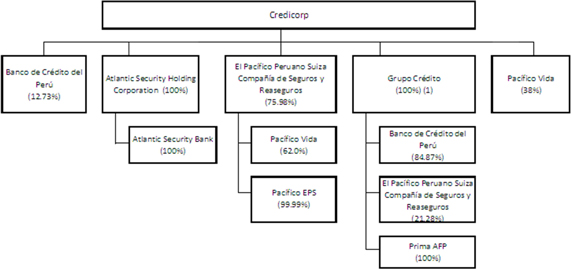
In October 2010 the Credicorp group acquired American Life Insurance Company (ALICO)’s 20.1% and 38% stakes in PPS and Pacifico Vida, respectively. Pacifico Vida's shares were acquired through Credicorp Ltd. and its subsidiary, Grupo Credito, acquired PPS's shares. Consequently, at the conclusion of this transaction, Credicorp and its subsidiary Grupo Credito held 97.26% of Pacifico Seguros, and jointly controlled 100% of Pacifico Vida. The total investment amounted to approximately US$174 million, making it the largest transaction ever completed in the Peruvian insurance market. The acquisition will permit the Credicorp group to realize synergies in its decision making process and through the integration of all its insurance business lines. The closer proximity between companies will also allow PPS to improve its value proposition to customers, who seek integral insurance solutions. On April 28, 2011, Credicorp transferred its 38% stake in Pacifico Vida to PPS. As a result of that transfer, PPS now directly owns 100% of the shares of Pacifico Vida. This transfer will have no effect on Credicorp’s consolidated financial statements.
In November 2010, Credicorp's Board of Directors approved the transfer of 84.9% of BCP´s total shares to Grupo Crédito S.A. (its Peruvian wholly owned subsidiary) through a capital contribution, in order to facilitate Credicorp's future investments in Peru without modifying the controlling structure of BCP. The transaction was authorized by the Peruvian Superintendency of Banking, Insurance and Private Pension Fund Administrators. Under the new structure, Credicorp directly holds 12.7% of BCP's total shares and, in conjunction with its subsidiary Grupo Crédito, continues to control the same 97.6% of such shares without modifying the internal governance structure. Before this change in ownership structure, dividends to Credicorp from its Peruvian subsidiaries, such as BCP, were remitted abroad and had to be remitted back to Peru when capital for new investments in the country were required. With the new structure, Grupo Crédito, which acts as the local holding for some of Credicorp's investments in Peru (Prima AFP, PPS and others), will manage Credicorp's future Peruvian investments, and directly transfer the dividends to Credicorp when it is required to do so under Credicorp's dividend policy. This modified organizational structure will not affect the way Credicorp and BCP manage their day-to-day operations, and Credicorp’s dividend policy has not changed as a result of this transaction
The following tables show our organization and the organization of our principal subsidiaries as of December 31, 2010 and their relative percentage contribution to our total assets, total revenues, net income and net equity at the same date (
see
“—(C) Organizational Structure”):
14
|
As of and for the Year ended December 31, 2010
(1)
|
|||||||||
|
Total Assets
|
Total Revenue
|
Net Income
(Loss)
|
Net Equity
|
||||||
|
Banco de Crédito del Perú
|
88.9% | 69.8% | 87.7% | 70.8% | |||||
|
Atlantic Security Holding Corporation
|
3.5% | 5.5% | 6.8% | 8.5% | |||||
|
El Pacífico-Peruano Suiza Compañía de Seguros y Reaseguros (2)
|
6.0% | 21.2% | 12.8% | 11.5% | |||||
|
Prima AFP
|
0.9% | 3.1% | 4.6% | 6.5% | |||||
|
Others (3)
|
0.6% | 0.3% | -11.9% | 2.7% | |||||
|
(1)
|
Percentages determined based on the Credicorp Consolidated Financial Statements.
|
|
(2)
|
Includes PPS and Pacífico Vida.
|
|
(3)
|
Includes Credicorp Ltd., CCR Inc., Credicorp Securities Inc. and others.
|
The following tables show the organization of BCP and its principal subsidiaries as of December 31, 2010

|
As of and for the Year ended December 31, 2010
(2)
|
|||||||||
|
Total
Assets
|
Total
Revenue
|
Net Income
(Loss)
|
Net
Equity
|
||||||
|
Banco de Crédito del Perú
|
92.2% | 88.4% | 84.6% | 79.0% | |||||
|
Banco de Crédito de Bolivia
|
4.4% | 4.2% | 4.2% | 4.8% | |||||
|
Empresa Financiera Edyficar S.A.
|
1.8% | 5.0% | 3.9% | 2.6% | |||||
|
Solución Empresa Administradora Hipotecaria S.A.
|
0.3% | 0.2% | 0.7% | 0.5% | |||||
|
Credifondo S.A.
|
0.1% | 1.6% | 4.6% | 1.3% | |||||
|
Credibolsa Sociedad Agente de Bolsa S.A.
|
0.1% | 0.3% | 0.8% | 0.8% | |||||
|
Others (3)
|
1.0% | 0.2% | 1.2% | 10.9% | |||||
|
(1)
|
We hold an additional 4.08% stake through Credicorp Ltd.
|
|
(2)
|
Percentages determined based on BCP’s consolidated financial statements as of and for the year ended December 31, 2010.
|
|
(3)
|
Includes Creditítulos S.A., Inmobiliaria BCP and others.
|
|
(B)
|
Business Overview
|
(1) Introduction – Review of 2010
General
We conduct our business operations through four different operating segments: Banking (which includes BCP, ASHC, BCB, Edyficar, and other minor financial subsidiaries), Insurance (which includes Pacífico Peruano Suiza and its subsidiaries), Pension funds (which includes Prima AFP), and Brokerage and other (which include principally Credifondo, Credibolsa, and others).
15
Primarily as a result of the strong recovery of the Peruvian economy in 2010, we recorded net income after minority interests of US$571.3 million, which was 21.6% higher than our net earnings in 2009. This result reflected the strong performance of all our subsidiaries.
Our total assets grew to US$28.4 billion as of December 31, 2010, a 29.1% increase from the US$22.0 billion in assets we held as of December 31, 2009. Our increase in total assets was a result of our loan growth. Loans grew by 24.2% in 2010 (compared to 9.9% in 2009, 27.8% in 2008 and 39.2% in 2007), following the expansion of the Peruvian economy, which had a GDP growth rate of 8.8% in 2010. Our past-due and under legal collection loan ratio decreased to 1.44% by the end of 2010 (compared to a ratio of 1.60% at the end of 2009 and 0.79% at the end of 2008). We had a coverage ratio of 198.0% (
i.e.
, reserves for loans as a percentage of past-due loans), and our return on average net equity decreased to 22.2% in 2010 (compared to 23.7% in 2009).
Banking segment
BCP
BCP’s year-end 2010 net profit totaled US$477.0 million, which resulted in a contribution to Credicorp of US$464.4 million. This earnings contribution was 19.5% higher than the 2009 contribution (US$388.5 million) and was a product of the resurgence in demand for loans caused by the expansion of the Peruvian economy. As a result, BCP registered an average return on net equity (ROE) of 26.1%.
The main drivers behind BCP’s performance were:
|
·
|
the 20.3% growth in its net interest income after provision for loan losses, which reflects the 14.9% expansion of interest income on loans and the moderate increase of 1.0% in interest expenses due to the adequate control and asset & liability management;
|
|
·
|
the 13.8% increase in other income mainly as a result of higher banking services commissions (+25.5%) and net gain on foreign exchange transactions (+17.2%), which offset the contraction of 49.5% in net gain on sales of securities that in 2009 was extraordinarily high due to the purchase-sale of sovereign and global bonds; and
|
|
·
|
the significant rise in translation gains from US$7.6 million in 2009 to US$23.3 million in 2010.
|
Performance in these areas enabled BCP to offset the company’s 6.5% increase in provisions and 14.3% increase in operating expenses. The higher operating expenses were a result of BCP’s salary, employee benefits and, to a lesser degree, administrative expenses. These higher operating expenses were exacerbated by the 2.8% appreciation of the Nuevo Sol against the U.S. dollar over the year, as a significant portion of BCP’s operating expenses are denominated in local currency.
BCP’s total assets reached US$25.3 billion at the end of 2010, representing an increase of 31.7% over the previous year (US$19.2 billion). This increase in total assets was a result of the 24.0% expansion of BCP’s loan portfolio, which totaled US$13.9 billion at the end of 2010. The loan portfolio constituted 54.9% of BCP’s total assets at the end of 2010. BCP’s total past-due loans reached US$209.1 million (13.8% higher than the US$183.8 million registered in 2009) while refinanced and restructured loans increased by 29.0%, from US$58.2 million in 2009 to US$76.7 million at the end of 2010. The composition of BCP’s loan portfolio in 2010 did not change significantly. As of December 2010, the average daily balances in our wholesale banking accounted for 58.0% of BCP’s total portfolio (compared to 57.2% in December 2009) and retail banking accounted for 42% (compared to 42.8% in December 2009).
The average daily balances of BCP’s wholesale banking loans grew by 27.7% in 2010 as a result of the revival of previously postponed corporate investment plans and the rising level of corporate inventories in Peru. As a result, BCP continued to lead the Peruvian financial system with a market share of 46.5% for the corporate segment and 34.1% for the middle market (higher than the 46.0% and 33.3% market shares obtained in 2009, respectively).
BCP’s retail banking portfolio continued its upward trend and grew 23.2% in 2010. In terms of growth and yields, BCP’s SME loans were its best performing product, growing by 30.1% (measured in average daily balances) to a total volume of US$2.2 billion, followed by mortgages which grew 21.6% to US$1.9 billion. Consumer loans grew 16.9% to US$972 million, while credit cards expanded 15.0%, totaling US$580 million.
On the liabilities side, BCP’s deposits reached US$17.1 billion on December 31, 2010 (a 18.0% increase from the previous year). This increase in deposits not only continues to reinforce BCP’s funding structure as deposits account for 71.1% of all funding sources, but it also serves to maintain BCP’s status as an industry leader with a market share of 34.4%. Time deposits continued to be BCP’s largest deposit type, totaling US$5.7 billion as of December 31, 2010. Demand deposits, BCP’s second-largest deposit type, reached US$5.3 billion. Savings deposits totaled US$4.2 billion while Severance Accounts, or CTS, totaled US$1.3 billion.
16
BCP’s bonds gained greater relevance within the funding structure. In 2010, BCP completed a successful issue of senior unsecured bonds for US$800 million with a term of 10 years at a rate of 5.375%, The issuance, which was oversubscribed, represented the first benchmark size issue in the history of BCP with ratings of Baa2 (Moodys) and BBB (Fitch rating). As of December 31, 2010, BCP’s bonds totaled US$1,974 million (60.6% higher than the level registered in 2009).
BCP maintains conservative provisioning and long-term risk management policies. Its coverage ratio increased from 192.3% in 2009 to 198.3% in 2010. Total cumulative provisions reached US$414.8 million as of December 31, 2010, which is 17.4% higher than provisions in the previous year.
In 2010, BCP continued to focus its strategy on strengthening its customer service, which is related to its goal of providing quality and widespread customer access to the financial system and thereby increasing the company’s penetration into the market. In following its network expansion plan, BCP focused on cost-efficient channels, opening ATMs and Agente BCP locations, which grew 16.4% and 25.4%, respectively. By the end of 2010, BCP had a total of 1,159 ATMs and 3,513 Agente BCP locations, which are BCP representatives located in retail establishments, such as grocery and drug stores. As a result of this strategy, BCP’s average number of transactions in 2010 increased 16.4% from 2009 and its transactional business was therefore able to generate higher income from fees and commissions.
Overall, BCP’s results met our expectations and remained profitable as the Peruvian economy expanded rapidly in 2010 after showing only mild growth in 2009.
BCB
In 2010, Banco de Crédito de Bolivia (BCB) had a net income of US$15.8 million, a 45% decline from its 2009 net income of US$28.7 million. This reduction was primarily attributable to the contraction of interest income, reductions in some fees and a 29% decline in translation gain, which resulted from a flat exchange rate throughout most of 2010. There were also some other constraints, including the restriction of foreign investments (50% of equity), limiting lending rates for loans from the productive sector and the increase in deposit rates for individual persons.
In 2010, BCB maintained its status as one of the top banks in Bolivia. In each of the following categories, the bank outperformed or equaled the industry average in the Bolivian banking system: return on equity (17%), past-due loan ratio (1.5%) and coverage ratio (272.6%) (as compared to industry averages of 17%, 2.2% and 220.7%, respectively).
BCB’s loan portfolio expanded by 27% from 2009, totaling US$582 million in 2010. This expansion was mainly due to a 28% growth in retail banking.
Although BCB made a positive contribution to our results in 2010, the country of Bolivia continues to experience a volatile political environment and shows evidence of an increasing inflation rate and a reduction in private investment activity.
Edyficar
The consolidation of Edyficar’s results into BCP’s financial statements resulted in a total contribution of US$22.1 million in 2010. As of December 31, 2010, Edyficar registered total assets of US$465.9 million which consisted of US$336.2 million from the company’s net loan portfolio, its main asset. Total liabilities increased to US$413.5 million, which included US$235.2 million from banking activities. Net shareholders’ equity reached US$52.4 million at the end of 2010.
Edyficar focuses on SME lending and, together with BCP, it held a 19.6% market share in terms of loans at the end of 2010 (compared to a market share of 15.6% held by its closest competitor). As of December 31, 2010, its client base registered 286, 000 clients, a base 34.3% larger than in 2009. The average amount of an Edyficar loan in 2010 was S/.3,502 (approximately US$1,247). Edyficar registered a PDL ratio of 4.0% at the end of 2010, a reflection if its portfolio quality. Edyficar reached a return on average equity of 47.1% and an efficiency ratio of 56.0%.
The acquisition of Edyficar was part of BCP’s strategy to capture most of the SME segment’s growth, which is expected to expand significantly over the next several years. BCP intends to support Edyficar’s growth and development by improving its funding cost and structure and providing the capital and technology that Edyficar needs.
ASHC
For the second consecutive year ASHC has achieved record profits. A high quality risk portfolio and diversified investment strategies resulted in higher earnings. The company’s net earnings for 2010 amounted to US$73.4 million, compared to US$54.1 million reported for 2009. As a result, the contribution of ASHC to Credicorp, net of dividends received, amounted to US$48.5 million, a significant improvement over the US$29.7 million reported in 2009.
17
Net income from interest in 2010 totaled US$62.3 million (including the US$24.9 million dividends received from Credicorp Ltd.), which represented an increase of 20% from the previous year. This rise in net income was primarily due to the company’s greater financial margin, which in turn was a result of the company’s lower funding cost (the 2010 cost was 20% below the cost in 2009). This lower funding cost reflected the steady decline of LIBOR rates during the year, a favorable scenario for the bank given the short-term structure of its customers’ deposits and their fast re-pricing, in contrast to assets engaged for longer terms and at higher interest rates. Non-financial income reached US$22.1 million and included income from fees, the sale of securities and foreign exchange operations.
ASHC’s total assets were US$1,400.8 million as of December 31, 2010, a decrease of 5% from 2009. This decrease in total assets was primarily a result of use of funds to cover withdrawals from customers to invest directly in securities and products that are managed by ASHC.
Finally, at the end of 2010, assets under ASHC’s management totaled US$3,177 million, compared to US$2,177 million in 2009. This growth was primarily a result of increases in our customers’ global positions and the market value of our portfolio that followed the larger recovery in global financial markets.
Insurance segment
PPS
In 2010, PPS, which encompasses Pacífico Seguros, Pacífico Vida and Pacífico Salud EPS, reported a net income of US$55.5 million (compared to US$49.2 million net income in 2009). As a result, the contribution we received from PPS increased, from a gain of US$37.4 million in 2009 to a gain of US$47.4 million in 2010. This record high contribution from PPS was primarily attributable to an increase in financial revenues of 21.8% and a reduction in the claims rate of property and casualty lines of Pacifico Seguros, a rate which dropped from 53.1% to 50.5%.
PPS’s underwriting result in 2010, which reflects the company’s core business performance for the year, was US$93.4 million, increasing 17% compared to 2009. This improved result followed a reduction in the overall claims rate, which decreased from 65.2% in 2009 to 63.6% in 2010, and was the product of improvements that PPS implemented over the last several years through underwriting management and operating controls.
In 2011, PPS will continue to focus on its retail business by developing simple products that introduce new segments to the benefits of insurance and by expanding its presence in national provinces. There is enormous growth potential in Peru’s insurance market, given the industry’s weak market penetration. Efficiency and risk management will continue to be key indicators in measuring PPS’s performance. Efficiently utilizing the BCP network is an essential component of PPS’s growth strategy for 2011 since capitalizing on synergies between the insurance business and the distribution channels of the banking business may lead PPS to greater penetration in the insurance market.
Pension fund segment
Prima AFP
During 2010, the progress of the Peruvian economy generated good results for the Private Pension System (SPP), achieving growth in new affiliates, number of contributors, value of assets under management and collections during the year. These favorable economic conditions, together with the reduced uncertainty in financial markets lifted by the global recovery, led to an increase in the value of funds under SPP’s management, which reached US$31.0 billion as of December 2010 and represented a 29.7% year-over-year increase.
Prima AFP was able to strengthen its position in the market by adjusting its processes and organization to provide high-quality services and timely and transparent information to its clients. As a result, the contribution we received from Prima AFP in 2010 reached US$25.5 million, as compared to US$20.8 million in 2009.
Funds under management at Prima AFP increased 33.3% from US$7.3 billion in 2009 to US$9.7 billion as of December 2010. By year-end 2010, Prima AFP’s market share of total funds under management was 31.4%, representing a year-over-year increase and making Prima AFP the largest pension fund management company in Peru.
Prima AFP’s revenues from commissions in 2010 reached US$85.2 million, an 8.1% increase from 2009. This improvement in performance was a result of a stable and improved portfolio of contributing members. Revenues in 2010, unlike those in 2009, included 12 rather than 13 contribution periods because the Peruvian government exempted affiliates from deductions on additional salaries that had to be paid in July and December under Peruvian labor law.
To improve its operating results, Prima AFP will continue to focus on increasing efficiency and reducing costs. Emphasis will also be placed on improving Prima AFP’s long-term stability through better risk management, one of the company’s highest priorities
18
Brokerage and others
The majority of our brokerage activities are conducted through BCP, ASHC and Credicorp Securities Inc., which is one of our wholly-owned subsidiaries. Credicorp Securities is a U.S. registered broker-dealer with its offices in Miami. BCP offers clients a wide range of brokerage products and services, including mutual funds and custody services through its branch network in Lima and, on a more limited basis, throughout the rest of Peru. In addition, we also distribute such products through ASHC.
In 2010 our brokerage activities represented 1.8% of the total consolidated income and 1.7% of total consolidated assets.
Consolidated Contributions
The following table sets forth the contribution to the consolidated net income attributable to our equity holders by each of our principal subsidiaries:
|
2008
|
2009
|
2010
|
Variation
2010/2009
|
||||||
|
(U.S. Dollars in millions, except percentages)
|
|||||||||
|
BCP (1)
|
410.9 | 388.5 | 464.4 | 20% | |||||
|
ASCH
|
(50.4) | 29.7 | 48.8 | 64% | |||||
|
PPS
|
(15.9) | 37.4 | 47.5 | 27% | |||||
|
PRIMA AFP and others (2)
|
13.2 | 14.2 | 10.6 | -25% | |||||
|
Total
|
357.8 | 469.8 | 571.3 | 22% | |||||
|
(1)
|
Includes Banco de Crédito de Bolivia, which contributed US$15.8 million in 2010, US$30.3 million in 2009 and US$42.9 million in 2008; and Edyficar, which contributed US$21.5 million in 2010 and US$1.1 million in 2009 (BCP acquired Edyficar in October 2009).
|
|
(2)
|
Includes Prima AFP (which recorded a net income of US$25.5 million in 2010, US$20.8 million in 2009 and US$11.2 million in 2008), Credicorp Securities, Credicorp Ltd. (which mainly includes expenses and the tax withheld in connection with the estimation of the dividends to be distributed to us by our Peruvian subsidiaries (BCP and PPS)) and others.
|
(2) Strategy
Credicorp was established to create a financial group that would benefit from the synergies among the group’s companies and would become a leader within each business market in which the companies operate. In moving steadily toward achieving these strategic goals, we have become a leading financial group. However, we do not operate in a static environment and the last three years have demonstrated how quickly and dramatically the world can change. Peru’s economic growth slowed significantly in 2009 as a result of the international recession and we took steps toward improving our long-term sustainability and positioned our companies for growth as Peru’s needs evolve. In 2010 Peru’s economy returned to the dynamism it showed in the pre-crisis period and we continued, and completed in many cases, the implementation of various initiatives that were designed to ensure the sustainability of Credicorp’s business segments.
The Peruvian market offers one of the greatest growth opportunities in South America. In the banking, insurance and pension fund industries, market penetration by service providers remains low. Accordingly, our business plans incorporate strategies that will enable us to reach underserved segments of the Peruvian population and achieve higher returns on our capital. As our businesses expand, it becomes increasingly important for us to maximize efficiencies and control risk. Our strength in these areas is the cornerstone of our strategy to achieve healthy, sustained and profitable growth.
The growth strategies we have adopted for each of our companies contain a focus on retail markets. Using our collective resources, we are developing information systems that can collect commercial sales information and provide us with the data we need to process scoring models by segment. This will enhance our ability to assess and control risk.
We also continue to make strides toward greater integration of our companies by more extensively sharing our talents and experience.
Outlook for 2011
We expect that the favorable economic conditions in Peru that characterized 2010 will remain in 2011. Throughout the year, we will continue to take a development-oriented approach, preparing for changes in the Peruvian market, which is expected to have high growth rates in the upcoming years. Given the low levels of penetration in Peru’s banking and insurance markets, our subsidiaries will be well positioned to expand. Our high equity, sound levels of technical and professional expertise, and strong relationships built on the trust of our customers, are all signals indicating a positive outlook for the Company.
19
(3) Credicorp Operating Segments
Banking
The majority of our banking business is carried out through BCP, which is our largest subsidiary and the oldest bank in Peru. A portion of our banking business is also carried out by ASB, which principally serves Peruvian private banking customers through offices in Panama. We conduct banking activities in Bolivia through BCB, a full service commercial bank and the fourth largest Bolivian bank in terms of loans and deposits, with 12.1% and 13.4% market share, respectively.
Our banking business is organized into wholesale banking activities, which are carried out by BCP’s wholesale banking group (which includes the corporate banking operations of ASB), and retail banking activities, which are carried out by BCP’s retail banking group. To increase our visibility and raise our market share in the retail banking industry, BCP bought Edyficar, which is a scaled, high-growth and highly profitable microfinance business. Edyficar has a solid risk management strategy and a proven track record in both loan portfolio growth and social impact. The company provides financial services for low-income micro-entrepreneurs and unbanked communities.
We apply uniform credit policies and approval and review procedures, which are based on conservative criteria adopted by BCP, to all of BCP’s subsidiaries. Our general manager is in charge of setting the general credit policies for our different business areas. These policies are set within the guidelines established by Peruvian financial sector laws and SBS regulations (
See
“(11) Supervision and Regulation—(ii) BCP”) and the guidelines set forth by our Board of Directors.
Our deposit-taking operations are principally managed by BCP’s retail banking group and ASHC’s private banking group.
See
“(12) Selected Statistical Information—(iv) Deposits.”
Insurance
We conduct our insurance operations exclusively through PPS and its subsidiaries, which provide a broad range of insurance products. PPS focuses on three business areas, general insurance through Pacífico Seguros, life and pension insurance through Pacífico Vida, and health care insurance through Pacífico Salud EPS. PPS, like other major Peruvian insurance companies, sells its products both directly and through independent brokers and agents. Directly written policies tend to be for large commercial clients, as well as for life and health insurance lines.
Pension funds, brokerage and others
The majority of our trading and brokerage activities are conducted through BCP, ASB and Credicorp Securities Inc. (also referred to as Credicorp Securities), which is one of our wholly-owned subsidiaries. Credicorp Securities is a U.S. registered broker-dealer with its offices in Miami. Our asset management business is carried out by BCP in Peru, through its subsidiary Credifondo, by ASHC and by Prima AFP, the pension fund administrator.
We offer Brokerage and other services through BCP and ASB. BCP offers clients a wide range of such products and services, such as brokerage, mutual funds and custody services through its branch network in Lima and, on a more limited basis, throughout the rest of Peru. In addition, we also distribute such products through ASB.
In the last few years, we have consolidated an important line of business, asset management, for our customers. As of December 31, 2010 our assets under management totaled US$15.7 billion, an increase of 41.7% from 2009, which was mainly due to the market recovery after a drastic drop in the market values of securities caused by the international financial crisis. The majority of our asset management business is performed through our subsidiary, Prima AFP whose funds under management (private pension funds) totaled US$9,765 million at the end of 2010.
Mutual funds represent another important contributor to our asset management business, carried out through BCP’s mutual funds subsidiary, Credifondo Sociedad Administradora de Fondos Mutuos (or Credifondo). Credifondo leads the Peruvian market with a share of 42.4% of the total assets currently under management. Finally, BCP’s affiliate, Atlantic Security Bank, offers the international mutual funds and financial advisory services to BCP’s private banking customers.
We established a corporate supervision project entitled “Asset Management” due to the size of these businesses, the importance of the commissions they generate and, above all, the fiduciary responsibility they entail. The main objectives of the project are to establish homogeneous risk control and investment policies based on best international practices. The Asset Management business has four main components:
|
|
•
|
Portfolio Management:
We seek to consolidate the good performance of our portfolios and funds through strict risk control and an appropriate level of diversification. To achieve this, we focus on improving three key aspects: investment policies, investment processes and management metrics.
|
20
|
|
•
|
Financial Management:
We focus on providing quality financial advisory services, building customer loyalty, and encouraging customers to invest in a diverse combination of securities according to their risk profile. Our objective is to improve the standards of the advisory services that our commercial bank offers and to distinguish between the levels of advisory services provided to different sectors.
|
|
|
•
|
Brokerage:
We attempt to provide a timely and high quality service, offering competitive execution costs, channeling a greater proportion of the assets traded by our companies to profitable investments and identifying opportunities for joint action (resulting in better prices), in addition to improving controls aimed at avoiding possible conflicts of interest.
|
|
|
•
|
Risk Analysis:
We seek to identify, quantify, regulate and, ultimately, minimize the risks associated with operations, credit, market, liquidity, legal contingencies, conflict of interests and other risks. Another objective of our risk analysis is setting corporate investment limits, creating a portfolio investments risk manual, and ensuring strict compliance with risk control rules.
|
(4) BCP and Subsidiaries
(i) General
BCP’s activities include commercial banking, investment banking and retail banking. As of December 31, 2010, the consolidated operations of BCP ranked first among Peruvian banks in terms of total assets (US$25.3 billion), total loans (US$13.9 billion), deposits (US$17.1 billion) and net equity (US$2.0 billion). At the end of 2010, BCP’s loans, on an unconsolidated basis, represented approximately 33.6% of the total Peruvian banking system (higher than the 33.4% registered at the end of 2009) and BCP’s deposits represented approximately 36.3% of the total Peruvian banking system (above the 34.2% reported at the end of 2009).
As of December 31, 2010, BCP had the largest branch network of any commercial bank in Peru with 329 branches. BCP also operates an agency in Miami and a branch in Panama. In addition, as of December 31, 2010, Edyficar had 101 offices through which it serves its clients.
As of and for the year ended December 31, 2010, BCP accounted for 69.8% of our total assets, 87.7% of our net income and 70.8% of our net equity. BCP’s operations are supervised and regulated by the SBS and the Central Bank.
BCP groups its client base according to the following criteria:
|
Client Segmentation
|
||
|
Group
|
Sales
(US$MM)
|
|
|
Micro-business
|
Up to 0.5 or total debt of 0.2
|
|
|
Small Business
|
From 0.5 to 6.6 or total debt of 1.0
|
|
|
Middle market
|
From 6.7 to 50
|
|
|
Corporate
|
Higher than 50
|
|
The grouping was a result of an analysis which addressed factors beyond the simple size and volume of activity for each client, such as clients’ affiliation with other companies or groups, the degree of follow-up required, and their credit ratings.
Subsidiaries
BCP’s corporate structure consists of a group of local subsidiaries offering specialized financial services, which complement BCP’s commercial banking activities. In addition to its local subsidiaries, BCP has an agency in Miami, a branch in Panama and a subsidiary in Bolivia.
BCP and its principal subsidiaries as of December 31, 2010 are as follows:
|
|
•
|
Banco de Crédito de Bolivia, or BCB, is BCP’s commercial bank in Bolivia. BCP owns 95.92% of BCB and we hold the remaining interest. Currently, BCB is the fourth largest bank in Bolivia in terms of deposits and loans market share and has a network of 66 offices located throughout Bolivia. BCB owns one of Bolivia’s largest brokerage houses, Credibolsa S.A. Agente de Bolsa, and this subsidiary owns Credifondo SAFI Bolivia, a mutual fund administrator company. BCP targets middle- and small-sized clients and offers a broad range of corporate, personal banking and leasing products. BCB’s results are consolidated in BCP’s financial statements.
|
21
|
|
•
|
Empresa Financiera Edyficar S.A. was acquired in October 2009 and is 99.78% owned by BCP. It is engaged in micro finance in Peru.
|
|
|
•
|
Credibolsa Sociedad Agente de Bolsa, or Credibolsa, was established in June 1991 and is 100% owned by BCP. It is engaged in portfolio advisory and brokerage activities in the Lima Stock Exchange.
|
|
|
•
|
Credifondo Sociedad Administradora de Fondos Mutuos, or Credifondo, is a mutual fund management company that was established in 1994. Credifondo is 100% owned by BCP.
|
|
|
•
|
Creditítulos S.A., or Creditítulos was established in 1997 and is 100% owned by BCP. Creditítulos serves as an asset securitization entity.
|
|
|
•
|
Inmobiliaria BCP is the real estate subsidiary of BCP. It manages and promotes the sale of real estate that has been foreclosed or received in payment by BCP. Inmobiliaria BCP is 100% owned by BCP.
|
|
|
•
|
Solución Empresa Administradora Hipotecaria S.A. was established in 1979 under the name Solución Financiera de Crédito del Perú S.A. and is 100% owned by BCP. Its business includes mortgage lending, consumer lending and SME financing. In the company’s shareholders meeting on November 19, 2009, Solución Financiera de Crédito del Perú S.A.’s shareholders decided to change the company from a finance company to a mortgage administrator company and to change the company’s name to Solución Empresa Administradora Hipotecaria S.A. These changes were necessary because, according to Peruvian Law, no person is allowed to be the owner of two financial institutions of the same type. As a result, the company will primarily engage in the administration of mortgage portfolios. These changes were approved by the SBS through resolution
SBS 47-2010
on May 21, 2010.
|
(ii) Wholesale Banking Group
BCP’s wholesale banking group (Wholesale Banking Group), which competes with local and foreign banks, has traditionally represented the majority of BCP’s loans. BCP’s traditional relationships provide its Wholesale Banking Group with a competitive advantage.
BCP’s Wholesale Banking Group maintained its positive trend in loan placements, posting average portfolio levels of US$6,981million (19% higher than in 2009). It also maintained its leadership in the wholesale banking market with a 40.7% stake in placements. BCP has the largest capital base among Peruvian banks, which provides it with more resources to meet the financing needs of its corporate clients. BCP has established longstanding client relationships with virtually all of the major industrial and commercial groups in Peru. The Wholesale Banking Group provides its customers with short- and medium-term loans in local and foreign currencies, foreign trade-related financing and lease financing.
The Wholesale Banking Group is divided into the following areas:
|
|
•
|
Corporate Banking, which provides loans and other credit services to companies with annual revenues in excess of US$50 million;
|
|
|
•
|
Middle Market Banking, which serves mid-sized companies;
|
|
|
•
|
Institutional Banking, which focuses principally on serving profit and non-profit organizations, state-owned companies and other major institutions;
|
|
|
•
|
International Banking and leasing, which manages BCP’s relationship with financial institutions locally and abroad, trade products, international operations services and financial leasing products;
|
|
|
•
|
Corporate Finance, which provides underwriting and financial advisory services to corporate and middle market clients; and
|
|
|
•
|
Business Services, which develops transactional services.
|
Net interest income from the wholesale banking sector reached US$138 million in 2010 (compared to US$146 million in 2009). The results of 2009 reflected the higher interest rates associated with the risk to lend to customers during the financial crisis; however substantial economic activity in 2010 promoted competition and drove the market to charge lower interest rates in comparison to 2009 and resulted in a reduction of our income.
22
Corporate Banking
BCP continued to meet the needs of its corporate clients, helping them with short- and medium-term financing. As a result, BCP’s direct credits grew from US$4,058 million to US$5,155 million, and income from financial services increased 16%, from US$57 million to US$66 million. These increases, coupled with a very low default ratio (less than 0.1%), enabled the Corporate Banking Area to meet its financial targets with a net profit US$70 million, a decrease of 25% over the US$94 million achieved in 2009.
Client Profile:
The Corporate Banking Area is focused on serving large-sized companies that have an annual turnover of over US$50 million, audited financial statements and dominant market positions in their particular products or brands. Even if they do not meet the above criteria, BCP may classify other firms in this category if they belong to very large economic groups from industries that are important to the country’s economy.
Products:
The Corporate Banking Area offers a broad range of products and tailors its product offerings to meet each client’s unique requirements. In general, this area is expected to offer high-value-added products and services, particularly cash management services, at competitive prices.
The majority the Corporate Banking Area’s financing is provided to fund sales, international trade and inventories. In general, the Corporate Banking Area grants short-term financing. However, it can provide longer term financing for companies in need of financing capital expenditures and fixed assets, among other purposes. The Area also offers term financing (in all cases backed by real guarantees), financial leasing, factoring, and domestic collections and nationwide fund transfers.
Additionally, Corporate Banking clients can obtain investment banking, advisory and financing services through the Corporate Finance Area, which operates as part of the Wholesale Banking Group and also serves major middle market clients.
Guarantees received by this area consist of (i) receivables in the case of sales financing, (ii) warrants or pledges on inventory in the case of inventory financing and (iii) real guarantees, in the case of financing for fixed asset acquisitions and improvements to their infrastructure.
There is a limited growth prospect in this business due to high market penetration (46.5%) and competition from capital markets in loans.
Middle Market Banking
BCP’s middle market banking area provides banking services tailored to medium-sized companies located in a variety of markets. The products offered to middle market clients resemble those offered to corporate banking clients. The three major types of products are:
|
|
•
|
Revolving credit lines to finance inventories and sales, as well as stand-by letters of credit and international trade financing;
|
|
|
•
|
Financing for short-term requirements such as current account credits and temporary account advances (overdrafts); and
|
|
|
•
|
Financing for medium and long-term requirements using intermediation resources (term deposits) and various types of financial leasing financing.
|
BCP has identified several opportunities to engage middle market companies, particularly in Peru’s manufacturing, wholesale, retail, fishing and construction industries, where special emphasis has been placed and specific task areas have been created to attend to the needs of these economic groups. BCP has a middle market client portfolio of approximately 7,000 companies, including 1,118 economic groups. Generally, these clients are not listed on the stock exchange but, in some cases, are capable of issuing financial obligations or commercial papers. Their financial information is reliable and audited. These companies are typically family-controlled but professionally managed.
Since 2009, the middle market banking area revised its customer segmentation policies. The area now includes established (but growing) companies that will eventually become part of our corporate segment, traditional mid-size companies and a group of growing small cap companies. In selecting which small companies are best suited for service by our middle market banking area, we consider a mix of different characteristics; such as annual revenues, financial leverage, overall debt and product penetration and complexity. BCP’s middle market customers are distributed among nine regional managers nationwide and have annual revenues that vary from US$1.5 million to US$50 million.
Since 2009, the middle market banking area made significant progress toward implementing its strategic goals by:
|
|
•
|
Creating hubs to meet the needs of its customers more efficiently
|
23
|
•
|
BCP opening a a customer redistribution hub in Lima, where a new business area was created;
|
|
|
•
|
Streamlining its lending process to provide middle market customers with prompt service;
|
|
|
•
|
Introducing new electronic financial products to make its services more accessible to customers;
|
|
|
•
|
Incorporating sophisticated technical tools that assist it in analyzing risk-based pricing and profitability; and
|
|
|
•
|
Focusing on risk based financial services revenues, which account for 50% of the total income generated by the middle market banking area.
|
According to internal reports, in 2010 net income from the middle market banking area decreased to US$59 million. This was the result of the more competitive interest rates that emerged as the economy grew. The middle market area’s annual average loan portfolio had 33.1% of market share, (US$2,373 million), making BCP the leading bank in its segment.
Because of their size, middle market companies in Peru generally do not have access to the local or international capital markets or to credit from foreign banks. In addition, we believe that middle market companies have benefited significantly from the overall economic improvements in Peru over the past few years. Loan quality problems have been addressed through procedures and organizational changes that have focused on improving the loan approval and credit-risk assessment processes.
Institutional Banking
BCP’s Institutional Banking Area serves for-profit and non-profit organizations, including 800 clients in Lima and 300 clients in provinces. In Lima, a specialized team in wholesale banking serves governmental entities, educational institutions, religious organizations, international bodies, non-governmental organizations, and microfinance institutions. In provinces, a specialized remote wholesale banking team partners with BCP’s retail banking area to serve clients.
The annual average deposit amount in BCP’s Institutional Banking Area (Lima and Provinces) reached US$2.0 billion in 2010. The Institutional Banking Area is strategically important because of the opportunities its clients present for generating income from fees and cross-selling opportunities. BCP’s strategy in this area is focused on building customer loyalty by offering customized services at competitive rates and providing outstanding service quality. The institutional banking clients mainly require remote office banking, collections and automated payroll payment services.
International Banking
This area of BCP’s business jointly the company’s international banking activities and recently (since June 2010) assumed the supervision of all leasing activities of the Bank.
The international banking unit focuses on providing short-term credit for international trade, which is funded with internal resources or with credit lines from foreign banks and institutions. Medium-term lines of credit funded by international commercial banks and other countries’ governmental institutions are also provided to clients. In addition, this unit earns fees by confirming guarantees issued by international banks and other fees as a result of the international payment business. The international banking unit also promotes international trade activities with its local clients by structuring trade products and services, establishing conferences and assessing customers through a wide range of trade products.
Since September 2008 the international banking unit has also been supervising the trade back office unit (International Operations). BCP maintains business relations with correspondent banks, development banks, multilateral and export credit agencies in countries around the world. At present, BCP manages credit lines for foreign trade transactions, working capital and medium- and long-term investment projects.
The international market volatility during 2009 affected Peruvian trade volume, which fell 30% compared to volume in 2008. Volume of trade managed by BCP was similarly affected and its fee income dropped 12.1%. Although trade volume declined, BCP’s trade market share increased from 36.5% to 41.5% due to a shift in the usage of trade tools from “open account” to “guarantees”, where BCP is a recognized leader.
According to the Superintendencia Nacional de Aduanas (SUNAT), in 2010 Peruvian exports increased 31.2% to US$35.1 billion (compared to US$26.7 billion in 2009). This result was principally due to a growth in commodities exports (gold, copper, zinc and lead). During the same year (based on BCP’s internal report), BCP’s exports volume increased 42.9% to US$16.6 billion (compared to US$11.6 billion in 2009), which amounted to 47.3% of total Peruvian exports.
Total Peruvian imports were US$29.9 billion in 2010, increasing 37.0% from US$21.8 billion in 2009, which was primarily due to a higher demand for capital goods (industry, construction and transportation), raw materials for industry, and consumer goods. BCP’s import letters of credit, collections and transfers amounted to US$9.4 billion in 2010, increasing 44.1 % from US$6.5 billion in 2009, which amounted to 31.5% of total Peruvian imports.
24
BCP has a direct presence abroad through its agency in Miami and its branch in Panama. It has access to a wide network of foreign correspondent banks and can offer several internationally competitive products to its customers.
BCP has correspondent banking relationships and uncommitted credit lines with more than 80 banks for foreign trade operations, financing of working capital and medium- and long-term investment projects. At the same time BCP has been approaching the banking market to fund medium-term needs through the usage of syndicate loans structured by different international banks.
In line with trade trends, China has become the second largest trade partner for Peru. In light of China’s growing influence, BCP has visited several banks and corporations in China to explore possible alternatives to intermediate trade flows, assess to Peruvian exporters and importers and Chinese investment in Peru through direct investment and trade development. In order to support this business, during 2010 BCP signed several memoranda of understanding with China’s most important financial institutions and opened an RMB account with a Chinese financial institution.
During 2010, Peru had a very active leasing market. BCP, has consolidated the leasing activities developed by the bank. BCP ended 2009 with US$2 billion outstanding in this product area and 35.6% of the market share in Peru. Leasing as a way of financing became a more important tool for Peruvian companies over the course of the last year, growing from US$5.6 billion on December 31, 2009 to US$6.4 billion on December 31, 2010. BCP ended 2010 with a larger market share, 38.8%, reaching US$2.5 billion outstanding.
The leasing business growth we experienced in 2010 was a product of increased investment activity in the energy, mining, communications and transport industries. As the Peruvian economy has expanded the appetite of private investors for these kinds of investments has made leasing attractive because it carries tax benefits superior to those available through traditional sources. Other activities like car sales and machinery are also contributing to the growth of this product.
Corporate Finance
BCP’s Corporate Finance Area is a leading advisor to corporate, middle market and institutional clients in Peru. Our Corporate Finance team composed of over 25 executives based in Peru is the largest team of its kind in the marketplace. BCP’s Corporate Finance Area provides a wide range of investment banking and corporate finance advisory services, including structured financings, capital raisings, initial public offerings, mergers and acquisitions and corporate restructurings. In 2010, the Corporate Finance Area participated in over US$2,500 million of structured transactions, which involved financing through both the local capital market and the banking system. BCP’s Corporate Finance team is ranked first in the 2010 local debt capital market league tables having placed over US$500 million in debt instruments, which accounts for 44% of the local debt capital markets primary offers-. The main projects in 2010 included:
|
|
•
|
A leasing arrangement of US$310 million for EnerSur to finance its combined cycle add-on project for ChilcaUno power generation plant. This was the largest leasing transaction that has been structured and paid by a local bank;
|
|
|
•
|
The arrangement and placement of Transportadora de Gas del Perú and Pluspetrol Lote- 56’s corporate bonds for US$150 million and US$130 million respectively. Funds from this placement were used to finance the Camisea Project expansion.
|
|
|
•
|
Medium term loan arrangements of US$35 million and US$50 million for Concesionaria Vial del Perú and Autopista del Norte to finance Peruvian roads concessions.
|
|
|
•
|
Medium term loan arrangement of US$70 million for Consorcio Transmantaro to finance the construction of Chilca-La Planicie-Zapallal transmission line and the reinforcement of Mantaro-Socabaya transmission line.
|
|
•
|
A syndicated term loan of US$190 million for SN Power Perú to refinance financial liabilities and partially finance the equity for Project Cheves, a 168 MW hydroelectric power plant.
|
|
•
|
Advisory and valuation services for Credicorp during the acquisition of ALICO’s shares of Pacifico Peruano Suiza and Pacifico Vida.
|
|
•
|
A syndicated term loan of US$200 million for Gold Fields La Cima.
|
During 2010, the Corporate Finance Area generated income in excess of US$19.0 million from structuring, advisory and issuance fees.
25
Business Services
Our business services unit is in charge of developing transactional services that handle the exchange of information among and money transfers to corporations, midsize companies, institutions and micro-business companies. This unit is responsible for both the development and marketing of transactional (or “cash management”) services for our corporate and institutional clients. We offer more than 30 products aimed at strengthening ties with clients and assuring their loyalty, as well as reducing costs using electronic channels and increasing fee income. Services managed by this unit include collections (automated trade bill collection and electronic factoring), automated payments (direct credits to personnel and suppliers’ accounts and money transfers), electronic office banking and cash management through checking accounts with special features.
During 2010, transactional services continued to be an important contributor to our earnings. The monthly average of the number of current accounts increased 7.9% and fee revenue increased 10.2% compared to 2009. This improvement is the result of growth in the SME segment. Main collection services also increased: letters and companies’ collections commissions rose 12.6% and 24.8%, respectively, from 2009. Our strategic decision to offer value to our clients through the implementation of a more efficient service mechanism explained part of this improvement. In addition, the higher demand by clients for the remote banking service “Telecredito” generated, in terms of number of transactions, a growth of 14.5% compared to 2009. Tax collections also grew 13.5%. Likewise, the transaction volume generated by electronic factoring increased 79.9% in 2010.
(iii) Retail Banking Group
According to BCP’s internal reports, by the end of 2010, retail banking-related loans represented 40% of BCP’s total loans, while retail banking-related deposits accounted for 52% of BCP’s total deposits. Retail income from fees constituted 62% of BCP’s total income from fees.
Between 2006 and 2007, the Retail Banking Group’s loan volumes increased by 45%, reaching US$2,898 million. During 2008, loans grew again by 28%, reaching US$3,694 million. Throughout 2009, loan balances grew by US$657 million reaching US$4,351 million. In 2010 loan balances reached US$5,322 million, growing almost US$1,000 million. This growth was a result of strong consumer lending, which includes installment loans and credit cards, home mortgages and small and micro business loans. With respect to deposits, BCP’s retail banking-related deposits has also shown constant growth. Deposits grew by 29% between 2006 and 2007, US$1,052 million in 2008, US$691 million during 2009 and US$1,247 million in 2010, reaching a total of US$9,066 million by the end of the year.
With the segmentation of its retail client base, BCP is able to focus on cross-selling its products and improving per-client profitability. The Retail Banking Group has undertaken several projects to improve one-on-one marketing techniques and tools for the sale of its products to all market segments. BCP’s management expects the retail banking business to continue being one of the principal growth areas for BCP’s lending activities.
BCP’s retail banking serves individuals and small-sized companies with annual sales levels of up to US$6.7 million. BCP’s objective is to establish profitable long-term relationships with its broad client base, using segmentation strategies that satisfy the specific needs of each type of client. BCP’s retail distribution strategy changed at the beginning of 2007, when BCP started using the branch network as the center for all transactional and commercial activities. BCP now has a commercial division, in charge of most direct sales forces and the branches, which in turn are organized on a geographic level. Each branch is responsible for servicing and selling products to three customers groups: affluent, small business and consumer. In addition, each branch manager is responsible for overseeing the different channels offered within the branch, such as account managers, customer service representatives and tellers. Telemarketing, mid size business banking and real estate developer financing are not managed directly by local branches because of the specialty level and high growth potential associated with these products.
During 2008, BCP saw an unprecedented investment in infrastructure and human resources to support its “banking the unbanked” strategy. As a result, in 2008 and 2009, BCP experienced an explosive growth in its various channels, including 1,580 new customer contact locations (59 branches, 247 ATMs and 1,580 Agentes BCP). Demonstrating its leadership in attracting new customers, BCP now services over three and one half million customers with its network of 327 branch offices, 1,159 ATMs and 3,513 Agentes BCP (these figures do not include the customer contact locations under Edyficar’s management, which are counted separately).
Affluent Banking
Affluent customers are crucial to BCP because of their high loan and deposit volume and their attractive profitability. They receive a differentiated value plan which includes: (i) access to innovative products, (ii) dedicated customer services channels such as specialized account managers and/or expert phone banking, (iii) preferential service by tellers at the branches and (iv) special interest rates on loans. BCP’s affluent customers, totaling about 162,000, must have a good credit record and at least US$20,000 in outstanding loans in BCP or a minimum US$40,000 balance in deposits with BCP. Approximately 100,000 of the most profitable affluent clients are serviced through specialized accounts managers responsible for improving per-client profitability and achieving long-term relationships through personalized service, cross-selling and share of wallet strategies. Account managers are also responsible for new customer acquisition, particularly through mortgage loans. The affluent banking segment is very profitable, generating 45% of the retail banking group’s revenue while managing 5% of the total customer base, 44% of retail group’s loan volume and 35% of its deposit volume.
26
Small Business Banking
BCP’s small business segment accounts for 359,000 clients. Customers are divided into three groups with different business models, services levels, and products access. The first group is top-end small business banking, which serves approximately 10,000 clients with annual sales between US$0.5 and US$6.7 million. The next group of 248,000 small business clients has annual sales up to US$0.5 million and has debt, and the third group of approximately 100,000 clients consists of very small business customers who have only deposit products.
According to BCP’s internal reports, the Small Business Banking loan portfolio grew from US$1,006 million in 2007 to US$1,345 million in 2008 and then to US$1,546 million in 2009. By the end of 2010 the loan portfolio was US$1,984 million. In terms of deposits, this group increased deposits from US$1,027 million in 2007 to US$1,463 million in 2008 and then to US$1,637 million by 2009. In 2010 deposits grew to US$1,860 million.
Edyficar also serves the microfinance segment, and as of December 31, 2010, it registered 285,781 clients with a total loan portfolio equivalent to US$356 million, which represented an increase of 43% compared to the level registered at the end of 2009. As of December 31, 2010, Edyficar had a client market share of 7.32%, making it fourth in terms of market share within the microfinance segment. The aggregate market share of Edyficar and BCP in the microfinance segment totaled 15.69% at the end of 2010, and combined, they have the highest market share in the microfinance segment.
Consumer Banking
Consumer banking is in charge of developing strategies for the retail customers not included in affluent banking or small business banking. Its customer base is approximately 3 million medium to low income individuals. Consumer banking focuses its attention on customers who receive their payroll through BCP (which represents slightly more than 0.9 million clients). Its strategies vary from basic acquisition of new accounts for wage-earners with special terms regarding fees and interest rates, to more sophisticated, aggressive cross-sell and retention programs that expand benefits to non-banking products (i.e., access to discounted products) and access to payroll advances. BCP has continued excelling in expanding its debit card as a form of payment, maintaining more than half of the market share in withdrawals and payments with debit cards, which is a year-to-year increase of 471,000 cards. BCP concluded 2010 with more than 3.2 million cards.
Mortgage Lending
As of December 31, 2010, BCP was the largest mortgage lender in Peru with a market share of 34.45% of total mortgage loans in the Peruvian banking system. This was largely the result of BCP’s extensive marketing campaigns and its improvements in the quality of procedures for extending credit and establishing guarantees.
BCP expects the mortgage lending business to continue to grow because of:
|
·
|
low levels of penetration in the financial market,
|
|
·
|
increasing demand for housing,
|
|
·
|
the availability of funds for the Peruvian government’s MiVivienda low-income housing program and
|
|
·
|
the current economic outlook for controlled inflation and economic growth in Peru.
|
BCP had US$1,905 million in outstanding mortgage loans as of December 31, 2010 (as compared to US$1,571 million in 2009, US$1,330 million in 2008, US$1,105 million in 2007 and US$868 million for year-end 2006).
All programs of mortgage financing are available to customers with minimum monthly income of US$400. The MiVivienda program, a program supported by government resources, placed a limit of US$60,000 on the value of the house to be purchased. BCP will finance up to 90% of the appraised value of a property where monthly mortgage payments do not exceed 30% of the client’s stable net income. The maximum maturity of the mortgage loans BCP offers is 25 years, in U.S. Dollars, and 25 years, in local currency. Within the mortgage lending business, BCP offers variable, fixed and LIBOR-based interest rates on home mortgage loans denominated in both U.S. Dollars and Nuevos Soles. However, BCP’s mortgage portfolio is predominantly fixed rate and U.S. Dollar-denominated.
In May 2006, the original MiVivienda program was terminated. However, local banks (with government’s approval) launched a similar project, known as MiVivienda2, to which proprietary funds contribute. In addition, in March 2007, BCP created a new program financed by the government called Mi Hogar, which targeted people with a lower income profile. The conditions of the new program are almost identical to those of the first MiVivienda program, except that financing is in local currency. In June 2009, the MiVivienda administration decided to re-launch its new MiVivienda program with the objective of financing mortgages between US$17,000 and US$60,000 with government funds. Simultaneously, they re-launched their product, Techo Propio, to finance mortgages between US$7,000 and US$17,000. In both cases, the programs are intended to develop social housing in the country. In 2010, nearly 12,000 MiVivienda credits were sold, 35% of which were sold through BCP.
27
Consumer Lending (Credit Cards and Installment Loans)
Consumer lending, credit cards and installment loans have grown significantly as improving economic conditions have led to increased consumer spending. BCP expects the strong demand for these products to continue. In addition to interest income, BCP derives fee income from customer application and maintenance, retailer transactions, and merchant processing, finance and penalty charges on credit cards.
Peru’s economic growth has had a huge impact on the consumer credit market, which grew by a total of 30% during 2008, 7% during 2009 and 15% between 2009 and 2010. The outstanding balance is US$1,607 million, consisting of US$590 million in credit card loans and US$1,050 million in installment loans. BCP’s market share in consumer lending has consistently increased since 2007, 2008 and 2009 from 17.9% to 19.2% to 20.6%. In 2010 market share was 20.7%. This growth in consumer lending was achieved while maintaining a ratio of delinquent accounts below 4% (over 30 days).
Between 2007 and 2008, installment loans experienced an unprecedented growth of US$211 million in outstanding balances, a 43% increase, and during 2009 and 2010 installment loans grew yet another 16% and 17%. This result was due, in part, to BCP’s strategic change which was designed to broaden its customer base since 25% of BCP’s new loans came from customers with a monthly gross income of less than US$400.
In the credit card business, BCP continued to apply segmented strategies. BCP continues to offer value to its high-end customers through partnerships with the airline LAN and with Primax, a chain of gas stations. These programs, coupled with BCP’s own travel program, enabled it to reach record levels, both in point generation and point usage (exchanges). To catch the attention of the lower income segment, BCP worked on streamlining its risk assessment, card delivery process and generate partnerships with other retailers.
BCP has been continuously improving monitoring and optimizing its scoring models, which includes, among others, behavior, payments and income forecasting. As a result, BCP has achieved a US$58 million increase in outstanding balances in 2008 and US$97 million in 2009. According to BCP’s internal records, the number of active credit cards has constantly increased from 325,000 in 2006 to 387,000 in 2007 to 430,000 in 2008, to 446,000 in 2009 and to 580,000 in 2010. In addition, annual purchases have increased from US$592 million in 2006 to US$868 million in 2007, to US$1,131 million in 2008, US$1,203 million in 2009 and US$1,525 million in 2010.
BCP is also the largest shareholder of VISANET in Peru, holding approximately 35.53% of its total shares. The number of VISANET electronic payment terminals grew to approximately 68,362 in 2010, as compared to 28,816 in 2006.
(iv) Asset Management Group
In addition to BCP’s wholesale and retail banking operations, BCP operates a capital markets group, which currently is the largest capital markets and brokerage distribution system in Peru. The principal activities of the Capital Markets Group include currency transactions (both for clients and on a proprietary basis) as well as treasury, custody and trust, investment advisory services, and general research activities.
BCP’s products are distributed through its subsidiaries and branches. BCP’s close relationship and coordination with its subsidiaries has established BCP as the market leader in the capital markets business.
Credibolsa is BCP’s brokerage subsidiary through which BCP offers a wide variety of variable and fixed-income products and services. Credibolsa’s activities include the structuring and placement of primary market issues and the execution and trading of secondary market transactions.
Creditítulos is BCP’s asset securitization subsidiary through which BCP offers local securitization structuring to corporate entities.
Credifondo is BCP’s fund management subsidiary, which offers investment fund products and services. Fund types offered by Credifondo include short/long term, U.S. Dollar and local currency and fixed/variable income funds.
Trading and Brokerage Services
In 2010, markets recovered strongly after the international financial crisis. The Lima Stock Exchange General Index (IGBVL) experienced an increase of 69.8%.
Credibolsa maintained its leadership position in the Lima Stock Exchange with a 18.2% the market share as a result of a trading volume that reached US$2,444 million in 2010. Credibolsa was also the number one stock broker for initial offerings, issuing a total of S/. 300 million and US$434 million in fixed income, representing a 50% market share.
28
BCP’s management believes that Credibolsa will continue expanding its business based on its ability to provide appropriate advice to clients while offering various products that meet their requirements. Furthermore, BCP’s wholesale banking marketing represents an important strength that allows it to reach main companies in the local market, while BCP’s branch network helps to expand its business in the retail banking segment.
Treasury, Foreign Exchange and Proprietary Trading
BCP’s treasury and foreign exchange groups are active participants in money market and foreign exchange trading. These groups manage BCP’s foreign exchange positions and reserves and are also involved in analyzing liquidity and other asset/liability matters. The trading desk plays an important role in short-term money markets in Nuevos Soles and in foreign currencies. It has also been active in the auctions of certificates of deposit by Peru’s central bank as well as in financings through certificates of deposit, interbank transactions and guaranteed negotiable notes, among other instruments.
Since 2007, BCP has adhered to the best international cash management practices. BCP created the Assets and Liabilities Management Service (or ALM) which is responsible for managing its balance sheet under the Asset and Liabilities Committee (or ALCO) oversight. ALM is responsible for managing BCP’s balance sheet and for accepting reasonable interest rate and liquidity risks through management of the short- and long-term transfer rates.
BCP’s proprietary trading consists of trading and short-term investments in securities, which includes instruments from various countries. These short-term investments are primarily made to facilitate its treasury management and corporate finance efforts. This has become an increasingly important part of BCP’s business, as BCP seeks returns on excess liquidity pending improved lending conditions.
Asset Management
Credifondo S.A., Sociedad Administradora de Fondos, or Credifondo, provides advice to and operates mutual funds in Peru. It is the largest mutual fund manager in Peru based upon data from the Peruvian securities market authority, the Comisión Nacional Supervisora de Empresas y Valores (CONASEV). As of December 31, 2010, total Peruvian funds in the mutual funds system amounted to US$5.59 billion, increasing 15.0% from US$4.86 billion in 2009.
According to CONASEV, as of December 31, 2010, Credifondo managed ten separate funds, with a total of 92,626 participants (33.1% of total participants) compared to 102,211 in 2009. Among the securities in which the different funds specialize are: equities, U.S. Dollar-denominated bonds, Nuevo Sol-denominated bonds and U.S. Dollar-denominated short-term securities. As of December 31, 2010, Credifondo’s total funds under management amounted to US$2,370 million, increasing from US$1,929 million – 22.9% – as of December 31, 2009. Because these funds are subject to certain volatility, there can be no assurance as to their future performance. As a result, we do not guarantee any return on these investments.
As of December 31, 2010, the Bolivian fund administrator managed a total of US$102.6 million of third-party funds dropping 26.6% from December 31, 2009.
According to BCP’s internal reports, BCP holds US$26.5 billion in securities. BCP provides custody services that include the physical keeping of securities and the payment of dividends and interest. In addition, BCP acts as paying agent for securities of which it does not keep custody. BCP is one of the few banks in Peru qualified to serve as a foreign custodian for U.S. mutual funds. Trust services include:
|
·
|
escrow,
|
|
·
|
administration and representation services,
|
|
·
|
supervision of transactions completed for its clients and
|
|
·
|
transfer settlement and payment services for local securities issues.
|
These services allow BCP to adequately represent its clients’ activities in the local and international securities markets.
La Fiduciaria S.A., or Fiduciaria, is an associated entity and the first specialized trust services company in Peru. We hold a 45% interest in Fiduciaria. In its eighth year of existence, Fiduciaria has managed trusts for a majority of the institutions in the national financial system, putting itself at the forefront of fiduciary services in Peru. Fiduciaria’s operations encompass sectors including energy, communications, mining, tourism, fishing, education and construction. Fiduciaria ended 2010 with 231 outstanding operations.
29
(v) Lending Policies and Procedures
BCP’s uniform credit policies and approval and review procedures are based upon conservative criteria and are uniformly applied to all of its subsidiaries. These policies are in accordance with the guidelines established by Peruvian financial sector laws and SBS regulations. (
See
“—(11) Supervision and Regulation—(ii) BCP,” and the guidelines set forth by our board of directors.)
BCP’s credit approval process is based primarily on an evaluation of the borrower’s repayment capacity and on commercial and banking references. BCP determines a corporate borrower’s repayment capacity by analyzing the historical and projected financial condition of the company and of the industry in which it operates. Other important factors that BCP analyzes include the company’s current management, banking references, past experiences in similar transactions, and collateral to be provided.
For the evaluation of BCP’s corporate borrowers, credit officers prepare a risk assessment report, which analyzes the client’s ability to repay its obligations, determines the probability of default of the client using an internal risk rating model, and defines the maximum credit exposure that BCP wants to hold with the company.
For BCP’s individual and small business borrowers, it evaluates credits based on the client’s capacity for repayment, a documented set of policies (regarding the client’s financial track record among other issues), and in most cases, credit scores, which assign loan-loss probabilities that relate to expected returns of each market segment. Approximately 80% of BCP’s credit card, consumer, mortgage, and small business loan application decisions are made by automatic systems. The complement is decided by credit officers reporting to a centralized unit.
Success in the small business and personal lending areas depends largely on BCP’s ability to obtain reliable credit information about prospective borrowers. BCP, together with several partners, formed a credit research company called Infocorp in November 1995 (currently managed by Equifax). In addition, the SBS has expanded its credit exposure database service to cover all businesses or individuals with any amount borrowed from a Peruvian financial institution. This database includes information on the loan risk category in which the borrowers are classified: “Normal,” “Potential Problem,” “Substandard,” “Doubtful” and “Loss.”
BCP has a strictly enforced policy with respect to the lending authority of its loan officers. It also has procedures to ensure that these limits are adhered to before a loan is disbursed. Under BCP’s credit approval process, the lending authority for middle market, small business, and personal loans is centralized into a specialized credit risk analysis area, whose officers have been granted lending limits. To ensure that loan officers and credit analysis officers are complying with their lending authority, the credit department and BCP’s internal auditors regularly examine credit approvals, in addition to the controls built into the loan approval workflow systems.
The following table briefly summarizes BCP’s policy on lending limits for loan officers and credit risk analysis officers. Requests for credit facilities in excess of the limits set forth below are reviewed by BCP’s general manager, executive committee or, if the amount of the proposed facility is sufficiently large, board of directors.
|
In US$ thousands
|
Risk without collateral or with
only personal collateral or
guarantee
|
Risk with preferred
guarantees (1)
|
||||
|
Board of Directors
|
Regulatory limit
|
Regulatory limit
|
||||
|
Executive Committee
|
US$ 197,414 | US$ 197,414 | ||||
|
General Manager
|
US$ 60,000 | US$ 60,000 | ||||
|
Credit Group Manager
|
US$ 13,500 | US$ 27,000 | ||||
|
Credit Risk Manager
|
US$ 4,500 | US$ 14,400 | ||||
|
Credit Risk Chiefs
|
US$ 1,800 | US$ 5,400 | ||||
|
Retail Credit Risk Manager
|
US$ 1,200 | US$ 2,000 |
|
(1)
|
Preferred guarantees include deposits in cash, stand-by letters, securities and other liquid assets with market price, mortgages, non-real estate property guarantees and assets generated by leasing operations. The limit for the Executive Committee is 10% of the Regulatory Capital of BCP as of December 2010, which equaled US$1,974,142 thousand
.
|
BCP believes that an important factor in maintaining the quality of its loan portfolio is the selection and training of its loan and risk officers. BCP requires loan officers to have degrees in economics, accounting or business administration from competitive local or foreign universities. In addition, the training program consists of a six-month rotation through all of the business-related areas of BCP and the credit risk analysis area. After the training period is over, trainees are assigned as assistants to loan officers for a period of at least one year before they can be promoted to loan officers. Loan officers also receive additional training throughout their careers at BCP. Laterally-hired officers are generally required to have previously held positions as loan officers.
30
In general, BCP is a secured lender. As of December 31, 2010, approximately US$7.4 billion of our loan portfolio and contingent credits were secured by collateral, which represents 45.4% of the total loan portfolio based upon our unconsolidated figures, as compared to 47.9% in 2009 and 41.7% in 2008. Liquid collateral is a small portion of the total collateral. In general, if BCP requires collateral for the extension of credit, it requires collateral valued at between 10% and 50% above the facilities granted. The appraisal of illiquid collateral, in particular real estate assets, machinery and equipment, is performed by independent experts when required for specific reasons.
The existence of collateral does not affect the loan classification process according to regulations in effect as of December 1998. Pursuant to Peruvian banking law, secured loans, or the portion thereof covered by collateral, classified in Class “B,” “C,” or “D” risk categories have a lower loan loss provision requirement for Peruvian accounting purposes. If a borrower is classified as substandard or below, then BCP’s entire credit exposure to that borrower is so classified.
BCP conducts unannounced internal audits on the financial statements, consistent with local banking regulation of the different jurisdictions in which it operates.
(vi) Deposits
Deposits are principally managed by BCP’s retail banking group. The main objective of BCP’s Retail Banking Group operations has historically been to develop a diversified and stable deposit base in order to provide a low-cost source of funding. This deposit base has traditionally been one of BCP’s greatest strengths. BCP has historically relied on the more traditional, stable, low cost deposit sources, which it considers to be its core deposits: time, demand deposits, savings and CTS deposits. CTS deposits, or Severance Indemnity Deposits, are funded by companies in the name of their employees. CTS deposits amount to one month’s salary per year and may be withdrawn by the employee only upon termination of employment or upon transfer to another bank, subject to certain exceptions. Exceptions include disposing of 40% of the CTS deposit made in May 2010 and 30% of CTS deposit made in November 2010. For the year 2011, employees may dispose 70% of the excess of six gross monthly remunerations.
As of December 31, 2010, deposits represented 70.9% of BCP’s total source funding. BCP’s extensive branch network facilitates access to this type of stable and low-cost funding. BCP’s corporate clients are also an important source of funding for BCP.
(vii) Support Areas
BCP’s commercial banking operations are supported by its risk area, which evaluates and helps administer credit relationships, establishes credit policies and monitors credit risk.
See
“—(4) BCP and Subsidiaries—(v) Lending Policies and Procedures.”
BCP’s planning and finance area is in charge of planning, accounting and investor relations functions and is also responsible for analyzing the economic, business and competitive environment in order to provide the information necessary to support senior management’s decision-making.
In addition to the above, BCP’s administration group is generally responsible for information technology, quality control,
institutional and public relations, human resources, the legal department, security, maintenance and supplies.
Information Technology
BCP is a technology leader in the Peruvian banking sector. All of BCP’s retail banking group services and a substantial portion of BCP’s corporate banking services are fully computerized. All of BCP’s points of service, including branches, ATMs and POS terminals, are linked to BCP’s data processing center, which permits BCP to monitor and analyze service while allowing most transactions to be executed on a real-time, online basis.
BCP considers its technology platform to be one of its main competitive strengths and has continued to invest in this area to maintain its competitive position in the banking sector. During 2010 BCP’s expenses on systems totaled US$136.2 million (US$117.0 million corresponded to recurrent expenses and US$19.2 million to projects), higher than the expenses registered in 2009 of US$120.7 million, and above the US$97.9 million of 2008. BCP’s investments totaled US$51.9 million in 2010, above the US$50.9 million recorded in 2009 but below the US$60.9 million reported for 2008. The total investment was related to large projects for a total of US$28.4 million and to small projects for an amount of US$23.5 million.
Marketing
BCP continually works to protect and strengthen the BCP brand. BCP has a proactive attitude towards competition and is focused on change and innovation. The company promotes its products and services by constantly improving them. In this manner, BCP aims to grow and be a leader in every retail market by offering the highest possible value for its clients and shareholders. In 2010, BCP continued its strategy which was based on generating value.
31
BCP continued to develop strategies to approach different retail customer groups. BCP’s increasing use of Customer Relationship Management (CRM) tools across all segments enabled it to proactively reach customers and provide them with personalized offers and terms, in a timely manner.
Another key element for BCP to create value is innovation. BCP has launched several innovative products, including new service products for wealthy customers and new benefits for customers whose wages are paid directly into their BCP accounts. BCP also innovates by transforming the way it operates throughout the organization, achieving internally, leaner and more efficient processes and externally, an enhanced experience for our customers. During 2009 and 2010 leaner processes were implemented by making adjustments to branch layouts, tellers, ATM cash management and mortgage lending.
Quality
service is a permanent goal for BCP and
the company aims to proactively meet or exceed
regulations promulgated under the Consumer Protection Law.
BPC has made significant
investments
in
improving service and keeping customers informed about
its
products and services
, with
a
special focus on reducing the sources of claims.
Operations
Achieving greater operational efficiency is an essential part of BCP’s growth strategy, and BCP is committed to improving efficiency by streamlining its processes. One of the main initiatives the company advanced in 2009 and in 2010 was “Lean Project”, which aimed at increasing the satisfaction of BCP’s clients by enhancing business-origination processes based on the “Lean” methodology.
During 2010, the Lean Project continued to be implemented in “waves” covering the SME, Foreign Trade and Consumer loans segments. In Expedition and Demand Management, the Lean Project helped improve the Bank’s efficiency ratio and encouraged continued improvement in that division.
After two years, 14 processes were successfully analyzed. Some of the most relevant general results included the following:
|
·
|
Increase in productivity of between 32% and 147%,
|
|
·
|
Reduction of times from the client’s perspective (waiting time, credit application processing time, among few others) of between 29% and 65%, and
|
|
·
|
Reduction of waiting times by 68%.
|
(viii) Anti-Money Laundering Policies
As part of our enterprise wide compliance program, BCP and all the companies under our group have adopted policies and procedures for “know your customer,” “know your market,” “know your correspondent bank” and “know your employee” as an integral part of our anti-money laundering program. All employees corporation-wide are required to follow these policies and procedures which have been endorsed by the Board of Directors, the Chief Executive Officer and the Corporate Compliance Officer.
Credicorp’s corporate compliance officer is responsible for the monitoring and oversight of the program and coordinates with the compliance officers of each of the foreign branches (BCP Panama and BCP Miami), affiliates (PPS, Atlantic Security Bank and Credicorp Securities) and foreign subsidiaries (BCP Bolivia). These institutions must comply with all regulatory laws established in the countries in which they operate, in addition to corporate policies and procedures and GAFI recommendations. Under Peruvian law, BCP must notify the SBS if any of its branches, affiliates or subsidiaries abroad are unable to meet any requirements imposed by the aforementioned entities.
The Financial Intelligence Unit is the governmental entity responsible for receiving, analyzing and disseminating suspicious transaction reports filed by obligated entities. It was created under Law 27693 in April of 2002, as amended by Laws 28009 and 28306, and incorporated under Law 29038 in June 2007 as a specialized unit of the SBS. The Financial Intelligence Unit is autonomous, both functionally and technically.
One of the main banking regulations, Law 838-2008, requires that all financial institutions supervised by the SBS have an anti-money laundering and terrorist financing compliance program that includes adequate policies, monitoring of client operations, evaluation of red flags, registration of all cash operations and a training program for all staff.
(ix) Employees
As of December 31, 2010, BCP had 16,148 employees (including 1,693 employees from Edyficar) compared to 16,748 employees as of December 31, 2009 and 15,969 employees as of December 31, 2008.
32
(5) Atlantic Security Holding Corporation
ASHC is a holding corporation that engages in private banking, asset management and proprietary investment. ASHC was incorporated in December 1981 in the Cayman Islands and principally serves Peruvian-based customers through Atlantic Security Bank (ASB), a wholly-owned subsidiary. ASB is a Cayman Islands licensed bank with offices in Panama through which ASHC conducts all commercial business. ASHC’s balance sheet is virtually identical to ASB’s, with the exception of approximately 14.6 million Credicorp shares directly held by ASHC.
As of December 31, 2010, ASHC had total assets of US$1,400.8 million and shareholders’ equity of US$265.8 million (compared with US$1,484.8 million and US$239.8 million, respectively, as of December 31, 2009). ASHC reported a net profit of US$73.4 million in 2009, compared with a net loss of US$54.1 million in 2009. Adjusting for dividend income from Credicorp that is not reflected in consolidated results, ASHC’s net income contribution increased from US$29.74 million in 2009 to US$48.5 million in 2010. All income other than Credicorp dividends was generated by ASB.
ASB’s clients have traditionally provided a stable funding source, as many are long-time clients who roll-over deposits on a permanent basis. As of December 31, 2010, ASB had approximately 4,000 clients, 95% of whom are Peruvian. ASB deposits at year-end 2010 reached US$1,117.7 million, down 10% from US$1,230.4 million as of December 31, 2009.
ASB trades on its own account primarily by making medium-term investments in investment grade fixed-income securities and sovereign debt. Non-investment grade fixed-income securities represent a distant second in terms of portfolio allocation, while equity and hedge-fund positions, though present, are even less relevant. As of December 31, 2010, ASB had US$751.6 million at fair value, compared to US$797.2 million in 2009. In addition to ASB’s portfolio, ASHC also holds an equity investment in Credicorp with a fair value of approximately US$1,738,6 million as of December 31, 2010 (compared to US$1,124.2 million as of December 31, 2009).
Third-party Asset management is an important activity for ASB. Total assets under management reached US$3,177.7 million as of December 31, 2010, compared to US$2,177.0 million as of December 31, 2009. These assets cover the range from direct unsolicited securities to ASB managed mutual funds.
ASB also maintains a sizable loan portfolio. Total loans outstanding were US$470.4 million and US$525.5 million for 2010 and 2009, respectively. Between 85% and 95% of these loans were guaranteed by client’s deposits or investments. For the year-ended 2010, for example, only US$18.2 million were unsecured loans. This high level of securitization is reflected in ASB’s low level of non-performing loans, consistently much less than 1% of total loan portfolio. The overwhelming majority of ASB’s loans are granted to Peruvian nationals and companies, while those that are not are directed exclusively to Latin American borrowers.
ASB’s overall investment strategy, general profile of its investment portfolio and specific investment decisions are reviewed on a weekly basis by an investment committee. Its credit risk by counterparty, including direct and indirect risk, is evaluated on a consolidated basis and covers all activities that generate credit exposure such as interbank placements, commercial loans and securities investment. Market, Liquidity and Operational risks are monitored by ASB’s Risk Management Unit, which in turn reports to and is supervised by a Corporate Risk Committee, an Asset-Liability Committee and the Board of Directors.
(6) Pacífico Peruano Suiza
We conduct our insurance activities through Pacifico Peruano Suiza (PPS) and its subsidiaries, El Pacifico Vida and Pacifico Salud, which together make up Pacifico Insurance Group (PPS), providing a broad range of insurance products in the property and casualty, life and health businesses. In 2010, the eight most significant business lines collectively generated 81.9% of total premiums written by PPS. These business lines consisted of health, automobile, life and pension fund underwriting life annuities and commercial property damage (including fire, earthquake and allied lines and limited liability risks). PPS is the second leading Peruvian insurance company, including private health companies, with a market share of 30.9% based on direct premiums earned in 2010.
In 2010, PPS contributed a consolidated net gain of US$47.4 million compared to a net gain of US$37.4 million in 2009. PPS’s total premiums increased 23.5% to US$751.9 million during 2010 from US$608.8 million in 2009, and net premiums earned, net of reinsured premiums and of technical reserves (as defined below in
“―(ii) Claims and Reserves”), were US$496.0 million in 2010, increasing 12.9% compared to 2009.
PPS’s net underwriting result increased from a gain of US$79.9 million in 2009 to a gain of US$93.4 million in 2010. This rise in PPS’s underwriting result is primarily due to the decrease of net claims paid as a percentage of net premiums written from 65.2% in 2009 to 63.6% in 2010.
33
PPS’s business in property and casualty and private health is highly concentrated, with a client base of over 30,000 companies and over 611,000 individuals in the property and casualty and health insurance programs, including individuals affiliated with group health insurance programs through the companies by which they are employed. As of December 2010, revenues from policies written for PPS’s three largest and 20 largest customers represented 7.8% and 27.7% of total premiums in its property and casualty and health insurance businesses, respectively. PPS’s property insurance lines are sold through agents and brokers, while life insurance is sold by its own sales force. The 10 largest brokers in the property and casualty as well as in the private health segment accounted for approximately 43.9% of total premiums as of December 31, 2010 (compared to 43.5% as of December 31, 2009).
El Pacífico Vida (Pacífico Vida) is PPS’s life insurance subsidiary. In 2010, Pacífico Vida reached total premiums of US$277 million, a 46% increase from total premiums of US$189 million in 2009.
Pacifico Vida reported a 24.4% market share based on direct premiums earned in 2010. During 2010 Pacifico Vida’s total direct premiums amounted to US$276.6 million, a 46.5% increase from the figure recorded in 2009 (US$188.9 million). This increase is primarily a result of higher premiums reported in Individual Annuity (128.1%), Disability and Survivor (42.8%) and Credit Life (40.8%) lines. PPS’s performance in these areas was consistent with the improved performance of the life insurance market overall.
Individual Life premiums increased in 16.8% compared to the prior year, exceeding the 8.8% market rise. This result was mainly due to the sale of our Premium Life Max and Pacifico Ahorro Vida products, our improved quality of sales service and the steady development of our distribution channels, which includes our main channel, the agencies, and our Bancassurance, Brokers, Sponsors and Part Time channels. As a result, we had 37.8% market share, leading the segment.
In Group Life business, the premiums closed 11% above prior year, mainly in SCTR (+20% above 2009) and Vida Ley (+13.3%) lines. This growth was primarily the result of microeconomic gains experienced across the country, the higher number of formal businesses and the solid development of the mining and construction industry.
The Individual Annuity line increased in 128.1% compared to the prior year 2009. This improvement was mainly due to a recently approved Early Retirement Regime, which began to quote in March 2010.
With respect to the Disability and Survivor business, our premiums closed 42.8% above the prior year’s premium while the overall market increased 30.5%. We now lead in this segment with a market share of 30.7%. This growth is primarily a result of higher insurance rates (1.06% in 2010 vs. 0.87% in 2009).
Finally, the Credit Life line, which also involves credit cards and mortgage loans, increased its premiums by 40.7% from the end of 2009 to the end of 2010. PPS now has the highest market share in this area with a 27% share. PPS’s strong performance is a product of its partnership with Banco de Crédito (BCP), which allows PPS to access the largest bancassurance channels in Peru.
Pacífico Vida generated earnings of US$33.9 million in 2010.
Pacífico Salud reported total revenue of US$146.4 million and net gain of US$6.4 million in 2010 mainly due to an increase in written premiums. The net loss ratio decreased to 78.8% in 2010 from 84.6% in 2009.
(i) Underwriting, Clients and Reinsurance
Underwriting decisions for substantially all of PPS’s insurance (property and casualty) risks are made through its central underwriting office. PPS’s own risk management staff inspects most medium and medium-to-large commercial risks prior to their underwriting, whereas third party surveyors are employed to inspect smaller risks. Underwriting standards are approved by the Board of Directors on a yearly basis.
PPS transfers risks to reinsurers to limit its maximum aggregate losses and minimize exposure on large risks. Reinsurance is placed with reinsurance companies based on evaluation of the financial capacity of the reinsurer, terms of coverage and price. PPS’s principal reinsurers in 2010 were, among others, Lloyd’s, Amlin, Catlin, China Re, Endurance, Everest Re, Flagstone Re, GIC, Hannover Re, Mapfre Re, MS Frontier, Munich Re, Odyssey Re, Omega, Partner Re, Paris Re, QBE Reinsurance Corp., QBE Europe, R+V, Reaseguradora Patria, Scor, Sirius International, Swiss Re, Validus Re, White Mountain and XL Re. Premiums ceded to reinsurers represented 16.7% in 2010. PPS acts as a reinsurer on a very limited basis, providing its excess reinsurance capacity to other Peruvian insurers that are unable to satisfy their reinsurance requirements.
Although PPS historically has obtained reinsurance for a substantial portion of its earthquake-related risks through excess loss contracts, there can be no assurance that a major catastrophe would not have a material adverse impact on its results of operations or financial condition.
See
“—(ii) Claims and Reserves.”
34
(ii) Claims and Reserves
Net claims paid by PPS as a percentage of net premiums written (i.e., the net loss ratio) reached 63.6% in 2010, improving from 65.2% in 2009.
The net loss ratio, in the property and casualty segment, which represented 13.5% of PPS’s premiums in 2010 (16.7% in 2009), decreased to 50.5% in 2010 from 53.1% in 2009, mainly due to the improved performance of automobile, limited liability risk, personal accidents and theft lines. The net loss ratio from the automobile line, which represented 9.1% of property and casualty premiums in 2010 (11.5% in 2009) decreased from 52.3% in 2009 to 41.2% in 2010. The net loss ratio from the limited liability line, which represented 0.04% of property and casualty premiums in 2010 (0.5% in 2009) decreased from 54.0% in 2009 to 35.1% in 2010. The net loss ratio of the personal accidents line, which was 1.0% of property and casualty premiums in 2010 (1.3% in 2009) decreased from 52.5% in 2009 to 38.5% in 2010.
The net loss ratio in the life insurance lines increased from 64.4% in 2009 to 66.6% in 2010, due to the increase in claims in the Ordinary, Credit and Personal Accident lines.
The net loss ratio in the health insurance lines decreased from 84.6% in 2009 to 78.8% in 2010 and represented 15.3% of PPS’s premiums in 2010 (17.4% in 2009).
PPS is required to establish (i) claims reserves in respect of pending claims in its property-casualty business, (ii) reserves for future benefit obligations under its in-force life and accident insurance policies, and (iii) unearned premium reserves in respect of that portion of premiums written that is allocable to the unexpired portion of the related policy periods (collectively, “Technical Reserves”). PPS establishes claims reserves with respect to claims when reported, as well as for incurred but not reported (IBNR) claims. Such reserves are reflected as liabilities in PPS’s financial statements.
PPS records as liabilities in its financial statements actuarially determined reserves calculated to meet its obligations under its life and accident policies and its pension fund underwriting business. These reserves are determined using mortality tables, morbidity assumptions, interest rates and methods of calculation in accordance with international practices.
Pursuant to SBS regulations, PPS establishes pre-event reserves for catastrophic risks with respect to earthquake coverage.
See
“—(11) Supervision and Regulation—(v) PPS—Reserve Requirements.” In accordance with IFRS principles, the pre-event reserves and income charges for catastrophic reserves are not considered in Credicorp’s consolidated financial statements.
Even though PPS maintains reserves to reduce its exposure, there is always some risk that claims might exceed PPS’s reserves.
(iii) Investment Portfolio
PPS’s investments are made primarily to meet its solvency equity ratio and to provide reserves for its claims. PPS manages its investments under three distinct portfolios. The first portfolio is designed to contain sufficient assets to match the liabilities of the company’s property and casualty; the second portfolio is designed to match the liabilities of the company’s life and annuities lines, and the third portfolio is designed to match the health care lines. Each portfolio is managed under the authority of its own committee, which reviews portfolio strategy on a monthly basis. PPS’s invests in international and local markets, emphasizing investments in the U.S. and Peru. PPS has adopted strict policies related to investment decisions. The company´s investment strategies and policies are reviewed and approved by PPS’s Board of Directors. Senior management also takes a leading role in devising investment strategies.
PPS´ investment division is constituted by investment professionals focused on managing risks at a rate of return that meets the needs of our portfolios. The investment team includes CFA charter holders, MBAs, US educated professionals, and economists, among others.
PPS’s investment strategy also considers an appropriate match of currencies related to its assets and liabilities. A significant portion of PPS’s premiums is denominated in U.S. Dollars and most of the company’s assets are also invested in this currency.
As of December 31, 2010, the book value of PPS’s portfolio (which includes Pacifico Seguros –PPS-, Pacifico Vida –EPV- and Pacifico Salud –EPS-) was US$1,269.3 million, which included US$102.6 million in equity securities and US$1,166.6 million in bonds. The company’s real estate investments’ gross book value reached US$33.3 million.
Pacifico Seguros had a book value of US$216.5 million in 2010 which included investments of equity, short-term debt instruments and real state. Pacifico Vida’s book value was close to US$1,022.8 million and mainly consisted of investment grade long-term debt instruments. Also, Pacifico Salud had a small portfolio with a book value of US$30.0 million and was mainly invested in short-term debt instruments.
As part of its improvement process, PPS’s has been adjusting its investment policy in order to apply the best international risk management practices and tools. PPS’s also incorporated the recommendations of Solvencia II and Basel II, with a view to developing a better match of terms and currencies with the company’s liabilities, especially in connection with obligations vis-à-vis PPS’s insured customers.
35
PPS reported a financial consolidated income in 2010 of US$92.2 million, as compared to US$75.7 million in 2009. This outcome is explained by the growth of Pacifico Vida’s business lines (especially the life insurance business) and Pacifico Seguros property and casualty businesses.
Pacifico Seguros 2010 financial income grew to US$24.5 million, an increase of 8.5% compared to 2009. The better performance was mainly due to the capital gains that Pacifico Seguros obtained in equity markets, its use of a barbell strategy in its fixed income portfolio and its local currency allocation in corporate bonds. In 2010, 78.4% of the gross premiums received by Pacifico Seguros were denominated in U.S. Dollars (compared to 79.4% in 2009).
The equity profits that Pacifico Seguros earned during 2010 were primarily attributable to the strong performance of the local stock market. The Peruvian stock market rallied 69.7% during 2010, as commodities prices continued to recover, the construction and financial sectors improved, demand for housing rose, and the consumer sector rallied due to increased domestic demand. Pacifico Seguros’s equity portfolio strategy, supported by the positive performance of the stock market, generated realized capital gains of US$7.9 million and a total portfolio year-over-year return of 74.5%.
Pacifico Seguros was able to generate US$13.0 million in financial income from its fixed income portfolio, which was 9.4% higher than the forecast for 2010. Revenue in this portfolio was higher than forecast because the company applied a “barbell strategy” (investing in longer and shorter term maturities, as opposed to intermediate maturity obligations) and shifted its allocation of corporate and sovereign bonds that were held in local currency. The barbell strategy generated a higher return and provided Pacifico Seguros with enough liquidity to cover its obligations. The appreciation of the Nuevo Sol also improved our results in 2010. In contrast, the company´s real estate investments were 14.3% below our forecast, resulting in a 6.3% annual decline in rental fees.
Pacifico Vida’s portfolio is primarily composed of fixed income securities (94.8% of the portfolio), and it is focused on investment grade bonds. The portfolio is well diversified and it follows an asset-liability management strategy.
Pacifico Vida´s 2010 financial income grew to US$66.9 million, an increase of 27.7% compared to 2009. The better performance was mainly due to (i) the growth in annuities, which was caused by the advent of a new regulation permitting early retirement for pensioners, (ii) an inflation greater than 2009, which had a positive effect on adjusted inflation bonds, (iii) the appreciation of the Nuevo Sol, and (iv) the company’s strong equity portfolio, which appreciated with the local stock market.
(7) Prima AFP
In 2010, the pension fund market was stable, with less competition for transfers and increased focus on new affiliations. Prima AFP maintained its leading market position due to a strong value proposal aimed at providing quality information and service to its members.
Strong productivity by Prima AFP’s sales management helped Prima AFP preserve a high quality portfolio and obtain growth of its monthly insurable remuneration (or RAM), which is the basis of its revenues. The sales management’s strong productivity also contributed to Prima AFP maintaining a robust market share. With regard to contributions collection, Prima AFP maintained the largest market share (32.3% as of December 2010).
In the commercial field, Prima AFP focused on recruiting new affiliates, reducing transfer volumes and maintaining its affiliate portfolio. Pursuant to in-house estimates based on revenues and taking into account the 1.75% administration fee, Prima AFP’s basis remuneration for revenues increased in 2010. This increase allowed Prima AFP once again to garner the highest monthly insurable remuneration (RAM) market share (31.6%).
In 2010, Prima AFP’s pension fund investment portfolio grew as a result of increased confidence in a global recovery and strong economic growth in Peru. The positive performance of international and local financial markets was also reflected in the growth of the managed pension fund portfolio, which increased from US$7.3 billion as of December 2009 to US$9.7 billion as of December 2010, the funds managed by Prima AFP also performed well and its returns are a result of our investment process, which is based on (i) a thorough analysis of investment alternatives, (ii) the excellent performance of the Peruvian economy and (iii) our investments abroad, particularly in Latin America. Given that pension funds are long-term investments, it is best to observe their returns over a long period. Over the last 60 months, Prima AFP’s annual return was 15.34% for fund 2 (Funds 1 and 3 do not have yet 5 years of existence, their return for the period 2006 – 2010 was 7.29% and 16.47%, respectively). In 2010, Prima AFP registered total revenues of US$85.2 million and profits of US$25.5 million (calculated using IFRS). This was accomplished by expanding Prima AFP’s revenue base and controlling its operating expenses. The revenue result reported in 2010, unlike those reported in 2009, contained 12 rather than 13 contribution periods. This was due to the fact that in 2009, the government, as part of its anti-crisis plan, exempted affiliates from deductions on additional salaries that had to be paid in July and December under Peruvian law.
36
(8) Competition
(i) Banking
The Peruvian banking sector is currently composed of 15 commercial banking institutions. As of December 31, 2010, BCP ranked first among all Peruvian banks in terms of assets, deposits and loans with a market share of 37.4% of assets, 36.3% of deposits and 33.6% of loans.
|
Major Peruvian Banks as of December 31, 2010
|
Assets
|
Deposits
|
Loans
|
||||
|
BCP
|
37.4% | 34.2% | 33.6% | ||||
|
BBVA Banco Continental
|
21.0% | 22.2% | 24.6% | ||||
|
Scotiabank Perú
|
15.4% | 14.6% | 14.1% | ||||
|
Interbank
|
10.8% | 10.3% | 11.3% | ||||
|
Banco Interamericano de Finanzas
|
2.6% | 3.0% | 2.9% |
Source: SBS
We believe that the Peruvian banking industry will continue to be a competitive environment within a generally comfortable liquidity situation. This increased competition may in the future affect our loan growth and reduce the average interest rates that we may charge our customers, as well as reduce our fee income.
The relative excess liquidity at major Peruvian banks has put pressure on margins. We do not intend to pursue corporate lending opportunities that are unprofitable solely in order to maintain market share. We expect BCP’s corporate banking to grow at levels similar to GDP growth. We will seek to maintain our close relationships with corporate customers, focusing on providing prompt responses to their requirements and setting competitive prices. To this end, we are currently updating our information systems to improve customer service and to allow management to obtain information on customer and business profitability more efficiently. We also intend to expand the range of BCP’s investment banking and cash management products.
In its core corporate lending and trade finance businesses, ASHC principally competes with larger international institutions. ASHC attributes its ability to compete effectively with larger lending institutions to its (i) aggressive marketing efforts, (ii) ability as a smaller, more flexible institution to make decisions quickly and respond rapidly to customer needs, (iii) association with BCP and (iv) superior knowledge of the region, particularly the Peruvian market.
(ii) Capital Markets
In BCP’s wholesale banking group, its corporate banking area has experienced increased competition and pressure on margins over the last few years. This is primarily the result of new entrants into the market, including foreign and privatized commercial banks, as well as local and foreign investment banks and non-bank credit providers, such as pension fund administrators (or AFPs) and mutual fund companies.
In addition, Peruvian companies have gained access to new sources of capital through the local and international capital markets. In recent years, AFPs’ funds under management and mutual fund assets have increased at rates over those experienced by the banking system. The private pension fund reached US$31.1 billion as of December 31, 2010, increasing by 29.6% since December 31, 2009 (when funds totaled US$24.0 billion), due to the effect of the international financial crisis on the Peruvian stock market and pension fund system. Total mutual funds reached US$5.6 billion in 2010, a 15.0% increase from US$4.9 billion in 2009.
(iii) Other Financial Institutions
Other institutions in the Peruvian financial system tend to specialize in a given market sector. These institutions include finance companies, municipal and rural savings and credit associations, municipal public credit associations and savings and credit cooperatives. They mainly issue retail loans to small and micro-businesses and consumer and mortgage loans to individuals. These markets have shown substantial increases in recent years. BCP is facing strong competition from these credit providers, primarily with respect to (i) micro-business loans, where such providers lent US$3.7 billion as of December 31, 2010 (56.3% higher than the US$2.4 billion lent in 2009), representing 48.0% of the total in the financial system (compared to 54.7% in 2009); and (ii) consumer loans, where such providers lent US$1.4 billion in 2010 (22.2% higher than US$1.1 billion in 2009), representing 60.9% of the total in the financial system (compared to 16.3% in 2009).
BCP also faces strong competition in its credit card operations from credit cards issued by retail stores.
37
(iv) Insurance
The Peruvian insurance market is highly concentrated. Four companies command 83.6% of the market share in premiums, and the first two have a combined market share of 63.7%. PPS is the second largest insurance company in Peru with a 28.6% market share. Peruvian insurance companies compete principally on the basis of price, as well as on the basis of brand recognition, customer service and product features. PPS believes that its competitive pricing, solid image, and quality of customer service are significant aspects of its overall competitiveness. While increased foreign entry into the Peruvian insurance market may put additional pressure on premium rates, particularly for commercial coverage, PPS believes that in the long-term foreign competition will increase the quality and strength of the industry. PPS believes that its size and its extensive experience in the Peruvian insurance market provide it with a competitive advantage over foreign competitors.
However, competition in the Peruvian insurance industry has increased substantially since the industry was deregulated in 1991, with particularly strong competition in the area of large commercial policies, for which rates and coverage typically are negotiated individually. The loss by PPS to competitors of even a small number of major customers or brokers could have a material impact on PPS’s premium levels and market share.
(9) Peruvian Government and Economy
While we are incorporated in Bermuda, substantially all of BCP’s and PPS’s operations and customers are located in Peru. Although ASHC is based outside of Peru, a substantial number of its customers are also located in Peru. Accordingly, our results of operations and financial condition could be affected by changes in economic or other policies of the Peruvian government, which has exercised and continues to exercise a substantial influence over many aspects of the private sector. Also, our results of operations and financial condition may be affected by other political or economic developments in Peru, such as a devaluation of the Nuevo Sol relative to the U.S. Dollar or the imposition of exchange controls by the Peruvian government.
See
“Item 10. Additional Information—(D) Exchange Controls.” Our results of operations and financial condition are dependent on the level of economic activity in Peru.
(i) Peruvian Government
During the past several decades, Peru has had a history of political instability that has included military coups d’état and different governmental regimes, which in the past have frequently intervened in the nation’s economy and social structure.
See
“Item 3. Key Information—(D) Risk Factors.” In 1987, the administration of President Alan García attempted to nationalize the banking system. Facing an attempt by the state to control BCP, the majority shareholders of BCP at that time sold a controlling interest in BCP to its employees, which prevented the government from gaining control of BCP.
See
“—(C) Organizational Structure.”
In the past, Peru experienced significant levels of terrorist activity, which escalated in the late 1980s and early 1990s.
See
“Item 3. Key Information—(D) Risk Factors.” Upon being elected to office in 1990, President Alberto Fujimori’s government made substantial progress in suppressing Shining Path and MRTA terrorist activity, including the arrest of the leader and second level of leadership in each terrorist group.
Between 1990 and 2000, President Fujimori implemented a broad-based reform of Peru’s political system, economy and social conditions.
See
“Item 3. Key Information—(D) Risk Factors.” President Fujimori resigned in 2000 in favor of a transitory government due to an outbreak of corruption scandals. President Toledo then assumed the presidency in 2001 after a period of political turmoil, facing high unemployment and underemployment, an economic recession and social need. In 2006, current president Alan García was elected for a five year-term. Peru is currently holding elections to determine who will succeed President García.
Despite the economic strides achieved since 1990, poverty remains a persistent problem in Peru, with almost 40% of the population living below the poverty line, which the World Bank defines as monthly income of less than US$60 per capita, adjusted to reflect differences in purchasing power. A significant number of Peruvians live on an income of less than US$30 per capita per month.
Until the global crisis, Peru had experienced continuous economic growth since the second half of 2001. President Toledo retained, for the most part, the economic policies of the previous government, focusing on achieving sustained economic growth by: increasing exports, reducing unemployment, reforming the tax system (primarily by increasing the tax base and improving tax collection), fostering private investment by promoting concessions, maintaining low inflation and the floating exchange rate, improving oversight, transparency guidelines and requirements in regulated sectors of the economy, improving the efficiency of the public sector, and maintaining open trade policies.
President Toledo transferred the presidency to Alan García Pérez on July 28, 2006, following Mr. García’s victory in the run-off of the presidential elections held on June 4, 2006. Even though Mr. García´s government has mostly retained the economic policies of the previous government, 2009 showed a severe slowdown, due to the impact of the global crisis, which translated to a decrease in the GDP growth rate to 0.9% from 10.0% in the previous year. However, in 2010 the economy experienced a strong recovery and GDP growth rate was 8.8%.
38
Presidential elections were held in Peru on April 10, 2011. Under the Peruvian constitution, if no candidate receives the majority of votes in the election, the two candidates with the most votes will face a run-off, second round election to determine the winner. In accordance with official figures, Ollanta Humala received 31.7% of valid votes, followed by Keiko Fujimori (23.6%), Pedro Pablo Kuczynski (18.5%), Alejandro Toledo (15.6%), Luis Castañeda (9.8%) and other candidates (0.8%). Because no candidate obtained more than 50% of valid votes, a second round election will be held on June 5, 2011, between Ollanta Humala and Keiko Fujimori.
|
|
(ii)
|
Peruvian Economy
|
At the beginning of the 1990s, President Fujimori liberalized price and wage controls in the private sector, eliminated all restrictions on capital flows, instituted emergency taxes to reduce the fiscal deficit and liberalized interest rates. Furthermore, his government established an agenda to institute a wide-ranging privatization plan and re-establish relations with the international financial community. President Toledo, and now President García, continued these market-oriented policies but, facing some populist initiatives from Congress and social pressures from unions and regional movements, they have passed some interventionist measures.
In the late 1980s and early 1990s, the Peruvian economy was very volatile. Since 1999, the Peruvian economy has grown every year. Between 2001 and 2008, each year Peru’s economic growth was higher than in the previous year, with a 5.9% annual average. For 2009, the global crisis adversely influenced growth, but within a global comparison, Peru was among the countries with the highest GDP-growth rates: 0.9% in a year when global production decreased 1.1%.
In 2009, despite the impressive growth of public investment (+25.9% after 42.8% in 2008), the main driver of growth came from foreign markets, since domestic demand decreased as a consequence of a severe drop in inventories. However, growth dynamics in the foreign sector was driven not by a growth in exports, but due to an almost 20% decrease in imports.
The decision by the United States in August 2002 to renew and expand tax benefits through the ATPDEA for certain Latin American export products benefited the manufacturing sector because of its inclusion of Peruvian textiles. In May 2004, negotiations over a free trade agreement with the United States, Colombia and Ecuador began. During 2007, the Free Trade Agreement (FTA) with the United States was signed and the trade deal was put into effect on February 1, 2009, concluding a long process of trade negotiations and goodwill. The FTA made permanent the special access to the U.S. market enjoyed under the Andean Trade Promotion and Drug Eradication Act. The current trade between these countries is about US$11 billion annually (18.5% of total trade). The FTA is expected to encourage higher export growth and diversification, as well as accelerate reforms that will further enhance the investment climate in Peru, which is already benefiting from foreign direct investment at historic highs. During the 2008 APEC Summit, progress was made toward reaching a trade agreement with China. According to the Ministry of Foreign Trade and Tourism, the other Asian countries with which Peru is negotiating free trade agreements are Japan and South Korea, whose negotiations may be closed by mid 2011.
It has taken almost two decades of continued implementation of sound economic policies and a strong political commitment to generate a noticeable improvement in Peru’s economic condition. Peru’s strong macroeconomic performance was underpinned by wide-ranging structural reforms to improve the functioning of markets, foster private sector participation, and modernize the role of the state. In the early 1990s, Peru was one of the first emerging countries to undertake a simultaneous trade and capital account liberalization, accompanied by a flexible exchange rate regime and a deep reform of the financial system. Among several important transformations aimed at enhancing external competitiveness and investor confidence, Peru modernized the civil service and reformed the labor market. Peru’s authorities remain committed to prudent financial policies to preserve the macroeconomic stability and a further deepening of structural reforms to sustain growth and entrench poverty reduction.
Peru’s trade surplus in 2010 was US$6.8 billion, remaining well below its 2006 record (US$9 billion), but surpassing the 2009 surplus (US$5.9 billion). Peru’s trade surplus was the result of a sizeable rise in exports, though imports also grew as the domestic economy expanded. Exports in 2010 increased 31.9%, while imports increased 37.1%. The increase in exports was based mostly on higher prices for commodities. Higher demand drove the growth of imports.
Peru has had a history of high and persistent current account deficits. In 2006, however, Peru had a record surplus of US$2.9 billion, which is equivalent to 3.1% of its GDP. This amount decreased in 2007, with a surplus of US$1.4 billion (1.3% of GDP) and became a deficit again in 2008 (US$4.7 billion, or 3.7% of GDP), turning back to a small surplus in 2009 following the decrease in imports (due to a lower domestic demand) and in investment income (due to lower prices of exported commodities and profits for non-resident companies). In 2010, Peru again recorded a deficit, this time in the amount of US$2.3 billion (1.5% of GDP).
Peru’s financial account had a surplus of US$0.7 billion in 2006, due mainly to repayment of external debt made by the public sector. This account grew substantively in 2007 and reached US$8.3 billion due mainly to higher foreign direct investment and long-term loans. The decrease in 2008 was concentrated in the last quarter due mainly to the behavior of foreign direct investment. The flow of foreign direct investment, or FDI, into Peru was US$3.5 billion in 2006 and US$5.3 billion in 2007. Despite the US$4.0 billion in 2008 FDI, the result was not necessarily bad news as during the last quarter of 2008, Peruvian companies increased their participation in other Latin American companies, which resulted in a US$1 billion net outflow. In 2009, the financial account was about one fifth of previous years (US$1.7 billion), but it was enough to reverse the current account deficit. Lower inflows were consequence of outflows in the first half of the year given global uncertainty, but they recovered in the third and specially fourth quarter when investors adjusted their risk appetite and reassessed risks in emerging countries, which demonstrated to have solid foundations during the crisis. In 2010, emerging markets with solid fundamentals fared well (except in the fourth quarter, when activities in Ireland and negative expectations about Portugal weighed down the overall performance of emerging markets), Peru’s reserves grew by US$11 billion, increasing the nation’s reserves by one third.
39
The inflation rate in Peru, as measured by the Lima consumer price index, has fallen from 7,650.0% in 1990 to 1.1% in 2006. However, despite the Peruvian Central Bank’s 2% inflation goal, with a +/-1% range, inflation was 3.9% in 2007, 6.7% in 2008, due to higher international commodity prices (with Peru being a net importer of fuel and food), and 0.3% in 2009. The Central Bank breached the inflation bands for three-years-in-a-row (last year on the downside) through 2009. However, in 2010 both total inflation and core inflation were 2.1%, consistent with the Central Bank’s objectives.
The average bank market exchange rate for Nuevos Soles in Peru was S/.2.89 per US$1.00 on December 31, 2009, an 8.0% appreciation over the end-of-year levels in 2008. The Nuevo Sol weakened during the first months of 2009 because of a “flight to quality” trend, which favored positions in dollars. This trend reversed in 2010, when the exchange rate dropped to S/.2.81 at the end of the year. The appreciation rate might have been even stronger but for the high levels of economic uncertainty in Europe, since by mid October the exchange rate was under S/.2.78.
The sound policy framework put in place in recent years and the increase in international reserves have contributed to significantly reduce Peru’s economic vulnerabilities and poverty (even though poverty still affects almost 40% of the population) and enhance its business environment. Peru’s strong fiscal surpluses in recent years, the recent moderate deficit due to countercyclical policies notwithstanding, have also supported a significant reduction in public debt and improved maturity structure. In the current uncertain global outlook, these are important fiscal buffers. A sound monetary policy, well-established in a framework that targets inflation, has also been instrumental in helping to maintain macroeconomic stability and reduce dollarization. Structural reforms have reduced Peru’s fiscal and financial vulnerabilities. Free trade agreements and the search of new markets to open new trade destinations, lower informality, and improvement in the business climate have helped improve Peru’s long-term growth prospects, which are reflected in a higher investment and a higher potential growth.
These achievements have placed Peru in a strong position to face any future deterioration in external conditions, should that be the case. Building on Peru’s strong fundamentals, including a resilient financial system, several measures have been appropriately implemented by the authorities that will help to limit spillovers, preserve adequate liquidity conditions in the domestic markets, and bolster domestic confidence. The Peruvian financial system has proven to be strong, despite the impact of the global financial crisis. Credit, which averaged a 31.5% growth in 2007 and 2008, lost momentum, closing 2009 with only a 9.0% growth. The economic recovery in Peru has increased demand for credit, which, in 2010, grew 22.2% among banks and 31.9% among other financial institutions.
Peruvian authorities have been implementing reforms to further strengthen its financial system. Large official reserves—currently over US$44 billion, equivalent to 18 months of imports—and strong financial soundness indicators, along with the banks’ limited financial reliance on external funding, have helped preserve the system’s stability. Peruvian authorities have recently introduced prudential measures, including more restrictive rules for consumer credit and new dynamic provisioning made effective last December, and strengthened banks’ minimum capital requirements as Basel II is gradually implemented.
The near term domestic economic outlook still remains favorable, even when uncertainty about global economy is not solved at all. The pace of economic growth is expected to be around 7.0% in 2011, reflecting a moderate global recovery, and a more vigorous domestic demand. Inflation should remain around the 2% (+/- 1%) target range but may be pressed to the roof of the range. Main risks are external, since presidential elections may not generate unfriendly surprises for the market. Peru’s medium-term prospects are favorable and require preserving prudent macroeconomic policies and dealing with long-standing structural challenges.
|
|
(10)
|
The Peruvian Financial System
|
As our activities are conducted primarily through banking and insurance subsidiaries operating in Peru, a summary of the Peruvian financial system is set forth below.
|
|
(i)
|
General
|
On December 31, 2010, the Peruvian financial system consisted of the following principal participants: the Central Bank, the SBS, 15 banking institutions (not including Banco de la Nación, a Peruvian state-owned bank), ten finance companies, and two leasing companies. In addition, Peru has various mutual mortgage associations, municipal and rural savings and credit associations, municipal public credit associations and savings and credit cooperatives, which totaled 33 entities as of December 31, 2010.
40
The present text of Law 26702 was passed in December 1996. Law 26702 regulates Peruvian financial and insurance companies. In general, it provides for tighter loan loss reserve standards, brings asset risk weighting in line with Basel Committee on Banking Regulations and Supervisory Practices of International Settlements (or the Basel Accord) guidelines, broadens supervision of financial institutions by the SBS to include holding companies, and includes specific treatment of a series of recently developed products in the capital markets and derivatives areas. The primary law governing the Peruvian financial system before the enactment of Law 26702 was Legislative Decree 637, passed in 1991 and amended by Legislative Decree 770, which substantially reformed the Peruvian financial system and modified regulations initially issued in 1930.
|
|
(ii)
|
Central Bank
|
The Central Reserve Bank (or the Central Bank) was established in 1922. Pursuant to the Peruvian Constitution, its primary role is to ensure the stability of the Peruvian monetary system. The Central Bank regulates Peru’s money supply, administers international reserves, issues currency, determines Peru’s balance of payments and other monetary accounts, and furnishes information regarding the country’s financial situation. It also represents the government of Peru before the IMF and the Latin American Reserve Fund (a financial institution whose purpose is to provide balance of payments assistance to its member countries by granting credits or guaranteeing loans to third parties).
The highest decision-making authority within the Central Bank is its seven-member board of directors. Each director serves a five-year term. Of the seven directors, four are selected by the executive branch and three are selected by the Congress. The Chairman of the Central Bank is one of the executive branch nominees but must be approved by Peru’s Congress.
The Central Bank’s board of directors develops and oversees monetary policy, establishes reserve requirements for entities within the financial system, and approves guidelines for the management of international reserves. All entities within the financial system are required to comply with the decisions of the Central Bank.
|
|
(iii)
|
SBS (Peruvian Bank Superintendency)
|
The SBS, whose authority and activities are discussed in “—(11) Supervision and Regulation,” is the regulatory authority in charge of implementing and enforcing Law 26702 and, more generally, supervising and regulating all financial, insurance and pension fund institutions in Peru.
In June 2008, Law 1028 and 1052 were approved modifying Law 26702 with the following objectives: (i) to strengthen and to increase competitiveness, (ii) to implement Basel II and (iii) to adapt the current regulatory framework to the Agreement of Commercial Promotion, APC, signed between Peru and the United States.
The main amendments defined in Law 1028 were aimed to promote the development of Peruvian capital market by extending the range of financial services that could be offered by microfinance institutions (
i.e.
, non-banks) without requiring SBS authorization.
Law 1028 also modified the framework in which the Peruvian financial system is to be harmonized with the new international standards established by the Basel II Accord (which aims to minimize the issues regarding regulatory arbitrage). Since July 2009, Peruvian financial institutions apply the standardized method to calculate their capital requirement related to credit, market and operational risk. Also, from July 2009, the SBS started receiving applications to use Internal Models Methods for any of these three risks. Meanwhile, if an institution requires lower capital using its internal models than by using the current approach, it will have to maintain between 80% and 95% of the higher amount during the first years.
Law 1052 aims to include and synchronize Law 26702 and the APC’s framework, particularly regarding insurance services. The amendments allow offering cross-border services and have simplified the process for international institutions to enter into the Peruvian market by establishing subsidiaries.
|
|
(iv)
|
Financial System Institutions
|
Under Peruvian law, financial system institutions are classified as banks, financing companies, other non-banking institutions, specialized companies and investment banks. BCP is classified as a bank.
Banks
A bank is defined by Law 26702 as an enterprise whose principal business consists of (i) receiving money from the public, whether by deposits or by any other form of contract, and (ii) using such money (together with the bank’s own capital and funds obtained from other sources) to grant loans or discount documents, or in operations that are subject to market risks.
41
Banks are permitted to carry out various types of financial operations, including the following: (i) receiving demand deposits, time deposits, savings deposits and deposits in trust; (ii) granting direct loans; (iii) discounting or advancing funds against bills of exchange, promissory notes and other credit instruments; (iv) granting mortgage loans and accepting bills of exchange in connection with the mortgage loans; (v) granting conditional and unconditional guaranties; (vi) issuing, confirming, receiving and discounting letters of credit; (vii) acquiring and discounting certificates of deposit, warehouse receipts, bills of exchange and invoices of commercial transactions; (viii) performing credit operations with local and foreign banks, as well as making deposits in those institutions; (ix) issuing and placing local currency and foreign currency bonds, as well as promissory notes and negotiable certificates of deposits; (x) issuing certificates in foreign currency and entering into foreign exchange transactions; (xi) purchasing banks and non-Peruvian institutions which conduct financial intermediation or securities exchange transactions in order to maintain an international presence; (xii) purchasing, holding and selling gold and silver as well as stocks and bonds listed on one of the Peruvian stock exchanges and issued by companies incorporated in Peru; (xiii) acting as financial agent for investments in Peru for external parties; (xiv) purchasing, holding and selling instruments evidencing public debt, whether internal or external, as well as obligations of the Central Bank; (xv) making collections, payments and transfers of funds; (xvi) receiving securities and other assets in trust and leasing safety deposit boxes; and (xvii) issuing and administering credit cards and accepting and performing trust functions.
In addition, banks may carry out financial leasing operations by forming separate departments or subsidiaries. Banks may also promote and direct operations in foreign commerce, underwrite initial public offerings, and provide financial advisory services apart from the administration of their clients’ investment portfolios. By forming a separate department within the bank, banks may also act as trustees in trust agreements.
Law 26702 authorizes banks to operate, through their subsidiaries, warehouse companies, securities brokerage companies, and to establish and administer mutual funds.
Branches of foreign banks enjoy the same rights and are subject to the same obligations as Peruvian banks. Multinational banks, with operations in various countries, may perform the same activities as Peruvian banks, although their foreign activities are not subject to Peruvian regulations. To carry out banking operations in the local market, multinational banks must maintain a certain portion of their capital in Peru, in at least the minimum amount that is required of Peruvian banks.
Finance Companies
Under Law 26702, finance companies are authorized to carry out the same operations as banks, with the exception of (i) issuing loans as overdrafts in checking accounts and (ii) participating in derivative operations. These operations can be carried out by finance companies only if they fulfill the requirements stated by the Peruvian Bank Superintendency.
Other Financial Institutions
The Peruvian financial system has a number of less significant entities which may provide credit, accept deposits or otherwise act as financial intermediaries on a limited basis. Leasing companies specialize in financial leasing operations where goods are leased over the term of the contract and in which one party has the option of purchasing the goods at a predetermined price. Savings and loans associations or cooperatives may accept certain types of savings deposits and provide other similar financial services.
Peru also has numerous mutual housing associations, municipal savings and credit associations, savings and credit cooperatives and municipal credit bureaus. The impact of these institutions on the financial system in Peru has not been significant.
Insurance Companies
Since the Peruvian insurance industry was deregulated in 1991, insurance companies have been authorized to conduct all types of operations and to enter into all forms of agreements that are needed to offer risk coverage to customers. Insurance companies may also invest in financial and non-financial assets, although they are subject to the regulations on investments and reserves established in Law 26702 and the regulations issued by the SBS.
Law 26702 is the principal law governing insurance companies in Peru. The SBS is charged with the supervision and regulation of all insurance companies. The formation of an insurance company requires prior authorization of the SBS.
The insurance industry has experienced consolidation in recent years with the number of companies decreasing from 19 in 1991 to 14 in 2010.
42
|
|
(11)
|
Supervision and Regulation
|
|
|
(i)
|
Credicorp
|
Currently there are no applicable regulations under Bermuda laws that are likely to materially impact our operations as they are currently structured. Under Bermuda law, there is no regulation applicable to us, as a holding company that would require that we separate the operations of our subsidiaries incorporated and existing outside Bermuda. Since our activities will be conducted primarily through our subsidiaries in Peru, the Cayman Islands and Bolivia, a summary of Peruvian banking and insurance regulations and Cayman Islands banking regulations is set forth below.
Our common shares are listed on the New York Stock Exchange (NYSE). We are therefore subject to regulation by the NYSE and the Securities and Exchange Commission (SEC) as a “foreign private issuer.” We also must comply with the Sarbanes-Oxley Act of 2002.
We are, along with BCP, subject to certain requirements set forth in Peruvian Law 26702 (“Peruvian Banking Law” or “Law 26702”) as well as certain banking statutes issued by the Peruvian banking regulator, Superintendencia de Banca y Seguros y AFP (SBS), including SBS Resolution No. 11823-2010, enacted in September 2010 and which approved the “Regulation of the Consolidated Supervision of Financial and Mixed Conglomerates.” These regulations affect BCP and us primarily in the areas of reporting, risk control guidelines, limitations, ratios and capital requirements.
Since our common shares are listed on the Lima Stock Exchange in addition to the New York Stock Exchange, we are subject to certain reporting requirements to CONASEV, the Peruvian securities market regulator, and the Lima Stock Exchange.
See
“Item 9. The Offer and Listing—(C) Markets—The Lima Stock Exchange—(ii) Market Regulation.”
|
|
(ii)
|
BCP
|
Overview
BCP’s operations are regulated by Peruvian law. The regulations for the operation of the Peruvian financial sector are stated in Law 26702. The SBS periodically issues resolutions that cause Law 26702 to be developed.
See
“—(10) The Peruvian Financial System.” The SBS, under the direction of the Superintendency of Banks and Insurance Companies, supervises and regulates entities that Law 26702 classifies as financial institutions. These entities include commercial banks, finance companies, small business finance companies, savings and loan corporations, financial services companies such as trust companies and investment banks, and insurance companies. Financial institutions must seek the SBS’s authorization before beginning operations.
BCP’s operations are supervised and regulated by the SBS and the Central Bank. Those who violate Law 26702 and its underlying regulations are subject to administrative sanctions and criminal penalties. Additionally, the SBS and the Central Bank have the authority to issue fines to financial institutions and their directors and officers if they violate the laws or regulations of Peru, or their own institutions’ bye-laws.
CONASEV is the Peruvian government institution in charge of (i) promoting the securities market, (ii) making sure fair competition takes place in the securities markets, (iii) supervising the management of businesses that trade in the securities markets and (iv) regulating their activities and accounting practices. BCP must inform CONASEV of significant events that affect its business and is required to provide financial statements to it and the Lima Stock Exchange each quarter. BCP is also regulated by CONASEV through Credibolsa, which is BCP’s wholly-owned brokerage house, and Credifondo, which is BCP’s wholly-owned mutual fund administration company. CONASEV examines Credibolsa and Credifondo on a regular basis.
Under Peruvian law, banks may conduct brokerage operations and administer mutual funds but must do so through subsidiaries. However, bank employees may market the financial products of the bank’s brokerage and mutual fund subsidiaries. Banks are prohibited from issuing insurance policies, but are not prohibited from distributing insurance policies issued by insurance companies.
Authority of the SBS
Peru’s Constitution and Law 26702 (which contains the statutory charter of the SBS) grant the SBS the authority to oversee and control banks and financial institutions (with the exception of brokerage firms, which are regulated by CONASEV – Comisión Nacional Supervisora de Empresas y Valores), insurance and reinsurance companies, companies that receive deposits from the general public, pension funds private administrators (“AFPs”) and other similar entities as defined by the law. The SBS is also responsible for supervising the Central Bank to ensure that it abides by its statutory charter and bye-laws.
The SBS has administrative, financial and operating autonomy. Its objectives include protecting the public interest, ensuring the financial stability of the institutions over which it has authority and punishing violators of its regulations. Its responsibilities include: (i) reviewing and approving, with the assistance of the Central Bank, the establishment and organization of subsidiaries of the institutions it regulates; (ii) overseeing mergers, dissolutions and reorganization of banks, financial institutions and insurance companies; (iii) supervising financial, insurance and related companies from which information on an individual or consolidated basis is required, through changes in ownership and management control (this supervision also applies to non-bank holding companies, such as us); (iv) reviewing the bye-laws and amendments of bye-laws of these companies; (v) issuing criteria governing the transfer of bank shares, when permitted by law, for valuation of assets and liabilities and for minimum capital requirements; and (vi) controlling the Central de Riesgos (Bank Risk Assessment Center), to which all banks are legally required to provide information regarding all businesses and individuals with whom they deal without regard to the amount of credit risk (the information provided is made available to all banks to allow them to monitor individual borrowers’ overall exposure to Peru’s banks). In addition to them, the SBS is also responsible for stating the criteria relating to the existence of financial or mixed conglomerates in Peru and their supervising.
43
As a consequence of it, despite its supervising to BCP, the SBS also supervises Credicorp Ltd. on the basis that we are a financial conglomerate conducting the majority of our operations in Peru.
Management of Operational Risk
SBS Resolutions No. 006-2002 and 37-2008 established guidelines for operational risk management, which includes a broad range of risks and defines operational risks as those dealing with the possibility of suffering financial losses due to deficiencies in internal procedures, information technology or personnel, or the occurrence of adverse external events. It also establishes responsibilities for developing policies and procedures to identify, measure, control and report such risks. Banks are required to adequately manage risks involved in the performance and continuity of their operations and services in order to minimize possible financial losses and reputation damage due to inadequate or non-existent policies or procedures.
Credicorp, following these SBS guidelines, as well as the guidelines issued by the Basel Committee on Banking Supervision, and the advice of international consultants, has appointed a specialized team that is responsible for operational risk management across our organization. This team reports regularly to our risk committee, top managers and Board of Directors.
We intend to be guided by the risk control standards of international financial institutions that are noted for their leadership in this field. Our overall objective is to implement an efficient and permanent monitoring system to control operational risks, while the actual management of risk control procedures is conducted by the areas that carry out critical activities.
Since 2009, we broadened the responsibility of our operational risk team. First, along with critical processes and new products risk analysis, we are assessing operational risks related to critical suppliers, critical information assets, and technological components. Secondly, we have also fully developed the business continuity management (BCM) discipline, which involves the implementation of continuity plans for critical business processes, incident management and training and testing. Thirdly, we implement procedures to register, collect, analyze and report operational risk losses looking forward to advanced models to operational risk capital allocation requirements. Lastly, we created a monitoring and reporting team, whose main objective is to follow up the actions plans, monitor Key Risk Indicators (KRIs) and other performance indicators.
Pursuant to Section 404 of the Sarbanes-Oxley Act of 2002, we are required to make certain certifications regarding our internal controls over financial reporting as of December 31, 2010. We have developed internal methods to evaluate how effective our internal controls are over our financial reporting. In addition, we are implementing computer programs that will allow us to continuously monitor, assess and document our internal controls.
Capital Adequacy Requirements
The capital adequacy requirements are set forth in the Peruvian Banking Law (Law 26702) and monitored and regulated by the Superintendency of Banks, Insurance and Private Pension Funds Administrators (the “SBS”). Law 26702 was enacted in December 1996 and amended in June 2008 through Legislative Decree 1028. The amendment became effective in July 2009 and required the capital guidelines to conform to the standards established by the second Basel Accord (Basel II).
Basel II standards modified the methodology to measure credit, market and operational risks to allow the use of standardized and internal model-based methods. Basel II standards also allow Peruvian financial institutions to request authorization from the SBS to implement an internal ratings-based (“IRB”) methodology.
Financial institutions that receive approval from the SBS to use the IRB methodology are subject to regulatory capital floors. The amount of capital required may not be less than the percentage of capital required under an alternative methodology.
|
First Year
|
Second Year
|
Third Year
|
|||||
|
Basic IRB and Internal Models of Credit Risk
|
95% | 90% | 80% | ||||
|
Advanced Models of Credit Risk and/or Operational Risk
|
90% | 80% | — |
44
Prior to June 2009, the capital requirements were based upon the guidelines established by the first Basel Accord (Basel I). Financial institutions were required to limit risk-weighted assets to 11 times their regulatory capital (“patrimonio efectivo”), which is equivalent to a minimum capital ratio of 9.09% of risk-weighted assets. Risk-weighted assets were calculated based upon five risk categories depending on the perceived risk of each asset class.
Pursuant to the Basel II guidelines, financial institutions are required to hold regulatory capital (“patrimonio efectivo”) that is greater than or equal to the sum of (i) 10% of credit risk-weighted assets, and (ii) 10 times the amount required to cover market and operational risks. The new minimum capital requirements are being implemented as follows.
|
Implementation
date
|
Regulatory capital
(% of total weighted
assets)
|
Total risk-weighted assets
|
||
|
July 1
st
, 2009
|
9.5% |
10.5
times
the regulatory capital needed to cover market risks;
plus
10.5
times
regulatory capital needed to cover operational risks;
plus
Total amount of credit risk-weighted assets.
|
||
|
July 1
st
, 2010
|
9.8% |
10.2
times
the regulatory capital needed to cover market risks;
plus
10.2
times
the regulatory capital needed to cover operational risks;
plus
Total amount of credit risk-weighted assets.
|
||
|
July 1
st
, 2011
|
10% |
10
times
the regulatory capital needed to cover market risks;
plus
10
times
the regulatory capital needed to cover operational risks;
plus
Total amount of credit risk-weighted assets.
|
There is also an SBS initiative to introduce additional capital requirements inspired by Pillar 2 of Basel 2 and Basel 3. In particular, the SBS published a preliminary version of the additional requirements, which are mainly related to systemic risk, capital pro-cyclicality, interest rate risk in banking books and credit concentration risk. As of February 2011, the SBS was soliciting the banking industry’s views about these proposed regulations.
Article 184 of Law 26702, as amended by Legislative Decree 1028, provides that regulatory capital may be used to cover credit risk, market risk and operational risk. Regulatory capital is comprised of the sum of basic capital and supplementary capital, and is calculated as follows:
|
|
•
|
Basic Capita
l: Basic Capital or Tier 1 capital is comprised of: (i) paid-in-capital (which includes common stock and perpetual non-cumulative preferred stock), legal reserves, supplementary capital premiums, voluntary reserves distributable only with prior SBS approval, and retained earnings with capitalization agreements (earnings that the shareholders or the Board of Directors, as the case may be, have committed to capitalize as common stock); (ii) other elements that have characteristics of permanence and loss absorption that are in compliance with regulations enacted by the SBS; and (iii) unrealized gains in Subsidiaries. Items deducted from Tier 1 capital include: (i) current and past years’ unrealized losses; (ii) deficits of loan loss provisions; (iii) goodwill resulting from corporate reorganizations or acquisitions; and (iv) half of the amount referred to in “Deductions” below. Absent any Tier 2 capital, 100% of the amount referred to in “Deductions” below must be deducted from Tier 1 capital. The elements referred to in item (ii) above should not exceed 17.65% of the amount resulting from adding components (i) and (iii) of Tier 1 capital net of the deductions in (i), (ii) and (iii) in this paragraph.
|
|
|
•
|
Supplementary Capital:
Supplementary capital is comprised of the sum of certain elements from Tier 2 capital and Tier 3 capital. Tier 2 capital elements include: (i) voluntary reserves that may be reduced without prior consent from the SBS; (ii) the eligible portion of redeemable subordinated debt and of any other components that have characteristics of debt and equity as provided by the SBS; (iii) for banks using the Standardized Approach Method (SAM), the generic loan loss provision up to 1.25% of credit risk-weighted assets; or, alternatively, for banks using the Internal Ratings-Based Method (IRB), the generic loan loss provision up to 0.6% of total credit risk-weighted assets (pursuant to article 189 of the Law); and (iv) half of the amount referred to in “Deductions” below. Tier 3 capital is comprised of redeemable subordinated debt that is incurred with the exclusive purpose of covering market risk, as referred to in Article 233 of the Law.
|
|
|
•
|
Deductions:
The following are deducted from Tier 1 and Tier 2 capital: (i) all investments in shares and subordinated debt issued by other local or foreign financial institutions and insurance companies; (ii) all investments in shares and subordinated debt issued by an affiliate with which the bank consolidates its financial statements, including its holding company and such subsidiaries referred to in Articles 34 and 224 of the Law; (iii) the amount in which an investment in shares issued by a company with which the bank does not consolidate its financial statements and which is not part of the bank’s negotiable portfolio, exceeds 15% of the bank’s regulatory capital; (iv) the aggregate amount of all investments in shares issued by companies with which the bank does not consolidate its financial statements and which are not part of the bank’s negotiable portfolio, exceeds 60% of the regulatory capital; (v) when applicable, the amount resulting from the formula prescribed in Article 189 of the Law. For the purposes herein, “regulatory capital” excludes the amounts referred to in (iii), (iv) and (iv) of this paragraph.
|
45
Article 185 of the Law 26702 also provides that the following limits apply when calculating regulatory capital: (i) the aggregate amount of supplementary capital must not exceed the aggregate amount of basic capital; (ii) the amount of redeemable Tier 2 subordinated instruments must be limited to 50% of the amount resulting from the sum of Tier 1 elements net of the deductions in (i), (ii), and (iii) in “Basic Capital” above; (iii) the amount of Tier 3 capital must be limited to 250% of the amount resulting from the sum of Tier 1 elements net of the deductions (i), (ii), and (iii) in “Basic Capital” above in the amounts assigned to cover market risk.
As of December 31, 2010, BCP’s regulatory capital was 12.84% of unconsolidated risk-weighted assets, which is equivalent to having risk-weighted assets that are 7.79 times the amount of regulatory capital.
Legal Reserve Requirements
Pursuant to Article 67 of Law 26702, all banks must maintain legal reserves. Each year a bank must allocate 10% of its net income to its legal reserves until its legal reserves are equal to 35% of its paid-in capital stock. Any subsequent increase in paid-in capital requires a corresponding increase in the amount of legal reserves. As of December 31, 2010, BCP’s legal reserves were S/.895.2 million (US$318.7 million), equivalent to 35.0% of BCP’s paid-in capital as of such date. Paid-in capital increased by S/.329.5 million during 2010 due to the capitalization of 2009.
Provisions for Loan Losses
The SBS has authority to establish loan reserves and issue guidelines for the provision of loan losses by Peruvian credit institutions, including commercial banks. SBS Resolution No. 41-2005, enacted in January 2005, requires additional provisions for loans subject to foreign exchange risk, which are recorded for local purposes. Since July 2010, SBS Resolution No. 11356-2008 has required commercial banks to implement a new framework for the assessment and classification of debtors. The resolution also required the establishment of pro-cyclical provisions starting December 2008. In September 2009 the “procyclical” provisions were canceled, but in September 2010 a new SBS resolution reinstated these kinds of provisions. We estimate and record our allowance for loan losses according to the criteria set out in IAS 39, adjusting the local provisions as necessary.
See
Notes 3(f)(ii) and 3(i) to the Credicorp Consolidated Financial Statements.
Provisions for Country Risk
SBS Resolution No. 505-2002 requires the establishment of provisions for exposure to country risk, which includes sovereign risk, transfer risk and expropriation or nationalization risk that may affect operations with companies or individuals in foreign countries. The SBS has also established guidelines for the procedures and responsibilities for the management of country risk.
Central Bank Reserve Requirements
Under Law 26702, banks and financial institutions are required to maintain legal reserve requirements for certain obligations. The changes in the reserve requirement regulations were made in the second half of 2010 in accordance with the monetary policy adopted by the Central Bank.
The Central Bank requires financial instructions to maintain marginal reserve requirements for obligations for local and foreign currency obligations. The exact level and method of calculation of the reserve requirement is established by the Central Bank. The reserve requirements in Peru apply to obligations such as demand and time deposits, savings accounts, securities, certain bonds and funds administered by the bank. Additionally, the Central Bank requires reserves on amounts due to foreign banks and other foreign financial institutions. Furthermore, as of January 2011, obligations of foreign subsidiaries and affiliates are also subject to the reserve requirement. Funding from the public sector directed to the microfinance sector and foreign credits with periods of 2 years or more are not subject to the regulation, among other exemptions.
In June 2010, the Central Bank, as part of its monetary policy to restrict internal demand and the potential risk of inflation, has raised the minimum level of reserves that banks are required to hold by 3%, from 6% to 9%. In January 2010 the Central Bank set a new marginal reserve requirement on foreign credits with a period less than 2 years, in order to encourage long term capital inflows. The reserve ratio applied to foreign credits with that maturity has increased from 35% to 60% during the year. Currently, obligations are subject to a marginal reserve ratio of 55% in foreign currency and 25% in local currency. The reserve funds can be constituted by cash and deposits, with a minimum of 3% held in deposits in current accounts in the Central Bank.
46
The Central Bank establishes a remuneration rate on the marginal reserves, those that exceed the minimum legal requirement of 9%, only if such reserves are deposited in the Central Bank’s current account. Foreign currency cannot be used as reserve requirements for liabilities in domestic currency, and vice versa. The Central Bank oversees compliance with the reserve requirements.
The reference interest rate is periodically revised by the Central Bank in accordance with its monetary policy objectives. Once a month the board of directors of the Central Bank approves and announces the Monetary Program through a press release. The reference interest rate increased in 2008 reaching a maximum level of 6.5%. During 2009 the Central Bank started to loosen its monetary policy stance as a response to the deceleration of private spending and the deterioration of the economy. The Central Bank reduced the reference interest rate from 6.50% to 1.25% during that year. In May 2010 the Central Bank changed the direction of its monetary policy to a more restrictive position in light of the rapid growth of domestic demand and the potential for dangerous levels of inflation. Since then, there have been consecutive increases of the reference interest rate, which is currently 3.25%.
In the past few years, the Central Bank has on numerous occasions changed the reserve requirement applicable to Peruvian financial institutions as part of its monetary policy. The regulations that were put in place in 2010 have increased the amount of reserves required to S/1,779 million and US$198 million in local and foreign currency respectively. This new environment has led to an increase in the funding cost of the bank. Changes in the reserve requirement regulation may adversely affect the bank´s business, financial condition and results of operations.
Lending Activities
Law 26702 sets the maximum amount of credit that a financial institution may extend to a single borrower. A single borrower includes an individual or an economic group. An economic group constituting a single or common risk includes a person, such person’s close relatives and the companies in which such person or close relatives have significant share ownership or decision-making capability. According to current regulations, shareholders who own or control directly or indirectly at least one-tenth of a company’s shares are considered significant shareholders. Significant decision-making capability is deemed to be present when, among other factors, a person or group can exercise material and continuous influence upon the decisions of a company, when a person or company holds seats on the board of directors or has principal officers in another company, or when it can be assumed that one company or person is the beneficial recipient of credit facilities granted to another company.
The limit on credit that may be extended to one borrower vary according to the type of borrower and the collateral received. The limit applicable to credit for any Peruvian borrower is 10% of the bank’s regulatory capital, applied to both unconsolidated and consolidated records, which may be increased to up to 30% if the loan is collateralized in a manner acceptable under Law 26702. If a financial institution exceeds these limits, the SBS may impose a fine on the institution. As of December 31, 2010, the 10.0% credit limit per borrower of BCP, unconsolidated, was US$197.4 million for unsecured loans, and the 30.0% limit was US$592.2 million for secured loans.
Pursuant to Article 52 of the organic law of the Central Bank, in certain circumstances, the Central Bank has the authority to establish limits on interest rates charged by commercial banks and other financial institutions. No such limits are currently in place; however, there can be no assurance that the Central Bank will not establish such limits on interest rates in the future.
Related Party Transactions
Law 26702 regulates transactions with related parties and affiliates of financial institutions. SBS and CONASEV have also enacted regulations that define indirect ownership, related parties and economic groups, which serve to limit transactions with related parties and affiliates. These regulations also provide standards for the supervision of financial and mixed conglomerates formed by financial institutions.
The total amount of loans to directors, employees or close relatives of any such persons may not exceed 7% of a bank’s regulatory capital. All loans made to any single related party borrower may not exceed 0.35% of such regulatory capital (i.e., 5% of the overall 7% limit).
Pursuant to Law 26702, as amended by Law 27102, the aggregate amount of loans to related party borrowers considered to be part of an economic group (as defined above) may not exceed 30% (previously 75%) of a bank’s regulatory capital. For purposes of this test, related party borrowers include (i) any person holding, directly or indirectly, 4% or more of a bank’s shares, (ii) directors, (iii) certain principal executive officers of a bank or (iv) persons affiliated with the administrators of the bank. Loans to individual related party borrowers are also subject to the limits on lending to a single borrower described under “—Lending Activities” above. All loans to related parties must be made on terms no more favorable than the best terms that BCP offers to the public.
47
Ownership Restrictions
Law 26702 establishes certain restrictions on the ownership of a bank’s shares. Banks must have at least two unrelated shareholders at all times. Restrictions are placed on the ownership of shares by persons that have committed certain crimes, as well as by public officials who have supervisory powers over banks or who are majority shareholders of an enterprise of a similar nature. All transfers of shares in a bank must be reported by the bank to the SBS after the transfer. Transfers involving the acquisition by any individual or corporation, whether directly or indirectly, of more than 10% of a bank’s capital stock require prior authorization from the SBS. The SBS may deny authorization to such transfer of shares if the purchasers (or their shareholders in the case of juridical persons) are legally disabled, have engaged in illegal activity in the area of banking, finance, insurance or reinsurance, or if objections are raised on the basis of the purchaser’s moral fitness or economic solvency. The decision of the SBS is final, and cannot be overturned by the courts. If a transfer is made without obtaining the prior approval of the SBS, the purchaser may be fined an amount equivalent to the value of the securities transferred. In addition, the purchaser is required to sell the securities within 30 days, or the fine will double, and the purchaser is disqualified from exercising its voting rights at shareholders’ meetings. Foreign investors receive the same treatment as Peruvian nationals and are subject to the limitations described above.
Finally, under Peruvian law, individuals or corporations that acquire more than 3% of a bank’s shares or 1% in a period of 12 months are required to provide information to the SBS upon request.
Risk Rating
Law 26702 and SBS Resolution No. 672 require that all financial companies be rated by at least two risk rating companies on a semi-annual basis (in March and September), in addition to the SBS’s assessment. Criteria to be considered in the rating include risk management and control procedures, loan quality, financial strength, profitability, liquidity and financial efficiency. Five risk categories are assigned, from “A” (lowest risk) to “E” (highest risk), allowing for sub-categories within each category. As of September 2009, BCP was assigned the “A+” risk category by its two rating agencies, Equilibrium Clasificadora de Riesgo and Apoyo and Associates International.
Deposit Fund
Law 26702 provides for mandatory deposit insurance to protect the deposits of financial institutions by establishing the Fondo de Seguro de Depósitos (Deposit Insurance Fund or the Fund) for individuals, associations, not-for-profit companies, and demand deposits of non-financial companies. Financial institutions must pay an annual premium calculated on the basis of the type of deposits accepted by the entity and the risk classification of such entity, made by the SBS and at least two independent risk-rating agencies. The annual premium begins at 0.65% of total funds on deposit under the coverage of the Fund and increases to 1.45% applicable to banks in the highest risk category. BCP is currently classified in the lowest risk category. The maximum amount (defined on a monthly basis) that a customer is entitled to recover from the Fund is S/.84,710 until as of December 31, 2010.
Intervention by the SBS
Pursuant to Law 26702, as amended by Law 27102, the SBS has the authority to seize the operations and assets of a bank. These laws provide for three levels of action by the SBS: a supervisory regime, an intervention regime and the liquidation of the bank. Any of these actions may be taken if certain events occur, including if the bank: (i) interrupts payments on its liabilities, (ii) repeatedly fails to comply with the regulations of the SBS or the Central Bank, (iii) repeatedly violates the law or the provisions of the bank’s bye-laws, (iv) repeatedly manages its operations in an unauthorized or unsound manner or (v) has its regulatory capital fall or be reduced by more than 50%.
During the intervention regime, rather than seizing the operations and assets of a bank, the SBS may adopt other measures, including (i) placing additional requirements on the bank, (ii) ordering it to increase its capital stock or divest certain or all of its assets, or (iii) imposing a special supervision regime during which BCP must adhere to a financial restructuring plan.
The SBS intervention regime stops a bank’s operations and may last for a maximum of 45 days, which may be extended for an additional 45 days. During this time, the SBS may institute measures such as: (i) canceling losses by reducing reserves, capital and subordinated debt, (ii) segregating certain assets and liabilities for transfer to another financial institution and (iii) merging the intervened bank with an acquiring institution according to the program established by Urgent Decree No. 108-2000, enacted in November 2000. After the intervention, the SBS will liquidate the bank unless it is merged with an acquiring institution, as described in (iii) above.
Regulation from the United States Federal Reserve Bank and from the State of Florida Department of Banking and Finance
Banco de Credito del Peru, Miami Agency (“BCP Miami Agency”) is licensed to operate as an International Agency in the State of Florida and was authorized to transact business by the Comptroller of Florida on September 3, 2002. The Office of Financial Regulation of the State of Florida shares regulatory responsibility with the Federal Reserve Bank of Atlanta.
Regulation from the Superintendency of Banks in Panama
BCP Panama is a branch of BCP that is registered in the Republic of Panama. It began operating in June 2002 under an International License issued by the Panamanian Superintendence of Banks, in accordance with Law Decree No. 9 of February 26, 1998, as amended. BCP Panama is subject to an inspection every two (2) years made by auditors and inspectors of the Panamanian Superintendence of Banks, to determine, among other things, its compliance with the Decree Law No. 2 and No. 42 Law on the Prevention of Money Laundering.
48
|
|
(iii)
|
ASB
|
General
Atlantic Security Bank (ASB), a subsidiary of ASHC, is a Cayman Islands bank with a branch in Panama. ASB is regulated by the regulatory authorities of the Cayman Islands while its Panama branch is regulated by the banking authorities of Panama. The supervision of ASB by Cayman Islands and Panamanian regulatory authorities is less extensive than the supervision and regulation of U.S. banks by U.S. banking authorities. In particular, ASB does not have a lender of last resort and its deposits are not guaranteed by any government agency.
ASB is registered as an exempt company and is licensed in the Cayman Islands pursuant to the Banks and Trust Companies Law. ASB holds an unrestricted Category B Banking and Trust License, as well as a Mutual Fund Administrator License. As a holder of a Category B License, ASB may not take deposits from any person residing in the Cayman Islands other than another licensee, an exempt company or an ordinary non-resident company which is not carrying on business in the Cayman Islands.
ASB may not invest in any asset which represents a claim on any person residing in the Cayman Islands, except a claim resulting from: (i) a loan to an exempt or an ordinary non-resident company not carrying on business in the Cayman Islands; (ii) a loan by way of mortgage to a member of its staff or to a person possessing or being deemed to possess Caymanian status under the immigration law, for the purchase or construction of a residence in the Cayman Islands to be owner-occupied; (iii) a transaction with another licensee or (iv) the purchase of bonds or other securities issued by the government of the Cayman Islands, a body incorporated by statute, or a company in which the government is the sole or majority beneficial owner. In addition, ASB may not, without the written approval of the Cayman Islands Monetary Authority (the “Authority”), carry on any business in the Cayman Islands other than permitted by the Category B License.
There are no ratio or liquidity requirements under the Cayman Banking Law, but the Authority expects observance of prudent banking practices. As a matter of general practice, the ratio of liabilities to capital and surplus should not exceed 40-to-1 and the ratio of risk-weighted assets to capital and surplus should not exceed 8.33-to-1 (approximately 12%). There is a statutory minimum net worth requirement of US$480,000, but the Authority generally requires a bank or trust company to maintain a higher paid-in capital appropriate to its business. The Authority requires compliance with the guidelines promulgated by the Basel Accord on Banking Regulations and Supervisory Practices although, in special circumstances, different gearing and/or capital risk asset ratios may be negotiated. Compliance with the Cayman Banking Law is monitored by the Authority.
Continuing Requirements
Under the law of the Cayman Islands, ASB is subject to the following continuing requirements: (i) to remain in good standing under the Cayman Islands Companies Law, including the filing of annual and other returns and the payment of annual fees; (ii) to file with the Registrar of Companies any change in the information or documents required to be provided and to pay annual fees; (iii) to file certain prescribed forms with the Authority on a quarterly basis; (iv) to file with the Authority audited accounts within three months of each financial year (in the case of a locally incorporated bank which is not part of a substantial international banking group, a senior officer or board member discusses these accounts each year at a meeting with the Authority) and (v) to file an annual questionnaire.
ASB is required by the Cayman Banking Law to have at least two directors. Additionally, ASB must receive prior approval from the Authority (i) for any proposed change in the directors or senior officers, though in exceptional cases a waiver can be obtained enabling changes to be reported after the event or annually in the case of a branch of a substantial international bank; (ii) for the issue, transfer or other disposal of shares (it is rare for a waiver to be granted with respect to shares except in the case of a branch of a substantial international bank and where the shares are widely held and publicly traded); (iii) for any significant change in the business plan filed on the original license application or (iv) to open a subsidiary, branch, agency or representative office outside the Cayman Islands. Finally, ASB must obtain the prior approval of the Authority to change its name and must notify the Authority of any change in the principal office and authorized agent in the Cayman Islands.
|
|
(iv)
|
BCB
|
Until March 2010, the Bolivian banking system operated under the Ley de Bancos y Entidades Financieras (the Law of Banks and Financial Entities) No. 1488, enacted on April 14, 1993, which was modified by Law 3076 of June 20, 2005, which granted supervisory powers to the Superintendency of Banks and Financial Entities (now referred to as the Financial System Supervisory Authority (Autoridad de Supervisión del Sistema Financiero), pursuant to Supreme Decree 29894). In addition, the law established that Banco Central de Bolivia (the Central Bank of Bolivia) would regulate financial intermediation and deposit activities, determine monetary and foreign exchange policy, and establish reserve requirements on deposits and capital adequacy, which banks and financial companies were required to follow. Also, the Autoridad de Supervisión del Sistema Financiero (the Financial System Supervisory Authority) supervised brokerage activities and mutual fund management that was conducted through BCB’s subsidiaries Credibolsa S.A. and Credifondo S.A. These subsidiaries operated under the Ley del Mercado de Valores (the Securities Markets Law) No. 1834, enacted on March 31, 1998.
49
The new constitution of Bolivia, which was approved by referendum in February 2009, established that the Bolivian financial system is to be regulated as follows:
|
·
|
The Central Bank of Bolivia is responsible for maintaining the stability of the internal monetary value and has authority to regulate monetary policy, control foreign exchange policies, regulate the payment system, authorize the issuance of money and administrate international reserves in coordination with the Economic Policy stated by the Public Sector.
|
|
·
|
All financial entities (banks, mutual funds, securities, insurance and others) are regulated by the Financial System Supervisory Authority (or FSSA). The FSSA (or ASFI in Spanish) has assumed all regulatory functions held previously be the Superintendency of Banks and Financial Entities and the Superintendency of Pensions, Securities and Insurance.
|
The changes to existing laws by the new Bolivian constitution have not materially impacted BCB’s business.
|
|
(v)
|
PPS
|
Overview
PPS’s operations are regulated by Law 26702 and the SBS. Peruvian insurance companies must submit regular reports to the SBS regarding their operations. In addition, the SBS conducts on-sight reviews on an annual basis. The SBS conducts these reviews primarily to review a company’s compliance with solvency margin and reserve requirements, investment requirements and rules governing the recognition of premium income. If the SBS determines that a company is unable to meet the solvency margin or technical reserve requirements, or is unable to pay claims as they come due, it may either liquidate the company or permit it to merge with another insurance company.
Under Peruvian law, insurance companies may engage in certain credit risk operations, such as guarantees, bonds and trusteeships, but are prohibited from offering other banking services, operating mutual funds or offering portfolio management services. In addition, insurance companies may not conduct brokerage operations for third parties.
Peruvian insurance companies are also prohibited from having an ownership interest in other insurance or reinsurance companies of the same class or in private pension funds.
Establishment of an Insurance Company
Insurance companies must be authorized by the SBS to commence operations. Peruvian law establishes certain minimum capital requirements for insurance and reinsurance companies, which must be satisfied by cash investments in the company. The statutory amounts are expressed in constant value.
Solvency Requirements
Pursuant to Law 26702, the SBS regulates the solvency margin of Peruvian insurance companies. The solvency margin calculations take into account the amount of premiums written and losses incurred during a specified period prior to the date of the calculation.
Insurance companies must also maintain solvency equity, which must be the greater of (i) the solvency margin and (ii) the minimum capital requirement, as established by law. The required amount of solvency equity is recalculated at least quarterly. If an insurance company has outstanding credit risk operations, part of the solvency equity must be set aside for its coverage.
Legal Reserve Requirements
Peruvian law also requires that all insurance companies establish a legal guarantee reserve for policyholders by setting aside 10% of income before taxes until the reserve reaches at least 35% of paid-in capital.
Reserve Requirements
Pursuant to Law 26702 and regulations issued by the SBS, Peruvian insurance companies must establish technical reserves.
See
“—(6) Pacífico Peruano Suiza—(ii) Claims and Reserves.” Law 26702 also requires insurance companies to create a reserve for IBNR claims, which are reflected as a liability, net of recoveries and reinsurance, in the Credicorp Consolidated Financial Statements. Reserves for IBNR claims are estimated by using generally accepted actuarial reserving methods.
See
Note 3(e) to the Credicorp Consolidated Financial Statements. Finally, PPS is required by the SBS to establish pre-event reserves for risk of catastrophes, which, in accordance with IFRS principles, are not considered in our financial statements.
See
“—(6) Pacífico Peruano Suiza—(ii) Claims and Reserves.”
50
Investment Requirements
Pursuant to Law 26702, the total amount of an insurance company’s solvency equity and technical reserves must be permanently supported by diversified assets, which may not be pledged or otherwise encumbered. The investment regulations further state that deposits in and bonds of one financial institution together cannot exceed 10% of the total of an insurer’s solvency equity and technical reserves combined. In general, no more than 20% of an insurance company’s combined solvency equity and technical reserves may be invested in instruments (including stocks and bonds) issued by a company or group of companies. In order for an insurance company to invest in non-Peruvian securities, the securities must be rated by an internationally recognized credit rating company and the asset class must be authorized by Peruvian SBS regulations. Securities owned by insurance companies must be registered in the Public Registry of Securities of Peru or the comparable registry of their respective country.
Related Party Transactions
Law 26702 generally provides that insurance companies may not extend credit to or guarantee the obligations of employees or members of the board of directors, except for certain home mortgage loans to employees.
Ownership Restrictions
Law 26702 sets forth the same types of restrictions regarding the ownership and transfer of insurance company shares as it does regarding the ownership and transfer of shares in banks.
See
“—(11) Supervision and Regulation—(ii) BCP—Overview.”
(vi)
Prima AFP
Prima AFP’s operations are regulated in Peru by the Consolidated Sole Text of the Private System for the Administration of Funds Act, approved by Supreme Decree No. 054-97-EF. Operations are controlled and supervised by the SBS. In addition, AFPs are under the supervision of the CONASEV. AFPs must submit reports to the SBS, members and beneficiaries in general, with regard to the administration of retirement funds and any information linked to the AFP’s operations.
Under Peruvian legislation, AFPs can only have one type of business activity, that is, they can only offer services linked to the administration of pension funds under the category of Individual Capital Accounts. Also, AFPs must pay benefits provided by Law and administer retirement, disability, death benefit and funeral expense risks. AFPs must submit audited financial information, in accordance with SBS regulations. There are certain limitations on the ownership and transfer of AFP shares
SBS authorization is required for an AFP to begin operations. Peruvian law establishes a minimum capital requirement, paid in cash by the shareholders.
SBS establishes general investment limits:
|
·
|
The total amount invested in instruments issued or guaranteed by the Peruvian State cannot exceed 30% of the fund value.
|
|
·
|
The total amount invested on instruments issued or guaranteed by BCRP cannot exceed 30% of the fund value.
|
|
·
|
The total amount jointly invested under the two aforementioned points cannot exceed 40% of the fund value.
|
|
·
|
The total amount invested in instruments issued by the Government, financial institutions, and non-financial institutions whose commercial activities are mostly abroad, cannot exceed 30% of the fund value.
|
In addition, the Central Bank can set maximum operating percentages and/or sub-limits to the aforementioned investment limits.
SBS requires a guaranteed minimum profitability for the administered funds. Part of the guarantee is the
Encaje Legal
, an obligatory reserve, which must be created with AFP funds. The amount will depend on the type of instruments that make up the fund. In addition, Peruvian law establishes that companies must set up a legal reserve equivalent to 10% of net profits, until the reserve is at least 20% of the capital.
|
|
(12)
|
Selected Statistical Information
|
In the following tables, we have set forth certain selected statistical information and ratios regarding our business for the periods indicated. You should read the selected statistical information in conjunction with the information included in “Item 5. Operating and Financial Review and Prospects—(A) Operating Results” and the Credicorp Consolidated Financial Statements (and the notes that accompany the financial statements). The statistical information and discussion and analysis given below for the years 2006, 2007, 2008, 2009 and 2010 reflect our consolidated financial position as well as that of our subsidiaries, as of December 31, 2006, 2007, 2008, 2009 and 2010 and our results of operations for 2006, 2007, 2008, 2009 and 2010.
51
|
|
(i)
|
Average Balance Sheets and Income from Interest-Earning Assets
|
The tables below set forth selected statistical information based on our average balance sheets prepared on a consolidated basis. Except as otherwise indicated, we have classified average balances by currency (Nuevos Soles or foreign currency (primarily U.S. Dollars)) rather than by the domestic or international nature of the balance. In addition, except where noted, the average balances are based on the quarterly ending balances in each year. Any of these quarter-end balances that were denominated in Nuevos Soles have been converted into U.S. Dollars using the applicable SBS exchange rate as of the date of such balance. Our management does not believe that the stated averages present trends materially differ from those that would be presented by daily averages.
52
Average Balance Sheets
Assets, Interest Earned and Average Interest Rates
|
Year ended December 31,
|
||||||||||||||||||||||||||||||||||||
|
2008
|
2009
|
2010
|
||||||||||||||||||||||||||||||||||
|
ASSETS:
|
Average
Balance
|
Interest
Earned
|
Nominal
Avg.
Rate
|
Average
Balance
|
Interest
Earned
|
Nominal
Avg.
Rate
|
Average
Balance
|
Interest
Earned
|
Nominal
Avg. Rate
|
|||||||||||||||||||||||||||
|
(U.S. Dollars in thousands, except percentages)
|
||||||||||||||||||||||||||||||||||||
|
Interest-earning assets:
|
||||||||||||||||||||||||||||||||||||
|
Deposits in Central Bank
|
||||||||||||||||||||||||||||||||||||
|
Nuevos Soles
|
US$ | 221,485 | US$ | 10,055 | 4.54 | % | US$ | 64,870 | US$ | 1,425 | 2.20 | % | US$ | 1,056,389 | US$ | 25,351 | 2.40 | % | ||||||||||||||||||
|
Foreign Currency
|
1,737,797 | 27,859 | 1.60 | 2,099,395 | 3,446 | 0.16 | 2,147,576 | 3,319 | 0.15 | |||||||||||||||||||||||||||
|
Total
|
1,959,282 | 37,914 | 1.94 | 2,164,265 | 4,871 | 0.23 | 3,203,965 | 28,670 | 0.89 | |||||||||||||||||||||||||||
|
Deposits in other banks
|
||||||||||||||||||||||||||||||||||||
|
Nuevos Soles
|
68,990 | 2,821 | 4.09 | 111,006 | 5,733 | 5.16 | 54,525 | 1,135 | 2.08 | |||||||||||||||||||||||||||
|
Foreign Currency
|
778,822 | 34,531 | 4.43 | 920,030 | 5,314 | 0.58 | 855,555 | 2,532 | 0.30 | |||||||||||||||||||||||||||
|
Total
|
847,812 | 37,352 | 4.41 | 1,031,036 | 11,047 | 1.07 | 910,080 | 3,667 | 0.40 | |||||||||||||||||||||||||||
|
Investment securities
|
||||||||||||||||||||||||||||||||||||
|
Nuevos Soles
|
2,453,796 | 187,156 | 7.63 | 1,536,677 | 38,313 | 2.49 | 2,212,177 | 64,732 | 2.93 | |||||||||||||||||||||||||||
|
Foreign Currency
|
3,355,232 | 110,865 | 3.30 | 3,288,724 | 148,316 | 4.51 | 3,277,308 | 132,063 | 4.03 | |||||||||||||||||||||||||||
|
Total
|
5,809,028 | 298,021 | 5.13 | 4,825,401 | 186,629 | 3.87 | 5,489,485 | 196,795 | 3.58 | |||||||||||||||||||||||||||
|
Total loans (1)
|
||||||||||||||||||||||||||||||||||||
|
Nuevos Soles
|
2,987,721 | 400,394 | 13.40 | 3,893,475 | 537,357 | 13.80 | 4,957,672 | 698,995 | 14.10 | |||||||||||||||||||||||||||
|
Foreign Currency
|
6,533,987 | 563,546 | 8.62 | 6,810,072 | 524,689 | 7.70 | 7,965,572 | 519,733 | 6.52 | |||||||||||||||||||||||||||
|
Total
|
9,521,708 | 963,940 | 10.12 | 10,703,547 | 1,062,046 | 9.92 | 12,923,244 | 1,218,728 | 9.43 | |||||||||||||||||||||||||||
|
Total dividend-earning assets
|
||||||||||||||||||||||||||||||||||||
|
Nuevos Soles
|
174,356 | 6,672 | 3.83 | 160,185 | 2,057 | 1.28 | 228,216 | 6,809 | 2.98 | |||||||||||||||||||||||||||
|
Foreign Currency
|
107,567 | 5,517 | 5.13 | 114,074 | 7,658 | 6.71 | 208,061 | 4,805 | 2.31 | |||||||||||||||||||||||||||
|
Total
|
281,923 | 12,189 | 4.32 | 274,259 | 9,715 | 3.54 | 436,277 | 11,614 | 2.66 | |||||||||||||||||||||||||||
|
Total interest-earning assets
|
||||||||||||||||||||||||||||||||||||
|
Nuevos Soles
|
5,906,348 | 607,098 | 10.28 | 5,766,213 | 584,885 | 10.14 | 8,508,979 | 797,022 | 9.37 | |||||||||||||||||||||||||||
|
Foreign Currency
|
12,513,405 | 742,318 | 5.93 | 13,232,295 | 689,423 | 5.21 | 14,454,072 | 662,452 | 4.58 | |||||||||||||||||||||||||||
|
Total
|
18,419,753 | 1,349,416 | 7.33 | 18,998,508 | 1,274,308 | 6.71 | 22,963,051 | 1,459,474 | 6.36 | |||||||||||||||||||||||||||
|
Noninterest-earning
assets:
|
||||||||||||||||||||||||||||||||||||
|
Cash and due from banks
|
||||||||||||||||||||||||||||||||||||
|
Nuevos Soles
|
308,321 | 327,127 | 362,846 | |||||||||||||||||||||||||||||||||
|
Foreign Currency
|
259,761 | 275,276 | 317,649 | |||||||||||||||||||||||||||||||||
|
Total
|
568,082 | 602,403 | 680,495 | |||||||||||||||||||||||||||||||||
|
Reserves for loan losses
|
||||||||||||||||||||||||||||||||||||
|
Nuevos Soles
|
(68,072 | ) | (133,303 | ) | (211,053 | ) | ||||||||||||||||||||||||||||||
|
Foreign Currency
|
(156,850 | ) | (156,364 | ) | (184,307 | ) | ||||||||||||||||||||||||||||||
|
Total
|
(224,922 | ) | (289,667 | ) | (395,360 | ) | ||||||||||||||||||||||||||||||
|
Premises and equipment
|
||||||||||||||||||||||||||||||||||||
|
Nuevos Soles
|
269,221 | 303,170 | 338,446 | |||||||||||||||||||||||||||||||||
|
Foreign Currency
|
26,805 | 19,242 | 15,518 | |||||||||||||||||||||||||||||||||
|
Total
|
296,026 | 322,412 | 353,964 | |||||||||||||||||||||||||||||||||
|
Other non-interest-earning assets and gain from
derivatives instruments and other interest income
|
||||||||||||||||||||||||||||||||||||
|
Nuevos Soles
|
527,364 | 1,193 | 820,740 | 12,728 | 1,068,836 | 3,532 | ||||||||||||||||||||||||||||||
|
Foreign Currency
|
747,978 | 32,235 | 814,175 | 25,889 | 698,261 | 8,702 | ||||||||||||||||||||||||||||||
|
Total
|
1,275,342 | 33,428 | 1,634,915 | 38,617 | 1,767,097 | 12,234 | ||||||||||||||||||||||||||||||
|
Total non-interest-earning assets
|
||||||||||||||||||||||||||||||||||||
|
Nuevos Soles
|
1,036,834 | 1,193 | 1,317,734 | 12,728 | 1,559,075 | 3,532 | ||||||||||||||||||||||||||||||
|
Foreign Currency
|
877,694 | 32,235 | 952,329 | 25,889 | 847,121 | 8,702 | ||||||||||||||||||||||||||||||
|
Total
|
1,914,528 | 33,428 | 2,270,063 | 38,617 | 2,406,196 | 12,234 | ||||||||||||||||||||||||||||||
|
Total average assets
|
||||||||||||||||||||||||||||||||||||
|
Nuevos Soles
|
6,943,182 | 608,291 | 8.76 | 7,083,947 | 597,613 | 8.44 | 10,068,054 | 800,554 | 7.95 | |||||||||||||||||||||||||||
|
Foreign Currency
|
13,391,099 | 774,553 | 5.78 | 14,184,624 | 715,312 | 5.04 | 15,301,193 | 671,154 | 4.39 | |||||||||||||||||||||||||||
|
Total
|
20,334,281 | 1,382,844 | 6.80 | 21,268,571 | 1,312,925 | 6.17 | 25,369,247 | 1,471,708 | 5.80 | |||||||||||||||||||||||||||
|
(1)
|
Figures for total loans include past-due loans, but do not include accrued but unpaid interest on such past-due loans in the year in which such loans became past due. Accrued interest is included.
|
53
Average Balance Sheets
Liabilities, Interest Paid and Average Interest Rates
|
Year ended December 31,
|
||||||||||||||||||||||||||||||||||||
|
2007
|
2008
|
2009
|
||||||||||||||||||||||||||||||||||
|
LIABILITIES
|
Average
Balance
|
Interest
Paid
|
Nominal
Avg. Rate
|
Average
Balance
|
Interest
Paid
|
Nominal
Avg. Rate
|
Average
Balance
|
Interest
Paid
|
Nominal
Avg. Rate
|
|||||||||||||||||||||||||||
|
(U.S. Dollars in thousands, except percentages)
|
||||||||||||||||||||||||||||||||||||
|
Interest-bearing liabilities:
|
||||||||||||||||||||||||||||||||||||
|
Demand deposits
|
||||||||||||||||||||||||||||||||||||
|
Nuevos Soles (1)
|
US$ | 1,685,905 | US$ | 22,986 | 1.36 | % | US$ | 1,723,108 | US$ | 15,378 | 0.89 | % | US$ | 2,251,493 | US$ | 9,147 | 0.41 | % | ||||||||||||||||||
|
Foreign Currency (1)
|
2,603,193 | 15,099 | 0.58 | 2,685,555 | 6,036 | 0.22 | 3,018,053 | 4,510 | 0.15 | |||||||||||||||||||||||||||
|
Total
|
4,289,098 | 38,085 | 0.89 | 4,408,663 | 21,414 | 0.49 | 5,269,546 | 13,657 | 0.26 | |||||||||||||||||||||||||||
|
Savings deposits
|
||||||||||||||||||||||||||||||||||||
|
Nuevos Soles (1)
|
1,143,032 | 13,511 | 1.18 | 1,283,529 | 8,610 | 0.67 | 1,719,869 | 4,092 | 0.67 | |||||||||||||||||||||||||||
|
Foreign Currency (1)
|
1,560,084 | 13,654 | 0.88 | 1,952,183 | 9,899 | 0.51 | 2,104,084 | 4,733 | 0.24 | |||||||||||||||||||||||||||
|
Total
|
2,703,116 | 27,165 | 1.00 | 3,235,712 | 18,509 | 0.57 | 3,823,953 | 8,826 | 0.23 | |||||||||||||||||||||||||||
|
Time deposits
|
||||||||||||||||||||||||||||||||||||
|
Nuevos Soles (1)
|
2,659,712 | 156,137 | 5.87 | 1,988,784 | 86,312 | 4.34 | 2,875,041 | 69,261 | 2.41 | |||||||||||||||||||||||||||
|
Foreign Currency (1)
|
3,640,246 | 154,719 | 4.25 | 4,191,628 | 119,806 | 2.86 | 3,980,385 | 84,654 | 2.13 | |||||||||||||||||||||||||||
|
Total
|
6,299,958 | 310,856 | 4.93 | 6,180,412 | 206,118 | 3.34 | 6,855,426 | 153,916 | 2.25 | |||||||||||||||||||||||||||
|
Due to banks and correspondents
|
||||||||||||||||||||||||||||||||||||
|
Nuevos Soles
|
190,227 | 8,763 | 4.61 | 201,718 | 4,851 | 2.40 | 201,360 | 11,973 | 5.95 | |||||||||||||||||||||||||||
|
Foreign Currency
|
1,366,553 | 57,729 | 4.22 | 849,004 | 22,477 | 2.65 | 1,630,662 | 31,559 | 1.94 | |||||||||||||||||||||||||||
|
Total
|
1,556,780 | 66,492 | 4.27 | 1,050,722 | 27,328 | 2.60 | 1,832,022 | 43,532 | 2.38 | |||||||||||||||||||||||||||
|
Bonds
|
||||||||||||||||||||||||||||||||||||
|
Nuevos Soles
|
468,265 | 30,864 | 6.59 | 528,565 | 35,133 | 6.65 | 576,907 | 34,451 | 5.97 | |||||||||||||||||||||||||||
|
Foreign Currency
|
1,269,327 | 59,219 | 4.67 | 1,572,566 | 56,186 | 3.57 | 1,994,668 | 89,860 | 4.51 | |||||||||||||||||||||||||||
|
Total
|
1,737,592 | 90,083 | 5.18 | 2,101,131 | 91,319 | 4.35 | 2,571,575 | 124,311 | 4.83 | |||||||||||||||||||||||||||
|
Total interest-bearing liabilities
|
||||||||||||||||||||||||||||||||||||
|
Nuevos Soles
|
6,147,141 | 232,261 | 3.78 | 5,725,704 | 150,284 | 2.62 | 7,624,670 | 128,925 | 1.69 | |||||||||||||||||||||||||||
|
Foreign Currency
|
10,439,403 | 300,419 | 2.88 | 11,250,936 | 214,404 | 1.91 | 12,727,852 | 215,317 | 1.69 | |||||||||||||||||||||||||||
|
Total
|
16,586,544 | 532,680 | 3.21 | 16,976,640 | 364,688 | 2.15 | 20,352,522 | 344,242 | 1.69 | |||||||||||||||||||||||||||
|
Non-interest-bearing liabilities and net equity:
|
||||||||||||||||||||||||||||||||||||
|
Other liabilities and loss from derivatives instruments and other interest expenses
|
||||||||||||||||||||||||||||||||||||
|
Nuevos Soles
|
489,502 | 20,850 | 676,295 | (11,177 | ) | 761,986 | 1,859 | ) | ||||||||||||||||||||||||||||
|
Foreign Currency
|
1,363,623 | 8,087 | 1,489,528 | 67,053 | 1,401,822 | 68,020 | ||||||||||||||||||||||||||||||
|
Total
|
1,853,125 | 28,937 | 2,165,823 | 55,876 | 2,163,808 | 69,879 | ||||||||||||||||||||||||||||||
|
Equity attributable to Credicorp equity holders
|
||||||||||||||||||||||||||||||||||||
|
Nuevos Soles
|
||||||||||||||||||||||||||||||||||||
|
Foreign Currency
|
1,770,400 | 1,980,856 | 2,688,367 | |||||||||||||||||||||||||||||||||
|
Total
|
1,770,400 | 1,980,856 | 2,688,367 | |||||||||||||||||||||||||||||||||
|
Minority Interest
|
||||||||||||||||||||||||||||||||||||
|
Nuevos Soles
|
||||||||||||||||||||||||||||||||||||
|
Foreign Currency
|
124,212 | 145,252 | 164,550 | |||||||||||||||||||||||||||||||||
|
Total
|
124,212 | 145,252 | 164,550 | |||||||||||||||||||||||||||||||||
|
Total non-interest-bearing liabilities and equity
|
||||||||||||||||||||||||||||||||||||
|
Nuevos Soles
|
489,502 | 20,850 | 676,295 | (11,177 | ) | 761,986 | 1,859 | |||||||||||||||||||||||||||||
|
Foreign Currency
|
3,258,235 | 8,087 | 3,615,636 | 67,053 | 4,254,739 | 68,020 | ||||||||||||||||||||||||||||||
|
Total
|
3,747,737 | 28,937 | 4,291,931 | 55,876 | 5,016,725 | 69,879 | ||||||||||||||||||||||||||||||
|
Total average liabilities and equity
|
||||||||||||||||||||||||||||||||||||
|
Nuevos Soles
|
6,636,643 | 253,111 | 3.81 | 6,401,999 | 139,107 | 2.17 | 8,386,656 | 130,784 | 1.56 | |||||||||||||||||||||||||||
|
Foreign Currency
|
13,697,638 | 308,506 | 2.25 | 14,866,572 | 281,457 | 1.89 | 16,982,591 | 283,337 | 1.67 | |||||||||||||||||||||||||||
|
Total
|
20,334,281 | 561,617 | 2.76 | 21,268,571 | 420,564 | 1.98 | 25,369,247 | 414,121 | 1.63 | |||||||||||||||||||||||||||
|
(1)
|
Includes the amount paid - for the deposit insurance fund.
|
54
Changes in Net Interest Income and Expense: Volume and Rate Analysis
| 2009/2008 | 2010/2009 | ||||||||||||
|
Increase/(Decrease) due to changes in:
|
Increase/(Decrease) due to changes in:
|
||||||||||||
|
Volume
|
Rate
|
Net Change
|
Volume
|
Rate
|
Net Change
|
||||||||
|
(U.S. Dollars in thousands)
|
|||||||||||||
|
Interest Income:
|
|||||||||||||
|
Interest-earning deposits in Central Bank
|
|||||||||||||
|
Nuevos Soles
|
(7,110) | (1,520) | (8,630) | 21,781 | 2,145 | 23,926 | |||||||
|
Foreign Currency
|
5,797 | (30,210) | (24,413) | 79 | (206) | (127) | |||||||
|
Total
|
(1,313) | (31,730) | (33,043) | 21,860 | 1,939 | 23,799 | |||||||
|
Deposits in other banks
|
|||||||||||||
|
Nuevos Soles
|
1,718 | 1,194 | 2,912 | (2,917) | (1,681) | (4,598) | |||||||
|
Foreign Currency
|
6,261 | (35,478) | (29,217) | (372) | (2,410) | (2,782) | |||||||
|
Total
|
7,979 | (34,284) | (26,305) | (3,289) | (4,091) | (7,380) | |||||||
|
Investment securities
|
|||||||||||||
|
Nuevos Soles
|
(69,951) | (78,892) | (148,843) | 16,842 | 9,577 | 26,419 | |||||||
|
Foreign Currency
|
(2,198) | 39,649 | 37,451 | (515) | (15,738) | (16,253) | |||||||
|
Total
|
(72,149) | (39,243) | (111,392) | 16,327 | (6,161) | 10,166 | |||||||
|
Total loans
(1)
|
|||||||||||||
|
Nuevos Soles
|
121,383 | 15,580 | 136,963 | 146,875 | 14,763 | 161,638 | |||||||
|
Foreign Currency
|
23,812 | (62,669) | (38,857) | 89,027 | (93,983) | (4,956) | |||||||
|
Total
|
145,195 | (47,089) | 98,106 | 235,902 | (79,220) | 156,682 | |||||||
|
Total dividend-earning assets
|
|||||||||||||
|
Nuevos Soles
|
(542) | (4,073) | (4,615) | 874 | 3,878) | 4,752 | |||||||
|
Foreign Currency
|
334 | 1,807 | 2,141 | 6,310 | (9,163) | (2,853) | |||||||
|
Total
|
(208) | (2,266) | (2,474) | 7,184 | (5,285) | 1,899 | |||||||
|
Total interest-earning assets
|
|||||||||||||
|
Nuevos Soles
|
(14,404) | (7,809) | (22,213) | 278,207 | (66,070) | 212,137 | |||||||
|
Foreign Currency
|
42,646 | (95,541) | (52,895) | 63,656 | (90,627) | (26,971) | |||||||
|
Total
|
28,242 | (103,350) | (75,108) | 341,863 | (156,697) | 185,166 | |||||||
|
Interest Expense:
|
|||||||||||||
|
Demand deposits
|
|||||||||||||
|
Nuevos Soles
|
508 | (8,116) | (7,608) | 4,716 | (10,946) | (6,230) | |||||||
|
Foreign Currency
|
477 | (9,540) | (9,063) | 747 | (2,273) | (1,526) | |||||||
|
Total
|
985 | (17,656) | (16,671) | 5,463 | (13,219) | (7,756) | |||||||
|
Savings deposits
|
|||||||||||||
|
Nuevos Soles
|
1,660 | (6,561) | (4,901) | 2,927 | (7,445) | (4,518) | |||||||
|
Foreign Currency
|
3,432 | (7,187) | (3,755) | 770 | (5,936) | (5,166) | |||||||
|
Total
|
5,092 | (13,748) | (8,656) | 3,697 | (13,381) | (9,684) | |||||||
|
Time deposits
|
|||||||||||||
|
Nuevos Soles
|
(39,387) | (30,438) | (69,825) | 38,464 | (55,515) | (17,051) | |||||||
|
Foreign Currency
|
23,435 | (58,349) | (34,914) | (6,038) | (29,113) | (35,151) | |||||||
|
Total
|
(15,952) | (88,787) | (104,739) | 32,426 | (84,628) | (52,202) | |||||||
|
Due to banks and correspondents and issued bonds
|
|||||||||||||
|
Nuevos Soles
|
529 | (4,441) | (3,912) | (9) | 7,131 | 7,122 | |||||||
|
Foreign Currency
|
(21,863) | (13,389) | (35,252) | 20,694 | (11,612) | 9,082 | |||||||
|
Total
|
(21,334) | (17,830) | (39,164) | 20,685 | (4,481) | 16,204 | |||||||
|
Bonds
|
|||||||||||||
|
Nuevos Soles
|
3,974 | 295 | 4,269 | 3,213 | (3,895) | (682) | |||||||
|
Foreign Currency
|
14,147 | (17,180) | (3,033) | 15,081 | 18,593) | 33,674 | |||||||
|
Total
|
18,121 | (16,885) | 1,236 | 18,294 | 14,698 | 32,992 | |||||||
|
Total interest-bearing liabilities
|
|||||||||||||
|
Nuevos Soles
|
(15,924) | (66,053) | (81,977) | 49,842 | (71,202) | (21,360) | |||||||
|
Foreign Currency
|
23,354 | (109,369) | (86,015) | 28,145 | (27,232) | 913 | |||||||
|
Total
|
7,430 | (175,422) | (167,992) | 77,987 | (98,434) | (20,447) | |||||||
|
(1)
|
Figures for total loans include past-due loans, but do not include accrued but unpaid interest on such past-due loans in the year in which such loans became past due. Accrued interest is included.
|
55
Interest-Earning Assets, Net Interest Margin and Yield Spread
The following table shows for each of the periods indicated, by currency, the levels of average interest-earning assets, net interest income, gross yield, net interest margin and yield spread, all on a nominal basis:
|
Year ended December 31,
|
||||||||||||
|
2008
|
2009
|
2010
|
||||||||||
|
(U.S. Dollars in thousands, except percentages)
|
||||||||||||
|
Average interest-earning assets
|
||||||||||||
|
Nuevos Soles
|
5,906,348
|
5,766,213
|
8,508,979
|
|||||||||
|
Foreign Currency
|
12,513,405
|
13,232,295
|
14,454,072
|
|||||||||
|
Total
|
18,419,753
|
18,998,508
|
22,963,051
|
|||||||||
|
Net interest income
|
||||||||||||
|
Nuevos Soles
|
374,837
|
434,601
|
668,097
|
|||||||||
|
Foreign Currency
|
441,899
|
475,019
|
447,135
|
|||||||||
|
Total
|
816,736
|
909,620
|
1,155,232
|
|||||||||
|
Gross yield (1)
|
||||||||||||
|
Nuevos Soles
|
10.28
|
%
|
10.14
|
%
|
9.37
|
%
|
||||||
|
Foreign Currency
|
5.93
|
%
|
5.21
|
%
|
4.58
|
%
|
||||||
|
Weighted-average rate
|
7.33
|
%
|
6.71
|
%
|
6.36
|
%
|
||||||
|
Net interest margin (2)
|
||||||||||||
|
Nuevos Soles
|
6.35
|
%
|
7.54
|
%
|
7.85
|
%
|
||||||
|
Foreign Currency
|
3.53
|
%
|
3.59
|
%
|
3.09
|
%
|
||||||
|
Weighted-average rate
|
4.43
|
%
|
4.79
|
%
|
4.86
|
%
|
||||||
|
Yield spread (3)
|
||||||||||||
|
Nuevos Soles
|
6.50
|
%
|
7.52
|
%
|
7.68
|
%
|
||||||
|
Foreign Currency
|
3.05
|
%
|
3.30
|
%
|
2.89
|
%
|
||||||
|
Weighted-average rate
|
4.11
|
%
|
4.56
|
%
|
4.66
|
%
|
||||||
|
(1)
|
Gross yield is interest income divided by average interest-earning assets.
|
|
(2)
|
Net interest margin represents net interest income divided by average interest-earning assets.
|
|
(3)
|
Yield spread, on a nominal basis, represents the difference between gross yield on average interest-earning assets and average cost of interest-bearing liabilities.
|
56
Interest-Earning Deposits With Other Banks
The following table shows the short-term funds deposited with other banks. These deposits are denominated by currency as of the dates indicated. Deposits held in countries other than Peru are denominated in several currencies; however, the majority of these deposits are denominated in U.S. Dollars. These currencies were converted to U.S. Dollars using the applicable SBS exchange rate as of the dates indicated.
|
Year ended December 31,
|
||||||||||||
|
2008
|
2009
|
2010
|
||||||||||
|
(U.S. Dollars in thousands)
|
||||||||||||
|
Nuevo Sol-denominated:
|
||||||||||||
|
Peruvian Central Bank
|
US$ | - | US$ | 56,753 | US$ | 3,649,809 | ||||||
|
Commercial banks
|
36,184 | 43,982 | 82,970 | |||||||||
|
Total Nuevo Sol-denominated
|
US$ | 36,184 | US$ | 100,735 | US$ | 3,732,779 | ||||||
|
Foreign Currency-denominated:
|
||||||||||||
|
Peruvian Central Bank (U.S. Dollars)
|
US$ | 1,601,574 | US$ | 2,033,290 | US$ | 2,094,251 | ||||||
|
U.S. Dollars, other
|
1,030,665 | 763,631 | 1,131,102 | |||||||||
|
Other
|
40,332 | 516 | 346 | |||||||||
|
Total Foreign Currency-denominated
|
US$ | 2,672,571 | US$ | 2,797,437 | US$ | 3,225,669 | ||||||
|
Total
|
US$ | 2,708,755 | US$ | 2,898,172 | US$ | 6,958,478 | ||||||
|
|
(ii)
|
Investment Portfolio
|
The following table shows the fair value of our trading and available-for-sale investment securities designated by type of security at the dates indicated (
see
Note 5 to the Credicorp Consolidated Financial Statements):
|
On December 31,
|
||||||||||||
|
2008
|
2009
|
2010
|
||||||||||
|
(U.S. Dollars in thousands)
|
||||||||||||
|
Nuevo Sol-denominated:
|
||||||||||||
|
Peruvian government bonds
|
US$ | 244,037 | US$ | 170,811 | US$ | 275,685 | ||||||
|
Equity securities
|
119,481 | 199,410 | 230,921 | |||||||||
|
Bonds
|
115,232 | 150,917 | 210,392 | |||||||||
|
Peruvian Central Bank certif. notes
|
1,138,214 | 1,548,715 | 363,850 | |||||||||
|
Other investments
|
117,766 | 149,591 | 158,241 | |||||||||
|
Total Nuevo Sol-denominated
|
1,734,730 | 2,219,444 | 1,239,089 | |||||||||
|
Foreign Currency-denominated:
|
||||||||||||
|
Equity securities
|
US$ | 93,208 | US$ | 131,327 | US$ | 299,245 | ||||||
|
Bonds
|
1,030,151 | 1,634,708 | 1,640,380 | |||||||||
|
Investment in Peruvian Government Bonds
|
562,438 | 669,056 | 299,666 | |||||||||
|
Peruvian Central Bank certif. notes
|
1,070,728 | - | - | |||||||||
|
Other investment
|
452,347 | 443,493 | 353,615 | |||||||||
|
Total Foreign Currency-denominated
|
US$ | 3,208,872 | US$ | 2,878,584 | US$ | 2,592,906 | ||||||
|
Total securities holdings:
|
US$ | 4,943,602 | US$ | 5,098,028 | US$ | 3,831,995 | ||||||
The allowance for decline in value of marketable securities is debited from the value of each individual security.
57
The weighted-average yield on our Nuevo Sol-denominated interest-earning investment securities was 7.6% in 2008, 2.5% in 2009 and 1.9% in 2010. The weighted-average yield on our foreign currency-denominated portfolio was 3.3% in 2008, 4.5% in 2009 and 4.0% in 2010. The total weighted-average yield of our investment securities was 5.1% in 2008, 3.9% in 2009 and 3.6% in 2010.
The weighted-average yield on our Nuevo Sol-denominated dividend-earning assets was 3.8% in 2008, 1.3% in 2009 and 3.0% in 2010. The weighted-average yield on our foreign currency-denominated portfolio was 5.1% in 2008, 6.7% in 2009 and 2.3% in 2010. The total weighted-average yield of our dividend-earning assets was 4.3% in 2008, 3.5% in 2009 and 2.7% in 2010.
The following table shows the maturities of our trading and available-for-sale investment securities designated by type of security on December 31, 2010:
|
Within
1 year
|
After
1 year
but
within
3
years
|
Maturing
After
3 years
but
within
5
years
|
Maturing
After
5 years
but
within
10
years
|
After 10
years
|
Total
|
|||||||||||||||||||
|
(U.S. Dollars in thousands)
|
||||||||||||||||||||||||
|
Nuevo Sol-denominated:
(1)
|
||||||||||||||||||||||||
|
Peruvian government bonds
|
US$ | 68,038 | US$ | 4,879 | US$ | 19,828 | US$ | 56,648 | US$ | 126,2925 | US$ | 275,685 | ||||||||||||
|
Equity securities (1)
|
230,921 | - | - | - | - | 230,921 | ||||||||||||||||||
|
Bonds and debentures
|
16,950 | 31,882 | 36,043 | 64,171 | 61,346 | 210,392 | ||||||||||||||||||
|
Peruvian Central Bank certif. notes
|
363,850 | - | - | - | - | 363,850 | ||||||||||||||||||
|
Other investments
|
124,894 | 2,674 | 7,489 | 4,320 | 18,864 | 158,241 | ||||||||||||||||||
|
Total Nuevo Sol-denominated
|
US$ | 804,653 | US$ | 39,435 | US$ | 63,360 | US$ | 125,139 | US$ | 206,502 | US$ | 1,239,089 | ||||||||||||
|
Foreign Currency-denominated:
(1)
|
||||||||||||||||||||||||
|
Peruvian government bonds
|
23,358 | 10,609 | 15,047 | 52,286 | 198,366 | 299,666 | ||||||||||||||||||
|
Equity securities (1)
|
299,245 | - | - | - | - | 299,245 | ||||||||||||||||||
|
Bonds
|
179,070 | 416,881 | 350,060 | 305,339 | 389,030 | 1,640,380 | ||||||||||||||||||
|
Peruvian Central Bank certif. notes
|
- | - | - | - | - | - | ||||||||||||||||||
|
Other investments
|
247,616 | 4,684 | 11,757 | 33,658 | 55,900 | 353,615 | ||||||||||||||||||
|
Total Foreign Currency-denominated
|
US$ | 749,289 | US$ | 432,174 | US$ | 376,864 | US$ | 391,283 | US$ | 643,296 | US$ | 2,592,906 | ||||||||||||
|
Total securities holdings:
|
US$ | 1,553,942 | US$ | 471,606 | US$ | 440,224 | US$ | 516,422 | US$ | 849,798 | US$ | 3,831,995 | ||||||||||||
|
Weighted-average yield
|
3.10 | % | ||||||||||||||||||||||
|
(1)
|
Equity securities in our account are categorized as maturing within one year.
|
The maturities of our investment securities classified by trading and available-for-sale, as of December 31, 2010, are described in “Item 11. Quantitative and Qualitative Disclosures about Market Risk.”
Pursuant to the criteria described below, our management has determined that the unrealized losses as of December 31, 2009 and 2008 were temporary and intends to hold each investment for a sufficient period of time to allow for a potential recovery in fair value. This holding period will last until the earlier of the investment’s recovery or maturity.
For equity investments (shares), management considers the following criteria to determine whether a loss is temporary:
|
•
|
The length of time and the extent to which fair value has been below cost;
|
|
•
|
The severity of the impairment;
|
|
•
|
The cause of the impairment and the financial condition and near-term prospects of the issuer; and
|
58
|
|
•
|
Activity in the market of the issuer which may indicate adverse credit conditions.
|
For debt investments (fixed maturity), management considers the following criteria to determine whether a loss is temporary:
|
|
•
|
Management assesses the probability that the company will receive all amounts due (principal and interest) under the contract of the security. It considers a number of factors in identifying a credit-impaired security, including: (i) the nature of the security and the underlying collateral, (ii) the amount of subordination or credit enhancement supporting the security, (iii) the published credit rating and (iv) other analyses of the probable cash flows from the security. If recovery of all amounts due is not likely, management may determine that credit impairment exists and record unrealized losses in our consolidated income statement. The unrealized loss recorded in income represents the security’s decline in fair value, which includes the decline due to forecasted cash flow shortfalls as well as widening market spread.
|
|
|
•
|
For securities with unrealized losses not identified as a credit impairment, management determines whether it is desirable to hold the security for a period of time to allow for a potential recovery in the security’s amortized cost. Management estimates a security’s forecasted recovery period using current estimates of volatility in market interest rates (including liquidity and risk premiums). Management considers a number of factors to determine whether to hold an investment, including (i) a quantitative estimate of the expected recovery period (which may extend to maturity), (ii) the severity of the impairment and (iii) its strategy with respect to the security or portfolio. If management determines it is not desirable to hold the security for a sufficient period of time to allow for a potential recovery in the security’s amortized cost, we record the unrealized loss in our consolidated income statement.
|
|
|
(iii)
|
Loan Portfolio
|
Loans by Type of Loan
The following table shows our loans by type of loan, at the dates indicated:
|
On December 31,
|
||||||||||||||||||||
|
2006
|
2007
|
2008
|
2009
|
2010
|
||||||||||||||||
|
(U.S. Dollars in thousands)
|
||||||||||||||||||||
|
Loans
|
US$ | 4,662,730 | US$ | 6,520,116 | US$ | 8,179,453 | US$ | 8,986,884 | US$ | 11,142,038 | ||||||||||
|
Leasing transactions
|
675,804 | 1,118,301 | 1,792,827 | 1,997,562 | 2,359,236 | |||||||||||||||
|
Discounted notes
|
256,534 | 325,047 | 368,648 | 349,126 | 477,709 | |||||||||||||||
|
Factoring
|
89,171 | 109,928 | 124,537 | 163,443 | 250,974 | |||||||||||||||
|
Advances and overdrafts
|
84,262 | 127,486 | 102,687 | 47,147 | 104,495 | |||||||||||||||
|
Refinanced loans
|
126,006 | 88,451 | 55,179 | 59,459 | 76,707 | |||||||||||||||
|
Past-due loans
|
76,770 | 61,488 | 82,867 | 184,567 | 209,908 | |||||||||||||||
|
Unearned interest
|
(93,916 | ) | (166,972 | ) | (249,914 | ) | (282,869 | ) | (343,003 | ) | ||||||||||
|
Total loans:
|
US$ | 5,877,361 | US$ | 8,183,845 | US$ | 10,456,284 | US$ | 11,505,319 | US$ | 14,278,064 | ||||||||||
|
Total past-due loans amounts
|
(76,770 | ) | (61,488 | ) | (82,867 | ) | (184,567 | ) | (209,908 | ) | ||||||||||
|
Total performing loans
|
US$ | 5,800,591 | US$ | 8,122,357 | US$ | 10,373,417 | US$ | 11,320,752 | US$ | 14,068,156 | ||||||||||
The loan portfolio categories set forth in the table above are based on SBS regulations, which apply to loans generated by BCP and ASHC. Pursuant to SBS guidelines, we categorize loans as follows:
|
|
•
|
Loans:
Basic term loans documented by promissory notes and other extensions of credit, such as mortgage loans, credit cards and other consumer loans in various forms, including trade finance loans to importers and exporters on specialized terms adapted to the needs of the international trade transaction.
|
|
|
•
|
Leasing Transactions:
Transactions that involve our acquisition of an asset and the leasing of that asset to a client.
|
|
|
•
|
Discounted Notes:
Loans discounted at the outset (the client signs a promissory note or other evidence of indebtedness for the principal amount payable at a future date). Discounted loans also include discounting of drafts, where we make a loan supported by a draft signed by one party and discounted by another party, with recourse to both parties.
|
|
|
•
|
Factoring:
The sale of title to a company’s accounts receivables to a bank (or financial company). The receivables are sold without recourse, and the bank cannot recover from the seller in the event that the accounts are uncollectible. Under factoring loans, the seller receives funds from the bank prior to the average maturity date based on the invoice amount of the receivable, less cash discounts and allowances for estimated claims and returns, among other items.
|
59
|
|
•
|
Advances and Overdrafts:
Extensions of credit to clients by way of an overdraft facility in the client’s checking account. This category also includes secured short-term advances.
|
|
|
•
|
Refinanced Loans:
Loans that were refinanced because the client was unable to pay at maturity. A loan is categorized as a refinanced loan when a debtor is experiencing payment problems, unless the debtor is current on all interest payments and pays down at least 20% of the principal amount of the original loan. We have distinguished a sub-group titled “Restructured Loans,” which is defined as loans extended under the bankruptcy protection procedures established in the Equity Restructuring Law.
|
|
|
•
|
Past-Due Loans:
Includes overdue loans.
See
“—Past-Due Loan Portfolio” for further detail.
|
Loans by Economic Activity
The following table shows our total loan portfolio composition, net of unearned interest, based on the borrower’s principal economic activity:
|
At December 31,
|
||||||||||||||||||||||||
|
2006
|
2007
|
2008
|
||||||||||||||||||||||
|
(U.S. Dollars in thousands, except percentages)
|
||||||||||||||||||||||||
|
Amount
|
% Total
|
Amount
|
% Total
|
Amount
|
% Total
|
|||||||||||||||||||
|
Economic Activity
|
||||||||||||||||||||||||
|
Manufacturing
|
US$ | 1,624,765 | 27.64 | % | US$ | 2,204,481 | 26.94 | % | US$ | 2,535,326 | 24.25 | % | ||||||||||||
|
Consumer Loans (1)
|
1,729,682 | 29.43 | 2,480,916 | 30.31 | 3,146,698 | 30.09 | ||||||||||||||||||
|
Commerce
|
686,291 | 11.68 | 884,253 | 10.80 | 1,344,921 | 12.86 | ||||||||||||||||||
|
Realty Business and Leasing Services
|
236,445 | 4.02 | 387,180 | 4.73 | 488,202 | 4.67 | ||||||||||||||||||
|
Mining
|
303,238 | 5.16 | 463,577 | 5.66 | 675,460 | 6.46 | ||||||||||||||||||
|
Communication, Storage and Transportation
|
255,730 | 4.35 | 394,986 | 4.83 | 515,412 | 4.93 | ||||||||||||||||||
|
Electricity, Gas and Water
|
256,541 | 4.36 | 341,718 | 4.18 | 546,014 | 5.22 | ||||||||||||||||||
|
Agriculture
|
150,020 | 2.55 | 179,509 | 2.19 | 228,623 | 2.19 | ||||||||||||||||||
|
Fishing
|
152,538 | 2.60 | 134,235 | 1.64 | 77,060 | 0.74 | ||||||||||||||||||
|
Financial Services
|
163,946 | 2.79 | 219,850 | 2.69 | 439,234 | 4.20 | ||||||||||||||||||
|
Education, Health and Other Services
|
75,376 | 1.28 | 106,423 | 1.30 | 128,527 | 1.23 | ||||||||||||||||||
|
Construction
|
74,482 | 1.27 | 201,298 | 2.46 | 229,667 | 2.20 | ||||||||||||||||||
|
Others (2)
|
262,223 | 4.46 | 352,391 | 4.31 | 351,054 | 3.36 | ||||||||||||||||||
|
Sub total
|
5,971,277 | 101.59 | 8,350,817 | 102.04 | 10,706,198 | 102.40 | ||||||||||||||||||
|
Unearned interest
|
(93,916 | ) | (1.59 | ) | (166,972 | ) | (2.04 | ) | US$ | 2,535,326 | 24.25 | % | ||||||||||||
|
Total
|
US$ | 5,877,361 | 100.00 | % | US$ | 8,183,845 | 100.00 | % | 3,146,698 | 30.09 | ||||||||||||||
|
(1)
|
Includes credit card and mortgage loans, other consumer loans and small business.
|
|
(2)
|
Includes personal banking and small business loans and other sectors.
|
60
|
At December 31,
|
||||||||||||||||
|
2009
|
2010
|
|||||||||||||||
|
(U.S. Dollars in thousands, except percentages)
|
||||||||||||||||
|
Amount
|
% Total
|
Amount
|
% Total
|
|||||||||||||
|
Economic Activity
|
||||||||||||||||
|
Manufacturing
|
US$ | 2,557,847 | 22.23 | % | US$ | 3,003,465 | 21.04 | % | ||||||||
|
Consumer Loans (1)
|
3,963,449 | 34.45 | 4,759,207 | 33.33 | ||||||||||||
|
Commerce
|
1,330,023 | 11.56 | 1,931,441 | 13.53 | ||||||||||||
|
Realty Business and Leasing Services
|
489,614 | 4.26 | 712,330 | 4.99 | ||||||||||||
|
Mining
|
692,579 | 6.02 | 893,145 | 6.26 | ||||||||||||
|
Communication, Storage and Transportation
|
559,025 | 4.86 | 720,749 | 5.05 | ||||||||||||
|
Electricity, Gas and Water
|
782,289 | 6.80 | 969,437 | 6.79 | ||||||||||||
|
Agriculture
|
271,912 | 2.36 | 293,685 | 2.06 | ||||||||||||
|
Fishing
|
121,162 | 1.05 | 134,811 | 0.94 | ||||||||||||
|
Financial Services
|
175,071 | 1.52 | 252,869 | 1.77 | ||||||||||||
|
Education, Health and Other Services
|
156,496 | 1.36 | 177,206 | 1.24 | ||||||||||||
|
Construction
|
175,508 | 1.53 | 132,517 | 0.93 | ||||||||||||
|
Others (2)
|
513,213 | 4.46 | 640,205 | 4.48 | ||||||||||||
|
Sub total
|
11,788,188 | 102.46 | 14,621,067 | 102.40 | ||||||||||||
|
Unearned interest
|
(282,869 | ) | (2.46 | ) | (343,003 | ) | (2.40 | ) | ||||||||
|
Total
|
US$ | 11,505,319 | 100.00 | % | US$ | 14,278,064 | 100.00 | % | ||||||||
|
(1)
|
Includes credit card and mortgage loans, other consumer loans and small business.
|
|
(2)
|
Includes personal banking and small business loans and other sectors.
|
As of December 31, 2010, 69.0% of the loan portfolio was concentrated in Lima, 94.60% was concentrated in Peru, and 4.1% of the loan portfolio was concentrated in Bolivia.
Concentrations of Loan Portfolio and Lending Limits
We have loans and other contingent credits with 20 customers (considered economic groups), which, as of December 31, 2010, was US$3,229.8 million. The amount of outstanding loans, US$3,229.8 million, represents 22.1% of the total loan portfolio.
See
“—(11) Supervision and Regulation—(ii) BCP—Lending Activities” for the definition of “economic group.” Our total loans and other contingent credits outstanding to these customers ranged from US$314.8 million to US$107.0 million, including 17 customers with over US$122.4 million. Total loans and other contingent credits outstanding to our 20 largest customers were ranked in the following risk categories as of December 31, 2010: Class A (normal)—99.8%; Class B (potential problems)—0.2%; Class C (substandard)—0%; Class D (doubtful)—0%; and Class E (loss)—0%.
See
“—Classification of the Loan Portfolio.”
BCP’s loans to a single borrower are subject to lending limits imposed by Law 26702.
See
“—(11) Supervision and Regulation—(ii) BCP—Lending Activities.” The lending limits depend on the nature of the borrower involved and the type of collateral received. The sum of BCP’s loans to and deposits in either another Peruvian universal bank or Peruvian financial institution, plus any guarantees of third party performance received by BCP from such institution, may not exceed 30% of BCP’s regulatory capital (as defined by the SBS). The sum of BCP’s loans to and deposits in non-Peruvian financial institutions, plus any guarantees of third party performance received by BCP from such institutions, are limited to 5%, 10% or 30% of BCP’s regulatory capital, depending upon the level of government supervision of the institution and whether the institution is recognized by the Central Bank as an international bank of prime credit quality. The limits on lending to non-Peruvian financial institutions increases to 50% of BCP’s regulatory capital if the amount by which such loans exceed the 5%, 10% or 30% limits is backed by certain letters of credit.
BCP’s loans to directors and employees and their relatives have a global limit of 7% of capital stock and reserves and an individual limit of 5% of such global limit.
Loans to non-Peruvian individuals or companies that are not financial institutions have a limit of 5% of BCP’s regulatory capital. However, this limit increases to 10% if the additional 5% is guaranteed by a mortgage or certain publicly-traded securities. The limit rises to 30% if the additional amount is guaranteed by certain banks or by cash deposits in BCP. Lending on an unsecured basis to individuals or companies residing in Peru that are not financial institutions is limited to 10% of BCP’s regulatory capital. This limit rises to 15% if the additional 5% is guaranteed by a mortgage, certain securities, equipment or other collateral, and to 20% if the additional amount is either backed by certain debt instruments guaranteed by other local banks or a foreign bank determined by the Central Bank to be of prime credit quality, or by other highly liquid securities at market value. The single borrower lending limit for loans backed by a cash deposit at BCP or by debt obligations of the Central Bank is 30% of BCP’s regulatory capital.
61
With an unconsolidated regulatory capital of S/.5,517.3 million (US$1,964.1 million) on December 31, 2010, BCP’s legal lending limits varied from S/.551.7 million (US$196.4 million) to S/.2,758.7 million (US$982.1 million). Our consolidated lending limits, based on its regulatory capital on a consolidated basis of US$2,391.3 million on December 31, 2010, ranged from US$239.1 million to US$1,195.7 million. As of December 31, 2010, BCP was in compliance with Law 26702 lending limits.
As of December 31, 2009, we complied with the applicable legal lending limits in each of the jurisdictions in which we operate. These limits are calculated quarterly based upon our consolidated equity plus reserves for impaired loans not specifically identified at quarter-end. We have also set internal lending limits, which are more restrictive than those imposed by law. A limited number of exceptions to our internal limits have been authorized by our board of directors based on the credit quality of the borrower, the term of the loan, and the amount and quality of collateral provided. We may, in appropriate and limited circumstances, increase or choose to exceed these internal limits as long as our credit exposure does not exceed the legal lending limits.
We may experience an adverse impact on our financial condition and results of operations if (i) customers to which we have significant credit exposure are not able to satisfy their obligations to us, and any related collateral is not sufficient to cover these obligations, or (ii) a reclassification of one or more of these loans or other contingent credits results in an increase in provisions for loan losses.
Loan Portfolio Denomination
The following table presents our Nuevo Sol and foreign currency-denominated loan portfolio at the dates indicated:
|
At December 31,
|
||||||||||||||||||||||||
|
2006
|
2007
|
2008
|
||||||||||||||||||||||
|
(U.S. Dollars in thousands, except percentages)
|
||||||||||||||||||||||||
|
Total loan portfolio:
|
||||||||||||||||||||||||
|
Nuevo Sol-denominated
|
US$ | 1,503,306 | 25.58 | % | US$ | 2,461,787 | 30.08 | % | US$ | 3,351,720 | 32.05 | % | ||||||||||||
|
Foreign Currency-denominated
|
4,374,055 | 74.42 | % | 5,722,058 | 69.92 | % | 7,104,564 | 67.95 | % | |||||||||||||||
|
Total loans (1)
|
US$ | 5,877,361 | 100.00 | % | US$ | 8,183,845 | 100.00 | % | US$ | 10,456,284 | 100.00 | % | ||||||||||||
|
At December 31,
|
||||||||||||||||
|
2009
|
2010
|
|||||||||||||||
|
(U.S. Dollars in thousands, except percentages)
|
||||||||||||||||
|
Total loan portfolio:
|
||||||||||||||||
|
Nuevo Sol-denominated
|
US$ | 4,385,965 | 38.12 | % | US$ | 5,415,352 | 37.93 | % | ||||||||
|
Foreign Currency-denominated
|
7,119,354 | 61.88 | % | 8,862,712 | 62.07 | % | ||||||||||
|
Total loans (1)
|
US$ | 11,505,319 | 100.00 | % | US$ | 14,278,064 | 100.00 | % | ||||||||
|
(1)
|
Net of unearned interest.
|
62
Maturity Composition of the Performing Loan Portfolio
The following table sets forth an analysis of our performing loan portfolio on December 31, 2010, by type and by time remaining to maturity. Loans are stated before deduction of the reserves for loan losses.
|
Maturing
|
||||||||||||||||||||||||
|
Amount at
December 31,
2010
|
Within
3 months
|
After 3
months
but within
12 months
|
After 1 year
but within
3 years
|
After 3 years
but within
5 years
|
After
5 years
|
|||||||||||||||||||
|
(U.S. Dollars in thousands, except percentages)
|
||||||||||||||||||||||||
|
Loans
|
US$ | 1,142,038 | US$ | 2,439,107 | US$ | 2,208,225 | US$ | 2,953,865 | US$ | 1,420,528 | US$ | 2,120,313 | ||||||||||||
|
Leasing transactions
|
2,359,236 | 352,520 | 935,698 | 439,543 | 375,186 | 256,289 | ||||||||||||||||||
|
Discounted notes
|
477,709 | 448,105 | 29,552 | 52 | - | - | ||||||||||||||||||
|
Refinanced loans
|
76,707 | 28,013 | 16,543 | 10,661 | 10,046 | 11,444 | ||||||||||||||||||
|
Factoring
|
250,974 | 241,738 | 8,590 | 645 | - | 1 | ||||||||||||||||||
|
Advances and overdrafts
|
104,495 | 104,495 | - | - | - | - | ||||||||||||||||||
|
Total
|
US$ | 14,411,159 | US$ | 3,613,978 | US$ | 3,198,608 | US$ | 3,404,766 | US$ | 1,805,760 | US$ | 2,388,047 | ||||||||||||
|
% of total performing loan portfolio
|
100.00 | % | 25.08 | % | 22.20 | % | 23.63 | % | 12.53 | % | 16.57 | % | ||||||||||||
Interest Rate Sensitivity of the Loan Portfolio
The following table sets forth the interest rate sensitivity of our loan portfolio on December 31, 2010, by currency and by the time remaining to maturity over one year:
|
Amount at
December 31, 2010
|
Maturing
After
1 year
|
|||||||
|
(U.S. Dollars in thousands)
|
||||||||
|
Variable Rate
|
||||||||
|
Nuevo Sol-denominated
|
US$ | 276,641 | US$ | 262,550 | ||||
|
Foreign Currency-denominated
|
2,270,333 | 1,574,250 | ||||||
|
Total
|
2,546,974 | 1,836,801 | ||||||
|
Fixed Rate
(2)
|
||||||||
|
Nuevo Sol-denominated
|
5,138,711 | 2,873,311 | ||||||
|
Foreign Currency-denominated
|
6,592,379 | 2,932,499 | ||||||
|
Total
|
11,731,090 | 5,805,810 | ||||||
|
Total (1)
|
US$ | 14,278,064 | US$ | 7,642,611 | ||||
|
|
(1)
|
Net of unearned interest.
|
|
|
(2)
|
Most of the financial products with fixed rates can be switched to variable rates according to market conditions as specified on the contracts with clients.
|
Classification of the Loan Portfolio
We classify BCP’s loan portfolio (which includes the loan portfolio of BCB) and ASHC’s loan portfolio in accordance with internal practices. According to these criteria, all loans and other credits are classified into one of four categories based upon the purpose of the loan. These categories are commercial, micro-business, consumer and residential mortgage. Commercial loans are generally those that finance the production and sale of goods and services, including commercial leases, as well as credit card debt on cards held by business entities. Micro-business loans, which are exclusively targeted for the production and sale of goods and services, are made to individuals or companies with no more than S/.300,000 in total loans received from the financial system (excluding mortgage loans). Consumer loans are generally loans granted to individuals, including credit card transactions, overdrafts on personal demand deposit accounts, leases, and financing goods or services not related to a business activity. Residential mortgage loans are all loans to individuals for the purchase, construction, remodeling, subdivision or improvement of the individual’s home, in each case backed by a mortgage. Mortgage loans made to directors and employees of a company are also considered residential mortgage loans. Mortgage-backed loans are considered commercial loans. The classification of the loan determines the amount to reserve should the borrower fail to make payments as they become due.
63
Regulations promulgated by the SBS also require Peruvian banks to
classify all loans into one of five categories depending upon each loan’s degree of risk of nonpayment. We review our loan portfolio on a continuing basis, while the SBS reviews our portfolio as it deems necessary or prudent. In compliance with SBS guidelines, we classify our loans based upon risk of nonpayment by assessing the following factors: (i) the payment history of the particular loans, (ii) the history of our dealings with the borrower, (iii) the borrower’s management, (iv) the borrower’s operating history, (v) the borrower’s repayment capability, (vi) the borrower’s availability of funds, (vii) the status of any collateral or guarantee, (viii) the borrower’s financial statements, (iv) the general risk of the sector in which the borrower operates, (x) the borrower’s risk classification made by other financial institutions and (xi) other relevant factors. The classification of the loan determines the amount of the required loan loss provision.
The following table sets forth our loan portfolio by class at the date indicated.
|
|
At December 31,
|
|||||||||||||||||||
|
|
2006
|
2007
|
2008
|
2009
|
2010
|
|||||||||||||||
|
|
(U.S. Dollars in thousands)
|
|||||||||||||||||||
|
Commercial loans
|
US$ | 4,390,547 | US$ | 6,055,206 | US$ | 7,808,671 | US$ | 8,283,790 | US$ | 10,417,764 | ||||||||||
|
Consumer loans
|
506,184 | 874,804 | 1,162,399 | 1,467,793 | 1,715,207 | |||||||||||||||
|
Residential mortgage loans
|
980,630 | 1,253,835 | 1,485,214 | 1,753,736 | 2,145,093 | |||||||||||||||
|
Total performing loans (1)
|
US$ | 5,877,361 | US$ | 8,183,845 | US$ | 10,456,284 | US$ | 11,505,319 | US$ | 14,278,064 | ||||||||||
|
(1)
|
Net of unearned interest.
|
We employ a range of policies and practices to mitigate credit risk. Our most traditional practice is taking security for fund advances. We implement guidelines on the acceptability of specific classes of collateral or credit risk mitigation. The principal collateral types for loans and advances are mortgages over residential properties, liens over business assets (such as premises, inventory and accounts receivable), and liens over financial instruments (such as debt securities and equities).
Long term finance and lending to corporate entities are generally secured, while revolving individual credit facilities are generally unsecured. In order to minimize credit loss, we seek additional collateral as soon as impairment indicators become apparent.
We determine the appropriate collateral to hold as security for financial assets (other than loans) according to the nature of the instrument. Debt securities, treasury and other eligible bills are generally unsecured, with the exception of asset-backed securities and other similar instruments, which are secured by portfolios of financial instruments.
Our management monitors the market value of collateral, requests additional collateral in accordance with the underlying agreement, and monitors the market value of the additional collateral obtained during its review of the allowance for impairment losses. Our policy is to dispose of repossessed properties in an orderly manner. We use the proceeds to reduce or repay the outstanding claim. In general, we do not use repossessed properties for our own business.
We classify our loan portfolio into one of five risk categories, depending upon the degree of risk of non-payment of each debtor. These categories are: (i) normal, (ii) potential problems, (iii) substandard, (iv) doubtful and (v) loss. The categories have the following characteristics:
Normal (Class A):
Debtors with commercial loans in this category have complied on a timely basis with their obligations under the loan. At the time of evaluation, there is no reason to doubt the debtor’s ability to repay interest and principal on the agreed dates, and there is no reason to believe that the status will change before the next evaluation. Before we place a loan in Class A, we must have a clear understanding of the use of the funds and the origin of the cash flows to be used by the debtor to repay the loan. Consumer loans are categorized as Class A when payments are current or up to eight days past due. Residential mortgage loans are categorized as Class A when payments are current or up to 30 days past due.
Potential problems (Class B):
Debtors with commercial loans in this category demonstrate certain deficiencies at the time of evaluation, which, if not corrected in a timely manner, imply risks regarding the recovery of the loan. Common characteristics of loans or credits in this category include: (i) delays in loan payments which are promptly covered, (ii) a general lack of information required to analyze the credit, (iii) out-of-date financial information, (iv) temporary economic or financial imbalances on the part of the debtor which could affect its ability to repay the loan, (v) market conditions that could affect the economic sector in which the debtor is active. Consumer loans are categorized as Class B when payments are between nine and 30 days past due. Residential mortgage loans are categorized as Class B when payments are between 31 and 90 days past due.
64
Substandard (Class C):
Debtors with commercial loans in this category demonstrate serious financial weakness. They often do not have sufficient operating results or available income to cover their financial obligations, and do not have reasonable short-term prospects for strengthening their financial capacity. Debtors demonstrating the same deficiencies that warrant Class B classification will warrant Class C classification if those deficiencies are such that if not corrected in the near term, they could impede the recovery of principal and interest on the loan on the agreed-upon terms. Commercial loans are classified in this category when payments are between 61 and 120 days past due. Consumer loans are categorized as Class C when payments are between 31 and 60 days past due. Residential mortgage loans are categorized as Class C when payments are between 91 and 120 days past due.
Doubtful (Class D):
Debtors with commercial loans in this category demonstrate characteristics that make it doubtful that the loan will be recovered. Although recovery is doubtful, if there is a reasonable possibility that the creditworthiness of the debtor might improve in the near future, it is appropriate to categorize the loan as Class D. These loans are distinguished from Class E loans by the requirement that the debtor remain in operation, generate cash flow, and make payments on the loan, even if the payments are less than those required by the contract. Commercial loans are categorized as Class D if payments are between 121 and 365 days past due. Consumer loans are categorized as Class D when payments are between 61 and 120 days past due. Residential mortgage loans are categorized as Class D when payments are between 121 and 365 days past due.
Loss credits (Class E):
Commercial loans or credits are categorized as Class E if the loans are considered unrecoverable or for any other reason the loans should not appear on our books as an asset based on the originally contracted terms. Commercial loans are categorized as Class E when payments are more than 365 days past due. Consumer loans are categorized as Class E when payments are more than 120 days past due. Residential mortgage loans are categorized as Class E when payments are more than 365 days past due.
We continually review our loan portfolio to assess the completion and accuracy of the grades awarded.
All loans considered impaired (those classified as substandard, doubtful or loss) are analyzed by management. Management will address the impairment in two areas, individually assessed allowances and collectively assessed allowances, as follows:
Individually Assessed Allowance
We determine the appropriate allowances for each individually significant loan or advance on an individual basis. In determining the allowance, we consider items such as (i) the sustainability of the party’s business plan, (ii) its ability to improve performance once a financial difficulty has arisen, (iii) projected receipts and the expected dividend payout should bankruptcy ensue, (iv) the availability of other financial support and the potential realized value of collateral, and (v) the timing of the expected cash flows. Impairment losses are evaluated at each reporting date, unless unforeseen circumstances require more attention.
Collectively Assessed Allowance
We assess allowances collectively for (i) losses on loans and advances that are not individually significant (including consumer and residential mortgages) and (ii) individually significant loans and advances where there is not yet objective evidence of individual impairment (the Class A and B loans). We evaluate allowances on each reporting date, and each portfolio receives a separate review.
Our collective assessment takes into account an impairment that is likely to be present in the portfolio even though there is no objective evidence of the impairment in an individual assessment. We estimate impairment losses by considering the following information: (i) historical losses on the portfolio, (ii) current economic conditions, (iii) the approximate delay between the time a loss is likely to be incurred and the time it will be identified as requiring an individually assessed impairment allowance and (iv) expected receipts and recoveries once the impairment occurs. Local management is responsible for deciding the appropriate length of time, which can extend as long as one year. The impairment allowance is then reviewed by credit management to ensure it aligns with our overall policy.
We assess financial guarantees and letters of credit in the same way we assess loans.
When the borrower is located in a country where there is an increased risk of difficulty servicing external debt, we assess the political and economic situation, and an additional country risk provision is provided.
When we determine a loan is uncollectible, it is written off against the provision for loan impairment. We write off these loans after all necessary procedures are completed and the amount of the loss is determined. Subsequent recoveries of amounts previously written off decrease the amount of the provision for loan impairment in our consolidated income statements.
65
The following table shows our direct loan portfolio at the dates indicated:
|
At December 31,
|
||||||||||||||||||||||||
|
2006
|
2007
|
2008
|
||||||||||||||||||||||
|
(U.S. Dollars in thousands, except percentages)
|
||||||||||||||||||||||||
|
Level of Risk
|
||||||||||||||||||||||||
|
Classification
|
Amount
|
% Total
|
Amount
|
% Total
|
Amount
|
% Total
|
||||||||||||||||||
|
A: Normal
|
US$
|
5,296,653
|
90.1
|
%
|
US$
|
7,602,347
|
92.9
|
%
|
US$
|
9,991,559
|
95.5
|
%
|
||||||||||||
|
B: Potential Problems
|
US$
|
337,497
|
5.7
|
%
|
US$
|
371,119
|
4.5
|
%
|
US$
|
264,890
|
2.5
|
%
|
||||||||||||
|
C: Substandard
|
US$
|
62,192
|
1.1
|
%
|
US$
|
71,340
|
0.9
|
%
|
US$
|
70,268
|
0.7
|
%
|
||||||||||||
|
D: Doubtful
|
US$
|
122,215
|
2.1
|
%
|
US$
|
88,540
|
1.1
|
%
|
US$
|
79,394
|
0.8
|
%
|
||||||||||||
|
E: Loss
|
US$
|
58,804
|
1.0
|
%
|
US$
|
50,499
|
0.6
|
%
|
US$
|
50,173
|
0.5
|
%
|
||||||||||||
|
Total (1)
|
US$
|
5,877,361
|
100.0
|
%
|
US$
|
8,183,845
|
100.0
|
%
|
US$
|
10,456,284
|
100.0
|
%
|
||||||||||||
|
C+D+E
|
US$
|
243,211
|
4.2
|
%
|
US$
|
210,379
|
2.6
|
%
|
US$
|
199,835
|
2.0
|
%
|
||||||||||||
|
At December 31,
|
||||||||||||||||
|
2009
|
2010
|
|||||||||||||||
|
(U.S. Dollars in thousands, except percentages)
|
||||||||||||||||
|
Level of Risk
|
||||||||||||||||
|
Classification
|
Amount
|
% Total
|
Amount
|
% Total
|
||||||||||||
|
A: Normal
|
US$
|
10,717,658
|
93.2
|
%
|
US$
|
13,564,435
|
95.0
|
%
|
||||||||
|
B: Potential Problems
|
US$
|
431,356
|
3.7
|
%
|
US$
|
313,148
|
2.2
|
%
|
||||||||
|
C: Substandard
|
US$
|
115,629
|
1.0
|
%
|
US$
|
128,445
|
0.9
|
%
|
||||||||
|
D: Doubtful
|
US$
|
139,389
|
1.2
|
%
|
US$
|
121,342
|
0.8
|
%
|
||||||||
|
E: Loss
|
US$
|
101,287
|
0.9
|
%
|
US$
|
150,691
|
1.1
|
%
|
||||||||
|
Total (1)
|
US$
|
11,505,319
|
100.0
|
%
|
US$
|
14,278,064
|
100.0
|
%
|
||||||||
|
C+D+E
|
US$
|
356,305
|
3.1
|
%
|
US$
|
400,481
|
2.8
|
%
|
||||||||
|
(1)
|
Net of unearned interest – The unearned interest from impaired classifications (C+D+E) amounts approximately to US$317,000 in 2006, US$201,000 in 2007, US$250,000 in 2008, US$44,000 in 2009 and US$159,000 in 2010.
|
All of our Class E loans and substantially all of our Class D loans are past due. Class C loans, although generally not past due, have demonstrated credit deterioration such that management has serious doubts as to the ability of the borrower to comply with the loan repayment terms. The majority of our Class C loans are to companies in the Peruvian manufacturing sector and, to a lesser extent, the agricultural sector. Our manufacturing sector loans are primarily secured by warrants and liens on goods or by mortgages, and our agricultural loans tend to be secured by trade bills and marketable securities. The Class C loans reflect the financial weakness of the individual borrower rather than any trend in the Peruvian manufacturing or agricultural industries in general.
Classification of the Loan Portfolio Based on the Borrower’s Payment Performance
We consider loans to be past due depending on their type. In accordance with SBS Resolution N°11356- 2008, BCP considers loans past due for corporate, large business and medium business loans after 15 days; for small and micro business loans after 30 days; and for consumer, mortgage and leasing loans after 90 days. On January 1, 2001, the SBS issued accounting rules that require Peruvian banks to consider overdrafts past due after 30 days. ASHC considers all overdue loans past due, except for consumer loans, which are considered past due when the scheduled principal and/or interest payments are overdue for more than 90 days. BCB considers loans past due after 30 days. For IFRS 7 disclosure requirements on past-due loans,
see
Note 29.1 to the Credicorp Consolidated Financial Statements.
Interest income is suspended when the collection of loans is doubtful, such as when overdue by more than 90 days. When a borrower or securities issuer defaults earlier than 90 days, the income is excluded from interest income until it is received. Uncollected income on these loans is applied against income. When management determines that the debtor’s financial condition has improved, we continue recording interest on an accrual basis. Therefore, we do not accrue interest on past-due loans, but interest on past-due loans is recognized only when and to the extent received.
Over the past five years, we have recognized interest income on these loans of US$4.8 million in 2006, US$3.6 million in 2007, US$5.2 million in 2008, US$7.2 million in 2009 and US$14.2 million in 2010. With the exception of discounted notes and overdrafts, accrued but unpaid interest is reversed for past-due loans.
The following table sets forth the repayment status of our loan portfolio as of the date indicated.
|
At December 31,
|
||||||||||||||||||||
|
2006
|
2007
|
2008
|
2009
|
2010
|
||||||||||||||||
|
(U.S. Dollars in thousands, except percentages)
|
||||||||||||||||||||
|
Current
|
US$
|
5,800,591
|
US$
|
8,122,357
|
US$
|
10,373,417
|
US$
|
11,320,752
|
US$
|
14,068,156
|
||||||||||
|
Past due:
|
||||||||||||||||||||
|
Overdue 16 - 119 days
|
20,655
|
20,825
|
34,955
|
70,602
|
68,601
|
|||||||||||||||
|
Overdue 120 days or more
|
56,115
|
40,663
|
47,912
|
113,965
|
141,307
|
|||||||||||||||
|
Subtotal
|
US$
|
76,770
|
US$
|
61,488
|
US$
|
82,867
|
US$
|
184,567
|
US$
|
209,908
|
||||||||||
|
Total loans
|
US$
|
5,877,361
|
US$
|
8,183,845
|
US$
|
10,456,284
|
US$
|
11,505,319
|
US$
|
14,278,064
|
||||||||||
|
Past-due loan amounts as % of total loans
|
1.31
|
%
|
0.75
|
%
|
0.79
|
%
|
1.60
|
%
|
1.47
|
%
|
||||||||||
With respect to consumer, mortgage and leasing loans, BCP (in accordance with SBS regulations) only recognizes payments as past-due installments if the loan is less than 90 days past due. The entire amount of the loans is considered past due if any amount is past due more than 90 days. For IFRS 7 disclosure requirements on past-due loans,
see
Note 29.1 to the Credicorp Consolidated Financial Statements.
Past-Due Loan Portfolio
The following table analyzes our past-due loan portfolio by the type of loan at the dates indicated.
|
At December 31,
|
||||||||||||||||||||
|
2006
|
2007
|
2008
|
2009
|
2010
|
||||||||||||||||
|
|
(U.S. Dollars in thousands)
|
|||||||||||||||||||
|
Past-due loan amounts:
|
||||||||||||||||||||
|
Loans
|
US$
|
57,345
|
US$
|
48,088
|
US$
|
65,947
|
US$
|
153,112
|
US$
|
183,058
|
||||||||||
|
Discounted notes
|
596
|
636
|
1,242
|
2,151
|
2,906
|
|||||||||||||||
|
Advances and overdrafts in demand deposits
|
1,844
|
3,974
|
2,112
|
4,015
|
3,717
|
|||||||||||||||
|
Leasing transactions
|
5,237
|
2,110
|
3,468
|
9,653
|
1,443
|
|||||||||||||||
|
Refinanced loans
|
11,748
|
6,680
|
10,098
|
15,636
|
18,784
|
|||||||||||||||
|
Total past-due portfolio
|
US$
|
76,770
|
US$
|
61,488
|
US$
|
82,867
|
US$
|
184,567
|
US$
|
209,908
|
||||||||||
|
Less: Reserves for loan losses (1)
|
US$
|
210,586
|
US$
|
229,700
|
US$
|
248,063
|
US$
|
376,049
|
US$
|
448,597
|
||||||||||
|
Total past-due portfolio net of reserves
|
US$
|
(133,816
|
)
|
US$
|
(168,212
|
)
|
US$
|
(165,196
|
)
|
US$
|
(191,482
|
)
|
US$
|
(238,689
|
)
|
|||||
|
(1)
|
I
ncludes reserves for indirect credits (
see
“—Loan Loss Reserves”).
|
We recognize interest on past-due loans and loans in legal collection when the loans are collected. The interest income that would have been recorded for these credits in accordance with the terms of the original contract is approximately US$38.5 million and US$27.9 million as of December 31, 2010 and 2009, respectively.
Loan Loss Reserves
The following table shows the changes in our reserves for loan losses and movements at the dates indicated.
|
Year ended December 31,
|
||||||||||||||||||||
|
2006
|
2007
|
2008
|
2009
|
2010
|
||||||||||||||||
|
(U.S. Dollars in thousands)
|
||||||||||||||||||||
|
Reserves for loan losses at the beginning of the year
|
US$
|
218,636
|
US$
|
210,586
|
US$
|
229,700
|
US$
|
248,063
|
US$
|
376,049
|
||||||||||
|
Additional provisions (reversals)
|
(4,243
|
)
|
28,439
|
48,760
|
163,392
|
174,682
|
||||||||||||||
|
Acquisitions and transfers
|
-
|
-
|
-
|
20,905
|
-
|
|||||||||||||||
|
Recoveries of write-offs
|
44,284
|
34,084
|
31,279
|
23,928
|
34,605
|
|||||||||||||||
|
Write-offs
|
(49,859
|
)
|
(47,266
|
)
|
(59,308
|
)
|
(87,927
|
)
|
(142,736
|
)
|
||||||||||
|
Monetary correction and other
|
1,768
|
3,857
|
(2,368
|
)
|
7,688
|
)
|
5,997
|
|||||||||||||
|
Total reserves for loan losses at the end of the year
|
US$
|
210,586
|
US$
|
229,700
|
US$
|
248,063
|
US$
|
376,049
|
US$
|
448,597
|
||||||||||
For a discussion of the risk elements in the loan portfolio and the factors considered in determining the amount of specific reserves,
See
“—Classification of the Loan Portfolio.” Also, as required by IFRS 7, the balance of the reserve for loan losses for the years 2008, 2009 and 2010 are included in Note 6(d) to the Credicorp Consolidated Financial Statements.
Our reserves for loan losses, as of December 31, 2010, included US$415.7 million for credit losses and US$32.9 million for indirect or contingent credit losses (US$354.4 million and US$21.7 million as of December 31, 2009, respectively). Our reserves for indirect credit losses are included in the “Other liabilities” caption of our consolidated balance sheet.
See
Notes 6(d) and 11(a) to the Credicorp Consolidated Financial Statements.
67
The charge-off process is performed with prior approval of our board of directors and the SBS. Potential charge-offs are considered by the board of directors and the SBS on a case-by-case basis.
We sell some of our fully provisioned past-due loans to wholly-owned subsidiaries (Soluciónes en Procesamiento) for a nominal amount with the same effect as if the loans had been charged off. Accordingly, we believe that our past-due loan amounts are not materially different from what they would be if we were permitted to charge-off loans prior to demonstrating the absolute non-collectability of the loan. BCP also sells employees’ mortgage loans to its subsidiary Financiera de Crédito Solución.
Allocation of Loan Loss Reserves
The following table sets forth the amounts of our reserves for loan losses attributable to commercial, consumer and residential mortgage loans at the dates indicated (
see
also Note 6(d) to the Credicorp Consolidated Financial Statements):
|
At December 31,
|
||||||||||||||||||||
|
2006
|
2007
|
2008
|
2009
|
2010
|
||||||||||||||||
|
(U.S. Dollars in thousands)
|
||||||||||||||||||||
|
Commercial loans
|
US$
|
183,374
|
US$
|
184,584
|
US$
|
161,170
|
US$
|
243,796
|
US$
|
289,564
|
||||||||||
|
Consumer loans
|
17,959
|
30,662
|
56,061
|
90,782
|
106,709
|
|||||||||||||||
|
Residential mortgage loans
|
9,253
|
14,454
|
30,832
|
41,471
|
52,324
|
|||||||||||||||
|
Total reserves
|
US$
|
210,586
|
US$
|
229,700
|
US$
|
248,063
|
US$
|
376,049
|
US$
|
448,597
|
||||||||||
|
|
(iv)
|
Deposits
|
The following table presents the components of our deposit base at the dates indicated:
|
At December 31,
|
||||||||||||
|
2008
|
2009
|
2010
|
||||||||||
|
(U.S. Dollars in thousands)
|
||||||||||||
|
Demand deposits:
|
||||||||||||
|
Nuevo Sol-denominated
|
US$
|
1,735,869
|
US$
|
1,944,404
|
US$
|
2,330,559
|
||||||
|
Foreign Currency-denominated
|
3,136,408
|
2,612,342
|
3,500,833
|
|||||||||
|
Total
|
US$
|
4,872,277
|
US$
|
4,556,746
|
US$
|
5,831,392
|
||||||
|
Savings deposits:
|
||||||||||||
|
Nuevo Sol-denominated
|
US$
|
1,193,639
|
US$
|
1,505,994
|
US$
|
2,050,136
|
||||||
|
Foreign Currency-denominated
|
1,775,100
|
2,033,671
|
2,194,614
|
|||||||||
|
Total
|
US$
|
2,968,739
|
US$
|
3,539,665
|
US$
|
4,244,750
|
||||||
|
Time deposits:
|
||||||||||||
|
Nuevo Sol-denominated
|
US$
|
1,768,893
|
US$
|
1,662,941
|
US$
|
3,230,374
|
||||||
|
Foreign Currency-denominated
|
3,087,219
|
3,088,920
|
3,234,395
|
|||||||||
|
Total
|
US$
|
4,856,112
|
US$
|
4,751,861
|
US$
|
6,464,769
|
||||||
|
Foreign Currency Bank Certificates
|
||||||||||||
|
Foreign Currency-denominated
|
US$
|
140,013
|
US$
|
114,401
|
US$
|
163,681
|
||||||
|
Severance Indemnity Deposits (CTS):
|
||||||||||||
|
Nuevo Sol-denominated
|
US$
|
229,716
|
US$
|
256,761
|
US$
|
421,240
|
||||||
|
Foreign Currency-denominated
|
810,171
|
812,745
|
891,882
|
|||||||||
|
Total
|
US$
|
1,039,887
|
US$
|
1,069,506
|
US$
|
1,313,122
|
||||||
|
Total deposits:
|
||||||||||||
|
Nuevo Sol-denominated
|
US$
|
4,928,117
|
US$
|
5,370,100
|
US$
|
8,032,309
|
||||||
|
Foreign Currency-denominated
|
8,948,911
|
8,662,079
|
9,985,406
|
|||||||||
|
Total
|
US$
|
13,877,028
|
US$
|
14,032,179
|
US$
|
18,017,714
|
||||||
68
The following table sets forth information regarding the maturity of our time deposits in denominations of US$100,000 or more on December 31, 2010:
|
At
December 31,
2010
|
||||
|
(U.S. Dollars
in thousands)
|
||||
|
Certificates of deposit:
|
||||
|
Maturing within 30 days
|
US$
|
7,113
|
||
|
Maturing after 30 but within 60 days
|
2,444
|
|||
|
Maturing after 60 but within 90 days
|
2,431
|
|||
|
Maturing after 90 but within 180 days
|
-
|
|||
|
Maturing after 180 but within 360 days
|
-
|
|||
|
Maturing after 360 days
|
39,115
|
|||
|
Total certificates of deposits
|
US$
|
51,103
|
||
|
Time deposits:
|
||||
|
Maturing within 30 days
|
US$
|
4,020,584
|
||
|
Maturing after 30 but within 60 days
|
594,266
|
|||
|
Maturing after 60 but within 90 days
|
281,121
|
|||
|
Maturing after 90 but within 180 days
|
306,564
|
|||
|
Maturing after 180 but within 360 days
|
350,374
|
|||
|
Maturing after 360 days
|
295,381
|
|||
|
Total time deposits
|
5,848,290
|
|||
|
Total
|
US$
|
5,899,393
|
||
|
(v)
|
Return on Equity and Assets
|
|
At December 31,
|
||||||||||||
|
2008
|
2009
|
2010
|
||||||||||
|
Return on assets (1)
|
1.86
|
%
|
2.19
|
%
|
2.27
|
%
|
||||||
|
Return on equity (2)
|
22.31
|
%
|
24.07
|
%
|
22.01
|
%
|
||||||
|
Dividend payout ratio (3)
|
33.44
|
%
|
28.81
|
%
|
27.12
|
%
|
||||||
|
Equity to assets ratio (4)
|
9.32
|
%
|
10.00
|
%
|
11.25
|
%
|
||||||
|
Shareholders’ equity to assets ratio (5)
|
8.71
|
%
|
9.31
|
%
|
10.60
|
%
|
||||||
|
(1)
|
Net income attributable to our equity holders as a percentage of average total assets, computed as the average of period beginning and period ending balances.
|
|
(2)
|
Net income attributable to our equity holders as a percentage of average net equity attributable to our equity holders, computed as the average of monthly balances.
|
|
(3)
|
Dividends declared per share divided by net income attributable to our equity holders per share.
|
|
(4)
|
Average equity attributable to our equity holders divided by average total assets, both averages computed as the average of month-ending balances.
|
|
(5)
|
Average equity attributable to our equity shareholders divided by average total assets, both averages computed as the average of month-ending balances.
|
|
(vi)
|
Short-Term Borrowing
|
Our short-term borrowing, other than deposits, amounted to US$601.5 million and US$673.2 million and US$351.8 million as of December 31, 2008, 2009 and 2010, respectively. Our average balances of borrowed amounts decreased in 2008 due to receiving smaller promotional credit lines. As of December 31, 2008, 2009 and 2010, no BCRP-Repo transactions exist in the outstanding balance.
The following table sets forth our short-term borrowing:
|
At December 31,
|
||||||||||||
|
2008
|
2009
|
2010
|
||||||||||
|
(U.S. Dollars in thousands, except percentages)
|
||||||||||||
|
Year-end balance
|
US$ |
601,464
|
US$ |
673,234
|
US$ |
351,816
|
||||||
|
Average balance
|
935,460
|
641,177
|
808,548
|
|||||||||
|
Maximum quarter-end balance
|
1,197,637
|
1,141,131
|
1,202,594
|
|||||||||
|
Weighted-average nominal year-end interest rate
|
4.47
|
%
|
2.83
|
%
|
1.43
|
%
|
||||||
|
Weighted-average nominal interest rate
|
4.22
|
%
|
3.40
|
%
|
1.14
|
%
|
||||||
|
(C)
|
Organizational Structure
|
Historically, the shareholders of BCP, ASHC and PPS have overlapped. Due to reasons related to the regulatory, political and economic environment in Peru, however, they have been managed independently from one another. We were formed in 1995 by the management of BCP of a potential exchange offer for the purpose of acquiring the common shares of BCP, ASHC and PPS. In the exchange offer in October 1995, we acquired 90.1% of BCP (391,973,951 shares), 98.2% of ASHC (39,346,169 shares), and 75.8% of PPS (5,537,474 shares) in exchange for 60,815,152 of our common shares at a ratio of 0.10401, 0.33708 and 1.2249 of our common shares per common share of BCP, ASHC and PPS, respectively. Our common shares commenced trading on the New York Stock Exchange immediately upon consummation of the exchange offer, with a closing price on that day of US$11.61 (adjusted to reflect stock dividends through May 1999).
On March 19, 1996, pursuant to an exchange offer, we acquired the remaining 1.8% of the outstanding shares of ASHC (702,674 shares) in exchange for 237,859 of our common shares at a ratio of 0.33708 of our common shares per common share of ASHC. The closing price of our common shares on the New York Stock Exchange on the date that exchange offer was completed was US$10.98 (adjusted to reflect stock dividends).
See
“Item 9. The Offer and Listing—(A) Offer and Listing Details—Price History of Credicorp’s Stock” and “Item 8. Financial Information—Consolidated Statements and Other Financial Information—Dividend Policy.”
Our management consists of certain principal executive officers of BCP, ASHC and PPS. It believes that a unified financial group with a coordinated strategy is best able to take advantage of growth in the Peruvian economy and deregulation of the financial services sector as well as to achieve synergies from cross-selling financial services and products (
e.g.
, through BCP’s extensive branch network). Through our subsidiaries, we are the largest Peruvian provider of financial services in Peru.
BCP began operations in 1889 as Banco Italiano and changed its name to Banco de Crédito del Perú in 1941. BCP has been the largest commercial bank in Peru since the 1920s. Members of the Romero family have been shareholders of BCP since 1918 and became the controlling shareholders in 1979. Mr. Dionisio Romero Seminario, who was our Chairman of the Board of Directors and Chief Executive Officer, was a member of the Board of Directors of BCP from 1966 to 1987, becoming BCP’s Chairman in 1979. In response to former President Alan García’s attempt to nationalize the Peruvian banking industry in 1987, the majority shareholders of BCP, including Mr. Romero S., sold a controlling interest in BCP and transferred management to its employees. The sale successfully prevented the government from gaining control of BCP. Upon the election of Alberto Fujimori as President of Peru in 1990 and the introduction of market reforms, the Romero family reestablished its holdings in BCP, and Mr. Romero S. and several former key managers returned to BCP.
See
“—(9) Peruvian Government and Economy—(i) Peruvian Government.” Members of the Romero family exchanged their BCP shares in the October 1995 exchange offer, and as of February 14, 2011 hold 15.0% of our common shares.
See
“Item 7. Major Shareholders and Related Party Transactions—(A) Major Shareholders.”
ASHC was incorporated in the Cayman Islands in December 1981 as a wholly-owned subsidiary of BCP, under the name Crédito del Perú Holding Corporation or BCP International. It became the first Peruvian bank to establish an offshore banking presence to serve its Peruvian customers. In 1983, BCP distributed its shares of BCP International to its shareholders as dividends to protect its privately held status in the event that BCP was nationalized. BCP International established its first physical presence offshore (previously having been operated through BCP’s corporate offices) by opening an office in Panama in 1984, and opening an agency in Miami in 1986. In 1986, BCP International changed its name to ASCH. As a result of the attempted expropriation by the government in 1987, ASHC’s operations and management were made independent of BCP. In 2002, ASHC closed its Miami agency at the same time that BCP opened its Miami agency. Also, Credicorp Securities was established in Miami as our wholly-owned subsidiary and began operating in early 2003 serviced by former ASHC personnel.
70
We own 75.98% of PPS directly and 21.28% through our subsidiary Grupo Credito. PPS was formed in 1992 as a result of the merger between El Pacífico Compañía de Seguros y Reaseguros S.A. and Compañía de Seguros y Reaseguros Peruano-Suiza S.A. PPS is the second largest Peruvian insurance company in terms of premium sold and health fees. PPS’s major subsidiaries include Pacífico Vida, which specializes in life and pension fund insurance, and Pacífico Salud, which provides health insurance as an alternative to public social security.
We own 100% of Grupo Crédito S.A., which is the principal shareholder in Prima AFP. We also hold equity shares in Peruvian electric utilities and other non-financial companies.
BCB (formerly Banco Popular S.A., Bolivia) is a subsidiary that we acquired for US$6.2 million in November 1993. Since we transferred to BCP a 55.79% stake in November 2001, we have directly held 2.7% of BCB’s equity while holding the rest through BCP. In December 2002, BCP acquired BSCH-Perú, which was merged into BCP on February 28, 2003.
In 2003, BCP converted BCOL, its offshore bank in the Bahamas, into an investment vehicle, and then sold it to ASHC. ASHC subsequently consolidated BCOL into its operations in 2004. BCOL’s business, which is receiving offshore U.S. Dollar deposits and making U.S. Dollar-denominated loans to large Peruvian customers, was taken over by both BCP’s Panama branch and ASHC.
Solución was spun off into two companies. The first company retained only cash and equity. The second company became a wholly-owned subsidiary of BCP in March 2003 as a result of BCP’s acquisition of the remaining 45% of Solución’s equity interests. Solución was merged into BCP’s Peruvian banking operations in March 2004.
Although the transaction had an effective date of January 1, 2005, in March 2005, we sold Banco Tequendama to a Colombian bank. We did not record a material gain as a result of the sale. On December 31, 2004, Banco Tequendama had US$306.7 million in loans and US$290.5 million in deposits. We acquired Banco Tequendama in January 1997 from the
Fondo de Garantía de Depósitos y Protección Bancaria, or FOGADE, the Venezuelan government entity responsible for the re-privatization of government-seized assets in connection with the widespread Venezuelan banking problems that began in 1994. We, along with FOGADE and FOGADE’s financial adviser, were sued in Aruba by the former owners of Banco Tequendama. The judge in Aruba dismissed the claim, and the plaintiff appealed. In April 2004, the Court of Appeals in Aruba rejected all of the plaintiff’s claims. The lawsuit followed a previous unsuccessful lawsuit brought by the former owners in Colombia.
On August 24, 2006, through our subsidiary Prima AFP, we acquired 99.97% of the capital stock of AFP Unión Vida S.A., a pension fund management company that operates in Peru, from Grupo Santander Perú S.A. We also made a tender offer to the minority shareholders in order to acquire the remaining 0.03% of capital stock. The total purchase price was approximately US$141.5 million.
At the September 6, 2006 general shareholder’s meeting of Prima AFP, the merger with AFP Unión Vida S.A. was approved, with an effective date of December 1, 2006.
In October 2009, through our subsidiary BCP, we acquired Empresa Financiera Edyficar S.A., a financial entity specialized in micro lending. As of December 31, 2009 we held 99.79% of the capital stock of Edyficar.
In November 2010, Credicorp's Board of Directors approved the transfer of 84.9% of BCP’s total shares to Grupo Crédito S.A. (its Peruvian wholly owned subsidiary) through a capital contribution, in order to facilitate Credicorp's future investments in Perú without modifying the controlling structure of BCP. Under the new structure, Credicorp directly holds 12.7% of BCP's total shares and, in conjunction with its subsidiary Grupo Crédito, continues to control the same 97.6% of such shares.
|
(D)
|
Property, Plants and Equipment
|
On December 31, 2010, we had 535 branches, of which 329 were branch offices of BCP in Peru. Our principal properties include the headquarters of BCP, at Calle Centenario 156, La Molina, Lima 12, Perú. There are no material encumbrances on any of our properties.
|
ITEM 4A.
|
UNRESOLVED STAFF COMMENTS
|
Not applicable.
71
|
ITEM 5.
|
OPERATING AND FINANCIAL REVIEW AND PROSPECTS
|
|
(A)
|
Operating Results
|
|
(1)
|
Critical Accounting Policies
|
Foreign currency translation
Credicorp’s functional and presentation currency is the United States Dollar (U.S. Dollar or US$) because it reflects the economic substance of the underlying events and circumstances relevant to the Company. In addition, Credicorp’s main operations and transactions in the different countries where it operates are established and settled in U.S. Dollars.
Financial statements of each of Credicorp’s subsidiaries are measured using the currency of the country in which each entity operates and converted into U.S. Dollars (functional and presentation currency) as follows:
|
·
|
Monetary assets and liabilities are converted at the free market exchange rate at the date of the consolidated statements of financial position.
|
|
·
|
Non-monetary accounts are converted at the free market exchange rate prevailing at the date of the transaction.
|
|
·
|
Income and expenses, except for those related to non-monetary assets which are converted at the free market exchange rate prevailing at the date of the transaction, are converted monthly at the average monthly exchange rate.
|
All resulting conversion differences are recognized in the consolidated income statement.
Income and expense recognition from banking activities
Interest income and expense for all interest-bearing financial instruments, including those related to financial instruments classified as held for trading or designated at fair value through profit or loss, are recognized within “Interest and dividend income” and “Interest expense” in the consolidated income statement using the effective interest rate, which is the rate that discounts estimated future cash payments or receipts through the expected life of the financial instrument or a shorter period, where appropriate, to the net carrying amount of the financial asset or financial liability.
Interest income is suspended when collection of loans become doubtful, when loans are overdue more than 90 days or when the borrower or securities issuer defaults; if earlier than 90 days, such income is excluded from interest income until collected. Uncollected income on such loans is provisioned. When management determines that the debtor’s financial condition has improved, the recording of interest thereon is reestablished on an accrual basis.
Interest income includes coupons earned on fixed income investment and trading securities and the accrued discount and premium on financial instruments. Dividends are recognized as income when they are declared.
Fees and commission income are recognized on an accrual basis when earned. Contingent credit fees for loans that are likely to be drawn down and other credit related fees are deferred (together with any direct incremental costs) and recognized as an adjustment to the effective interest rate on the loan.
All other revenues and expenses are recognized on an accrual basis.
Insurance activities
Insurance contracts are those contracts where the Group (the insurer) has accepted significant insurance risk from another party (the policyholder) by agreeing to compensate the policyholder if a specified uncertain future event (the insured event) adversely affects the policyholder. This definition also includes reinsurance contracts that the Group holds. As a general guideline, the Group determines whether it has significant insurance risk by comparing benefits paid with benefits payable if the insured event did not occur. Insurance contracts can also transfer financial risk.
Once a contract has been classified as an insurance contract, it remains an insurance contract for the remainder of its lifetime, even if the insurance risk reduces significantly during this period, unless all rights and obligations extinguish or expire.
The Group cedes insurance risk in the normal course of business for all of its operations. Reinsurance assets represent balances due from reinsurance companies. Reinsurance ceded is placed on both a proportional and non–proportional basis.
72
Amounts recoverable from reinsurers are estimated in a manner consistent with the outstanding claims provision or settled claims and ceded premiums associated with the reinsurer’s policies and are in accordance with the related reinsurance contract.
Reinsurance assets are reviewed for impairment at each reporting date or more frequently when an indication of impairment arises during the reporting year. Impairment occurs when there is objective evidence as a result of an event that occurred after initial recognition of the reinsurance asset that the Group may not receive all outstanding amounts due under the terms of the contract and the event has a reliably measureable impact on the amounts that the Group will receive from the reinsurer. The impairment loss is recorded in the consolidated income statement.
Ceded reinsurance arrangements do not relieve the Group from its obligations to a policyholder.
The Group also assumes reinsurance risk in the normal course of business for non-life insurance contracts when applicable. Premiums and claims on assumed reinsurance are recognized as revenue or expenses in the same manner as they would be if the reinsurance were considered direct business, taking into account the product classification of the reinsured business.
Reinsurance liabilities represent balances due to reinsurance companies. Amounts payable are estimated in a manner consistent with the related reinsurance contract
Financial Instruments: Initial recognition and subsequent measurement:
The Group classifies its financial instruments in one of the categories defined by IAS 39: financial assets and financial liabilities at fair value through profit or loss; loans and receivables; available-for-sale financial investments and other financial liabilities. The Group determines the classification of its financial instruments at initial recognition.
The classification of financial instruments at initial recognition depends on the purpose and the Management intention for which the financial instruments were acquired and their characteristics. All financial instruments are measured initially at their fair value plus any directly attributable incremental cost of acquisition or issue, except in the case of financial assets and financial liabilities recorded at fair value through profit or loss.
Purchases or sales of financial assets that require delivery of assets within a time frame established by regulation or convention in the marketplace (regular way trades) are recognized on the trade date, for example the date that the Group commits to purchase or sell the asset. Derivatives are recognized on a trade date basis.
|
(i)
|
Financial assets and financial liabilities at fair value through profit or loss
|
Financial assets at fair value through profit or loss includes financial assets held for trading and financial assets designated at fair value through profit or loss, which designation is upon initial recognition and in an instrument by instrument basis. Derivatives financial instrument are also categorized as held for trading unless they are designated as hedging instruments.
Financial assets are classified as held for trading if they are acquired for the purpose of selling or repurchasing in the near term, and are presented in the caption “Trading securities” of the consolidated statements of financial position.
Management may only designate an instrument at fair value through profit or loss upon initial recognition when the following criteria are met:
|
·
|
the designation eliminates or significantly reduces the inconsistent treatment that would otherwise arise from measuring assets or liabilities or recognizing gains or losses on them on a different basis; or
|
|
·
|
the assets and liabilities are part of a group of financial assets, financial liabilities or both which are managed and their performance evaluated on a fair value basis, in accordance with a documented risk management or investment strategy; or
|
|
·
|
the financial instrument contains one or more embedded derivatives, which significantly modify the cash flows that otherwise would be required by the contract.
|
Changes in fair value of designated financial assets through profit or loss are recorded in the consolidated income statement caption “Net gain on financial assets and liabilities designated at fair value through profit and loss”. Interest earned or incurred is accrued in the consolidated income statement in the captions “Interest and dividend income” or “Interest expense”, respectively, according to the terms of the contract.
Dividend income is recorded when the collection right has been established.
73
|
(ii)
|
Loans and receivables
|
Loans and receivables are non-derivative financial assets with fixed or determinable payments that are not quoted in an active market, other than those that the entity intend to sell immediately or in the short term, those that the entity upon initial recognition designates as available for sale, or those for which the holder may not recover substantially all of its initial investment, other than because of credit deterioration..
After initial measurement, loans and receivables are subsequently measured at amortized cost using the effective interest rate method, less any allowance for impairment. Amortized cost is calculated by taking into account any discount or premium on acquisition and fees and costs that are an integral part of the effective interest rate. The effective interest rate amortization is recognized in the consolidated income statement in the caption “Interest and dividend income”. Losses from impairment are recognized in the consolidated income statement in the caption “Provision for loan losses”.
Direct loans are recorded when disbursement of funds to the clients are made. Indirect (off-balance sheet) loans are recorded when documents supporting such facilities are issued. Likewise, Credicorp considers as refinanced or restructured those loans that change their payment schedules due to difficulties in the debtor’s ability to repay the loan.
An allowance for loan losses is established if there is objective evidence that the Group will not be able to collect all amounts due according to the original contractual terms of the loans. The allowance for loan losses is established based on an internal risk classification, with consideration given to any guarantees and collaterals received, note 3(i) and 29.1 to the Consolidated Financial Statements.
|
(iii)
|
Available-for-sale financial investments
|
Available-for-sale financial investments are non-derivative financial assets that are designated as available-for-sale (to be held for an indefinite period, which may be sold in response to liquidity needs or changes in the interest rates, exchange rates or equity price); or are not classified as (a) financial assets and financial liabilities at fair value through profit or loss, (b) held-to-maturity or (c) loans and receivables.
After initial recognition, available-for-sale financial investments are measured at fair value with unrealized gains or losses recognized as other comprehensive income in the available-for-sale reserve, net of its corresponding deferred tax and non-controlling interest, until the investment is derecognized, at which time the cumulative gain or loss is recognized in the consolidated income statement in the caption “Net gain on sale of securities”, or determined to be impaired, at which time the impaired amount is recognized in the consolidated income statement in the caption “Impairment loss on available–for–sale investments” and removed from the available-for-sale reserve.
Interest and dividends earned are recognized in the consolidated income statement in the caption “Interest and dividend income”. Interest earned is reported as interest income using the effective interest rate and dividends earned are recognized when collection rights are established. Estimated fair values are based primarily on quoted prices or, if quoted market prices are not available, discounted expected cash flows using market rates commensurate with the credit quality and maturity of the investment.
The Group may elect to reclassify these financial assets only in rare circumstances, such as when the Group is unable to sell the assets due to markets inactivity and management’s intent to sell the assets in the foreseeable future has changed significantly. Reclassification to loans and receivables is permitted when the financial asset meets the definition of loans and receivables and management has the intent and the ability to hold these assets for the foreseeable future or until maturity. The reclassification to held to maturity category is permitted only when the entity has the ability and intent to hold the financial asset until maturity.
As of December, 31, 2010 and 2009, we did not reclassify any of our available-for-sale financial investments.
|
(iv)
|
Other financial liabilities
|
After initial measurement, other financial liabilities are subsequently measured at amortized cost using the effective interest rate method. Amortized cost includes any issuance discount or premium and costs that are an integral part of the effective interest rate..
De-recognition of financial assets and financial liabilities
Financial assets:
A financial asset (or, where applicable a part of a financial asset or a part of a group of similar financial assets) is derecognized when: (i) the rights to receive cash flows from the asset have expired; or (ii) the Group has transferred its rights to receive cash flows from the asset or has assumed an obligation to pay the received cash flows in full without material delay to a third party under a “pass-through” arrangement; and either the Group has transferred substantially all the risks and rewards of the asset, or the Group has neither transferred nor retained substantially all the risks and rewards of the asset, but has transferred control of the asset.
74
Financial liabilities:
A financial liability is derecognized when the obligation under the liability is discharged, cancelled or expires. When an existing financial liability is replaced by another from the same lender on substantially different terms, or the terms of an existing liability are substantially modified, such an exchange or modification is treated as a derecognition of the original liability and the recognition of a new liability, any resulting difference in the respective carrying amount is recognized as profit or loss.
Offsetting financial instruments:
Financial assets and liabilities are offset and the net amount is reported in the consolidated statements of financial position when there is a legally enforceable right to offset the recognized amounts and management has the intention to settle on a net basis, or realize the assets and settle the liability simultaneously
.
Impairment of financial assets:
We assess at each date of the consolidated statements of financial position whether there is any objective evidence that a financial asset or a group of financial assets is impaired. A financial asset or a group of financial assets is deemed to be impaired if, and only if, there is objective evidence of impairment as a result of one or more events that have occurred after the initial recognition of the asset (an incurred loss event) and such loss event(s) has an impact on the estimated future cash flows of the financial asset or the group of financial assets that can be reliably estimated. Evidence of impairment may include indications that the borrower or a group of borrowers is experiencing significant financial difficulty, default or delinquency in interest or principal payments, the probability that they will go bankrupt or other legal financial reorganization process and where observable data indicate that there is a measurable decrease in the estimated future cash flows, such as changes in arrears or economic conditions that correlate with defaults. Criteria used for each category of financial assets are as follows:
|
(i)
|
Loans and receivables
|
For loans and receivables that are carried at amortized cost, the Group first assesses whether objective evidence of impairment exists for financial assets that are individually significant, or collectively, for financial assets that are not individually significant. If the Group determines that no objective evidence of impairment exists for an individually assessed financial asset, whether significant or not, it includes the asset in a group of financial assets with similar credit risk characteristics and collectively assesses them for impairment. Assets that are individually assessed for impairment and for which an impairment loss is recognized, or continues to be recognized, are not included in a collective assessment of impairment.
If there is objective evidence that an impairment loss has been incurred, the amount of the loss is measured as the difference between the asset carrying amount and the present value of estimated future cash flows (excluding future expected credit losses that have not yet been incurred). The carrying amount of the asset is reduced through the use of an allowance account and the amount of the loss is recognized in the consolidated income statement. Interest income, if applicable, is accrued on the reduced carrying amount based on the original effective interest rate of the asset. Loans, together with the associated allowance, are written off when there is no realistic prospect of future recovery and all collateral has been realized or has been transferred to the Group. If in any subsequent year, the amount of the estimated impairment loss increases or decreases because an event occurring after the impairment was recognized, the previously recognized impairment loss is increased or reduced by adjusting the allowance account. If in the future a write-off is later recovered, the recovery is recognized in the consolidated income statement, as a credit to the caption “Provision for loan losses”.
The present value of the estimated future cash flows is discounted at the financial asset’s original effective interest rate. If a loan has a variable interest rate, the discount rate for measuring any impairment loss is the current effective interest rate. The calculation of the present value of the estimated future cash flows of a collateralized financial asset reflects the cash flows that may result from foreclosure less costs for obtaining and selling the collateral, whether or not foreclosure is probable.
For a collective evaluation impairment, financial assets are grouped considering the Group’s internal credit grading system, which considers credit risk characteristics for example: asset type, industry, geographical location, collateral type, past-due status and other relevant factors.
Future cash flows from a group of financial assets that are collectively evaluated for impairment are estimated on the basis of historical loss experience for assets with similar credit risk characteristics to those in the group. Historical loss experience is adjusted on the basis of current observable data to reflect the effects of current conditions that did not affect the years on which the historical loss experience is based and to remove the effects of conditions in the historical period that do not currently exists. The methodology and assumptions used are reviewed regularly to reduce any differences between loss estimates and actual loss experience.
|
(ii)
|
Available-for-sale financial investments
|
For available-for-sale financial investments, the Group assesses, at each date of the consolidated statements of financial position, whether there is objective evidence that an investment or a group of investments is impaired.
75
In the case of equity investments, objective evidence would include a significant or prolonged decline in the fair value of the investment below its cost. “Significant” is evaluated against the original cost of the investment and “prolonged” against the period in which the fair value has been below its original cost. Where there is evidence of impairment, the cumulative loss (measured as the difference between the acquisition cost and the current fair value, less any previously recognized impairment loss) is removed from the investments available-for-sale reserve of the consolidated statement of changes in equity and recognized in the consolidated income statement. Impairment losses on equity investments are not reversed through the consolidated income statement; increases in their fair value after impairment are recognized directly in the consolidated statements of comprehensive income.
In the case of debt instruments, impairment is assessed based on the same criteria as financial assets carried at amortized cost (loans and receivables). However, the amount recorded for impairment is the cumulative loss measured as the difference between the amortized cost and the current fair value, less any impairment loss on that investment previously recognized in the consolidated income statement. Future interest income is based on the reduced carrying amount and is accrued using the interest rate used to discount the future cash flows for the purpose of measuring the impairment loss. Interest income is recorded as part of the “Interest and dividend income” portion of the consolidated income statement. If in a subsequent year, the fair value of a debt instrument increases and the increase is objectively related to an event occurring after the impairment loss was recognized in the consolidated income statement, the impairment loss will be reversed through the consolidated income statement.
|
(iii)
|
Renegotiated loans
|
When a loan is modified, it is no longer considered as past due but it maintains its previous classification as impaired or not impaired. If the debtor complies with the new agreement during the following six months, and an analysis of its payment capacity supports a new improved risk classification, it is classified as not impaired. If subsequent to the loan modification the debtor fails to comply with the new agreement, it will be considered impaired and past due.
Goodwill:
Goodwill represents the excess of the acquisition cost of a subsidiary over the fair value of the net identifiable assets of the acquired subsidiary at the date of acquisition. Goodwill is tested annually for impairment to assess whether the carrying amount is fully recoverable. An impairment loss is recognized if the carrying amount exceeds the recoverable amount. Goodwill is allocated to cash-generating units for impairment testing purposes.
Impairment of non-financial assets:
The Group assesses at each reporting date, or more frequently if events or changes in circumstances warrant, whether the carrying value of non-financial assets may be impaired. If any indication of impairment exists, the Group estimates the asset’s recoverable amount. An asset’s recoverable amount is the higher of an asset’s or cash generating unit’s (CGU) fair value less costs to sell and its value in use. Goodwill is tested annually for impairment. Where the carrying amount of an asset (or cash-generating unit) exceeds its recoverable amount, the asset (or cash-generating unit) is considered impaired and is written down to its recoverable amount.
For non-financial assets, excluding goodwill, an assessment is made at each reporting date as to whether there is any indication that previously recognized impairment losses may no longer exist or may have decreased. If such indication exists, the recoverable amount is estimated. A previously recognized impairment loss is reversed only if there has been a change in the estimates used to determine the asset’s recoverable amount since the last impairment loss was recognized; if that is the case, the reversal is limited so that the carrying amount of the asset neither exceeds its recoverable amount, nor exceeds the carrying amount that would have been determined, net of depreciation, had no impairment loss been recognized for the asset in prior years. Such reversal is recognized in the income statement.
Impairment losses relating to goodwill cannot be reversed for subsequent increases in its recoverable amount in future periods.
Due from customers on acceptances:
Due from customers on acceptances corresponds to accounts receivable from customers for import and export transactions, whose obligations have been accepted by the Group. The obligations that must be assumed by the Group for such transactions are recorded as liabilities
Financial guarantees:
In the ordinary course of business, the Group grants financial guarantees, such as letters of credit, guarantees and acceptances. Financial guarantees are initially recognized at fair value (which is equivalent at that moment to the fee received) as “Other liabilities” in the consolidated statements of financial position. Subsequent to initial recognition, the Group’s liability under each guarantee is measured as the higher of the amortized fee and the best estimate of expenditure required to settle any financial obligation arising as a result of the financial guarantee.
76
Any increase in the liability relating to a financial guarantee is included in the consolidated statement of income. The fee received is recognized in the consolidated statement of income in the caption “Banking services”.
Provisions:
Provisions are recognized when the Group has a present obligation (legal or constructive) as a result of a past event, it is probable that an outflow or resources embodying economic benefits will be required to settle the obligation and a reliable estimate can be made of the amount of the obligation. The expense relating to any provision is presented in the consolidated income statement net of any reimbursement. If the effect of the time value of money is material, provisions are discounted using a current pre-tax rate that reflects, where appropriate, the specific risks of the liability. Where discounting is used, the increase in the provision due to the passage of time is recognized as a finance cost
Contingencies:
Contingent liabilities are not recognized in the consolidated financial statements. They are disclosed in notes, unless the probability of an outflow of resources is remote.
Share-based payment transactions
|
(i)
|
Cash-settled transactions
|
As explained in note 18(a) to the Consolidated Financial Statements, we granted a supplementary remuneration plan to certain employees who had at least one year of service with Credicorp or any of its Subsidiaries, in the form of stock appreciation rights (SARs) over a certain number of Credicorp shares. SARs were granted at a fixed price and are exercisable at that price, allowing the employee to obtain a gain in cash (“cash-settled transaction”) arising from the difference between the fixed exercise price and the market price at the date the SARs are executed.
The SARs fair value is expensed over the period up to the vesting date, with recognition of a corresponding liability. The liability is rerecorded to fair value at each reporting date up to and including the settlement date, with changes in fair value are recognized in the consolidated income statement under the caption “Salaries and employee benefits”. When the price or terms of the SARs are modified, any additional expense is also recorded in the consolidated income statement.
See
Note 18 to the Credicorp Consolidated Financial Statements.
|
(ii)
|
Equity-settled transactions
|
As explain in note 18(b) to the Consolidated Financial Statements, as of April 2009, a new supplementary remuneration plan was implemented to replace the SARs plan.
The cost of this equity-settled plan is recognized, together with a corresponding increase in equity, over the period in which the service conditions are fulfilled, ending on the date on which the relevant employees become fully entitled to the award (“the vesting date”). The cumulative expense recognized for equity-settled transactions at each reporting date until the vesting date reflects the extent to which the vesting period has expired and the Group’s best estimate of the number of equity instruments that will ultimately vest
.
The expense is recorded in the consolidated income statement under the caption “Salaries and employees benefits”. When the terms of an equity-settled award are modified, the minimum expense recognized under the “Salaries and employees benefits” caption in the consolidated income statement is the expense as if the terms had not been modified. An additional expense is recognized for any modification which increases the total fair value of the share-based payment arrangement, or is otherwise beneficial to the employee as measured at the date of modification.
The dilutive effect of outstanding stock awards is reflected as a share dilution in the computation of diluted earnings per share.
Derivative financial instruments:
Trading:
Part of transactions with derivatives while providing effective economic hedges under Group’s risk management positions, do not qualify for hedge accounting under the specific rules of IAS 39 and are, therefore, treated as trading derivatives.
77
Derivative financial instruments are initially recognized in the consolidated statements of financial position at cost and subsequently are re-measured at their fair value. Fair values are estimated based on the market exchange and interest rates. All derivatives are carried as assets when fair value is positive and as liabilities when fair value is negative. Gain and losses for changes in their fair value are recorded in the consolidated income statement.
Hedge:
We use derivative instruments to manage exposures to interest rate and foreign currency. In order to manage particular risks, the Group applies hedge accounting for transactions which meet the specified criteria.
Also, at the inception of the hedge relationship, a formal assessment is undertaken to ensure the hedging instrument is expected to be highly effective in offsetting the designated risk in the hedged item. Hedges are formally assessed at each reporting date. A hedge is regarded as highly effective if changes in fair value or cash flows attributable to the hedged risk during the period for which the hedge is designated is expected to offset in a range between 80 percent and 125 percent.
The accounting treatment is established according to the nature of the hedged item and compliance with the hedge criteria
|
(i)
|
Cash flow hedges
|
The effective portion of the gain or loss on the hedging instrument is recognized directly as other comprehensive income in the cash flow hedge reserve, while any ineffective portion is recognized immediately in the consolidated income statement as finance costs.
Amounts recognized as other comprehensive income are transferred to the consolidated income statement when the hedged transaction affects profit or loss, such as when the hedged financial income or financial expense is recognized or when a forecast sale occurs.
If the forecast transaction or firm commitment is no longer expected to occur, the cumulative gain or loss previously recognized in the cash flow hedge reserve are transferred to the consolidated income statement. If the hedging instrument expires or is sold, terminated or exercised without replacement or rollover, or if its designation as a hedge is revoked, any cumulative gain or loss previously recognized in the cash flow hedge reserve remains in the cash flow hedge reserve until the forecast transaction or firm commitment affects profit or loss
|
(ii)
|
Fair value hedges
|
The change in the fair value of an interest rate hedging derivative is recognized in the consolidated income statement in finance costs. The change in the fair value of the hedged item attributable to the risk hedged is recorded as a part of the carrying value of the hedged item and is also recognized in the consolidated income statement in finance costs.
For fair value hedges relating to consolidated items carried at amortized cost, the adjustment to carrying value is amortized through the consolidated income statement over the remaining maturity term. Effective interest rate amortization may begin as soon as an adjustment exists and shall begin no later than when the hedged item ceases to be adjusted for changes in its fair value attributable to the risk being hedged.
If the hedged item is derecognized, the unamortized fair value is recognized immediately in the consolidated income statement.
When an unrecognized firm commitment is designated as a hedged item, the subsequent cumulative change in the fair value of the firm commitment attributable to the hedged risk is recognized as an asset or liability with a corresponding gain or loss recognized in the consolidated income statement
Embedded derivates:
Derivatives embedded in host contracts are accounted for as separate derivatives and recorded at fair value if their economic characteristics and risks are not closely related to those of the host contracts, and the host contracts are not held for trading or designated at fair value through profit or loss.
The Group has certificates indexed to the price of Credicorp Ltd. shares that will be settled in cash, and investments indexed to certain life insurance contracts liabilities, denominated “Unit Linked”. These instruments were classified at inception by the Group as “Financial instruments at fair value though profit or loss”,
see
3(f)(i), and note 7 to the Consolidated Financial Statements.
Fiduciary activities, management of funds and pension funds:
The Group provides custody, trustee, investment management and advisory services to third parties that result in the holding of assets on their behalf. These assets and income arising thereon are excluded from these consolidated financial statements, as they are not assets of the Group.
78
Commissions generated for these activities are included in the caption “Other income” of the consolidated income statements.
|
(2)
|
Historical Discussion and Analysis
|
The Group monitors the results of its operating segments separately for the purpose of making decisions about resource allocation and performance assessment. Regarding the Group’s segments, total revenues from banking segment amounted to 74% or more of the Group’s total revenue in 2010, 2009, and 2008; therefore, the following historical discussion and analysis is presented principally for banking segment, except when otherwise indicated, and is based upon information contained in our Consolidated Financial Statements and should be read in conjunction therewith. The discussion in this section regarding interest rates is based on nominal interest rates.
The financial information and discussion and analysis presented below for 2008, 2009 and 2010 reflect the financial position and results of operations for 2008, 2009 and 2010 of our subsidiaries.
See
“Item 3. Key Information—(A) Selected Financial Data.”
On December 31, 2010, approximately 55.4% of our deposits and 62.4% of our loans were U.S. Dollar-denominated. Despite these high proportions, U.S. Dollar-denominated deposits have decreased from the previous year (57.9% in 2009) due to a reduction in the rate of inflation. Nevertheless, we expect the majority of our deposits and loans to continue to be denominated in U.S. Dollars.
Results of Operations for the Three Years Ended December 31, 2010
The following table sets forth, for the years 2008, 2009 and 2010, the principal components of our net income:
|
Year ended December 31,
|
||||||||||||
|
2008
|
2009
|
2010
|
||||||||||
|
(U.S. Dollars in thousands)
|
||||||||||||
|
Interest income
|
US$
|
1,382,844
|
US$
|
1,312,925
|
US$
|
1,471,708
|
||||||
|
Interest expense
|
(561,617
|
)
|
(420,564
|
)
|
(414,121
|
)
|
||||||
|
Net interest income
|
US$
|
821,227
|
US$
|
892,361
|
US$
|
1,057,587
|
||||||
|
Provision for loan losses
|
(48,760
|
)
|
(163,392
|
)
|
(174,682
|
)
|
||||||
|
Net interest income after Provision
|
US$
|
772,467
|
US$
|
728,969
|
US$
|
882,905
|
||||||
|
Noninterest income
|
592,564
|
720,631
|
804,535
|
|||||||||
|
Insurance premiums earned net of claims on insurance activities
|
51,993
|
138,224
|
164,721
|
|||||||||
|
Other expenses
|
(920,603
|
)
|
(957,110
|
)
|
(1,085,885
|
)
|
||||||
|
Income before translation result and income tax
|
US$
|
496,421
|
US$
|
630,714
|
US$
|
766,276
|
||||||
|
Translation result (loss) gain
|
US$
|
( 17,650
|
)
|
US$
|
12,222
|
)
|
US$
|
24,120
|
||||
|
Income tax
|
(109,508
|
)
|
(138,500
|
)
|
(187,081
|
)
|
||||||
|
Net income
|
US$
|
369,263
|
US$
|
504,436
|
US$
|
603,315
|
||||||
|
Net income attributable to:
|
||||||||||||
|
Equity holders
|
357,756
|
469,785
|
571,302
|
|||||||||
|
Minority interests
|
11,507
|
34,651
|
32,013
|
|||||||||
|
Net income
|
US$
|
369,263
|
US$
|
504,436
|
US$
|
603,315
|
||||||
Net income attributable to our equity holders increased from US$469.8 million in 2009 to US$571.3 million in 2010. Our net income increased from 2009 to 2010 primarily due to increased interest income of approximately US$158.8 million, net of an increase in income tax of US$48.6 million.
Net income attributable to our equity holders increased from US$357.8 million in 2008 to US$469.8 million in 2009, which represented an increase of 31.3% from 2008 to 2009, despite the charges recorded during 2009.
On the other hand, non interest income increased 11.6% in 2010 to US$804.5 million, primarily due to an increase in fees and commissions income from banking services of US$158.1 million, or 20.1%, net of a decrease in net gains from sales of securities of US$40.6 million or 33.6%. Non interest income increased 21.6% in 2009 to US$720.6 million.
79
Net Interest Income
Net interest income represents the difference between interest income on interest-earning assets and the interest paid on interest-bearing liabilities. The following table sets forth the components of net interest income:
|
Year ended December 31,
|
||||||||||||
|
2008
|
2009
|
2010
|
||||||||||
|
(U.S. Dollars in thousands)
|
||||||||||||
|
Interest income:
|
||||||||||||
|
Loans
|
US$
|
963,940
|
US$
|
1,062,046
|
US$
|
1,218,728
|
||||||
|
Deposits in banks
|
37,352
|
11,047
|
3,667
|
|||||||||
|
Deposits in Central Bank
|
37,914
|
4,871
|
28,670
|
|||||||||
|
Investment securities and others
|
298,021
|
186,629
|
196,795
|
|||||||||
|
Dividends
|
12,189
|
9,715
|
11,615
|
|||||||||
|
Gain from derivatives instruments and other interest income
|
33,428
|
38,617
|
12,233
|
|||||||||
|
Total interest income
|
US$
|
1,382,844
|
US$
|
1,312,925
|
US$
|
1,471,708
|
||||||
|
Interest expense:
|
||||||||||||
|
Saving deposits
|
US$
|
27,165
|
US$
|
18,509
|
US$
|
8,826
|
||||||
|
Time deposits
|
310,856
|
206,118
|
153,916
|
|||||||||
|
Issued bonds
|
90,083
|
91,319
|
124,311
|
|||||||||
|
Borrowing from other financial institutions and others
|
66,491
|
27,328
|
43,532
|
|||||||||
|
Demand deposits
|
38,085
|
21,414
|
13,657
|
|||||||||
|
Loss from derivatives instruments and other interest expenses
|
28,937
|
55,876
|
69,879
|
|||||||||
|
Total interest expense
|
US$
|
561,617
|
US$
|
420,564
|
US$
|
414,120
|
||||||
|
Net interest income
|
US$
|
821,227
|
US$
|
892,361
|
US$
|
1,057,588
|
||||||
Our net interest income increased 18.5% in 2010 compared to 2009, and increased 8.7% in 2009 compared to 2008.
Interest Income:
Interest income increased 12.1% in 2010 compared to 2009, after decreasing 5.1% in 2009 compared to 2008. The increase in 2010 was primarily due to higher average volume in loans and deposits in the Central Bank. The increase in loans and deposits in the Central Bank was primarily due to a lower volume average throughout the year and lower rates. The decrease in 2009 was primarily due to lower average volume in investments securities and others and loans. The decrease in investments securities was primarily due to a lower volume average throughout the year and lower rates.
Our average nominal interest rates earned on loans decreased to 9.4% in 2010 from 9.9% in 2009 and from 10.1% in 2008. The average nominal interest rate for foreign currency-denominated loans decreased from 7.7% in 2009 and 2009 to 6.5% in 2010, due to a fall in interest rates in the international market. Interest rates for Nuevo Sol-denominated loans decreased from 13.4% in 2008. to 13.8% in 2009 and further to 14.1% in 2010, which represented minor fluctuations in interest rates in Nuevo Sol for loans.
The average balance of our foreign currency-denominated loan portfolio increased 17.0% to US$7,965.6 million in 2010, as compared to US$6,810.1 million in 2009. In 2009, the average balance of our foreign currency-denominated loan portfolio increased 4.2% over the US$6,533.9 million average balance recorded in 2008. The average balance of our Nuevo Sol-denominated loan portfolio increased 30.3% from US$2,987.7 million in 2008 to US$3,983.5 million in 2009, and by 27.3% to US$4,957.7 million in 2010. The average balance increase from 2009 to 2010 was due to the recovery of the Peruvian economy and Peruvian financial system after the international crisis.
In 2009, the lower expansion of the average balance as compared to the growth rate registered in 2010 was explained by the effects of the international crisis on the Peruvian economy which grew 0.9% in 2009 whereas in 2010 the rate ascended to 8.8%. On the other hand, the significant increase in 2008 was related primarily to the growth in the Peruvian economy (GDP growth rate of 9.8%) during that year (prior to the international crisis). In addition, in 2008 an increasing proportion of loans went to commerce, mortgage, manufacturing and financial intermediation sectors presenting higher risk, but these sectors also yielded higher margins.
See
“Item 4. Information on the Company—(B) Business Overview—(12) Selected Statistical Information.”
Interest Expense:
Interest expense decreased in 2010 by 1.53% as compared to 2009 and by 25.1% in 2009 as compared to 2008. The decrease in interest expense during 2010 was principally due to the lower interest rate in foreign currency and in Nuevos Soles (net of the increase in interest expense of issue bonds) that BCP received as a result of issuing US$800 million in senior notes.
Average nominal interest rates paid on foreign currency-denominated deposits decreased from 2.4% in 2008 to 1.5% in 2009, and to 1.0% in 2010. Average nominal interest paid on Nuevo Sol-denominated deposits decreased from 3.5% in 2008 to 2.2% in 2009, and to 1.2% in 2010. This rate decrease followed the market trend of interest rates observed in 2010.
See
“Item 4. Information on the Company—(B) Business Overview—(8) Competition” and “—(12) Selected Statistical Information.”
80
Our average foreign currency-denominated deposits increased 3.1% to US$9,102.5 million in 2010 from US$8,829.4 million in 2009, and increased 13.1% from US$7,803.5 million in 2008. Our average Nuevo Sol-denominated deposits increased 37.1% in 2010 to US$6,846.4 million from US$4,995.4 million in 2009, and decreased 9.0% from US$5,488.6 million in 2008.
See
“Item 4. Information on the Company—(B) Business Overview—(12) Selected Statistical Information.”
Net Interest Margin:
Our net interest margin (net
interest income divided by average interest-earning assets) was 4.9% in 2010 and did not change significantly compared to 2009 and 2008, when the margin
stayed in 4.7% as in 2009 returns declined on interest-earning assets (mainly securities and Nuevo Sol-denominated loans) while funding costs remained relatively unchanged.
See
“Item 4. Information on the Company—(B) Business Overview—(12) Selected Statistical Information.”
Provision for Loan Losses
We classify all of our loans and other credits by risk category. We establish our loan loss reserves based on criteria established by IAS 39 (
see
“Item 4. Information on the Company—(B) Business Overview—(12) Selected Statistical Information—(iii) Loan Portfolio—Classification of the Loan Portfolio”). We do not anticipate that the expansion of our loan portfolio or the development of the activities of our subsidiaries will require a change in our reserve policy.
The following table sets forth the changes in our reserve for loan losses:
|
Year ended December 31
|
||||||||||||||||||||
|
2006
|
2007
|
2008
|
2009
|
2010
|
||||||||||||||||
|
(U.S. Dollars in thousands)
|
||||||||||||||||||||
|
Reserves for loan losses at the beginning of the year
|
US$
|
218,636
|
US$
|
210,586
|
US$
|
229,700
|
US$
|
248,063
|
US$
|
376,049
|
||||||||||
|
Additional provisions (reversals)
|
(4,243
|
)
|
28,439
|
48,760
|
163,392
|
174,682
|
||||||||||||||
|
Acquisition of Edyficar
|
-
|
-
|
-
|
20,905
|
-
|
|||||||||||||||
|
Recoveries of write-offs
|
44,284
|
34,084
|
31,279
|
23,928
|
34,605
|
|||||||||||||||
|
Write-offs
|
(49,859
|
)
|
(47,266
|
)
|
(59,308
|
)
|
(87,927
|
)
|
(142,736)
|
|||||||||||
|
Monetary correction and other
|
1,768
|
3,857
|
(2,368
|
)
|
7,688
|
)
|
5,997
|
|||||||||||||
|
Reserves for loan losses at the End of the year
|
US$
|
210,586
|
US$
|
229,700
|
US$
|
248,063
|
US$
|
376,049
|
US$
|
448,597
|
||||||||||
We recorded a US$174.7 million loan loss provision in 2010 and a US$163.4 million provision in 2009. Total write-offs amounted to US$142.7 million in 2010 and US$87.9 million in 2009. Total recoveries of write-offs reached US$34.6 million in 2010 and US$23.9 million in 2009, increasing 44.6% in 2010. Provision expense in 2010 included US$3.6 million required by BCB (compared to US$5.6 million in 2009). Recoveries of previously charged-off accounts in 2010 amounted to US$34.6 million (compared to US$23.9 million in 2009).
Total reserves, which amounted to US$448.6 million in 2010, include the allowance for direct and indirect credits of approximately US$415.7 million and US$32.9 million, respectively.
Non-Interest Income
The following table reflects the components of our non-interest income:
|
Year ended December 31,
|
||||||||||||
|
2008
|
2009
|
2010
|
||||||||||
|
(U.S. Dollars in thousands)
|
||||||||||||
|
Fees and commissions from banking services
|
US$
|
394,247
|
US$
|
436,819
|
US$
|
524,895
|
||||||
|
Net gains from sales of securities
|
51,936
|
120,932
|
80,326
|
|||||||||
|
Net gains on foreign exchange transactions
|
108,709
|
87,944
|
104,169
|
|||||||||
|
Other income
|
37,672
|
74,936
|
95,145
|
|||||||||
|
Total non-interest income
|
US$
|
592,564
|
US$
|
720,631
|
US$
|
804,535
|
||||||
81
Our non-interest income, without including net premiums earned, increased 11.6% to US$804.5 million in 2010 as compared to US$720.6 million in 2009, and increased 21.6% as compared to US$592.6 million in 2008. The revenue increase in 2010 was primarily due to an increase in
fees and commissions from banking services
, net of a decrease in net
gains from sales of securities.
Fees and commissions income from banking services increased 20.2% to US$524.9 million in 2010 from US$436.8 million in 2009, following a 10.8% increase in 2009 from US$394.2 million in 2008. The increase in fees and commissions income from banking services in 2010 was primarily due to an increase in account maintenance, banking transfers commissions, credit/debit card services and fund management fees, while the increase in 2009 was primarily due to an increase in transfer and collections fees, increased commissions from credit/debit card services, increased in fees from trust services and improved property leasing service.
Net gains from sales of securities decreased 33.6% to US$80.3 million in 2010 as compared to US$120.9 million in 2009, following an increase from US$51.9 million in 2008, which represented an increase of 132.8%. The decrease in 2010 was primarily due to the increased volatility observed in capital markets, which caused the depreciation of stock prices in our investment portfolio. The increase in 2009 was primarily due to the increased volatility observed in capital markets, which caused the appreciation of stock prices in our investment portfolio.
Net gains on foreign exchange transactions increased 18.5% to US$104.1 million in 2010 as compared to US$87.9 million in 2009, following a decrease of 19.1% from US$108.7 million in 2008. Net gains from foreign exchange transactions are not attributable to proprietary trading on our part. Higher gains in 2010 compared to 2009 were primarily due to the lower transaction volumes that resulted primarily from the decreased volatility in the foreign exchange market.
Other income increased 27.0% to US$95.1 million in 2010 as compared to US$75.0 million in 2009, after increasing 98.9% from US$37.6 million in 2008. Other income principally consists of valuation of assets and liabilities designated at fair value, sales of seized assets, leasing income, recoveries of other accounts receivable and other assets and other income. The increase in other income in 2010 was primarily due to a proprietary position in indexed certificates issued by Citigroup and Calyon to mitigate the volatility in operating expenses caused by stock appreciation rights granted to our executives. The indexed certificates are in the form of warrants issued by Citigroup and Calyon and are settled exclusively in cash. These instruments do not qualify for hedge accounting. Gains on these indexed certificates are reported as other income while losses are reported under operating expenses.
See
Note 7(b) to the Credicorp Consolidated Financial Statements.
Insurance Premiums and Claims on Insurance Activities
The following table reflects the premiums earned and claims incurred in connection with our insurance activities:
|
Year ended December 31,
|
||||||||||||
|
2008
|
2009
|
2010
|
||||||||||
|
(U.S. Dollars in thousands)
|
||||||||||||
|
Net premiums earned
|
US$
|
393,903
|
US$
|
424,682
|
US$
|
480,293
|
||||||
|
Net claims incurred
|
(101,890
|
)
|
(59,248
|
)
|
(54,914
|
)
|
||||||
|
Increase in costs for future benefits for life and health policies
|
(240,020
|
)
|
(227,210
|
)
|
(260,658
|
)
|
||||||
|
Total net premiums and claims
|
US$
|
51,993
|
US$
|
138,224
|
US$
|
164,721
|
||||||
Net premiums increased 13.1% to US$480.3 million in 2010 from US$424.7 million in 2009. Gross premiums (including premium transfer and reserve adjustments) increased 23.5% to US$751.9 million in 2010 from US$608.8 million in 2009.
Premiums for general insurance lines, which accounted for 44.4% of total premiums, increased 11.6% in 2010, mainly due to automobile premiums, which represented 24% of general insurance premiums in 2010 (24% in 2009) and which increased 13.1% from 2009. Other property and casualty premiums, which represented 53% (53% in 2009), increased 11.8% from 2009; and medical assistance which represented 20% (20% in 2009), increased 11.8% from 2009. We note a decrease (-2.9% compared to 2009) in premiums from the mandatory automobile line, SOAT, which represented 3% (4% in 2009) of total premiums.
Premiums for general insurance lines, which accounted for 49.1% of total premiums, increased 0.7% in 2009, mainly due to automobile premiums which represented 24% of general insurance premiums in 2009 (22% in 2008) and which increased 6.6% from 2008. Other property and casualty premiums, which represented 53% (57% in 2008), decreased 5.4% from 2008; and medical assistance which represented 20% (16% in 2008), increased 19.8% from 2008.
In the Life Insurance lines, total direct premiums increased 46.5% in 2010 as compared to 2009, with a market share of 24.4%. This growth is in line with the life insurance industry average growth. All lines of business increased as compared to 2009. This 46.5% increase in total direct premiums was mainly due to a better performance in Individual Annuity (128.1%), Disability and Survivor (42.8%) and Credit Life (40.8%) lines. Individual Life products increased premiums in 16.8% with as compared to 2009, and represented 20.3% of total premiums. Group Life increased 11.0% as compared to 2009 and represented 13.9% of total premiums.
82
Total direct premiums increased 5.9% in 2009 as compared to 2008, mainly due to a better performance in all lines of business except Annuities and Pension. Life products, which represented 26% of total premiums (23.3% in 2008), closed 15.8% above 2008. Group Life products increased premiums in 11% from 2008, and represented 18% of total premiums. Credit Life increased 14.7% as compared to 2008 and represented 12% of total premiums. The pension fund products, which represented 17% of life insurance premiums (19.8% in 2008) decreased 9.9% from 2008. Finally, the annuities line of business decreased 0.3% as compared to 2008.
Health insurance lines (19.5% of total premiums in 2010) increased by 16.9% from 2009, primarily due to an 16.5% increase in Regular insurance premiums, representing 88.5% of health insurance premiums (88.8% in 2009).
Health insurance lines (20.6% of total premiums in 2009) increased in 2009 by 7.6% from 2008, mainly due to an 8.2% increase in regular insurance premiums, representing 88.8% of health insurance premiums during 2009 (88.2% in 2008).
During 2010, net claims on insurance activities increased by 10.2% to US$315.6 million from US$286.5 million in 2009, mainly as a consequence of the business growth and the decrease in the net loss ratio on P&C, health and life businesses.
During 2009, net claims on insurance activities decreased by 19.4% to US$286.5 million from US$341.9 million in 2008, mainly as a consequence of the decrease in the net loss ratio on P&C, health and life businesses.
Other Expenses
The following table reflects the components of our other expenses:
|
Year ended December 31,
|
||||||||||||
|
2008
|
2009
|
2010
|
||||||||||
|
(U.S. Dollars in thousands)
|
||||||||||||
|
Salaries and employee benefits
|
US$
|
365,201
|
US$
|
467,116
|
US$
|
568,004
|
||||||
|
General and administrative
|
269,291
|
312,256
|
341,123
|
|||||||||
|
Depreciation and amortization
|
57,369
|
71,099
|
82,289
|
|||||||||
|
Other
|
228,742
|
106,639
|
94,469
|
|||||||||
|
Total other expenses and merger costs
|
US$
|
920,603
|
US$
|
957,110
|
US$
|
1,085,885
|
||||||
Personnel expenses increased 21.6% in 2010 as compared to 2009, after a 27.9% decrease in 2009 as compared to 2008. The number of our personnel increased to 19,641 employees in 2010 from 20,148 in 2009, and increased from 19,896 in 2008. Considering only BCP, the number of personnel decreased to 16,148 employees in 2010 from 16,748 in 2009, and increased from 15,969 in 2008. The increase in other expenses during 2010 was due to significant increases in personnel expenses (salaries and employee benefits), and due to increase in depreciation and amortization expenses, principally for the acquisition of assets. The higher compensation expenses in 2010 was mainly due to compensation and benefits associated with Edyficar (we recorded only three months of such expenses in 2009). It was also caused by higher cost derived from managerial retention programs (stock options and stock awards) and the exchange rate variation (compensation expense was originally recorded in Nuevo Soles).
Our general and administrative expenses (which include taxes other than income taxes) increased 9.2% in 2010 compared to 2009, after increasing 16.0% compared to 2008. Higher expenses were also incurred in 2010 due to the base effect caused by the Edyficar acquisition (three months in 2009 only) and to the higher tax expenses and commissions paid by BCP agents.
Depreciation and Amortization increased 15.74% to US$82.3 million in 2010 from US$71.1 million in 2009. The increase in 2010 was primarily due to the amortization of the acquisitions and implementation of new software acquired, mainly SAP ERP.
Other expenses decreased 14.5% to US$91.2 million in 2010, after a decrease of 53.2% in 2009, compared to 2008
Translation Result
The translation result reflects exposure to devaluation of net monetary positions in Nuevo Soles. We recognized a US$24.1 million translation gain in 2010, a US$12.2 million translation gain in 2009, and a US$17.7 million translation loss in 2008. In 2008, translation losses were primarily due to gains recorded from exposure to the Nuevo Sol which weakened against the U.S. Dollar.
83
Income Taxes
We are not subject to income taxes or taxes on capital gains, capital transfers or equity or estate duty under Bermuda law. However, some of our subsidiaries are subject to income tax and taxes on dividends paid to us, depending on the legislation of the jurisdictions in which they generate income.
Our Peruvian subsidiaries, including BCP, are subject to corporate taxation on income under Peruvian tax law. The statutory income tax rate payable in Peru since 2004 is 30% of taxable income, which includes the result of exposure to inflation. An additional 4.1% withholding tax is applied on dividends, which we register as income tax based on the liquid amount received from BCP and PPS.
Peruvian tax legislation is applicable to legal entities established in Peru, and on an individual (not consolidated) basis. Our non-Peruvian subsidiaries are not subject to taxation in Peru and their assets are not included in the calculation of the Peruvian extraordinary tax on net assets.
ASHC is not subject to taxation in Panama since its operations are undertaken offshore. The Cayman Islands currently have no income, corporation or capital gains tax and no estate, duty, inheritance or gift tax. Prior to 1995, there was no corporate income tax in Bolivia. Although there is corporate income tax in Bolivia, due to BCB’s ability to offset taxes paid other than income taxes from any income tax liability, no Bolivian income taxes have been payable.
Tax expense paid by the subsidiaries increased to US$184.1 million in 2010 from US$138.5 million in 2009, which increased from US$109.5 million in 2008. Income tax growth in these periods reflects increases in our taxable income. Since 1994, we have paid the Peruvian income tax at the statutory rate. The effective tax rates in 2008, 2009 and 2010 were 22.87%, 21.54%, and 23.67%, respectively.
|
(3)
|
Financial Condition
|
Total Assets
As of December 31, 2010, Credicorp had total assets of US$28.4 billion, increasing 29.1% compared to total assets of US$22.0 billion as of December 31, 2009. In 2010, cash and due from banks increased 123.7% due to higher amounts maintained with Peru’s central bank, the Banco Central de la Reserva del Perú (the BCRP or the Central Bank) (US$4.2 million). Investments decreased 24.6% due to a reduction in BCRP certificates of deposit and an increase in loans, net of provisions, which rose 24.3% due to corporate banking growth.
As of December 31, 2010, our total loans were US$14,375.4 million, which represented 49.1% of total assets. Loans, net of reserves for loan losses, were US$13,959.7 million. As of December 31, 2009, our total loans were US$11,585.6 million, which represented 52.6% of total assets, and net of reserves for loan losses, loans were US$11,231.3 million. From December 31, 2009 to December 31, 2010 our total loans increased by 24.1%, and net of loan loss reserves increased by 24.3%.
Our total deposits with the Central Bank increased to US$6,308.0 million as of December 31, 2010 from US$2,107.6 million as of December 31, 2009. Our securities holdings (which include marketable securities and investments) decreased 24.6% to US$3,883.8 million as of December 31, 2010 from US$5,150.4 million as of December 31, 2009. The securities portfolio decrease in 2010 was primarily due to lower investments in BCRP certificates of deposits, which were replaced by time deposits in BCRP that explain the significant increase aforementioned.
Total Liabilities
As of December 31, 2010, we had total liabilities of US$25.5 billion, a 30.6% increase from US$19.5 billion as of December 31, 2009. As of December 31, 2010, we had total deposits of US$18,068.1 million, a 28.3% increase from US$14,085.1 million on December 31, 2009.
We have structured our funding strategy around maintaining a diversified deposit base. As of December 31, 2010, through BCP unconsolidated, we had 41.5% of total savings deposits in the Peruvian banking system, 40.7% of demand deposits and 36.3% of total deposits, the highest of any Peruvian bank in all three categories, according to the SBS. An important characteristic of our deposit base is that, as of December 31, 2010, it included 55.9% of the entire Peruvian banking system’s CTS deposits, increasing from 50.7% as of December 31, 2009, and higher to 51.9% as of December 31, 2008, according to SBS statistics. (CTS deposits, or Severance Indemnity Deposits (
Compensación por Tiempo de Servicios
), are funded by companies in the name of their employees. CTS deposits amount to one month’s salary per year and may be withdrawn by the employee only upon termination of employment or upon transfer to another bank, subject to certain exceptions.) We believe that we have traditionally attracted a high percentage of the savings and CTS deposit market because of our reputation as a sound institution, an extensive branch network and the quality of our service. The decrease is due to the fact that new financial institutions have taken a small market share from BCP for this type of deposit.
|
(B)
|
Liquidity and Capital Resources
|
Regulatory Capital and Capital Adequacy Ratios
|
As of December 31,
|
||||||||||||
|
2008
|
2009
|
2010
|
||||||||||
|
(U.S. Dollars in thousands, except percentages)
|
||||||||||||
|
Capital stock
|
US$
|
539,498
|
US$
|
528,011
|
US$
|
516,837
|
||||||
|
Legal and other reserves
|
770,216
|
1,053,494
|
1,385,098
|
|||||||||
|
Capital stock, reserves and retained earnings of minority interest
|
45,894
|
104,052
|
34,352
|
|||||||||
|
Accepted provisions for loan losses
|
104,635
|
114,104
|
167,329
|
|||||||||
|
Subordinated debt
|
278,688
|
683,222
|
696,233
|
|||||||||
|
Total
|
1,738,931
|
2,482,883
|
2,799,849
|
|||||||||
|
Less: investment in multilateral organizations, banks and insurance companies and goodwill
|
(134,216
|
)
|
(261,749
|
)
|
(408,525
|
)
|
||||||
|
Total Regulatory Capital (1)
|
1,604,715
|
2,221,134
|
2,391,324
|
|||||||||
|
Financial Entities Capital Ratio
|
||||||||||||
|
Regulatory Capital attributable to Financial Entities (1)
|
1,520,318
|
2,033,401
|
2,157,864
|
|||||||||
|
Risk-Weighted Assets From Financial Entities (3)
|
12,335,063
|
14,200,280
|
17,248,656
|
|||||||||
|
Capital Ratio for Financial Entities (1) / (3)
|
12.33
|
%
|
14.32
|
%
|
12.51
|
%
|
||||||
|
Minimum Regulatory Capital Required (MRCR)(2)
|
||||||||||||
|
MRCR for Financial Entities (3)
|
1,122,464
|
1,266,502
|
1,616,368
|
|||||||||
|
MRCR for Insurance Entities (3)
|
137,766
|
149,808
|
184,330
|
|||||||||
|
MRCR for Other Entities (3)
|
80,921
|
144,494
|
75,787
|
|||||||||
|
Total Minimum Regulatory Capital Required
|
US$
|
1,341,151
|
US$
|
1,560,804
|
US$
|
1,560,804
|
||||||
|
Regulatory capital as percentage of Minimum Regulatory Capital Required
|
119.65
|
%
|
142.31
|
%
|
127.44
|
%
|
||||||
|
(1)
|
Total Regulatory Capital and Financial Entities Regulatory Capital is prepared under the guidelines of the BIS I Accord (by the Basel Committee) as adopted by the SBS.
|
|
(2)
|
The Minimum Regulatory Capital Required, or MRCR, is prepared under the guidelines of the BIS I Accord (by the Basel Committee) as adopted by the SBS, and must not exceed from the Total Regulatory Capital calculated. The consolidated MRCR is calculated by the addition of the MRCR of each one of the entities.
|
|
(3)
|
Peruvian financial entities (BCP, Credileasing and Solución) have a MRCR of 9.5% of the Risk-Weighted Assets (or RWA). For ASHC (Cayman Islands), the MRCR is 12% of the RWA. For BCB (Bolivia), the MRCR is 10% of the RWA. For the insurance companies, MRCR is calculated on the basis of the solvency margin, the guarantee funds and the credit risk. Other entities, with no MRCR, must be considered by the sum of the capital, reserves and retained earnings.
|
Liquidity Risk
We manage our assets and liabilities to ensure that we have sufficient liquidity to meet our present and future financial obligations and to be able to take advantage of appropriate business opportunities as they arise. Liquidity risk represents the potential for loss as a result of limitations on our ability to adjust future cash flows to meet the needs of depositors and borrowers and to fund operations on a timely and cost-effective basis. Financial obligations arise from withdrawals of deposits, repayment on maturity of purchased funds, extensions of loans or other forms of credit, and working capital needs.
The growth of our deposit base over the years has enabled us to significantly increase our lending activity. BCP is subject to SBS Resolution No. 472-2001, enacted in June 2001, which made its market risk area responsible for liquidity management, and by which minimum liquidity ratios were established. The ratio of liquid assets as a percentage of short-term liabilities, as strictly defined by the SBS, must exceed 8% for Nuevos Soles-based transactions, and 20% for foreign exchange-based transactions. BCP’s average daily ratios during the month of December 2010 were 64.40% and 36.80% for Nuevos Soles and foreign exchange-based transactions, respectively, demonstrating our continuing excess liquidity. We have never defaulted on any of our debt or been forced to reschedule any of our obligations. Even during the early 1980s, when the government of Peru and many Peruvian companies and banks were forced to restructure their debt as a result of the Latin American debt crisis and government restrictions, BCP and PPS complied with all of their payment obligations.
85
The capability of replacing interest-bearing deposits at their maturity is a key factor in determining liquidity requirements, as well as the exposure to interest and exchange rate risks. Our principal source of funding is customer deposits with BCP’s retail banking group and ASHC’s private banking group, and premiums and amounts earned on invested assets at PPS. We believe that funds from our deposit-taking operations generally will continue to meet our liquidity needs for the foreseeable future.
BCP’s retail banking group has developed a diversified and stable deposit base and its private banking group has developed a stable deposit base that, in each case, provides us with a low-cost source of funding. This deposit base has traditionally been one of our greatest strengths. The deposit gathering strategy has focused on products considered as BCP’s core deposits: demand deposits, savings, time deposits and CTS deposits. Other sources of funds and liquidity, which are mostly short- and long-term borrowings from correspondent banks and other financial institutions, issued bonds, and subordinated debt, are of a considerably lower significance compared to our core deposits.
See
Notes 12 and 13 to the Credicorp Consolidated Financial Statements.
The following table presents our core deposits, other deposits and other sources of funds:
|
At December 31,
|
||||||||||||
|
2008
|
2009
|
2009
|
||||||||||
|
(U.S. Dollars in thousands, except percentages)
|
||||||||||||
|
Core Deposits:
|
||||||||||||
|
Demand deposits
|
US$
|
4,872,277
|
US$
|
4,556,746
|
US$
|
5,381,392
|
||||||
|
Savings deposits
|
2,968,739
|
3,539,665
|
4,244,665
|
|||||||||
|
Severance indemnity deposits
|
1,039,887
|
1,069,506
|
1,313,122
|
|||||||||
|
Total core deposits
|
US$
|
8,880,903
|
US$
|
9,165,917
|
US$
|
11,389,265
|
||||||
|
Other Deposits:
|
||||||||||||
|
Time deposits
|
4,856,112
|
4,751,861
|
6,464,769
|
|||||||||
|
Bank certificates
|
140,013
|
120,932
|
163,680
|
|||||||||
|
Total deposits
|
US$
|
13,877,028
|
US$
|
14,038,710
|
US$
|
18,017,713
|
||||||
|
Due to banks and correspondents
|
US$
|
1,165,878
|
US$
|
1,162,319
|
US$
|
2,236,390
|
||||||
|
Issued bonds
|
1,928,106
|
2,369,483
|
2,975,667
|
|||||||||
|
Total sources of funds
|
US$
|
16,971,012
|
US$
|
17,570,512
|
US$
|
23,229,770
|
||||||
|
Core deposits as a percent of total deposits
|
64.0
|
%
|
65.3
|
%
|
63.2
|
%
|
||||||
|
Core deposits as a percent of total sources of liquid funds
|
52.3
|
%
|
52.2
|
%
|
49.0
|
%
|
||||||
BCP is required to keep deposits with the Central Bank as legal reserves, determined as a percentage of the deposits and other liabilities owed to its clients. The requirement is currently approximately 9.0% of Nuevos Sole-denominated deposits and U.S. Dollar-denominated deposits, and an additional reserve requirement of 30% for the U.S. Dollar-denominated deposits.
See
“Item 4. Information on the Company—(B) Business Overview—(11) Supervision and Regulation—(ii) BCP—Central Bank Reserve Requirements.” Legal reserves are meant to ensure the availability of liquid funds to cover withdrawals of deposits. Additionally, we have significant investments of excess liquid funds in short-term Central Bank certificates of deposits.
The following table presents our deposits at the Central Bank and our investments in Central Bank certificates:
|
At December 31,
|
||||||||||||
|
2007
|
2008
|
2009
|
||||||||||
|
(U.S. Dollars in thousands, except percentages)
|
||||||||||||
|
Funds at Central Bank
|
||||||||||||
|
Deposits
|
US$
|
1,952,952
|
US$
|
2,107,635
|
US$
|
6,307,977
|
||||||
|
Certificates of deposits
|
1,914,707
|
1,548,715
|
363,850
|
|||||||||
|
BCRP-Repo Transactions
|
294,235
|
0
|
0
|
|||||||||
|
Total funds at Central Bank
|
US$
|
4,161,894
|
US$
|
3,656,350
|
US$
|
6,671,827
|
||||||
|
Total funds at Central Bank of Perú as a percent of total deposits
|
30.0
|
%
|
26.0
|
%
|
37.0
|
%
|
||||||
86
BCP at times has accessed Peru’s short-term interbank deposit market, although it is generally a lender in this market. The Central Bank’s discount window, which makes short-term loans to banks at premium rates, is also available as a short-term funding source, but has been used infrequently by BCP. ASHC also has the ability to borrow from correspondent banks on an overnight basis at rates tied to the federal funds rate as well as funding lines from international financial institutions.
On December 31, 2010, we had uncommitted credit lines with various banks, including long-term facilities that are mainly used for project financing, of which no significant amount was drawn down. We have also received long term funding from Cofide (
Corporación Financiera de Desarrollo S.A.
, a Peruvian government-owned development bank), Corporación Andina de Fomento (or CAF), syndicated loans, and other international lenders. The transactions relating to these credit lines include import and export transactions and average annual rates (including Libor) vary from 0.02% to 12.0%. As of December 31, 2009, we maintain US$3,559.1 million in such credit lines, secured by the collection of BCP (including its foreign branches) future inflows from electronic messages sent through the Society for Worldwide Interbank Financial Telecommunications (SWIFT) network and utilized within the network to instruct correspondent banks to make a payment of a certain amount to a beneficiary that is not a financial institution. These funds have maturities of up to seven years.
See
Notes 13(a) and (b) to the Credicorp Consolidated Financial Statements. As of December 31, 2010 borrowed funds due to banks and correspondents amounted to US$2,244.5 million as compared to US$1,167.4 million in 2009 and US$1,180.0 million in 2008.
In addition, mortgage loans may be funded by mortgage funding notes and, since 2001, mortgage bonds that are sold by BCP in the market. Mortgage funding notes are instruments sold by BCP with payment terms that are matched to the related mortgage loans, thereby reducing BCP’s exposure to interest rate fluctuations and inflation. Mortgage bonds are mainly U.S. Dollar-denominated and have been issued with ten-year terms, with collateral established by real estate acquired through funded home mortgage loans. As of December 31, 2010, BCP had US$5.0 million of outstanding mortgage bonds and notes (US$10.5 million in 2009 and US$15.3 million in 2008). A source of funds specific to leasing operations are leasing bonds issued by lease financing companies, the terms of which are specified in the Peruvian leasing regulations. As of December 31, 2010, BCP had US$134.4 million of outstanding leasing bonds (US$188.3 million in 2009 and US$217.9 million in 2008). These bonds have maturities of up to eight years and bear higher interest than 360-day time deposits (6.81% versus 4.23%).
See
Note 15 to the Credicorp Consolidated Financial Statements for a detailed breakdown of our issued bonds.
The following table presents our issued bonds:
|
Years ended December 31,
|
||||||||||||
|
2008
|
2009
|
2010
|
||||||||||
|
(U.S. Dollars in millions)
|
||||||||||||
|
Issued bonds
|
||||||||||||
|
Corporate bonds
|
US$
|
130.6
|
US$
|
192.3
|
US$
|
800.0
|
||||||
|
Leasing bonds
|
228.4
|
0.0
|
0.0
|
|||||||||
|
Subordinated bonds
|
0.0
|
113.8
|
-
|
|||||||||
|
Subordinated debt
|
0.0
|
250.0
|
17.1
|
|||||||||
|
Total issuance
|
US$
|
359.0
|
US$
|
556.1
|
US$
|
817.1
|
||||||
In November 2006 and October 2007, BCP, through its Panama branch, issued on the international market subordinated negotiable certificates notes in the aggregate amount of US$120.0 million due 2021 and US$161.3 million due 2022. These notes accrue at a fixed annual interest rate of 6.95% and 7.17%, respectively, for the first 10 years with interest payments every six months. After the first 10 years, the interest rate will change to a variable interest rate of Libor plus 2.79% and as established by the market interest rate of the Peruvian government-issued sovereign bonds maturing in 2037 plus 150 basis points, respectively, with quarterly and semi-annual payments. At the end of the first 10 years, the Bank may redeem 100% of the debt without penalty. These subordinated debt certificates include certain financial and operating covenants. In our management’s opinion, BCP is not in violation of any of these covenants as of the date of the consolidated balance sheet date.
In November 2009, BCP through its Panama branch issued Junior Subordinated Notes for US$250.0 million in the international market with principal maturity on 2069. This debt accrues a fixed annual interest rate of 9.75 percent, for the first 10 years, with semiannual payments. After the first ten (10) years, in November 2019, interest rate will become variable, Libor 3 months plus 816.7 basis points, with quarterly payments; at that date and on any interest payment date, BCP can redeem 100 percent of the notes, without penalties and after fulfilling certain requirements. Interest payments are non-cumulative such that, if an interest payment is not made in full or cancelled as set forth due to BCP’s rights to cancel interest payments, a mandatory prohibition established by SBS, or if it is determined that BCP is in non-compliance with applicable minimum regulatory capital, then the unpaid interest will not accrue or be due and payable at any time and shall not constitute an acceleration event. In those cases, BCP will not, and will not cause its majority owned subsidiaries to declare, pay or distribute a dividend for a period of time established since the interest payments are not cancelled. This debt does not have collateral and qualifies as Tier 1 capital for SBS regulations.
87
BCP Emisiones Latam 1 S.A., a subsidiary of Credicorp, issued corporate bonds (Series A) for 2.7 million “Chilean Unidades de Fomento - UF”. Credicorp and BCP Emisiones Latam 1 S.A. can redeem 100 percent of the bonds only if the legal reserve funds legislation and tax law, related to income tax and value added tax, change in Peru, Panama or Chile. This debt, subject to foreign exchange risk, has been hedged through CCS; as a result, these bonds were economically converted to US Dollars.
In September 2010, BCP through its Panama branch issued senior bonds for US$800.0 million in the international market with principal maturity on 2020. This debt accrues at a fixed annual interest rate of 5.38% with semiannual interest payments.
Among the policies that we follow to ensure sufficient liquidity are the active management of interest rates and the active monitoring of market trends, in order to identify and provide for changes in the supply of deposits or the demand for loans.
The principal sources of funds for PPS’s insurance operations are premiums and amounts earned on invested assets. The major uses of these funds are the payment of policyholder claims, benefits and related expenses, reinsurance costs, commissions and other operating costs. In general, PPS’s insurance operations generate substantial cash flow because most premiums are received in advance of the time when claim payments are required. Positive operating cash flows, along with that portion of the investment portfolio that is held in cash and highly liquid securities, historically have met the liquidity requirements of PPS’s insurance operations..
|
(C)
|
Research and Development, Patents and Licenses, Etc.
|
Not applicable.
|
(D)
|
Trend Information
|
We expect that 2011 will show a positive economic trend; however, the international environment still suggests some uncertainty. In particular, we expect that financial income will increase, mainly as a result of prioritizing retail operations with individuals and small companies, as well as improving strategies followed in 2009 and 2010. In addition, credit risk is expected to remain low despite planned positive loan evolution and higher provision due to higher volume of loan portfolio. Furthermore, we plan to invest mainly in systems in order to improve BCP’s network to serve clients and optimize processes.
Other important factors to consider are the pressure on consumer protection regulation and elections in local, regional and central government authorities, which could impact our business in Peru.
In Bolivia, we expect that BCB will maintain its profitability, although the political and economic environment, which involves a high level of uncertainty, is an important factor in this expectation.
We expect that in 2011, ASHC will maintain its low-risk investment strategy and overall good performance as that achieved in 2010. We expect continued growth of the assets under management, given the high quality service we offer.
In our insurance business, we expect to raise the profitability of each retail product sold in branches. The insurance business continues to grow and is supported by the continued decrease in loss ratio experienced in the industry. However, as with our banking business, there is pressure on consumer protection regulation and the elections in local, regional and central government authorities could impact our business in Peru.
Please
see
“Item 3. Key Information—(D) Risk Factors” and the cautionary statement regarding forward looking information.
|
(E)
|
Off-Balance Sheet Arrangements
|
We record various contractual obligations as liabilities in our financial statements. We do not recognize other contractual arrangements, such as contingent credits contracts, as liabilities in our financial statements. These other contractual arrangements are required to be registered in off-balance sheet accounts. We enter into these off-balance sheet arrangements in the ordinary course of business in order to provide support to our clients and hedge some risks in our balance sheet and use guarantees, letters of credit, derivatives and swaps.
88
The following table reflects our off-balance sheet arrangements as of December 31, 2008, 2009 and 2010:
|
Year ended December 31,
|
||||||||||||
|
2008
|
2009
|
2010
|
||||||||||
|
(U.S. Dollars in thousands)
|
||||||||||||
|
Contingent Credits
|
||||||||||||
|
Guarantees and stand by letters
|
US$
|
1,506,506
|
US$
|
2,108,761
|
US$
|
2,718,200
|
||||||
|
Import and export letters of credit
|
249,396
|
419,374
|
417,011
|
|||||||||
|
Sub Total
|
1,755,902
|
2,528,135
|
3,135,211
|
|||||||||
|
Responsibilities under credit line agreements
|
1,234,964
|
1,557,674
|
2,449,807
|
|||||||||
|
Forward and options, net
|
627,600
|
(54,011
|
(856,619
|
)
|
||||||||
|
Swap contracts (notional amount)
|
2,670,332
|
3,156,013
|
2,583,409
|
|||||||||
|
Total
|
US$
|
6,288,798
|
US$
|
7,187,811
|
US$
|
7,311,808
|
||||||
In the normal course of its business, our banking subsidiaries are party to transactions with off-balance sheet risk. These transactions expose them to additional credit risks than those amounts recognized in the consolidated balance sheets.
Credit risk for off-balance sheet financial instruments is defined as the possibility of sustaining a loss because any other party to a financial instrument fails to perform in accordance with the terms of the contract. The exposures to losses are represented by the contractual amount specified in the related contracts. We apply the same credit policies in making commitments and conditional obligations as we do for on-balance sheet instruments (
see
Note 6(a) to the Credicorp Consolidated Financial Statements), including the requirement to obtain collateral when necessary. The collateral held varies, but may include deposits in financial institutions, securities or other assets. Many of the contingent transactions are expected to expire without any performance being required. Therefore the total committed amounts do not necessarily represent future cash requirements.
Credicorp has currency-forwards derivatives. Currency-forwards are commitments to buy or sell currency at a future date at a contracted price. Risk arises from the possibility that the counterparty to the transaction will not perform as agreed and from the changes in the prices of the underlying currencies. As of December 31, 2010 and 2009, the nominal amounts for forward currency purchase and sale agreements were approximately US$2,628.2 million and US$2,614.4 million, respectively, which in general have maturities of less than a year.
These agreements are entered into to satisfy client requirements and are recognized in the consolidated financial statements at their fair value. As of December 31, 2010, the forward contracts net position is an overbuy of U.S. Dollars of approximately US$960.2 million (overbuy of approximately US$78.4 million as of December 31, 2009).
Interest rate and currency swaps are derivatives contracts, where counterparties exchange variable interest rates for fixed interest rates or different currencies, respectively, in the terms and conditions established at the contract inception. The risk arises each time the projected level of the variable rate during the term of the contract is higher than the swap rate, as well as from non-compliance with contractual terms by one of the parties. As of December 31, 2010, the notional amount of open interest rate and currency swap contracts was approximately US$2,217.1 million (approximately US$2,597.1 million as of December 31, 2009).
Cross-currency swap derivative contracts involve the exchange of interest payments based on two different currency principal balances and referenced interest rates. They generally also include the exchange of principal amounts at the start and/or end of the contract. As of December 31, 2010, the notional amount of cross-currency swap contracts were approximately US$252.9 million (approximately US$558.9 million as of December 31, 2009).
As of December 31, 2010, the fair values of the asset and liability forward-exchange contracts and interest rate and cross-currency swaps amounted approximately to US$84.9 million and US$136.7 million, respectively (approximately US$97.3 million and US$167.8 million as of December 31, 2009) and are included under the caption “Other assets and other liabilities” of the consolidated balance sheets, respectively.
See
Note 11(b) to the Credicorp Consolidated Financial Statements.
Responsibilities under credit lines agreements include credit lines and other consumer loans facilities (credit card) and are cancelable upon notification to the client.
89
|
(F)
|
Tabular Disclosure of Contractual Obligations
|
Credicorp enters into various contractual obligations that may require future cash payments. The following table summarizes our contractual obligations by remaining maturity as of December 31, 2010.
See
“Item 4. Information on the Company—(B) Business Overview—(1) Introduction – Review of 2010.”
|
Payments due by period
|
||||||||||||||||||||
|
Total at
December 31,
2010
|
Less than
1 year
|
1–3 years
|
3–5 years
|
More than
5 years
|
||||||||||||||||
|
(U.S. Dollars in thousands)
|
||||||||||||||||||||
|
Borrowed funds
|
US$
|
1,957,166
|
US$
|
1,240,312
|
US$
|
693,506
|
US$
|
17,859
|
US$
|
5,489
|
||||||||||
|
Promotional credit lines
|
145,984
|
39,927
|
22,445
|
23,568
|
60,044
|
|||||||||||||||
|
Interbank funds
|
133,240
|
133,240
|
||||||||||||||||||
|
Time deposits
|
6,464,769
|
6,178,130
|
244,425
|
42,214
|
-
|
|||||||||||||||
|
Operating lease obligations
|
64,224
|
14,113
|
19,517
|
13,653
|
16,941
|
|||||||||||||||
|
Total
|
US$
|
8,765,383
|
US$
|
7,605,722
|
US$
|
979,893
|
US$
|
97,294
|
US$
|
82,474
|
||||||||||
Borrowed funds includes two syndicated loans and various bilateral loans, primarily with foreign financial institutions.
One syndicated loan, in the amount of US$350.0 million as of December 31, 2010, matures in October 2013, with semiannual principal and interest payments. This loan has fixed interest rates, at 2.25 percent for the first six month period and six month Libor plus 1.75 percent for the subsequent six month periods. The second syndicated loan, with an outstanding principal amount of US$136.7 million as of December 31, 2010, matures in March 2011. This loan has a variable interest rate of Libor plus 0.75 percent during 2010 and Libor plus 0.85 percent during 2011. However, we have hedged this second syndicated loan through interest rate swaps (IRS) for the same notional amount and maturities; as a result, this loan was economically converted to fixed rate.
See
Note 11(b) to the Credicorp Consolidated Financial Statements.
Loans obtained include the obligation to comply with certain covenants which, in our management’s opinion, are being complied with at the consolidated balance sheet dates.
Some international funds and promotional credit lines include standard covenants related to the compliance with financial ratios, use of funds and other administrative matters. In our management’s opinion, these covenants do not limit our operations and we have fully complied with them as of the consolidated balance sheet dates.
Our deposits and obligations are widely diversified with no significant concentrations.
90
|
ITEM 6.
|
DIRECTORS, SENIOR MANAGEMENT AND EMPLOYEES
|
|
(A)
|
Directors and Senior Management
|
Board of Directors
The following table sets forth our current directors:
|
Name
|
Position
|
Years served as a Director
(1)
|
||
|
Dionisio Romero Paoletti
|
Chairman
|
7
|
||
|
Raimundo Morales
|
Vice Chairman
|
3
|
||
|
Fernando Fort
|
Director
|
29
|
||
|
Reynaldo Llosa
|
Director
|
28
|
||
|
Juan Carlos Verme
|
Director
|
21
|
||
|
Luis Enrique Yarur
|
Director
|
15
|
||
|
Felipe Ortiz de Zevallos
|
Director
|
6
|
||
|
Germán Suárez
|
Director
|
6
|
|
(1)
|
Of Credicorp, our subsidiaries and their predecessors as of December 31, 2010.
|
Dionisio Romero Paoletti
is the Chairman of the Board of Directors and Chief Executive Officer. He is an economist from Brown University with a Master’s degree in Business Administration from Stanford University. Mr. Romero P. has served as a board member of Banco de Crédito since 2003 and was appointed Vice Chairman in 2008. Mr. Romero P. has also been the Chairman of Grupo Romero’s companies and has been Vice Chairman of the Board of Inversiones Centenario and Director of Cementos Pacasmayo since March 2005. Mr. Romero P. was appointed as Chairman of our Board and of the Board of Banco de Crédito in March 2009. He is the son of Mr. Dionisio Romero Seminario.
Raimundo Morales
has been the Vice Chairman of the Board of Directors since April 2008. Prior to being elected to the Board of Directors, he served as our Chief Operating Officer and General Manager of BCP, having joined BCP in 1980. Previously, Mr. Morales held various positions during his ten years at Wells Fargo Bank in its San Francisco, São Paulo, Caracas, Miami and Buenos Aires offices. His last position was Vice President for the Southern Region of Wells Fargo. From 1980 to 1987, Mr. Morales was Executive Vice President in charge of BCP’s wholesale banking group. From 1987 to 1990, he was the General Manager of ASB in Miami. He rejoined BCP as the General Manager in 1990. Mr. Morales received his Master’s degree in Finance from the Wharton School of Business in the United States.
Fernando Fort
is a lawyer and partner at the law firm of Fort Bertorini Godoy Pollari & Carcelen Abogados S.A. Mr. Fort served as a director of Banco de Crédito del Perú from 1979 to 1987 and from March 1990 to the present. Since March 2009, he has served on our Board of Directors and on the board of directors of ASB, BCB and BCP’s subsidiaries. Mr. Fort also serves as a director on the Board of Inversiones Centenario and Edelnor S.A.A.
Reynaldo Llosa
is a business manager and since August 1995 has been a director on our board of directors and on the boards of ASB, BCB, Pacifico Peruano Suiza and BCP’s subsidiaries. He has also been a director of BCP from 1980 to October 1987 and from March 1990 to the present. Mr. Llosa is the main partner and general manager of F.N. Jones S.R. Ltda. and serves as Chairman of the board at Edelnor S.A.A and as a board member of Edegel S.A.A.
Juan Carlos Verme
is a businessman and has served on the Board of Directors since August 1995. He has served on the board directors of BCP since March 1990 and is also on the board of directors of ASB and BCB. Mr. Verme is Chairman of Inversiones Centenario and he also serves as member of the Board of some BCP’s subsidiaries (Creditítulos S.A., Credifondo S.A.C., and Solución Financiera de Crédito del Perú S.A. He is a director of the Asamblea General de Asociados del Patronato del Museo de Arte de Lima (the General Assembly of Patron Members of the Lima Art Museum).
Luis Enrique Yarur
is a businessman with an undergraduate degree in law and graduate degrees in economics and management. He has served on the Board of Directors since October 2002 as well as the board of directors of BCP since February 1995. Mr. Yarur is Chairman of the Board of Empresas Juan Yarur S. A. C., Banco de Crédito e Inversiones of Chile, BCI Seguros Generales S.A, BCI Seguros de Vida S.A., Chairman of Empresas Jordan S.A. and Vice-Chairman of Empresas Lourdes S.A. He is Vice-President of the Asociación de Bancos e Instituciones Financieras A. G., a member of the International Advisory Board IESE, España and director of the Bolsa de Comercio de Santiago.
Felipe Ortiz de Zevallos
is an industrial engineer with a Master’s degree in Management Science from Rochester University and a degree in Management from Harvard Business School. Mr. Ortiz de Zevallos has served on the Board of Directors since March 2005. He also serves as a director on the boards of BCP, Grupo Apoyo (where he is the Chairman), Compañía de Minas Buenaventura S.A., Sociedad Minera el Brocal S.A.A., AC Capitales SAFI, HTA Perú SAC, and AC Pública. From September 2006 until March 2009, Felipe Ortiz de Zevallos was Peru’s Ambassador to the United States. Prior to becoming Peru’s Ambassador to the United States, Mr. Zevallos served as the President of Universidad del Pacífico in Lima (elected for the period 2004-2009).
91
Germán Suárez
is an economist with a Master’s degree in Economics from Columbia University. Mr. Suárez was elected to the Board of Directors in March 2005. Mr. Suárez was President and Chairman of the Board of Banco Central de Reserva del Perú from 1992 to 2001, and serves as a director on the boards of BCP and Compañía de Minas Buenaventura S.A.
Dawna L. Ferguson is Credicorp’s Secretary, and Mario Ferrari is the Deputy General Secretary.
Executive Officers
Pursuant to Credicorp’s bye-laws, the Board of Directors has the power to delegate its power over day-to-day management to one or more directors, officers, employees or agents. The following table sets forth information concerning our principal executive officers.
|
Name
|
Position
|
Years Served as
an Officer
(1)
|
||
|
Dionisio Romero P.
|
Chief Executive Officer
|
2
|
||
|
Walter Bayly
|
General Manager
|
18
|
||
|
Alvaro Correa
|
Chief Financial Officer
|
14
|
||
|
David Saettone
|
Chief Insurance Officer
|
13
|
|
(1)
|
Of Credicorp, our subsidiaries and their predecessors as of December 31, 2010.
|
Walter Bayly
is the General Manager of Credicorp and BCP, positions he has held since April 2008. Previously, he was Chief Financial Officer and the Executive Vice President of Planning and Finance of BCP and prior to that time he held various other management positions within BCP, which included managing the Wholesale Banking Group as well as other areas of BCP. Mr. Bayly joined BCP in 1993, after three years at Casa Bolsa México where he was Partner and Managing Director in Corporate Finance. Prior to that, he was with Citibank in Lima, New York, México, and Caracas for a period of ten years, where he worked primarily in the corporate finance and loan syndication groups. Mr. Bayly received a Bachelor’s degree in Business Administration from Universidad del Pacífico in Lima, Peru, and a Master’s degree in Management from Arthur D. Little Management in Cambridge, Massachusetts.
Alvaro Correa
is the Chief Financial Officer and the Executive Vice President of Planning and Finance of BCP, positions he has held since April 2008. He also oversees Credicorp’s international subsidiaries and branches. Mr. Correa is an industrial engineer from the Pontificia Universidad Católica del Perú. He also holds a Master’s degree in Business Administration from Harvard Business School. Mr Correa also has Series 7 and Series 24 certifications in the United States. In 1997, he joined BCP as Retail Risk Manager, later serving as IT Solution Manager under the Systems and Organization Division. From 2006 to 2008, Mr. Correa served as General Manager of ASB, Credicorp Securities and BCP’s Miami agency. He currently is Chairman and CEO of Solucion-EAH and Director of Edyficar and Prima AFP.
David Saettone
is Chief Insurance Officer and the Chief Executive Officer of PPS. Mr. Saettone graduated with honors (BAH) from Queen’s University at Kingston, Canada. He has a Master of Economics and Finance (MA) from Princeton University. Mr. Saettone has been certified as a Chartered Insurer and Associate by the Chartered Insurance Institute (ACII), UK; a Chartered Property Casualty Underwriter (CPCU) by the Institute for CPCU, in the United States; Chartered Life Underwriter (CLU) by the American College, in the United States; Associate in Risk Management (ARM, Associate in Underwriting (AU), Associate in Reinsurance (ARe), Associate in Marine Insurance Management (AMIM), Associate in Claims (AIC) and Associate in Insurance Accounting & Finance (AIAF) from the Insurance Institute of America, in the United States. He obtained a Certificate in Information Technology for Insurance Professionals (CITIP) from the Chartered Insurance Institute and the British Computer Society of the United Kingdom. Mr. Saettone has worked as General Manager of Banco de Credito de Bolivia, Head of the Cabinet of Advisors of the Ministry of Economy and Finance, Manager of Corporate Finance at BCP and General Manager of Credibolsa SAB S.A., a subsidiary of BCP. In academia, Mr. Saettone was a professor of International Economics and Capital Markets at the University of Lima and taught Probability and Statistics at the Woodrow Wilson School of Public Administration of Princeton University. He was director of Cofide (
Corporación Financiera de Desarrollo S.A.
, a Peruvian government-owned development bank) and the Fondo Consolidado de Reservas (Consolidated Reserves Fund). Mr. Saettone is currently General Manager of Pacifico Insurance, Chairman of the Board of Pacifico Salud, Director of Pacifico Vida and Director of Financiera Edyficar.
|
(B)
|
Compensation
|
The aggregate amount of compensation paid to all directors and executive officers (including our executive officers listed above and four additional executive officers of BCP) for 2010 was US$33.2 million. We do not disclose to our shareholders or otherwise make available to the public information as to the compensation of its individual directors or executive officers.
92
As indicated in Note 3(w) to the Credicorp Consolidated Financial Statements, Credicorp has granted stock appreciation rights (SARs) to certain key executives and employees who have at least one year service to Credicorp or any of our subsidiaries. At the grant date and in each one of the subsequent three years, the granted SARs may be exercised up to 25% of all SARs granted in the plan. The SARs expire after eight years. The number of outstanding SARs as of December 31, 2010 and their corresponding exercise prices are as follows:
|
Year Granted
|
Number of Outstanding SARs granted
|
Exercise price in US$
|
||||
|
2003
|
36,500
|
6.47
|
||||
|
2004
|
87,500
|
9.29
|
||||
|
2005
|
107,500
|
14.30
|
||||
|
2006
|
171,300
|
23.62
|
||||
|
2007
|
168,310
|
23.62
|
||||
|
2008
|
206,589
|
23.62
|
Credicorp assumes the payment of the related income tax on behalf of our executives and employees, which corresponds to 30% of the benefit. Credicorp estimates this income tax over the basis of the liability recorded for the vested benefits.
The liabilities recorded for this plan, including the above-mentioned income tax, are included in the consolidated balance sheet caption “Other liabilities – Payroll taxes, salaries and other personnel expenses.”
See
Note 11(a) to the Credicorp Consolidated Financial Statements. The expenses are recorded in the consolidated income statement caption “Personnel expenses.”
During 2008, 2009 and 2010, Credicorp signed several contracts with Citigroup and Calyon Financial by which it acquired certificates linked to the yield of our shares.
See
Note 7(b) to the Credicorp Consolidated Financial Statements.
The following table sets forth the movement of the SARs for the periods indicated:
|
2010
|
2009
|
||||||||||||
|
Outstanding
SARs
|
Vested SARs
|
Outstanding
SARs
|
Vested SARs
|
||||||||||
|
Number
|
Number
|
Amount
|
Number
|
Number
|
Amount
|
||||||||
|
US$(000)
|
US$(000)
|
||||||||||||
|
Balance as of January 1
|
1,147,463 | 1,038,276 | 60,488 | 2,215,225 | 1,617,818 | 42,987 | |||||||
|
SAR´s modification
|
- | - | - | (451,143) | (451,143) | - | |||||||
|
Granted and vested
|
- | 88,683 | 8,451 | - | 366,845 | 19,333 | |||||||
|
Exercised
|
(349,260) | (349,260) | (28,272) | (495,244) | (495,244) | (17,761) | |||||||
|
Decrease
|
(3,048) | - | - | (121,375) | - | - | |||||||
|
Increase in the option fair value
|
- | - | 36,322 | - | - | 15,929 | |||||||
|
Balance as of December 31
|
795,155 | 777,699 | 76,989 | 1,147,463 | 1,038,276 | 60,488 | |||||||
The following table sets forth the number of SARs vested and the price of such SARs for the periods indicated:
|
Year of
Insurance
|
Number
of outstanding SARs
as of
December 31, 2010
|
Number of Vested SARs
as of December 31
|
Exercise price
|
||||||||||||
|
2010
|
2009
|
2010
|
2009
|
||||||||||||
|
2002
|
-
|
-
|
52,500
|
5.28
|
5.98
|
||||||||||
|
2003
|
36,500
|
36,500
|
96,900
|
6.47
|
7.17
|
||||||||||
|
2004
|
87,500
|
87,500
|
118,750
|
9.29
|
9.99
|
||||||||||
|
2005
|
107,500
|
107,500
|
155,000
|
14.30
|
15.00
|
||||||||||
|
2006
|
171,300
|
171,300
|
226,250
|
23.62
|
24.32
|
||||||||||
|
2007
|
168,310
|
168,310
|
214,831
|
23.62
|
24.32
|
||||||||||
|
2008
|
224,045
|
206,589
|
174,045
|
23.62
|
24.32
|
||||||||||
|
795,155
|
777,699
|
1,038,276
|
|||||||||||||
93
Credicorp has granted stock appreciation rights (SARs) to certain key employees who have at least one year serving Credicorp or any of its subsidiaries. At the grant date and in each one of the subsequent three years, the granted SARs may be exercised up to 25 percent of all SARs granted in the plan. The SARs expire up to April 2014.
Since 2009, Credicorp had a new plan to certain key employees. Under this new plan (stock awards), Credicorp grants its own shares to the plan beneficiaries. Shares granted will vest up to 33.3% percent of all granted shares in each one of the subsequent three years to the grant date (April of each year).
The movement of Stock Awards for the years ended December 31, 2010 and 2009 is as follows:
|
Shares
Granted
|
Shares
Vested
|
Expense
|
Deferred
Expense
|
|||||||||||||
|
US$(000)
|
US$(000)
|
|||||||||||||||
|
Granted in 2009
|
227,000 | - | - | 11,487 | ||||||||||||
|
Vested in 2009
|
- | 104,042 | 5,850 | (5,850 | ) | |||||||||||
|
Balance as of December 31, 2009
|
227,000 | 104,042 | 5,850 | 5,637 | ||||||||||||
|
Granted in 2010
|
169,658 | - | - | 15,002 | ||||||||||||
|
Vested in 2010 (2009)
|
- | 81,972 | 3,563 | (3,563 | ) | |||||||||||
|
Vested in 2010 (2010)
|
- | 77,760 | 7,639 | (7,639 | ) | |||||||||||
|
Balance as of December 31, 2010
|
396,658 | 263,774 | 17,052 | 9,437 | ||||||||||||
The fair value of stock awards granted is estimated at the grant date using a binomial pricing model with similar key assumptions as those used for the valuation of SARs, taking into account the terms and conditions upon which the shares were granted. Credicorp assumes the payment of the related income tax on behalf of its employees, which corresponds to 30 percent of the benefit, however, capital gain taxes are assumed by employees. Credicorp estimates said income tax over the basis of the fair value of the shares granted at the grant date.
|
(C)
|
Board Practices
|
Credicorp’s management is the responsibility of its Board of Directors, which, pursuant to Credicorp’s bye-laws, is comprised of eight members. Directors need not be shareholders. Directors are elected and their remuneration is determined at Annual General Shareholders’ Meetings. Directors hold office for three-year terms. The date of expiration of our current Board of Directors is March 31, 2014. Our current directors have no benefits in addition to the remuneration agreed at the Annual General Shareholders’ Meetings, with the exception of the members of the audit committee which received an additional remuneration determined by the board. They also do not have any benefits that could be enjoyed at the termination of their service terms.
Pursuant to Credicorp’s bye-laws, the required quorum for business to take place during a Board meeting shall be a majority of the Directors of the Company. The Board has the power to appoint any person as Director to fill a vacancy on the Board for the remainder of the period as a result of the death, disability, disqualification or resignation of any Director. A resolution in writing signed by all Directors shall be as valid as if had been passed at a meeting duly called and constituted
Credicorp’s audit committee is responsible for assisting in the recommendation of independent auditors to be appointed at the Annual General Shareholders’ Meeting and reviewing the scope of internal and external audits. The Audit Committee also reviews compliance with internal control systems, reviews our annual financial statements before their presentation to regulatory bodies and maintains the integrity of the preparation of audits. The current members of the Audit Committee are Mr. Reynaldo Llosa (Chairman), Mr. Germán Suárez (financial expert) and Mr. Raimundo Morales, who was appointed by the board on October 27, 2010. The Audit Committee designated Mr. Benedicto Cigüeñas as advisor of the committee.
The Audit Committee has also been assigned by the Board of Directors to oversee the internal audit departments at all its subsidiaries.
94
|
(D)
|
Employees
|
On December 31, 2010, Credicorp had 19,641 employees, distributed as set forth in the following table:
|
At December 31,
|
||||||||||||
|
2008
|
2009
|
2010
|
||||||||||
|
(Full-time employees)
|
||||||||||||
|
BCP
|
11,654
|
16,748
|
16,148
|
|||||||||
|
PPS
|
2,306
|
2,567
|
2,611
|
|||||||||
|
ASHC
|
73
|
74
|
73
|
|||||||||
|
Prima AFP
|
1,015
|
750
|
800
|
|||||||||
|
Others
|
430
|
9
|
9
|
|||||||||
|
Total Credicorp
|
15,478
|
20,148
|
19,641
|
|||||||||
All bank employees in Peru are given the option of belonging to an employee union. These employee unions are collectively represented by the
Federación de Empleados Bancarios
(the Federation of Banking Employees or FEB). In order to negotiate a collective agreement on behalf of its members, FEB must have as members over 50% of all Peruvian banking employees. Because the representation of banking employees members of FEB declined to below 50%, the most recent collective bargaining agreement, which expired on June 30, 1995, was not renewed.
BCP was granted permission by the Peruvian Ministry of Labor to cancel the registration of BCP’s union in 1996 due to limited participation. As of December 31, 2009, no BCP employees belonged to a union. The last strike by union employees occurred in 1991 and did not interfere with BCP’s operations.
|
(E)
|
Share Ownership
|
As of February 14, 2011, the Romero family owned 14.16 million (15.00%) of our common shares. While Mr. Luis Enrique Yarur does not individually own in excess of 1% of Credicorp's shares, he is a controlling shareholder of Banco de Chile e Inversiones (BCI), which owns 1.68 million ( 1.77%) of Credicorp’s common shares. None of our other directors or executive officers beneficially own more than 1% of our common shares.
See
“Item 7. Major Shareholders and Related Party Transactions—(A) Major Shareholders.” Other members of the Board of Directors that own our common shares are Mr. Raimundo Morales, Mr. Fernando Fort, Mr. Reynaldo Llosa, Mr. Juan Carlos Verme, Mr. Felipe Ortiz de Zevallos and Mr. Germán Suárez. Each of these directors own less than 1% of our total outstanding common shares.
|
ITEM 7.
|
MAJOR SHAREHOLDERS AND RELATED PARTY TRANSACTIONS
|
|
(A)
|
Major Shareholders
|
As of December 31, 2010, Credicorp had issued 94,382,317 common shares, of which 14,620,845 were held by ASHC. Under Bermuda law, ASHC has the right to vote the common shares it owns. In order to restructure long term holdings, substantially all of our common shares held by BCP and PPS were transferred to ASHC in April 2004.
The table below provides details about the percentage of Credicorp’s common shares owned by holders of 5% or more of our total common shares, as of February 14, 2011.
|
Owner
|
Common Shares
|
Percent of Class(1)
|
||||
|
Atlantic Security Holding Corporation (2)
|
14,620,845 | 15.49% | ||||
|
Romero family (3)
|
14,156,115 | 15.00% |
(1) As a percentage of issued and outstanding shares (including shares held by ASHC).
(2) As of February 14, 2011, Atlantic Security Bank (a subsidiary of ASHC) held 3,757,393 shares of Credicorp on behalf of clients as part of the Private Banking Services that ASB provides, and which shares are purchased or sold based on client instruction. Clients can decide at any time to exercise their voting power in any Shareholders’ Meeting. ASB does not have the power to dispose of these shares. Because the shares are held by ASB on behalf of clients, which have the power to vote the shares, ASHC disclaims beneficial ownership of the shares.
(3) Includes common shares directly or indirectly owned by Dionisio Romero Paoletti and his family or companies owned or controlled by him. Mr. Romero P. is the Chairman of the Board.
95
Approximately 15.68% of Credicorp’s total issued and outstanding common shares are currently held in 2,819 individual accounts with Cavali, a Peruvian securities clearing company.
As of February 14, 2011, 79,761,472 of common shares of Credicorp (excluding the 14,620,845 shares held by ASHC) were outstanding, of which approximately 67.34% were held in the United States. There were approximately 151 registered holders of Credicorp’s common shares in the United States. Because many of these common shares were held by brokers or other nominees, and because of the impracticability of obtaining accurate residence information for all beneficial shareholders, the number of registered holders in the United States is not a representative figure of the beneficial holders or of the residence of beneficial holders. Credicorp is neither directly nor indirectly controlled by another corporation or by any foreign government.
|
(B)
|
Related Party Transactions
|
|
(i)
|
Credicorp
|
Under Bermuda law, Credicorp is not subject to any restrictions on transactions with affiliates, other than such restrictions as are applicable to Bermuda companies generally. Credicorp’s bye-laws provide that a director may not vote with respect to any contract or proposed contract or arrangement in which that director has an interest or a conflict of interest. Credicorp has not engaged in any transactions with related parties except through our subsidiaries.
Credicorp’s consolidated financial statements as of December 31, 2008, 2009 and 2010 include transactions with related parties. For its 2008, 2009 and 2010 consolidated financial statements, Credicorp defines related parties as (i) related companies, (ii) its Board of Directors, (iii) its key executives (defined as the management of our holdings) and (iv) enterprises that are controlled by these individuals or entities through majority shareholding or their role as chairman or principal executive officer in those companies.
The following table shows Credicorp’s main transactions with related companies as of December 31, 2008, 2009 and 2010.
|
Related companies
|
||||||||||||
|
2008
|
2009
|
2010
|
||||||||||
|
(U.S. Dollars in
thousands)
|
||||||||||||
|
Direct loans
|
US$
|
143,855
|
US$
|
214,182
|
US$
|
265,566
|
||||||
|
Investments available-for-sale
|
63,782
|
92,747
|
120,486
|
|||||||||
|
Deposits
|
34,669
|
82,051
|
101,979
|
|||||||||
|
Contingent credits
|
23,574
|
20,122
|
26,994
|
|||||||||
|
Interest income related to loans
|
2,889
|
4,896
|
7,002
|
|||||||||
|
Interest expense related to deposits
|
2,669
|
1,680
|
1,707
|
|||||||||
|
Derivatives at fair value
|
4,179
|
(283
|
)
|
(1,335
|
)
|
|||||||
|
Other income
|
US$
|
2,533
|
US$
|
1,196
|
US$
|
2,327
|
||||||
Credicorp made these loans, contingent operations and derivative contracts with related parties in the ordinary course of business and in accordance with the normal market terms available to other customers. Outstanding loan balances at the year-end are granted by collateral given by the related party. The loans to related companies as of December 31, 2010 have maturity dates ranging between January 2011 and November 2018 and an accrued annual interest average of 5.9% (and as of December 31, 2009 had a maturity between January 2010 and November 2018 and an accrued annual interest average of 5.5%). As of December 31, 2010 and 2009, there was no provision for doubtful debts due to related parties. This amount is established based on an assessment performed on a continuous basis on the financial position of the related party and the market in which it operates. The increase registered in 2010 in relation to the level of direct loans in 2009 was mainly explained by additional financing granted to five entities: Agrícola del Chira S.A., Centro Empresarial El Derby S.A., Inversiones Centenario S.A., Alicorp S.A. and Zurich Capital Inc..
As of December 31, 2008, 2009 and 2010, Credicorp’s directors, officers and employees had been involved, directly and indirectly, in credit transactions with certain subsidiaries, as permitted by Peruvian Law No. 26702. This law regulates and limits certain transactions with employees, directors and officers of banks and insurance companies in Peru. As of December 31, 2008, 2009 and 2010, direct loans to employees, directors and key management of Credicorp amounted to US$116.3 million, US$133.3 million and US$140.0 million, respectively. These loans have been granted in the ordinary course of business and on market terms as allowed by
regulations promulgated under Section 402 of Sarbanes-Oxley. Therefore, no privileged conditions have been granted on any type of loans to directors and executive officers. These loans
are paid monthly and earn interest at rates that are similar to market rates for comparable loans.
Credicorp does not grant directors or key personnel loans that are guaranteed with its shares or shares of its other companies.
96
Credicorp’s key executives’ compensation as of December 31, 2008, 2009 and 2010 was comprised of the following:
|
2008
|
2009
|
2010
|
||||||||||
|
(U.S. Dollars in
thousands)
|
||||||||||||
|
Stock appreciation rights
|
6,211
|
4,717
|
19,418
|
|||||||||
|
Salaries
|
5,625
|
4,720
|
5,893
|
|||||||||
|
Director compensation
|
1,303
|
1,698
|
2,090
|
|||||||||
|
Other
|
1,863
|
1,415
|
5,825
|
|||||||||
|
Total
|
15,002
|
12,550
|
33,226
|
|||||||||
Our key executives’ compensation comprises all the payments received by them, including the taxes that we assumed.
|
(C)
|
Interests of Experts and Counsel
|
Not applicable.
97
|
ITEM 8.
|
FINANCIAL INFORMATION
|
|
(A)
|
Consolidated Statements and Other Financial Information
|
Consolidated Financial Statements
See
“Item 18. Financial Statements.”
Legal Proceedings
We, along with our subsidiaries, are involved in certain legal proceedings that arise in the normal course of conducting business. We do not believe that any liabilities that may result from such proceedings would have a material adverse effect on our financial condition or results of operations, or on the financial condition or results of operations of any of our subsidiaries.
Fairfield Sentry Limited, a fund administrator for the BVI funds under liquidation, has initiated a lawsuit against Atlantic Security Bank (ASB), and another lawsuit against Atlantic Alternative Fund (AAF), a fund administered by ASB, for the sums of US$127,506,333.21 and US$1,366,389.22, before the courts of the Canary Islands and the Cayman Islands, respectively. The lawsuits attempt to recover client monies that were withdrawn many years ago from funds administered by Fairfield, which in turn invested in Bernard L. Madoff Investment Securities LLC, in the United States. Both proceedings were initiated recently, and ASB is taking legal measures to obtain favorable sentences because it considers both claims to be unfounded.
Government Investigations
Neither we, nor any of our subsidiaries, are involved in any government investigation.
Dividend Policy
Pursuant to Bermuda law, we may declare and pay dividends from time to time so long as after payment of the dividends: (i) we are able to pay our liabilities as they become due, and (ii) the realizable value of our assets is not less than the aggregate value of our liabilities, issued share capital, and share premium accounts. We cannot make any assurances as to the amount of any dividends or as to whether any dividends will be paid at all, although we currently intend to declare and pay dividends annually, and our Board of Directors currently expects to authorize the payment of an annual dividend to the shareholders of no less than 25% of our consolidated net profits. However, our payment of dividends is subject to Bermuda law and to the discretion of our Board of Directors. The Board’s decision will depend on (i) general business conditions, (ii) our financial performance, (iii) the availability of dividends from our subsidiaries and any restrictions on their payment, and (iv) other factors that the Board may deem relevant.
We rely almost exclusively on dividends from our subsidiaries for the payment of our corporate expenses and for the distribution of dividends to holders of our common shares. Subject to certain reserve and capital adequacy requirements under applicable banking and insurance regulations, we are able to cause our subsidiaries to declare dividends. To the extent our subsidiaries do not have funds available or are otherwise restricted from paying us dividends, our ability to pay dividends on our common shares will be adversely affected. Currently, there are no restrictions on the ability of Grupo Credito, BCP, ASHC, PPS, and PV or any of our other subsidiaries to pay dividends abroad. In addition, Grupo Credito, BCP,PPS and PV intend to declare and pay dividends in Nuevos Soles, while we intend to declare and pay dividends in U.S. Dollars. If the value of the Nuevo Sol falls relative to the U.S. Dollar between the date of declaration and the date of payment of dividends, the value of the dividends we pay would be adversely affected.
See
“Item 3. Key Information—(A) Selected Financial Data—Exchange Rates.”
The following table shows cash and stock dividends that we paid in the periods indicated:
|
Year ended December 31,
|
Number of Shares Entitled
to Dividends
|
Cash
Dividends
Per Share
|
Stock
Dividends
Per Share
|
|||||||
|
2000
|
94,382,317
|
US$ |
0.10
|
0.00
|
||||||
|
2001
|
94,382,317
|
US$ |
0.10
|
0.00
|
||||||
|
2002
|
94,382,317
|
US$ |
0.40
|
0.00
|
||||||
|
2003
|
94,382,317
|
US$ |
0.30
|
0.00
|
||||||
|
2004
|
94,382,317
|
US$ |
0.40
|
0.00
|
||||||
|
2005
|
94,382,317
|
US$ |
0.80
|
0.00
|
||||||
|
2006
|
94,382,317
|
US$ |
1.10
|
0.00
|
||||||
|
2007
|
94,382,317
|
US$ |
1.30
|
0.00
|
||||||
|
2008
|
94,382,317
|
US$ |
1.50
|
0.00
|
||||||
|
2009
|
94,382,317
|
US$ |
1.70
|
0.00
|
||||||
|
2010
|
94,382,317
|
US$ |
1.95
|
0.00
|
||||||
On February 23, 2011, our Board of Directors declared a cash dividend of US$1.95 per common share held at the close of business on April 19, 2011. This dividend was distributed on May 13, 2011.
|
ITEM 9.
|
THE OFFER AND LISTING
|
|
(A)
|
Offer and Listing Details
|
Price History of Credicorp’s Stock
Our common shares have been traded on the New York Stock Exchange since October 25, 1995 under the symbol BAP. Our common shares also trade on the Lima Stock Exchange. They are quoted in U.S. Dollars on both the New York Stock Exchange and the Lima Stock Exchange. The table below sets forth, for the periods indicated, the reported high and low closing prices and average daily trading volume for our common shares on the New York Stock Exchange.
|
High
|
Low
|
Average
Daily
Volume
|
|||||||||
|
2006
|
US$ | 45.42 | US$ | 21.88 | 176,388 | ||||||
|
2007
|
US$ | 76.81 | US$ | 38.04 | 279,602 | ||||||
|
2008
|
US$ | 86.19 | US$ | 30.23 | 399,661 | ||||||
|
2009
|
US$ | 78.35 | US$ | 32.91 | 359,807 | ||||||
|
2010
|
US$ | 127.52 | US$ | 70.46 | 253,573 | ||||||
|
2009
|
|||||||||||
|
First quarter
|
US$ | 53.02 | US$ | 34.58 | 503,904 | ||||||
|
Second quarter
|
US$ | 61.52 | US$ | 45.83 | 408,861 | ||||||
|
Third quarter
|
US$ | 76.26 | US$ | 54.81 | 264,382 | ||||||
|
Fourth quarter
|
US$ | 78.35 | US$ | 66.70 | 269,604 | ||||||
|
2010
|
|||||||||||
|
First quarter
|
US$ | 86.48 | US$ | 70.46 | 205,535 | ||||||
|
Second quarter
|
US$ | 97.56 | US$ | 78.39 | 251,731 | ||||||
|
Third quarter
|
US$ | 117.30 | US$ | 90.24 | 296,577 | ||||||
|
Fourth quarter
|
US$ | 127.52 | US$ | 115.60 | 258,169 | ||||||
|
2011
|
|||||||||||
|
First quarter
|
US$ | 119.77 | US$ | 97.17 | 106,917 | ||||||
|
Second quarter (through April 20)
|
US$ | 105.57 | US$ | 92.82 | 201,537 | ||||||
Source : Bloomberg
100
The table below sets forth, for the periods indicated, the reported high and low closing prices and average daily trading volume for our common shares on the Lima Stock Exchange.
|
High
|
Low
|
Average
Daily
Volume
|
|||||||
|
(U.S. Dollars)
|
|||||||||
|
2006
|
45.58 | 38.27 | 16,950 | ||||||
|
2007
|
76.48 | 38.24 | 22,553 | ||||||
|
2008
|
86.00 | 31.01 | 15,386 | ||||||
|
2009
|
77.95 | 33.21 | 11,713 | ||||||
|
2010
|
127.4 | 70.86 | 6,114 | ||||||
|
2009
|
|||||||||
|
First quarter
|
53.10 | 34.90 | 16,530 | ||||||
|
Second quarter
|
61.59 | 45.75 | 12,652 | ||||||
|
Third quarter
|
75.71 | 54.54 | 7,704 | ||||||
|
Fourth quarter
|
77.95 | 67.41 | 10,599 | ||||||
|
2010
|
|||||||||
|
First quarter
|
86.60 | 70.86 | 10,624 | ||||||
|
Second quarter
|
97.25 | 78.50 | 5,097 | ||||||
|
Third quarter
|
116.95 | 90.00 | 5,128 | ||||||
|
Fourth quarter
|
127.40 | 115.19 | 3,590 | ||||||
|
2011
|
|||||||||
|
First quarter
|
121.15 | 97.19 | 7,721 | ||||||
|
Second quarter (through April 20)
|
105.30 | 90.40 | 13,185 | ||||||
Source: Bloomberg
The table below sets forth, for the indicated months, the reported high and low closing prices for our common shares on the New York Stock Exchange.
|
High
|
Low
|
|||||
|
(U.S. Dollars)
|
||||||
|
2010
|
||||||
|
October
|
124.66 | 113.23 | ||||
|
November
|
124.90 | 114.61 | ||||
|
December
|
127.14 | 118.74 | ||||
|
2011
|
||||||
|
January
|
119.77 | 104.26 | ||||
|
February
|
108.11 | 97.17 | ||||
|
March
|
109.21 | 100.62 | ||||
|
April (through April 20)
|
105.57 | 90.82 | ||||
Source: Bloomberg
101
The table below sets forth, for the indicated months, the reported high and low closing prices for our common shares on the Lima Stock Exchange.
|
High
|
Low
|
|||||
|
(U.S. Dollars)
|
||||||
|
2010
|
||||||
|
October
|
124.01
|
112.83
|
||||
|
November
|
124.79
|
113.72
|
||||
|
December
|
127.30
|
118.50
|
||||
|
2011
|
||||||
|
January
|
121.15
|
104.20
|
||||
|
February
|
108.60
|
97.19
|
||||
|
March
|
109.00
|
101.04
|
||||
|
April (through April 20)
|
105.30
|
90.40
|
||||
Source: Bloomberg
On April 20 2011, the last sale price of our common shares on the New York Stock Exchange was US$90.82 per share. On April 20, 2011, the closing price of our common shares on the Lima Stock Exchange was US$90.40.
|
(B)
|
Plan of Distribution
|
Not applicable.
|
(C)
|
Markets
|
The Lima Stock Exchange
|
(i)
|
Trading
|
As of December 2010, there were 254 companies listed on the Bolsa de Valores de Lima (Lima Stock Exchange). The Lima Stock Exchange is Peru’s only securities exchange and was established in 1970. Trading on the Lima Stock Exchange is primarily done on an electronic trading system. Trading hours are Monday through Friday as follows: 8:00 a.m.-8:30 a.m. (pre-market ordering); 8:30 a.m.-3:00 p.m. (trading); and 3:00 p.m.-3:10 p.m. (after market sales). Equity securities may also be traded in an open outcry auction floor session, which was the exclusive method of trading equity securities prior to the introduction of electronic trading. Nearly 100% of all transactions on the Lima Stock Exchange currently take place on the electronic system.
Transactions during both the open outcry and the electronic sessions are executed through brokerage firms and stock brokers on behalf of their clients. Brokers submit their orders in strict accordance with written instructions, following the chronological order in which they were received. The orders specify the type of security ordered or offered as well as the amounts and the price of the sale or purchase. In general, share prices are permitted to increase or decrease up to 15% for Peruvian companies, and up to 30% for foreign companies, within a single trading day.
The Peruvian stock market capitalization increased, in U.S. Dollar terms, by 65.8% in 2006, 80.3% in 2007. It decreased by 47.1% in 2008 as a result of the global economic crisis. It rebounded in 2009, growing by 87.5%, and during 2010, it again performed well, growing by 56.2%.
Traded volume in 2010 was higher than the figure reported during 2009, however, it is considerably lower than the 2007 figure. The accumulated total for 2010 was US$6,700 million, with 88.9% relating to cash trading in equity securities and 11.1% to cash trading in fixed-income securities.
The Indice General de la Bolsa de Valores de Lima (the General Index of the Lima Stock Exchange or IGBVL) increased, in U.S. dollar terms, 24.6% in 2005, 186.9% in 2006, and 45.6% in 2007. It decreased 61.5% in 2008, but increased 101.0% in 2009 and 69.7% in 2010.
102
|
(ii)
|
Market Regulation
|
The Securities Market Law (Legislative Decree 861) addresses matters such as transparency and disclosure, takeovers and corporate actions, capital market instruments and operations, the securities markets and broker-dealers, and risk rating agencies. CONASEV, a governmental entity reporting to Peru’s Ministry of Economy and Finance, was given additional responsibilities relating to the supervision, regulation, and development of the securities market, while the Lima Stock Exchange and its member firms were given the status of self-regulatory organizations. Additionally, a unified system of guarantees and capital requirements was established for the Lima Stock Exchange and its member firms.
CONASEV is governed by a nine-member board appointed by the government. CONASEV has broad regulatory powers. These powers include studying, promoting, and making rules for the securities market, supervising its participants, and approving the registration of public offerings of securities.
CONASEV supervises the securities markets and the dissemination of information to investors. It also (i) governs the operations of the Public Registry of Securities and Brokers, (ii) regulates mutual funds and their management companies, (iii) monitors compliance with accounting regulations by companies under its supervision as well as the accuracy of financial statements and (iv) registers and supervises auditors who provide accounting services to those companies under CONASEV’s supervision.
On August 22, 1995, CONASEV approved regulations governing the public offering of securities in Peru by entities organized outside of Peru and, for the first time, authorized foreign companies to be listed on the Lima Stock Exchange. On October 25, 1995, we became the first non-Peruvian company to list our shares on the Lima Stock Exchange.
See
“Item 4. Information on the Company—(B) Business Overview—(11) Supervision and Regulation.”
Pursuant to the Securities Market Law, the Lima Stock Exchange must maintain a guarantee fund that is funded by its member firms. The actual contributions to be made by the 23 member firms of the Lima Stock Exchange are based on volume traded over the exchange. At present, the fund has approximately S/.34 million (US$12.1 million). In addition to the guarantee fund managed by the Lima Stock Exchange, each member firm is required to maintain a guarantee for operations carried on outside the exchange in favor of CONASEV. Such guarantees are generally established through stand-by letters of credit issued by local banks.
|
(D)
|
Selling Shareholders
|
Not applicable.
|
(E)
|
Dilution
|
Not applicable.
|
(F)
|
Expenses of the issue
|
Not applicable.
|
ITEM 10.
|
ADDITIONAL INFORMATION
|
|
(A)
|
Share Capital
|
Not applicable.
|
(B)
|
Memorandum and Articles of Association
|
“Item 10. Additional Information—Memorandum and Articles of Incorporation” from our Annual Report on Form 20-F dated June 27, 2003 is incorporated herein by reference.
At our Annual General Shareholders’ Meeting held on March 31, 2005, we adopted an amendment to our bye-laws that increased the number of our directors from six to eight. In addition, we also removed provisions that established a classified board structure with staggered terms, adopting instead fixed three-year terms to be served until the end of the Annual General Shareholders’ Meeting for the year in which the three-year period expires.
|
(C)
|
Material Contracts
|
As of the date hereof, we have not, nor have our subsidiaries, entered into any material contracts.
|
(D)
|
Exchange Controls
|
We have been designated as a non-resident for Bermuda exchange control purposes, and therefore, there are no restrictions on our ability to transfer non-Bermuda funds in and out of Bermuda or to pay dividends to United States residents who are holders of our common shares.
We rely almost exclusively on dividends from Grupo Credito, BCP, ASHC, PPS, and our other subsidiaries for the payment of dividends to holders of our common shares. To the extent our subsidiaries are restricted by law from paying us dividends, our ability to pay dividends on our common shares will be adversely affected.
In addition, we present our financial statements and pay dividends in U.S. Dollars. BCP and PPS prepare their financial statements and pay dividends in Nuevos Soles. If the value of the Nuevo Sol were to fall relative to the U.S. Dollar between the date of declaration and the date of payment of dividends, the value of the dividends we receive from our subsidiaries would be adversely affected. On an overall basis, the Peruvian currency has appreciated against the US. Dollar during the last decade.
Although substantially all of the customers of BCP, ASHC and PPS are located in Peru, as of December 31, 2010, approximately 61.1% of BCP’s loan portfolio, 100% of ASHC’s loan portfolio, and 84.3% of PPS’s premiums were denominated in U.S. Dollars. Most of the borrowers or insureds of these three companies use Nuevo Soles. Therefore, a devaluation of the Nuevo Sol would effectively increase the cost to the borrower of repaying its loans and the cost to the insured of making its premium payments. As a result, devaluation could lead to more nonperforming loans or unpaid premiums for BCP, ASHC and PPS.
One circumstance that could lead to a devaluation is a decline in Peruvian foreign reserves to inadequate levels. Although the current level of Peru’s foreign reserves compares favorably with those of other Latin American countries, there can be no assurance that Peru will be able to maintain adequate foreign reserves to meet its foreign currency-denominated obligations or that Peru will not devalue its currency should its foreign reserves decline.
See
“Item 4. Information on the Company—(B) Business Overview—(9) Peruvian Government and Economy.”
Since March 1991, there have been no exchange rate controls in Peru and all foreign exchange transactions are based on free market exchange rates. Current Peruvian regulations on foreign investment allow the foreign holders of equity shares of Peruvian companies to receive and repatriate 100% of the cash dividends distributed by the company. These investors are allowed to purchase foreign exchange at free market exchange rates through any member of the Peruvian banking system.
104
|
(E)
|
Taxation
|
At the present time, there is no Bermuda income or profits tax, withholding tax, capital gains tax, capital transfer tax, estate duty, or inheritance tax that we must pay or our shareholders must pay with respect to their shares. We have obtained an assurance from the Minister of Finance of Bermuda under the Exempted Undertakings Tax Protection Act 1966 that, in the event that any legislation is enacted in Bermuda imposing any tax on profits or income, or on any capital asset, gain, or appreciation or any tax in the nature of an estate duty or inheritance tax, such tax shall not, until March 28, 2016, be applicable to us or to any of our operations or to our shares, debentures, or other obligations. This assurance, however, does not cover any tax applicable to persons ordinarily resident in Bermuda or to any taxes that we must pay with respect to real property that we own or lease in Bermuda.
As an exempted company, we are liable to pay in Bermuda an annual government fee based upon our authorized share capital and the premium on our issued common shares, which amounted to approximately US$18,670 in 2010.
On February 15, 2011, the Peruvian government enacted Law 29663, which partially modifies the country’s income tax regime by subjecting to taxation in Peru capital gains derived from an indirect transfer of shares and expanding the type of income that will qualify as Peruvian-source income. Under the new law, any transfer of shares of a company not domiciled in Peru will be subject to Peruvian income tax if, at any point during the 12 months prior to the transfer, the market value of the shares of a Peruvian domiciled company that is directly or indirectly owned by the non-Peruvian domiciled company represents 50% or more of the market value of the shares representing the equity capital of the non-Peruvian domiciled company. This change became effective on February 16, 2011.
At the same time, two new obligations were imposed on Peruvian domiciled companies:
|
|
(1)
|
Each Peruvian domiciled company is now required to report to the Peruvian Tax Administration (SUNAT) transfers of its own shares or transfers of the shares of the non-Peruvian domiciled company that is the owner of its shares, and
|
|
|
(2)
|
Each Peruvian domiciled company is now responsible for the income tax not paid by a non-Peruvian domiciled transferor that is directly or indirectly linked to the domiciled company (whether by means of control, management or equity participation) in connection with the transfer of the domiciled company’s shares.
|
The effectiveness of the obligations mentioned in (i) and (ii) above is subject to additional enactments by the Peruvian government. Until definitive regulations are enacted by the Peruvian government, which may clarify any obligation by Credicorp to withhold income tax for non-Peruvian domiciled transferors, we do not know what impact, if any, this new law will have on our company, subsidiaries or shareholders.
|
(F)
|
Dividends and Paying Agents
|
Not applicable.
|
(G)
|
Statement by Experts
|
Not applicable.
|
(H)
|
Documents on Display
|
The documents referred to in this Annual Report are available for inspection at our registered office.
|
(I)
|
Subsidiary Information
|
Not applicable.
|
ITEM 11.
|
QUANTITATIVE AND QUALITATIVE DISCLOSURES ABOUT MARKET RISK
|
Our activities involve principally the use of financial instruments, including derivatives. We accept deposits from customers at both fixed and floating rates, for various periods, and seek to earn above-average interest margins by investing these funds in high-quality assets. We seek to increase these margins by consolidating short-term funds and lending for longer periods at higher rates, while maintaining sufficient liquidity to meet all claims that might fall due.
We also seek to raise its interest margins by obtaining above-average market margins, net of allowances, through lending to commercial and retail borrowers with a range of credit products. Such exposures involve not just on-balance sheet loans and advances; we also enter into guarantees and other commitments such as letters of credit and performance.
105
We also trade in financial instruments where we take positions in traded and over-the-counter instruments, including derivatives, to take advantage of short-term market movements in equities, bonds, currencies and interest rates.
In this sense, risk is inherent in our activities but it is managed through a process of ongoing identification, measurement and monitoring, subject to risk limits and other controls. This process of risk management is critical to our continuing profitability and each individual within our Group is accountable for the risk exposures relating to his or her responsibilities. We are exposed to operating risk, credit risk, liquidity risk and market risk, the latter being subdivided into trading and non-trading risks.
The independent risk control process does not include business risks such as changes in the environment, technology and industry. They are monitored through our strategic planning process.
Risk Management Structure
Our board of directors and the boards of each subsidiary are ultimately responsible for identifying and controlling risks; however, there are separate independent bodies in the major subsidiaries (BCP, PPS, ASB, Edyficar and Prima AFP) responsible for managing and monitoring risks, as further explained bellow:
Board of Directors:
The board of directors of each major subsidiary is responsible for the overall risk management approach and for the approval of the policies and strategies currently in place. The Board provides written principles for overall risk management, as well as written policies covering specific areas, such as foreign exchange risk, interest rate risk, credit risk, risk related to the use of derivative financial instruments and non-derivative financial instruments.
Risk Management Committee:
The Risk Management Committee of each major subsidiary is responsible for the strategy used for mitigating risks as well as setting forth the overall principles, policies and limits for the different types of risks; it is also responsible for monitoring fundamental risk issues and for managing and monitoring the relevant risk decisions.
Risk Management Department:
The Risk Management Department of each major subsidiary is responsible for developing, implementing and improving, on a continuous basis, the Group’s risk management infrastructure by adopting and incorporating global best practices and following established policies.
Internal Audit:
Risk management processes throughout the Group are monitored by the internal audit function, which examines both the adequacy of the procedures and our compliance with them. The internal audit division discusses the results of all assessments with management, and reports its findings and recommendations to Credicorp’s Audit Committee and Board of Directors.
Treasury and Foreign Exchange Departments:
Our Treasury Department is responsible for managing the Group’s assets and liabilities and the overall financial structure. It is also primarily responsible for managing funding and liquidity risks; in addition to managing investment, forward and spot portfolios. The Treasury Department also monitors the related liquidity, interest rate and exchange rate risks.
Risk Measurement and Reporting Systems
Our risks are measured using a method which reflects both expected losses, which are those losses likely to arise in normal circumstances, and unexpected losses, which are estimated based on statistical models. The models make use of probabilities derived from historical experience, adjusted to reflect the economic environment. We also examine worst case scenarios that might arise if extreme and unlikely events do, in fact, occur.
Monitoring and controlling risks are primarily performed based on limits that we establish. These limits reflect our business strategy, the market environment and the level of risk that we are willing to accept. In addition, we monitor and measure our overall risk bearing capacity relative to our aggregate risk exposure across all risk types and activities.
Information compiled from all our subsidiaries is examined and processed in order to analyze, control and identify risks early. This information is presented and explained to the Board of Directors, the Risk Management Committee, and all relevant members of the Group. The report includes aggregate credit exposure, credit metric forecasts, hold limit exceptions, VaR (Value at Risk), liquidity ratios and risk profile changes. Senior management periodically assesses the fair value of the investments and the appropriateness of the allowance for credit losses.
Risk Mitigation
As part of our overall risk management, we use derivatives and other instruments to manage exposures resulting from changes in interest rates, foreign currencies, equity risk and credit risk.
The risk profile is assessed before entering into hedge transactions, which are authorized by the appropriate level of seniority within the Group. The effectiveness of hedges is assessed by the Risk Management Department (based on economic considerations rather than the IFRS hedge accounting regulations). The effectiveness of all the hedge relationships is monitored monthly. In situations of ineffectiveness, we will enter into a new hedge relationship to mitigate risk on a continuous basis.
106
We actively use collateral to reduce credit risks.
Excessive Risk Concentration
Concentrations arise when a number of counterparties are engaged in similar business activities, or activities in the same geographic region, or have similar economic, political or other conditions. Concentrations indicate the relative sensitivity of the Group’s performance to developments affecting a particular industry or geographical location.
In order to avoid excessive concentrations of risk, Credicorp’s policies and procedures include specific guidelines to focus on maintaining a diversified portfolio. Identified concentrations of credit risks are controlled and managed accordingly.
Market Risk
We take on exposure to market risks, which is the risk that the fair value or future cash flows of a financial instrument will fluctuate because of changes in market prices. Market risks arise from open positions in interest rates, currency, commodities and equity products; all of which are exposed to general and specific market movements and changes in the level of volatility of prices such as interest rates, credit spreads, foreign exchange rates and equity prices. Due to the nature of the Group’s current activities, commodity price risk is not applicable.
We separate exposures to market risk into two groups: (i) those that arise from value fluctuation of trading portfolios due to movements of market rates or prices (Trading Book) and (ii) those that arise from changes in the structural positions of non-trading portfolios due to movements of the interest rates, prices and foreign exchange ratios (ALM Book).
Trading portfolios include those liquid positions arising from market-making transactions where we act as principal with clients or with the market. Non-trading portfolios consist of relatively illiquid positions, mainly banking assets and liabilities (deposits and loans) and non-trading investments (available-for-sale).
The risks that trading portfolios face are managed through VaR historical simulation techniques; while non-trading portfolios are managed using Asset and Liability Management (ALM).
Trading Book
The trading book is characterized for having liquid positions in equities, bonds, foreign currencies and derivatives. Some limits have been set in order to control and monitor the risks undertaken. These risks arise from the size of the positions and/or from the volatility of the risk factors embedded in each financial instrument. Regular reports are prepared for the Risk Management Committees and top management.
We apply VaR to our trading portfolios to estimate the market risk of positions held and the maximum losses that are expected, based upon a number of assumptions for various changes in market conditions. The Risk Management Committee set limits on the level of risk that may be accepted.
VaR is a statistically-based estimate of the potential loss on the current portfolio from adverse market movements. It expresses the “maximum” amount the Group might lose, but only to a certain level of confidence (99 percent). There is therefore a specified statistical probability (1 percent) that actual loss could be greater than the VaR estimate. The VaR model assumes a certain “holding period” until positions can be closed (1 - 10 days). The time horizon used to calculate VaR is one day; however, the one-day VAR is amplified to a 10-day time frame and calculated by multiplying the one-day VaR by the square root of 10. The assessment of past movements has been based on historical one-year data. The Group applies these historical changes in rates directly to its current positions (a method known as historical simulation).
The use of this approach does not prevent losses outside of these limits in the event of more significant market movements.
This adjustment will be exact only if the changes in the Portfolio in the following days have a normal distribution identical and independent; otherwise, the VAR to 10 days will be an approximation.
As of December 31, 2010 and 2009, our VaR by type of asset was as follows:
|
2010
|
2009
|
|||||
|
US$(000)
|
US$(000)
|
|||||
|
Equity securities
|
126
|
2
|
||||
|
Fixed income
|
2,494
|
1,142
|
||||
|
Swaps
|
1,109
|
580
|
||||
|
Forwards
|
2,938
|
1,961
|
||||
|
Consolidated VaR by type of asset
|
4,397
|
2,269
|
As of December 31, 2010 and 2009, our VaR by risk type is as follows:
|
2010
|
2009
|
|||||
|
US$(000)
|
US$(000)
|
|||||
|
Foreign exchange risk
|
1,767
|
985
|
||||
|
Interest rate risk
|
3,593
|
1,802
|
||||
|
Equity risk
|
126
|
2
|
||||
|
Consolidated VaR by risk type
|
4,397
|
2,269
|
ALM Book
The management of risks associated with long-term and structural positions is called Asset and Liability Management (ALM). Non-trading portfolios which comprise the ALM Book are exposed to different sensitivities that can bring about a deterioration in the value of the Group’s assets relative to its liabilities and hence can reduce the Group’s net worth.
Interest Risk
Interest rate risk arises from the possibility that changes in interest rates will affect future cash flows or the fair values of financial instruments. Cash flow interest rate risk is the risk that the future cash flows of a financial instrument will fluctuate because of changes in market interest rates. Fair value interest rate risk is the risk that the value of a financial instrument will fluctuate because of changes in market interest rates. The Group is exposed to both fair value interest rate risk and cash flow interest rate risk. Interest margins may increase as a result of such changes but may also decrease in the event that unexpected movements arise. The Board sets limits on the level of mismatch of interest rate re-pricing that may be undertaken, which is monitored daily by the Treasury Department.
Re-pricing Gap
Gap analysis consists of aggregating re-pricing timeframes into buckets and checking if each bucket nets to zero. Different bucketing schemes may be used. An interest rate gap is simply a positive or negative net re-pricing timeframe for one of the buckets.
108
The table below summarizes our exposure to interest rate risks. It includes our financial instruments at carrying amounts, categorized by the earlier of contractual re-pricing or maturity dates:
|
As of December 31, 2010
|
|||||||||||||||||
|
Up to 1
month
|
1 to 3
months
|
3 to 12
months
|
1 to 5 years
|
More than 5
years
|
Non-interest
bearing
|
Total
|
|||||||||||
|
US$(000)
|
US$(000)
|
US$(000)
|
US$(000)
|
US$(000)
|
US$(000)
|
US$(000)
|
|||||||||||
|
Assets
|
|||||||||||||||||
|
Cash and due from banks
|
5,606,278
|
1,325,201
|
26,999
|
-
|
-
|
1,624,377
|
8,582,855
|
||||||||||
|
Investments
|
535,658
|
274,790
|
256,872
|
860,605
|
1,088,441
|
867,450
|
3,883,816
|
||||||||||
|
Loans
|
1,903,439
|
3,931,178
|
2,594,608
|
3,753,193
|
1,777,237
|
-
|
13,959,655
|
||||||||||
|
Assets designated at fair value through profit and loss
|
-
|
40
|
1,443
|
2,999
|
6,047
|
168,526
|
179,055
|
||||||||||
|
Premiums and other policies receivables
|
-
|
-
|
-
|
-
|
-
|
129,136
|
129,136
|
||||||||||
|
Accounts receivable from re-insurers and co-insurers
|
-
|
-
|
-
|
-
|
-
|
160,249
|
160,249
|
||||||||||
|
Other assets
|
-
|
-
|
-
|
-
|
-
|
1,518,414
|
1,518,414
|
||||||||||
|
Total assets
|
8,045,375
|
5,531,209
|
2,879,922
|
4,616,797
|
2,871,725
|
4,468,152
|
28,413,180
|
||||||||||
|
Liabilities
|
|||||||||||||||||
|
Deposits and obligations
|
6,366,203
|
4,150,629
|
2,629,260
|
518,882
|
42,574
|
4,360,570
|
18,068,118
|
||||||||||
|
Due to banks and correspondents
|
512,259
|
510,293
|
960,721
|
118,361
|
110,220
|
32,592
|
2,244,446
|
||||||||||
|
Liabilities designated at fair value through profit or loss
|
-
|
-
|
-
|
-
|
-
|
60,775
|
60,775
|
||||||||||
|
Technical, insurance claims reserves and reserves for unearned premiums
|
51,258
|
31,035
|
139,700
|
188,801
|
432,951
|
352,578
|
1,196,323
|
||||||||||
|
Bonds and subordinated notes issued
|
846,300
|
39,086
|
138,369
|
422,571
|
1,529,341
|
26,031
|
3,001,698
|
||||||||||
|
Other liabilities
|
-
|
-
|
-
|
-
|
-
|
911,569
|
911,569
|
||||||||||
|
Equity
|
-
|
-
|
-
|
-
|
-
|
2,930,251
|
2,930,251
|
||||||||||
|
Total liabilities and equity
|
7,776,020
|
4,731,043
|
3,868,050
|
1,248,615
|
2,115,086
|
8,674,366
|
28,413,180
|
||||||||||
|
Off-Balance sheet items
|
|||||||||||||||||
|
Derivatives assets
|
1,714,934
|
1,263,398
|
957,222
|
712,778
|
88,737
|
-
|
4,737,069
|
||||||||||
|
Derivatives liabilities
|
796,919
|
1,247,468
|
1,111,120
|
1,335,431
|
246,131
|
-
|
4,737,069
|
||||||||||
|
918,015
|
15,930
|
(153,898
|
)
|
(622,653
|
)
|
(157,394
|
)
|
-
|
-
|
||||||||
|
Marginal gap
|
1,187,370
|
816,096
|
(1,142,026)
|
2,745,529
|
599,245
|
(4,206,214
|
)
|
-
|
|||||||||
|
Accumulated gap
|
1,187,370
|
2,003,466
|
861,440
|
3,606,969
|
4,206,214
|
-
|
-
|
||||||||||
|
As of December 31, 2009
|
|||||||||||||||||
|
Up to 1
month
|
1 to 3
months
|
3 to 12
months
|
1 to 5 years
|
More than 5
years
|
Non-interest
bearing
|
Total
|
|||||||||||
|
US$(000)
|
US$(000)
|
US$(000)
|
US$(000)
|
US$(000)
|
US$(000)
|
US$(000)
|
|||||||||||
|
Assets
|
|||||||||||||||||
|
Cash and due from banks
|
2,745,587
|
70,616
|
81,969
|
-
|
-
|
938,486
|
3,836,658
|
||||||||||
|
Investments
|
468,952
|
956,305
|
956,692
|
1,188,886
|
879,810
|
699,735
|
5,150,380
|
||||||||||
|
Loans
|
1,739,632
|
3,144,271
|
2,142,219
|
3,176,243
|
1,028,915
|
-
|
11,231,280
|
||||||||||
|
Assets designated at fair value through profit and loss
|
-
|
258
|
310
|
1,657
|
3,565
|
129,880
|
135,670
|
||||||||||
|
Premiums and other policies receivables
|
-
|
-
|
-
|
-
|
-
|
121,338
|
121,338
|
||||||||||
|
Accounts receivable from re-insurers and co-insurers
|
-
|
-
|
-
|
-
|
-
|
137,098
|
137,098
|
||||||||||
|
Other assets
|
-
|
-
|
-
|
-
|
-
|
1,415,683
|
1,401,208
|
||||||||||
|
Total assets
|
4,954,171
|
4,171,450
|
3,181,190
|
4,366,786
|
1,912,290
|
3,427,745
|
22,013,632
|
||||||||||
|
Liabilities
|
|||||||||||||||||
|
Deposits and obligations
|
4,025,133
|
3,716,882
|
2,705,235
|
311,252
|
28,601
|
3,297,995
|
14,085,098
|
||||||||||
|
Due to banks and correspondents
|
310,694
|
633,874
|
10,208
|
128,643
|
57,835
|
26,184
|
1,167,438
|
||||||||||
|
Accounts payable to re-insurers and co-insurers
|
-
|
-
|
-
|
-
|
-
|
48,009
|
48,009
|
||||||||||
|
Technical, insurance claims reserves and reserves for unearned premiums
|
39,932
|
24,949
|
112,373
|
164,216
|
367,552
|
309,769
|
1,018,791
|
||||||||||
|
Bonds and subordinated notes issued
|
959,341
|
21,583
|
91,742
|
541,980
|
755,036
|
13,291
|
2,382,973
|
||||||||||
|
Other liabilities
|
-
|
-
|
-
|
-
|
-
|
807,971
|
807,971
|
||||||||||
|
Equity
|
-
|
-
|
-
|
-
|
-
|
2,503,352
|
2,503,352
|
||||||||||
|
Total liabilities and equity
|
5,335,100
|
4,397,288
|
2,919,558
|
1,146,091
|
1,209,024
|
7,006,571
|
22,013,632
|
||||||||||
|
Off-Balance sheet items
|
|||||||||||||||||
|
Derivatives assets
|
1,906,470
|
1,433,785
|
888,658
|
1,049,519
|
61,732
|
-
|
5,340,164
|
||||||||||
|
Derivatives liabilities
|
871,557
|
1,127,635
|
1,111,646
|
1,859,281
|
370,045
|
-
|
5,340,164
|
||||||||||
|
1,034,913
|
306,150
|
(222,988
|
)
|
(809,762
|
)
|
(308,313
|
)
|
-
|
-
|
||||||||
|
Marginal gap
|
653,984
|
80,312
|
38,644
|
2,410,933
|
394,953
|
(3,578,826
|
)
|
-
|
|||||||||
|
Accumulated gap
|
653,984
|
734,296
|
772,940
|
3,183,873
|
3,578,826
|
-
|
-
|
||||||||||
Sensitivity to Changes in Interest Rates
The following table presents the sensitivity of our consolidated income statement and consolidated statement of comprehensive income (before tax and non-controlling interest) to a reasonable possible change in interest rates, with all other variables held constant.
The sensitivity of the consolidated income statement reflects the effect of the assumed changes in interest rates on the net interest income for one year before income tax and non-controlling interest, based on the floating rate of non-trading financial assets and financial liabilities held at December 31, 2010 and 2009, including the effect of derivatives instruments. The sensitivity of consolidated comprehensive income is calculated by revaluing, at various interest rates, our fixed rate available-for-sale financial assets before income tax and non-controlling interest. The analysis includes the effect of any associated hedges and derivative instruments designated as cash flow hedges, as of December 31, 2010 and 2009:
|
As of December 31, 2010
|
|||||||||||
|
Currency
|
Changes in
basis points
|
Sensitivity of
net income
|
Sensitivity of
comprehensive
income
|
||||||||
|
US$(000)
|
US$(000)
|
||||||||||
|
U.S. Dollar
|
+/-
|
50
|
+/-
|
8,607
|
-/+
|
57,293
|
|||||
|
U.S. Dollar
|
+/-
|
75
|
+/-
|
12,911
|
-/+
|
85,940
|
|||||
|
U.S. Dollar
|
+/-
|
100
|
+/-
|
17,215
|
-/+
|
114,587
|
|||||
|
U.S. Dollar
|
+/-
|
150
|
+/-
|
25,822
|
-/+
|
171,880
|
|||||
|
Peruvian Currency
|
+/-
|
50
|
-/+
|
1,658
|
-/+
|
32,541
|
|||||
|
Peruvian Currency
|
+/-
|
75
|
-/+
|
2,487
|
-/+
|
48,812
|
|||||
|
Peruvian Currency
|
+/-
|
100
|
-/+
|
3,317
|
-/+
|
65,083
|
|||||
|
Peruvian Currency
|
+/-
|
150
|
-/+
|
4,917
|
-/+
|
97,624
|
|||||
110
The interest rate sensitivities set out in the table above are illustrative only and are based on simplified scenarios. The figures represent the effect of the pro-forma movements in the net interest income based on the projected yield curve scenarios and our current interest rate risk profile. This effect, however, does not incorporate actions that would be taken by our management to mitigate the impact of this interest rate risk. In addition, we seek proactively to change the interest rate risk profile to minimize losses and optimize net revenues. The projections above also assume that interest rate of all maturities move by the same amount and, therefore, do not reflect the potential impact on net interest income of some rates changing while others remain unchanged. The projections make other simplifying assumptions
as well, including an assumption that all positions run to maturity.
Securities and mutual funds are not considered as part of the investment securities for sensitivity calculation purposes;
however, presented below is a table of how the expected unrealized gain or loss on equity securities and mutual funds responds to changes in market prices of these securities, at the 10%, 25%, and 30% levels is presented below
:
|
Market price sensitivity
|
Changes in market prices
|
As of December 31, 2010
|
||||||
|
%
|
US$(000)
|
|||||||
|
Equity securities
|
+/-
|
10
|
+/-
|
54,052
|
||||
|
Equity securities
|
+/-
|
25
|
+/-
|
135,129
|
||||
|
Equity securities
|
+/-
|
30
|
+/-
|
162,155
|
||||
|
Mutual funds
|
+/-
|
10
|
+/-
|
7,714
|
||||
|
Mutual funds
|
+/-
|
25
|
+/-
|
19,285
|
||||
|
Mutual funds
|
+/-
|
30
|
+/-
|
23,142
|
||||
Foreign Exchange Risk
Our financial position and cash flows are exposed to foreign currency exchange rates. Our management sets limits on the level of exposure by currency and in total for both overnight and intra-day positions, which are monitored daily:
|
2010
|
U.S. Dollars
|
Peruvian
currency
|
Other
currencies
|
Total
|
||||||||||||
|
US$(000)
|
US$(000)
|
US$(000)
|
US$(000)
|
|||||||||||||
|
Monetary assets -
|
||||||||||||||||
|
Cash and due from banks
|
3,594,405
|
4,747,802
|
240,648
|
8,582,855
|
||||||||||||
|
Trading securities
|
59,020
|
56,548
|
-
|
115,568
|
||||||||||||
|
Available-for-sale investments
|
2,162,738
|
1,223,339
|
382,171
|
3,768,248
|
||||||||||||
|
Loans, net
|
8,356,316
|
5,260,816
|
342,523
|
13,959,655
|
||||||||||||
|
Financial assets designated to fair value through profit and loss
|
179,055
|
-
|
-
|
179,055
|
||||||||||||
|
Other assets
|
422,890
|
530,516
|
14,382
|
967,788
|
||||||||||||
|
14,774,424
|
11,819,021
|
979,724
|
27,573,169
|
|||||||||||||
|
Monetary liabilities -
|
||||||||||||||||
|
Deposits and obligations
|
(9,385,298
|
)
|
(8,051,953
|
)
|
(630,867
|
)
|
(18,068,118
|
)
|
||||||||
|
Due to bank and correspondents and borrowed funds
|
(1,970,971
|
)
|
(273,366
|
)
|
(109
|
)
|
(2,244,446
|
)
|
||||||||
|
Technical reserves, insurance claims reserves and reserves for unearned premiums
|
(892,998
|
)
|
(303,325
|
)
|
-
|
(1,196,323)
|
||||||||||
|
Bonds and subordinated notes issued
|
(2,327,172
|
)
|
(550,014
|
)
|
(124,512
|
)
|
(3,001,698
|
)
|
||||||||
|
Other liabilities
|
(530,611
|
)
|
(375,394
|
)
|
(66,339
|
)
|
(972,344
|
)
|
||||||||
|
(15,107,050
|
)
|
(9,554,052
|
)
|
(821,827
|
)
|
(25,482,929
|
)
|
|||||||||
|
(332,626)
|
2,264,969
|
157,897
|
2,090,240
|
|||||||||||||
|
Forwards position, net
|
956,279
|
(951,426
|
)
|
(4,853
|
)
|
-
|
||||||||||
|
Currency swaps position, net
|
(222,854
|
)
|
222,854
|
-
|
-
|
|||||||||||
|
Cross-currency swaps position, net and interest rate swaps position, net
|
(252,912)
|
129,050
|
123,862
|
-
|
||||||||||||
|
Options
|
25,561
|
(25,561)
|
-
|
-
|
||||||||||||
|
Net monetary position
|
173,448
|
1,639,886
|
276,906
|
2,090,240
|
||||||||||||
|
2009
|
U.S. Dollars
|
Peruvian
currency
|
Other
currencies
|
Total
|
||||||||||||
|
US$(000)
|
US$(000)
|
US$(000)
|
US$(000)
|
|||||||||||||
|
Monetary assets -
|
||||||||||||||||
|
Cash and due from banks
|
3,094,366
|
501,769
|
240,523
|
3,836,658
|
||||||||||||
|
Trading securities
|
13,982
|
8,920
|
47,872
|
70,774
|
||||||||||||
|
Available-for-sale investments
|
2,354,804
|
2,034,768
|
690,034
|
5,079,606
|
||||||||||||
|
Loans, net
|
6,755,563
|
4,285,076
|
190,641
|
11,231,280
|
||||||||||||
|
Financial assets designated to fair value through profit and loss
|
135,670
|
-
|
-
|
135,670
|
||||||||||||
|
Other assets
|
369,995
|
549,982
|
22,977
|
942,954
|
||||||||||||
|
12,724,380
|
7,380,515
|
1,192,047
|
21,296,942
|
|||||||||||||
|
Monetary liabilities -
|
||||||||||||||||
|
Deposits and obligations
|
(8,156,869
|
)
|
(5,392,050
|
)
|
(536,179
|
)
|
(14,085,098)
|
|||||||||
|
Due to bank and correspondents and borrowed funds
|
(1,037,742
|
)
|
(128,800
|
)
|
(896
|
)
|
(1,167,438)
|
|||||||||
|
Technical reserves, insurance claims reserves and reserves for unearned premiums
|
(744,393)
|
(274,398)
|
—
|
(1,018,791)
|
||||||||||||
|
Bonds and subordinated notes issued
|
(1,701,319
|
)
|
(569,469
|
)
|
(112,185
|
)
|
(2,382,973
|
|||||||||
|
Other liabilities
|
(441,954
|
)
|
(363,884
|
)
|
(50,142
|
)
|
(855,980)
|
|||||||||
|
(12,082,277
|
)
|
(6,728,601
|
)
|
(699,402
|
)
|
(19,510,280
|
||||||||||
|
642,103
|
651,914
|
492,645
|
1,786,662
|
|||||||||||||
|
Forwards position, net
|
265,114
|
(198,637
|
)
|
(66,477
|
)
|
-
|
||||||||||
|
Currency swaps position, net
|
(142,015
|
)
|
183,598
|
(41,583
|
)
|
-
|
||||||||||
|
Cross-currency swaps position, net and interest rate swaps position, net
|
77,768
|
129,049
|
(206,817
|
)
|
-
|
|||||||||||
|
Options
|
(3,711
|
)
|
3,711
|
-
|
-
|
|||||||||||
|
Net monetary position
|
839,259
|
769,635
|
177,768
|
1,786,662
|
||||||||||||
We manage foreign exchange risk by monitoring and controlling the position values due to changes in exchange rates. We measure its performance in U.S. Dollar, so if the net foreign exchange position (e.g. Peruvian currency) is an asset, any depreciation of the U.S. Dollar with respect to this currency would affect positively our consolidated statements of financial position. The current position in a foreign currency comprises exchange rate-linked assets and liabilities in that currency. An institution’s open position in individual currencies comprises assets, liabilities and off-balance sheet items denominated in the respective foreign currency for which the institution itself bears the risk; any appreciation/depreciation of the foreign exchange would affect the consolidated income statement.
The Group’s net foreign exchange balance is the sum of its positive open non-U.S. Dollar positions (net long position) less the sum of its negative open non-U.S. Dollar positions (net short position); and any devaluation/revaluation of the foreign exchange position would affect the consolidated income statement. A currency mismatch would leave the Group’s consolidated statements of financial position vulnerable to a fluctuation of the foreign currency (exchange rate shock).
The table below shows the sensitivity analysis of the Peruvian Currency, the currency to which we had significant exposure as of December 31, 2010 and 2009 on our non-trading monetary assets and liabilities and our forecasted cash flows. The analysis calculates the effect of a reasonably possible movement of the currency rate against the U.S. Dollar, with all other variables held constant on the consolidated income statement, before income tax. A negative amount in the table reflects a potential net reduction in our consolidated income statement, while a positive amount reflects a net potential increase:
|
Sensitivity Analysis
|
Change in Currency Rates
|
2010
|
2009
|
|||||||||
|
%
|
US$(000)
|
US$(000)
|
||||||||||
|
Devaluation -
|
||||||||||||
|
Peruvian Currency
|
5
|
(86,310
|
)
|
(40,507
|
)
|
|||||||
|
Peruvian Currency
|
10
|
(182,210
|
)
|
(85,515
|
)
|
|||||||
|
Revaluation -
|
||||||||||||
|
Peruvian Currency
|
5
|
78,090
|
36,649
|
|||||||||
|
Peruvian Currency
|
10
|
149,081
|
69,967
|
|||||||||
|
ITEM 12.
|
DESCRIPTION OF SECURITIES OTHER THAN EQUITY SECURITIES
|
Not applicable.
113
|
ITEM 13.
|
DEFAULTS, DIVIDEND ARREARAGES AND DELINQUENCIES
|
|
(A)
|
Material Defaults
|
We, along with our subsidiaries, have never defaulted on any of our debt or have been forced to reschedule any of our obligations.
|
(B)
|
Dividend Arrearages and Delinquencies
|
None.
|
ITEM 14.
|
MATERIAL MODIFICATIONS TO THE RIGHTS OF SECURITY HOLDERS AND USE OF PROCEEDS
|
None.
|
ITEM 15.
|
CONTROLS AND PROCEDURES
|
|
(A)
|
Disclosure Controls and Procedures
|
Our management, with the participation of and under the supervision of our principal executive officer and principal financial officer, has evaluated the effectiveness of the design and operation of our disclosure controls and procedures (as defined in Exchange Act Rules 13a-15(e) and 15d-15(e)) as of December 31, 2010. Based on this evaluation, our management, principal executive officer, and principal financial officer have concluded that our disclosure controls and procedures are effective in ensuring that information that we are required to disclose in reports that we file or submit under the Exchange Act is recorded, processed, summarized, and reported within the time periods specified in U.S. Securities and Exchange Commission (SEC) rules and forms.
|
(B)
|
Management’s Annual Report on Internal Control over Financial Reporting
|
Our Board of Directors and management are responsible for establishing and maintaining adequate internal control over financial reporting. Our internal control over financial reporting is designed to provide reasonable assurance regarding the reliability of financial reporting and the preparation and fair presentation of published financial statements in accordance with International Financial Reporting Standards, or IFRS, as issued by the International Accounting Standards Board, the IASB.
Our internal control over financial reporting includes policies and procedures that:
|
•
|
Pertain to the maintenance of records that, in reasonable detail, accurately and fairly reflect transactions and dispositions of assets;
|
|
•
|
Provide reasonable assurance that transactions are recorded as necessary to permit preparation of financial statements, and our receipts and expenditures are being made only in accordance with authorizations of our management in accordance with IFRS; and
|
|
•
|
Provide reasonable assurance regarding prevention or timely detection of unauthorized acquisition, use, or disposition of our assets that could have a material effect on our financial statements.
|
Because of its inherent limitations, internal control over financial reporting may not prevent or detect misstatements. Also, projections of any evaluation of effectiveness to future periods are subject to the risk that controls may become inadequate because of changes in conditions or that the degree of compliance with the policies or procedures may deteriorate.
Our management assessed the effectiveness of our internal control over financial reporting as of December 31, 2009 based on the criteria set forth by the Committee of Sponsoring Organizations of the Treadway Commission, or COSO, in Internal Control-Integrated Framework. Based on this assessment, our management concluded that, as of December 31, 2010, our internal control over financial reporting was effective. Our management also found no material weaknesses in our internal control over financial reporting and therefore no corrective actions were taken.
The effectiveness of our internal control over financial reporting as of December 31, 2010 has been audited by Medina, Zaldívar, Paredes & Asociados (member firm of Ernst & Young Global), our independent registered public accounting firm, as stated in their report included herein, and it has expressed an unqualified opinion on the effectiveness of our internal control over financial reporting as of December 31, 2010.
|
(C)
|
Attestation Report of the Registered Public Accounting Firm
|
To the Shareholders and Board of Directors of
Credicorp Ltd.
We have audited Credicorp Ltd. and Subsidiaries’ (hereinafter “Credicorp”) internal control over financial reporting as of December 31, 2010, based on criteria established in Internal Control—Integrated Framework issued by the Committee of Sponsoring Organizations of the Treadway Commission (the COSO criteria). Credicorp’s management is responsible for maintaining effective internal control over financial reporting, and for its assessment of the effectiveness of internal control over financial reporting included in the accompanying Management’s Report on Internal Control Over Financial Reporting. Our responsibility is to express an opinion on the Credicorp’s internal control over financial reporting based on our audit.
We conducted our audit in accordance with the standards of the Public Company Accounting Oversight Board (United States of America). Those standards require that we plan and perform the audit to obtain reasonable assurance about whether effective internal control over financial reporting was maintained in all material respects. Our audit included obtaining an understanding of internal control over financial reporting, assessing the risk that a material weakness exists, testing and evaluating the design and operating effectiveness of internal control based on the assessed risk, and performing such other procedures as we considered necessary in the circumstances. We believe that our audit provides a reasonable basis for our opinion.
A company’s internal control over financial reporting is a process designed to provide reasonable assurance regarding the reliability of financial reporting and the preparation of financial statements for external purposes in accordance with generally accepted accounting principles. A company’s internal control over financial reporting includes those policies and procedures that (1) pertain to the maintenance of records that, in reasonable detail, accurately and fairly reflect the transactions and dispositions of the assets of the company; (2) provide reasonable assurance that transactions are recorded as necessary to permit preparation of financial statements in accordance with generally accepted accounting principles, and that receipts and expenditures of the company are being made only in accordance with authorizations of management and directors of the company; and (3) provide reasonable assurance regarding prevention or timely detection of unauthorized acquisition, use, or disposition of the company’s assets that could have a material effect on the financial statements.
Because of its inherent limitations, internal control over financial reporting may not prevent or detect misstatements. Also, projections of any evaluation of effectiveness to future periods are subject to the risk that controls may become inadequate because of changes in conditions, or that the degree of compliance with the policies or procedures may deteriorate.
In our opinion, Credicorp maintained, in all material respects, effective internal control over financial reporting as of December 31, 2010, based on the COSO criteria.
115
We also have audited, in accordance with the standards of the Public Company Accounting Oversight Board (United States of America), the 2010 consolidated financial statements of Credicorp and our report dated April 27, 2011, expressed an unqualified opinion thereon.
Lima, Peru,
April 27, 2011
|
/S/ MEDINA, ZALDÍVAR, PAREDES & ASOCIADOS
|
|
Countersigned by:
|
|
/S/ CRISTIAN EMMERICH
|
Cristian Emmerich
C.P.C.C. Register Nº19-289
|
(D)
|
Changes in Internal Control over Financial Reporting
|
During the period covered by this Annual Report, no changes were made to our internal control over financial reporting that have materially affected, or are likely to materially affect, internal control over financial reporting.
|
ITEM 15T.
|
CONTROLS AND PROCEDURES
|
Not applicable.
|
ITEM 16A.
|
AUDIT COMMITTEE FINANCIAL EXPERT
|
In its session held on March 31, 2009, our Board of Directors elected Germán Suárez and Reynaldo Llosa as members of the Audit Committee. The Board elected Mr. Reynaldo Llosa as the Chairman, Mr. Suárez as the Audit Committee Financial Expert, as that term is defined in the instructions to Item 16A of Form 20-F, and Mr. Benedicto Cigüeñas, Director of BCP as an advisor. Later on in its session held on October 27, 2010 our Board of Directors appointed Mr. Raimundo Morales as a new member of the Audit Committee.
Our board of directors also determined that Mr. Llosa, Mr. Suárez and Mr. Morales are “independent” as defined in Rule 10A-3 under the Exchange Act and in Section 303A.02 of The NYSE Listed Company Manual. Mr. Suárez, our Audit Committee Financial Expert is an economist, and received his Masters degree in economics from Columbia University. Mr. Suárez became a director on March 31, 2005. Mr. Suárez was President and Chairman of the Board of Banco Central de Reserva del Perú from 1992 to 2001, and serves as director on the board of directors of various other companies, among which is Compañía de Minas Buenaventura S.A.
|
ITEM 16B.
|
CODE OF ETHICS
|
We have adopted a code of ethics (
Código de Etica
) that is applicable to our Board of Directors, including our chief executive officer, chief financial officer, and our other principal executive officers, as well as to all other employees. In addition, we have adopted a code of ethics for professionals with financial responsibility (
Código de Etica Para Profesionales con Responsibilidad Financiera
) applicable to employees with financial management responsibilities. Our code of ethics and code of ethics for professionals with financial responsibility are available on the corporate governance section of our web site at http://www.credicorpnet.com.
|
ITEM 16C.
|
PRINCIPAL ACCOUNTANT FEES AND SERVICES
|
The following table sets forth for each of the years indicated the fees paid to our independent auditor, Medina, Zaldívar, Paredes & Asociados, member of Ernst & Young Global, for the audit of our financial statements for the years ended December 31, 2008, 2009, and 2010, respectively. The Audit Committee recommends the appointment of the independent auditor every fiscal year, which is done at the Annual General Shareholders’ Meeting.
At our Annual General Shareholders’ Meeting held on March 31, 2011, Medina, Zaldívar, Paredes y Asociados was reelected as our external auditor for the financial year 2011. This designation was made in accordance with the proposal and recommendation of the Audit Committee and authorization by the Board of Directors. The Board has also designated the duty of approving the auditor’s fees to the Audit Committee.
116
|
Years ended December 31,
|
||||||||||||
|
2008
|
2009
|
2010
|
||||||||||
|
(U.S. Dollars in thousands)
|
||||||||||||
|
Audit
|
US$
|
2,005
|
US$
|
2,436
|
US$
|
2,554
|
||||||
|
Audit – Related
|
-
|
-
|
356
|
|||||||||
|
Tax
|
31
|
69
|
201
|
|||||||||
|
All Other
|
203
|
287
|
712
|
|||||||||
|
Total
|
US$
|
2,239
|
US$
|
2,792
|
US$
|
3,823
|
||||||
Audit Fees
correspond to audit services performed (i) reviewing Credicorp’s consolidated financial statements and its subsidiaries, (ii) establishing the procedures that the independent auditor needs to perform in order to form an opinion about Credicorp’s consolidated financial statements, and (iii) complying with the statutory requirements applicable to Credicorp’s subsidiaries. Audit fees also include expenses related to the audit work in connection with reviews of interim financial information and comfort letter issued. All fees were approved by the Audit Committee.
Audit-Related Fees
relate to services that are similar to the execution of an audit or a review of Credicorp’s financial statements and which are traditionally performed by the independent auditor. Such audit-related services include: assistance in the understanding of new accounting and financial rules established by regulatory entities; audit related procedures on accounting matters; due diligence; and special audit reviews of internal control procedures, certain training courses and permitted advisory services related with IT systems. All fees were approved by the Audit Committee.
Tax Fees
relate to tax services which include all services performed by Credicorp’s independent auditor’s tax personnel, except those services specifically related to the review and preparation of Credicorp’s financial statements, and consisting principally of tax compliance and advisory services approved by the Audit Committee.
All Other Fees
mainly included expenses related to derivative operations and consultancy in 2009, and diagnosis and identification of improvements of operational controls in the Bank's revenue cycle processes in 2010. The increase in operational controls-related expenses accounts for the major increase in the fees during 2010, and will continue during 2011. All fees were approved by the Audit Committee.
Audit Committee Pre-Approval Policies and Procedures
Our audit committee must approve all of the services the independent auditors provide as part of its responsibility in supervising their work. There are two types of approvals. The Audit Committee grants a “general approval” in advance to a list of services that the independent auditor may provide without further approval required by the Audit Committee. A general approval is valid for 12 months from the date of approval unless the Audit Committee determines a different period of validity should apply. The Audit Committee is regularly informed about the services provided through the general approval process. The Audit Committee also grants “specific approval” for services that do not have general approval on a case-by-case basis. All of the services that do not have general approval need specific approval from the Audit Committee before any agreement is signed with the independent auditor to provide such services. Any service that exceeds approved costs or budgets will need specific approval from the Audit Committee. The Audit Committee has set a limit on tax fees and all other fees, which cannot be greater than 35 percent of total auditor’s fees during a fiscal year. The Audit Committee may change this limit based upon our corporate needs and the complexity of the service provided by the independent auditor. When considering granting any type of approval, the Audit Committee considers whether the requested services are consistent with the SEC’s rules regarding the independence of the independent auditors.
Our audit committee supervises the execution of the independent audit services as necessary. It approves, when necessary, any modification in the terms, conditions, fees, and extent of the audit services. The Audit Committee may give a general approval for other audit services where the independent auditor is in the best position to provide those services. Such services typically include: audit services required by regulations, financial audits for our subsidiaries or affiliates, and services associated with the presentation of documents to the SEC or other documents published in relation to the trading of our shares.
The Audit Committee may award a general approval to audit-related services if its members consider that these services do not negatively affect the integrity of the independent auditor and are consistent with the rules of the SEC.
Following the rules promulgated by the SEC, our audit committee requires that all tax services provided by the independent auditors be subject to its approval. The Audit Committee may grant a specific approval to other services provided by the independent auditor so long as they do not impair the integrity of the independent auditor and are allowed by rules issued by the SEC concerning auditor independence.
117
|
ITEM 16D.
|
EXEMPTIONS FROM THE LISTING STANDARDS FOR AUDIT COMMITTEES
|
Not applicable.
|
ITEM 16E.
|
PURCHASES OF EQUITY SECURITIES BY THE ISSUER AND AFFILIATED PURCHASERS
|
During 2010 our affiliates, Prima AFP, Atlantic Security Bank, Credifondo, and Credibolsa did make purchases in open-market transactions on behalf of our clients as part of their core businesses. Furthermore, the following purchases were made to cover the 2010’s supplementary senior management remuneration plan, as explain in notes 3(w)(ii) and 18(b) of the financial statements.
|
Period
|
(a) Total Number of Shares (or Units) Purchased (1)
|
(b) Average Price Paid per Share (or Units)
|
(c) Total Number of Shares (or Units) Purchased as Part of Publicly Announced Plans or Programs
|
(d) Maximum Number (or Approximate Dollar Value) of Shares ( or Units) that May Yet Be Purchased Under the Plans or Programs
|
|
March 2009
|
227,000
|
US$50.61
|
|
|
|
March 2010
|
171,022
|
US$85.94
|
|
|
|
ITEM 16F.
|
CHANGE IN REGISTRANT’S CERTIFYING ACCOUNTANT
|
Not applicable.
|
ITEM 16G.
|
CORPORATE GOVERNANCE
|
|
(A)
|
New York Stock Exchange – Corporate Governance
|
The NYSE’s corporate governance rules, codified in Section 303A of the NYSE’s Listed Company Manual, apply, with certain limited exceptions, in full to companies listing common equity securities. Among the corporate governance issues addressed by Section 303A are the following:
|
•
|
Director independence;
|
|
•
|
The role of non-management directors;
|
|
•
|
Nominating/corporate governance committee;
|
|
•
|
Compensation committees;
|
|
•
|
Audit committees;
|
|
•
|
Disclosure of corporate governance guidelines, including those in relation to (i) director qualification standards, (ii) director responsibilities, (iii) director access to management and, as necessary and appropriate, independent advisors, (iv) director compensation, (v) director orientation and continuing education, (vi) management succession and (vii) annual performance evaluation of the Board of Directors;
|
|
•
|
Code of business conduct and ethics for directors, officers and employees addressing, at a minimum, (i) conflicts of interest, (ii) corporate opportunities, (iii) confidentiality, (iv) fair dealing, (v) protection and proper use of company assets, (v) compliance with laws, rules and regulations (including insider trading laws) and (vi) encouraging the reporting of any illegal or unethical behavior;
|
118
|
•
|
Disclosure by foreign private issuers of differences between their corporate governance practices and those of U.S. domestic companies under NYSE’s listing standards;
|
|
•
|
Certification of compliance with the NYSE’s corporate governance standards and disclosure of violations of Section 303A; and
|
|
•
|
NYSE actions resulting from violations of the NYSE’s listing standards.
|
|
(B)
|
Bermuda Law – Corporate Governance
|
We are a company incorporated under the laws of Bermuda and are subject to Bermuda laws related to corporate governance. Under Bermuda law, there are no requirements with respect to the independence of our board of directors, meetings of non-management directors, the establishment and composition of certain committees or the adoption and disclosure of corporate governance guidelines or codes of business conduct and ethics. Certain Bermuda common law and statutory provisions, however, relate to duties and obligations of a company and its directors that are similar to some of the duties and obligations arising from the provisions of Section 303A.
|
(1)
|
Fiduciary Duties and Duties of Skill and Care Under Bermuda Law
|
Under section 97(1) of the Companies Act 1981 of Bermuda, as amended (also referred to as the Companies Act), every director and officer of a company must act honestly and in good faith with a view to the best interests of the company (often referred to as a “fiduciary duty”) and must exercise the care, diligence and skill that a reasonably prudent person would exercise in comparable circumstances (often referred to as a “duty of skill and care”).
Fiduciary Duty
Under the common law, the fiduciary duty of directors has four aspects which may be briefly summarized as follows:
|
•
|
A duty to act honestly and in good faith. A director has a duty to act honestly and in good faith in what he considers are the best interests of the company and not for any collateral purpose. The courts allow the director wide discretion in determining this, interfering only if no reasonable director could have believed that a course of action was in the best interests of the company. However, a director acting honestly, but not in the best interests of the company, is in breach of such duty.
|
|
•
|
A duty to exercise powers for a proper purpose. Directors must act within the powers set out in the company’s memorandum of association and bye-laws and exercise their powers in the company’s interests and for the purposes for which those powers were conferred. Even if the directors are acting in good faith in the interests of the company as a whole, they must still use their powers for the purposes for which they were intended. For example, in general directors are not allowed to exercise their powers in such a way as to prevent a majority of the members from exercising their rights.
|
|
•
|
A duty to avoid conflicts of interest. A director must not put himself in a position where there is an actual or potential conflict between a personal interest and his duty to the company. However, a director may enter into a contract where a conflict of interest might arise if the bye-laws allow it or the company gives its approval in a general meeting. Our bye-laws do not prohibit a director from entering into a contract where a conflict of interest may arise, but they do prohibit a director from voting with respect to any contract or proposed contract or arrangement in which such director is interested or with which such director has a conflict of interest. In addition, section 97(4) of the Companies Act requires our directors and officers to disclose at the first opportunity any interest in a material contract, proposed material contract or person that is a party to a material contract or proposed material contract with us or any of our subsidiaries.
|
|
•
|
A duty not to appropriate, divert or personally profit from corporate opportunities. Unless the bye-laws specifically provide otherwise, a director’s fiduciary position precludes him from appropriating, diverting or taking a personal profit from any opportunities that result from the directorship. Our bye-laws do provide an exception to this rule. They provide that any director, any director’s firm or partner, or any company with which any director is associated may act for us in a professional capacity. Such director, firm, partner or company will be entitled to compensation for professional services as if the director were not a member of our board of directors. However, such director, firm, partner or company may not act as our auditor.
|
Duty of Skill and Care
|
•
|
Degree of Skill. A director need not exhibit in the performance of his duties a greater degree of skill than may reasonably be expected from a person of like knowledge and experience.
|
119
A director is not expected to exercise a level of skill he does not have. The level of skill required of a director is subjective, in that the director is not expected, merely by virtue of the office, to possess any particular skills. Performance must be judged by the way the director applies any skills which he actually has. However, directors ought to acquire and maintain a sufficient knowledge and understanding of the company’s business to enable them to properly discharge their duties as directors.
|
•
|
Attention to the Business. A director must diligently attend to the affairs of the company. In the performance of this duty, a director must at a minimum display the reasonable care an ordinary person would be expected to take in the same circumstances on his own behalf. Mere errors of judgment have been held not to breach the duty of skill and care. A director, as such, is not bound to give continuous attention to the affairs of the company, as his or her duties are of an intermittent nature.
|
|
•
|
Reliance on Others. A director is not liable for the acts of co-directors or other company officers solely by virtue of the position. A director is entitled to rely on his co-directors or company officers as well as subordinates who are expressly put in charge of attending to the detail of management, provided such reliance is honest and reasonable (although a director cannot absolve himself entirely of responsibility by delegation to others). As a general rule, before delegating responsibility to others, the directors in question should satisfy themselves that the delegates have the requisite skills to discharge the functions delegated to them. In addition, the directors must ensure that there is set up an adequate system of monitoring such delegates (
e.g.
, managers). The directors must, on a regular basis, ensure that their delegates have fulfilled their obligations. The directors should require a regular flow of information from the delegates to ensure that they are carrying out their duties satisfactorily. In addition, section 97(5A) of the Companies Act provides that a director shall not have breached the fiduciary duty or duty of skill and care required by section 97(1) if he relies in good faith upon financial statements of the company represented to him by another director or officer of the company or a report of an attorney, accountant, engineer, appraiser or other person whose profession lends credibility to a statement made by him.
|
|
(2)
|
Other Statutory Duties and Obligations
|
The Companies Act imposes certain specific duties and obligations on companies and directors, both directly and indirectly, including duties and obligations with respect to (i) loans to directors and related persons, (ii) limits on indemnities for directors and officers and (iii) the keeping of proper books of account.
Loans to Directors and Related Persons
It is not lawful for a company to make a loan or to enter into a guarantee or provide security in connection with a loan to a director or certain persons related to a director without the consent of the members of the company holding in the aggregate not less than 90% of the total voting rights of all the members having the right to vote at any meeting of the members of the company, except in certain specific circumstances.
Limits on Indemnity for Directors
Section 98 of the Companies Act provides generally that a Bermuda company may indemnify its directors, officers and auditors against any liability which, by virtue of any rule of law, would otherwise be imposed on them with respect to any negligence, default, breach of duty or breach of trust. However, this rule does not apply in cases where such liability arises from fraud or dishonesty of which such director, officer or auditor may be guilty in relation to the company or any of its subsidiaries. Any provision, whether contained in the bye-laws of a company or in any contract or arrangement between the company and one of its directors which would exempt such director from, or indemnify him against, any liability that would otherwise attach to him with respect to his fraud or dishonesty in relation to the company will be void. Section 98 further provides that a Bermuda company may indemnify its directors, officers and auditors against any liability incurred by them in defending any proceedings, whether civil or criminal, in which judgment is awarded in their favor or in which they are acquitted or granted relief by the Supreme Court of Bermuda pursuant to section 281 of the Companies Act. In the event that an allegation of fraud or dishonesty is made out, the director is obliged to disgorge any money provided for his defense.
Books of Account
It is the duty of the directors to cause to be kept proper books of account with respect to all sums of money received and expended by the company and the matters with respect to which the receipts and expenditures take place, all sales and purchases by the company, and the assets and liabilities of the company.
|
(C)
|
Peruvian Law – Corporate Governance
|
Although we are a holding company whose principal subsidiaries (Grupo Credito, BCP, PPS and PV) are incorporated under and subject to the laws of Peru, we are registered in Peru as a foreign issuer and are consequently only subject to Peruvian regulations applicable to foreign issuers. There are no corporate governance provisions under Peruvian law applicable to us that are similar to the provisions of Section 303A.
120
|
ITEM 17.
|
FINANCIAL STATEMENTS
|
Not applicable.
|
ITEM 18.
|
FINANCIAL STATEMENTS
|
Credicorp Consolidated Financial Statements and the report of the independent public accounting firm in connection therewith are filed as part of this Annual Report on Form 20-F, as noted below:
|
Page
|
||
|
Report of Independent Registered Public Accounting Firm
|
F-3
|
|
|
Consolidated financial statements
|
||
|
Consolidated statements of financial position
|
F-5
|
|
|
Consolidated statements of income
|
F-6
|
|
|
Consolidated statements of comprehensive income
|
F-8
|
|
|
Consolidated statements of changes in equity
|
F-9
|
|
|
Consolidated statements of cash flows
|
F-10
|
|
|
Notes to consolidated financial statements
|
F-12
|
All supplementary schedules relating to the registrant are omitted because they are not required or because the required information, where material, is contained in the consolidated financial statements or notes thereto.
Credicorp Ltd. and Subsidiaries
Consolidated financial statements as of December 31, 2010 and 2009 together with the Report of Independent Registered Public Accounting Firm
121
|
Credicorp Ltd. and Subsidiaries
Consolidated financial statements as of December 31, 2010 and 2009 together with
the Report of Independent Registered Public Accounting Firm
|

Credicorp Ltd. and Subsidiaries
Consolidated financial statements as of December 31, 2010 and 2009
Content
|
Report of Independent Registered Public Accounting Firm
|
F-3 | |
|
Consolidated financial statements
|
||
|
Consolidated statements of financial position
|
F-5 | |
|
Consolidated statements of income
|
F-6 | |
|
Consolidated statements of comprehensive income
|
F-8 | |
|
Consolidated statements of changes in equity
|
F-9 | |
|
Consolidated statements of cash flows
|
F-10 | |
|
Notes to the consolidated financial statements
|
F-12 |
F-2

Report of Independent Registered Public Accounting Firm
To the Shareholders and Board of Directors of Credicorp Ltd.
We have audited the accompanying consolidated balance sheets of Credicorp Ltd. and Subsidiaries as of December 31, 2010 and 2009, and the related consolidated statements of income, comprehensive income, shareholders’ equity, and cash flows for each of the three years in the period ended December 31, 2010. These consolidated financial statements are the responsibility of the Credicorp’s management. Our responsibility is to express an opinion on these consolidated financial statements based on our audits.
We conducted our audits in accordance with the standards of the Public Company Accounting Oversight Board (United States of America). Those standards require that we plan and perform the audit to obtain reasonable assurance about whether the consolidated financial statements are free of material misstatement. An audit includes examining, on a test basis, evidence supporting the amounts and disclosures in the consolidated financial statements. An audit also includes assessing the accounting principles used and significant estimates made by management, as well as evaluating the overall financial statement presentation. We believe that our audits provide a reasonable basis for our opinion.
In our opinion, the consolidated financial statements referred to above present fairly, in all material respects, the consolidated financial position of Credicorp and subsidiaries at December 31, 2010 and 2009 and the consolidated results of their operations and their cash flows for each of the three years in the period ended December 31, 2010, in conformity with International Financial Reporting Standards as issued by the International Accounting Standards Board.
|
|
|

|
|
Inscrita en la partida 11396556 del Registro de
Personas Jurídicas de Lima y Callao
|
Miembro de Ernst & Young Global
|
F-3

Report of Independent Registered Public Accounting Firm
(continued)
We also have audited, in accordance with the standards of the Public Company Accounting Oversight Board (United States of America), Credicorp’s internal control over financial reporting as of December 31, 2010, based on criteria established in Internal Control-Integrated Framework issued by the Committee of
Sponsoring Organizations of the Treadway Commission and our report dated April 27, 2011, expressed an unqualified opinion thereon
.
Lima, Peru,
April 27, 2011
|
Countersigned by:
|
|
Cristian Emmerich
|
|
C.P.C.C. Register Nº19-289
|
F-4
Credicorp Ltd. and Subsidiaries
Consolidated statements of financial position
As of December 31, 2010 and 2009
|
Note
|
2010
|
2009
|
||||||||
|
US$(000)
|
US$(000)
|
|||||||||
|
Assets
|
||||||||||
|
Cash and due from banks:
|
4
|
|||||||||
|
Non-interest bearing
|
1,624,377 | 938,486 | ||||||||
|
Interest bearing
|
6,958,478 | 2,898,172 | ||||||||
| 8,582,855 | 3,836,658 | |||||||||
|
Investments:
|
||||||||||
|
Trading securities
|
115,568 | 70,774 | ||||||||
|
Investments available-for-sale
|
5
|
3,768,248 | 5,079,606 | |||||||
| 3,883,816 | 5,150,380 | |||||||||
|
Loans, net:
|
6
|
|||||||||
|
Loans, net of unearned income
|
14,375,358 | 11,585,635 | ||||||||
|
Allowance for loan losses
|
(415,703 | ) | (354,355 | ) | ||||||
| 13,959,655 | 11,231,280 | |||||||||
|
Financial assets designated at fair value through profit or loss
|
7
|
179,055 | 135,670 | |||||||
|
Premiums and other policies receivable
|
8(a)
|
129,136 | 121,338 | |||||||
|
Accounts receivable from reinsurers and coinsurers
|
8(b)
|
160,249 | 137,098 | |||||||
|
Property, furniture and equipment, net
|
9
|
372,913 | 338,535 | |||||||
|
Due from customers on acceptances
|
70,331 | 96,423 | ||||||||
|
Seized assets, net
|
11,336 | 11,233 | ||||||||
|
Intangible assets and goodwill, net
|
10(a) and (b)
|
372,625 | 341,951 | |||||||
|
Other assets
|
11
|
691,209 | 613,066 | |||||||
|
Total assets
|
28,413,180 | 22,013,632 | ||||||||
|
Note
|
2010
|
2009
|
||||||||
|
US$(000)
|
US$(000)
|
|||||||||
|
Liabilities and equity
|
||||||||||
|
Deposits and obligations:
|
12
|
|||||||||
|
Non-interest bearing
|
4,360,570 | 3,297,995 | ||||||||
|
Interest bearing
|
13,707,548 | 10,787,103 | ||||||||
| 18,068,118 | 14,085,098 | |||||||||
|
Due to banks and correspondents
|
13
|
2,244,446 | 1,167,438 | |||||||
|
Bankers’ acceptances outstanding
|
70,331 | 96,423 | ||||||||
|
Accounts payable to reinsurers and coinsurers
|
8(b)
|
60,775 | 48,009 | |||||||
|
Technical reserves, insurance claims reserves and reserves for unearned premiums
|
14
|
1,196,323 | 1,018,791 | |||||||
|
Bonds and notes issued
|
15
|
3,001,698 | 2,382,973 | |||||||
|
Other liabilities
|
11
|
841,238 | 711,548 | |||||||
|
Total liabilities
|
25,482,929 | 19,510,280 | ||||||||
|
Equity
|
16
|
|||||||||
|
Capital and reserves attributable to Credicorp’s equity holders:
|
||||||||||
|
Capital stock
|
471,912 | 471,912 | ||||||||
|
Treasury stock
|
(74,712 | ) | (74,242 | ) | ||||||
|
Capital surplus
|
119,637 | 130,341 | ||||||||
|
Reserves
|
1,398,323 | 1,059,344 | ||||||||
|
Other reserves
|
366,721 | 237,446 | ||||||||
|
Retained earnings
|
591,868 | 492,055 | ||||||||
| 2,873,749 | 2,316,856 | |||||||||
|
Non-controlling interest
|
56,502 | 186,496 | ||||||||
|
Total equity
|
2,930,251 | 2,503,352 | ||||||||
|
Total liabilities and equity
|
28,413,180 | 22,013,632 | ||||||||
The accompanying notes are an integral part of these consolidated financial statements.
F-5
Credicorp Ltd. and Subsidiaries
Consolidated statements of income
For the years ended December 31, 2010, 2009 and 2008
|
Note
|
2010
|
2009
|
2008
|
|||||||||||
|
US$(000)
|
US$(000)
|
US$(000)
|
||||||||||||
|
Interest and dividend income
|
20
|
1,471,708 | 1,312,925 | 1,382,844 | ||||||||||
|
Interest expense
|
20
|
(414,121 | ) | (420,564 | ) | (561,617 | ) | |||||||
|
Net interest and dividend income
|
1,057,587 | 892,361 | 821,227 | |||||||||||
|
Provision for loan losses, net of recoveries
|
6(d)
|
(174,682 | ) | (163,392 | ) | (48,760 | ) | |||||||
|
Net interest and dividend income after provision for loan losses
|
882,905 | 728,969 | 772,467 | |||||||||||
|
Other income
|
||||||||||||||
|
Banking services commissions
|
21
|
524,895 | 436,819 | 394,247 | ||||||||||
|
Net gain on foreign exchange transactions
|
104,169 | 87,944 | 108,709 | |||||||||||
|
Net gain on sale of securities
|
80,326 | 120,932 | 51,936 | |||||||||||
|
Net gain on financial assets and liabilities designated at fair value through profit or loss
|
7
|
64,477 | 42,792 | - | ||||||||||
|
Other
|
24
|
30,668 | 32,144 | 37,672 | ||||||||||
|
Total other income
|
804,535 | 720,631 | 592,564 | |||||||||||
|
Insurance premiums and claims
|
||||||||||||||
|
Net premiums earned
|
22
|
480,293 | 424,682 | 393,903 | ||||||||||
|
Net claims incurred for life, property, casualty and health insurance contracts
|
23
|
(315,572 | ) | (286,458 | ) | (341,910 | ) | |||||||
|
Total premiums earned less claims
|
164,721 | 138,224 | 51,993 | |||||||||||
|
Other expenses
|
||||||||||||||
|
Salaries and employees benefits
|
(568,004 | ) | (467,116 | ) | (365,201 | ) | ||||||||
|
Administrative expenses
|
(341,123 | ) | (312,256 | ) | (269,291 | ) | ||||||||
|
Net loss on financial assets and liabilities designated at fair value through profit or loss
|
- | - | (65,364 | ) | ||||||||||
|
Depreciation and amortization
|
9(a) and 10(a)
|
(82,289 | ) | (71,099 | ) | (57,369 | ) | |||||||
|
Impairment loss on available-for-sale investments
|
5(c)
|
(3,250 | ) | (9,825 | ) | (60,435 | ) | |||||||
|
Other
|
24
|
(91,219 | ) | (96,814 | ) | (102,943 | ) | |||||||
|
Total other expenses
|
(1,085,885 | ) | (957,110 | ) | (920,603 | ) | ||||||||
|
Income before translation result and income tax
|
766,276 | 630,714 | 496,421 | |||||||||||
|
Translation result
|
24,120 | 12,222 | (17,650 | ) | ||||||||||
|
Income tax
|
17(b)
|
(187,081 | ) | (138,500 | ) | (109,508 | ) | |||||||
|
Net income
|
603,315 | 504,436 | 369,263 | |||||||||||
F-6
Consolidated statements of income
(continued)
|
Note
|
2010
|
2009
|
2008
|
|||||||||||
|
US$(000)
|
US$(000)
|
US$(000)
|
||||||||||||
|
Attributable to:
|
||||||||||||||
|
Equity holders of Credicorp Ltd.
|
571,302 | 469,785 | 357,756 | |||||||||||
|
Non-controlling interest
|
32,013 | 34,651 | 11,507 | |||||||||||
| 603,315 | 504,436 | 369,263 | ||||||||||||
|
Earnings per share for net income attributable to equity holders of Credicorp Ltd. (in United States dollars):
|
||||||||||||||
|
Basic
|
25
|
7.19 | 5.90 | 4.49 | ||||||||||
|
Diluted
|
25
|
7.17 | 5.90 | 4.49 | ||||||||||
The accompanying notes are an integral part of these consolidated financial statements.
F-7
Credicorp Ltd. and Subsidiaries
Consolidated statements of comprehensive income
For the years ended December 31, 2010, 2009 and 2008
|
Note
|
2010
|
2009
|
2008
|
|||||||||||
|
US$(000)
|
US$(000)
|
US$(000)
|
||||||||||||
|
Net income
|
603,315 | 504,436 | 369,263 | |||||||||||
|
Other comprehensive income
|
||||||||||||||
|
Net gain (loss) on investments available–for-sale
|
16(d)
|
225,261 | 268,550 | (198,646 | ) | |||||||||
|
Net movement of cash flow hedge
|
16(d)
|
(7,319 | ) | 66,024 | (81,293 | ) | ||||||||
|
Income tax
|
16(d)
|
(66,010 | ) | (5,841 | ) | 21,516 | ||||||||
|
Other comprehensive income for the year, net of income tax
|
151,932 | 328,733 | (258,423 | ) | ||||||||||
|
Total comprehensive income for the year, net of income tax
|
755,247 | 833,169 | 110,840 | |||||||||||
|
Attributable to:
|
||||||||||||||
|
Equity holders of Credicorp Ltd.
|
700,577 | 752,624 | 132,813 | |||||||||||
|
Non-controlling interest
|
54,670 | 80,545 | (21,973 | ) | ||||||||||
| 755,247 | 833,169 | 110,840 | ||||||||||||
The accompanying notes are an integral part of these consolidated financial statements.
F-8
Consolidated statements of changes in equity
For the years ended December 31, 2010, 2009 and 2008
|
Attributable to Credicorp´s equity holders
|
||||||||||||||||||||||||||||||||||||||||||||
|
Number of
shares issued,
notes 16(a) and
25
|
Capital
stock
|
Treasury
stock
|
Capital
surplus
|
Reserves
|
Available-for-
sale investments
reserve
|
Cash flow hedge
reserve
|
Retained
earnings
|
Total
|
Non-controlling
interest
|
Total
net equity
|
||||||||||||||||||||||||||||||||||
|
(In thousands of
units)
|
US$(000)
|
US$(000)
|
US$(000)
|
US$(000)
|
US$(000)
|
US$(000)
|
US$(000)
|
US$(000)
|
US$(000)
|
US$(000)
|
||||||||||||||||||||||||||||||||||
|
Balances as of January 1, 2008
|
94,382 | 471,912 | (73,107 | ) | 140,693 | 587,218 | 216,983 | (37,433 | ) | 369,743 | 1,676,009 | 139,264 | 1,815,273 | |||||||||||||||||||||||||||||||
|
Changes in equity for 2008 -
|
||||||||||||||||||||||||||||||||||||||||||||
|
Net income
|
- | - | - | - | - | - | - | 357,756 | 357,756 | 11,507 | 369,263 | |||||||||||||||||||||||||||||||||
|
Other comprehensive income
|
- | - | - | - | - | (144,254 | ) | (80,689 | ) | - | (224,943 | ) | (33,480 | ) | (258,423 | ) | ||||||||||||||||||||||||||||
|
Total comprehensive income
|
- | - | - | - | - | (144,254 | ) | (80,689 | ) | 357,756 | 132,813 | (21,973 | ) | 110,840 | ||||||||||||||||||||||||||||||
|
Transfers of retained earnings to reserves, note 16(c)
|
- | - | - | - | 228,169 | - | - | (228,169 | ) | - | - | - | ||||||||||||||||||||||||||||||||
|
Cash dividends, note 16(e)
|
- | - | - | - | - | - | - | (119,648 | ) | (119,648 | ) | - | (119,648 | ) | ||||||||||||||||||||||||||||||
|
Dividends of subsidiaries and other
|
- | - | - | - | - | - | - | (2 | ) | (2 | ) | (10,358 | ) | (10,360 | ) | |||||||||||||||||||||||||||||
|
Balances as of December 31, 2008
|
94,382 | 471,912 | (73,107 | ) | 140,693 | 815,387 | 72,729 | (118,122 | ) | 379,680 | 1,689,172 | 106,933 | 1,796,105 | |||||||||||||||||||||||||||||||
|
Changes in equity for 2009 -
|
||||||||||||||||||||||||||||||||||||||||||||
|
Net income
|
- | - | - | - | - | - | - | 469,785 | 469,785 | 34,651 | 504,436 | |||||||||||||||||||||||||||||||||
|
Other comprehensive income
|
- | - | - | - | - | 216,248 | 66,591 | - | 282,839 | 45,894 | 328,733 | |||||||||||||||||||||||||||||||||
|
Total comprehensive income
|
- | - | - | - | - | 216,248 | 66,591 | 469,785 | 752,624 | 80,545 | 833,169 | |||||||||||||||||||||||||||||||||
|
Transfer of retained earnings to reserves, note 16(c)
|
- | - | - | - | 238,107 | - | - | (238,107 | ) | - | - | - | ||||||||||||||||||||||||||||||||
|
Cash dividends, note 16(e)
|
- | - | - | - | - | - | - | (119,303 | ) | (119,303 | ) | - | (119,303 | ) | ||||||||||||||||||||||||||||||
|
Purchase of treasury stock
|
- | - | (1,135 | ) | (10,352 | ) | - | - | - | - | (11,487 | ) | - | (11,487 | ) | |||||||||||||||||||||||||||||
|
Share-based payments transactions, note 18(b)
|
- | - | - | - | 5,850 | - | - | - | 5,850 | - | 5,850 | |||||||||||||||||||||||||||||||||
|
Dividends of subsidiaries and other
|
- | - | - | - | - | - | - | - | - | (982 | ) | (982 | ) | |||||||||||||||||||||||||||||||
|
Balances as of December 31, 2009
|
94,382 | 471,912 | (74,242 | ) | 130,341 | 1,059,344 | 288,977 | (51,531 | ) | 492,055 | 2,316,856 | 186,496 | 2,503,352 | |||||||||||||||||||||||||||||||
|
Changes in equity for 2010
|
||||||||||||||||||||||||||||||||||||||||||||
|
Net income
|
- | - | - | - | - | - | - | 571,302 | 571,302 | 32,013 | 603,315 | |||||||||||||||||||||||||||||||||
|
Other comprehensive income
|
- | - | - | - | - | 134,770 | (5,495 | ) | - | 129,275 | 22,657 | 151,932 | ||||||||||||||||||||||||||||||||
|
Total comprehensive income
|
- | - | - | - | - | 134,770 | (5,495 | ) | 571,302 | 700,577 | 54,670 | 755,247 | ||||||||||||||||||||||||||||||||
|
Purchase of non-controlling interest, note 2(a)
|
- | - | - | - | - | - | - | (4,289 | ) | (4,289 | ) | (180,682 | ) | (184,971 | ) | |||||||||||||||||||||||||||||
|
Transfer of retained earnings to reserves, note 16(c)
|
- | - | - | - | 331,605 | - | - | (331,605 | ) | - | - | - | ||||||||||||||||||||||||||||||||
|
Cash dividends, note 16(e)
|
- | - | - | - | - | - | - | (135,595 | ) | (135,595 | ) | - | (135,595 | ) | ||||||||||||||||||||||||||||||
|
Purchase of treasury stock
|
- | - | (848 | ) | (14,154 | ) | - | - | - | - | (15,002 | ) | - | (15,002 | ) | |||||||||||||||||||||||||||||
|
Share-based payments transactions, note 18(b)
|
- | - | 378 | 3,450 | 7,374 | - | - | - | 11,202 | - | 11,202 | |||||||||||||||||||||||||||||||||
|
Dividends of subsidiaries and other
|
- | - | - | - | - | - | - | - | - | (3,982 | ) | (3,982 | ) | |||||||||||||||||||||||||||||||
|
Balances as of December 31, 2010
|
94,382 | 471,912 | (74,712 | ) | 119,637 | 1,398,323 | 423,747 | (57,026 | ) | 591,868 | 2,873,749 | 56,502 | 2,930,251 | |||||||||||||||||||||||||||||||
The accompanying notes are an integral part of these consolidated financial statements.
F-9
Credicorp Ltd. and Subsidiaries
Consolidated statements of cash flows
For the years ended December 2010, 2009 and 2008
|
2010
|
2009
|
2008
|
||||||||||
|
US$(000)
|
US$(000)
|
US$(000)
|
||||||||||
|
Cash flows from operating activities
|
||||||||||||
|
Net income
|
603,315 | 504,436 | 369,263 | |||||||||
|
Add (deduct)
|
||||||||||||
|
Provision for loan losses
|
174,682 | 163,392 | 48,760 | |||||||||
|
Depreciation and amortization
|
82,289 | 71,099 | 57,369 | |||||||||
|
Provision for seized assets
|
- | 64 | 1,067 | |||||||||
|
Provision for sundry risks
|
8,440 | 14,425 | 37,549 | |||||||||
|
Deferred income tax
|
(16,333 | ) | (8,552 | ) | (4,394 | ) | ||||||
|
Net gain on sales of securities available-for-sale
|
(80,326 | ) | (120,932 | ) | (51,936 | ) | ||||||
|
Impairment loss on available-for-sale investments
|
3,250 | 9,825 | 60,435 | |||||||||
|
Net (gain) loss on financial assets and liabilities designated at fair value through profit and loss
|
(64,477 | ) | (42,792 | ) | 65,364 | |||||||
|
(Loss) gain on sales of property, furniture and equipment
|
357 | (388 | ) | (979 | ) | |||||||
|
Translation result
|
(24,120 | ) | (12,222 | ) | 17,650 | |||||||
|
Loss (gain) for shared-based compensation plan
|
73,527 | 56,338 | (27,402 | ) | ||||||||
|
(Sale) purchase of trading securities, net
|
(43,048 | ) | (34,690 | ) | 14,911 | |||||||
|
Net changes in assets and liabilities:
|
||||||||||||
|
Increase in loans
|
(2,943,128 | ) | (944,021 | ) | (2,339,675 | ) | ||||||
|
Decrease(increase) in other assets
|
35,250 | (6,289 | ) | (463,273 | ) | |||||||
|
Increase in deposits and obligations
|
4,074,938 | 133,199 | 2,614,020 | |||||||||
|
Increase (decrease) in due to banks and correspondents
|
1,082,383 | (151,781 | ) | (274,714 | ) | |||||||
|
Increase (decrease) in other liabilities
|
263,147 | (126,552 | ) | 328,204 | ||||||||
|
Net cash (used in) provided by operating activities
|
3,230,146 | (495,441 | ) | 452,219 | ||||||||
|
Cash flows from investing activities
|
||||||||||||
|
Acquisition of subsidiary net of cash received, note 2(b)
|
- | (92,329 | ) | - | ||||||||
|
Net sale (purchase) of investments available-for-sale
|
1,393,345 | 284,371 | 125,416 | |||||||||
|
Purchase of property, furniture and equipment
|
(80,184 | ) | (45,051 | ) | (91,353 | ) | ||||||
|
Sales of property, furniture and equipment
|
265 | 2,745 | 1,775 | |||||||||
|
Purchase of non-controlling interest
|
(184,971 | ) | - | - | ||||||||
|
Net cash provided by (used in) investing activities
|
1,128,455 | 149,736 | 35,838 | |||||||||
F-10
Consolidated statements of cash flow
(continued)
|
2010
|
2009
|
2008
|
||||||||||
|
US$(000)
|
US$(000)
|
US$(000)
|
||||||||||
|
Cash flows from financing activities
|
||||||||||||
|
Issuance of bonds and notes
|
1,449,323 | 570,900 | 557,509 | |||||||||
|
Redemption and payments of bonds and notes
|
(858,890 | ) | (114,891 | ) | (210,090 | ) | ||||||
|
Acquisition of Credicorp’s shares
|
(15,002 | ) | (11,487 | ) | - | |||||||
|
Cash dividends
|
(135,595 | ) | (119,303 | ) | (119,648 | ) | ||||||
|
Net cash provided by financing activities
|
439,836 | 325,219 | 227,771 | |||||||||
|
Net increase in cash and cash equivalents
|
4,798,437 | (20,486 | ) | 715,828 | ||||||||
|
Translation gain (loss) on cash and cash equivalents
|
(52,240 | ) | 90,973 | (23,522 | ) | |||||||
|
Cash and cash equivalents at the beginning of the year
|
3,836,658 | 3,766,171 | 3,073,865 | |||||||||
|
Cash and cash equivalents at the end of the year
|
8,582,855 | 3,836,658 | 3,766,171 | |||||||||
|
Supplementary cash flows information:
|
||||||||||||
|
Cash paid during the year for -
|
||||||||||||
|
Interest
|
401,156 | 444,398 | 533,861 | |||||||||
|
Income tax
|
172,481 | 142,516 | 124,754 | |||||||||
|
Cash received during the year for -
|
||||||||||||
|
Interest
|
1,462,520 | 1,315,704 | 1,361,143 | |||||||||
The accompanying notes are an integral part of these consolidated financial statements.
F-11
Credicorp Ltd. and Subsidiaries
Notes to the consolidated financial statements
As of December 31, 2010 and 2009
|
1.
|
Operations
|
Credicorp Ltd. (hereinafter “Credicorp” or “the Group”) is a limited liability company incorporated in Bermuda in 1995 to act as a holding company and to coordinate the policies and administration of its subsidiaries. It is also engaged in investing activities.
Credicorp Ltd., through its banking and non-banking subsidiaries, provides a wide range of financial services and products throughout Peru and in certain other countries (Bolivia and Panama). Its major subsidiary is Banco de Crédito del Perú (hereinafter “BCP” or the “Bank”), a Peruvian universal bank. Credicorp’s address is Clarendon House 2 Church Street Hamilton, Bermuda; likewise, administration offices of its representative in Peru are located in Calle Centenario Nº156, La Molina, Lima, Peru.
Credicorp is listed in Lima and New York stock exchanges.
The consolidated financial statements as of and for the year ended December 31, 2009 were approved in the General Shareholders’ meeting held on March 26, 2010. The accompanying consolidated financial statements as of and for the year ended December 31, 2010, were approved by the Board of Directors Meeting of February 22, 2011 and by the General Shareholders’ Meeting of March, 31 2011 without modifications.
|
2.
|
Acquisitions
|
|
|
(a)
|
Non-controlling interest of Subsidiaries
|
During October 2010, Credicorp reached an agreement with American Life Insurance Company (hereinafter “ALICO”) to acquire its 20.10 percent and 38.00 percent stakes in El Pacifico Peruano – Suiza Compañía de Seguros y Reaseguros (PPS) and Pacifico Vida Compañía de Seguros (PPV), respectively. Credicorp Ltd. acquired PPV's shares and its subsidiary, Grupo Credito S.A., acquired PPS’s shares. An additional 1.18 percent of non-controlling interest was acquired by Grupo Crédito S.A. from other shareholders. In April 2011, Credicorp transferred its shares in PPV to PPS; this transfer has no effect on Credicorp
’
s consolidated financial statements.
After these acquisitions, Credicorp holds 97.26 percent of PPS and 100 percent of PPV. The total cash consideration paid was approximately US$174 million. The difference of US$3.3 million between the consideration paid and the carrying value of the interest acquired has been recognized in “Retained earnings” within consolidated equity.
The acquisition was recorded following IFRS 3 (revised) “Business Combinations” and IAS 27 (amendments) “Consolidated and Separate Financial Statements”, see note 3(b).
F-12
Notes to the consolidated financial statements
(continued)
|
|
(b)
|
Empresa Financiera Edyficar S.A.
|
During October and November 2009, Credicorp, through its subsidiary BCP, acquired 99.79 percent of the capital stock of Empresa Financiera Edyficar S.A. (a Peruvian financial entity, serving micro and small size entrepreneurs, hereinafter “Edyficar”) for approximately US$96.1 million in cash.
The acquisition of Edyficar was recorded using the purchase method, as required by IFRS 3, “Business Combinations”, applicable at the date of the transaction. Assets and liabilities were recorded at their estimated fair values at the acquisition date, including the identified intangible assets unrecorded in Edyficar balance sheet. Book value and fair value of the identified assets and liabilities were as follows:
|
Book
value
|
Fair value
adjustments
|
Fair value of the
acquired entity
|
||||||||||
|
US$(000)
|
US$(000)
|
US$(000)
|
||||||||||
|
Assets
|
||||||||||||
|
Cash and due from banks
|
3,810 | - | 3,810 | |||||||||
|
Loans, net
|
218,218 | (10,295 | ) | 207,923 | ||||||||
|
Client relationships
|
- | 6,574 | 6,574 | |||||||||
|
Fixed assets, net, note 9(a)
|
8,255 | - | 8,255 | |||||||||
|
Brand name
|
- | 13,159 | 13,159 | |||||||||
|
Goodwill, note 10(b)
|
- | 50,696 | 50,696 | |||||||||
|
Other assets
|
11,802 | 3,263 | 15,065 | |||||||||
|
Liabilities
|
||||||||||||
|
Obligations
|
38,590 | - | 38,590 | |||||||||
|
Due to banks
|
138,257 | - | 138,257 | |||||||||
|
Deferred income tax liability
|
- | 6,611 | 6,611 | |||||||||
|
Other liabilities
|
25,054 | 831 | 25,885 | |||||||||
|
Net acquired assets
|
40,184 | 55,955 | 96,139 | |||||||||
|
3.
|
Significant accounting policies
|
Significant accounting principles used in the preparation of Credicorp’s consolidated financial statements are set out below and were consistently applied to all of the years presented.
|
|
(a)
|
Basis of presentation and use of estimates -
|
The consolidated financial statements were prepared in accordance with International Financial Reporting Standards (IFRS) as issued by the International Accounting Standards Board (IASB). The consolidated financial statements were prepared on a historical cost basis, except for trading securities, available-for-sale investments, derivative financial instruments, share-based payment and financial assets and financial liabilities designated at fair value through profit or loss, which were measured at fair value. The consolidated financial statements are presented in United States Dollars (US$), and all values are rounded to the nearest US$ thousands, except when otherwise indicated.
The preparation of the consolidated financial statements in conformity with IFRS requires Management to make estimates and assumptions that affect the reported amounts of assets, liabilities, revenues and expenses and the disclosure of significant events in notes to the consolidated financial statements.
F-13
Notes to the consolidated financial statements
(continued)
Estimates and judgments are continually evaluated and are based on historical experience and other factors, including expectations of future events that are believed to be reasonable under the current circumstances. Actual results could differ from those estimates. The most significant estimates comprised in the accompanying consolidated financial statements are related to the computation of the allowance for loan losses, the measurement of financial instruments, the technical reserves for claims and premiums, the provision for seized assets, the estimated useful life of property, furniture and equipment, the estimated useful life of intangible assets and goodwill, the valuation of derivative financial instruments and the deferred tax assets and liabilities. The accounting criteria used for each of these items are described in this note.
The accounting policies adopted are consistent with those of the previous year, except that the Group has adopted those new IFRS and revised IAS mandatory for years beginning on or after January 1, 2010. The adoption of the new and revised standards did not have a significant effect on the accompanying consolidated financial statements; therefore, it has not been necessary to amend the comparative figures. In summary:
|
-
|
IFRS 2 Share-based Payment – Group Cash-settled Share-based Payment Transactions - The IASB also issued an amendment to IFRS 2 in June 2009 on the accounting for group cash-settled share-based payment transactions. This amendment is effective for financial years beginning on or after January 1, 2010. This amendment also supersedes IFRIC 8 and IFRIC 11.
|
|
-
|
IFRS 3 (revised) “Business Combinations” effective modifications for periods beginning on or after July 1, 2009. Changes in IFRS 3 (revised) affect the valuation of non-controlling interest, the accounting for transactions costs, the initial recognition and subsequent measurement of a contingent consideration and business combinations achieved in stages.
|
|
-
|
IAS 27 (amendment) “Consolidated and Separate Financial Statements” - effective for periods beginning on or after July 1, 2009. Changes in ownership interests of a subsidiary (that do not result in loss of control) will be accounted for as an equity transaction and will have no impact on goodwill nor will it give rise to a gain or loss. Losses incurred by the subsidiary will be allocated between the controlling and non-controlling interests (previously referred to as ‘Minority interest‘) even if the losses exceed the non-controlling equity investment in the subsidiary. Upon loss of control of a subsidiary, any retained interest will be remeasured to fair value and this will impact the gain or loss recognized on disposal.
|
F-14
Notes to the consolidated financial statements
(continued)
|
-
|
IAS 39 “Financial Instruments: Recognition and Measurement – Eligible Hedged Items (amendment)”, this amendment was issued in July 2008 and is effective for financial years beginning on or after July 1, 2009. It addresses the designation of a one-sided risk in a hedged item, and the designation of inflation as a hedged risk or portion in particular situations.
|
|
-
|
IFRIC 17 “Distributions of Non-Cash Assets to owners”, effective prospectively for annual periods beginning on or after July 1, 2009. This interpretation provides guidance on accounting for arrangements whereby an entity distributes non-cash assets to shareholders either as a distribution of reserves or as dividends.
|
|
-
|
Improvements to IFRSs
|
In 2009 and 2010, the IASB issued its annual amendments to International Financial Reporting Standards (IFRSs) and the related Bases for Conclusions and Guidance. The amendments primarily remove inconsistencies and clarify wording.
|
(b)
|
Consolidation -
|
Subsidiaries -
Subsidiaries are all entities (including special purpose entities) in which the Group has the power to govern their financial and operating policies. This situation is generally evidenced by controlling more than one half of the voting rights.
Subsidiaries are fully consolidated from the date on which effective control is transferred to the Group and are no longer consolidated from the date control ceases. The consolidated financial statements include the assets, liabilities, income and expenses of Credicorp and its Subsidiaries. Transactions between the Group’s entities, including balances, gains or losses are eliminated.
Acquisitions of a subsidiary made before January 1, 2010 were recorded using the purchase method of accounting. Therefore, the cost of an acquisition was measured as the fair value of the assets received, financial instruments issued and liabilities incurred or assumed at the date of acquisition, plus directly attributable cost. The excess of the cost of acquisition over the fair value of the Group’s share of the identifiable net assets and intangible assets acquired was recorded as goodwill. There were no acquisitions after January 1, 2010.
Assets in custody or managed by the Group, such as investment funds and private pension funds (AFP funds), are not part of the Group’s consolidated financial statements, note 3(z).
Net equity attributable to the non-controlling interest is presented in the consolidated statements of financial position. Income attributable to the non-controlling interest is presented separately in the consolidated income statements and the consolidated statements of comprehensive income.
F-15
Notes to the consolidated financial statements
(continued)
Acquisitions of non-controlling interest prior to January 1, 2010, were accounted for using the parent entity extension method, whereby, the difference between the consideration and the book value of the share of the net assets acquired were recognized in goodwill.
Acquisitions of non-controlling interest after January 1, 2010 are recorded directly in equity; the difference between the amounts paid and the share of the net assets acquired is a debit or credit to equity. Therefore, an entity will not record any additional goodwill upon purchase of a non-controlling interest nor recognize a gain or loss upon disposal of a non-controlling interest.
Associates -
An associate is an entity over which the Group has significant influence but not control. Investments in these entities represent shareholding between 20 and 50 percent of the voting rights; and are recognized initially at cost and then are accounted for by the “equity method”. The Group does not have significant investments in associates; therefore, they are included in the caption “Other assets” in the consolidated statements of financial position; gains resulting from the use of the equity method of accounting are included in the caption “Other income” of the consolidated income statement.
F-16
Notes to the consolidated financial statements
(continued)
As of December 31, 2010 and 2009, the following entities comprise the Group (individual financial statements data is presented in accordance with IFRS and before eliminations for consolidation purposes, except for the elimination of Credicorp´s treasury stock and its related dividends):
|
Entity
|
Percentage of participation (direct and
indirect)
|
Assets
|
Liabilities
|
Equity
|
Net income (loss)
|
|||||||||||||||||||||||||||||||||||
|
2010
|
2009
|
2010
|
2009
|
2010
|
2009
|
2010
|
2009
|
2010
|
2009
|
|||||||||||||||||||||||||||||||
|
%
|
%
|
US$(000)
|
US$(000)
|
US$(000)
|
US$(000)
|
US$(000)
|
US$(000)
|
US$(000)
|
US$(000)
|
|||||||||||||||||||||||||||||||
|
Banco de Crédito del Perú and Subsidiaries (i)
|
97.60 | 97.41 | 25,376,947 | 19,563,309 | 23,383,760 | 17,886,706 | 1,993,187 | 1,676,603 | 476,316 | 397,378 | ||||||||||||||||||||||||||||||
|
Atlantic Security Holding Corporation and Subsidiaries (ii)
|
100.00 | 100.00 | 1,400,479 | 1,483,811 | 1,162,691 | 1,269,175 | 237,788 | 214,636 | 48,801 | 29,716 | ||||||||||||||||||||||||||||||
|
El Pacífico Peruano-Suiza Compañía de Seguros y Reaseguros and Subsidiaries (iii)
|
97.26 | 75.98 | 1,781,952 | 1,496,709 | 1,366,883 | 1,190,799 | 415,069 | 305,910 | 54,552 | 49,192 | ||||||||||||||||||||||||||||||
|
Prima AFP S.A. (iv)
|
99.99 | 99.99 | 276,140 | 253,140 | 92,437 | 87,912 | 183,703 | 165,228 | 25,506 | 20,796 | ||||||||||||||||||||||||||||||
|
Grupo Crédito S.A. and Subsidiaries (v)
|
99.99 | 99.99 | 37,590 | 123,809 | 21,404 | 71,855 | 16,186 | 51,954 | (2,424 | ) | 5,497 | |||||||||||||||||||||||||||||
|
CCR Inc. (vi)
|
99.99 | 99.99 | 962,028 | 1,089,659 | 1,028,393 | 1,152,537 | (66,365 | ) | (62,878 | ) | (2,765 | ) | (1,289 | ) | ||||||||||||||||||||||||||
|
Credicorp Securities Inc. (vii)
|
99.99 | 99.99 | 4,048 | 4,639 | 597 | 402 | 3,451 | 4,237 | 1,998 | 1,867 | ||||||||||||||||||||||||||||||
|
BCP Emisiones Latam 1 S.A. (viii)
|
100.00 | 100.00 | 126,855 | 115,127 | 126,191 | 114,356 | 664 | 771 | 109 | (329 | ) | |||||||||||||||||||||||||||||
|
|
(i)
|
Banco de Crédito del Perú (BCP) is a universal bank incorporated in Peru in 1889. Its activities are supervised by the Superintendence of Banking, Insurance and AFP (the Peruvian banking, insurance and AFP authority, hereafter “the SBS” for its Spanish acronym). During 2010 and 2009, Credicorp acquired 0.19 percent and 0.002 percent of BCP shares, respectively, owned by non-controlling interest. During 2010, Credicorp transferred BCP shares representing approximately 84.9 percent of BCP capital stock to its fully owned subsidiary Grupo Crédito S.A. This transfer had no effect in the accompanying consolidated financial statements; no gains or losses arose from the transfer. BCP and Subsidiaries hold as of December 31, 2010 and 2009, 95.92 percent of the capital stock of Banco de Crédito de Bolivia (BCB), a universal bank operating in Bolivia (Credicorp holds 4.08 percent). As of December 31, 2010, BCB´s assets, liabilities, equity, income and net income amounted to US$1,122.0, US$1,026.4, US$95.6, US$83.0 and US$15.8 million, respectively (US$1,097.8, US$991.2, US$106.6, US$108.3 and US$28.7 million, respectively, as of December 31, 2009).
|
|
|
(ii)
|
Atlantic Security Holding Corporation (ASHC) is incorporated in the Cayman Islands; its main activity is to invest in capital stock. Its most significant subsidiary is Atlantic Security Bank (ASB), which is incorporated in the Cayman Islands, and operates through branches and offices in Grand Cayman and the Republic of Panama; its main activity is private and institutional banking services and trustee administration.
|
|
|
(iii)
|
El Pacífico Peruano-Suiza Compañía de Seguros y Reaseguros (PPS) is incorporated in Peru, it provides property, casualty, life, health and personal insurance. Its main subsidiaries are El Pacífico Vida Compañía de Seguros y Reaseguros S.A. and Pacífico S.A. Entidad Prestadora de Salud (EPS). PPS and its subsidiaries activities are supervised by the SBS. As explained in more detail in note 2(a), on November 2010 the group acquired most of all non-controlling interest in this subsidiary.
|
|
|
(iv)
|
Prima AFP is a private pension fund administrator incorporated in Peru, whose activities are supervised by the SBS.
|
|
|
(v)
|
Grupo Crédito S.A. is incorporated in Peru, its main activity is to invest in listed and not listed securities in Peru; it also holds part of the Group’s shares in Banco de Crédito del Perú, Prima AFP, PPS and BCP Emisiones Latam 1 S.A.. Grupo Crédito S.A. balances are presented net of its investments in said entities.
|
|
|
(vi)
|
CCR Inc., is a special purposes entity incorporated in The Bahamas in 2001, its main activity is to manage certain loans granted to BCP by foreign financial entities, note 15 (vii). These loans are collateralized by transactions performed by BCP. As of December 31, 2010 and 2009, the negative equity is generated by unrealized losses of cash flow hedge derivatives.
|
|
|
(vii)
|
Credicorp Securities Inc., is incorporated in the United States of America and began operations on January, 2003; it provides securities brokerage services, mainly to retail customers in Latin America.
|
|
|
(viii)
|
BCP Emisiones Latam 1 S.A., is a special purposes entity incorporated in Chile in 2009, through which the Group issued corporate bonds, see note 15(a)(i).
|
F-17
Notes to the consolidated financial statements
(continued)
|
|
(c)
|
Foreign currency translation -
|
The Group has determined that its functional and presentation currency is the United States Dollar (U.S. Dollar or US$), because it reflects the economic substance of the underlying events and circumstances relevant to the Group, insofar as its main operations and/or transactions in the different countries where the Group operates such as: loans granted, financing obtained, sale of insurance premiums, interest income and expense, and that an important percentage of wages and purchases; are established and settled in U.S. Dollars.
Financial statements of each of Credicorp’s subsidiaries are measured using the currency of the country in which each entity operates and are translated into U.S. Dollars (functional and presentation currency) as follows:
|
-
|
Monetary assets and liabilities are translated at the free market exchange rate at the date of the consolidated statements of financial position.
|
|
-
|
Non-monetary accounts are translated at the free market exchange rate prevailing at the transaction date.
|
|
-
|
Income and expenses, except for those related to non-monetary assets which are translated at the free market exchange rate prevailing at the transaction date, are translated monthly at the average monthly exchange rate.
|
All resulting translation differences are recognized in the consolidated income statement.
|
|
(d)
|
Income and expense recognition from banking activities -
|
Interest income and expense for all interest-bearing financial instruments, including those related to financial instruments classified as held for trading or designated at fair value through profit or loss, are recognized within “Interest and dividend income” and “Interest expense” in the consolidated income statement using the effective interest rate, which is the rate that discounts estimated future cash payments or receipts through the expected life of the financial instrument or a shorter period, where appropriate, to the net carrying amount of the financial asset or financial liability.
Interest income is suspended when collection of loans become doubtful, when loans are overdue more than 90 days or when the borrower or securities’ issuer defaults, if earlier than 90 days; such income is excluded from interest income until collected. Uncollected income on such loans is provisioned. When Management determines that the debtor’s financial condition has improved, the recording of interest thereon is reestablished on an accrual basis.
Interest income includes coupons earned on fixed income investment and trading securities and the accrued discount and premium on financial instruments. Dividends are recognized as income when they are declared.
F-18
Notes to the consolidated financial statements
(continued)
Fees and commission income are recognized on an accrual basis when earned. Contingent credit fees for loans that are likely to be drawn down and other credit related fees are deferred (together with any direct incremental costs) and recognized as an adjustment to the effective interest rate on the loan.
All other revenues and expenses are recognized on an accrual basis.
|
|
(e)
|
Insurance activities -
|
Accounting policies for insurance activities
For the adoption of IFRS4 “Insurance contracts”, Management concluded that USGAAP used as of December 31
st
2004 was the relevant framework to be used, as permitted by IFRS 4.
Product classification:
Insurance contracts are those contracts when the Group (the insurer) has accepted significant insurance risk from another party (the policyholder) by agreeing to compensate the policyholder if a specified uncertain future event (the insured event) adversely affects the policyholder. This definition also includes reinsurance contracts that the Group holds. As a general guideline, the Group determines whether it has significant insurance risk by comparing benefits paid with benefits payable if the insured event did not occur. Insurance contracts can also transfer financial risk.
Once a contract has been classified as an insurance contract, it remains an insurance contract for the remainder of its lifetime, even if the insurance risk reduces significantly during this period, unless all rights and obligations are extinguished or expire.
Life insurance contracts offered by the Group include retirement, disability, survival fixed pensions, traditional life and unit linked insurance contracts. The non-life insurance contracts mainly include motor, household, commercial and healthcare.
Reinsurance:
The Group cedes insurance risk in the normal course of the operations for all of its businesses. Reinsurance assets represent balances due from reinsurance companies. Reinsurance ceded is placed on both a proportional and non–proportional basis.
Amounts recoverable from reinsurers are estimated in a manner consistent with the outstanding claims provision or settled claims and ceded premiums associated with the reinsurer’s policies and are in accordance with the related reinsurance contract.
Reinsurance assets are reviewed for impairment at each reporting date or more frequently when an indication of impairment arises during the reporting year. Impairment occurs when there is objective evidence as a result of an event that occurred after initial recognition of the reinsurance asset that the Group may not receive all outstanding amounts due under the terms of the contract and the event has a reliably measureable impact on the amounts that the Group will receive from the reinsurer. The impairment loss is recorded in the consolidated income statement.
Ceded reinsurance arrangements do not relieve the Group from its obligations to a policyholder.
The Group also assumes reinsurance risk in the normal course of business for non-life insurance contracts when applicable. Premiums and claims on assumed reinsurance are recognized as revenue or expenses in the same manner as they would be if the reinsurance were considered direct business, taking into account the product classification of the reinsured business.
F-19
Notes to the consolidated financial statements
(continued)
Reinsurance liabilities represent balances due to reinsurance companies. Amounts payable are estimated in a manner consistent with the related reinsurance contract.
Premiums and claims are presented on a gross basis for both ceded and assumed reinsurance, see notes 22 and 23. Reinsurance assets or liabilities are derecognized when the contractual rights are extinguished or expire or when the contract is transferred to another party. Reinsurance contracts that do not transfer significant insurance risk are not material to the insurance segment.
Insurance receivables
Insurance receivables are recognized when due and measured on initial recognition at the fair value of the consideration received or receivable. Subsequent to initial recognition, insurance receivables are measured at amortized cost. As of December 31, 2010 and 2009 the carrying value of the insurance receivables is similar to its fair value due to its short term. The carrying value of insurance receivables is reviewed for impairment whenever events or circumstances indicate that the carrying amount may not be recoverable, with the impairment loss recorded in the consolidated income statement. Insurance receivables are derecognized when the derecognition criteria for financial assets, as described in Note 3(g), has been met.
“Unit- Linked” assets
“Unit- Linked” assets represent financial instruments held for purposes of funding a group of life insurance contracts and for which investment gains and losses accrue directly to the policyholders who bear the investment risk. Each account has specific objectives, and the financial assets are carried at fair value. The balance of each account is legally segregated and is not subject to claims that arise out of any other business of the Group. The liabilities for these accounts are equal to the account assets, net of the commission that the Group charges for the Management of these contracts.
Deferred acquisition costs (DAC):
Those direct costs that vary with and are related to traditional life and unit linked insurance contracts are deferred; all other acquisition costs are recognized as an expense when incurred. The acquisition costs comprise primarily agent commissions related to the underwriting and policy issuance costs.
F-20
Notes to the consolidated financial statements
(continued)
Subsequent to initial recognition, these costs are amortized on a straight line basis based on the averaged expiration period of the related insurance contracts. Amortization is recorded in the consolidated income statement.
An impairment review is performed at each reporting date or more frequently when an indication of impairment arises. When the recoverable amounts is less than the carrying value an impairment loss is recognized in the consolidated income statement. DAC is also considered in the liability adequacy test for each reporting period.
Reinsurance commissions:
Commissions receivable on outwards reinsurance contracts are deferred and amortized on a straight line basis over the term of the expected coverage of the insurance contracts.
Insurance contract liabilities:
|
(i)
|
Life insurance contracts liabilities
|
Life insurance liabilities are recognized when contracts are entered into.
The liabilities of retirement, disability and survival fixed pensions are determined as the sum of the discounted value of expected future pensions to be paid during a defined or non defined period, computed upon the basis of mortality tables and discount interest rates. Traditional life and unit linked insurance contract liabilities are determined as the sum of the discounted value of expected future benefits, claims handling, administration expenses, policyholder options and guarantees and investment income, less the discounted value of the expected theoretical premiums that would be required to meet the future cash outflows.
The liabilities of retirement, disability and survival fixed pensions and traditional life insurance contracts are based on assumptions established at the time the contract was issued. Current assumptions are used to update the interest accrued for unit linked insurance contracts.
Furthermore, the liability for life insurance contracts comprises the provision for unearned premiums and unexpired risks, as well as for claims outstanding, which includes an estimate of the incurred but non-reported claims to the Group (hereinafter “IBNR”). IBNR reserves as of December 31, 2010 and 2009, were determined on the basis of the Chain Ladder methodology (a generally accepted actuarial method), whereby the weighted average of past claim development is projected into the future; the projection is based on the ratios of cumulative past claims. Adjustments to the liabilities at each reporting date are recorded in the consolidated income statement. The liability is derecognized when the contract expires, is discharged or is cancelled.
At each reporting date, an assessment is made of whether the recognized life insurance liabilities are adequate, net of related DAC, by using an existing liability adequacy test as laid out under IFRS 4. As of December 31, 2010 and 2009, Management determined that the liabilities were adequate and; therefore, it has not recorded any additional life insurance liability.
F-21
Notes to the consolidated financial statements
(continued)
|
(ii)
|
Non-life insurance contract liabilities (which comprises general insurance and healthcare)
|
Non-life insurance contract liabilities are recognized when contracts are entered into. These liabilities are known as the outstanding claims provision, which are based on the estimated ultimate cost of all claims incurred but not settled at the date of the consolidated statements of financial position, whether reported or not, together with related claims handling costs and reduction for the expected value of salvage and other recoveries. Delays can be experienced in the notification and settlement of certain types of claims, therefore the ultimate cost of these cannot be known with certainty at the date of the consolidated statements of financial position. IBNR are estimated and included in the provision (liabilities). IBNR reserves as of December 31, 2010 and 2009, were determined on the basis of the Bornhuetter - Ferguson methodology – BF (a generally accepted actuarial method), which considers a statistical analysis of the recorded loss history, the use of projection methods and, when appropriate, qualitative factors that reflect present conditions or trends that could affect historical data. No provision for equalization or catastrophe reserves is recognized. The liabilities are derecognized when the contract expires, is discharged or is cancelled.
The provision for unearned premiums represents premiums received for risks that have not yet expired. Generally the reserve is released over the term of the contract and is recognized as premium income.
At each reporting date the Group reviews its unexpired risk and an existing liability adequacy test as laid out under IFRS 4 to determine whether there is any overall excess of expected claims over unearned premiums. If these estimates show that the carrying amount of the unearned premiums is inadequate, the deficiency is recognized in the consolidated income statement by setting up a provision for liability adequacy. As of December 31, 2010 and 2009, Management determined that the liabilities were adequate; therefore, it has not recorded any additional non life insurance liabilities.
Income recognition:
|
(i)
|
Gross premiums
|
Life insurance contracts
Gross recurring premiums on life contracts are recognized as revenue when due from policyholder.
Non-life insurance contracts
Gross non-life insurance direct and assumed premiums comprise the total premiums written and are recognized at the contract inception as a receivable. At the same time, it is recorded a reserve for unearned premiums which represents premiums for risks that have not yet expired. Unearned premiums are recognized into income over the contract period which is also the coverage and risk period.
|
(ii)
|
Fees and commission income
|
Unit linked insurance contract policyholders are charged for policy administration services, investment management services, surrenders and other contract fees. These fees are recognized as revenue in the consolidated income statement when due.
Benefits, claims and expenses recognition:
|
(i)
|
Gross benefits and claims
|
Gross benefits and claims for life insurance contracts include the cost of all claims arising during the year including internal and external claims handling costs that are directly related to the processing and settlement of claims. Death, survival and disability claims are recorded on the basis of notifications received. Pension payments are recorded when due.
General insurance and health claims includes all claims occurring during the year, whether reported or not, related internal and external claims handling costs that are directly related to the processing and settlement of claims, a reduction for the value of salvage and other recoveries, and any adjustments to claims outstanding from previous years.
F-22
Notes to the consolidated financial statements
(continued)
|
(ii)
|
Reinsurance premiums
|
Comprise the total premiums payable for the whole coverage provided by contracts entered in the period and are recognized on the date on which the policy incepts. Unearned reinsurance premiums are deferred over the term of the underlying insurance contract.
|
(iii)
|
Reinsurance claims
|
Reinsurance claims are recognized when the related gross insurance claim is recognized according to the terms of the relevant contract.
|
|
(f)
|
Financial Instruments: Initial recognition and subsequent measurement -
|
The Group classifies its financial instruments in one of the categories defined by IAS 39: financial assets and financial liabilities at fair value through profit or loss; loans and receivables; available-for-sale financial investments and other financial liabilities. The Group determines the classification of its financial instruments at initial recognition.
The classification of financial instruments at initial recognition depends on the purpose and the Management intention for which the financial instruments were acquired and their characteristics. All financial instruments are measured initially at their fair value plus any directly attributable incremental cost of acquisition or issue, except in the case of financial assets and financial liabilities recorded at fair value through profit or loss.
Purchases or sales of financial assets that require delivery of assets within a time frame established by regulation or convention in the marketplace (regular way trades) are recognized on the trade date, for example the date that the Group commits to purchase or sell the asset. Derivatives are recognized on a trade date basis.
|
(i)
|
Financial assets and financial liabilities at fair value through profit or loss:
|
Financial assets at fair value through profit or loss includes financial assets held for trading and financial assets designated at fair value through profit or loss, which designation is upon initial recognition and in an instrument by instrument basis. Derivatives financial instrument are also categorized as held for trading unless they are designated as hedging instruments.
Financial assets are classified as held for trading if they are acquired for the purpose of selling or repurchasing in the near term, and are presented in the caption “Trading securities” of the consolidated statements of financial position.
Management may only designate an instrument at fair value through profit or loss upon initial recognition when the following criteria are met:
|
-
|
the designation eliminates or significantly reduces the inconsistent treatment that would otherwise arise from measuring assets or liabilities or recognizing gains or losses on them on a different basis; or
|
|
-
|
the assets and liabilities are part of a group of financial assets, financial liabilities or both which are managed and their performance evaluated on a fair value basis, in accordance with a documented risk management or investment strategy; or
|
F-23
Notes to the consolidated financial statements
(continued)
|
-
|
the financial instrument contains one or more embedded derivatives, which significantly modify the cash flows that otherwise would be required by the contract.
|
Changes in fair value of designated financial assets through profit or loss are recorded in the consolidated income statement caption “Net gain on financial assets and liabilities designated at fair value through profit and loss”. Interest earned or incurred is accrued in the consolidated income statement in the captions “Interest and dividend income” or “Interest expense”, respectively, according to the terms of the contract. Dividend income is recorded when the collection right has been established.
|
(ii)
|
Loans and receivables:
|
Loans and receivables are non-derivative financial assets with fixed or determinable payments that are not quoted in an active market, other than: those that the entity intend to sell immediately or in the short term, those that the entity upon initial recognition designates as available for sale; or those for which the holder may not recover substantially all of its initial investment, other than because of credit deterioration.
F-24
Notes to the consolidated financial statements
(continued)
After initial measurement loans and receivables are subsequently measured at amortized cost using the effective interest rate method, less any allowance for impairment. Amortized cost is calculated by taking into account any discount or premium on acquisition and fees and costs that are an integral part of the effective interest rate. The effective interest rate amortization is recognized in the consolidated income statement in the caption “Interest and dividend income”. Losses from impairment are recognized in the consolidated income statement in the caption “Provision for loan losses”.
Direct loans are recorded when disbursement of funds to the clients are made. Indirect (off-balance sheet) loans are recorded when documents supporting such facilities are issued. Likewise, Credicorp considers as refinanced or restructured those loans that change their payment schedules due to difficulties in the debtor’s ability to repay the loan.
An allowance for loan losses is established if there is objective evidence that the Group will not be able to collect all amounts due according to the original contractual terms of the loans. The allowance for loan losses is established based in the internal risk classification and considering any guarantees and collaterals received, note 3(i) and 29.1.
|
(iii)
|
Available-for-sale financial investments:
|
Available-for-sale financial investments are non-derivative financial assets that are designated as available-for-sale (to be held for an indefinite period, which may be sold in response to liquidity needs or changes in the interest rates, exchange rates or equity price); or are not classified as (a) financial assets and financial liabilities at fair value through profit or loss, (b) held-to-maturity or (c) loans and receivables.
After initial recognition, available-for-sale financial investments are measured at fair value with unrealized gains or losses recognized as other comprehensive income in the available-for-sale reserve, net of its corresponding deferred tax and non-controlling interest, until the investment is derecognized, at which time the cumulative gain or loss is recognized in the consolidated income statement in the caption “Net gain on sale of securities”, or determined to be impaired, at which time the impaired amount is recognized in the consolidated income statement in the caption “Impairment loss on available–for–sale investments” and removed from the available-for-sale reserve.
Interest and dividends earned are recognized in the consolidated income statement in the caption “Interest and dividend income”. Interest earned is reported as interest income using the effective interest rate and dividends earned are recognized when collection rights are established.
Estimated fair values are based primarily on quoted prices or, if quoted market prices are not available, discounted expected cash flows using market rates commensurate with the credit quality and maturity of the investment.
F-25
Notes to the consolidated financial statements
(continued)
When the Group is unable to sell these financial assets due to inactive markets and Management’s intent to sell them in the foreseeable future which changes significantly, the Group may elect, only in rare circumstances, to reclassify these financial assets. Reclassification to loans and receivables is permitted when the financial asset meets the definition of loans and receivables and Management has the intent and ability to hold these assets for the foreseeable future or until maturity. The reclassification to held to maturity category is permitted only when the entity has the ability and intent to hold the financial asset until maturity.
As of December, 31, 2010 and 2009, the Group did not reclassify any of its available-for- sale financial investments.
|
(iv)
|
Other financial liabilities:
|
After initial measurement, other financial liabilities are subsequently measured at amortized cost using the effective interest rate method. Amortized cost includes any issuance discount or premium and costs that are an integral part of the effective interest rate.
|
(g)
|
Derecognition of financial assets and financial liabilities -
|
Financial assets:
A financial asset (or, where applicable a part of a financial asset or a part of a group of similar financial assets) is derecognized when: (i) the rights to receive cash flows from the asset have expired; or (ii) the Group has transferred its rights to receive cash flows from the asset or has assumed an obligation to pay the received cash flows in full without material delay to a third party under a “pass-through” arrangement; and either the Group has transferred substantially all the risks and rewards of the asset, or the Group has neither transferred nor retained substantially all the risks and rewards of the asset, but has transferred control of the asset.
Financial liabilities:
A financial liability is derecognized when the obligation under the liability is discharged, cancelled or expires. When an existing financial liability is replaced by another from the same lender on substantially different terms, or the terms of an existing liability are substantially modified, such an exchange or modification is treated as a derecognition of the original liability and the recognition of a new liability, any resulting difference in the respective carrying amount is recognized as profit or loss.
|
(h)
|
Offsetting financial instruments -
|
Financial assets and liabilities are offset and the net amount is reported in the consolidated statements of financial position when there is a legally enforceable right to offset the recognized amounts and Management has the intention to settle on a net basis, or realize the assets and settle the liability simultaneously.
F-26
Notes to the consolidated financial statements
(continued)
|
(i)
|
Impairment of financial assets -
|
The Group assesses at each date of the consolidated statements of financial position whether there is any objective evidence that a financial asset or a group of financial assets is impaired. A financial asset or a group of financial assets is deemed to be impaired if, and only if, there is objective evidence of impairment as a result of one or more events that have occurred after the initial recognition of the asset (an incurred loss event) and that loss event (or events) has an impact on the estimated future cash flows of the financial asset or the group of financial assets that can be reliably estimated. Evidence of impairment may include indications that the borrower or a group of borrowers is experiencing significant financial difficulty, default or delinquency in interest or principal payments, the probability that they will go bankrupt or other legal financial reorganization process and where observable data indicate that there is a measurable decrease in the estimated future cash flows, such as changes in arrears or economic conditions that correlate with defaults. Criteria used for each category of financial assets are as follows:
|
(i)
|
Loans and receivables:
|
For loans and receivables that are carried at amortized cost, the Group first assesses whether objective evidence of impairment exists for financial assets that are individually significant, or collectively, for financial assets that are not individually significant. If the Group determines that no objective evidence of impairment exists for an individually assessed financial asset, whether significant or not, it includes the asset in a group of financial assets with similar credit risk characteristics and collectively assesses them for impairment. Assets that are individually assessed for impairment and for which an impairment loss is, or continues to be, recognized are not included in a collective assessment of impairment.
If there is objective evidence that an impairment loss has been incurred, the amount of the loss is measured as the difference between the asset carrying amount and the present value of estimated future cash flows (excluding future expected credit losses that have not yet been incurred). The carrying amount of the asset is reduced through the use of an allowance account and the amount of the loss is recognized in the consolidated income statement. Interest income, if applicable, is accrued on the reduced carrying amount based on the original effective interest rate of the asset. Loans, together with the associated allowance, are written off when there is no realistic prospect of future recovery and all collateral has been realized or has been transferred to the Group. If in any subsequent year, the amount of the estimated impairment loss increases or decreases because of an event occurring after the impairment was recognized, the previously recognized impairment loss is increased or reduced by adjusting the allowance account. If in the future a write-off is later recovered, the recovery is recognized in the consolidated income statement, as a credit to the caption “Provision for loan losses”.
F-27
Notes to the consolidated financial statements
(continued)
The present value of the estimated future cash flows is discounted at the financial asset’s original effective interest rate. If a loan has a variable interest rate, the discount rate for measuring any impairment loss is the current effective interest rate. The calculation of the present value of the estimated future cash flows of a collateralized financial asset reflects the cash flows that may result from foreclosure less costs for obtaining and selling the collateral, whether or not foreclosure is probable.
For a collective evaluation impairment, financial assets are grouped considering the Group’s internal credit grading system, which considers credit risk characteristics for example: asset type, industry, geographical location, collateral type and past-due status and other relevant factors.
Future cash flows from a group of financial assets that are collectively evaluated for impairment are estimated on the basis of historical loss experience for assets with similar credit risk characteristics to those in the group. Historical loss experience is adjusted on the basis of current observable data to reflect the effects of current conditions that did not affect the years on which the historical loss experience is based and to remove the effects of conditions in the historical period that do not currently exists. The methodology and assumptions used are reviewed regularly to reduce any differences between loss estimates and actual loss experience.
|
(ii)
|
Available-for-sale financial investments:
|
For available-for-sale financial investments, the Group assesses at each date of the consolidated statements of financial position whether there is objective evidence that an investment or a group of investments is impaired.
In the case of equity investments, objective evidence would include a significant or prolonged decline in its fair value below cost. “Significant” is to be evaluated against the original cost of the investment and “prolonged” against the period in which the fair value has been below its original cost. Where there is evidence of impairment, the cumulative loss (measured as the difference between the acquisition cost and the current fair value, less any previously recognized impairment loss) is removed from investments available-for-sale reserve of the consolidated statements of changes in equity and recognized in the consolidated income statement. Impairment losses on equity investments are not reversed through the consolidated income statement; increases in their fair value after impairment are recognized directly in the consolidated statements of comprehensive income.
F-28
Notes to the consolidated financial statements
(continued)
In the case of debt instruments, impairment is assessed based on the same criteria as financial assets carried at amortized cost (loans and receivables). However, the amount recorded for impairment is the cumulative loss measured as the difference between the amortized cost and the current fair value, less any impairment loss on that investment previously recognized in the consolidated income statement. Future interest income is based on the reduced carrying amount and is accrued using the interest rate used to discount the future cash flows for the purpose of measuring the impairment loss. Interest income is recorded as part of “Interest and dividend income” of the consolidated income statement. If in a subsequent year, the fair value of a debt instrument increases and the increase can be objectively related to an event occurring after the impairment loss was recognized in the consolidated income statement, the impairment loss is reversed through the consolidated income statement.
|
(iii)
|
Renegotiated loans:
|
When a loan is modified, it is no longer considered as past due but it maintains its previous classification as impaired or not impaired. If the debtor complies with the new agreement during the following six months, and an analysis of its payment capacity supports a new improved risk classification, it is classified as not impaired. If subsequent to the loan modification the debtor fails to comply with the new agreement, it is considered as impaired and past due.
|
|
(j)
|
Leases -
|
The determination of whether an arrangement is, or contains, a lease is based in the substance of the arrangement at inception date: whether fulfillment of the arrangement is dependent on the use of a specific asset or assets on the arrangement conveys a right to use the asset.
Operating leases:
Leases in which a significant portion of the risks and benefits of the asset are hold by the lessor are classified as operating leases. Under this concept the Group has mainly leases used as BCP’s branches.
When an operating lease is terminated before the lease period has expired, any penalty payment to the lessor is recognized as an expense in the period in which termination takes place.
Finance leases:
Finance leases are recognized as granted loans at the present value of the lease collections. The difference between the gross receivable amount and the present value of the loan is recognized as unearned interest. Lease income is recognized over the term of the lease agreement using the effective interest method, which reflects a constant periodic rate of return.
F-29
Notes to the consolidated financial statements
(continued)
|
(k)
|
Property, furniture and equipment -
|
Property, furniture and equipment are stated at historical acquisition cost less depreciation and impairment, if applicable. Historical acquisition costs include expenditures that are directly attributable to the acquired property, furniture or equipment. Maintenance and repair costs are charged to the consolidated income statement; significant renewals and improvements are capitalized when it is probable that future economic benefits, in excess of the originally assessed standard of performance, will flow from the use of the acquired property, furniture or equipment.
Land is not depreciated. Depreciation is calculated using the straight-line method over their estimated useful life, as follows:
|
Years
|
||||
|
Buildings and other construction
|
33 | |||
|
Installations
|
10 | |||
|
Furniture and fixtures
|
10 | |||
|
Vehicles and equipment
|
5 | |||
|
Computer hardware
|
4 | |||
An item of property, furniture and equipment and any significant part initially recognized is derecognized upon disposal or when no future economic benefits are expected from its use or disposal. Any gain or loss arising on derecognition of the asset (calculated as the difference between the net disposal proceeds and the carrying amount of the asset) is included in the income statement when the asset is derecognized.
Asset’s residual value, useful life and the selected depreciation method are periodically reviewed to ensure that they are consistent with current economic benefits and life expectations.
|
(l)
|
Seized assets -
|
Seized assets are recorded at the lower of cost or estimated market value, which is obtained from valuations made by independent appraisals. Reductions in book values are recorded in the consolidated income statements.
|
(m)
|
Intangible assets -
|
Comprise internal developed and acquired software licenses used by the Group. Acquired software licenses are measured on initial recognition at cost. These intangible assets are amortized using the straight-line method over their estimated useful life (between 3 and 5 years).
F-30
Notes to the consolidated financial statements
(continued)
Intangible assets identified as a consequence of the acquisition of Edyficar and Prima AFP, note 10 (“Client relationships” and “Brand name”) and other intangible assets, are recognized on the consolidated statements of financial position at their fair values determined on the acquisition date and are amortized using the straight line method over their estimated useful life; as follows:
|
Years
|
||||
|
Client relationships – Prima AFP
|
20 | |||
|
Client relationships – Edyficar
|
10 | |||
|
Brand name – Edyficar
|
20 | |||
|
Rights of use
|
5 | |||
|
Other
|
5 | |||
Gains or losses arising from derecognition of an intangible asset are measured as the difference between the net disposal proceeds and the carrying amount of the asset and are recognized in the consolidated income statement when the asset is derecognized.
|
(n)
|
Goodwill -
|
Goodwill represents the excess of the acquisition cost of a subsidiary over the fair value of the net identifiable assets of the acquired subsidiary at the date of acquisition. Goodwill is tested annually for impairment to assess whether the carrying amount is fully recoverable. An impairment loss is recognized if the carrying amount exceeds the recoverable amount. Goodwill is allocated to cash-generating units for impairment testing purposes. See also paragraph (o) below.
|
(o)
|
Impairment of non-financial assets -
|
The Group assesses at each reporting date or more frequently if events or changes in circumstances indicate that the carrying value of non-financial assets may be impaired. If any such indication exists, the Group estimates the asset’s recoverable amount. An asset’s recoverable amount is the higher of an asset’s or cash generating unit’s (CGU) fair value less costs to sell and its value in use. Goodwill is tested annually for impairment. Where the carrying amount of an asset (or cash-generating unit) exceeds its recoverable amount, the asset (or cash-generating unit) is considered impaired and is written down to its recoverable amount.
For non-financial assets, excluding goodwill, an assessment is made at each reporting date as to whether there is any indication that previously recognized impairment losses may no longer exist or may have decreased. If such indication exists, the recoverable amount is estimated. A previously recognized impairment loss is reversed only if there has been a change in the estimates used to determine the asset’s recoverable amount since the last impairment loss was recognized; the reversal is limited so that the carrying amount of the asset does not exceed its recoverable amount, nor exceeds the carrying amount that would have been determined, net of depreciation, had no impairment loss been recognized for the asset in prior years. Such reversal is recognized in the income statement.
Impairment losses relating to goodwill cannot be reversed for subsequent increases in its recoverable amount in future periods.
|
(p)
|
Due from customers on acceptances -
|
Due from customers on acceptances corresponds to accounts receivable from customers for import and export transactions, whose obligations have been accepted by the Group. The obligations that must be assumed by the Group for such transactions are recorded as liabilities.
F-31
Notes to the consolidated financial statements
(continued)
|
(q)
|
Financial guarantees -
|
In the ordinary course of business, the Group grants financial guarantees, such as letters of credit, guarantees and acceptances. Financial guarantees are initially recognized at fair value (which is equivalent at that moment to the fee received) as “Other liabilities” in the consolidated statements of financial position. Subsequent to initial recognition, the Group’s liability under each guarantee is measured as the higher of the amortized fee and the best estimate of expenditure required to settle any financial obligation arising as a result of the financial guarantee.
Any increase in the liability relating to a financial guarantee is included in the consolidated statement of income. The fee received is recognized in the consolidated statement of income in the caption “Banking services commissions” on a straight line basis over the life of the granted financial guarantee.
|
(r)
|
Defined contribution pension plan -
|
The Group only operates a defined contribution pension plan. The contribution payable to a defined contribution pension plan is in proportion to the services rendered to the Group by the employees and; it is recorded as an expense in the caption “Salaries and employees benefits” of the consolidated income statement. Unpaid contributions are recorded as a liability.
|
(s)
|
Provisions -
|
Provisions are recognized when the Group has a present obligation (legal or constructive) as a result of a past event, it is probable that an outflow or resources embodying economic benefits will be required to settle the obligation and a reliable estimate can be made of the amount of the obligation. The expense relating to any provision is presented in the consolidated income statement net of any reimbursement. If the effect of the time value of money is material, provisions are discounted using a current pre-tax rate that reflects, where appropriate, the specific risks of the liability. Where discounting is used, the increase in the provision due to the passage of time is recognized as a finance cost.
|
(t)
|
Contingencies -
|
Contingent liabilities are not recognized in the consolidated financial statements. They are disclosed in notes, unless the probability of an outflow of resources is remote.
|
(u)
|
Income tax -
|
Income tax is computed based on individual financial statements of Credicorp and each one of its Subsidiaries.
F-32
Notes to the consolidated financial statements
(continued)
Deferred income tax reflect the effects of temporary differences between the carrying amounts of assets and liabilities for accounting purposes and the amounts determined for tax purposes. Deferred assets and liabilities are measured using the tax rates expected to be applied to taxable income in the years in which temporary differences are expected to be recovered or eliminated. The measurement of deferred assets and deferred liabilities reflects the tax consequences that arise from the manner in which Credicorp and its Subsidiaries expect, at the date of the consolidated statements of financial position, to recover or settle the carrying amount of its assets and liabilities.
Deferred tax assets and liabilities are recognized regardless of when the timing differences are likely to reverse. Deferred tax assets are recognized when it is more likely than not, that future taxable profit will be available against which the temporary difference can be utilized. At the date of the consolidated statements of financial position, Credicorp and its Subsidiaries assess unrecognized deferred assets and the carrying amount of recognized deferred assets.
Credicorp and its Subsidiaries determine the deferred income tax considering the tax rate applicable to its undistributed earnings; any additional tax on dividends distribution is recorded on the date a liability is recognized.
|
(v)
|
Earnings per share -
|
Basic earnings per share is calculated by dividing the net profit for the year attributable to Credicorp’s equity holders by the weighted average number of ordinary shares outstanding during the year, excluding the average number of ordinary shares purchased and held as treasury stock.
Diluted earnings per share is calculated by dividing the net profit attributable to Credicorp’s equity holders by the weighted average number of ordinary shares outstanding during the year, excluding the average number of ordinary shares purchased and held as treasury stock, plus the weighted average number of ordinary shares that would be issued on the conversion of all the dilutive potential ordinary shares into ordinary shares.
|
(w)
|
Share-based payment transactions -
|
|
(i)
|
Cash-settled transactions
|
As explained in note 18(a), until April 2008 the Group granted a supplementary remuneration plan to certain employees who had at least one year serving Credicorp or any of its Subsidiaries, in the form of stock appreciation rights (SARs) over a certain number of Credicorp shares. SARs were granted at a fixed price and are exercisable at that price, allowing the employee to obtain a gain in cash (“cash-settled transaction”) arising from the difference between the fixed exercise price and the market price at the date the SARs are executed.
F-33
Notes to the consolidated financial statements
(continued)
The SARs fair value is expensed over the period up to the vesting date, with recognition of a corresponding liability. The liability is remeasured to fair value at each reporting date up to and including the settlement date, with changes in fair value recognized in the consolidated income statement caption “Salaries and employee benefits”. When the price or terms of the SARs are modified, any additional expense is recorded in the consolidated income statement.
|
(ii)
|
Equity-settled transactions
|
As explain in note 18(b), since April 2009, a new supplementary remuneration plan was implemented to replace the SARs plan (see (i) above).
The cost of this equity-settled plan is recognized, together with a corresponding increase in equity, over the period in which the service conditions are fulfilled, ending on the date on which the relevant employees become fully entitled to the award (‘the vesting date”). The cumulative expense recognized for equity-settled transactions at each reporting date until the vesting date reflects the extent to which the vesting period has expired and the Group’s best estimate of the number of equity instruments that will ultimately vest.
The expense is recorded in the consolidated income statement caption “Salaries and employees benefits” of the consolidated income statement. When the terms of an equity-settled award are modified, the minimum expense recognized in consolidated income statement “Salaries and employees benefits” is the expense as if the terms had not been modified. An additional expense is recognized for any modification which increases the total fair value of the share-based payment arrangement, or is otherwise beneficial to the employee as measured at the date of modification.
The dilutive effect of outstanding stock awards is reflected as a share dilution in the computation of diluted earnings per share, see note 3(v).
|
(x)
|
Derivative financial instruments -
|
Trading -
Part of transactions with derivatives while providing effective economic hedges under Group’s risk management positions, do not qualify for hedge accounting under the specific rules of IAS 39 and are, therefore, treated as trading derivatives.
Derivative financial instruments are initially recognized in the consolidated statements of financial position at cost and subsequently are re-measured at their fair value. Fair values are estimated based on the market exchange and interest rates. All derivatives are carried as assets when fair value is positive and as liabilities when fair value is negative. Gain and losses for changes in their fair value are recorded in the consolidated income statement.
Hedge -
The Group uses derivative instruments to manage exposures to interest rate and foreign currency. In order to manage particular risks, the Group applies hedge accounting for transactions which meet the specified criteria.
At inception of the hedge relationship, the Group formally documents the relationship between the hedged item and the hedging instrument, including the nature of the risk, the objective and strategy for undertaking the hedge and the method that will be used to assess the effectiveness of the hedging relationship.
F-34
Notes to the consolidated financial statements
(continued)
Also, at the inception of the hedge relationship, a formal assessment is undertaken to ensure the hedging instrument is expected to be highly effective in offsetting the designated risk in the hedged item. Hedges are formally assessed at each reporting date. A hedge is regarded as highly effective if changes in fair value or cash flows attributable to the hedged risk during the period for which the hedge is designated is expected to offset in a range between 80 percent and 125 percent.
The accounting treatment is established according to the nature of the hedged item and compliance with the hedge criteria.
|
(i)
|
Cash flow hedges
|
The effective portion of the gain or loss on the hedging instrument is recognized directly as other comprehensive income in the cash flow hedge reserve, while any ineffective portion is recognized immediately in the consolidated income statement as finance costs.
Amounts recognized as other comprehensive income are transferred to the consolidated income statement when the hedged transaction affects profit or loss, such as when the hedged financial income or financial expense is recognized or when a forecast sale occurs.
If the forecast transaction or firm commitment is no longer expected to occur, the cumulative gain or loss previously recognized in the cash flow hedge reserve are transferred to the consolidated income statement. If the hedging instrument expires or is sold, terminated or exercised without replacement or rollover, or if its designation as a hedge is revoked, any cumulative gain or loss previously recognized in the cash flow hedge reserve remains in the cash flow hedge reserve until the forecast transaction or firm commitment affects profit or loss.
|
(ii)
|
Fair value hedges
|
The change in the fair value of an interest rate hedging derivative is recognized in the consolidated income statement in finance costs. The change in the fair value of the hedged item attributable to the risk hedged is recorded as a part of the carrying value of the hedged item and is also recognized in the consolidated income statement in finance costs.
For fair value hedges relating to consolidated items carried at amortized cost, the adjustment to carrying value is amortized through the consolidated income statement over the remaining maturity term. Effective interest rate amortization may begin as soon as an adjustment exists and shall begin no later than when the hedged item ceases to be adjusted for changes in its fair value attributable to the risk being hedged.
If the hedged item is derecognized, the unamortized fair value is recognized immediately in the consolidated income statement.
When an unrecognized firm commitment is designated as a hedged item, the subsequent cumulative change in the fair value of the firm commitment attributable to the hedged risk is recognized as an asset or liability with a corresponding gain or loss recognized in the consolidated income statement.
F-35
Notes to the consolidated financial statements
(continued)
|
(iii)
|
Embedded derivates:
|
Derivatives embedded in host contracts are accounted for as separate derivatives and recorded at fair value if their economic characteristics and risks are not closely related to those of the host contracts, and the host contracts are not held for trading or designated at fair value through profit or loss.
The Group has certificates indexed to the price of Credicorp Ltd. shares that will be settled in cash, and investments indexed to certain life insurance contracts liabilities, denominated “Unit Linked”. These instruments have been classified at inception by the Group as “Financial instruments at fair value though profit or loss”, see 3(f)(i), and note 7.
|
|
(y)
|
Segment reporting -
|
The Group reports financial and descriptive information about its reportable segments. Reportable segments are operating segments or aggregations of operating segments that meet specified criteria. Operating segments are a component of an entity for which separate financial information is available that is evaluated regularly by the entity’s Chief Operating Decision maker (“CODM”) in making decisions about how to allocate resources and is assessing performance. Generally, financial information is required to be reported on the same basis as it is used internally for evaluating operating segment performance and deciding how to allocate resources to segments, note 26.
|
|
(z)
|
Fiduciary activities, management of funds and pension funds -
|
The Group provides custody, trustee, investment management and advisory services to third parties that result in the holding of assets on their behalf. These assets and income arising thereon are excluded from these consolidated financial statements, as they are not assets of the Group, note 29.8.
Commissions generated for these activities are included in the caption “Other income” of the consolidated income statements.
|
|
(aa)
|
Sale and repurchase agreements -
|
Securities sold subject to repurchase agreements (‘Repos’) are presented as pledged assets when the counterparty has the right to sell or repledge the collateral; the counterparty liability is included in the caption “Due to banks and correspondents” or “Deposits and obligations”, as appropriate, in the consolidated statements of financial position.
The difference between sale and repurchase price is considered as interest and is accrued over the life of the related agreement using the effective interest method.
|
|
(ab)
|
Cash and cash equivalents -
|
For the purposes of the consolidated cash flow statement, cash and cash equivalents comprise balances of cash and non-restricted balances with central banks, overnight deposits, time deposits and amounts due from banks with original maturities of three months or less.
|
|
(ac)
|
Reclassifications -
|
When it is necessary, comparative figures have been reclassified to conform to the current year presentation. Certain transactions were reclassified in the current year presentation; in Management’s opinion those reclassifications are not significant to the consolidated financial statement as of December 31, 2010 and 2009.
|
|
(ad)
|
Recently issued International Financial Reporting Standards but not yet effective -
|
The Group decided not to early adopt the following standards and interpretations that were issued but not effective as December 31, 2010:
F-36
Notes to the consolidated financial statements
(continued)
|
-
|
IAS 24 “Related Party Disclosures” (Revised), effective for periods beginning on or after January 1, 2011. The amendment simplifies the identification of related party relationships, particularly in relation to significant influence and joint control.
|
|
-
|
IAS 32 “Financial Instruments: Presentation” – Classification of Rights Issues (Amendment), effective for annual periods beginning on or after February 1, 2010. The IAS amends the definition of a financial liability in order to classify rights issues (and certain options or warrants) as equity instruments in cases where such rights are given pro rata to all of the existing owners of the same class of an entity’s non-derivative equity instruments, or to acquire a fixed number of the entity’s own equity instruments for a fixed amount in any currency.
|
|
-
|
IFRS 7 “Financial Instruments: Disclosures”, effective for periods beginning on or after July 1, 2011. The Amendment will introduce more extensive and onerous quantitative and qualitative disclosure requirements for derecognition of financial instruments.
|
|
-
|
IFRS 9 “Financial Instruments “, the IASB issued this IFRS as the first step in its project to replace IAS 39 “Financial Instruments: Recognition and Measurement”. IFRS 9 introduces new requirements for classifying and measuring financial instruments that must be applied starting on January 1, 2013, with early adoption permitted. The IASB intends to expand IFRS 9 during 2011 to add new requirements for derecognition of financial instruments, impairment, and hedge accounting.
|
|
-
|
IFRIC 14 “Prepayments of a Minimum Funding Requirement” (Amendment), effective for periods beginning on or after January 1, 2011. The IFRIC permits an entity to treat the prepayment of a minimum funding requirement as an asset.
|
|
-
|
Improvements to IFRSs (issued in May 2010) The IASB issued Improvements to IFRSs, an omnibus of amendments and improves to its IFRS standards. The amendments have not been adopted as they become effective for annual periods on or after January 1, 2011.
|
The Group is in process of assessing the impact, if any, that the application of these standards may have on its consolidated financial statements.
|
4.
|
Cash and due from banks
|
|
|
(a)
|
This item is made up as follows:
|
|
2010
|
2009
|
|||||||
|
US$(000)
|
US$(000)
|
|||||||
|
Cash and clearing
|
771,297 | 679,694 | ||||||
|
Deposits in Peruvian Central Bank - BCRP
|
6,307,977 | 2,107,635 | ||||||
|
Deposits in banks
|
1,496,561 | 1,047,830 | ||||||
| 8,575,835 | 3,835,159 | |||||||
|
Accrued interest
|
7,020 | 1,499 | ||||||
|
Total
|
8,582,855 | 3,836,658 | ||||||
F-37
Notes to the consolidated financial statements
(continued)
|
|
(b)
|
As of December 31, 2010 and 2009, cash and due from banks balances include approximately US$3,282.7 and US$2,611.5 million, respectively, mainly from Banco de Crédito del Perú (BCP), which represent the legal reserve that Peruvian banks must maintain for its obligations with the public, and are within the limits established by prevailing Peruvian legislation at those dates.
|
The legal reserve funds maintained with BCRP are not interest-bearing, except for the part of the mandatory reserve in U.S. Dollars and in nuevos soles that exceeds the minimum legal reserve (as of December 31, 2009, only excesses in U.S Dollars of mandatory reserves were interest-bearing). As of December 31, 2010, the excess in U.S. Dollars amounts to US$1,953.9 million and bear interest at an annual average interest rate of 0.16 percent, while the excess in nuevos soles amounts to S/.660.6 million, equivalent to US$235.2 million and bear interest at an annual average interest rate of 1.2 percent (US$1,790.8 million and 0.14 percent, respectively, as of December 31, 2009).
In October 2010, the BCRP implemented new financial instruments in order to increase its effectiveness in monetary control. Therefore, since that date, the BCRP Certificates of deposit (CDBCRP) were replaced by fix term deposits (DPBCRP, for its Spanish acronym) that can only be acquired by bank entities established in Peru.
The CDBCRP are presented in the caption “Investments available-for-sale”, see note 5 (f), until their maturity date, while the DPBCRP are presented as ”Cash and due from banks”. As of December 31, 2010, the DPBCRP are denominated in nuevos soles for an equivalent of US$3,649.8 million and bears an average annual interest rate of 3.06 percent.
F-38
Notes to the consolidated financial statements
(continued)
|
5.
|
Investments available-for-sale
|
|
|
(a)
|
This item is made up as follows:
|
|
2010
|
2009
|
|||||||||||||||||||||||||||||||
|
Unrealized gross amount
|
Unrealized gross amount
|
|||||||||||||||||||||||||||||||
|
Amortized
Cost
|
Gains
|
Losses (b)
|
Estimated
fair value
|
Amortized
cost
|
Gains
|
Losses (b)
|
Estimated
fair value
|
|||||||||||||||||||||||||
|
US$(000)
|
US$(000)
|
US$(000)
|
US$(000)
|
US$(000)
|
US$(000)
|
US$(000)
|
US$(000)
|
|||||||||||||||||||||||||
|
Fixed maturity -
|
||||||||||||||||||||||||||||||||
|
Corporate, leasing and subordinated bonds (d)
|
1,589,722 | 64,047 | (14,288 | ) | 1,639,481 | 1,440,006 | 54,932 | (9,302 | ) | 1,485,636 | ||||||||||||||||||||||
|
Government’s treasury bonds (e)
|
596,992 | 70,656 | (1,158 | ) | 666,490 | 904,424 | 103,787 | (438 | ) | 1,007,773 | ||||||||||||||||||||||
|
BCRP certificates of deposit (f)
|
363,829 | 21 | - | 363,850 | 1,545,343 | 386 | (24 | ) | 1,545,705 | |||||||||||||||||||||||
|
Restricted mutual funds (g)
|
56,869 | 39,060 | - | 95,929 | 53,104 | 18,976 | - | 72,080 | ||||||||||||||||||||||||
|
Central Bank of Bolivia certificates of deposit (h)
|
86,528 | 6 | (7 | ) | 86,527 | 111,102 | 793 | - | 111,895 | |||||||||||||||||||||||
|
Participation in RAL’s funds (i)
|
80,195 | - | - | 80,195 | 83,898 | - | - | 83,898 | ||||||||||||||||||||||||
|
Participations in mutual funds
|
68,030 | 9,385 | (276 | ) | 77,139 | 167,052 | 7,726 | (240 | ) | 174,538 | ||||||||||||||||||||||
|
Bonds of international financial entities
|
59,910 | 3,328 | (86 | ) | 63,152 | 66,267 | 2,811 | - | 69,078 | |||||||||||||||||||||||
|
Collateralized mortgage obligations (CMO) (j)
|
47,871 | 287 | (4 | ) | 48,154 | 67,810 | 15 | (5,092 | ) | 62,733 | ||||||||||||||||||||||
|
Negotiable certificates of deposit
|
24,126 | 1,021 | - | 25,147 | 24,126 | 2,337 | - | 26,463 | ||||||||||||||||||||||||
|
US Government – Agencies and Sponsored Enterprises (k)
|
14,409 | 717 | (1 | ) | 15,125 | 16,824 | 540 | - | 17,364 | |||||||||||||||||||||||
|
Hedge funds
|
7,681 | 2,247 | - | 9,928 | 10,811 | 3,691 | - | 14,502 | ||||||||||||||||||||||||
|
Other
|
17,966 | 471 | (120 | ) | 18,317 | 24,933 | 674 | (9 | ) | 25,598 | ||||||||||||||||||||||
| 3,014,128 | 191,246 | (15,940 | ) | 3,189,434 | 4,515,700 | 196,668 | (15,105 | ) | 4,697,263 | |||||||||||||||||||||||
|
Shares -
|
||||||||||||||||||||||||||||||||
|
Listed securities (l)
|
108,340 | 421,453 | (452 | ) | 529,341 | 106,071 | 185,412 | (1,304 | ) | 290,179 | ||||||||||||||||||||||
|
Not-listed securities
|
10,676 | 783 | (285 | ) | 11,174 | 35,464 | 5,284 | (194 | ) | 40,554 | ||||||||||||||||||||||
| 119,016 | 422,236 | (737 | ) | 540,515 | 141,535 | 190,696 | (1,498 | ) | 330,733 | |||||||||||||||||||||||
| 3,133,144 | 613,482 | (16,677 | ) | 3,729,949 | 4,657,235 | 387,364 | (16,603 | ) | 5,027,996 | |||||||||||||||||||||||
|
Accrued interest
|
38,299 | 51,610 | ||||||||||||||||||||||||||||||
|
Total
|
3,768,248 | 5,079,606 | ||||||||||||||||||||||||||||||
F-39
Notes to the consolidated financial statements
(continued)
|
|
(b)
|
Credicorp’s Management has determined that the unrealized losses as of December 31, 2010 and 2009 are of temporary nature. Management intents and has the ability to hold each investment for a period of time sufficient to allow for an anticipated recovery in fair value, until the earlier of its anticipated recovery or maturity.
|
|
|
(c)
|
For the year ended December 31, 2010, as a result of the impairment assessment of its investments available-for-sale, the Group recorded an impairment amounting to US$3.3 million (US$9.8 million as of December 31, 2009), which is presented in the consolidated income statement caption “Impairment loss on available-for-sale investments”.
|
The movement of “Available-for-sale investments reserves”, net of deferred income tax and non-controlling interest is presented in note 16(c).
|
|
(d)
|
As of December 31, 2010 and 2009, comprise mainly corporate bonds for US$1,561.8 and US$1,460.9 million, respectively, with maturities between January 2011 and November 2067 (between January 2010 and November 2066 as of December 31, 2009). These bonds accrue interests at annual effective rates that range between 1.33 and 8.57 percent for the bonds denominated in Peruvian currency (between 0.67 and 7.47 percent as of December 31, 2009), and between 0.13 and 17.35 percent for the bonds denominated in U.S. Dollars (between 0.38 and 13.93 percent as of December 31, 2009). The unrealized losses on these investments as of December 31, 2010, corresponded to 57 items of which the highest individual unrealized loss amounts to approximately US$1.1 million.
|
|
|
(e)
|
As of December 31, 2010, includes mainly debt instruments issued by the Peruvian Government in nuevos soles for an equivalent of US$227.0 million and in U.S. Dollars for US$276.3 million, the Colombian Government in U.S. Dollars for US$110.6 million, the Chilean Government in U.S Dollars for US$9.3 million, and the Brazilian Government in U.S. Dollars for US$3.0 million (US$786.7, US$153.8 and US$19.1 million, issued by the Peruvian, Colombian and Brazilian Goverments, respectively, as of December 31, 2009). Their maturities are between January 2011 and November 2050 (between March 2010 and August 2046 as of December 31, 2009) and their effective annual rates range between 0.38 and 9.54 percent (between 1.06 and 9.50 percent as of December 31, 2009).
|
In April 2010, the Bank participated in an exchange program offered by the Peruvian Government by which the Bank exchanged 7.500 percent euro denominated Global Bonds due 2014 (“The 2014 Bonds”) for cash and new bonds 8.375 percent US$-Denominated Global Bonds due 2033, “The 2033 Bonds”. The Bank received €90.4 million in cash and US$323.1 million in 2033 Bonds. The Bank recorded the unrealized gain amounting to US$31.8 million as a realized gain in the caption “Net gain on sale of securities” of the consolidated statement of income.
Additionally, at the exchange date, the Bank terminated the related cross currency swaps (“CCS”) amounting to US$318.3 million that were part of its fair value hedge strategy, generating a loss amounting to approximately US$15.7 million, which is presented in the caption “Loss from hedging derivatives instruments” of the consolidated income statement, see note 20.
F-40
Notes to the consolidated financial statements
(continued)
|
|
(f)
|
BCRP certificates of deposit are issued at discount, acquired in public auctions and negotiated in the Peruvian secondary market. As of December 31, 2010, the balance of BCRP certificates of deposit is comprised by US$48.9 million of certificates settled in U.S. Dollars, and S/.884.8 million of certificates settled in nuevos soles, equivalent to US$315.0 million; their annual effective interest rates range between 3.03 and 3.09 percent for certificates settled in U.S. Dollars, and between 3.01 and 3.45 percent for certificates settled in nuevos soles and their maturities are between January and June 2011.
|
As of December 31, 2009, the balance comprised S/.4,467.1 million, equivalent to US$1,545.7 million, corresponding to certificates settled in nuevos soles; their annual effective interest rates ranged between 1.13 y 1.39 percent and their maturities were between January and July 2010.
During 2010, at their maturity date, BCRP certificates of deposit in nuevos soles were replaced by BCRP fixed term deposits (DPBCRP), see note 4.
|
|
(g)
|
Restricted mutual funds comprise participation quotas in the private pension funds managed by the Group as required by Peruvian regulations. They have disposal restrictions and their profitability is the same as the one obtained by the private pension funds managed.
|
|
|
(h)
|
As of December 31, 2010 and 2009, certificates of deposits issued by the Central Bank of Bolivia are mainly denominated in Bolivianos, had maturities between January and December 2011 and between January and December 2010, respectively, and are discounted at annual effective rates that range between 0.11 and 0.81 percent and between 1.50 and 11.77 percent, respectively.
|
As of December 31, 2009, the Group entered into Repo transactions in Bolivianos with its clients for an equivalent of US$35.0 million using these securities. At that date, these transactions earned interest at market rates in Bolivia and with maturities in February 2010. The related liability is presented in the caption “Deposits and obligations”, see note 12.
|
|
(i)
|
The participation quotas in the Fund "Requirement of Cash Assets" (RAL for its Spanish acronym) are denominated in Bolivianos and U.S. Dollars; and amount approximately to Bolivianos 178.4 million, equivalent to US$25.7 million, and US$54.5 million, respectively (Bolivianos 170.1 million, equivalent to US$24.4 million, and US$59.9 million, respectively, as of December 31, 2009). Comprise investments made by the Group in the Central Bank of Bolivia as collateral for deposits received from the public. RAL fund has restrictions for its use and is required for all banks established in Bolivia. As of December 31, 2010 and 2009 it accrues interest in Bolivianos and U.S. Dollars at annual effective rates of 4.50 and 10.25 percent..
|
|
|
(j)
|
Collaterized mortgage obligations correspond to senior tranches and have maturities between January 2011 and January 2047 (between May 2033 and January 2047 as of December 31, 2009) and accrues interest at annual effective rates that ranges between 2.76 and 11.85 percent (between 3.43 and 13.70 percent as of December 31, 2009).
|
F-41
Notes to the consolidated financial statements
(continued)
|
|
(k)
|
Corresponds to debt instruments issued by US Government – Agencies and Sponsored Entities. Their maturities are between July 2011 and August 2038 (between January 2010 and August 2038 as of December 31, 2009) and earned interest at annual effective rates between 1.61 and 5.86 percent (between 3.98 and 5.77 percent as of December 31, 2009).
|
|
|
(l)
|
As of December 31, 2010, the unrealized gains on listed securities arises mainly from shares in Banco de Crédito e Inversiones de Chile – BCI Chile, Inversiones Centenario S.A., Alicorp S.A.A. and Edelnor S.A., which amounted to US$212.5, US$57.5, US$67.7 and US$39.6 million, respectively (US$70.9, US$41.2, US$25.6 and US$22.8 million, respectively, as of December 31, 2009).
|
|
|
(m)
|
As of December 31, 2010 and 2009, the Group maintains interest rate swaps (“IRS”), which were designated as fair value hedges of fix bonds denominated in U.S. Dollars issued by the Peruvian Government, corporate and international financial entities, for a notional amount of US$54.6 million (US$55.0 million as of December 31, 2009), see note 11 (b); through the IRS these bonds were economically converted to variable rate. The IRS have maturities between July 2015 and June 2019.
|
In addition to the CCS explained in paragraph (e), as of December 31, 2009, the Group maintained forward exchange contracts which were designated as cash flow hedge for a notional amount of US$71.2 million, related to bonds issued by the Colombian Government denominated in Pesos Colombianos, which matured on March 1, 2010; see note 11(b).
|
|
(n)
|
As of December 31, 2010, the Group entered into Repo transactions over corporate and government bonds for approximately US$250.0 million, with maturity in June 2012; the related liability is presented in the caption “Deposits and obligations”, see note 12.
|
|
|
(o)
|
Amortized cost and estimated fair value of investments available-for-sale classified by contractual maturity are as follows:
|
|
2010
|
2009
|
|||||||||||||||
|
Amortized
cost
|
Fair
value
|
Amortized
cost
|
Fair
value
|
|||||||||||||
|
US$(000)
|
US$(000)
|
US$(000)
|
US$(000)
|
|||||||||||||
|
Up to 3 months
|
499,506 | 551,049 | 1,419,936 | 1,451,352 | ||||||||||||
|
From 3 months to 1 year
|
358,952 | 360,334 | 919,290 | 922,408 | ||||||||||||
|
From 1 to 3 years
|
459,529 | 471,609 | 505,941 | 524,139 | ||||||||||||
|
From 3 to 5 years
|
425,033 | 440,222 | 677,097 | 722,548 | ||||||||||||
|
Over 5 years
|
1,271,108 | 1,366,220 | 993,436 | 1,076,816 | ||||||||||||
|
Without maturity (shares)
|
119,016 | 540,515 | 141,535 | 330,733 | ||||||||||||
|
Total
|
3,133,144 | 3,729,949 | 4,657,235 | 5,027,996 | ||||||||||||
F-42
Notes to the consolidated financial statements
(continued)
|
6.
|
Loans, net
|
|
|
(a)
|
This item is made up as follows:
|
|
2010
|
2009
|
|||||||
|
US$(000)
|
US$(000)
|
|||||||
|
Direct loans -
|
||||||||
|
Loans
|
9,836,155 | 7,927,451 | ||||||
|
Leasing receivables
|
2,359,236 | 1,997,562 | ||||||
|
Credit card receivables
|
1,305,883 | 1,059,433 | ||||||
|
Discounted notes
|
477,709 | 349,126 | ||||||
|
Factoring receivables
|
250,974 | 163,443 | ||||||
|
Advances and overdrafts
|
104,495 | 47,147 | ||||||
|
Refinanced and restructured loans
|
76,707 | 59,459 | ||||||
|
Past due and under legal collection loans
|
209,908 | 184,567 | ||||||
| 14,621,067 | 11,788,188 | |||||||
|
Add (less) -
|
||||||||
|
Accrued interest
|
97,294 | 80,316 | ||||||
|
Unearned interest
|
(343,003 | ) | (282,869 | ) | ||||
|
Allowance for loan losses (d)
|
(415,703 | ) | (354,355 | ) | ||||
|
Total direct loans, net
|
13,959,655 | 11,231,280 | ||||||
|
Indirect loans, note 19(a)
|
3,135,211 | 2,528,135 | ||||||
|
|
(b)
|
Loans by class are as follows:
|
|
2010
|
2009
|
|||||||
|
US$(000)
|
US$(000)
|
|||||||
|
Commercial loans
|
10,760,767 | 8,566,659 | ||||||
|
Residential mortgage loans
|
2,145,093 | 1,753,736 | ||||||
|
Consumer loans
|
1,715,207 | 1,467,793 | ||||||
|
Total
|
14,621,067 | 11,788,188 | ||||||
|
|
(c)
|
Interest rates on loans are set considering the rates prevailing in the markets where the Group’s subsidiaries operate.
|
F-43
Notes to the consolidated financial statements
(continued)
|
|
(d)
|
The movement in the allowance for loan losses (direct and indirect loans) is shown below:
|
|
2010
|
||||||||||||||||
|
Commercial
loans
|
Residential
mortgage loans
|
Consumer
loans
|
Total
|
|||||||||||||
|
US$(000)
|
US$(000)
|
US$(000)
|
US$(000)
|
|||||||||||||
|
Beginning balances
|
243,796 | 41,471 | 90,782 | 376,049 | ||||||||||||
|
Provision
|
87,125 | 8,398 | 79,159 | 174,682 | ||||||||||||
|
Recoveries of written-off loans
|
19,867 | 2,517 | 12,221 | 34,605 | ||||||||||||
|
Loan portfolio written-off
|
(63,128 | ) | (853 | ) | (78,755 | ) | (142,736 | ) | ||||||||
|
Translation result
|
1,904 | 791 | 3,302 | 5,997 | ||||||||||||
|
Ending balances (*)
|
289,564 | 52,324 | 106,709 | 448,597 | ||||||||||||
|
2009
|
||||||||||||||||
|
Commercial
loans
|
Residential
mortgage loans
|
Consumer
loans
|
Total
|
|||||||||||||
|
US$(000)
|
US$(000)
|
US$(000)
|
US$(000)
|
|||||||||||||
|
Beginning balances
|
161,170 | 30,832 | 56,061 | 248,063 | ||||||||||||
|
Provision
|
79,551 | 9,781 | 74,060 | 163,392 | ||||||||||||
|
Recoveries of written-off loans
|
12,984 | 939 | 10,005 | 23,928 | ||||||||||||
|
Acquisition of Edyficar, note 2
|
19,443 | 106 | 1,356 | 20,905 | ||||||||||||
|
Loan portfolio written-off
|
(32,364 | ) | (958 | ) | (54,605 | ) | (87,927 | ) | ||||||||
|
Translation result
|
3,012 | 771 | 3,905 | 7,688 | ||||||||||||
|
Ending balances (*)
|
243,796 | 41,471 | 90,782 | 376,049 | ||||||||||||
|
2008
|
||||||||||||||||
|
Commercial
loans
|
Residential
mortgage loans
|
Consumer
loans
|
Total
|
|||||||||||||
|
US$(000)
|
US$(000)
|
US$(000)
|
US$(000)
|
|||||||||||||
|
Beginning balances
|
184,584 | 14,454 | 30,662 | 229,700 | ||||||||||||
|
Provision (recoveries)
|
(10,667 | ) | 16,024 | 43,403 | 48,760 | |||||||||||
|
Recoveries of written-off loans
|
19,956 | 808 | 10,515 | 31,279 | ||||||||||||
|
Loan portfolio written-off
|
(31,595 | ) | (291 | ) | (27,422 | ) | (59,308 | ) | ||||||||
|
Translation result
|
(1,108 | ) | (163 | ) | (1,097 | ) | (2,368 | ) | ||||||||
|
Ending balances (*)
|
161,170 | 30,832 | 56,061 | 248,063 | ||||||||||||
|
(*)
|
The movement in the allowance for loan losses includes the allowance for direct and indirect loans for approximately US$415.7 and US$32.9 million, respectively, as of December 31, 2010 (approximately US$354.4 and US$21.7 million; and US$224.3 and US$23.7 million, as of December 31, 2009 and 2008, respectively). The allowance for indirect loan losses is included in the caption “Other liabilities” of the consolidated statements of financial position, note 11(a).
|
F-44
Notes to the consolidated financial statements
(continued)
In Management’s opinion, the allowance for loan losses recorded as of December 31, 2010 and 2009 and 2008 has been established in accordance with IAS 39 and is sufficient to cover probable losses on the loan portfolio.
|
|
(e)
|
Part of the loan portfolio is collateralized with guarantees received from clients, which mainly consist of mortgages, trust assignments, financial instruments and industrial and mercantile pledges.
|
|
|
(f)
|
Interest on past due for more than 90 days and under legal collection loans are recognized when collected. Interest income that would have been recorded for these loans in accordance with their original contract terms and have not been recognise as income amounts to approximately US$38.5, US$27.9 and US$17.0 as of December 31, 2010, 2009 and 2008, respectively.
|
|
|
(g)
|
As of December 31, 2010 and 2009, the direct gross loan portfolio classified by maturity, based on the remaining period to repayment date is as follows:
|
|
2010
|
2009
|
|||||||
|
US$(000)
|
US$(000)
|
|||||||
|
Outstanding loans -
|
||||||||
|
Up to 1 year
|
6,812,586 | 6,269,810 | ||||||
|
From 1 to 3 years
|
3,404,766 | 2,077,950 | ||||||
|
From 3 to 5 years
|
1,805,760 | 1,218,240 | ||||||
|
Over 5 years
|
2,388,047 | 2,037,621 | ||||||
|
Past due loans -
|
||||||||
|
Up to 4 months
|
68,601 | 70,602 | ||||||
|
Over 4 months
|
64,158 | 64,105 | ||||||
|
Under legal collection
|
77,149 | 49,860 | ||||||
|
Total
|
14,621,067 | 11,788,188 | ||||||
|
7.
|
Financial assets designated at fair value through profit or loss
|
|
|
(a)
|
This item is made up as follows:
|
|
2010
|
2009
|
|||||||
|
US$(000)
|
US$(000)
|
|||||||
|
Indexed certificates (b)
|
139,554 | 115,007 | ||||||
|
Unit Linked financial assets (c)
|
39,501 | 20,663 | ||||||
| 179,055 | 135,670 | |||||||
|
|
(b)
|
In connection with the liabilities that result from Credicorp´s stock appreciation rights (SARs), (note 18), BCP signed several contracts with Citigroup Global Markets Holdings Inc., Citigroup Capital Limited, Citigroup Capital Market Inc. (collectively hereinafter “Citigroup”) and Credit Agricole Corporate and Investment Bank (hereinafter “Calyon”). These contracts consist of the purchase of certificates indexed to the performance of Credicorp Ltd. (BAP) shares, in the form of “warrants” issued by Citigroup and Calyon, with the same number of Credicorp Ltd. shares. These certificates are cash settled and their final settlement price is equivalent to the daily volume-weighted average of the per share price for BAP shares on each business day, on which Citigroup or any of its affiliates or Calyon effects any transactions with respect to BAP shares in order to unwind its position established and maintained to hedge its price and market risk with respect to the issued certificates.
|
F-45
Notes to the consolidated financial statements
(continued)
The certificates have a maturity of 5 years but can be settled anytime before their maturity, partially or totally. As of December 31, 2010 and 2009, the Group had acquired 1,152,414 and 1,472,414 certificates, respectively, at a total cost of US$70.9 and US$87.8 million, respectively (US$61.5 and US$67.8 per certificate on average, respectively). At those dates, the estimated market value amounted to US$139.6 and US$115.0 million, respectively (US$121.1 and US$78.1 per certificate on average, as of December 31, 2010 and 2009, respectively). For the year 2010, the gain resulting from the difference between cost and estimated market value amounted to approximately US$58.1 million (gain of US$37.3 million for the year 2009) and has been recorded in the caption “Net gain on financial assets and liabilities designated at fair value through profit or loss” of the consolidated statement of income, according to the accounting principle described in note 3(x).
|
|
(c)
|
The Group issues unit linked life insurance contracts whereby the policyholder bears the investment risk on the assets held in the unit linked funds as the policy benefits are directly linked to the value of the assets in the fund. The Group’s exposure to market risk on this business is limited to the extent that income arising from asset management charges is based on the value of assets in the fund. For the year 2010, the gain resulting from the difference between cost and estimated market value for these financial assets amounted to approximately US$6.4 million (US$5.5 million for the year 2009) and is presented in the caption “Net gain on financial assets and liabilities designated at fair value through profit or loss” of the consolidated statement of income, according to the accounting principles described in note 3(x). The offsetting of this effect is included in gross premiums which are part of the caption “Net premiums earned” of the consolidated statement of income in note 22.
|
F-46
Notes to the consolidated financial statements
(continued)
|
8.
|
Receivable and payable accounts from insurance contracts
|
|
|
(a)
|
As of December 31, 2010 and 2009, the caption “Premiums and other policies receivable” includes balances which primarily due in a current period, have no collaterals and present no material past due balances.
|
|
|
(b)
|
The movements of the captions “Accounts receivable and payable to reinsurers and coinsurers” are as follows:
|
Accounts receivable:
|
2010
|
2009
|
|||||||
|
US$(000)
|
US$(000)
|
|||||||
|
Beginning balances
|
137,098 | 165,144 | ||||||
|
Reported claims of premiums ceded, note 23
|
31,618 | 51,895 | ||||||
|
Premiums ceded unearned during the year, note 22(**)
|
32,421 | (15,381 | ) | |||||
|
Premiums assumed
|
22,882 | 8,304 | ||||||
|
Settled claims of premiums ceded by facultative contracts
|
18,895 | 18,713 | ||||||
|
Collections and other
|
(82,665 | ) | (91,577 | ) | ||||
|
Ending balances
|
160,249 | 137,098 | ||||||
Accounts receivable as of December 31, 2010 and 2009, include US$49.0 and US$16.6 million, respectively, which correspond to the unearned portion of the ceded premiums to the reinsurers.
Accounts payable:
|
2010
|
2009
|
|||||||
|
US$(000)
|
US$(000)
|
|||||||
|
Beginning balances
|
48,009 | 55,841 | ||||||
|
Premiums ceded to reinsurers by facultative contracts
|
94,416 | 72,925 | ||||||
|
Coinsurance granted
|
11,774 | 12,171 | ||||||
|
Payments and other
|
(93,424 | ) | (92,928 | ) | ||||
|
Ending balances
|
60,775 | 48,009 | ||||||
Accounts payable to reinsurers are primarily related to the proportional facultative contracts (on an individual basis) for ceded premiums, automatic non-proportional contracts (excess of loss) and reinstallation premiums. For facultative contracts the Group transfers to the reinsurers a percentage or an amount of an insurance contract or individual risk, based on the premium and the covered period. The net movement of the accounts payable of automatic contracts (mainly excess of loss) as well as reinstallation premiums of the years 2010 and 2009 are included in the concept “Payments and other” for US$33.3 million and U$30.9 million, respectively,
see note 22.
F-47
Notes to the consolidated financial statements
(continued)
|
9.
|
Property, furniture and equipment, net
|
|
|
(a)
|
The movement of property, furniture and equipment and accumulated depreciation, for the years ended December 31, 2010 and 2009, is as follows:
|
|
Land
|
Buildings and other
construction
|
Installations
|
Furniture
and fixtures
|
Computer
hardware
|
Vehicles
and equipment
|
Work
in progress
|
2010
|
2009
|
||||||||||||||||||||||||||||
|
US$(000)
|
US$(000)
|
US$(000)
|
US$(000)
|
US$(000)
|
US$(000)
|
US$(000)
|
US$(000)
|
US$(000)
|
||||||||||||||||||||||||||||
|
Cost -
|
||||||||||||||||||||||||||||||||||||
|
Balance as of January 1
|
40,290 | 294,673 | 117,601 | 89,010 | 234,860 | 28,741 | 24,714 | 829,889 | 784,993 | |||||||||||||||||||||||||||
|
Additions
|
2,366 | 697 | 1,829 | 8,280 | 12,237 | 9,295 | 45,480 | 80,184 | 45,051 | |||||||||||||||||||||||||||
|
Acquisition of Edyficar, note 2(b)
|
- | - | - | - | - | - | - | - | 11,806 | |||||||||||||||||||||||||||
|
Transfers
|
- | - | 9,529 | 1,532 | 1,935 | 2,001 | (14,997 | ) | - | - | ||||||||||||||||||||||||||
|
Sales and other
|
- | (515 | ) | (909 | ) | (1,236 | ) | (3,814 | ) | (785 | ) | - | (7,259 | ) | (11,961 | ) | ||||||||||||||||||||
|
Balance as of December 31
|
42,656 | 294,855 | 128,050 | 97,586 | 245,218 | 39,252 | 55,197 | 902,814 | 829,889 | |||||||||||||||||||||||||||
|
Accumulated depreciation -
|
||||||||||||||||||||||||||||||||||||
|
Balance as of January 1
|
- | 153,372 | 76,893 | 64,080 | 186,136 | 10,873 | - | 491,354 | 455,535 | |||||||||||||||||||||||||||
|
Depreciation for the year
|
- | 7,834 | 7,755 | 4,140 | 21,873 | 3,250 | - | 44,852 | 41,872 | |||||||||||||||||||||||||||
|
Acquisition of Edyficar, note 2(b)
|
- | - | - | - | - | - | - | - | 3,551 | |||||||||||||||||||||||||||
|
Sales and other
|
- | (424 | ) | (814 | ) | (1,073 | ) | (3,652 | ) | (342 | ) | - | (6,305 | ) | (9,604 | ) | ||||||||||||||||||||
|
Balance as of December 31
|
- | 160,782 | 83,834 | 67,147 | 204,357 | 13,781 | - | 529,901 | 491,354 | |||||||||||||||||||||||||||
|
Net book value
|
42,656 | 134,073 | 44,216 | 30,439 | 40,861 | 25,471 | 55,197 | 372,913 | 338,535 | |||||||||||||||||||||||||||
|
|
(b)
|
Banks, financial institutions and insurance entities operating in Peru are not allowed to pledge their fixed assets.
|
|
|
(c)
|
As of December 31, 2010, Credicorp and its Subsidiaries have property available for sale for approximately US$23.5 million, net of its accumulated depreciation amounting to approximately US$9.8 million (US$24.2 and US$9.6 million, respectively, as of December 31, 2009).
|
|
|
(d)
|
Management periodically reviews the residual value, useful life and method of depreciation of the Group’s property, furniture and equipment to ensure that they are consistent with their actual economic benefits and life expectations. In Management’s opinion, as of December 31, 2010 and 2009 there is no evidence of impairment of the Group’s property, furniture and equipment.
|
F-48
Notes to the consolidated financial statements
(continued)
|
10.
|
Intangibles assets and goodwill, net
|
|
|
(a)
|
Intangibles –
|
The movement of finite useful lives intangible assets for the years ended December 31, 2010 and 2009 is as follows:
|
Description
|
Client relationships
|
Rights of use
|
Brand name
|
Software and
developments
|
Other
|
2010
|
2009
|
|||||||||||||||||||||
|
US$(000)
|
US$(000)
|
US$(000)
|
US$(000)
|
US$(000)
|
US$(000)
|
US$(000)
|
||||||||||||||||||||||
|
Cost -
|
||||||||||||||||||||||||||||
|
Balance as of January 1
|
94,952 | - | 13,159 | 158,903 | 30,064 | 297,078 | 224,062 | |||||||||||||||||||||
|
Additions
|
- | 20,000 | - | 18,107 | 30,237 | 68,344 | 52,675 | |||||||||||||||||||||
|
Acquisition of Edyficar, note 2(b)
|
- | - | - | - | - | - | 22,684 | |||||||||||||||||||||
|
Transfers
|
- | - | - | 27,971 | (27,971 | ) | - | - | ||||||||||||||||||||
|
Disposals and other
|
- | - | - | (2,207 | ) | - | (2,207 | ) | (2,343 | ) | ||||||||||||||||||
|
Balance as of December 31
|
94,952 | 20,000 | 13,159 | 202,774 | 32,330 | 363,215 | 297,078 | |||||||||||||||||||||
|
Accumulated amortization -
|
||||||||||||||||||||||||||||
|
Balance as of January 1
|
13,959 | - | 105 | 73,586 | 8,911 | 96,561 | 67,719 | |||||||||||||||||||||
|
Amortization of the year
|
5,136 | - | 710 | 30,427 | 1,164 | 37,437 | 29,227 | |||||||||||||||||||||
|
Acquisition of Edyficar, note 2(b)
|
- | - | - | - | - | - | 1,072 | |||||||||||||||||||||
|
Disposals and other
|
- | - | - | (1,974 | ) | - | (1,974 | ) | (1,457 | ) | ||||||||||||||||||
|
Balance as of December 31
|
19,095 | - | 815 | 102,039 | 10,075 | 132,024 | 96,561 | |||||||||||||||||||||
|
Net book value
|
75,857 | 20,000 | 12,344 | 100,735 | 22,255 | 231,191 | 200,517 | |||||||||||||||||||||
During the years ended December 31, 2010 and 2009, Credicorp capitalized disbursements related to the implementation and development of sundry computer systems in BCP (mainly SAP-ERP).
F-49
Notes to the consolidated financial statements
(continued)
|
|
(b)
|
Goodwill -
|
This item is made up as follows:
|
2010
|
2009
|
|||||||
|
US$(000)
|
US$(000)
|
|||||||
|
Goodwill -
|
||||||||
|
Edyficar, note 2 (b)
|
50,696 | 50,696 | ||||||
|
Prima AFP
|
44,594 | 44,594 | ||||||
|
Banco de Crédito del Perú
|
18,733 | 18,733 | ||||||
|
El Pacífico Peruano – Suiza Compañía de Seguros y Reaseguros
|
13,007 | 13,007 | ||||||
|
Atlantic Security Holding Corporation
|
10,660 | 10,660 | ||||||
|
Corporación Novasalud Perú S.A. EPS
|
3,744 | 3,744 | ||||||
|
Book value, net
|
141,434 | 141,434 | ||||||
Management annually assesses goodwill to identify any impairment; assumptions used are consistent with previous years. As of December 31, 2010 and 2009, Management concluded that there is no impairment in the recorded goodwill.
|
11.
|
Other assets and other liabilities
|
|
|
(a)
|
These items are made up as follows:
|
|
2010
|
2009
|
|||||||
|
US$(000)
|
US$(000)
|
|||||||
|
Other assets
|
||||||||
|
Financial instruments
|
||||||||
|
Value added tax credit
|
183,295 | 152,548 | ||||||
|
Accounts receivable
|
106,134 | 61,086 | ||||||
|
Derivatives receivable (b)
|
84,945 | 97,341 | ||||||
|
Income tax prepayments, net
|
23,982 | 59,175 | ||||||
|
Operations in process (c)
|
17,300 | 35,597 | ||||||
| 415,656 | 405,747 | |||||||
|
Non-financial instruments
|
||||||||
|
Deferred income tax asset, note 17(c)
|
109,373 | 84,070 | ||||||
|
Prepaid expenses
|
90,484 | 66,213 | ||||||
|
Deferred fees
|
43,318 | 30,130 | ||||||
|
Investments in associates
|
10,701 | 8,541 | ||||||
|
Other
|
21,677 | 18,365 | ||||||
| 275,553 | 207,319 | |||||||
|
Total
|
691,209 | 613,066 | ||||||
F-50
Notes to the consolidated financial statements
(continued)
|
2010
|
2009
|
|||||||
|
US$(000)
|
US$(000)
|
|||||||
|
Other liabilities
|
||||||||
|
Financial instruments:
|
||||||||
|
Accounts payable
|
223,822 | 173,523 | ||||||
|
Payroll, taxes, salaries and other personnel expenses
|
196,290 | 173,953 | ||||||
|
Derivatives payable (b)
|
136,670 | 167,849 | ||||||
|
Allowance for indirect loan losses, note 6(d)
|
32,894 | 21,694 | ||||||
|
Operations in process (c)
|
25,771 | 19,221 | ||||||
|
Contributions
|
20,136 | 25,874 | ||||||
| 635,583 | 582,114 | |||||||
|
Non-financial instruments
|
||||||||
|
Deferred income tax liability, note 17(c)
|
165,236 | 89,406 | ||||||
|
Provision for sundry risks (d)
|
19,425 | 27,225 | ||||||
|
Other
|
20,994 | 12,803 | ||||||
| 205,655 | 129,434 | |||||||
|
Total
|
841,238 | 711,548 | ||||||
|
|
(b)
|
The risk in derivative contracts arises from the possibility of the counterparty failing to comply with the terms and conditions agreed and that the reference rates at which the transactions took place changes.
|
The table below presents the fair value of derivative financial instruments, recorded as an asset or a liability, together with their notional amounts. The notional amount, recorded gross, is the amount of a derivative’s underlying asset and is the basis upon which changes in the value of derivatives are measured, see note 19(a).
F-51
Notes to the consolidated financial statements
(continued)
|
2010
|
|||||||||||||||||
|
Note
|
Assets
|
Liabilities
|
Notional
amount
|
Hedged instrument
|
|||||||||||||
|
US$(000)
|
US$(000)
|
US$(000)
|
|||||||||||||||
|
Derivatives held for trading (i) -
|
|||||||||||||||||
|
Forward exchange contracts
|
17,400 | 10,640 | 2,628,195 | - | |||||||||||||
|
Interest rate swaps
|
29,807 | 32,307 | 699,800 | - | |||||||||||||
|
Currency swaps
|
17,334 | 12,532 | 463,104 | - | |||||||||||||
|
Options
|
549 | 309 | 103,616 | - | |||||||||||||
|
Derivatives held as hedges -
|
|||||||||||||||||
|
Cash flow hedge (ii):
|
|||||||||||||||||
|
Interest rate swaps
|
13(a)(i)(*)
|
- | 2,159 | 136,667 |
Due to banks
|
||||||||||||
|
Interest rate swaps
|
15(a)(vii)
|
- | 70,495 | 863,005 |
Secured notes issued
|
||||||||||||
|
Cross currency swaps
|
15(a)(i)(*)
|
11,842 | - | 123,862 |
Bonds issued
|
||||||||||||
|
Cross currency swaps
|
15(a)(i)
|
396 | 50 | 15,687 |
Bonds issued
|
||||||||||||
|
Cross currency swaps and interest rate swaps
|
15(a)(i)
|
7,617 | 5,029 | 113,362 |
Bonds issued
|
||||||||||||
|
Fair value hedge:
|
|||||||||||||||||
|
Interest rate swaps
|
5(m)
|
- | 3,149 | 54,560 |
Investments available-for-sale
|
||||||||||||
| 84,945 | 136,670 | 5,201,858 | |||||||||||||||
F-52
Notes to the consolidated financial statements
(continued)
|
2009
|
|||||||||||||||||
|
Note
|
Assets
|
Liabilities
|
Notional
amount
|
Hedged
instrument
|
|||||||||||||
|
US$(000)
|
US$(000)
|
US$(000)
|
|||||||||||||||
|
Derivatives held for trading (i) -
|
|||||||||||||||||
|
Forward exchange contracts
|
39,611 | 19,138 | 2,614,381 | - | |||||||||||||
|
Interest rate swaps
|
29,023 | 31,695 | 618,006 | - | |||||||||||||
|
Currency swaps
|
14,245 | 12,025 | 435,518 | - | |||||||||||||
|
Options
|
198 | 161 | 24,374 | - | |||||||||||||
|
Derivatives held as hedges -
|
|||||||||||||||||
|
Cash flow hedge (ii):
|
|||||||||||||||||
|
Forward exchange contracts
|
5(m)
|
- | 13,532 | 71,180 |
Investments available for-sale
|
||||||||||||
|
Interest rate swaps
|
13(a)(i)(*)
|
- | 11,395 | 410,000 |
Due to banks
|
||||||||||||
|
Interest rate swaps
|
15(a)(vii)
|
1,706 | 65,243 | 965,198 |
Secured notes issued
|
||||||||||||
|
Cross currency swaps
|
15(a)(i)(*)
|
1,737 | - | 111,508 |
Bonds issued
|
||||||||||||
|
Cross currency swaps
|
15(a)(i)
|
24 | 106 | 15,687 |
Bonds issued
|
||||||||||||
|
Cross currency swaps and interest rate swaps
|
15(a)(i)
|
7,761 | 2,855 | 113,362 |
Bonds issued
|
||||||||||||
|
Fair value hedge:
|
|||||||||||||||||
|
Cross currency swaps
|
5(e)
|
2,464 | 11,646 | 318,325 |
Investments available-for-sale
|
||||||||||||
|
Interest rate swaps
|
5(m)
|
572 | 53 | 55,047 |
Investments available-for-sale
|
||||||||||||
| 97,341 | 167,849 | 5,752,586 | |||||||||||||||
|
|
(i)
|
Derivatives held for trading are principally negotiated to satisfy client’s needs. The Group may also take positions with the expectation of profiting from favorable movements in prices, rates or indexes. Also, this caption includes any derivatives which does not comply IAS 39 hedging accounting requirements.
|
As of December 31, 2010, forward exchange contracts have maturities between January 2011 and December 2012 (between January 2010 and October 2011 as of December 31, 2009).
As of December 31, 2010, interest rate swaps and currency swaps have maturities up to August 2022 and September 2022, respectively (up to February 2019 and April 2019, as of December 31, 2009, respectively).
As of December 31, 2010, the options have maturities between January 2011 and May 2012 (between January 2010 and October 2010 as of December 31, 2009).
F-53
Notes to the consolidated financial statements
(continued)
|
|
(ii)
|
The Group is exposed to variability in future interest cash flows on assets and liabilities in foreign currency and/or which bear interest variable rates. The Group uses derivatives financial instruments as cash flow hedges to cover these risks.
|
A scheduled indicating, as of December 31, 2010, the periods when the cash flows hedges are expected to occur is presented below:
|
Up to 1 year
|
From 1 to 3 years
|
From 3 to 5 years
|
Over 5 years
|
|||||||||||||
|
US$(000)
|
US$(000)
|
US$(000)
|
US$(000)
|
|||||||||||||
|
Cash outflows (liabilities)
|
(328,838 | ) | (271,811 | ) | (283,672 | ) | (10,901 | ) | ||||||||
|
Consolidated income statement
|
(24,751 | ) | (30,545 | ) | (12,218 | ) | (1,142 | ) | ||||||||
As of December 31, 2010, the accumulated balance of unrealized loss on cash flow hedges recorded as other comprehensive income in the cash flow hedge reserve, results from the current hedges (unrealized loss for approximately US$68.7 million) and the terminated hedge in 2009 (unrealized gain for approximately US$11.7 million) which is being recognized over the maturity of the underlying financial instrument, see note 15(a)(iv). Likewise, the transfer of net loss on cash flow hedges to the consolidated income statement is presented in note 16(c).
|
|
(c)
|
Operations in process include deposits received, loans disbursed, loans collected, funds transferred and other similar types of transactions, which are made at the end of the month and not reclassified to their final consolidated statements of financial position account until the first days of the following month. These transactions do not affect the Group’s net consolidated income.
|
F-54
Notes to the consolidated financial statements
(continued)
|
|
(d)
|
The movement of the provision for sundry risks for the years ended on December 31, 2010, 2009 and 2008 is as follows:
|
|
2010
|
2009
|
2008
|
||||||||||
|
US$(000)
|
US$(000)
|
US$(000)
|
||||||||||
|
Beginning balance
|
27,225 | 47,512 | 24,038 | |||||||||
|
Provision (i), note 24
|
8,440 | 14,425 | 37,549 | |||||||||
|
Decreases
|
(16,240 | ) | (34,712 | ) | (14,075 | ) | ||||||
|
Ending balance
|
19,425 | 27,225 | 47,512 | |||||||||
|
(i)
|
The year 2008 provision include US$36.4 million related to the estimated liability arising from a fund managed by ASHC, which had invested with
Bernard L. Madoff Investment Securities LLC (Madoff Securities)
on behalf of its clients. The Group disbursed most part of this liability during 2009. In Management’s opinion, based in the information available up to date, it is not expected that any additional liability will be incurred.
|
Due to the nature of its business, the Group has some pending legal claims for which it records a provision when, in Management’s and its legal advisor’s opinion, they will result in an additional liability and such amount can be reliably estimated. Regarding legal claims against the Group which have not been provided for, in Management’s and its legal advisor’s opinion, they will not have a material effect on the Group’s consolidated financial statements.
|
|
12.
|
Deposits and obligations
|
|
|
(a)
|
This item is made up as follows:
|
|
2010
|
2009
|
|||||||
|
US$(000)
|
US$(000)
|
|||||||
|
Time deposits (c)
|
6,464,769 | 4,751,861 | ||||||
|
Demand deposits
|
5,581,392 | 4,521,746 | ||||||
|
Saving deposits
|
4,244,750 | 3,539,665 | ||||||
|
Severance indemnity deposits
|
1,313,122 | 1,069,506 | ||||||
|
Client - Repurchase agreements, note 5(h) and (n)
|
250,000 | 35,000 | ||||||
|
Bank’s negotiable certificates
|
163,681 | 114,401 | ||||||
| 18,017,714 | 14,032,179 | |||||||
|
Interest payable
|
50,404 | 52,919 | ||||||
|
Total
|
18,068,118 | 14,085,098 | ||||||
The Group has established a policy to remunerate demand deposits and savings accounts according to an interest rate scale, based on their average balance; on the other hand balances that are lower than a specified amount deposits, do not bear interest.
Interest rates are determined by the Group considering interest rates prevailing in the market in which each of the Group’s subsidiaries operates.
F-55
Notes to the consolidated financial statements
(continued)
|
|
(b)
|
The amounts of non-interest and interest bearing deposits and obligations are made up as follows:
|
|
2010
|
2009
|
|||||||
|
US$(000)
|
US$(000)
|
|||||||
|
Non-interest bearing deposits and obligations
|
||||||||
|
In Peru
|
3,745,788 | 2,613,118 | ||||||
|
In other countries
|
614,782 | 684,877 | ||||||
| 4,360,570 | 3,297,995 | |||||||
|
Interest bearing deposits and obligations
|
||||||||
|
In Peru
|
12,386,046 | 8,772,219 | ||||||
|
In other countries
|
1,271,098 | 1,961,965 | ||||||
| 13,657,144 | 10,734,184 | |||||||
|
Total
|
18,017,714 | 14,032,179 | ||||||
|
|
(c)
|
Time deposits balance classified by maturity is as follows:
|
|
2010
|
2009
|
|||||||
|
US$(000)
|
US$(000)
|
|||||||
|
Up to 3 months
|
5,239,027 | 3,384,624 | ||||||
|
From 3 months to 1 year
|
939,104 | 1,134,480 | ||||||
|
From 1 to 3 years
|
244,426 | 147,135 | ||||||
|
From 3 to 5 years
|
42,212 | 82,088 | ||||||
|
More than 5 years
|
- | 3,534 | ||||||
|
Total
|
6,464,769 | 4,751,861 | ||||||
As of December 31, 2010 and 2009, in Management’s opinion, the Group’s deposits and obligations are widely diversified with no significant concentrations.
F-56
Notes to the consolidated financial statements
(continued)
|
13.
|
Due to banks and correspondents
|
|
|
(a)
|
This item is made up as follows:
|
|
2010
|
2009
|
|||||||
|
US$(000)
|
US$(000)
|
|||||||
|
International funds and others (i)
|
1,957,166 | 1,051,739 | ||||||
|
Promotional credit lines (ii)
|
145,984 | 81,550 | ||||||
|
Inter-bank funds
|
133,240 | 29,031 | ||||||
| 2,236,390 | 1,162,320 | |||||||
|
Interest payable
|
8,056 | 5,118 | ||||||
|
Total
|
2,244,446 | 1,167,438 | ||||||
|
|
(i)
|
This item is made up as follows:
|
|
2010
|
2009
|
|||||||
|
US$(000)
|
US$(000)
|
|||||||
|
Syndicated loans (*)
|
486,667 | 410,000 | ||||||
|
Corporación Andina de Fomento - CAF
|
200,000 | 202,941 | ||||||
|
Bank of America N.A.
|
165,000 | 45,000 | ||||||
|
Wells Fargo & Co.
|
140,000 | 60,000 | ||||||
|
Citibank N.A.
|
135,000 | 71,552 | ||||||
|
Toronto Dominion Bank
|
110,000 | - | ||||||
|
Standard Chartered Bank
|
100,721 | 51,030 | ||||||
|
Banco Latinoamericano de Comercio de Panamá
|
100,000 | - | ||||||
|
JP Morgan Chase Bank
|
75,000 | - | ||||||
|
Bank of New York
|
65,000 | 30,000 | ||||||
|
Sumitomo Mitsui Banking Corp.
|
65,000 | - | ||||||
|
Mercantil Commercebank
|
64,000 | 39,000 | ||||||
|
Commerzbank
|
63,000 | - | ||||||
|
Deutsche Bank AG
|
43,449 | - | ||||||
|
Atlantic Private Placement Pool SPC
|
35,000 | - | ||||||
|
Other
|
109,329 | 142,216 | ||||||
|
Total
|
1,957,166 | 1,051,739 | ||||||
|
|
(*)
|
As of December 31, 2010, the balance includes a syndicated loan obtained from foreign entities for an amount of US$350.0 million, with maturity on October, 2013, with principal and interest payments every semester, considering a fix interest rate of 2.25 percent for the first semester and Libor 6m+1.75 percent for the following semesters. Also, as of December 31, 2010 and 2009, the balance includes a syndicated loan amounting to US$136.7 million and US$410.0 million, respectively, obtained from several international financial entities, with maturity on March 2011 and an interest rate of Libor plus 0.75 percent during 2010 and Libor plus 0.85 percent during 2011. This syndicated loan, subject to variable interest rate risk, has been hedged through interest rate swaps (IRS) for the same notional amount and maturities; as a result, this loan was economically converted to fix rate, see note 11(b).
|
F-57
Notes to the consolidated financial statements
(continued)
As of December 31, 2010, these loans have maturities between January 2011 and May 2019 (between January 2010 and February 2019 as of December 31, 2009) and their annual interest rate is between 0.02 and 12.00 percent (between 0.73 and 12.00 percent as of December 2009).
Some of these borrowings include standard covenants related to financial ratios, use of funds and other administrative matters, which in Management’s opinion, do not limit the Group’s operations and it has fully complied with as of the dates of the consolidated financial statements.
|
|
(ii)
|
Promotional credit lines represent loans granted to BCP by Corporación Financiera de Desarrollo (COFIDE) to promote the development of Peru, they have maturities between January 2011 and November 2030 and their annual interest rates are between 6.00 and 7.75 percent (between January 2010 and December 2029 and annual interest rate between 6.25 and 7.75 percent as of December 31, 2009). These credit lines are secured by a loan portfolio amounting to US$146.0 and US$81.6 million as of December 31, 2010 and 2009, respectively.
|
Promotional credit lines include standard covenants related to financial ratios, use of funds and other administrative matters which, in Management’s opinion, do not limit the Group’s operations and it has fully complied with as of the dates of the consolidated financial statements.
|
|
(b)
|
As of December 31, 2010 and 2009, maturities of due to banks and correspondents are shown below, based on the remaining period to the repayment date:
|
|
Due to banks and correspondents
|
2010
|
2009
|
||||||
|
US$(000)
|
US$(000)
|
|||||||
|
Up to 3 months
|
943,797 | 622,342 | ||||||
|
From 3 months to 1 year
|
469,682 | 235,913 | ||||||
|
From 1 to 3 years
|
715,951 | 210,125 | ||||||
|
From 3 to 5 years
|
41,427 | 31,048 | ||||||
|
More than 5 years
|
65,533 | 62,892 | ||||||
|
Total
|
2,236,390 | 1,162,320 | ||||||
|
|
(c)
|
As of December 31, 2010 and 2009, credit lines granted by several local and foreign financial institutions, available for future operating activities or to settle capital commitments amounted to US$3,559.1 million (US$1,812.2 million as of December 31, 2009).
|
F-58
Notes to the consolidated financial statements
(continued)
|
14.
|
Technical reserves, insurance claims reserves and reserves for unearned premiums
|
|
|
(a)
|
This item is made up as follows:
|
|
2010
|
||||||||||||||||
|
Reserves for
direct claims
|
Claims assumed
|
Technical
reserves
|
Total
|
|||||||||||||
|
US$(000)
|
US$(000)
|
US$(000)
|
US$(000)
|
|||||||||||||
|
Life insurance
|
84,919 | - | 758,807 | 843,726 | ||||||||||||
|
General insurance
|
126,649 | 1,063 | 156,808 | 284,520 | ||||||||||||
|
Health insurance
|
41,393 | 38 | 26,646 | 68,077 | ||||||||||||
|
Total
|
252,961 | 1,101 | 942,261 | 1,196,323 | ||||||||||||
|
2009
|
||||||||||||||||
|
Reserves for
direct claims
|
Claims assumed
|
Technical
reserves
|
Total
|
|||||||||||||
|
US$(000)
|
US$(000)
|
US$(000)
|
US$(000)
|
|||||||||||||
|
Life insurance
|
70,960 | - | 630,183 | 701,143 | ||||||||||||
|
General insurance
|
139,539 | 2,828 | 112,804 | 255,171 | ||||||||||||
|
Health insurance
|
38,625 | 8 | 23,844 | 62,477 | ||||||||||||
|
Total
|
249,124 | 2,836 | 766,831 | 1,018,791 | ||||||||||||
Insurance claims reserves represent reported claims and an estimation for incurred but non reported claims (IBNR). Reported claims are adjusted on the basis of technical reports received from independent adjusters. Claims to be paid by the reinsurers and coinsurers are shown as ceded claims, which are presented in the caption “Accounts receivable from reinsurers and coinsurers”.
As of December 31, 2010, the reserves for direct claims include reserves for IBNR for life, general and health insurance for an amount of US$25.3, US$2.1 and US$19.2 million, respectively (US$20.2, US$4.3 and US$19.3 million, respectively, as of December 31, 2009).
During 2010 and previous years, the differences between the estimations for the incurred and non-reported claims and the settled and pending liquidation claims have not been significant. Retrospective analysis indicates that the amounts provisioned are adequate and the Management believes that the estimated IBNR reserve is sufficient to cover any liability as of December 31, 2010 and 2009.
The movement for the years ended December 31, 2010 and 2009 of insurance claims and technical reserves is as follows:
F-59
Notes to the consolidated financial statements
(continued)
|
|
(b)
|
Insurance claims reserves (direct and assumed):
|
|
2010
|
||||||||||||||||
|
Life
insurance
|
General
insurance
|
Health insurance
|
Total
|
|||||||||||||
|
US$(000)
|
US$(000)
|
US$(000)
|
US$(000)
|
|||||||||||||
|
Initial balance
|
70,960 | 142,367 | 38,633 | 251,960 | ||||||||||||
|
Claims
|
102,821 | 82,763 | 161,606 | 347,190 | ||||||||||||
|
Payments
|
(92,268 | ) | (97,326 | ) | (159,201 | ) | (348,795 | ) | ||||||||
|
Translation result
|
3,406 | (92 | ) | 393 | 3,707 | |||||||||||
|
Final balance
|
84,919 | 127,712 | 41,431 | 254,062 | ||||||||||||
|
2009
|
||||||||||||||||
|
Life
insurance
|
General
insurance
|
Health insurance
|
Total
|
|||||||||||||
|
US$(000)
|
US$(000)
|
US$(000)
|
US$(000)
|
|||||||||||||
|
Initial balance
|
64,553 | 170,109 | 37,768 | 272,430 | ||||||||||||
|
Claims
|
80,970 | 108,397 | 148,985 | 338,352 | ||||||||||||
|
Payments
|
(76,301 | ) | (136,315 | ) | (149,731 | ) | (362,347 | ) | ||||||||
|
Translation result
|
1,738 | 176 | 1,611 | 3,525 | ||||||||||||
|
Final balance
|
70,960 | 142,367 | 38,633 | 251,960 | ||||||||||||
|
|
(c)
|
Technical reserves:
|
|
2010
|
||||||||||||||||
|
Life
insurance
|
General
insurance
|
Health
insurance
|
Total
|
|||||||||||||
|
US$(000)
|
US$(000)
|
US$(000)
|
US$(000)
|
|||||||||||||
|
Initial balance
|
630,183 | 112,804 | 23,844 | 766,831 | ||||||||||||
|
Time course expenses and other
|
32,196 | - | - | 32,196 | ||||||||||||
|
Unearned premium reserves and annual variation, net
|
(410 | ) | 44,150 | 3,369 | 47,109 | |||||||||||
|
Insurance subscriptions
|
157,198 | - | - | 157,198 | ||||||||||||
|
Payments
|
(34,616 | ) | - | - | (34,616 | ) | ||||||||||
|
Translation result
|
(25,744 | ) | (146 | ) | (567 | ) | (26,457 | ) | ||||||||
|
Final balance
|
758,807 | 156,808 | 26,646 | 942,261 | ||||||||||||
F-60
Notes to the consolidated financial statements
(continued)
|
2009
|
||||||||||||||||
|
Life
insurance
|
General
insurance
|
Health
insurance
|
Total
|
|||||||||||||
|
US$(000)
|
US$(000)
|
US$(000)
|
US$(000)
|
|||||||||||||
|
Initial balance
|
553,127 | 124,846 | 17,367 | 695,340 | ||||||||||||
|
Time course expenses and other
|
16,384 | - | - | 16,384 | ||||||||||||
|
Unearned premium reserves and annual variation, net
|
3,393 | (14,016 | ) | 6,580 | (4,043 | ) | ||||||||||
|
Insurance subscriptions
|
79,990 | - | - | 79,990 | ||||||||||||
|
Payments
|
(8,122 | ) | - | - | (8,122 | ) | ||||||||||
|
Translation result
|
(14,589 | ) | 1,974 | (103 | ) | (12,718 | ) | |||||||||
|
Final balance
|
630,183 | 112,804 | 23,844 | 766,831 | ||||||||||||
As of December 31, 2010 and 2009, no additional reserves were needed as a result of the liability adequacy test. The main assumptions used in estimation of Retirement, disability and survival fixed pensions and traditional life and unit linked insurance contracts reserves as of those dates, were the following:
|
Modality
|
Mortality Table
|
Technical rates
|
||
|
Retirement, disability and survival fixed pensions
|
RV - 2004, B - 85, MI - 85, B - 2006 and MI - 2006
|
4.49% - 5.22% in US$ and 3.20% - 3.55% in S/.
|
||
|
Traditional life and unit linked insurance contracts
|
|
CSO 80 adjustable
|
|
4.00% - 5.00% in US$
|
The sensitivity of the estimates used by the Group to measure its insurance risks is represented primarily by the life insurance risks; the main variables as of December 31, 2010, are the interest rates and the mortality tables used. The Group has evaluated the changes of the reserves related to its most significant life insurance contracts included in retirement, disability and survival fixed pensions contracts of +/- 100 bps of the interest rates and of +/- 5 bps of the mortality factors, being the results as follows:
F-61
Notes to the consolidated financial statements
(continued)
| Amount of the |
Variation of the reserve
|
|||||||||||
|
Variables
|
reserve
|
Amount
|
Percentage
|
|||||||||
|
US$(000)
|
US$(000)
|
%
|
||||||||||
|
Portfolio in US$ - Basis amount
|
424,327 | |||||||||||
|
Changes in interest rates: + 100 bps
|
385,671 | (38,656 | ) | (9.11 | ) | |||||||
|
Changes in interest rates: - 100 bps
|
470,285 | 45,958 | 10.83 | |||||||||
|
Changes in Mortality tables to 105%
|
419,675 | (4,652 | ) | (1.10 | ) | |||||||
|
Changes in Mortality tables to 95%
|
429,239 | 4,912 | 1.16 | |||||||||
|
Portfolio in S/ - Basis amount
|
73,151 | |||||||||||
|
Changes in interest rates: + 100 bps
|
65,264 | (7,887 | ) | (10.78 | ) | |||||||
|
Changes in interest rates: - 100 bps
|
82,925 | 9,774 | 13.36 | |||||||||
|
Changes in Mortality tables to 105%
|
72,630 | (521 | ) | (0.71 | ) | |||||||
|
Changes in Mortality tables to 95%
|
73,704 | 553 | 0.76 | |||||||||
F-62
Notes to the consolidated financial statements
(continued)
|
15.
|
Bonds and notes issued
|
|
|
(a)
|
This item is made up as follows:
|
|
Weighted
average annual interest rate
|
|||||||||||||||||
|
2010
|
2009
|
Maturity
|
2010
|
2009
|
|||||||||||||
|
%
|
%
|
US$(000)
|
US$(000)
|
||||||||||||||
|
Senior notes (vi)
|
5.38 | - |
September 2020
|
796,010 | - | ||||||||||||
|
Corporate bonds
|
5.95 | 6.04 |
Between March 2011 and July 2018
|
425,298 | 440,092 | ||||||||||||
|
Junior subordinated notes (iii)
|
9.75 | 9.75 |
November 2069
|
224,350 | 249,700 | ||||||||||||
|
Subordinated notes (iv)
|
7.17 | 7.17 |
October 2022
|
160,239 | 154,329 | ||||||||||||
|
Subordinated bonds
|
7.33 | 7.35 |
Between October 2012 and May 2027
|
136,665 | 113,281 | ||||||||||||
|
Leasing bonds (ii)
|
6.81 | 7.11 |
Between February 2011 and August 2018
|
134,365 | 188,265 | ||||||||||||
|
Subordinated negotiable certificates notes (v)
|
6.95 | 6.95 |
November 2021
|
113,482 | 117,560 | ||||||||||||
|
Negociable certificates of deposit – Edyficar
|
4.23 | 5.96 |
November 2011
|
17,077 | 6,531 | ||||||||||||
|
Mortgage bonds (ii)
|
7.63 | 7.67 |
Between January 2011 and April 2012
|
4,956 | 10,504 | ||||||||||||
|
CCR Inc. MT100 – secured notes (vii)
|
- | - |
Between October 2012 and July 2017
|
963,225 | 1,089,221 | ||||||||||||
| 2,975,667 | 2,369,483 | ||||||||||||||||
|
Interest payable
|
26,031 | 13,490 | |||||||||||||||
|
Total
|
3,001,698 | 2,382,973 | |||||||||||||||
F-63
Notes to the consolidated financial statements
(continued)
|
|
(i)
|
During 2010 and 2009, the Group made the following debt issuances:
|
|
Issuances 2010
|
Amount
|
Currency
|
Maturity
|
Rate
|
|||||||||
|
US$(000)
|
|||||||||||||
|
Senior notes BCP -
|
|||||||||||||
|
First issuance (vi)
|
800,000 |
US$
|
2020 | 5.38 | |||||||||
|
Negotiable certificates of deposit – Edyficar
|
|||||||||||||
|
Third issuance – First program
|
17,077 |
US$
|
2011 | 4.23 | |||||||||
|
Issuances 2009
|
|||||||||||||
|
Subordinated notes BCP -
|
|||||||||||||
|
Junior Subordinated Notes -BCP (iii)
|
250,000 |
US$
|
2069 | 9.75 | |||||||||
|
Corporate Bonds BCP -
|
|||||||||||||
|
Fourth issuance - Series A, B, C and D
|
63,465 |
Nuevo sol
|
2014 | 6.31 - 6.88 | |||||||||
|
Fifth issuance – Series A
|
17,301 |
Nuevo sol
|
2013 | 5.31 | |||||||||
| 80,766 | |||||||||||||
|
Subordinated Bonds BCP -
|
|||||||||||||
|
Fourth issuance - Series A, B, C and D
|
113,822 |
US$
|
2016 | 6.53 – 8.50 | |||||||||
|
Corporate Bonds BCP Emisiones Latam 1 S.A. -
|
|||||||||||||
|
First issuance – Series A (*)
|
111,508 |
UF
|
2014 | 3.50 | |||||||||
|
|
(*)
|
BCP Emisiones Latam 1 S.A., issued corporate bonds (Series A) denominated in “Chilean Unidades de Fomento – UF” for UF 2.7 million. The Group can redeem 100 percent of the bonds only if the legal reserve funds legislation and tax law, related to income tax and value added tax change in Peru, Panama or Chile. As of December 31, 2010 and 2009, the balance amounts to US$123.9 million and US$111.5 million, respectively. This debt, subject to foreign exchange risk, has been hedged through cross currency swaps (CCS) for a notional amount equal to the principal and with the same maturity, see note 11(b); as a result, these bonds were economically converted to US$ Dollars.
|
During 2010, redeemed corporate and leasing bonds amounted to US$37.1 million and US$55.3 million, respectively (US$6.9 million and US$34.6 million, respectively, during 2009).
As of December 31, 2010 and 2009, the Group has hedged fix corporate and leasing bonds issued in Peruvian currency for a notional amount of US$113.4 million and US$15.7 million, respectively, subject to foreign exchange and variable interest risks. The corporate bonds have been hedged through CCS and IRS, and leasing bonds through CSS; bonds were economically converted to U.S. Dollars at fix rate, see note 11(b). CCS and IRS have maturities between April 2011 and March 2015.
|
|
(ii)
|
Leasing and mortgages bonds are collateralized by the fixed assets financed by the Group.
|
F-64
Notes to the consolidated financial statements
(continued)
|
|
(iii)
|
In November 2009, BCP through its Panama branch issued Junior Subordinated Notes for US$250.0 million in the international market with principal maturity on 2069. This debt accrues a fixed annual interest rate of 9.75 percent for the first 10 years, with semiannual payments. After the first 10 years, in November 2019, interest rate will be Libor 3 months plus 816.7 basis points, with quarterly payments; at that date and or any interest payment date, BCP can redeem 100 percent of the notes, without penalties and after fulfilling certain requirements. As of December 31, 2010 Credicorp Ltd. and PPS holds US$22.5 and US$3.1 million of said notes which were eliminated for consolidation purposes, respectively (as of December 31, 2009, only PPS holds US$0.3 million).
|
Interest payments are non-cumulative such that, if an interest payment is not made in full or cancelled as set forth due to: BCP’s rights to cancel interest payments, a mandatory prohibition established by SBS, or if the SBS determines that BCP is in non-compliance with applicable minimum regulatory capital; the unpaid interest will not accrue or be due nor payable at any time and shall not constitute an acceleration event. In those cases, BCP will not, and will not cause its majority owned subsidiaries to declare, pay or distribute a dividend for a period of time established since the interest payments are not cancelled.
This debt does not have collateral and qualifies as Tier 1 capital for SBS regulations.
|
|
(iv)
|
In October 2007, BCP through its Panama branch issued Subordinated Notes for S/.483.3 million in the international market with principal maturity on 2022. This debt accrues a fixed annual interest rate of 7.17 percent for the first 10 years, with semiannual payments. After the first 10 years, interest rate will be the market interest rate for sovereign bonds issued by the Peruvian Government with maturity on 2037, plus 150 basis points, with semiannual payments. At that date, BCP can redeem 100 percent of the notes, without penalties.
|
F-65
Notes to the consolidated financial statements
(continued)
Cash flow of this debt, subject to foreign exchange risk and interest rate risk, were hedged, until October 2009 through CCS and IRS, note 11(b); at that date, the Group discontinued prospectively the combined cash flow hedge of CCS and IRS through their unwinding. The cumulative gain from the fair value of these hedging instruments amounting to US$5.1 and US$6.6 million, respectively, previously recognized in the consolidated statements of comprehensive income, is being recognized in the consolidated income statement during the remaining term of the hedged liability (subordinated notes), see note 11(b)(ii).
|
|
(v)
|
These certificates were issued in U.S. Dollars and accrue a fixed annual interest rate of 6.95 percent for the first 10 years (November 2016), with payment each six months. After the first 10 years, the interest rate will change to a variable interest rate, established as Libor plus 2.79 percent, with semiannual payments. At the end of the first 10 years, the Group can redeem 100 percent of the debt, without penalties.
|
|
|
(vi)
|
The senior bonds have maturities in September 2020 and bear interests at an annual fixed rate of 5.38 percent, payable in semesters. Principal will be paid at maturity date or when the Group decides to redeem the senior bonds.
|
|
|
(vii)
|
All issuances are secured by the collection of BCP’s (including its foreign branches) future inflows from electronic messages sent through the Society for Worldwide Interbank Financial Telecommunications network and utilized within the network to instruct correspondent banks to make a payment of a certain amount to a beneficiary that is not a financial institution.
|
F-66
Notes to the consolidated financial statements
(continued)
This item is made up as follows:
|
Interest
|
Maturity
|
2010
|
2009
|
|||||||||
|
%
|
US$(000)
|
US$(000)
|
||||||||||
|
CCR Inc. MT-100, Payment rights master Trust -
|
||||||||||||
|
2005 Series A Floating Rate Certificates
|
Libor 1m + 21 bps
|
10/10/2012
|
43,105 | 213,110 | ||||||||
|
2006 Series A Floating Rate Certificates
|
Libor 1m + 24 bps
|
10/03/2016
|
31,851 | 100,000 | ||||||||
|
2007 Series A Floating Rate Certificates
|
Libor 1m + 28 bps
|
10/07/2017
|
- | 350,000 | ||||||||
|
2007 Series B Floating Rate Certificates
|
Libor 1m + 25 bps
|
10/07/2014
|
- | 150,000 | ||||||||
|
2008 Series A Fixed Rate Certificates
|
6.27 |
10/06/2015
|
108,523 | 126,111 | ||||||||
|
2008 Series B Floating Rate Certificates
|
Libor 1m + 225 bps
|
10/12/2015
|
147,500 | 150,000 | ||||||||
|
2010 Series A Floating Rate Certificates
|
Libor 1m + 47.5 bps
|
10/10/2012
|
98,526 | - | ||||||||
|
2010 Series B Floating Rate Certificates
|
Libor 1m + 57.6 bps
|
10/03/2016
|
59,153 | - | ||||||||
|
2010 Series C Floating Rate Certificates
|
Libor 1m + 44.5 bps
|
10/07/2017
|
338,803 | - | ||||||||
|
2010 Series D Floating Rate Certificates
|
Libor 1m + 36.1 bps
|
10/07/2014
|
135,764 | - | ||||||||
|
Total
|
963,225 | 1,089,221 | ||||||||||
The 2005-A, 2006-A, 2007-A and 2007-B notes were issued with a financial guaranty insurance policy from AMBAC Assurance Corporation (“AMBAC”), which secured the timely payment of scheduled principal and certain accrued interest. In 2010 and in order to terminate the financial guaranty insurance policy from AMBAC, BCP made an exchange offer to holders of these notes, whereby the balance existing notes were replaced by new notes with similar terms and maturities.
As of December 31, 2010 and 2009 all issuances subject to variable interest rates were hedged through interest rate swaps (IRS); as a result they were economically converted to fix rate, see note 11(b).
F-67
Notes to the consolidated financial statements
(continued)
|
|
(b)
|
Bonds and notes issued, classified by maturity are shown below:
|
|
2010
|
2009
|
|||||||
|
US$(000)
|
US$(000)
|
|||||||
|
Up to 3 months
|
83,970 | 48,280 | ||||||
|
From 3 months to 1 year
|
291,214 | 172,597 | ||||||
|
From 1 to 3 years
|
462,827 | 586,103 | ||||||
|
From 3 to 5 years
|
506,242 | 587,078 | ||||||
|
More than 5 years
|
1,631,414 | 975,425 | ||||||
|
Total
|
2,975,667 | 2,369,483 | ||||||
Bonds and notes issued have certain financial and operating covenants which, in Management’s opinion, the Group is in compliance at the date of the consolidated statements of financial position.
|
16.
|
Equity
|
|
|
(a)
|
Share capital -
|
As of December 31, 2010, 2009 and 2008, 94,382,317 shares of capital stock were issued at US$5 per share.
|
|
(b)
|
Treasury stock -
|
As of December 31, 2010, treasury stock comprises the par value of 14,941,833 Credicorp’s shares (14,847,842 and 14,620,842 Credicorp’s shares as of December, 31, 2009 and 2008, respectively) owned by the Group’s companies.
The difference between their acquisition cost of US$209.2 million and their par value of US$74.6 million (as of December 31, 2009 and 2008 acquisition cost of US$198.0 million and US$186.5 million, respectively and their par value of US$74.2 million and US$73.1 million, respectively) is presented as a reduction of “Capital surplus”.
|
|
(c)
|
Reserves -
|
In accordance with Peruvian regulation, a reserve of up to at least 35 percent of paid-in capital of the Group’s subsidiaries operating in Peru is required to be established through annual transfers of at least 10 percent of their net income. In accordance with Bolivian regulation, a reserve of up to at least 50 percent of paid-in capital of the Group’s subsidiaries operating in Bolivia is required to be established through annual transfers of at least 10 percent of their net income. As of December 31, 2010, 2009 and 2008, these reserves amounted to approximately US$369.3, US$242.9 and US$231.7 million, respectively.
The Shareholders’ meetings held on March 26, 2010, March 31, 2009 and March 28, 2008 agreed to transfer from “Retained earnings” to “Reserves” amounts of US$331.6, US$238.1 and US$228.2 million, respectively.
F-68
Notes to the consolidated financial statements
(continued)
The caption “Other reserves” includes the unrealized net gain (loss) from available-for-sale investments and from derivatives instruments used as cash flows hedge net of its corresponding deferred income tax, and non-controlling interest; its movement is as follows:
|
Unrealized net gain (loss) of:
|
||||||||||||
|
Available-for-sale
investments
reserve
|
Cash flow hedge
reserve
|
Total
|
||||||||||
|
US$(000)
|
US$(000)
|
US$(000)
|
||||||||||
|
Balances as of January 1, 2008
|
216,983 | (37,433 | ) | 179,550 | ||||||||
|
Net unrealized loss from available-for-sale investments
|
(164,302 | ) | - | (164,302 | ) | |||||||
|
Transfer of net realized gain from investments available-for-sale to the income statement, net of realized loss
|
(35,684 | ) | - | (35,684 | ) | |||||||
|
Transfer of impairment on investment available-for-sale to income statement
|
55,732 | - | 55,732 | |||||||||
|
Net unrealized loss on cash flow hedge
|
- | (94,937 | ) | (94,937 | ) | |||||||
|
Transfer of net realized loss from cash flow hedge to the income statement
|
- | 14,248 | 14,248 | |||||||||
|
Balances as of December 31, 2008
|
72,729 | (118,122 | ) | (45,393 | ) | |||||||
|
Net unrealized gain from available-for-sale investments
|
319,041 | - | 319,041 | |||||||||
|
Transfer of net realized gain from investments available-for-sale to the income statement, net of realized loss
|
(112,618 | ) | - | (112,618 | ) | |||||||
|
Transfer of impairment on investment available-for-sale to income statement, note 5(c)
|
9,825 | - | 9,825 | |||||||||
|
Net unrealized gain from cash flow hedge, note 11(b)(ii)
|
- | 30,317 | 30,317 | |||||||||
|
Transfer of net realized loss from cash flow hedge to the income statement, note 11(b)(ii)
|
- | 36,274 | 36,274 | |||||||||
|
Balances as of December 31, 2009
|
288,977 | (51,531 | ) | 237,446 | ||||||||
|
Net unrealized gain from available-for-sale investments
|
191,305 | - | 191,305 | |||||||||
|
Transfer of net realized gain from investments available-for-sale to the income statement, net of realized loss
|
(59,785 | ) | - | (59,785 | ) | |||||||
|
Transfer of impairment on investment available-for-sale to income statement, note 5(c)
|
3,250 | - | 3,250 | |||||||||
|
Net unrealized loss on cash flow hedge, note11(b)(ii)
|
- | (44,584 | ) | (44,584 | ) | |||||||
|
Transfer of net realized gain from cash flow hedge to the income statement, note 11(b)(ii)
|
- | 39,089 | 39,089 | |||||||||
|
Balances as of December 31, 2010
|
423,747 | (57,026 | ) | 366,721 | ||||||||
F-69
Notes to the consolidated financial statements
(continued)
|
|
(d)
|
Components of other comprehensive income -
|
The consolidated statement of comprehensive income includes other comprehensive income from available-for-sale investments and from derivatives financial instruments used as cash flows hedges; its movement is as follows:
|
2010
|
2009
|
2008
|
||||||||||
|
US$(000)
|
US$(000)
|
US$(000)
|
||||||||||
|
Available-for-sale investments:
|
||||||||||||
|
Net unrealized gain (loss) from available-for-sale investments
|
191,305 | 319,041 | (164,302 | ) | ||||||||
|
Transfer of net realized gain from investments available-for-sale to the income statement, net of realized loss
|
(59,785 | ) | (112,618 | ) | (35,684 | ) | ||||||
|
Transfer of impairment on investment available-for-sale to income statement
|
3,250 | 9,825 | 55,732 | |||||||||
|
Sub total
|
134,770 | 216,248 | (144,254 | ) | ||||||||
|
Available-for-sale non-controlling interest on investment available-for-sale
|
22,795 | 45,019 | (32,876 | ) | ||||||||
|
Income tax
|
67,696 | 7,283 | (21,516 | ) | ||||||||
| 225,261 | 268,550 | (198,646 | ) | |||||||||
|
Cash flow hedge:
|
||||||||||||
|
Net unrealized gain (loss) on cash flow hedge
|
(44,584 | ) | 30,317 | (94,937 | ) | |||||||
|
Transfer of net realized loss (gain) from cash flow hedge to the income statement
|
39,089 | 36,274 | 14,248 | |||||||||
|
Sub total
|
(5,495 | ) | 66,591 | (80,689 | ) | |||||||
|
Non-controlling interest of cash flow hedge
|
(138 | ) | 875 | (604 | ) | |||||||
|
Income tax
|
(1,686 | ) | (1,442 | ) | - | |||||||
| (7,319 | ) | 66,024 | (81,293 | ) | ||||||||
|
|
(e)
|
Dividend distribution -
|
During 2010, 2009 and 2008, Credicorp paid cash dividends, net of the effect of treasury shares, for approximately US$135.5, US$119.3 and US$119.6 million, respectively.
The Board of Directors Meeting dated on February 23, 2011 agreed to declare a cash dividend of US$1.95 per Common Share for a total amount of approximately US$184.0 million, corresponding to the results of 2010, which was paid in cash on March 13, 2011.
In accordance with current Peruvian legislation, there is no restriction for overseas remittance of dividends or the repatriation of foreign investment. Dividends paid by the Peruvian subsidiaries to Credicorp are subject to a withholding tax of 4.1 percent.
F-70
Notes to the consolidated financial statements
(continued)
|
|
(f)
|
Equity for legal purposes (Regulatory capital) -
|
As of December 31, 2010 and 2009, the regulatory capital for Credicorp’s subsidiaries engaged in financial and insurance activities in Peru calculated following SBS regulations amounted to approximately US$2,391.3 and US$2,221.1 million, respectively. As of December 31, 2010, the consolidated regulatory capital for Credicorp exceeds by approximately US$514.8 million the minimum regulatory capital required by the SBS (approximately US$660.3 million as of December 31, 2009).
|
17.
|
Taxes
|
|
|
(a)
|
Credicorp is not subject to income tax or any taxes on capital gains, equity or property. Credicorp’s Peruvian subsidiaries are subject to corporate taxation on income under the Peruvian Tax system. The statutory Income Tax rate is 30 percent on taxable income after calculating the workers’ profit sharing, which in accordance with current legislation is determined using a 5 percent rate.
|
Credicorp´s Bolivian subsidiaries are subject to corporate taxation on income under the Bolivian Tax system. The statutory income tax rate is 25 percent.
ASHC and its Subsidiaries are not subject to taxes in the Cayman Islands or Panama. For the three years ended December 31, 2010, 2009 and 2008, no taxable income was generated from its operations in the United States of America.
The reconciliation between the statutory income tax rate and the effective tax rate for the Group is as follows:
|
2010
|
2009
|
2008
|
||||||||||
|
%
|
%
|
%
|
||||||||||
|
Peruvian statutory income tax rate
|
30.00 | 30.00 | 30.00 | |||||||||
|
Increase (decrease) in the statutory tax rate due to:
|
||||||||||||
|
(i) (Decrease) increase arising from net income of subsidiaries not domiciled in Peru
|
(0.36 | ) | 0.26 | 4.39 | ||||||||
|
(ii) Non-taxable income, net
|
(4.73 | ) | (3.98 | ) | (14.90 | ) | ||||||
|
(iii) Translation results not considered for tax purposes
|
(1.24 | ) | (4.74 | ) | 3.38 | |||||||
|
Effective income tax rate
|
23.67 | 21.54 | 22.87 | |||||||||
F-71
Notes to the consolidated financial statements
(continued)
|
|
(b)
|
Income tax expense as of December 31, 2010, 2009 and 2008 comprises:
|
|
2010
|
2009
|
2008
|
||||||||||
|
US$(000)
|
US$(000)
|
US$(000)
|
||||||||||
|
Current -
|
||||||||||||
|
In Peru
|
200,195 | 143,925 | 110,365 | |||||||||
|
In other countries
|
3,219 | 3,127 | 3,537 | |||||||||
| 203,414 | 147,052 | 113,902 | ||||||||||
|
Deferred -
|
||||||||||||
|
In Peru
|
(16,333 | ) | (8,552 | ) | (4,394 | ) | ||||||
|
Total
|
187,081 | 138,500 | 109,508 | |||||||||
The deferred income tax has been calculated on all temporary differences considering an income tax rate of 30 percent.
|
|
(c)
|
The following table presents a summary of the Group’s deferred income tax:
|
|
2010
|
2009
|
|||||||
|
US$(000)
|
US$(000)
|
|||||||
|
Assets
|
||||||||
|
Allowance for loan losses, net
|
56,163 | 40,830 | ||||||
|
Share-based compensation rights provision
|
19,253 | 14,539 | ||||||
|
Reserve for sundry risks, net
|
9,250 | 11,369 | ||||||
|
Non-accrued interest
|
780 | 1,763 | ||||||
|
Tax loss carry-forward – PPS
|
- | 251 | ||||||
|
Other
|
23,927 | 15,318 | ||||||
|
Deferred income tax asset
|
109,373 | 84,070 | ||||||
|
Liabilities
|
||||||||
|
Unrealized net gains on investments
|
(97,010 | ) | (29,314 | ) | ||||
|
Intangibles assets, net
|
(23,049 | ) | (24,960 | ) | ||||
|
Indexed certificates
|
(20,710 | ) | (7,388 | ) | ||||
|
Deferred commissions
|
(8,312 | ) | (7,996 | ) | ||||
|
Leasing operations, net
|
(2,196 | ) | (2,303 | ) | ||||
|
Gain for difference tax exchange
|
(917 | ) | (1,434 | ) | ||||
|
Other
|
(13,042 | ) | (16,011 | ) | ||||
|
Deferred income tax liability
|
(165,236 | ) | (89,406 | ) | ||||
|
Net deferred income tax liability
|
(55,863 | ) | (5,336 | ) | ||||
F-72
Notes to the consolidated financial statements
(continued)
Credicorp and its subsidiaries have recorded a deferred income tax as part of the equity caption “Other reserves” for US$66.0,US$14.1 and US$19.6 million, as of December 31, 2010, 2009 and 2008, respectively, related to the income tax effects of unrealized gains and losses on investments available for sale and cash flow hedges. Likewise, the Group recognized the deferred tax liability arising from the acquisition of Edyficar (Note 2 (b)) and AFP Prima (year 2006) for approximately US$25.4 million (approximately US$24.3 million, as of December 31, 2009).
|
|
(d)
|
The Peruvian Tax Authority has the right to review and, if necessary, amend the annual tax returns of the Peruvian subsidiaries up to four years after their filing. From the review of the subsidiaries’ tax returns by the Tax Authority no significant additional taxes arose from the consolidated financial statements. Management of each subsidiary has filed an appeal in the applicable cases. Tax returns not yet reviewed by the Peruvian Tax Authority are the following:
|
|
Banco de Credito del Perú
|
2007 - 2010 | |||
|
Pacifico Peruano Suiza
|
2007 - 2010 | |||
|
Prima AFP
|
2008 - 2010 | |||
|
Pacífico Vida
|
2007 - 2010 | |||
|
Edyficar
|
2008 - 2010 |
Any additional tax arising as a result of the Tax Authority review will be charged to income in the year when such additional tax is determined. At present, it is not possible to estimate the adjustments that the Tax Authority may determine; however, in Management’s opinion, it is not expected that any additional tax will be determined in amounts considered significant to the consolidated financial statements as of December 31, 2010 and 2009.
|
18.
|
Share-based compensation plans
|
|
|
(a)
|
Stock appreciation rights -
|
As indicated in note 3(w), Credicorp has granted stock appreciation rights (SARs) to certain key employees who have at least one year serving Credicorp or any of its subsidiaries. At the grant date and in each one of the subsequent three years, the granted SARs may be exercised up to 25 percent of all SARs granted in the plan. The SARs expire up to April, 2014.
F-73
Notes to the consolidated financial statements
(continued)
The number of outstanding SARs and their exercise prices are as follows:
|
Year of
Issuance
|
Number of outstanding
SARs issued as of
December 31, 2010
|
Number of Vested SARs
as of December 31
|
Exercise price
|
|||||||||||||||||
|
2010
|
2009
|
2010
|
2009
|
|||||||||||||||||
|
US$
|
US$
|
|||||||||||||||||||
|
2002
|
- | - | 52,500 | 5.28 | 5.98 | |||||||||||||||
|
2003
|
36,500 | 36,500 | 96,900 | 6.47 | 7.17 | |||||||||||||||
|
2004
|
87,500 | 87,500 | 118,750 | 9.29 | 9.99 | |||||||||||||||
|
2005
|
107,500 | 107,500 | 155,000 | 14.30 | 15.00 | |||||||||||||||
|
2006
|
171,300 | 171,300 | 226,250 | 23.62 | 24.32 | |||||||||||||||
|
2007
|
168,310 | 168,310 | 214,831 | 23.62 | 24.32 | |||||||||||||||
|
2008 (*)
|
224,045 | 206,589 | 174,045 | 23.62 | 24.32 | |||||||||||||||
| 795,155 | 777,699 | 1,038,276 | ||||||||||||||||||
|
|
(*)
|
Since April 2008, no more SARs were granted and, on April 2009, a new supplementary plan was implemented to benefit the same employees in the form of stock awards, see (b).
|
Credicorp’s Management has estimated the SARs´ fair value as of December 31, 2010 and 2009, using the binomial option pricing model, considering the following market information:
|
Key assumptions
|
2010
|
2009
|
||||||
|
Expected volatility
|
37.91 | % | 37.48 | % | ||||
|
Risk free interest rate
|
3.55 | % | 4.23 | % | ||||
|
Expected lifetime
|
2.75 years
|
3.93 years
|
||||||
|
Quoted price of Credicorp shares at year-end
|
US$ | 118.91 | US$ | 77.02 | ||||
The expected life of the SARs is based on historical data and current expectations and is not necessarily indicative of exercise patterns that may occur. The expected volatility reflects the assumption that the historical volatility over a period similar to the life of the SARs is indicative of future trends, which may also not necessarily be the actual outcome.
F-74
Notes to the consolidated financial statements
(continued)
The movement of SARs for the years ended December 31, 2010 and 2009 is as follows:
|
2010
|
2009
|
|||||||||||||||||||||||
|
Outstanding
SARs
|
Vested SARs
|
Outstanding
SARs
|
Vested SARs
|
|||||||||||||||||||||
|
Number
|
Number
|
Amount
|
Number
|
Number
|
Amount
|
|||||||||||||||||||
|
US$(000)
|
US$(000)
|
|||||||||||||||||||||||
|
Balance as of January 1
|
1,147,463 | 1,038,276 | 60,488 | 2,215,225 | 1,617,818 | 42,987 | ||||||||||||||||||
|
SARs Modification (*)
|
- | - | - | (451,143 | ) | (451,143 | ) | - | ||||||||||||||||
|
Vested
|
- | 88,683 | 8,451 | - | 366,845 | 19,333 | ||||||||||||||||||
|
Exercised
|
(349,260 | ) | (349,260 | ) | (28,272 | ) | (495,244 | ) | (495,244 | ) | (17,761 | ) | ||||||||||||
|
Decrease
|
(3,048 | ) | - | - | (121,375 | ) | - | - | ||||||||||||||||
|
Increase in the option fair value
|
- | - | 36,322 | - | - | 15,929 | ||||||||||||||||||
|
Balance as of December 31
|
795,155 | 777,699 | 76,989 | 1,147,463 | 1,038,276 | 60,488 | ||||||||||||||||||
|
|
(*)
|
On April 2009, the number of outstanding SARs and their exercise prices were modified; these changes did not have an impact on the recorded liability.
|
Credicorp assumes the payment of the related income tax on behalf of its employees, which corresponds to 30 percent of the benefit. Credicorp estimates said income tax over the basis of the liability recorded for the vested benefits.
The liabilities, recorded for this plan, including the above mentioned income tax, are included in the consolidated statements of financial position caption “Other liabilities – Payroll taxes, salaries and other personnel expenses”, note 11(a), and the expenses in the consolidated income statement caption “Salaries and employees benefits”. Modifications to SARs prices were informed to the Group’s employees.
During 2009 and 2008, the Group signed several contracts by which it acquired certificates linked to the yield of Credicorp’s shares, see note 7(b).
|
|
(b)
|
Stock awards (“equity-settled transaction”)
|
Under this new plan, Credicorp grants its own shares to the plan beneficiaries. Shares granted will vest up to 33.3 percent of all granted shares in each one of the subsequent three years to the grant date (April of each year).
F-75
Notes to the consolidated financial statements
(continued)
The fair value of stock awards granted is estimated at the grant date using a binomial pricing model with similar key assumptions as those used for the valuation of SARs (see paragraph (a) above), taking into account the terms and conditions upon which the shares were granted. Credicorp assumes the payment of the related income tax on behalf of its employees, which corresponds to 30 percent of the benefit. Credicorp estimates said income tax over the basis of the fair value of the shares granted at the grant date.
The movement of Stock Awards for the years ended December 31, 2010 and 2009 is as follows:
|
Granted stocks
|
Vested
stocks
|
Expense
|
Deferred
expense
|
|||||||||||||
|
US$(000)
|
US$(000)
|
|||||||||||||||
|
Granted in 2009
|
227,000 | - | - | 11,487 | ||||||||||||
|
Vested in 2009
|
- | 104,042 | 5,850 | (5,850 | ) | |||||||||||
|
Balance as of December 31, 2009
|
227,000 | 104,042 | 5,850 | 5,637 | ||||||||||||
|
Granted in 2010
|
169,658 | - | - | 15,002 | ||||||||||||
|
Vested in 2010 (2009)
|
- | 81,972 | 3,563 | (3,563 | ) | |||||||||||
|
Vested in 2010 (2010)
|
- | 77,760 | 7,639 | (7,639 | ) | |||||||||||
|
Balance as of December 31, 2010
|
396,658 | 263,774 | 17,052 | 9,437 | ||||||||||||
F-76
Notes to the consolidated financial statements
(continued)
|
19.
|
Off-balance sheet accounts
|
|
|
(a)
|
This item is made up as follows:
|
|
2010
|
2009
|
|||||||
|
US$(000)
|
US$(000)
|
|||||||
|
Contingent credits - indirect loans (b)
|
||||||||
|
Guarantees and stand by letters
|
2,718,200 | 2,108,761 | ||||||
|
Import and export letters of credit
|
417,011 | 419,374 | ||||||
| 3,135,211 | 2,528,135 | |||||||
|
Derivatives
|
||||||||
|
Held for trading, note 11(b)
|
||||||||
|
Forward currency contracts - buy
|
1,794,215 | 1,381,973 | ||||||
|
Forward currency contracts - sell
|
833,980 | 1,232,408 | ||||||
|
Interest rate swaps
|
699,800 | 618,006 | ||||||
|
Currency swaps
|
463,104 | 435,518 | ||||||
|
Options
|
103,616 | 24,374 | ||||||
|
Held as hedges, note 11(b)
|
||||||||
|
Cash flow hedge:
|
||||||||
|
Interest rate swaps
|
999,672 | 1,375,198 | ||||||
|
Cross currency swaps
|
139,549 | 127,195 | ||||||
|
Cross currency swaps and interest rate swaps
|
113,362 | 113,362 | ||||||
|
Forward exchange contracts
|
- | 71,180 | ||||||
|
Fair value hedge:
|
||||||||
|
Interest rate swap
|
54,560 | 55,047 | ||||||
|
Cross currency swap
|
- | 318,325 | ||||||
| 5,201,858 | 5,752,586 | |||||||
|
Responsibilities under credit lines agreements (c)
|
2,449,807 | 1,557,674 | ||||||
|
Total
|
10,786,876 | 9,838,395 | ||||||
|
|
(b)
|
In the normal course of its business, the Group’s banking subsidiaries are party to transactions with off-balance sheet risk. These transactions expose them to credit risk in addition to the amounts recognized in the consolidated statements of financial position.
|
Credit risk for off-balance sheet financial instruments is defined as the possibility of sustaining a loss because any other party to a financial instrument fails to perform in accordance with the terms of the contract. The exposures to losses are represented by the contractual amounts specified in the related contracts. The Group applies the same credit policies in making commitments and conditional obligations as it does for on-balance sheet instruments (note 6(a)), including the requirement to obtain collateral when it is deemed necessary. Collateral held varies, but may include deposits in financial institutions, securities or other assets. Many of the contingent transactions are expected to expire without any performance being required; therefore, the total committed amounts do not necessarily represent future cash requirements.
F-77
Notes to the consolidated financial statements
(continued)
|
|
(c)
|
Responsibilities under credit lines agreements include credit lines and other consumer loans facilities (credit card) and are cancelable upon notification to the client.
|
|
20.
|
Interest and dividend income and interest expenses
|
These items are made up as follow:
|
2010
|
2009
|
2008
|
||||||||||
|
US$(000)
|
US$(000)
|
US$(000)
|
||||||||||
|
Interest and dividend income
|
||||||||||||
|
Interest on loans
|
1,218,728 | 1,062,046 | 963,940 | |||||||||
|
Interest on investments available-for-sale
|
191,971 | 183,309 | 296,853 | |||||||||
|
Interest on due from banks
|
32,337 | 15,918 | 75,266 | |||||||||
|
Interest on trading securities
|
4,824 | 3,320 | 1,168 | |||||||||
|
Dividends from investments available-for-sale and trading securities
|
11,615 | 9,715 | 12,189 | |||||||||
|
Other interest income
|
12,233 | 38,617 | 33,428 | |||||||||
|
Total
|
1,471,708 | 1,312,925 | 1,382,844 | |||||||||
|
Interest expenses
|
||||||||||||
|
Interest on deposits and obligations
|
(156,106 | ) | (226,875 | ) | (360,238 | ) | ||||||
|
Interest on bonds and notes issued
|
(124,311 | ) | (91,319 | ) | (90,083 | ) | ||||||
|
Interest on due to banks and correspondents
|
(43,532 | ) | (27,328 | ) | (66,491 | ) | ||||||
|
Loss from hedging derivatives instruments
|
(25,692 | ) | (10,593 | ) | (502 | ) | ||||||
|
Other interest expenses
|
(64,480 | ) | (64,449 | ) | (44,303 | ) | ||||||
|
Total
|
(414,121 | ) | (420,564 | ) | (561,617 | ) | ||||||
During 2010, 2009 and 2008, the interest income accrued on impaired financial instruments recognized in the consolidated income statement amounted to US$7.2, US$5.0 and US$4.7 million, respectively.
|
21.
|
Banking services commissions
|
This item is made up as follows:
|
2010
|
2009
|
2008
|
||||||||||
|
US$(000)
|
US$(000)
|
US$(000)
|
||||||||||
|
Maintenance of accounts and transfers and credit and debit card services
|
251,840 | 196,642 | 180,512 | |||||||||
|
Funds management
|
125,605 | 100,160 | 102,760 | |||||||||
|
Collection services
|
49,836 | 42,841 | 26,795 | |||||||||
|
Contingent loans fees
|
43,781 | 33,339 | 30,174 | |||||||||
|
Commissions for banking services
|
22,038 | 14,657 | 12,851 | |||||||||
|
Brokerage and custody services
|
7,473 | 10,130 | 10,075 | |||||||||
|
Other
|
24,322 | 39,050 | 31,080 | |||||||||
|
Total
|
524,895 | 436,819 | 394,247 | |||||||||
F-78
Notes to the consolidated financial statements
(continued)
|
22.
|
Net premiums earned
|
This item is made up as follows:
|
Gross
premiums (*)
|
Premiums ceded
to reinsurers, net
(**)
|
Assumed
from other
companies, net
|
Net premiums
earned
|
Percentage
of assumed net
premiums
|
||||||||||||||||
|
US$(000)
|
US$(000)
|
US$(000)
|
US$(000)
|
%
|
||||||||||||||||
|
2010
|
||||||||||||||||||||
|
Life insurance
|
156,611 | (7,544 | ) | - | 149,067 | - | ||||||||||||||
|
Health insurance
|
203,635 | (2,817 | ) | 3,355 | 204,173 | 1.64 | ||||||||||||||
|
General insurance
|
204,236 | (84,935 | ) | 7,752 | 127,053 | 6.10 | ||||||||||||||
|
Total
|
564,482 | (95,296 | ) | 11,107 | 480,293 | 2.31 | ||||||||||||||
|
2009
|
||||||||||||||||||||
|
Life insurance
|
127,569 | (6,120 | ) | - | 121,449 | - | ||||||||||||||
|
Health insurance
|
174,396 | (2,536 | ) | 2,967 | 174,827 | 1.70 | ||||||||||||||
|
General insurance
|
232,369 | (110,613 | ) | 6,650 | 128,406 | 5.18 | ||||||||||||||
|
Total
|
534,334 | (119,269 | ) | 9,617 | 424,682 | 2.26 | ||||||||||||||
|
2008
|
||||||||||||||||||||
|
Life insurance
|
110,730 | (2,484 | ) | 6 | 108,252 | - | ||||||||||||||
|
Health insurance
|
169,410 | (2,692 | ) | - | 166,718 | - | ||||||||||||||
|
General insurance
|
218,563 | (105,431 | ) | 5,801 | 118,933 | 4.88 | ||||||||||||||
|
Total
|
498,703 | (110,607 | ) | 5,807 | 393,903 | 1.47 | ||||||||||||||
|
|
(*)
|
Includes the annual variation of the technical and unearned premiums reserves.
|
|
|
(**)
|
“Premiums ceded to reinsurers, net” include:
|
|
|
(i)
|
US$33.3 million for automatic contracts (mainly excess of loss) and reinstallation premiums (US$30.9 million in the year 2009).
|
|
|
(ii)
|
US$94.4 million for facultative contracts and a gain of US$32.4 for unearned premiums ceded reserves (a loss of US$72.9 and US$15.4 million in the year 2009).
|
F-79
Notes to the consolidated financial statements
(continued)
|
23.
|
Net claims incurred for life, property and casualty and health insurance contracts
|
This item is made up as follows:
|
2010
|
||||||||||||||||
|
Life
insurance
|
General
insurance
|
Health
insurance
|
Total
|
|||||||||||||
|
US$(000)
|
US$(000)
|
US$(000)
|
US$(000)
|
|||||||||||||
|
Gross insurance claims
|
102,821 | 82,763 | 161,606 | 347,190 | ||||||||||||
|
Ceded claims
|
(2,719 | ) | (27,849 | ) | (1,050 | ) | (31,618 | ) | ||||||||
|
Net insurance claims
|
100,102 | 54,914 | 160,556 | 315,572 | ||||||||||||
|
2009
|
||||||||||||||||
|
Life
insurance
|
General
insurance
|
Health insurance
|
Total
|
|||||||||||||
|
US$(000)
|
US$(000)
|
US$(000)
|
US$(000)
|
|||||||||||||
|
Gross insurance claims
|
80,971 | 108,397 | 148,985 | 338,353 | ||||||||||||
|
Ceded claims
|
(1,762 | ) | (49,149 | ) | (984 | ) | (51,895 | ) | ||||||||
|
Net insurance claims
|
79,209 | 59,248 | 148,001 | 286,458 | ||||||||||||
|
2008
|
||||||||||||||||
|
Life
insurance
|
General
insurance
|
Health insurance
|
Total
|
|||||||||||||
|
US$(000)
|
US$(000)
|
US$(000)
|
US$(000)
|
|||||||||||||
|
Gross insurance claims
|
88,059 | 163,251 | 155,387 | 406,697 | ||||||||||||
|
Ceded claims
|
(1,693 | ) | (61,361 | ) | (1,733 | ) | (64,787 | ) | ||||||||
|
Net insurance claims
|
86,366 | 101,890 | 153,654 | 341,910 | ||||||||||||
F-80
Notes to the consolidated financial statements
(continued)
|
24.
|
Other income and expenses
|
These items are made up as follow:
|
2010
|
2009
|
2008
|
||||||||||
|
US$(000)
|
US$(000)
|
US$(000)
|
||||||||||
|
Other income
|
||||||||||||
|
Income from the sale of seized assets
|
5,373 | 4,092 | 12,895 | |||||||||
|
Real estate rental income
|
4,309 | 4,035 | 7,743 | |||||||||
|
Recoveries of other accounts receivable and other assets
|
1,749 | 8,520 | 2,859 | |||||||||
|
Other
|
19,237 | 15,497 | 14,175 | |||||||||
|
Total other income
|
30,668 | 32,144 | 37,672 | |||||||||
|
Other expenses
|
||||||||||||
|
Commissions from insurance activities
|
39,796 | 42,701 | 39,364 | |||||||||
|
Sundry technical insurance expenses
|
17,413 | 13,574 | 9,158 | |||||||||
|
Provision for sundry risks, note 11(d)
|
8,440 | 14,425 | 37,549 | |||||||||
|
Provision for other accounts receivables
|
2,613 | 9,590 | 3,288 | |||||||||
|
Other
|
22,957 | 16,524 | 13,584 | |||||||||
|
Total other expenses
|
91,219 | 96,814 | 102,943 | |||||||||
|
25.
|
Earnings per share
|
The net earnings per ordinary share has been determined over the net income attributable to equity holders of Credicorp as follows:
|
2010
|
2009
|
2008
|
||||||||||
|
US$(000)
|
US$(000)
|
US$(000)
|
||||||||||
|
Net income attributable to equity holders of Credicorp (in thousands of U.S. Dollars)
|
571,302 | 469,785 | 357,756 | |||||||||
|
Number of shares:
|
||||||||||||
|
Ordinary shares, note 16(a)
|
94,382,317 | 94,382,317 | 94,382,317 | |||||||||
|
Less - treasury shares
|
(14,847,842 | ) | (14,620,842 | ) | (14,620,842 | ) | ||||||
|
Acquisition of treasury shares, net
|
(70,494 | ) | (170,250 | ) | - | |||||||
|
Weighted average number of ordinary shares for basic earnings
|
79,463,981 | 79,591,225 | 79,761,475 | |||||||||
|
Plus - effect of dilution
|
201,168 | 72,243 | - | |||||||||
|
Stock awards
|
||||||||||||
|
Weighted average number of ordinary shares adjusted for the effect of dilution
|
79,665,149 | 79,663,468 | 79,761,475 | |||||||||
|
Basic earnings per share (in U.S. Dollars)
|
7.19 | 5.90 | 4.49 | |||||||||
|
Diluted earnings per share (in U.S. Dollars)
|
7.17 | 5.90 | 4.49 | |||||||||
F-81
Notes to the consolidated financial statements
(continued)
|
26.
|
Operating segments
|
For management purposes, the Group is organized into four operating segments based on products and services as follows:
Banking -
Principally handling loans, credit facilities, deposits and current accounts, and providing investment banking services, including corporate finance, for corporate, individual and institutional customers.
Insurance -
Principally granting commercial property, transportation and marine hull, automobile, life, health and pension fund underwriting insurance.
Pension funds -
Providing private pension fund management services to individuals.
Brokerage and other -
Including the structuring and placement of primary market issuances and the execution and trading of secondary market transactions. In addition, offers local securitization structuring to corporate entities, management of mutual funds, and other services.
Certain operating segments have been aggregated to form the above reportable operating segments.
The Group monitors the operating results of its business units separately for the purpose of making decisions about resource allocation and performance assessment. Segment performance is evaluated based on operating profit or loss and is measured consistently with operating profit or loss in the consolidated financial statements.
Transfer prices between operating segments are on an arm’s length basis in a manner similar to transactions with third parties.
No revenue from transactions with a single external customer or counterparty amounted to 10 percent or more of the Group’s total revenue in 2010, 2009 and 2008.
F-82
Notes to the consolidated financial statements
(continued)
|
|
(i)
|
The following table presents income and certain asset information recording the Group´s operating segments (in millions of U.S. Dollars) for the years ended 31 December 2010, 2009 and 2008:
|
|
External
income
|
Income from other
segments
|
Eliminations
|
Total
income (*)
|
Operating income
(**)
|
Provision for loan
losses, net of
recoveries
|
Depreciation and
amortization
|
Impairment of
available–for–sale
investments
|
Income before
translation result
and income tax
|
Translation result
and income tax
|
Net
income
|
Capital
expenditures,
intangible assets
and goodwill
|
Total assets
|
||||||||||||||||||||||||||||||||||||||||
|
2010
|
||||||||||||||||||||||||||||||||||||||||||||||||||||
|
Banking
|
2,042 | 72 | (72 | ) | 2,042 | 1,037 | (179 | ) | (66 | ) | (3 | ) | 662 | (120 | ) | 542 | 139 | 25,957 | ||||||||||||||||||||||||||||||||||
|
Insurance
|
578 | 30 | (30 | ) | 578 | 232 | - | (6 | ) | - | 94 | (13 | ) | 81 | 7 | 1,716 | ||||||||||||||||||||||||||||||||||||
|
Pension funds
|
87 | - | - | 87 | - | - | (10 | ) | - | 38 | (9 | ) | 29 | 2 | 258 | |||||||||||||||||||||||||||||||||||||
|
Brokerage and other
|
50 | 63 | (63 | ) | 50 | (47 | ) | 4 | - | - | (28 | ) | (21 | ) | (49 | ) | 1 | 482 | ||||||||||||||||||||||||||||||||||
|
Total consolidated
|
2,757 | 165 | (165 | ) | 2,757 | 1,222 | (175 | ) | (82 | ) | (3 | ) | 766 | (163 | ) | 603 | 149 | 28,413 | ||||||||||||||||||||||||||||||||||
|
2009
|
||||||||||||||||||||||||||||||||||||||||||||||||||||
|
Banking
|
1,820 | 66 | (66 | ) | 1,820 | 831 | (167 | ) | (57 | ) | (10 | ) | 502 | (96 | ) | 406 | 163 | 20,106 | ||||||||||||||||||||||||||||||||||
|
Insurance
|
518 | 15 | (15 | ) | 518 | 192 | - | (5 | ) | - | 68 | (4 | ) | 64 | 17 | 1,457 | ||||||||||||||||||||||||||||||||||||
|
Pension funds
|
80 | - | - | 80 | - | - | (9 | ) | - | 35 | (10 | ) | 25 | 2 | 237 | |||||||||||||||||||||||||||||||||||||
|
Brokerage and other
|
40 | 65 | (65 | ) | 40 | 8 | 4 | - | - | 25 | (16 | ) | 9 | 1 | 214 | |||||||||||||||||||||||||||||||||||||
|
Total consolidated
|
2,458 | 146 | (146 | ) | 2,458 | 1,031 | (163 | ) | (71 | ) | (10 | ) | 630 | (126 | ) | 504 | 183 | 22,014 | ||||||||||||||||||||||||||||||||||
|
2008
|
||||||||||||||||||||||||||||||||||||||||||||||||||||
|
Banking
|
1,794 | 83 | (83 | ) | 1,794 | 749 | (53 | ) | (44 | ) | (44 | ) | 457 | (114 | ) | 343 | 114 | 19,168 | ||||||||||||||||||||||||||||||||||
|
Insurance
|
454 | 15 | (15 | ) | 454 | 116 | - | (4 | ) | (11 | ) | (6 | ) | 6 | - | 14 | 1,231 | |||||||||||||||||||||||||||||||||||
|
Pension funds
|
71 | 1 | (1 | ) | 71 | - | - | (9 | ) | - | 20 | (5 | ) | 15 | 3 | 224 | ||||||||||||||||||||||||||||||||||||
|
Brokerage and other
|
50 | 62 | (62 | ) | 50 | 8 | 4 | - | (5 | ) | 25 | (14 | ) | 11 | 3 | 198 | ||||||||||||||||||||||||||||||||||||
|
Total consolidated
|
2,369 | 161 | (161 | ) | 2,369 | 873 | (49 | ) | (57 | ) | (60 | ) | 496 | (127 | ) | 369 | 134 | 20,821 | ||||||||||||||||||||||||||||||||||
F-83
Notes to the consolidated financial statements
(continued)
|
|
(ii)
|
The following tables presents (in millions of U.S. Dollars) the distribution of the Group’s external income, operating income, and non-current assets allocated based on the location of the customer and its assets, respectively for the years ended 31 December 2010, 2009 and 2008:
|
|
2010
|
2009
|
2008
|
||||||||||||||||||||||||||||||||||
|
Total
income (*)
|
Operating income
(**)
|
Non-current assets
(***)
|
Total
external
income (*)
|
Operating income
(**)
|
Non-current assets
(***)
|
Total
income (*)
|
Operating income
(**)
|
Non-current assets
(***)
|
||||||||||||||||||||||||||||
|
Peru
|
2,540 | 1,158 | 687 | 2,226 | 958 | 624 | 2,020 | 803 | 547 | |||||||||||||||||||||||||||
|
Panama
|
46 | 13 | - | 46 | 13 | - | 204 | 19 | - | |||||||||||||||||||||||||||
|
Cayman Islands
|
69 | 7 | - | 66 | 1 | - | 21 | (4 | ) | 10 | ||||||||||||||||||||||||||
|
Bolivia
|
83 | 33 | 19 | 107 | 50 | 17 | 112 | 52 | 17 | |||||||||||||||||||||||||||
|
United States of America
|
16 | 13 | 40 | 10 | 7 | 39 | 12 | 3 | 2 | |||||||||||||||||||||||||||
|
Chile
|
3 | (2 | ) | - | 3 | 2 | - | - | - | - | ||||||||||||||||||||||||||
|
Total consolidated
|
2,757 | 1,222 | 746 | 2,458 | 1,031 | 680 | 2,369 | 873 | 576 | |||||||||||||||||||||||||||
|
|
(*)
|
Includes total interest and dividend income, other income and net premiums earned from insurance activities.
|
|
|
(**)
|
Operating income includes the net interest income from banking activities and the amount of the net premiums earned, less insurance claims.
|
|
|
(***)
|
Non-current assets consist of property, furniture and equipment, intangible assets, and goodwill, net.
|
F-84
Notes to the consolidated financial statements
(continued)
|
27.
|
Transactions with related parties
|
|
|
(a)
|
The Group’s consolidated financial statements as of December 31, 2010 and 2009 include transactions with related companies, the Board of Directors, the Group’s key executives (defined as the Management of Credicorp’s ) and enterprises which are controlled by these individuals through their majority shareholding or their role as Chairman or CEO.
|
|
|
(b)
|
The following table shows the main transactions with related parties as of December 31, 2010 and 2009:
|
|
2010
|
2009
|
|||||||
|
US$(000)
|
US$(000)
|
|||||||
|
Direct loans
|
265,566 | 214,182 | ||||||
|
Investments available-for-sale and trading securities
|
120,486 | 92,749 | ||||||
|
Deposits
|
101,979 | 82,051 | ||||||
|
Contingent credits
|
26,994 | 20,122 | ||||||
|
Derivatives at fair value
|
(1,335 | ) | (283 | ) | ||||
|
Interest income related to loans – income
|
7,002 | 4,896 | ||||||
|
Interest expense related to deposits - expense
|
1,707 | 1,680 | ||||||
|
Other income
|
2,327 | 1,196 | ||||||
|
|
(c)
|
All transactions with related parties are made in accordance with normal market conditions available to other customers. As of December 31, 2010, direct loans to related companies are secured by collaterals, and had maturities between January 2011 and November 2018 and accrued an annual average interest rate of 5.91 percent (as of December 31, 2009 had maturities between January 2010 and November 2018 and accrued an annual average interest rate of 5.50 percent). Likewise, as of December 31, 2010, the Group maintain an allowance for loan losses to related parties amounted to US$0.1 million (as of December 31, 2009, the Group does not maintain allowance for loan losses to related parties).
|
|
|
(d)
|
As of December 31, 2010 and 2009, directors, officers and employees of the Group have been involved, directly and indirectly, in credit transactions with certain subsidiaries of the Group, as permitted by Peruvian Banking and Insurance Law Nº26702, which regulates and limits certain transactions with employees, directors and officers of a bank or an insurance company. As of December 31, 2010 and 2009, direct loans to employees, directors and key Management amounted to US$140.0 and US$133.3 million, respectively; said loans are paid monthly and earn interest at market rates.
|
There are no loans to the Group’s directors and key personnel guaranteed with Credicorp or any of its Subsidiaries’ shares.
F-85
Notes to the consolidated financial statements
(continued)
|
|
(e)
|
The Group’s key executives’ compensation (including the related income taxes assumed by the Group) as of December 31, 2010, 2009 and 2008, comprised the following:
|
|
2010
|
2009
|
2008
|
||||||||||
|
US$(000)
|
US$(000)
|
US$(000)
|
||||||||||
|
Salaries
|
5,893 | 4,720 | 5,625 | |||||||||
|
Share-based compensation plans, note 18
|
19,418 | 4,717 | 27,362 | |||||||||
|
Directors’ compensations
|
2,090 | 1,698 | 1,303 | |||||||||
|
Other
|
5,825 | 1,415 | 8,209 | |||||||||
|
Total
|
33,226 | 12,550 | 42,499 | |||||||||
|
|
(f)
|
As of December 31, 2010 and 2009, the Group has participations in different mutual funds and hedge funds managed by certain Group’s Subsidiaries; said participations are classified as trading securities or Investments available-for-sale and amounted to approximately US$58.5 and US$62.4 million, respectively.
|
F-86
Notes to the consolidated financial statements
(continued)
|
28.
|
Financial instruments classification
|
The following are the carrying amounts of the financial assets and liabilities captions in the consolidated statements of financial position, by categories as defined under IAS 39:
|
As of December 31, 2010
|
As of December 31, 2009
|
|||||||||||||||||||||||||||||||||||||||||||||||
|
Financial assets liabilities designated at
fair value
|
Financial assets liabilities designated at
fair value
|
|||||||||||||||||||||||||||||||||||||||||||||||
|
Held for trading or
hedging
|
At inception
|
Loans and
receivables
|
Investments
available-for-sale
|
Liabilities at
amortized cost
|
Total
|
Held for trading
|
At inception
|
Loans and
receivables
|
Investments
available-for-sale
|
Liabilities at
amortized cost
|
Total
|
|||||||||||||||||||||||||||||||||||||
|
US$(000)
|
US$(000)
|
US$(000)
|
US$(000)
|
US$(000)
|
US$(000)
|
US$(000)
|
US$(000)
|
US$(000)
|
US$(000)
|
US$(000)
|
US$(000)
|
|||||||||||||||||||||||||||||||||||||
|
Assets
|
||||||||||||||||||||||||||||||||||||||||||||||||
|
Cash and due from banks
|
- | - | 8,582,855 | - | - | 8,582,855 | - | - | 3,836,658 | - | - | 3,836,658 | ||||||||||||||||||||||||||||||||||||
|
Trading securities
|
115,568 | - | - | - | - | 115,568 | 70,774 | - | - | - | - | 70,774 | ||||||||||||||||||||||||||||||||||||
|
Investments available-for-sale
|
- | - | - | 3,768,248 | - | 3,768,248 | - | - | - | 5,079,606 | - | 5,079,606 | ||||||||||||||||||||||||||||||||||||
|
Loans, net
|
- | - | 13,959,655 | - | - | 13,959,655 | - | - | 11,231,280 | - | - | 11,231,280 | ||||||||||||||||||||||||||||||||||||
|
Financial assets designated at fair value through profit or loss
|
- | 179,055 | - | - | - | 179,055 | - | 135,670 | - | - | - | 135,670 | ||||||||||||||||||||||||||||||||||||
|
Premiums and other policies receivable
|
- | - | 129,136 | - | - | 129,136 | - | - | 121,338 | - | - | 1 21,338 | ||||||||||||||||||||||||||||||||||||
|
Accounts receivable from reinsurers and coinsurers
|
- | - | 160,249 | - | - | 160,249 | - | - | 137,098 | - | - | 137,098 | ||||||||||||||||||||||||||||||||||||
|
Due from customers on acceptances
|
- | - | 70,331 | - | - | 70,331 | - | - | 96,423 | - | - | 96,423 | ||||||||||||||||||||||||||||||||||||
|
Other assets, note 11
|
84,945 | - | 330,711 | - | - | 415,656 | 97,341 | - | 308,406 | - | - | 405,747 | ||||||||||||||||||||||||||||||||||||
| 200,513 | 179,055 | 23,232,937 | 3,768,248 | - | 27,380,753 | 168,115 | 135,670 | 15,731,203 | 5,079,606 | - | 21,114,594 | |||||||||||||||||||||||||||||||||||||
|
Liabilities
|
||||||||||||||||||||||||||||||||||||||||||||||||
|
Deposits and obligation
|
- | - | - | - | 18,068,118 | 18,068,118 | - | - | - | - | 14,085,098 | 14,085,098 | ||||||||||||||||||||||||||||||||||||
|
Due to banks and correspondents
|
- | - | - | - | 2,244,446 | 2,244,446 | - | - | - | - | 1,167,438 | 1,167,438 | ||||||||||||||||||||||||||||||||||||
|
Bankers’ acceptances outstanding
|
- | - | - | - | 70,331 | 70,331 | - | - | - | - | 96,423 | 96,423 | ||||||||||||||||||||||||||||||||||||
|
Accounts payable to reinsurers and coinsurers
|
- | - | - | - | 60,775 | 60,775 | - | - | - | - | 48,009 | 48,009 | ||||||||||||||||||||||||||||||||||||
|
Bonds and notes issued
|
- | - | - | - | 3,001,698 | 3,001,698 | - | - | - | - | 2,382,973 | 2,382,973 | ||||||||||||||||||||||||||||||||||||
|
Other liabilities, note 11
|
136,670 | - | - | - | 498,913 | 635,583 | 167,849 | - | - | - | 414,265 | 582,114 | ||||||||||||||||||||||||||||||||||||
| 136,670 | - | - | - | 23,944,281 | 24,080,951 | 167,849 | - | - | - | 18,194,206 | 18,362,055 | |||||||||||||||||||||||||||||||||||||
F-87
Notes to the consolidated financial statements
(continued)
|
29.
|
Financial risk management
|
The Group’s activities involve principally the use of financial instruments, including derivatives. The Group accepts deposits from customers at both fixed and floating rates, for various periods, and seeks to earn above-average interest margins by investing these funds in high-quality assets. The Group seeks to increase these margins by consolidating short-term funds and lending for longer periods at higher rates, while maintaining sufficient liquidity to meet all claims that might fall due.
The Group also seeks to raise its interest margins by obtaining above-average market margins, net of allowances, through lending to commercial and retail borrowers with a range of credit products. Such exposures involve not just on-balance sheet loans and advances; the Group also enters into guarantees and other commitments such as letters of credit and performance.
The Group also trades in financial instruments where it takes positions in traded and over-the-counter instruments, including derivatives, to take advantage of short-term market movements in equities, bonds, currencies and interest rates.
In this sense, risk is inherent in the Group’s activities but it is managed through a process of ongoing identification, measurement and monitoring, subject to risk limits and other controls. This process of risk management is critical to the Group’s continuing profitability and each individual within the Group is accountable for the risk exposures relating to his or her responsibilities. The Group is exposed to operating risk, credit risk, liquidity risk and market risk, the latter being subdivided into trading and non-trading risks.
The independent risk control process does not include business risks such as changes in the environment, technology and industry. They are monitored through the Group’s strategic planning process.
|
(a)
|
Risk management structure-
|
The Group’s Board of Directors and of each subsidiary is ultimately responsible for identifying and controlling risks; however, there are separate independent bodies in the major subsidiaries (BCP, PPS, ASHC, Edyficar and Prima AFP) responsible for managing and monitoring risks, as further explained bellow:
|
|
(i)
|
Board of Directors
|
The Board of Directors of each major Subsidiary is responsible for the overall risk management approach and responsible for the approval of the policies and strategies currently in place. The Board provides written principles for overall risk management, as well as written policies covering specific areas, such as foreign exchange risk, interest rate risk, credit risk, use of derivative financial instruments and non-derivative financial instruments.
F-88
Notes to the consolidated financial statements
(continued)
|
(ii)
|
Risk Management Committee
|
The Risk Management Committee of each major Subsidiary is responsible for the strategy used for mitigating risks as well as setting forth the overall principles, policies and limits for the different types of risks; it is also responsible for monitoring fundamental risk issues and manages and monitors the relevant risk decisions.
|
(iii)
|
Risk Management Department
|
The Risk Management Department of each major Subsidiary is responsible for developing, implementing and improving, on a continuous basis, the Group’s risk management infrastructure by adopting and incorporating global best practices and following established policies.
|
(iv)
|
Internal Audit
|
Risk management processes throughout the Group are monitored by the internal audit function, which examines both the adequacy of the procedures and the compliance of them. Internal Audit discusses the results of all assessments with Management, and reports its findings and recommendations to Credicorp’s Audit Committee and Board of Directors.
|
(v)
|
Treasury and Foreign Exchange Departments
|
Treasury Department is responsible for managing the Group’s assets and liabilities and the overall financial structure. It is also primarily responsible for the Group’s management of funding and liquidity risks; as well as the investment, forward and spot portfolios, assuming the related liquidity, interest rate and exchange rate risks, under the policies and limits currently effective.
|
|
(b)
|
Risk measurement and reporting systems-
|
The Group's risks are measured using a method which reflects both the expected loss likely to arise in normal circumstances and unexpected losses, which are an estimate of the ultimate actual loss based on statistical models. The models make use of probabilities derived from historical experience, adjusted to reflect the economic environment. The Group also runs worse case scenarios that would arise in the event that extreme events which are unlikely to occur do, in fact, occur.
Monitoring and controlling risks are primarily performed based on limits established by the Group. These limits reflect the business strategy and market environment of the Group as well as the level of risk that the Group is willing to accept. In addition, the Group monitors and measures the overall risk bearing capacity in relation to the aggregate risk exposure across all risk types and activities.
F-89
Notes to the consolidated financial statements
(continued)
Information compiled from all the Group’s Subsidiaries is examined and processed in order to analyze, control and identify early risks. This information is presented and explained to the Board of Directors, the Risk Management Committee, and all relevant members of the Group. The report includes aggregate credit exposure, credit metric forecasts, hold limit exceptions, VaR (Value at Risk), liquidity ratios and risk profile changes. Senior management assesses the fair value of the investments and the appropriateness of the allowance for credit losses periodically.
|
|
(c)
|
Risk mitigation-
|
As part of its overall risk management, the Group uses derivatives and other instruments to manage exposures resulting from changes in interest rates, foreign currencies, equity risk and credit risk.
The risk profile is assessed before entering into hedge transactions, which are authorized by the appropriate level of seniority within the Group. The effectiveness of hedges is assessed by the Risk Management Department (based on economic considerations rather than the IFRS hedge accounting regulations). The effectiveness of all the hedge relationships is monitored monthly. In situations of ineffectiveness, the Group will enter into a new hedge relationship to mitigate risk on a continuous basis.
The Group actively uses collateral to reduce its credit risks.
|
|
(d)
|
Excessive risk concentration-
|
Concentrations arise when a number of counterparties are engaged in similar business activities, or activities in the same geographic region, or have similar economic, political or other conditions. Concentrations indicate the relative sensitivity of the Group’s performance to developments affecting a particular industry or geographical location.
In order to avoid excessive concentrations of risk, the Group’s policies and procedures include specific guidelines to focus on maintaining a diversified portfolio. Identified concentrations of credit risks are controlled and managed accordingly.
|
29.1.
|
Credit risk -
|
|
|
(a)
|
The Group takes on exposure to credit risk, which is the risk that a counterparty will cause a financial loss by failing to discharge an obligation. Credit risk is the most important risk for the Group’s business therefore; Management carefully manages its exposure to credit risk. Credit exposures arise principally in lending activities that lead to loans, and investment activities that bring debt securities and other bills into the Group’s asset portfolio. There is also credit risk in off-balance sheet financial instruments, such as contingent credits (indirect loans), which expose the Group to similar risks to loans (direct loans); they are both mitigated by the same control processes and policies. Likewise, credit risk arising from derivative financial instruments is, at any time, limited to those with positive fair values, as recorded in the consolidated statements of financial position.
|
Impairment provisions are provided for losses that have been incurred at the date of the consolidated statements of financial position. Significant changes in the economy or in the particular situation of an industry segment that represents a concentration in the Group’s portfolio could result in losses that are different from those provided for at the date of the consolidated statements of financial position.
The Group structures the levels of credit risk it undertakes by placing limits on the amount of risk accepted in relation to one borrower or groups of borrowers, and to geographical and industry segments. Such risks are monitored on a revolving basis and subject to frequent reviews. Limits in the level of credit risk by product, industry sector and by geographic segment are approved by the Board of Directors.
F-90
Notes to the consolidated financial statements
(continued)
Exposure to credit risk is managed through regular analysis of the ability of borrowers and potential borrowers to meet interest and principal repayment obligations and by changing these lending limits where appropriate. Some other specific control and mitigation measures are outlined below:
|
(i)
|
Collateral
|
The Group employs a range of policies and practices to mitigate credit risk. The most traditional of these is the taking of security for loans granted. The Group implements guidelines on the acceptability of specific classes of collateral or credit risk mitigation. Main collaterals accepted for loans and advances are mortgages over residential properties; liens over business assets such as premises, inventory and accounts receivable; and liens over financial instruments such as debt securities and equities.
Longer-term finance and lending to corporate entities are generally secured; revolving individual credit facilities and loans to micro entrepreneurs are generally unsecured. In addition, in order to minimize credit loss the Group will seek additional collateral from the counterparty as soon as impairment indicators arise.
Collateral held as security for financial assets other than loans is determined by the nature of the instrument. Debt securities, treasury and other eligible bills are generally unsecured, with the exception of asset-backed securities and similar instruments, which are secured by portfolios of financial instruments.
Management monitors the market value of collateral, requests additional collateral in accordance with the underlying agreement, and monitors the market value of collateral obtained during its review of the adequacy of the allowance for impairment losses. It is the Group’s policy to dispose of repossessed properties in an orderly manner. The proceeds are used to reduce or repay the outstanding claim. In general, the Group does not use repossessed properties for its own business.
F-91
Notes to the consolidated financial statements
(continued)
|
(ii)
|
Derivatives
|
The Group maintains strict control limits on net open derivative positions (for example, the difference between purchase and sale contracts), by both amount and term. The amount subject to credit risk is limited to the current fair value of instruments that are favorable to the Group (for example, an asset when fair value is positive), which in relation to derivatives is only a small fraction of the contract, or notional values used to express the volume of instruments outstanding. This credit risk exposure is managed as part of the overall lending limits with customers, together with potential exposures from market movements. Collateral or other security is not usually obtained for credit risk exposures on these instruments.
Settlement risk arises in any situation where a payment in cash, securities or equity is made in the expectation of a corresponding receipt in cash, securities or equity. Daily settlement limits are established for each counterparty in order to cover the aggregate of all settlement risk arising from the Group’s market transactions on any single day.
|
(iii)
|
Credit-related commitments
|
The primary purpose of these instruments is to ensure that funds are available to a customer as required. Guarantees and standby letters of credit have the same credit risk as loans. Documentary and commercial letters of credit - which are written undertakings by the Group on behalf of a customer authorizing a third party to draw drafts on the Group up to a stipulated amount under specific terms and conditions - are collateralized by the underlying shipments of goods to which they relate and therefore have less risk than a direct loan. The Group has no mandatory commitments to extend credit.
In order to manage credit risk, as part of the Group’s Risk Management Department, see note 29(a), there is a Risk Management Service Unit whose major functions are implementing methodologies and statistical models for measuring credit risk exposures, developing and applying methodologies for the calculation of risk-ratings, both at the corporate and business unit levels, performing analysis of credit concentrations, verifying that credit exposures are within the established limits and suggesting global risk exposures by economic sector, time term, among others.
Also, a Risk Assessment Committee has been established comprising three directors, the Chief Executive Officer, the Chief Financial Officer, the Deputy Chief Executive Officer, the Risk Division Manager, the Risk Management Department Manager, Central Manager Retail Banking, Central Manager Wholesale Banking, the Credit Division Manager and the Internal Audit department Manager as an observer. Each of the financial indicators prepared by the Risk Management Service Unit are analyzed by this committee on a monthly basis to subsequently evaluate the policies, procedures and limits currently effective at the Group to ensure that an efficient and effective risk management is always in place.
At the same time, the Group has a Credit Division, which establishes the overall credit policies for each and all the businesses in which the Group decides to take part. Said credit policies are set forth based on the guidelines established by the Board of Directors and keeping in mind the statutory financial laws and regulations. It’s main activities are: establish the client credit standards and guidelines (evaluation, authorization and control), follow the guidelines established by the Board of Directors and General Management as well as those established by governmental regulatory bodies, review and authorize credit applications, up to the limit within the scope of its responsibilities and to submit to upper hierarchies those credit applications exceeding the established limits, monitor credit-granting activities within the different autonomous bodies, among others.
F-92
Notes to the consolidated financial statements
(continued)
|
|
(b)
|
The maximum exposure to credit risk as of December 31, 2010 and 2009, before the effect of mitigation through any collateral, is the book value of each class of financial assets indicated in note 29.7 and the contingent credits detailed in note 19(a).
|
Management is confident in its ability to continue to control and sustain minimal exposure of credit risk to the Group resulting from both its loan portfolio and investments based on the following:
|
-
|
98 percent of the gross loan portfolio is categorized in the top two grades of the internal rating system as of December 31, 2010 (97 percent as of December 31, 2009);
|
|
-
|
96 percent of the loan portfolio is considered to be neither past due nor impaired as of December 31, 2010 (94 percent as of December 31, 2009);
|
|
-
|
67 percent of the investments have at least investment credit rating (BBB- or higher) or are debt securities issued by BCRP (not rated) as of December 31, 2010 (77 percent as of December 31, 2009); and
|
|
-
|
10 percent and 74 percent of the cash and due from banks represent amounts deposited in the Group’s vaults or in the BCRP (including overnight operations), respectively, as of December 31, 2010 (18 percent and 55 percent, respectively, as of December 31, 2009).
|
|
|
(c)
|
Credit risk management for loans -
|
Credicorp classifies its loan portfolio into one of five risk categories, depending upon the degree of risk of non-payment of each debtor. The categories used are: (i) normal - A, (ii) potential problems - B, (iii) substandard - C, (iv) doubtful - D and (v) loss - E, which have the following characteristics:
F-93
Notes to the consolidated financial statements
(continued)
Normal (Class A): Debtors of corporate and commercial loans that fall into this category have complied on a timely basis with their obligations and at the time of evaluation do not present any reason for doubt with respect to repayment of interest and principal on the agreed dates, and there is no reason to believe that the status will change before the next evaluation. To place a loan in Class A, a clear understanding of the use to be made of the funds and the origin of the cash flows to be used by the debtor to repay the loan is required. Consumer loans are categorized as Class A if payments are current or up to eight days past-due. Residential mortgage loans warrant Class A classification if payments are current or up to thirty days past-due.
Potential problems (Class B): Debtors of commercial loans included in this category are those that at the time of the evaluation demonstrate certain deficiencies, which, if not corrected on a timely manner, imply risks with respect to the recovery of the loan. Certain common characteristics of loans or credits in the category include: delays in loan payments which are promptly covered, a general lack of information required to analyze the credit, out-of-date financial information, temporary economic or financial imbalances on the part of the debtor which could affect its ability to repay the loan, and market conditions that could affect the economic sector in which the debtor is active. Consumer loans are categorized as Class B if payments are between 9 and 30 days late. Residential mortgage loans become Class B when payments are between 31 and 60 days late.
Substandard (Class C): Debtors of commercial loans included in this category demonstrate serious financial weakness, often with operating results or available income insufficient to cover financial obligations on agreed upon terms, with no reasonable short-term prospects for a strengthening of their financial capacity. Debtors demonstrating the same deficiencies that warrant classification as category B warrant classification as Class C if those deficiencies are such that if they are not corrected in the near term, they could impede the recovery of principal and interest on the loan on the originally agreed terms. In addition, commercial loans are classified in this category when payments are between 61 and 120 days late. Consumer loan are categorized as Class C if payments are between 31 and 60 days late. Residential mortgage loans are classified as Class C when payments are between 61 and 120 days late.
Doubtful (Class D): Debtors of commercial loans included in this category present characteristics that make doubtful the recovery of the loan. Although the loan recovery is doubtful, if there is a reasonable possibility that in the near future the creditworthiness of the debtor might improve, a Class D categorization is appropriate. These credits are distinguished from Class E credits by the requirement that the debtor remain in operation, generate cash flow, and make payments on the loan, although at a rate less than that specified in its contractual obligations. In addition, commercial loans are classified in this category when payments are between 121 and 365 days late. Consumer loans are categorized as Class D if payments are between 61 and 120 days late. Residential mortgage loans are Class D when payments are between 121 and 365 days late.
F-94
Notes to the consolidated financial statements
(continued)
Loss credits (Class E): Commercial loans or credits which are considered unrecoverable or which for any other reason should not appear on Group’s books as an asset based on the originally contracted terms fall into this category. In addition, commercial loans are classified in this category when payments are more than 365 days late. Consumer loans are categorized as Class E if payments are more than 120 days late. Residential mortgage loans are Class E when payments are more than 365 days late.
The Group reviews its loan portfolio on a continuing basis in order to assess the completion and accuracy of its classifications.
All loans considered impaired (the ones classified as substandard, doubtful or loss) are analyzed by the Group’s Management, which addresses impairment in two areas: individually assessed allowance and collectively assessed allowance, as follows:
|
-
|
Individually assessed allowance -
|
The Group determines the appropriate allowance for each individually significant loan or advance on an individual basis. Items considered when determining allowance amounts include the sustainability of the counterparty’s business plan, its ability to improve its performance once a financial difficulty has arisen, projected cash flows and the expected dividend payout should bankruptcy happens, the availability of other financial support including the realizable value of collateral, and the timing of the expected cash flows. Impairment losses are evaluated at each reporting date, unless unforeseen circumstances require more careful attention.
The methodology and assumptions used for estimating future cash flows are reviewed regularly by the Group in order to reduce any differences between loss estimates and actual loss experience.
|
-
|
Collectively assessed allowance -
|
Allowance requirements are assessed collectively for losses on loans and advances that are not individually significant (including consumer, microcredit and residential mortgages) and for individually significant loans and advances where there is not yet objective evidence of individual impairment (included in categories A and B). Allowances are evaluated on each reporting date with each portfolio receiving a separate review.
The collective assessment takes account of impairment that is likely to be present in the portfolio even though there is not yet objective evidence of the impairment in an individual assessment. Impairment losses are estimated by taking into consideration the following information: historical losses on the portfolio, current economic conditions, the approximate delay between the time a loss is likely to have been incurred and the time it will be identified as requiring an individually assessed impairment allowance, and expected receipts and recoveries once impaired. Local management is responsible for deciding the length of this period which can extend for as long as one year. The impairment allowance is then reviewed by Management to ensure alignment with the Group’s overall policy.
Financial guarantees and letter of credit (indirect loans) are assessed and a provision estimated following a similar procedure as for loans.
In the case of borrowers in countries where there is an increased risk of difficulties in servicing external debt, an assessment of the political and economic situation is made, and an additional country risk provision is recorded.
F-95
Notes to the consolidated financial statements
(continued)
When a loan is uncollectible, it is written off against the related provision for loan impairment. Such loans are written off after all the necessary procedures have been completed and the amount of the loss has been determined. Subsequent recoveries of amounts previously written off decrease the amount of the provision for loan impairment in the consolidated income statements.
The following is a summary of the direct loans classified in three major groups: i) Loans neither past due nor impaired, comprising those direct loans having presently no delinquency characteristics and related to clients ranked as normal or potential problems; ii) Past due but not impaired loans, comprising past due loans of clients classified as normal or with potential problems and iii) Impaired loans, or those past due loans of
clients classified as substandard, doubtful or loss; presented net of the provision for loan losses for each of the loan classifications:
|
As of December 31, 2010
|
||||||||||||||||||||
|
Commercial
loans
|
Residential
mortgage
loans
|
Consumer
loans
|
Total
|
%
|
||||||||||||||||
|
US$(000)
|
US$(000)
|
US$(000)
|
US$(000)
|
|||||||||||||||||
|
Neither past due nor impaired -
|
||||||||||||||||||||
|
Normal
|
10,125,086 | 1,964,330 | 1,478,528 | 13,567,944 | 96 | |||||||||||||||
|
Potential problem
|
229,566 | 9,711 | 13,204 | 252,481 | 2 | |||||||||||||||
|
Past due but not impaired -
|
||||||||||||||||||||
|
Normal
|
170,050 | 87,020 | 88,169 | 345,239 | 2 | |||||||||||||||
|
Potential problem
|
26,974 | 13,803 | 13,986 | 54,763 | - | |||||||||||||||
|
Impaired -
|
||||||||||||||||||||
|
Substandard
|
67,117 | 22,544 | 38,943 | 128,604 | 1 | |||||||||||||||
|
Doubtful
|
63,329 | 21,271 | 36,745 | 121,345 | 1 | |||||||||||||||
|
Loss
|
78,645 | 26,414 | 45,632 | 150,691 | 1 | |||||||||||||||
|
Gross
|
10,760,767 | 2,145,093 | 1,715,207 | 14,621,067 | 103 | |||||||||||||||
|
Less: Allowance for loan losses
|
256,670 | 52,324 | 106,709 | 415,703 | 3 | |||||||||||||||
|
Total, net
|
10,504,097 | 2,092,769 | 1,608,498 | 14,205,364 | 100 | |||||||||||||||
F-96
Notes to the consolidated financial statements
(continued)
|
As of December 31, 2009
|
||||||||||||||||||||
|
Commercial
loans
|
Residential
mortgage
loans
|
Consumer
loans
|
Total
|
%
|
||||||||||||||||
|
US$(000)
|
US$(000)
|
US$(000)
|
US$(000)
|
|||||||||||||||||
|
Neither past due nor impaired -
|
||||||||||||||||||||
|
Normal
|
7,853,574 | 1,585,761 | 1,254,928 | 10,694,263 | 94 | |||||||||||||||
|
Potential problem
|
321,864 | 26,962 | 11,437 | 360,263 | 3 | |||||||||||||||
|
Past due but not impaired -
|
||||||||||||||||||||
|
Normal
|
154,075 | 74,621 | 76,312 | 305,008 | 3 | |||||||||||||||
|
Potential problem
|
36,525 | 17,690 | 18,091 | 72,306 | - | |||||||||||||||
|
Impaired -
|
||||||||||||||||||||
|
Substandard
|
65,122 | 15,809 | 34,741 | 115,672 | 1 | |||||||||||||||
|
Doubtful
|
78,475 | 19,050 | 41,864 | 139,389 | 1 | |||||||||||||||
|
Loss
|
57,024 | 13,843 | 30,420 | 101,287 | 1 | |||||||||||||||
|
Gross
|
8,566,659 | 1,753,736 | 1,467,793 | 11,788,188 | 103 | |||||||||||||||
|
Less: Allowance for loan losses
|
222,104 | 41,470 | 90,781 | 354,355 | 3 | |||||||||||||||
|
Total, net
|
8,344,555 | 1,712,266 | 1,377,012 | 11,433,833 | 100 | |||||||||||||||
As of December 31, 2010 and 2009, renegotiated loans amounts to approximately US$76.7 and US$59.4 million, respectively, of which US$12.5 and US$6.5 million, respectively, are classified as neither past due nor impaired, US$0.1 and US$0.2 million past due but not impaired, and US$64.1 and US$52.7 million impaired but not past due.
The breakdown of the gross amount of impaired loans by class, along with the fair value of related collateral and the amounts of their allowance for loan losses is as follows:
|
As of December 31, 2010
|
||||||||||||||||
|
Commercial
loans
|
Residential
mortgage loans
|
Consumer loans
|
Total
|
|||||||||||||
|
US$(000)
|
US$(000)
|
US$(000)
|
US$(000)
|
|||||||||||||
|
Impaired loans
|
209,091 | 70,229 | 121,320 | 400,640 | ||||||||||||
|
Fair value of collateral
|
122,067 | 67,417 | 11,760 | 201,244 | ||||||||||||
|
Allowance for loan losses
|
111,853 | 28,944 | 70,340 | 211,137 | ||||||||||||
F-97
Notes to the consolidated financial statements
(continued)
|
As of December 31, 2009
|
||||||||||||||||
|
Commercial
loans
|
Residential
mortgage loans
|
Consumer loans
|
Total
|
|||||||||||||
|
US$(000)
|
US$(000)
|
US$(000)
|
US$(000)
|
|||||||||||||
|
Impaired loans
|
200,621 | 48,702 | 107,025 | 356,348 | ||||||||||||
|
Fair value of collateral
|
97,265 | 34,378 | 12,113 | 143,756 | ||||||||||||
|
Allowance for loan losses
|
86,749 | 11,551 | 64,361 | 162,661 | ||||||||||||
|
|
(d)
|
Credit risk management on investments in trading securities and available-for-sale -
|
The Group evaluates the credit risk identified of each of the financial instruments in these categories, considering the risk rating granted to them by a risk rating agency. For investments traded in Peru, the risk ratings use are those provided by the three most prestigious Peruvian rating agencies (authorized by the Peruvian government regulator) and for investments traded abroad, the risk-ratings used are those provided by the three most prestigious. In the event any subsidiary use a risk-rating prepared by any other risk rating agency, such risk-ratings are standardized with those provided by the afore-mentioned institutions for consolidation purposes.
The following table shows the analysis of the risk-rating of available-for-sale investments, provided by the institutions referred to above:
|
As of December 31, 2010
|
As of December 31, 2009
|
|||||||||||||||
|
US$(000)
|
%
|
US$(000)
|
%
|
|||||||||||||
|
Instruments rated in Peru and abroad
|
||||||||||||||||
|
AAA
|
299,628 | 8 | 341,344 | 7 | ||||||||||||
|
AA- to AA+
|
259,364 | 7 | 283,103 | 6 | ||||||||||||
|
A- to A+
|
502,794 | 13 | 470,347 | 9 | ||||||||||||
|
BBB- to BBB+
|
1,101,255 | 29 | 1,284,826 | 25 | ||||||||||||
|
BB- to BB+
|
271,452 | 7 | 324,118 | 6 | ||||||||||||
|
Lower than B-
|
236,610 | 6 | 243,199 | 5 | ||||||||||||
|
Unrated (*)
|
1,097,145 | 30 | 2,132,669 | 42 | ||||||||||||
|
Total
|
3,768,248 | 100 | 5,079,606 | 100 | ||||||||||||
|
|
(*)
|
As of December 31, 2010, includes principally US$363.9 million of Peruvian Central Bank Certificates of Deposit, which represent 9.66 percent of the investments available-for-sale balance (US$1,545.7 million, which represent 30.43 percent as of December 31, 2009). It also includes US$529.3, US$11.1 and US$77.1 million of listed and non-listed equity securities and mutual funds, respectively (US$290.2, US$40.6 and US$174.5 million as of December 31, 2009, respectively).
|
F-98
Notes to the consolidated financial statements
(continued)
|
|
(e)
|
Concentration of financial instruments exposed to credit risk:
|
As of December 31, 2010 and 2009, financial instruments with exposure to credit risk were distributed considering the following economic sectors:
|
2010
|
2009
|
|||||||||||||||||||||||||||||||||||||||
|
Designated at fair value through
profit or loss
|
Designated at fair value through
profit or loss
|
|||||||||||||||||||||||||||||||||||||||
|
Held for trading and
hedging
|
At inception
|
Loans and receivables
|
Investments available-
for-sale
|
Total
|
Held for trading and
hedging
|
At inception
|
Loans and receivables
|
Investments available-
for-sale
|
Total
|
|||||||||||||||||||||||||||||||
|
US$(000)
|
US$(000)
|
US$(000)
|
US$(000)
|
US$(000)
|
US$(000)
|
US$(000)
|
US$(000)
|
US$(000)
|
US$(000)
|
|||||||||||||||||||||||||||||||
|
Central Reserve Bank of Perú
|
- | - | 6,307,977 | 363,850 | 6,671,827 | - | - | 2,107,635 | 1,545,705 | 3,653,340 | ||||||||||||||||||||||||||||||
|
Financial services
|
66,423 | 158,849 | 2,535,756 | 1,203,625 | 3,964,653 | 114,185 | 125,912 | 2,058,327 | 1,243,021 | 3,541,445 | ||||||||||||||||||||||||||||||
|
Manufacturing
|
10,190 | 5,096 | 2,936,271 | 437,141 | 3,388,698 | 4 | 2,161 | 2,462,733 | 266,048 | 2,730,946 | ||||||||||||||||||||||||||||||
|
Mortgage loans
|
- | - | 2,052,428 | - | 2,052,428 | - | - | 1,673,089 | - | 1,673,089 | ||||||||||||||||||||||||||||||
|
Commerce
|
1,278 | 758 | 1,875,832 | 78,706 | 1,956,574 | 1 | - | 1,282,188 | 68,740 | 1,350,929 | ||||||||||||||||||||||||||||||
|
Consumer loans
|
- | - | 1,668,402 | - | 1,668,402 | - | - | 1,402,422 | - | 1,402,422 | ||||||||||||||||||||||||||||||
|
Electricity, gas and water
|
23,412 | 3,913 | 931,537 | 417,503 | 1,376,365 | 47 | 2,564 | 745,613 | 376,496 | 1,124,720 | ||||||||||||||||||||||||||||||
|
Leaseholds and real estate activities
|
40 | - | 909,174 | 69,627 | 978,841 | - | - | 468,229 | 49,401 | 517,630 | ||||||||||||||||||||||||||||||
|
Mining
|
21,856 | 8,266 | 860,521 | 83,292 | 973,935 | 2 | 3,781 | 667,970 | 109,351 | 781,104 | ||||||||||||||||||||||||||||||
|
Government and public administration
|
73,515 | 677 | 23,801 | 848,856 | 946,849 | 53,874 | 642 | 233,446 | 1,034,479 | 1,322,441 | ||||||||||||||||||||||||||||||
|
Micro-business loans
|
- | - | 909,422 | - | 909,422 | - | - | 703,651 | - | 703,651 | ||||||||||||||||||||||||||||||
|
Communications, storage and transportation
|
239 | 837 | 710,116 | 165,589 | 876,781 | 2 | - | 554,944 | 154,305 | 709,251 | ||||||||||||||||||||||||||||||
|
Community services
|
5 | - | 416,630 | - | 416,635 | - | - | 322,429 | - | 322,429 | ||||||||||||||||||||||||||||||
|
Agriculture
|
88 | - | 284,419 | 7,007 | 291,514 | - | - | 269,882 | 8,002 | 277,884 | ||||||||||||||||||||||||||||||
|
Education, health and other services
|
573 | - | 173,028 | 36,878 | 210,479 | - | - | 151,569 | 119,006 | 270,575 | ||||||||||||||||||||||||||||||
|
Insurance
|
1,435 | - | 186,881 | 12,223 | 200,539 | - | - | 167,101 | - | 167,101 | ||||||||||||||||||||||||||||||
|
Construction
|
606 | 659 | 134,297 | 5,949 | 141,511 | - | 307 | 186,397 | 5,250 | 191,954 | ||||||||||||||||||||||||||||||
|
Fishing
|
74 | - | 131,830 | 160 | 132,064 | - | - | 119,123 | 291 | 119,414 | ||||||||||||||||||||||||||||||
|
Other
|
779 | - | 184,615 | 37,842 | 223,236 | - | 303 | 154,455 | 99,511 | 254,269 | ||||||||||||||||||||||||||||||
|
Total
|
200,513 | 179,055 | 23,232,937 | 3,768,248 | 27,380,753 | 168,115 | 135,670 | 15,731,203 | 5,079,606 | 21,114,594 | ||||||||||||||||||||||||||||||
F-99
Notes to the consolidated financial statements
(continued)
As of December 31, 2010 and 2009, the financial instruments with exposure to credit risk were distributed by the following geographical areas:
|
2010
|
||||||||||||||||||||
|
Designated at fair value through profit or
loss
|
||||||||||||||||||||
|
Held for trading
and hedging
|
At inception
|
Loans and
receivables
|
Investments
available-for-sale
|
Total
|
||||||||||||||||
|
US$(000)
|
US$(000)
|
US$(000)
|
US$(000)
|
US$(000)
|
||||||||||||||||
|
Peru
|
146,208 | 23,139 | 20,928,158 | 1,799,421 | 22,896,926 | |||||||||||||||
|
United States of America
|
44,413 | 155,002 | 968,809 | 1,005,354 | 2,173,578 | |||||||||||||||
|
Bolivia
|
263 | - | 861,967 | 188,274 | 1,050,504 | |||||||||||||||
|
Chile
|
662 | - | 34,772 | 324,140 | 359,574 | |||||||||||||||
|
Venezuela
|
- | 60 | 133,251 | 45,633 | 178,944 | |||||||||||||||
|
Colombia
|
- | - | 6,664 | 120,944 | 127,608 | |||||||||||||||
|
Europe
|
8,178 | - | 91,190 | 85,405 | 184,773 | |||||||||||||||
|
Other
|
789 | 854 | 208,126 | 199,077 | 408,846 | |||||||||||||||
|
Total
|
200,513 | 179,055 | 23,232,937 | 3,768,248 | 27,380,753 | |||||||||||||||
|
2009
|
||||||||||||||||||||
|
Designated at fair value through profit or
loss
|
||||||||||||||||||||
|
Held for trading
and hedging
|
At inception
|
Loans and
receivables
|
Investments
available-for-sale
|
Total
|
||||||||||||||||
|
US$(000)
|
US$(000)
|
US$(000)
|
US$(000)
|
US$(000)
|
||||||||||||||||
|
Peru
|
133,292 | 11,231 | 13,749,305 | 3,156,355 | 17,050,183 | |||||||||||||||
|
United States of America
|
23,596 | 123,570 | 806,511 | 943,922 | 1,897,599 | |||||||||||||||
|
Bolivia
|
21 | - | 727,883 | 216,016 | 943,920 | |||||||||||||||
|
Europe
|
4,276 | - | 154,131 | 122,527 | 280,934 | |||||||||||||||
|
Colombia
|
- | - | 25,502 | 191,036 | 216,538 | |||||||||||||||
|
Chile
|
104 | - | 45,457 | 165,856 | 211,417 | |||||||||||||||
|
Venezuela
|
- | 55 | 4,254 | 56,143 | 60,452 | |||||||||||||||
|
Other
|
6,826 | 814 | 218,160 | 227,751 | 453,551 | |||||||||||||||
|
Total
|
168,115 | 135,670 | 15,731,203 | 5,079,606 | 21,114,594 | |||||||||||||||
F-100
Notes to the consolidated financial statements
(continued)
|
|
29.2.
|
Market risk-
|
The Group takes on exposure to market risks, which is the risk that the fair value or future cash flows of a financial instrument will fluctuate because of changes in market prices. Market risks arise from open positions in interest rates, currency, commodities and equity products; all of which are exposed to general and specific market movements and changes in the level of volatility of prices such as interest rates, credit spreads, foreign exchange rates and equity prices. Due to the nature of the Group’s current activities, commodity price risk is not applicable.
The Group separates exposures to market risk into two groups: (i) those that arise from value fluctuation of trading portfolios due to movements of market rates or prices (Trading Book) and (ii) those that arise from changes in the structural positions of non-trading portfolios due to movements of the interest rates, prices and foreign exchange ratios (ALM Book).
Trading portfolios include those liquid positions arising from market-making transactions where the Group acts as principal with clients or with the market. Non-trading portfolios consist of relatively illiquid positions, mainly banking assets and liabilities (deposits and loans) and non-trading investments (available-for-sale).
The risks that trading portfolios face are managed through VaR historical simulation techniques; while non-trading portfolios are managed using Asset and Liability Management (ALM).
|
|
(a)
|
Trading Book -
|
The trading book is characterized for having liquid positions in equities, bonds, foreign currencies and derivatives. Some limits have been set in order to control and monitor the risks undertaken. These risks arise from the size of the positions and/or from the volatility of the risk factors embedded in each financial instrument. Regular reports are prepared for the Risk Management Committees and top Management.
The Group applies VaR to its trading portfolios to estimate the market risk of positions held and the maximum losses that are expected, based upon a number of assumptions for various changes in market conditions. The Risk Management Committee set limits on the level of risk that may be accepted.
VaR is a statistically-based estimate of the potential loss on the current portfolio from adverse market movements. It expresses the “maximum” amount the Group might lose, but only to a certain level of confidence (99 percent). There is therefore a specified statistical probability (1 percent) that actual loss could be greater than the VaR estimate. The VaR model assumes a certain “holding period” until positions can be closed (1 - 10 days). The time horizon used to calculate VaR is one day; however, the one-day VAR is amplified to a 10-day time frame and calculated multiplying the one-day VaR times the square root of 10. The assessment of past movements has been based on historical one-year data. The Group applies these historical changes in rates directly to its current positions (a method known as historical simulation).
The use of this approach does not prevent losses outside of these limits in the event of more significant market movements.
This adjustment will be exact only if the changes in the Portfolio in the following days have a normal distribution identical and independent; otherwise, the VAR to 10 days will be an approximation.
F-101
Notes to the consolidated financial statements
(continued)
As of December 31, 2010 and 2009, the Group’s VaR by type of asset was as follows
:
|
2010
|
2009
|
|||||||
|
US$(000)
|
US$(000)
|
|||||||
|
Equity securities
|
126 | 2 | ||||||
|
Fixed income
|
2,494 | 1,142 | ||||||
|
Swaps
|
1,109 | 580 | ||||||
|
Forwards
|
2,938 | 1,961 | ||||||
|
Consolidated VaR by type of asset
|
4,397 | 2,269 | ||||||
As of December 31, 2010 and 2009, the Group’s VaR by risk type is as follows
:
|
2010
|
2009
|
|||||||
|
US$(000)
|
US$(000)
|
|||||||
|
Foreign exchange risk
|
1,767 | 985 | ||||||
|
Interest rate risk
|
3,593 | 1,802 | ||||||
|
Equity risk
|
126 | 2 | ||||||
|
Consolidated VaR by risk type
|
4,397 | 2,269 | ||||||
|
|
(b)
|
ALM Book -
|
Non-trading portfolios which comprise the ALM Book are exposed to different sensitivities that can bring about a deterioration in the value of the assets compared to its liabilities and hence to a reduction of its net worth.
|
|
(i)
|
Interest risk -
|
Interest rate risk arises from the possibility that changes in interest rates will affect future cash flows or the fair values of financial instruments. Cash flow interest rate risk is the risk that the future cash flows of a financial instrument will fluctuate because of changes in market interest rates. Fair value interest rate risk is the risk that the value of a financial instrument will fluctuate because of changes in market interest rates. The Group takes on exposure to the effects of fluctuations in the prevailing levels of market interest rates on both its fair value and cash flow risks. Interest margins may increase as a result of such changes but may also decrease in the event that unexpected movements arise. The Board sets limits on the level of mismatch of interest rate re-pricing that may be undertaken, which is monitored daily by the Treasury Department.
Re-pricing gap -
Gap analysis comprises aggregating re-pricing timeframes into buckets and checking if each bucket nets to zero. Different bucketing schemes might be used. An interest rate gap is simply a positive or negative net re-pricing timeframe for one of the buckets.
F-102
Notes to the consolidated financial statements
(continued)
The table below summarizes the Group’s exposure to interest rate risks. It includes the Group’s financial instruments at carrying amounts, categorized by the earlier of contractual
re-pricing or maturity dates:
|
As of December 31, 2010
|
||||||||||||||||||||||||||||
|
Up to 1 month
|
1 to 3 months
|
3 to 12 months
|
1 to 5 years
|
More than 5 years
|
Non-interest
bearing
|
Total
|
||||||||||||||||||||||
|
US$(000)
|
US$(000)
|
US$(000)
|
US$(000)
|
US$(000)
|
US$(000)
|
US$(000)
|
||||||||||||||||||||||
|
Assets
|
||||||||||||||||||||||||||||
|
Cash and due from banks
|
5,606,278 | 1,325,201 | 26,999 | - | - | 1,624,377 | 8,582,855 | |||||||||||||||||||||
|
Investments
|
535,658 | 274,790 | 256,872 | 860,605 | 1,088,441 | 867,450 | 3,883,816 | |||||||||||||||||||||
|
Loans, net
|
1,903,439 | 3,931,178 | 2,594,608 | 3,753,193 | 1,777,237 | - | 13,959,655 | |||||||||||||||||||||
|
Assets designated at fair value through profit or loss
|
- | 40 | 1,443 | 2,999 | 6,047 | 168,526 | 179,055 | |||||||||||||||||||||
|
Premiums and other policies receivables
|
- | - | - | - | - | 129,136 | 129,136 | |||||||||||||||||||||
|
Accounts receivable from reinsurers and coinsurers
|
- | - | - | - | - | 160,249 | 160,249 | |||||||||||||||||||||
|
Other assets
|
- | - | - | - | - | 1,518,414 | 1,518,414 | |||||||||||||||||||||
|
Total assets
|
8,045,375 | 5,531,209 | 2,879,922 | 4,616,797 | 2,871,725 | 4,468,152 | 28,413,180 | |||||||||||||||||||||
|
Liabilities
|
||||||||||||||||||||||||||||
|
Deposits and obligations
|
6,366,203 | 4,150,629 | 2,629,260 | 518,882 | 42,574 | 4,360,570 | 18,068,118 | |||||||||||||||||||||
|
Due to banks and correspondents
|
512,259 | 510,293 | 960,721 | 118,361 | 110,220 | 32,592 | 2,244,446 | |||||||||||||||||||||
|
Accounts payable to reinsurers and coinsurers
|
- | - | - | - | - | 60,775 | 60,775 | |||||||||||||||||||||
|
Technical, insurance claims reserves and reserves for unearned premiums
|
51,258 | 31,035 | 139,700 | 188,801 | 432,951 | 352,578 | 1,196,323 | |||||||||||||||||||||
|
Bonds and notes issued
|
846,300 | 39,086 | 138,369 | 422,571 | 1,529,341 | 26,031 | 3,001,698 | |||||||||||||||||||||
|
Other liabilities
|
- | - | - | - | - | 911,569 | 911,569 | |||||||||||||||||||||
|
Equity
|
- | - | - | - | - | 2,930,251 | 2,930,251 | |||||||||||||||||||||
|
Total liabilities and equity
|
7,776,020 | 4,731,043 | 3,868,050 | 1,248,615 | 2,115,086 | 8,674,366 | 28,413,180 | |||||||||||||||||||||
|
Off-Balance sheet items
|
||||||||||||||||||||||||||||
|
Derivatives assets
|
1,714,934 | 1,263,398 | 957,222 | 712,778 | 88,737 | - | 4,737,069 | |||||||||||||||||||||
|
Derivatives liabilities
|
796,919 | 1,247,468 | 1,111,120 | 1,335,431 | 246,131 | - | 4,737,069 | |||||||||||||||||||||
| 918,015 | 15,930 | (153,898 | ) | (622,653 | ) | (157,394 | ) | - | - | |||||||||||||||||||
|
Marginal gap
|
1,187,370 | 816,096 | (1,142,026 | ) | 2,745,529 | 599,245 | (4,206,214 | ) | - | |||||||||||||||||||
|
Accumulated gap
|
1,187,370 | 2,003,466 | 861,440 | 3,606,969 | 4,206,214 | - | - | |||||||||||||||||||||
F-103
Notes to the consolidated financial statements
(continued)
|
As of December 31, 2009
|
||||||||||||||||||||||||||||
|
Up to 1 month
|
1 to 3 months
|
3 to 12 months
|
1 to 5 years
|
More than 5 years
|
Non-interest
bearing
|
Total
|
||||||||||||||||||||||
|
US$(000)
|
US$(000)
|
US$(000)
|
US$(000)
|
US$(000)
|
US$(000)
|
US$(000)
|
||||||||||||||||||||||
|
Assets
|
||||||||||||||||||||||||||||
|
Cash and due from banks
|
2,745,587 | 70,616 | 81,969 | - | - | 938,486 | 3,836,658 | |||||||||||||||||||||
|
Investments
|
468,952 | 956,305 | 956,692 | 1,188,886 | 879,810 | 699,735 | 5,150,380 | |||||||||||||||||||||
|
Loans, net
|
1,739,632 | 3,144,271 | 2,142,219 | 3,176,243 | 1,028,915 | - | 11,231,280 | |||||||||||||||||||||
|
Assets designated at fair value through profit or loss
|
- | 258 | 310 | 1,657 | 3,565 | 129,880 | 135,670 | |||||||||||||||||||||
|
Premiums and other policies receivables
|
- | - | - | - | - | 121,338 | 121,338 | |||||||||||||||||||||
|
Accounts receivable from reinsurers and coinsurers
|
- | - | - | - | - | 137,098 | 137,098 | |||||||||||||||||||||
|
Other assets
|
- | - | - | - | - | 1,401,208 | 1,401,208 | |||||||||||||||||||||
|
Total assets
|
4,954,171 | 4,171,450 | 3,181,190 | 4,366,786 | 1,912,290 | 3,427,745 | 22,013,632 | |||||||||||||||||||||
|
Liabilities
|
||||||||||||||||||||||||||||
|
Deposits and obligations
|
4,025,133 | 3,716,882 | 2,705,235 | 311,252 | 28,601 | 3,297,995 | 14,085,098 | |||||||||||||||||||||
|
Due to banks and correspondents
|
310,694 | 633,874 | 10,208 | 128,643 | 57,835 | 26,184 | 1,167,438 | |||||||||||||||||||||
|
Accounts payable to reinsurers and coinsurers
|
- | - | - | - | - | 48,009 | 48,009 | |||||||||||||||||||||
|
Technical, insurance claims reserves and reserves for unearned premiums
|
39,932 | 24,949 | 112,373 | 164,216 | 367,552 | 309,769 | 1,018,791 | |||||||||||||||||||||
|
Bonds and notes issued
|
959,341 | 21,583 | 91,742 | 541,980 | 755,036 | 13,291 | 2,382,973 | |||||||||||||||||||||
|
Other liabilities
|
- | - | - | - | - | 807,971 | 807,971 | |||||||||||||||||||||
|
Equity
|
- | - | - | - | - | 2,503,352 | 2,503,352 | |||||||||||||||||||||
|
Total liabilities and equity
|
5,335,100 | 4,397,288 | 2,919,558 | 1,146,091 | 1,209,024 | 7,006,571 | 22,013,632 | |||||||||||||||||||||
|
Off-Balance sheet items
|
||||||||||||||||||||||||||||
|
Derivatives assets
|
1,906,470 | 1,433,785 | 888,658 | 1,049,519 | 61,732 | - | 5,340,164 | |||||||||||||||||||||
|
Derivatives liabilities
|
871,557 | 1,127,635 | 1,111,646 | 1,859,281 | 370,045 | - | 5,340,164 | |||||||||||||||||||||
| 1,034,913 | 306,150 | (222,988 | ) | (809,762 | ) | (308,313 | ) | - | - | |||||||||||||||||||
|
Marginal gap
|
653,984 | 80,312 | 38,644 | 2,410,933 | 394,953 | (3,578,826 | ) | - | ||||||||||||||||||||
|
Accumulated gap
|
653,984 | 734,296 | 772,940 | 3,183,873 | 3,578,826 | - | - | |||||||||||||||||||||
F-104
Notes to the consolidated financial statements
(continued)
Sensitivity to changes in interest rates -
The following table presents the sensitivity to a reasonable possible change in interest rates, with all other variables held constant, of the Group’s consolidated income statement and consolidated statements of comprehensive income; before income tax and Non-controlling interest.
The sensitivity of the consolidated income statement is the effect of the assumed changes in interest rates on the net interest income for one year before income tax and Non-controlling interest, based on the floating rate of non-trading financial assets and financial liabilities held at December 31, 2010 and 2009, including the effect of derivatives instruments. The sensitivity of consolidated comprehensive income is calculated by revaluing fixed rate available-for-sale financial assets, before income tax and Non-controlling interest, including the effect of any associated hedges, and derivatives instruments designated as cash flow hedges, as of December 31, 2010 and 2009 for the effects of the assumed changes in interest rates:
|
As of December 31, 2010
|
||||||||
|
Currency
|
Changes in basis points
|
Sensitivity of net
income
|
Sensitivity of
comprehensive income
|
|||||
|
US$(000)
|
US$(000)
|
|||||||
|
U.S. Dollar
|
+/-
|
50
|
+/-
|
8,607
|
-/+
|
57,293
|
||
|
U.S. Dollar
|
+/-
|
75
|
+/-
|
12,911
|
-/+
|
85,940
|
||
|
U.S. Dollar
|
+/-
|
100
|
+/-
|
17,215
|
-/+
|
114,587
|
||
|
U.S. Dollar
|
+/-
|
150
|
+/-
|
25,822
|
-/+
|
171,880
|
||
|
Peruvian Currency
|
+/-
|
50
|
-/+
|
1,658
|
-/+
|
32,541
|
||
|
Peruvian Currency
|
+/-
|
75
|
-/+
|
2,487
|
-/+
|
48,812
|
||
|
Peruvian Currency
|
+/-
|
100
|
-/+
|
3,317
|
-/+
|
65,083
|
||
|
Peruvian Currency
|
+/-
|
150
|
-/+
|
4,917
|
-/+
|
97,624
|
||
|
As of December 31, 2009
|
||||||||
|
Currency
|
Changes in basis points
|
Sensitivity of net
income
|
Sensitivity of
comprehensive income
|
|||||
|
US$(000)
|
US$(000)
|
|||||||
|
U.S. Dollar
|
+/-
|
50
|
+/-
|
10,484
|
-/+
|
43,174
|
||
|
U.S. Dollar
|
+/-
|
75
|
+/-
|
15,727
|
-/+
|
64,762
|
||
|
U.S. Dollar
|
+/-
|
100
|
+/-
|
20,969
|
-/+
|
86,349
|
||
|
U.S. Dollar
|
+/-
|
150
|
+/-
|
31,453
|
-/+
|
129,523
|
||
|
Peruvian Currency
|
+/-
|
50
|
-/+
|
3,446
|
-/+
|
24,856
|
||
|
Peruvian Currency
|
+/-
|
75
|
-/+
|
5,169
|
-/+
|
37,284
|
||
|
Peruvian Currency
|
+/-
|
100
|
-/+
|
6,892
|
-/+
|
49,711
|
||
|
Peruvian Currency
|
+/-
|
150
|
-/+
|
10,339
|
-/+
|
74,567
|
||
The interest rate sensitivities set out in the table above are illustrative only and are based on simplified scenarios. The figures represent the effect of the pro-forma movements in the net interest income based on the projected yield curve scenarios and the Group’s current interest rate risk profile. This effect, however, does not incorporate actions that would be taken by Management to mitigate the impact of this interest rate risk. In addition, the Group seeks proactively to change the interest rate risk profile to minimize losses and optimize net revenues. The projections above also assume that interest rate of all maturities move by the same amount and, therefore, do not reflect the potential impact on net interest income of some rates changing while others remain unchanged. The projections make other simplifying assumptions too, including that all positions run to maturity.
F-105
Notes to the consolidated financial statements
(continued)
Securities and mutual funds are not considered as part of the investment securities for sensitivity calculation purposes; however, a 10, 25 and 30 percent for equity and mutual funds changes in market prices is conducted to these price-sensitivity securities and the expected unrealized gain or loss, before income tax, as of December 31, 2010 and 2009 is presented below:
|
Market price sensitivity
|
Changes in market
prices
|
2010
|
2009
|
|||||||||
|
%
|
US$(000)
|
US$(000)
|
||||||||||
|
Equity securities
|
+/-10 | 54,052 | 33,073 | |||||||||
|
Equity securities
|
+/-25 | 135,129 | 82,683 | |||||||||
|
Equity securities
|
+/-30 | 162,155 | 99,220 | |||||||||
|
Mutual funds
|
+/-10 | 7,714 | 17,454 | |||||||||
|
Mutual funds
|
+/-25 | 19,285 | 43,635 | |||||||||
|
Mutual funds
|
+/-30 | 23,142 | 52,361 | |||||||||
|
|
(ii)
|
Foreign exchange risk -
|
The Group is exposed to foreign currency exchange rates on its financial position and cash flows. Management sets limits on the level of exposure by currency and in total for both overnight and intra-day positions, which are monitored daily.
F-106
Notes to the consolidated financial statements
(continued)
Foreign currency transactions are made at the free market exchange rates of the countries where Credicorp’s Subsidiaries are established. As of December 31, 2010 and 2009, the Group’s assets and liabilities by currencies were as follows:
|
2010
|
2009
|
|||||||||||||||||||||||||||||||
|
U.S. Dollars
|
Peruvian
currency
|
Other
currencies
|
Total
|
U.S. Dollars
|
Peruvian
currency
|
Other
currencies
|
Total
|
|||||||||||||||||||||||||
|
US$(000)
|
US$(000)
|
US$(000)
|
US$(000)
|
US$(000)
|
US$(000)
|
US$(000)
|
US$(000)
|
|||||||||||||||||||||||||
|
Monetary assets -
|
||||||||||||||||||||||||||||||||
|
Cash and due from banks
|
3,594,405 | 4,747,802 | 240,648 | 8,582,855 | 3,094,366 | 501,769 | 240,523 | 3,836,658 | ||||||||||||||||||||||||
|
Trading securities
|
59,020 | 56,548 | - | 115,568 | 13,982 | 8,920 | 47,872 | 70,774 | ||||||||||||||||||||||||
|
Available-for-sale investments
|
2,162,738 | 1,223,339 | 382,171 | 3,768,248 | 2,354,804 | 2,034,768 | 690,034 | 5,079,606 | ||||||||||||||||||||||||
|
Loans, net
|
8,356,316 | 5,260,816 | 342,523 | 13,959,655 | 6,755,563 | 4,285,076 | 190,641 | 11,231,280 | ||||||||||||||||||||||||
|
Financial assets designated to fair value through profit or loss
|
179,055 | - | - | 179,055 | 135,670 | - | - | 135,670 | ||||||||||||||||||||||||
|
Other assets
|
422,890 | 530,516 | 14,382 | 967,788 | 369,995 | 549,982 | 22,977 | 942,954 | ||||||||||||||||||||||||
| 14,774,424 | 11,819,021 | 979,724 | 27,573,169 | 12,724,380 | 7,380,515 | 1,192,047 | 21,296,942 | |||||||||||||||||||||||||
|
Monetary liabilities -
|
||||||||||||||||||||||||||||||||
|
Deposits and obligations
|
(9,385,298 | ) | (8,051,953 | ) | (630,867 | ) | (18,068,118 | ) | (8,156,869 | ) | (5,392,050 | ) | (536,179 | ) | (14,085,098 | ) | ||||||||||||||||
|
Due to bank and correspondents
|
(1,970,971 | ) | (273,366 | ) | (109 | ) | (2,244,446 | ) | (1,037,742 | ) | (128,800 | ) | (896 | ) | (1,167,438 | ) | ||||||||||||||||
|
Technical reserves, insurance claims reserves and reserves for unearned premiums
|
(892,998 | ) | (303,325 | ) | - | (1,196,323 | ) | (744,393 | ) | (274,398 | ) | - | (1,018,791 | ) | ||||||||||||||||||
|
Bonds and notes issued
|
(2,327,172 | ) | (550,014 | ) | (124,512 | ) | (3,001,698 | ) | (1,701,319 | ) | (569,469 | ) | (112,185 | ) | (2,382,973 | ) | ||||||||||||||||
|
Other liabilities
|
(530,611 | ) | (375,394 | ) | (66,339 | ) | (972,344 | ) | (441,954 | ) | (363,884 | ) | (50,142 | ) | (855,980 | ) | ||||||||||||||||
| (15,107,050 | ) | (9,554,052 | ) | (821,827 | ) | (25,482,929 | ) | (12,082,277 | ) | (6,728,601 | ) | (699,402 | ) | (19,510,280 | ) | |||||||||||||||||
| (332,626 | ) | 2,264,969 | 157,897 | 2,090,240 | 642,103 | 651,914 | 492,645 | 1,786,662 | ||||||||||||||||||||||||
|
Forwards position, net
|
956,279 | (951,426 | ) | (4,853 | ) | - | 265,114 | (198,637 | ) | (66,477 | ) | - | ||||||||||||||||||||
|
Currency swaps position, net
|
(222,854 | ) | 222,854 | - | - | (142,015 | ) | 183,598 | (41,583 | ) | - | |||||||||||||||||||||
|
Cross currency swaps position, net
|
(252,912 | ) | 129,050 | 123,862 | - | 77,768 | 129,049 | (206,817 | ) | - | ||||||||||||||||||||||
|
Options, net
|
25,561 | (25,561 | ) | - | - | (3,711 | ) | 3,711 | - | - | ||||||||||||||||||||||
|
Net monetary position
|
173,448 | 1,639,886 | 276,906 | 2,090,240 | 839,259 | 769,635 | 177,768 | 1,786,662 | ||||||||||||||||||||||||
F-107
Notes to the consolidated financial statements
(continued)
The Group manages foreign exchange risk by monitoring and controlling the position values due to changes in exchange rates. The Group measures its performance in U.S. Dollar, so if the net foreign exchange position (e.g. Peruvian currency) is an asset, any depreciation of the U.S. Dollar with respect to this currency would affect positively the Group’s consolidated statements of financial position. The current position in a foreign currency comprises exchange rate-linked assets and liabilities in that currency. An institution’s open position in individual currencies comprises assets, liabilities and off-balance sheet items denominated in the respective foreign currency for which the institution itself bears the risk; any appreciation/depreciation of the foreign exchange would affect the consolidated income statement.
The Group’s net foreign exchange balance is the sum of its positive open non-U.S. Dollars positions (net long position) less the sum of its negative open non-U.S. Dollar positions (net short position); and any devaluation/revaluation of the foreign exchange position would affect the consolidated income statement. A currency mismatch would leave the Group’s consolidated statements of financial position vulnerable to a fluctuation of the foreign currency (exchange rate shock).
The table below shows the sensitivity analysis of the Peruvian Currency, the currency to which the Group had significant exposure as of December 31, 2010 and 2009 on its non-trading monetary assets and liabilities and its forecast cash flows. The analysis calculates the effect of a reasonably possible movement of the currency rate against the U.S. Dollar, with all other variables held constant on the consolidated income statement, before income tax. A negative amount in the table reflects a potential net reduction in consolidated income statement, while a positive amount reflects a net potential increase:
|
Sensitivity Analysis
|
Change in
currency rates
|
2010
|
2009
|
|||||||||
|
%
|
US$(000)
|
US$(000)
|
||||||||||
|
Devaluation -
|
||||||||||||
|
Peruvian Currency
|
5 | (86,310 | ) | (40,507 | ) | |||||||
|
Peruvian Currency
|
10 | (182,210 | ) | (85,515 | ) | |||||||
|
Revaluation -
|
||||||||||||
|
Peruvian Currency
|
5 | 78,090 | 36,649 | |||||||||
|
Peruvian Currency
|
10 | 149,081 | 69,967 | |||||||||
|
29.3.
|
Liquidity risk -
|
Liquidity risk is the risk that the Group is unable to meet its payment obligations associated with its financial liabilities when they fall due and to replace funds when they are withdrawn. The consequence may be the failure to meet obligations to repay depositors, fulfill commitments to lend or meet other operating cash needs.
F-108
Notes to the consolidated financial statements
(continued)
The Group is exposed to daily calls on its available cash resources from overnight deposits, current accounts, maturing deposits, loans draw-downs, guarantees and other calls. The Group does not maintain cash resources to meet all of these needs, as experience shows that a minimum level of reinvestment of maturing funds can be predicted with a high level of certainty. The Management of the Group’s subsidiaries sets limits on the minimum proportion of funds available to meet such calls and on the minimum level of inter-bank and other borrowing facilities that should be in place to cover withdrawals at unexpected levels of demands. Sources of liquidity are regularly reviewed by a separate team in Group Treasury Department to maintain a wide diversification by currency, geography, provider, product and term.
The matching and controlled mismatching of the maturities and interest rates of assets and liabilities is fundamental to the management of the Group. It is unusual for banks to be completely matched, as transacted business is often based on uncertain terms and of different types. An unmatched position potentially enhances profitability, but also increases the risk of losses.
The maturities of assets and liabilities and the ability to replace, at an acceptable cost, interest-bearing liabilities as they mature are important factors in assessing the liquidity of the Group and its exposure to changes in interest rates and exchange rates.
Liquidity requirements to support calls under guarantees and standby letters of credit are considerably less than the amount of the commitment, because the Group does not generally expect the third party to draw funds under the agreement. The total outstanding contractual amount of commitments to extend credit does not necessarily represent future cash requirements, as many of these commitments will expire or terminate without being funded.
A maturity mismatch, long-term illiquid assets against short-term liabilities, exposes the consolidated statements of financial position to risks related both to rollover and to interest rates. If liquid assets do not cover maturing debts; a consolidated statements of financial position is vulnerable to a rollover risk. Furthermore, a sharp increase in interest rates can dramatically increase the cost of rolling over short-term liabilities, leading to a rapid increase in debt service. The contractual-maturity gap report is useful in showing liquidity characteristics.
F-109
Notes to the consolidated financial statements
(continued)
The table below presents the cash flows payable by the Group by remaining contractual maturities (including future interest payments) at the date of the consolidated statements of financial position. The amounts disclosed in the table are the contractual undiscounted cash flows:
|
As of December 31, 2010
|
As of December 31, 2009
|
|||||||||||||||||||||||||||||||||||||||||||||||
|
Up to a month
|
From 1 to 3
months
|
From 3 to 12
months
|
From 1 to 5 years
|
Over 5 years
|
Total
|
Up to a month
|
From 1 to 3
months
|
From 3 to 12
months
|
From 1 to 5 years
|
Over 5 years
|
Total
|
|||||||||||||||||||||||||||||||||||||
|
US$(000)
|
US$(000)
|
US$(000)
|
US$(000)
|
US$(000)
|
US$(000)
|
US$(000)
|
US$(000)
|
US$(000)
|
US$(000)
|
US$(000)
|
US$(000)
|
|||||||||||||||||||||||||||||||||||||
|
Deposits and obligations
|
6,621,322 | 1,632,975 | 7,261,138 | 2,472,914 | 101,295 | 18,089,644 | 4,100,737 | 1,589,588 | 6,375,635 | 2,071,812 | 119,360 | 14,257,132 | ||||||||||||||||||||||||||||||||||||
|
Due to bank and correspondents
|
461,395 | 435,312 | 448,035 | 1,021,677 | 125,798 | 2,492,217 | 373,946 | 344,838 | 264,763 | 433,355 | 144,229 | 1,561,131 | ||||||||||||||||||||||||||||||||||||
|
Accounts payable to reinsurer and coinsurers
|
13,164 | 22,616 | 17,858 | 7,137 | - | 60,775 | 6,894 | 31,231 | 9,884 | - | - | 48,009 | ||||||||||||||||||||||||||||||||||||
|
Technical, insurance claims reserves and reserves for unearned premiums
|
95,367 | 99,823 | 328,704 | 249,394 | 780,915 | 1,554,203 | 61,464 | 112,548 | 266,121 | 210,524 | 630,396 | 1,281,053 | ||||||||||||||||||||||||||||||||||||
|
Bonds and notes issued
|
185,574 | 108,294 | 408,510 | 1,371,600 | 2,222,598 | 4,296,576 | 21,921 | 47,035 | 315,020 | 1,602,072 | 1,228,293 | 3,214,341 | ||||||||||||||||||||||||||||||||||||
|
Other liabilities
|
466,002 | 120,533 | 41,496 | 76,201 | 1,665 | 705,897 | 451,510 | 23,492 | 86,330 | 100,055 | 17,150 | 678,537 | ||||||||||||||||||||||||||||||||||||
|
Total liabilities
|
7,842,824 | 2,419,553 | 8,505,741 | 5,198,923 | 3,232,271 | 27,199,312 | 5,016,472 | 2,148,732 | 7,317,753 | 4,417,818 | 2,139,428 | 21,040,203 | ||||||||||||||||||||||||||||||||||||
The table below shows the contractual maturity of the Group’s contingent credits at the date of the consolidated statements of financial position:
|
As of December 31, 2010
|
As of December 31, 2009
|
|||||||||||||||||||||||||||||||||||||||||||||||
|
Up to a month
|
From 1 to 3
months
|
From 3 to 12
months
|
From 1 to 5 years
|
Over 5 years
|
Total
|
Up to a month
|
From 1 to 3
months
|
From 1 to 12
months
|
From 1 to 5 years
|
Over 5 years
|
Total
|
|||||||||||||||||||||||||||||||||||||
|
US$(000)
|
US$(000)
|
US$(000)
|
US$(000)
|
US$(000)
|
US$(000)
|
US$(000)
|
US$(000)
|
US$(000)
|
US$(000)
|
US$(000)
|
US$(000)
|
|||||||||||||||||||||||||||||||||||||
|
Contingent credits
|
247,146 | 1,069,485 | 1,328,131 | 370,721 | 119,728 | 3,135,211 | 283,051 | 798,222 | 1,019,234 | 303,597 | 124,031 | 2,528,135 | ||||||||||||||||||||||||||||||||||||
The group expects that not all of the contingent liabilities or commitments will be drawn before expiration of the commitments.
F-110
Notes to the consolidated financial statements
(continued)
|
29.4.
|
Operational risk -
|
Operational risk is the risk of loss arising from systems failure, human error, fraud or external events. When controls fail to perform, operational risks can cause damage to reputation, have legal or regulatory implications, or lead to financial loss. The Group cannot expect to eliminate all operational risks, but through a control framework and by monitoring and responding to potential risks, the Group is able to manage the risks. Controls include effective segregation of duties, access, authorization and reconciliation procedures, staff education and assessment processes, including the use of Internal Audit.
|
29.5
|
Risk of the insurance activity -
|
The principal risk the Group faces under insurance contracts is that the actual claims and benefit payments or the timing thereof, differ from expectations. This is influenced by the frequency of claims, severity of claims, actual benefits paid and subsequent development of long-term claims. Therefore the objective of the Group is to ensure that sufficient reserves are available to cover these liabilities.
The above risk exposure is mitigated by diversification across a large portfolio of insurance contracts. The variability of risks is also improved by careful selection and implementation of underwriting strategy guidelines, as well as the use of reinsurance arrangements. The Group’s placement of reinsurance is diversified such that it is neither dependent on a single reinsurer nor are the operations of the Group substantially dependent upon any single reinsurance contract.
Life insurance contracts
The main risks that the Group is exposed are mortality, morbidity, longevity, investment return, expense incurred of loss arising from expense experience being different than expected, and policyholder decision, all of which, do not vary significantly in relation to the location of the risk insured by the Group, type of risk insured or industry.
The Group’s underwriting strategy is designed to ensure that risks are well diversified in terms of type of risk and level of insured benefits. This is largely achieved through diversification across insurable risks, the use of medical screening in order to ensure that pricing takes account of current health conditions and family medical history, regular review of actual claims experience and product pricing, as well as detailed claims handling procedures. Underwriting limits are in place to enforce appropriate risk selection criteria. For example, the Group has the right not to renew individual policies, it can impose deductibles and it has the right to reject the payment of fraudulent claims.
For contracts when death is the insured risk, the significant factors that could increase the overall frequency of claims are epidemics, widespread changes in lifestyle and natural disasters, resulting in earlier or more claims than expected.
For retirement, survival and disability pension contracts, the most significant factor is continuing improvement in medical science and social conditions that would increase longevity.
Management has made a sensitivity analysis of the estimates of the technical reserves, note 14(c).
F-111
Notes to the consolidated financial statements
(continued)
Non-life insurance contracts (general insurance and healthcare)
The Group principally issues the following types of general insurance contracts: motor, household and commercial and health. Healthcare contracts provide medical expense cover to policyholders. Risks under non-life insurance policies usually cover 12 months.
For general insurance contracts the most significant risks arise from climate changes, natural disasters and other type of damages. For healthcare contracts the most significant risks arise from lifestyle changes, epidemics and medical science and technology improvements.
These risks do not vary significantly in relation to the location of the risk insured by the Group, type of risk insured or industry.
The above risks exposures are mitigated by diversification across a large portfolio of insurance contracts. The variability of risk is improved by careful selection and implementation of underwriting strategies, which are designed to ensure that risks are diversified in terms of risks type and level of insured benefits. This is largely achieved through diversification across industry sectors and geography. Further, strict claim review policies to assess all new and ongoing claims, regular detailed review of claims handling procedures and frequent investigation of possible fraudulent claims are all policies and procedures put in place to reduce the Group´s risk exposure. Insurance contracts also entitle the Group to pursue third parties for payment of some or all costs. Also, the Group actively manages and promptly pursues claims, in order to reduce its exposure to unpredictable future developments that can negatively impact the Group.
The Group has also limited its exposure by imposing maximum claim amounts on certain contracts as well as the use of reinsurance arrangements in order to limit its exposure to catastrophic events.
In the following paragraphs the Group has segregated some risk information related to its insurance business, which has been already included in the Group’s consolidated risk information; in order to provide more specific insight about this particular business.
F-112
Notes to the consolidated financial statements
(continued)
|
|
(a)
|
Sensitivity to changes in interest rates -
|
The following tables demonstrate the sensitivity to a reasonably possible change in interest rates, with all other variables held constant, in consolidated income statement and consolidated statements of comprehensive income of the insurance activity, before income tax:
|
As of December 31, 2010
|
||||||||
|
Currency
|
Changes in basis points
|
Sensitivity of net
income
|
Sensitivity of
comprehensive income
|
|||||
|
US$(000)
|
US$(000)
|
|||||||
|
U.S. Dollar
|
+/-
|
50
|
-/+
|
199
|
-/+
|
23,263
|
||
|
U.S. Dollar
|
+/-
|
75
|
-/+
|
299
|
-/+
|
34,894
|
||
|
U.S. Dollar
|
+/-
|
100
|
-/+
|
399
|
-/+
|
46,525
|
||
|
U.S. Dollar
|
+/-
|
150
|
-/+
|
598
|
-/+
|
69,788
|
||
|
Peruvian Currency
|
+/-
|
50
|
+/-
|
79
|
-/+
|
12,743
|
||
|
Peruvian Currency
|
+/-
|
75
|
+/-
|
118
|
-/+
|
19,115
|
||
|
Peruvian Currency
|
+/-
|
100
|
+/-
|
158
|
-/+
|
25,487
|
||
|
Peruvian Currency
|
+/-
|
150
|
+/-
|
237
|
-/+
|
38,230
|
||
|
As of December 31, 2009
|
||||||||
|
Currency
|
Changes in basis points
|
Sensitivity of net
income
|
Sensitivity of
comprehensive income
|
|||||
|
US$(000)
|
US$(000)
|
|||||||
|
U.S. Dollar
|
+/-
|
50
|
-/+
|
164
|
-/+
|
15,967
|
||
|
U.S. Dollar
|
+/-
|
75
|
-/+
|
246
|
-/+
|
23,951
|
||
|
U.S. Dollar
|
+/-
|
100
|
-/+
|
328
|
-/+
|
31,935
|
||
|
U.S. Dollar
|
+/-
|
150
|
-/+
|
493
|
-/+
|
47,902
|
||
|
Peruvian Currency
|
+/-
|
50
|
+/-
|
35
|
-/+
|
3,469
|
||
|
Peruvian Currency
|
+/-
|
75
|
+/-
|
52
|
-/+
|
5,204
|
||
|
Peruvian Currency
|
+/-
|
100
|
+/-
|
69
|
-/+
|
6,939
|
||
|
Peruvian Currency
|
+/-
|
150
|
+/-
|
104
|
-/+
|
10,408
|
||
The interest rate sensitivities set out in the table above are illustrative only and employ simplified scenarios. It should be noted that the effects may not be linear and therefore the results cannot be extrapolated. The sensitivities do not incorporate actions that could be taken by Management to mitigate the effect of the interest rate movements, nor any changes in policyholders´ behaviors.
|
|
(b)
|
Liquidity risk of the insurance activity -
|
The Group´s insurance companies are exposed to requirements of cash available, mainly for contracts of insurance claims of short term. The Group holds the available funds for covering its liabilities according to their maturity and estimated unexpected claims.
F-113
Notes to the consolidated financial statements
(continued)
The Group´s insurance companies control liquidity risk through the exposure of the maturity of their liabilities. Therefore, the investment plan has been structured considering the maturities in order to manage the risk of fund requirements to cover insurance claims and others, in addition to the Group support.
The undiscounted cash flows payable by the Group for technical reserves, insurance claims reserves and reserves for unearned premiums by their remaining contractual maturities, including future interest payments, is presented in note 29.3.
Other non-derivative financial liabilities are related to the balances presented in the consolidated statements of financial position and include mainly accounts payable to reinsurers and coinsurers and other liabilities with contractual maturities of less than one year, see also note 29.3.
Unit linked liabilities are payable on demand and are included in the up to a year column.
|
|
(c)
|
Credit risk of the insurance activity -
|
Credit risk is the risk that one party to a financial instrument will cause a financial loss to the other party by failing to discharge an obligation.
The following policies and procedures are in place to mitigate the Group’s exposure to credit risk:
|
|
-
|
The Group sets the maximum amounts and limits that may be advanced to corporate counterparties by reference to their long- term credit ratings.
|
|
|
-
|
Credit risk from customer balances, will only persist during the grace period specified in the policy document or trust deed until the policy is paid up or terminated. Commissions paid to intermediaries are netted off against amounts receivable from them in order to reduce the risk of doubtful accounts.
|
|
|
-
|
Reinsurance is placed with counterparties that have a good credit rating and concentration of risk is avoided by following guidelines in respect of counterparties’ limits which are set each year by the Board of Directors and are subject to regular reviews. At each reporting date, Management performs an assessment of creditworthiness of reinsurers and updates the reinsurance purchase strategy, ascertaining suitable allowance for impairment.
|
|
|
-
|
A Group policy setting out the assessment and determination of what constitutes credit risk for the Group is in place, its compliance is monitored and exposures and breaches are reported to the Group risk committee. The policy is regularly reviewed for pertinence and for changes in the risk environment.
|
|
|
-
|
The Group issues unit linked contracts whereby the policyholder bears the investment risk on the financial assets held in the Company´s investment portfolio as the policy benefits are directly linked to the value of the assets in the portfolio. Therefore, the Group has no material credit risk on unit linked financial assets.
|
|
|
-
|
The Group has not provided the credit risk analysis for the financial assets of the unit linked business. This is due to the fact that, in unit linked business, the liability to policyholders is linked to the performance and value of the assets that back those liabilities and the shareholders have no direct exposure to any credit risk in those assets.
|
F-114
Notes to the consolidated financial statements
(continued)
|
29.6.
|
Capital management -
|
The Group maintains an actively managed capital base to cover risks inherent in its business. The adequacy of the Group’s capital is monitored using, among other measures, the rules and ratios established by the SBS, the supervising authority of its major subsidiaries and for consolidation purposes.
The Group’s objectives when managing capital, which is a broader concept than the “Equity” on the face of the consolidated statements of financial position, are: (i) to comply with the capital requirements set by the regulators of the banking markets where the entities within the Group operate; (ii) to safeguard the Group’s ability to continue as a going concern so that it can continue to provide returns for shareholders and benefits for other stakeholders; and (iii) to maintain a strong capital base to support the development of its business.
Capital adequacy and the use of regulatory capital are monitored daily by the Group’s Management, employing techniques based on the guidelines developed by the Basel Committee, as implemented by the SBS for supervisory purposes. The required information is filed with the SBS on a quarterly basis. The SBS requires each bank or banking group to: (a) hold the minimum level of the regulatory capital, and (b) maintain a ratio of total regulatory capital to the risk-weighted asset at maximum level of 11. On June 2008, through Legislative Decree 1028, the ratio indicated in (b) above was modified, requiring that starting July 1, 2011, the regulatory capital be at least 10 percent of the assets and contingent credits weighed by credit risk plus 10 times the required regulatory capital for operational and market risk (9.5 percent starting July 1, 2009 and 9.8 percent starting July 1, 2010). In addition, those individual banking subsidiaries or similar financial institutions not incorporated in Peru are directly regulated and supervised by their local banking supervisor, whose regulatory capital requirements may differ from country to country.
The risk-weighted assets are measured by means of a hierarchy of five risk weights classified according to the nature and reflecting an estimate of credit, market and other risks associated with each asset and counterparty, taking into account any eligible collateral or guarantees. A similar treatment is adopted for off-balance sheet exposure, with some adjustments to reflect the more contingent nature of the potential losses.
According to the SBS regulations, the Junior Subordinated Notes issued by BCP through its Panama branch for US$250.0 million are computable to determinate the Group’s regulatory capital, see note 15(a)(iii).
F-115
Notes to the consolidated financial statements
(continued)
As of December 31, 2010 and 2009, the regulatory capital for the subsidiaries engaged in financial and insurance activities amounted to approximately US$2,391.3 and US$2,221.1 million, respectively. This regulatory capital has been determined in accordance with SBS regulations in force as of such dates. According to the SBS regulations, the Group’s regulatory capital exceeds in approximately US$514.8 million the minimum regulatory capital required as of December 31, 2010 (approximately US$660.3 million as of December 31, 2009).
|
29.7.
|
Fair value -
|
|
|
(a)
|
Fair value is defined as the amount for which an asset could be exchanged or a liability settled, between knowledgeable, willing parties in an arm’s length transaction, assuming an on-going enterprise.
|
When a financial instrument is traded in an active and liquid market, its quoted market price in an actual transaction provides the best evidence of its fair value. When a quoted market price is not available, or may not be indicative of the fair value of the instrument, to determine such fair value the current market value of another instrument that is substantially similar, discounted cash flow analysis or other estimation techniques may be used, all of which are significantly affected by assumptions used. Although Management uses its best judgment in estimating the fair value of these financial instruments, there are inherent weaknesses in any estimation technique. As a result, the fair value may not be indicative of the net realizable or liquidation value.
The methodologies and assumptions used to determine fair values depend on the terms and risk characteristics of the various financial instruments and include the following:
|
|
(i)
|
Assets for which fair value approximates carrying value - For financial assets and financial liabilities that are liquid or having a short term maturity (less than three months) it is assumed that the carrying amounts approximate to their fair value. This assumption is also applied to demand deposits, savings accounts without a specific maturity and variable rate financial instruments.
|
|
|
(ii)
|
Fixed rate financial instruments - The fair value of fixed rate financial assets and liabilities carried at amortized cost are estimated by comparing market interest rates when they were first recognized with current market rates offered for similar financial instruments. The estimated fair value of fixed interest bearing deposits is based on discounted cash flows using prevailing money-market interest rates for debts with similar credit risk and maturity. For quoted debt issued the fair values are calculated based on quoted market prices. For those notes issued where quoted market prices are not available, a discounted cash flow model is used based on a current interest rate yield curve appropriate for the remaining term to maturity.
|
F-116
Notes to the consolidated financial statements
(continued)
|
|
(iii)
|
Financial instrument recorded at fair value - The fair value for financial instruments traded in active markets at the dates of the consolidated statements of financial position is based on their quoted market price or dealer price quotations (bid price for long positions and ask price for short positions), without any deduction for transaction costs. For all other financial instruments not listed in an active market, the fair value is determined by using appropriate valuation techniques. Valuation techniques include net present value techniques and comparison to similar instruments for which market observable prices exist, see (b).
|
Based in the aforementioned, set out below is a comparison of the carrying amounts and fair values of the Group’s financial instruments that are carried in the consolidated statements of financial position. The table does not include the fair values of non-financial assets and non-financial liabilities:
|
2010
|
2009
|
|||||||||||||||
|
Book
value
|
Fair
value
|
Book
value
|
Fair
value
|
|||||||||||||
|
US$(000)
|
US$(000)
|
US$(000)
|
US$(000)
|
|||||||||||||
|
Assets
|
||||||||||||||||
|
Cash and due from banks
|
8,582,855 | 8,582,855 | 3,836,658 | 3,836,658 | ||||||||||||
|
Trading securities
|
115,568 | 115,568 | 70,774 | 70,774 | ||||||||||||
|
Investments available-for-sale
|
3,768,248 | 3,768,248 | 5,079,606 | 5,079,606 | ||||||||||||
|
Loans, net
|
13,959,655 | 13,969,223 | 11,231,280 | 11,253,024 | ||||||||||||
|
Financial assets designated at fair value through profit or loss
|
179,055 | 179,055 | 135,670 | 135,670 | ||||||||||||
|
Premiums and other policies receivable
|
129,136 | 129,136 | 121,338 | 121,338 | ||||||||||||
|
Accounts receivable from reinsurers and
coinsurers
|
160,249 | 160,249 | 137,098 | 137,098 | ||||||||||||
|
Due from customers on acceptances
|
70,331 | 70,331 | 96,423 | 96,423 | ||||||||||||
|
Other assets
|
415,656 | 415,656 | 405,747 | 405,747 | ||||||||||||
|
Total
|
27,380,753 | 27,390,321 | 21,114,594 | 21,136,338 | ||||||||||||
|
Liabilities
|
||||||||||||||||
|
Deposits and obligation
|
18,068,118 | 18,068,118 | 14,085,098 | 14,085,098 | ||||||||||||
|
Due to banks and correspondents
|
2,244,446 | 2,237,532 | 1,167,438 | 1,167,502 | ||||||||||||
|
Banker’s acceptances outstanding
|
70,331 | 70,331 | 96,423 | 96,423 | ||||||||||||
|
Accounts payable to reinsurers and coinsurers
|
60,775 | 60,775 | 48,009 | 48,009 | ||||||||||||
|
Bonds and notes issued
|
3,001,698 | 3,095,157 | 2,382,973 | 2,420,949 | ||||||||||||
|
Other liabilities
|
635,583 | 635,583 | 582,114 | 582,114 | ||||||||||||
|
Total
|
24,080,951 | 24,167,496 | 18,362,055 | 18,400,095 | ||||||||||||
F-117
Notes to the consolidated financial statements
(continued)
|
|
(b)
|
Determination of fair value and fair values hierarchy -
|
The following table shows an analysis of financial instruments recorded at fair value by level of the fair value hierarchy:
|
Level 1
|
Level 2
|
Level 3
|
Total
|
|||||||||||||||
|
December 31, 2010
|
Note
|
US$(000)
|
US$(000)
|
US$(000)
|
US$(000)
|
|||||||||||||
|
Financial assets
|
||||||||||||||||||
|
Derivative financial instruments:
|
||||||||||||||||||
|
Held for trading
|
- | 65,090 | - | 65,090 | ||||||||||||||
|
Held as hedges
|
- | 19,855 | - | 19,855 | ||||||||||||||
|
11(b)
|
- | 84,945 | - | 84,945 | ||||||||||||||
|
Trading securities
|
115,568 | - | - | 115,568 | ||||||||||||||
|
Financial assets designated at fair value through profit or loss
|
7(a)
|
179,055 | - | - | 179,055 | |||||||||||||
|
Investments available-for-sale
|
||||||||||||||||||
|
Debt securities
|
790,196 | 2,380,811 | 18,427 | 3,189,434 | ||||||||||||||
|
Equity securities
|
529,267 | 3,793 | 7,455 | 540,515 | ||||||||||||||
|
5(a)
|
1,319,463 | 2,384,604 | 25,882 | 3,729,949 | ||||||||||||||
|
Total financial assets
|
1,614,086 | 2,469,549 | 25,882 | 4,109,517 | ||||||||||||||
|
Financial liabilities
|
||||||||||||||||||
|
Derivative financial instruments:
|
||||||||||||||||||
|
Held for trading
|
- | 55,788 | - | 55,788 | ||||||||||||||
|
Held as hedges
|
- | 80,882 | - | 80,882 | ||||||||||||||
|
Total financial liabilities
|
11(b)
|
- | 136,670 | - | 136,670 | |||||||||||||
F-118
Notes to the consolidated financial statements
(continued)
|
Level 1
|
Level 2
|
Level 3
|
Total
|
|||||||||||||||
|
December 31, 2009
|
Note
|
US$(000)
|
US$(000)
|
US$(000)
|
US$(000)
|
|||||||||||||
|
Financial assets
|
||||||||||||||||||
|
Derivative financial instruments
|
||||||||||||||||||
|
Held for trading
|
- | 83,077 | - | 83,077 | ||||||||||||||
|
Held as hedges
|
- | 14,264 | - | 14,264 | ||||||||||||||
|
11(b)
|
- | 97,341 | - | 97,341 | ||||||||||||||
|
Trading securities
|
53,716 | 17,058 | - | 70,774 | ||||||||||||||
|
Financial assets designated at fair value through profit or loss
|
7(a)
|
135,670 | - | - | 135,670 | |||||||||||||
|
Investments available-for-sale
|
||||||||||||||||||
|
Debt securities
|
1,490,567 | 3,164,273 | 42,423 | 4,697,263 | ||||||||||||||
|
Equity securities
|
301,420 | 22,058 | 7,255 | 330,733 | ||||||||||||||
|
5(a)
|
1,791,987 | 3,186,331 | 49,678 | 5,027,996 | ||||||||||||||
|
Total financial assets
|
1,981,373 | 3,300,730 | 49,678 | 5,331,781 | ||||||||||||||
|
Financial liabilities
|
||||||||||||||||||
|
Derivative financial instruments:
|
||||||||||||||||||
|
Held for trading
|
- | 63,019 | - | 63,019 | ||||||||||||||
|
Held as hedges
|
- | 104,830 | - | 104,830 | ||||||||||||||
|
Total financial liabilities
|
11(b)
|
- | 167,849 | - | 167,849 | |||||||||||||
Included in the Level 1 category are financial assets that are measured in whole or in part by reference to published quotes in an active market. A financial instrument is regarded as quoted in an active market if quoted prices are readily and regularly available from an exchange, dealer, broker, industry group, pricing service or regulatory agency and those prices represent actual and regularly occurring market transactions on an arm’s length basis.
The Level 2 category are financial assets and liabilities measured using a valuation technique based on assumptions that are supported by prices from observable current market transactions, are assets and liabilities for which pricing is obtained via pricing services, but where prices have not been determined in an active market, financial assets with fair values based on broker quotes, investments in private equity funds with fair values obtained via fund managers and assets that are valued using the Group’s own models whereby the majority of assumptions are market observable.
The Level 3 category are financial assets measured using a valuation technique (model) based on assumptions that are neither supported by prices from observable current market transactions in the same instrument nor are they based on available market data.
As of December 31, 2010 and 2009, the net unrealized gain of Level 3 financial instruments amounts to US$2.8 million and US$3.6 million, respectively and the gross impairment recorded amounted to US$11.2 million and US$7.8 million, respectively.
During 2010 and 2009, there were not transfer from Level 3 to Level 1 and Level 2 of financial instruments measured at fair value.
F-119
Notes to the consolidated financial statements
(continued)
|
29.8.
|
Fiduciary activities, management of funds and pension funds -
|
The Group provides custody, trustee, investment management and advisory services to third parties; therefore the Group makes allocations and purchase and sale decisions in relation to a wide range of financial instruments. Assets that are held in a fiduciary capacity are not included in these consolidated financial statements. These services give rise to the risk that the Group will be accused of poor administration or under-performance.
As of December 31, 2010 and 2009, the assigned value of the financial assets under administration (in millions of U.S. Dollars) is as follows:
|
2010
|
2009
|
|||||||
|
Investments funds
|
2,842.7 | 1,997.2 | ||||||
|
Pension funds
|
9,674.9 | 6,582.8 | ||||||
|
Equity managed
|
3,694.0 | 2,902.0 | ||||||
|
Total
|
16,211.6 | 11,482.0 | ||||||
F-120
|
ITEM 19.
|
EXHIBITS
|
|
(a) Index to Exhibits
|
|
|
1.1
|
Bye-laws of Credicorp Ltd., incorporated herein by reference to Exhibit 1.1 to Credicorp’s Annual Report on Form 20-F dated June 30, 2005
|
|
1.2
|
Memorandum of Association of Credicorp Ltd., incorporated herein by reference to Exhibit 1.2 to Credicorp’s Annual Report on Form 20-F dated June 27, 2003
|
|
8
|
List of Subsidiaries, incorporated herein by reference to Exhibit 8 to Credicorp’s Annual Report on Form 20-F dated June 27, 2003
|
|
12.1
|
Certification by the Chief Executive Officer Pursuant to Section 302 of the U.S. Sarbanes-Oxley Act of 2002
|
|
12.2
|
Certification by the Chief Financial Officer Pursuant to Section 302 of the U.S. Sarbanes-Oxley Act of 2002
|
|
13.1
|
Certification by the Chief Executive Officer Pursuant to Section 906 of the U.S. Sarbanes-Oxley Act of 2002
|
|
13.2
|
Certification by the Chief Financial Officer Pursuant to Section 906 of the U.S. Sarbanes-Oxley Act of 2002
|
122
SIGNATURES
The registrant hereby certifies that it meets all of the requirements for filing on Form 20-F and that it has duly caused and authorized the undersigned to sign this Annual Report on its behalf.
|
CREDICORP LTD.
|
||
|
By:
|
/s/ ALVARO CORREA
|
|
|
Name:
|
Alvaro Correa
|
|
|
Title:
|
Chief Financial Officer
|
|
Dated: April 29, 2011
123
EXHIBIT INDEX
|
1.1
|
Bye-laws of Credicorp Ltd., incorporated herein by reference to Exhibit 1.1 to Credicorp’s Annual Report on Form 20-F dated June 30, 2005
|
|
1.2
|
Memorandum of Association of Credicorp Ltd., incorporated herein by reference to Exhibit 1.2 to Credicorp’s Annual Report on Form 20-F dated June 27, 2003
|
|
8
|
List of Subsidiaries, incorporated herein by reference to Exhibit 8 to Credicorp’s Annual Report on Form 20-F dated June 27, 2003
|
|
12.1
|
Certification by the Chief Executive Officer Pursuant to Section 302 of the U.S. Sarbanes-Oxley Act of 2002
|
|
12.2
|
Certification by the Chief Financial and Accounting Officer Pursuant to Section 302 of the U.S. Sarbanes-Oxley Act of 2002
|
|
13.1
|
Certification by the Chief Executive Officer Pursuant to Section 906 of the U.S. Sarbanes-Oxley Act of 2002
|
|
13.2
|
Certification by the Chief Financial and Accounting Officer Pursuant to Section 906 of the U.S. Sarbanes-Oxley Act of 2002
|
124
TABLE OF CONTENTS
Part IItem 1. Identity Of Directors, Senior Management and AdvisersItem 2. Offer Statistics and Expected TimetableItem 3. Key InformationNote 19 To The Credicorp Consolidated Financial StatementsNote 29. 1 To The Credicorp Consolidated Financial StatementsItem 4. Information on The CompanyNote 26 To The Credicorp Consolidated Financial Statements):Note 5 To The Credicorp Consolidated Financial Statements):Item 4A. Unresolved Staff CommentsItem 5. Operating and Financial Review and ProspectsNote 18 To The Credicorp Consolidated Financial StatementsNote 7(b) To The Credicorp Consolidated Financial StatementsNote 15 To The Credicorp Consolidated Financial Statements For A Detailed Breakdown Of Our Issued BondsNote 11(b) To The Credicorp Consolidated Financial StatementsItem 6. Directors, Senior Management and EmployeesItem 7. Major Shareholders and Related Party TransactionsItem 8. Financial InformationItem 9. The Offer and ListingItem 10. Additional InformationItem 11. Quantitative and Qualitative Disclosures About Market RiskItem 12. Description Of Securities Other Than Equity SecuritiesPart IIItem 13. Defaults, Dividend Arrearages and DelinquenciesItem 14. Material Modifications To The Rights Of Security Holders and Use Of ProceedsItem 15. Controls and ProceduresItem 15T. Controls and ProceduresItem 16A. Audit Committee Financial ExpertItem 16B. Code Of EthicsItem 16C. Principal Accountant Fees and ServicesItem 16D. Exemptions From The Listing Standards For Audit CommitteesItem 16E. Purchases Of Equity Securities By The Issuer and Affiliated PurchasersItem 16F. Change in Registrant S Certifying AccountantItem 16G. Corporate GovernancePart IIIItem 17. Financial StatementsItem 18. Financial StatementsItem 19. Exhibits