|
|
|
|
|
|
|
|
|
|
|
|
|
|
|
|
|
|
|
|
|
|
|
|
|
|
|
|
|
|
|
|
|
|
|
|
|
|
|
|
|
|
|
|
|
|
|
|
|
|
UNITED STATES
SECURITIES AND EXCHANGE COMMISSION
WASHINGTON, D.C. 20549
FORM 10-Q
|
x |
QUARTERLY REPORT PURSUANT TO SECTION 13 OR 15(d) OF THE SECURITIES EXCHANGE ACT OF 1934 |
For the quarterly period ended: March 31, 2015
|
o |
TRANSITION REPORT PURSUANT TO SECTION 13 OR 15(d) OF THE SECURITIES EXCHANGE ACT OF 1934 |
For the transition period from to
Commission File Number: 001-15781

BERKSHIRE HILLS BANCORP, INC.
(Exact name of registrant as specified in its charter)
|
Delaware |
|
04-3510455 |
|
(State or other jurisdiction of incorporation or organization) |
|
(I.R.S. Employer Identification No.) |
|
|
|
|
|
24 North Street, Pittsfield, Massachusetts |
|
01201 |
|
(Address of principal executive offices) |
|
(Zip Code) |
Registrant’s telephone number, including area code: (413) 443-5601
Indicate by check mark whether the registrant (1) has filed all reports required to be filed by Section 13 or 15(d) of the Securities Exchange Act of 1934 during the preceding 12 months (or for such shorter period that the registrant was required to file such reports), and (2) has been subject to such filing requirements for the past 90 days. Yes x No o
Indicate by check mark whether the registrant has submitted electronically and posted on its corporate Web site, if any, every Interactive Data File required to be submitted and posted pursuant to Rule 405 of Regulation S-T (§232.405 of this chapter) during the preceding 12 months (or for such shorter period that the registrant was required to submit and post such files). Yes x No o
Indicate by check mark whether the registrant is a large accelerated filer, an accelerated filer, a non-accelerated filer, or a smaller reporting company. See the definition of “large accelerated filer,” “accelerated filer” and “smaller reporting company” in Rule 12b-2 of the Exchange Act. (Check one)
Large Accelerated Filer o Accelerated Filer x Non-Accelerated Filer o Smaller Reporting Company o
Indicate by check mark whether the registrant is a shell company (as defined in Rule 12b-2 of the Exchange Act) Yes o No x
The Registrant had 29,517,572 shares of common stock, par value $0.01 per share, outstanding as of May 6, 2015.
BERKSHIRE HILLS BANCORP, INC.
FORM 10-Q
|
|
|
Page |
||
|
|
|
|
||
|
|
||||
|
|
|
|
||
|
|
||||
|
|
|
|
||
|
|
Consolidated Balance Sheets as of March 31, 2015 and December 31, 2014 |
4 |
||
|
|
|
|
||
|
|
Consolidated Statements of Operations for the Three Months Ended March 31, 2015 and 2014 |
5 |
||
|
|
|
|
||
|
|
Consolidated Statements of Comprehensive Income for the Three Months Ended March 31, 2015 and 2014 |
6 |
||
|
|
|
|
||
|
|
7 |
|||
|
|
|
|
||
|
|
Consolidated Statements of Cash Flows for the Three Months Ended March 31, 2015 and 2014 |
8 |
||
|
|
|
|
||
|
|
Notes to Consolidated Financial Statements |
|
||
|
|
|
10 |
||
|
|
|
12 |
||
|
|
|
13 |
||
|
|
|
17 |
||
|
|
|
28 |
||
|
|
|
32 |
||
|
|
|
32 |
||
|
|
|
33 |
||
|
|
|
36 |
||
|
|
|
36 |
||
|
|
|
37 |
||
|
|
|
37 |
||
|
|
|
43 |
||
|
|
|
51 |
||
|
|
|
51 |
||
|
|
|
|
||
|
Management’s Discussion and Analysis of Financial Condition and Results of Operations |
52 |
|||
|
|
|
|
||
|
|
56 |
|||
|
|
|
|
||
|
|
57 |
|||
|
|
|
|
||
|
|
58 |
|||
|
|
|
|
||
|
68 |
||||
|
|
|
|
||
|
69 |
||||
|
|
||
|
|
|
|
|
70 |
||
|
|
|
|
|
70 |
||
|
|
|
|
|
70 |
||
|
|
|
|
|
71 |
||
|
|
|
|
|
71 |
||
|
|
|
|
|
71 |
||
|
|
|
|
|
71 |
||
|
|
|
|
|
|
73 |
BERKSHIRE HILLS BANCORP, INC.
|
|
|
March 31, |
|
December 31, |
|
||
|
(In thousands, except share data) |
|
2015 |
|
2014 |
|
||
|
Assets |
|
|
|
|
|
||
|
Cash and due from banks |
|
$ |
43,089 |
|
$ |
54,179 |
|
|
Short-term investments |
|
19,125 |
|
17,575 |
|
||
|
Total cash and cash equivalents |
|
62,214 |
|
71,754 |
|
||
|
|
|
|
|
|
|
||
|
Trading security |
|
14,970 |
|
14,909 |
|
||
|
Securities available for sale, at fair value |
|
1,099,656 |
|
1,091,818 |
|
||
|
Securities held to maturity (fair values of $44,744 and $44,997) |
|
42,818 |
|
43,347 |
|
||
|
Federal Home Loan Bank stock and other restricted securities |
|
58,734 |
|
55,720 |
|
||
|
Total securities |
|
1,216,178 |
|
1,205,794 |
|
||
|
|
|
|
|
|
|
||
|
Loans held for sale, at fair value |
|
29,305 |
|
19,493 |
|
||
|
|
|
|
|
|
|
||
|
Residential mortgages |
|
1,473,239 |
|
1,496,204 |
|
||
|
Commercial real estate |
|
1,672,099 |
|
1,611,567 |
|
||
|
Commercial and industrial loans |
|
826,815 |
|
804,366 |
|
||
|
Consumer loans |
|
756,510 |
|
768,463 |
|
||
|
Total loans |
|
4,728,663 |
|
4,680,600 |
|
||
|
Less: Allowance for loan losses |
|
(36,286 |
) |
(35,662 |
) |
||
|
Net loans |
|
4,692,377 |
|
4,644,938 |
|
||
|
|
|
|
|
|
|
||
|
Premises and equipment, net |
|
85,053 |
|
87,279 |
|
||
|
Other real estate owned |
|
1,444 |
|
2,049 |
|
||
|
Goodwill |
|
264,742 |
|
264,742 |
|
||
|
Other intangible assets |
|
10,627 |
|
11,528 |
|
||
|
Cash surrender value of bank-owned life insurance policies |
|
105,302 |
|
104,588 |
|
||
|
Deferred tax assets, net |
|
26,828 |
|
28,776 |
|
||
|
Other assets |
|
77,169 |
|
61,090 |
|
||
|
Total assets |
|
$ |
6,571,239 |
|
$ |
6,502,031 |
|
|
|
|
|
|
|
|
||
|
Liabilities |
|
|
|
|
|
||
|
Demand deposits |
|
$ |
892,225 |
|
$ |
869,302 |
|
|
NOW deposits |
|
436,458 |
|
426,108 |
|
||
|
Money market deposits |
|
1,372,924 |
|
1,407,179 |
|
||
|
Savings deposits |
|
512,607 |
|
496,344 |
|
||
|
Time deposits |
|
1,505,469 |
|
1,455,746 |
|
||
|
Total deposits |
|
4,719,683 |
|
4,654,679 |
|
||
|
|
|
|
|
|
|
||
|
Short-term debt |
|
894,500 |
|
900,900 |
|
||
|
Long-term Federal Home Loan Bank advances |
|
61,618 |
|
61,676 |
|
||
|
Subordinated borrowings |
|
89,765 |
|
89,747 |
|
||
|
Total borrowings |
|
1,045,883 |
|
1,052,323 |
|
||
|
|
|
|
|
|
|
||
|
Other liabilities |
|
89,443 |
|
85,742 |
|
||
|
Total liabilities |
|
5,855,009 |
|
5,792,744 |
|
||
|
|
|
|
|
|
|
||
|
Stockholders’ equity |
|
|
|
|
|
||
|
Common stock ($.01 par value; 50,000,000 shares authorized and 26,525,466 shares issued and 25,252,635 shares outstanding in 2015; 26,525,466 shares issued and 25,182,566 shares outstanding in 2014) |
|
265 |
|
265 |
|
||
|
Additional paid-in capital |
|
585,307 |
|
587,289 |
|
||
|
Unearned compensation |
|
(7,226 |
) |
(6,147 |
) |
||
|
Retained earnings |
|
160,241 |
|
156,446 |
|
||
|
Accumulated other comprehensive income (loss) |
|
9,068 |
|
6,579 |
|
||
|
Treasury stock, at cost (1,272,831 shares in 2015 and 1,342,900 shares in 2014) |
|
(31,425 |
) |
(33,145 |
) |
||
|
Total stockholders’ equity |
|
716,230 |
|
709,287 |
|
||
|
Total liabilities and stockholders’ equity |
|
$ |
6,571,239 |
|
$ |
6,502,031 |
|
The accompanying notes are an integral part of these consolidated financial statements.
BERKSHIRE HILLS BANCORP, INC.
|
|
|
Three Months Ended |
|
||||
|
|
|
March 31, |
|
||||
|
(In thousands, except per share data) |
|
2015 |
|
2014 |
|
||
|
Interest and dividend income |
|
|
|
|
|
||
|
Loans |
|
$ |
44,445 |
|
$ |
42,494 |
|
|
Securities and other |
|
8,306 |
|
7,301 |
|
||
|
Total interest and dividend income |
|
52,751 |
|
49,795 |
|
||
|
Interest expense |
|
|
|
|
|
||
|
Deposits |
|
4,949 |
|
4,721 |
|
||
|
Borrowings |
|
2,309 |
|
2,308 |
|
||
|
Total interest expense |
|
7,258 |
|
7,029 |
|
||
|
Net interest income |
|
45,493 |
|
42,766 |
|
||
|
Non-interest income |
|
|
|
|
|
||
|
Loan related income |
|
1,283 |
|
1,248 |
|
||
|
Mortgage banking income |
|
1,253 |
|
372 |
|
||
|
Deposit related fees |
|
5,677 |
|
5,439 |
|
||
|
Insurance commissions and fees |
|
2,967 |
|
3,049 |
|
||
|
Wealth management fees |
|
2,603 |
|
2,549 |
|
||
|
Total fee income |
|
13,783 |
|
12,657 |
|
||
|
Other |
|
(1,255 |
) |
524 |
|
||
|
Gain on sale of securities, net |
|
34 |
|
34 |
|
||
|
Loss on termination of hedges |
|
— |
|
(8,792 |
) |
||
|
Total non-interest income |
|
12,562 |
|
4,423 |
|
||
|
Total net revenue |
|
58,055 |
|
47,189 |
|
||
|
Provision for loan losses |
|
3,851 |
|
3,396 |
|
||
|
Non-interest expense |
|
|
|
|
|
||
|
Compensation and benefits |
|
21,811 |
|
19,859 |
|
||
|
Occupancy and equipment |
|
7,108 |
|
6,814 |
|
||
|
Technology and communications |
|
3,593 |
|
3,778 |
|
||
|
Marketing and promotion |
|
713 |
|
521 |
|
||
|
Professional services |
|
1,272 |
|
1,152 |
|
||
|
FDIC premiums and assessments |
|
1,129 |
|
1,009 |
|
||
|
Other real estate owned and foreclosures |
|
251 |
|
523 |
|
||
|
Amortization of intangible assets |
|
901 |
|
1,306 |
|
||
|
Acquisition, restructuring and conversion related expenses |
|
4,421 |
|
6,301 |
|
||
|
Other |
|
3,949 |
|
4,097 |
|
||
|
Total non-interest expense |
|
45,148 |
|
45,360 |
|
||
|
|
|
|
|
|
|
||
|
Income before income taxes |
|
9,056 |
|
(1,567 |
) |
||
|
Income tax expense (benefit) |
|
297 |
|
(461 |
) |
||
|
Net income (loss) |
|
$ |
8,759 |
|
$ |
(1,106 |
) |
|
|
|
|
|
|
|
||
|
Earnings per share: |
|
|
|
|
|
||
|
Basic |
|
$ |
0.35 |
|
$ |
(0.04 |
) |
|
Diluted |
|
$ |
0.35 |
|
$ |
(0.04 |
) |
|
|
|
|
|
|
|
||
|
Weighted average common shares outstanding: |
|
|
|
|
|
||
|
Basic |
|
24,803 |
|
24,698 |
|
||
|
Diluted |
|
24,955 |
|
24,698 |
|
||
The accompanying notes are an integral part of these consolidated financial statements.
BERKSHIRE HILLS BANCORP, INC.
CONSOLIDATED STATEMENTS OF COMPREHENSIVE INCOME
|
|
|
Three Months Ended |
|
||||
|
|
|
March 31, |
|
||||
|
(In thousands) |
|
2015 |
|
2014 |
|
||
|
|
|
|
|
|
|
||
|
Net income (loss) |
|
$ |
8,759 |
|
$ |
(1,106 |
) |
|
Other comprehensive income, before tax: |
|
|
|
|
|
||
|
Changes in unrealized gain on securities available-for-sale |
|
9,337 |
|
6,021 |
|
||
|
Changes in unrealized (loss) gain on derivative hedges |
|
(3,901 |
) |
4,533 |
|
||
|
Changes in unrealized gain on terminated swaps |
|
— |
|
3,237 |
|
||
|
Changes in unrealized (loss) gain on pension |
|
(1,531 |
) |
— |
|
||
|
Income taxes related to other comprehensive income: |
|
|
|
|
|
||
|
Changes in unrealized gain on securities available-for-sale |
|
(3,605 |
) |
(2,221 |
) |
||
|
Changes in unrealized (loss) gain on derivative hedges |
|
1,572 |
|
(1,832 |
) |
||
|
Changes in unrealized gain on terminated swaps |
|
— |
|
(1,312 |
) |
||
|
Changes in unrealized (loss) gain on pension |
|
617 |
|
— |
|
||
|
Total other comprehensive income |
|
2,489 |
|
8,426 |
|
||
|
Total comprehensive income |
|
$ |
11,248 |
|
$ |
7,320 |
|
The accompanying notes are an integral part of these consolidated financial statements.
BERKSHIRE HILLS BANCORP, INC.
CONSOLIDATED STATEMENTS OF CHANGES IN STOCKHOLDERS’ EQUITY
|
|
|
|
|
|
|
|
|
|
|
|
|
Accumulated |
|
|
|
|
|
|||||||
|
|
|
|
|
|
|
Additional |
|
|
|
|
|
other |
|
|
|
|
|
|||||||
|
|
|
Common stock |
|
paid-in |
|
Unearned |
|
Retained |
|
comprehensive |
|
Treasury |
|
|
|
|||||||||
|
(In thousands) |
|
Shares |
|
Amount |
|
capital |
|
compensation |
|
earnings |
|
(loss) income |
|
stock |
|
Total |
|
|||||||
|
Balance at December 31, 2013 |
|
25,036 |
|
$ |
265 |
|
$ |
587,247 |
|
$ |
(5,563 |
) |
$ |
141,958 |
|
$ |
(9,057 |
) |
$ |
(36,788 |
) |
$ |
678,062 |
|
|
|
|
|
|
|
|
|
|
|
|
|
|
|
|
|
|
|
|
|||||||
|
Comprehensive income: |
|
|
|
|
|
|
|
|
|
|
|
|
|
|
|
|
|
|||||||
|
Net loss |
|
— |
|
— |
|
— |
|
— |
|
(1,106 |
) |
— |
|
— |
|
(1,106 |
) |
|||||||
|
Other comprehensive income |
|
— |
|
— |
|
— |
|
— |
|
— |
|
8,426 |
|
— |
|
8,426 |
|
|||||||
|
Total comprehensive income |
|
|
|
|
|
|
|
|
|
|
|
|
|
|
|
7,320 |
|
|||||||
|
Cash dividends declared ($0.18 per share) |
|
— |
|
— |
|
— |
|
— |
|
(4,561 |
) |
— |
|
— |
|
(4,561 |
) |
|||||||
|
Treasury stock purchased |
|
(100 |
) |
— |
|
— |
|
— |
|
— |
|
— |
|
(2,467 |
) |
(2,467 |
) |
|||||||
|
Forfeited shares |
|
(1 |
) |
— |
|
1 |
|
5 |
|
— |
|
— |
|
(6 |
) |
— |
|
|||||||
|
Exercise of stock options |
|
61 |
|
— |
|
— |
|
— |
|
(793 |
) |
— |
|
1,512 |
|
719 |
|
|||||||
|
Restricted stock grants |
|
126 |
|
— |
|
37 |
|
(3,144 |
) |
— |
|
— |
|
3,107 |
|
— |
|
|||||||
|
Stock-based compensation |
|
— |
|
— |
|
41 |
|
891 |
|
— |
|
— |
|
— |
|
932 |
|
|||||||
|
Net tax benefit related to stock-based compensation |
|
— |
|
— |
|
(1,984 |
) |
— |
|
— |
|
— |
|
— |
|
(1,984 |
) |
|||||||
|
Other, net |
|
(17 |
) |
— |
|
— |
|
— |
|
— |
|
— |
|
(431 |
) |
(431 |
) |
|||||||
|
Balance at March 31, 2014 |
|
25,105 |
|
$ |
265 |
|
$ |
585,342 |
|
$ |
(7,811 |
) |
$ |
135,498 |
|
$ |
(631 |
) |
$ |
(35,073 |
) |
$ |
677,590 |
|
|
|
|
|
|
|
|
|
|
|
|
|
|
|
|
|
|
|
|
|||||||
|
Balance at December 31, 2014 |
|
25,183 |
|
$ |
265 |
|
$ |
585,289 |
|
$ |
(6,147 |
) |
$ |
156,446 |
|
$ |
6,579 |
|
$ |
(33,145 |
) |
$ |
709,287 |
|
|
|
|
|
|
|
|
|
|
|
|
|
|
|
|
|
|
|
|
|||||||
|
Comprehensive income: |
|
|
|
|
|
|
|
|
|
|
|
|
|
|
|
|
|
|||||||
|
Net income |
|
— |
|
— |
|
— |
|
— |
|
8,759 |
|
— |
|
— |
|
8,759 |
|
|||||||
|
Other comprehensive income |
|
— |
|
— |
|
— |
|
— |
|
— |
|
2,489 |
|
— |
|
2,489 |
|
|||||||
|
Total comprehensive income |
|
|
|
|
|
|
|
|
|
|
|
|
|
|
|
11,248 |
|
|||||||
|
Cash dividends declared ($0.19 per share) |
|
— |
|
— |
|
— |
|
— |
|
(4,799 |
) |
— |
|
— |
|
(4,799 |
) |
|||||||
|
Treasury stock purchased |
|
— |
|
— |
|
— |
|
— |
|
— |
|
— |
|
— |
|
— |
|
|||||||
|
Forfeited shares |
|
(9 |
) |
— |
|
22 |
|
214 |
|
— |
|
— |
|
(236 |
) |
— |
|
|||||||
|
Exercise of stock options |
|
11 |
|
— |
|
— |
|
— |
|
(165 |
) |
— |
|
281 |
|
116 |
|
|||||||
|
Restricted stock grants |
|
92 |
|
— |
|
19 |
|
(2,286 |
) |
— |
|
— |
|
2,267 |
|
— |
|
|||||||
|
Stock-based compensation |
|
— |
|
— |
|
— |
|
993 |
|
— |
|
— |
|
— |
|
993 |
|
|||||||
|
Net tax benefit related to stock-based compensation |
|
— |
|
— |
|
(23 |
) |
— |
|
— |
|
— |
|
— |
|
(23 |
) |
|||||||
|
Other, net |
|
(24 |
) |
— |
|
— |
|
— |
|
— |
|
— |
|
(592 |
) |
(592 |
) |
|||||||
|
|
|
|
|
|
|
|
|
|
|
|
|
|
|
|
|
|
|
|||||||
|
Balance at March 31, 2015 |
|
25,253 |
|
$ |
265 |
|
$ |
585,307 |
|
$ |
(7,226 |
) |
$ |
160,241 |
|
$ |
9,068 |
|
$ |
(31,425 |
) |
$ |
716,230 |
|
The accompanying notes are an integral part of these consolidated financial statements.
BERKSHIRE HILLS BANCORP, INC.
|
|
|
Three Months Ended March 31, |
|
||||
|
(In thousands) |
|
2015 |
|
2014 |
|
||
|
Cash flows from operating activities: |
|
|
|
|
|
||
|
Net income (loss) |
|
$ |
8,759 |
|
$ |
(1,106 |
) |
|
Adjustments to reconcile net income to net cash provided by operating activities: |
|
|
|
|
|
||
|
Provision for loan losses |
|
3,851 |
|
3,396 |
|
||
|
Net amortization of securities |
|
(317 |
) |
604 |
|
||
|
Change in unamortized net loan costs and premiums |
|
398 |
|
64 |
|
||
|
Premises and equipment depreciation and amortization expense |
|
2,096 |
|
1,944 |
|
||
|
Stock-based compensation expense |
|
993 |
|
932 |
|
||
|
Accretion of purchase accounting entries, net |
|
(367 |
) |
(1,999 |
) |
||
|
Amortization of other intangibles |
|
901 |
|
1,306 |
|
||
|
Write down of other real estate owned |
|
— |
|
125 |
|
||
|
Excess tax loss from stock-based payment arrangements |
|
23 |
|
(89 |
) |
||
|
Income from cash surrender value of bank-owned life insurance policies |
|
(714 |
) |
(813 |
) |
||
|
Gain on sales of securities, net |
|
(34 |
) |
(34 |
) |
||
|
Net (increase) decrease in loans held for sale |
|
(9,812 |
) |
8,171 |
|
||
|
Loss on disposition of assets |
|
1,136 |
|
834 |
|
||
|
Loss on sale of real estate |
|
154 |
|
208 |
|
||
|
Loss on termination of hedges |
|
— |
|
3,237 |
|
||
|
Amortization of interest in tax-advantaged projects |
|
2,882 |
|
421 |
|
||
|
Net change in other |
|
(6,145 |
) |
(183 |
) |
||
|
Net cash provided by operating activities |
|
3,804 |
|
17,018 |
|
||
|
|
|
|
|
|
|
||
|
Cash flows from investing activities: |
|
|
|
|
|
||
|
Net decrease in trading security |
|
142 |
|
135 |
|
||
|
Proceeds from sales of securities available for sale |
|
4,693 |
|
3,171 |
|
||
|
Proceeds from maturities, calls and prepayments of securities available for sale |
|
40,552 |
|
25,440 |
|
||
|
Purchases of securities available for sale |
|
(41,068 |
) |
(291,662 |
) |
||
|
Proceeds from maturities, calls and prepayments of securities held to maturity |
|
729 |
|
1,762 |
|
||
|
Purchases of securities held to maturity |
|
(200 |
) |
— |
|
||
|
Net change in loans |
|
(68,671 |
) |
(59,851 |
) |
||
|
Purchases of bank owned life insurance |
|
— |
|
— |
|
||
|
Proceeds from sale of Federal Home Loan Bank stock |
|
103 |
|
78 |
|
||
|
Purchase of Federal Home Loan Bank stock |
|
(3,117 |
) |
(2,920 |
) |
||
|
Net investment in limited partnership tax credits |
|
— |
|
(2,500 |
) |
||
|
Proceeds from the sale of premises and equipment |
|
— |
|
— |
|
||
|
Purchase of premises and equipment, net |
|
(946 |
) |
(3,130 |
) |
||
|
Acquisitions, net of cash paid |
|
— |
|
423,416 |
|
||
|
Proceeds from sale of other real estate |
|
578 |
|
483 |
|
||
|
Net cash (used in) provided by investing activities |
|
(67,205 |
) |
94,422 |
|
||
|
(continued) |
|
|
|
|
|
||
The accompanying notes are an integral part of these consolidated financial statements.
BERKSHIRE HILLS BANCORP, INC.
CONSOLIDATED STATEMENTS OF CASH FLOWS (CONCLUDED)
|
|
|
Three Months Ended March 31, |
|
||||
|
(In thousands) |
|
2015 |
|
2014 |
|
||
|
|
|
|
|
|
|
||
|
Cash flows from financing activities: |
|
|
|
|
|
||
|
Net increase (decrease) in deposits |
|
65,007 |
|
(70,422 |
) |
||
|
Proceeds from Federal Home Loan Bank advances and other borrowings |
|
2,200,000 |
|
900,018 |
|
||
|
Repayments of Federal Home Loan Bank advances and other borrowings |
|
(2,206,440 |
) |
(937,682 |
) |
||
|
Purchase of treasury stock |
|
— |
|
(2,467 |
) |
||
|
Exercise of stock options |
|
116 |
|
719 |
|
||
|
Excess tax loss from stock-based payment arrangements |
|
(23 |
) |
89 |
|
||
|
Common stock cash dividends paid |
|
(4,799 |
) |
(4,561 |
) |
||
|
Net cash provided (used) by financing activities |
|
53,861 |
|
(114,306 |
) |
||
|
|
|
|
|
|
|
||
|
Net change in cash and cash equivalents |
|
(9,540 |
) |
(2,866 |
) |
||
|
|
|
|
|
|
|
||
|
Cash and cash equivalents at beginning of year |
|
71,754 |
|
75,539 |
|
||
|
|
|
|
|
|
|
||
|
Cash and cash equivalents at end of year |
|
$ |
62,214 |
|
$ |
72,673 |
|
|
|
|
|
|
|
|
||
|
Supplemental cash flow information: |
|
|
|
|
|
||
|
Interest paid on deposits |
|
$ |
4,902 |
|
$ |
4,718 |
|
|
Interest paid on borrowed funds |
|
2,306 |
|
3,145 |
|
||
|
Income taxes paid, net |
|
274 |
|
146 |
|
||
|
|
|
|
|
|
|
||
|
Acquisition of non-cash assets and liabilities: |
|
|
|
|
|
||
|
Assets acquired |
|
— |
|
18,064 |
|
||
|
Liabilities assumed |
|
— |
|
(441,550 |
) |
||
|
|
|
|
|
|
|
||
|
Other non-cash changes: |
|
|
|
|
|
||
|
Other net comprehensive income |
|
2,489 |
|
5,189 |
|
||
|
Real estate owned acquired in settlement of loans |
|
127 |
|
476 |
|
||
The accompanying notes are an integral part of these consolidated financial statements.
The accompanying unaudited consolidated financial statements have been prepared in accordance with accounting principles generally accepted in the United States of America (“U.S. GAAP”) and contain all adjustments, consisting solely of normal, recurring adjustments, necessary for a fair presentation of results for such periods.
In addition, these interim financial statements have been prepared in accordance with the instructions to Form 10-Q and Article 10 of Regulation S-X, and accordingly, certain information and footnote disclosures normally included in financial statements prepared according to U.S. GAAP have been omitted.
The results for any interim period are not necessarily indicative of results for the full year. These consolidated financial statements should be read in conjunction with the audited financial statements and note disclosures for Berkshire Hills Bancorp, Inc. (the “Company”) previously filed with the Securities and Exchange Commission in the Company’s Annual Report on Form 10-K for the year ended December 31, 2014.
Reclassifications
Certain items in prior financial statements have been reclassified to conform to the current presentation.
Recently Adopted Accounting Standards
In January 2014, the Financial Accounting Standard Board “FASB” issued Accounting Standard Updated “ASU” ASU No. 2014-01, “Accounting for Investments in Qualified Affordable Housing Projects.” ASU No. 2014-01 permits reporting entities to make an accounting policy election to account for investments in qualified affordable housing projects using the proportional amortization method if certain conditions are met. Under the proportional amortization method, an entity amortizes the initial cost of the investment in proportion to the tax credits and other tax benefits received and recognizes the net investment performance in the income statement as a component of income tax expense. This new guidance also requires new disclosures for all investors in these projects. ASU No. 2014-01 is effective for interim and annual reporting periods beginning after December 15, 2014. Upon adoption, the guidance must be applied retrospectively to all periods presented. However, entities that use the effective yield method to account for investments in these projects before adoption may continue to do so for these pre-existing investments. The Company has elected not to adopt the proportional amortization method, which had no impact on our consolidated financial statements.
Also in January 2014, the FASB issued ASU No. 2014-04, “Reclassification of Residential Real Estate Collateralized Consumer Mortgage Loans upon Foreclosure.” The objective of this guidance is to clarify when an in substance repossession or foreclosure occurs, that is, when a creditor should be considered to have received physical possession of residential real estate property collateralizing a consumer mortgage loan such that the loan receivable should be derecognized and the real estate property recognized. ASU No. 2014-04 states that an in substance repossession or foreclosure occurs, and a creditor is considered to have received physical possession of residential real estate property collateralizing a consumer mortgage loan, upon either (1) the creditor obtaining legal title to the residential real estate property upon completion of a foreclosure or (2) the borrower conveying all interest in the residential real estate property to the creditor to satisfy that loan through completion of a deed in lieu of foreclosure or through a similar legal agreement. Additionally, ASU No. 2014-04 requires interim and annual disclosure of both (1) the amount of foreclosed residential real estate property held by the creditor and (2) the recorded investment in consumer mortgage loans collateralized by residential real estate property that are in the process of foreclosure according to local requirements of the applicable jurisdiction. ASU No. 2014-04 is effective for interim and annual reporting periods beginning after December 15, 2014. The Company adopted the provisions of ASU No. 2014-04 effective January 1, 2015, which did not have a material effect on our consolidated financial statements. See Note 4 - Loans to the Consolidated Financial Statements for the disclosures required by ASU No. 2014-04.
In June 2014, the FASB issued ASU No. 2014-11 related to repurchase-to-maturity transactions, repurchase financing and disclosures. The pronouncement changes the accounting for repurchase-to-maturity transactions and linked repurchase financings to secured borrowing accounting, which is consistent with the accounting for other
repurchase agreements. The pronouncement also requires two new disclosures. The first disclosure requires an entity to disclose information on transfers accounted for as sales in transactions that are economically similar to repurchase agreements. The second disclosure provides increased transparency about the types of collateral pledged in repurchase agreements and similar transactions accounted for as secured borrowings. The pronouncement is effective for annual periods, and interim periods within those annual periods, beginning after December 15, 2014. Early adoption is not permitted. As of March 31, 2015 the Company did not have any repurchase transactions, and therefore the adoption of this pronouncement did not have an impact on our consolidated financial statements.
In August 2014, the FASB issued ASU No. 2014-14 related to classification of certain government-guaranteed mortgage loans upon foreclosure. The objective of this guidance is to reduce diversity in practice related to how creditors classify government-guaranteed mortgage loans, including FHA or VA guaranteed loans, upon foreclosure. Some creditors reclassify those loans to real estate consistent with other foreclosed loans that do not have guarantees; others reclassify the loans to other receivables. The amendments in this guidance require that a mortgage loan be derecognized and that a separate other receivable be recognized upon foreclosure if the following conditions are met: (1) The loan has a government guarantee that is not separable from the loan before foreclosure; (2) At the time of foreclosure, the creditor has the intent to convey the real estate property to the guarantor and make a claim on the guarantee, and the creditor has the ability to recover under that claim; and (3) At the time of foreclosure, any amount of the claim that is determined on the basis of the fair value of the real estate is fixed. Upon foreclosure, the separate other receivable should be measured based on the amount of the loan balance (principal and interest) expected to be recovered from the guarantor. The pronouncement is effective for interim and annual reporting periods beginning after December 15, 2014. The Company adopted the provisions of ASU No. 2014-14 effective January 1, 2015, which did not have a material effect on our consolidated financial statements.
Future Application of Accounting Pronouncements
In May 2014, the FASB issued ASU No. 2014-09 related to the recognition of revenue from contracts with customers. The new revenue pronouncement creates a single source of revenue guidance for all companies in all industries and is more principles-based than current revenue guidance. The pronouncement provides a five-step model for a company to recognize revenue when it transfers control of goods or services to customers at an amount that reflects the consideration to which it expects to be entitled in exchange for those goods or services. The five steps are (1) identify the contract with the customer, (2) identify the separate performance obligations in the contract, (3) determine the transaction price, (4) allocate the transaction price to the separate performance obligations and (5) recognize revenue when each performance obligation is satisfied. The pronouncement is effective for annual periods, and interim periods within those annual periods, beginning after December 15, 2016 using either a full retrospective approach for all periods presented in the period of adoption or a modified retrospective approach. Early adoption is not permitted. The adoption of this pronouncement is not expected to have a material impact on our consolidated financial statements.
In February 2015, the FASB issued ASU No. 2015-02, “Amendments to the Consolidation Analysis.” This ASU affects reporting entities that are required to evaluate whether they should consolidate certain legal entities. Specifically, the amendments: (1) Modify the evaluation of whether limited partnerships and similar legal entities are variable interest entities (“VIEs”) or voting interest entities; (2) Eliminate the presumption that a general partner should consolidate a limited partnership; (3) Affect the consolidation analysis of reporting entities that are involved with VIEs, particularly those that have fee arrangements and related party relationships; and (4) Provide a scope exception from consolidation guidance for reporting entities with interests in legal entities that are required to comply with or operate in accordance with requirements that are similar to those in Rule 2a-7 of the Investment Company Act of 1940 for registered money market funds. ASU No. 2015-02 is effective for interim and annual reporting periods beginning after December 15, 2015. Early adoption is not permitted; however, the FASB has issued a proposal to extend the effective date by one year.
In April 2015, the FASB issued ASU No. 2015-05, “Customer’s Accounting for Fees Paid in a Cloud Computing Arrangement.” This ASU provides guidance to customers about whether a cloud computing arrangement includes a software license. If a cloud computing arrangement includes a software license, the customer should account for the software license element of the arrangement consistent with the acquisition of other software licenses. If a
cloud computing arrangement does not include a software license, the customer should account for the arrangement as a service contract. The new guidance does not change the accounting for a customer’s accounting for service contracts. ASU No. 2015-05 is effective for interim and annual reporting periods beginning after December 15, 2015. The adoption of this pronouncement is not expected to have a material impact on our consolidated financial statements.
The Company holds a tax advantaged economic development bond that is being accounted for at fair value. The security had an amortized cost of $12.4 million and $12.6 million, and a fair value of $15.0 million and $14.9 million, at March 31, 2015 and December 31, 2014, respectively. As discussed further in Note 12 - Derivative Financial Instruments and Hedging Activities, the Company has entered into a swap contract to swap-out the fixed rate of the security in exchange for a variable rate. The Company does not purchase securities with the intent of selling them in the near term, and there are no other securities in the trading portfolio at March 31, 2015.
The following is a summary of securities available for sale and held to maturity:
|
(In thousands) |
|
Amortized Cost |
|
Gross
|
|
Gross
|
|
Fair Value |
|
||||
|
March 31, 2015 |
|
|
|
|
|
|
|
|
|
||||
|
Securities available for sale |
|
|
|
|
|
|
|
|
|
||||
|
Debt securities: |
|
|
|
|
|
|
|
|
|
||||
|
Municipal bonds and obligations |
|
$ |
149,454 |
|
$ |
6,391 |
|
$ |
(395 |
) |
$ |
155,450 |
|
|
Government-guaranteed residential mortgage-backed securities |
|
64,456 |
|
696 |
|
(113 |
) |
65,039 |
|
||||
|
Government-sponsored residential mortgage-backed securities |
|
750,730 |
|
13,157 |
|
(1,466 |
) |
762,421 |
|
||||
|
Corporate bonds |
|
55,560 |
|
411 |
|
(614 |
) |
55,357 |
|
||||
|
Trust preferred securities |
|
12,773 |
|
736 |
|
(82 |
) |
13,427 |
|
||||
|
Other bonds and obligations |
|
3,203 |
|
— |
|
(7 |
) |
3,196 |
|
||||
|
Total debt securities |
|
1,036,176 |
|
21,391 |
|
(2,677 |
) |
1,054,890 |
|
||||
|
Marketable equity securities |
|
38,150 |
|
7,536 |
|
(920 |
) |
44,766 |
|
||||
|
Total securities available for sale |
|
1,074,326 |
|
28,927 |
|
(3,597 |
) |
1,099,656 |
|
||||
|
|
|
|
|
|
|
|
|
|
|
||||
|
Securities held to maturity |
|
|
|
|
|
|
|
|
|
||||
|
Municipal bonds and obligations |
|
4,847 |
|
— |
|
— |
|
4,847 |
|
||||
|
Government-sponsored residential mortgage-backed securities |
|
70 |
|
5 |
|
— |
|
75 |
|
||||
|
Tax advantaged economic development bonds |
|
37,570 |
|
1,921 |
|
— |
|
39,491 |
|
||||
|
Other bonds and obligations |
|
331 |
|
— |
|
— |
|
331 |
|
||||
|
Total securities held to maturity |
|
42,818 |
|
1,926 |
|
— |
|
44,744 |
|
||||
|
|
|
|
|
|
|
|
|
|
|
||||
|
Total |
|
$ |
1,117,144 |
|
$ |
30,853 |
|
$ |
(3,597 |
) |
$ |
1,144,400 |
|
|
|
|
|
|
|
|
|
|
|
|
||||
|
December 31, 2014 |
|
|
|
|
|
|
|
|
|
||||
|
Securities available for sale |
|
|
|
|
|
|
|
|
|
||||
|
Debt securities: |
|
|
|
|
|
|
|
|
|
||||
|
Municipal bonds and obligations |
|
$ |
127,014 |
|
$ |
6,859 |
|
$ |
(174 |
) |
$ |
133,699 |
|
|
Government-guaranteed residential mortgage-backed securities |
|
68,972 |
|
702 |
|
(206 |
) |
69,468 |
|
||||
|
Government-sponsored residential mortgage-backed securities |
|
755,893 |
|
7,421 |
|
(3,130 |
) |
760,184 |
|
||||
|
Corporate bonds |
|
55,134 |
|
120 |
|
(1,103 |
) |
54,151 |
|
||||
|
Trust preferred securities |
|
16,607 |
|
820 |
|
(1,212 |
) |
16,215 |
|
||||
|
Other bonds and obligations |
|
3,211 |
|
— |
|
(52 |
) |
3,159 |
|
||||
|
Total debt securities |
|
1,026,831 |
|
15,922 |
|
(5,877 |
) |
1,036,876 |
|
||||
|
Marketable equity securities |
|
48,993 |
|
7,322 |
|
(1,373 |
) |
54,942 |
|
||||
|
Total securities available for sale |
|
1,075,824 |
|
23,244 |
|
(7,250 |
) |
1,091,818 |
|
||||
|
|
|
|
|
|
|
|
|
|
|
||||
|
Securities held to maturity |
|
|
|
|
|
|
|
|
|
||||
|
Municipal bonds and obligations |
|
4,997 |
|
— |
|
— |
|
4,997 |
|
||||
|
Government-sponsored residential mortgage-backed securities |
|
70 |
|
4 |
|
— |
|
74 |
|
||||
|
Tax advantaged economic development bonds |
|
37,948 |
|
1,680 |
|
(34 |
) |
39,594 |
|
||||
|
Other bonds and obligations |
|
332 |
|
— |
|
— |
|
332 |
|
||||
|
Total securities held to maturity |
|
43,347 |
|
1,684 |
|
(34 |
) |
44,997 |
|
||||
|
|
|
|
|
|
|
|
|
|
|
||||
|
Total |
|
$ |
1,119,171 |
|
$ |
24,928 |
|
$ |
(7,284 |
) |
$ |
1,136,815 |
|
The amortized cost and estimated fair value of available for sale (“AFS”) and held to maturity (“HTM”) securities, segregated by contractual maturity at March 31, 2015 are presented below. Expected maturities may differ from contractual maturities because issuers may have the right to call or prepay obligations. Mortgage-backed securities are shown in total, as their maturities are highly variable. Equity securities have no maturity and are also shown in total.
|
|
|
Available for sale |
|
Held to maturity |
|
||||||||
|
|
|
Amortized |
|
Fair |
|
Amortized |
|
Fair |
|
||||
|
(In thousands) |
|
Cost |
|
Value |
|
Cost |
|
Value |
|
||||
|
|
|
|
|
|
|
|
|
|
|
||||
|
Within 1 year |
|
$ |
31,062 |
|
$ |
30,557 |
|
$ |
1,214 |
|
$ |
1,214 |
|
|
Over 1 year to 5 years |
|
1,256 |
|
1,264 |
|
16,802 |
|
17,774 |
|
||||
|
Over 5 years to 10 years |
|
17,319 |
|
17,698 |
|
12,232 |
|
12,532 |
|
||||
|
Over 10 years |
|
171,353 |
|
177,911 |
|
12,500 |
|
13,149 |
|
||||
|
Total bonds and obligations |
|
220,990 |
|
227,430 |
|
42,748 |
|
44,669 |
|
||||
|
|
|
|
|
|
|
|
|
|
|
||||
|
Marketable equity securities |
|
38,150 |
|
44,766 |
|
— |
|
— |
|
||||
|
Residential mortgage-backed securities |
|
815,186 |
|
827,460 |
|
70 |
|
75 |
|
||||
|
|
|
|
|
|
|
|
|
|
|
||||
|
Total |
|
$ |
1,074,326 |
|
$ |
1,099,656 |
|
$ |
42,818 |
|
$ |
44,744 |
|
Securities with unrealized losses, segregated by the duration of their continuous unrealized loss positions, are summarized as follows:
|
|
|
Less Than Twelve Months |
|
Over Twelve Months |
|
Total |
|
||||||||||||
|
|
|
Gross |
|
|
|
Gross |
|
|
|
Gross |
|
|
|
||||||
|
|
|
Unrealized |
|
Fair |
|
Unrealized |
|
Fair |
|
Unrealized |
|
Fair |
|
||||||
|
(In thousands) |
|
Losses |
|
Value |
|
Losses |
|
Value |
|
Losses |
|
Value |
|
||||||
|
March 31, 2015 |
|
|
|
|
|
|
|
|
|
|
|
|
|
||||||
|
|
|
|
|
|
|
|
|
|
|
|
|
|
|
||||||
|
Securities available for sale |
|
|
|
|
|
|
|
|
|
|
|
|
|
||||||
|
Debt securities: |
|
|
|
|
|
|
|
|
|
|
|
|
|
||||||
|
Municipal bonds and obligations |
|
$ |
62 |
|
$ |
19,756 |
|
$ |
333 |
|
$ |
11,796 |
|
$ |
395 |
|
$ |
31,552 |
|
|
Government-guaranteed residential mortgage-backed securities |
|
11 |
|
5,638 |
|
102 |
|
6,701 |
|
113 |
|
12,339 |
|
||||||
|
Government-sponsored residential mortgage-backed securities |
|
— |
|
— |
|
1,466 |
|
142,786 |
|
1,466 |
|
142,786 |
|
||||||
|
Corporate bonds |
|
614 |
|
33,680 |
|
— |
|
— |
|
614 |
|
33,680 |
|
||||||
|
Trust preferred securities |
|
82 |
|
2,192 |
|
— |
|
— |
|
82 |
|
2,192 |
|
||||||
|
Other bonds and obligations |
|
— |
|
— |
|
7 |
|
2,057 |
|
7 |
|
2,057 |
|
||||||
|
Total debt securities |
|
769 |
|
61,266 |
|
1,908 |
|
163,340 |
|
2,677 |
|
224,606 |
|
||||||
|
|
|
|
|
|
|
|
|
|
|
|
|
|
|
||||||
|
Marketable equity securities |
|
636 |
|
7,364 |
|
284 |
|
4,576 |
|
920 |
|
11,940 |
|
||||||
|
Total securities available for sale |
|
1,405 |
|
68,630 |
|
2,192 |
|
167,916 |
|
3,597 |
|
236,546 |
|
||||||
|
|
|
|
|
|
|
|
|
|
|
|
|
|
|
||||||
|
Securities held to maturity |
|
|
|
|
|
|
|
|
|
|
|
|
|
||||||
|
Tax advantaged economic development bonds |
|
— |
|
— |
|
— |
|
— |
|
— |
|
— |
|
||||||
|
Total securities held to maturity |
|
— |
|
— |
|
— |
|
— |
|
— |
|
— |
|
||||||
|
|
|
|
|
|
|
|
|
|
|
|
|
|
|
||||||
|
Total |
|
$ |
1,405 |
|
$ |
68,630 |
|
$ |
2,192 |
|
$ |
167,916 |
|
$ |
3,597 |
|
$ |
236,546 |
|
|
|
|
|
|
|
|
|
|
|
|
|
|
|
|
||||||
|
December 31, 2014 |
|
|
|
|
|
|
|
|
|
|
|
|
|
||||||
|
|
|
|
|
|
|
|
|
|
|
|
|
|
|
||||||
|
Securities available for sale |
|
|
|
|
|
|
|
|
|
|
|
|
|
||||||
|
Debt securities: |
|
|
|
|
|
|
|
|
|
|
|
|
|
||||||
|
Municipal bonds and obligations |
|
$ |
8 |
|
$ |
1,001 |
|
$ |
166 |
|
$ |
7,206 |
|
$ |
174 |
|
$ |
8,207 |
|
|
Government guaranteed residential mortgage-backed securities |
|
46 |
|
7,122 |
|
160 |
|
16,727 |
|
206 |
|
23,849 |
|
||||||
|
Government-sponsored residential mortgage-backed securities |
|
236 |
|
30,672 |
|
2,894 |
|
167,473 |
|
3,130 |
|
198,145 |
|
||||||
|
Corporate bonds |
|
1,103 |
|
39,571 |
|
— |
|
— |
|
1,103 |
|
39,571 |
|
||||||
|
Trust preferred securities |
|
65 |
|
935 |
|
1,147 |
|
2,408 |
|
1,212 |
|
3,343 |
|
||||||
|
Other bonds and obligations |
|
— |
|
|
|
52 |
|
3,035 |
|
52 |
|
3,035 |
|
||||||
|
Total debt securities |
|
1,458 |
|
79,301 |
|
4,419 |
|
196,849 |
|
5,877 |
|
276,150 |
|
||||||
|
|
|
|
|
|
|
|
|
|
|
|
|
|
|
||||||
|
Marketable equity securities |
|
1,039 |
|
9,902 |
|
334 |
|
4,755 |
|
1,373 |
|
14,657 |
|
||||||
|
Total securities available for sale |
|
2,497 |
|
89,203 |
|
4,753 |
|
201,604 |
|
7,250 |
|
290,807 |
|
||||||
|
|
|
|
|
|
|
|
|
|
|
|
|
|
|
||||||
|
Securities held to maturity |
|
|
|
|
|
|
|
|
|
|
|
|
|
||||||
|
Tax advantaged economic development bonds |
|
— |
|
— |
|
34 |
|
7,972 |
|
34 |
|
7,972 |
|
||||||
|
Total securities held to maturity |
|
— |
|
— |
|
34 |
|
7,972 |
|
34 |
|
7,972 |
|
||||||
|
|
|
|
|
|
|
|
|
|
|
|
|
|
|
||||||
|
Total |
|
$ |
2,497 |
|
$ |
89,203 |
|
$ |
4,787 |
|
$ |
209,576 |
|
$ |
7,284 |
|
$ |
298,779 |
|
The Company expects to recover its amortized cost basis on all debt securities in its AFS and HTM portfolios. Furthermore, the Company does not intend to sell nor does it anticipate that it will be required to sell any of its securities in an unrealized loss position as of March 31, 2015, prior to this recovery. The Company’s ability and intent to hold these securities until recovery is supported by the Company’s strong capital and liquidity positions as well as its historically low portfolio turnover. The following summarizes, by investment security type, the basis for the conclusion that the debt securities in an unrealized loss position within the Company’s AFS and HTM portfolios were not other-than-temporarily impaired at March 31, 2015:
AFS municipal bonds and obligations
At March 31, 2015, 28 of the total 190 securities in the Company’s portfolio of AFS municipal bonds and obligations were in unrealized loss positions. Aggregate unrealized losses represented 1.2% of the amortized cost of securities in unrealized loss positions. The Company continually monitors the municipal bond sector of the market carefully and periodically evaluates the appropriate level of exposure to the market. At this time, the Company feels the bonds in this portfolio carry minimal risk of default and the Company is appropriately compensated for that risk. There were no material underlying credit downgrades during the first quarter of 2015. All securities are performing.
AFS residential mortgage-backed securities
At March 31, 2015, 36 out of the total 198 securities in the Company’s portfolios of AFS residential mortgage-backed securities were in unrealized loss positions. Aggregate unrealized losses represented 1.0% of the amortized cost of securities in unrealized loss positions. The Federal National Mortgage Association (“FNMA”), Federal Home Loan Mortgage Corporation (“FHLMC”) and Government National Mortgage Association (“GNMA”) guarantee the contractual cash flows of all of the Company’s residential mortgage-backed securities. The securities are investment grade rated and there were no material underlying credit downgrades during the past quarter. All securities are performing.
AFS corporate bonds
At March 31, 2015, 2 out of 6 securities in the Company’s portfolio of AFS corporate bonds were in an unrealized loss position. The aggregate unrealized loss represents 1.8% of the amortized cost of bonds in unrealized loss positions. The Company reviews the financial strength of all of these bonds and has concluded that the amortized cost remains supported by the expected future cash flows of these securities. Neither bond is investment grade rated.
At March 31, 2015, $0.5 million of the total unrealized losses was attributable to a $31.1 million investment. The Company evaluated this security, with a Level 2 fair value of $30.6 million, for potential other-than-temporary impairment (“OTTI”) at March 31, 2015 and determined that OTTI was not evident based on both the Company’s ability and intent to hold the security until the recovery of its remaining amortized cost.
AFS trust preferred securities
At March 31, 2015, 2 out of the 4 securities in the Company’s portfolio of AFS trust preferred securities were in unrealized loss positions. Aggregate unrealized losses represented 3.6% of the amortized cost of securities in unrealized loss positions. The Company’s evaluation of the present value of expected cash flows on these securities supports its conclusions about the recoverability of the securities’ amortized cost basis. Both securities are investment grade rated. The Company reviews the financial strength of all of the single issue trust issuers and has concluded that the amortized cost remains supported by the market value of these securities and they are performing.
AFS other bonds and obligations
At March 31, 2015, 4 of the total 8 securities in the Company’s portfolio of other bonds and obligations were in unrealized loss positions. Aggregate unrealized losses represented 0.4% of the amortized cost of securities in unrealized loss positions. The securities are investment grade rated and there were no material underlying credit downgrades during first quarter of 2015. All securities are performing.
Marketable Equity Securities
In evaluating its marketable equity securities portfolio for OTTI, the Company considers its ability to more likely than not hold an equity security to recovery. The Company additionally considers other various factors including the length of time and the extent to which the fair value has been less than cost and the financial condition and near term prospects of the issuer. Any OTTI is recognized immediately through earnings.
At March 31, 2015, 6 out of the total 29 securities in the Company’s portfolio of marketable equity securities were in an unrealized loss position. The unrealized loss represented 7.2% of the amortized cost of the securities. The Company has the ability and intent to hold the securities until recovery of their cost basis and does not consider the securities other-than-temporarily impaired at March 31, 2015. As new information becomes available in future periods, changes to the Company’s assumptions may be warranted and could lead to a different conclusion regarding the OTTI of these securities.
The Company’s loan portfolio is segregated into the following segments: residential mortgage, commercial real estate, commercial and industrial, and consumer. Residential mortgage loans include classes for 1- 4 family owner occupied and construction loans. Commercial real estate loans include construction, single and multi-family, and other commercial real estate classes. Commercial and industrial loans include asset based lending loans, lease financing and other commercial business loan classes. Consumer loans include home equity, direct and indirect auto and other. These portfolio segments each have unique risk characteristics that are considered when determining the appropriate level for the allowance for loan losses.
A substantial portion of the loan portfolio is secured by real estate in western Massachusetts, southern Vermont, northeastern New York, and in the Bank’s other New England lending areas. The ability of many of the Bank’s borrowers to honor their contracts is dependent, among other things, on the specific economy and real estate markets of these areas.
Total loans include business activity loans and acquired loans. Acquired loans are those loans acquired from the acquisitions of the 20 acquired branches, Beacon Federal Bancorp, Inc., The Connecticut Bank and Trust Company, Legacy Bancorp, Inc., and Rome Bancorp, Inc. The following is a summary of total loans:
|
|
|
March 31, 2015 |
|
December 31, 2014 |
|
||||||||||||||
|
(In thousands) |
|
Business
|
|
Acquired
|
|
Total |
|
Business
|
|
Acquired
|
|
Total |
|
||||||
|
|
|
|
|
|
|
|
|
|
|
|
|
|
|
||||||
|
Residential mortgages: |
|
|
|
|
|
|
|
|
|
|
|
|
|
||||||
|
1-4 family |
|
$ |
1,188,018 |
|
$ |
256,503 |
|
$ |
1,444,521 |
|
$ |
1,199,408 |
|
$ |
268,734 |
|
$ |
1,468,142 |
|
|
Construction |
|
27,796 |
|
922 |
|
28,718 |
|
27,044 |
|
1,018 |
|
28,062 |
|
||||||
|
Total residential mortgages |
|
1,215,814 |
|
257,425 |
|
1,473,239 |
|
1,226,452 |
|
269,752 |
|
1,496,204 |
|
||||||
|
|
|
|
|
|
|
|
|
|
|
|
|
|
|
||||||
|
Commercial real estate: |
|
|
|
|
|
|
|
|
|
|
|
|
|
||||||
|
Construction |
|
182,800 |
|
4,046 |
|
186,846 |
|
169,189 |
|
4,201 |
|
173,390 |
|
||||||
|
Single and multi-family |
|
142,297 |
|
48,429 |
|
190,726 |
|
140,050 |
|
53,168 |
|
193,218 |
|
||||||
|
Other commercial real estate |
|
1,086,893 |
|
207,634 |
|
1,294,527 |
|
1,030,837 |
|
214,122 |
|
1,244,959 |
|
||||||
|
Total commercial real estate |
|
1,411,990 |
|
260,109 |
|
1,672,099 |
|
1,340,076 |
|
271,491 |
|
1,611,567 |
|
||||||
|
|
|
|
|
|
|
|
|
|
|
|
|
|
|
||||||
|
Commercial and industrial loans: |
|
|
|
|
|
|
|
|
|
|
|
|
|
||||||
|
Asset based lending |
|
354,106 |
|
— |
|
354,106 |
|
341,246 |
|
— |
|
341,246 |
|
||||||
|
Other commercial and industrial loans |
|
424,565 |
|
48,144 |
|
472,709 |
|
411,945 |
|
51,175 |
|
463,120 |
|
||||||
|
Total commercial and industrial loans |
|
778,671 |
|
48,144 |
|
826,815 |
|
753,191 |
|
51,175 |
|
804,366 |
|
||||||
|
|
|
|
|
|
|
|
|
|
|
|
|
|
|
||||||
|
Total commercial loans |
|
2,190,661 |
|
308,253 |
|
2,498,914 |
|
2,093,267 |
|
322,666 |
|
2,415,933 |
|
||||||
|
|
|
|
|
|
|
|
|
|
|
|
|
|
|
||||||
|
Consumer loans: |
|
|
|
|
|
|
|
|
|
|
|
|
|
||||||
|
Home equity |
|
255,368 |
|
62,247 |
|
317,615 |
|
252,681 |
|
65,951 |
|
318,632 |
|
||||||
|
Auto and other |
|
351,826 |
|
87,069 |
|
438,895 |
|
346,480 |
|
103,351 |
|
449,831 |
|
||||||
|
Total consumer loans |
|
607,194 |
|
149,316 |
|
756,510 |
|
599,161 |
|
169,302 |
|
768,463 |
|
||||||
|
|
|
|
|
|
|
|
|
|
|
|
|
|
|
||||||
|
Total loans |
|
$ |
4,013,669 |
|
$ |
714,994 |
|
$ |
4,728,663 |
|
$ |
3,918,880 |
|
$ |
761,720 |
|
$ |
4,680,600 |
|
The carrying amount of the acquired loans at March 31, 2015 totaled $715 million. A subset of these loans was determined to have evidence of credit deterioration at acquisition date, which is accounted for in accordance with
ASC 310-30. These purchased credit-impaired loans presently maintain a carrying value of $12.7 million (and a note balance of $23.9). These loans are evaluated for impairment through the periodic reforecasting of expected cash flows. Loans that were considered not impaired at the acquisition date had a carrying amount of $702 million.
The carrying amount of the acquired loans at December 31, 2014 totaled $762 million. A subset of these loans was determined to have evidence of credit deterioration at acquisition date, which is accounted for in accordance with ASC 310-30. These purchased credit-impaired loans presently maintain a carrying value of $13.8 million (and a note balance of $25.8). These loans are evaluated for impairment through the periodic reforecasting of expected cash flows. Loans that were considered not impaired at the acquisition date had a carrying amount of $747.9 million.
The following table summarizes activity in the accretable yield for the acquired loan portfolio that falls under the purview of ASC 310-30, Accounting for Certain Loans or Debt Securities Acquired in a Transfer.
|
|
|
Three Months Ended March 31, |
|
||||
|
(In thousands) |
|
2015 |
|
2014 |
|
||
|
Balance at beginning of period |
|
$ |
2,541 |
|
$ |
2,559 |
|
|
Sales |
|
— |
|
— |
|
||
|
Reclassification form nonaccretable difference for loans with improved cash flows |
|
1,330 |
|
1,540 |
|
||
|
Accretion |
|
(440 |
) |
(945 |
) |
||
|
Balance at end of period |
|
$ |
3,431 |
|
$ |
3,154 |
|
The following is a summary of past due loans at March 31, 2015 and December 31, 2014:
Business Activities Loans
|
(in thousands) |
|
30-59 Days
|
|
60-89 Days
|
|
Greater
|
|
Total Past
|
|
Current |
|
Total Loans |
|
Past Due >
|
|
|||||||
|
March 31, 2015 |
|
|
|
|
|
|
|
|
|
|
|
|
|
|
|
|||||||
|
Residential mortgages: |
|
|
|
|
|
|
|
|
|
|
|
|
|
|
|
|||||||
|
1-4 family |
|
$ |
1,888 |
|
$ |
888 |
|
$ |
4,066 |
|
$ |
6,842 |
|
$ |
1,181,176 |
|
$ |
1,188,018 |
|
$ |
1,699 |
|
|
Construction |
|
— |
|
— |
|
414 |
|
414 |
|
27,382 |
|
27,796 |
|
414 |
|
|||||||
|
Total |
|
1,888 |
|
888 |
|
4,480 |
|
7,256 |
|
1,208,558 |
|
1,215,814 |
|
2,113 |
|
|||||||
|
Commercial real estate: |
|
|
|
|
|
|
|
|
|
|
|
|
|
|
|
|||||||
|
Construction |
|
— |
|
— |
|
758 |
|
758 |
|
182,042 |
|
182,800 |
|
— |
|
|||||||
|
Single and multi-family |
|
245 |
|
247 |
|
406 |
|
898 |
|
141,399 |
|
142,297 |
|
— |
|
|||||||
|
Other commercial real estate |
|
1,900 |
|
330 |
|
9,202 |
|
11,432 |
|
1,075,461 |
|
1,086,893 |
|
266 |
|
|||||||
|
Total |
|
2,145 |
|
577 |
|
10,366 |
|
13,088 |
|
1,398,902 |
|
1,411,990 |
|
266 |
|
|||||||
|
Commercial and industrial loans: |
|
|
|
|
|
|
|
|
|
|
|
|
|
|
|
|||||||
|
Asset based lending |
|
— |
|
— |
|
— |
|
— |
|
354,106 |
|
354,106 |
|
— |
|
|||||||
|
Other commercial and industrial loans |
|
1,371 |
|
150 |
|
725 |
|
2,246 |
|
422,319 |
|
424,565 |
|
— |
|
|||||||
|
Total |
|
1,371 |
|
150 |
|
725 |
|
2,246 |
|
776,425 |
|
778,671 |
|
— |
|
|||||||
|
Consumer loans: |
|
|
|
|
|
|
|
|
|
|
|
|
|
|
|
|||||||
|
Home equity |
|
589 |
|
154 |
|
2,546 |
|
3,289 |
|
252,079 |
|
255,368 |
|
1,354 |
|
|||||||
|
Auto and other |
|
744 |
|
54 |
|
255 |
|
1,053 |
|
350,773 |
|
351,826 |
|
3 |
|
|||||||
|
Total |
|
1,333 |
|
208 |
|
2,801 |
|
4,342 |
|
602,852 |
|
607,194 |
|
1,357 |
|
|||||||
|
Total |
|
$ |
6,737 |
|
$ |
1,823 |
|
$ |
18,372 |
|
$ |
26,932 |
|
$ |
3,986,737 |
|
$ |
4,013,669 |
|
$ |
3,736 |
|
Business Activities Loans
|
(in thousands) |
|
30-59 Days
|
|
60-89 Days
|
|
Greater
|
|
Total Past
|
|
Current |
|
Total Loans |
|
Past Due >
|
|
|||||||
|
December 31, 2014 |
|
|
|
|
|
|
|
|
|
|
|
|
|
|
|
|||||||
|
Residential mortgages: |
|
|
|
|
|
|
|
|
|
|
|
|
|
|
|
|||||||
|
1-4 family |
|
$ |
5,580 |
|
$ |
146 |
|
$ |
4,053 |
|
$ |
9,779 |
|
$ |
1,189,629 |
|
$ |
1,199,408 |
|
$ |
1,527 |
|
|
Construction |
|
666 |
|
410 |
|
— |
|
1,076 |
|
25,968 |
|
27,044 |
|
— |
|
|||||||
|
Total |
|
6,246 |
|
556 |
|
4,053 |
|
10,855 |
|
1,215,597 |
|
1,226,452 |
|
1,527 |
|
|||||||
|
Commercial real estate: |
|
|
|
|
|
|
|
|
|
|
|
|
|
|
|
|||||||
|
Construction |
|
— |
|
2,000 |
|
720 |
|
2,720 |
|
166,469 |
|
169,189 |
|
— |
|
|||||||
|
Single and multi-family |
|
178 |
|
156 |
|
458 |
|
792 |
|
139,258 |
|
140,050 |
|
— |
|
|||||||
|
Other commercial real estate |
|
692 |
|
705 |
|
9,383 |
|
10,780 |
|
1,020,057 |
|
1,030,837 |
|
621 |
|
|||||||
|
Total |
|
870 |
|
2,861 |
|
10,561 |
|
14,292 |
|
1,325,784 |
|
1,340,076 |
|
621 |
|
|||||||
|
Commercial and industrial loans: |
|
|
|
|
|
|
|
|
|
|
|
|
|
|
|
|||||||
|
Asset based lending |
|
— |
|
— |
|
— |
|
— |
|
341,246 |
|
341,246 |
|
— |
|
|||||||
|
Other commercial and industrial loans |
|
1,040 |
|
498 |
|
856 |
|
2,394 |
|
409,551 |
|
411,945 |
|
6 |
|
|||||||
|
Total |
|
1,040 |
|
498 |
|
856 |
|
2,394 |
|
750,797 |
|
753,191 |
|
6 |
|
|||||||
|
Consumer loans: |
|
|
|
|
|
|
|
|
|
|
|
|
|
|
|
|||||||
|
Home equity |
|
333 |
|
1,000 |
|
1,387 |
|
2,720 |
|
249,961 |
|
252,681 |
|
230 |
|
|||||||
|
Auto and other |
|
831 |
|
65 |
|
315 |
|
1,211 |
|
345,269 |
|
346,480 |
|
10 |
|
|||||||
|
Total |
|
1,164 |
|
1,065 |
|
1,702 |
|
3,931 |
|
595,230 |
|
599,161 |
|
240 |
|
|||||||
|
Total |
|
$ |
9,320 |
|
$ |
4,980 |
|
$ |
17,172 |
|
$ |
31,472 |
|
$ |
3,887,408 |
|
$ |
3,918,880 |
|
$ |
2,394 |
|
Acquired Loans
|
(in thousands) |
|
30-59 Days
|
|
60-89 Days
|
|
Greater
|
|
Total Past
|
|
Acquired
|
|
Total Loans |
|
Past Due >
|
|
|||||||
|
March 31, 2015 |
|
|
|
|
|
|
|
|
|
|
|
|
|
|
|
|||||||
|
Residential mortgages: |
|
|
|
|
|
|
|
|
|
|
|
|
|
|
|
|||||||
|
1-4 family |
|
$ |
187 |
|
$ |
592 |
|
$ |
1,930 |
|
2,709 |
|
$ |
361 |
|
$ |
256,503 |
|
$ |
144 |
|
|
|
Construction |
|
— |
|
— |
|
— |
|
— |
|
— |
|
922 |
|
— |
|
|||||||
|
Total |
|
187 |
|
592 |
|
1,930 |
|
2,709 |
|
361 |
|
257,425 |
|
144 |
|
|||||||
|
Commercial real estate: |
|
|
|
|
|
|
|
|
|
|
|
|
|
|
|
|||||||
|
Construction |
|
— |
|
— |
|
676 |
|
676 |
|
1,281 |
|
4,046 |
|
— |
|
|||||||
|
Single and multi-family |
|
323 |
|
45 |
|
2,728 |
|
3,096 |
|
4,924 |
|
48,429 |
|
2,257 |
|
|||||||
|
Other commercial real estate |
|
1,116 |
|
116 |
|
2,269 |
|
3,501 |
|
5,222 |
|
207,634 |
|
— |
|
|||||||
|
Total |
|
1,439 |
|
161 |
|
5,673 |
|
7,273 |
|
11,427 |
|
260,109 |
|
2,257 |
|
|||||||
|
Commercial and industrial loans: |
|
|
|
|
|
|
|
|
|
|
|
|
|
|
|
|||||||
|
Asset based lending |
|
— |
|
— |
|
— |
|
— |
|
— |
|
— |
|
— |
|
|||||||
|
Other commercial and industrial loans |
|
285 |
|
— |
|
586 |
|
871 |
|
705 |
|
48,144 |
|
3 |
|
|||||||
|
Total |
|
285 |
|
— |
|
586 |
|
871 |
|
705 |
|
48,144 |
|
3 |
|
|||||||
|
Consumer loans: |
|
|
|
|
|
|
|
|
|
|
|
|
|
|
|
|||||||
|
Home equity |
|
209 |
|
228 |
|
1,118 |
|
1,555 |
|
170 |
|
62,247 |
|
242 |
|
|||||||
|
Auto and other |
|
1,394 |
|
23 |
|
731 |
|
2,148 |
|
— |
|
87,069 |
|
19 |
|
|||||||
|
Total |
|
1,603 |
|
251 |
|
1,849 |
|
3,703 |
|
170 |
|
149,316 |
|
261 |
|
|||||||
|
Total |
|
$ |
3,514 |
|
$ |
1,004 |
|
$ |
10,038 |
|
$ |
14,556 |
|
$ |
12,663 |
|
$ |
714,994 |
|
$ |
2,665 |
|
Acquired Loans
|
(in thousands) |
|
30-59 Days
|
|
60-89 Days
|
|
Greater
|
|
Total Past
|
|
Acquired
|
|
Total Loans |
|
Past Due >
|
|
|||||||
|
December 31, 2014 |
|
|
|
|
|
|
|
|
|
|
|
|
|
|
|
|||||||
|
Residential mortgages: |
|
|
|
|
|
|
|
|
|
|
|
|
|
|
|
|||||||
|
1-4 family |
|
$ |
1,133 |
|
$ |
638 |
|
$ |
1,651 |
|
$ |
3,422 |
|
$ |
375 |
|
$ |
268,734 |
|
$ |
269 |
|
|
Construction |
|
— |
|
— |
|
— |
|
— |
|
— |
|
1,018 |
|
— |
|
|||||||
|
Total |
|
1,133 |
|
638 |
|
1,651 |
|
3,422 |
|
375 |
|
269,752 |
|
269 |
|
|||||||
|
Commercial real estate: |
|
|
|
|
|
|
|
|
|
|
|
|
|
|
|
|||||||
|
Construction |
|
— |
|
— |
|
691 |
|
691 |
|
1,296 |
|
4,201 |
|
— |
|
|||||||
|
Single and multi-family |
|
277 |
|
— |
|
572 |
|
849 |
|
5,477 |
|
53,168 |
|
— |
|
|||||||
|
Other commercial real estate |
|
— |
|
715 |
|
2,004 |
|
2,719 |
|
5,504 |
|
214,122 |
|
329 |
|
|||||||
|
Total |
|
277 |
|
715 |
|
3,267 |
|
4,259 |
|
12,277 |
|
271,491 |
|
329 |
|
|||||||
|
Commercial and industrial loans: |
|
|
|
|
|
|
|
|
|
|
|
|
|
|
|
|||||||
|
Asset based lending |
|
— |
|
— |
|
— |
|
— |
|
— |
|
— |
|
— |
|
|||||||
|
Other commercial and industrial loans |
|
202 |
|
32 |
|
855 |
|
1,089 |
|
986 |
|
51,175 |
|
— |
|
|||||||
|
Total |
|
202 |
|
32 |
|
855 |
|
1,089 |
|
986 |
|
51,175 |
|
— |
|
|||||||
|
Consumer loans: |
|
|
|
|
|
|
|
|
|
|
|
|
|
|
|
|||||||
|
Home equity |
|
176 |
|
95 |
|
1,049 |
|
1,320 |
|
171 |
|
65,951 |
|
466 |
|
|||||||
|
Auto and other |
|
1,170 |
|
944 |
|
1,363 |
|
3,477 |
|
— |
|
103,351 |
|
194 |
|
|||||||
|
Total |
|
1,346 |
|
1,039 |
|
2,412 |
|
4,797 |
|
171 |
|
169,302 |
|
660 |
|
|||||||
|
Total |
|
$ |
2,958 |
|
$ |
2,424 |
|
$ |
8,185 |
|
$ |
13,567 |
|
$ |
13,809 |
|
$ |
761,720 |
|
$ |
1,258 |
|
The following is summary information pertaining to non-accrual loans at March 31, 2015 and December 31, 2014:
|
|
|
March 31, 2015 |
|
December 31, 2014 |
|
||||||||||||||
|
(In thousands) |
|
Business
|
|
Acquired
|
|
Total |
|
Business
|
|
Acquired
|
|
Total |
|
||||||
|
Residential mortgages: |
|
|
|
|
|
|
|
|
|
|
|
|
|
||||||
|
1-4 family |
|
$ |
2,367 |
|
$ |
1,786 |
|
$ |
4,153 |
|
$ |
2,526 |
|
$ |
1,382 |
|
$ |
3,908 |
|
|
Construction |
|
— |
|
— |
|
— |
|
— |
|
— |
|
— |
|
||||||
|
Total |
|
2,367 |
|
1,786 |
|
4,153 |
|
2,526 |
|
1,382 |
|
3,908 |
|
||||||
|
|
|
|
|
|
|
|
|
|
|
|
|
|
|
||||||
|
Commercial real estate: |
|
|
|
|
|
|
|
|
|
|
|
|
|
||||||
|
Construction |
|
758 |
|
— |
|
758 |
|
720 |
|
— |
|
720 |
|
||||||
|
Single and multi-family |
|
406 |
|
471 |
|
877 |
|
458 |
|
141 |
|
599 |
|
||||||
|
Other commercial real estate |
|
8,936 |
|
1,939 |
|
10,875 |
|
8,762 |
|
1,675 |
|
10,437 |
|
||||||
|
Total |
|
10,100 |
|
2,410 |
|
12,510 |
|
9,940 |
|
1,816 |
|
11,756 |
|
||||||
|
|
|
|
|
|
|
|
|
|
|
|
|
|
|
||||||
|
Commercial and industrial loans: |
|
|
|
|
|
|
|
|
|
|
|
|
|
||||||
|
Other commercial and industrial loans |
|
725 |
|
569 |
|
1,294 |
|
850 |
|
811 |
|
1,661 |
|
||||||
|
Total |
|
725 |
|
569 |
|
1,294 |
|
850 |
|
811 |
|
1,661 |
|
||||||
|
|
|
|
|
|
|
|
|
|
|
|
|
|
|
||||||
|
Consumer loans: |
|
|
|
|
|
|
|
|
|
|
|
|
|
||||||
|
Home equity |
|
1,192 |
|
876 |
|
2,068 |
|
1,157 |
|
583 |
|
1,740 |
|
||||||
|
Auto and other |
|
252 |
|
712 |
|
964 |
|
305 |
|
1,169 |
|
1,474 |
|
||||||
|
Total |
|
1,444 |
|
1,588 |
|
3,032 |
|
1,462 |
|
1,752 |
|
3,214 |
|
||||||
|
|
|
|
|
|
|
|
|
|
|
|
|
|
|
||||||
|
Total non-accrual loans |
|
$ |
14,636 |
|
$ |
6,353 |
|
$ |
20,989 |
|
$ |
14,778 |
|
$ |
5,761 |
|
$ |
20,539 |
|
(1) At quarter end March 31, 2015, acquired credit impaired loans accounted for $1.0 million of non-accrual loans that are not presented in the above table.
(2) At year end 2014, acquired credit impaired loans accounted for $1.2 million of non-accrual loans that are not presented in the above table.
Loans evaluated for impairment as of March 31, 2015 and December 31, 2014 were as follows:
Business Activities Loans
|
(In thousands) |
|
Residential
|
|
Commercial
|
|
Commercial and
|
|
Consumer |
|
Total |
|
|||||
|
March 31, 2015 |
|
|
|
|
|
|
|
|
|
|
|
|||||
|
Loans receivable: |
|
|
|
|
|
|
|
|
|
|
|
|||||
|
Balance at end of period |
|
|
|
|
|
|
|
|
|
|
|
|||||
|
Individually evaluated for impairment |
|
$ |
3,028 |
|
$ |
22,342 |
|
$ |
262 |
|
$ |
448 |
|
$ |
26,080 |
|
|
Collectively evaluated |
|
1,212,786 |
|
1,389,648 |
|
778,409 |
|
606,746 |
|
3,987,589 |
|
|||||
|
Total |
|
$ |
1,215,814 |
|
$ |
1,411,990 |
|
$ |
778,671 |
|
$ |
607,194 |
|
$ |
4,013,669 |
|
Business Activities Loans
|
(In thousands) |
|
Residential
|
|
Commercial
|
|
Commercial and
|
|
Consumer |
|
Total |
|
|||||
|
December 31, 2014 |
|
|
|
|
|
|
|
|
|
|
|
|||||
|
Loans receivable: |
|
|
|
|
|
|
|
|
|
|
|
|||||
|
Balance at end of year |
|
|
|
|
|
|
|
|
|
|
|
|||||
|
Individually evaluated for impairment |
|
$ |
3,238 |
|
$ |
22,015 |
|
$ |
743 |
|
$ |
452 |
|
$ |
26,448 |
|
|
Collectively evaluated for impairment |
|
1,223,214 |
|
1,318,061 |
|
752,448 |
|
598,709 |
|
3,892,432 |
|
|||||
|
Total |
|
$ |
1,226,452 |
|
$ |
1,340,076 |
|
$ |
753,191 |
|
$ |
599,161 |
|
$ |
3,918,880 |
|
Acquired Loans
|
(In thousands) |
|
Residential
|
|
Commercial
|
|
Commercial and
|
|
Consumer |
|
Total |
|
|||||
|
March 31, 2015 |
|
|
|
|
|
|
|
|
|
|
|
|||||
|
Loans receivable: |
|
|
|
|
|
|
|
|
|
|
|
|||||
|
Balance at end of Period |
|
|
|
|
|
|
|
|
|
|
|
|||||
|
Individually evaluated for impairment |
|
$ |
1,194 |
|
$ |
6,203 |
|
$ |
47 |
|
$ |
546 |
|
$ |
7,990 |
|
|
Collectively evaluated |
|
256,231 |
|
253,906 |
|
48,097 |
|
148,770 |
|
707,004 |
|
|||||
|
Total |
|
$ |
257,425 |
|
$ |
260,109 |
|
$ |
48,144 |
|
$ |
149,316 |
|
$ |
714,994 |
|
Acquired Loans
|
(In thousands) |
|
Residential
|
|
Commercial
|
|
Commercial and
|
|
Consumer |
|
Total |
|
|||||
|
December 31, 2014 |
|
|
|
|
|
|
|
|
|
|
|
|||||
|
Loans receivable: |
|
|
|
|
|
|
|
|
|
|
|
|||||
|
Balance at end of year |
|
|
|
|
|
|
|
|
|
|
|
|||||
|
Individually evaluated for impairment |
|
$ |
695 |
|
$ |
5,637 |
|
$ |
39 |
|
$ |
199 |
|
$ |
6,570 |
|
|
Collectively evaluated for impairment |
|
269,057 |
|
265,854 |
|
51,136 |
|
169,103 |
|
755,150 |
|
|||||
|
Total |
|
$ |
269,752 |
|
$ |
271,491 |
|
$ |
51,175 |
|
$ |
169,302 |
|
$ |
761,720 |
|
The following is a summary of impaired loans at March 31, 2015:
Business Activities Loans
|
|
|
At March 31, 2015 |
|
|||||||
|
(In thousands) |
|
Recorded Investment |
|
Unpaid Principal
|
|
Related Allowance |
|
|||
|
With no related allowance: |
|
|
|
|
|
|
|
|||
|
Residential mortgages - 1-4 family |
|
$ |
3,028 |
|
$ |
3,028 |
|
$ |
— |
|
|
Commercial real estate - single and multifamily |
|
180 |
|
180 |
|
— |
|
|||
|
Other commercial real estate loans |
|
14,380 |
|
14,380 |
|
— |
|
|||
|
Commercial real esate - construction |
|
2,632 |
|
2,632 |
|
— |
|
|||
|
Other commercial and industrial loans |
|
262 |
|
262 |
|
— |
|
|||
|
Consumer - home equity |
|
334 |
|
334 |
|
— |
|
|||
|
Consumer - other |
|
114 |
|
114 |
|
— |
|
|||
|
|
|
|
|
|
|
|
|
|||
|
With an allowance recorded: |
|
|
|
|
|
|
|
|||
|
Other commercial real estate loans |
|
$ |
4,064 |
|
$ |
5,150 |
|
$ |
1,086 |
|
|
|
|
|
|
|
|
|
|
|||
|
Total |
|
|
|
|
|
|
|
|||
|
Residential mortgages |
|
$ |
3,028 |
|
$ |
3,028 |
|
$ |
— |
|
|
Commercial real estate |
|
21,256 |
|
22,342 |
|
1,086 |
|
|||
|
Commercial and industrial loans |
|
262 |
|
262 |
|
— |
|
|||
|
Consumer |
|
448 |
|
448 |
|
— |
|
|||
|
Total impaired loans |
|
$ |
24,994 |
|
$ |
26,080 |
|
$ |
1,086 |
|
Acquired Loans
|
|
|
At March 31, 2015 |
|
|||||||
|
(In thousands) |
|
Recorded Investment |
|
Unpaid Principal
|
|
Related Allowance |
|
|||
|
With no related allowance: |
|
|
|
|
|
|
|
|||
|
Residential mortgages - 1-4 family |
|
$ |
625 |
|
$ |
625 |
|
$ |
— |
|
|
Commercial real estate - single and multifamily |
|
2,857 |
|
2,857 |
|
— |
|
|||
|
Other commercial real estate loans |
|
1,649 |
|
1,649 |
|
— |
|
|||
|
Other commercial and industrial loans |
|
47 |
|
47 |
|
— |
|
|||
|
Consumer - home equity |
|
197 |
|
197 |
|
— |
|
|||
|
|
|
|
|
|
|
|
|
|||
|
With an allowance recorded: |
|
|
|
|
|
|
|
|||
|
Residential mortgages - 1-4 family |
|
$ |
517 |
|
$ |
569 |
|
$ |
52 |
|
|
Commercial real estate - single and multifamily |
|
318 |
|
330 |
|
12 |
|
|||
|
Other commercial real estate loans |
|
504 |
|
691 |
|
187 |
|
|||
|
Commercial real esate - construction |
|
420 |
|
676 |
|
256 |
|
|||
|
Consumer - home equity |
|
288 |
|
349 |
|
61 |
|
|||
|
|
|
|
|
|
|
|
|
|||
|
Total |
|
|
|
|
|
|
|
|||
|
Residential mortgages |
|
$ |
1,142 |
|
$ |
1,194 |
|
$ |
52 |
|
|
Commercial real estate |
|
5,748 |
|
6,203 |
|
455 |
|
|||
|
Commercial and industrial loans |
|
47 |
|
47 |
|
— |
|
|||
|
Consumer |
|
485 |
|
546 |
|
61 |
|
|||
|
Total impaired loans |
|
$ |
7,422 |
|
$ |
7,990 |
|
$ |
568 |
|
The following is a summary of impaired loans at December 31, 2014:
Business Activities Loans
|
|
|
At December 31, 2014 |
|
|||||||
|
(In thousands) |
|
Recorded Investment |
|
Unpaid Principal
|
|
Related Allowance |
|
|||
|
With no related allowance: |
|
|
|
|
|
|
|
|||
|
Residential mortgages - 1-4 family |
|
$ |
2,528 |
|
$ |
2,528 |
|
$ |
— |
|
|
Commercial real estate - construction |
|
16,990 |
|
16,990 |
|
— |
|
|||
|
Commercial real estate - single and multifamily |
|
— |
|
— |
|
— |
|
|||
|
Other commercial real estate loans |
|
102 |
|
102 |
|
— |
|
|||
|
Other commercial and industrial loans |
|
743 |
|
743 |
|
— |
|
|||
|
Consumer - home equity |
|
87 |
|
87 |
|
— |
|
|||
|
Consumer - other |
|
— |
|
— |
|
— |
|
|||
|
|
|
|
|
|
|
|
|
|||
|
With an allowance recorded: |
|
|
|
|
|
|
|
|||
|
Residential mortgages - 1-4 family |
|
$ |
555 |
|
$ |
710 |
|
$ |
155 |
|
|
Commercial real estate - construction |
|
3,511 |
|
4,431 |
|
920 |
|
|||
|
Commercial real estate - single and multifamily |
|
490 |
|
492 |
|
2 |
|
|||
|
Other commercial real estate loans |
|
— |
|
— |
|
— |
|
|||
|
Other commercial and industrial loans |
|
— |
|
— |
|
— |
|
|||
|
Consumer - home equity |
|
194 |
|
248 |
|
54 |
|
|||
|
Consumer - other |
|
105 |
|
117 |
|
12 |
|
|||
|
|
|
|
|
|
|
|
|
|||
|
Total |
|
|
|
|
|
|
|
|||
|
Residential mortgages |
|
$ |
3,083 |
|
$ |
3,238 |
|
$ |
155 |
|
|
Commercial real estate |
|
21,093 |
|
22,015 |
|
922 |
|
|||
|
Commercial and industrial loans |
|
743 |
|
743 |
|
— |
|
|||
|
Consumer |
|
386 |
|
452 |
|
66 |
|
|||
|
Total impaired loans |
|
$ |
25,305 |
|
$ |
26,448 |
|
$ |
1,143 |
|
Acquired Loans
|
|
|
At December 31, 2014 |
|
|||||||
|
(In thousands) |
|
Recorded Investment |
|
Unpaid Principal
|
|
Related Allowance |
|
|||
|
With no related allowance: |
|
|
|
|
|
|
|
|||
|
Residential mortgages - 1-4 family |
|
$ |
189 |
|
$ |
189 |
|
$ |
— |
|
|
Other commercial real estate loans |
|
5,206 |
|
5,206 |
|
— |
|
|||
|
Other commercial and industrial loans |
|
39 |
|
39 |
|
— |
|
|||
|
Consumer - home equity |
|
— |
|
— |
|
— |
|
|||
|
|
|
|
|
|
|
|
|
|||
|
With an allowance recorded: |
|
|
|
|
|
|
|
|||
|
Residential mortgages - 1-4 family |
|
$ |
458 |
|
$ |
506 |
|
$ |
48 |
|
|
Other commercial real estate loans |
|
383 |
|
431 |
|
48 |
|
|||
|
Consumer - home equity |
|
124 |
|
199 |
|
75 |
|
|||
|
|
|
|
|
|
|
|
|
|||
|
Total |
|
|
|
|
|
|
|
|||
|
Residential mortgages |
|
$ |
647 |
|
$ |
695 |
|
$ |
48 |
|
|
Other commercial real estate loans |
|
5,589 |
|
5,637 |
|
48 |
|
|||
|
Other commercial and industrial loans |
|
39 |
|
39 |
|
— |
|
|||
|
Consumer - home equity |
|
124 |
|
199 |
|
75 |
|
|||
|
Total impaired loans |
|
$ |
6,399 |
|
$ |
6,570 |
|
$ |
171 |
|
The following is a summary of the average recorded investment and interest income recognized on impaired loans as of March 31, 2015 and 2014:
Business Activities Loans
|
|
|
Three Months Ended March 31, 2015 |
|
Three Months Ended March 31, 2014 |
|
||||||||
|
(in thousands) |
|
Average Recorded
|
|
Cash Basis Interest
|
|
Average Recorded
|
|
Cash Basis Interest
|
|
||||
|
With no related allowance: |
|
|
|
|
|
|
|
|
|
||||
|
Residential mortgages - 1-4 family |
|
$ |
3,108 |
|
$ |
28 |
|
$ |
4,142 |
|
$ |
23 |
|
|
Commercial real estate - construction |
|
2,628 |
|
1 |
|
1,957 |
|
— |
|
||||
|
Commercial real estate - single and multifamily |
|
180 |
|
— |
|
— |
|
— |
|
||||
|
Other commercial real estate loans |
|
15,315 |
|
131 |
|
16,180 |
|
154 |
|
||||
|
Commercial and industrial loans |
|
578 |
|
3 |
|
1,337 |
|
7 |
|
||||
|
Consumer - home equity |
|
334 |
|
— |
|
348 |
|
1 |
|
||||
|
Consumer - other |
|
115 |
|
1 |
|
124 |
|
1 |
|
||||
|
|
|
|
|
|
|
|
|
|
|
||||
|
With an allowance recorded: |
|
|
|
|
|
|
|
|
|
||||
|
Residential mortgages - 1-4 family |
|
$ |
— |
|
$ |
— |
|
$ |
1,774 |
|
$ |
16 |
|
|
Commercial real estate - construction |
|
— |
|
— |
|
1,013 |
|
— |
|
||||
|
Other commercial real estate loans |
|
5,267 |
|
— |
|
3,450 |
|
— |
|
||||
|
Commercial and industrial loans |
|
— |
|
— |
|
55 |
|
1 |
|
||||
|
Consumer - home equity |
|
— |
|
— |
|
41 |
|
— |
|
||||
|
|
|
|
|
|
|
|
|
|
|
||||
|
Total |
|
|
|
|
|
|
|
|
|
||||
|
Residential mortgages |
|
$ |
3,108 |
|
$ |
28 |
|
$ |
5,916 |
|
$ |
39 |
|
|
Commercial real estate |
|
23,390 |
|
132 |
|
22,600 |
|
154 |
|
||||
|
Commercial and industrial loans |
|
578 |
|
3 |
|
1,392 |
|
8 |
|
||||
|
Consumer loans |
|
449 |
|
1 |
|
513 |
|
2 |
|
||||
|
Total impaired loans |
|
$ |
27,525 |
|
$ |
164 |
|
$ |
30,421 |
|
$ |
203 |
|
Acquired Loans
|
|
|
Three Months Ended March 31, 2015 |
|
Three Months Ended March 31, 2014 |
|
||||||||
|
(in thousands) |
|
Average Recorded
|
|
Cash Basis Interest
|
|
Average Recorded
|
|
Cash Basis Interest
|
|
||||
|
With no related allowance: |
|
|
|
|
|
|
|
|
|
||||
|
Residential mortgages - 1-4 family |
|
$ |
670 |
|
$ |
3 |
|
$ |
1,303 |
|
$ |
5 |
|
|
Commercial real estate - single and multifamily |
|
2,892 |
|
24 |
|
— |
|
— |
|
||||
|
Other commercial real estate loans |
|
1,662 |
|
3 |
|
4,821 |
|
25 |
|
||||
|
Other commercial and industrial loans |
|
64 |
|
3 |
|
— |
|
— |
|
||||
|
Consumer - home equity |
|
197 |
|
2 |
|
562 |
|
1 |
|
||||
|
Consumer - other |
|
— |
|
— |
|
154 |
|
— |
|
||||
|
|
|
|
|
|
|
|
|
|
|
||||
|
With an allowance recorded: |
|
|
|
|
|
|
|
|
|
||||
|
Residential mortgages - 1-4 family |
|
$ |
569 |
|
$ |
— |
|
$ |
162 |
|
$ |
— |
|
|
Commercial real estate - single and multifamily |
|
397 |
|
— |
|
— |
|
— |
|
||||
|
Other commercial real estate loans |
|
691 |
|
— |
|
1,577 |
|
46 |
|
||||
|
Commercial real esate - construction |
|
666 |
|
44 |
|
— |
|
— |
|
||||
|
Consumer - home equity |
|
349 |
|
— |
|
— |
|
— |
|
||||
|
Consumer - other |
|
— |
|
— |
|
70 |
|
2 |
|
||||
|
|
|
|
|
|
|
|
|
|
|
||||
|
Total |
|
|
|
|
|
|
|
|
|
||||
|
Residential mortgages |
|
$ |
1,239 |
|
$ |
3 |
|
$ |
1,465 |
|
$ |
5 |
|
|
Other commercial real estate loans |
|
6,308 |
|
71 |
|
6,398 |
|
71 |
|
||||
|
Commercial and industrial loans |
|
64 |
|
3 |
|
632 |
|
3 |
|
||||
|
Consumer loans |
|
546 |
|
2 |
|
154 |
|
— |
|
||||
|
Total impaired loans |
|
$ |
8,157 |
|
$ |
79 |
|
$ |
8,649 |
|
$ |
79 |
|
Troubled Debt Restructuring Loans
The Company’s loan portfolio also includes certain loans that have been modified in a Troubled Debt Restructuring (TDR), where economic concessions have been granted to borrowers who have experienced or are expected to experience financial difficulties. These concessions typically result from the Company’s loss mitigation activities and could include reductions in the interest rate, payment extensions, forgiveness of principal, forbearance or other actions. Certain TDRs are classified as nonperforming at the time of restructure and may only be returned to performing status after considering the borrower’s sustained repayment performance for a reasonable period, generally six months. TDRs are evaluated individually for impairment and may result in a specific allowance amount allocated to an individual loan.
The following tables include the recorded investment and number of modifications identified during the three months ended March 31, 2015 and for the three months ended March 31, 2014, respectively. The table includes the recorded investment in the loans prior to a modification and also the recorded investment in the loans after the loans were restructured. The modifications for the three months ending March 31, 2015 were attributable to interest rate concessions, maturity date extensions and released collateral. The modification for the three months ending March 31, 2014 was attributable to concessions granted as ordered by bankruptcy court.
|
|
|
Modifications by Class |
|
||||||
|
|
|
Three months ending March 31, 2015 |
|
||||||
|
(Dollars in thousands) |
|
Number of
|
|
Pre-Modification
|
|
Post-Modification
|
|
||
|
Troubled Debt Restructurings |
|
|
|
|
|
|
|
||
|
Commercial - Construction |
|
1 |
|
$ |
123 |
|
$ |
123 |
|
|
Commercial - Other |
|
1 |
|
2,000 |
|
2,000 |
|
||
|
Commercial and industrial - Other |
|
1 |
|
33 |
|
33 |
|
||
|
Total |
|
3 |
|
$ |
2,156 |
|
$ |
2,156 |
|
|
|
|
Modifications by Class |
|
||||||
|
|
|
Three months ending March 31, 2014 |
|
||||||
|
(Dollars in thousands) |
|
Number of
|
|
Pre-Modification
|
|
Post-Modification
|
|
||
|
Troubled Debt Restructurings |
|
|
|
|
|
|
|
||
|
Residential - 1-4 Family |
|
1 |
|
$ |
122 |
|
$ |
119 |
|
The following table discloses the recorded investment and number of modifications for TDRs within the last three months where a concession has been made, that then defaulted in the respective reporting period.
|
|
|
Modifications that Subsequently Defaulted |
|
|||
|
|
|
Three months ending March 31, 2015 |
|
|||
|
|
|
Number of Contracts |
|
Recorded Investment |
|
|
|
Troubled Debt Restructurings |
|
|
|
|
|
|
|
Commercial - Other |
|
1 |
|
$ |
668 |
|
For the three months ended March 31, 2014, there were no loans that were restructured within the last twelve months that have subsequently defaulted during the period.
The following table presents the Company’s TDR activity for the three months ended March 31, 2015 and 2014:
|
|
|
Three Months Ending |
|
||||
|
|
|
March 31, |
|
||||
|
(In thousands) |
|
2015 |
|
2014 |
|
||
|
Balance at beginning of the period |
|
$ |
16,714 |
|
$ |
10,822 |
|
|
Principal payments |
|
(484 |
) |
(872 |
) |
||
|
TDR status change (1) |
|
— |
|
(52 |
) |
||
|
Other reductions/increases (2) |
|
(1,182 |
) |
95 |
|
||
|
Newly identified TDRs |
|
2,156 |
|
119 |
|
||
|
Balance at end of the period |
|
$ |
17,204 |
|
$ |
10,112 |
|
(1) TDR status change classification represents TDR loans with a specified interest rate equal to or greater than the rate that the Company was willing to accept at the time of the restructuring for a new loan with comparable risk and the loan was on current payment status and not impaired based on the terms specified by the restructuring agreement.
(2) Other reductions classification consists of transfer to other real estate owned and charge-offs and advances to loans.
The evaluation of certain loans individually for specific impairment includes loans that were previously classified as TDRs or continue to be classified as TDRs.
As of March 31, 2015, the Company maintained foreclosed residential real estate property with a fair value of $653 thousand. Additionally, residential mortgage loans collateralized by real estate property that are in the process of foreclosure totaled $5.1 million. As of December 31, 2014, foreclosed residential real estate property totaled $1.3 million.
Activity in the allowance for loan losses for the three months ended March 31, 2015 and 2014 was as follows:
|
Business Activities Loans
|
|
Residential
|
|
Commercial
|
|
Commercial and
|
|
Consumer |
|
Unallocated |
|
Total |
|
||||||
|
March 31, 2015 |
|
|
|
|
|
|
|
|
|
|
|
|
|
||||||
|
Balance at beginning of period |
|
$ |
6,836 |
|
$ |
14,690 |
|
$ |
5,206 |
|
$ |
5,928 |
|
$ |
135 |
|
$ |
32,795 |
|
|
Charged-off loans |
|
128 |
|
1,605 |
|
223 |
|
202 |
|
— |
|
2,158 |
|
||||||
|
Recoveries on charged-off loans |
|
67 |
|
3 |
|
5 |
|
61 |
|
— |
|
136 |
|
||||||
|
Provision for loan losses |
|
(702 |
) |
1,330 |
|
1,460 |
|
(751 |
) |
158 |
|
1,495 |
|
||||||
|
Balance at end of period |
|
$ |
6,073 |
|
$ |
14,418 |
|
$ |
6,448 |
|
$ |
5,036 |
|
$ |
293 |
|
$ |
32,268 |
|
|
Individually evaluated for impairment |
|
— |
|
1,086 |
|
— |
|
— |
|
— |
|
1,086 |
|
||||||
|
Collectively evaluated |
|
6,073 |
|
13,332 |
|
6,448 |
|
5,036 |
|
293 |
|
31,182 |
|
||||||
|
Total |
|
$ |
6,073 |
|
$ |
14,418 |
|
$ |
6,448 |
|
$ |
5,036 |
|
$ |
293 |
|
$ |
32,268 |
|
|
Business Activities Loans
|
|
Residential
|
|
Commercial
|
|
Commercial and
|
|
Consumer |
|
Unallocated |
|
Total |
|
||||||
|
March 31, 2014 |
|
|
|
|
|
|
|
|
|
|
|
|
|
||||||
|
Balance at beginning of period |
|
$ |
6,937 |
|
$ |
13,705 |
|
$ |
5,173 |
|
$ |
3,644 |
|
$ |
68 |
|
$ |
29,527 |
|
|
Charged-off loans |
|
706 |
|
660 |
|
189 |
|
429 |
|
— |
|
1,984 |
|
||||||
|
Recoveries on charged-off loans |
|
7 |
|
1 |
|
20 |
|
79 |
|
— |
|
107 |
|
||||||
|
Provision for loan losses |
|
(575 |
) |
1,900 |
|
(185 |
) |
836 |
|
(248 |
) |
1,728 |
|
||||||
|
Balance at end of period |
|
$ |
5,663 |
|
$ |
14,946 |
|
$ |
4,819 |
|
$ |
4,130 |
|
$ |
(180 |
) |
$ |
29,378 |
|
|
Individually evaluated for impairment |
|
397 |
|
1,558 |
|
54 |
|
9 |
|
— |
|
2,018 |
|
||||||
|
Collectively evaluated |
|
5,266 |
|
13,388 |
|
4,765 |
|
4,121 |
|
(180 |
) |
27,360 |
|
||||||
|
Total |
|
$ |
5,663 |
|
$ |
14,946 |
|
$ |
4,819 |
|
$ |
4,130 |
|
$ |
(180 |
) |
$ |
29,378 |
|
|
Acquired Loans
|
|
Residential
|
|
Commercial
|
|
Commercial and
|
|
Consumer |
|
Unallocated |
|
Total |
|
||||||
|
March 31, 2015 |
|
|
|
|
|
|
|
|
|
|
|
|
|
||||||
|
Balance at beginning of period |
|
$ |
615 |
|
$ |
790 |
|
$ |
1,093 |
|
$ |
369 |
|
$ |
— |
|
$ |
2,867 |
|
|
Charged-off loans |
|
238 |
|
405 |
|
198 |
|
433 |
|
— |
|
1,274 |
|
||||||
|
Recoveries on charged-off loans |
|
— |
|
— |
|
41 |
|
28 |
|
— |
|
69 |
|
||||||
|
Provision for loan losses |
|
372 |
|
1,579 |
|
(11 |
) |
416 |
|
— |
|
2,356 |
|
||||||
|
Balance at end of period |
|
$ |
749 |
|
$ |
1,964 |
|
$ |
925 |
|
$ |
380 |
|
$ |
— |
|
$ |
4,018 |
|
|
Individually evaluated for impairment |
|
52 |
|
455 |
|
|
|
61 |
|
— |
|
568 |
|
||||||
|
Collectively evaluated |
|
697 |
|
1,509 |
|
925 |
|
319 |
|
— |
|
3,450 |
|
||||||
|
Total |
|
$ |
749 |
|
$ |
1,964 |
|
$ |
925 |
|
$ |
380 |
|
$ |
— |
|
$ |
4,018 |
|
|
Acquired Loans
|
|
Residential
|
|
Commercial
|
|
Commercial and
|
|
Consumer |
|
Unallocated |
|
Total |
|
||||||
|
March 31, 2014 |
|
|
|
|
|
|
|
|
|
|
|
|
|
||||||
|
Balance at beginning of period |
|
$ |
625 |
|
$ |
2,339 |
|
$ |
597 |
|
$ |
235 |
|
$ |
— |
|
$ |
3,796 |
|
|
Charged-off loans |
|
429 |
|
447 |
|
52 |
|
405 |
|
— |
|
1,333 |
|
||||||
|
Recoveries on charged-off loans |
|
73 |
|
1 |
|
5 |
|
14 |
|
— |
|
93 |
|
||||||
|
Provision for loan losses |
|
401 |
|
231 |
|
548 |
|
488 |
|
— |
|
1,668 |
|
||||||
|
Balance at end of period |
|
$ |
670 |
|
$ |
2,124 |
|
$ |
1,098 |
|
$ |
332 |
|
$ |
— |
|
$ |
4,224 |
|
|
Individually evaluated for impairment |
|
30 |
|
250 |
|
21 |
|
— |
|
— |
|
301 |
|
||||||
|
Collectively evaluated |
|
640 |
|
1,874 |
|
1,077 |
|
332 |
|
— |
|
3,923 |
|
||||||
|
Total |
|
$ |
670 |
|
$ |
2,124 |
|
$ |
1,098 |
|
$ |
332 |
|
$ |
— |
|
$ |
4,224 |
|
Credit Quality Information
Business Activities Loans Credit Quality Analysis
The Company monitors the credit quality of its portfolio by using internal risk ratings that are based on regulatory guidance. Loans that are given a Pass rating are not considered a problem credit. Loans that are classified as Special Mention loans are considered to have potential credit problems and are evaluated closely by management. Substandard and non-accruing loans are loans for which a definitive weakness has been identified and which may make full collection of contractual cash flows questionable. Doubtful loans are those with identified weaknesses that make full collection of contractual cash flows, on the basis of currently existing facts, conditions, and values, highly questionable and improbable. The Company assigns an internal risk rating at origination and reviews the rating annually, semiannually or quarterly depending on the risk rating. The rating is also reassessed at any point in time when management becomes aware of information that may affect the borrower’s ability to fulfill their obligations.
The Company risk rates its residential mortgages, including 1-4 family and residential construction loans, based on a three rating system: Pass, Special Mention and Substandard. Loans that are current within 59 days are rated Pass. Residential mortgages that are 60-89 days delinquent are rated Special Mention. Loans delinquent for 90 days or greater are rated Substandard and generally placed on non-accrual status. Home equity loans are risk rated based on the same rating system as the Company’s residential mortgages.
Ratings for other consumer loans, including auto loans, are based on a two rating system. Loans that are current within 119 days are rated Performing while loans delinquent for 120 days or more are rated Non-performing. Other consumer loans are placed on non-accrual at such time as they become Non-performing.
Acquired Loans Credit Quality Analysis
Upon acquiring a loan portfolio, our internal loan review function assigns risk ratings to the acquired loans, utilizing the same methodology as it does with business activities loans. This may differ from the risk rating policy of the predecessor bank. Loans which are rated Substandard or worse according to the rating process outlined below are deemed to be credit impaired loans accounted for under ASC 310-30, regardless of whether they are classified as performing or non-performing.
The Bank utilizes an eleven grade internal loan rating system for each of its acquired commercial real estate, construction and commercial loans as outlined in the Credit Quality Information section of this Note. The Company risk rates its residential mortgages, including 1-4 family and residential construction loans, based on a three rating system: Pass, Special Mention and Substandard. Residential mortgages that are current within 59 days are rated Pass. Residential mortgages that are 60 — 89 days delinquent are rated Special Mention. Residential mortgages delinquent for 90 days or greater are rated Substandard. Home equity loans are risk rated based on the same rating system as the Company’s residential mortgages. Other consumer loans are rated based on a two rating system. Other consumer loans that are current within 119 days are rated Performing while loans delinquent for 120 days or more are rated Non-performing. Non-performing other consumer loans are deemed to be credit impaired loans accounted for under ASC 310-30.
The Company subjects loans that do not meet the ASC 310-30 criteria to ASC 450-20 by collectively evaluating these loans for an allowance for loan loss. The Company applies a methodology similar to the methodology prescribed for business activities loans, which includes the application of environmental factors to each category of loans. The methodology to collectively evaluate the acquired loans outside the scope of ASC 310-30 includes the application of a number of environmental factors that reflect management’s best estimate of the level of incremental credit losses that might be recognized given current conditions. This is reviewed as part of the allowance for loan loss adequacy analysis. As the loan portfolio matures and environmental factors change, the loan portfolio will be reassessed each quarter to determine an appropriate reserve allowance.
Additionally, the Company considers the need for an additional reserve for acquired loans accounted for outside of the scope of ASC 310-30 under ASC 310-20. At acquisition date, the Bank determined a fair value mark with
credit and interest rate components. Under the Company’s model, the impairment evaluation process involves comparing the carrying value of acquired loans, including the entire unamortized premium or discount, to the recorded reserve allowance. If necessary, the Company books an additional reserve to account for shortfalls identified through this calculation. Fair value marks are not bifurcated when evaluating for impairment.
A decrease in the expected cash flows in subsequent periods requires the establishment of an allowance for loan losses at that time for ASC 310-30 loans. At March 31, 2015, the allowance for loan losses related to acquired loans was $4.0 million using the above mentioned criteria.
The Company presented several tables within this footnote separately for business activity loans and acquired loans in order to distinguish the credit performance of the acquired loans from the business activity loans.
The following table presents the Company’s loans by risk rating at March 31, 2015 and December 31, 2014:
Business Activities Loans
Residential Mortgages
Credit Risk Profile by Internally Assigned Grade
|
|
|
1-4 family |
|
Construction |
|
Total residential mortgages |
|
||||||||||||
|
(In thousands) |
|
Mar. 31,
|
|
Dec. 31,
|
|
Mar. 31,
|
|
Dec. 31,
|
|
Mar. 31,
|
|
Dec. 31,
|
|
||||||
|
Grade: |
|
|
|
|
|
|
|
|
|
|
|
|
|
||||||
|
Pass |
|
$ |
1,183,064 |
|
$ |
1,195,209 |
|
$ |
27,382 |
|
$ |
26,634 |
|
$ |
1,210,446 |
|
$ |
1,221,843 |
|
|
Special mention |
|
888 |
|
146 |
|
— |
|
410 |
|
888 |
|
556 |
|
||||||
|
Substandard |
|
4,066 |
|
4,053 |
|
414 |
|
— |
|
4,480 |
|
4,053 |
|
||||||
|
Total |
|
$ |
1,188,018 |
|
$ |
1,199,408 |
|
$ |
27,796 |
|
$ |
27,044 |
|
$ |
1,215,814 |
|
$ |
1,226,452 |
|
Commercial Real Estate
Credit Risk Profile by Creditworthiness Category
|
|
|
Construction |
|
Single and multi-family |
|
Other |
|
Total commercial real estate |
|
||||||||||||||||
|
(In thousands) |
|
Mar. 31,
|
|
Dec. 31,
|
|
Mar. 31,
|
|
Dec. 31,
|
|
Mar. 31,
|
|
Dec. 31,
|
|
Mar. 31,
|
|
Dec. 31,
|
|
||||||||
|
Grade: |
|
|
|
|
|
|
|
|
|
|
|
|
|
|
|
|
|
||||||||
|
Pass |
|
$ |
179,868 |
|
$ |
166,295 |
|
$ |
140,022 |
|
$ |
137,533 |
|
$ |
1,023,304 |
|
$ |
959,836 |
|
$ |
1,343,194 |
|
$ |
1,263,664 |
|
|
Special mention |
|
— |
|
— |
|
— |
|
— |
|
6,891 |
|
6,933 |
|
6,891 |
|
6,933 |
|
||||||||
|
Substandard |
|
2,932 |
|
2,894 |
|
2,275 |
|
2,517 |
|
56,625 |
|
63,995 |
|
61,832 |
|
69,406 |
|
||||||||
|
Doubtful |
|
— |
|
— |
|
— |
|
— |
|
73 |
|
73 |
|
73 |
|
73 |
|
||||||||
|
Total |
|
$ |
182,800 |
|
$ |
169,189 |
|
$ |
142,297 |
|
$ |
140,050 |
|
$ |
1,086,893 |
|
$ |
1,030,837 |
|
$ |
1,411,990 |
|
$ |
1,340,076 |
|
Commercial and Industrial Loans
Credit Risk Profile by Creditworthiness Category
|
|
|
Asset based lending |
|
Other |
|
Total comm. and industrial loans |
|
||||||||||||
|
(In thousands) |
|
Mar. 31,
|
|
Dec. 31,
|
|
Mar. 31,
|
|
Dec. 31,
|
|
Mar. 31,
|
|
Dec. 31,
|
|
||||||
|
Grade: |
|
|
|
|
|
|
|
|
|
|
|
|
|
||||||
|
Pass |
|
$ |
354,106 |
|
$ |
341,246 |
|
$ |
410,699 |
|
$ |
404,846 |
|
$ |
764,805 |
|
$ |
746,092 |
|
|
Special mention |
|
— |
|
— |
|
187 |
|
560 |
|
187 |
|
560 |
|
||||||
|
Substandard |
|
— |
|
— |
|
13,679 |
|
6,539 |
|
13,679 |
|
6,539 |
|
||||||
|
Total |
|
$ |
354,106 |
|
$ |
341,246 |
|
$ |
424,565 |
|
$ |
411,945 |
|
$ |
778,671 |
|
$ |
753,191 |
|
Consumer Loans
Credit Risk Profile Based on Payment Activity
|
|
|
Home equity |
|
Auto and other |
|
Total consumer loans |
|
||||||||||||
|
(In thousands) |
|
Mar. 31,
|
|
Dec. 31,
|
|
Mar. 31,
|
|
Dec. 31,
|
|
Mar. 31,
|
|
Dec. 31,
|
|
||||||
|
Performing |
|
$ |
254,176 |
|
$ |
251,524 |
|
$ |
351,574 |
|
$ |
346,175 |
|
$ |
605,750 |
|
$ |
597,699 |
|
|
Nonperforming |
|
1,192 |
|
1,157 |
|
252 |
|
305 |
|
1,444 |
|
1,462 |
|
||||||
|
Total |
|
$ |
255,368 |
|
$ |
252,681 |
|
$ |
351,826 |
|
$ |
346,480 |
|
$ |
607,194 |
|
$ |
599,161 |
|
Acquired Loans
Residential Mortgages
Credit Risk Profile by Internally Assigned Grade
|
|
|
1-4 family |
|
Construction |
|
Total residential mortgages |
|
||||||||||||
|
(In thousands) |
|
Mar. 31,
|
|
Dec. 31,
|
|
Mar. 31,
|
|
Dec. 31,
|
|
Mar. 31,
|
|
Dec. 31,
|
|
||||||
|
Grade: |
|
|
|
|
|
|
|
|
|
|
|
|
|
||||||
|
Pass |
|
$ |
253,866 |
|
$ |
266,445 |
|
$ |
922 |
|
$ |
1,018 |
|
$ |
254,788 |
|
$ |
267,463 |
|
|
Special mention |
|
707 |
|
638 |
|
— |
|
— |
|
707 |
|
638 |
|
||||||
|
Substandard |
|
1,930 |
|
1,651 |
|
— |
|
— |
|
1,930 |
|
1,651 |
|
||||||
|
Total |
|
$ |
256,503 |
|
$ |
268,734 |
|
$ |
922 |
|
$ |
1,018 |
|
$ |
257,425 |
|
$ |
269,752 |
|
Commercial Real Estate
Credit Risk Profile by Creditworthiness Category
|
|
|
Construction |
|
Single and multi-family |
|
Other |
|
Total commercial real estate |
|
||||||||||||||||
|
(In thousands) |
|
Mar. 31,
|
|
Dec. 31,
|
|
Mar. 31,
|
|
Dec. 31,
|
|
Mar. 31,
|
|
Dec. 31,
|
|
Mar. 31,
|
|
Dec. 31,
|
|
||||||||
|
Grade: |
|
|
|
|
|
|
|
|
|
|
|
|
|
|
|
|
|
||||||||
|
Pass |
|
$ |
2,765 |
|
$ |
2,904 |
|
$ |
41,145 |
|
$ |
44,497 |
|
$ |
192,233 |
|
$ |
195,681 |
|
$ |
236,143 |
|
$ |
243,082 |
|
|
Special mention |
|
— |
|
— |
|
120 |
|
533 |
|
2,208 |
|
4,868 |
|
2,328 |
|
5,401 |
|
||||||||
|
Substandard |
|
1,281 |
|
1,297 |
|
7,164 |
|
8,138 |
|
13,193 |
|
13,573 |
|
21,638 |
|
23,008 |
|
||||||||
|
Total |
|
$ |
4,046 |
|
$ |
4,201 |
|
$ |
48,429 |
|
$ |
53,168 |
|
$ |
207,634 |
|
$ |
214,122 |
|
$ |
260,109 |
|
$ |
271,491 |
|
Commercial and Industrial Loans
Credit Risk Profile by Creditworthiness Category
|
|
|
Asset based lending |
|
Other |
|
Total comm. and industrial loans |
|
||||||||||||
|
(In thousands) |
|
Mar. 31,
|
|
Dec. 31,
|
|
Mar. 31,
|
|
Dec. 31,
|
|
Mar. 31,
|
|
Dec. 31,
|
|
||||||
|
Grade: |
|
|
|
|
|
|
|
|
|
|
|
|
|
||||||
|
Pass |
|
$ |
— |
|
$ |
— |
|
$ |
44,922 |
|
$ |
45,757 |
|
$ |
44,922 |
|
$ |
45,757 |
|
|
Special mention |
|
— |
|
— |
|
— |
|
1,723 |
|
— |
|
1,723 |
|
||||||
|
Substandard |
|
— |
|
— |
|
3,222 |
|
3,695 |
|
3,222 |
|
3,695 |
|
||||||
|
Total |
|
$ |
— |
|
$ |
— |
|
$ |
48,144 |
|
$ |
51,175 |
|
$ |
48,144 |
|
$ |
51,175 |
|
Consumer Loans
Credit Risk Profile Based on Payment Activity
|
|
|
Home equity |
|
Auto and other |
|
Total consumer loans |
|
||||||||||||
|
(In thousands) |
|
Mar. 31,
|
|
Dec. 31,
|
|
Mar. 31,
|
|
Dec. 31,
|
|
Mar. 31,
|
|
Dec. 31,
|
|
||||||
|
Performing |
|
$ |
61,371 |
|
$ |
65,368 |
|
$ |
86,356 |
|
$ |
102,182 |
|
$ |
147,727 |
|
$ |
167,550 |
|
|
Nonperforming |
|
876 |
|
583 |
|
713 |
|
1,169 |
|
1,589 |
|
1,752 |
|
||||||
|
Total |
|
$ |
62,247 |
|
$ |
65,951 |
|
$ |
87,069 |
|
$ |
103,351 |
|
$ |
149,316 |
|
$ |
169,302 |
|
The following table summarizes information about total loans rated Special Mention or lower as of March 31, 2015 and December 31, 2014. The table below includes consumer loans that are special mention and substandard accruing that are classified in the above table as performing based on payment activity.
|
|
|
March 31, 2015 |
|
December 31, 2014 |
|
||||||||||||||
|
(In thousands) |
|
Business
|
|
Acquired Loans |
|
Total |
|
Business
|
|
Acquired Loans |
|
Total |
|
||||||
|
Non-Accrual |
|
$ |
14,636 |
|
$ |
7,373 |
|
$ |
22,009 |
|
$ |
14,778 |
|
$ |
6,927 |
|
$ |
21,705 |
|
|
Substandard Accruing |
|
68,228 |
|
21,266 |
|
89,494 |
|
66,995 |
|
23,839 |
|
90,834 |
|
||||||
|
Total Classified |
|
82,864 |
|
28,639 |
|
111,503 |
|
81,773 |
|
30,766 |
|
112,539 |
|
||||||
|
Special Mention |
|
8,175 |
|
3,286 |
|
11,461 |
|
9,113 |
|
8,800 |
|
17,913 |
|
||||||
|
Total Criticized |
|
$ |
91,039 |
|
$ |
31,925 |
|
$ |
122,964 |
|
$ |
90,886 |
|
$ |
39,566 |
|
$ |
130,452 |
|
A summary of time deposits is as follows:
|
(In thousands) |
|
March 31, 2015 |
|
December 31, 2014 |
|
||
|
Time less than $100,000 |
|
$ |
506,577 |
|
$ |
515,570 |
|
|
Time $100,000 or more |
|
998,892 |
|
940,176 |
|
||
|
Total time deposits |
|
$ |
1,505,469 |
|
$ |
1,455,746 |
|
Included in time deposits are brokered deposits of $478.8 million and $430.8 million at March 31, 2015 and December 31, 2014, respectively. Included in money market deposits presented on the consolidated balance sheet are reciprocal deposits of $7.4 million and $9.4 million at March 31, 2015 and December 31, 2014, respectively.
Borrowed funds at March 31, 2015 and December 31, 2014 are summarized, as follows:
|
|
|
March 31, 2015 |
|
December 31, 2014 |
|
||||||
|
|
|
|
|
Weighted |
|
|
|
Weighted |
|
||
|
|
|
|
|
Average |
|
|
|
Average |
|
||
|
(dollars in thousands) |
|
Principal |
|
Rate |
|
Principal |
|
Rate |
|
||
|
Short-term borrowings: |
|
|
|
|
|
|
|
|
|
||
|
Advances from the FHLBB |
|
$ |
884,500 |
|
0.25 |
% |
$ |
890,900 |
|
0.24 |
% |
|
Other Borrowings |
|
10,000 |
|
1.83 |
|
10,000 |
|
1.80 |
|
||
|
Total short-term borrowings: |
|
894,500 |
|
0.25 |
|
900,900 |
|
0.23 |
|
||
|
Long-term borrowings: |
|
|
|
|
|
|
|
|
|
||
|
Advances from the FHLBB |
|
61,618 |
|
0.91 |
|
61,676 |
|
0.93 |
|
||
|
Subordinated borrowings |
|
74,301 |
|
7.00 |
|
74,283 |
|
7.00 |
|
||
|
Junior subordinated borrowings |
|
15,464 |
|
2.11 |
|
15,464 |
|
2.08 |
|
||
|
Total long-term borrowings: |
|
151,383 |
|
4.02 |
|
151,423 |
|
4.03 |
|
||
|
Total |
|
$ |
1,045,883 |
|
0.80 |
% |
$ |
1,052,323 |
|
0.79 |
% |
Short term debt includes Federal Home Loan Bank of Boston (“FHLBB”) advances with an original maturity of less than one year and a short-term line-of-credit drawdown through a correspondent bank. The Bank also maintains a $3.0 million secured line of credit with the FHLBB that bears a daily adjustable rate calculated by the FHLBB. There was no outstanding balance on the FHLBB line of credit for the periods ended March 31, 2015 and December 31, 2014.
The Bank is approved to borrow on a short-term basis from the Federal Reserve Bank of Boston as a non-member bank. The Bank has pledged certain loans and securities to the Federal Reserve Bank to support this arrangement. No borrowings with the Federal Reserve Bank of Boston took place for the periods ended March 31, 2015 and December 31, 2014.
Long-term FHLBB advances consist of advances with an original maturity of more than one year. The advances outstanding at March 31, 2015 include callable advances totaling $5.0 million, and amortizing advances totaling $5.1 million. The advances outstanding at December 31, 2014 include callable advances totaling $5.0 million, and amortizing advances totaling $5.1 million. All FHLBB borrowings, including the line of credit, are secured by a blanket security agreement on certain qualified collateral, principally all residential first mortgage loans and certain securities.
A summary of maturities of FHLBB advances as of March 31, 2015 and December 31, 2014 is as follows:
|
|
|
March 31, 2015 |
|
December 31, 2014 |
|
||||||
|
|
|
|
|
Weighted |
|
|
|
Weighted |
|
||
|
|
|
|
|
Average |
|
|
|
Average |
|
||
|
(in thousands, except rates) |
|
Principal |
|
Rate |
|
Principal |
|
Rate |
|
||
|
Fixed rate advances maturing: |
|
|
|
|
|
|
|
|
|
||
|
2015 |
|
$ |
934,500 |
|
0.25 |
% |
$ |
940,900 |
|
0.24 |
% |
|
2016 |
|
1,503 |
|
0.03 |
|
1,519 |
|
0.88 |
|
||
|
2017 |
|
5,000 |
|
4.33 |
|
5,000 |
|
4.33 |
|
||
|
2018 |
|
— |
|
0.00 |
|
— |
|
0.00 |
|
||
|
2019 and beyond |
|
5,115 |
|
3.91 |
|
5,157 |
|
3.85 |
|
||
|
Total FHLBB advances |
|
$ |
946,118 |
|
0.29 |
% |
$ |
952,576 |
|
0.28 |
% |
The Company does not have variable-rate debt for the periods ended March 31, 2015 and December 31, 2014.
In September 2012, the Company issued fifteen year subordinated notes in the amount of $75.0 million at a discount of 1.15%. The interest rate is fixed at 6.875% for the first ten years. After ten years, the notes become callable and convert to an interest rate of three-month LIBOR rate plus 511.3 basis points.
The Company holds 100% of the common stock of Berkshire Hills Capital Trust I (“Trust I”) which is included in other assets with a cost of $0.5 million. The sole asset of Trust I is $15.5 million of the Company’s junior subordinated debentures due in 2035. These debentures bear interest at a variable rate equal to LIBOR plus 1.85% and had a rate of 2.11% and 2.08% at March 31, 2015 and December 31, 2014, respectively. The Company has the right to defer payments of interest for up to five years on the debentures at any time, or from time to time, with certain limitations, including a restriction on the payment of dividends to stockholders while such interest payments on the debentures have been deferred. The Company has not exercised this right to defer payments. The Company has the right to redeem the debentures at par value. Trust I is considered a variable interest entity for which the Company is not the primary beneficiary. Accordingly, Trust I is not consolidated into the Company’s financial statements.
The actual and required capital ratios were as follows:
|
|
|
|
|
Regulatory |
|
|
|
Regulatory |
|
|
|
|
|
|
Minimum to be |
|
|
|
Minimum to be |
|
|
|
|
March 31, 2015 |
|
Well Capitalized |
|
December 31, 2014 |
|
Well Capitalized |
|
|
|
|
|
|
|
|
|
|
|
|
|
Company (consolidated) |
|
|
|
|
|
|
|
|
|
|
Total capital to risk weighted assets |
|
11.4 |
|
10.0 |
% |
11.4 |
% |
10.0 |
% |
|
Common Equity Tier 1 Capital to risk weighted assets |
|
9.1 |
|
6.5 |
|
N/A |
|
N/A |
|
|
Tier 1 capital to risk weighted assets |
|
9.2 |
|
8.0 |
|
9.0 |
|
6.0 |
|
|
Tier 1 capital to average assets |
|
7.1 |
|
5.0 |
|
7.0 |
|
5.0 |
|
|
|
|
|
|
|
|
|
|
|
|
|
Bank |
|
|
|
|
|
|
|
|
|
|
Total capital to risk weighted assets |
|
10.8 |
|
10.0 |
% |
10.8 |
% |
10.0 |
% |
|
Common Equity Tier 1 Capital to risk weighted assets |
|
9.4 |
|
6.5 |
|
N/A |
|
N/A |
|
|
Tier 1 capital to risk weighted assets |
|
9.4 |
|
8.0 |
|
9.3 |
|
6.0 |
|
|
Tier 1 capital to average assets |
|
7.3 |
|
5.0 |
|
7.2 |
|
5.0 |
|
At each date shown, the Company and the Bank met the conditions to be classified as “well capitalized” under the regulatory framework for prompt corrective action. To be categorized as well capitalized, an institution must maintain minimum total risk-based, Tier 1 risk-based, and Tier 1 leverage ratios as set forth in the table above.
Effective January 1, 2015, the Company and the Bank became subject to the Basel III rule that requires the Company and the Bank to assess their Common Equity Tier 1 Capital to risk weighted assets and the Company and the Bank each exceed the minimum to be well capitalized.
Accumulated other comprehensive income (loss)
Components of accumulated other comprehensive income is as follows:
|
(In thousands) |
|
March 31, 2015 |
|
December 31, 2014 |
|
||
|
Other accumulated comprehensive income, before tax: |
|
|
|
|
|
||
|
Net unrealized holding gain on AFS securities |
|
$ |
25,330 |
|
$ |
15,993 |
|
|
Net loss on effective cash flow hedging derivatives |
|
(7,200 |
) |
(3,299 |
) |
||
|
Net unrealized holding (loss) on pension plans |
|
(3,822 |
) |
(2,291 |
) |
||
|
|
|
|
|
|
|
||
|
Income taxes related to items of accumulated other comprehensive income: |
|
|
|
|
|
||
|
Net unrealized holding gain on AFS securities |
|
(9,682 |
) |
(6,077 |
) |
||
|
Net loss on effective cash flow hedging derivatives |
|
2,902 |
|
1,330 |
|
||
|
Net unrealized holding (loss) on pension plans |
|
1,540 |
|
923 |
|
||
|
Accumulated other comprehensive income |
|
$ |
9,068 |
|
$ |
6,579 |
|
The following table presents the components of other comprehensive income for the three months ended March 31, 2015 and 2014:
|
(In thousands) |
|
Before Tax |
|
Tax Effect |
|
Net of Tax |
|
|||
|
Three Months Ended March 31, 2015 |
|
|
|
|
|
|
|
|||
|
Net unrealized holding gains on AFS securities: |
|
|
|
|
|
|
|
|||
|
Net unrealized gains arising during the period |
|
$ |
9,371 |
|
$ |
(3,617 |
) |
$ |
5,754 |
|
|
Less: reclassification adjustment for (gains) realized in net income |
|
(34 |
) |
12 |
|
(22 |
) |
|||
|
Net unrealized holding gain on AFS securities |
|
9,337 |
|
(3,605 |
) |
5,732 |
|
|||
|
|
|
|
|
|
|
|
|
|||
|
Net loss on cash flow hedging derivatives: |
|
|
|
|
|
|
|
|||
|
Net unrealized loss arising during the period |
|
(3,901 |
) |
1,572 |
|
(2,329 |
) |
|||
|
Less: reclassification adjustment for gains (losses) realized in net income |
|
— |
|
— |
|
— |
|
|||
|
Net loss on cash flow hedging derivatives |
|
(3,901 |
) |
1,572 |
|
(2,329 |
) |
|||
|
|
|
|
|
|
|
|
|
|||
|
Net unrealized holding loss on pension plans |
|
|
|
|
|
|
|
|||
|
Net unrealized loss arising during the period |
|
(1,596 |
) |
643 |
|
(953 |
) |
|||
|
Less: reclassification adjustment for gains (losses) realized in net income |
|
65 |
|
(26 |
) |
39 |
|
|||
|
Net unrealized holding loss on pension plans |
|
(1,531 |
) |
617 |
|
(914 |
) |
|||
|
Other comprehensive income |
|
$ |
3,905 |
|
$ |
(1,416 |
) |
$ |
2,489 |
|
|
|
|
|
|
|
|
|
|
|||
|
Three Months Ended March 31, 2014 |
|
|
|
|
|
|
|
|||
|
Net unrealized holding loss on AFS securities: |
|
|
|
|
|
|
|
|||
|
Net unrealized loss arising during the period |
|
$ |
6,055 |
|
$ |
(2,233 |
) |
$ |
3,822 |
|
|
Less: reclassification adjustment for (gains) realized in net income |
|
(34 |
) |
12 |
|
(22 |
) |
|||
|
Net unrealized holding gain on AFS securities |
|
6,021 |
|
(2,221 |
) |
3,800 |
|
|||
|
|
|
|
|
|
|
|
|
|||
|
Net loss on cash flow hedging derivatives: |
|
|
|
|
|
|
|
|||
|
Net unrealized loss arising during the period |
|
(860 |
) |
368 |
|
(492 |
) |
|||
|
Less: reclassification adjustment for (gains) realized in net income |
|
5,393 |
|
(2,200 |
) |
3,193 |
|
|||
|
Net gain on cash flow hedging derivatives |
|
4,533 |
|
(1,832 |
) |
2,701 |
|
|||
|
|
|
|
|
|
|
|
|
|||
|
Net gain on terminated swap: |
|
|
|
|
|
|
|
|||
|
Net unrealized loss arising during the period |
|
— |
|
— |
|
— |
|
|||
|
Less: reclassification adjustment for losses realized in net income |
|
3,237 |
|
(1,312 |
) |
1,925 |
|
|||
|
Net gain on terminated swap |
|
3,237 |
|
(1,312 |
) |
1,925 |
|
|||
|
Other comprehensive income |
|
$ |
13,791 |
|
$ |
(5,365 |
) |
$ |
8,426 |
|
The following table presents the changes in each component of accumulated other comprehensive income (loss), for the three months ended March 31, 2015 and 2014:
|
|
|
Net unrealized |
|
Net loss on |
|
Net loss |
|
Net unrealized |
|
|
|
|||||
|
|
|
holding (loss) gain |
|
effective cash |
|
on |
|
holding loss |
|
|
|
|||||
|
|
|
on AFS |
|
flow hedging |
|
terminated |
|
on |
|
|
|
|||||
|
(in thousands) |
|
Securities |
|
derivatives |
|
swap |
|
pension plans |
|
Total |
|
|||||
|
Three Months Ended March 31, 2015 |
|
|
|
|
|
|
|
|
|
|
|
|||||
|
Balance at Beginning of Period |
|
$ |
9,916 |
|
$ |
(1,969 |
) |
$ |
— |
|
$ |
(1,368 |
) |
$ |
6,579 |
|
|
Other Comprehensive Gain (Loss) Before reclassifications |
|
5,754 |
|
(2,329 |
) |
— |
|
(953 |
) |
2,472 |
|
|||||
|
Amounts Reclassified from Accumulated other comprehensive income |
|
(22 |
) |
— |
|
— |
|
39 |
|
17 |
|
|||||
|
Total Other Comprehensive Income (Loss) |
|
5,732 |
|
(2,329 |
) |
— |
|
(914 |
) |
2,489 |
|
|||||
|
Balance at End of Period |
|
$ |
15,648 |
|
$ |
(4,298 |
) |
$ |
— |
|
$ |
(2,282 |
) |
$ |
9,068 |
|
|
|
|
|
|
|
|
|
|
|
|
|
|
|||||
|
Three Months Ended March 31, 2014 |
|
|
|
|
|
|
|
|
|
|
|
|||||
|
Balance at Beginning of Period |
|
$ |
(5,776 |
) |
$ |
(1,366 |
) |
$ |
(1,925 |
) |
$ |
(1,368 |
) |
$ |
(10,435 |
) |
|
Other Comprehensive Gain (Loss) Before reclassifications |
|
3,822 |
|
(492 |
) |
— |
|
— |
|
3,330 |
|
|||||
|
Amounts Reclassified from Accumulated other comprehensive income |
|
(22 |
) |
3,193 |
|
1,925 |
|
— |
|
5,096 |
|
|||||
|
Total Other Comprehensive Income (Loss) |
|
3,800 |
|
2,701 |
|
1,925 |
|
— |
|
8,426 |
|
|||||
|
Balance at End of Period |
|
$ |
(1,976 |
) |
$ |
1,335 |
|
$ |
— |
|
$ |
(1,368 |
) |
$ |
(2,009 |
) |
The following table presents the amounts reclassified out of each component of accumulated other comprehensive income (loss) for the three months ended March 31, 2015 and 2014:
|
|
|
|
|
|
|
Affected Line Item in the |
|
||
|
|
|
Three Months Ended March 31, |
|
Statement where Net Income |
|
||||
|
(in thousands) |
|
2015 |
|
2014 |
|
is Presented |
|
||
|
Realized (gains) on AFS securities: |
|
|
|
|
|
|
|
||
|
|
|
$ |
(34 |
) |
$ |
(34 |
) |
Non-interest income |
|
|
|
|
12 |
|
12 |
|
Tax expense |
|
||
|
|
|
(22 |
) |
(22 |
) |
Net of tax |
|
||
|
|
|
|
|
|
|
|
|
||
|
Realized losses on cash flow hedging derivatives: |
|
|
|
|
|
|
|
||
|
|
|
— |
|
5,393 |
|
Non-interest income |
|
||
|
|
|
— |
|
(2,200 |
) |
Tax expense |
|
||
|
|
|
— |
|
3,193 |
|
Net of tax |
|
||
|
|
|
|
|
|
|
|
|
||
|
Amortization of realized gains on terminated swap: |
|
|
|
|
|
|
|
||
|
|
|
— |
|
3,237 |
|
Non-interest income |
|
||
|
|
|
— |
|
(1,312 |
) |
Tax expense |
|
||
|
|
|
— |
|
1,925 |
|
Net of tax |
|
||
|
|
|
|
|
|
|
|
|
||
|
Realized loss on pension plans: |
|
|
|
|
|
|
|
||
|
|
|
65 |
|
— |
|
Non-interest income |
|
||
|
|
|
(26 |
) |
— |
|
Tax expense |
|
||
|
|
|
39 |
|
— |
|
Net of tax |
|
||
|
Total reclassifications for the period |
|
$ |
17 |
|
$ |
5,096 |
|
Net of tax |
|
Earnings per share have been computed based on the following (average diluted shares outstanding are calculated using the treasury stock method):
|
|
|
Three Months Ended March 31, |
|
||||
|
(In thousands, except per share data) |
|
2015 |
|
2014 |
|
||
|
|
|
|
|
|
|
||
|
Net income/(loss) |
|
$ |
8,759 |
|
$ |
(1,106 |
) |
|
|
|
|
|
|
|
||
|
Average number of common shares issued |
|
26,525 |
|
26,525 |
|
||
|
Less: average number of treasury shares |
|
1,295 |
|
1,425 |
|
||
|
Less: average number of unvested stock award shares |
|
427 |
|
402 |
|
||
|
Average number of basic common shares outstanding |
|
24,803 |
|
24,698 |
|
||
|
Plus: dilutive effect of unvested stock award shares |
|
89 |
|
— |
|
||
|
Plus: dilutive effect of stock options outstanding |
|
63 |
|
— |
|
||
|
Average number of diluted common shares outstanding |
|
24,955 |
|
24,698 |
|
||
|
|
|
|
|
|
|
||
|
Earnings per share: |
|
|
|
|
|
||
|
Basic |
|
$ |
0.35 |
|
$ |
(0.04 |
) |
|
Diluted |
|
$ |
0.35 |
|
$ |
(0.04 |
) |
For the three months ended March 31, 2015, 338 thousand shares of restricted stock and 210 thousand options were anti-dilutive and therefore excluded from the earnings per share calculations. For the three months ended March 31, 2014, 335 thousand shares of restricted stock and 321 thousand options were anti-dilutive and therefore excluded from the earnings per share calculations.
A combined summary of activity in the Company’s stock award and stock option plans for the three months ended March 31, 2015 is presented in the following table:
|
|
|
Non-vested Stock |
|
|
|
|
|
||||
|
|
|
Awards Outstanding |
|
Stock Options Outstanding |
|
||||||
|
|
|
|
|
Weighted- |
|
|
|
Weighted- |
|
||
|
|
|
|
|
Average |
|
|
|
Average |
|
||
|
|
|
Number of |
|
Grant Date |
|
Number of |
|
Exercise |
|
||
|
(Shares in thousands) |
|
Shares |
|
Fair Value |
|
Shares |
|
Price |
|
||
|
Balance, December 31, 2014 |
|
424 |
|
$ |
24.33 |
|
282 |
|
$ |
20.42 |
|
|
Granted |
|
92 |
|
24.90 |
|
— |
|
— |
|
||
|
Stock options exercised |
|
— |
|
— |
|
(11 |
) |
10.52 |
|
||
|
Stock awards vested |
|
(82 |
) |
24.22 |
|
— |
|
— |
|
||
|
Forfeited |
|
(10 |
) |
23.50 |
|
— |
|
— |
|
||
|
Expired |
|
— |
|
— |
|
— |
|
— |
|
||
|
Balance, March 31, 2015 |
|
424 |
|
$ |
24.48 |
|
271 |
|
$ |
21.12 |
|
|
Exercisable options, March 31, 2015 |
|
|
|
|
|
271 |
|
$ |
21.12 |
|
|
During the three months ended March 31, 2015 and 2014, proceeds from stock option exercises totaled $116 thousand and totaled $718 thousand, respectively. During the quarter ended March 31, 2015, there were 82 thousand
shares issued in connection with vested stock awards. During the three months ended March 31, 2014, there were 62 thousand shares issued in connection with vested stock awards. All of these shares were issued from available treasury stock. Stock-based compensation expense totaled $993 thousand and $932 thousand during the quarters ended March 31, 2015 and 2014, respectively. Stock-based compensation expense is recognized ratably over the requisite service period for all awards.
The Company has two reportable operating segments, Banking and Insurance, which are delineated by the consolidated subsidiaries of Berkshire Hills Bancorp, Inc. Banking includes the activities of the Bank and its subsidiaries, which provide retail and commercial banking, along with wealth management and investment services. Insurance includes the activities of Berkshire Insurance Group, Inc. (“BIG”), which provides retail and commercial insurance services. The only other consolidated financial activity of the Company is the Parent, which consists of the transactions of Berkshire Hills Bancorp, Inc. Management fees for corporate services provided by the Bank to BIG and the Parent are eliminated.
The accounting policies of each reportable segment are the same as those of the Company. The Insurance segment and the Parent reimburse the Bank for administrative services provided to them. Income tax expense for the individual segments is calculated based on the activity of the segments, and the Parent records the tax expense or benefit necessary to reconcile to the consolidated total. The Parent does not allocate capital costs. Average assets include securities available-for-sale based on amortized cost.
A summary of the Company’s operating segments was as follows:
|
(In thousands) |
|
Banking |
|
Insurance |
|
Parent |
|
Eliminations |
|
Total Consolidated |
|
|||||
|
Three months ended March 31, 2015 |
|
|
|
|
|
|
|
|
|
|
|
|||||
|
Net interest income |
|
$ |
46,339 |
|
$ |
— |
|
$ |
5,154 |
|
$ |
(6,000 |
) |
$ |
45,493 |
|
|
Provision for loan losses |
|
3,851 |
|
— |
|
— |
|
— |
|
3,851 |
|
|||||
|
Non-interest income |
|
9,413 |
|
2,967 |
|
3,785 |
|
(3,603 |
) |
12,562 |
|
|||||
|
Non-interest expense |
|
42,494 |
|
1,939 |
|
715 |
|
— |
|
45,148 |
|
|||||
|
Income before income taxes |
|
9,407 |
|
1,028 |
|
8,224 |
|
(9,603 |
) |
9,056 |
|
|||||
|
Income tax expense (benefit) |
|
433 |
|
399 |
|
(535 |
) |
— |
|
297 |
|
|||||
|
Net income |
|
$ |
8,974 |
|
$ |
629 |
|
$ |
8,759 |
|
$ |
(9,603 |
) |
$ |
8,759 |
|
|
|
|
|
|
|
|
|
|
|
|
|
|
|||||
|
Average assets (in millions) |
|
$ |
6,479 |
|
$ |
28 |
|
$ |
757 |
|
$ |
(767 |
) |
$ |
6,497 |
|
|
|
|
|
|
|
|
|
|
|
|
|
|
|||||
|
Three months ended March 31, 2014 |
|
|
|
|
|
|
|
|
|
|
|
|||||
|
Net interest income (expense) |
|
$ |
43,712 |
|
$ |
— |
|
$ |
(946 |
) |
$ |
— |
|
$ |
42,766 |
|
|
Provision for loan losses |
|
3,396 |
|
— |
|
— |
|
— |
|
3,396 |
|
|||||
|
Non-interest income |
|
1,374 |
|
3,049 |
|
(252 |
) |
252 |
|
4,423 |
|
|||||
|
Non-interest expense |
|
42,574 |
|
2,322 |
|
464 |
|
— |
|
45,360 |
|
|||||
|
Income before income taxes |
|
(884 |
) |
727 |
|
(1,662 |
) |
252 |
|
(1,567 |
) |
|||||
|
Income tax expense (benefit) |
|
(192 |
) |
287 |
|
(556 |
) |
— |
|
(461 |
) |
|||||
|
Net income |
|
$ |
(692 |
) |
$ |
440 |
|
$ |
(1,106 |
) |
$ |
252 |
|
$ |
(1,106 |
) |
|
|
|
|
|
|
|
|
|
|
|
|
|
|||||
|
Average assets (in millions) |
|
$ |
5,829 |
|
$ |
26 |
|
$ |
722 |
|
$ |
(726 |
) |
$ |
5,851 |
|
As of March 31, 2015, the Company held derivatives with a total notional amount of $1.1 billion. That amount included $300.0 million in forward starting interest rate swap derivatives that were designated as cash flow hedges for accounting purposes. The Company also had economic hedges and non-hedging derivatives totaling $724.1 million and $68.4 million, respectively, which are not designated as hedges for accounting purposes and are therefore recorded at fair value. Economic hedges included interest rate swaps totaling $585.6 million, risk participation agreements with dealer banks of $49.0 million, and $89.4 million in forward commitment contracts.
As part of the Company’s risk management strategy, the Company enters into interest rate swap agreements to mitigate the interest rate risk inherent in certain of the Company’s assets and liabilities. Interest rate swap
agreements involve the risk of dealing with both Bank customers and institutional derivative counterparties and their ability to meet contractual terms. The agreements are entered into with counterparties that meet established credit standards and contain master netting and collateral provisions protecting the at-risk party. The derivatives program is overseen by the Risk Management Committee of the Company’s Board of Directors. Based on adherence to the Company’s credit standards and the presence of the netting and collateral provisions, the Company believes that the credit risk inherent in these contracts was not significant at March 31, 2015.
The Company pledged collateral to derivative counterparties in the form of cash totaling $5.3 million and securities with an amortized cost of $27.5 million and a fair value of $27.7 million as of March 31, 2015. The Company does not typically require its commercial customers to post cash or securities as collateral on its program of back-to-back economic hedges. However certain language is written into the International Swaps Dealers Association, Inc. (“ISDA”) and loan documents where, in default situations, the Bank is allowed to access collateral supporting the loan relationship to recover any losses suffered on the derivative asset or liability. The Company may need to post additional collateral in the future in proportion to potential increases in unrealized loss positions.
Information about derivative assets and liabilities at March 31, 2015, follows:
|
|
|
|
|
Weighted |
|
Weighted Average Rate |
|
Estimated |
|
||||
|
|
|
Notional |
|
Average |
|
|
|
Contract |
|
Fair Value |
|
||
|
|
|
Amount |
|
Maturity |
|
Received |
|
pay rate |
|
Asset (Liability) |
|
||
|
|
|
(In thousands) |
|
(In years) |
|
|
|
|
|
(In thousands) |
|
||
|
Cash flow hedges: |
|
|
|
|
|
|
|
|
|
|
|
||
|
Forward-starting interest rate swaps on FHLBB borrowings |
|
$ |
300,000 |
|
4.0 |
|
0.00 |
% |
2.29 |
% |
$ |
(7,200 |
) |
|
Total cash flow hedges |
|
300,000 |
|
|
|
|
|
|
|
(7,200 |
) |
||
|
|
|
|
|
|
|
|
|
|
|
|
|
||
|
Economic hedges: |
|
|
|
|
|
|
|
|
|
|
|
||
|
Interest rate swap on tax advantaged economic development bond |
|
12,412 |
|
14.7 |
|
0.52 |
% |
5.09 |
% |
(2,799 |
) |
||
|
Interest rate swaps on loans with commercial loan customers |
|
286,590 |
|
6.0 |
|
2.19 |
% |
4.59 |
% |
(15,405 |
) |
||
|
Reverse interest rate swaps on loans with commercial loan customers |
|
286,590 |
|
6.0 |
|
4.59 |
% |
2.19 |
% |
15,444 |
|
||
|
Risk Participation Agreements with Dealer Banks |
|
49,038 |
|
15.9 |
|
|
|
|
|
(100 |
) |
||
|
Forward sale commitments |
|
89,432 |
|
0.2 |
|
|
|
|
|
(388 |
) |
||
|
Total economic hedges |
|
724,062 |
|
|
|
|
|
|
|
(3,248 |
) |
||
|
|
|
|
|
|
|
|
|
|
|
|
|
||
|
Non-hedging derivatives: |
|
|
|
|
|
|
|
|
|
|
|
||
|
Interest rate lock commitments |
|
68,374 |
|
0.2 |
|
|
|
|
|
977 |
|
||
|
Total non-hedging derivatives |
|
68,374 |
|
|
|
|
|
|
|
977 |
|
||
|
|
|
|
|
|
|
|
|
|
|
|
|
||
|
Total |
|
$ |
1,092,436 |
|
|
|
|
|
|
|
$ |
(9,471 |
) |
Information about derivative assets and liabilities at December 31, 2014, follows:
|
|
|
|
|
Weighted |
|
Weighted Average Rate |
|
Estimated |
|
||||
|
|
|
Notional |
|
Average |
|
|
|
Contract |
|
Fair Value |
|
||
|
|
|
Amount |
|
Maturity |
|
Received |
|
pay rate |
|
Asset (Liability) |
|
||
|
|
|
(In thousands) |
|
(In years) |
|
|
|
|
|
(In thousands) |
|
||
|
Cash flow hedges: |
|
|
|
|
|
|
|
|
|
|
|
||
|
Forward-starting interest rate swaps on FHLBB borrowings |
|
$ |
300,000 |
|
4.3 |
|
0.00 |
% |
2.29 |
% |
$ |
(3,299 |
) |
|
Total cash flow hedges |
|
300,000 |
|
|
|
|
|
|
|
(3,299 |
) |
||
|
|
|
|
|
|
|
|
|
|
|
|
|
||
|
Economic hedges: |
|
|
|
|
|
|
|
|
|
|
|
||
|
Interest rate swap on tax advantaged economic development bond |
|
12,554 |
|
14.9 |
|
0.52 |
% |
5.09 |
% |
(2,578 |
) |
||
|
Interest rate swaps on loans with commercial loan customers |
|
297,158 |
|
6.0 |
|
2.23 |
% |
4.54 |
% |
(12,183 |
) |
||
|
Reverse interest rate swaps on loans with commercial loan customers |
|
297,158 |
|
6.0 |
|
4.54 |
% |
2.23 |
% |
12,221 |
|
||
|
Risk participation agreements with dealer banks |
|
45,842 |
|
16.6 |
|
|
|
|
|
(91 |
) |
||
|
Forward sale commitments |
|
42,366 |
|
0.2 |
|
|
|
|
|
(510 |
) |
||
|
Total economic hedges |
|
695,078 |
|
|
|
|
|
|
|
(3,141 |
) |
||
|
|
|
|
|
|
|
|
|
|
|
|
|
||
|
Non-hedging derivatives: |
|
|
|
|
|
|
|
|
|
|
|
||
|
Interest rate lock commitments |
|
39,589 |
|
0.2 |
|
|
|
|
|
625 |
|
||
|
Total non-hedging derivatives |
|
39,589 |
|
|
|
|
|
|
|
625 |
|
||
|
|
|
|
|
|
|
|
|
|
|
|
|
||
|
Total |
|
$ |
1,034,667 |
|
|
|
|
|
|
|
$ |
(5,815 |
) |
Cash flow hedges
The effective portion of unrealized changes in the fair value of derivatives accounted for as cash flow hedges is reported in other comprehensive income and subsequently reclassified to earnings in the same period or periods during which the hedged transaction is forecasted to affect earnings. Each quarter, the Company assesses the effectiveness of each hedging relationship by comparing the changes in cash flows of the derivative hedging instrument with the changes in cash flows of the designated hedged item or transaction. The ineffective portion of changes in the fair value of the derivatives is recognized directly in earnings.
The Company has entered into six forward-starting interest rate swap contracts with a combined notional value of $300.0 million as of March 31, 2015. The six forward starting swaps will become effective in 2016. All have durations of three years. This hedge strategy converts the one month rolling FHLBB borrowings based on the FHLBB’s one month fixed interest rate to fixed interest rates, thereby protecting the Company from floating interest rate variability.
Amounts included in the Consolidated Statements of Income and in the other comprehensive income section of the Consolidated Statements of Comprehensive Income (related to interest rate derivatives designated as hedges of cash flows), were as follows:
|
|
|
Three Months Ended March 31, |
|
||||
|
(In thousands) |
|
2015 |
|
2014 |
|
||
|
|
|
|
|
|
|
||
|
Interest rate swaps on FHLBB borrowings: |
|
|
|
|
|
||
|
Unrealized (loss) recognized in accumulated other comprehensive loss |
|
$ |
(3,901 |
) |
$ |
(785 |
) |
|
|
|
|
|
|
|
||
|
Reclassification of unrealized loss from accumulated other comprehensive income to other non-interest income for termination of swaps |
|
— |
|
8,630 |
|
||
|
|
|
|
|
|
|
||
|
Reclassification of unrealized deferred tax benefit from accumulated other comprehensive income to tax expense for terminated swaps |
|
— |
|
(3,611 |
) |
||
|
|
|
|
|
|
|
||
|
Net tax benefit on items recognized in accumulated other comprehensive income |
|
1,572 |
|
314 |
|
||
|
|
|
|
|
|
|
||
|
Interest rate swaps on junior subordinated debentures: |
|
|
|
|
|
||
|
Unrealized loss recognized in accumulated other comprehensive income |
|
— |
|
(1 |
) |
||
|
|
|
|
|
|
|
||
|
Reclassification of unrealized loss from accumulated other comprehensive income to interest expense |
|
— |
|
129 |
|
||
|
|
|
|
|
|
|
||
|
Net tax expense on items recognized in accumulated other comprehensive income |
|
— |
|
(51 |
) |
||
|
Other comprehensive loss recorded in accumulated other comprehensive income, net of reclassification adjustments and tax effects |
|
$ |
(2,329 |
) |
$ |
(3,815 |
) |
|
|
|
|
|
|
|
||
|
Net interest expense recognized in interest expense on junior subordinated notes |
|
$ |
— |
|
$ |
129 |
|
Hedge ineffectiveness on interest rate swaps designated as cash flow hedges was immaterial to the Company’s financial statements during the three months ended March 31, 2015 and 2014.
Amounts reported in accumulated other comprehensive income related to derivatives will be reclassified to interest expense as interest payments are made on the Company’s variable-rate liabilities. During the next twelve months, the Company does not anticipate any such reclassifications.
As a result of the branch acquisition, in the first quarter of 2014, the Company initiated and subsequently terminated all of its interest rate swaps, with various institutions, associated with FHLB advances with 3-month LIBOR based floating interest rates with an aggregate notional amount of $30 million, all of its interest rate swaps associated with 90 day rolling FHLB advances issued using the FHLB’s 3-month fixed interest rate with an aggregate notional amount of $145 million and all of its forward-starting interest rate swaps associated with 90 day rolling FHLB advances issued using the FHLB’s 3-month fixed interest rate with an aggregate notional amount of $235 million. In the first quarter of 2014, the Company elected to extinguish $215 million of FHLB advances related to the terminated swaps. As a result the Company reclassified $8.6 million of losses from the effective portion of the unrealized changes in the fair value of the terminated derivatives from other comprehensive income to non-interest income as the forecasted transactions to the related FHLB advances will not occur.
Economic hedges
As of March 31, 2015, the Company has an interest rate swap with a $12.4 million notional amount to swap out the fixed rate of interest on an economic development bond bearing a fixed rate of 5.09%, currently within the Company’s trading portfolio under the fair value option, in exchange for a LIBOR-based floating rate. The intent of the economic hedge is to improve the Company’s asset sensitivity to changing interest rates in anticipation of favorable average floating rates of interest over the 21-year life of the bond. The fair value changes of the economic development bond are mostly offset by fair value changes of the related interest rate swap.
The Company also offers certain derivative products directly to qualified commercial borrowers. The Company economically hedges derivative transactions executed with commercial borrowers by entering into mirror-image, offsetting derivatives with third-party financial institutions. The transaction allows the Company’s customer to convert a variable-rate loan to a fixed rate loan. Because the Company acts as an intermediary for its customer, changes in the fair value of the underlying derivative contracts mostly offset each other in earnings. Credit valuation adjustments arising from the difference in credit worthiness of the commercial loan and financial institution counterparties totaled $38.6 thousand as of March 31, 2015. The interest income and expense on these mirror image swaps exactly offset each other.
The Company has risk participation agreements with dealer banks. Risk participation agreements occur when the Company participates on a loan and a swap where another bank is the lead. The Company gets paid a fee to take on the risk associated with having to make the lead bank whole on Berkshire’s portion of the pro-rated swap should the borrower default. Changes in fair value are recorded in current period earnings.
The Company utilizes forward sale commitments to hedge interest rate risk and the associated effects on the fair value of interest rate lock commitments and loans held for sale. The forward sale commitments are accounted for as derivatives with changes in fair value recorded in current period earnings.
The Company uses the following types of forward sale commitments contracts:
· Best efforts loan sales,
· Mandatory delivery loan sales, and
· To Be Announced (“TBA”) mortgage-backed securities sales.
A best efforts contract refers to a loan sale agreement where the Company commits to deliver an individual mortgage loan of a specified principal amount and quality to an investor if the loan to the underlying borrower closes. The Company may enter into a best efforts contract once the price is known, which is shortly after the potential borrower’s interest rate is locked.
A mandatory delivery contract is a loan sale agreement where the Company commits to deliver a certain principal amount of mortgage loans to an investor at a specified price on or before a specified date. Generally, the Company may enter into mandatory delivery contracts shortly after the loan closes with a customer.
The Company may sell TBA mortgage-backed securities to hedge the changes in fair value of interest rate lock commitments and held for sale loans, which do not have corresponding best efforts or mandatory delivery contracts. These security sales transactions are closed once mandatory contracts are written. On the closing date the price of the security is locked-in, and the sale is paired-off with a purchase of the same security. Settlement of the security purchase/sale transaction is done with cash on a net-basis.
Non-hedging derivatives
The Company enters into interest rate lock commitments (“IRLCs”) for residential mortgage loans, which commit the Company to lend funds to a potential borrower at a specific interest rate and within a specified period of time. IRLCs that relate to the origination of mortgage loans that will be held for sale are considered derivative financial instruments under applicable accounting guidance. Outstanding IRLCs expose the Company to the risk that the price of the mortgage loans underlying the commitments may decline due to increases in mortgage interest rates from inception of the rate lock to the funding of the loan. The IRLCs are free-standing derivatives which are carried at fair value with changes recorded in noninterest income in the Company’s consolidated statements of income. Changes in the fair value of IRLCs subsequent to inception are based on changes in the fair value of the underlying loan resulting from the fulfillment of the commitment and changes in the probability that the loan will fund within the terms of the commitment, which is affected primarily by changes in interest rates and the passage of time.
Amounts included in the Consolidated Statements of Income related to economic hedges and non-hedging derivatives were as follows:
|
|
|
Three Months Ended March 31, |
|
||||
|
(In thousands) |
|
2015 |
|
2014 |
|
||
|
|
|
|
|
|
|
||
|
Economic hedges |
|
|
|
|
|
||
|
Interest rate swap on industrial revenue bond: |
|
|
|
|
|
||
|
Unrealized (loss) gain recognized in other non-interest income |
|
$ |
(271 |
) |
$ |
(381 |
) |
|
|
|
|
|
|
|
||
|
Interest rate swaps on loans with commercial loan customers: |
|
|
|
|
|
||
|
Unrealized (loss) gain recognized in other non-interest income |
|
(3,114 |
) |
187 |
|
||
|
|
|
|
|
|
|
||
|
Reverse interest rate swaps on loans with commercial loan customers: |
|
|
|
|
|
||
|
Unrealized loss recognized in other non-interest income |
|
3,114 |
|
(187 |
) |
||
|
|
|
|
|
|
|
||
|
Favorable (Unfavorable) change in credit valuation adjustment recognized in other non-interest income |
|
1 |
|
7 |
|
||
|
|
|
|
|
|
|
||
|
Risk Participation Agreements: |
|
|
|
|
|
||
|
Unrealized loss recognized in other non-interest income |
|
(9 |
) |
— |
|
||
|
|
|
|
|
|
|
||
|
Forward Commitments: |
|
|
|
|
|
||
|
Unrealized loss recognized in other non-interest income |
|
(388 |
) |
(108 |
) |
||
|
Realized loss in other non-interest income |
|
(91 |
) |
(164 |
) |
||
|
|
|
|
|
|
|
||
|
Non-hedging derivatives |
|
|
|
|
|
||
|
Interest rate lock commitments |
|
|
|
|
|
||
|
Unrealized gain recognized in other non-interest income |
|
$ |
977 |
|
$ |
377 |
|
|
Realized gain in other non-interest income |
|
755 |
|
469 |
|
||
Assets and Liabilities Subject to Enforceable Master Netting Arrangements
Interest Rate Swap Agreements (“Swap Agreements”)
The Company enters into swap agreements to facilitate the risk management strategies for commercial banking customers. The Company mitigates this risk by entering into equal and offsetting swap agreements with highly rated third party financial institutions. The swap agreements are free-standing derivatives and are recorded at fair value in the Company’s consolidated statements of condition. The Company is party to master netting arrangements with its financial institution counterparties; however, the Company does not offset assets and liabilities under these arrangements for financial statement presentation purposes. The master netting arrangements provide for a single net settlement of all swap agreements, as well as collateral, in the event of default on, or termination of, any one contract. Collateral generally in the form of marketable securities is received or posted by the counterparty with net liability positions, respectively, in accordance with contract thresholds. The Company had net asset positions with its commercial banking counterparties totaling $15.4 million and $12.3 million as of March 31, 2015 and December 31, 2014, respectively. The Company had net liability positions with its financial institution counterparties totaling $25.5 million and $18.2 million as of March 31, 2015 and December 31, 2014, respectively. At March 31, 2015, the Company did not have a net liability position with its commercial banking counterparties, compared to a $0.1 million liability at December 31, 2014. The collateral posted by the Company that covered liability positions was $25.5 million and $18.2 million as of March 31, 2015 and December 31, 2014, respectively.
The following table presents the assets and liabilities subject to an enforceable master netting arrangement as of March 31, 2015 and December 31, 2014:
Offsetting of Financial Assets and Derivative Assets
|
|
|
|
|
|
|
Net Amounts |
|
|
|
|
|
||||||||
|
|
|
Gross |
|
Gross Amounts |
|
of Assets |
|
Gross Amounts Not Offset in |
|
|
|
||||||||
|
|
|
Amounts of |
|
Offset in the |
|
Presented in the |
|
the Statements of Condition |
|
|
|
||||||||
|
|
|
Recognized |
|
Statements of |
|
Statements of |
|
Financial |
|
Cash |
|
|
|
||||||
|
(in thousands) |
|
Assets |
|
Condition |
|
Condition |
|
Instruments |
|
Collateral Received |
|
Net Amount |
|
||||||
|
As of March 31, 2015 |
|
|
|
|
|
|
|
|
|
|
|
|
|
||||||
|
Interest Rate Swap Agreements: |
|
|
|
|
|
|
|
|
|
|
|
|
|
||||||
|
Institutional counterparties |
|
$ |
42 |
|
$ |
— |
|
$ |
42 |
|
$ |
— |
|
$ |
— |
|
$ |
42 |
|
|
Commercial counterparties |
|
15,444 |
|
— |
|
15,444 |
|
— |
|
— |
|
15,444 |
|
||||||
|
Total |
|
$ |
15,486 |
|
$ |
— |
|
$ |
15,486 |
|
$ |
— |
|
$ |
— |
|
$ |
15,486 |
|
Offsetting of Financial Liabilities and Derivative Liabilities
|
|
|
|
|
|
|
Net Amounts |
|
|
|
|
|
||||||||
|
|
|
Gross |
|
Gross Amounts |
|
of Liabilities |
|
Gross Amounts Not Offset in |
|
|
|
||||||||
|
|
|
Amounts of |
|
Offset in the |
|
Presented in the |
|
the Statements of Condition |
|
|
|
||||||||
|
|
|
Recognized |
|
Statements of |
|
Statements of |
|
Financial |
|
Cash |
|
|
|
||||||
|
(in thousands) |
|
Liabilities |
|
Condition |
|
Condition |
|
Instruments |
|
Collateral Pledged |
|
Net Amount |
|
||||||
|
As of March 31, 2015 |
|
|
|
|
|
|
|
|
|
|
|
|
|
||||||
|
Interest Rate Swap Agreements: |
|
|
|
|
|
|
|
|
|
|
|
|
|
||||||
|
Institutional counterparties |
|
$ |
(25,546 |
) |
$ |
— |
|
$ |
(25,546 |
) |
$ |
20,456 |
|
$ |
5,090 |
|
$ |
— |
|
|
Commercial counterparties |
|
— |
|
— |
|
— |
|
— |
|
— |
|
— |
|
||||||
|
Total |
|
$ |
(25,546 |
) |
$ |
— |
|
$ |
(25,546 |
) |
$ |
20,456 |
|
$ |
5,090 |
|
$ |
— |
|
Offsetting of Financial Assets and Derivative Assets
|
|
|
|
|
|
|
Net Amounts |
|
|
|
|
|
||||||||
|
|
|
Gross |
|
Gross Amounts |
|
of Assets |
|
Gross Amounts Not Offset in |
|
|
|
||||||||
|
|
|
Amounts of |
|
Offset in the |
|
Presented in the |
|
the Statements of Condition |
|
|
|
||||||||
|
|
|
Recognized |
|
Statements of |
|
Statements of |
|
Financial |
|
Cash |
|
|
|
||||||
|
(in thousands) |
|
Assets |
|
Condition |
|
Condition |
|
Instruments |
|
Collateral Received |
|
Net Amount |
|
||||||
|
As of December 31, 2014 |
|
|
|
|
|
|
|
|
|
|
|
|
|
||||||
|
Interest Rate Swap Agreements: |
|
|
|
|
|
|
|
|
|
|
|
|
|
||||||
|
Institutional counterparties |
|
$ |
23 |
|
$ |
— |
|
$ |
23 |
|
$ |
— |
|
$ |
— |
|
$ |
23 |
|
|
Commercial counterparties |
|
12,270 |
|
— |
|
12,270 |
|
— |
|
— |
|
12,270 |
|
||||||
|
Total |
|
$ |
12,293 |
|
$ |
— |
|
$ |
12,293 |
|
$ |
— |
|
$ |
— |
|
$ |
12,293 |
|
Offsetting of Financial Liabilities and Derivative Liabilities
|
|
|
|
|
|
|
Net Amounts |
|
|
|
|
|
||||||||
|
|
|
Gross |
|
Gross Amounts |
|
of Liabilities |
|
Gross Amounts Not Offset in |
|
|
|
||||||||
|
|
|
Amounts of |
|
Offset in the |
|
Presented in the |
|
the Statements of Condition |
|
|
|
||||||||
|
|
|
Recognized |
|
Statements of |
|
Statements of |
|
Financial |
|
Cash |
|
|
|
||||||
|
(in thousands) |
|
Liabilities |
|
Condition |
|
Condition |
|
Instruments |
|
Collateral Pledged |
|
Net Amount |
|
||||||
|
As of December 31, 2014 |
|
|
|
|
|
|
|
|
|
|
|
|
|
||||||
|
Interest Rate Swap Agreements: |
|
|
|
|
|
|
|
|
|
|
|
|
|
||||||
|
Institutional counterparties |
|
$ |
(18,232 |
) |
$ |
58 |
|
$ |
(18,174 |
) |
$ |
14,984 |
|
$ |
3,190 |
|
$ |
— |
|
|
Commercial counterparties |
|
(50 |
) |
— |
|
(50 |
) |
— |
|
— |
|
(50 |
) |
||||||
|
Total |
|
$ |
(18,282 |
) |
$ |
58 |
|
$ |
(18,224 |
) |
$ |
14,984 |
|
$ |
3,190 |
|
$ |
(50 |
) |
A description of the valuation methodologies used for assets and liabilities measured at fair value, as well as the general classification of such instruments pursuant to the valuation hierarchy, is set forth below. These valuation methodologies were applied to all of the Company’s financial assets and financial liabilities that are carried at fair value.
Recurring Fair Value Measurements
The following table summarizes financial assets and financial liabilities measured at fair value on a recurring basis as of March 31, 2015 and December 31, 2014, segregated by the level of the valuation inputs within the fair value hierarchy utilized to measure fair value.
|
|
|
March 31, 2015 |
|
||||||||||
|
|
|
Level 1 |
|
Level 2 |
|
Level 3 |
|
Total |
|
||||
|
(In thousands) |
|
Inputs |
|
Inputs |
|
Inputs |
|
Fair Value |
|
||||
|
|
|
|
|
|
|
|
|
|
|
||||
|
Trading security |
|
$ |
— |
|
$ |
— |
|
$ |
14,970 |
|
$ |
14,970 |
|
|
Available-for-sale securities: |
|
|
|
|
|
|
|
|
|
||||
|
Municipal bonds and obligations |
|
— |
|
155,450 |
|
— |
|
155,450 |
|
||||
|
Governmentguaranteed residential mortgage-backed securities |
|
— |
|
65,039 |
|
— |
|
65,039 |
|
||||
|
Government-sponsored residential mortgage-backed securities |
|
— |
|
762,421 |
|
— |
|
762,421 |
|
||||
|
Corporate bonds |
|
— |
|
55,357 |
|
— |
|
55,357 |
|
||||
|
Trust preferred securities |
|
— |
|
13,427 |
|
— |
|
13,427 |
|
||||
|
Other bonds and obligations |
|
— |
|
3,196 |
|
— |
|
3,196 |
|
||||
|
Marketable equity securities |
|
43,690 |
|
357 |
|
719 |
|
44,766 |
|
||||
|
Loans held for sale |
|
— |
|
29,305 |
|
— |
|
29,305 |
|
||||
|
Derivative assets |
|
— |
|
15,444 |
|
977 |
|
16,421 |
|
||||
|
Derivative liabilities |
|
295 |
|
25,504 |
|
93 |
|
25,892 |
|
||||
|
|
|
December 31, 2014 |
|
||||||||||
|
|
|
Level 1 |
|
Level 2 |
|
Level 3 |
|
Total |
|
||||
|
(In thousands) |
|
Inputs |
|
Inputs |
|
Inputs |
|
Fair Value |
|
||||
|
|
|
|
|
|
|
|
|
|
|
||||
|
Trading security |
|
$ |
— |
|
$ |
— |
|
$ |
14,909 |
|
$ |
14,909 |
|
|
Available-for-sale securities: |
|
|
|
|
|
|
|
|
|
||||
|
Municipal bonds and obligations |
|
— |
|
133,699 |
|
— |
|
133,699 |
|
||||
|
Government guaranteed residential mortgage-backed securities |
|
— |
|
69,468 |
|
— |
|
69,468 |
|
||||
|
Government-sponsored residential mortgage-backed securities |
|
— |
|
760,184 |
|
— |
|
760,184 |
|
||||
|
Corporate bonds |
|
— |
|
54,151 |
|
— |
|
54,151 |
|
||||
|
Trust preferred securities |
|
— |
|
14,667 |
|
1,548 |
|
16,215 |
|
||||
|
Other bonds and obligations |
|
— |
|
3,159 |
|
— |
|
3,159 |
|
||||
|
Marketable equity securities |
|
53,806 |
|
358 |
|
778 |
|
54,942 |
|
||||
|
Loans Held for Sale |
|
— |
|
19,493 |
|
— |
|
19,493 |
|
||||
|
Derivative assets |
|
— |
|
12,328 |
|
625 |
|
12,953 |
|
||||
|
Derivative liabilities |
|
417 |
|
18,259 |
|
93 |
|
18,769 |
|
||||
There were no transfers between levels during the three months ended March 31, 2015 or 2014.
Trading Security at Fair Value . The Company holds one security designated as a trading security. It is a tax advantaged economic development bond issued to the Company by a local nonprofit which provides wellness and health programs. The determination of the fair value for this security is determined based on a discounted cash flow methodology. Certain inputs to the fair value calculation are unobservable and there is little to no market activity in the security; therefore, the security meets the definition of a Level 3 security. The discount rate used in the valuation of the security is sensitive to movements in the 3-month LIBOR rate.
Securities Available for Sale . AFS securities classified as Level 1 consist of publicly-traded equity securities for which the fair values can be obtained through quoted market prices in active exchange markets. AFS securities classified as Level 2 include most of the Company’s debt securities. The pricing on Level 2 was primarily sourced from third party pricing services, overseen by management, and is based on models that consider standard input factors such as dealer quotes, market spreads, cash flows, the U.S. Treasury yield curve, live trading levels, trade execution data, market consensus prepayment speeds, credit information and the bond’s terms and condition, among other things. The Company owns one privately owned equity security classified as Level 3. The security’s fair value is determined through unobservable issuer-provided financial information and a pricing model utilizing peer data.
Loans held for sale. The Company elected the fair value option for all loans held for sale (HFS) originated on or after May 1, 2012. Loans HFS are classified as Level 2 as the fair value is based on input factors such as quoted prices for similar loans in active markets.
|
|
|
|
|
|
|
Aggregate Fair Value |
|
|||
|
March 31, 2015 |
|
Aggregate |
|
Aggregate |
|
Less Aggregate |
|
|||
|
(In thousands) |
|
Fair Value |
|
Unpaid Principal |
|
Unpaid Principal |
|
|||
|
Loans Held for Sale |
|
$ |
29,305 |
|
$ |
28,483 |
|
$ |
822 |
|
|
|
|
|
|
|
|
Aggregate Fair Value |
|
|||
|
December 31, 2014 |
|
Aggregate |
|
Aggregate |
|
Less Aggregate |
|
|||
|
(In thousands) |
|
Fair Value |
|
Unpaid Principal |
|
Unpaid Principal |
|
|||
|
Loans Held for Sale |
|
$ |
19,493 |
|
$ |
18,885 |
|
$ |
608 |
|
The changes in fair value of loans held for sale for the three months ended March 31, 2015 and December 31, 2014, were gains of $214 thousand and $409 thousand, respectively. The changes in fair value are included in mortgage banking income in the Consolidated Statements of Income.
Derivative Assets and Liabilities.
Interest Rate Swap. The valuation of the Company’s interest rate swaps is obtained from a third-party pricing service and is determined using a discounted cash flow analysis on the expected cash flows of each derivative. The pricing analysis is based on observable inputs for the contractual terms of the derivatives, including the period to maturity and interest rate curves.
The Company incorporates credit valuation adjustments to appropriately reflect both its own nonperformance risk and the respective counterparty’s nonperformance risk in the fair value measurements. In adjusting the fair value of its derivative contracts for the effect of nonperformance risk, the Company has considered the impact of netting and any applicable credit enhancements, such as collateral postings.
Although the Company has determined that the majority of the inputs used to value its interest rate derivatives fall within Level 2 of the fair value hierarchy, the credit valuation adjustments associated with its derivatives utilize Level 3 inputs, such as estimates of current credit spreads to evaluate the likelihood of default by itself and its counterparties. However, as of March 31, 2015, the Company has assessed the significance of the impact of the credit valuation adjustments on the overall valuation of its derivative positions and has determined that the credit valuation adjustments are not significant to the overall valuation of its derivatives. As a result, the Company has determined that its derivative valuations in their entirety are classified in Level 2 of the fair value hierarchy.
Interest Rate Lock Commitments. The Company enters into IRLCs for residential mortgage loans, which commit the Company to lend funds to a potential borrower at a specific interest rate and within a specified period of time. The estimated fair value of commitments to originate residential mortgage loans for sale is based on quoted prices for similar loans in active markets. However, this value is adjusted by a factor which considers the likelihood that the loan in a lock position will ultimately close, and by the non-refundable costs of originating the loan. The closing ratio is derived from the Bank’s internal data and is adjusted using significant management judgment. The costs to originate are primarily based on the Company’s internal commission rates that are not observable. As such, IRLCs are classified as Level 3 measurements.
Forward Sale Commitments . The Company utilizes forward sale commitments as economic hedges against potential changes in the values of the IRLCs and loans held for sale. To Be Announced (“TBA”) mortgage-backed securities forward commitment sales are used as the hedging instrument, are classified as Level 1, and consist of publicly-traded debt securities for which identical fair values can be obtained through quoted market prices in active exchange markets. The fair values of the Company’s best efforts and mandatory delivery loan sale commitments are determined similarly to the IRLCs using quoted prices in the market place that are observable. However, costs to originate and closing ratios included in the calculation are internally generated and are based on management’s judgment and prior experience, which are considered factors that are not observable. As such, best efforts and mandatory forward commitments are classified as Level 3 measurements.
The table below presents the changes in Level 3 assets and liabilities that were measured at fair value on a recurring basis for the three months ended March 31, 2015 and 2014.
|
|
|
Assets (Liabilities) |
|
||||||||||
|
|
|
|
|
Securities |
|
Interest Rate |
|
|
|
||||
|
|
|
Trading |
|
Available |
|
Lock |
|
Forward |
|
||||
|
(In thousands) |
|
Security |
|
for Sale |
|
Commitments |
|
Commitments |
|
||||
|
|
|
|
|
|
|
|
|
|
|
||||
|
Three Months Ended March 31, 2015 |
|
|
|
|
|
|
|
|
|
||||
|
Balance as of December 31, 2014 |
|
$ |
14,909 |
|
$ |
2,326 |
|
$ |
625 |
|
$ |
(93 |
) |
|
Sale of AFS Security |
|
— |
|
(1,327 |
) |
— |
|
— |
|
||||
|
Unrealized (loss) gain, net recognized in other non-interest income |
|
203 |
|
— |
|
1,730 |
|
— |
|
||||
|
Unrealized gain included in accumulated other comprehensive loss |
|
— |
|
(280 |
) |
— |
|
— |
|
||||
|
Paydown of trading security |
|
(142 |
) |
— |
|
— |
|
— |
|
||||
|
Transfers to held for sale loans |
|
— |
|
— |
|
(1,378 |
) |
— |
|
||||
|
Balance as of March 31, 2015 |
|
$ |
14,970 |
|
$ |
719 |
|
$ |
977 |
|
$ |
(93 |
) |
|
|
|
|
|
|
|
|
|
|
|
||||
|
Unrealized gains (losses) relating to instruments still held at March 31, 2015 |
|
$ |
2,558 |
|
$ |
(51 |
) |
$ |
977 |
|
$ |
(93 |
) |
|
|
|
Assets (Liabilities) |
|
||||||||||
|
|
|
|
|
Securities |
|
Interest Rate |
|
|
|
||||
|
|
|
Trading |
|
Available |
|
Lock |
|
Forward |
|
||||
|
(In thousands) |
|
Security |
|
for Sale |
|
Commitments |
|
Commitments |
|
||||
|
|
|
|
|
|
|
|
|
|
|
||||
|
Three Months Ended March 31, 2014 |
|
|
|
|
|
|
|
|
|
||||
|
Balance as of December 31, 2013 |
|
$ |
14,840 |
|
$ |
1,964 |
|
$ |
258 |
|
$ |
19 |
|
|
Purchase of Marketable Equity Security |
|
— |
|
— |
|
— |
|
— |
|
||||
|
Unrealized (loss) gain, net recognized in other non-interest income |
|
218 |
|
— |
|
719 |
|
(115 |
) |
||||
|
Unrealized gain included in accumulated other comprehensive loss |
|
— |
|
82 |
|
— |
|
— |
|
||||
|
Paydown of trading account security |
|
(135 |
) |
— |
|
— |
|
— |
|
||||
|
Transfers to held for sale loans |
|
— |
|
— |
|
(600 |
) |
— |
|
||||
|
Balance as of March 31, 2014 |
|
$ |
14,923 |
|
$ |
2,046 |
|
$ |
377 |
|
$ |
(96 |
) |
|
|
|
|
|
|
|
|
|
|
|
||||
|
Unrealized gains (losses) relating to instruments still held at March 31, 2014 |
|
$ |
1,962 |
|
$ |
(1,288 |
) |
$ |
377 |
|
$ |
(96 |
) |
Quantitative information about the significant unobservable inputs within Level 3 recurring assets and liabilities is as follows:
|
|
|
Fair Value |
|
|
|
|
|
Significant
|
|
||
|
(In thousands) |
|
March 31, 2015 |
|
Valuation Techniques |
|
Unobservable Inputs |
|
Value |
|
||
|
Assets (Liabilities) |
|
|
|
|
|
|
|
|
|
||
|
Trading Security |
|
$ |
14,970 |
|
Discounted Cash Flow |
|
Discount Rate |
|
2.34 |
% |
|
|
|
|
|
|
|
|
|
|
|
|
||
|
AFS Securities |
|
719 |
|
Pricing Model |
|
Median Peer Price/Tangible Book Value Percentage Multiple |
|
93.35 |
% |
||
|
|
|
|
|
|
|
|
|
|
|
||
|
Forward Commitments |
|
(93 |
) |
Historical Trend |
|
Closing Ratio |
|
89.54 |
% |
||
|
|
|
|
|
Pricing Model |
|
Origination Costs, per loan |
|
$ |
2,500 |
|
|
|
|
|
|
|
|
|
|
|
|
|
||
|
Interest Rate Lock Commitment |
|
977 |
|
Historical Trend |
|
Closing Ratio |
|
89.54 |
% |
||
|
|
|
|
|
Pricing Model |
|
Origination Costs, per loan |
|
$ |
2,500 |
|
|
|
|
|
|
|
|
|
|
|
|
|
||
|
Total |
|
$ |
16,573 |
|
|
|
|
|
|
|
|
|
|
|
Fair Value |
|
|
|
|
|
Significant
|
|
||
|
(In thousands) |
|
December 31, 2014 |
|
Valuation Techniques |
|
Unobservable Inputs |
|
Value |
|
||
|
Assets (Liabilities) |
|
|
|
|
|
|
|
|
|
||
|
Trading Security |
|
$ |
14,909 |
|
Discounted Cash Flow |
|
Discount Rate |
|
2.60 |
% |
|
|
|
|
|
|
|
|
|
|
|
|
||
|
AFS Securities |
|
2,326 |
|
Discounted Cash Flow |
|
Discount Rate |
|
13.74 |
% |
||
|
|
|
|
|
|
|
Credit Spread |
|
11.06 |
% |
||
|
|
|
|
|
|
|
|
|
|
|
||
|
Forward Commitments |
|
(93 |
) |
Historical Trend |
|
Closing Ratio |
|
91.07 |
% |
||
|
|
|
|
|
Pricing Model |
|
Origination Costs, per loan |
|
$ |
2,500 |
|
|
|
|
|
|
|
|
|
|
|
|
|
||
|
Interest Rate Lock Commitment |
|
625 |
|
Historical Trend |
|
Closing Ratio |
|
91.07 |
% |
||
|
|
|
|
|
Pricing Model |
|
Origination Costs, per loan |
|
$ |
2,500 |
|
|
|
Total |
|
$ |
17,767 |
|
|
|
|
|
|
|
|
Non-Recurring Fair Value Measurements
The Company is required, on a non-recurring basis, to adjust the carrying value or provide valuation allowances for certain assets using fair value measurements in accordance with GAAP. The following is a summary of applicable non-recurring fair value measurements. There are no liabilities measured at fair value on a non-recurring basis.
|
|
|
March 31, 2015 |
|
December 31, 2014 |
|
Three months ended
|
|
|||
|
|
|
Level 3 |
|
Level 3 |
|
Total |
|
|||
|
(In thousands) |
|
Inputs |
|
Inputs |
|
Gains (Losses) |
|
|||
|
Assets |
|
|
|
|
|
|
|
|||
|
Impaired loans |
|
$ |
6,111 |
|
$ |
5,820 |
|
$ |
292 |
|
|
Capitalized mortgage servicing rights |
|
3,871 |
|
3,757 |
|
— |
|
|||
|
Other real estate owned |
|
1,444 |
|
2,049 |
|
(155 |
) |
|||
|
|
|
|
|
|
|
|
|
|||
|
Total |
|
$ |
11,426 |
|
$ |
11,626 |
|
$ |
137 |
|
Quantitative information about the significant unobservable inputs within Level 3 non-recurring assets is as follows:
|
|
|
Fair Value |
|
|
|
|
|
|
|
|
|
(in thousands) |
|
March 31, 2015 |
|
Valuation Techniques |
|
Unobservable Inputs |
|
Range (Weighted Average) (a) |
|
|
|
Assets |
|
|
|
|
|
|
|
|
|
|
|
Impaired loans |
|
$ |
6,111 |
|
Fair value of collateral |
|
Loss severity |
|
3.78% to 53.08% (23.5%) |
|
|
|
|
|
|
|
|
Appraised value |
|
$139.5 to $1,600.0 ($981.7) |
|
|
|
|
|
|
|
|
|
|
|
|
|
|
|
Capitalized mortgage servicing rights |
|
3,871 |
|
Discounted cash flow |
|
Constant prepayment rate (CPR) |
|
8.2% to 19.85% (11.05%) |
|
|
|
|
|
|
|
|
|
Discount rate |
|
10.00% to 13.00% (10.42%) |
|
|
|
|
|
|
|
|
|
|
|
|
|
|
|
Other real estate owned |
|
1,444 |
|
Fair value of collateral |
|
Appraised value |
|
$57 to $700.0 ($470.7) |
|
|
|
|
|
|
|
|
|
|
|
|
|
|
|
Total |
|
$ |
11,426 |
|
|
|
|
|
|
|
(a) Where dollar amounts are disclosed, the amounts represent the lowest and highest fair value of the respective assets in the population except for adjustments for market/property conditions, which represents the range of adjustments to individuals properties.
|
|
|
Fair Value |
|
|
|
|
|
|
|
|
|
(in thousands) |
|
December 31, 2014 |
|
Valuation Techniques |
|
Unobservable Inputs |
|
Range (Weighted Average) (a) |
|
|
|
Assets |
|
|
|
|
|
|
|
|
|
|
|
Impaired loans |
|
$ |
5,820 |
|
Fair value of collateral |
|
Loss severity |
|
0.31% to 38.7% (12.65%) |
|
|
|
|
|
|
|
|
Appraised value |
|
$5 to $1,600.0 ($912.7) |
|
|
|
|
|
|
|
|
|
|
|
|
|
|
|
Capitalized mortgage servicing rights |
|
3,757 |
|
Discounted cash flow |
|
Constant prepayment rate (CPR) |
|
7.83% to 19.00% (9.92%) |
|
|
|
|
|
|
|
|
|
Discount rate |
|
10.00% to 13.00% (10.43%) |
|
|
|
|
|
|
|
|
|
|
|
|
|
|
|
Other real estate owned |
|
2,049 |
|
Fair value of collateral |
|
Appraised value |
|
$57 to $700.0 ($462.6) |
|
|
|
|
|
|
|
|
|
|
|
|
|
|
|
Total |
|
$ |
11,626 |
|
|
|
|
|
|
|
(a) Where dollar amounts are disclosed, the amounts represent the lowest and highest fair value of the respective assets in the population except for adjustments for market/property conditions, which represents the range of adjustments to individuals properties.
There were no Level 1 or Level 2 nonrecurring fair value measurements for the periods ended March 31, 2015 and December 31, 2014.
Impaired Loans. Loans are generally not recorded at fair value on a recurring basis. Periodically, the Company records non-recurring adjustments to the carrying value of loans based on fair value measurements for partial charge-offs of the uncollectible portions of those loans. Non-recurring adjustments can also include certain impairment amounts for collateral-dependent loans calculated when establishing the allowance for credit losses. Such amounts are generally based on the fair value of the underlying collateral supporting the loan and, as a result, the carrying value of the loan less the calculated valuation amount does not necessarily represent the fair value of the loan. Real estate collateral is typically valued using appraisals or other indications of value based on recent comparable sales of similar properties or assumptions generally observable in the marketplace. However, the choice of observable data is subject to significant judgment, and there are often adjustments based on judgment in order to make observable data comparable and to consider the impact of time, the condition of properties, interest rates, and other market factors on current values. Additionally, commercial real estate appraisals frequently involve discounting of projected cash flows, which relies inherently on unobservable data. Therefore, nonrecurring fair value measurement adjustments that relate to real estate collateral have generally been classified as Level 3. Estimates of fair value for other collateral that supports commercial loans are generally based on assumptions not observable in the marketplace and therefore such valuations have been classified as Level 3.
Capitalized mortgage loan servicing rights . A loan servicing right asset represents the amount by which the present value of the estimated future net cash flows to be received from servicing loans exceed adequate compensation for performing the servicing. The fair value of servicing rights is estimated using a present value cash flow model. The most important assumptions used in the valuation model are the anticipated rate of the loan prepayments and discount rates. Adjustments are only recorded when the discounted cash flows derived from the valuation model are less than the carrying value of the asset. Although some assumptions in determining fair value are based on standards used by market participants, some are based on unobservable inputs and therefore are classified in Level 3 of the valuation hierarchy.
Other real estate owned (“OREO”). OREO results from the foreclosure process on residential or commercial loans issued by the Bank. Upon assuming the real estate, the Company records the property at the fair value of the asset less the estimated sales costs. Thereafter, OREO properties are recorded at the lower of cost or fair value less the estimated sales costs. OREO fair values are primarily determined based on Level 3 data including sales comparables and appraisals.
Summary of Estimated Fair Values of Financial Instruments
The estimated fair values, and related carrying amounts, of the Company’s financial instruments follow. Certain financial instruments and all non-financial instruments are excluded from disclosure requirements. Accordingly, the aggregate fair value amounts presented herein may not necessarily represent the underlying fair value of the Company.
|
|
|
March 31, 2015 |
|
|||||||||||||
|
|
|
Carrying |
|
Fair |
|
|
|
|
|
|
|
|||||
|
(In thousands) |
|
Amount |
|
Value |
|
Level 1 |
|
Level 2 |
|
Level 3 |
|
|||||
|
|
|
|
|
|
|
|
|
|
|
|
|
|||||
|
Financial Assets |
|
|
|
|
|
|
|
|
|
|
|
|||||
|
|
|
|
|
|
|
|
|
|
|
|
|
|||||
|
Cash and cash equivalents |
|
$ |
62,214 |
|
$ |
62,214 |
|
$ |
62,214 |
|
$ |
— |
|
$ |
— |
|
|
Trading security |
|
14,970 |
|
14,970 |
|
— |
|
— |
|
14,970 |
|
|||||
|
Securities available for sale |
|
1,099,656 |
|
1,099,656 |
|
43,690 |
|
1,055,247 |
|
719 |
|
|||||
|
Securities held to maturity |
|
42,818 |
|
44,744 |
|
— |
|
— |
|
44,744 |
|
|||||
|
FHLB bank stock and restricted securities |
|
58,734 |
|
58,734 |
|
— |
|
58,734 |
|
— |
|
|||||
|
Net loans |
|
4,692,377 |
|
4,736,177 |
|
— |
|
— |
|
4,736,177 |
|
|||||
|
Loans held for sale |
|
29,305 |
|
29,305 |
|
— |
|
29,305 |
|
— |
|
|||||
|
Accrued interest receivable |
|
17,786 |
|
17,786 |
|
— |
|
17,786 |
|
— |
|
|||||
|
Cash surrender value of bank-owned life insurance policies |
|
105,302 |
|
105,302 |
|
— |
|
105,302 |
|
— |
|
|||||
|
Derivative assets |
|
16,421 |
|
16,421 |
|
— |
|
15,444 |
|
977 |
|
|||||
|
Assets held for sale |
|
1,266 |
|
1,266 |
|
— |
|
1,266 |
|
— |
|
|||||
|
|
|
|
|
|
|
|
|
|
|
|
|
|||||
|
|
|
|
|
|
|
|
|
|
|
|
|
|||||
|
Financial Liabilities |
|
|
|
|
|
|
|
|
|
|
|
|||||
|
|
|
|
|
|
|
|
|
|
|
|
|
|||||
|
Total deposits |
|
$ |
4,719,683 |
|
$ |
4,720,914 |
|
— |
|
$ |
4,720,914 |
|
$ |
— |
|
|
|
Short-term debt |
|
894,500 |
|
894,675 |
|
— |
|
894,675 |
|
— |
|
|||||
|
Long-term Federal Home Loan Bank advances |
|
61,618 |
|
63,273 |
|
— |
|
63,273 |
|
— |
|
|||||
|
Subordinated borrowings |
|
89,765 |
|
94,062 |
|
— |
|
94,062 |
|
— |
|
|||||
|
Derivative liabilities |
|
25,892 |
|
25,892 |
|
295 |
|
25,504 |
|
93 |
|
|||||
|
|
|
December 31, 2014 |
|
|||||||||||||
|
|
|
Carrying |
|
Fair |
|
|
|
|
|
|
|
|||||
|
(In thousands) |
|
Amount |
|
Value |
|
Level 1 |
|
Level 2 |
|
Level 3 |
|
|||||
|
|
|
|
|
|
|
|
|
|
|
|
|
|||||
|
Financial Assets |
|
|
|
|
|
|
|
|
|
|
|
|||||
|
|
|
|
|
|
|
|
|
|
|
|
|
|||||
|
Cash and cash equivalents |
|
$ |
71,754 |
|
$ |
71,754 |
|
$ |
71,754 |
|
$ |
— |
|
$ |
— |
|
|
Trading security |
|
14,909 |
|
14,909 |
|
— |
|
— |
|
14,909 |
|
|||||
|
Securities available for sale |
|
1,091,818 |
|
1,091,818 |
|
5,806 |
|
1,035,686 |
|
2,326 |
|
|||||
|
Securities held to maturity |
|
43,347 |
|
44,997 |
|
— |
|
— |
|
44,997 |
|
|||||
|
FHLB bank stock and restricted securities |
|
55,720 |
|
55,720 |
|
— |
|
55,720 |
|
— |
|
|||||
|
Net loans |
|
4,644,938 |
|
4,695,256 |
|
— |
|
— |
|
4,695,256 |
|
|||||
|
Loans held for sale |
|
19,493 |
|
19,493 |
|
— |
|
19,493 |
|
— |
|
|||||
|
Accrued interest receivable |
|
17,274 |
|
17,274 |
|
— |
|
17,274 |
|
— |
|
|||||
|
Cash surrender value of bank-owned life insurance policies |
|
104,588 |
|
104,588 |
|
— |
|
104,588 |
|
— |
|
|||||
|
Derivative assets |
|
12,953 |
|
12,953 |
|
— |
|
12,328 |
|
625 |
|
|||||
|
Assets held for sale |
|
1,280 |
|
1,280 |
|
— |
|
1,280 |
|
— |
|
|||||
|
|
|
|
|
|
|
|
|
|
|
|
|
|||||
|
Financial Liabilities |
|
|
|
|
|
|
|
|
|
|
|
|||||
|
|
|
|
|
|
|
|
|
|
|
|
|
|||||
|
Total deposits |
|
$ |
4,654,679 |
|
$ |
4,655,234 |
|
$ |
— |
|
$ |
4,655,234 |
|
$ |
— |
|
|
Short-term debt |
|
900,900 |
|
900,983 |
|
— |
|
900,983 |
|
— |
|
|||||
|
Long-term Federal Home Loan Bank advances |
|
61,676 |
|
63,283 |
|
— |
|
63,283 |
|
— |
|
|||||
|
Subordinated borrowings |
|
89,747 |
|
93,441 |
|
— |
|
93,441 |
|
— |
|
|||||
|
Derivative liabilities |
|
18,769 |
|
18,769 |
|
417 |
|
18,259 |
|
93 |
|
|||||
Other than as discussed above, the following methods and assumptions were used by management to estimate the fair value of significant classes of financial instruments for which it is practicable to estimate that value.
Cash and cash equivalents. Carrying value is assumed to represent fair value for cash and cash equivalents that have original maturities of ninety days or less.
FHLB bank stock and restricted securities. Carrying value approximates fair value based on the redemption provisions of the issuers.
Cash surrender value of life insurance policies. Carrying value approximates fair value.
Loans, net. The carrying value of the loans in the loan portfolio is based on the cash flows of the loans discounted over their respective loan origination rates. The origination rates are adjusted for substandard and special mention loans to factor the impact of declines in the loan’s credit standing. The fair value of the loans is estimated by discounting future cash flows using the current interest rates at which similar loans with similar terms would be made to borrowers of similar credit quality.
Accrued interest receivable. Carrying value approximates fair value.
Deposits. The fair value of demand, non-interest bearing checking, savings and money market deposits is determined as the amount payable on demand at the reporting date. The fair value of time deposits is estimated by discounting the estimated future cash flows using market rates offered for deposits of similar remaining maturities.
Borrowed funds. The fair value of borrowed funds is estimated by discounting the future cash flows using market rates for similar borrowings. Such funds include all categories of debt and debentures in the table above.
Subordinated borrowings. The Company utilizes a pricing service along with internal models to estimate the valuation of its junior subordinated debentures. The junior subordinated debentures re-price every ninety days.
Off-balance-sheet financial instruments. Off-balance-sheet financial instruments include standby letters of credit and other financial guarantees and commitments considered immaterial to the Company’s financial statements.
Presented below is net interest income after provision for loan losses for the three months ended March 31, 2015 and 2014, respectively.
|
|
|
Three Months Ended |
|
||||
|
|
|
March 31, |
|
||||
|
(In thousands) |
|
2015 |
|
2014 |
|
||
|
Net interest income |
|
$ |
45,493 |
|
$ |
42,766 |
|
|
Provision for loan losses |
|
3,851 |
|
3,396 |
|
||
|
Net interest income after provision for loan losses |
|
$ |
41,642 |
|
$ |
39,370 |
|
On April 17, 2015, the Company acquired all of the outstanding common shares of Hampden Bancorp, Inc. (“Hampden”). Hampden Bank, the wholly owned subsidiary of Hampden, had 10 banking offices providing a range of services in the Springfield area and has merged with and into Berkshire Hills Bancorp, Inc.
Excluding Hampden shares held by Berkshire, Hampden shareholders received 4.2 million shares of the Company’s common stock. As of April 17, 2015, Hampden, on a consolidated basis, had assets with a carrying value of approximately $687.8 million, including loans outstanding with a carrying value of approximately $501.0 million, as well as deposits with a carrying value of approximately $482.1 million. The results of Hampden’s operations will be included in the Company’s Consolidated Statement of Income from the date of acquisition. The Company incurred $3.3 million of merger and acquisition expenses related to the Hampden and Hampden Bank merger for the three months ended March 31, 2015. Excluding the $3.3 million of merger and acquisition expenses, this merger agreement had no significant effect on the Company’s financial statements for the periods presented
As a result of the proximity of the closing of the merger with Hampden to the date these consolidated financial statements are available to be issued, the Company is still evaluating the estimated fair values of the assets acquired and the liabilities assumed. Accordingly, the amount of any goodwill and other intangible assets to be recognized in connection with this transaction is also yet to be determined.
GENERAL
Management’s discussion and analysis of financial condition and results of operations is intended to assist in understanding the financial condition and results of operations of the Company. The following discussion and analysis should be read in conjunction with the Company’s consolidated financial statements and the notes thereto appearing in Part I, Item 1 of this document and with the Company’s consolidated financial statements and the notes thereto and Management’s Discussion and Analysis of Financial Condition and Results of Operations included in the 2014 Annual Report on Form 10-K. In the following discussion, income statement comparisons are against the same period of the previous year and balance sheet comparisons are against the previous fiscal year-end, unless otherwise noted. Operating results discussed herein are not necessarily indicative of the results for the year 2015 or any future period. In management’s discussion and analysis of financial condition and results of operations, certain reclassifications have been made to make prior periods comparable. Tax-equivalent adjustments are the result of increasing income from tax-advantaged securities by an amount equal to the taxes that would be paid if the income were fully taxable based on a 40.5% marginal income tax rate. In the discussion, references to earnings per share refer to diluted earnings per share unless otherwise specified.
Berkshire Hills Bancorp (“Berkshire” or “the Company”) is a Delaware corporation headquartered in Pittsfield, Massachusetts and the holding company for Berkshire Bank (“the Bank”) and Berkshire Insurance Group. Established in 1846, the Bank operates as a commercial bank under a Massachusetts trust company charter. The Bank is one of Massachusetts’ oldest and largest independent banks and is the largest banking institution based in Western Massachusetts. Berkshire Bank operates under the brand America’s Most Exciting Bank ® .
On April 17, 2015 Berkshire completed the acquisition of Springfield, MA. based Hampden Bancorp, Inc. (“Hampden’). Hampden’s operations will be included with Berkshire’s results following the acquisition date. As of March 31, 2015, Hampden had $710 million in total assets, $508 million in loans, and $501 million in deposits. For the quarter ended March 31, 2015, Hampden’s unaudited results of operations included $5.27 million in net interest income, $0.80 million in non-interest income, and $4.17 million in operating non-interest expense. Hampden operated ten branches in the Springfield area and it is planned that three of these branches will be consolidated with existing Berkshire branches when the systems integration is completed in the latter part of June. On completion of these consolidations, the Company expects to have 17 total branches in the Springfield area, including existing Berkshire branches. The Company issued approximately 4.2 million net shares as merger consideration, bringing its total shares outstanding to approximately 29.5 million shares.
Berkshire is a regional financial services company that seeks to distinguish itself over the long term based on the following attributes:
· Strong growth from organic, de novo, product, and acquisition strategies
· Solid capital, core funding, and risk management culture
· Experienced executive team focused on earnings and stockholder value
· Distinctive brand and culture as America’s Most Exciting Bank ®
· Diversified integrated financial service revenues
· Positioned to be regional consolidator in attractive markets
Shown below is a profile of the Company including Hampden Bancorp, which was acquired on April 17, 2015.
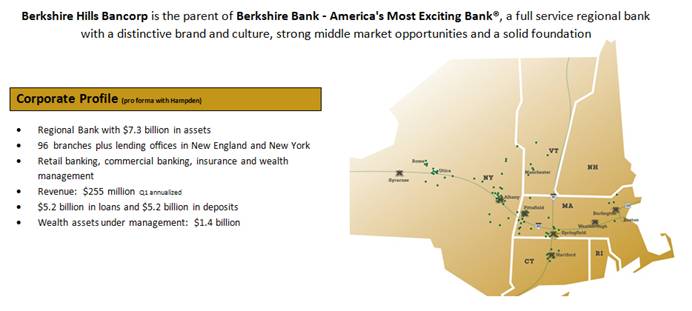
FORWARD-LOOKING STATEMENTS
Certain statements contained in this document that are not historical facts may constitute forward-looking statements within the meaning of Section 27A of the Securities Act of 1933, as amended (referred to as the Securities Act), and Section 21E of the Securities Exchange Act of 1934, as amended (referred to as the Securities Exchange Act), and are intended to be covered by the safe harbor provisions of the Private Securities Litigation Reform Act of 1995. You can identify these statements from the use of the words “may,” “will,” “should,” “could,” “would,” “plan,” “potential,” “estimate,” “project,” “believe,” “intend,” “anticipate,” “expect,” “target” and similar expressions. These forward-looking statements are subject to significant risks, assumptions and uncertainties, including among other things, changes in general economic and business conditions, increased competitive pressures, changes in the interest rate environment, legislative and regulatory change, changes in the financial markets, and other risks and uncertainties disclosed from time to time in documents that Berkshire Hills Bancorp files with the Securities and Exchange Commission, including the Annual Report on Form 10-K for the fiscal year ended December 31, 2014 and the Risk Factors in Item 1A of this report. Because of these and other uncertainties, Berkshire’s actual results, performance or achievements, or industry results, may be materially different from the results indicated by these forward-looking statements. In addition, Berkshire’s past results of operations do not necessarily indicate Berkshire’s combined future results. You should not place undue reliance on any of the forward-looking statements, which speak only as of the dates on which they were made. Berkshire is not undertaking an obligation to update forward-looking statements, even though its situation may change in the future, except as required under federal securities law. Berkshire qualifies all of its forward-looking statements by these cautionary statements.
APPLICATION OF CRITICAL ACCOUNTING POLICIES AND ACCOUNTING ESTIMATES, AND RECENT ACCOUNTING PRONOUNCEMENTS
The Company’s significant accounting policies are described in Note 1 to the consolidated financial statements in this Form 10-Q and in the most recent Form 10-K. Please see those policies in conjunction with this discussion. The accounting and reporting policies followed by the Company conform, in all material respects, to accounting principles generally accepted in the United States and to general practices within the financial services industry. The preparation of financial statements in conformity with accounting principles generally accepted in the United States requires management to make estimates and assumptions that affect the amounts reported in the financial statements and accompanying notes. While the Company bases estimates on historical experience, current information and other factors deemed to be relevant, actual results could differ from those estimates.
The SEC defines “critical accounting policies” as those that require application of management’s most difficult, subjective or complex judgments, often as a result of the need to make estimates about the effect of matters that are inherently uncertain and may change in future periods. Please see those policies in conjunction with this
discussion. Management believes that the following policies would be considered critical under the SEC’s definition:
Allowance for Loan Losses . The allowance for loan losses represents probable credit losses that are inherent in the loan portfolio at the financial statement date and which may be estimated. Management uses historical information, as well as current economic data, to assess the adequacy of the allowance for loan losses as it is affected by changing economic conditions and various external factors, which may impact the portfolio in ways currently unforeseen. Although management believes that it uses appropriate available information to establish the allowance for loan losses, future additions to the allowance may be necessary if certain future events occur that cause actual results to differ from the assumptions used in making the evaluation. Conditions in the local economy and real estate values could require the Company to increase provisions for loan losses, which would negatively impact earnings.
Acquired Loans. Loans that the Company acquired in business combinations are initially recorded at fair value with no carryover of the related allowance for credit losses. Determining the fair value of the loans involves estimating the amount and timing of principal and interest cash flows initially expected to be collected on the loans and discounting those cash flows at an appropriate market rate of interest. Going forward, the Company continues to evaluate reasonableness of expectations for the timing and the amount of cash to be collected. Subsequent decreases in expected cash flows may result in changes in the amortization or accretion of fair market value adjustments, and in some cases may result in the loan being considered impaired. For collateral dependent loans with deteriorated credit quality, the Company estimates the fair value of the underlying collateral of the loans. These values are discounted using market derived rates of return, with consideration given to the period of time and costs associated with the foreclosure and disposition of the collateral.
Income Taxes. Significant management judgment is required in determining income tax expense and deferred tax assets and liabilities. The Company uses the asset and liability method of accounting for income taxes in which deferred tax assets and liabilities are established for the temporary differences between the financial reporting basis and the tax basis of the Company’s assets and liabilities. The realization of the net deferred tax asset generally depends upon future levels of taxable income and the existence of prior years’ taxable income, to which “carry back” refund claims could be made. A valuation allowance is maintained for deferred tax assets that management estimates are more likely than not to be unrealizable based on available evidence at the time the estimate is made. In determining the valuation allowance, the Company uses historical and forecasted future operating results, based upon approved business plans, including a review of the eligible carry-forward periods, tax planning opportunities and other relevant considerations. These underlying assumptions can change from period to period. For example, tax law changes or variances in future projected operating performance could result in a change in the valuation allowance. Should actual factors and conditions differ materially from those considered by management, the actual realization of the net deferred tax asset could differ materially from the amounts recorded in the financial statements. If the Company is not able to realize all or part of its net deferred tax asset in the future, an adjustment to the deferred tax asset valuation allowance would be charged to income tax expense in the period such determination is made.
Goodwill and Identifiable Intangible Assets. Goodwill and identifiable intangible assets are recorded as a result of business acquisitions and combinations. These assets are evaluated for impairment annually or whenever events or changes in circumstances indicate the carrying value of these assets may not be recoverable. When these assets are evaluated for impairment, if the carrying amount exceeds fair value, an impairment charge is recorded to income. The fair value is based on observable market prices, when practicable. Other valuation techniques may be used when market prices are unavailable, including estimated discounted cash flows and analysis of market pricing multiples. These types of analyses contain uncertainties because they require management to make assumptions and to apply judgment to estimate industry economic factors and the profitability of future business strategies. In the event of future changes in fair value, the Company may be exposed to an impairment charge that could be material.
Determination of Other-Than-Temporary Impairment of Securities. The Company evaluates debt and equity securities within the Company’s available for sale and held to maturity portfolios for other-than-temporary impairment (“OTTI”), at least quarterly. If the fair value of a debt security is below the amortized cost basis of the security, OTTI is required to be recognized if any of the following are met: (1) the Company intends to sell the security; (2) it is “more likely than not” that the Company will be required to sell the security before recovery of
its amortized cost basis; or (3) for debt securities, the present value of expected cash flows is not sufficient to recover the entire amortized cost basis. For all impaired debt securities that the Company intends to sell, or more likely than not will be required to sell, the full amount of the loss is recognized as OTTI through earnings. Credit-related OTTI for all other impaired debt securities is recognized through earnings. Noncredit related OTTI for such debt securities is recognized in other comprehensive income, net of applicable taxes. In evaluating its marketable equity securities portfolios for OTTI, the Company considers its intent and ability to hold an equity security to recovery of its cost basis in addition to various other factors, including the length of time and the extent to which the fair value has been less than cost and the financial condition and near term prospects of the issuer. Any OTTI on marketable equity securities is recognized immediately through earnings. Should actual factors and conditions differ materially from those expected by management, the actual realization of gains or losses on investment securities could differ materially from the amounts recorded in the financial statements.
Fair Value of Financial Instruments. The Company uses fair value measurements to record fair value adjustments to certain financial instruments and to determine fair value disclosures. Trading assets, securities available for sale, and derivative instruments are recorded at fair value on a recurring basis. Additionally, from time to time, the Company may be required to record at fair value other assets on a nonrecurring basis, or to establish a loss allowance or write-down based on the fair value of impaired assets. Further, the notes to financial statements include information about the extent to which fair value is used to measure assets and liabilities, the valuation methodologies used and its impact to earnings. For financial instruments not recorded at fair value, the notes to financial statements disclose the estimate of their fair value. Due to the judgments and uncertainties involved in the estimation process, the estimates could result in materially different results under different assumptions and conditions.
The following summary data is based in part on the consolidated financial statements and accompanying notes and other information appearing elsewhere in this or prior Form 10-Qs.
|
|
|
At or for the Three |
|
||||
|
|
|
Months Ended March 31, |
|
||||
|
|
|
2015 |
|
2014 |
|
||
|
|
|
|
|
|
|
||
|
PER COMMON SHARE DATA |
|
|
|
|
|
||
|
Net earnings, diluted |
|
$ |
0.35 |
|
$ |
(0.04 |
) |
|
Adjusted earnings, diluted (1) |
|
0.50 |
|
0.42 |
|
||
|
Total common book value |
|
28.36 |
|
26.99 |
|
||
|
Dividends |
|
0.19 |
|
0.18 |
|
||
|
Common stock price: |
|
|
|
|
|
||
|
High |
|
27.92 |
|
27.28 |
|
||
|
Low |
|
24.27 |
|
23.95 |
|
||
|
Close |
|
27.70 |
|
25.88 |
|
||
|
|
|
|
|
|
|
||
|
PERFORMANCE RATIOS (2) |
|
|
|
|
|
||
|
Return on average assets |
|
0.54 |
% |
(0.08 |
)% |
||
|
Return on average common equity |
|
5.00 |
|
(0.64 |
) |
||
|
Net interest margin, fully taxable equivalent |
|
3.18 |
|
3.35 |
|
||
|
Fee income/Net interest and fee income |
|
23.25 |
|
22.84 |
|
||
|
|
|
|
|
|
|
||
|
ASSET QUALITY RATIOS (3) |
|
|
|
|
|
||
|
Net charge-offs (period annualized)/average loans |
|
0.28 |
% |
0.30 |
% |
||
|
Allowance for loan losses/total loans |
|
0.77 |
|
0.79 |
|
||
|
|
|
|
|
|
|
||
|
CONDITION RATIOS |
|
|
|
|
|
||
|
Stockholders’ equity to total assets |
|
10.90 |
% |
11.27 |
% |
||
|
Investments to total assets |
|
18.51 |
|
19.05 |
|
||
|
Loans/deposits |
|
100 |
|
101 |
|
||
|
|
|
|
|
|
|
||
|
FINANCIAL DATA: (In millions) |
|
|
|
|
|
||
|
Total assets |
|
$ |
6,571 |
|
$ |
6,010 |
|
|
Total earning assets |
|
5,993 |
|
5,408 |
|
||
|
Total investments |
|
1,216 |
|
1,145 |
|
||
|
Total loans |
|
4,729 |
|
4,243 |
|
||
|
Allowance for loan losses |
|
36 |
|
34 |
|
||
|
Total intangible assets |
|
275 |
|
280 |
|
||
|
Total deposits |
|
4,720 |
|
4,219 |
|
||
|
Total borrowings |
|
1,046 |
|
1,026 |
|
||
|
Total common stockholders’ equity |
|
716 |
|
678 |
|
||
|
|
|
|
|
|
|
||
|
FOR THE PERIOD: (In thousands) |
|
|
|
|
|
||
|
Net interest income |
|
$ |
45,493 |
|
$ |
42,766 |
|
|
Non-interest income |
|
12,562 |
|
4,423 |
|
||
|
Provision for loan losses |
|
3,851 |
|
3,396 |
|
||
|
Non-interest expense |
|
45,148 |
|
45,360 |
|
||
|
Net income (loss) |
|
8,759 |
|
(1,106 |
) |
||
|
Adjusted income (1) |
|
12,374 |
|
10,412 |
|
||
(1) Adjusted income and adjusted earnings are non-GAAP financial measures that the Company believes provide investors with information that is useful in understanding our financial performance and condition.
(2) All performance ratios are annualized and are based on average balance sheet amounts, where applicable.
(3) Generally accepted accounting principles require that loans acquired in a business combination be recorded at fair value, whereas loans from business activities are recorded at cost. The fair value of loans acquired in a business combination includes expected loan losses, and there is no loan loss allowance recorded for these loans at the time of acquisition. Accordingly, the ratio of the loan loss allowance to total loans is reduced as a result of the existence of such loans, and this measure is not directly comparable to prior periods. Similarly, net loan charge-offs are normally reduced for loans acquired in a business combination since these loans are recorded net of expected loan losses. Therefore, the ratio of net loan charge-offs to average loans is reduced as a result of the existence of such loans, and this measure is not directly comparable to prior periods. Other institutions may have loans acquired in a business combination, and therefore there may be no direct comparability of these ratios between and among other institutions.
AVERAGE BALANCES AND AVERAGE YIELDS/RATES
The following table presents average balances and an analysis of average rates and yields on an annualized fully taxable equivalent basis for the periods included.
|
|
|
Three Months Ended March 31, |
|
||||||||
|
|
|
2015 |
|
2014 |
|
||||||
|
($ In millions) |
|
Average
|
|
Yield/Rate
|
|
Average
|
|
Yield/Rate
|
|
||
|
Assets |
|
|
|
|
|
|
|
|
|
||
|
Loans: |
|
|
|
|
|
|
|
|
|
||
|
Residential mortgages |
|
$ |
1,470 |
|
3.94 |
% |
$ |
1,379 |
|
4.12 |
% |
|
Commercial real estate |
|
1,647 |
|
4.12 |
|
1,420 |
|
4.44 |
|
||
|
Commercial and industrial loans |
|
807 |
|
3.70 |
|
685 |
|
3.97 |
|
||
|
Consumer loans |
|
765 |
|
3.23 |
|
700 |
|
3.56 |
|
||
|
Total loans (1) |
|
4,689 |
|
3.86 |
|
4,184 |
|
4.13 |
|
||
|
Investment securities (2) |
|
1,177 |
|
3.10 |
|
1,048 |
|
3.04 |
|
||
|
Short term investments and loans held for sale (3) |
|
55 |
|
1.40 |
|
28 |
|
1.51 |
|
||
|
Total interest-earning assets |
|
5,921 |
|
3.67 |
|
5,260 |
|
3.89 |
|
||
|
Intangible assets |
|
276 |
|
|
|
278 |
|
|
|
||
|
Other non-interest earning assets |
|
300 |
|
|
|
313 |
|
|
|
||
|
Total assets |
|
$ |
6,497 |
|
|
|
$ |
5,851 |
|
|
|
|
|
|
|
|
|
|
|
|
|
|
||
|
Liabilities and stockholders’ equity |
|
|
|
|
|
|
|
|
|
||
|
Deposits: |
|
|
|
|
|
|
|
|
|
||
|
NOW |
|
$ |
423 |
|
0.14 |
% |
$ |
410 |
|
0.15 |
% |
|
Money market |
|
1,409 |
|
0.40 |
|
1,490 |
|
0.37 |
|
||
|
Savings |
|
502 |
|
0.15 |
|
464 |
|
0.16 |
|
||
|
Time |
|
1,420 |
|
0.92 |
|
1,070 |
|
1.15 |
|
||
|
Total interest-bearing deposits |
|
3,754 |
|
0.53 |
|
3,434 |
|
0.56 |
|
||
|
Borrowings and notes (4) |
|
1,107 |
|
0.85 |
|
912 |
|
1.03 |
|
||
|
Total interest-bearing liabilities |
|
4,861 |
|
0.61 |
|
4,346 |
|
0.66 |
|
||
|
Non-interest-bearing demand deposits |
|
870 |
|
|
|
750 |
|
|
|
||
|
Other non-interest earning liabilities |
|
65 |
|
|
|
63 |
|
|
|
||
|
Total liabilities |
|
5,796 |
|
|
|
5,159 |
|
|
|
||
|
|
|
|
|
|
|
|
|
|
|
||
|
Total stockholders’ equity (2) |
|
701 |
|
|
|
692 |
|
|
|
||
|
Total liabilities and stockholders’ equity |
|
$ |
6,497 |
|
|
|
$ |
5,851 |
|
|
|
|
|
|
|
|
|
|
|
|
|
|
||
|
Net interest spread |
|
|
|
3.06 |
% |
|
|
3.23 |
% |
||
|
Net interest margin (5) |
|
|
|
3.18 |
|
|
|
3.35 |
|
||
|
Cost of funds |
|
|
|
0.51 |
|
|
|
0.56 |
|
||
|
Cost of deposits |
|
|
|
0.43 |
|
|
|
0.46 |
|
||
|
|
|
|
|
|
|
|
|
|
|
||
|
Supplementary data |
|
|
|
|
|
|
|
|
|
||
|
Total deposits (In millions) |
|
$ |
4,624 |
|
|
|
$ |
4,184 |
|
|
|
|
Fully taxable equivalent income adj. (In thousands) |
|
889 |
|
|
|
718 |
|
|
|
||
(1) The average balances of loans include nonaccrual loans and deferred fees and costs.
(2) The average balance for securities available for sale is based on amortized cost. The average balance of equity also reflects this adjustment.
(3) Interest income on loans held for sale is included in loan interest income on the income statement.
(4) The average balances of borrowings includes the capital lease obligation presented under other liabilities on the consolidated balance sheet.
(5) Purchased loan accretion totaled $320 thousand and $2.8 million for the three months ended March 31, 2015 and 2014, respectively.
This document contains certain non-GAAP financial measures in addition to results presented in accordance with Generally Accepted Accounting Principles (“GAAP”). These non-GAAP measures are intended to provide the reader with additional supplemental perspectives on operating results, performance trends, and financial condition. Non-GAAP financial measures are not a substitute for GAAP measures; they should be read and used in conjunction with the Company’s GAAP financial information. A reconciliation of non-GAAP financial measures to GAAP measures is provided below. In all cases, it should be understood that non-GAAP operating measures do not depict amounts that accrue directly to the benefit of shareholders. An item which management deems to be non-operating and excludes when computing non-GAAP operating earnings can be of substantial importance to the Company’s results for any particular quarter or year. The Company’s non-GAAP earnings information set forth is not necessarily comparable to non-GAAP information which may be presented by other companies. Each non-GAAP measure used by the Company in this report as supplemental financial data should be considered in conjunction with the Company’s GAAP financial information.
The Company utilizes the non-GAAP measure of adjusted earnings in evaluating operating trends, including components for operating revenue and expense. These measures exclude amounts which the Company views as unrelated to its normalized operations, including securities gains/losses, losses recorded for hedge terminations, merger costs, restructuring costs, systems conversion costs, and out-of-period adjustments. Non-operating adjustments are presented net of an adjustment for income tax expense. This adjustment is determined as the difference between the GAAP tax rate and the effective tax rate applicable to operating income.
Charges related to merger and acquisition activity consist primarily of severance/benefit related expenses, contract termination costs, and professional fees. Systems conversion costs relate primarily to the Company’s operating systems conversion and related systems conversions costs. Restructuring costs primarily consist of costs and losses associated with the consolidation of branches and other operating facilities of the Company. Out-of-period accounting adjustments for interest income on acquired loans were recorded following systems conversions and merger related accounting activity and were deemed non-operating. Non-operating expenses include variable rate compensation related to non-operating items.
The Company also calculates adjusted earnings per share based on its measure of earnings from ongoing operations. The Company views these amounts as important to understanding its operating trends, particularly due to the impact of accounting standards related to merger and acquisition activity. Analysts also rely on these measures in estimating and evaluating the Company’s operating performance. Management also believes that the computation of non-GAAP adjusted earnings and adjusted earnings per share may facilitate the comparison of the Company to other companies in the financial services industry. The Company adjusts certain equity related measures to exclude intangible assets due to the importance of these measures to the investment community.
The following table summarizes the reconciliation of non-GAAP items recorded for the time periods and dates indicated:
BERKSHIRE HILLS BANCORP, INC.
RECONCILIATION OF NON-GAAP FINANCIAL MEASURES - UNAUDITED - (F-9)
|
|
|
|
|
At or for the Quarters Ended |
|
||||
|
|
|
|
|
Mar 31, |
|
Mar. 31, |
|
||
|
(in thousands) |
|
|
|
2015 |
|
2014 |
|
||
|
Net income (loss) (GAAP) |
|
|
|
$ |
8,759 |
|
$ |
(1,106 |
) |
|
Adj: Gain on sale of securities, net |
|
|
|
(34 |
) |
(34 |
) |
||
|
Adj: Loss on termination of hedges |
|
|
|
— |
|
8,792 |
|
||
|
Adj: Merger and acquisition expense |
|
|
|
3,275 |
|
3,637 |
|
||
|
Adj: Restructuring and conversion expense |
|
|
|
1,146 |
|
2,665 |
|
||
|
Adj: Out-of-period adjustment (1) |
|
|
|
— |
|
1,381 |
|
||
|
Adj: Income taxes |
|
|
|
(772 |
) |
(4,923 |
) |
||
|
Total adjusted income (non-GAAP) |
|
(A) |
|
$ |
12,374 |
|
$ |
10,412 |
|
|
|
|
|
|
|
|
|
|
||
|
Total revenue (GAAP) |
|
|
|
$ |
58,055 |
|
$ |
47,189 |
|
|
Adj: Gain on sale of securities, net |
|
|
|
(34 |
) |
(34 |
) |
||
|
Adj: Loss on termination of hedges |
|
|
|
— |
|
8,792 |
|
||
|
Adj: Out-of-period adjustment (1) |
|
|
|
— |
|
1,381 |
|
||
|
Total operating revenue (non-GAAP) |
|
(B) |
|
$ |
58,021 |
|
$ |
57,328 |
|
|
|
|
|
|
|
|
|
|
||
|
Total non-interest expense (GAAP) |
|
|
|
$ |
45,148 |
|
$ |
45,360 |
|
|
Less: Total non-operating expense (see above) |
|
|
|
(4,421 |
) |
(6,302 |
) |
||
|
Operating non-interest expense (non-GAAP) |
|
(C) |
|
$ |
40,727 |
|
$ |
39,058 |
|
|
|
|
|
|
|
|
|
|
||
|
(in millions, except per share data) |
|
|
|
|
|
|
|
||
|
Total average assets |
|
(D) |
|
$ |
6,497 |
|
$ |
5,851 |
|
|
Total average stockholders’ equity |
|
(E) |
|
701 |
|
692 |
|
||
|
Total average tangible stockholders’ equity |
|
(F) |
|
426 |
|
413 |
|
||
|
Total tangible stockholders’ equity, period-end (2) |
|
(G) |
|
441 |
|
398 |
|
||
|
|
|
|
|
|
|
|
|
||
|
Total common shares outstanding, period-end (thousands) |
|
(H) |
|
25,253 |
|
25,105 |
|
||
|
Average diluted shares outstanding (thousands) (3) |
|
(I) |
|
24,955 |
|
24,833 |
|
||
|
|
|
|
|
|
|
|
|
||
|
Adjusted earnings per share, diluted |
|
(A/I) |
|
$ |
0.50 |
|
$ |
0.42 |
|
|
Tangible book value per share, period-end |
|
(G/H) |
|
$ |
17.46 |
|
$ |
15.84 |
|
|
|
|
|
|
|
|
|
|
||
|
Performance ratios (4) |
|
|
|
|
|
|
|
||
|
Adjusted return on assets |
|
(A/D) |
|
0.76 |
% |
0.71 |
% |
||
|
Adjsuted return on equity |
|
(A/E) |
|
7.06 |
|
6.02 |
|
||
|
Adjusted return on tangible equity (5) |
|
(A/F) |
|
12.14 |
|
10.84 |
|
||
|
Efficiency ratio |
|
(C-L)/(B+J+M) |
|
63.27 |
|
64.42 |
|
||
|
|
|
|
|
|
|
|
|
||
|
Supplementary data (in thousands) |
|
|
|
|
|
|
|
||
|
Tax benefit - tax-advantaged commercial project investments (6) |
|
(J) |
|
$ |
4,034 |
|
$ |
555 |
|
|
Non-interest income charge - tax-advantaged commercial project investments (7) |
|
(K) |
|
(2,851 |
) |
(417 |
) |
||
|
Net income on tax-advantaged commercial project investments |
|
(J+K |
) |
1,183 |
|
138 |
|
||
|
Intangible amortization |
|
(L) |
|
901 |
|
1,306 |
|
||
|
Fully taxable equivalent income adjustment |
|
(M) |
|
889 |
|
718 |
|
||
(1) The out of period adjustment shown above relates to interest income earned on loans acquired in bank acquisitions.
(2) Total tangible stockholders’ equity is computed by taking total stockholders’ equity less the intangible assets at period-end.
(3) Average diluted shares computed for adjusted earnings per share differ from GAAP average diluted shares, in the first quarter of 2014, due to the GAAP net loss compared to adjusted net income for the period.
(4) Ratios are annualized and based on average balance sheet amounts, where applicable. Quarterly data may not sum to year-to-date data due to rounding.
(5) Adjusted return on tangible equity is computed by dividing the total adjusted income adjusted for the tax-affected amortization of intangible assets, assuming a 40% marginal rate, by tangible equity.
(6) The tax benefit is the direct reduction to the income tax provision due to tax credits and deductions generated from investments in historic rehabilitation, low-income housing, new market projects, and renewable energy projects.
(7) The non-interest income charge is the reduction to the tax-advantaged commercial project investments, which are incurred as the tax credits are generated.
SUMMARY
Berkshire recorded first quarter 2015 earnings of $8.8 million, or $0.35 per share. First quarter results included $3.6 million in net charges related primarily to the acquisition of Hampden Bancorp and restructuring charges. The company views these charges as non-operating. The Company’s adjusted earnings were $12.4 million, or $0.50 per share before non-operating items. Adjusted earnings is a non-GAAP financial measure intended to measure the performance of ongoing operations. This measure is further described and reconciled to GAAP results in the previous section on non-GAAP financial measures. Adjusted earnings per share increased by 19% over the first quarter of 2014 due to the expansion of business operations. Adjusted earnings per share increased by 4% over the fourth quarter of 2014 including the benefits of growth in loans, mortgage originations, and income on tax-advantaged commercial development projects. Berkshire recorded a loss of $1.1 million, or $0.04 per share, in the first quarter of 2014 due to $11.5 million in net non-operating charges primarily for the acquisition of 20 New York branches and the related loss on the termination of hedges. Before net non-operating charges, Berkshire’s adjusted earnings in this period totaled $10.4 million, or $0.42 per share.
During the most recent quarter, Berkshire’s Board of Directors increased the quarterly dividend to shareholders by 6% to $0.19 per share from $0.18 per share which was in effect throughout 2014. This dividend equates to a 2.9% annualized yield based on the $26.18 average closing price of Berkshire’s common stock during the first quarter.
First quarter 2015 financial highlights included:
· 14% annualized increase in commercial loans
· 6% annualized increase in deposits
· 11% annualized increase in demand deposits
· 9% increase in fee income (year-over-year)
· 0.36% non-performing assets/assets
· 0.28% annualized net loan charge-offs/average loans
Berkshire continued its momentum of sequential and year-over-year growth in adjusted EPS in the most recent quarter. The Company also maintained double digit annualized expansion in its focus areas of commercial loans and demand deposits, where it continued to capitalize on the strength of its regional bank franchise. This contributed to an increase in the net interest margin before purchased loan accretion. Most categories of fee income also increased year over year as the Company further developed revenue synergies and deepened its market and wallet share. The Company is maintaining its focus on expense disciplines and efficiency while improving its overall franchise positioning and talent redeployment to better serve its customers. Berkshire’s goal is to continue to generate positive core operating leverage from revenue synergies and expense management to further improve operating earnings and profitability.
In the most recent quarter, Berkshire announced the recruitment of leadership talent for its Hartford commercial banking team and for its Albany private banking and wealth teams. Hockey legend Ray Bourque and left wing Milan Lucic joined Berkshire as spokespersons and the Company completed a second successful season in its partnership with NESN (New England Sports Network) as the Official Bank of Boston Bruins coverage on the network, garnering widespread brand recognition and significant business leads.
Berkshire’s acquisition of Springfield-based Hampden Bancorp was completed on April 17, 2015 on schedule. The Hampden acquisition boosted total assets by approximately 11% to $7.3 billion and total shares outstanding increased to approximately 29.5 million shares. Berkshire’s goal is that the transaction will be accretive to earnings per share, accretive to return on assets, and accretive to equity and tangible equity after merger efficiencies are fully achieved. Berkshire is also targeting strategic benefits from its new position in the top five for deposit market share in the Springfield MSA and increases in its overall business volume in the Hartford/Springfield market which is the second largest economic area in New England. Operationally, Berkshire
will target efficiencies and long run revenue synergies from the product set and capabilities that it can provide to the individuals and businesses in this market.
Hampden operated ten branch offices and the Company plans to consolidate three of these offices with existing offices in the Springfield market, resulting in a net addition of seven offices. The Company also announced the consolidation of two other offices in the first quarter bringing the total branch count to 96 offices net of these planned consolidations. The Company continues to review its branch locations with the goal of improving profitability while improving its overall franchise positioning and talent deployment to better serve its customers. Additional branch consolidations or sales are anticipated during the second quarter. These changes reflect changing patterns of retail banking customer interaction. Berkshire has a multichannel strategy to further penetrate and service the retail market. The Company announced its plan to implement the Apple Pay service for its customers in the second quarter. The expansion of its small business banking team resulted in Berkshire’s designation as the SBA Lender of the Quarter for being one of the most active SBA lenders in the Commonwealth of Massachusetts.
During the first quarter, Berkshire expanded its board of directors with the appointment to the board of Paul Bossidy, former President and CEO of GE Capital Solutions. Pursuant to the Hampden merger agreement, Berkshire recently appointed two former Hampden directors to its board: Thomas Burton (a former Hampden President and CEO) and Richard Suski (a certified public accountant with a career serving financing institutions in Connecticut and Massachusetts). Glenn Welch, the Hampden President and CEO, joined Berkshire’s team as an Executive Vice President and will be developing the Company’s business initiatives with other financial institutions in its region. Additionally, on April 23, 2015, the Board of Directors established two new board committees: the Capital/Risk Management Committee (combining two existing committees) and the Compliance/Regulatory Committee. Following the restructuring, the five standing Board committees include Audit, Capital/Risk Management, Corporate Governance/Nominating, Compensation, and the Compliance/Regulatory Committees.
COMPARISON OF FINANCIAL CONDITION AT MARCH 31, 2015 AND DECEMBER 31, 2014
Summary: Total assets increased at a 4% annualized rate to $6.6 billion in the first quarter due primarily to a 4% annualized increase in total loans funded by a 6% annualized increase in total deposits. Capital and liquidity ratios remained solid and did not change significantly. Tangible book value per share increased at a 6% annualized rate to $17.46 and total book value per share increased at a 3% annualized rate to $28.36. With the completion of the Hampden Bancorp merger on April 17, 2015, total assets increased by approximately 11% to $7.3 billion.
Securities: Total investment securities were unchanged at $1.2 billion during the quarter. Investments in bank capital instruments were reduced as a result of new risk based capital requirements that became effective during the quarter that increased the required support for these investments. The Company reduced its investment in equity securities and trust preferred securities by $15 million and increased its investment in available for sale municipal bonds by $22 million. The Company realized $1.4 million in net losses on the sale of bonds which was primarily related to the sale of a pooled trust preferred security which was reported with a $1.0 million unrealized loss at year-end 2014. The bond losses were offset by $1.4 million in net gains realized on the sale of equity securities. Due to the decrease in medium and long term interest rates during the quarter, the Company recorded a net unrealized securities gain of $9.3 million in other comprehensive income, and the portfolio had a net unrealized gain of $27 million at (2.4% of cost) quarter-end compared to $18 million (1.6% of cost) at the start of the quarter. The overall portfolio yield increased to 3.10% in the first quarter of 2015 from 3.00% in the linked quarter and 3.04% in the first quarter of 2014. During the most recent quarter, measures of yield, duration, and extension risk were little changed except for a modest shortening in the portfolio life due to higher projected prepayment speeds following the dip in interest rates after year-end. Except for securities in the Company’s higher yielding mutual fund, all other available for sale debt securities were investment grade rated throughout the
quarter. The mutual fund invests in U.S. corporate bonds targeted for upgrades and is reported with the Company’s corporate bonds. The Company’s held to maturity securities are generally unrated local securities, all of which are performing and none of which is deemed criticized according to the Company’s internal ratings systems.
Loans. Berkshire continued to generate strong double digit commercial loan growth, which measured 14% annualized in the first quarter of 2015, including 11% annualized growth in commercial and industrial loan balances. Managed reductions in other loans resulted in 4% annualized growth in total loans to $4.73 billion d uring the quarter. Residential mortgage loans decreased as most first quarter mortgage originations were sold into the secondary market following a decrease in interest rates at the start of the year. The decrease in consumer loans was due to a change in the auto loan portfolio strategy initiated in the final quarter of 2014 to de-emphasize originations of lower coupon super-prime auto loans.
The $48 million increase in total loans during the quarter was due to the $83 million increase in commercial loans. Approximately $60 million of this increase was attributable to commercial real estate loans. The remaining growth was primarily split between asset based loans and other commercial and industrial loans. Commercial loan growth included wholesale acquisitions and is net of targeted reductions in lower yielding commercial relationships managed with a goal of supporting the net interest margin. The commercial pipeline at quarter-end was up from the start of the year and line of credit usage improved slightly to 62%.
The yield on the total portfolio decreased to 3.86% in the most recent quarter compared to 3.96% in the linked quarter due to lower purchased loan accretion. Before this accretion, the yield measured 3.83% compared to 3.82% for the above periods, respectively. At quarter-end, loans with contractual pricing adjustments within one year decreased to 35% of total loans from 37% at the start of the year. Loans repricing in one to five years increased to 26% from 24% of total loans, and loans repricing over five years remained unchanged at 39% of total loans.
At the end of the period, the remaining carrying balance of purchased credit impaired loans was $13 million and the contractual amount owed on these loans was $24 million. The balance of accretable yield on these loans was $3.4 million which increased from $2.5 million at the start of the quarter due to loans with improved cash flows.
Asset Quality . Asset quality metrics remained favorable and continued to improve in the first quarter of 2015. Annualized net loan charge-offs measured 0.28% of average loans for the quarter. Annualized net charge-0ffs were 0.20% of average loans from business activities and 0.65% of average loans acquired in business combinations. Quarter-end non-performing assets decreased to 0.36% of total assets and accruing delinquent loans decreased to 0.43% of total loans. The loan loss allowance increased to 0.77% of total loans; approximately 15% of quarter-end loans were balances recorded at fair value in prior year bank acquisitions. Acquired loans are recorded at fair value and are categorized as performing regardless of their payment status. Therefore, some overall portfolio measures of asset performance are not comparable between periods or among institutions as a result of recent business combinations. Loans which became non-accruing totaled $5 million in the most recent quarter, which was within the range of $4 - 9 million experienced in the past several quarters. The balance of loans identified as troubled debt restructurings increased to $17.2 million from $16.7 million during the quarter.
Loan Loss Allowance . The determination of the allowance for loan losses is a critical accounting estimate. The Company considers the allowance for loan losses appropriate to cover probable losses which can be reasonably estimated in the loan portfolio as of the balance sheet date. Under accounting standards for business combinations, acquired loans are recorded at fair value with no loan loss allowance on the date of acquisition. A loan loss allowance is recorded by the Company for the emergence of new probable and estimable losses on acquired loans which were not impaired as of the acquisition date. Because of the accounting for acquired loans, some measures of the loan loss allowance are not comparable to periods prior to the acquisition date.
The total amount of the loan loss allowance increased by $0.6 million to $36.3 million in the first quarter of 2015 due to growth in the loan portfolio. The ratio of the allowance to total loans increased to 0.77% from 0.76% during the quarter. For loans from business activities, this ratio decreased to 0.80% from 0.84% during the
quarter, while the allowance on loans acquired in business combinations increased to 0.56% from 0.38%. At period-end, the total allowance provided 2.8X coverage of annualized net charge-offs and 165% coverage of period-end non-accrual loans. For business activities loans, these ratios measured 4.0X and 220% respectively, and for loans acquired in business combinations, these ratios measured 0.8X and 63%.
The credit risk profile of the Company’s loan portfolio is described in the Loan Loss Allowance note in the consolidated financial statements. The Company’s risk management process focuses primary attention on loans with higher than normal risk, which includes loans rated special mention and classified (substandard and lower). These loans are referred to as criticized loans. Criticized loans were reduced to $123 million (1.9% of assets) from $130 million (2.0% of assets) at the start of the year. The Company views its potential problem loans as those loans from business activities which are rated as classified and continue to accrue interest. These loans have a possibility of loss if weaknesses are not corrected. Classified loans acquired in business combinations are recorded at fair value and are classified as performing at the time of acquisition and therefore have not generally been viewed as potential problem loans. Potential problem loans increased slightly to $68 million from $67 million during the quarter. The balance of accruing classified acquired loans decreased to $21 million from $24 million during the quarter. There were no significant changes in the composition of non-accruing and potential problem assets during the quarter. The Company’s evaluation of its credit risk profile also compares the amount of criticized assets to the total of the Bank’s Tier 1 Capital plus the loan loss allowance. This ratio declined to 25% from 28% during the quarter.
Deposits. Total deposits increased by $65 million, or 6% annualized, to $4.72 billion in the first quarter of 2015. Growth included increases in most major categories and was concentrated primarily in relationship oriented transaction accounts, which increased by $33 million, and in brokered time deposits, which increased by $48 million. Berkshire expanded its personal relationship deposit bundles which require the utilization of a demand deposit account, and demand deposit balances increased at an 11% annualized rate during the quarter. The Company does not expect that its branch consolidations will have any material impact on its deposit balances. The Company ended its participation in the Massachusetts Depositors Insurance Fund (“DIF”) at mid-year 2014 and the one year transitional coverage of existing balances expires at mid-year in 2015. Hampden Bank’s participation in this fund terminated with no transitional coverage as of the Hampden merger date. Normal FDIC insurance coverage remains in place for the Bank’s deposits. The Company has initiated limited offerings of reciprocal deposit money market accounts and collateralized deposit accounts for certain institutional customers and is targeting to maintain positive overall organic deposit balance growth in 2015 while transitioning from the DIF program. Including the benefit of demand deposit growth, the cost of deposits decreased to 0.43% in the most recent quarter compared to 0.44% in the linked quarter. New federal regulatory liquidity coverage ratios for the largest banks became effective in 2015, with the potential of increasing competition for retail deposits and reducing competition for large corporate deposits. Additionally, some institutions have offered higher time deposit account rates in anticipation of the initiation of interest rate increases by the Federal Reserve Bank after several years of near-zero short term rates. The Company believes that it may have competitive advantage in the event of interest rate increases due to the comparative stability of some of its more rural deposit markets. The ratio of loans/deposits was 100% at quarter-end, compared to 101% at the start of the quarter.
Borrowings, Derivative Financial Instruments and Hedging Activities. There were no significant changes in the Company’s borrowing and hedging activities in the first quarter of 2015. Total borrowings were unchanged at $1.05 billion. In the second half of 2014, the Company removed some of its securities from the Federal Home Loan Bank collateral pool, but it resumed pledging these securities to the collateral pool in 2015. The Company generally pledges most of its eligible collateral to the FHLBB to maximize its borrowings availability, and the Company is also expecting to improve its collateral data in 2015 to increase the eligibility and liquidity of the related assets. Berkshire’s unused borrowing capacity with the FHLBB was $587 million at quarter-end, compared to $246 million at the start of the quarter. The notional amount of derivatives increased by $58 million to $1.09 billion during the quarter primarily due to a $76 million increase related to mortgage banking as a result of the higher market demand for mortgage originations following the decrease in long term rates. As a result of this decrease, the unrealized fair value liability of derivatives increased to $9.5 million from $5.8 million due to the higher unrealized loss on outstanding fixed payment interest rate swaps. The amount of this loss has varied significantly due to the unusually high volatility of long term interest rates in recent periods reflecting uncertainty about domestic and foreign monetary policy.
Stockholders’ Equity. Stockholders’ equity increased by $7 million including the contribution of $9 million in earnings and $2 million of other comprehensive income less $5 million in dividends. Total shares outstanding increased to 25.3 million including 92 thousand shares issued in the annual grant of restricted stock in January. Including the new shares issued for Hampden Bancorp merger consideration, total shares outstanding increased to approximately 29.5 million as of April 17, 2015.
The ratio of tangible equity/assets increased to 7.00% from 6.96% during the quarter. This ratio is a non-GAAP financial measure commonly used by investors and it excludes goodwill and other intangible assets from equity and assets. The Company generally targets to maintain this measurement within a range of 7-8% and also considers its return on tangible equity as a source of capital strength for improving its condition and supporting its growth. The ratio of equity/assets was little changed at 10.90% at quarter-end.
The Company’s risk based capital ratio measured 11.4% at quarter-end and was little changed from the start of the quarter. New regulatory capital calculations came into effect during the quarter and as previously discussed, the Company reduced its investment in bank capital instruments, which carry a higher risk allocation. At quarter-end, the regulatory capital metrics for the Company and the Bank were not significantly changed from year-end 2014. Tier 1 capital for the Company measured 9.2% of risk weighted assets and 7.1% of average assets. The new measure of Common Equity Tier 1 capital to risk weighted assets measured 9.1% and the Company and Bank continued to meet all requirements for the Well Capitalized designation. The merger with Hampden Bancorp is expected to be accretive to most of the Company’s capital measures.
COMPARISON OF OPERATING RESULTS FOR THE THREE MONTHS ENDED MARCH 31, 2015 AND 2014.
Summary. First quarter 2015 adjusted EPS increased by $0.02 per share, or 4%, over the linked quarter and by $0.08 per share, or 19%, on a year-over-year basis due to growth in loans and fee revenues. Net non-operating charges totaled $0.15 per share during the most recent quarter, including $0.11 related primarily to the Hampden merger and $0.04 in restructuring charges. First quarter adjusted earnings totaled $12.4 million in 2015 and $10.4 million in 2014. First quarter GAAP earnings were $8.8 million in 2015 and a loss of $1.1 million in 2014. Results last year included net non-operating charges related primarily to the acquisition of the New York branches.
The first quarter 2015 adjusted return on equity improved to 7.1% and the adjusted return on tangible equity improved to 12.1%. The Hampden acquisition is targeted to be accretive to earnings per share and to most profitability measures, as well as to most capital measures, when merger integration is fully completed. The GAAP return on equity measured 5.0% during the most recent quarter including the impact of net non-operating charges.
Due to the seasoning of acquired impaired loans, the contribution to first quarter earnings from purchased loan accretion decreased by approximately $2.5 million, or $1.5 million on an after-tax basis in 2015 compared to 2014. This decrease was partially offset by a $1.0 million increase in the net after-tax benefit of income from tax-advantaged commercial development projects, which resulted in a lower effective tax rate in 2015. As a result of volume growth in loans and fee revenues, Berkshire produced growth in adjusted earnings despite the negative impact of accretion and the continuing pressure on the net interest margin resulting from the ongoing low interest rate environment.
Revenue. Total first quarter net revenue increased by 23% to $58 million in 2015 compared to 2014. On an operating basis, net revenue increased by 1% and the increase measured 10% before the aforementioned impacts of purchased loan accretion and tax advantaged-investments. In the first quarter of 2015, Hampden recorded $6 million in revenue and these acquired operations will be included in Berkshire’s results subsequent to the merger date on April 17, 2015. Berkshire’s goal is to produce positive operating leverage from revenue growth as it develops revenue synergies in its expanded footprint and from integrated product sales that improve wallet share. Annualized first quarter revenue totaled $9.31 per share in the most recent quarter.
Net Interest Income. First quarter net interest income increased by $2.7 million, or 6%, in 2015 compared to 2014. Measured before the aforementioned decrease in purchased loan accretion, net interest income increased by 12% for these periods. This included the benefit of a 13% increase in average earning assets including a 12%
increase in average loans. Measured on this basis, first quarter 2015 net interest income increased by 0.2% compared to the linked quarter.
The net interest margin in the most recent quarter decreased to 3.18% from 3.23% in the linked quarter and from 3.35% in the first quarter of 2014. Measured before accretion, the margin increased to 3.15% from 3.12% in the linked quarter and decreased from 3.24% in the prior year first quarter. The year-over-year decrease was due to the ongoing compression related to the continuing low interest rate environment. The increase compared to the linked quarter included the benefit of a 0.03% increase in the commercial loan yield before accretion. This reflected the strategy initiated in the second half of 2014 to replace lower yielding relationships with higher yielding loans. The Company has also reduced its originations of lower yielding super prime auto loans while maintaining the double digit annualized growth rate of commercial loans. The improvement over the linked quarter also included the benefit of a 0.01% reduction in the cost of deposits including the benefit of growth in demand deposit balances.
Non-Interest Income. Total fee income increased by $1.1 million, or 9% year-over-year, with increases in most major categories. Fee income was up $0.8 million, or 6%, compared to the linked quarter. Seasonal increases in insurance and wealth management revenues mostly offset seasonal and weather related decreases in loan and deposit fees. Mortgage banking fees increased due to increased refinancing demand spurred by lower interest rates.
Loan fee income was down from recent quarters primarily due to lower commercial interest rate swap fees. The annualized ratio of deposit fees to average deposits decreased to 0.49% in the most recent quarter compared to 0.53% in the linked quarter and 0.52% in the first quarter of 2014. The increase in mortgage banking fees was primarily due to higher origination volume as well as higher gain on sale margins as a result of strong refinancing demand. The seasonal increase in insurance income was due to annual contingency revenues which are received in the first quarter of each year based on policy performance in the prior year; this revenue decreased from year to year. The seasonal increase in wealth management fees was due to annual tax preparation fees.
Other non-interest income includes income on bank owned life insurance as well as capital gains distributions from investments in the two most recent quarters. Non-interest income is stated net of charges to reduce the carrying value of tax-advantaged investments in commercial redevelopment projects. These charges are further discussed in the following section on income tax expense. Income in the most recent quarter included $1.4 million in gains on the sale of equity securities which offset $1.4 million in losses on the sale of bonds which was related to the reduction of investments in bank capital securities instruments which was previously discussed. In the first quarter of 2014, non-interest income also included charges for the termination of hedges following the New York branch acquisition.
Loan Loss Provision. The provision for loan losses is a charge to earnings in an amount sufficient to maintain the allowance for loan losses at a level deemed adequate by the Company as an estimate of the probable and estimable loan losses in the portfolio as of period-end. The level of the allowance is a critical accounting estimate, which is subject to uncertainty. The level of the allowance was included in the discussion of financial condition. The first quarter provision increased by $0.5 million year over year due primarily to an increase in the allowance coverage of loans acquired in business combinations.
Non-Interest Expense. Including seasonal and weather related factors, first quarter operating non-interest expense increased to $40.7 million from $39.9 million in the linked quarter and $39.1 million in the prior year first quarter. In comparison to average assets, operating non-interest expense measured 2.51%, 2.49%, and 2.67% in these periods respectively. The increase over the linked quarter included seasonal factors. The year-to-year decrease reflected the benefit of business expansion and restructuring activities to reduce branch costs and other overhead. Seasonal factors in the most recent quarter included a $0.9 million increase in payroll tax expense over the prior quarter and higher occupancy costs including the impacts of the severe winter weather. Full-time equivalent staff was not significantly changed and totaled 1,091 at quarter-end. The efficiency ratio increased to 63.3% in the most recent quarter due to seasonality and lower revenue from purchased loan accretion. This ratio is expected to improve due to planned revenue growth and efficiencies related to the Hampden acquisition and the branch restructuring.
Total first quarter non-interest expense decreased slightly to $45.1 million in 2015 compared to $45.4 million in the prior year. This expense included merger, restructuring, and conversion expense which the Company views as non-operating. This expense totaled $4.4 million in 2015 and $6.3 million in 2014. The expense in 2015 included $3.3 million related to the Hampden Bancorp merger and $1.1 million for restructuring expense. The Company is consolidating three of the ten Hampden Bank branches. This will be completed when the systems integration is completed in the latter part of June 2015. The costs for these branch consolidations are being included in the Hampden merger charges. The Company expects the bulk of the merger charges to be recorded in the second quarter of 2015. Restructuring charges of $1.1 million included costs related to two existing branch consolidations which were announced in the most recent quarter and which are expected to be completed in the second quarter of this year. Berkshire continues to evaluate additional branches for consolidation or sale and expects to record additional non-operating charges in the second quarter related to these consolidations.
Income Tax Expense. Berkshire’s increased financing of tax-advantaged commercial development projects contributed $0.05 in EPS in the first quarter of 2015, which was a $0.04 increase over the linked quarter and over the first quarter of the prior year. As previously noted, there were decreases in EPS related to purchased loan accretion which the Company viewed in part as offsetting factors in evaluating overall changes in EPS.
Due to its regional reach and resources, the Company has expanded its tax-advantaged investments in redevelopment projects with commercial relationship partners in its communities. This financing resulted in a charge to non-interest income which was more than offset by the tax benefits which are a component of income tax expense. The charges to non-interest income represent a reduction in the carrying value of the Company’s project investments; these charges are recorded as tax benefits are recognized and totaled $2.9 million in 2015 and $0.4 million in the linked quarter and in the first quarter of the prior year. The tax benefits include tax credits which are approximately equal to the amount of the non-interest income charges, along with a tax deduction on the amount of the charge. The charge itself is deductible in arriving at taxable income and therefore provides a benefit which was approximately $1.1 million in the most recent quarter. The total tax benefit recognized for these projects was $4.0 million in the most recent quarter and $0.6 million in the linked quarter and in the first quarter of the prior year.
The Company’s effective income tax rate was 3% in the first quarter of 2015, compared to 26% in the fiscal year 2014 and a 29% benefit in the first quarter of 2014. The low rate in 2015 primarily reflects the higher tax credit benefit from tax-advantaged commercial projects. The tax rate on the Company’s adjusted earnings in the most recent quarter was approximately 8% and this rate was approximately 29% before these tax credits. For fiscal 2014, the effective tax rate on operating income was approximately 30% and measured approximately 32% before the $1.7 million tax credit benefit recognized in that year.
Results of Segment and Parent Operations . Berkshire Hills Bancorp (“the Parent”) has two subsidiary operating segments — banking and insurance. Results in the banking segment generally followed the levels and trends of consolidated results, which have been previously discussed. In the insurance segment, first quarter income increased to $0.6 million in 2015 from $0.4 million in the prior year due to reductions in operating expenses. For the Parent, operating results primarily reflected changes in the operations of its bank subsidiary.
Total Comprehensive Income . Total comprehensive income includes net income together with other comprehensive income. For the first quarter, total comprehensive income increased to $11.2 million in 2015 compared to $7.3 million in 2014. This reflected the improvement in operating income along with the increase in unrealized securities gains in 2015 as a result of the drop in interest rates. Other comprehensive income totaled $2.5 million and $8.4 million in these respective periods. For 2014, this amount included the benefit of the hedge termination which was recorded as a charge to net income and resulted in a credit to the net unrealized fair value of derivative hedges.
Liquidity and Cash Flows. During the first quarter of 2015, increased deposits were the primary source of funds and net loan growth was the primary use of funds. Berkshire generally plans that over the medium term, deposit growth will be the primary source of funds and loan growth will be the primary use of funds. The Bank is diversifying its deposit sources including institutional and wholesale sources as part of the expansion of its liquidity management program and to provide additional options for managing its funds costs and asset/liability objectives. In select cases for large institutional accounts, the Bank may offer collateralized deposits or insured
reciprocal deposits to supplement its deposit insurance protection in place of its previous participation in the Depositors Insurance Program.
The Bank is also expanding its use of short term institutional borrowings and FHLBB borrowings will continue to be a significant source of liquidity for daily operations and borrowings targeted for specific asset/liability purposes. The Company also uses interest rate swaps in managing its funds sources and uses. As of March 31, 2015, the Bank had approximately $587 million in borrowing availability with the Federal Home Loan Bank. This was increased from $246 million at the start of the year due to additional collateral that was pledged to the FHLBB.
Berkshire Hills Bancorp had a cash balance totaling $31 million as of March 31, 2015 which was on deposit with Berkshire Bank. The primary long run routine sources of funds for the Parent are expected to be dividends from Berkshire Bank and Berkshire Insurance Group, as well as cash from the exercise of stock options. The Bank paid a $6 million dividend to the Parent in the most recent quarter. The Parent also has a $10 million revolving line of credit provided by a correspondent bank. The primary long run uses of funds by the Parent include the payment of cash dividends on common stock and debt service.
Capital Resources. Please see the “Stockholders’ Equity” section of the Comparison of Financial Condition for a discussion of stockholders’ equity together with the “Stockholders’ Equity” note to the consolidated financial statements. At March 31, 2015, the Bank and the Company continued to be classified as “Well Capitalized.” Additional information about regulatory capital is contained in the notes to the consolidated financial statements and in the 2014 Form 10-K.
Berkshire views its earnings and related internal capital generation as a primary source of capital to support dividends and growth of the franchise. Additionally, the Company generally uses the issuance of common stock as the primary source of consideration for bank acquisitions, and such acquisitions may result in net increases or decreases in its capital ratios. Berkshire’s long term objective is to generate a double digit annual return on equity, and the Company evaluates lending, investment, and acquisition decisions with this objective as a benchmark. The Capital/Risk Management Committee of Berkshire’s Board of Directors is responsible for assisting the Board in planning for future capital needs and for ensuring compliance with regulations pertaining to capital structure and levels. The Company believes that the market for its stock is an additional capital resource over the long run. Additionally, the Company continues to monitor market conditions for other forms of regulatory capital such as preferred stock or subordinated debt, which are additional potential future capital resources to the Company and/or the Bank.
The Company issued approximately 4.2 million net shares as merger consideration for the acquisition of Hampden Bancorp on April 17, 2015 in accordance with the terms of the merger agreement. The Company expects that most of its measures of capital will improve as a result of this acquisition.
Off-Balance Sheet Arrangements and Contractual Obligations. In the normal course of operations, Berkshire engages in a variety of financial transactions that, in accordance with generally accepted accounting principles are not recorded in the Company’s financial statements. These transactions involve, to varying degrees, elements of credit, interest rate, and liquidity risk. Such transactions are used primarily to manage customers’ requests for funding and take the form of loan commitments and lines of credit. Further information about the Company’s off-balance sheet arrangements is contained in the Company’s 2014 Form 10-K and information relating to payments due under contractual obligations is presented in the 2014 form 10-K. Changes in the fair value of derivative financial instruments and hedging activities are included on the balance sheet and information related to these matters is reported in the related footnote to the consolidated financial statements, and was included in management’s discussion of changes in financial condition. Aside from the completion of the Hampden Bancorp acquisition on April 17, 2015, there have been no significant changes in off-balance sheet arrangements and contractual obligations since year-end 2014. Berkshire expects to modify certain Hampden off-balance sheet arrangements and contractual obligations as a result of the merger.
Fair Value Measurements. The Company records fair value measurements of certain assets and liabilities, as described in the related note in the financial statements. There were no significant changes in the fair value measurement methodologies at March 31, 2015 compared to December 31, 2014. The Company compares the
carrying value to fair value for major categories of financial assets and liabilities. The biggest difference relates to loans, which had an estimated fair value premium of $44 million (0.9% of loans) at quarter-end.
ITEM 3. QUANTITATIVE AND QUALITATIVE DISCLOSURES ABOUT MARKET RISK
There were no material changes to the way that the Company measures market risk in the first quarter of 2015. For further discussion about the Company’s Quantitative and Qualitative Aspects of Market Risk, please review Item 7A of the Report 10-K filed for the fiscal year ended December 31, 2014. Berkshire’s objective is to maintain an asset sensitive interest rate risk profile, as measured by the sensitivity of net interest income to market interest rate changes. The Company measures this sensitivity primarily by evaluating the impact of ramped interest rate changes on net interest income in the 12 month and 24 month time horizons. The main focus is on a two year scenario where interest rates ramp up by 200 basis points in the first year. The Bank also evaluates its equity at risk from interest rate changes through discounted cash flow analysis. This measure assesses the present value changes to equity based on long term impacts of rate changes beyond the time horizons evaluated for net interest income at risk.
As of March 31, 2015, there were no significant changes in the Company’s methodologies for measuring the sensitivity of net interest income to changes in market interest rates. The Company’s sensitivity in a ramped 200 basis point change continues to be close to neutral until around mid-year 2016. The Company’s position tends to be more asset sensitive if the ramp is shorter and steeper than the modeled scenario as prime and LIBOR indexed loans are expected to react quickly to rate changes while modeled deposit rate changes are expected to react less quickly. After the Company’s interest rate swaps become effective by the third quarter of 2016, the Company is expected to be significantly more asset sensitive. Including preliminary estimates for Hampden, the Company believes that net interest income would increase approximately 5% in the second year of a 200 basis point upward ramp in interest rates after the swaps are effective. The benefit of this sensitivity is expected to more than offset the increased interest cost associated with the fixed payment interest rate swaps when they become effective. If interest rates remain unchanged or if the yield curve flattens due to higher short term rates, the Company’s net interest income could be negatively impacted in the initial effective period of the swaps due to the contracted fixed payments, together with the ongoing effects of asset yield compression which have pressured industry margins in recent years. Through its pricing disciplines and mix of business, Berkshire’s goal is to manage its balance sheet to support the net interest margin in the event that interest rates do not rise as anticipated by management during the effective period of the swaps.
In addition to modeling market risk in relation to net interest income, the Company also models net income at risk in various interest rate scenarios. Various sources of fee income, including interest rate swap income and mortgage banking revenue, are sensitive to interest rates. Other components of revenue and expense are also considered and net income estimates include the impact of income taxes on modeled changes. Management considers the risks to net income in evaluating its overall asset liability management and strategies.
The Company also estimates the sensitivity of the economic value of its equity to interest rate shocks. The Company seeks to avoid having excess long term earnings at risk when interest rates rise in the future, as anticipated. At March 31, 2015, the Company estimated that the economic value of equity, including estimates related to Hampden, would decrease by approximately 8% in the event of a 200 basis point upward interest rate shock, which was within the Company’s policy limits. This reflected the impact of fixed rate assets on medium and long term modeled net interest income if interest rates increase. This estimate is subject to numerous assumptions and uncertainties and is not intended as a projection of future operating results. This sensitivity was approximately 2% lower than the modeled sensitivity at the end of 2014 due to the increase in modeled asset prepayment speeds resulting from the recent dip in interest rates.
In a prolonged low rate environment, Berkshire has a number of business strategies to support its net interest income and margin objectives. These include changes in volumes and mix of interest bearing assets and liabilities, some of which are discussed above. The Company also evaluates its pricing strategies on an ongoing basis, and considers its investment, borrowings, and derivatives strategies in managing its income and risk profile. Due to the limitations and uncertainties relating to model assumptions, the modeled computations should not be relied on
as projections of income. Further, the computations do not reflect any actions that management may undertake in response to changes in interest rates.
ITEM 4. CONTROLS AND PROCEDURES
a) Disclosure controls and procedures.
The principal executive officers, including the principal financial officer, based on their evaluation of disclosure controls and procedures (as defined in Exchange Act Rules 13a-15(e) and 15d-15(e)) as of the end of the period covered by this Quarterly Report on Form 10-Q, have concluded that the Company’s disclosure controls and procedures were effective.
b) Changes in internal control over financial reporting.
There were no changes in the Company’s internal control over financial reporting that occurred during the last fiscal quarter that have materially affected, or are reasonably likely to materially affect, the Company’s internal control over financial reporting.
As of March 31, 2015, neither the Company nor the Bank was involved in any pending legal proceedings believed by management to be material to the Company’s financial condition or results of operations. Periodically, there have been various claims and lawsuits involving the Bank, such as claims to enforce liens, condemnation proceedings on properties in which the Bank holds security interests, claims involving the making and servicing of real property loans and other issues incident to the Bank’s business. However, neither the Company nor the Bank is a party to any pending legal proceedings that it believes, in the aggregate, would have a material adverse effect on the financial condition or operations of the Company.
In addition to the other information set forth in this report, you should carefully consider the factors discussed in Part I, “Item 1A. Risk Factors” in our Annual Report on Form 10-K for the year ended December 31, 2014, which could materially affect our business, financial condition or future results. The risks described in these forms are not the only risks that we face. Additional risks and uncertainties not currently known to us or that we currently deem to be immaterial also may materially adversely affect our business, financial condition and/or operating results. As a result of the closing of the Hampden Bancorp acquisition on April 17, 2015, the risks related to the failure to complete that acquisition are no longer relevant. There have been no other material changes in the Company’s Risk Factors during the first quarter of 2015.
ITEM 2. UNREGISTERED SALES OF EQUITY SECURITIES AND USE OF PROCEEDS
(a) No Company unregistered securities were sold during the quarter ended March 31, 2015.
(b) Not applicable.
(c) The following table provides certain information with regard to shares repurchased by the Company in the first quarter of 2015
|
|
|
|
|
|
|
Total number of shares |
|
Maximum number of |
|
|
|
|
|
|
|
|
|
purchased as part of |
|
shares that may yet |
|
|
|
|
|
Total number of |
|
Average price |
|
publicly announced |
|
be purchased under |
|
|
|
Period |
|
shares purchased |
|
paid per share |
|
plans or programs |
|
the plans or programs |
|
|
|
January 1-31, 2015 |
|
— |
|
$ |
— |
|
— |
|
18,113 |
|
|
February 1-28, 2015 |
|
— |
|
— |
|
— |
|
18,113 |
|
|
|
March 1-31, 2015 |
|
— |
|
— |
|
— |
|
18,113 |
|
|
|
Total |
|
— |
|
$ |
— |
|
— |
|
18,113 |
|
On March 26, 2013, the Company announced that its Board of Directors authorized a new stock repurchase program, pursuant to which the Company may repurchase up to 500,000 shares of the Company’s common stock, which represents approximately 2.0% of the Company’s issued and outstanding shares. The timing of the purchases will depend on certain factors, including but not limited to, market conditions and prices, available funds, and alternative uses of capital. The stock repurchase program may be carried out through open-market purchases, block trades, negotiated private transactions and pursuant to a trading plan adopted in accordance with Rule 10b5-1 under the Securities Exchange Act of 1934. Any repurchased shares will be recorded as treasury shares. The program will continue until it is completed or terminated by the Board of Directors. The Company has no intentions to terminate this program or to cease any future potential purchases.
ITEM 3. DEFAULTS UPON SENIOR SECURITIES
None.
ITEM 4. MINE SAFETY DISCLOSURES
Not applicable.
None.
|
2.1 |
|
Agreement and Plan of Merger, dated as of November 3, 2014, by and between Berkshire Hills Bancorp, Inc. and Hampden Bancorp, Inc. (1) |
|
|
3.1 |
|
Certificate of Incorporation of Berkshire Hills Bancorp, Inc. (2) |
|
|
3.2 |
|
Amended and Restated Bylaws of Berkshire Hills Bancorp, Inc.(3) |
|
|
4.1 |
|
Form of Common Stock Certificate of Berkshire Hills Bancorp, Inc. (2) |
|
|
4.2 |
|
Note Subscription Agreement by and among Berkshire Hills Bancorp, Inc. and certain subscribers dated September 20, 2012 (4) |
|
|
10.1 |
|
Amended and Restated Employment Agreement by and among Berkshire Bank, Berkshire Hills Bancorp, Inc. and Michael P. Daly (5) |
|
|
10.2 |
|
Amended and Restated Supplemental Executive Retirement Agreement between Berkshire Bank and Michael P. Daly (6) |
|
|
10.3 |
|
Three Year Executive Change in Control Agreement by and among Berkshire Bank, Berkshire Hills Bancorp, Inc. and George F. Bacigalupo (7) |
|
|
10.4 |
|
Three-Year Executive Change in Control Agreement by and among Berkshire Bank, Berkshire Hills Bancorp, Inc. and Josephine Iannelli (7) |
|
|
10.5 |
|
Amended and Restated Three Year Change in Control Agreement by and among Berkshire Bank, Berkshire Hills Bancorp, Inc. and Richard M. Marotta (8) |
|
|
10.6 |
|
Amended and Restated Three Year Change in Control Agreement by and among Berkshire Bank, Berkshire Hills Bancorp, Inc. and Sean A. Gray (9) |
|
|
10.7 |
|
Form of Split Dollar Agreement entered into with Michael P. Daly, Sean A. Gray, and Richard M. Marotta (10) |
|
|
10.8 |
|
Berkshire Hills Bancorp, Inc. 2011 Equity Incentive Plan (11) |
|
|
10.9 |
|
Berkshire Hills Bancorp, Inc. 2013 Equity Incentive Plan (12) |
|
|
10.10 |
|
Legacy Bancorp, Inc. Amended and Restated 2006 Equity Incentive Plan (13) |
|
|
10.11 |
|
Berkshire Bank 2014 Executive Short Term Incentive Plan (14) |
|
|
10.12 |
|
Form of Amended and Restated Director Retirement Agreement between Berkshire Bank (as successor to Hampden Bank) and Richard Suski |
|
|
11.0 |
|
Statement re: Computation of Per Share Earnings is incorporated herein by reference to Part II, Item 8, “Financial Statements and Supplementary Data” |
|
|
31.1 |
|
Certification of Chief Executive Officer pursuant to Section 302 of the Sarbanes-Oxley Act of 2002 |
|
|
31.2 |
|
Certification of Chief Financial Officer pursuant to Section 302 of the Sarbanes-Oxley Act of 2002 |
|
|
32.1 |
|
Certification of Chief Executive Officer pursuant to Section 906 of the Sarbanes-Oxley Act of 2002 |
|
|
32.2 |
|
Certification of Chief Financial Officer pursuant to Section 906 of the Sarbanes-Oxley Act of 2002 |
|
|
101 |
|
Interactive data files pursuant to Rule 405 of Regulation S-T: (i) the Consolidated Statements of Condition, (ii) the Consolidated Statements of Income, (iii) the Consolidated Statements of Comprehensive Income, (iv) the Consolidated Statements of Changes in Stockholders’ Equity, (v) |
|
|
|
|
the Consolidated Statements of Cash Flows, and (vi) the Notes to Consolidated Financial Statements tagged as blocks of text and in detail |
(1) Incorporated by reference from the Exhibits to the Form 8-K filed on November 4, 2014.
(2) Incorporated herein by reference from the Exhibits to Form S-1, Registration Statement and amendments thereto, initially filed on March 10, 2000, Registration No. 333-32146.
(3) Incorporated herein by reference from the Exhibits to the Form 8-K as filed on April 28, 2015.
(4) Incorporated by reference from the Exhibits to the Form 8-K as filed on September 26, 2012.
(5) Incorporated herein by reference from the Exhibits to the Form 8-K as filed on January 6, 2009.
(6) Incorporated herein by reference from the Exhibits to Form 10-K as filed on March 16, 2009.
(7) Incorporated herein by reference from the Exhibits to the Form 10-K as filed on March 17, 2014.
(8) Incorporated herein by reference from the Exhibits to the Form 10-K as filed on March 16, 2010.
(9) Incorporated herein by reference from the Exhibits to the Form 10-K as filed on March 16, 2011.
(10) Incorporated herein by reference from the Exhibit to the Form 8-K as filed on January 19, 2011.
(11) Incorporated herein by reference from the Appendix to the Proxy Statement as filed on March 24, 2011.
(12) Incorporated herein by reference from the Appendix to the Proxy Statement as filed on April 2, 2013.
(13) Incorporated herein by reference from the Exhibits to the Form 8-K filed by Legacy Bancorp, Inc. on December 22, 2010.
(14) Incorporated herein by reference from Exhibits to the Form 10-K as filed on March 16, 2015.
Pursuant to the requirements of the Securities Exchange Act of 1934, the registrant has duly caused this report to be signed on its behalf by the undersigned thereunto duly authorized.
|
|
BERKSHIRE HILLS BANCORP, INC. |
|
|
|
|
|
|
|
|
|
|
Dated: May 11, 2015 |
By: |
/s/ Michael P. Daly |
|
|
Michael P. Daly |
|
|
|
President and Chief Executive Officer |
|
|
|
|
|
|
|
|
|
|
Dated: May 11, 2015 |
By: |
/s/ Josephine Iannelli |
|
|
Josephine Iannelli |
|
|
|
Executive Vice President, Chief Financial Officer |
|