UNITED STATES
SECURITIES
AND EXCHANGE COMMISSION
WASHINGTON, DC 20549
FORM 20-F
(Mark One)
☐
REGISTRATION
STATEMENT PURSUANT
TO SECTION 12(b) OR 12(g) OF THE SECURITIES EXCHANGE ACT OF 1934
OR
☑
ANNUAL REPORT PURSUANT TO
SECTION 13 OR 15(d) OF THE SECURITIES EXCHANGE ACT
OF 1934
For the fiscal year ended
December 31,
2019
OR
☐
For the transition period
from
to
OR
☐
Date of event requiring
this shell
company
report
Commission file number
Barclays PLC
1-09246
BARCLAYS PLC
(Exact Name of Registrant as Specified in its Charter)
ENGLAND
(Jurisdiction of Incorporation
or Organization)
1 CHURCHILL PLACE, LONDON E14 5HP,
ENGLAND
(Address of Principal Executive Offices)
GARTH WRIGHT, +44 (0)20 7116
3170, GARTH.WRIGHT@BARCLAYS.COM
1 CHURCHILL PLACE, LONDON E14 5HP,
ENGLAND
(Name, Telephone,
E-mail and/or Facsimile number
and Address of Company
Contact Person)
Securities registered or to be registered
pursuant to Section 12(b)
of the Act:
Title of each class
Trading
symbol(s)
Name of each exchange
on which registered
25p ordinary
shares*
Not applicable*
New York
Stock Exchange*
Title of each class
Trading
symbol(s)
Name of each exchange
on which registered
American Depositary Shares, each representing
four 25p
ordinary shares
BCS
New York
Stock Exchange
4.338% Fixed
-to-Floating Rate Senior Notes due 2024
BCS24A
New York
Stock Exchange
Floating Rate Senior Notes due 2024
BCS24B
New York
Stock Exchange
4.972%
Fixed-to-Floating Rate Senior Notes due 2029
BCS29
New York
Stock Exchange
4.610%
Fixed-to-Floating Rate Senior Notes due 2023
BCS23B
New York
Stock Exchange
Floating Rate Senior Notes due 2023
BCS23C
New York
Stock Exchange
4.375%
Fixed Rate Subordinated Notes due 2024
BCS24
New York
Stock Exchange
3.65% Fixed Rate Senior Notes due 2025
BCS25
New York
Stock Exchange
2.875%
Fixed Rate Senior Notes due 2020
BCS20B
New York
Stock Exchange
5.25% Fixed Rate Senior Notes due 2045
BCS45
New York
Stock Exchange
3.25% Fixed Rate Senior Notes due 2021
BCS21B
New York
Stock Exchange
4.375%
Fixed Rate Senior Notes due 2026
BCS26
New York
Stock Exchange
5.20% Fixed Rate Subordinated
Notes due 2026
BCS26A
New York
Stock Exchange
3.20% Fixed Rate Senior Notes due 2021
BCS21
New York
Stock Exchange
Floating Rate Senior Notes due 2021
BCS21A
New York
Stock Exchange
Floating Rate Senior Notes due 2023
BCS23
New York
Stock Exchange
3.684% Fixed Rate Senior Notes due 2023
BCS23A
New York
Stock Exchange
4.337%
Fixed Rate Senior Notes due 2028
BCS28
New York
Stock Exchange
4.950% Fixed Rate Senior Notes due 2047
BCS47
New York
Stock Exchange
4.836% Fixed Rate Subordinated
Callable
Notes due 2028
BCS28A
New York
Stock Exchange
3.250% Fixed Rate Senior Notes due 2033
BCS33
New York
Stock Exchange
3.932%
Fixed-to-Floating Rate Senior Notes due 2025
BCS25A
New York
Stock Exchange
5.088%
Fixed-to-Floating Rate Subordinated Notes due 2030
BCS30
New York
Stock Exchange
*
Not for trading, but in connection with the registration of
American Depository Shares, pursuant to the requirements
to the Securities and Exchange
Commission.
Securities registered or to be registered
pursuant to Section 12(g)
of the Act:
None
Securities for which there is a reporting
obligation pursuant to Section 15(d)
of the Act:
None
Indicate the number of outstanding shares of each of the issuer’s classes of capital or common
stock as
of the close of the period covered
by the annual
report
.
25p ordinary
shares
17,322,057,836
Indicate by check mark if the registrant is a well-known
seasoned issuer, as defined in Rule 405 of the Securities Act.
Yes
☐
☑
If this report is an annual or transition report,
indicate by check mark if the registrant is not required
to file
reports pursuant
to Section 13 or 15(d)
of the
Securities Exchange Act 1934.
Yes
☐
☑
Note – Checking the box above
will not relieve any registrant required
to file
reports pursuant
to Section 13 or 15(d)
of the Securities
Exchange Act of 1934
from their obligations under
those Sections.
Indicate by check mark whether
the registrant (1) has filed all reports required
to be filed by Section 13 or 15(d)
of the Securities
Exchange Act of 1934
during the preceding
12 months (or for such shorter
period that the
registrant was required
to file
such reports), and (2)
has been subject to
such filing
requirements for
the past 90 days.
Yes
☑
☐
Indicate by check mark whether
the registrant has submitted electronically every Interactive Data File required
to be submitted pursuant to Rule 405 of
Regulation S-T
(§ 232.405
of this
chapter) during
the preceding 12 months (or for such shorter period that the registrant was required to submit and
submit such files).
☑
☐
Indicate by check mark whether
the registrant is a large accelerated filer, an accelerated filer,
a non-accelerated filer, or an emerging
growth
company. See
definition of “large accelerated filer”, “accelerated
filer” and “emerging
growth
company” in Rule 12b
-2
of the Exchange Act:
Large Accelerated Filer
☑
Accelerated Filer
☐
Non-Accelerated
Filer
☐
Emerging
growth
company
☐
If an emerging growth
company
that prepares its
financial statements in accordance
with U.S.
GAAP,
indicate by check mark if the registrant has elected
not to use the extended transition period
for complying
with any new or revised financial accounting standards† provided
pursuant to Section
13(a)
of the
Exchange Act.
☐
† The term “new or revised financial accounting
standard” refers to any update issued by the Financial Accounting
Standards Board
to its
Accounting
Standards Codification after April 5, 2012.
*Indicate by check mark which
basis of accounting the registrant has used to prepare
the financial
statements included in this filing:
U.S. GAAP
☐
International Financial Reporting Standards as issued by
the International Accounting
Standards Board
☑
Other
☐
*If “Other” has been chec
ked in response to the previous question, indicate by check mark which financial statement item the registrant has elected to
follow:
Item 17
☐
Item 18
☐
If this is an annual report, indicate by check mark
whether the registrant is a shell company (as defined in Rule 12b
-2
of the Exchange Act).
Yes
☐
☑
(APPLICABLE
ONLY TO ISSUERS INVOLVED IN BANKRUPTCY
PROCEEDINGS DURING THE PAST
FIVE YEARS)
Indicate by check mark whether
the registrant has filed all documents and reports required
to be filed by Section 12, 13 or 15(d)
of the Securities
Exchange
Act of 1934
subsequent to the distribution of securities under a plan confirmed by a court.
Yes
☐
☐
SEC Form 20-F Cross
reference information
Form 20-F item number
Page and caption references
in this document*
1
Identity of Directors, Senior Management and Advisers
Not applicable
2
Offer Statistics and Expected Timetable
Not applicable
3
Key Information
A.
Selected financial data
181,
183,
303
B.
Capitalization and indebtedness
Not applicable
C.
Reason for the offer and use
of proceeds
Not applicable
D.
Risk factors
90-100
4
Information on the Company
A.
History and development of the company
i (Notes), 178
-199, 268
-271 (Note 26), 297 (Note
41), 299,
311
B.
Business overview
ii (Market and other data), 171
-177,
185
-192, 219-
220 (Note
2)
C.
Organizational structure
286
-290 (Notes 34 and
35), 321
-324
D.
Property,
plants and equipment
257
-261
(Notes 20 and 21)
4A
Unresolved
staff
comments
Not applicable
5
Operating and Financial Review and Prospects
A.
Operating results
90-100,
103
-107,
139, 165,
167-177,
179-
192,
236
-243
(Note 14)
B.
Liquidity and capital resources
137
-138, 145
-158, 165-166, 210,
212-
213, 236-
243
(Note 14), 272
-275 (Notes 27 and 28), 286-
287 (Note
34), 291
-292 (Note 37), 316
-326
C.
Research and development,
patents and licenses, etc.
41
D.
Trend
information
92
-100, 146
-169, 178
-199
E.
Off-balance sheet arrangements
109
-111,
267 (Note 25), 287-
290 (Note 35)
F.
Tabular disclosure of contractual
obligations
327
G.
Safe harbor
ii
(Forward
-looking statements)
6
Directors, Senior Management and Employees
A.
Directors and senior management
3-5, 313
-316
B.
Compensation
45-47,
63, 73
-76, 79, 163
-164, 279
-285 (Notes 32
and 33), 294
-296 (Note 39), 471
C.
Board
practices
3-5, 11
-19, 38, 59
-61, 79
-81
D.
Employees
83-86, 185,
187,
191,
219-
220 (Note 2)
E.
Share ownership
78, 279
-280 (Note
32), 294-
296 (Note 39), 319-
320
7
Major Shareholders
and Related Party
Transactions
A.
Major shareholders
41
-43, 312
B.
Related party transactions
C.
Interests of experts and counsel
294
-296 (Note 39), 345
Not applicable
8
Financial Information
A.
Consolidated statements and other financial information
201
-214,
214
-298,
300
-301
B.
Significant changes
Not applicable
9
The Offer and Listing
A.
Offer and listing details
303
-304,
311
B.
Plan of distribution
Not applicable
C.
Markets
303
-304,
311
D.
Selling shareholders
Not applicable
E.
Dilution
Not applicable
F.
Expenses of the issue
Not applicable
10
Additional
Information
A.
Share capital
Not applicable
B.
Memorandum
and Articles of Association
41
-43, 299
-302
C.
Material contracts
48, 52
-62, 79
D.
Exchange controls
308
E.
Taxation
305
-308
F.
Dividends and paying agents
Not applicable
G.
Statement by experts
Not applicable
H.
Documents on display
308
I.
Subsidiary information
286
-287 (Note
34), 321-
324
11
Quantitative and Qualitative Disclosure
about Market
Risk
87-1
77,
237
-255 (Notes 14-17)
12
Description of Securities
Other than Equity Securities
A.
Debt Securities
Not applicable
B.
Warrants and Rights
Not applicable
C.
Other Securities
Not applicable
D.
American Depositary Shares
303
,
309
13
Defaults, Dividends Arrearages and Delinquencies
Not applicable
14
Material Modifications to the Rights of Security Holders
and Use of Proceeds
Not applicable
15
Controls and Procedures
A.
Disclosure controls and
procedures
312
B.
Management’s annual report on
internal control over
financial reporting
38
C.
Attestation report
of the registered public accounting firm
201
-204
D.
Changes in internal control over
financial reporting
38
16A
Audit Committee Financial Expert
12
16B
Code of Ethics
31
1
16C
Principal
Accountant Fees and
Services
18
-19, 296
(Note 40)
16D
Exemptions from the Listing Standards
for Audit Committees
Not applicable
16E
Purchases of Equity Securities by the Issuer
and Affiliated Purchasers
42
16F
Change in Registrant’s Certifying Accountant
Not applicable
16G
Corporate Governance
311
16H
Mine Safety Disclosure
Not applicable
17
Financial Statements
Not applicable (See Item 8)
18
Financial Statements
Not applicable (See Item 8)
19
Exhibits
Exhibit Index
*
Captions have been included
only in respect of pages with multiple sections on the same page in order to identify the relevant caption on
that page
covered
by the corresponding
Form 20-
F
item number.


Delivering for our stakeholders
Barclays
PLC
2019 Annual Report on Form 20-F
Notes
The terms Barclays or Group refer to Barclays PLC together
with its subsidiaries. Unless otherwise stated, the income statement analysis compares the
year ended 31
Decem
ber 2019 to the corresponding twelve months of 2018 and balance sheet analysis as
at 31 December 2019
with comparatives
relating
to 31 December 2018. The abbreviations ‘£m’ and ‘£bn’ represent millions and thousands of millions of Pounds Sterling respectively; the
abbreviations ‘$m’ and
‘$bn’ represent millions and thousands of millions of US Dollars respectively
;
and the abbreviations
‘€m’ and ‘€bn’ represent
millions and
thousands of millions of Euros respectively.
Non-IFRS performance measures
Barclays management
believes that the non
-IFRS performance measures
included in
this
document
provide valuable information to the readers of the
financial
statements
as
they enable
the reader to identify a more consistent basis for comparing the businesses’
performance
between financial periods
and provide
more detail concerning the elements of performance which the manag
ers
of these businesses are most directly able
to influence or
are
relevant
for an assessment
of the Group. They
also reflect an important aspect of the way in which operating targets are defined and performance is
monitored
by Barclays management. However
,
any non-IFRS performance measures
in this document
are not a substitute for IFRS
measures and
readers should consider
the IFRS measures as well. Refer to the appendix on pages 193 to 199 for further information
and calculations
of non-IFRS
performance
measures
included
throughout this document, and the most directly comparable IFRS measures.
Key non
-IFRS measures
included
in this
document,
and the most directly comparable IFRS measures, are:
– Attributable
profit excluding litigation and conduct represents attributable profit excluding litigation and conduct charges. The comparable IFRS
measure is attributable
profit. A reconciliation is provided on pages 197-199;
– Average allocated
equity represents the average shareholders’ equity that is allo
cated to
the businesses.
The comparable
IFRS measure is average
equity.
A reconciliation is provided on pages 197-199
;
– Average allocated
tangible equity is calculated as
the average
of the previous month’s period end allocated tangible equity and the cu
rrent month’s
period
end allocated tangible equity.
The average allocated tangible equity for the period is the average of the monthly averages within that period.
Period
end allocated tangibl
e
equity is
calculated
as
13.0% (2018:
13.0%) of RWAs
for each b
usiness,
adjusted
for capital deductions, excluding
goodwill
and intangible assets,
reflecting
the assumptions the Group uses
for capital
planning purposes. Head Office allocated tangible equity represents
the difference
between the Group’s
tangible
shareholders’ equity and the amounts allocate
d
to businesses.
The comparable
IFRS measure is
average
equity.
A reconciliation is provided on pages 197-199
;
– Average tangible
shareholders’ equity is calculated as the average of the previous month’s period end
tangible equity and the current month’s period
end tangible
equity.
The average tangible shareholders’
equity
for the period is
the average
of the monthly averages within that period. The comparable
IFRS measure is average equity.
A reconciliation is
provid
ed on pages
197
-199;
– Basic earnings
per share excluding litigation and conduct
is calculated by dividing statutory profit after tax attributable to ordinary shareholders
excluding
litigation and conduct charges, by the basic weighted average number of shares.
The comparable
IFRS measure is basic earnings per share.
A reconciliation
is provided on pages 197-199;
– Cost: income
ratio excluding litigation and conduct represents operating expenses excluding
litigation and conduct charges, divided by total income.
The comparabl
e
IFRS measure is cost:
income
ratio. A reconciliation is provided on pages 197-199
;
– Operating
expenses
excluding
litigation and conduct represents operating expenses
excluding
litigation and conduct charges. The comparable IFRS
mea
sure is operating expenses. A
reconciliation
is provided on pages 197-199
;
– Operating
expenses
excluding
litigation and conduct, and a Guaranteed Minimum Payments (GMP)
charge of £140m
for 2018 represents operating
expenses excluding
litigation and conduct charges, and a GMP charge of £140m for 2018.
The comparable IFRS measure is operating expenses. A
reconciliation
is provided on page 181;
– Profit before
tax excluding litigation and conduct
represents profit before tax excluding litigation and conduct charges. The comparable IFRS measure
is profit before
tax. A reconciliation is provided on pages 197-199;
– Return on average allocated
equity represents
the return on shareholders’ equity
that is allocated to the businesses.
The comparable
IFRS measure is
return on equity.
A reconciliation is provided on page 197;
– Return on average allocated
tangible equity is calculated as
the annualised
profit after tax attributable to ordinary equity holders of the parent, as a
proporti
on of average allocated tangible equity. The comparable
IFRS measure is return on equity. A reconciliation is provided on page 196
;
– Return on average allocated
tangible equity excluding litigation and conduct is calculated as the annualised profit after tax attributable to ordina
ry
equity
holders of the parent excluding litigation
and conduct charges,
as
a proportion
of average allocated tangible equity. The comparable IFRS
measure is return on equity.
A reconciliation is provided on page 196;
– Return on average tangible
shareholders’
equity
is calculated as the annualised profit after tax attributable to ordinary equity holders of the parent, as
a
proportion
of average shareholders’
equity
excluding non
-controlling interests
and other equity
instruments
adjusted
for the deduction of intangible
assets and goodwill.
The comparable IFRS measure is return on equity. A reconciliation is provided on
page 196;
and
– Tangible
net asset
value
per share is calculated
by dividing shareholders’
equity,
excluding non-controlling interests
and other equity
instruments, less
goodwill
and intangible assets,
by the number
of issued ordinary shares. The components of the calculation have been included on page 199
.
Forward
-looking statements
This document
contains certain
forward-looking statements within the meaning of Section 21E of the US Securities Exchange
Act of 1934, as
amended,
and Section
27A of the US Securities Act of 1933, as amended, with respect to the Group. Barclays cautions readers that no forward-looking statement
is a guarantee
of future performance and that actual results or
other financial
condition or performance measures could differ materially from those
contained
in the forward
-looking statements.
These forward-looking
statements can be identified by the fact that they do not relate only to historical or
current facts. Forward-looking
statements sometimes use
words such as ‘may’, ‘will’, ‘seek’, ‘continue’,
‘aim’, ‘anticipate’, ‘target’, ‘projected’, ‘expect’,
‘estimate’,
‘intend’, ‘plan’, ‘goal’, ‘believe’,
‘achieve’ or
other words of similar meaning.
Forward-looking statements can be made in writing but also may
be made
verbally by members of the management
of the Group (including, without limitation, during management presentations to financial analysts)
in
connection
with this document. Examples of forward-looking statements include, among others, statements or guidance regarding or relating to the
Group’s future financial
position, income growth, assets,
impairment
charges, provisions, business
strategy, capital,
leverage and other regulatory ratios,
payment
of dividends (including dividend payout ratios and expected payment strategies), projected levels of growth in the
banking and financial
markets, projected
costs
or savings, any commitments
and
targets, estimates of capital expenditures, plans and objectives for future operations,
projected
employee numbers, IFRS impacts and other statements that are not historical fact. By their nature, forward
-looking statements
involve risk and
uncertainty
because they relate to future events and circumstances. The forward
-looking statements
speak only as at the date on which they
are made
and such statements may be affected
by changes in legislation, the development of standards and interpretations under IFRS, including evolving
practices with regard to the
interpretation and
application of accounting and regulatory standards, the outcome of current and future legal proceedings
and regulatory
investigations, future levels of conduct provisions, the policies and actions of governmental and regulatory authorities, geopolitical risks
and the impact
of competition. In addition, factors including (but not limited to) the following may have an effect: capital, leverage and other regulatory
rules applicable
to past, current and future periods; UK, US,
Eurozone
and global macroeconomic and business conditions; the effects of any volatility in
credit markets; market related
risks
such as changes
in interest rates and foreign exchange
rates; effects of changes
in valuati
on of credit market
exposures; changes in
valuation
of issued securities; volatility in capital markets; changes in credit ratings of any entity within the Group or any securities
issued by such entities;
the potential for one or more countries exiting the Eurozone; instability as a result of the exit by the UK from the European Union
and the disruption
that may subsequently result in the UK and globally; and the success
of future acquisitions,
disposals and other strategic transactions.
A number of these i
nfluences and factors are beyond the Group’s control.
As
a result, the Group’s actual financial
position, future results,
dividend
payments, capital,
leverage or other regulatory ratios
or other financial
and non-financial metrics or
performance
measures
may differ
materially from the
statements or guidance
set forth in the Group’s forward-looking statements.
Subject
to our obligations under the applicable laws and regulations of any relevant jurisdiction, (including,
without limitation, the UK and the US), in
relation
to disclosure and ongoing information, we undertake no obligation to update publicly or revise any forward-looking statements, whether as a
result of new information,
future events
or otherwise.
Market and other data
This document
contains information, including statistical data, about certain Barclays markets
and its competitive
position. Except as otherwise
indicated,
this
information is taken or derived from Datastream
and other external sources. Barclays cannot guarantee the accuracy of information taken
from external
sources,
or that, in respect of internal
estimates,
a third party using different methods would obtain
the same estimates as
Barclays.
Uses of Internet addresses
This document
contains inactive textual addresses
to internet
websites operated by us and third parties. Reference
to such websites
is made for
information
purposes only, and
information found at such websites
is not incorporated
by reference into this
document.
References
to Strategic Report
and Pillar
3 Report
This document
contains references throughout to the Barclays
PLC Strategic
Report and Pillar 3 Report.
References
to the aforementioned report
s
are
made for information
purposes
only,
and information found in said report
s
is not incorporated by reference into this document.
1
Barclays
PLC 2019
Annual Report
on Form
20-F.
Contents
What’s
inside this
report
Governance
●
2
●
9
●
44
●
83
Risk review
●
87
●
90
●
92
●
102
●
108
●
171
Financial
review
●
178
●
179
●
181
●
182
●
183
●
184
●
185
●
193
Financial
statements
●
200
●
205
●
214
Shareholder
information
●
299
2
Barclays PLC
2019 Annual Report on Form 20-F
OUR GOVERNANCE
Contents
Welcome to our Governance report. This report
explains who we are, at Board and Executive
Committee (“ExCo”) level how our
governance
framework operates, and our key areas of focus in
2019.
Our primary aim
is that our governance:
Is effective
in providing challenge, advice and support to management; Provides checks
and balances and
encourages constructive challenge; Drives informed, collaborative
and accountable
decision
-making; and Creates
long
-term sustainable value for our
shareholders, having
regard to our other stakeholders.
We are in a new regime
for 2019, with the revised 2018 UK Corporate Governanc
e
Code (the “Code”) and the Companies
(Miscellaneous Reporting) Regulations 2018
(the
“Regulations”) now in force, and
our Governance Report reflects these requirements.
To
view our specific compliance
as
against the
Code, please see
pages 33 to 38.
Certain additional
information, signposted throughout this report, will be available at
barclays.com/ourgovernance
.
Page
Directors’
Report
•
Board of Directors: a year of renewal
3
•
Executive
Committee: strategically enhanced and strengthened
6
•
Striving
for simplicity and effectiveness
7
•
Our key areas of focus in 2019
9
•
Key priorities
10
•
Board Audit
Committee report
11
•
Board Nominations
Committee report
20
•
Board Risk Committee
report
25
•
How we comply
33
•
Other statutory information
39
Remuneration Report
44


3
Barclays PLC
2019 Annual Report on Form 20-F
DIRECTORS’
REPORT
Board
of Directors:
a year of
renewal
Relevant
skills and experience:
Nigel is the Group Chairman. He
is also Chairman
of
Barclays
Bank PLC.
Nigel has extensive
experience
in, and understanding of, banking
and financial
services,
gained
through a
36-year career at
Rothschild
& Co. where
he was most recently
Deputy
Chairman. Prior to that he was Chairman
of the Group
Executive
Committee and
Managing Partner
of
Rothschild
& Co. He is a
seasoned
business leader
with a strong track record in leading
and chairing
a
range of organisations and in acting as
a strategic
adviser
to multiple major
international
corporations
and governments. The breadth of
Nigel’s knowledge
and operational experience with international
banking
groups, building teams and culture,
and growing
businesses
are all hugely
beneficial to
Barclays, and
enables Nigel to contribute to the strategic
direction
and long-term sustainable success of
Barclays.
Key current appointments
Chairman, Sadler’s Wells; Non-Executive
Director,
Tetra Laval
Group
Committee membership
Board Nominations Committee (Chair)
Relevant
skills and experience
Jes has nearly four decades of extensive
experience
in banking and financial services.
He brings a
wealth
of investment banking knowledge
to the Board
as well
as strong executive leadership, and this
contribution
is reflected in Barclays strategy and
long-term
sustainable success of the business.
He previously
worked for more than 30 years at
JP Morgan where
he initially trained as a commercial banker,
later
advancing
to the leadership
of major businesses
involving
equities, private
banking and
asset
management,
and ultimately
heading
JP Morgan’s
Global Investment Bank.
Key current appointments
Board Member, Bank Policy Institute; Board
Member,
Institute
of International
Finance
Committee membership
None
Relevant
skills and experience
Crawford has extensive business
and management
experience at executive and board level
spanning
over 30 years. Beneficial to the Board
and to
Barclays’ strategy and long-term
sustainable success
is his key
understanding
of stakeholder
needs and his
experience in international and cross-sector
organisations, strong leadership and
strategic
decision-making. Crawford brings to the
Board robust
remuneration experience gained
from his former
remuneration committee chairmanships
at Standard
Life plc and other current positions.
Key current appointments
Non-Executive Director, SSE plc; Chairman,
Edrington Group
Committee membership
Board Audit Committee, Board Nominations
Committee,
Board Remuneration
Committee (Chair)
Relevant
skills and experience
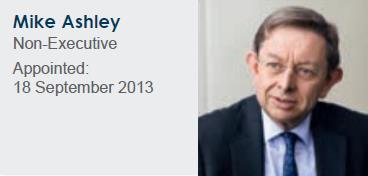
Mike has deep knowledge
of accounting, auditing
and
associated
regulatory
issues, having
previously
worked at KPMG
for over 20 years. Mike’s former
roles include acting as the lead engagement
partner
on the audits of large financial services
groups
including HSBC, Standard Chartered
and the Bank
of
England, as Head of Quality and Risk
Management
for KPMG Europe LLP and
as KPMG UK’s Ethics
Partner. The Board benefits from his extensive
experience in accounting, auditing
and financial
reporting and therefore Mike continues
to contribute
to the long-term sustainable success
of the business.
Key current appointments
Member, Cabinet Office Board; Member, International
Ethics Standards Board for Accountants;
Member,
ICAEW Ethics Standards Committee;
Member,
Charity
Commission
Committee membership
Board Audit Committee (Chair), Board
Nominations
Committee,
Board Risk
Committee
Full Director biographies can be
found on pages
313 to 315.


4
Barclays PLC
2019 Annual Report on Form 20-F
Relevant
skills and experience
Tim’s continued contribution to Barclays’
strategy
and
long-term sustainable success comes
from his
extensive
financial
services experience,
knowledge
of
risk management and UK and EU
regulation, as
well
as an understanding of key investor
issues. He
had a
distinguished career with Legal &
General, where,
among other roles, he was the Group
CEO until June
2012, and this experience enables
Tim to provide
challenge, advice and support to management
on
business performance and decision-making.
Key current appointments
Chairman, Apax Global Alpha Limited
Committee membership
Board Audit Committee, Board Nominations
Committee,
Board Remuneration
Committee,
Board
Risk Committee (Chair)
Relevant
skills and experience
Sir Ian is a member of the Board and
is also Chair of
Barclays
Bank UK PLC.
He contributes
to the Board
substantial
business experience
particularly in
the
international retail sector from his lengthy
executive
career at the Kingfisher Group, as
well as experience
in sustainability and environmental matters
which are
important
to the Group’s
strategy
and long-term
sustainable success. Sir Ian holds strong
credentials
in leadership, is involved with many
charitable
organisations, such as The Prince of Wales’s
Charitable Foundation, and is highly regarded
by the
Government for his work with various
Government
departments
.
Key current appointments
Chairman, Maisons du Monde; Chairman,
Menhaden
plc; Lead Non-Executive Director for the
Government;
Trustee, Institute for Government
Committee membership
Board Nominations Committee
Relevant
skills and experience
Mary Anne is an experienced Non-Executive
Director
with considerable financial services and
investment
banking experience, following an executive
career
spanning over 20 years with Morgan
Stanley. This
enables her to contribute to the effectiveness
of
Barclays
’
operations, strategy
and long-term
sustainable success of the business.
Her current
other Non-Executive positions and
Senior Advisory
role with Blackstone, coupled with
her previous board
and senior management level positions
(with Dollar
Tree Inc., Health
Net, Inc.,
and Blackstone
Advisory
Partners), contribute to the wide-ranging
global,
strategic
and advisory
experience
she can provide to
the Board.
Key current appointments
Non-Executive Director, HP Inc.; Non-Executive
Director,
Ahold Delhaize
N.V.; Non-Executive
Director,
Alcoa Corporation;
Senior Advisor, The
Blackstone
Group L.P.
Committee membership
Board Risk Committee
Relevant
skills and experience
Mohamed is a highly respected economist
and
investor,
with considerable
experience
in the asset
management industry and multilateral
institutions.
He
is chief
economic advisor
at Allianz
SE, the corporate
parent of PIMCO (Pacific Investment
Management
Company LLC) where he formerly
served as Chief
Executive
and Co-Chief
Investment
Officer. As well
as
serving
on several advisory
committees
and boards,
Mohamed is a regular
columnist for Bloomberg
Opinion and a
contributing editor at the Financial
Times. He has also published widely on international
economic and financial topics. He
spent 15 years
at
the IMF where he
served
as Deputy Director
before
moving
to the private
sector and
financial services.
Mohamed’s acute knowledge and understanding
of
international economics and the financial
services
sector strengthens the Board’s capacity
for
overseeing
the strategic
direction
and development
of
the Group. Mohamed’s knowledge and
experience
enables him to contribute to the long-term
sustainable
success
and strategy
of the business.
Key current appointments
Board Member (Non-Executive),
Under Armour Inc.;
Chief
Economic Advisor,
Allianz SE; Senior
Advisor,
Gramercy Fund
s
Management;
Senior Advisor,
Investcorp Bank BSC
Committee membership
None
Relevant
skills and experience
Dawn is a highly experienced financial
executive who
holds the role of Chief Investment
Officer at Soros
Fund Management LLC.
Her previous
experience
includes 25 years with UBS and its predecessor
organisations, most recently as Head
of Investments
for UBS Asset Management. Her
knowledge of
the
businesses
and markets
in which the Group
operates
further
strengthens
the depth and
range of relevant
sector skills and experience across the
Board. This
enables Dawn to challenge and contribute
effectively
to the Group’s operations and the long-term
sustainable success of the business.
Key current appointments
Chief
Investment Officer at Soros
Fund Management
LLC;
Member of The New York Federal Reserve’s
Investor
Advisory Committee
on Financial
Markets;
Member of Advisory Board and Investment
Committee of the Open Society Foundations’
and
their Economic Justice Programme
Committee membership
Board Risk Committee
Relevant
skills and experience
Mary has extensive and diverse board-level
experience across a range of industries,
including her
previous
Non-Executive
Directorships of the
Bank of
England, Alliance & Leicester, Aviva, Centrica and
Swiss Re Group. Through her
former senior executive
positions with HM Treasury, the Prime Minister’s
Office,
and as Director
General of
the Association
of
British Insurers, she brings to the Board
a strong
understanding of the interaction between
public and
priv
ate sectors, skills in
strategic
decision-making
and
reputation management and promotes
strong board
governance
values, which
enables her
to continue
to
contribute effectively to the long-term
sustainable
success
of the Group.
Key current appointments
Non-Executive Director, Valaris PLC; Member of
Advisory
Panel, The
Institute of Business
Ethics;
Member, UK Takeover
Appeal Board
Committee membership
Board Remuneration Committee


5
Barclays PLC
2019 Annual Report on Form 20-F
DIRECTORS’
REPORT
Board
of Directors:
a year of
renewal
Relevant
skills and experience
Brian has served as Chief Financial Officer
for BP
p.l.c.
since 2012. He
joined BP in
1986 after obtaining
a PhD in Mathematics. After performing
a broad
range of commercial and financial roles
across all
facets
of the group, he
became chief executive
of
BP’s integrated supply and trading function
(2005 –
2009). Brian will
retire fro
m
BP in June
2020. His
experience outside BP includes serving
as a
Non-
Executive
Director and
audit committee
member of
Air
Liquide S.A., the Royal Navy, and the Francis Crick
Institute.
Brian also
chairs the ‘100 Group’
of the
FTSE 100 Finance Directors. Brian brings
to the
Board his extensive experience of
management,
finance
and strategy gained
at BP
and other public
and private boards. His experience
with, and
understanding of, the challenges
and opportunities
inherent in advancing a sustainable
energy future
will
be invaluable as Barclays considers
how it can help
to accelerate the transition to a
low carbon world.
Key current appointments
Chief
Financial Officer, BP p.l.c.;
Non-Executive
Director,
Air Liquide S.A.;
Non-Executive Director,
the
Royal
Navy; Senior Independent
Director, the Francis
Crick Institute; Chairman, the 100 Group
of the FTSE
100 Finance Directors
Committee membership
None
Relevant
skills and experience
Tushar is a chartered accountant with over
25 years
of strategic
financial
management,
investment
banking, operational and regulatory
relations
experience, which enables him to
contribute to the
long-term sustainable success and strategy
of the
business.
He joined
Barclays from
JP Morgan,
where
he held various senior roles including
the CFO
of its
Corporate & Investment Bank at the
time of the
merger of the investment bank and
the wholesale
treasury/security services business.
Key current appointments
Member, the 100 Group of the FTSE 100
Finance
Directors
;
Main Committee Chair,
Sterling Risk Free
Reference Rates Working Group
Committee membership
None
Relevant
skills and experience
Diane is a member of the Board, Chair
of Barclays
Execution Services Limited and a
member of the
Board of Barclays US LLC. She brings
to Barclays a
wealth of experience in managing
global, cross-
discipline business operations, client services
and
technology in the financial services
industry, which
enables her to robustly challenge
the Group’s
strategy
and support the
long-term sustainable
success
of Barclays.
Diane had
an extensive career
at Merrill Lynch,
holding
a variety of senior
roles,
including responsibility for banking, brokerage
services
and technology
provided to the
company’s
retail and middle market clients.
Key current appointments
None
Committee membership
Board Audit Committee, Board Nominations
Committee,
Board Risk
Committee
Company Secretary
Relevant
skills and experience
Stephen was appointed Company
Secretary in
November 2017 having previously
served as the
Group Company Secretary and Deputy
General
Counsel of
SABMiller plc.
Prior to
this, he practised
law as a partner in a
law firm in South Africa, and
subsequently
in corporate
law and
M&A at Hogan
Lovells
in the UK. Stephen
has extensive
experience
in corporate governance, legal, regulatory
and
compliance matt
ers.
Stephen serves as
Vice Chair of
the GC100, the association of General
Counsel
and
Company Secretaries working in FTSE
100
companies,
and has
previously served
as Chairman
of the ICC UK
’s Committee
on Anti-Corruption.

6
Barclays PLC
2019 Annual Report on Form 20-F
Executive
Committee:
strategically
enhanced
and strengthened
We have changed
the composition of the
ExCo, removing
a management layer and
bringing
key
business areas closer
to, and
making their
leaders a part of, the most senior
management
forum for the Group.
The following
new roles
and additions to the
ExCo mean that
it now has a stronger
and
closer strategic focus on, and
oversight over,
the businesses comprising
our CIB and our
global
consumer banking and payments
businesses:
New roles
President of Barclays Bank PLC
Paul Compton
Global Head of Consumer Banking and
Payments
Ashok Vaswani
Paul and
Ashok
were previously members of
the ExCo in their
capacities as
Chief Operating
Officer and
CEO of Barclays UK respectively
Roles elevated to the ExCo
Global Head of Banking
Joe McGrath
Global Head of Markets
Stephen
Dainton
Head of Corporate Banking
Alistair
Currie
Group Executive
Committee biographies can
be found
on pages 314 to 316.

7
Barclays PLC
2019 Annual Report on Form 20-F
Striving
for simplicity
and effectiveness
Barclays is a large, diversified organisation. We are committed, through
our governance model, to driving four key features: simplification,
collaboration, accountability and quality of decision-making.
Our governance framework
Our Group-wide governance
framework
has
been designed
to facilitate the effective
management
of the Group by our CEO and his
ExCo whilst preserving the constructive
challe
nge, support and oversight of our major
subsidiary boards in the UK, Ireland
and the
US, consistent with their respective
legal and
regulatory
responsibilities. The Barclays PLC
(BPLC) Board sets the strategic direction
and
risk appetite
of the Group and is
the ultimate
decision
-making body for matters of
Group-
wide strategic,
financial, regulatory or
reputational
significance.
BPLC is the group parent
company and has a
premium
listing on the London Stock
Exchange.
Each of our main operating entities,
Barclays Bank PLC (BBPLC), Barclays Bank
UK PLC (BBUKPLC), Barclays Bank Ireland
PLC, Barclays US LLC and Barclays Bank
Delaware,
has its
own board
comprising
Executive
and
Non-Executive
Directors.
Each also has its
own board committees.
During the year,
we consolidated
and
streamlined
membership of the BPLC and
BBPLC boards, such that membership
of the
BBPLC board is now a subset of the BPLC
Board, with
all members of the BPLC Board
except the Senior
Independent Director (SID),
the Chairm
an of BBUKPLC and one Non
-
Executive
Director now also serving on the
board of BBPLC.
This partial
consolidation has
significantly
increased coordination and
efficiency,
and reduced complexity and
duplication.
The revised BBPLC board
composition
vests
oversight over the activities
of BBPLC in a board the
members of which
also have direct
accountability to BPLC
’s
shareholders through
their separate
responsibilities
as
members of the BPLC
Board.
Board composition
In 2019, we welcomed
our new
Chairman,
Nigel
Higgins. We also announced
the
appointment
of two new Non-Executive
Directors:
■
Dawn Fitzpatrick, who joined
the Board on
25 September
2019;
and
■
Mohamed
A. El-Erian, who joined the Board
on 1 January 2020.
In January 2020,
we announced the
appointment
of Brian Gilvary who joined the
Board on 1 February 2020.
All of these appointments bring
tremendous
insight
and experience relevant to the markets
in which we operate.
In accordance with the
recommendation
of the Code, Reuben Jeffery
and Dr. Dambisa
Moyo, each
having served on
the Board for nine
years, stepped down, as did
Sir Gerry Grimstone
and Mike Turner.
Matthew
Lester stepped down
on 1 January
Board Governance Framework

8
Barclays PLC
2019 Annual Report on Form 20-F
2020. We also bade
farewell to John
McFarlane,
who stepped down after four years
as Chairman,
including a period where he was
Executive
Chairman. We are grateful to them all
for their service to Barclays.
We are actively
seeking to complement the
current range of skills on our Board, ideally
with
individuals
who can bring additional retail
banking
and technology
experience. Our strong
belief
in the benefits of diversity – of gender,
ethnicity
and thought – underpins
our search. In
the report of our Nominations
Committee we
address the continuing
evolution of our Board.
Principal committees
The principal
Committees of the BPLC Board,
and the core responsibilities
of each, are
described in
the “Board Governance
Framework” table
at the foot of the previous
page. The
remit of each Committee is set
out in
brief in the
table, and you can read more
about
the Committees
and their work
on pages
to
32
In September
2019, the Board reviewed the
responsibilities
of the Reputation Committee
and reallocated
them mainly to the Board so
that it could
itself directly oversee the critical
topics of culture,
the environment and
reputation.
Responsibility for the oversight of
Conduct risk and Compliance
was
transferred
from the Reputation
Committee to the Risk
Committee.
We measure our effectiveness
An effective
Board is one that delivers for
stakeholders. We assess the effectiveness of
our Board, its Committees
and Board members
each year, as required
by the Code. Although
the Code only
requires an externally facilitated
evaluation
every three years,
for each of the
past four years we have used the services of an
external
agency to facilitate the assessment of
the effectiveness of the Board.
This year, the
Nominations
Committee decided to ask our
SID, with the support of the Company
Secretary,
to conduct the
assessment.
They are
well placed
to do this, having been closely
involved
in the transition to a new Chairman
and the evolving
composition of the Board and
the way it operates. You
can read more about
our 2019 process and our progress against the
2018 review
on page
s
23 to 24.

9
Barclays PLC
2019 Annual Report on Form 20-F
DIRECTORS’
REPORT
Our key
areas
of focus
in 2019
We think of governance as how we govern the organisation and make
decisions to promote its success for the long-term benefit of our
stakeholders. Effective governance makes possible the delivery of our
purpose and our strategy.
Governance in action: our
programme of prioritised deep
dives
To
underpin
informed and sound decision-
making,
the Board needs to have a deep and
granular
understanding of the Group as a
whole and
each of its significant businesses –
where the key risks lie, how and
where
resources are allocated
and the contribution
made by each
part of the business.
Led by
the Chairman,
the Board and the
ExCo have agreed
a prioritised series of deep
dives which now form a significant
part of
each Board meeting,
with two to four deep
dives on the agenda
for a typical Board
meeting.
The materials for each deep dive
facilitat
e
an in-depth understanding of the
issues and generate
meaningful discussion,
debate,
support to management and
challenge
on key topics, allowing the Board
to
exercise effective
oversight and assist
the
delivery
of the Group’s strategy.
Through
this process,
the Board considers
strategy at every meeting,
rather than in a set
piece
event once
a year.
The Board
has discharged its responsibilities
as described in this high
-level flow diagram.
10
Barclays PLC
2019 Annual Report on Form 20-F
Key priorities
Core areas of focus
Our programme
of deep dives is outlined below
and in the
“Governance
in action” section on
the previous page.
This programme
commenced
in July 2019, following the
appointment
of Nigel Higgins as
Chairman.
The deep
dives held this year
included
consideration
of a wide range of topics,
covering
selected individual business units as
well as Group-wide
matters such as
our capital
allocation
framework, our
costs, our societal
purpose, our culture,
the environment and our
risk profile.
Feedback from our shareholders and
wider
stakeholders has been taken into
account
in
arriving
at and prioritising our deep dives.
The Board
received updates on the
performance
of the business
and execution
of the strategy at every meeting,
and the
approval
of our MTP,
in which our strategy is
embedded,
was
a key Board responsibility
at
its November
and December 2019 mee
tings.
We also gave considerable
focus to
developments in
the regulatory environment,
and to engagement
with our regulators in the
UK and the US in particular.
The oversight of
risk and of our control environment
is also
a core Board responsibility
and has
been
addressed at meetings through
the year.
The Board
believes
the right
culture
and
values,
supported
by
effective
leadership
and a consistent
tone
from the
top, are
crucial
to the success
of the Group.
Stakeholder engagement
We have enjoyed
extensive engagement with
our shareholders in 2019
through a variety of
mechanisms,
including:
■
In February, March
and April
2019, Nigel
Higgins held
around 50 meetings with
shareholders and other
stakeholders. This
was a “listening
tour”, the aim of which was
for Nigel to introduce
himself to a wide
range of stakeholders, including
our
institutional
shareholders,
and to hear
directly
from them their views on the
Company
before he became Chairman in
May 2019.
We also engaged with activist
investor Sherborne
Investors
Management
LP as part of this process;
■
Our AGM, where the Board engaged
extensively
with shareholders, both
formally
during the meeting and
informally
before and after the AGM; and
■
Through
our intensive Investor Relations
programme
of conference calls, webcasts
and meetings
at the time
of each of our
quarterly
results releases.
Our broader stakeholder engagement
is
described in
the Strategic Report
available at
home.barclays/annualreport
. Specifically
with regard to our workforce, engagement
with
our colleagues
has long been
a part of our
DNA as an organisation.
The Board conducted
a full review
of our existing engagement model
and concluded
that this, with certain
enhancements,
would be the best and most
effectiv
e
means to ensure sustained
engagement
with our workforce
whilst also
meeting
the objectives of the Code’s
new
workforce engagement
requirements. Our
workforce engagement
model is described in
the People
section on page
83 to 86.
Purpose, culture and values
Our purpose, adopted
in May 2018, is
“Creating opportunities to rise”. This is
underpinned
by our values: respect, integrity,
service, excellence
and stewardship, and by
the behaviours associated with
them. Our
purpose, values and
behaviours are designed
to support each other,
to drive our culture
and
to guide
our strategy and decision
-making.
The Board
has recently examined
our purpose
and concluded
that whilst it is fully integrated
into many
of our key
processes and decision-
making forums, we have further
work to do to
bring to life:
to express
and apply
it consistently
across the Group, and
for it to better connect
all of our stakeholders, our businesses, ESG
activities and
ambitions. This work is under
way.
Our values were adopted
in January 2013.
They were, and
remain, fully
embedded and
integrated
into the Group.
Our culture is a core area of focus for the
Board, which
bel
ieves
that the right
culture and
values, supported
by effective leadership and a
consistent tone from
the top, are crucial to the
success of the Group.
How
does the
Board review
our culture?
The Board
reviews our culture in a number of
ways, including:
■
Quantitative
and qualitative feedback on
how our culture aligns with
our purpose,
values and strategy through
Culture
Dashboards, so the Board can
see the
effect our people
engagement has on our
performance,
and the continued strength
of our culture;
■
Analysis of employee
survey results;
■
Face-to-face engagement
with employees
locally
to hear what they think; and
■
Review of people
policies, which are
designed
to provide equal opportunities
and create an inclusive
culture, in line with
our values and i
n
support of our long term
success.
11
Barclays PLC
2019 Annual Report on Form 20-F
DIRECTORS’
REPORT,
BOARD AUDIT
COMMITTEE REPORT
Ensuring
reporting
integrity
and
an effective
controls
environment
The Board Audit Committee has a central role in maintaining and
challenging the quality of Barclays external disclosures and its internal
control environment.
Dear Fellow
Shareholder
2019 was a year of steady progress for
the Group both
in enhancing its control
environment
and embedding new financial
reporting
requirements, particularly in relation
to the expected
credit loss
(ECL) model
introduced
by the implementation of IFRS 9
in 2018.
Ensuring focus on strengthening
the
Barclays
internal
control environment
has continued to
be a key activity
for the Committee. 2019 was
an important
year for
the Barclays Internal
Control Environment
Programme (BICEP)
which commenced
in January 2017 and is
on
track to complete
by the end of March 2020. As
at the end of 2019,
94% of issues
were either
closed or in validation
with 96% of the BICEP
milestones
achieved. When BICEP is fully
completed,
the Group’s control environment
will
be in a much stronger position, but
inevitably,
as
expect
ations and standards
change
and new control events occur, work is
still required
both to maintain and to further
develop
it. The Committee is therefore working
to ensure that as we transition
to “business
as
usual”, management
has a robust
framework
for identifying
and responding to control issues
with appropriate
reporting to the Committee
and other Board
Committees. A key
component
of this will be the work
the Chief
Controls Office
is doing to further streamline
and automate
the Risk
and Controls Self-
Assessment (RCSA) process to make it more
dynamic.
In assessing general
control issues for
disclosure in this Annual
Report, the
Committee
continued to apply similar concepts
to those used for assessing internal
financial
controls for the purposes of the US Sarbanes-
Oxley Act. The
conclusion we reached is that
there are no control
issues that are considered
to be a material
weakness
and which
therefore
merit specific
disclosure.
IFRS 9
continued
to be a major focus for the
Committee
this year as
models conti
nue to be
validated
and refined. In addition disclosures
have been
enhanced, although more work is
required
to develop the ability to generate and
disclose more meaningful
sensitivity analyses.
Following
the introduction of the time bar by
the FCA at the e
nd of August, the level
of
subjectivity
of the PPI provision at 31
December 2019
has been considerably
reduced.
However the Committee did consider
whether the “spike” in complaints received
just
before the
deadline
might have been
anticipated
and was satisfied that there was no
evidence
that would have justified an earlier
significant
increase in the provision.
I continued
my regular meetings with the
Chairs of the main
subsidiary audit
committees,
including the Chair of the BBPLC
audit
committee until the partial consolidation
of the BPLC and BBPLC
boards. Since that
time
I have also met with the
Chair of the
Barclays US LLC audit
committee, attended
a meeting
of the Barclays Bank
Ireland
PLC
audit
committee, and attended
the meeting of
the BBUKPLC au
dit committee which
considered
the main year
-end accounting
issues. The Chair
of the BBUKPLC audit
committee
also attends the meeting of the
Committee
where we consider the control
environment
of BBUKPLC as
part of our year-
end evaluation.
I also continued to meet
frequently
with members of senior
management,
including the Group Finance
Director and Chief
Internal Auditor.
In relation
to the latter,
I am pleased that the Committee
approved
the appointment in September 2019
of Lindsay O’Reilly
as
the new Chi
ef Internal
Auditor
following a joint reco
mmendation from
myself and the
Group Chief
Executive Officer.
As she was appointed
to this
role from a first
line
of defence function, the Committee have
taken steps to understand
and safeguard
against potential
and
perceived conflicts of
interest that may
arise in order to support BIA’s
continued
independence from the business.
BIA is a key component
in supporting the
Committee’s work and I am pleased
with
the way that the function
has continued to
develop
throughout the year in scoping,
performing
and reporting the outcomes
of its work both to management
and
the Committee.
I have also continued
my regular engagement
with the Group’s regulators both
in the UK and
US. This has encompassed not
only my work
as the Chair of the Committee,
but also my role
as the Group’s Whistleblowing
Champion. In
that respect, I also oversaw the production
of
the first of three annual
reports which we have
agreed to submit
to the FCA and PRA in the
UK and also the New York Department
of
Financial
Services containing certain
information
regarding our whistleblowing
programme.
Committee
performance
The performance
of the Committee was
assessed internally
as
part of the annual
effectiveness review of the Board.
In line
with
the approach
adopted for all Board
Committees in
2019, the process involved
completion
of a tailored questionnaire by
Committee
members
and standing
attendees.
The results confirm
that the Committee is
operating
effectively, and the Board takes a
high
level of assurance from the technical
and commercial
competence and diligence
of the Committee’s work. It is considered
well-
constituted,
with the right balance of skills
and
experience
to provide an appropriately broad
level
of challenge and oversight of the areas
within
its remit. Consideration will need to be
given
to adding an
additional member of the
Committee
with recent and relevant financial
experience
following the departure of Matthew
Lester at the end
of the year.
Last year’s review commented
on the improved
focus of the Committee
on key issues
in the
context of managing
a demanding agenda
efficiently
so
that time is allocated to the
most
significant
items for discussion. As
the
Committee
has taken on additional
responsibilities
during the year,
for example the
oversight of tax matters, continued
focus on
this area will
be beneficial.
In response to a request to provide
feedback
on the interaction
with subsidiary audit
committees,
the review highlighted that
interaction
with the BBUKPLC audit committee
had
been helpful
and effective. Following the
consolidation
of the membership of the
Committee
with the BBPLC audit committee,
coverage of BBPLC
matters within concurrent
meetings
was
considered
adequate, noting that
it will
benefit from further embedment.
Looking ahead
In 2020 the Committee
will still continue to
monitor
the embedment of IFRS 9 processes
and further enhancements
to our disclosure,
particularly
as
regards sensitivities.
We will
also be looking to assess
the reporting
of control issues after the conclusion
of BICEP
as well as monitor
the satisfactory completion
of remediation
programmes which are due to
extend beyond
31 March 2020, in particular the
Designated
Markets
Activity
remediation plan.
Mike Ashley
Chair, Board
Audit Committee
12
February 2020


12
Barclays PLC
2019 Annual Report on Form 20-F
Committee
composition
and meetings
The Committee
is composed solely of
independent
Non-Executive Directors, with
membership
designed to provide the
breadth
of financial
expertise
and
commercial
acumen it needs to fulfil its
responsibilities.
Its
members as a whole
have recent and
relevant experience of the
banking
and financial services sector, in
addition
to general management and
commercial
experience, and are financially
literate.
In particular, Mike Ashley, who is
the designated
financial expert on the
Committee
for the purposes of the US
Sarbanes
-Oxley Act, is a former audit
partner who, during
his executive career,
acted as lead
engagement partner on the
audits of a number
of large financial
services groups. Matthew
Lester, who
resigned from the
Committee on 1 January
2020, held
a number
of senior finance roles
across a range of business sectors,
including
financial services, during his
executive
career. You
can find more details
of the experience
of Committee members
in
their biographies
on pages 3 to 6.
During 2019,
the Committee met 10 times
and the chart opposite
shows
how it
allocated
its time. Attendance by members
at Committee
meetings is
also shown
opposite.
Committee meetings were
attended
by representatives
from
management,
including the Group Chief
Executive
Officer, Group Finance Director,
Chief Internal
Auditor,
Chief Controls
Officer,
Chief Risk
Officer,
Chief Operating
Officer,
Group General Counsel
and Group
Chief Compliance
Officer, as well as
representatives from the
businesses
and
other functions.
The lead audit engagement
partner of KPMG,
Michelle Hinchliffe, also
attended
Committee meetings. The
Committee
held a number of separate
private sessions with each of the Chief
Internal
Auditor and the lead audit
engagement
partner, which were not
attended
by management.
Committee
role
and responsibilities
The Committee
is responsible for:
■
Assessing the integrity
of the Group’s
financial
reporting and satisfying itself
that any significant
financial
judgements
made by management
are sound;
■
Evaluating
the effectiveness
of the
Group’s internal
controls,
including
internal
financial controls;
■
Scrutinising
the activities
and
performance
of the internal and
external
auditors, including monitoring
their independence
and objectivity;
■
Overseeing the
relationship with the
Group’s external
auditor;
■
Reviewing
and monitoring the
effectiveness of the Group’s
whistleblowing
policies and procedures;
and
■
Overseeing significant
legal and
regulatory
investigations, including the
proposed litigation
statement for
inclusion
in the statutory accounts.
13
Barclays PLC
2019 Annual Report on Form 20-F
DIRECTORS’
REPORT,
BOARD AUDIT
COMMITTEE REPORT
Ensuring
reporting
integrity
and
an effective
controls
environment
Area of focus
Reporting
issue
Role of the Committee
Conclusion/action
taken
Fair, balanced and
understandable
reporting
(including
Country-by-
Country Reporting
and
Modern
Slavery
Statement)
In light
of the Board’s obligation
under the Code,
the Committee
assesses external
reporting to
ensure it is fair, balanced
and
understandable.
In addition
to this Annual Report and
associated year-end
reports, the
Committee
also reviewed the Group’s
quarterly
reports and the GFD’s
presentations to analysts.
The Committee
informed these
reviews by:
■ Consideration
of reports of the
Disclosure Committee
which
included
views on content,
accuracy and tone;
■ Direct
questioning
of management
including
the CEO and GFD on the
transparency and accuracy
of
disclosures;
■ Consideration
of management’s
response to letters issued by the
FRC;
■ Evaluation
of the output of the
Group’s internal
control
assessments and Sarbanes
-Oxley
s404 internal
control process;
and
■ Consideration
of the results of
management’s processes relating
to financial
reporting matters
and
to evidence
the representations
provided
to the external auditors.
The Committee
noted specifically that
whilst the disclosures regarding
IFRS9 met nearly
all the
recommendations from the
Enhanced
Disclosure Task
Force these were
still evolving.
The Committee
encouraged
management to continue
to enhance
the disclosure particularly
as the ability
to analyse
sensitivities
was developed.
Having evaluated
all of the available
information,
the assurances
by
management
and underlying
processes used to prepare the
published
financial information, the
Committee
concluded and advised
the Board that
the 2019
Annual
Report and financial
statements are
fair balanced
and understandable.
Going concern
and
long-term
viability
Barclays is required
to assess
whether it is appropriate
to prepare
the financial
statements on a going
concern basis and also, in
accordance
with the Code, Barclays
must provide a statement
of its
viability.
The Committee
considered both the
going
concern assumption and the
form and content
of the viability
statement
having regard to:
■ The
MTP and
WCR;
■ The
forecasted liquidity
and
funding
profile;
■ The
results of
stress tests based
on both internal
and regulatory
specified
assumptions as reviewed
by the Risk Committee;
and
■ Current risk and
strategy
disclosures.
The Committee
recommended to the
Board that the
financial statements
should be prepared
on a going
concern basis and that there were no
material
uncertainties
that may cast
significant
doubt on the Group’s
ability
to continue as
a going
concern.
The Committee
also agreed that the
appropriate
time frame for the viability
statement
continued to be three
years
and recommended
the viability
statement
to the Board for approval.
14
Barclays PLC
2019 Annual Report on Form 20-F
Area of focus
Reporting
issue
Role of the Committee
Conclusion/action
taken
Impairment
(refer to Note 7
to the
financial
statements)
Following
implementation of IFRS9,
ECLs
are modelled
using a range of
forecast economic
scenarios. The
key areas of judgement
include
setting the modelling
assumptions,
developing
the macroeconomic
scenarios and the
methodology for
weighting
them, establishing the
criteria
to determine significant
deterioration
in credit quality and the
application
of management
adjustments
to the modelled output.
As part of their
monitoring the
Committee
considered a number of
reports from management
on:
■ The
continued development and
embedding
of controls over the
internal
processes
supporting
the
ECL calculation
and related
assessment of SOx compliance
(including
by the external
auditors);
■ Model
changes and refinements to
the staging
criteria;
■ Regeneration
of the
macroeconomic
variables
and
associated weighting;
■ Adjustments
made to the
modelled
output
to reflect updated data and
known model
deficiencies;
■ Comparisons
betwe
en actual
experience
and forecast losses;
and
■ Single
name exposures.
Having considered
and scrutinised
the reports, the Committee
agreed
with management’s
conclusion that
the impairment
provision (including
specifically
the £150m for anticipated
economic
uncertainty in the UK) was
appropriate.
Going
forward the Committee also
agreed with
management that it
would be
appropriate to review the
frequency
of regenerating the
macroeconomic
scenarios.
Conduct provisions
(refer to Note 24
to the
financial
statements)
Barclays makes certain
assumptions and estimates,
analysis of which underpins
provisions made
for the costs of
customer redress, such as for PPI.
With a view to evaluating
adequacy of
the provision,
the Committee
analysed
the judgements and
estimates made
with regard to
Barclays’ provisioning
for PPI claims,
taking into
account:
■ Forecasts
and assumptions made
for PPI complaints;
■ Actual
claims levels and validity of
claims; and
■ Increased
levels of claims based
on the August 2019
time bar for
claims (including
claims from the
Official
Receiver).
In light
of information received, the
Committee
agreed with management
that the PPI provision
was
adequate
during
H1 2019 and did not
need to
be increased.
The PPI provision
was
increased in
Q3 2019 by £1.4bn
due
to the exceptionally
high volume of
claims received
in late August 2019
prior to the time
bar. The Committee
agreed with
this increase and that
the
level
of provision at the end of the
year was appropriate.
The Commit
tee also made
recommendations regarding
the
sensitivity disclosures.
Legal, competition
and
regulatory
provisions
(refer to Notes 24
and 26
to the financial
statements)
Barclays is engaged
in various
legal,
competition and regulatory
matters which may give
rise to
provisioning
based on the facts.
The level
of provisioning is subject
to management
judgement on the
basis of legal
advice and is,
therefore,
an area of focus for the
Committee.
Evaluated
advice on the status of
current legal,
competition and
regulatory
matters and assessed
management’s judgements
on the
levels of provisions to be taken and
accompanying
disclosure.
The Committee
discussed provisions
and utilisation
and having reviewed
the information
available to determine
what was both probable
and could be
reliably
estimated, the Committee
agreed that
the level of provision at
the year-end was appropriate.
The
Committee
also considered that the
disclosures made
provided the
appropriate
information for investors
regarding
the legal, comp
etition and
regulatory
matters being addressed
by the Group.
15
Barclays PLC
2019 Annual Report on Form 20-F
DIRECTORS’
REPORT,
BOARD AUDIT
COMMITTEE REPORT
Ensuring
reporting
integrity
and
an effective
controls
environment
Area of focus
Reporting
issue
Role of the Committee
Conclusion/action
taken
Valuations
(refer to Notes 13 to 17 to
the financial
statements)
Barclays exercises judgement
in the
valuation
and disclosure of financial
instruments, derivative
assets
and
certain
portfolios, particularly where
quoted
market prices are not
available.
The Committee:
■ Evaluated
reports from the Group
Financial
Controller;
■ Monitored
the valuation methods
applied
by management requiring
significant
judgement such as
the
ESHLA portfolio;
and
■ Reviewed
the restructuring of the
long
-dated derivative portfolio
which had
previously
given rise to
a significant
valuation disparity
with the counterparty.
The Committee
noted that there were
no new significant
valuation
judgements
at the end of the year.
The Committee
was
satisfied with the
accounting
treatment on an amortised
cost basis of the investments now
held
as
a result of the restructuring
of
the long
-dated derivative portfolio.
The Committee
was
also satisfied
that the day one
valuation ascribed to
resultant instruments
was
appropria
te
by reference both
to the existing
valuation
methodology and the
ongoing
profitability of the instruments
now held.
Tax
(refer to Note 9
to the
financial
statements)
Barclays is subject to taxation
in a
number
of jurisdictions globally
and
makes judgements
with regard to
provisioning
for tax at risk,
and on
the recognition
and measurement of
deferred tax assets.
The Committee
is responsible for
considering
the Group’s tax
strategy
and overseeing
compliance with the
Group’s Tax
Code of Conduct.
In this
regard the Committee
received
reports from the Tax
Management
Oversight Committee
and in particular
considered
the utilisation of the
Luxembourg
tax losses
and revised
US holding
company structure.
The Committee
reviewed the
appropriateness of provisions made
for uncertain
tax positions, including
the retrospective
de-grouping of
certain entities from the
UK VAT
group.
The Committee
also confirmed that
the estimates and
assumptions used
in assessing the recoverability
of
deferred tax assets were supported
by the MTP.
The Committee
was
satisfied that
specific strategies were in line
with
the Group’s Tax
Code of Conduct
and
on behalf
of the Board approved the
UK Tax
Strategy statement
published
as part of the Country-by-Country
Report.
The Committee
noted that the
uncertain
tax positions covered a
diverse range of issues and as a
consequence
agreed with
management’s view that
there was
not a significant
risk
of a material
adjustment
during the next year.
The Committee
was
also satisfied
that deferred
tax assets
recognition
was appropriate.
16
Barclays PLC
2019 Annual Report on Form 20-F
Area of focus
Reporting
issue
Role of the Committee
Conclusion/action
taken
Internal
controls
and
business
control environment
Read more about
Barclays’ internal
control
and risk management
processes on page
s
37
to 38.
The effectiveness of the overall
control
environment,
including the
status of any significant
control
issues and the progress of specific
remediation
plans.
The Committee:
■ Evaluated
and tracked the status
of the most significant
control
issues through
regular reports
from the Chief
Controls Officer,
including
updates on lessons
learned
and assessment
against
the Controls Maturity
Model. The
Committee
also received
independent
evaluations
from BIA
and external
auditors;
■ Evaluated
the status of specific
significant
control Hot Spots,
specifically;
transaction
operations,
cyber, treasury and
capital
liquidity risk
reporting
and
model
risk
(control framework and
model
reporting);
■ Scrutinised
reports from individual
businesses and functions on their
control
environment
and focused
on the progress relating
to
remediation
areas; and
■ Monitored
CASS updates and
associated remediation
activities.
At its next meeting,
the Committee
will
receive feedback from the Chief
Controls Office
on the 2019
RCSA
process, which will
help inform the
Committee’s overall
assessment
of
the Group’s control environment.
The
Committee
also received preliminary
feedback from the
Chief Controls
Officer on the
2019 RCSA process
which helped
inform the Committee’s
overall
assessment
of the Group’s
control environment.
Throughout
2019, the Committee
has:
■ Monitored
progress
of BICEP
against completion.
At the end of
2019, the
Committee noted that
BICEP was on target for
completion
by March 2020;
■ Monitored
key
control issues
through
a series
of deep
dives and
scrutinised the pathway
to ‘Return
to Satisfactory’ in respect of
internal
controls operated by the
various functions
and businesses;
■ Recommended
enhancements
to
the RCSA review process,
including
streamlining review
through
integration with the
internal
control process
review;
and
■ Enhanced
monitoring of liquidity
risk remediation
actions
relating
to
buffer increases, following
an
increase in regulatory
technical
breaches.
Raising concerns
The adequacy
of the Group’s
arrangements
to allow employees to
raise concerns in confidence
and
anonymously
without fear of
retaliation,
and the outcomes of
any
substantiated
cases.
The Committee:
■ Has
overseen the embedding
of a
new centralised
team to manage
concerns raised; and
■ Received
reports from
management
and monitored
whistleblowing
metrics and
retaliation
reports.
The Committee
received two in
-depth
semi-annual
reports on
whistleblowing
from management. At
year-end the Co
mmittee noted the
recent ‘Satisfactory’ rating
by BIA of
the audit
of the centralised team and
considered
that the whistleblowing
programme
generally met with best
practice
as
identified
by the PRA.
However the Committee
encouraged
the team
to consider how interaction
with whistleblowers might
be further
enhanced
to improve their experience
with the process. In addition
the
Committee
stressed
the importance
of ensuring the time
taken to
investigate
concerns
robustly was
as
short as possible in order to mini
mise
the potential
stress
for all concerned.
17
Barclays PLC
2019 Annual Report on Form 20-F
DIRECTORS’
REPORT,
BOARD AUDIT
COMMITTEE REPORT
Ensuring
reporting
integrity
and
an effective
controls
environment
Area of focus
Reporting
issue
Role of the Committee
Conclusion/action
taken
Internal
audit
The performance
of BIA and
delivery
of the internal audit plan,
including
scope of work
performed,
the level
of resources,
and the
methodology
and coverage of the
internal
audit plan.
The Committee
has:
■ Scrutinised
and agreed internal
audit
plans, methodology and
deliverables for 2020
including
assessing internal
audit resources
and hiring
levels, and any impacts
on the audit
plan;
■ Tracked
the levels of
unsatisfactory audits,
and
monitored
related remediation
plans;
■ Considered
the recommendation
for the appointment
of the Chief
Internal
Auditor;
■ Discussed
BIA’s approach
to data
analytics;
■ Discussed
BIA’s assessment of
the management
control approach
and control
environment in
BBUKPLC, BBPLC
and the
functions;
and
■ Evaluated
the outcomes from
BIA’s annual
self-assessment.
At year-end the Committee
approved
the 2020
Audit Plan detailing the
number
of audits and areas of focus,
and was satisfied with the
level of
resource to be allocated.
In particular.
the Committee has
scrutinised:
■ The
appointment of the
new Chief
Internal
Auditor;
■ Internal
audit resource and the
ability
of BIA to support the 2020
Audit
Plan; and
■ BIA’s
assessment of the overall
control environment.
External audit
The work and performance
of
KPMG.
The Committee:
■ Met
with key members of the
KPMG audit
team to discuss
the
2019 audit
plan and KMPG’s
areas of focus;
■ Assessed regular
reports from
KPMG on the
progress
of the
2019 audit
and any material
accounting
and control issues
identified;
■ Discussed
KPMG’s feedback on
Barclays’ critical
accounting
estimates and judgements;
■ Discussed
KPMG’s draft report on
certain
control areas and the
control
environment
ahead of the
2019 year end;
and
■ considered
the draft SOx control
report and the draft
audit
opinion.
The Committee
approved the audit
plan
and the main
areas
of focus.
Read more about
the Committee’s
role in assessing the performance,
effectiveness and independence
of
the external
auditor below.
18
Barclays PLC
2019 Annual Report on Form 20-F
External auditor
Following
an external audit tender in 2015,
KPMG was appointed
as
Barclays’
statutory
auditor
with effect from the 2017 financial year.
Michelle
Hinchliffe of KPMG is the Senior
Statutory
Auditor and was appointed to this
role with effect
for the 2018 financial year.
Assessing external auditor
effectiveness, objectivity and
independence and non-audit
services
The Committee
is responsible for assessing
the effectiveness, objectivity
and independence
of the Group
’s
auditor,
KPMG. This
responsibility
was
discharged
throughout the
year at formal Committee
meetings, during
private mee
tings
with KPMG,
and through
discussions with key executive
stakeholders. In
addition
to the matters noted above, the
Committee
also:
■
Approved
the terms of the audit
engagement
letter and associated fees,
on behalf
of the Board;
■
Discussed and agreed
revisions to the
Group policy
on the
Provision of Services
by the Group Statutory
Auditor
(the Policy)
and regularly
analysed reports
from
management
on the non-audit services
provided
to Barclays;
■
Evaluated
and approved revisions to
the
Group policy
on
Employment of
Employees or Workers from the Statutory
Auditor
and ensured compliance with the
policy
by regularly assessing
reports from
management
detailing any appointments
made;
The Committee
considered
that
KPMG
maintained
its
independence
and
objectivity, and
that
the audit
process
was effective.
■
Was briefed
by KPMG on critical
accounting
judgements and estimates and
internal
controls over financial reporting;
■
Considered the
formal report from the
Public
Company Audit Oversight Board on
their review of KPMG
’s
audit
of the 2017
financial
statements
and the consequential
revisions made by KPMG
to their audits for
both the 2018
and 2019 financial
statements. These were in lin
e
with the
provisional
results reported last year; and
■
Assessed any potential
threats
to
independence
that were self-identified and
reported by KPMG.
The Committee
is aware that the FRC
has also
reviewed
certain
aspects of
KPMG
’s
audit
of
the 2018
fina
ncial
statements although its
report is not yet available.
KPMG has informed
the Committee
of areas for
improvement
which
are likely to be reported
by the FRC
and how
these matters have been
addressed in the
2019 audit.
Based on its understanding to date,
the Committee
believes
that KPMG
’s
audit
work should provide
reasonable assurance that
the financial
statements are free of material
misstatement.
KPMG
’s
performance,
independence and
objectivity
during 2019 were also formally
assessed at the beginning
of 2020 by way of a
questionnaire
completed by key
stakeholders
across the Group, including
the chairs of the
BBUKPLC, Barclays US LLC and Barclays
Bank Ireland
PLC audit committees. The
questionnaire
was
designed
to evaluate
KPMG
’s
audit
process and addressed matters
such as the quality
of planning and
communication,
technical knowledge, the level
of scrutiny and challenge
applied and KPMG’s
understanding
of the business.
In addition,
as
in the prior year,
KPMG nominated
a senior
partner of the audit
team reporting to the
Senior
Statutory Auditor to have
specific
responsibility
for ensuring audit quality. The
Committee
therefore met with the partner
concerned
without the Senior Statutory Auditor
to receive a report on his assessment of audit
quality.
Taking
into account
the result of all of the
above,
the Committee
considered that KPMG
maintained
its independence and objectivity
and that the
audit process was
effective.
Non-audit services
In order to safeguard the auditor
’s
independence
and objectivity, Barclays has in
place
a policy
setting out the circumstances in
which the auditor
may be engaged to provide
services other than those covered
by the
Group audit.
The Policy applies to all Barclays’
subsidiaries and other
material entities over
which Barcla
ys
has significant
influence. The
core principle
of the Policy is that non
-audit
services (other than those legally
required to
be carried out by the Group
’s
auditor)
should
only be performed
by the auditor in certain
controlled
circumstances. The Policy sets
out
those types of services that are strictly
prohibited
and those that are allowable in
principle.
Any service types that do not fall
within
either list are considered by the
Committee
Chair on a case-by-case basis,
supported by a risk assessment provided
by
management.
A summary of the Policy can be
found at
home.barclays/who
-we-are/our-
governance/auditor
-independence
.
The P
olicy
is reviewed on an annual basis
to
ensure that it is fit for purpose, and
that it
reflects applicable
rules
and guidelines
.
The P
olicy
is also aligned with KPMG’s
own
internal
policy on non-audit services for
FTSE
350 companies
which broadly restricts non-
audit
work
to services that are ‘closely
related
’
to the audit.
Any changes to the Policy
are approved at a
Group level
by the Committee. This is
in
accordance
with European Union law and
FRC
guidance,
pursuant to which audit committees
of Public
Interest Entities (such
as Barclays)
are required
to approve non
-audit services
provided
by their auditors to such
entities,
and
subsidiary Public
Interest Entities in the UK –
such as BBUKPLC and BBPLC
– can rely on
the approval
of non
-audit services
by the
ultimate
parent’s
audit
committee. It should be
noted that
audit services, and the fee cap, will
also be monitored
by the rele
vant audit
committee,
as
appropriate.
Under the Policy
the Committee has pre-
approved
all allowable services for which fees
are less than £100,000.
However, all proposed
work, regardless of the fees, must be
sponsored by a senior executive
and recorded
on a centralised
online system, with a detailed
explanation
of the clear commercial benefit
arising from engaging
the auditor over other
potential
service providers. The audit
engagement
partner must also confirm that the
engagement
has been approved in accordance
with the auditor
’s
own internal
ethical
standards and does not pose any threat to the
auditor
’s
independence
or objectivity.
All
requests to engage
the auditor are assessed
by independent
management before work can
commence.
Requests
for allowable
service
types in respect of which the fees are expected
to meet or exceed
the above
threshold must
be
approved
by the Chair of the Committee before
work is permitted
to begin. Services where the
fees are expected
to be £250,000 or higher
must be approved
by the Committee as a
whole.
All expenses and disbursements must
be included
in the fees calculation.
19
Barclays PLC
2019 Annual Report on Form 20-F
DIRECTORS’
REPORT:
BOARD
AUDIT COMMITTEE
REPORT
Ensuring
reporting
integrity
and
an effective
controls
environment
During 2019,
all engagements where expected
fees met or exceeded
the above threshold
were evaluated
by either the Committee Chair
or the Committee
as
a whole who, before
confirming
any approval, assured themselves
that there was justifiable
reason for engaging
the auditor
and that its independence and
objectivity
would not be threatened. No
requests to use KPMG were declined
by the
Committee
in 2019 (2018: none). On a
quarterly
basis, the Committee
reviewed
details
of individually
approved and pre-
approved
services
undertaken by KPMG
in
order to satisfy itself that they
posed no risk
to independence,
either in isolation or on an
aggregated
basis.
For the purposes of the Policy,
the Comm
ittee
has determined
that any pre-approved service
of a value of under
£50,000 is to be regarded
as trivial
in terms of its impact on Barclays’
financial
statements
and requires the Group
Financial
Controller to specifically review and
confirm
to the Commi
ttee that any pre-
approved
service with a value of £50,000-
£100,000
may be regarded as
such. The
Committee
undertook a review of pre-approved
services at its meeting
in December 2019 and
satisfied itself
that such pre-approved
services
were trivial
in the context of their impact
on the
financial
statements.
The fees payable
to KPMG for the year ended
31 December
2019 amounted to £56m, of
which £11m
(2018: £11m) was payable
in
respect of non
-audit services. A
breakdown of
the fees payable
to the auditor for statutory
audit
and non
-audit work
can be found
in Note
40.
Of the £11m
of non-audit services provided
by KPMG during
2019, the significant
categories of engagement,
i.e. services where
the fees amounted
to more than £500,000,
included:
■
Audit
-related services: services
in
connection
with CASS audits;
■
Other services in connection
with
regulatory,
compliance and internal control
reports and audit
procedures, required by
law or regulation
to be provided by the
statutory auditor;
and
■
Other attest and assurance services, such
as ongoing
attestation and assurance
services for treasury and capital
markets
transactions to meet
regulatory
requirements, including
regular reporting
obligations
and verification reports.
The Statutory Audit Services
for Large Companies Market
Investigation (Mandatory Use
of Competitive Tender Processes
and Audit Committee
Responsibilities) Order 2014
An external
audit tender was conducted in
2015 and
the decision was made to appoint
KPMG as Barclays’
external
auditor with effect
from the 2017
financial year, with
PwC
resigning
as
the Group
’s
statutory auditor
at
the conclusion
of the 2016 audit.
Barclays is in compliance
with the
requirements of The
Statutory Audit Services
for Large Companies Market Investigation
(Mandatory
Use
of Competitive
Tender
Processes and Audit
Committee
Responsibilities) Order 2014,
which relates to
the frequency
and governance of tenders for
the appointment
of the external auditor and the
setting of a policy
on the provision
of non-audit
services.
Provided
that KPMG continue to maintain their
independence
and objectivity, and the
Committee
remains satisfied with their
performance,
the Group has no intention of
appointing
an alternative external auditor
before the
end of the current required
period of
10 years.


20
Barclays PLC
2019 Annual Report on Form 20-F
DIRECTORS’
REPORT:
BOARD
NOMINATIONS
COMMITTEE REPORT
Delivering
effectiveness
An effective Board is a cohesive Board that provides
informed and constructive support and challenge to
the management team. This is vital to the generation
of increased and sustainable stakeholder value.
Achieving
this – through its focus on the
composition
of the Board, its Committees
and the ExCo, and
by ensuring a pipeline of
succession to these and other
senior
management
key
roles – is the main role
of the
Nominations
Committee.
Delivering
effectiveness is
not however just
about the
continuous task of
evolving
the
composition
of the Board, a Committee or the
ExCo to ensure that each
is diverse and well
balanced
with the right mix of talent, skills and
experience
(illustrated below). As important
is how the Board operates – the quality
of its agenda
and its engagement with
management,
of the papers and presentations
it considers and of the rigour of its
discussions. The effectiveness of the Board
was enhanced
in 2019 through revisi
ons
to the Board engagement
process
with an
intensive
focus on the preparation of our
Board papers, the delivery
of targeted training
sessions to the Board and
our new programme
of prioritised
deep dives discussed
on page 10
.
Much was done
in 2019
on all of these fronts,
and there is more to do.
The Committee
comprises
solely Non-
Executive
Directors and is chaired by
our Group Chairman.
Details
on Committee
membership
and attendance are set out on this
page.
21
Barclays PLC
2019 Annual Report on Form 20-F
DIRECTORS’
REPORT,
BOARD NOMINATIONS
COMMITTEE
REPORT
Delivering
effectiveness
Principal activities
The Committee
’s
allocation
of time and
the principal
activities during the year
under review are set out on page
s
20 to 22.
Board composition
With the restructuring
of Barclays largely
complete,
and a new Chairman in place,
the Nominations Committee
recognised that
balancing
the existing skills
on the Board with
further banking
and technology experience
would enhance
its ability to provide informed
and constructive
challenge to management,
and therefore
its effectiveness.
Building
on the work
of the Committee
under previous Chairman
John McFarlane,
the Committee
analysed the skills and
experience
on the Board against those
required
to drive forward the execution of
the Group
’s
strategy and
the performance
of
the business. The
Committee concluded that
the Board must now include
more Directors
with experience
in technology,
retail banking
and wholesale
banking. Capturing the clear
benefits
of greater diversity of background and
opinion
was
also recognised
as
a top priority.
The Committee
also concluded that to be more
effective
the Board would need to be smaller.
The Board
was delighted
to announce
the
appointment
of Dr. El-
Erian, Ms
Fitzpatrick
and
Dr. Gilvary as
Non-
Executive
Directors.
Each will
make a
significant
contribution
to
the effectiveness
of the
Board.
Working alongside
independent external
search firms Egon Zehnder
and Spencer
Stuart, neither
of which has any connection
to Barclays or any of the Directors other than to
assist with searches for executive
and non-
executive
talent, the Committee set rigorous
criteria
for the roles it was seeking to fill, both
in terms of technical
capabilities and
cultural/style
attributes,
and conducted
extensive search and selection
processes.
Open advertising
for Board positions was
not
used this year.
The Board
was
delighted
to announce the
appointment
in September 2019 of two new
Non-Executive
Directors,
Dawn Fitzpatrick
and Mohamed
A. El-Erian, and is
confident that
each will
make a very significant contribution to
the effectiveness of the Board.
Their respective
skills and experience
are set
out in their
biographies
on page 3
.
Since the year end, the
Board has announced
the appointment of Brian
Gilva
ry. The Committee
’s
focus now is on
securing a further Non-Executive
Director with
outstanding
retail banking and technology
experience
to join the Board, with the benefits
of diversity remaining
a key
consideration.
The Committee
has also made progress
against its goal
of delivering a smaller Board –
a reduction
in membership during 2019 from
15 to 11, going
up to 12 with the appointment
of Dawn Fitzpatrick. On 1 January 2020,
Mohamed
A. El-Erian joined the Board and
Matthew
Lester stepped down, as announced
on 16 December
2019. Brian Gilvary joined
the Board on 1 February 2020.
Executive
succession
Executive
succession is
a key consideration
and during
the year, the Committee closely
monitored
the status and progress of Barclays’
strategies for attracting
and retaining the
best talent.
The Committee
played an important role in the
management
changes at ExCo level which
took place
in March 2019. It recognised the
significant
strategic an
d
operational benefits of:
■
Elevating
to the ExCo the heads of key
businesses within
the CIB; and
■
Aligning
the Group’s
global
consumer
banking
and payments business under a
newly created
ExCo role of Global Head of
Consumer Banking
and Payments.
You
can read more about
these and the other
management
changes on page 6.
Simplification of
governance
The Board
is already a little smaller than it was,
and with the
support of our regulators we have
simplified
the multi-tier structure
at the top of
the organisation
by bringing about a much
greater overlap
between the Board and the
board of BBPLC.
We expect
this to produce
more cohesive
and efficient
governance, and
to enhance
oversight by and accountability to
the Board of this key part of our business.
Diversity
At the end of 2019
we had met our 2020 Board
gender diversity
target of 33%. Although recent
appointments
took us to 31% we
are
committed
to continuing to bring the very best,
diverse talent
we can attract to the Board.
Alongside
the Board, the Committee continues
to champion
the benefits of diversity – be it
religious,
ethnic or gender diversity or diversity
of social backgrounds or cognative
and
personal strengths – at Board,
Committee and
senior management
level. In pursuit of this, the
Committee
is monitoring and supporting the
Group’s
focus on accelerated
development of
the female
talent pipeline, with the aim of
moving
more female talent into the ‘Ready
Now’ succession positions. The
mechanisms
being
used Group-wide to achieve this include:
■
Identifying
female talent;
■
Providing
leadership and mentoring
programmes;
and
■
Launching
‘Aspire’
– a programme used
to fast track the development
of high
potential
Vice Presidents to Director
(of which the majority
in the programme
are female).
Successful leadership
and governance
comes from different
experiences and
perspectives, not just one point
of view.
Our commitment
is to attract and retain a broad
based pool
of talent – not a particular type of
person – and the
Board Diversity Policy and
the Committee
terms of reference support this.
Both are available
at
home.barclays/corpo
rate governance
.
For additional
information on diversity and
inclusion,
our Diversity Policy and data on the
percentage
of females in senior management
positions, please
see pages 28 and 31
respectively
of the Strategic Report
available at
home.barclays/annualreport
.


22
Barclays PLC
2019 Annual Report on Form 20-F
Committee
responsibilities
Ensuring the
right individuals
are appointed
– in
line with
suitability criteria
– who
can
discharge the
duties and
responsibilities of
directors.
Effective
Exco, Board and
Committee composition,
through
focus on
appointment and
succession based
on merit
and
skill,
through
a diversity
lens.
Leading
candidate search
and
identification.
Regular
review of
succession
planning
and
recommendations
for
key executive
and
non-executive
roles.
Monitoring of
time commitments
for
incoming and
existing Directors
to
ensure
sufficient time for
effective
discharge of
duties.
Monitoring compliance
against
corporate
governance
guidelines
and
the Diversity
Policy, including
yearly review
and
any recommendations
for
enhancements.
Ensuring compliance
by the Board
with legal
and
regulatory
requirements.
Individual
Director, Board
and
Committee effectiveness
reviews
and
implementing
any required
actions.
Considering
and
authorising,
subject to ratification
by the
Board,
any conflicts of
interest.
Principal activities
Approval
of re-allocation of management positions and reporting
lines following
the reorganisation of the Group’s consumer banking
and payments
business.
Approval
of key
executive
appointments including the Global Head
of Markets.
Consideration
and approval of new Group Chief Operating Officer
and CEO of BX, allowing
the current role holder (Paul Compton) to
focus on the role
of BBPLC President.
Candidate
evaluation for both executive and non-executive current
and future
roles including
review of core skills
and (for internal
candidates) scrutiny of internal
feedback.
Review of the balance
of skills
and diversity on
the Board, and
leading
the search and recruitment process
(including
conflict
analysis) for candidates
with relevant banking
and technology
experience.
The Committee utilised external search consultants
Egon Zehnder
and Spencer Stuart to facilitate the targeted external
search processes based on agreed and
reviewed criteria.
Directors’ tenure and
effectiveness review, and identifying
candidates for re-election.
Approval
of the appointment of Ms Schueneman to the
Nominations
Committee.
Analysed ExCo composition
and succession
planning
for strengths
and weaknesses, focussing on increasing
diversity.
Reviewed
‘Ready Now’ successors for key roles such as Group Chief
Risk
Officer,
Group Human
Resources
Director and Group
Chief
Compliance
Officer and suggested external market mapping for
any roles where a lack of a strong pipeline
was
identified.
Reviewed
recommendations and suggested improvements arising
from the 2018
Board Effectiveness
Review.
Approved
that the 2019 Effectiveness Review be conducted
internally,
led by the SID with support from the Company Secretary
and Nominations
Committee oversight.
Approved
further enhancements to Director training through deep
dive Director training
sessions.
Review and approval
of the composition of the Board Committees.
23
Barclays PLC
2019 Annual Report on Form 20-F
DIRECTORS’
REPORT:
BOARD
NOMINATIONS
COMMITTEE REPORT
Delivering
effectiveness
Review of
Board, Committee
and
individual Director effectiveness
Progress against 2018
Board
effectiveness
review
The 2018
externally
-facilitated
effectiveness
review outlined
the following key
recommendations:
■
Board size and composition:
The 2018
review highlighted
that the Board, at 15
members, was large
relative to peers and
suggested that a Board of 10 to12
members is optimal,
with 8 to 10 Non-
Executive
Directors, provided that diversity,
succession planning
and skills mix criteria
continue
to be
met.
2019:
The size of the Board
was
reduced
to 11 (post AGM) and
is currently 13.
The Committee
believes that the size of the
Board is now more appropriate,
with more
work to do to reduce it further
in size, and
that its effectiveness, and
the balance of
skills, experience
and diversity on the
Board, have
been enhanced
during 2019.
■
Culture, purpose and values:
The 2018
review recommended
that the Board
ensure that the Company’s purpose and
values are fully
aligned with its culture
and that all
Directors
lead
by example
and promote
the desired culture.
2019:
Deep dives have been
held by the
Board covering
purpose, values and culture
and considerable
progress
has been made
in relation
to these recommendations.
■
Director training and development:
The 2018
review recommended that
enhanced
training be provided for Board
members and senior executives on
UK
corporate governance,
and that refresher
training
sessions
and more opportunities
for
site visits be made available.
2019:
Training
on UK corporate
governance
has been delivered in 2019
to Non-Executive
Directors and to key
executives,
and a new programme
of
training
sessions
for Directors has been
implemented,
with sessions
held
to date
focusing on technical
aspects of
some
of the more complex
areas
of the business,
in particular
within the CIB. Opportunities
for site visits in the US and the
UK have
been made
available to all Board members.
■
Board objectives:
The 2018 review
recommended
that to enable the Board
to spend more time
on longer
-term
and strategic issues a short set of annual
objectives would
help to bring focus
to key issues and would
result in papers
and meetings being
more effective.
2019:
Through
the programme of deep dives,
which covers a rolling
18-month period and
reflects the Board’s key priorities
and
objectives, and
through the effort
to address
the deep
dive topics effectively in
the papers
to
the Board, the
Committee believes that this
recommendation
has, in substance,
been addressed. Time
is now devoted
to strategy and strategic issues at every
meeting
of the Board, rather than once a year.
2019
Board
effectiveness
review
The 2019
Board effectiveness
review was
conducted
internally, in line
with the Code, and
was led
by the SID with support from the
Company
Secretary.
The review followed a
structured interview
process
with Board
members, senior management
and other
stakeholders, including
our auditors,
building
on the last year’s externally
facilitated review.
The review
is an important part of the way
Barclays monitors a
nd improves Board
performance
and effectiveness; maximising
strengths and highlighting
areas for further
development.
Feedback indicated
that recent changes
in the
composition
of the Board have made it more
effective,
with the new mix of skills and
experi
ence enhancing the quality of
discussion.
Board members commented
that meetings are
characterised
by constructive dialogue on
strategic issues, and healthy
challenge in an
open and
collegiate environment. The quality
of management’s input
to Board meetings
is
felt to have
improved,
in part as
a result of
more active
Board engagement
in shaping
materials
for debate.
The induction
of the new Chairman has been
effective,
enabling him to quickly understand
the organisation
and provide effective
challenge
and a strong
platform for inclusive
debate.
The integration
of BBPLC and BPLC board
meetings
is viewed as efficient, whilst still
enabling
the appropriate focus on matters
relevant
to each entity.
Recommendations
■ The
breadth
and complexity of some issues
may necessitate a deeper
discussion than
is currently possible
in Board meetings.
Consideration
will be given to the best way
to achieve
this without significantly
increasing
demands on the Board’s time;
■ As Barclays, and
the wider industry,
becomes incr
easingly more digital, there
may be benefit
to adding greater
technology
expertise to the Board. This
could
be achieved
either through greater
external
input, or by looking to expand or
adjust Board membership;
■ There
may also be opportunities to
increase
the input
to the Board from outside
Barclays on a wider range of issues,
thereby further
strengthening decision-
making and
ensuring that Board members
have the fullest understanding
of the
context for their
decisions; and
■ Barclays should
ensure that its ongoing,
structured approach
to workforce
engagement
includes
appropriate
opportunities for Board members to engage
directly
with employees, to help the Board
take the issues of interest to employees
into acc
ount in decision
-making.
Review
of Nominations
Committee effectiveness
The performance
of the Committee was
assessed internally
in
line with the approach
adopted
for all Board Committees in 2019. The
process involved
completion of a tailored
questionnaire
by Committee members and
standing
attendees.
The results confirm
that the Committee is
operating
effectively. This year’s
review
highlights that
the Committee
continues
to be
well constituted
and that the role and
responsibilities
of the Committee are clear and
well understood.
The Committee’s interaction
with the Board,
Board Committees and senior
management
is considered effective. In
particular,
this
year’s
review noted
the positive
steps which had
been taken to address
feedback from the
previous review on ensuring
the same flow of infor
mation is received by all
Non-Executive
Directors
in relation
to
discussions and decisions made
by the
Committee.
The review
also noted that the Committee may
benefit
from a more formalised meeting
schedule.
It was
acknowledged
that due to the
nature of the Committee’s roles and
responsibilities
this is
not always possible, but
further consideration
will be given to this
during
the year.
In response to a request to provide
feedback
on interaction
with subsidiary committees, the
review noted
that interaction with the
BBUKPLC nominations committee
had been
effective.
Following the consolidation of the
membership
of the Committee with the BBPLC
nominations
committee,
coverage of BBPLC
matters within
concurrent meetings was
considered
adequate, noting that
it will benefit
from further embedment.
24
Barclays PLC
2019 Annual Report on Form 20-F
Review
of the effectiveness
of other
Committees
In addit
ion to reviewing its own effectiveness,
the Committee
also reviewed the outcomes
of the effectiveness reviews conducted
by the
Audit,
Remuneration and Risk Committees
which had
also been conducted by way of
tailored
questionnaire. You can read about
those reviews in the individual
Committee
reports elsewhere in
this Governance
Report.
Following
consideration of the findings of the
2019 Board
and Board Committee
effectiveness reviews, the Directors remain
satisfied that the
Board and each of the Board
Committees are operating
effectively.
Individual
Director Effectiveness
All Directors in office
at the end of 2019 (with
the exception
of Matthew Lester who stepped
down on 1 January 2020)
were subject to an
individual
effectiveness
review. The
Chairman
and the SID considered
each Director’s
individual
contribution to the Company as
well as any feedback received
as
part of the
broader Board
and Committee
effectiveness
review. The
reviews were conducted by the
Chairman
and the Chairman’s review was
conducte
d
by the SID. The Committee also
reviewed
the independence of the Directors,
and in the
cases of Tim Breedon,
Mike Ashley
and Crawford Gillies,
all of whom have
served
(or will
have by the time of the 2020 AGM) on
the Board for more than
six years,
their
independence
was
subjected
to a more
rigorous review as required
by the Code.
Based on these reviews and the additional
review in respect of Mr. Staley
described
below
,
the Board accepted the view of the
Committee
that each Director proposed for
election
or
re-election
at the 2020 AGM
continues
to be effective,
and contributes to
the Company’s long
-term sustainable success.
Director effectiveness
assessment:
disclosure of
regulatory
investigation
In accordance
with the Code,
all of the current
Directors of the Company
will be submitting
themselves for election
or re-election at the
2020 AGM
to be held
on 7 May 2020, and will
be unanimously
recommended by the Board
for election
or re-election as
app
ropriate.
Further information
in this regard will be set
out in the Notice
of Meeting which will be
published
in due course.
In deciding
whether to recommend Jes Staley
for re-election,
the Board has carried out its
usual formal
and rigorous performance
assessment, which it does in respect of the
effectiveness of each of the Directors.
As part
of its determination
in respect of Mr. Staley,
the Board has had regard to media
reports
in
the past 6 months that
have highlighted
historical
links
between
Mr. Staley
and Jeffrey
Epstein.
As has been widely
reported, earlier in his
career Mr. Staley
developed a professional
relationship
with Mr. Epstein.
In the summer
of 2019, in
light of the renewed media interest
in the relationship,
Mr. Staley volunteered an
d
gave to certain
executives, and the Chairman,
an explanation
of his relationship with Mr.
Epstein.
Mr. Staley
also confirmed to the
Board that he
has had no contact whatsoever
with Mr. Epstein
at any time
since taking up his
role as Barclays Group CEO in
December
2015.
The relationship
between Mr. Staley
and Mr.
Epstein was the subject
of an enquiry from the
Financial
Conduct Authority (FCA),
to which
the Company
responded.
The FCA and the
Prudential
Regulation Authority subsequently
commenced
an investigation, which is
ongoing,
into Mr. Staley's characterisation to
the Company
of his relationship with Mr.
Epstein and
the subsequent description of that
relationship
in the Company’s response
to the
FCA.
Based on a review, conducted
with the support
of external
counsel, of the
information
available
to us
and representations made
by
Mr. Staley,
the Board (the Executive Directors
having
been recused) believes that Mr. Staley
has been sufficiently
transparent with the
Company
as
regards the nature
and extent
of
his relationship
with Mr. Epstein.
Accordingly,
Mr. Staley
retains the full confidence of the
Board, and
is being unanimously
recommended
for re-election at the 2020
AGM.
The Board
will continue to cooperate fully with
the regulatory
investigation, and will provide a
further update
as
and when it is appropriate
to
do so.
25
Barclays PLC
2019 Annual Report on Form 20-F
DIRECTORS’
REPORT,
BOARD RISK
COMMITTEE
REPORT
Effective
risk management:
designed
to identify, assess
and control
our risks
As a British universal bank, Barclays is subject to a variety of financial,
operational, legal and conduct risks.
Dear Fellow
Shareholders
During 2019,
the Committee maintained its
focus on the potential
impact of macro-
economic
developments and market volatility
on the risk profile
of the Group. These issues
remain
challenging and we continue to work
with management
to position the Group
conservatively
in response to a heightened risk
environment.
UK risks
were the subject of particular
attention
due to the economic uncertainty
arising from the
planned withdrawal from the
EU. The October
2019 withdrawal agreement
and the subsequent
General Election
result
have reduced
political uncertainty significantly
but the future
trading relationship with
the EU
is yet to be agreed.
Given the
tight timetable
and the potential
economic consequences this
remains a significant
area of risk.
The
Committee
has also been active in ensuring
the operational
resilience of the Group should
the UK leave the
EU without reaching an
agreement
on the future trading relationship.
We have continued
to encourage management
to manage
consumer and corporate credit
exposure in the UK in a cautious
man
ner and
this has helped
the Group to limit losses
and
avoid
a number of the
high profile corporate
failures seen during
2019.
Other key risks with potential
for wider
contagion
include those related to the
US economy
where underlying economic
performance
remains
robust but growth
has slowed and consumer and
corporate
indebtedness is high and
growing. Political and
trade tensions, notably
with China and Europe,
have increased
and present a threat to growth
globally.
Despite the strength of the US economy
in
2019, the
Committee remains focused on the
credit quality
of our consumer and corporate
lending
portfolios. In particular, the US credit
cards strategy was reviewed and
the
Committee
supported a continued steady
transition
to a higher quality book and l
ower-
risk new business mix.
The Committee
has also considered the
ageing
of the credit cycle
and rising
recessionary risks in our major
markets. In the
second half of 2019,
central banks
undertook
synchronised rate cuts and other
monetary
easing measures, with the Federal
Reserve
Bank reversing its 2018 rate increases in the
face of moderate
inflationary pressure
and a
weaker growth outlook.
This has supported
asset markets but increased
the margin
pressures on banks from very low or negative
interest rate
s,
whilst also presenting
operational
challenges. Policy tools available
to central banks to deal with
further economic
weakness are limited
and with abundant
liquidity
influencing risk-pricing in financial
markets, the potential
exists
for extreme
market moves to occur, not
least in response
to policy
errors.
These risks are actively
managed
and the Committee maintains
regular oversight
of the overall risk
profile
of
the Group’s balance
sheet and actions taken.
The ongoing
focus
on book quality is
evidence
d
by another positive impairment
performance
this
year.
The Committee
again reviewed in detail with
management
the
Group’s leveraged finance
business
in light
of continued concerns
regarding
reduced market liquidity, particularly
for larger transactions, lower quality
issues
and more aggressive structures. The
balance
of risk and reward in this market continues to
be acceptable
and underwriting losses
in the
year were modest. However management
was
encouraged
to remain particularly vigilant to
these trends.
Barclays’ strategy includes some expansion
of
structured credit exposures and an enhanced
control
framework has
been established
to
control
exposures and to ensure they are in
line
with strategy in both scale and type.
The Committee
also took on responsibility for
Conduct risk
following
the dissolution of the
Board Reputation
Committee in September.
The role
of the Committee is to oversee the
management
of regulatory risk
and challenge
the business to continue
to deliver fair
outcomes for customers. We have welcomed
the opportunity
to achieve further alignment in
the consideration
of both financial and non-
financial
risks.
In addition
to focusing on the
Conduct risk profile
of our core businesses,
the Committee
has identi
fied a number
of key
conduct
themes requiring active management.
Finally,
the Committee reviewed the significant
enhancements
the Group has made in its
approach
to the management of the
risks
of
climate
change
. Both physical and transition
risks across al
l
portfolios were considered in
the context
of a severe but plausible climate
stress. This analysis will
support the Group’s
response to the forthcoming
Bank of England
(BoE) industry-wide stress test. This progress
was welcomed
whilst acknowledging the need
for risk management
practices generally to
evolve
further across the whole industry in
respect of climate
change risk.
Operational risk
During the year,
the Committee
continued
to monitor
and challenge the progress
being
made by management
in the identification,
assessment and management
of operational
risk. A key part of this was the further delivery
and embedding
of work
commenced
in prior
years. Two complementary
risk
management
tools used by management
are the Risk
and
Control Self
-Assessments
(RCSAs) and
Structured Scenario
Assessments
(SSAs).
The RCSAs give
“day-to-day” coverage
of the
risk and control
environment
of the Group.
They are built
on a foundation of the actual
processes the Group employs
and the risks
it faces from its activities. This
approach
enables management
to better identify and
manage
operational risks
going
forward and
also to review in detail
risk
events that
have
occurred in order to identify
root causes.
26
Barclays PLC
2019 Annual Report on Form 20-F
The Committee
continued to see progress
on SSAs and a number
of specific scenarios
were reviewed during
the course of the
year covering
both Conduct (e.g. mis-selling of
products) and Non-Conduct
(e.g. customer
data compromise,
supplier financial failure)
scenarios. The SSAs are used to evaluate
operational
risk
arising from more
extreme but
plausible
situations and so
complement
the
RCSA approach,
in combination they enable
the Committee
to oversee the risk
the Group
faces at both ends of the risk likelihood
spectrum. The
SSAs are also an important
input
to our Operational
risk
stress testing and
capital
frameworks.
Risk appetite and risk models
One of the most important
roles
of the
Committee
is to recommend to the Board an
appropriate
risk
appetite
for the Group
. This
represents the amount
of risk
the Group is
able
to take to earn an appropriate return
whilst meeting
minimum internal and
regulat
ory capital requirements
in a severe but
plausible
stress
environment.
The Committee
analyses Barclays performance
in both its
internally
-generated stress
tests and those run
externally
by such bodies
as
the Bank of
England,
the European Banking Authority and
the Federal
Reserve Board, and following such
analysis, will
recommend adjustments to the
Group’s overall
risk
profile.
For our
internal
stress
test
, the Committee
received
a detailed briefing
on the process
being
applied and was satisfied that the
internally
-generated scenario was
appropriately
calibrated, and also stressed
the particular
vulnerabilities of the Bank. They
were further satisfied that the
Group would
meet internal
and regulatory requirements for
capital
and liquidity in such a scenario.
The Committee
continued to oversee the
improvement
of model risk
management
in the
Group and the
ongoing validation of our
models,
with specific
progress
and
methodology
enhancements in the model
outputs supporting
our stress
tests, including
the Interna
l
Capital Adequacy Assessment
Process (ICAAP) and Internal
Liquidity
Adequacy
Assessment
Process (ILAAP)
. Our
models are the core foundation
upon which
the
majority
of our internal assessment
processes
run. The Committee
is pleased to report that
progress has continued
during 2019 to embed
the Model
risk
management
framework as
evidenced
by an increasingly stable model
inventory
and further improvements in
documentation
and control. However, models
remain
a key
risk area for the Group,
and the
Committee
is closely monitoring the
development
of the Group’s approach.
Risk function
The Committee
is responsible for ensuring the
independence
and effectiveness
of the Risk
function
whose primary role is the oversight
and challenge
of risk-taking
as the second line
of defence.
It accomplishes this by
establishing
the policies, limits, rules and
constraints under which
first line activities shall
be performed,
consistent with the Group’s risk
appetite
and through monitoring the
performance
of the first line of defence
against
these policies,
limits and constraints. The
Committee’s responsibilities
include designing
a consistent classification
of the risks
faced by
the Group in
order to organise their
management
and reporting; designing and
operating
the process
of setting risk appetite
and material
limits for the Group as
a whole
and its main
entities; setting or approving
strategies for approvals
of transactions, and
sanctioning
large individual agreements; and
establishing
key
controls requirements to
which customer
-facing areas of Barclays must
adhere in
the conduct of their businesses.
The Committee
reviewed the Risk
function’s
own assessment of its capability
in late 2019
which showed the function
continues to meet
regulatory
expectations in providing effective
and
independent
oversight with strong
stewardship and technical
competency.
Progress continued
in 2019 to ensure systems
and strategic architecture
are fit for purpose
with further enhancement
on technology
capabilities due
from the delivery of further
strategic infrastructure
in 2020.
Compliance function
The Compliance
function is responsible for the
overall
management and oversight of Conduct
and Reputation
risk
management
practices as
the second line
of defence. Compliance
participates in
the prevention, detection and
management
of breaches of applicable laws,
rules, regulations and
relevant procedures and
has a key role in
helping Barclays achieve the
right conduct
outcomes. The Committee
supports the Compliance
function to be
independent
from operational functions and
have sufficient
authority, stature, resources
and access to the management
body.
The Committee
monitored
the delivery of the
Compliance
function’s Annual Plan for 2019
and approved
the Compliance function’s
Annual
Plan for 2020.
Committee
effectiveness
The 2019
Committee effectiveness review
was conducted
in line with the Code. This
internal
review involved completion of a
tailored
questionnaire by Committee members,
senior management
and other stakeholders,
including
our auditors, building on the prior
year’s externally
-facilitated review. The review
is an important
part of the way
Barclays
monitors and
improves Committee
performance
and effectiveness, maximising
strengths and highlighting
areas for further
development.
The results of the review were positive
and
indicated
that the Committee is operating
effectively;
and that it provides an effective
and
broad level
of challenge and oversight of the
areas within
its remit. During the year, the
Committee
took on
oversight of Conduct and
Compliance
matters
, following re-allocation of
the responsibilities from
the Reputation
Committee.


27
Barclays PLC
2019 Annual Report on Form 20-F
DIRECTORS’
REPORT,
BOARD RISK
COMMITTEE
REPORT
Effective
risk management:
designed
to identify, assess
and control
our risks
Following
the consolidation of the
membership
of the Committee with the
BBPLC risk committee,
coverage of
BBPLC matters within
concurrent
meetings
was
considered
appropriate,
noting
that it will benefit from further
embedment.
Looking ahead
In 2020, the
Committee will
continue to
focus on the impact
of the external
environment
on the Group’s risk
profile,
particularly
as
the negotiations on the
future trade relationship
with the EU
progress and the
broader geopolitical
context evolves
in the run up to the US
presidential
election.
Tim Breedon
Chair, Board
Risk Committee
12
February 2020
Committee
meetings
During 2019,
the Committee met nine times
and the chart opposite
shows
how it allocated
its time.
Two of the meetings were held at
Barclays’ New York offices.
Attendance
by
members at Committee
meetings
is shown on
this page. Committee
meetings were attended
by representatives from management,
including
the Group Chief Executive Officer,
Group Finance
Director, Group Chief Internal
Auditor,
Group Chief Risk
Officer,
Group
Treasurer, Group
Chief Compliance
Officer
and Group General
Counsel, as
well as
representatives from the
businesses
and
other representatives
from the Risk
function.
The lead
audit engagement partner of KPMG,
Michelle
Hinchliffe, also attended Committee
meetings.
The Committee held a number of
separate private
sessions
with the Group
Chief Risk Officer and
Group Chief
Compliance
Officer, which were not attended
by management.
Committee
role and
responsibilities
The Committee
is responsible for:
■ Recommending
to the Board the Group’s
risk appetite
for financial, operational and
legal
risk;
■ Monitoring
financial, operational and legal
risk appetite,
including setting limits for
individual
types
of risk, e.g. credit, market
and funding
risk;
■ Mon
itoring the Group’s financial,
operational
and legal risk
profile;
■ Commissioning,
receiving and considering
reports on key financial
operational and
legal
risk
issues;
■ Providing
input from a financial and
operational
risk
perspective to the
Remuneration
Committee to assist
in its
deliberations
relating to incentive
packages; and
■ Oversight
of conduct and
compliance.
28
Barclays PLC
2019 Annual Report on Form 20-F
Primary activities
The Committee
has diligently discharged its responsibilities in 2019, reviewing Group exposures in the context of the current
and emerging risks
facing
Barclays. It has sought to promote a strong culture of disciplined
risk
management.
Area of focus
Matter addressed
Role of the Committee
Conclusion/action
taken
Risk appetite and
stress testing
i.e. the
level of
risk
the
Group
chooses to take
in
pursuit of its
business
objectives,
including
testing
whether the
Group’s
financial
position and
risk
profile
provide
sufficient
resilience to
withstand the
impact
of severe
economic
scenarios.
The risk context to
the MTP,
the
financial
parameters
and constraints and
mandate
and scale
limits
for specific
business risk
exposures; the
Group’s internal
stress testing
exercises, including
scenario selection
and financial
constraints, stress
testing themes
and
the results and
implications of
stress tests,
including
those run
by the BoE.
■ To
advise the Board
on the
appropriate
risk
appetite
and
tolerance
for the principal risks,
including
the proposed overall
Group risk appetite
and limits;
■ To
discuss and agree stress loss
and mandate
and scale limits, for
Credit risk, Market risk and
Treasury and Capital
risk;
■ To
consider and approve
internal
stress test themes and the
financial
constraints and
scenarios for stress testing risk
appetite
for the MTP;
■ To
evaluate
the results of the
BoE’s annual
cyclical stress
test
and the BoE’s Biennial
Exploratory
Scenario; and
■ To
consider the
Federal
Reserve
Board’s feedback
of the Barclays
US LLC’s Comprehensive
Capital
Analysis and Review
(CCAR) following
the submission
of the CCAR stress test results.
The Committee
reviewed and recommended the
proposed risk appetite
to the Board for approval. It
discussed and approved
the 2019 mandate and scale
limits
for the Group, which
included changes
to A-level
stress loss limits.
The Committee
reviewed proposed enhancements to
the Group’s stress testing processes and
models. It
also attended
a stress
test briefing
providing additional
background and
context to aid the review and approval
of various stress tests.
The Committee
reviewed and approved the scenarios
for, and the financial
results of, the MTP internal stress
test exercise, and on the
basis that the results
remained
within the Group’s
risk appetite
constraints,
subsequently
recommended
the MTP to the Board for
approval.
It gave particular attention to the
severity of
the internal
stress
test scenario, as well as the
application
of “perfect foresight” methodology through
the test.
The Committee
evaluated the results of the 2018
Annual
Cyclical Scenario, which included increased
focus on strategic manageme
nt actions,
and approved
the 2019
submission to the BoE. Similarly,
the
Committee
approved Barclays’ initial Biennial
Exploratory
Scenario submission to the BoE.
The Committee
received updates on the 2019 CCAR
submission, and reviewed
the feedback from the
Federal
Reserve Board following the
release of the
results.
29
Barclays PLC
2019 Annual Report on Form 20-F
DIRECTORS’
REPORT,
BOARD RISK
COMMITTEE
REPORT
Effective
risk management:
designed
to identify, assess
and control
our risks
Area of focus
Matter addressed
Role of the Committee
Conclusion/action
taken
Capital and
funding
i.e. having
sufficient
capital
and financial
resources to meet
the
Group’s
regulatory
requirements and
its
obligations
as
they fall
due, to
maintain
its
credit
rating,
to
support
growth and
strategic options.
The trajectory
to
achieving
required
regulatory
and
internal
targets
and
capital
and leverage
ratios.
■ To
review, on a regular
basis,
capital
performance against plan,
tracking the capital
trajectory,
any challenges
and
opportunities,
and regulatory
policy
developments;
■ To
assess on a regular basis
liquidity
performance against
both internal
and regulatory
requirements; and
■ To
monitor capital
and funding
requirements.
The Committee
examined and supported the forecast
capital
and funding trajectory and the actions
identified
by management
to manage the Group’s capital
position,
taking into account the potential impact of
macroeconomic
factors.
The Committee
considered and approved the Group’s
capital
adequacy assessment,
together
with the
methodologies
and results of the reverse
stress test
for submission of the 2019 ICAAP,
as
well as
approving
the Group’s 2019 ILAAP. Committee
members also attended
an ICAAP and ILAAP briefing
to further support their review
and approval
of the
submissions. The
Committee evaluated regulatory
feedback on the ICAAP
and ILAAP
and oversaw
the
continued
improvement of the processes.
The Committee
reviewed and agreed with
management’s approach
to an out-of-cycle refresh of
the Group’s 2018 ICAAP following
an increase to PPI
provisioning.
The Committee
reviewed and scrutinised the Group
Recovery Plan,
which forms a part of the Group’s
capital
and liquidity risk
management
framework, and
confirmed
that it was
fit for purpose, ahead
of its
presentation
to the Board for approval.
The Committee
approved risk
appetite
constraints in
relation
to capital and funding which require capital
and liquidity
ratios to
remain
at a level where all
internal
and regulatory requirements, and all
obligations
as
they fall
due can be met under stress.
Political and
economic risk
i.e. the
impact on
the
Group’s risk
profile
of
political
and economic
developments and
macroeconomic
conditions.
The potential
impact
on the Group’s risk
profile
of geopolitical
developments,
as
well as continuing
to
monitor
the political
and economic
impact
of Brexit
scenarios.
■ To
review and discuss plans for
the impacts of Brexit
under
various withdrawal
scenarios;
■ To
consider trends in the UK and
US economies;
■ To
assess the transmission
effects of Chinese/US trade
tensions and monitor
the impacts
of slowing growth in
China;
and
■ To
review exposures to
emerging
markets
as a result of
volatility
in these markets
arising
from the impact
of global political
and economic
events.
The Committee
monitored the potential risk
impacts of
Brexit, giving
particular consideration to the impact risk
of an exit without
an agreement in place. It received
updates on, and
oversaw management’s preparations
for, Brexit from
a risk perspective, review
ing in
particular
any potential impact to the capital and
liquidity
positions.
The Committee
monitored the Group’s performance in
light
of a backdrop of uncertain global political and
economic
conditions, with particular focus on Barclays’
European
exposures.
Other key material
risk
themes discussed and
monitored
by the Committee included rising global
debt and
the response of Central Banks, the low rates
environment
and potential for weakness
in US
consumer credit.
The Committee
received updates on
the progress
of
the global
transition to alternative risk
free reference
rates including
on preparations by the LIBOR
Transition
Programme to manage and mitigate the
financial
and non-financial risks
associated with the
transition.
30
Barclays PLC
2019 Annual Report on Form 20-F
Area of focus
Matter addressed
Role of the Committee
Conclusion/action
taken
Credit risk
i.e. the
potential
for
financial
loss
if
customers fail
to
fulfil
their
contractual
obligations.
Conditions in
the UK
housing
market;
levels of UK
consumer
indebtedness; and
the performance
of
the UK and US
cards businesses,
including
levels of
impairment.
■ To
assess conditions in the UK
property market and monitor
signs of stress;
■ To
monitor how management
was tracking and
responding to
persistent rising levels of
consumer indebtedness,
particularly
unsecured credit in
both the UK and US;
■ To
review leveraged
finance
portfolios
in order to assess
these were within
risk
appetite
and manageable
limits;
and
■ To
review business development
activities in
the CIB.
The Committee
continued to iterate the need to ensure
appropriate
credit selection and discipline when
selecting
business, and the importance of consumer
profiling
to achieve improved risk
selection.
It
encouraged
management to consider the impact of all
associated risks.
The Committee
oversaw improvements to the control
environment
in the US cards
business, and received
updates on the impacts of US economic
conditions on
the portfolio.
The Committee
was
updated
on programmes initiated
to assist customers to meet their
contractual
credit
obligations
in the UK including the
review of practices
in relation
to customer affordability and persistent debt.
The Committee
also reviewed the procedures
implemented
to manage corporate exposure to UK
sectors primarily
driven by consumer spending.
The Committee
received an update on the leveraged
finance
business,
which continues to be one
of the
largest businesses within
the Investment Bank, noting
that portfolios
were within
appetite and that
management
had a strong focus on regulatory
compliance
in this
area. The
Committee also received
updates on the structured finance
business, noting the
growth in this activity
and the fact that exposures
remained
within appetite.
Operational
risk
i.e. costs arising
from
human
factors,
inadequate
processes
and
systems or
external
events.
The Group’s
operational
risk
capital
requirements
and any material
changes to the
Group’s operational
risk profile
and
performance
of
specific operational
risks against agreed
risk appetite.
■ To
track operational
risk
key
indicators;
■ To
consider specific
areas of
operational
risks,
including
fraud,
conduct
risk, cyber
risk,
execution
risk,
technology
and
data, including
the controls that
had been
put in place for
managing
and avoiding such
risks; and
■ To
review Barclays’ approach
to scenario analyses as a risk
management
tool and assess
a range of SSAs which had
been
created to support assessments
and management
of tail risk
within
the business,
stress
testing and
risk
tolerance.
The Committee
continued to focus its
attention
on the
financial
and capital impacts of
operational risk.
The Committee
approved and recommended the 2019
Operational
Risk
Tolerance
Statement to the Board,
which included
financial loss
appetites for fraud and
transaction
operations for the first
time.
The Committee
used SSAs to
evaluate
operational
risks that might
arise in extreme but plausible
scenarios. They heard
updates on SSAs, including,
those in relation
to unauthorised trading and supplier
risk, and requested
that SSAs continue
to be
presented in
2020, specifically those in
relation to data
privacy and misuse.
31
Barclays PLC
2019 Annual Report on Form 20-F
DIRECTORS’
REPORT:
BOARD
RISK COMMITTEE
REPORT
Effective
risk management:
designed
to identify, assess
and control
our risks
Area of focus
Matter addressed
Role of the Committee
Conclusion/action
taken
Model risk
i.e. the
risk
of the
potential
adverse
consequences
from
financial
assessments
or
decisions based
on
incorrect or
misused
model
outputs and
reports.
Model
risk
governance.
■ To
evaluate
the appropriateness
of the Model
risk
management
framework, and monitor
progress
on the implementation
of an
enhanced
modelling framework,
including
receiving updates on
findings in
relation
to specific
modelling
processes.
The Committee
reviewed and approved the Model
Risk Tolerance
Criteria for 2019, which included CCAR
models at the
Committee’s request. The Committee
maintained
oversight of Model risk
and in particular
monitored
planned improvements to Barclays’ Model
risk management
framework
and ongoing upgrade
plans. The
Committee monitored progress to ensure
that the scope of Model
risk
management
implementation
was
expanded
to bring into
governance
non
-modelled methods
used in a number
of large model
frameworks.
The Committee
also maintained oversight of the
models used in the
2019 CCAR, ICAAP and ILAAP
submissions, and related
stress
test processes to
ensure they were materially
brought into governance
by management.
The Committee recognised the
added
value that stronger model gove
rnance
had on
the quality
of these
submissions.
The Committee
sought, and were provided with,
assurance from the Independent
Validation Unit of the
validation
of models in relation to specific processes,
including
ICAAP and ILAAP.
Risk framework
and
governance
The frameworks,
policies and
tools in
place
to support
effective
risk
management
and
oversight.
■ To
track the progress of
significant
risk
management
projects, including
progress
on
achieving
compliance with the
Basel Committee
for Banking
Supervision
(BCBS239) risk
data
aggregation
principles and the
RCSA process across the
Group;
■ To
assess risk management
matters raised by Barclays’
regulators and
the actions
being
taken by management
to respond; and
■ To
review the design
of the
ERMF.
The Committee
monitored the delivery of an action
plan
created by management
to review areas
identified
for potential
improvement identified by the
independent
assessment
of the design and
effectiveness of the Risk function
completed in 2018.
The annual
update to the ERMF was
recommended
to
the Board by the Committee.
The Committee
discussed and approved
an annual refresh of the
Principal
Risk
Frameworks.
The Committee
reviewed the results of the 2018
RCSAs across the Group and
recognised that its
output
was
extremely
useful to inform internal
processes, but also to facilitate
helpful dialogue with
the regulator.
The Committee
monitored management’s progress
in
achieving
compliance with all aspects of BCBS239,
and received
updates on the level of implementation
throughout
the year recognising the progress
made
towards achieving
full compliance by the end of 2020.
In relation
to climate change, the Committee received
an update
on the associated financial and operational
risks and endorsed management’s
app
roach to the
management
of those risks,
which included
the
establishment
of a Climate Change Financial Risk
and
Operational
Risk
Policy
and the inclusion of climate
change
in the ERMF and
principal risk
frameworks.
Remuneration
The scope of any
risk adjustments to
be taken into
account
by the
Board
Remuneration
Committee
when
making
remuneration
decisions for 2019.
■ To
debate
the Risk
function’s
view of performance,
making
a recommendation
to the
Remuneration
Committee on the
financial
and operational risk
factors to be taken into
account
in remuneration
decisions for 2019.
The Committee
discussed the report of the Group
Chief Risk Officer and
considered,
and reported to the
Remuneration
Committee on, the proposal put forward
in relatio
n
to the impact of relevant risk
factors in
determining
2019 remuneration.
32
Barclays PLC
2019 Annual Report on Form 20-F
Area of focus
Matter addressed
Role of the Committee
Conclusion/action
taken
Conduct Risk*
i.e. the
risk
of
detriment
from
the
inappropriate
supply of
financial
services.
Conduct robust
reviews of any
current and
emerging
risks
arising from the
inappropriate
provision
of financial
services, including
instances of wilful
negligent
misconduct.
■ To
receive updates from
management
on Conduct risk
and consider performance
against key Conduct risk
indicators, and
the status of
initiatives in
place to address
those risks to further strengthen
the culture
of the business;
■ To
review the effectiveness of
the Conduct
risk
framework and
approve any
amendments to it;
and
■ Reviewed
the Compliance
function’s annual
compliance
plan.
The Committee
accepted oversight of Conduct risk
following
the disbanding of the Reputation Committee
in September
2019. Since then the Committee has
received
a deep dive on Conduct risk
which provided a
detailed
overview of recent developments made in the
area as well as an update
on the current Conduct risk
environment,
and proposed areas of focus
for the
future.
The Committee
approved the revised Conduct risk
management
framework
which provided
greater clarity
on roles and responsibilities in
relation
to Conduct risk
compared
to previous versions.
The Committee
also
approved
the annual compliance
plan which contained
key initiatives which
would be
implemented in 2020.
*
The Risk Committee remit extended to
include the oversight
of Conduct risk
and Compliance
on 25 September
2019, following
the disbanding
of the Reputation
Committee.
33
Barclays PLC
2019 Annual Report on Form 20-F
DIRECTORS’
REPORT
How
we comply
Board leadership and company
purpose
Role
of the Board
As highlighted
earlier in this
report,
our governance
is structured to
deliver
an
effective
and entrepreneurial board which:
■ Is
effective
in providing challenge, advice
and support to management;
■ Provides
checks and balances and
encourages constructive
challenge;
■ Drives informed,
collaborative and
accountable
decision-making; and
■ Creates
long
-term sustainable value for our
shareholders, having
regard to our other
stakeholders.
Culture
The Barclays Way
sets the framework for
achieving
a dynamic and positive culture.
The Board
supports
The Barclays Way
Barclays Purpose and Values.
It promotes
personal accountabili
ty and leadership and
monitors our culture
to satisfy itself as
to the
alignment
of Barclays’ culture to its purpose,
values and strategy.
See page
91
for more
details.
Our “whistleblowing
policy” enables employees
to raise any matters of concern anonymously
and is embedded
into our business.
For more
detail
please refer to page 16
of the Audit
Committee
Report.
Relations with
Shareholders
and
Stakeholders
The Board
recognises the importance of
listening
to, and understanding the views
of,
our shareholders and stakeholders in order
to inform
the Board’s decision
-making.
Our comprehensive
Investor Relations
engagement
helps
us
to understand
investor views about
Barclays, which are
communicated
regularly to the Board,
and our Chairman
engages with shareholders
on governance
and related matters.
Our shareholder communication
guidelines
are available
on our website at
home.barclays/investorrelations
. Our
approach
to stakeholde
r
engagement is
described on pages 14 to 17 in
the Strategic
Report available
at
home.barclays/annualreport
.
Institutional investors
Our engagement
with institutional investors
increased throughout
the year as compared
to prior years.
In 2019, the
Directors, in conjunction with the
senior executive
team and Investor Relations
colleagues,
participated in investor meetings,
seminars and conferences across many
locations, reflecting
the diverse
nature of
our equity
and debt
institutional ownership. We
held
conference calls/webcasts for our
quarterly
results briefings and an in
-person
presentation
of our 2018 full year results for
both our equity
and fixed income investors.
During 2019,
discussions
with investors
included,
but were not limi
ted to:
■ Introducing
our new Group Chairman, Nigel
Higgins;
■ Addressing
shareholder
queries relating to
the requisitioned
resolution at the AGM to
appoint
Mr. Edward Bramson as
a Director
of the Company;
■ The
continued digitisation of Barclays
and the value
being created by BX in
improving
the efficiency of our cost
base;
■ Topics
including
risk
management
and
steps taken to mitigate
the potential impact
from Brexit, as well as ESG factors, our CIB
strategy, and
valuation
and capital levels;
and
■ Corporate
governance
policy and practice.
Private
shareholders
During 2019,
we continued to communicate
with our private
shareholders through our
shareholder
mailings and via the information
available
on our website and through our AGM.
Shareholders can also choose to sign up to
Shareview
so
that they receive
information
about Barclays PLC and
their shareholding
directly
by email. We continue to endeavour
to trace shareholders who did not
take up their
share entitlement
following the Rights
Issue in
September
2013, and offer a Share Dealing
Service aimed
at shareholders with relatively
small shareholdings for whom it
might
otherwise be uneconomi
cal to deal in Barclays
shares.
34
Barclays PLC
2019 Annual Report on Form 20-F
Our
AGM
The Board
and the senior executive team
consider our AGM as a key date for
shareholder
engagement, particularly with
our
private shareholders. A number
of Directors,
including
the Chairman,
are available for
informal
discussion
before or after the meeting.
All of the
resolutions proposed by the Board at
the 2019
AGM were considered
on a poll and
were passed with votes ‘For’ ranging
from
70.79%
to 99.87%
of the total votes cast.
Resolution
24 of the AGM was a requisitioned
resolution
submitted by Sherborne Investors
Management
LP to appoint Mr. Edward
Bramson as a Director of the Company
and the
Board recommended
shareholders to vote
against it.
The resolution was considered on a
poll
and was
not passed, with votes ‘Against’
being
87.21% of the total votes cast.
At the 2019 AGM,
the vote on the 2018
Directors’ Remuneration
Report (Resolution 2)
was passed with 70.79
%
of votes cast
in
favour. For further information
on Barclays’
response to the significant
vote against the
2018 Directors’ Remuneration
Report, please
see page 80
.
The Board
has decided to hold the 2020 AGM
in Glasgow and
thereafter expects to alternate
AGM venues between
London and a venue
other than
London where we have a significant
business or customer presence. The
2020
AGM will
be held on 7 May 2020 at 11:00am
at
the Scottish Events Campus (SEC) in
Glasgow, Scotland.
Stakeholder engagement
The Board
continues to seek
to understand
all stakeholders’ views, and the impact
of
our
behaviour
and business
on customers and
clients, colleagues,
suppliers, communities and
society more broadly.
Accordingly, the Board
monitors key indicators across areas such as
culture,
citizenship, conduct,
and customer and
client
satisfaction on an
ongoing basis. In
2019, we built
on conversations
started at the
AGM to engage
in a continuing dialogue with
NGOs and other
interest groups, to improve
our understanding
of emerging and existing
environmental
and societal topics. We
will
publish
the Barclays ESG Report in March
2020, which
will be made available on our
website at
home.barclays/annualreport
.
Throughout
2019, we have engaged with these
stakeholders through participation
in forums
and roundtables
and joined industry, sector
and topic
debates and this will continue in
2020.
Colleague
engagement
The Group
has a long-standing commitment to
the importance
and value of colleague
engagement.
Our colleagues drive our
success. You
can read more about
our
commitment
to colleagues and our workforce
engagement
in the Our People and culture
section on page
s
83 to 86.
Conflicts of
interest
In accordance
with the Companies Act 2006
and the Articles
of Association,
the Board has
the authority
to authorise conflicts of interest,
and this ensures that
the influence
of third
parties does not compromise
the independent
judgement
of the Board. Directors
are required
to declare
any potential or actual
conflicts
of
interest that could
interfere with their ability to
act in the best interests of the Group.
The
Company
Secretary maintains a conflicts
register, which
is a record of actual and
potential
conflicts, together with any Board
authorisation
of the conflict. The authorisations
are for an indefinite
period but are reviewed
annually
by the Nominations Committee, which
also considers the effectiveness of the process
for authori
sing Directors’ conflicts of interest.
The Board
retains the power to vary or
terminate
these authorisations at any time.
Division of
Responsibilities
Roles on
the Board
Executive
and Non
-Executive Directors
share the same duties. However,
in line with
the principles
of the Code, a clear division
of responsibilities
has been established.
The Chairman
is responsible for:
■ Leading
the Board and its
overall
effectiveness;
■ Demonstrating
objective judgement;
■ Promoting
a culture of openness
and
constructive challenge
and debate between
all
Directors;
■ Facilitating
constructive board relations
and the effective
contribution of all Non-
Executive
Directors; and
■ Ensurin
g
Directors receive accurate,
clear and timely
information.
Responsibility
for the day-to-day management
of the Group is delegated
to the Group Chief
Executive
Officer who is supported in this role
by the ExCo. Further information
on the
membership
of the ExCo can be found on page
6.
As a Board we have set out our expectations of
each Director in
Barclays’
Charter of
Expectations
. This includes
role profiles and
the behaviours and
competencies required for
each role on the
Board, namely the Chairman,
Deputy Chairman
(to the extent one is
required),
SID, Non-Executive Directors,
Executive
Directors and Committee Chairs.
Pursuant to the
Charter of Expectations
, Non-
Executive
Directors provide effective oversight
and scrutiny,
strategic guidance
and
constructive challenge,
whilst holding the
Executive
Directors to account against their
agreed performance
objectives. The Non-
Executive
Directors, led by the Nominations
Committee,
have primary responsibility
for the appointment
and removal of the
Executive
Directors.
The SID provides a sounding
board for the
Chairman,
acts as
an intermediary
for the other
Directors when necessary,
and is available
to
sharehold
ers
if they have concerns that
have
not been
addressed through the
normal
channels.
The
Charter of Expectations
is reviewed
annually
to ensure it remains relevant,
and accurately
reflects the requirements
of the Code and the
Regulations, and
industry best practice. A copy of the
Charter of Expectations
can be found at
home.barclays/corporategovernance
.
Information
provided
to the Board
It is the responsibility
of the Chairman,
as set out in our Charter of Expectations,
to ensure that Board agendas
are focused on
key strategy, risk,
performance
and other value
creation
issues,
and that members
of
the Board receive
timely and high-quality
information
to enable them to make sound
decisions and promote
the success
of the
Company.
Working in collaboration with
the Chairman,
the Company Secretary is
responsible for ensuring
good governance and
information
flow, to ensure an effective Board.
Throughout
the year, both the Executive
Directors and senior executives
keep the
Board informed
of key
business developments
through
regular updates. These are in
addition
to the presentations that the Board
and Board Committees receive
as
part of
their formal
meetings. Directors
are able to
seek independent
and professional advice
at Barclays’ expense, if required,
to enable
them to fulfil
their obligations as
members
of the Board.

35
Barclays PLC
2019 Annual Report on Form 20-F
DIRECTORS’
REPORT
How
we comply
Attendance
Directors are expected
to attend every Board meeting. In 2019, attendance was very
strong both
at scheduled
and additional meetings
(including
those called
at short notice), reflected in the table below.
The Chairman also met privately with the Non-Executive Directors ahead of three Board
meetings.
If, owing to excep
tional circumstances, a
Director was
not able
to attend a Board meeting they ensured that their views were made
known to the Chairman
in advance of the meeting. In addition, the SID met the other Non-Executive Directors individually,
without the Chairman, to
appraise the Chairman’s performance,
the details
of which are included
on page 24.
Board attendance
in 2019*
Independent/Executive
Scheduled
meetings
eligible
to
attend
Scheduled
meetings
attended
%
attendance
Additional
meetings
eligible
to
attend
Additional
meetings
attended
Chairman
Nigel
Higgins
on appointment
†
6
6
100%
0
0
Executive
Directors
Jes Staley
Executive
Director
7
7
100%
1
1
Tushar Morzaria
Executive
Director
7
7
100%
1
1
Non-executive
Directors
Mike Ashley
Independent
7
7
100%
1
1
Tim
Breedon
Independent
7
7
100%
1
1
Sir Ian Cheshire
Independent
7
7
100%
1
1
Mary Anne Citrino
Independent
7
7
100%
1
1
Dawn Fitzpatrick
Independent
3
3
100%
0
0
Mary Francis
Independent
7
7
100%
1
1
Crawford Gillies
Senior
Independent Director
7
7
100%
1
1
Matthew
Lester
Independent
7
7
100%
1
1
Diane Schueneman
Independent
7
7
100%
1
1
Former Chairman
John McFarlane
on appointment
†
2
3
100%
1
1
Former Directors
Sir Gerry Grimstone
Independent
1
1
100%
0
0
Reuben
Jeffery
Independent
2
2
100%
1
1
Dambisa Moyo
Independent
2
2
100%
1
1
Mike Turner
Independent
2
2
100%
1
1
Secretary
Stephen
Shapiro
7
7
100%
1
1
*
Mohamed A. El-Erian and
Brian Gilvary did not
join the Board until
2020.
†
As required by the Code, the Chairman
was independent
on appointment
Board Committee
Cross
membership
The table
below shows
the number
of cross-membership of our Non-Executive Directors across
our Board Committees
as
at 31 December 2019
.
36
Barclays PLC
2019 Annual Report on Form 20-F
Composition of
the Board
In line
with the requirements of the Code,
a majority
of the Board is comprised of
independent
Non-Executive Directors. We
consider the independence
of our Non-
Executive
Directors annually,
having regard to
the independence
criteria set
out in the Code.
As part of this process, the Board keeps under
review the length
of tenure of all Directors,
which can affect
independence. The
independence
of Tim Breedon, Mike Ashley
and Crawford Gillies
– all of whom
have served
(or will
have by the time of the 2020 AGM) on
the Board for more than
six years –
was
subjected
to a more rigorous review as
recommended
by the Code. The Board
remains satisfied
that the lengths of their
tenure have
no impact on their respective
levels of independence
or the effectiveness of
their contributions.
During 2019, the previous
Chairman
and the following Non-Executive
Directors stepped down
from the Board.
None
of these Directors raised any concerns about
the operation
of the Board management:
■ John
McFarlane
■ Dambisa
Moyo
■ Reuben
Jeffery
■ Mike
Turner
■ Sir Gerry
Grimstone
■ Matthew
Lester
The Nominations
Committee Report describes
the renewal
of the Board in
2019, and steps
taken to further strengthen the
Board.
Time commitment
All potential
new Directors
are asked
to disclose their other
significant commitments.
The Nominations
Committee then takes this
into account
when considering a proposed
appointment
to ensure that Directors
can
discharge their
responsibilities to Barclays
effectively.
This means not only attending and
preparing
for formal Board and Committee
meetings,
but also making time to understand
the business, and to undertake
training. As
stated in our
Charter of Expectations
, the time
commitment
is agreed with each Non-
Executive
Director on an individual basis. In
addition,
all Directors
must seek approval
before accepting
any significant new
commitment.
Set out below is
the average
time
commitment
expected for the role of Non-
Executive
Directors and the other Non-
Executive
positions on the Board.
Following
careful review, the expected
time
commitments for Non-Executive
Directors,
and
for the Chairs of the Audit
and Risk
Committees, were increased
as
set out below.
Time commitment
Role
Expected
time
commitment (increased
during
the year)
Chairman
Equivalent
to up to 80% of
a full time
position.
Senior
Independent
Director
As required to fulfil
the
role.
Non-
Executive
Director
35–
40 days per year
(membership
of one Board
Committee
included,
increasing
to 50 days a
year if a member
of two
Board Committees).
This
expectation
was
increased
from 30 days and 40 days
respectively.
Committee
Chairs
At least 80 days per year
(including
Non-Executive
Director time
commitment)
for Risk and Audit
Committee
Chairs,
increased from 60
days,
and at least 60 days for
the Remuneration
Committee
Chair.
Where circumstances require
it, all Directors
are expected
to commit additional
time as
necessary to their work on the Board.
The
Company
Secretary maintains a record of each
Director’s commitments. For the year ended
31
December 2019
and as at the date of
publication,
the Board is satisfied that none of
the Directors is over-committed
and that each
of the Directors allocates
sufficient time
to his
or her role in order to discharge
their
responsibilities
effectively.
Composition, succession
and evaluation
The Company
has a Nominations
Committee,
the purpose and activities of which
are
contained
in the Nominations Committee
Report on page
s
20 to 24.
Board
appointments
All appointments
to the Board and
senior
management
are viewed through a diversity
lens and are based on merit
and objective
criteria,
which focus on the skills and
experience
required for the Board’s
effectiveness and the delivery
of the Group
strategy. Board appointments
are made
following
a rigorous and transparent process
facilitated
by the Nominations Committee, with
the aid of an external
search consultancy firm.
You
can read more about
the work
of the
Nominations
Committee on pages 20 to 24.
Diversity across the Group remains
a key area
of focus. For more detail
on our actions
to
incre
ase diversity please see pages 28 to 31 in
the Strategic
Report available at
home.barclays/annualreport
.
The Nominations
Committee regularly
reviews the composition
of the Board,
Board Committees
and the ExCo. It frequently
considers the skills required
for the Board, its
Committees and
the ExCo, identifying the core
competencies,
diversity and experience
required.
This, along with the annual
evaluation,
helps to refresh
the thinking
on
Board, Committee
and ExCo composition and
to determine
a timeline for proposed new
appointments.
For the Board, it is standard
practice
to appoint
any new Non-Executive
Director or Chairman
for an initial three
-year
term, subject to annual
re-election at the AGM,
which may be extended
for up to a further
three-year term. As such, Non-Executive
Directors typically
serve up to a
total
of six
years.
All Directors are subject to election
or re-
election
each year by shareholders at
the AGM.
Each year we carry out an effectiveness review
in order to evaluate
our performance as
a
Board, as well
as
the performance
of each
of the Board Committees
and individual
Directors. More information
on the 2019 Board
evaluation
and effectiveness
review can be
found on
page
s
23 to 24.
37
Barclays PLC
2019 Annual Report on Form 20-F
DIRECTORS’
REPORT
How
we comply
Our biographies containing
our relevant skills
and experience,
Board Committee
memberships
and other principal appointments
can be found
on pages 3 to 5.
Details of
changes to the Board
in 2019
and year to date
are disclosed on page
s
7 and 8.
The service contracts for the Executive
Directors and the letters of appointment
for the
Chairman
and Non
-Executive Directors
are
available
for inspection at our registered office
and at our AGM.
Induction
On appointment
to the Board, all Directors
receive a comprehensive
induction that is
tailored
to the new Director’s
individual
requirements. The
induction schedule is
designed
to provide the new Director with
an understanding
of how the Group works
and
the key issues that it faces. The
Company
Secretary consults the Chairman
when
designing
an induction schedule, giving
consideration
to the particular needs of the
new Director. When a Director is joining
a
Board Committee,
the schedule includes an
induction
to the operation of that committee.
Following
their appointment, Dawn Fitzpatrick,
Mohamed
A. El-Erian and Brian Gilvary are
receiving
such an induction. They have met or
will
meet with the Company
Secretary, the
current Non-Executive
Directors,
members of
the ExCo and certain
other senior executives,
as part of that process.
Training and
development
In order to continue
to contribute effectively to
Board and Board
Committee meetings,
Directors are regularly
provided with the
opportunity
to take part in ongoing training and
development
and can also request specific
training
as
required. In 2019, Directors
received
ongoing training i
n
relation to legal
and regulatory
developments in the form of
regular briefings
and the Board has enhanced
this proposition
with bi-annual training sessions
intended
to deepen and broaden the Board’s
understanding
in some of the more complex
and technical
areas of the business.
Each of
these training
events typically comprises
four
topics.
Audit, Risk and Internal
Control
Accountability
Internal
governance processes
have been
developed
to ensure the effective operation of
the individual
boards and board committees of
each of BPLC, BBUKPLC
and BBPLC
respectively,
in recognition of the fact that this
is key to the development
and execution of the
Group’s strategy. Generally,
there is one set of
rules for the Group. Group
-wide frameworks,
policies and
standards are required to be
adopted
throughout the Group unless
local
laws or regulations (or the ring
-fencing
obligations
applicable
to BBUKPLC) require
otherwise, or the ExCo decides otherwise
in a
particular
instance.
The Company
has an Audit Committee and a
Risk Committee.
The purposes and activities of
the Audit
and Risk
Committees are contained
within
their respective reports on pages 11 and
25
respectively.
Internal
and
external audit
functions
The Board
together with the Audit Committee
is responsible for ensuring
the independence
and effectiveness of the internal
and external
audit
functions. For
this reason, the Audit
Committee
members
met regularly
with the
Group Chief
Internal Auditor and external audit
partner
,
without
management present. The
appoi
ntment and removal of the Group Chief
Internal
Auditor is
a matter reserved to the
Audit
Committee and the appointment,
and
removal
,
of the external auditors, is a
matter
reserved to the Board.
Neither task is
delegated
to management. This is
explained
in
detail
on pages 11 to 17
of the Audit
Committee
report.
Company’s position
and
prospects
The Board,
together with the Audit Committee,
is responsible for ensuring
the integrity of
this Annual
Report and that the financial
statements as a whole present a fair,
balanced
and understandable
assessment
of the Group
and the Company’s
performance,
position and
prospects. This is explained
in detail on pages
11 to 17 of the Audit
Committee report.
Risk management
and
internal
control
The Directors are responsibl
e
for ensuring that
management
maintains an effective system
of risk management
and internal control and for
assessing its effectiveness. Such a system is
designed
to identify,
evaluate and manage,
rather than eliminate,
the risk
of failure
to
achieve
business objectives and can only
provide
reasonable and
not absolute
assurance against material
misstatement
or loss.
The Group
is committed to operating within
a
strong system of internal
control. Barclays has
an overarching
framework
that sets out the
approach
of the Group to internal governance,
The Barclays Guide
. This
establishes the
mechanisms,
principles and processes through
which management
implements the strategy
set by the Board.
Processes are in place
for identifying,
evaluating
and managing the Principal Risks
facing
the Group in accordance with
the ‘
Guidance
on Risk
Management,
Internal
Control and
Related Financial and Business
Reporting
published by the FRC. A key
component
of The Barclays Guide is the
ERMF. The
purpose of the ERMF is to identify
and set minimum
requirements in respect of
the main
risks
to the strategic
objectives of the
Group. There
are eight Principal Risks
under
the ERMF: Credit risk, Market risk, Treasury
and capital
risk,
Operational
risk,
Model
risk,
Reputation
risk,
Conduct risk and
Legal
risk.
The system of risk management
and internal
control is set out in the
risk
frameworks relating
to each of our eight
Principal Risks and the
Barclays Control Framework, which details
requirements for the delivery
of control
responsibilities.
Group-wide frameworks,
policies and
standards enable Barclays to meet
regulators’ expectations
relating to internal
control and
assurance.
38
Barclays PLC
2019 Annual Report on Form 20-F
Effectiveness
of
internal controls
Key controls are assessed on a regular basis
for both design and
operating effectiveness.
Issues arising out
of these assessments,
where appropriate,
are reported to the Audit
Committee.
You
can read more about the work
of the Audit
Committee on pages 11 to 19
.
The Audit
Committee also reviews
annually
the
risk management
and internal control system,
which includes
the ERMF.
It has concluded
that, throughout
the year ended 31 December
2019 and
to date, the Group has operated a
sound system of internal
control that provides
reasonable
assurance of financial and
operational
controls
and compliance
with laws
and regulations. For more details on
that
evaluation
and its conclusions please see
pages 11 to 19
.
The review
of the effectiveness of the system
of risk management
and internal control is
achieved
through reviewing the effectiveness
of the frameworks, principles and
processes
contained
within The Barclays Guide, the
ERMF and the Barclays Control
Framework.
Regular
reports are made to the Risk
Committee
and the Board covering significant
risks, measurement
methodologies and
appropriate
risk
appetite
for the Group. The
Audit
Committee oversees the control
environment
(and remediation of related
issues), and assesses the adequacy
of credit
impairment.
Further
details of risk
management
procedures and potential
risk
factors are given
in the Risk review and risk management
sections on pages 87 to 170.
Controls over
financial reporting
A framework of disclosure controls and
procedures is in place
to support the approval
of the financial
statements of the Group.
Specific
governance committees are
responsible for examining
the financial reports
and disclosures to ensure that they
have been
subject to adequate
verification and comply
with applicable
standards
and legislation.
These committees
report their conclusions
to the Audit
Committee, which debates its
conclusions and
provides further challenge.
Finally,
the Board scrutinises
and appr
oves
results announcements and
the Annual Report,
and ensures that appropriate
disclosures
have
been made.
This
governance
process
ensures
that both
management and
the Board are given
sufficient
opportunity to debate and challenge
the financial
statements of the Group and other
significant
disclosures before they are made
public.
Management’s report
on internal
control over
financial reporting
Management
is responsible for establishing
and maintaining
adequate internal control over
financial
reporting under
the supervision of the
principal
executive and financial officers, to
provide
reasonable assurance regarding the
reliability
of financial reporting and the
preparation
of financial statements,
in accordance
with International Financial
Reporting
Standard
s
(IFRS). Internal control
over financial
reporting includes policies and
procedures that pertain
to the maintenance
of records that, in reasonable
detail:
■ Accurately
and fairly reflect transactions
and dispositions
of assets;
■ Provide
reasonable assurances that
transactions are recorded as necessary to
permit
preparation of financial statements in
accordance
with IFRS and that receipts and
expenditures are being
made only in
accordance
with authorisations of
management
and the respective Directors;
and
■ Provide
reasonable assurance regarding
prevention
or timely detection of
unauthorised
acquisition, use or
disposition
of assets that could
have a material effect
on the financial
statements.
Internal
control systems,
no matter how well
designed,
have inherent limitations and may
not prevent
or detect misstatements. Also,
projections of any evaluation
of effectiveness
to future periods are subject
to the risk that
internal
controls may become inadequate
because of changes in
cond
itions, or
that
the degree
of compliance with the
policies
or procedures may deteriorate.
Management
has assessed
the internal
control
over financial
reporting as
of 31 December
2019.
In making its assessment, management
utilised
the criteria set out in the 2013 COSO
framework and concluded
that, based on its
assessment, the internal
control over financial
reporting
was
effective
as
of 31 December
2019.
Our independent
registered public accounting
firm has issued a report on the Group’s internal
control
over financial
reporting, which is
set out
on page
s
201
to 204.
The system of internal
financial and operational
controls is also subject to regulatory
oversight
in the UK and overseas. Further information
on
supervision by the financial
services
regulator
s
is provided
under Supervision and Regulation
in the Risk review section on pages 171 to 177
.
Changes
in internal
control
over financial
reporting
There have
been no changes that occurred
during
the period covered by this report, which
have materially
affected or are reasonably
likely to materially
affect the Group’s internal
control over financial
reporting.
Remuneration
The Company
has a Remuneration Committee,
the purpose and activities of which
are
described in
the Remuneration Committee
reports on pages 44 to 82.
The Board
has delegated responsibility
for the consideration
and approval of
the remuneration
arrangements
of the
Chairman,
the Executive Directors, other
senior executives and
certain
Group
employees to the Remuneration
Committee.
The Remuneration
Committee, when
considering
the remuneration policies and
practices, seek to ensure that they support the
Company’s strategy and promote
the long
-term
success of the business and that
they are
aligned
to the successful delivery of the
Group’s strategy. All
execut
ive and senior
management
remuneration policies be
developed
in accordance with the Group’s
formal
and transparent
procedures
(ensuring
that no Director is involved
in deciding his/her
own remuneration
outcome) and having regard
to workforce remuneration
and related policies
and the alignment
of incentives
and rewards
with culture.
All Remuneration Committee
members demonstrate
independent judgement
and discretion
when determining and
approving
remuneration outcomes. The Board
as a whole,
with the Non
-Executive Directors
abstaining,
considers annually the fees paid to
Non-Executive
Directors.
Information
on the
activities of the Remuneration
Committee in
2019 can be found
in the Remuneration Report
on pages 44 to 82.
39
Barclays PLC
2019 Annual Report on Form 20-F
DIRECTORS’
REPORT
Other
statutory
information
The Directors present their
report together with
the audited
accounts for the year ended 31
December 2019.
Other information
that is relevant to the
Directors’ Report, and which
is incorporated
by reference into
this report, can be located
as follows:
Page
Remuneration
policy, including
details
of the remuneration of
each Director and
Directors’
interests in shares
51
Corporate governance
report
2
Risk review
87
Disclosures required pursuant
to Large
and Medium
-sized Companies
and Groups
(Accounts and Reports) Regulations
2008
as updated
by Companies (Miscellaneous
Reporting)
Regulations 2018 can be found
on the following
pages:
Page
Engagement
with employees
(Sch. 7, para 11 and
11A
2008/2018
Regs.)
83-86
Policy
concerning the employment
of disabled
persons
(Sch. 7, para 10 2008 Regs)
93
Engagement
with suppliers,
customers and others in a
business relationship
(Sch. 7, para 11B 2008/2018
Regs)
40
Financial
instruments
(Sch. 7, para 6 2008 Regs)
235
Hedge accounting
policy
(Sch. 7, para 6 2008 Regs)
239
Disclosures required pursuant
to Listing
Rule 9.8.4R
can be found on the following
pages:
Page
Long
-term incentive schemes
54
Waiver of Director emoluments
82
Allotment
for cash
of equity
securities
274
Waiver of dividends
39
Profit and dividends
Statutory
profit after tax for 2019 was £3,354m
(2018: £2,583m).
The 2019 full year dividend
of 6.0p
per share will be paid
on 3 April 2020 to
shareholders whose names are on the
Register of Members at the close of business
on 28 February 2020.
With the 2019 half year
dividend
totalling 3.0p per ordinary share, paid
in September
2019, the total distribution for
2019 is 9.0p
(2018: 6.5p)
per ordinary share.
The half
year and full year dividends for 2019
amounted
to £1,201
m
(2018: £768m).
The nominee
company of certain Barclays’
employee
benefit trusts
holding
shares
in
Barclays in connection
with the operation of the
Company’s share plans has lodged
evergreen
dividend
waivers on shares
held
by it that have
not been
allocated
to employees. The total
amount
of dividends waived during the year
ended
31 December 2019
was
£1.58m (2018:
£0.85m).
The Company
understands the importance of
delivering
attractive cash returns
to
shareholders. The
Company is therefore
committ
ed to maintaining an appropriate
balance
between total cash returns
to
shareholders, investment
in the business,
and
maintaining
a strong capital position. Going
forward, the Company
intends to pay a
progressive ordinary dividend
taking into
account
these objectives, and
the earnings
outlook of the
Group. It is also the Board’s
intention
to supplement the ordinary dividends
with additional
cash returns,
including
share
buy backs, to shareholders as and when
appropriate.
The Board
notes that in determining any
proposed distributions
to shareholders,
the Board will
consider the expectation
of servicing more senior securities.
Board of Directors
The names
of the current Directors of
Barclays PLC, along
with their biographical
details,
are set
out on pages 3 to
5
and are
incorporated
into this report by
reference.
Changes to Directors during
2019 are set out
below.
Name
Role
Effective
date of
appointment/
resignation
Nigel
Higgins
Non-Executive
Director &
Chairman
Appointed
1 March 2019
John
McFarlane
Chairman
Resigned
2 May 2019
Sir Gerry
Grimstone
Non-Executive
Director
Resigned
28 February
2019
Reuben
Jeffery
Non-Executive
Director
Resigned
2 May 2019
Dambisa
Moyo
Non-Executive
Director
Resigned
2 May 2019
Mike
Turner
Non-Executive
Director
Resigned
2 May 2019
Dawn
Fitzpatrick
Non-Executive
Director
Appointed
25 September
2019
40
Barclays PLC
2019 Annual Report on Form 20-F
Appointment and retirement
of Directors
The appointment
and retirement of Directors is
governed
by the Company’s Articl
es
of
Association
,
the Code, the
Companies
Act
2006 and
related legislation.
The Articles
may only
be amended by a special
resolution
of the shareholders. The Board has
the power to appoint
additional Directors or
to
fill
a casual vacancy amongst the Directors.
Any such Director holds office
only until the
next AGM and
may offer himself/herself
for re-
election.
Consistent with the recommendation
in the Code,
all Directors will stand for election
or re-election
at the 2020 AGM.
Directors’ indemnities
Qualifying
third party indemnity provisions
(as defined
by section 234 of the Comp
anies
Act 2006) were in force during
the course of
the financial
year ended 31 December 2019 for
the benefit
of the then Directors
and, at the
date of this report, are in force for the benefit
of
the Directors in relation
to certain losses
and
liabilities
which they may incur (or have
incurred) in
connection with
their duties,
powers or office.
In addition, the Company
maintains
Directors’ &
Officers’ Liability
Insurance which gives appropriate
cover
for legal
action brought against its Directors.
Qualifying
pension scheme indemnity
provisions (as defined
by section 235 of the
Companies
Act 2006) were in force during
the course of the financial
year ended 31
December 2019
for the benefit of the then
Directors, and at the
date of this report are
in force for the benefit
of directors of
Barclays
Pension Funds Trustees Limited
as
Trustee
of the Barclays Bank UK Retirement
Fund.
The directors of the Trustee
are indemnified
against liability
incurred in connection with that
company’s activities
as
Trustee of the Barclays
Bank UK Retirement
Fund.
Similarly,
qualifying pension scheme
indemnities
were in force during 2019 for
the benefit
of directors of
Barclays Capital
International
Pension Scheme (No.1), and
Barclays PLC Funded Unapproved
Retirement
Benefi
ts
Scheme. The directors of the Trustee
are indemnified
against liability incurred in
connection
with that company’s activities
as Trustee of the schemes above.
Political donations
The Group
did not give any
money for political
purposes in the UK, the rest
of the EU or
outside of the
EU, nor did it make any political
donations to political
parties
or other political
organisations, or to any independent
election
candidates, or incur any political
expenditure
during
the year.
In accordance
with the US Federal Election
Campaign
Act, Barclays provides
administrative
support to a federal Political
Action
Committee (PAC) in the
US funded by
the voluntary
political contributions of eligible
employees. The
PAC is not controlled by
Barclays and all
decisions regarding the
amounts and
recipients of contributions are
directed
by a steering committee comprising
employees eligible
to contribute to the PAC.
Contributions
to political organisations reported
by the PAC during
the calendar
year
2019
totalled
$46,000 (2018: $140,000).
Country-
by-country reporting
The Capital
Requirements (Country-by-country
reporting)
Regulations 2013 require the
Company
to publish additional information in
respect of the year ended
31 December 2019.
This infor
mation is available on the Barclays
website:
home.barclays/annualreport
.
Managing our supply chain
14,000
companies from more than 26 countries
supply Barclays across a broad range of
products and services. Nearly 90% of our third
party spend is concentrated
in the UK and US.
Our supply base is diverse, including
start-ups,
small and
medium
-sized businesses,
businesses owned,
controlled and
operated by
under
-represented segments of local societies
as well as multinational
corporations. Many of
our
suppliers have their
own extensive supply
chains.
Our engagement
with suppliers
is important.
The Directors have regard,
via management
oversight, to the need
to foster business
relationships with
suppliers and, as
such,
engage
with them to ensure adherence to the
Barclays’ Supplier
Code of Conduct and
Supply
Control obligations which cover our
expectations of suppliers
.
.
Adherence
is confirmed through pre
-contract
attestation.
Further, Barclays PLC is
a
signatory to the Prompt
Payment Code in the
UK, committing
to pay our suppliers within
clearly
defined terms. In 2019, we achiev
ed
85% (2018: 82.1%)
on-time payment by value
to our suppliers, meeting
our public
commitment
to the suppliers of 85%.
Environment
Banks have a direct
environmental and social
impact
through their operational footprint, as
well as indirectly
in the way that they mobilise
capital,
advise clients
and develop
products.
Are aim is to help facilitate
the transition to less
carbon intensive
sources
of energy,
while
supporting
economic development and growth
in society by helping
to ensure the world’s
energy need
s
are met responsibly.
Barclays invests in improving
the energy
efficiency
of our operational footprint and
offsets the emissions remaining
through the
purchase of carbon credits. In 2019
we set
a
80% reduction
target from our combined scope
1&2 emissions aligned
to Science Based
Target
methodology by 2025, and
committed
to
procure 100% renewable
electricity for all
operational
needs by 2030 with an interim goal
of 90% by 2025. At the end
of 2019 we have
achieved
a 53% emissions
reduction and
are
currently procuring
60% of our electricity
through
renewable means. We also have a
long
-standing commitment to managing the
environmental
and social risks
associated with
our lending
practices, which is embedded into
our risk processes. A governance
structure is
in place
to facilitate clear dialogue across
the
business and with suppliers around
issues
of
potential
environmental and social risk.
We have disclosed
global greenhouse gas
emissions (GHG) that we are responsible
for as set out by the Companies Act 2006
(Strategic
Report and Directors’ Report)
Regulations
2013.
We will provide additional
disclosure on (i) financing
solutions for the
lower carbon economy,
(ii) environmental risk
management
and (iii) management of our
carbon and environmental
footprint in the
Strategic
Report
and in Barclays ESG Report
which will
both be available on our website at
home.barclays
/annualreport
in March 2020.
41
Barclays PLC
2019 Annual Report on Form 20-F
DIRECTORS’
REPORT
Other
statutory
information
Current
Reporting
Year
a
2019
Previous
Reporting
Year
2018
U
K &
Offshore
Global
Green
House
Gas
Emissions
UK &
Offshore
Global
Green
House
Gas
Emissions
Global Green House Gas (GHG) Emissions
b
Total
CO
2
e (tonnes)
146,873
278,156
164,197
298,227
Scope 1 CO
2
e emissions (tonnes)
c
17,760
24,276
17,576
25,868
Scope 2 CO
2
e emissions (tonnes)
d
99,276
185,743
116,409
203,126
Scope 3 CO
2
e emissions (tonnes)
e
29,837
68,137
30,212
69,233
Intensity Ratio
Total
Full Time Employees (FTE)
47,800
80,800
49,000
83,500
Total
CO
2
e per FTE (tonnes)
f
3.07
3.44
3.35
3.57
Market based
emissions
Scope 2 CO
2
e market based emissions (tonnes)
d
7,464
110,071
142,107
260,731
Total
gross
Scope 1 & 2 (market based) emissions (tonnes)
25,224
134,347
159,683
286,599
Energy consumption
used to calculate above emissions (kWh)
g
439,840,511
686,138,107
449,546,050
698,527,190
Notes
a
The carbon reporting year for our
GHG emissions
is 1 October to
30 September. The
carbon reporting year
is not fully aligned
to the financial
reporting year covered
by the Directors’ report. Details of our
approach to assurance
over the data will
be included in the
2019 Barclays
ESG report due be
released in
March 2020.
b
The methodology used to calculate our
GHG is the
Greenhouse Gas Protocol.
A Corporate
Accounting and
Reporting
Standard Revised
Edition, defined
by the World
Resources
Institute/World
Business Council
for Sustainable
Development
(ERI/WBCSD).
We have adopted
the operational
control approach
on reporting
boundaries
to define our reporting boundary. Where properties
are covered
by Barclays’ consolidated
financial statements
but are leased
to tenants,
these emissions
are not
included in the Group GHG calculations.
Where Barclays
is responsible
for the utility costs,
these emissions
are included. We
continuously
review and update
our
performance data based on updated
carbon emission
factors, improvements
in data
quality and updates
to estimates
previously applied.
For 2019 we
have applied
the latest emission factors available
at the time
of reporting. Where
our performance
has changed by more
than 1%
we have restated the
balances and baseline.
2018
emissions
have been
updated to reflect
additional consumption
data which
was not available
at the time
of reporting.
The previously reported
figure was
292,151
tCO
2
e.
c
Scope 1 covers direct combustion
of fuels and company
owned vehicles
(from UK only, which
is the most material
contributor).
Fugitive emissions
reported in
Scope
1
cover
emissions from UK,
Americas,
Asia Pacific,
India and
Europe.
d
Scope 2 covers emissions from electricity
and steam purchased
for own use.
Market based emissions
have been
reported for
2018 and 2019.
We have used a
zero
emission factor where we have renewable
contracts already
in place in the
UK, US and Continental
Europe.
e
Scope 3 covers indirect emissions
from business
travel (global flights
and ground transport
from the
UK, USA and India.
USA and India
ground transport
covers
onwards car hire only which has been
provided directly by
the supplier).
Ground transportation
data (excluding
Scope 1
company cars)
covers only countries
where
robust data is available directly from the
supplier.
f
Intensity
ratio calculations
have been
calculated using location
based emission
factors only.
g
Energy consumption data is captured
through utility billing;
meter reads
or estimates. In 2019,
we have reduced
our energy
consumption
by 1.8% versus
2018. We
continue to work on improving the operational
efficiency
of our property portfolio
and in 2019
conducted a
number of projects globally
which
have achieved
a total
energy reduction of 2GWH’s since implementation,
enough energy
to boil 13 million
kettles. In 2019
we have conducted
a number
of LED installations
across our
sites
in the USA, India and in the UK, saving
490 MWh. We
also saved
180 MWh of electricity
globally through
our switch off
campaign
as part of Earth Hour
2019. Across
a number of our large buildings we
have conducted
improvements to the
building management
systems to ensure
efficient
plant run times
and aligning heating
and air
conditioning to the occupancy of our
buildings,
saving 1,300 MWh.
Globally we
have conducted end
of life asset
replacement installing
more energy efficient
plants
in
our buildings and achieving a 200MWh
saving. Finally,
we have continued
with Server Decommissioning
in the UK and completed
cold aisle containment
as well as
LED lighting retrofits at our Cranford
data centre
in the USA saving
circa 260MWh.
Research and development
In the ordinary
course of business, the Group
develops
new products and services in each
of its business divisions.
Share capital
Share capital
structure
The Company
has ordinary shares
in issue.
The Articles
also allow for the issuance of
sterling,
US dollar,
euro and yen preference
shares (preference
shares). No
preference
shares have been
issued as
at11
February
2020 (the latest
practicable date for inclusion in
this report). Ordinary shares therefore
represent 100% of the total
issued share
capital
as
at 31 December 2019 and
as
at 11
February 2020
(the latest practicable
date for
inclusion
in this report).
Details of the movement
in ordinary share
capital
during the year can be found in Note 28
on page 274
.
Voting
Every member
who is present in person or
represented at any general
meeting of the
Company,
and who is entitled to vote, has one
vote on a show of hands. Every proxy present
has one vote.
The proxy will have one
vote for
and one vote
against a resolution if he/she has
been instructed
to vote for or against the
resolution
by different members or in one
direction
by a member while another member
has permitted
the proxy discretion as
to how to
vote.
On a poll,
every member who is present or
represented and
who is entitled to vote has
one vote for every share held.
In the case of
joint
holders, only the vote of the senior holder
(as determined
by order in the share
register)
or his/her proxy may be counted.
If any sum
payable
remains
unpaid
in relation to a
member’s shareholding,
that member is
not
entitled
to vote that share or exercise any other
right in relation
to a meeting of the Company
unle
ss
the Board otherwise
determines.
42
Barclays PLC
2019 Annual Report on Form 20-F
If any member,
or any other person appearing
to be interested
in any of the Company’s
ordinary shares, is served with a notice
under
section 793 of the
Companies Act 2006 and
does not supply the Company
with the
information
required in the notice, then the
Board, in
its absolute discretion,
may direct
that member
shall not be entitled to attend or
vote at any meeting
of the Company. The
Board may further
direct that
if the shares
of
the defaulting
member represent 0.25%
or more of the issued shares of the relevant
class, that dividends
or other monies payable
on those shares shall be retained
by the
Company
until the
direction ceases
to have
effect and
that no transfer of those shares shall
be registered (other than
certain specified
‘excepted
transfers’). A
direction
ceases
to
have effect
seven days
after the Company
has
received
the information requested, or when
the Company
is notified that an excepted
transfer of all
of the relevant shares to a third
party has occurred, or as the Board otherwise
determines.
Transfers
Ordinary shares may be held
in either
certificated
or uncertificated form.
Certificated
ordinary shares
may be transferred
in writing
in any usual or other form approved
by the Company
Secretary and executed by or
on behalf
of the transferor. Transfers of
uncertificated
ordinary shares
must be made in
accordan
ce with the Companies Act 2006 and
CREST Regulations.
The Board
is not bound to register a transfer of
partly
-paid ordinary shares
or fully
-paid shares
in exceptional
circumstances approved by the
FCA. The
Board may also decline
to register
an instrument
of transfer of certificated ordinary
shares unless it is (i) duly stamped,
deposited
at the prescribed place
and accompanied by
the share certificate(s) and such other
evidence
as
reasonably
required by the Board
to evidence
right to transfer, (ii) it is in
respect
of one class of shares only,
and (iii) it is in
favour of a single transferee
or not more than
four joint
transferees (except in the case of
executors or trustees of a member).
In accordance
with the provisions of section 84
of the Small
Business,
Enterprise and
Employment
Act 2015, preference shares
may
only be issued in registered
form. Preference
shares shall be transferred in
writing
in any
usual or other form approved
by the Company
Secretary and executed
by or on behalf of the
transferor. The
Company’s registrar shall
register such transfers of preference
shares
by
making the
appropriate entries in the register of
preference
shares.
Each preference
share
shall confer,
in the event of a winding
up or
any
return of capital
(other than, unless
otherwise
provided
by their terms of issue, a
redemption
or purchase by the Company
of any of its
issued shares, or a reduction
of
share capital),
the right to receive out of the
surplus assets of the Company
available for
distribution,
and in prio
rity to the holders
of the
ordinary shares and any other
lower ranking
shares in the Company,
and pari passu
with
any other class of preference
shares of similar
ranking, repayment
of the amount paid up or
treated as paid up
in respect of the nominal
value
of the preference share together with any
premium
which was
paid
or treated as paid
when the preference
share was
issued in
addition
to an amount equal to accrued and
unpaid
dividends.
Variation of
rights
The rights attached
to any class
of shares may
be varied either
with the consent in writing of
the holders of at least 75% in
nominal
value
of the issued shares of that class, or with the
sanction of a special
resolution passed at a
separate meeting
of the holders
of the shares
of that class. The rights of shares shall not
(unless expressly provided
by the rights
attached
to such shares)
be deemed
varied by
the creation
of further shares
ranking equally
with them
or subsequent to them.
Limitations on foreign
shareholders
There are no restrictions imposed
by the
Articles or (subject to the effect
of any
economic
sanctions that may be in force from
time
to time) by current UK laws which relate
only to non
-residents of the UK and which limit
the rights of such non
-residents to hold or
(when entitled
to
do so)
vote the
ordinary shares.
Exercisability of
rights under
an employee
share scheme
Employee
Benefit Trusts (EBTs) operate
in connection
with certain of the Group’s
Employee
Share Plans (Plans). The trustees of
the EBTs
may exercise all
rights attached to
the shares in accordance
with their fiduciary
duties other than
as
specifically
restricted
in the relevant
Plan governing documents.
The trustees of the EBTs have
informed
the
Company
that their normal policy is to abstain
from voting
in respect of the Barclays shares
held
in trust. The trustees of the Global
Sharepurchase
EBT and
UK Sharepurchase
EBTs may
vote in respect of Barclays shares
held
in the EBTs, but
only as instructed by
participants in
those Plans in respect of
their partnership
shares
and (when vested)
matching
and dividend shares.
The trustees
will
not otherwise vote in respect of shares held
in the Sharepurchase
EBTs.
Special rights
There are no persons holding
securities that
carry special rights with
regard to the control of
the company.
Major shareholders
Major shareholders do not have
different
voting
rights from those of other shareholders.
Information
provided to the Company by
substantial
shareholders pursuant to the FCA’s
Disclosure Guidance
and Transparency Rules
are publi
shed via a Regulatory Information
Service and
is available on the
Company’s
website. As at 31 December
2019,
the
Company
had been notified under Rule 5 of
the Disclosure Guidance
and Transparency
Rules of the following
holdings of voting rights
in its shares.
Person
interested
Number of
Barclays
Shares
% of total
voting
rights
attaching
to issued
share
capital
a
Nature of
holding
(direct or
indirect)
BlackRock
Inc
b
1,039,595,156
6.02
indirect
Qatar
Holding
LLC
c
1,017,455,690
5.87
direct
Sherborne
Investors
d
943,949,089
5.48
indirect
The Capital
Group
Companies
Inc
e
855,511,38
5
4.96
indirect
Notes
a
The percentage of voting rights detailed
above was
calculated at the time of the relevant disclosures
made in accordance with Rule 5
of the Disclosure
Guidance and Transparency Rules.
b
Total shown includes 6,950,721 contracts for
difference to which voting rights are attached.
Part
of the holding is held as American
Depositary
Receipts. On 4 February 2020, Blackrock
Inc
disclosed by way of Schedule 13G filed
with the
Securities Exchange Commission
beneficial
ownership of 1,149,011,610 ordinary shares of
the
Company,
representing
6.6% of that
class of
shares.
c
Qatar Holding LLC is wholly-owned by
Qatar Investment Authority.
d
We understand from disclosures that
the
Sherborne shares are held via three funds
ultimately
controlled
by Edward Bramson
and
Stephen Welker in their capacity as managing
directors of Sherborne Investors Management
GP,
LLC (Sherborne Management GP),
and Sherborne
Investors GP,
LLC. Sherborne
Management GP
is
the general partner of Sherborne Investors
Management LP (Sherborne Investors)
which is the
investment manager of each of the three
funds
beneficially interested in the Sherborne
shares
being Whistle Investors LLC, Whistle
Investors II
LLC and Whistle Investors III LLC. Amendment
No.2 to a Schedule 13D filing, filed
on 7 November
2019, also disclosed that certain funded
derivative
transactions,
which
were used to purchase
505,086,254 of such shares, have been
extended
to expire on various dates during the period
beginning 14 December 2021 (previously
21
October 2019) and ending 22
July 2022 (previously
16 March 2021).
e
The Capital Group Companies Inc
(CG) holds its
shares via
CG Management
companies.
Part of the
CG holding is held as American Depositary
Receipts.
43
Barclays PLC
2019 Annual Report on Form 20-F
DIRECTORS’
REPORT
Other
statutory
information
Between
31 December 2019
and 11 February
2020 (the latest
practicable date for inclusion
in this report), the Company
was
notified
that
Capital
Group Companies Inc, now holds
863,929,297
Barclays shares,
representing
4.99% of the total
voting right attached to the
shares and that
Norges Bank
now holds
525,031,736
Barclays shares,
representing
3.03% of the total
voting rights attached to the
shares.
Powers of Directors to
issue or
buy back the Company’s
shares
The powers of the Directors are determined
by the Companies
Act 2006 and the Articles.
The Directors are authorised
to issue and
allot
shares
and to buy back shares subject
to annual
shareholder approval at the AGM.
Such authorities
were granted by shareholders
at the 2019 AGM.
It will be proposed at the
2020 AGM
that the Directors be granted new
authorities to allot
and buy back shares.
Repurchase of shares
The Company
did not repurchase any of its
ordinary shares during
2019 (2018: none).
As at 11
February 2020
(the latest practicable
date for inclusion
in this report) the Company
had an unexpired
authority to repurchase
ordinary shares up to a maximum
of 1,714m
ordinary shares.
Distributable reserves
As at 31 December
2019, the distributable
reserves of Barclays PLC were £22,457m.
Change of control
There are no significant
agreements
to which
the Company
is a
party that are affected
by
a change of control
of the Company following
a takeover bid. There
are no agreements
between
the Company and
its
Directors or
employees providing
for compensation for loss
of office
or employment that occurs because of
a takeover bid.
Disclosure of information
to the Auditor
Each Director confirms that,
so
far as he/she is
aware, there is no relevant
audit information
of
which the Company’s
auditors are unaware
and that each
of the Directors has
taken all the
steps that he/she ought
to have taken as
a Director to make himself/herself
aware of
any relevant
audit information and to establish
that the Company’s
auditors are aware of that
information.
This confirmation is given
pursuant to section 418
of the Companies Act
2006 and
should be interpreted in accordance
with and subject
to those provisions.
Directors’ responsibilities
The following
statement, which should be read
in conjunction
with the report of the
independent
registered public accounting firm
set out on page
s
201
to 204,
is made with a
view to distinguishing
for shareholders the
respective responsibilities
of the Directors
and of the auditors
in relation to the accounts.
Going concern
The Group’s business activities,
financial
position,
capital, factors likely to affect its
future development
and performance and its
objectives and
policies in managing the
financial
risks
to which it is exposed are
discussed in the Risk Review and
Risk
Management
sections.
The Directors considered
it appropriate to
prepare the financial
statements
on a going
concern basis.
In preparing
each of the Group and Company
financial
statements,
the Directors are required
to:
■ Assess the
Group and Company’s
ability to
continue
as
a going
concern, disclosing, as
applicable,
matters related to going
concern; and
■ Use
the going
concern basis
of accounting
unless they either
intend to liquidate the
Group or the Company
or to cease
operations,
or have no realistic alternative
but to do so.
Preparation
of
accounts
The Directors are required
by the Companies
Act 2006 to prepare
Group and Company
accounts for each financial
year and, with
regards to Group accounts, in
accordan
ce
with
Article
4 of the IAS Regulation. The Directors
have prepared
Group and Company accounts
in accordance
with IFRS as
adopted
by the
EU. Under the Companies
Act 2006,
the Directors must not approve
the accounts
unless they are satisfied that
they give
a true
and fair view of the
state of affairs of the Group
and the Company
and of their profit or loss
for
that period.
The Directors consider that,
in preparing
the financial
statements the Group and the
Company
have used appropriate accounting
policies, supported
by reasonable judgements
and estimates,
and that all
accounting
standards which they
consider to be applicable
have been
followed.
The Directors are satisfied that the
Annual
Report and Financial
Statements, taken as
a
whole,
are fair, balanced
and understandable,
and provide
the information necessary for
shareholders to assess the Group
and the
Company’s position
and performance,
business model
and strategy.
Directors are responsible for such internal
control as they determine
is necessary
to
enable
the preparation of financial statements
that are free from material
misstatement,
whether due to fraud
or error.
Directors’ responsibility statement
The Directors have responsibility
for ensuring
that the Company
and the Group keep
accounting
records which disclose with
reasonable
accuracy the financial position of
the Company
and the Group and which enable
them to ensure that the
accounts comply with
the Companies Act 2006.
The Directors are also responsible for
preparing
a Strategic Report, Directors’
Report, Directors’ Remuneration
Report and
Corporate Governance
Statement in
accordance
with applicable law and
regulations.
The Directors are responsible for the
maintenance
and integrity of the Annual
Report and Financial
Statements as
they
appear on the
Company’s website. Legislation
in the UK governing
the preparation and
dissemination
of financial statements may
differ from
legislation in
other jurisdictions.
The Directors have a general
responsibility for
taking such steps as are reasonably
open to
them to safeguard
the assets
of the Group and
to prevent and
detect fraud
and other
irregularities.
The Directors, whose names and functions
are
set out on pages 3 to 5,
confirm
to the best of
their knowledge
that:
(a)
the financial
statements, prepared in
accordance
with the applicable set of
accounting
standards, give a true and fair
view of the assets, liabilities,
financial
position
and profit or loss
of the Company
and the undertakings included
in the
consolidation
taken as
a whole; and
(b)
the management
report, on pages 6 to 42
in the Strategic
Report available at
home.barclays/annualreport
fair review of the development
and
performance
of the business
and the
position
of the Company and the
undertakings included
in the consolidation
taken as a whole,
together with a
description
of the principal risks
and uncertainties that
they face.
By order of the Board
Stephen Shapiro
Company Secretary
12 February 2020
Registered in
England
.
Company
No. 48839

44
Barclays PLC
2019 Annual Report on Form 20-F
REMUNERATION
REPORT
Annual
statement
from the
Chairman
of the
Board Remuneration
Committee
Contents
Page
Annual
statement
44
Group-wide
remuneration philosophy
49
Remuneration
policy for all
employees
51
Directors’ remuneration
policy
52
Annual
report on Directors’
remuneration
63
Remuneration
Committee
members
Meetings attended/
Chairman
eligible to attend
Crawford Gillies
5/5
Members
Tim
Breedon
5/5
Mary Francis
5/5
Dambisa Moyo
(1 Jan 2019
- 2
May 2019)
2/2
Dear Fellow
Shareholders
I am pleased
to present the Directors’
Remuneration
Report for 2019. The
Committee
has had many important matters to
consider during
the year. Barclays’ Fair Pay
agenda
continues to play an important role in
guiding
the Committee in its decision
-making,
and we are proud to publish
our second Fair
Pay Report. We are also publishing
a separate
Pay Gaps Report, so that our pay gaps are
explained
as
clearly
as
possible.
As part of this report we are introducing
our
new Directors’ Remunerat
ion Policy (“DRP”)
for shareholders to consider as part of voting
at the 2020
Annual General Meeting
(“AGM”)
in May.
The current DRP was approved
by shareholders in 2017.
A summary of the
changes proposed is included
in this
statement,
and the full policy is detailed
on pages 52 to 62
of this report.
We also met with
multiple shareholders
following
the voting outcome on the Directors’
Remuneration
Report (Resolution 2) at the
2019 AGM.
The engagement was
constructive, and
helped to clarify the reasons
for the outcome
of the vote. Following the
engagement,
we published a statement setting
out our response to the voting
outcome. The
statement
is set out on page 80
.
Fair Pay and
Pay Gaps Reports
We have continued
to evolve our Fair Pay
agenda
during 2019,
and are pleased to
publish
our second Fair Pay Report, reporting
our progress against
our five themes.
This year we have also
published a
Pay Gaps
Report, including
both our
Gender Pay Gap
results and
our Ethnicity Pay
Gap disclosure,
which we are making
for the second year on a
voluntary
basis.
Our stakeholders
One of the key principles
of our remuneration
philosophy
is that stakeholder views
are
considered
when we design remuneration
policies and
determine pay outcomes. In
practice,
this means listening to and engaging
with our stakeholders, including
our
shareholders, employees
and regulators, as
well as considering
broader societal factors.
Our Fair Pay agenda
helps us to engage with
different
stakeholders
on pay. Key highlights
for 2019 include
the agreement of a new one
year pay deal
with Unite,
with an above
inflation
budget of 2.75%, and with higher
increases for the most junior
entry grades. We
have also started to expand
globally
our UK
living
wage commitment by working with the
Fair Wage Network. Separately,
the
Committee
has focused on reviewing wider
workforce polic
ies
as well as their pay
outcomes in
more detail. We have a strong
partnership
with Unite
in the UK, and actively
engage
with Works
Councils in
other locations.
We discussed our new plans for the DRP with
major shareholders. The
discussions
were
informative
and productive, and we thank our
shareholders for their willingness to engage.
The main
change, aligned with our Fair Pay
agenda,
is a
reduction in
pension allowance
for the Executive
Directors. This voluntary
change
by the Executive Directors is set out in
more detail
on page 47.
While we have
considered
alternative variable
pay structures for the Executive
Directors, we
cannot see a superior acceptable
approach
and so have decided
to retain the existing
structure. We will
keep this under review as
market practice develops.

45
Barclays PLC
2019 Annual Report on Form 20-F
REMUNERATION
REPORT
Annual
statement:
Summary
of 2019
pay outcomes
Performance and pay
Rewarding
sustainable performance is a
crucial
aspect of our remuneration philosophy
and so the Committee
spent considerable time
understanding
performance. While it was
another
challenging year with global
macroeconomic
and political uncertainties at
play
,
profit before tax excluding litigation
and
conduct
(PBT) is up 9% from 2018. Group
return on tangible
equity excluding litigation
and conduct
(RoTE) is 9.0%, in line with our
target for 2019,
and costs
are also in line
with
our 2019 guidance
of less
than £13.6bn. Our
capital
position is strong,
with a CET1 ratio
of
13.8%. The
Committee recognises that
significant
progress
on financial
performance
has now been achieved
over a sustained
period.
Non-financial
performance has also been
strong. Customer and client
outcomes are
positive,
with improvements in Net Promoter
Score® (NPS) for Barclays UK and
Barclaycard,
and an increase in the take-up of
mobile
banking. Complaints in Barclays UK
are down 8% from 2018,
though we recognise
we need
to go further and fa
ster. Our
employee
engagement survey score
is down
slightly
on 2018, driven by various factors
including
the tools and resources
available
to
employees. This
is already an area of
management
focus and investment for the
Group. Considering
our broader impact
on
Society,
global carbon emissions are down by
53%, and we have helped
over 2m people
improve
their employability skills through
LifeSkills.
Over the years, we have considered
the
appropriate
balance between returns to
shareholders and rewarding
employees. This
year, the Committee
has approved an
incentive
pool of £1,490m, down 10% from
2018.
After much deliberation, we feel
that this
outcome
strikes
the right balance
between our
shareholders and our employees,
enabling us
to further improve
returns to our shareholders
while
also maintaining a competitve pay
opportunity
for our wider workforce.
Executive
Director remuneration
outcomes
The annual
incentive outcomes
for Jes Staley
and Tushar Morzaria
are assessed
with
reference to a set framework against pre-
determined
financial, strategic and personal
measures and objectives.
For 2019,
performance
against the financial objectives
(representing
60% of the overall
measures)
has been very strong, with targets exceeded.
Strategic
and personal performance has also
been strong – full
details of this assessment
are set out on pages 63 to 68.
Using the framework, the annual
bonus
outcomes for Jes Staley
and Tushar Morzaria
were 83.3% and 84.3%
of maximum
respectively.
The Committee considered these
outcomes in
the
context of pay outcomes for
the wider workforce for 2019.
As part of its deliberations,
the Committee
noted that
the outcomes for the Executive
Directors were increasing
at a time when
the
overall
incentive pool was
decreasing.
While
recognising
that th
is
is not an unusual
outcome
given the structured formulaic
approach
applied to Executive Directors’
incentives (e.g. in
2018,
Executive Directors
outcomes were down slightly,
while the overall
incentive
pool was up), the Committee
determined
that for 2019 it would be
appropriate
to apply a discretionary reduction
to the formulaic
Executive Directors’ outcome
in line
with the broader pool reduction.
Applying
the 10% discretionary reduction
results in a bonus outcome
of 75.0% for Jes
Staley
and 75.9% for Tushar Morzaria.
Separately,
the Committee decided to make
an award under the 2020
-2022 Long Term
Incentive
Plan (LTIP) cycle to both Executive
Directors with a face value
at grant of 120% of
Total
fixed pay, reflective
of the strong
2019
performance.
The outcome
of the 2017-2019 LTIP
which is
due to vest in June
2020 is set out on pages
68 to 72.
Looking ahead
We will
continue to focus on our Fair Pay
agenda
during 2020, including reviewing living
wages for locations
outside of the UK, US and
India.
We will also look to further our work on
pay simplification,
and will continue to engage
with our shareholders and
other stakeholders
on pay.
Crawford Gillies
Chairman,
Board Remuneration
Committee
February 2020

46
Barclays PLC
2019 Annual Report on Form 20-F

47
Barclays PLC
2019 Annual Report on Form 20-F
Annual
statement:
Key changes
to the
DRP
Directors’ Remuneration Policy
Barclays’ policy
on remuneration
for the Directors
was last reviewed in 2016, and
approved by 97.91% of the shareholder vote at the May 2017
AGM.
Overall,
the current DRP has served
its purpose, enabling
the Committee to deploy remuneration in a manner consistent with our philosophy, while
recognising
that the Committee is unable to change some aspects of the policy (e.g. because of regulatory requirements).
The review
of the DRP by the Committee
has provided an opportunity to consider the policy against the Fair Pay agenda and the most recent
guidance
from shareholders
and proxy agencies.
Following
engagement
with major shareholders,
the Investment
Association, ISS and Glass
Lewis, the key changes proposed are set out below.
What are the key
changes to the DRP?
Key changes
Fixed Pay
In line
with the approach outlined at the start of the last DRP, the Committee
has reviewed its
approach
to Fixed Pay for the
Executive
Directors. Consequently,
having taken into account a number of factors,
the following
Fixed Pay increases
are
proposed:
CEO:
An increase of 2.1%, resulting
in proposed Fixed Pay of £2,400,000
Jes Staley joined
Barclays in December 2015, and this is
the first Fixed Pay increase proposed
since that time. His increase is
below the
average increase for UK employees, for the 2019/20 annual pay review.
Group Finance
Director (GFD):
An increase of 4.5%, resulting
in proposed Fixed Pay of £1,725,000
Since the
last DRP, Tushar Morzaria
has taken on additional responsibilities as
a result of our new legal
entity structure. He
oversees additional
complexities associated with capital management
and financial reporting post ring-fencing and the
establishment
of the US
Intermediate
Holding Company. In addition, he has taken accountability for Group Strategy.
This
is the
first increase for Tushar Morzaria
proposed since the last DRP was approved i
n
2017.
We will
continue to deliver Fixed Pay 50% in cash and 50% in shares (delivered quarterly and
subject to a holding period with
restrictions lifting
over a period of five years). Going forward, it is intended that Fixed Pay for the Executive
Directors
is reviewed
annually,
to align with the employee review cycle, and enhance transparency.
Wider workforce context
The average
annual increase for Fixed Pay for UK employees is
2.7%, with differentiation
within that based on a number of
factors. We
agreed a one
-year pay deal with Unite, covering c.45,000 UK employees at junior and middle
management levels
with a fixed
pay increase budget
of 2.75%. Over the term of the prior DRP, the average
cumulative increase provided to the UK
wider workforce was 10%.
Pension
In our new policy,
our Executive Directors have volunteered to reduce their contractual
pension allowance to 5% of Fixed Pay
(equivalent
to 10% of Fixed cash)
– a decrease of £276,000
for the CEO and a decrease of
£113,750
for the GFD.
Wider workforce context
For comparison,
we operate two pension plans in the UK, Afterwork,
a contributory
legacy cash balance defined benefit plan
(effective
employer contribution cost of 21.2% of salary), and the Barclays Pension Savings Plan, a defined contribution
plan for
new joiners (current employer
contribution rate of 10% of salary).
The Committee
also reviewed the pension arrangements for the wider workforce. The outcome of this review was to change the
employer
contribution rate from 10% to 12% for our most junior employees (c.17,500 employees). This will be implemented during
2020.
In addition,
the following actions have already been taken to further improve pensionable pay.
■
We have rolled
all fixed and permanent allowances into pensionable pay; and
■
In BUK, we have transferred a material
portion of bonus opportunity into salary for customer facing staff (c.19,500
employees) further increasing
pensionable pay.
Our policy
on pension
for any new Executive Director will also be changed to align with the revised approach for existing
Executive
Directors.


48
Barclays PLC
2019 Annual Report on Form 20-F
What are the key
changes to the DRP?
continued
Key changes
Variable pay
Going
forward we will express the variable pay opportunity as a proportion of Fixed Pay,
excluding pension.
This presentational
change is required as variable pay opportunity is currently presented as a multiple of Total
fixed pay (i.e.
Fixed Pay and
pension). This approach was initially adopted to clearly demonstrate compliance
with the regulatory 2:1 regime
(which classifies pension
as
fixed remuneration
for 2:1 purposes).
Without
making this change,
there would be an unintended
reduction
in the maximum variable pay opportunity for the Executive Directors.
This new way of expressing the variable
pay opportunity does not affect regulatory compliance.
The maximum
variable pay opportunity will therefore be 233% of Fixed Pay for the CEO and 224
%
for the GFD. The
apportionment
between annual bonus
and LTIP
(currently 40:60) will be maintained, resulting in a maximum annual bonus
opportunity
of 93% for the CEO and 90% for the GFD and a maximum LTIP
opportunity of 140% and 134% respectively.
The diagrams below
illustrate the maintenance of the variable pay opportunity based on the current level of Fixed Pay.
Shareholding
requirements
In line
with best practice guidance, post-termination shareholding requirements will be increased to align with
requirements
during
employment. Unvested shares (net of tax) may contribute
to meeting this
post-termination
requirement provided that
there are no outstanding
performance conditions.
Shareholding
requirements during employment remain unchanged, although going forward we will express
them as a
proportion
of Fixed Pay only, in line with our approach to variable pay.
This also ensures
that our shareholding
requirements
are not reduced
because of the change to pension
allowance.
The requirement
during employment will therefore be: 233% of Fixed Pay for the CEO and 224% of Fixed Pay for the GFD.
Summary
Overall,
under the new policy,
the net outcome across
Fixed Pay and
pension
is a
reduction of £226,000
for the CEO and £38,750 for the GFD.
Maximum
total compensation is down 2% for the CEO and up 2% for the GFD.
49
Barclays PLC
2019 Annual Report on Form 20-F
Group-wide
remuneration
philosophy
Remuneration philosophy
While “fairness” has been a consideration
and focus when making pay decisions at Barclays for
many years, we reported on our approach
to pay
fairness for the first time
in 2018, when we published our Fair Pay agenda as part of the 2017 Annual Report.
Given the importance of
our Fair Pay
agenda,
we have now formally included “fairness”
in our Remuneration
Philosophy. Similarly,
we have incorporated our long held view with regards
to the need to consider
the perspectives of all of our stakeholders, not just investors.
To
attract and retain
the people who can best deliver for our customers and clients, we must pay fairly and appropriately
– balancing the interests
of
all our stakeholders. Our policies
and practices reward sustainable performance
in line with our values
and risk
expectations.
They are fair,
transparent and
as
simple
as
possible.
This is our remuneration
philosophy. It’s how we
have continued
to make remuneration decisions and set remuneration policies during 2019, and it
applies
to all of our employees globally
,
as
well as our Executive
Directors.
Barclays’ remuneration philosophy
Attract and retain
talent
needed
to
deliver
Barclays’ strategy
Long
-term success
depends on the
talent of our employees. This means attracting
and retaining
an appropriate
range of talent to deliver against our strategy, and paying
the right amount for
that talent
Align pay with
investor
and
other
stakeholder interests
Remuneration
should be designed with appropriate consideration of the views, rights and
interests of stakeholders. This means listening
to our shareholders, other investors, regulators,
government,
customers
and employees and ensuring
their views
are appropriately
considered in
remuneration
decision-making
Reward
sustainable performance
Sustainable
performance means making a positive contribution to stakeholders, in both the short
and longer
term, playing a valuable role in society
Support Barclays’
Values and
culture
Results must be achieved
in a manner consistent with our Values. Our Values and
culture
should
drive the way that business is conducted
Align with risk appetite,
risk exposure
and
conduct expectations
Designed to reward employees
for achieving results in line with the
Bank’s
risk appetite
and
conduct
expectations
Be fair, transparent
and
as simple as
possible
We are committed
to ensuring pay is fair, simple and transparent for all our stakeholders. This
means all
employees and stakeholders should understand how we reward our employees and
fairness should be a lens through
which we make remuneration decisions
Review of
wider workforce policies, practices and pay
outcomes
During 2019,
the Committee formalised its approach to ensuring consideration of wider workforce interests
in remuneration,
reviewing both
remuneration
policies, practices and pay outcomes for
the wider workforce.
Wider workforce remuneration
policies were
reviewed
against
the following criteria:
■ The
Remuneration
Philosophy;
■ Barclays’ Fair Pay agenda;
■ Barclays’ purpose,
values, conduct
expectations and supporting long
-term success;
and
■ Executive
Director and senior management remuneration policies.
The policies were found
to be well
-aligned
with the criteria. The Remuneration Philosophy principles are reflected in the policies, while the themes
of our Fair Pay agenda
are embedded in
our practices. Barclays’
purpose, values, conduct
expectations and long-term success
are supported by
our approach
to performance management and
remuneration. Remuneration is also adjusted to take
account
of risk
and conduct
matters.
Wider workforce policies are also well
aligned with those for the Executive Directors and senior management, including the
setting of Fixed Pay
using market benchmarks and the determination
and delivery of annual discretionary incentives. Where differences occur, they are based on
policies that
reflect senior management’s ability
to influence overall business
outcomes (e.g. greater
portion of pay delivered through variable pay)
and align
senior colleagues
more closely with
shareholders
such as the delivery of some Fixed
Pay in shares, delivery of a high proportion of
incentives in
shares and the use of LTIP for the Executive
Directors.
As outlined
earlier,
the Executive Directors
have voluntarily
decided to reduce their contractual pension allowance to 5% of Fixed Pay (equivalent to
10% of Fixed cash).
The Committee
took both top
-down and bottom-up approaches
to the review of pensions, agreeing
to reduce the pension allowance for Executive
Directors, and also reviewing
the offering for the wider workforce. As
a result, we are enhancing
the employer pension contribution for c.17,500 UK
employees, i
ncreasing from 10% to 12%, as outlined on page 51.
The Committee
also reviewed the 2019 remuneration outcomes for the wider workforce, in particular in
comparison with senior management
outcomes. The
Committee satisfied itself that there was
appropriate
alignment. The Committee Chairman provides updates to the Board on these
matters following
each meeting.

50
Barclays PLC
2019 Annual Report on Form 20-F
Be fair, transparent and as simple as
possible
Paying
fairly and transparently is a key
priority
at Barclays and updating
the Remuneration Philosophy to formalise the link to the Fair Pay agenda
indicates our ongoing
commitment to this. The Fair Pay agenda brings together the five themes which explain how we think about fair pay at
Barclays.
Last year we published
our first standalone Fair Pay Report, which set out both our achievements and future priorities. In this year’s report, we
provide
an update on our progress, and details of our next prioritie
s.
We use our Fair Pay Report to engage
our employees on pay, explaining our
approach
to fair pay,
including the alignment of the Executive Directors’ and employee pay.
The infographic
below highlights our 2019 achievements. We encourage you to read the full Fair Pay Report and a separate Pay Gaps Report,
setting out our mandatory
UK Gender Pay Gap disclosure and voluntary Ethnicity Pay Gap disclosure, which can
both be found on
home.barclays/annualreport.
51
Barclays PLC
2019 Annual Report on Form 20-F
Remuneration
policy
for all
employees
As outlined
on page 49,
Barclays has
a clearly articulated
Remuneration Philosophy. This continues to drive our thinking in how we structure and
determine
remuneration for all employees from the most senior (e.g. our Executive
Directors)
to our new apprentices and
graduates. This year we
reviewed
our remuneration policies and practices for alignment
with the Directors’ Remuneration Policy and approaches for senior management,
the long
-term success
of Barclays and the Fair Pay agenda.
We continue
to ensure that we comply with all prevailing regulation. We identify individuals who may expose Barclays to material risk,
and pay them
in a way which encourages
alignment of their interests and Barclays. Further information
in relation to Material Risk
Taker
s
(“MRTs”) is set
out in
Appendix
E of the Barclays
PLC Pillar 3 Report.
The table
below provides
a summary of the remuneration
approach for employees below the Board, alongside changes made during 2019.
Remuneration
features
Changes
in 2019
Salary
Salaries reflect
individuals’ skills
and experience
and are reviewed
annually.
They are increased
where justified by role change, increased responsibility
or a change
in the appropriate market rate. Salaries may also be
increased in
line with local statutory requirements and in line
with union
and works council
commitments.
We have been
a real living wage employer in the UK since 2013.
Across the UK, the roll
-in of permanent
allowances to salary has increased
the
pensionable
salary for c.21,000 UK employees.
We have introduced
a minimum wage of $15
per hour in the US, and have
engaged
the Fair
Wage Network to further expand
our living
wage coverage
to India, covering 93%
of our
population
globally with “living wage” initiatives.
For c.19,500
customer-facing staff in Barclays
UK, we have rebalanced
pay (more fixed, less
variable)
meaning the amount delivered as
pensionable
salary has
been further
increased.
Role
Based
Pay (RBP)
A small number
of senior employees (c.1% UK employees) receive a class
of fixed pay called
RBP to recognise the seniority, scale and
complexity of
their role.
This may change where justified by role or responsibility change
or a change
in the appropriate market rate.
No change
Pension and
benefits
The provision
of a competitive package of benefits is
important
to
attracting
and retaining the talented staff needed to deliver Barclays’
strategy. Employees
have access
to a range of country
-specific company-
funded
benefits, including pension schemes, healthcare, life
assurance
and Barclays’ share plans as well
as
other voluntary
employee funded
benefits.
The cost of providing these benefits is
defined
and controlled.
The employer
pension contribution is set
to
increase from 10% to 12% for c.17,500
UK
junior
employees, remaining at 10% for more
senior employees.
Annual bonus
Annual
bonuses
incentivise
and reward the achievement of Group,
business and individual
objectives, and reward employees for
demonstrating
individual behaviours in line with Barclays’ Values. All
employees are considered,
subject to eligibility criteria.
For senior employees,
an appropriate proportion of their incentive
amount
is deferred to future
years. Deferred bonuses are
generally
delivered in
equal
portions as
deferred cash and shares. They are subject
to either a 3,
5 or 7-year deferral
period
(and further holding periods of six
or 12 months
for deferrals in shares) in line
with regulatory requirements.
Consistent with regulation,
the remuneration of MRTs is subject to the 2:1
maximum
ratio of variable to fixed remuneration.
A new reward strategy for BUK has aligned
a
portion
of incentives for all front
-office Barclays
UK employees,
measuring success against the
same customer-focused metric
for all.
Share plans
We encourage
wider employee share ownership through the all-employee
share plans.
99% (2018: 98%) of the
global
employee
population
is eligible to participate.
Performance
management
Performance
assessment
is based on “what” is achieved
in relation to
individual,
team and business
objectives, as well as “how” this is achieved
in the context
of Barclays’ Values. Both elements are assessed
independently
of each other with no requirement to have an overall rating.
This reinforces the equal
importance of the “what” and “how”.
No change
Risk and
conduct
Risk and conduct
events are taken seriously at Barclays and the
Committee
ensures
that there are in
year adjustments, malus or clawback
applied
to individual remuneration, where appropriate.
In addition
to individual adjustments, the Committee considers collective
adjustment
to the incentive pool for risk
and conduct
.
For 2019,
the impact of collective adjustments
is a reduction
of c.£160m.
More information
on our approach to Performance Management, and Risk
and Conduct
are set
out in Appendix
E of the Barclays
PLC 2019 Pillar 3
Report, which can
be found
on home.barclays/annualreport.

52
Barclays PLC
2019 Annual Report on Form 20-F
Directors’
remuneration
policy
Remuneration
policy – Executive
Directors
Element and purpose
Operation
Maximum value
and
performance measures
Fixed Pay
To
reward skills and
experience
appropriate for the
scale, complexity
and
responsibilities
of the role and
to provide
the basis for a
competitive
remuneration
package
Fixed Pay is determined
based on the individual’s role, skills
and
experience
with reference to market practice and market data (on which
the Committee
receives independent advice).
Executive
Directors’ total compensation is benchmarked against
comparable
roles in the following banks:
Bank of America, BNP Paribas,
Citigroup,
Credit Suisse,
Deutsche Bank, HSBC, JP Morgan
Chase & Co,
Lloyds, Morgan
Stanley, Standard
Chartered and UBS. The Committee
may amend
the list of comparator companies to ensure it remains relevant
to Barclays or if circumstances make this necessary (for example,
as
a
result of takeovers or mergers).
50% of Fixed Pay is delivered
in cash
(paid monthly), and
50% is
delivered
in shares.
The shares are delivered
quarterly and are subject to
a holding
period with restrictions lifting over five years
(20% each year).
As the Executive
Directors beneficially own the shares, they will be
entitled
to any dividends paid on those shares.
Risk and conduct
adjustment, malus and clawback provisions do not apply
to Fixed Pay.
Fixed Pay for Executive
Directors
is
set within
the benchmark range
determined
by the Committee
taking into
account their skills
experience
and performance.
The Fixed
Pay is £2,400,000 for
Jes Staley (Group
Chief Executive)
and £1,725,000
for Tushar
Morzaria
(Group Finance Director).
Increases will
normally
be aligned
to the annual
increase for UK
employees, and
will take into
account changes
in responsibilities
and market conditions.
There are
no performance
measures.
Pension
To
enable
Executive Directors
to build
long-term retirement
savings
Executive
Directors receive an annual cash allowance in lieu of
participation
in a pension arrangement.
Risk and conduct
adjustments, malus and clawback provisions do not
apply
to pension.
The maximum
annual cash
allowance
is 5% of
Fixed Pay
(equivalent
to 10% of fixed cash).
There are no performance
measures.
Benefits
To
provide
a competitive and
cost effective
benefits
package
appropriate
to the
role
and location
Executive
Directors’ benefits provision includes, but is
not restricted to,
private medical
cover, annual health check, life and ill health income
protection,
and use
of a Company vehicle and driver when
required for
business purposes (including
any tax liabilities that may arise from this
benefit).
Relocation:
If an Executive Director were to relocate to perform their role,
additional
support would be provided for a defined and limited period
of time in
line with Barclays’ general employee mobility policy including,
but not restricted to, the
provision
of temporary accommodation, tax
advice,
home leave related
costs,
payme
nt of removal costs
and
relocation
flights for
the Executive
Director, spouse and children. Barclays
will
pay the Executive
Director’s
tax on the relocation
costs
but will
not tax
equalise
and will also not pay the tax on any other employment income.
The maximum
value of benefits
is determined
by the nature of
the benefit
itself and costs
of
provision
may depend on
external
factors, e.g. insurance
costs.
53
Barclays PLC
2019 Annual Report on Form 20-F
Directors’
remuneration
policy
Element and purpose
Operation
Maximum value
and
performance measures
Annual bonus
To
reward delivery
of
short-
term financial
targets
set each
year, the individual
performance
of the Executive
Directors in achieving
those
targets, and their
contribution
to delivering
Barclays’
strategic objectives.
Delivery in
part in shares
with holding
period increases
alignment
with shareholders.
Deferred bonuses
encourage
longer term
focus and retention
Determination of annual bonus
Individual
bonuses
are entirely
discretionary and decisions are
based on
the Committee’s judgement
of Executive Directors’
performance
in the
year, measured
against Group
and personal objectives.
Delivery
structure
Annual
bonuses
are delivered
as
a combination
of cash and shares,
a proportion
of which may be deferred and/or subject to a holding period.
Deferral proportions and
vesting profiles will be structured so that,
in combination
with any LTIP
award, the proportion of variable pay that is
deferred is no less than that require
d
by regulations (currently 60%).
Deferred bonuses are granted
by the Committee (or an authorised sub-
committee)
at its discretion, subject to the relevant plan rules as amended
from time
to time.
The number
of deferred bonus shares
to be awarded will
be based on
a share price discounted
by reference to an expected dividend yield over
the vesting period,
where dividend equivalents cannot be awarded due to
regulations.
In such circumstances, the Committee has discretion to
reduce (not increase) the number
of shares
that vest if actual
dividends
paid
over the period are materially lower
than the original dividend
assumption.
A notional
discount may be applied to the deferred bonus awards for
the
purposes of calculating
the 2:1 cap to the extent this is permitted by
regulations
(currently a discount
is permitted on up to 25% of variable pay
where the conditions
for applying such a discount are met).
Timing of receipt
Non-deferred
cash components of any bonus are paid following
the performance
year to which they relate, normally in March. Non-
deferred share bonuses are also awarded
normally
in March and are
subject to a holding
period (after the payment of tax) in line with
regulations
and with release no faster than permitted
by regulations
(currently 1 year).
Deferred share bonuses are structured so that no deferred
shares
vest
faster than permitted
by regulations. Vesting is also subject to the
provisions of the plan
rules including employment and the malus and
clawback provisions. Any shares that vest are subject to an additional
holding
period (after payment of tax) in line with regulations and with
release no faster than permitted
by regulations (currently 1 year).
Risk and conduct
adjustment, malus and clawback provisions apply
to any bonus awards, as set out on page
55.
The maximum
annual bonus
opportunity
is 93% of Fixed Pay
(cash and shares) for the CEO and
90% of Fixed Pay (cash and
shares) for the GFD.
The Committee
will consider
the previously
disclosed financial
and non
-financial (including risk-
related
measures and personal
objectives) measures in
determining
the annual bonus for
the Executive
Directors.
Financial
factors will
guide at least 60% of
the bonus opportunity.
Any bonus is discretionary
and any
amount
may be awarded from zero
to the maximum
value.
The Committee
has the discretion
to vary the measures and their
respective weightings
within
each category.
The measures
and weightings
will be disclosed
annually
as
part of the Annual
Report on Directors’ remuneration,
at the beginning
of the performance
year (typically
February).
54
Barclays PLC
2019 Annual Report on Form 20-F
Element and purpose
Operation
Maximum value
and
performance measures
Long
Term Incentive
Plan (LTIP)
award
To
incentivise
execution
of Barclays’ strategy over
a multi
-year period.
Long
-term performance
measurement,
deferral and
holding
periods encourage
a long
-term view and align
Executive
Directors’ interests
with those of shareholders.
Malus and clawback
provisions
discourage
excessive risk-
taking and
inappropriate
behaviours.
Determination of LTIP award
LTIP
awards are made by the Committee following
discussion of
recommendations made
by the Chairman (for the Group Chief
Executive’s LTIP
award) and by the Group Chief Executive (for other
Executive
Directors’ LTIP awards) based on satisfactory performance
over the prior year.
Delivery
structure
LTIP
awards are granted subject to the plan
rules
and are satisfied in
Barclays’ shares (although
they may be satisfied in other instruments as
may be required
by regulation).
LTIP
awards are structured
so that
when combined
with the annual
bonus the proportion
of variable pay that is deferred is no less
than
that required
by regulations (currently 60%).
For each award, forward
-looking performance measures are set
at grant
and there is no retesting allowed
of those conditions. The Committee
has, within
the parameters set
out across, the flexibility
to vary the
weighting
of performance measures and calibration for each award prior
to its grant.
The Committee
has discretion, and in li
ne with the plan rules
approved by
shareholders, in exceptional
circumstances
to amend
targets, measures,
or the number
of awards if an event happens (for
example,
a major
transaction) that,
in the opinion of the Committee, causes the original
targets or measures to be no longer
appropriate or such adjustment to be
reasonable.
The Committee also has the discretion to reduce the vesting
of any award, including
to nil, if it deems that the outcome is not
consistent with performance
delivered.
The number
of shares
to be awarded will
be based on a share
price
discounted
by reference to an expected dividend yield over the vesting
period,
where dividend equivalents cannot be awarded due to
regulations.
In such circumstances, the Committee has discretion to
reduce (not increase) the number
of shares
that vest if actual
dividends
paid
over the period are materially lower
than the original dividend
assumption.
A notional
discount may be applied to LTIP
awards for
the purposes
of calculating
the 2:1 cap to the extent this is permitted by regulations
(currently a discount
is permitted
on up to 25% of variable pay where the
conditions
for applying
such a discount are met).
Timing of receipt
Barclays LTIP
awards are structured so that no award vests before the
third anniversary
of grant and an award vests no faster than permitted
by
regulations
(currently in five equal
tranches with the first tranche vesting
on or around
the third anniversary of grant and the last tranche vesting
on or around
the seventh anniversary of
the grant date).
Any shares
that
vest are subject to an additional
holding period (after payment of tax) in
line
with regulations, with restrictions lifting no faster than permitted by
regulations
(currently 1 year).
Malus and clawback
provisions apply
to LTIP awards, as
set out on page
55.
The maximum
annual LTIP
award for the CEO is 140% of
Fixed Pay (cash and shares) and
134% of Fixed
Pay (cash and
shares for the GFD.
Vesting
is dependent on
performance
measures
and service.
Forward-looking
performance
measures will
be based on
financial
performance and other
long
-term strategic measures. The
Committee
has discretion
to change
the weightings but
financial
measures
will
be at least
70% of the total
opportunity.
Measures and weightings will
be set in advance
of each grant.
The threshold
and maximum level
of performance
for each financial
performance
measure will be
disclosed annually
as
part of
the Annual
Report on Directors’
remuneration.
Straight-line vesting
applies
between threshold and
maximum
for the financial
measures with no more
than 25%
vesting at threshold
performance.
55
Barclays PLC
2019 Annual Report on Form 20-F
Directors’
remuneration
policy
Element and purpose
Operation
Maximum value
and
performance measures
Risk and conduct
adjustment, malus
and
clawback
Malus and clawback
provisions
discourage
excessive risk-
taking and
inappropriate
behaviours
Any bonus or LTIP
awarded is subject to malus and clawback provisions.
The malus
provisions enable the Committee to reduce
the amount
of unvested bonus or LTIP
(including
to nil) prior to vesting in specified
circumstances, including,
but not limited to:
■ a participant
deliberately misleading Barclays, the market and/or
shareholders in relation
to the financial performance of the Barclays
Group
■ a participant
causing harm to Barclays’ reputation or where his/her
actions have amounted
to misconduct, incompetence or negligence
■ a material
restatement of the financial statements
of the Barclays
Group or any subsidiary, or the Group
or any business unit suffering
a
material
downturn in its financial performance
■ a material
failure of risk
management
in the Barclays
Group
■ a significant
deterioration in the financial health of the Barclays Group.
The clawback provisions
enable amounts to be recovered after they
have
vested (for a period of seven years from grant/10
years in circumstances
where a relevant
investigation is ongoing
at the end of the initial seven
year period) where (i) a participant’s actions
or omissions have amounted
to misbehaviour
or materi
al error
and/or (ii) Barclays or the relevant
business unit has suffered a material
failure of risk
management.
All employee share
plans
To
provide
an opportunity
for Executive
Directors to
voluntarily
invest in the
Company
through UK HMRC
employee
tax advantaged
share schemes
Executive
Directors are entitled to participate in:
(i) Barclays Sharesave under
which they can make monthly savings out
of post-tax pay over a period
of three or five years linked to the grant of
an option
over Barclays’ shares
which can be at a discount
of up to 20%
on the share price set at the start.
(ii) Barclays Sharepurchase
under which
they can make contributions
(monthly
or lump sum) out of pre-tax pay (if based in the UK) which are
used to acquire
Barclays’ shares.
(i) Savings between
£5 and the
maximum
set by
Barclays (which
will
be no more than the HMRC
maximum)
per month. There are
no performance
measures.
(ii) Contributions
of between
£10
and the maximum
set by
Barclays
(which will
be no more than the
HMRC maximum)
per tax year
which Barclays may match
up to
HMRC maximum
(current match is
£600). There
are no performance
measures.
Outside appointments
To
encourage
self-
development
Executive
Directors may accept one Non
-Executive
Director Board
appointment
in another listed company.
The Chairman’s approval
must
be sought before
accepting an
appointment.
Fees may be retained by the Executive Director. Neither
of the Executive
Directors currently hold an outside appointment.
Not applicable.
56
Barclays PLC
2019 Annual Report on Form 20-F
Element and purpose
Operation
Maximum value
and
performance measures
Shareholding
requirement
To
further enhance
the
alignment
of shareholders’
and Executive
Directors’
interests in long
-term
value
creation
Executive
Directors have a contractual obligation to build up a shareholding
equivalent
to the maximum variable pay opportunity within five years
from the
date of appointment
as
Executive
Director, i.e.:
■ Group
Chief Executive:
233% of Fixed Pay
■ Group
Finance
Director: 224% of Fixed Pay
Executive
Directors will have a reasonable period to build up to this
requirement
again if it is not met because of a significant share price
depreciation.
Executive
Directors also have a contractual obligation to maintain their
shareholding
for two years
following
the last day of active service as
follows:
(i)
if the Executive
Director has
been employed
for more than five years:
233% of Fixed
Pay for the CEO and 224% of Fixed
Pay for the GFD; or
(ii)
if the Executive
Director has
been em
ployed for less
than five
years:
either
(a)
grow their holding
to the pro-rated requirement if the pro-rated
requirement
has not been met. Directors would only be allowed to
sell shares to pay for tax liabilities
which crystallise when deferred
awards vest on or after termination;
or
(b)
if the pro-rated requirement
has been exceeded, Executive Directors
would be
allowed
to sell shares
above this requirement
and also sell
shares to pay for tax liabilities which
crystallise when deferred awards
vest on or after termination.
Shares that count toward
s
the requirement
are beneficially owned shares
including
any vested share awards
subject only
to holding periods (including
vested LTIPs, vested deferred
share bonuses, Fixed pay shares, and any
legacy
RBP shares). Shares
from unvested deferred
share bonuses
and
unvested LTIPs
do not count towards the requirement
during employment,
but will
count towards post-termination requirements (net of tax) provided that
there are no remaining
untested performance conditions.
Barclays’ shares worth a
minimum
of 233% of Fixed Pay
for the CEO and 224%
of Fixed
Pay for the GFD must be held
within
five years, as
well as for
two years post-termination
(or pro-rata thereof) commencing
from last day in office.
Performance measures and targets
The Committee
selects financial performance measures which are fundamental to delivery against the Bank’s
strategy and
are considered to be the
most important
financial measures used
by the Executive
Directors
to oversee the direction
of the business.
The non
-financial performa
nce
measures and sources of data are chosen to represent key indicators
of sustainable performance, aligned with
strategy and culture, that are
robustly monitored
and reported on to management. The measures are determined in consultation with major shareholders.
Financial
targets
are set
to be stretching
but achievable and
are aligned to enhancing shareholder value. In respect of the LTIP,
the financial
measures, weightings
and targets will be disclosed at the start of the relevant
performance period. In respect of the annual bonus, the financial
measures and weightings will
be disclosed at the start
of the relevant
performance year. The Committee is of the opinion that the financial targets
for the annual
bonus are commercially sensitive in respect of the Company and that it would be detrimental to disclose details at the start
of the
relevant
performance year. Performance
against the targets will be disclosed at the end of the relevant performance year in that year’s
remuneration
report, subject to commercial sensitivity no longer remaining.
The Performance
Measurement Framework assesses
progress against
our key
strategic and non
-financial goals. The evaluation will focus on key
performance
measures
with a detailed
retrospective disclosure on progress
throughout
the period against each category, together with supporting
rationale
for payments.
57
Barclays PLC
2019 Annual Report on Form 20-F
Directors’
remuneration
policy
Alignment between
the Executive
Directors’ remuneration policy and all
employees policy of
the Group
The structure of remunerati
on packages
for Executive
Directors
is closely aligned
with that for the broader employee population. Employees receive
salary, pension
and benefits and
are eligible to be considered for a bonus and to participate in all
-employee
share plans. The broader employee
population
typically does not have a contractual limit on the quantum of remuneration and does not receive Role Based Pay (“RBP”) which is paid
only to some, but not
all, MRTs
and other senior employees.
As with Executive
Directors, variable pay for the broader employee population is performance based. Variable
pay for Executive Directors and the
broader employee
population is subject to deferral requirements. Executive Directors
and other MRTs
are subject to deferral
at a minimum rate of
40% (for variable
pay of less
than £500,000)
or 60% (for variable pay between £500,000 and £1,000,000). For non
-MRTs, bonuses in excess
of
£65,000
are currently subject to a graduated level of deferral. The terms of deferred bonus awards
for Executive
Directors and the wider employee
population
are broadly the same, in particular the vesting of all deferred bonuses is subject to service and malus conditions. The broader employee
population
does not participate in the Barclays LTIP.
While we have
not sought employee
views
on the DRP, we have considered
all employee policies when reviewing the DRP and have explained the
DRP changes in our Fair Pay Report.
How shareholder views
are taken into account
by the Committee
in setting the policy
We recognise
that remuneratio
n
is an area of particular interest to shareholders and that in setting and considering changes to remuneration,
it is
important
that we listen to and take
into account
their views. Accordingly, a series of meetings are held each year with major shareholde
rs
and
shareholder
representative groups. The Committee Chairman attended these meetings, accompanied
by senior Barclays’
employees (including
the
Group Reward and Performance
Director and the Group Company Secretary).
In developing
the new policy, we con
sulted shareholders during 2019. The Committee notes that shareholder views on some matters are not
always unanimous;
however,
the interactions are constructive and insightful. The engagement is meaningful and helpful
to the Committee in its
work and contr
ibutes directly to the
decisions
made by the
Committee.
Discretion
In addition
to the various operational discretions that the Committee can exercise in the performance of its duties (including those discretions set out
in the Company’s share plans), the Committee
reserves
the right to make either minor
or administrative amendments to the policy to benefit its
operation
or to make more material amendments
in order to comply with
new laws, regulations
and/or regulatory guidance.
The Committee would
only exe
rcise this right if it believed it was in the best interests
of the Company
to do so
and where it is not possible, practicable
or proportionate to
seek or await
shareholder approval
in General Meeting.
Provisions of previous policy
which
will
continue to apply
For the avoidance
of doubt, any awards granted under the previous directors’ remuneration policy which have not yet vested shall continue to be
capable
of vesting on their normal vesting schedule.
58
Barclays PLC
2019 Annual Report on Form 20-F
Executive
Directors’ policy
on recruitment
Barclays operates in a highly
specialised sector and many of its competitors for
talent
are outside of the UK. The Committee’s
approach
to
remuneration
on recruitment is to pay the amount necessary
to attract the best candidates to the role.
Approval
of the remuneration packages offered on appointment to any new Executive Director is a specific requirement
of the Committee’s Terms
of Reference.
The terms of such packages must be approved by the Committee in
consultation with the Chairman and (except for the
terms
of his
own remuneration)
the Group Chief Executive.
Any new Executive
Director’s package would include the same elements as
those of the existing
Executive Directors, as shown
below.
Element and purpose
Commentary
Maximum value
Fixed Pay
Determined
by skills,
experience,
market
practice,
market conditions
and ability
to recruit.
Determined
by skills
and experience
appropriate for the
scale, complexity
and responsibilities of the role, and by
market practice, market conditions and
ability to recruit.
In line
with financial regulations, Fixed Pay is a derivative
of total
compensation.
Executive Directors’
total
compensation
is benchmarked against comparable roles
in the following
banks: Bank
of America,
BNP Paribas,
Citigroup,
Credit Suisse,
Deutsche Bank, HSBC, JP
Morgan
Chase & Co,
Lloyds, Morgan
Stanley, Standard
Chartered and
UBS. The Committee may amend the
list
of comparator
companies to ensure it remains relevant to
Barclays or if circumstances make this necessary (for
example,
as
a result of takeovers or
mergers).
As determined
by the Committee with reference
to these factors. Fixed Pay will
only exceed amounts
paid
to current Executive Directors, as considered
reasonable
by the Committee, by reference to
these factors.
Once ap
pointed, increases will normally be aligned
to the annual
increase for UK
employees, and
will
take into
account cha
nges
in responsibilities and
market conditions.
Pension
In line
with policy
In line
with policy
Benefits
In line
with policy
In line
with policy
Annual bonus
In line
with policy
In line
with policy
Long
Term Incentive
Plan
(LTIP) award
In line
with policy
In line
with policy
Buy-out
The Committee
can consider buying out forfeited bonus
opportunity
or incentive awards that the new Executive
Director has forfeited
as
a result of accepting the
appointment
with Barclays, subject to proof of forfeiture
where applicable.
As required by the PRA Remuneration
Rules, any award
made
to compensate for forfeited
remuneration from the
new Executive
Director’s previous employment may not
be more generous than,
and must mirror as
far as
possible the expected
value, timing and form of delivery
of, the terms of the forfeited
remuneration and must be in
the best long
-term interests
of Barclays. Barclays’
deferral
policy shall
however apply as
a minimum
to any
buy-out of annual
bonus opportunity.
The value
of any buy-out is not included within the
maximum
incentive levels above since it relates to a
buy-out of forfeited
bonus opportunity or incentive
awards from a previous employer.
Where a senior executive
is promoted to the Board, his
or her existing contractual
commitments agreed prior to his
or her appointment
may still be
honoured
in accordance with the terms of the relevant commitment, including vesting of any pre-existing deferred bonus or long
-term incentive
awards.
59
Barclays PLC
2019 Annual Report on Form 20-F
Directors’
remuneration
policy
Executive
Directors’ policy
on payment
for loss of
office (including
or following
a takeover)
The Committee’s approach
to payments in the event of termination is to take
account
of the individual circumstances including the
reason for
termination,
individual performance, contractual obligations and the terms of the deferred bonus plans and LTIPs in
which the Executive Director
participates.
Provisions relating to Executive
Directors’ termination
Standard
provision
Commentary
Maximum value
Notice periods
in
Executive Directors’
service
contracts
For existing
Executive Directors, 12 months’ notice
from
the Company
and six months’ notice from the Executive
Director.
For new Executive
Director hires, six
months’ notice
from
the Company
and six months’ notice from the Executive
Director.
Executive
Directors may be required to work
during
the notice
period or may be placed on garden leave
or, if not required
to work
the full
notice period,
may
be provided
with pay in lieu of notice (subject to
mitigation
where relevant).
Pay during
notice
period
or payment in
lieu of
notice per
service
contracts
Fixed Pay payable
and continuation of pension allowance
and other contractual
benefits while an employee during
notice
period.
Fixed Pay delivered
in cash
is payable
in phased
instalments
(or lump sum) and subject to mitigation
if paid
in instalments and Executive Director obt
ains
alternative
employment during the notice period or
while
on garden leave.
Fixed Pay delivered
in shares
is delivered
on the
next quarterly
delivery date and is pro-rated for the
number
of days from the start
of the relevant
quarter
to the termination
date. Where Barclays elects to
terminate
the employment with immediate effect by
making a payment
in lieu of notice, the Executive
Director will
not receive any shares that would
otherwise have been
payable during the period for
which the payment
in lieu is
made
(unless
required
otherwise by regulations
or local law).
In the event of termination
for gross
misconduct
neither
notice nor payment in lieu of notice is given.
Treatment
of
annual
bonus
on termination
No automatic
entitlement to bonus on termination, but
may be considered
at the Committee’s discretion, pro-
rated for service, and subject to performance
measures
being
met.
No bonus would
be payable in the case of gross
misconduct
or resignation.
60
Barclays PLC
2019 Annual Report on Form 20-F
Standard
provision
Commentary
Maximum value
Treatment
of
unvested
deferred
bonus awards
In the case of death
or if the Executive Director is an
‘eligible
leaver’ the Executive Director would continue to
be eligible
to be considered for unvested portions of
deferred awards, subject to the rules of the relevant
plan,
unless the Committee
determines otherwise in
exceptional
circumstances.
‘Eligible leaver’ is defined as
leaving
due to injury, disability or ill health, retirement,
redundancy,
the business
or company which
employs the
Executive
Director ceasing to be part of the Group or the
employer
terminating employment, other than in
circumstances which amount
to gross
misconduct
or
dismissal for cause. In addition,
the Committee will apply
its discretion
to treat resignation on or after the fifth
anniversary of the date
of grant as ‘eligible leaver’ status.
Outstanding
deferred bonus awards
would lapse
if the
Executive
Director leaves by reason of resignation prior
to
fifth anniversary,
is terminated for gross misconduct or
cause, or is otherwise not designated
an ‘eligible leaver’.
Deferred awards are subject to malus
provisions which
enable
the Committee to reduce the vesting level of
deferred bonuses (including
to nil) and once vested are
subject to clawback provisions (as describe
d
above).
In the event of a takeover or other major
corporate event,
the Committee
has absolute discretion to determine
whether all
outstanding awards would vest early or
whether they should
continue in the same or revised form
following
the change of control. The Committee may also
determine
that participants may exchange existing
awards for awards over shares in an
acquiring
company
with the agreement
of that company.
In an ‘eligible
leaver’ situation, deferred bonus
awards may be considered
for release in full on the
scheduled
release dates unless
the Committee
determines otherwise
in exceptional circumstances.
On death,
awards are accelerated
and released in
full.
After release, the shares
are subject to an
additional
holding period to the extent required by
regulations
(currently a minimum 12 month
holding
period
applies).
Treatment
of
unvested
awards
under
the LTIP
In the case of death
or if the Executive Director is an
‘eligible
leaver’ the Executive Director would continue to
be entitled
to be considered for an award. ‘Eligible leaver’
is defined
as
leaving
due to injury, disability or ill health,
retirement,
redundancy, the business or
company
which
employs the
Executive Director ceasing to be part of the
Group or for any other reason if the
Committee decides at
its discretion.
In addition, the Committee will apply its
discretion
to treat resignation on or after the
fifth anniversary of the date
of grant as ‘eligible leaver’
status. Outstanding
unvested awards under the LTIP
would lapse
if the
Executive Director leaves by reason of
resignation
prior to fifth anniversary, is terminated for
gross misconduct,
or is
otherwise not designated
an
‘eligible
leaver’.
Awards are subject to malus provisions which
enable
the
Committee
to reduce the vesting
level of awards
(including
to nil) and once vested, awards are subject to
clawback provisions (as described above).
In the event of a takeover or other major
corporate event
(but excluding
an internal reorganisation of the Group),
the Committee
has absolute discretion to determine
whether all
outstanding awards vest
subject to the
achievement
of any performance conditions.
The
Committee
has discretion to apply a pro-rata reduction to
reflect the
unexpired
part of the vesting period. The
Committee
may also determine that participants
may exchange
awards for
awards over shares in an
acquiring
company with the agreement of that company.
In the event of an internal
reorganisation, the Committee
may determine
that outstanding awards will be
exchanged
for equivalent awards in another company.
In an ‘eligible
leaver’ situation awards may be
considered
for release on the scheduled release
date. On death,
awards are accelerated. In both
cases, awards are pro-rated for time
(over the whole
performance
period, including the assessment
period
prior to grant) and performance, subject to
the Committee’s discretion
to determine otherwise,
in accordance
with the plan rules, as
amended
from
time
to time. After release, the shares are
subject to
an additional
holding period to the extent required
by
regulations
(currently a minimum 12 month
holding
period
applies).

61
Barclays PLC
2019 Annual Report on Form 20-F
Directors’
remuneration
policy
Standard
provision
Commentary
Maximum value
Repatriation
Except in the
case of gross misconduct or resignation,
where an Executive
Director has been relocated at the
commencement
of employment, the Company may pay
for the Executive
Director’s repatriation costs
in line
with
Barclays’ general
employee mobility
policy including
temporary
accommodation, payment of remo
val costs
and relocation
flights for
the Executive
Director, spouse
and children.
The Company will pay the Executive
Director’s tax on the relocation
costs
but will
not tax
equalise
and will also not pay tax on his or her other
income
relating to the termi
nation of employment.
Other
Except in the
case of gross misconduct or resignation,
the Company
may pay for the Executive Director’s legal
fees and tax advice
relating to the termination of
employment
and provide outplacement services. The
Company
may pay the Executive Director’s tax on these
particular
costs.
Illustrative scenarios for Executive
Directors’ remuneration
The charts below show the potential
value of the current Executive Directors’
2020 total
remuneration in three main scenarios: ‘Minimum’ (i.e. Fixed
Pay, Pension
and benefits), ‘Mid
-point’ (i.e. Fixed Pay, Pension, benefits and 50% of the maximum variable pay that may
be awarded) and
‘Maximum’
(i.e. Fixed Pay, Pension, benefits and the maximum variable pay that may be
awarded). For the purposes
of these charts, the value of
benefits
is based on an estimated annual
value for 2020 regular contractual benefits.
Additional
ad hoc benefits
may arise, for example,
overseas
relocation
of Executive Directors, but will always be provided in line with the DRP.
A significant
proportion of the potential remuneration of the Executive Directors is
variable
and is therefore performance related. It is also subject to
deferral,
additional holding periods, malus and clawback. In line
with the new reporting requirements,
we have provided an indication of the
maximum
remuneration receivable, assuming share price appreciation of 50% on the LTIP.
62
Barclays PLC
2019 Annual Report on Form 20-F
Remuneration
policy – Non-Executive
Directors
Element and purpose
Operation
Maximum value
Fees
Reflect individual
responsibilities
and membership
of Board
Committees and
are set
to
attract
Non-Executive
Directors
who
have relevant
skills
and
experience
to oversee the
implementation
of our strategy
Fees are set at a level
which
reflects the role, responsibilities
and time
commitment which
are expected
from the Chairman
and Non
-Executive Directors
The Chairman
is paid an all
-inclusive
fee for all Board
responsibilities.
The Chairman has a
time
commitment
equivalent of up to 80% of a full
-time
role. The
other Non-Executive Directors receive a
basic Board fee, with
additional fees payable where
individuals
serve as
a member
or Chairman
of a
Committee
of the Board.
Fees are periodically
reviewed by the Board.
Some Non
-Executive Directors may also receive fees
as directors of subsidiary companies
of Barclays
PLC. In the case of certain
subsidiary appointments,
such additional
remuneration is
approved
by the
Barclays PLC Board Remuneration
Committee.
Fees are reviewed against
those for Non-
Executive
Directors in companies
of similar size and complexity.
Othe
r
than in exceptional
circumstances, fees will not
increase by more than
20% above the current fee
levels during
this
policy
period.
Benefits
To
provide
a competitive and
cost effective
benefits package
appropriate
to the role
and location
The Chairman
is provided with private medical cover subject to the terms of the Barclays’ scheme rules from
time
to time, and is provided with
the use
of a Company vehicle and
driver when required for business
purposes (including
settlement of any tax liabilities
that may arise from this benefit).
Benefits which
are minor in nature and in any event do not exceed a cost of £500 may be provided to Non-
Executive
Directors in specific circumstances.
Non-Executive
Directors
are not eligible
to join Barclays’
pension plans.
Expenses
The Chairman
and Non-Executive Directors are reimbursed for any reasonable and appropriate expenses
incurred for business reasons. Any tax that arises on these reimbursed
expenses is
paid
by Barclays.
Bonus and
share plans
The Chairman
may be invited to participate in Sharesave, an HMRC employee tax advantaged
share scheme,
due to the level
of his time commitment to the role. The Chairman is not eligible to participate in any other
Barclays’ cash, share or long
-term incentive
plans.
All other
Non-Executive Directors are not eligible to participate in
Barclays’
cash, share
or long
-term incentive
plans.
Shareholding
requirements
Chairman:
£100,000 (Non-Executive Directors: £30,000) gross
before deduction
of tax and other statutory
deductions per annum
of each Non-Executive Director’s
basic fee is used to purchase Barclays’ shares which
are retained
on the Non-Executive Director’s
behalf
until they retire from the Board.
Notice and
termination
provisions
Each non
-executive Director’s
appointment
is for
an initial
three year term, renewable at Barclays’
discretion
for a further term of three years thereafter
and subject to annual
re-election by shareholders. Non-Executive
Directors appointed
beyond six
years will be at the discretion of the Board
Nominations
Committee.
Notice period
Chairman:
Six months from the Company (six
months from the Chairman).
Termination payment policy
The Chairman’s appointment
may be terminated by Barclays on six
months’ notice
or immediately in
which case six months’ fees are payable
in instalments at the times they would have been received had the
appointment
continued, but subject to mitigation if he or she
were to obtain
alterna
tive employment. No
continuing
payments of fees
(or benefits) are due if a Non-Executive
Director is not re-elected by shareholders
at the Barclays AGM.
In accordance
with the policy table above,
any new Chairman would be paid an all-inclusive fee only and any new Non-Executive Director would be
paid
a basic fee for their appointment
as
a Non-Executive Director, plus fees for their participation
on and/or chairing of any Board committees, time
apportioned
in the first year
as
necessary. No sign
-on payments are offered
to Non-Executive Directors.
63
Barclays PLC
2019 Annual Report on Form 20-F
Annual
report on
Directors’
remuneration
This section explains
how our Directors’ remuneration policy was implemented
for 2019.
Executive
Directors
Executive
Directors: Single total figure for 2019 remuneration
(audited)
The following
table shows
a single
total figure for 2019 remuneration in respect of qualifying
service for each Executive Director together with
comparative
figures for 2018.
1) Fixed Pay
£000
2) Pension
£000
3) Taxable
benefits
£000
Total
Fixed
Pay
£000
4) Annual
bonus
£000
5) LTIP
£000
6) Reduction
of unvested
deferred awards
£000
Total
Variable
Pay
£000
Total
£000
Jes Staley
2019
2,350
396
58
2,804
1,647
1,478
a
–
3,125
5,929
2018
2,350
396
55
2,801
1,061
–
(500)
d
561
3,362
Tushar Morzaria
2019
1,650
200
53
1,903
1,123
942
a
–
2,065
3,968
2018
1,650
200
49
1,899
729
845
b,c
–
1,574
3,473
Notes
a
The LTIP amounts
include a
14% share price
depreciation
between date
of grant and
vesting date (based
on Q4 2019
average price)
b
The LTIP amount includes a 4% share price
depreciation
between date
of grant and
vesting date
c
LTIP and dividend equivalent figures for 2018
have been
adjusted to reflect
the share price
on the date
of vesting (1.60p)
rather than the Q4
2018 average
price and
additional dividend paid in February
2019.
d
As previously disclosed, malus was
applied to Jes Staley’s
2016 variable
compensation.
Additional information in respect of
each element
of pay for the
Executive
Directors (audited)
1) Fixed Pay
Fixed Pay is delivered
50% in cash and 50% in shares
(subject to a five
-year holding period lifting pro rata).
2) Pension
Executive
Directors are paid cash in lieu of pension contributions. The pension cash allowance in
2019 was
£396,000
for Jes
Staley
and £200,000
for Tushar Morzaria.
No other benefits were received by the Executive Directors from any Barclays’ pension
plan.
3) Taxable benefits
Taxable
benefits
include
private medical cover, life assurance, income protection, tax advice, car allowance and
the use
of a Company vehicle and
driver when required
for business
purposes.
4) Annual bonus
The bonus amount
included in the single total figure is the value awarded or scheduled to be awarded in Q1 following the financial year to which it
relates. The
Committee considered
the Executive Directors’
performance against the
financial (60% weighting) and strategic non
-financial (20%
weighting)
performance measures which had been set to reflect company
priorities
for 2019. Perform
ance
against their individual personal
objectives (20% weighting)
was
assessed on an individual
basis.
The approach
taken to assessing
financial
performance against each of the financial measures was
based on a straight
-line outcome between 20%
for threshold performance
and 100% applicable to each measure for achievement of maximum performance. A summary of the assessment
is
provided
in the following table:
2019 Outcome
Threshold
Maximum
2019
Jes
Tushar
Performance measure
Weighting
(20%)
(100%)
Actual
Staley
Morzaria
Profit before
tax excluding L&C and other
material
items
a
with CET1 ratio underpin
50%
£5.5bn
£6.3bn
£6.2bn
45.3%
45.3%
Cost: income
ratio excluding L&C and other
material
items
10%
64.6%
62.2%
62.8%
8.0%
8.0%
Strategic
20%
Performance
against strategic measures, organised
around three
main categories Customers
and Clients,
Colleagues
and Society.
14%
14%
Personal
20%
Individual
performance against each of the Executive
Directors’ personal objectives
assessed
by the
Committee.
16%
17%
Total
83.3%
84.3%
Final outcome following Remuneration Committee discretion
75.0%
75.9%
Note
a
No other material items in 2019
64
Barclays PLC
2019 Annual Report on Form 20-F
Strategic
(20% weighting)
Progress in relation
to each of the strategic measures, organised around three main categories, was
assessed by the Committee.
Within each of
the three categories, the
overall outcome was assessed based on the following scale: 0% to 1% Behind track on most measures, 1.5% to 3%
Slightly
behind track on most
measures, 3.5% to 5.5%
On track or slightly
ahead of track for
most measures, and 6% or 7% Ahead of track on most
measures. On this basis, the Committee
agreed an overall outcome of 14% out of a maximum of 20%. The detail supporting this assessment
is
provided
in the table below:
Customers and
Clients
Measure
Criteria
Performance
Commentary
Outcome
Net Promoter
Scores® (NPS)
Barclays UK: +18
Barclaycard
UK:
+10
Barclays UK: +18 (+17 in 2018
and
+14 in 2017)
Barclaycard
UK: +11(+9 in
2017/18)
■
Further positive
progress
made in
Barclays UK
■
Barclaycard
UK progressed
significantly
On track
Global
Markets
ranking
Continued
improvement
6
th
(up from 7
th
in 2018)
■
In FY2019,
Barclays increased its market share
across Global
Markets
and gained
a rank
to #6
globally
from #7 in FY18 per Coalition
Institutional
Client Analytics (
Source: Coalition
FY19 vs FY18 Preliminary Competitor
Analysis.
Market share represents Barclays’
share of the
total
industry revenue
pool)
On track
UK and US
investment
banking
division
ranking
5th
5th, improving
one rank
on 2018
■
Ongoing
progress
in gaining
fee share and
revenue in
both Advisory and Equity
Underwriting
(Dealogic)
On track
Complaints
Down 10%
excluding
PPI in
Barclays UK
Down 8% excluding
PPI in Barclays
UK
■
Continued
reduction in customer pain points,
leading
to a significant reduction in complaint
volumes,
just below target
level
Slightly
behind
track
Lending
volumes
£25.5bn
completed
mortgages
£25.5bn
completed mortgages
(£23bn+
in 2018)
■
Achieved
desired lending volumes despite
challenging
environment
On track
Digital
Increase digitally
active customers
Barclays UK: 11.4m
digitally active
customers (10.8m
in 2018)
Consumer, cards and
payments:
71% (2018: 66%)
■
The Barclays App
is the most used
mobile
banking
app in UK
Ahead
of
track
Total Customers and Clients : 4.5%
Colleagues
Measure
Criteria
Performance
Commentary
Outcome
Diversity
28% women
in
senior leadership
by
2021
25% in 2019,
increasing one
percentage
point from 2018 and
two points from 2017
■
Percentage
of women on Board at 33%, in line
with 2020
target
■
34% female
graduate hires
■
Awards include
The Times Top
50 Employers
for Women, Stonewall
Top Global
Employer for
LGBT colleagues
and the National Organization
on Disability
Leading Disability Employer’s
Seal
(US)
On track
Inclusion
Performance
assessed in light
of
broader context
80% of respondents in our Your
View survey would
recommend
Barclays as a good
place
to work
85% said they felt
included in
their
team
■
‘Inclusion’
was
in the top 6 terms used by
colleagues
to describe Barclays in our Your
View survey
On track
65
Barclays PLC
2019 Annual Report on Form 20-F
Annual
report on
Directors’
remuneration
Colleagues
Measure
Criteria
Performance
Commentary
Outcome
Engagement
Performance
assessed in light
of
broader context
Overall
engagement score from
Your View
survey 77%, down 2%
from 2018
80% would
recommend Barclays
as a good
place
to work
■
While
a small decline is not what we want to
see, this reduction
in a challenging year is
driven by lower scores relating
to tools and
resources, an area of significant
ongoing
focus and investment
■
Other indicators were very positive,
for
example,
86% of colleagues
are proud of our
contribution
to the community and society
■
The ‘supporting
wellbeing’ category also
received
positive feedback, with 74% saying
that Barclays supports employee
efforts to
enhance
their wellbeing, and 80% that
managers also support these efforts
Behind
track
Conduct and
culture
Performance
assessed in light
of
broader context
92% of employees in
Your View
Survey believe
that they and their
teams demonstrate
the values
87% of colleagues
believe strongly
in the goals and
objectives of
Barclays
■
The top
ten terms used by colleagues in the
Your View
survey to describe Barclays are all
positive,
with the number one term being
‘customer satisfaction’. We also have three
new entries which are ‘inclusion’,
‘personal
accountability’
and ‘ethical’
■
89% of employees beli
eve that
Barclays is
focused on good
customer and client
outcomes
On track
Total Colleagues
: 3.5%
Society
Measure
Criteria
Performance
Commentary
Outcome
Environmental
and
social financing
£150bn
by 2025
£34.8bn
(£28.5bn in 2018)
■
Good progress toward our environmental
and
social financing
commitment
■
Environmental
financing grew by 45% year-
on-year to a total
of £7.8bn
(2017: £5.3bn).
On track
Global
carbon
emissions
reduction
80% reduction
by
2025
53% reduction
against the 2018
baseline
■
Performance
driven by the purchase of
renewable
energy contracts across
our
operations
in the UK & Europe and
is in line
with our RE100 commitment.
Ahead
of
track
LifeSkills
10 million
people
upskilled
2018
-2022,
2 million
in 2019
2.3m
■
Good progress towards 2022
target
Ahead
of
track
Connect with
Work
250,000
people
placed
into work
2018
-2022, 62,500
in
2019
66,000
people helped into work
■
Connec
t
with Work supports people
who face
barriers getting
into work
Ahead
of
track
Unreasonable
Impact
(partnership with
the Unreasonable
Group)
Support
250
businesses solving
social and
environmental
challenges
(2016-
2022)
124 growth
-stage ventures had
joined
the programme by end 2019
■
The programme
provides advice and guidance
from a community
of world-class
mentors and
industry specialists, including
Barclays
colleagues.
Ahead
of
track
Building
Thriving
Local
economies
2022 target
of four
pilot
studies
Three pilots launched
2018-2019
■
On track to deliver
against 2022 target
On track
Total Society : 6.0%
Overall
(out
of a maximum possible 20%) : 14.0%
Further details
on the Performance
Measurement Framework
can be found
on pages18 and 19 in the Strategic Report available at:
home.barclays/annualreport
.
66
Barclays PLC
2019 Annual Report on Form 20-F
Individual
outcomes including assessment
of personal objectives
Individual
performance against each of the Executive Directors’ personal objectives (20% weighting overall) was
assessed by the Committee
(objectives
as
set out on page
121 of the 2018 Annual Report).
The below
summarises
their performance
against the shared personal objectives.
Shared objectives
for Jes Staley and
Tushar Morzaria
Outcomes
Continue
to deliver improving shareholder
returns, whilst retaining
the focus
on delivering
the 2019
and 2020 external targets and
specifically
profitability of the CIB.
■
Strong financial
improvements delivered, 2019 RoTE in line with target of 9.0%, while CET1
increased to 13.8%
■
Continued
progress
towards target of cost: income
ratio below 60%, reducing 3 percentage
points over the year from 66% to 63%
■
Material
improvement to CIB profitability, with PBT increasing 15%
■
Returns to shareholders also significantly
increased, with total dividend for 2019 of 9p - up
from 6.5p in
2018
Identify
opportunities for
further cost
efficiencies, enabling
reinvestment into
strategic priorities
■
Cost guidance
of below £13.6bn delivered in 2019
■
Significant
cost focus,
with numerous
actions taken to drive efficiencies to create capacity for
reinvestment
■
Reinvestment
has been focussed in areas such
as our long
-term technology strategy
(including
our focus on ‘becoming more digital’) as
well as material
growth initiatives in our
businesses
■
We invested
nearly twice
as
much last year in building
the Barclays
of the future as the year
before
Leverage
the new Barclays Execution Services
platform
to drive our technology agenda across
operating
businesses
to improve
customer and
client
experience and enhance value
■
The Barclays Execution
Services platform has helped us to reduce duplication, simplify our
operating
environment and re-engineer our processes.
■
Changing
our businesses
to work in a more efficient
way has
enabled a renewed
focus on our
customers and clients
and how we serve
them
■
Examples
include Corporate
Banking, where over 80% of our corporate clients are using our
single digital
platform and our retail businesses,
where 91% of customer transactions are now
automated
across
all our channels
■
This also extends to investment
in continuing to protect our customers’
data, and
ensuring
that our businesses are better controlled
and more resilient, so
things are less likely to go
wrong for our customers and clients
Respond to emerging
Brexit decisions,
managing
risks
appropriately
for the Group,
while
continuing to support our customers and
clients in
the UK.
■
Risks associated with Brexit
have been proactively managed, with
the Bank fully prepared for
different
potential scenarios
■
Barclays Bank Ireland
fully established and prepared to transact across
European
client base
■
UK customer and client
service maintained throughout Brexit preparatory work
In addition
to the shared personal objectives described above, the table below summarises Jes
Staley’s performance
against the objectives specific
to him.
Jes Staley’s
objectives
Outcomes
Oversee the effective
management of the risk
and controls agenda,
including cyber risks
■
Jes has overseen the effective
management of the risk
and controls agenda.
In particular, his
ongoing
focus
on the Barclays Improved Controls Enhancement
Programme (BICEP) has
delivered
significant improvements
in the control environment
and is close to conclusion
■
There has also been a dramatic
year on year reduction in more impactful controls-related
issues, with a corresponding
improvement in performance assessments
in internal
audits
■
From a cyber perspective,
the result of a recent CapGemini Cyber Security Maturity
Assessment was Barclays’ highest score in four years
Further improve
customer and client
satisfaction,
with continued
focus
on complaint
reduction
■
Jes has worked with the Board to ensure that
focussing on customers and clients is a key
strategic pillar
for the Group. This focus has
led to a number
of process
improvements
while
designing
our business
around what our customers want and how they would
like to achieve it
■
Jes has also personally
increased his client
engagement substantially compared with 2018
■
He has continued
to personally focus on reducing customer complaints volumes, and has
overseen a further reduction
in 2019 of 8% (excluding PPI), on top of the 9% reduction in
2018
67
Barclays PLC
2019 Annual Report on Form 20-F
Annual
report on
Directors’
remuneration
Jes Staley’s
objectives
Outcomes
Develop
further a high performing culture in
line
with our Values, continuing
to focus on
employee
engagement; the talent pipeline for
Group, Business and Functional
Executive
Committees with
a particular emphasis on
improving
the percentage of women in senior
leadership
roles
■
As outlined
in the 2018 Fair Pay Report, Jes took
accountability
for increasing female
representation
in January 2019
■
He also personally
launched a set of 2019 specific initiatives aiming to make the biggest
difference
most quickly to the proportion of women in senior leadership positions. The
outcome
has been an improvement to 25% (2018: 24%), with steady progress
made towards
the 2021
target
■
Significant
progress
has been made
in succession
planning
and the talent pipeline. There are
now succession plans in place
for all businesses
and functions.
Additionally Jes restructured
the Group Executive
Committee to ensure closer business
focus
■
Employee
engagement has remained an important focus of Jes
and the Executive
Committee.
As noted in
the non
-financial assessment,
despite some very positive
indicators the overall
engagement
score reduced slightly based primarily on views
relating
to tools and resources.
Investment
in technology
is underway to address
these issues.
Effectively
manage relationships
with key
external
stakeholders and society more
broadly.
■
Jes has dedicated
a significant amount of time to actively engaging with external stakeholders
including
regulators, the government and investors
■
The impact
Jes
has had on society more broadly
has also been very positive across
a large
number
of areas. Examples include
Barclays becoming a founding member of the UN
Principles for Responsible
Banking, as well as being recognised in Fortune Magazine’s 2018
Change
the World List for the first time for positive
social impact connected to core business
strategy
■
Overall,
external relationships have been effectively managed by Jes, with positive
feedback
received,
in particular in relation to the delivery and execut
ion of the bank’s
strategy
Recognising
his very strong
performance
against both his individual and shared personal objectives during 2019, the Committee assessed
that an
outcome
of 16% out of a maximum of 20% was
appropriate.
The Committee
reflected on the aggregate outcome for Jes Staley under the formulaic components of the annual
bonus framework.
The Committee
noted that the formulaic outcome of 83.3% was supported by very strong
delivery
against both the financial and
non-financial
performance
measures.
In finalising
the outcome, the Committee considered all relevant factors, including outcomes for the wider workforce. It
noted that
overall bonus pool was
down 10%. It also observed that the
linkage between Executive Director outcomes and those of the wider
workforce is not always correlated,
e.g. in 2018 the executive bonus outcomes were slightly down based on their performance against plan
targets,
while
the overall bonus pool increased. Recognising the
different basis of approaches, the Committee reflected on the appropriate final bonus
outcome
for the Executive Directors. It decided that to increase alignment with the wider workforce, a discretionary reduction would be applied to
the formulaic
outcomes for
both Executive
Directors in line with the reduction to the overall incentive pool, i.e. a reduction of 10%. On that basis the
outcome
for Jes
Staley
is a
bonus of 75.0% or £1,647,000
(of which 76% will be deferred under the Share Value Plan).
The table
below summarises
Tushar Morzaria’s performanc
e
against the objectives specific to him. In addition to his performance against the
objectives below,
Tushar successfully led a significant project with the UK regulators to change the capital calculation basis. Additionally,
he led the
successful complet
ion of the external stress
tests run by the Bank of England,
the European Banking Authority and the Federal Reserve
(CCAR).
He also continues to oversee the significant
additional reporting, capital and liquidity management requirements under the new subsidiary entity
structure (following
the establishment of the ring-fenced bank and the US Intermediate Holding Com
pany). During 2019, Tushar became
accountable
for overseeing the Strategy function
,
and led the enhanced reviews of strategy by the Board.
Tushar Morzaria’s
objectives
Outcomes
Demonstrate effective
management of external
relationships,
particularly regulators and
investors
■
Feedback continues
to indicate that external relationships have been managed
very
effectively,
including both with regulators and investors
■
Tushar has been
appointed
by the Bank
of England
to Chair the Sterling Risk
Free Reference
Rates Working Group, which
demonstrates his ongoing
positive external impact
Oversee the effective
management of the risk
and controls agenda
in Group Finance, Tax
and Treasury
■
The Risk and Controls agenda
in Group Finance, Tax
and Treasury remains an area of focus,
with progress made in
particular in the Treasury function
■
While
progress
has been made,
there is still more work to do to ensure
our rigorous control
environment
enables us
to deliver
the right outcome for all stakeholders
Progress finance
transformation programme
and drive benefits
across Group Finance, Tax
and Treasury
■
The transformation
programme is complete, with the new operating model fully embedded
across the whole
function,
including Group Finance, Tax and Treasury
■
Benefits have
included the creation of additional capacity,
enabling enhanced focus on
process and technology
improvements,
e.g. the financial
planning and related stress
testing
processes
68
Barclays PLC
2019 Annual Report on Form 20-F
Tushar Morzaria’s
objectives
Outcomes
Continue
to develop talent base, employee
engagement
and gender diversity in Group
Finance,
Tax
and Treasury.
■
Strong progress has been
made on
the talent pipeline within the Finance function, combining
strategic external
hiring with internal talent development. The leadership succession pipeline has
been significantly
enhanced, in particular with female talent
■
Gender diversity
has also been increased outside of the management team,
with a 2% increase
in senior women
across the function
(at 26% before transfers)
■
Levels of employee
engagement have increased by 1% to 76% in the Your View
employee
survey
The Committee
also recognised Tushar Morzaria’s very strong performance against both his individual and
shared personal objectives during 2019,
assessing that an outcome
of 17% out of a maximum of 20% was
appropriate.
In aggregate, this results
in an overa
ll formulaic outcome for Tushar
of 84.3%. On the
same basis
as described
above,
the Committee decided that to increase alignment with the wider workforce,
a 10% reduction
would be
applied to this outcome. On that basis the outcome
for Tushar Morzaria is a bonus 75.9% or £1,123,000 (of which 64% will be deferred
under the Share
Value
Plan).
In line
with the DRP,
and due to the regulations prohibiting dividend equivalents being
paid on unvested deferred share awards,
the number of
shares awarded to each
Executive Director under the Share Value
Plan will be calculated using a share
price at the date
of award, discounted to
reflect the
absence of dividend
equivalents
during
the vesting period. The valuation will be aligned to IFRS 2, with the market expectations
of
dividends during
the deferral period being assessed
by an independent
adviser. These shares
will
vest in two equal tranches on the first and
second anniversary (subject to the rules of the Share
Value
Plan as amended from time to time). All shares
(whether deferred
or not) are subject to
a further one
-year holding
period from the point of release. 2019 bonuses
are subject to clawback provisions and,
additionally, unvested deferred
2019 bonuses are subject to malus
provisions which enable the
Committee to reduce the vesting level of deferred bonuses
(including
to nil).
5) LTIP
The LTIP
amount included in the single total figure is the value of the amount scheduled to be released in relation to the LTIP
award granted in
2017 in
respect of the performance period
2017-2019 (by reference to Q4 2019 average share price). Release is
dependent
on, among other
things, performance
over the period from 1 January 2017 to 31 December 2019 with straight-line vesting applied between the threshold and
maximum
points. The performance achieved against the performance targets is
as follows:
Performance measure
Weighting
Threshold
Maximum vesting
Actual
% of award
vesting
Average return
on tangible
equity
(RoTE) excluding
material
items
a
25%
6.25% of award vests for RoTE
excluding
material items of 7.5%
RoTE excluding
material items of 9.5%
7.7%
8.1%
CET1 ratio
had to remain at or above
an acceptable level for any of this element
to vest. As CET1 was at or above the
end
-state target in each year of the period,
this element
will vest as
indicated.
CET1 ratio
as
at
31 December
2019
25%
6.25% of award vests for CET1 ratio
100 basis points above
the
mandatory
distribution restrictions
(MDR) hurdle
(12.1% as at 31
December 2019)
CET1 ratio
200 basis points above the
MDR hurdle
13.8%
19.4%
Cost: income
ratio
excluding
material
items
a
20%
5% of award vests for average
cost:
income
ratio of 63%
Average cost: income
ratio of 58%
66%
0.0%
Risk Scorecard
15%
The Risk Scorecard captures a range of risks and is aligned
with the annual
incentive
risk
alignment
framework
reviewed
with the regulators. The current
framework measures performance
against three broad categories – Capital and
Liquidity,
Control Environment and Conduct – using a combination of
quantitative
and qualitative metrics.
11.0%
Strategic
non
-financial
15%
Performance
is measured against the strategic non-financial measures. The
Committee
determined the percentage of the award that may vest between 0%
and 15%. The
measures
are organised around
three equally weighted
categories:
Customers and Clients, Colleag
ues
and Society.
10.0%
Total
100%
48.5%
Final outcome approved
by
the Remuneration Committee
48.5%
Note
a
Material items include impairment
and loss on
sale of BAGL
and the impact
of the re-measurement
of US deferred tax
assets
in 2017, and litigation
and conduct
in
2017, 2018 and 2019
(including PPI and settlement
with regard to
RMBS).
69
Barclays PLC
2019 Annual Report on Form 20-F
Annual
report on
Directors’
remuneration
A summary of the Committee’s assessment against
the Risk Scorecard performance measure over the three year performance period
is provided
below.
Each category is equally weighted at 5%.
Category
Performance
Outcome
Capital and
Liquidity
■
Group CET1% grew
from
12.4% to 13.8%
over the period, and
remained comfortably
above the regulatory
minimum throughout.
■
Stress test results showed continued improvement
over the period.
In 2017, the
Bank of England
recognised
that the increases
in
CET1 capital and in Tier
1 leverage ratios over the year
were sufficient for
it to meet the
systemic reference
points in the test.
Barclays
passed the 2018 and 2019 tests.
4.0%
■
Our liquidity risk appetite measure
and the Liquidity
Coverage Ratio remained
above targets.
Controls
■
The Barclays Internal Control Enhancement
Programme
(BICEP)
was launched
in 2017 to transform
the bank’s
approach to the
control
environment.
As at the end
of 2019, 99%
of BICEP
milestones
had been achieved.
4.0%
■
The Bank has now transitioned to a
‘business as usual’
environment.
The Barclays Control
Framework
has been implemented,
enhancing visibility on controls and
risks. Assessments
of the control
environment
have continued
to improve, reflecting
continued
focus
on identifying
and resolving
control issues.
Conduct
■
Conduct remains a key focus for
Barclays. Senior-level
conduct breaches
are viewed as
a proxy for a
good culture led
‘from the top’.
Breaches remained low throughout the
period.
3.0%
■
Conduct Profiles across the Group showed
a positive trend
over the period,
particularly in
Culture and Strategy,
although a
need for
continued focus remains.
Total
15%
11.0%
A summary of the Committee’s assessment against
the Strategic non
-financial performance measures
over the three year performance
period is
provided
below. Each
category is
equally
weighted at 5%.
Category
Criteria
Performance
Outcome
Customers
and clients
Barclays
NPS®
Barclaycard NPS®
Improve
■
NPS scores improved consistently year
on year, with substantial
improvement
in particular
in Barclays
NPS, up from
+10 in 2016
to +18 in
2019. Barclaycard
has increased
from +9 to
+11 over the period
3.5%
Markets ranking
Banking UK+US
ranking
Improve
■
(Source:
Coalition FY19
Preliminary
Competitor
Analytics.
Analysis is
based on Barclays’
internal
business structure and internal revenues)
■
Following our shift in strategy in
the Investment
Bank, Banking
rankings initially
dropped one
place from
5th to 6th in
2017, before improving
to 5th in
2019 (Dealogic)
Digitally
active
customers
Barclays
App
users
Become more
digital
■
20% increase in digitally active users
over the period,
steady progress
each year.
■
Barclays
App was the
most used banking
app in the UK
and named Best Mobile
Banking
app in 2018
YOY
complaints
reduction (ex PPI)
Reduce
complaints
■
Solid progress in Complaints reduction
in Barclays
UK, averaging
10%pa over
the period,
while recognizing
there is still more to do.
Collegues
% of senior women
2021 target of
28%
■
Women in senior leadership increased from
22% in 2016
to 25% in 2019,
making steady
progress towards the 2021 target
of 28%
2.5%
Engagement score
(Your
view survey)
Maintain
engagement at
healthy
levels
■
Engagement scores averaged 78% over
the period
and were
consistently above
the 2016
level (75%), despite significant organisational
change. More
positive movement
would have
been desirable. There is ongoing
focus and investment
spend to improve
technology and
processes
to support
colleagues
in their work
‘Is it safe
to speak
up at Barclays’
Improve
from
2016 (81%)
■
Favourable
and increasing
in 2017 and
2018. The 2019
score was down
on 2018. The
average over the period was 83%, two
points higher
than in 2016
Barclays
is
focused
on good
customer
and
client outcomes’
Improve
from
2016 (83%)
■
The percentage of employees agreeing
that Barclays
is focused on
achieving good
customer
and client outcomes
was at or above
88% throughout the
period (above
the 2016
level of
83%).
70
Barclays PLC
2019 Annual Report on Form 20-F
Category
Criteria
Performance
Outcome
Society
Environmental
and social
financing
Facilitate
£150bn
over
2018
-25
■
£95bn
of environmental
and social financing was
facilitated
over the period (of which
£63bn
in 2018 and 2019)
,
exceeding annual targets. We have seen good growth
across our product set in all
our businesses
including
the investment, corporate and
retail
bank
4%
People
upskilled
Upskill 10m
from 2018
-22
■
6.5m people
were upskilled through our LifeSkills programme (of which 4.6 million in
2018 and
2019)
,
consistently exceeding annual targets
and making
good progress
towards our aspiration
of helping 10m people by 2022
Carbon
emissions
reduction
30% by 2018
80% by 2025
■
Carbon emissions reduced
by 38% by 2018 (over 2015 baseline), exceeding
the
original
2018 target (-30%). Further year-on
-year
reduction of 53% in 2019, making
very good
progress
towards the new target of 80%
reduction vs 2018 baseline
by
2025.
Total
15%
10.0%
The LTIP
award is also subject to a discretionary underpin whereby the Committee must be satisfied with the underlying financial health of the
Group. The
Committee was satisfied that this underpin was met, and accordingly determined
that the award should vest
at 48.5% of the maximum
number
of shares under the total
award, to be released in five equal tranches annually, starting from June 2020. After release, the shares are
subject to an additional
six month holding period.
Outstanding LTIP
awards
LTIP
awards granted during 2018
The performance
measures
for the awards made under
the 2018-2020 LTIP cycle are as follows:
Performance measure
Weighting
Threshold
Maximum vesting
Average return
on
tangible
equity (RoTE)
excluding
material
items
50%
10% of award vests for RoTE of 7.75%
RoTE of 10.25%
(based on an assumed CET1
ratio at the target of c.13.5%)
Vesting
of this element
will depend on CET1 levels during the performance period:
■
if CET1 goes below
the MDR hurdle
(12.1% as
at 31 December 2019) in
any year of the period, no part
of the RoTE element
will vest
■
if CET1 goes below
the MDR hurdle
+150bps
but remains above the
hurdle during the period, the
Committee
will exercise its
discretion
to determine what portion of the RoTE element should vest, based
on the causes of the CET1 reduction.
Average cost: income
ratio excluding
material
items
20%
4% of award vests for average
cost: income ratio of 62.5%
Average cost: income
ratio of 58%
Risk Scorecard
15%
The Risk Scorecard captures a range of risks and is aligned
with the annual incentive risk
alignment
framework reviewed with
the regulators. The
current framework
measures performance
against three broad
categories – Capital
and Liquidity, Control Environment
and Conduct – using a combination of quantitative
and qualitative
metrics. The framework may be updated from time to time in line with the
Group’s
risk
strategy. Specific
targets
within
each of the categories are
deemed to be commercially sensitive.
Retrospective disclosure
will
be made in the 2020 Remuneration Report, subject to commercial sensitivity no
longer
remaining.
Strategic
non
-
financial
15%
The evaluation
will focus
on key performance measures from the Performance Measurement Framework,
with a detailed
retrospective narrative on progress
throughout
the period against each category. Performance
against the
strategic non
-financial measures
will
be assessed
by the Committee
to determine th
e
percentage
of the award that may vest between
0% and 15%. The measures are organised around
three main
categories:
Customers and Clients, Colleagues and Society.
Each of the three main categories has equal
weighting.
Measures
will
likely include, but wil
l
not be limited to, the following:
■
Customers and Clients:
NPS for consumer businesses, client rankings and market shares for the CIB,
complaints
performance and volume of lending provided to customers and clients
■
Colleagues:
Diversity and Inclusion
statistics (including women in senior leadership), Employee
sustainable
engagement survey scores
and conduct
and culture measures
■
Society:
Delivery against our Shared Growth Ambition, Colleague engagement in Citizenship
activities
and external
benchmarks
and surveys.
Straight
-line vesting applies
between
the threshold and maximum points in respect of the financial measures.
71
Barclays PLC
2019 Annual Report on Form 20-F
Annual
report on
Directors’
remuneration
LTIP
awards granted during 2019
An award was made
to Jes
Staley
and Tushar Morzaria
on 8 March 2019 under the 2019-2021 LTIP at a share price of £1.2288,
which has been
discounted
to reflect the absence of dividend equivalents during the vesting period, in accordance with our DRP.
This is the price used to calculate
the number
of shares
below.
% of Total
fixed pay
Number of
shares
Face value
at grant
Performance
period
Jes Staley
120%
2,681,618
3,295,200
2019
-2021
Tushar Morzaria
120%
1,806,625
2,220,000
2019
-2021
The performance
measures
for the 2019
-2021 LTIP awards are as follows:
Performance measure
Weighting
Threshold
Maximum vesting
Average return
on
tangible
equity (RoTE)
ex litigation
and
conduct
and other
material
items
50%
10% of award vests for RoTE of 8.5%
(based on an assumed CET1
ratio at the target of c.13.5%)
RoTE of 10.5%
Vesting
of this element
will depend on CET1 levels during the performance period:
■
if CET1 goes below
the MDR hurdle
(12.1% as
at 31 December 2019) in
any year of the performance
period,
no part of the RoTE element will vest
■
if CET1 goes below
the target (c.13.5%) but remains above the hurdle
during the year, the Committee
will
exercise its discretion to determine
what portion of the RoTE element should vest, based on the
causes of the CET1
reduction.
2021 Cost: income
ratio ex litigation
and
conduct
and other
material
items
20%
4% of award vests for cost: income
ratio of 60%
Cost: income
ratio of 58.5%
Risk Scorecard
15%
The Risk Scorecard captures a range of risks and is aligned
with the annual incentive risk
alignment
framework shared with the regulators. The
current framework
measures performance
against three broad
categories – Capital
and Liquidity, Control Environment
and Conduct – using a combination of quantitative
and qualitative
metrics. The framework may be updated from time to time in line with the
Group’s
risk
strategy. Specific
targets
within
each of the categories are
deemed to be commercially sensitive.
Retrospective disclosur
e
will
be made in the 2021 Remuneration Report, subject to commercial sensitivity
no longer
remaining.
Strategic
non
-financial
15%
The evaluation
will focus
on key performance measures from the Performance Measurement Framework,
with a detailed
retrospective narrative on progress
throughout
the period against each category.
Performance
against the strategic non-financial measures will be assessed
by the Committee
to determine
the percentage
of the award that may vest between 0% and 15%. The measures are
organised
around
three main
categories: Customers
and Clients,
Colleagues and Society. Each
of the three main categories
has equal
weighting. Measures
will
likely include, but not be limited to, the following:
■
Customers and Clients:
NPS for consumer businesses, Client rankings and market shares for the
Corporate and
Investment
Bank,
complaints performance and volume of lending provided to customers
and clients
■
Colleagues:
Diversity and Inclusion
statistics (including women in senior leadership), Employee
sustainable
engagement survey scores
and conduct
and culture measures
■
Society:
Delivery against our Shared Growth Ambition, Colleague engagement in Citizenship
activities
and external
benchmarks
and surveys.
Straight
-line vesting applies
between
the threshold and maximum points in respect of the financial measures.
72
Barclays PLC
2019 Annual Report on Form 20-F
LTIP awards
to be
granted
during
2020
The Committee
decided to make an award under the 2020-2022 LTIP
cycle to Jes Staley and Tushar Morzaria (based on their performance
in 2019) with
a face value at grant of 120%
of their respective Total fixed pay at 31 December 2019.
The key objective
of the LTIP is to incentivise the Executive Directors to deliver on the
long-term strategy. The LTIP
should support a competitive
pay package for achieving
good performance, while the calibration maximum should incentivise a stretch level of performance without encouraging
excessive risk-taking.
In its deliberations
on the threshold and maximums for the LTIP
financial measures,
the Committee
considered progress
against the
external
targets. The Committee
increased the threshold for the RoTE measure from 8.5% to 9.0%.
The 2020
-2022 LTIP award will be subject to the following forward-looking performance measures.
Performance measure
Weighting
Threshold
Maximum vesting
Average return
on
tangible
equity (RoTE)
ex litigation
and
conduct
and other
material
items
50%
10% of award vests for RoTE of 9.0%
RoTE of 10.5%
(based on an assumed CET1
ratio at the target of c.13.5%)
Vesting
of this element
will depend on CET1 levels during the performance period:
■
in line
with regulatory requirements, if the CET1 ratio goes below the MDR hurdle during the
performance
period, the Committee will consider what part, if any,
of this
element should
vest.
Average cost: income
ratio ex litigation
and
conduct
and other
material
items
20%
4% of award vests for cost: income
ratio of 60%
Cost: income
ratio of 58.5%
Risk Scorecard
15%
The Risk Scorecard captures a range of risks and is aligned
with the annual incentive risk
alignment
framework shared with the regulators. The
current framework measures
performance
against three broad
categories – Capital
and Liquidity, Control Environment
and Conduct – using a combination of quantitative
and qualitative
metrics. The framework may be updated from time to time in line with the
Group’s
risk
strategy. Specific
targets
within
each of the categories are
deemed to be commercially sensitive.
Retrospective disclosure
will
be made in the 2022 Remuneration Report, subject to commercial sensitivity
no longer
remaining.
Strategic
non
-financial
15%
The evaluation
will focus
on key performance measures from the Performance Measurement Framework,
with a detailed
retrospective narrative on progress
throughout
the year against each category. Performance
against the
strategic non
-financial measures
will
be assessed
by the Committee
to determine the
percentage
of the award that may vest between 0% and 15%. The measures are
organise
d
around three
main
categories: Customer and Client, Colleagues and Society.
Each of the three main categories has
equal
weighting.
Measures
will
likely include, but not be limited to, the following:
■
Customers & Clients:
Improve Net Promoter Score
s,
Reduce UK customer complaints, Increase digital
engagement,
Maintain client rankings and increase market shares within CIB
■
Colleagues:
Continue
to increase the % of women in leadership roles, Maintain engagement at healthy
levels, Improve
key
metrics from 2019,
including Enable scores
■
Society:
Grow social and environmental financing, Reduce carbon footprint and increase use of
renewable
energy, Continue investing in our communities

73
Barclays PLC
2019 Annual Report on Form 20-F
Annual
report on
Directors’
remuneration
Executive
Directors: Statement
of implementation
of remuneration
policy in 2020
The following
chart provides an illustrative indication of how 2020 remuneration will be delivered to the Executive Directors.
2020 Annual bonus performance measures
Performance
measures
with appropriately
stretching targets have been selected to cover a range of financial and non
-financial goals
that support
the key strategic objectives
of the Company.
The performance measures
and weightings are shown below.
Financial
(60% weighting)
A performance
target
range has been set for
each financial
measure
■
Profit before
tax excluding litigation and conduct and other material items (50% weighting).
Payout of this element
will depend on the CET1 ratio during the performance year:
–
in line
with regulatory requirements, if the CET1 ratio goes below the MDR hurdle during the performance year,
the Committee
will consider what part if any of this element should pay out.
■
Cost: income
ratio excluding litigation and conduct and other material items (10% weighting).
Strategic non-
financial
(20% weighting
)
The evaluation
will focus
on key performance measures from the Performance Measurement Framework, with a
detailed
retrospective narrative on progress
throughout
the year against each category. Performance against the
strategic non
-financial measures will be assessed
by the Committee
to determine the percentage of the award that
may vest between
0% and 20%. The measures are organised around three main categories: Customer and Client,
Colleagues
and Society.
Each of the three main categories has
equal
weighting. Measures
will
likely include, but not
be limited
to, the following:
■
Customers & Clients:
Improve Net Promoter Score
s,
Reduce UK customer complaints, Increase digital
engagement,
Maintain client rankings and increase market shares within CIB
■
Colleagues:
Continue to increase the % of women in leadership roles, Maintain engagement at healthy
levels,
Improve key metrics from 201
9, including scores
relating
to tools and resources
■
Society:
Grow social and environmental financing, Reduce carbon footprint and increase use of renewable
energy,
Continue
investing in our communities

74
Barclays PLC
2019 Annual Report on Form 20-F
Personal
(20% weighting)
The Executive
Directors have the following joint personal objectives for
2020:
■
Continue
to deliver improving shareholder returns, including a focus on delivering a RoTE improvement versus
2019
■
Maintain
robust capital ratios
across the Group and within
the main operating entities
■
Seek opportunities
for further cost efficiencies, enabling
reinvestment into strategic priorities and growth
initiatives
■
Continue
to drive our technology agenda across
the Group, to support improving
customer and client
experience
■
Continue
to focus on external societal and environmental stewardship
Jes Staley
■
Oversee the effective
management of the risk and controls agenda, including cyber risks
■
Ensure continued
focus on customer and client outcomes, in particular further reductions in complaints
■
Continue
to develop a high performing culture in line with our Values, with a focus on employee
engagement,
succession planning,
talent and diversity
■
Drive growth in fee
-based, technology
-led annuity businesses
with lower capital
intensity
■
Effectively
manage relationships
with all
external stakeholders
Tushar Morzaria
■
Continue
to optimise financial management and reporting (particularly through technolog
y) to drive benefits
across the Group
■
Further improve
capital productivity through enhancing capital allocation and the measurement of capital
returns
■
Oversee the effective
management of the risk and controls agenda in Group Finance, Strategy,
Tax
and
Treasury
■
Continue
to focus on employee engagement, talent and diversity in Group Finance, Strategy, Tax
and Treasury
■
Effectively
manage relationships
with key stakeholders including
regulators and investors
Additional
remuneration
disclosures
Group performance graph and Group
CEO remuneration
The performance
graph below illustrates the performance of Barclays over the financial years from 2009 to 2019 in terms of total shareholder
return compared
with that of the companies comprising the FTSE 100 index. The index has been selected because it represents a cross-section
of leading
UK companies.
The table
below presents
the single
figure for remuneration and annual incentive and long
-term incentive plan outcomes
for the Group Chief
Executive
over the past 10 years.
Year
2010
2011
2012
2013
2014
2015
2016
2017
2018
2019
Group Chief Executive
John
Varley
Robert
Diamond
Robert
Diamond
Antony
Jenkins
Antony
Jenkins
Antony
Jenkins
Antony
Jenkins
John
McFarlane
Jes
Staley
Jes
Staley
Jes
Staley
Jes
Staley
Jes
Staley
Single
total remuneration figure CEO
4,567
11,070
a
1,892
529
1,602
5,467
c
3,399
305
277
4,233
3,873
3,362
5,929
Annual
bonus award as
a % of
maximum
100%
80%
0%
0%
0%
57%
48%
N/A
N/A
60%
48.5%
48.3%
75.0%
Long
-term incentive plan vesting as
a % of maximum
16%
N/A
b
0%
N/A
b
N/A
b
30%
39%
N/A
b
N/A
b
N/A
b
N/A
b
N/A
b
48.5%
Notes
a
This figure
includes
could not be offset by a double tax treaty.
b
Not a participant in a long-term incentive
award which
vested in
the period.
c
Antony
Jenkins’ 2014
pay is higher
than in earlier years
since he declined a
bonus in
2012 and 2013
and did not have
LTIP vesting in
those years.
75
Barclays PLC
2019 Annual Report on Form 20-F
Annual
report on
Directors’
remuneration
Group Chief Executive
Pay ratio
The table
below shows
the ratios of the Group Chief
Executive’s total remuneration to the remuneration of UK employees since 2017. The change
in the pay ratios for 2019
is explained
in more detail below.
Option
25th percentile
Median
75th percentile
2019
A
213 x
140 x
77 x
2018
A
126 x
85 x
45 x
2017
A
153 x
106 x
54 x
The regulations
provide
three options
which may be used to calculate
the pay for the employees at the 25th percentile, median and 75th percentile.
We have used Option
A, following guidance issued by some
proxy advisers and institutional
shareholders.
Option
A calculates pay for all
employees on the
same basis
as the single figure
for remuneration calculated for Executive Directors. The period for which employee pay has been
calculated
under Option A is the 2019 calendar year.
The CEO pay ratios published in 2017 and 2018 were calculated using the year end salary
and bonus for the relevant
performance year only. These have now been recalculated using
Option A methodology.
The single
figure for remuneration for each employee includes earned salary and allowances, annual incentive awarded for the 2019 calendar year,
and an estimate
of pension and benefits for
2019. Other
elements of pay such as
overtime
and shift allowances have been excluded on the basis
that they are not compa
rable with the pay structure
for the CEO. The estimate of pension
for each employee is based on 10% of salary, given that
this is the percentage
currently available to new hires in the UK. The estimate of benefits is
based on the cost of core benefits
avai
lable at each
Corporate Grade,
being private medical insurance, income protection
and life assurance. The pay for part-time employees has
been grossed-up to
1 FTE.
The pay at each
quartile is set
out in the table
below:
25th percentile
Median
75th percentile
Total pay
Of which is salary
Total pay
Of which is salary
Total pay
Of which is salary
2019
27,875
23,000
42,362
34,432
77,488
61,158
2018
26,587
21,624
39,390
31,461
74,685
57,466
2017
25,341
20,223
36,568
28,978
71,628
55,000
The pay ratios have
increased between
2018 and 2019, due to an increase in the CEO single figure of remuneration, though employee pay at the
LQ, median
and UQ has
also increased (up 5%, 8% and 4% respectively).
The CEO single
figure of remuneration for 2019 is increased significantly,
largely as
a result of two exceptional
circumstances:
■
Due to the long
-term nature of LTIP awards, the CEO has not received any vesting
LTIP for his first four years of
service at Barclays. He will
receive an LTIP
payout for the first time in respect of 2019. This forms
part of his remuneration
package, as approved by shareholders. In 2019
the LTIP
vested at 48.5% of maximum. Going
forward, any change in LTIP will be as a result
of changes in the amount
vesting, rather than
entitlement
to receive an award.
■
In 2018, there
was
a reduction
of £500,000 applied to the single figure of remuneration as a
result of malus adjustment
made to the CEO’s
2016 incentive
award during 2018. This decreased the CEO pay ratio in 2018.
Excluding
these items, the median pay ratios would be 105x in 2019 and 98x in 2018.
The annual
bonus for
the CEO has also increased during
2019, while the overall incentive pool has decreased. While recognising that this was not
an unusual
occurrence, given
the structured formulaic approach applied to Executive Directors’
incentives (e.g. in
2018, Executive Directors’
outcomes were down slightly
on 2017 and the overall incentive pool was
up over the same period),
the Remuneration Committee reduced the
formulaic
bonus outcome against pre-determined performance measures
by 10%.
Over the period
2017 to 2019, median employee
pay has
gone up from
£36,568 in 2017 to £42,362 in 2019, up almost 16%. This is
aligned
with the
CEO increase over the same period,
excluding the LTIP
(up 15%).
Barclays remuneration
philosophy is set
out earlier
in this report, and all remuneration decisions for Executive Directors and the wider workforce are
made within
this framework. The CEO pay ratio is one of the outcomes of these decisions, which are explained
in more detail in the Chairman’s
statement.

76
Barclays PLC
2019 Annual Report on Form 20-F
Total
remuneration of the employees
in the Barclays
Group
The table
shows
the number
of employees in the Barclays Group as
at 31 December 2018
and 2019 in bands by
reference to total
remuneration.
Total
remuneration comprises salary, RBP, other
allowances, bonus and the value
at award of LTIP awards.
Barclays is a global
business.
Of those employees
earning above £1m in total
remuneration for 2019 in the table below, 56% are based in the US,
36% in the UK and 8% in the
rest
of the world.
Number
of employees
Remuneration band
2019
2018
£0 to £25,000
26,706
31,846
£25,001
to £50,000
26,989
25,770
£50,001
to £100,000
18,266
18,478
£100,001
to £250,000
11,428
10,804
£250,001
to £500,000
2,259
2,197
£500,001
to £1,000,000
884
916
£1,000,001
to £2,000,000
290
306
£2,000,001
to £3,000,000
68
82
£3,000,001
to £4,000,000
23
19
£4,000,001
to £5,000,000
5
6
£5,000,001
to £6,000,000
11
11
Above £6,000,000
2
6
Percentage change in Group Chief Executive’s
remuneration
The table
below shows
how the percentage
change in the Group Chief Executive’s salary, benefits and bonus between
2018 and 2019 compared
with the percentage
change in the average of each of those components of pay for UK
based employees.
We have chosen UK based employees
as
the comparator
group as it is
the most representative
for pay structure comparisons.
Fixed Pay
Benefits
Annual
bonus
2019
Group CEO
0%
5%
55%
Average
employee
5%
0%
-12%
The percentage
change in the average fixed pay and the average annual bonus for
UK employees
is impacted by the rebalancing
of a proportion of
annual
bonus into fixed pay for c.19,500 customer facing staff in Barclays UK. Without this rebalancing, the percentage change is +4%
for fixed
pay and -10%
for annual
bonus. While the average bonus is
down by 10%, junior
populations have been protected in line with our Fair Pay
agenda.
Relative importance of spend on
pay
A year on year comparison
of Group compensation costs
and distributions
to shareholders are shown
below.
77
Barclays PLC
2019 Annual Report on Form 20-F
Annual
report on
Directors’
remuneration
Chairman
and Non-Executive
Directors
Remuneration
for Non-Executive Directors reflects their responsibilities, time commitment and the level of fees paid to Non-Executive Directors
of comparable
major UK companies.
Non-Executive
Directors
are reimbursed expenses that are incurred
for business
reasons. Any tax that arises on these reimbursed expenses
is paid
by Barclays.
Chairman and Non-Executive
Directors: Single total figure
for 2019 fees
(audited)
Fees
Benefits
Total
2019
£000
2018
£000
2019
£000
2018
£000
2019
£000
2018
£000
Chairman
Nigel
Higgins
a
541
–
3
–
544
–
John McFarlane
b
272
800
6
1
278
801
Non-Executive
Directors
Mike Ashley
c, d, e
222
215
–
–
222
215
Tim
Breedon
d, e
238
225
–
–
238
225
Sir Ian Cheshire
f
480
480
–
–
480
480
Mary Anne Citrino
d
113
39
–
–
113
39
Dawn Fitzpatrick
d, g
29
–
–
–
29
–
Mary Francis
d, h
155
154
–
–
155
154
Crawford Gillies
231
222
–
–
231
222
Sir Gerry Grimstone
i
80
498
–
–
80
498
Reuben
Jeffery III
j
41
120
–
–
41
120
Matthew
Lester
k
143
135
–
–
143
135
Dambisa Moyo
j
46
135
–
–
46
135
Diane Schueneman
d, l
377
337
–
–
377
337
Mike Turner
j
36
105
–
–
36
105
Total
3,004
3,465
9
1
3,013
3,466
Notes
a
Nigel Higgins joined the Board as
a Non-Executive
Director on
1 March 2019
and assumed
the role of
Chairman with effect
from the
conclusion of the
2019 AGM
on
2 May 2019. Nigel Higgins was paid
an annual fee of
£80,000 for the period
from 1 March
2019 to 2 May
2019, and an all-inclusive
annual fee of
£800,000 with
effect
from
3 May 2019. He was
provided with
private
medical cover and
the use of a
Company vehicle
and driver
when required
for business
purposes during 2019.
He
does not receive a fee in respect
of his role as Chairman
of Barclays Bank
PLC.
b
John McFarlane retired from the
Board with effect
from the conclusion
of the AGM on
2 May 2019.
c
Mike Ashley was a member of the
Board Reputation
Committee until
25 September
2019, when the Committee
was disbanded. His
additional fee
in respect of
the
Board Reputation Committee is therefore
pro-rated for the
period of his
service in
2019.
d
These Non-Executive Directors were
appointed to the Board
of Barclays Bank PLC
from 25 September
2019. They receive
an additional
annual fee of
£30,000, paid
by Barclays Bank PLC in respect
of this appointment
(pro-rata for
2019). From
25 September 2019,
all Non-Executive
Directors
of Barclays Bank
PLC are also
Directors
of Barclays PLC.
Until that date,
Non-Executive Directors
of Barclays Bank
PLC served
only on that Board
and received
a base fee of
£75,000 in respect
of
that role.
e
With effect from 25 September 2019 these
Non-Executive Directors
received a fee of
£20,000 for their
services to Barclays
Capital
Securities Limited
(pro-rata for
2019).
f
Sir Ian Cheshire’s figures include fees of £400,000
for his role
as Chairman
of Barclays Bank
UK PLC.
g
Dawn Fitzpatrick joined the Board as
a Non-Executive
Director with
effect from 25
September
2019. Her fees
are pro-rated
for the period
of her appointment
during
2019.
h
Mary Francis
was the
Chair of the Board
Reputation
Committee until 25
September
2019, when
the Committee was
disbanded.
Her additional fee
in respect of
the
Board Reputation Committee is therefore
pro-rated for the
period of her service
in 2019.
i
Sir Gerry Grimstone retired from the Board
with effect from
28 February 2019.
His fee is
pro-rated for the period
of his service and
includes
an annual fee of £400,000
for his role as the Chairman of Barclays
Bank PLC.
j
These Non-Executive Directors retired
from the Board with
effect
from 2 May 2019.
k
Matthew Lester retired from the Board
with effect from
1 January 2020.
l
Diane Schueneman is Chair of Barclays
Execution Services
Limited (the Group
Service Company)
and is a member
of the Barclays US
LLC (the US Intermediate
Holding Company) Board. The 2019
figure includes
fees of £70,000
for her
role on the Barclays
Execution Services
Limited Board
and $210k (£164k)
for her
role on
the Barclays US LLC Board.
78
Barclays PLC
2019 Annual Report on Form 20-F
Chairman and Non-Executive
Directors: Statement of implementation
of remuneration
policy in
2020
Fees for the Chairman
and Non
-Executive Directors
for 2020 are shown below.
The Board approved increases to the fees for Board members, the
Chair of the Audit
and Risk
Committees and
the members of the Board Risk
Committee
to take effect from1 January 2020
.
These increases
were
made in
line with policy and following careful review of time spent on Board and Committee matters, to
reflect increased time
commitment and
responsibilities
.
The basic Board fee was last revised in 2011.
1 January 2020
1 January 2019
£000
£000
Chairman
a
800
800
Board member
90
80
Additional responsibilities
Senior
Independent Director
36
36
Chairman
of Board Audit or Risk
Committee
80
70
Chairman
of Board Remuneration Committee
70
70
Chairman
of Board Reputation Committee
–
50
Membership
of Board Audit or Remuneration Committee
30
30
Membership
of Board Risk
Committee
30
25
Membership
of Board Nominations Committee
15
15
Membership
of Board Reputation Committee
–
25
Notes
a
The Chairman does not receive any fees
in addition
to the Chairman
fees.
Directors’ shareholdings
and share
interests
Interests in
Barclays PLC
shares (audited)
The table
below shows
shares owned beneficially
by all the Directors
(including
any shares
owned beneficially
by their connected persons) and
shares over which Executive
Directors
hold
awards, which are subject to either deferral terms and/or performance measures. The shares shown
below that
are subject to
performance measures are the maximum number of shares
that may be released.
Unvested
Total as at
31 December 2019
(or date of retirement
from the Board, if earlier)
Owned
outright
as at
31 December 2019
(or date of
retirement
from the Board, if
earlier)
Subject to
performance
measures
Not subject
to
performance
measures
Total as at
11 February
2020
Executive
Directors
Jes Staley
5,284,924
6,221,464
999,491
12,505,879
12,505,879
Tushar Morzaria
3,603,326
4,130,048
638,569
8,371,943
8,371,943
Chairman
Nigel
Higgins
1,010,092
–
–
1,010,092
1,010,092
John McFarlane
119,279
–
–
119,279
–
Non-Executive
Directors
Mike Ashley
130,858
–
–
130,858
130,858
Tim
Breedon
112,475
–
–
112,475
112,475
Sir Ian Cheshire
103,530
–
–
103,530
103,530
Mary Anne Citrino
13,700
–
–
13,700
13,700
Dawn Fitzpatrick
909,000
–
–
909,000
909,000
Mary Francis
33,251
–
–
33,251
33,251
Crawford Gillies
127,463
–
–
127,463
127,463
Sir Gerry Grimstone
125,643
–
–
125,643
–
Reuben
Jeffery III
308,553
–
–
308,553
–
Matthew
Lester
29,222
–
–
29,222
–
Dambisa Moyo
73,977
–
–
73,977
–
Diane Schueneman
56,477
–
–
56,477
56,477
Mike Turner
71,947
–
–
71,947
–

79
Barclays PLC
2019 Annual Report on Form 20-F
Annual
report on
Directors’
remuneration
Executive
Directors’ shareholdings and share interests
(audited)
The chart below
shows
the value
of Barclays’ shares held beneficially by Jes Staley and
Tushar Morzaria as
at 11
February 2020 that
count
towards the shareholding
requirement of, as
a minimum,
Barclays’
shares
worth 200%
of Total
fixed pay (Fixed Pay and pension). The current
Executive
Directors have five years from their respective date of appointment to meet this requirement. At close of business on 11
February 2020,
the market value
of Barclays’ ordinary shares was
£1.79
.
Service
contracts and
letters of
appointment
All Executive
Directors have a service contract, whereas all Non
-Executive Directors
have a letter
of appointment. Copies of the service contracts
and letters of appointment
are available for inspection at the Company’s registered office. The effective dates of the current Directors’
appointments
disclosed in their service contracts or letters of appointment
are shown in the table below.
As stated in the letters of appointment,
the Chairman and Non-Executive Directors
are appointed for an initial
term of three years and are subject
to annual
re-election by shareholders. On expiry of the initial term and subject to the needs of the Board, Non
-Executive Directors
may be invited
to serve a further three years. Non-Executive
Directors
appointed
beyond six years
will
be at the discretion of the Board Nominations Committee.
Effective
date of appointment
Chairman
Nigel
Higgins
1 March 2019 (Non
-Executive Director),
2 May 2019 (Chairman)
Executive
Directors
Jes Staley
1 December 2015
Tushar Morzaria
15 October 2013
Non-Executive
Directors
Mike Ashley
18 September
2013
Tim
Breedon
1 November 2012
Sir Ian Cheshire
3 April 2017
Mary Anne Citrino
25 July 2018
Mohamed
A El-Erian
1 January 2020
Dawn Fitzpatrick
25 September
2019
Mary Francis
1 October 2016
Crawford Gillies
1 May 2014
Dr Brian Gilvary
1 February 2020
Diane Schueneman
25 June 2015
Payments
to former Directors
(audited)
Former Group Finance Director: Chris
Lucas
In 2019, Chris Lucas continued
to be eligible to receive life assurance
cover, private
medical cover and payments under the Executive Income
Protection
Plan (EIPP). Full details of
his eligibility
under the EIPP were disclosed in the 2013 Directors’
Remuneration
Report (page 115
of the
2013 Annual
Report). Chris Lucas
did not receive
any other payment or benefit in 2019.
Former Chairman: John
McFarlane
John McFarlane
stepped down as
Chairman on 2 May 2019.
In accordance with his letter of appointment John McFarlane continued to receive
monthly
payments equivalent to his monthly fees until 7 November 2019 (being the date his notice period would have ended
). These
payments
were made in
monthly cash instalments and were subject to mitigation in
the event that he obtained alternative employment and/or
appointments.
He also received benefits in accordance with his appointment
letter for the same period.
Former
Non-Executive:
Sir Gerry Grimstone
Sir Gerry Grimstone
stepped down as Non-Executive Director
of Barclays PLC
and Chairman
of Barclays Bank
PLC on 28 February 2019.
In
relation
to his
role as Chairman of Barclays Bank PLC and under
the terms of his appoi
ntment
letter, a payment of six months’ fees was
paid
to him
in lieu
of notice in March 2019. No payment in lieu of notice was made in relation to his role as Director of Barclays PLC.

80
Barclays PLC
2019 Annual Report on Form 20-F
Former Non-Executive:
Reuben Jeffery III
Reuben
Jeffery III was appointed as a member of the
Barclays US
LLC (the US Intermediate
Holding Com
pany)
Board on 15 October 2019. He
received
fees of $150,000 per annum
for his role on the Barclays LLC Board, pro-rated for his period of service in 2019.
AGM Statement
At the 2019 AGM,
the vote on the 2018 Directors’ Remuneration Report (Resolution 2) was
passed with 70.79%
of votes cast
in favour.
We
describe below
what we have done to identify and address the concerns of shareholders who voted against this resolution
last
year.
We offered
to engage with
those of
our top 30 shareholders who voted against Resolution
2, or who withheld their vote in relation to it, and were
able
to meet with
a significant proportion of those shareholders. We
understand from
those shareholders who we
have spoken to that they voted
against Resolution
2 because of concerns over the malus adjustment applied in relation to the 2016 incentive award for the Group
CEO, particularly
in light
of the penalty levied against the company by the New York Department
for Financial Services (“NYDFS”).
Having reflected
on the views
expressed by the relevant
shareholders,
and as discussed with them during engagement,
we are satisfied that the
malus adjustment
was
appropriate.
However, in light of the feedback from our shareholders, we acknowledge th
at we
could
have provided further
information
regarding the factors the Board and Remuneration Committee took into account. In particular,
this could have addressed the fact that no
material
new facts
came to light
through the investigations conducted by the regulators that had not been taken into account by the Board in its
determination
of the appropriate malus
adjustment,
and the fact that the NYDFS penalty was directed against the bank in relation to failings in its
controls, and not
against the individ
ual in question.
We will
take this into account in all of our external disclosures going forward, to ensure that we provide all of the
information needed to properly
explain
our decisions.
Previous
AGM voting outcomes
For
% of votes cast
Against
% of votes cast
Withheld
Shareholder
votes on remuneration
Number
Number
Number
Vote on
the 2018
Remuneration Report
70.79%
29.21%
at the 2019 AGM
8,849,675,682
3,652,341,337
477,285,142
Vote on
the Directors’ Remuneration
Policy
97.91%
2.09%
at the 2017 AGM
12,062,616,141
257,416,828
51,369,054
At the AGM held
on 24 April 2014, 96.02% (10,364,453,159 votes) of shareholders of Barclays PLC
voted for the resolution
in respect of a
fixed
to variable
remuneration ratio of 1:2 for ‘Remuneration Code Staff ’ (now known
as MRTs).
On 14 December 2017,
the Board of Barclays
PLC
as shareholder of Barclays Bank PLC approved
the resolution that Barclays Bank PLC and any of its current and future subsidiaries be authorised
to apply
a ratio of the fixed to variable components of total remuneration
of their MRTs that exceeds 1:1, provided
the ratio does
not exceed
1:2.
On 15 November 2018,
the Board of Barclays PLC
as shareholder of Barclays Bank UK PLC approved an
equivalent resolution in relation to MRTs
withi
n
Barclays Bank UK PLC
and any of its subsidiaries.
Barclays
Board Remuneration
Committee
The Board
Remuneration Committee is responsible for overseeing Barclays’ remuneration
as
described in
more detail below.
Terms of Reference
The role
of the Committee is to:
<
<
Executive
Committee and any other senior executives specified by the Committee from time to time, and (iv) all other Group employees whose
total
annual compensation
exceeds an amount determined by the Committee from time to time (currently £2m); and
<
The Committee
considers the overarching objectives, principles and parameters of remuneration policy across the Group to ensure it is
adopting
a coherent approach
in respect of all employees. In discharging this responsibility the Committee seeks
to ensure that the
policy is fair and
transparent, avoids
complexity and
assesses,
among
other things, the impact of pay arrangements in supporting the Group’s culture, values and
strategy and on all
elements of risk
manag
ement. The Committee also approves incentive pools for each of the Group, Barclays Bank PLC,
Barclays Bank UK PLC and operations
and functions, periodically
reviews
(at least annually)
all material matters of retirement benefit design and
governance,
and exercises
judgement
in the application of remuneration policies to promote the long
-term success
of the Group for the benefit
of
shareholders. The
Committee and its members work
as necessary with other
Board Committees, and
is authorised to select and appoint its own
advisers as required.
81
Barclays PLC
2019 Annual Report on Form 20-F
Annual
report on
Directors’
remuneration
Remuneration Committee in
2019
The performance
of the Committee was
assessed internally
as
part of the annual
effectiveness review of the Board of Barclays PLC. In line with the
approach
adopted for all Board committees in 2019,
the process
involved
completion of a tailored questionnaire by Committee members
and
standing
attendees.
The results confirm
that the Committee is operating
effectively. The Committee continues to be well
constituted and provides an effective level of
challenge
and oversight of the areas within its
remit. Consideration
will be given to adding an additional member of the Committee following the
departure
of Dr
Dambisa Moyo
earlier in the
year.
The Committee’s focus has moved
towards oversight of an existing
and effective policy and management system, having addressed a number of
important
remuneration related issues
in prior years.
The Committee’s interaction
with the Board, Board Committees and senior management is considered effective.
In response to a
request to provide
feedback on interaction
with subsidiary committees, the Committee’s interaction with the
principal subsidiary remuneration committees was
also
considered
effective,
and in line with regulatory requirements.
Advisers to the
Remuneration Committee
The Committee
appointed PricewaterhouseCoopers (PwC)
as the independent
adviser in October 2017. The Committee is
satisfied that the
advice
provided
by PwC to
the Committee
is independent and objective. PwC is
a signatory to the voluntary
UK Code of Conduct for executive
remuneration
consultants.
PwC was paid £112,000
(excluding VAT) for their advice
to the Committee in 2019
relating to the Executive Directors (either exclusively or along
with other employees within
the Committee’s Terms of Reference).
In addition to advising the Committee, PwC provided unrelated consulting
advice
to the Group in respect of strategic advice
on business,
operational
models and cost,
corporate taxation,
climate-related financial
disclosures, data
strategy, technology
consulting and internal audit.
Throughout
2019, Willis Towers Watson (WTW) continued
to provide the Committee with market data on
compensation when considering incentive
levels and
remuneration
packages.
WTW were paid £66,000
(excluding VAT)
in fees for
their services. In addition
to the services provided to the
Committee,
WTW also provides pensions and benefits advice, insurance brokerage and pensions advice and administration
services
to the
Barclays Bank UK Retirement
Fund.
In the course of its deliberations,
the Committee
also considers
the views of the Group Chief Executive,
the Group Human Resources Director
and the Group
Reward and Performance
Director. The Group Finance Director and the Chief Risk
Officer provide
regular updates on Group and
business financial
performance and risk
profiles respectively.
No Barclays’ employee
or Director participates in discussions with, or decisions of, the Committee relating to his or her own
remuneration.
No other advisers provided
services
to the Committee
in the year.
82
Barclays PLC
2019 Annual Report on Form 20-F
Remuneration Committee activity
in 2019
The following
provides
a summary of the Committee’s activity
during 2019 and at the January and February 2020 meetings at which 2019
remuneration
decisions
were finalised.
The Committee is also provided with updates at each scheduled meeting on: operation of the Committee’s
Control Framework on hiring,
retention and termination, headcount and employee attrition, and extant LTIP performance.
January
February
June
October
December
January
February
2019
2019
2019
2019
2019
2020
2020
Overall
remuneration
Incentive
funding proposals including
risk adjustments
l
l
l
l
l
l
2018 Remuneration
Report
l
Group fixed
pay budgets
l
l
l
l
l
Finance
and Risk
updates
l
l
l
l
l
l
Incentive
funding approach
l
Barclays’ Fair Pay agenda
and Report
l
l
l
l
l
2019 Remuneration
Report
l
l
Wider workforce considerations
l
l
l
l
l
Executive
Directors’ and
senior executives’
remuneration
Executive
Directors’ and senior executives’ bonus
outcomes
l
l
l
l
l
Review of Directors’ Remuneration
Policy
l
l
l
l
l
Annual
bonus and LTIP
performance measures
and target
calibration
l
l
l
l
Governance
Regulatory
and stakeholder matters
l
l
l
l
l
l
l
Discussion with independent
advisor
l
l
l
l
l
l
Remuneration
Review Panel update
l
l
l
Review of Committee
effectiveness
l
l
There were two additional
Remuneration Committee meetings during the course of 2019. The Committee met on 25 March 2019 and on 31 May
2019 to consider
leadership changes across
the organisation.


83
Barclays PLC
2019 Annual Report on Form 20-F
Our people
and culture
We believe that the culture of Barclays is
built and shaped by the thousands of
professionals around the world who serve
our customers and clients with a shared
purpose and values.
Our people
make a critical difference to our
success, and our investment
in them protects
and strengthens our culture.
We increasingly
draw on the latest thinking
from behavioural
science and data science to
identify
what’s most
likely to be effective in
hiring,
developing and engaging our people,
and then
track
effectiveness over time.
We’re
also starting to use the same data
-driven
approach
to give us a much more accurate
picture of how people
progress
through
our
organisation.
Hiring the best people
We continue
to focus
on hiring
people with
the skills that will
help us accelerate the
digital
transformation of our organisation, as
well as adapt more
quickly to the changing
needs of our customers and clients.
We have increased
hiring across
our core
strategic locations
globally.
Building a
modern,
scale presence in a smaller number
of sites enables us to make signifi
cant
investments in
the workplace that would
not
otherwise be possible.
The transition to
having
more of our people work
from these
strategic sites means change
for our existing
colleagues.
We recognise the disruption that
this can create and we are managi
ng the
impacts thoughtfully.
Within
BX, we continue to rebalance
the mix
of contractors and permanent
colleagues,
so
that more people
work
directly
for us.
We
believe
this
is a
competitive
advantage and
further strengthens our culture.
People
with different
perspectives
and
life
experiences
make our
organisation
stronger.
We want to hire from
within
and are
increasingly
using data and analytics to
identify
and support high performers and
potential
future leaders
– particularly
from
those groups that are currently
underrepresented
amongst our
senior
colleagues.
34% of our vacancies were filled
by internal
candidates during 2019.
Just under 900 graduates joined
us
in 2019,
enabling
us
to develop our pipeline
of future
leaders in
-house. The percentage of
graduate
female hires was
34%. We also
provided
over 300 people with the
opportunity
to complete a structured
apprenticeship.
We have continued
to put additional effort
into supporting
people who have been in
the armed
forces to find a career at
Barclays, through
the ‘After’ programme.
We have also supported
those returning to
the workforce after a career break, through
our ‘Encore’ programme.
People
with different perspectives and life
experiences
make our organisation
stronger.
We are committed
to attracting, developing
and retaining
a diverse
and inclusive
workforce, and providing
equal opportunities.
We aim
to make sure
our hiring
is as
diverse
as possible. Our policies require
us
to give
full
and fair consideration to all populations
based on their aptitudes
and abilities. We’re
using data and
analytics to better understand
how we can improve
our hiring process.
We recognise
the importance of measuring
progress around
our gender diversity agenda
and believe
that setting targets is
an effective
way to do this. We’ve set ourselves a target
of 28% female
Managing Directors
and
Directors by the end of 2021,
and have
signed up to the Ha
mpton
Alexander targets
of 33% female
representation on each of our
Board
s
and Group Executive
Committee and
their direct
reports by the end of 2020. We
continue
to report on our results
as
part of
the Hampton
Alexander Review and HM
Treasury Women in
Fina
nce Charter.

84
Barclays PLC
2019 Annual Report on Form 20-F
Developing talent for the future
We operate
in a highly
-regulated
environment,
so
it’s critical to our success
that our people
understand the rules that
govern how we operate.
We invested £36m
in training
last year to ensure we
get this
right.
A wide range of development
opportunities
are available
to help all our people build
their career,
delivered
both in-person and
through
our new digital learning
platform,
Learning
Lab, which is making
development
more available than ever.
We also launched
two new flagship
leadership
development programmes during
2019. This
is a
significant
investment in our
future leaders,
driven by our core belief that
quality
leadership makes
a difference
to our
success. We track the progression of people
that have partic
ipated in these programmes
to see how effective
they are.
We remain
committed to closing pay gaps at
Barclays; the difference
in seniority between
male
and female colleagues, and between
BAME and
non
-BAME colleagues. You can
find out
more about this in our Pay Gaps
Report, available
at barclays.com.
Colleague engagement
We have an established
approach to
engaging
colleagues which includes the
majority
of recommended actions by
the
UK’s Financial
Reporting Council (FRC),
and
is in line
with new governance requirements
in 2019.
This ensures
that we understand
their perspective,
take it into account in our
decision
making at the
most
senior level,
and share with them
our strategy and
progress.
That extends
to those who work
for us
indirectly
as
well,
such as contractors,
although
in a more limited way.
In 2020, our
supplier
code of conduct will require
organisations with
more than
250 employees
to demonstrate
that they have an effective
workforce engagement
approach of their
own.
It’s important
to us
that our Board
members are engaged
with our people –
directly,
and indirectly through our
management
team.
We regularly
report on our
colleague
engagement activity to
our Boards.
Together
with direct engagement, this
comprehensive
reporting approach and
dedicated
time at board meetings helps
our Board take the issues of interest to our
colleagues
into account
in their decision
making.
This has enabled
them to confirm that our
workforce engagement
approach is
effective.
Listening to our people
Our regular colleague
survey formally
captures the views of all
our people and is a
key part of how we track colleague
engagement.
Our overall engagement score
reduced slightly
to 77% in 2019, but 80% of
our colleagues
would still recommend
Barcla
ys
as a good
place
to work.
Our
colleagues
also shared that 79% of them
feel
it’s safe to speak up to share their views.
89% of colleagues
told us they believe
Barclays is focused on achieving
good
customer and client
outcomes and 86%
said they are proud of the contribution
Barclays makes to the community
and
society.
Only 61% of our people
said the stress
levels
at work are manageable,
and 53% believe
that we have been
successful
in eliminating
obstacles to efficiency.
Improving these
scores is a key prio
rity and we are working
on the underlying
problems.
The results from the survey are an important
part of the conversations our leaders have
about
how we run the business,
and it’s a
specific focus for our Executive
Committee
and our Board. The
Executive Committee
holds a dedicated
town hall for colleagues
each year specifically
to talk about their
feedback and
the actions we’re taking in
response and there are many
follow up
communications and
action plans built
across the Group.
We monitor
our culture across
the
organisation,
and in individual business
areas, through
culture dashboards. These
combine
colleague survey
data with
other
metrics about
our business, so
that we can
see the effect
our people’s engagement
has
on our performance,
and on the continued
strength of our culture.
82% of our people
have heard
or read senior leaders talking
about
the character and
culture of Barclays.


85
Barclays PLC
2019 Annual Report on Form 20-F
Keeping our people informed
In
addition
to
these
data
sources,
our
leaders, including
our Board, engage face to
face
with
colleagues
locally
to
hear
what
they think.
That might
be through site visits, large-scale
town halls, training
and development
activity,
mentoring, informal breakfast
sessions, committee
membership, diversity
and wellbeing
programmes, or focus
and
consultative
groups.
We make sure we’re regularly
keepin
g
everyone up to date
on the strategy,
performance
and progress
of the
organisation
through a strategically-
coordinated,
multi-
channel approach across
a combination
of leader-led engagement,
and digital
and print communication,
including
blogs, vlogs and podcasts.
We also engage
with our people
collectively
through a strong and effective
partnership
with Unite, as well as the
Barclays Group European
Forum, which
represents all
colleagues within the
European
Union.
These
conversations
help
us
to
deliver
thi
ngs like a collective pay
deal for our
Unite
covered colleagues,
who represent 84%
of
our
UK-based
colleagues,
as well
as more
complex
business
change
and
our
long-
term focus on colleague
wellbeing.
We regularly
brief our union partners on the
strategy and progress of the business and
seek their input
on ways
in which we can
improve
the colleague experience of working
for Barclays. The collective
bargaining
coverage of Unite
in the UK represents
c.52% of our global
workforce.
When we make significant
changes to our
business, they can affect
our people and
can
mean that
redundancies are necessary.
We
consult in detail
with colleague
representatives on major
change
programmes affecting
our people. We do this
to help us minimise
compulsory job losses
wherever possible, including
through
voluntary
redundancy and redeployment.
We are
committed
to
paying
people fairly
–
in a way
that
balances
the needs
of
all our stakeholders.
Our people policies
Another way we shape the culture
of our
organisation
is through our people policies,
which are reviewed
regularly,
including by
our Board.
Our policies
are designed to provide equal
opportunities and
create an inclusive
culture,
in line with our values and in
support of our long
-term success.
They
also reflect relevant
employment law,
including
the provisions of the Universal
Declaration
of Human Rights and ILO
Declaration
on Fundamental Principles and
Rights at Work.
We expect our people
to treat each other
with dignity
and respect, and do not tolerate
discrimi
nation, bullying, harassment or
victimisation
on any grounds.
We are committed
to paying our people fairly
and equitably
relative to their role, skills,
experience
and performance – in a way that
balances
the needs of all
our stakeholders.
That means
our remuneration policies reward
sustainable
performance that’s in line with
our purpose and values, as well as our risk
expectations.
You
can find more information
in our Fair Pay Report, available
on
barclays.com.
We encourage
our people to benefit
from Barclays’ performance
by enrolling
in our share plans, further
strengthening
their commitment
to the organisation.
The Directors’ Remuneration
Report sets
out
updates on remuneration
outcomes and
developments during
2019. It also explains
our plans for 2020, i
ncluding our proposed
new Directors’ Remuneration
Policy, which
will
be subject to a vote at the next AGM.

86
Barclays PLC
2019 Annual Report on Form 20-F
Building a
supportive culture
Diversity of thought
and experience works
best when everyone
feels included. People
who feel they
can be themselves at work
are happier
and more productive, so we
believe
that creating an inclusive and
diverse culture
isn’t just the right thing to do,
but is also best for our business.
We focus on five areas: disability,
gender,
LGBT+,
multicultural, and multigenerational.
Each of these is represented and
championed
by a senior leader, and
embedded
deeply into the organisation
through
colleague
networks
organised
by
our people
and funded by Barclays.
Our networks provide
colleagues with
valuable
support and advice, create
development
opportunities, and raise
awareness of issues and challenges.
Our
networks also influence
our people policies,
teaching
us
how we need to adapt
to give
our people
the support they need to
succeed. 85% of our colleagues
say
that
they feel
included within their teams.
Our policies
require managers to give full and
fair consideration
to those with a disability on
the basis of their aptitudes
and abilities; both
when hiring
and through ongoing people
management,
as
well as ensuring
opportunities for training,
career development
and promotion
are available to all. As
part of
the UK government
Disability Confident
scheme, we encourage
applications from
people
with a disability, or a physical or
mental
health condition.
We encourage
everyone working at Barclays,
or thinking
about joining us, to tell us
what
support and adjustments
they need to be
their best at work. We’re working hard to
make the processes that support this more
effective,
recognising that at times getting the
support colleagues
need can be slow.
We track the ever-changing
composition of
our people
through online dashboards, to
make sure that our senior leaders
understand
the diverse makeup and
needs
of the organisation
they lead. We’re also an
inaugural
signatory of the UK’s
Race at
Work Charter.
Through
our BeWell programme, we provide
expert advice
and guidance on the practical
steps colleagues can take to look after their
physical and
mental health. In 2020, our
Mental
Health Awareness
training
will
become
mandatory for all colleagues. We
were one of the first businesses to sign up to
the Men
tal Health at Work
Commitment.
74%
of colleagues
say
that Barclays supports
employee
efforts to enhance their wellbeing.
The tools to succeed
We provide
tools, programmes and support
that enable
colleagues to balance their work
life
with their personal commitments,
supporting
career development opportunities
at each life
stage.
We offer enhanced
maternity, paternity,
adoption
and shared parental
entitlements.
We’re continuing
to shape a more agile,
technology
-led culture through dynamic
working, so that we can meet our
people’s desire to work more flexibly.
88% of colleagues
say
they are able
to
work dynamically
and this is
one of the
biggest drivers for overall
engagement,
with more favourable
scores
across all
questions.
However, our people
also told us
that we
need to invest more
in the technology and
services we use internally.
Only 56% of
people
said they have the work
tools and
resources they need
to achieve excellent
performance
and this is
a reduction
year over
year. We’ve made
significant progress
particularly
in our new strategic campus sites,
but we
need to get the
balance right between
required
investment and cost discipline focus
in order to effectively
balance the needs of all
of our stakeholder groups.
We’re replacing
the old devices that we know
our people
can find frustrating, and we’re
updating
our software and connectivity so
that getting
work
done is easier. We’ve
also
invested in
the technology
support we
provide
to our people, so that when things do
go wrong, we can put them
right more
quickly.
Over the next few years, our focus will
be on
enabling
much greater collaboration, right
across the organisation,
so
that we can
unlock the power of the connections
between
our people.
Risk review
Content
87
The management of risk is a critical underpinning to the execution of Barclays’
strategy.
The
material risks and uncertainties the Group faces across
its business and portfolios are key areas of
management focus.
Barclays’ risk disclosures are provided
in the Annual Report and in the Barclays PLC Pillar 3 Report 2019.
Risk
management strategy
Annual
Report
Pillar 3
Report
Overview of Barclays’ approach
to risk
management. A detailed overview
together
with more
specific information on policies that
the Group determines to be of particular
significance in the current
operating
environment
can be found in the Barclays PLC
Pillar 3 Report
2019
or at Barclays.com.
◾
Enterprise Risk Management Framework
(ERMF)
◾
Segregation of duties – the “Three Lines of Defence” model
◾
Principal risks
◾
Risk appetite for the principal risks
◾
Risk committees
◾
Frameworks, policies and standards
◾
Assurance
◾
Effectiveness of risk management
arrangements
◾
Learning from
our mistakes
◾
Barclays’ risk culture
◾
Group
-wide risk management tools
◾
Risk management in the setting of strategy
90
90
90
90
91
n/a
n/a
n/a
n/a
98
n/a
n/a
149
149
149
150
151
151
151
152
152
152
152
156
Material existing
and emerging
risks
Insight into the level of risk across our
business
and portfolios, the material existing and
emerging
risks and uncertainties
we face and
the key areas of management
focus.
◾
Material existing and emerging
risks potentially impacting more
than one principal risk
92
n/a
◾
Credit risk
95
n/a
◾
Market risk
96
n/a
◾
Treasury
and capital risk
96
n/a
◾
Operational risk
97
n/a
◾
Model risk
98
n/a
◾
Conduct risk
98
n/a
◾
Reputation risk
99
n/a
◾
Legal risk and legal, competition and regulatory
matters
99
n/a
Climate
change risk management
Overview of Barclays’ approach
to managing
climate change risk.
◾
Overview, organisation and
structure
◾
Risk management policy
101
101
n/a
n/a
Principal risk
management
Barclays’ approach
to risk management for
each principal risk with focus on organisation
and structure and roles and responsibilities.
◾
Credit risk management
102
157
◾
Management of credit risk mitigation techniques and counterparty
credit risk
n/a
175
◾
Market risk management
103
178
◾
Management of securitisation exposures
n/a
187
◾
Treasury
and capital risk management
104
191
◾
Operational risk management
105
198
◾
Model risk management
106
202
◾
Conduct risk management
106
205
◾
Reputation risk management
107
207
◾
Legal risk management
107
209
Risk review
Content
88
Risk
performance
Annual
Report
Pillar 3
Report
Credit risk:
the failure of clients, customers or
counterparties, including sovereigns,
to fully
hono
ur their obligations to the Group,
including
the whole and timely payment of principal,
interest, collateral and other receivables.
◾
Credit risk overview and
summary of performance
109
n/a
◾
Maximum exposure
and effects of netting, collateral and risk
transfer
109
n/a
◾
Expected Credit Losses
112
n/a
◾
Movements in gross exposure
and impairment allowance including
provisions for loan
commitments and financial guarantees
115
n/a
◾
Management adjustments to models for impairment
120
n/a
◾
Measurement uncertainty and sensitivity analysis
121
n/a
◾
Analysis of the concentration
of credit risk
◾
The Group’s
approach
to management and representation of credit
quality
◾
Analysis of specific portfolios and asset types
127
129
133
n/a
n/a
n/a
◾
Forbearance
136
n/a
◾
Analysis of debt securities
138
n/a
◾
Analysis of derivatives
139
n/a
Market risk:
potential adverse changes in the value of the
Group
’s assets
and liabilities from fluctuation in
market variables including, but not limited to,
interest rates, foreign
exchange, equity prices,
commodity prices, credit spreads, implied
volatilities and asset correlations.
◾
Market risk overview
and summary of performance
◾
Balance sheet view of trading
and banking books
◾
Review of management
measures
◾
Review of regulatory
measures
141
n/a
141
n/a
122
123
124
125
Treasury and capital risk – Liquidity:
The risk that the Group
is unable to meet its
contractual or contingent
obligations or that it
does not have the appropriate
amount, tenor
and composition of funding
and liquidity to
support its assets.
◾
Liquidity risk overview and summary
of performance
◾
Liquidity risk stress testing
◾
Liquidity pool
◾
Funding structure
and funding relationships
◾
Contractual maturity of financial assets and liabilities
◾
Asset encumbrance
145
145
147
148
151
n/a
n/a
n/a
n/a
n/a
n/a
220
Treasury and capital risk – Capital:
The risk that the Group
has an insufficient level
or composition of capital to support its normal
business activities and to meet its regulatory
capital requirements under
normal operating
environments
or stressed conditions (both
actual and as defined for internal planning
or
regulatory testing purposes). This also includes
the risk from the Group
’s pension plans.
◾
Capital risk overview and
summary of performance
◾
Regulatory minimum
capital and leverage requirements
◾
Analysis of capital resources
◾
Analysis of risk weighted assets
◾
Analysis of leverage ratio and exposures
◾
Minimum requirement
for own funds and
eligible liabilities
◾
Foreign
exchange risk
◾
Pension risk review
155
155
157
159
160
161
162
163
n/a
8
18
26
31
n/a
42
43
Treasury and capital risk – Interest rate risk in
the banking book:
The risk that the Group
is
exposed to capital or income volatility because
of a mismatch between the interest rate
exposures of its (non
-traded) assets and
liabilities.
◾
Interest rate risk in the banking book
overview and
summary of
performance
◾
Net interest income sensitivity
◾
Analysis of equity sensitivity
◾
Volatility of the fair value
through
other comprehensive income
(FVOCI) portfolio
in the liquidity
pool
165
165
166
166
44
44
45
46
Operational risk:
The risk of loss to the Group
from inadequate or
failed processes or systems,
human factors or due to external events (for
example fraud) where
the root cause is
not due
to credit or market
risks.
◾
Operational risk overview
and summary of performance
◾
Operational risk profile
167
167
144
146
Model risk:
The risk of the potential adverse
consequences from
financial assessments
or
decisions based on incorrect
or misused model
outputs and reports.
◾
Model risk overview
and summary of performance
170
n/a
Conduct risk:
The risk of detriment to
customers, clients, market integrity,
effective
competition or Barclays from
the inappropriate
supply of financial services, including instances
of wilful or negligent misconduct.
◾
Conduct risk overview and summary
of performance
170
n/a
Reputation risk:
The risk that an action,
transaction, investment, event, decision, or
business relationship will reduce trust in the
Group’s
integrity and/or competence.
◾
Reputation risk overview
and summary of performance
170
n/a
Risk review
Content
89
Annual
Report
Pillar 3
Report
Legal risk:
The risk of loss or imposition of
penalties, damages or fines from the failure of
the Group to meet its legal obligations
including regulatory
or contractual
requirements.
◾
Legal risk overview and summary
of performance
170
n/a
Supervision and
regulation
The Group’s
operations, including its overseas
offices, subsidiaries and associates, are subject
to a significant body of rules and regulations.
◾
Supervision of the Group
◾
Global regulatory
developments
◾
Financial regulatory
framework
171
171
172
n/a
n/a
n/a
Pillar 3
Report
Contains extensive information
on risk as well
as capital management.
◾
Summary of risk and capital profile
◾
Notes on basis of preparation
◾
Scope of application of Basel rules
n/a
n/a
n/a
3
5
6
Risk and capital position
review:
Provides a
detailed breakdown
of Barclays’ regulatory
capital adequacy and how
this relates to
Barclays’ risk management
.
◾
Group
capital resources, requirements, leverage and
liquidity
◾
Analysis of credit risk
◾
Analysis of counterparty
credit risk
◾
Analysis of market risk
◾
Analysis of securitisation exposures
◾
Analysis of operational risk
n/a
n/a
n/a
n/a
n/a
n/a
16
48
104
122
129
144
Risk review
Risk management
Barclays’ risk management
strategy
90
Barclays’ risk
management
strategy
This section introduces the Group’s
approach
to managing and identifying risks, and for fostering a strong risk culture.
Enterprise Risk Management Framework (ERMF)
The ERMF sets the strategic approach
for risk management by defining
standards, objectives and responsibilities
for all areas of the Group.
It is then
approved
by the Barclays PLC Board
on recommendation
of the Group Chief Risk
Officer. It supports senior management
in effective risk
management and developing
a strong risk culture.
The ERMF sets out:
◾
Segregation of duties: The ERMF defines a Three Lines of Defence model
◾
Principal risks faced by the Group.
This list guides the organisation of the risk management function, and the identification, management and
reporting
of risks.
◾
Risk appetite requirements
.
This helps define the level of risk we are willing to undertake in our business.
◾
Roles and responsibilities for risk management:
The ERMF sets out the accountabilities of the Group CEO and other senior managers, as well as
Barclays PLC
committees
The ERMF is complemented
by frameworks,
policies and standards which are
mainly aligned to individual principal risks:
◾
Frameworks cover
the management approach for
a collection of related activities
and define the associated policies used to govern
them.
◾
Policies set out principles and other core
requirements
for the activities of
the Group
.
Policies describe “what” must be done.
◾
Standards set out the key control objectives that describe how
the requirements set out in the policy are met, and who needs to carry them out.
Standards describe “how” controls should be undertaken.
Segregation of duties - the "Three Lines of Defence" model
The ERMF sets out a clear lines of defence model. All colleagues are responsible for
understanding
and managing risks within the context of
their
individual roles and responsibilities, as set out below:
◾
First line comprises all employees engaged
in the revenue generating
and client facing areas of the
Group
and all associated support functions,
including Finance, Treasury,
and Human Resources. The first line is responsible for identifying and managing
the risks they generate, establishing
a control
framework,
and escalating risk
events to Risk and Compliance.
◾
Second line is comprised of the Risk and Compliance functions. The role of the second line is to establish the limits, rules and
constraints under
which first line activities shall be performed,
consistent with
the risk appetite of the Group
,
and to monitor the performance
of the first
line
against these limits and constraints. Note that limits for
a number of first line activities, related to operational risk, will be set by the first line and
overseen by
the Chief Controls Office. These will remain subject to supervision by
the second line.
◾
Third line of defence is Internal Audit, who are responsible
for providing
independent assurance over the effectiveness of governance,
risk
management and control
over current, systemic and evolving risks.
◾
The Legal function provides support
to all
areas of the bank
and is not formally part of any of the three lines. However
,
it is subject to second line
oversight.
Principal
risks
The ERMF identifies eight principal risks and sets out associated responsibilities an
d
expectations around risk management standards.
Each of the principal risks is overseen
by an accountable executive within the Group
who is responsible for the framework, policies and standards
that detail the related requirements.
Risk reports to executive and Board
committees are clearly organised by p
rincipal risk. In addition, certain risks
span more than one principal
risk; these are also subject to the ERMF and are reported
to executive and Board
committees.
Risk appetite for the principal risks
Risk appetite is defined as the level of risk which the Group’s
businesses are prepared
to accept in the
conduct of their activities. It sets the ‘tone
from the top’ and provides
a basis for ongoing
dialogue between management and Board
with respect to the
Group’s
current and
evolving risk
profile, allowing strategic and financial decisions to be made on
an informed basis.
Risk appetite is approved
by the Barclays PLC Board
and disseminated across legal
entities. Total Group
risk appetite
is supported
by limits
to
control exposures
and activities that have material concentration risk implications.

Risk review
Risk management
Barclays’ risk management
strategy
91
Risk committees
Various
committees also fulfil important roles and responsibilities. Barclays business level product/risk
type committees consider risk matters
relevant to their business, and escalate as required
to the Group Risk Committee (GRC), whose Chairman, in turn, escalates to the Barclays PLC
Board
Committees and the Barclays PLC Board.
In addition to setting the risk appetite of the Group,
the Board is responsible for approving
the ERMF, and reviewing all reputation risk matters. It
receives regular information
on the risk profile of the bank, and has ultimate responsibility for risk appetite and capital plans.
Further
,
there are three Board
-level committees which oversee the application of the ERMF and implementation of key
aspects. Membership of
these committees is comprised
solely of non-executive directors providing
independent oversight and challenge. These are detailed below:
◾
The Barclays PLC
Board
Risk Committee
(BRC): The BRC monitors
the Group’s risk profile against the agreed appetite. Where
actual performance
differs from
expectations, the actions taken by management are reviewed
to ascertain that the
BRC is comfortable
with them. The BRC also
reviews certain key risk methodologies,
the effectiveness of risk management,
and the Group’s risk profile,
including the material issues affecting
each business portfolio and forward
risk trends.
The committee also commissions in-depth analyses of significant risk topics, which are
presented by the Group
CRO or senior risk managers.
◾
The Barclays PLC
Board
Audit Committee (BAC): The BAC receives regular
reports on the effectiveness of internal control systems, quarterly
reports on material control issues of significance, and quarterly papers
on accounting
judgements (including impairment). It also receives a half-
yearly review of the adequacy
of impairment allowances, which it reviews relative to the risk inherent in the portfolios, the business environment,
Barclays policies and methodologies.
◾
The Barclays PLC
Board
Remuneration
Committee (RemCo): The RemCo receives a report
on risk management performance and risk profile, and
proposals on ex-ante and ex-post risk adjustments to variable remuneration.
These inputs are considered in the setting of performance
incentives.
The terms of reference
and additional details on membership and activities
for each of the principal
Board
committees are available from the
corporate
governance section of the Barclays website at: home.barclays/about
-barclays/barclays
-corporate-governance.html.
The Group
Risk Committee (GRC) is the most senior executive body responsible for
reviewing and monitoring
the risk profile of the
Group.
This
includes coverage
of all principal risks, and any other material risks, to which the Group
is exposed. The GRC reviews and recommends
the
proposed
risk appetite
and relative limits to the BRC. The committee covers
all business units and legal entities with the Group
and incorporates
specific coverage
of Barclays Bank Group.
Barclays’ risk culture
Risk culture can be defined as the norms, attitudes and
behaviours related to risk awareness, risk taking and risk
management.
This is reflected in
how the Group
identifies, escalates and manages risk
matters.
Barclays is committed
to maintaining a robust risk culture in which:
◾
management expect, model and reward
the right behaviours from
a risk
and control perspective;
◾
colleagues identify, manage and
escalate risk and control matters, and meet their responsibilities around
risk management.
Specifically, all employees
regardless of their positions, functions or
locations must play their part in the Group’s
risk management. Employees are
required
to be familiar with risk
management policies which are
relevant to their responsibilities, know how
to escalate actual or potential risk
issues, and have a role-appropriate
level of awareness of the risk management process as defined by the ERMF.
Our Code of Conduct – the Barclays Way
Globally,
all colleagues must attest to the “Barclays Way”,
our Code of Conduct, and
comply with all frameworks, policies and standards applicable
to their roles. The Code of Conduct outlines the purpose
and values which govern
our “Barclays Way” of working
across our business globally. It
constitutes a reference
point covering
the aspects
of colleagues’ working relationships, with other Barclays employees,
customers and clients,
governments
and regulators, business partners, suppliers, competitors and the broader
community.
Risk review
Material existing
and
emerging risks
92
Material existing
and emerging
risks
to
the Group’s
future performance
The Group
has identified
a broad
range of risks to which its businesses
are exposed.
Material risks are those to which senior management
pay
particular attention and
which could cause the delivery of the Group’s strategy,
results of operations, financial condition and/or
prospects to differ
materially from expectations. Emerging risks are those which have
unknown
components, the impact of which could crystallise over a longer time
period. In addition, certain other factors beyond
the Group’s control,
including escalation of terrorism or global conflicts, natural disasters,
epidemic
outbreaks and similar events, although
not detailed below, could have a similar impact on the Group.
Material existing
and emerging
risks
potentially
impacting
more
than one
principal
risk
i)
Business
conditions, general economy and geopolitical
issues
The Group’s
operations are subject to potentially unfavourable
global and local economic and market conditions, as well as geopolitical
developments, which may have
a material effect on the Group’s
business, results of operations, financial condition and prospects.
A deterioration in global or local economic
and market conditions may lead to (among
other things): (i) deteriorating business, consumer or
investor confidence and
lower levels of fixed asset investment and productivity
growth, which
in turn may lead to lower client activity, including
lower demand
for borrowing
from creditworthy customers; (ii) higher default rates, delinquencies, write-offs and impairment charges as borrowers
struggle with the burden
of additional debt; (iii)
subdued asset prices and payment patterns, including
the value of any collateral held by
the Group;
(iv) mark-to-market losses in trading portfolios resulting from
changes in factors such as credit ratings, share prices and solvency of counterparties;
and (v) revisions to calculated expected credit losses (ECLs) leading to increases in impairmen
t
allowances. In addition, the Group’s
ability to
borrow
from other financial institutions
or raise funding from
external investors may be affected by deteriorating economic
conditions and market
disruption.
Geopolitical events may lead to further financial
instability and affect economic growth.
In particular:
◾
In
the UK,
the decision to leave the European
Union (EU)
may give rise to further economic and political consequences including
for investment
and market confidence in the UK and the remainder
of EU.
See “(ii) Process of UK withdrawal from
the EU”
below for further
details.
◾
A significant proportion
of the Group’s portfolio
is located
in the US, including a major credit card portfolio
and a range of corporate and
investment banking
exposures. The possibility of significant continued changes in US policy in certain sectors (including trade, healthcare and
commodities), may have an impact
on the Group’s associated portfolios. Stress in
the US economy,
weakening GDP and the associated exchange
rate fluctuations, heightened
trade tensions (such as the current dispute between the US and China),
an unexpected
rise in unemployment
and/or an increase in interest rates could
lead to increased levels of impairment, resulting in a negative impact on
the Group’s profitability.
◾
Global GDP growth
weakened in 2019,
as elevated
policy uncertainty weighed on
manufacturing
activity
and investment. As a result, a number of
central banks, most notably the Federal
Reserve and European
Central Bank (ECB), pursued monetary
easing. Growth is expected to stabilise
in
2020,
but macroeconomic
risks remain skewed to the
downside, while concerns around
the efficacy of existing
policy tools to counter
these risks
persist. An escalation in geopolitical tensions, increased use of protectionist measures
or a disorderly withdrawal
from the EU may negatively
impact the Group’s
business in the affected regions.
◾
In China the pace of credit growth
remains a concern, given the high level of leverage and despite government
and regulatory
action. A stronger
than expected slowdown
could result if authorities fail to appropriately
manage growth
during the transition from manufacturing towards
services and the end of the investment and credit-led bo
om. Deterioration in emerging
markets could affect the Group if it results in
higher
impairment charges via sovereign
or counterparty
defaults.
ii)
Process of UK withdrawal from the EU
The manner
in which
the UK
withdraws
from
the EU
will likely have
a marked
impact on
general
economic
conditions in
the UK and the EU. The
UK’s future
relationship with
the EU
and its trading
relationships with the
rest of the world could take a number of years to resolve. This may lead to
a prolonged
period
of uncertainty, unstable economic conditions
and market volatility, including fluctuations in
interest rates
and foreign
exchange
rates.
Whilst the exact impact of
the UK’s withdrawal
from
the EU is
unknown,
the Group continues to monitor
the risks
that may have a more immediate
impact for its business, including
,
but not limited to:
◾
Market volatility, including
in currencies and interest rates, might increase which could
have an impact on the value of the Group’s
trading book
positions.
◾
Credit spreads could
widen leading to reduced
investor appetite for the Group’s debt securities. This could negatively impact the Group’s
cost of
and/or access to funding. In
addition, market and interest rate volatility could affect the underlying
value of
assets in the banking book and
securities held by the Group
for liquidity purposes.
◾
A credit rating agency downgrade
applied directly to the Group, or indirectly as a result of a credit rating agency downgrade
to the UK
Government,
could significantly increase the Group’s cost of and/or
reduce its access to funding, widen credit spreads and materially adversely
affect the Group’s
interest margins and liquidity position.
◾
A UK recession with lower
growth, higher
unemployment and falling UK property
prices could lead to
increased impairments in relation to a
number
of the Group’s portfolios, including, but not limited to, its UK mortgage
portfolio, UK unsecured
lending portfolio (including credit cards)
and its commercial real estate exposures.
◾
The ability to attract, or prevent
the departure of, qualified and skilled employees may be
impacted by the UK’s and the EU’s future approach
to
the EU freedom
of movement and immigration
from the EU countries and this
may impact the Group’s
access to the EU talent pool.
◾
A disorderly exit from the EU may
put a strain on the capabilities of the Group’s
systems, increasing the risk of failure of those systems and
potentially resulting in losses and reputational damage for
the Group.
◾
Changes to current EU ‘Passporting’ rights may require
further adjustment to the current model for
the Group’s cross
-border banking
operation
which could increase operational
complexity and/or costs for the Group.
Risk review
Material existing
and
emerging risks
93
◾
The legal framework
within which the Group operates could
change and become more uncertain if the UK takes
steps to replace or repeal
certain
laws currently
in force, which are based on EU legislation and regulation
(including EU regulation
of the banking sector) following its withdrawal
from the EU. Certainty around
the ability
to maintain existing contracts, enforceability of certain
legal obligations and uncertainty around
the
jurisdiction of the UK courts may be affected
until the impacts of the loss of the current legal and regulatory
arrangements between the UK and
EU and the enforceability of UK judgements
across the EU are fully known.
◾
Should the UK see reduced
access to
financial markets infrastructures
(including exchanges, central counterparties
and payments services, or
other support services provided
by third party suppliers
)
service provision for
clients
could be impacted,
likely resulting in reduced market share
and revenue
and increased operating
costs for the Group.
iii)
The impact of interest rate changes on the Group’s profitability
Any changes to interest rates are
significant for the Group,
especially given the uncertainty as to the direction of interest rates and the pace at
which interest rates may change
particularly in the Group’s main markets of the UK and the US.
A continued period
of low interest rates and flat yield curves, including any further cuts, may affect and
continue to put pressure on the Group’s
net
interest margins (the difference
between its lending income and borrowing
costs) and could adversely affect the profitability
and prospects of the
Group.
However,
whilst interest rate rises could positively impact the Group’s
profitability as retail and corporate
business income increases due to margin
de-compression,
further increases in interest rates, if larger or
more
frequent than expected, could lead to generally weaker
than expected growth,
reduced
business confidence and higher unemployment,
which in turn could cause stress in
the lending portfolio and underwriting
activity
of the
Group.
Resultant higher credit losses driving an increased impairment charge
would most notably impact retail unsecured portfolios and
wholesale
non-investment grade
lending and could have
a material
effect on the Group’s business, results of operations, financial condition
and prospects.
In addition, changes in interest rates could have
an adverse impact on the value of the securities held in the Group’s
liquid asset portfolio.
Consequently, this could create more
volatility than expected through
the Group’s FVOCI reserves.
iv)
The competitive environments of the banking and financial services industry
The Group’s
businesses are conducted in competitive environments
(in particular, in the UK and US), with increased competition scrutiny, and the
Group’s
financial performance depends
upon the Group’s ability to respond effectively to competitive pressures whether
due to competitor
behaviour,
new entrants to the market, consumer demand,
technological changes or otherwise.
This competitive environment,
and the Group’s response
to it, may have a material adverse effect on the Group’s
ability to maintain existing or
capture additional market share, business, results of operations, financial
condition and prospects.
v)
Regulatory change agenda and impact on business
model
The Group
remains subject to ongoing significant levels of regulatory change
and scrutiny in many of the countries in which it operates (including,
in particular,
the UK and the US). As a result, regulatory risk will remain a focus for
senior management. Furthermore,
a more intensive regulatory
approach
and enhanced requirements together with the potential lack of international regulatory co-
ordination as enhanced supervisory standards
are developed
and implemented may adversely affect the Group’s
business, capital and risk management strategies and/or
may result in the Group
deciding to modify its legal entity, capital and funding
structures and business mix, or to exit certain business activities altogether or not to expand
in areas despite otherwise attractive potential.
There are several significant pieces of legislation
and areas of focus which will require
significant management attention, cost and resource,
including:
◾
Changes in prudential requirements
may impact minimum requirements
for own funds and
eligible liabilities
(MREL) (including requirements
for
internal MREL), leverage, liquidity or
funding requirements, applicable buffers
and/or add
-ons to
such minimum requirements and risk weighted
assets calculation methodologies all as may be set by international, EU or
national authorities. Such or similar changes to prudential requirements
or additional supervisory and prudential
expectations, either individually
or in aggregate, may result in, among
other things, a need for further
management actions to
meet the changed requirements, such as:
-
increasing capital, MREL or liquidity resources, reducing
leverage and risk weighted assets;
-
restricting distributions on capital instruments;
-
modifying the terms of outstanding capital instruments;
-
modifying legal entity structure (including
with regard to issuance and deployment
of capital,
MREL and funding);
-
changing the Group’s
business mix
or exiting other businesses;
-
and/or undertaking
other actions to strengthen the Group’s position.
◾
The derivatives market has been
the subject of particular focus for regulators
in recent years across the G20 countries and beyond,
with
regulations introduced
which require
the reporting and clearing of standardised over the counter (OTC)
derivatives and the mandatory margining
of non-cleared
OTC derivatives. These regulations
may increase costs for
market participants, as well as reduce liquidity in the derivatives
markets. More broadly,
changes to the regulatory framework
(in particular, the review of the second Markets in
Financial Instruments Directive
and the implementation of the Benchmarks Regulation)
could entail significant costs for market participants and may have a significant impact
on certain markets in which the Group
operates.
◾
The Group
and certain of its members are subject to supervisory stress testing exercises in a number
of jurisdictions.
These exercises currently
include the programmes
of the BoE, the European Banking Authority
(EBA),
the Federal Deposit Insurance Corporation
(FDIC)
and the Federal
Reserve Bank (FRB)
.
Failure to meet the requirements
of regulatory stress tests, or the failure by regulators
to approve
the stress
test results and
capital plans of the Group,
could result in the Group or cert
ain of its members being required
to enhance their capital position,
limit capital
distributions or position additional capital in specific subsidiaries.
For further
details
on the regulatory
supervision of, and regulations applicable to, the Group, see Supervision and regulation
on pages 171
to 177
.
Risk review
Material existing
and
emerging risks
94
vi)
The impact of climate change on the Group’s business
The risks associated with climate change are subject to rapidly increasing societal, regulatory
and political focus, both in
the UK and internationally.
Embedding
climate risk into the
Group’s
risk framework
in line with
regulatory
expectations, and adapting the Group’s operations and
business
strategy to address both the financial risks resulting from:
(i) the physical risk of climate change; and (ii) the risk from the transition to a low carbon
economy
,
could have a significant impact on the Group’s
business.
Physical risks from
climate change arise from a number of factors and relate to specific weather events and longer
-term shifts
in the climate.
The
nature and timing of extreme weather events
are uncertain but they are increasing in frequency
and their impact on the economy is predicted to be
more acute in the future. The potential impact on the economy
includes, but is not limited to, lower GDP growth,
higher unemployment and
significant changes in asset prices and profitability of industries. Damage to the properties
and operations of borrowers
could impair asset values
and the creditworthiness of customers leading to increased default rates,
delinquencies, write-offs and impairment charges in the Group’s
portfolios.
In addition, the Group’s
premises and resilience may also suffer physical damage due
to weather events leading to increased costs for
the Group.
As the economy
transitions to
a low-carbon
economy,
financial institutions
such as the Group
may face significant
and rapid development
s
in
stakeholder expectations, policy, law
and regulation which could
impact the lending activities
the Group
under
takes,
as well
as the risks associated
with its lending portfolios,
and the value of the Group’s
financial assets.
As sentiment towards
climate change shifts and societal preferences
change, the Group
may face greater scrutiny of the type of business it conducts, adverse media coverage
and reputational damage, which may in
turn impact customer demand
for the Group's
products, returns on certain business activities
and the value of certain assets and
trading positions
resulting in impairment charges.
In addition, the impacts of physical and transition climate risks can lead
to second order
connected risks, which have the potential to affect the
Group’s
retail and wholesale portfolios. The impacts of climate change may increase losses
for those sectors sensitive to the effects of physical and
transition risks. Any subsequent increase in defaults
and rising unemployment
could create recessionary pressures, which
may lead to wider
deterioration in the creditworthiness of the Group’s
clients, higher ECLs, and increased charge
-offs and defaults among retail customers.
If the Group
does not adequately embed risks associated
with climate change into its risk framework
to appropriately measure, manage
and
disclose the various financial and operational risks it faces as a result of climate change, or
fails to adapt its strategy and business model to the
changing regulatory
requirements and market expectations on a timely basis, it may have a material and adverse impact on the Group’s
level of
business growth,
competitiveness, profitability, capital requirements,
cost of funding, and financial condition.
For further
details
on the Group’s
approach
to climate
change, see page 101
of climate change risk management.
vii)
Impact of benchmark interest rate reforms on the Group
For several years, global
regulators and central banks have
been driving international efforts to reform
key benchmark
interest rates
and indices,
such as the London
Interbank
Offered Rate (“LIBOR”), which are used to determine the amounts payable under
a wide range of transactions and
make them more
reliable and robust. This has resulted in significant changes to the methodology
and operation
of certain benchmarks and indices,
the adoption of alternative “risk-free” reference
rates and the proposed discontinuation of certain reference
rates (including LIBOR), with further
changes anticipated.
Uncertainty as to the nature of such potential changes, the availability
and/or suitability of alternative “risk-free” reference
rates and other reforms
may adversely affect a
broad
range of transactions (including any
securities,
loans and derivatives which use LIBOR to determine
the amount of
interest paya
ble that are included in the Group’s financial assets and
liabilities) that use these reference rates and indices and introduce
a number of
risks for the Group,
including, but not limited to:
◾
Conduct risk:
which may lead to customer complaints, regulatory
sanctions or reputational impact if the Group is (i) considered to be undertak
ing market
activities that are manipulative or
create a false or misleading impression, (ii) misusing sensitive information
or not identifying or appropriately
managing or
mitigating conflicts
of interest, (iii) providing
customers with inadequate advice, misleading information, unsuitable products or
unacceptable service, (iv) not taking an appropriate
or consistent response to remediation activity or customer complaints, (v) providing
regulators with inaccurate regulatory
reporting
or (vi) colluding or inappropriately sharing information with competitors;
◾
Financial risks:
reference
rates may impact the ability of members of
the Group
to calculate
and model amounts receivable by
them on certain financial assets
and determine the amounts payable on
certain financial liabilities (such as debt securities issued by them) because currently alternative “risk-
free” reference rates (such as the
Sterling Overnight Index Average
(SONIA) and the Secured Overnight Financing Rate (SOFR)) are look-back
rates whereas term rates (such
as LIBOR) allow borrowers
to calculate
at the
start of any interest period
exactly how much is payable at the end
of such interest period. This may have
a material adverse effect on the Group’s
cashflows;
◾
Pricing
risk:
free” reference rates may
impact the pricing mechanisms used by the Gr
oup on certain transactions;
◾
Operational risk:
free” reference rates may
require
changes to the Group’s IT systems, trade reporting
infrastructure, operational
processes,
and controls. In
addition, if any reference
rate or index (such as LIBOR) is no longer available to calculate amounts payable,
the Group may
incur additional
expenses in amending documentation
for new and existing transactions and/or effecting the transition from the original reference
rate or index
to a new reference
rate or index; and
◾
Accounting risk:
an inability to apply hedge accounting in accordance
with IFRS could lead to increased volatility
in the Group’s
financial results
and performance.
Any of these factors may have a
material adverse effect on
the Group’s business, results of operations, financial condition
and prospects.
For further
details
on the impacts of benchmark
interest rate reforms on the Group,
see Note 14 on pages 236
to 243
.
Risk review
Material existing
and
emerging risks
95
viii)
Holding
company structure of Barclays PLC
and its dependency on distributions
from its subsidiaries
Barclays PLC
is a holding company
and its
principal sources of income are, and are expected
to continue to be, distributions (in the form of
dividends and interest payments)
from operating
subsidiaries which also
hold the principal assets of the Group.
As a separate legal entity, Barclays
PLC relies on such distributions in order
to be able to meet its obligations
as they fall due (including
its
payment obligations with respect to its debt
securities) and to create distributable reserves for payment
of dividends to ordinary
shareholders.
The ability of Barclays PLC’s subsidiaries to pay dividends and
interest and Barclays PLC’s ability
to receive such distributions from its investments in
its subsidiaries and other entities will be subject not only to such subsidiaries’ and other
entities' financial performance
but also to applicable
local
laws and other restrictions. These laws and restrictions
could limit the payment of dividends and distributions to Barclays PLC by
its subsidiaries
and any other entities in which it holds an investment
from time to time, which could restrict Barclays PLC’s ability to
meet its obligations and/or to
pay dividends to ordinary
shareholders.
ix)
Application
of resolution measures and stabilisation
powers under the Banking Act
Under the Banking
Act 2009, as amended, (the “Banking Act”) substantial powers are granted
to the Bank of England (or, in certain circumstances,
HM Treasury), in consultation with the PRA,
the FCA and HM Treasury, as appropriate,
as part of a special resolution regime (the “SRR”). These
powers enable the relevant UK resolution
authority to implement resolution measures and stabilisation options with respect to a UK bank
or
investment firm and certain of its affiliates (currently
including Barclays PLC) (each
a “relevant entity”) in circumstances in which the relevant UK
resolution authority is satisfied that the resolution conditions are met. The SRR consists of
five stabilisation options: (i) private sector transfer of all
or part of the business or shares of the relevant entity,
(ii) transfer of all or part of the business of the relevant entity
to a “bridge bank” established
by the Bank of England, (iii) transfer to
an asset management vehicle wholly or partly owned
by HM Treasury
or the Bank of England, (iv) the
cancellation or transfer of the relevant entities' equity and write-
down or
conversion
of the relevant entity’s
capital instruments and liabilities (the
bail-in tool) and (v)
temporary
public ownership (i.e. nationalisation).
In addition, the relevant UK resolution
authority may, in certain circumstances, in accordance
with the Banking Act require the permanent
write-
down or
conversion
into equity of any outstanding tier 1 capital
instruments and tier 2 capital instruments prior
to the exercise of any stabilisation
option (including
the bail-in tool), which may lead to the cancellation, transfer or dilution of Barclays PLC’s ordinary
share capital.
Shareholders should
assume that, in
a resolution situation, public financial support
will only be available to a relevant entity as a last resort after the
relevant UK resolution authorities have
assessed and used, to the maximum extent practicable, the resolution tools,
including the bail-in tool (the
Bank of England’s preferred
approach
for the resolution of the Group is a
bail-in strategy with a single point of entry at Barclays PLC). The exercise
of any of such powers
under the Banking
Act or any suggestion of any such exercise could materially adversely affect the value of Barclays PLC
ordinary
shares and could lead to shareholders losing some or all of their investment.
In addition, any safeguards within the Banking
Act (such as the ‘no creditor worse off' principle
)
may not result in compensation to shareholders
that is equivalent to the full losses incurred
by them in the resolution and there can be no assurance that shareholders would
recover
such
compensation promptly.
Material existing
and emerging
risks
impacting
individual
principal risks
i)
Credit risk
Credit risk is the risk of loss to the Group
from the failure of clients, customers or counterparties, including sovereigns,
to fully honour their
obligations to members of the Group,
including the whole and timely payment of principal, interest, collateral and other
receivables.
a)
Impairment
The introduction
of the impairment requirements of IFRS 9
Financial Instruments
,
resulted in impairment loss allowances that are recognised
earlier, on a more
forward
-looking basis
and on a broader
scope of financial instruments,
and may continue to have a material impact on the
Group’s
business, results of operations, financial condition and prospects.
Measurement involves complex
judgement and impairment
charges could be volatile, particularly under
stressed conditions. Unsecured products
with longer
expected lives, such
as credit cards, are the most impacted. Taking
into account the transitional regime, the capital treatment on the
increased reserves has the potential to adversely impact
the Group’s regulatory
capital ratios.
In addition, the move from incurred
losses
to ECLs has the potential to impact the Group’s
performance
under stressed economic conditions or
regulatory
stress tests. For more information,
refer to Note 1
on pages 214
to 222.
b)
Specific sectors and concentrations
The Group
is subject to risks
arising from changes in credit quality and recovery
rates
of loans and advances due from borrowers
and
counterparties in any specific portfolio.
Any deterioration
in credit quality could lead to lower recoverability and highe
r
impairment in a specific
sector.
The following are areas of uncertainties to the Group’s
portfolio which could
have a material impact on performance:
◾
UK retail, hospitality & leisure
.
Softening demand, rising costs and a structural shift to online shopping is fuelling pressure on the UK High Street
and other sectors heavily reliant on consumer
discretionary spending
.
As these
sectors continue to reposition themselves,
the trend represents a
potential risk in the Group’s UK
corporate
portfolio from
the perspective of the its
interactions with both retailers and their landlords.
◾
Consumer affordability
unemployment,
that impact a customer’s ability
to service unsecured
debt payments could lead to increased arrears in unsecured
products.
◾
UK real estate market.
UK property
represents a significant portion of the overall Group retail and corporate
credit exposure. In 2019,
property
price growth
across the UK has slowed, particularly in London
and the South East
where the Group’s
exposure has high concentration.
The Group
is at risk of increased impairment from
a material fall in property prices.
◾
Leverage finance underwriting.
The
Group
takes on sub-investment grade underwriting exposure, including
single name risk,
particularly in the
US and Europe. The Group
is exposed to credit events
and market volatility during
the underwriting period. Any
adverse events during this period
may potentially result in loss for the
Group,
or an increased capital requirement should
there be a need to hold the exposure for an extended
period.
Risk review
Material existing
and
emerging risks
96
◾
Italian mortgage portfolio.
positions to wholesale customers. Growth
in the Italian economy remained
weak in 2019
and should the economy deteriorate further,
there
could be a material adverse effect on
the Group’s results including,
but not limited to, increased credit losses and higher
impairment charges.
The Group
also has
large individual exposures to single name counterparties,
both in its lending activities and in its
financial services and trading
activities, including transactions in derivatives and transactions
with brokers, central clearing houses, dealers, other banks, mutual and hedge
funds
and other institutional clients. The default of such counterparties
could
have a significant impact on the carrying value of these assets. In addition,
where such counterparty
risk has
been mitigated by taking collateral, credit risk may remain high if
the collateral held cannot be realised, or has to
be liquidated at prices which are insufficient to recover
the full
amount of the loan or derivative exposure.
Any such defaults could have a material
adverse effect on the Group’s
results due to, for example, increased credit losses and higher
impairment charges.
For further
details
on the Group’s
approach
to credit risk,
see credit risk management on pages 102
to 103
and credit risk performance on pages
109
to 139
.
ii)
Market risk
Market risk is the risk of loss arising from potential adverse change
in the value of the Group’s
assets and liabilities from fluctuation in market
variables including, but not limited to, interest rates, foreign
exchange, equity prices, commodity prices, credit spreads, implied volatilities and asset
correlations.
A broadening
in trade tensions between the US
and its major trading partners, slowing global
growth
and political concerns in the US and Europe
(including Brexit)
are some of the factors that could heighten market risks for the Group’s
portfolios. In addition, the Group’s trading
business is
generally exposed to a prolonged
period of elevated asset
price volatility,
particularly if it negatively affects the depth of marketplace liquidity.
Such
a scenario could impact the Group’s
ability to execute client trades and may also result in lower
client flow-driven income and/or
market-based
losses on its existing portfolio of market risks. These can include having
to absorb higher
hedging costs from rebalancing risks that need to be
managed dynamically as market levels and their associated volatilities change.
It is difficult to predict changes in market conditions, and such changes could
have a material adverse effect on
the Group’s business, results of
operations, financial condition and
prospects.
For further
details
on the Group’s
approach
to market risk,
see market risk management on pages 103
to 104
and market risk performance
on
pages 14
0
to 142
.
iii)
Treasury and capital risk
There are three primary
types of treasury and capital
risk faced by the
Group:
a) Liquidity
risk
Liquidity risk
is the risk that the Group
is unable to meet its
contractual or contingent
obligations or that it does not have the appropriate amount,
tenor and composition of funding
and liquidity to support its
assets. This could cause the Group
to fail
to meet regulatory
liquidity standards or be
unable to support day
-to-day banking
activities.
Key liquidity risks that the Group
faces include:
◾
The stability of the Group’s current funding profile:
short notice, could be affected by
the Group failing to preserve the current
level of customer and investor confidence. The Group
also regularly
accesses the money and capital markets to provide
short-term and long
-term funding to support its operations. Several factors,
including
adverse macroeconomic
conditions, adverse outcomes in conduct and legal, competition and regulatory matters and loss of confidence by
investors, counterparties
and/or customers in the Group,
can affect the ability of
the Group
to access
the capital markets and/or
the cost and
other terms upon which
the Group is able to obtain market funding
.
◾
Credit rating changes and the impact on funding costs
: Rating agencies
regularly review
credit ratings given to Barclays PLC
and certain
members of the Group.
Credit ratings are based on a number of factors, including some which are not within the Group’s
control (such as
political and regulatory
developments, changes in rating methodologies, macro
-economic conditions and the sovereign credit ratings of the
countries in which the Group operates
).
Whilst the impact of a credit rating change will depend
on a number of factors (including
the type of issuance
and prevailing market conditions),
any reductions in a credit rating
(in particular, any downgrade
below investment grade)
may affect the Group’s access to the
money or capital
markets and/or
terms on which the Group is able to obtain market funding, increase costs of funding and credit spreads, reduce
the size
of the
Group’s
deposit base, trigger additional collateral or other requirements
in derivative contracts and other secured funding
arrangements or limit
the range of counterparties who
are willing to enter into transactions with the Group. Any
of these factors
could have a material adverse effect
on
the Group’s business, results of
operations, financial condition and prospects.
b) Capital risk
Capital risk is the risk that the Group
has an insufficient level or composition of capital to support its normal business activities and to meet its
regulatory
capital requirements under
normal operating environments or
stressed conditions (both actual and as
defined for internal planning or
regulatory
stress testing purposes). This includes the risk from the Group’s pension plans. Key capital risks
that the Group faces include:
◾
Failure to meet prudential capital requirements
: This could lead to the Group being unable to support
some or all of its
business activities, a
failure to pass regulatory
stress
tests, increased cost of funding
due to deterioration in investor appetite or credit ratings, restrictions on
distributions including the ability to meet dividend
targets, and/or the need to take additional measures to strengthen the Group's
capital or
leverage position.
◾
Adverse changes in FX rates impacting
capital ratios
: The Group has capital resources, risk weighted assets and leverage exposures
denominated in foreign
currencies. Changes in foreign
currency exchange rates may adversely impact the Sterling equivalent value of these
items. As a result, the Group’s
regulatory
capital ratios
are sensitive to
foreign currency
movements. Failure to appropriately manage the Group’s
balance sheet to take account of foreign
currency
movements could result in an adverse impact on the Group’s regulatory
capital and leverage
ratios.
Risk review
Material existing
and
emerging risks
97
◾
Adverse movements in the pension fund
:
Adverse movements
in pension assets and liabilities for defined benefit pension schemes could
result
in deficits on a funding and/or
accounting basis. This could lead to
the Group making
substantial additional contributions to its pension plans
and/or a deterioration
in its capital position.
Under IAS 19,
the liabilities discount rate is derived from
the yields
of high quality corporate
bonds.
Therefore,
the valuation of the Group’
s
defined benefits schemes would be adversely affected by a prolonged
fall in
the discount rate due to a
persistent low interest rate and/or
credit spread environment. Inflation is another significant risk driver to the pension fund as the liabilities are
adversely impacted by an increase
in long-term inflation expectations.
c)
Interest rate risk in the banking book
is the risk
that the Group
is exposed to capital or income volatility because of a
mismatch between the interest
rate exposures of its (non
-traded) assets and liabilities. The Group’s hedge
programmes for
interest rate risk
in the banking book rely on
behavioural
assumptions and, as a result, the success of the hedging strategy cannot be guaranteed.
A potential mismatch
in the balance or
duration of the hedge assumptions could lead to earnings deterioration. A decline in interest
rates in G3 currencies may
also compress net interest
margin on retail portfolios. In addition, the Group’s
liquidity pool is exposed to potential capital and/or income volatility due to movements in
market rates and prices.
For further
details
on the Group’s
approach
to treasury and capital risk,
see treasury and capital risk management on pages 104
to 105
and treasury
and capital risk performance
on pages 145 to 166
.
iv)
Operational risk
Operational risk is the risk of loss to the Group
from inadequate or
failed processes or systems,
human factors or due to external events where
the
root cause is not due to credit or market risks. Examples include:
a)
Operational resilience
The loss of or disruption to business processing is a material inherent
risk within the Group and across the financial services industry,
whether
arising through
impacts on the Group’s technology
systems,
real estate services including its retail branch
network, or availability of personnel or
services supplied by third parties. Failure
to build resilience and recovery
capabilities
into business processes or into the services of technology,
real
estate or suppliers on which the Group’s
business processes depend, may result in significant customer detriment, costs to reimburse losses
incurred
by the Group’s
customers, and reputational damage.
b)
Cyber threats
The frequency
of cyber-attacks continues to grow and
is a
global threat that is inherent
across all industries.
The financial sector remains a primary
target for cyber criminals, hostile nation states, opportunists and
hacktivists and there is an increasing level of sophistication in criminal hacking for
the purpose of stealing money,
stealing, destroying
or manipulating data (including customer
data) and/or disrupting operations, where multiple
threats exist including threats arising from
malicious emails, distributed denial of service (DDoS) attacks, payment
system compromises, insider
attackers, supply
chain and vulnerability exploitation. Cyber events have a compounding
impact on services and customers, e.g.
data breaches in
social networking
sites,
retail companies and payments
networks.
Any failure in the Group’s
cyber-
security policies,
procedures
or controls and/or its IT systems,
may result in significant financial losses, major
business disruption, inability to deliver customer services, or loss of data or
other sensitive information (including
as a
result of an outage) and may
cause associated reputational damage. Any
of these factors could increase costs (including, but not limited to, costs relating to notification of, or
compensation for customers)
or may affect the Group’s ability to retain
and attract customers. Regulators in the UK, US and Europe
continue to
recognise cyber
-security as an
increasing systemic risk to the financial sector and have highlighted
the need for financial institutions to improve
their monitoring and
control of, and resilience (particularly of critical services) to cyber-attacks, and to provide
timely notification of them,
as
appropriate. Given
the Group’s reliance on
technology,
a cyber-attack could have a material adverse effect on its business, results of
operations,
financial condition and prospects.
For further
details
on the Group’s
approach
to cyber threats, see
operational risk performance
on pages 167
to 169
.
c)
New and emergent technology
Technological
advancements present opportunities
to develop new and innovative
ways of doing business across the Group, with new solutions
being developed
both in-house and in association with third-party companies. Introducing
new forms of technology, however,
also has
the
potential to increase inherent risk. Failure to
evaluate, actively manage and closely monitor risk exposure
during all phases of business development
could introduce
new vulnerabilities and security flaws and have a material adverse effect on the Group’s
business, results of operations, financial
condition and prospects
.
d)
External fraud
The level and nature of fraud
threats continues to evolve, particularly with the increasing use of digital products
and the greater functionality
available online. Criminals continue to adapt their techniques and are
increasingly focused on targeting
customers and clients through ever more
sophisticated methods of social engineering. External data breaches also provide
criminals with the
opportunity
to exploit the
growing
levels of
compromised
data. These
fraud threats could lead to customer detriment, loss of business, missed business opportunity
and reputational damage,
all of which could have a material adverse effect
on the Group’s
business, results of operations, financial condition and prospects. Furthermore,
recent changes in the regulatory landscape has seen increased levels of liability being
taken by the Group
as part of a voluntary code in the UK to
provide
additional protection to customers and clients who are victims of Authorised Push Payment scams.
e)
Data management and information protection
The Group
holds and processes large volumes of data, including personally identifiable information, intellectual property,
and financial data.
The
General Data Protection
Regulation (GDPR) has strengthened
the data protection rights of customers and increased the accountability of the
Group
in its management of such data. Failure to accurately collect and maintain
this data, protect it from breaches
of confidentiality and interference
with its availability exposes the Group
to the risk
of loss or unavailability of data (including
customer data discussed under “vi) Conduct risk, c)
Data protection and privacy”
below) or
data integrity issues.
Any of these failures could
have a material adverse effect on the Group’s
business,
results of operations, financial condition and prospects.
f)
Algorithmic
trading
In some areas of the investment banking
business, trading algorithms are used to price and risk manage client and principal transactions. An
algorithmic error
could result in erroneous
or duplicated transactions,
a system outage, or impact the Group’s pricing
abilities, which could have a
material adverse effect on
the Group’s business, results of operations, financial condition
and prospects and reputation
.
Risk review
Material existing
and
emerging risks
98
g)
Processing
error
As a large, complex financial institution, the Group
faces the
risk of material errors
in existing
operational processes,
or from new
processes as a
result of on-going
change activity, including payments and client transactions. Material operational or
payment errors
could disadvantage the
Group’s
customers, clients or counterparties and could
have a material adverse effect on the Group’s business, results of operations, financial
condition and prospects
.
h)
Supplier
exposure
The Group
depends on suppliers for the provision
of many of its
services and the development of technology.
Whilst
the Group depends
on
suppliers, it remains fully accountable for
any risk arising from the actions of suppliers. The dependency
on suppliers and sub-contracting of
outsourced
services introduces concentration risk where
the failure of specific
suppliers could have
an impact on the Group’s ability to continue to
provide
material services to its customers. Failure to adequately manage supplier risk could have a material adverse effect
on the Group’s business,
results of operations, financial condition and prospects.
i)
Critical accounting estimates and judgements
The preparation
of financial statements in accordance with IFRS requires the use of estimates. It also requires management
to exercise judgement
in applying relevant accounting
policies. The key areas involving a higher degree
of judgement or complexity,
or areas where assumptions are
significant to the consolidated and individual financial statements, include credit impairme
nt charges for amortised cost assets, taxes, fair value of
financial instruments, pensions and post-retirement benefits, and provisions
including conduct
and legal, competition and regulatory matters.
There is a risk that if the judgement exercised, or the estimates or assumptions
used, subsequently turn out to be incorrect, this could result in
material losses to the Group, beyond
what was anticipated
or provided
for.
Further development of standards and interpretations under IFRS could
also materially impact the financial results, condition and
prospects of the Group. For
further details on the accounting estimates and policies, see
the Notes to the audited financial statements on pages 214
to 298.
j)
Tax risk
The Group
is required to comply with the domestic and international tax laws and practice of all countries in which it has business operations.
There is a risk that the Group
could suffer losses due to additional tax charges, other financial costs or reputational damage as a result of failing to
comply with such laws and practice, or by
failing to manage its tax affairs in an appropriate
manner,
with much of this
risk attributable to the
international structure of the Group.
In addition, increasing reporting
and disclosure requirements around the world and the digitisation of the
administration of tax has potential to increase the Group’s
tax compliance obligations further.
k)
Ability to hire and retain appropriately qualified employees
As a regulated financial institution, the Group
requires diversified and specialist skilled colleagues. The Group’s ability to attract, develop
and retain
a diverse mix of talent is key to the delivery of its core business
activity and strategy. This
is impacted by a range of external and internal factors,
such as the UK’s decision to leave the EU and the enhanced
individual accountability applicable to the banking industry.
Failure to attract or prevent
the departure of appropriately
qualified and skilled
employees could have
a material adverse effect on the Group’s
business, results of operations,
financial condition and prospects
.
Additionally, this may result in disruption to service
which could in turn lead to disenfranchising certain customer
groups, customer
detriment and reputational damage.
For further
details
on the Group’s
approach
to operational risk, see
operational risk management on pages 105
to 106
and operational risk
performance
on pages 167
to 169.
v)
Model risk
Model risk is the risk of potential adverse consequences
from financial assessments or decisions based on incorrect or misused model outputs and
reports. The Group
relies on models to support a broad range
of business and risk
management activities, including informing business decisions
and strategies, measuring
and limiting risk, valuing exposures (including the calculation of impairment), conducting
stress
testing, assessing capital
adequacy,
supporting
new business acceptance and risk and reward evaluation, managing client assets, and meeting reporting
requirements.
Models are, by their nature, imperfect
and incomplete representations of reality because they rely on assumptions
and inputs, and so they may be
subject to errors affecting the accuracy
of their outputs. For instance, the quality of the data used in models across the Group
has a material impact
on the accuracy and completeness of its risk and financial metrics. Models may also be misused. Model errors
or misuse may result in (among
other things) the Group
making inappropriate business decisions and/or inaccuracies or errors
being identified in the Group’s risk management
and regulatory
reporting
processes.
This could result in significant financial loss, imposition of additional capital requirements, enhanced
regulatory
supervision and reputational damage, all of which could
have a material adverse effect on the Group’s
business, results of operations, financial
condition and prospects.
For further
details
on the Group’s
approach
to model risk, see
model risk management on page 106
and model risk performance on page
170.
vi)
Conduct risk
Conduct risk is the risk of detriment to customers, clients, market integrity,
effective competition or
the Group from
the inappropriate supply of
financial services, including instances of wilful or negligent misconduct. This risk could
manifest itself in a variety of ways:
a)
Employee misconduct
The Group’s
businesses are exposed to risk from potential non
-compliance with its
policies and instances of wilful and negligent misconduct by
employees, all of which
could result in enforcement action or reputational
harm. It is
not always possible to deter employee
misconduct, and the
precautions we take to prevent
and detect this activity may not always be effective. Employee
misconduct could have
a material
adverse effect on
the Group’s customers, clients, market integrity
as well as reputation, financial condition and prospects.
b)
Product governance and life cycle
The ongoing
review, management
and governance
of new and amended products has
come under
increasing regulatory focus (for example, the
recast of the Markets in Financial Instruments Directive
and guidance in relation to the adoption of the EU Benchmarks
Regulation) and the Group
expects this to continue. The following could
lead to poor customer outcomes: (i) ineffective product
governance, including
design, approval and
review of products, and (ii) inappropriate
controls over
internal and third party sales channels
and post sales services, such as complaints handling,
collections and recoveries.
The Group
is at
risk of financial loss and reputational damage as a result.
Risk review
Material existing
and
emerging risks
99
c)
Financial crime
The Group
may be adversely affected if it fails to effectively mitigate the
risk that third parties or its employees facilitate,
or that its products and
services are used to facilitate, financial crime (money
laundering, terrorist financing and proliferation
financing, breaches of economic and financial
sanctions, bribery and
corruption,
and the facilitation
of tax evasion). UK and US regulations covering
financial institutions
continue to focus on
combating financial crime. Failure
to comply may lead to enforcement
action by the Group’s regulators,
including severe penalties, which may have
a material adverse effect on the Group’s
business, financial condition and prospects.
d)
Data protection and privacy
Proper
handling of personal data is critical
to sustaining long
-term relationships with our customers and clients and complying with privacy laws
and regulations.
Failure to protect
personal data can lead to potential detriment to our customers and clients, reputational damage
,
enforcement
action and financial loss, which may be substantial (see “iv) Operational
risk, (e) Data management and information protection”
above).
e)
Regulatory focus on culture and accountability
Regulators around
the world continue to emphasise the importance of culture and personal accountability and enforce
the adoption of adequate
internal reporting
and whistleblowing procedures
to help to promote appropriate conduct and drive
positive
outcomes for customers, colleagues,
clients and markets. The requirements
and expectations of the UK Senior Managers Regime, Certification Regime and Conduct Rules have driven
additional accountabilities for individuals across the Group
with an increased
focus on governance
and rigour. Failure to meet these
requirements
and expectations may lead to regulatory
sanctions, both for the individuals and the Group.
For further
details
on the Group’s
approach
to conduct risk,
see conduct risk management on page
s
106
and 107
and conduct risk
performance
on
pages 17
0.
vii)
Reputation risk
Reputation risk is the risk that an action, transaction, investment,
event, decision or business relationship will reduce
trust in the
Group’s
integrity
and/or competence.
Any material lapse in standards of integrity,
compliance, customer service or operating
efficiency may represent a potential reputation risk.
Stakeholder expectations constantly evolve,
and so reputation risk is dynamic and varies between geographical
regions, groups
and individuals. A
risk arising in one business area can have an
adverse effect upon
the Group’s overall
reputation and any one
transaction, investment or event (in
the perception of key stakeholders) can reduce
trust in the Group’s integrity and competence.
The
Group’s
association with sensitive topics and
sectors has been, and in some instances continues to be, an area of concern
for stakeholders, including (i) the financing of, and investments in,
businesses which operate in sectors that are sensitive
because of their relative carbon
intensity
or local environmental impact; (ii)
potential
association with human rights violations (including combating
modern
slavery) in the Group’s operations or supply chain and by
clients
and
customers; and (iii) the financing of businesses which manufacture
and export military and riot control goods
and services.
Reputation risk could also arise from
negative public opinion about
the actual,
or perceived,
manner in which the Group
conducts its
business
activities, or the Group’s
financial performance, as well as actual or perceived practices in banking
and the financial services industry generally.
Modern
technologies, in particular online social media channels and other broadcast tools that facilitate communication with large audiences in
short time frames and with minimal costs, may significantly enhance
and accelerate the distribution and effect of damaging
information and
allegations. Negative public opinion
may adversely affect the Group’s
ability to retain and attract customers, in particular,
corporate
and retail
depositors, and to retain and motivate staff, and could
have a material adverse effect on
the Group’s
business, results of operations, financial
condition and prospects.
In addition to the above, reputation
risk has
the potential to arise from
operational issues or conduct matters which cause detriment to customers,
clients, market integrity,
effective competition or
the Group (see “iv) Operational risk” above).
For furth
er details
on the Group’s
approach
to reputation risk, see
reputation risk management on page
107
and reputation risk performance on
page 170
.
viii)
Legal risk and legal, competition and regulatory matters
The Group
conducts activities in a
highly regulated global market
which exposes it and its employees to legal risk arising from
(i) the multitude of
laws and regulations that apply to the businesses it operates, which are highly
dynamic,
may vary between jurisdictions, and are
often unclear in
their application to particular circumstances especially in new and
emerging
areas; and (ii) the
diversified and evolving nature of the Group’s
businesses and business practices. In each case, this exposes the Group
and its employees to the risk of loss or the imposition of penalties,
damages or fines from
the failure of members of the Group to meet their respective legal obligations, including legal or contractual
requirements.
Legal risk may arise in relation to a n
umber of the risk factors identified above, including (without limitation) as a result of (i) the UK’s withdrawal
from the EU, (ii) benchmark
reform, (iii) the regulatory
change agenda, and (iv) rapidly evolving
rules
and regulations in relation to data protection,
privacy and cyber
-security.
A breach of applicable legislation and/or
regulations by the Group
or its employees could result in criminal prosecution, regulatory censure,
potentially significant fines and other sanctions in the jurisdictions in which the Group
operates. Where clients,
customers or other third parties are
harmed by
the Group’s conduct,
this may also give rise
to civil legal proceedings,
including class actions. Other legal disputes
may also arise
between the Group
and third parties relating to matters such as breaches or enforcement
of legal rights or obligations arising under contracts,
statutes or common
law. Adverse findings in any such matters may result in
the Group being
liable to
third parties or may
result in the Group’s
rights not being enforced
as intended.
Details of legal, competition and regulatory
matters to which the Group is currently exposed are set out in Note 26.
In addition to matters
specifically described in Note 26
,
the Group is engaged in various other
legal proceedings which arise in the ordinary course
of business.
The Group
is also subject to requests for
information, investigations and other reviews by regulators, governmental
and other public bodies in connection with
business activities in which the Group
is,
or has been, engaged.
Risk review
Material existing
and
emerging risks
100
The outcome of legal, competition and regulatory
matters, both those to which the Group is currently exposed
and any others which may arise in
the future, is difficult to predict. In connection
with such matters, the Group
may incur significant expense, regardless of the ultimate outcome, and
any such matters could expose
the Group to any of the following outcomes
:
substantial monetary damages, settlements and/or
fines;
remediation
of affected customers and clients; other penalties and injunctive relief;
additional litigation; criminal prosecution; the loss of any existing agreed
protection from
prosecution; regula
tory restrictions on the Group’s business operations including the withdrawal of authorisations; increased
regulatory
compliance requirements or
changes to laws or regulations; suspension of operations; public reprimands; loss of significant assets or
business; a negative effect on the Group’s
reputation; loss of confidence by
investors, counterparties, clients and/or customers; risk of credit rating
agency downgrades;
potential negative impact on the availability and/or cost of funding and liquidity; and/or
dismissal
or resignation of key
individuals. In light of the uncertainties involved
in legal, competition and regulatory
matters, there can be no assurance that the outcome of a
particular matter or matters
will not have a material adverse effect on the Group’s
business, results of operations, financial condition and prospects.


Risk review
Climate
change
risk management
101
Climate
change risk management
Overview
The Group
has a longstanding commitment to Environmental Risk Management (ERM) and its approach,
aided by regulatory
initiatives,
has
continued to evolve
,
incorporating
climate change in recent years as
the understanding of associated risks has grown.
In 2018,
a dedicated
Sustainability team was created to consider
how the Group
approaches wider sustainability and ESG
matters, working
closely with the ERM
function.
In 2019,
the Group published
an Energy & Climate Change Statement
(
https://home.barclays/statements/barclays-energy-and-climate-change-
statement
) which articulates our
focus on three areas: financing growth
of renewables and bu
sinesses
addressing environmental
challenges; taking
a responsible approach
to financing energy sources with a greater carbon
intensity;
and reducing
our own carbon footprint. It is
supported by
an
internal standard containing guidelines for restricting or
supporting
financing activities
in carbon
-intensive energy sectors, as
well as enhanced
due
diligence requirements for
environmentally or
socially sensitive
sectors.
For more
detail on how climate change risks arise and their impact on the Group, refer
to material existing and emerging risks on page 92
.
Organisation and structure
On behalf of the Board, the BRC reviews
and approves
the Group’s approach
to managing the financial
and operational risks associated with
climate change.
Broadly,
climate change matters are co-ordinated
by the Sustainability team, including reputation risks linked to the Group’s financial and societal
impact. In 2019,
reputation risk became the responsibility of the
Board, where
the most material issues facing the Group are escalated to and
directly handled by the Board.
Risk management – Policy
In 2019,
the Group published
a
‘Climate Change
Financial Risk and Operational Risk Policy’
. This
introduced
climate change as
an overarching
risk
impacting certain principal risks: credit risk, market
risk, treasury & capital risk and operational
risk. The policy is jointly owned by the relevant
Principal Risk Leads with oversight by
the BRC.
Each relevant Principal Risk Lead has developed
a methodology and
implementation plan for quantifying climate change risk.
Risk re
view
Principal risk
management
102
Credit
risk
management (audited)
The risk of loss to the Group
from the failure of clients, customers or counterparties, including sovereigns,
to fully honour their obligations to the
Group
,
including the whole and timely payment of principal, interest, collateral and other
receivables.
Overview
The credit risk that the Group
faces arises from wholesale and retail loans and advances together with the counterparty
credit risk arising from
derivative contracts with clients; trading
activities, including: debt securities, settlement balances with market counterparties, FVOCI assets and
reverse repurchase
loans.
Credit risk management objectives are to:
◾
maintain a framework
of controls to oversee credit risk;
◾
identify, assess and measure credit
risk clearly and accurately across the Group
and within each separate business, from the level of individual
facilities up to the total portfolio;
◾
control and plan credit risk taking in line with external stakeholder
expectations and avoiding undesirable
concentrations;
◾
monitor credit risk and adherence
to agreed controls
.
Organisation, roles and responsibilities
The first line of defence has primary
responsibility for managing credit risk within the risk appetite and limits set by the Risk function, supported by
a defined set of policies, standards and controls. In the entities, business risk committees
(attended by the first line) monitor
and review the credit
risk profile of each business unit where the most material issues are escalated
to the Retail Credit Risk Management
Committee, Wholesale Credit
Risk Management Committee and Group
Risk Committee.
Wholesale and retail portfolios are managed
separately to reflect the differing nature of the assets; wholesale balances tend to be larger
and are
managed on an individual basis, while retail balances are greater
in number but lesser in value and are, therefore,
managed in aggregated
segments.
The responsibilities of the credit risk management teams in the businesses, the
sanctioning team and other shared services include: sanctioning
new credit agreements (principally
wholesale); setting strategies for approval
of transactions (principally retail); setting risk appetite; monitoring
risk against limits and other parameters;
maintaining robust processes, data gathering, quality, storage and
reporting
methods for effective credit
risk management; performing
effective turnaround and
workout scenarios for wholesale portfolios via dedicated restructuring and recoveries
teams; maintaining robust collections and recovery
processes/units for retail portfolios; and review and validation of credit risk measurement
models. The credit risk management teams in each legal entity are accountable
to the relevant Legal Entity CRO, who reports
to the Group CRO.
For wholesale portfolios,
credit risk managers are organised
in sanctioning teams by geograp
hy, industry and/or product.
In wholesale portfolios,
credit risk approval
is undertaken by experienced
credit risk professionals operating within a clearly defined delegated authority framework, with
only the most senior credit officers assigned the
higher
levels of
delegated authority. The largest
credit exposures, which are outside the Risk
Sanctioning Unit or Risk Distribution Committee authority,
require
the support of a legal entity Senior Credit Officer. For
exposures in excess of the
legal entity Senior Credit Officer’s authority,
approval
by Group
Senior Credit Officer/Board Risk Committee is also required. The Group
Credit Risk
Committee, attended by
legal entity Senior Credit Officers,
provides a formal mechanism for
the Group Senior
Credit Officer
to exercise the highest
level of credit authority over
the most material Group single name exposures.
Credit risk mitigation
The Group
employs a range of techniques and strategies to actively mitigate credit risks. These can broadly
be divided into three
types:
◾
netting and set-off
◾
collateral
◾
risk transfer.
Netting and set-off
Credit risk exposures can be reduced
by applying netting and
set-off. For derivative transactions, the Group’s
normal practice is, on a legal entity
basis, to enter into standard master agreements with counterparties
(e.g. ISDAs). These master agreements typically allow for
netting of credit risk
exposure to a counterparty
resulting from derivative transactions against the obligations to the counterparty
in the event of default, and so produce
a lower
net credit exposure. These agreements may also reduce settlement exposure
(e.g. for foreign
exchange transactions) by allowing
payments
on the same day in the same currency
to be set-off against
one another.
Collateral
The Group
has the ability to
call on collateral in the event of default of the
counterparty,
comprising:
◾
home loans:
◾
wholesale lending:
◾
other retail lending:
lease receivables;
◾
derivatives:
has master netting agreements
in place. These annexes to master agreements provide
a mechanism for further reducing
credit risk,
whereby
collateral (margin)
is posted on a
regular basis (typically daily) to collateralise the mark to market exp
osure of a derivative portfolio
measured on
a net basis;
◾
reverse repurchase agreements:
an agreement to
return them for
a fixed price; and
◾
financial guarantees and similar
off-balance sheet
commitments:
Risk review
Principal risk
management
103
Risk transfer
A range of instruments including guarantees, credit insurance, credit
derivatives and securitisation can be used to transfer
credit risk from one
counterparty
to another. These mitigate credit risk in two main ways:
◾
if the risk is transferred to a counterparty
which is more creditworthy
than the original counterparty, then overall
credit risk is
reduced
◾
where recourse
to
the first counterparty remains, both counterparties must default before a loss materialises. This is less likely than the default of
either counterparty
individually so credit risk
is reduced.
Detailed policies are in place to appropriately
recognise and record
credit risk mitigation.
For more
information, refer
to pages 175
to 177
the
Barclays PLC
Pillar 3 Report 2019
(unaudited).
Governance and oversight of ECLs under IFRS 9
The Group’s
organisational structure and internal governance
processes oversee the estimation of
ECL across several areas, including: i) setting
requirements in policy,
including key assumptions and the application of key judgements; ii) the design and execut
ion of models; and iii) review of
ECL results.
i)
Impairment policy requirements
are set and reviewed regularly,
at a
minimum annually, to maintain adherence
to accounting standards. Key
judgements inherent in policy, including
the estimated life of revolving
credit facilities
and the quantitative criteria for assessing
the significant
increase in credit risk (SICR),
are separately supported
by analytical study. In particular, the quantitative
thresholds used for assessing SICR are
subject to a number
of internal validation criteria,
particularly in retail portfolios where
thresholds decrease as the origination PD of each facility
increases. Key policy requirements
are also typically aligned to the Group’s credit risk management strategy and practices,
for example, wholesale
customers that are risk managed
on an individual basis are assessed for ECL on an individual basis upon entering Stage 3; furthermore,
key
internal risk management indicators of high risk are used to set SICR policy, for
example, retail customers identified as High Risk Management
Accounts are automatically deemed to have
met the SICR criteria.
ii)
ECL is estimated in line with internal policy requirements using models which are validated by a
qualified independent party to the model
development area, the Independent
Validation Unit (IVU),
before first use
and at a minimum annually thereafter. Each model is designated an
owner who
is responsible for:
◾
Model maintenance: monitoring
of model performance including
backtesting by comparing predicted ECL
versus flow into stage
3 and
coverage
ratios; proposing material changes for independent
IVU approval; and recalibrating
model parameters on more timely data;
and
◾
Proposing
post-model adjustments (PMA) to address model weaknesses or to account for situations where known or
expected risk factors and
information have not been
considered in the modelling process. Each PMA
above an absolute and relative threshold is approved
by the IVU for
a set time period
(usually a maximum of six months) together with a plan for remediation where related to a model deficiency.
The most
material PMAs are also approved
by the CRO.
Models must also assess ECL across a range of future
economic conditions. These economic
scenarios are generated via an independent model
and ultimately set by the Senior Scenario Review Committee.
Economic scenarios are regenerated
at a
minimum annually, to align with the
Group’s
medium term planning exercise, but also if the external consensus of the UK or
US economy materially worsen. Each model used in the
estimation of ECL, including key inputs, are governed
by a series of
internal controls, which include
the validation of completeness and accuracy
of data in golden source
systems, documented data transformations and documented
lineage of data transfers
between systems.
iii)
The Group
Impairment Committee, formed
of members from both Finance and Risk and attended by both the Group
Finance Director and the
Group
CRO,
is responsible for overseeing
impairment policy and practice across the Group
and will approve impairment
results.
Reported results
and key messages are communicated
to the BAC,
which has an oversight role and provides
challenge of key assumptions, including the basis of
the scenarios adopted. Impairment
results are then factored into management decision making, including but not limited to, business planning,
risk appetite setting and portfolio
management.
Market risk
management
(audited)
The risk of loss arising from potential adverse changes
in the value of the Group’s assets and liabilities from fluctuation in market variables
including, but not limited to, interest rates, foreign
exchange, equity prices, commodity prices, credit spreads, implied volatilities and asset
correlations.
Overview
Market risk arises primarily
as a result of client facilitation in wholesale markets, involving
market making activities, risk management solutions and
execution of syndications. Upon
execution of a trade with a client, the Group will look to hedge against the risk of the trade moving
in an adverse
direction. Mismatches between client transactions and
hedges result in market risk due to changes in asset prices, volatility or
correlations.
Organisation, roles and responsibilitie
s
Market risk in the businesses resides primarily in Barclays
International and Treasury.
These businesses have the mandate to assume market risk.
The front office and Treasury
trading desks are responsible for managing
market risk on a day-to-day basis, where they are required
to understand
and adhere to all limits applicable to their businesses. The Market Risk team support
the trading desks with the day-
to-day limit management of
market risk exposures through
governance processes which are
outlined in supporting market risk policies and standards.
Market risk oversight and challenge
is provided
by business committees and Group committ
ees, including the Market Risk Committee.
The objectives of market risk management
are to:
◾
identify, understand
and control market risk by robust
measurement, limit setting, reporting
and oversight
◾
facilitate business growth
within a controlled and transparent risk management framework
◾
control market risk in the businesses according
to the allocated
appetite.
To meet the above
objectives, a governance
structure is in place
to manage these risks consistent with the ERMF.
Risk re
view
Principal risk
management
104
The BRC recommends
market risk
appetite to the Board for
their approval. The Market Risk Principal Risk Lead (PR Lead)
is responsible for the
Market Risk Control
Framework
and, under delegated authority from the Group CRO, agrees with the business CROs a limit framework within the
context of the approv
ed market risk appetite.
The Market Risk Committee approves
and makes recommendations
concerning the group
-wide market risk profile. This
includes overseeing the
operation of the Market Risk Framework
and associated standards and policies; reviewing market or regulatory
issues
and limits and utilisation. The
committee is chaired
by the PR Lead and attendees include the business heads of market risk and business aligned market risk managers.
The head of each business is accountable for all market risks associated with its activities, while the head
of the market risk team covering
each
business is responsible for implementing the risk control
framework
for market risk.
For more
information on market risk management
,
refer to the Barclays PLC Pillar 3 Report 2019
(unaudited)
.
Management value at risk (VaR)
VaR is an estimate of the
potential loss arising from unfavourable
market movements if the current positions were to be held unchanged
for one
business day. For
internal market risk management purposes, a historical simulation methodology
with a two-year equally weighted historical
period, at the 95% confidence
level is used for all trading books and some banking
books.
In some instances, historical data is not available for particular
market risk factors for the entire look
-back period, for
example, complete historical
data would not be available for an equity security
following an initial public offering. In these cases, market risk managers
will proxy
the unavailable
market risk factor data with available data
for a related market risk factor.
Limits are applied at the total level as well as by
risk factor type, which are then cascaded down
to particular trading desks and businesses by the
market risk management function.
See page 141
for a review of management VaR
in 2019.
Treasury and capital
risk
management
This comprises:
Liquidity risk:
The risk that the Group is unable to meet its contractual or contingent
obligations or that it
does not have the appropriate
amount,
tenor and composition of funding
and liquidity to support its
assets.
Capital risk:
The risk that the Group
has an insufficient level or composition of capital to support its normal business activities and to meet its
regu
latory capital requirements under normal
operating environments or stressed conditions (both actual and as defined for internal planning or
regulatory
testing purposes). This also includes the risk from the Group
’s pension plans.
Interest rate risk in the banking book:
The risk that the Group
is exposed to capital
or income volatility because of a mismatch between
the
interest rate exposures of its (non
traded) assets
and liabilities.
The Treasury
function manages treasury and capital risk exposure on
a day-to-day basis with the Group
Treasury
Committee acting as
the principal
management body.
The Treasury
and Capital Risk
function is responsible for oversight
and provide
insight into key capital,
liquidity,
interest rate
risk in
the banking
book (IRRBB) and
pension risk management activities.
Liquidity risk management (audited)
Overview
The efficient management of liquidity is essential to Group
in order to retain the confidence of the financial markets and maintain the sustainability
of the business. The liquidity risk control framework
is used
to manage all liquidity risk exposures under
both BAU
and stressed conditions. The
framework
is designed to maintain liquidity resources that are sufficient in amount, quality and funding tenor
profile to support the liquidity risk
appetite as expressed by the Barclays PLC
Board. The liquidity risk appetite is monitored
against both internal and regulatory liquidity metrics.
Organisation, roles and responsibilities
Treasury
has the primary responsibility for managing
liquidity risk
within the set risk appetite. Both Risk and Treasury
contribute to the production
of the Internal Liquidity Adequacy
Assessment
Process (ILAAP)
.
The Treasury
and Capital Risk
function is responsible for the management
and
governance
of the liquidity
risk mandate, as defined by the Board.
The liquidity risk control framework
is designed to deliver the
appropriate
term and structure of funding, consistent with the liquidity risk appetite
set by the Board.
The control framework
incorporates a
range of ongoing
business management tools to
monitor,
limit
and stress test the Group’s
balance sheet, contingent liabilities and the recovery
plan. Limit
setting and transfer pricing
are tools that are designed to control the level of
liquidity risk taken and drive the appropriate
mix of funds. Together,
these tools reduce the likelihood that a liquidity stress event could lead to an
inability to meet Group’
s
obligations as they fall due.
The Board
approves
the Group funding plan, internal stress tests,
regulatory
stress test results, and recovery
plan. The Group Treasury
Committee
is responsible for monitoring
and managing liquidity risk in line
with the Group’s
funding management
objectives, funding plan and risk framework.
The Treasury
and Capital Risk Committee monitors and reviews the liquidity risk profile and control
environment,
providing
second line
oversight of
the management of liquidity risk. The BRC reviews the risk profile, and
annually reviews risk appetite
and the impact of stress scenarios on the
Group
funding plan/forecast in order
to agree the Group’s projected funding abilities.
Capital risk management (audited)
Overview
Capital risk is managed through
ongoing monitoring and management of the capital position,
regular stress testing and a robust capital
governance
framework. The
objectives of the framework are to maintain adequate capital for the Group and legal entities to withstand the
impact
of the risks that may arise under
normal and stressed conditions, and maintain adequate capital to cover current
and forecast business needs and
associated risks to provide
a viable and sustainable business offering.
Risk review
Principal risk
management
105
Organisation, roles and responsibilities
Treasury
has the primary responsibility for managing
and monitoring capital. The Treasury and Capital Risk function provides oversight
of capital
risk and is an independent risk function that reports to the Group
CRO. Production
of the Barclays PLC Internal Capital
Adequacy
Assessment
Process (ICAAP)
is the
responsibility of Treasury.
Capital risk management is underpinned
by a control framework
and policy. The capital management strategy, outlined in the Group and legal
entity capital plans, is developed in alignment with the control
framework
and policy for capital risk,
and is implemented consistently in order to
deliver on the Group’s
objectives.
The Board
approves
the Group capital plan, internal stress tests and results of regulatory stress tests, and the Group recovery
plan. The Group
Treasury
Committee is responsible for monitoring
and managing capital risk in line with
the Group’s
capital management objectives, capital plan
and risk frameworks.
The Treasury
and Capital Risk
Committee monitors and
reviews the capital risk profile and control environment
,
providing
second line oversight of the management
of capital risk. The BRC reviews the risk profile, and annually reviews risk appetite and the impact of
stress scenarios on the Group
capital plan/forecast in order
to agree the Group’s projected
capital adequacy.
Local management assures compliance with an entity’s minimum regulatory
capital requirements by reporting
to local Asset
and Liability
Committees (ALCOs) with oversight
by the Group
Treasury
Committee, as
required.
In 2019,
Barclays complied with
all regulatory minimum capital
requirements.
Pension risk
The Group
maintains a
number
of defined benefit pension schemes for past and current employees. The ability of schemes to meet pension
payments is achieved with investments
and contributions.
Pension risk arises because the market value
of pension fund assets might decline; investment returns might reduce;
or the estimated
value of
pension liabilities might increase. The Group
monitors the pension risks arising from its defined benefit pension schemes and works with Trustees
to address shortfalls. In these circumstances, the Group
could be required
or might choose to make extra contributions to the pension fund. The
Group’s
main defined benefit scheme was closed to new entrants in 2012
.
Interest rate risk in the banking book management (IRRBB)
Overview
Interest rate risk in the banking book
is driven by customer deposit taking and lending activities, investments in the liquid asset portfolio
and
funding activities. As per the Group’s policy
to remain within the defined risk appetite, businesses and Treasury
execute hedging strategies to
mitigate the risks. However,
the Group remains susceptible to interest rate risk and other
non-traded
market risks from key sources:
◾
Interest rate and repricing risk:
timing of interest rate changes between assets and liabilities,
and other constraints on interest rate changes as per p
roduct terms and conditions.
◾
Customer behavioural risk:
the risk that net interest income could be adversely impacted by
the discretion that customers and counterparties
may have in respect of being
able to vary their contractual obligations with Barclays. This risk is often
referred
to by industry regulators as
‘embedded
option risk’.
◾
Investment risks
in the liquid asset portfolio:
the risk that
the fair value of assets held in the liquid asset portfolio
and associated risk
management portfolios could
be adversely impacted by market volatility, creating
volatility in capital directly.
Organisation, roles and responsibilities
The entity ALCOs, together with the Group
Treasury
Committee, are responsible for monitoring
and managing IRRBB risk in
line with the Group’s
management objectives and risk frameworks.
The GRC and Treasury
and Capital Risk
Committee monitors and
reviews the IRRBB risk profile and
control environment,
providing second
line oversight of the management of IRRBB. The BRC reviews the interest rate risk profile, including annual
review of the risk appetite and the impact of stress
scenarios on the interest rate risk of the Group’s
banking books.
In addition, the Group’s IRRBB
policy sets out the processes and key controls required
to identify all IRRBB risks
arising from banking
book
operations, to monitor the risk exposures via a set of metrics with a frequency
in line with
the risk management horizon,
and to manage these risks
within agreed
risk appetite
and limits.
Operational risk
management
The risk of loss to the Group
from inadequate or
failed processes or systems,
human factors or due to external events (for
example fraud) where
the root cause is not due to credit or market risks.
Overview
The management of operational
risk has three key objectives:
◾
deliver an operational risk capability owned
and used by business leaders to enable sound risk decisions over the long term;
◾
provide
the frameworks, policies and standards to enable management to meet their risk management responsibi
lities while
the second line of
defence provides
robust, independent, and
effective oversight and challenge; and
◾
deliver a consistent and aggregated
measurement of operational risk that will
provide
clear and relevant insights, so that the right management
actions can be taken to keep the operational risk profile
consistent with the Group’s
strategy, the stated risk appetite and stakeholder needs.
The Group
operates within a system of internal controls that enables business to be transacted and risk taken without exposing it to unacceptable
potential losses or reputational damages.
Organisation, roles and responsibilities
The prime responsibility for the management
of operational risk and the compliance with control requirements
rests within
the business and
functional units where the risk arises. The operational risk profile and control
environment
is reviewed by management through
business risk
committees and control
committees. Legal entities, businesses and functions are required
to report their operational
risks on both a regular and an
event-driven
basis. The reports include a profile of the material risks that may threaten the achievement of their objectives and
the effectiveness of
key controls, operational risk events and a review
of scenarios.
Risk re
view
Principal risk
management
106
The Group
Head of Operational Risk
is responsible for
establishing, owning and maintaining an appropriate
group-
wide Operational Risk
Management Framework
and for overseeing
the portfolio of operational risk across the
Group.
Operational Risk Management (ORM) acts in a second line of d
efence capacity, and is responsible for defining
and overseeing
the implementation
of the framework
and monitoring
the Group’s operational risk profile. ORM alerts
management when risk levels exceed acceptable tolerance in
order
to drive timely decision making and actions by the first line of defence.
Operational risk issues escalated from these meetings are considered
through
the second line of defence review meetings. Depending on their nature, the outputs of these meetings are presented to the operational risk
profile forum, the BRC or the BAC. In addition, specific reports
are prepared
by Operational Risk on a regular basis for the GRC and the BRC.
Operational risk categories
Operational risks are grouped
into risk categories to
support effective
risk management, measurement and reporting.
These comprise:
Data
Management & Information
Risk;
Financial Reporting
Risk;
Fraud Risk;
Payments Process Risk;
People Risk;
Premises Risk;
Physical Security Risk;
Supplier Risk;
Tax
Risk;
Technology
Risk;
Transaction Operations Risk
and Execution Risk.
In addition to the above, operational
risk encompasses risks associated with prudential regulation. This includes the risk of failing to: adhere to
prudential regulatory
requirements, provide
regulatory submissions; or monitor and manage adherence
to new prudential regulatory requirements.
Enterprise risk themes
Barclays also recognises that there
are certain threats/risk drivers that are more
thematic and have the potential to impact the
Group’s
strategic
objectives. These are Enterprise Risk Themes which require
an overarching
and integrated risk management approach. The Group’s
enterprise risk
themes include Cyber,
Data, and Resilience.
For definitions of the Group’s
operational risk categories and enterprise risk themes, refer to pages 198
to 201 of the Barclays PLC Pillar 3 Report
2019.
Model risk
management
The risk of the potential adverse consequences from
financial assessments
or decisions based on incorrect
or misused model outputs and reports.
Overview
The Group
uses models to
support a broad
range of activities, including informing business decisions and strategies, measuring and limiting risk,
valuing exposures, conducting
stress
testing, assessing capital adequacy, managing
client assets, and meeting reporting
requirements.
Since models are imperfect and incomplete representations
of reality, they may be subject to errors
affecting the accuracy
of their output. Model
errors and
misuse are the
primary sources of model
risk.
Organisation,
roles and responsibilities
The Group
has a dedicated Model Risk Management (MRM) function that consists of two main units: the Independent Validation
Unit (IVU),
responsible for model validation and approval,
and Model Governance
and Controls (MGC), covering model risk governance, controls and reporting,
including
ownership of model
risk policy and the model inventory.
The model risk management framework
consists
of the model risk policy and standards. The policy prescribes
Group
-wide, end-to-end
requirements for
the identification, measurement and management of model risk, covering
model documentation, development, implementation,
monitoring, annual review,
independent validation and approval,
change and reporting processes. The policy is supported by global standards
covering
model inventory,
documentation, validation, complexity and materiality, testing and monitoring, overlays, risk appetite, as well as vendor
models and stress testing challenger
models.
The function reports to the Group
CRO and operates a global framework. Implementation of best practice standards is a central objective of the
Group.
The key model risk management
activities include:
◾
Correctly identifying models across all relevant areas of
the Group, and recordin
g
models in
the Group Models Database (GMD), the Group
-wide
model inventory.
◾
Enforcing
that every model has a model owner who is accountable for the model. The model owner
must sign off models prior to submission to
IVU for
validation and maintain that the model presented to IVU is and remains fit for purpose.
◾
Overseeing that every model is subject to validation and approval
by IVU, prior
to being implemented and on a continual basis.
◾
Defining model risk appetite in terms of risk tolerance, and qualitative metrics which are used to track
and report
model risk.
Conduct risk
management
The risk of detriment to customers, clients, market integrity, effective
competition or Barclays from
the inappropriate supply of financial services,
including instances of wilful or negligent misconduct.
Overview
The Group
defines,
manages and mitigates
conduct risk
with the objective of providing
good customer
and client outcomes,
protecting market integrity
and promoting effective competition.
Product
Lifecycle, Culture
and Strategy and
Financial Crime
are the risk categories
under the
Group definition
of conduct risk.
Organisation, roles and responsibilities
The governance of conduct risk within the
Group is
fulfilled through
management
committees
and forums operated by
the first
and second lines
of
defence with clear escalation
and reporting lines
to the Board.
The Group
Risk Committee
is the
most senior executive
body responsible
for reviewing
and monitoring
the effectiveness
of the Group’s management
of
conduct risk.
The Conduct Risk Management Framework
(CRMF)
outlines
how the Group manages
and measures its
conduct risk profile.
Risk review
Principal risk
management
107
Senior managers have accountability
for managing conduct
risk in their
areas of responsibility.
This is
expressed in their Statements
of Responsibilities.
The primary responsibility for managing
conduct risk
sits
with the business
where the risk arises.
The first line
business control committees
provide
oversight of controls relating to conduct
risk.
The Group
Chief Compliance
Officer
is responsible
for owning and maintaining
an appropriate
group-wide CRMF. This
includes defining and
owning
the relevant conduct risk policies
and oversight of
the implementation
of controls
to manage and
escalate
the risk.
The Group
and the Barclays
UK Risk Committees
are the primary
second line
governance committees
for oversight of conduct
risk profile
and
implementation of the CRMF. The responsibilities
of these risk
committees in relation to the
trading
entities
includes the identification
and discussion
of
any emerging
conduct risks
exposures which have
been identified.
Reputation risk
management
The risk that an action, transaction, investment, event, decision, or business relationsh
ip will reduce trust in the Group
’s integrity
and/or
competence.
Overview
A reduction of trust in the Group’s
integrity and competence may reduce
the attractiveness
of the Group
to stakeholders and could lead to negative
publicity,
loss of revenue, regulatory
or legislative action, loss of existing and potential
client business, reduced
workforce morale
and difficulties
in
recruiting talent. Ultimately it may destroy shareholder
value.
Organisation, roles and responsibilities
The GRC is
the most senior executive
body responsible
for reviewing
and monitoring
the effectiveness
of the Group’s management
of reputation
risk.
The Group
Chief
Compliance
Officer
is accountable
for developing
a Reputation
Risk Management
Framework
(RRMF),
and the
Head of
Corporate
Relations is
responsible for developing
a reputation
risk
policy and
associated standards,
including
tolerances
against
which data
is monitored,
reported
on and escalated, as
required. The
RRMF sets
out what
is required
to
manage reputation
risk across
the Group.
The primary responsibility
for identifying
and managing
reputation
risk
and adherence
to the control
requirements
sits
with the business
and support
functions where the risk
arises.
Barclays Bank Group and Barclays
Bank UK Group
are required
to operate
within established
reputation
risk appetite,
and their
component
businesses
prepare
reports
for their
respective
Risk and Board
Risk Committees
highlighting
their
most
significant
current and
potential
reputation
risks
and issues
and how they are being managed.
These reports
are a key internal
source of
information for
the
quarterly
reputation
risk reports
which are
prepared for
the GRC and the Board.
Legal risk
management
The risk of loss or imposition of penalties, damages or fines from the failure of the Group
to meet its legal obligations including regulatory
or
contractual requirements.
Overview
The Group
has no tolerance for wilful breaches of laws, regulations or other
legal obligations. However, the multitude of laws and
regulations
across the globe are highly
dynamic and their application to particular circumstances is often unclear; this results in a level of inherent legal risk, for
which the Group
has limited tolerance.
Organisation, roles and responsibilities
The Group’s
businesses and functions have primary responsibility for identifying, managing
and escalating legal risk in their area as well as
responsibility for adherence
to minimum control requirements.
The Legal Function organisation and coverage
model aligns expertise to
businesses, functions, products, activities and geographic
locations so that
the Group receives legal support from
appropriate
legal professionals. The senior management of the Legal
Function oversees, monitors and
challenges legal risk across the Group.
The Legal Function does not sit
in any of the three
lines of defence but supports them all.
The Grou
p
General Counsel is responsible for maintaining an appropriate Group
-wide legal risk
management framework. This includes defining the
relevant legal risk policies and oversight
of the implementation of controls to manage and escalate legal risk.
The legal risk profile and control environment
is reviewed by management through
business risk
committees and control committees. The Group
Risk Committee is the most senior executive body
responsible for reviewing
and monitoring
the effectiveness of
risk management across the
Group.
Escalation paths from this committee exist to the Barclays PLC Board
Risk Committee.
Risk review
Risk performance
Credit risk
108
Summary of
contents
Page
Credit risk represents a significant risk and
mainly arises
from exposure
to wholesale and retail
loans and
advances together with the counterparty
credit risk
arising from derivative contracts entered
into with
clients.
◾
Credit risk overview and
summary of performance
◾
Maximum exposure
and effects of netting, collateral and risk transfer
109
109
This section outlines the expected credit loss
allowances, the movements in
allowances during the
period, material management adjustments to model
output and measurement uncertainty
and sensitivity
analysis.
◾
Expected Credit Losses
-
Loans and advances at amortised cost by stage
-
Loans and advances at amortised cost by product
-
Movement in gross exposure
and impairment allowance for
loans and
advances at amortised cost
-
Stage 2 decomposition
-
Stage 3 decomposition
◾
Management adjustments to models for impairment
◾
Measurement uncertainty and sensitivity analysis
112
112
114
115
119
119
120
121
The Group
reviews and monitors risk concentrations in
a variety of ways. This section outlines performance
against key concentration
risks.
◾
Analysis of the concentration
of credit risk
-
Geographic
concentrations
-
Industry concentrations
◾
Approach
to management and representation of credit quality
-
Asset credit quality
-
Debt securities
-
Balance sheet credit quality
-
Credit exposures by internal PD grade
127
127
127
129
129
129
129
131
Credit risk monitors exposure
performance
across a
range of significant portfolios.
◾
Analysis of specific portfolios and asset types
-
Secured home
loans
-
Credit cards, unsecured
loans and other retail lending
-
Exposure to UK commercial
real estate
133
133
134
135
The Group
monitors exposures to assets where there is
a heightened
likelihood of default and assets where an
actual default has occurred.
From time to time,
suspension of certain aspects of client credit
agreements are agreed,
generally during
temporary
periods of financial difficulties where
the Group is
confident that the client will be able to remedy
the
suspension. This section outlines the current exposure
to assets with this treatment.
◾
Forbearance
-
Retail forbearance
programmes
-
Wholesale forbearance
programmes
136
137
138
This section provides an analysis of credit risk on
debt
securities and derivatives.
◾
Analysis of debt securities
◾
Analysis of derivatives
138
139
Risk review
Risk performance
Credit risk
109
All disclosures in this section (pages 109
to 139)
are unaudited unless otherwise stated.
Overview
Credit risk represents a significant risk to the Group
and mainly arises from exposure
to wholesale and retail
loans and advances together
with the
counterparty
credit risk arising from derivative contracts entered into with clients.
Credit risk disclosures include many
of the recommendations of the Taskforce
on Disclosures about Expected Credit Losses (DECL) and it is
expected that relevant disclosures will continue
to be developed in future periods.
Further detail can be found in the Financial statements section in Note 7 Credit impairment
charges. Descriptions of terminology can be found
in
the glossary, available
at home.barclays/annualreport.
Summary of
performance
in the
period
Credit impairment charges increased to £1,912m
(2018:
£1,468m). The 2019
charge includes the impact of macroeconomic
scenario updates and
an overall reduction
in unsecured gross exposures.
Prior year
comparatives included the impact of favourable macroecon
omic scenario updates
and a £150m
charge regarding
the anticipated economic uncertainty in the UK.
The Group
loan loss rate
was 55bps (2018:
44bps).
Refer to the credit risk management
section on pages 102
and 103
for details of governance, policies and procedures.
Key metrics
Reduction in impairment allowances
of
£411m
◾
Impairment allowances on
loans and advances at amortised cost, including off
-balance sheet elements of the allowance, decreased by
£411m
to £6,630m
(2018:
£7,
041m). The decrease is driven by Barclays UK £300m,
Barclays International £92m and
Head Office £19m. Refer to
the Expected Credit Losses section on page 112
for further details.
Maximum exposure
and effects
of netting,
collateral
and risk
transfer
Basis of preparation
The following tables present a reconciliation between the
maximum exposure
and its
net exposure to credit risk, reflecting the financial effects
of
risk mitigation reducing the exposure.
For financial assets recognised
on the balance sheet, maximum exposure to credit risk represents the balance sheet carrying
value after allowance
for impairment. For
off-balance sheet guarantees, the maximum exposure
is the
maximum amount that the Group
would have to pay
if the
guarantees were to be called upon.
For loan commitments and other
credit related commitments that are irrevocable over
the life
of the respective
facilities, the maximum exposure
is the full amount of the committed facilities.
This and subsequent analyses of credit risk exclude other
financial assets not subject to credit risk, mainly equity securities.
The Group
mitigates
the credit risk to which it is exposed through
netting and set-off, collateral and risk transfer.
Further detail on the Group’s
policies to each of these forms of credit enha
ncement is presented on pages 175
to 177
of the Barclays PLC Pillar 3 Report 2019
(unaudited)
.
Overview
As at 31 December
2019,
the Group’s net exposure
to credit risk,
after taking into account credit risk mitigation, decreased 0.9% to £800.3
bn.
Overall, the extent to which the Group
holds mitigation against
its total exposure
remained unchanged
at 43% (2018:
43%).
Of the unmitigated on balance sheet exposure, a significant portion
relates to cash held at central banks, cash collateral and settlement balances,
and debt securities issued by governments
all of
which are considered
to be lower risk.
The decrease in the Group’s
net exposure to credit risk is
due to decreases in cash held at central banks and trading
portfolio assets, offset by increases in cash collateral and settlement balances,
financial
assets at fair value through
other comprehensive income
and off balance sheet loan commitments.
Trading
portfolio liability positions, which to a
significant extent economically hedge
trading portfolio
assets
but which are not held specifically for
risk management purposes, are excluded
from
the analysis. The credit quality of counterparties to derivatives, financial investments
and wholesale loan assets are predominantly
investment
grade. Further
analysis
on the credit quality of assets is presented
on pages 129
to 131
.
Collateral obtained
Where collateral has been obtained in the event of default, the Group
does not, ordinarily, use such assets for its own operations
and they are
usually sold on a timely basis. The carrying
value of assets held by the Group as at 31
December 2019,
as a
result of the enforcement of collateral,
was £6m
(2018:
£6m).
Risk review
Risk performance
Credit risk
110
Maximum exposure and effects of netting, collateral and risk transfer (audited)
Maximum
exposure
Netting and
set-off
Cash
collateral
Non-cash
collateral
Risk transfer
Net exposure
As at 31 December 2019
£m
£m
£m
£m
£m
£m
On-balance sheet:
Cash and balances at central banks
150,258
-
-
-
-
150,258
Cash collateral and settlement balances
83,256
-
-
-
-
83,256
Loans and advances at amortised cost:
Home loans
154,479
-
(294)
(153,939)
(70)
176
Credit cards, unsecured
loans and other retail lending
55,296
-
(778)
(5,283)
(258)
48,977
Wholesale loans
129,340
(7,636)
(148)
(39,981)
(12,071)
69,504
Total loans and advances at amortised cost
339,115
(7,636)
(1,220)
(199,203)
(12,399)
118,657
Of which credit
-impaired
(Stage 3):
Home loans
1,809
-
(2)
(1,785)
(14)
8
Credit cards, unsecured loans
and other retail lending
1,074
-
(12)
(250)
(2)
810
Wholesale loans
1,812
-
(9)
(909)
(20)
874
Total
credit
-impaired loans and advances at amortised cost
4,695
-
(23)
(2,944)
(36)
1,692
Reverse repurchase agreements and other similar
secured lending
3,379
-
-
(3,379)
-
-
Trading portfolio
assets:
Debt securities
52,739
-
-
(423)
-
52,316
Traded
loans
5,378
-
-
(134)
-
5,244
Total trading portfolio assets
58,117
-
-
(557)
-
57,560
Financial assets at fair value through the income statement:
Loans and advances
22,692
-
(14)
(16,580)
(57)
6,041
Debt securities
5,249
-
-
-
-
5,249
Reverse repurchase
agreements
96,887
-
(1,132)
(95,736)
-
19
Other financial assets
763
-
-
-
-
763
Total financial assets at fair value through the income statement
125,591
-
(1,146)
(112,316)
(57)
12,072
Derivative financial instruments
229,236
(175,998)
(33,411)
(5,511)
(5,564)
8,752
Financial assets at fair value through other comprehensive
income
64,727
-
-
(305)
(1,051)
63,371
Other assets
1,375
-
-
-
-
1,375
Total on-balance sheet
1,055,054
(183,634)
(35,777)
(321,271)
(19,071)
495,301
Off-balance sheet:
Contingent liabilities
24,527
-
(400)
(4,412)
(159)
19,556
Loan commitments
334,455
-
(84)
(47,008)
(1,950)
285,413
Total off-balance sheet
358,982
-
(484)
(51,420)
(2,109)
304,969
Total
1,414,036
(183,634)
(36,261)
(372,691)
(21,180)
800,270
Off-balance sheet exposures are shown
gross of provisions of £322m
(2018:
£271m). See Note 25 for further
details.
In addition to the above, the Group
holds forward
starting reverse repos with notional contract amounts of £31.1
bn (2018: £35.5bn). The balances
are fully collateralised.
For further
information on credit risk mitigation techniques, refer to page 102
within the Credit risk management section.
Risk review
Risk performance
Credit risk
111
Maximum exposure and effects of netting, collateral and risk transfer (audited)
Maximum
exposure
Netting and
set-off
Cash
collateral
Non-cash
collateral
Risk transfer
Net exposure
As at 31 December 2018
£m
£m
£m
£m
£m
£m
On-balance sheet:
Cash and balances at central banks
177,069
-
-
-
-
177,069
Cash collateral and settlement balances
77,222
-
-
-
-
77,222
Loans and advances at amortised cost:
Home loans
150,284
-
(295)
(149,679)
(132)
178
Credit cards, unsecured
loans and other retail lending
56,431
-
(725)
(5,608)
(451)
49,647
Wholesale loans
119,691
(7,550)
(65)
(41,042)
(4,454)
66,580
Total loans and advances at amortised cost
326,406
(7,550)
(1,085)
(196,329)
(5,037)
116,405
Of which credit
-impaired
(Stage 3):
Home loans
2,125
-
(3)
(2,083)
(31)
8
Credit cards, unsecured loans and other retail
lending
1,249
-
(6)
(232)
(38)
973
Wholesale loans
1,762
-
-
(895)
(17)
850
Total
credit
-impaired loans and advances at amortised cost
5,136
-
(9)
(3,210)
(86)
1,831
Reverse repurchase agreements and other similar
secured lending
2,308
-
(17)
(2,261)
-
30
Trading portfolio
assets:
Debt securities
57,283
-
-
(451)
-
56,832
Traded
loans
7,234
-
-
(154)
-
7,080
Total trading portfolio assets
64,517
-
-
(605)
-
63,912
Financial assets at fair value through the income statement:
Loans and advances
19,524
-
(11)
(11,782)
(89)
7,642
Debt securities
4,522
-
-
(445)
-
4,077
Reverse repurchase
agreements
119,041
-
(2,996)
(115,601)
-
444
Other financial assets
542
-
-
-
-
542
Total financial assets at fair value through the income statement
143,629
-
(3,007)
(127,828)
(89)
12,705
Derivative financial instruments
222,538
(172,001)
(31,402)
(5,502)
(4,712)
8,921
Financial assets at fair value through other comprehensive
income
51,694
-
-
-
(399)
51,295
Other assets
1,006
-
-
-
-
1,006
Total on-balance sheet
1,066,389
(179,551)
(35,511)
(332,525)
(10,237)
508,565
Off-balance sheet:
Contingent liabilities
20,303
-
(399)
(1,418)
(190)
18,296
Loan commitments
324,223
-
(124)
(42,117)
(1,395)
280,587
Total off-balance sheet
344,526
-
(523)
(43,535)
(1,585)
298,883
Total
1,410,915
(179,551)
(36,034)
(376,060)
(11,822)
807,448
Risk review
Risk performance
Credit risk
112
Expected Credit
Losses
Loans and advances at amortised cost by stage
The table below presents an analysis of loans and advances at amortised cost by
gross exposure, impairment
allowance, coverage
ratio and
impairment charge
by stage allocation and business segment as at 31 December
2019
.
Also included are off-balance sheet loan commitments and
financial guarantee contracts by
gross exposure
and impairment allowance and coverage
ratio by stage allocation as
at 31 December
2019.
Impairment allowance
under IFRS 9 considers both the drawn
and the undrawn counterparty exposure.
For retail portfolios, the total
impairment
allowance is allocated to the drawn
exposure to the extent that the allowance does not exceed the exposure
as ECL is
not reported
separately. Any
excess is reported
on the liability side of the
balance sheet as a provision.
For wholesale portfolios, the impairment allowance on the undrawn
exposure is reported
on the liability side of the
balance sheet as a provision.
Loans and advances at amortised cost by stage (audited)
Gross exposure
Impairment allowance
Net
exposure
Stage 1
Stage 2
Stage 3
Total
Stage 1
Stage 2
Stage 3
Total
As at 31 December 2019
£m
£m
£m
£m
£m
£m
£m
£m
£m
Barclays UK
143,097
23,198
2,446
168,741
198
1,277
974
2,449
166,292
Barclays International
27,886
4,026
1,875
33,787
352
774
1,359
2,485
31,302
Head Office
4,803
500
826
6,129
5
36
305
346
5,783
Total Barclays Group retail
175,786
27,724
5,147
208,657
555
2,087
2,638
5,280
203,377
Barclays UK
27,891
2,397
1,124
31,412
16
38
108
162
31,250
Barclays International
a
92,615
8,113
1,615
102,343
136
248
447
831
101,512
Head Office
2,974
-
37
3,011
-
-
35
35
2,976
Total Barclays Group wholesale
123,480
10,510
2,776
136,766
152
286
590
1,028
135,738
Total loans and advances at
amortised cost
299,266
38,234
7,923
345,423
707
2,373
3,228
6,308
339,115
Off-balance sheet loan commitments
and financial guarantee contracts
b
321,140
19,185
935
341,260
97
170
55
322
340,938
Total
c
620,406
57,419
8,858
686,683
804
2,543
3,283
6,630
680,053
Loan impairment charge
and loan loss
rate
Coverage ratio
Loan
impairment
charge
Loan loss
rate
Stage 1
Stage 2
Stage 3
Total
As at 31 December 2019
%
%
%
%
£m
bps
Barclays UK
0.1
5.5
39.8
1.5
661
39
Barclays International
1.3
19.2
72.5
7.4
999
296
Head Office
0.1
7.2
36.9
5.6
27
44
Total Barclays Group retail
0.3
7.5
51.3
2.5
1,687
81
Barclays UK
0.1
1.6
9.6
0.5
33
11
Barclays International
a
0.1
3.1
27.7
0.8
113
11
Head Office
94.6
1.2
-
-
Total Barclays Group wholesale
0.1
2.7
21.3
0.8
146
11
Total loans and advances at
amortised cost
0.2
6.2
40.7
1.8
1,833
53
Off-balance sheet loan commitments
and financial guarantee contracts
b
-
0.9
5.9
0.1
71
Other financial assets subject to
impairment
c
8
Total
d
0.1
4.4
37.1
1.0
1,912
Notes
a
Includes
Wealth and
Private Banking
exposures measured
on an individual customer exposure
basis.
b
Excludes
loan commitments
and financial
guarantees
of £17.7bn carried at fair
value.
c
Other financial
assets subject
to impairment not included
in the table above include cash
collateral and settlement
balances, financial assets
at fair value through other
comprehensive
income and other
assets.
These have a total gross exposure
of £149.3bn and impairment
allowance of £24m.
This
comprises £12m
ECL on £148.5bn Stage 1
assets,
£2m
on £0.8bn Stage 2 fair value
through other
comprehensive
income assets
cash collateral and
settlement assets and £10m on £10m
Stage 3 other assets.
d
The loan loss
rate is 55bps after
applying
the total impairment charge
of £1,912m.
Risk review
Risk performance
Credit risk
113
Loans and advances at amortised cost by stage (audited)
Gross exposure
Impairment
allowance
Net
exposure
Stage 1
Stage 2
Stage 3
Total
Stage 1
Stage 2
Stage 3
Total
As at 31 December 2018
£m
£m
£m
£m
£m
£m
£m
£m
£m
Barclays UK
134,911
25,279
3,040
163,230
183
1,389
1,152
2,724
160,506
Barclays International
26,714
4,634
1,830
33,178
352
965
1,315
2,632
30,546
Head Office
6,510
636
938
8,084
9
47
306
362
7,722
Total Barclays Group retail
168,135
30,549
5,808
204,492
544
2,401
2,773
5,718
198,774
Barclays UK
22,824
4,144
1,272
28,240
16
70
117
203
28,037
Barclays International
a
87,344
8,754
1,382
97,480
128
244
439
811
96,669
Head Office
2,923
-
41
2,964
-
-
38
38
2,926
Total Barclays Group wholesale
113,091
12,898
2,695
128,684
144
314
594
1,052
127,632
Total loans and advances at
amortised cost
281,226
43,447
8,503
333,176
688
2,715
3,367
6,770
326,406
Off-balance sheet loan commitments
and financial guarantee contracts
b
309,989
22,126
684
332,799
99
150
22
271
332,528
Total
c
591,215
65,573
9,187
665,975
787
2,865
3,389
7,041
658,934
Loan impairment
charge
and loan loss
rate
Coverage ratio
Loan
impairment
charge
Loan loss
rate
Stage 1
Stage 2
Stage 3
Total
As at 31 December 2018
%
%
%
%
£m
bps
Barclays UK
0.1
5.5
37.9
1.7
830
51
Barclays International
1.3
20.8
71.9
7.9
844
254
Head Office
0.1
7.4
32.6
4.5
15
19
Total Barclays Group retail
0.3
7.9
47.7
2.8
1,689
83
Barclays UK
0.1
1.7
9.2
0.7
74
26
Barclays International
a
0.1
2.8
31.8
0.8
(142)
-
Head Office
-
-
92.7
1.3
(31)
-
Total Barclays Group wholesale
0.1
2.4
22.0
0.8
(99)
-
Total loans and advances at
amortised cost
0.2
6.2
39.6
2.0
1,590
48
Off-balance sheet loan commitments
and financial guarantee contracts
b
-
0.7
3.2
0.1
(125)
Other financial assets subject to
impairment
c
3
Total
d
0.1
4.4
36.9
1.1
1,468
Notes
a
Included
in the
above analysis are
Wealth and Private
Banking exposures
measured on an individual customer exposure
basis.
b
Excludes
loan commitments
and financial
guarantees
of £11.7bn carried at fair
value.
c
Other financial
assets subject
to impairment not included
in the table above include cash
collateral and settlement
balances, financial assets
at fair value through other
comprehensive
income and other
assets.
These have a total gross exposure
of £129.9bn
and impairment
allowance of £12m. This
comprises £10m ECL on £129.3bn Stage 1
assets
and £2m on £0.6bn Stage 2 fair
value through
other comprehensive
income assets.
d
The loan loss
rate is 44bps after
applying
the total impairment
charge of £1,468m.
Risk review
Risk performance
Credit risk
114
Loans and advances at amortised cost by product (audited)
The
table
below
presents
a
breakdown
of
loans
and
advances
at amortised
cost
and
the
impairment
allowance
with stage allocation by
asset
classification.
Loans and advances at amortised cost by product
(audited)
Stage 2
As at 31 December 2019
Stage 1
Not past due
<=30 days
past due
>30 days past
due
Total
Stage 3
Total
Gross exposure
£m
£m
£m
£m
£m
£m
£m
Home loans
135,713
14,733
1,585
725
17,043
2,155
154,911
Credit cards, unsecured
loans and other retail lending
46,012
9,759
496
504
10,759
3,409
60,180
Wholesale loans
117,541
9,374
374
684
10,432
2,359
130,332
Total
299,266
33,866
2,455
1,913
38,234
7,923
345,423
Impairment allowance
Home loans
22
37
14
13
64
346
432
Credit cards, unsecured
loans and other retail lending
542
1,597
159
251
2,007
2,335
4,884
Wholesale loans
143
284
9
9
302
547
992
Total
707
1,918
182
273
2,373
3,228
6,308
Net exposure
Home loans
135,691
14,696
1,571
712
16,979
1,809
154,479
Credit cards, unsecured
loans and other retail lending
45,470
8,162
337
253
8,752
1,074
55,296
Wholesale loans
117,398
9,090
365
675
10,130
1,812
129,340
Total
298,559
31,948
2,273
1,640
35,861
4,695
339,115
Coverage ratio
%
%
%
%
%
%
%
Home loans
-
0.3
0.9
1.8
0.4
16.1
0.3
Credit cards, unsecured
loans and other retail lending
1.2
16.4
32.1
49.8
18.7
68.5
8.1
Wholesale loans
0.1
3.0
2.4
1.3
2.9
23.2
0.8
Total
0.2
5.7
7.4
14.3
6.2
40.7
1.8
As at 31 December 2018
Gross exposure
£m
£m
£m
£m
£m
£m
£m
Home loans
130,066
15,672
1,672
862
18,206
2,476
150,748
Credit cards, unsecured
loans and other retail lending
45,785
11,262
530
437
12,229
3,760
61,774
Wholesale loans
105,375
12,177
360
475
13,012
2,267
120,654
Total
281,226
39,111
2,562
1,774
43,447
8,503
333,176
Impairment allowance
Home loans
31
56
13
13
82
351
464
Credit cards, unsecured
loans and other retail lending
528
1,895
169
240
2,304
2,511
5,343
Wholesale loans
129
300
16
13
329
505
963
Total
688
2,251
198
266
2,715
3,367
6,770
Net exposure
Home loans
130,035
15,616
1,659
849
18,124
2,125
150,284
Credit cards, unsecured
loans and other retail lending
45,257
9,367
361
197
9,925
1,249
56,431
Wholesale loans
105,246
11,877
344
462
12,683
1,762
119,691
Total
280,538
36,860
2,364
1,508
40,732
5,136
326,406
Coverage ratio
%
%
%
%
%
%
%
Home loans
-
0.4
0.8
1.5
0.5
14.2
0.3
Credit cards, unsecured
loans and other retail lending
1.2
16.8
31.9
54.9
18.8
66.8
8.6
Wholesale loans
0.1
2.5
4.4
2.7
2.5
22.3
0.8
Total
0.2
5.8
7.7
15.0
6.2
39.6
2.0
Risk review
Risk performance
Credit risk
115
Movement in
gross
exposures and
impairment
allowance
including
provisions for
loan
commitments
and financial
guarantees
The following tables present a reconciliation of
the opening to the closing balance of the exposure
and impairment allowance. An explanation of
the terms: 12-month
ECL,
lifetime ECL and credit-impaired is included
on page 225
.
The disclosure has been enhanced in 2019
to provide further
granularity by
product. Transfers
between stages in the
tables have
been reflected as if they had taken place at the beginning
of the year. The
movements are measured
over a 12
-month period.
Loans and advances at amortised cost (audited)
Stage 1
Stage 2
Stage 3
Total
Gross
exposure
ECL
Gross
exposure
ECL
Gross
exposure
ECL
Gross
exposure
ECL
£m
£m
£m
£m
£m
£m
£m
£m
Home loans
As at 1 January 2019
130,066
31
18,206
82
2,476
351
150,748
464
Transfers from
Stage 1 to Stage 2
(9,051)
(1)
9,051
1
-
-
-
-
Transfers from
Stage 2 to Stage 1
8,000
28
(8,000)
(28)
-
-
-
-
Transfers to
Stage 3
(199)
-
(510)
(15)
709
15
-
-
Transfers from
Stage 3
43
2
294
3
(337)
(5)
-
-
Business activity in the year
24,935
3
734
2
3
-
25,672
5
Changes to models used for calculation
a
-
-
-
-
-
-
-
-
Net drawdowns,
repayments, net re-
measurement and movements due
to
exposure and risk parameter
changes
(6,931)
(38)
(843)
27
(214)
24
(7,988)
13
Final repayments
(10,427)
(2)
(1,827)
(4)
(454)
(13)
(12,708)
(19)
Disposals
b
(723)
(1)
(62)
(4)
(2)
-
(787)
(5)
Write-offs
c
-
-
-
-
(26)
(26)
(26)
(26)
As at 31 December 2019
d
135,713
22
17,043
64
2,155
346
154,911
432
Credit cards, unsecured loans and other retail lending
As at 1 January 2019
45,785
528
12,229
2,304
3,760
2,511
61,774
5,343
Transfers from
Stage 1 to Stage 2
(3,604)
(72)
3,604
72
-
-
-
-
Transfers from
Stage 2 to Stage 1
4,522
701
(4,522)
(701)
-
-
-
-
Transfers to
Stage 3
(857)
(21)
(1,264)
(448)
2,121
469
-
-
Transfers from
Stage 3
144
103
28
14
(172)
(117)
-
-
Business activity in the year
9,664
120
704
123
89
39
10,457
282
Changes to models used for calculation
a
-
16
-
(110)
-
(7)
-
(101)
Net drawdowns,
repayments, net re-
measurement and movements due
to
exposure and risk parameter
changes
(5,975)
(779)
351
806
373
1,836
(5,251)
1,863
Final repayments
(3,667)
(54)
(371)
(53)
(290)
(74)
(4,328)
(181)
Disposals
b
-
-
-
-
(777)
(627)
(777)
(627)
Write-offs
c
-
-
-
-
(1,695)
(1,695)
(1,695)
(1,695)
As at 31 December 2019
d
46,012
542
10,759
2,007
3,409
2,335
60,180
4,884
Wholesale loans
As at 1 January 2019
105,375
129
13,012
329
2,267
505
120,654
963
Transfers from
Stage 1 to Stage 2
(3,419)
(11)
3,419
11
-
-
-
-
Transfers from
Stage 2 to Stage 1
5,213
84
(5,213)
(84)
-
-
-
-
Transfers to
Stage 3
(501)
(2)
(650)
(19)
1,151
21
-
-
Transfers from
Stage 3
473
35
205
25
(678)
(60)
-
-
Business activity in the year
40,837
51
1,757
27
31
-
42,625
78
Changes to models used for calculation
a
-
(9)
-
(19)
-
-
-
(28)
Net drawdowns,
repayments, net re-
measurement and movements due
to
exposure and risk parameter
changes
5,929
(104)
321
85
122
334
6,372
315
Final repayments
(34,081)
(30)
(2,419)
(53)
(372)
(91)
(36,872)
(174)
Disposals
b
(2,285)
-
-
-
-
-
(2,285)
-
Write-offs
c
-
-
-
-
(162)
(162)
(162)
(162)
As at 31 December 2019
d
117,541
143
10,432
302
2,359
547
130,332
992
Notes
a
Changes to models used for
calculation
include
a £101m movement in
Credit cards,
unsecured
loans and
other
retail lending
and a £28m
movement in
Wholesale
loans. These
reflect
methodology changes made
during
the year. Barclays
continually
review
the output
of models
to determine
accuracy
of the
ECL
calculation
including
review of
model monitoring,
external
benchmarking and experience
of model
operation over
an extended
period of
time.
This ensures
that the models
used
continue
to reflect
the risks
inherent
across the
businesses.
b
The £787m movement of gross
loans
and advances
disposed of
across Home
loans
relates to
the sale
of a portfolio
of mortgages
from the
Italian loan
book.
The £777m
disposal
reported
within
Credit cards,
unsecured
loans and
other
retail lending
portfolio
relates to
debt sales
undertaken
during
the year. Finally,
disposals
of £2,285m
within
Wholesale
loans relate
to the
sale of
debt securities as part
of the Group’s
Treasury operations.
c
In 2019, gross write-offs amounted
to £1,883m
(2018: £1,891m) and post
write-off
recoveries
amounted
to £124m
(2018: £195m). Net write-offs
represent
gross write-offs
less post
write-off
recoveries and amounted
to £1,759m
(2018: £1,696m).
d
Other financial assets
subject
to impairment
not included
in the table
above include
cash collateral
and settlement
balances,
financial
assets
at fair
value through
other
comprehensive
income
and other
assets.
These have
a total
gross exposure
of £149.3bn (December
2018: £129.9bn)
and impairment
allowance
of £24m (December
2018: £12m). This
comprises
£12m ECL
Risk review
Risk performance
Credit risk
116
(December 2018: £10m) on £148.5bn
Stage 1 assets
(December
2018: £129.3bn),
£2m (December
2018: £2m) on
£0.8bn
Stage
2 fair
value through
other
comprehensive
income
assets, cash
collateral and settlement
assets
(December
2018: £0.6bn)
and £10m (December
2018: £nil)
on £10m Stage
3 other assets
(December
2018: £nil).
Reconciliation of ECL movement to impairment charge/(release) for the period
£m
Home loans
(1)
Credit cards, unsecured loans and
other retail lending
1,863
Wholesale loans
191
ECL movement excluding assets derecognised
due to disposals and write-offs
2,053
Post write-off
recoveries
(124)
Exchange and other
adjustments
a
(96)
Impairment charge
on loan commitments and financial guarantees
71
Impairment charge
on other financial assets
b
8
Income statement charge for the period
1,912
Notes
a
Includes
foreign exchange
and interest
and fees in suspense.
b
Other financial
assets subject
to impairment not included
in the table above include cash
collateral and settlement
balances, financial assets
at fair value through other
comprehensive
income and other
assets.
These have a total gross exposure
of £149.3bn (December 2018: £129.9bn)
and impairment
allowance of £24m (December 2018:
£12m).
This
comprises
£12m ECL (December 2018: £10m)
on £148.5bn
Stage 1 assets
(December 2018: £129.3bn),
£2m (December 2018:
£2m) on £0.8bn
Stage 2 fair value
through other
comprehensive
income assets,
cash collateral and settlement
assets (December 2018: £0.6bn) and £10m (December
2018:
£nil) on
£10m Stage 3 other assets
(December 2018:
£nil)
Loan commitments and financial guarantees (audited)
Stage 1
Stage 2
Stage 3
Total
Gross
exposure
ECL
Gross
exposure
ECL
Gross
exposure
ECL
Gross
exposure
ECL
£m
£m
£m
£m
£m
£m
£m
£m
Home loans
As at 1 January 2019
6,948
-
546
-
13
-
7,507
-
Net transfers between stages
(39)
-
47
-
(8)
-
-
-
Business activity in the year
2,848
-
-
-
-
-
2,848
-
Net drawdowns,
repayments, net re-
measurement and movement
due to exposure
and risk parameter
changes
1
-
(40)
-
-
-
(39)
-
Final repayments
(216)
-
(53)
-
(1)
-
(270)
-
As at 31 December 2019
9,542
-
500
-
4
-
10,046
-
Credit cards, unsecured loans and other retail lending
As at 1 January 2019
124,611
41
9,016
65
267
20
133,894
126
Net transfers between stages
117
44
(1,082)
(43)
965
(1)
-
-
Business activity in the year
14,619
2
218
1
6
6
14,843
9
Net drawdowns,
repayments, net re-
measurement and movement
due to exposure
and risk parameter
changes
(1,151)
(48)
(1,172)
54
(874)
(9)
(3,197)
(3)
Final repayments
(12,437)
(4)
(742)
(6)
(114)
(2)
(13,293)
(12)
As at 31 December 2019
125,759
35
6,238
71
250
14
132,247
120
Wholesale loans
As at 1 January 2019
178,430
58
12,564
85
404
2
191,398
145
Net transfers between stages
(875)
7
580
(8)
295
1
-
-
Business activity in the year
53,685
22
2,779
22
16
-
56,480
44
Net drawdowns,
repayments, net re-
measurement and movement
due to exposure
and risk parameter
changes
(487)
(1)
1,190
36
232
41
935
76
Final repayments
(44,914)
(24)
(4,666)
(36)
(266)
(3)
(49,846)
(63)
As at 31 December 2019
185,839
62
12,447
99
681
41
198,967
202
Risk review
Risk performance
Credit risk
117
Gross exposure for loans and advances at amortised cost (audited)
Stage 1
Stage 2
Stage 3
Total
£m
£m
£m
£m
As at 1 January 2018
265,617
49,592
9,081
324,290
Net transfers between stages
1,385
(3,602)
2,217
-
Business activity in the year
74,419
2,680
374
77,473
- of which: Barclays
UK
29,467
1,493
326
31,286
- of which: Barclays
International
42,346
1,164
44
43,554
Net drawdowns
and repayments
(13,140)
136
162
(12,842)
- of which: Barclays
UK
(10,269)
(980)
(322)
(11,571)
- of which: Barclays
International
(1,305)
1,348
561
604
Final repayments
(41,946)
(5,359)
(1,071)
(48,376)
- of which: Barclays
UK
(11,728)
(1,753)
(478)
(13,959)
- of which: Barclays
International
(29,421)
(3,520)
(549)
(33,490)
Disposals
(5,109)
-
(369)
(5,478)
Write-offs
-
-
(1,891)
(1,891)
As at 31 December 2018
a
281,226
43,447
8,503
333,176
Impairment allowance on loans and advances at amortised cost (audited)
Stage 1
Stage 2
Stage 3
Total
£m
£m
£m
£m
As at 1 January 2018
608
3,112
3,382
7,102
Net transfers between stages
798
(1,182)
384
-
Business activity in the year
223
173
95
491
Net re-measurement
and movement due
to exposure and risk
parameter changes
(865)
638
1,918
1,691
UK economic uncertainty
adjustment
-
150
-
150
Final repayments
(76)
(176)
(152)
(404)
Disposals
-
-
(369)
(369)
Write-offs
-
-
(1,891)
(1,891)
As at 31 December 2018
a
688
2,715
3,367
6,770
Reconciliation of ECL movement to impairment charge/(release) for the period
ECL movement excluding
assets derecognised due to disposals and
write-offs
1,928
Post write-off
recoveries
(195)
Exchange and other
adjustments
(143)
Impairment release on loan commitments and financial guarantees
b
(125)
Impairment charge
on other financial assets
3
Income statement charge/(release) for the period
1,468
Notes
a
Other financial
assets subject
to impairment not included
in the table above include cash
collateral and settlement
balances, financial assets
at fair value through other
comprehensive
income and other
assets.
These have a total gross exposure
of £129.9bn (1 January 2018: £128.1bn)
and impairment
allowance of £12m (1 January
2018: £9m).
This
comprises
£10m ECL on £129.3bn Stage 1 assets
and £2m on £0.6bn Stage 2 fair
value through
other comprehensive
income assets.
b
Impairment
release of £
125m
on loan commitments
and financial
guarantees
represents reduction in
impairment allowance
of £149m
partially
offset
by exchange and other
adjustments
of £24m.
Risk review
Risk performance
Credit risk
118
Gross exposure for loan commitments and financial guarantees (audited)
Stage 1
Stage 2
Stage 3
Total
£m
£m
£m
£m
As at 1 January 2018
275,364
38,867
1,442
315,673
Net transfers between stages
13,521
(13,552)
31
-
Business activity in the year
65,404
811
-
66,215
Net drawdowns
and repayments
(14,491)
4,298
(473)
(10,666)
Final repayments
(29,809)
(8,298)
(316)
(38,423)
As at 31 December 2018
309,989
22,126
684
332,799
Provision
on loan commitments and financial guarantees (audited)
Stage 1
Stage 2
Stage 3
Total
£m
£m
£m
£m
As at 1 January 2018
133
259
28
420
Net transfers between stages
42
(43)
1
-
Business activity in the year
18
-
-
18
Net remeasurement
and movement due
to exposure and risk
parameter changes
(79)
(22)
44
(57)
Final repayments
(15)
(44)
(51)
(110)
As at 31 December 2018
99
150
22
271
Risk review
Risk performance
Credit risk
119
Stage
2 decomposition
Loans and advances at amortised cost
a
2019
2018
Gross exposure
Impairment
allowance
Gross exposure
Impairment
allowance
As at 31 December
£m
£m
Quantitative test
24,034
2,059
30,665
2,506
Qualitative test
12,733
278
12,206
183
30 days past due backstop
1,467
36
576
26
Total Stage 2
38,234
2,373
43,447
2,715
Note
a
Where balances satisfy
more than one of the
above three criteria
for determining a significant
increase in credit risk,
the corresponding gross exposure
and ECL has been assigned
in order of categories
presented.
Stage 2 exposures are predominantly
identified using quantitative
tests where the lifetime PD has deteriorated
more than a pre-
determined amount
since origination. This is augmented by inclusion of accounts meeting the designated
high risk criteria (including watchlist) for the portfolio under
the qualitative test. Qualitative tests predominantly
include £9.3bn
in Barclays UK of which £7.4bn
relates to
UK Home Finance, £1.1bn
relates to
Business Banking and £0.4bn
relates to
Barclaycard
UK. A further £3.4bn
relates to
Barclays International of which £1.7bn
relates to
Corporate
and
Investment Bank, £0.9bn
relates to Barclaycard
International and £0.7bn
relates to
Private Bank.
A small number of other
accounts (2% of impairment allowances and 4% of gross exposure)
are included in Stage 2. These accounts are not
otherwise identified by the quantitative or qualitative tests but are more
than 30 days past due. The percentage
triggered
by these backstop criteria
is a measure of the effectiveness of the
Stage 2 criteria in identifying deterioration prior to delinquency
.
These balances include items in the
Corporate
and Investment Bank for reasons
such as outstanding interest and fees rather than principal balances.
For further
detail on the three criteria for determining a significant increase in credit risk required
for Stage 2 classification, refer to Note 7 on page
225
.
Stage
3 decomposition
Loans and advances at amortised cost
2019
2018
Gross exposure
Impairment
allowance
Gross exposure
Impairment
allowance
As at 31 December
£m
£m
Exposures not charged
-off including within cure period
a
3,540
857
4,589
916
Exposures individually assessed or in recovery
book
b
4,383
2,371
3,914
2,451
Total Stage 3
7,923
3,228
8,503
3,367
Notes
a
Includes
£2.5bn of gross exposure
in a cure
period that must remain
in Stage 3 for a minimum of 12 months before moving to Stage
2.
b
Exposures
individually
assessed or in recovery
book
cannot cure
out of Stage 3.
Risk review
Risk performance
Credit risk
120
Management adjustments
to
models
for impairment
(audited)
Management adjustments to impairment models are applied in order
to factor in certain conditions or changes in policy that are not fully
incorporated
into the impairment models, or to reflect additional
facts and circumstances at the period
end. Management adjustments are
reviewed and incorporated
into future model development where applicable.
Total management
adjustments to impairment allowance are presented b
y
product
below.
Management adjustments to models for impairment
(audited)
a
2019
2018
Management
adjustments
to
impairment
allowances
Proportion
of
total impairment
allowances
Management
adjustments
to
impairment
allowances
Proportion of total
impairment
allowances
As at 31 December
£m
%
£m
%
Home loans
57
13.2
59
12.7
Credit cards, unsecured
loans and other retail lending
308
6.3
385
7.2
Wholesale loans
(25)
(2.5)
(6)
(0.6)
Total
340
5.4
438
6.5
Note
a
Positive values
relate to an increase
in impairment
allowance.
Home loans:
economic scenarios. An adjustment is held to maintain an appropriate
level of ECL.
Credit cards, unsecured loans
and other retail lending:
been made to maintain adequacy
of Loss Given Default and Probability of Default estimates.
Following recent
portfolio analysis and industry benchmarking,
releases were applied to the
UK cards and US card
s
portfolios
to account for
changes in the modelled lifetime of credit cards in
Stage 2.
These adjustments will be removed
once updates to the model have been incorporated
.
A £100m
ECL adjustment
is held in UK Cards for the anticipated impact of
economic uncertainty in the UK, first taken in December
2018
and
retained as at 2019
year-end.
Wholesale loans:
Adjustments include a release in Investment Bank to reduce
inappropriate
ECL sensitivity
to a macroeconomic
variable and model
adjustments in Corporate
and Investment Bank related to Probability of Default at origination and Loss Given Default floors.
A £50m ECL adjustment is held in Corporate and Investment
Bank for the anticipated impact of economic
uncertainty in the UK, first taken in
December 2018
and retained as at
2019
year-end.
Risk review
Risk performance
Credit risk
121
Measurement
uncertainty
and sensitivity
analysis
The measurement of ECL involves complexity and judgement, including
estimation of probabilities of default (PD), loss given default (LGD), a range
of unbiased future economic
scenarios, estimation of expected lives, estimation of exposures at default (EAD) and assessing significant increases in
credit risk.
The Group
uses a
five-scenario model to calculate ECL. An external consensus forecast is
assembled from key sources, including HM Treasury
(short and medium term forecasts)
,
Bloomberg
(based on median of economic forecasts) and the Urban
Land Institute (for US House Prices),
which forms the Baseline scenario. In addition, two adverse scenarios
(Downside 1 and Downside
2) and two favourable
scenarios (Upside 1 and
Upside 2) are derived, with associated probability
weightings. The adverse scenarios are calibrated to a similar severity to internal stress
tests,
whilst also considering IFRS 9 specific sensitivities and non
-linearity. Downside 2 is benchmarked
to the Bank of England’s annual cyclical
scenarios
and to the most severe scenario from Moody’s inventory,
but is not designed to be the same. The favourable scenarios are calibrated to be
symmetric to the adverse scenarios, subject to a ceiling calibrated to relevant
recent favourable
benchmark
scenarios. All
scenarios are regenerated
at a minimum annually. The scenarios include
eight economic variables, (GDP,
unemployment,
House Price Index (HPI)
and base rates
in both the
UK and US markets), and expanded
variables using statistical
models based on
historical correlations. The upside and downside shocks are
designed to evolve over
a five-year stress horizon,
with all five scenarios converging
to a steady
state after approximately eight years.
Scenario weights (audited)
The methodology
for estimating probability weights for each of the scenarios involves a comparison
of the distribution of key historical UK and US
macroeconomic
variables against the
forecast paths of the five scenarios. The methodology
works such that the Baseline (reflecting current
consensus outlook) has the highest weight and the weights of adverse and favourable
scenarios depend on the deviation from
the Baseline;
the
further from
the Baseline,
the smaller the weight. This is
reflected in the table below where the probability weights of the
scenarios as of 31
December 2019
are shown. A single set
of five scenarios is used across all portfolios and all five weights are normalised
to equate to 100%. The
same scenarios and weights that are used in the estimation of expected credit losses are
also used for Barclays internal planning purposes.
The
impacts across the portfolios are different
because of the sensitivities of each of the portfolios to specific macroeconomic
variables, for example,
mortgages are highly sensitive to house prices and base ra
tes, credit cards and unsecured
consumer loans are highly sensitive to unemployment.
The tables below show the macroeconomic
variables for each scenario and their respective scenario weights. Macroeconomic
variables are
presented using the most relevant basis for each variable.
5-year average
tables and movement over time graphs provide
additional transparency.
Scenario probability
weighting (audited)
Upside 2
Upside 1
Baseline
Downside
1
Downside
2
As at 31 December 2019
Scenario probability weighting
10.1
23.1
40.8
22.7
3.3
As at 31 December 2018
Scenario probability weighting
9.0
24.0
41.0
23.0
3.0
The weights of Upside 2 and Downside
2 have increased slightly reflecting the small decrease in dispersion in the scenarios. The impact on
ECL is
immaterial.
Risk review
Risk performance
Credit risk
122
Macroeconomic variables
used in the calculation of ECL
(specific bases)
a
Upside 2
Upside 1
Baseline
Downside
1
Downside
2
As at 31 December 2019
UK GDP
b
4.2
2.9
1.6
0.2
(4.7)
UK unemployment
c
3.4
3.8
4.2
5.7
8.7
UK HPI
d
46.0
32.0
3.1
(8.2)
(32.4)
UK bank rate
c
0.5
0.5
0.7
2.8
4.0
US GDP
b
4.2
3.3
1.9
0.4
(3.4)
US unemployment
c
3.0
3.5
3.9
5.3
8.5
US HPI
d
37.1
23.3
3.0
0.5
(19.8)
US federal funds rate
c
1.5
1.5
1.7
3.0
3.5
As at 31 December 2018
UK GDP
b
4.5
3.1
1.7
0.3
(4.1)
UK unemployment
c
3.4
3.9
4.3
5.7
8.8
UK HPI
d
46.4
32.6
3.2
(0.5)
(32.1)
UK bank rate
c
0.8
0.8
1.0
2.5
4.0
US GDP
b
4.8
3.7
2.1
0.4
(3.3)
US unemployment
c
3.0
3.4
3.7
5.2
8.4
US HPI
d
36.9
30.2
4.1
-
(17.4)
US federal funds rate
c
2.3
2.3
2.7
3.0
3.5
Macroeconomic variables
used in the calculation of ECL
(5-year averages)
a
Upside 2
Upside 1
Baseline
Downside
1
Downside
2
As at 31 December 2019
UK GDP
3.2
2.4
1.6
0.8
(0.7)
UK unemployment
3.5
3.9
4.2
5.4
7.7
UK HPI
7.9
5.7
3.1
(1.1)
(6.5)
UK bank rate
0.5
0.5
0.7
2.5
3.7
US GDP
3.5
2.8
1.9
1.0
(0.5)
US unemployment
3.1
3.6
3.9
5.0
7.5
US HPI
6.5
4.3
3.0
1.3
(3.7)
US federal funds rate
1.6
1.7
1.7
2.9
3.4
As at 31 December 2018
UK GDP
3.4
2.6
1.7
0.9
(0.6)
UK unemployment
3.7
4.0
4.3
5.1
7.9
UK HPI
7.9
5.8
3.2
0.9
(6.4)
UK bank rate
0.8
0.8
1.0
2.3
3.7
US GDP
3.7
3.0
2.1
1.1
(0.5)
US unemployment
3.1
3.5
3.7
4.7
7.4
US HPI
6.5
5.4
4.1
2.4
(2.6)
US federal funds rate
2.3
2.3
2.7
3.0
3.4
Notes
a
UK GDP
= Real
GDP growth
seasonally
adjusted;
UK unemployment
= UK unemployment
rate 16-year+; UK HPI = Halifax
All Houses,
All Buyers
Index; US GDP = Real GDP growth
seasonally adjusted;
US unemployment
= US civilian unemployment
rate 16-year+; US HPI = FHFA house
price index.
b
Highest
annual
growth in Upside
scenarios; 5-year average in Baseline;
lowest annual growth in
Downside scenarios.
c
Lowest yearly average
in Upside
scenarios;
5-year average in Baseline;
highest yearly average
in Downside scenarios.
d
Cumulative
growth (trough-to-peak) in
Upside
scenarios;
5-year average in Baseline;
cumulative fall (peak
-to-trough) in Downside
scenarios.
Over the year,
the macroeconomic
baseline variables have worsened in the US, in part due to the trade dispute with China. Baseline expectations for
the US federal funds rate have also moved
lower from
2.7% to 1.7% averaged
over the first five years.
Macroeconomic
baseline variables in
the UK
have remained
fairly flat with a small decrease in bank rates driven
by market expectations of lower interest rates in the
next few years. The other
scenarios are generally unchanged
from 2018,
with the exception of UK HPI in the Downside 1 scenario where the cumulative fall in house prices
now represents a more
severe fall of 8.2% versus 0.5% in 2018.


Risk review
Risk performance
Credit risk
123
The graphs below
plot the historical data for GDP growth rate and unemployment
rate in the UK and US as
well as the forecasted data under
each
of the five scenarios.
ECL under 100% weighted scenarios
for modelled portfolios
(audited)
The table below shows the ECL assuming scenarios have been
100%
weighted. Model exposures are allocated to a stage based on the individual
scenario rather than through
a probability-weighted
approach as required for Barclays reported
impairment allowances. As
a result, it is not
possible to back solve to the final reported
weighted ECL from the individual scenarios as
a balance may be assigned
to a different stage dependen
t
on the scenario. Model exposure uses exposure
at default (EAD) values and is not directly comparable
to gross exposure used in prior
disclosures.
For Credit cards, unsecured
loans and other retail lending, an average EAD measure is used (12
month or lifetime, depending
on stage allocation in
each scenario). Therefore,
the model exposure movement
into Stage 2 is
higher than the corresponding
Stage 1 reduction.
All ECL using a Model is included, with the exception of Treasury
assets (£9m of ECL),
providing
additional coverage
as compared to the 2018
year-
end disclosure.
Non-modelled
exposures and management
adjustments are excluded. Management adjustments can be found on page 120
.
The
prior year
comparative includ
es key principal portfolios amounting to circa
80% of total impairment allowance.
Model Exposures allocated to Stage 3 do not change in any of the scenarios as the transition criteria
relies only on observable
evidence of default as
at 31 December
2019
and not on macroeconomic scenarios.
The Downside 2 scenario represents a severe global recession
with substantial falls in both UK and US GDP.
Unemployment
in both markets rises
towards 9% and there are
substantial falls in asset prices including h
ousing.
Under the Downside 2
scenario, model exposure
moves between stages as
the economic
environment
weakens. This can be seen
in the movement
of £29bn
of model exposure into Stage 2 between the Weighted and Downside
2 scenario. ECL increases in Stage 2 predominantly due to
unsecured
portfolios as economic conditions deteriorate.
Risk review
Risk performance
Credit risk
124
Scenarios
As at 31 December 2019
Weighted
Upside 2
Upside 1
Baseline
Downside
1
Downside
2
Stage 1 Model Exposure (£m)
Home loans
137,929
139,574
138,992
138,249
136,454
132,505
Credit cards, unsecured
loans and other retail lending
68,619
69,190
69,012
68,388
68,309
67,015
Wholesale loans
160,544
162,717
162,058
161,111
157,720
143,323
Stage 1 Model ECL (£m)
Home loans
6
4
5
5
7
19
Credit cards, unsecured
loans and other retail lending
505
490
495
495
511
528
Wholesale loans
209
162
174
188
271
297
Stage 1 Coverage (%)
Home loans
-
-
-
-
-
-
Credit cards, unsecured
loans and other retail lending
0.7
0.7
0.7
0.7
0.7
0.8
Wholesale loans
0.1
0.1
0.1
0.1
0.2
0.2
Stage 2 Model Exposure (£m)
Home loans
16,889
15,245
15,826
16,570
18,364
22,314
Credit cards, unsecured
loans and other retail lending
13,406
11,449
12,108
13,075
15,663
19,615
Wholesale loans
15,947
13,773
14,433
15,380
18,770
33,168
Stage 2 Model ECL (£m)
Home loans
41
33
34
36
47
170
Credit cards, unsecured
loans and other retail lending
1,844
1,412
1,562
1,771
2,384
4,285
Wholesale loans
414
285
323
374
579
1,427
Stage 2 Coverage (%)
Home loans
0.2
0.2
0.2
0.2
0.3
0.8
Credit cards, unsecured
loans and other retail lending
13.8
12.3
12.9
13.5
15.2
21.8
Wholesale loans
2.6
2.1
2.2
2.4
3.1
4.3
Stage 3 Model Exposure (£m)
Home loans
1,670
1,670
1,670
1,670
1,670
1,670
Credit cards, unsecured
loans and other retail lending
3,008
3,008
3,008
3,008
3,008
3,008
Wholesale loans
a
1,489
1,489
1,489
1,489
1,489
1,489
Stage 3 Model ECL (£m)
Home loans
268
262
264
266
272
316
Credit cards, unsecured
loans and other retail lending
2,198
2,154
2,174
2,195
2,235
2,292
Wholesale loans
a
118
111
114
117
127
128
Stage 3 Coverage (%)
Home loans
16.0
15.7
15.8
15.9
16.3
18.9
Credit cards, unsecured
loans and other retail lending
73.1
71.6
72.3
73.0
74.3
76.2
Wholesale loans
a
7.9
7.4
7.6
7.9
8.5
8.6
Total Model ECL (£m)
Home loans
315
299
303
307
326
505
Credit cards, unsecured
loans and other retail lending
4,547
4,056
4,231
4,461
5,130
7,105
Wholesale loans
a
741
558
611
679
977
1,852
Note
a
Material wholesale loan
defaults
are individually
assessed across different
recovery strategies.
As a result, ECL of £419m is
reported
as non-modelled in
the table below.
Reconciliation to total ECL
£m
Total model
ECL
5,603
ECL from non
-modelled, individually assessed,
and other
adjustments
687
ECL from management adjustments
340
Total ECL
6,630
Risk review
Risk performance
Credit risk
125
The total weighted ECL represents a 3% uplift from the Baseline ECL, largely driven
by credit card losses which have
more linear loss profiles than
UK home loans and wholesale loan positions.
Home loans:
Upside scenarios, Baseline and Downside
1 scenario. However,
total ECL increases in the Downside 2 scenario to £506m, driven
by a significant fall
in UK HPI (32.4%)
reflecting the non-linearity of the UK portfolio.
Credit cards, unsecured loans
and other retail lending:
reflecting the range
of economic scenarios used, mainly impacted by Unemployment.
Total ECL increases to £7,105m
under the Downside 2
scenario, mainly driven
by Stage 2, where coverage
rates increase to 21.8% from a weighted scenario approach
of 13.8
%
and circa £6bn increase
in model exposure that meets the Significant Increase
in Credit Risk criteria and transitions from Stage 1 to Stage 2.
Wholesale loans:
scenarios used, with exposures in the Investment Bank particularly
sensitive to the Downside 2 scenario.
Risk review
Risk performance
Credit risk
126
Scenarios
As at 31 December 2018
Weighted
Upside
2
Upside
1
Baseline
Downside
1
Downside
2
Stage 1 Gross Exposure (£m)
Home loans
115,573
116,814
116,402
115,924
114,858
109,305
Credit cards, unsecured
loans and other retail lending
30,494
32,104
31,082
30,536
29,846
24,884
Wholesale loans
80,835
81,346
81,180
80,941
80,517
73,715
Stage 1 ECL (£m)
Home loans
1
-
-
-
1
9
Credit cards, unsecured
loans and other retail lending
355
304
343
351
365
388
Wholesale loans
175
161
163
162
203
242
Stage 1 Coverage (%)
Home loans
-
-
-
-
-
-
Credit cards, unsecured
loans and other retail lending
1.2
0.9
1.1
1.1
1.2
1.6
Wholesale loans
0.2
0.2
0.2
0.2
0.3
0.3
Stage 2 Gross Exposure (£m)
Home loans
17,455
16,214
16,627
17,105
18,170
23,724
Credit cards, unsecured
loans and other retail lending
10,943
9,334
10,355
10,902
11,591
16,553
Wholesale loans
11,377
10,866
11,031
11,271
11,694
18,496
Stage 2 ECL (£m)
Home loans
7
1
1
3
7
172
Credit cards, unsecured
loans and other retail lending
2,013
1,569
1,779
1,969
2,331
4,366
Wholesale loans
323
277
290
302
397
813
Stage 2 Coverage (%)
Home loans
-
-
-
-
-
0.7
Credit cards, unsecured
loans and other retail lending
18.4
16.8
17.2
18.1
20.1
26.4
Wholesale loans
2.8
2.5
2.6
2.7
3.4
4.4
Stage 3 Gross Exposure (£m)
Home loans
1,104
1,104
1,104
1,104
1,104
1,104
Credit cards, unsecured
loans and other retail lending
2,999
2,999
2,999
2,999
2,999
2,999
Wholesale loans
a
1,165
n/a
n/a
1,165
n/a
n/a
Stage 3 ECL (£m)
Home loans
6
3
4
5
7
27
Credit cards, unsecured
loans and other retail lending
2,200
2,154
2,174
2,199
2,234
2,297
Wholesale loans
a
333
n/a
n/a
323
n/a
n/a
Stage 3 Coverage (%)
Home loans
0.5
0.3
0.4
0.5
0.7
2.4
Credit cards, unsecured
loans and other retail lending
73.4
71.8
72.5
73.3
74.5
76.6
Wholesale loans
a
28.6
n/a
n/a
27.7
n/a
n/a
Total ECL (£m)
Home loans
14
4
5
8
15
208
Credit cards, unsecured
loans and other retail lending
4,568
4,027
4,296
4,519
4,930
7,051
Wholesale loans
a
831
n/a
n/a
787
n/a
n/a
Note
a
Material corporate loan
defaults
are individually
assessed across different
recovery strategies
which are
impacted by the macroeconomic variables. As
a result,
only the Baseline
scenario is
shown together
with the
weighted estimate
which reflects alternative
recovery paths.
Staging sensitivity
(audited)
An increase of 1% (£3,454m)
of total
gross exposure
into Stage 2 (from Stage 1), would result in an increase in ECL impairment allowance of
£207m
based on applying the difference
in Stage 2 and Stage
1 average impairment
coverage
ratios to the
movement in gross exposure
(refer to
Loans and advances at amortised cost by product
on page 114).
Risk review
Risk performance
Credit risk
127
Analysis of
the concentration
of credit
risk
A concentration of credit risk exists when a number
of counterparties are located in a common geographical
region or are engaged in similar
activities and have similar economic
characteristics that would cause their ability to meet contractual obligations to be similarly affected by
changes in economic or
other conditions. The Group
implements limits
on concentrations in order
to mitigate
the risk. The analyses of credit risk
concentrations presented
below are based on the location of the counterparty
or customer or
the industry in which they are engaged. Further detail
on the Group
policies with
regard
to managing concentration
risk is
presented on page
159
of Barclays PLC Pillar 3 Report 2019
(unaudited).
Geographic concentrations
As at 31 December
2019
,
the geographic concentration of the Group’s
assets
remained broadly
consistent with
2018
.
Exposure is concentrated in
the UK 40% (2018:
41
%), in the
Americas 34% (2018:
34%) and Europe 20% (2018
:
21%).
Credit risk concentrations by geography (audited)
United
Kingdom
Americas
Europe
Asia
Africa and
Middle East
Total
£m
£m
£m
£m
£m
£m
As at 31 December 2019
On-balance sheet:
Cash and balances at central banks
51,477
28,273
54,632
15,130
746
150,258
Cash collateral and settlement balances
27,431
23,595
26,008
5,385
837
83,256
Loans and advances at amortised cost
257,459
46,569
25,599
6,275
3,213
339,115
Reverse repurchase
agreements and other similar secured lending
1,005
15
1,056
470
833
3,379
Trading
portfolio assets
11,550
27,621
13,397
4,786
763
58,117
Financial assets at fair value through
the income statement
29,001
70,849
11,286
12,534
1,921
125,591
Derivative financial instruments
69,844
63,344
83,165
11,189
1,694
229,236
Financial assets at fair value through
other comprehensive income
9,444
23,052
24,443
7,665
123
64,727
Other assets
1,170
126
79
-
-
1,375
Total on-balance sheet
458,595
283,267
239,628
63,434
10,130
1,055,054
Off-balance sheet:
Contingent liabilities
7,539
10,839
3,862
1,562
726
24,528
Loan commitments
105,350
188,108
36,033
3,166
1,797
334,454
Total off-balance sheet
112,889
198,947
39,895
4,728
2,523
358,982
Total
571,484
482,214
279,523
68,162
12,653
1,414,036
As at 31 December 2018
On-balance sheet:
Cash and balances at central banks
64,343
36,045
66,887
9,076
718
177,069
Cash collateral and settlement balances
27,418
22,184
22,316
4,928
376
77,222
Loans and advances at amortised cost
240,116
49,592
27,913
5,371
3,414
326,406
Reverse repurchase
agreements and other similar secured lending
724
68
113
83
1,320
2,308
Trading
portfolio assets
12,444
34,369
13,375
3,616
713
64,517
Financial assets at fair value through
the income statement
33,842
73,489
20,984
13,556
1,758
143,629
Derivative financial instruments
69,798
58,699
80,003
12,172
1,866
222,538
Financial investments - debt securities
11,494
13,953
23,298
2,786
163
51,694
Other assets
780
100
125
1
1,006
Total on-balance sheet
460,959
288,499
255,014
51,588
10,329
1,066,389
Off-balance sheet:
Contingent liabilities
5,910
8,996
3,572
1,289
536
20,303
Loan commitments
108,506
175,995
34,524
3,346
1,852
324,223
Total off-balance sheet
114,416
184,991
38,096
4,635
2,388
344,526
Total
575,375
473,490
293,110
56,223
12,717
1,410,915
Industry concentrations
The concentration
of the Group’s assets by industry remained broadly
consistent year on year. As at 31 December
2019
,
total assets
concentrated
in banks and other financial institutions was 36%
(2018
:
36%), predominantly within derivative financial
instruments. The proportion
of the overall
balance concentrated
in governments and
central banks was 19% (2018
:
20%), cards, unsecured loans and other
personal lending was 13%
(2018
:
13%) and
in home loans remained stable at
12
%
(2018
:
11%).
Risk review
Risk performance
Credit risk
128
Credit risk concentrations by industry (audited)
Banks
Other
financial
insti-
tutions
Manu-
facturing
Const
-
ruction
and
property
Govern-
ment and
central
bank
Energy
and
water
Whole-
sale
and retail
distri-
bution
leisure
Business
and other
services
Home
loans
Cards,
unsecured
loans and
other
personal
lending
Other
Total
£m
£m
£m
£m
£m
£m
£m
£m
£m
£m
£m
£m
As at 31 December 2019
On-balance sheet:
Cash and balances at
central banks
7
73
-
-
150,178
-
-
-
-
-
-
150,258
Cash collateral and
settlement balances
16,599
55,262
516
64
9,251
536
51
642
-
-
335
83,256
Loans and advances at
amortised cost
8,788
20,473
8,323
24,403
23,847
5,346
10,031
17,125
154,479
55,232
11,068
339,115
Reverse repurchase
agreements and other
similar secured lending
1,172
2,134
-
-
73
-
-
-
-
-
-
3,379
Trading
portfolio assets
2,872
9,049
2,787
1,053
33,092
2,996
842
3,158
-
-
2,268
58,117
Financial assets at fair
value through
the income
statement
10,747
97,849
634
6,909
5,353
45
3,569
358
127
125,591
Derivative financial
instruments
125,323
83,285
2,049
2,273
7,811
3,077
562
1,520
-
2
3,334
229,236
Financial assets at fair
value through
other
comprehensive
income
18,596
4,370
-
286
40,763
-
-
430
-
-
282
64,727
Other assets
897
322
1
5
2
7
2
109
-
18
12
1,375
Total on-balance sheet
185,001
272,817
14,310
34,993
270,370
12,007
11,488
26,553
154,837
55,252
17,426
1,055,054
Off-balance sheet:
Contingent liabilities
1,250
8,043
3,549
703
1,981
3,318
1,072
2,831
-
109
1,671
24,527
Loan commitments
1,909
47,815
42,148
14,358
1,704
29,877
14,711
22,932
10,060
124,841
24,100
334,455
Total off-balance sheet
3,159
55,858
45,697
15,061
3,685
33,195
15,783
25,763
10,060
124,950
25,771
358,982
Total
188,160
328,675
60,007
50,054
274,055
45,202
27,271
52,316
164,897
180,202
43,197
1,414,036
As at 31 December 2018
On-balance sheet:
Cash and balances at
central banks
-
-
-
-
177,069
-
-
-
-
-
-
177,069
Cash collateral and
settlement balances
17,341
48,398
498
75
9,235
386
223
717
-
-
349
77,222
Loans and advances at
amortised cost
9,478
18,653
8,775
23,565
12,764
5,515
11,609
19,716
150,284
55,298
10,749
326,406
Reverse repurchase
agreements and other
similar secured lending
1,368
865
-
37
38
-
-
-
-
-
-
2,308
Trading
portfolio assets
3,500
9,550
3,825
897
34,968
4,202
1,202
3,481
-
-
2,892
64,517
Financial assets at fair
value through
the income
statement
30,374
96,378
-
8,914
5,331
32
13
2,178
405
-
4
143,629
Derivative financial
instruments
123,769
80,376
2,390
1,993
5,987
2,791
486
2,004
-
-
2,742
222,538
Financial investments -
debt securities
12,135
2,250
-
200
36,973
-
-
136
-
-
-
51,694
Other assets
580
426
-
-
-
-
-
-
-
-
-
1,006
Total on-balance sheet
198,545
256,896
15,488
35,681
282,365
12,926
13,533
28,232
150,689
55,298
16,736
1,066,389
Off-balance sheet:
Contingent liabilities
939
3,840
3,470
626
1,890
3,491
952
3,455
-
116
1,524
20,303
Loan commitments
1,267
42,890
39,978
14,362
1,629
26,519
14,566
22,142
8,900
126,640
25,330
324,223
Total off-balance sheet
2,206
46,730
43,448
14,988
3,519
30,010
15,518
25,597
8,900
126,756
26,854
344,526
Total
200,751
303,626
58,936
50,669
285,884
42,936
29,051
53,829
159,589
182,054
43,590
1,410,915
Risk review
Risk performance
Credit risk
129
The approach
to
management and
representation
of credit
quality
Asset credit quality
The credit quality distribution is based on the IFRS 9 12
-month probability of default (PD) at the reporting date to ensure comparability with other
ECL disclosures on pages 112
to 119.
The following internal measures are used
to determine credit quality for loans:
Default Grade
Retail and Wholesale
lending
Probability
of default
Credit Quality Description
1-3
0.0 to <0.05%
Strong
4-5
0.05 to <0.15%
6-8
0.15
to <0.30%
9-11
0.30 to <0.60%
12
-14
0.60 to <2.15%
Satisfactory
15
-19
19
2.15
to <10%
10 to <11.35%
20-
21
11.35
to <100
%
Higher Risk
22
100%
Credit Impaired
For retail clients, a range
of analytical tools is used to derive the probability of default of clients at inception and on an ongoing
basis.
For loans that are not past due, these descriptions can be summarised as follows:
Strong:
Satisfactory:
be collateralised, or may
relate to unsecured retail facilities. At the lower end
of this grade there are customers that are being more
carefully
monitored, for
example, corporate
customers which are indicating some evidence of deterioration, mortgages with a high loan to value, and
unsecured
retail loans operating outside normal product
guidelines.
Higher risk:
There may also be doubts
over the value of collateral or security provided. However,
the borrower
or counterparty is continuing to make payments
when due and is expected to settle all outstanding amounts of principal and interest.
Loans that are past due are monitore
d
closely, with impairment allowances raised as appropriate
and in line with the Group’s impairment policies.
Debt securities
For assets held at fair value, the carrying
value on the balance sheet will include, among other things, the credit risk of the issuer.
Most listed and
some unlisted securities are rated by external
rating agencies. The Group mainly uses external credit ratings provided
by Standard & Poor’s,
Fitch or
Moody’s.
Where such ratings are not available
or are not current,
the Group will use its own internal ratings for the securities.
Balance sheet credit quality
The following tables present the credit quality of the
Group
’s assets
exposed to credit risk.
Overview
As at 31 December
2019,
the ratio of the Group’s on-balance
sheet assets
classified as strong (0.0 to <0.60%)
remained stable at 86%
(2018:
86%)
of total assets exposed to credit risk.
Further analysis of debt securities by issuer and issuer type and netting and collateral
arrangements on
derivative financial instruments is presented
on pages 138
and 139
respectively.
Risk review
Risk performance
Credit risk
130
Balance sheet credit quality (audited)
PD range
Total
PD range
Total
0.0 to
<0.60%
0.60 to
<11.35%
11.35
to
100%
0.0 to
<0.60%
0.60 to
<11.35%
11.35
to
100%
£m
£m
£m
£m
%
%
%
%
As at 31 December 2019
Cash and balances at central banks
150,258
-
-
150,258
100
-
-
100
Cash collateral and settlement balances
73,122
10,134
-
83,256
88
12
-
100
Loans and advances at amortised cost:
Home loans
146,269
5,775
2,435
154,479
94
4
2
100
Credit cards, unsecured
and other retail
lending
20,750
31,425
3,121
55,296
38
56
6
100
Wholesale loans
97,854
28,150
3,336
129,340
75
22
3
100
Total loans and advances at amortised cost
264,873
65,350
8,892
339,115
78
19
3
100
Reverse repurchase agreements and other
similar
secured lending
3,290
89
-
3,379
97
3
-
100
Trading portfolio
assets:
Debt securities
49,117
3,479
143
52,739
93
7
-
100
Traded
loans
864
3,219
1,295
5,378
16
60
24
100
Total trading portfolio assets
49,981
6,698
1,438
58,117
86
12
2
100
Financial assets at fair value through the
income statement:
Loans and advances
14,467
7,993
232
22,692
64
35
1
100
Debt securities
4,806
413
30
5,249
91
8
1
100
Reverse repurchase
agreements
62,475
34,232
180
96,887
65
35
-
100
Other financial assets
757
6
-
763
99
1
-
100
Total financial assets at fair value through the
income statement
82,505
42,644
442
125,591
66
34
-
100
Derivative financial instruments
216,103
13,012
121
229,236
94
6
-
100
Financial assets at fair value through other
comprehensive income
64,727
-
-
64,727
100
-
-
100
Other assets
1,242
133
-
1,375
90
10
-
100
Total on-balance sheet
906,101
138,060
10,893
1,055,054
86
13
1
100
As at 31 December 2018
Cash and balances at central banks
177,069
-
-
177,069
100
-
-
100
Cash collateral and settlement balances
70,455
6,763
4
77,222
91
9
-
100
Loans and advances at amortised cost:
Home loans
137,449
9,701
3,134
150,284
92
6
2
100
Credit cards, unsecured
and other retail
lending
21,786
31,664
2,981
56,431
39
56
5
100
Wholesale loans
86,271
30,108
3,312
119,691
72
25
3
100
Total loans and advances at amortised cost
245,506
71,473
9,427
326,406
75
22
3
100
Reverse repurchase agreements and other
similar
secured lending
1,820
444
44
2,308
79
19
2
100
Trading portfolio
assets:
Debt securities
51,896
4,998
389
57,283
90
9
1
100
Traded
loans
1,903
4,368
963
7,234
27
60
13
100
Total trading portfolio assets
53,799
9,366
1,352
64,517
83
15
2
100
Financial assets at fair value through the
income statement:
Loans and advances
13,177
6,295
52
19,524
68
32
-
100
Debt securities
4,380
81
61
4,522
97
2
1
100
Reverse repurchase
agreements
85,887
31,813
1,341
119,041
72
27
1
100
Other financial assets
524
18
-
542
97
3
-
100
Total financial assets at fair value through the
income statement
103,968
38,207
1,454
143,629
72
27
1
100
Derivative financial instruments
211,695
10,791
52
222,538
95
5
-
100
Financial assets at fair value through other
comprehensive income
51,546
148
-
51,694
100
-
-
100
Other assets
723
283
-
1,006
72
28
-
100
Total on-balance sheet
916,581
137,475
12,333
1,066,389
86
13
1
100
Risk review
Risk performance
Credit risk
131
Credit exposures by internal PD grade
The below tables represents credit risk
profile by PD grade
for loans and advances at amortised cost, contingent liabilities and loan commitments.
Stage 1 higher risk assets, presented gross of associated collateral held,
are of weaker credit quality but have not significantly deteriorated
since
origination. Examples would include leveraged
corporate
loans or non-
prime credit
cards.
IFRS 9 Stage 1 and Stage 2 classification is not dependent solely on the absolute probability
of default but on elements that determine a Significant
Increase in Credit Risk (see Note 7 on page 225
), including relative movement in probability
of default since
initial recognition.
There is therefore no
direct relationship between credit quality and
IFRS 9 stage classification.
Credit risk profile by internal PD grade for loans and advances at amortised cost (audited)
Gross carrying amount
Allowance for ECL
Net
exposure
Coverage
ratio
Grading
PD range
Credit quality
description
Stage 1
Stage 2
Stage 3
Total
Stage 1
Stage 2
Stage 3
Total
%
£m
£m
£m
£m
£m
£m
£m
£m
£m
%
As at 31 December 2019
1-3
0.0 to <0.05%
Strong
91,993
1,615
-
93,608
13
13
-
26
93,582
-
4-5
0.05 to <0.15%
Strong
92,668
7,704
-
100,372
12
12
-
24
100,348
-
6-8
0.15
to <0.30%
Strong
29,187
4,444
-
33,631
23
5
-
28
33,603
0.1
9-11
0.30 to <0.60%
Strong
34,515
2,932
-
37,447
91
16
-
107
37,340
0.3
12
-14
0.60 to <2.15%
Satisfactory
35,690
4,341
-
40,031
210
187
-
397
39,634
1.0
15
-19
2.15
to <10%
Satisfactory
9,041
9,190
-
18,231
232
981
-
1,213
17,018
6.7
19
10 to <11.35%
Satisfactory
5,235
3,629
-
8,864
62
104
-
166
8,698
1.9
20-
21
11.35
to <100%
Higher Risk
937
4,379
-
5,316
64
1,055
-
1,119
4,197
21.0
22
100%
Credit Impaired
-
-
7,923
7,923
-
-
3,228
3,228
4,695
40.7
Total
299,266
38,234
7,923
345,423
707
2,373
3,228
6,308
339,115
1.8
As at 31 December 2018
1-3
0.0 to <0.05%
Strong
69,216
1,413
-
70,629
26
21
-
47
70,582
0.1
4-5
0.05 to <0.15%
Strong
72,460
3,142
-
75,602
6
13
-
19
75,583
-
6-8
0.15
to <0.30%
Strong
47,172
4,728
-
51,900
37
13
-
50
51,850
0.1
9-11
0.30 to <0.60%
Strong
43,315
4,273
-
47,588
77
20
-
97
47,491
0.2
12
-14
0.60 to <2.15%
Satisfactory
38,831
9,561
-
48,392
255
339
-
594
47,798
1.2
15
-19
2.15
to <10%
Satisfactory
6,920
8,806
-
15,726
202
992
-
1,194
14,532
7.6
19
10 to <11.35%
Satisfactory
2,979
6,401
-
9,380
51
186
-
237
9,143
2.5
20-
21
11.35
to <100%
Higher Risk
333
5,123
-
5,456
34
1,131
-
1,165
4,291
21.4
22
100%
Credit Impaired
-
-
8,503
8,503
-
-
3,367
3,367
5,136
39.6
Total
281,226
43,447
8,503
333,176
688
2,715
3,367
6,770
326,406
2.0
Risk review
Risk performance
Credit risk
132
Credit risk profile by internal PD grade for contingent liabilities
(audited)
a
Gross carrying amount
Allowance for ECL
Net
exposure
Coverage
ratio
Grading
PD range
Credit quality
description
Stage 1
Stage 2
Stage 3
Total
Stage 1
Stage 2
Stage 3
Total
%
£m
£m
£m
£m
£m
£m
£m
£m
£m
%
As at 31 December 2019
1-3
0.0 to <0.05%
Strong
6,947
118
-
7,065
3
-
-
3
7,062
-
4-5
0.05 to <0.15%
Strong
4,199
40
-
4,239
1
-
-
1
4,238
-
6-8
0.15
to <0.30%
Strong
2,953
103
-
3,056
1
-
-
1
3,055
-
9-11
0.30 to <0.60%
Strong
4,551
136
-
4,687
2
2
-
4
4,683
0.1
12
-14
0.60 to <2.15%
Satisfactory
2,529
654
-
3,183
7
8
-
15
3,168
0.5
15
-19
2.15
to <10%
Satisfactory
663
244
-
907
4
8
-
12
895
1.3
19
10 to <11.35%
Satisfactory
421
172
-
593
9
9
-
18
575
3.0
20-
21
11.35
to <100%
Higher Risk
117
282
-
399
-
30
-
30
369
7.5
22
100%
Credit Impaired
-
-
355
355
-
-
5
5
350
1.4
Total
22,380
1,749
355
24,484
27
57
5
89
24,395
0.4
As at 31 December 2018
1-3
0.0 to <0.05%
Strong
6,674
37
-
6,711
3
-
-
3
6,708
-
4-5
0.05 to <0.15%
Strong
3,687
129
-
3,816
1
-
-
1
3,815
-
6-8
0.15
to <0.30%
Strong
1,433
55
-
1,488
1
-
-
1
1,487
0.1
9-11
0.30 to <0.60%
Strong
3,206
222
-
3,428
1
3
-
4
3,424
0.1
12
-14
0.60 to <2.15%
Satisfactory
2,543
509
-
3,052
3
6
-
9
3,043
0.3
15
-19
2.15
to <10%
Satisfactory
464
252
-
716
1
3
-
4
712
0.6
19
10 to <11.35%
Satisfactory
534
203
-
737
6
5
-
11
726
1.5
20-
21
11.35
to <100%
Higher Risk
49
228
-
277
-
10
-
10
267
3.6
22
100%
Credit Impaired
-
-
74
74
-
-
2
2
72
2.7
Total
18,590
1,635
74
20,299
16
27
2
45
20,254
0.2
Credit risk profile by internal PD grade for loan commitments (audited)
a
Gross carrying amount
Allowance for ECL
Net
exposure
Coverage
ratio
Grading
PD range
Credit quality
description
Stage 1
Stage 2
Stage 3
Total
Stage 1
Stage 2
Stage 3
Total
%
£m
£m
£m
£m
£m
£m
£m
£m
£m
%
As at 31 December 2019
1-3
0.0 to <0.05%
Strong
85,908
1,025
-
86,933
2
1
-
3
86,930
-
4-5
0.05 to <0.15%
Strong
70,112
1,889
-
72,001
5
1
-
6
71,995
-
6-8
0.15
to <0.30%
Strong
53,340
1,019
-
54,359
8
1
-
9
54,350
-
9-11
0.30 to <0.60%
Strong
44,097
1,592
-
45,689
13
1
-
14
45,675
-
12
-14
0.60 to <2.15%
Satisfactory
36,112
3,955
-
40,067
30
26
-
56
40,011
0.1
15
-19
2.15
to <10%
Satisfactory
4,913
3,857
-
8,770
8
55
-
63
8,707
0.7
19
10 to <11.35%
Satisfactory
3,662
2,106
-
5,768
4
7
-
11
5,757
0.2
20-
21
11.35
to <100%
Higher Risk
616
1,993
-
2,609
-
21
-
21
2,588
0.8
22
100%
Credit Impaired
-
-
580
580
-
-
50
50
530
8.6
Total
298,760
17,436
580
316,776
70
113
50
233
316,543
0.1
As at 31 December 2018
1-3
0.0 to <0.05%
Strong
80,971
1,636
-
82,607
3
2
-
5
82,602
-
4-5
0.05 to <0.15%
Strong
54,239
1,498
-
55,737
3
1
-
4
55,733
-
6-8
0.15
to <0.30%
Strong
36,714
823
-
37,537
4
1
-
5
37,532
-
9-11
0.30 to <0.60%
Strong
34,587
1,483
-
36,070
11
1
-
12
36,058
-
12
-14
0.60 to <2.15%
Satisfactory
62,217
4,142
-
66,359
32
12
-
44
66,315
0.1
15
-19
2.15
to <10%
Satisfactory
20,824
6,645
-
27,469
26
44
-
70
27,399
0.3
19
10 to <11.35%
Satisfactory
1,100
1,019
-
2,119
1
24
-
25
2,094
1.2
20-
21
11.35
to <100%
Higher Risk
747
3,245
-
3,992
3
38
-
41
3,951
1.0
22
100%
Credit Impaired
-
-
610
610
-
-
20
20
590
3.3
Total
291,399
20,491
610
312,500
83
123
20
226
312,274
0.1
Note
a
Excludes
loan commitments
and financial
guarantees
of £17.7bn (2018: £11.7bn)
carried at
fair value
.
Risk review
Risk performance
Credit risk
133
Analysis of
specific portfolios
and asset
types
This section provides an analysis of principal
portfolios and businesses, in particular,
home loans, credit cards, unsecured
loans and other retail
lending.
Secured home loans
The UK home loans portfolio
comprises first lien
home loans and accounts for 92
%
(2018:
91
%) of the Group’s total
home loan balances.
Home loans principal
portfolios
a
Barclays UK
As at 31 December
2019
2018
Gross loans and advances (£m)
143,259
136,517
90 day arrears
rate, excluding recovery
book (%)
0.2
0.2
Annualised gross charge
-off rates - 180 days past due (%)
0.6
0.7
Recovery
book proportion
of outstanding balances (%)
0.5
0.6
Recovery
book impairment coverage
ratio (%)
5.3
2.9
Note
a
2018
metrics
have been restated
to align with the
current methodology for the classification
of delinquent balances
and the inclusion of past maturity
balances.
Within the UK home loans portfolio:
◾
Gross loans and advances increased
by £6.7bn
(4.9%) following
increases across both Residential
(3.0%) and Buy
to Let (BTL)
(17.6%).
◾
Owner-occupied
interest-only home loans comprised 23.4%
(2018: 26.3%)
of total
balances.
◾
The average balance
weighted LTV
on owner
occupied loans increased to 50.2% (2018:
47.9%)
with average completion LTVs remaining
higher
than for the existing portfolio.
◾
BTL home loans comprised
13.6% (2018:
12.1%) of total balances. The average balance weighted LTV
increased to 56.5% (2018:
55.4%) driven
by average
completion LTVs
remaining higher
than for the existing book.
Home loans principal
portfolios
- distribution of
balances by LTV
a
Distribution
of balances
Distribution
of impairment allowance
Coverage ratio
Stage 1
Stage 2
Stage 3
Total
Stage 1
Stage 2
Stage 3
Total
Stage 1
Stage 2
Stage 3
Total
Barclays UK
%
%
%
%
%
%
%
%
%
%
%
%
As at 31 December 2019
<=75%
76.0
10.7
0.7
87.4
4.2
15.4
28.5
48.1
-
0.1
2.2
-
>75% and <=90%
10.4
0.7
-
11.1
2.7
11.5
12.6
26.8
-
0.9
19.7
0.1
>90% and <=100%
1.3
0.1
-
1.4
0.8
2.5
4.9
8.2
-
1.8
54.4
0.3
>100%
0.1
-
-
0.1
0.2
4.1
12.6
16.9
0.2
8.7
107.4
9.0
As at 31 December 2018
<=75%
77.9
11.9
0.8
90.6
3.3
26.7
20.9
50.9
-
0.1
1.3
-
>75% and <=90%
8.0
0.6
-
8.6
1.6
11.8
8.7
22.1
-
1.0
12.7
0.1
>90% and <=100%
0.6
0.1
-
0.7
0.3
3.0
4.4
7.7
-
1.7
44.5
0.5
>100%
-
0.1
-
0.1
-
10.0
9.3
19.3
-
5.9
88.5
10.8
Note
a
Portfolio marked to market
based on the
most updated
valuation including recovery book balances. Updated
valuations reflect the application of the
latest HPI available as at 31
December 2019.
Home loans principal
portfolios
- average
LTV
a
Barclays UK
As at 31 December
2019
2018
Overall portfolio LTV(%):
Balance weighted
51.1
48.8
Valuation weighted
37.3
35.8
For >100% LTVs:
Balances (£m)
160
150
Marked to market collateral (£m)
140
132
Average
LTV: balance weighted (%)
133.5
136.3
Average
LTV: valuation weighted (%)
119.7
119.5
Balances in recovery
book (%)
10.0
7.7
Note
a
2018
metrics
have been restated
to align with the
current methodology for the classification
of delinquent balances
and the inclusion of past maturity
balances.
Risk review
Risk performance
Credit risk
134
Home loans principal
portfolios
- new lending
Barclays UK
As at 31 December
2019
2018
New bookings (£m)
25,530
23,473
New home loan proportion
above >90% LTV
(%)
4.2
1.8
Average
LTV on new
home loans: balance weighted (%)
67.9
65.4
Average
LTV on new
home loans: valuation weighted (%)
60.0
57.4
The value of new bookings
increased across both the owner
-occupied and BTL portfolios, 9.2% and 6.5% respectively. High LTV
lending booked
in
2019
increased driven by
market conditions.
Head Office:
Italian home loans and advances at amortised cost reduced
to £6.0bn (2018:
£7.9bn)
and continue to run-off since new bookings
ceased in 2016.
The portfolio is secured on residential property
with an average balance weighted mark
to market LTV of 64.4%
(2018:
61.8%).
90-
day arrears increased
to 1.8% (2018:
1.4%), a function of the balance reduction
associated with
the sale of £787
m
assets in Q3 2019, gross
charge
-off rates remained stable at 0.8% (2018:
0.8%).
Credit cards, unsecured loans
and other retail lending
The principal portfolios listed below accounted
for 87
%
(2018:
87%) of the Group’s total credit cards, unsecured loans and other
retail lending.
Credit cards, unsecured loans and other retail lending
principal
portfolios
Gross loans
and
advances
30 day arrears,
excluding
recovery book
90 day arrears,
excluding
recovery book
Annualised gross
write-off rate
Annualised net
write-off rate
£m
%
%
%
%
As at 31 December 2019
Barclays UK
UK cards
16,457
1.7
0.8
1.6
1.6
UK personal loans
6,139
2.1
1.0
3.2
2.9
Barclays International
US cards
22,041
2.7
1.4
4.5
4.4
Barclays partner finance
4,134
0.9
0.3
1.7
1.7
Germany consumer
lending
3,558
1.7
0.7
2.1
1.3
As at 31 December 2018
Barclays UK
UK cards
17,285
1.8
0.9
1.9
1.5
UK personal loans
6,335
2.3
1.1
1.9
1.5
Barclays International
US cards
22,178
2.7
1.4
3.6
3.4
Barclays partner finance
4,216
1.1
0.4
1.7
1.7
Germany consumer
lending
3,400
1.9
0.8
2.7
2.0
UK cards:
Following the
introduction
of payment reminders
both 30 and 90 day arrears rates reduced
by 0.1%. The annualised gross write-off rate
reduced
to 1.6% (2018:
1.9%), reflecting lower levels of delinquency and contractual
charge-offs through 2019,
albeit with
increased debt sales
from the recovery
book.
UK personal loans:
30 and 90 day
arrears rates reduced
by 0.2% and 0.1%
respectively reflecting a
continued improvement
in lending quality over
the past 2 years, coupled
with improvements in collections effectiveness. Write-off
rates increased significantly reflecting higher
charge
-offs in
2018.
US cards:
30 and 90
-day arrears rates remained
stable.
The annualised gross and net write-off rates increased to 4.5%
(2018:
3.6%) and 4.4%
(2018:
3.4%) respectively primarily
driven by
an increase in charge-offs in 2018.
The percentage of write-offs to charge-offs has been stable year
on
year.
Barclays partner finance:
Improvement
in 30 and 90 days arrears was driven by better
arrears management
and improved customer selection.
Annualised write-off rates remained
flat.
Germany consumer lending:
Improvement
in 30 and 90 days arrears
was driven by better collections performance
across all
products. The
annualised gross write-off rate has shown slight improvement
and is in
line with the expectations.
Risk review
Risk performance
Credit risk
135
Exposure to UK commercial
real estate
(CRE)
The UK CRE portfolio includes property
investment, development, trading and house
builders but excludes social housing and contractors.
UK CRE summary
2019
2018
As at 31 December
UK CRE loans and advances (£m)
9,051
8,576
Stage 3 balances (£m)
254
267
Stage 3 balances as % of UK CRE balances (%)
2.8
3.1
Impairment allowances (£m)
52
49
Stage 3 coverage
ratio (%)
7.5
8.8
Total collateral
(£m)
a
26,876
26,508
Twelve months ended 31 December
Impairment charge
(£m)
6
(15)
Note
a
Based
on the most recent
valuation
assessment.
Maturity analysis of exposure to UK CRE
Contractual maturity
of UK CRE loans and
advances at amortised
cost
Stage 3
balances
Not more than
six months
Over six
months
but not
more than one
year
Over one year
but not
more
than two
years
Over two years
but not
more
than five years
Over five years
but not
more
than ten years
Over ten years
Total loans
and
advances
As at 31 December
£m
£m
£m
£m
£m
£m
£m
£m
2019
254
146
111
377
3,088
3,687
1,388
9,051
2018
267
100
134
492
3,569
2,778
1,236
8,576
Risk review
Risk performance
Credit risk
136
Forbearance
Forbearance
measures consist of
concessions towards a debtor
that is experiencing or about to experience
difficulties
in meeting their financial
commitments (‘financial difficulties’).
Analysis of forbearance programmes
Gross balances
Impairment allowances
Stage 1
Stage 2
Stage 3
Total
Stage 1
Stage 2
Stage 3
Total
£m
£m
£m
£m
£m
£m
£m
£m
As at 31 December 2019
Barclays UK
-
147
298
445
-
35
92
127
Barclays International
2
225
227
1
158
159
Head Office
-
130
130
-
8
8
Total retail
149
653
802
-
36
258
294
Barclays UK
-
47
449
496
-
4
31
35
Barclays International
-
918
1,016
1,934
-
37
226
263
Head Office
-
-
-
-
-
-
-
-
Total wholesale
965
1,465
2,430
41
257
298
Group total
1,114
2,118
3,232
-
77
515
592
As at 31 December 2018
Barclays UK
a
-
173
349
522
-
33
139
172
Barclays International
-
2
231
233
-
1
165
166
Head Office
-
-
165
165
-
-
10
10
Total retail
-
175
745
920
-
34
314
348
Barclays UK
-
56
615
671
-
9
36
45
Barclays International
-
1,088
1,196
2,284
-
40
201
241
Head Office
-
-
-
-
-
-
-
-
Total wholesale
-
1,144
1,811
2,955
-
49
237
286
Group total
-
1,319
2,556
3,875
-
83
551
634
Note
a
2018
metrics
have been restated
to exclude
up to date, paying customers
classified as Stage 1.
Balances on fo
rbearance
programmes decreased 17
%
driven by better portfolio
performance.
Retail balances on forbearance
reduced 13%
to £0.8bn, reflecting a decrease in Barclays UK and Head Office.
Wholesale balances on forbearance
fell to
£2.4bn
(2018:
£3.0bn) with lower exposure
in Corporate Bank and SME
of £211m
and £171m
respectively.
Impairment allowances rose to £298m
(2018:
£286m) following a small
number
of material single
name charges in the year.
Barclays
International accounted
for 80% of wholesale forbearance
with corporate cases representing 72% of all forborne
balances.
Risk review
Risk performance
Credit risk
137
Retail forbearance programmes
Forbearance
on the Group’s principal
retail portfolios is
presented below.
The principal portfolios account
for 100
%
(201
8:
100%) of total retail
forbearance
balances.
Analysis of key portfolios
in forbearance programmes
Gross balances on
forbearance
programmes
Marked to
market LTV of
forbearance
balances:
balance
weighted
Marked to
market LTV of
forbearance
balances:
valuation
weighted
Impairment
allowances
marked against
balances on
forbearance
programmes
Total balances
on forbearance
programmes
coverage ratio
Total
% of gross
retail loans
and
advances
£m
%
%
%
£m
%
As at 31 December 2019
Barclays UK
UK home loans
137
0.1
42.7
31.0
-
-
UK cards
254
1.5
n/a
n/a
97
38.2
UK personal loans
54
0.9
n/a
n/a
30
55.3
Barclays International
US cards
183
0.8
n/a
n/a
131
71.6
Barclays partner
finance
3
0.1
n/a
n/a
2
66.7
Germany consumer
lending
37
1.0
n/a
n/a
23
60.9
Head Office
Italian home loans
130
2.2
60.6
44.9
8
5.9
As at 31 December 2018
Barclays UK
UK home loans
a
182
0.1
41.3
29.9
-
-
UK cards
a
279
1.6
n/a
n/a
121
43.4
UK personal loans
62
1.0
n/a
n/a
51
82.3
Barclays International
US cards
177
0.8
n/a
n/a
131
74.0
Barclays partner finance
6
0.1
n/a
n/a
4
66.7
Germany consumer
lending
46
1.3
n/a
n/a
28
60.9
Head Office
Italian home loans
165
2.1
59.5
46.6
10
6.1
Note
a
2018
metrics
have been restated
to exclude
up to date, paying customers
classified as Stage 1.
UK home loans:
Forbearance
balances reduced to £137
m
(2018:
£182
m) due to a
reduction in volumes of entries into collections and new
forbearance
plans.
UK cards:
Forbearance
balances decreased in line with the reduction in delinquent balances.
UK personal loans:
Forbearance
balances decreased in line with the
reduction in delinquent
balances.
US cards:
Forbearance
balances increased to £183m
(2018:
£177m)
in line with
book size but as
a percentage
of total
balance remained low
(<1%). Lower
coverage
was driven by favourable
macroeconomic conditions.
Barclays partner finance:
The reduction
in forbearance
balances was mainly driven by the rundown of the motor business over the course
of 2019.
Germany consumer lending:
Improved
performance and higher quality bookings led to fewer accounts moving
into forbearance.
Italian home loans:
Forbearance
balances reduced
to £130m (2018:
£165m), due to an asset
sale in Q3 2019.
Risk review
Risk performance
Credit risk
138
Wholesale forbearance programmes
The tables below detail balance information
for wholesale forbearance
cases.
Analysis of wholesale
balances in forbearance programmes
Gross balances on
forbearance
programmes
Impairment
allowances
marked against
balances on
forbearance
programmes
Total balances on
forbearance
programmes
coverage ratio
Total balances
% of gross
wholesale loans
and
advances
£m
%
£m
%
As at 31 December 2019
Barclays UK
496
1.6
35
7.1
Barclays International
1,934
1.9
263
13.6
Total
2,430
1.8
298
12.3
As at 31 December 2018
Barclays UK
671
2.4
45
6.7
Barclays International
2,284
2.3
241
10.6
Total
2,955
2.3
286
9.7
Analysis
of debt securities
Debt securities include government
securities
held as part of the Group
’s treasury management portfolio for liquidity and regulatory
purposes,
and
are for use on a continuing
basis in
the activities of the Group
.
The following tables provide
an analysis of debt securities held by the Group
for trading and
investment purposes by issuer type,
and where the
Group
held government securities exceeding 10%
of shareholders’ equity.
Further information
on the credit quality of debt securities is presented on pages 129 to 130
.
Debt securities
2019
2018
As at 31 December
£m
%
£m
%
Of which issued by:
Governments
and other public bodies
91,058
65.1
76,646
64.6
Corporate
and other issuers
39,231
28.1
30,767
26.0
US agency
4,480
3.2
7,014
5.9
Mortgage and asset backed securities
5,084
3.6
4,143
3.5
Total
139,853
100.0
118,570
100.0
Government securities
2019
2018
Fair value
Fair value
As at 31 December
£m
£m
United States
32,145
31,199
United Kingdom
28,010
19,555
Japan
6,679
1,249
Risk review
Risk performance
Credit risk
139
Analysis
of derivatives
The tables below set out the fair values of the derivative
assets together with the value of those assets subject to enforceable
counterparty
netting
arrangements for
which the Group
holds offsetting liabilities and eligible
collateral.
Derivative assets (audited)
2019
2018
Balance sheet
assets
Counterparty
netting
Net
exposure
Balance sheet
assets
Counterparty
netting
Net
exposure
As at 31 December
£m
£m
£m
£m
£m
£m
Foreign
exchange
56,606
44,284
12,322
64,188
50,189
13,999
Interest rate
142,468
106,589
35,879
125,272
95,572
29,700
Credit derivatives
8,215
6,589
1,626
10,755
8,450
2,305
Equity and stock index
20,806
17,517
3,289
20,882
16,653
4,229
Commodity derivatives
1,141
1,019
122
1,441
1,137
304
Total derivative assets
229,236
175,998
53,238
222,538
172,001
50,537
Cash collateral held
33,411
31,402
Net exposure less collateral
19,827
19,135
Derivative asset exposures would
be £209
bn (2018:
£203bn) lower than reported under IFRS if netting were permitted for
assets and liabilities
with
the same counterparty
or for which the Group
holds cash collateral.
Similarly, derivative liabilities would
be £212bn
(2018:
£202bn) lower
reflecting
counterparty
netting and collateral placed. In addition, non-cash collateral of £6bn (2018:
£6bn) was held in respect of derivative assets. The Group
received collateral from clients in support
of over the counter
derivative transactions. These transactions are generally undertaken under
International Swaps and Derivative Association
(ISDA) agreements
governed
by either UK or New York law.
The table below sets out the fair value and notional amounts of OTC
derivative instruments by type of
collateral arrangement.
Derivatives by collateral arrangement
2019
2018
Notional contract
amount
Fair value
Notional contract
amount
Fair value
Assets
Liabilities
Assets
Liabilities
£m
£m
£m
£m
£m
£m
Unilateral in favour of Barclays
Foreign
exchange
32,441
398
(422)
22,639
473
(369)
Interest rate
5,202
859
(13)
4,762
769
(25)
Credit derivatives
338
3
(1)
54
1
-
Equity and stock index
158
5
(27)
107
17
-
Total unilateral in favour of Barclays
38,139
1,265
(463)
27,562
1,260
(394)
Unilateral in favour of counterparty
Foreign
exchange
11,230
424
(1,206)
14,221
530
(1,641)
Interest rate
44,360
3,094
(4,210)
64,504
2,925
(4,090)
Credit derivatives
116
-
(1)
78
1
(3)
Equity and stock index
494
298
(40)
714
242
(31)
Total unilateral in favour of counterparty
56,200
3,816
(5,457)
79,517
3,698
(5,765)
Bilateral arrangement
Foreign
exchange
4,484,380
51,571
(51,001)
4,788,711
58,772
(56,392)
Interest rate
12,303,652
131,700
(128,096)
9,699,149
116,712
(114,091)
Credit derivatives
390,790
5,034
(4,923)
380,546
6,339
(5,002)
Equity and stock index
210,267
8,925
(11,178)
177,496
7,984
(8,494)
Commodity derivatives
7,269
294
(210)
9,635
492
(330)
Total bilateral arrangement
17,396,358
197,524
(195,408)
15,055,537
190,299
(184,309)
Uncollateralised
derivatives
Foreign
exchange
379,741
4,117
(4,216)
371,158
4,243
(5,495)
Interest rate
284,168
4,697
(1,668)
205,050
3,454
(1,138)
Credit derivatives
8,142
216
(474)
5,830
234
(234)
Equity and stock index
21,131
1,400
(4,540)
12,179
1,468
(3,305)
Commodity derivatives
58
9
(46)
121
29
(78)
Total uncollateralised derivatives
693,240
10,439
(10,944)
594,338
9,428
(10,250)
Total OTC derivative assets/(liabilities)
18,183,937
213,044
(212,272)
15,756,954
204,685
(200,718)
Risk review
Risk performance
Market risk
140
Summary of
contents
Page
Outlines key measures used to summarise the market
risk profile of the bank such as value at risk (VaR).
◾
Market risk overview
and summary of performance
141
The Group
discloses
details on management
measures
of market risk. Total management
VaR includes all
trading positions and is presented on a diversified basis
by risk factor.
This section also outlines the macroeconomic
conditions modelled as part of the Group’s
risk
management framework.
◾
Traded
market risk
◾
Review of management
measures
-
The daily average, maximum
and minimum values of management VaR
-
Business scenario stresses
141
141
141
142
Risk review
Risk performance
Market risk
141
All disclosures in
this section
(pages 141 to 142) are
unaudited
unless
otherwise stated.
Overview
This section contains key statistics describing
the market risk profile of the Group. The market r
isk management section on page 104 provides
a
description of management VaR
.
Measures of
market
risk
in the
Group and accounting
measures
Traded
market risk measures such as VaR and
balance sheet exposure measures have fundamental differences:
◾
balance sheet measures show accruals-based balances
or marked
to market values as at the reporting date;
◾
VaR measures also take
account of current
marked to market values, but in addition hedging effects between positions are considered;
◾
market risk measures are expressed in
terms of changes in value or volatilities as opposed
to static values.
For these reasons, it is not possible to present direct
reconciliations of traded market
risk and accounting
measures.
Summary of
performance
in the
period
Overall, the Group
has maintained a
steady market risk profile. Average
management VaR
increased by 10%
to £23m in 2019
(2018: £21m) and
remained relatively stable during
the period. The increase in average management
VaR in 2019
was driven by a small increase
in equity risk and
credit risk, partially offset by a
slight decrease in interest rate risk compared
to 2018.
Traded market
risk
review
Review of management measures
The following disclosures provide
details on management measures of market risk. Refer to the market risk
management section on pages 179
to
186
of the Barclays PLC Pillar 3 Report 2019
(unaudited)
for more detail on management measures and the differences when compared
to
regulatory
measures.
The table below shows the total management VaR
on a diversified basis by risk factor.
To
tal management VaR includes all trading positions in CIB
and Treasury
and it is calculated with a one-day holding
period.
Limits are applied against each risk factor VaR
as well as total management VaR, which are then cascaded further
by risk managers to each
business.
The daily average, maximum and minimum
values of management VaR
Management VaR (95%, one day) (audited)
2019
2018
Average
High
b
Low
b
Average
High
b
Low
b
For the year ended 31 December
a
£m
£m
£m
£m
£m
£m
Credit risk
12
17
8
11
16
8
Interest rate risk
6
11
3
8
19
3
Equity risk
10
22
5
7
14
4
Basis risk
8
11
6
6
8
4
Spread risk
4
5
3
6
9
3
Foreign
exchange risk
3
5
2
3
7
2
Commodity risk
1
2
-
1
2
-
Inflation risk
2
3
1
3
4
2
Diversification effect
b
(23)
n/a
n/a
(24)
n/a
n/a
Total management VaR
23
29
17
21
27
15
Notes
a
Excludes
BAGL from 23 July 2018.
b
Diversification
effects
recognise that forecast losses
from different
assets or businesses are unlikely
to occur concurrently,
hence the expected
aggregate loss is lower than
the
sum of the
expected
losses from each area.
Historical
correlations between
losses are taken
into account in making these
assessments. The high and
low VaR figures
reported for
each category did
not necessarily
occur on the same
day as the high and
low VaR reported
as a whole. Consequently,
a diversification effect
balance for the
high and low VaR
figures
would not be meaningful
and is
therefore omitted
from the above table.

Risk review
Risk performance
Market risk
0
20
40
60
Jan 2018
Jan 2019
Dec 2019
142
Group Management VaR
a
Note
a
Excludes
BAGL from 23 July 2018.
Business
scenario stresses
As part of the Group’s
risk management framework, on
a regular basis the performance of the trading business in hypothetical scenarios
characterised by severe macroeconomic
conditions is modelled. Up to seven global scenarios are modelled on a regular basis, for example,
a
sharp deterioration in liquidity,
a slowdown in the global economy,
global recession, and a sharp increase in economic
growth.
In 2019,
the scenario analyses
showed that the largest market risk
related impacts would be due
to a severe deterioration in financial liquidity and a
global recession.
Risk review
Risk performance
Treasury and
Capital risk
143
Summary of
contents
Page
Liquidity
risk
performance
The risk that the firm is unable to meet its contractual or
contingent obligations or that it does not have the
appropriate
amount, tenor and composition of funding
and liquidity to support its assets.
This section provides an overview
of the Group’s
liquidity risk.
◾
Liquidity overview
and summary of performance
◾
Liquidity risk stress testing
-
Liquidity risk appetite
-
Liquidity regulation
-
Liquidity coverage
ratio
145
145
145
146
146
The liquidity pool is held unencumbered
and is intended
to offset stress outflows.
◾
Liquidity pool
-
Composition of the liquidity pool
-
Liquidity pool by
currency
-
Management of the liquidity pool
-
Contingent liquidity
147
147
147
147
147
The basis for sound liquidity risk management
is a
funding structure
that reduces the probability of a
liquidity stress leading to an inability to meet funding
obligations as they fall due.
◾
Funding structure
and funding relationships
-
Deposit funding
-
Wholesale funding
148
148
148
Provides details on the contractual maturity of all
financial instruments and other assets and liabilities.
◾
Contractual maturity of financial assets and liabilities
151
Capital
risk
performance
Capital risk is the risk that the firm has an insufficient
level or composition
of capital to support its
normal
business activities and to meet its regulatory
capital
requirements under
normal operating environments or
stressed conditions (both actual and as defined for
internal planning or regulatory
testing purposes). This
also includes the risk from the firm’s pension plans.
This section details the Group’s capital position
providing
information on both
capital resources and
capital requirements. It also provides
details of the
leverage ratios and exposures.
◾
Capital risk overview and summary
of performance
◾
Regulatory minimum
capital and leverage requ
irements
-
Capital
-
Leverage
155
155
155
156
This section outlines the Group’s
capital ratios, capital
composition, and provides
information on significant
movements in CET1 capital during
the year.
◾
Analysis of capital resources
-
Capital ratios
-
Capital resources
-
Movement in CET1 capital
157
157
157
165
This section outlines risk weighted assets by risk type,
business and macro drivers.
◾
Analysis of risk weighted assets
-
Risk weighted assets by risk type and business
-
Movement analysis of risk weighted assets
166
166
166
This section outlines the Group’s
leverage ratios,
leverage exposure
composition, and provides
information on significant movements in the IFRS and
leverage balance sheet.
◾
Analysis of leverage ratios and exposures
-
Leverage ratios and exposures
167
167
This section outlines the Group’s
Minimum requirement
for own funds and
Eligible Liabilities
(MREL) position
and ratios.
◾
Minimum Requirement
for own funds and
Eligible Liabilities
168
The Group
discloses
the two sources of foreign
exchange risk that it is exposed to.
◾
Foreign
exchange risk
-
Transactional foreign
currency
exposure
-
Translational foreign
exchange exposure
-
Functional currency
of operations
169
169
169
169
A review focusing on the UK retirement
fund, which
represents the majority of the Group’s
total retirement
benefit obligation.
◾
Pension risk review
-
Assets and liabilities
-
IAS 19 position
-
Risk measurement
170
170
171
171
Interest rate
risk
in the
banking book
performance
Risk review
Risk performance
Treasury and
Capital risk
144
A description of the non
-traded market risk framework
is provided.
The Group
discloses
a sensitivity analysis on pre
-tax net
interest income for non
-trading financial assets and
liabilities. The analysis is carried out by
business unit
and currency.
The Group
measures some non-traded
market risks,
in
particular prepayment,
recruitment, and residual risk
using an economic capital methodology.
The Group
discloses
the overall impact of a parallel
shift
in interest rates on other comprehensive
income and
cash flow hedges.
The Group
measures the volatility of the value of the
FVOCI instruments in the liquidity pool through
non-
traded market risk VaR.
◾
Interest rate risk in the banking book
overview and
summary of
performance
◾
Net interest income sensitivity
-
by business unit
-
by currency
◾
Analysis of equity sensitivity
◾
Volatility of the FVOCI portfolio
in the liquidity pool
172
172
172
173
173
173
Risk review
Risk performance
Treasury and
Capital risk
145
Liquidity
risk
All disclosures in this section (pages 152
to 161
)
are unaudited unless otherwise stated.
Overview
The Group
has a comprehensive key risk control framework
for managing the Group’s liquidity risk.
The Liquidity Framework
meets the
PRA’s
standards and is designed to maintain liquidity resources
that are sufficient in amount and quality, and a funding
profile that is appropriate to meet
the liquidity risk appetite. The Liquidity Framework
is delivered via a
combination of policy formation, review
and governance,
analysis,
stress
testing, limit setting and monitoring.
This section provides an analysis of the Group
’s:
(i) summary of performance,
(ii) liquidity risk
stress testing, iii) liquidity pool, (iv) funding
structure
and funding relationships, (v) credit ratings, and (vi) contractual maturity of
financial assets and liabilities.
For further
detail on liquidity
risk governance
and framework
,
refer to page 192
to 194 of the Barclays PLC Pillar 3 Report 2019
(unaudited).
Summary of
performance
The liquidity pool at £211
bn (December
2018:
£227
bn) reflects the
Group’s
prudent approach to liquidity management. The Liquidity Coverage
Ratio (LCR) remained well above
the 100% regulatory
requirement at 160
%
(December 2018
:
169
%),
equivalent to a surplus of £78bn (December
2018
:
£90bn)
.
The liquidity pool, LCR and surplus have been managed down through
the course of the year, supporting
increased business
funding
requirements while maintaining a prudent
liquidity position.
During the year,
the Group issued £8.6bn
of minimum requirement
for own funds and eligible liabilities
(MREL) instruments in a range of tenors
and currencies.
Barclays Bank PLC
continued to issue in the shorter-term markets and Barclays Bank UK PLC issued in the
shorter-term and
secured markets,
helping to maintain their stable and diversified funding bases.
The Group
has continued to reduce its reliance on short-term wholesale funding, where
the proportion maturin
g
in less
than 1 year fell to 28%
(December
2018:
30%)
.
Key metrics
Liquidity Coverage Ratio
160% (2018:
169%)
Liquidity
risk
stress testing
Under the Liquidity Framework,
the Group has established a liquidity risk appetite (LRA) together with the appropriate
limits
for the management
of
the liquidity risk. This is the level of liquidity risk the Group
chooses to take in
pursuit of its business objectives and in meeting its regulatory
obligations. The Group
sets
its internal liquidity risk appetite (LRA) based on internal liquidity risk assessments and
,
external regulatory
requirements namely the CRR (as amended by
CRR II) Liquidity Coverage Ratio (LCR).
Liquidity risk appetite
The liquidity risk assessment measures the potential contractual and contingent
stress outflows under a range of stress scenarios, which are then
used to determine the size of the liquidity pool that is immediately available to meet
anticipated outflows should a stress occur.
As part of the LRA,
the Group runs
three short-term liquidity stress
scenarios, aligned to the PRA’s
prescribed
stresses:
◾
90 day market
-wide stress event
◾
30 day Barclays
-specific stress event
◾
combined 30
day market-wide and Barclays
-specific stress
event
Risk review
Risk performance
Treasury and
Capital risk
146
Key LRA assumptions
For the year ended 31 December 2019
Drivers of Liquidity
Risk
LRA Combined
stress – key assumptions
Wholesale Secured and Unsecured
Funding Risk
- Zero rollover
of maturing wholesale unsecured funding
- Loss of repo
capacity on non-
extremely liquid repos at contractual maturity date
- Roll of repo for
extremely liquid repo at wider haircut at contractual maturity date
- Withdrawal of contractual buyback
obligations, excess client
futures margin,
Prime Brokerage
(PB)
client cash and overlifts
- Haircuts applied to the market value of marketable assets held in the liquidity
buffer
Retail and Corporate Funding Risk
- Retail and Corporate
deposit outflows as
counterparties seek to diversify their
deposit balances
Intraday Liquidity Risk
- Liquidity held to meet increased intraday liquidity usage due
to payment and receipts volatility, loss
of unsecured credit lines and haircuts applied to collateral values
used to back secured creditlines, in
a stress
Intra-Group Liquidity Risk
- Liquidity support for
material subsidiaries. Surplus liquidity held within
certain subsidiaries is not
taken as a benefit to the wider Group
Cross-Currency Liquidity
Risk
- Deterioration in FX market capacity that may result
in restriction in net currency
positions
Off-Balance Sheet Liquidity Risk
- Drawdown
on committed facilities based on facility and counterparty
type
- Collateral outflows due to a two-notch credit rating
downgrade
- Increase in the Group's
initial margin requirement
across all
major exchanges
- Variation margin
outflows from collateralised risk positions
- Outflow of collateral owing but not called
- Loss of internal sources of funding within the PB synthetics business
Franchise-Viability
Risk
- Liquidity held to enable the firm to meet select non-contractual
obligations to ensure market
confidence in the firm is maintained, including debt buy
-backs, swap tear-ups and incresed prime
brokerage
margin debits
Funding Concentration Risk
- Liquidity held against largest wholesale funding counterparty
refusing to roll
As at 31 December
2019
,
the Group held eligible liquid assets well
in excess of 100%
of net stress outflows of the 30 day combined
scenario, which
has the highest net outflows of the three short-
term liquidity stress scenarios.
The Group
also runs a long term liquidity
stress test, which measures the anticipated outflows over
a 12-month
market-wide scenario. As at 31
December 2019,
the Group remained compliant with this internal metric.
Liquidity regulation
The Group
monitors its position
against the CRR (as amended by
CRR II) Liquidity Coverage Ratio and the Net Stable Funding Ratio (NSFR).
The LCR is designed to promote
short-term resilience of a bank’s liquidity risk profile by holding sufficient High Quality Liquid Assets to survive an
acute stress scenario lasting for 30
days. The NSFR has been developed
to promote a sustainable maturity structure of assets and liabilities.
In June 2019,
the EBA published CRR II which defined the final rules
and minimum requirements
for the NSFR.
Barclays expects to be compliant
with these requirement
s
when they become effective in June 2021.
Liquidity coverage ratio
The external LCR requirement
is prescribed by the regulator
taking into account the relative stability of
different sources of
funding and potential
incremental funding requirements
in a stress.
2019
2018
As at 31 December
£bn
£bn
Eligible liquidity buffer
206
219
Net stress outflows
(128)
(129)
Surplus
78
90
Liquidity coverage
ratio
160%
169%
As part of the LRA, Barclays also establishes the minimum LCR
limit. The Group
plans to maintain
its surplus to the internal and regulatory
stress
requirements at an efficient
level, while continuously assessing risks to market funding conditions and
its liquidity position and taking actions to
manage the size of the liquidity pool as appropriate.
Risk review
Risk performance
Treasury and
Capital risk
147
Liquidity
pool
The Group
liquidity pool as at 31 December 2019
was £211bn
(2018: £227
bn). During 2019,
the month-end liquidity pool ranged from £211
bn to
£256bn
(2018:
£207bn
to £243bn), and the month-end average balance was £235
bn (2018: £2
25bn). The liquidity
pool is held unencumbered and
is intended
to offset stress outflows. It comprises the following cash
and unencumbered
assets.
Composition
of the
Group liquidity pool
as at
31 December 2019
Liquidity pool
Liquidity pool
of which CRR LCR eligible
c
2018
Cash
Level 1
Level 2A
Liquidity
pool
£bn
£bn
£bn
£bn
£bn
Cash and deposits with central banks
a
153
150
-
-
181
Government bonds
b
AAA to AA-
31
-
26
-
27
BBB+ to BBB
-
5
-
4
2
4
Other LCR Ineligible Government
bonds
-
-
-
-
1
Total government bonds
36
-
30
2
32
Other
Goverment
Guaranteed Issuers, PSEs and GSEs
9
-
8
1
6
International Organisations and MDBs
7
-
7
-
5
Covered
bonds
6
-
5
-
3
Other
-
-
-
-
-
Total other
22
-
20
1
14
Total as at 31 December 2019
211
150
50
3
227
Total as at
31 December
2018
227
176
40
1
Notes
a
Includes
cash held
at central banks and surplus
cash at central banks related
to payment
schemes. Of which over 98%
(2018: over
99%) was placed
with the
Bank of England,
US
Federal
Reserve,
European Central
Bank, Bank of Japan
and Swiss National Bank.
b
Of which
over 67%
(2018:
over 71%) comprised
UK, US, French,
German, Swiss and
Dutch
securities.
c
The LCR eligible liquidity
pool is adjusted
for trapped liquidity and
other regulatory deductions. It also incorporates
other CRR (as amended by CRR II) qualif
ying assets that are
not
eligible under
Barclays’
internal risk appetite.
The Group
liquidity pool is
well diversified by major currency
and the Group
monitors LRA stress
scenarios for major currencies.
Liquidity pool
by currency
USD
EUR
GBP
Other
Total
£bn
£bn
£bn
£bn
£bn
Liquidity pool
as at
31 December 2019
52
42
67
50
211
Liquidity pool as at 31 December
2018
57
64
76
30
227
Management of the liquidity
pool
The composition of the liquidity pool is subject to limits set by the Board
and the independent liquidity risk, credit risk and market risk functions. In
addition, the investment of the liquidity pool is monitored
for concentration
risk by issuer, currency
and asset
type. Given the returns generated by
these highly liquid assets, the risk and reward
profile is continuously managed.
As at 31 December
2019,
67%
(2018:
70%) of the liquidity
pool was located in Barclays Bank PLC, 20
%
(2018:
20%) in Barclays Bank UK
PLC and
6%
(2018:
2%) in Barclays Bank Ireland
PLC. The residual portion of the liquidity pool is held outside of these entities, predominantly in the US
subsidiaries, to meet entity-specific stress outflows and local regu
latory requirements. To
the extent the
use of this portion of the liquidity pool
is
restricted due to local regulatory
requirements, it is assumed to be unavailable to the rest of the Group
in calculating the
LCR.
Contingent liquidity
In addition to the Group
liquidity pool, the Group has access to
other unencumbered
assets
which provide
a source of contingent liquidity.
While these are not relied on in the Group’s
LRA, a portion of these assets may be monetised in a stress to generate liquidity through
their use as
collateral for secured
funding or
through outright sale.
In a Barclays-specific, market-wide or
combined liquidity stress, liquidity available via market sources
could be severely disrupted. In circumstances
where market liquidity is unavailable or
available only at significantly elevated prices, the Group
could generate liquidity via central bank facilities.
The Group
maintains a
significant amount
of collateral positioned at central banks.
For more
detail on the Group’s other unencu
mbered assets,
see pages 221
to 222 of the Barclays PLC Pillar 3 Report
2019
(unaudited).
Risk review
Risk performance
Treasury and
Capital risk
148
Funding structure
and funding
relationships
The basis for sound liquidity risk management
is a funding structure that reduces the probability of a liquidity stress leading to an inability to meet
funding obligations as they fall due. The Group’s
overall funding
strategy is
to develop
a diversified funding base (geographically,
by type and by
counterparty)
and maintain access
to a variety of alternative funding source
s, to
provide
protection against unexpected fluctuations, while
minimising the cost of funding.
Within this, the Group
aims to
align the sources and uses of funding. As such, retail and corporate
loans and advances are largely funded by
deposits in the relevant entities,
with the surplus primarily funding
the liquidity pool. The majority of
reverse repurchase
agreements are matched
by repurchase
agreements. Derivative liabilities and assets are largely matched. A substantial proportion
of balance sheet derivative positions
qualify for counterparty
netting and the remaining portions
are largely offset when netted against cash collateral received and paid. Wholesale debt
and equity is used to fund residual assets.
These funding relationships are summarised below:
2019
2018
2019
2018
Assets
£bn
£bn
Liabilities
£bn
£bn
Loans and advances at amortised cost
339
327
Deposits at amortised cost
416
395
Group
liquidity pool
211
227
<1 Year
wholesale funding
41
47
>1 Year
wholesale funding
106
107
Reverse repurchase
agreements, trading portfolio
assets, cash collateral and settlement balances
298
303
Repurchase agreements, trading
portfolio liabilities,
cash collateral and settlement balances
247
262
Derivative financial instruments
229
223
Derivative financial instruments
229
220
Other assets
a
63
53
Other liabilities
35
38
Equity
66
64
Total assets
1,140
1,133
Total liabilities
1,140
1,133
Note
a
Other assets
include fair
value assets that are not part
of reverse
repurchase agreements
or trading portfolio assets,
and other asset
categories.
Deposit funding (audited)
2019
2018
Funding of loans and advances
Loans and
advances at
amortised cost
Deposits
at
amortised cost
Loan: deposit
ratio
a
Loan: deposit
ratio
As at 31 December 2019
£bn
£bn
%
%
Barclays UK
198
206
96%
96%
Barclays International
133
210
63%
65%
Head Office
8
-
Barclays Group
339
416
82%
83%
Note
a
The loan: deposit
ratio is calculated
as loans and advances
at amortised cost divided by deposits
at amortised cost.
As at 31 December
2019,
£181
bn (2018: £172
bn) of total
customer deposits were insured through
the UK Financial Services
Compensation
Scheme (FSCS) and other similar schemes. In addition to these customer deposits £4bn
(2018:
£5bn) of other liabilities
are insured by other
governments.
Contractually current accounts are
repayable
on demand and
savings accounts at
short notice. In practice, their observed maturity is typically
longer than their contractual maturity. Similarly,
repayment
profiles of certain types of assets e.g. mortgages, overdrafts
and credit card lending,
differ from their contractual
profiles. The Group therefore
assesses
the behavioural
maturity of both customer assets and liabilities
to identify
structural balance sheet funding
gaps. In doing so, it applies quantitative modelling and qualitative assessments which take into account
historical
experience, current
customer composition, and macroeconomic projections.
The Group’s
broad
base of customers, numerically and by
depositor type, helps protect against unexpected fluctuations in balances and hence
provide
s
a stable funding base for the Group’s
operations and liquidity needs.
Wholesale funding
Barclays Bank Gro
up and Barclays Bank UK Group
maintain access
to a variety of sources of wholesale funds in major currencies, including
those
available from term investors across
a variety of distribution channels and geographies,
short-term funding
markets and repo markets.
Barclays Bank Group
has direct access to US, European and Asian capital markets through
its
global investment banking operations
and to long-
term investors through
its
clients worldwide. Key sources
of wholesale funding include money markets, certificates of deposit, commercial paper,
medium term issuances (including structured
notes) and securitisations.
Risk review
Risk performance
Treasury and
Capital risk
149
Key sources of wholesale funding
for Barclays Bank UK Group
include money markets, certificates
of deposit, commercial pa
per,
covered
bonds and
other securitisations.
The Group
expects to continue issuing
public wholesale debt from Barclays PLC
(the Parent company),
in order to maintain compliance with
indicative MREL requirements and
maintain a stable and diverse funding base by type, currency
and market.
As at 31 December
2019
,
the Group’s total wholesale funding outstanding (excluding
repurchase agreements) was £147.1bn
(2018:
£154.0
bn), of
which £19.6
bn (2018
:
£22.5bn) was secured funding and £127.5
bn (2018:
£131.5bn)
unsecured funding. Unsecured funding includes £51.1bn
(2018
:
£47.3
bn) of privately placed senior unsecured notes issued through
a variety of distribution channels including intermediaries and private
banks.
During the year,
the Group issued £8.6bn
of minimum requirement
for own funds and eligible liabilities
(MREL) instruments from Barclays PLC
(the
Parent company)
in a range of different currencies
and tenors.
Barclays Bank PLC continued
to issue
in the shorter-
term markets and Barclays Bank
UK PLC issued in the shorter
-term and secured markets, helping to maintain their stable and diversified funding
bases.
As at 31 December
2019
,
wholesale funding of £40.6
bn (2018
:
£46.7bn)
matures in less
than one year, of which £16.3
bn
(2018
:
£19.1
bn) relates
to term funding. Although
not a requirement, the liquidity pool exceeded the wholesale funding matur
ing in less
than one year by £170
bn (2018
:
£180
bn).
Barclays Bank Group
and Barclays Bank UK Group
also support various central bank monetary initiatives
including participation in the Bank of
England’s Term Funding
Scheme. These are reported under
‘repurchase agreements and other similar secured borrowing’ on the balance sheet.
Maturity profile of wholesale funding
a,b
<1
month
1-3
months
3-6
months
6-12
months
<1
year
1-2
years
2-3
years
3-4
years
4-5
years
>5 years
Total
£bn
£bn
£bn
£bn
£bn
£bn
£bn
£bn
£bn
£bn
£bn
Barclays PLC (the Parent company)
Senior unsecured
(Public benchmark)
0.8
0.3
1.1
4.2
0.9
8.2
4.5
14.2
33.1
Senior unsecured
(Privately placed)
0.2
0.1
0.1
0.5
0.9
Subordinated
liabilities
1.0
6.7
7.7
Barclays Bank PLC (including
subsidiaries)
Certificates of deposit and commercial
paper
1.1
4.2
3.6
7.3
16.2
0.9
0.5
0.1
17.7
Asset backed commercial paper
1.6
4.9
0.7
7.2
7.2
Senior unsecured
(Public benchmark)
0.6
0.6
2.9
0.1
1.1
0.3
5.0
Senior unsecured
(Privately placed)
c
1.1
1.5
2.4
5.9
10.9
5.7
4.8
3.9
4.0
20.9
50.2
Asset backed securities
0.4
0.6
1.0
0.2
0.6
0.9
2.1
4.8
Subordinated
liabilities
0.2
0.1
0.9
1.2
5.0
3.3
0.1
0.9
10.5
Other
0.1
0.1
0.3
1.2
1.6
Barclays Bank UK PLC (including
subsidiaries)
Certificates of deposit and commercial
paper
0.4
0.2
0.2
0.8
0.8
Covered
bonds
1.0
1.0
0.9
2.3
1.8
1.1
7.1
Asset backed securities
0.5
0.5
0.5
Total as at 31 December 2019
4.5
11.6
9.4
15.1
40.6
19.8
12.1
15.1
11.6
47.9
147.1
Of which secured
1.6
5.3
2.3
0.5
9.7
0.9
2.5
2.4
0.9
3.2
19.6
Of which unsecured
2.9
6.3
7.1
14.6
30.9
18.9
9.6
12.7
10.7
44.7
127.5
Total as at
31 December
2018
2.5
15.9
8.2
20.1
46.7
16.7
16.8
10.4
13.2
50.2
154.0
Of which secured
2.0
3.7
1.1
3.6
10.4
2.7
1.2
2.6
1.9
3.7
22.5
Of which unsecured
0.5
12.2
7.1
16.5
36.3
14.0
15.6
7.8
11.3
46.5
131.5
Notes
a
The composition
of wholesale funds
comprises
the balance sheet reported
financial liabilities at fair
value, debt securities in
issue and subordinated liabilities. It
does not include
participation
in the
central bank facilities
reported
within repurchase agreements
and other similar secured
borrowing.
b
Term funding
comprises
public benchmark and privately
placed senior unsecured
notes, covered bonds,
asset-backed securities
and subordinated debt where
the original maturity
of the instrument
was more than
one year.
c
Includes
structured
notes of £42.9bn, of which £8.3bn matures
within
one year.
Risk review
Risk performance
Treasury and
Capital risk
150
Currency composition
of wholesale debt
As at 31 December
2019
,
the proportion of wholesale funding by
major currencies was
as follows:
Currency composition
of wholesale funding
USD
EUR
GBP
Other
%
%
%
%
Certificates of deposit and commercial
paper
63
28
8
1
Asset backed commercial paper
85
8
7
-
Senior unsecured
(Public benchmark)
48
4
43
5
Senior unsecured
(Privately placed)
60
18
10
12
Covered
bonds / Asset backed securities
45
27
28
-
Subordinated
liabilities
55
27
16
2
Total as at 31 December 2019
60
22
13
5
Total as at
31 December
2018
53
27
13
7
To manage
cross currency
refinancing risk,
the Group manages to foreign
exchange cash flow limits,
which limit risk at specific maturities.
Risk review
Risk performance
Treasury and
Capital risk
151
Contractual maturity
of financial
assets
and liabilities
The table below provides
detail on the contractual maturity of
all financial instruments and other assets and liabilities. Derivatives
(other than those
designated in a hedging
relationship) and trading portfolio
assets
and liabilities are included in the ‘on
demand’ column
at their fair
value. Liquidity
risk on these items is not managed on
the basis of contractual maturity since they are not held for settlement according
to such maturity and will
frequently be settled before
contractual maturity at fair value. Derivatives designated in a hedging
relationship are included according
to their
contractual maturity.
Contractual maturity of financial assets and liabilities
(audited)
As at
31 December 2019
On
demand
Not more
than three
months
Over three
months
but
not more
than six
months
Over six
months
but
not more
than nine
months
Over nine
months
but
not more
than one
year
Over one
year
but not
more than
two years
Over two
years but
not more
than three
years
Over three
years but
not more
than five
years
Over five
years but
not more
than ten
years
Over ten
years
Total
£m
£m
£m
£m
£m
£m
£m
£m
£m
£m
£m
Assets
Cash and
balances
at
central banks
149,383
766
109
-
-
-
-
-
-
-
150,258
Cash collateral
and
settlement
balances
2,022
81,231
3
-
-
-
-
-
-
-
83,256
Loans
and advances
at
amortised
cost
14,824
10,944
13,108
7,738
7,031
21,771
22,478
37,408
40,702
163,111
339,115
Reverse
repurchase
agreements
and other
similar secured
lending
13
3,097
-
-
-
77
190
-
-
2
3,379
Trading
portfolio
assets
114,195
-
-
-
-
-
-
-
-
-
114,195
Financial
assets
at fair
value
through
the
income statement
14,279
89,355
13,979
3,443
1,317
1,664
512
953
2,302
5,282
133,086
Derivative
financial
instruments
229,063
30
-
-
-
7
24
9
79
24
229,236
Financial
assets
at fair
value
through
other
comprehensive
income
-
6,694
3,241
1,164
1,159
7,711
6,521
11,896
21,195
6,169
65,750
Other
financial assets
895
441
25
-
14
-
-
-
-
-
1,375
Total financial
assets
524,674
192,558
30,465
12,345
9,521
31,230
29,725
50,266
64,278
174,588
1,119,650
Other assets
20,579
Total
assets
1,140,229
Liabilities
Deposits
at amortised
cost
348,337
42,357
10,671
3,861
4,067
3,935
930
530
545
554
415,787
Cash collateral
and
settlement
balances
3,053
64,275
13
-
-
-
-
-
-
-
67,341
Repurchase
agreements
and other
similar
secured
borrowing
7
2,755
10
-
-
10,007
1,201
470
-
67
14,517
Debt securities
in issue
-
12,795
6,560
4,147
3,123
8,387
3,325
18,189
14,342
5,501
76,369
Subordinated
liabilities
-
207
78
75
832
4,979
3,266
1,075
5,979
1,665
18,156
Trading
portfolio
liabilities
36,916
-
-
-
-
-
-
-
-
-
36,916
Financial
liabilities
designated
at fair
value
13,952
127,939
10,890
6,519
3,798
6,981
6,235
7,706
7,127
13,179
204,326
Derivative
financial
instruments
228,617
1
-
8
-
36
42
42
88
370
229,204
Other
financial liabilities
251
2,361
55
52
50
1,110
138
242
351
409
5,019
Total financial
liabilities
631,133
252,690
28,277
14,662
11,870
35,435
15,137
28,254
28,432
21,745
1,067,635
Other liabilities
6,934
Total liabilities
1,074,569
Cumulative
liquidity
gap
(106,459)
(166,591)
(164,403)
(166,720)
(169,069)
(173,274)
(158,686)
(136,674)
(100,828)
52,015
65,660
Risk review
Risk performance
Treasury and
Capital risk
152
Contractual maturity of financial assets and liabilities
(audited)
As at
31 December 2018
On
demand
Not more
than three
months
Over three
months but
not more
than six
months
Over six
months but
not more
than nine
months
Over nine
months but
not more
than one
year
Over one
year
but not
more than
two years
Over two
years but
not more
than three
years
Over three
years but
not more
than five
years
Over five
years but
not more
than ten
years
Over ten
years
Total
£m
£m
£m
£m
£m
£m
£m
£m
£m
£m
£m
Assets
Cash and
balances
at
central banks
175,534
1,353
118
-
64
-
-
-
-
-
177,069
Cash collateral
and
settlement
balances
2,389
74,786
19
-
22
2
-
4
-
-
77,222
Loans
and advances
at
amortised
cost
12,506
11,171
7,938
5,416
7,072
26,336
25,559
39,604
48,606
142,198
326,406
Reverse
repurchase
agreements
and other
similar secured
lending
31
1,245
-
-
-
586
446
-
-
-
2,308
Trading
portfolio
assets
104,187
-
-
-
-
-
-
-
-
-
104,187
Financial
assets
at fair
value
through
the
income statement
13,606
112,297
7,174
3,124
2,312
4,677
165
311
829
5,153
149,648
Derivative
financial
instruments
222,384
-
6
1
4
14
11
11
86
21
222,538
Financial
assets
at fair
value
through
other
comprehensive
income
11
3,120
2,784
1,696
2,719
6,080
2,765
7,818
18,659
7,164
52,816
Other
financial assets
761
182
56
-
7
-
-
-
-
-
1,006
Total financial
assets
531,409
204,154
18,095
10,237
12,200
37,695
28,946
47,748
68,180
154,536
1,113,200
Other assets
20,083
Total assets
1,133,283
Liabilities
Deposits
at amortised
cost
342,967
30,029
7,282
3,672
3,237
3,983
2,053
520
349
746
394,838
Cash collateral
and
settlement
balances
3,542
63,973
5
2
-
-
-
-
-
-
67,522
Repurchase
agreements
and other
similar secured
borrowing
1,331
5,542
-
-
-
3
10,017
1,201
484
-
18,578
Debt securities
in issue
26
14,779
5,937
5,159
7,686
6,984
6,248
12,988
15,812
6,667
82,286
Subordinated
liabilities
-
306
-
78
45
860
5,156
3,387
6,968
3,759
20,559
Trading
portfolio
liabilities
37,882
-
-
-
-
-
-
-
-
-
37,882
Financial
liabilities
designated
at fair
value
14,280
143,635
6,809
9,051
3,577
10,383
5,689
7,116
4,415
11,879
216,834
Derivative
financial
instruments
219,578
9
-
-
-
3
3
3
3
44
219,643
Other
financial liabilities
277
2,984
-
-
-
554
-
-
-
-
3,815
Total financial
liabilities
619,883
261,257
20,033
17,962
14,545
22,770
29,166
25,215
28,031
23,095
1,061,957
Other liabilities
7,547
Total liabilities
1,069,504
Cumulative
liquidity
gap
(88,474)
(145,577)
(147,515)
(155,240)
(157,585)
(142,660)
(142,880)
(120,347)
(80,198)
51,243
63,779
Expected maturity date may differ from
the contractual dates, to account for:
◾
trading portfolio
assets and liabilities and derivative financial instruments, which may not be held to maturity as part of the Group’s
trading
strategies
◾
corporate
and retail deposits, reported under
deposits
at amortised cost, are repayable on demand
or at short notice on a contractual basis. In
practice, their behavioural
maturity is
typically longer than their contractual maturity, and
therefore
these deposits provide stable funding for the
Group’s
operations and liquidity needs because of the broad
base of customers, both numerically and by depositor type
◾
loans to corporate
and retail customers, which are included within loans and advances at amortised cost and financial assets at fair value, may be
repaid earlier in line with terms and conditions of the contract
◾
debt securities in issue, subordinated liabilities, and financial liabilities designated at fair value, may
include early redemption
features.
Risk review
Risk performance
Treasury and
Capital risk
153
Contractual maturity of financial liabilities
on an undiscounted basis
The table below presents the cash flows payable
by the Group
under financial liabilities
by remaining
contractual maturities at the balance sheet
date. The amounts disclosed in the table are the contractual
undiscounted cash flows of all financial liabilities (i.e. nominal values).
The balances in the below table do not agree
directly to the balances in the consolidated balance sheet as the table incorporates
all cash
flows, on
an undiscounted basis, related to both principal as well
as those associated with all future coupon
payments.
Derivative financial instruments held for trading
and trading portfolio
liabilities
are included in the on demand column
at their fair
value.
Contractual maturity of financial liabilities
- undiscounted (audited)
On
demand
Not more
than three
months
Over three
months
but
not more
than six
months
Over six
months
but
not more
than one
year
Over one
year
but not
more than
three years
Over three
years but
not more
than five
years
Over five
years but
not more
than ten
years
Over ten
years
Total
£m
£m
£m
£m
£m
£m
£m
£m
£m
As at 31 December 2019
Deposits at amortised cost
348,337
42,369
10,682
7,946
4,869
532
554
595
415,884
Cash collateral and settlement
balances
3,053
64,297
13
-
-
-
-
-
67,363
Repurchase agreements
and
other similar secured borrowing
7
2,758
10
-
11,300
485
-
149
14,709
Debt securities in issue
-
12,850
6,589
7,305
12,330
19,132
16,657
9,398
84,261
Subordinated
liabilities
-
207
78
950
9,822
1,286
7,192
3,025
22,560
Trading
portfolio liabilities
36,916
-
-
-
-
-
-
-
36,916
Financial liabilities designated at
fair value
13,952
128,064
11,020
10,609
13,507
8,054
7,519
19,392
212,117
Derivative financial instruments
228,617
2
-
8
80
45
99
378
229,229
Other financial liabilities
251
2,372
65
126
1,337
351
565
448
5,515
Total financial liabilities
631,133
252,919
28,457
26,944
53,245
29,885
32,586
33,385
1,088,554
As at 31 December 2018
Deposits at amortised cost
342,967
30,047
7,295
6,924
6,069
546
412
816
395,076
Cash collateral and settlement
balances
3,542
63,985
5
2
-
-
-
-
67,534
Repurchase agreements
and
other similar secured borrowing
1,331
5,542
-
-
10,238
1,243
486
-
18,840
Debt securities in issue
26
14,810
5,976
12,914
13,849
13,351
17,639
10,254
88,819
Subordinated
liabilities
-
306
-
123
6,147
3,568
7,917
4,413
22,474
Trading
portfolio liabilities
37,882
-
-
-
-
-
-
-
37,882
Financial liabilities designated at
fair value
14,280
143,766
6,948
12,732
16,546
7,679
5,008
17,621
224,580
Derivative financial instruments
219,578
12
-
-
6
3
4
59
219,662
Other financial liabilities
277
2,984
-
-
554
-
-
-
3,815
Total financial liabilities
619,883
261,452
20,224
32,695
53,409
26,390
31,466
33,163
1,078,682
Risk review
Risk performance
Treasury and
Capital risk
154
Maturity of off-balance sheet commitments received and given
The table below presents the maturity split of the Group’s
off-balance sheet commitments received and given at the balance sheet date.
The
amounts disclosed in the table are the undiscounted
cash flows (i.e. nominal values) on the basis of earliest opportunity at which they are available.
Maturity analysis of off-balance sheet commitments received (audited)
On
demand
Not more
than three
months
Over three
months
but
not more
than six
months
Over six
months
but
not more
than nine
months
Over nine
months
but
not more
than one
year
Over one
year but
not more
than two
years
Over two
years but
not more
than three
years
Over three
years but
not more
than five
years
Over five
years but
not more
than ten
years
Over ten
years
Total
£m
£m
£m
£m
£m
£m
£m
£m
£m
£m
£m
As at 31 December 2019
Guarantees, letters of
credit and credit
insurance
13,091
106
22
81
-
11
12
21
12
34
13,390
Other commitments
received
91
-
-
-
-
-
-
-
-
-
91
Total off-balance sheet
commitments received
13,182
106
22
81
-
11
12
21
12
34
13,481
As at 31 December 2018
Guarantees, letters of
credit and credit
insurance
6,288
110
20
13
16
65
10
33
10
5
6,570
Other commitments
received
93
42
-
-
-
-
-
-
-
-
135
Total off-balance sheet
commitments received
6,381
152
20
13
16
65
10
33
10
5
6,705
Maturity analysis of off-balance sheet commitments given (audited)
On
demand
Not more
than three
months
Over three
months
but
not more
than six
months
Over six
months
but
not more
than nine
months
Over nine
months
but
not more
than one
year
Over one
year but
not more
than two
years
Over two
years but
not more
than three
years
Over three
years but
not more
than five
years
Over five
years but
not more
than ten
years
Over ten
years
Total
£m
£m
£m
£m
£m
£m
£m
£m
£m
£m
£m
As at 31 December
2019
Contingent liabilities
23,586
366
86
125
140
143
42
28
3
8
24,527
Documentary credits and
other short-term trade
related transactions
1,287
3
1
-
-
-
-
-
-
-
1,291
Standby facilities, credit
lines and other
commitments
328,623
1,133
792
973
639
269
98
273
139
225
333,164
Total off-balance sheet
commitments given
353,496
1,502
879
1,098
779
412
140
301
142
233
358,982
As at 31 December
2018
Contingent liabilities
16,344
1,102
553
145
170
415
435
641
319
179
20,303
Documentary credits and
other short-term trade
related transactions
70
1,263
325
55
14
11
3
-
-
-
1,741
Standby facilities, credit
lines and other
commitments
317,257
1,734
1,311
397
667
311
257
424
19
105
322,482
Total off-balance sheet
commitments given
333,671
4,099
2,189
597
851
737
695
1,065
338
284
344,526
Risk review
Risk performance
Treasury and
Capital risk
155
Capital
risk
All disclosures in this section (pages 162
to 171
)
are unaudited unless otherwise stated.
Overvie
w
The CET1 ratio, among
other metrics, is a measure of the capital strength and resilience of Barclays. Maintenance of our
capital resources is vital in
order
to meet the
overall capital requirement,
and to cover the Group’s
current and
forecast business needs,
and associated risks in order to provide
a viable and sustainable business offering.
This section provides an overview
of the Group’s: (i) CET1 capital,
leverage and own
funds and eligible liabilities requirements; (ii) capital resources;
(iii) risk weighted assets (RWAs);
(iv) leverage ratios and exposures; and (v) own
funds and eligible liabilities.
More details on monitoring
and managing capital risk may be found in the risk management sections on pages 194
to 196 of the Barclays PLC Pillar
3 Report 201
9
(unaudited)
.
Summary of
performance
in the
period
The Group
continues to be in excess of overall capital requirements, minimum leverage
requirements and
minimum requirements for own funds
and eligible liabilities (MREL).
The CET1 ratio ended
the year at 13.8%
(December
201
8:
13.2
%).
CET1 capital decreased by £0.3bn
to £40.8bn. This was driven by underlying
profit generation of £5.0bn offset by dividends paid and foreseen
of
£2.4bn,
the additional provision for PPI
of £1.4bn,
pension deficit reduction contribution payments of £0.5bn, a decrease in the currency
translation
reserve of £0.5bn
mainly driven by the depreciation
of period end USD against GBP and a loss on the
redemption
of Additional Tier 1 (AT1)
securities of £0.4bn
.
RWAs
decreased by £16.8bn
to £295.1bn
primarily driven by the reduction in the Group’s operational
risk RWAs as well as the depreciation of
period end USD against GBP.
The average UK
leverage ratio remained
stable at 4.5% (December 2018:
4.5%) primarily driven by a net increase in AT1 capital, offset by a modest
increase in leverage exposure
to £1,143bn
(December 2018: £1,110bn).
The UK leverage rat
io remained stable at
5.1% (December
2018: 5.1%)
.
Key metrics
Common Equity Tier 1 ratio
13.8%
Average UK leverage ratio
4.5%
UK leverage ratio
5.1%
Own funds and eligible
liabilities ratio
32.8%
Overall capital
requirements
The Group’s
Overall Capital Requirement
for CET1 is 12.1% comprising
a 4.5% Pillar 1 minimum, a
2.5% Capital Conservation
Buffer (CCB), a 1.5%
Global Systemically Important
Institution (G-SII) buffer,
a 3.0% Pillar 2A requirement and
a 0.6% Countercyclical Capital
Buffer (CCyB).
The Group’s
CCyB
is based on the buffer rate applicable for each jurisdiction
in which the Group has exposures. On 28 November
2018, the
Financial Policy Committee
(FPC) set the CCyB rate for UK exposures
at 1%. The buffer rates set by other national authorities for non
-UK exposures
are not currently material. Overall,
this results in a 0.6% CCyB for the Group for
Q419.
On 16 December
2019, the FPC announced its intention to
increase the CCyB rate for
UK exposures from
1% to 2%. This
will take effect from
December 2020
and
based on current UK exposures, is expected
to increase the Group’s
CCyB to approximately 1.1%.
The Group
’s
Pillar 2A requirement
as per the PRA’s Individual Capital Requirement
is 5.4%
of which at least 56.25%
needs to be met with
CET1
capital,
equating to approximately 3
.0%
of RWAs. Certain
elements of the Pillar 2A requirement
are a fixed quantum whilst others are a
proportion
of RWAs,
based on a point in time assessment. The Pillar 2A requirement
is subject
to at least annual review.
On 27 June 2019,
CRR II came into force amending CRR. As an amending regulation, the existing provisions of CRR
apply unless they are amended
by CRR II.
Certain provisions took immediate effect and
these primarily relate to MREL. Amendments within the capital risk section include changes to
qualifying criteria for CET1, AT1
and Tier 2 instruments, the inclusion of additional holdings eligible for deduction, an amendment
to the treatment
Risk review
Risk performance
Treasury and
Capital risk
156
of deferred
tax assets and the introduction of requirements for
MREL. Grandfathering and
transitional provisions relating to MREL have also been
introduced.
Other CRR II amendments are expected to take effect from 28 June
2021.
Certain aspects of CRR II are dependent
on final technical standards to
be issued by the European
Banking Authority (EBA) and adopted by
the
European
Commission as
well as UK implementation of the rules. The disclosures in the following
section reflect Barclays’ interpretation of the
current rules and guidance.
Minimum leverage
ratio
requirements
The Group
is subject to a
leverage ratio requirement
of 4.0% as at 31 December 2019.
This comprises the 3.25% minimum requirement, a G-SII
additional leverage ratio buffer
(G-SII ALRB) of 0.53%
and a countercyclical leverage ratio buffer
(CCLB) of 0.2%. Although the leverage ratio is
expressed in terms of Tier 1 (T1)
capital, 75% of the minimum requirement,
equating to 2.4375%,
needs to be met with
CET1 capital. In addition,
the G-SII ALRB and CCLB must be covered
solely with
CET1 capital.
The CET1 capital held against the 0.53%
G-SII ALRB was £6.0bn
and against
the 0.2% CCLB was £2.3bn.
MREL
The Group
is required to meet the higher of: (i) the MREL set by the Bank of England; and (ii) the requirements in CRR II, both of which have RWA
and leverage based requirements.
MREL is subject to phased implementation and will be fully implemented by 1 January
2022,
at which time
the
Group’s
indicative MREL is expected to be two times the sum of its Pillar 1 and Pillar 2A requirements,
as set by the Bank of England. In addition,
CET1 capital cannot be counted towards
both MREL and the capital buffers, meaning that the buffers will effectively be applied
above both
the
Pillar 1 and Pillar 2A requirements
relating to own funds and eligible liabilities. The Bank of England will review the MREL calibration by the end of
2020,
including assessing the proposal for Pillar 2A recapitalisation, which may drive
a different 1 January 2022
MREL than currently proposed.
Risk review
Risk performance
Treasury and
Capital risk
157
Capital
resources
Capital ratios
a,b,c
As at 31 December
2019
2018
CET1
13.8%
13.2%
Tier 1 (T1)
17.7%
17.0%
Total regulatory
capital
21.6%
20.7%
Capital resources (audited)
2019
2018
As at 31 December
£bn
£bn
Total equity excluding
non-controlling
interests per the balance
sheet
64.4
62.6
Less: other equity instruments (recognised
as AT1 capital)
(10.9)
(9.6)
Adjustment to retained earnings for
foreseeable dividends
(1.1)
(0.7)
Other regulatory adjustments and deductions
Additional value adjustments (PVA)
(1.7)
(1.7)
Goodwill and intangible assets
(8.1)
(8.0)
Deferred tax assets that rely on future profitability
excluding temporary
differences
(0.5)
(0.5)
Fair value reserves related to
gains or losses on cash flow hedges
(1.0)
(0.7)
Gains or losses on liabilities at fair value resulting from own
credit
0.3
(0.1)
Defined benefit pension fund assets
(1.6)
(1.3)
Direct and indirect holdings by an institution of own
CET1 instruments
(0.1)
(0.1)
Adjustment under IFRS 9 transitional arrangements
1.1
1.3
Other regulatory adjustments
(0.1)
-
CET1 capital
40.8
41.1
AT1 capital
Capital instruments and related share premium accounts
10.9
9.6
Qualifying AT1
capital (including minority interests) issued by subsidiaries
0.7
2.4
Other regulatory adjustments and deductions
(0.1)
(0.1)
AT1 capital
11.4
11.9
T1 capital
52.2
53.0
T2 capital
Capital instruments and related share premium
accounts
7.7
6.6
Qualifying T2 capital (including minority
interests) issued by subsidiaries
4.0
5.3
Other regulatory adjustments and deductions
(0.3)
(0.3)
Total regulatory capital
63.6
64.6
Notes
a
CET1, T1 and
T2 capital, and
RWAs are
calculated
applying the transitional
arrangements of the
CRR as amended by CRR II applicable as
at the reporting date. This
includes IFRS 9
transitional
arrangements
and the grandfathering
of CRR and CRR II non-compliant capital
instruments.
b
The fully
loaded CET1 ratio,
as is relevant
for assessing against the
conversion trigger in Barclays
PLC AT1 securities, was
13.5%, with £39.7bn of CET1 capital and £
295.0bn
c
The Group’
s
CET1 ratio, as is
relevant
for assessing
against the conversion
trigger in Barclays
Bank PLC T2 Contingent Capital
Notes, was 13.8%. For this calculation
CET1 capital
and RWAs
are calculated
applying
the transitional arrangements
under the CRR, including the IFRS 9 transitional
arrangements. The benefit
of the Financial Services Authority
(FSA) October 2012
interpretation
of the transitional
provisions, relating to the
implementation of CRD IV, expired
in December 2017.
Risk review
Risk performance
Treasury and
Capital risk
158
Movement in CET1 capital
2019
£bn
Opening balance as at 1 January
41.1
Profit for the period attributable to equity holders
3.3
Own credit relating to derivative liabilities
0.1
Dividends paid and foreseen
(2.4)
Increase in retained regulatory capital generated from earnings
1.0
Net impact of share schemes
0.3
Fair value through
other comprehensive income reserve
0.1
Currency
translation reserve
(0.5)
Other reserves
(0.4)
Decrease in other qualifying reserves
(0.5)
Pension remeasurements
within reserves
(0.2)
Defined benefit pension fund asset deduction
(0.3)
Net impact of pensions
(0.5)
Goodwill and intangible assets
(0.1)
Adjustment under IFRS 9 transitional arrangements
(0.2)
Decrease in regulatory capital due to adjustments and deductions
(0.3)
Closing
balance as at
31 December
40.8
CET1 capital decreased £0.3bn
to £40.8bn
(December 2018:
£41.1bn).
£3.3bn
of capital generated
from profits was partially offset
by £2.4bn
of regulatory dividends
paid and foreseen including
£0.8bn of AT1
coupons
paid. Other movements in the period
were:
◾
A £0.5bn decrease
in the currency translation reserve mainly driven
by the depreciation of period
end USD against GBP
◾
A £0.5bn decrease
as a result of movements relating to pensions, largely due to deficit contribution
payments of £0.25bn
in April 2019 and
September 2019
◾
A £0.4bn
loss on the
redemption
of AT1 securities
◾
A £0.2bn decrease
in the IFRS
9 transitional add back primarily due to the
change in the phasing of transitional relief from
95% in 2018
to 85% in
2019
Risk review
Risk performance
Treasury and
Capital risk
159
Risk
weighted assets
Risk weighted assets (RWAs) by risk type and business
Credit risk
Counterparty
credit risk
Market risk
Operational
risk
Total RWAs
Std
IRB
Std
IRB
Settlement Risk
CVA
Std
IMA
As at 31 December 2019
£bn
£bn
£bn
£bn
£bn
£bn
£bn
£bn
£bn
£bn
Barclays UK
5.2
57.5
0.2
0.2
11.8
74.9
Corporate
and Investment Bank
25.7
62.1
12.1
16.9
0.3
2.5
12.8
17.6
21.5
171.5
Consumer, Cards and
Payments
27.2
2.7
0.1
0.1
7.6
37.7
Barclays International
52.9
64.8
12.2
16.9
0.3
2.5
12.8
17.7
29.1
209.2
Head Office
5.1
5.8
0.1
11.0
Barclays Group
63.2
128.1
12.4
16.9
0.3
2.5
13.0
17.7
41.0
295.1
As at 31 December 2018
Barclays UK
3.3
59.7
0.2
-
-
0.1
0.1
-
11.8
75.2
Corporate
and Investment Bank
26.1
64.8
9.8
14.9
0.2
3.3
13.9
16.2
21.7
170.9
Consumer, Cards and
Payments
29.5
2.2
0.1
0.1
-
-
-
0.6
7.3
39.8
Barclays International
55.6
67.0
9.9
15.0
0.2
3.3
13.9
16.8
29.0
210.7
Head Office
4.3
5.8
-
-
-
-
-
-
15.9
26.0
Barclays Group
63.2
132.5
10.1
15.0
0.2
3.4
14.0
16.8
56.7
311.9
Movement analysis of risk weighted assets
Credit risk
Counterparty
credit risk
Market risk
Operational risk
Total RWAs
Risk weighted assets
£bn
£bn
£bn
£bn
£bn
As at 31 December 2018
195.6
28.8
30.8
56.7
311.9
Book size
-
3.9
(1.0)
(1.5)
1.4
Acquisitions and disposals
(0.8)
-
-
-
(0.8)
Book quality
(2.9)
0.3
-
-
(2.6)
Model updates
1.5
0.5
-
-
2.0
Methodology
and policy
0.8
(1.4)
0.9
(14.2)
(13.9)
Foreign
exchange movement
a
(2.9)
-
-
-
(2.9)
As at 31 December 2019
191.3
32.1
30.7
41.0
295.1
Note
a
Foreign
exchange movement
does not include
foreign exchange
for counterparty
credit risk or market
risk.
RWAs
decreased £16.8bn
to £295.1
bn:
◾
‘Book size’ increased RWAs
£1.4
bn primarily due to an increase in trading activity, offset by
a decrease in operational risk as per the standardised
approach
◾
‘Book quality’ decreased RWAs
£2.6bn primarily
due to changes in risk profile
◾
‘Model updates’ increased RWAs
£2.0bn primarily
due to the recalibration of modelled wholesale RWAs
◾
‘Methodology
and Policy’ decreased RWAs
£13.9
bn primarily due to removal of the operational risk floor
◾
‘Foreign exchange
movements’ decreased RWAs
by £2.9bn
primarily due to the depreciation of period
end USD against
GBP
Risk review
Risk performance
Treasury and
Capital risk
160
Leverage ratios
and exposures
The Group
is required to disclose an average UK leverage ratio which
is based on capital on the last day of each month in the quarter and
an
exposure measure
for each day in the quarter.
The Group
is also
required
to disclose
a UK leverage
ratio based on capital and
exposure on
the last
day of the quarter.
Both approaches
exclude qualifying claims on central banks from the leverage exposures.
Leverage ratios
a,b
2019
2018
As at 31 December
£bn
£bn
Average UK leverage ratio
4.5%
4.5%
Average
T1 capital
c
51.8
50.5
Average
UK leverage exposure
1,143
1,110
UK leverage ratio
5.1%
5.1%
CET1 capital
40.8
41.1
AT1 capital
10.7
9.5
T1 capital
c
51.6
50.6
UK leverage exposure
1,008
999
UK leverage exposure
2019
2018
As at 31 December
£bn
£bn
Accounting assets
Derivative financial instruments
229
223
Derivative cash collateral
57
48
Securities financing transactions (SFTs)
d
111
130
Loans and advances and other assets
d
743
732
Total IFRS assets
1,140
1,133
Regulatory consolidation
adjustments
(1)
(2)
Derivatives adjustments
Derivatives netting
(207)
(202)
Adjustments to cash collateral
(48)
(42)
Net written credit protection
14
19
Potential future exposure
(PFE) on derivatives
119
123
Total derivatives adjustments
(122)
(102)
SFTs adjustments
18
17
Regulatory deductions and other adjustments
(12)
(11)
Weighted off-balance sheet commitments
105
108
Qualifying central bank claims
(120)
(144)
UK leverage exposure
b
1,008
999
Notes
a
Fully loaded
average UK leverage ratio was
4.4%,
with £50.7bn of T1 capital
and £1,142
bn of leverage
exposure.
Fully loaded
UK leverage ratio was 5.0%, with
£50.4bn of T1
capital and
£1,007bn of leverage exposure.
Fully loaded
UK leverage ratios
are calculated
without applying the
transitional arrangements
of the CRR as amended by CRR II
applicable as
at the reporting
date.
b
Capital and
leverage measures
are calculated
applying the transitional
arrangements of the
CRR as amended by CRR II applicable
as at the reporting date
.
c
The T1 capital
is calculated
in line with the PRA Handbook.
d
Comparative numbers
have been revised
to reflect
the allocation of margin
lending from Loans and
advances and other assets
to SFTs.
Risk review
Risk performance
Treasury and
Capital risk
161
The averag
e
UK leverage ratio remained
stable at 4.5%
(December
2018:
4.5%). T1 capital increased £1.4bn
to £51.8b
n, which included a net
increase in AT1
capital, partially offset by
a modest increase in exposure of £33bn
to £1,143
bn primarily
driven by
SFTs and Weighted off-balance
sheet commitments.
The UK leverage ratio also remained
stable at 5.1%
(December
2018:
5.1%). T1 capital increased £1.0bn
to £51.6
bn, which included a net increase
in AT1 capital. The UK leverage
exposure increased
£9bn to £1,008
bn primarily
driven by
Loans and advances and other assets.
The difference between
the average UK leverage
ratio and the UK leverage ratio was primarily driven by
lower trading
portfolio assets,
settlement
exposures and SFT exposures at quarter
end.
The Group
also discloses a CRR
leverage ratio
a
under Part
Eight of the CRR (see
Barclays
PLC Pillar 3 Report 2019
(unaudited)
,
due to be published on 13 February 2020
and which will be
available at home.barclays/annualreport).
Note
a
CRR leverage ratio as amended
by CRR II applicable as
at the reporting
date.
Minimum requirement
for own
funds and
eligible
liabilities
CRR
II
requirements
relating
to
own
funds
and
eligible
liabilities came into
effect
from
27
June
2019.
Eligible liabilities have
been
calculated
reflecting the
Group’s
interpretation
of the
current
rules and
guidance.
Certain aspects of CRR II
are dependen
t
on final technical standards to
be
issued by the EBA and adopted by
the European Commission as well as UK implementation of the rules.
Own funds and eligible
liabilities ratios
a
As at 31 December
2019
2018
c
CET1 capital
13.8%
13.2%
AT1 capital instruments and related share
premium accounts
b
3.6%
3.1%
T2 capital instruments and related share premium
accounts
b
2.5%
2.1%
Eligible liabilities
11.2%
9.7%
Total Barclays PLC (the Parent company) own funds and eligible
liabilities
31.2%
28.1%
Qualifying AT1
capital (including minority interests) issued by subsidiaries
0.2%
0.7%
Qualifying T2 capital (including minority
interests) issued by subsidiaries
1.3%
1.6%
Total own funds and eligible liabilities,
including eligible Barclays Bank PLC instruments
32.8%
30.5%
Own funds and eligible
liabilities
a
£bn
£bn
c
CET1 capital
40.8
41.1
AT1 capital instruments and related share
premium accounts
b
10.7
9.6
T2 capital instruments and related share premium
accounts
b
7.4
6.6
Eligible liabilities
33.0
30.4
Total Barclays PLC (the Parent company) own funds and eligible
liabilities
92.0
87.7
Qualifying AT1
capital (including minority interests) issued by subsidiaries
0.7
2.3
Qualifying T2 capital (including minority
interests) issued by subsidiaries
4.0
5.1
Total own funds and eligible liabilities,
including eligible Barclays Bank PLC instruments
96.7
95.1
Total RWAs
a
295.1
311.9
Notes
a
CET1, T1 and
T2 capital, and
RWAs are
calculated
applying the transitional
arrangements of the
CRR as amended by CRR II applicable as
at the reporting date. This
includes IFRS 9
transitional
arrangements
and the grandfathering
of CRR and CRR II non-compliant capital
instruments.
b
Includes
other AT1 capital
regulatory adjustments
and deductions of £0.1bn (included
in AT1 issued
by subsidiaries in December 2018: £0.1bn), and
other T2 credit
risk
adjustments
and deductions
of £0.2bn (included in T2 issued
by subsidiaries
in December 2018: £0.3bn).
c
The comparatives
are based on the
Bank of Englan
d's statement
of policy on MREL.
Risk review
Risk performance
Treasury and
Capital risk
162
Foreign exchange risk
(audited)
The Group
is exposed to two sources of foreign exchange risk.
a) Transactional foreign
currency exposure
Transactional foreign
currency
exposures represent exposure
on banking assets
and liabilities, denominated in currencies other than the functional
currency
of the transacting entity.
The Group’s
risk management policies are designed to prevent
the holding of significant open positions in foreign currencies outside the trading
portfolio managed
by Barclays International
which is monitored through
VaR.
Banking book
transactional foreign exchange
risk outside of
Barclays International is monitored on
a daily basis by the market risk function and
minimised by the businesses.
b) Translational foreign
exchange exposure
The Group’s
investments in overseas subsidiaries and branches
create capital resources denominated in foreign
currencies, principally USD and
EUR. Changes in the GBP value of the net investments
due to foreign currency
movements are captured in the currency translation reserve,
resulting in a movement in CET1 capital.
The Group’s
strategy is to minimise the volatility of the capital ratios caused by foreign
exchange movements,
by matching the CET1 capital
movements to the reva
luation of the Group’s foreign
currency
RWA exposures.
Functional currency of operations (audited)
Foreign
currency
net investments
Borrowings
which hedge the
net investments
Derivatives
which hedge the
net investments
Structural
currency
exposures pre-
economic
hedges
Economic
hedges
Remaining
structural
currency
exposures
£m
£m
£m
£m
£m
£m
As at 31 December 2019
USD
25,607
(10,048)
(1,111)
14,448
(5,339)
9,109
EUR
3,068
(3)
-
3,065
(1,122)
1,943
JPY
533
-
-
533
-
533
Other currencies
2,001
-
(34)
1,967
-
1,967
Total
31,209
(10,051)
(1,145)
20,013
(6,461)
13,552
As at 31 December 2018
USD
28,857
(12,322)
(2,931)
13,604
(4,827)
8,777
EUR
2,672
(3)
-
2,669
(2,146)
523
JPY
489
-
-
489
-
489
Other currencies
2,026
-
(37)
1,989
-
1,989
Total
34,044
(12,325)
(2,968)
18,751
(6,973)
11,778
Economic hedges
relate to exposures arising on foreign currency
denominated preference share and AT1 instruments. These are accounted for
at
historical cost under
IFRS and do not qualify as hedges for accounting purposes. The gain or loss arising from changes in the GBP value of these
instruments is recognised
on redemption
in retained earnings.
During 2019,
total structural currency exposure
net of hedging instruments increased by £1.8bn
to £13.6bn (2018:
£11.8bn). Foreign
currency
net investments decreased
by £2.8bn
to £31.2bn
(2018: £34.0bn) driven
predominantly by a £3.2bn decrease in USD offset
by a £0.
4bn increase in
EUR. The hedges associated with these investments decreased
by £4.1
bn to £11.2
bn (2018: £15.3bn).
Risk review
Risk performance
Treasury and
Capital risk
1.1%
5.8%
13.6%
24.7%
29.9%
24.9%
0-10 Years
11-20
Years
21-30
Years
31-40
Years
41-50
Years
51 Years +
163
Pension risk
review
The UK Retirement Fund (UKRF)
represents approximately
97% (2018:
97%) of the Group’s total retirement benefit obligations globally. As such
this risk review section focuses exclusively on
the UKRF. The UKRF is closed to new entrants and there is no
new final salary benefit being accrued.
Existing active members accrue
a combination
of a cash balance benefit
and a defined contribution
element. Pension risk arises as the
market value
of the pension fund assets may decline, investment
returns may reduce
or the estimated
value of the pension liabilities may increase.
Refer to page 196
of the Barclays PLC Pillar 3 Report 2019
(unaudited)
for more information on how
pension risk
is managed.
Assets
The Trustee Board
of the UKRF defines its overall long-term investment strategy with investments across a
broad
range of asset classes.
This
results in an appropriate
mix of return seeking assets as well as liability matching assets to better match future pension obligations. The two largest
market risks within the asset portfolio are interest
rates and equities. The split of scheme assets is shown within Note
33.
The fair value of the UKRF
assets was £31.4bn
as at
31 December
2019
(2018:
£29.0bn).
Liabilities
The UKRF retirement benefit obligations are a series of future cash
flows with relatively long duration.
On an IAS 19 basis these cash flows are
sensitive to changes in the expected long
-term price inflation rate (RPI) and the discount rate (GBP AA corporate
bond yield):
◾
An increase in long
-term expected inflation corresponds
to an increase in liabilities;
◾
A decrease in the discount rate corresponds
to an increase in liabilities.
Pension risk is generated
through
the Group’s defined benefit schemes and this
risk is set to reduce
over time as the main defined benefit scheme is
closed to new entrants. The chart below outlines the shape of the UKRF’s liability cash flow profile as at 31
December 2019
that takes
account of
the future inflation indexing of payments to beneficiaries. The majority
of the cash flows (approximately
93%) fall between 0 and 40 years
,
peaking
between 11
and 20 years and reducing
thereafter. The shape may vary depending
on changes to inflation
and longevity expectations and any
members who elect to transfer out. Transfers
out will bring forward
the liability
cash flows.
For more
detail on the UKRF’s financial and demographic
assumptions see
Note 33
to the financial statements.
Proportion
of liability cash flows

Risk review
Risk performance
Treasury and
Capital risk
164
The graph
above shows the evolution of the UKRF’s net IAS 19 position over
the last two years. During 2019
the net improvement in the IAS 19
position was largely driven by
bank contributions. Credit spreads tightening during
the year had a negative impact which was broadly offset by
changes in other market levels, in particular equity prices and interest rates, and
updates to demographic
assumptions.
Refer to Note 33
for the sensitivity of the UKRF to changes in key assumptions.
Risk measurement
In line with Barclays’ risk management framework
the assets
and liabilities of the UKRF are modelled within a VaR
framework
to show the volatility
of the pension position at a total portfolio level. This enables the risks, diversification and
liability matching characteristics of the UKRF obligations
and investments to be adequately captured. VaR
is measured and monitored
on a monthly basis. Risks
are reviewed and
reported
regularly at
forums including
the Board Risk Committee, the Group
Risk Committee, the Pensions Management Group
and the Pension Executive Board.
The
VaR model takes into account
the valuation of the liabilities on an IAS 19 basis (see Note
33). The Trustee receives quarterly
VaR measures on a
funding basis.
The pension liability is also sensitive to post-retirement
mortality assumptions which are reviewed regularly.
See Note 33 for more details.
In addition, the impact of pension risk to the Group
is taken into account as part of the stress testing process. Stress testing is performed
internally
on at least an annual basis. The UKRF exposure
is also included
as part of regulatory
stress
tests.
Barclays defined benefit pension
schemes affects capital in two ways:
◾
An IAS 19 deficit is treated as a liability on the
Group’s
balance sheet. Movement in a deficit due to remeasurements, including actuarial losses,
are recognised
immediately through Other Comprehensive
Income and as such reduces shareholders’ equity and CET1 capital.
An IAS 19 surplus
is treated as an asset on the balance sheet and increases shareholders’
equity; however,
it is deducted for the purposes
of determining CET1
capital.
◾
In the Group’s statutory balance sheet an IAS
19 surplus or
deficit is partially offset by a deferred tax liability or asset respectively.
These may or
may not be recognised
for calculating CET1 capital depending
on the overall deferred
tax position of the
Group
at the
particular time.
Pension risk is taken into
account in the Pillar 2A capital assessment undertaken by the PRA at least annually. The Pillar
2A requirement
forms part
of the Group’s
Overall Capital Requirement for CET1 capital, Tier 1 capital and total capital. More detail on minimum
regulatory
requirements can
be found on
page 168
.
Risk review
Risk performance
Treasury and
Capital risk
165
Interest rate
risk
in the
banking book
All disclosures in this section (pages 165
to 166
)
are unaudited unless otherwise stated.
Overview
The treasury and capital risk framework covers interest rate sensitive
exposures held in the banking book, mostly relating to accrual accounted and
FVOCI instruments. The potential
volatility of net interest
income is measured by an Annual Earnings at Risk (AEaR) metric which is
monitored
regularly and reported
to senior management
and the Barclays PLC Board Risk
Committee as part of the
limit monitoring framework.
For further
detail on the interest rate risk in the banking book governance
and framework refer to pages 196
to 197 of the Barclays PLC Pillar 3
Report 2019
(unaudited).
Summary of
performance
in the
period
Annual Earnings at Risk
(AEaR), is a key measure of interest
rate risk in the banking book (IRRBB).
Key metrics
AEaR
+£45m
AEaR across the Group
from a positive 25bps shock to forward
interest rate curves.
Net interest
income sensitivity
The table below shows a sensitivity
analysis on pre-tax net interest income for non-traded financial assets
and liabilities,
including the effect of any
hedging. NII
sensitivity
uses the
Annual Earnings at Risk
(AEaR) metric as described on page 196 of the Barclays PLC Pillar 3 Report 2019
(unaudited).
Note that this metric
assumes an instantaneous parallel
change to forward
interest rate curves.
The model does not apply floors
to shocked market
rates, but does recognize
contractual product specific
interest rate floors where relevant. The main model assumptions
are: (i) one-year ahead time
horizon; (ii) balance sheet is
held constant; (iii)
balances are adjusted for assumed behavioural profiles (i.e. considers that
customers may prepay
the
mortgage
s
before the contractual maturity); and (iv) behavioural
assumptions are kept unchanged in
all rate
scenarios.
Net interest income sensitivity (AEaR) by business
unit
a,b,c,d
Barclays UK
Barclays
International
Head Office
Total
£m
£m
£m
£m
As at 31 December 2019
+25bps
16
25
4
45
-25bps
(57)
(74)
(4)
(135)
As at 31 December 2018
+25bps
28
55
5
88
-25bps
(71)
(73)
(5)
(149)
Notes
a
Excludes
minor investment
banking business.
b
Expected
fixed
rate mortgage pipeline
completions
in Barclays
UK assumed to be consistent
with level and timing of pipeline hedging.
c
The Group’s
customer banking
book hedging activity
is risk
reducing from an
NII sensitivity
perspective. The hedges in place
remove interest
rate risk and smooth income over the
medium term.
The NII sensitivity
for the Group at 31 December 2019 without
hedging in
place for +/-25bp rate
shocks would
be £140m/£(229)m respectively.
d
NII sensitivity
for December 2018 restated
due to increased
portfolio coverage, primarily the
inclusion of the Treasury
portfolio.
NII asymmetry arises due to the current low
interest rate levels as some customer products
have embedded
floors.
NII sensitivity
to a +25bp
shock
to rates has decreased year
on year as a result of actions taken to reduce the exposure
to falling interest rates and increased bond holding
s
outright
in the liquidity pool.
Risk review
Risk performance
Treasury and
Capital risk
166
Net interest income sensitivity (AEaR) by currency
a,b
2019
2018
+25 basis
points
-25 basis
points
+25 basis points
-25 basis points
As at 31 December
£m
£m
£m
£m
GBP
38
(93)
56
(112)
USD
29
(32)
36
(37)
EUR
(10)
(20)
(5)
3
Other currencies
(12)
10
1
(3)
Total
45
(135)
88
(149)
Notes
a
Excludes
minor investment
bank businesses.
b
NII sensitivity
for December 2018 restated
due to increased
portfolio coverage,
primarily
the inclusion
of the Treasury portfolio.
Analysis of
equity
sensitivity
Equity sensitivity measures the overall impact
of a +/-
25bps movement
in interest rates on retained earnings, fair value through other
comprehensive
income (FVOCI), cash flow hedge reserves
and pensions. For non
-NII items
a DV01
metric is
used, which is an indicator of the shift
in value for a 1 basis point movement
in the yield curve.
Analysis of equity sensitivity
a
2019
2018
+25 basis
points
-25 basis
points
+25 basis
points
-25 basis
points
As at 31 December
£m
£m
£m
£m
Net interest income
45
(135)
88
(149)
Taxation effects
on the above
(11)
34
(22)
37
Effect on profit for the year
34
(101)
66
(112)
As percentage of net profit after tax
1.0%
(3.0%)
2.6%
(4.4%)
Effect on profit for
the year (per above)
34
(101)
66
(112)
Fair value through
other comprehensive income reserve
(321)
329
(253)
260
Cash flow hedge reserve
(534)
534
(574)
574
Taxation effects
on the above
214
(216)
207
(209)
Effect on equity
(607)
546
(554)
513
As percentage of equity
(0.9%)
0.8%
(0.9%)
0.8%
Note
a
December 2018
sensitivities
restated due
to increased portfolio coverage, primarily
the inclusion of the
Treasury
portfolio.
Movements in the FVOCI reserve
impact CET1 capital. However,
movements in the cash flow hedge reserve and pensions remeasurement
reserve
recognised in FVOCI do
not affect CET1 capital.
Volatility
of the
FVOCI portfolio
in the
liquidity
pool
Changes in value of FVOCI exposures flow directly through capital
via the FVOCI reserve. The volatility
of the value of the
FVOCI investments in the
liquidity pool is
captured and
managed through a value measure rather than an earning
measure, i.e.
non-traded market risk VaR.
Although the underlying methodology to calculate the non-traded VaR is
identical to
the one used in traded management VaR,
the two measures
are
not directly comparable. The non-
traded VaR represents the
volatility
to capital
driven by
the FVOCI exposures. These exposures are in the
banking
book and do
not meet the criteria
for trading book treatment.
Analysis of volatility of the FVOCI portfolio in the liquidity
pool
2019
2018
Average
High
Low
Average
High
Low
For the year ended 31 December
£m
£m
£m
£m
£m
£m
Non-traded
market value at risk (daily, 95%)
45
53
35
45
61
32
DVaR trended
upwards
for the first three quarters of 2019
as outright duration and asset swap spread risk
increased. The liquidity pool de-
risked
substantially in early Q4, causing an associated reduction
in DVaR.
Risk review
Risk performance
Operational risk
167
All disclosures in this section are unaudited
unless otherwise stated.
Overview
Operational risks are inherent in the Group’s
business activities and it is not cost effective or possible to attempt to
eliminate all operational risks.
The Operational Risk Framework
is therefore focused on identifying operational
risks,
assessing them and
managing them within the Group’s
approved
risk appetite.
The Operational Risk principal risk comprises the following risks:
Data Management & Information
Risk;
Financial Reporting Risk; Fraud Risk;
Payments Process Risk;
People Risk; Premises Risk; Physical Security Risk; Supplier Risk;
Tax Risk; Technology
Risk;
Transaction Operations
Risk and
Execution Risk. The operational risk profile is also informed
by a number
of risk themes:
Cyber, Data, and Resilience. These
represent threats to the
Group
that extend across multiple risk
types, and therefore
require
an integrated risk management approach.
For definitions of these risks refer
to pages 199 to 200
of the Barclays PLC Pillar 3 Report 2019.
In order to provide complete coverage
of the
potential adverse impacts on
the Group arising from
operational risk, the operational risk taxonomy extends beyo
nd the risks
listed above to cover
operational risks associated with other
principal risks too.
This section provides an analysis of the Group’s
operational risk profile, including events above the Group’s
reportable
threshold, which have had
a
financial impact in 2019.
The Group’s
operational risk profile is informed by bottom
-up risk assessments
undertaken by
each business unit
and top-
down qualitative review by the
Operational Risk specialists for each risk type. Fraud, Transaction
Operations and Technol
ogy continue to be
highlighted as key operational
risk exposures.
For information
on conduct
risk events see
page 170
.
Summary of
performance
in the
period
During 2019,
total operational risk losses
a
same level as 2018
(2,068). The total operational risk losses
for the year were mainly driven
by events falling within the Execution, Delivery
and
Process Management and External Fraud
categories, which tend to be high volume but low impact events.
Key metrics
84%
of the Group’s
net reportable operational
risk events had a
loss value of £50,000
or less
67%
of events by number
are due to external fraud
60%
of losses are from ev
ents aligned to Execution, Delivery and Process Management
Operational risk
profile
Within operational risk, there are a large number
of small
risk events.
In 2019,
84% (2018:
84%) of the Group’s reportable operational
risk events
by volume had
a value of less than £50,000 each.
Cumulatively, events under
this £50,000 threshold accounted
for only 19% (2018:
14%) of the
Group’s
total net operational risk losses.
A small proportion
of operational risk events have a material impact on the financial results of the Group.
The analysis below presents the Group’s
operational risk events by Basel event category:

Risk review
Risk performance
Operational risk
168
Note
a
The data
disclosed
includes
operational risk losses for reportable
events having
impact of > £10,000 and excludes
events
that are conduct or legal risk,
aggregate and boundary
events.
A boundary event
is an operational
risk event that results
in a credit risk impact. Due to the
nature of risk events that
keep evolving, prior year losse
s
have been updated.
◾
Execution, Delivery and Process Management impacts
decreased to £101m
(2018:
£130m)
and accounted for 60% (2018:
57%) of total
operational risk losses. The events in this category
are typical of the
banking industry as a whole where
high volumes of transactions are
processed on a daily basis, mapping
mainly to Barclays Transaction Operations risk type. The overall
frequency
of events in this
category
remained stable year
-on-year
at 28% of total
events by volume (2018:
31%).
◾
External Fraud remains the category with the highest frequency
of events at 67% of total events in 2019
(2018:
62%). In this
category,
high
volume, low value events are driven
by transactional fraud often related to debit and credit card
usage. Ratio of losses in this category increased
to 28% of total 2019
losses (2018:
21%), driven
mainly by increased fraud attacks on the Group’s systems following implementation of Cheque
Imaging as part of the clearing process.
◾
Business Disruption and System Failures
accounted for an increased
share at 11% of total impacts (2018:
6%), although actual losses
remained
broadly
stable at £18m (2018:
£14m)
and volume of events fell slightly to
86 (2018:
99).
◾
Employment Practices and Workplace
Safety impacts show a significant decrease to £1m
(2018:
£35m) accounting for 0.4%
of total
operational
risk losses in 2019
(2018:
15%), while volume of events in this category also
decreased to 17
in 2019
(2018:
46). The 2018
loss was
mainly
incurred
from a low number
of events with significant
impacts (three single legacy events relating to closed businesses accounted
for 90% of
total impacts).
Investment continues to be made in improving
the control environment across the Group.
Particular areas of focus include new and enhanced
fraud prevention
systems
and tools to combat the increasing level of fraud
attempts being made and to minimise any disruption
to genuine
transactions. Fraud remains an industry wide threat and the
Group
continues to work closely with external partners on various preventio
n
initiatives.
Operational Resilience is a key
area of focus for the Group.
Disruption to our business activities is a material inherent risk within the Group
and
across the financial services industry,
whether arising through
impacts on our technology systems, our real estate services,
availability of personnel
or services supplied by third parties. Failure
to build resilience and recovery
capabilities
into our business activities may result in significant
customer detriment, costs to reimburse losses incurred
by the Group’s
customers, market impact and reputational damage. In common
with the
rest of the Financial Services industry, the
Group
expects continued regulatory
scrutiny in relation to resilience.
Technology,
resilience and cyber
security risks evolve rapidly
so the Group maintains continued focus and investment in our
control environment
to manage these risks,
and actively
partners with peers and relevant organisations to
understand and disrupt
threats originating outside the Group.
Risk review
Risk performance
Operational risk
169
Cyber-attacks are a global threat
that are inherent across all industries. The financial sector remains a primary
target for cyber criminals, hostile
nation states, opportunists and hacktivists.
There are high levels of sophistication in criminal hacking for
the purpose of stealing money, stealing,
destroying or
manipulating data (including customer data) and/or
disrupting operations, where multiple threats exist
including threats arising from
malicious emails, distributed denial of service (DDoS) attacks,
payment system compromises,
insider attackers, supply chain and vulnerability
exploitation. Cyber events can have a compounding
impact on services and customers, e.g.
data breaches in social networking sites, retail
companies and payments networks.
The threat of cyber
-attack is recognised by the Group
along with the significant
potential impact on all areas of its business ranging
from
operational matters to its scrutiny
of its relationships with its suppliers, customers and other external stakeholders. Regulators in the UK, US
and
Europe
continue to focus on cyber
-security risk management in the financial
sector and have highlighted the need for
financial institutions to
improve
their monitoring and
control of, and resilience (particularly of critical services) to cyber-attacks, and to provide timely notification of them,
as appropriate. This has resulted in a number
of proposed laws, regulations and other requirements
that necessitate
implementation of a variety of
increased controls and enhancement
activities for regulated Group
entities.
These include, among
others, the adoption of cyber security policies
and procedures
meeting specified criteria,
minimum required
security measures, controls and procedures for
enhanced reporting and public
disclosures, compliance certification requirements, and other
cyber and information
risk governance measures. The Group
continues to
use an
intelligence-driven defence approach,
analysing external events for current and emerging
cyber threats which allows
the delivery of proactive
counter measures; the Group
also completes cyber threat scenarios and incident playbooks to assess our security posture
and business impacts
and runs an internal adversarial capability which simulates hackers to proactively
test controls and r
esponses. The increased control environment
will continue to enhance our
security posture and our ability to better protect the organisation and our
customers. Cyber-attacks however
are
increasingly sophisticated and there can be no assurance that the measures
implemented will be fully effective to prevent
or mitigate future
attacks, the consequences of which could
be significant to the Group. Furthermore,
such measures have resulted and will result
in increased
technology and
other costs in connection with cyber security mitigation
and compliance for the Group.
For further
information, refer
to operational risk management section (pages 105
-106).
Risk review
Risk performance
Model risk,
Conduct
risk,
Reputation risk and
Legal risk
170
All disclosures in this section are unaudited
unless otherwise stated.
Model risk
Since the inception of model risk as a principal risk, key achievements
to date include creating a complete model inventory
across the firm, roll out
of a robust Model Risk Management (MRM) framework
and the validation of all high material
models. In 2019
the framework and
governance of
model risk was further improved
by:
◾
enhancing the Barclays PLC Board
oversight of model risk, through
the reporting of the model risk tolerance framework
and periodic updates to
the Barclays PLC Board
on the progress of the MRM implementation;
◾
validating a third of the po
pulation of low material models;
◾
strengthening the model inventory
identification process, including enhancing the model lifecycle technology platform
;
and
◾
better alignment of documentation
requirements to model materiality.
In 2020
MRM will continue to focus on the validation of remaining low material models, bringing
95% of model risk into governance
as well
as
reviewing performance
monitoring of models already in governance to assess
their compliance with the framework.
Conduct risk
Barclays is committed
to continuing to drive the right culture throughout
all levels
of the organisation. The Group
will continue to enhance effective
management of conduct
risk and appropriately consider
the relevant tools, governance and management information
in decision-making
processes. Focus on management
of conduct risk is ongoing and amongst other
relevant business and control management information the
Trading
Entity Conduct Dashboards are a key component
of this.
The Group
continues to review the role and impact of conduct Risk Events and issues in the remuneration
process at both the individual and
business level.
Businesses have continued
to assess
the potential customer,
client and market impacts of strategic change. As part of the 2019
Medium-Term
Planning Process, associated Strategic Risk Assessment and Strategic Element of the Business Plan, material
conduct risks associated with
strategic and financial plans were assessed.
Throughout
2019, conduct risks were raised by each business area for consideration by
relevant Board
level committees.
The committees reviewed
the risks raised and whether management
’s proposed actions were appropriate to mitigate the risks effectively. The Board
received regular
updates
with regards
to key risks and issues including those relating to regulatory change
and the effectiveness of the control environment.
The Group
continued to incur costs in relation to litigation and conduct matters, refer to Note 26 Legal, competition and
regulatory
matters and
Note 24 Provisions, for
further details. Costs include customer redress and remediation, as well as fines and settlements. Resolution
of these
matters remains a necessary and important
part of delivering the Group’s
strategy and an ongoing
commitment to improve
oversight of culture
and conduct.
Barclays has operated
at the
overall
set tolerance for conduct
risk throughout 2019.
The tolerance adherence is assessed
by the business areas
through
Key Indicators which
are aggregated and provide
an overall rating which is
reported
to relevant Board
level committees.
This is supported
by additional tools such as the Risk and Control
Self-Assessment.
Reputation
risk
Barclays is committed to identifying reputation
risks and issues
as early as
possible and managing them
appropriately. At
a Group level throughout
2019,
reputation risks
and issues
were overseen by the Board Reputation
Committee (RepCo)
until September 2019 and
the Board thereafter
(refer to
the Board report on page 3 for further detail),
which reviews the processes
and policies by which Barclays
identifies
and manages reputation risk.
Within
the Barclays Bank UK Group and the Barclays
Bank Group reputation
risks and issues
were overseen by the respective
risk
and board risk committees.
The top live and emerging reputation
risks and issues
within the Barclays
Bank UK Group and
the Barclays Bank Group
are included
within
an over-
arching quarterly report at the
respective Board level.
RepCo and the Board reviewed risks
escalated by the businesses
and considered
whether management’s
proposed actions,
for example attaching
conditions to proposed client
transactions
or increased engagement
with impacted
stakeholders,
were appropriate
to mitigate
the risks
effectively.
RepCo and the Board also received regular updates
with regard to
key reputation
risks and issues,
including: legacy conduct
issues;
Barclays’ association
with sensitive
sectors; cyber and data security;
consumer and
household debt;
fraud and scams that
could impact Barclays
customers
and the resilience
of key Barclays systems
and processes.
The Group
continued to
incur costs
in relation to litigation
and conduct
matters, refer to Note
26 Legal,
competition and
regulatory matters
and Note
24
Provisions for further details.
Costs
include customer redress and remediation,
as well
as fines
and settlements.
Resolution of these matters
remains an
ongoing
commitment
to improve oversight of
culture and
conduct and
management
of reputation.
In 2019,
Corporate Relations
received 498 referrals
from across
the businesses
(486 referrals in 2018) for consideration.
These
referrals covered a
variety of potentially controversial
sectors and topics
including, but
not limited to,
environmental and
social risks.
As part of Barclays 2019 Medium Term Planning process,
material reputation
risks associated
with strategic and financial
plans were also
assessed.
Legal risk
The Group
remains committed to continuous improvements
to manage legal risk
effectively. A number
of enhancements have been implemented
during
2019,
including updating the Group framework for
managing legal risk
and associated policies as well as reviewing legal risk tolerances and
risk appetite. Updated legal risk mandatory
training was
also implemented across the Group,
reinforced
by ongoing engagement and education of
the Group’s businesses and functions.
Throughout
2019, the Group operated
within set
tolerances for legal risk. Tolerance
adherence
is assessed
through
key indicators, which are
reviewed through
the relevant risk and control committees. In addition to ongoing monitoring,
legal risk
controls are reviewed
and assessed
annually as part of the Risk and Control Self-Assessment process.
Risk review
Supervision and
regulation
171
Supervision
of the
Barclays Group
The Barclays Group’s
operations, including its overseas branches, subsidiaries and
associates, are subject to a large number
of rules and regulations
that are a condition for authorisation to conduct
banking and financial services business in each of the jurisdictions in which the Barclays Group
operates. These apply to business operations, impact financial returns and
include capital, leverage and liquidity requirements, authorisation,
registration and reporting
requirements, restrictions on certain activities, conduct of business regulations and many others. Regulatory
developments impact the Barclays
Group
globally. We focus particularly on
EU, UK and US regulation due to the location of the Barclays Group’s
principal areas of business. Regulations elsewhere may also have
a significant impact on
the Barclays Group
due to the location of its
branches,
subsidiaries and, in some cases, clients. For more
information on the risks related to the supervision and regulation of the Barclays Group,
including
regulatory
change, see the Risk Factor entitled ‘Regulatory Change agenda and
impact on Business Model’ on page 93.
Supervision
in the UK and EU
The Barclays Group’s
operations in Europe
are authorised and regulated
by a combination of its UK home regulators and host regulators
in the
European
countries where the Barclays Group
operates. The impact
of the UK’s departure from
the EU in this respect and,
more broadly,
its
impact
on the UK domestic regulatory framework,
is yet
to be finally determined. In
the UK, day-to-day regulation
and supervision of the Barclays Group
is
divided between the Prudential Regulation Authority
(PRA) (a division of the Bank of England (BoE))
and the Financial Conduct Authority (FCA). In
addition, the Financial Policy Committee (FPC) of the
BoE has influence on the prudential requirements that may be imposed on the banking
system through
its
powers of direction
and recommendation.
Barclays Bank PLC
and Barclays Bank UK PLC are authorised
credit institutions and subject to prudential supervision by the PRA and subject to
conduct regulation
and supervision by the FCA. The Barclays Group
is also
subject to prudential supervision by
the PRA on a group
consolidated
basis. Barclays Capital Securities
Limited is authorised and supervised by
the PRA as a PRA-designated investment firm and subject to conduct
regulation and supervision by
the FCA. Barclays Services Limited is an appointed representative of Barclays Bank PLC
and Clydesdale Financial
Services Limited.
Barclays Bank Ireland
PLC is
licensed as a credit institution by the Central
Bank of Ireland (CBI)
and is designated as
a significant institution falling
under direct supervision
on a solo basis by the European Central Bank (ECB). Barclays Bank Ireland
PLC’s EU branches are supervised by the ECB
and are also subject to direct supervision for
local conduct purposes by
national supervisory authorities in the jurisdictions where they are
established.
The Barclays Group
is also subject to regulatory initiatives undertaken by the UK Pay
ment Systems Regulator (PSR), as a participant in payment
systems regulated by
the PSR.
The PRA’s continuing
supervision of the Barclays Group
is conducted through
a variety of regulatory tools, including the collection of information
by way of prudential returns
or cross-firm reviews, reports obtained
from skilled persons, regular supervisory
visits
to firms and regular
meetings
with management and
directors to discuss issues such as strategy, governance,
financial resilience,
operational resilience, risk management,
and
recovery
and resolution.
Parliament gave the
FCA a single strategic objective – to ensure that relevant markets
function well – and three operational
objectives: to protect
consumers, enhance market integrity and promote
competition. The FCA’s supervision of the UK firms in the Barclays Group
is carried out through
a combination
of proactive engagement,
regular thematic work and
project work based on the FCA’s sector assessments, which analyse the
different areas of the market
and the risks
that may lie ahead.
Both the PRA and the FCA apply standards that either anticipate or
go beyond
requirements established by global or EU standards, whether in
relation to capital, leverage and liquidity,
resolvability and resolution or
matters of conduct.
The FCA has focused on conduct
risk and on customer outcomes and will continue to do so. This has included a focus on the design and operation
of products, the behaviour
of customers and the operation of markets. The FCA is conducting on
-going work on fair pricing
in financial
services,
affordability and fair
treatment of vulnerable customers. These initiatives may impact
future revenues
and increase conduct costs and costs of
remediation.
The FCA and the PRA also apply the Senior Managers and
Certification Regime (the SMCR) which imposes a regulatory approval,
individual
accountability and fitness and propriety
framework
in respect of senior or key individuals within relevant firms.
Supervision
in the US
The Barclays Group’s
US activities and operations are subject to umbrella supervision
by the Board
of Governors of the Federal Reserve System
(FRB), as well as additional supervision, requirements
and restrictions imposed by other federal and
state regulators and self-regulatory
organisations (SROs). Barclays
PLC, Barclays Bank PLC and
its US branches and subsidiaries are subject to a comprehensive
regulatory
framework
involving numerous
statutes,
rules and regulations. In some cases, US requirements
may impose restrictions on the Barclays Group’s
global
activities, in addition to its activities in the US.
Barclays PLC, Barclays
Bank PLC and Barclays
US LLC (BUSL) are regulated
as bank holding companies (BHCs) by the FRB. BUSL is the Barclays
Group’s
top-tier US holding company
that holds substantially
all of the Barclays Group’s
US subsidiaries (including Barclays Capital Inc. and
Barclays Bank Delaware). BUSL is
subject to requirements in respect of capital adequacy,
capital planning and stress testing, risk management and
governance,
liquidity, leverage limits, large exposure
limits, activities
restrictions and financial regulatory
reporting.
Barclays Bank PLC’s US
branches are also subject to enhanced
prudential supervision requirements
relating to, among other things, liquidity and risk management.
Barclays PLC, Barclays
Bank PLC and BUSL have elected to be treated
as financial holding companies
(FHCs) under the Bank Holding Company
Act
of 1956.
FHC status allows these entities to engage in a variety of financial and related activities,
directly or
through
subsidiaries,
including
underwriting,
dealing and market making in securities. Failure to maintain FHC status could result in increasingly stringent penalties and ultimately,
in the closure or cessation of certain operations in the US.
Risk review
Supervision and
regulation
172
In addition to umbrella oversight
by the FRB, many of the Barclays Group’s
branches and subsidiaries are regulated by
additional authorities based
on the location or activities of those entities. The New York
and Florida branches
of Barclays Bank PLC are subject to supervision and regulation by,
respectively,
the New York State Department of Financial
Services (NYSDFS) and the Florida Office of Financial Regulation,
as well as the applicable
Federal Reserve Banks.
Barclays Bank Delaware,
a Delaware chartered commercial
bank, is subject to supervision and regulation by the Delaware
Office of the State Bank Commissioner,
the Federal Deposit Insurance
Corporation
(FDIC), and the Consumer Financial
Protection Bureau
(CFPB).
The deposits of Barclays Bank Delaware are insured
by the FDIC and Barclays
PLC, Barclays Bank PLC and
BUSL are required
to act as a
source of
strength for Barclays Bank Delaware.
This could, among
other things, require these entities to inject capital into Barclays Bank Delaware if it fails
to
meet applicable regulatory
capital requirements. Barclays Bank Delaware is subject to direct supervision and
regulation by the CFPB, which has the
authority to examine and take enforcement
action related to compliance with US federal consumer
financial laws and regulations.
The Barclays Group’s
US securities broker/dealer
and investment banking operations, primarily
conducted
through Barclays Capital
Inc., are also
subject to ongoing
supervision and regulation by
the Securities
and Exchange Commission
(SEC), the
Financial Industry Regulatory
Authority
(FINRA) and
other government
agencies and SROs
under US federal and
state
securities laws.
The Barclays Group’s
US commodity futures, commodity options and
swaps-related and client clearing operations are subject to ongoing
supervision and regulation by
the Commodity Futures Trading
Commission (CFTC), the
National Futures Association and other SROs. Barclays
Bank PLC is also a US registered swap dealer and is subject to the
FRB swaps rules with respect to margin and capital requirements.
Supervision
in Asia Pacific
The Barclays Group’s
operations in Asia Pacific are supervised and regulated by
a broad range
of national banking and financial services regulators.
Brexit
There remains much
uncertainty regarding
the state
of the future relationship between the UK and the EU and therefore
the potential impact
of the
UK's withdrawal from
the EU on the financial regulatory framework
in the UK. Following the UK’s withdrawal from the EU on 31
January 2020,
pursuant to the withdrawal agreement
negotiated between the UK and the EU in October 2019,
firms incorporated
and authorised in the UK are
able to continue to provide
services into the
EU27,
and firms incorporated
and authorised in the EU27 are able to continue to provide
services into
the UK in accordance
with the terms
of the withdrawal agreement for
the duration of the transition period
set out
in the agreement. Following
the
expiry of that transitional period
in December 2020,
the ability
of UK firms to access the EU market and vice versa would depend
upon the terms of
any future trade deal between the
UK and the EU, including whether such deal provides
for any access rights in respect of financial services. It
would also depend upon
whether the EU grants equivalence to the UK as a
third country
pursuant to equivalence regimes in existing EU financial
services legislation. If, after the expiry of the transitional period
in December 2020,
there is no deal or arrangement cover
ing financial
services in
place and assuming no third country
"equivalence"-based recognition in place, the Barclays Group
entities
in the UK would
no longer
be able to
access EU markets as they do today
.
As a result of the onshoring
of EU legislation
in the UK, UK firms would (at least initially) be subject to
substantially the same rules and regulations as before
Brexit. The UK may seek to make changes to these rules going
forward,
particularly in the
event of no deal or arrangement
covering financial services,
where they are not subject to any requirements
to maintain particular rules or
standards for equivalence purposes.
Financial regulatory framework
(a) Prudential regulation
Certain Basel III standards were implemented
in EU law through
the Capital
Requirements Regulation
(CRR) and the Capital Requirements Directive
IV (CRD IV). Beyond
the minimum standards required by CRD IV,
the PRA has expected the Barclays Group, in common
with other major UK banks
and building societies, to meet a 7% Common
Equity Tier 1 (CET1) ratio at the level of the consolidated group
since 1 January 2016.
Global systemically important banks (G-
SIBs), such as the Barclays Group,
are subject to a
number
of additional prudential requirements, including
the requirement to hold
additional loss-absorbing capacity and additional capital buffers above
the level required
by Basel III standards. The level of
the G-SIB buffer is set by the
Financial Stability Board (FSB) according
to a bank’s
systemic importance and can range
from 1% to 3.5% of risk-
weighted assets (RWAs).
The G-SIB buffer
must be met with CET1. In November
2019, the FSB published an update to its list of G-SIBs, maintaining
the 1.5% G-SIB buffer that
applies to the Barclays Group.
The Barclays Group
is also subject to a ‘combined
buffer requirement’
consisting of (i) a
capital conservation buffer,
and (ii) a countercyclical
capital buffer (CCyB). The CCyB is based on rates
determined by
the regulatory authorities in each jurisdiction in which the Barclays Group
maintains exposures. These rates may vary in
either direction. In December
2019,
the FPC raised the UK CCyB
rate from 1% to 2% with binding
effect from
December 2020.
The PRA requires
UK firms to hold additional capital to cover risks which the PRA assesses are not fully captured by
the Pillar 1 capital requirement.
The PRA sets this additional capital requirement
(Pillar 2A) at least annually, derived from each firm's individual capital guidance. Under
current
PRA rules, the Pillar 2A must be met with at least 56% CET1 capital and no more
than 25% tier 2 capital. In addition, the capital that firms use to
meet their minimum requirements
(Pillar 1 and Pillar 2A) cannot be counted
towards meeting the combined buffer
requirement.
The PRA may also impose a 'PRA buffer'
to cover risks over a forward
looking planning horizon, including
with regard to firm-specific stresses
or
management and governance
weaknesses.
If the PRA buffer is imposed on a specific firm, it must be met separately to the combined
buffer
requirement,
and must be met fully with CET1 capital.
The systemic risk buffer (which
can be set
between 0% and 3% of RWAs)
is a firm-specific buffer,
that is designed to increase the capacity of ring-
fenced bodies, such as Barclays Bank UK PLC,
to absorb stress, and which must be met solely with CET1 capital. The buffer rate applicable to
the
Barclays Group’s
ring-fenced
sub-group
is 1% of
RWAs. The systemic risk buffer
is now incorporated
in the calculation
of banks' stress test hurdle
rates, which are the target capital ratios
set
by the PRA, with a view to capturing
domestic as
well as global systemic
importance.
Final BCBS standards on counterparty
credit risk, leverage, large exposures and a Net Stable Funding
Ratio (NSFR) are being implemented under
EU
law via the Risk Reduc
tion Measures package, which was published in the Official Journal
in June 2019
and includes the
CRR II regulation, the CRD
V directive and the BRRD II directive.
Risk review
Supervision and
regulation
173
The BCBS’s finalisation of ‘Basel III – post-crisis regulatory reforms’
in December 2017,
among other things, eliminated model-based approaches for
certain categories of RWAs,
revised the standardised approach’s
risk weights for a variety of exposure
categories, replaced the four current
approaches
for operational risk (including
the advanced measurement approach)
with a single
standardised measurement approach,
established
72.5% of standardised approach
RWAs for exposure
categories as a
floor for RWAs
calculated under
advanced approaches
(referred to as the
‘output floor’), and for
G-SIBs introduced
a leverage ratio buffer in an amount equal to 50% of the applicable G-SIB buffer
used for RWA
purposes
(meaning, for the Barclays Group,
a leverage ratio buffer of 0.75%).
The majority of the final Basel III changes are due to be implemented
commencin
g
1 January 2022,
with a five-year phase-in period for the output floor,
although the precise timing as
it applies to the Barclays Group
depends on national and EU legislative processes. The new market risk framework,
including rules made as a result of the ‘fundamental review of
the trading book’, is expected to be implemented in
the UK first as a reporting requirement,
with further legislation needed to replace the existing,
binding market risk requirements.
In the US, in October 2019,
the FRB and other US regulatory agencies released final rules to tailor the applicability of prudential requirements
for
large domestic US banking
organisations, foreign banking
organisations and their intermediate holding companies (IHCs), including BUSL. In the
final rule, BUSL is a “Category III” IHC. BUSL is therefore
subject to full standardised liquidity requirements, including the liquidity coverage
ratio,
which has been implemented by the US regulatory
agencies, and the NSFR,
which has been proposed
by the US regulatory agencies but does not
have a clear timeframe for finalisation.
In June 2018
and October 2019,
the FRB finalised
rules regarding
single counterparty credit limits
(SCCL). The SCCL apply to the largest US BHCs
and foreign
banks’ (including the Barclays Group’s)
US operations. The SCCL
creates two separate
limits for foreign
banks, the first on combined US
operations (CUSO) and the second on the US IHC (BUSL). The SCCL for US BHCs, including BUSL, will go into effect
in 2020
and requires that
exposure to an unaffiliated counterparty
of BUSL not exceed 25% of BUSL’s tier 1 capital. With respect to the CUSO, the SCCL rule allows
certification to the FRB that a foreign bank
complies with comparable home
country regulation.
In November
2019, the FRB issued a proposal to extend by 18
months the initial compliance date for foreign
banks' CUSO to
allow the home
countries of foreign banks time to finalize comparable
home
country regulation. Under
the proposal, Barclays Bank PLC would not need to comply
with the CUSO requirement
until 1 July 2021.
In order to give the FRB time to
finalize the November
proposal, in December 2019
the FRB separately
granted Barclays
Bank PLC relief from the SCCL CUSO requirement
through a letter indicating that
Barclays
Bank PLC is not required
to provide the
CUSO certification until 1 July 2020.
Stress testing
The Barclays Group
and certain of its members are subject to supervisory stress testing exercises in a number
of jurisdictions,
designed to assess
the resilience of banks to adverse economic
or financial developments and ensure that they have robust, forward
-looking capital planning
processes that account for the risks associated with their business profile. Assessment by
regulators is on both
a quantitative and qualitative basis,
the latter focusing
on such elements as data provision, stress testing capability including model
risk management and internal management
processes and controls.
(b) Recovery and Resolution
Stabilisation and resolution framework
The 2014
Bank Recovery
and Resolution Directive (BRRD) established a framework for the recovery
and resolution of EU credit institutions
and
investment firms. Amendments
to BRRD (referred
to as
BRRD II) were
made via the finalisation
of the EU Risk Reduction Measures. Member
states
are required
to transpose BRRD II into national law by 28 December 2020
(subject to certain exceptions).
On 28 December 2017,
a related EU directive came into force harmonising the priority ranking
of unsecured debt instruments under national
insolvency laws. The directive
has been transposed into national law in the UK, dividing a financial institution’s non
-preferred
debts into three
classes in a descending ranking
order
(ordinary, secondary and tertiary non
-preferential debts).
UK resolution authorities are empowered
by law to intervene in and resolve a UK financial institution that is failing or likely to fail. The BoE (in
consultation with the PRA
and HM Treasury
as appropriate)
has several stabilisation options where a banking institution is
failing or likely to fail,
including, for example, to transfer some or
all of the securities or business of the bank to a commercial purchaser
or a ‘bridge bank’ owned
by the
BoE or to transfer the banking institution into
temporary
public ownership.
When exercising any of its stabilisation powers, the BoE must
generally
provide
that shareholders bear first losses, followed by creditors
in accordance with the priority of their claims in insolvency.
In order
to enable the exercise of its stabilisation powers, the BoE may impose a temporary
stay on the rights of
creditors to terminate, accelerate or
close out contracts, or override
events of default or termination rights that might otherwise be invoked as a result of a resolution action and modify
contractual arrangements
in certain circumstances (including a variation of the terms of any securities). In addition, the BoE has the power
to
override,
vary, or
impose conditions or contractual obligations between
a UK bank, its
holding company
and its
group
undertakings, in order to
enable any transferee or successor bank
to operate effectively after
any of the resolution tools have been applied. HM Treasury
may also amend the
law for the purpose
of enabling it to use its
powers under
this regime effectively, potentially with retrospective effect.
These powers
apply
regardless of any contractual restrictions
and compensation that may be payable.
In addition, the BoE is required
by law to permanently write-down,
or convert
into equity, tier 1 capital
instruments and tier 2 capital instruments at
the point of non
-viability of
the bank. This power
will be extended to include eligible liabilities (such as liabilities under MREL instruments (see TLAC
and MREL below)) once
BRRD II is implemented.
The BoE’s preferred
approach for
the resolution of the Barclays Group is a bail-in strategy
with a single point of entry at Barclays PLC.
Under such a
strategy, Barclays
PLC’s subsidiaries would remain operational
while Barclays PLC’s eligible liabilities would be
written down or
converted to equity
in order to recapitalise the Barclays
Group
and allow for the continued provision
of services and operations throughout the resolution. The order in
which the bail-in tool is applied reflects the hierarchy
of capital instruments. Accordingly,
the more subordinated
the claim,
the more likely losses
will be suffered.
Risk review
Supervision and
regulation
174
The PRA has made rules that require
authorised firms to draw up recover
y
plans and resolution packs, as
required
by the BRRD. Recovery
plans are
designed to outline credible actions that authorised firms could implement in the event of severe stress
in order to restore
their business to a stable
and sustainable condition. Removal of potential impediments to an
orderly
resolution of a banking group
or one or more of its subsidiaries
is
considered as part of the BoE’s and PRA’s
supervisory strategy for each firm, and the PRA can require
firms to make significant changes in order
to
enhance resolvability.
The Barclays Group
currently provides the PRA with a recovery
plan annually and with a resolution pack as
requested.
In July 2019,
the BoE and PRA published final policies on the Resolvability Assessment Framework (RAF), design
ed to increase transparency and
accountability and clarify the responsibilities on firms with respect to resolution. The RAF
consists of three components: (i) how the BoE will assess
resolvability; (ii) the requirement
for certain firms to perform an assessment of their preparations for resolution,
submit a report to the PRA and
publish a summary of their most recent report;
and (iii) the BoE’s publication of a statement concerning
the resolvability of each in-scope firm.
The
BoE will assess firms against three resolvability outcomes
they must meet by 2022:
(i) adequate financial resources; (ii) being able to continue to do
business through
resolution and restructuring;
and (iii) being able to communicate and coordinate within the firm and with authorities.
While regulators in many jurisdictions have
indicated a preference for
single point of entry resolution for the Barclays Group,
additional resolution
or bankruptcy
provisions may apply to certain Barclays Group
entities
or branches.
In the US, BUSL is subject to the Orderly Liquidation
Authority established by Title II of the Dodd-Frank Act, a regime for the orderly
liquidation of
systemically important financial institutions by the FDIC, as an
alternative to proceedings
under the US Bankruptcy
Code. In addition, the
licensing
authorities of each US branch of Barclays
Bank PLC and of Barclays Bank Delaware have
the authority to take possession of the business
and
property
of the applicable branch or entity they license and/or to revoke or suspend
such licence.
In the US, Title I of the DFA, as amended, and
the implementing regulations issued by the FRB and the FDIC require
each bank holding company
with assets of $250bn
or more, including those within the Barclays Group, to prepare
and submit a plan for the orderly resolution of subsidiaries
and operations in the event of future material financial distress or
failure. The Barclays Group’s
next submission of the US Resolution Plan in respect
of its US operations will be due on 1 July
2020.
Barclays Bank Ireland
PLC, as a significant institution under the Single Resolution Mechanism Regulation (SRMR), is subject to the
powers of the
Single Resolution Board
(SRB) as the Eurozone resolution authority.
The CBI and the ECB require Barclays Bank Ireland
PLC to submit a
standalone
BRRD-compliant recovery
plan on an annual basis.
The SRB has the power to require
data submissions
specific to Barclays Bank Ireland
PLC under
powers conferred
upon it by the BRRD and the SRMR.
The SRB will exercise these powers
to determine the optimal resolution strategy for Barclays
Bank Ireland PLC in the context of the BoE’s preferred
resolution strategy of single point of entry with
bail-in at Barclays PLC.
The SRB also has the
power
under the BRRD and the SRMR to develop a resolution plan for Barclays Bank Ireland
PLC.
TLAC and MREL
The BRRD requires competent
authorities to impose a Minimum Requirement for
own funds and Eligible Liabilities
(MREL) on financial institutions
to facilitate their orderly
resolution without broader
financial disruption or recourse to public funds. In November 2015,
the FSB finalised
its
proposals to enhance the loss-absorbing capacity of G-SIBs and set a new minimum
requirement
for ‘total loss-absorbing capacity’ (TLAC). The
FSB also published guiding
principles on internal TLAC in July 2017.
The EU is implementing the TLAC standard (including
internal TLAC) via the MREL requirement for
G-SIBs and the relevant amendments are
contained in the Risk Reduction
Measures package. Under the BoE’s 2018
statement
of policy on MREL, the BoE will set MREL for UK G
-SIBs as
necessary to implement the TLAC standard
and institution or group
-specific MREL
requirements will depend on
the preferred resolution strategy
for that institution or group.
Internal MREL for operating
subsidiaries will
be scaled within a 75-90% range
of the external requirement that would
apply to the subsidiary if it were a resolution entity.
The starting point for the scalar will be 90% for ring
-fenced bank sub
-groups.
The MREL requirements
are being phased in as from 1 January
2019. From
1 January 2020, G-
SIBs with resolution entities
incorporated
in the UK,
including the Barclays Group,
will be subject to an MREL requirement equivalent to the higher of: (i) the sum of two times the Pillar 1 requirement
and one times the Pillar 2A requirement;
or (ii) the higher of two times the
leverage ratio or 6% of leverage
exposures. The MREL requirements will
be fully implemented by 1 January
2022,
at which time
such G-SIBs will
be required
to meet an MREL equivalent to the higher of: (i) two times the
sum of their Pillar 1 and Pillar 2A requirements;
or (ii) the higher of two times their leverage ratio or 6.75%
of leverage exposures.
Barclays Bank Ireland
PLC is subject to the SRB’s MREL policy, as issued in
January 2019,
in respect of the internal
MREL that it will be required
to
issue to Barclays Bank Group.
The SRB’s MREL policy will be revised in the near future to reflect the implementation of the Risk Reduction Measures
package in the EU. The SRB’s current
calibration of MREL is two times the sum of: (i) the firm’s Pillar 1 requirement; (ii) its Pillar 2 requirement;
and
(iii) its combined buffer
requirement,
minus 125 basis points. The SRB’s
policy does not envisage the application
of any scalar in respect of the
internal MREL requirement.
In the US, the FRB’s TLAC rule
includes provisions that require BUSL to have: (i) a specified outstanding
amount of eligible long-term debt; (ii) a
specified outstanding amount of TLAC (consisting of common
and
preferred
equity regulatory capital plus
eligible long-term debt); and (iii) a
specified common
equity buffer.
In addition, the FRB’s TLAC rule prohibits BUSL, for so long as the Barclays Group’s
overall resolution plan treats
BUSL as a non
-resolution entity, from issuing TLAC to entities other than those within the Barclays
Group.
Bank Levy and FSCS
The BRRD requires EU member
states to
establish a pre-funded
resolution financing arrangement
with funding equal to 1% of covered
deposits
by
31 December
2024
to cover the costs of bank resolutions. The UK has implemented this requirement by way
of a tax
on the balance sheets of
banks known as the ‘Bank Levy’.
In addition, the UK has a statutory compensation fund
called the Financial Services Compensation Scheme (FSCS), which is funded by way of
annual levies on most financial services firms authorised under
FSMA.
(c) Structural reform
Risk review
Supervision and
regulation
175
In the UK, the Financial Services (Banking Reform)
Act 2013
put in place a
framework
for ring
-fencing certain operations of large banks and
secondary legislation passed in 2014
elaborated on the operation
and application of the
ring-fence. Ring
-fencing requires, among other things, the
separation of the retail and smaller deposit-taking business activities of UK banks into a legally
distinct, operationally separate and economically
independent entity, which is not permitted
to undertake
a range of activities.
US regulation places further
substantive limits on the activities that may be conducted
by banks and holding
companies, including foreign banking
organisations such as the Barclays Group.
The ‘Volcker
Rule’, which was part of the DFA and which came into effect in the
US in 2015,
prohibits
banking entities from undertaking
certain proprietary
trading activities
and limits
such entities’ ability to sponsor or
invest in certain private equity
funds and hedge funds (in each case broadly
defined). As required
by the rule, the Barclays Group has developed
and implemented an extensive
compliance and monitoring
programme
addressing proprietary trading and covered fund activities
(both inside and outside of the US). In August
2019
the Volcker
regulatory
agencies
finalised
amendments to the Volcker
Rule’s proprietary trading
provisions, which became effective on 1
January 2020
(with a mandatory compliance date of 1 January 2021). The amendments generally
provide greater flexibility for banking entities,
and
in particular for business units that operate
solely outside the US. The Volcker
Rule agencies have indicated that further changes are likely to be
proposed
in 2020
with regard to the Volcker covered
funds provisions.
(d) Market infrastructure regulation
In recent years, regulators as well
as global-standard setting bodies such as the International Organisation of Securities
Commissions (IOSCO) have
focused on improving
transparency
and reducing risk in
markets, particularly risks related to over
-the-counter (OTC)
transactions. This
focus has
resulted in a variety of new regulations across the
G20 countries and beyond
that require or encourage on
-venue trading, clearing, posting of
margin and disclosure of pre
-trade and post-trade information.
Some of the most
significant developments are described
below.
The European
Market Infrastructure
Regulation, as amended, (EMIR) has introduced
requirements designed to improve transparency
and reduce
the risks associated with the derivatives market, some of
which are
still to be fully implemented. EMIR has potential operational and financial
impacts on the Barclays Group,
including by imposing
new collateral requirements. Over the coming months, European
regulators will
undergo
a
review of the exchange
of collateral rules,
raising the possibility of some alterations to
the existing rules. European
regulators are also currently
consulting on details of the recent amendments to EMIR, which could potentially have a
significant impact on our clearing business.
CRD IV com
plements EMIR by applying higher
capital requirements for bilateral,
uncleared OTC derivative trades.
Lower capital requirements for
cleared derivative trades
are only available if the central counterparty
(CCP) through
which the trade is
cleared is recognised as a ‘qualifying central
counterparty’
(QCCP) which has been authorised or recognised
under EMIR.
The Markets in Financial Instruments Directive and Markets in Financial Instruments Regulation
(collectively referred
to as
MiFID II) have largely
been applicable since 3 January
2018.
MiFID II affects many of the investment markets in which the Barclays Group
operates, the instruments in
which it trades and the way it transacts with
market counterparties and other
customers. MiFID II is
currently underg
oing a review process in order
to determine those areas of the regulation
that require further amendment.
These amendments are being considered
particularly in light
of the EU’s
ongoing
focus on the development of a stronger
Capital
Markets Union.
As par
t
of the EU’s sustainable finance action plan, new regulatory requirements
are being introduced to provide
greater transparency on the
environmental
and social impact of financial investments. These include (i) the Regulation on Sustainability-Related Disclosures, which
introduces
disclosure obligations regarding
the way in which financial institutions integrate environmental, social and governance
factors in their investment
decisions, and (ii) the Taxonomy
Regulation, which provides
for a general framewor
k
for the development of an EU-wide classification
system for
environmentally sustainable economic
activities.
These new requirements
will have an impact on the Barclays Group
as an intermediary performing
investment services for
customers and investors.
The EU Benchmarks Regulation applies to the administration, contribution
and use of benchmarks within the EU. Financial institutions
within the
EU are prohibited
from using benchmarks
unless their administrators
are authorised, registered or
otherwise recognised
in the EU,
subject to
transitional provisions expiring
on 1 January
2022. The FCA has stated
that it does not intend to support
LIBOR after the end of 2021.
International
initiatives are therefore
underway
to develop alternative benchmarks and back
stop arrangements.
US regulators have imposed similar rules as the
EU with respect to the mandatory on
-venue trading
and clearing of certain derivatives, and post-
trade transparency,
as well as in relation to the margining
of OTC derivatives.
US regulators are continuing
to review and consider their rules with respect to their application on a cross-border
basis,
including with respect to
their registration requirements
in relation to non
-US swap dealers and security-based swap dealers. The regulators may adopt further
rules, or
provide
further guidance, regarding
cross-border applicability. In December 2017,
the CFTC and the
European
Commission recognised the trading
venues of each other’s jurisdiction to allow market participants
to comply with mandatory on
-venue trading
requirements while trading on certain
venues recognised
by the other jurisdiction. In April 2019,
the CFTC issued
temporary
relief that would permit trading venues
and market
participants located in the UK to continue to rely on this mutual recognition
framework
following a withdrawal of the UK from
the EU.
Certain participants in US swap markets are required
to register with the CFTC as ‘swap dealers’ or ‘major swap participants’ and/or,
following the
compliance date for relevant SEC rules, with the SEC as ‘security-based swap
dealers’ or ‘major security-based swap participants’.
Such registrants
are subject to CFTC, and will be subject to SEC, regulation
and oversight. Entities required
to register as
swap dealers are subject to business
conduct, recordkeeping
and reporting requirements under CFTC rules. Barclays Bank PLC is subject to regulation by the FRB, and has provisionally
registered with the CFTC as a swap dealer.
Accordingly,
Barclays Bank PLC is subject to CFTC rules on business conduct, record
-keeping and
reporting
and to FRB rules on capital
and margin.
The CFTC has approved
certain comparability determinations that permit substituted compliance with non-US regulatory
regimes for certain swap
regulations. Substituted compliance is permitted for
certain transaction-level requirements,
where applicable, only with respect to transactions
between a non-US swap dealer and a non
-US counterparty,
whereas entity-level determinations generally apply on an entity-wide basis regardless
of counterparty
status. In April 2019,
the CFTC issued temporary relief that would permit swap dealers located in the UK to continue to rely on
existing CFTC substituted compliance determinations with respect to EU requirements
in the event of a withdrawal of the UK from
the EU. In
Risk review
Supervision and
regulation
176
addition, the CFTC has issued guidance that would require
a non-US swap dealer to comply with certain CFTC rules in connection with transactions
that are “arranged,
negotiated or executed” from
the US. The CFTC
has provide
d
temporary
no-action relief from application of the guidance. In
December 2019
the CFTC proposed rules that would, for certain CFTC requirements, codify on a permanent
basis,
the temporary no
-action relief
for transactions that are arranged,
negotiated or executed in the US. The proposed
rules would also codify certain aspects
of the CFTC's current
cross-border
framework with respect to internal and external business
conduct requirements,
and it is expected that the CFTC will introduce
additional proposed
rules addressing mandatory
clearing, trading and reporting
requirements. In October 2017,
the CFTC issued
an order
permitting substituted compliance with EU margin
rules for certain uncleared derivatives. However,
as the Barclays Group
is subject to the margin
rules of the FRB, it will not benefit from the CFTC’s action unless the FRB takes a similar approach.
The SEC finalised the rules governing
security based swap dealer registration in 2015
but clarified that
registration timing is contingent
upon the
finalisation of certain additional rules under
Title VII of DFA.
In December
of 2019
the SEC
adopted a final cross-border
rule that, upon publication
in the federal register, will
trigger the timeline for security-based swap dealer registration, which will be required
18 months following
the effective
date of those rules, currently
expected in September 2021.
When security-based swap dealer registration
is required,
it is
anticipated that Barclays Bank PLC and/or
one or more
of its
affiliates will be required
to register in that capacity and thus will be required
to comply with the SEC’s
rules for security-
based swap dealers. These rules may impose costs
and other requirements
or restrictions that could impact our business. As with similar CFTC rules, substituted
compliance will be available for
certain security-based swap dealer requirements;
however,
the SEC
has not yet issued any comparability determinations, and the
ultimate scope
and applicability of such determinations remains unclear.
(e) Conduct, culture and other regulation
Conduct and culture
The PRA and FCA measures to increase the individual accountability of senior managers
and other covered
individuals in the
banking sector
include: the ‘Senior Managers Regime’, which
applies to
a limited number
of individuals with senior management responsibilities within a firm; the
‘Certification Regime’, which
is intended to assess and monitor the fitness and propriety
of a wider range of employees who
could pose a risk
of
significant harm to
the firm or its customers; and conduct rules that individuals subject to either regime must comply
with. From March 2017,
the
conduct rules have applied more
widely to other staff of firms within the scope of the regime, including the Barclays Group.
Our regulators have
also enhanced their focus on the promotion
of cultural values as a key
area for
banks, although they generally view the
responsibility for reforming
culture as primarily sitting with
the industry.
Data protection and PSD2
Most countries in which the Barclays Group
operates have comprehensive
laws governing
the collection and use of personal information.
Prominent
media reporting
of recent cyber
-security
breaches or data losses and the
significant penalties being handed down
by European privacy
regulators have heightened
interest in data privacy worldwide. The introduction
of the EU’s
General Data Protection Regulation (GDPR)
does not
significantly alter the core
principles established under the earlier Data Protection Directive, but it
creates a harmonised privacy
regime across
European
member states with
penalties up to the higher of 4% of global turnover
or €20
million. The GDPR also
institutes new mandatory breach
notification requirements,
enhances the rights of individual data subjects and introduces an accountability principle concerned
with openly
demonstrating compliance. The international nature
of our business and IT infrastructure means personal information
may be available in countries
other than from where
it originated. The
GDPR has extra-territorial effect where
a business established outside the EU is processing personal data
of individuals located in the EU (e.g. European
based customers or clients) and such processing relates to the offering of goods
or services to such
individuals, or the monitoring
of their behaviour in the EU.
In the United States, the California Consumer
Privacy Pro
tection Act (CCPA), effective 1 January 2020
requires companies that process information
regarding
California residents to
make new disclosures to consumers about
their data collection, use and sharing practices, allows consumers to
opt out of certain data sharing with third parties and provides
a new cause of action for data breaches. It remains unclear what modifications will
be made, if any,
to the CCPA and its regulations and how
these will be interpreted. The introduction of the CCPA has prompted
several other US
states to consider similar legislation. Elsewhere non
-EU countries such as Bermuda, Brazil, India, Cayman Islands, China, Guernsey,
Jersey, Isle of
Man, and Switzerland have introduced
or updated existing legislation,
or are considering
new laws, with
provisions that are either inspired by
the
GDPR or that otherwise provide enhanced
rights to data subjects.
The revised Payment Services
Directive (PSD2) introduces
additional security requirements when customers and clients are accessing account
s
or
making payments online. In August 2019,
the FCA agreed an 18
-month plan for firms to implement these requirements, referred
to as
Strong
Customer Authentication (SCA).
Cyber security and operational
resilience
Regulators in Europe
and the US continue to focus on cyber security risk management and organisational operational
resilience and overall
soundness across all financial services firms, with customer and
market expectations of continuous access to financial services at an all-time high.
This has a led to a number
of proposed
laws and changes to regulatory frameworks being
published, such as
the UK regulators’ proposals for
a new
operational resilience regime, that necessitate the
implementation of a variety of increased controls and enhancemen
t
activities for regulated
Barclays Group
entities. To comply with these new requirements, firms such as the Barclays
Group
have adopted or
will adopt a
variety of increased
controls and processes, including, among
others, the amendment of cyber security policies and procedures
to include specified criteria,
additional
security measures for enhanced
reporting
and public disclosures,
compliance certification requirements, operational
resilience and more advanced
recovery
solutions, as well as other cyber and information
risk governance measures. These increased controls will enhance industry
standardisation, expand
and enhance our
resilience capabilities
as well as increase our ability to protect and
maintain customer service during
potential disruptions. Such
measures are likely to result in increased technology
and compliance costs for the Barclays Group.
Sanctions and financial crime
The UK Bribery
Act 2010
introduced a new form of corporate criminal liability
focused broadly
on a company’s failure to prevent bribery
on its
behalf. The Criminal Finances Act 2017
introduced
new corporate criminal offences of failing to
prevent the facilitation of UK and overseas
tax
evasion. Both pieces of legislation have broad
application and in certain circumstances may have extra-territorial impact on entities, persons or
Risk review
Supervision and
regulation
177
activities located outside the UK, including Barclays PLC
and its subsidiaries. The UK Bribery Act requires
the Barclays Group
to have adequate
procedures
to prevent bribery which, due to the extra-terr
itorial nature of the Act,
makes this both complex
and costly. Additionally, the Criminal
Finances Act requires the Barclays Group
to have reasonable prevention
procedures in place to prevent the criminal facilitation of
tax evasion by
persons acting for, or
on behalf of, the Barclays Group.
In May 2018,
the Sanctions and Anti-Money Laundering Act became law in the UK. The Act allows for the adoption of an autonomous
UK
Sanctions regime, as well as a more
flexible licensing regime post-Brexit.
In July 2018,
the 5th EU Anti-Money Laundering
Directive entered into force. Amongst other things, the Directive introduces changes to the
Enhanced Due Diligence measures that are required
in respect of customer relationships or transactions involving high risk non-EU countries. EU
Member States are required
to implement the requirements of the Directive by January 2020.
The UK Government has confirmed
that it
will
implement the requirements
of the Directive, regardless of the outcome of Brexit, and on 10
January changes
to the UK Money Laundering
Regulations came into force.
In the US, the Bank Secrecy Act, the USA PATRIOT
Act 2001
and regulations thereunder
contain numerous anti-money laundering
and anti-
terrorist financing requirements
for financial institutions. In addition, the Barclays Group
is subject
to the US Foreign
Corrupt Practices Act, which
prohibits certain payments to foreign
officials, as well as rules and regulations relating to economic sanctions and embargo
programs administered
by the US government,
including the US Office of Foreign Assets Control and the US Department of State, which restrict certain business activities
with certain individuals, entities, groups,
countries and territories.
In some cases, US state and federal regulations
addressing sanctions, money laundering
and other financial crimes may impact entities, persons or
activities located outside the US, including Barc
lays PLC and its subsidiaries. The enforcement of these regulations has been a major focus of US
state and federal government
policy relating to financial institutions
in recent years, and failure
of a financial institution to ensure compliance could
have serious legal, financial and reputational consequences
for the institution.
Financial review
Contents
178
A review of the Group’s
performance, including the key performance
indicators, and the
contribution of each of our businesses to the overall performance
of the Group.
Financial review
Page
◾
Key performance indicators
179
◾
Consolidated summary income statement
181
◾
Income statement
commentary
182
◾
Consolidated summary balance sheet
183
◾
Balance sheet commentary
184
◾
Analysis of results by
business
185
◾
Non-IFRS performance measures
193
Financial review
Key performance
indicators
179
In assessing the financial performance
of the Group, management uses a range of KPIs which focus on the Group’s
financial strength, the
delivery
of sustainable returns and
cost management. Barclays continues to target greater than 10% RoTE, excluding
litigation and conduct
.
However,
given
global macroeconomic
uncertainty and the current low interest rate environment, it has become more challenging
to achieve this
in 2020.
Notwithstanding these headwinds, the Group
believes it can achieve a meaningful improvement
in returns in 2020
.
Cost control remains a priority
and management continues to target a cost: income ratio of lower
than 60% over time.
Non-IFRS performance measures
The Group’s
management believes that the non-IFRS performance
measures included in this document provide valuable information to the readers
of the financial statements as they enable the reader to identify a more
consistent basis for comparing
the businesses’
performance
between
financial periods, and provide
more detail concerning
the elements
of performance which the managers of these businesses are most directly able
to influence or are relevant for an assessment of the Group.
They also reflect an
important aspect of the way
in which operating targets are defined
and performance
is monitored by management. However,
any non
-IFRS performance measures in this
document are
not a substitute for IFRS
measures and readers should consider
the IFRS measures as well. Refer to pages 193
to 199 for
further information
and calculations of non-IFRS
performance
measures included throughout this section,
and the most directly comparable
IFRS measures.
Definition
Why is it important
and how the
Group performed
Common Equity Tier 1 (CET1)
ratio
Capital requirements are part
of the regulatory
framework
governing
how banks and
depository institutions are
supervised. Capital ratios
express a bank’s capital as a
percentage of its RWAs
as
defined by the PRA.
CET1 ratio is a measure of
capital that is predominantly
common
equity defined by the
CRR, as amended by the CRR II
applicable as at the reporting
date.
The Group’s
capital management objective is to maximise shareholder
value by
prudently managing
the level and mix
of its capital to: ensure the Group and all
of its subsidiaries are appropriately
capitalised
relative to their regulatory
minimum and stressed capital requirements, support
the Group’s risk appetite,
growth
and strategic options, while
seeking to maintain a robust
credit
proposition for
the Group and its subsidiaries.
The CET1 ratio increased to 13.8%
(December 2018:
13.2%). CET1 capital
decreased by £0.3bn
to £40.8bn. This was driven by underlying
profit
generation of £5.0bn
offset by dividends paid and foreseen of £2.4bn,
the
additional provision for PPI
of £1.4bn,
pension deficit reduction contribution
payments of £0.5bn, a decrease in the currency
translation reserve of £0.5bn,
mainly driven by the depreciation
of period end USD against GBP, and
a loss on
the redemption of AT1
securities
of £0.4bn.
RWAs decreased by
£16.8bn
to
£295.1bn
primarily driven by
the reduction in the Group’s operational risk
RWAs, as
well as the depreciation of period
end USD against GBP.
Group
target: CET1 ratio of c.13.5%. Revised from
c.13.0%
during the period, to
reflect the removal of the operational risk
RWAs floor which increased
the CET1
ratio by c.60bps.
CET1
ratio
13.8%
2018:
13.2%
2017:
13.3%
Average UK leverage ratio
The ratio is calculated as the
average transitional Tier 1
capital divided by average
UK
leverage exposure.
The
average exposure
measure
excludes qualifying central
bank claims.
The leverage ratio is non
-risk based and is intended to act as a supplementary
measure to the risk-based capital metrics such as the CET1 ratio.
The average UK
leverage ratio remained
stable at 4.5% (2018:
4.5%) primarily
driven by
a net increase in AT1 capital, offset by a modest increase in leverage
exposure to £1,143bn
(2018:
£1,110bn).
Group
target: maintaining the UK leverage ratio above the expected minimum
requirement.
Average UK leverage
ratio
4.5%
2018:
4.5%
2017:
4.9%
Financial review
Key performance
indicators
180
Definition
Why is it important
and how the
Group performed
Return
on average
shareholders’
equity
RoE is
calculated as
profit after
tax attributable
to ordinary
shareholders,
as a proportion
of average
shareholders’
equity
excluding
non-controlling
interests
and other
equity
instruments.
This measure
indicates the
return generated
by
the management
of the business
based
on shareholders’
equity.
RoE for
the Group
was
4.5% (2018:
3.1%).
Group RoE
4.5%
2018:
3.1%
2017:
(3.1%)
Return
on average tangible
shareholders’
equity
RoTE is
calculated
as profit
after tax
attributable
to
ordinary
shareholders,
as a
proportion
of average
shareholders’
equity excluding
non-controlling
interests
and
other equity
instruments
adjusted
for the deduction
of
intangible
assets
and goodwill.
This measure
indicates the
return generated
by
the management
of the business
based
on shareholders’
tangible
equity.
Achieving
a target RoTE
demonstrates
the
organisation's
ability to
execute
its strategy
and align
management's
interests
with the
shareholders'.
RoTE lies at
the heart
of the Group's
capital allocation
and performance
management
process.
RoTE for
the Group
was 5.3% (2018:
3.6%)
due to an
attributable
profit of
£2,461m
(2018:
£1,597m)
which included
charges
for litigation
and conduct
of £1.8bn,
reflecting
an additional
PPI provision.
RoTE for
the Group,
excluding litigation
and conduct,
increased
to 9.0%
(2018:
8.5%), in
line with
the 2019
target.
Based
on an average
target
CET1 ratio
of 13.2%,
RoTE
was
also 9%.
Group
target:
Group RoTE,
excluding
litigation and
conduct,
of greater
than 10%.
Group RoTE
5.3%
2018:
3.6%
2017:
(3.6%)
Group RoTE
excluding
litigation
and conduct
9.0%
2018:
8.5%
2017:
(1.2%)
Operating
expenses
Operating
expenses
excluding
litigation
and conduct.
Barclays
views operating
expenses
as a
key strategic
area for
banks;
those who actively
manage costs
and control
them effectively
will gain
a strong competitive
advantage.
Group
operating
expenses
were £13.6bn,
in line with
2019
guidance,
while total
operating
expenses
were £15.4bn
(2018:
£16.2bn).
Total operating
expenses
£15.4bn
2018:
£16.2bn
2017:
£15.5bn
Operating expenses
£13.6bn
2018:
£13.9bn
a
2017:
£14.2bn
Cost: income
ratio
Total
operating
expenses
divided
by total income.
This is a
measure
management
uses to assess
the productivity
of the business
operations.
Managing
the cost
base is
a key execution
priority for
management
and
includes
a review
of all categories
of discretionary
spending
and an analysis
of how we
can run the
business to
ensure
that costs
increase
at a slower
rate than
income.
The Group
cost: income
ratio, including
litigation and
conduct,
decreased
to 71% (2018:
77%)
due to increased
income
and favourable
total operating
expenses,
which included
an additional
PPI provision.
The Group
cost: income
ratio, excluding
litigation
and conduct,
decreased
to 63%
(2018:
66%)
as favourable
income
and cost
efficiencies
were partially
offset by
continued
investment.
Group
target:
a cost: income
ratio of below
60% over
time.
Cost:
income ratio
71%
2018:
77%
2017:
73%
Cost:
income ratio
excluding litigation
and conduct
63%
2018:
66%
2017:
68%
Note
a
Group operating expenses,
excluding
litigation and
conduct, and a GMP charge of £140m.
Financial review
Consolidated
summary
income statement
181
2019
2018
2017
2016
2015
For the year ended 31 December
£m
£m
£m
£m
£m
Continuing operations
Net interest income
9,407
9,062
9,845
10,537
10,608
Net fee, commission and other income
12,225
12,074
11,231
10,914
11,432
Total income
21,632
21,136
21,076
21,451
22,040
Credit impairment charges
(1,912)
(1,468)
(2,336)
(2,373)
(1,762)
Operating costs
(13,359)
(13,627)
(13,884)
(14,565)
(13,723)
UK bank levy
(226)
(269)
(365)
(410)
(426)
Operating expenses
(13,585)
(13,896)
(14,249)
(14,975)
(14,149)
GMP charge
-
(140)
-
-
-
Litigation and conduct
(1,849)
(2,207)
(1,207)
(1,363)
(4,387)
Total operating expenses
(15,434)
(16,243)
(15,456)
(16,338)
(18,536)
Other net income/(expenses)
71
69
257
490
(596)
Profit before tax
4,357
3,494
3,541
3,230
1,146
Tax charge
a
(1,003)
(911)
(2,066)
(865)
(1,079)
Profit after tax in respect of continuing
operations
3,354
2,583
1,475
2,365
67
(Loss)/profit after tax in respect of discontinued operation
-
-
(2,195)
591
626
Non-controlling
interests
in respect of continuing operations
(80)
(234)
(249)
(346)
(348)
Non-controlling
interests
in respect of discontinued operation
-
-
(140)
(402)
(324)
Other equity instrument holders
(813)
(752)
(639)
(457)
(345)
Attributable profit/(loss)
2,461
1,597
(1,748)
1,751
(324)
Selected financial statistics
Basic earnings/(loss) per share
14.3p
9.4p
(10.3p)
10.4p
(1.9p)
Diluted earnings/(loss) per share
14.1p
9.2p
(10.1p)
10.3p
(1.9p)
Dividend per ordinary
share
9.0p
6.5p
3.0p
4.5p
6.5p
Return on average
shareholders’ equity
4.5%
3.1%
(3.1%)
3.0%
(0.6%)
Return on average
tangible shareholders’ equity
5.3%
3.6%
(3.6%)
3.6%
(0.7%)
Cost: income ratio
71%
77%
73%
76%
84%
Return on average
total assets
0.19%
0.13%
(0.14%)
0.13%
(0.02%)
Dividend payout
ratio
b
49%
48%
(29%)
43%
(334%)
Average
total equity
to average
total assets
5.2%
5.2%
5.7%
5.3%
5.0%
Performance measures excluding litigation
and conduct
c
Profit before
tax
6,206
5,701
4,748
4,593
5,533
Attributable profit/(loss)
4,194
3,733
(598)
3,036
3,640
Return on average
tangible shareholders’ equity
9.0%
8.5%
(1.2%)
6.2%
7.6%
Cost: income ratio
63%
66%
68%
70%
64%
Notes
a
From 2019,
due to an
IAS 12 update,
the tax re
lief on payments
in relation to AT1 instruments
has been recognised in
the tax charge of the income statement,
whereas it was
previously
recorded
in retained
earnings. Comparatives have
been restated, reducing the
tax charge for 2018 by £211m,
2017
by £174m
,
2016 by £128m
and 2015 by
£70m.
This
change does not
impact earnings
per share
or return on average tangible shareholders’
equity.
Further detail can
be found in Note 1.
b
Total dividends
paid
to ordinary equity holders of the
parent during the year
divided by profit
after tax attributable to ordinary
equity holders of the
parent.
c
Refer
to pages 197 to 199
for further
information
and calculations
of performance measures
excluding litigation
and conduct.
The financial information above
is extracted from the published accounts. This information should be read
together with the information included
in the accompanying
consolidated financial statements.
Financial review
Income
statement
commentary
182
2019
compared
to 2018
RoE was 4.5% (2018:
3.1%). RoTE, excluding
litigation and conduct, increased to 9.0% (2018:
8.5%), in line with
the 2019
target. Statutory EPS
was 14.3p
(2018:
9.4p) and diluted EPS was 14.1p
(2018:
9.2p).
Profit before
tax was £4,357m
(2018:
£3,494m), including
an additional provision for PPI of £1,400m (2018:
£400m). Excluding litigation and
conduct, profit before
tax was
£6,206m
(2018:
£5,701m), with higher income and lower operating
expenses
partially offset by increased year-
on-
year credit impairment charges. The 4% appreciation
of average USD against GBP positively impacted income and profits and adversely
impacted
credit impairment charges and
operating expenses.
Total income
increased 2% to £21,632m.
Barclays UK income was stable, as ongoing margin
pressure and continued reduced
risk appetite
in UK
cards were offset by
mortgage and
deposit balance growth. Barclays
International income increased 5%, with CIB income up 5% and CC&P income
up 4%. Within CIB, Markets income increased due to continued
market share gains
a
, while Banking fees income was stable and a reduction in
Corporate
lending income was partially offset by an increase in Transaction
banking income. Higher
CC&P income reflected growth
in US co-
branded
cards and payments partnerships
.
Credit impairment charges increased to £1,912m
(2018:
£1,468m). The 2019
charge includes the impact of macroeconomic
scenario updates and
an overall reduction
in unsecured gross exposures.
Prior year
comparatives included the impact of favourable macroeconomic
scenario updates
and a £150m
charge regarding
the anticipated economic uncertainty in the UK.
Operating expenses decreased to £13,585m
(2018:
£13,896m)
in line with
2019
guidance, as
cost efficiencies were partially offset by co
ntinued
investment. Barclays UK and Barclays
International each generated
positive cost: income jaws, resulting in the Group
cost: income ratio, excluding
litigation and conduct, reducing
to 63% (2018:
66%).
Total operating
expenses of £15,434m
(2018:
£16,243m)
included litigation
and conduct charges
of £1,849m
(2018: £2,207m)
.
The effective tax rate was 23.0%
(2018:
26.1%). Excluding
litigation and conduct, the effective tax
rate was 18.0%
(2018:
17.2%).
The Group’s
effective tax rate for future
periods is expected to remain around
20%, excluding litigation and conduct
.
Attributable profit was £2,461m
(2018:
£1,597m)
,
generating an RoE of 4.5% (2018:
3.1%)
.
Excluding litigation and conduct, attributable profit
was £4,194m
(2018:
£3,733m), generating an RoTE of 9.0% (2018:
8.5%) and EPS of 24.4p
(2018: 21.9p)
.
Please refer to the Financial review section in the
Annual Report
on Form
20-
F
2018 for a comparative
discussion of 2018
financial results
compared
to 2017.
Note
a
Data Source: Coalition,
FY19 Preliminary
Competitor Analysis.
Market share
represents
Barclays share of the
total industry Revenue
Pool. Analysis is
based on Barclays
internal
business
structure
and internal revenues.
Financial review
Consolidated
summary
balance
sheet
183
2019
2018
2017
2016
2015
As at 31 December
£m
£m
£m
£m
£m
Assets
Cash and balances at central banks
150,258
177,069
171,082
102,353
49,711
Cash collateral and settlement balances
83,256
77,222
77,168
90,135
82,980
Loans and advances at amortised cost
339,115
326,406
324,048
345,900
357,586
Reverse repurchase
agreements and other similar secured lending
3,379
2,308
12,546
13,454
28,187
Trading
portfolio assets
114,195
104,187
113,760
80,240
77,348
Financial assets at fair value through
the income statement
133,086
149,648
116,281
78,608
76,830
Derivative financial instruments
229,236
222,538
237,669
346,626
327,709
Financial investments
-
-
58,915
63,317
90,267
Financial assets at fair value through
other comprehensive income
65,750
52,816
-
-
-
Assets included in disposal groups
classified
as held for sale
-
-
1,193
71,454
7,364
Other assets
21,954
21,089
20,586
21,039
22,030
Total assets
1,140,229
1,133,283
1,133,248
1,213,126
1,120,012
Liabilities
Deposits at amortised cost
415,787
394,838
398,701
390,744
390,307
Cash collateral and settlement balances
67,341
67,522
68,143
80,648
75,015
Repurchase agreements
and other similar secured borrowings
14,517
18,578
40,338
19,760
25,035
Debt securities in issue
a
76,369
82,286
73,314
75,932
69,150
Subordinated
liabilities
18,156
20,559
23,826
23,383
21,467
Trading
portfolio liabilities
36,916
37,882
37,351
34,687
33,967
Financial liabilities designated at fair value
204,326
216,834
173,718
96,031
91,745
Derivative financial instruments
229,204
219,643
238,345
340,487
324,252
Liabilities included in disposal groups classified as held for sale
-
-
-
65,292
5,997
Other liabilities
11,953
11,362
13,496
14,797
17,213
Total liabilities
1,074,569
1,069,504
1,067,232
1,141,761
1,054,148
Equity
Called up share capital and share premium
4,594
4,311
22,045
21,842
21,586
Other equity instruments
10,871
9,632
8,941
6,449
5,305
Other reserves
4,760
5,153
5,383
6,051
1,898
Retained earnings
44,204
43,460
27,536
30,531
31,021
Total equity excluding non
-controlling interests
64,429
62,556
63,905
64,873
59,810
Non-controlling
interests
1,231
1,223
2,111
6,492
6,054
Total equity
65,660
63,779
66,016
71,365
65,864
Total liabilities
and equity
1,140,229
1,133,283
1,133,248
1,213,126
1,120,012
Net asset value per ordinary
share
309p
309p
322p
344p
324p
Tangible net asset value per share
262p
262p
276p
290p
275p
Number of ordinary
shares of Barclays PLC (in millions)
17,322
17,133
17,060
16,963
16,805
Year
-end USD exchange rate
1.32
1.28
1.35
1.23
1.48
Year
-end EUR exchange rate
1.18
1.12
1.13
1.17
1.36
Note
a
Debt securities
in issue include
covered bonds
of £7.0bn (2018: £8.5bn).
Financial review
Balance
sheet
commentary
184
Total assets
Total assets increased
£7bn to £1,140bn.
Cash and balances at central banks has decreased
by £27bn
to £150bn. The cash balance has reduced
as the
Group
actively managed the cash
component
of the liquidity
pool it holds to meet its funding and regulatory
requirements. This management has seen a
change in the composition
of the liquidity pool and an increase in the proportion
of debt securities
held within it. The change in holding of liquid debt securities can be seen
through
the increase in assets held at fair
value through
other comprehensive income of £13bn
to £66bn.
Cash collateral and settlement balances
increased by £6bn
to £83bn, primarily driven by
derivative fair value changes.
Loans and advances at amortised cost increased £13bn
to £339bn,
principally driven by a £6bn
increase in
mortgage lending
in Barclays UK and a
£3bn increase in debt securities held as part of Treasury.
Trading
portfolio assets increased £10bn
to £114bn
due to increased trading activity, principally relating to the Equities business.
Financial assets at fair value through
the income statement
decreased £17bn
to £133
bn as
a result of more capital-efficient secured lending within
Barclays International.
Derivative financial instrument assets increased £6bn
to £229bn, driven
by a decrease in major interest rate curves, partially
offset by a decrease
in
foreign exchange
volumes.
Total liabilities
Total liabilities increased £5bn
to £1,075bn.
Deposits at amortised cost increased £21bn
to £416bn
driven by increased deposit taking within
Personal and Business Banking and the
broadening
of the CIB business
across Europe.
Debt securities in issue decreased £6bn
to £76bn
due to the maturity of a
number
of issuances
which were not refinanced.
Financial liabilities designated at fair value decreased £13bn
to £204bn
as a
result of more capital-efficient secured lending within Barclays
International.
Derivative financial instruments liabilities increased £9bn
to £229bn, driven
by a decrease in major interest
rate curves, partially offset by a
decrease
in foreign exchange
volumes. This is consistent with the movement in derivative financial instrument assets.
Total shareholders’ equity
Total shareholders’
equity increased £1.8
bn to £64.4bn.
Share capital and share premium
increased £0.3bn
to £4.6bn as a result of shares
issued under
employee share schemes and the Scrip Dividend
Programme.
Other equity instruments increased £1.3bn
to £10.9bn
due to the issuance
of three AT1 instruments with principal amounts of $2.0bn,
£1.0bn
and
£1.0bn,
partially offset by redemptions with principa
l
amounts of $1.2bn,
€1.1bn
and £0.7bn. AT1 securities are perpetual subordinated
contingent
convertible securities structured
to qualify as AT1 instruments under prevailing
capital rules
applicable as at the relevant issue date.
The fair value through
other comprehensive income
reserve represents the unrealised change in the fair value through other
comprehensive
income investments since initial recognition.
The reserve remained
broadly
flat
at £0.2bn.
The cash flow hedging
reserve increased £0.3bn
to £1.0bn as a
result of the fair value movements on interest rate swaps held for hedging
purposes, as interest rate forward
curves flattened across major currencies.
The currency
translation reserve decreased £0.5bn
to £3.3bn due to strengthening of GBP against USD and EUR of 3% and 5% respectively, when
comparing
year end closing rates.
The own credit reserve
decreased £0.3bn
to £0.4bn
debit,
reflecting a tightening of Barclays’ credit spreads increasing the fair value of liabilities on
balance sheet.
Retained earnings increased £0.7bn
to £44.2bn
due to profits of £2.5bn, partially offset by dividends paid of £1.2bn, foreign
exchange impact on
redemption
of AT1 instruments of £0.4
bn and pension reserve
remeasurement of £0.2bn.
Net asset value per share was unchanged
at 309p (2018:
309p). Tangible
net asset
value per share was unchanged
at 262p (201
8:
262
p) as
14.3p
earnings per share were
offset by dividend payments of 7p per
share and net negative reserve movements of 7
p,
predo
minately in the
currency
translation reserve.
Financial review
Analysis
of results
by business
185
Barclays
UK
2019
2018
2017
£m
£m
£m
Income statement information
Net interest income
5,888
6,028
6,086
Net fee, commission and other income
1,465
1,355
1,297
Total income
7,353
7,383
7,383
Credit impairment charges
(712)
(826)
(783)
Net operating income
6,641
6,557
6,600
Operating costs
(3,996)
(4,075)
(4,030)
UK bank levy
(41)
(46)
(59)
Operating expenses
(4,037)
(4,121)
(4,089)
Litigation and conduct
(1,582)
(483)
(759)
Total operating expenses
(5,619)
(4,604)
(4,848)
Other net income/(expenses)
-
3
(5)
Profit before tax
1,022
1,956
1,747
Attributable profit
a
281
1,198
893
Balance sheet information
Loans and advances to customers at amortised cost
£193.7bn
£187.6bn
£183.8bn
Total assets
£257.8bn
£249.7bn
£237.4bn
Customer deposits at amortised cost
£205.5bn
£197.3bn
£193.4bn
Loan: deposit ratio
96%
96%
95%
Risk weighted assets
£74.9bn
£75.2bn
£70.9bn
Period
end allocated tangible equity
£10.3bn
£10.2bn
£9.6bn
Key facts
Average
LTV of mortgage
portfolio
b
51%
49%
48%
Average
LTV of new mortgage
lending
b
68%
65%
64%
Number of branches
963
1,058
1,208
Mobile banking active customers
8.4m
7.3m
6.4m
30 day arrears
rate - Barclaycard
Consumer UK
1.7%
1.8%
1.8%
Number of employees
(full time
equivalent)
21,400
22,600
22,800
Performance measures
Return on average
allocated equity
2.0%
8.8%
6.6%
Return on average
allocated tangible equity
2.7%
11.9%
9.8%
Average
allocated equity
£13.9bn
£13.6bn
£13.6bn
Average
allocated tangible equity
£10.3bn
£10.0bn
£9.1bn
Cost: income ratio
76%
62%
66%
Loan loss rate (bps)
c
36
43
42
Net interest margin
3.09%
3.23%
3.49%
Performance measures excluding litigation
and conduct
d
Profit before
tax
2,604
2,439
2,506
Attributable profit
1,813
1,670
1,626
Return on average
allocated tangible equity
17.5%
16.7%
17.8%
Cost: income ratio
55%
56%
55%
Notes
a
From 2019,
due to an
IAS 12 update,
the tax relief
on payments
in relation to AT1 instruments
has been recognised in
the tax charge of the
income statement, whereas
it was
previously
recorded
in retained
earnings. Comparatives have
been restated. This
change does not impact
EPS or return on average tangible shareholders’
equity.
b
Average loan
to value of mortgages
is balance weighted
and reflects
both residential
and buy-to-let mortgage portfolios within
the Home Loans portfolio. The
prior period
has
been updated
to align to this
basis of preparation.
c
2017
comparative
calculation
based on gross loans
and advances
at amortised
cost before the balance sheet
presentation change and IAS 39 impairment
charge.
d
Refer
to pages 197 to 199 for further
information
and calculations
of performance measures
excluding litigation and
conduct.
Financial review
Analysis
of results
by business
186
Analysis of Barclays UK
2019
2018
2017
£m
£m
£m
Analysis of total income
Personal Banking
4,009
4,006
4,214
Barclaycard
Consumer UK
1,992
2,104
1,977
Business Banking
1,352
1,273
1,192
Total income
7,353
7,383
7,383
Analysis of credit impairment charges
Personal Banking
(195)
(173)
(221)
Barclaycard
Consumer UK
(472)
(590)
(541)
Business Banking
(45)
(63)
(21)
Total credit impairment charges
(712)
(826)
(783)
Analysis of loans and advances to customers at amortised cost
Personal Banking
£151.9bn
£146.0bn
£141.3bn
Barclaycard
Consumer UK
£14.7bn
£15.3bn
£16.4bn
Business Banking
£27.1bn
£26.3bn
£26.1bn
Total loans and advances to customers at amortised cost
£193.7bn
£187.6bn
£183.8bn
Analysis of customer deposits
at amortised cost
Personal Banking
£159.2bn
£154.0bn
£153.1bn
Barclaycard
Consumer UK
-
-
-
Business Banking
£46.3bn
£43.3bn
£40.3bn
Total customer deposits at amortised cost
£205.5bn
£197.3bn
£193.4bn
2019 compared
to 2018
RoE was 2.0% (2018:
8.8%). Including
litigation and conduct charges of £1,582m (2018:
£483m), profit before tax was £1,022m
(2018:
£1,956m).
Profit before
tax, excluding litigation and conduct, increased 7% to £2,604m
and RoTE increased to 17.5%
(2018:
16.7%) reflecting the resilience
of the business in a challenging income
environment.
Total income
was stable at £7,353m
(2018:
£7,383m). A 2% reduction
in net interest
income to £5,888m
(resulting in a lower NIM of 3.09% (2018:
3.23%))
reflected higher refinancing
activity
by mortgage
customers, lower IEL balances in UK cards and the mix effect from growth
in secured
lending. Net fee, commission and other
income increased 8% to £1,465m,
due to increased debt sales
and the impact of treasury operations
.
Personal Banking
income was stable at £4,009m
(2018:
£4,006m),
reflecting ongoing mortgage margin pressure, offset by mortgage and
deposit
balance growth,
improved
deposit margins and treasury operations
.
Barclaycard Consumer
UK income decreased 5% to £1,992m reflecting a
continued reduced
risk appetite
and reduced
borrowing by
customers, which resulted in a lower level of IEL
balances, partially offset by
increased
debt sales.
Business Banking income increased
6% to £1,352m
driven by
deposit
growth, with improved
deposit
margins, and the non-recurrence
of client remediation in 2018
.
Credit impairment charges decreased
14% to £712m
reflecting the non-recurrence of a £100m
specific charge in Q418
relating to the impact of
anticipated economic
uncertainty in the UK. Unsecured gross exposures
were lower
as a
result of increased debt sales and an improved risk profile,
both principally in UK cards. The 30 and
90 day arrears
rates in UK cards decreased to 1.7% (Q418:
1.8%) and 0.8% (Q418:
0.9%) respectively.
Operating expenses decreased 2% to £4,037m
as cost efficiencies were partially offset by planned
investment and inflation. The cost: income ratio
was 76%
(2018:
62%). The cost: income ratio, excluding litigation and conduct, was 55% (2018:
56%).
Loans and advances to customers at amortised cost increased
3% to £193.7bn
reflecting £6.4
bn of mortgage growth.
Customer deposits at amortised cost increased 4% to £205.5bn
demonstrating franchise strength across both Personal
and Business Banking.
RWAs
were stable at £74.9bn
(2018:
£75.2bn)
as a
reduction in UK cards
(reflecting increased debt sales,
lower IEL balances and an improved
risk
profile) was offset
by growth
in mortgages.
Please refer to the Financial review section in the
Annual Report
on Form
20-
F
2018 for a comparative
discussion of 2018
financial results
compared
to 2017.
Financial review
Analysis
of results
by business
187
Barclays
International
2019
2018
2017
£m
£m
£m
Income statement information
Net interest income
3,941
3,815
4,307
Net trading income
4,199
4,450
3,971
Net fee, commission and other income
6,535
5,761
6,104
Total income
14,675
14,026
14,382
Credit impairment charges
(1,173)
(658)
(1,506)
Net operating income
13,502
13,368
12,876
Operating costs
(9,163)
(9,324)
(9,321)
UK bank levy
(174)
(210)
(265)
Operating expenses
(9,337)
(9,534)
(9,586)
Litigation and conduct
(116)
(127)
(269)
Total operating expenses
(9,453)
(9,661)
(9,855)
Other net income
69
68
254
Profit before tax
4,118
3,775
3,275
Attributable profit
a
2,816
2,599
967
Balance sheet information
Loans and advances at amortised cost
£132.8bn
£127.2bn
£126.8bn
Trading
portfolio assets
£113.3bn
£104.0bn
£113.0bn
Derivative financial instrument assets
£228.9bn
£222.1bn
£236.2bn
Financial assets at fair value through
the income statement
£128.4bn
£144.7bn
£104.1bn
Cash collateral and settlement balances
£79.4bn
£74.3bn
£71.9bn
Other assets
£178.6bn
£189.8bn
£204.1bn
Total assets
£861.4bn
£862.1bn
£856.1bn
Deposits at amortised cost
£210.0bn
£197.2bn
£187.3bn
Derivative financial instrument liabilities
£228.9bn
£219.6bn
£237.8bn
Loan: deposit ratio
63%
65%
68%
Risk weighted assets
£209.2bn
£210.7bn
£210.3bn
Key facts
Number of employees
(full time
equivalent)
11,200
12,400
11,500
Performance measures
Return on average
allocated equity
8.7%
8.1%
3.2%
Return on average
allocated tangible equity
9.0%
8.4%
3.4%
Average
allocated equity
£32.2bn
£32.3bn
£30.5bn
Average
allocated tangible equity
£31.2bn
£31.0bn
£28.1bn
Cost: income ratio
64%
69%
69%
Loan loss rate (bps)
b
86
50
75
Net interest margin
4.07%
4.11%
4.16%
Performance measures excluding litigation
and conduct
c
Profit before
tax
4,234
3,902
3,544
Attributable profit
2,906
2,705
1,227
Return on average
allocated tangible equity
9.3%
8.7%
4.4%
Cost: income ratio
64%
68%
67%
Notes
a
From 2019,
due to an
IAS 12 update,
the tax relie
f
on payments
in relation to AT1 instruments
has been recognised in
the tax charge of the
income statement, whereas
it was
previously
recorded
in retained
earnings. Comparatives have
been restated. This
change does not impact
EPS or return on average tangible shareholders’
equity.
b
2017
comparative
calculation
based on gross loans
and advances
at amortised cost before the
balance sheet presentation
change and IAS 39 impairment charge
.
c
Refer
to pages 197 to 199
for further
information
and calculations
of performance measures
excluding litigation and
conduct.
Financial review
Analysis
of results
by business
188
Analysis of Barclays International
2019
2018
2017
Corporate and Investment Bank
£m
£m
£m
Income statement information
FICC
3,364
2,863
2,875
Equities
1,887
2,037
1,629
Markets
5,251
4,900
4,504
Advisory
776
708
678
Equity capital markets
329
300
354
Debt capital markets
1,430
1,523
1,580
Banking fees
2,535
2,531
2,612
Corporate
lending
765
878
1,093
Transaction banking
1,680
1,627
1,629
Corporate
2,445
2,505
2,722
Other
a
-
(171)
40
Total income
10,231
9,765
9,878
Credit impairment (charges)/releases
(157)
150
(213)
Net operating income
10,074
9,915
9,665
Operating costs
(6,882)
(7,093)
(7,231)
UK bank levy
(156)
(188)
(244)
Operating expenses
(7,038)
(7,281)
(7,475)
Litigation and conduct
(109)
(68)
(267)
Total operating expenses
(7,147)
(7,349)
(7,742)
Other net income
28
27
133
Profit before tax
2,955
2,593
2,056
Attributable profit
b
1,980
1,781
269
Balance sheet
information
Loans and advances at amortised cost
£92.0bn
£86.4bn
£88.2bn
Trading
portfolio assets
£113.3bn
£104.0bn
£112.9bn
Derivative financial instrument assets
£228.8bn
£222.1bn
£236.1bn
Financial assets at fair value through
the income statement
£127.7bn
£144.2bn
£103.8bn
Cash collateral and settlement balances
£78.5bn
£73.4bn
£71.9bn
Other assets
£155.3bn
£160.4bn
£175.8bn
Total assets
£795.6bn
£790.5bn
£788.7bn
Deposits at amortised cost
£146.2bn
£136.3bn
£128.0bn
Derivative financial instrument liabilities
£228.9bn
£219.6bn
£237.7bn
Risk weighted assets
£171.5bn
£170.9bn
£176.2bn
Performance
measures
Return on average
allocated equity
7.6%
6.8%
1.1%
Return on average
allocated tangible equity
7.6%
6.9%
1.1%
Average
allocated equity
£25.9bn
£26.2bn
£24.9bn
Average
allocated tangible equity
£25.9bn
£26.0bn
£24.0bn
Cost: income ratio
70%
75%
78%
Performance
measures excluding
litigation and
conduct
c
Profit before
tax
3,064
2,661
2,323
Attributable profit
2,064
1,843
528
Return on average
allocated tangible equity
8.0%
7.1%
2.2%
Cost: income ratio
69%
75%
76%
Notes
a
From 2019,
treasury
items previously
included in Other have been allocated
to businesses.
b
From 2019, due
to an IAS 12 update,
the tax relief
on payments
in relation to AT1 instruments
has been recognised in the
tax charge of the income statement,
whereas it was
previously
recorded
in retained
earnings. Comparatives have
been restated. This
change does not impact
EPS or return on average tangible shareholders’
equity.
c
Refer
to pages 197 to 199
for further
information
and calculations
of performance measures
excluding litigation and
conduct.
Financial review
Analysis
of results
by business
189
Analysis of Barclays International
2019
2018
2017
Consumer, Cards and Payments
£m
£m
£m
Income statement information
Net interest income
2,822
2,731
2,754
Net fee, commission, trading and other
income
1,622
1,530
1,750
Total income
4,444
4,261
4,504
Credit impairment charges
(1,016)
(808)
(1,293)
Net operating income
3,428
3,453
3,211
Operating costs
(2,281)
(2,231)
(2,090)
UK bank levy
(18)
(22)
(21)
Operating expenses
(2,299)
(2,253)
(2,111)
Litigation and conduct
(7)
(59)
(2)
Total operating expenses
(2,306)
(2,312)
(2,113)
Other net income
41
41
121
Profit before tax
1,163
1,182
1,219
Attributable profit
a
836
818
698
Balance sheet
information
Loans and advances at amortised cost
£40.8bn
£40.8bn
£38.6bn
Total assets
£65.8bn
£71.6bn
£67.4bn
Deposits at amortised cost
£63.8bn
£60.9bn
£59.3bn
Risk weighted assets
£37.7bn
£39.8bn
£34.1bn
Key facts
30 day arrears
rates - Barclaycard US
2.7%
2.7%
2.6%
US cards customer FICO score distribution
<660
14%
14%
15%
>660
86%
86%
85%
Total number
of Barclaycard
payments clients
c.376,000
c.374,000
c.366,000
Value of payments processed
b
£354bn
£344bn
£322bn
Performance
measures
Return on average
allocated equity
13.3%
13.5%
12.5%
Return on average
allocated tangible equity
15.8%
16.5%
16.7%
Average
allocated equity
£6.3bn
£6.1bn
£5.6bn
Average
allocated tangible equity
£5.3bn
£5.0bn
£4.2bn
Cost: income ratio
52%
54%
47%
Loan loss rate (bps)
c
234
185
321
Performance
measures excluding
litigation and
conduct
d
Profit before
tax
1,170
1,241
1,221
Attributable profit
842
862
699
Return on average
allocated tangible equity
15.9%
17.3%
16.8%
Cost: income ratio
52%
53%
47%
Notes
a
From 2019,
due to an
IAS 12 update,
the tax relief
on payments
in relation to AT1 instruments
has been recognised in
the tax charge of the income statement,
whereas it was
previously
recorded
in retained
earnings. Comparatives have
been restated. This
change does not impact
EPS or return on average tangible shareholders’
equity.
b
Includes
£272bn of merchant acquiring
payments
c
2017
comparative
calculation
based on gross loans
and advances
at amortised
cost before the balance sheet
presentation change and IAS 39 impairment
charge.
d
Refer
to pages 197 to 199
for more information
and calculations
of performance
measures excluding
litigation and
conduct.
Financial review
Analysis
of results
by business
190
2019 compared
to 2018
Profit before
tax was £4,118m.
RoE was 8.7% (2018:
8.1%), CIB RoE was 7.6%
(2018:
6.8%) and CC&P RoE was 13.3%
(2018
:
13.5%). Profit before
tax, excluding litigation and conduct,
increased 9% to £4,234m
with an RoTE of 9.3% (2018:
8.7%), reflecting returns in the CIB
of 8.0% (2018:
7.1%)
and CC&P of 15.9%
(2018:
17.3%)
.
The 4% appreciation of average
USD against GBP positively impacted income and profits, and adversely impacted credit impairment charges
and
operating expenses.
Total income
increased to £14,675m
(2018:
£14,026m)
.
CIB income increased 5% to £10,231m
.
Markets income increased 7% to £5,251m
reflecting further gains in market share
in a declining revenue
pool
a
.
FICC income increased 17%
to £3,364m
reflecting a strong performance in rates and growth
in securitised
products. Equities
income decreased
7% to £1,887m
driven by
equity derivatives, which were impacted by reduced
client activity.
Included
in Markets was a £180m
gain related to the
Tradeweb
position and a net loss of
£77m due to the impact of treasury
operations and hedgin
g
counterparty risk.
Banking fees income was stable at £2,535m.
The business continued to gain market
share in a declining fee pool
b
. Within Corporate, Transaction
banking income
increased 3% to £1,680m
reflecting growth
in deposits.
This was offset by a d
ecrease in Corporate lending
income to £765m
(2018:
£878m).
Excluding mark-to-market movements on loan hedges, Corporate lending
income was broadly stable.
CC&P income increased 4% to £4,444m
reflecting growth
in US co-branded cards and payments partnerships
.
Credit impairment charges increased to £1,173m
(2018:
£658m). CIB credit impairment charges increased to £157m
(2018:
release of £150m) due
to the non
-recurrence
of favourable macroeconomic scenario updates and single name recoveries
in 2018.
CC&P credit impairment charges
increased to £1,016m
(2018:
£808m)
,
reflecting the non-recurrence of favourable
US macroeconomic scenario updates in
2018
,
as well
as higher
unsecured
gross exposures due to balance growth
in cards.
Credit metrics remained stable,
with 30 and
90 day arrears
rates in US
cards of 2.7%
(Q418:
2.7%) and 1.4%
(Q418:
1.4%) respectively
.
Operating expenses decreased 2% to £9,337m.
CIB operating expenses decreased 3% to £7,038m
as cost
efficiencies were partially offset by
continued investment. CC&P operating
expenses increased 2% to £2,299m reflecting continued
investment.
Loans and advances increased £5.6bn
to £132.8bn
mainly due to an increase in debt securities.
Trading
portfolio assets increased £9.3bn to £1
13.3bn
due to increased
trading activity, principally relating to the Equities business.
Derivative financial instrument assets and liabilities increased £6.8bn
to £228.9bn
and £9.3bn to £228.9bn respectively driven by a decrease in
major interest rate curves, partially offset by
a decre
ase in
foreign exchange
volumes.
Financial assets at fair value through
the income statement
decreased £16.3bn
to £128.4bn
driven by a focus on capital-efficient secured financing.
Other assets decreased £11.2bn
to £178.6
bn predominantly
due to a reduction in cash at central banks
held as part of the liquidity pool.
Deposits at amortised cost increased £12.8bn
to £210.0bn due
to increased deposits within
CIB including the broadenin
g
of the business
across
Europe.
RWAs
decreased to £209.2bn
(December 2018:
£210.7bn) driven predominantly
by depreciation of USD against GBP.
Please refer to the Financial review section in the
Annual Report
on Form
20-
F
2018 for a comparative
discussion of 2018
financial results
compared
to 2017.
Notes
a
Data Source: Coalition,
FY19 Preliminary
Competitor Analysis.
Market share
represents
Barclays share of the
total industry Revenue
Pool. Analysis is
based on Barclays
internal
business
structure
and internal revenues.
b
Data Source: Dealogic, for
the period
covering 1 January to 31 December 2019.
Financial review
Analysis
of results
by business
191
Head
Office
2019
2018
2017
£m
£m
£m
Income statement information
Net interest income
(422)
(781)
(435)
Net fee, commission and other income
26
508
276
Total income
(396)
(273)
(159)
Credit impairment (charges)/releases
(27)
16
(17)
Net operating expenses
(423)
(257)
(176)
Operating costs
(200)
(228)
(277)
UK bank levy
(11)
(13)
(41)
Operating expenses
(211)
(241)
(318)
GMP charge
-
(140)
-
Litigation and conduct
(151)
(1,597)
(151)
Total operating expenses
(362)
(1,978)
(469)
Other net income/(expenses)
2
(2)
(189)
Loss before tax
(783)
(2,237)
(834)
Attributable loss
a
(636)
(2,200)
(864)
Balance sheet information
Total assets
£21.0bn
£21.5bn
£39.7bn
Risk weighted assets
£11.0bn
£26.0bn
£31.8bn
Key facts
Number of employees
(full time
equivalent)
48,200
48,500
45,600
Performance measures
Average
allocated equity
£8.5bn
£6.2bn
£10.6bn
Average
allocated tangible equity
£5.1bn
£3.1bn
£9.3bn
Performance measures excluding litigation
and conduct
b
Loss before tax
(632)
(640)
(683)
Attributable loss
(525)
(642)
(727)
Notes
a
From 2019,
due to an
IAS 12 update,
the tax relief
on payments
in relation to AT1 instruments
has been recognised in
the tax charge of the
income statement, whereas
it was
previously
recorded
in retained
earnings. Comparatives have
been restated. This
change does not impact
EPS or return on average tangible shareholders’
equity.
b
Refer to pages
197 to 199 for more
information
and calculations
of performance
measures excluding litigation and
conduct.
2019
compared
to
2018
Including
litigation and conduct charges of £151m
(2018: £1,597m)
,
loss before tax was
£783m
(2018:
£2,237m)
,
which reflected the non-
recurrence
of the £1,420m
Residential Mortgage Backed
Securities settlement
in 2018.
Loss before tax, excluding litigation and conduct was
£632m
(2018:
£640m).
Total income
was an expense of £396m
(2018:
£273m)
,
which included the funding
costs of
legacy capital instruments, treasury items and hedge
accounting expenses, partially offset by
the recognition of dividends on
Barclays stake in Absa Group Limited. The increase in income expense was
mainly due to the non-
recurrence
of a £155m
one-off gain in 2018
from the settlement
of receivables relating to the Lehman Brothers
acquisition.
Average
allocated equity was £8.5bn (2018:
£6.2bn). Average allocated tangible equity increased to £5.1bn
(2018:
£3.1bn)
mainly due to excess
capital held in Head Office as a result of the Group’s
average CET1 ratio for
2019
being above the 13.0% used in the allocation of equity to the
businesses.
RWAs
decreased to £11.0bn
(December
2018: £26.0bn) mainly driven
by the removal of the Group’s operational
risk RWAs floor.
Please refer to the Financial review section in the
Annual Report
on Form
20-
F
2018 for a comparative
discussion of 2018
financial results
compared
to 2017.
Financial review
Analysis
of results
by business
192
Barclays
Non-Core
2019
2018
2017
a
£m
£m
£m
Income statement information
Total income
-
-
(530)
Credit impairment charges
-
-
(30)
Net operating expenses
-
-
(560)
Operating costs
-
-
(256)
Litigation and conduct
-
-
(28)
Total operating expenses
-
-
(284)
Other net income
-
-
197
Loss before tax
-
-
(647)
Attributable loss
b
-
-
(409)
Notes
a
Represents
financial
results for the six months
ended 30 June 2017.
b
From 2019,
due to an
IAS 12 update,
the tax rel
ief on payments
in relation to AT1 instruments
has been recognised in
the tax charge of the income statement,
whereas it was
previously
recorded
in retained
earnings. Comparatives have
been restated. This
change does not impact
EPS or return on average tangible shareholders’
equity.
The Barclays Non
-Core segment was closed on 1 July 2017
with the residual assets and liabilities reintegrated into, and associated financial
performance
subsequently reported in, Barclays UK, Barclays International and Head Office. Financial results up until 3
0
June 2017
are reflected in
the Non-Core segment within the Group’s
results for the year ended 31
December 2017.
Discontinued
Operation:
Africa
Banking
2019
2018
2017
a
£m
£m
£m
Income statement information
Total income
-
-
1,786
Credit impairment charges
-
-
(177)
Net operating income
-
-
1,609
Operating expenses excluding UK bank
levy and impairment of Barclays' holding in BAGL
-
-
(1,130)
Other net income excluding
loss on sale of
BAGL
-
-
5
Profit before tax excluding impairment
of Barclays' holding in
BAGL and
loss on sale of BAGL
-
-
484
Impairment of Barclays'
holding in BAGL
-
-
(1,090)
Loss on sale of BAGL
-
-
(1,435)
Loss before tax
-
-
(2,041)
Tax charge
-
-
(154)
Loss after tax
-
-
(2,195)
Attributable loss
-
-
(2,335)
Note
a
The Africa
Banking income
statement
represents five
months of results as a discontinued
operation to 31 May 2017.
Following the reduction
of the Group’s interest in BAGL
in 2017,
Barclays’ remaining holding
of 14.9%, for the year ended
31 December 201
9
is
reported
as a
financial asset at fair value through
other comprehensive income in the Head Office segment, with Barclays’ share of Absa Group
Limited’s dividend recognised
in the Head Office
income statement.
Barclays’ shareholding
in Absa Group Limited of 14.9% is treated as a 250% risk weighted asset,
since the PRA agreed to Barclays fully
deconsolidating BAGL
for regulatory
reporting purposes,
effective 30 June 2018.
Barclays had been applying
proportional consolidation for
regulatory
purposes since Q2 2017.
Financial review
Non-IFRS
performance
measures
193
The Group’s
management believes that the non-IFRS performance
measures included in this document provide valuable information to the readers
of the financial statements as they enable the reader to identify a more
consistent basis for comparing
the businesses’
perform
ance between
financial periods, and provide
more detail concerning
the elements
of performance which the managers of these businesses are most directly able
to influence or are relevant for an assessment of the Group.
They also reflect an
important aspect of the way
in which operating targets are defined
and performance
is monitored by management.
However,
any non
-IFRS performance
measures in
this document are not a substitute for IFRS measures and readers should consider
the IFRS
measures as well.
Non-IFRS
performance measures glossary
Measure
Definition
Loan: deposit ratio
Loans and advances at amortised cost divided by
deposits at amortised cost. The components of the
calculation have been
included on page
148
.
Period end allocated tangible
equity
Allocated tangible equity is calculated as 13.0%
(201
8: 13.0%) of RWAs
for each business, adjusted
for
capital deductions, excluding goodwill
and intangible assets,
reflecting the assumptions the Group
uses for
capital planning purposes. Head Office allocated tangible equity repres
ents the
difference between
the
Group’s
tangible shareholders’ equity and the amounts allocated to businesses.
Average tangible shareholders’
equity
Calculated as the average of the previous
month’s period end
tangible equity and the current month’s
period end tangible equity.
The average tangible shareholders’
equity for the period is the average of the
monthly averages within that period.
Average allocated tangible
equity
Calculated as the average of the previous
month’s period end
allocated tangible equity and the current
month’s period end
allocated tangible equity. The average
allocated tangible equity for the period is the
average of the monthly averages
within that period.
Return on average tangible
shareholders’ equity
Statutory profit after tax attributable
to ordinary equity holders
of the parent, as a proportion
of average
shareholders’ equity excluding
non-controlling
interests
and other equity instruments adjusted for the
deduction of intangible assets and goodwill. The components
of the calculation have been included on
pages 196.
Return on average allocated
tangible equity
Statutory profit after tax attributable
to ordinary equity holders
of the parent, as a proportion
of average
allocated tangible equity. The components
of the calculation have been included on
page 195
.
Cost: income ratio
Total o
perating expenses divided by total income.
Loan loss rate
Quoted in basis points and represents total impairment charges
divided by gross loans and advances held
at amortised cost at the balance sheet date. The components
of the calculation have been included on
page 112.
Net interest margin
Net interest income divided
by the sum of average customer assets. The components
of the calculation
have been included
on page 194
.
Tangible net asset value
per share
Calculated by dividing shareholders’
equity, excluding non
-controlling interests and other equity
instruments, less goodwill and
intangible assets, by the number of issued ordinary
shares. The components
of the calculation have been included on
page 199
.
Performance measures
excluding litigation
and
conduct
Calculated by excluding
litigation and conduct charges from
performance measures. The components of
the calculations have been included on
pages 197
to 199
.
Financial review
Non-IFRS
performance
measures
194
Margins analysis
2019
2018
a
Net interest
income
Average
customer assets
Net interest
margin
Net interest
income
Average customer
assets
Net interest
margin
For the year ended 31 December
£m
£m
%
£m
£m
%
Barclays UK
5,888
190,849
3.09
6,028
186,881
3.23
Barclays International
b
4,021
98,824
4.07
3,966
96,434
4.11
Total Barclays UK and Barclays International
9,909
289,673
3.42
9,994
283,315
3.53
Other
c
(502)
(932)
Total Barclays Group
9,407
9,062
Notes
a
The Group’s
treasury
results are
reported
directly within Barclays UK and
Barclays International from Q218 following ring-fencing,
resulting
in gains and losses
made on certain
activities
being recognised as
Other income,
rather
than in Net interest income.
b
Barclays
International
margins include
interest earning lending balances within
the investment banking business.
c
Other includes
Head Office
and non-lending related investment
banking businesses
not included in Barclays International
margins.
The Group
net interest margin decreased 11
bps to 3.42
%
and Barclays UK net interest margin decreased 14bps
to 3.09%, primarily reflecting
increased refinancing
activity by mortgage
customers and competitive pressure, lower
IEL in UK cards and the mix effect
from growth
in secured
lending.
The Group
combined product and equity structural hedge
notional as at
31 December
2019
was £171bn,
with an average duration of 2.5 to 3
years. Group
net interest
income includes gross structural hedge contributions
of £1.8bn
(2018:
£1.7bn) and
net structural hedge contributions of
£0.5bn (2018:
£0.8bn). Gross structural hedge contributions represent the absolute level of
interest earned from
the fixed receipts on the basket of
swaps in the structural hedge, while the net
structural hedge contributions
represent the net interest earned on the difference between
the
structural hedge rate and prevailing
floating rates.
Financial review
Non-IFRS
performance
measures
195
Returns
Return on average
tangible equity is calculated as profit for the period attributable to ordinary equity holders
of the parent divided by average
tangible equity for the period,
excluding non
-controlling and other equity interests
for businesses. Allocated tangible equity has been calculated as
13.0% (2018:
13.0%)
of RWAs for each business, adjusted for capital deductions, excluding goodwill and intangible assets, reflecting the
assumptions the Group
uses for capital planning purposes. Head Office average allocated tangible equity represents
the difference between the
Group’s
average tangible sharehold
ers’ equity and the amounts allocated
to businesses.
Profit/(loss)
attributable
to
ordinary equity
holders of
the
parent
Average
tangible
Return on
average
tangible
£m
£bn
%
For the year ended 31 December 2019
Barclays UK
281
10.3
2.7
1,980
25.9
7.6
836
5.3
15.8
Barclays International
2,816
31.2
9.0
Head Office
(636)
5.1
n/m
Barclays Group
2,461
46.6
5.3
For the year ended 31 December 2018
Barclays UK
1,198
10.0
11.9
1,781
26.0
6.9
818
5.0
16.5
Barclays International
2,599
31.0
8.4
Head Office
(2,200)
3.1
n/m
Barclays Group
1,597
44.1
3.6
For the year ended 31 December 2017
Barclays UK
893
9.1
9.8
269
24.0
1.1
698
4.2
16.7
Barclays International
967
28.1
3.4
Head Office
a
(864)
9.3
n/m
Barclays Non
-Core
(409)
2.4
n/m
Africa Banking discontinued operation
a
(2,335)
n/m
n/m
Barclays Group
(1,748)
48.9
(3.6)
Note
a
Average allocated
tangible equity for Africa
Banking is
included
within Head Office.
Financial review
Non-IFRS
performance
measures
196
Profit/(loss)
attributable
to
ordinary equity
holders of
the
parent
Average
Return on
average
equity
£m
£bn
%
For the year ended 31 December 2019
Barclays UK
281
13.9
2.0
1,980
25.9
7.6
836
6.3
13.3
Barclays International
2,816
32.2
8.7
Head Office
(636)
8.5
n/m
Barclays Group
2,461
54.6
4.5
For the year ended 31 December 2018
Barclays UK
1,198
13.6
8.8
1,781
26.2
6.8
818
6.1
13.5
Barclays International
2,599
32.3
8.1
Head Office
(2,200)
6.2
n/m
Barclays Group
1,597
52.1
3.1
For the year ended 31 December 2017
Barclays UK
893
13.6
6.6
269
24.9
1.1
698
5.6
12.5
Barclays International
967
30.5
3.2
Head Office
a
(864)
10.6
n/m
Barclays Non
-Core
(409)
2.4
n/m
Africa Banking discontinued operation
a
(2,335)
n/m
n/m
Barclays Group
(1,748)
57.1
(3.1)
Note
a
Average allocated
tangible equity for Africa
Banking is
included
within Head Office.
Financial review
Non-IFRS
performance
measures
197
Performance measures
excluding
litigation and conduct
For the year ended
31 December 2019
Barclays UK
Corporate and
Investment
Bank
Consumer,
Cards and
Payments
Barclays
International
Head Office
Barclays Group
Cost: income ratio
£m
£m
£m
£m
£m
£m
Total operating
expenses
(5,619)
(7,147)
(2,306)
(9,453)
(362)
(15,434)
Impact of litigation and conduct
1,582
109
7
116
151
1,849
Operating expenses
(4,037)
(7,038)
(2,299)
(9,337)
(211)
(13,585)
Total income
7,353
10,231
4,444
14,675
(396)
21,632
Cost: income ratio excluding litigation
and conduct
55%
69%
52%
64%
n/m
63%
Profit before tax
Profit/(loss) before tax
1,022
2,955
1,163
4,118
(783)
4,357
Impact of litigation and conduct
1,582
109
7
116
151
1,849
Profit/(loss)
before tax
excluding litigation
and conduct
2,604
3,064
1,170
4,234
(632)
6,206
Profit attributable to ordinary equity holders of the parent
Attributable profit/(loss)
281
1,980
836
2,816
(636)
2,461
Post-tax impact of litigation and
conduct
1,532
84
6
90
111
1,733
Profit/(loss)
attributable to ordinary equity holders of the
parent excluding litigation
and conduct
1,813
2,064
842
2,906
(525)
4,194
Return on average tangible shareholders'
equity
Average
shareholders'
equity
£13.9bn
£25.9bn
£6.3bn
£32.2bn
£8.5bn
£54.6bn
Goodwill and intangibles
(£3.6bn)
-
(£1.0bn)
(£1.0bn)
(£3.4bn)
(£8.0bn)
Average tangible shareholders'
equity
£10.3bn
£25.9bn
£5.3bn
£31.2bn
£5.1bn
£46.6bn
Return on average tangible shareholders'
equity excluding
litigation and conduct
17.5%
8.0%
15.9%
9.3%
n/m
9.0%
Basic earnings per ordinary
share
Basic weighted average
number
of shares
17,200m
Basic earnings per ordinary
share excluding litigation and
conduct
24.4p
Financial review
Non-IFRS
performance
measures
198
For the year ended
31 December 2018
Barclays UK
Corporate and
Investment
Bank
Consumer,
Cards and
Payments
Barclays
International
Head Office
Barclays Group
Cost: income ratio
£m
£m
£m
£m
£m
£m
Total operating
expenses
(4,604)
(7,349)
(2,312)
(9,661)
(1,978)
(16,243)
Impact of litigation and conduct
483
68
59
127
1,597
2,207
Operating expenses
(4,121)
(7,281)
(2,253)
(9,534)
(381)
(14,036)
Total income
7,383
9,765
4,261
14,026
(273)
21,136
Cost: income ratio excluding litigation
and conduct
56%
75%
53%
68%
n/m
66%
Profit before tax
Profit/(loss) before tax
1,956
2,593
1,182
3,775
(2,237)
3,494
Impact of litigation and conduct
483
68
59
127
1,597
2,207
Profit/(loss)
before tax
excluding litigation
and conduct
2,439
2,661
1,241
3,902
(640)
5,701
Profit attributable to ordinary equity holders of the parent
Attributable profit/(loss)
1,198
1,781
818
2,599
(2,200)
1,597
Post-tax impact of litigation and
conduct
472
62
44
106
1,558
2,136
Profit/(loss)
attributable to ordinary equity holders of the
parent excluding litigation
and conduct
1,670
1,843
862
2,705
(642)
3,733
Return on average tangible shareholders'
equity
Average
shareholders' equity
£13.6bn
£26.2bn
£6.1bn
£32.3bn
£6.2bn
£52.1bn
Goodwill and intangibles
(£3.6bn)
(£0.2bn)
(£1.1bn)
(£1.3bn)
(£3.1bn)
(£8.0bn)
Average tangible shareholders'
equity
£10.0bn
£26.0bn
£5.0bn
£31.0bn
£3.1bn
£44.1bn
Return on average tangible shareholders'
equity excluding
litigation and conduct
16.7%
7.1%
17.3%
8.7%
n/m
8.5%
Basic earnings per ordinary
share
Basic weighted average
number
of shares
17,075m
Basic earnings per ordinary
share excluding litigation and
conduct
21.9p
Financial review
Non-IFRS
performance
measures
199
For the year ended
31 December 2017
Barclays UK
Corporate and
Investment
Bank
Consumer,
Cards and
Payments
Barclays
International
Head Office
a
Barclays
Group
b
Cost: income ratio
£m
£m
£m
£m
£m
£m
Total operating
expenses
(4,848)
(7,742)
(2,113)
(9,855)
(469)
(15,456)
Impact of litigation and conduct
759
267
2
269
151
1,207
Operating expenses
(4,089)
(7,475)
(2,111)
(9,586)
(318)
(14,249)
Total income
7,383
9,878
4,504
14,382
(159)
21,076
Cost: income ratio excluding
litigation and conduct
55%
76%
47%
67%
n/m
68%
Profit before tax
Profit/(loss) before tax
1,747
2,056
1,219
3,275
(834)
3,541
Impact of litigation and conduct
759
267
2
269
151
1,207
Profit/(loss)
before tax
excluding litigation
and conduct
2,506
2,323
1,221
3,544
(683)
4,748
Profit attributable to ordinary equity holders of the parent
Attributable profit/(loss)
893
269
698
967
(864)
(1,748)
Post-tax impact of litigation and
conduct
733
259
1
260
137
1,150
Profit/(loss)
attributable to ordinary equity holders of the
parent excluding litigation
and conduct
1,626
528
699
1,227
(727)
(598)
Return on average tangible shareholders'
equity
Average
shareholders' equity
£13.6bn
£24.9bn
£5.6bn
£30.5bn
£10.6bn
£57.1bn
Goodwill and intangibles
(£4.4bn)
(£1.0bn)
(£1.4bn)
(£2.4bn)
(£1.4bn)
(£8.2bn)
Average tangible shareholders'
equity
£9.1bn
£24.0bn
£4.2bn
£28.1bn
£9.3bn
£48.9bn
Return on average tangible shareholders'
equity excluding
litigation and conduct
17.8%
2.2%
16.8%
4.4%
n/m
(1.2%)
Basic earnings per ordinary
share
Basic weighted average
number
of shares
Basic earnings per ordinary
share excluding litigation and
conduct
(3.5p)
Notes
a
Average allocated
tangible equity for Africa
is included
within Head
Office.
b
Barclays
Group results
also included
Barclays Non-Core and the
Africa Banking discontinued
operation.
Tangible net asset value per
share
2019
2018
2017
£m
£m
£m
Total equity excluding
non-
controlling interests
64,429
62,556
63,905
Other equity instruments
(10,871)
(9,632)
(8,941)
Shareholders'
equity attributable to
ordinary shareholders
of the
parent
53,558
52,924
54,964
Goodwill and intangibles
(8,119)
(7,973)
(7,849)
Tangible shareholders'
equity attributable to
ordinary shareholders
of the
parent
45,439
44,951
47,115
Shares in issue
17,322m
17,133m
17,060m
Net asset value per share
309p
309p
322p
Tangible net asset value per share
262p
262p
276p
Financial statements
200
Barclays PLC
2019 Annual Report on Form 20-F
Detailed analysis of our financial statements, independently audited and providing in-
depth
disclosure on the financial performance of the Group.
Barclays has adopted
the British Bankers’ Association (BBA) Code for
Financial Reporting Disclosure as adopted by UK Finance in 2017
and has
prepared
the 2019
Annual Report in compliance with the BBA Code. Barclays is committed to continuously reflect the objectives of reporting set
out in the BBA Code.
Consolidated
financial
statements
Page
Note
◾
Report of Independent
Registered Public Accounting Firm
201
n/a
◾
Consolidated income statement
205
n/a
◾
Consolidated statement of comprehensive income
206
n/a
◾
Consolidated balance sheet
207
n/a
◾
Consolidated statement of changes in equity
208
n/a
◾
Consolidated cash flow
statement
210
n/a
◾
Parent company accounts
211
n/a
Notes
to the financial
statements
◾
Significant accounting policies
214
1
◾
Segmental reporting
219
2
◾
Net interest income
221
3
◾
Net fee and commission income
221
4
◾
Net trading income
224
5
◾
Net investment income
224
6
◾
Credit impairment charges
225
7
◾
Operating expenses
229
8
◾
Tax
230
9
◾
Earnings per share
234
10
◾
Dividends on ordinary
shares
234
11
Assets and liabilities
held at fair
value
◾
Trading portfolio
235
12
◾
Financial assets at fair value
through
the income statement
235
13
◾
Derivative financial
instruments
236
14
◾
Financial assets at fair value
through
other comprehensive income
244
15
◾
Financial liabilities designated at
fair value
244
16
◾
Fair value of
financial instruments
245
17
◾
Offsetting financial assets and financial
liabilities
255
18
Assets at amortised cost and other
◾
Loans and advances and deposits at amortised cost
257
19
investments
◾
Property,
plant
and equipment
257
20
◾
Leases
259
21
◾
Goodwill and intangible
assets
262
22
Accruals, provisions, contingent
◾
Other liabilities
265
23
liabilities
and legal proceedings
◾
Provisions
265
24
◾
Contingent liabilities
and commitments
267
25
◾
Legal, competition and regulatory matters
268
26
Capital instruments, equity and
◾
Subordinated liabilities
272
27
reserves
◾
Ordinary shares, share premium and other equity
274
28
◾
R
eserves
276
29
◾
Non-controlling interests
276
30
Employee benefits
◾
Staff costs
278
31
◾
Share-based payments
279
32
◾
Pensions and
post-retirement benefits
281
33
Scope of consolidation
◾
Principal subsidiaries
286
34
◾
Structured entities
287
35
◾
Investments in associates
and joint ventures
290
36
◾
S
ecuritisations
291
37
◾
Assets pledged, collateral received and assets transferred
292
38
Other disclosure
matters
◾
Related party transactions and Directors’ remuneration
294
39
◾
Auditor’s remuneration
296
40
◾
Discontinued operations and assets included
in disposal groups classified as
held for sale and associated liabilities
297
41
◾
Barclays PLC
(the Parent company)
298
42
Report of Independent
Registered
Public
Accounting
Firm
201
Barclays PLC
2019 Annual Report on Form 20-F
To the Shareholders
and Board
of Directors Barclays PLC:
Opinions
on the Consolidated Financial
Statements and Internal Control over Financial Reporting
We have
audited the accompanying
consolidated balance sheets of Barclays PLC and subsidiaries (the Company)
as of December 31, 2019
and
2018,
the related consolidated income statements, consolidated statements of comprehensive income, consolidated
statements of changes in
equity,
and consolidated cash flow statements for each of the years in the three
-year period
ended December 31,
2019, and the related notes and
specific disclosures described
in Note 1 of the consolidated financial statements as being part of the consolidated financial statements (collectively,
the consolidated financial statements). We also have
audited the Company’s internal control
over financial reporting
as of December 31, 2019,
based on criteria established in
Internal Control – Integrated
Framework
(2013)
Treadway
Commission.
In our opinion,
the consolidated financial statements referred to above
present fairly, in all material respects, the financial position of the Company
as of December 31,
2019
and 2018,
and the results of
its operations and its cash flows for each of the years in the three
-year period
ended
December 31,
2019,
in conformity with International Financial Reporting Standards, as issued by the International Accounting Standards Board.
Also in our opinion,
the Company maintained, in all material respects, effective internal control
over financial reporting
as of December 31, 2019
based on criteria established in
Internal Control – Integrated
Framework
(2013)
Treadway
Commission.
Change in Accounting
Principle
The Group
changed its method of accounting for
financial instruments
in 2018
due to the adoption of International Financial Reporting Standard
9
Financial Instruments
.
Basis for Opinions
The Company’s management
is responsible for these consolidated financial statements, for maintaining effective internal control
over financial
reporting,
and for its assessment of the effectiveness of internal control over
financial reporting, included in the accompanying
Management’s
report
on internal control over financial reporting
. Our responsibility is to express an opinion on the Company’s
consolidated financial statements
and an opinion on the Company’s
internal control over
financial reporting based on our
audits.
We are a public accounting
firm registered with the
Public Company
Accounting
Oversight Board
(United States)
(PCAOB)
and are required
to be independent with respect to the
Company
in
accordance
with the U.S. federal securities laws and the applicable rules and regulations of the Securities and Exchange
Commission and the
PCAOB.
We conducted
our audits in accordance with the standards of the PCAOB. Those standards require
that we plan and perform the audits to obtain
reasonable assurance about whether
the consolidated financial statements are free of material misstatement, whether due to error
or fraud, and
whether effective
internal control over
financial reporting was maintained in all material respects.
Our audits of the consolidated financial statements included performing
procedures to assess
the risks of material misstatement of the
consolidated financial statements, whether due to error
or fraud, and performing procedures
that respond to those risks.
Such procedures
included
examining, on a test basis, evidence regarding
the amounts and disclosures in the
consolidated financial statements. Our audits also included
evaluating the accounting
principles used and significant estimates made by management, as well as evaluating the overall presentation of
the
consolidated financial statements. Our audit of internal control
over financial reporting
included obtaining an understanding
of internal control over
financial reporting,
assessing the risk that a
material weakness exists, and testing and evaluating the design and
operating effectiveness of internal
control based on
the assessed risk. Our audits also included performing
such other procedures as we considered necessary in the circumstances.
We believe that our
audits provide a reasonable basis for our
opinions.
Definition
and Limitations
of Internal Control over Financial Reporting
A company’s internal control
over financial reporting
is a
process designed to provide
reasonable assurance regarding
the reliability
of financial
reporting
and the preparation
of financial statements
for external purposes in accordance
with generally accepted accounting principles. A
company’s internal control
over financial reporting
includes those policies
and procedures
that (1) pertain to the maintenance of records that, in
reasonable detail, accurately and fairly reflect the transactions
and dispositions of the assets of the company; (2)
provide
reasonable assurance that
transactions are recorded
as necessary to
permit prep
aration of financial statements in accordance with generally accepted accounting
principles,
and that receipts and expenditures of the company
are being made only in accordance
with authorizations of management and directors of the
company;
and (3) provide
reasonable assurance regarding prevention or
timely detection of
unauthorized
acquisition, use,
or disposition of the
company’s assets that could
have a material effect on the financial statements.
Because of its inherent limitations, internal control
over
financial reporting may not prevent
or detect misstatements.
Also, projections of any
evaluation of effectiveness to
future periods are subject to the risk that controls may become
inadequate because of changes in conditions, or that
the degree of compliance with the policies or procedures
may deteriorate.
Critical Audit Matters
The critical audit matters communicated below
are matters arising from the current period
audit of the consolidated financial
statements that were
communicated or
required
to be communicated to the audit
committee and that: (1) relate to accounts or disclosures that are material to the
consolidated financial statements and (2)
involved our
especially challenging, subjective,
or complex judgments. The communication
of critical
audit matters does not alter in any way
our opinion
on the consolidated financial statements, taken as a whole, and we are not, by communicating
the critical audit matters below,
providing
separate opinions on the critical audit
matters or on
the accounts or disclosures to which they relate.
1.
Assessment
of impairment allowance
for loans and advances at amortised cost, including off-balance sheet elements
Report of Independent
Registered
Public
Accounting
Firm
202
Barclays PLC
2019 Annual Report on Form 20-F
As discussed in the credit risk disclosures on pages 109
to 139
,
the Company’s impairment allowance for
loans and advances, including off-balance
sheet elements at amortised cost was £6.6bn
as at 31 December 2019.
We identified the assessment of impairment allowance
for loans and advances at amortised cost, including
off-balance sheet elements as a critical
audit matter because it involved
significant measurement uncertainty requiring
complex and subjective auditor judgement. Specifically, complex
and subjective auditor judgement
was required to assess the following:
◾
Model estimations – Complex and subjective auditor judgement was applied to assess the Company’s modelled
estimations of Probabilities of
Default (“PD”), Loss Given Default (“LGD”), and Exposures
at Default (“EAD”) due to the inherently judgemental nature of these complex
models.
The PD models are the key drivers of the Company’s calculation
of impairment allowance for loans and advances at amortised cost, including
off-
balance sheet elements and also impact the staging of assets and as a result require
the most significant auditor judgement, especially for the UK
and US credit card, UK consumer
loans and corporate
portfolios considering the significance of these
portfolios.
◾
Economic scenarios – Complex and subjective auditor judgement
was applied in assessing the economic scenarios used by the Company
and the
probability weightings applied to them especially when considering
the current uncertain economic
environment in the UK and US,
including the
manner in which the UK withdraws from
the European Union.
The most significant
key economic variables which
drive the ECL scenario
modelling are UK and US GDP,
unemployment
and house price indices, in particular with regard to the UK and US credit cards, UK mortgages, UK
consumer loans and corporate
portfolios.
◾
Qualitative adjustments – Adjustments to the mod
el-driven impairment allowance
for loans and advances at amortised cost, including off-
balance sheet elements are raised by the
Company
to address known model limitations or emerging trends. These adjustments represent
approximately 5.4%
of the impairment allowance for loans and advances at amortised cost, including
off-balance sheet elements. Complex and
subjective auditor judgement
was applied in assessing qualitative adjustments to the model-driven impairment
allowance due to the inherent
estimation uncertainty associated with these adjustments, especially in relation to the UK and US credit card
and corporate
portfolios.
The primary procedures
we performed to address this
critical audit matter included the following:
◾
We tested certain internal controls over
the Company’s process for estimating the impairment allowance for
loans and advances at amortised
cost, including off-balance
sheet elements, including controls relating to the (1) completeness and accuracy
of key inputs and assumptions
into
the impairment models, (2) application of the staging criteria, (3) validation, implementation and
model monitoring,
(4) authorisation and
calculation of qualitative adjustments, and (5) selection and implementation of significant
macro
-economic variables and the controls over
the
scenario selection and probabilities.
◾
We involved
financial risk modelling professionals with specialised skills and knowledge, who
assisted in
the following
with a focus on the UK and
US credit cards, UK
consumer loans and corporate
portfolios:
-
evaluating the Company’s impairment
methodologies for
compliance with IFRS;
-
assessing the probability of default, loss given default
and exposure
at default
assumptions;
-
evaluating for a sample of models which
were
changed or
updated during the year as to
whether the changes were appropriate,
and
-
assessing, for a sample of material models, the model predictions
by comparing
them against
actual results and evaluating the resulting
differences.
◾
In addition, we involved economic
professionals with specialised skills and knowledge, who
assisted
in:
-
assessing the Company’s methodology
for determining
the economic scenarios used and the probability weightings applied to them;
-
assessing key economic variables such as UK and
US GDP, unemployment
and house prices indices. This
included comparing
samples of
economic variables to third-party
sources as well as assessing the economic forecasts by comparing
the Company’s forecasts to our own
modelled forecasts. This was carried out with a focus on
the UK and US credit card, UK consumer
loans and corporate
portfolios, and
-
assessing the Company’s considerations of the impact of economic
uncertainty, including
the manner in which the UK withdraws from
the
European
Union, on the impairment allowance for
loans and advances at amortised cost, including off-balance sheet elements.
◾
In addition, we performed
the following procedures:
-
selected a sample of key inputs and assumptions impacting the impairment allowance
for loans and advances at amortised cost, including
off-balance sheet elements calculations to assess the economic
forecasts, weightings, and PD assumptions applied; and
-
selected a sample of qualitative adjustments, considering
the size and complexity of the Company’s overlays, and assessed the adjustments
by challenging key assumptions, inspecting the
methodology
and tracing a sample of data
used back to source data.
2.
Assessment
of the Measurement of the Fair Value
of Certain Difficult
-to-Value Financial Instruments
As discussed in Note 17
to the Company’s consolidated financial statements, the balance of financial assets and liabilities recorded
at fair
value as
at December 31,
2019
was £542.3bn and £470.4bn,
respectively. Of these
amounts, Level 3 instruments (£18.7bn)
represented 2.6% of the
Company’s financial assets carried at fair value and 0.9% of the
Company’s financial liabilities carried at fair value. The Company
has Level 2
Report of Independent
Registered
Public
Accounting
Firm
203
Barclays PLC
2019 Annual Report on Form 20-F
financial assets at fair value of £432.9bn
and financial liabilities
at fair value of £439.7bn.
Included in these amounts are certain difficult-to-value
securities for which the Company
is required
to apply valuation techniques which often involve the exercise of significant judgement and the use of
assumptions and valuation models. Fair valu
es are generated
through
a combination of pricing inputs, valuation models and fair
value adjustments
(“FVA”),
including portfolio
-level FVAs related to credit and funding
(commonly
referred to as “XVAs”).
We identified the assessment of the measurement
of fair value for certain difficult-to-value financial instrument portfolios as a critical
audit matter.
This is because there was significant measurement
uncertainty associated with the fair value estimates of these instruments and subjective auditor
judgment was required
to evaluate the
pricing inputs, valuation models, FVAs,
and XVAs.
The primary procedures
we performed to address this
critical audit matter included the following:
◾
We tested certain internal controls over
the Company’s proces
s
to measure fair value of these portfolios. This included
controls related to (1) the
independent price
verification (‘IPV’) of key market pricing
inputs, (2) the determination or calculation of FVAs, including
exit adjustments (to
mark the portfolio to bid or offer
prices), model shortcoming
reserves to address model limitations and XVAs and (3)
the validation,
implementation and usage of valuation models including assessment of the impact of model
limitations and assumptions.
◾
For a subset of portfolios that are subject to collateralization,
we assessed the valuation methodology
for a sample of material
collateral disputes
where significant fair value differences
were identified with the market participant on the other
side of the trade;
◾
We inspected significant gains and
losses on a sample of trade exits or restructurings
and evaluated whether these data points indicated
elements of fair value not incorporated
in the current valuation methodologies,
◾
We inspected movements
in unobservable inputs throughout
the period to assess
whether any gain or
loss generated was appropriate, and
◾
We involved
valuation professionals with specialised skills and knowledge who
assisted in
the following:
-
assessing the appropriateness of significant models and methodologies
used in calculating fair values, risk exposures and in calculating FVAs;
-
developing
an independent estimate of fair value for a sample of trades from the above portfolios and challenging
the Company where
their
valuations were outside our
tolerance.
3.
Evaluation
of payment protection insurance redress
provisions
As discussed in Note 24 to the consolidated financial statements, the Company
has recorded
a provision of £1.2bn against the cost of Payment
Protection Insurance
(“PPI”) redress costs. The calculation of the
provision for
PPI redress costs requires the Company
to make a number of key
assumptions regarding
the redress still to
be paid. The Company has developed
a model which calculates the proportion
of complaints, enquiries
and requests for infor
mation (“RFIs”) for which redress will be payable
and the associated redress cost.
We identified the evaluation of PPI
redress provisions as a critical audit matter because complex
and subjective auditor judgment was required
to
evaluate the key assumptions applied to estimate the redress
to be paid to customers.
Specifically, the proportion
of claims
for which redress will
be payable and average
claim redress payable were challenging
to test as minor changes to those assumptions has a significant effect on the
Company’s calculation of the provision. Additionally,
subjective auditor judgement
was required to evaluate the legal position of enquiries received
from the Official Receiver.
The primary procedures
we performed to address this
critical audit matter included the following:
We tested certain internal controls over
the Company’s PPI provisioning
process, including controls related to the capture of claims data, and the
developme
nt and application of key assumptions to estimate the redress payments to be made.
In addition, we evaluated the PPI redress
provision recorded
and disclosed by:
◾
evaluating the key assumptions used, particularly those in relation
to claims volumes by assessing how historical data has been applied to the
claims still to be processed;
◾
inspecting correspondence
with the Financial
Conduct Authority
(“FCA”) and
other regulators to identify any regulatory
observations on the PPI
redress provision. We also
made enquiries of the FCA discussing the nature of the matters
contained in regulatory
correspondence that could
materially affect the level of
provisions held;
◾
assessing the sensitivity of the provision to variations
in key assumptions. We also considered
the appropriateness of the scenarios used to model
the potential range of outcomes. We also considered
the sensitivity of the provision to variations in redress assumptions by inspecting the
provision methodology
and challenging the key assumptions
using historically observed trends;
◾
developing
an independent range
of potential future outcomes by developing scenarios using our own model and
used these to
assess the
appropriateness of the Company’s point estimate. We
developed a number
of these scenarios
using analysis of Barclays’ historical complaint
data; and
◾
for enquiries from
the Official Receiver, enquiring
of the Company’s external legal counsel and inspecting legal reports and correspondence
from
the Official Receiver to
evaluate the legal basis for the judgement applied by
the Company.
Report of Independent
Registered
Public
Accounting
Firm
204
Barclays PLC
2019 Annual Report on Form 20-F
4.
Assessme
nt of liabilities for legal, competition
and regulatory matters
As discussed in note 24 of the consolidated financial statements, the
Company
has recorded
provisions of £376m
for legal, competition and
regulatory
matters.
We identified the assessment of liabilities for
legal, competition and regulatory
matters as
a critical audit matter due
to the significant subjective
auditor judgement involved
in assessing the
probability of a loss and in determining
a reliable estimate of such loss and due to the subjective nature
of assessing the audit evidence for key assumptions used in the provisions.
The primary procedures
we performed to address this
critical audit matter included the following:
◾
Testing certain internal controls over
the Company’s legal, competition and regulatory
provisioning
process, including controls relating to
company’s review of the provisions
and disclosures based on their consideration
of information from
external and internal legal counsel;
◾
Inspecting minutes of meetings involving
senior management and those charged
with governance and inspecting correspondence
with the
relevant regulatory
authorities to identify developments in legal, competition and regulatory
matters that
affect the recognition
or values of
provisions or disclosures;
◾
For significant matters, inquiry
of the Company’s internal legal counsel to understand and challenge the basis of the Company’s
judgements and
assumptions through
inspection of relevant internal and external information, as deemed necessary.
◾
For significant matters, inquiry
of external counsel and inspection of formal letters received from
external counsel, in order to understand and
challenge the Company’s judgements and assumptions on
the ultimate resolution of legal, competition and regulatory
matters; and
◾
Based on our enquiries of internal and external legal counsel and information obtained
from our
other procedures, independently assessing
and
challenging the estimated value of the provisions.
/s/ KPMG LLP
We have
served as the Company’s auditor since 2017
London, United Kingdom
February
12, 2020
Consolidated financial
statements
Consolidated
income statement
205
Barclays PLC
2019 Annual Report on Form 20-F
2019
2018
a
2017
a
For the year ended 31 December
Notes
£m
£m
£m
Continuing operations
Interest income
3
15,456
14,541
13,631
Interest expense
3
(6,049)
(5,479)
(3,786)
Net interest income
9,407
9,062
9,845
Fee and commission income
4
9,122
8,893
8,751
Fee and commission expense
4
(2,362)
(2,084)
(1,937)
Net fee and commission
income
6,760
6,809
6,814
Net trading income
5
4,235
4,566
3,500
Net investment income
6
1,131
585
861
Other income
99
114
56
Total income
21,632
21,136
21,076
Credit impairment charges
7
(1,912)
(1,468)
(2,336)
Net operating income
19,720
19,668
18,740
Staff costs
31
(8,315)
(8,629)
(8,560)
Infrastructure
costs
8
(2,970)
(2,950)
(2,949)
Administration and general expenses
8
(2,300)
(2,457)
(2,740)
Provisions for litigation and conduct
8
(1,849)
(2,207)
(1,207)
Operating expenses
8
(15,434)
(16,243)
(15,456)
Share of post-tax results of associates and joint ventures
61
69
70
Profit on disposal of subsidiaries, associates and joint ventures
10
-
187
Profit before tax
4,357
3,494
3,541
Taxation
9
(1,003)
(911)
(2,066)
Profit after tax in respect of continuing operations
3,354
2,583
1,475
Loss after tax in respect of discontinued operation
-
-
(2,195)
Profit/(loss)
after
tax
3,354
2,583
(720)
Attributable to:
Equity holders of the parent
2,461
1,597
(1,748)
Other equity instrument holders
813
752
639
Total equity holders
of the parent
3,274
2,349
(1,109)
Non-controlling
interests
in respect of continuing operations
30
80
234
249
Non-controlling
interests
in respect of discontinued operation
30
-
-
140
Profit/(loss)
after
tax
3,354
2,583
(720)
Earnings per share
p
p
p
Basic earnings/(loss) per ordinary
share
10
14.3
9.4
(10.3)
Basic earnings per ordinary
share in respect of continuing operations
10
14.3
9.4
3.5
Basic loss per ordinary
share in respect of discontinued operation
10
-
-
(13.8)
Diluted earnings/(loss) per share
10
14.1
9.2
(10.1)
Diluted earnings per ordinary
share in respect of continuing operations
10
14.1
9.2
3.4
Diluted loss per ordinary
share in respect of discontinued operation
10
-
-
(13.5)
Note
a
From 2019,
due to an
IAS 12 update,
the tax relief
on payments
in relation to AT1 instruments
has been recognised in
the tax charge of the income statement,
whereas it was
previously
recorded
in retained
earnings. Comparatives have
been restated, reducing the
tax charge for 2018 by £211m
and 2017
by £174m.
This
change does not
impact EPS.
Further
detail can
be found in
Note 1.
Consolidated financial
statements
Consolidated
statement
of comprehensive
income
206
Barclays PLC
2019 Annual Report on Form 20-F
2019
2018
2017
For the year ended 31 December
£m
£m
£m
Profit/(loss)
after
tax
3,354
2,583
(720)
Profit after tax in respect of continuing operations
3,354
2,583
1,475
Loss after tax in respect of discontinued operation
-
-
(2,195)
Other comprehensive income/(loss)
that
may be recycled to profit or loss from continuing
operations:
Currency translation reserve
Currency
translation differences
a
(544)
834
(1,337)
Fair value through other comprehensive
income reserve movements relating to debt securities
b
Net gains/(losses) from changes
in fair value
2,901
(553)
-
Net (gains)/losses transferred
to net profit on disposal
(502)
48
-
Net losses due to impairment
1
4
-
Net (losses)/gains due to fair value hedging
(2,172)
236
-
Other movements
(5)
(26)
-
Tax
(57)
65
-
Cash flow hedging
reserve
Net gains/(losses) from changes
in fair value
724
(344)
(626)
Net gains transferred to net profit
(277)
(332)
(643)
Tax
(105)
175
321
Available for sale reserve
b
-
-
449
Other
16
30
(5)
Other comprehensive income/(loss)
that
may be recycled to profit or loss from continuing
operations
(20)
137
(1,841)
Other comprehensive income/(loss)
not recycled to profit or loss from continuing operations:
Retirement benefit remeasurements
(280)
412
115
Fair value through
other comprehensive income reserve movements relating to equity instruments
(95)
(260)
-
Own credit
(316)
77
(7)
Tax
150
(118)
(66)
Other comprehensive income/(loss)
not recycled to profit
or loss from continuing
operations
(541)
111
42
Other comprehensive income/(loss)
for the
year from continuing operations
(561)
248
(1,799)
Other comprehensive income
for the
year from discontinued
operation
-
-
1,301
Total comprehensive income/(loss)
for the
year:
Total comprehensive income/(loss)
for the
year,
net of tax from continuing operations
2,793
2,831
(324)
Total comprehensive loss
for the
year, net of tax from discontinued
operation
-
-
(894)
Total comprehensive income/(loss)
for the
year
2,793
2,831
(1,218)
Attributable to:
Equity holders of the parent
2,713
2,597
(1,575)
Non-controlling
interests
80
234
357
Total comprehensive income/(loss)
for the year
2,793
2,831
(1,218)
Notes
a
Includes
£15m gain (2018: £41m
loss; 2017:
£189m
loss)
on recycling of currency
translation
differences.
b
Following the
adoption of IFRS 9
Financial Instruments
sale reserve.
Consolidated financial
statements
Consolidated
balance
sheet
207
Barclays PLC
2019 Annual Report on Form 20-F
2019
2018
As at 31 December
Notes
£m
£m
Assets
Cash and balances at central banks
150,258
177,069
Cash collateral and settlement balances
83,256
77,222
Loans and advances at amortised cost
19
339,115
326,406
Reverse repurchase
agreements and other similar secured lending
3,379
2,308
Trading
portfolio assets
12
114,195
104,187
Financial assets at fair value through
the income statement
13
133,086
149,648
Derivative financial instruments
14
229,236
222,538
Financial assets at fair value through
other comprehensive income
15
65,750
52,816
Investments in associates and joint ventures
36
721
762
Goodwill and intangible assets
22
8,119
7,973
Property,
plant and equipment
20
4,215
2,535
Current tax assets
9
412
798
Deferred tax assets
9
3,290
3,828
Retirement benefit assets
33
2,108
1,768
Other assets
3,089
3,425
Total assets
1,140,229
1,133,283
Liabilities
Deposits at amortised cost
19
415,787
394,838
Cash collateral and settlement balances
67,341
67,522
Repurchase agreements
and other similar secured borrowing
14,517
18,578
Debt securities in issue
76,369
82,286
Subordinated
liabilities
27
18,156
20,559
Trading
portfolio liabilities
12
36,916
37,882
Financial liabilities designated at fair value
16
204,326
216,834
Derivative financial instruments
14
229,204
219,643
Current tax liabilities
9
313
628
Deferred tax liabilities
9
23
51
Retirement benefit liabilities
33
348
315
Other liabilities
23
8,505
7,716
Provisions
24
2,764
2,652
Total liabilities
1,074,569
1,069,504
Equity
Called up share capital and share premium
28
4,594
4,311
Other equity instruments
28
10,871
9,632
Other reserves
29
4,760
5,153
Retained earnings
44,204
43,460
Total equity excluding
non-
controlling interests
64,429
62,556
Non-controlling
interests
30
1,231
1,223
Total equity
65,660
63,779
Total liabilities
and equity
1,140,229
1,133,283
The Board
of Directors approved
the financial
statements on pages 205 to 298
on 12 February
2020.
Nigel Higgins
Group
Chairman
James E Staley
Group
Chief Executive
Tushar Morzaria
Group
Finance Director
Consolidated financial
statements
Consolidated
statement
of changes
in equity
208
Barclays PLC
2019 Annual Report on Form 20-F
Called up
share capital
and share
premium
a
Other equity
instruments
a
Other
reserves
b
Retained
earnings
Total equity
excluding non-
controlling
interests
Non-
controlling
interests
Total equity
£m
£m
£m
£m
£m
£m
£m
Balance as at 1 January 2019
4,311
9,632
5,153
43,460
62,556
1,223
63,779
Profit after tax
-
813
-
2,461
3,274
80
3,354
Currency
translation movements
-
-
(544)
-
(544)
-
(544)
Fair value through
other comprehensive income
reserve
-
-
71
-
71
-
71
Cash flow hedges
-
-
342
-
342
-
342
Retirement benefit remeasurements
-
-
-
(194)
(194)
-
(194)
Own credit reserve
-
-
(252)
-
(252)
-
(252)
Other
-
-
-
16
16
-
16
Total comprehensive income for the year
-
813
(383)
2,283
2,713
80
2,793
Issue of new ordinary
shares
182
-
-
-
182
-
182
Issue of shares under employee
share schemes
101
-
-
478
579
-
579
Issue and exchange
of other equity instruments
-
1,238
-
(406)
832
-
832
Other equity instruments coupons paid
-
(813)
-
-
(813)
-
(813)
Redemption of preference
shares
-
-
-
-
-
-
-
Increase in treasury shares
-
-
(224)
-
(224)
-
(224)
Vesting of shares under
employee share
schemes
-
-
214
(404)
(190)
-
(190)
Dividends paid
-
-
-
(1,201)
(1,201)
(80)
(1,281)
Other reserve movements
-
1
-
(6)
(5)
8
3
Balance as at 31 December 2019
4,594
10,871
4,760
44,204
64,429
1,231
65,660
Balance as at 31 December 2017
22,045
8,941
5,383
27,536
63,905
2,111
66,016
Effects of changes in accounting
policies
c
-
-
(136)
(2,014)
(2,150)
-
(2,150)
Balance as at 1 January 2018
22,045
8,941
5,247
25,522
61,755
2,111
63,866
Profit after tax
d
-
752
-
1,597
2,349
234
2,583
Currency
translation movements
-
-
834
-
834
-
834
Fair value through
other comprehensive income
reserve
-
-
(486)
-
(486)
-
(486)
Cash flow hedges
-
-
(501)
-
(501)
-
(501)
Retirement benefit remeasurements
-
-
-
313
313
-
313
Own credit reserve
-
-
58
-
58
-
58
Other
-
-
-
30
30
-
30
Total comprehensive income
for the
year
-
752
(95)
1,940
2,597
234
2,831
Issue of new ordinary
shares
88
-
-
-
88
-
88
Issue of shares under employee
share schemes
51
-
-
449
500
-
500
Capital reorganisation
(17,873)
-
-
17,873
-
-
-
Issue and exchange
of other equity instruments
-
692
-
(308)
384
-
384
Other equity instruments coupons paid
d
-
(752)
-
-
(752)
-
(752)
Redemption of preference
shares
-
-
-
(732)
(732)
(1,309)
(2,041)
Debt to equity reclassification
e
-
-
-
-
-
419
419
Increase in treasury shares
-
-
(267)
-
(267)
-
(267)
Vesting of shares under
employee share
schemes
-
-
268
(499)
(231)
-
(231)
Dividends paid
-
-
-
(768)
(768)
(234)
(1,002)
Other reserve movements
-
(1)
-
(17)
(18)
2
(16)
Balance as at 31 December 2018
4,311
9,632
5,153
43,460
62,556
1,223
63,779
Notes
a
For further
details
refer to Note 28.
b
For further
details
refer to Note 29.
c
Effects
of changes in
accounting policy
relate to the adoption
of IFRS 9
Financial Instruments
Revenue from
Contracts with Customers
of IFRS 15
Revenue from Contracts
with Customers
Financial Instruments
.
d
From 2019,
due to an
IAS 12 update,
the tax relief
on payments
in relation to equity instruments
has been recognised in
the tax charge of the
income statement, whereas
it was
previously
recorded
in retained
earnings. Comparatives have
been restated, increasing profit
after tax by £211m. Further
detail can
be found in Note 1.
e
Following a review
of subordinated
liabilities issued
by Barclays Bank
PLC, certain instruments
deemed to have characteristics
that qualify them as equity
have been reclassified.
Consolidated financial
statements
Consolidated
statement
of changes
in equity
209
Barclays PLC
2019 Annual Report on Form 20-F
Called up
share
capital
and share
premium
a
Other
equity
instru-
ments
a
Other
reserves
b
Retained
earnings
Total
equity
excluding
non-
controlling
interests
Non-
controllin
g
interests
Total
equity
£m
£m
£m
£m
£m
£m
£m
Balance as at 31 December 2016
21,842
6,449
6,051
30,531
64,873
6,492
71,365
Effects of changes in accounting
policies
c
-
-
(175)
175
-
-
-
Balance as at 1 January 2017
21,842
6,449
5,876
30,706
64,873
6,492
71,365
Profit after tax
-
639
-
413
1,052
249
1,301
Currency
translation movements
-
-
(1,336)
-
(1,336)
(1)
(1,337)
Available for
sale investments
-
-
449
-
449
-
449
Cash flow hedges
-
-
(948)
-
(948)
-
(948)
Retirement benefit remeasurements
-
-
-
53
53
-
53
Own credit reserve
-
-
(11)
-
(11)
-
(11)
Other
-
-
-
(5)
(5)
-
(5)
Total comprehensive
income net of tax from continuing operations
-
639
(1,846)
461
(746)
248
(498)
Total comprehensive
income net of tax from discontinued operation
-
-
1,332
(2,335)
(1,003)
109
(894)
Total comprehensive income for the year
-
639
(514)
(1,874)
(1,749)
357
(1,392)
Issue of new ordinary
shares
117
-
-
-
117
-
117
Issue of shares under employee
share schemes
86
-
-
505
591
-
591
Issue and exchange
of other equity instruments
-
2,490
-
-
2,490
-
2,490
Other equity instruments coupons
paid
-
(639)
-
174
(465)
-
(465)
Redemption of preference
shares
-
-
-
(479)
(479)
(860)
(1,339)
Increase in treasury shares
-
-
(315)
-
(315)
-
(315)
Vesting of shares under
employee share schemes
-
-
329
(636)
(307)
-
(307)
Dividends paid
-
-
-
(509)
(509)
(415)
(924)
Net equity impact of partial BAGL disposal
-
-
-
(359)
(359)
(3,462)
(3,821)
Other reserve movements
-
2
7
8
17
(1)
16
Balance as at 31 December 2017
22,045
8,941
5,383
27,536
63,905
2,111
66,016
Notes
a
For further
details
refer to Note 28.
b
For further
details
refer to Note 29.
c
As a result
of the early adoption
of the own credit
provisions of IFRS 9 on 1 January 2017,
own credit
which was
previously
recorded
in the income statement
is now recognised
within
other comprehensive
income. The cumulative
unrealised own credit
net loss of £175m was therefore
reclassified
from retained earnings
to a separate
own credit
reserve,
within
other reserves.
During 2017, a £4m loss
(net of tax)
on own credit
was booked in the reserve.
Consolidated financial
statements
Consolidated
cash
flow statement
210
Barclays PLC
2019 Annual Report on Form 20-F
2019
2018
2017
For the year ended 31 December
Note
s
£m
£m
£m
Continuing operations
Reconciliation of profit before tax to net cash flows from operating activities:
Profit before tax
4,357
3,494
3,541
Adjustment for non-cash items:
Credit impairment charges
1,912
1,468
2,336
Depreciation, amortisation and impairment of property,
plant, equipment and intangibles
1,520
1,261
1,241
Other provisions, including pensions
2,336
2,594
1,875
Net loss/(profit) on disposal of investments and property,
plant and equipment
7
28
(325)
Other non-cash movements including
exchange rate movements
602
(4,366)
1,031
Changes in operating assets and liabilities:
Net increase in cash collateral and settlement balances
(7,091)
(574)
(3,713)
Net (increase)/decrease
in loans and advances to banks and customers
(14,275)
(10,602)
18,569
Net (increase)/decrease
in reverse repurchase
agreements and other similar lending
(1,071)
(1,711)
908
Net increase in deposits and debt securities in issue
11,038
23,969
5,339
Net (increase)/decrease
in repurchase agreements
and other similar borrowing
(4,061)
3,525
20,578
Net decrease/(increase)
in derivative financial instruments
2,863
(3,571)
6,815
Net (increase)/decrease
in trading assets
(10,008)
9,958
(33,492)
Net (decrease)/increase
in trading liabilities
(966)
531
2,664
Net decrease/(increase)
in financial
assets and liabilities at fair value through
the income statement
4,054
(12,686)
40,014
Net (increase)/decrease
in other assets
(412)
489
(3,775)
Net decrease in other liabilities
(2,872)
(4,755)
(2,187)
Corporate
income tax paid
9
(228)
(548)
(708)
Net cash from operating activities
(12,295)
8,504
60,711
Purchase of financial assets at fair value through
other comprehensive income
(92,365)
(106,669)
-
Purchase of available for
sale investments
-
-
(83,127)
Proceeds from
sale
or redemption
of financial assets
at fair value through
other comprehensive income
81,202
107,539
-
Proceeds from
sale
or redemption
of available for sale
investments
-
-
88,298
Purchase of property,
plant and equipment and intangibles
(1,793)
(1,402)
(1,456)
Proceeds from
sale
of property,
plant and equipment and intangibles
46
18
283
Disposal of discontinued operation, net of cash disposed
-
-
(1,060)
Disposal of subsidiaries, net of cash disposed
-
-
358
Other cash flows associated with investing activities
84
1,191
206
Net cash from investing activities
(12,826)
677
3,502
Dividends paid and other coupon
payments on equity instruments
(1,912)
(1,658)
(1,273)
Issuance of subordinated debt
27
1,352
221
3,041
Redemption of subordinated
debt
27
(3,248)
(3,246)
(1,378)
Issue of shares and other equity instruments
28
3,582
1,964
2,490
Repurchase of shares and other
equity instruments
(2,668)
(3,582)
(1,339)
Issuance of debt securities
a
3,994
-
-
Net purchase
of treasury shares
(410)
(486)
(580)
Net cash from financing activities
690
(6,787)
961
Effect of exchange rates on cash and cash equivalents
(3,347)
4,160
(4,773)
Net (decrease)/increase in cash and cash equivalents from continuing
operations
(27,778)
6,554
60,401
Net cash from discontinued
operation
-
-
101
Net (decrease)/increase in cash and cash equivalents
(27,778)
6,554
60,502
Cash and cash equivalents at beginning
of year
211,165
204,612
144,110
Cash and cash equivalents at end of year
183,387
211,166
204,612
Cash and cash equivalents comprise:
Cash and balances at central banks
150,258
177,069
171,082
Loans and advances to banks with original maturity less than three months
8,021
7,676
7,592
Cash collateral and settlement balances with banks with original maturity less than three months
24,628
25,504
25,228
Treasury
and other eligible bills with original maturity less than three months
480
917
682
Trading
portfolio assets with original maturity less than three months
-
-
28
183,387
211,166
204,612
Note
a
Issuance of debt securities
included
in financing
activities
relate to
instruments
that qualify
as eligible
liabilities
and satisfy
regulatory
requirements
for MREL
instruments
which came
into effect
during
2019.
Interest received was £34,016m (2018: £26,254m; 2017:
£21,784m)
and interest
paid was £23,186m (2018: £16,124m;
2017:
£10,310m).
The Group is required
to maintain balances with central banks and other
regulatory authorities
and these amounted
to £4,893m (2018: £4,717m;
2017: £3,360m).
For the purposes
of the cash flow statement,
cash comprises
cash on hand and demand deposits
and cash equivalents
comprise highly liquid
investments
that are
convertible into
cash with an insignificant risk of changes
in value with
original maturities
of three
months or less.
Repurchase
and reverse repurchase
agreements are
not considered to
be part of cash equivalents.
Financial statements
of Barclays PLC
Parent
company
accounts
211
Barclays PLC
2019 Annual Report on Form 20-F
Statement of comprehensive income
2019
2018
a
2017
a
For the year ended 31 December
Notes
£m
£m
£m
Dividends received from
subsidiaries
42
1,560
15,360
674
Net interest income/(expense)
214
(101)
(10)
Other income
42
1,760
923
690
Operating expenses
(267)
(312)
(96)
Profit before tax
3,267
15,870
1,258
Taxation
(86)
79
12
Profit after tax
3,181
15,949
1,270
Other comprehensive
income
-
-
60
Total comprehensive income
3,181
15,949
1,330
Profit after tax attributable to:
Ordinary equity holders
2,368
15,197
631
Other equity instrument holders
813
752
639
Profit after tax
3,181
15,949
1,270
Total comprehensive
income attributable to:
Ordinary equity holders
2,368
15,197
691
Other equity instrument holders
813
752
639
Total comprehensive income
3,181
15,949
1,330
Note
a
From 2019,
due to an
IAS 12 update,
the tax relief
on payments
in relation to AT1 instruments
has been recognised in
the tax charge of the income statement,
whereas it was
previously
recorded
in retained
earnings. Comparatives have
been restated, reducing the
tax charge for 2018 by £143m
and 2017
by £123m. Further
detail can
be found in
Note 1.
For the year ended
31 December
201
9,
profit after tax was
£3,181m
(2018:
£15,949m)
and total comprehensive income was £3,181
m
(2018:
£15,949
m). Other comprehensive income of £60m
in 2017
related to the gain on available for sale
instruments. The Company
has 79 members of
staff (2018:
87).
Balance sheet
2019
2018
As at 31 December
Notes
£m
£m
Assets
Investment in subsidiaries
42
59,546
57,374
Loans and advances to subsidiaries
28,850
29,374
Financial assets at fair value through
the income statement
42
10,348
6,945
Derivative financial instruments
58
168
Other assets
2
115
Total assets
98,804
93,976
Liabilities
Deposits at amortised cost
500
576
Subordinated
liabilities
42
7,656
6,775
Debt securities in issue
42
30,564
32,373
Financial liabilities designated at fair value
42
3,498
-
Other liabilities
119
72
Total liabilities
42,337
39,796
Equity
Called up share capital
28
4,331
4,283
Share premium
account
28
263
28
Other equity instruments
28
10,865
9,633
Other reserves
394
394
Retained earnings
40,614
39,842
Total equity
56,467
54,180
Total liabilities
and equity
98,804
93,976
The financial statements on pages 211
to 213
and the accompanying
note on page 298 were approved by the Board
of Directors on 12 February
2020
and signed on its behalf by:
Nigel Higgins
James E Staley
Tushar Morzaria
Group
Chairman
Group
Chief Executive
Group
Finance Director
Financial statements
of Barclays PLC
Parent
company
accounts
212
Barclays PLC
2019 Annual Report on Form 20-F
Statement of changes in equity
Called up share
capital and
share premium
Other equity
instruments
Other reserves
a
Retained
earnings
Total equity
Notes
£m
£m
£m
£m
£m
Balance as at 1 January 2019
4,311
9,633
394
39,842
54,180
Profit after tax and other comprehensive
income
-
813
-
2,368
3,181
Issue of new ordinary
shares
182
-
-
-
182
Issue of shares under employee
share schemes
101
-
-
20
121
Issue and exchange
of other equity instruments
-
1,232
-
(396)
836
Vesting of shares under
employee share schemes
-
-
-
(19)
(19)
Dividends paid
11
-
-
-
(1,201)
(1,201)
Other equity instruments coupons paid
-
(813)
-
-
(813)
Other reserve movements
-
-
-
-
-
Balance as at 31 December 2019
4,594
10,865
394
40,614
56,467
Balance as at 31 December 2017
22,045
8,943
480
7,737
39,205
Effect of changes in accounting policies
-
-
(86)
97
11
Balance as at 1 January 2018
22,045
8,943
394
7,834
39,216
Profit after tax and other comprehensive
income
b
-
752
-
15,197
15,949
Issue of new ordinary
shares
88
-
-
-
88
Issue of shares under employee
share schemes
51
-
-
24
75
Issue and exchange
of other equity instruments
-
692
-
(308)
384
Vesting of shares under
employee share schemes
-
-
-
(23)
(23)
Dividends paid
11
-
-
-
(768)
(768)
Other equity instruments coupons paid
b
-
(752)
-
-
(752)
Capital reorganisation
(17,873)
-
-
17,873
-
Other reserve movements
-
(2)
-
13
11
Balance as at 31 December 2018
4,311
9,633
394
39,842
54,180
Statement of changes in equity
Called up
share capital
and share
premium
Other equity
instruments
Other
reserves
Retained
earnings
Total equity
Notes
£m
£m
£m
£m
£m
Balance as at 1 January 2017
21,842
6,453
420
7,607
36,322
Profit after tax and other comprehensive
income
-
639
60
508
1,207
Issue of new ordinary
shares
117
-
-
-
117
Issue of shares under employee
share schemes
86
-
-
27
113
Issue and exchange
of other equity instruments
-
2,490
-
-
2,490
Vesting of shares under
employee share schemes
-
-
-
(11)
(11)
Dividends paid
11
-
-
-
(509)
(509)
Other equity instruments coupons paid
-
(639)
-
123
(516)
Other reserve movements
-
-
-
(8)
(8)
Balance as at 31 December 2017
22,045
8,943
480
7,737
39,205
Notes
a
As a result
of the adoption
of IFRS 9 on 1 January 2018, the available
for sale reserve
of £86m has been transferred
to retained earnings.
b
From 2019,
due to an
IAS 12 update,
the tax relief
on payments
in relation to equity instruments
has been recognised in
the tax charge of the
income statement, whereas
it was
previously
recorded
in retained
earnings. Comparatives have
been restated, increasing profit
after tax by £143m. Further
detail can
be found in Note 1.
Financial statements
of Barclays PLC
Parent
company
accounts
213
Barclays PLC
2019 Annual Report on Form 20-F
Cash flow statement
2019
2018
2017
For the year ended 31 December
£m
£m
£m
Reconciliation of profit before tax to net cash flows from operating activities:
Profit before
tax
3,267
15,870
1,258
Adjustment for non-cash items:
Dividends in specie
-
(14,294)
-
Other non-cash items
(582)
653
76
Changes in operating assets and liabilities
87
55
102
Net cash generated from operating activities
2,772
2,284
1,436
Capital contribution to and investment in subsidiary
(1,187)
(2,680)
(2,801)
Net cash used in investing activities
(1,187)
(2,680)
(2,801)
Issue of shares and other equity instruments
3,597
1,953
2,581
Redemption of other equity instruments
(2,668)
(1,532)
-
Net increase in loans and advances to subsidiaries of the Parent
(4,464)
(7,767)
(9,707)
Net increase in debt securities in issue
2,588
9,174
6,503
Proceeds of borrowings
and issuance of subordinated debt
1,194
-
3,019
Dividends paid
(1,019)
(680)
(392)
Coupons paid on other
equity instruments
(813)
(752)
(639)
Net cash generated from financing activities
(1,585)
396
1,365
Net increase in cash and cash equivalents
-
-
-
Cash and cash equivalents at beginning
of year
-
-
-
Cash and cash equivalents at end of year
-
-
-
Net cash generated from operating activities includes:
Dividends received
1,560
1,066
674
Interest received/(paid)
214
(101)
(10)
The Parent company’s
principal activity is to hold the investment in its wholly-owned
subsidiaries,
Barclays Bank PLC, Barclays
Bank UK PLC and
Barclays Execution Services Limited. Dividends received
are treated as operating income.
Notes
to the financial
statements
For the year
ended
31 December
2019
214
Barclays PLC
2019 Annual Report on Form 20-F
This section describes the Group’s
significant policies and critical accounting estimates that relate to the financial statements and notes as a whole.
If an accounting policy or a critical accounting
estimate relates to a particular note, the accounting policy and/or
critical accounting estimate
is
contained with the relevant note.
1 Significant accounting policies
1. Reporting entity
These financial statements are prepared
for Barclays PLC and its subsidiaries (the Group)
under Section 399 of the Companies Act 2006. The Group
is a major global financial services provider
engaged in retail banking, credit cards, wholesale banking, investment banking, wealth management
and investment management
services. In addition, separate financial statements have been presented for the holding
company.
2. Compliance with International Financial
Reporting Standards
The consolidated financial statements of the Group,
and the separate financial statements of Barclays
PLC, have been
prepared
in accordance with
International Financial Reporting Standards (IFRS)
and interpretations (IFRICs) issued by the Interpretations Committee, as published
by the
International Accounting
Standards Board
(IASB). They are also in
accordance
with IFRS and IFRIC interpretations endorsed by the European Union.
The principal accounting
policies applied in the preparation of the consolidated and separate financial statements are set out below, and in
the
relevant notes to the financial statements. These policies have been
consistently applied with the exception of the adoption of IFRS 16
Leases
, IFRIC
Interpretation 23
Uncertainty over Income
Tax
Treatments
, the amendments to
IAS 12
Income Taxes
, the amendments to
IAS 19
Employee
Benefits
, and
the amendments to IFRS 9, IAS 39 and IFRS 7 which were applied from
1 January 2019.
3. Basis of preparation
The consolidated and separate financial statements have been
prepared
under the historical cost convention modified to include the fair valuation
of investment property,
and particular financial instruments, to the extent required
or permitted under IFRS as set out in the
relevant accounting
policies. They are stated in millions of pounds
Sterling (£m), the functional currency of Barclays
PLC.
The
financial statements have been prepared
on a going concern basis,
in accordance with the Companies Act 2006
as applicable to
companies
using IFRS.
4. Accounting policies
The Group
prepares
financial statements
in accordance with IFRS. The Group
’s significant
accounting policies relating to specific financial
statement items, together with a description of the accounting
estimates and judgements that were critical to preparing
them, are set
out under
the relevant notes. Accounting
policies that affect the financial statements as a whole are set out below.
(i) Consolidation
The Group
applies IFRS 10
Consolidated financial statements
.
The consolidated financial statements combine
the financial
statements of Barclays
PLC and all its subsidiaries. Subsidiaries are entities over
which
Barclays PLC
has control. The Group
has control over
another entity when the Group
has all
of the following:
1) power
over the relevant activities of the investee, for example through
voting or other
rights
2) exposure
to, or rights to, variable returns from its involvement with the investee,
and
3) the ability to affect those returns through
its
power
over the investee.
The assessment of control is based on the consideration
of all facts and circumstances. The Group
reassesses whether it
controls an investee if
facts and circumstances indicate that there are changes to one or
more of the three elements of control.
Intra-group
transactions and balances are eliminated on consolidation. Consistent
accounting policies are used throughout
the Group for
the
purposes of the consolidation.
Changes in ownership interests in subsidiaries are accounted
for as equity transactions if they occur after control has already been obtained
and
they do not result in loss of control.
As the consolidated financial statements include partnerships
where the Group
member is a
partner,
advantage has been taken of the exemption
under Regulation
7 of the Partnership (Accounts)
Regulations 2008 with regard
to preparing and filing of individual
partnership financial
statements.
Details of the principal subsidiaries are given in Note 34.
(ii) Foreign currency translation
The Group
applies IAS 21
The Effects of Changes in Foreign Exchange Rates
. Transactions in
foreign currencies
are translated into Sterling
at the
rate ruling on the date of the transaction. Foreign
currency
monetary balances are translated into
Sterling at the period end exchange
rates.
Exchange gains and losses on such balances are taken to
the income statement.
Non-monetary
foreign currency balances are carried
at historical
transaction date exchange
rates.
The Group
’s foreign operations (including
subsidiaries,
joint ventures, associates and branches) based mainly outside the UK may have different
functional currencies. The functional currency
of
an operation is the currency of the main economy
to which it is
exposed.
Notes
to the financial
statements
For the year
ended
31 December
2019
215
Barclays PLC
2019 Annual Report on Form 20-F
1 Significant accounting policies
Prior to consolidation (or
equity accounting) the assets
and liabilities of non
-Sterling operations are translated at the period end exchange
rate and
items of income, expense and other comprehensive
income are translated into Sterling at the rate on the date of the transactions. Exchange
differences arising
on the translation of foreign
operations are included
in currency
translation reserves within equity. These are transferred to the
income statement when the Group
disposes of the
entire interest in a foreign
operation, when partial disposal results in the loss of control of an
interest in a subsidiary,
when an investment previously accounted
for using the equity method is accounted for as a financial asset, or on the
disposal of an autonomous foreign
operation within a branch.
(iii) Financial assets and liabilities
The Group
applies IFRS 9
Financial Instruments
financial liabilities and the impairment of financial assets. The Group
applies the requirements of IAS 39
Financial Instruments: Recognition and
Measurement
Recognition
The Group
recognises financial assets and liabilities when it becomes a party to the terms of the contract. Trade date or settlement date
accounting
is applied depending
on the classification
of the financial asset.
Classification and measurement
Financial assets are classified on the basis of two criteria:
i) the business model within which financial assets are managed, and
ii) their contractual cash flow characteristics (whether
the cash flows represent ‘solely payments of principal and interest’ (SPPI)).
The Group
assesses
the business model criteria at a portfolio level. Information
that is considered in determining the applicable business model
includes (i) policies and objectives for the relevant portfolio,
(ii) how the performa
nce and risks of the
portfolio are managed,
evaluated and
reported
to management, and (iii) the frequency, volume
and timing of sales in
prior periods, sales expectation for future
periods, and the reasons
for such sales.
The contractual cash flow charact
eristics of financial assets are assessed with reference
to whether the cash flows represent SPPI. In assessing
whether contractual cash flows are SPPI
compliant, interest is defined as consideration primarily for the time value of money and the credit risk
of
the principal outstanding. The time value of money
is defined as the
element of interest that provides
consideration only for
the passage of time
and not consideration for
other risks or costs associated with holding the financial asset. Terms that could change
the contractual cash flows so
that it would not meet the condition for SPPI
are considered, including:
(i) contingent and leverage
features, (ii) non-recourse arrangements and
(iii) features that could modify the time value of money.
Financial assets are measured at amortised cost if they are
held within a business model whose objective is to hold financial assets in order
to
collect contractual cash flows, and their contractual cash
flows represent SPPI.
Financial assets are measured at fair value through
other comprehensive income
if they are held within
a business model whose objective is
achieved by both
collecting contractual cash flows and selling financial assets, and their contractual cash flows represent
SPPI.
Other financial assets are
measured at fair value
through
profit and loss. There is
an option to make an irrevocable
election on initial recognition for
non traded equity investments to be measured
at fair value through
other comprehensive income,
in which case dividends are recognised in profit
or loss, but gains or losses are not reclassified to profit or
loss upon derecognition,
and the impairment requirements of IFRS 9 do not apply.
The accounting policy for
each type of financial
asset or liability is included
within the relevant note for the item. The Group’s
policies for
determining the fair values of the assets and liabilities are set
out in Note 17.
Derecognition
The Group
derecognises a financial asset, or a portion of a financial
asset, from
its balance sheet where the contractual rights to cash flows from
the asset have expired, or have
been transferred,
usually by sale, and with them either substantially all the risks and rewards
of the asset
or
significant risks and rewards, along with the
unconditional ability to sell
or pledge the asset.
Financial liabilities are de-
recognised when
the liability
has been settled, has expired
or has been extinguished. An exchange
of an existing
financial
liability for a new liability with the same lender
on substantially different terms – generally a difference of 10%
or more
in the present value of the
cash flows or a substantive qualitative amendment
– is accounted for as an extinguishment of the original financial liability and the recognition of a
new financial liability.
Transactions in which
the Group transfers assets and liabilities, portions of them, or
financial risks associated with them can be complex and it may
not be obvious whether
substantially all of the risks and rewards have been
transferred. It is often necessary to perform a quantitative analysis.
Such an analysis compares
the Group’s exposure
to variability in
asset cash flows before
the transfer with its retained exposure after the transfer.
A cash flow analysis of this nature may require
judgement. In particular,
it is
necessary to estimate the asset’s expected future cash flows as well as
potential variability around
this expectation.
The method of estimating expected future cash flows depends
on the nature of the asset, with market
and market-implied data used to the greatest extent possible. The potential
variability around
this expectation
is typically determined by stressing
underlying
parameters to create reasonable alternative upside and downside scenarios. Probabilities are then assigned to each scenario.
Stressed
parameters may include default rates,
loss severity, or
prepayment
rates.
Notes
to the financial
statements
For the year
ended
31 December
2019
216
Barclays PLC
2019 Annual Report on Form 20-F
1 Significant accounting policies
Accounting for reverse
repurchase and repurchase
agreements including other similar lending and borrowing
Reverse repurchase
agreements (and stock borrowing
or similar transaction) are a form of secured lending whereby
the Group provides a loan or
cash collateral in exchange
for the transfer of collateral, generally in the form of marketable securities subject to
an agreement to transfer the
securities back at a fixed price in the future. Repurchase
agreements are where
the Group obtains such loans or cash collateral, in exchange for the
transfer of collateral.
The Group
purchases (a reverse repurchase
agreement) or borrows securities subject
to a commitment to resell or return
them. The securities are
not included in the balance sheet as the Group
does not acquire the risks and rewards of ownership.
Consideration paid (or
cash collateral
provided)
is accounted for as a
loan asset at amortised cost, unless it is designated or mandatorily at fair value through
profit and loss.
The Group
may also sell (a
repurchase
agreement) or
lend securities
subject to a commitment to repurchase or
redeem them. The securities are
retained on the balance sheet as the Group
retains substantially
all the risks and rewards
of ownership. Consideration
received (or
cash collateral
provided)
is accounted for as a
financial liability at amortised cost, unless it is designated at fair value through
profit and loss.
(iv) Issued debt and equity instruments
The Group
applies IAS 32,
Financial Instruments: Presentation
, to determine
whether funding
is either
a financial liability (debt) or equity.
Issued financial instruments or their components
are classified as liabilities
if the contractual arrangement
results in
the Group having
an obligation
to either deliver cash or another
financial asset, or a variable number of equity shares, to the holder of the instrument. If this is not the case, the
instrument is generally an equity instrument and the proceeds
included in equity, net of transaction costs. Dividends and other returns
to equity
holders are recognised
when paid or declared
by the members at the
AGM and treated as a deduction from
equity.
Where issued financial instruments contain both liability and equity components,
these are accounted for separately. The fair value
of the debt is
estimated first and the balance of the proceeds
is included within equity.
5. New and amended standards and interpretations
The accounting policies adopted are consistent with those of the previous financial year,
with the exception of the adoption of IFRS 16
Leases
,
IFRIC Interpretation
23
Uncertainty over Income
Tax
Treatment
, the amendments to
IAS 12
Income Taxes
, the amendments to
IAS 19
Employee
Benefits,
and the amendments to IFRS 9, IAS 39 and IFRS 7 which were
applied from 1 January
2019.
IFRS 16 – Leases
IFRS 16
Leases
, which replaced
IAS 17
Leases
, does not result in a significant change to lessor accounting; however,
for lessee accounting there is
no longer
a distinction
between operating
and finance leases. Instead, the lessee is required to recognise
both a right of use (ROU) asset and lease
liability on-balance
sheet. There is a recognition exemption permitted
for leases with a term
of 12
months or less.
The Group
applied IFRS 16 on a modified retrospective
basis and took advantage of the option not to restate comparative periods. The Group
applied the following transition options available
under the modified retr
ospective approach:
◾
To calculate the right of use asset equal to the
lease liability, adjusted for
prepaid or
accrued payments.
◾
To rely on
the previous assessment of whether leases are onerous
in accordance with IAS 37
immediately before the date of initial
application as
an alternative to performing
an impairment review. The Group
adjusted the carrying amount of the ROU asset
at the date of initial application by
the previous carrying
amount of its onerous lease provision.
◾
To apply the recognition
exception for leases with a term not exceeding 12
months.
◾
To use hindsight
in determining the lease term if the contract contains options to extend or terminate the lease.
Upon adoption
of IFRS 16, the Group applied the transition option which permitted
the ROU asset to
equal the lease liability, adjusted
for prepaid
or
accrued prepayments.
This approach resulted in a lease liability of £1,696m
and an ROU asset
of £1,644m
being recognised
as at
1 January 2019.
The difference in the
lease liability and the ROU asset was a result of the following
adjustments:
◾
an increase in the ROU asset as a result of rental prepayments
of £55m
,
and
◾
a decrease in the ROU asset as a result of onerous
lease provisions previously recognised
of £64m, £40m
of rent free adjustments and £3m of
finance sublease arrangements.
The ROU asset was recorded
in property, plant and equipment
and the lease
liability within other liabilities.
When measuring lease liabilities, the Group
discounted lease payments using the incremental borrowing
rate at 1 January 2019. The weighted
average applied was 4.57%.
The following shows a reconciliation
between the operating lease commitments as at 31 December
2018
and the lease
liability recorded
as at
1
January 2019.
£m
Operating lease commitment as at 31 December 2018 as disclosed
in the Group consolidated financial statements
2,345
Impact of discounting using the Group’s
incremental borrowing
rate
(793)
Recognition exemption
for short term leases
(17)
Extension and termination options reasonably
certain to be exercised
161
Lease liability
recognised as at 1 January 2019
1,696
Notes
to the financial
statements
For the year
ended
31 December
2019
217
Barclays PLC
2019 Annual Report on Form 20-F
1 Significant accounting policies
IFRIC Interpretation 23 – Uncertainty over Income Tax Treatment
IFRIC 23 clarifies the application of IAS 12 to accounting
for income tax treatments that have yet to be accepted by tax authorities, in scenarios
where it may be unclear
how tax law applies to a particular transaction or circumstance, or
whether a taxation authority will accept an entity’s tax
treatment. There was no significant effect
from the adoption of IFRIC 23
in relation to accounting for uncertain tax positions.
IAS 12 – Income Taxes – Amendments to IAS 12
The IASB amended IAS 12
in order to clarify the accounting treatment of the income tax consequences of dividends. As a result of the amendment,
the tax consequences of all payments on financial instruments that are classified as equity for
accounting purposes,
where those payments are
considered to be a distribution of profit, will b
e
included in, and will reduce, the income statement tax charge.
The amendments of IAS 12 were
applied to the income
tax consequences of dividends recognised
on or after the beginning of the earliest comparative period. This resulted in
reducing
the tax charge and increasing profit after tax for 2019
by £222m,
2018
by £211
m
and 2017
by £174m
.
This change does not impact
retained earnings or earnings
per share.
IAS 19 – Employee Benefits – Amendments to IAS 19
The IASB issued amendments to the guidance in IAS 19, Employee
Benefits, in connection with accounting for
plan amendments, curtailments and
settlements. There was
no significant effect from the adoption of the amendments to IAS 19.
IFRS 9, IAS 39 and IFRS 7 – Amendments relating
to Interest Rate Benchmark Reform
IFRS 9, IAS 39 and IFRS 7 were
amended in September 2019.
The amendments are effective for periods beginning
on or after 1 January 2020
with
earlier application permitted. Th
e
Group
elected to early adopt the amendments with
effect from
1 January 2019.
The amendments have been
endorsed by
the EU.
IFRS 9 allows companies when they first apply IFRS 9, to choose as an accounting
policy to continue to apply the hedge accounting requirements
of IAS 39. The Group
made the election to continue to apply the IAS 39 hedge accounting
requirements,
and consequently, the amendments to IAS
39 have been
adopted by the Group.
The objective of the amendments are to provide
temporary
exceptions from applying specific hedge accounting requirements during
the period of
uncertainty resulting from interest rate benchmark
reform. Each of the exceptions adopted by
the Group are described below.
◾
Highly probable
requirement
When determining whether
a forecast transaction or cash flow is highly probable,
the Group assumes that the
interest rate benchmark
on which
the hedged cash flows are based is not altered as a result
of the reform. This amendment has also been applied when cash flows are still expected
to occur in respect of amounts remaining in the cash flow hedge
reserve.
◾
Prospective assessments
When performing
prospective assessments, the
Group
assumes that the
interest rate benchmark
on which the hedged
risk and/or hedging
instrument are
based is not altered as a result of the interest
rate benchmark
reform.
◾
Retrospective assessments
The Group
will not discontinue hedge accounting during
the period of IBOR-related uncertainty solely
because the retrospective effectiveness falls
outside the required
80-125%
range.
◾
Hedge of a non-contractually specified benchmark
portion of an interest rate
The Group
only considers at inception of such a hedging relationship whether the separately identifiable requirement
is met.
The amendments to IFRS 7 require
certain disclosures to be made in the first period that the amendments to IFRS 9 or IAS 39 are adopted. Refer
to
Note 14 where
these disclosures have been included.
Future accounting developments
The following accounting
standards have been issued by the IASB but are not yet effective:
IFRS 17 – Insurance
contracts
In May 2017,
the IASB issued IFRS 17
Insurance Contracts
, a comprehensive
new accounting standard
for insurance contracts covering
recognition
and measurement, presentation and disclosure. Once effective,
IFRS 17 will replace IFRS 4
Insurance Contracts
IFRS 17 applies to all types of insurance
contracts (i.e. life, non
-life, direct insurance and re-insurance)
,
regardless of the type of entities that issue
them, as well as to certain guarantees and financial instruments with discretionary
participation features. A few scope exceptions will apply.
In June 2019,
the IASB published an exposure draft with proposed
amendments to IFRS
17.
The proposed
amendments
that are expected to be
relevant to the Group
are changes to the scoping of IFRS 17,
changes in the effective date of IFRS 17
and changes to IFRS 9 which were
consequential amendments as a result of IFRS 17.
The standard is currently
effective from 1 January
2021
,
although the amendments would change the effective date to 1 January 2022
,
and the
standard has not yet been endorsed
by the EU. The Group is currently assessing the expected impact of adopting this standard.
Notes
to the financial
statements
For the year
ended
31 December
2019
218
Barclays PLC
2019 Annual Report on Form 20-F
1 Significant accounting policies
6. Critical accounting estimates and judgements
The preparation
of financial statements in accordance with IFRS requires the use of estimates. It also requires management
to exercise judgement
in applying the accounting policies. The key areas involving
a higher degree
of judgement or complexity, or areas where
assumptions are significant
to the consolidated and individual financial statements are highlighted
under the relevant note. Critical accounting estimates and judgements are
disclosed in:
◾
Credit
impairment charges on
page 225
◾
Tax on page 230
◾
Fair value of financial instruments on page 245
◾
Pensions and post-retirement ben
efits – obligations
on page 281
◾
Provisions including
conduct and legal, competition and regulatory
matters on page 265
.
7.
Other disclosures
To improve
transparency
and ease of reference, by concentrating
related information in one place, certain disclosures required under
IFRS have
been included within the Risk review section as follows:
◾
Credit risk on pages 102
to 103
and 109
to 139
◾
Market risk on pages 103
to 104 and 140
to 142
◾
Treasury
and capital risk – liquidity on pages 104 and 145
to 154
◾
Treasury
and capital risk – capital on pages 104
and 155
to 164
.
These disclosures are covered
by the Audit opinion (included
on pages 201 to 204
)
where referenced as audited.
8. Parent company accounts
The Parent Company’s
financial statements on pages 211
to 213
also form part of the notes to the consolidated financial statements.
Notes
to the financial
statements
Performance/return
219
Barclays PLC
2019 Annual Report on Form 20-F
The notes included in this section focus on the results and performance
of the Group
.
Information on the income generated, expenditure incurred,
segmental performance,
tax, earnings per share and dividends are included here. For
further detail
on performan
ce,
see income statement
commentary within Financial review (unaudited)
on page 182
.
2 Segmental reporting
Presentation of segmental reporting
The Group’s
segmental reporting is in accordance with IFRS 8
Operating Segments
. Operating segments are reported
in a manner consistent with
the internal reporting
provided to the Executive Committee, which is responsible for allocating resources and assessing performance
of the
operating segments, and has been identified as the chief operating
decision maker. All transactions between business segments are conducted
on
an arm’s-length basis, with intra-segment revenue
and costs being eliminated in Head Office. Income
and expenses directly associated with each
segment are included in determining business segment performance.
The Group
is a
British universal bank and for
segmental reporting purposes
it defines
its two operating
divisions as Barclays UK and Barclays
International.
◾
Barclays UK
services. The division includes the UK Personal banking,
UK Business banking and the Barclaycard
consumer UK
businesses.
◾
Barclays International
division includes the large UK Corporate
business; the international Corporate and Private Bank businesses; the Investment Bank; the international
Barclaycard
business; and Payments.
The below table also includes Head Office which comprises head
office, Barclays Execution Services FTE and legacy businesses.
Analysis of results by business
Barclays UK
Barclays
International
Head Office
Group results
£m
£m
£m
£m
For the year ended 31 December 2019
Total income
7,353
14,675
(396)
21,632
Credit impairment charges
(712)
(1,173)
(27)
(1,912)
Net operating income/(expenses)
6,641
13,502
(423)
19,720
Operating costs
(3,996)
(9,163)
(200)
(13,359)
UK bank levy
(41)
(174)
(11)
(226)
Litigation and conduct
(1,582)
(116)
(151)
(1,849)
Total operating expenses
(5,619)
(9,453)
(362)
(15,434)
Other net income
a
-
69
2
71
Profit/(loss)
before tax
1,022
4,118
(783)
4,357
Total assets (£bn)
257.8
861.4
21.0
1,140.2
Number of employees (full time equivalent)
21,400
11,200
48,200
80,800
Average number of employees (full time equivalent)
82,700
Barclays UK
Barclays
International
Head Office
Group results
£m
£m
£m
£m
For the year ended 31 December 2018
Total income
b
7,383
14,026
(273)
21,136
Credit impairment (charges)/releases
(826)
(658)
16
(1,468)
Net operating income/(expenses)
6,557
13,368
(257)
19,668
Operating costs
(4,075)
(9,324)
(228)
(13,627)
UK bank levy
(46)
(210)
(13)
(269)
GMP charge
-
-
(140)
(140)
Litigation and conduct
(483)
(127)
(1,597)
(2,207)
Total operating expenses
(4,604)
(9,661)
(1,978)
(16,243)
Other net income/(expenses)
a
3
68
(2)
69
Profit/(loss)
before tax
1,956
3,775
(2,237)
3,494
Total assets (£bn)
249.7
862.1
21.5
1,133.3
Number of employees (full time equivalent)
22,600
12,400
48,500
83,500
Notes
a
Other net
income/(expenses)
represents the
share of post-tax results
of associates and joint ventures,
profit (or loss) on disposal
of subsidiaries, associates
and joint ventures, and
gains on acquisitions.
b
During
2018, £351m
of certain
legacy capital instrument
funding costs were
charged to Head
Office, the impact of which
would have been materially
the same if
the charges had
been included
in full
year 2017.
Notes
to the financial
statements
Performance/return
220
Barclays PLC
2019 Annual Report on Form 20-F
Analysis of results by business
Barclays UK
Barclays
International
Head
a
Barclays
b
Group results
£m
£m
£m
£m
£m
For the year ended 31 December 2017
Total income
7,383
14,382
(159)
(530)
21,076
Credit impairment charges
(783)
(1,506)
(17)
(30)
(2,336)
Net operating income/(expenses)
6,600
12,876
(176)
(560)
18,740
Operating costs
(4,030)
(9,321)
(277)
(256)
(13,884)
UK bank levy
(59)
(265)
(41)
-
(365)
Litigation and conduct
(759)
(269)
(151)
(28)
(1,207)
Total operating expenses
(4,848)
(9,855)
(469)
(284)
(15,456)
Other net (expenses)/income
c
(5)
254
(189)
197
257
Profit/(loss)
before tax
from continuing
operations
1,747
3,275
(834)
(647)
3,541
Total assets (£bn)
237.4
856.1
39.7
-
1,133.2
Number of employees (full time equivalent)
Notes
a
The reintegration
of Non-Core assets on 1 July
2017 resulted
in the
transfer
of c.£9bn of assets into Head
Office relating to a portfolio of Italian
mortgages. The portfolio generated
a loss before tax of £37m
in the
second half
of the year and included
assets of £9bn as at
31 December 2017.
b
The Non-Core segment
was closed on 1 July
2017 with the
residual
assets and
liabilities reintegrated into, and
associated financial
performance subsequently
reported in, Barclays
UK, Barclays
International
and Head Office.
Financial results
up until 30 June
2017 are reflected
in the
Non-Core segment for 2017. Comparative
results
have not
been restated.
c
Other net
income/(expenses)
represents the
share of post-tax results
of associates and joint ventures,
profit (or loss) on disposal
of subsidiaries, associates
and joint ventures,
and gains
on acquisitions.
Income by geographic region
a
2019
2018
2017
For the year ended 31 December
£m
£m
£m
Continuing operations
United Kingdom
11,809
11,529
10,919
Europe
1,754
1,617
1,984
Americas
7,064
7,058
7,194
Africa and Middle East
59
43
137
Asia
946
889
842
Total
21,632
21,136
21,076
Income from individual
countries which represent more than 5% of total income
a
2019
2018
2017
For the year ended 31 December
£m
£m
£m
Continuing operations
United Kingdom
11,809
11,529
10,919
United States
6,939
6,911
7,049
Note
a
The geographical analysis
is now based on the
location of office
where the
transactions
are recorded, whereas
it was previously based
on counterparty
location. The new approach
is better
aligned to the
geographical view of the business
following the implem
entation of structural reform.
Prior year comparatives
have been restated.
Notes
to the financial
statements
Performance/return
221
Barclays PLC
2019 Annual Report on Form 20-F
3 Net interest income
Accounting for interest income and expenses
Interest income on loans and advances at amortised cost, and interest expense on
financial liabilities held at amortised cost, are calculated using
the effective
interest method which allocates interest, and direct and incremental
fees and costs, over the expected lives of the assets and liabilities.
The effective interest method
requires the Group
to estimate
future cash flows, in some cases
based on its experience of customers’ behaviour,
considering all contractual terms of the financial instrument, as well as the expected
lives of the assets and liabilities.
The Group
incurs certain costs to
originate credit card balances with the most significant being
co-brand
partner fees. To the extent these costs are
attributed to customers that continuously
carry an outstanding balance (revolvers),
they are capitalised
and subsequently included within the
calculation of the effective interest rate. They
are amortised to interest income
over the period
of expected repayment
of the originated balance.
Costs attributed to customers that settle their outstanding balances each
period (transactors)
are deferred
on the balance sheet as
a cost of
obtaining a contract and amortised to fee and commission expense over
the life of the customer relationship (refer
to Note 4). There are no other
individual estimates involved in the calculation of
effective interest rates that are material to
the results or financial position.
2019
2018
2017
£m
£m
£m
Cash and balances at central banks
1,091
1,123
583
Loans and advances at amortised cost
12,450
12,073
12,069
Financial investments
-
-
754
Fair value through
other comprehensive income
1,032
1,029
-
Other
883
316
225
Interest income
15,456
14,541
13,631
Deposits at amortised cost
(2,449)
(2,250)
(1,493)
Debt securities in issue
(1,906)
(1,677)
(915)
Subordinated
liabilities
(1,068)
(1,223)
(1,223)
Other
(626)
(329)
(155)
Interest expense
(6,049)
(5,479)
(3,786)
Net interest income
9,407
9,062
9,845
Interest income presented above
represents interest revenue calculated using the effective
interest method. Costs to originate credit card balances
of
£697
m
(2018:
£596m; 2017:
£497m)
have been amortised to interest
income during
the year. Interest income include
s
£48
m
(2018:
£53
m;
2017:
£48m)
accrued on impaired loans.
Other interest expense includes
£76m
relating to IFRS 16 lease interest expenses.
4 Net fee and commiss
ion income
Accounting for net fee and commission
income under IFRS 15 effective
from 1 January 2018
The Group
applies IFRS 15 Revenue from
Contracts with Customers.
The standard establishes a five-step
model governing
revenue recognition.
The five-step model requires
the Group to (i) identify the contract with the customer, (ii) identify each of the performance
obligations included in
the contract, (iii) determine the amount of consideration in the contract,
(iv) allocate the consideration to each of the identified performance
obligations and (v) recognise
revenue
as each performance obligation
is satisfied.
The Group
recognises fee and commission income charged
for services provided by the Group as the services are provided, for example on
completion of the underlying
transaction.
Accounting for net fee and commission
income under IAS 18 for 2017
The Group
applies IAS 18 Revenue. Fees and commissions charged
for services provided
or received
by the Group are recognised as the services
are provided,
for example on completion
of the underlying transaction.
Fee and commission income
is disaggregated below by fee types that reflect the nature of the services offered
across the Group and operating
segments, in accordance
with IFRS 15. It includes a total for fees in scope of IFRS 15.
Refer to Note 2 for
more de
tailed information about operating
segments.
Notes
to the financial
statements
Performance/return
222
Barclays PLC
2019 Annual Report on Form 20-F
2019
Barclays UK
Barclays
International
Head Office
Total
£m
£m
£m
£m
Fee type
Transactional
1,074
2,809
-
3,883
Advisory
177
903
-
1,080
Brokerage
and execution
208
1,131
-
1,339
Underwriting
and syndication
-
2,358
-
2,358
Other
92
242
12
346
Total revenue from contracts with customers
1,551
7,443
12
9,006
Other non-contract
fee income
-
116
-
116
Fee and commission
income
1,551
7,559
12
9,122
Fee and commission
expense
(365)
(1,990)
(7)
(2,362)
Net fee and commission
income
1,186
5,569
5
6,760
2018
Barclays UK
Barclays
International
Head Office
Total
£m
£m
£m
£m
Fee type
Transactional
1,102
2,614
-
3,716
Advisory
209
850
-
1,059
Brokerage
and execution
153
1,073
-
1,226
Underwriting
and syndication
-
2,462
-
2,462
Other
78
207
27
312
Total revenue from contracts with customers
1,542
7,206
27
8,775
Other non-contract
fee income
-
118
-
118
Fee and commission
income
1,542
7,324
27
8,893
Fee and commission
expense
(360)
(1,707)
(17)
(2,084)
Net fee and commission
income
1,182
5,617
10
6,809
2017
a
£m
Fee and commission
income
Banking, investment management
and credit related fees and commissions
8,622
Foreign
exchange commission
129
Fee and commission
income
8,751
Fee and commission
expense
(1,937)
Net fee and commission
income
6,814
Note
a
The Group elected
the cumulative
effect transition method
on adoption of IFRS 15 for 1 January
2018, and recognised
in retained
earnings
without restating comparative
periods.
The comparative
figures
for 2017 are reported
under
IAS 18.
Fee types
Transactional
Transactional fees are service
charges on deposit accounts, cash management services and transactional proces
sing fees including interchange
and merchant fee income generated
from credit and bank
card usage. Transaction and
processing fees are recognised at the point in
time the
transaction occurs or service is performed.
They include banking services such as Automated Teller Machine (ATM)
fees, wire transfer fees,
balance transfer fees,
overdraft
or late fees
and foreign
exchange fees, among others. Interchange
and merc
hant fees
are recognised
upon
settlement of the card transaction payment.
Barclays incurs certain card related costs including
those related to cardholder
reward
programmes and various payments made to co-brand
partners. To the extent cardholder
reward
programmes costs are attributed to customers that
settle their
outstanding balance each period
(transactors) they are expensed when incurred
and presented in fee and commission expense while costs
related to customers who continuously
carry an outstanding ba
lance (revolvers)
are included in the effective interest rate of the receivable (refer
to Note 3). Payments to partners for new
cardholder
account originations for transactor
accounts are deferred as costs
to obtain a contract under IFRS 15 w
hile those costs related
to
revolver
accounts are included in the effective interest rate of the receivable
(refer to Note 3). Those costs deferre
d
under IFRS 15
are capitalised
Notes
to the financial
statements
Performance/return
223
Barclays PLC
2019 Annual Report on Form 20-F
and amortised over the estimated cardholder
relationship. Payments to co-brand
partners based on revenue
sharing are presented as a
reduction
of fee and commission income while payments based on
profitability are presented in fee and commission expense.
Advisory
Advisory fees are generated from
wealth management services and investment banking
advisory services related to mergers, acquisitions and
financial restructurings. Wealth
management advisory fees primarily consists of asset-based fees for
advisory
accounts of wealth management
clients and are based on the market value of client assets.
They are earned over
the period the services are provided
and are generally recognised
quarterly when the market value of client assets is determined. Investment banking
advisory fees are recognised at the point in time when the
services related to the transaction have been completed
under the terms of the engagement. Investment banking
advisory costs are recognised as
incurred
in fee and commission expense if direct and incremental to the advisory services or otherwise recognised
in operating expenses.
Brok
erage
and execution
Brokerage
and execution fees are earned for executing
client transactions
with various exchanges and over
-the-counter markets and assisting
clients in clearing transactions. Brokerage
and execution fees are recognised at the point in time
the associated service has been completed
which
is generally the trade date of the transaction.
Underwriting and syndication
Underwriting
and syndication fees are earned for the distribution of client equity or debt securities and the arran
gement and administration of a
loan syndication. This includes commitment fees
to provide loan financing. Underwriting
fees are generally recognised on trade date if there is
no
remaining contingency,
such as the
transaction being conditional on the closing
of an acquisition or another
transaction. Underwriting
costs are
deferred
and recognised
in fee and commission expense when the associated
underwriting
fees are recorded.
Syndication fees are earned for
arranging
and administering a loan syndication; however,
the associated
fee may be subject to variability until
the loan has been syndicated to
other syndicate members or until other contingencies (such
as a successful M&A closing) have been resolved
and therefore
the fee revenue is
deferred
until the uncertainty is resolved.
Included
in the underwriting and syndication, are commitment fees to provide
loan financing includes fees which are not presented as part of the
carrying value of the loan in accordance
with IFRS 9,
for example as part of the effective
interest rate.
Loan commitment fees included as IFRS 15
revenue
s
are fees for loan commitments that are not expected to fund, fees received
as compensation for unfunded
commitments and the
applicable portion
of fees received for
a revolving loan facility,
which for that period, are undrawn.
Such commitment fees are recognised over
time
through
to the contractual maturity of the
commitment.
Contract assets and contract liabilities
The Group
had no material contract assets or contract liabilities as at 31 December
2019
(2018: nil).
Impairment on fee receivables and contract assets
During 2019
,
there have been no
material impairments recognised in relation to fees receivable and contract assets (2018:
nil). Fees in relation to
transactional business can be added to outstanding customer
balances. These amounts may be subsequently impaired as part of the overall
loans
and advances balance.
Remaining performance obligations
The Group
applies the practical
expedient of IFRS 15
and does not disclose information about
remaining performance
obligations that
have original
expected durations of one year or
less
or because the Group
has a right to
consideration that corresponds
directly with the value of
the service
provided
to the client
or customer.
Costs incurred in obtaining
or fulfilling a contract
The Group
expects that
incremental costs of obtaining
a contract such as success fee and commission fees paid are recoverable
and therefore
capitalised such contract costs in the amount of £159
m
at 31 December 2019
(2018: £125m).
Capitalised contract costs are amortised based on the transfer of
services to which the asset relates which typically ranges over
the expected life of
the relationship. In 2019,
the amount of amortisation was £30m
(2018:
£30m)
and there was no impairment loss
recognised in connection
with
the capitalised contract costs (2018:
nil).
Notes
to the financial
statements
Performance/return
224
Barclays PLC
2019 Annual Report on Form 20-F
5 Net trading income
Accounting for net trading income
In accordance
with IFRS 9,
trading positions are held at fair value, and the resulting gains and losses
are included in the income statement, together
with interest and dividends arising from
long and short positions and funding costs relating to trading activities.
Income arises from both the sale and purchase
of trading positions, margins which are achieved through
market making and customer business
and from changes
in fair value caused by movements in interest and exchange
rates, equity prices
and other market variables.
Gains or losses on non
-trading financial instruments designated or mandatorily at fair value with changes in fair value recognised in the income
statement are included in net trading income
where the business model is to manage assets and liabilities on a fair value basis which includes use
of derivatives or where
an instrument is
designated at fair value to eliminate an accounting
mismatch and the related instrument's gain and losses
are reported
in trading income.
2019
2018
2017
£m
£m
£m
Net gains from financial instruments held for trading
2,941
3,292
2,388
Net gains from financial instruments designated at fair value
256
267
1,112
Net gains from financial instruments mandatorily at fair value
1,038
1,007
-
Net trading income
4,235
4,566
3,500
6 Net investment income
Accounting for net investment income
Dividends are recognised
when the right to receive the dividend has been established. Other accounting policies relating to net investment income
are set out in Note 13 and
Note 15.
2019
2018
2017
£m
£m
£m
Net gains from financial instruments mandatorily at fair value
510
226
-
Net gains from disposal of debt instruments at fair value through
other comprehensive income
502
158
-
Net gains from disposal of financial assets and liabilities measured at amortised cost
a
257
38
147
Dividend income
76
91
48
Net (losses)/gains on other investments
(214)
72
30
Net gains from financial instruments designated at fair value
b
-
-
338
Net gains from disposal of available for
sale investments
c
-
-
298
Net investment income
1,131
585
861
Notes
a
Included
within
the 2019 balance of £257m are gains
of £170m relating
to the sale of
debt securities
as part of the Group’s
Treasury
operations.
b
Following the
adoption of IFRS 9 in 2018,
gains or losses
on financial
assets
designated at fair value to eliminate
or reduce an accounting mismatch are
recognised within
net
trading
income lines.
c
Following the
adoption of IFRS 9 in 2018,
available for sale classification
is no longer applicable.
Notes
to the financial
statements
Performance/return
225
Barclays PLC
2019 Annual Report on Form 20-F
7 Credit impairment charges
Accounting for the impairment of financial assets under IFRS 9 effective
from 1 January 2018
Impairment
The Group
is required to recognise expected
credit losses
(ECLs) based on unbiased forward
-looking information for all financial assets
at
amortised cost, lease receivables, debt financial assets at fair
value through
other comprehensive income,
loan commitments and financial
guarantee contracts.
At the reporting
date, an allowance (or provision for
loan commitments and financial guarantees) is required for the 12
month (Stage 1) ECLs.
If the
credit risk has significantly increased since initial recognition
(Stage 2), or if the financial instrument is credit impaired (Stage 3), an allowance (or
provision)
should be recognised
for the lifetime
ECLs.
The measurement of ECL is calculated using three main components:
(i) probability of default (PD) (ii) loss given default (LGD) and (iii) the
exposure at default (EAD).
The 12 month
and lifetime ECLs are calculated by multiplying the respective PD, LGD and
the EAD. The 12
month and lifetime PDs represent the PD
occurring
over the next 12 months and
the remaining maturity of the instrument respectively. The EAD represents the expected balance at default,
taking into account the repayment
of principal and interest from the balance sheet date to the default event together with any expected
drawdowns
of committed facilities. The LGD represents expected losses on the EAD given the event of default, taking into account, among
other
attributes, the mitigating effect
of collateral value at the time it is expected to be realised and the time value of money.
Determining a significant increase in credit risk since initial recognition:
The Group
assesses
when a significant increase in credit
risk has occurred
based on quantitative and qualitative assessments. The credit risk of an
exposure is considered to have significantly increased when:
i)
Quantitative test
The annualised lifetime PD has increa
sed by more than an agreed
threshold relative to the equivalent at origination.
PD deterioration thresholds are
defined as percentage increases, and are set at an origination
score band and
segment level to ensure the test
appropriately
captures significant increases in credit risk at all risk levels. Generally, thresholds
are inversely correlated to the origination PD,
i.e. as
the origination PD increases, the threshold value reduces.
The assessment of the point at which a PD increase is deemed ‘significant’,
is based upon analysis of the portfolios’ risk profile
against a common
set of principles and performance
metrics (consistent
across both retail and wholesale businesses), incorporating
expert credit judgement where
appropriate. Application
of quantitative PD floors does not represent the use of
the low credit risk exemption
as exposures can separately move
into Stage 2 via the qualitative route
described below.
Wholesale assets apply a 100%
increase in PD and 0.2% PD floor to determine a significant increase in credit risk.
Retail assets apply bespoke
relative increase and absolute PD thresholds based on product
type and origination PD. Thresholds
are subject to
maximums defined by Group
policy and typically apply minimum relative thresholds of 50-100%
and a maximum relative threshold of 400%.
For existing/historical exposures where
origination point scores or data are no longer
available or do not represent a comparable estimate of
lifetime PD, a proxy
origination score is defined, based upon:
◾
back-population
of the approve
d
lifetime
PD score either to origination date or, where
this is
not feasible, as far back as possible, (subject
to a
data start point no later than 1 January 2015);
or
◾
use of available historical account
performance
data and other customer information, to derive a comparable ‘proxy’ estimation of origination PD.
ii)
Qualitative test
This is relevant for accounts that meet the portfolio’s
‘high risk’ criteria and are subject to closer credit monitoring.
High risk customers may not be in arrears but either through
an event or an observed behaviour
exhibit credit distress.
The definition and
assessment of high risk includes as wide a range
of information as reasonably available, such as industry and Group
-wide customer level data,
including but not limited to bureau
scores and high consumer
indebtedness index, wherever possible or relevant.
Whilst the high risk populations applied for
IFRS 9 impairment purposes are aligned with risk management processes, they are also regularly
reviewed and validated to ensure that they capture
any incremental segments where
there is evidence of credit deterioration.
iii)
Backstop criteria
This is relevant for accounts that are more
than 30 calendar days past due. The 30 days past due criteria is a backstop
rather than a primary driver
of moving exposures
into Stage 2.
The criteria for determining a significant increase in credit risk
for assets with bullet repayments
follows the same principle as all other assets, i.e.
quantitative, qualitative and backstop
tests are all applied.
Exposures will move back
to Stage 1 once they no longer
meet the criteria
for a significant increase in credit risk.
This means that, at a minimum all
payments must be up
-to-date, the PD deterioration test is no longer met, the account is no longer classified as high risk, and the customer has
evidenced an ability to maintain future payments.
Notes
to the financial
statements
Performance/return
226
Barclays PLC
2019 Annual Report on Form 20-F
Exposures are only removed
from Stage 3 and re-assigned to Stage 2 once the original default trigger event no longer applies. Exposures being
removed
from Stage 3 must no longer qualify as credit impaired, and:
a) the obligor
will also have demonstrated consistently good payment behaviour
over a 12
-month period, by making all consecutive contractual
payments due and, for forborne
exposures, the relevant EBA defined probationary
period has also
been successfully completed or;
b) (for non
-forborne
exposures) the performance conditions are defined and approved within an appropriately sanctioned restructure
plan,
including 12
months’ payment history have been met.
Management overlays
and other exceptio
ns to model outputs are applied only if consistent
with the objective of identifying significant increases in
credit risk.
Forward
-looking information
The measurement of ECL involves complexity and judgement, including
estimation of PD, LGD, a range
of unbiased future economic
scenarios,
estimation of expected lives (where
contractual life is not appropriate), and estimation of EAD and assessing significant increases in credit risk.
Credit losses are the expected cash shortfalls from
what is contractually due over the expected life of the financial instrument, discounted
at the
original effective interest rate (EIR). ECLs
are the unbiased probability
-weighted credit losses determined by evaluating a range of possible
outcomes and considering
future economi
c
conditions.
The Group
uses a
five-scenario model to calculate ECL. An external consensus forecast is
assembled from key sources, including HM Treasury
(short and medium term forecasts), Bloomberg
(based on median of economic forecasts) and the Urban
Land
Institute (for US House Prices),
which forms the baseline scenario. In addition, two adverse scenarios
(Downside 1 and Downside
2) and two favourable
scenarios (Upside 1 and
Upside 2) are derived, with associated probability
weightings. The adverse scenarios are calibrated to a similar severity to internal stress
tests,
whilst also considering IFRS 9 specific sensitivities and non
-linearity. Downside 2 is benchmarked
to the Bank of England’s annual cyclical
scenarios
and to the most severe scenario from Moody’s inventory,
but is not designed to be the same. The favourable scenarios are calibrated to be
symmetric to the adverse scenarios, subject to a ceiling calibrated to relevant
recent favourable
benchmark
scenarios. The scenarios include eight
economic variables, (GDP,
unemployment,
House Price Index (HPI)
and base rates
in both the UK and US markets), and expanded variables using
statistical models based on historical correlations. The upside and downside
shocks are designed to evolve over a five-year stress
horizon, with all
five scenarios converging
to a steady
state after approximately eight years.
The methodology
for estimating probability weights for each of the scenarios involves a comparison
of the distribution of key historical UK and US
macroeconomic
variables against the
forecast paths of the five scenarios. The methodology
works such that the baseline
(reflecting current
consensus outlook) has the highest weight and the weights of adverse and favourable
scenarios depend on the deviation from
the baseline;
the
further from
the baseline,
the smaller the weight. A single set of five
scenarios is used across all portfolios and all five weights are normalised to
equate to 100%.
The same scenarios and weights that are used in the estimation of expected credit losses are also used for
the Barclays Group
internal planning purposes. The impacts across the portfolios are different
because of the sensitivities of each of the portfolios to specific
macroeconomic
variables, for example, mortgages are highly sensitive to
house prices and base rates, credit cards
and unsecured
consumer loans
are highly sensitive to unemployment.
Definition of default, credit impaired
assets,
write-offs, and interest income
recognition
The definition of default for the purpose
of determining ECLs, and for internal credit risk management purposes, has been aligned to the Regulatory
Capital CRR Article 178 definition of default, to
maintain a consistent approach
with IFRS 9 and associated
regulatory
guidance. The
Regulatory
Capital CRR Article 178 definition of default considers indicators that the debtor
is unlikely to pay, includes exposures
in forbearance
and is no later
than when the exposure is more
than 90 days past due or 180
days past due in the case of UK
mortgages. When exposures are identified as credit
impaired or
purchased
or originated as such interest income is
calculated on the carrying
value net of the impairment allowance.
An asset is considered
credit impaired when
one or more events occur that have a detrimental impact on the estimated future cash flows of the
financial asset. This comprises assets defined as defaulted and other individually assessed exposures
where imminent default or actual loss is
identified.
Uncollectable loans are written off against the
related allowance for loan impairment
on completion of the Group’s
internal processes and when all
reasonably expected recoverable
amounts have been collected. Subsequent recoveries of amounts previously written
off are credited to the income
statement. The timing and extent of write-offs may
involve some element of subjective judgement. Nevertheless, a
write-off will often be prompted
by a specific event, such as the inception
of insolvency proceedings
or other formal recovery action, which
makes it
possible to establish that some
or the entire advance is beyond
realistic
prospect of recovery.
Loan modifications and renegotiations that are
not credit-impaired
When modification of a loan agreement
occurs as a result of commercial restructuring
activity
rather than due to the credit risk of the borrower,
an
assessment must be performed
to determine whether the terms of the new agreement are substantially
differen
t
from the terms of the existing
agreement. This assessment considers both the change in cash flows arising from
the modified terms as well as the change in overall instrument
risk profile.
Where terms are substantially different,
the existing loan will be derecognised
and a new loan will be recognised at fair value, with any difference in
valuation recognised immediately within the income statement, subject to observability
criteria.
Where terms are not substantially different,
the loan carrying value will be adjusted to reflect the present value of modified cash
flows discounted at
the original EIR, with any resulting gain or
loss recognised immediately within the income statement as a modification gain or loss.
Expected life
Lifetime ECLs must be measured over
the expected life. This is restricted to the maximum contractual life and takes into account expected
Notes
to the financial
statements
Performance/return
227
Barclays PLC
2019 Annual Report on Form 20-F
prepayment,
extension, call and similar options. The exceptions are certain revolver
financial instruments, such as credit cards and bank over
drafts,
that include both a drawn
and an undrawn
component where the entity’s
contractual ability to demand repayment
and cancel the undrawn
commitment does not limit the entity’s exposure
to credit losses to the contractual notice period. For revolving
facilities,
expected life is analytically
derived to reflect behavioural
life of the asset, i.e. the full period over
which the business expects
to be exposed to credit risk. Behavioural
life is
typically based upon historical analysis of the average time
to default, closure or withdrawal
of facility. Where data is insufficient
or analysis
inconclusive, an additional ‘maturity factor’ may be incorporated
to reflect the full estimated
life of the exposures, based upon
experienced
judgement and/or
peer analysis.
Potential future
modifications of contracts are not taken into account when determining
the expected life or EAD
until they occur.
Discounting
ECLs are discounted at the EIR at initial recognition
or an approxi
mation thereof and consistent
with income recognition. For
loan commitments the
EIR is the rate that is expected to apply when
the loan is drawn down
and a financial asset
is recognised. Issued financial guarantee
contracts are
discounted at the risk free rate. Lease receivables are
discounted at the rate implicit in the lease. For variable/floating
rate financial assets, the spot
rate at the reporting
date is
used and projections of changes in the variable rate over
the expected life are not made to estimate future interest cash
flows or for
discounting.
Modelling techniques
ECLs are calculated by multiplying three main components, being
the PD, LGD and the EAD, discounted at the original EIR. The regulatory
Basel
Committee of Banking Supervisors
(BCBS) ECL
calculations are leveraged
for IFRS 9 modelling but adjusted for key differences which
include:
◾
BCBS requires 12 month
through
the economic cycle losses
whereas IFRS 9 requires 12
months or lifetime point in time losses based on
conditions at the report
ing date and multiple forecasts of the future economic conditions over
the expected lives;
◾
IFRS 9 models do not include certain conservative
BCBS model floors and downturn
assessments
and require
discounting to the reporting
date at
the original EIR rather than using the cost of capital to the date of default;
◾
Management adjustments are made to modelled output to account
for situations where known
or expected risk factors and information have not
been considered
in the modelling process, for example forecast
economic scenarios for uncertain
political events; and
◾
ECL is measured at the individual financial instrument level, however
a collective approach
where financial instruments with similar risk
characteristics are grouped
together, with apportionment to individual financial instruments, is used where effects can only be seen at a collective
level, for example for forward
-looking information.
For the IFRS 9 impairment
assessment, the Group’s risk models are used to determine the PD,
LGD and EAD. For Stage
2 and 3, the Group applies
lifetime PDs but uses 12 month
PDs for Stage 1. The ECL drivers of PD, EAD and LGD are modelled
at an account level which considers vintage,
among other
credit factors. Also, the assessment of significant increase in credit risk is based on the initial lifetime PD curve,
which accounts for the
different credit risk underwritten
over time.
Forbearance
A financial asset is subject to forbearance
when it is
modified due to the credit distress of
the borrower.
A modification made to the terms of
an
asset due to forbearance
will typically be assessed
as a non
-substantial
modification that does not result in derecognition
of the original loan,
except in circumstances where
debt is exchanged for equity.
Both performing
and non
-performing forbearance assets
are classified as Stage 3 except where it is established that the concession granted
has
not resulted in diminished financial obligation and that no other regulatory
definition of default criteria
has been triggered,
in which case the
asset
is classified as Stage 2. The minimum probationary
period for non
-performing forbearance is 12 months and for performing forbearance,
24
months. Hence, a minimum of 36 months is required
for non
-performing forbearance to move out of a forborne state.
No financial instrument in forbearance
can transfer back to Stage 1 until all of the Stage 2 thresholds are no longer
met and can only move out of
Stage 3 when no longer
credit impaired.
Accounting for the impairment of financial assets under IAS 39 for 2017
Loans and other assets held at amortised
cost
In accordance
with IAS 39, the Group assesses at each balance sheet date whether there is objective evidence that loan assets will not be
recovered
in full
and, wherever
necessary, recognises an impairment loss in the income statement.
An impairment loss is recognised
if there is objective evidence of impairment as a result of events that have occurred
and these have adversely
impacted the estimated future cash flows from
the assets. These events include:
◾
becoming
aware of significant financial difficulty of the issuer or obligor
◾
a breach
of contract, such as a default or delinquency in interest or principal payments
◾
the Group, for
economic or
legal reasons relating to the
borrower’s
financial difficulty, grants a concession that it would not otherwise consider
◾
it becomes probable
that the
borrower
will enter bankruptcy or other financial reorganisation
◾
the disappearance of an active market for that financial
asset because of
financial difficulties
◾
observable data at a portfolio level indicating that there
is a measurable decrease in the estimated future cash flows, although
the decrease
cannot yet be ascribed to individual financial assets in the portfolio
– such as adverse changes in the payment status of borrowers
in the portfolio
or national or local economic conditions that correlate with defaults on the assets in the portfolio.
Impairment assessments are conducted
individually for significant assets,
which comprise all wholesale customer loans and larger retail business
loans, and collectively for
smaller loans and for portfolio
level risks, such as country or sectoral risks. For the purposes of the assessment, loans with
similar credit risk characteristics are grouped
together – generally on the basis of their product type, industry, geographical
location, collateral type,
past due status and other factors relevant
to the evaluation of expected future cash flows.
Notes
to the financial
statements
Performance/return
228
Barclays PLC
2019 Annual Report on Form 20-F
The impairment assessment includes estimating the expected
future cash flows from the asset or the group
of assets, which are then discounted
using the original effective interest
rate calculated for the asset. If this is lower than the carrying
value of the asset
or the portfolio, an impairment
allowance is raised.
If, in a subsequent period, the amount of the impairment loss decreases, and the decrease can be related
objectively to an event occurring
after the
impairment was recognised,
the previously recognised
impairment loss is
reversed by
adjusting the allowance account. The amount of the reversal
is recognised in the income statement.
Following impairment, interest
income continu
es to be
recognised at the original effective interest rate
on the restated carrying amount,
representing
the unwind of the discount of the expected cash flows, including the principal due on non
-accrual loans.
Uncollectable loans are written off against the
related allowance for loan impairment
on completion of the Group’s
internal processes when all
reasonably expected recoverable
amounts have been collected. Subsequent recoveries of amounts previously written
off are credited to the income
statement.
Available for
sale financial
assets
Impairment of
available
for sale debt instruments
Debt instruments are assessed for impairment
in the same way as loans. If impairment is deemed to have occurred,
the cumulative decline in the
fair value of the instrument that has previously been
recognised in the available for sale reserve is removed
from
reserves and recognised
in the
income statement. This may be reversed
if there is evidence that the circumstances of the issuer have improved.
Impairment of
available
for sale equity instruments
Where there has been a prolonged
or significant decline in the
fair value of an equity instrument below its acquisition cost, it is deemed to be
impaired. The cumulative net loss that has been previously
recognised directly in the available for
sale reserve is removed
from reserves and
recognised in the income statement.
Increases in the fair value of equity instruments after impairment are recognised
directly in other comprehensive
income. Further declines in the fair
value of equity instruments after impairment are recognised
in the income statement.
Critical accounting estimates and judgements
IFRS 9 impairment involves
several important areas of judgement, including
estimating forward looking modelled
parameters (PD, LGD and
EAD),
developing
a range of unbiased future economic
scenarios, estimating
expected lives and assessing significant increases in credit risk, based on the
Group’s
experience of managing
credit risk. The determination of expected life
is most material for Barclays
credit card portfolios which
is obtained
via behavioural
life analysis to materially capture the risk of these facilities. The behavioural
life analysis for US Cards has been updated during
the
year to include more recent
portfolio data, as a consequence the expected life of the US credit card
portfolio has fallen from 10 years to 7 years. For
UK Cards,
the expected life has similarly fallen from
10 years to 8 years. These reductions led to management adjustment releases against
impairment of £28m for
US Cards and £9m for UK Cards.
Within the retail and small businesses portfolios,
which comprise large numbers
of small
homogenous
assets
with similar risk characteristics where
credit scoring techniques are generally
used, the impairment allowance is calculated using forward
looking modelled parameters
which are
typically run at account level. There are
many models in use, each tailored to a product,
line of business or customer category.
Judgement and
knowledge
is needed in selecting the statistical methods to use when the models are developed or
revised. The impairment allowance reflected in
the financial statements for these portfolios is therefore
considered to be reasonable
and supportable. The impairment charge
reflected in the
income statement for retail portfolios is £1
,696m
(201
8:
£1,598
m;
201
7:
£2,095
m) of the
total impairment
charge on
loans and advances.
For individually significant assets in Stage 3, impairment
allowances are calculated on an individual basis and all relevant considerations that have
a
bearing on the expected future
cash flows across a range of economic scenarios are taken into account. These considerations can be subjective
and can include the business prospects for the customer,
the realisable value of collateral, the Group’s
position relative to other claimants, the
reliability of customer information
and the likely cost and duration of the work-out process. The level of the impairment allowance is the difference
between the value of the discounted expected future
cash flows (discounted at the loan’s original effective interest rate), and its
carrying amount.
Furthermore,
judgements change with time as
new information becomes
available or as work-out strategies evolve, resulting in frequent
revisions
to the impairment allowance as individual decisions
are taken. Changes in these estimates would result in a change
in the allowances and have a
direct impact on the impairment charge.
The impairment charge
reflected in the financial
statements in relation to wholesale portfolios is a charge
of £208
m
(201
8:
release £133
m; 2017:
release £238m) of the total
impairment charge
on loans and advances. Further information
on impairment
allowances, impairment charges
and related credit information is set out within the Risk review on page
112.
Notes
to the financial
statements
Performance/return
229
Barclays PLC
2019 Annual Report on Form 20-F
2019
2018
2017
a
Impairment
charges
Recoveries
b
Total
Impairment
charges
Recoveries
b
Total
Impairment
charges
Recoveries
b
Total
£m
£m
£m
£m
£m
£m
£m
£m
£m
Loans and advances
1,957
(124)
1,833
1,785
(195)
1,590
2,654
(334)
2,320
Provision for
undrawn
contractually
committed facilities and guarantees
provided
71
-
71
(125)
-
(125)
13
-
13
Loans impairment
2,028
(124)
1,904
1,660
(195)
1,465
2,667
(334)
2,333
Cash collateral and settlement balances
1
-
1
(1)
-
(1)
-
-
-
Financial investments
-
-
-
-
-
-
3
-
3
Financial assets at fair value through
other
comprehensive
income
1
-
1
4
-
4
-
-
-
Other financial assets measured at cost
6
-
6
-
-
-
-
-
-
Credit impairment charges
2,036
(124)
1,912
1,663
(195)
1,468
2,670
(334)
2,336
Notes
a
The comparatives
for 2017 are presented
on an IAS 39 basis.
b
Cash recoveries
of previously
written
off amounts.
Write-offs subject to enforcement activity
The contractual amount outstanding
on financial assets that were written off during
the year and that are still subject to enforcement activity is
£1,660m
(2018:
£1,445
m).
This is
lower than the write-offs presented
in the movement in gross exposures and impairment
allowance table due to
post write-off recoveries.
Modification of financial assets
Financial assets with a loss allowance measured at an amount
equal to lifetime ECL of £1,383m
(2018:
£851m)
were subject to non-substantial
modification during
the year, with a resulting loss of £22m (2018:
£26m). The gross carrying
amount of financial
assets for which the loss
allowance has changed
to a 12 month ECL during the year amounts to £401
m
(2018:
£114m)
.
8 Operating expenses
2019
2018
2017
£m
£m
£m
Infrastructure costs
Property
and equipment
1,409
1,360
1,366
Depreciation and amortisation
a
1,487
1,252
1,161
Lease payments
a
41
329
342
Impairment of property,
equipment and intangible assets
33
9
80
Total infrastructure costs
2,970
2,950
2,949
Administration
and general costs
Consultancy, legal and professional fees
590
729
1,064
Marketing and advertising
425
495
433
UK bank levy
226
269
365
Other administration and general
expenses
1,059
964
878
Total administration and general costs
2,300
2,457
2,740
Staff costs
8,315
8,629
8,560
Provisions
for litigation and conduct
1,849
2,207
1,207
Operating expenses
15,434
16,243
15,456
Note
a
Following the
adoption of IFRS 16
from 1 January 2019,
the depreciation
charge associated
with right of use
assets is reported within the depreciation
and amortisation charge
for
2019.
For further
details
on staff costs including
accounting policies, refer to Note 31.
Notes
to the financial
statements
Performance/return
230
Barclays PLC
2019 Annual Report on Form 20-F
9 Tax
Accounting for income taxes
The Group
applies IAS 12
Income Taxes
in accounting for taxes on income. Income
tax payable on taxable profits (current tax) is recognised as an
expense in the periods in which the profits arise. Withholding taxes are
also treated as income taxes. Income
tax recoverable
on tax allowable losses
is recognised as a current
tax asset
only to the extent that it is regarded
as recoverable by
offsetting against taxable profits arising
in the current
or
prior periods. Current
tax is
measured using tax rates and tax laws that have
been enacted or substantively enacted at the balance sheet date.
Deferred tax assets are recognised
to the extent that it is probable that taxable profit will be available against which the deductible
temporar
y
differences, and the carry
forward
of unused tax credits and unused tax losses
can be utilised, except in certain circumstances where
the deferred
tax asset relating to the deductible temporary
difference arises from the initial recognition of an asset or
liability in a transaction that is not a
business combination and, at the time of the transaction, affects neither the
accounting profit nor
taxable profit or loss.
Deferred tax is determined
using tax rates and legislation enacted or substantively enacted by
the balance sheet date which are expected to apply when
the deferred tax asset
is realised or the deferred
tax liability
is settled. Deferred
tax assets and liabilities are only offset when there is both a legal right to set-off and
an
intention to settle on a net basis.
The Group
considers an uncertain tax position to exist
when it considers that ultimately,
in the future, the amount of profit subject to tax may be
greater than the amount initially reflected in the Group’s
tax returns. The Group accounts for
provisions in respect of uncertain tax positions in two
different ways.
A current tax provision
is recognised when it is considered probable
that the
outcome of a review by a tax authority of an uncertain tax
position will
alter the amount of cash tax due to, or from,
a tax
authority in the future. From
recognition, the current
tax provision is then measured at the
amount the Group
ultimately
expects to pay the tax authority to resolve
the position. Effective from
1 January 2019,
the Group changed its
accounting policy on
the accrual of interest
and penalty amounts in respect of uncertain income
tax positions and now recognises such amounts
as an expense within profit before
tax and will continue to do so in future periods. The prior periods’ tax charges have not been
restated because
the accrual for interest and penalties in those periods in respect of uncertain tax positions
was not material.
Deferred tax provisions are
adjustments made to the carrying
value of deferred tax assets in respect of uncertain tax positions. A deferred tax
provision is recognised when
it is
considered probable
that the
outcome of a review by a tax authority of an uncertain tax position will result in a
reduction in the carrying
value of the deferred tax asset. From recognition
of a provision, measurement of the underlying
deferred tax asset
is
adjusted to take into account the expected impact of resolving
the uncertain tax position on the loss or temporary
difference giving
rise to
the
deferred
tax asset.
The approach
taken to measurement takes account of whether the uncertain tax position is a discrete position that will be reviewed by the tax
authority in isolation from any other position, or one
of a number of issues which are expected to be reviewed together
concurrently and resolved
simultaneously with a tax authority. The Group’
s
measurement of provisions is based upon its best estimate of the additional profit that will
become subject to tax. For a discrete position, consideration
is given only to the merits of that position. Where a number
of issues
are expected to
be reviewed and resolved
together, the Group
will take
into account not only the merits of its position in respect of each particular issue but also
the overall level of
provision relative to the aggregate
of the uncertain tax positions across all the issues that are expected to be resolved at the
same time. In addition, in assessing provision levels, it is assumed that tax
authorities will review uncertain tax positions and that all facts will be
fully and transparently disclosed.
Critical accounting estimates and judgements
There are two key areas
of judgement that impact the reported
tax position.
Firstly,
the level of provisioning
for uncertain tax positions; and
secondly, the
recognition
and measurement of deferred
tax assets.
The Group
does not consider there to
be a significant
risk of a material adjustment to the carrying
amount of current
and deferred tax balances,
including provisions
for uncertain tax positions in the next financial year.
The provisions for uncertain
tax positions
cover a diverse range
of issues
and reflect advice from
external counsel where relevant.
It should be noted that only a proportion
of the total
uncertain tax positions will be under
audit at any point in time, and could therefore
be subject to challenge by a tax authority over the next year.
Deferred tax assets have been recognised
based on business profit forecasts. Details on the recog
nition of deferred tax assets are provided in this
note.
2019
2018
2017
£m
£m
£m
Current tax charge/(credit)
Current year
a
1,037
689
594
Adjustments in respect of prior
years
(45)
(214)
55
992
475
649
Deferred tax charge/(credit)
Current year
86
442
1,507
Adjustments in respect of prior
years
(75)
(6)
(90)
11
436
1,417
Tax charge
1,003
911
2,066
Note
a
From 2019,
due to an
IAS 12 update,
the tax relief
on payments
in relation to AT1 instruments
has been recognised in
the tax charge of the
income statement, whereas
it was
previously
recorded
in retained
earnings. Comparatives have
been restated, reducing the
tax charge for 2018 by £211m
and 2017
by £174m.
Further
detail can
be found in
Note 1.
Notes
to the financial
statements
Performance/return
231
Barclays PLC
2019 Annual Report on Form 20-F
The table below shows the reconciliation between the actual tax charge
and the tax charge that would result from applying the standard UK
corporation
tax rate to
the Barclays Group’s
profit before
tax.
2019
2019
2018
2018
2017
2017
£m
%
£m
%
£m
%
Profit before tax
4,357
3,494
3,541
Tax charge
based on the standard UK corporation
tax rate of 19% (2018:
19%; 2017:
19.25%)
828
19.0%
664
19.0%
682
19.3%
Impact of profits/losses earned
in territories with
different statutory rates
to the UK (weighted average
tax rate is 24.2% (2018:
21.9%; 2017:
29.4%))
227
5.2%
100
2.9%
356
10.1%
Recurring
items:
Non-creditable taxes including withholding
taxes
150
3.4%
156
4.5%
191
5.4%
Non-deductible
expenses
45
1.0%
81
2.3%
90
2.5%
Impact of UK bank levy being non
-deductible
43
1.0%
51
1.5%
70
2.0%
Banking surcharge
and other items
a
57
1.3%
104
2.9%
77
2.2%
Impact of Barclays Bank PLC's
overseas branches being
taxed both locally
and in the UK
15
0.3%
16
0.5%
(61)
(1.7%)
Tax adjustments in respect of share
-based payments
(6)
(0.1%)
17
0.5%
5
0.1%
Changes in recognition of deferred
tax and effect of
unrecognised
tax
losses
(82)
(1.9%)
(104)
(3.0%)
(71)
(2.0%)
Adjustments in respect of prior
years
(120)
(2.7%)
(220)
(6.3%)
(35)
(1.0%)
AT1 tax credit
a
(157)
(3.6%)
(148)
(4.3%)
(123)
(3.5%)
Non-taxable gains and income
(260)
(6.0%)
(245)
(7.0%)
(178)
(5.0%)
Non-recurring
items:
Remeasurement of US deferred
tax assets due to US tax
rate reduction
-
-
-
-
1,177
33.2%
Impact of the UK branch
exemption election on US branch
deferred tax
assets
-
-
-
-
(276)
(7.8%)
Non-deductible
provisions for UK
customer redress
263
6.1%
93
2.7%
129
3.6%
Non-deductible
provisions for investigations and litigation
-
-
346
9.9%
72
2.0%
Non-taxable gains and income on divestments
-
-
-
-
(39)
(1.1%)
Total tax charge
1,003
23.0%
911
26.1%
2,066
58.3%
Note
a
From 2019,
due to an
IAS 12 update,
the tax relief
on payments
in relation to AT1 instruments
has been recognised in
the tax charge of the
income statement, whereas
it was
previously
recorded
in retained
earnings. The tax charge for
the current period
has been reduced by £222m (relief at
the standard
UK corporation tax rate
is £157m and the
relief
at the banking
surcharge
rate is £65m).
Comparatives
have been restated,
reducing the tax charge for
2018 by £211m and 2017
by £174m
(relief
at the standard
UK corporation
tax rate is
£148m
(2018)
and £123m (2017)
and the
relief at
the banking surcharge
rate is £
63m
(2018) and £51m (2017)).
Further
detail can
be found in
Note 1.
Factors driving the effective tax rate
The effective tax rate of 23.0
%
is higher than the UK corporation
tax rate of 19% primarily due to prov
isions for UK customer redress being non-
deductible, profits earned outside the UK being
taxed at local statutory tax rates that are higher than the UK tax rate, non-creditable
taxes and non-
deductible expenses including UK bank levy.
In addition, the UK profits of banking
companies are subject to a surcharg
e. These factors,
which have
each increased the effective
tax rate, are partially offset by the
impact of non-taxable gains and income in the period
and tax relief on payments
made under
AT1 instruments, as well as adjustments in respect of prior periods.
Effective from
1 January 2019,
a change in accounting standards requires the tax consequences of all payments on financial instruments that are
classified as equity for accounting
purposes, where those payments are
considered to be a distribution of profit, to be included in the income
statement tax charge. Excluding
this accounting change which resulted in tax relief on payments in relation to AT1
instruments of £222m (2018:
£211
m)
being included in the income statement tax
charge, the Barclays Group’s
effective tax rate would
have been 28.1
%
(2018:
32.1%)
.
The Barclays Group’s
future tax charge will be sensitive to the geographic
mix of profits earned and the tax rates in force in the jurisdictions that the
Barclays Group
operates in. In the UK, legislation to reduce the corporation
tax rate to
17%
from 1 April 2020
has been enacted. However,
the UK
Government
has announced its intention to introduce legislation to reverse the planned rate reduction
and to maintain the current rate of 19%.
Tax in the consolidated
statement
of comprehensive income
The tax relating to each component
of other comprehensive
income can be found on page 206
in the consolidated statement
of comprehensive
income which includes within Other a tax credit of £16m
(2018:
£30m credit)
on other items including share based payments.
Notes
to the financial
statements
Performance/return
232
Barclays PLC
2019 Annual Report on Form 20-F
Current tax assets and liabilities
Movements on current
tax assets
and liabilities were as follows:
2019
2018
£m
£m
Assets
798
482
Liabilities
(628)
(586)
As at 1 January
170
(104)
Income statement
a
(992)
(475)
Other comprehensive
income and reserves
a
423
110
Corporate
income tax paid
228
548
Other movements
270
91
99
170
Assets
412
798
Liabilities
(313)
(628)
As at 31 December
99
170
Note
a
Due to the
IAS 12 update
impacting
AT1 tax credits,
the 2018 comparative has been restated
to reflect
the £211m tax credit
in the income statement,
whereas it was previously
recorded
in retained
earnings.
Further detail can
be found in Note 1.
Deferred tax assets and liabilities
The deferred
tax amounts on the balance sheet were as follows:
2019
2018
£m
£m
Intermediate Holding Company
('IHC Tax Group')
1,037
1,454
US Branch Tax
Group
1,015
1,087
UK Tax Group
818
861
Other
420
426
Deferred tax asset
3,290
3,828
Deferred tax liability
(23)
(51)
Net deferred tax
3,267
3,777
US deferred tax assets in the IHC and US Branch Tax Groups
The deferred
tax asset
in the IHC Tax
Group
of £1,037m
(2018: £1,454m)
includes £54m
(2018:
£220m) relating to tax
losses and the deferred tax
asset in Barclays Bank PLC’s US Branch
Tax Group
of £1,015m
(2018:
£1,087m) includes £84
m
(2018: £167m)
relating to tax losses.
Under US tax
rules, losses occurring
prior to 1 January 2018
can be carried forward and offset against profits for a period of 20 years. The losses first arose in
2011
in the IHC Tax Group and 2008
in the US Branch Tax Group and therefore,
any unused amounts may begin to expire in 2031
and 2028
respectively.
The deferred
tax assets for the IHC and the
US Branch
Tax Groups’ tax losses are currently projec
ted to be fully
utilised by 2020
.
UK Tax Group deferred tax asset
The deferred
tax asset
in the UK Tax Group
of £818m
(2018:
£861m)
includes
£268m
(2018: £nil) relating to tax losses.
There is no time limit on
utilisation of UK tax losses and business profit forecasts indicate
that these will be fully recovered.
Other deferred tax assets
The deferred
tax asset
of £420m
(2018:
£426m)
in other entities
within the Group includes £117
m
(2018:
£142m)
relating to tax losses.
These
deferred
tax assets relate to a
number
of different territories and their recognition
is based on profit forecasts or local country law which indicate
that it is probable
that the
losses and temporary
differences will be utilised.
Of the deferred tax asset of £420m
(2018:
£426m),
an amount of £150
m
(2018:
£247m) relates to entities
which have suffered
a loss in either the
current or
prior year.
This has
been taken into account in reaching the above
conclusion that these deferred tax assets will be fully recovered
in the
future.
The table below shows movements
on deferred
tax assets
and liabilities during
the year. The amounts are different from
those disclosed on the
balance sheet and in the preceding
table as
they are presented before
offsetting asset and liability balances where there
is a legal right to set-off
and an intention to settle on
a net basis.
Notes
to the financial
statements
Performance/return
233
Barclays PLC
2019 Annual Report on Form 20-F
Fixed asset
timing
differences
Fair value
through
other
comprehensive
income
Cash
flow
hedges
Retirement
benefit
obligations
Loan
impairment
allowance
Other
provisions
Tax losses
carried
forward
Share-based
payments and
deferred
compensation
Other
Total
£m
£m
£m
£m
£m
£m
£m
£m
£m
£m
Assets
1,292
180
39
46
601
112
529
359
1,377
4,535
Liabilities
(16)
(35)
(10)
(435)
-
-
-
-
(262)
(758)
At 1 January 2019
1,276
145
29
(389)
601
112
529
359
1,115
3,777
Income statement
51
-
-
(4)
(49)
23
18
(19)
(31)
(11)
Other comprehensive
income and reserves
-
(42)
(210)
(205)
(40)
2
-
9
72
(414)
Other movements
(20)
(2)
-
(4)
(11)
(9)
(24)
(5)
(10)
(85)
1,307
101
(181)
(602)
501
128
523
344
1,146
3,267
Assets
1,338
119
-
38
501
128
523
344
1,458
4,449
Liabilities
(31)
(18)
(181)
(640)
-
-
-
-
(312)
(1,182)
At 31 December 2019
1,307
101
(181)
(602)
501
128
523
344
1,146
3,267
Assets
a
1,266
200
1
52
735
157
596
384
1,362
4,753
Liabilities
(28)
(161)
(76)
(218)
-
-
-
-
(230)
(713)
At 1 January 2018
a
1,238
39
(75)
(166)
735
157
596
384
1,132
4,040
Income statement
(14)
(8)
7
(120)
(84)
(62)
(103)
(26)
(26)
(436)
Other comprehensive
income and reserves
-
108
96
(98)
(48)
8
1
(13)
(7)
47
Other movements
52
6
1
(5)
(2)
9
35
14
16
126
1,276
145
29
(389)
601
112
529
359
1,115
3,777
Assets
1,292
180
39
46
601
112
529
359
1,377
4,535
Liabilities
(16)
(35)
(10)
(435)
-
-
-
-
(262)
(758)
At 31 December 2018
1,276
145
29
(389)
601
112
529
359
1,115
3,777
Note
a
Following the
adoption of IFRS 9 and
IFRS 15 on 1 January
2018, additional
deferred
tax assets of £627m were recognised.
Other movements include the impact of changes in foreign
exchange rates as well as deferred
tax amounts relating to acquisitions and disposals.
The amount of deferred
tax liability
expected to be settled after
more than 12
months is £1,199m
(2018:
£635
m). The amount of deferred tax
assets expected to be recovered
after more than 12 months is £3,945m
(2018:
£3,703m). These amounts are before
offsetting asset
and liability
balances where there is a legal right to
set-off and an intention to settle on a net basis.
Unrecognised
deferred tax
Tax
losses and temporary
differences
Deferred tax assets have not been recognised
in respect of gross deductible temporary
differences of £213
m
(2018: £17
5m), unused tax credits
of
£247m
(2018:
£198
m), and gross tax
losses
of £19,582m
(2018:
£16,313
m).
The tax losses
include capital losses of £3,980m (20
18: £3,225
m). Of
these tax losses, £41
m
(2018:
£240m)
expire within five years, £239m
(2018:
£259m) exp
ire
within six
to 10 years, £5,178m
(2018:
£948m) expire
within 11
to 20 years and £14,124m
(2018: £14,866
m) can be carried forward indefinitely. Deferre
d
tax assets
have not been recognised
in respect
of these items because it is not probable
that future taxable profits
and gains will be available against which
they can be utilised
.
Group investments in subsidiaries,
branches and associates
Deferred tax is not recognised
in respect of the value of the Barclays Group's
investments in subsidiaries, branches and associates where the
Barclays Group
is able to control the timing of the reversal of the temporary
differences and it is probable
that such differences will not reverse in
the foreseeable future. The aggregate
amount of these temporary differences
for which deferred
tax liabilities
have not been recognised
was
£0.7bn
(2018:
£0.6bn).
Notes
to the financial
statements
Performance/return
234
Barclays PLC
2019 Annual Report on Form 20-F
10 Earnings
per share
2019
2018
a
2017
a
£m
£m
£m
Profit attributable to ordinary
equity holders of the parent in respect of continuing operations
2,461
1,597
587
Loss attributable to ordinary
equity holders of the parent in respect of discontinued operations
-
-
(2,335)
Profit/(loss)
attributable to ordinary equity holders of the parent
in respect of continuing
and
discontinued
operations
2,461
1,597
(1,748)
Note
a
From 2019,
due to an
IAS 12 update,
the tax relief
on payments
in relation to AT1 instruments
has been recognised in
the tax charge of the income statement,
whereas it was
previously
recorded
in retained
earnings. Comparatives have
been restated, increasing the
profit attributable
to ordinary equity
holders for 2018 by £211m and
2017 by £174m.
Further
detail can
be found in
Note 1.
2019
2018
2017
million
million
million
Basic weighted average number of shares in issue
17,200
17,075
16,996
Number of potential ordinary
shares
282
308
288
Diluted weighted average number of shares
17,482
17,383
17,284
Basic earnings
per share
Diluted earnings
per share
2019
2018
2017
2019
2018
2017
p
p
p
p
p
p
Earnings/(loss) per ordinary
share
14.3
9.4
(10.3)
14.1
9.2
(10.1)
Earnings per ordinary
share in respect of continuing operations
14.3
9.4
3.5
14.1
9.2
3.4
Loss per ordinary
share in respect of discontinued operation
-
-
(13.8)
-
-
(13.5)
The calculation of basic earnings per share is based on the profit attributable
to equity holders of the parent and the basic
weighted average
number
of shares excluding treasury shares held in employee benefit trusts or held for trading.
When calculating the diluted earnings per share, the
weighted average
number
of shares in issue
is adjusted for the effects
of all expected dilutive potential ordinary
shares held in respect of Barclays
PLC, totalling 282m
(2018:
308m) shares. The total
number
of share options outstanding, under schemes considered
to be potentially dilutive,
was
533m
(2018:
544m). These options have strike prices ranging from
£1.19
to £2.27.
Of the total number of employee
share options and share awards at 31 December
2019
,
43m (2018:
43m) were anti-dilutive.
The 125m
(2018:
79m) increase in the basic
weighted average
number
of shares are primarily due to shares issued
under employee
share schemes
and the Scrip Dividend Programme.
11 Dividends
on ordinary shares
The Directors have approved
a total
dividend in respect of 2019
of 9.0p
per ordinary
share of 25p each. The remaining full year dividend for 201
9
of
6.0p
per ordinary
share will be paid on 3 April 2020
to shareholders on the Share Register on 28 February
2020 following the 3.0p
half year
dividend paid on 23
September 2019
.
On 31 December 201
9,
there were 17,322m
ordinary shares in issue.
The financial statements for the year
ended 31
December 201
9
do not reflect this
dividend, which will be accounted for in shareholders’ equity as an appropriation
of retained profits in
the year ending 31
December 20
20.
The 2019
financial statements
include the 201
9
half year dividend of £517
m
(201
8:
£427m)
and a
full year
dividend declared
in relation to 2018
of £684
m
(201
8:
£341m). Dividends are funded out of distributable reserves.
Notes
to the financial
statements
Assets
and liabilities held
at
fair value
235
Barclays PLC
2019 Annual Report on Form 20-F
The notes included in this section focus on assets and liabilities the Group
holds and recognises at fair value. Fair value refers to the
price that
would be received
to sell an asset or the price that would be paid to transfer a liability in an arm’s-length transaction with a willing counterparty,
which may be an observable
market
price or, where
there is no quoted price for the instrument, may be an estimate based on available market
data. Detail regarding
the Group
’s approach to managing market risk can be found on pages 103
to 104.
12 Trading portfolio
Accounting for trading portfolio
assets and liabilities
In accordance
with IFRS 9,
all assets and liabilities held for trading
purposes are held at fair value with gains and losses in the changes in fair value
taken to the income statement in net trading income (Note
5).
Trading portfolio
assets
Trading portfolio
liabilities
2019
2018
2019
2018
£m
£m
£m
£m
Debt securities and other eligible bills
52,739
57,283
(23,741)
(25,394)
Equity securities
56,000
39,565
(13,175)
(12,488)
Traded
loans
5,378
7,234
-
-
Commodities
78
105
-
-
Trading portfolio
assets/(liabilities)
114,195
104,187
(36,916)
(37,882)
13 Financial assets at fair value through the income statement
Accounting for financial assets mandatorily
at fair value
Financial assets that are held for trading
are recognised
at fair
value through
profit or loss. In addition, financial assets are held at fair value through
profit or loss if they do not contain contractual terms that give rise on
specified dates to cash flows that are SPPI, or if the financial asset is
not held
in a business model that is either (i) a business model to collect the contractual cash flows or
(ii) a business model that is achieved by both
collecting contractual cash flows and selling.
Accounting for financial assets designated at fair value
Financial assets, other than those held for trading,
are classified in this category if they are so irrevocably
designated at inception and the use of the
designation removes or
significantly reduces an accounting mismatch.
Subsequent changes in fair value for
these instruments are recognised in the income statement in net investment income, except if
reporting
it in
trading income reduces
an accounting mismatch.
The details on how
the fair value amounts are derived for financial assets at fair value are described in Note 17.
Designated
at fair value
Mandatorily at fair value
Total
2019
2018
2019
2018
2019
2018
£m
£m
£m
£m
£m
£m
Loans and advances
4,900
5,267
17,792
14,257
22,692
19,524
Debt securities
3,995
3,855
1,254
667
5,249
4,522
Equity securities
-
-
7,495
6,019
7,495
6,019
Reverse repurchase
agreements and other
similar secured lending
40
106
96,847
118,935
96,887
119,041
Other financial assets
-
-
763
542
763
542
Financial assets at fair value through the
income statement
8,935
9,228
124,151
140,420
133,086
149,648
Credit risk of financial assets designated at fair value and related credit derivatives
The following table shows the maximum exposure
to credit risk, the changes in fair value attributable to changes in credit risk, and
the cumulative
changes in fair value since initial recognition
for loans and advances. The table does not include debt securities and reverse repurchase
agreements
and other similar secured lending
designated at FV as
they have minimal exposure
to credit risk. Reverse repurchase
agreements are collateralised
and debt securities are primarily relating to high
quality sovereigns.
Maximum exposure
as at 31
December
Changes in
fair value during the
year ended
Cumulative changes
in fair value
from inception
2019
2018
2019
2018
2019
2018
£m
£m
£m
£m
£m
£m
Loans and advances designated at fair value,
attributable to credit risk
a
4,900
5,267
4
4
(26)
(35)
Note
a
The value
mitigated by related
credit
derivatives
was £nil (2018: £nil).
Notes
to the financial
statements
Assets
and liabilities held
at
fair value
236
Barclays PLC
2019 Annual Report on Form 20-F
14 Derivative financial instruments
Accounting for derivatives
Derivative instruments are contracts whose value
is derived from
one or more
underlying financial
instruments or indices defined in the
contract.
They include swaps, forward
-rate agreements, futures, options and combinations of these instruments and primarily affect the Group’s net interest
income, net trading income and derivative assets and liabilities. Notional amounts of the
contracts are not recorded
on the balance sheet.
Derivatives are used to hedge
interest rate, credit risk, inflation risk, exchange rate, commodity,
and equity exposures and exposures
to certain
indices such as house price indices and retail price indices related to non
-trading positions.
All derivative instruments are held at fair value through
profit or loss, except for derivatives that are in a designated cash flow or net investment
hedge accounting
relationship. Derivatives are classified as assets when their fair value is positive or as liabilities when their fair value is negative.
This includes terms included in a contract or financial liability (the host), which, had it been
a standalone contract, would have met the definition of
a derivative. If these are separated from
the host, i.e. when the economic
characteristics of the
embedded
derivative are not closely related with
those of the host contract and the combined
instrument is
not measured at fair value through
profit or loss, then they are accounted for in the
same way as derivatives. For
financial assets,
the requirements are whether
the financial
asset contain contractual terms
that give rise on specified
dates to cash flows that are SPPI, and
consequently the requirements
for accounting
for embedded derivatives are not applicable to financial
assets.
Hedge accounting
The Group
applies the requirements of IAS 39
Financial Instruments: Recognition and Measurement
applies hedge accounting
to represent the economic effects of its interest rate, currency
and contractually linked inflation risk management
strategies. Where derivatives are held for risk
management purposes, and
when transactions meet the required criteria for documentation
and
hedge effectiveness, the Group
applies fair value
hedge accounting,
cash flow hedge accounting, or
hedging of a net investment
in a foreign
operation, as appropriate
to the risks being hedged.
The Group
has elected to
early adopt the ‘Amendments
to IAS 39 and IFRS 7 Interest Rate Benchmark
Reform’ issued in September 2019.
In
accordance
with the transition
provisions, the amendments have
been adopted retrospectively
to hedging relationships that existed at
the start of
the reporting period
or were designated thereafter,
and to the amount accumulated in the cash flow hedge reserve at that
date.
The amendments provide
temporary
relief from applying specific hedge accounting requirements to hedging relationships directly affected by IBOR
(‘Interbank
Offered Rates’) reform. The reliefs have the effect that IBOR
reform
should not generally cause hedge accounting
to terminate.
However,
any hedge ineffectiveness continues to be recorded
in the income statement.
Furthermore,
the amendments set
out triggers for when
the
reliefs will end, which include the uncertainty arising from
interest rate benchmark reform
no longer being present.
In summary,
the reliefs provided
by the amendments that apply to the Group
are:
◾
When considering the ‘highly probable’
requirement,
the Group has assumed that
the IBOR interest rates upon which
our hedged
items are based
do not change as a result of IBOR Reform.
◾
In assessing whether the hedge
is expected to
be highly effective on a forward
-looking basis the Group has assumed that the IBOR interest rates
upon which
the cash flows
of the hedged
items and the interest rate swaps that hedge them are based are not altered by
IBOR reform.
◾
The Group
will not discontinue hedge accounting durin
g
the period of IBOR-related uncertainty solely
because the retrospective effectiveness
falls outside the required
80–125%
range.
◾
The Group
has not recycled the cash flow hedge reserve relating to the period after the reforms are expected to take effect.
◾
The Group
has assessed
whether the hedged
IBOR risk component is a separately identifiable risk only when it first designates a hedged item in a
fair value hedge
and not on an ongoing
basis.
Further amendments are
expected for future accounting
periods following completion of the second part of the IASB’s two-phased project which
focuses on the impacts of IBOR reform
on financial reporting.
Fair value hedge accounting
Changes in fair value of derivatives that qualify
and are designated as fair value hedges are recorded
in the income statement, together with
changes in the fair value of the hedged
asset or liability that are attributable to the hedged
risk. The fair
value changes adjust the carrying
value of
the hedged asset or liability held at amortised cost.
If hedge relationships no longer
meet the criteria
for hedge accounting,
hedge accounting
is discontinued. For fair value hedges of interest
rate risk,
the fair value adjustment to the hedged
item is amortised to
the income statement over
the period to maturity of the previously designated hedge
relationship using the effective interest
method. If the hedged item is sold or repaid,
the unamortised fair value adjustment is recognised
immediately in the income statement. For items classified as fair value
through
other comprehensive income, the hedge accounting
adjustment is
included in other comprehensive
income.
Cash flow hedge accounting
For qualifying cash flow hedges, the fair value
gain or loss associated with the effective portion
of the cash flow hedge is recognised initially in other
comprehensive
income, and then recycled to the income statement in the periods when the hedged item will affect profit or loss. Any ineffective
portion of the gain or loss on the hedging
instrument is recognised in the income statement immediately.
When a hedging
instrument expires or is sold,
or when a hedge no
longer meets the criteria for hedge accounting, any
cumulative gain or loss
existing in equity at that time remains in equity and is recognised
when the hedged item is ultimately recognised in the income statement. When a
forecast transaction is no longer
expected to occur,
the cumulative gain or loss
that was recognised
in equity is
immediately transferred
to the
income statement.
Notes
to the financial
statements
Assets
and liabilities held
at
fair value
237
Barclays PLC
2019 Annual Report on Form 20-F
Hedges of net investments
The Group’s
net investments in foreign
operations, including monetary
items accounted for as part of the
net investment, are hedged for
foreign
currency
risks using both derivatives and foreign currency
borrowings. Hedges of net investments are accounted for similarly to
cash flow hedges;
the effective
portion of the gain or loss on the hedging instrument is being recognised
directly in other comprehensive income and
the ineffective
portion being
recognised immediately in the income statement. The cumulative gain or loss recognised in other comprehensive
income is
recognised in the income statement on the disposal or partial disposal of the foreign
operation, or other
reductions in the Group’s investment in the
operation.
Total derivatives
2019
2018
Notional
contract
amount
Fair value
Notional
contract
amount
Fair value
Assets
Liabilities
Assets
Liabilities
£m
£m
£m
£m
£m
£m
Total derivative assets/(liabilities)
held for trading
42,111,110
229,063
(228,617)
44,193,753
222,384
(219,578)
Total derivative assets/(liabilities)
held for risk management
181,375
173
(587)
180,202
154
(65)
Derivative assets/(liabilities)
42,292,485
229,236
(229,204)
44,373,955
222,538
(219,643)
Further information
on netting arrangements
of derivative financial instruments
can be found within Note 18.
Notes
to the financial
statements
Assets
and liabilities held
at
fair value
238
Barclays PLC
2019 Annual Report on Form 20-F
The fair values and notional amounts of derivative
instruments held for trading and held for
risk management are set out in the following table:
Derivatives held for trading and held for risk management
2019
2018
Notional
contract
amount
Fair value
Notional
contract
amount
Fair value
Assets
Liabilities
Assets
Liabilities
£m
£m
£m
£m
£m
£m
Derivatives held for trading
Foreign exchange derivatives
OTC derivatives
4,906,647
56,480
(56,845)
5,193,761
64,018
(63,887)
Derivatives cleared by central counterparty
74,698
84
(145)
72,526
163
(233)
Exchange traded
derivatives
18,520
12
(31)
23,585
7
(7)
Foreign exchange derivatives
4,999,865
56,576
(57,021)
5,289,872
64,188
(64,127)
Interest rate derivatives
OTC derivatives
12,627,808
140,207
(133,401)
9,969,325
123,706
(119,289)
Derivatives cleared by central counterparty
17,428,460
867
(1,093)
16,083,853
1,056
(1,016)
Exchange traded
derivatives
5,041,948
1,251
(1,265)
11,087,714
356
(323)
Interest rate derivatives
35,098,216
142,325
(135,759)
37,140,892
125,118
(120,628)
Credit derivatives
OTC derivatives
399,386
5,253
(5,399)
386,508
6,575
(5,239)
Derivatives cleared by central counterparty
426,130
2,962
(2,687)
372,567
4,180
(4,280)
Credit derivatives
825,516
8,215
(8,086)
759,075
10,755
(9,519)
Equity and stock index derivatives
OTC derivatives
232,050
10,628
(15,785)
190,496
9,711
(11,830)
Exchange traded
derivatives
841,994
10,178
(10,849)
692,435
11,171
(12,066)
Equity and stock index derivatives
1,074,044
20,806
(26,634)
882,931
20,882
(23,896)
Commodity derivatives
OTC derivatives
7,327
303
(256)
9,756
521
(408)
Exchange traded
derivatives
106,142
838
(861)
111,227
920
(1,000)
Commodity derivatives
113,469
1,141
(1,117)
120,983
1,441
(1,408)
Derivative assets/(liabilities)
held for trading
42,111,110
229,063
(228,617)
44,193,753
222,384
(219,578)
Total OTC derivatives
held for trading
18,173,218
212,871
(211,686)
15,749,846
204,531
(200,653)
Total derivatives cleared by
central counterparty
held for
trading
17,929,288
3,913
(3,925)
16,528,946
5,399
(5,529)
Total exchange
traded derivatives held for trading
6,008,604
12,279
(13,006)
11,914,961
12,454
(13,396)
Derivative assets/(liabilities)
held for trading
42,111,110
229,063
(228,617)
44,193,753
222,384
(219,578)
Derivatives held for risk management
Derivatives designated as cash flow hedges
OTC interest rate derivatives
1,195
7
(1)
2,075
11
(6)
Interest rate derivatives cleared by central counterparty
66,578
-
-
73,314
-
-
Derivatives designated as cash flow hedges
67,773
7
(1)
75,389
11
(6)
Derivatives designated as fair value hedges
OTC interest rate derivatives
8,379
136
(586)
2,065
143
(49)
Interest rate derivatives cleared by central counterparty
104,078
-
-
99,780
-
-
Derivatives designated as fair value hedges
112,457
136
(586)
101,845
143
(49)
Derivatives designated as hedges of net investments
OTC foreign
exchange derivatives
1,145
30
-
2,968
-
(10)
Derivatives designated as hedges of net investments
1,145
30
-
2,968
-
(10)
Derivative assets/(liabilities)
held for risk management
181,375
173
(587)
180,202
154
(65)
Total OTC derivatives
held for risk management
10,719
173
(587)
7,108
154
(65)
Total derivatives cleared by
central counterparty
held for risk
management
170,656
-
-
173,094
-
-
Derivative assets/(liabilities)
held for risk management
181,375
173
(587)
180,202
154
(65)
Notes
to the financial
statements
Assets
and liabilities held
at
fair value
239
Barclays PLC
2019 Annual Report on Form 20-F
Hedge accounting
Hedge accounting
is applied predominantly for the following risks:
◾
Interest rate risk – arises due to a mismatch between
fixed interest rates and floating interest rates. Interest
rate risk also includes exposure to
inflation risk for
certain types of investments.
◾
Currency
risk – arises
due to assets or liabilities being denominated
in different currencies than the functional currency
of the relevant entity. At a
consolidated level,
currency
risk also
arises when the functional currency
of subsidiaries are different from the parent
.
◾
Contractually linked inflation risk – arises from
financial instruments within contractually specified inflation risk. The Group
does not hedge
inflation risk that arises from other
activities.
In order
to hedge these risks,
the Group
uses the
following hedging
instruments:
◾
Interest rate derivatives to swap interest rate
exposures into either fixed or variable rates.
◾
Currency
derivatives to swap foreign currency
net investment exposure to local currency
.
◾
Inflation derivatives to swap inflation exposure
into either fixed or variable interest rates.
In some cases, certain items which are economically hedged
may be ineligible hedged items for the purposes of IAS 39, such as core deposits and
equity.
In these instances, a proxy hedging
solution can be utilised
whereby
portfolios of floating rate assets are designated as eligible hedged items
in cash flow hedges.
In some hedging
relationships, the Group designates risk components of hedged
items
as follows:
◾
Benchmark
interest rate risk as a component of interest rate risk, such as the LIBOR or Risk Free Rate (RFR) component
.
◾
Inflation risk as a contractually specified component
of a debt instrument.
◾
Spot exchange rate risk for
foreign currency
financial assets
or financial liabilities.
◾
Components of cash flows of hedge
d
items,
for example certain interest
payments for part of the life of an instrument
.
Using the benchmark interest rate risk results in other
risks,
such as credit risk and liquidity risk,
being excluded
from the hedge accounting
relationship. LIBOR is considered
the predominant interest rate risk and therefore the hedged
items
change in fair value on a fully proportionate
basis with reference
to this risk.
In respect of many of the Group
’s hedge accounting relationships, the hedged item and hedging instrument change frequently due to the dynamic
nature of the risk management and hedge
accounting strategy. The Group
applies hedge accounting to dynamic scenarios, predominantly in
relation to interest rate risk, with a combination
of hedged items in order for
its
financial statements to reflect as closely as possible the economic
risk management undertaken.
In some cases,
if the hedge accounting
objective changes, the relevant hedge accounting
relationship is de-
designated and is replaced with a differen
t
hedge accounting
relationship.
Changes in the GBP value of net investments due
to foreign currency
movements are captured in the currency translation reserve, resulting in a
movement in CET1 capital. The Group
mitigates this by matching the CET1 capital movements to the revaluation of the foreign
currency
RWA
exposures. Net investment hedges are designated where
necessary to reduce the exposure to movement
in a particular exchange rate to within
limits mandated by Risk. As far as possible, existing external currency
liabilities
are designated as the hedging
instruments.
The hedging
instruments share the same risk exposures as the hedged items. Hedge effectiveness is determined with reference
to quantitative
tests, predominant
ly regression testing,
but to the extent hedging
instruments are exposed to different risks than the hedged items, this could
result in hedge ineffectiveness or
hedge accounting
failures.
Sources of ineffectiveness
include the following:
◾
Mismatches between the contractual terms of the hedged
item and hedging instrument, including basis differences.
◾
Changes in credit risk of the hedging
instruments.
◾
If a hedging
relationship becomes over
-hedged, for example in hedges of net investments if
the net asset
value designated at the start of the
period falls below the amount of the hedging
instrument.
◾
Cash flow hedge
s
using external swaps with non
-zero fair values.
◾
The effects of the forthcoming
reforms to IBOR because these might take effect at a different time and
have a different impact on
hedged items
and hedging
instruments.
Across all benchmarks which
Barclays is materially exposed to, there is still uncertainty regarding
the precise timing and effects
of IBOR reform.
There is yet to be full consensus regarding
methodologies for converging
existing IBORs
to their final
benchmark
rates. As such, Barclays has not
incorporated
any change in assumptions for affected benchmarks
into its
expectations or calculations. Barclays does, however,
assume sufficient
liquidity in IBOR linked benchmarks to provide
reliable valuation calculations of both hedged items and hedging instruments (notwithstanding
reliefs already applied within the financial reporting).
Notes
to the financial
statements
Assets
and liabilities held
at
fair value
240
Barclays PLC
2019 Annual Report on Form 20-F
Interest Rate Benchmark Reform
Following the financial crisis, the reform
and replacement of benchmark
interest rates
such as IBOR has become a priority for global regulators.
Since the changes are market driven, there
is currently some uncertainty around
the timing and precise nature of
these changes.
The Group
’s risk
exposure is directly affected
by interest rate benchmark
reform, across both
its
cash flow hedge accounting activities; where IBOR-
linked derivatives are designated as a
cash flow hedge of IBOR
-linked cash flows,
and its
fair value hedge
accounting activities; where IBOR-linked
derivatives are designated as a fair value hedge
of fixed interest rate assets and liabilities.
The Group
’s risk
exposure is predominately
to GBP, USD, EUR, JPY
and AUD LIBOR with the vast majority concentrated in derivatives
within the
Corporate
and Investment Bank. Some additional exposure resides on floating rate loans and
advances and debt securities held and issued within
the Corporate and Investment
Bank. Retail lending and mortgage
exposure in Barclays UK
is minimal.
Approaches
to transition will vary product by
product, and
counterparty
by counterparty. Barclays expected
derivative contracts facing central clearing counterparties
to follow a market-wide,
standardised approach
to reform. Whereas bilateral derivative agreements, loan agreements and other
cash securities to largely be negotiated
bilaterally with the counterparty.
There are key differences
between IBORs and RFRs. IBORs are ‘term rates’,
which means that they are published for a borrowing
period (for
example three months), and they are ‘forward
-looking’, because they are published at the beginning of a borrowing
period, based upon an
estimated inter-bank borrowing
cost for the period. RFRs are typically
‘backward
-looking’ rates, as
they are based upon
overnight
rates from actual
transactions, and are therefore
published at the end of the overnight
borrowing
period. Furthermore, IBORs include a credit spread over the RFR.
Therefore,
to transition existing contracts and agreements to RFR, adjustments for term and credit differe
nces may need to be applied to RFR-
linked rates to enable the two benchmarks
to be economically equivalent upon transition. The methodologies
for determining
these adjustments
are undergoing
in-depth consultations by industry working groups, on behalf of the respective global regulators
and related market participants.
Barclays has established a Group
-wide LIBOR Transition Pro
gramme, with oversight from the Group Finance
Director and with cross-business line
and functions-support
governance. The Transition
Programme
follows a risk
management approach,
based upon recognised ‘change
delivery’
control standards, to drive strategic execution, and
identify, manage
and resolve key risks and issues as they arise. Accountable
Executives are in
place within key working
groups, with overall Board
oversight delegated to the Board
Risk Committee
and the Group
Finance Director.
Barclays
performs a prominent
stewardship role to drive orderly
transition via our representation on official sector and industry working
groups across all
major jurisdictions and product
classes.
The Group
is actively engaging with the counterparties to include appropriate
fallback provisions in its
floating rate assets and liabilities with maturities after 2021,
when most IBORs are expected to cease to exist. We expect that the hedging
instruments will be modified by the amendments to the 2006
ISDA definitions that will include fallback provisions for
when the existing IBORs are
permanently discontinued. Additionally,
the Group Finance Director
is Chair
of the UK’s ‘Working Group
on Sterling Risk-Free Reference Rates’,
whose mandate is to catalyse a broad
-based transition to using SONIA (‘Sterling Overnight Inde
x
Average’)
as the
primary sterling interest rate
benchmark
in bond, loan and derivatives markets. Further, hedge
accounting specific impacts of IBOR reform are expected as transition progresses,
with impact on financial reporting
becoming clearer followin
g
anticipated completion of Phase 2 of the IASB’s IBOR Reform project.
Amount, timing and uncertainty of future cash flows
The following table shows the hedging
instruments which are carried on the Group’s
balance sheet:
Carrying value
Nominal amount
Change in fair
value used as a
basis to
determine
ineffectiveness
Nominal amount
directly impacted
by IBOR reform
Derivative assets
Derivative
liabilities
Loan liabilities
Hedge type
Risk category
£m
£m
£m
£m
£m
£m
As at 31 December 2019
Fair value
Interest rate risk
110
(44)
-
104,568
(1,571)
55,552
Inflation risk
26
(542)
-
7,889
(82)
6,101
Cash flow
Interest rate risk
3
(1)
-
66,515
739
15,223
Inflation risk
4
-
-
1,258
31
-
Net investment
Foreign
exchange risk
30
-
(10,051)
11,196
288
-
As at 31 December 2018
Fair value
Interest rate risk
106
(41)
-
98,320
135
n/a
Inflation risk
37
(8)
-
3,525
29
n/a
Cash flow
Interest rate risk
11
(6)
-
75,389
(380)
n/a
Net investment
Foreign
exchange risk
-
(10)
(12,325)
15,300
(745)
n/a
Notes
to the financial
statements
Assets
and liabilities held
at
fair value
241
Barclays PLC
2019 Annual Report on Form 20-F
The following table summarises the significant hedge
accounting exposures
impacted by the IBOR reform
as at
31 December
2019:
Nominal amount
of hedged
items
directly impacted
by IBOR reform
Nominal amount
of hedging
instruments
directly impacted
by IBOR reform
Current benchmark rate
Expected convergence to
RFR
£m
£m
GBP London
Interbank Offered
rate (LIBOR)
Reformed
Sterling Overnight Index Average
(SONIA)
14,733
12,269
USD LIBOR / Effective Federal Funds
Rate
(EFFR)
Secured Overnight
Financing Rate (SOFR)
57,941
57,967
Euro Overnight
Index Average
(EONIA)
Euro Short
-Term
Rate (€STR)
3,009
3,009
JPY LIBOR
Tokyo
Overnight Average
(TONA)
1,428
1,428
AUD LIBOR
Bank Bill Swap Rate (BBSW) / Overnight Cash Rate
(AONIA)
1,183
1,183
All Other IBORs
Various
Other RFRs
1,199
1,020
The Group
’s exposure risk management also includes
the use of the Euro
Interbank
Offered Rate (‘EURIBOR’). The calculation methodology of
EURIBOR changed
during 2019.
In July 2019, the Belgian Financial Services
and Markets Authority
granted authorisation with respect to EURIBOR
under the European
Union Benchmarks Regulation. This allows market participants to continue to use EURIBOR after 1 January 2020
for both
existing and new contrac
ts.
The Group
expects that
EURIBOR will continue to exist as a benchmark
rate for the foreseeable future. The Group
does
not anticipate changing
the hedged risk to a different benchmark. For
these reasons, the Group does not consider
its
fair value or cash flow hedges
of the EURIBOR benchmark
interest rate to
be directly affected by
interest rate benchmark
reform
at 31 December 2019.
The following table profiles the expected notional values of current
hedging instruments in future years:
2020
2021
2022
2023
2024
2025
and later
£m
£m
£m
£m
£m
£m
As at 31 December
Fair value hedges of interest rate risk
Notional amount
97,933
79,192
64,625
57,432
44,630
38,488
Fair value hedges of inflation risk
Notional amount
6,675
5,519
4,560
3,589
3,036
2,025
There are 2,308
(2018:
1,805) interest rate risk fair
value hedges with an average
fixed rate of 2.13% (2018:
2.79%) across the relationships and
117
(2018:
44) inflation risk fair value
hedges with an average rate of 0.7%
(2018:
1%) across the relationships.
The Group
has hedged the following forecast cash flows, which primarily vary with interest rates. These cash flows are expected
to impact the
income statement in the following periods, excluding
any hedge adjustments that may be applied:
Total
Up to
one year
One to
two years
Two to three
years
Three to four
years
Four to
five years
More than five
years
£m
£m
£m
£m
£m
£m
£m
2019
Forecast receivable cash flows
1,696
493
409
324
238
122
110
2018
Forecast receivable cash flows
2,599
685
717
536
346
200
115
The maximum length of time over
which the Group
hedges exposure to the variability in
future cash flows for forecast transactions,
excluding
those forecast transactions related to the payment
of variable interest on existing financial instruments is 10
years (2018:
10 years).
Notes
to the financial
statements
Assets
and liabilities held
at
fair value
242
Barclays PLC
2019 Annual Report on Form 20-F
Hedged items in fair value hedges
Accumulated fair
value adjustment
included in
carrying amount
Hedged item
statement of
financial position
classification and risk
category
Carrying amount
Total
Of which:
Accumulated fair
value adjustment
on
items no longer
in a
hedge relationship
Change in fair
value used as a
basis to
determine
ineffectiveness
Hedge
ineffectiveness
recognised
in the
income
statement
a
£m
£m
£m
£m
£m
2019
Assets
Loans and advances at amortised cost
- Interest rate risk
8,442
694
(643)
1,030
76
- Inflation risk
525
325
-
(2)
1
Financial assets at fair value through
other comprehensive
income
- Interest rate risk
32,169
922
494
2,046
(4)
- Inflation risk
7,811
87
-
111
(16)
Debt securities classified as amortised cost
- Interest rate risk
2,974
(1)
-
(1)
-
- Inflation risk
2,258
(41)
-
(41)
1
Liabilities
Debt securities in issue
- Interest rate risk
(55,589)
(1,574)
(75)
(1,445)
(13)
2018
Assets
Loans and advances at amortised cost
- Interest rate risk
7,106
(363)
(626)
(568)
37
- Inflation risk
512
312
-
2
(1)
Financial assets at fair value through
other comprehensive
income
- Interest rate risk
30,108
416
(21)
(96)
17
- Inflation risk
2,907
(20)
-
(50)
(18)
Liabilities
Debt securities in issue
- Interest rate risk
53,935
(289)
(256)
549
(34)
Note
a
Hedge ineffectiveness
is recognised in
net interest income.
For items classified as fair value through
other comprehensive income,
the hedge accounting
adjustment is
not included in the carrying amount,
but rather adjusts other comprehensive
income.
Notes
to the financial
statements
Assets
and liabilities held
at
fair value
243
Barclays PLC
2019 Annual Report on Form 20-F
Hedged items in cash flow hedges and hedges of net investments in foreign
operations
Description
of hedge
relationship
and hedged risk
Change in value
of hedged
item
used as the
basis for
recognising
ineffectiveness
Balance in
cash flow
hedging
reserve for
continuing
hedges
Balance in
currency
translation
reserve for
continuing
hedges
Balances
remaining in cash
flow hedging
reserve for
which
hedge accounting
is no longer
applied
Balances
remaining in
currency
translation
reserve for
which
hedge accounting
is no longer
applied
Hedging
gains
or losses
recognised
in
other
comprehensiv
e income
Hedge
ineffectivenes
s recognised
in the income
statement
a
£m
£m
£m
£m
£m
£m
£m
2019
Cash flow hedge of interest rate risk
Loans and advances at amortised cost
(696)
(223)
-
(1,072)
-
(706)
43
Debt securities classified as amortised cost
(29)
(26)
-
-
-
(25)
2
Hedge of net investment in foreign
operations
USD foreign operations
215
-
1,087
-
-
215
-
EUR foreign operations
70
-
(1)
-
16
70
-
Other foreign operations
3
-
1
-
240
3
-
Total foreign operations
288
-
1,087
-
256
288
-
2018
Cash flow hedge of interest rate risk
Loans and advances at amortised cost
375
(44)
-
(827)
-
334
(5)
Hedge of net investment in foreign
operations
USD foreign operations
719
-
1,648
-
-
719
-
EUR foreign operations
-
-
1
-
86
-
-
Other foreign operations
25
-
(3)
-
241
25
(1)
Total foreign operations
744
-
1,646
-
327
744
(1)
Note
a
Hedge ineffectiveness
is recognised in
net interest income.
The effect on the income statement and other comprehensive
income of recycling amounts in respect of cash flow hedges and net investment
hedges of foreign
operations is set out in the following table:
2019
2018
Amount recycled
from other
comprehensive
income due to
hedged item
affecting income
statement
Amount recycled
from other
comprehensive
income due to
sale
or disposal
of
investment
Amount recycled
from other
comprehensive
income due to
hedged item
affecting
income
statement
Amount recycled
from other
comprehensive
income due to sale
or disposal
of
investment
Description
of hedge
relationship
and hedged risk
£m
£m
£m
£m
Cash flow hedge of interest rate risk
Recycled to interest income
259
18
332
-
Hedge of net investment in foreign operations
Recycled to other income
-
15
-
(41)
A detailed reconcil
iation of the
movements of the cash flow
hedging reserve
and the currency translation reserve is as follows:
2019
2018
Cash flow hedging
reserve
Currency
translation
reserve
Cash flow hedging
reserve
Currency
translation
reserve
£m
£m
£m
£m
Balance on 1 January
660
3,888
1,161
3,054
Currency
translation movements
(7)
(816)
(10)
1,537
Hedging gains/(losses) for the year
731
287
(334)
(744)
Amounts reclassified in relation to cash flows affecting
profit or loss
(277)
(15)
(332)
41
Tax
(105)
-
175
-
Balance on 31 December
1,002
3,344
660
3,888
Notes
to the financial
statements
Assets
and liabilities held
at
fair value
244
Barclays PLC
2019 Annual Report on Form 20-F
15 Financial assets at fair value through other comprehensive
income
Accounting for financial assets at fair value through other comprehensive
income (‘FVOCI’) under IFRS 9 effective from
1 January 2018
Financial assets that are debt instruments held in a business model that is achieved by both
collecting contractual cash flows and selling and that
contain contractual terms that give rise on specified dates to cash flows that are SPPI
are measured at FVOCI. They are subsequently re-measured
at fair value and changes therein
(except for those relating to impairment, interest income and foreign
currency
exchange gains and losses)
are
recognised in other
comprehensive
income until the assets
are sold. Interest (calculated using the effective
interest method) is recognised in the
income statement in net interest income (Note 3). Upon
disposal, the
cumulative gain or loss recognised
in other comprehensive
income is
included in net investment income.
In determining whether
the business
model is achieved by both
collecting contractual cash flows and selling financial assets, it is determined that
both collecting contractual cash flows and selling financial assets are integral to
achieving the objective of the business model. The Group
will
consider past sales and expectations about future
sales to establish if the business model is achieved.
For equity securities that are not held for trading,
the Group may
make an irrevocable election on initial recognition
to present subsequent changes
in the fair value of the instrument in other comprehensive
income (except for dividend income
which is recognised in profit or loss). Gains
or losses
on the de-recognition
of these equity securities
are not transferred
to profit or loss. These assets are also not subject to the impairment
requirements and
therefore
no amounts are recycled
to the income statement.
Where the Group
has not made the irrevocable election to present
subsequent changes in the fair value of the instrument in other
comprehensive
income, equity securities
are measured at fair value through
profit
or loss.
Accounting for financial in
vestments under IAS 39 for 2017
Available for
sale financial assets are held at fair value with gains and losses being included in other comprehensive
income. The Group uses this
classification for assets that are not derivatives and
are not held for trading purposes
or otherwise designated at fair value through profit or
loss,
or
at amortised cost. Dividends and interest (calculated using the effective
interest method) are recognised
in the income statement
in net interest
income or,
net investment income. On disposal, the cumulative gain or loss recognised
in other comprehensive
income is also
included in net
investment income.
Held to maturity assets are held at amortised cost. The Group
uses this classification
when there is an intent and ability to
hold the asset to
maturity. Interest on
the investments are recognised in the income statement within net interest income.
2019
2018
£m
£m
Debt securities and other eligible bills
64,103
51,026
Equity securities
1,023
1,122
Loans and advances
624
668
Financial assets at fair value through other comprehensive
income
65,750
52,816
16 Financial liabilities
designated at
fair value
Accounting for liabilities
designated at
fair value through profit and loss
In accordance
with IFRS 9,
financial liabilities may be designated at fair value, with gains and losses taken
to the income statement within net
trading income (Note 5)
and net investment income (Note 6).
Movements in own credit are reported
through
other comprehensive income, unless
the effects of changes in the liability's credit risk
would create
or enlarge an accounting
mismatch in P&L. In these
scenarios, all gains and losses on
that liability (including
the effects of changes in the credit risk of the liability) are presented in P&L. On derecognition
of the financial
liability no
amount relating to own credit risk are
recycled to the income statement. The Group
has the ability
to make the fair value designation when ho
lding
the instruments at fair value reduces
an accounting mismatch (caused by an offsetting liability or asset being held at fair value),
or is managed by
the Group on
the basis of its fair value, or includes terms that have substantive derivative characte
ristics (Note 14).
The details on how
the fair value amounts are arrived for financial liabilities designated at fair value are described
in Note 17.
2019
2018
Fair value
Contractual
amount due
on maturity
Fair value
Contractual
amount due
on maturity
£m
£m
£m
£m
Debt securities
49,559
56,891
46,649
54,159
Deposits
25,526
25,725
31,682
32,029
Repurchase agreements
and other similar secured borrowing
128,547
128,706
138,484
138,724
Other financial liabilities
694
694
19
19
Financial liabilities
designated at
fair value
204,326
212,016
216,834
224,931
The cumulative own credit net loss recognised
is £373
m
(201
8:
£121
m
loss).
Notes
to the financial
statements
Assets
and liabilities held
at
fair value
245
Barclays PLC
2019 Annual Report on Form 20-F
17 Fair value of financial instruments
Accounting for financial assets and liabilities
– fair values
Financial instruments that are held for trading are
recognised at fair value through
profit or loss. In addition, financial assets are held at fair value
through
profit or loss if
they do not contain contractual
terms that
give rise on specified dates to cash flows that are SPPI, or
if the financial asset is
not held in a business model that is either (i) a business model to collect the contractual cash flows or
(ii) a business model that is achieved by both
collecting contractual cash flows and selling. Subsequent
changes in fair value for these instruments are recognised in the income statement in net
investment income, except if reporting
it in
trading income reduces
an accounting mismatch.
All financial instruments are initially recognised
at fair value on the date of initial recognition
(including transaction costs, other than financial
instruments held at fair value through
profit or loss) and depending
on the subsequent classification
of the financial asset or liability, may continue
to be held at fair value either through
profit or loss or other comprehensive
income. The fair value of a financial
instrument is the price that would
be received to sell an asset or paid to transfer
a liability in an orderly
transaction between market participants at the measurement date.
Wherever possible, fair value is determined
by reference
to a quoted market price for that instrument. For many of the Group’s
financial assets and
liabilities, especially derivatives, quoted prices are not available
and valuation models are used to estimate fair value. The models calculate the
expected cash flows under
the terms of each specific contract and then discount these values back to a present value. These models use as their
basis independently sourced
market inputs including, for example, interest rate yield curves, equities and commodities prices, option volatilities and
currency
rates.
For financial liabilities measured at fair value,
the carrying amount reflects the effect on fair value
of changes in own credit spreads derived
from
observable market data such as in primary
issuance and redemption activity for structured notes.
On initial recognition, it is presumed
that the
transaction price is the fair value unless there
is observable information
available in an active market
to the contrary.
The best evidence of an instrument’s fair value on initial recognition is typically the transaction price. However,
if fair value can be
evidenced by comparison
with other observable current market transactions in the same instrument, or is based on a valuation technique whose
inputs include only data from observable
markets, then the instrument
should
be recognised at the fair value derived
from such observable
market
data.
For valuations that have made use
of unobservable
inputs, the difference between the model valuation and the initial transaction price (Day One
profit) is recognised
in profit or loss either: on a straight-line basis over the term of the transaction; or over
the period until all model inputs will
become observable
where appropriate; or
released in full
when previously unobservable
inputs become observable.
Various
factors influence
the availability of observable inputs and these may vary
from product
to product and change over time. Factors include
the depth of activity in the relevant market, the type of product,
whether the product
is new and not widely traded in the
marketplace, the maturity
of market modelling and the nature of the transaction (bespoke
or generic). To
the extent that
valuation is based on models or
inputs that are not
observable in the market, the determination of fair
value can be more subjective, dependent on
the significance of
the unobservable
input to the
overall valuation. Unobservable
inputs are determined based on the best information available, for example by reference
to similar
assets, similar
maturities or other analytical techniques.
The sensitivity of valuations used in the financial statements to possible changes in significant unobservable
inputs is
shown on page
253
.
Critical accounting estimates and judgements
The valuation of financial instruments often involves
a significant degree of judgement and complexity,
in particular where valuation models make
use of unobservable
inputs (‘Level 3’ assets
and liabilities). This note provides information
on these instruments, including the related unrealised
gains and losses recognised
in the period, a description of significant valuation techniques and unobservable inputs, and a sensitivity analysis.
Valuation
IFRS 13
Fair value measurement
significant market inputs. The three levels of
the fair value hierarchy
are defined below.
Quoted market
prices – Level 1
Assets and liabilities are classified as Level 1 if their value is observable
in an active market. Such instruments are valued by reference
to unadjusted
quoted prices for identical assets or liabilities in active markets where
the quoted price is readily available, and the price represents actual
and
regularly occurring
market transactions. An active market is
one in which transactions occur with sufficient volume and frequency
to provide
pricing information
on an ongoing
basis.
Valuation technique using observable
inputs –
Level 2
Assets and liabilities classified as Level 2 have been
valued using models whose inputs are observable either directly or indirectly.
Valuations
based
on observable inputs include assets and liabilities
such as swaps and forwards
which are valued using market standard pricing
techniques, and
options that are commonly
traded in markets where all the inputs to the market standard pricing models are observable.
Valuation technique using significant unobservable
inputs – Level 3
Assets and liabilities are classified as Level 3 if their valuation incorporates
significant inputs that are not based on observable market data
(unobservable
inputs). A valuation input is considered observable if it can be directly observed from transactions in an active market, or
if there is
compelling external evidence demonstrating
an executable exit price. Unobservable input levels are generally determined via reference
to
observable inputs, historical observ
ations or using other analytical
techniques.
Notes
to the financial
statements
Assets
and liabilities held
at
fair value
246
Barclays PLC
2019 Annual Report on Form 20-F
17 Fair value of financial instruments
continued
The following table shows the Barclays
Group’s
assets and liabilities that are held at fair value disaggregated by valuation technique
(fair value
hierarchy)
and balance sheet classification:
Assets and liabilities
held at fair
value
2019
2018
Valuation technique
using
Valuation
technique
using
Level 1
Level 2
Level 3
Total
Level 1
Level 2
Level 3
Total
As at 31 December
£m
£m
£m
£m
£m
£m
£m
£m
Trading
portfolio assets
60,352
51,579
2,264
114,195
51,029
49,545
3,613
104,187
Financial assets at fair value through
the
income statement
10,445
114,141
8,500
133,086
8,918
131,348
9,382
149,648
Derivative financial assets
5,439
220,642
3,155
229,236
6,813
210,510
5,215
222,538
Financial assets at fair value through
other
comprehensive
income
18,755
46,566
429
65,750
19,764
32,697
355
52,816
Investment property
-
-
13
13
-
-
9
9
Total assets
94,991
432,928
14,361
542,280
86,524
424,100
18,574
529,198
Trading
portfolio liabilities
(20,977)
(15,939)
-
(36,916)
(20,654)
(17,225)
(3)
(37,882)
Financial liabilities designated at fair value
(82)
(203,882)
(362)
(204,326)
(76)
(216,478)
(280)
(216,834)
Derivative financial liabilities
(5,305)
(219,910)
(3,989)
(229,204)
(6,152)
(208,748)
(4,743)
(219,643)
Total liabilities
(26,364)
(439,731)
(4,351)
(470,446)
(26,882)
(442,451)
(5,026)
(474,359)
The following table shows the Barclays
Group’s
Level 3 assets and liabilities that are held at fair value disaggregated by
product
type:
Level 3 assets and liabilities
held at fair
value by product type
2019
2018
Assets
Liabilities
Assets
Liabilities
£m
£m
£m
£m
Interest rate derivatives
605
(812)
2,478
(2,456)
Foreign
exchange derivatives
291
(298)
192
(185)
Credit derivatives
539
(342)
1,381
(331)
Equity derivatives
1,711
(2,528)
1,136
(1,743)
Commodity derivatives
9
(9)
28
(28)
Corporate
debt
521
-
456
-
Reverse repurchase
and repurchase
agreements
-
(167)
768
-
Non-asset backed loans
6,811
-
8,304
-
Asset backed securities
756
-
688
-
Equity cash products
1,228
-
698
(3)
Private equity investments
899
(19)
1,071
(19)
Other
a
991
(176)
1,374
(261)
Total
14,361
(4,351)
18,574
(5,026)
Note
a
Other includes
commercial real estate
loans, funds and fund-linked
products,
issued debt, government
sponsored debt and investment
property.
Valuation techniques and sensitivity
analysis
Sensitivity analysis is performed
on products with significant unobservable inputs (Level 3) to generate a range of reasonably possible alternative
valuations. The sensitivity methodologies applied take account of the nature
of the valuation techniques used, as well as the availability and
reliability of observable
proxy
and historical data and the
impact of using alternative models.
Sensitivities are dynamically calculated on a monthly basis. The calculation is based on range
or spread data of a reliable reference source
or a
scenario based on relevant market analysis alongside
the impact of using alternative models. Sensitivities are calculated without reflecting the
impact of any diversification in the portfolio.
The valuation techniques used, observability and sensitivity analysis for
material products within Level 3, are described below.
Interest rate derivatives
Description:
floors, inflation options, balance guaranteed
swaps and other exotic interest rate derivatives.
Valuation:
discount the expected future cash flows of trades. Instruments with
optionality are valued using volatilities implied from mar
ket inputs, and use
industry standard or bespoke
models depending
on the product type.
Notes
to the financial
statements
Assets
and liabilities held
at
fair value
247
Barclays PLC
2019 Annual Report on Form 20-F
Observability:
Unobservable
inputs are generally set by referencing
liquid market instruments and applying extrapolation techniques or inferred
via another
reasonable method.
Foreign exchange derivatives
Description:
Derivatives linked to the foreign
exchange (FX) market. The category
includes FX forward contracts, FX swaps and FX options. The
majority are traded as over
the counter (OTC) derivatives.
Valuation:
interest rates, FX volatilities, interest rate volatilities, FX interest
rate correlations
and others as appropriate.
Observability:
input and underlying.
Unobservable
inputs are set
by referencing
liquid market instruments and applying extrapolation techniques, or inferred
via
another reasonable
method.
Credit derivatives
Description:
securitised product).
The category includes single name and index credit default swaps (CDS) and asset backed CDS.
Valuation:
from broker
data, third party vendors or
priced to proxies.
Observability:
observable if products with significant sensitivity to the inputs are actively
traded in a liquid market. Unobservable
valuation inputs are generally
determined with reference
to recent transactions or inferred from
observable trades of the same issuer
or similar entities.
Equity derivatives
Description
: Exchange traded
or OTC derivatives linked to equity indices and single names. The category
includes vanilla and exotic equity
products.
Valuation:
equity repurchase
curves and, for multi-asset products, correlations.
Observability:
Unobservable
inputs are set
by referencing
liquid market instruments and applying extrapolation techniques, or inferred
via another reasonable
method.
Commodity
derivatives
Description:
power
and natural gas.
Valuation:
techniques. Valuation inputs
include forward
curves, volatilities implied
from market observable
inputs and correlations.
Observability:
each input and underlying. Unobservable
inputs are set
with reference to similar observable
products, or
by applying extrapolation techniques to
observable inputs.
Corporate
debt
Description:
Valuation:
sources.
Observability:
yields or CDS spreads for actively traded instruments issued by
or referencing
the same (or a similar)
issuer.
Reverse repurchase
and repurchase agreements
Description:
lending agreements. The agreements are primarily
short-term in nature.
Valuation:
standard models that incorporate
market interest rates and repurchase
rates, based on the specific details
of the transaction.
Observability:
Unobservable
inputs are generally set by referencing
liquid market instruments and applying extrapolation techniques, or inferred
via another
reasonable method.
Non-asset backed
loans
Notes
to the financial
statements
Assets
and liabilities held
at
fair value
248
Barclays PLC
2019 Annual Report on Form 20-F
Description:
Valuation:
Observability:
funding costs, the level of comparable
assets such as gilts, issuer credit quality and other factors.
Asset backed
securities
Description:
backed securities, commercial mortgage
backed securities, CDOs, collateralised loan obligations (CLOs) and other asset backed securities.
Valuation:
valuations are determined
using industry standard discounted cash flow analysis that calculates the fair value based on valuation inputs such as
constant default rate, conditional prepayment
rate, loss
given default and yield.
These inputs are determined by
reference
to a number of sources
including proxying
to observed transactions, market indices or market research, and by
assessing
underlying
collateral performance.
Proxying
to observed transactions, indices or research requires
an assessment
and comparison
of the relevant securities’ underlying
attributes
including collateral, tranche, vintage, underlying
asset
composition (historical losses, borrower
characteristics
and loan attributes such as loan to
value ratio and geographic
concentration) and credit ratings (original and current).
Observability:
flow analysis, the instrument is considered
unobservable.
Equity cash products
Description:
Valuation:
Observability:
referen
ce to actively traded instruments that are similar in nature, or inferred via another reasonable
method.
Private equity investments
Description:
Valuation:
which require
the use of a
number
of individual pricing benchmarks
such as the
prices of recent transactions in the same or similar entities,
discounted cash flow analysis and comparison
with the earnings multiples of listed
companies. While the valuation of unquoted
equity instruments
is subjective by nature, the relevant
methodologies are commonly
applied by other market participants and have been consistently applied over
time.
Observability:
Unobservable
inputs include earnings estimates,
multiples of comparative companies, marketability
discounts and discount rates.
Other
Description:
investment property.
Assets and liabilities
reclassified between Level
1 and Level 2
During the period, there
were no material transfers between Level 1 and Level 2 (2018
:
there were no material transfers between Level 1 and Level
2).
Level 3 movement analysis
The following table summarises the movements
in the Level 3 balances during
the period. The table shows gains and losses
and includes amounts
for all financial assets and liabilities that are held at fair value transferred
to and from Level 3 during
the period. Transfers have
been reflected as if
they had taken place at the beginning
of the year.
Asset and liability transfers between
Level 2 and
Level 3 are primarily due
to i)
an increase or decrease in observable market activity related
to an
input or ii)
a change in the significance of the unobservable
input, with assets and liabilities classified as Level 3 if an unobservable input is deemed
significant.
Notes
to the financial
statements
Assets
and liabilities held
at
fair value
249
Barclays PLC
2019 Annual Report on Form 20-F
Analysis of movements in Level 3 assets and liabilities
As at 1
January
2019
Total gains
and losses
in the period
recognised
in the
income statement
Total gains
or losses
recognised
in OCI
Transfers
As at 31
December
2019
Purchases
Sales
Issues
Settlements
Trading
income
Other
income
In
Out
£m
£m
£m
£m
£m
£m
£m
£m
£m
£m
£m
Corporate
debt
388
126
(52)
(311)
1
45
(77)
120
Non-asset backed loans
2,263
1,844
(2,799)
(134)
24
200
(424)
974
Asset backed securities
664
202
(166)
(30)
16
(30)
656
Equity cash products
136
62
(40)
(31)
293
(28)
392
Other
162
(1)
(24)
(15)
122
Trading portfolio
assets
3,613
2,234
(3,057)
(446)
(60)
554
(574)
2,264
Non-asset backed loans
5,688
235
(755)
343
(1)
(16)
5,494
Equity cash products
559
66
(2)
3
209
835
Private equity investments
1,071
45
(121)
(28)
55
41
(163)
900
Other
2,064
5,719
(5,720)
(9)
12
(15)
24
(804)
1,271
Financial assets at fair value
through the income
statement
9,382
6,065
(5,841)
(794)
358
248
65
(983)
8,500
Non-asset backed loans
283
60
343
Asset backed securities
116
(30)
86
Equity cash products
2
(1)
(1)
Other
353
(135)
(218)
Financial assets at fair value
through other
comprehensive income
355
399
(31)
(135)
59
(218)
429
Investment property
9
5
(1)
13
Trading portfolio
liabilities
(3)
3
Financial liabilities
designated at fair value
(280)
(179)
10
(42)
41
67
(2)
(27)
50
(362)
Interest rate derivatives
22
(9)
88
(92)
(177)
(38)
(206)
Foreign
exchange derivatives
7
25
(12)
(32)
5
(7)
Credit derivatives
1,050
(59)
3
(866)
76
(9)
3
198
Equity derivatives
(607)
(296)
(35)
(2)
(296)
(37)
454
(819)
Net derivative financial
instruments
a
472
(364)
(32)
(755)
(324)
(255)
424
(834)
Total
13,548
8,160
(8,951)
(42)
(2,089)
41
245
59
337
(1,298)
10,010
Note
a
The derivative
financial
instruments are represented
on a net basis.
On a gross basis, derivative
financial assets are £3,155m
(2018: £5,215m)
and derivative
financial
liabilities are
£3,989m
(2018:
£4,743m).
Notes
to the financial
statements
Assets
and liabilities held
at
fair value
250
Barclays PLC
2019 Annual Report on Form 20-F
Analysis of movements in Level 3 assets and liabilities
As at 1
January
2018
Purchases
Sales
Issues
Settlements
Total gains
and losses
in the
period recognised
in the
income
statement
Total gains
or losses
recognised
in OCI
Transfers
As at 31
December
2018
Trading
income
Other
income
In
Out
£m
£m
£m
£m
£m
£m
£m
£m
£m
£m
£m
Corporate
debt
871
108
(88)
(23)
9
39
(528)
388
Non-asset backed loans
166
5,514
(3,480)
71
(8)
2,263
Asset backed securities
627
205
(168)
(2)
(21)
58
(35)
664
Equity cash products
68
18
(9)
(16)
107
(32)
136
Other
245
18
(55)
-
(20)
(32)
-
-
145
(139)
162
Trading portfolio
assets
1,977
5,863
(3,800)
(45)
(60)
420
(742)
3,613
Non-asset backed loans
6,073
74
(508)
49
5,688
Equity cash products
398
87
(1)
1
74
559
Private equity investments
688
279
(114)
2
117
125
(26)
1,071
Other
360
6,624
(4,920)
(47)
29
18
2,064
Financial assets at fair value
through the income
statement
7,519
7,064
(5,035)
(555)
81
209
125
(26)
9,382
Equity cash products
36
(16)
(18)
2
Private equity investments
129
(129)
Other
40
(1)
314
353
Financial assets at fair value
through other
comprehensive income
205
(16)
(1)
314
(147)
355
Investment property
116
9
(115)
(1)
-
9
Trading portfolio
liabilities
(4)
-
-
-
-
(3)
-
-
-
4
(3)
Financial liabilities
designated at fair value
(480)
-
-
(4)
18
33
(10)
-
(225)
388
(280)
Interest rate derivatives
(150)
1
(1)
-
196
(25)
-
-
(71)
72
22
Foreign
exchange derivatives
37
-
-
-
(9)
5
-
-
(13)
(13)
7
Credit derivatives
1,146
(6)
3
-
(12)
(85)
-
-
7
(3)
1,050
Equity derivatives
(896)
72
(570)
-
125
73
1
-
128
460
(607)
Net derivative financial
instruments
137
67
(568)
-
300
(32)
1
-
51
516
472
Total
9,470
13,003
(9,534)
(4)
(282)
19
199
(1)
685
(7)
13,548
Notes
to the financial
statements
Assets
and liabilities held
at
fair value
251
Barclays PLC
2019 Annual Report on Form 20-F
Unrealised gains
and losses on Level 3 financial assets and liabilities
The following table discloses the unrealised gains and losses recognised
in the year arising on Level 3 financial assets and liabilities held at year end.
Unrealised gains
and losses recognised during the period on Level 3 assets and liabilities held at year end
2019
2018
Income statement
Other
compre-
hensive
income
Income statement
Other
compre-
hensive
income
Trading
income
Other
income
Total
Trading
income
Other
income
Total
As at 31 December
£m
£m
£m
£m
£m
£m
£m
£m
Trading
portfolio assets
(57)
-
-
(57)
(60)
-
-
(60)
Financial assets at fair value through
the income
statement
346
246
-
592
68
206
-
274
Fair value through
other comprehensive income
-
-
60
60
-
-
(1)
(1)
Investment property
-
(1)
-
(1)
-
(1)
-
(1)
Trading
portfolio liabilities
-
-
-
-
(3)
-
-
(3)
Financial liabilities designated at fair value
64
-
-
64
55
-
-
55
Net derivative financial instruments
(459)
-
-
(459)
(14)
-
-
(14)
Total
(106)
245
60
199
46
205
(1)
250
Significant unobservable
inputs
The following table discloses the valuation techniques and
significant unobservable
inputs for assets and liabilities
recognised
at fair value and
classified as Level 3 along with the range of values
used for those significant unobservable
inputs:
Valuation
technique(s)
c
Significant
unobservable
inputs
2019
Range
2018
Range
Min
Max
Min
Max
Units
a
Derivative financial
instruments
b
Interest rate derivatives
Discounted cash flows
Inflation forwards
1
3
1
2
%
Credit spread
41
1,620
6
897
bps
Comparable pricing
Price
-
37
-
100
points
Option model
Inflation volatility
47
190
33
174
bps vol
Interest rate volatility
8
431
10
199
bps vol
IR - IR correlation
(30)
100
(26)
100
%
Credit derivatives
Discounted cash flows
Credit spread
72
200
142
209
bps
Comparable pricing
Price
-
155
10
96
points
Equity derivatives
Option model
Equity volatility
1
200
2
81
%
Equity - equity
correlation
(20)
100
(100)
100
%
Discounted cash flow
Discounted margin
(500)
1,100
(171)
301
bps
Non-derivative financial
instruments
Non-asset backed loans
Discounted cash flows
Loan spread
31
1,884
30
531
bps
Credit spread
180
1,223
25
800
bps
Price
-
133
-
118
points
Comparable pricing
Price
-
123
-
100
points
Asset backed securities
Comparable pricing
Price
-
99
-
102
points
Private equity investments
EBITDA multiple
EBITDA multiple
5
16
7
8
Multiple
Discounted cash flow
Discount margin
8
10
8
10
%
Other
d
Discounted cash flows
Credit spread
126
649
143
575
bps
Notes
a
The units
used
to disclose ranges for significant unobservable inputs
are percentages, points and basis points. Points are a percentage of par;
for example, 100 points equals 100%
of par.
A basis point
equals 1/100th of 1%; for example, 150 basis points
equals 1.5%.
b
Certain derivative
instruments
are classified as Level 3 due to a significant
unobservable credit spread
input into the calculation
of the Credit Valuation
Adjustment for the
instruments.
The range of significant
unobservable credit spreads
is between 41-1,620bps (2018: 6-897bps).
c
A range has
not been provided
for Net Asset Value
as there would be a wide range
reflecting
the diverse nature of the
positions
d
Other includes
commercial real estate
loans, funds and fund-linked
products,
issued debt, government
sponsored debt and investment
property.
Notes
to the financial
statements
Assets
and liabilities held
at
fair value
252
Barclays PLC
2019 Annual Report on Form 20-F
17 Fair value of financial instruments
The following section describes the significant unobservable
inputs identified in the table above, and the sensitivity of fair value measurement of
the instruments categorised as Level 3 assets or liabilities to increases in
significant unobservable
inputs. Where sensitivities
are described, the
inverse relationship will also generally apply.
Where reliable interrelationships can be identified between
significant unobservable
inputs used in fair
value measurement, a description of those
interrelationships is included below.
Forwards
A price or rate that is applicable to a financial transaction that will take place
in the future.
In general, a significant increase in a forward
in isolation
will result in a fair value increase for
the contracted receiver
of the underlying (currency,
bond, commodity,
etc.), but the
sensitivity is dependent
on the specific terms
of the instrument.
Credit spread
Credit spreads typically represent
the difference in yield between an instrument and a benchmark
security or reference
rate. Credit spreads reflect
the additional yield that a market participant demands for
taking on exposure to the credit risk of an instrument and form part of the yield used in a
discounted cash flow calculation.
In general, a significant increase in credit spread in isolation will
result in a movement in a fair value decrease for a
cash asset.
For a derivative instrument, a significant
increase in credit spread in isolation can result in a fair value increase
or decrease depending
on the
specific terms of the instrument.
Volatility
Volatility is a measure of the
variability or uncertainty in return for a given derivative underlying.
It is
an estimate of how much
a particular
underlying
instrument input or index will change in value over time. In general, volatilities are implied from
observed option
prices. For
unobservable
options the implied volatility may reflect additional assumptions about the nature of the underlying
risk, and the
strike/maturity
profile of a specific contract.
In general a significant increase in volatility in isolation will result
in a fair value increase for the holder
of a simple option, but the sensitivity is
dependent on
the specific
terms of the instrument.
There may be interrelationships between unobservable
volatilities
and other unobservable
inputs (e.g. when equity prices fall, implied
equity
volatilities generally rise) but these are generally
specific to individual markets and may vary over
time.
Correlation
Correlation is a measure of the relationship between the movements
of two variables. Corre
lation can be a significant input into valuation of
derivative contracts with more
than one underlying
instrument. Credit correlation generally refers to the correlation
between default processes for
the separate names that make up
the reference pool
of a CDO
structure.
A significant increase in correlation
in isolation can result in a fair value increase or decrease depending
on the specific
terms of the instrument.
Comparable
price
Comparable
instrument prices are used in valuation by calculating an implied yield (or spread
over a liquid benchmark)
from the price of a
comparable
observable instrument, then adjusting that yield (or spread) to account
for relevant differences
such as maturity
or credit quality.
Alternatively, a
price-to-price
basis can be assumed
between the comparable
and unobservable
instruments in order to establish
a value.
In general, a significant increase in comparable
price in isolation will
result in an increase in the price of the unobservable
instrument. For
derivatives, a ch
ange in the comparable price
in isolation
can result in a fair value increase or
decrease depending
on the specific terms
of the
instrument.
Loan spread
Loan spreads typically represent
the difference in yield between an instrument and a benchmark
security or reference
rate. Loan spreads typically
reflect credit quality,
the level of comparable
assets such as gilts and other factors, and form part of the yield used in a discounted cash flow
calculation.
The ESHLA portfolio primarily
consists
of long
-dated fixed rate loans extended to counterparties in the UK Education, Social Housing and Local
Authority sectors. The loans are categorised as Level 3 in the fair value hierarchy
due to their illiquid nature and the significance of unobservable
loan spreads to the valuation. Valuation
uncertainty arises from the long
-dated nature of the portfolio, the lack of secondary market in the loans
and the lack of observable loan spreads. The majority of
ESHLA loans are to borrowers
in heavily regulated sectors that
are considered
extremely
low credit risk, and have a
history of near zero defaults since inception
.
While the overall loan
spread range
is from 31bps to 1,884
bps (2018
:
30bps
to 531
bps), the vast majority of spreads are concentrated towards
the bottom end of this range, with 99% of the loan notional being valued with
spreads less than 200bps
consistently for both years.
In general, a significant increase in loan spreads in
isolation will result in a fair value decrease for a loan.
EBITDA
multiple
EBITDA multiple is the ratio of the valuation of the
investment to the earnings before
interest, taxes, depreciation and amortisation.
Notes
to the financial
statements
Assets
and liabilities held
at
fair value
253
Barclays PLC
2019 Annual Report on Form 20-F
In general, a significant increase in the multiple will result in
a fair value increase for an investment.
Sensitivity analysis
of valuations using unobservable inputs
2019
2018
Favourable changes
Unfavourable changes
Favourable
changes
Unfavourable changes
Income
statement
Equity
Income
statement
Equity
Income
statement
Equity
Income
statement
Equity
£m
£m
£m
£m
£m
£m
£m
£m
Interest rate derivatives
44
-
(127)
-
80
-
(162)
-
Foreign
exchange derivatives
5
-
(7)
-
7
-
(10)
-
Credit derivatives
73
-
(47)
-
126
-
(73)
-
Equity derivatives
114
-
(119)
-
110
-
(112)
-
Commodity derivatives
-
-
-
-
1
-
(1)
-
Corporate
debt
11
-
(16)
-
10
-
(2)
-
Non-asset backed loans
214
8
(492)
(8)
274
-
(458)
-
Equity cash products
123
-
(175)
-
121
-
(155)
-
Private equity investments
205
-
(235)
-
230
-
(241)
-
Other
a
1
-
(1)
-
2
-
(2)
-
Total
790
8
(1,219)
(8)
961
-
(1,216)
-
Note
a
Other includes
commercial real estate
loans, funds and fund-linked
products,
issued debt, government
sponsored debt and investment
property.
The effect of stressing unobservable
inputs to a
range of reasonably
possible alternatives, alongside considering the impact of using alternative
models, would be to increase fair values by
up to £798
m
(2018:
£961
m) or to decrease fair values
by up to £1,227
m
(2018
:
£1,216m)
with
substantially all the potential effect impacting prof
it and loss rather than reserves.
Fair value adjustments
Key balance sheet valuation adjustments are quantified
below:
2019
2018
£m
£m
Exit price adjustments derived from
market bid-offer
spreads
(429)
(457)
Uncollateralised derivative funding
(57)
(47)
Derivative credit valuation adjustments
(135)
(125)
Derivative debit valuation adjustments
155
237
Exit price adjustments derived from
market bid
-offer spreads
The Barclays Group
uses mid-market pricing where it is a market maker and has the ability to transact at, or better
than, mid price (which is the
case for certain equity, bond
and vanilla derivative markets). For other
financial assets and liabilities, bid-offer adjustments are recorded
to reflect
the exit level for the expected close out strategy.
The methodology
for determining
the bid-offer adjustment for a derivative portfolio involves
calculating the net risk exposure by
offsetting long and short positions by strike and term in accordance
with the risk
management and hedging
strategy.
Bid-offer
levels are generally derived
from market quotes such as broker
data. Less
liquid instruments may not have a directly observable bid
-offer
level. In such instances, an exit price adjustment may be derived
from an observable
bid-offer
level for a comparable liquid instrument, or
determined by
calibrating to derivative prices, or by scenario or historical analysis.
Exit price adjustments derived from
market bid-offer
spreads have decreased by
£28m
to £429m
as a
result of movements in market bid offer
spreads.
Discounting approaches
for derivative instruments
Collateralised
In line with market practice, the methodology
for discounting collateralised derivatives takes into account the nature and currency
of the collateral
that can be posted within the relevant credit support
annex (CSA). The CSA aware discounting approach
recognises the ‘cheapest to deliver’ option
that reflects the ability of the party posting collateral to change the currency
of the collateral.
Uncollateralised
A fair value adjustment of £57m
is applied to account for the impact of incorporating
the cost of
funding into the valuation of uncollateralised
and partially collateralised derivative portfolios and
collateralised derivatives where
the terms of the agreement do not allow the rehypothecation
of collateral received. This adjustment is referred
to as
the Funding Fair Valu
e
Adjustment (FFVA).
FFVA
has increased by £10
m
to £57m
mainly
as a result of increase in underlying
derivative exposures.
FFVA
incorporates
a scaling factor which is an estimate of the
extent to which the cost of funding
is incorporated into observed
traded levels. On
calibrating the scaling factor,
it is with the assumption that Credit Valuation
Adjustments (CVA)
and Debit Valuation Adjustments (DVA)
are
Notes
to the financial
statements
Assets
and liabilities held
at
fair value
254
Barclays PLC
2019 Annual Report on Form 20-F
retained as valuation components
incorporated
into such levels.
The effect of incorporating
this scaling
factor at 31
December 2019
was to
reduce FFVA
by £170
m
(2018: £141
m).
Derivative credit and debit valuation adjustments
CVA
and DVA
are incorporated
into derivative valuations to reflect
the impact on fair value of counterparty
credit risk and Barclays’ own credit
quality respectively. These
adjustments are calculated for uncollateralised and partially
collateralised derivatives across all asset classes. CVA
and
DVA
are calculated using estimates of exposure
at default, probability of default and recovery
rates, at
a counterparty
level. Counterparties include
(but are not limited to) corporates, sovereigns
and sovereig
n
agencies and supranationals.
Exposure at default is generally estimated through
the simulation
of underlying
risk factors through approximating
with a more vanilla structure, or
by using current
or scenario-based mark
to market as
an estimate of future exposure.
Probability of default and recovery
rate information is generally sourced from
the CDS
markets. Where this information
is not available, or
considered unreliable,
alternative approaches are taken based on mapping
internal counterparty
ratings onto historical or market-based default
and recovery
information. In particular,
this applies
to sovereign related names where
the effect of using the recovery
assumptions implied in
CDS
levels would imply a £36m
(2018:
£50m) increase in CVA.
Correlation between counterparty
credit and underlying derivative risk factors, termed ‘wrong
-way,’ or ‘right
-way’ risk, is
not systematically
incorporated
into the CVA calculation but is adjusted where the underlying
exposure is directly related to the counterparty.
CVA
increased by £10m
to £135m,
as a
result of increase in underlying
derivative exposures offset by general tightening
in Credit Spreads. DVA
decreased by £82m
to £155
m, as
a result of tightening in Barclays’ credit spreads.
Barclays continues to monitor
market practices and activity to ensure the approach to uncollateralised derivative valuation remains
appropriate.
Portfolio
exemptions
The Barclays Group
uses the
portfolio exemption
in IFRS 13
Fair Value Measurement
liabilities. Instruments are measured using the price that would
be received to sell a net long position (i.e. an asset) for a particular risk exposure
or
to transfer a net short position (i.e. a liability) for a particular risk
exposure in an orderly
transaction between market participants at the balance
sheet date under current
market conditions. Accordingly,
the Barclays Group
measures the fair value of the
group
of financial assets and liabilities
consistently with how market participants would
price the net risk exposure at the measurement date.
Unrecognised
gains as a result of the
use of valuation models
using unobservable inputs
The amount that has yet to be recognised
in income that relates to the difference between the transaction price (the fair value at initial
recognition)
and the amount that would have
arisen had valuation models using unobservable inputs been used on initial
recognition, less amounts
subsequently recognised, is £113
m
(2018:
£141
m) for financial instruments measured at fair
value and £255
m
(2018:
£262
m) for financial
instruments carried at amortised cost. There are additions of £41
m
(201
8: £65
m), and amortisation
and releases of £69m
(201
8: £33m) for
financial instruments measured at fair value and additions of £7m (2018:
£29m) and
amortisation
and releases of £14m
(201
8: £20m) for financial
instruments measured at amortised cost.
Third party credit enhancements
Structured and brokered
certificates
of deposit issued by Barclays are insured up
to $250,000
per depositor by the Federal Deposit Insurance
Corporation
(FDIC) in the US.
The FDIC is funded by premiums
that Barclays and other banks pay for deposit insurance
coverage.
The carrying
value of these issued certificates of deposit that are designated under
the IFRS 9 fair value
option includes this third party credit enhancement.
The
on-balance sheet value of these brokered
certificates
of deposit amounted
to £3,218
m
(2018:
£4,797
m).
Notes
to the financial
statements
Assets
and liabilities held
at
fair value
255
Barclays PLC
2019 Annual Report on Form 20-F
Comparison
of carrying amounts and fair values for assets
and liabilities not held at fair value
The following table summarises the fair value of financial assets and liabilities measured at amortised cost on the Barclays Group’s
balance sheet:
2019
2018
Carrying
amount
Fair value
Level 1
Level 2
Level 3
Carrying
amount
Fair value
Level 1
Level 2
Level 3
As at 31 December
£m
£m
£m
£m
£m
£m
£m
£m
£m
£m
Financial assets
Loans and advances at
amortised cost
a
339,115
337,510
11,145
73,378
250,985
326,406
325,264
4,599
68,955
249,653
Reverse repurchase
agreements
and other similar secured
lending
3,379
3,379
-
3,379
-
2,308
2,308
-
2,308
-
Financial liabilities
Deposits at amortised cost
(415,787)
(415,807)
(327,329)
(78,659)
(9,819)
(394,838)
(394,857)
(348,905)
(40,106)
(5,846)
Repurchase agreements
and
other similar secured borrowing
(14,517)
(14,517)
-
(14,517)
-
(18,578)
(18,578)
-
(18,578)
-
Debt securities in issue
(76,369)
(78,512)
-
(76,142)
(2,370)
(82,286)
(81,687)
-
(78,315)
(3,372)
Subordinated
liabilities
(18,156)
(18,863)
-
(18,863)
-
(20,559)
(21,049)
-
(21,049)
-
Note
a
The fair
value hierarchy
for finance lease
receivables presented
within loans and advances
at amortised cost, with fair
value amounting to £2,002m (2018: £2,057m),
is not
required
as part
of the standard.
The fair value is an estimate of the price that would be received
to sell an asset or paid to transfer a liability in an orderly transaction between
market participants at the measurement date.
As a wide range of valuation techniques are available, it may not be appropriate
to directly compare
this fair value information to independent
market sources or other
financial institutions.
Different valuation methodologies
and assumptions can
have a significant impact on fair values which
are based on unobservable
inputs.
Financial assets
The carrying value of financial assets held at amortised cost is determined in accordance
with the relevant accounting policy in Note 19.
Loans and advances at amortised
cost
The fair value of loans and advances, for
the purpose of this disclosure, is derived from
discounting expected cash flows in a way that reflects the
current market
price for lending to issuers of similar credit quality. Where market data
or credit information
on the underlying
borrowers is
unavailable, a number
of proxy/extrapolation
techniques are employed to determine the appropriate discount rates.
Revers
e
repurchase agreements
and other similar secured borrowing
The fair value of reverse repurchase
agreements approximates
carrying amount as these balances
are generally short dated and fully collateralised.
Financial liabilities
The carrying value of financial liabilities held at amortised cost is determined
in accordance with the accounting policy in Note 1.
Deposits at amortised cost
In many cases, the fair value disclosed approximates
carrying value because the instruments are short term in nature
or have interest rates that
reprice frequently,
such as customer accounts and other deposits and short-term debt securities.
The fair value for deposits with longer
-term maturities,
mainly time deposits, are estimated using discounted cash flows applying
either market
rates or current
rates for deposits of similar remaining maturities. Consequently, the fair value discount is minimal.
Repurchase agreements and other
similar secured borrowing
The fair value of repurchase
agreements approximates
carrying amounts as these
balances are generally
short dated.
Debt securities in issue
Fair values of other debt securities in issue are based on
quoted prices where
available, or where the instruments are short dated, carrying
amount
approximates fair value.
Subordinated liabilities
Fair values for dated and undated
convertible and
non-convertible
loan capital are based on quoted market rates for the issuer concerned or
issuers
with similar terms and conditions.
18 Offsetting financial assets and financial liabilities
In accordance
with IAS 32
Financial Instruments:
Presentation
, the Group
reports financial assets
and financial liabilities on a net basis on
the
balance sheet only if there is a legally enforceable
right to set-off the recognised amounts and there
is intention to settle on a net basis, or to realise
the asset and settle the liability simultaneously. The following
table shows the impact of netting
arrangements on:
◾
all financial assets and liabilities that are reported
net on the balance sheet
◾
all derivative financial instruments and reverse
repurchase
and repurchase agreements and
other similar secured lending and borrowing
Notes
to the financial
statements
Assets
and liabilities held
at
fair value
256
Barclays PLC
2019 Annual Report on Form 20-F
agreements that are subject to enforceable
master netting arrangements or similar agreements, but do not qualify for balance sheet netting.
The ‘Net amounts’ presented on the next page are not intended to represent
the Group
’s actual exposure to credit risk, as a variety of credit
mitigation strategies are employed
in addition to netting and collateral arrangements.
Amounts subject
to enforc
eable netting
arrangements
Amounts not
subject to
enforceable
netting
arrangements
c
Balance sheet
total
d
Effects of
offsetting
on-balance sheet
Related amounts
not offset
Gross amounts
Amounts
offset
a
Net amounts
reported on
the
balance sheet
Financial
instruments
Financial
collateral
b
Net amount
£m
£m
£m
£m
£m
£m
£m
£m
As at 31 December 2019
Derivative financial assets
260,206
(32,546)
227,660
(175,998)
(38,922)
12,740
1,576
229,236
Reverse repurchase
agreements
and other similar secured lending
e
374,274
(276,021)
98,253
-
(98,253)
-
2,013
100,266
Total assets
634,480
(308,567)
325,913
(175,998)
(137,175)
12,740
3,589
329,502
Derivative financial liabilities
(255,269)
31,180
(224,089)
175,998
38,632
(9,459)
(5,115)
(229,204)
Repurchase agreements
and other
similar secured borrowing
e
(406,081)
276,021
(130,060)
-
130,058
(2)
(13,004)
(143,064)
Total liabilities
(661,350)
307,201
(354,149)
175,998
168,690
(9,461)
(18,119)
(372,268)
As at 31 December 2018
Derivative financial assets
239,180
(18,687)
220,493
(172,001)
(36,904)
11,588
2,045
222,538
Reverse repurchase
agreements
and other similar secured lending
e
354,409
(235,772)
118,637
-
(118,195)
442
2,712
121,349
Total assets
593,589
(254,459)
339,130
(172,001)
(155,099)
12,030
4,757
343,887
Derivative financial liabilities
(233,543)
18,229
(215,314)
172,001
32,959
(10,354)
(4,329)
(219,643)
Repurchase agreements
and other
similar secured borrowing
e
(375,976)
235,772
(140,204)
-
140,165
(39)
(16,858)
(157,062)
Total liabilities
(609,519)
254,001
(355,518)
172,001
173,124
(10,393)
(21,187)
(376,705)
Notes
a
Amounts offset
for Derivative
financial assets
additionally includes
cash collateral netted
of £4,099m (2018: £2,187m). Amounts
offset
for Derivative
financial
liabilities additionally
include
s
cash collateral
netted of £5,465m (2018: £2,645m).
Settlements
assets
and liabilities have been offset
amounting to £14,079m
(2018:
£23,095m).
b
Financial
collateral of £38,922m
(2018:
£36,904m) was received
in respect
of derivative
assets, including £33,411m
(2018:
£31,402m)
of cash collateral
and £
5,511m
(2018:
£5,502m)
of non-cash
collateral. Financial
collateral of £38,632m (2018:
£32,959m) was
placed in
respect
of derivative liabilities,
including £35,712m
(2018:
£29,842m)
of cash
collateral and
£2,920m
(2018:
£3,117m)
of non-cash
collateral. The
collateral amounts
are limited
to net balance sheet
exposure so as to not include
overcollateralisation.
c
This
column includes
contractual rights of set-off
that are subject
to uncertainty under the laws
of the relevant
jurisdiction.
d
The balance sheet
total is the
sum of ‘Net amounts reported
on the balance sheet’ that
are subject to enforceable netting
arrangements
and ‘Amounts
not subject to enforceable
netting
arrangements’.
e
Reverse
repurchase
agreements and
other similar secured
lending of £100,266m
(2018:
£121,349m)
is split
by fair value
£96,887m
(2018:
£119,041m)
and amortised
cost
£3,379m
(2018:
£2,308m). Repurchase
agreements and
other similar
secured borrowing of £143,064m (2018:
£157,062m)
is split
by fair value
£128,547m (2018: £138,484m)
and amortised
cost £14,517m
(2018:
£18,578m).
Derivative assets and liabilities
The ‘Financial instruments’ column identifies financial assets and liabilities that are subject to set-off
under netting agreements,
such as the
ISDA
Master Agreement
or derivative exchange
or clearing counterparty agreements, whereby
all outstanding transactions
with the same counterparty
can be offset and close-out netting
applied across all outstanding transactions covered
by the agreements if an event of default or other
predetermined
events occur.
Financial collateral refers to cash and
non-cash collateral obtained, typically daily or weekly,
to cover the net exposure between
counterparties by
enabling the collateral to be realised in an event of default
or if other predetermined
events occur.
Repurchase and reverse
repurchase agreements
and other similar secured lending and borrowing
The ‘Amounts
offset’ column identifies financial assets and liabilities that are subject to set-off
under netting agreements,
such as Global Master
Repurchase
Agreements and Global Master Securities Lending Agreements,
whereby
all outstanding transactions
with the same counterparty can
be offset and close-out netting applied across
all outstanding transactions covered
by the agreements if an event of default or other predetermined
events occur.
Financial collateral typically comprises highly liquid securities which are legally transferred
and can be liquidated in the event of counterparty
default.
These offsetting and collateral arrangements
and other credit risk mitigation strategies used by the Group
are further explained in the Credit risk
mitigation section on pages 102
to 103.
Notes
to the financial
statements
Assets
at amortised
cost and
other
investments
257
Barclays PLC
2019 Annual Report on Form 20-F
The notes included in this section focus on the Group’s
loans and advances and deposits at amortised cost, leases, property,
plant and equipment
and goodwill and intangible assets.
Details regarding
the Group’s liquidity and capital position can be found on
pages 143
to 164.
19 Loans and advances and deposits
at amortised cost
Accounting for loans and advances and deposits held
at amortised cost under IFRS 9 effective from 1 January 2018
Loans and advances to customers and banks, customer accounts, debt securities and most
financial liabilities, are held at amortised cost. That is,
the initial fair value (which is normally
the amount advanced or
borrowed)
is adjusted
for repayments
and the amortisation of coupon, fees and
expenses to represent the effective
interest rate of the asset or liability.
Balances deferred on
-balance sheet as
effective interest rate
adjustments
are amortised to interest income
over the life of the financial instrument to which they relate.
Financial assets that are held in a business model to collect the contractual cash
flows and that contain contractual terms that give rise on specified
dates to cash flows that are SPPI, are
measured at amortised cost. The carrying value of these financial assets at initial recognition
includes any
directly attributable transaction costs.
Refer to Note 1 for details on ‘solely payments
of principal and interest’.
In determining whether
the business
model is a ‘hold to collect’ model, the objective of the business model must be to hold the financial asset to
collect contractual cash flows rather
than holding the financial asset for trading or
short-term profit taking purposes. While the objective of the
business model must be to hold the financial asset to collect contractual cash flows this does not mean the Group
is required to hold the financial
assets until maturity.
When determining if the business model objective is to collect contractual cash flows the Group
will consider past sales and
expectations about future sales.
Accounting for loans and advances and deposits held
at amortised cost under IAS 39 for 2017
Loans and advances to customers and banks, customer accounts, debt securities and most
financial liabilities, are held at amortised cost.
That is, the initial fair value (which is normally
the amount advanced or
borrowed)
is adjusted
for repayments
and the amortisation of coupon, fees
and expenses to represent
the effective interest rate of the asset or
liability. Balances deferred
on-balance sheet as effective interest rate
adjustments are amortised to interest income
over the life of the financial instrument to which they relate.
Loans and advances and deposits at amortised cost
2019
2018
As at 31 December
£m
£m
Loans and advances at amortised cost to banks
9,624
10,575
Loans and advances at amortised cost to customers
311,739
310,097
Debt securities at amortised cost
17,752
5,734
Total loans and advances at amortised cost
339,115
326,406
Deposits at amortised cost from banks
15,402
14,166
Deposits at amortised cost from customers
400,385
380,672
Total deposits at amortised cost
415,787
394,838
20 Property, plant and equipment
Accounting for property, plant and equipment
The Group
applies IAS 16
Property
Plant and Equipment
Investment Properties
.
Property,
plant and equipment is stated at cost, which includes direct and incremental acquisition costs less accumulated depreciation and
provisions for impairment,
if required. Subsequent costs are capitalised if these result in enhancement
of the asset.
Depreciation is provided
on the depreciable amount
of items
of property,
plant and equipment on a straight-line basis
over their estimated useful
economic lives. Depreciation rates, methods
and the residual values underlying
the calculation of depreciation of items of property,
plant and
equipment are kept under
review to take account of any change in circumstances. The Group
uses the
following annual rates in calculating
depreciation:
Annual rates in calculating depreciation
Depreciation rate
Freehold land
Freehold buildings and
long-leasehold property
(more than 50 years to run)
Leasehold property
over the remaining
life of the
lease (less than 50 years to run)
Costs of adaptation of freehold and leasehold property
Equipment installed in freehold and leasehold property
Computers and similar equipment
Fixtures and fittings and other
equipment
Not depreciated
2-3.3%
Over the remaining
life of the lease
6-10%
6-10%
17
-33%
9-20%
Costs of adaptation and installed equipment are depreciated
over the shorter of the life of the lease or the depreciation rates noted in the table
above.
Investment property
The Group
initially recognises investment property at cost, and subsequently at fair value at each balance sheet date, reflecting market conditions
at the reporting
date. Gains and losses on remeasurement are included
in the income statement.
Notes
to the financial
statements
Assets
at amortised
cost and
other
investments
258
Barclays PLC
2019 Annual Report on Form 20-F
Investment
property
Property
Equipment
Leased assets
Right of
use
assets
a
Total
£m
£m
£m
£m
£m
£m
Cost
As at 31 December 2018
9
3,684
2,956
9
-
6,658
Effects of changes in accounting
policies (see
Note 1)
-
-
-
-
1,748
1,748
As at 1 January 2019
9
3,684
2,956
9
1,748
8,406
Additions
5
377
337
-
95
814
Disposals
-
(73)
(251)
-
(10)
(334)
Exchange and other
movements
(1)
(50)
(65)
-
(7)
(123)
As at 31 December 2019
13
3,938
2,977
9
1,826
8,763
Accumulated depreciation and impairment
As at 31 December 2018
-
(1,792)
(2,322)
(9)
-
(4,123)
Effects of changes in accounting
policies (see
Note 1)
-
-
-
-
(104)
(104)
As at 1 January 2019
-
(1,792)
(2,322)
(9)
(104)
(4,227)
Depreciation charge
-
(178)
(229)
-
(226)
(633)
Impairment
-
(11)
(1)
-
(2)
(14)
Disposals
-
56
205
-
-
261
Exchange and other
movements
-
24
41
-
-
65
As at 31 December 2019
-
(1,901)
(2,306)
(9)
(332)
(4,548)
Net book value
13
2,037
671
-
1,494
4,215
Cost
As at 1 January 2018
116
3,493
2,748
9
-
6,366
Additions
9
217
262
-
-
488
Disposals
(115)
(83)
(99)
-
-
(297)
Change in fair value of investment properties
(3)
-
-
-
-
(3)
Exchange and other
movements
2
57
45
-
-
104
As at 31 December 2018
9
3,684
2,956
9
-
6,658
Accumulated depreciation and impairment
As at 1 January 2018
-
(1,668)
(2,117)
(9)
-
(3,794)
Depreciation charge
-
(166)
(252)
-
-
(418)
Impairment
-
(3)
-
-
-
(3)
Disposals
-
73
79
-
-
152
Exchange and other
movements
-
(28)
(32)
-
-
(60)
As at 31 December 2018
-
(1,792)
(2,322)
(9)
-
(4,123)
Net book value
9
1,892
634
-
-
2,535
Note
a
Right of use
(ROU) asset
balances relate
to property
leases under IFRS 16, which Barclays
adopted on 1 January 2019.
Refer
to Note 21 for further
details.
Property
rentals of £22m (2018:
£19m) have
been included in other income.
The fair value of investment property
is determined by reference
to current market prices for similar properties, adjusted as necessary for condition
and location, or by reference
to recent transactions updated to reflect current economic
conditions. Discounted cash flow techniques may be
employe
d
to calculate fair value where there have been no
recent transactions, using current external market inputs such as market rents and
interest rates. Valuations are
carried out by management
with the support of appropriately qualified independent valuers. Refer to Note 17
for
further details.
Notes
to the financial
statements
Assets
at amortised
cost and
other
investments
259
Barclays PLC
2019 Annual Report on Form 20-F
21 Leases
Accounting for leases under IFRS 16 effective from 1 January 2019
IFRS 16 applies to all leases with the exception of licenses of
intellectual property,
rights held by licensing agreement within the scope of IAS 38
Intangible Assets,
Agriculture
natural gas and similar non
-regenerative
resources. IFRS 16 includes an accounting policy choice for
a lessee
to elect not to apply IFRS 16 to
remaining assets within the scope of IAS 38
When the Group is the lessee, it is required
to recognise both:
◾
A lease liability,
measured at the present value of remaining cash flows on the lease, and
◾
A right of use (ROU) asset, measured at the amount of the initial measurement of the
lease liability, plus any
lease payments made prior
to
commencement
date, initial
direct costs, and estimated costs of restoring the underlying
asset to the
condition required
by the lease,
less any
lease incentives received.
Subsequently the lease liability will increase for the accrual of interest,
resulting in a constant rate of return
throughout the life of the lease, and
reduce when
payments are made. The right of use asset will amortise to the income statement over the life of the lease. The lease liability is
remeasured
when there is a change in one of the following:
◾
Future lease payments arising
from a change in an index or rate;
◾
The Group’s
estimate of the amount expected to be payable under
a residual value guarantee; or
◾
The Group’s
assessment of whether it will exercise a purchase, extension or termination option.
When the lease liability is remeasured,
a corresponding
adjustment is
made to the carrying amount of the ROU asset, or is recorded
in the income
statement if the carrying
amount of the ROU asset has been reduced
to nil.
On the balance sheet, the ROU assets are included
within property,
plant and equipment and the lease liabilities are included within other liabilities.
The Group
applies the recognition exemption in IFRS 16 for
leases
with a term not exceeding
12 mo
nths. For these leases
the lease payments are
recognised as an expense on a straight line basis over
the lease term unless another systematic basis is more appropriate.
When the Group is the lessor,
the lease must be classified as either a finance lease or an operating lease. A finance lease is a lease which
confers
substantially all the risks and rewards
of the leased
assets on the lessee. An operating
lease is
a lease where substantially all of the risks and
rewards of the leased asset remain
with the lessor.
When the lease is deemed a finance lease, the leased asset is not held on the balance sheet; instead a finance lease receivable is recognised
representing
the minimum lease
payments
receivable under
the terms of the
lease, discounted at the rate of interest implicit in the lease.
When the lease is deemed an operating
lease,
the lease income is recognised
on a straight-line basis over the period of the lease unless another
systematic basis is more appropriate.
The Group
holds the leased
assets on-balance sheet within proper
ty, plant and equipment.
Accounting for finance leases under IAS 17 for 2018
and 2017
Under IAS 17,
a finance lease is a lease which confers substantially all the risks and rewards of the leased assets on the lessee. Where the Group
is
the lessor,
the leased asset is not held on the balance sheet; instead a finance lease receivable is recognised
represent
ing the minimum lease
payments receivable under
the terms of the lease, discounted at the rate of interest implicit in the lease. Where the Group
is the
lessee, the leased
asset is recognised
in property,
plant and equipment and a finance lease liability is
recognised, representing
the minimum lease payments payable
under the lease, discounted at the rate of interest implicit in the lease.
Interest income or expense is recognised
in interest receivable or payable, allocated to accounting periods
to reflect a
constant periodic
rate of
return
.
Accounting for operating leases under IAS
17 for 2018 and 2017
An operating
lease under IAS 17 is a lease where substantially all of the risks and rewards
of the leased assets remain with the lessor. Where the
Group
is the
lessor, lease
income is recognised on a straight-line basis over
the period of the lease unless another systematic basis is more
appropriate. The Group
holds the leased
assets on-balance sheet within property,
plant and equipment.
Where the Group
is the lessee, rentals payable are recognised as an expense in the income
statement on a straight-line basis over the lease term
unless another systematic basis is more
appropriate.
As a Lessor
Finance lease receivables are included
within loans and advances at amortised cost. The Group
specialises in the provision of leasing and other
asset finance facilities across a broad
range of asset types to business and individual customers
.
Notes
to the financial
statements
Assets
at amortised
cost and
other
investments
260
Barclays PLC
2019 Annual Report on Form 20-F
The following table sets out a maturity analysis of lease receivables,
showing the lease payments to be received
after the reporting date.
2019
2018
Gross
investment in
finance lease
receivables
Future
finance
income
Present value
of minimum
lease
payments
receivable
Unguarantee
d residual
values
Gross
investment
in
finance
lease
receivables
Future
finance
income
Present value
of minimum
lease
payments
receivable
Unguaranteed
residual
values
£m
£m
£m
£m
£m
£m
£m
£m
Not more than one year
1,403
(115)
1,288
77
1,333
(110)
1,223
86
One to two year
909
(76)
833
53
827
(69)
758
53
Two to three year
593
(49)
544
45
599
(49)
550
55
Three to four year
354
(28)
326
43
401
(38)
363
20
Four to five year
123
(8)
115
19
185
(15)
170
20
Over five years
115
(17)
98
22
381
(44)
337
22
Total
3,497
(293)
3,204
259
3,726
(325)
3,401
256
The Group
does not have any material operating leases as a lessor.
The impairment allowance for
finance lease receivables amounted to £55m (2018:
£87m).
Finance lease income
Finance lease income is included within interest income. The following table shows amounts recognised
in the income statement during the year.
2019
£m
Finance income from net investment in lease
141
Profit on sales
6
As a Lessee
The Group
leases
various offices,
branches and other
premises under non
-cancellable
lease arrangements to meet its
operational business
requirements. In some instances, Barclays will sublease property
to third parties when it is no longer needed
to meet business
requirements.
Currently, Barclays
does not have any material subleasing
arrangements.
ROU asset balances relate to property
leases
only. Refer to
Note 20 for a breakdown
of the carrying amount of ROU assets.
The total expenses recognised
during the year for
short term leases
were £14
m. The portfolio of short term leases
to which Barclays is exposed
at
the end of the year is not dissimilar to the expenses recognised
in the year.
Lease liabilities
2019
£m
As at 31 December 2018
-
Effect of changes in accounting policies (see Note 1)
1,696
As at 1 January 2019
1,696
Interest expense
76
New leases
94
Disposals
(19)
Cash payments
(289)
Exchange and other
movements
5
As at 31 December 2019 (see Note 23)
1,563
Notes
to the financial
statements
Assets
at amortised
cost and
other
investments
261
Barclays PLC
2019 Annual Report on Form 20-F
The below table sets out a maturity analysis of undiscounted
lease liabilities, showing the lease payments to be paid after the reporting
date.
Undiscounted
lease liabilities maturity analysis
2019
£m
Not more than one year
296
One to two years
252
Two to three years
208
Three to four years
186
Four to five years
165
Five to ten years
565
Greater than ten years
310
Total undiscounted lease liabilities
as at
31 December 2019
1,982
In addition to the cash flows identified above,
Barclays is exposed to:
◾
Variable lease payments: This variability
will typically arise from either inflation index instruments or market based pricing
adjustments. Currently,
Barclays has 939
leases out of the total 1,467 leases which have variable lease payment
terms based on market based pricing adjustments. Of the
gross cash flows identified above, £1
,526
m
is attributable
to leases with some degree
of variability predominately linked to market based pricing
adjustments.
◾
Extension and termination options: The table above represents Barclays
best estimate of future cash out flows for
leases, including assumptions
regarding
the exercising of contractual extension and termination options. The above gross cash flows have been reduced
by £474m
for leases
where Barclays is highly expected
to exercise an early termination option. However,
there is no significant impact where Barclays is expected to
exercise an extension option.
The Group
currently does not have
any significant sale and lease back transactions. The Group does not have any
restrictions or covenants
imposed by the lessor on its property
leases
which restrict its businesses.
Operating lease commitments under
IAS 17 in 2018
In 2018,
operating lease rentals of £329m
were included in administration and general
expenses.
The prior year
comparative table for future
minimum lease payments by the Group under
non-cancellable operating leases are as
follows:
2018
Property
£m
Not more than one year
302
Over one year but not more
than five years
786
Over five years
1,257
Total
2,345
Notes
to the financial
statements
Assets
at amortised
cost and
other
investments
262
Barclays PLC
2019 Annual Report on Form 20-F
22 Goodwill and intangible
assets
Accounting for goodwill
and intangible assets
Goodwill
The carrying value of goodwill
is determined in accordance with IFRS 3
Business Combinations
Impairment of
Assets.
Goodwill arising on the acquisition of subsidiaries represents the excess of the fair value of the
purchase consideration
over the fair value of the
Group’s
share of the assets acquired and the liabilities and contingent
liabilities assumed on the date of the
acquisition.
Goodwill is reviewed annually for
impairment, or more
frequently when there
are indications that
impairment may have occurred.
The test
involves
comparing
the carrying value of the cash generating unit (CGU) including
goodwill with the
present value of the pre-tax cash flows, discounted at a
rate of interest that reflects the inherent
risks, of the CGU to which the goodwill relates, or the CGU’s fair value if this is higher.
Intangible assets
Intangible assets other than goodwill are
accounted for
in accordance with IAS 38
Intangible Assets
.
Intangible assets are initially recognised
when they are separable or arise from contractual
or other legal rights, the cost
can be measured reliably
and, in the case of intangible assets not acquired
in a business combination, where it is probable that future economic
benefits attributable to
the
assets will flow from
their use.
Intangible assets are stated at cost (which
is, in the case of assets acquired in a business combination, the acquisition date fair value) less
accumulated amortisation and provisions for
impairment, if any, and are
amortised over their useful lives in a manner
that reflects the pattern to
which they contribute to future cash flows, generally using the amortisation periods
set out below:
Annual rates in calculating amortisation
Amortisation
period
Goodwill
Internally generated
software
a
Other software
Customer lists
Licences and other
Not amortised
12 months to 6 years
12
months to 6 years
12 months to 25 years
12 months to 25 years
Intangible assets are reviewed
for impairment when
there are indications that impairment may have occurred.
Note
a
Exceptions
to the above rate relate
to useful
lives of certain
core banking platforms that are
assessed
individually and, if appropriate,
amortised over longer periods
ranging from
10 to 15 years.
Notes
to the financial
statements
Assets
at amortised
cost and
other
investments
263
Barclays PLC
2019 Annual Report on Form 20-F
Intangible assets
Goodwill
Internally
generated
software
Other
software
Customer
lists
Licences
and other
Total
£m
£m
£m
£m
£m
£m
2019
Cost
As at 1 January 2019
4,768
5,835
389
1,630
558
13,180
Additions and disposals
-
857
120
(124)
(39)
814
Exchange and other
movements
(8)
(49)
(4)
(41)
(30)
(132)
As at 31 December 2019
4,760
6,643
505
1,465
489
13,862
Accumulated amortisation and impairment
As at 1 January 2019
(861)
(2,362)
(254)
(1,359)
(371)
(5,207)
Disposals
-
67
25
124
37
253
Amortisation charge
-
(716)
(52)
(49)
(37)
(854)
Impairment charge
-
(17)
(2)
-
-
(19)
Exchange and other
movements
-
39
4
34
7
84
As at 31 December 2019
(861)
(2,989)
(279)
(1,250)
(364)
(5,743)
Net book value
3,899
3,654
226
215
125
8,119
2018
Cost
As at 1 January 2018
4,759
5,501
427
1,547
519
12,753
Additions and disposals
-
280
(34)
-
12
258
Exchange and other
movements
9
54
(4)
83
27
169
As at 31 December 2018
4,768
5,835
389
1,630
558
13,180
Accumulated amortisation and impairment
As at 1 January 2018
(860)
(2,195)
(313)
(1,209)
(327)
(4,904)
Disposals
-
530
101
-
13
644
Amortisation charge
-
(669)
(50)
(81)
(34)
(834)
Impairment charge
-
(6)
-
-
-
(6)
Exchange and other
movements
(1)
(22)
8
(69)
(23)
(107)
As at 31 December 2018
(861)
(2,362)
(254)
(1,359)
(371)
(5,207)
Net book value
3,907
3,473
135
271
187
7,973
Goodwill
Goodwill is allocated to business operations according
to business
segments as follows:
2019
2018
£m
£m
Barclays UK
3,526
3,526
Barclays International
329
334
Head Office
44
47
Total net book value of goodwill
3,899
3,907
Notes
to the financial
statements
Assets
at amortised
cost and
other
investments
264
Barclays PLC
2019 Annual Report on Form 20-F
Goodwill
Testing goodwill for impairment
involves a
significant amount of judgement.
This includes the
identification of independent CGUs and the allocation
of goodwill to these units based on which units are expected to benefit from the acquisition. Cash flow projections take into account changes in the
market in which a business operates including the level of growth, competitive activity, and the impacts
of regulatory change.
The estimation of
pre-
tax cash flows is sensitive to the periods for which detailed forecasts are available and to assumptions regarding
long-term sustainable
cash flows.
Goodwill
within Personal Banking was £2,718
m
(2018:
£2,718m)
,
of which £2,501m
(2018:
£2,501m) was attributable to Woolwich,
and within
Business Banking was £629
m
(2018:
£629m), fully attributable to Woolwich.
The carrying value of the CGUs have been determined
by using net
asset values. The recoverable
amounts of the CGUs,
calculated as value in use, have been determined
using cash flow predictions based on
financial budgets approved
by management, covering
a five-year period, with a terminal growth rate of 1.5% (2018: 0.0% to 3.5%)
applied
thereafter. The forecasted cash flows have been d
iscounted using a pre-tax rate
range of 11.0% to 13
.3%
(2018: 11.1%
to 13.7%). Based on these
assumptions, the total
recoverable
amount exceeded the carrying amount
including goodwill by £4,551m
(2018: £7,762m).
A one percentage point
change in the discount rate or terminal growth rate would increase or decrease
the recoverable amount by £1,45
8m
(2018: £1,501m)
and £968m
(2018:
£980m) respectively. A reduction in the forecasted cash flows of
15%
per annum (2018: 10%) would reduce the recoverable amount by
£2,534
m
(2018:
£1,828m). Other goodwill of £552m
(2018: £560m) was allocated to
multiple CGUs which are not considered
individually
significant.
Other intangible assets
Determining the estimated useful lives of intangible assets (such as those arising from contractual
relationships) requires an analysis
of
circumstances.
The assessment of whether an asset is exhibiting indicators of impairment as well as the calculation of
impairment, which requires
the estimate of future cash flows and fair values less costs to sell, also requires the preparation
of cash flow forecasts and fair
values for assets
that
may not be regularly bought
and sold.
Notes
to the financial
statements
Accruals,
provisions,
contingent
liabilities
and
legal
proceedings
265
Barclays PLC
2019 Annual Report on Form 20-F
The notes included in this section focus on the Group’s
accruals, provisions and contingent liabilities. Provisions are recognised
for present
obligations arising as consequences
of past events where it is probable that a transfer of economic
benefit will be necessary to settle the obligation,
and it can be reliably estimated. Contingent liabilities reflect potential liabilities that
are not recognised
on the balance sheet.
23 Other liabilities
2019
2018
£m
£m
Accruals and deferred
income
a
3,472
3,877
Other creditors
3,257
3,540
Items in the course of collection due to other banks
213
277
Obligations under finance lease
-
22
Lease liabilities
b
1,563
-
Other liabilities
8,505
7,716
Notes
a
Upon adoption
of IFRS 16 on 1 January
2019, £40m of rent
free adjustments
which were
previously recorded within
accruals and
deferred income were transferred
to right of use
asset impairment
allowance. Please see Note 1 for further
detail.
b
Lease liabilities
represents
the minimum lease
payments under the lease
,
discounted at the rate
of interest implicit in
the lease.
24 Provisions
Accounting for provisions
The Group
applies IAS 37
Provisions, Contingent Liabilities and Contingent Assets
in accounting for non
-financial liabilities.
Provisions are recognised
for present obligations arising as consequences of past events where it is more likely than not that a transfer of
economic
benefit will be necessary to settle the obligation, which can be reliably estimated.
Provision is made for the anticipated cost of restructuring,
including redundancy
costs when an obligation exists;
for example, when the Group
has a detailed
formal plan for restructuring
a business
and has
raised valid expectations in those affected by
the restructuring
by announcing
its
main features or starting to implement the plan. Provision is made
for undrawn
loan commitments if it is
probable
that the
facility will be drawn
and result in the recognition of an asset at an amount less than the
amount advanced.
Critical accounting estimates and judgements
The financial reporting
of provisions involves a significant degree of judgement
and is complex. Identifying whether a present obligation exists
and
estimating the probability,
timing, nature and quantum of the outflows that may arise from
past events requires judgements to be made based on
the specific facts and circumstances relating to individual events and often requires
specialist professional advice. When matters
are at an early
stage, accounting judgements and
estimates can be difficult because of the high degree of uncertainty involved.
Management continues to monitor
matters as they develop to re
-evaluate on an ongoing
basis whether provisions should be recognised,
however there can remain
a wide range of
possible outcomes and uncertainties, particularly in relation to legal, competition and regulatory
matters, and as a result it is often not practicable
to make meaningful estimates even when matters
are at a more advanced
stage.
The complexity of such matters often requires the input of
specialist professional advice in making assessments to produce
estimates.
Customer
redress and legal, competition and regulatory
matters are areas where a higher degree
of professional judgement is required. The amount
that is
recognised as a provision
can also be very sensitive to the assumptions made in calculating it. This gives rise to a large range of potential outcomes
which require
judgement in determining an appropriate provision
level. See
below for information
on payment protection
redress and Note 26 for
more detail of legal, competition and regulatory
matters.
Undrawn
contractually
committed
facilities and
guarantees
a
Customer redress
Legal,
competition
and
regulatory
matters
Onerous
contracts
Redundancy
and
restructuring
Payment
Protection
Insurance
Other
customer
redress
Sundry
provisions
Total
£m
£m
£m
£m
£m
£m
£m
£m
As at 31 December 2018
139
169
271
888
444
414
327
2,652
Effects of changes in accounting
policies
b
(64)
-
-
-
-
-
-
(64)
As at 1 January 2019
75
169
271
888
444
414
327
2,588
Additions
29
178
391
1,425
219
287
121
2,650
Amounts utilised
(48)
(137)
-
(1,158)
(211)
(303)
(86)
(1,943)
Unused amounts reversed
(14)
(58)
(334)
-
(38)
(17)
(38)
(499)
Exchange and other
movements
-
(9)
(6)
-
6
(5)
(18)
(32)
As at 31 December 2019
42
143
322
1,155
420
376
306
2,764
Notes
a
Undrawn
contractually
committed
facilities
and guarantees provisions
are accounted for under
IFRS 9.
b
Upon adoption
of IFRS 16 on 1 January
2019, £64m of onerous
lease provisions
were transferred
to right of use asset impairment
allowance. Please see page
216 in note 1 for
Notes
to the financial
statements
Accruals,
provisions,
contingent
liabilities
and
legal
proceedings
266
Barclays PLC
2019 Annual Report on Form 20-F
further
detail.
Provisions expected to be recovered
or settled within no more than 12 months after 31
December 2019
were £2,457
m
(2018:
£2,144m).
Onerous contracts
Onerous contract provisions
comprise an estimate
of the costs involved
with fulfilling
the terms and conditions of contracts net of any expected
benefits to be received.
Redundancy and restructuring
These provisions comprise the estimated cost of restructuring,
including redundancy costs
where an obligation exists. Additions made during the
year relate to formal restructuring plans and have
either been utilised,
or reversed, where
total costs
are now expected to be lower
than the
original provision
amount.
Undrawn contractually committed facilities and guarantees
Impairment allowance
under IFRS 9 considers both the drawn and
the undrawn counterparty exposure. For retail
portfolios, the total
impairment
allowance is allocated to the
drawn
exposure to the extent that
the allowance does not exceed the exposure as ECL
is not reported separately. Any
excess is reported
on the liability
side of the
balance sheet as
a provision.
For wholesale portfolios, the impairment allowance on the
undrawn
exposure is reported
on the liability
side of the
balance sheet as
a provision.
Provisions are made if it is probable that a facility
will be drawn
and
the resulting asset is expected to have a realisable value that is less than the
amount advanced.
Customer redress
Customer redress provisions comprise
the estimated
cost of making redress payments to customers, clients and counterparties for
losses
or
damages associated with inappropriate
judgement in the execution of Barclays Group
’s
business activities.
Provisions for other
customer redress
include smaller provisions across the retail and corporate
businesses
which are expected to be utilised in the next 12
-24 months.
Legal, competition and regulatory matters
The Barclays Group
is engaged in various legal proceedings, both in the UK and a number
of other overseas jurisdictions, including the US. For
further information
in relation to legal proceedings and
discussion of the
associated uncertainties, refer to Note 26.
Sundry provisions
This category includes provisions
that do not fit
into any of the other categories, such as fraud losses and dilapidation provisions.
Payment Protection Insurance (PPI) Redress
As at 31 December
2019,
Barclays had recognised
cumulative provisions totalling
£11bn
(December 2018:
£9.6bn), against the cost
of PPI redress
and associated processing costs, of which £1.4bn
was recognised in Q319.
Utilisation of the
cumulative provisions to
date is £9.8bn (December
2018:
£8.7bn), leaving a residual provision
of £1.2bn
(December 2018:
£0.9bn). This represents Barclays best estimate
as at 31 December
2019
based on the information available.
The current provision
reflects the
estimated cost of PPI redress attributable to claims
and information requests from
customers, Claims
Management Companies and the Official Receiver
in relation to bankrupt
individuals, prior to the Financial
Conduct Authority
(FCA) complaint
deadline of 29th August 2019
.
Q3 2019
saw an exceptional level of claims, enquiries and information
requests received in advance of the complaint deadline of 29 August 2019.
Of the greater than two million items outstanding at Q3 2019,
materially all have now been processed into Barclays’ systems, 52%
of which has
been resolved including
invalid items.
The residual provision has been calculated by
applying a number
of assumptions to
the population of claims and information requests.
Based on
resolution of
complaints during
Q4 2019,
the observed outcomes support the aggregate provision amount.
The following table outlines the key assumptions used in the provision
calculation as at 31 December
2019,
excluding enquiries from the Official
Receiver, and
a sensitivity analysis illustrating the impact on the provision,
if assumptions prove too high
or too low.
Assumptions
◾
Validity of claims and information
requests received (%)
complaint deadline that are expected to be valid when
all processing stages are completed
◾
Average uphold
rate per
claim (%)
◾
Average claim redress
Notes
to the financial
statements
Accruals,
provisions,
contingent
liabilities
and
legal
proceedings
267
Barclays PLC
2019 Annual Report on Form 20-F
Validity assumptions
Historically observed
valid
Current assumption
valid
Sensitivity volume
+/- 1% valid rate
Sensitivity
£m
Claims received
a
20% - 40%
25%
e
3k
1% = £8m
Information
requests received
b
5% - 11%
7%
e
32k
1% = £76m
Average
uphold rate per
claim
c
88%
86%
f
-
1%
= £8m
Average
uphold rate per
valid claim
d
£2,231
£2,314
-
£100
= £31m
Notes
a
Total valid
claims received,
excluding
those for which no PPI policy exists,
information requests received,
enquiries from the Official
Receiver in relation to bankrupt
individuals and
responses
to proactive mailing.
The sensitivity
analysis has
been calculated to show the impact
of a 1% increase or decrease
in the volume of unresolved
valid claims would
have
on
the provision
level, inclusive
of operational processing
costs.
b
Total valid
information
requests
received,
excluding those for which
no PPI policy exists, enquiries
from the Official Receiver
in relation to bankrupt individuals
and responses to
proactive
mailing. The
sensitivity
analysis has been calculated
to show the impact
a 1% increase or decrease
in the volume of valid information
requests
would have on the
provision
level, inclusive
of operational processing
costs.
c
Average uphold
rate per
claim, excluding those
for which
no PPI
policy exists,
enquiries
from the Official Receiver
in relation to bankrupt
individuals and responses
to proactive
mailing. The
sensitivity
analysis has been calculated
to show the impact a 1% change in
the average uphold
rate per
claim would have on the
provision level.
d
Average redress
stated
on a per policy basis
for valid claims received
by Barclays excluding
enquiries from the
Official Receiver in
relation to bankrupt
individuals and responses
to
proactive
mailing. The
sensitivity
analysis has been calculated
to show the impact
a £100 increase or decrease
in the average redress
per claim would
have on the provision level.
e
Based
on recently
observed data,
August to December 2019.
f
Based
on annual
observed rate to September
2019. No material change observed to
December 2019.
These assumptions remain subjective due to the uncertainty associated with the outstanding population
of claims and information requests yet to
be resolved.
It is possible that the eventual cumulative provision
may differ from
the current estimate.
The estimate related to enquiries received from
the Official Receiver is subject to additional uncertainty and sensitivity as the legal position; uphold
rates and average
claim redress may differ from those experienced
more generally,
given the particular circumstances of this population. The range
of uncertainty is not material in the context of the total provision.
25 Contingent liabilities
and commitments
Accounting for contingent liabilities
Contingent liabilities are possible obligations whose existence will be confirmed
only by uncertain future
events, and present obligations where the
transfer of economic resources
is uncertain or cannot be reliably measured. Contingent liabilities are not recognised
on the balance sheet but are
disclosed unless the likelihood of an outflow of economic
resources is remote.
The following table summarises the nominal principal
amount of contingent liabilities and commitments which are not recorded
on-balance sheet:
2019
2018
£m
£m
Guarantees and letters of credit
pledged as collateral security
17,606
15,805
Performance
guarantees, acceptances and endorsements
6,921
4,498
Total contingent liabilities
24,527
20,303
Of which: Financial guarantees carried
at fair value
43
4
Documentary credits and other
short-term trade related transactions
1,291
1,741
Standby facilities, credit lines and other commitments
333,164
322,482
Total commitments
334,455
324,223
Of which: Loan commitments carried
at fair value
17,679
11,723
Provisions held against contingent
liabilities and commitments equal £322m (2018:
£271m).
Further details on contingent liabilities relating to legal and competition and regulatory
matters can be found in Note 26.
Notes
to the financial
statements
Accruals,
provisions,
contingent
liabilities
and
legal
proceedings
268
Barclays PLC
2019 Annual Report on Form 20-F
26 Legal, competition and regulatory matters
Members of the Group
face legal, competition and regulatory
challenges, many of which are beyond
our control. The extent
of the impact of these
matters cannot always
be predicted but may materially impact our
operations, financial results, condition and prospects. Matters arising from a set
of similar circumstances can give rise to either a contingent
liability or a provision, or both, depending
on the relevant facts and circumstances.
The recognition
of provisions in relation to such matters involves critical accounting
estimates and judgments in accordance
with the relevant
accounting policies as described in Note 24,
Provisions. We
have not disclosed an estimate of the potential financial impact or effect on the
Group
of contingent liabilities where it is not currently
practicable to do so. Various matters
detailed in this note seek damages of an unspecified amount.
While certain matters specify the damages claimed, such claimed amounts do not necessarily reflect
the Group’s potential financial exposure
in
respect of those matters.
Matters are ordered
under headings corresponding to the financial statements in which they are disclosed.
1.
Barclays PLC and Barclays Bank PLC
Investigations into certain advisory
services agreements and other matters and
civil action
FCA proceedings
In 2008,
Barclays Bank PLC and Qatar Holdings LLC entered into two advisory service agreements
(the Agreements). The Financial Conduct
Authority (FCA), is conducting
an investigation into whether the Agreements may have related to Barclays PLC’s capital raisings in
June and
November
2008
(the Capital
Raisings) and therefore should have
been disclosed in the announcements or public documents relating to the Capital
Raisings. In 2013,
the FCA issued
warning
notices (the Notices) finding that Barclays PLC and Barclays Bank PLC acted recklessly
and in breach of
certain disclosure-related listing rules, and that Barclays PLC
was also in breach
of Listing
Principle 3. The financial penalty provided
in the Notices
is £50m. Barclays PLC and Barclays Bank
PLC continue
to contest the findings. The FCA action has been stayed due to the UK Serious Fraud
Office
(SFO) proceedings
pending against certain former
Barclays executives.
All charges brought
by the SFO against Barclays PLC and Barclays Bank PLC
in relation to the Agreements
were dismissed in 2018.
Civil action
PCP Capital Partners LLP and PCP International Finance Limited (PCP) are seeking damages of approximately £1.6bn
from Barclays Bank PLC for
fraudulent misrepresentation and
deceit, arising from alleged statements made by Barclays Bank PLC
to PCP in relation to the terms on which
securities were to be issued to potential investors, allegedly
including PCP,
in the November 2008
capital raising.
Barclays Bank PLC is defending
the
claim and trial is scheduled to commence
in June 2020.
Investigation into historic
hiring
practices
In 2019,
Barclays PLC reached
a settlement of $6.4m with the US Securities and Exchanges Commission (SEC) in relation to certain of
its hiring
practices in Asia, resolving this matter.
Investigations into LIBOR and other benchmarks and related civil actions
Regulators and law enforcement
agencies, including certain competition authorities, from a number
of governments have been conducting
investigations relating to Barclays Bank
PLC’s involvement in allegedly manipulating
certain financial benchmarks, such as LIBOR. The SFO has
closed its investigation with no action to be taken against the
Group.
Various
individuals and corporates in a range of jurisdictions have threatened
or brought
civil actions
against the Group and
other banks in relation to the alleged manipulation of LIBOR and/or other benchmarks. Certain
actions remain pending.
USD LIBOR civil actions
The majority of the USD LIBOR cases, which have been
filed in various US jurisdictions, have been consolidated for pre
-trial purposes in the US
District Court in the Southern District of New York
(SDNY). The complaints are substantially similar and allege, among other
things, that
Barclays
PLC, Barclays Bank PLC,
Barclays Capital Inc. (BCI) and other financial institutions individually and collectively violated provisions of the
US Sherman
Antitrust Act (Antitrust Act), the US Commodity Exchange
Act (CEA), the US Racketeer Influenced and Corrupt Organizations Act (RICO), the
Securities Exchange Act of 1934
and various state laws by manipulating USD LIBOR rates.
Putative class actions and individual actions seek unspecified damages with the exception
of five lawsuits, in which the plaintiffs are seeking a
combined total in excess of $1.25bn
in actual damages and additional
punitive damages against all defendants, including Barclays Bank PLC. Some
of the lawsuits also seek trebling of damages under
the Antitrust Act and RICO. Barclays has previously settled certain
claims. Two of the class
action settlements where Barclays
has paid $20m
and $7.1m,
respectively, remain subject to final court approval
and/or the right of class members
to opt out of the settlement to file their own
claims.
Sterling LIBOR civil actions
In 2016,
two putative class actions filed in the SDNY against Barclays Bank PLC, BCI and other Sterling LIBOR panel banks alleging, among
other
things, that the defendants manipulated the Sterling LIBOR rate in violation of
the Antitrust Act, CEA and RICO, were
consolidated. The defendants’
motion to dismiss the claims was granted in December
2018.
The plaintiffs
have appealed the dismissal.
Japanese Yen
LIBOR civil actions
In 2012,
a putative class action was filed in the SDNY against Barclays Bank PLC and other Japanese
Yen LIBOR panel banks by
a lead plaintiff
involved in exchange
-traded derivatives and members of the Japanese Bankers
Association’s
Euroyen
Tokyo
Interbank
Offered Rate (Euroyen
TIBOR) panel. The complaint alleges, among other
things, manipulation of the Euroyen TIBOR and Yen
LIBOR rates and breaches of the CEA and
the Antitrust Act. In 2014,
the court dismissed the
plaintiff’s antitrust claims in full, but the plaintiff’s CEA claims remain pending.
In 2015,
a second putative class action, making similar allegations to the above class action, was filed in the SDNY against Barclays PLC, Barclays
Bank PLC and BCI. In 2017,
this action was dismissed in full and the plaintiffs have appealed the dismissal.
Notes
to the financial
statements
Accruals,
provisions,
contingent
liabilities
and
legal
proceedings
269
Barclays PLC
2019 Annual Report on Form 20-F
SIBOR/SOR civil action
In 2016,
a putative class action was filed in the SDNY against Barclays PLC, Barclays Bank PLC, BCI and other
defendants, alleging manipulation of
the Singapore Interbank
Offered Rate (SIBOR) and Singapore
Swap Offer Rate (SOR). In October 2018,
the court dismissed all claims
against
Barclays PLC, Barclays
Bank PLC and BCI. The plaintiffs have appealed the
dismissal.
ICE LIBOR civil
actions
In 2019,
several putative class actions have been filed in the SDNY against Barclays PLC, Barclays
Bank PLC, BCI, other financial institution
defendants and Intercontinental Exchange
Inc. and certain of its
affiliates (ICE), asserting antitrust claims that defendants manipulated USD LIBOR
through
defendants’ submissions to
ICE. These actions have been consolidated. The defendants ha
ve filed a motion to dismiss.
Non-US benchmarks
civil actions
Legal proceedings (which
include the claims
referred
to below in ‘Local authority civil actions concerning
LIBOR’) have been brought or threatened
against Barclays Bank PLC (and, in
certain cases, Barclays Bank UK PLC) in the UK in connection
with alleged manipulation of LIBOR, EURIBOR and
other benchmarks. Proceedings
have also been brought in a number
of other jurisdictions
in Europe and Israel. Additional proceedings
in other
jurisdictions may be brought
in the future.
Foreign Exchange investigations and related civil actions
In 2015,
the Group reached
settlements
totalling approximately $2.38bn
with various US federal and state
authorities and the FCA in relation to
investigations into certain sales and trading
practices in the Foreign Exchange
market. Under the related plea agreement with the US Department of
Justice (DoJ),
which received final court approval
in January 2017,
the Group agreed to a term of probation
of three years. The Group also continues
to provide relevant
information to certain authorities.
The European
Commission is
one of a number
of authorities still conducting an investigation into certain trading practices in Foreign Exchange
markets. The European
Commission announced
two settlements
in May 2019
and the Group
paid penalties totalling
approximately €210m.
In June
2019,
the Swiss Competition Commission announced
two settlements
and the Group
paid penalties totalling approximately CHF 27m. The financial
impact of the ongoing
matters is not expected to be material to the Group’s operating
results, cash
flows or financial position.
A number
of individuals and corporates in a range of jurisdictions have also threatened or
brought civil actions against the
Group
and other banks
in relation to alleged manipulation of Foreign
Exchange markets, and may do so in the future. Certain
actions remain pending.
FX opt out
civil action
In 2018,
Barclays Bank PLC and BCI settled a consolidated action filed in the SDNY, alleging
manipulation of Foreign
Exchange markets
(Consolidated FX Action), for a total amount of $384m.
Also in 2018,
a group
of plaintiffs
who opted out of the Consolidated FX Action filed a
complaint in the SDNY against Barclays PLC, Barclays
Bank PLC, BCI and other
defendants.
Retail basis
civil action
In 2015,
a putative class action was filed against several international banks, including Barclays PLC and BCI, on behalf of a proposed
class
of
individuals who exchanged
currencies on a retail basis at bank branches (Retail Basis Claims). The SDNY has ruled that the Retail Basis Claims are
not covered
by the settlement agreement in the Consolidated FX Action. The Court subsequently dismissed all Retail Basis
Claims against the Group
and all other defendants. The plaintiffs have
filed an amended complaint.
State law FX civil action
In 2017,
the SDNY dismissed consolidated putative
class actions brought
under federal and various state laws on behalf of proposed
classes
of (i)
stockholders of Exchange Traded
Funds and others who purportedly were
indirect investors in FX instruments, and (ii)
investors who traded FX
instruments through
FX dealers or brokers not alleged to have manipulated Foreign
Exchange Rates. The plaintiffs’
amended complaint as to their
state law claims is pending.
Non-US FX civil actions
In addition to the actions described above, legal proceedings
have been brought
or are threatened against Barclays PLC, Barclays Bank PLC, BCI and
Barclays Execution Services Limited (BX)
in connection with alleged manipulation of Foreign
Exchange in the UK, a number of other jurisdictions in
Europe, Israel and Australia and additional proceedings
may be brought in the future.
Metals investigations and related civil actions
Barclays Bank PLC
previously provided
information to the DoJ, the US Commodity Futures Trading
Commission and other authorities
in connection
with investigations into metals and metals-based financial instruments.
A number
of US civil
complaints, each on behalf of a proposed
class
of plaintiffs, have been consolidated and transferred
to the SDNY. The
complaints allege that Barclays Bank PLC
and other members
of The London Gold
Market Fixing Ltd. manipulated the
prices of gold and gold
derivative contracts in violation of US antitrust and other
federal laws. This consolidated putative class action remains pending.
A separate US civil
complaint by a proposed
class
of plaintiffs against a number
of banks, including Barclays Bank PLC, BCI and BX (formerly,
Barclays Capital Services
Limited), alleging manipulation of the price of silver in violation of the CEA, the Antitrust Act and state antitrust and consumer
protection laws, has
been dismissed as against the Barclays entities. The plaintiffs
have the option to
seek the court’s permission to appeal.
Civil actions have also been filed in Canadian courts against Barclays PLC,
Barclays Bank PLC, Barclays
Capital Canada Inc. and BCI on behalf of
proposed
classes
of plaintiffs
alleging manipulation of gold and silver prices.
Notes
to the financial
statements
Accruals,
provisions,
contingent
liabilities
and
legal
proceedings
270
Barclays PLC
2019 Annual Report on Form 20-F
US residential
mortgage related civil actions
There are various pending
civil actions
relating to US Residential Mortgage
-Backed Securities (RMBS), including four actions arising from
unresolved
repurchase
requests submitted by Trustees for certain RMBS, alleging breaches of various loan-level representations and
warranties
(R&Ws) made by Barclays
Bank PLC and/or a subsidiary acquired
in 2007
(the Acquired
Subsidiary). The unresolved repurchase requests received
as at 31 Dece
mber 2019
had an original unpaid principal balance of approximately $2.1bn.
The Trustees have also alleged that the relevant R&Ws
may have been breached
with respect to a
greater (but unspecified)
amount of loans than previously stated in the unresolved
repurchase
requests.
These repurchase actions are ongoing.
In one repurchase action, the New York
Court of Appeals held that claims related to certain R&Ws are time-
barred.
Barclays Bank PLC has reached a settlement to resolve two of the
repurchase
actions,
which is subject to final court approval.
The financial
impact of the settlement is not expected to be material to the Group’s
operating results, cash flows or financial position. The remaining two
repurchase
actions are pending.
Government and agency securities civil
actions and related matters
Certain governmental
authorities are conducting investigations into activities relating to the trading of certain government
and agency securities in
various markets. The Group
provided
information in cooperation
with such investigations.
Civil actions have also been filed on the basis of similar
allegations, as described below.
Treasury
auction
securities civil actions
Consolidated putative class action complaints filed in US federal court
against Barclays Bank PLC, BCI and other financial institutions under the
Antitrust Act and state common
law allege that
the defendants (i) conspired
to manipulate the US Treasury securities market and/
or (ii) conspired
to prevent the creation of certain platforms by
boycotting
or threatening to boycott
such trading platforms. The defendants have filed a motion to
dismiss.
In addition, certain plaintiffs have filed a related, direct action
against BCI and certain other financial institutions, alleging that defendants conspired
to fix and manipulate the US Treasury
securities market in violation of the Antitrust Act, the CEA and state common law.
Supranational,
Sovereign and
Agency bonds civil actions
Civil antitrust actions have been filed in the SDNY and Federal
Court of Canada in Toronto
against Barclays Bank PLC, BCI,
BX (formerly,
Barclays
Services Limited), Barclays Capital Securities
Limited and, with respect to the civil action filed in Canada only, Barclays Capital
Canada, Inc. and
other financial institutions alleging that the defendants conspired
to fix prices
and restrain
competition in the market for US dollar-
denominated
Supranational, Sovereign
and Agency bonds.
In one of the actions filed in the SDNY, the court
granted the defendants’ motion to dismiss the plaintiffs’ complaint with respect to Barclays Bank
PLC and certain Group
entities. Defendants have filed a motion to dismiss those plaintiffs’ remaining
claims against BCI.
The remaining action filed
in the SDNY is stayed.
Variable
Rate Demand Obligations
civil actions
Civil actions have been filed against Barclays
Bank PLC and BCI and other financial institutions alleging the defendants conspired
or colluded to
artificially inflate interest rates set for Variable
Rate Demand Obligations (VRDOs). VRDOs are municipal bonds
with interest rates that reset on a
periodic basis, most commonly weekly.
Two actions in state court
have been filed by private plaintiffs on behalf of the states of Illinois and
California. Two
putative class action complaints, which have been consolidated, have
been filed in the SDNY.
Government
bond civil
actions
In a putative class action filed in the SDNY in 2019,
plaintiffs alleged that BCI and certain other bond dealers conspired
to fix the
prices of US
government
sponsored
entity bonds in violation of US
antitrust law. BCI has agreed a settlement of $87m,
subject to court approval.
In 2019,
the
Louisiana Attorney
General and the City of Baton Rouge each filed a complaint against Barclays Bank PLC
and other financial institutions making
similar allegations as the class action plaintiffs.
In 2018,
a separate putative class action against various financial institutions including Barclays PLC, Barclays
Bank PLC, BCI, Barclays Bank Mexico,
S.A., and certain other subsidiaries of the Group
was consolidated in the SDNY. The plaintiffs asserted antitrust and state law claims arising out of
an alleged conspiracy
to fix the
prices of Mexican Government
bonds. Barclays PLC has settled the claim, subject to court approval.
The financial
impact of the settlement is not material to the Group’s
operating results, cash flows or financial position.
BDC Finance L.L.C.
In 2008,
BDC Finance L.L.C. (BDC) filed
a complaint in the NY Supreme
Court, demanding
damages of $298m, alleging that Barclays Bank PLC had
breached
a contract in connection with a portfolio of total return swaps governed
by an ISDA Master Agreement
(collectively, the Agreement).
Following a trial on certain liability issues, the court ruled
in December 2018
that Barclays Bank PLC was not a
defaulting party,
which was affirmed
on appeal.
In 2011,
BDC’s
investment advisor,
BDCM Fund Adviser, L.L.C. and its parent
company,
Black Diamond Capital Holdings, L.L.C. also sued Barclays
Bank PLC and BCI in Connecticut State Court for unspecified damages allegedly resulting from
Barclays Bank PLC’s conduct
relating to the
Agreement, asserting claims for violation of the Connecticut Unfair Trade
Practices Act and tortious interference with business and prospective
business relations. This case is currently
stayed.
Civil actions in respect of the US Anti-Terrorism
Act
There are a number
of civil actions, on behalf of
more than 4,000
plaintiffs, filed in US federal courts in the US District Court in the Eastern District
of New York
(EDNY) and SDNY against Barclays Bank PLC and a number
of other banks. The complaints generally allege that Barclays Bank PLC
and those banks engaged
in a conspiracy to facilitate
US dollar
-denominated transactions for the Government
of Iran and various Iranian banks,
Notes
to the financial
statements
Accruals,
provisions,
contingent
liabilities
and
legal
proceedings
271
Barclays PLC
2019 Annual Report on Form 20-F
which in turn funded acts of terrorism that injured
or killed plaintiffs or plaintiffs’ family members. The plaintiffs seek to recover
damages for pain,
suffering and mental anguish under
the provisions of the US Anti-Terrorism
Act, which allow for the trebling of any proven
damages.
The court granted
the defendants’ motion to dismiss
one action in the EDNY,
and plaintiffs have filed a notice of appeal. The defendants
have
moved to dismiss two other
EDNY actions. The court also granted the defendants’ motion to dismiss another action in the SDNY, but the plaintiffs
have moved
to file an amended complaint. The remaining actions are stayed pending decisions in these cases.
Interest rate swap and credit default swap US civil
actions
Barclays PLC, Barclays
Bank PLC and BCI, together
with other financial institutions that act as market makers for interest rate swaps (IRS) are
named as defendants in several antitrust class actions which were
consolidated in the SDNY in 2016.
The complaints allege the defendants
conspired to prevent
the development of exchanges for
IRS and demand un
specified money damages.
In 2018,
trueEX LLC filed an antitrust class action in the SDNY against a number of financial institutions including Barclays PLC, Barclays Bank PLC
and BCI based on similar allegations with respect to trueEX LLC’s development
of an IRS platform. In 2017,
Tera Group
Inc. filed a separate
civil
antitrust action in the SDNY claiming that certain conduct alleged in the IRS cases also caused the plaintiff to suffer
harm with respect to the Credit
Default Swaps market. In November
2018
and July 2019, respectively, the court dismissed certain claims in both cases for unjust enrichment and
tortious interference but denied motions to dismiss the federal and state
antitrust claims, which remain pending.
Portuguese Competition Authority investigation
The Portuguese
Competition Authority found
that a
subsidiary of Barclays Bank PLC and other banks violated competition law by
exchanging
information about retail credit products
relating to mortgages, consumer lending
and lending to small and
medium enterprises. The Group
applied
for immunity and received
no fine.
2.
Barclays PLC, Barclays Bank PLC and Barclays Bank UK PLC
Investigation into collections
and recoveries relating to unsecured lending
Since February
2018,
the FCA has
been investigating whether the Group
implemented effective systems and controls with respect to collections
and recoveries
and whether it paid due consideration to the interests of customers in default and arrears.
The FCA investigation is at an advanced
stage.
HM Revenue & Customs (HMRC) assessments
concerning UK Value Added
Tax
In 2018,
HMRC issued notices that have the effect of removing
certain overseas subsidiaries that have operations in the UK from Barclays’ UK
VAT
group,
in which group
supplies between members are generally free from VAT.
The notices have retrospective effect and correspond
to
assessments of £181m
(inclusive of interest),
of which Barclays would expect to attribute
an amount of approximately
£128m
to Barclays Bank UK
PLC and £53m
to Barclays Bank PLC. HMRC’s decision has been appealed to the First Tier Tribunal
(Tax Chamber).
Local authority civil
actions concerning
LIBOR
Following settlement by
Barclays Bank PLC
of various governmental
investigations concerning certain benchmark
interest rate submissions
referred
to above in ‘Investigations into
LIBOR and other benchmarks
and related civil actions’, in the UK, certain local authorities have brought
claims
against Barclays Bank PLC (and, in
certain cases, Barclays Bank UK PLC) asserting that they entered
into loans in reliance on misrepresentations
made by Barclays Bank PLC in
respect of its conduct in relation to LIBOR. Barclays
has applied to strike out the claims.
General
The Group
is engaged in various other legal, competition and regulatory matters in the UK, the US and a number of other
overseas jurisdictions. It is
subject to legal proceedings
brought by
and against the Group which arise in the ordinary course of business from time to
time, including (but not
limited to) disputes in relation to contracts, securities, debt collection, consumer
credit, fraud, trusts, client assets, competition, data management
and protection, money
laundering, financial crime, employment, environmental
and other statutory and common law issues.
The Group
is also subject
to enquiries and examinations, requests for
information, audits, investigations and legal and other proceedings
by
regulators, governmental
and other public bodies in connection
with (but not limited
to) consumer protection measures, compl
iance with
legislation and regulation, wholesale trading
activity and other areas of banking and business activities in which the Group
is or has
been engaged.
The Group
is cooperating with the relevant authorities and keeping all relevant agencies briefed
as appropriate in relation to these matters and
others described in this note on an ongoing
basis.
At the present time, Barclays PLC
does not expect the ultimate resolution of any of these other matters
to have a material adverse effect on the
Group’s
financial position. However,
in light of the uncertainties involved in such matters and the matters specifically
described in this note, there
can be no assurance that the outcome of a particular matter
or matters (including formerly
active matters
or those matters arising after the
date of
this note) will not be material to Barclays PLC’s results, operations
or cash flow for a particular period, depending
on, among other things, the
amount of the loss resulting from
the matter(s) and the amount of profit otherwise reported
for the reporting
period.
Notes
to the financial
statements
Capital
instruments,
equity
and
reserves
272
Barclays PLC
2019 Annual Report on Form 20-F
The notes included in this section focus on the Group
’s loan capital
and shareholders’ equity including
issued share capital, retained earnings, other
equity balances and interests of minority shareholders
in our subsidiary entities (non-controlling
interests).
For more
information on capital
management and how
the Group maintains sufficient capital to meet our regulatory
requirements refer to pages 104
to 105
.
27 Subordinated
liabilities
Accounting for subordinated
liabilities
Subordinated
liabilities
are measured
at amortised cost using the effective interest method under
IFRS 9.
2019
2018
£m
£m
As at 1 January
20,559
23,826
Issuances
1,352
221
Redemptions
(3,248)
(3,246)
Other
(507)
(242)
As at 31 December
18,156
20,559
Issuances of £1,352m
comprises $1,500m
5.088% Fixed-to-Floating Rate Subordinated
Notes (£1,194m)
and £158m USD Floating Rate Notes.
Redemption
s
of £3,24
8m
comprises £3,000m
14% Step-up Callable Perpetual Reserve Capital Instruments,
£33m 6.3688%
Step-up Callable
Perpetual Reserve
Capital Instruments, £158m
USD Floating Rate Notes,
£43
m
EUR Floating Rate Notes and £14m
JPY Floating Rate Loans.
Subordinated
liabilities
include accrued interest and compris
e
undated and dated subordinated
liabilities
as follows:
2019
2018
£m
£m
Undated subordinated
liabilities
303
3,522
Dated subordinated liabilities
17,853
17,037
Total subordinated liabilities
18,156
20,559
None of the Group’s
subordinated
liabilities
are secured.
Undated subordinated liabilities
2019
2018
Initial call
date
£m
£m
Barclays Bank PLC issued
Tier One Notes (TONs)
6% Callable Perpetual Core Tier One Notes
2032
16
16
6.86% Callable Perpetual Core
Tier One Notes (USD 179m)
2032
203
199
Reserve Capital Instruments (RCIs)
6.3688%
Step-up Callable Perpetual Reserve Capital Instruments
2019
-
34
14% Step-up Callable Perpetual
Reserve Capital Instruments
2019
-
3,189
5.3304%
Step-up Callable Perpetual Reserve Capital Instruments
2036
53
51
Undated Notes
Junior
Undated Floating Rate Notes (USD 38m)
Any interest payment
date
29
30
Total undated subordinated
liabilities
303
3,522
Undated subordinated liabilities
Undated subordinated
liabilities
are issued by Barclays Bank PLC and
its subsidiaries for the development
and expansion of the business and to
strengthen the capital bases. The principal terms of the undated subordinated
liabilities
are described below:
Subordination
All undated subordinated
liabilities
rank behind the claims against the bank of depositors and other
unsecured
unsubordinated creditors and
holders of dated subordinated
liabilities
in the following order:
Junior
Undated Floating Rate Notes; followed by TONs and RCIs ranking pari passu
with each other.
Interest
The Junior
Undated Notes are floating rate notes where rates are fixed periodically in advance based on
the related interbank rate.
Payment of interest
No payment of principal
or any interest may be made in relation to the TONs
and RCIs unless Barclays Bank PLC satisfies a specified solvency test.
Notes
to the financial
statements
Capital
instruments,
equity
and
reserves
273
Barclays PLC
2019 Annual Report on Form 20-F
Barclays Bank PLC
may elect to defer any payment
of interest on the RCIs. Any such deferred
payment of interest must be paid on the earlier of: (i)
the date of redemption
of the RCIs, and (ii) the coupon payment date falling on or nearest to the tenth anniversary of the date of deferral
of such
payment. While such deferral
is continuing, neither Barclays Bank PLC nor
Barclays PLC may (i) declare or pay
a dividend,
subject to certain
exceptions, on any
of its ordinary shares or preference
shares and (ii) certain restrictions
on the redemption, purchase
or reduction of their
respective share capital and
certain other securities also apply.
Barclays Bank PLC
may elect to defer any payment
of interest on the TONs if it determines that it is, or
such payment would
result in it being, in
non-compliance
with capital
adequacy requirements
and policies of the PRA. Any such deferred payment
of interest will only be payable on a
redemption
of the TONs. Until such time as Barclays Bank PLC next makes a payment of interest
on the TONs, neither Barclays Bank PLC nor
Barclays PLC
may (i) declare or pay
a dividend, subject to certain exceptions, on any of their respective ordinary
shares or preference
shares, or
make payments
of interest in respect of Barclays Bank PLC’s Reserve Capital
Instruments and (ii) certain restrictions on the redemption, purchase
or reduction
of their respective share capital and certain other securities also apply.
Repayment
All undated subordinated
liabilities
are repayable
at the option of Barclays Bank PLC, generally in whole, at the initial call date and on any
subsequent coupon
or interest payment date. In addition, each issue of undated subordinated liabilities is repayable, at the option of Barclays
Bank PLC in whole for
certain tax reasons, either at any time, or on an interest payment
date. There are no events of default except non
-payment
of principal or mandatory
interest. Any repayments require
the prior approval of the PRA.
Other
All issues of undated subordinated
liabilities
are non
-convertible.
Dated subordinated liabilities
2019
2018
Initial call
date
Maturity
date
£m
£m
Barclays PLC issued
2.625% Fixed Rate Subordinated
Callable
Notes (EUR 1,250m)
2020
2025
1,072
1,130
2% Fixed Rate Subordinated
Callable
Notes (EUR 1,500m)
2023
2028
1,309
1,367
4.375%
Fixed Rate Subordinated Notes (USD 1,250m)
2024
995
982
3.75% Fixed Rate Resetting
Subordinated
Callable
Notes (SGD 200m)
2025
2030
116
116
5.20% Fixed Rate Subordinated
Notes (USD 2,050m)
2026
1,561
1,509
4.836% Fixed Rate Subordinated
Callable
Notes (USD 2,000m)
2027
2028
1,578
1,523
5.088%
Fixed-to-Floating Rate Subordinated Callable Notes (USD 1,500m)
2029
2030
1,152
-
Barclays Bank PLC issued
Floating Rate Subordinated
Notes (EUR 50m)
2019
-
45
5.14%
Lower Tier 2 Notes (USD 1,094m)
2020
832
851
6% Fixed Rate Subordinated
Notes (EUR 1,500m)
2021
1,375
1,474
9.5% Subordinated
Bonds (ex-
Woolwich Plc)
2021
239
256
Subordinated
Floating Rate Notes (EUR 100m)
2021
85
89
10% Fixed Rate Subordinated
Notes
2021
2,157
2,194
10.179%
Fixed Rate Subordinated Notes (USD 1,521m)
2021
1,123
1,143
Subordinated
Floating Rate Notes (EUR 50m)
2022
43
45
6.625% Fixed Rate Subordinated
Notes (EUR 1,000m)
2022
957
1,032
7.625%
Contingent Capital Notes (USD 3,000m)
2022
2,284
2,272
Subordinated
Floating Rate Notes (EUR 50m)
2023
42
45
5.75% Fixed Rate Subordinated
Notes
2026
350
351
5.4% Reverse Dual
Currency
Subordinated
Loan (JPY 15,000m)
2027
105
107
6.33% Subordinated
Notes
2032
62
61
Subordinated
Floating Rate Notes (EUR 68m)
2040
58
61
External issuances by other subsidiaries
2021
-2024
358
384
Total dated subordinated liabilities
17,853
17,037
Dated subordinated liabilities
Dated subordinated liabilities are issued by Barclays
PLC, Barclays Bank PLC and
respective subsidiaries for
the development and expansion
of their
business and to strengthen their respective capital
bases. The principal terms of the dated subordinated
liabilities
are described below:
Subordination
Dated subordinated liabilities issued by Barclays
PLC ranks behind
the claims against Barclays PLC of unsecured unsubordinated
creditors but
before the claims of the holders
of its equity.
Notes
to the financial
statements
Capital
instruments,
equity
and
reserves
274
Barclays PLC
2019 Annual Report on Form 20-F
All dated subordinated
liabilities
externally issued by
Barclays Bank PLC rank behind
the claims against the bank of depositors and other unsecured
unsubordinated
creditors but before
the claims
of the undated subordinated
liabilities
and the holders of its equity. The dated subordinated
liabilities externally issued by other subsidiaries are similarly subordinated
as the
external subordinated
liabilities
issued by Barclays Bank PLC.
Interest
Interest on the Floating Rate Notes is fixed periodically in advance, based on
the related interbank or
local central bank rates.
Interest on the 2.625%
Fixed Rate Subordinated Callable Notes, 4.836% Fixed Rate Subordinated Callable Notes, 2% Fixed Rate Subordinated
Callable Notes and the 3.75% Fixed Rate Resetting
Subordinated
Callable Notes are fixed until the call date. After the respective call dates, in the
event that they are not redeemed,
the interest
rates will be reset and fixed until maturity based
on a market rate. Interest on the 5.088%
Fixed-to-
Floating Rate Subordinated
Callable Notes are fixed until the call date. After the call date, in the event that they are not redeemed, the interest rate
will reset periodically in advance based on U.S dollar London
interbank rates.
Repayment
Those subordinated
liabilities with a call date are repayable at the option of the issuer, on conditions
governing
the respective debt obligations,
some in whole or in part, and some only in whole. The remaining
dated subordinated
liabilities
outstanding at 31
December 2019
are redeemable
only on maturity, subject in particular cases to
provisions allowing an early redemption
in the event of certain
changes in tax law, or
to certain
changes in legislation or regulations.
Any repayments
prior to maturity require,
in the case
of Barclays PLC and
Barclays Bank PLC, the prior
approval
of the PRA, or
in the case
of the
overseas issues, the approval
of the local regulator for that jurisdiction and of the PRA in certain circumstances.
There are no committed
facilities in existence at the balance sheet date which permit the refinancing of debt beyond
the date of maturity.
Other
The 7.625%
Contingent Capital Notes will be automatically transferred from investors to Barclays PLC (or
another entity within the Group)
for nil
consideration in the event the Barclays PLC
consolidated CRD IV CET1 ratio (FSA October 2012
transitional statement) falls below 7%.
28 Ordinary shares, share premium, and other equity
Called up share capital, allotted and fully paid
Number of shares
Ordinary share
capital
Ordinary share
premium
Total share
capital and share
premium
Other
equity
instruments
m
£m
£m
£m
£m
As at 1 January 2019
17,133
4,283
28
4,311
9,632
Issued to staff under share incentive plans
76
19
82
101
-
Issuances relating to Scrip Dividend Programme
113
29
153
182
-
AT1 securities issuance
-
-
-
-
3,500
AT1 securities redemption
-
-
-
-
(2,262)
Other movements
-
-
-
-
1
As at 31 December 2019
17,322
4,331
263
4,594
10,871
As at 1 January 2018
17,060
4,265
17,780
22,045
8,941
Issued to staff under share
incentive plans
30
7
44
51
-
Issuances relating to Scrip Dividend Programme
43
11
77
88
-
AT1 securities issuance
-
-
-
-
1,925
AT1 securities redemption
-
-
-
-
(1,233)
Capital reorganisation
-
-
(17,873)
(17,873)
-
Other movements
-
-
-
-
(1)
As at 31 December 2018
17,133
4,283
28
4,311
9,632
Called up share capital
Called up share capital comprises 17,322m
(2018:
17,133m)
ordinary shares of 25p each.
Share repurchase
At the 2019
AGM on 2 May 2019,
Barclays PLC was authorised to repurchase
up to an aggregate of 1,714m
of its
ordinary
shares of 25p. The
authorisation is effective until the
AGM in 2020
or the close of business
on 30 June
2020
,
whichever is the earlier. No share repu
rchases were made
during
either 2019
or 2018.
Capital reorganisation
On 11 September
2018,
the High Court of Justice in
England and Wales confirmed
the cancellation of the
share premium
account of Barclays PLC,
with the balance of £17,873m
credited to retained earnings.
Notes
to the financial
statements
Capital
instruments,
equity
and
reserves
275
Barclays PLC
2019 Annual Report on Form 20-F
Other equity instruments
Other equity instruments of £10,871
m
(2018:
£9,632m)
include AT1 securities issued
by Barclays PLC.
The AT1 securities are perpetual
securities
with no fixed maturity and are structured
to qualify as AT1 instruments under prevailing
capital rules
applicable as at the relevant issue date.
In 2019,
there were three issuances of AT1 instruments, in the form of Fixed Rate Resetting
Perpetual Subordinated
Contingent Convertible
Securities (2018:
one issuance), totalling £3,500m (2018
:
£1,925m
). There were also three redemptions
in 2019
(2018: one redemption
), totalling
£2,262m
(2018:
£1,233m).
AT1 equity instruments
2019
2018
Initial call
date
£m
£m
AT1 equity instruments - Barclays PLC
7.0% Perpetual
Subordinated
Contingent Convertible Securities
2019
-
695
6.625% Perpetual
Subordinated
Contingent Convertible Securities
(USD 1,211m)
2019
-
711
6.5% Perpetual Subordinated
Contingent Convertible Securities (EUR 1,077m)
2019
-
856
8.0% Perpetual Subordinated
Contingent Convertible Securities (EUR 1,000m)
2020
830
830
7.875%
Perpetual Subordinated
Contingent Convertible Securities
2022
995
995
7.875%
Perpetual Subordinated
Contingent Convertible Securities
(USD 1,500m)
2022
1,131
1,131
7.25%
Perpetual Subordinated
Contingent Convertible Securities
2023
1,245
1,245
7.75%
Perpetual Subordinated
Contingent Convertible Securities
(USD 2,500m)
2023
1,925
1,925
5.875%
Perpetual Subordinated
Contingent Convertible Securities
2024
1,244
1,244
8% Perpetual Subordinated
Contingent Convertible Securities (USD 2,000m)
2024
1,509
-
7.125%
Perpetual Subordinated
Contingent Convertible Securities
2025
996
-
6.375%
Perpetual Subordinated
Contingent Convertible Securities
2025
996
-
Total AT1 equity instruments
10,871
9,632
The principal terms of the AT1
securities are described below:
◾
AT1 securities rank behind
the claims against Barclays PLC of 1) unsubordinated
creditors; 2) claims which are expressed to be subordinated to
the claims of unsubordinated
creditors of Barclays PLC but not further
or otherwise; or 3) claims
which are, or are expressed to be, junior to the
claims of other creditors of Barclays PLC,
whether subordinated
or unsubordinated, other than claims which rank, or are expressed to rank, pari
passu with, or junior
to, the claims of holders of the
AT1 securities.
◾
AT1 securities bear a fixed rate of interest until
the initial call date. After the initial call date, in the event that they are not redeemed,
the AT1
securities will bear interest at rates fixed periodically in
advance for five-year
periods based on market rates.
◾
Interest on the AT1
securities
will be due and
payable only at the sole discretion of Barclays PLC, and Barclays
PLC has sole and absolute
discretion at all times and for any reason
to cancel (in whole or in part) any
interest payment that would otherwise be payable
on any interest
payment date.
◾
AT1 securities are undated
and are redeemable, at the option of Barclays PLC, in whole but not in
part at the initial call date, or on any
fifth
anniversary after the initial call date. In addition, the AT1
securities
are redeemable, at the option of Barclays PLC,
in whole in the event of certain
changes in the tax or regulatory
treatment of the securities. Any redem
ptions require the prior
consent of the
PRA.
All AT1
securities will be converted into ordinary
shares of Barclays PLC, at
a pre
-determined price, should the fully loaded CET1 ratio of the Group
fall below 7%.
Notes
to the financial
statements
Capital
instruments,
equity
and
reserves
276
Barclays PLC
2019 Annual Report on Form 20-F
29 Reserves
Currency translation reserve
The currency
translation reserve represents the cumulative gains and losses on the retranslation of the Group’s
net investment in foreign
operations, net of the effects of hedging.
Fair value through other comprehensive
income reserve
The fair value thro
ugh other comprehensive
income reserve represent
s
the changes in the fair
value of fair value through
other comprehensive
income investments since initial recognition.
Cash flow hedging
reserve
The cash flow hedging
reserve represents the cumulative gains and losses on effective cash flow hedging
instruments that
will be recycled to profit
or loss when the hedged
transactions affect profit or loss.
Own credit reserve
The own
credit reserve
reflects the cumulative
own
credit gains and losses on financial
liabilities
at fair value.
Amounts in the own credit reserve are
not recycled to profit or loss in future periods.
Other reserves and treasury shares
Other reserves relate to redeemed
ordinary
and preference
shares issued by the Group.
Treasury
shares relate to Barclays PLC shares held in
relation to the Group’s
various share schemes. These schemes are described in Note 32.
Treasury
shares are deducted from
shareholders’ equity within other reserves. A transfer is made to retained earnings in line with the vesting of
treasury shares held for
the purposes of share-based payments.
2019
2018
£m
£m
Currency
translation reserve
3,344
3,888
Fair value through
other comprehensive income reserve
(187)
(258)
Cash flow hedging reserve
1,002
660
Own credit reserve
(373)
(121)
Other reserves and treasury shares
974
984
Total
4,760
5,153
30 Non-controlling
interests
Profit
attributable
to non-
controlling
interest
Equity attributable
to non-
controlling
interest
Dividends
paid to non
-controlling
interest
2019
2018
a
2019
2018
2019
2018
a
£m
£m
£m
£m
£m
£m
Barclays Bank PLC
issued:
– Preference
shares
41
204
529
529
41
204
– Upper Tier 2 instruments
39
30
691
691
39
30
Other non-controlling
interests
-
-
11
3
-
-
Total
80
234
1,231
1,223
80
234
Note
a
From 2019,
due to an
IAS 12 update,
the tax relief
on payments
in relation to Upper Tier 2 instruments
has been recognised in the
tax charge of the income statement,
whereas it
was previously
recorded
directly
in equity. Comparatives
have been restated, increasing
profit
attributable to non-controlling
interest and dividends
paid to non-controlling
interest
by £8m. Further
detail can
be found in Note 1.
Barclays Bank PLC and protective rights of non-controlling
interests
Barclays PLC
holds 100% of the voting rights of Barclays Bank PLC.
As at 31 December
2019,
Barclays Bank PLC has in issue preference shares and
Upper
Tier 2 instruments.
These are non-contro
lling interests
to the Group.
A fixed coupon
rate is
attached to all Upper
Tier 2 instruments until
the initial call date, with the exception of the 9% Bonds, which are fixed for the
life of the issue and the Series 1, Series 2 and Series 3 Undated
Notes, which are floating rate at rates fixed periodically in advance based on market
rates.
After the initial call date, in the event they are not redeemed,
coupon
payments in relation to
the 7.125%,
6.125%
Undated Notes, and the 9.25%
Bonds are fixed periodically in advance for
five-year periods based on
market rates. Coupon payments for
all other Upper Tier 2 instruments are at
rates fixed periodically in advance
based on market rates.
The payment of preference
share dividends and Upper
Tier 2 coupons are typically at
the discretion of Barclays Bank PLC, except for coupon
payments that become
compulsory
where Barclays PLC has declared
or paid a dividend on ordinary
shares, or in certain cases,
any class of
preference
shares, in the preceding six-month period.
Barclays Bank PLC is not obliged to make a payment of interest on its 9.25% Perpetual
Subordinated
Bonds if, in the immediately preceding 12
month interest period, a dividend has not been paid on any class of its share capital.
Notes
to the financial
statements
Capital
instruments,
equity
and
reserves
277
Barclays PLC
2019 Annual Report on Form 20-F
Coupons not paid becomes
payable in each case if such a dividend is subsequently paid or in certain other circumstances. No dividend
or coupon
payments may be made unless Barclays
Bank PLC satisfies a specified solvency test.
Under the terms of these instruments, Barclays PLC may
not
pay dividends on ordinary
shares until a
dividend or coupon
is next
paid on these instruments or the instruments are redeemed or
purchased
by
Barclays Bank PLC. There
are no restrictions on Barclays Bank PLC’s ability to remit capital to the Parent
as a result of these issued instruments.
Preference
share redemptions are typically at the discretion of Barclays Bank PLC. Upper
Tier 2 instruments are repayable, at the option of Barclays
Bank PLC generally in whole at the initial call date and on
any subsequent coupon
payment date or,
in the case
of the 7.125%,
6.125%
Undated
Notes and the 9.25% Perpetual
Bonds, on any fifth anniversary after the initial call date. In addition, each issue of Upper Tier 2 instruments is
repayable, at
the option of Barclays Bank PLC, in whole for
certain tax reasons, either at any time, or on
an interest payment date. There are no
events of default except non
-payment of principal
or mandatory interest. Any repayments or
redemptions require
the prior approval of the PRA,
and in respect of the preference
shares, any such redemption will be subject to the Companies Act 2006
and the Articles of
Barclays Bank PLC.
2019
2018
Instrument
£m
£m
Preference Shares:
6.278% non
-cumulative callable preference shares
318
318
4.75% non
-cumulative callable preference shares
211
211
Total Barclays Bank PLC Preference Shares
529
529
Upper Tier 2 Instruments:
Undated Floating Rate Primary
Capital
Notes Series 1
93
93
Undated Floating Rate Primary
Capital
Notes Series 2
179
179
5.03% Undated
Reverse Dual Currency Subordinated
Loan (JPY8bn)
39
39
5.0% Reverse Dual Currency
Undated Subordinated Loan
(JPY12bn)
53
53
Undated Floating Rate Primary
Capital Notes Series 3 (£145m)
20
20
9% Permanent
Interest Bearing Capital Bonds (£100m)
40
40
7.125%
Undated Subordinated
Notes (£525m)
158
158
6.125%
Undated Subordinated
Notes (£550m)
34
34
9.25% Perpetual
Subordinated
Bonds (ex Woolwich) (£150m)
75
75
Total Upper Tier 2 Instruments
691
691
Notes
to the financial
statements
Employee
benefits
278
Barclays PLC
2019 Annual Report on Form 20-F
The notes included in this section focus on the costs and commitments associated with employing
our staff.
31 Staff costs
Accounting for staff
costs
The Group
applies IAS 19
Employee benefits
Short-term employee benefits
provide
the services to
which the payments relate.
Performance
costs
recognised over
the period of service that
employees are required to work to qualify for
the payments.
Deferred cash
and share awards are made
to employees to incentivise
performance over the period employees provide services.
To receive
payment
under an award,
employees must provide service over the vesting period. The period
over which the expense for deferred cash
and share awards is
recognised is based upon the period employees consider their services contribute
to the awards. For past awards, the Group considers that
it is
appropriate
to recognise the awards over the period from the
date of grant to the date
that the
awards vest. In relation to awards granted from 2017,
the Group, taking into account the changing employee understanding surrounding those awards,
considered it appropriate
for expense to be
recognised over
the vesting period including the
financial year
prior to
the grant date.
The accounting policies for share-
based payments, and pensions
and other post-retirement benefits
are included in Note 32 and Note 33 respectively.
2019
2018
2017
£m
£m
£m
Incentive awards granted:
Current year bonus
1,008
1,067
990
Deferred bonus
429
515
442
Commissions and other incentives
53
67
74
Total incentive awards granted
1,490
1,649
1,506
Reconciliation of incentive awards granted to income statement charge:
Less: deferred
bonuses granted but not
charged in current year
(293)
(359)
(302)
Add: current
year charges for
deferred bonuses from previous years
308
299
457
Other differences between incentive
awards granted
and income statement charge
(48)
(33)
29
Income statement charge for performance costs
1,457
1,556
1,690
Other income statement charges:
Salaries
4,332
4,200
3,982
Social security costs
573
558
580
Post-retirement benefits
a
501
619
493
Other compensation costs
480
413
378
Total compensation costs
b
7,343
7,346
7,123
Other resourcing
costs:
Outsourcing
433
594
1,094
Redundancy
and restructuring
132
133
80
Temporary
staff
costs
256
386
354
Other
151
170
(91)
Total other resourcing
costs
972
1,283
1,437
Total staff costs
8,315
8,629
8,560
Group compensation costs as % of total income
c
33.9%
34.1%
33.8%
Group staff costs as % of total income
c
38.4%
40.2%
40.6%
Notes
a
Post-retirement
benefits
charge includes
£270m
(2018: £236m; 2017:
£230m)
in respect
of defined contribution
schemes and £231m (2018: £383m; 2017:
£263m) in respect
of
defined
benefit schemes
.
b
£439m (2018:
£296m; 2017:
£312m) of Group
compensation
was capitalised
as internally
generated software.
c
2018
comparative
excludes
a GMP charge of £140m.
Notes
to the financial
statements
Employee
benefits
279
Barclays PLC
2019 Annual Report on Form 20-F
32 Share-based payments
Accounting for share-based payments
The Group
applies IFRS 2
Share-based
Payments
Employee incentives
include awards in the form of shares and
share options, as well as offering
employees the opportunity
to purchase shares on
favourable
terms. The cost of the employee services received in respect of the shares or share options granted
is recognised in the income
statement over the period that employees provide
services.
The overall cost of the award
is calculated using the number of shares and options
expected to vest and the fair value of the shares
or options at the date of grant.
The number
of shares and options expected to vest
takes into account the likelihood that performance
and service conditions included in the terms
of the awards will be met. Failure
to meet the non-vesting condition is treated as a cancellation, resulting in an acceleration of recognition
of the
cost of the employee services.
The fair value of shares is the market price ruling
on the grant date, in some cases adjusted to reflect restrictions on
transferability. The fair value of
options granted is determined using option pricing
models to estimate the
numbers of shares likely to vest. These
take into account the exercise
price of the option, the current
share price, the risk-free interest rate, the expected volatility of the share price over the life of the option
and other
relevant factors. Market conditions that must
be met in order
for the award to vest are also reflected in the fair value of the award, as are any
other
non-vesting conditions – such as continuing
to make payments into a share-based savings scheme.
The charge for
the year arising from share-based payment
schemes was as follows:
Charge for the
year
2019
2018
2017
£m
£m
£m
Share Value Plan
6
45
153
Deferred Share
Value Plan
266
217
166
Others
206
187
186
Total equity settled
478
449
505
Cash settled
3
1
3
Total share-based payments
481
450
508
The terms of the main current plans are as follows:
Share Value Plan (SVP)
The SVP was introduced
in March 2010
.
SVP awards have
been
granted to participants in the form of a conditional right to receive Barclays PLC
shares or provisional
allocations of Barclays PLC shares which vest or are considered
for release over a period
of three, five or seven years.
Participants do not pay
to receive an award or
to receive a release of shares. For awards
granted before
December 2017,
the grantor may
also make
a dividend equivalent payment
to participants on release of a SVP award. SVP awards
are also made to eligible employees for
recruitment purposes.
All awards are subject to potential forfeiture
in certain leaver scenarios.
Deferred Share Value Plan (DSVP)
The DSVP was introduced
in February
2017.
The terms of the DSVP are materially
the same as the terms of the SVP as described above, save that
Executive Directors are
not eligible to participate in the DSVP and the DSVP operates ov
er market purc
hase shares only.
Other schemes
In addition to the SVP and DSVP,
the Barclays Group
operates a number of other
schemes settled
in Barclays PLC Shares including Sharesave
(both
UK and Ireland),
Sharepurchase
(both UK and overseas), and the Barclays Group
Long Term Incentive Plan. A delivery of upfront
shares to ‘Material
Risk Takers’ can be made as a Share
Incentive Award
(Holding Period)
.
Share option and award plans
The weighted average
fair value per award granted,
weighted average
share price at the date
of exercise/release of shares during
the year,
weighted average
contractual remaining
life and number of options and awards
outstanding (including those exercisable)
at the
balance sheet date
were as follows:
2019
2018
Weighted average
fair value per
award granted
in
year
Weighted average
share price at
exercise/release
during
year
Weighted
average
remaining
contractual
life
Number of
options/
awards
outstanding
Weighted average
fair value
per
award granted
in
year
Weighted average
share price
at
exercise/release
during
year
Weighted
average
remaining
contractual
life
Number of
options/
awards
outstanding
£
£
years
(000s)
£
£
years
(000s)
SVP
a,b
1.45
1.59
1
5,619
1.90
2.11
<1
67,898
DSVP
a,b
1.43
1.60
1
325,872
1.94
2.10
1
206,571
Others
a
0.40-1.60
1.57-1.70
0-3
232,259
0.36-2.11
1.82
-2.11
0-3
217,952
Notes
a
Options/award
granted over
Barclays
PLC shares.
b
Weighted average
exercise
price is
not applicable
for SVP and DSVP awards
as these
are not share option
schemes.
Notes
to the financial
statements
Employee
benefits
280
Barclays PLC
2019 Annual Report on Form 20-F
SVP and DSVP are nil cost awards
on which the performance
conditions are substantially
completed at the date of grant. Consequently, the fair
value of these awards is
based on the market value at that date.
Movements in options and awards
The movement in the number
of options and awards for
the major schemes and the weighted average exercise price of options was:
SVP
a,b
DSVP
a,b
Others
a,c
Number (000s)
Number (000s)
Number (000s)
Weighted average
ex. price (£)
2019
2018
2019
2018
2019
2018
2019
2018
Outstanding at beginning
of
year/acquisition date
67,898
191,610
206,571
125,399
217,952
210,160
1.41
1.41
Granted in the year
2,317
1,425
217,075
135,964
215,694
114,335
1.19
1.51
Exercised/released in the year
(62,970)
(119,688)
(82,354)
(43,402)
(151,827)
(78,771)
1.21
1.50
Less: forfeited in the year
(1,626)
(5,449)
(15,420)
(11,390)
(42,331)
(25,494)
1.51
1.54
Less: expired in the year
-
-
-
-
(7,229)
(2,278)
2.08
1.80
Outstanding at end of year
5,619
67,898
325,872
206,571
232,259
217,952
1.29
1.41
Of which exercisable:
-
-
-
-
32,376
23,556
1.32
1.96
Notes
a
Options/award
granted over
Barclays
PLC shares.
b
Weighted average
exercise
price is
not applicable
for SVP and DSVP awards
as these
are not share option
schemes.
c
The number
of awards
within
Others
at the end of the year principally
relates to Sharesave
(number of awards exercisable
at end of year was 15,148,343). The
weighted average
exercise
price relates
to Sharesave.
Awards
and options granted under
the Group’s share plans may be satisfied using new issue shares, treasury shares and market purchase shares.
Awards
granted under
the DSVP may be satisfied
using market purchase shares only.
There were
no significant modifications to the share-based payments arrangements
in 201
9
and 201
8.
As at 31 December
201
9,
the total
liability arising from cash-settled share
-based payments transactions was £3m (2018:
£2m).
Holdings
of Barclays PLC shares
Various
employee be
nefit trusts established by the Group hold shares in Barclays PLC to meet obligations under
the Barclays
share-based payment
schemes. The total number
of Barclays shares held in these employee benefit trusts at 31 December
201
9
was 13.1m
(201
8:
11.4m).
Dividend
rights have been waived on all these shares.
The total market value of the shares held in trust based on the year end
share price of £1.80
(201
8:
£1.51
)
was £24m
(201
8:
£17m). For
accounting of treasury shares, see
Note 29.
Notes
to the financial
statements
Employee
benefits
281
Barclays PLC
2019 Annual Report on Form 20-F
33 Pensions
and post-retirement benefits
Accounting for pensions
and post-retirement benefits
The Group
operates a number of pension schemes and post-employment
benefit schemes.
Defined contribution schemes
contributions unpaid
at the
balance sheet date are included
as a liability.
Defined benefit schemes
assets after applying the asset ceiling test.
Each scheme’s obligations are calculated using the projected
unit credit method. Scheme assets are stated at fair value as at the period end.
Changes in pension scheme liabilities or assets (remeasurements)
that do not arise
from regular
pension cost, net interest on net defined benefit
liabilities or assets, past service costs, settlements
or contributions to the scheme, are recognised
in other comprehensive
income.
Remeasurements comprise experience
adjustments (differences between previous actuarial assumptions and what has actually occurred),
the
effects of changes
in actuarial assumptions, return on scheme assets (excluding amounts inc
luded in the interest
on the assets) and any changes in
the effect of the asset ceiling restriction
(excluding amounts included
in the interest
on the restriction).
Post-employment
benefit schemes
statements over the period
that the
employees provide
services to the Group
,
using a methodology similar to that for defined benefit pension
schemes.
Pension schemes
UK Retirement Fund (UKRF)
The UKRF is the Barclays Group’s
main scheme, representing 97%
of the Barclays Group’s total retirement benefit obligations. Barclays Bank PLC
is
the principal employer
of the UKRF. The UKRF was closed to new entrants on
1 October 2012,
and comprises 10 sections, the
two most significant
of which are:
◾
Afterwork, which comprises a contributory
cash balance defined benefit element,
and a voluntary defined contribution
element. The cash
balance element is accrued
each year and revalued
until Normal Retirement
Age in line with
the increase in Retail Price Index
(RPI) (up
to a
maximum of 5% p.a.). An increase of up to 2% a year may
also be added at Barclays’ discretion. The costs of ill-health
retirements and death in
service benefits for Afterwork
members are borne
by the UKRF. The main risks that
Barclays runs in relation to Afterwork
are limited although
additional contributions are required
if pre-retirement investment returns are
not sufficient to
provide
for the benefits.
◾
The 1964
Pension Scheme. Most employees recruited
before July
1997 built up benefits in this non-contributory defined
benefit scheme in
respect of service up to 31
March 2010.
Pensions were calculated by reference
to service and pensionable salary. From 1 April 2010,
members
became eligible to accrue future service benefits in either Afterwork
or the Pension Investment Plan (PIP),
a historic defined contribution section
which is now closed to future contributions. The risks that Barclays
runs in relation to the 1964
section are typical
of final salary pension
schemes, principally that investment
returns fall short of expectations, that inflation exceeds expectations, and that retirees live
longer than
expected.
Barclays
Pension Savings
Plan (BPSP)
The BPSP is a defined contribution scheme providing
benefits for all
new
UK hires from 1 October
2012,
BPSP is not subject
to the same investment
return, inflation or life expectancy risks for Barclays
that defined benefit schemes are. Members’ benefits reflect contributions
paid and the level of
investment returns
achieved.
Other
Apart from
the UKRF and the BPSP, Barclays
operates a number
of smaller pension and long-term employee
benefits and post-retirement
healthcare plans globally,
the largest of which are the US defined benefit schemes. Many of the
schemes are funded, with assets backing the
obligations held in separate legal vehicles such as trusts. Others are operated
on an unfunded
basis.
The benefits provided, the approach
to
funding, and the legal basis of the schemes, reflect local environments.
Governance
The UKRF operates under
trust law and is managed and administered on behalf of the members in accordance
with the terms
of the Trust Deed
and Rules and all relevant legislation. The Corporate
Trustee is Barclays Pension
Funds Trustees Limited, a private limited company
and a wholly
owned subsidiary of Barclays Bank PLC. The Trustee
is the legal owner of the assets of the UKRF which are
held separately from the assets of the
Barclays Group.
The Trustee Board
comprises six Management Directors selected by Barclays, of whom three are
independent Directors
with no relationship with
Barclays (and who
are not members of the UKRF), plus three Member Nominated
Directors selected from eligible active staff, deferred
and
pensioner members
who apply for the role.
The BPSP is a Group Personal
Pension arrangement
which operates as a collection of
personal pension plans. Each personal pension plan is a direct
contract between the employee
and the BPSP provid
er (Legal & General Assurance Society Limited), and is regulated by the FCA.
Similar principles of pension governance
apply to the Barclays Group’s other
pension schemes, depending on
local legislation.
Notes
to the financial
statements
Employee
benefits
282
Barclays PLC
2019 Annual Report on Form 20-F
Amounts recognised
The following tables include amounts recognised
in the income statement and an analysis
of benefit obligations and scheme assets for all Barclays
Group
defined benefit schemes. The net
position is reconciled
to the assets and liabilities recognised on the balance sheet. The tables include
funded and unfunded
post-retirement benefits.
Income statement charge
2019
2018
2017
£m
£m
£m
Current service cost
231
243
265
Net finance cost
(48)
(24)
(12)
Past service cost
-
134
(3)
Other movements
2
5
-
Total
185
358
250
Balance sheet reconciliation
2019
2018
Total
Of which relates
to UKRF
Total
Of which
relates
to UKRF
£m
£m
£m
£m
Benefit obligation at beginning of the year
(28,269)
(27,301)
(30,268)
(29,160)
Current service cost
(231)
(210)
(243)
(226)
Interest costs on scheme liabilities
(747)
(718)
(705)
(677)
Past service cost
-
-
(134)
(140)
Remeasurement (loss)/gain – financial
(3,087)
(2,964)
1,129
1,075
Remeasurement (loss)/gain – demographic
223
214
(241)
(245)
Remeasurement (loss)/gain – experience
277
266
(75)
(94)
Employee contributions
(5)
(1)
(4)
(1)
Benefits paid
1,459
1,410
2,205
2,167
Exchange and other
movements
47
-
67
-
Benefit obligation
at end
of the year
(30,333)
(29,304)
(28,269)
(27,301)
Fair value of scheme assets at beginning
of the year
29,722
29,036
30,922
30,112
Interest income on scheme assets
795
774
729
709
Employer
contribution
755
731
754
741
Remeasurement – return
on scheme assets greater than discount rate
2,312
2,230
(400)
(360)
Employee contributions
5
1
4
1
Benefits paid
(1,459)
(1,410)
(2,205)
(2,167)
Exchange and other
movements
(37)
-
(82)
-
Fair value of scheme assets at end of the year
32,093
31,362
29,722
29,036
Net surplus
1,760
2,058
1,453
1,735
Retirement benefit assets
2,108
2,058
1,768
1,735
Retirement benefit liabilities
(348)
-
(315)
-
Net retirement benefit assets
1,760
2,058
1,453
1,735
Included
within
the benefit obligation was £759
m
(2018:
£757
m) relating to overseas pensions
and £202
m
(2018: £204
m) relating to other post-
employment benefits.
As at 31 December
2019,
the UKRF’s scheme assets
were in surplus versus IAS 19 obligations by £2,058m
(2018:
£1,735m).
The movement for the
UKRF was driven
by higher
than assumed asset
returns, payment of de
ficit reduction contributions, updated
mortality assumptions,
and lower than
expected inflation, partially offset by a decrease in
the discount rate.
The weighted average
duration of the benefit payments reflected in the defined benefit obligation for the UKRF is 17
years. The UKRF expected
benefits are projected to be paid out for
in excess of 50 years, although 25%
of the total
benefits are expected to be paid
in the next 10 years; 30%
in years 11
to 20 and 25% in years 20 to 30. The remainder
of the benefits
are expected to be paid beyond
30 years.
Of the £1,410
m
(2018
:
£2,16
7m) UKRF benefits paid out,
£580m
(2018
:
£1,420
m) related to
transfers
out of the fund.
Where a scheme’s assets exceed its obligation, an asset is recognised
to the extent that it does not exceed the present value of future contribution
holidays or refunds
of contributions (the asset ceiling). In the case of the UKRF the asset ceiling is not applied as, in certain specified circumstances
such as wind-up, the Group
expects to be able
to recover
any surplus. Similarly, a liability in respect of future minimum funding
requirements is not
recognised. The Trustee
does not have a substantive right to
augment benefits, nor do
they have the right to wind up the plan except in the
dissolution of the Group
or termination of
contributions by the Group.
The application of the asset
ceiling to other plans and recognition
of
additional liabilities in respect of future minimum
funding requirements are
considered on
an individual plan basis.
Notes
to the financial
statements
Employee
benefits
283
Barclays PLC
2019 Annual Report on Form 20-F
33 Pensions
and post-retirement benefits
continued
Critical accounting estimates and judgements
Actuarial valuation of the schemes’ obligation is dependent
upon a series of assumptions. Below is a summary of the main financial and
demographic
assumptions adopted for the UKRF.
2019
2018
Key UKRF financial assumptions
% p.a.
% p.a.
Discount rate
1.92
2.71
Inflation rate (RPI)
3.02
3.25
The UKRF discount rate assumption for 2019
was based on a variant of the standard Willis Towers
Watson RATE Link model. This variant includes
all bonds rated AA by
at least one of the four major ratings agencies, and assumes that forward
rates after year 30 are flat. The RPI inflation
assumption for 2019
was set by reference to the Bank of England’s implied inflation curve, assuming the forward
rates remain flat
after 30 years.
The inflation assumption incorporates a deduction
of 20
basis points
as an allowance for
an inflation risk premium.
The methodology
used to
derive the discount rate and price
inflation assumptions is consistent with that used at the prior year end, except for a switch to holding
forward
rates rather spot rates flat after year
30.
The UKRF’s post-retirement mortality assumptions are based on
a best estimate assumption derived from
an analysis in 2019
of the UKRF’s
own
post-retirement mortality experience, and taking account of recent evidence
from
published mortality surveys. An allowance has been made for
future mortality improvements
based on the 201
8
core projection
model published by the Continuous Mortality Investigation Bureau subject to a
long-term trend
of 1.5%
per annum in future improvements.
The methodology used is consistent
with the prior year
end, except that the 201
7
core
projection model
was used at 201
8, and a long-trend of 1.25%
per annum was applied.
The table below shows how the assumed life expectancy at
60, for members of the UKRF,
has varied over the past three years:
Assumed life expectancy
2019
2018
2017
Life expectancy at 60 for current pensioners (years)
– Males
27.1
27.7
27.8
– Females
29.3
29.4
29.4
Life expectancy at 60 for future pensioners
currently aged 40 (years)
– Males
28.9
29.2
29.3
– Females
31.1
31.0
31.0
The assumption for future transfers
out has been remov
ed,
to reflect lower volumes experienced
in 2019
and immaterial volumes expected going
forwards
.
The previous assumption was
that 5%
of the benefit obligation in respect of deferred
members will transfer out during 2020,
2.5% in
2021,
tapering down
to 0%
from 2022
onwards.
Sensitivity analysis
on actuarial assumptions
The sensitivity analysis has been calculated by valuing the UKRF liabilities
using the amended assumptions shown in the table below and keeping
the remaining assumptions the same as disclosed in the table above, except in the
case of the inflation sensitivity where
other assumptions that
depend on
assumed inflation have also been amended correspondingly.
The difference betw
een the recalculated liability
figure and that stated in
the balance sheet reconciliation table above
is the figure shown. The selection of these movements to illustrate the sensitivity of
the defined benefit
obligation to key assumptions should not be interpreted
as Barclays expressing any specific view
of the probability of such movements happening.
Change in key assumptions
2019
2018
(Decrease)/
Increase in UKRF
defined benefit
obligation
(Decrease)/
Increase in
UKRF
defined
benefit
obligation
£bn
£bn
Discount rate
0.5% p.a. increase
(2.3)
(2.1)
0.25% p.a. increase
(1.2)
(1.1)
0.25% p.a. decrease
1.2
1.1
0.5% p.a. decrease
2.6
2.4
Assumed RPI
0.5% p.a. increase
1.5
1.3
0.25% p.a. increase
0.8
0.7
0.25% p.a. decrease
(0.7)
(0.6)
0.5% p.a. decrease
(1.4)
(1.3)
Life expectancy at 60
One year increase
1.0
0.9
One year decrease
(1.0)
(0.9)
Notes
to the financial
statements
Employee
benefits
284
Barclays PLC
2019 Annual Report on Form 20-F
Assets
A long-term investment strategy has been set for the UKRF,
with its asset allocation comprising
a mixture of equities, bonds, property
and other
appropriate
assets.
This recognises that different
asset classes are likely to produce
different long
-term returns and some asset classes
may be
more volatile than others. The long
-term investment strategy ensures, among other
aims,
that investments are adequately diversified.
The UKRF also employs derivative instruments, where
appropriate, to achieve a desired exposure
or return, or
to match assets
more closely to
liabilities. The value of assets shown
reflects the assets held by the scheme, with any derivative holdings
reflected on a fair value basis.
The value of the assets of the schemes and their percentage
in relation to total scheme assets were as follows:
Analysis of scheme assets
Total
Of which relates to
UKRF
Value
£m
% of total
fair value of
scheme
assets
%
Value
£m
% of total
fair value of
scheme
assets
%
As at 31 December 2019
Equities
2,349
7.3
2,174
6.9
Private equities
2,083
6.5
2,083
6.6
Bonds - fixed government
3,447
10.7
3,175
10.1
Bonds - index-linked government
11,036
34.4
11,027
35.2
Bonds - corporate
and other
9,234
28.8
9,042
28.8
Property
1,644
5.1
1,633
5.2
Infrastructure
1,558
4.9
1,558
5.0
Cash and liquid assets
742
2.3
670
2.2
Fair value of scheme assets
32,093
100.0
31,362
100.0
As at 31 December 2018
Equities
3,349
11.3
3,211
11.1
Private equities
1,995
6.7
1,995
6.9
Bonds - fixed government
3,320
11.2
3,062
10.5
Bonds - index-linked government
10,945
36.8
10,936
37.7
Bonds - corporate
and other
6,371
21.4
6,197
21.3
Property
1,712
5.8
1,702
5.9
Infrastructure
1,196
4.0
1,196
4.1
Cash and liquid assets
834
2.8
737
2.5
Fair value of scheme assets
29,722
100.0
29,036
100.0
Included
within the fair
value of scheme assets were nil
(2018:
nil)
relating to shares in Barclays PLC and nil (2018:
nil)
relating to bonds issued by
Barclays PLC. The UKRF
also invests in pooled investment vehicles which may
hold shares or debt issued by Barclays
PLC.
The UKRF assets above do
not include the Senior Notes asset referred
to in the section
below on Triennial
Valuation, as these are non
-transferable
instruments
and not recognised
under IAS19
.
Approximately
44%
of the UKRF assets
are invested in liability-driven investment
strategies; primarily UK gilts as well as interest rate and
inflation
swaps. These are used to better match
the assets to its liabilities. The swaps are used to reduce
the scheme’s
inflation and duration
risks against its
liabilities.
Triennial valuation
The latest triennial actuarial valuation of the UKRF with an effective
date of 30 September
2019
has been completed. This valuation showed a
funding deficit of £2.3bn and a funding
level of 94%, compared to a £4.0bn
funding deficit in the 30 September 2018
update, and a
£7.9bn
funding
deficit in the previous triennial valuation (effective
date 30 September
2016).
The decrease in funding deficit over the year to 30 September 2019
was mainly driven by
the payment of deficit reduction
contributions and changes to mortality assumptions.
The Bank and UKRF Trustee have
agreed a revised statement of funding principles, schedule of contributions, and recovery
plan to seek
to eliminate
the funding deficit.
The main differences between the
funding and accounting
assumptions are a different approach
to setting the
discount rate and a more
conservative longevity assumption for funding.
The deficit reduction contributions
agreed with the UKRF Trustee as part of the 30 September 2019
triennial valuation recovery
plan are shown
alongside the deficit reduction
contributions agreed
in 2017
for the prior 30 September 2016
triennial valuation.
Notes
to the financial
statements
Employee
benefits
285
Barclays PLC
2019 Annual Report on Form 20-F
Deficit reduction
contributions
under the
30 September 2016
valuation
Deficit reduction
contributions
under the
30 September 2019
valuation
Year
£m
£m
Cash paid:
2019
- paid in two installments of £250m in April and September
500
-
2019
- paid in December
-
500
Future commitments:
2020
500
500
2021
1,000
700
2022
1,000
294
2023
1,000
286
2024
- 2026
1,000 each year
-
As part of the triennial actuarial valuation, Barclays
Bank PLC agreed to pay a £500m
contribution on
11 December 2019
and at the same
time the
UKRF subscribed for
non-transferrable
listed
senior fixed rate notes for £500m, backed
by UK gilts (the Senior Notes). The Senior Notes were issued
by Heron
Issuer Limited (Heron), an entity that is consolidated within the Barclays Group
under IFRS 10. The Senior
Notes entitle
the UKRF to semi-
annual coupon
payments for five years, and full repayment of the subscription in cash at maturity in 2024.
Heron acquired
the gilts
from BBPLC
for
cash of £600m
to support these payments. BBPLC also subscribed for Junior
notes issued
by Heron
for £100m.
The contribution forms part of the
recovery
plan agreed as part of the 201
9
valuation of the UKRF.
No liability is recognis
ed under IAS19
for the obligation to make deficit
reduction
contributions or to repay
the Senior Notes, as settlement in 2024
gives rise to both a reduction in cash and a corresponding
increase in net defined
benefit assets.
The deficit reduction
contributions
are in
addition to
the regular
contributions
to meet the
Barclays Group’s
share of the cost
of benefits accruing
over each year.
The next funding valuation of the UKRF is due to be completed in 202
3
with an effective date of 30 September 20
22.
Other support measures agreed
which
remain in place
Collateral – The UKRF Trustee
and Barclays Bank PLC have entered
into an arrangement whereby
a collateral pool has
been put in place to provide
security for the UKRF funding
deficit as it increases
or decreases over
time. The collateral pool is currently
made up of government
securities,
and
agreement was made with the Trustee to
cover 100%
of the funding deficit with an
overall cap of £9bn. The arrangement
provi
des
the UKRF
Trustee with dedicated access to the pool
of assets in the event of Barclays Bank PLC not paying
a deficit reduction contribution
to the UKRF or in
the event of Barclays Bank PLC’s insolvency.
These assets are included within Note 38 Assets pledged, collateral received and assets transferred.
Support from
Barclays PLC – In the event of Barclays Bank PLC not paying
a deficit reduction contribution
payment required
by a specified pre-
payment date, Barclays
PLC has entered into an arrangement
whereby
it will
be required
to use, in
first priority, dividends received
from Barclays
Bank UK PLC (if any)
to invest the proceeds in Barclays Bank PLC (up
to the maximum amount of the deficit reduction contribution
unpaid by
Barclays Bank PLC). The proceeds
of the investment will be used to discharge Barclays Bank PLC’s unpaid
deficit reduction contribution.
Participation – As permitted under
the Financial Services and Markets Act 2000 (Banking
Reform) (Pensions)
Regulations 2015,
Barclays Bank UK
PLC is a participating employer
in the UKRF and will remain so during a transitional phase until September 2025
as set
out in a deed of
participation. Barclays
Bank UK PLC will make contributions for
the future service of its employees who are currently
Afterwork m
embers and, in
the event of Barclays Bank PLC’s insolvency during
this period provision has been made to require
Barclays Bank UK PLC to become the principal
employer
of the UKRF. Barclays Bank PLC’s Section 75
debt would be triggered
by the insolvency (the
debt would be calculated after allowing for
the payment to the UKRF of the collateral above).
Defined benefit contributions paid
with respect to the UKRF were as follows:
Contributions
paid
£m
2019
1,231
2018
741
2017
1,124
There were
nil (2018:
nil;
2017:
£153m)
Section 75 contributions included within the Barclays Group’s
contributions paid as no participating
employers left the UKRF scheme in 2019.
The Barclays Group’s
expected contribution
to the UKRF in respect of defined benefits in 2020 is £743m
(2019:
£725m). In addition, the expected
contributions to UK defined contributio
n
schemes in 2020 is £33m (2019:
£34m) to the UKRF and £185m
(2019:
£168
m) to the BPSP.
Notes
to the financial
statements
Scope
of consolidation
286
Barclays PLC
2019 Annual Report on Form 20-F
The notes included in this section present information on
the Group
’s investments in
subsidiaries, joint ventures and associates and its interests in
structured entities. Detail is also given on securitisation transactions the Group
has entered into and arrangements that are held off-balance sheet.
34 Principal
subsidiaries
The Group
applies IFRS 10
Consolidated Financial Statements
. The
consolidated financial statements combine the financial statements of the
Group
and all its
subsidiaries. Subsidiaries are entities over
which the Group
has control. Under IFRS 10,
this is
when the Group
is exposed or has
rights to variable returns from
its
involvement in
the entity and has the ability to affect those returns through
its
power
over the entity.
The Group
reassesses whether it
controls an entity if facts and
circumstances indicate that there have been changes to its power,
its rights to
variable returns or its ability to use its power
to affect the
amount of its returns.
Intra-group
transactions and balances are eliminated on consolidation and consistent
accounting policies are used throughout
the Group for
the
purposes of the consolidation. Changes in ownership
interests
in subsidiaries are accounted
for as equity transactions if they occur after control
has been obtained and
they do not result in loss of
control.
The significant judgements used in applying
this policy are set out below.
Accounting for investment in subsidiaries
In the individual financial statements of Barclays
PLC, investments in subsidiaries are stated at cost less impairment.
Principa
l
subsidiaries for the Group
are set out below. This includes those subsidiaries that are most significant
in the context of the Group’s
business, results or financial position.
Principal place of
business
or
incorporation
Percentage of
voting
rights
held
Non-controlling
interests
- proportion
of ownership
interests
Non-controlling
interests
- proportion
of voting
interests
Company name
Nature of
business
%
%
%
Barclays Bank PLC
United Kingdom
Banking, holding company
100
3
-
Barclays Bank UK PLC
United Kingdom
Banking, holding company
100
-
-
Barclays Bank Ireland
PLC
Ireland
Banking, holding company
100
-
-
Barclays Execution Services Limited
United Kingdom
Service company
100
-
-
Barclays Capital Inc.
United States
Securities dealing
100
-
-
Barclays Capital Securities Limited
United Kingdom
Securities dealing
100
-
-
Barclays Securities Japan
Limited
Japan
Securities dealing
100
-
-
Barclays US LLC
United States
Holding company
100
-
-
Barclays Bank Delaware
United States
Credit card issuer
100
-
-
The country of registration or
incorporation
is also
the principal area of operation of each of the above subsidiaries.
Ownership interests are in some cases different to
voting interests due to the existence of non
-voting equity interests, such as preference shares.
Refer to Note 30
for more
information.
Determining whether the Group
has control of an entity is generally straightforward based on
ownership of the majority of the voting capital.
However,
in certain instances, this determination will involve judgement, particularly
in the case of structured entities where voting rights are often
not the determining
factor in decisions over the relevant activities. This judgement will involve assessing the purpose
and design of the entity. It will
also often be necessary to
consider whether
the Group, or
another involved party with power
over the relevant activities,
is acting as a principal in
its own right
or as an agent on behalf of others.
There is also often considerable
judgement involved
in the ongoing assessment of
control over
structured entities.
In this regard,
where market
conditions have deteriorated
such that the other investors’ exposures to the structure’s variable returns have been
substantively eliminated, the
Group
may conclude that the managers of the structured entity are acting as its agent and therefore
will consolidate
the structured
entity.
An interest in equity voting rights exceeding 50%
would typically indicate that
the Group has control
of an entity. However, the entity set
out
below is excluded from
consolidation because the Group does not have exposure to its
variable returns.
Percentage of
voting
rights
held
Equity shareholders'
funds
Retained profit
for the
year
Country of
registration
or incorporation
Company name
%
£m
£m
Cayman Islands
Palomino Limited
100
-
-
This entity is managed
by
an external
counterparty
and consequently
is
not controlled by
the Group. Interests relating to this entity
are included in
Note 35.
Notes
to the financial
statements
Scope
of consolidation
287
Barclays PLC
2019 Annual Report on Form 20-F
Significant restrictions
As is typical for a group
of its
size and international scope, there are restrictions
on the ability of Barclays PLC to obtain distributions of capital,
access the assets or repay
the liabilities of
members of its Group
due to the statutory, regulatory
and contractual requirements of its subsidiaries
and due to the protective rights of non
-controlling interests. These are considered below.
Regulatory
requirements
Barclays’ principal
subsidiary companies have assets and liabilities before intercompany
eliminations of
£1,474bn
(2018:
£1,418bn)
and
£1,388
bn (2018:
£1,337
bn) respectively. The assets and liabilities
are subject to prudential regulation
and regulatory
capital requirements in the
countries in which they are regulated. These require
entities to maintain minimum capital
levels which cannot
be returned
to the parent
company,
Barclays PLC on a going concern
basis.
In order
to meet capital
requirements, subsidiaries may issue
certain equity-accounted and
debt-accounted
financial instruments
and non-
equity instruments such as Tier 1 and Tier 2 capital instruments and other
forms of subordinated
liabilities.
Refer to Note 27
and Note 28 for
particulars of these instruments. These instruments may be subject to cancellation clauses or
preference
share restrictions that
would limit
the ability of the entity to repatriate the capital on
a timely basis.
Liquidity requirements
Regulated subsidiaries of the Group
are required
to meet applicable PRA or local regulatory requirements pertaining to liquidity. Some of the
regulated subsidiaries include Barclays Bank
PLC and Barclays Capital Securities Limited (which
are regulated on a combined
basis under a
Domestic Liquidity Sub-Group
(DoLSub) arrangement)
,
Barclays Bank UK PLC, Barclays Bank Ireland
PLC, Barclays Capital
Inc. and Barclays Bank
Delaware. See pages 145
to 154
for further details of liquidity requirements, including
those of the Group’s significant subsidiaries.
Statutory requirements
The Group’s
subsidiaries are subject to statutory requirements not to make distributions of capital and unrealised profits and generally
to maintain
solvency. These
requirements restrict the ability of subsidiaries to make remittances
of dividends to Barclays PLC,
the ultimate parent, except in the
event of a legal capital reduction
or liquidation. In most cases, the
regulatory
restrictions referred
to above exceed the statutory restrictions.
Contractual requirements
Asset encumbrance
The Group
uses its
financial assets to raise finance in the form
of securitisations and through the liquidity schemes of central banks,
as well as to
provide
security to the
UK Retirement Fund
.
Once encumbered,
the assets
are not available
for transfer around
the Group. The assets typically
affected are disclosed in Note 38.
Other restrictions
The Group
is required to maintain balances with central banks and other regulatory
authorities, and these
amounted to £4,893m
(2018:
£4,717
m).
35 Structured entities
A structured entity is an entity in which voting or similar rights are not the dominant factor in deciding
control. Structured
entities are generally
created to achieve a narrow
and well-defined objective with restrictions around their ongoing
activities.
Depending on
the Group’s power
over the activities
of the entity and its exposure to and ability to influence its own returns, it may consolidate the
entity. In other
cases, it may sponsor or have exposure
to such an entity
but not consolidate it.
Consolidated structured entities
The Group
has contractual arrangements which
may require
it to
provide
financial support to the following types of consolidated structured
entities:
Securitisation vehicles
The Group
uses securitisation as a source of financing and a means of risk transfer. Refer to
Note 37 for
further detail.
Commercial
paper
(CP) and medium-term note conduits
The Group
provided
£8.3bn (2018: £1
1.7bn) in undrawn contractual backstop liquidity facilities
to CP conduits.
Fund management entities
In previous periods,
the Group had
contractually guaranteed
the performance of certain cash
investments in a number of managed
investment
funds which resulted in their consolidation. As at 31 December
2019,
the notional value of
the guarantees were £nil (2018:
£nil) as the
European
Wealth Funds associated with these guarantees
were either closed or ownership
has been transferred outside the Group
and they are no longer
consolidated.
Employee benefit and other trusts
The Group
provides capital contributions to employee
benefit trusts
to enable them to meet obligations to employees in r
elation to share-based
remuneration
arrangements. During 2019,
the Group provided undrawn
liquidity facilities
of £2.5bn (2018:
£2.6bn) to certain trusts.
Unconsolidated
structured entities in which the Group has an
interest
An interest in a structured
entity is any form of contractual or
non-contractual involvement
which creates variability in
returns arising from the
performance
of the entity
for the Group.
Such interests include holdings of debt or equity securities, derivatives that transfer financial risks from
the
entity to the Group,
lending, loan commitments, financial guarantees and investment management agreements.
Notes
to the financial
statements
Scope
of consolidation
288
Barclays PLC
2019 Annual Report on Form 20-F
Interest rate swaps, foreign
exchange derivatives that are not complex and which expose the Group
to insignificant
credit risk by being
senior in the
payment waterfall of a
securitisation and derivatives that are determined to introduce
risk or variability to a structured entity are not considered to
be an interest in an entity and have been
excluded from
the disclosures below.
The nature and extent of the Group’s
interests in structured entities is summarised below:
Summary of interests in unconsolidated
structured entities
Secured
financing
Short-term
traded interests
Traded
derivatives
Other interests
Total
£m
£m
£m
£m
£m
As at 31 December 2019
Assets
Trading
portfolio assets
9,585
76
9,661
Financial assets at fair value through
the income statement
32,859
2,659
35,518
Derivative financial instruments
2,369
2,369
Financial assets at fair value through
other comprehensive income
391
391
Loans and advances at amortised cost
19,061
19,061
Reverse repurchase
agreements at amortised cost
77
-
-
-
77
Other assets
28
28
Total assets
32,936
9,585
2,369
22,215
67,105
Liabilities
Derivative financial instruments
3,171
2,437
5,608
As at 31 December 2018
Assets
Trading
portfolio assets
-
12,206
-
-
12,206
Financial assets at fair value through
the income statement
32,359
-
-
2,598
34,957
Derivative financial instruments
-
-
5,236
-
5,236
Financial assets at fair value through
other comprehensive income
-
-
-
-
-
Loans and advances at amortised cost
-
-
-
17,341
17,341
Other assets
-
-
-
33
33
Total assets
32,359
12,206
5,236
19,972
69,773
Liabilities
Derivative financial instruments
-
-
6,438
2,586
9,024
Secured financing arrangements,
short-term traded interests and traded derivatives are typically managed
under market risk manageme
nt policies
described on pages 103
to 104 which includes an indication of the change of risk measures compared
to last
year. For
this reason, the total assets
of these entities are not considered
meaningful for the purposes of understanding
the related risks
and so have not been presented. Other interests
include conduits and lending where
the interest
is driven by normal
customer demand.
Secured financing
The Group
routinely enters into reverse repurchase
contracts, stock borrowing and similar arrangements on normal commercial terms where the
counterparty
to the arrangement is a structured entity. Due to the nature of these arrangements, especially the transfer
of collateral and ongoing
margining, the Group
has minimal exposure to the performance of the structured
entity counterparty.
This includes margin lending which is
presented under
financial assets at fair value
through
the income statement
to align to the balance sheet presentation.
Short-term traded
interests
The Group
buys and sells
interests in structured entities
as part of its trading activities, for example, retail mortgage
-backed securities, collateralised
debt obligations and similar interests. Such interests are
typically held individually or as part of a larger portfolio
for no more
than 90 days. In such
cases, the Group
typically has
no other involvement
with the structured entity other than the securities it holds as part of trading activities and its
maximum exposure
to loss
is restricted to the carrying
value of the asset.
As at 31 December
2019,
£8,903
m
(2018:
£8,436m) of the Group’s £9,585
m
(2018: £12,206m)
short-term traded interests were comprised of
debt securities issued by asset securitisation vehicles.
Traded
derivatives
The Group
enters into a variety
of derivative contracts with
structured entities which reference
market risk variables such as interest rates, foreign
exchange rates and credit indices among
other things. The main derivative types which are considered interests in structured entities include index-
based and entity specific credit default swaps, balance
guaranteed
swaps, total return swaps, commodities swaps, and equity swaps. A description
of the types of derivatives and the risk management practices are detailed in Note
14. The risk of loss may be mitigated through
ongoing margining
Notes
to the financial
statements
Scope
of consolidation
289
Barclays PLC
2019 Annual Report on Form 20-F
requirements as well as a right
to cash flows from the structured entity which are senior in the payment
waterfall. Such margining
requirements
are
consistent with market practice for many
derivative arrangements
and in line with
the Grou
p’s normal credit policies.
Derivative transactions require
the counterparty
to provide cash or other
collateral under margining agreements to mitigate counterparty credit
risk. The Group
is mainly
exposed to settlement risk on
these derivatives which is mitigated through
daily margining. Total notionals amounted to
£314,170m
(2018:
£246,774
m).
Except for credit default swaps
where the maximum exposure
to loss
is the swap notional amount, it is not possible to estimate the maximum
exposure to loss in respect of derivative positions
as the fair value of derivatives is subject to changes in market rates of interest,
exchange rates
and credit indices which by
their nature are uncertain. In addition, the Group’s
losses would be subject to mitigating action under its traded market
risk and credit risk policies that require
the counterparty
to provide collateral in cash or other assets in most cases.
Other interests in unconsolidated structured
entities
The Group’s
interests in structured entities not held for the purposes of short
-term trading activities are set out below, summarised by the
purpose
of the entities and limited to significant categories, based on maximum
exposure to loss.
Nature of interest
Multi-seller
conduit
programmes
Lending
Investment funds
and trusts
Others
Total
£m
£m
£m
£m
£m
As at 31 December 2019
Trading portfolio
assets
-
-
-
76
76
Financial assets at fair value through the income statement
– Debt securities
-
-
-
80
80
– Loans and advances
-
159
-
2,417
2,576
– Equity securities
-
-
-
3
3
Financial assets at fair value through other comprehensive
income
-
-
-
391
391
Loans and advances at amortised cost
5,930
8,132
-
4,999
19,061
Other assets
17
4
7
-
28
Total on-balance sheet exposures
5,947
8,295
7
7,966
22,215
Total off
-balance sheet notional amounts
8,649
3,751
-
1,621
14,021
Maximum exposure to loss
14,596
12,046
7
9,587
36,236
Total assets of the entity
78,716
145,181
9,180
24,919
257,996
As at 31 December 2018
Trading portfolio
assets
-
-
-
-
-
Financial assets at fair value through the income statement
– Debt securities
444
-
-
114
558
– Loans and advances
-
-
-
2,040
2,040
Financial assets at fair value through other comprehensive
income
-
-
-
-
-
Loans and advances at amortised cost
6,100
9,140
-
2,101
17,341
Other assets
9
3
21
-
33
Total on-balance sheet exposures
6,553
9,143
21
4,255
19,972
Total off
-balance sheet notional amounts
11,671
4,327
-
431
16,429
Maximum exposure to loss
18,224
13,470
21
4,686
36,401
Total assets of the entity
73,109
196,865
9,341
28,163
307,478
Maximum exposure to loss
Unless specified otherwise below,
the Group’s maximum
exposure to loss is the total of its on-balance sheet positions and its off-balance sheet
arrangements, being
loan commitments and financial guarantees. Exposure to loss is mitigated through
collateral, financial guarantees, the
availability of netting and credit protection
held.
Multi-seller conduit programme
The multi-seller conduit engages in providing
financing to various clients and holds whole or partial interests in pools of receivables or similar
obligations. These instruments are protected
from loss through
over
collateralisation,
seller guarantees, or other credit enhancements provided
to
the conduit. The Group’s off
-balance sheet exposure included in the table above
represents liquidity facilities that are provided
to the conduit for
the benefit of the holders of the commercial paper
issued by the conduit and will only be drawn where the conduit
is unable to access
the
commercial paper
market. If these
liquidity facilities are drawn,
the Group is protected from
loss through over
collateralisation,
seller guarantees, or
other credit enhanc
ements provided
to the conduit.
Notes
to the financial
statements
Scope
of consolidation
290
Barclays PLC
2019 Annual Report on Form 20-F
Lending
The portfolio includes lending provided
by the Group to unconsolidated structured
entities
in the normal course of its
lending business to earn
income in the form
of interest and lending fees and includes loans to structured entities that are generally collateralised by
property,
equipment or
other assets. All loans are subject to the Group’s
credit sanctioning process. Collateral arrangements
are specific to the circumstances of each loan
with additional guarantees and collateral sought from the sponsor
of the structured entity for certain arrangements.
During the period
the Group
incurred
an impairment of £7m (2018:
£67
m) against
such facilities.
Investment funds and trusts
In the course of its fund management activities, the Group
establishes pooled investment funds that comprise investments of various kinds, tailored
to meet certain investors’ requirements.
The Group’s
interest in funds is generally restricted to a fund management fee, the value of which is
typically based on the performance
of the fund.
The Group
acts as trustee to a number of trusts established by or on behalf of its clients. The purpose of the trusts, which meet the definition of
structured entities, is to hold assets on behalf of beneficiaries. The Group’s
interest in trusts is generally restricted to unpaid fees which,
depending
on the trust, may be fixed or
based on the value of the trust assets. The Group
has no other risk exposure to the trusts.
Other
This includes fair value loans with structured
entities where the market risk is materially hedged with corresponding
derivative contracts, interests
in debt securities issued by securitisation vehicles and
drawn
and undrawn
loan facilities
to these entities.
Assets transferred
to sponsored unconsolidated structured entities
Assets transferred
to sponsored unconsolidated
structured entities were £471m
(2018: £516m)
.
36 Investments in associates and joint ventures
Accounting for associates and joint ventures
The Group
applies IAS 28
Investments in Associates
Joint Arrangements
. Associates
are entities in which
the Group has significant
influence, but not control, over the operating
and financial policies. Generally the Group
holds more than 20%, but less than 50%, of their voting
shares. Joint ventures are arrangeme
nts where the Group has joint control and rights to the net assets of the
entity.
The Group’s
investments in associates and joint ventures are initially recorded
at cost
and increased (or decreased)
each year by the Group’s share
of the post acquisition profit/(loss). The Group
ceases to recognise its
share of the losses of equity accounted
associates when its share of the net
assets and amounts due from the entity have been
written off in full, unless it has a contractual or constructive
obligation to make good its share of
the losses. In some cases, investments in these entities may be
held at fair value through
profit or loss, for example, those held by private equity
businesses.
There are no individually significant investments in joint ventures
or associates held by the Group.
2019
2018
Associates
Joint ventures
Total
Associates
Joint ventures
Total
£m
£m
£m
£m
£m
£m
Equity accounted
457
264
721
481
281
762
Held at fair value through
profit or loss
-
516
516
-
509
509
Total
457
780
1,237
481
790
1,271
Summarised financial information for
the Group’s equity accounted
associates
and joint ventures is set out below.
The amounts shown are the net
income of the investees, not just the Group’s
share,
for the year ended 31
December 2019,
with the exception of certain undertakings for which the
amounts are based on accounts made up to dates not earlier than three months before
the balance sheet date.
Associates
Joint ventures
2019
2018
2019
2018
£m
£m
£m
£m
Profit from continuing
operations
49
173
86
54
Other comprehensive
income/(expense)
-
28
3
32
Total comprehensive income from continuing
operations
49
201
89
86
Unrecognised
shares of the losses
of individually immaterial associates and joint ventures were
£nil (2018:
£nil).
The Barclays commitments and
contingencies to its associates and joint ventures comprised
unutilised credit facilities provided
to customers of
£1,726m
(2018:
£1,715m). In
addition, the Group has made commitments to finance or otherwise provide
resources to its
joint ventures and
associates of £403m
(2018:
£318
m).
Notes
to the financial
statements
Scope
of consolidation
291
Barclays PLC
2019 Annual Report on Form 20-F
37 Securitisations
Accounting for securitisations
The Group
uses securitisations
as a source of finance and a means of risk
transfer. Such transactions generally
result in the transfer of contractual
cash flows from portfolios of financial assets to holders of issued debt securities.
Securitisations may, depending
on the individual arrangement, result in continued recognition
of the securitised
assets and the recognition of the
debt securities issued in the transaction; lead to partial continued recognition
of the assets
to the extent of the Group’s
continuing involvement
in
those assets or to derecognition
of the assets
and the separate recognition,
as assets or liabilities, of any rights and obligations created or retained
in the transfer. Full derecognition
only occurs when the Group
transfers both its
contractual right to receive cash flows from
the financial assets, or
retains the contractual rights to receive the cash
flows, but assumes a contractual obligation to pay
the cash flows to another party without
material delay or reinvestment, and also transfers
substantially all the risks and rewards of ownership,
including credit risk, prepayment
risk and
interest rate risk.
In the course of its normal banking activities, the Group
makes transfers of financial assets, either where legal rights to the cash flows from
the
asset are passed to the counterparty
or beneficially, where the Group
retains the rights
to the cash flows but assumes a responsibility to transfer
them to the counterparty.
Depending on
the nature of the transaction, this
may result in
derecognition
of the assets
in their entirety, partial
derecognition
or no derecogn
ition of the
assets
subject to the transfer.
A summary of the main transactions, and the assets and liabilities and the financial risks arising from these transactions,
is set out below:
Transfers of financial assets that do not result in derecognition
Securitisations
The Group
was party to securitisation transactions involving its credit card balances.
In these transactions, the assets, interests in the assets, or
beneficial interests in the cash flows arising from the assets, are transferred to a
special
purpose entity, which then issues
interest bearing debt securities to third party investors.
Securitisations may, depending
on the individual arrangement, result in continued recognition
of the securitised
assets and the recognition of the
debt securities issued in the transaction. Partial continued
recognition
of the assets
to the extent of the Group’s
continuing involvement
in those
assets can also occur or
derecognition
of
the assets
and the separate recognition,
as assets or liabilities, of any rights and obligations created or
retained in the transfer.
The following table shows the carrying
amount of securitised assets that have not resulted in full derecognition,
together with the associated
liabilities, for each category of asset on the balance sheet:
2019
2018
Assets
Liabilities
Assets
Liabilities
Carrying
amount
Fair value
Carrying
amount
Fair value
Carrying
amount
Fair value
Carrying
amount
Fair value
£m
£m
£m
£m
£m
£m
£m
£m
Loans and advances at amortised
cost
Credit cards, unsecured
and other
retail lending
3,516
3,678
(2,918)
(2,922)
4,242
4,334
(4,234)
(4,218)
Balances included within loans and advances at amortised cost represent
securitisations where substantially all the risks and rewards of the asset
have
been retained by the Group.
The relationship between the transferred
assets and the
associated liabilities is that holders of notes may only
look to cash flows from the
securitised assets for payments of principal and
interest due to them under the terms of their notes, although the contractual terms of their notes
may be different to
the maturity and interest of the transferred
assets.
For transfers of assets
in relation to repurchase
agreements, refer to Note 38.
Notes
to the financial
statements
Scope
of consolidation
292
Barclays PLC
2019 Annual Report on Form 20-F
Continuing involvement
in financial assets that have
been derecognised
In some cases, the Group
may have transferred
a financial
asset in its entirety but may have continuing
involvement in it. This arises in asset
securitisations where loans and asset backed securities were
derecogni
sed as
a result of the Group’s involvement
with commercial mortgage
backed securities.
Continuing involvement
largely arises from providing
financing into these structures in
the form of retained notes, which do not
bear first losses.
The table below shows the potential financial implications of such continuing
involvement:
Continuing
involvement
a
Gain/(loss) from continuing
involvement
Carrying amount
Fair value
Maximum
exposure to
loss
For the year ended
Cumulative to 31
December
Type of transfer
£m
£m
£m
£m
£m
2019
Commercial mortgage
backed securities
189
188
189
1
4
2018
Commercial mortgage
backed securities
135
135
135
2
3
Note
a
Assets
which represent
the Group’s
continuing involvement
in derecognised
assets are recorded
in Loans and advances
at amortised cost.
38 Assets pledge
d, collateral received and assets transferred
Assets are pledged
or transferred
as collateral
to secure liabilities under
repurchase
agreements, securitisations
and stock lending agreements
or as
security deposits relating to derivatives. Assets transferred
are non
-cash assets
transferred
to a third party that do not qualify for derecognition
from the Group
balance sheet, for example because Barclays retains substantially all the exposure to those assets under
an agreement to
repurchase
them in the future for a fixed price.
Assets pledged or
transferred
as collateral
include all assets categorised as encumbe
red in the disclosure on pages 221
to 222 of the Barclays PLC
Pillar 3 Report
2019
(unaudited),
other than those held in commercial paper conduits. In these transactions, the Group will be required to step in to
provide
financing itself under a liquidity facility if
the vehicle cannot access the commercial
paper market
.
Where non
-cash assets
are pledged or
transferred
as collateral
for cash received,
the asset continues to be recognised in full, and a related liability
is also recognised on
the balance sheet.
Liabilities are shown
on a net basis in accordance
with IAS 32. Where non
-cash assets
are pledged or
transferred
as collateral in an exchange for
non-cash assets, the transferred asset continues to be recognised in full, and there is no associated
liability as the non-cash collateral received is not recognised
on the balance sheet. The Group
is unable to
use, sell or pledge the transferred
assets
for the duration of the transaction and remains
exposed to interest rate risk and credit risk on these pledg
ed assets. Unless stated, the
counterparty's
recourse is not limited to the transferred assets.
The following table summarises the nature
and carrying
amount of the assets
pledged as security against these liabilities:
2019
2018
£m
£m
Cash collateral and settlements
64,400
55,532
Loans and advances at amortised cost
39,354
42,683
Trading
portfolio assets
65,532
63,143
Financial assets at fair value through
the income statement
10,104
7,450
Financial assets at fair value through
other comprehensive income
9,278
10,354
Assets pledged
188,668
179,162
Notes
to the financial
statements
Scope
of consolidation
293
Barclays PLC
2019 Annual Report on Form 20-F
The following table summarises the transferred
financial assets and the associated liabilities:
Transferred
assets
Associated
liabilities
£m
£m
At 31 December 2019
Derivatives
68,609
(68,609)
Repurchase agreements
52,840
(35,708)
Securities lending arrangements
49,106
-
Other
18,113
(12,005)
188,668
(116,322)
At 31 December 2018
Derivatives
58,338
(58,338)
Repurchase agreements
57,606
(40,717)
Securities lending arrangements
42,092
-
Other
21,126
(14,094)
179,162
(113,149)
Included
within other are agreements where
a counterparty's recourse is limited to
the transferred
assets.
The relationship between
the transferred
assets and the associated liabilities is that holders of notes may only look to cash flows from
the securitised assets for payments of principal
and
interest due to them under the terms of their notes.
Carrying value
Fair value
Transferred
assets
Associated
liabilities
Transferred
assets
Associated
liabilities
Net position
£m
£m
£m
£m
£m
2019
Recourse to transferred
assets only
3,516
(2,918)
3,678
(2,922)
756
2018
Recourse to transferred
assets only
4,242
(4,234)
4,334
(4,218)
116
The Group
has an additional £12bn (2018:
£10bn) of loans and advances within its
asset backed funding
programmes that can readily be used to
raise additional secured funding
and are available to support future issuances.
Total assets pledged
includes a collateral pool put in place to provide
security for the UKRF funding deficit. Refer to Note 33 for further details.
Collateral held as security for assets
Under certain transactions, including reverse
repurchase
agreements and stock borrowing
transactions, the
Group
is allowed to
resell or re-pledge
the collateral held. The fair value at the balance sheet date of collateral accepted and
re-pledged
or transferred
to others was as
follows:
2019
2018
£m
£m
Fair value of securities accepted as collateral
656,598
598,348
Of which fair value of securities re-
pledged/transferred
to others
554,988
528,957
Additional disclosure has been included
in collateral and other credit enhancements (see page 109).
Assets pledged as collateral include all assets categorised as encumbered
in the disclosure on pages
221
to 222 of
the Barclays PLC Pillar 3 Report
2019
(unaudited).
Notes
to the financial
statements
Other
disclosure
matters
294
Barclays PLC
2019 Annual Report on Form 20-F
The notes included in this section focus on related party transactions,
Auditors’ remuneration
and Directors’ remuneration. Related parties include
any subsidiaries, associates, joint ventures
and Key Management Personnel.
39 Related party transactions and Directors’ remuneration
Related party transactions
Parties are considered
to be related if
one party has the ability to control
the other party or exercise significant influence over the other party in
making financial or operational
decisions, or one other party controls both.
Subsidiaries
Transactions between Barclays
PLC and its subsidiaries meet the definition
of related party transactions. Where these are eliminated on
consolidation, they are not disclosed in the Group’s
financial statements. Transactions between Barclays
PLC and its subsidiaries are fully
disclosed in Barclays PLC’s financial statements.
A list of the Group’s principal
subsidiaries is shown in Note 34.
Associates, joint ventures and other entities
The Group
provides banking
services to its
associates, joint ventures and the Group
pension funds (principally the UK Retirement Fund),
providing
loans, overdrafts, interest and non-interest bearing deposits and current
accounts to these entities as well as other services. Group
companies also provide
investment management and custodian services to the Group pension schemes. All of these transactions are conducted
on the same terms as third party transactions. Summarised financial information
for the Group’s
investments in associates and joint ventures is
set out in Note 36.
Amounts included in the Group’s
financial statements, in aggregate, by category
of related party entity are as follows:
Associates
Joint ventures
Pension
funds
£m
£m
£m
For the year ended and as at 31 December 2019
Total income
-
12
5
Credit impairment charges
-
-
-
Operating expenses
(46)
-
-
Total assets
-
1,303
3
Total liabilities
-
-
75
For the year ended and as at 31 December 2018
Total income
-
7
4
Credit impairment charges
-
-
-
Operating expenses
(27)
(7)
-
Total assets
12
1,288
3
Total liabilities
85
2
139
An
entity that is consolidated within the Group
under IFRS 10
has issued
Senior Notes to the UKRF with a nominal value of £500m. This is not
included within the table above
.
Refer to Note 33
for further details. Total liabilities includes derivatives
transacted on behalf of the pensions funds
of £6m (2018:
£3m).
Key Management Personnel
Key Management Personnel
are defined as those persons having authority and responsibility for planning, directing
and controlling
the activities
of
Barclays PLC
(directly or indirectly) and comprise
the Directors and Officers of Barclays PLC, certain direct
reports of the Group
Chief Executive and
the heads of major business units and functions.
The Group
provides banking
services to Key Management Personnel and
persons connected to them. Transactions during the year and the
balances outstanding were as follows:
Loans outstanding
2019
2018
£m
£m
As at 1 January
7.2
4.8
Loans issued during the year
a
4.8
4.2
Loan repayments
during the year
b
(4.8)
(1.8)
As at 31 December
7.2
7.2
Notes
a
Includes
loans issued
to existing Key Management
Personnel and
new or existing loans issued to newly
appointed Key
Management Personnel.
b
Includes
loan repayments
by existing Key Management
Personnel and
loans to former Key Management
Personnel.
No allowances for impairment were
recognised in respect of loans to Key Management Personnel
(or any connected
person).
Notes
to the financial
statements
Other
disclosure
matters
295
Barclays PLC
2019 Annual Report on Form 20-F
Deposits outstanding
2019
2018
£m
£m
As at 1 January
6.9
6.9
Deposits received during
the year
a
36.0
24.8
Deposits repaid during
the year
b
(30.8)
(24.8)
As at 31 December
12.1
6.9
Notes
a
Includes
deposits
received from existing Key
Management Personnel
and new or existing deposits received
from newly appointed Key
Management Personnel.
b
Includes
deposits
repaid by existing Key
Management Personnel
and deposits of former
Key Management
Personnel.
Total commitments outstanding
Total commitments outstanding
refers to the total of any undrawn
amounts on credit cards and/or
overdraft facilities
provided
to Key
Management Personnel.
Total commitments outstanding as at 31
December 2019
were £0.8m (2018: £0.9
m).
All loans to Key Management
Personnel
(and persons connected to them) were made
in the ordinary course of business; were made on
substantially the same terms, including interest rates and collateral, as those
prevailing at the same time for comparable
transactions with other
persons;
and did not involve more
than a normal risk of collectability or present other unfavou
rable features.
Remuneration of Key Management Personnel
Total remuneration
awarded
to Key Management Personnel below
represents the awards made to individuals that
have been approved
by the
Board
Remuneration
Committee as part of the
latest remuneration
decisions, and is consistent with the approach adopted
for disclosures set out
on pag
es 44 to 82.
Costs recognised in the income statement reflect the accounting charge
for the year included within operating
expenses. The
difference between
the values awarded
and the recognised income
statement
charge principally
relates to
the recognition of deferred
costs for
prior year
awards. Figures are provided
for the period that individuals met the
definition of Key Management Personnel.
2019
2018
£m
£m
Salaries and other short
-term benefits
38.5
33.0
Pension costs
0.1
-
Other long-term benefits
8.7
7.6
Share-based payments
13.4
16.2
Employer
social security charges on emoluments
7.4
7.5
Costs recognised for accounting purposes
68.1
64.3
Employer
social security charges on emoluments
(7.4)
(7.5)
Other long-term benefits – difference
between awards granted
and costs recognised
(0.6)
2.8
Share-based payments – difference
between awards granted
and costs recognised
2.2
0.7
Total remuneration awarded
62.3
60.3
Disclosure
required by the Companies Act 2006
The following information
regarding
the Barclays PLC Board
of Directors is presented in accordance with the Companies Act 2006:
2019
2018
£m
£m
Aggregate
emoluments
a
8.5
9.0
Amounts paid under
LTIPs
b
0.8
0.9
9.3
9.9
Notes
a
The aggregate emoluments
include
amounts paid
for the 2019 year. In addition,
deferred
share awards for 2019 with a total value
at grant of £2m (2018:
£1m) will be made
to
James E Staley and
Tushar
Morzaria which will only vest
subject to meeting
certain conditions.
b
The figure
above for ‘Amounts
paid
under
LTIPs’ in
2019 relates to an LTIP award
that was
released
to Tushar Morzaria in
2019. Dividend
shares released
on the award are
excluded.
The LTIP figur
e
in the
single total figure table for
executive Directors' 2019 remuneration
in the
Directors' Remuneration
report relates to the
award that is
scheduled to
be released
in 2020 in respect
of the 2017-2019
LTIP cycle.
There were
no pension contributions
paid to defined contribution schemes on behalf of Directors (2018:
£nil). There were no notional pension
contributions to defined contribution
schemes.
As at 31 December
2019,
there were no Directors
accruing benefits under a defined benefit scheme (2018: nil).
Directors’ and Officers’ shareholdings
and options
The beneficial ownership
of ordinary
share capital of Barclays PLC by all Directors and Officers of Barclays PLC (involving
25 persons) at 31
December 2019
amounted to 22,789,126
(2018: 18,884,023
)
ordinary shares of 25p each (0.13
%
of the ordinary share capital outstanding).
Notes
to the financial
statements
Other
disclosure
matters
296
Barclays PLC
2019 Annual Report on Form 20-F
As
at 31 December 2019,
executive Directors and Officers of Barclays PLC (involving 15
persons) held options to purchase a total of 40,428 (2018:
6,000)
Barclays PLC ordinary
shares of 25p each at a price of 125p
under Sharesave.
Advances and credit to Directors and guarantees on behalf of Directors
In accordance
with Section 413 of the Companies Act 2006,
the total
amount of advances and credits
made available in 2019
to persons who
served as Directors during
the year was £0.3m (2018:
£0.4
m). The total value
of guarantees entered into on behalf of
Directors during
2019
was
£nil (2018:
£nil).
40 Auditor’s
remuneration
Auditor
’s
remuneration
is included within consultancy, legal and professional fees in administration and general expenses and comprises:
2019
2018
2017
£m
£m
£m
Audit of the Barclays Group's annual accounts
10
8
11
Other services:
Audit of the Company's
subsidiaries
a
35
32
27
Other audit related fees
b
9
9
8
Other services
2
2
2
Total Auditor's remuneration
56
51
48
Notes
a
Comprises
the fees
for the statutory
audit of subsidiaries both inside
and outside the
UK and fees for work performed
by associates
of KPMG in respect of the
consolidated
financial
statements
of the Company.
b
Comprises
services
in relation
to statutory and
regulatory filings. These
include audit services for the review
of the interim financial
information under the Listing Rules
of the UK
listing
authority.
The figures shown in the above
table relate to fees paid to KPMG as principal Auditor,
of which the fees paid in relation to
discontinued operations
were £nil (2018:
£nil, 2017:
£4m).
Under SEC regulations, the remuneration
of our auditors is required to be presented
as follows:
audit fees £50m (2018:
£45m, 2017:
£42m), audit-
related fees £5m (2018:
£5m, 2017:
£4m), tax fees
£nil (2018:
£nil, 2017:
£nil), and all other fees £1m (2018:
£1m, 2017:
£2m).
Notes
to the financial
statements
Other
disclosure
matters
297
Barclays PLC
2019 Annual Report on Form 20-F
41 Discontinued
operations and assets included
in disposal groups classified as held for sale and associated liabilities
Accounting for non-current assets held for sale and associated liabilities
The Group
applies IFRS 5
Non-current Assets Held for Sale and Discontinued Operations.
Non-current
assets
(or disposal groups)
are classified as held for sale when their carrying amount
is to
be recovered
principally through a sale
transaction rather than continuing
use. In order to be classified as held for sale, the asset must be available for immediate sale in its present
condition subject only to terms that are usual and customary and the sale must be highly probable.
Non-current
assets
(or disposal groups)
held
for sale are measured at the lower
of carrying amount
and fair value less
cost to sell.
A component
of the Group that has either been disposed of or is classified as held for sale is presented as a discontinued operation
if it represents a
separate major line of business or geographical
area of operations, is part of a single coordinated plan to dispose of the separate major line or
geographical
area of operations, or if it
is a subsidiary acquired exclusively with a
view to re-sale.
Discontinued
operation
Following
the reduction of the Group’s
interest in BAGL in 2017,
the Group’s remaining
holding of 14.9%,
as at
31 December
2019
,
is reported as a
financial asset at fair value through
other comprehensive income
in the Head Office
segment,
with the Group’s
share of Absa Group Limited’s
dividend recognised
in the Head Office income statement.
Prior to the disposal of shares on 1 June 2017,
BAGL met the requirements for
presentation as a
discontinued operation.
As such, the
results, which
have been presented
as the profit after tax and non-controlling
interest in respect
of the discontinued operation on
the face of the
Group
’s income
statement, are analysed in the income statement below. The income
statement, statement of other comprehensive
income and cash flow
statement below represent five months of results
as a discontinued operation to 31
May 2017.
Barclays Africa disposal
group income statement
2019
2018
2017
For the year ended 31 December
£m
£m
£m
Net interest income
-
-
1,024
Net fee and commission income
-
-
522
Net trading income
-
-
149
Net investment income
-
-
30
Other income
-
-
61
Total income
-
-
1,786
Credit impairment charges
-
-
(177)
Net operating income
-
-
1,609
Staff costs
-
-
(586)
Administration and general expenses
a
-
-
(1,634)
Operating expenses
-
-
(2,220)
Share of post-tax results of associates and joint ventures
-
-
5
Loss before tax
-
-
(606)
Taxation
-
-
(154)
Loss after tax
b
-
-
(760)
Attributable to:
Equity holders of the parent
-
-
(900)
Non-controlling
interests
-
-
140
Loss after tax
b
-
-
(760)
Notes
a
Includes
impairment
of £1,090m in 2017.
b
Total loss
in respect
of the discontinued
operation in 2017 was £2,195m,
which included
the £60m loss on sale
and £1,375m loss on recycling
of other comprehensive
loss on
reserves.
Notes
to the financial
statements
Other
disclosure
matters
298
Barclays PLC
2019 Annual Report on Form 20-F
42 Barclays PLC (the Parent company)
Total income
Dividends received
from
subsidiaries
Dividends received from
subsidiaries of £1,560m
(2018:
£15,360m,
2017:
£674m) largely relates to dividends received from
Barclays Bank UK PLC
£1,050m,
Barclays Execution Services Limited £250m
and Barclays Bank PLC £233m.
The dividends received in 2018
included both a dividend in
specie, representing
the transfer of the holding in Barclays Bank UK PLC from Barclays
Bank PLC to Barclays PLC,
and ordinary
dividends from
subsidiaries.
Other income
Other income of £1,760m
(2018:
£923m, 2017:
£690m) includes £813m
(2018:
£752m, 2017:
£639m)
of income received from gross coupon
payments on Barclays Bank PLC and
Barclays
Bank UK PLC issued AT1 securities and £947m
of fair value and foreign exchange
gains on other
positions with subsidiaries. This includes a fair value net loss of £81m
for own credit
movements on financial liabilities designated at fair value.
Total assets and liabilities
Investment in subsidiaries
The investment in subsidiaries of £59,546m
(2018:
£57,374m)
predominantly relates
to investments in Barclays Bank PLC and Barclays
Bank UK
PLC, as well as holdings of their AT1
securities
of £10,843m
(2018:
£9,666m). The increase of £2,172m
during the year was predominantly driven
by capital contributions into Barclays Bank
PLC totaling £995m
and additional AT1 holdings
of $2,000m, £1,000m
and £1,000m, partially offset
by
the redemption of AT1
holdings with principal amounts totaling $1,211m,
€1,077m and
£698m.
At the end of each reporting
period an impairment review
is undertaken in respect of investment in subsidiaries.
Impairment is required
where the
investment exceeds the recoverable
amount. The recoverable
amount is calculated using
a value in use (VIU) methodology
to arrive at the present
value of future cash flows expected
to be derived from
the investment. The VIU calculation uses forecast attributable profit, based on financial
budgets approved
by management, covering
a five-year period, as an approximation of future
cash flows.
A terminal growth rate of 1.5% has been
applied to arrive at cash flows thereafter,
which is based on long term expected growth
rates published by the International Monetary Fund. The
forecasted cash flows have been discounted
at a pre-tax rate of 13.7%. The calculation showed
a VIU higher
than the carrying value of investments
in ordinary shares and no
impairment was recog
nised as
a result of the impairment review.
Financial assets and liabilities designated at fair value
Financial liabilities designated at fair value of £3,498m
(2018:
£nil) comprises $2,750m Fixed-
to-Floating Rate Senior Notes,
£600m
Fixed Rate
Senior Notes, AUD940m
Fixed and Floating Rate Senior Notes
and ¥20,000m
Fixed-to-Floating Rate Bonds. The proceeds raised through
these
transactions were used to invest in
subsidiaries of Barclays PLC and
are included within the financial assets designated at fair value through
the
income statement balance of £10,348m
(2018:
£6,945m). The effect of changes in the liabilities’ fair value, including those due to credit risk, is
expected to offset the changes in the fair value of the related financial asset
in the income
statement. The cumulative own credit net loss on
financial liabilities designated at fair value is £81m
(2018:
£nil). The difference between the financial liabilities’ carrying amount and the contractual
amount on maturity is £174m
(2018:
£nil).
Subordinated liabilities and Debt Securities in issue
During the year,
Barclays PLC issued $1,500m
of Fixed-to-Floating Rate Subordinated Notes, which are included within the subordinated
liabilities
balance of £7,656m
(2018:
£6,775m). Debt Securities
in issue of £30,564m
(2018:
£32,373m)
have reduced in the year due to the maturity of
positions with subsidiaries partially offset by an
issuance of a new Senior Fixed Rate Note of €750m.
Management of internal investments, loans and advances
Barclays PLC
retains the discretion to manage the nature of its internal investments
in subsidiaries according to their regulatory
and business
needs. Barclays PLC may invest
capital and funding into Barclays Bank PLC,
Barclays Bank UK PLC and other
Group
subsidiaries such as
the Barclays
Execution Services Limited and the US Intermediate Holding Company
(IHC).
Total equity
Called up share capital and share premium
Called up share capital and share premium
of Barclays PLC is £4,594m
(2018:
£4,311m).
The increase in the year is
primarily due to shares issued
under employee
share schemes and the Scrip Dividend Programme
.
Other equity instruments
Other equity instruments of £10,865m
(2018:
£9,633m) comprises AT1 securities issued by Barclays PLC. AT1
securities are perpetual
subordinated
contingent convertible
securities
structured to qualify as AT1 instruments under
prevailing capital rules applicable as at the relevant
issue date. There have been
three issuances during the year with principal amounts totaling $2,000m,
£1,000m
and £1,000m, and redemptions
with principal amounts $1,211m,
€1,077m and
£698m. For further details, please
refer to Note 28.
Additional information
299
Barclays PLC
2019 Annual Report on Form 20-F
Shareholder information
Additional
shareholder information
Articles of Association
Barclays PLC
(the “Company”) is a public limited company
registered in England and Wales under company
number 48839. Barclays, originally
named Barclay & Company
Limited, was incorporated
in England and Wales on 20 July 1896
under the Companies Acts 1862 to 1890
as a
company
limited by shares. The company
name was changed to Barclays Bank Limited on 17
February
1917
and it was
registered on 15
February
1982
as a
public limited company
under the Companies Acts 1948
to 1980. On 1 Janu
ary 1985, the company
changed its
name to Barclays PLC.
Under the Companies Act 2006
a company’s Memorandum
of Association now need only contain the names of the subscribers and the number of
shares each subscriber
has agreed to take. For companies
in existence
as of 1 October
2009, all other provisions which
were contained in the
company’s Memorandum
of Association, including the company’s objects, are now deemed to be contained in the company’s articles. The
Companies Act 2006
also states that a company
’s objects
are unrestricted unless the company’s articles provide
otherwise.
The Articles of Association were adopted
at the
Company’s Annual General
Meeting (“AGM”)
on 30 April 2010
and amended at the AGM of the
Company
on 25 April 2013.
The following is a summary and explanation of the current
Articles of Association, which are available for inspection.
Directors
(i) The minimum number
of Directors (excluding alternate Directors) is five. There is no maximum limit. There is no age limit for Directors.
(ii) Excluding executive remuneration
and any other entitlement to remuneration
for extra services (including service on board
committees) under
the Articles, a Director is entitled to a fee at a rate determined
by the Board
but the aggregate fees paid to all Directors shall not exceed £2,000,000
per annum or
such higher amount as may be approved
by an ordinary resolution of the Company.
Each Director is entitled
to reimbursement for
all
reasonable travelling, hotel and
other expenses properly
incurred by
him/her in or about the performance of his/her duties.
(iii) No Director may
act (either himself/herself or through
his/her firm) as an auditor of the Company. A Director may
hold any other office of the
Company
on such terms as the Board shall determine.
(iv) At each AGM
of the Company, one
third of the Directors (rounded
down) are required
under the Articles of
Association to retire from office by
rotation and may offer
themselves for re-
election. The Directors so retiring are first, those who wish to
retire and not offer themselves for
re-
election, and, second those who have been
longest in office (and in the case of equality of service length are selected by lot). Other than a retiring
Director, no
person shall (unless recommended
by the Board) be eligible for election unless a
member notifies the Company
Secretary in advance
of his/her intention to propose
a person for election. It is Barclays’ practice that all Directors offer themselves
for re-
election annually in accordance
with the UK Corporate
Governance
Code.
(v) The Board
has the power to appoint additional Directors or to fill a casual vacancy amongst the Directors. Any Director so appointed holds
office until the next AGM, when he/she may offer
himself/herself for reappointment.
He/she is not taken into account in determining the number
of Directors retiring by rotation.
(vi)The Board
may appoint any Director
to any executive position or employment in the Company
on such terms as they
determine.
(vii)The Company
may by ordinary
resolution remove a Director before
the expiry of his/her period of office (without prejudice to a claim for
damages for breach
of contract or otherwise) and may
by ordinary resolution
appoint another person who is willing
to act to be a Director in
his/her place.
(viii) A Director may
appoint either another Director
or some other person approved
by the Board to act as
his/her alternate with power to attend
Board
meetings and generally to exercise the functions of the appointing Director in his/her absence (other
than the power to appoint an
alternate).
(ix) The Board
may authorise any matter in relation to which a Director has, or
can have, a direct interest that conflicts, or possibly may conflict
with, the Company’s interests. Only Directors
who have no
interest in the matter being considered will be able to authorise the relevant matter and
they may impose limits or
conditions when giving authorisation if they think this is appropriate.
(x) A Director may hold
positions with or be interested in other companies and, subject to legislation applicable to the Company
and the FCA’s
requirements, may contract
with the Company or any other
company
in which the Company is interested. A
Director may not vote or
count
towards the quorum
on any resolution concerning
any proposal in
which he/she (or any person
connected with him/her) has a material
interest
(other than by virtue of his/her interest in securities
of the Company) or
if he/she has
a duty which conflicts or
may conflict with the interests of
the Company,
unless the resolution relates to any proposal:
(a) to indemnify a Director or
provide
him/her with a guarantee or security in respect of money lent by him/her to, or any
obligation incurred by
him/her or any
other person for
the benefit of (or at the
request of),
the Company (or
any other member
of the Group);
(b) to indemnify or give security or a guarantee
to a third party in respect of a debt or obligation of the Company (or
any other member
of the
Group)
for which the Director has personally assumed responsibility;
(c) to obtain insurance for the benefit of Directors;
Additional information
300
Barclays PLC
2019 Annual Report on Form 20-F
(d) involving
the acquisition by a Director of any securities of the Company (or
any other member
of the Group) pursuant to an offer to existing
holders of securities or to the public;
(e) that the Director underwrite
any issue of securities
of the Company
(or any other
member of the Group);
(f) concerning any other
company in which the Director is interested as an officer or creditor or
Shareholder
but,
broadly,
only if he/she (together
with his/her connected
persons) is directly or indirectly interested in less than 1% of either any class of the issued equity share capital or of the
voting rights of that company;
and
(g) concerning
any other arrangement for the benefit of employees of the Company (or
any other member of the Group) under which
the Director
benefits or stands to benefit in a similar manner
to the employees concerned
and which does not give the Director any advantage
which the
employees to whom the arrangement
relates would not receive.
(xi) A Director may not vote or be counted
in the quorum on
any resolution which concerns his/her own
employment or appointment to any office
of the Company
or any other company
in which the Company is
interested.
(xii) Subject to applicable legislation, the provisions
described in sub-paragraphs
(x) and (xi) may be relaxed or
suspended by an ordinary resolution
of the members of the Company
or any applicable governmental or
other regulatory body.
(xiii) A Director is required
to hold an interest in
ordinary
shares having a nominal value of at least £500, which currently
equates to 2,000 Ordinary
Shares unless restricted from
acquiring or
holding such interest by any applicable law or regulation
or any applicable go
vernmental or other
regulatory
body.
A Director may act before acquiring
those shares but must
acquire the qualification shares within two months from his/her
appointment. Where a Director is unable to acquire
the requisite number
of shares within that
time
owing to law,
regulation or requirement
of any
governmental
or other relevant authority,
he/she must acquire the shares as soon as
reasonably practicable once
the restriction(s) end.
(xiv) The Board
may exercise all of the powers of the Company to borro
w
money, to mortgage or
charge its
undertaking, property
and uncalled
capital and to issue debentures
and other securities.
Classes of Shares
The Company
only has Ordinary Shares in issue. The Articles of Association also provide for
pound
sterling preference shares of £100
each, US
dollar preference
shares of US$100
each, US dollar preference
shares of $0.25 each, euro preference shares of €100
each and yen preference
shares of ¥10,000
each (together,
the “Preference Shares”). In accordance
with the authority granted at the AGM on 25 April 2013,
Preference
Shares may be issued by
the Board from
time to time
in one or
more series with such rights and subject to such restrictions and limitations as the
Board
may determine. No Preference
Shares have been issued to date.
Dividends
Subject to the provisions of the Articles and applicable legislation, the Company
in general meeting may declare dividends on
the Ordinary Shares
by ordinary
resolution, but any such dividend may not exceed
the amount recommended
by the Board. The Board may also pay interim or final
dividends if it appears they are justified by
the Company’s financial position.
Each Preference
Share confers the right to a preferential dividend (“Preference
Dividend”) payable in such currency
at such rates
(whether fixed or
calculated by reference
to or in accordance
with a specified
procedure
or mechanism), on such dates and on such other terms as
may be
determined by
the Board prior
to allotment thereof.
The Preference
Shares rank in regard
to payment of dividends in priority to the holders of Ordinary Shares and any other
class
of shares in the
Company
ranking junior
to the Preference Shares.
Dividends may be paid on the Preference
Shares if, in the opinion of the Board, the Company
has sufficient distributable profits, after payment in
full or the setting aside of a sum to provide
for all dividends payable on (or
in the case of shares carrying a cumulative right to dividends, before)
the
relevant dividend payment
date on any class of shares in the Company
ranking pari passu with or in priority to the relevant series of Preference
Shares as regards participation
in the profits of the Company.
If the Board
considers that the distributable
profits of the Company
available for distribution are insufficient to cover
the payment in full of
Preference
Dividends, Preference
Dividends shall
be paid to the extent of the distributable profits on a pro rata basis.
Notwithstanding the above, the Board
may, at its absolute discretion, determine that any Pref
erence Dividend which
would otherwise be payable
may either not be payable
at all or only payable
in part.
If any Preference
Dividend on a series of Preference Shares is not paid, or is only paid in part, for
the reasons described above, holders
of Prefer
ence
Shares will not have a claim in respect
of such non-payment.
If any dividend on a series of Preference
Shares is not paid in full on the relevant dividend payment
date, a
dividend restriction shall apply. The
dividend restriction means that, subject to certain exceptions, neither the Company
nor Barclays Bank may
(a) pay a dividend on, or (b)
redeem,
purchase, reduce
or otherwise acquire, any of their respective ordinary
shares, other preference
shares or other share capital
ranking equal or
junior
to the relevant series of Preference
Shares until the earlier of such time as the Company
next pays in full a dividend on the relevant series of
Preference
Shares or the date on which all of the relevant series of Preference
Shares are redeemed.
Additional information
301
Barclays PLC
2019 Annual Report on Form 20-F
All unclaimed dividends payable
in respect of any share may be invested or otherwise made
use of by the Board
for the benefit of the Company
until claimed. If a dividend is not claimed after 12
years of it becoming payable,
it is
forfeited
and reverts to the Company.
The Board
may, with the approval
of an ordinary resolution
of the Company, offer
Shareholders the right to choose to rece
ive an allotment
of
additional fully paid Ordinary Shares instead of cash in respect of
all or part of any dividend. The Company
currently provides a scrip dividend
programme
pursuant to an authority granted at the AGM held on 25 April 2013
and renewed at the AGM on 1 May 2018
.
Redemption and Purchase
Subject to applicable legislation and the rights of the other shareholders,
any share may be issued on terms that it is, at the option of the Company
or the holder of such share, redeemable. The Directors
are authorised to determine the terms, conditions and manner
of redemption of any
such
shares under
the Articles
of Association.
Calls on capital
The Directors may make calls upon
the members in respect of any monies unpaid on their shares. A person upon
whom a call is made remains
liable even if the shares in respect of which
the call is made have been transferred.
Interest will be chargeable on any
unpaid amount
called at
a rate
determined by
the Board (of not more
than 20% per annum).
If a member
fails to pay any call in full (following notice from the Board
that such failure will result in forfeiture of the relevant shares), such shares
(including any dividends
declared but not paid) may
be forfeited by a resolution of the Board, and
will become the property of the Company.
Forfeiture shall not absolve a
previous member
for amounts payable
by him/her (which may continue
to accrue interest).
The Company
also has a lien over all partly paid shares of the Company
for all monies payable or called on that share and over
the debts and
liabilities of a member to the Company.
If any monies which are the subject of the lien remain
unpaid after a notice from the Board
demanding
payment, the Company
may sell such shares.
Annual and other general meetings
The Company
is required to hold an AGM in addition to such other general
meetings as the Directors think fit. The type of the meeting will be
specified in the notice calling it. Under
the Companies Act 2006, the AGM must be held within six months of the financial year end. A general
meeting may be convened
by the Board
on requisition in accordance
with the applicable legislation.
In the case of an AGM, a minimum of 21
clear days’ notice is required.
The notice must be in writing and must specify the place, the day
and the
hour of the meeting, and the general nature of the business to be transacted. A notice
convening
a meeting to pass
a special resolution shall specify
the intention to propose
the resolution as such. The accidental failure to give notice of a general meeting or the non
-receipt of such notice will not
invalidate the proceedings
at such meeting.
Subject as noted above,
all Shareholders are entitled to attend and vote at general meetings. The Articles do,
however,
provide
that arrangements
may be made
for simultaneous attendance at
a satellite meeting place or, if the meeting place is inadequate to accommodate
all members and
proxies entitled to attend, another
meeting place may be arranged
to accommodate such persons other
than that specified
in the notice of
meeting, in which case Shareholders may be excluded
from the principal place.
Holders of Preference
Shares have no right to receive notice of, attend
or vote at, any general meetings of the Company
as a result of holding
Preference
Shares.
Notices
A document or
information may be sent by the Company
in hard copy
form, electronic form, by
being made available on a website,
or by another
means agreed with the recipient, in accordance
with the provisions set out in the Companies Act 2006. Acco
rdingly,
a document or information
may only be sent in electronic form to a
person who
has agreed to receive it in that form or, in the case of a company,
who has been deemed to
have so agreed
pursuant to applicable legislation.
A document
or information
may only be sent by being made available on a website if the
recipient has agreed
to receive it in that form or has been deemed
to have so agreed pursuant to applicable legislation, and has not revoked that
agreement.
In respect of joint holdings, document
s
or information shall be sent to the joint holder whose name stands first in the register.
A member who
(having no
registered address within the UK) has not supplied an
address in the UK at which documents or information
may be
sent in hard copy
form, or an address to which notices, documents or information
may be sent or supplied by electronic means, is not entitled to
have documents or
information sent to him/her.
In addition, the Company may cease
to send notices to any member who
has been sent documents on two consecutive occasions over a period
of
at least 12
months and when each of those documents is returned undelivered
or notification is
received that they have not been
delivered.
Capitalisation of profits
The Company
may, by
ordinary
resolution,
upon the recommendation
of the Board capitalise
all or any part of an amount standing to the credit of a
reserve or fund
to be set
free for
distribution provided
that amounts from the share premium account, capital redemption
reserve or any
profits not
available for distribution should be applied
only in paying up unissued shares to be allotted to members
credited as fully paid and no unrealised
profits shall be applied in paying up
debentures of the Company
or any amount unpaid
on any share in the
capital
of the Company.
Additional information
302
Barclays PLC
2019 Annual Report on Form 20-F
Indemnity
Subject to applicable legislation, every current
and former
Director or other officer of the Company
(other than any person engaged by the
company
as auditor) shall
be indemnified by the
Company
against any liability in relation to the Company, other
than (broadly)
any liability
to the
Company
or a member of the Group,
or any criminal or regulatory
fine.
Officers of
the Group
Date of
Appointment
as
Officer
Ashok Vaswani
Global Head of Consumer Banking and
Payments
2012
Bob Hoyt
Group
General Counsel
2013
Tushar Morzaria
Group
Finance Director
2013
James E Staley
Group
Chief Executive Officer
2015
Tristram Roberts
Group
Human Resources Director
2015
Paul Compton
President, Barclays
Bank PLC
2016
C S Venkatakrishnan
Group
Chief Risk Officer
2016
Stephen Shapiro
Company
Secretary
2017
Laura Padovani
Group
Chief Compliance Officer, Chief Operating Officer,
BX
2017
Mark Ashton-Rigby
Group
Chief Operating Officer
2019
Alistair Currie
Head of Barclays Corporate
Banking
2019
Stephen Dainton
Global Head of Markets
2019
Matt Hammerstein
Chief Executive Officer,
Barclays
UK
2019
Joe McGrath
Global Head of Banking
2019
Additional information
303
Barclays PLC
2019 Annual Report on Form 20-F
Dividends
on the ordinary shares of Barclays PLC
The dividends declared for
each of the last
five years were:
Pence per 25p ordinary share
2019
2018
2017
2016
2015
Half year
3.00
2.50
1.00
1.00
3.00
Full year
6.00
4.00
2.00
2.00
3.50
Total
9.00
6.50
3.00
3.00
6.50
US Dollars
per 25p ordinary share
2019
2018
2017
2016
2015
Half year
0.04
0.03
0.01
0.01
0.05
Full year
0.08
0.05
0.02
0.02
0.05
Total
0.12
0.08
0.03
0.03
0.10
The gross dividends applicable to an American
Depositary Share (ADS) representing
four ordinary
shares, before deduction of withholding tax, are
as follows:
US Dollars
per American Depositary Share
2019
2018
2017
2016
2015
Half year
0.15
0.13
0.05
0.05
0.18
Full year
0.31
0.21
0.10
0.10
0.20
Total
0.46
0.34
0.15
0.15
0.38
The final dividends shown above
are expressed in Dollars translated at the closing spot rate for Pounds
Sterling as
determined by
Bloomberg
at
5pm in New York
City (the ‘Closing Spot Rate’) on the latest practicable date for inclusion in this report. No representation
is made that Pounds
Sterling amounts have be
en, or could have been, or
could be, converted into Dollars at these rates.
Trading market for ordinary shares of Barclays PLC
The principal trading market
for Barclays PLC ordinary
shares is
the London
Stock Exchange. At the close
of business on 31 December
2019,
17,
322,057,836
ordinary shares were in issue.
Ordinary share listings were also obtained
on the New York
Stock Exchange (NYSE) with effect from
9 September 1986.
Trading on the NYSE is in
the form of ADSs under
the symbol ‘BCS’. Each ADS represents four
ordinary
shares and is
evidenced by an American
Depositary Receipt (ADR).
The ADR depositary is JP Morgan
Chase Bank, N.A.
Details of trading activity are published in the stock tables of leading daily newspapers in the US.
There were
420
ADR
holders and 1,647
recorded holders of ordinary shares with US addresses at
31 December
2019,
whose shareholdings
represented
approximately 4.02%
of total
outstanding ordinary
shares on that date.
Since a certain number of the ordinary
shares and ADRs were
held by brokers
or other nominees, the number
of recorded holders in the
US may not be representative of the number
of beneficial holders or of
their country of residence.
Additional information
304
Barclays PLC
2019 Annual Report on Form 20-F
Shareholdings
at 31 December
2019
a
Number of
shareholders
Percentage of
holders
Shares held
Percentage of
capital
Classification of shareholders
Personal Holders
234,580
97.35%
406,736,728
2.35%
Banks and Nominees
2,355
0.98%
15,088,074,831
87.10%
Other Companies
4,013
1.67%
1,827,240,627
10.55%
Insurance Companies
1
-
208
-
Pension Funds
4
-
5,442
-
Total
240,953
100.00%
17,322,057,836
100.00%
Shareholding
range
1 - 100
16,830
6.98%
623,481
-
101
- 250
50,540
20.98%
10,293,006
0.06%
251
- 500
65,349
27.12%
22,920,959
0.13%
501
- 1,000
38,606
16.02%
27,312,081
0.16%
1,001
- 5,000
49,066
20.36%
109,035,763
0.63%
5,001
- 10,000
10,824
4.49%
76,191,319
0.44%
10,001
- 25,000
6,438
2.67%
97,470,931
0.56%
25,001
- 50,000
1,531
0.64%
52,080,001
0.30%
50,001
and over
1,769
0.73%
16,926,130,295
97.71%
Total
240,953
100.00%
17,322,057,836
100.00%
United States Holdings
1,647
0.68%
3,879,805
0.02%
Note
a
These
figures
do not inclu
de Barclays
Sharestore members.
Additional information
305
Barclays PLC
2019 Annual Report on Form 20-F
Taxation of UK holders
The following is a summary of certain UK tax issues which
are likely to be material to the holding and
disposal of Ordinary Shares of Barclays PLC or
ADSs representing
such Ordinary Shares (the ‘Shares’).
It is based on the current
laws of England and Wales, UK tax law and the practice of Her Majesty’s Revenue
and Customs (‘HMRC’), each of which
may be subject to change, possibly with retrospective
effect. It is a general guide
for information
purposes and should be treated with appropriate
caution. It is not intended as tax advice and it does not purport
to describe all of
the tax considerations that may be relevant to a prospective
purchaser,
holder or
disposer of Shares. In particular, save where expressly stated to the contrary,
this summary deals
with shareholders
who are
resident and, in the case of individuals, domiciled in (and
only in) the UK for UK tax purposes, who hold
their Shares as
investments (other than
under an individual savings account) and
who are the absolute beneficial owners of their Shares and any dividends paid on
them.
The statements are not addressed to: (i) shareholders
who own
(or are deemed to own) 10% or
more of the voting power of Barclays PLC; (ii)
shareholders who
hold Shares as part of hedging transactions; (iii) investors who have (or
are deemed to have) acquired
their Shares by virtue of an
office or
employment; and (iv) shareholders
who hold Shares in connection with a trade, profession or vocation carried
on in the UK (whether
through
a branch or
agency or, in the case of
a corporate shareholder,
through a permanent establishment,
or otherwise). It does not discuss the
tax treatment of classes of shareholder
subject to special rules,
such as dealers in securities.
Persons who
are in any doubt as to their tax position should consult their professional advisers. Persons who
may be liable to taxation in
jurisdictions other than the UK in respect of their acquisition, holding
or disposal of Shares are particularly advised to consult their professional
advisers as to whether they are so liable.
(i)
Taxation
of dividends
In accordance
with UK law, Barclays PLC pays dividends
on the Shares without any deduction or withholding
for or on account of any taxes
imposed by the UK government
or any UK taxing authority.
The total dividends (including any
dividends paid by Barclays PLC) paid
to a UK resident individual shareholder in a tax year (the ‘Total Dividend
Income’) will generally form
part of that shareholder’s total income for UK income
tax purposes, and will
be subject to UK income tax at the rates
discussed below.
For dividends paid on
or after 6 April 2016,
the rate of UK income tax applicable to
the Total Dividend Income
will depend on the amount of the
Total Dividend
Income and
the UK income tax band(s) that the Total Dividend Income falls within when included as part of the shareholder’s total
income for UK income
tax purposes for that tax
year.
For the tax year from
6 April 2019
to 5 April 2020 (inclusive), a nil rate of UK income tax applies to the first £2,000 of Total Dividend Income
received by
an individual shareholder in that tax year (the ‘Nil Rate Amount’). For
the 2018
-2019
tax year, the Nil Rate Amount was £2,000. For the
2016
-2017
and 2017
-2018 tax years, the Nil
Rate Amount was £5,000.
Where the Total Dividend
Income received
by an individual shareholder
in a tax
year exceeds the relevant Nil Rate Amount
for that tax year, the
excess amount (the ‘Remaining Dividend Income’)
will be subject
to UK income
tax at the following rates:
(a)
at the rate of 7.5%
on any portion
of the Remaining Dividend Income
that falls
within the basic tax band;
(b)
at the rate of 32.5%
on any portion
of the Remaining Dividend Income
that falls
within the higher tax band; and
(c)
at the rate of 38.1%
on any portion
of the Remaining Dividend Income
that falls
within the additional tax band.
In determining the tax band the Remaining Dividend
Income falls within for a tax year, the individual
shareholder’s Total Dividend Income
for the
tax year in question (including the portion
comprising the Nil Rate Amount) will be treated as the top slice of the shareholder’s total income for UK
income tax purposes.
Subject to
special rules for small companies, UK
resident shareholders within the charge to UK corporation
tax will
not generally be subject to UK
corporation
tax on the dividends paid on the Shares,
provided
the dividend falls
within an exempt class and certain co
nditions are met.
(ii)
Taxation
of shares under the Scrip
Dividend Programme
Where an individual shareholder
elects
to purchase
shares using their cash dividend as part of the Scrip Dividend Programme,
such shareholder will
generally be liable for
UK income tax as the shareholder would
have been on the receipt of a cash dividend of an amount equal to the ‘cash
equivalent’ of the new shares. The ‘cash
equivalent’ of the new shares will be the amount of the cash dividend
which the shareholder
would have
received in the absence of an election to take shares,
unless the difference between the cash dividend
forgone
and the market value of the shares
on the first day of dealings on the London
Stock Exchange is 15% or more
of such market value, in which case the ‘cash equivalent’ of the new
shares will be their market value.
A corporate
shareholder
will not generally be charged UK corporation tax on shares received instead of cash dividends under the Scrip Dividend
Programme.
(iii) Taxation
of capital
gains
The disposal of Shares may,
depending
on the shareholder’s circumstances, give rise to a liability to UK tax on chargeable capital gains.
Where Shares are sold, a liability to UK tax may
result if the proceeds
from that sale
exceed the sum of the base cost of the
Shares sold and any
other allowable deductions such as share dealing costs and, in
certain circumstances, indexation relief (discussed further
below). To
arrive at the
total base cost of any Barclays
PLC shares held, in appropriate
cases the
amount subscribed for
rights taken up in 1985,
1988
and 2013
must be
added to the cost of all such shares held. For this purpose,
current legislation permits the market valuation at 31 March
1982
to be substituted
for
the original cost of shares purchas
ed before that date, subject to certain exceptions for shareholders within the charge to UK corporation
tax.
Additional information
306
Barclays PLC
2019 Annual Report on Form 20-F
Shareholders other
than those within the
charge to UK corporation
tax should note that,
following the Finance Act 2008, no
indexation allowance
will
be available. Following the
Finance Act 2018,
shareholders within the charge to UK corporation
tax may be eligible
for indexation allowance for
the period of ownership
of their Shares up to December 2017,
but no indexation allowance will be available in
respect of the period
of ownership
starting on or after 1 January
2018.
Chargeable capital gains may also arise from
the gifting of Shares to connected parties such as relatives (although not spouses or civil partners)
and family trusts.
The calculations required
to compute chargeable
capital gains
may be complex. Shareholders
are advised to consult their personal financial
adviser
if further information
regarding
a possible tax
liability in respect of their holdings of shares is required.
(iv) Stamp duty
and stamp
duty reserve tax
Dealings in Shares will generally be subject to UK
stamp duty or stamp duty reserve tax (although see the comments below as regards
ADSs in the
section ‘Taxation of
US holders – UK stamp duty and stamp duty reserve tax’). The transfer on sale of Shares will
generally be liable to stamp duty
at 0.5% of the consideration paid for that transfer
(rounded
up to the next £5). An unconditional agreement to transfer Shares, or any interest
therein, will generally be subject to stamp
duty reserve tax at 0.5% of the consideration
given. Such liability to stamp duty reserve tax will be
cancelled, or a right to a repayment
(generally with interest) in respect of the stamp duty reserve tax liability will arise, if the agreement
is
completed by a duly stamped transfer within six years of
the agreement having become
unconditional. Both stamp duty and stamp duty reserve tax
are normally the liability of the transferee.
Paperless transfers of Shares within CREST are liable to
stamp duty reserve tax rather than stamp duty.
Stamp duty reserve tax on transactions settled within
the CREST system or reported
through
it for regulatory purposes will
be collected by CREST.
Special rules apply to certain categories of person, including intermediarie
s, market makers, brokers, dealers and persons connected
with
depositary arrangements
and clearance services.
(v)
Inheritance
tax
An individual may be liable to inheritance tax on the transfer
of Shares. Where an individual is so liable, inheritance tax may be charged
on the
amount by which
the value of his or her estate is reduced as a result of any transfer
by way of gift or
other gratuitous transaction made by them or
treated as made by them.
Taxation of US holders
The following is a summary of certain US federal income
tax considerations and certain UK tax considerations to the purchase,
ownership and
disposition of Ordinary Shares of Barclays PLC
or ADSs representing such Ordinary
Shares (the "
Shares
") that are likely to be relevant for US
Holders (as defined below)
who own
the Shares as
capital assets for tax purposes. This discussion is not a comprehensive
analysis of all the
potential US or UK tax consequences that may be relevant
to US Holders and does not discuss particular tax consequences that may be applicable
to US Holders who may be subject to special tax rules, such as banks,
brokers
or dealers in securities
or currencies, traders
in securities that elect to
use a mark-to-market method
of accounting for securities holdings, financial institutions, tax-exempt organisations, regulated investment
companies, life insurance companies, entities or
arrangements that are treated as partnerships for
US federal income tax purposes (or partners
therein), holders that own or are treated as owning
10% or more
of the stock
of Barclays PLC measured either by voting
power
or value, holders
that hold Shares as part of a straddle or a hedging
or conversion
transaction, holders that purchase or sell Shares as part of a
wash sale, holders
whose functional currency
is not the
US Dollar, or
holders who are resident, or who
are carrying
on a trade, in the UK. The summary also
does not
address state or local taxes or any aspect of US federal taxation other
than US federal income taxation (such as the estate and gift tax, the
alternative minimum tax or the Medicare tax on net investment
income). Investors are advised to consult their tax advisers regarding
the tax
implications of their particular holdings, including
the consequences under
applicable state
and local
law, and in particular
whether they are eligible
for the benefits of the Treaty (as
defined below).
This discussion is based on the Internal Revenue
Code of 1986,
as amended (the ‘Code’), its legislative history, existing and proposed
regulations,
published rulings and court
decisions, and on the Double Taxation Convention
between the UK and the US as entered into force in March 2003
(the
‘Treaty’), and, in respect
of UK tax, the Estate and Gift Tax Convention
between the UK and the US as entered into force on 11
November
1979 (the
‘Estate and Gift Tax Convention’),
the current UK tax law and the practice of HMRC, all of which are
subject to change, possibly on a retroactive
basis. This discussion is based in part upon
the representations of the ADR Depositary and the assumption that each obligation of the Deposit
Agreement
and any related agreement
will be performed in accordance
with its
terms.
A “US Holder” is a beneficial owner
of Shares that is a citizen or resident of the United States or a US domestic corporation
or that otherwise is
subject to US federal income
taxation on a net income basis in respect of such Shares and that is fully eligible for benefits under
the Treaty.
In general, the holders of ADRs evidencing ADSs will be treated as owners
of the underlying Ordinary
Shares for the purposes of the Treaty, the
Estate and Gift Tax Convention,
and the Code. Generally,
exchanges of shares for ADRs and ADRs for shares will not be subject to US federal
income tax or to UK capital gains tax.
Taxation
of dividends
Subject to the PFIC rules discussed below,
the gross amount of any distribution of cash or property
with respect to the
Shares (including any
amount withheld in respect of UK taxes) that is paid out of
Barclays PLC’s current
or accumulated earnings and
profits (as determined for US
federal income tax purposes)
will be includible in
a US Holder’s taxable income as ordinary
dividend income on
the day such US Holder receives the
dividend, in the case of Ordinary
Shares, or the date the Depositary receives the dividends, in the case of ADRs, and will not be eligible for the
dividends-received
deduction allowed to corporations
under the Code.
Additional information
307
Barclays PLC
2019 Annual Report on Form 20-F
Subject to certain exceptions for short-term positions, dividends paid
by Barclays PLC to an individual with respect
to the Shares will generally be
subject to taxation at a preferential rate
if the dividends are “qualified dividend
income.”
Dividends
paid on the Shares will be treated as qualified
dividend income if (i) the Shares are readily tradable on an established securities
market in the United States or Barclays PLC is eligible for
the
benefits of a comprehensive
tax treaty with
the United States that the US Treasury
determines is satisfactory for purposes
of this
provision and
that
includes an exchange
of information program,
and (ii) Barclays PLC was not a PFIC (as defined below) in the year of the distribution or the
immediately preceding
taxable year. The ADRs are listed on the New York
Stock Exchange, and will qualify as readily tradable on an established
securities market so long as they are so listed. In addition, the US Treasury
has determined that the Treaty meets the requirements
for reduced
rates of taxation, and Barclays PLC
believes that it is eligible for the benefits of the Treaty.
Based on its audited financial statements and relevant
market and shareholder
date, Barclays PLC believes that it was not treated as a PFIC for US fede
ral income tax purposes with respect to its 2019
or
2018
taxable years.
In addition, based on its audited financial statements and current
expectations regarding
the value and nature of its
assets, the
sources and nature of its income, and relevant market and shareholder
data, Barclays PLC does not anticipate becoming
a PFIC for its
current
taxable year or in the foreseeable future.
Dividends paid by Barclays PLC
to a US Holder with respect to the Shares will not be subject to UK withholding
tax.
For foreign
tax credit purposes,
dividends will generally be income from
sources outside the US and will generally be “passive” income for purposes
of computing the foreign
tax
credit allowable to a US Holder.
The amount of the dividend distribution includable in income will be the US Dollar value of the distribution, determined
at the spot Pound
Sterling/US Dollar rate on the date the dividend distribution is includable in income, regardless of whether
the payment is in fact converted
into US
Dollars. Generally, any gain or
loss resulting from
currency
exchange fluctuations during the period from the date the dividend payment is
includable in income to the date the payment
is converted
into US Dollars
will be treated as ordinary
income or loss and, for foreign tax credit
limitation purposes, from sources within the US, and will not be eligible for
the special tax rates applicable to qualified dividend income.
Distributions in excess of current
or accumulated earnings and
profits,
as determined for US federal income tax purposes, will be treated as a return
of capital to the extent of the US Holder’s basis in the Shares and thereafter
as capital gain. Because Barclays PLC does not currently
maintain
calculations of earnings and profits for US federal income tax
purposes, US Holders should expect that distributions with respect to the Shares will
generally be treated as dividends.
US Holders that receive a distribution of additional shares or
rights to subscribe for additional shares as part of a pro rata distribution to all our
shareholders generally
will not be subject to US federal income tax in respect of the distribution, unless the US Holder has the right to receive cash
or property,
in which case the
US Holder will be treated as if it received cash equal to the fair market
value of the distribution.
Taxable
sale or other disposition
of Shares
Subject to the PFIC rules discussed below,
upon a sale or other taxable disposition of the Shares, US Holders gener
ally will
not be subject to UK
tax,
but will realise gain or loss for US federal income tax
purposes in an amount equal to the difference between
the US Dollar value of the amount
realised on the disposition and the US Holder’s adjusted tax basis in the Shares,
as determined in US Dollars. Such gain or loss will be capital gain or
loss, and will generally be long-term capital gain or loss if the Shares have been
held for more
than one year. Long
-term capital gain of a
noncorporate
US Holder is generally taxed at
preferential rates. The gain or loss will generally
be income or loss from sources within the United
States for foreign
tax credit limitation purposes. The deductibility of capital losses is subject to limitations.
Taxation
of passive foreign
investment companies (PFICs)
Barclays PLC
believes that its Shares should not be treated as stock of a passive foreign
investment company
(“PFIC”) for US federal income tax
purposes, but this conclusion is a factual determination that is made annually and thus may be subject to change. In
general, Barclays PLC will be a
PFIC with respect to a US Holder if, for
any taxable year in which a US Holder holds the Shares, either (i) at least 75%
of the gross income of
Barclays PLC
for the taxable year is passive income, or (ii) at least 50% of the value, determined
on the basis of a quarterly average,
of Barclays
PLC’s assets is attributable to assets that produce
or are held for the production
of passive income (including cash). With certain exceptions,
a US
Holder’s Shares will be treated as stock of a PFIC if Barclays
PLC was a PFIC at any time during
such holder’s holding period
in its
Shares.
If Barclays PLC were
to be treated as a PFIC with respect to a US Holder,
unless such US Holder elected to be taxed annually on a mark-to-market
basis with respect to its Shares, such gain and certain “excess
distributions” would be treated as having
been realised ratably over a US Holder’s
holding period
for the Shares and generally would
be taxed at the
highest tax rate in effect for each such year to which the gain was allocated,
together with an interest charge in respect of the tax
attributable to each such year.
UK stamp duty
and stamp duty
reserve tax
No obligation to pay UK stamp duty will
arise on the transfer on sale of an ADS, provided
that any instrument of transfer is not executed in, and
remains at all times outside, the UK. No UK stamp duty reserve tax is
payable in respect of an agreement
to transfer an ADS. For the UK stamp duty
and stamp duty reserve
tax implications of dealings in Ordinary Shares, see the section “Taxation of UK holders
– (iv) Stamp duty and stamp duty
reserve tax” above.
UK estate and gift
tax
Under the Estate and Gift Tax Convention,
Shares held by an individual US holder
who is US domiciled for the purposes of the Estate and Gift Tax
Convention and
who is not for such purposes a UK national generally will not, provided
any US federal estate or gift tax chargeable has been paid,
be subject to UK inheritance tax on the individual’s death or on
a lifetime transfer of Shares, except in certain cases where the Shares are comprised
in a settlement (unless the settlor
was US domiciled and not a UK national at the time of the settlement), are part
of the business property of a UK
permanent establishment of an enterprise, or pertain to a UK fixed base of an individual used for
the performance
of independent personal services.
In cases where the Shares are subject to both UK inheritance
tax and US federal estate or gift tax, the Estate and Gift Tax Conv
ention generally
provides a credit against US federal tax liability for
the amount of any inheritance tax paid in the UK.
Additional information
308
Barclays PLC
2019 Annual Report on Form 20-F
Foreign Financial
Asset Reporting
Certain US Holders that own “specified foreign
financial assets” with an aggregate value in excess of US$50,000
on the last
day of the taxable year
or US$75,000
at any time
during the taxable year are generally required
to file
an information statement along with their tax returns, currently
on
Form 8938,
with respect to such assets.
“Specified foreign financial assets” include any
financial accounts held at a non-US financial institution, as
well as securities issued by a non
-US issuer that are not held in accounts maintained by financial institutions. The understatement of income
attributable to “specified foreign
financial assets” in excess of US$5,000 extends the statute of limitations with respect to the tax return
to six years
after the return was filed.
US Holders who fail to report the required
information could
be subject to substantial
penalties.
Prospective investors are
encouraged
to consult with their
own tax advisors regarding
the possible application
of these rules, including the application of the rules to their
particular circumstances.
Backup Withholding
and Information Reporting
Dividends paid on, and proceeds
from the sale or other disposition of, the Shares to a US Holder generally
may be subject to the information
reporting
requirements of the Code and may be subject to backup withholding
unless the
US Holder provides
an accurate taxpayer identification
number
and makes any other required
certification or otherwise establishes
an exemption. Backup withholding
is not an
additional tax. The
amount of any backup
withholding from
a payment to a US Holder will
be allowed as a refund
or credit against the US Holder’s
US federal income
tax liability, provided
the required
information is furnished to the US Internal Revenue Service (“IRS”) in a timely manner.
A holder that is not a US Holder may be required
to comply with certification and identification procedures
in order to establish its
exemption from
information reporting
and backup withholding.
FATCA Risk Factor
In certain circumstances, payments on
shares or ADSs may be subject to US withholding taxes on “passthru payments,”
starting on the date that is
two years after the date on which final regulations defining this concept are
adopted in the United States. Under the “Foreign
Account Tax
Compliance Act” (or
“FATCA”),
as well as intergovernmental
agreements between the United States and other countries and implementing laws in
respect of the foregoing,
certain US-source payments (including
dividends and interest) and certain payments made by, and financial accounts held
with, entities that are classified as financial institutions under
FATCA
are subject to a special information reporting
and withholding tax regime.
Regulations implementing withholding in respect of
“passthru payments” under
FATCA
have not yet been adopted or
proposed. The United States
has entered into an intergovernmental
agreement regarding
the implementation of FATCA with the UK (the “UK IGA”).
Under the UK IGA, as
currently drafted, it is not expected that Barclays
PLC will be required
to withhold tax under FATCA
on payments made with respect to the shares or
ADSs. However,
significant aspects of when and how FATCA
will apply remain unclear, and no assurance can be given
that withholding under
FATCA
will not become relevant with respect to payments
made on or with respect to the shares or ADSs in the future. Investors
should consult
their own tax advisers regarding
the potential impact
of FATCA.
The Barclays Group
has registered with the Internal Revenue Service (“IRS”) for FATCA.
The Global Intermediary
Identification Number (GIIN)
for
Barclays PLC
in the United Kingdom
is E1QAZN.00000.LE.826 and
it is
a Reporting
Model 1 FFI. The GIINs for other parts of the Barclays Group
or
Barclays branches
outside of the UK may be obtained from
your usual Barclays contact on request. The IRS list of registered Foreign
Financial
Institutions is publicly available on the IRS website.
Exchange controls and other limitations
affecting
security holders
Other than certain economic
sanctions which may be in force from time to time, there are currently
no UK laws, decrees or regulations which
would affect the transfer of capital or
remittance of dividends, interest and
other payments to holders of Barclays securities who
are not residents
of the UK. There are also no restrictions under
the Articles
of Association of Barclays PLC,
or (subject to the effect of any such econo
mic sanctions)
under current
UK laws, which relate only to non-residents of the UK, and which limit the
right of such non
-residents to hold Barclays securities or,
when entitled to vote, to do so.
Documents on display
It is possible to read and copy
documents that have been filed by Barclays PLC with the US Securities and
Exchange Commission via commercial
document retrieval services, and from the website maintained by the
US Securities and Exchange Commission at
www.sec.gov
.
Additional information
309
Barclays PLC
2019 Annual Report on Form 20-F
Fees and charges payable by a holder of ADSs
The ADR depositary collects fees for delivery and
surrender
of ADSs directly from investors depositing ordinary
shares or surrendering ADSs for the
purpose of withdrawal
or from intermediaries acting for them.
The charges of the ADR depositary payable by
investors are as follows:
Type of service
ADR depositary actions
Fee
ADR depositary or substituting the
underlying
shares
Issuance of ADSs against the deposit of ordinary
shares,
including deposits and issuances in respect of:
$5.00
or less per 100 ADSs (or portion
thereof) evidenced by the new ADSs
delivered
–
–
other distribution affecting the ADSs or
deposited
securities
Receiving or distributing cash dividends
Distribution of cash dividends
$0.04 or
less
per ADS
a
Selling or exercising rights
Distribution or sale of securities, the fee being in an
amount equal to the fee for the execution and delivery
of
ADSs which would
have been charged
as a
result of the
deposit of such securities
$5.00
or less per each 100 ADSs (or portion
thereof)
Withdrawing an underlying
ordinary
share
Acceptance of ADSs surrendered
for withdrawal of
deposited ordinary
shares
$5.00
or less for each 100 ADSs (or portion
thereof)
General depositary services, particularly
those charged on
an annual basis
Other services performed
by the ADR depositary in
administering the ADS program
No fee currently payable
Expenses of the ADR depositary
Expenses incurred
on behalf of Holders in connection
with:
–
Expenses of the ADR depositary in connection
with the
conversion
of foreign currency
into US dollars (which
are paid out of such foreign currency)
Expenses payable at
the sole discretion of
the ADR depositary by
billing Holders or by
deducting charges
from one or
more cash
dividends or other cash distributions
–
–
–
registration of transfers or
underlying
ordinary shares
–
agents
Note
a
The fee
in relation
to the distribution
of cash dividends was
$0.009181 per ADS in respect
of dividends
paid in the year ended
31 December 2019.
Fees and payments made by the ADR depositary to Barclays
The ADR depositary has agreed
to provide Barclays
with an amount based on the cash dividend, issuance
and cancellations fees charged
during
each twelve-month period
for expenses incurred
by Barclays in connection
with the ADS
program. Barclays
is entitled to
$1,562,523
for the year
ended 31
December 2019,
though such amount has not yet been paid to Barclays by the ADR depositary.
Under certain circumstances, including
non-routine
corporate actions,
removal of the ADR depositary or termination of the ADS program
by
Barclays, Barclays
may be charged
by the ADR depositary certain fees (including in connection with depositary services, certain expenses paid on
behalf of Barclays, an administrative fee, fees for
non-routine
services and corporate actions and any other reasonable
fees/expenses incurred by
the ADR depositary).
The ADR depositary has agreed
to waive certain of its fees chargeable to Barclays with respect to standard
costs associated with the administration
of the ADS program.
Additional information
310
Barclays PLC
2019 Annual Report on Form 20-F
External auditor objectivity and independence: non-audit services
Our policy on the provision of services by the Group
’s statutory
Auditor (the ‘Policy’) sets out the circumstances in which the
auditor may be
permitted to
undertake non
-audit work for the Group.
The Board
Audit Committee oversees compliance with the Policy and considers and, if appropriate,
approves
requests to use the
Auditor for
non-
audit work. Allowable services are pre
-approved
up to but not including £100,000
.
The Group Finance Director and the Company Secretary
and
their teams deal with day-to-day administration of the
Policy, facilitating
requests for approval.
Details of the services that are prohibited
and allowed under
the Policy are set out below:
Services that are prohibited
include:
◾
bookkeeping;
◾
design and implementation of financial information systems;
◾
design or implementation of internal controls or risk management services related to financial information
;
◾
*appraisal or valuation services;
◾
fairness opinions or contribution
-in-kind reports;
◾
*actuarial services;
◾
internal audit;
◾
management and Human
Resources functions;
◾
broker
or dealer, investment advisor or
investment banking services;
◾
legal, expert and certain *tax services or personal services to persons in a financial reporting
role; and
◾
transaction-related and restructuring
services.
*these may be permissible subject to compliance
with certain requirements.
Allowable services that the Board
Audit Committee considers for approval
include:
◾
statutory audit and audit related services and regulatory
non-audit services;
◾
other attest and assurance services;
◾
training, surveys and software;
◾
risk management and controls
advice;
◾
transaction support;
◾
tax compliance services;
◾
business support and recoveries;
and
◾
translation services.
Additional information
311
Barclays PLC
2019 Annual Report on Form 20-F
NYSE Corporate Governance Statement
As our
main listing
is on the London
Stock Exchange, we follow the UK Corporate
Governance Code. However,
as Barclays also
has American
Depositary Receipts listed on the New York
Stock Exchange (NYSE), we are also subject to the NYSE’s Corporate
Governance
Rules (NYSE Rules).
We are exempt
from most of the NYSE Rules, which US domestic companies must follow,
because we are a non-US company
listed
on the NYSE.
However,
we are required
to provide an Annual
Written Affirmation to the NYSE of our compliance with the applicable NYSE Rules and must also
disclose any significant differences between our
corporate
governance practices and those followed by domestic US companies listed on
the NYSE.
Key differences between
the Code and NYSE Rules are set out here:
Director Independence
NYSE Rules require
the majority of the Board
to be independent. The Code requires
at least
half of the Board (excluding
the Chairman) to be
independent. The NYSE Rules contain different
tests from the Code for determining
whether a Director is independent. We follow the Code’s
recommendations
as well
as developing
best practices among other
UK public companies. The independence
of our non-executive Directors is
reviewed by
the Board on
an annual basis and it takes into account the guidance in the Code and the criteria we have established for determining
independence,
which are described on
page 33.
Board Committees
We have
a Board Nominations Committee and a Board
Remuneration
Committee, both of which are broadly
similar in
purpose and
constitution to
the Committees required
by the NYSE Rules and whose terms of
reference
comply with the Code’s requirements. The NYSE Rules state that both
Committees must be composed
entirely of independent Directors. As the Group Chairman
was independent on appointment, the Code permits him
to chair the Board
Nominations Committee. Except for this appointment, both Committees are composed
solely of non-executive Directors, whom
the Board has determined to be independent.
We comply with the NYSE Rules requirement that we have a Board
Audit Committee comprised solely
of independent non
-executive Directors. However,
we follow the Code recommendations, rather than the NYSE Rules, regarding
the responsibilities
of the Board
Audit Committee (except for applicable mandatory
responsibilities
under the Sarbanes-
Oxley Act),
although both are broadly
comparable.
Although the NYSE Rules state that the Board Audit Committee is to take respo
nsibility for risk oversight, Barclays has an additional
Board
Committee which addresses different areas of risk management.
To enhance
Board
governance of risk, Barclays has
the Board
Risk
Committee. A full description of the Board
Risk Committee can be found on page
25.
Corporate Governance Guidelines
The NYSE Rules require
domestic US companies to adopt and disclose corporate
governance guidelines. There
is no equivalent recommendation in
the Code but the Board
Nominations Committee has developed corpor
ate governance guidelines, ‘Corporate Governance in Barclays’, which have
been approved
and adopted by
the Board.
Code of Ethics
The NYSE Rules require
that domestic US companies adopt and disclose a code of business conduct
and ethics for Directors, officers and
employees.
The Barclays
Way
t
his is
a Code of Conduct which
outlines the Values and Behaviours which govern
our way of
working
across our business globally.
The Barclays
Way
The
Barclays
Way
Shareholder Approval
of Equity-compensation Plans
The NYSE listing standards require
that shareholders must be given the opportunity to vote on all equity-compensation plans and material revisions
to those plans. We comply with UK requirements,
which are similar to the NYSE standards. However,
the Board does not explicitly take into
consideration the NYSE’s detailed
definition of what are considered
‘material revisions’.
Additional information
312
Barclays PLC
2019 Annual Report on Form 20-F
Major shareholders
Major shareholders do
not have different voting
rights from those of other shareholders. Information
provided to the Company by substantial
shareholders pursuant
to the FCA’s Disclosure Guidance and Transparency
Rules are published via a
Regulatory Information
Service and is available
on the Company’s website.
Refer to page 42
of the Directors’ report
for a breakdown
of major shareholders as at
31 December
2019. Comparatives
for 2018
and 2017
are
presented below.
As at 31 December
2018
,
the Company had been
notified under Rule 5 of the
Disclosure and Transparency
Rules of the
UKLA of the following
holdings of voting rights in its shares:
2018
Holder
Number of
Barclays shares
% of total voting
rights
attached to
issued share
capital
a
The Capital Group Companies Inc
b
1,172,090,125
6.84
Qatar Holding LLC
c
1,017,455,690
5.94
Blackrock, Inc
d
1,018,388,143
5.95
Sherborne
Investors
e
923,787,634
5.41
Norges Bank
514,068,594
3.00
Notes
a
The percentage
of voting rights
detailed
above was calculated
at the time of the
relevant disclosures made
in accordance with
Rule 5 of the Disclosure
Guidance and Transparency
Rules.
b
The Capital
Group Companies
Inc (CG) holds
its shares
via CG Management companies
and funds. Part of the
CG holding is held as American Depositary
Receipts. On 14 February
2019,
CG disclosed
by way of a Schedule
13G filed with the
SEC, beneficial ownership
of 277,002,140 ordinary shares
of the Company
as of 31 December 2018, representing
1.6%
of that class
of shares.
c
Qatar Holding
LLC (QH) is
wholly-owned by Qatar Investment
Authority.
d
Total shown
includes
8,879,783
contracts
for difference
to which voting rights
are attached.
Part of the holding is
held as American Depositary
Receipts. On 4 February 2019,
BlackRock, Inc.
disclosed
by way of a Schedule
13G filed with the
SEC beneficial ownership
of 1,119,810,169
ordinary shares
of the Company
as of 31 December 2018,
representing
6.5% of that class of
shares.
e
We understand
from disclosures that the
Sherborne Shares are held
via three funds ultimately
controlled by Edward
Bramson and Stephen
Welker in
their capacity as managing
directors
of Sherborne Investors
Management GP, LLC (Sherborne
Management
GP) and Sherborne Investors
GP, LLC. Sherborne Management
GP is the
general partner
of
Sherborne Investors
Management LP (Sherborne
Investors)
which is
the investment
manager to two of the funds,
Whistle Investors LLC
and Whistle Investors
II LLC. Sherborne
Invest
ors Management (Guernsey)
LLC, the investment
manager to the third
fund, SIGC, LP, is wholly owned
by Sherborne Investors.
On 8 February 2019, Sherborne
Investors
disclosed
by way of a Schedule
13D filed with
the SEC beneficial
ownership of 943,949,089 ordinary shares
of the Company
as of 29 January 2019, representing
approximately
5.5% of that
class of shares.
Such Schedule 13D also disclosed
Edward Bramson and
Stephen Welker as
the ultimate deemed
beneficial owners of the
Sherborne Shares and that
505,086,254
of such
shares
were purchased through
funded derivative
transactions.
As at 31 December
2017,
the Company had been
notified under Rule 5 of the
Disclosure and Transparency
Rules of the
UKLA of the following
holdings of voting rights in its shares:
2017
Holder
Number of
Barclays shares
% of total voting
rights
attached to
issued share
capital
a
The Capital Group Companies Inc
b
1,172,090,125
6.98
Qatar Holding LLC
c
1,017,455,690
5.99
Blackrock, Inc
d
1,010,054,871
5.92
Notes
a
The percentage
of voting rights
detailed
above was calculated
at the time of the
relevant disclosures made
in accordance with
Rule 5 of the Disclosure
Guidance and Transparency
Rules.
b
The Capital
Group Companies
Inc (CG) holds
its shares
via CG Management
companies
and funds. Part of the
CG holding is held as American Depositary
Receipts. On 14 February
2018,
CG disclosed
by way of a Schedul
e
13G filed with the
SEC, beneficial ownership
of 1,167,912,211
ordinary
shares
of the Company
as of 29 December 2017, representing
6.8% of that class
of shares.
c
Qatar Holding
LLC is wholly-owned
by Qatar Investment
Authority.
On 17 January
2018, Qatar Holding LLC disclosed
by way of a Schedule
13G filed with the
SEC, beneficial
ownership
of 941,620,690
ordinary share
s
of the Company
as of 31 December 2017, representing
5.52% of that
class of shares.
d
Total shown
includes
2,009,814 contracts for
difference
to which voting rights
are attached.
Part of the holding is
held as American Depositary
Receipts. On 30 January 2018,
BlackRock, Inc.
disclosed
by way of a Schedule
13G filed with the
SEC, beneficial ownership
of 1,145,415,782 ordinary
shares
of the Company
as of 31 December 2017,
representing
6.7% of that class of
shares.
Disclosure
controls and procedures
The Chief Executive, James E Staley,
and the Group
Finance Director, Tushar
Morzaria, conducted
with Group Management an evaluation of the
effectiveness of the design and operation
of the Group’s disclosure controls and
procedures
of each of Barclays PLC as at 31 December 2019,
which are defined as those controls and procedures
designed to ensure that information required to be disclosed in reports filed or submitted
under the US Securities Exchange Act of 1934
is recorded, processed, summarised and
reported within the time periods specified
in the US
Securities and Exchange Commission’s rules and forms. As of the date of the evaluation, the
Chief Executive and Group
Finance Director concluded
that the design and operation of these disclosure controls
and proced
ures were effective.
Additional information
313
Barclays PLC
2019 Annual Report on Form 20-F
Board of Directors
Nigel Higgins,
Chairman
Nigel joined the Board
as a
Non-Executive Director
in March 2019
and became Group Chairman in April 2019. He is also Chairman of Barclays Bank
PLC. Nigel has extensive experience
in, and understanding of, banking
and financial services,
gained through
a 36-year career
at Rothschild & Co.
where he was most recently Deputy Chairman. Prior
to that,
he was Chairman of the Group
Executive Committee and Managing Partner
of
Rothschild & Co. He is a seasoned business leader with a strong track record
in leading and chairing a range of organisations and in acting as a
strategic adviser to multiple major international corporations
and governments. The breadth
of Nigel’s
knowledge
and operational experience
with
international banking groups,
building teams and culture, and growing
business is
hugely beneficial to Barclays, and enables Nigel to contribute to
the strategic direction and long
-term sustainable success
of Barclays. Nigel’s other current
principal external appointments include: non
-executive
Director, Tetra
Laval International S.A., and Chairman, Sadler’s Wells
Jes Staley, Group Chief Executive, Executive Director
Jes joined Barclays as Group
Chief Executive on 1 December 2015.
Jes
has nearly four decades of extensive experience in banking and financial
services. He brings a wealth of investment banking
knowledge
to the Board as well as strong executive leadership, and this contribution is reflected
in Barclays strategy and long
-term sustainable success of the business. He previously worked
for more
than 30 years at JP Morgan, where he
initially trained as a commercial banker,
later advancing to the leadership of major businesses involving
equities,
private banking
and asset
management, and ultimately heading the company’s
Global Investment Bank. Jes is currently a Board
member of the Institute of International
Finance.
Mike Ashley, Non-Executive Director
Mike joined the Board
as a
Non-Executive Director
in September 2013.
Mike has deep knowledge of accounting
auditing and associated regulatory
issues, having previously
worked
at KPMG for over
20 years. Mike’s former roles include acting as the
lead engagement
partner on
audits of large
financial services groups
including HSBC, Standard Chartered and
the Bank of England, as Head
of Quality and Risk management for KPMG
Europe
LLP (ELLP) and as KPMG UK's Ethics Partner.
The Board
benefits from his extensive experience in accounting, auditing and financial reporting, and
therefore Mike contin
ues to contribute to the long-term sustainable success of the business. Mike’s other current
principal external appointments
include: Member,
Cabinet Office Board,
Member,
International Ethics Standards Board for
Accountants, Member, Institute of Chartered
Accountants in England and Wales’ Ethics Standards
Committee, and Member,
Charity Commission.
Tim Breedon, Non-Executive Director
Tim joined the Board
as a
Non-Executive Director
in November
2012
and is Chairman of the
Board
Risk Committee.
Tim has extensive financial
services experience, knowledge
of risk management and UK and EU regulation, as well as understanding of key investor issues. He had a
distinguished career with Legal & General, where
among other
roles, he was the
Group
CEO until June
2012,
and his experience enables Tim to
provide
challenge, advice and support to management on
business performance and decision-making. Tim’s other current principal external
appointment include: Chairman, Apax Global Alpha
Limited.
Sir Ian Cheshire, Non-Executive Director
Sir Ian joined the Board
as a
Non-Executive Director
in April 2017
and is Chairman of Barclays UK PLC. He contributes to the Board substantial
business experience particularly in the international retail sector from
his lengthy executive career at Kingfisher Group
,
as well
as experience in
sustainability and environmental
matters, which are important to the Group’s
strategy and long-term sustainable success. Sir Ian holds strong
credentials in leadership, is involved
with many charitable organisations, such as The Prince of Wales’ Charitable Foundation,
and is highly regarded
by the Government
for his work with various Government
departments. Sir Ian’s other current principal external appointments include: Chairman,
Menhaden plc, Chairman, Maisons du monde plc, Lead Non-
Executive director for
the Government
and Trustee, Institute
for Government.
Mary Anne Citrino, Non-Executive Director
Mary Anne was appointed to the Board
as a Non-Executive Director in July 2018.
Mary Anne is an experienced non-executive Director
with
considerable financial services and investment banking
experience, following an executive career
spanning over
20 years with Morgan Stanley. This
enables her to contribute
to the effectiveness of Barclays’ operations
,
strategy and long
-term sustainable success
of the business. Her current
other
non-executive
positions and senior advisory role with Blackstone, coupled with previous
board
and senior management level positions
(with Dollar
Tree, Inc. Health Net, Inc. and
Blackstone Advisory Partners), contribute
to the wide ranging global, strategic and advisory experience she can
provide
to the Board. Mary Anne’s other current
principal external appointments include, Non-Executive Director,
HP Inc., Non-Executive Directo
r,
Ahold Delhaize N.V. Non
-Executive Director,
Alcoa Corporation,
and Senior Advisor,
The Blackstone Group L.P.
Mohamed A. El-Erian,
Non-Executive Director
Dr. El-Erian was appointed
to the Board
as a
Non-Executive Director
on 1 January
2020. Mohamed is a highly respected economist and investor,
with considerable
experience in the asset management industry and multilateral institutions. He is chief economic advisor at Allianz SE, the
corporate
parent of PIMCO (Pacific Investment Management
Company
LLC) where he formerly served as chief executive and
co-chief investment
officer. As
well as serving on several advisory committees and boards,
Dr. El-Erian is a regular
columnist for Bloomberg
Opinion and a contributing
editor at the Financial Times. He has also published widely on international economic
and financial topics. He spent 15 years at the IMF where he
served as Deputy Director before
moving to the private sector and financial services. Mohamed’s acute knowledge and understanding
of
international econom
ics and the
financial services sector strengthens the Board’s
capacity for overseeing
the strategic direction and development
of the Group.
Mohamed's knowledge
and experience enables him to contribute to the long-term sustainable
success of the business. Mohamed’s
other appointments include Board
Member (Non-
Executive), Under Armour Inc., Senior advisor, Gramercy Funds
Management and Senior advisor,
Investcorp
Bank BSC.
Additional information
314
Barclays PLC
2019 Annual Report on Form 20-F
Dawn Fitzpatrick, Non-Executive Director
Dawn Fitzpatrick was appointed
to the Board as a Non-Executive Director in September 2019.
Dawn is a
highly experienced
financial executive who
holds the role of Chief Investment Officer at Soros
Fund Management LLC. Her previous
experience includes 25 years with UBS and its predecessor
organisations, most recently as Head of Investments
for UBS Asset Management. Her knowledge
of the business
and markets in which the Group
operates further strengthens the depth and range
of relevant skills and experience across the Board. This enables Dawn to challenge and contribute
effectively to the Group’s
operations and lon
g-term sustainable success of the
business. Dawns other current
principal external appointments
include: Member,
The New York
Federal Reserve’s Investor Advisory
Committee on Financial Markets and Advisory Board
and Member, Advisory
Board
and Investment Committee of the Open Society Foundations’ Economic
Justice Programme.
Mary Francis, CBE, Non-Executive Director
Mary Francis CBE joined the Board
as a
Non-Executive Director
in October 2016.
Mary has extensive and diverse board-
level experience across a
range of industries, including
her previous non
-executive directorships of the Bank of England,
Alliance & Leicester, Aviva, Centrica and Swiss Re
Group.
Through
her former senior executive positions with
HM Treasury,
the Prime Minister’s Office, and as Director General of the Association of
British Insurers, she brings to the Board
a strong understanding
of the interaction between public and private sectors, skills
in strategic decision-
making and reputation management
and promotes strong
board governance values, which enables her to continue to contribute effectively to the
long-term sustainable success of the Group.
Mary’s other current external principal
appointments include: non-
executive Director, Valaris
PLC,
Advisory Panel of The Institute of Business Ethics (Member)
and UK Takeover
Appeal Board (Member).
Crawford Gillies, Senior
Independent Director
Crawford
joined the Board as a Non-Executive Director
in May 2014
and was appointed Senior Independent Director in April 2018.
Crawford has
extensive business and management
experience at executive and board
level spanning over 30
years. Beneficial to
the Board and to Barclays’
strategy and long
-term sustainable success
is his key understanding
of stakeholder needs and his experience in international and cross sector
organisations, strong leadership and strategic decision
-making. Crawford
brings to the Board
robust remuneration experience
gained from his
former
remuneration
committee chairmanships at Standard Life plc and other current positions. Crawford’s other
current principal external
appointments include: Non-Executive Director,
SSE plc and Chairman, The Edrington Group.
Brian Gilvary, Non-Executive Director
Brian was appointed to the Board
as a
Non-Executive Director
on 1 February
2020. Brian has served as Chief Financial
Officer for BP
p.l.c since
2012.
He joined BP in 1986
after obtaining a PhD in Mathematics. After performing a broad
range of commercial and financial roles across
all facets
of the group,
he became chief executive of BP’s integrated supply and trading function (2005
– 2009). Brian will
retire from BP
in June 2020. His
experience outside BP includes serving as a Non-
Executive Director and audit committee member
of Air Liquide S.A. and the
Royal
Navy. Brian also
chairs the ‘100 Group’
of the FTSE
100
Finance Directors and is Senior independent director
of the Francis Crick Institute.
Brian brings to the Board
his extensive experience
of management, finance and strategy gained at BP and other public and private boards.
His experience with, and
understanding
of, the challenges and opportunities inherent in advancing
a sustainable
energy future
will be invaluable as Barclays considers how
it
can help to accelerate the transition to a low carbon
world.
Tushar Morzaria, Group Finance Director, Executive Director
Tushar joined the Board
and Group
Executive Committee of Barclays in October 2013
as Group Finance Director.
Tushar is a chartered accountant
with over
25 years of strategic financial management, investment banking, operational and regulatory
relations. He joined Barclays from JP Morgan,
where he held various senior roles including
CFO of
its Corporate
& Investment Bank at the time of the merger of the investment bank and the
wholesale treasury/security services business. Tushar
currently chairs the Sterling Risk Free Reference Rates Working
Group.
Diane Schueneman, Non
-Executive Director
Diane joined the Board
as a
Non-Executive Director
in June 2015
and also Chairs
the Board of Barclays Execution
Services Limited
and is member of
Barclays US LLC, Barclays
US intermediate holding company.
She brings to Barclays a wealth of experience in managing global, cross-discipline
business operations, client services and technology
in the financial
services industry, which enables her to
robustly challenge the Group’s
strategy
and support the long
-term sustainable success
of Barclays. Diane had an extensive career
at Merrill Lynch, holding
a variety of senior roles
including responsibility for banking, brokerage
services and technology provided
to the company’s retail
and middle market clients.
Stephen Shapiro, Company Secretary
Stephen was appointed Company
Secretary in November
2017
having previously served as the
Group
Company
Secretary and Deputy General
Counsel of SABMiller plc. Prior to this he practised law as a
partner in a law firm in South Africa, and subsequently in corporate
law and M&A at
Hogan Lovells in the UK. Stephen has extensive experience
in corporate
governance, legal, regulatory and
compliance matters. Stephen
serves as
Vice Chair of the GC100, the association of General Counsel and Company
Secretaries working in FTSE 100
companies, and has previously served
as Chairman of the ICC UK’s Committee on Anti-Corruption.
Group Executive Committee
Jes Staley, Group Chief Executive, Executive Director
See above for
full biography.
Tushar Morzaria, Group Finance Director, Executive Director
See above for
full biography.
Paul Compton, President Barclays Bank PLC
In his role as President of Barclays
Bank PLC (BBPLC), Paul oversees Executive Management
responsibilities associated with the operation
of the
legal entity for the Barclays International division,
and supports the Group
Chief Executive Officer in leading strategic pan-Barclays initiatives. He is
accountable for BBPLC
subsidiaries including the US Intermediate Holding Company and
Barclays Bank Ireland; the Investment Bank Research
Team; and the governance
and regulatory obligations for BBPLC. Prior
to his appointment as
President of BBPLC in March 2019,
Paul served as
Group
Chief Operating Officer, and as Chief Executive Officer of Barclays
Execution Services
(BX). Paul
led BX's ambition to become a world
-class
Additional information
315
Barclays PLC
2019 Annual Report on Form 20-F
provider
of simple,
efficient, innovative and secure operations
and technology
services to Barclays Group and its two operating divisions, Barclays
UK and Barclays International. He enhanced
Barclays’ operating structure
to drive efficiency across the organisation, working with the divisions to
deliver stronger
outcomes for customers, clients, and shareholders. Before
joining Barclays in 2016,
Paul served for nearly two decades in a variety
of senior operating roles at JP Morgan
Chase, most recently as Chief Administrative Officer. Prior
roles included Chief Administrative Officer for the
Corporate
& Investment Bank and Deputy Head of Operations. Paul started his career at JP Morgan
in 1997,
and first led
the overhaul of the
wholesale bank’s credit risk infrastructure, before
taking on the role of Chief Financial Officer for the Investment Bank. Previous
to JP Morgan, Paul
spent 10
years as Principal at Ernst & Young
in the Brisbane, Australia
and New Yor
k
offices.
Alistair Currie, Head of Barclays Corporate Banking
Alistair Currie joined Barclays in August
2017
as Chief
Operating Officer & Head of Product
for Corporate Banking
and is a
member of the Corporate
Banking and the Barclays International COO Executive Committees.
In October 2017
Alistair
became Co-Head of Corporate
Banking and in
September 2018
Alistair
was appointed as Head of Corporate
Banking. Prior
to joining Barclays, Alistair
was at the ANZ Banking Group
in Australia
where he most recently held the role
of Group
Chief Operating Officer, responsible for technology,
shared services, operations and property,
and
played a key role
in the ANZ’s digital transformation. Before
taking up this role in 2011,
he had previously joined ANZ in 2008
as Managing Director,
Transaction Banking. Before
ANZ, Alistair spent 18 years at HSBC in a variety of international banking roles in the UK, Middle East and
Asia
including President and CEO of HSBC, Taiwan,
between 2007
and 2008.
As Regional Head of Trade Services, HSBC Asia
Office in Hong
Kong
from
2004
to 2007,
Alistair
further developed
HSBC’s
market-leading trade finance position in the region and from
2001
to 2004, he was COO, Wells
Fargo
HSBC Trade Bank NA, San Francisco. With 27 years as a
banking profes
sional, Alistair
has a wealth of experience in institutional, large
corporate,
mid-corporate and
consumer client segments
as well as transaction banking, trade finance, cash management and technology,
and a
track record
in delivering business transformation
and high quality customer outcomes.
Stephen Dainton, Global Head of Markets
Stephen leads the business across Credit, Equities, Macro,
and Securitized Products. He has over
25 years of experience in global markets across
trading, sales, risk, capital markets, structuring, and research.
Stephen joined Barclays in September 2017
as Global Head of Equities.
Prior to
Barclays he spent 14
years at Credit Suisse where he served
as Co-Head of Global Markets for the EMEA region. He joined Credit Suisse in 2003
as
Head of Equity Distribution EMEA and went on to become
Head of Equities
for the region, before
assuming his global markets role. Previously,
Stephen worked
at Goldman Sachs as Head of US and International Equities, based in New York. He
also held roles in
Equities at Donaldson, Lufkin
& Jenrette in both London
and New York.
Matt Hammerstein, Chief Executive Officer, Barclays UK
Matt Hammerstein is the CEO for Barclays
Bank UK, covering
Retail Banking, Business Banking, Barclaycard, Savings, Investments
and Wealth
Management. Prior
to becoming CEO, Matt was Head of Retail Lending covering
both the secured and unsecured lending
businesses.
Matt joined
Barclays in 2004
as Director of Group Strategy,
later progressing to become
the Group Chief of Staff;
a key
strategic role in which he provided
vital
support to the Group
CEO during the financial crisis. Matt went on to manage Barclays Group
Corporate
Strategy and Corporate Relations, Barclays
Customer and Client Experience in Retail and Business Banking and B
arclays UK Retail Products and
Segments. Before Joining Barclays, Matt was a
Senior Management Consultant at Marakon
Associates where he worked
for 12
years in the financial
services, consume products
and energy
sectors within the Americas and Europe.
Bob Hoyt, Group General Counsel
Bob joined Barclays in October 2013
and is responsible for all legal and regulatory matters across Barclays as Group
General Counsel. Previously,
Bob was at PNC Financial Services Group,
where he was General Counsel and Chief Regulatory Affairs Officer,
having previously
served as Deputy
General Counsel since 2009.
Between 2006
and 2009, Bob served as General Counsel of the US Department of the
Treasury
where he was the Chief
Legal Officer of the department
and a senior policy advisor to Secretary Henry M. Paulson, Jr. Prior
to that Bob served at the White House where he
was Special Assistant and Associate Counsel to President George
W. Bush. Earlier in
his career,
Bob was a partner
in the Securities,
Litigation and
Corporate
departments of the law firm of Wilmer Cutler Pickering Hale and Dorr
(WilmerHale).
Joe McGrath, Global Head of Banking
Joe oversees the provision
of financial advisory, capital raising, financing and risk management
services to corporations, governments
and financial
institutions worldwide. Banking
is comprised of the Coverage, Mergers and Acquisitions, and Capital Markets businesses. Based in New York,
Joe is
Chair of the Banking Executive Forum,
and is also a member of Barclays’ US Executive Committee. He also
serves on the board of Barclays’ US
Intermediate Holding Company.
Joe is a steadfast advocate for diversity in the workplace, participating in numerous
mentoring and
sponsorship
programs
across the firm, with
a particular focus on
promoting
emerging talent and women in Banking. He also sits on the Americas Citizenship
Council, which oversees strategic programs
to foster regional economic growth
and opportunity, and is the senior sponsor for the Unreasonable
Impact Program,
one of Barclays’ flagship Citizenship programs.
Laura Padovani, Group Chief Compliance Officer
Laura became Group
Chief Compliance Officer in
April 2018.
She joined Barclays as the Head of Global Compliance Services in 2015
and in 2016,
her role was expanded
to cover the Compliance Chief of Staff Office, where she would
deputise for the Chief Compliance Officer in various
capacities. Laura joined from
American Express and has over 25
years of financial services experience. She started
her career with American
Express in Argentina
in 1991
where she established the
first Compliance office and co
-ordinated their Legal function. Laura moved
to New York
in
1997
to assist with
the development
of the Global Anti-Money Laundering
Program for American Express. In 2000, Laura broadened
her Financial
Services experience moving
to Aviva as the
Head of International Compliance
responsible for all non-UK
offices across North America, Europe
and
Asia Pacific. Laura returned
to American Express in 2004,
focused on Global Consumer
Financial Services
and European
Emerging Markets, and
then as the Global Head of International Regulatory
Compliance. Laura has been involved in many networking
initiatives for Women, both at
American Express and now
at Barclays.
Mark Ashton Rigby, Group Chief Operating Officer, Chief Executive Officer, BX
In his role as Group
Chief Operating Officer, Mark is responsible for
Barclays Operations and Technology,
leading on the ambition to be a world-
class provider
of simple,
efficient, innovative and secure Operation and
Technology
services to Barclays’ trading entities, generating sustainable
Additional information
316
Barclays PLC
2019 Annual Report on Form 20-F
growth
and returns. Mark’s responsibilities also include Real Estate, Controls, and the Chief Data Office. Mark is also Chief Executive
Officer,
Barclays Execution Services (BX). In
that capacity,
Mark leads the continuous enhancement
of Barclays’ operating structure, to drive efficiency
across the organisation and generate
excellent outcomes for our customers and clients. Mark joined Barclays in September 2016
as Group Chief
Informatio
n
Officer. In this role, Mark was responsible for
the bank’s global technology systems and infrastructure, and led on the transformation
of
the technology foundations
across our retail and wholesale businesses. The increased digitisation of our consumer
offering demonstrates that our
technology infrastructure
and innovation capabilities are a competitive advantage for Barclays, building
a compelling client value proposition. Prior
to joining Barclays, Mark was
Chief Information Officer for JP
Morgan’s Corpo
rate and Investment bank. Prior to that, he held various Senior
Technology
roles at UBS and Deutsche Bank.
Tristram Roberts, Group Human Resources Director
Tristram is the Group
Human Resources Director.
Tristram joined Barclays in July 2013
as HR
Director for the Investment Bank. His remit was
expanded
in May 2014
to include HR responsibilities for Barclays Non-Core, and
became the Group
HR Director in December 2015.
Prior to
Barclays, Tristram
was Head of Human Resources for
Global Functions and Operations & Technology
at HSBC
Holdings PLC, as well as group
head
of performance
and reward.
Previously, he was group
reward and policy director for
Vodafone Group Plc. Tristram began
his career in consulting.
He became a partner
with Arthur Andersen
in 2001 and
was subsequently a partner with both Deloitte and KPMG.
Ashok Vaswani, Global Head of Consumer Banking & Payments
Ashok Vaswani is the
Global Head of Consumer Banking and
Payments overseeing
the execution of plans for the Group's consumer
banking,
private banking and payments
businesses in the UK and internationally. Prior
to this Ashok was the CEO for Barclays Bank UK, covering
Retail
Banking, Wealth, Business Banking and
Barclaycard
UK. Ashok joined Barclays in 2010,
managing the credit card busin
ess
across the UK, Europe
and the Nordics, becoming
chairman of Entercard.
He went on to manage Barclays in Africa, Barclays Retail Business Bank globally and Barclays
Personal and Corporate
Banking. Ashok is a member of Barclays Executive Committee, and a board
member for
Pratham Board and
the Trustee
Board
at Citizens Advice. He also sits on the advisory boards of a number
of institutions such as Rutberg & Co and is Founder Director
of Lend-a-
Hand, a non
-profit organisation focused
on rural education in India. Ashok has previously served as a Non-Executive Director on the Board
of
Barclays Africa Group
Limited, The Board of Directors, Telenor
ASA and the advisory boards of S. P. Jain Institute of
Management, Insead Singapore
and Visa Asia Pacific. Prior to Barclays, Ashok was
a partner
with a JP Morgan Chase funded private equity firm – Brysam Global Partners, which
was focused on building
retail financial service businesses
in emerging
markets. Ashok has demonstrated a passion for building and managing
businesses across the globe. He started his career in Mumbai, India and
since then, has worked and lived in Asia, Europe, the Middle East and the
US. Ashok spent twenty years with Citigroup. His last position at Citigroup
was CEO, Asia Pacific. Ashok was
also a member of the Citigroup
Operating Committee, the Citigroup Management
Committee, and the Global Consumer Planning
Group.
C.S. Venkatakrishnan (“Venkat”), Group Chief Risk Officer
Venkat joined as Chief Risk Officer
in March 2016.
Venkat is responsible for helping to define, set and manage the risk profile of Barclays. He heads
the risk management organisation across the Group
and has oversight responsibility for Compliance. Venkat has 25 years of financial market and
risk management expertise. He previously worked
at JP Morgan,
from 1994,
holding senior roles in Risk,
Investment and Asset
Management.
Venkat is the executive
sponsor for Embrace,
the global multi-cultural network at Barclays.
Additional information
317
Barclays PLC
2019 Annual Report on Form 20-F
Section 13(r) to the US Securities
Exchange Act
of 1934 (Iran sanctions and related disclosure)
Section 13(r)
of the U.S.
Securities Exchange Act of 1934,
as amended (the “Exchange Act”) requires each SEC reporting
issuer to disclose in
its
annual and, if applicable, quarterly
reports whether
it or any of its
affiliates have knowingly
engaged in certain activities, transactions or dealings
relating to Iran
or with the Government
of Iran or certain designated natural persons
or entities
involved in terrorism
or the proliferation of weapons
of mass destruction during the period
covered
by the report. The requirement includes disclosure of activities not prohibited by U.S. or other law
even if conducted
outside the U.S.
by non
-U.S. companies or affiliates in compliance with local law. Pursuant
to Section 13(r)
of the Exchange Act
we note the following in relation to activity occurring
in 2019,
the period covered by this annual report, or in relation to activity we became aware
of in 2019
relating to disclosable
activity prior to the reporting
period. Except as noted below, Barclays intends to continue the activities described.
Barclays does not allocate profits at the level of these activities,
which in any event would not be significant, and we therefo
re report
only gross
revenue
where measurable.
Barclays attributed revenue
of approximately GBP
665 in 2019
in relation to the activities
disclosed below.
Legacy Guarantees
Between 1993
and 2006,
Barclays entered into several guarantees for
the benefit of Iranian banks in connection with the supply of goods and
services by Barclays customers to Iranian
buyers. These were counter
guarantees issued to the Iranian banks to support guarantees
issued by these
banks to the Iranian buyers.
The Iranian banks and a number
of the Iranian buyers were
subsequently designated as
Specially Designated Nationals
and Blocked Persons
(“SDN”) by the U.S. Department of the Treasury,
Office of Foreign
Assets
Control (“OFAC”).
In addition, between 1993
and
2005,
Barclays entered into similar guarantees for the benefit of a Syrian bank
that was subsequently designated pursuant to the Weapons of Mass
Destruction Proliferators Sanctions Regulations
in August 2011.
The guarantees were issued either on:
(i)
an “extend
or pay” basis which means that, although the guarantee
is of limited duration on its face, until there is full performance
under the
contract to provide
goods and services, the terms of the guarantee require
Barclays to either maintain the
guarantee or
pay the beneficiary
bank the full amount of the guarantee; or
(ii)
the basis that Barclays obligations can only be discharged
with the consent of the beneficiary counterparty.
Barclays is not able to exit its obligations under
the guarantees unilaterally, and thus maintains a limited legacy portfolio
of these guarantees. The
guarantees were in compliance with applicable laws and regulations
at the time at which they were entered
into. Barclays intends to terminate the
guarantees where
an agreement can be reached
with the counterparty,
in accordance with applicable laws and regulations.
Barclays attributed
no revenue
in 2019
in relation to this
activity.
Lease Payments
Barclays is party to a long
-term lease, entered into in 1979, with the National Iranian
Oil Company (“NIOC”), pursuant to which Barclays rents part
of NIOC House in London
for a Barclays bank branch.
The lease is
for 60 years, contains no early termination clause, and has 20
years remaining.
Barclays makes quarterly
lease payments in GBP to an entity that is owned
by the Government
of Iran. The payments are made in accordance
with
applicable laws and regulations. Barclays
attributed no revenue
in 2019
in relation to this
activity.
Local Clearing Systems
Banks in the United Arab Emirates (“UAE”), including
certain Iranian banks that are SDNs, participate in the various banking
payment and
settlement systems used in the UAE (the “UAE
Clearing Systems”). Barcl
ays, by virtue of its banking activities in the UAE, participates in the UAE
Clearing Systems, in accordance
with applicable laws and regulations. However,
in order to help mitigate the risk of engaging
in transactions in
which participant Iranian
SDN banks
may be involved, Barclays
has implemented restrictions relating to its involvement in the
UAE Image Cheque
Clearance System and the UAE
Funds Transfer
System activity, as well as restricting activity
via the Wages Protection Scheme. Barclays attributed
no
revenue
in 2019
in relation to this
activity.
Payments Notified
A Barclays customer was designated pursuant
to the Global Terrorism Sanctions Regulations (“GTSR”) in March 2016.
Barclays continues to
receive credit card repayments
from this customer in accordance with applicable laws and regulations. A block continues to be applied to the card
to prevent any further
spending. Barclays attributed revenue
of approximately GBP
480 in 2019
in relation to this
activity.
In 2019,
Barclays processed three
euro payments
relating to overflight charges, a portion of which were
for the overflight of Iranian
airspace. It is
presumed that the ultimate beneficiary of the outbound
payments was a Government of Iran
owned entity. The payments were
made in
accordance
with applicable laws
and regulations. No
payments were made directly to Iran
or any entity owned or
controlled by
the Government of
Iran. Although
OFAC has issued a general license relating to payments for
overflights of Iranian airspace, it does not technically apply to aircraft
owned by
non-U.S. persons, or registered
outside of the U.S.
Barclays attributed
revenue
of approximately GBP
30 in 2019
in relation to this
activity.
Barclays maintains customer relationships with UK
-incorporated
medical manufacturing companies. In 2018
and 2019, Barclays processed
several
payments, for
the benefit of our customer, relating to the export
of medical devices to privately-owned
Iranian entities.
The end users of these
medical devices include hospitals or clinics that may be owned
or controlled
by the Government of Iran. The payments
were made in accordance
with applicable laws and regulations. All payments
were received
from the privately-owned
Iranian entities;
no payments were
received directly
from any entity owned
or controlled
by the Government of Iran. Although
OFAC has issued general licenses relating to the sale of medical
devices,
they do not technically apply to sales of non
-U.S. origin items by non-
U.S. persons. Barclays attributed revenue of approximately
GBP 60 in 2019
in
relation to this activity.
Barclays maintains customer relationships with several
individuals who work for
UK-ba
sed entities
that are ultimately owned
by the Government
of
Iran and are
OFAC SDNs. Payments are received,
in GBP,
from a UK-based payment
services company,
in cash, or from the customer’s account at
another UK
-based financial institution,
and are credited to the customers’ accounts with
Barclays. The payments are
processed in accordance
with
applicable laws and regulations. No payments are received
directly from any entity owned
by the Government
of Iran or any
OFAC SDN. Barclays
attributed no revenue
in 2019
in relation to this activity.
Additional information
318
Barclays PLC
2019 Annual Report on Form 20-F
Barclays maintains a relationship with HM Revenue
& Customs (“HMRC”), a UK government
agency, which
receives funds from an Iranian
SDN
financial institution in relation to the settlement of tax liabilities with
the UK Government. The payments
are received by
Barclays and credited to
the HMRC account. The payment
activity is covered by
a license issued
by UK HM Treasury.
Barclays attributed
revenue
of approximately GBP
40 in
2019
in relation to this activity.
Barclays processed three
transactions to embassies of the Government
of Iran in the European
Union in relation to fees for renewing Iranian
passports or replacing
Iranian passports that had been lost or stolen. The payments were processed
in accordance with
applicable laws and
regulations. Barclays
attributed revenue
of approximately GBP
55 in 2019
in relation to this
activity.
In April 2019,
a Barclays customer was designated by OFAC as an
SDN pursuant to the GTSR. Barclays exited the relationship with the customer
and their account was closed. Barclays attributed
no revenue
in 2019
in relation to this
activity.
Barclays remitted
one transaction to the Embassy of the Government
of Iran in the UK in relation to redress owed to the Embassy following
the
application of an incorrect
foreign exchange
rate being applied to a payment the Embassy remitted from Barclays in 2012,
which was identified
during
a remediation project. The one-time payment was processed
in accordance with applicable laws and regulations. Barclays attributed no
revenue
in 2019
in relation to this activity.
Additional information
319
Barclays PLC
2019 Annual Report on Form 20-F
Summary of Barclays Group share and cash plans and long
-term incentive plans
Barclays operates a number
of share, cash and long-term incentive plans. The principal plans used for awards made in or, in
respect of, the 2019
performance
year are shown in the table below. Awards
are granted by
the Barclays PLC Board
Remuneration
Committee (the
“Committee”), and
are subject to the applicable plan rules (as amended
from time to time). Share awards are granted
over ordinary
shares in Barclays PLC (“Shares”).
Barclays has a number
of employee benefit trusts which operate in conjunction
with these
plans. In some cases the trustee purchases Shares in the
market to satisfy awards; in others,
new issue
or treasury Shares may be used to satisfy awards
where the appropriate
shareholder
approval has
been obtained.
Summary of principal
share and cash plans and long-term incentive plans
Name of plan
Eligible employees
Executive
Directors
eligible
Delivery
Design
details
Deferred Share
Value Plan
(DSVP)
All employees
(excluding
Directors)
No
Deferred Share
awards, typically
released in instalments over
a
three, five or seven year period,
dependent on
future service and
subject to malus provisions
-
Plan typically used for mandatory
deferral of a
proportion
of bonus into Shares where bonus is
above a threshold (set annually by
the Committee).
-
This plan typically works in tandem with the CVP
(below).
-
DSVP awards vest over
three, five or seven years
dependent on
future service.
-
Vesting is subject to malus, suspension
provisions
and the other provisions of the rules of the DSVP.
-
For awards
granted before
2018, dividend
equivalents may be released based on the
number
of Shares under
award that are released.
-
On cessation of employment, eligible leavers (as
set
out in the rules of the DSVP) normally
remain
eligible for release (on the scheduled release
dates)
subject to the Committee and/or
trustee discretion.
For other
leavers, awards will normally lapse.
-
On change of control, awards
may vest at the
Committee’s and/or trustee’s discretion.
-
For DSVP awards
made to Material Risk Takers
(“MRTs”), a
holding period
of either 6 or 12 months
will apply to Shares (after tax) on release.
Share Value Plan
(SVP)
All employees
(including
executive
Directors)
Yes
Deferred Share
awards, typically
released in instalments over
a
three, five or seven year period,
dependent on
future service and
subject to malus provisions
-
The SVP is in all material respects the same as the
DSVP described above.
The principle differences are
that (i) executive Directors may
only participate in
the SVP and (ii) under the DSVP,
if a MRT whose
award is deferred
over five or seven years resigns
after the third anniversary of grant, they will
automatically be treated as an eligible leaver
in
respect of any unvested
tranches of that award.
Cash Value Plan
(CVP)
All employees
(excluding
Directors)
No
Deferred cash award
typically
released in instalments over
a
three, five or seven year period,
dependent on
future service and
subject to malus provisions
-
The CVP is typically used for mandatory
deferral of
a proportion
of bonus where bonus is above a
threshold (set annually by the Committee.
-
This plan typically works in tandem with the DSVP.
-
CVP awards vest
over three, five or seven years
dependent on
future service.
-
Vesting is subject to malus, suspension
provisions
and the other provisions of the rules of the CVP.
-
Participants granted
awards before
2019
may be
awarded
a service credit of 10% of the initial value
of the award
on the third anniversary of a grant.
-
Change of control and
leaver provisions are as for
DSVP.
Barclays Long
Term Incentive
Plan (LTIP)
Selected
employees
(including
executive
Directors)
Yes
Awards
over Shares subject to
risk-adjusted performance
conditions and malus provisions
-
Awarded
on a discretionary basis with participation
reviewed by
the Committee.
-
Awards
only vest if the risk-adjusted performance
conditions are satisfied over
a three year period.
-
LTIP awards
vest over seven years dependent
on
future service.
-
Vesting is subject to malus, suspension
provisions
and the other provisions of the rules of the LTIP.
-
Any Shares released under
the LTIP award
(after
payment of tax) will be subject to an additional
Additional information
320
Barclays PLC
2019 Annual Report on Form 20-F
holding peri
od of no less than
the minimum
regulatory
requirements
(currently 12 months).
-
On cessation of employment, eligible leavers
normally remain eligible for release (on
the
scheduled release dates) pro
-rated for time and
performance.
For other
leavers, awards will
normally lapse.
-
On change of control, awards
may vest at the
Committee’s discretion.
Sharesave
All employees in
the UK and
Ireland
Yes
Options over
Shares at a discount
of 20%, with Shares delivered or
cash value of savings returned
after three to five years
-
HMRC tax advantaged plan in the UK
and approved
by the Revenue Commissioners in
Ireland.
-
Opportunity to purchase
Shares at a discount price
(currently
a 20% discount) set on award date with
savings made over
three or five year term.
-
Maximum individual savings of £300
per month or
the Euro equivalent in Ireland.
-
On cessation of employment, eligible leavers may
exercise options and acquire Shares to
the extent of
their savings for six months.
-
On change of control, participants may exercise
options and acquire Shares to the extent of their
savings for six months.
Sharepurchase
All employees in
the UK
Yes
Shares purchased from
gross
salary deductions and
Dividend/Matching Shares are
held in trust for three to five years
-
HMRC tax advantaged plan in the UK.
-
Participants may purchase
up to £1,800
of Shares
each tax year (“Partnership
Shares”).
-
Barclays matches the first £600
of Partnership
Shares on a one for
one basis for each tax year
(“Matching Shares”).
-
Dividends received are awarded
as Dividend Shares.
-
Partnership Shares may be withdrawn
at any time
(though
if removed prior
to three years from award,
the corresponding
Matching Shares are forfeited).
-
Depending on
reason for and timing of leaving,
Matching Shares may be forfeited.
-
On change of control, participants are able
to
instruct the Sharepurchase
trustee how to act or
vote on their behalf in relation to their Shares.
Global
Sharepurchase
Employees in
certain non-UK
jurisdictions
Yes
Shares purchased from
net salary
deductions and
Dividend/Matching Shares are
held in trust for three to five years
-
Global Sharepurchase
is an
extension of the
Sharepurchase
plan (above).
-
Operates in substantially the same way as
Sharepurchase
but without the tax
advantages.
Additional information
321
Barclays PLC
2019 Annual Report on Form 20-F
Related undertakings
The Barclays Group’s
corporate
structure consists
of a number
of related undertakings, comprising
subsidiaries, joint ventures, associates and
significant other interests. A full list of these
undertakings, the country of incorporation
and the
ownership of each share class is set out below.
The
information is provided
as at
31 December
2019.
The entities are grouped
by the countries in which
they are incorporated.
The profits earned by the
activities of these entities are in some cases taxed
in countries other
than the country
of
incorporation.
Barclays’ 2019
Country Snapshot
provides details of where the Group
carries on its
business, where its profits are subject to tax
and
the taxes it pays in each country
it operates in.
Wholly owned subsidiaries
Unless otherwise stated the undertakings below
are
wholly owned and
consolidated by Barclays and
the share capital disclosed comprises ordinary
and/or common
shares, 100% of the nominal
value of which is held by Barclays
Group
subsidiaries.
Notes
A
Directly
held by Barclays
PLC
Shares, Class
E Ordinary
Shares, Class E
B
Partnership
Interest
Preference
Shares, Class
F Ordinary
Shares,
C
Membership
Interest
Class F Preference
Shares, Class
H 2012
D
Trust
Interest
Ordinary
Shares, Class
H 2012 Preference
E
Guarantor
Shares, Class
H Ordinary
Shares, Class H
F
Preference
Shares
Preference
Shares, Class
I Preference
Shares,
G
A Preference Shares
Class J Ordinary
Shares, Class
J Preference Shares
H
B Preference
Shares
W
First Class
Common Shares, Second Class
I
Ordinary/Common
Shares in
addition
to other
Common Shares
shares
X
PEF Carry Shares
J
A Ordinary
Shares
Y
EUR Tracker
1 Shares,
GBP Tracker 1 Shares,
K
B Ordinary
Shares
USD Tracker
1 Shares,
USD Tracker
2 Shares, USD
L
C Ordinary
Shares
Tracker
3 Shares
M
F Ordinary
Shares
Z
Not Consolidated
(see Note35 Structured
N
W Ordinary
Shares
entities)
O
First Preference
Shares, Second
Preference
AA
USD Linked Ordinary
Shares
Shares
BB
Redeemable Class
B Shares
P
Registered
Address
not in country of
CC
Capital Contribution
Shares
incorporation
DD
Nominal Shares
Q
Core Shares, Insurance
(Classified)
Shares
EE
Class A Redeemable
Preference
Shares
R
B, C, D,
E (94.36%), F (94.36%), G (94.36%), H
FF
Class B
Redeemable Preference
Shares
(94.36%), I (94.36%),
J (95.23%) and
K Class
GG
A Shares – Tranche
I, Premium – Tranche
I, C
Shares
Shares – Tranche
II, Premium – Tranche
II
S
A Unit Shares,
B Unit Shares
HH
Class A Unit
Shares
T
Non-Redeemable Ordinary
Shares
U
C Preference
Shares, D
Preference
Shares
V
Class A Ordinary
Shares, Class
A Preference
Shares,
Class B
Ordinary
Shares, Class C
Ordinary
Shares, Class
C Preference
Shares,
Class D
Ordinary
Shares, Class D
Preference
Wholly owned subsidiaries
Note
Wholly owned subsidiaries
Note
Wholly owned subsidiaries
Note
United Kingdom
Barclays
SAMS Limited
Kirsche
Investments
Limited
- 1 Churchill Place, London,
E14 5HP
Barclays
Security Trustee
Limited
A
Long Island
Assets
Limited
Aequor Investments
Limited
Barclays
Services (Japan)
Limited
Maloney Investments
Limited
Ardencroft
Investments
Limited
Barclays
Shea Limited
Menlo Investments
Limited
B D & B
Investments
Limited
Barclays
Singapore Global Shareplans
Mercantile
Credit
Company Limited
B.P.B.
(Holdings)
Limited
Nominee Limited
Mercantile
Leasing Company
(No.132)
Limited
Barafor Limited
Barclays
Term Funding
Limited Liability
B
MK Opportunities
LP
B
Barclay
Leasing Limited
Partnership
Murray House
Investment
Management Limited
Barclays
(Barley) Limited
J, K
Barclays
UK Investments
Limited
Naxos Investments
Limited
Barclays
Aldersgate Investments
Limited
Barclays
Unquoted Investments
Limited
North Colonnade Investments
Limited
Barclays
Asset Management
Limited
Barclays
Unquoted Property Investments
Northwharf Investments
Limited
I, X
Barclays
Bank PLC
A, F, I
Limited
Northwharf Nominees
Limited
Barclays
Bank UK PLC
A
Barclays
Wealth Nominees Limited
PIA England No.2 Limited
Partnership
B
Barclays
Capital Asia
Holdings
Limited
Barclayshare
Nominees Limited
Real Estate
Participation
Management Limited
Barclays
Capital Finance
Limited
Barcosec Limited
Real Estate
Participation
Services Limited
Barclays
Capital Japan
Securities
Holdings
Barsec Nominees
Limited
Relative
Value Investments
UK Limited
Liability
B
Limited
BB Client
Nominees Limited
Partnership
Barclays
Capital Nominees
(No.2) Limited
BMBF (No.24) Limited
Relative
Value Trading
Limited
Barclays
Capital Nominees
(No.3) Limited
BMI (No.9) Limited
Roder Investments
No. 1 Limited
I, Y
Barclays
Capital Nominees
Limited
BNRI ENG 2013
Limited Partnership
B
Roder Investments
No. 2 Limited
I, Y
Barclays
Capital Principal
Investments
Limited
BNRI ENG 2014
Limited Partnership
B
RVT CLO Investments
LLP
B
Barclays
Capital Securities
Client Nominee
BNRI ENG GP LLP
B
Solution Personal Finance
Limited
Limited
BNRI England 2010
Limited Partnership
B
Surety Trust
Limited
Barclays
Capital Securities
Limited
F, I
BNRI England 2011
Limited Partnership
B
Sustainable Impact
Capital Limited
Barclays
CCP Funding LLP
B
BNRI England 2012
Limited Partnership
B
Swan Lane Investments
Limited
Barclays
Converted
Investments
(No.2) Limited
Carnegie Holdings
Limited
I, J, K
US Real Estate
Holdings
No.1 Limited
Barclays
Direct
Investing
Nominees Limited
Chapelcrest
Investments
Limited
US Real Estate
Holdings
No.2 Limited
Barclays
Directors
Limited
Clydesdale
Financial
Services Limited
US Real Estate
Holdings
No.3 Limited
Barclays
Equity Holdings
Limited
Cobalt Investments
Limited
Wedd Jefferson
(Nominees) Limited
Barclays
Execution Services
Limited
A
Cornwall Homes Loans
Limited
Westferry
Investments
Limited
Barclays
Executive
Schemes Trustees
Limited
CP Flower Guaranteeco
(UK) Limited
E
Woolwich Homes
Limited
Barclays
Financial
Planning Nominee Company
CPIA England 2009
Limited Partnership
B
Woolwich Qualifying
Employee Share
Limited
CPIA England No.2 Limited
Partnership
B
Ownership
Trustee
Limited
Barclays
Funds
Investments
Limited
DMW Realty Limited
Zeban Nominees
Limited
Barclays
Global Shareplans
Nominee Limited
Dorset Home Loans
Limited
- Hill House,
1 Little New Street, London,
Barclays
Group Holdings
Limited
Durlacher
Nominees Limited
EC4A 3TR
Barclays
Group Operations
Limited
Eagle Financial
and Leasing
Services (UK)
Barclays
Nominees (Branches)
Limited (In
Barclays
Industrial
Development Limited
Limited
Liquidation)
Barclays
Industrial
Investments Limited
Equity Value
Investments
No.1 Limited
Barclays
Nominees (K.W.S.) Limited
(In
Barclays
Insurance
Services Company
Limited
Equity Value
Investments
No.2 Limited
Liquidation)
(Dissolved
on 22 January 2020)
Barclays
Investment
Management Limited
Finpart
Nominees Limited
Gerrard Management
Services Limited
(In
Barclays
Investment
Solutions Limited
FIRSTPLUS
Financial
Group Limited
Liquidation)
Barclays
Leasing (No.9) Limited
Foltus Investments
Limited
Lombard Street
Nominees Limited
(In
Barclays
Long Island Limited
Global Dynasty
Natural Resource
Private
B
Liquidation)
Barclays
Marlist Limited
Equity Limited
Partnership
Ruthenium
Investments
Limited (In
Barclays
Mercantile
Business
Finance Limited
Globe Nominees Limited
Liquidation)
Barclays
Nominees (George Yard)
Limited
Hawkins
Funding
Limited
Woolwich Plan Managers
Limited (In
Barclays
Pension Funds
Trustees
Limited
Heraldglen
Limited
Liquidation)
Barclays
Principal
Investments
Limited
A, J, K
J.V. Estates
Limited
Woolwich Surveying
Services Limited
(In
Barclays
Private Bank
Isle of Wight Home Loans Limited
lLquidation)
Additional information
322
Barclays PLC
2019 Annual Report on Form 20-F
Related undertakings
continued
Wholly owned subsidiaries
Note
Wholly owned subsidiaries
Note
Wholly owned subsidiaries
Note
- 1 More London
Place, London
SE1 2AF
China
- 13 Castle Street, St. Helier,
JE4 5UT
CP Propco 1 Limited
(In Liquidation)
- Room 213,
Building
1, No. 1000
Chenhui
Barclays
Index Finance
Trust
S
CP Propco 2 Limited
(In Liquidation)
Road,
Zhangjiang
Hi-Tech Park, Shanghai
- Lime Grove House,
Green Street, St Helier,
CP Topco Limited
(In Liquidation)
J, K
Barclays
Technology Centre
(Shanghai)
JE1 2ST
- 5 The North Colonnade,
London,
E14 4BB
Company Limited
(In Liquidation)
Barbridge Limited
(In Liquidation)
I, DD
Leonis Investments
LLP
B
- 13 Library Place, St
Helier, JE4 8NE
- Aurora Building,
120 Bothwell Street,
Germany
Barclays
Nominees (Jersey) Limited
Glasgow, G2 7JS
- TaunusTurm,
Taunustor
1, 60310,
Frankfurt
Barclaytrust
Channel
Islands Limited
R.C. Grieg Nominees
Limited
Barclays
Capital Effekten
GmbH
- Estera Trust
(Jersey) Limited, 13-14
-
50 Lothian
Road, Festival Square, Edinburgh,
- Stuttgarter Straße 55
-57,
73033
Göppingen
Esplanade, St Helier,
JE1 1EE
EH3 9WJ
Holding Stuttgarter
Straße GmbH
MK Opportunities
GP Ltd
BNRI PIA Scot GP Limited
BNRI Scots GP,
LLP
B
Guernsey
Korea, Republic of
Pecan Aggregator LP
B
- P.O. Box
33, Dorey
Court, Admiral Park, St.
- A-1705
Yeouido
Park Center, 28-3
- Logic House,
Waterfront Business
Park,
Yeouido
-dong,
Yeongdeungpo
-gu, Seoul
Fleet Road,
Fleet, GU51 3SB
Barclays
Insurance
Guernsey PCC Limited
Q
Barclays
Korea GP Limited
The Logic Group
Enterprises
Limited
- PO BOX 41,
Floor 2, Le Marchant House,
Le
The Logic Group
Holdings
Limited
J
Luxembourg
- 9, allée Scheffer, L-2520,
Luxembourg
Barclays
Nominees (Guernsey)
Limited
- 9, allée Scheffer, L-2520
Barclays
Claudas
Investments
Partnership
B, P
Barclays
Alzin Investments
S.à r.l.
Barclays
Pelleas Investments
Limited
B, P
Hong
Kong
Barclays
Bayard
Investments
S.à r.l.
J, K
Partnership
- 42nd
floor Citibank
Tower, Citibank Plaza,
Barclays
Bedivere
Investments
S.à r.l.
Blossom Finance
General Partnership
B, P
3 Garden Road
Barclays
Bordang Investments
S.à r.l.
Barclays
Bank (Hong Kong Nominees)
Limited
Barclays
BR Investments
S.à r.l.
Argentina
(in Liquidation)
Barclays
Cantal Investments
S.à r.l.
- 855 Leandro
N.Alem Avenue, 8th Floor,
Barclays
Capital Asia
Nominees Limited
(In
Barclays
Capital Luxembourg S.à r.l.
Buenos
Aires
Liquidation)
Barclays
Capital Trading
Luxembourg S.à r.l.
J, K
Compañía Sudamerica
S.A.
- Level 41,
Cheung Kong
Center, 2 Queen's
Barclays
Claudas
Investments
S.à r.l.
- Marval, O’Farrell &
Mairal, Av. Leandro
N.
Road, Central
Barclays
Equity Index
Investments
S.à r.l.
Alem 882,
Buenos
Aires, C1001AAQ
Barclays
Asia Limited
(In Liquidation)
Barclays
International
Luxembourg Dollar
Compañia Regional del
Sur S.A.
Barclays
Capital Asia
Limited
Holdings
S.à r.l.
Barclays
Lamorak Investments
S.à r.l.
T
Brazil
India
Barclays
Leto Investments
S.à r.l.
- Av. Brigadeiro
Faria Lima, No. 4.440,
12th
- 208 Ceejay House,
Shivsagar Estate, Dr A
Barclays
Luxembourg EUR Holdings
S.à r.l
T
Floor, Bairro Itaim Bibi,
Sao Paulo, CEP,
Beasant Road,
Worli, Mumbai, 400
018
Barclays
Luxembourg Finance S.à r.l.
04538
-132
Barclays
Securities
(India) Private
Limited
Barclays
Luxembourg GBP Holdings
S.à r.l.
T
Barclays
Brasil
Assessoria
Financeira Ltda.
Barclays
Wealth Trustees
(India) Private Limited
Barclays
Luxembourg Global Funding
S.à r.l.
BNC Brazil Consultoria
Empresarial
Ltda
- 5
th
th
Barclays
Luxembourg Holdings
S.à r.l.
I, AA
Commerzone SEZ, Survey
No.65, Kharadi,
Barclays
Luxembourg Holdings
SSC
B
Canada
Pune, 411014
Barclays
Pelleas Investments
S.à r.l.
- 333 Bay Street, Suite 4910,
Toronto
ON M5H
Barclays
Global Service Centre
Private Limited
- 68-70
Boulevard de
la Petrusse, L-2320
2R2
- Level 10,
Block B6, Nirlon
Knowledge Park,
Adler Toy
Holding Sarl
Barclays
Capital Canada
Inc.
- Stikeman Elliot LLP, 199
Bay Street, 5300
(East), Mumbai, 40063
Mauritius
Commerce Court
West, Toronto
ON M5L 1B9
Barclays
Investments
& Loans (India)
Private
F, I
- C/O Rogers
Capital Corporate Services
Barclays
Corporation Limited
Limited
Limited, 3
rd
- 5 The North Colonnade
London,
E14 4BB
Ireland
President
John Kennedy
Street, Port Louis
CPIA Canada Holdings
B, P
- One Molesworth
Street, Dublin
2, D02RF29
Barclays
Capital Mauritius
Limited
Barclaycard
International
Payments
Limited
Barclays
Capital Securities
Mauritius Limited
Cayman Islands
Barclays
Bank Ireland
Public Limited Company
- Fifth Floor, Ebene
Esplanade, 24
Cybercity,
- Maples Corporate Services
Limited, PO Box
Barclays
Europe Client
Nominees Designated
Ebene
Activity Company
Barclays
Mauritius
Overseas
Holdings Limited
Cayman, KY1
-1104
Barclays
Europe Firm Nominees
Designated
Alymere Investments
Limited
G, H, I
Activity Company
Mexico
Analytical Trade
UK Limited
Barclays
Europe Nominees Designated
Activity
- Paseo de la Reforma 505,
41
Floor, Torre
Barclays
Capital (Cayman)
Limited
Company
Mayor, Col. Cuauhtemoc,
CP 06500
Barclays
Securities
Financing
Limited
F, I
- 25-28 North
Wall Quay, Dublin 1,
D01H104
Barclays
Bank Mexico, S.A.
K, M
Braven
Investments
No.1 Limited
Erimon Home
Loans Ireland
Limited
Barclays
Capital Casa
de Bolsa,
S.A. de C.V.
K, M
Calthorpe Investments
Limited
Grupo Financiero
Barclays
Mexico, S.A. de C.V.
K, M
Capton Investments
Limited
Isle of Man
Servicios Barclays,
S.A. de C.V.
Claudas
Investments
Limited
I,EE,FF
- P O Box 9,
Victoria Street, Douglas,
IM99 1AJ
Claudas
Investments
Two Limited
Barclays
Nominees (Manx) Limited
Monaco
CPIA Investments
No.1 Limited
V
Barclays
Private Clients
International
Limited
J, K
- 31 Avenue de la Costa,
Monte Carlo BP
339
CPIA Investments
No.2 Limited
F, I
Barclays
Private Asset
Management (Monaco)
Gallen Investments
Limited
Japan
S.A.M
Hurley
Investments
No.1 Limited
- 10-1,
Roppongi
6-chome, Minato
-ku,
JV Assets
Limited
L
Tokyo
Netherlands
Mintaka Investments
No. 4 Limited
Barclays
Funds
and Advisory Japan
Limited
- Prins Bernhardplein
200, 1097
JB
OGP Leasing Limited
Barclays
Securities
Japan Limited
Amsterdam
Palomino Limited
Z
Barclays
Wealth Services
Limited
Chewdef
BidCo BV.
(In Liquidation)
Pelleas Investments
Limited
Pippin
Island
Investments
Limited
Jersey
Philippines
Razzoli Investments
Limited
- 2
nd
- 21/F,
Philamlife Tower, 8767
Paseo de
RVH Limited
St. Helier, JE1 1GH
Roxas, Makati City, 1226
Wessex Investments
Limited
CP Newco 1 Limited (In
Liquidation)
Meridian
(SPV-AMC) Corporation
- Walkers Corporate Limited,
Cayman
CP Newco2 Limited
(In Liquidation)
J, K
Corporate Centre, 27
Hospital
Road, George
CP Newco3 Limited
(In Liquidation)
Saudi Arabia
Town, KY1
-
9008
Barclays
Services Jersey
Limited
- 3
rd
Long Island
Holding B
Limited
- 39 - 41
Broad Street, St Helier, JE2 3RR
Street, PO Box 1454,
Riyadh 11431
Barclays
Wealth Management
Jersey Limited
Barclays
Saudi Arabia (In Liquidation)
BIFML PTC
Limited
Additional information
323
Barclays PLC
2019 Annual Report on Form 20-F
Related undertakings
Wholly owned subsidiaries
Note
Wholly owned subsidiaries
Note
Other Related Undertakings
%
Note
Singapore
Analytical Trade
Holdings
LLC
Cayman Islands
- 10 Marina Boulevard,
#24-01
Marina Bay
Analytical Trade
Investments
LLC
BB
-PO Box 309GT,
Ugland House,
- 100
South West Street, Wilmington
DE 19801
South Church
Street, Grand
Barclays
Capital Futures
(Singapore) Private
Barclays
Dryrock Funding
LLC
C
Cayman,
KY1-1104
Limited
Wilmington Riverfront
Receivables LLC
J, K
Cupric
Canyon Capital
LP
41.09
HH, Z
Barclays
Capital Holdings
(Singapore) Private
- 15 East North
Street, Dover DE 19801
Cupric
Canyon Capital
GP Limited
50.00
Z
Limited
Barclays
Services LLC
C
Southern Peaks
Mining LP
55.69
HH, Z
Barclays
Merchant
Bank (Singapore) Ltd.
- CT Corporation
System, 225
Hillsborough
SPM GP Limited
90.10
Z
Street, Raleigh,
NC 27603
Third
Energy Holdings
Limited
78.94
Spain
Barclays
US GPF Inc.
Germany
- Calle Jose, Abascal
51, 28003,
Madrid
- 500 Forest
Point
Circle, Charlotte, North
- Schopenhauerstraße 10,
Barclays
Tenedora
De Inmuebles
SL.
Carolina 28273
D-90409,
Nurnberg
BVP Galvani Global,
S.A.U.
Equifirst
Corporation (In Liquidation)
Eschenbach
Holding GmbH
21.70
Z
- Aon Insurance Managers, Paul
Street
Eschenbach
Optik GmbH
21.70
Z
Switzerland
Suite 500,
Burlington,
VT05401
- Chemin de Grange
Canal 18-20,
PO Box
Barclays
Insurance
U.S. Inc.
Korea, Republic of
3941,
1211,
Geneva
- 18
th
Barclays
Bank (Suisse)
SA
Zimbabwe
Barclays
Switzerland Services
SA
- 2 Premium Close,
Mount
Pleasant Business
Woori BC Pegasus
Securitization
70.00
W
BPB Holdings
SA
Park, Mount
Pleasant, Harare
Specialty Co., Limited
Branchcall
Computers
(Pvt) Limited
Luxembourg
United States
Other Related Undertakings
Unless otherwise stated, the undertakings
below are consolidated and the share capital
disclosed comprises ordinary
and/or common
shares which are held by
subsidiaries of the
Group.
The Group’s
overall ownership
percentage is provided
for each undertaking.
- 9, allée Scheffer, L-2520
BNRI Limehouse
No.1 Sarl
96.30
R
Trust Center,
1209
Orange Street, Wilmington
Preferred
Funding
S.à r.l.
33.33
FF
DE 19801
Preferred
Investments
S.à r.l.
33.33
FF, I
Archstone
Equity Holdings
Inc
Malta
Barclays
Capital Derivatives
Funding LLC
C
- RS2 Buildings,
Fort Road,
Mosta
Barclays
Capital Energy
Inc.
MST 1859
Barclays
Capital Holdings
Inc.
G, H, I
RS2 Software PLC
18.25
Z
Barclays
Capital Real
Estate Finance
Inc.
Monaco
Barclays
Capital Real
Estate Holdings
Inc.
Other Related Undertakings
%
Note
- 31 Avenue de la Costa,
Barclays
Capital Real
Estate Inc.
United Kingdom
Barclays
Commercial Mortgage Securities
LLC
C
- 1 Churchill Place, London,
E14 5HP
Societe Civile
Immobiliere 31 Avenue
75.00
Barclays
Electronic Commerce Holdings
Inc.
Barclaycard
Funding
PLC
75.00
J
de la Costa
Barclays
Financial
LLC
C
PSA Credit
Company Limited
50.00
J, L
Netherlands
Barclays
Group US Inc.
G, I
(In Liquidation)
- Alexanderstraat 18,
2514
JM,
The
Barclays
Oversight
Management Inc.
Barclays
Covered Bond
Funding
LLP
50.00
B
Hague
Barclays
Receivables LLC
C
Barclays
Covered Bonds
Limited
50.00
B
Tulip
Oil Holding
BV
30.26
GG, Z
Barclays
Services Corporation
Liability Partnership
Portugal
Barclays
US CCP Funding LLC
C
- St Helen’s, 1 Undershaft,
London,
Av. Manuel Júlio Carvalho
e Costa,
Barclays
US Funding LLC
C
EC3P 3DQ
no. 15
-A, 2750-423
Cascais
Barclays
US Investments
Inc.
J, K
Igloo Regeneration
(General Partner)
25.00
L, Z
Projepolska,
S.A.
24.50
Z
Barclays
US LLC
Limited
BCAP LLC
C
- 3 - 5 London
Road, Rainham, Kent,
South Africa
Crescent
Real Estate
Member LLC
C
ME8 7RG
- 9 Elektron Road,
Techno Park,
Gracechurch
Services Corporation
Trade
Ideas Limited
20.00
Z
Stellenbosch
7600
Long Island
Holding A LLC
C
- 50 Lothian
Road, Festival Square,
Imalivest
Mineral Resources
LP
66.63
J, K, Z
LTDL Holdings
LLC
C
Edinburgh,
EH3 9WJ
Sweden
Marbury Holdings
LLC
Equistone Founder
Partner II L.P.
20.00
B, Z
- c/o ForeningsSparbanken
AB,
Protium Finance
I LLC
C
Equistone Founder
Partner III L.P.
35.00
B, Z
105
34 Stockholm
Protium Master Mortgage
LP
B
- Enigma, Wavendon Business
Park
EnterCard
Group AB
40.00
K, Z
Protium REO I LP
B
Milton Keynes,
MK17
8LX
United States of
America
Sutton Funding
LLC
C
Intelligent
Processing Solutions
Limited
19.50
Z
- Corporation
Trust Company,
TPProperty LLC
C
- 65A Basinghall
Street, London,
Corporation
Trust Center,
1209
US Secured
Investments
LLC
CC
EC2V 5DZ
Orange Street, Wilmington
DE
- 1201
North Market Street, P.O. Box
1347
Cyber Defence
Alliance Limited
25.00
E, Z
19801
Wilmington,
DE19801
- Gate House,
Turnpike Road,
High
DG Solar Lessee
II, LLC
75.00
C, Z
Barclays
Bank Delaware
F, I
Wycombe, Buckinghamshire
HP12
DG Solar Lessee,
LLC
75.00
C, Z
Procella Investments
No.2 LLC
C
3NR
VS BC Solar Lessee
I LLC
50.00
C, Z
Procella Investments
No.3 LLC
C
GW City Ventures
Limited
50.00
K, Z
- 1415
Louisiana Street, Suite
Verain
Investments
LLC
GN Tower
Limited
50.00
Z
1600,
Houston,
Texas, 77002
- 2711
Centerville Road, Suite 400,
- 2
nd
Sabine Oil
& Gas Holdings, Inc.
23.25
Z
Wilmington,
DE 19808
London,
EC4N 6EU
Subsidiaries
by virtue of control
The related undertakings below are
Subsidiaries in accordance with s.1162
Companies Act 2006
as Barclays can exercise
dominant influence or control
over them.
Protium Master Grantor
Trust
D
Vectorcommand
Limited (In
30.39
J, K, Z
- 251 Little
Falls Drive, New Castle County,
Liquidation)
Wilmington
DE 19808
- 55 Baker Street, London,
W1U 7EU
Barclays
Capital Equities
Trading
GP
B
Formerly H Limited
(In Liquidation)
70.32
J, Z
Lagalla Investments
LLC
- 15 Canada Square, London,
E14 5GL
Relative
Value Holdings,
LLC
Woolwich Countryside
Limited
50.00
N, Z
Subsidiaries by
virtue of control
%
Note
Surrey Funding
Corporation
United Kingdom
Sussex Purchasing
Corporation
- Haberfield Old Moor
Road,
- 1 Churchill Place, London,
E14
- 745
Seventh Avenue, New York
NY 10019
Wennington,
Lancaster, LA2 8PD
5HP
Alynore Investments
Limited Partnership
B
Full House
Holdings
Limited
67.43
Oak Pension Asset
Management
00.00
Z
Barclays
Payment Solutions
Inc.
- 6th Floor
60 Gracechurch
Limited
Curve Investments
GP
B
Street, London,
EC3V 0HR
Water Street Investments
Limited
00.00
Z
Preferred
Liquidity,
LLC
J
BMC (UK) Limited
40.18
- CT Corporation
System, One Corporate
- 13-15 York
Buildings,
London,
Cayman Islands
Center, Floor
11,
Hartford
CT 06103
-3220
WC2N 6JU
- PO Box 309GT,
Ugland House,
Barclays
Capital Inc.
BGF Group PLC
24.54
South Church
Street, Grand
- c/o RL&F Service Corp,
One Rodney
- Aurora Building,
120 Bothwell
Cayman,
KY1-1104
Square, 10th
Floor, Tenth
and King
Streets,
Street, Glasgow, G2 7JS
Hornbeam Limited
00.00
Z
Wilmington,
DE 19801
Buchanan
Wharf (Glasgow)
78.00
E
Barclays
US Holdings Limited
10.00
J
Management Limited
Additional information
324
Barclays PLC
2019 Annual Report on Form 20-F
Related undertakings
continued
Joint Ventures
The related undertakings below are
Joint
Ventures
in accordance with s. 18, Schedule 4,
The Large and Medium
-sized Companies and
Groups (Accounts
and Reports) Regulations
2008
and are proportionally
consolidated.
Joint Ventures
%
Note
United Kingdom
- All Saints Triangle,
Caledonian
Road, London,
N1 9UT
Vaultex
UK Limited
50.00
Z
Joint management
factors
The Joint Venture
Board
comprises two
Barclays representative directors, two
JV
partner directors
and three non
-JV partner
directors. The Board
are responsible for setting
the company strategy and budgets.
Additional information
Additional
financial disclosure
325
Barclays PLC
2019 Annual Report on Form 20-F
Deposits
and short-term
borrowings
Deposits
Deposits include deposits from banks and customer
accounts.
2019
2018
2017
Average for the year ended 31 December
£m
£m
£m
Deposits at amortised cost
UK
329,810
313,829
270,968
Europe
39,191
32,707
32,857
Americas
31,531
33,441
44,543
Asia
8,809
6,761
6,021
Africa
7,589
7,273
6,746
Total deposits at amortised cost
416,930
394,011
361,135
2019
2018
2017
For the year ended 31 December
a
£m
£m
£m
Deposits at amortised cost
415,787
394,838
398,701
In offices in the United Kingdom:
Current and demand
accounts
- interest free
98,207
94,074
91,951
- interest bearing
34,362
31,309
35,442
Savings accounts
128,290
123,789
121,600
Other time deposits - retail
14,585
12,677
12,467
Other time deposits - wholesale
64,774
64,675
60,044
Total repayable in offices in the United Kingdom
340,218
326,524
321,504
In offices outside the United Kingdom:
Current and demand
accounts
- interest free
10,613
11,091
8,950
- interest bearing
12,932
12,240
9,606
Savings accounts
14,109
13,801
12,738
Other time deposits
37,915
31,182
45,903
Total repayable in offices outside the United Kingdom
75,569
68,314
77,197
Deposits at amortised cost in offices in the United Kingdom
received from
non-residents amounted to £32,685m
(2018: £34,278
m)
b
.
Notes
a
The UK/Non-UK Deposit
analysis
has been updated
for comparative periods
reflecting a geographical analysis
based on location of office
which is consistent with
Group
disclosures.
UK balances received
from non-residents
have been updated accordingly.
b
The changes
were £25bn in £2018
and £23bn
in 2017
moving from
UK to Non-UK. UK non
-resident
balances were reduced
by £25bn in 2018 and £7bn in 2017
as a result.
Additional information
Additional
financial disclosure
326
Barclays PLC
2019 Annual Report on Form 20-F
Short-term borrowings
Short-term borrowings
include deposits from banks, commercial paper,
negotiable certificates
of deposit and repurchase
agreements.
Deposits from banks
Deposits from banks are taken
from a wide range of counterparties
and generally have maturities of less than one year.
2019
2018
2017
£m
£m
£m
Year
-end balance
15,402
14,166
37,723
Average
balance
a
22,162
19,736
49,938
Maximum balance
a
27,009
26,426
56,348
Average
interest rate during year
1.5%
2.0%
0.8%
Year
-end interest rate
2.2%
2.7%
0.8%
Notes
a
Calculated
based on month
-end balances.
Commercial paper
Commercial paper
is issued by the Group,
mainly in the United States,
generally in denominations of not less than $100,000,
with maturities
of up
to 270 days.
2019
2018
2017
£m
£m
£m
Year
-end balance
14,269
14,479
7,981
Average
balance
a
18,289
12,192
8,375
Maximum balance
a
21,086
15,192
9,056
Average
interest rate during year
1.2%
1.1%
1.2%
Year
-end interest rate
1.5%
0.9%
1.3%
Note
a
Calculated
based on month
-end balances.
Negotiable certificates of deposit
Negotiable certificates of deposits are issued mainly in the United Kingdom
and United States, generally in denominations of not less than
$100,000.
2019
2018
2017
£m
£m
£m
Year
-end balance
8,056
10,861
21,874
Average
balance
a
11,153
18,485
24,984
Maximum balance
a
13,769
24,098
30,529
Average
interest rate during year
2.8%
1.2%
0.7%
Year
-end interest rate
3.9%
2.0%
0.8%
Note
a
Calculated
based on month
-end balances.
Repurchase agreements
Repurchase
agreements are entered into with both customers and banks and generally
have maturities of not more than three months.
2019
2018
2017
£m
£m
£m
Year
-end balance
14,517
18,578
40,338
Average
balance
a
17,036
19,962
37,446
Maximum balance
a
22,292
23,341
40,338
Average
interest rate during year
0.9%
0.9%
1.5%
Year
-end interest rate
1.4%
1.0%
1.4%
Note
a
Calculated
based on month
-end balances.
Additional information
Additional
financial disclosure
327
Barclays PLC
2019 Annual Report on Form 20-F
Commitments
and contractual
obligations
Commercial commitments include guarantees, contingent liabilities and standby facilities.
Commercial commitments
Amount of
commitment expiration
per period
Less than one
year
Between one to
three years
Between three to
five years
After five years
Total amounts
committed
£m
£m
£m
£m
£m
As at 31 December 2019
Guarantees and letters of credit pledged
as collateral security
-
Performance
guarantees, acceptances and endorsements
Documentary credits and other
short-term trade related transactions
-
-
-
Standby facilities, credit lines and other commitments
As at 31 December 2018
Guarantees and letters of credit pledged
as collateral security
Performance
guarantees, acceptances and endorsements
Documentary credits and other
short-term trade related transactions
-
-
Standby facilities, credit lines and other commitments
Contractual obligations include debt securities and purchase
obligations.
Contractual obligations
Less than one
year
Between one to
three years
Between three to
five years
After five years
Total
£m
£m
£m
£m
£m
As at 31 December 2019
Long-term debt
a
27,979
22,152
20,418
36,272
106,821
Purchase obligations
651
951
463
128
2,193
Total
28,630
23,103
20,881
36,400
109,014
As at 31 December 2018
Long-term debt
a
34,155
19,996
16,919
40,223
111,293
Operating lease obligations
b
302
496
290
1,257
2,345
Purchase obligations
627
755
404
153
1,939
Total
35,084
21,247
17,613
41,633
115,577
Notes
a
Long-term debt
has been prepared
to reflect
cash flows on an undiscounted
basis,
which includes
interest payments.
b
Following the
adoption of accounting
standard
IFRS 16 on 1 January 2019, operating lease obligations
are recorded
on balance sheet.
Net cash flows from derivatives used to
hedge long
-term debt amount to £2.4
bn (2018:
£1.7bn).
Further information
on the contractual maturity of the Group’s assets and liabilities is given in the Liquidity risk section within the Risk review
section.
Additional information
Additional
financial disclosure
328
Barclays PLC
2019 Annual Report on Form 20-F
Securities
Analysis of securities
2019
2018
2017
As at 31 December
£m
£m
£m
Investment securities
a
US government,
other public bodies and agencies
16,952
14,323
13,284
United Kingdom
government
17,617
9,400
15,096
Other government
18,748
16,067
17,077
Mortgage and asset backed securities
2,730
2,119
546
Corporate
and other issuers
25,817
14,856
11,126
Debt securities
81,864
56,765
57,129
Equity securities
1,023
1,122
1,786
Investment securities
82,887
57,887
58,915
Other securities
b
US government,
other public bodies and agencies
19,782
23,890
16,168
United Kingdom
government
10,393
10,155
4,379
Other government
12,045
9,825
11,845
Mortgage and asset backed securities
2,354
2,024
1,974
Corporate
and other issuers
13,415
15,911
16,850
Debt securities
57,989
61,805
51,216
Equity securities
63,495
45,584
64,008
Other securities
121,484
107,389
115,224
Notes
a
Investment
securities
for 2019
and 2018 includes
securities
reported
within loans and advances
at amortised cost and financial
assets at fair value through
other comprehensive
income.
Investment
securities
for 2017 includes securities
reported within financial
investments.
b
Other securities
includes securities
reported within trading portfolio and
financial assets
at fair value through the income
statement.
Investment debt securities include government
securities
held as part of the Group’s
treasury management portfolio
for asset and liability,
liquidity
and regulatory
purposes and are for
use on a continuing basis in
the activities of the Group. In
addition, the Group holds as investments listed and
unlisted corporate
securities.
Maturities and yield of investment debt securities
Maturing within
one year
Maturing after one
but
within five years
Maturing after five but
within ten years
Maturing after ten
years
Total
Amount
Yield
Amount
Yield
Amount
Yield
Amount
Yield
Amount
Yield
As at 31 December 2019
£m
%
£m
%
£m
%
£m
%
£m
%
US government,
other public
bodies and agencies
2,424
1.2%
7,901
1.2%
5,145
1.3%
1,482
2.3%
16,952
1.3%
United Kingdom
government
7,742
1.7%
3,444
1.6%
3,972
1.7%
2,459
1.3%
17,617
1.6%
Other government
6,301
0.3%
3,872
2.5%
6,608
1.5%
1,967
2.4%
18,748
1.4%
Other issuers
3,610
1.7%
14,571
2.0%
6,408
1.6%
3,958
1.5%
28,547
1.8%
Total book value
20,077
1.2%
29,788
1.8%
22,133
1.5%
9,866
1.8%
81,864
1.6%
The yield for each range
of maturities
is calculated by dividing the annualised interest income prevailing
at reporting date by the book value of
securities held at that date.
Additional information
Additional
financial disclosure
329
Barclays PLC
2019 Annual Report on Form 20-F
Average balance
sheet
Average
balances are based upon monthly
averages.
Assets
2019
Average
balance
Interest
presented
within net
interest
income
Interest
presented
elsewhere
Total interest
Rate
£m
£m
£m
£m
%
Cash and balances at central banks
UK
70,371
465
(28)
437
0.6
Cash and balances at central banks
Non-UK
101,423
626
(153)
473
0.5
Cash and balances at central banks
Total
171,794
1,091
(181)
910
0.5
Loans and advances at amortised cost
UK
271,607
8,682
-
8,682
3.2
Loans and advances at amortised cost
Non-UK
71,976
3,768
-
3,768
5.2
Loans and advances at amortised cost
a
Total
343,583
12,450
-
12,450
3.6
Cash collateral
UK
59,446
394
(13)
381
0.6
Cash collateral
Non-UK
7,400
49
-
49
0.7
Cash collateral
Total
66,846
443
(13)
430
0.6
Financial investments
UK
-
-
-
-
-
Financial investments
Non-UK
-
-
-
-
-
Financial investments
Total
-
-
-
-
-
Reverse repurchase
agreements
UK
2,990
57
-
57
1.9
Reverse repurchase
agreements
Non-UK
2,041
11
-
11
0.5
Reverse repurchase agreements
Total
5,031
68
-
68
1.4
Interest earning assets at fair value through
other
comprehensive
income
UK
63,366
957
-
957
1.5
Interest earning assets at fair value through
other
comprehensive
income
Non-UK
2,961
75
-
75
2.5
Interest earning assets at fair value through other
comprehensive income
Total
66,327
1,032
-
1,032
1.6
Other interest income
b
372
-
372
-
Total interest earning assets not at fair value through
income statement
653,581
15,456
(194)
15,262
2.3
Less interest expense
(6,049)
194
(5,855)
-
Net interest
653,581
9,407
-
9,407
1.4
Financial assets at fair value through
income statement
UK
192,300
Financial assets at fair value through
income statement
Non-UK
68,031
Financial assets at fair value through income
statement
Total
260,331
Total interest earning assets
913,912
Impairments
(6,574)
Non-interest earning assets
356,756
Total
1,264,094
Percentage of total average interest earning assets in
offices outside the UK
28%
Notes
a
Loans and
advances
at amortised
cost include
all doubtful lending.
Interest
receivable on such lending has
been included to the extent
to which either cash payments
have been
received
or interest
has been accrued
in accordance with
the income recognition policy of the Barclays
Group.
b
Other interest
income principally
includes interest
income relating to hedging activity.
Additional information
Additional
financial disclosure
330
Barclays PLC
2019 Annual Report on Form 20-F
Assets
2018
Average
balance
Interest
presented
within
net
interest
income
Interest
presented
elsewhere
Total interest
Rate
£m
£m
£m
£m
%
Cash and balances at central banks
UK
70,719
297
-
297
0.4
Cash and balances at central banks
Non-UK
106,370
826
-
826
0.8
Cash and balances at central banks
Total
177,089
1,123
-
1,123
0.6
Loans and advances at amortised cost
UK
262,796
8,744
-
8,744
3.3
Loans and advances at amortised cost
Non-UK
66,619
3,329
-
3,329
5.0
Loans and advances at amortised cost
a
Total
329,415
12,073
-
12,073
3.7
Cash collateral
UK
52,218
324
-
324
0.6
Cash collateral
Non-UK
5,343
47
-
47
0.9
Cash collateral
b
Total
57,561
371
-
-
371
0.6
Financial investments
UK
-
-
-
-
-
Financial investments
Non-UK
-
-
-
-
-
Financial investments
Total
-
-
-
-
-
-
Reverse repurchase
agreements
UK
857
2
-
2
0.2
Reverse repurchase
agreements
Non-UK
855
10
-
10
1.2
Reverse repurchase agreements
Total
1,712
12
-
12
0.7
Interest earning assets at fair value through
other
comprehensive
income
UK
53,499
956
-
956
1.8
Interest earning assets at fair value through
other
comprehensive
income
Non-UK
2,850
73
-
73
2.6
Interest earning assets at fair value through other
comprehensive income
Total
56,349
1,029
-
1,029
1.8
Other interest income
c
-
(67)
-
(67)
-
Total interest earning assets not at fair value through
income statement
622,126
14,541
-
14,541
2.3
Less interest expense
-
(5,479)
-
(5,479)
-
Net interest
622,126
9,062
-
9,062
1.5
Financial assets at fair value through
income statement
UK
171,318
Financial assets at fair value through
income statement
Non-UK
73,153
Financial assets at fair value through income
statement
Total
244,471
Total interest earning assets
866,597
Impairments
(6,875)
Non-interest earning assets
349,877
Total
1,209,599
Percentage of total average interest earning assets in
offices outside the UK
29%
Notes
a
Loans and
advances
at amortised
cost include
all doubtful lending.
Interest
receivable on such lending has
been included to the extent
to which either cash payments
have been
received
or interest
has been accrued
in accordance with
the income recognition policy of the Barclays
Group.
b
Prior year balances have
been restated
to provide additional
detail on cash collateral
and repurchase agreements.
c
Other interest
income principally
includes interest
income relating to hedging activity.
Additional information
Additional
financial disclosure
331
Barclays PLC
2019 Annual Report on Form 20-F
Assets
2017
Average
balance
Interest
presented
within
net
interest
income
Interest
presented
elsewhere
Total interest
Rate
£m
£m
£m
£m
%
Cash and balances at central banks
UK
55,453
147
-
147
0.3
Cash and balances at central banks
Non-UK
96,262
436
-
436
0.5
Cash and balances at central banks
Total
151,715
583
-
583
0.4
Loans and advances at amortised cost
UK
242,212
8,761
75
8,836
3.6
Loans and advances at amortised cost
Non-UK
53,856
3,308
232
3,540
6.6
Loans and advances at amortised cost
a
Total
296,068
12,069
307
12,376
4.2
Cash collateral
UK
45,898
220
-
220
0.5
Cash collateral
Non-UK
5,538
49
-
49
0.9
Cash collateral
b
Total
51,436
269
-
269
0.5
Financial investments
UK
54,218
651
-
651
1.2
Financial investments
Non-UK
4,316
103
-
103
2.4
Financial investments
Total
58,534
754
-
754
1.3
Reverse repurchase
agreements
UK
2,832
51
20
71
2.5
Reverse repurchase
agreements
Non-UK
14,507
30
374
404
2.8
Reverse repurchase agreements
Total
17,339
81
394
475
2.7
Other interest income
c
-
(125)
-
(125)
-
Total interest earning assets not at fair value through
income statement
575,092
13,631
701
14,332
2.5
Less interest expense
-
(3,786)
(1,245)
(5,031)
-
Net interest
575,092
9,845
(544)
9,301
1.6
Financial assets at fair value through
income statement
UK
81,639
Financial assets at fair value through
income statement
Non-UK
87,253
Financial assets at fair value through income
statement
Total
168,892
Total interest earning assets
743,984
Impairments
(4,700)
Non-interest earning assets
475,757
Total
1,215,041
Percentage of total average interest earning assets in
offices outside the UK
35%
Notes
a
Loans and
advances
at amortised
cost include
all doubtful lending. Interest
receivable on such lending has
been included to the extent
to which either cash payments
have been
received
or interest
has been accrued
in accordance with
the income recognition policy of the Barclays
Group.
b
Prior year balances have
been restated
to provide additional
detail on cash collateral
and repurchase agreements.
c
Other interest
income principally
includes interest
income relating to hedging activity.
Additional information
Additional
financial disclosure
332
Barclays PLC
2019 Annual Report on Form 20-F
Liabilities
2019
Average
balance
Interest
presented
within net
interest
income
Interest
presented
elsewhere
Total interest
Rate
£m
£m
£m
£m
%
Deposits at amortised cost
UK
244,387
1,306
(28)
1,278
0.5
Deposits at amortised cost
Non-UK
67,556
1,143
(153)
990
1.5
Deposits at amortised cost
Total
311,943
2,449
(181)
2,268
0.7
Cash collateral
UK
50,638
214
(13)
201
0.4
Cash collateral
Non-UK
8,332
82
-
82
1.0
Cash collateral
Total
58,970
296
(13)
283
0.5
Debt securities in issue
UK
61,053
1,134
-
1,134
1.9
Debt securities in issue
Non-UK
25,730
772
-
772
3.0
Debt securities in issue
Total
86,783
1,906
-
1,906
2.2
Subordinated
liabilities
UK
19,499
1,046
-
1,046
5.4
Subordinated
liabilities
Non-UK
374
22
-
22
5.9
Subordinated liabilities
Total
19,873
1,068
-
1,068
5.4
Repurchase agreements
UK
14,655
127
-
127
0.9
Repurchase agreements
Non-UK
2,381
20
-
20
0.8
Repurchase agreements
Total
17,036
147
-
147
0.9
Other interest expense
a
-
183
-
183
-
Total interest bearing liabilities
not at
fair value through P&L
494,605
6,049
(194)
5,855
1.2
Interest bearing liabilities at fair value through
P&L
UK
232,242
Interest bearing liabilities at fair value through
P&L
Non-UK
62,304
Interest bearing liabilities
at fair
value through P&L
Total
294,546
Total interest bearing liabilities
789,151
Interest free customer deposits
UK
94,733
Interest free customer deposits
Non-UK
10,375
Interest free customer deposits
Total
105,108
Other non-interest bearing liabilities
307,952
Shareholders' equity
61,883
Total
1,264,094
Percentage of total average interest bearing liabilities
in offices
outside the UK
21%
Note
a
Other interest
expense
principally includes interest expense
relating to hedging activity.
Additional information
Additional
financial disclosure
333
Barclays PLC
2019 Annual Report on Form 20-F
Liabilities
2018
Average
balance
Interest
presented
within
net
interest
income
Interest
presented
elsewhere
Total interest
Rate
£m
£m
£m
£m
%
Deposits at amortised cost
UK
235,002
1,301
-
1,301
0.6
Deposits at amortised cost
Non-UK
57,576
949
-
949
1.6
Deposits at amortised cost
Total
292,578
2,250
-
2,250
0.8
Cash collateral
UK
44,782
176
-
176
0.4
Cash collateral
Non-UK
5,498
70
-
70
1.3
Cash collateral
a
Total
50,280
246
-
246
0.5
Debt securities in issue
UK
48,973
1,123
-
1,123
2.3
Debt securities in issue
Non-UK
32,177
554
-
554
1.7
Debt securities in issue
Total
81,150
1,677
-
1,677
2.1
Subordinated
liabilities
UK
21,369
1,208
-
1,208
5.7
Subordinated
liabilities
Non-UK
145
15
-
15
10.5
Subordinated liabilities
Total
21,514
1,223
-
1,223
5.7
Repurchase agreements
UK
13,660
157
-
157
1.1
Repurchase agreements
Non-UK
6,302
35
-
35
0.4
Repurchase agreements
a
Total
19,962
192
-
192
0.9
Other interest expense
b
-
(109)
-
(109)
-
Total interest bearing liabilities
not at
fair value through P&L
465,484
5,479
-
5,479
1.2
Interest bearing liabilities at fair value through
P&L
UK
225,502
Interest bearing liabilities at fair value through
P&L
Non-UK
56,872
Interest bearing liabilities
at fair
value through P&L
Total
282,374
Total interest bearing liabilities
747,858
Interest free customer deposits
UK
91,935
Interest free customer deposits
Non-UK
9,496
Interest free customer deposits
Total
101,431
Other non-interest bearing liabilities
298,521
Shareholders' equity
61,789
Total
1,209,599
Percentage of total average interest bearing liabilities
in offices
outside the UK
21%
Note
a
Prior year balances
have been restated
to provide additional
detail on cash collateral and
repurchase agreements.
b
Other interest
expense principally includes
interest expense
relating to hedging activity.
Additional information
Additional
financial disclosure
334
Barclays PLC
2019 Annual Report on Form 20-F
Liabilities
2017
Average
balance
Interest
presented
within
net
interest
income
Interest
presented
elsewhere
Total interest
Rate
£m
£m
£m
£m
%
Deposits at amortised cost
UK
251,905
834
21
855
0.3
Deposits at amortised cost
Non-UK
52,043
659
708
1,367
2.6
Deposits at amortised cost
Total
303,948
1,493
729
2,222
0.7
Cash collateral
UK
44,197
119
-
119
0.3
Cash collateral
Non-UK
6,411
72
-
72
1.1
Cash collateral
a
Total
50,608
191
-
191
0.4
Debt securities in issue
UK
43,632
831
-
831
1.9
Debt securities in issue
Non-UK
34,819
84
-
84
0.2
Debt securities in issue
Total
78,451
915
-
915
1.2
Subordinated
liabilities
UK
23,930
1,223
-
1,223
5.1
Subordinated
liabilities
Non-UK
52
-
-
-
-
Subordinated liabilities
Total
23,982
1,223
-
1,223
5.1
Repurchase agreements
UK
22,015
22
202
224
1.0
Repurchase agreements
Non-UK
15,431
24
314
338
2.2
Repurchase agreements
a
Total
37,446
46
516
562
1.5
Other interest expense
b
-
(82)
-
(82)
-
Total interest bearing liabilities
not at
fair value through
P&L
494,435
3,786
1,245
5,031
1.0
Interest bearing liabilities at fair value through
P&L
UK
99,332
Interest bearing liabilities at fair value through
P&L
Non-UK
81,565
Interest bearing liabilities
at fair
value through P&L
Total
180,897
Total interest bearing liabilities
675,332
Interest free customer deposits
UK
88,813
Interest free customer deposits
Non-UK
9,353
Interest free customer deposits
Total
98,166
Other non-interest bearing liabilities
376,658
Shareholders' equity
64,885
Total
1,215,041
Percentage of total average interest bearing liabilities
in
offices outside the UK
28%
Notes
a
Prior year balances
have been restated
to provide additional
detail on cash collateral and
repurchase agreements.
b
Other interest
expense principally includes
interest expense
relating to hedging activity.
Additional information
Additional
financial disclosure
335
Barclays PLC
2019 Annual Report on Form 20-F
Changes in total interest – volume and rate analysis
The following tables allocate changes in interest between changes
in volume and changes in interest rates for
the last two years. Volume and
rate
variances have been calculated on
the movement in the average balances and the change in the interest
rates on average interest earning
assets
and average
interest bearing liabilities. Where variances have arisen from changes
in both volumes and interest rates, these have been allocated
proportionately
between the two.
Interest income
2019/2018
Change due
to
increase/(decrease) in:
2018/2017
Change due
to increase/(decrease)
in:
Total
change
Volume
Rate
Total
change
Volume
Rate
Other
a
£m
£m
£m
£m
£m
£m
£m
Cash and balances at central banks
UK
(1)
Cash and balances at central banks
Non-UK
(353)
(36)
(317)
Cash and balances at central banks
Total
(213)
(37)
(176)
Loans and advances at amortised cost
UK
(75)
(368)
(92)
(777)
(66)
Loans and advances at amortised cost
Non-UK
(211)
(849)
(201)
Loans and advances at amortised cost
Total
(205)
(303)
(1,626)
(267)
Financial investments
UK
-
-
-
(651)
-
-
(651)
Financial investments
Non-UK
-
-
-
(103)
-
-
(103)
Financial investments
Total
-
-
-
(754)
-
-
(754)
Cash collateral
UK
(8)
(4)
Cash collateral
Non-UK
(14)
(2)
(11)
(3)
Cash collateral
b
Total
(7)
Reverse repurchase
agreements
UK
(69)
(50)
(64)
Reverse repurchase
agreements
Non-UK
(8)
(394)
(380)
(234)
Reverse repurchase agreements
Total
(463)
(430)
(298)
Interest earning assets at fair value through
other
comprehensive
income
UK
(160)
(9)
Interest earning assets at fair value through
other
comprehensive
income
Non-UK
(1)
(35)
Interest earning assets at fair value through other
comprehensive income
Total
(161)
(44)
Other interest income
-
-
-
Total interest receivable
(61)
(1,044)
Notes
a
Included
in Other
is the movement
related to the adoption of IFRS 9 where financial
investment assets
were reclassified to assets
held at fair value through
other comprehensive
income, which
is neither
volume or rate driven.
b
Prior year balances have
been restated
to provide additional
detail on cash collateral
and repurchase agreements.
Additional information
Additional
financial disclosure
336
Barclays PLC
2019 Annual Report on Form 20-F
Interest expense
2019/2018
Change due to
increase/(decrease) in:
2018/2017
Change due
to
increase/(decrease)
in:
Total change
Volume
Rate
Total change
Volume
Rate
£m
£m
£m
£m
£m
£m
Deposits at amortised cost
UK
(23)
(74)
(60)
Deposits at amortised cost
Non-UK
(112)
(418)
(551)
Deposits at amortised cost
Total
(186)
(45)
Cash collateral
UK
Cash collateral
Non-UK
(18)
(2)
(11)
Cash collateral
a
Total
(16)
(9)
Debt securities in issue
UK
(236)
Debt securities in issue
Non-UK
(128)
(6)
Debt securities in issue
Total
Subordinated
liabilities
UK
(162)
(103)
(59)
(15)
(138)
Subordinated
liabilities
Non-UK
(8)
-
Subordinated liabilities
Total
(155)
(88)
(67)
-
(138)
Repurchase agreements
UK
(30)
(40)
(67)
(93)
Repurchase agreements
Non-UK
(15)
(28)
(303)
(134)
(169)
Repurchase agreements
a
Total
(45)
(18)
(27)
(370)
(227)
(143)
Other interest expense
-
(27)
-
(27)
Total interest payable
(197)
Note
a
Prior year balances
have been restated
to provide additional
detail on cash collateral and
repurchase agreements.
Additional information
Additional
financial disclosure
337
Barclays PLC
2019 Annual Report on Form 20-F
Credit
risk
additional disclosure
This section of the report contains supplementary
information that is
more detailed or contains longer
histories than the data presented in the Risk
review section.
Risk elements in loans and advances at amortised cost
There are three main higher
credit risk elements identified in loans and advances at amortised cost:
Loans assessed as Stage
3 credit impaired
Stage 3 credit impaired loans are loans
in default assessed for lifetime expected credit losses. Further
details on the approach to expected credit
loss provisioning
under IFRS 9, including the classification into stages of gross exposures and approach
to the measurement of lifetime
expected
credit losses, can be found in Note 1.
Loans greater than 90 days past due not considered
Stage 3 credit impaired
Under a US reporting
framework,
all accruing loans greater than 90 days past due are considered
to be at higher risk of
loss. The Group classifies all
loans and advances past due 90 days except mortgages
as Stage 3 credit impaired loans and therefore
these are already considered a higher credit
risk. However,
in addition to Stage 3 gross loans and advances past due greater than 90 days as at 31
December 2019,
there are a further £139m
of
Stage 2 mortgage
loans between 90 to 180
days past due.
Restructured loans not included
above
Restructured loans comprises loans not
included above
where, for economic or
legal reasons related to the
debtor’s financial difficulties, a
concession has been granted
to the debtor that would not otherwise be considered. For
information on restructured
loans refer to disclosures
on forbearance
on pages 136
to 138.
Restructured loan
s
not classified
as Stage 3 credit impaired and
not greater than 90 days past due are £129m
as at 31 December
2019
.
These risk elements in loans and advances may be analysed
between the United Kingdom
and Rest of the
World as follows:
Risk elements in loans and advances at amortised cost
2019
2018
2017
a
2016
a
2015
a
As at 31 December
£m
£m
£m
£m
£m
Gross stage 3 credit impaired loans
(2017
– 2015: Individually
impaired loans)
United Kingdom
4,552
5,150
2,648
2,688
2,747
Rest of the world
3,371
3,353
1,756
1,926
2,888
Total
7,923
8,503
4,404
4,614
5,635
Accruing gross
loans which are not stage 3 credit impaired
loans and are contractually overdue 90 days or more as to
principal
or interest (2017
– 2015: Accruing gross loans
which
are not individually
impaired loans and are contractually
overdue 90 days or more as to principal
or interest)
United Kingdom
139
167
752
810
848
Rest of the world
-
516
664
896
Total
139
167
1,268
1,474
1,744
Other gross restructured loans
(2017
– 2015: Impaired and
restructured loans)
United Kingdom
11
10
179
217
286
Rest of the world
118
115
143
186
152
Total
129
125
322
403
438
Total risk elements in loans and advances at amortised cost
United Kingdom
4,702
5,327
3,579
3,715
3,881
Rest of the world
3,489
3,468
2,415
2,776
3,936
Total
8,191
8,795
5,994
6,491
7,817
Note
a
The comparatives
for 2017,
2016 and
2015 have been presented
on an IAS 39 basis.
Additional information
Additional
financial disclosure
338
Barclays PLC
2019 Annual Report on Form 20-F
Interest forgone on risk elements in loans and advances at amortised
cost
2019
2018
2017
£m
£m
£m
Interest income that would have been recognised under the original
contractual terms
United Kingdom
74
84
87
Rest of the World
184
180
151
Total
258
226
238
Potential problem loans
Potential problem
loans are those loans for which serious doubt exists as to the ability of the borrower
to continue to comply with repayment terms
in the near future.
Loans and advances at amortised cost by product
on page 114
includes gross exposure and associated impairment allowance for assets
classified
as Stage 2, but not past due i.e. assets satisfying the criteria for a Significant Increase in Credit
Risk, but which are still complying with repayment
terms.
Forbearance
measures consist of
concessions towards a debtor
that is experiencing or is about to experience difficulties in meeting their financial
commitments. Both performing
and non-performing forbearance assets
are classified as Stage 3 except where
it is established that the concession
granted has not resulted in diminished financial obligation and
that no other regulatory definition of default criteria has been triggered,
in which
case the asset is classified as Stage 2. The minimum probationary
period for
non-performing forbearance is 12 months and for performing
forbearance,
24 months. Hence, a minimum of 36 months is required
for non
-performing forbearance to move out of a forborne state. Further
details can be found
on pages 136
to 138
.
In order
to assess
asset credit quality,
12
-month PDs are used to map assets into strong, satisfactory, higher
risk or credit impaired. A credit risk
profile by internal PD grade
for gross loans and advances at amortised cost and allowance for ECL is shown
in the credit risk section on page 131
,
analysing each of these categories by stage.
Wholesale accounts that are deemed to contain heightened
levels of risk are recorded
on graded
watchlists
comprising four
categories, graded in
line with the perceived
severity of the risk attached to the lending, and its probability of default. Where a counterparty’s
financial health
gives
grounds
for concern, it is immediately
placed into the appropriate
category. Once an account
has been placed on a watchlist, the
exposure is
monitored
and,
where appropriate, exposure
reductions are effected. Further information on
monitoring weaknesses in portfolios can be found in
the Barclays PLC Pillar
3 Report 2019
(unaudited).
Additional information
Additional
financial disclosure
339
Barclays PLC
2019 Annual Report on Form 20-F
Impairment
The comparatives for 2017,
2016
and 2015
are presented on an IAS 39 basis.
Movements in allowance for impairment by geography
2019
2018
2017
2016
2015
£m
£m
£m
£m
£m
Allowance for impairment as at 1 January
6,770
7,102
4,620
4,921
5,455
Exchange and other adjustments
(834)
(226)
(293)
(816)
(766)
Amounts written off:
United Kingdom
(732)
(949)
(1,111)
(1,272)
(1,354)
Europe
(98)
(62)
(157)
(218)
(200)
Americas
(1,037)
(862)
(1,038)
(664)
(411)
Africa and Middle East
(9)
-
(9)
(20)
(300)
Asia
(7)
(18)
(14)
(19)
(12)
New and increased/(released) impairment
allowance:
United Kingdom
1,087
842
1,345
1,371
1,239
Europe
116
84
110
260
258
Americas
1,072
809
1,192
1,025
590
Africa and Middle East
(30)
32
23
44
416
Asia
10
18
(16)
8
6
Allowance for impairment as at 31 December
6,308
6,770
4,652
4,620
4,921
Average loans and advances at amortised cost for the year
410,430
329,415
296,068
304,805
324,172
Analysis of impairment charges
2019
2018
2017
2016
2015
As at 31 December
£m
£m
£m
£m
£m
Impairment charges:
United Kingdom
786
742
1,138
1,130
960
Europe
127
48
92
242
244
Americas
927
758
1,084
921
539
Africa and Middle East
(14)
17
22
43
7
Asia
8
25
(16)
7
6
Loans and advances at amortised cost
1,833
1,590
2,320
2,343
1,756
Provision for
undrawn
contractually committed facilities
and guarantees
provided
71
(125)
13
9
(12)
Loans impairment
1,904
1,465
2,333
2,352
1,744
Cash collateral and settlement balances
1
(1)
-
-
-
Financial investments
-
-
3
21
18
Other financial assets measured at amortised cost
6
-
-
-
-
Financial assets at fair value through
other comprehensive income
1
4
-
-
-
Impairment charges
1,912
1,468
2,336
2,373
1,762
Additional information
Additional
financial disclosure
340
Barclays PLC
2019 Annual Report on Form 20-F
The industry classifications in the tables below have
been prepared
at the
level of the
borrowing
entity. This means
that a loan to a subsidiary of a
major corporation
is classified
by the industry in which the subsidiary operates, even though
the Parent’s predominant business may be in a
different indu
stry.
Total impairment charges on loans and advances at amortised cost by industry
2019
2018
2017
2016
2015
As at 31 December
£m
£m
£m
£m
£m
United Kingdom:
Financial institutions
(3)
71
(42)
(1)
(4)
Manufacturing
(6)
(2)
(11)
39
(8)
Construction
1
-
10
7
10
Property
16
(13)
(10)
(13)
11
Energy and water
6
-
35
12
42
Wholesale and retail distribution and leisure
42
(38)
51
38
38
Business and other services
24
(97)
220
56
110
Home loans
6
1
31
(4)
27
Cards, unsecured
and other personal lending
685
877
856
975
735
Other
15
(57)
(2)
20
(1)
Total United Kingdom
786
742
1,138
1,129
960
Overseas
1,048
848
1,182
1,214
796
Total impairment charges
1,833
1,590
2,320
2,343
1,756
Allowance for impairment by industry
2019
a
2018
2017
2016
2015
As at 31 December
£m
%
£m
%
£m
%
£m
%
£m
%
United Kingdom:
Financial institutions
65
1.0
68
1.0
11
0.2
5
0.1
10
0.2
Manufacturing
42
0.7
38
0.6
34
0.7
60
1.3
30
0.6
Construction
43
0.7
41
0.6
37
0.8
35
0.8
32
0.7
Property
81
1.3
94
1.4
48
1.0
89
1.9
122
2.5
Government
and central bank
1
-
11
0.2
1
-
-
-
-
-
Energy and water
21
0.3
6
0.1
108
2.3
114
2.5
90
1.8
Wholesale and retail distribution and leisure
159
2.5
140
2.1
186
4.0
143
3.1
124
2.5
Business and other services
205
3.2
196
2.9
482
10.4
252
5.5
238
4.8
Home loans
93
1.5
98
1.4
137
2.9
144
3.1
157
3.2
Cards, unsecured
and other personal lending
2,440
38.7
2,766
40.9
1,671
35.9
1,653
35.8
1,652
33.6
Other
95
1.5
102
1.5
42
0.9
49
1.1
37
0.8
Total United Kingdom
3,246
51.5
3,560
52.6
2,757
59.3
2,544
55.1
2,492
50.6
Overseas
3,062
48.5
3,210
47.4
1,895
40.7
2,076
44.9
2,429
49.4
Total
6,308
100.0
6,770
100.0
4,652
100.0
4,620
100.0
4,921
100.0
Note
a
Other financial
assets subject
to impairment not included
in the table above include £24m impairment
allowance relating
to cash collateral
and settlement
balances, financial
assets
at fair value
through other
comprehensive
income and other assets.
Additional information
Additional
financial disclosure
341
Barclays PLC
2019 Annual Report on Form 20-F
Amounts written off and recovered by industry
Amounts written
off
Recoveries of amounts
previously written
off
2019
2018
2017
2016
2015
2019
2018
2017
2016
2015
As at 31 December
£m
£m
£m
£m
£m
£m
£m
£m
£m
£m
United Kingdom:
Financial institutions
6
8
2
2
3
5
2
47
1
8
Manufacturing
2
12
2
15
6
4
3
3
3
2
Construction
9
7
10
5
13
1
1
3
1
3
Property
42
46
22
18
24
13
6
1
11
13
Energy and water
-
4
32
-
-
-
-
-
2
2
Wholesale and retail distribution and leisure
13
48
23
25
94
20
15
8
5
17
Business and other services
49
227
105
52
65
6
9
9
10
15
Home loans
10
10
13
11
22
1
3
-
-
3
Cards, unsecured
and other personal lending
593
552
897
1,134
1,113
41
93
132
206
214
Other
8
35
5
10
14
5
7
4
2
4
Total United Kingdom
732
949
1,111
1,272
1,354
96
139
207
241
281
Overseas
1,151
942
1,218
921
923
28
56
127
125
119
Total
1,883
1,891
2,329
2,193
2,277
124
195
334
366
400
Impairment ratios
2019
2018
2017
2016
2015
%
%
%
%
%
Impairment charges
as a
percentage of average
loans and advances at amortised cost
0.47
0.45
0.79
0.78
0.54
Amounts written off (net of recoveries)
as a
percentage of average
loans and advances at
amortised cost
0.43
0.51
0.67
0.60
0.58
Allowance for impairment
balance as a percentage of loans and advances at amortised cost as at
31 December
1.83
2.03
1.42
1.32
1.36
Additional information
Additional
financial disclosure
342
Barclays PLC
2019 Annual Report on Form 20-F
Maturity analysis of gross
loans and advances at amortised cost
Maturity analysis of gross
loans and advances at amortised cost
On demand
Not more
than three
months
Over three
months
but
not more
than six
months
Over six
months
but
not more
than one
year
Over one
year but
not
more than
three years
Over three
years but
not more
than five
years
Over five
years but
not more
than ten
years
Over ten
years
Total
As at 31 December 2019
£m
£m
£m
£m
£m
£m
£m
£m
£m
United Kingdom
Corporate
lending
2,667
2,902
1,152
3,218
15,313
12,096
7,871
20,266
65,485
Other lending to customers in the United
Kingdom
4,178
1,438
6,652
4,618
11,262
10,755
23,532
132,785
195,220
Total United Kingdom
6,845
4,340
7,804
7,836
26,575
22,851
31,403
153,051
260,705
Europe
2,852
2,157
1,117
2,479
7,062
4,322
2,640
3,757
26,386
Americas
4,356
2,456
2,475
4,110
10,772
9,751
7,332
7,498
48,750
Africa and Middle East
662
662
267
128
384
771
208
189
3,271
Asia
1,358
1,415
1,635
457
544
543
132
227
6,311
Total gross loans
and advances at
amortised cost
16,073
11,030
13,298
15,010
45,337
38,238
41,715
164,722
345,423
As at 31 December 2018
United Kingdom
Corporate
lending
1,146
2,132
1,070
2,915
14,998
13,361
7,328
23,323
66,273
Other lending to customers in the United
Kingdom
4,108
2,823
3,164
3,881
13,796
12,268
29,539
107,824
177,403
Total United Kingdom
5,254
4,955
4,234
6,796
28,794
25,629
36,867
131,147
243,676
Europe
2,788
1,995
1,127
2,057
8,515
3,947
3,347
4,968
28,744
Americas
4,334
2,247
1,710
3,294
13,872
9,951
9,150
7,274
51,832
Africa and Middle East
362
667
564
198
746
502
110
370
3,519
Asia
712
1,676
543
516
1,115
380
191
272
5,405
Total gross loans
and advances at
amortised cost
13,450
11,540
8,178
12,861
53,042
40,409
49,665
144,031
333,176
Additional information
Additional
financial disclosure
343
Barclays PLC
2019 Annual Report on Form 20-F
Industrial and geographical
concentrations of Gross loans and advances at amortised cost
Gross loans and advances at amortised cost by industry
2019
2018
2017
a
2016
a
2015
a
As at 31 December
£m
£m
£m
£m
£m
Financial institutions
29,366
28,237
35,654
49,648
46,335
Manufacturing
8,392
8,849
9,193
12,198
12,012
Construction
2,877
2,802
3,284
3,525
3,798
Property
21,673
20,933
20,364
20,831
19,982
Government
and central bank
23,851
12,776
9,090
9,312
3,114
Energy and water
5,442
5,582
5,644
7,154
7,172
Wholesale and retail distribution and leisure
10,224
11,809
12,605
13,070
13,908
Business and other services
17,420
19,989
20,381
21,390
23,590
Home loans
154,911
150,735
147,460
145,184
156,384
Cards, unsecured
loans and other personal lending
60,045
60,561
57,245
59,851
63,217
Other
11,222
10,903
7,780
8,357
12,996
Gross loans and advances at amortised cost
345,423
333,176
328,700
350,520
362,508
Gross loans and advances at amortised cost in the UK
2019
2018
2017
a
2016
a
2015
a
As at 31 December
£m
£m
£m
£m
£m
Financial institutions
7,268
6,200
6,233
8,200
8,556
Manufacturing
4,904
4,440
6,198
6,816
5,696
Construction
2,623
2,593
3,025
3,254
3,164
Property
18,876
18,036
18,168
18,145
15,556
Government
and central bank
19,902
7,867
7,906
7,226
1,048
Energy and water
2,777
2,668
2,501
2,229
1,860
Wholesale and retail distribution and leisure
8,547
9,970
10,617
10,586
10,378
Business and other services
12,460
15,092
16,385
16,425
16,311
Home loans
144,734
138,323
134,820
131,945
132,324
Cards, unsecured
loans and other personal lending
30,808
31,139
30,786
31,260
30,452
Other
7,806
7,348
6,220
6,464
6,431
Gross loans and advances at amortised cost in the UK
260,705
243,676
242,859
242,550
231,776
Gross loans and advances at amortised cost in Europe
2019
2018
2017
a
2016
a
2015
a
As at 31 December
£m
£m
£m
£m
£m
Financial institutions
5,958
5,950
6,143
5,541
5,659
Manufacturing
1,072
1,335
1,347
2,522
2,173
Construction
133
85
80
30
68
Property
510
716
734
1,047
795
Government
and central bank
1,849
1,778
323
702
488
Energy and water
827
676
621
1,217
775
Wholesale and retail distribution and leisure
752
735
808
907
710
Business and other services
907
991
1,023
1,014
1,260
Home loans
8,387
10,563
11,578
12,189
12,503
Cards, unsecured
loans and other personal lending
5,108
5,076
4,483
4,283
5,047
Other
883
839
632
385
1,489
Gross loans and advances at amortised cost in Europe
26,386
28,744
27,772
29,837
30,967
Additional information
Additional
financial disclosure
344
Barclays PLC
2019 Annual Report on Form 20-F
Gross loans and advances at amortised cost in the Americas
2019
2018
2017
a
2016
a
2015
a
As at 31 December
£m
£m
£m
£m
£m
Financial institutions
12,374
12,458
18,559
30,348
23,446
Manufacturing
1,782
2,426
1,262
2,348
1,424
Construction
77
71
147
204
120
Property
2,161
2,097
1,272
1,463
1,709
Government
and central bank
471
2,869
-
162
91
Energy and water
1,437
1,667
1,986
2,709
2,780
Wholesale and retail distribution and leisure
635
613
660
949
815
Business and other services
3,623
2,973
2,629
3,322
2,997
Home loans
646
715
567
595
624
Cards, unsecured
loans and other personal lending
23,445
23,756
21,486
23,700
18,140
Other
2,099
2,187
523
828
1,328
Gross loans and advances at amortised cost in the Americas
48,750
51,832
49,091
66,628
53,474
Gross loans and advances at amortised cost in Africa and Middle East
2019
2018
2017
a
2016
a
2015
a
As at 31 December
£m
£m
£m
£m
£m
Financial institutions
948
1,319
1,066
1,065
3,625
Manufacturing
160
51
13
60
2,320
Construction
-
-
-
2
363
Property
55
55
112
80
1,755
Government
and central bank
269
262
860
1,031
1,450
Energy and water
116
200
252
494
1,025
Wholesale and retail distribution and leisure
67
123
219
328
1,837
Business and other services
363
221
64
237
2,683
Home loans
728
698
378
357
10,689
Cards, unsecured
loans and other personal lending
534
494
406
494
8,081
Other
31
96
97
200
3,026
Gross loans and advances at amortised cost in Africa and
Middle East
3,271
3,519
3,467
4,348
36,854
Gross loans and advances at amortised cost in Asia
2019
2018
2017
a
2016
a
2015
a
As at 31 December
£m
£m
£m
£m
£m
Financial institutions
2,818
2,310
3,653
4,494
5,049
Manufacturing
474
597
373
452
399
Construction
44
53
32
35
83
Property
71
29
78
96
167
Government
and central bank
1,360
-
1
191
37
Energy and water
285
371
284
505
732
Wholesale and retail distribution and leisure
223
368
301
300
168
Business and other services
67
712
280
392
339
Home loans
416
436
117
98
244
Cards, unsecured
loans and other personal lending
150
96
84
114
1,497
Other
403
433
308
480
722
Gross loans and advances at amortised cost in Asia
6,311
5,405
5,511
7,157
9,437
Note
a
The comparatives
for 2017,
2016 and
2015 have been presented
on an IAS 39 basis.
Interest rate sensitivity of gross
loans and advances at amortised cost
2019
2018
Fixed rate
Variable rate
Total
Fixed rate
a
Variable
rate
a
Total
As at 31 December
£m
£m
£m
£m
£m
£m
Gross loans and advances at amortised cost
158,819
186,604
345,423
135,139
198,037
333,176
Note
a
The comparatives
have been restated
to better reflect
the interest rate classification.
Additional information
Additional
financial disclosure
345
Barclays PLC
2019 Annual Report on Form 20-F
Foreign outstandings
for countries where this exceeds 0.75% of
total Group assets
a
As % of
assets
Total
Banks and other
financial
institutions
Government and
official institutions
Commercial
industrial
and
other private
sectors
Financial
guarantees
%
£m
£m
£m
£m
£m
As at 31 December 2019
b
United States
9.4
107,178
64,929
20,668
20,798
783
Germany
1.3
15,216
10,787
2,886
1,447
96
France
1.0
11,269
9,979
-
1,231
59
Netherlands
0.9
10,246
7,224
738
2,084
200
As at 31 December 2018
b
United States
8.7
98,695
61,457
17,324
18,713
1,201
Germany
2.1
24,269
5,062
17,240
1,851
116
France
1.8
20,017
12,269
3,636
4,077
35
As at 31 December 2017
b
United States
7.4
84,215
46,888
13,081
23,609
637
Germany
1.6
17,642
2,818
12,554
2,206
64
France
2.3
25,599
15,156
4,067
6,248
128
Note
a
Foreign
outstanding
includes
cross border exposure
in non-local currency
of the Barclays
branches and subsidiaries, and
in country foreign currency
exposure.
b
Comparatives
have been restated
to reflect
the carrying value
on the balance sheet. Figures
are net of short securities
.
Off-balance sheet and other credit exposures
2019
2018
2017
As at 31 December
£m
£m
£m
Off-balance sheet exposures
Contingent liabilities
24,527
20,303
19,012
Commitments
334,455
324,223
315,573
On-balance sheet exposures
Trading
portfolio assets
114,195
104,187
113,760
Financial assets at fair value through
the income statement
133,086
149,648
116,281
Derivative financial instruments
229,236
222,538
237,669
Financial investments
a
-
-
58,915
Financial assets at fair value through
other comprehensive income
65,750
52,816
-
Note
a
Following the
adoption of IFRS 9 in 2018,
financial
investments
classification is no longer applicable.
Notional principal
amounts of credit derivatives
2019
2018
2017
As at 31 December
£m
£m
£m
Credit derivatives held or issued for
trading purposes
a
825,516
759,075
715,001
Note
a
Includes
credit
derivatives
held as economic hedges
which are not designated
as hedges for accounting purposes.
Related party
transactions
additional
disclosure
For US disclosure purposes, the aggregate
emoluments of all Directors and Officers of Barclays PLC
who held office during
the year (2019:
31
persons, 2018:
24 persons, 2017:
30 persons)
for the year ended 31 December 2019
amounted to £68.0m (2018:
£64.3m, 2017:
£88.7m). In
addition, the aggregate
amount set aside for the year ended 31
December 2019
,
to provide pension benefits for the Directors and
Officers
amounted to £0.1m
(2018:
£nil, 2017:
£0.1m).
Glossary of terms
346
Barclays PLC
2019 Annual Report on Form 20-F
‘A-
IRB’ / ‘Advanced
-Internal Ratings Based’
‘ABS CDO Super Senior’
of super senior tranches takes priority over
other obligations.
‘Accep
tances and endorsements’
expects most acceptances to be presented, but reimbursement
by the customer is normally immediate. Endorsements are residual
liabilities of the
Barclays Group
in respect of bills of exchange which have been paid and
subsequently rediscounted.
‘Additional Tier 1 (AT1)
capital’
‘Additional Tier 1 (AT1)
securities’
‘Advanced
Measurement Approach
(AMA)’
for operational risk. Banks can only use this approach
subject to approval from
their local regulators.
‘Agencies’
‘Agency
Mortgage
-Backed Securities’
‘All price
risk (APR)’
An estimate
of all the material market risks, including
rating migration and defaul
t
for the correlation trading
portfolio.
‘American
Depository Receipts (ADR)’
A negotiable certificate that represents the ownership
of shares in a
non-US company
(for example Barclays)
trading in US financial markets.
‘Americas’
‘Annual
Earnings at Risk (AEaR)’
A measure of the potential change in Net Interest Income
(NII) due
to an interest
rate movement over
a one-year
period.
‘Annualised cumulative weighted
average lifetime PD’
The probability of default over
the remaining life of the asset, expressed as an annual rate,
reflecting a range
of possible economic scenarios.
‘Application scorecards’
Algorithm based decision tools used to aid business decisions and manage credit
risk based on available customer data at
the point of application for a product.
‘Arrears’
overdue.
Such customers are also said to be in a state of delinquency. When a customer is in arrears, their entire
outstanding balance is said to be
delinquent, meaning that delinquent balances are the total outstanding loans on which
payments are overdue.
‘Asia’
‘Asset
Backed Commercial Paper’
purposes.
‘Asset
Backed Securities (ABS)’
any assets which attract a
set of associated cash flows but are commonly
pools of residential or commercial mortgages and, in the case of
Collateralised Debt Obligations (CDOs), the referenced
pool may be ABS or other
classes
of assets.
‘Attributa
ble profit’
classified as equity.
‘Average
allocated tangible equity’
Calculated as the average of the previous month’s
period end allocated tangible equity and the current month’s
period end allocated tangible equity. The average
allocated tangible equity for the period is the average
of the monthly averages within that period.
‘Average
tangible shareholders’ equity’
Calculated as the average of the previous month’s
period end
tangible equity and the current month’s
period end tangible equity.
The average tangible shareholders’
equity for the period is the average of the monthly averages within that period.
‘Average
UK leverage ratio’
As per the PRA rulebook, is calculated as the average capital measure based on
the last day of each month in the
quarter divided by
the average exposure
measure for the quarter,
where the average exposure
is based on each day in the
quarter.
‘Back testing’
Includes a number
of techniques that assess the
continued statistical validity of a model
by simulating how the model would have
predicted recent
experience.
‘Barclays Africa’ or ‘Absa’
Barclays
Africa Group
Limited (now Absa Group
Limited), which was previously a subsidiary of
the Barclays Group.
Following a sell down
of shares resulting in a loss of control, the Barclays Group’s
shareholding
in Absa Group Limited is now classified as a
financial asset at fair value through
other comprehensive income.
‘Balance weighted Loan to Value (LTV)
ratio’
market LTVs derived
by calculating individual LTVs at account
level and weighting it by the balances to
arrive at the average
position.
Balance
weighted loan to value is calculated using the following
formula: LTV
= ((loan balance 1 x MTM LTV% for
loan 1) + (loan balance 2 x MTM LTV%
for loan 2) + ...) / total outstandings in portfolio.
‘Barclaycard’
lending, merchant acquiring,
commercial cards and point of sale finance. Barclaycard
has scaled
operations in the UK, US, Germany
and
Scandinavia.
‘Barclaycard
Consumer UK’
Glossary of terms
347
Barclays PLC
2019 Annual Report on Form 20-F
‘Barclays’ or ’Barclays Group’
‘Barclays Bank Group’
‘Barclays Bank UK
Group’
‘Barclays Operating
businesses’
The core Barclays businesses operated
by Barclays UK (which
include the UK Personal banking;
UK business
banking and the Barclaycard
consumer UK
businesses) and Barclays
International (the large UK Corporate business; the international Corporate and
Private Bank businesses; the Investment Bank;
the international Barclaycard
business; and payments).
‘Barclays Direct’
‘Barclays Execution
Services’ or ‘BX’ or ‘BSerL’ or ‘Group
Service Company’
Barclays Execution Services Limited, the Group
services company set up
to provide services to Barclays
UK and Bar
clays International to deliver operational continuity.
‘Barclays International’
The segment of Barclays held by Barclays Bank PLC
which has not been ring-fenced
as part of regulatory ring fencing
requirements.
The division includes the large UK Corporate
business; the international Corporate and Private Bank businesses; the Investment
Bank; the international Barclaycard
business; and payments.
‘Barclays Non
-Core’
The previously reported
unit comprising of a group of businesses and assets
that were exited or run
down by
Barclays, which
was closed in 2017.
‘Barclays UK’
The segment of Barclays held by Barclays
Bank UK PLC which has been ring
-fenced as part of regulatory ring
fencing requirements.
The division includes the UK Personal banking;
UK business banking and the Barclaycard
consumer UK
businesses.
‘Basel 3’
measures developed by
the Basel Committee on Banking Supervision aiming to strengthen the regulation, supervision and
risk management of
banks.
‘Basel Committee of Banking Supervision
(BCBS or The Basel Committee)’
develops global supervisory
standards for the banking industry.
Its 45 members are officials from central banks or
prudenti
al supervisors from 28
jurisdictions.
‘Basic Indicator
Approach
(BIA)’
Under
the
BIA,
banks
are
required
to
hold
regulatory
capital for
operational
risk equal to
15%
of the
annual
average, calculated over
a rolling three-year period,
of the relevant income
indicator for the bank as whole.
‘Basis point(s)’ / ‘bp(s)’
yields on securities and for other purposes.
‘Basis risk’
especially under stressed market conditions.
‘Behavioural scorecards’
Algorithm based decision tools used to aid business decisions and manage credit risk based on existing customer data
derived from
account usage.
‘Book quality’
In the context of the Capital Risk section, changes in RWAs caused by
factors such as underlying
customer behaviour or
demographics
leading to changes in risk profile.
‘Book size’
In the context of the Capital Risk section
,
‘Business Banking’
Offers specialist advice, products
and services to small
and medium enterprises in the UK.
‘Business Lending’
Business Lending in Barclays UK that primarily
relates to small and medium enterprises typically with exposures up
to £3m or
with a turnover
up to £5m.
‘Business scenario stresses’
Investment Bank.
‘Buy to let mortgage’
A mortgage where
the intention of the
customer (investor)
was to let the
property
at origination.
‘Capital Conservation Buffer
(CCB)’
A capital buffer of 2.5% of a bank’s total exposures
that needs to be met with an additional amount of Common
Equity Tier 1 capital above
the 4.5% minimum requirement
for Common Equity Tier 1 set out in
CRR. Its objective is to conserve a bank’s capital by
ensuring that banks build up surplus capital outside periods
of stress which can be drawn down
if losses
are incurred.
‘Capital ratios’
‘Capital Requirements Directive (CRD)’
Directive 2013/36/EU,
a component of the CRD
IV package which
accompanies the Capital
Requirements
Regulation and sets out macroprudential
standards including the countercyclical capital buffer and capital buffers for
systemically important
institutions. Directive (EU) 2019/878,
published as part of the EU Risk
Reduction Measure package
amends CRD. These amendments enter into
force from
27 June
2019, with EU member
states
required
to adopt the measures within the
Directive by
28 December
2020.
‘Capital Requirements Regulation
(CRR)’
Regulation (EU) No 575/2013,
a component of the CRD
IV package which
accompanies the Capital
Requirements Directive and sets
out detailed rules for capital eligibility,
the calculation of RWAs, the measurement
of leverage, the management
of
large exposures and minimum
standards for liquidity. Between 27
June 2019
and 28 June 2023, this regulation will be amended in line with the
requirements of amending
Regulation (EU) 2019/876
(CRR II).
‘Capital Requirements Regulation
II (CRR II)’
Regulation (EU) 2019/876,
amending Regulation
(EU) No 575/2013
(CRR). This
is a
component
of the
EU Risk Reduction Measure package. The requirements
set out
in CRR II will be introduced
between 27 June
2019
and 28 June 2023.
Glossary of terms
348
Barclays PLC
2019 Annual Report on Form 20-F
‘Capital requirements
on the underlying
exposures (KIRB)’
An approach available to banks when calculating RWAs for securitisation
exposures. This
is based upon the RWA
amounts that would be calculated under
the IRB approach
for the underlying pool of securitised exposures in the
program,
had such exposures not been securitised.
‘Capital resources’
as ‘own
funds’ within EU regulatory
texts.
‘Capital risk’
its regulatory
capital requirements under
normal operating environments or stressed conditions (both actual and as defined for internal planning or
regulatory
testing purposes). This includes
the risk from
the Barclays Group’s pension plans.
‘Central Counterparty’
/ ‘Central Clearing Counterparties (CCPs)’
transaction, such as a derivative contract
or repurchase
agreement (repo). Where a central
counterparty
is used,
a single bi-lateral contract
between the buyer and
seller is replaced with two contracts, one between the buyer
and the CCP and one between the CCP and the
seller.
The use
of CCPs allows for greater
oversight and improved
credit risk
mitigation in over-the-counter
(OTC) markets.
‘Charge-off’
the full balance. This is normally when
six payments are
in arrears.
‘Client Assets’
Assets managed or administered by Barclays
Group
on behalf of clients
including assets under management
(AUM), custody assets,
assets under administration and client deposits.
‘CLOs and Other insured assets’
with Credit Support Annex
(CSA) protection.
‘Collateralised Debt Obligation (CDO)’
certain other related assets purchased
by the issuer. CDOs may feature exposure
to sub-prime mortgage
assets
through
the underlying assets.
‘Collateralised Loan Obligation (CLO)’
different classes of owners (in tranches).
‘Collateralised Mortgage
Obligation (CMO)’
and passes them on to investors of the security.
‘Combined Buffer
Requirement’
In the context of the CRD
capital obligations, the combined
requirements
of the Capital
Conservation Buffer,
the
GSII Buffer,
the OSII buffer, the
Systemic Risk buffer and an institution specific counter
-cyclical buffer.
‘Commercial paper (CP)’
‘Commercial
real estate (CRE)’
Commercial real estate includes office buildings, industrial property,
medical centres, hotels, retail stores, shopping
centres, farm land, multifamily housing buildings, warehouses,
garages, and industrial properties and other similar properties. Commercial real
estate loans are loans backed
by a package of commercial real estate. Note: for the purposes of the Credit
Risk section, the UK CRE portfolio
includes property
investment, development, trading and housebuilders
but excludes social housing contractors.
‘Committee of Sponsoring
Organisations of the Treadway Commission Framework
(COSO)’
A joint initiative of five private sector organisations
dedicated to the development
of frameworks and providing
guidance on enterprise risk
management, internal control and fraud
deterrence.
‘Commodity derivatives’
oil and oil related, power
and natural gas).
‘Commodity risk’
vs. WTI crude prices).
‘Common Equity Tier 1 (CET1) capital’
share premium, retained earnings
and other reserves, less specified regulatory adjustments.
‘Common Equity Tier 1 (CET1) ratio’
‘Compensation: income ratio’
The ratio of compensation expense over
total income. Compensation represents total staff costs less non-
compensation items consisting of outsourcing,
staff training, redundancy costs and retirement costs.
‘
Comprehensive
Capital Analysis and Review (CCAR)’
An annual exercise, required
by and evaluated by the Federal Reserve, through
which the
largest bank holding
companies operating
in the US assess
whether they have sufficient capital to
continue operations through
periods of
economic and financial stress and have robust capital-planning
processes that account for their unique
risks.
‘Comprehensive Risk Measure (CRM)’
An estimate of all the material market risks, including
rating migration and default for the correlation
trading
portfolio. Also referred
to as
All Price Risk (APR)
and Comprehensive
Risk Capital
Charge (CRCC).
‘Conduct risk’
services, including instances
of wilful or negligent misconduct.
‘Constant Currency
Basis’
Excluding the impact of foreign currency
conversion to GBP when comparing financial results in
two different
financial
periods.
‘Consumer, Cards and Payments’
Barclays US Consumer Bank, Barclay
card Germany,
Barclays Partner
Finance, Barclaycard
Commercial Payments,
Barclaycard
Payment Solutions (including merchant
acquiring) and the international Wealth business.
Glossary of terms
349
Barclays PLC
2019 Annual Report on Form 20-F
‘Contingent capital notes (CCNs)’
or converted
into an equity instrument from the issuer's
perspective in the event of the Common
Equity Tier 1 (CET1) ratio of the relevant Barclays
Group
entity falling below a specific level, or at the direction of regulators.
‘Conversion
Trigger’
Used in
the context
of Contingent
Capital Notes and AT1
securities.
A capital adequacy
trigger event occurs
when the CET1
ratio
of
the
bank
falls below
a certain
level (the trigger)
as defined
in the Terms
& Conditions
of the
instruments issued.
See ‘Contingent capital
notes’.
‘Core deposit intangibles’
‘Correlation risk’
time.
‘Corporate and Investment
Bank (CIB)’
Barclays Corporate
and Investment Bank businesses which form part of Barclays International.
‘Cost: income ratio’
‘Cost of Equity’
‘Cost: net operating income
ratio’
‘Countercyclical Capital Buffer
(CCyB)’
An additional buffer introduced
as part of the
CRD IV package that requires banks to have an additional
cushion of CET 1 capital with which to absorb potential losses, enhancing
their resilience and contributing to a stable financial system.
‘Countercyclical leverage ratio buffer
(CCLB)’
A macroprudential
buffer that has applied to specific
PRA regulated institutions since 2018
and is
calculated at 35%
of any risk weighted countercyclical capital buffer
set by the Financial Policy Committee (FPC).
The CCLB applies in addition to
the minimum of 3.25% and any G-
SII additional Leverage Ratio Buffer that applies.
‘Counterparty credit risk’
RWAs,
a component
of RWAs that represents the risk of loss in derivatives, repurchase
agreements and similar transactions resulting from the
default of the counterparty.
‘Coverage ratio’
‘Covered bonds’
holders of the covered
bonds.
‘CRD IV’
The Fourth Capital Requirements Directive, an EU Directive
and an accompanying
Regulation (CRR) that together prescribe EU capital
adequacy and liquidity requirements
and implements Basel 3 in the European Union.
‘CRD V’
The Fifth Capital Requirements Directive, comprising
an EU amending Directive and an accompanying
amending Regulation (CRR II) that
together prescribe
EU capital adequacy and liquidity requirements and implements enhanced Basel 3 proposals in the European
Union.
‘Credit conversion
factor (CCF)’
Factor used to estimate the risk from off
-balance sheet commitments for the purpose of calculating the total
Exposure at Default (EAD) used to calculate RWAs.
‘Credit default swaps (CDS)’
to make payments to the protection
buyer in the event of a defined credit
event. Credit events normally
include bankruptcy,
payment default on a
reference
asset or assets, or downgrades
by a rating agency.
‘Credit derivatives (CDs)’
protection.
‘Credit impairment charges’
impairment charges on
fair value through other
comprehensive income assets and reverse repurchase
agreements.
‘Credit market exposures’
significantly impacted by the deteri
oration in the global credit markets. The exposures
include positions subject to fair value movements in the
Income Statement, positions that are classified as loans and advances
and available for sale and other assets.
‘Credit quality step’
assessments of a recognised credit rating
agency or export
credit agency to credit quality steps
that determine the risk weight to be applied to an
exposure.
‘Credit Rating’
An evaluation of the creditworthiness of an
entity seeking to enter into a credit agreement.
‘Credit risk’
obligations to Barclays, including the whole and timely payment
of principal, interest, collateral and other receivables. In the context of RWAs,
it is
the component of RWAs
that represents the risk of loss in loans and advances and similar transactions resulting from
the default of the
counterparty.
‘Credit risk mitigation’
divided into three types; collateral, netting
and set-off, and risk transfer.
‘Credit spread’
Glossary of terms
350
Barclays PLC
2019 Annual Report on Form 20-F
‘Credit Valuation
Adjustment (CVA)’
account the counterparty’s risk of default. The CVA
therefore
represents an estimate of the adjustment to fair value that a market participant would
make to incorporate
the credit risk of the
counterparty
due to any failure to perform
on contractual agreements.
‘CRR leverage exposure’
‘CRR leverage ratio’
Is calculated using the CRR definition of Tier 1 capital for the numerator
and the CRR definition
of leverage exposure
as the
denominator.
‘Customer assets’
date divided by number
of days in the year to date.
‘Customer deposits’
Such funds are recorded
as liabilities
in the Barclays Group’s
balance sheet under deposits at amortised cost.
‘Customer liabilities’
‘Customer net interest income’
related to customer assets and liabilities only and does not include any interest on
securities or other non
-customer assets
and liabilities.
‘CVA
volatility charge’
counterparty.
This is to reflect the current market value of the credit risk associated with the counterparty
to the Barclays Group. Th
e
charge is
prescribed
by the CRR.
‘DBRS’
‘Debit Valuation Adjustment (DVA)’
portfolio of trades and the market value which
takes into account the Barclays Group’s
risk of default. The DVA, therefore,
represents an estimate
of the adjustment to fair value that a market participant would
make to incorporate
the credit risk of
the Barclays Group
due to any failure to
perform
on contractual obligations. The DVA
decreases the value of a
liability to take into account
a reduction in the remaining balance that would
be settled should
the Barclays Group
default or not perform
any contractual obligations.
‘Debt buybacks’
from the balance sheet.
‘Debt securities in issue’
include certificates of deposit and commercial paper.
‘Default grades’
differences in the probability
of default risk.
‘Default fund contributions’
to this fund in advance of using a CCP.
The default fund can be used by the CCP to cover losses incurred
by the CCP where losses are greater than
the margins provided
by that member.
‘Derivatives netting’
netting agreements and eligible cash collateral received
in derivative transactions that meet the requirements
of BCBS 270.
‘Diversification effect’
the sum of the individual asset class DVaR
estimates less the total DVaR.
‘Dodd-Fr
ank Act (DFA)’
‘Early warning
lists (EWL)’
difficulties may deve
lop, allowing timely corrective
action to be taken. There are three categories of EWL, with risk increasing from EWL 1 (caution)
to EWL 2 (medium) and EWL 3 (high). It is expected that most cases would
be categorised EWL 1 before moving
to 2 or 3, but it is
recognised
that
some cases may be categorised to EWL 2 or
3 directly.
‘Early Warning
List (EWL) Managed accounts’
EWL Managed accounts are Business Lending customers that exceed the Arrears
Managed Accounts
limits and are monitored
with standard processes
that record heightened
levels of
risk through an EWL grading.
‘Earnings per Share contribution’
The attributable profit or loss generated by a particular business or
segment divided by the weighted average
number
of Barclays shares in issue to illustrate on a per share basis how that business or segment contributes total earnings per
share.
‘Economic Value
of Equity (EVE)’
movement, based on existing balance
sheet run-off profile.
'Effective Expected Positive
Exposure (EEPE)'
The weighted average
over time of effective expected exposure. The weights are the proportion
that
an individual exposure represents of the entire exposure
horizon
time interval.
‘Eligible liabilities’
Liabilities and capital instruments that are eligible to meet MREL that do not already qualify as own
funds.
‘Encumbrance’
The use of assets to secure liabilities, such as by way of a lien or charge.
‘Enterprise Risk Management Framework
(ERMF)’
Framework,
which describes how Barclays identifies and manages risk. The framework
identifies the principal risks faced by the Barclays Group;
sets out risk appetite requirements; sets out roles and responsibilities for
risk management; and sets out risk committee structure.
‘Equities’
Glossary of terms
351
Barclays PLC
2019 Annual Report on Form 20-F
‘Equity and stock index derivatives’
and options (including warrants,
which are equity options listed on an exchange). The Barclays
Group
also enters into
fund-linked derivatives,
being swaps and options whose underlyings
include mutual funds, hedge funds, indices and multi-asset portfolios. An equity swap is an agreement
between two parties to exchange
periodic payments, based upon
a notional principal amount, with one side paying fixed or floating interest and
the other side paying
based on the actual return of the stock or stock index. An equity option provides
the buyer with the right, but not the
obligation, either to purchase
or sell a specified stock,
basket of
stocks or stock index at a specified price or level on or before
a specified date.
‘Equity risk’
‘Equity structural hedge’
smoothen the income over
a medium/long term.
‘EU Risk Reduction Measure
package’
A collection of amending Regulations and Directives that update core EU regulatory
texts
and which came
into force on 27
June 2019.
‘Euro Interbank
Offered Rate (EURIBOR)’
market.
‘Europe’
Europe.
‘European
Banking
Authority
(EBA)’
The European
Banking
Authority
(EBA)
is an independent
EU Authority which works to ensure
effective and
consistent prudential
regulation
and supervision
across the
European
banking
sector.
Its overall
objectives are
to maintain financial stability
in the
EU and to safeguard the integrity,
efficiency and orderly
functioning of the banking sector.
‘European Securities and Markets Authority
(ESMA)’
An independent
European Supervisory
Authority with the
remit of enhancing the protection
of
investors and reinforcing
stable and well-functioning financial markets
in the European
Union.
‘Eurozone’
Represents
the
19
European
Union
countries
that have
adopted
the euro
as their common
currency.
The 19
countries are
Austria,
Belgium,
Cyprus,
Estonia, Finland,
France,
Germany,
Greece,
Ireland,
Italy, Latvia, Lithuania, Luxembourg,
Malta, Netherlands, Portugal,
Slovakia,
Slovenia and Spain.
‘Expected Credit Losses (ECL)’
period of time. ECLs must reflect the present value of cash shortfalls, and must reflect the
unbiased and probability
weighted assessment of a range
of outcomes.
‘Expected Losses’
capital adequacy calculations.
It is measured as the Barclays Group's
modelled view of anticipated losses based on Probability of Default (PD), Loss
Given Default (LGD) and Exposure
at Default (EAD), with a one-year time horizon.
’Expert lender models’
counterparty,
but where there is insufficient data to support the construction of a statistical model. These models utilise the knowledge
of credit
experts that have in depth
experience of the specific customer type being modelled.
‘Exposure’
Generally refers to positions or actions taken by
the bank, or consequences
thereof, that may put a certain amount of a bank’s resources
at risk.
‘Exposure at Default (EAD)’
and at the time of, that counterparty’s default. At default, the
customer may not have drawn
the loan fully or may already have repaid some of the
principal, so that exposure may be less than
the approved
loan limit.
‘External Credit Assessment Institutions (ECAI)’
Institutions whose credit assessments may be used by
credit institutions for the determination of
risk weight exposures according
to CRR.
‘Federal Reserve
Board
(FRB)’
Is the governing
board of the Federal Reserve System of the US, in charge of making the country's monetary
policy.
'FICC'
Represents Macro
(including rates and currency),
Credit and Securitised products.
'Financial Policy Committee (FPC)'
reduce systemic r
isks with a view to protecting and enhancing
the resilience of the
UK financial system. The FPC also has a secondary objective to
support the economic
policy of the UK Government.
‘F-IRB / Foundation
-Internal Ratings Based’
‘Financial Conduct Authority (FCA)’
FCA also has responsibility for
the prudential regulation of firms that do not fall within the PRA’s
scope.
‘Financial Services Compensation Scheme (FSCS)’
claims.
‘Financial collateral comprehensive
method (FCCM)’
A counterparty
credit risk
exposure calculation approach
which applies
volatility adjustments
to the market value of exposure
and collateral when calculating RWA values.
‘Financial Stability Board
(FSB)’
An international
body
that monitors
and makes
recommendations
about
the global
financial system.
It promotes
international
financial
stability by
coordinating
national
financial
authorities
and
international
standard-setting
bodies
as
they
work
toward
developing
strong regulatory,
supervisory and other
financial sector policies.
It fosters a
level playing field by encouraging
coherent implementation
of these policies across sectors and jurisdictions.
Glossary of terms
352
Barclays PLC
2019 Annual Report on Form 20-F
‘Fitch’
‘Forbearance
Programmes’
amounts due where financial distress would
otherwise prevent satisfactory repayment within the original terms and conditions
of the contract.
These agreements may be initiated by
the customer, Barclays or
a third party and
include approved
debt counselling plans,
minimum
due
reductions, interest rate concessions and
switches from capital and interest repayments to interest-only
payments.
‘Forbearance
Programmes for
Credit Cards’
Can be split into 2 main
types: Repayment plans-
A temporary
reduction in the minimum payment
due,
for a maximum of 60 months. This may involve
a reduction in interest rates to prevent
negative amortization; Fully amortising-
A permanent
conversion
of the outstanding balance into a fully amortising loan, over a maximum period of 60 months.
‘Forbearance
Programmes for
Home Loans’
Can be split
into 4 main types: Interest-only conversions
-
A temporary
change from a capital and
interest repayment
to an interest-only repayment, for a maximum of 24
months; Interest rate reductions
-
A temporary
reduction in interest rate,
for a maximum of 12 months; Payment
concessions-
An agreement to temporarily
accept reduced
loan repayments, for a maximum of 24 months;
Term extensions-
A permanent extension to the loan maturity date which
may involve a reduction
in interest rates, and usually involves the
capitalisation of arrears.
‘Forbearance
Programmes for
Unsecured Loans’
Can be split
into 3 main types: Payment
concessions-
An agreement to temporarily
accept
reduced
loan repayments, for
a maximum of 12 months;
Term extensions-
A permanent extension to the loan maturity date, usually involving the
capitalisation of arrears; Fully amortising
-
A permanent conversion
of the outstanding balance into a fully
amortising loan, over a maximum period
of 120
months for loans.
‘Foreclosures in Progress’
The process by which the bank initiates legal action against a customer with the intention of terminating a loan
agreement whereby
the bank may repossess the property subject to local law and recover
amounts it is owed.
‘Foreign exchange
derivatives’
swaps and currency
options. Forward
foreign exchange contracts are agreements to buy or sell a
specified quantity of foreign currency,
usually on
a specified future date at an agreed
rate. Currency swaps generally involves the exchange,
or notional exchange, of equivalent amounts of two
currencies and a commitment to exchange
interest periodically until the principal amounts are re-exchanged
on a future date. Currency options
provide
the buyer with the right, but not the obligation, either to purchase or sell a fixed amount of a currency
at a
specified exchange rate on or
before a future date. As compensation
for assuming
the option risk, the option writer generally receives a premium
at the start of the option period.
‘Foreign exchange
risk’
‘Front Arena’
A deal solution that helps to trade and manage positions and risk in the global capital markets.
‘Full time equivalent’
Full time equivalent units are the
on-job hours
paid for employee
services divided by the number of ordinary-time hours
normally paid for a full-time staff
member when
on the job (or contract employees where
applicable).
‘Fully loaded’
When a
measure
is presented
or
described
as being on a fully loaded basis, it
is calculated
without applying the transitional provisions
set out in Part Ten
of CRR.
‘Funded
credit
protection’
from
the right
of that institution, in the
event of
the default of the counterparty or
on the occurrence
of other specified credit events relating to the
counterparty,
to liquidate, or
to obtain
transfer or appropriation
of, or to retain certain assets
or amounts, or to reduce
the amount of the exposure
to, or to replace it with, the amount of the difference
between the amount of the exposure and the amount of a claim on the institution.
‘Funding for Lending
Scheme (FLS)’
households and non
-financial companies through
reduced funding costs, the
benefits of which are passed on to UK borrowers
in the form of
cheaper and more
easily
available loans.
‘Funding mismatch’
customer loans, over local euro denominated
liabilities, such as customer deposits.
‘Gains on acquisitions’
recognised in a business combination, exceeds the cost of the combination.
‘General Data Protection Regu
lation (GDPR)’
GDPR (Regulation (EU)
2016/679)
is a
regulation by which
the European Parliament, the Council of
the European Union
and the European
Commission intend to strengthen and unify data protection for all individuals within
the European Union.
‘General market risk’
movement unrelated
to any specific attributes of individual securities.
‘Global-Systemically Important
Banks (G-SIBs or G-SIIs)’
mean that their distress or failure would
cause significant disruption to the wider financial system and economic activity. The Financial Stability
Board
and the Basel Committee on Banking Supervision publish a list of globally systemically important banks.
‘G-SII additional leverage ratio buffer
(G-SII ALRB)’
A macroprudential buffer
that applies
to globally systemically important banks (G-SIBs) and
other major domestic UK banks and building
societies, including banks that are subject to ring-fencing
requirements. The G-SII ALRB will be
calibrated as 35% (on
a phased basis) of the combined systemic risk buffers that applies to the bank.
‘GSII Buffer’
Common Equity Tier 1 capital required
to be held under CRD to ensure that G-SIBs build up surplus capital
to compensate for
the
systemic risk that such institutions represent to the financial system.
’Grandfathering’
non-compliant
capital instruments
to be included in regulatory
capital subject
to certain thresholds which decrease over
the transitional period.
Glossary of terms
353
Barclays PLC
2019 Annual Report on Form 20-F
‘Gross charge
-off rates’
outstanding balances excluding balances in recoveries. Charge
-off to recoveries generally
occurs when the collections focus switches from the
collection of arrears to the recovery
of the entire outstanding balance, and represents a fundamental change in the relationship between the bank
and the customer. This is a
measure of the proportion
of customers
that have gone into default during the period.
‘Gross write-off rates’
held at amortised cost at the balance sheet date.
‘Gross new
lending’
‘Guarantee’
substitution.
‘Head Office’
and Tax and other
operations.
‘High-Net-Worth’
‘High Risk’
In retail banking, ‘High Risk’ is defined as the subset of up
-to-date customers who, either through
an event or observed behaviour
exhibit potential financial difficulty.
Where appropriate,
these customers are proactively contacted to assess whether assistance is required.
‘Home loan’
gives the lender a lien against the property
and the lender can foreclose on the property
if the
borrower
does not repay the loan per the agreed
terms. Also known as a residential mortgage.
‘IHC’ or ‘US IHC’
Barclays US LLC, the intermediate holding
company
established by Barclays in July 2016,
which holds most of Barclays’ subsidiaries
and assets in the US.
‘IMA / Internal Model Approach’
In the context of RWAs, RWAs
for which the exposure
amount has been derived via the use of a PRA approved
internal market risk model.
‘IMM / Internal Model Method’
In
the context of RWAs, RWAs for
which the exposure amount
has been derived via the use of a PRA approved
internal counterparty
credit risk model.
‘Identified Impairment (II)’
‘IFRS 9
transitional arrangements’
Following
the application
of IFRS
9 as of 1 January
2018,
Article 473a of CRR permits institutions
to phase-in the
impact on capital and leverage ratios
of the impairment requirements under
the new accounting standard.
‘Impairment Allowances’
book. An impairment allowance
may either be identified or unidentified and individual or collective.
‘Income’
‘Incremental Risk Charge
(IRC)’
An estimate of the incremental risk arising from rating migrations and defaults for traded
debt instruments beyond
what is already captured
in specific
market risk VaR for
the non-correlation
trading portfolio.
‘Independent
Commission on Banking (ICB)’
banking system and promote
competition.
‘Independent
Validation Unit (IVU)’
The function within the bank responsible for independent review,
challenge and approval of all models.
‘Individual liquidity guidance (ILG)’
asked the bank to maintain.
‘Inflation risk’
‘Insurance Risk’
The risk of the Barclays Group’s
aggregate insurance
premiums received from
policyholders under a portfolio of insurance
contracts being inadequate to cover
the claims arising from those policies.
‘Interchange’
‘Interest-only home loans’
Under the terms of these loans, the customer makes payments
of interest only for the entire term of the mortgage,
although customers may make early repayments
of the principal within the terms of their agreement. The customer is responsible
for
repaying
the
entire outstanding principal on maturity,
which may require
the sale of the
mortgaged
property.
‘Interest rate derivatives’
interest rate swap is an agreement
between two parties to exchange
fixed rate and floating rate interest by means of periodic payments
based
upon a notional principal amount
and the interest rates defined in the contract. Certain agreements combine interest rate and foreign
currency
swap transactions, which
may or may not include the exchange
of principal amounts. A basis swap is a form of interest rate swap, in which both
parties exchange
interest payments based on floating rates, where
the floating rates are based upon different
underlying
reference
indices. In a
forward
rate agreement, two parties agree a future settlement of the difference
between an agreed
rate and a future interest rate, applied to a
notional principal amount. The settlement,
which generally occurs
at the
start of the contract period,
is the discounted present value of the
payment that would
otherwise be made at the end of that period.
‘Interest rate risk’
market risk DVaR,
measures the impact of changes
in interest (swap) rates and volatilities on cash instruments and derivatives.
Glossary of terms
354
Barclays PLC
2019 Annual Report on Form 20-F
‘Interest rate risk in the banking
book (IRRBB)’
The risk that
the Barclays Group
is exposed to capital or income volatility because of a
mismatch
between the interest rate exposures
of its (non-traded)
assets
and liabilities.
‘Internal Assessment Approach
(IAA)’
One of three types of calculation
that a bank with permission to use the Internal Ratings Based (IRB)
approach
may apply to securitisation
exposures. It consists of mapping a bank's internal rating methodology
for credit exposures to those of an
External Credit Assessment Institution (ECAI) to determine the appropriate
risk weight based on the ratings based approach.
Its applicability
is
limited to ABCP programmes
related to liquidity facilities
and credit enhancement.
‘Internal Capital Adequacy Assessment Process (ICAAP)’
Companies are required
to perform a formal Internal Capital Adequacy Assessment
Process (ICAAP)
as part of the
Pillar 2 requirements
(BIPRU)
and to provide this document to the PRA on a yearly basis.
The ICAAP document
summarises the Barclays Group’s
risk management framework, including
approach to managing all risks
(i.e. Pillar 1 and non
-Pillar 1 risks);
and,
the Barclays Group’s
risk appetite, economic capital and stress testing frameworks.
‘Internal model method (IMM)’
internal counterparty
credit risk model.
‘Internal Ratings Based (IRB)’
approach
is divided into two alternative applications, Advanced and Foundation:
–
Advanced
IRB (A-IRB):
the bank uses its
own estimates of probability
of default (PD), loss given default (LGD) and credit
conversion
factor to model a given risk exposure.
–
Foundation
IRB: the bank applies its own PD as for Advanced, but it uses standard parameters for
the LGD and the credit conversion
factor. The Foundation
IRB approach
is specifically
designed for wholesale credit exposures. Hence retail,
equity, securitisation positions
and non
-credit obligations asset exposures are treated under standardised or
A-IRB.
‘Investment Bank’
The Barclays Group’s
investment bank which
consists of origination led and returns focused markets and banking
business
which forms part of the Corporate
and Investment Bank segment of Barclays International
.
‘Investment Banking Fees’
including financial advisory, debt and equity underwriting.
‘Investment grade’
agencies.
‘ISDA Master Agreement’
documents, designed to enable OTC
derivatives to be documented
fully and flexibly. The framework consists of a master agreement, a schedule,
confirmations, definition booklets, and a credit support
annex. The ISDA master agreement is published by the International Swaps and Derivatives
Association (ISDA).
‘Key Risk Scenarios (KRS)’
Key Risk Scenarios are a summary of the extreme potential risk
exposure for
each Key Risk in each
business and function,
including an assessment of the potential frequency
of risk events, the average size of losses and three extreme scenarios. The Key Risk
Scenario
assessments are a key input to the Advanced
Measurement Approach
calculation of regulatory and economic capital requirements.
‘Large exposure’
A large exposure
is defined as the
total exposure of a bank to a counterparty
or group of connected clients, whether in the banking
book or
trading book
or both, which in aggregate equals or exceeds 10%
of the bank's eligible capital.
‘Legal risk’
regulatory
or contractual requirements.
‘Lender Option Borrower
Option (LOBO)’
interest rate on the loan, upon
which the borrower
had the option to either continue with the loan at
the higher rate, or re-pay
the loan at par.
‘Lending’
In the context of Investment Bank Analysis of Total
Income, lending
income includes net interest income, gains
or losses on loan
sale
activity, and
risk management activity relating to the loan portfolio.
‘Letters of credit’
time and in full. In the event that the debtor is unable to make payment,
the bank will be required
to cover the full or remaining amount
of the
purchase.
‘Level 1 assets’
High quality liquid assets under the Basel Committee’s Liquidity Coverage
Ratio (LCR), including cash,
central bank
reserves and
higher quality government
securities.
‘Level 2 assets’
with the latter comprised
of Level 2A and Level 2B assets. Level 2A assets include, for example, lower quality
government
securities,
covered
bonds
and corporate
debt securities.
Level 2B assets include, for exampl
e, lower rated corporate
bonds, residential mortgage backed
securities
and
equities that meet certain conditions.
‘Lifetime expected credit losses’
reflecting the present value of cash shortfalls over
the remaining expected life of the asset.
‘Lifetime Probability’
‘Liquidity Coverage
Ratio (LCR)’
liquid assets should be unencumbered,
liquid in markets during a time of stress
and, ideally,
be central bank eligible. These include, for example,
cash and claims on central governments
and central banks.
Glossary of terms
355
Barclays PLC
2019 Annual Report on Form 20-F
‘Liquidity Pool’
as a contingency
to enable the bank to meet
cash outflows in the event of stressed market
conditions.
‘Liquidity Risk’
The risk that the Barclays
Group
is unable to meet
its contractual or
contingent obligations or that is does not have the appropriate
amount, tenor and composition
of funding and liquidity to support its assets.
‘Liquidity risk appetite (LRA)’
its regulatory
obligations.
‘Liquidity Risk Management Framework
(the Liquidity Framework)’
The Liquidity Risk
Management Framework
(the Liquidity Framework), which is
sanctioned by the Board
Risk Committee (BRC) and which incorporates
liquidity policies,
systems and controls that
the Barclays Group
has
implemented to manage liquidity risk within tolerances approved
by the Board
and regulatory agencies.
‘Litigation and conduct charges’ or
‘Litigation
and conduct’
Litigation and conduct charges include regulatory
fines,
litigation settlements and
conduct related customer
redress.
‘Loan loss rate’
balance sheet date.
‘Loan to deposit ratio’
‘Loan to value (LTV)
ratio’
The ratios are used in determining the appropriate
level of risk for the loan and are generally reported
as an average for new mortgages
or an entire
portfolio. Also see ‘Marked to market
(MTM) LTV
ratio.’
‘London Interbank
Offered Rate (LIBOR)’
market.
‘Long-term refinancing
operation (LTRO)’
‘Loss Given Default (LGD)’
comprises the actual loss (the part that is not expected to be recovered),
together with the economic costs associated
with the recovery
process.
‘Management VaR’
positions were to be held unchanged
for predefined period. Corporate and Investment
Bank uses Management VaR with a two-year equally
weighted historical period,
at a
95% confidence
level, with a one day holding
period.
‘Mandatory break clause’
In the context of counterparty
credit risk, a
contract clause that means a trade will be ended
on a particular date.
‘Marked to market approach’
positions as well as a potential future exposure
add-on to calculate an exposure to which a risk weight can be applied. This is also known as the
Current Exposure
Method.
‘Marked to market (MTM) LTV
ratio’
weighted Loan to Value
(LTV)
ratio’ and ‘Valuation weighted
Loan to Value (LTV)
ratio.’
‘Market risk’
market variables including, but not limited to, interest rates,
foreign exchange,
equity prices, commodity prices, credit spreads, implied volatilities
and asset correlations.
‘Master netting agreements’
agreement in the event of the counterparty’s
default or bankruptcy
or insolvency, resulting in a reduced
exposure.
‘Master trust securitisation programmes’
trust issues multiple series of securities backed by
these receivables.
‘Matchbook (or
matched book)’
maturity.
‘Material Risk Takers (MRTs)’
Categories of staff whose
professional activities have or are deemed
to have a material impact on Barclays’ risk
profile, as determined in accorda
nce with the European Banking Authority regulatory
technical standard on the identification of
such staff.
‘Medium-Term
Notes’
from
differing
maturities, ranging
from
nine months
to 30
years. They
can be issued on a fixed or floating coupon
basis or with an
exotic coupon;
with
a
fixed
maturity
date
(non
-callable)
or
with embedded
call or
put options
or
early repayment
triggers. MTNs
are most
generally
issued as
senior, unsecured
debt.
‘Methodology
and policy’
In the context of the Capital
Risk section, the effect on
RWAs of
methodology
changes driven by
regulatory policy
changes.
‘MiFId II’
The Markets in Financial Instruments Directive
2004/39/EC
(known as "MiFID"
I) as subsequently amended to MiFID II is a European
Union law that provides
harmonised regulation
for investment services across the 31 member states of the European Economic
Area.
‘Minimum requirement
for own funds and
eligible liabilities
(MREL)’
A European
Union wide requirement
under the Bank Recovery
and Resolution
Directive for
all European banks and investment banks to hold a minimum level of equity and/or
loss absorbing eligible liabilities
to ensure the
operation of the bail-in tool to absorb
losses and recapitalise an institution in resolution. An institution’s MREL requirement
is set
by its resolution
authority. Amendments
in the EU Risk Reduction Measure package
are designed to align MREL and TLAC for EU G-SIBs.
Glossary of terms
356
Barclays PLC
2019 Annual Report on Form 20-F
The risk of the potential adverse consequences from
financial assessments or decisions
based on incorrect
or
misused model outputs
and reports.
‘Model updates’
In the context of the Capital Risk section, changes in RWAs caused by
model implementation, changes in model scope or
any
changes required
to address model malfunctions.
‘Model validation’
Process through
which models are independently
challenged, tested and verified to prove that they have been built, implemented
and used correctly,
and that they continue to be fit-for-purpose.
‘Modelled—VaR’
‘Money market funds’
‘Monoline derivatives’
‘Moody’s’
‘Mortgage Current
Accounts (MCA) Reserves’
A secured overdraft
facility
available to home loan customers which allows them to borrow
against
the equity in their home. It allows draw
-down
up to an agreed available limit
on a separate but connected
account to the main mortgage loan
facility. The balance drawn
must be repaid on redemption
of the mortgage.
‘Multilateral development
banks’
boundaries.
‘National discretion’
in its jurisdiction.
‘Net asset value per share’
number
of issued ordinary shares.
‘Net interest income (NII)’
‘Net interest margin (NIM)’
‘Net investment income’
of available for sale assets.
‘Net Stable Funding Ratio (NSFR)’
scenario. The ratio is required
to be over 100%.
Available stable funding would include such items as
equity capital, preferred
stock with a
maturity
of over 1 year,
or liabilities with a maturity of over
1 year. The required
amount of stable funding is calculated
as the sum of the value of the assets
held and funded by
the institution, multiplied by a specific required stable funding (RSF) factor assigned to each particular asset type, added
to the
amount of potential liquidity exposure multiplied by its associated
RSF factor.
‘Net trading income’
business, together with interest, dividends and funding
costs relating to
trading activities.
‘Net write-off rate’
by gross loans and advances held at amortised cost at
the balance sheet date.
‘Net written credit protection’
protection bought.
‘New bookings’
The total of the original balance on accounts opened
in the reporting period, including any
applicable fees and charges included in
the loan amount.
‘Non-asset backed debt instruments’
commercial paper;
certificates of deposit; convertible
bonds; corporate bonds
and issued notes.
‘Non-customer net interest income’ / ‘Non-
customer interest income’
well as certain other net interest income received
on government
bonds and other debt securities
held for the purposes of interest rate hedging
and
liquidity for local banking activities.
‘Non-model method
(NMM)’
of CRR norms, as opposed
to an internal model.
‘Non-performance
costs’
‘Non-performing
proportion of outstanding balances’
than 90 days and accounts charged
off to recoveries), expressed as a percentage
of outstanding balances.
‘Non-performing
balances impairment coverage ratio’
non performing
balances.
‘Non-Traded
Market Risk’
The risk that the current or
future exposure
in the banking book (i.e. non-traded book) will impact bank's capital and/or
earnings due to adverse movements in Interest or foreign
exchange rates.
‘Non-Traded
VaR’
Reflects the volatility in the value of the fair value through
other comprehensive
income (FVOCI) investments in the
liquidity pool
which flow directly through
capital via the FVOCI reserve. The underlying methodology
to calculate
non-traded
VaR is similar
to Traded
Management VaR, but the two measures
are not directly comparable.
The Non-Traded
VaR represents the volatility
to capital driven
by the FVOCI
exposures. These exposures are in the banking
book and
do not meet the criteria for trading book treatment.
Glossary of terms
357
Barclays PLC
2019 Annual Report on Form 20-F
‘Notch’
‘Notional amount’
The nominal or face amount of a financial instrument, such as a
loan or a derivative, that is used to calculate payment
s
made on
that instrument.
‘Open Banking’
The Payment Services Directive (PSD2)
and the Open API standards and data sharing remedy
imposed by the UK Competition and
Markets Authority following
its
Retail Banking
Market Investigation Order.
‘Operational risk’
fraud) where
the root cause is
not due to credit or
market risks.
‘Operational Riskdata eXchange
(ORX)’
advancing the measurement
and management of operational
risk in the
global financial services industry.
Barclays is a member
of ORX.
‘Origination led’
‘Origination exposure model’
options and other derivatives contrac
ts in the event the counterparty to the contract should default.
‘OSII’
Other systemically important institutions are institutions that are deemed
to create risk to financial stability due to their systemic importance.
‘Over-the-counter
(OTC) derivatives’
flexibility because, unlike standardised exchange
-traded products, they can be tailored to fit specific needs.
‘Overall capital requirement’
The overall capital requirement is the sum of capital required
to meet the
total of a Pillar 1 requirement,
a Pillar 2A
requirement,
a Global Systemically Important Institution (G-SII)
buffer,
a Capital
Conservation Buffer
(CCB) and a Countercyclical Capital Buffer
(CCyB).
‘Own credit’
‘Owner occupied mortgage’
A mortgage where the intention of the customer was to occupy the property
at origination.
‘Own funds’
The sum of Tier 1 and Tier 2 capital.
‘Past due items’
Refers to loans where the borrower
has failed
to make a payment when due under
the terms of the
loan contract.
‘Payment Protection
Insurance
(PPI)
redress’
‘Pension Risk’
The risk of the Barclays Group’s
earnings and capital being adversely impacted by the Barclays
Group’s
defined benefit obligations
increasing or the value of the assets backing these
defined benefit obligations decreasing due to changes in both the level and volatility of prices.
‘Performance
costs’
accounting charge
is spread over the relevant periods in which the employee delivers service.
‘Personal Banking’
Offers retail advice, products
and services to community and premier customers in the UK.
‘Period end
allocated tangible equity’
deductions, excluding goodwill
and intangible assets,
reflecting assumptions the Barclays Group
uses for capital planning purposes. Head Office
allocated tangible equity represents the difference
between the Barclays Group’s
tangible shareholders’ equity and the amounts allocated to
businesses.
‘Pillar 1 requirements’
The minimum regulatory
capital requirements to meet the sum
of credit (including counterparty
credit), market and
operational risk.
‘Pillar 2A requirements’
The additional regulatory capital requirement
to meet risks
not captured under
Pillar 1 requirements. This requirement
is
the outcome of the bank’s Internal Capital Adequacy
Assessment
Process (ICAAP)
and the complementary supervisory
review and evaluation
carried out by the PRA.
‘Post-model adjustment (PMA)’
account for model
input data deficiencies, inadequate model performance
or changes to regulatory definitions (e.g. definition of default) to
ensure
the model output is accurate, complete and appropriate.
‘Potential Future Exposure
(PFE) on Derivatives’
exchange traded
and OTC derivative contracts, calculated by assigning a standardised percentage
(based on the underlying
risk category and
residual trade maturity) to the gross notional value
of each contract.
‘PRA waivers’
organisation and require
applications being submitted to and approved
by the PRA.
‘Primary securitisations’
The issuance of securities (bonds and commercial
papers) for
fund-raising.
‘Primary Stress Tests’
arise from extreme
market moves or scenarios. Primary Stress Tests apply
stress moves to key liquid risk factors
for each of the major trading asset
classes.
‘Prime Services’
provides brokerage
facilitation
services for hedge fund clients offering execution and
clearance facilities for a variety of asset classes.
‘Principal’
Glossary of terms
358
Barclays PLC
2019 Annual Report on Form 20-F
‘Principal Investments’
‘Principal Risks’
‘Private equity investments’
often involves the investment
of capital in private companies or
the acquisition of a public company that results in the delisting of public equity.
Capital for private equity investment is raised
by retail or institutional investors
and used to fund investment strategies such as leveraged
buyouts,
venture capital, growth
capital,
distressed investments
and mezzanine capital.
‘Private-label securitisation’
the government.
‘Probability of Default (PD)’
The likelihood that a loan will not be repaid
and will fall into default. PD may be calculated for each client who has a
loan (normally applicable to wholesale customers/clients) or for a portfolio
of clients with similar attributes (normally applicable to retail
customers). To calculate PD, Barclays
assesses the credit quality of borrowers
and other counterparties and assigns
them an internal risk rating.
Multiple rating methodologies
may be used to inform the rating decision on individual large credits, such as internal and external models, rating
agency ratings, and for wholesale assets market information
such as credit spreads. For smaller credits, a single source may suffice such as the
result from an internal rating model.
‘Product structural hedge’
interest bearing current
accounts and managed rate deposits) and to smoothen the income over
a medium/long term.
‘Properties in Possession held as ’Loans
and Advanc
es to Customers’’
Properties in the UK and Italy where the customer continues to retain legal
title but where the bank has enforced
the possession
order
as part of the foreclosure process
to allow for the disposal of the asset or the court has
ordered
the auction of the property.
‘Properties in Possession held as ‘Other Real Estate Owned’’
Properties in South Africa, where the bank has taken legal
ownership of the title as a
result of purchase at an auction or similar and treated as ‘Other Real
Estate Owned’
within other assets on the bank’s balance sheet.
‘Proprietary
trading’
customers, so as to make a profit for itself.
‘Prudential Regulation Authority (PRA)’
small number of significant investment banks in the UK. The PRA is a
subsidiary of the Bank of England.
‘Prudential valuation adjustment (PVA)’
with regulatory
valuation standards, which place greater emphasis on the inherent uncertainty around
the value at
which a trading book position
could be exited.
‘Public benchmark’
‘Qualifying central bank claims’
An amount calculated in line with the PRA policy statement allowing banks to exclude
claims on the central bank
from the calculation of the leverage exposure
measure, as long as these are matched by deposits denominated in the same currency
and of
identical or longer
maturity.
‘Qualifying Revolving Retail Exposure
(QRRE)’
In the context of the IRB approach
to credit risk RWA calculations, an exposure meeting the criteria
set out in BIPRU
4.6.42
R (2). It includes most
types of credit card exposure.
‘Rates’
‘Re-aging’
The returning
of a delinquent account to up-to-date status
without collecting the full arrears (principal,
interest and fees).
‘Real Estate Mortgage
Investment Conduits (REMICs)’
An entity that holds a fixed pool of mortgages and that is
separated
into multiple classes of
interests for issuance to investors.
‘Recoveries Impairment
Coverage
Ratio’
‘Recoveries proportion
of outstanding balances’
have charged
-off) as
at the period end compared
to total
outstanding balances. The size of the recoveries book
would ultimately have an impact on
the overall impairment
requirement
on the portfolio. Balances in recoveries will decrease if: assets are written-off; amounts are
collected; or assets
are sold to a third party (i.e. debt sale).
‘Recovery
book’
recover
the Group’s exposure.
‘Regulatory capital’
‘Renegotiated loans’
circumstances of the borrower.
In the latter case
renegotiation can result in an extension of the due date of pay
ment or repayment
plans under
which the Barclays Group
offers a concessionary rate of interest to genuinely distressed borrowers.
This will
result in the asset continuing
to be
overdue
and will be individually impaired where the renegotiated payments of interest and principal will not recover
the original carrying amount
of
the asset. In other
cases,
renegotiation will lead to a new agreement, which
is treated as a new loan.
‘Repurchase agreement
(Repo)’ / ‘Reverse repurchase
agreement (Reverse
repo)’
securities as collateral for an interest bearing
cash loan. The borrower
agrees to sell
a security to the lender subject to a commitment to repurchase
the asset at a specified price on a given date. For the party selling the security
(and agreeing
to repurchase it in the future) it is a Repurchase
agreement or
Repo; for the counterparty
to the transaction (buying the security and agreeing to sell in
the future) it is a Reverse repurchase
agreement or
Reverse
repo.
Glossary of terms
359
Barclays PLC
2019 Annual Report on Form 20-F
‘Reputation risk’
clients, counterparties, investors, regulators, employees
or the public.
‘Re-securitisations’
underlying
assets are also predominantly securitisation positions.
‘Reserve Capital Instruments (RCIs)’
‘Residential Mortgage
-Backed Securities (RMBS)’
have the right to cash received from
future mortgage
payments (interest and/or principal).
‘Residual maturity’
The remaining contractual
term of a credit obligation associated with a credit exposure.
‘Restructured loans’
granted to the debtor that would not otherwise be considered.
Where the concession results in the expected cash flows discounted at the original
effective interest rate
being less than the loan’s carrying value, an impairment allowance will be raised.
‘Retail Loans’
secured and unsecured
loans such as
mortgages and credit card
balances, as
well as loans to certain smaller business customers,
typically with
exposures up to £3m or
with a turnover up to £5m.
‘Return on average
Risk Weighted Assets’
‘Return on average
tangible shareholders’ equity’ (RoTE)
Profit after tax attributable to ordinary equity holders
of the parent, as a proportion
of
average shareholders’
equity excluding non
-controlling interests and other equity instruments adjusted
for the deduction of intangible assets and
goodwill.
‘Return on average
allocated tangible equity’
Profit after tax attributable to ordinary
equity holders of the parent, as a proportion
of average
allocated tangible equity.
‘Risk appetite’
business plans are implemented.
‘Risk weighted assets (RWAs)’
the Basel rules as implemented by CRR and local regulators.
‘Roll rate analysis’
The measurement of the rate at which
retail accounts deteriorate through
delinquency phases.
‘Sales commissions, commitments and other incentives’
Incentive Plan awards.
‘Sarbanes-Oxley requirements’
governance
scandals such as
Enron, WorldCom
and Tyco. All US-listed companies must comply with SOX.
‘Second Lien’
this debt will only be received after the first lien has been repaid
and thus represents a riskier investment than the first lien.
‘Secondary Stress Tests’
reduced
within the time period covered
in Primary Stress Tests.
‘Secured Overnight Financing
Rate (SOFR)’
A broad
measure of the cost of borrowing
cash overnight collateralized by U.S. Treasury securities in the
repurchase
agreement (repo)
market.
‘Securities Financing Transactions
(SFT)’
commodities lending or borrowing
transaction, or a margin lending transaction whereby
cash collateral is
received or
paid in respect of the transfer
of a related asset.
‘Securities financing transactions adjustments’
into account master netting agreements.
‘Securities lending arrangements’
at a future date. The counterparty
generally provides
collateral against
non performance
in the form of cash or other assets.
‘Securitisation’
used to back new securities. A company
sells assets to a special purpose vehicle (SPV) which then issues securities backed b
y
the assets. This
allows the credit quality of the assets to be separated
from the credit rating of the original borrower
and transfers risk to external
investors.
‘Set-off clauses’
In the context of Counterparty credit risk, contract clauses that allow Barclays
to set off amounts owed
to us by a counterparty
against amounts owed by
us to the counterparty.
‘Settlement balances’
purchased
or otherwise closed out, and the date the
asset is delivered by
or to the entity (the settlement date) and cash is received
or paid.
‘Settlement risk’
settlement obligations.
‘Significant Increase in Credit Risk (SICR)’
qualitative assessments.
Glossary of terms
360
Barclays PLC
2019 Annual Report on Form 20-F
‘Slotting’
factors such as the financial strength of the counterparty.
The requirements for the application of
the Slotting approach
are detailed in BIPRU 4.5.
‘Sovereign exposure(s)’
‘Specific market risk’
investment due to factors related to the
issuer or, in the case of a derivative, the issuer
of the underlying investment.
‘Spread risk’
‘SRB ALRB’
The systemic risk buffer (SRB)
additional leverage ratio buffer
(ALRB) is firm specific requirement set by the PRA using its powers
under
section 55M of the Financial Services and Markets Act (2000).
Barclays is required to hold an amount of CET1 capital that is equal to or greater
than its ALRB.
‘Stage 1’
recognition. Stage 1 financial instruments are required
to recognise a 12 month
expected credit loss
allowance.
‘Stage 2’
Stage 2 financial instruments are required
to recognise a lifetime expected credit loss allowance.
‘Stage 3’
recognise a lifetime expected credit
loss allowance.
‘Standard & Poor’s’
‘Standby facilities, credit lines and other commitments’
commitments are either made for
a fixed period, or have no specific maturity but are cancellable by the lender subject to notice requirements.
‘Statutory’
Act 2006 and
the requirements of International Financial Reporting
Standards (IFRS).
‘Statutory return on
average shareholders’
equity’
shareholders’ equity.
‘STD’ / ‘Standardised Approach’
based on counterparty
type and a credit rating provided
by an External Credit Assessment
Institute.
‘Sterling Over Night Index Average
(SONIA)’
market administrated and calculated by the
Bank of England.
‘Stress Testing’
unfavourable
effects on the Barclays Group (either financial or non
-financial), assessing
the Barclays Group’s
ability to withstand such changes, and
identifying management actions to mitigate the impact.
‘Stressed Value at Risk (SVaR)’
An estimate of the potential loss arising from
a 12-month
period of significant financial stress
calibrated to 99%
confidence level over a 10
-day holding
period.
‘Structured entity’
created to achieve a narrow
and well defined objective with restrictions around
their ongoing activities.
‘Structural hedge’ / ‘hedging’
on positions that exist within the balance sheet and do
not re-price in line with market rates. See also ‘Equity structural hed
ge’ and ‘Product
structural hedge’.
‘Structural model of default’
A model based on the assumption that an obligor
will default when its assets are insufficient to cover its liabilities.
‘Structured credit’
vehicles.
‘Structured
finance/notes’
sometimes offers
capital protection
if the value
declines. Structured
notes can
be linked
to equities, interest rates, funds, commodities and foreign
currency.
‘Sub-prime’
potentially more
severe problems
such as court
judgments
and bankruptcies.
They may
also display reduced repayment
capacity as
measured by
credit scores, high debt
-to-income ratios, or other criteria indicating heightened risk of default.
‘Subordinated liabilities’
other creditors of the issuer.
‘Supranational bonds’
Bonds issued by an international organisation, where membership
transcends national boundaries (e.g. the European
Union
or World
Trade
Organisation).
‘Synthetic Securitisation Transactions’
Securitisation transactions effected
through
the use of derivatives.
‘Systemic Risk Buffer’
CET1 capital that may be required
to be held as
part of the Combined
Buffer Requirement
increasing the capacity of UK banks
to absorb stress and limiting the damage
to the economy as a result of restricted lending.
‘Tangible net asset value’
Glossary of terms
361
Barclays PLC
2019 Annual Report on Form 20-F
‘Tangible net asset value
per share (TNAV)’
instruments, less goodwill and
intangible assets, by the number of issued ordinary
shares.
‘Tangible shareholders’
equity’
intangible assets and goodwill.
‘Term premium’
‘The
Fundamental
Review
of
the
Trading
Book
(FRTB)’
Supervision as part of Basel III
applicable to banks’ wholesale trading activities.
‘The Standardised
Approach
(TSA)’
Under
the TSA, banks
are required
to hold
regulatory
capital for operational risk equal to the
annual average,
calculated
over
a
rolling
three-year
period,
of
the
relevant
income
indicator
(across
all business
lines), multiplied
by
a
supervisory
defined
percentage factor
by business lines.
‘The three lines of defence’
The three lines of defence operating
model enables Barclays to separate risk management activities between those
client facing areas of the Barclays
Group
and associated support functions responsible for identifying risk, operating within applicable limits and
escalating risk events (first line); colleagues in Risk and Compliance who
establish the limits, rules and constraints under which the first line
operates and monitors their performance
against those
limits and constraints (second line); and, colleagues in Internal Audit who pr
ovide
assurance to the Board
and Executive Management over
the effectiveness
of governance,
risk management and control over
risks (third line). The
Legal function does not sit in any of the three lines,
but supports them all. The Legal function is, howeve
r, subject to oversight from Risk and
Compliance with respect to operational and conduct
risks.
‘Tier 1 capital’
‘Tier 1 capital ratio’
‘Tier 2 (T2) capita
l’
accounts where qualifying conditions have
been met.
‘Tier 2 (T2) securities’
‘Total capital ratio’
Total Regulatory capital as a percentage
of RWAs.
‘Total Loss Absorbing
Capacity (TLAC)’
A standard published by the FSB which is applicable to G-SIBs and requires a G-SIB to hold a prescriptive
minimum level of instruments and liabilities that should be readily available
for bail-in within resolution to absorb
losses and recapitalise the
institution.
‘Total outstanding balance’
In retail banking, total outstanding
balance is defined as the gross month-end
customer balances on all accounts
including accounts charged
off to recoveries.
‘Total return
swap’
capital value of the asset. The buyer
of the protection in return receives a predetermined
amount.
‘Total balances on forbearance
programmes coverage
ratio’
balance in forbearance.
‘Traded
Market Risk’
The risk of a reduction
to earnings or capital due to volatility of trading book positions.
‘Trading
book’
All positions
in financial instruments and commodities held by an institution
either with trading intent, or in order
to hedge positions
held with trading intent.
‘Traditional Securitisation Transactions’
Securitisation transactions in which an underlying
pool of assets
generates cash flows to service payments
to investors.
‘Transitional’
provisions set out in Part Ten of
CRR.
‘Treasury and
Capital Risk’
‘Twelve
month expected credit losses’
period if the expected life is less than 12 months), weighted
by the probabili
ty of said default occurring.
‘Twelve
month PD’
‘Unencumbered’
‘United Kingdom (UK)’
‘UK Bank levy’
of the chargeable
equity and liabilities
of the bank on its balance sheet date.
‘UK leverage exposure’
Is calculated as per the PRA rulebook, where the exposure
calculation also
includes the FPC’s recommendation to allow
banks to exclude claims on the central bank from
the calculation of the leverage exposure measure, as long as these are matched
by deposits
denominated in the same currency
and of identical or longer maturity.
‘UK leverage ratio’
As per the PRA rulebook,
means a bank’s tier 1 capital divided by its total exposure measure, with this ratio expressed as a
percentage.
Glossary of terms
362
Barclays PLC
2019 Annual Report on Form 20-F
‘Unfunded
credit protection’
from the obligation of a third party to pay
an amount in the event of the default of the borrower
or the occurrence of other specified credit events.
‘US Partner
Portfolio’
sectors.
‘US Residential Mortgages’
‘Utilisation rate’
‘Valuation weighted Loan
to Value (LTV)
Ratio’
market LTVs derived
by comparing
total outstanding balance and the value of total collateral we hold against these balances. Valuation weighted
loan to value is calculated using the following formula:
LTV = total outstandings in portfolio/total property
values of total
outstandings in portfolio.
‘Value at Risk (VaR)’
a specific timeframe.
‘Weighted off balance
sheet commitments’
Standardised Approach
to credit risk.
‘Wholesale loans’ / ‘lending’
‘Write-off (gross)’
the asset or it is deemed immaterial or full and final settlement is reached
and the shortfall written off. In
the event of write-off, the customer
balance is removed
from the balance sheet and the impairment allowance held against the asset is released. Net write-offs represent
gross write-
offs less post write-off recoveries.
‘Wrong
-way risk’
Arises, in a trading exposure,
when there is significant correlation between the underlying
asset
and the counterparty,
which in
the event of default would
lead to a
significant mark to market loss. When assessing the credit exposure
of a wrong
-way trade, analysts
take into
account the correlation between
the counterparty
and the underlying asset as
part of the sanctioning process.
EXHIBIT INDEX
Exhibit
Description
1.1
2.1
Long Term
Debt Instruments: Barclays PLC is not party to any single instrument relating to long
-term debt pursuant to which a total
amount of securities exceeding 10%
of its total assets (on a consolidated basis) is authorised to be issued. Barclays PLC hereby
agrees
to furnish to the Securities and Exchange Commission (the “Commission”), upon
its request, a copy of any instrument defining the
rights of holders of its long-
term debt or the rights of holders of the long-term debt of any of its subsidiaries for which consolidated or
unconsolidated financial statements are required
to be filed with
the Commission.
2.2
4.1
4.2
4.3
4.4
4.5
4.6
4.7
4.8
4.9
4.10
4.11
4.12
4.13
4.14
4.15
4.16
4.17
4.18
4.19
8.1
12.1
13.1
15.1
99.1
101.INS
XBRL Instance Document
101.SCH
XBRL Taxonomy
Extension Schema
101.CAL
XBRL Taxonomy
Extension Schema Calculation
Linkbase
101.DEF
XBRL Taxonomy
Extension Schema Definition Linkbase
101.LAB
XBRL Taxonomy
Extension Schema Label Linkbase
101.PRE
XBRL Taxonomy
Extension Schema Presentation Linkbase
Signatures
The registrant hereby
certifies that it meets all of the requirements for filing on Form
20-
F
and that it has
duly caused and authorised the
undersigned
to sign this annual report on its behalf.
Date February
13, 2020
Barclays PLC
(Registrant)
By
/s/ Tushar Morzaria
Tushar Morzaria, Group Finance Director
TABLE OF CONTENTS
Note 14 Where These Disclosures Have Been Included