Table of Contents
UNITED STATES
SECURITIES AND EXCHANGE COMMISSION
WASHINGTON, D.C. 20549
FORM 20-F
(Mark One)
| ¨ | REGISTRATION STATEMENT PURSUANT TO SECTION 12(b) or (g) OF THE SECURITIES EXCHANGE ACT OF 1934 |
OR
| x | ANNUAL REPORT PURSUANT TO SECTION 13 OR 15(d) OF THE SECURITIES EXCHANGE ACT OF 1934 |
For the fiscal year ended December 31, 2012
OR
| ¨ | TRANSITION REPORT PURSUANT TO SECTION 13 OR 15(d) OF THE SECURITIES EXCHANGE ACT OF 1934 |
OR
| ¨ | SHELL COMPANY REPORT PURSUANT TO SECTION 13 OR 15(d) OF THE SECURITIES EXCHANGE ACT OF 1934 |
Commission file number: 001-35505
Brookfield Property Partners L.P.
(Exact name of Registrant as specified in its charter)
N/A
(Translation of Registrant’s name into English)
Bermuda
(Jurisdiction of incorporation or organization)
73 Front Street Hamilton, HM 12 Bermuda
(Address of principal executive office)
Steven J. Douglas
Brookfield Property Partners L.P.
Brookfield Place
250 Vesey Street, 15 th Floor
New York, NY 10281-1023
Tel: 212-417-7000
Fax: 212-417-7196
(Name, Telephone, Email and/or Facsimile number and Address of Company Contact Person)
Table of Contents
Securities registered or to be registered pursuant to Section 12(b) of the Act.
|
Title of each class
|
Name of each exchange on which registered
|
|||
|
Limited Partnership Units Limited Partnership Units |
New York Stock Exchange Toronto Stock Exchange |
Securities registered or to be registered pursuant to Section 12(g) of the Act.
None
Securities for which there is a reporting obligation pursuant to Section 15(d) of the Act.
None
Indicate the number of outstanding shares of each of the issuer’s classes of capital or common stock as of the close of the period covered by the annual report: 0 Limited Partnership Units as of December 31, 2012.
Indicate by check mark if the registrant is a well-known seasoned issuer, as defined in Rule 405 of the Securities Act.
| Yes ¨ | No x |
If this report is an annual or transition report, indicate by check mark if the registrant is not required to file reports pursuant to Section 13 or 15(d) of the Securities Exchange Act of 1934.
| Yes ¨ | No x |
Indicate by check mark whether the registrant (1) has filed all reports required to be filed by Section 13 or 15(d) of the Securities Exchange Act of 1934 during the preceding 12 months (or for such shorter period that the registrant was required to file such reports), and (2) has been subject to such filing requirements for the past 90 days.
| Yes x | No ¨ |
Indicate by check mark whether the registrant has submitted electronically and posted on its corporate Web site, if any, every Interactive Data File required to be submitted and posted pursuant to Rule 405 of Regulation S-T (§232.405 of this chapter) during the preceding 12 months (or for such shorter period that the registrant was required to submit and post such files).
| Yes ¨ | No ¨ |
Indicate by check mark whether the registrant is a large accelerated filer, an accelerated filer, or a non-accelerated filer. See definition of “accelerated filer and large accelerated filer” in Rule 12b-2 of the Exchange Act. (Check one):
| Large accelerated filer ¨ | Accelerated filer ¨ | Non-accelerated filer x |
Indicate by check mark which basis of accounting the registrant has used to prepare the financial statements included in this filing:
| U.S. GAAP ¨ |
International Financial Reporting Standards as
issued by the International Accounting Standards Board |
x | Other ¨ |
If “Other” has been checked in response to the previous question, indicate by check mark which financial statement item the registrant has elected to follow.
| Item 17 ¨ | Item 18 ¨ |
If this is an annual report, indicate by check mark whether the registrant is a shell company (as defined in Rule 12b-2 of the Exchange Act).
| Yes ¨ | No x |
Table of Contents
| Page | ||||||||||
| INTRODUCTION AND USE OF CERTAIN TERMS | 1 | |||||||||
| SPECIAL NOTE REGARDING FORWARD-LOOKING STATEMENTS | 4 | |||||||||
| PART I | 6 | |||||||||
| ITEM 1. | 6 | |||||||||
| ITEM 2. | 6 | |||||||||
| ITEM 3. | 6 | |||||||||
| 3.A. | 6 | |||||||||
| 3.B. | 6 | |||||||||
| 3.C. | 6 | |||||||||
| 3.D. | 7 | |||||||||
| ITEM 4. | 37 | |||||||||
| 4.A. | 37 | |||||||||
| 4.B. | 37 | |||||||||
| 4.C. | 59 | |||||||||
| 4.D. | 64 | |||||||||
| ITEM 5. | 65 | |||||||||
| 5.A. | 65 | |||||||||
| 5.B. | 99 | |||||||||
| 5.C. | 100 | |||||||||
| 5.D. | 101 | |||||||||
| 5.E. | 101 | |||||||||
| 5.F. | 101 | |||||||||
| ITEM 6. | 102 | |||||||||
| 6.A. | 102 | |||||||||
| 6.B. | 104 | |||||||||
| 6.C. | 105 | |||||||||
| 6.D. | 109 | |||||||||
| 6.E. | 109 | |||||||||
| ITEM 7. | 109 | |||||||||
| 7.A. | 109 | |||||||||
| 7.B. | 110 | |||||||||
| 7.C. | 124 | |||||||||
| ITEM 8. | 124 | |||||||||
| 8.A. | 124 | |||||||||
| 8.B. | 124 | |||||||||
| ITEM 9. | 124 | |||||||||
| 9.A. | 124 | |||||||||
| 9.B. | 125 | |||||||||
| 9.C. | 125 | |||||||||
| 9.D. | 125 | |||||||||
| 9.E. | 125 | |||||||||
| 9.F. | 125 | |||||||||
-i-
Table of Contents
TABLE OF CONTENTS
(continued)
| Page | ||||||||||
| ITEM 10. | 125 | |||||||||
| 10.A. | 125 | |||||||||
| 10.B. | 125 | |||||||||
| 10.C. | 150 | |||||||||
| 10.D. | 151 | |||||||||
| 10.E. | 151 | |||||||||
| 10.F. | 176 | |||||||||
| 10.G. | 176 | |||||||||
| 10.H. | 176 | |||||||||
| 10.I. | 177 | |||||||||
| ITEM 11. | QUANTITATIVE AND QUALITATIVE DISCLOSURES ABOUT MARKET RISK | 177 | ||||||||
| ITEM 12. | 177 | |||||||||
| PART II | 178 | |||||||||
| ITEM 13. | 178 | |||||||||
| ITEM 14. |
MATERIAL MODIFICATIONS TO THE RIGHTS OF SECURITY
HOLDERS AND USE OF PROCEEDS |
178 | ||||||||
| ITEM 15. | 178 | |||||||||
| ITEM 16. | 178 | |||||||||
| 16.A. | 178 | |||||||||
| 16.B. | 179 | |||||||||
| 16.C. | 179 | |||||||||
| 16.D. | EXEMPTIONS FROM THE LISTING STANDARDS FOR AUDIT COMMITTEES | 179 | ||||||||
| 16.E. |
PURCHASES OF EQUITY SECURITIES BY THE ISSUER AND
AFFILIATED PURCHASERS |
179 | ||||||||
| 16.F. | 179 | |||||||||
| 16.G. | 179 | |||||||||
| 16.H | 180 | |||||||||
| PART III | 181 | |||||||||
| ITEM 17. | 181 | |||||||||
| ITEM 18. | 181 | |||||||||
| ITEM 19. | 181 | |||||||||
| SIGNATURES | 182 | |||||||||
| INDEX TO FINANCIAL STATEMENTS | F-1 | |||||||||
| PF-1 | ||||||||||
-ii-
Table of Contents
INTRODUCTION AND USE OF CERTAIN TERMS
We have prepared this Form 20-F using a number of conventions, which you should consider when reading the information contained herein. Unless otherwise indicated or the context otherwise requires, in this Form 20-F:
| • |
all operating and other statistical information is presented as if we own 100% of each property in our portfolio, regardless of whether we own all of the interests in each property, but unless otherwise specified excludes interests in Brookfield-sponsored real estate opportunity and finance funds and our interest in Canary Wharf Group plc, or Canary Wharf; |
| • |
all financial information is presented in accordance with International Financial Reporting Standards as issued by the International Accounting Standards Board, or IFRS, other than certain non-IFRS financial measures which are defined under “Use of Non-IFRS Measures”; and |
| • |
the disclosure on Brookfield Asset Management’s ownership in our business does not reflect the portion of our units that Brookfield Asset Management withheld in connection with the satisfaction of Canadian federal and U.S. “backup” withholding tax requirements for non-Canadian registered shareholders. |
In this Form 20-F, unless the context suggests otherwise, references to “we”, “us” and “our” are to our company, the Property Partnership, the Holding Entities and the operating entities, each as defined below, taken together. Unless the context suggests otherwise, in this Form 20-F references to:
| • |
an “affiliate” of any person are to any other person that, directly or indirectly through one or more intermediaries, controls, is controlled by or is under common control with such person; |
| • |
“assets under management” are to assets managed by us or by Brookfield on behalf of our third party investors, as well as our own assets, and also include capital commitments that have not yet been drawn. Our calculation of assets under management may differ from that employed by other asset managers and, as a result, this measure may not be comparable to similar measures presented by other asset managers; |
| • |
“Australia” are to Australia and New Zealand; |
| • |
the “BPY General Partner” are to the general partner of our company, which is Brookfield Property Partners Limited, a wholly-owned subsidiary of Brookfield Asset Management; |
| • |
“Brookfield” are to Brookfield Asset Management and any subsidiary of Brookfield Asset Management, other than us; |
| • |
“Brookfield Asset Management” are to Brookfield Asset Management Inc.; |
| • |
“our business” are to our business of owning, operating and investing in commercial property, both directly and through our operating entities; |
| • |
“our company” or “our partnership” are to Brookfield Property Partners L.P., a Bermuda exempted limited partnership; |
| • |
“commercial property” or “commercial properties” are to commercial and other real property which generates or has the potential to generate income, including office, retail, multi-family and industrial assets, but does not include, among other things, residential land development, home building, construction, real estate advisory and other similar operations or services; |
| • |
“Holding Entities” are to the primary holding subsidiaries of the Property Partnership, from time to time, through which it indirectly holds all of our interests in our operating entities; |
| • |
“our limited partnership agreement” are to the amended and restated limited partnership agreement of our company entered into on April 10, 2013; |
| • |
the “Managers” are to the affiliates of Brookfield that provide services to us pursuant to our Master Services Agreement, which is currently Brookfield Global Management Limited, a subsidiary of Brookfield Asset Management, and unless the context otherwise requires, any other affiliate of Brookfield that is appointed by Brookfield Global Management Limited from time to |
1
Table of Contents
|
time to act as a Manager pursuant to our Master Services Agreement or to whom the Managers have subcontracted for the provision of such services; |
| • |
“Master Services Agreement” are to the master services agreement among the Service Recipients, the Managers, and certain other subsidiaries of Brookfield Asset Management who are parties thereto; |
| • |
“operating entities” are to the entities in which the Holding Entities hold interests and that directly or indirectly hold our real estate assets other than entities in which the Holding Entities hold interests for investment purposes only of less than 5% of the equity securities; |
| • |
“our portfolio” are to the commercial property assets in our office, retail, multi-family and industrial and opportunistic investment platforms, as applicable; |
| • |
the “Property General Partner” are to the general partner of the Property GP LP, which is Brookfield Property General Partner Limited, a wholly-owned subsidiary of Brookfield Asset Management; |
| • |
the “Property GP LP” are to Brookfield Property GP L.P., a wholly-owned subsidiary of Brookfield Asset Management, which serves as the general partner of the Property Partnership; |
| • |
the “Property Partnership” are to Brookfield Property L.P.; |
| • |
the “Redemption-Exchange Mechanism” are to the mechanism by which Brookfield may request redemption of its Redemption-Exchange Units in whole or in part in exchange for cash, subject to the right of our company to acquire such interests (in lieu of such redemption) in exchange for units of our company, as more fully described in Item 10.B. “Additional Information — Memorandum and Articles of Association — Description of the Property Partnership Limited Partnership Agreement — Redemption-Exchange Mechanism”; |
| • |
the “Redemption-Exchange Units” are to the non-voting limited partnership interests in the Property Partnership that are redeemable for cash, subject to the right of our company to acquire such interests (in lieu of such redemption) in exchange for units of our company, pursuant to the Redemption-Exchange Mechanism; |
| • |
“Service Recipients” are to our company, the Property Partnership, the Holding Entities and, at the option of the Holding Entities, any wholly-owned subsidiary of a Holding Entity excluding any operating entity; |
| • |
“spin-off” are to the special dividend of our units by Brookfield Asset Management on April 15, 2013 as described under Item 4.A. “Information on the Company — History and Development of the Company”; and |
| • |
“our units” and “units of our company” are to the non-voting limited partnership units in our company and references to “our unitholders” and “our limited partners” are to the holders of our units. |
Historical Performance and Market Data
This Form 20-F contains information relating to our business as well as historical performance and market data for Brookfield Asset Management and certain of its operating platforms. When considering this data, you should bear in mind that historical results and market data may not be indicative of the future results that you should expect from us.
Financial Information
The financial information contained in this Form 20-F is presented in U.S. Dollars and, unless otherwise indicated, has been prepared in accordance with IFRS. All figures are unaudited unless otherwise
2
Table of Contents
indicated. In this Form 20-F, all references to “$” are to U.S. Dollars. Canadian Dollars, Australian Dollars, New Zealand Dollars, British Pounds, Euros and Brazilian Reais are identified as “C$”, “A$”, “NZ$”, “£”, “€” and “R$”, respectively.
Use of Non-IFRS Measures
In addition to results reported in accordance with IFRS, we use certain non-IFRS financial measures, such as property net operating income (“NOI”), funds from operations (“FFO”) and total return (“Total Return”) to evaluate our performance and to determine the net asset values of our business. These terms do not have standard meanings prescribed by IFRS and therefore may not be comparable to similar measures presented by other companies. NOI, FFO and Total Return should not be regarded as alternatives to other financial reporting measures prepared in accordance with IFRS and should not be considered in isolation or as substitutes for measures prepared in accordance with IFRS.
We define NOI as revenues from commercial and hospitality operations of consolidated properties less direct commercial property and hospitality expenses, with the exception of depreciation and amortization of real estate assets. NOI is used as a key indicator of performance as it represents a measure over which management has a certain degree of control. We evaluate the performance of our office segment by evaluating NOI from “Existing properties”, or “same store” basis, and NOI from “Additions, dispositions and other” due to, among other things, the consolidation of the U.S. Office Fund during the period as discussed in Item 5.A. “Operating and Financial Review and Prospects — Operating Results — Overview of Our Business”. NOI from existing properties compares the performance of the property portfolio by excluding the effect of current and prior period dispositions and acquisitions, including developments, and “one-time items ”, which for the historical periods presented consists primarily of lease termination income. NOI presented within “Additions, dispositions and other” includes the results of current and prior period acquired, developed and sold properties, as well as the one-time items excluded from the “Existing properties” portion of NOI. We do not evaluate the performance of the operating results of the retail segment on a similar basis as the majority of our investments in the retail segment are accounted for under the equity method and, as a result, are not included in NOI. Similarly, we do not evaluate the operating results of our other segments on a same store basis based on the nature of the investments as the variances between same store and total NOI are not material.
Our definition of FFO includes all of the adjustments that are outlined in the National Association of Real Estate Investment Trusts, or NAREIT, definition of funds from operations, including the exclusion of gains (or losses) from the sale of real estate property, the add back of any depreciation and amortization related to real estate assets and the adjustment for unconsolidated partnerships and joint ventures. In addition to the adjustments prescribed by NAREIT, we also make adjustments to exclude any unrealized fair value gains (or losses) that arise as a result of reporting under IFRS, and income taxes that arise as certain of our subsidiaries are structured as corporations as opposed to real estate investment trusts, or REITs. These additional adjustments result in an FFO measure that is similar to that which would result if the company was organized as a REIT that determined net income in accordance with U.S. generally accepted accounting principles, or U.S. GAAP, which is the type of organization on which the NAREIT definition is premised. Our FFO measure will differ from other organizations applying the NAREIT definition to the extent of certain differences between the IFRS and U.S. GAAP reporting frameworks, principally related to the recognition of lease termination income, which do not have a significant impact on the FFO measure reported. Because FFO excludes fair value gains (losses) (including equity accounted fair value gains (losses)), realized gains (losses), depreciation and amortization of real estate assets and income tax expense (benefits), it provides a performance measure that, when compared year over year, reflects the impact to operations from trends in occupancy rates, rental rates, operating costs and interest costs, providing perspective not immediately apparent from net income. We reconcile FFO to net income attributable to Brookfield rather than cash flow from operating activities as we believe net income is the most comparable measure.
We define Total Return as income before income tax expense (benefit) and the related non-controlling interests. Total Return is used as a key indicator of performance as we believe that our performance is best
3
Table of Contents
assessed by considering FFO plus the increase or decrease in the value of our assets over a period of time because that is the basis on which we make investment decisions and operate our business.
On page 87 of this Form 20-F, we provide reconciliation of NOI, FFO and Total Return to net income (loss) attributable to parent company for the period presented. We urge you to review the IFRS financial measures in this Form 20-F, including the financial statements, the notes thereto, our pro forma financial statements and the other financial information contained herein, and not to rely on any single financial measure to evaluate our company.
SPECIAL NOTE REGARDING FORWARD-LOOKING STATEMENTS
This Form 20-F contains certain forward-looking statements. Forward-looking statements relate to expectations, beliefs, projections, future plans and strategies, anticipated events or trends and similar expressions concerning matters that are not historical facts. Forward-looking statements in this Form 20-F include statements regarding the quality of our assets, our anticipated financial performance, our company’s future growth prospects, our ability to make distributions and the amount of such distributions and our company’s access to capital. In some cases, you can identify forward-looking statements by terms such as “anticipate”, “believe”, “could”, “estimate”, “expect”, “intend”, “may”, “plan”, “potential”, “should”, “will” and “would” or the negative of those terms or other comparable terminology.
The forward-looking statements are based on our beliefs, assumptions and expectations of our future performance, taking into account all information currently available to us. These beliefs, assumptions and expectations can change as a result of many possible events or factors, not all of which are known to us or within our control. If a change occurs, our business, financial condition, liquidity and results of operations may vary materially from those expressed in our forward-looking statements. The following factors, among others, could cause our actual results to vary from our forward-looking statements:
| • |
changes in the general economy; |
| • |
the cyclical nature of the real estate industry; |
| • |
actions of competitors; |
| • |
failure to attract new tenants and enter into renewal or new leases with tenants on favorable terms; |
| • |
our ability to derive fully anticipated benefits from future or existing acquisitions, joint ventures, investments or dispositions; |
| • |
actions or potential actions that could be taken by our co-venturers, partners, fund investors or co-tenants; |
| • |
the bankruptcy, insolvency, credit deterioration or other default of our tenants; |
| • |
actions or potential actions that could be taken by Brookfield; |
| • |
the departure of some or all of Brookfield’s key professionals; |
| • |
the threat of litigation; |
| • |
changes to legislation and regulations; |
| • |
possible environmental liabilities and other possible liabilities; |
| • |
our ability to obtain adequate insurance at commercially reasonable rates; |
| • |
our financial condition and liquidity; |
| • |
downgrading of credit ratings and adverse conditions in the credit markets; |
| • |
changes in financial markets, foreign currency exchange rates, interest rates or political conditions; |
4
Table of Contents
| • |
the general volatility of the capital markets and the market price of our units; and |
| • |
other factors described in this Form 20-F, including those set forth under Item 3.D. “Key Information — Risk Factors”, Item 5. “Operating and Financial Review and Prospects” and Item 4.B. “Information on the Company — Business Overview”. |
Except as required by applicable law, we undertake no obligation to update or revise publicly any forward-looking statements, whether as a result of new information, future events or otherwise. We qualify any and all of our forward-looking statements by these cautionary factors. Please keep this cautionary note in mind as you read this Form 20-F.
5
Table of Contents
| ITEM 1. | IDENTITY OF DIRECTORS, SENIOR MANAGEMENT AND ADVISERS |
Not applicable.
| ITEM 2. | OFFER STATISTICS AND EXPECTED TIMETABLE |
Not applicable.
| ITEM 3. | KEY INFORMATION |
The following tables present selected financial data for Brookfield’s commercial property operations and are derived from, and should be read in conjunction with, the carve-out financial statements of Brookfield’s commercial property operations as at December 31, 2012 and 2011, and for the years ended December 31, 2012, 2011 and 2010, and the notes thereto, each of which is included elsewhere in this Form 20-F. The information in this section should also be read in conjunction with our unaudited pro forma financial statements (“Unaudited Pro Forma Financial Statements”) as at and for the year ended December 31, 2012 included elsewhere in this Form 20-F.
| (US$ Millions) Years ended December 31, | 2012 | 2011 | 2010 | |||||||||
|
Total revenue |
$ | 3,801 | $ | 2,820 | $ | 2,270 | ||||||
|
Net income |
2,708 | 3,745 | 2,109 | |||||||||
|
Net income attributable to parent company |
1,499 | 2,323 | 1,026 | |||||||||
|
FFO (1) |
642 | 576 | 426 | |||||||||
| (1) | FFO is a non-IFRS measure. See page 87 of this Form 20-F for a reconciliation of FFO to net income (loss) attributable to parent company. |
| (US$ Millions) | Dec. 31, 2012 | Dec. 31, 2011 | ||||||
|
Investment properties |
$ | 31,859 | $ | 27,594 | ||||
|
Equity accounted investments |
8,110 | 6,888 | ||||||
|
Total assets |
48,020 | 40,317 | ||||||
|
Property debt |
19,724 | 15,387 | ||||||
|
Total equity |
24,245 | 21,494 | ||||||
|
Equity in net assets attributable to parent company |
13,375 | 11,881 | ||||||
Not applicable.
3.C. REASONS FOR THE OFFER AND USE OF PROCEEDS
Not applicable.
6
Table of Contents
Your holding of units of our company will involve substantial risks. You should carefully consider the following factors in addition to the other information set forth in this Form 20-F. If any of the following risks actually occur, our business, financial condition and results of operations and the value of your units would likely suffer.
Risks Relating to Us and Our Company
Our company is a newly formed partnership with no separate operating history and the historical and pro forma financial information included herein does not reflect the financial condition or operating results we would have achieved during the periods presented, and therefore may not be a reliable indicator of our future financial performance.
Our company was formed on January 3, 2013 and has only recently commenced its activities and has not generated any significant net income to date. Our limited operating history will make it difficult to assess our ability to operate profitably and make distributions to unitholders. Although most of our assets and operations have been under Brookfield’s control prior to our acquisition of such assets and operations, their combined results have not previously been reported on a stand-alone basis and the historical and pro forma financial statements included in this Form 20-F may not be indicative of our future financial condition or operating results. We urge you to carefully consider the basis on which the historical and pro forma financial information included herein was prepared and presented.
Our company relies on the Property Partnership and, indirectly, the Holding Entities and our operating entities to provide us with the funds necessary to pay distributions and meet our financial obligations.
Our company’s sole direct investment is its limited partnership interest in the Property Partnership, which owns all of the common shares or equity interests, as applicable, of the Holding Entities, through which we hold all of our interests in the operating entities. Our company has no independent means of generating revenue. As a result, we depend on distributions and other payments from the Property Partnership and, indirectly, the Holding Entities and our operating entities to provide us with the funds necessary to pay distributions on our units and to meet our financial obligations. The Property Partnership, the Holding Entities and our operating entities are legally distinct from our company and they will generally be required to service their debt obligations before making distributions to us or their parent entity, as applicable, thereby reducing the amount of our cash flow available to pay distributions on our units, fund working capital and satisfy other needs. Any other entities through which we may conduct operations in the future will also be legally distinct from our company and may be restricted in their ability to pay dividends and distributions or otherwise make funds available to our company under certain conditions.
We anticipate that the only distributions our company will receive in respect of our limited partnership interests in the Property Partnership will consist of amounts that are intended to assist our company in making distributions to our unitholders in accordance with our company’s distribution policy and to allow our company to pay expenses as they become due.
We may not be able to make distributions to holders of our units in amounts intended or at all.
Our company intends to make quarterly cash distributions in an initial amount currently anticipated to be approximately $1.00 per unit on an annualized basis. However, despite our projections, there can be no assurance that we will be able to make such distributions or meet our target growth rate range of 3% to 5% annually. Based on amounts received in distributions from our operating entities and our projected operating cash flow from our direct investments, our proposed distributions would be significantly greater than such amounts.
7
Table of Contents
Although we may use distributions from our operating entities, the proceeds of sales of certain of our direct investments and/or borrowings to fund any shortfall in distributions, we may not be able to do so on a consistent and sustainable basis. Our ability to make distributions will depend on several other factors, some of which are out of our control, including, among other things, general economic conditions, our results of operations and financial condition, the amount of cash that is generated by our operations and investments, restrictions imposed by the terms of any indebtedness that is incurred to finance our operations and investments or to fund liquidity needs, levels of operating and other expenses, and contingent liabilities, any or all of which could prevent us from meeting our anticipated distribution levels. Finally, the BPY General Partner has sole authority to determine when and if our distributions will be made in respect of our units, and there can be no assurance that the BPY General Partner will declare and pay the distributions on our units as intended or at all.
We are subject to foreign currency risk and our risk management activities may adversely affect the performance of our operations.
Some of our assets and operations are in countries where the U.S. Dollar is not the functional currency. These operations pay distributions in currencies other than the U.S. Dollar which we must convert to U.S. Dollars prior to making distributions on our units. A significant depreciation in the value of such foreign currencies may have a material adverse effect on our business, financial condition and results of operations.
When managing our exposure to such market risks, we may use forward contracts, options, swaps, caps, collars and floors or pursue other strategies or use other forms of derivative instruments. The success of any hedging or other derivative transactions that we enter into generally will depend on our ability to structure contracts that appropriately offset our risk position. As a result, while we may enter into such transactions in order to reduce our exposure to market risks, unanticipated market changes may result in poorer overall investment performance than if the transaction had not been executed. Such transactions may also limit the opportunity for gain if the value of a hedged position increases.
Our company is not, and does not intend to become, regulated as an investment company under the U.S. Investment Company Act of 1940 (and similar legislation in other jurisdictions) and if our company were deemed an “investment company” under the U.S. Investment Company Act of 1940, applicable restrictions would make it impractical for us to operate as contemplated.
The U.S. Investment Company Act of 1940 and the rules thereunder (and similar legislation in other jurisdictions) provide certain protections to investors and impose certain restrictions on companies that are registered as investment companies. Among other things, such rules limit or prohibit transactions with affiliates, impose limitations on the issuance of debt and equity securities and impose certain governance requirements. Our company has not been and does not intend to become regulated as an investment company and our company intends to conduct its activities so it will not be deemed to be an investment company under the U.S. Investment Company Act of 1940 (and similar legislation in other jurisdictions). In order to ensure that our company is not deemed to be an investment company, we may be required to materially restrict or limit the scope of our operations or plans, we will be limited in the types of acquisitions that we may make and we may need to modify our organizational structure or dispose of assets that we would not otherwise dispose of. Moreover, if anything were to happen which would potentially cause our company to be deemed an investment company under the U.S. Investment Company Act of 1940, it would be impractical for us to operate as intended, agreements and arrangements between and among us and Brookfield would be impaired and our business, financial condition and results of operations would be materially adversely affected. Accordingly, we would be required to take extraordinary steps to address the situation, such as the amendment or termination of our Master Services Agreement, the restructuring of our company and the Holding Entities, the amendment of our limited partnership agreement or the termination of our company, any of which would materially adversely affect the value of our units. In addition, if our company were deemed to be an investment company under the U.S. Investment Company Act of 1940, it would be taxable as a corporation for U.S. federal income tax purposes, and such treatment would materially adversely affect the value of our units. See Item 10.E. “Additional Information — Taxation — U.S. Tax Considerations — Partnership Status of Our Company and the Property Partnership”.
8
Table of Contents
Our company is a “foreign private issuer” under U.S. securities laws and as a result is subject to disclosure obligations different from requirements applicable to U.S. domestic registrants listed on the New York Stock Exchange, or NYSE.
Although our company is subject to the periodic reporting requirement of the U.S. Securities Exchange Act, as amended, or the Exchange Act, the periodic disclosure required of foreign private issuers under the Exchange Act is different from periodic disclosure required of U.S. domestic registrants. Therefore, there may be less publicly available information about us than is regularly published by or about other public companies in the United States and our company is exempt from certain other sections of the Exchange Act that U.S. domestic registrants would otherwise be subject to, including the requirement to provide our unitholders with information statements or proxy statements that comply with the Exchange Act. In addition, insiders and large unitholders of our company will not be obligated to file reports under Section 16 of the Exchange Act and certain of the governance rules imposed by the NYSE will be inapplicable to our company.
Our company is a “SEC foreign issuer” under Canadian securities regulations and is exempt from certain requirements of Canadian securities laws.
Although our company is a reporting issuer in Canada, we are a “SEC foreign issuer” and exempt from certain Canadian securities laws relating to continuous disclosure obligations and proxy solicitation as long as we comply with certain reporting requirements applicable in the United States, provided that the relevant documents filed with the U.S. Securities and Exchange Commission, or the SEC, are filed in Canada and sent to our company’s unitholders in Canada to the extent and in the manner and within the time required by applicable U.S. requirements. Therefore, there may be less publicly available information in Canada about us than is regularly published by or about other reporting issuers in Canada.
We may be subject to the risks commonly associated with a separation of economic interest from control or the incurrence of debt at multiple levels within an organizational structure.
Our ownership and organizational structure is similar to structures whereby one company controls another company which in turn holds controlling interests in other companies; thereby, the company at the top of the chain may control the company at the bottom of the chain even if its effective equity position in the bottom company is less than a controlling interest. Brookfield is the sole shareholder of the BPY General Partner and, as a result of such ownership of the BPY General Partner, Brookfield controls the appointment and removal of the BPY General Partner’s directors and, accordingly, exercises substantial influence over us. In turn, we often have a majority controlling interest or a significant influence in our investments. Even though at the time of the spin-off Brookfield had an effective economic interest in our business of approximately 92.44% as a result of its ownership of our units and the Redemption-Exchange Units, over time Brookfield may reduce this economic interest while still maintaining its controlling interest, and therefore Brookfield may use its control rights in a manner that conflicts with the economic interests of our other unitholders. For example, despite the fact that our company has a conflicts policy in place which addresses the requirement for independent approval and other requirements for transactions in which there is greater potential for a conflict of interest to arise, including transactions with affiliates of Brookfield, because Brookfield exerts substantial influence over us, and, in turn, over our investments, there is a greater risk of transfer of assets of our investments at non-arm’s length values to Brookfield and its affiliates. In addition, debt incurred at multiple levels within the chain of control could exacerbate the separation of economic interest from controlling interest at such levels, thereby creating an incentive to leverage our company and our investments. Any such increase in debt would also make us more sensitive to declines in revenues, increases in expenses and interest rates, and adverse market conditions. The servicing of any such debt would also reduce the amount of funds available to pay distributions to our company and ultimately to our unitholders.
9
Table of Contents
Risks Relating to Our Business
Our economic performance and the value of our assets are subject to the risks incidental to the ownership and operation of real estate assets.
Our economic performance, the value of our assets and, therefore, the value of our units are subject to the risks normally associated with the ownership and operation of real estate assets, including but not limited to:
| • |
downturns and trends in the national, regional and local economic conditions where our properties and other assets are located; |
| • |
the cyclical nature of the real estate industry; |
| • |
local real estate market conditions, such as an oversupply of commercial properties, including space available by sublease, or a reduction in demand for such properties; |
| • |
changes in interest rates and the availability of financing; |
| • |
competition from other properties; |
| • |
changes in market rental rates and our ability to rent space on favorable terms; |
| • |
the bankruptcy, insolvency, credit deterioration or other default of our tenants; |
| • |
the need to periodically renovate, repair and re-lease space and the costs thereof; |
| • |
increases in maintenance, insurance and operating costs; |
| • |
civil disturbances, earthquakes and other natural disasters, or terrorist acts or acts of war which may result in uninsured or underinsured losses; |
| • |
the decrease in the attractiveness of our properties to tenants; |
| • |
the decrease in the underlying value of our properties; and |
| • |
certain significant expenditures, including property taxes, maintenance costs, mortgage payments, insurance costs and related charges that must be made regardless of whether a property is producing sufficient income to service these expenses. |
We are dependent upon the economic conditions of the markets where our assets are located.
We are affected by local, regional, national and international economic conditions and other events and occurrences that affect the markets in which we own assets. A protracted decline in economic conditions will cause downward pressure on our operating margins and asset values as a result of lower demand for space.
Substantially all of our properties are located in North America, Europe, Australia and Brazil. A prolonged downturn in one or more of these economies or the economy of any other country where we own property would result in reduced demand for space and number of prospective tenants and will affect the ability of our properties to generate significant revenue. If there is an increase in operating costs resulting from inflation and other factors, we may not be able to offset such increases by increasing rents.
Additionally, as part of our strategy for our office property platform is to focus on markets underpinned by major financial, energy and professional services businesses, a significant downturn in one or more of the industries in which these businesses operate would also adversely affect our results of operations.
10
Table of Contents
We face risks associated with the use of debt to finance our business, including refinancing risk.
We incur debt in the ordinary course of our business and therefore are subject to the risks associated with debt financing. These risks, including the following, may adversely affect our financial condition and results of operations:
| • |
cash flows may be insufficient to meet required payments of principal and interest; |
| • |
payments of principal and interest on borrowings may leave insufficient cash resources to pay operating expenses; |
| • |
we may not be able to refinance indebtedness on our properties at maturity due to business and market factors, including: disruptions in the capital and credit markets; the estimated cash flows of our properties and other assets; the value of our properties and other assets; and financial, competitive, business and other factors, including factors beyond our control; and |
| • |
if refinanced, the terms of a refinancing may not be as favorable as the original terms of the related indebtedness. |
Our operating entities have a significant degree of leverage on their assets. Highly leveraged assets are inherently more sensitive to declines in revenues, increases in expenses and interest rates, and adverse market conditions. A leveraged company’s income and net assets also tend to increase or decrease at a greater rate than would otherwise be the case if money had not been borrowed. As a result, the risk of loss associated with a leveraged company, all other things being equal, is generally greater than for companies with comparatively less debt.
We rely on our operating entities to provide our company with the funds necessary to make distributions on our units and meet our financial obligations. The leverage on our assets may affect the funds available to our company if the terms of the debt impose restrictions on the ability of our operating entities to make distributions to our company. In addition, our operating entities will generally have to service their debt obligations before making distributions to our company or their parent entity.
Leverage may also result in a requirement for liquidity, which may force the sale of assets at times of low demand and/or prices for such assets.
On April 15, 2013, the Holding Entities entered into a credit agreement with Brookfield US Holdings Inc. whereby Brookfield US Holdings Inc. agreed to provide the Holding Entities with a $500 million revolving credit facility. We may also incur indebtedness under future credit facilities or other debt-like instruments, in addition to any asset-level indebtedness. We may also issue debt or debt-like instruments in the market in the future, which may or may not be rated. Should such debt or debt-like instruments be rated, a credit downgrade will have an adverse impact on the cost of such debt.
In addition, Brookfield holds $1.25 billion of redeemable preferred shares of one of our Holding Entities, which it received as partial consideration for causing the Property Partnership to acquire substantially all of Brookfield Asset Management’s commercial property operations. We have agreed to use our commercially reasonable efforts to, as soon as reasonably practical, issue debt or equity securities or borrow money from one or more financial institutions or other lenders, on terms reasonably acceptable to us, in an aggregate amount sufficient to fund the redemption of $500 million of the preferred shares. The terms of any such financing may be less favorable to us than the terms of the preferred shares.
If we are unable to refinance our indebtedness on acceptable terms, or at all, we may need to dispose of one or more of our properties or other assets upon disadvantageous terms. In addition, prevailing interest rates or
11
Table of Contents
other factors at the time of refinancing could increase our interest expense, and if we mortgage property to secure payment of indebtedness and are unable to make mortgage payments, the mortgagee could foreclose upon such property or appoint a receiver to receive an assignment of our rents and leases. This may adversely affect our ability to make distributions or payments to our unitholders and lenders.
Restrictive covenants in our indebtedness may limit management’s discretion with respect to certain business matters.
Instruments governing any of our indebtedness or indebtedness of our operating entities or their subsidiaries may contain restrictive covenants limiting our discretion with respect to certain business matters. These covenants could place significant restrictions on, among other things, our ability to create liens or other encumbrances, to make distributions to our unitholders or make certain other payments, investments, loans and guarantees and to sell or otherwise dispose of assets and merge or consolidate with another entity. These covenants could also require us to meet certain financial ratios and financial condition tests. A failure to comply with any such covenants could result in a default which, if not cured or waived, could permit acceleration of the relevant indebtedness.
If we are unable to manage our interest rate risk effectively, our cash flows and operating results may suffer.
Advances under credit facilities and certain property-level mortgage debt bear interest at a variable rate. We may incur further indebtedness in the future that also bears interest at a variable rate or we may be required to refinance our debt at higher rates. In addition, though we attempt to manage interest rate risk, there can be no assurance that we will hedge such exposure effectively or at all in the future. Accordingly, increases in interest rates above that which we anticipate based upon historical trends would adversely affect our cash flows.
We face potential adverse effects from tenant defaults, bankruptcies or insolvencies.
A commercial tenant may experience a downturn in its business, which could cause the loss of that tenant or weaken its financial condition and result in the tenant’s inability to make rental payments when due or, for retail tenants, a reduction in percentage rent payable. If a tenant defaults, we may experience delays and incur costs in enforcing our rights as landlord and protecting our investments.
We cannot evict a tenant solely because of its bankruptcy. In addition, in certain jurisdictions where we own properties, a court may authorize a tenant to reject and terminate its lease. In such a case, our claim against the tenant for unpaid, future rent would be subject to a statutory cap that might be substantially less than the remaining rent owed under the lease. In any event, it is unlikely that a bankrupt or insolvent tenant will pay the full amount it owes under a lease. The loss of rental payments from tenants and costs of re-leasing would adversely affect our cash flows and results of operations. In the case of our retail properties, the bankruptcy or insolvency of an anchor tenant or tenant with stores at many of our properties would cause us to suffer lower revenues and operational difficulties, including difficulties leasing the remainder of the property. Significant expenses associated with each property, such as mortgage payments, real estate taxes and maintenance costs, are generally not reduced when circumstances cause a reduction in income from the property. In the event of a significant number of lease defaults and/or tenant bankruptcies, our cash flows may not be sufficient to pay cash distributions to our unitholders and repay maturing debt or other obligations.
Reliance on significant tenants could adversely affect our results of operations.
Many of our properties are occupied by one or more significant tenants and, therefore, our revenues from those properties are materially dependent on the creditworthiness and financial stability of those tenants. Our business would be adversely affected if any of those tenants failed to renew certain of their significant leases, became insolvent, declared bankruptcy or otherwise refused to pay rent in a timely fashion or at all. In the event of a default by one or more significant tenants, we may experience delays in enforcing our rights as
12
Table of Contents
landlord and may incur substantial costs in protecting our investment and re-leasing the property. If a lease of a significant tenant is terminated, it may be difficult, costly and time consuming to attract new tenants and lease the property for the rent previously received.
Our inability to enter into renewal or new leases with tenants on favorable terms or at all for all or a substantial portion of space that is subject to expiring leases would adversely affect our cash flows and operating results.
Our properties generate revenue through rental payments made by tenants of the properties. Upon the expiry of any lease, there can be no assurance that the lease will be renewed or the tenant replaced. The terms of any renewal or replacement lease may be less favorable to us than the existing lease. We would be adversely affected, in particular, if any major tenant ceases to be a tenant and cannot be replaced on similar or better terms or at all. Additionally, we may not be able to lease our properties to an appropriate mix of tenants. Retail tenants may negotiate leases containing exclusive rights to sell particular types of merchandise or services within a particular retail property. When leasing other space after the vacancy of a retail tenant, these provisions may limit the number and types of prospective tenants for the vacant space.
Our competitors may adversely affect our ability to lease our properties which may cause our cash flows and operating results to suffer.
Each segment of the real estate industry is competitive. Numerous other developers, managers and owners of commercial properties compete with us in seeking tenants and, in the case of our multi-family properties, there are numerous housing alternatives which compete with our properties in attracting residents. Some of the properties of our competitors may be newer, better located or better capitalized. These competing properties may have vacancy rates higher than our properties, which may result in their owners being willing to make space available at lower prices than the space in our properties, particularly if there is an oversupply of space available in the market. Competition for tenants could have an adverse effect on our ability to lease our properties and on the rents that we may charge or concessions that we must grant. If our competitors adversely impact our ability to lease our properties, our cash flows and operating results may suffer.
Our ability to realize our strategies and capitalize on our competitive strengths are dependent on the ability of our operating entities to effectively operate our large group of commercial properties, maintain good relationships with tenants, and remain well-capitalized, and our failure to do any of the foregoing would affect our ability to compete effectively in the markets in which we do business.
Our insurance may not cover some potential losses or may not be obtainable at commercially reasonable rates, which could adversely affect our financial condition and results of operations.
We maintain insurance on our properties in amounts and with deductibles that we believe are in line with what owners of similar properties carry; however, our insurance may not cover some potential losses or may not be obtainable at commercially reasonable rates in the future.
There also are certain types of risks (such as war, environmental contamination such as toxic mold, and lease and other contract claims) which are either uninsurable or not economically insurable. Should any uninsured or underinsured loss occur, we could lose our investment in, and anticipated profits and cash flows from, one or more properties, and we would continue to be obligated to repay any recourse mortgage indebtedness on such properties.
Possible terrorist activity could adversely affect our financial condition and results of operations and our insurance may not cover some losses due to terrorism or may not be obtainable at commercially reasonable rates.
Possible terrorist attacks in the markets where our properties are located may result in declining economic activity, which could reduce the demand for space at our properties, reduce the value of our properties and could harm the demand for goods and services offered by our tenants.
13
Table of Contents
Additionally, terrorist activities could directly affect the value of our properties through damage, destruction or loss. Our office portfolio is concentrated in large metropolitan areas, some of which have been or may be perceived to be subject to terrorist attacks. Many of our office properties consist of high-rise buildings, which may also be subject to this actual or perceived threat. Our insurance may not cover some losses due to terrorism or may not be obtainable at commercially reasonable rates.
We are subject to risks relating to development and redevelopment projects.
On a strategic and selective basis, we may develop and redevelop properties. The real estate development and redevelopment business involves significant risks that could adversely affect our business, financial condition and results of operations, including the following:
| • |
we may not be able to complete construction on schedule or within budget, resulting in increased debt service expense and construction costs and delays in leasing the properties; |
| • |
we may not have sufficient capital to proceed with planned redevelopment or expansion activities; |
| • |
we may abandon redevelopment or expansion activities already under way, which may result in additional cost recognition; |
| • |
we may not be able to obtain, or may experience delays in obtaining, all necessary zoning, land-use, building, occupancy and other governmental permits and authorizations; |
| • |
we may not be able to lease properties at all or on favorable terms, or occupancy rates and rents at a completed project might not meet projections and, therefore, the project might not be profitable; |
| • |
construction costs, total investment amounts and our share of remaining funding may exceed our estimates and projects may not be completed and delivered as planned; and |
| • |
upon completion of construction, we may not be able to obtain, or obtain on advantageous terms, permanent financing for activities that we have financed through construction loans. |
We are subject to risks that affect the retail environment.
We are subject to risks that affect the retail environment, including unemployment, weak income growth, lack of available consumer credit, industry slowdowns and plant closures, low consumer confidence, increased consumer debt, poor housing market conditions, adverse weather conditions, natural disasters and the need to pay down existing obligations. All of these factors could negatively affect consumer spending and adversely affect the sales of our retail tenants. This could have an unfavorable effect on our operations and our ability to attract new retail tenants.
In addition, our retail tenants face competition from retailers at other regional malls, outlet malls and other discount shopping centers, discount shopping clubs, catalogue companies, and through internet sales and telemarketing. Competition of these types could reduce the percentage rent payable by certain retail tenants and adversely affect our revenues and cash flows. Additionally, our retail tenants are dependent on perceptions by retailers and shoppers of the safety, convenience and attractiveness of our retail properties. If retailers and shoppers perceive competing properties and other retailing options such as the internet to be more convenient or of a higher quality, our revenues may be adversely affected.
Some of our retail lease agreements include a co-tenancy provision which allows the mall tenant to pay a reduced rent amount and, in certain instances, terminate the lease, if we fail to maintain certain occupancy levels at the mall. In addition, certain of our tenants have the ability to terminate their leases prior to the lease expiration date if their sales do not meet agreed upon thresholds. Therefore, if occupancy, tenancy or sales fall below certain thresholds, rents we are entitled to receive from our retail tenants would be reduced and our ability to attract new tenants may be limited.
14
Table of Contents
The computation of cost reimbursements from our retail tenants for common area maintenance, insurance and real estate taxes is complex and involves numerous judgments including interpretation of lease terms and other tenant lease provisions. Most tenants make monthly fixed payments of common area maintenance, insurance, real estate taxes and other cost reimbursements and, after the end of the calendar year, we compute each tenant’s final cost reimbursements and issue a bill or credit for the full amount, after considering amounts paid by the tenant during the year. The billed amounts could be disputed by the tenant or become the subject of a tenant audit or even litigation. There can be no assurance that we will collect all or any portion of these amounts.
We are subject to risks associated with the multi-family residential industry.
We are subject to risks associated with the multi-family residential industry, including the level of mortgage interest rates which may encourage tenants to purchase rather than lease and housing and governmental programs that provide assistance and rent subsidies to tenants. If the demand for multi-family properties is reduced, income generated from our multi-family residential properties and the underlying value of such properties may be adversely affected.
In addition, certain jurisdictions regulate the relationship of an owner and its residential tenants. Commonly, these laws require a written lease, good cause for eviction, disclosure of fees, and notification to residents of changed land use, while prohibiting unreasonable rules, retaliatory evictions, and restrictions on a resident’s choice of landlords. Apartment building owners have been the subject of lawsuits under various “Landlord and Tenant Acts” and other general consumer protection statutes for coercive, abusive or unconscionable leasing and sales practices. If we become subject to litigation, the outcome of any such proceedings may materially adversely affect us and may continue for long periods of time. A few jurisdictions may offer more significant protection to residential tenants. In addition to state or provincial regulation of the landlord-tenant relationship, numerous towns and municipalities impose rent control on apartment buildings. The imposition of rent control on our multi-family residential units could have a materially adverse effect on our results of operations.
If we are unable to recover from a business disruption on a timely basis our financial condition and results of operations could be adversely affected.
Our business is vulnerable to damages from any number of sources, including computer viruses, unauthorized access, energy blackouts, natural disasters, terrorism, war and telecommunication failures. Any system failure or accident that causes interruptions in our operations could result in a material disruption to our business. If we are unable to recover from a business disruption on a timely basis, our financial condition and results of operations would be adversely affected. We may also incur additional costs to remedy damages caused by such disruptions.
Because certain of our assets are illiquid, we may not be able to sell these assets when appropriate or when desired.
Large commercial properties like the ones that we own can be hard to sell, especially if local market conditions are poor. Such illiquidity could limit our ability to diversify our assets promptly in response to changing economic or investment conditions.
Additionally, financial difficulties of other property owners resulting in distressed sales could depress real estate values in the markets in which we operate in times of illiquidity. These restrictions reduce our ability to respond to changes in the performance of our assets and could adversely affect our financial condition and results of operations.
15
Table of Contents
We face risks associated with property acquisitions.
Competition from other well-capitalized real estate investors, including both publicly traded real estate investment trusts and institutional investment funds, may significantly increase the purchase price of, or prevent us from acquiring, a desired property. Acquisition agreements will typically contain conditions to closing, including completion of due diligence to our satisfaction or other conditions that are not within our control, which may not be satisfied. Acquired properties may be located in new markets where we may have limited knowledge and understanding of the local economy, an absence of business relationships in the area or unfamiliarity with local government and applicable laws and regulations. We may be unable to finance acquisitions on favorable terms or newly acquired properties may fail to perform as expected. We may underestimate the costs necessary to bring an acquired property up to standards established for its intended market position or we may be unable to quickly and efficiently integrate new acquisitions into our existing operations. We may also acquire properties subject to liabilities and without any recourse, or with only limited recourse, with respect to unknown liabilities. Each of these factors could have an adverse effect on our results of operations and financial condition.
We do not control certain of our operating entities, including General Growth Properties, Inc., or GGP, and Canary Wharf, and therefore we may not be able to realize some or all of the benefits that we expect to realize from those entities.
We do not have control of certain of our operating entities, including GGP and Canary Wharf. Our interests in those entities subject us to the operating and financial risks of their businesses, the risk that the relevant company may make business, financial or management decisions that we do not agree with, and the risk that we may have differing objectives than the entities in which we have interests. Because we do not have the ability to exercise control over those entities, we may not be able to realize some or all of the benefits that we expect to realize from those entities. For example, we may not be able to cause such operating entities to make distributions to us in the amount or at the time that we need or want such distributions. In addition, we rely on the internal controls and financial reporting controls of the public companies in which we invest and the failure of such companies to maintain effective controls or comply with applicable standards may adversely affect us.
We do not have sole control over the properties that we own with co-venturers, partners, fund investors or co-tenants or over the revenues and certain decisions associated with those properties, which may limit our flexibility with respect to these investments.
We participate in joint ventures, partnerships, funds and co-tenancies affecting many of our properties. Such investments involve risks not present were a third party not involved, including the possibility that our co-venturers, partners, fund investors or co-tenants might become bankrupt or otherwise fail to fund their share of required capital contributions. The bankruptcy of one of our co-venturers, partners, fund investors or co-tenants could materially and adversely affect the relevant property or properties. Pursuant to bankruptcy laws, we could be precluded from taking some actions affecting the estate of the other investor without prior court approval which would, in most cases, entail prior notice to other parties and a hearing. At a minimum, the requirement to obtain court approval may delay the actions we would or might want to take. If the relevant joint venture or other investment entity has incurred recourse obligations, the discharge in bankruptcy of one of the other investors might result in our ultimate liability for a greater portion of those obligations than would otherwise be required.
Additionally, our co-venturers, partners, fund investors or co-tenants might at any time have economic or other business interests or goals which are inconsistent with those of our company, and we could become engaged in a dispute with any of them that might affect our ability to develop or operate a property. In addition, we do not have sole control of certain major decisions relating to these properties, including decisions relating to: the sale of the properties; refinancing; timing and amount of distributions of cash from such properties; and capital improvements.
16
Table of Contents
In some instances where we are the property manager for a joint venture, the joint venture retains joint approval rights over various material matters such as the budget for the property, specific leases and our leasing plan. Moreover, in certain property management arrangements the other venturer can terminate the property management agreement in limited circumstances relating to enforcement of the property managers’ obligations. In addition, the sale or transfer of interests in some of our joint ventures and partnerships is subject to rights of first refusal or first offer and some joint venture and partnership agreements provide for buy-sell or similar arrangements. Such rights may be triggered at a time when we may not want to sell but we may be forced to do so because we may not have the financial resources at that time to purchase the other party’s interest. Such rights may also inhibit our ability to sell an interest in a property or a joint venture or partnership within our desired time frame or on any other desired basis.
We are subject to risks associated with commercial property loans.
We have interests in loans or participations in loans, or securities whose underlying performance depends on loans made with respect to a variety of commercial real estate. Such interests are subject to normal credit risks as well as those generally not associated with traditional debt securities. The ability of the borrowers to repay the loans will typically depend upon the successful operation of the related real estate project and the availability of financing. Any factors which affect the ability of the project to generate sufficient cash flow could have a material effect on the value of these interests. Such factors include, but are not limited to: the uncertainty of cash flow to meet fixed obligations; adverse changes in general and local economic conditions, including interest rates and local market conditions; tenant credit risks; the unavailability of financing, which may make the operation, sale, or refinancing of a property difficult or unattractive; vacancy and occupancy rates; construction and operating costs; regulatory requirements, including zoning, rent control and real and personal property tax laws, rates and assessments; environmental concerns; project and borrower diversification; and uninsured losses. Security underlying such interests will generally be in a junior or subordinate position to senior financing. In certain circumstances, in order to protect our interest, we may decide to repay all or a portion of the senior indebtedness relating to the particular interests or to cure defaults with respect to such senior indebtedness.
We invest in mezzanine debt, which can rank below other senior lenders.
We invest in mezzanine debt interests in real estate companies and properties whose capital structures have significant debt ranking ahead of our investments. Our investments will not always benefit from the same or similar financial and other covenants as those enjoyed by the debt ranking ahead of our investments or benefit from cross-default provisions. Moreover, it is likely that we will be restricted in the exercise of our rights in respect of our investments by the terms of subordination agreements with the debt ranking ahead of the mezzanine capital. Accordingly, we may not be able to take the steps necessary to protect our investments in a timely manner or at all and there can be no assurance that the rate of return objectives of any particular investment will be achieved. To protect our original investment and to gain greater control over the underlying assets, we may elect to purchase the interest of a senior creditor or take an equity interest in the underlying assets, which may require additional investment requiring us to expend additional capital.
We are subject to risks related to syndicating or selling participations in our interests.
The strategy of the finance funds in which we have interests depends, in part, upon syndicating or selling participations in senior interests, either through capital markets collateralized debt obligation transactions or otherwise. If the finance funds cannot do so on terms that are favorable to us, we may not make the returns we anticipate.
We face risks relating to the legal aspects of mortgage loans and may be subject to liability as a lender.
Certain interests acquired by us are subject to risks relating to the legal aspects of mortgage loans. Depending upon the applicable law governing mortgage loans (which laws may differ substantially), we may be
17
Table of Contents
adversely affected by the operation of law (including state or provincial law) with respect to our ability to foreclose mortgage loans, the borrower’s right of redemption, the enforceability of assignments of rents, due on sale and acceleration clauses in loan instruments, as well as other creditors’ rights provided in such documents. In addition, we may be subject to liability as a lender with respect to our negotiation, administration, collection and/or foreclosure of mortgage loans. As a lender, we may also be subject to penalties for violation of usury limitations, which penalties may be triggered by contracting for, charging or receiving usurious interest. Bankruptcy laws may delay our ability to realize on our collateral or may adversely affect the priority thereof through doctrines such as equitable subordination or may result in a restructuring of the debt through principles such as the “cramdown” provisions of applicable bankruptcy laws.
We have significant interests in public companies, and changes in the market prices of the stock of such public companies, particularly during times of increased market volatility, could have a negative impact on our financial condition and results of operations.
We hold significant interests in public companies, and changes in the market prices of the stock of such public companies could have a material impact on our financial condition and results of operations. Global securities markets have been highly volatile, and continued volatility may have a material negative impact on our consolidated financial position and results of operations.
We have significant interests in Brookfield-sponsored real estate opportunity and finance funds, and poor investment returns in these funds could have a negative impact on our financial condition and results of operations.
We have, and expect to continue to have in the future, significant interests in Brookfield-sponsored real estate opportunity and finance funds, and poor investment returns in these funds, due to either market conditions or underperformance (relative to their competitors or to benchmarks), would negatively affect our financial condition and results of operations. In addition, interests in such funds are subject to the risks inherent in the ownership and operation of real estate and real estate-related businesses and assets generally.
Our ownership of underperforming real estate properties involves significant risks and potential additional liabilities.
We hold interests in certain real estate properties with weak financial conditions, poor operating results, substantial financial needs, negative net worth or special competitive problems, or that are over-leveraged. Our ownership of underperforming real estate properties involves significant risks and potential additional liabilities. Our exposure to such underperforming properties may be substantial in relation to the market for those interests and distressed assets may be illiquid and difficult to sell or transfer. As a result, it may take a number of years for the fair value of such interests to ultimately reflect their intrinsic value as perceived by us.
We face risks relating to the jurisdictions of our operations.
We own and operate commercial properties in a number of jurisdictions, including but not limited to North America, Europe, Australia and Brazil. Our operations are subject to significant political, economic and financial risks, which vary by jurisdiction, and may include:
| • |
changes in government policies or personnel; |
| • |
restrictions on currency transfer or convertibility; |
| • |
changes in labor relations; |
| • |
political instability and civil unrest; |
| • |
fluctuations in foreign exchange rates; |
18
Table of Contents
| • |
challenges of complying with a wide variety of foreign laws including corporate governance, operations, taxes and litigation; |
| • |
differing lending practices; |
| • |
differences in cultures; |
| • |
changes in applicable laws and regulations that affect foreign operations; |
| • |
difficulties in managing international operations; |
| • |
obstacles to the repatriation of earnings and cash; and |
| • |
breach or repudiation of important contractual undertakings by governmental entities and expropriation and confiscation of assets and facilities for less than fair market value. |
We are subject to possible environmental liabilities and other possible liabilities.
As an owner and manager of real property, we are subject to various laws relating to environmental matters. These laws could hold us liable for the costs of removal and remediation of certain hazardous substances or wastes released or deposited on or in our properties or disposed of at other locations. These costs could be significant and would reduce cash available for our business. The failure to remove or remediate such substances could adversely affect our ability to sell our properties or our ability to borrow using real estate as collateral, and could potentially result in claims or other proceedings against us. Environmental laws and regulations can change rapidly and we may become subject to more stringent environmental laws and regulations in the future. Compliance with more stringent environmental laws and regulations could have an adverse effect on our business, financial condition or results of operations.
Regulations under building codes and human rights codes generally require that public buildings be made accessible to disabled persons. Non-compliance could result in the imposition of fines by the government or the award of damages to private litigants. If we are required to make substantial alterations or capital expenditures to one or more of our properties, it could adversely affect our financial condition and results of operations.
We may also incur significant costs complying with other regulations. Our properties are subject to various federal, state, provincial and local regulatory requirements, such as state, provincial and local fire and life safety requirements. If we fail to comply with these requirements, we could incur fines or be subject to private damage awards. Existing requirements may change and compliance with future requirements may require significant unanticipated expenditures that may affect our cash flows and results from operations.
We may suffer a significant loss resulting from fraud, other illegal acts and inadequate or failed internal processes or systems.
We may suffer a significant loss resulting from fraud, other illegal acts and inadequate or failed internal processes or systems. We operate in different markets and rely on our employees to follow our policies and processes as well as applicable laws in their activities. Risk of illegal acts or failed systems is managed through our infrastructure, controls, systems, policies and people, complemented by central groups focusing on enterprise-wide management of specific operational risks such as fraud, trading, outsourcing, and business disruption, as well as people and systems risks. Failure to manage these risks could result in direct or indirect financial loss, reputational impact, regulatory censure or failure in the management of other risks such as credit or market risk.
19
Table of Contents
We may be subject to litigation.
In the ordinary course of our business, we may be subject to litigation from time to time. The outcome of any such proceedings may materially adversely affect us and may continue without resolution for long periods of time. Any litigation may consume substantial amounts of our management’s time and attention, and that time and the devotion of these resources to litigation may, at times, be disproportionate to the amounts at stake in the litigation.
The acquisition, ownership and disposition of real property expose us to certain litigation risks which could result in losses, some of which may be material. Litigation may be commenced with respect to a property we have acquired in relation to activities that took place prior to our acquisition of such property. In addition, at the time of disposition of an individual property, a potential buyer may claim that it should have been afforded the opportunity to purchase the asset or alternatively that such buyer should be awarded due diligence expenses incurred or statutory damages for misrepresentation relating to disclosures made, if such buyer is passed over in favor of another as part of our efforts to maximize sale proceeds. Similarly, successful buyers may later sue us under various damage theories, including those sounding in tort, for losses associated with latent defects or other problems not uncovered in due diligence. We may also be exposed to litigation resulting from the activities of our tenants or their customers.
We participate in transactions and make tax calculations for which the ultimate tax determination may be uncertain.
We participate in many transactions and make tax calculations during the course of our business for which the ultimate tax determination is uncertain. While we believe we maintain provisions for uncertain tax positions that appropriately reflect our risk, these provisions are made using estimates of the amounts expected to be paid based on a qualitative assessment of several factors. It is possible that liabilities associated with one or more transactions may exceed our provisions due to audits by, or litigation with, relevant taxing authorities which may materially affect our financial condition and results of operations.
Risks Relating to Our Relationship with Brookfield
Brookfield exercises substantial influence over us and we are highly dependent on the Managers.
Brookfield is the sole shareholder of the BPY General Partner. As a result of its ownership of the BPY General Partner, Brookfield is able to control the appointment and removal of the BPY General Partner’s directors and, accordingly, exercise substantial influence over us. In addition, the Managers, wholly-owned subsidiaries of Brookfield Asset Management, provide management services to us pursuant to our Master Services Agreement. Our company and the Property Partnership do not currently have any senior management and will depend on the management and administration services provided by the Managers. Brookfield personnel and support staff who provide services to us are not required to have as their primary responsibility the management and administration of our company or the Property Partnership or to work exclusively for either our company or the Property Partnership. Any failure to effectively manage our business or to implement our strategy could have a material adverse effect on our business, financial condition and results of operations.
Brookfield has no obligation to source acquisition opportunities for us and we may not have access to all acquisitions of commercial properties that Brookfield identifies.
Our ability to grow will depend in part on Brookfield identifying and presenting us with acquisition opportunities. Pursuant to the Relationship Agreement, Brookfield Asset Management has identified our company as the primary entity through which Brookfield Asset Management will own and operate its commercial property businesses on a global basis. However, Brookfield has no obligation to source acquisition opportunities specifically for us. In addition, Brookfield has not agreed to commit to us any minimum level of dedicated resources for the pursuit of acquisitions of commercial property other than as contemplated by our Master Services Agreement. There are a number of factors which could materially and adversely impact the extent to which acquisition opportunities are made available to us by Brookfield.
20
Table of Contents
For example:
| • |
Brookfield will only recommend acquisition opportunities that it believes are suitable for us; |
| • |
the same professionals within Brookfield’s organization who are involved in acquisitions of commercial property have other responsibilities within Brookfield’s broader asset management business. Limits on the availability of such individuals will likewise result in a limitation on the availability of acquisition opportunities for us; |
| • |
Brookfield may consider certain assets or operations that have both infrastructure related characteristics and commercial property related characteristics to be infrastructure and not commercial property; |
| • |
Brookfield may not consider an acquisition of commercial property that comprises part of a broader enterprise to be suitable for us, unless the primary purpose of such acquisition, as determined by Brookfield acting in good faith, is to acquire the underlying commercial property; |
| • |
legal, regulatory, tax and other commercial considerations will be an important factor in determining whether an opportunity is suitable for us; and |
| • |
in addition to structural limitations, the determination of whether a particular acquisition is suitable for us is highly subjective and is dependent on a number of factors including our liquidity position at the time, the risk profile of the opportunity, its fit with the balance of our business and other factors. |
The departure of some or all of Brookfield’s professionals could prevent us from achieving our objectives.
We depend on the diligence, skill and business contacts of Brookfield’s professionals and the information and opportunities they generate during the normal course of their activities. Our success will depend on the continued service of these individuals, who are not obligated to remain employed with Brookfield. Brookfield has experienced departures of key professionals in the past and may do so in the future, and we cannot predict the impact that any such departures will have on our ability to achieve our objectives. The departure of a significant number of Brookfield’s professionals for any reason, or the failure to appoint qualified or effective successors in the event of such departures, could have a material adverse effect on our ability to achieve our objectives. Our limited partnership agreement and our Master Services Agreement do not require Brookfield to maintain the employment of any of its professionals or to cause any particular professionals to provide services to us or on our behalf.
The control of the BPY General Partner may be transferred to a third party without unitholder consent.
The BPY General Partner may transfer its general partnership interest in our company to a third party, including in a merger or consolidation or in a transfer of all or substantially all of its assets, without the consent of our unitholders. Furthermore, at any time, the sole shareholder of the BPY General Partner may sell or transfer all or part of its shares in the BPY General Partner without the approval of our unitholders. If a new owner were to acquire ownership of the BPY General Partner and to appoint new directors or officers of its own choosing, it would be able to exercise substantial influence over our policies and procedures and exercise substantial influence over our management, our distributions and the types of acquisitions that we make. Such changes could result in our company’s capital being used to make acquisitions in which Brookfield has no involvement or which are substantially different from our targeted acquisitions. Additionally, we cannot predict with any certainty the effect that any transfer in the ownership of the BPY General Partner would have on the trading price of our units or our ability to raise capital or make investments in the future, because such matters would depend to a large extent on the identity of the new owner and the new owner’s intentions with regards to us. As a result, the future of our company would be uncertain and our financial condition and results of operations may suffer.
21
Table of Contents
Our Master Services Agreement and our other arrangements with Brookfield do not impose on Brookfield any fiduciary duties to act in the best interests of our unitholders.
Our Master Services Agreement and our other arrangements with Brookfield do not impose on Brookfield any duty (statutory or otherwise) to act in the best interests of the Service Recipients, nor do they impose other duties that are fiduciary in nature. As a result, the BPY General Partner, a wholly-owned subsidiary of Brookfield Asset Management, in its capacity as our general partner, has the sole authority to enforce the terms of such agreements and to consent to any waiver, modification or amendment of their provisions, subject to approval by the independent directors in accordance with our conflicts policy.
The Bermuda Limited Partnership Act of 1883, under which our company and the Property Partnership were established, does not impose statutory fiduciary duties on a general partner of a limited partnership in the same manner that corporate statutes, such as the Canada Business Corporations Act , impose fiduciary duties on directors of a corporation. In general, under applicable Bermudian legislation, a general partner has certain limited duties to its limited partners, such as the duty to render accounts, account for private profits and not compete with the partnership in business. In addition, Bermuda common law recognizes that a general partner owes a duty of utmost good faith to its limited partners. These duties are, in most respects, similar to duties imposed on a general partner of a limited partnership under U.S. and Canadian law. However, to the extent that the BPY General Partner and Property GP LP owe any fiduciary duties to our company and our unitholders, these duties have been modified pursuant to our limited partnership agreement and the Property Partnership’s limited partnership agreement as a matter of contract law. We have been advised by counsel that such modifications are not prohibited under Bermuda law, subject to typical qualifications as to enforceability of contractual provisions, such as the application of general equitable principles. This is similar to Delaware law which expressly permits modifications to the fiduciary duties owed to partners, other than an implied contractual covenant of good faith and fair dealing.
Our limited partnership agreement and the Property Partnership’s limited partnership agreement contain various provisions that modify the fiduciary duties that might otherwise be owed to our company and our unitholders, including when conflicts of interest arise. For example, the agreements provide that the BPY General Partner, the Property General Partner and their affiliates do not have any obligation under the limited partnership agreements of our company or the Property Partnership, or as a result of any duties stated or implied by law or equity, including fiduciary duties, to present business or investment opportunities to our company, the Property Partnership, any Holding Entity or any other holding entity established by us. They also allow affiliates of the BPY General Partner and Property General Partner to engage in activities that may compete with us or our activities. In addition, the agreements permit the BPY General Partner and the Property General Partner to take into account the interests of third parties, including Brookfield, when resolving conflicts of interest. The agreements each prohibit the limited partners from advancing claims that otherwise might raise issues as to compliance with fiduciary duties or applicable law. These modifications to the fiduciary duties are detrimental to our unitholders because they restrict the remedies available for actions that might otherwise constitute a breach of fiduciary duty and permit conflicts of interest to be resolved in a manner that is not in the best interests of our company or the best interests of our unitholders. See Item 7.B. “Major Shareholders and Related Party Transactions — Related Party Transactions — Relationship with Brookfield — Conflicts of Interest and Fiduciary Duties”.
Our organizational and ownership structure, as well as our contractual arrangements with Brookfield, may create significant conflicts of interest that may be resolved in a manner that is not in the best interests of our company or the best interests of our unitholders.
Our organizational and ownership structure involves a number of relationships that may give rise to conflicts of interest between us and our unitholders, on the one hand, and Brookfield, on the other hand. In certain instances, the interests of Brookfield may differ from the interests of our company and our unitholders, including with respect to the types of acquisitions made, the timing and amount of distributions by us, the reinvestment of returns generated by our operations, the use of leverage when making acquisitions and the
22
Table of Contents
appointment of outside advisors and service providers, including as a result of the reasons described under Item 7.B. “Major Shareholders and Related Party Transactions — Related Party Transactions — Relationship with Brookfield”.
In addition, the Managers, affiliates of Brookfield, provide management services to us pursuant to our Master Services Agreement. Pursuant to our Master Services Agreement, we pay a base management fee to the Managers equal to $12.5 million per quarter (subject to an annual escalation by a specified inflation factor beginning on January 1, 2014). Additionally, the Property Partnership pays a quarterly equity enhancement distribution to the Property GP LP of 0.3125% of the amount by which the company’s total capitalization value at the end of each quarter exceeds its total capitalization value determined immediately following the spin-off, subject to certain adjustments. The Property GP LP also receives incentive distributions based on an amount by which quarterly distributions on the limited partnership units of the Property Partnership exceed specified target levels as set forth in the Property Partnership’s limited partnership agreement. For a further explanation of the equity enhancement and incentive distributions, together with examples of how such amounts are calculated, see Item 10.B. “Additional Information — Memorandum and Articles of Association — Description of the Property Partnership Limited Partnership Agreement — Distributions”. This relationship may give rise to conflicts of interest between us and our unitholders, on the one hand, and Brookfield, on the other, as Brookfield’s interests may differ from the interests of our company and our unitholders.
The BPY General Partner, the sole shareholder of which is Brookfield, has sole authority to determine whether our company will make distributions and the amount and timing of these distributions. The arrangements we have with Brookfield may create an incentive for Brookfield to take actions which would have the effect of increasing distributions and fees payable to it, which may be to the detriment of our company and our unitholders. For example, because the equity enhancement distribution is calculated based on our company’s total capitalization, it may create an incentive for Brookfield to increase or maintain our company’s total capitalization over the near-term when other actions may be more favorable to our company or our unitholders. Similarly, Brookfield may take actions to increase our distributions in order to ensure Brookfield is paid incentive distributions in the near-term when other investments or actions may be more favorable to our company or our unitholders. Also, through Brookfield’s ownership of our units and the Redemption-Exchange Units of the Property Partnership, it has an effective economic interest in our business of approximately 92.44% and therefore may be incented to increase distributions payable to unitholders and thereby to Brookfield. Finally, the management fee is payable to the Managers, which are controlled by Brookfield, irrespective of our actual performance.
Our arrangements with Brookfield were effectively determined by Brookfield in the context of the spin-off and may contain terms that are less favorable than those which otherwise might have been obtained from unrelated parties.
The terms of our arrangements with Brookfield were effectively determined by Brookfield in the context of the spin-off. These terms, including terms relating to compensation, contractual or fiduciary duties, conflicts of interest and Brookfield’s ability to engage in outside activities, including activities that compete with us, our activities and limitations on liability and indemnification, may be less favorable than those which otherwise might have resulted if the negotiations had involved unrelated parties. The transfer agreements under which our assets and operations were acquired from Brookfield do not contain representations and warranties or indemnities relating to the underlying assets and operations. Under our limited partnership agreement, persons who acquire our units and their transferees will be deemed to have agreed that none of those arrangements constitutes a breach of any duty that may be owed to them under our limited partnership agreement or any duty stated or implied by law or equity.
The BPY General Partner may be unable or unwilling to terminate our Master Services Agreement.
Our Master Services Agreement provides that the Service Recipients may terminate the agreement only if: (i) any of the Managers defaults in the performance or observance of any material term, condition or covenant
23
Table of Contents
contained in the agreement in a manner that results in material harm to the Service Recipients and the default continues unremedied for a period of 60 days after written notice of the breach is given to such Manager; (ii) any of the Managers engages in any act of fraud, misappropriation of funds or embezzlement against any Service Recipient that results in material harm to the Service Recipients; (iii) any of the Managers is grossly negligent in the performance of its obligations under the Master Services Agreement and such gross negligence results in material harm to the Service Recipients; or (iv) upon the happening of certain events relating to the bankruptcy or insolvency of each of the Managers. The BPY General Partner cannot terminate the agreement for any other reason, including if any of the Managers or Brookfield experiences a change of control, and there is no fixed term to the agreement. In addition, because the BPY General Partner is a wholly-owned subsidiary of Brookfield Asset Management, it may be unwilling to terminate our Master Services Agreement, even in the case of a default. If the Managers’ performance does not meet the expectations of investors, and the BPY General Partner is unable or unwilling to terminate our Master Services Agreement, the market price of our units could suffer. Furthermore, the termination of our Master Services Agreement would terminate our company’s rights under the Relationship Agreement and the licensing agreement. See “Relationship Agreement” and “Licensing Agreement” under Item 7.B. “Major Shareholders and Related Party Transactions — Related Party Transactions — Relationship with Brookfield”.
The liability of the Managers is limited under our arrangements with them and we have agreed to indemnify the Managers against claims that they may face in connection with such arrangements, which may lead them to assume greater risks when making decisions relating to us than they otherwise would if acting solely for their own account.
Under our Master Services Agreement, the Managers have not assumed any responsibility other than to provide or arrange for the provision of the services described in our Master Services Agreement in good faith and will not be responsible for any action that the BPY General Partner takes in following or declining to follow their advice or recommendations. In addition, under our limited partnership agreement, the liability of the BPY General Partner and its affiliates, including the Managers, is limited to the fullest extent permitted by law to conduct involving bad faith, fraud, gross negligence or willful misconduct or, in the case of a criminal matter, action that was known to have been unlawful. The liability of the Managers under our Master Services Agreement is similarly limited. In addition, we have agreed to indemnify the Managers to the fullest extent permitted by law from and against any claims, liabilities, losses, damages, costs or expenses incurred by an indemnified person or threatened in connection with our operations, investments and activities or in respect of or arising from our Master Services Agreement or the services provided by the Managers, except to the extent that the claims, liabilities, losses, damages, costs or expenses are determined to have resulted from the conduct in respect of which such persons have liability as described above. These protections may result in the Managers tolerating greater risks when making decisions than otherwise would be the case, including when determining whether to use leverage in connection with acquisitions. The indemnification arrangements to which the Managers are parties may also give rise to legal claims for indemnification that are adverse to our company and our unitholders.
Risks Relating to our Units
The price of our units may fluctuate significantly and you could lose all or part of the value of your units.
The market price of our units may fluctuate significantly and you could lose all or part of the value of your units. Factors that may cause the price of our units to vary include:
| • |
changes in our financial performance and prospects and Brookfield’s financial performance and prospects, or in the financial performance and prospects of companies engaged in businesses that are similar to us or Brookfield; |
| • |
the termination of our Master Services Agreement or the departure of some or all of Brookfield’s professionals; |
24
Table of Contents
| • |
changes in laws or regulations, or new interpretations or applications of laws and regulations, that are applicable to us; |
| • |
sales of our units by our unitholders, including by Brookfield and/or other significant holders of our units; |
| • |
general economic trends and other external factors, including those resulting from war, incidents of terrorism or responses to such events; |
| • |
speculation in the press or investment community regarding us or Brookfield or factors or events that may directly or indirectly affect us or Brookfield; |
| • |
our ability to raise capital on favorable terms; and |
| • |
a loss of any major funding source. |
Securities markets in general have experienced extreme volatility that has often been unrelated to the operating performance of particular companies or partnerships. Any broad market fluctuations may adversely affect the trading price of our units.
Our units only recently commenced trading publicly and an active and liquid trading market for our units may not develop.
Our units commenced “regular-way” trading on the NYSE and the Toronto Stock Exchange (the “TSX”) on April 15, 2013, and we cannot predict the extent to which investor interest will lead to the development of an active and liquid trading market for our units or, if such a market develops, whether it will be maintained. We cannot predict the effects on the price of our units if a liquid and active trading market for our units does not develop. In addition, if such a market does not develop, relatively small sales of our units may have a significant negative impact on the price of our units.
Our company may issue additional units in the future in lieu of incurring indebtedness which may dilute existing holders of our units or our company may issue securities that have rights and privileges that are more favorable than the rights and privileges accorded to holders of our units.
Our company may issue additional securities, including units and options, rights, warrants and appreciation rights relating to partnership securities for any purpose and for such consideration and on such terms and conditions as the BPY General Partner may determine. The BPY General Partner’s board of directors will be able to determine the class, designations, preferences, rights, powers and duties of any additional partnership securities, including any rights to share in our company’s profits, losses and distributions, any rights to receive partnership assets upon a dissolution or liquidation of our company and any redemption, conversion and exchange rights. The BPY General Partner may use such authority to issue additional units, which would dilute existing holders of our units, or to issue securities with rights and privileges that are more favorable than those of our units. You will not have any right to consent to or otherwise approve the issuance of any such securities or the terms on which any such securities may be issued.
Future sales or issuances of our units in the public markets, or the perception of such sales, could depress the market price of our units.
The sale or issuance of a substantial number of our units or other equity-related securities in the public markets, or the perception that such sales could occur, could depress the market price of our units and impair our ability to raise capital through the sale of additional equity securities. Although Brookfield intends to maintain a significant interest in our company, Brookfield expects its interests in the Property Partnership to be reduced over time through mergers, treasury issuances or secondary sales which could also depress the market price of our units. We cannot predict the effect that future sales or issuances of units, other equity-related securities, or the limited partnership units of the Property Partnership would have on the market price of our units.
25
Table of Contents
Our unitholders do not have a right to vote on partnership matters or to take part in the management of our company.
Under our limited partnership agreement, our unitholders are not entitled to vote on matters relating to our company, such as acquisitions, dispositions or financing, or to participate in the management or control of our company. In particular, our unitholders do not have the right to remove the BPY General Partner, to cause the BPY General Partner to withdraw from our company, to cause a new general partner to be admitted to our partnership, to appoint new directors to the BPY General Partner’s board of directors, to remove existing directors from the BPY General Partner’s board of directors or to prevent a change of control of the BPY General Partner. In addition, except as prescribed by applicable laws, our unitholders’ consent rights apply only with respect to certain amendments to our limited partnership agreement. As a result, unlike holders of common stock of a corporation, our unitholders will not be able to influence the direction of our company, including its policies and procedures, or to cause a change in its management, even if they are dissatisfied with our performance. Consequently, our unitholders may be deprived of an opportunity to receive a premium for their units in the future through a sale of our company and the trading price of our units may be adversely affected by the absence or a reduction of a takeover premium in the trading price.
Our company is a Bermuda exempted limited partnership and it may not be possible for our investors to serve process on or enforce U.S. or Canadian judgments against us.
Our company is a Bermuda exempted limited partnership and a substantial portion of our assets are located outside the United States and Canada. In addition, certain of the directors of the BPY General Partner and certain members of the senior management team who will be principally responsible for providing us with management services reside outside of the United States and Canada. As a result, it may be difficult or impossible for U.S. or Canadian investors to effect service of process within the United States or Canada upon us or our directors and executive officers, or to enforce, against us or these persons, judgments obtained in the U.S. or Canadian courts predicated upon the civil liability provisions of U.S. federal securities laws or Canadian securities laws. We believe that there is doubt as to the enforceability in Bermuda, in original actions or in actions to enforce judgments of U.S. or Canadian courts, of claims predicated solely upon U.S. federal securities laws or Canadian securities laws. See Item 10.B. “Additional Information — Memorandum and Articles of Association — Description of Our Units and Our Limited Partnership Agreement — Our Units”.
Risks Relating to Taxation
General
Changes in tax law and practice may have a material adverse effect on the operations of our company, the Holding Entities, and our operating entities and, as a consequence, the value of our assets and the net amount of distributions payable to our unitholders.
Our structure, including the structure of the Holding Entities and our operating entities, is based on prevailing taxation law and practice in the local jurisdictions in which we operate. Any change in tax legislation (including in relation to taxation rates) and practice in these jurisdictions could adversely affect these entities, as well as the net amount of distributions payable to our unitholders. Taxes and other constraints that would apply to our operating entities in such jurisdictions may not apply to local institutions or other parties, and such parties may therefore have a significantly lower effective cost of capital and a corresponding competitive advantage in pursuing acquisitions.
Our company’s ability to make distributions depends on it receiving sufficient cash distributions from its underlying operations, and we cannot assure unitholders that we will be able to make cash distributions in amounts that are sufficient to fund their tax liabilities.
Our Holding Entities and operating entities may be subject to local taxes in each of the relevant territories and jurisdictions in which they operate, including taxes on income, profits or gains and withholding
26
Table of Contents
taxes. As a result, our company’s cash available for distribution is indirectly reduced by such taxes, and the post-tax return to our unitholders is similarly reduced by such taxes. We intend for future acquisitions to be assessed on a case-by-case basis and, where possible and commercially viable, structured so as to minimize any adverse tax consequences to our unitholders as a result of making such acquisitions.
In general, a unitholder that is subject to income tax in the United States or Canada must include in income its allocable share of our company’s items of income, gain, loss, and deduction (including, so long as it is treated as a partnership for tax purposes, our company’s allocable share of those items of the Property Partnership) for each of our company’s fiscal years ending with or within such unitholder’s tax year. See Item 10.E. “Additional Information — Taxation”. However, the cash distributed to a unitholder may not be sufficient to pay the full amount of such unitholder’s tax liability in respect of its investment in our company, because each unitholder’s tax liability depends on such unitholder’s particular tax situation. If our company is unable to distribute cash in amounts that are sufficient to fund our unitholders’ tax liabilities, each of our unitholders will still be required to pay income taxes on its share of our company’s taxable income.
Our unitholders may be subject to non-U.S., state and local taxes and return filing requirements as a result of owning our units.
Based on our expected method of operation and the ownership of our operating entities indirectly through corporate Holding Entities, we do not expect any unitholder, solely as a result of owning our units, to be subject to any additional income taxes imposed on a net basis or additional tax return filing requirements in any jurisdiction in which we conduct activities or own property. However, there can be no assurance that our unitholders, solely as a result of owning our units, will not be subject to certain taxes, including non-U.S., state and local income taxes, unincorporated business taxes and estate, inheritance or intangible taxes imposed by the various jurisdictions in which we do business or own property now or in the future, even if our unitholders do not reside in any of these jurisdictions. Consequently, our unitholders may also be required to file non-U.S., state and local income tax returns in some or all of these jurisdictions. Further, our unitholders may be subject to penalties for failure to comply with these requirements. It is the responsibility of each unitholder to file all U.S. federal, non-U.S., state and local tax returns that may be required of such unitholder.
Our unitholders may be exposed to transfer pricing risks.
To the extent that our company, the Property Partnership, the Holding Entities or our operating entities enter into transactions or arrangements with parties with whom they do not deal at arm’s length, including Brookfield, the relevant tax authorities may seek to adjust the quantum or nature of the amounts received or paid by such entities if they consider that the terms and conditions of such transactions or arrangements differ from those that would have been made between persons dealing at arm’s length. This could result in more tax being paid by such entities, and therefore the return to investors could be reduced.
The BPY General Partner and the Property General Partner believe that the base management fee and any other amount that is paid to the Managers will be commensurate with the value of the services being provided by the Managers and comparable to the fees or other amounts that would be agreed to in an arm’s length arrangement. However, no assurance can be given in this regard.
If the relevant tax authority were to assert that an adjustment should be made under the transfer pricing rules to an amount that is relevant to the computation of the income of the Property Partnership or our company, such assertion could result in adjustments to amounts of income (or loss) allocated to our unitholders by our company for tax purposes. In addition, our company might also be liable for transfer pricing penalties in respect of transfer pricing adjustments unless reasonable efforts were made to determine, and use, arm’s length transfer prices. Generally, reasonable efforts in this regard are only considered to be made if contemporaneous documentation has been prepared in respect of such transactions or arrangements that support the transfer pricing methodology.
27
Table of Contents
United States
If either our company or the Property Partnership were to be treated as a corporation for U.S. federal income tax purposes, the value of our units might be adversely affected.
The value of our units to our unitholders will depend in part on the treatment of our company and the Property Partnership as partnerships for U.S. federal income tax purposes. In order for our company to be treated as a partnership for U.S. federal income tax purposes, under present law, 90% or more of our company’s gross income for every taxable year must consist of qualifying income, as defined in Section 7704 of the U.S. Internal Revenue Code of 1986, as amended, or the U.S. Internal Revenue Code, and the partnership must not be required to register, if it were a U.S. corporation, as an investment company under the U.S. Investment Company Act of 1940 and related rules. Although the BPY General Partner intends to manage our affairs so that our company will not need to be registered as an investment company if it were a U.S. corporation and so that it will meet the 90% test described above in each taxable year, our company may not meet these requirements, or current law may change so as to cause, in either event, our company to be treated as a corporation for U.S. federal income tax purposes. If our company (or the Property Partnership) were treated as a corporation for U.S. federal income tax purposes, adverse U.S. federal income tax consequences could result for our unitholders and our company (or the Property Partnership, as applicable), as described in greater detail in Item 10.E. “Additional Information — Taxation — U.S. Tax Considerations — Partnership Status of Our Company and the Property Partnership”.
The failure of certain of our operating entities (or certain of their subsidiaries) to qualify as real estate investment trusts under U.S. federal income tax rules generally would have adverse tax consequences which could result in a material reduction in cash flow and after-tax return for our unitholders and thus could result in a reduction of the value of our units.
Certain of our operating entities (and certain of their subsidiaries), including operating entities in which we do not have a controlling interest, intend to qualify for taxation as REITs for U.S. federal income tax purposes. However, no assurance can be provided that any such entity will qualify as a REIT. An entity’s ability to qualify as a REIT depends on its satisfaction of certain asset, income, organizational, distribution, shareholder ownership, and other requirements on a continuing basis. No assurance can be provided that the actual results of operations for any particular entity in a given taxable year will satisfy such requirements. If any such entity were to fail to qualify as a REIT in any taxable year, it would be subject to U.S. federal income tax, including any applicable alternative minimum tax, on its net taxable income at regular corporate rates, and distributions would not be deductible by it in computing its taxable income. Any such corporate tax liability could be substantial and could materially reduce the amount of cash available for distribution to our company, which in turn would materially reduce the amount of cash available for distribution to our unitholders or investment in our business and could have an adverse impact on the value of our units. Unless entitled to relief under certain U.S. federal income tax rules, any entity which so failed to qualify as a REIT would also be disqualified from taxation as a REIT for the four taxable years following the year during which it ceased to qualify as a REIT.
We may be subject to U.S. “backup” withholding tax or other U.S. withholding taxes if any unitholder fails to comply with U.S. tax reporting rules or if the IRS or other applicable state or local taxing authority does not accept our withholding methodology, and such excess withholding tax cost will be an expense borne by our company and, therefore, all of our unitholders on a pro rata basis.
We may become subject to U.S. backup withholding tax or other U.S. withholding taxes with respect to any U.S. or non-U.S. unitholder who fails to timely provide us (or the applicable intermediary) with an IRS Form W-9 or IRS Form W-8, as the case may be, or if the withholding methodology we use is not accepted by the IRS or applicable state or local taxing authorities. Accordingly, it is important that each of our unitholders timely provides us (or the relevant intermediary) with an IRS Form W-9 or IRS Form W-8, as applicable. In addition, under certain circumstances, our company may treat such U.S. backup withholding taxes or other U.S. withholding taxes as an expense, which will be borne indirectly by all unitholders on a pro rata basis. See Item 10.E. “Additional Information — Taxation — U.S. Tax Considerations — Administrative Matters — Withholding and Backup Withholding”.
28
Table of Contents
Tax-exempt organizations may face certain adverse U.S. tax consequences from owning our units.
The BPY General Partner and the Property General Partner intend to use commercially reasonable efforts to structure the activities of our company and the Property Partnership, respectively, to avoid generating income connected with the conduct of a trade or business (which income generally would constitute “unrelated business taxable income”, or UBTI, to the extent allocated to a tax-exempt organization). However, no assurance can be provided that neither our company nor the Property Partnership will generate UBTI in the future. In particular, UBTI includes income attributable to debt-financed property, and neither our company nor the Property Partnership is prohibited from financing the acquisition of property with debt. The potential for income to be characterized as UBTI could make our units an unsuitable investment for a tax-exempt organization, as addressed in greater detail in Item 10.E. “Additional Information — Taxation — U.S. Tax Considerations — Consequences to U.S. Holders — U.S. Taxation of Tax-Exempt U.S. Holders of Our Units”.
There may be limitations on the deductibility of our company’s interest expense.
So long as we are treated as a partnership for U.S. federal income tax purposes, each of our unitholders that is taxable in the United States generally will be taxed on its share of our company’s net taxable income. However, U.S. federal, state, or local income tax law may limit the deductibility of such unitholder’s share of our company’s interest expense. Therefore, any such unitholder may be taxed on amounts in excess of such unitholder’s share of the net income of our company. This could adversely impact the value of our units if our company were to incur a significant amount of indebtedness. See Item 10.E. “Additional Information — Taxation — U.S. Tax Considerations — Consequences to U.S. Holders — Holding of Our Units — Limitations on Interest Deductions”.
If our company were engaged in a U.S. trade or business, non-U.S. persons would face certain adverse U.S. tax consequences from owning our units.
Based on our organizational structure, as well as our expected income and assets, the BPY General Partner and the Property General Partner currently believe that our company is unlikely to earn income treated as effectively connected with a U.S. trade or business, including income attributable to the sale of a “U.S. real property interest”, as defined in the U.S. Internal Revenue Code. If our company were deemed to be engaged in a U.S. trade or business or to realize gain from the sale or other disposition of a U.S. real property interest, unitholders that are not U.S. persons would be required to file U.S. federal income tax returns and could be subject to U.S. federal withholding tax at the highest marginal U.S. federal income tax rates applicable to ordinary income. See Item 10.E. “Additional Information — Taxation — U.S. Tax Considerations — Consequences to Non-U.S. Holders”.
To meet U.S. federal income tax and other objectives, our company and the Property Partnership may invest through U.S. and non-U.S. Holding Entities that are treated as corporations for U.S. federal income tax purposes, and such Holding Entities may be subject to corporate income tax.
To meet U.S. federal income tax and other objectives, our company and the Property Partnership may invest through U.S. and non-U.S. Holding Entities that are treated as corporations for U.S. federal income tax purposes, and such Holding Entities may be subject to corporate income tax. Consequently, items of income, gain, loss, deduction, or credit realized in the first instance by our operating entities will not flow, for U.S. federal income tax purposes, directly to the Property Partnership, our company, or our unitholders, and any such income or gain may be subject to a corporate income tax, in the U.S. or other jurisdictions, at the level of the Holding Entity. Any such additional taxes may adversely affect our company’s ability to maximize its cash flow.
Our unitholders taxable in the United States may be viewed as holding an indirect interest in an entity classified as a “passive foreign investment company” for U.S. federal income tax purposes.
U.S. holders may face adverse U.S. tax consequences arising from the ownership of a direct or indirect interest in a “passive foreign investment company”, or PFIC. Based on our organizational structure, as well as
29
Table of Contents
our expected income and assets, the BPY General Partner and the Property General Partner currently believe that one or more of our current Holding Entities and operating entities are likely to be classified as PFICs. In addition, we may in the future acquire certain investments or operating entities through one or more Holding Entities treated as corporations for U.S. federal income tax purposes, and such future Holding Entities or other companies in which we acquire an interest may be treated as PFICs. In general, gain realized by a U.S. taxpayer from the sale of stock of a PFIC is subject to tax at ordinary income rates, and an interest charge generally applies. Alternatively, a U.S. taxpayer making certain tax elections with respect to a direct or indirect interest in a PFIC may be required to recognize taxable income prior to the receipt of cash relating to such income. The adverse consequences of owning an interest in a PFIC, as well as the availability of certain tax elections for mitigating these adverse consequences, are described in greater detail in Item 10.E. “Additional Information — Taxation — U.S. Tax Considerations — Consequences to U.S. Holders — Passive Foreign Investment Companies”. You should consult an independent tax adviser regarding the implication of the PFIC rules for an investment in our units.
Tax gain or loss from the disposition of our units could be more or less than expected.
If you sell your units and are taxable in the United States, then you will recognize gain or loss for U.S. federal income tax purposes equal to the difference between the amount realized and your adjusted tax basis in your units. Prior distributions to you in excess of the total net taxable income allocated to you will have decreased your tax basis in your units. Therefore, such excess distributions will increase your taxable gain or decrease your taxable loss when you sell your units, and may result in a taxable gain even if the sale price is less than the original cost. A portion of the amount realized, whether or not representing gain, could be ordinary income to you.
Our partnership structure involves complex provisions of U.S. federal income tax law for which no clear precedent or authority may be available. The tax characterization of our partnership structure is also subject to potential legislative, judicial, or administrative change and differing interpretations, possibly on a retroactive basis.
The U.S. federal income tax treatment of our unitholders depends in some instances on determinations of fact and interpretations of complex provisions of U.S. federal income tax law for which no clear precedent or authority may be available. Holders should be aware that the U.S. federal income tax rules, particularly those applicable to partnerships, are constantly under review by the Congressional tax-writing committees and other persons involved in the legislative process, the IRS, the U.S. Treasury Department and the courts, frequently resulting in changes which could adversely affect the value of our units or cause our company to change the way it conducts its activities. In addition, our company’s organizational documents and agreements permit the BPY General Partner to modify our limited partnership agreement, without the consent of our unitholders, to address such changes. These modifications could have a material adverse impact on our unitholders. See Item 10.E. “Additional Information — Taxation — U.S. Tax Considerations — New Legislation or Administrative or Judicial Action”.
The IRS may not agree with certain assumptions and conventions that our company uses in order to comply with applicable U.S. federal income tax laws or that our company uses to report income, gain, loss, deduction, and credit to our unitholders.
Our company will apply certain assumptions and conventions in order to comply with applicable tax laws and to report income, gain, deduction, loss, and credit to a unitholder in a manner that reflects such unitholder’s beneficial ownership of partnership items, taking into account variation in ownership interests during each taxable year because of trading activity. A successful IRS challenge to such assumptions or conventions could adversely affect the amount of tax benefits available to our unitholders and could require that items of income, gain, deduction, loss, or credit, including interest deductions, be adjusted, reallocated or disallowed in a manner that adversely affects our unitholders. See Item 10.E. “Additional Information — Taxation — Consequences to U.S. Holders”.
30
Table of Contents
Our company’s delivery of required tax information for a taxable year may be subject to delay, which could require a unitholder to request an extension of the due date for such unitholder’s income tax return.
It may require longer than 90 days after the end of our company’s fiscal year to obtain the requisite information from all lower-tier entities so that IRS Schedule K-1s may be prepared for our company. For this reason, holders of our units who are U.S. taxpayers should anticipate the need to file annually with the IRS (and certain states) a request for an extension past April 15 or the otherwise applicable due date of their income tax return for the taxable year. See Item 10.E. “Additional Information — Taxation — U.S. Tax Considerations — Administrative Matters — Information Returns”.
The sale or exchange of 50% or more of our units will result in the constructive termination of our partnership for U.S. federal income tax purposes.
Our partnership will be considered to have been terminated for U.S. federal income tax purposes if there is a sale or exchange of 50% or more of our units within a 12-month period. A constructive termination of our partnership would, among other things, result in the closing of its taxable year for U.S. federal income tax purposes for all unitholders and could result in the possible acceleration of income to certain unitholders and certain other consequences that could adversely affect the value of our units. However, the BPY General Partner does not expect a constructive termination, should it occur, to have a material impact on the computation of the future taxable income generated by our company for U.S. income tax purposes. See Item 10.E. “Additional Information — Taxation — U.S. Tax Considerations — Administrative Matters — Constructive Termination”.
The U.S. Congress has considered legislation that could, if enacted, adversely affect our company’s qualification as a partnership for U.S. federal tax purposes under the publicly traded partnership rules and subject certain income and gains to tax at increased rates. If this or similar legislation were to be enacted and to apply to our company, then the after-tax income of our company, as well as the market price of our units, could be reduced.
Over the past several years, a number of legislative proposals have been introduced in the U.S. Congress which could have had adverse tax consequences for our company or the Property Partnership, including the recharacterization of certain items of capital gain income as ordinary income for U.S. federal income tax purposes. However, such legislation was not enacted into law. The Obama administration has indicated it supports such legislation and has proposed that the current law regarding the treatment of such items of capital gain income be changed to subject such income to ordinary income tax. For further detail on such proposed legislation, see Item 10.E. “Additional Information — Taxation — U.S. Tax Considerations — Proposed Legislation”.
Under the Foreign Account Tax Compliance provisions of the Hiring Incentives to Restore Employment Act of 2010, commonly known as “FATCA”, certain payments made or received by our company on or after January 1, 2014 could be subject to a 30% federal withholding tax, unless certain requirements are met.
Under FATCA, certain payments of U.S.-source income made on or after January 1, 2014 to our company, the Property Partnership, the Holding Entities, or the operating entities, or by our company to a unitholder (as well as certain payments made on or after January 1, 2017 that are attributable to such income or that constitute gross proceeds from the disposition of property that could produce U.S.-source dividends or interest) could be subject to a 30% withholding tax, unless certain requirements are met, as described in greater detail in Item 10.E “Additional Information — Taxation — U.S. Tax Considerations — Administrative Matters — Foreign Account Tax Compliance”. In addition, to ensure compliance with FATCA, information regarding certain unitholders’ ownership of our units may be reported to the IRS or to a non-U.S. governmental authority. Each of our unitholders should consult an independent tax adviser regarding the consequences under FATCA of an investment in our units.
31
Table of Contents
Canada
If any non-Canadian subsidiaries in which the Property Partnership directly invests earn income that is characterized as “foreign accrual property income”, or FAPI, as defined in the Income Tax Act (Canada), or the Tax Act, our unitholders may be required to include amounts allocated from our company in computing their income for Canadian federal income tax purposes even though there may be no corresponding cash distribution.
Any non-resident subsidiaries in which the Property Partnership directly invests are expected to be “foreign affiliates” and “controlled foreign affiliates”, each as defined in the Tax Act, collectively referred to herein as CFAs, of the Property Partnership. If any of such non-Canadian subsidiaries earns income that is characterized as FAPI in a particular taxation year of the CFA, the Property Partnership’s proportionate share of such FAPI must be included in computing the income of the Property Partnership for Canadian federal income tax purposes for the fiscal period of the Property Partnership in which the taxation year of such CFA that earned the FAPI ends, whether or not the Property Partnership actually receives a distribution of that FAPI. Our company will include its share of such FAPI of the Property Partnership in computing its income for Canadian federal income tax purposes and our unitholders will be required to include their proportionate share of such FAPI allocated from our company in computing their income for Canadian federal income tax purposes. As a result, our unitholders may be required to include amounts in their income for Canadian federal income tax purposes even though they have not and may not receive an actual cash distribution of such amounts.
The Canadian federal income tax consequences to you could be materially different in certain respects from those described in this Form 20-F if our company or the Property Partnership is a “SIFT partnership” as defined in the Tax Act.
Under the rules in the Tax Act applicable to a “SIFT partnership”, or the SIFT Rules, certain income and gains earned by a “SIFT partnership” will be subject to income tax at the partnership level at a rate similar to a corporation and allocations of such income and gains to its partners will be taxed as a dividend from a taxable Canadian corporation. In particular, a “SIFT partnership” will be required to pay a tax on the total of its income from businesses carried on in Canada, income from “non-portfolio properties” as defined in the Tax Act (other than taxable dividends), and taxable capital gains from dispositions of non-portfolio properties. “Non-portfolio properties” include, among other things, equity interests or debt of corporations, trusts or partnerships that are resident in Canada, and of non-resident persons or partnerships the principal source of income of which is one or any combination of sources in Canada (other than an “excluded subsidiary entity” as defined in the Tax Act), that are held by the “SIFT partnership” and have a fair market value that is greater than 10% of the equity value of such entity, or that have, together with debt or equity that the “SIFT partnership” holds of entities affiliated (within the meaning of the Tax Act) with such entity, an aggregate fair market value that is greater than 50% of the equity value of the “SIFT partnership”. The tax rate that is applied to the above mentioned sources of income and gains is set at a rate equal to the “net corporate income tax rate”, plus the “provincial SIFT tax rate”, each as defined in the Tax Act.
A partnership will be a “SIFT partnership” throughout a taxation year if at any time in the taxation year (i) it is a “Canadian resident partnership” (as defined in the Tax Act), (ii) “investments” (as defined in the Tax Act) in the partnership are listed or traded on a stock exchange or other public market, and (iii) it holds one or more “non-portfolio properties”. For these purposes, a partnership will be a “Canadian resident partnership” at a particular time if (a) it is a “Canadian partnership” (as defined in the Tax Act) at that time, (b) it would, if it were a corporation be resident in Canada (including, for greater certainty, a partnership that has its central management and control located in Canada), or (c) it was formed under the laws of a province. A “Canadian partnership” for these purposes is a partnership all of whose members are resident in Canada or are partnerships that are “Canadian partnerships”.
32
Table of Contents
Under the SIFT Rules, our partnership and the Property Partnership could each be a “SIFT partnership” if it is a “Canadian resident partnership”. However, the Property Partnership would not be a “SIFT partnership” if our partnership is a “SIFT partnership” regardless of whether the Property Partnership is a “Canadian resident partnership” on the basis that the Property Partnership would be an “excluded subsidiary entity” (as defined in the Tax Act as proposed to be amended under proposed amendments to the Tax Act announced by the Minister of Finance (Canada), or the Minister, on July 25, 2012).
Our company and the Property Partnership will be a “Canadian resident partnership” if the central management and control of these partnerships is located in Canada. This determination is a question of fact and is expected to depend on where the BPY General Partner and the Property General Partner are located and exercise central management and control of the respective partnerships. The BPY General Partner and the Property General Partner will each take appropriate steps so that the central management and control of these entities is not located in Canada such that the SIFT Rules should not apply to our company or to the Property Partnership at any relevant time. However, no assurance can be given in this regard. If our company or the Property Partnership is a “SIFT partnership”, the Canadian federal income tax consequences to our unitholders could be materially different in certain respects from those described in Item 10.E. “Additional Information — Taxation — Canadian Federal Income Tax Considerations”. In addition, there can be no assurance that the SIFT Rules will not be revised or amended in the future such that the SIFT Rules will apply to our company or to the Property Partnership.
Unitholders may be required to include imputed amounts in their income for Canadian federal income tax purposes in accordance with existing section 94.1 of the Tax Act as proposed to be amended under proposed amendments to the Tax Act announced on March 4, 2010 and contained in Bill C-48 which is currently proceeding through the legislative process.
On March 4, 2010, the Minister announced as part of the 2010 Canadian federal budget that the outstanding tax proposals regarding investments in “foreign investment entities” would be replaced with revised tax proposals under which the existing rules in section 94.1 of the Tax Act relating to investments in “offshore investment fund property” would remain in place subject to certain limited enhancements. Legislation to implement the revised tax proposals is contained in Bill C-48, which is currently proceeding through the legislative process. Section 94.1 of the Tax Act contains rules relating to investments entities that are not resident or deemed to be resident for purposes of the Tax Act or not situated in Canada, other than a CFA of the tax payer (“Non-Resident Entities”), that could in certain circumstances cause income to be imputed to unitholders for Canadian federal income tax purposes, either directly or by way of allocation of such income imputed to our company or to the Property Partnership. See Item 10.E. “Additional Information — Taxation — Canadian Federal Income Tax Considerations”.
Our units may or may not continue to be “qualified investments” under the Tax Act for registered plans.
Provided that our units are listed on a “designated stock exchange” as defined in the Tax Act (which includes the NYSE and the TSX), our units will be “qualified investments” under the Tax Act for a trust governed by a registered retirement saving plan, or RRSP, deferred profit sharing plan, registered retirement income fund, or RRIF, registered education saving plan, registered disability saving plan, and a tax-free savings account, or TFSA. However, there can be no assurance that our units will be listed or continue to be listed on a designated stock exchange. There can also be no assurance that tax laws relating to qualified investments will not be changed. Taxes may be imposed in respect of the acquisition or holding of non-qualified investments by such registered plans and certain other taxpayers and with respect to the acquisition or holding of “prohibited investments” as defined in the Tax Act by a RRSP, RRIF or TFSA.
Our units will not be a “prohibited investment” for a trust governed by a RRSP, RRIF or TFSA, provided that the holder of the TFSA or the annuitant of the RRSP or RRIF, as the case may be, (i) deals at arm’s length with our company for purposes of the Tax Act and (ii) does not have a “significant interest”, as defined in
33
Table of Contents
the Tax Act for purposes of the prohibited investment rules, in (A) our company or in (B) a corporation, partnership or trust with which we do not deal at arm’s length for purposes of the Tax Act. The Department of Finance (Canada) released proposed amendments to the Tax Act on December 21, 2012 that will delete the condition in (ii)(B) above and exclude certain “excluded property” (as defined in the proposed amendments) from being a “prohibited investment”. Generally, our units will be “excluded property” (i.e. not a “prohibited investment”) to the holder of a TFSA or the annuitant of an RRSP or RRIF, as the case may be, if, at the relevant time, at least 90% of the fair market value of all equity of our company is owned by persons dealing at arm’s length with such holder or annuitant, and their investment in our company meets the other criteria set forth in such proposed amendments. Such proposed amendments will be deemed to have come into force on March 23, 2011. Unitholders who intend to hold our units in a TFSA, RRSP, or RRIF should consult with their own tax advisors regarding the application of the foregoing prohibited investment rules having regard to their particular circumstances.
Unitholders who are not resident in Canada or deemed to be resident in Canada, or a non-Canadian limited partnership, may be subject to Canadian federal income tax with respect to any Canadian source business income earned by our company or the Property Partnership if our company or the Property Partnership were considered to carry on business in Canada.
If our company or the Property Partnership were considered to carry on a business in Canada for purposes of the Tax Act, non-Canadian limited partners would be subject to Canadian federal income tax on their proportionate share of any Canadian source business income earned or considered to be earned by our company, subject to the potential application of the safe harbour rule in section 115.2 of the Tax Act, as proposed to be amended under proposed amendments to the Tax Act contained in Bill C-48, which is currently proceeding through the legislative process, and any relief that may be provided by any relevant income tax treaty or convention.
The BPY General Partner and the Property General Partner intend to manage the affairs of our company and the Property Partnership, to the extent possible, so that they do not carry on business in Canada and are not considered or deemed to carry on business in Canada for purposes of the Tax Act. Nevertheless, because the determination of whether our company or the Property Partnership is carrying on business and, if so, whether that business is carried on in Canada, is a question of fact that is dependent upon the surrounding circumstances, the CRA might contend successfully that either or both of our company and the Property Partnership carries on business in Canada for purposes of the Tax Act.
If our company or the Property Partnership is considered to carry on business in Canada or is deemed to carry on business in Canada for the purposes of the Tax Act, non-Canadian limited partners that are corporations would be required to file a Canadian federal income tax return for each year in which they are a non-Canadian limited partner regardless of whether relief from Canadian taxation is available under an applicable income tax treaty or convention. Non-Canadian limited partners who are individuals would only be required to file a Canadian federal income tax return for any taxation year in which they are allocated income from our company from carrying on business in Canada that is not exempt from Canadian taxation under the terms of an applicable income tax treaty or convention.
Non-Canadian limited partners may be subject to Canadian federal income tax on capital gains realized by our company or the Property Partnership on dispositions of “taxable Canadian property” as defined in the Tax Act.
A non-Canadian limited partner will be subject to Canadian federal income tax on its proportionate share of capital gains realized by our company or the Property Partnership on the disposition of “taxable Canadian property”, other than “treaty protected property”, as defined in the Tax Act. “Taxable Canadian property” includes, but is not limited to, property that is used or held in a business carried on in Canada and shares of corporations resident in Canada that are not listed on a “designated stock exchange”, as defined in the Tax Act, if more than 50% of the fair market value of the shares is derived from certain Canadian properties during the 60-month period
34
Table of Contents
immediately preceding the disposition. Property of our company and the Property Partnership generally will be “treaty-protected property” to a non-Canadian limited partner if the gain from the disposition of the property would, because of an applicable income tax treaty or convention, be exempt from tax under the Tax Act. Our company and the Property Partnership are not expected to realize capital gains or losses from dispositions of “taxable Canadian property”. However, no assurance can be given in this regard. Non-Canadian limited partners will be required to file a Canadian federal income tax return in respect of a disposition of “taxable Canadian property” by our company or the Property Partnership unless the disposition is an “excluded disposition” for the purposes of section 150 of the Tax Act. However, non-Canadian limited partners that are corporations will still be required to file a Canadian federal income tax return in respect of a disposition of “taxable Canadian property” that is an “excluded disposition” for the purposes of section 150 of the Tax Act if tax would otherwise be payable under Part I of the Tax Act by such non-Canadian limited partners in respect of the disposition but is not because of a tax treaty (otherwise than in respect of a disposition of “taxable Canadian property” that is “treaty-protected property of the corporation). In general, an “excluded disposition” is a disposition of property by a taxpayer in a taxation year where: (i) the taxpayer is a non-resident of Canada at the time of the disposition; (ii) no tax is payable by the taxpayer under Part I of the Tax Act for the taxation year; (iii) the taxpayer is not liable to pay any amounts under the Tax Act in respect of any previous taxation year (other than certain amounts for which the CRA holds adequate security); and (iv) each “taxable Canadian property” disposed of by the taxpayer in the taxation year is either: (i) “excluded property” (as defined in subsection 116(6) of the Tax Act); or (ii) is property in respect of the disposition of which a certificate under subsection 116(2), (4) or (5.2) has been issued by the CRA. Non-Canadian limited partners should consult their own tax advisors with respect to the requirements to file a Canadian federal income tax return in respect of a disposition of “taxable Canadian property” by our company or the Property Partnership.
Non-Canadian limited partners may be subject to Canadian federal income tax on capital gains realized on the disposition of our units if our units are “taxable Canadian property”.
Any capital gain arising from the disposition or deemed disposition of our units by a non-Canadian limited partner will be subject to taxation in Canada, if, at the time of the disposition or deemed disposition, our units are “taxable Canadian property” of the non-Canadian limited partner, unless our units are “treaty-protected property” to such non-Canadian limited partner. In general, our units will not constitute “taxable Canadian property” of any non-Canadian limited partner at the time of disposition or deemed disposition, unless (a) at any time in the 60-month period immediately preceding the disposition or deemed disposition, more than 50% of the fair market value of our units was derived, directly or indirectly (under proposed amendments to the Tax Act contained in Bill C-48 which is currently proceeding through the legislative process, excluding through a corporation, partnership or trust, the shares or interests in which were not themselves “taxable Canadian property”), from one or any combination of: (i) real or immovable property situated in Canada; (ii) “Canadian resource property” as defined in the Tax Act; (iii) “timber resource property” as defined in the Tax Act; and (iv) options in respect of or interests in, or for civil law rights in, such property, whether or not such property exists, or (b) our units are otherwise deemed to be “taxable Canadian property”. Units of our company will be “treaty protected property” if the gain on the disposition of our units is exempt from tax under the Tax Act under the terms of an applicable income tax treaty or convention. It is not expected that our units will constitute “taxable Canadian property” at any time but no assurance can be given in this regard. If our units constitute “taxable Canadian property”, non-Canadian limited partners will be required to file a Canadian federal income tax return in respect of a disposition of our units unless the disposition is an “excluded disposition” (as discussed above). If our units constitute “taxable Canadian property”, non-Canadian limited partners should consult their own tax advisors with respect to the requirement to file a Canadian federal income tax return in respect of a disposition of our units.
Non-Canadian limited partners may be subject to Canadian federal income tax reporting and withholding tax requirements on the disposition of “taxable Canadian property”.
Non-Canadian limited partners who dispose of “taxable Canadian property”, other than “excluded property”, as defined in subsection 116(6) of the Tax Act, and certain other property described in subsection
35
Table of Contents
116(5.2) of the Tax Act, (or who are considered to have disposed of such property on the disposition of such property by our company or the Property Partnership), are obligated to comply with the procedures set out in section 116 of the Tax Act and obtain a certificate thereunder. In order to obtain such certificate, the non-Canadian limited partner is required to report certain particulars relating to the transaction to CRA not later than 10 days after the disposition occurs. Our units are not expected to be “taxable Canadian property” and neither our company nor the Property Partnership is expected to dispose of property that is “taxable Canadian property” but no assurance can be given in these regards.
Payments of dividends or interest (other than interest exempt from Canadian federal withholding tax) by residents of Canada to the Property Partnership will be subject to Canadian federal withholding tax and we may be unable to apply a reduced rate taking into account the residency or entitlement to relief under an applicable income tax treaty or convention of our unitholders.
Our company and the Property Partnership will be deemed to be a non-resident person in respect of certain amounts paid or credited to them by a person resident or deemed to be resident in Canada, including dividends or interest. Dividends or interest (other than interest exempt from Canadian federal withholding tax) paid by a person resident or deemed to be resident in Canada to the Property Partnership will be subject to withholding tax under Part XIII of the Tax Act at the rate of 25%. However, the CRA’s administrative practice in similar circumstances is to permit the rate of Canadian federal withholding tax applicable to such payments to be computed by looking through the partnership and taking into account the residency of the partners (including partners who are resident in Canada) and any reduced rates of Canadian federal withholding tax that any non-Canadian limited partners may be entitled to under an applicable income tax treaty or convention provided that the residency status and entitlement to treaty benefits can be established. In determining the rate of Canadian federal withholding tax applicable to amounts paid by the Holding Entities to the Property Partnership, we expect the Holding Entities to look-through the Property Partnership and our company to the residency of the partners of our company (including partners who are residents of Canada) and to take into account any reduced rates of Canadian federal withholding tax that non-Canadian limited partners may be entitled to under an applicable income tax treaty or convention in order to determine the appropriate amount of Canadian federal withholding tax to withhold from dividends or interest paid to the Property Partnership. However, there can be no assurance that the CRA will apply its administrative practice in this context. If the CRA’s administrative practice is not applied and the Holding Entities withhold Canadian federal withholding tax from applicable payments on a look-through basis, the Holding Entities may be liable for additional amounts of Canadian federal withholding tax plus any associated interest and penalties. Under the Canada-United States Tax Convention (1980), or the Treaty, a Canadian resident payer is required in certain circumstances to look-through fiscally transparent partnerships, such as our company and the Property Partnership, to the residency and treaty entitlements of their partners and take into account the reduced rates of Canadian federal withholding tax that such partners may be entitled to under the Treaty.
While the BPY General Partner and the Property General Partner expect the Holding Entities to look-through our company and the Property Partnership in determining the rate of Canadian federal withholding tax applicable to amounts paid by the Holding Entities to the Property Partnership, we may be unable to accurately or timely determine the residency of our unitholders for purposes of establishing the extent to which Canadian federal withholding taxes apply or whether reduced rates of withholding tax apply to some or all of our unitholders. In such a case, the Holding Entities will withhold Canadian federal withholding tax from all payments made to the Property Partnership that are subject to Canadian federal withholding tax at the rate of 25%. Canadian resident unitholders will be entitled to claim a credit for such taxes against their Canadian federal income tax liability but non-Canadian limited partners will need to take certain steps to receive a refund or credit in respect of any such Canadian federal withholding taxes withheld equal to the difference between the withholding tax at a rate of 25% and the withholding tax at the reduced rate they are entitled to under an applicable income tax treaty or convention. See Item 10.E. “Additional Information — Taxation — Canadian Federal Income Tax Considerations” for further detail. Investors should consult their own tax advisors concerning all aspects of Canadian federal withholding taxes.
36
Table of Contents
| ITEM 4. | INFORMATION ON THE COMPANY |
4.A. HISTORY AND DEVELOPMENT OF THE COMPANY
Our company was established on January 3, 2013 as a Bermuda exempted limited partnership registered under the Bermuda Limited Partnership Act of 1883, as amended, and the Bermuda Exempted Partnerships Act of 1992, as amended. Our company’s head and registered office is 73 Front Street, 5th Floor, Hamilton HM 12, Bermuda, and our company’s telephone number is +441 294-3304.
Our company was established by Brookfield Asset Management as its primary vehicle to own and operate certain commercial property operations, including office, retail, multi-family and industrial assets, on a global basis. In connection with the spin-off, we acquired from Brookfield Asset Management substantially all of its commercial property operations.
Following its formation, all of the interests in our company were held by Brookfield, and our company held all of the limited partnership interests in the Property Partnership. Prior to the spin-off, Brookfield effected a reorganization so that our current operations are held by the Holding Entities, the common shares of which are wholly-owned by the Property Partnership. In consideration, Brookfield received (i) additional units of our company, (ii) Redemption-Exchange Units, representing an 82.1% limited partnership interest in the Property Partnership, and (iii) $1.25 billion of redeemable preferred shares of one of our Holding Entities. On April 15, 2013, Brookfield Asset Management distributed units, representing 44.7% of the limited partnership interest in our company, to holders of its Class A limited voting shares and Class B limited voting shares as a special dividend. Brookfield retained units of our company, Redemption-Exchange Units of the Property Partnership and the general partner interests in our company and the Property Partnership, together representing an effective economic interest in our business of approximately 92.4%. Although Brookfield intends to maintain a significant interest in our company, Brookfield expects its interests to be reduced from its current level over time through mergers, treasury issuances or secondary sales.
Our general partner and the general partner of the Property Partnership are wholly-owned subsidiaries of Brookfield Asset Management. In addition, wholly-owned subsidiaries of Brookfield Asset Management provides management services to us pursuant to our Master Services Agreement.
Overview of our Business
Our company is a leading global owner, operator and investor in high quality commercial property. We invest in well-located real estate assets that generate, or have the potential to generate, long-term, predictable and sustainable cash flows with attractive growth and development potential in some of the world’s most resilient and dynamic markets. We seek to enhance the cash flows and value of these assets through active asset management and our operations-oriented approach. Our properties are located in North America, Europe, Australia and Brazil and we may pursue growth in other markets where we identify attractive opportunities to build operating platforms or acquire assets and to achieve strong risk-adjusted returns. We strive to invest at attractive valuations, capitalizing on distress situations where possible, creating opportunities for superior valuation gains and cash flow returns, and to monetize assets at appropriate times to realize value.
We are Brookfield’s flagship public commercial property entity and the primary entity through which Brookfield Asset Management owns and operates these businesses on a global basis. We are positioned to provide unitholders with the opportunity to benefit from Brookfield’s global presence, operating experience, execution capabilities and relationships.
Given the size and scope of our real estate business, we believe that we will have significant flexibility in sourcing and allocating capital on a global basis and a strong global franchise to generate growth. We plan to grow by acquiring positions of control or significant influence over the assets in which we invest using a variety of strategies to target assets directly or through portfolios and corporate entities. Our goal is to be a premier entity for investors seeking exposure to commercial property across a wide spectrum of real estate sectors and geographies.
37
Table of Contents
Our portfolio as of December 31, 2012 included interests in 124 office properties totaling 80 million square feet and 170 retail properties containing approximately 156 million square feet. We also held interests in a 18 million square foot office development pipeline and a $1.7 billion retail redevelopment pipeline as further discussed below. In addition, as of December 31, 2012 we had an expanding multi-family and industrial platform which consisted of interests in approximately 15,600 multi-family units and more than 29 million square feet of industrial space, and an opportunistic investment platform which consisted of investments in distressed and under-performing real estate assets and businesses and commercial real estate mortgages and mezzanine loans.
The charts below present the equity in net assets attributable to parent company of our portfolio by asset class and by geographic location as at December 31, 2012:
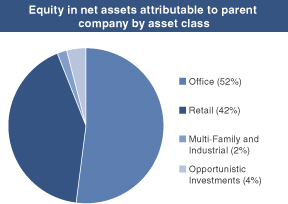
|
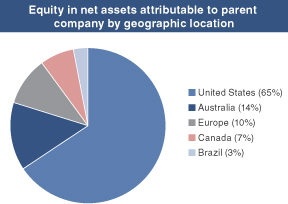
|
Information regarding the revenues attributable to each of our operating platforms and the geographic locations in which we operate is presented in Note 28 to the December 31, 2012 and December 31, 2011 audited carve-out financial statements of the commercial property operations of Brookfield Asset Management included elsewhere in this Form 20-F.
Our Business Strategy
We invest in well-located real estate assets that generate, or have the potential to generate, long-term, predictable and sustainable cash flows with attractive growth and development potential in some of the world’s most resilient and dynamic markets. We seek to enhance these cash flows through active asset management and our operations-oriented approach. Our properties are located in North America, Europe, Australia and Brazil and we may pursue growth in other markets where we identify attractive opportunities to build operating platforms or acquire assets and to achieve strong risk-adjusted returns.
Our Business Strategy
We invest in well-located real estate assets that generate, or have the potential to generate, long-term, predictable and sustainable cash flows with attractive growth and development potential in some of the world’s most resilient and dynamic markets. We seek to enhance these cash flows through active asset management and our operations-oriented approach. Our properties are located in North America, Europe, Australia and Brazil and we may pursue growth in other markets where we identify attractive opportunities to build operating platforms or acquire assets and to achieve strong risk-adjusted returns.
We strive to invest at attractive valuations, particularly in distress situations that create opportunities for superior valuation gains and cash flow returns, and to monetize assets at appropriate times to realize value. At all points along the risk-return spectrum, we draw on the resources and local market intelligence of our operating entities. We believe our strategy will enable us to generate a high level of stable and sustainable cash flows in our
38
Table of Contents
core properties while allowing us to pursue opportunistic returns by taking advantage of dislocations and inefficiencies in the various real estate markets in which we operate. In executing these strategies, we leverage our established property platform, our strategic relationship with Brookfield and our large capitalization to grow our business over time.
To execute our strategy, we seek to:
| • |
have “best-in-class” operating platforms with high quality real estate assets that are financed with conservative, long-term asset financing, with limited recourse to our company; |
| • |
maintain a high level of financial liquidity and operational flexibility to be able to capitalize on opportunities to enhance value through acquisitions, development activity and operational improvements; |
| • |
invest where we possess competitive advantages; |
| • |
acquire assets on a value basis with a goal of maximizing return on capital; |
| • |
build sustainable cash flows to reduce risk and lower the cost of capital; and |
| • |
recognize that superior returns often require contrarian thinking. |
Given the size and scope of our real estate business, we believe that we have significant flexibility in sourcing and allocating capital on a global basis and a strong global franchise to generate growth. We are not a passive investor. We plan to grow by acquiring positions of control or significant influence over the assets in which we invest using a variety of strategies to target assets directly or through portfolios and corporate entities. We seek to create value and reduce the risk profile of portfolio assets through our in-house property management, leasing, brokerage, development and construction capabilities where appropriate.
We are primarily focused on commercial property and have therefore not acquired Brookfield’s residential land development, home building, construction, real estate advisory services and other similar operations and service businesses. However, we may pursue acquisitions in those sectors, either as part of commercial property acquisitions or on a stand-alone basis, if it would allow us to generate attractive returns.
An integral part of our strategy is to pursue acquisitions through consortium arrangements with institutional investors, strategic partners or financial sponsors and to form partnerships to pursue acquisitions on a specialized or global basis. Brookfield has a strong track record of leading such consortiums and partnerships and actively managing underlying assets to improve performance. Brookfield has established and manages a number of private investment entities, managed accounts, joint ventures, consortiums, partnerships and investment funds whose investment objectives include the acquisition of commercial property and Brookfield may in the future establish similar funds. We will be the lead investor in Brookfield’s flagship opportunistic private real estate fund.
Competitive Strengths
We believe that a number of competitive strengths differentiate us from other commercial real estate companies.
| • |
Global Scale . We are one of the world’s largest publicly-traded commercial property owners. Coupled with Brookfield’s global presence, operating experience, execution capabilities and relationships, our scale and presence should permit us to source and execute large-scale transactions across a wide spectrum of real estate sectors and geographies. |
| • |
Sector and Geographic Diversification . We intend to leverage the size and scope of our operating platforms to provide increased revenue diversity and scale, financial strength and capital deployment. Because we have interests in office, retail, multi-family and industrial assets in North America, Europe, Australia and Brazil, as well as local teams on the ground in such markets, we |
39
Table of Contents
|
expect our opportunities to be greater and our revenue streams to be more stable than if we were focused on a single type of real property or one geographic region. Our diversification positions us well to pursue growth through development, opportunistic and turn-around strategies and select investments in emerging and high-growth markets. |
| • |
Superior Operating Capabilities. Brookfield’s operating experience and expertise should provide a strong pipeline of deal flow, sourcing capabilities and industry visibility, market-specific underwriting expertise, and the ability to add value at the property and operations level. As we pursue opportunities in the various markets in which we operate, we will benefit from Brookfield’s experience in owning, operating and investing in high quality commercial properties, sourcing and structuring deals with financial and regulatory complexity, executing opportunistic strategies and turnarounds, and employing an operations-oriented approach to adding value by leveraging the strength of our operating entities. |
| • |
Stable and Growing Cash Flow . We believe we will have sustainable and growing cash flow which will be underpinned by our high quality assets, quality credit tenant base and long term lease expiry profile. Our company intends to make quarterly cash distributions in an initial amount currently anticipated to be approximately $1.00 per unit on an annualized basis. We are targeting an initial pay-out ratio of approximately 80% of FFO and are initially pursuing a distribution growth rate target in the range of 3% to 5% annually. |
We have established the initial distribution level and the targeted distribution growth rate based on our projections for the amount of FFO that will be generated by us in the short to medium term. The projections were generated through analyzing the total underlying operating cashflows of all the investments held by us considering in-place revenue streams and capital investment plans. Our entitlement to the underlying operating cashflows in the operating entities were then weighed against reinvestment opportunities within those entities to determine the appropriate balance between distributions and reinvestment and the most appropriate allocation of capital and financing to maximize risk adjusted returns.
We are not a passive investor and we typically hold positions of control or significant influence over assets in which we invest, enabling us to influence distributions from those assets. In recent years, Brookfield has agreed to dividend policies that minimize distributions from these investments in favor of reinvestment in the underlying businesses, and has additionally participated in programs that reinvest distributions actually received by Brookfield into these investments, such as dividend reinvestment plans. Additionally, Brookfield historically has not made distributions to its shareholders in amounts equivalent to 80% of its FFO in light of the various businesses in which it operates. Since our company will be Brookfield’s flagship public commercial property entity, the distributions we have projected to pay are more in line with other companies that focus on commercial property operations. In cases where potential underlying operating cashflow distributions are deferred by us in our operating platforms in favor of reinvestment, we may be required to finance, in the short term, payment of our distributions to our unitholders. To maintain distributions at a level reflective of the total underlying operating cashflow, there are a number of alternatives available to us that are described in further detail herein, including (a) using borrowings under the $500 million credit facility that the Holding Entities entered into with Brookfield US Holdings Inc. on April 15, 2013 and any other credit facility that we may enter into in the future, (b) the Property GP LP electing to accrue and/or waive distributions to be made in respect of the Redemption-Exchange Units that are to be held by Brookfield in accordance with the Property Partnership’s limited partnership agreement, (c) the payment of all or a portion of the fees owed to the Managers pursuant to the Master Services Agreement through the issuance of our units and/or limited partnership units of the Property Partnership, (d) the payment of any equity enhancement distributions to the Property GP LP through the issuance of Redemption-Exchange Units, and (e) utilizing capital returned from our diversified asset base where reinvestment opportunities are determined to be less attractive.
40
Table of Contents
However, despite our projections and the alternative methods available to us to maintain our distribution level, there can be no assurance that we will be able to make distributions of approximately $1.00 per unit on an annualized basis or meet our target growth rate. Based on amounts received in distributions from our operating entities and our projected operating cash flow from our direct investments, our proposed distributions would be significantly greater than such amounts. Although we may use distributions from our operating entities, the proceeds of sales of certain of our direct investments and/or borrowings to fund any shortfall in distributions, we may not be able to do so on a consistent and sustainable basis. Our ability to make distributions will depend on several factors, some of which are out of our control, including, among other things, general economic conditions, our results of operations and financial condition, the amount of cash that is generated by our operations and investments, restrictions imposed by the terms of any indebtedness that is incurred to finance our operations and investments or to fund liquidity needs, levels of operating and other expenses, and contingent liabilities.
| • |
Brookfield’s Flagship Commercial Property Entity . We are the primary entity through which Brookfield Asset Management owns and operates its commercial property businesses on a global basis. As such, Brookfield Asset Management has agreed to offer us the opportunity to take-up Brookfield’s share in any investment in commercial property that is suitable for us. We have access to Brookfield’s private investments through our right to take up Brookfield’s share in them, including investments in opportunistic, real estate finance and property operations in select emerging markets. Our goal is to have a majority controlling interest or a significant influence in each of these investments. |
| • |
Capitalization and Growth . Our significant market capitalization and listings on the NYSE and the TSX provide us with an attractive currency to source and execute large-scale transactions, typically as the lead investor, across a wide spectrum of real estate sectors and geographies. We will also seek opportunities to grow our portfolio by re-allocating capital from stabilized investments to more accretive opportunities where appropriate risk-adjusted returns can be earned. |
Development of our Business
Brookfield and its predecessor companies have been active in various facets of the real estate business since the 1920s. Canadian Arena Corporation, the predecessor company to Brookfield Office Properties, built the Montreal Forum in 1924 to provide facilities for hockey and other sporting and cultural events and its earnings were derived principally from the ownership of the Montreal Forum and the Montreal Canadiens of the National Hockey League until the sale of the hockey franchise in 1978.
In 1976, Brookfield expanded its real estate interests by acquiring a controlling interest in one of Canada’s largest public real estate companies. The steady escalation in commercial property values over the next ten years provided the capital base to expand. Brookfield took advantage of falling real estate values during the recession of the early 1990s to upgrade and expand its directly owned commercial property portfolio. In 2003, Brookfield made its first investments outside of North America by making property investments in the United Kingdom. Brookfield further expanded outside of North America in 2007 by making property investments in Australia.
The accumulation of our current portfolio of assets was completed through various corporate and property purchases, including the following acquisitions:
| • |
BCE Developments – 7 million square feet: In 1990, Brookfield acquired a 50% interest in a portfolio of office properties in Toronto, Denver and Minneapolis from BCE Developments. In 1994, this interest was increased to 100%. Brookfield Place, Brookfield’s flagship office complex in Toronto, was acquired in this transaction. |
41
Table of Contents
| • |
Olympia & York U.S.A. – 14.7 million square feet: In 1996, Brookfield acquired a 46% interest in World Financial Properties LP, the corporation formed from the bankruptcy of Olympia & York, which included three of the four towers of Brookfield Place New York (formerly, World Financial Center), One Liberty Plaza and 245 Park Avenue in Manhattan. Brookfield subsequently increased its interest to 99.4%. |
| • |
Trizec Western Canada – 3.5 million square feet: In 2000, Brookfield acquired a portfolio of Calgary properties, including the Bankers Hall complex. |
| • |
United Kingdom – 8.8 million square feet: In 2003, Brookfield acquired a 9% interest in Canary Wharf, marking its entry into the United Kingdom real estate market. Canary Wharf owned and operated 8.8 million square feet of office and retail properties at that time and had 1 million square feet of office space under construction. Brookfield’s interest in Canary Wharf was increased to approximately 22% in 2010. In 2005, Brookfield also purchased an 80% interest in a 555,000 square foot office property at 20 Canada Square, Canary Wharf, London. Brookfield now owns 100% of this property. In addition, in 2010, Brookfield acquired a 50% stake in 100 Bishopsgate, a development site in the City of London and increased its stake to 87.5% in 2012. |
| • |
O&Y Properties/O&Y REIT – 11.6 million square feet: In 2005, Brookfield acquired 100% of O&Y with other partners and continues to own a direct 25% interest in a portfolio of high-quality office properties owned by O&Y Properties and O&Y REIT in Toronto, Ottawa, Calgary and Edmonton with a consortium of investors. |
| • |
Trizec Properties/Trizec Canada – 26 million square feet: In 2006, Brookfield acquired Trizec’s portfolio of 58 office properties in New York, Washington, D.C., Los Angeles and Houston in a joint venture with a partner. |
| • |
Brazil – 2.5 million square feet: In 2007, Brookfield’s retail property fund in Brazil entered into an agreement to acquire five high-quality shopping centers in São Paulo and Rio de Janeiro. This acquisition expanded Brookfield’s portfolio to approximately 2.5 million square feet of retail centers in south-central Brazil. |
| • |
Australia Portfolio – 6.2 million square feet: In 2007, Brookfield acquired Multiplex Limited and Multiplex Property Trust, or Multiplex, an Australian commercial property owner and developer. Multiplex’s assets included approximately $3.6 billion of core office and retail properties within nine funds and a $3 billion high-quality office portfolio. |
| • |
General Growth Properties, Inc. – 160 million square feet: In 2010, Brookfield led the recapitalization of GGP, the second largest mall owner in the United States with 166 malls as at December 31, 2011. In 2011, Brookfield acquired an additional 113.3 million common shares of GGP, giving Brookfield and its consortium partners an approximate 38% equity interest in GGP (Brookfield’s interest is approximately 21%). In January 2012, GGP spun-off Rouse Properties, Inc., or Rouse, which at the time of the spin-off held a portfolio of 30 malls. On April 12, 2013 Brookfield and our company acquired approximately $157 million worth of membership interests in the ownership consortium that holds underlying common shares and warrants of GGP and common shares of Rouse, increasing our ownership interest to approximately 22% (approximately 24% assuming the exercise of all warrants) in GGP and approximately 37% in Rouse. |
| • |
Hammerson Portfolio – In 2012, Brookfield Office Properties announced the acquisition of the Hammerson portfolio in the City of London for approximately $871 million. The portfolio includes four operating assets totaling 884,000 square feet and two development sites which can accommodate approximately 1.4 million square feet of density. 99 Bishopsgate and a group of smaller assets closed on September 28, 2012; 125 Old Broad Street and Leadenhall Court are expected to close in June 2013. |
Since 1989, Brookfield has invested approximately $16 billion of equity in commercial property, generating an estimated compound annual return, or IRR, of approximately 16% through December 31, 2012.
42
Table of Contents
The return represents the composite levered investment return from all of the opportunistic and core entities and investments that were acquired by our company from Brookfield in connection with the spin-off, from inception through December 31, 2012. The IRR reflects the gross internal rate of return before any management fees but after all property level service fees such as lease fees, development and construction fees and property management fees. The IRR was determined using the value of Brookfield’s investments in commercial property as at December 31, 2012 (which includes valuations of unrealized investments that are based on assumptions management believes are reasonable as discussed below) compared to the aggregate equity investments made in such commercial property, and includes all net proceeds generated by these investments.
IRR does not have a standard meaning prescribed by IFRS and therefore may not be comparable to similar measures presented by other companies. IRR is used by Brookfield as a key indicator of investment performance because it provides a measure of performance that accounts for the value of unrealized investments in addition to realized investments.
In calculating the IRR, valuations of unrealized investments include assumptions that management believes are fair and reasonable reflecting the fair value exit price that would be received to sell an asset or paid to transfer a liability in an orderly transaction between non-arm’s length market participants at the measurement date. The December 31, 2012 valuations of unrealized investments reflect the reported fair values under the respective accounting regime, which are within the scope of the 2012 year-end financial statement audit conducted by external auditors. To determine the year-end valuations, management assumptions include, but are not limited to:
| • |
projected occupancy rates based on current occupancy, lease renewals and lease-up plans; |
| • |
projected rental rates based on current rent rolls and anticipated growth based on market activity and lease-up plans; |
| • |
projected operating expenses based on current expenses, inflation and lease-up plans; |
| • |
capital expenditures based on age of properties and required upgrades; |
| • |
appropriate discount rates; and |
| • |
terminal capitalization rates. |
The historical performance of Brookfield should not be taken as an indication of performance by our company or Brookfield in the future or of any returns expected on an investment in our units.
Operating Platforms
Our business is organized in four operating platforms, with assets as of December 31, 2012 as set forth in the diagram below. The capital invested in these operating platforms is through a combination of: direct investment; investments in asset level partnerships or joint venture arrangements; sponsorship and participation in private equity funds; and the ownership of shares in other public companies. Combining both publicly-listed and private institutional capital provides a competitive advantage in flexibility and access to capital to fund growth.
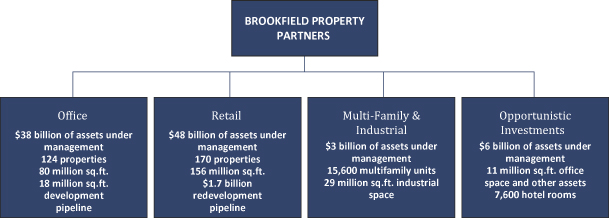
43
Table of Contents
As at the dates set out below, we held our commercial property operations through our interests in the entities and groups of assets set out below.
| Operations |
% Ownership at
December 31, 2012 |
% Ownership at December 31, 2011 |
% Ownership at December 31, 2010 |
|||
|
Office |
||||||
|
Brookfield Office Properties Inc. (1) |
50% | 50% | 50% | |||
|
Interest in Australia (2) |
100% | 100% | 100% | |||
|
Europe |
100% | 100% | 100% | |||
|
Canary Wharf Group plc |
22% | 22% | 22% | |||
|
Retail |
||||||
|
General Growth Properties, Inc. (3) |
21% | 21% | 8% | |||
|
Rouse Properties, Inc. (4) |
36% | - | - | |||
|
Brazil Retail Fund |
35% | 35% | 25% | |||
|
Interest in Australia |
100% | 100% | 100% | |||
|
Europe |
- | - | 100% | |||
|
Multi-Family & Industrial (5) |
||||||
|
Multi-Family (through various funds) |
13%-52% | 10%-52% | 29%-52% | |||
|
Industrial (through various funds) |
29%-40% | 29% | - | |||
|
Opportunistic Investments (5) |
||||||
|
Opportunity Funds |
29%-82% | 29%-82% |
29%-82%
|
|||
|
Finance Funds |
13%-33% | 25%-33% | 28%-33% | |||
| (1) | Our interest in Brookfield Office Properties is comprised of 49.6% of the outstanding common shares and 97.1% of the outstanding voting preferred shares. Brookfield Office Properties owns an approximate 83.3% aggregate equity interest in Brookfield Canada Office Properties, a Canadian real estate investment trust that is listed on the TSX and the NYSE, and an approximate 84.3% interest in the U.S. Office Fund, which consists of a consortium of institutional investors and which is led and managed by Brookfield Office Properties. |
| (2) | Our Australian office platform consists of our economic interest in certain of our Australian office properties not held through Brookfield Office Properties. |
| (3) | As at April 30, 2013, our interest in GGP is comprised of an economic interest in approximately 22% (38% with our consortium partners) of the outstanding shares of common stock. We, and our consortium partners, also own warrants to acquire additional shares of common stock, which warrants were “in-the-money” as at April 30, 2013. As at April 30, 2013, only we and our consortium partners owned warrants to acquire GGP common stock. Assuming the exercise of these warrants, we and our consortium partners would hold an aggregate of approximately 441 million shares of GGP, representing approximately 43% of the outstanding shares of common stock of GGP. Of the 441 million shares that would be held by our company and our consortium partners, 246 million common shares of GGP would be owned by our company, representing approximately 24% of the outstanding shares of common stock of GGP (and 25% assuming that only our company, and none of our consortium partners, exercised the warrants). |
| (4) | Rouse is a NYSE-listed company that GGP spun-out to its shareholders on January 12, 2012. As at April 30, 2013, we had interests of approximately 37% (54% with our consortium partners) of the outstanding shares of common stock. |
| (5) | Our economic interest set forth in the table above is reflected as a range because we hold certain of our multi-family and industrial and opportunistic investment assets through a combination of different funds in which we hold varying economic interests. |
Office Platform
Our strategy for our office platform includes:
| • |
Growing our high quality portfolio . We are continuing to grow our high quality office portfolio in gateway cities. We seek to build a diversified global presence by targeting markets primarily underpinned by major financial, energy and professional services businesses in key urban centers in North America, Australia, and Europe. Our goal is to maintain a meaningful presence in each of our primary markets in order to maximize the value of our tenant relationships. |
| • |
Optimizing rental revenues. In order to ensure the long-term sustainability of rental revenues through economic cycles, we seek to continue to attract tenants with strong credit quality, maintain high occupancy levels through proactive leasing initiatives across our portfolio and initiate mark-to-market opportunities on leases. |
| • |
Adding value through development. We seek to add value across our portfolio by enhancing existing portfolio properties through major capital projects on a selective basis and by creating “best-in-class” new office stock in premium locations through development initiatives. |
44
Table of Contents
| • |
Utilizing a prudent capital structure. We seek to generate strong risk-adjusted returns by utilizing conservative financing structures while pursuing liquidity initiatives across our portfolio. |
As at December 31, 2012, our office portfolio consisted of interests in 124 properties containing approximately 80 million square feet of commercial office space. The majority of these properties are located in the central business districts of New York, Washington, D.C., Houston, Los Angeles, Toronto, Calgary, Ottawa, Sydney, Melbourne, Perth and London, making us a global leader in the ownership and management of high-quality office assets. Landmark properties include the Brookfield Place (formerly World Financial Center) in New York, Brookfield Place in Toronto, Bank of America Plaza in Los Angeles, Bankers Hall in Calgary, Darling Park in Sydney and Brookfield Place (formerly City Square) in Perth. Of the total 124 properties in our office portfolio, 111 properties containing approximately 70 million square feet are consolidated under IFRS and 13 properties containing approximately 10 million square feet are equity accounted under IFRS.
The following is a brief overview of the office property assets in our portfolio and the office property markets in which we operate as at December 31, 2012:
|
Number of
Properties (1) |
Total Area (000’s Sq. Ft.) |
Average
Market
Rate (%) |
Our Average
Rate (%) |
Market Net Rent ($/Sq. Ft.) |
Average In- Place Net rent ($/Sq. Ft.) |
|||||||
| United States | 62 | 47,323 | 89.0% | 89.0% | $32.50 | $26.80 | ||||||
| Canada | 28 | 20,716 | 95.4% | 96.9% | 31.98 | 26.80 | ||||||
| Australia | 31 | 11,082 | 92.1% | 97.7% | 54.12 | 53.82 | ||||||
| Europe (2) | 3 | 940 | 90.7% | 85.3% | 67.01 | 69.19 | ||||||
| Total/Avg | 124 | 80,061 |
90.3% |
92.1% | $35.94 | $31.44 |
| (1) | Does not include office assets held within our opportunistic investment platform. |
| (2) | Does not include office assets held through our approximate 22% interest in Canary Wharf. |
The table below presents the following information on the assets in our office platform by geographic location as at December 31, 2012: (i) the number of properties, the percentage of the space under lease and the size of the office, retail, leasable, parking and total space in our office portfolio, which provides information as if we own 100% of the office assets in which we have an interest; (ii) our proportionate interest in those office assets before considering minority interests; (iii) our proportionate interest in those office assets net of minority interests; and (iv) our pro-forma proportionate interest net of minority interests reflecting clause (iii) above and the Redemption-Exchange Units held by Brookfield. We believe information presented as if we own 100% of each of the properties provides an appropriate basis on which to evaluate the performance of properties in the portfolio relative to each other and to other properties in the market. In addition, we have separated the properties in which we have an interest into two additional categories: (i) properties that are consolidated under IFRS; and (ii) properties that are equity accounted under IFRS. Our proportionate interests in the investments demonstrate our ability to manage the underlying economics of the relevant investments, including the financial performance and cash flows. Proportionate interest in the assets net of minority interests represents our economic interest in
45
Table of Contents
the underlying property and is relevant because it represents the net assets and operations of the underlying property that we manage that are directly attributable to us.
|
Office
Property
Portfolio (1) |
Assets Under Management | Proportionate (2) |
Proportionate
net of Non-controlling Interests (3) |
Pro-forma
proportionate net of Non-controlling Interests (4) |
||||||||||||||||||||||||||||||||||||||||||||||||||||||||||
| (Sq.ft. in 000’s) |
Number of
properties |
Leased
% |
Office | Retail | Leasable | Parking | Total |
Owned
% |
Leasable | Total | Leasable | Total | Leasable | Total | ||||||||||||||||||||||||||||||||||||||||||||||||
|
CONSOLIDATED PROPERTIES |
|
|||||||||||||||||||||||||||||||||||||||||||||||||||||||||||||
|
U.S. Properties |
||||||||||||||||||||||||||||||||||||||||||||||||||||||||||||||
|
New York |
7 | 94.6 | % | 13,405 | 363 | 13,768 | 282 | 14,050 | 97 | % | 13,296 | 13,577 | 6,647 | 6,787 | 1,061 | 1,083 | ||||||||||||||||||||||||||||||||||||||||||||||
|
Boston |
1 | 74.6 | % | 771 | 25 | 796 | 235 | 1,031 | 100 | % | 796 | 1,031 | 399 | 517 | 64 | 83 | ||||||||||||||||||||||||||||||||||||||||||||||
|
Washington, D.C. |
30 | 90.4 | % | 5,866 | 493 | 6,359 | 1,092 | 7,451 | 85 | % | 5,440 | 6,303 | 2,719 | 3,150 | 434 | 502 | ||||||||||||||||||||||||||||||||||||||||||||||
|
Los Angeles |
4 | 87.7 | % | 3,750 | 399 | 4,149 | 1,069 | 5,218 | 84 | % | 3,497 | 4,398 | 1,748 | 2,198 | 279 | 351 | ||||||||||||||||||||||||||||||||||||||||||||||
|
Houston |
8 | 86.6 | % | 6,887 | 228 | 7,115 | 1,255 | 8,370 | 79 | % | 5,747 | 6,589 | 2,874 | 3,295 | 459 | 526 | ||||||||||||||||||||||||||||||||||||||||||||||
|
Denver |
2 | 66.6 | % | 2,597 | 48 | 2,645 | 503 | 3,148 | 80 | % | 2,000 | 2,503 | 1,000 | 1,252 | 160 | 200 | ||||||||||||||||||||||||||||||||||||||||||||||
|
Seattle |
2 | 89.7 | % | 696 | 3 | 699 | 157 | 856 | 100 | % | 699 | 856 | 350 | 429 | 56 | 69 | ||||||||||||||||||||||||||||||||||||||||||||||
|
Minneapolis |
2 | 92.2 | % | 610 | 442 | 1,052 | 196 | 1,248 | 100 | % | 1,052 | 1,248 | 526 | 624 | 84 | 100 | ||||||||||||||||||||||||||||||||||||||||||||||
| 56 | 88.9 | % | 34,582 | 2,001 | 36,583 | 4,789 | 41,372 | 88 | % | 32,527 | 36,505 | 16,263 | 18,252 | 2,597 | 2,914 | |||||||||||||||||||||||||||||||||||||||||||||||
|
Canadian Properties |
||||||||||||||||||||||||||||||||||||||||||||||||||||||||||||||
|
Toronto |
12 | 94.5 | % | 7,995 | 764 | 8,759 | 1,790 | 10,549 | 54 | % | 4,736 | 5,719 | 2,375 | 2,868 | 379 | 458 | ||||||||||||||||||||||||||||||||||||||||||||||
|
Calgary |
8 | 99.6 | % | 5,340 | 299 | 5,639 | 897 | 6,536 | 42 | % | 2,368 | 2,746 | 1,185 | 1,373 | 189 | 219 | ||||||||||||||||||||||||||||||||||||||||||||||
|
Ottawa |
6 | 99.7 | % | 1,708 | 37 | 1,745 | 1,030 | 2,775 | 21 | % | 366 | 583 | 183 | 291 | 30 | 47 | ||||||||||||||||||||||||||||||||||||||||||||||
|
Vancouver |
1 | 97.8 | % | 493 | 96 | 589 | 264 | 853 | 83 | % | 489 | 708 | 245 | 355 | 39 | 57 | ||||||||||||||||||||||||||||||||||||||||||||||
|
Other |
1 | 100.0 | % | – | 3 | 3 | – | 3 | 83 | % | 3 | 3 | 1 | 1 | – | – | ||||||||||||||||||||||||||||||||||||||||||||||
| 28 | 96.9 | % | 15,536 | 1,199 | 16,735 | 3,981 | 20,716 | 47 | % | 7,962 | 9,759 | 3,989 | 4,888 | 637 | 781 | |||||||||||||||||||||||||||||||||||||||||||||||
|
Australian Properties |
||||||||||||||||||||||||||||||||||||||||||||||||||||||||||||||
|
Sydney |
10 | 98.9 | % | 2,020 | 285 | 2,305 | 277 | 2,582 | 82 | % | 1,908 | 2,124 | 1,456 | 1,617 | 232 | 258 | ||||||||||||||||||||||||||||||||||||||||||||||
|
Melbourne |
2 | 100.0 | % | 1,335 | 33 | 1,368 | 133 | 1,501 | 93 | % | 1,275 | 1,401 | 637 | 700 | 101 | 111 | ||||||||||||||||||||||||||||||||||||||||||||||
|
Brisbane |
2 | 85.8 | % | 521 | 3 | 524 | 23 | 547 | 79 | % | 415 | 434 | 415 | 434 | 66 | 69 | ||||||||||||||||||||||||||||||||||||||||||||||
|
Perth |
3 | 99.7 | % | 1,439 | 96 | 1,535 | 61 | 1,596 | 94 | % | 1,439 | 1,493 | 797 | 827 | 127 | 132 | ||||||||||||||||||||||||||||||||||||||||||||||
|
Canberra |
1 | 100.0 | % | 176 | – | 176 | 28 | 204 | 100 | % | 176 | 204 | 176 | 204 | 28 | 32 | ||||||||||||||||||||||||||||||||||||||||||||||
|
New Zealand |
6 | 93.8 | % | 696 | 39 | 735 | 109 | 844 | 100 | % | 735 | 844 | 327 | 376 | 53 | 61 | ||||||||||||||||||||||||||||||||||||||||||||||
| 24 | 97.7 | % | 6,187 | 456 | 6,643 | 631 | 7,274 | 89 | % | 5,948 | 6,500 | 3,808 | 4,158 | 607 | 663 | |||||||||||||||||||||||||||||||||||||||||||||||
|
European Properties |
||||||||||||||||||||||||||||||||||||||||||||||||||||||||||||||
|
London |
3 | 85.3 | % | 882 | 23 | 905 | 35 | 940 | 100 | % | 905 | 940 | 730 | 758 | 116 | 120 | ||||||||||||||||||||||||||||||||||||||||||||||
| 3 | 85.3 | % | 882 | 23 | 905 | 35 | 940 | 100 | % | 905 | 940 | 730 | 758 | 116 | 120 | |||||||||||||||||||||||||||||||||||||||||||||||
|
Total Consolidated Properties |
111 | 92.0 | % | 57,187 | 3,679 | 60,866 | 9,436 | 70,302 | 76 | % | 47,342 | 53,704 | 24,790 | 28,056 | 3,957 | 4,478 | ||||||||||||||||||||||||||||||||||||||||||||||
|
EQUITY ACCOUNTED PROPERTIES |
|
|||||||||||||||||||||||||||||||||||||||||||||||||||||||||||||
|
U.S. Properties |
||||||||||||||||||||||||||||||||||||||||||||||||||||||||||||||
|
New York |
3 | 89.6 | % | 4,940 | 196 | 5,136 | – | 5,136 | 56 | % | 2,906 | 2,906 | 1,449 | 1,449 | 231 | 231 | ||||||||||||||||||||||||||||||||||||||||||||||
|
Washington, D.C. |
1 | 92.8 | % | 294 | 53 | 347 | – | 347 | 42 | % | 146 | 146 | 73 | 73 | 12 | 12 | ||||||||||||||||||||||||||||||||||||||||||||||
|
Los Angeles |
2 | 92.6 | % | 356 | 25 | 381 | 87 | 468 | 42 | % | 161 | 197 | 80 | 98 | 13 | 16 | ||||||||||||||||||||||||||||||||||||||||||||||
| 6 | 90.0 | % | 5,590 | 274 | 5,864 | 87 | 5,951 | 54 | % | 3,213 | 3,249 | 1,602 | 1,620 | 256 | 259 | |||||||||||||||||||||||||||||||||||||||||||||||
|
Australian Properties |
||||||||||||||||||||||||||||||||||||||||||||||||||||||||||||||
|
Sydney |
6 | 98.1 | % | 2,635 | 147 | 2,782 | 216 | 2,998 | 35 | % | 971 | 1,042 | 485 | 521 | 77 | 83 | ||||||||||||||||||||||||||||||||||||||||||||||
|
Melbourne |
1 | 95.6 | % | 670 | 34 | 704 | 106 | 810 | 43 | % | 303 | 348 | 151 | 174 | 24 | 28 | ||||||||||||||||||||||||||||||||||||||||||||||
| 7 | 97.6 | % | 3,305 | 181 | 3,486 | 322 | 3,808 | 37 | % | 1,274 | 1,390 | 636 | 695 | 101 | 111 | |||||||||||||||||||||||||||||||||||||||||||||||
|
Total Equity Accounted Properties |
13 | 92.8 | % | 8,895 | 455 | 9,350 | 409 | 9,759 | 47 | % | 4,487 | 4,639 | 2,238 | 2,315 | 357 | 370 | ||||||||||||||||||||||||||||||||||||||||||||||
|
Total Office Properties |
124 | 92.1 | % | 66,082 | 4,134 | 70,216 | 9,845 | 80,061 | 72 | % | 51,829 | 58,343 | 27,028 | 30,371 | 4,314 | 4,848 | ||||||||||||||||||||||||||||||||||||||||||||||
| (1) | Does not include office assets held within our opportunistic investment platform or our approximate 22% interest in Canary Wharf. |
| (2) | Reflects our company’s interest before considering non-controlling interests, such as non-controlling interests in Brookfield Office Properties and Multiplex New Zealand Property Fund. |
| (3) | Reflects our company’s interest net of non-controlling interests described in note (2) above. |
| (4) | Reflects our company’s pro-forma proportionate interest net of non-controlling interests described in note (3) above and the Redemption-Exchange Units held by Brookfield. |
46
Table of Contents
An important characteristic of our office portfolio is the strong credit quality of our tenants. We direct special attention to tenant credit quality in order to ensure the long-term sustainability of rental revenues through economic cycles. The following list shows major tenants with over one million square feet of space in our office portfolio by leased area and their respective credit ratings and lease commitments as at December 31, 2012:
| Tenant | Primary Location |
Credit
Rating (1) |
Year of
Expiry (2) |
Total
(000’s Sq. Ft.) |
Sq. Ft.
(%) |
|||||||
|
Various Government Agencies |
All markets | AA+/AAA | Various | 6,023 | 8.6% | |||||||
|
Bank of America/Merrill Lynch (3) |
Toronto/New York/Denver/Los Angeles | A/A- | Various | 4,948 | 7.0% | |||||||
|
CIBC World Markets (4) |
Toronto/New York/Calgary | A+ | 2033 | 1,436 | 2.0% | |||||||
|
Suncor Energy |
Calgary | BBB+ | 2025 | 1,356 | 1.9% | |||||||
|
Royal Bank of Canada |
Vancouver/Toronto/Calgary/New York/Los Angeles/Minneapolis | AA- | 2024 | 1,270 | 1.8% | |||||||
|
Morgan Stanley |
New York/Los Angeles/Denver | A- | 2030 | 1,219 | 1.7% | |||||||
|
Bank of Montreal |
Calgary/Toronto | A+ | 2024 | 1,169 | 1.7% | |||||||
|
Total |
17,421 | 24.7% | ||||||||||
| (1) | From Standard & Poor’s Rating Services, Moody’s Investment Services, Inc. or DBRS Limited. Reflects credit rating of tenant and does not reflect credit rating of any subtenants. |
| (2) | Reflects the year of maturity related to lease(s) and is calculated for multiple leases on a weighted average basis based on square feet where practicable. |
| (3) | Bank of America/Merrill Lynch leases 4.6 million square feet in Brookfield Place in New York, of which they occupy 2.7 million square feet with the balance being subleased to various subtenants ranging in size up to 500,000 square feet. Of this 2.7 million square feet, 1.9 million is in 250 Vesey Street, and 0.8 million square feet is in 225 Liberty Street. |
| (4) | CIBC World Markets leases 1.1 million square feet at 300 Madison Avenue in New York, of which they sublease 925,000 square feet to PricewaterhouseCoopers LLP. |
Our strategy is to sign long-term leases in order to mitigate risk, reduce our overall re-tenanting costs and ensure stable and sustainable cash flows. We typically commence discussions with tenants regarding their space requirements well in advance of the contractual expiration.
The following table presents the lease expiry profile of our office properties with the associated expiring average in-place net rents by region at December 31, 2012:
| Expiring Leases | ||||||||||||||||||||||||||||||||||||||||||||||||||||||||||||||||
|
Net
Rental Area |
Currently
Available |
2013 |
2014 | 2015 | 2016 | 2017 | 2018 |
2019 &
Beyond |
||||||||||||||||||||||||||||||||||||||||||||||||||||||||
| (000’s sq. ft.) |
(000’s
sq.ft.) |
Net
Rent |
(000’s
sq.ft.) |
Net
Rent |
(000’s
sq.ft.) |
Net
Rent |
(000’s
sq.ft.) |
Net
Rent |
(000’s
sq.ft.) |
Net
Rent |
(000’s
sq.ft.) |
Net
Rent |
(000’s
sq.ft.) |
Net
Rent |
||||||||||||||||||||||||||||||||||||||||||||||||||
|
United States |
42,447 | 4,649 | 5,149 | $ | 31 | 2,907 | $ | 25 | 2,960 | $ | 22 | 2,141 | $ | 25 | 2,304 | $ | 26 | 2,732 | $ | 30 | 19,605 | $ | 35 | |||||||||||||||||||||||||||||||||||||||||
|
Canada |
16,735 | 523 | 1,697 | 24 | 321 | 33 | 1,486 | 24 | 1,630 | 26 | 645 | 30 | 679 | 32 | 9,754 | 31 | ||||||||||||||||||||||||||||||||||||||||||||||||
|
Australia |
10,129 | 232 | 402 | 47 | 768 | 51 | 1,138 | 60 | 1,015 | 67 | 989 | 53 | 901 | 66 | 4,684 | 78 | ||||||||||||||||||||||||||||||||||||||||||||||||
|
Europe (1) |
905 | 133 | 4 | 34 | 1 | 32 | 5 | 25 | 59 | 93 | 88 | 62 | 2 | 96 | 613 | 69 | ||||||||||||||||||||||||||||||||||||||||||||||||
|
Total |
70,216 | 5,537 | 7,252 | $ | 30 | 3,997 | $ | 31 | 5,589 | $ | 30 | 4,845 | $ | 35 | 4,026 | $ | 34 | 4,314 | $ | 38 | 34,656 | $ | 40 | |||||||||||||||||||||||||||||||||||||||||
|
Percentage of Total |
100.0% | 7.9% | 10.3% | 5.7% | 8.0% | 6.9% | 5.7% | 6.1% | 49.4% | |||||||||||||||||||||||||||||||||||||||||||||||||||||||
| (1) | Does not include office assets held through our approximate 22% interest in Canary Wharf. |
47
Table of Contents
The following table summarizes our leasing activity from December 31, 2011 to December 31, 2012:
| Dec. 31, 2011 | Dec. 31, 2012 | |||||||||||||||||||
|
(US $) |
Leasable Area (1)
(000’s
|
Leased (1)
(000’s
|
Total Expiries
(000’s
|
Expiring Net Rent
($ per
|
Leasing
(000’s
|
Year One Leasing Net Rent
($ per
|
Average Leasing Net Rent
($ per
|
Acq. (Disp.) Additions
(000’s
|
Leasable Area
(000’s
|
Leased
(000’s
|
||||||||||
|
United States |
44,019 | 40,221 | (5,831) | $19.68 | 5,077 | $24.62 | $27.33 | (1,669) | 42,447 | 37,798 | ||||||||||
|
Canada |
17,108 | 16,468 | (1,236) | 28.83 | 1,343 | 32.07 | 32.89 | (363) | 16,735 | 16,212 | ||||||||||
|
Australia |
9,863 | 9,549 | (471) | 48.19 | 573 | 54.71 | 61.18 | 266 | 10,129 | 9,897 | ||||||||||
|
Europe |
556 | 556 | (268) | 60.13 | 263 | 60.53 | 60.92 | 349 | 905 | 772 | ||||||||||
|
Total |
71,546 | 66,794 | (7,806) | $24.24 | 7,256 | $29.68 | $32.25 | (1,417) | 70,216 | 64,679 | ||||||||||
| (1) | Has been restated to reflect the impact of remeasurements which are done annually in the first quarter. |
| (2) | Does not include office assets held through our approximate 22% interest in Canary Wharf. |
As at December 31, 2012, we held interests in centrally located office development sites with a total development pipeline of approximately 18 million square feet in the United States, Canada, Australia and Europe. We classify our office development sites into three categories: (i) active development, (ii) active planning and (iii) held for development.
The following table summarizes all office development projects in our portfolio by geographic location as at December 31, 2012:
| (000’s Sq. Ft.) | ||||||||||||||||||||||||
|
(sq. ft. in 000’s) |
Number of Sites |
Owned
Interest (%) |
Total | Proportionate (1) |
Proportionate
net of Non-controlling Interests (2) |
Pro-forma
Proportionate net of Non-controlling Interests (3) |
||||||||||||||||||
|
United States |
7 | 95 | % | 9,257 | 8,797 | 4,397 | 651 | |||||||||||||||||
|
Canada |
6 | 83 | % | 5,427 | 4,501 | 2,251 | 333 | |||||||||||||||||
|
Australia |
2 | 100 | % | 846 | 846 | 674 | 100 | |||||||||||||||||
|
Europe |
3 | 82 | % | 2,075 | 1,706 | 854 | 126 | |||||||||||||||||
|
Total/Avg |
18 | 90 | % | 17,605 | 15,850 | 8,176 | 1,210 | |||||||||||||||||
| (1) | Reflects our company’s interest before considering minority interests, such as minority interests in Brookfield Office Properties, Brookfield Canada Office Properties, the U.S. Office Fund and Brookfield Financial Properties L.P. |
| (2) | Reflects our company’s interest net of minority interests described in note (1) above. |
| (3) | Reflects our company’s pro-forma interest net of minority interests described in note (1) above and the Redemption-Exchange Units held by Brookfield. |
Of the 18 million square feet in our office development pipeline, 6 million square feet are in the active development stage, 2.5 million square feet are in the active planning stage and 9.1 million square feet are held for future development.
The 980,000 square foot Bay Adelaide Centre East site in Toronto and the 5 million square foot Manhattan West site in New York were the only active developments in our office segment as of December 31, 2012. As of December 31, 2012, these two sites had incurred a cost of $441 million and had a total planned development cost of $794 per square foot with a weighted average construction period of 98 months.
Of the remaining 12 million square feet in our office development pipeline as of December 31, 2012, 2.5 million square feet were in the active planning stage comprising of three development projects. Included in the active planning stage were the development rights to 100 Bishopsgate, a well-positioned development site in London, U.K., and we have prepared the site for construction. As of December 31, 2012, those three development sites had incurred a cost of $211 million and had a total planned development cost of $841 per square foot with a weighted average planned construction period of 47 months.
48
Table of Contents
The remaining 9.1 million square feet of our office development pipeline are being held for development and are not in the active planning stage. With all our development sites, we will proceed with developing these sites when our risk adjusted return hurdles and preleasing targets are met.
Retail Platform
Our strategy for our retail platform includes:
| • |
Growing our high quality portfolio. We are continuing to grow our high quality retail portfolio by focusing on growth areas in dynamic and resilient markets where we have a significant presence that we believe are under-served by quality retail centers. We also redevelop our retail properties on a selective basis to enhance our portfolio when we believe a market is ready and appropriate risk-adjusted returns can be earned. We look to maintain a meaningful presence in each of our primary markets in order to maximize the value of our tenant relationships. |
| • |
Positioning malls as the “only” or “best” mall in town. We seek to position our malls as the “only” or “best” mall in their market areas in order to concentrate consumer traffic and capture favorable demographic trends. We aim to do this by creating malls as irreplaceable destinations within the community. |
| • |
Optimizing occupancy and enhance income. In order to optimize occupancy levels, we look for ways to increase tenant sales per square foot and lease spreads while decreasing our occupancy costs. We also seek to diversify the tenants at our malls across retail sectors in order to achieve complementary retail mixes. We continue to pursue alternative income streams through parking, merchandising and other initiatives at our malls, while assessing cost efficiencies and synergies across our retail portfolio. |
| • |
Actively managing our portfolio capital structures. We intend to achieve our goal of protecting and creating growth in the value of our retail portfolio by actively managing capital structures and conservatively financing assets. |
Our retail portfolio consists of high quality retail centers in target markets predominantly in the United States, Brazil and Australia. As at December 31, 2012, our retail portfolio consisted of interests in 170 well-located high quality retail properties encompassing approximately 156 million square feet of retail space. Of the total 170 properties in our retail portfolio, 12 properties containing approximately 5 million square feet are consolidated under IFRS and 158 properties containing approximately 151 million square feet are equity accounted under IFRS.
As at December 31, 2012, our retail portfolio consisted of interests in 158 regional malls totaling approximately 151 million square feet in major and middle markets throughout the United States with the concentration of our regional malls as a percentage of our total regional mall gross leasable area allocated as follows: pacific and mountain region (29%), southwest and southeast region (28%), east and west north central region (22%) and northeast and mideast region (21%). Our U.S. retail portfolio is highly concentrated with 70 Class A regional malls, which produce approximately $635 in average annual tenant sales per square foot. Regional malls in our portfolio include Ala Moana in Honolulu, Fashion Show in Las Vegas, the Natick Collection in Natick (Boston), Tysons Galleria in Washington, D.C., Park Meadows in Lone Tree (Denver) and Water Tower Place in Chicago. A significant number of these regional malls are either the only mall in their market area, or, as part of a cluster of malls, receive relatively high consumer traffic.
Our portfolio also includes, as at December 31, 2012, 8 malls totaling approximately 3 million square feet in Brazil, 59% of which is located in São Paolo, 33% of which is located in Rio de Janeiro and 8% of which is located in Belo Horizonte. These properties are mostly concentrated in premier locations in highly dense urban areas and thereby have leading positions in their respective trade areas. These core properties include the Rio Sul Shopping Center in Rio de Janeiro and the Shopping Pátio Paulista and Shopping Pátio Higienópolis in São Paulo.
49
Table of Contents
In Australia, as at December 31, 2012, our portfolio consisted of an economic interest in 4 retail centers totaling approximately 2 million square feet, 54% of which is located in Sydney and 46% of which is located in New Zealand.
The following is a brief overview of the retail property assets in our portfolio and the retail property markets in which we operate as at December 31, 2012:
|
Number
of
Properties (1) |
Gross Leasable
(000’s Sq. Ft.) |
Occupancy
Rate (%) |
Average Annual
Tenant Sales (per sq. ft.) (1) |
Average In-Place
($/Sq. Ft.) |
||||||||||||||||
|
United States (2) |
158 | 151,074 | 95.2 | % | $ | 508 | $ | 52.06 | ||||||||||||
|
Brazil |
8 | 2,802 | 94.7 | % | 735 | 50.34 | ||||||||||||||
|
Australia (3) |
4 | 1,965 | 98.3 | % | n/a | 10.34 | ||||||||||||||
|
Total/Avg |
170 | 155,841 | 95.2 | % | $ | 512 | $ | 50.79 | ||||||||||||
| (1) | Based only on properties with respect to which tenants are contractually obligated to report this information. |
| (2) | Includes only U.S. regional malls. |
| (3) | Includes three industrial properties totaling approximately 1.8 million square feet. |
50
Table of Contents
The table below presents the following information on the assets in our retail platform by geographic location as at December 31, 2012: (i) the number of properties, the percentage of the space under lease and the size of the office, retail, leasable, parking and total space in our retail portfolio, which provides information as if we own 100% of the retail assets in which we have an interest; (ii) our proportionate interest in those retail assets before considering minority interests; (iii) our proportionate interest in those retail assets net of minority interests; and (iv) our pro-forma proportionate interest net of minority interests reflecting clause (iii) above and the Redemption-Exchange Units held by Brookfield. We believe information presented as if we own 100% of each of the properties provides an appropriate basis on which to evaluate the performance of properties in the portfolio relative to each other and to other properties in the market. In addition, we have separated the properties in which we have interests into two additional categories: (i) properties that are consolidated under IFRS; and (ii) properties that are equity accounted under IFRS. Our proportionate interests in the investments demonstrate our ability to manage the underlying economics of the relevant investments, including the financial performance and cash flows. Proportionate interest in the assets net of minority interests represents our economic interest in the underlying property and is relevant because it represents the net assets and operations of the underlying property that we manage that are directly attributable to us.
|
Retail
Property
Portfolio (1) |
Assets Under Management | Proportionate (2) |
Proportionate
net of Non-controlling Interests (3) |
Pro-forma
proportionate net of Non-controlling Interests (4) |
||||||||||||||||||||||||||||||||||||||||||||||||||||
| (Sq.ft. in 000’s) |
Number of
properties |
Leased% | Office | Retail | Leasable | Parking | Total | Owned% | Leasable | Total | Leasable | Total | Leasable | Total | ||||||||||||||||||||||||||||||||||||||||||
|
CONSOLIDATED PROPERTIES |
|
|||||||||||||||||||||||||||||||||||||||||||||||||||||||
|
Brazilian Properties |
||||||||||||||||||||||||||||||||||||||||||||||||||||||||
|
Rio de Janeiro |
2 | 95.2 | % | – | 928 | 928 | – | 928 | 74 | % | 684 | 684 | 241 | 241 | 38 | 38 | ||||||||||||||||||||||||||||||||||||||||
|
São Paulo |
5 | 93.7 | % | – | 1,647 | 1,647 | – | 1,647 | 51 | % | 836 | 836 | 300 | 300 | 49 | 49 | ||||||||||||||||||||||||||||||||||||||||
|
Belo Horizonte |
1 | 99.9 | % | – | 227 | 227 | – | 227 | 50 | % | 113 | 113 | 40 | 40 | 6 | 6 | ||||||||||||||||||||||||||||||||||||||||
| 8 | 94.7 | % | – | 2,802 | 2,802 | – | 2,802 | 58 | % | 1,633 | 1,633 | 581 | 581 | 93 | 93 | |||||||||||||||||||||||||||||||||||||||||
|
Australian Properties |
||||||||||||||||||||||||||||||||||||||||||||||||||||||||
|
Sydney |
2 | 96.8 | % | – | 1,051 | 1,051 | 14 | 1,065 | 100 | % | 1,051 | 1,065 | 1,051 | 1,065 | 168 | 170 | ||||||||||||||||||||||||||||||||||||||||
|
New Zealand |
2 | 100.0 | % | – | 900 | 900 | – | 900 | 100 | % | 900 | 900 | 401 | 401 | 64 | 64 | ||||||||||||||||||||||||||||||||||||||||
| 4 | 98.3 | % | – | 1,951 | 1,951 | 14 | 1,965 | 100 | % | 1,951 | 1,965 | 1,452 | 1,466 | 232 | 234 | |||||||||||||||||||||||||||||||||||||||||
|
Total Consolidated Properties |
12 | 96.2 | % | – | 4,753 | 4,753 | 14 | 4,767 | 75 | % | 3,584 | 3,598 | 2,033 | 2,047 | 325 | 327 | ||||||||||||||||||||||||||||||||||||||||
|
EQUITY ACCOUNTED PROPERTIES |
|
|||||||||||||||||||||||||||||||||||||||||||||||||||||||
|
U.S. Properties |
||||||||||||||||||||||||||||||||||||||||||||||||||||||||
|
Northeast Region |
15 | 95.2 | % | 55 | 15,642 | 15,697 | – | 15,697 | 87 | % | 13,697 | 13,697 | 2,936 | 2,936 | 468 | 468 | ||||||||||||||||||||||||||||||||||||||||
|
Mideast Region |
17 | 96.5 | % | 357 | 16,325 | 16,682 | – | 16,682 | 86 | % | 14,327 | 14,327 | 3,139 | 3,139 | 502 | 502 | ||||||||||||||||||||||||||||||||||||||||
|
East North Central Region |
21 | 93.9 | % | 730 | 20,423 | 21,153 | – | 21,153 | 88 | % | 18,530 | 18,530 | 4,677 | 4,677 | 746 | 746 | ||||||||||||||||||||||||||||||||||||||||
|
West North Central Region |
14 | 93.8 | % | – | 12,392 | 12,392 | – | 12,392 | 96 | % | 11,868 | 11,868 | 2,552 | 2,552 | 408 | 408 | ||||||||||||||||||||||||||||||||||||||||
|
Southeast Region |
17 | 95.2 | % | 373 | 16,284 | 16,657 | – | 16,657 | 80 | % | 13,399 | 13,399 | 2,937 | 2,937 | 469 | 469 | ||||||||||||||||||||||||||||||||||||||||
|
Southwest Region |
24 | 97.4 | % | 149 | 25,011 | 25,160 | – | 25,160 | 86 | % | 21,733 | 21,733 | 5,324 | 5,324 | 851 | 851 | ||||||||||||||||||||||||||||||||||||||||
|
Mountain Region |
24 | 94.4 | % | 98 | 19,209 | 19,307 | – | 19,307 | 94 | % | 18,084 | 18,084 | 4,311 | 4,311 | 688 | 688 | ||||||||||||||||||||||||||||||||||||||||
|
Pacific Region |
26 | 94.3 | % | 845 | 23,181 | 24,026 | – | 24,026 | 87 | % | 20,867 | 20,867 | 5,282 | 5,282 | 844 | 844 | ||||||||||||||||||||||||||||||||||||||||
|
Total Equity Accounted Properties |
158 | 95.2 | % | 2,607 | 148,467 | 151,074 | – | 151,074 | 88 | % | 132,505 | 132,505 | 31,158 | 31,158 | 4,976 | 4,976 | ||||||||||||||||||||||||||||||||||||||||
|
Total Retail Properties |
170 | 95.2 | % | 2,607 | 153,220 | 155,827 | 14 | 155,841 | 88 | % | 136,089 | 136,103 | 33,191 | 33,205 | 5,301 | 5,303 | ||||||||||||||||||||||||||||||||||||||||
| (1) | Does not include retail assets held within our opportunistic investment platform, the retail assets held by GGP outside of the United States or non-regional malls. |
| (2) | Reflects our company’s interest before considering non-controlling interests, including non-controlling interests in GGP, Brazil Retail Fund and Multiplex New Zealand Property Fund. |
| (3) | Reflects our company’s interest net of non-controlling interests described in note (2) above. |
| (4) | Reflects our company’s pro-forma proportionate interest net of non-controlling interests described in note (3) above and the Redemption-Exchange Units held by Brookfield. |
51
Table of Contents
The following table presents the lease expiry profile of our retail properties with the associated average expiring in-place rents by region at December 31, 2012:
| Expiring Leases | ||||||||||||||||||||||||||||||||||||||||||||||||||||||||||||||||
| 2013 | 2014 | 2015 | 2016 | 2017 | 2018 |
2019 & Beyond |
||||||||||||||||||||||||||||||||||||||||||||||||||||||||||
| (000’s sq. ft.) |
Net Rental
Area |
Currently
Available |
(000’s
sq.ft.) |
In-place
Rent |
(000’s
sq.ft.) |
In-place
Rent |
(000’s
sq.ft.) |
In-place
Rent |
(000’s
sq.ft.) |
In-place
Rent |
(000’s
sq.ft.) |
In-place
Rent |
(000’s
sq.ft.) |
In-place
Rent |
(000’s
sq.ft.) |
In-place
Rent |
||||||||||||||||||||||||||||||||||||||||||||||||
|
United States (1) |
60,545 | 2,992 | 6,215 | $ | 58 | 6,468 | $ | 52 | 5,960 | $ | 59 | 5,794 | $ | 64 | 6,238 | $ | 63 | 5,231 | $ | 70 | 21,647 | $ | 57 | |||||||||||||||||||||||||||||||||||||||||
|
Brazil |
2,802 | 149 | 732 | 42 | 301 | 96 | 421 | 72 | 279 | 67 | 231 | 59 | 39 | 63 | 650 | 14 | ||||||||||||||||||||||||||||||||||||||||||||||||
|
Australia |
1,951 | 33 | 24 | 16 | 1 | 26 | 82 | 25 | 703 | 10 | 339 | 17 | – | – | 769 | 10 | ||||||||||||||||||||||||||||||||||||||||||||||||
|
Total |
65,298 | 3,174 | 6,971 | $ | 56 | 6,770 | $ | 54 | 6,463 | $ | 59 | 6,776 | $ | 59 | 6,808 | $ | 61 | 5,270 | $ | 70 | 23,066 | $ | 54 | |||||||||||||||||||||||||||||||||||||||||
|
Percentage of Total |
100.0% | 4.9% | 10.7% | 10.4% | 9.9% | 10.4% | 10.4% | 8.1% | 35.2% | |||||||||||||||||||||||||||||||||||||||||||||||||||||||
| (1) | Represents regional malls only and excludes leases on traditional anchor stores and specialty leasing license agreements. |
The following table summarizes our leasing activity from December 31, 2011 to December 31, 2012:
| Dec. 31, 2011 | Dec. 31, 2012 | |||||||||||||||||||||||||||||||||||||||
| (US $) |
Leasable
Area (1) (000’s Sq.Ft.) |
Leased
(1)
(000’s Sq.Ft.) |
Total
Expiries (000’s Sq. Ft.) |
Expiring
Rent ($ per Sq.Ft.) |
Leasing
(000’s Sq. Ft.) |
Year
One Leasing Rent ($ per Sq.Ft.) |
Average
Leasing Rent ($ per Sq.Ft.) |
Acq.
(Disp.) Additions (000’s Sq. Ft.) |
Leasable
Area (000’s Sq. Ft.) |
Leased
(000’s Sq. Ft.) |
||||||||||||||||||||||||||||||
|
United States |
66,369 | 62,158 | (11,390 | ) | $ | 52.45 | 12,630 | $ | 51.66 | $ | 56.06 | (1,739 | ) | 64,630 | 61,659 | |||||||||||||||||||||||||
|
Brazil |
3,083 | 2,922 | (567 | ) | 49.61 | 560 | 47.26 | 49.18 | (281 | ) | 2,802 | 2,653 | ||||||||||||||||||||||||||||
|
Australia |
2,036 | 2,003 | (1 | ) | 45.85 | 1 | 54.63 | 59.17 | (85 | ) | 1,951 | 1,918 | ||||||||||||||||||||||||||||
|
Total |
71,488 | 67,083 | (11,958 | ) | $ | 52.31 | 13,191 | $ | 51.47 | $ | 55.77 | (2,105 | ) | 69,383 | 66,230 | |||||||||||||||||||||||||
| (1) | Has been restated to reflect the impact of remeasurements which are done annually in the first quarter. |
The following list reflects the ten largest tenants in our retail portfolio as at December 31, 2012. The largest tenant in our portfolio accounted for approximately 2.9% of minimum rents, tenant recoveries and other.
| Top Ten Largest Tenants | Primary DBA |
Percent of Minimum Rents, Tenant
Recoveries and Other (%) |
||||
|
Limited Brands, Inc |
Victoria’s Secret, Bath & Body Works, PINK | 2.9 | % | |||
|
The Gap, Inc. |
Gap, Banana Republic, Old Navy | 2.5 | % | |||
|
Foot Locker, Inc |
Footlocker, Champs Sports, Footaction USA | 2.2 | % | |||
|
Abercrombie & Fitch Stores, Inc |
Abercrombie, Abercrombie & Fitch, Hollister, Gilly Hicks | 1.9 | % | |||
|
Forever 21, Inc |
Forever 21 | 1.7 | % | |||
|
Macy’s Inc. |
Macy’s, Bloomingdale’s | 1.6 | % | |||
|
Golden Gate Capital |
Express, J. Jill, Eddie Bauer | 1.5 | % | |||
|
American Eagle Outfitters, Inc. |
American Eagle, Aerie, Martin + Osa | 1.3 | % | |||
|
Genesco Inc. |
Journeys, Lids, Underground Station, Johnston & Murphy | 1.2 | % | |||
|
Luxottica Retail North America Inc |
Lenscrafters, Sunglass Hut, Pearle Vision | 1.1 | % | |||
|
Total |
17.9 | % | ||||
We develop and redevelop retail properties on a selective basis to enhance our portfolio when we believe risk-adjusted returns can be earned. As of December 31, 2012, the total anticipated costs of these redevelopment projects were estimated to be approximately $1.7 billion. We are currently redeveloping two consolidated properties within our Brazil Retail Fund, the 86,000 square foot Patio Paulista Mall and the 113,000 square foot Rio Sul mall, for a total planned cost of approximately $77 million. Those redevelopment projects are expected to be completed in the near term. As of December 31, 2012, we had incurred costs of approximately $47 million in connection with these redevelopment projects.
In addition, we continue to evaluate a number of other redevelopment prospects primarily within our retail equity accounted investments to further enhance the quality of our assets in future periods. Total planned
52
Table of Contents
costs of these remaining projects are approximately $1.6 billion. Planning for these redevelopment projects is in the preliminary phase. Additional details on the properties to be redeveloped and anticipated completion dates will be available as the planning progresses.
Multi-Family and Industrial Platform
Our strategy for our multi-family and industrial platform includes:
| • |
Targeting under-performing properties. We focus on acquiring multi-family properties and acquiring and developing industrial properties in high growth, supply-constrained markets by selectively targeting properties that we believe are under-valued, neglected or under-performing. |
| • |
Leveraging our strategic relationships. We are seeking to leverage the deep sourcing and operating capabilities of Fairfield Residential Company LLC, or Fairfield, for our future investments in multi-family properties. Fairfield, which is 65% owned by Brookfield, is one of the largest vertically-integrated multi-family real estate companies in the United States and is a leading provider of acquisition, development, construction, renovation and property management services. |
In early 2012, Brookfield entered into a joint venture with an industrial partner for the acquisition of industrial properties in the United States, which we believe will provide us with access to investment opportunities and enable us to leverage our partner’s operating capabilities. Our partner has a fully-integrated, national platform and owns or manages 30 million square feet of industrial warehouse property and controls one of the largest industrial land banks in the United States.
| • |
Enhancing revenues. We seek to leverage our experience and that of our partners in property management services to enhance revenues at our multi-family and industrial properties by growing rents and improving operational efficiencies, with the goal of generating stable but growing rental revenue. We also seek to create value by enhancing our multi-family portfolio through renovation programs and marketing initiatives and selectively developing industrial assets. |
| • |
Positioning portfolios for institutional ownership. Our goal is to position our multi-family and industrial portfolios for institutional ownership. For our multi-family properties, we seek to do this by stabilizing and minimizing the risk profile of our multi-family portfolio. For our industrial properties, we typically seek to do this by aggregating single property, development or complicated portfolio acquisitions into portfolios suitable for institutional ownership through a combination of proactive leasing, marketing and financing initiatives. |
As of December 31, 2012, we owned an interest in approximately 15,600 multi-family units located in coastal and select interior markets in North America, a portion of which are managed by Fairfield. Our focus is on multi-family properties that we believe have significant value-enhancement potential through the application of dedicated hands-on asset management and operational expertise. As of December 31, 2012, we owned interests in several industrial properties in North America consisting of over 29 million square feet of industrial space. As of December 31, 2012, our multi-family and industrial platform represented approximately 2% of our total equity in net assets attributable to parent company.
Opportunistic Investment Platform
Our strategy for our opportunistic investment platform includes:
| • |
Pursuing an opportunistic investment strategy. We invest in assets with a view to maximizing long-term, risk-adjusted return on capital by pursuing an opportunistic strategy to take advantage of dislocations and inefficiencies at all stages of the investment cycle. We seek to acquire |
53
Table of Contents
|
positions of control or significant influence in individual properties, real estate holding companies and distressed loans, with a focus on large, multifaceted, platform acquisitions, which we believe Brookfield is uniquely positioned to source and execute. |
| • |
Providing strong sponsorship. We invest in opportunities that we believe leverage Brookfield’s competitive strengths, such as deal sourcing, financial or restructuring expertise or operational advantages. Our opportunistic investment platform makes investments primarily in Brookfield-sponsored real estate opportunity and finance funds. We will be the lead investor in Brookfield’s flagship opportunistic private real estate fund. We believe that these funds provide a significant growth platform for us to participate in large-scale, opportunistic transactions alongside private institutional partners by providing us with access to transactions with the potential for significant returns. We hold the largest limited partner interest in almost all of the funds in which we are invested, and we expect that we will typically be the lead investor in these funds in the future. See Item 7.B. “Major Shareholders and Related Party Transactions — Related Party Transactions — Relationship with Brookfield”. |
| • |
Providing operating excellence. We seek to create long-term value by building long-term sustainable revenues and stabilizing assets through operational, financial structuring and other improvements in our portfolio assets. |
| • |
Diversifying geographically. We seek to build a diversified portfolio of real estate assets in emerging and growth markets by targeting global opportunities where we believe a market offers attractive risk-adjusted returns. Initiatives underway include opportunistic acquisitions of large-scale, distressed corporate platforms and non-performing loan portfolios in the United States, Europe and Australia, office development opportunities in Brazil, distressed and development opportunities in the Middle East and local real estate investment strategies in India. |
Our opportunistic investment platform pursues opportunistic investments predominantly in distressed and under-performing real estate assets and businesses and in commercial real estate mortgages and mezzanine loans. As of December 31, 2012, we held interests in a diverse portfolio of funds with approximately $1.6 billion of invested fund capital. Through these funds, we have interests in approximately 11 million square feet of office space, mezzanine loans and other real estate assets located in North America, Europe, Australia, Brazil and emerging markets. Depending on the nature of our investment and the specifics of the underlying assets, we may seek to hold and/or enhance the assets we invest in or sell the assets in order to realize a return on our investment. Once an asset has been sufficiently developed and its risk profile stabilized, we may seek to hold the asset through our office, retail, or multi-family and industrial platform as a long-term, stable investment.
As at December 31, 2012, our investments in opportunity funds, which primarily invest in distressed and underperforming real estate assets and businesses, represented approximately 3% of our equity in net assets attributable to parent company, and our investments in finance funds, which primarily invest in commercial real estate mortgages and mezzanine loans, represented approximately 1% of our equity in net assets attributable to parent company. As of December 31, 2012, our opportunistic investment platform represented approximately 4% of our equity in net assets attributable to parent company.
Market Overview and Opportunities
We believe that we are well-positioned to take advantage of attractive investment conditions in the key regions in which we have operations. We believe that the current volatility in global capital markets will provide compelling investment opportunities, as well as reinforce the benefits of our investment focus on high quality real estate assets with conservative financing that generate, or have the potential to generate, long-term, predictable and sustainable cash flows.
54
Table of Contents
Capital preservation and risk mitigation remain key tenets of our investment philosophy – in every investment and in every economic environment. We believe the next few years will present some very attractive opportunities for real estate investors as economic conditions around the world recover and capital markets stabilize. We believe our company offers an attractive opportunity to participate in these markets by establishing a group of properties that produce significant cash flow for distribution to our unitholders and for the accretive acquisition and development of high-quality assets.
The following is an overview of the real estate industry in each of our primary markets.
North America
Supply and demand fundamentals remain sound in core markets for core assets and we continue to see strong investment demand for well-located, high quality assets. We believe the ability to add value through leasing and property management of under-performing real estate assets in core markets will continue to be a key competitive advantage in these economic conditions.
Further, we continue to see distressed situations requiring new capital and strong sponsorship, especially in the United States. These opportunities are coming directly from banks, private entities facing looming debt maturities and lower asset values, the unwinding of dysfunctional partnerships, operators seeking new growth capital, and deleveraging initiatives, among others. While the regulatory and policy approach in the United States has not been as rigid as Europe’s, we believe the large upcoming debt maturity profile of the United States through 2017 and pool of distressed assets requiring recapitalization in the United States will continue to provide opportunities.
Europe
Sovereign debt issues are continuing to put significant pressure on macroeconomic conditions and capital markets. Europe currently has the largest debt funding gap in the world, and we believe that this, combined with the impact of austerity measures, will provide ample opportunities to acquire groups of assets in various asset classes across Europe in the next few years. Industry sources currently estimate a €400 to €700 billion funding gap in European real estate assets. New government regulations will force banks under government ownership to divest portions of their real estate by 2014 – 2015. We believe that this, combined with the introduction of new fund regulations, will provide further consolidation and rationalization of real estate ownership.
Our European focus remains on the continent’s largest markets, including the United Kingdom, France, Germany and Spain, across various asset classes.
Australia
Our primary focus in Australia remains on the office sector, in which we already have a platform and also see the largest opportunities. The office market is still in the early stages of recovery, driven by growth in the domestic economy and overall low unemployment rates. Supply is limited, boding well for robust rental and capital growth over the medium term, and we believe demand fundamentals remain strong in the major markets. Banks are seeking to reduce exposure to troubled real estate assets, resulting in asset sales and alternative debt funding opportunities are emerging as a result.
Our Australian portfolio also includes assets in New Zealand, where our primary focus remains on the office sector, in which we already have a platform and see acquisition and value-add opportunities. The primary office market of Auckland is in the early stages of recovery with increasing leasing enquiry and positive net absorption. There remains a large volume of distressed land throughout New Zealand, and banks are releasing some assets into receivership/sale in a controlled manner presenting opportunities for alternative debt funding.
55
Table of Contents
Brazil
As with other emerging markets, Brazil fared materially better than many developed countries during the recession, however, while we believe that the demographic changes occurring in the region fuelled by a burgeoning middle class will continue to drive growth, we expect the return set in the near-term to be less opportunistic.
We remain focused on the retail and office segments. Retail fundamentals continue to improve throughout the country, driven by the low unemployment rates and increasing household income. Retail sales growth remains strong. National shopping center penetration levels are still low when compared to international levels, especially outside the main capitals. The office sector continues to post strong absorption levels, as the influx of multinational companies and continued relocation of tenants from older dysfunctional assets to new modern structures is driving demand. Both Rio de Janeiro and São Paulo remain at historic lows for vacancy. In Brazil, given that real estate operators are heavily reliant on the public markets for capital to execute business plans, we believe there could be substantial opportunities for private capital, especially with volatility in the Brazilian stock market.
Competition and Marketing
The nature and extent of competition we face varies from property to property and platform to platform. Our direct competitors include other publicly-traded office, retail, multi-family and industrial development and operating companies, private real estate companies and funds, commercial property developers and other owners of real estate that engage in similar businesses.
We believe the principal factors that our tenants consider in making their leasing decisions include: rental rates; quality, design and location of properties; total number and geographic distribution of properties; management and operational expertise; and financial position of the landlord. Based on these criteria, we believe that the size and scope of our operating platforms, as well as the overall quality and attractiveness of our individual properties, enable us to compete effectively for tenants in our local markets. Our marketing efforts focus on emphasizing these competitive advantages and leveraging our relationship with Brookfield. We benefit from using the “Brookfield” name and the Brookfield logo in connection with our marketing activities as Brookfield has a strong reputation in the global real estate industry.
Intellectual Property
Our company and the Property Partnership have each entered into a licensing agreement with Brookfield pursuant to which Brookfield has granted a non-exclusive, royalty-free license to use the name “Brookfield” and the Brookfield logo. Other than under this limited license, we do not have a legal right to the “Brookfield” name and the Brookfield logo.
Brookfield may terminate the licensing agreement effective immediately upon termination of our Master Services Agreement or with respect to any licensee upon 30 days’ prior written notice of termination if any of the following occurs:
| • |
the licensee defaults in the performance of any material term, condition or agreement contained in the agreement and the default continues for a period of 30 days after written notice of the breach is given to the licensee; |
| • |
the licensee assigns, sublicenses, pledges, mortgages or otherwise encumbers the intellectual property rights granted to it pursuant to the licensing agreement; |
| • |
certain events relating to a bankruptcy or insolvency of the licensee; or |
| • |
the licensee ceases to be an affiliate of Brookfield. |
56
Table of Contents
A termination of the licensing agreement with respect to one or more licensees will not affect the validity or enforceability of the agreement with respect to any other licensees.
Governmental, Legal and Arbitration Proceedings
Our company has not been since its formation and is not currently subject to any material governmental, legal or arbitration proceedings which may have or have had a significant impact on our company’s financial position or profitability nor is our company aware of any such proceedings that are pending or threatened.
We are occasionally named as a party in various claims and legal proceedings which arise during the normal course of our business. We review each of these claims, including the nature of the claim, the amount in dispute or claimed and the availability of insurance coverage. Although there can be no assurance as to the resolution of any particular claim, we do not believe that the outcome of any claims or potential claims of which we are currently aware will have a material adverse effect on us.
Regulation
Our business is subject to a variety of federal, state, provincial and local laws and regulations relating to the ownership and operation of real property, including the following:
| • |
We are subject to various laws relating to environmental matters. These laws could hold us liable for the costs of removal and remediation of certain hazardous substances or wastes existing in, or released or deposited on or in our properties or disposed of at other locations. |
| • |
We must comply with regulations under building codes and human rights codes that generally require that public buildings be made accessible to disabled persons. |
| • |
We must comply with laws and regulations concerning zoning, design, construction and similar matters, including regulations which impose restrictive zoning and density requirements. |
| • |
We are also subject to state, provincial and local fire and life safety requirements. |
These laws and regulations may change and we may become subject to more stringent laws and regulations in the future. Compliance with more stringent laws and regulations could have an adverse effect on our business, financial condition or results of operations. We have established policies and procedures for environmental management and compliance, and we have incurred and will continue to incur significant capital and operating expenditures to comply with health, safety and environmental laws and to obtain and comply with licenses, permits and other approvals and to assess and manage potential liability exposure.
Environmental Protection
We are committed to continuous improvement of our environmental performance. Sustainability is a priority for our tenants, and, as landlords, our goal is to exceed their expectations. We know that shrinking the environmental footprint in our buildings, and cutting back on energy, water and waste will have a positive effect on the financial performance of our assets.
Our company intends to build all future office developments to a LEED Gold standard or local equivalent. The LEED Green Building Rating System is an internationally accepted scorecard for sustainable sites, water efficiency, energy and atmosphere, materials and resources, and indoor environmental quality. Within our 80 million square foot global office portfolio:
| • |
we have 37 LEED certifications; |
57
Table of Contents
| • |
85% of our U.S. office properties have earned the EPA’s ENERGY STAR award and 100% of our Canadian office properties have achieved BOMA BESt (Building Environmental Standards); and |
| • |
80% of our Australian office properties have received a 4-Star rating or higher under NABERS. |
We continue to expand and enhance the features, systems and programs that foster energy efficiency in our existing office buildings, as well as the health and safety of all of our tenants, employees and the community. We perform regular, comprehensive environmental reviews and upgrades at our office properties and endeavor to maximize energy efficiency at every office building.
Our goal is to be responsible stewards of our resources, and good citizens in all that we do. We are an active contributor in the communities where we conduct business. We are proud of the commitment we have made to corporate social responsibility. The initiatives we undertake and the investments we make in building our company are guided by our core set of values around sustainable development, as we create a culture and organization that can be successful today and in the future.
58
Table of Contents
Organizational Chart
The chart below represents a simplified summary of our organizational structure. All ownership interests indicated below are 100% unless otherwise indicated and are as of April 30, 2013. “GP Interest” denotes a general partnership interest and “LP Interest” denotes a limited partnership interest. Certain subsidiaries through which Brookfield Asset Management holds units of our company and the Redemption-Exchange Units have been omitted. This chart should be read in conjunction with the explanation of our ownership and organizational structure below.

| (1) | As of the date of this Form 20-F, public holders own units of our company representing a 44.7% limited partnership interest in our company, and Brookfield owns the remaining units of our company, representing a 55.1% limited partnership interest in our company. Our company’s sole direct investment is a 16.9% limited partnership interest in the Property Partnership through our company’s ownership of class A non-voting limited partnership interests in the Property Partnership. Brookfield also owns an 82.1% limited partnership interest in the Property Partnership through Brookfield’s ownership of Redemption-Exchange Units. The Redemption-Exchange Units are redeemable for cash or exchangeable for our units in accordance with the Redemption-Exchange Mechanism. On a fully-exchanged basis, public holders would own units of our company, representing an 7.6% limited partnership interest in our company, and Brookfield would own the remaining units of our company, representing a 92.4% limited partnership interest in our company, and our company would own 100% of the limited partnership interests in the Property Partnership. Brookfield’s interest in our company consists of a combination of our units, Redemption-Exchange Units and general partnership interests, together representing and effective economic interest in our business of 92.4%. |
59
Table of Contents
| (2) | Pursuant to the Voting Agreement, Brookfield has agreed that certain voting rights with respect to the Property General Partner, Property GP LP and the Property Partnership will be voted in accordance with the direction of our company. |
| (3) | The Property Partnership owns, directly or indirectly, all of the common shares or equity interests, as applicable, of the Holding Entities. Brookfield holds $1.25 billion of redeemable preferred shares of Brookfield BPY Holdings Inc., or CanHoldco, which it received as partial consideration for causing the Property Partnership to directly acquire substantially all of Brookfield Asset Management’s commercial property operations. In addition, Brookfield has subscribed for $5 million of preferred shares of each of CanHoldco and four wholly-owned subsidiaries of other Holding Entities, which preferred shares will be entitled to vote with the common shares of the applicable entity. Brookfield will have an aggregate of 3% of the votes to be cast in respect of CanHoldco and 1% of the votes to be cast in respect of any of the other applicable entities. See Item 7.B. “Major Shareholders and Related Party Transactions — Related Party Transactions — Relationship with Brookfield — Preferred Shares of Certain Holding Entities”. |
| (4) | Certain of the operating entities and intermediate holding companies that are directly or indirectly owned by the Holding Entities and that directly or indirectly hold our real estate assets are not shown on the chart. All percentages listed represent our economic interest in the applicable entity or group of assets, which may not be the same as our voting interest in those entities and groups of assets. All interests are rounded to the nearest one percent and are calculated as at December 31, 2012. |
| (5) | Our interest in Brookfield Office Properties Inc., or Brookfield Office Properties, is comprised of 49.6% of the outstanding common shares and 97.1% of the outstanding voting preferred shares. Brookfield Office Properties owns an approximate 83.3% aggregate equity interest in Brookfield Canada Office Properties, a Canadian real estate investment trust that is listed on the TSX and the NYSE, and an approximate 84.3% interest in the U.S. Office Fund, which consists of a consortium of institutional investors and which is led and managed by Brookfield Office Properties. |
| (6) | Our Australian office platform consists of our economic interest in certain of our Australian office properties not held through Brookfield Office Properties. |
| (7) | As at April 30, 2013, our interest in General Growth Properties, Inc., or GGP, is comprised of an interest in approximately 22% (38% with our consortium partners) of the outstanding shares of common stock. We, and our consortium partners, also own warrants to acquire additional shares of common stock, which warrants were “in-the-money” as at April 30, 2013. As at April 30, 2013, only we and our consortium partners owned warrants to acquire GGP common stock. Assuming the exercise of these warrants, we and our consortium partners would hold an aggregate of approximately 441 million shares of GGP, representing approximately 43% of the outstanding shares of common stock of GGP. Of the 441 million shares that would be held by our company and our consortium partners, 246 million common shares of GGP would be owned by our company, representing approximately 24% of the outstanding shares of common stock of GGP (and 25% assuming that only our company, and none of our consortium partners, exercised the warrants). |
| (8) | Rouse Properties Inc., or Rouse, is a NYSE-listed company that GGP spun-out to its shareholders on January 12, 2012. As at April 30, 2013, we had interests of approximately 37% (54% with our consortium partners) of the outstanding shares of common stock. |
| (9) | Our economic interest set forth above is reflected as a range because our multi-family and industrial and our opportunistic investments portfolios are held through Brookfield-sponsored private funds in which we hold varying interests. |
The following table provides the percentage of voting securities owned, or controlled or directed, directly or indirectly, by us, and our economic interest in our operating entities included in our organizational chart set out above under “— Organizational Chart”.
|
Name |
Economic Interest (1) | Voting Interest (1) | ||||
|
Office |
||||||
|
Brookfield Office Properties Inc. |
50% | 51 | % (2) | |||
|
Australia |
100% | (3) | ||||
|
Europe |
100% | 100 | % | |||
|
Canary Wharf Group plc |
22% | 22 | % | |||
|
Retail |
||||||
|
General Growth Properties, Inc. |
22% (4) | 23 | % (4) | |||
|
Rouse Properties, Inc. |
37% (5) | 43 | % (5) | |||
|
Brazil Retail Fund |
35% | - | (6) | |||
|
Australia |
100% | (7) | ||||
|
Multi-Family & Industrial |
||||||
|
Multi-Family (8) |
13%-52% | - | (6) | |||
|
Industrial (8) |
29%-40% | - | (6) | |||
60
Table of Contents
|
Name |
Economic Interest (1) | Voting Interest (1) | ||||
|
Opportunistic Investments |
||||||
|
Opportunity Funds (8) |
29%-82% | - | (6) | |||
|
Finance Funds (8) |
13%-33% | - | (6) | |||
| (1) | All interests are rounded to the nearest one percent and are calculated as at December 31, 2012. |
| (2) | Our interest in Brookfield Office Properties is comprised of 49.6% of the outstanding common shares and 97.1% of the outstanding voting preferred shares, together representing an aggregate voting interest of approximately 51.3%. |
| (3) | Our Australian office platform consists of our economic interest in certain of our Australian office properties not held through Brookfield Office Properties. This economic interest is held in the form of participating loan agreements with Brookfield, which are convertible by us at any time into direct ownership interests in the properties in the Australian portfolio or an equity interest in a holding entity that holds the direct ownership interest in the properties, as applicable. Upon conversion into an equity interest in a holding entity, we will acquire Brookfield’s voting rights in such entity. |
| (4) | We, together with our consortium partners, control approximately 38% of the outstanding shares of common stock of GGP. In addition, we are entitled to appoint three directors to GGP’s board of directors. We, and our consortium partners, also own warrants to acquire additional shares of common stock of GGP, which warrants were “in-the-money” as at April 30, 2013. As at April 30, 2013, only we and our consortium partners owned warrants to acquire GGP common stock. Assuming the exercise of these warrants, we and our consortium partners would hold an aggregate of approximately 441 million shares of GGP, representing approximately 43% of the outstanding shares of common stock of GGP. Of the 441 million shares that would be held by our company and our consortium partners, 246 million common shares of GGP would be owned by our company, representing approximately 24% of the outstanding shares of common stock of GGP (and 25% assuming that only our company, and none of our consortium partners, exercised the warrants). |
| (5) | As at April 30, 2013, we had interests of approximately 37% (54% with our consortium partners) of the outstanding shares of common stock of Rouse. |
| (6) | We hold our economic interest in these assets primarily through limited partnership interests in Brookfield-sponsored private funds. By their nature, limited partnership interests do not have any voting rights. |
| (7) | Our economic interest in our Australian retail properties is held in the form of participating loan agreements with Brookfield which are convertible by us at any time into direct ownership interests in the properties in the Australian portfolio or an equity interest in a holding entity that holds the direct ownership interest in the properties, as applicable. Upon conversion into an equity interest in a holding entity, we will acquire Brookfield’s voting rights in such entity. |
| (8) | Our economic interest set forth above is reflected as a range because our multi-family and industrial and our opportunistic investments portfolios are held through Brookfield-sponsored private funds in which we hold varying interests. |
Our Company
Our company was established on January 3, 2013 as a Bermuda exempted limited partnership registered under the Bermuda Limited Partnership Act of 1883, as amended, and the Bermuda Exempted Partnerships Act of 1992, as amended. Our company’s head and registered office is 73 Front Street, 5th Floor, Hamilton HM 12, Bermuda, and our company’s telephone number is +441 294-3304.
In connection with the spin-off, we acquired from Brookfield Asset Management substantially all of its commercial property operations, including its office, retail, multi-family and industrial assets. We are Brookfield’s flagship public commercial property entity and the primary entity through which Brookfield Asset Management owns and operates these businesses on a global basis. We are positioned to take advantage of Brookfield’s global presence, providing unitholders with the opportunity to benefit from Brookfield’s operating experience, execution abilities and global relationships.
Property Partnership
Our company’s sole direct investment is a limited partnership interest in the Property Partnership. As of April 30, 2013, our company owns a direct 16.9% limited partnership interest in the Property Partnership and Brookfield owns a combination of our units, Redemption-Exchange Units and general partner interests, together representing an effective economic interest in the Property Partnership of 91.8%. Holders of our units other than Brookfield hold the remaining economic interest in the Property Partnership. Brookfield’s interest in the Property Partnership includes a 1% general partnership interest held by Property GP LP, a wholly-owned subsidiary of Brookfield Asset Management, which entitles it to receive equity enhancement distributions and incentive distributions from the Property Partnership. See Item 7.B. “Major Shareholders and Related Party Transactions — Related Party Transactions — Relationship with Brookfield — Equity Enhancement and Incentive Distributions”.
61
Table of Contents
Our Managers
The Managers, wholly-owned subsidiaries of Brookfield Asset Management, provide management services to us pursuant to our Master Services Agreement. The senior management team that is principally responsible for providing us with management services include many of the same executives that have successfully overseen and grown Brookfield’s global real estate business, including Richard B. Clark who is Senior Managing Partner and Chief Executive Officer of Brookfield Asset Management’s global real estate group.
The BPY General Partner
The BPY General Partner, a wholly-owned subsidiary of Brookfield Asset Management, has sole authority for the management and control of our company. Holders of our units, in their capacities as such, may not take part in the management or control of the activities and affairs of our company and do not have any right or authority to act for or to bind our company or to take part or interfere in the conduct or management of our company. See Item 10.B. “Additional Information — Memorandum and Articles of Association — Description of Our Units and Our Limited Partnership Agreement”.
Property GP LP and Property General Partner
The Property GP LP serves as the general partner of the Property Partnership and has sole authority for the management and control of the Property Partnership. The general partner of Property GP LP is the Property General Partner, a corporation owned indirectly by Brookfield Asset Management but controlled by our company, through the BPY General Partner, pursuant to the Voting Agreement. Property GP LP will be entitled to receive equity enhancement distributions and incentive distributions from the Property Partnership as a result of its ownership of the general partnership interests of the Property Partnership. See Item 7.B. “Major Shareholders and Related Party Transactions — Related Party Transactions”.
Holding Entities
Our company indirectly holds its interests in our operating entities through the Holding Entities, which were formed in connection with the spin-off. The Property Partnership owns, directly or indirectly, all of the common shares or equity interests, as applicable, of the Holding Entities. Brookfield holds $1.25 billion of redeemable preferred shares of one of our Holdings Entities, which it received as partial consideration for causing the Property Partnership to directly acquire substantially all of Brookfield Asset Management’s commercial property operations. In addition, Brookfield has subscribed for $5 million of preferred shares of each of CanHoldco and four wholly-owned subsidiaries of other Holding Entities. See Item 7.B. “Major Shareholders and Related Party Transactions — Related Party Transactions — Relationship with Brookfield — Preferred Shares of Certain Holding Entities”.
Operating Entities
Our business is organized in four operating platforms: office, retail, multi-family and industrial, and opportunistic investments. The capital invested in these operating platforms is through a combination of: direct investment; investments in asset level partnerships or joint venture arrangements; sponsorship and participation in private equity funds; and the ownership of shares in other public companies. Combining both publicly-listed and private institutional capital provides a competitive advantage in flexibility and access to capital to fund growth.
Office Platform
Brookfield Office Properties Inc. : Our U.S. and Canadian office properties and our economic interests in most of our Australian office properties are held through our approximate 51% voting interest in Brookfield Office Properties, a global pure-play office company that is incorporated under the laws of Canada and is listed on the NYSE and the TSX. Brookfield Office Properties owns all of its Canadian office properties through its
62
Table of Contents
approximate 83.3% aggregate equity interest in Brookfield Canada Office Properties, a real estate investment trust formed under the laws of Canada and listed on the TSX and the NYSE. Brookfield Office Properties also owns a portion of its U.S. office properties through its approximate 84.3% interest in the U.S. Office Fund, which consists of a consortium of institutional investors and which is led and managed by Brookfield Office Properties. As at December 31, 2012, Brookfield Office Properties’ portfolio consisted of interests in 111 properties totaling 77 million square feet and interests in 17 million square feet of high quality, centrally-located development sites. Brookfield has held an interest in Brookfield Office Properties and its predecessors for over 20 years.
Australia : In addition to the office properties in Australia in which Brookfield Office Properties has an economic interest, we hold an economic interest in office properties in Sydney, Melbourne, Brisbane and New Zealand. As at December 31, 2012, this portfolio consisted of 12 office properties totaling approximately 2.7 million square feet and two office development sites totaling approximately 500 thousand square feet. Brookfield acquired these office properties in 2007.
Europe : In addition to the office properties in Europe in which Brookfield Office Properties has an interest, we own 100% of a 576,000 square foot office property at 20 Canada Square, Canary Wharf, London. Brookfield acquired an interest in this office property in 2005.
Canary Wharf Group plc : The remainder of our European office property operations consists of our approximate 22% interest in Canary Wharf, a company incorporated under the laws of England and Wales which, as at December 31, 2012, owned and operated 16 office and retail properties (not including our interest in the office property at 20 Canada Square) totaling approximately 7 million square feet. Brookfield acquired an interest in Canary Wharf in 2003.
Retail Platform
General Growth Properties, Inc. : A substantial portion of the properties in our retail platform are held through our approximate 22% interest in GGP, a NYSE-listed company that is incorporated under the laws of Delaware. GGP is the second largest mall owner in the United States. The majority of GGP’s properties rank among the highest quality U.S. retail assets. In late 2010, Brookfield successfully led GGP out of Chapter 11 with a cornerstone investment. Brookfield acquired a further interest in GGP on January 18, 2011 and on December 31, 2012. See Item 8.B “Significant Changes”. We and the other members of Brookfield’s consortium hold an aggregate of approximately 358 million shares of GGP, representing approximately 38% of the outstanding shares of common stock of GGP. We, and our consortium partners, also own warrants to acquire additional shares of common stock, which warrants were “in-the-money” as at April 30, 2013. As at April 30, 2013, only we and our consortium partners owned warrants to acquire GGP common stock. Assuming the exercise of these warrants, we and our consortium partners would hold an aggregate of approximately 441 million shares of GGP, representing approximately 43% of the outstanding shares of common stock of GGP. Of the 441 million shares that would be held by our company and our consortium partners, 246 million common shares of GGP would be owned by our company, representing approximately 24% of the outstanding shares of common stock of GGP (and 25% assuming that only our company, and none of our consortium partners, exercised the warrants). Our consortium partners are domestic and foreign institutional investors who have invested with us.
Rouse Properties, Inc. : On January 12, 2012, we and other members of Brookfield’s consortium acquired an approximate 37% interest in Rouse, a NYSE-listed company that is incorporated under the laws of Delaware, that GGP spun-out to its shareholders. After giving effect to Rouse’s rights offering in March 2012, we increased our holdings to approximately 36% of the outstanding shares of Rouse common stock and we, together with other members of Brookfield’s consortium, hold approximately 54% of the outstanding shares of Rouse common stock. We have also provided a $100 million subordinated credit facility to Rouse. Rouse is the eighth largest publicly-traded regional mall owner in the United States based on square footage and owns and manages dominant Class B regional malls in secondary and tertiary markets. As at December 31, 2012, Rouse owned and operated 32 retail properties totaling approximately 22 million square feet. Our consortium partners
63
Table of Contents
are domestic and foreign institutional investors who have invested with us. On April 12, 2013 Brookfield and our company acquired membership interests in the ownership consortium that holds underlying common shares of Rouse, increasing our ownership interest to approximately 37%.
Brazil Retail Fund : We hold an approximate 35% interest in the Brazil Retail Fund, a Brookfield-sponsored retail fund in Brazil. As at December 31, 2012, the Brazil Retail Fund’s portfolio consisted of 8 malls totaling approximately 3 million square feet in Brazil, 59% of which is located in São Paolo, 33% of which is located in Rio de Janeiro and 8% of which is located in Belo Horizonte. Brookfield acquired an interest in the Brazil Retail Fund in 2006.
Australia : We hold an economic interest in Brookfield’s retail property portfolio in Australia. As at December 31, 2012, this portfolio consisted of 4 properties totaling approximately 2 million square feet, 54% of which is located in Sydney and 46% of which is located in New Zealand. Brookfield acquired these retail properties in 2007.
Multi-Family and Industrial Platform
Multi-Family: As at December 31, 2012, our multi-family portfolio consisted of interests in approximately 15,600 multi-family units, which were held primarily through a number of Brookfield-sponsored real estate opportunity and finance funds.
Industrial: As at December 31, 2012, our industrial portfolio consisted of interests in over 29 million square feet of industrial space through our interests in several industrial properties in the United States and Mexico. We hold these interests both directly and through private funds.
Opportunistic Investment Platform
As at December 31, 2012, our opportunistic investment portfolio consisted of interests in approximately 11 million square feet of office space, mezzanine loans and other real estate assets, including eight hotel assets in North America and Australia with a total of approximately 7,600 rooms, which we hold primarily through a number of Brookfield-sponsored real estate opportunity and finance funds. The opportunity funds have made direct real estate investments at the individual property, portfolio and entity levels. The finance funds are dedicated commercial real estate debt funds which originate, invest in and manage portfolios primarily comprised of commercial real estate mortgages and mezzanine loans. We hold the largest limited partner interest in almost all of these funds in which we are invested. Other than such real estate opportunity and finance funds, the remainder of our opportunistic investment portfolio consists of a minority interest in a public company, a directly-owned office development in São Paolo, Brazil, a prime development site in the central business district of Sydney, Australia and a mezzanine loan in Germany.
4.D. PROPERTY, PLANTS AND EQUIPMENT
See Item 4.B. “Information on the Company — Business Overview” and Item 4.C. “Information on the Company — Organizational Structure — Operating Entities”.
| ITEM 4A. | UNRESOLVED STAFF COMMENTS |
Not applicable.
64
Table of Contents
Introduction
In connection with the spin-off, Brookfield Property Partners L.P. acquired from Brookfield, substantially all of its commercial property operations, including its office, retail, multi-family and industrial assets. We are the primary vehicle through which Brookfield owns and operates these businesses on a global basis. As at December 31, 2012, these operations included interests in 124 office properties and 173 retail properties. In addition, Brookfield had interests in an expanding multi-family and industrial platform and an 18 million square foot commercial office development pipeline, positioning us well for continued growth. These operations also include interests in several Brookfield-sponsored real estate opportunity and finance funds that hold loans and opportunistic equity investments in commercial property businesses. Brookfield’s real estate assets are primarily located in North America, Europe, Australia and Brazil.
Financial information and information with respect to number of properties, lease percentages, square footage and similar operational information presented in this management’s discussion and analysis, or MD&A, include certain investment properties and loans and notes receivables within Brookfield’s Australian operations that were not contributed to us in connection with the spin-off. See Item 4.B. “Business Overview” and Item 4.C. “Organizational Structure” and note 4(b) of the Unaudited Pro Forma Financial Statements included elsewhere in this Form 20-F.
This MD&A covers the financial position as at December 31, 2012, and December 31, 2011 and results of operations for the years ended December 31, 2012, 2011 and 2010 of the business comprising Brookfield’s commercial property operations prior to the spin-off (“our business”). The information in this MD&A should be read in conjunction with the carve-out financial statements of Brookfield’s commercial property operations, or the Financial Statements, for the aforementioned periods included elsewhere in this Form 20-F.
In addition to historical information, this MD&A contains forward-looking statements. Readers are cautioned that these forward-looking statements are subject to risks and uncertainties that could cause actual results to differ materially from those reflected in the forward-looking statements. See section entitled “Special Note Regarding Forward-Looking Statements” at the beginning of this Form 20-F and Item 3.D. “Key Information — Risk Factors.”
Basis of Presentation
The carve-out assets, liabilities and results of operations have not previously been reported on a stand-alone basis and therefore the historical Financial Statements presented in this Form 20-F may not be indicative of future financial condition or operating results. The Financial Statements include the assets, liabilities, revenues, expenses and cash flows of our business, including non-controlling interests therein, which reflect the ownership interests of other parties. We also discuss the results of operations on a segment basis, consistent with how we manage and view our business. Our operating segments are office, including our office development projects, retail, multi-family and industrial and opportunistic investments.
Financial data provided has been prepared using accounting policies in accordance with IFRS. Non-IFRS measures used in this MD&A are reconciled to or calculated from such financial information. All operating and other statistical information is presented as if we own 100% of each property in our portfolio, unless otherwise specified, regardless of whether we own all of the interests in each property, but unless otherwise specified excludes interests held through Brookfield-sponsored opportunity and finance funds and Brookfield’s interest in Canary Wharf. We believe this is the most appropriate basis on which to evaluate the performance of properties in the portfolio relative to each other and others in the market. All dollar references, unless otherwise
65
Table of Contents
stated, are in millions of U.S. Dollars. Canadian Dollars, Australian Dollars, British Pounds, Euros, and Brazilian Reais are identified as “C$”, “A$”, “£”, “€” and “R$”, respectively.
Performance Measures
To measure our performance, we focus on: property net operating income (“NOI”), funds from operations (“FFO”), total return (“Total Return”), and occupancy levels. NOI, FFO, and Total Return do not have standardized meanings prescribed by IFRS and therefore may differ from similar metrics used by other companies. We define each of these measures as follows:
| • |
NOI: means revenues from commercial and hospitality operations of consolidated properties less direct commercial property and hospitality expenses, with the exception of depreciation and amortization of real estate assets. |
| • |
FFO : means income, including equity accounted income, before realized gains (losses), fair value gains (losses) (including equity accounted fair value gains (losses)), depreciation and amortization of real estate assets, income tax expense (benefit), and less non-controlling interests. |
| • |
Total Return : means income before income tax expense (benefit), and related non-controlling interests. |
NOI is used as a key indicator of performance as it represents a measure over which management has a certain degree of control. We evaluate the performance of our office segment by evaluating NOI from “Existing properties”, or “same store” basis, and NOI from “Additions, dispositions and other.” NOI from existing properties compares the performance of the property portfolio by excluding the effect of current and prior period dispositions and acquisitions, including developments and “one-time items”, which for the historical periods presented consists primarily of lease termination income. NOI presented within “Additions, dispositions and other” includes the results of current and prior period acquired, developed and sold properties, as well as the one-time items excluded from the “Existing properties” portion of NOI. We do not evaluate the performance of the operating results of the retail segment on a similar basis as the majority of our investments in the retail segment are accounted for under the equity method and, as a result, are not included in NOI. Similarly, we do not evaluate the operating results of our other segments on a same store basis based on the nature of the investments.
We also consider FFO an important measure of our operating performance. FFO is a widely recognized measure that is frequently used by securities analysts, investors and other interested parties in the evaluation of real estate entities, particularly those that own and operate income producing properties. Our definition of FFO includes all of the adjustments that are outlined in the NAREIT definition of funds from operations, including the exclusion of gains (or losses) from the sale of real estate property, the add back of any depreciation and amortization related to real estate assets and the adjustment for unconsolidated partnerships and joint ventures. In addition to the adjustments prescribed by NAREIT, we also make adjustments to exclude any unrealized fair value gains (or losses) that arise as a result of reporting under IFRS and income taxes that arise as certain of our subsidiaries are structured as corporations as opposed to REITs. These additional adjustments result in an FFO measure that is similar to that which would result if the company was organized as a REIT that determined net income in accordance with U.S. GAAP, which is the type of organization on which the NAREIT definition is premised. Our FFO measure will differ from other organizations applying the NAREIT definition to the extent of certain differences between the IFRS and U.S. GAAP reporting frameworks, principally related to the recognition of lease termination income, which do not have a significant impact on the FFO measure reported. Because FFO excludes fair value gains (losses), including equity accounted fair value gains (losses), realized gains (losses), depreciation and amortization of real estate assets and income taxes, it provides a performance measure that, when compared year over year, reflects the impact to operations from trends in occupancy rates, rental rates, operating costs and interest costs, providing perspective not immediately apparent from net income. We reconcile FFO to net income attributable to parent company rather than cash flow from operating activities as we believe net income is the most comparable measure.
66
Table of Contents
We use Total Return as key indicator as we believe that our performance is best assessed by considering FFO plus the increase or decrease in the value of our assets over a period of time, because that is the basis on which we make investment decisions and operate our business.
We do not utilize net income on its own as a key metric in assessing the performance of our business because, in our view, it does not provide a consistent or complete measure of the ongoing performance of the underlying operations. Nevertheless, we recognize that others may wish to utilize net income as a key measure and therefore provide a reconciliation of net income attributable to parent company to NOI, FFO and Total Return on page 19 in this MD&A.
Overview of our Business
Our business entails owning, operating and investing in commercial property both directly and through operating entities. We focus on well-located, high quality assets that generate or have the potential to generate long-term, predictable and sustainable cash flows, require relatively minimal capital to maintain and, by virtue of barriers to entry or other characteristics, tend to appreciate in value over time. As at December 31, 2012, our principal business segments consist of the following:
Office
| • |
We own interests in and operate one of the highest quality commercial office portfolios in the world consisting of 124 properties containing approximately 80 million square feet of commercial office space. The properties are located in major financial, energy and government cities in North America, Europe and Australia. Our strategy is to own and manage a combination of core assets consisting of prominent, well-located properties in high growth, supply-constrained markets that have high barriers to entry and attractive tenant base, and to pursue an opportunistic strategy to take advantage of dislocations in the various markets in which we operate. Our goal is to maintain a meaningful presence in each of our primary markets in order to maximize the value of our tenant relationships. Of the total properties in our office portfolio, 111 properties containing approximately 70 million square feet are consolidated under IFRS and the remaining are equity accounted under IFRS. |
| • |
We also develop office properties on a selective basis throughout North America, Australia and Europe in close proximity to our existing properties. Our office development assets consist of interests in 19 high-quality, centrally located sites totaling approximately 18 million square feet. |
| • |
Our U.S., Canadian and most of the economic interests in our Australian properties are held through our approximate 51% voting interest in Brookfield Office Properties. In addition, Brookfield Office Properties owns a significant portion of our European office portfolio following the acquisition of office assets in London from Hammerson plc in Q3 2012. Brookfield Office Properties in turn operates a number of private and listed entities through which public and institutional investors participate in our portfolios. This gives rise to non-controlling interests in the equity in net assets, FFO and Total Return of our office property portfolio. The remainder of our European operations consist primarily of our approximate 22% interest in Canary Wharf and ownership of 20 Canada Square in London. |
Retail
| • |
Our retail portfolio consists of interests in 173 well-located high quality retail centers in target markets in the United States, Brazil and Australia encompassing approximately 157 million square feet of retail space. Similar to our office strategy, we look to maintain a meaningful presence in each of our primary markets in order to maximize the value of our tenant relationships and pursue an opportunistic strategy to take advantage of dislocations in the various markets in which we operate. Of the total properties in our retail portfolio, 158 properties containing approximately |
67
Table of Contents
|
151 million square feet are equity accounted under IFRS and the remaining are consolidated under IFRS. |
| • |
A substantial portion of our retail properties are held through our approximate 21% interest in General Growth Properties, or GGP, which we acquired during 2010 and in January 2011. |
| • |
During the first quarter of 2012, GGP completed the spin-off of Rouse Properties, or Rouse, to its shareholders, including us. Rouse subsequently completed an equity rights offering. Following the spin-off and our participation in the rights offering, we own an approximately 36% interest in Rouse. The transaction is intended to allow the management teams of the respective companies to focus on strategies that are most appropriate for the different businesses. |
| • |
On April 12, 2013 Brookfield and our company acquired approximately $157 million worth of membership interests in the ownership consortium that holds underlying common shares and warrants of GGP and common shares of Rouse, increasing our ownership interest to approximately 22% (approximately 24% assuming the exercise of all warrants) in GGP and approximately 37% in Rouse. |
Multi-Family and Industrial
| • |
Our multi-family and industrial investments are part of an expanding platform. At December 31, 2012, we had interests in approximately 15,600 multi-family units and approximately 29 million square feet of industrial space in North America held through Brookfield’s private funds. |
| • |
In July 2012, Brookfield entered into a merger agreement resulting in the acquisition of Verde Realty (“Verde”), a privately-owned REIT that acquires, develops, owns and manages industrial distribution facilities in the United States and Mexico. Brookfield completed its 81% acquisition and the company commenced consolidation of Verde in the fourth quarter. |
| • |
In addition, we acquired a portfolio of 19 apartment communities with approximately 5,000 units located in North Carolina, South Carolina and Virginia. The acquisition was completed in two stages, with the first tranche, consisting of ten communities with approximately 2,500 units closing prior to December 31, 2012 and the second stage closing in January 2013 for the remaining properties. Fairfield Residential Company LLC (“Fairfield”) will manage the assets in the portfolio. We are seeking to leverage the deep sourcing and operating capabilities of Fairfield for our future investments in multi-family properties. Fairfield, which is 65% owned by Brookfield, is one of the largest vertically-integrated multi-family real estate companies in the United States and is a leading provider of acquisition, development, construction, renovation and property management services. |
| • |
We have a joint venture with an industrial joint venture partner for the acquisition of industrial properties in the United States, which we believe will provide us with access to investment opportunities and enable us to leverage our industrial joint venture partner’s operating capabilities. Our partner has a fully-integrated, national platform and owns or manages 30 million square feet of industrial warehouse property and controls one of the largest industrial land banks in the United States. |
Opportunistic Investments
| • |
We have interests in Brookfield-sponsored real estate opportunity and finance funds that include investments in distressed and under-performing real estate assets and businesses and commercial real estate mortgages and mezzanine loans. Through these funds we had interests at December 31, 2012 in approximately 11 million square feet of office space, mezzanine loans and other real estate assets located in North America, Europe, Australia and Brazil. |
68
Table of Contents
| • |
The Brookfield sponsored real estate finance funds in which we have interests, invest in real estate finance transactions in risk positions senior to traditional equity and subordinate to traditional first mortgages or investment grade corporate debt. These funds in which we have interests, are focused on assets where we can make improvements or reposition the property to increase the amount and stability of cash flows with a view to monetizing our investments once such changes are realized over a medium-term time horizon. The opportunity funds also have investments and specialty finance offerings, such as commercial real estate, real estate loans, and real estate-related securities, such as commercial and residential mortgage-backed securities. |
Recent Initiatives
Our operating teams completed a number of important initiatives to increase the values and cash flows in our office segment.
Since the beginning of 2011, we acquired interests in office properties in New York, Denver, Washington D.C., Houston, Seattle, Melbourne and Perth, and sold properties in Minneapolis, New Jersey, Boston, Houston, Calgary, Brisbane, Melbourne and Auckland.
In 2012, we signed approximately 7.3 million square feet of new leases, including a 1.2 million square foot lease with Morgan Stanley for One New York Plaza announced in April 2012 that represents what we believe to be one of the largest single-asset office lease in lower Manhattan since 2008. The new leases led to a reduction in our five year lease rollover exposure by approximately 300 basis points.
In 2011, we signed approximately 11 million square feet of new commercial office leases as compared to the 7.2 million square feet of new commercial office leases signed during the year ended December 31, 2011.
In June 2012, we agreed to acquire a portfolio of office buildings and development sites in the City of London for approximately $871 million. The portfolio includes four operating assets totaling 884,000 square feet and two development sites which can accommodate approximately 1.4 million square feet of density. We closed on the first tranche of assets, which included 99 Bishopsgate and a group of smaller assets, on September 28, 2012. The remaining assets, including 125 Old Broad Street and Leadenhall Court, are expected to close in June 2013.
We are working on a number of attractive growth opportunities, including potential acquisitions and the expansion of our existing operations.
In the fourth quarter of 2012, we closed on the Verde transaction as noted above. This transaction, along with our prior year joint venture with an industrial joint venture partner, will serve as the platform for future growth within our industrial segment.
During the quarter, we also closed on the acquisition of a mixed use portfolio in Australia, including a prime office development site in Sydney. The assets acquired in this acquisition are included in our opportunistic investments segment.
We completed the development of the 1 million square foot Brookfield Place office tower in Perth and advanced work on 6 million square feet of office development projects including the 5 million square foot Manhattan West project in New York City.
Initial rents for new leases commencing occupancy in 2012 in our GGP portfolio increased by 10.2% on a comparable basis and we continued to reposition the business by spinning out 30 malls into a new entity focused on these specific operations.
We simplified the ownership of our U.S. and Australian office assets and better positioned key operating entities to create enhanced value.
In the third quarter of 2010, we transferred to Brookfield Office Properties, most of our economic interests in our Australian office properties. In the third quarter of 2011 we restructured our U.S. Office Fund, which is held within Brookfield Office Properties, and are now consolidating most of the U.S. Office Fund assets.
69
Table of Contents
Financial Performance and Analysis as at December 31, 2012 and 2011 and the years ended December 31, 2012, 2011 and 2010
Consolidated Results of Operations
The following tables set forth the results for our business for each of the years ended December 31, 2012, 2011 and 2010 and as at December 31, 2012 and 2011. Further details on our operations and financial position are contained within the review of our business segments below.
| (US$ Millions) Year ended Dec. 31, | 2012 | 2011 | 2010 | |||||||||
|
Commercial property revenue |
$ | 2,889 | $ | 2,425 | $ | 2,102 | ||||||
|
Hospitality revenue |
743 | 164 | - | |||||||||
|
Investment and other revenue |
169 | 231 | 168 | |||||||||
|
Total revenue |
3,801 | 2,820 | 2,270 | |||||||||
|
Direct commercial property expense |
1,201 | 944 | 852 | |||||||||
|
Direct hospitality expense |
687 | 138 | - | |||||||||
|
Investment and other expense |
36 | 54 | 26 | |||||||||
|
Interest expense |
1,028 | 977 | 790 | |||||||||
|
Administration expense |
171 | 104 | 109 | |||||||||
|
Total expenses |
3,123 | 2,217 | 1,777 | |||||||||
|
Fair value gains, net |
1,330 | 1,477 | 824 | |||||||||
|
Share of net earnings from equity accounted investments |
1,235 | 2,104 | 870 | |||||||||
|
Income before income taxes |
3,243 | 4,184 | 2,187 | |||||||||
|
Income tax expense |
535 | 439 | 78 | |||||||||
|
Net income |
$ | 2,708 | $ | 3,745 | $ | 2,109 | ||||||
|
Net income attributable to |
||||||||||||
|
Parent company |
$ | 1,499 | $ | 2,323 | $ | 1,026 | ||||||
|
Non-controlling interests |
1,209 | 1,422 | 1,083 | |||||||||
| $ | 2,708 | $ | 3,745 | $ | 2,109 | |||||||
| (US$ Millions) | Dec. 31, 2012 | Dec. 31, 2011 | ||||||
|
Investment properties |
$ | 31,859 | $ | 27,594 | ||||
|
Equity accounted investments |
8,110 | 6,888 | ||||||
|
Total assets |
48,020 | 40,317 | ||||||
|
Property debt |
19,724 | 15,387 | ||||||
|
Total equity |
24,245 | 21,494 | ||||||
|
Equity in net assets attributable to parent company |
13,375 | 11,881 | ||||||
Consolidated Performance and Analysis
Commercial property revenue increased $464 million in 2012 compared to 2011. This increase was due to an increase in commercial property revenue in our office segment of $498 million which was primarily attributable acquisitions of office properties, the consolidation of the U.S. Office Fund and 250 Vesey Street in New York City (formerly Four World Financial Center) in the second half of 2011 and the practical completion of Brookfield Place Perth in May 2012. This increase was offset by decreases in our retail, multi-family & industrial and opportunistic investments segments, primarily as a result of the sale of retail assets in our Brazil retail fund and multi-family and office assets in our real estate opportunity funds.
Commercial property revenue increased $323 million in 2011 compared to 2010. The increase was primarily due to an increase in commercial property revenue in our office segment of $394 million as a result of new leasing activity and currency appreciation in our Australian and Canadian properties, as well as the consolidation of the U.S. Office Fund and property acquisitions during the period, which was offset by reduced occupancies in the United States. In addition, commercial property revenue in our multi-family and industrial segment increased $54 million which was primarily attributable to the acquisition of multi-family properties in our real estate opportunity and finance funds. These increases were offset by decreases in commercial property
70
Table of Contents
revenue in our opportunistic investment segment of $121 million which was primarily as a result of commercial properties sold in our real estate opportunity fund in early 2011 as well as a $4 million decrease in commercial property revenue in our retail segment attributable to the sale of retail assets in the United Kingdom in the first quarter of 2011.
Hospitality revenue in 2012 increased $579 million compared to 2011 as a result of the acquisition of Paradise Island Holdings Limited (“Atlantis”) in the Bahamas in April 2012 in our opportunistic investments segment and the inclusion of a full-year’s operating results for the Hard Rock Hotel and Casino in Las Vegas which was acquired in March 2011.
Hospitality revenue in 2011 increased $164 million compared to 2010 as a result of the acquisition of the Hard Rock Hotel and Casino in Las Vegas in March 2011 in our opportunistic investments segment.
Investment and other revenue in 2012 decreased $62 million compared to 2011 primarily as a result of decrease in our office segment which was due to the settlement of loans receivable from Brookfield and the recognition of one-time items including a condemnation award of $11 million, both in the prior year. This decrease was partially offset by an increase in dividend income from our investment in Canary Wharf.
Investment and other revenue in 2011 increased $63 million compared to 2010 primarily as a result of an increase in interest income in our office segment of $53 million due to a note receivable related to the disposition of the residential development segment to Brookfield Residential Properties, Inc. in the fourth quarter of 2010.
Direct commercial property expense increased $257 million in 2012 compared to 2011. The increase was primarily due to an increase of direct commercial property expense in our office segment of $165 million as a result of the acquisitions of office properties, the practical completion of Brookfield Place Perth in May 2012 and the consolidation of the U.S. Office Fund and 250 Vesey Street in the second half of 2011. In addition, direct commercial property expense in our opportunistic investments segment increased by $98 million as a result of acquisitions made in 2012 by a new Brookfield-sponsored real estate opportunity funds, offset by divestment of assets with lower expenses. These increases were offset by a decrease of $6 million of direct commercial property expenses in our retail and multi-family and industrial segments due to reduction of operating costs and asset dispositions.
Direct commercial property expense in 2011 increased $92 million compared to 2010. This increase was primarily attributable to an increase of $184 million in direct commercial property expense in our office segment as a result of the consolidation of the U.S. Office Fund and the New Zealand Property Fund, the acquisition of properties in Houston, Washington, D.C., Denver, Melbourne and Perth in 2011, as well as an increase of $30 million attributable to the acquisition of multi-family portfolios in our real estate opportunity and finance funds in 2010. These increases were offset by a decrease of direct commercial property expense in our opportunistic investments segment of $110 million as a result of office assets sold in our real estate opportunity fund in early 2011, as well as a decrease in our retail segment of $12 million due to the sale of retail assets in the United Kingdom in the first quarter of 2011.
Direct hospitality expense increased $549 million in 2012 compared to 2011 as a result of the acquisition of the Atlantis in the Bahamas in April 2012 in our opportunistic investments segment and the inclusion of a full-year’s operating results for the Hard Rock Hotel and Casino in Las Vegas.
Direct hospitality expense increased $138 million in 2011 compared to 2010 as a result of the acquisition of the Hard Rock Hotel and Casino in Las Vegas in March 2011 in our opportunistic investments segment.
Investment and other expense in 2012 decreased $18 million compared to 2011 primarily as a result of a decrease of fee expense relating to our office segment.
71
Table of Contents
Investment and other expense in 2011 increased $28 million compared to 2010 primarily as a result of an increase of fee expense of $9 million and an increase in foreign exchange expense of $13 million.
Interest expense increased $51 million in 2012 compared to 2011 primarily due to an increase in interest expense in our office segment of $82 million as a result of the consolidation of U.S. Office Fund and the acquisition of office assets during the year. In addition, an increase in interest expense of $53 million in our opportunistic segment was due to the acquisition of hospitality assets, i.e., the Hard Rock Hotel and Casino and the Atlantis, in March 2011 and April 2012, respectively. This was offset by a decrease in interest expense of $68 million in our retail segment primarily related to the debt restructuring in our Brazil retail fund at the end of 2011 and a $18 million decrease in our multi-family and industrial segment as a result of a refinancing on a multi-family portfolio at a lower rate in 2012.
Interest expense increased $187 million in 2011 compared to 2010 primarily as a result of an increase in interest expense of $132 million due to the consolidation of the U.S. Office Fund, property acquisitions during the year and currency appreciation in Australia and Canada in our office segment, an increase of interest rates and currency appreciation in Brazil, and the disposal of United Kingdom retail assets in the first quarter of 2011 in our retail segment, as well as an increase of interest expense in our multi-family and industrial segment as a result acquisitions in the period. These increases were partially offset by a decrease in interest expense in our opportunistic investments segment as a result of the sale of assets in our real estate opportunity fund in early 2011.
Administration expense increased $67 million in 2012 compared to 2011 primarily as a result of an increase in employee compensation and benefits of $18 million and an increase of $35 million relating to depreciation and amortization of non-real estate assets from the acquisition of hospitality assets in March 2011 and April 2012.
We recorded $1.3 billion of fair value gains in 2012 which was a decrease of $147 million compared to the prior year. This was primarily driven by our office segment which recorded $1.0 billion of fair value gains of which 70% related to discount and terminal capitalization rate compression, and 30% related to leasing changes, timing and other assumptions. In addition, we recorded $273 million of fair value gains in our retail segment as a result of discount rates decreasing by 110 basis points on our Brazilian retail malls. We also recorded $65 million of fair value gains in our opportunistic and multi-family and industrial segments primarily relating to improved leasing on office properties, an increase in the market price of certain financial assets and the realization of loans in our real estate opportunity and finance funds.
In 2011, we recorded $1.5 billion of fair value gains in 2011 which was an increase of $653 million compared to the prior year. The gains recorded in 2011 were primarily driven by our office segment which recorded $879 million of fair value gains of which 57% related to discount and terminal capitalization rate compression, and 43% related to leasing changes, timing and other assumptions. In 2011, we recorded $232 million of fair value gains in our retail segment primarily as a result of discount rates decreasing by 40 basis points in Brazil, and $47 million of realized gains related to the sale of three Brazil retail malls. Our opportunistic investments and multi-family and industrial segments recorded $1 million of fair value gains.
Our share of net earnings (losses) from equity accounted investments was $1.2 billion in 2012 which was a decrease of $869 million compared to 2011. Our retail segment recorded $1.0 billion of net earnings from equity accounted investments, which was driven by operating income and fair valuation gains from our interest in GGP. Our office segment recorded $178 million of net earnings from equity accounted investments during the period which was primarily attributable to operating income from our equity accounted investments in the U.S. and Australia. We also recorded $45 million of net earnings from equity accounted investments in our multi-family and industrial and opportunistic investments segment, which was primarily driven by fair value gains in these segments. The decrease of $869 million, when compared to 2011, was primarily a result of significant valuation gains in GGP in the prior year period and net earnings in 2011 from the U.S. Office Fund which was equity accounted until August 2011.
72
Table of Contents
Our share of net earnings (losses) from equity accounted investments was $2.1 billion in 2011 which was an increase of $1.2 billion when compared to 2010. This increase was primarily due to an increase of $1.3 billion in our retail segment due to our investments in GGP in November 2010 and January 2011, and which had significant fair value gains as a result of compression of capitalization rates in the United States. In addition, an increase of $13 million is attributable to the acquisition of assets in our real estate opportunity funds at the end of 2010. These increases were offset by $44 million in our office segment as a result of the consolidation of the U.S. Office Fund assets subsequent to the exercise of the U.S. Office Fund option in the third quarter of 2011 and 250 Vesey Street and First Canadian Place in the fourth quarter of 2011.
Income tax expense increased $96 million in 2012 compared to 2011 primarily due to a greater portion of the prior period’s earnings being subject to tax in jurisdictions with lower income tax rates and a tax asset recognized in the prior year. This increase was partially offset by a decline in income tax expense of $60 million in our office segment as a result of a decrease in net income before taxes and a larger release of tax reserves in the current year.
Income tax expense increased $361 million in 2011 compared to 2010 primarily as a result of an increase in income tax expense in our office segment of $307 million due to increased earnings driven by fair value adjustments, as well as increased earnings driven by higher fair value gains in our retail segment.
Net income attributable to non-controlling interests decreased $213 million in 2012 compared to 2011 as a result of higher net income in the prior year, which was offset by the consolidation of the U.S. Office Fund, which did not report net income attributable to non-controlling interests until it was consolidated in August 2011.
Net income attributable to non-controlling interests increased $339 million in 2011 compared to 2010 as a result of an increase of $202 million in our office segment due to the consolidation of the U.S. Office Fund, 250 Vesey Street and First Canadian Place in the second half of 2011, which did not report net income attributable to non-controlling interests from the beginning of 2011 through the second half of 2011. The increase was also due to a $177 million increase as a result of the non-controlling interests’ share of Brazilian fair value gains in our retail segment and $25 million increase in our opportunistic investments segment as a result of acquisitions in our real estate opportunity and finance funds. These increases were offset by a decrease of $65 million in our multi-family and industrial segment as a result of higher net income in 2010 compared to 2011.
Equity in net assets attributable to parent company increased by $1.5 billion during the year ended December 31, 2012 primarily due to the increase in net income attributable to factors detailed above.
73
Table of Contents
Segment Performance and Analysis
Office
The following table presents the equity in net assets attributable to parent company of our office portfolio by region as at December 31, 2012 and 2011:
| (US$ Millions) | United States | Canada | Australia | Europe | Total | |||||||||||||||||||||||||||||||||||||||||||
|
Dec. 31,
2012 |
Dec. 31,
2011 |
Dec. 31,
2012 |
Dec. 31,
2011 |
Dec. 31,
2012 |
Dec. 31,
2011 |
Dec. 31,
2012 |
Dec. 31,
2011 |
Dec. 31,
2012 |
Dec. 31,
2011 |
|||||||||||||||||||||||||||||||||||||||
|
Office properties |
$ | 13,772 | $ | 12,959 | $ | 5,132 | $ | 4,571 | $ | 4,592 | $ | 3,739 | $ | 990 | $ | 521 | $ | 24,486 | $ | 21,790 | ||||||||||||||||||||||||||||
|
Equity accounted investments |
1,485 | 1,467 | 17 | 13 | 903 | 957 | - | - | 2,405 | 2,437 | ||||||||||||||||||||||||||||||||||||||
|
Accounts receivable and other |
721 | 1,315 | 113 | 134 | 321 | 490 | 1,073 | 994 | 2,228 | 2,933 | ||||||||||||||||||||||||||||||||||||||
| 15,978 | 15,741 | 5,262 | 4,718 | 5,816 | 5,186 | 2,063 | 1,515 | 29,119 | 27,160 | |||||||||||||||||||||||||||||||||||||||
|
Property-specific borrowings |
7,015 | 6,679 | 1,958 | 1,840 | 2,453 | 2,452 | 676 | 442 | 12,102 | 11,413 | ||||||||||||||||||||||||||||||||||||||
|
Accounts payable and other |
1,062 | 1,031 | 568 | 407 | 307 | 229 | 68 | 115 | 2,005 | 1,782 | ||||||||||||||||||||||||||||||||||||||
|
Non-controlling interests |
590 | 636 | 512 | 427 | 123 | 190 | 2 | - | 1,227 | 1,253 | ||||||||||||||||||||||||||||||||||||||
| $ | 7,311 | $ | 7,395 | $ | 2,224 | $ | 2,044 | $ | 2,933 | $ | 2,315 | $ | 1,317 | $ | 958 | $ | 13,785 | $ | 12,712 | |||||||||||||||||||||||||||||
|
Unallocated |
||||||||||||||||||||||||||||||||||||||||||||||||
|
Unsecured facilities |
$ | 418 | $ | 381 | ||||||||||||||||||||||||||||||||||||||||||||
|
Capital securities |
866 | 994 | ||||||||||||||||||||||||||||||||||||||||||||||
|
Non-controlling interests |
6,078 | 5,360 | ||||||||||||||||||||||||||||||||||||||||||||||
|
Equity in net assets attributable to parent company (1) |
|
$ | 6,423 | $ | 5,977 | |||||||||||||||||||||||||||||||||||||||||||
| (1) |
Does not include office developments which are described in the table below on a geographic basis. |
Equity in net assets attributable to parent company increased by $446 million during the year ended December 31, 2012 to $6.4 billion, excluding office development activities. These increases represent gains in the fair values of properties primarily in the North America and reflect lower discount rates and terminal capitalization rates (70%) and higher projected cash flows (30%), as well as the strengthening of Canadian and Australia currencies relative to the U.S. Dollar. Unallocated non-controlling interests relate primarily to the interests of other shareholders in Brookfield Office Properties, whereas the non-controlling interests in each region relate to funds and joint ventures in those regions.
Specific 2012 major variances include the following:
| • |
The total fair value of commercial properties increased by $2.7 billion to $24.5 billion, primarily as a result of the reclassification of Brookfield Place in Perth from commercial developments to commercial properties and the acquisition of 99 Bishopsgate in London, Metropolitan Park East & West in Seattle and 799 9 th Street in Washington D.C. |
| • |
A decrease in accounts receivable and other of $0.7 billion relates primarily to the repayment of the Brookfield Residential promissory notes of $0.5 billion in the fourth quarter of 2012. |
Equity accounted investments as at December 31, 2012 primarily include: in the United States, 245 Park Avenue ($0.7 billion) and Grace Building ($0.6 billion); and in Australia, a variety of property funds and joint ventures interests. Our interest in Canary Wharf ($0.9 billion) is classified as a financial asset and is included in accounts receivable and other in the table above.
74
Table of Contents
The following table presents the equity in net assets attributable to parent company of our office development activities by region:
| (US$ Millions) | Dec. 31, 2012 | Dec. 31, 2011 | ||||||||||||||||||||||||||||||
|
Consoli-
dated assets |
Consoli-
dated liabilities |
Non-Controlling
interests |
Equity in
net assets attributable to parent company |
Consoli- dated assets |
Consoli-
dated liabilities |
Non-Controlling
interests |
Equity in net
assets attributable to parent company |
|||||||||||||||||||||||||
|
Australia |
||||||||||||||||||||||||||||||||
|
Brookfield Place, Perth |
$ - | $ - | $ - | $ - | $ 865 | $ 419 | $ 223 | $ 223 | ||||||||||||||||||||||||
|
Other |
256 | 73 | 16 | 167 | 239 | 92 | - | 147 | ||||||||||||||||||||||||
|
North America |
||||||||||||||||||||||||||||||||
|
Manhattan West, New York (1) |
465 | 227 | 119 | 119 | 315 | 227 | 44 | 44 | ||||||||||||||||||||||||
|
Other |
341 | 55 | 144 | 142 | 213 | - | 107 | 106 | ||||||||||||||||||||||||
|
Europe |
318 | 69 | 138 | 111 | 81 | - | 41 | 40 | ||||||||||||||||||||||||
| $ 1,380 | $ 424 | $ 417 | $ 539 | $ 1,713 | $ 738 | $ 415 | $ 560 | |||||||||||||||||||||||||
| (1) | At December 31, 2012 consolidated liabilities include $122 million of non-recourse fixed rate debt, bearing interest at 5.9% and maturing in 2018, and $105 million of non-recourse floating rate debt bearing interest at 6.0% and maturing in 2013. |
As at December 31, 2012, we held interests in centrally located office development sites with a total development pipeline of approximately 18 million square feet in the United States, Canada, Australia, and Europe. We classify our office development sites into three categories: (i) active development (ii) active planning and (iii) held for development. The 980,000 square foot Bay Adelaide Centre East in Toronto and the 5 million square foot Manhattan West in New York were the only active developments in our office segment as of December 31, 2012. As of December 31, 2012, these two sites had incurred a cost of $441 million and had a total planned development cost of $794 per square foot with a weighted average planned construction period of 98 months.
Of the remaining 12 million square feet in our office development pipeline as of December 31, 2012, 2.5 million square feet were in the active planning stage comprising of three development projects. Included in the active planning stage were the development rights to 100 Bishopsgate, a well-positioned development site in London, U.K., and we have prepared the site for construction. As at December 31, 2012, those three developments had incurred a cost of $211 million and had a total planned development cost of $841 per square foot with a weighted average planned construction period of 47 months.
The remaining 9.8 million square feet of our office development pipeline as of December 31, 2012 were being held for development and were not in the active planning stage. With all our development sites, we proceed with developing the sites when our risk adjusted return hurdles and preleasing targets are met.
As of December 31, 2012, we had a level of indebtedness of approximately 50% of our consolidated office properties.
75
Table of Contents
We attempt to match the maturity of our office property debt with the average lease term of our properties. At December 31, 2012, the average term to maturity of our property debt was 4 years, compared to our average lease term of 7 years. The details of our property debt for our consolidated office properties at December 31, 2012 are as follows:
| (US$ Millions) | Weighted Average Rate | Debt Balance | ||||||
|
Unsecured Facilities |
||||||||
|
Brookfield Canada Office Properties revolving facility |
3.2 | % | $ | 68 | ||||
|
Brookfield Office Properties senior notes |
4.2 | % | 350 | |||||
|
Secured Property Debt |
||||||||
|
Fixed rate |
5.7 | % | 7,518 | |||||
|
Variable rate |
4.8 | % | 4,938 | |||||
| $ | 12,874 | |||||||
|
Current |
$ | 2,026 | ||||||
|
Non-current |
10,848 | |||||||
| $ | 12,874 | |||||||
As at December 31, 2012, we had $897 million of committed corporate credit facilities in Brookfield Office Properties consisting of a $695 million revolving credit facility from a syndicate of banks and bilateral agreements between Brookfield Canada Office Properties and a number of Canadian chartered banks for an aggregate revolving credit facility of C$200 million. The balance drawn on these facilities was $68 million (2011 – $381 million). As at December 31, 2012, we also had $30 million (2011 – $30 million) of indebtedness outstanding to Brookfield.
Capital securities includes certain of Brookfield Office Properties’ Class AAA preferred shares issued by Brookfield Office Properties which are presented as liabilities on the basis that they may be settled, at the issuer’s option, in cash or the equivalent value of a variable number of Brookfield Office Properties’ common shares. These represent sources of low cost capital to our business. Brookfield Office Properties had the following capital securities outstanding as at the dates indicated:
| (US$ Millions, except share information) |
Shares
Outstanding |
Cumulative
Dividend Rate |
Dec. 31, 2012 (1) | Dec. 31, 2011 (1) | ||||||||||||
|
Class AAA Series F |
8,000,000 | 6.00 | % | $ | 202 | $ | 196 | |||||||||
|
Class AAA Series G |
4,400,000 | 5.25 | % | 110 | 110 | |||||||||||
|
Class AAA Series H |
8,000,000 | 5.75 | % | 202 | 196 | |||||||||||
|
Class AAA Series I |
- | 5.20 | % | - | 150 | |||||||||||
|
Class AAA Series J |
8,000,000 | 5.00 | % | 202 | 196 | |||||||||||
|
Class AAA Series K |
6,000,000 | 5.20 | % | 150 | 146 | |||||||||||
|
Total |
$ | 866 | $ | 994 | ||||||||||||
| (1) | Net of transaction costs of nil and $1 million at December 31, 2012 and December 31, 2011, respectively. |
Operating Results – Office
The following table presents the NOI, FFO and Total Return of our office properties by region for the years ended December 31, 2012, 2011 and 2010:
| (US$ Millions) | NOI (1) | FFO (1) | Total Return (1) | |||||||||||||||||||||||||||||||||
| Year ended Dec. 31, | 2012 | 2011 | 2010 | 2012 | 2011 | 2010 | 2012 | 2011 | 2010 | |||||||||||||||||||||||||||
|
United States |
$ | 820 | $ | 561 | $ | 418 | $ | 470 | $ | 435 | $ | 427 | $ | 693 | $ | 985 | $ | 742 | ||||||||||||||||||
|
Canada |
285 | 259 | 243 | 220 | 213 | 227 | 376 | 297 | 302 | |||||||||||||||||||||||||||
|
Australia |
309 | 264 | 214 | 199 | 134 | 91 | 230 | 152 | 202 | |||||||||||||||||||||||||||
|
Europe |
33 | 32 | 31 | 44 | 20 | 27 | 60 | 194 | 76 | |||||||||||||||||||||||||||
|
Unallocated |
- | - | - | (567 | ) | (490 | ) | (405 | ) | (567 | ) | (490 | ) | (405 | ) | |||||||||||||||||||||
| $ | 1,447 | $ | 1,116 | $ | 906 | $ | 366 | $ | 312 | $ | 367 | $ | 792 | $ | 1,138 | $ | 917 | |||||||||||||||||||
| (1) | See “— Performance Measures” above in this MD&A for an explanation of components of NOI, FFO and Total Return. |
76
Table of Contents
The increase in NOI in 2012, when compared to 2011, was driven by the increase in commercial property revenue partially offset by an increase in direct commercial property expenses. This was primarily attributable to the consolidation of the U.S. Office Fund in the second half of 2011, as well as acquisitions in Seattle, Washington, D.C., Denver, London, Melbourne and Perth, and the practical completion of Brookfield Place in Perth. These increases were partially offset by the sale of properties in Calgary, Melbourne, Boston and New Jersey. This resulted in commercial property revenue increasing by $498 million and direct commercial property expense increasing by $165 million. The increase in 2011 when compared to 2010 was primarily driven by acquisitions in Houston, Washington, D.C., Denver, Melbourne and Perth, partially offset by the sale of properties in Boston and New Jersey. This resulted in commercial property revenue increasing by $394 million and direct commercial property expense increasing by $184 million for the year ended December 31, 2011.
NOI generated by existing office properties since the beginning of 2010 (i.e., those held throughout both the current and prior period) is presented in the following table on a constant exchange rate basis, using the average exchange rate for the year ended December 31, 2012 for the same period in 2011 and 2010. This table illustrates the stability of these cash flows that arises from the high occupancy levels and long-term lease profile.
| (US$ Millions) | 2012 | 2011 | 2010 | |||||||||
|
United States |
$ | 361 | $ | 351 | $ | 370 | ||||||
|
Canada |
268 | 251 | 241 | |||||||||
|
Australia |
224 | 213 | 202 | |||||||||
|
Europe |
31 | 32 | 32 | |||||||||
|
NOI relating to existing properties using normalized foreign exchange (“FX”) (1) |
884 | 847 | 845 | |||||||||
|
Currency variance |
- | 2 | (30 | ) | ||||||||
|
NOI relating to existing properties |
$ | 884 | $ | 849 | $ | 815 | ||||||
|
NOI relating to acquisitions, dispositions and other |
563 | 267 | 91 | |||||||||
|
Total NOI |
$ | 1,447 | $ | 1,116 | $ | 906 | ||||||
|
Average rent per square foot |
$ | 31.44 | $ | 28.55 | $ | 28.05 | ||||||
| (1) | Using the 2012 year to date average FX rates. |
NOI relating to existing properties for the year ended December 31, 2012 compared with the prior year increased by 4% to $884 million and increased by 4% when excluding currency appreciation. This increase was primarily the result of higher same property average in-place net rents and higher same property occupancy due to lease-ups offset by lease expiries.
NOI for the year ended December 31, 2011 was in line with the prior year, although NOI decreased in the United States. The decrease in the United States was driven by occupancy reductions due to the expiry of leases in New York and Boston.
FFO for the year ended December 31, 2012 increased by $54 million to $366 million compared to $312 million in the prior year. The increase is primarily attributable to the acquisitions of properties discussed above, and the refinancing of Australian debt which resulted in a decrease in interest expense. In addition, the Canary Wharf dividend was $40 million in 2012 compared to $16 million in 2011. This increase in FFO was partially offset by higher interest expense as a result of additional corporate debt that was drawn and the consolidation of the U.S. Office Fund, as well as various onetime gains, including a condemnation award of $11 million, in the United States in the prior year recorded within investment and other revenue.
77
Table of Contents
FFO for the year ended December 31, 2011 decreased by $55 million to $312 million from $367 million in the prior period. The decrease is primarily due to the increase of unallocated non-controlling interest which is a result of the transfer of interests in the Australian assets to Brookfield Office Properties. In addition, the Canary Wharf dividend was $16 million in 2011 compared to $26 million in 2010, which was offset by income earned by newly acquired properties in the period. In addition, the increase in interest expense reflects the acquisition and dispositions discussed above as well as the impact of foreign currency translation on borrowings in Australia and Canada.
Total Return for the year ended December 31, 2012 decreased by $346 million to $792 million from $1.1 billion in 2011. The decrease is primarily a result of significant fair value gains, including share of equity accounted fair value gains in 2011 and modest valuations gains in 2012 compared to significant valuations gains in the United States, Canada and Europe in 2011 as a result of decreases in discount and terminal capitalization rates.
Total Return for the year ended December 31, 2011 increased by $221 million to $1.1 billion from $917 million in the prior year. The increase in valuation gains is a result of decrease in discount and terminal capitalization rates as detailed in the table below. This was offset by the decrease in FFO as mentioned above.
The key valuation metrics of our commercial office properties are presented in the following table. The valuations are most sensitive to changes in the discount rate and timing or variability of cash flows. A 100-basis point change in the discount rate and terminal capitalization rate would result in a change in our 2012 equity in net assets attributable to parent company of $1.7 billion. Discount and capitalization rates have declined meaningfully in all of our principal regions since 2010, giving rise to valuation gains.
| United States | Canada | Australia | Europe | Europe (1) | ||||||||||||||||||||||||||||||||||||||||||||||||||||||||||||||||||||||||||||||||||||
|
Dec. 31,
2012 |
Dec. 31,
2011 |
Dec. 31,
2010 |
Dec. 31,
2012 |
Dec. 31,
2011 |
Dec. 31,
2010 |
Dec. 31,
2012 |
Dec. 31,
2011 |
Dec. 31,
2010 |
Dec. 31,
2012 |
Dec. 31,
2011 |
Dec. 31,
2010 |
Dec. 31,
2012 |
Dec. 31,
2011 |
Dec. 31,
2010 |
||||||||||||||||||||||||||||||||||||||||||||||||||||||||||||||||||||||||||
|
Discount rate |
7.3 | % | 7.5 | % | 8.1 | % | 6.4 | % | 6.7 | % | 6.9 | % | 8.9 | % | 9.1 | % | 9.2 | % | 7.1 | % | n/a | n/a | 6.1 | % | 6.1 | % | 6.5 | % | ||||||||||||||||||||||||||||||||||||||||||||||||||||||||||||
|
Terminal cap rate |
6.3 | % | 6.3 | % | 6.7 | % | 5.6 | % | 6.2 | % | 6.3 | % | 7.2 | % | 7.5 | % | 7.7 | % | 5.7 | % | n/a | n/a | n/a | n/a | n/a | |||||||||||||||||||||||||||||||||||||||||||||||||||||||||||||||
| Investment horizon (years) | 11 | 12 | 10 | 11 | 11 | 11 | 10 | 10 | 10 | 10 | n/a | n/a | n/a | n/a | n/a | |||||||||||||||||||||||||||||||||||||||||||||||||||||||||||||||||||||||||
| (1) | Certain properties in Europe use the direct capitalization method for valuation. The amounts presented as the discount rate relate to the implied capitalization rate. The terminal capitalization rate and investment horizon are not applicable. |
The results of operations are primarily driven by occupancy and rental rates of the office properties and stability of earnings is driven by the average lease term. The following tables present key metrics relating to in-place leases of our office property portfolio:
| Dec. 31, 2012 | Dec. 31, 2011 | Dec. 31, 2010 | ||||||||||||||||||||||||||||||||||||||||||||||||||||||||||||||
|
Occupancy
(%) |
Same
Store Occupancy (%) |
Avg.
Lease Term (Years) |
Avg.
“In Place” Net Rent |
Market
Net Rent |
Occupancy
(%) |
Same
Store Occupancy (%) |
Avg.
Lease Term (Years) |
Avg.
“In Place” Net Rent |
Market
Net Rent |
Occupancy
(%) |
Same
Store Occupancy (%) |
Avg.
Lease Term (Years) |
Avg.
“In Place” Net Rent |
Market
Net Rent |
||||||||||||||||||||||||||||||||||||||||||||||||||
|
United States |
89.0 | % | 90.8 | % | 7.0 | $ | 26.80 | $ | 32.50 | 91.3 | % | 90.6 | % | 7.0 | $ | 24.53 | $ | 31.21 | 94.0 | % | 94.8 | % | 7.1 | $ | 24.54 | $ | 29.20 | |||||||||||||||||||||||||||||||||||||
|
Canada |
96.9 | % | 96.9 | % | 8.2 | 26.80 | 31.98 | 96.3 | % | 96.3 | % | 8.7 | 25.48 | 29.87 | 96.0 | % | 97.0 | % | 7.6 | 25.99 | 24.52 | |||||||||||||||||||||||||||||||||||||||||||
|
Australia |
97.7 | % | 97.5 | % | 6.4 | 53.82 | 54.12 | 96.6 | % | 97.2 | % | 6.1 | 48.33 | 48.39 | 98.4 | % | 98.2 | % | 7.1 | 47.44 | 48.03 | |||||||||||||||||||||||||||||||||||||||||||
|
Europe (1) |
85.3 | % | 100.0 | % | 10.7 | 69.19 | 67.01 | 100.0 | % | 100.0 | % | 10.3 | 60.47 | 59.87 | 100.0 | % | 100.0 | % | 10.0 | 61.05 | 60.04 | |||||||||||||||||||||||||||||||||||||||||||
|
Average |
92.1 | % | 93.3 | % | 7.3 | $ | 31.44 | $ | 35.94 | 93.3 | % | 93.0 | % | 7.3 | $ | 28.55 | $ | 33.62 | 95.1 | % | 95.9 | % | 7.2 | $ | 28.05 | $ | 30.67 | |||||||||||||||||||||||||||||||||||||
| (1) | Does not include office assets held through our approximate 22% interest in Canary Wharf. |
The worldwide portfolio occupancy rate in our office properties at December 31, 2012 was 92.1%, down from 93.3% at December 31, 2011. The decrease in occupancy levels from prior periods is primarily due to a decline in the United States to 89.0% from 91.3% at December 31, 2011. The decline is due to acquisitions of under-leased properties at attractive values and expected vacancies in Denver, New York, and Washington D.C. In Europe, the acquisition of 99 Bishopsgate in the second quarter of 2012, a building adjacent to our 100 Bishopsgate development
78
Table of Contents
site in London, contributed to Europe’s decline. Occupancy levels elsewhere in our portfolio remain favorable. In 2012, we leased approximately 7.3 million square feet. We currently have a leasing pipeline of 2 million square feet, which would further improve our leasing profile.
We use in-place net rents for our office segment, as a measure of leasing performance, and calculate this as the annualized amount of cash rent receivable from leases on a per square foot basis including tenant expense reimbursements, less operating expenses being incurred for that space, but excluding the impact of straight-lining rent escalations or amortization of free rent periods. This measure represents the amount of cash generated from leases in a given period.
| • |
In North America, at December 31, 2012, average in-place net rents across our portfolio increased 9.3% and 5.2% in the United States and Canada, respectively compared to the prior year. Net rents across our U.S. office portfolio were at a discount of approximately 17.5% to the average market rent of $32.50 per square foot. In Canada, the net rents were at a discount of approximately 16.2% to the average market rent of $31.98 per square foot. This gives us confidence that we will be able to maintain or increase our net rental income in the coming years and, together with our high overall occupancy, to exercise patience in signing new leases. |
| • |
In Australia, at December 31, 2012, average in-place net rent in our portfolio was approximately $54 per square foot, which represented a 1% discount to market rents and an approximately 11.2% increase compared to average in-place net rent at December 31, 2011. This increase primarily relates to the opening of Brookfield Place in Perth at comparatively higher rental rates. Leases in Australia typically include annual escalations, with the result that in-place lease rates tend to increase along with long-term increases in market rents. |
| • |
In Europe, at December 31, 2012, average in-place net rent in our portfolio increased approximately 14.4% compared to the prior year. The increase is primarily related to the acquisition of the London office portfolio during 2012. |
The following table presents our leasing activity from December 31, 2011 to December 31, 2012:
| Dec. 31, 2011 | Dec. 31, 2012 | |||||||||||||||||||||||||||||||||||||||||||
|
Total
|
Expiring
|
Leasing
|
Year
($ per
|
Average
($ per
|
Acq.
|
|||||||||||||||||||||||||||||||||||||||
| (US $) |
Leasable
Area (1) (000’s Sq.Ft.) |
Leased
(1)
(000’s Sq.Ft.) |
Leasable
Area (000’s Sq. Ft.) |
Leased
(000’s Sq. Ft.) |
||||||||||||||||||||||||||||||||||||||||
|
United States (2) |
44,019 | 40,221 | (5,831 | ) | $ | 19.68 | 5,077 | $ | 24.62 | $ | 27.33 | (1,669 | ) | 42,447 | 37,798 | |||||||||||||||||||||||||||||
|
Canada |
17,108 | 16,468 | (1,236 | ) | 28.83 | 1,343 | 32.07 | 32.89 | (363 | ) | 16,735 | 16,212 | ||||||||||||||||||||||||||||||||
|
Australia |
10,166 | 9,850 | (471 | ) | 51.31 | 574 | 54.70 | 61.16 | (37 | ) | 10,129 | 9,897 | ||||||||||||||||||||||||||||||||
|
Europe (3) |
556 | 556 | (268 | ) | 33.43 | 263 | 60.53 | 60.92 | 349 | 905 | 772 | |||||||||||||||||||||||||||||||||
|
Total |
71,849 | 67,095 | (7,806 | ) | $ | 23.51 | 7,257 | $ | 29.68 | $ | 32.25 | (1,720 | ) | 70,216 | 64,679 | |||||||||||||||||||||||||||||
| (1) |
Has been restated to reflect the impact of remeasurements which are done annually in the first quarter. |
| (2) |
Includes unconsolidated joint ventures. |
| (3) |
Does not include office assets held through our approximate 22% interest in Canary Wharf. |
Additionally, for the year ended December 31, 2012, tenant improvements and leasing costs related to leasing activity that occurred averaged $42.68 per square foot, compared to $38.12 per square foot in 2011.
79
Table of Contents
The following table presents the lease expiry profile of our office properties with the associated expiring average in-place net rents by region at December 31, 2012:
|
(000’s sq. ft.) |
Expiring Leases | |||||||||||||||||||||||||||||||||||||||||||||||||||||||||||||||
|
Net
Rental Area |
Currently
Available |
2013 | 2014 | 2015 | 2016 | 2017 | 2018 |
2019 &
Beyond |
||||||||||||||||||||||||||||||||||||||||||||||||||||||||
|
(000’s
sq.ft.) |
Net
Rent |
(000’s
sq.ft.) |
Net
Rent |
(000’s
sq.ft.) |
Net
Rent |
(000’s
sq.ft.) |
Net
Rent |
(000’s
sq.ft.) |
Net
Rent |
(000’s
sq.ft.) |
Net
Rent |
(000’s
sq.ft.) |
Net
Rent |
|||||||||||||||||||||||||||||||||||||||||||||||||||
|
United States |
42,447 | 4,649 | 5,149 | $ | 31 | 2,907 | $ | 25 | 2,960 | $ | 22 | 2,141 | $ | 25 | 2,304 | $ | 26 | 2,732 | $ | 30 | 19,605 | $ | 35 | |||||||||||||||||||||||||||||||||||||||||
|
Canada |
16,735 | 523 | 1,697 | 24 | 321 | 33 | 1,486 | 24 | 1,630 | 26 | 645 | 30 | 679 | 32 | 9,754 | 31 | ||||||||||||||||||||||||||||||||||||||||||||||||
|
Australia |
10,129 | 232 | 402 | 47 | 768 | 51 | 1,138 | 60 | 1,015 | 67 | 989 | 53 | 901 | 66 | 4,684 | 78 | ||||||||||||||||||||||||||||||||||||||||||||||||
|
Europe (1) |
905 | 133 | 4 | 34 | 1 | 32 | 5 | 25 | 59 | 93 | 88 | 62 | 2 | 96 | 613 | 69 | ||||||||||||||||||||||||||||||||||||||||||||||||
|
Total |
70,216 | 5,537 | 7,252 | $ | 30 | 3,997 | $ | 31 | 5,589 | $ | 30 | 4,845 | $ | 35 | 4,026 | $ | 34 | 4,314 | $ | 38 | 34,656 | $ | 40 | |||||||||||||||||||||||||||||||||||||||||
|
Percentage of Total |
100.0 | % | 7.9 | % | 10.3 | % | 5.7 | % | 8.0 | % | 6.9 | % | 5.7 | % | 6.1 | % | 49.4 | % | ||||||||||||||||||||||||||||||||||||||||||||||
| (1) | Does not include office assets held through our approximate 22% interest in Canary Wharf. |
Retail
The following table presents equity in net assets attributable to parent company of our retail properties by region as at December 31, 2012 and 2011:
| (US$ Millions) | United States | Australia | Brazil | Total | ||||||||||||||||||||||||||||||||||
|
Dec. 31,
2012 |
Dec. 31,
2011 |
Dec. 31,
2012 |
Dec. 31,
2011 |
Dec. 31,
2012 |
Dec. 31,
2011 |
Dec. 31,
2012 |
Dec. 31,
2011 |
|||||||||||||||||||||||||||||||
|
Retail properties |
$ | - | $ | - | $ | 318 | $ | 388 | $ | 1,959 | $ | 1,882 | $ | 2,277 | $ | 2,270 | ||||||||||||||||||||||
|
Equity accounted investments |
5,219 | 4,099 | - | - | - | 87 | 5,219 | 4,186 | ||||||||||||||||||||||||||||||
|
Accounts receivable and other |
538 | 183 | 37 | 19 | 328 | 461 | 903 | 663 | ||||||||||||||||||||||||||||||
| 5,757 | 4,282 | 355 | 407 | 2,287 | 2,430 | 8,399 | 7,119 | |||||||||||||||||||||||||||||||
|
Property-specific borrowings |
- | - | 137 | 185 | 735 | 1,011 | 872 | 1,196 | ||||||||||||||||||||||||||||||
|
Accounts payable and other |
305 | 51 | - | - | 136 | 175 | 441 | 226 | ||||||||||||||||||||||||||||||
|
Non-controlling interests |
423 | 293 | 22 | 22 | 1,047 | 933 | 1,492 | 1,248 | ||||||||||||||||||||||||||||||
|
Equity in net assets attributable to parent company |
$ | 5,029 | $ | 3,938 | $ | 196 | $ | 200 | $ | 369 | $ | 311 | $ | 5,594 | $ | 4,449 | ||||||||||||||||||||||
Specific 2012 major variances included the following:
| • |
Equity in net assets attributable to parent company in our retail portfolio increased by $1.1 billion to $5.6 billion at December 31, 2012 from December 31, 2011, reflecting $0.8 billion of fair value gains. These gains reflect the decrease in our capitalization rates within the U.S., specifically those attributable to our highest quality of regional malls. |
| • |
Accounts receivable and other increased by $0.2 billion to $0.9 billion at December 31, 2012 from December 31, 2011, which primarily reflects our fourth quarter GGP warrant purchase. |
The details of property debt for our consolidated retail properties at December 31, 2012 are as follows:
| (US$ Millions) | Weighted Average Rate | Debt Balance | ||||||
|
Secured Property Debt |
||||||||
|
Variable rate |
9.6 | % | $ | 872 | ||||
| $ | 872 | |||||||
|
Current |
$ | 12 | ||||||
|
Non-current |
860 | |||||||
| $ | 872 | |||||||
80
Table of Contents
The details of retail property debt related to our equity accounted investment in GGP at December 31, 2012 are as follows:
| (US$ Millions) | Weighted Average Rate | Debt Balance (1) | ||||
|
Unsecured Facilities |
||||||
|
Junior subordinated notes |
1.8% | $ | 206 | |||
|
Secured Property Debt |
||||||
|
Fixed rate |
4.9% | 17,488 | ||||
|
Variable rate |
3.3% | 1,174 | ||||
| $ | 18,868 | |||||
|
Current |
$ | 421 | ||||
|
Non-current |
18,447 | |||||
| $ | 18,868 | |||||
| (1) | Represents GGP’s consolidated and proportionate share of unconsolidated U.S. property debt. |
Operating Results – Retail
The following table presents the NOI, FFO, and Total Return of our retail properties by region for the years ended December 31, 2012, 2011 and 2010:
| (US$ Millions) | NOI (1) | FFO (1) | Total Return (1) | |||||||||||||||||||||||||||||||||||||
| Year ended Dec. 31, | 2012 | 2011 | 2010 | 2012 | 2011 | 2010 | 2012 | 2011 | 2010 | |||||||||||||||||||||||||||||||
|
United States |
$ | - | $ | - | $ | - | $ | 254 | $ | 206 | $ | (11 | ) | $ | 998 | $ | 1,302 | $ | 71 | |||||||||||||||||||||
|
Australia |
24 | 26 | 24 | 11 | 11 | 11 | 7 | 26 | 25 | |||||||||||||||||||||||||||||||
|
Brazil |
95 | 111 | 94 | 2 | (8 | ) | (3 | ) | 57 | 83 | 2 | |||||||||||||||||||||||||||||
|
Europe |
- | 1 | 12 | - | (1 | ) | (2 | ) | - | (4 | ) | 9 | ||||||||||||||||||||||||||||
| $ | 119 | $ | 138 | $ | 130 | $ | 267 | $ | 208 | $ | (5 | ) | $ | 1,062 | $ | 1,407 | $ | 107 | ||||||||||||||||||||||
| (1) | See “— Performance Measures” above in this MD&A for an explanation of components of NOI, FFO and Total Return. |
NOI, which represents the net amount of commercial property revenue and direct commercial property expense for the year ended December 31, 2012 compared with the prior year decreased by $19 million primarily due to asset sales in Brazil in the fourth quarter 2011 and first quarter 2012.
NOI for the year ended December 31, 2011 compared with the prior year increased by $8 million, which was primarily to the result of the consolidation of retail assets in the New Zealand Property Fund and income from Brazilian mall expansions in 2011.
FFO for the year ended December 31, 2012 compared with the prior year increased by $59 million which was primarily due to an increase of $46 million in share of equity accounted income excluding fair value gains relating our investment in GGP. The remaining increase relates to our Brazilian operations, which benefited from lower interest expense due to the restructure of the debt facility in second half of 2011.
FFO for the year ended December 31, 2011 compared with the prior year decreased by $213 million, which was primarily due to an increase of $230 million in share of equity accounted income excluding fair value gains relating our investment in GGP, this was partially offset by an increase of $24 million in interest expense primarily relating to an increase of interest rates and currency appreciation in Brazil.
Total Return for the year ended December 31, 2012 decreased by $0.3 billion to $1.1 billion from $1.4 billion in the prior year. The decrease is a result of modest valuation gains in 2012 when compared to 2011, which is primarily a result of a smaller compression of implied capitalization rates in the United States and the a smaller decrease in discount and terminal capitalization rates in Brazil, as detailed in the table below. This was offset by the increase in FFO as mentioned above.
81
Table of Contents
Total Return for the year ended December 31, 2011 increased by $1.3 billion to $1.4 billion from $107 million in the prior year. The increase is a result of increase in FFO as mentioned above and increase in valuation gains which is primarily a result of compression of implied capitalization rates in the United States and the decrease in discount and terminal capitalization rates in Brazil, as detailed in the table below.
The key valuation metrics of our retail properties, including those within our equity accounted investments, are presented in the following table. The valuations are most sensitive to changes in the discount rate and timing or variability of cash flows. Discount and capitalization rates have declined meaningfully in all of our principal regions, giving rise to appraisal gains.
| United States (1) | Australia | Brazil | ||||||||||||||||||||||||||||||||||||||
|
Dec. 31,
2012 |
Dec. 31,
2011 |
Dec. 31,
2010 |
Dec. 31,
2012 |
Dec. 31,
2011 |
Dec. 31,
2010 |
Dec. 31,
2012 |
Dec. 31,
2011 |
Dec. 31,
2010 |
||||||||||||||||||||||||||||||||
|
Discount rate |
5.7 | % | 6.0 | % | 6.7 | % | 9.9 | % | 9.8 | % | 9.8 | % | 8.5 | % | 9.6 | % | 10.0 | % | ||||||||||||||||||||||
|
Terminal cap rate |
n/a | n/a | n/a | 9.2 | % | 8.9 | % | 9.0 | % | 7.2 | % | 7.3 | % | 7.3 | % | |||||||||||||||||||||||||
|
Investment horizon (years) |
n/a | n/a | n/a | 10 | 10 | 10 | 10 | 10 | 10 | |||||||||||||||||||||||||||||||
| (1) |
The valuation method used by United States is the direct capitalization method. The amounts presented as the discount rate relate to the implied capitalization rate. The terminal capitalization rate and investment horizon are not applicable. |
The following table presents key metrics relating to in-place leases of our retail property portfolio:
| Dec. 31, 2012 | Dec. 31, 2011 | Dec 31. 2010 | ||||||||||||||||||||||||||||||||||||||||||||||||||
|
Occupancy
(%) |
Avg.
Lease Term (Years) |
Avg.
“In Place” Rent |
Market
Rent |
Occupancy
(%) |
Avg.
Lease Term (Years) |
Avg. “In
Place” Rent |
Market
Rent |
Occupancy
(%) |
Avg.
Lease Term (Years) |
Avg. “In
Place” Rent |
Market
Rent |
|||||||||||||||||||||||||||||||||||||||||
|
United States (1) |
95.0 | % | 5.8 | $ | 52.06 | $ | 58.01 | 93.2 | % | 5.1 | $ | 52.19 | $ | 55.87 | 92.9 | % | 3.9 | $ | 55.09 | $ | 52.24 | |||||||||||||||||||||||||||||||
|
Brazil |
94.7 | % | 7.1 | 50.34 | 51.99 | 94.7 | % | 6.8 | 52.50 | 51.15 | 94.3 | % | 5.0 | 45.74 | 43.98 | |||||||||||||||||||||||||||||||||||||
|
Australia |
98.7 | % | 6.7 | 10.37 | 10.63 | 98.0 | % | 7.4 | 10.14 | 10.86 | 96.7 | % | 6.4 | 9.28 | 10.78 | |||||||||||||||||||||||||||||||||||||
|
Europe |
- | - | - | - | - | - | - | - | 80.1 | % | 12.1 | 23.57 | 12.52 | |||||||||||||||||||||||||||||||||||||||
|
Average |
95.1 | % | 5.9 | $ | 50.43 | $ | 56.06 | 93.4 | % | 5.3 | $ | 50.53 | $ | 53.88 | 92.9 | % | 4.2 | $ | 52.61 | $ | 49.80 | |||||||||||||||||||||||||||||||
| (1) | Represents regional malls only and excludes leases on traditional anchor stores and specialty leasing license agreements. |
Our retail portfolio occupancy rate at December 31, 2012 was 95.1%, up from 93.4% at December 31, 2011. Occupancy levels in our U.S. portfolio increased by 180 basis points from 93.2% at December 31, 2011 to 95.0%, and the average initial rent on leases signed in 2012 was $56.06 per square foot, up 6.9% or $3.61 per square foot as compared to the expiring rent on comparable leases.
We use in-place rents for our retail segment as a measure of leasing performance, which is calculated on a cash basis and consists of base minimum rent, plus reimbursements of common area costs, and real estate taxes.
The following table presents leasing activity from December 31, 2011 to December 31, 2012:
| Dec. 31, 2011 | Dec. 31, 2012 | |||||||||||||||||||||||||||||||||||||||||||
| (US $) |
Leasable
Area (1) (000’s Sq.Ft.) |
Leased
(1)
(000’s Sq.Ft.) |
Total
Expiries (000’s Sq. Ft.) |
Expiring
Rent ($ per Sq.Ft.) |
Leasing
(000’s Sq. Ft.) |
Year One
Leasing Rent ($ per Sq.Ft.) |
Average
Leasing Rent ($ per Sq.Ft.) |
Acq.
(Disp.) Additions (000’s Sq. Ft.) |
Leasable
Area (000’s Sq. Ft.) |
Leased
(000’s Sq. Ft.) |
||||||||||||||||||||||||||||||||||
|
United States |
66,369 | 62,158 | (11,390 | ) | $ | 52.45 | 12,630 | $ | 51.66 | $ | 56.06 | (1,739 | ) | 64,630 | 61,659 | |||||||||||||||||||||||||||||
|
Brazil |
3,083 | 2,922 | (567 | ) | 49.61 | 560 | 47.26 | 49.18 | (281 | ) | 2,802 | 2,653 | ||||||||||||||||||||||||||||||||
|
Australia |
2,746 | 2,689 | (5 | ) | 57.79 | 5 | 75.28 | 76.85 | (208 | ) | 2,537 | 2,503 | ||||||||||||||||||||||||||||||||
|
Total |
72,198 | 67,769 | (11,962 | ) | $ | 52.32 | 13,195 | $ | 51.48 | $ | 55.78 | (2,228 | ) | 69,969 | 66,815 | |||||||||||||||||||||||||||||
| (1) |
Has been restated to reflect the impact of remeasurements which are done annually in the first quarter. |
82
Table of Contents
In addition, we incurred tenant allowances for our retail operating properties of $168 million for the year ended December 31, 2012 and $125 million during 2011.
The following table presents the lease expiry profile of our retail properties with the associated expiring average in-place rents by region at December 31, 2012:
| Expiring Leases | ||||||||||||||||||||||||||||||||||||||||||||||||||||||||||||||||
| 2013 | 2014 | 2015 | 2016 | 2017 | 2018 | 2019 & Beyond | ||||||||||||||||||||||||||||||||||||||||||||||||||||||||||
| (000’s sq. ft.) |
Net
Rental Area |
Currently
Available |
(000’s
sq.ft.) |
In-
place Rent |
(000’s
sq.ft.) |
In-
place
|
(000’s
sq.ft.) |
In-
place Rent |
(000’s
sq.ft.) |
In-
place Rent |
(000’s
sq.ft.) |
In-
place Rent |
(000’s
sq.ft.) |
In-
place Rent |
(000’s
sq.ft.) |
In-
place Rent |
||||||||||||||||||||||||||||||||||||||||||||||||
|
United States (1) |
60,545 | 2,992 | 6,215 | $ | 58 | 6,468 | $ | 52 | 5,960 | $ | 60 | 5,794 | $ | 64 | 6,238 | $ | 63 | 5,231 | $ | 70 | 21,647 | $ | 57 | |||||||||||||||||||||||||||||||||||||||||
|
Brazil |
2,802 | 149 | 732 | 42 | 301 | 96 | 421 | 72 | 279 | 67 | 231 | 59 | 39 | 63 | 650 | 14 | ||||||||||||||||||||||||||||||||||||||||||||||||
|
Australia |
2,537 | 34 | 43 | 29 | 22 | 37 | 115 | 24 | 727 | 11 | 340 | 17 | 7 | 42 | 1,249 | 10 | ||||||||||||||||||||||||||||||||||||||||||||||||
|
Total |
65,884 | 3,175 | 6,990 | $ | 56 | 6,791 | $ | 54 | 6,496 | $ | 60 | 6,800 | $ | 58 | 6,809 | $ | 61 | 5,277 | $ | 70 | 23,546 | $ | 53 | |||||||||||||||||||||||||||||||||||||||||
|
Percentage of Total |
100.0 | % | 4.9 | % | 10.6 | % | 10.3 | % | 9.9 | % | 10.3 | % | 10.3 | % | 8.0 | % | 35.7 | % | ||||||||||||||||||||||||||||||||||||||||||||||
| (1) |
Represents regional malls only and excludes leases on traditional anchor stores and specialty leasing license agreements. |
Multi-Family and Industrial
The following table presents equity in net assets attributable to parent company of our multi-family and industrial segment:
| (US$ Millions) | Dec. 31, 2012 | Dec. 31, 2011 | ||||||
|
Investment properties |
$ | 2,477 | $ | 971 | ||||
|
Equity accounted investments |
278 | 84 | ||||||
|
Accounts receivable and other |
164 | 57 | ||||||
| 2,919 | 1,112 | |||||||
|
Property-specific borrowings |
1,864 | 564 | ||||||
|
Accounts payable and other liabilities |
190 | 20 | ||||||
|
Non-controlling interests |
644 | 371 | ||||||
|
Equity in net assets attributable to parent company |
$ | 221 | $ | 157 | ||||
Equity in net assets attributable to parent company increased over the period as a result the acquisition of a multi-family portfolio in North Carolina, South Carolina and Virginia, as well as the acquisition of Verde Realty, both of which occurred during the fourth quarter of 2012. This increase was partially offset by asset sales within our existing funds.
Operating Results – Multi-Family and Industrial
The following table presents the NOI, FFO and Total Return of our multi-family and industrial segment for the years ended December 31, 2012, 2011 and 2010:
| (US$ Millions) | NOI (1) | FFO (1) | Total Return (1) | |||||||||||||||||||||||||||||||||||||
|
Year ended Dec. 31, |
2012 | 2011 | 2010 | 2012 | 2011 | 2010 | 2012 | 2011 | 2010 | |||||||||||||||||||||||||||||||
| $ | 48 | $ | 46 | $ | 22 | $ | 5 | $ | (5 | ) | $ | 3 | $ | 2 | $ | 12 | $ | 35 | ||||||||||||||||||||||
| (1) | See “— Performance Measures” above in this MD&A for an explanation of components of NOI, FFO and Total Return. |
NOI, which represents the net amount of commercial property revenue and direct commercial property expense, increased over the periods presented as a result of the acquisition of income producing assets in 2012 and 2011 in our real estate opportunity and finance funds. In 2012, the increase in FFO is primarily attributable to a refinancing on a multi-family portfolio which resulted in a decrease of interest expense. In 2011, the decrease of FFO was driven by an increase of interest expense from properties acquired in the period. The decrease in fair value gains in 2012 was largely driven by lower fair value adjustments on the properties in our portfolio compared to the prior year. The decrease in fair value gains in 2011 was largely driven by an increase in the discount rate and terminal cap rate and a reduction in realized gains from the sale of multi-family properties in the United States.
83
Table of Contents
Property debt related to our multi-family and industrial segment totaled $1.9 billion at December 31, 2012 and had a weighted average interest rate of 3.7% and an average term to maturity of 3.8 years.
The key valuation metrics of these properties are presented in the following table. The valuations are most sensitive to changes in the discount rate and timing or variability of cash flows.
| United States | Canada |
|
||||||||||||||||||||||||||
| Dec. 31, 2012 | Dec. 31, 2011 | Dec. 31, 2010 | Dec. 31, 2012 | Dec. 31, 2011 | Dec. 31, 2010 | |||||||||||||||||||||||
|
Discount rate |
8.7 | % | 8.6 | % | 8.4 | % | 9.0 | % | 8.7 | % | 9.0 | % | ||||||||||||||||
|
Terminal cap rate |
8.0 | % | 8.3 | % | 6.6 | % | 7.3 | % | 7.7 | % | 7.6 | % | ||||||||||||||||
|
Investment horizon (years) |
10 | 10 | 10 | 10 | 10 | 10 | ||||||||||||||||||||||
Opportunistic Investments
The following table presents equity in net assets attributable to parent company of our opportunistic investments business:
| (US$ Millions) | Dec. 31, 2012 | Dec. 31, 2011 | ||||||
|
Investment properties |
$ | 1,266 | $ | 912 | ||||
|
Equity accounted investments |
182 | 118 | ||||||
|
Loans and notes receivable |
392 | 994 | ||||||
|
Accounts receivable and other |
4,363 | 1,189 | ||||||
| 6,203 | 3,213 | |||||||
|
Property-specific borrowings |
4,115 | 1,094 | ||||||
|
Accounts payable and other liabilities |
478 | 415 | ||||||
|
Non-controlling interests |
1,012 | 966 | ||||||
|
Equity in net assets attributable to parent company |
$ | 598 | $ | 738 | ||||
Equity in net assets attributable to parent company decreased over the period as a result of an increase in non-controlling interests as a result of the inclusion of new funds within our opportunistic investments segment, which are less than 100% owned by the company, and asset dispositions during the year. This decrease was offset by investments by existing and new funds within this segment, including the Atlantis, and fair value gains in our opportunity and finance funds.
Our investment properties consist primarily of operating assets within the Brookfield sponsored real estate opportunity and finance funds. Accounts receivable and other includes eight hotel operating properties as at December 31, 2012.
Loans and notes receivable reside primarily in our real estate finance funds. A summary of loans and notes receivable by collateral asset class is as follows:
| (US$ Millions) |
Interest Rate as at Dec. 31, 2012 |
Maturity as at Dec. 31, 2012 |
Dec. 31, 2012 | Dec. 31, 2011 | ||||||||||||||||||||||||
| Range |
Weighted
Average |
Range |
Weighted
Average |
Unpaid
Principal Balance |
Percentage of
Portfolio |
Unpaid
Principal Balance |
Percentage
of Portfolio |
|||||||||||||||||||||
|
Asset Class |
||||||||||||||||||||||||||||
|
Hotel |
2.56% to 11.31% | 4.0% | 2013 to 2016 | 2013 | $ | 148 | 38% | $ | 401 | 40% | ||||||||||||||||||
|
Office |
1.51% to 12.81% | 7.0% | 2013 to 2015 | 2014 | 173 | 44% | 593 | 60% | ||||||||||||||||||||
|
Retail |
12.50% to 14.31% | 13.5% | 2014 to 2017 | 2015 | 71 | 18% | - | - | ||||||||||||||||||||
|
Total |
$ | 392 | 100% | $ | 994 | 100% | ||||||||||||||||||||||
84
Table of Contents
Our loan portfolio is comprised of real estate mortgages and mezzanine loans. As the portfolio is comprised of a discrete number of loans we evaluate the credit quality of each loan and note individually rather than through grouping the portfolio by credit quality indicators. Accordingly, we manage the credit risk associated with the portfolio by continually monitoring and performing a comprehensive review of the collateral properties underlying each individual loan and our security position in respect of that collateral. The review involves, but is not limited to, a detailed analysis of recent operating statements, in addition to rent rolls and other occupancy reports obtained from borrowers or loan reviewers. Further, we typically communicate directly with third party sale, leasing or financing brokers to gather the latest information on local markets or current market trends. Although a portion of our loan investments relates to distressed debt, by reviewing the above information, we are able to make an informed assessment regarding the expected future performance of underlying collateral properties and, therefore, reach a conclusion about our ability to recover our investment through realization of the collateral.
Property debt related to our opportunistic investments segment totaled $4.1 billion at December 31, 2012 and had a weighted average interest rate of 3.2% and an average term to maturity of 2.2 years.
Operating Results – Opportunistic Investments
The following table presents the NOI, FFO, and Total Return of our opportunistic investments business for the years ended December 31, 2012, 2011 and 2010:
| (US$ Millions) | NOI (1) | FFO (1) | Total Return (1) | |||||||||||||||||||||||||||||||||
|
Year ended Dec. 31, |
2012 | 2011 | 2010 | 2012 | 2011 | 2010 | 2012 | 2011 | 2010 | |||||||||||||||||||||||||||
| $ | 179 | $ | 207 | $ | 192 | $ | 4 | $ | 61 | $ | 61 | $ | 80 | $ | 33 | $ | 13 | |||||||||||||||||||
| (1) | See “— Performance Measures” above in this MD&A for an explanation of components of NOI, FFO and Total Return. |
The decrease in NOI of $28 million during the year ended December 31, 2012, compared to the prior year was attributable to asset dispositions in certain funds during the year. This was partially offset by the increase in hospitality revenue and direct hospitality expenses as a result of the acquisitions of the Hard Rock Hotel and Casino in Las Vegas in March 2011 and the Atlantis in the Bahamas in April 2012.
The increase in NOI of $15 million during the year ended December 31, 2011, compared to the prior year was attributable to the acquisition of office assets in late 2010 in our real estate opportunity and finance funds, which resulted in an increase of commercial property revenue partially offset by an increase in direct commercial property expenses.
FFO for the year ended December 31, 2012 decreased by $57 million compared to the same period in 2011. This decrease was the result of the acquisition and disposition activity noted above, as well as higher interest expenses and depreciation and amortization of non-real estate assets related to the acquisitions of the Hard Rock Hotel and Casino and the Atlantis.
FFO for the year ended December 31, 2011 remained consistent compared with the prior year.
In 2012, the increase in Total Return resulted from changes in FFO and an increase in fair value gains in our real estate opportunity and finance funds, partially offset by an increase in depreciation and amortization of real assets from our hospitality assets.
In 2011 the increase in Total Return resulted from a decrease in the discount rate and terminal cap rate. In addition, 2011 included an impairment of $54 million from investments in our finance funds.
85
Table of Contents
The key valuation metrics of these properties are presented in the following table. The valuations are most sensitive to changes in the discount rate and timing or variability of cash flows.
| United States | ||||||||||||||||
| Dec. 31, 2012 | Dec. 31, 2011 | Dec. 31, 2010 | ||||||||||||||
|
Discount rate |
8.7 | % | 8.2 | % | 8.7 | % | ||||||||||
|
Terminal cap rate |
8.1 | % | 8.1 | % | 8.1 | % | ||||||||||
|
Investment horizon (years) |
10 | 10 | 10 | |||||||||||||
Consolidated NOI, FFO and Total Return for the Years Ended December 31, 2012, 2011 and 2010
The following table presents NOI, FFO and Total Return for the years ended December 31, 2012, 2011 and 2010 for the geographies and segments indicated:
| (US$ Millions) | NOI (1) | FFO (1) | Total Return (1) | |||||||||||||||||||||||||||||||||||||
| Years ended Dec. 31, | 2012 | 2011 | 2010 | 2012 | 2011 | 2010 | 2012 | 2011 | 2010 | |||||||||||||||||||||||||||||||
|
Office |
||||||||||||||||||||||||||||||||||||||||
|
United States |
$ | 820 | $ | 561 | $ | 418 | $ | 470 | $ | 435 | $ | 427 | $ | 693 | $ | 985 | $ | 742 | ||||||||||||||||||||||
|
Canada |
285 | 259 | 243 | 220 | 213 | 227 | 376 | 297 | 302 | |||||||||||||||||||||||||||||||
|
Australia |
309 | 264 | 214 | 199 | 134 | 91 | 230 | 152 | 202 | |||||||||||||||||||||||||||||||
|
Europe |
33 | 32 | 31 | 44 | 20 | 27 | 60 | 194 | 76 | |||||||||||||||||||||||||||||||
|
Unallocated (2) |
- | - | - | (567 | ) | (490 | ) | (405 | ) | (567 | ) | (490 | ) | (405 | ) | |||||||||||||||||||||||||
| 1,447 | 1,116 | 906 | 366 | 312 | 367 | 792 | 1,138 | 917 | ||||||||||||||||||||||||||||||||
|
Retail |
||||||||||||||||||||||||||||||||||||||||
|
United States |
- | - | - | 254 | 206 | (11 | ) | 998 | 1,302 | 71 | ||||||||||||||||||||||||||||||
|
Australia |
24 | 26 | 24 | 11 | 11 | 11 | 7 | 26 | 25 | |||||||||||||||||||||||||||||||
|
Brazil |
95 | 111 | 94 | 2 | (8 | ) | (3 | ) | 57 | 83 | 2 | |||||||||||||||||||||||||||||
|
Europe |
- | 1 | 12 | - | (1 | ) | (2 | ) | - | (4 | ) | 9 | ||||||||||||||||||||||||||||
| 119 | 138 | 130 | 267 | 208 | (5 | ) | 1,062 | 1,407 | 107 | |||||||||||||||||||||||||||||||
|
Multi-Family and Industrial |
48 | 46 | 22 | 5 | (5 | ) | 3 | 2 | 12 | 35 | ||||||||||||||||||||||||||||||
|
Opportunistic Investments |
179 | 207 | 192 | 4 | 61 | 61 | 80 | 43 | 26 | |||||||||||||||||||||||||||||||
| $ | 1,793 | $ | 1,507 | $ | 1,250 | $ | 642 | $ | 576 | $ | 426 | $ | 1,936 | $ | 2,600 | $ | 1,085 | |||||||||||||||||||||||
| (1) | NOI, FFO and Total Return are non-IFRS financial measures. See “— Performance Measures” above in this MD&A and the reconciliations to IFRS measures below. |
| (2) | Balance sheet and statement of income amounts related to unsecured facilities, capital securities and non-controlling interests in Brookfield Office Properties, one of our operating entities. |
86
Table of Contents
The following table provides a reconciliation of NOI, FFO and Total Return to net income attributable to parent company for the years ended December 31, 2012, 2011 and 2010:
| (US$ Millions) Year ended Dec. 31, | 2012 | 2011 | 2010 | |||||||||
|
Commercial property revenue |
$ | 2,889 | $ | 2,425 | $ | 2,102 | ||||||
|
Hospitality revenue |
743 | 164 | - | |||||||||
|
Direct commercial property expense |
(1,201 | ) | (944 | ) | (852 | ) | ||||||
|
Direct hospitality expense |
(687 | ) | (138 | ) | - | |||||||
|
Depreciation and amortization of real estate assets (1) |
49 | - | - | |||||||||
|
NOI |
1,793 | 1,507 | 1,250 | |||||||||
|
Investment and other revenue |
169 | 231 | 168 | |||||||||
|
Investment and other expense |
(36 | ) | (54 | ) | (26 | ) | ||||||
|
Share of equity accounted income excluding fair value gains |
427 | 492 | 309 | |||||||||
|
Interest expense |
(1,028 | ) | (977 | ) | (790 | ) | ||||||
|
Administration expense |
(171 | ) | (104 | ) | (109 | ) | ||||||
|
Non-controlling interests in funds from operations |
(512 | ) | (519 | ) | (376 | ) | ||||||
|
FFO |
642 | 576 | 426 | |||||||||
|
Depreciation and amortization of real estate assets (1) |
(49 | ) | - | - | ||||||||
|
Fair value gains, net |
1,330 | 1,477 | 824 | |||||||||
|
Share of equity accounted fair value gains |
808 | 1,612 | 561 | |||||||||
|
Non-controlling interests in total return |
(795 | ) | (1,065 | ) | (726 | ) | ||||||
|
Total Return |
1,936 | 2,600 | 1,085 | |||||||||
|
Income tax expense |
(535 | ) | (439 | ) | (78 | ) | ||||||
|
Non-controlling interest in income tax expense |
98 | 162 | 19 | |||||||||
|
Net income attributable to parent company |
1,499 | 2,323 | 1,026 | |||||||||
| (1) | Depreciation and amortization of real estate assets is a component of direct hospitality expense that is added back to NOI and is deducted in the Total Return calculation. |
Income Taxes
The major components of income tax expense include the following:
| (US$ Millions) Years ended Dec. 31, | 2012 | 2011 | 2010 | |||||||||
|
Total current income tax |
$ | (136 | ) | $ | (164 | ) | $ | (117 | ) | |||
|
Total deferred income tax |
(399 | ) | (275 | ) | 39 | |||||||
|
Total income tax expense |
$ | (535 | ) | $ | (439 | ) | $ | (78 | ) | |||
Our effective tax rate is different from Brookfield’s domestic statutory income tax rate due to the differences set out below:
| Years ended Dec. 31, | 2012 | 2011 | 2010 | |||||||||
|
Statutory income tax rate |
27 | % | 28 | % | 31 | % | ||||||
|
Increase (reduction) in rate resulting from: |
||||||||||||
|
Portion of income not subject to tax |
(11 | ) | (12 | ) | (3 | ) | ||||||
|
International operations subject to different tax rates |
4 | (4 | ) | (12 | ) | |||||||
|
Change in tax rates on temporary differences |
1 | - | - | |||||||||
|
Increase in tax basis within flow through joint venture |
- | - | (7 | ) | ||||||||
|
Tax asset previously not recognized |
- | - | (3 | ) | ||||||||
|
Other |
(4 | ) | (2 | ) | (2 | ) | ||||||
|
Effective income tax rate |
17 | % | 10 | % | 4 | % | ||||||
87
Table of Contents
Risk Management
The financial results of our business are impacted by the performance of our properties and various external factors influencing the specific sectors and geographic locations in which we operate; macro-economic factors such as economic growth, changes in currency, inflation and interest rates; regulatory requirements and initiatives; and litigation and claims that arise in the normal course of business.
Our property investments are generally subject to varying degrees of risk depending on the nature of the property. These risks include changes in general economic conditions (including the availability and costs of mortgage funds), local conditions (including an oversupply of space or a reduction in demand for real estate in the markets in which we operate), the attractiveness of the properties to tenants, competition from other landlords with competitive space and our ability to provide adequate maintenance at an economical cost.
Certain significant expenditures, including property taxes, maintenance costs, mortgage payments, insurance costs and related charges, must be made regardless of whether a property is producing sufficient income to service these expenses. Certain properties are subject to mortgages which require substantial debt service payments. If we become unable or unwilling to meet mortgage payments on any property, losses could be sustained as a result of the mortgagee’s exercise of its rights of foreclosure or of sale. We believe the stability and long-term nature of our contractual revenues effectively mitigates these risks.
We are affected by local, regional, national and international economic conditions and other events and occurrences that affect the markets in which we own assets. A protracted decline in economic conditions will cause downward pressure on our operating margins and asset values as a result of lower demand for space.
Substantially all of our properties are located in North America, Australia, Brazil and Europe. A prolonged downturn in the economies of these regions would result in reduced demand for space and number of prospective tenants and will affect the ability of our properties to generate significant revenue. If there is an increase in operating costs resulting from inflation and other factors, we may not be able to offset such increases by increasing rents.
We are subject to risks that affect the retail environment, including unemployment, weak income growth, lack of available consumer credit, industry slowdowns and plant closures, consumer confidence, increased consumer debt, poor housing market conditions, adverse weather conditions, natural disasters and the need to pay down existing obligations. All of these factors could negatively affect consumer spending, and adversely affect the sales of our retail tenants. This could have an unfavorable effect on our operations and our ability to attract new retail tenants.
The strategy of our opportunistic investment segment depends, in part, upon our ability to syndicate or sell participations in senior interests in our investments, either through capital markets collateralized debt obligation transactions or otherwise. If we cannot do so on terms that are favorable to us, we may not make the returns we anticipate.
Interest Rate and Financing Risk
We attempt to stagger the maturities of our mortgage portfolio, to the extent possible, evenly over a 10-year time horizon. We believe that this strategy will allow us to manage interest rate risk most effectively. We have an on-going need to access debt markets to refinance maturing debt as it comes due. There is a risk that lenders will not refinance such maturing debt on terms and conditions acceptable to us or on any terms at all. Our strategy to stagger the maturities of our mortgage portfolio attempts to mitigate our exposure to excessive amounts of debt maturing in any one year.
Approximately 55% of our outstanding commercial property debt at December 31, 2012 is floating rate debt compared to 48% at December 31, 2011. This debt is subject to fluctuations in interest rates. A 100 basis point increase in interest rates on interest expense relating to our corporate and commercial property floating rate
88
Table of Contents
debt would result in an increase in annual interest expense of approximately $108 million. A 100 basis point increase in interest rates on interest expense relating to fixed rate property debt due within one year would result in an increase in an annual interest expense of approximately $9 million. In addition, we have exposure to interest rates within our equity accounted investments. We have mitigated, to some extent, the exposure to interest rate fluctuations through interest rate derivative contracts. See “Derivative Financial Instruments” below in this MD&A.
At December 31, 2012 we have a level of indebtedness of 62% of fair value of our portfolio of properties (2011 – 56%). It is our view that such level of indebtedness is conservative given the lending parameters currently existing in the real estate marketplace and the fair value of our assets, and based on this, we believe that all debts will be financed or refinanced as they come due in the foreseeable future.
Credit Risk
Credit risk arises from the possibility that tenants may be unable to fulfill their lease commitments. We mitigate this risk by ensuring that our tenant mix is diversified and by limiting our exposure to any one tenant. We also maintain a portfolio that is diversified by property type so that exposure to a business sector is lessened. As at December 31, 2012, no one office tenant represented more than 8.6% of total leasable area in our office segment.
The following list shows major tenants with over one million square feet of space in our office portfolio by leased area and their respective credit ratings and lease commitments as at December 31, 2012:
| Tenant | Primary Location |
Credit
Rating (1) |
Year
of
Expiry (2) |
Total
(000’s Sq. Ft.) |
Sq. Ft.
(%) |
|||||
| Various Government Agencies | All markets | AA+/AAA | Various | 6,023 | 8.6% | |||||
| Bank of America/Merrill Lynch (3) | Toronto/New York/Denver/Los Angeles | A/A- | Various | 4,948 | 7.0% | |||||
| CIBC World Markets (4) | Toronto/New York/Calgary | A+ | 2033 | 1,436 | 2.0% | |||||
| Suncor Energy | Calgary | BBB+ | 2025 | 1,356 | 1.9% | |||||
| Royal Bank of Canada | Vancouver/Toronto/Calgary/New York/Los Angeles/Minneapolis | AA- | 2024 | 1,270 | 1.8% | |||||
| Morgan Stanley | New York/Los Angeles/Denver | A- | 2030 | 1,219 | 1.7% | |||||
| Bank of Montreal | Calgary/Toronto | A+ | 2024 | 1,169 | 1.7% | |||||
| Total | 17,421 | 24.7% |
| (1) | From Standard & Poor’s Rating Services, Moody’s Investment Services, Inc. or DBRS Limited. Reflects credit rating of tenant and does not reflect credit rating of any subtenants. |
| (2) | Reflects the year of maturity related to lease(s) and is calculated for multiple leases on a weighted average basis based on square feet where practicable. |
| (3) | Bank of America/Merrill Lynch leases 4.6 million square feet at Brookfield Place in New York, of which they occupy 2.7 million square feet with the balance being subleased to various subtenants ranging in size up to 500,000 square feet. Of this 2.7 million square feet, 1.9 million is in 250 Vesey Street and 0.8 million square feet is in 225 Liberty Street. |
| (4) | CIBC World Markets leases 1.1 million square feet at 300 Madison Avenue in New York, of which they sublease 925,000 square feet to PricewaterhouseCoopers LLP. |
89
Table of Contents
The following list reflects the ten largest tenants in our retail portfolio as at December 31, 2012. The largest tenant in our portfolio accounted for approximately 2.9% of minimum rents, tenant recoveries and other.
| Top Ten Largest Tenants | Primary DBA |
Percent of Minimum Rents, Tenant
Recoveries and Other (%) |
||||
|
Limited Brands, Inc. |
Victoria’s Secret, Bath & Body Works, PINK | 2.9 | % | |||
|
The Gap, Inc. |
Gap, Banana Republic, Old Navy | 2.5 | % | |||
|
Foot Locker, Inc. |
Footlocker, Champs Sports, Footaction USA | 2.2 | % | |||
|
Abercrombie & Fitch Stores, Inc. |
Abercrombie, Abercrombie & Fitch, Hollister, Gilly Hicks | 1.9 | % | |||
|
Forever 21, Inc. |
Forever 21 | 1.7 | % | |||
|
Macy’s Inc. |
Macy’s, Bloomingdale’s | 1.6 | % | |||
|
Golden Gate Capital |
Express, J. Jill, Eddie Bauer | 1.5 | % | |||
|
American Eagle Outfitters, Inc. |
American Eagle, Aerie, Martin + Osa | 1.3 | % | |||
|
Genesco Inc. |
Journeys, Lids, Underground Station, Johnston & Murphy | 1.2 | % | |||
|
Luxottica Retail North America Inc. |
Lenscrafters, Sunglass Hut, Pearle Vision | 1.1 | % | |||
|
Total |
17.9 | % | ||||
Our exposure to credit risk in respect of our other investments relates primarily to counterparty obligations regarding loans and notes receivable. We assess the credit worthiness of each counterparty before entering into contracts and ensure that counterparties meet minimum credit quality requirements. We also endeavor to minimize counterparty credit risk through diversification, collateral arrangements, and other credit risk mitigation techniques.
Lease Roll-Over Risk
Lease roll-over risk arises from the possibility that we may experience difficulty renewing leases as they expire or in releasing space vacated by tenants upon early lease expiry. We attempt to stagger the lease expiry profile so that we are not faced with disproportionate amounts of space expiring in any one year; approximately 7.3% of our office leases and 10.3% of our retail leases mature annually over the next five years. We further mitigate this risk by maintaining a diversified portfolio mix by geographic location and by proactively leasing space in advance of its contractual expiry.
Details of our lease expiry profile for our office and retail properties, by geography and in aggregate, are included elsewhere in this MD&A.
Environmental Risks
As an owner of real property, we are subject to various federal, provincial, state and municipal laws relating to environmental matters. Such laws provide that we could be liable for the costs of removing certain hazardous substances and remediating certain hazardous locations. The failure to remove or remediate such substances or locations, if any, could adversely affect our ability to sell such real estate or to borrow using such real estate as collateral and could potentially result in claims against us. We are not aware of any material noncompliance with environmental laws at any of our properties nor are we aware of any pending or threatened investigations or actions by environmental regulatory authorities in connection with any of our properties or any pending or threatened claims relating to environmental conditions at our properties.
We will continue to make the necessary capital and operating expenditures to ensure that we are compliant with environmental laws and regulations. Although there can be no assurances, we do not believe that costs relating to environmental matters will have a materially adverse effect on our business, financial condition or results of operations. However, environmental laws and regulations can change and we may become subject to more stringent environmental laws and regulations in the future, which could have an adverse effect on our business, financial condition or results of operations.
90
Table of Contents
Economic Risk
Real estate is relatively illiquid. Such illiquidity may limit our ability to vary our portfolio promptly in response to changing economic or investment conditions. Also, financial difficulties of other property owners resulting in distressed sales could depress real estate values in the markets in which we operate.
Our commercial properties generate a relatively stable source of income from contractual tenant rent payments. Continued growth of rental income is dependent on strong leasing markets to ensure expiring leases are renewed and new tenants are found promptly to fill vacancies.
Taking into account the current state of the economy, 2013 may not provide the same level of increases in rental rates on renewal as compared to prior years. We are, however, substantially protected against short-term market conditions, as most of our leases are long-term in nature with an average term of seven years.
Insurance Risk
We maintain insurance on our properties in amounts and with deductibles that we believe are in line with what owners of similar properties carry. We maintain all risk property insurance and rental value coverage (including coverage for the perils of flood, earthquake and named windstorm).
Foreign Exchange Fluctuations
For the year ended December 31, 2012, approximately 38% of our assets and 37% of our revenues originated outside the United States and consequently are subject to foreign currency risk due to potential fluctuations in exchange rates between these currencies and the U.S. Dollar. To mitigate this risk, we attempt to maintain a natural hedged position with respect to the carrying value of assets through debt agreements denominated in local currencies and, from time to time, supplemented through the use of derivative contracts as discussed under “— Derivative Financial Instruments”.
The following table shows the impact of a 10% decrease in foreign exchange rates on net income and other comprehensive income:
| Dec. 31, 2012 | Dec. 31, 2011 | Dec. 31, 2010 | ||||||||||||||||||||||||||||||||||
| (Millions) |
|
Equity in
net assets
|
|
OCI | Net Income |
|
Equity in
net assets
|
|
OCI | Net Income |
|
Equity in
net assets
|
|
OCI | Net Income | |||||||||||||||||||||
| Canadian Dollar | C$ | 1,020 | $ | (93) | $ | - | C$ | 935 | $ | (84) | $ | - | C$ | 820 | $ | (74) | $ | - | ||||||||||||||||||
| Australian Dollar | A$ | 2,104 | (199 | ) | - | A$ | 2,005 | (186 | ) | - | A$ | 1,863 | (173 | ) | - | |||||||||||||||||||||
| British Pound | £ | 785 | (116 | ) | - | £ | 641 | (90 | ) | - | £ | 482 | (69 | ) | - | |||||||||||||||||||||
| Euro | € | 62 | - | (8 | ) | € | 83 | - | (10 | ) | € | 83 | - | (10 | ) | |||||||||||||||||||||
| Brazilian Real | R$ | 911 | (41 | ) | - | R$ | 586 | (28 | ) | - | R$ | 265 | (14 | ) | - | |||||||||||||||||||||
| Total | $ | (449 | ) | $ | (8 | ) | $ | (388 | ) | $ | (10 | ) | $ | (330 | ) | $ | (10 | ) | ||||||||||||||||||
Derivative Financial Instruments
Our operating entities use derivative and non-derivative instruments to manage financial risks, including interest rate, commodity, equity price and foreign exchange risks. The use of derivative contracts is governed by documented risk management policies and approved limits. We do not use derivatives for speculative purposes. Our operating entities use the following derivative instruments to manage these risks:
| • |
foreign currency forward contracts to hedge exposures to Canadian Dollar, Australian Dollar and British Pound denominated investments in foreign subsidiaries and foreign currency denominated financial assets; |
| • |
interest rate swaps to manage interest rate risk associated with planned refinancings and existing variable rate debt; |
91
Table of Contents
| • |
interest rate caps to hedge interest rate risk on certain variable rate debt; and |
| • |
total return swaps on Brookfield Office Properties’ shares to economically hedge exposure to variability in its share price under its deferred share unit plan. |
We also designate Canadian Dollar financial liabilities of certain of our operating entities as hedges of our net investments in our Canadian operations.
Interest Rate Hedging
We have derivatives outstanding that are designated as cash flow hedges of variability in interest rates associated with forecasted fixed rate financings and existing variable rate debt.
As at December 31, 2012, we had derivatives representing a notional amount of $1,377 million in place to fix rates on forecasted fixed rate financings with maturities between 2023 and 2025 at rates between 2.1% and 4.7%. As at December 31, 2011, we had derivatives representing a notional amount of $1,599 million in place to fix rates on forecasted fixed rate financings with a maturity between 2014 and 2024 at rates between 2.6% and 5.2%. The hedged forecasted fixed rate financings are denominated in U.S. Dollars and Canadian Dollars.
As at December 31, 2012, we had derivatives with a notional amount of $5,034 million in place to fix rates on existing variable rate debt at between 0.6% and 10.5% for debt maturities between 2013 and 2017. As at December 31, 2011, we had derivatives with a notional amount of $5,343 million in place to fix rates on existing variable rate debt at between 0.3% and 9.9% for debt maturities between 2012 and 2016. The hedged variable rate debts are denominated in U.S. Dollars, British Pounds and Australian Dollars.
The fair value of our outstanding interest rate derivative positions as at December 31, 2012 is a loss of $273 million (2011 – loss of $271 million). For the years ended December 31, 2012, and 2011, the amount of hedge ineffectiveness recorded in interest expense in connection with our interest rate hedging activities was not significant.
Foreign Currency Hedging
We have derivatives designated as net investment hedges of its investments in foreign subsidiaries. As at December 31, 2012, we had hedged a notional amount of £45 million at £0.62/$ using foreign currency forward contracts maturing March 2013. As at December 31, 2011, we had designated a notional amount of £45 million at £0.64/$ and A$135 million at A$0.98/US$ using foreign currency contracts that matured between January and March of 2012.
The fair value of our outstanding foreign currency forwards as at December 31, 2012 is nil (2011 – loss of $4 million).
In addition, as of December 31, 2012, we had designated C$1.1 billion (2011 – C$903 million) of Canadian dollar financial liabilities as hedges of its net investment in Canadian operations.
Other Derivatives
The following other derivatives have been entered into to manage financial risks and have not been designated as hedges for accounting purposes.
At December 31, 2012, we had a total return swap under which the Company received the return on a notional amount of 1.4 million Brookfield Office Properties common shares in connection with Brookfield Office Properties’ deferred share unit plan. The fair value of the total return swap at December 31, 2012 was a gain of $1 million (2011 – gain of $2 million) and a loss of $1 million in connection with the total return swap was recognized in general and administration expense in the year then ended (2011 – loss of $2 million).
92
Table of Contents
At December 31, 2012, we had foreign exchange contracts outstanding to swap a €83 million notional amount to British Pounds (2011 – €83 million). The fair value of these contracts as at December 31, 2012 was $2 million (2011 – nil) and a loss of $3 million was recognized in investment and other revenue in connection with these contracts in the year ended December 31, 2012 (2011 – gain of $4 million).
At December 31, 2012, we had interest rate cap contracts outstanding with a notional amount of $3,564 million, at rates between 1.2% and 4.5% and expiring between 2013 and 2016. The fair value of these contracts, into which we entered during 2012, at December 31, 2012 was nil (2011 – not applicable).
Related Party Transactions
In the normal course of operations, we enter into various transactions on market terms with related parties, which have been measured at exchange value and are recognized in the financial statements. The following table summarizes transactions with related parties:
| (US$ Millions) Transactions for the year ended Dec. 31, | 2012 | 2011 | 2010 | |||||||||
| Lease revenue | $ 10 | $ 2 | $ 2 | |||||||||
| Interest income | 40 | 101 | 71 | |||||||||
| Interest expense | 4 | 41 | 7 | |||||||||
| Other expense | 51 | 50 | 29 | |||||||||
| Management fees paid | 21 | 30 | 52 | |||||||||
| Management fees received | - | 15 | 5 | |||||||||
| (US$ Millions) Balances outstanding as at | Dec. 31, 2012 | Dec. 31, 2011 | ||||||
|
BRPI promissory notes (1) |
$ | - | $ | 470 | ||||
|
Loans receivable designated as FVTPL |
- | 138 | ||||||
|
Loans and notes receivable (2) |
423 | 452 | ||||||
|
Other current receivables |
1 | 57 | ||||||
|
Capitalized construction profits payable to Brookfield |
49 | 40 | ||||||
|
Property debt payable |
30 | 64 | ||||||
|
Other liabilities |
52 | 22 | ||||||
| (1) | In the fourth quarter of 2012, BRPI repaid the unsecured promissory notes of C$480 million. All principal and interest were repaid in full. |
| (2) | Includes $148 million receivable from Brookfield upon the earlier of the company’s exercise of its option to convert its participating loan interests into direct ownership of the Australian portfolio or the maturity of the participating loan notes. Also included is a $200 million loan receivable related to Brookfield’s ownership of Brookfield Office Properties’ Class AAA Series E capital securities earning a rate of 108% of bank prime. |
Critical Accounting Policies, Estimates and Judgments
The discussion and analysis of our financial condition and results of operations is based upon the carve-out financial statements, which have been prepared in accordance with IFRS. The preparation of financial statements, in conformity with IFRS, requires management to make estimates and assumptions that affect the carrying amounts of assets and liabilities and disclosure of contingent assets and liabilities at the date of the financial statements and the reported amounts of revenues and expenses during the reporting period. Actual results could differ from these estimates.
Our most critical accounting policies are those that we believe are the most important in portraying our financial condition and results of operations, and require the most subjectivity and estimates by our management.
Investment Properties
Investment properties include commercial properties held to earn rental income and properties that are being constructed or developed for future use as investment properties. Commercial properties and commercial developments are recorded at fair value, determined based on available market evidence, at the balance sheet date. We determine the fair value of each investment property based upon, among other things, rental income
93
Table of Contents
from current leases and assumptions about rental income from future leases reflecting market conditions at the balance sheet date, less future cash flows in respect of such leases. Fair values are primarily determined by discounting the expected future cash flows, generally over a term of 10 years including a terminal value based on the application of a capitalization rate to estimated year 11 cash flows. Active developments are measured using a discounted cash flow model, net of costs to complete, as of the balance sheet date. Development sites in the planning phases are measured using comparable market values for similar assets. Valuations of investment properties are most sensitive to changes in the discount rate and timing or variability of cash flows.
The cost of commercial developments includes direct development costs, realty taxes and borrowing costs directly attributable to the development. Borrowing costs associated with direct expenditures on properties under development or redevelopment are capitalized. Borrowing costs are also capitalized on the purchase cost of a site or property acquired specifically for development or redevelopment in the short-term but only where activities necessary to prepare the asset for development or redevelopment are in progress. The amount of borrowing costs capitalized is determined first by reference to borrowings specific to the project, where relevant, and otherwise by applying a weighted average cost of borrowings to eligible expenditures after adjusting for borrowings associated with other specific developments. Where borrowings are associated with specific developments, the amount capitalized is the gross cost incurred on those borrowings less any investment income arising on their temporary investment. Borrowing costs are capitalized from the commencement of the development until the date of practical completion. The capitalization of borrowing costs is suspended if there are prolonged periods when development activity is interrupted. We consider practical completion to have occurred when the property is capable of operating in the manner intended by management. Generally this occurs upon completion of construction and receipt of all necessary occupancy and other material permits. Where we have pre-leased space as of or prior to the start of the development and the lease requires us to construct tenant improvements which enhance the value of the property, practical completion is considered to occur on completion of such improvements.
Initial direct leasing costs we incur in negotiating and arranging tenant leases are added to the carrying amount of investment properties.
Business Combinations
We account for the acquisition of businesses using the acquisition method. We measure the cost of an acquisition at the aggregate of the fair values at the date of exchange of assets given, liabilities incurred or assumed, and equity instruments issued in exchange for control of the acquiree. The acquiree’s identifiable assets, liabilities and contingent liabilities that meet the conditions for recognition under IFRS 3, “Business Combinations” are recognized at their fair values at the acquisition date, except for non-current assets that are classified as held-for-sale and measured at fair value, less costs to sell. The interests of non-controlling shareholders in the acquire are initially measured at fair value or at the non-controlling interests’ proportionate share of identifiable assets, liabilities and contingent liabilities acquired.
To the extent fair value of consideration paid is less than the fair value of net identifiable tangible and intangible assets, the excess is recognized in net income. To the extent the fair value of consideration paid exceeds the fair value of the net identifiable tangible and intangible assets, the excess is recorded as goodwill.
Where a business combination is achieved in stages, previously held interests in the acquired entity are re-measured to fair value at the acquisition date, which is the date control is obtained, and the resulting gain or loss, if any, is recognized in net income. Amounts arising from interests in the acquiree prior to the acquisition date that have previously been recognized in other comprehensive income are reclassified to net income. Changes in the company’s ownership interest of a subsidiary that do not result in a gain or loss of control are accounted for as equity transactions and are recorded as a component of equity. Acquisition costs are recorded as an expense in net income as incurred.
94
Table of Contents
In applying this policy, judgment is applied in determining whether an acquisition meets the definition of a business combination or an asset acquisition by considering the nature of the assets acquired and the processes applied to those assets, or if the integrated set of assets and activities is capable of being conducted and managed for the purpose of providing a return to investors or other owners.
Revaluation Method for Property, Plant and Equipment
The company uses the revaluation method of accounting for certain classes of property, plant and equipment. Property, plant and equipment measured using the revaluation method is initially measured at cost and subsequently carried at its revalued amount, being the fair value at the date of the revaluation less any subsequent accumulated depreciation and any accumulated impairment losses. Revaluations are made on an annual basis to ensure that the carrying amount does not differ significantly from fair value. Where the carrying amount of an asset increases as a result of a revaluation surplus, the increase is recognized in other comprehensive income and accumulated in equity in revaluation surplus, unless the increase reverses a previously recognized impairment recorded through net income, in which case that portion of the increase is recognized in net income. Where the carrying amount of an asset decreases, the decrease is recognized in other comprehensive income to the extent of any balance existing in revaluation surplus in respect of the asset, with the remainder of the decrease recognized in net income.
Canary Wharf Group plc
We have determined that, notwithstanding our 22% common equity interest, we do not exercise significant influence over Canary Wharf as we are not able to elect board members or otherwise influence the financial and operating decisions.
General Growth Properties, Inc.
We acquired an indirect interest in GGP together with a consortium of institutional investors through a series of parallel investment vehicles. As of December 31, 2012, we held an indirect 21% interest in GGP and were entitled to nominate three of the nine directors to GGP’s board and vote all of our shares for those directors. We accounted for the investment following the equity method of accounting.
We account for our investment in GGP following the equity method of accounting. The carrying value of our investment in GGP consists of our original cost of the investment plus our share of the earnings of GGP, determined in accordance with our accounting policies under IFRS, less distributions received from GGP. This includes our share of GGP’s unrealized fair value gains (losses) in respect of investment property, which is determined in accordance with our accounting policy for valuation of investment properties. Accordingly, the substantial variance between the value of our investment in GGP based on the publicly traded share price and the carrying value of the equity accounted investment is the result of recording our share of the IFRS net earnings of GGP, which includes the cumulative unrealized fair value gains arising from the significant fair value increases in the underlying investment properties.
We consider the guidance in IAS 28 and IAS 39, as applicable, to determine if there are indicators of impairment, one of which is whether there is a significant or prolonged decline in the fair value of an investment in an equity instrument below its cost. Accordingly, we consider whether the variance between the value of the investment as determined using the publicly traded share price and the carrying value is an indicator of impairment.
Our evaluation of whether there were impairment indicators present included consideration of a number of factors as required by IAS 39 including an evaluation of the technological, market, economic and legal environment in which GGP operates; consideration of whether GGP was in significant financial difficulty; considerations relating to the existence of any contractual breaches of GGP and an assessment of trends in funds
95
Table of Contents
from operations of GGP. Further, with respect specifically to the variance between the value of the investment as determined using the publicly traded share price and the carrying value determined under IAS 28, we consider additional factors relative to this variance. This includes an analysis of the original blended cost of our investment in GGP compared to the publicly traded share price over the period from acquisition dates through to each reporting date; the trend in the share price of GGP as at each reporting date up to and including current date; and an assessment of the underlying cash flows that are expected to be derived from the properties, including the significant recovery in property values contributing to the fair value gains recorded by GGP.
Based on our evaluation of the above-noted factors, we have concluded that there are no impairment indicators in respect of our investment in GGP.
Taxation
We apply judgment in determining the tax rate applicable to our REIT operating entities and identifying the temporary differences related to such operating entities with respect to which deferred income taxes are recognized. Deferred taxes related to temporary differences arising in the company’s REIT operating entities, joint ventures and associates are measured based on the tax rates applicable to distributions received by the investor entity on the basis that REITs can deduct dividends or distributions paid such that their liability for income taxes is substantially reduced or eliminated for the year, and we intend that these entities will continue to distribute their taxable income and continue to qualify as REITs for the foreseeable future.
We measure deferred income taxes associated with our investment properties based on our specific intention with respect to each asset at the end of the reporting period. Where we have a specific intention to sell a property in the foreseeable future, deferred taxes on the building portion of the investment property are measured based on the tax consequences following from the disposition of the property. Otherwise, deferred taxes are measured on the basis the carrying value of the investment property will be recovered substantially through use. Judgment is required in determining the manner in which the carrying amount of each investment property will be recovered.
We also make judgments with respect to the taxation of gains inherent in our investments in foreign subsidiaries and joint ventures. While we believe that the recovery of our original investment in these foreign subsidiaries and joint ventures will not result in additional taxes, certain unremitted gains inherent in those entities could be subject to foreign taxes depending on the manner of realization.
Revenue Recognition
For investment properties, we account for our leases with tenants as operating leases as we have retained substantially all of the risks and benefits of ownership of our investment properties. Revenue recognition under a lease commences when the tenant has a right to use the leased asset. Generally, this occurs on the lease inception date or, where the company is required to make additions to the property in the form of tenant improvements which enhance the value of the property, upon substantial completion of the improvements. The total amount of contractual rent to be received from operating leases is recognized on a straight-line basis over the term of the lease; a straight-line rent receivable, which is included in the carrying amount of investment property, is recorded for the difference between the rental revenue recorded and the contractual amount received.
Rental revenue also includes percentage participating rents and recoveries of operating expenses, including property and capital taxes. Percentage participating rents are recognized when tenants’ specified sales targets have been met. Operating expense recoveries are recognized in the period that recoverable costs are chargeable to tenants.
With regards to hospitality revenue, we recognize revenue on rooms, food and other revenue as services are provided. We recognize rooms revenue net of taxes and levies that are assessed by government-related agencies. Advanced deposits are deferred and included in accounts payable and other liabilities until
96
Table of Contents
services are provided to the customer. We recognize the difference between gaming wins and losses from casino gaming activities as gaming revenue. We recognize liabilities for funds deposited by patrons before gaming play occurs and for chips in the patrons’ possession, both of which are included in accounts payable and other liabilities. Revenue and expenses from tour operations include the sale of travel and leisure packages and are recognized on the day the travel package begins. Amounts collected in advance from guests are deferred and included in accounts payable and other liabilities until such amounts are earned.
Financial Instruments
We classify our financial instruments into categories based on the purpose for which the instrument was acquired or issued, its characteristics and our designation of the instrument. The category into which we classify financial instruments determines its measurement basis (e.g., fair value, amortized cost) subsequent to initial recognition. We hold financial instruments that represent secured debt and equity interests in commercial properties that are measured at fair value. Estimation of the fair value of these instruments is subject to the estimates and assumptions associated with valuation of investment properties. When designating derivatives in cash flow hedging relationships, we make assumptions about the timing and amount of forecasted transactions, including anticipated financings and refinancings.
Fair value is the amount that willing parties would accept to exchange a financial instrument based on the current market for instruments with the same risk, principal and remaining maturity. The fair value of interest bearing financial assets and liabilities is determined by discounting the contractual principal and interest payments at estimated current market interest rates for the instrument. Current market rates are determined by reference to current benchmark rates for a similar term and current credit spreads for debt with similar terms and risk.
Use of Estimates
The company makes estimates and assumptions that affect carried amounts of assets and liabilities, disclosure of contingent assets and liabilities and the reported amount of earnings for the period. Actual results could differ from estimates. The estimates and assumptions that are critical to the determination of the amounts reported in the financial statements relate to the following:
| (i) | Investment property |
We determine the fair value of each operating property based upon, among other things, rental income from current leases and assumptions about rental income from future leases reflecting market conditions at the applicable balance sheet dates, less future cash outflows in respect of such leases. Fair values are primarily determined by discounting the expected future cash flows, generally over a term of 10 years including a terminal value based on the application of a capitalization rate to estimated year 11 cash flows. Certain operating properties are valued using a direct capitalization approach whereby a capitalization rate is applied to estimated current year cash flows. Development properties under active development are also measured using a discounted cash flow model, net of costs to complete, as of the balance sheet date. Development sites in the planning phases are measured using comparable market values for similar assets. In accordance with our policy, we measure our operating properties and development properties using valuations prepared by management. From time to time, we obtain valuations of selected operating properties and development properties prepared by qualified external valuation professionals in connection with financing transactions or for other purposes, and while management considers the results of such valuations they do not form the basis of the company’s reported values.
| (ii) | Financial instruments |
We determine the fair value of our warrants to acquire common shares of GGP using a Black-Scholes option pricing model wherein we are required to make estimates and assumptions regarding expected future volatility of GGP’s shares and the term of the warrants.
97
Table of Contents
We have certain financial assets and liabilities with embedded participation features related to the values of investment properties whose fair values are based on the fair values of the related properties.
We hold other financial instruments that represent equity interests in investment property entities that are measured at fair value as these financial instruments are designated as fair value through profit or loss or available-for-sale. Estimation of the fair value of these instruments is also subject to the estimates and assumptions associated with investment properties.
The fair value of interest rate caps is determined based on generally accepted pricing models using quoted market interest rates for the appropriate term. Interest rate swaps are valued at the present value of estimated future cash flows and discounted based on applicable yield curves derived from market interest rates.
Application of the effective interest method to certain financial instruments involves estimates and assumptions about the timing and amount of future principal and interest payments.
Future Accounting Policy Changes
We anticipate adopting each of the accounting policy changes below in the first quarter of the year for which the standard is applicable and are currently evaluating the impact of each.
Financial Instruments
IFRS 9, “Financial Instruments”, or IFRS 9, is a multi-phase project to replace IAS 39. IFRS 9 introduces new requirements for classifying and measuring financial assets. In October 2010 the IASB reissued IFRS 9, incorporating new requirements on accounting for financial liabilities and carrying over from IAS 39 the requirements for de-recognition of financial assets and financial liabilities. In December 2011, the IASB issued “Mandatory Effective Date of IFRS 9 and Transition Disclosures”, which amended the effective date of IFRS 9 to annual periods beginning on or after January 1, 2015, and modified the relief from restating comparative periods and the associated disclosures in IFRS 7. Early adoption is permitted. The IASB intends to expand IFRS 9 to add new requirements for impairment of financial assets measured at amortized cost and hedge accounting. On completion of these various phases, IFRS 9 will be a complete replacement of IAS 39.
Consolidated Financial Statements
IFRS 10, “Consolidated Financial Statements”, or IFRS 10 effective January 1, 2013, establishes principles for the preparation of an entity’s financial statements when it controls one or more other entities. The standard defines the principle of control and establishes control as the basis for determining which entities are consolidated in the financial statements of the reporting entity. The standard also sets out the accounting requirements for the preparation of consolidated financial statements.
Joint Arrangements
IFRS 11, “Joint Arrangements”, or IFRS 11 effective January 1, 2013, replaces the existing IAS 31, “Interests in Joint Ventures” (“IAS 31”). IFRS 11 requires that reporting entities consider whether a joint arrangement is structured through a separate vehicle, as well as the terms of the contractual arrangement and other relevant facts and circumstances, to assess whether the venture is entitled to only the net assets of the joint arrangement (a “joint venture”) or to its share of the assets and liabilities of the joint arrangement (a “joint operation”). Joint ventures are accounted for using the equity method, whereas joint operations are accounted for using proportionate consolidation.
98
Table of Contents
Disclosure Of Interests In Other Entities
IFRS 12, “Disclosure of Interests in Other Entities”, or IFRS 12 effective January 1, 2013, applies to entities that have an interest in a subsidiary, a joint arrangement, an associate or an unconsolidated structured entity. The standard requires disclosure of information that enables users of financial statements to evaluate: (i) the nature of, and risks associated with interests in other entities; and (ii) the effects of those interests on our financial position, financial performance and cash flows.
Fair Value Measurement
IFRS 13, “Fair Value Measurement”, or IFRS 13, effective January 1, 2013, replaces the current guidance on fair value measurement in IFRS with a single standard. The standard defines fair value, provides guidance on its determination and requires disclosures about fair value measurements but does not change the requirements about the items that should be measured and disclosed at fair value.
5.B. LIQUIDITY AND CAPITAL RESOURCES
The capital of our business consists of property debt, capital securities, other secured and unsecured debt and equity. Our objectives when managing this capital are to maintain an appropriate balance between holding a sufficient amount of capital to support our operations and to reduce our weighted average cost of capital, and to improve the returns on equity through value enhancement initiatives and the consistent monitoring of the balance between debt and equity financing. As at December 31, 2012, the recorded values of capital totaled $45 billion (December 31, 2011 – $43 billion). Our principal liquidity needs for the next year are to:
| • |
fund recurring expenses; |
| • |
meet debt service requirements; |
| • |
fund those capital expenditures deemed mandatory, including tenant improvements; |
| • |
fund current development costs not covered under construction loans; |
| • |
fund investing activities which could include discretionary capital expenditures; and |
| • |
fund property acquisitions. |
We plan to meet these needs with one or more of the following:
| • |
cash flows from operations; |
| • |
construction loans; |
| • |
creation of new funds; |
| • |
proceeds from sales of assets; |
| • |
proceeds from sale of non-controlling interests in subsidiaries; and |
| • |
credit facilities and refinancing opportunities. |
99
Table of Contents
We attempt to maintain a level of liquidity to ensure we are able to react to investment opportunities quickly and on a value basis. Our primary sources of liquidity consist of cash and undrawn committed credit facilities, as well as cash flow from operating activities. In addition, we structure our affairs to facilitate monetization of longer-duration assets through financings, co-investor participations or refinancings. Our operating entities also generate liquidity by accessing capital markets on an opportunistic basis. The following table summarizes the various sources of cash flows of our operating entities which supplement our liquidity.
| (US$ Millions) Years ended Dec. 31, | 2012 | 2011 | 2010 | |||||||||
|
Cash flow from operating activities |
$ | 483 | $ | 1,574 | $ | 781 | ||||||
|
Borrowings |
4,556 | 2,976 | 1,635 | |||||||||
|
Proceeds from asset sales |
1,276 | 1,638 | 913 | |||||||||
|
Loans and notes receivable collected |
1,238 | 744 | 302 | |||||||||
|
Contributions from parent company |
617 | 307 | 358 | |||||||||
|
Loan receivable collected from parent company |
- | 658 | - | |||||||||
|
Acquisition of subsidiaries, net of disposition |
140 | 40 | 33 | |||||||||
|
Contributions from non-controlling interest |
919 | 667 | 1,038 | |||||||||
| $ | 9,229 | $ | 8,604 | $ | 5,060 | |||||||
We seek to increase income from our existing properties by maintaining quality standards for our properties that promote high occupancy rates and support increases in rental rates while reducing tenant turnover and related retenanting costs, and by controlling operating expenses. Consequently, we believe our revenue, along with proceeds from financing activities, will continue to provide the necessary funds to cover our short-term liquidity needs. However, material changes in the factors described above may adversely affect our net cash flows.
Most of our borrowings are in the form of long term asset-specific financings with recourse only to the specific assets. Limiting recourse to specific assets ensures that poor performance within one area should not compromise our ability in and of itself to finance the balance of our operations. A summary of our debt profile for each of our office and retail segments are included elsewhere in this MD&A.
As at December 31, 2012 we had $897 million of committed corporate credit facilities in Brookfield Office Properties consisting of a $695 million revolving credit facility from a syndicate of banks and bilateral agreements between Brookfield Canada Office Properties and a number of Canadian chartered banks for an aggregate revolving credit facility of C$200 million. The balance drawn on these facilities was $68 million (2011 – $381 million).
Our operating entities are subject to limited covenants in respect of their corporate debt and were in compliance with all such covenants at December 31, 2012. Our operating subsidiaries are also in compliance with all covenants and other capital requirements related to regulatory or contractual obligations of material consequence to us.
In addition, see Item 7.B. “Major Shareholders and Related Party Transactions — Related Party Transactions — Relationship with Brookfield — Preferred Shares of Certain Holding Entities”. For a description of our distribution policy, see Item 10.B. “Memorandum and Articles of Association — Description of the Property Partnership Limited Partnership Agreement — Distributions” and Item 3.B. “Capitalization and Indebtedness”.
A summary of our contractual obligations is included in Item 5.F. “Tabular Disclosure of Contractual Obligations”.
5.C. RESEARCH AND DEVELOPMENT, PATENTS AND LICENSES, ETC.
Not applicable.
100
Table of Contents
We will seek to increase the cash flows from our office and retail property activities through continued leasing activity as described below. In particular, we are operating below our historical office occupancy level in the United States, which provides the opportunity to expand cash flows through higher occupancy. In addition, we believe that most of our markets have favorable outlooks (see Item 4.B. “Information on the Company — Business Overview — Market Overview and Opportunities”), which we believe also provides an opportunity for strong growth in lease rates. We do, however, still face a meaningful amount of office lease rollover in 2013, which may restrain FFO growth from this part of our portfolio in the near future. Our beliefs as to the opportunities for our company to increase its occupancy levels, lease rates and cash flows are based on assumptions about our business and markets that management believes are reasonable in the circumstances. There can be no assurance as to growth in occupancy levels, lease rates or cash flows. See “Special Note Regarding Forward-Looking Statements”.
In our North American retail business, we continue to improve the profitability of the business by rationalizing the portfolio, refinancing debt and reducing costs. In January 2012, GGP completed its plan to spin off 30 properties into the newly formed Rouse the shares of which were distributed to its shareholders, including Brookfield, in line with the objective to focus GGP on its highest performing malls, which generate tenant sales over $500 per square foot.
Transaction activity is picking up across our global office markets and we are considering a number of different opportunities to acquire single assets, development sites and portfolios at attractive returns. In our continued effort to enhance returns through capital reallocation, we are also looking to divest all of, or a partial interest in, a number of mature assets to capitalize on existing market conditions.
Given the small amount of new office development that occurred over the last decade and the near total development halt during the global financial crisis, we see an opportunity to advance our development inventory in the near term in response to demand we are seeing in our major markets. In addition, we continue to reposition and redevelop existing retail properties, in particular, a number of the highest performing shopping centers in the United States.
5.E. OFF-BALANCE SHEET ARRANGEMENTS
We do not have any off-balance sheet arrangements that have or are reasonably likely to have a material current or future effect on our financial condition, changes in financial condition, revenues or expenses, results of operations, liquidity, capital expenditures or capital resources that is material to investors.
5.F. TABULAR DISCLOSURE OF CONTRACTUAL OBLIGATIONS
The following table summarizes our significant contractual obligations as of December 31, 2012:
| (US$ Millions) | Payments Due By Period |
Dec. 31, 2011
Total |
||||||||||||||||||||||||
| As at Dec. 31, 2012 | Total | Less than 1 Year | 2 –3 years | 4 –5 Years | After 5 Years | |||||||||||||||||||||
|
Property and other secured debt |
$ | 19,763 | $ | 3,396 | $ | 6,896 | $ | 4,916 | $ | 4,555 | $ | 15,598 | ||||||||||||||
|
Capital securities |
866 | 202 | 312 | 352 | - | 994 | ||||||||||||||||||||
|
Other financial liabilities |
2,149 | 1,660 | 53 | 157 | 279 | 1,170 | ||||||||||||||||||||
|
Interest expense (1) |
||||||||||||||||||||||||||
|
Property and other secured debt |
3,993 | 951 | 1,457 | 989 | 596 | 4,746 | ||||||||||||||||||||
|
Capital securities |
106 | 39 | 59 | 8 | - | 152 | ||||||||||||||||||||
| (1) |
Represents aggregate interest expense expected to be paid over the term of the obligations. Variable interest rate payments have been calculated based on current rates. |
101
Table of Contents
| ITEM 6. | DIRECTORS, SENIOR MANAGEMENT AND EMPLOYEES |
6.A. DIRECTORS AND SENIOR MANAGEMENT
Governance
As required by law, our limited partnership agreement provides for the management and control of our company by a general partner rather than a board of directors and officers. The BPY General Partner serves as our company’s general partner and has a board of directors. The BPY General Partner has no executive officers. The BPY General Partner has sole responsibility and authority for the central management and control of our company, which is exercised through its board of directors.
The following table presents certain information concerning the current board of directors of the BPY General Partner:
| Name and Residence (1) | Age |
Position with the
BPY General Partner |
Principal Occupation | |||
|
Gordon E. Arnell Calgary, Canada |
78 | Director |
Corporate Director |
|||
|
Omar Carneiro da Cunha (3) Rio de Janeiro, Brazil |
67 | Director | Senior Partner of Dealmaker Ltd. and BOND Consultoria Empresarial e Participacoes | |||
|
Stephen DeNardo (2) Stamford, United States |
60 | Director | Managing Director and President and Chief Executive Officer of RiverOak Investment Corp., LLC | |||
|
J. Bruce Flatt Toronto, Canada |
48 | Director | Senior Managing Partner and Chief Executive Officer of Brookfield Asset Management | |||
|
Louis Joseph Maroun (2)(3) Full Fathoms, Bermuda |
63 | Director | Executive Chairman of Sigma Real Estate Advisors/Sigma Capital Corporation | |||
|
Lars Rodert (3) Genese, Belgium |
52 | Director | Senior Portfolio Manager of Inter IKEA Treasury, North America and Europe | |||
|
José Ramón Valente Vías (2) Santiago, Chile |
51 | Director | Partner and Executive Director of ECONSULT | |||
| (1) | The business address for each of the directors is 73 Front Street, Hamilton, HM 12, Bermuda. |
| (2) | Member of the audit committee. Stephen DeNardo is the Chairman of the audit committee and is the audit committee financial expert. |
| (3) | Member of the governance and nominating committee. Louis Joseph Maroun is the Chairman of the governance and nominating committee. |
Set forth below is biographical information for the BPY General Partner’s current directors.
Gordon E. Arnell . Mr. Arnell was Chairman of Brookfield Office Properties from October 1995 to July 2012. Mr. Arnell was President of Brookfield Office Properties from 1990 to 1995 and Chief Executive Officer from 1990 to 2000. He has also previously held senior executive roles at Oxford Development Group Ltd. and Trizec Corporation Ltd.
Omar Carneiro da Cunha . Mr. Cunha is a Senior Partner with Dealmaker Ltd., a consultancy and M&A advisory firm, with a focus in telecommunications, information technology, oil & gas and retail, and has also been a Senior Partner of BOND Consultoria Empresarial e Participacoes since 1994. He was the Chairman of “Bob’s”, a Brazilian fast food company, from 1995 to 2008, a director of the Energisa Group since 1996, and a director of Grupo Libra since 2010. In 2005, Mr. Cunha was the Deputy Chairman and Chief Executive Officer of VARIG Brazilian Airline. From 1995 to 1998, Mr. Cunha was the President of AT&T Brasil and a member of the Management Committee of AT&T International. Prior to that, Mr. Cunha worked for 27 years in Brazil and abroad for the Royal Dutch/Shell Group, and was President of Shell Brasil, Billiton Metals and Shell Quimica
102
Table of Contents
from 1991 to 1994. Mr. Cunha is currently a member of the board of Acao Communitaria do Brasil, Cultura Inglesa S/A, UHF Inc. and of the American Chamber of Commerce for Brazil.
Stephen DeNardo . Mr. DeNardo is currently managing director and president and CEO of RiverOak Investment Corp., LLC and has held this position since 1999. From 1997 to 1999 he was Partner and Senior Vice President of ING Realty Partners, where he managed a $1 billion portfolio. Prior to his employment with ING Realty Partners, he was President of ARES Realty Capital from 1991 to 1997, where he managed a $5 billion portfolio of diversified debt and equity assets. Before joining ARES Realty Capital, he was a Partner at First Winthrop Corporation. Mr. DeNardo has held a license as a Certified Public Accountant since 1978 and has a B.S. in Accounting from Fairleigh Dickinson University.
J. Bruce Flatt . Mr. Flatt is a Senior Managing Partner and Chief Executive Officer and a director of Brookfield Asset Management and a number of its affiliates. Mr. Flatt previously served on the Board of Directors of Brookfield Office Properties and prior to 2000, Mr. Flatt held a number of executive positions with Brookfield Office Properties, including Chief Executive Officer. Mr. Flatt chairs the Board of Directors of GGP.
Louis Joseph Maroun . Mr. Maroun is the Founder and Executive Chairman of Sigma Real Estate Advisors/Sigma Capital Corporation, which specializes in international real estate advisory services. Prior to this role, Mr. Maroun was the Executive Chairman of ING Real Estate Canada, and held executive positions in a number of real estate companies where he was responsible for overseeing operations, real estate transactions, asset and property management, as well as many other related functions. Mr. Maroun also is on the board of directors of Brookfield Infrastructure Partners L.P., Brookfield Renewable Energy Partners L.P., Acadian Timber Corp. and Partners REIT. Mr. Maroun graduated from the University of New Brunswick in 1972 with a Bachelor’s degree followed by a series of post graduate studies and in January of 2007, after a long and successful career in investment real estate, Mr. Maroun was elected to the position of Fellow of the Royal Institute of Chartered Surveyors.
Lars Rodert . Mr. Rodert is a Senior Portfolio Manager for Inter IKEA Treasury in North America and Europe. Prior to this role, he was most recently Chief Investment Officer, North America, at SEB Asset Management and prior to that he was Head of International Equities at the same firm. Based in Belgium, Mr. Rodert has an in depth knowledge of continental European markets and is seasoned in analyzing investment opportunities. Mr. Rodert holds a Bachelor of Arts degree from Stockholm University, with a major in finance.
José Ramón Valente Vías . Mr. Valente is a partner and executive director of ECONSULT. Mr. Valente is the representative in Chile of Fidelity Investments (U.S.A.) and was a founding partner and director of Duff and Phelps Rating Agency in Chile, Argentina and Peru between 1989 and 2000. Mr. Valente was a Finance and Macroeconomics professor in Universidad de Chile and Universidad Gabriela Mistral between 1989 and 1993. Mr. Valente is currently a member of the board of several companies, such as Transelec Chile S.A., Indura S.A. and Cementos Bío Bío S.A. Mr. Valente is currently a director of the SEP (Public Companies System of the Chilean State). Mr. Valente holds a Commercial Engineering degree from Universidad de Chile and Master in Business Administration from the University of Chicago.
Additional Information About Directors and Officers
Mr. Cunha was a director of Varig S.A. — Vição Aérea Rio-Grandense from February 2005 to October 2005. On June 17, 2005, Varig S.A. — Vição Aérea Rio-Grandense applied for a grant of judicial recovery with a view to restructuring payments to its creditors. On August 20, 2010, Varig S.A. — Vição Aérea Rio-Grandense was declared bankrupt. The bankruptcy proceedings are still underway.
Our Management
The Managers, wholly-owned subsidiaries of Brookfield Asset Management, provide management services to us pursuant to our Master Services Agreement. Brookfield has built its property platform through the
103
Table of Contents
integration of formative portfolio acquisitions and single asset transactions over several decades and throughout all phases of the real estate investment cycle. Having invested over $16 billion of equity capital through real estate transactions since 1989, Brookfield has a track record of delivering compelling, risk-adjusted returns to investors through a variety of publicly-listed company and private partnership vehicles. The Managers’ investment and asset management professionals are complemented by the depth of real estate investment and operational expertise throughout our operating platforms which specialize in office, retail, multi-family and industrial assets, generating significant and stable operating cash flows. Members of Brookfield’s senior management and other individuals from Brookfield’s global affiliates are drawn upon to fulfill the Managers’ obligations to provide us with management services under our Master Services Agreement.
The following table presents certain information concerning the Chief Executive Officer and the Chief Financial Officer of our Managers:
|
Name |
Age |
Years of
Experience |
Years at
Brookfield |
Position
with one of the Managers |
||||||
|
Richard B. Clark |
52 | 31 | 28 | Chief Executive Officer | ||||||
|
Steven J. Douglas |
45 | 18 | 18 | Chief Financial Officer | ||||||
Messrs. Clark and Douglas have substantial operational and transaction origination and execution expertise, having put together numerous consortiums, partnerships and joint ventures for large multifaceted transactions. They have also been integral in building and developing Brookfield’s real property platform. Set forth below is biographical information for Messrs. Clark and Douglas.
Richard B. Clark. Mr. Clark is the Chief Executive Officer of Brookfield’s global property group and Chairman of Brookfield Office Properties. He was Chief Executive Officer of Brookfield Office Properties from 2002 to 2012 and was President and Chief Executive Officer of Brookfield Office Properties’ U.S. operations from 2000-2002; and prior to that held senior management positions for Brookfield Office Properties and its predecessor companies including Chief Operating Officer, Executive Vice President and Director of Leasing. Mr. Clark is on the Executive Committee of the National Association of Real Estate Trusts and the Real Estate Board of New York and is the Former Chairman of the Real Estate Roundtable Tax Policy Advisory Committee. Mr. Clark sits on the board of directors of GGP and is Chairman and a director of Rouse.
Steven J. Douglas. Mr. Douglas is the Chief Financial Officer of Brookfield’s global property group. Mr. Douglas was GGP’s Executive Vice President and Chief Financial Officer from July 2010 to December 2011. From 2009 to July 2010, Mr. Douglas served as president of Brookfield Office Properties. Mr. Douglas has been a key member of the Brookfield team for more than 18 years, serving in a variety of senior positions at Brookfield Office Properties and Brookfield Asset Management. From 2003 to 2006, he was Chief Financial Officer of Falconbridge Limited. From 1996 until 2003, Mr. Douglas served as Chief Financial Officer of Brookfield Office Properties. Mr. Douglas joined Brookfield Office Properties from Ernst & Young. Mr. Douglas received his Bachelor of Commerce degree from Laurentian University and is a Chartered Accountant.
The directors and officers of the BPY General Partner and our Managers and their associates, as a group, beneficially own, directly or indirectly, or exercise control and direction over, our units representing in the aggregate less than 1% of our issued and outstanding units on a fully exchanged basis.
The BPY General Partner pays each of its directors $100,000 per year for serving on its board of directors and various board committees. The BPY General Partner pays the chairperson of the audit committee an additional $20,000 per year and pays the other members of the audit committee an additional $10,000 per year for serving in such positions.
104
Table of Contents
The BPY General Partner does not have any employees. Our partnership has entered into a Master Services Agreement with the Manager pursuant to which the Manager and certain other affiliates of Brookfield provide or arrange for other service providers to provide day-to-day management and administrative services for our company, the Property Partnership and the Holding Entities. The fees payable under the Master Service Agreement are set forth under Item 7.B “Major Shareholders and Related Party Transactions — Related Party Transactions — Our Master Services Agreement — Management Fee”.
Pursuant to our Master Services Agreement, members of Brookfield’s senior management and other individuals from Brookfield’s global affiliates are drawn upon to fulfill obligations under the Master Services Agreement. However, these individuals, including the Brookfield employees identified in the table under Item 6.A. “Directors, Senior Management and Employees — Directors and Senior Management — Our Management”, will not be compensated by our company or the BPY General Partner. Instead, they will continue to be compensated by Brookfield.
Board Structure, Practices and Committees
The structure, practices and committees of the BPY General Partner’s board of directors, including matters relating to the size and composition of the board of directors, the election and removal of directors, requirements relating to board action and the powers delegated to board committees, are governed by the BPY General Partner’s bye-laws. The BPY General Partner’s board of directors is responsible for supervising the management, control, power and authority of the BPY General Partner except as required by applicable law or the bye-laws of the BPY General Partner. The following is a summary of certain provisions of those bye-laws that affect our company’s governance.
Size, Independence and Composition of the Board of Directors
The BPY General Partner’s board of directors may consist of between 3 and 11 directors or such other number of directors as may be determined from time to time by a resolution of the BPY General Partner’s shareholders and subject to its bye-laws. The board is currently set at seven directors and a majority of the directors of the BPY General Partner’s board of directors are independent. In addition, the BPY General Partner’s bye-laws provide that not more than 50% of the directors (as a group) or the independent directors (as a group) may be residents of any one jurisdiction (other than Bermuda and any other jurisdiction designated by the board of directors from time to time).
Election and Removal of Directors
The BPY General Partner’s board of directors is appointed by its shareholders and each of its current directors will serve until the earlier of his or her death, resignation or removal from office. Vacancies on the board of directors may be filled and additional directors may be added by a resolution of the BPY General Partner’s shareholders or a vote of the directors then in office. A director may be removed from office by a resolution duly passed by the BPY General Partner’s shareholders. A director will be automatically removed from the board of directors if he or she becomes bankrupt, insolvent or suspends payments to his or her creditors, or becomes prohibited by law from acting as a director.
Action by the Board of Directors
The BPY General Partner’s board of directors may take action in a duly convened meeting at which a quorum is present or by a written resolution signed by all directors then holding office. The BPY General Partner’s board of directors will hold a minimum of four meetings per year. When action is to be taken at a meeting of the board of directors, the affirmative vote of a majority of the votes cast is required for any action to be taken.
105
Table of Contents
Transactions Requiring Approval by the Governance and Nominating Committee
The BPY General Partner’s governance and nominating committee has approved a conflicts policy which addresses the approval and other requirements for transactions in which there is greater potential for a conflict of interest to arise. These transactions include:
| • |
the dissolution of our partnership; |
| • |
any material amendment to our Master Services Agreement, our limited partnership agreement or the Property Partnership’s limited partnership agreement; |
| • |
any material service agreement or other arrangement pursuant to which Brookfield will be paid a fee, or other consideration other than any agreement or arrangement contemplated by our Master Services Agreement; |
| • |
co-investments by us with Brookfield; |
| • |
acquisitions by us from, and dispositions by us to, Brookfield; |
| • |
any other material transaction involving us and Brookfield; and |
| • |
termination of, or any determinations regarding indemnification under, our Master Services Agreement. |
Our conflicts policy requires the transactions described above to be approved by the BPY General Partner’s governance and nominating committee. Pursuant to our conflicts policy, the BPY General Partner’s governance and nominating committee may grant approvals for any of the transactions described above in the form of general guidelines, policies or procedures in which case no further special approval will be required in connection with a particular transaction or matter permitted thereby. The conflicts policy can be amended at the discretion of the BPY General Partner’s governance and nominating committee. See Item 7.B. “Major Shareholders and Related Party Transactions — Related Party Transactions — Relationship with Brookfield — Conflicts of Interest and Fiduciary Duties”.
Service Contracts
There are no service contracts with directors that provide benefit upon termination of office or services.
Transactions in which a Director has an Interest
A director who directly or indirectly has an interest in a contract, transaction or arrangement with the BPY General Partner, our company or certain of our affiliates is required to disclose the nature of his or her interest to the full board of directors. Such disclosure may generally take the form of a general notice given to the board of directors to the effect that the director has an interest in a specified company or firm and is to be regarded as interested in any contract, transaction or arrangement with that company or firm or its affiliates. A director may participate in any meeting called to discuss or any vote called to approve the transaction in which the director has an interest and no transaction approved by the board of directors will be void or voidable solely because the director was present at or participates in the meeting in which the approval was given provided that the board of directors or a board committee authorizes the transaction in good faith after the director’s interest has been disclosed or the transaction is fair to the BPY General Partner and our company at the time it is approved.
Audit Committee
The BPY General Partner’s board of directors is required to maintain an audit committee that operates pursuant to a written charter. The audit committee is required to consist solely of independent directors and each member must be financially literate. Not more than 50% of the audit committee members may be residents of any one jurisdiction (other than Bermuda and any other jurisdiction designated by the board of directors from time to time).
106
Table of Contents
The audit committee is responsible for assisting and advising the BPY General Partner’s board of directors with respect to:
| • |
our accounting and financial reporting processes; |
| • |
the integrity and audits of our financial statements; |
| • |
our compliance with legal and regulatory requirements; and |
| • |
the qualifications, performance and independence of our independent accountants. |
The audit committee is responsible for engaging our independent auditors, reviewing the plans and results of each audit engagement with our independent auditors, approving professional services provided by our independent accountants, considering the range of audit and non-audit fees charged by our independent auditors and reviewing the adequacy of our internal accounting controls.
Governance and Nominating Committee
The BPY General Partner’s board of directors is required to maintain at all times a governance and nominating committee that operates pursuant to a written charter. The governance and nominating committee will consist solely of independent directors and not more than 50% of the governance and nominating committee members may be residents of any one jurisdiction (other than Bermuda and any other jurisdiction designated by the board of directors from time to time).
The governance and nominating committee has approved a conflicts policy which addresses the approval and other requirements for transactions in which there is a greater potential for a conflict of interest to arise. The governance and nominating committee may be required to approve any such transactions. See “— Transactions Requiring Approval by the Governance and Nominating Committee”.
The governance and nominating committee is responsible for approving the appointment by the sitting directors of a person to the office of director and for recommending a slate of nominees for election as directors by the BPY General Partner’s shareholders. The governance and nominating committee is responsible for assisting and advising the BPY General Partner’s board of directors with respect to matters relating to the general operation of the board of directors, our company’s governance, the governance of the BPY General Partner and the performance of its board of directors. The governance and nominating committee is responsible for reviewing and making recommendations to the board of directors of the BPY General Partner concerning the remuneration of directors and committee members and any changes in the fees to be paid pursuant to our Master Services Agreement.
Indemnification and Limitations on Liability
Our Limited Partnership Agreement
The laws of Bermuda permit the partnership agreement of a limited partnership, such as our company, to provide for the indemnification of a partner, the officers and directors of a partner and any other person against any and all claims and demands whatsoever, except to the extent that the indemnification may be held by the courts of Bermuda to be contrary to public policy or to the extent that the laws of Bermuda prohibit indemnification against personal liability that may be imposed under specific provisions of the laws of Bermuda. The laws of Bermuda also permit a partnership to pay or reimburse an indemnified person’s expenses in advance of a final disposition of a proceeding for which indemnification is sought. See Item 10.B. “Additional Information — Memorandum and Articles of Association — Description of Our Units and Our Limited Partnership Agreement — Indemnification; Limitations on Liability” for a description of the indemnification arrangements in place under our limited partnership agreement.
107
Table of Contents
The BPY General Partner’s Bye-laws
The laws of Bermuda permit the bye-laws of an exempted company, such as the BPY General Partner, to provide for the indemnification of its officers, directors and shareholders and any other person designated by the company against any and all claims and demands whatsoever, except to the extent that the indemnification may be held by the courts of Bermuda to be contrary to public policy or to the extent that the laws of Bermuda prohibit indemnification against personal liability that may be imposed under specific provisions of Bermuda law, such as the prohibition under the Bermuda Companies Act 1981 to indemnify liabilities arising from fraud or dishonesty. The BPY General Partner’s bye-laws provide that, as permitted by the laws of Bermuda, it will pay or reimburse an indemnified person’s expenses in advance of a final disposition of a proceeding for which indemnification is sought.
Under the BPY General Partner’s bye-laws, the BPY General Partner is required to indemnify, to the fullest extent permitted by law, its affiliates, directors, officers, resident representative, shareholders and employees, any person who serves on a governing body of the Property Partnership or any of its subsidiaries and certain others against any and all losses, claims, damages, liabilities, costs or expenses (including legal fees and expenses), judgments, fines, penalties, interest, settlements or other amounts arising from any and all claims, demands, actions, suits or proceedings, incurred by an indemnified person in connection with our company’s investments and activities or in respect of or arising from their holding such positions, except to the extent that the claims, liabilities, losses, damages, costs or expenses are determined to have resulted from the indemnified person’s bad faith, fraud or willful misconduct, or in the case of a criminal matter, action that the indemnified person knew to have been unlawful. In addition, under the BPY General Partner’s bye-laws: (i) the liability of such persons has been limited to the fullest extent permitted by law and except to the extent that their conduct involves bad faith, fraud or willful misconduct, or in the case of a criminal matter, action that the indemnified person knew to have been unlawful; and (ii) any matter that is approved by the independent directors will not constitute a breach of any duties stated or implied by law or equity, including fiduciary duties. The BPY General Partner’s bye-laws require it to advance funds to pay the expenses of an indemnified person in connection with a matter in which indemnification may be sought until it is determined that the indemnified person is not entitled to indemnification.
Insurance
Our partnership has obtained insurance coverage under which the directors of the BPY General Partner are insured, subject to the limits of the policy, against certain losses arising from claims made against such directors by reason of any acts or omissions covered under the policy in their respective capacities as directors of the BPY General Partner, including certain liabilities under securities laws. The insurance applies in certain circumstances where we may not indemnify the BPY General Partner’s directors and officers for their acts or omissions.
Governance of the Property Partnership
The board of directors of the Property General Partner is currently identical to the board of directors of the BPY General Partner. It has substantially similar governance arrangements as the BPY General Partner although it does not have an audit committee or a governance and nominating committee. However, the Property General Partner’s bye-laws allow for alternate directors. A director of the Property General Partner may by written notice to the secretary of the Property General Partner appoint any person, including another director, who meets any minimum standards that are required by applicable law to serve as an alternate director and to attend and vote in such director’s place at any meeting of the Property General Partner’s board of directors at which such director is not personally present and to perform any duties and functions and exercise any rights that such director could perform or exercise personally.
108
Table of Contents
As at December 31, 2012, our operating entities had approximately 6,000 employees. Our company does not currently have any senior management who carry out the management and activities of our company. The Managers, wholly-owned subsidiaries of Brookfield Asset Management, provide management services to us pursuant to our Master Services Agreement.
Each of the directors and officers of the BPY General Partner own less than 1% of our units.
As of the date of this Form 20-F, there are 80,230,777 units of our company outstanding which includes 24,663 units of our company held for withholding taxes and fractions. To our knowledge, as at the date of this Form 20-F, no person or company, other than Brookfield and Partners Limited, beneficially owns or controls or directs, directly or indirectly, more than 5% of our units. Brookfield beneficially owns 41,394,118 units and 389,129,306 Redemption-Exchange Units, or a 91.8% interest in our company (on a fully-exchanged basis) including its indirect general partnership interest in the BPY General Partner. See also the information contained in this Form 20-F under Item 10.B “Additional Information — Memorandum and Articles of Association — Description of our Units and our Limited Partnership Agreement”.
As of April 30, 2013, 54,421 of our outstanding units were held by holders of record in the United States, not including units of our company held of record by DTC. As of April 30, 2013, DTC was the holder of record of 8,448,385 units.
As of April 30, 2013, 315,278 of our outstanding units were held by holders of record in Canada, not including units of our company held of record by CDS. As of April 30, 2013, CDS was the holder of record of 71,261,978 units.
The following table presents information regarding the beneficial ownership of our units, as of April 30, 2013, by each person or entity that we know beneficially owns 5% or more of our units.
| Units Outstanding | ||||||||
|
Name and Address |
Units Owned | Percentage | ||||||
|
Brookfield Asset Management Inc. Suite 300, Brookfield Place, 181 Bay Street, Toronto, Ontario M5J 2T3 |
|
430,523,424
(1)
|
|
91.8 (1) % | ||||
|
Partners Limited Suite 300, Brookfield Place, 181 Bay Street, Toronto, Ontario, M5J 2T3 |
434,001,108 (1) | 92.5 (1) % | ||||||
109
Table of Contents
| (1) | Assumes that all of the Redemption-Exchange Units are exchanged for units of our company in accordance with the Redemption-Exchange Mechanism. |
| * | Less than 1%. |
Our major unitholders have the same voting rights as all other holders of our units.
7.B. RELATED PARTY TRANSACTIONS
RELATIONSHIP WITH BROOKFIELD
Brookfield Asset Management
Brookfield Asset Management is a global alternative asset manager with over $175 billion in assets under management. It has over a 100-year history of owning and operating assets with a focus on property, renewable power, infrastructure and private equity. Brookfield has a range of public and private investment products and services. Brookfield Asset Management is listed on the NYSE under the symbol “BAM”, on the TSX under the symbol “BAM.A” and on the NYSE Euronext under the symbol “BAMA”.
Brookfield believes its operating experience is an essential differentiating factor in its past ability to generate significant risk-adjusted returns. In addition, Brookfield has demonstrated particular expertise in sourcing and executing large-scale multifaceted transactions across a wide spectrum of real estate sectors and geographies.
As a global alternative asset manager, Brookfield brings a strong and proven corporate platform supporting legal, tax, operations oversight, investor reporting, portfolio administration and other client services functions. Brookfield’s management team is multi-disciplinary, comprising investment and operations professionals, each with significant expertise in evaluating and executing investment opportunities and investing on behalf of itself and institutional investors.
We are an affiliate of Brookfield. We have entered into a number of agreements and arrangements with Brookfield in order to enable us to be established as a separate entity and pursue our vision of being a leading owner and operator of high quality commercial real estate assets. While we believe that our ongoing relationship with Brookfield provides us with a unique competitive advantage as well as access to opportunities that would otherwise not be available to us, we operate very differently from an independent, stand-alone entity. We describe below this relationship as well as potential conflicts of interest (and the methods for resolving them) and other material considerations arising from our relationship with Brookfield.
Relationship Agreement
Our company, the Property Partnership, the Holding Entities, the Managers and Brookfield Asset Management have entered into an agreement, referred to as the Relationship Agreement, that governs aspects of the relationship among them. Pursuant to the Relationship Agreement, Brookfield Asset Management has agreed that we will serve as the primary entity through which acquisitions of commercial property will be made by Brookfield Asset Management and its affiliates on a global basis.
In the commercial property industry, it is common for assets to be owned through consortiums and partnerships of institutional equity investors and owner/operators such as ourselves. Accordingly, an integral part of our strategy is to pursue acquisitions through consortium arrangements with institutional investors, strategic partners or financial sponsors and to form partnerships to pursue acquisitions on a specialized or global basis.
110
Table of Contents
Brookfield Asset Management has a strong track record of leading such consortiums and partnerships and actively managing underlying assets to improve performance. Brookfield has also established and manages a number of private investment entities, managed accounts, joint ventures, consortiums, partnerships and investment funds whose investment objectives include the acquisition of commercial property and Brookfield may in the future establish similar funds. Nothing in the Relationship Agreement will limit or restrict Brookfield from establishing or advising these or similar entities or limit or restrict any such entities from carrying out any investment. Brookfield Asset Management has agreed that it will offer our company the opportunity to take up Brookfield’s share of any investment through these consortium arrangements or by one of these entities that involves the acquisition of commercial property that is suitable for us, subject to certain limitations.
Under the terms of the Relationship Agreement, our company, the Property Partnership and the Holding Entities have acknowledged and agreed that Brookfield carries on a diverse range of businesses worldwide, including the development, ownership and/or management of commercial property, and investing (and advising on investing) in commercial property, or loans, debt instruments and other securities with underlying collateral or exposure to commercial property and that except as explicitly provided in the Relationship Agreement, the Relationship Agreement does not in any way limit or restrict Brookfield from carrying on its business.
Our ability to grow depends in part on Brookfield identifying and presenting us with acquisition opportunities. Brookfield’s commitment to us and our ability to take advantage of opportunities is subject to a number of limitations such as our financial capacity, the suitability of the acquisition in terms of the underlying asset characteristics and its fit with our strategy, limitations arising from the tax and regulatory regimes that govern our affairs and certain other restrictions. See Item 3.D. “Key Information — Risk Factors — Risks Relating to Our Relationship with Brookfield”. Under the terms of the Relationship Agreement, our company, the Property Partnership and the Holding Entities have acknowledged and agreed that, subject to providing us the opportunity to participate on the basis described above, Brookfield may pursue other business activities and provide services to third parties that compete directly or indirectly with us. In addition, Brookfield has established or advised, and may continue to establish or advise, other entities that rely on the diligence, skill and business contacts of Brookfield’s professionals and the information and acquisition opportunities they generate during the normal course of their activities. Our company, the Property Partnership and the Holding Entities have acknowledged and agreed that some of these entities may have objectives that overlap with our objectives or may acquire commercial property that could be considered appropriate acquisitions for us, and that Brookfield may have financial incentives to assist those other entities over us. If any of the Managers determines that an opportunity is not suitable for us, Brookfield may still pursue such opportunity on its own behalf. Our company, the Property Partnership and the Holding Entities have further acknowledged and agreed that nothing in the Relationship Agreement will limit or restrict: (i) Brookfield’s ability to make any investment recommendation or take any other action in connection with its public securities business; (ii) Brookfield from investing in any loans or debt securities or from taking any action in connection with any loan or debt security notwithstanding that the underlying collateral is comprised of or includes commercial property provided that the original purpose of the investment was not to acquire a controlling interest in such property; or (iii) Brookfield from acquiring or holding an investment of less than 5% of the outstanding shares of a publicly traded company or from carrying out any other investment in a company or real estate portfolio where the underlying assets do not principally constitute commercial property. Due to the foregoing, we expect to compete from time to time with other affiliates of Brookfield Asset Management or other third parties for access to the benefits that we expect to realize from Brookfield Asset Management’s involvement in our business.
In the event of the termination of our Master Services Agreement, the Relationship Agreement would also terminate, including Brookfield’s commitments to provide us with acquisition opportunities, as described above.
Under the Relationship Agreement, our company, the Property Partnership and the Holding Entities have agreed that none of Brookfield nor any affiliate, director, officer, employee, contractor, agent, advisor,
111
Table of Contents
member, partner, shareholder or other representative of Brookfield, will be liable to us for any claims, liabilities, losses, damages, costs or expenses (including legal fees) arising in connection with the business, investments and activities in respect of or arising from the Relationship Agreement, except to the extent that the claims, liabilities, losses, damages, costs or expenses are determined to have resulted from the person’s bad faith, fraud, willful misconduct or gross negligence, or in the case of a criminal matter, action that the person knew to have been unlawful. The maximum amount of the aggregate liability of Brookfield, or any of its affiliates, or of any director, officer, employee, contractor, agent, advisor, member, partner, shareholder or other representative of Brookfield, will be equal to the amounts previously paid in the two most recent calendar years by the Service Recipients pursuant to our Master Services Agreement.
Other Services
Brookfield may provide services to our operating entities which are outside the scope of our Master Services Agreement under arrangements that are on market terms and conditions and pursuant to which Brookfield will receive fees. The services that may be provided under these arrangements include financial advisory, property management, facilities management, development, relocation services, construction activities, marketing or other services.
Preferred Shares of Certain Holding Entities
Brookfield holds $750 million of Class B and $500 million of Class C redeemable preferred shares of CanHoldco, one of our Holding Entities, which it received as partial consideration for causing the Property Partnership to acquire substantially all of Brookfield Asset Management’s commercial property operations. The Class B preferred shares are entitled to receive a cumulative preferential dividend equal to 5.75% of their redemption value as and when declared by the board of directors of CanHoldco until the fifth anniversary of their issuance, after which the preferred shares will be entitled to receive a cumulative preferential dividend equal to 5.0% plus the prevailing yield for 5-year U.S. Treasury Notes. CanHoldco may redeem the Class B preferred shares at any time and must redeem all of the outstanding Class B preferred shares on the tenth anniversary of their issuance. Brookfield has a right of retraction following the fifth anniversary of the issuance of the Class B preferred shares. The Class C preferred shares are entitled to receive a cumulative preferential dividend equal to 6.75% of their redemption value as and when declared by the board of directors of CanHoldco. CanHoldco may redeem the Class C preferred shares at any time and must redeem all of the outstanding Class C preferred shares on the seventh anniversary of their issuance. Brookfield has a right of retraction following the third anniversary of the issuance of the Class C preferred shares. The Class B and Class C preferred shares will be entitled to vote with the common shares of CanHoldco and each class of preferred shares will have an aggregate of 1% of the votes to be cast in respect of CanHoldco. We have agreed to use our commercially reasonable efforts to, as soon as reasonably practical, issue debt or equity securities or borrow money from one or more financial institutions or other lenders, on terms reasonably acceptable to us, in an aggregate amount sufficient to fund the redemption by CanHoldco of the Class C preferred shares. The terms of any such financing may be less favorable to us than the terms of the Class C preferred shares. We are not permitted to draw on our credit facility with Brookfield in order to fund a redemption or retraction of the Class B or Class C preferred shares.
In addition, Brookfield has provided $5 million of working capital to each of CanHoldco and four wholly-owned subsidiaries of other Holding Entities, for a total of $25 million, through a subscription for preferred shares of such entities. These preferred shares are entitled to receive a cumulative preferential cash dividend equal to 5% as and when declared by the board of directors of the applicable entity and are redeemable at the option of the applicable entity, subject to certain limitations, at any time after the twentieth anniversary of their issuance. The preferred shares will be entitled to vote with the common shares of the applicable entity and will have an aggregate of 1% of the votes to be cast in respect of the applicable entity.
112
Table of Contents
Credit Facility
On April 15, 2013, the Holding Entities entered into a three-year unsecured revolving credit facility with Brookfield US Holdings Inc. that provides borrowings on a revolving basis of up to $500 million, which will be used for general corporate purposes and capital expenditures. As of April 30, 2013, no amounts have been drawn. The credit facility bears interest at a rate per annum equal to LIBOR plus 2.75% in the case of a LIBOR loan. The credit facility requires our company to maintain compliance with a ratio of total debt to total capitalization as well as maintain a minimum tangible net worth and contains other restrictions on the ability of the borrowers to, among other things, incur liens, engage in certain mergers and consolidations, transact with affiliates, and enter into hedging arrangements.
Brookfield US Holdings Inc. has advised us that it intends to syndicate the commitments under such facility to other lenders and, in connection with the syndication of such commitments, the terms of such facility may change.
Redemption-Exchange Mechanism
At any time after April 15, 2015, the holders of Redemption-Exchange Units of the Property Partnership will have the right to require the Property Partnership to redeem all or a portion of the Redemption-Exchange Units for either (a) cash in an amount equal to the market value of one of our units multiplied by the number of units to be redeemed (subject to certain adjustments) or (b) such other amount of cash may be agreed by the relevant holder and the Property Partnership, subject to our company’s right to acquire such interests (in lieu of redemption) in exchange for our units. See Item 10.B. “Additional Information — Memorandum and Articles of Association — Description of the Property Partnership Limited Partnership Agreement — Redemption-Exchange Mechanism”. Taken together, the effect of the redemption right and the right of exchange is that the holders of Redemption-Exchange Units will receive our units, or the value of such units, at the election of our company. Should we determine not to exercise our right of exchange, cash required to fund a redemption of Redemption-Exchange Units will likely be financed by a public offering of our units.
Registration Rights Agreement
Our company has entered into a customary registration rights agreement with Brookfield pursuant to which we have agreed that, upon the request of Brookfield, our company will file one or more registration statements to register for sale under the U.S. Securities Act of 1933, as amended, or one or more prospectuses to qualify the distribution in Canada of, any of our units held by Brookfield (including units of our company acquired pursuant to the Redemption-Exchange Mechanism). Under the registration rights agreement, our company will not be required to file a U.S. registration statement or a Canadian prospectus unless Brookfield requests that units having a value of at least $50 million be registered or qualified. In the registration rights agreement, we have agreed to pay expenses in connection with such registration and sales, except for any underwriting discounts or commissions, which will be borne by the selling unitholder, and to indemnify Brookfield for material misstatements or omissions in the registration statement and/or prospectus.
Equity Enhancement and Incentive Distributions
Property GP LP, a wholly-owned subsidiary of Brookfield Asset Management, is entitled to receive equity enhancement distributions and incentive distributions from the Property Partnership as a result of its ownership of the general partnership interest in the Property Partnership. Property GP LP will receive quarterly equity enhancement distributions equal to 0.3125% of the amount by which our company’s total capitalization value exceeds an initial reference value determined based on the market capitalization immediately following the spin-off, subject to certain adjustments. In addition, the Property GP LP will receive incentive distributions calculated in increments based on the amount by which quarterly distributions on the limited partnership units of the Property Partnership exceed specified target levels as set forth in the Property Partnership’s limited partnership agreement.
113
Table of Contents
We believe these arrangements create an incentive for Brookfield to manage our company in a way that helps us achieve our goal of creating value for our unitholders both through distributions and capital appreciation. For a further explanation of the equity enhancement and incentive distributions, together with examples of how such amounts are calculated, see Item 10.B. “Additional Information — Memorandum and Articles of Association — Description of the Property Partnership Limited Partnership Agreement — Distributions”.
The Property GP LP may, at its sole discretion, elect to reinvest equity enhancement distributions and incentive distributions in exchange for Redemption-Exchange Units.
To the extent that any Holding Entity or any operating entity pays to Brookfield any comparable performance or incentive distribution, the amount of any future incentive distributions will be reduced in an equitable manner to avoid duplication of distributions.
General Partner Distributions
Pursuant to our limited partnership agreement, the BPY General Partner is entitled to receive a general partner distribution equal to 0.2% of the total distributions of our company.
Pursuant to the limited partnership agreement of the Property Partnership, Property GP LP is entitled to receive a general partner distribution from the Property Partnership equal to a share of the total distributions of the Property Partnership in proportion to the Property GP LP’s percentage interest in the Property Partnership which will be equal to 1% of the total distributions of the Property Partnership. See Item 10.B. “Additional Information — Memorandum and Articles of Association — Description of the Property Partnership Limited Partnership Agreement — Distributions”.
Distribution Reinvestment Plan
We intend to adopt a distribution reinvestment plan for holders of our units resident in Canada. We may in the future expand our distribution reinvestment plan to include holders of our units resident in the United States. The Property Partnership will also have a distribution reinvestment plan. Brookfield has advised our company that it may from time to time reinvest distributions it receives from the Property Partnership in the Property Partnership’s distribution reinvestment plan. The following is a summary description of the principal terms of our company’s distribution reinvestment plan. To the extent Brookfield participates in our dividend reinvestment plan and reinvests distributions it receives on our units, it will receive additional units of our company.
Pursuant to the distribution reinvestment plan, Canadian holders of our units can elect to have distributions paid on units held by them automatically reinvested in additional units in accordance with the terms of the plan. Distributions to be reinvested in our units under the distribution reinvestment plan will be reduced by the amount of any applicable withholding tax.
Distributions due to plan participants will be paid to the plan agent, for the benefit of the plan participants and, if a plan participant has elected to have his or her distributions automatically reinvested, or applied, on behalf of such plan participant, to the purchase of additional units, such purchases will be made from our company on the distribution date at a price per unit calculated by reference to the volume weighted average of the trading price for our units on a stock exchange on which our units are listed for the five trading days immediately preceding the date the relevant distribution is paid by our company.
As soon as reasonably practicable after each distribution payment date, a statement of account will be mailed to each participant setting out the amount of the relevant cash distribution reinvested, the price of each unit purchased, the number of units purchased under the distribution reinvestment plan on the distribution payment date and the total number of units, computed to four decimal places, held for the account of the participant under the
114
Table of Contents
distribution reinvestment plan (or, in the case of beneficial holders, CDS Clearing and Depository Services Inc., or CDS, will receive such statement on behalf of the beneficial holders participating in the plan). While our company will not issue fractional units, a plan participant’s entitlement to units purchased under the distribution reinvestment plan may include a fraction of a unit and such fractional units shall accumulate. A cash adjustment for any fractional units will be paid by the plan agent upon the withdrawal from or termination by a plan participant of his or her participation in the distribution reinvestment plan or upon termination of the distribution reinvestment plan at a price per unit based upon the closing price for our units on a stock exchange on which our units are listed on the trading day immediately preceding such withdrawal or termination. A registered holder may, at any time, obtain unit certificates for any number of whole units held for the participant’s account under the plan by notifying the plan agent. Certificates for units acquired under the plan will not be issued to participants unless specifically requested. Prior to pledging, selling or otherwise transferring units held for a participant’s account (except for sale of our units through the plan agent), a registered holder must request that his or her units be electronically transferred to his or her brokerage account or a unit certificate be issued. The automatic reinvestment of distributions under the plan will not relieve participants of any income tax obligations applicable to such distributions. No brokerage commissions will be payable in connection with the purchase of our units under the distribution reinvestment plan and all administrative costs will be borne by our company.
Unitholders can terminate their participation in the distribution reinvestment plan by providing, or by causing to be provided, notice to the plan agent. Such notice, if actually received by the plan agent no later than five business days prior to a record date, will have effect in respect of the distribution to be made as of such date. Thereafter, distributions to such unitholders will be in cash. In addition, unitholders may request that all or part of their units be sold. When our units are sold through the plan agent, a holder will receive the proceeds less a handling charge and any brokerage trading fees. Our company will be able to terminate the distribution reinvestment plan, in its sole discretion, upon notice to the plan participants and the plan agent but, such action will have no retroactive effect that would prejudice a participant’s interest. Our company will also be able to amend, modify or suspend the distribution reinvestment plan at any time in its sole discretion, provided that the plan agent gives notice of that amendment, modification or suspension to our unitholders, for any amendment, modification or suspension to the distribution reinvestment plan that in our company’s opinion may materially prejudice participants.
The Property Partnership will have a corresponding distribution reinvestment plan in respect of distributions made to our company and to holders of the Redemption-Exchange Units. Our company does not intend to reinvest distributions it receives from the Property Partnership in the Property Partnership’s distribution reinvestment plan except to the extent that holders of our units elect to reinvest distributions pursuant to our distribution reinvestment plan. Brookfield has advised our company that it may from time to time reinvest distributions it receives from us in respect of our units or from the Property Partnership in respect of the Redemption-Exchange Units pursuant to the distribution reinvestment plans of our company or the Property Partnership, as applicable. To the extent Brookfield reinvests distributions it receives on our units, it will receive additional units of our company. To the extent Brookfield elects to reinvest distributions it receives from the Property Partnership pursuant to the Property Partnership’s dividend reinvestment plan, it will receive Redemption-Exchange Units. Such Redemption-Exchange Units received by Brookfield also would become subject to the Redemption-Exchange Mechanism and may therefore result in Brookfield acquiring additional units of our company.
Indemnification Arrangements
Subject to certain limitations, Brookfield and its directors, officers, agents, subcontractors, contractors, delegates, members, partners, shareholders and employees generally benefit from indemnification provisions and limitations on liability are included in our limited partnership agreement, the BPY General Partner’s bye-laws, the Property Partnership’s limited partnership agreement, our Master Services Agreement and other arrangements with Brookfield. See Item 7.B. “Major Shareholders and Related Party Transactions — Related
Party Transactions — Our Master Services Agreement”, Item 10.B. “Additional Information — Memorandum
115
Table of Contents
and Articles of Association — Description of Our Units and Our Limited Partnership Agreement — Indemnification; Limitations of Liability” and Item 10.B. “Additional Information — Memorandum and Articles of Association — Description of the Property Partnership Limited Partnership Agreement — Indemnification; Limitations of Liability”.
Licensing Agreement
Our company and the Property Partnership have each entered into a licensing agreement with Brookfield pursuant to which Brookfield has granted a non-exclusive, royalty-free license to use the name “Brookfield” and the Brookfield logo. Other than under this limited license, we do not have a legal right to the “Brookfield” name and the Brookfield logo. Brookfield Asset Management may terminate the licensing agreement immediately upon termination of our Master Services Agreement and it may be terminated in the circumstances described under Item 4.B. “Information on the Company — Business Overview — Intellectual Property”.
Conflicts of Interest and Fiduciary Duties
Our organizational and ownership structure and strategy involve a number of relationships that may give rise to conflicts of interest between our company and our unitholders, on the one hand, and Brookfield, on the other hand. In particular, conflicts of interest could arise, among other reasons, because:
| • |
in originating and recommending acquisition opportunities, Brookfield has significant discretion to determine the suitability of opportunities for us and to allocate such opportunities to us or to itself or third parties; |
| • |
because of the scale of typical commercial property acquisitions and because our strategy includes completing acquisitions through consortium or partnership arrangements with pension funds and other financial sponsors, we will likely make co-investments with Brookfield and Brookfield-sponsored funds or Brookfield-sponsored or co-sponsored consortiums and partnerships involving third party investors to whom Brookfield will owe fiduciary duties, which it does not owe to us; |
| • |
the same professionals within Brookfield’s organization who are involved in acquisitions that are suitable for us are responsible for the consortiums and partnerships referred to above, as well as having other responsibilities within Brookfield’s broader asset management business. Limits on the availability of such individuals will likewise result in a limitation on the availability of acquisition opportunities for us; |
| • |
there may be circumstances where Brookfield will determine that an acquisition opportunity is not suitable for us because of the fit with our acquisition strategy, limits arising due to regulatory or tax considerations, limits on our financial capacity or because of the immaturity of the target assets and Brookfield is entitled to pursue the acquisition on its own behalf rather than offering us the opportunity to make the acquisition; |
| • |
where Brookfield has made an acquisition, it may transfer it to us at a later date after the assets have been developed or we have obtained sufficient financing; |
| • |
our relationship with Brookfield involves a number of arrangements pursuant to which Brookfield provides various services, access to financing arrangements and originates acquisition opportunities, and circumstances may arise in which these arrangements will need to be amended or new arrangements will need to be entered into; |
| • |
as our arrangements with Brookfield were effectively determined by Brookfield in the context of the spin-off, they may contain terms that are less favorable than those which otherwise might have been negotiated between unrelated parties; |
| • |
Brookfield is generally entitled to share in the returns generated by our operations, which could create an incentive for it to assume greater risks when making decisions than it otherwise would in the absence of such arrangements; |
116
Table of Contents
| • |
Brookfield is permitted to pursue other business activities and provide services to third parties that compete directly with our business and activities without providing us with an opportunity to participate, which could result in the allocation of Brookfield’s resources, personnel and acquisition opportunities to others who compete with us; |
| • |
Brookfield does not owe our company or our unitholders any fiduciary duties, which may limit our recourse against it; and |
| • |
the liability of Brookfield and its directors is limited under our arrangements with them, and we have agreed to indemnify Brookfield and its directors against claims, liabilities, losses, damages, costs or expenses which they may face in connection with those arrangements, which may lead them to assume greater risks when making decisions than they otherwise would if such decisions were being made solely for its own account, or may give rise to legal claims for indemnification that are adverse to the interests of our unitholders. |
See Item 3.D. “Key Information — Risk Factors — Risks Relating to Our Relationship with Brookfield — Our organizational and ownership structure, as well as our contractual arrangements with Brookfield, may create significant conflicts of interest that may be resolved in a manner that is not in the best interests of our company or the best interests of our unitholders”.
With respect to transactions in which there may be a conflict of interest, the BPY General Partner may be required to seek the prior approval of its governance and nominating committee pursuant to a conflicts policy that has been approved by its governance and nominating committee. These transactions include: (i) the dissolution of our partnership; (ii) any material amendment to our Master Services Agreement, our limited partnership agreement or the Property Partnership’s limited partnership agreement; (iii) any material service agreement or other arrangement pursuant to which Brookfield will be paid a fee, or other consideration other than any agreement or arrangement contemplated by our Master Services Agreement; (iv) co-investments by us with Brookfield; (v) acquisitions by us from, and dispositions by us to, Brookfield; (vi) any other material transaction involving us and Brookfield; and (vii) termination of, or any determinations regarding indemnification under, our Master Services Agreement. Pursuant to our conflicts policy, the BPY General Partner’s governance and nominating committee may grant prior approvals for any of these transactions in the form of general guidelines, policies or procedures in which case no further special approval will be required in connection with a particular transaction or matter permitted thereby. In certain circumstances, these transactions may be related party transactions for the purposes of, and subject to certain requirements of, Multilateral Instrument 61-101 — Protection of Minority Security Holders in Special Transactions, or MI 61-101. MI 61-101 provides a number of circumstances in which a transaction between an issuer and a related party may be subject to valuation and minority approval requirements. See “Canadian Securities Law Exemptions” below for application of MI 61-101 to our company.
The conflicts policy states that conflicts be resolved based on the principles of transparency, third-party validation and approvals. The policy recognizes the benefit to us of our relationship with Brookfield and our intent to pursue a strategy that seeks to maximize the benefits from this relationship. The policy also recognizes that the principal areas of potential application of the policy on an ongoing basis will be in connection with our acquisitions and our participation in Brookfield led consortiums and partnership arrangements, together with any management or service arrangements entered into in connection therewith or the ongoing operations of the underlying operating entities.
In general, the policy provides that acquisitions that are carried out jointly by us and Brookfield, or in the context of a Brookfield-led or co-led consortium or partnership be carried out on the basis that the consideration paid by us be no more, on a per share or proportionate basis, than the consideration paid by Brookfield or other participants, as applicable. The policy also provides that any fees or carried interest payable in respect of our proportionate investment, or in respect of an acquisition made solely by us, must be credited in the manner contemplated by the Property Partnership’s limited partnership agreement, where applicable, or that such fees or carried interest must either have been negotiated with another arm’s length participant or otherwise
117
Table of Contents
demonstrated to be on market terms (or better). The policy generally provides that if the acquisition involves the purchase by us of an asset from Brookfield, or the participation in a transaction involving the purchase by us and Brookfield of different assets, that a fairness opinion or, in some circumstances, a valuation or appraisal by a qualified expert be obtained. These requirements provided for in the conflicts policy are in addition to any disclosure, approval, or valuation requirements that may arise under applicable law.
Our limited partnership agreement and the limited partnership agreement of the Property Partnership contain various provisions that modify the fiduciary duties that might otherwise be owed to us and our unitholders. These duties include the duties of care and loyalty. In the absence of provisions in the limited partnership agreements of our company and the Property Partnership to the contrary, the duty of loyalty would generally prohibit the BPY General Partner and the Property General Partner from taking any action or engaging in any transaction as to which it has a conflict of interest. The limited partnership agreements of our company and the Property Partnership each prohibit the limited partners from advancing claims that otherwise might raise issues as to compliance with fiduciary duties or applicable law. For example, the agreements provide that the BPY General Partner, the Property General Partner and their affiliates do not have any obligation under the limited partnership agreements of our company or the Property Partnership, or as a result of any duties stated or implied by law or equity, including fiduciary duties, to present business or investment opportunities to our company, the Property Partnership, any Holding Entity or any other holding entity established by us. They also allow affiliates of the BPY General Partner and Property General Partner to engage in activities that may compete with us or our activities. In addition, the agreements permit the BPY General Partner and the Property General Partner to take into account the interests of third parties, including Brookfield, when resolving conflicts of interest.
These modifications to the fiduciary duties are detrimental to our unitholders because they restrict the remedies available for actions that might otherwise constitute a breach of fiduciary duty and permit conflicts of interest to be resolved in a manner that is not always in the best interests of our company or the best interests of our unitholders. We believe it is necessary to modify the fiduciary duties that might otherwise be owed to us and our unitholders, as described above, due to our organizational and ownership structure and the potential conflicts of interest created thereby. Without modifying those duties, the ability of the BPY General Partner and the Property General Partner to attract and retain experienced and capable directors and to take actions that we believe are necessary for the carrying out of our business would be unduly limited due to their concern about potential liability. See Item 3.D. “Key Information — Risk Factors — Risks Relating to Our Relationship with Brookfield — Our Master Services Agreement and our other arrangements with Brookfield do not impose on Brookfield any fiduciary duties to act in the best interests of our unitholders.”
Canadian Securities Law Exemptions
MI 61-101 provides a number of circumstances in which a transaction between an issuer and a related party may be subject to valuation and minority approval requirements. An exemption from such requirements is available when the fair market value of the transaction is not more than 25% of the market capitalization of the issuer. Our company has been granted exemptive relief from the requirements of MI 61-101 that, subject to certain conditions, permits it to be exempt from the minority approval and valuation requirements for transactions that would have a value of less than 25% of our market capitalization, if the indirect equity interest in our company, which is held in the form of Redemption-Exchange Units, is included in the calculation of our company’s market capitalization. As a result, the 25% threshold, above which the minority approval and valuation requirements apply, is increased to include the approximately 82% indirect interest in our company held in the form of Redemption-Exchange Units. See Item 7.B. “Major Shareholders and Related Party Transactions — Related Party Transactions — Relationship with Brookfield — Conflicts of Interest and Fiduciary Duties” above.
Although our company is a reporting issuer in Canada, it is a “SEC foreign issuer” and exempt from certain Canadian securities laws relating to continuous disclosure obligations and proxy solicitation as long as we comply with certain reporting requirements applicable in the United States, provided that the relevant documents filed with the SEC are filed in Canada and sent to our company’s unitholders in Canada to the extent and in the manner and within the time required by applicable U.S. requirements. Therefore, there may be less publicly
118
Table of Contents
available information in Canada about us than in regularly published by or about other reporting issuers in Canada. Our company has undertaken to the provincial and territorial securities regulatory authorities in Canada that to the extent it complies with the foreign private issuer disclosure regime under U.S. securities law:
| • |
our company will only rely on the exemptions in Part 4 of National Instrument 71-102 – Continuous Disclosure and Other Exemptions Relating to Foreign Issuers; |
| • |
our company will not rely on any exemption from the foreign private issuer disclosure regime; |
| • |
our company will file its financial statements pursuant to Part 4 of National Instrument 51-102 – Continuous Disclosure Obligations, or NI 51-102, except that our company does not have to comply with the conditions in section 4.2 of NI 51-102 if it files such financial statements on or before the date that it is required to file its Form 20-F with the SEC; |
| • |
our company will file an interim financial report as set out in Part 4 of NI 51-102 and the management’s discussion and analysis as set out in Part 5 of NI 51-102 for each period commencing on the first day of the financial year and ending nine, six, or three months before the end of the financial year; |
| • |
our company will file a material change report as set out in Part 7 of NI 51-102 in respect of any material change in the affairs of our company that is not reported or filed by our company on SEC Form 6-K; and |
| • |
our company will include in any prospectus filed by our company financial statements or other information about any acquisition that would have been or would be a significant acquisition for the purposes of Part 8 of NI 51-102 that our company has completed or has progressed to a state where a reasonable person would believe that the likelihood of our company completing the acquisition is high if the inclusion of the financial statements is necessary for the prospectus to contain full, true and plain disclosure of all materials facts relating to the securities being distributed. The requirement to include financial statements or other information will be satisfied by including or incorporating by reference (a) the financial statements or other information as set out in Part 8 of NI 51-102, or (b) satisfactory alternative financial statements or other information, unless at least nine months of the operations of the acquired business or related businesses are incorporated into our company’s current annual financial statements included or incorporated by reference in the prospectus. |
OUR MASTER SERVICES AGREEMENT
The Service Recipients have entered into a Master Services Agreement pursuant to which the Managers have agreed to provide or arrange for other service providers to provide management and administration services to our company and the other Service Recipients.
The following is a summary of certain provisions of our Master Services Agreement and is qualified in its entirety by reference to all of the provisions of the agreement. Because this description is only a summary of our Master Services Agreement, it does not necessarily contain all of the information that you may find useful. We therefore urge you to review our Master Services Agreement in its entirety. Copies of our Master Services Agreement will be available electronically on the website of the SEC at www.sec.gov and on our SEDAR profile at www.sedar.com and will be made available to our unitholders as described under Item 10.C. “Additional Information — Material Contracts” and Item 10.H. “Documents on Display”.
Appointment of the Managers and Services Rendered
Under our Master Services Agreement, the Service Recipients have appointed the Managers, as the service providers, to provide or arrange for the provision by an appropriate service provider of the following services:
| • |
supervising the carrying out of all day-to-day management, secretarial, accounting, banking, treasury, administrative, liaison, representative, regulatory and reporting functions and obligations; |
119
Table of Contents
| • |
providing overall strategic advice to the Holding Entities including advising with respect to the expansion of their business into new markets; |
| • |
supervising the establishment and maintenance of books and records; |
| • |
identifying and recommending to the Holding Entities acquisitions or dispositions from time to time and, where requested to do so, assisting in negotiating the terms of such acquisitions or dispositions; |
| • |
recommending and, where requested to do so, assisting in the raising of funds whether by way of debt, equity or otherwise, including the preparation, review or distribution of any prospectus or offering memorandum in respect thereof and assisting with communications support in connection therewith; |
| • |
recommending to the Holding Entities suitable candidates to serve on the boards of directors or the equivalent governing bodies of our operating entities; |
| • |
making recommendations with respect to the exercise of any voting rights to which the Holding Entities are entitled in respect of our operating entities; |
| • |
making recommendations with respect to the payment of dividends by the Holding Entities or any other distributions by the Service Recipients, including distributions by our company to our unitholders; |
| • |
monitoring and/or oversight of the applicable Service Recipient’s accountants, legal counsel and other accounting, financial or legal advisors and technical, commercial, marketing and other independent experts, and managing litigation in which a Service Recipient is sued or commencing litigation after consulting with, and subject to the approval of, the relevant board of directors or its equivalent; |
| • |
attending to all matters necessary for any reorganization, bankruptcy proceedings, dissolution or winding up of a Service Recipient, subject to approval by the relevant board of directors or its equivalent; |
| • |
supervising the making of all tax elections, determinations and designations, the timely calculation and payment of taxes payable and the filing of all tax returns due, by each Service Recipient; |
| • |
supervising the preparation of the Service Recipients’ annual consolidated financial statements, quarterly interim financial statements and other public disclosure; |
| • |
making recommendations in relation to and effecting the entry into insurance of each Service Recipient’s assets, together with other insurances against other risks, including directors and officers insurance as the relevant service provider and the relevant board of directors or its equivalent may from time to time agree; |
| • |
arranging for individuals to carry out the functions of principal executive, accounting and financial officers for our company only for purposes of applicable securities laws; |
| • |
providing individuals to act as senior officers of the Holding Entities as agreed from time to time, subject to the approval of the relevant board of directors or its equivalent; |
| • |
providing advice, when requested, to the Service Recipients regarding the maintenance of compliance with applicable laws and other obligations; and |
| • |
providing all such other services as may from time to time be agreed with the Service Recipients that are reasonably related to the Service Recipient’s day-to-day operations. |
The Managers’ activities are subject to the supervision of the board of directors or equivalent governing body of the BPY General Partner and of each of the other Service Recipients, as applicable.
The Managers may, from time to time, appoint an affiliate of Brookfield to act as a new Manager under our Master Services Agreement, effective upon the execution of a joinder agreement by the new Manager.
120
Table of Contents
Management Fee
Pursuant to our Master Services Agreement, we pay a base management fee to the Managers equal to $12.5 million per quarter (subject to an annual escalation by a specified inflation factor beginning on January 1, 2014). For any quarter in which the BPY General Partner determines that there is insufficient available cash to pay the base management fee as well as the next regular distribution on our units, the Service Recipients may elect to pay all or a portion of the base management fee in our units or in limited partnership units of the Property Partnership, subject to certain conditions.
Reimbursement of Expenses and Certain Taxes
We will also reimburse the Managers for any out-of-pocket fees, costs and expenses incurred in the provision of the management and administration services, including those of any third party. However, the Service Recipients are not required to reimburse the Managers for the salaries and other remuneration of their management, personnel or support staff who carry out any services or functions for such Service Recipients or overhead for such persons.
The relevant Service Recipient will reimburse the Managers for all other out-of-pocket fees, costs and expenses incurred in connection with the provision of the services including those of any third party. Such out-of-pocket fees, costs and expenses are expected to include, among other things: (i) fees, costs and expenses relating to any debt or equity financing; (ii) fees, costs and expenses incurred in connection with the general administration of any Service Recipient in respect of services; (iii) taxes, licenses and other statutory fees or penalties levied against or in respect of a Service Recipient; (iv) amounts owed by the Managers under indemnification, contribution or similar arrangements; (v) fees, costs and expenses relating to our financial reporting, regulatory filings and investor relations and the fees, costs and expenses of agents, advisors and other persons who provide services to or on behalf of a Service Recipient; and (vi) any other fees, costs and expenses incurred by the Managers that are reasonably necessary for the performance by the Managers of their duties and functions under our Master Services Agreement.
In addition, the Service Recipients are required to pay all fees, costs and expenses incurred in connection with the investigation, acquisition, holding or disposal of any asset or business that is made or that is proposed to be made by us. Such additional fees, expenses and costs represent out-of-pocket costs associated with investment activities that will be undertaken pursuant to our Master Services Agreement.
The Service Recipients are also required to pay or reimburse the Managers for all sales, use, value added, goods and services, harmonized sales, withholding or other taxes or customs duties or other governmental charges levied or imposed by reason of our Master Services Agreement or any agreement it contemplates, other than income taxes, corporation taxes, capital taxes or other similar taxes payable by the Managers, which are personal to the Managers.
Assignment
Our Master Services Agreement may not be assigned by the Managers without the prior written consent of our company except that (i) the Managers may subcontract or arrange for the provision of services by another service provider, provided that the Managers remain liable under the agreement, and (ii) any of the Managers may assign the agreement to an affiliate or to a person that is its successor by way of merger, amalgamation or acquisition of the business of the Manager.
Termination
Our Master Services Agreement continues in perpetuity until terminated in accordance with its terms. However, the Service Recipients may terminate our Master Services Agreement upon written notice of termination from the BPY General Partner to the Managers if any of the following occurs:
| • |
any of the Managers defaults in the performance or observance of any material term, condition or covenant contained in the agreement in a manner that results in material harm to the Service |
121
Table of Contents
|
Recipients and the default continues unremedied for a period of 60 days after written notice of the breach is given to such Manager; |
| • |
any of the Managers engages in any act of fraud, misappropriation of funds or embezzlement against any Service Recipient that results in material harm to the Service Recipients; |
| • |
any of the Managers is grossly negligent in the performance of its obligations under the agreement and such gross negligence results in material harm to the Service Recipients; or |
| • |
certain events relating to the bankruptcy or insolvency of each of the Managers. |
The Service Recipients have no right to terminate for any other reason, including if any of the Managers or Brookfield experiences a change of control. The BPY General Partner may only terminate our Master Services Agreement on behalf of our company with the prior unanimous approval of the BPY General Partner’s independent directors.
Our Master Services Agreement expressly provides that our Master Services Agreement may not be terminated by the BPY General Partner due solely to the poor performance or the underperformance of any of our operations.
The Managers may terminate our Master Services Agreement upon written notice of termination to the BPY General Partner if any Service Recipient defaults in the performance or observance of any material term, condition or covenant contained in the agreement in a manner that results in material harm to the Managers and the default continues unremedied for a period of 60 days after written notice of the breach is given to the Service Recipient. The Managers may also terminate our Master Services Agreement upon the occurrence of certain events relating to the bankruptcy or insolvency of the Service Recipients.
If our Master Services Agreement is terminated, the licensing agreement, the Relationship Agreement and any of Brookfield Asset Management’s obligations under the Relationship Agreement will also terminate.
Indemnification and Limitations on Liability
Under our Master Services Agreement, the Managers have not assumed and do not assume any responsibility other than to provide or arrange for the provision of the services called for thereunder in good faith and will not be responsible for any action that the Service Recipients take in following or declining to follow the advice or recommendations of the Managers. In addition, under our Master Services Agreement, the Managers and the related indemnified parties will not be liable to the Service Recipients for any act or omission, except for conduct that involved bad faith, fraud, willful misconduct, gross negligence or in the case of a criminal matter, conduct that the indemnified person knew was unlawful. The maximum amount of the aggregate liability of the Managers or any of their affiliates, or of any director, officer, agent, subcontractor, contractor, delegate, member, partner, shareholder, employee or other representative of the Managers or any of their affiliates, will be equal to the amounts previously paid by the Service Recipients in respect of services pursuant to our Master Services Agreement in the two most recent calendar years. The Service Recipients have agreed to indemnify the Managers, their affiliates, directors, officers, agents, subcontractors, delegates, members, partners, shareholders and employees to the fullest extent permitted by law from and against any claims, liabilities, losses, damages, costs or expenses (including legal fees) incurred by an indemnified person or threatened in connection with our respective businesses, investments and activities or in respect of or arising from our Master Services Agreement or the services provided by the Managers, except to the extent that the claims, liabilities, losses, damages, costs or expenses are determined to have resulted from the indemnified person’s bad faith, fraud or willful misconduct, gross negligence or in the case of a criminal matter, action that the indemnified person knew to have been unlawful.
Outside Activities
Our Master Services Agreement does not prohibit the Managers or their affiliates from pursuing other business activities or providing services to third parties that compete directly or indirectly with us.
122
Table of Contents
VOTING AGREEMENTS
Our company and Brookfield have determined that it is advisable for our company to have control over the Property General Partner, Property GP LP and the Property Partnership. Accordingly, the Voting Agreement provides our company, through the BPY General Partner, with a number of rights.
Pursuant to the Voting Agreement, any voting rights with respect to the Property General Partner, Property GP LP and the Property Partnership will be voted in favour of the election of directors approved by our company. For these purposes, our company may maintain, from time to time, an approved slate of nominees or provide direction with respect to the approval or rejection of any matter in the form of general guidelines, policies or procedures in which case no further approval or direction will be required. Any such general guidelines, policies or procedures may be modified by our company in its discretion.
In addition, pursuant to the Voting Agreement, any voting rights with respect to the Property General Partner, Property GP LP and the Property Partnership will be voted in accordance with the direction of our company with respect to the approval or rejection of the following matters: (i) any sale of all or substantially all of its assets; (ii) any merger, amalgamation, consolidation, business combination or other material corporate transaction, except in connection with any internal reorganization that does not result in a change of control; (iii) any plan or proposal for a complete or partial liquidation or dissolution, or any reorganization or any case, proceeding or action seeking relief under any existing laws or future laws relating to bankruptcy or insolvency; (iv) any amendment to the limited partnership agreement of Property GP LP or the Property Partnership; or (v) any commitment or agreement to do any of the foregoing.
In addition, pursuant to the Voting Agreement, Brookfield has agreed that it will not exercise its right under the limited partnership agreement for Property GP LP to remove the Property General Partner as the general partner of Property GP LP except with the prior consent of our company.
The Voting Agreement will be terminated: (i) at such time that our company ceases to own any limited partnership interest in the Property Partnership; (ii) at such time that the BPY General Partner (or its successors or permitted assigns) involuntarily ceases to be the general partner of our company; (iii) at such time that the Property GP LP (or its successors or permitted assigns) involuntarily ceases to be the general partner of Property Partnership; or (iv) at such time that the Property General Partner (or its successors or permitted assigns) involuntarily ceases to be the general partner of the Property GP LP. In addition, our company is permitted to terminate the Voting Agreement upon 30 days’ notice.
The Voting Agreement also contains restrictions on transfers of the shares of the Property General Partner and provides that Brookfield may transfer shares of the Property General Partner to any of its affiliates.
Our company and Brookfield have also determined that it is advisable for our company to have control over certain of the entities through which we hold our operating entities. Accordingly, our company has entered into voting agreements on substantially the same terms as the Voting Agreement, to provide us, through the BPY General Partner, with voting rights over the entities through which we hold certain of our operating entities, including GGP, Rouse and certain of our private equity funds.
INDEBTEDNESS OF DIRECTORS AND EXECUTIVE OFFICERS
To the knowledge of our company, no current or former director, officer or employee of our company, nor any associate or affiliate of any of them, is or was indebted to our company at any time since its formation.
At April 30, 2013, the aggregate indebtedness to Brookfield Office Properties, one of our operating entities, or its subsidiaries of all officers, directors and employees and former officers, directors and employees of Brookfield Office Properties and its subsidiaries was C$698,726. No loans have been extended since July 30,
123
Table of Contents
2002 to directors, executives or senior officers of Brookfield Office Properties. At February 28, 2013, Richard B. Clark, the former CEO of Brookfield Office Properties, had an outstanding non-interest bearing loan from Brookfield Office Properties of C$698,726. The largest amount outstanding of such loan during the 12 months ended December 31, 2012 was C$698,726. Mr. Clark’s common shares purchased with the loan are held as security for the loan.
INTEREST OF MANAGEMENT AND OTHERS IN MATERIAL TRANSACTIONS
Except as disclosed in this Form 20-F, no proposed director or senior officer of the BPY General Partner or the Managers or other insider of our company, nor any associate or affiliate of the foregoing persons, has any existing or potential material conflict of interest with our company, the Property Partnership or any of its subsidiaries or interest in any material transaction involving our company, the Property Partnership or any of its subsidiaries.
7.C. INTE RESTS OF EXPERTS AND COUNSEL
Not applicable.
8.A. CONSOLID ATED STATEMENTS AND OTHER FINANCIAL INFORMATION
See Item 18. “Financial Statements”.
On April 12, 2013, approximately $157 million worth of membership interests were acquired by Brookfield and our company from three investors in the ownership consortium that holds underlying common shares and warrants of GGP and common shares of Rouse. As consideration for these interests, the investors received from Brookfield approximately $110 million in cash and a note for approximately $47 million that was issued by one of our Holding Entities and that matures on October 12, 2013. The interests that Brookfield received were contributed to our company prior to the spin - off. This transaction resulted in an increase in the value of the special dividend of our units to Brookfield shareholders from the $1.45 value per share that was estimated upon declaration of the dividend to $1.47 per share upon payment, or approximately $920 million in the aggregate, based on IFRS carrying values.
9.A. OFFER AND LISTIN G DETAILS
The following table sets forth the high and low prices and trading volume for our units on the TSX and NYSE for the periods indicated since when-issued trading commenced on April 15, 2013:
TSX
| High | Low | Volume | ||||||||||
|
April 15, 2013 to April 29, 2013 |
C$ | 23.11 | C$ | 21.29 | 7,411,422 | |||||||
NYSE
| High | Low | Volume | ||||||||||
|
April 15, 2013 to April 29, 2013 |
$ | 22.60 | $ | 20.75 | 11,095,512 | |||||||
124
Table of Contents
Not applicable.
Our units are listed on the NYSE and TSX under the symbols “BPY” and “BPY.UN”, respectively.
Not applicable.
Not applicable.
Not applicable.
Not applicable.
10.B. MEMORANDUM AND AR TICLES OF ASSOCIATION
DESCRIPTION OF OUR UNITS AND OUR LIMITED PARTNERSHIP AGREEMENT
The following is a description of the material terms of our units and our amended and restated limited partnership agreement, which we entered into in connection with the consummation of the spin-off, and is qualified in its entirety by reference to all of the provisions of our limited partnership agreement. Because this description is only a summary of the terms of our units and our limited partnership agreement, it does not contain all of the information that you may find useful. For more complete information, you should read our limited partnership agreement. The limited partnership agreement is available electronically on the website of the SEC at www.sec.gov and on our SEDAR profile at www.sedar.com and made available to our holders as described under Item 10.C. “Additional Information — Material Contracts” and Item 10.H. “Documents on Display”.
Formation and Duration
Our company is a Bermuda exempted limited partnership registered under the Bermuda Limited Partnership Act 1883 and the Bermuda Exempted Partnerships Act 1992. Our company has a perpetual existence and will continue as a limited liability partnership unless terminated or dissolved in accordance with our limited partnership agreement. Our partnership interests consist of our units, which represent limited partnership interests in our company, and any additional partnership interests representing limited partnership interests that we may issue in the future as described below under “— Issuance of Additional Partnership Interests”.
Management
As required by law, our limited partnership agreement provides for the management and control of our company by a general partner, the BPY General Partner.
125
Table of Contents
Nature and Purpose
Under our limited partnership agreement, the purpose of our company is to: acquire and hold interests in the Property Partnership and, subject to the approval of the BPY General Partner, interests in any other entity; engage in any activity related to the capitalization and financing of our company’s interests in such entities; and engage in any other activity that is incidental to or in furtherance of the foregoing and that is approved by the BPY General Partner and that lawfully may be conducted by a limited partnership organized under the Bermuda Limited Partnership Act 1883, the Bermuda Exempted Partnerships Act 1992 and our limited partnership agreement.
Our Units
Our units are non-voting limited partnership interests in our company. A holder of our units does not hold a share of a body corporate. As holders of units of our company, holders will not have statutory rights normally associated with ownership of shares of a corporation including, for example, the right to bring “oppression” or “derivative” actions. The rights of holders of units of our company are based on our limited partnership agreement, amendments to which may be proposed only by or with the consent of the BPY General Partner as described below under “— Amendment of Our Limited Partnership Agreement”.
Units of our company represent a fractional limited partnership interest in our company and do not represent a direct investment in our company’s assets and should not be viewed by investors as direct securities of our company’s assets. Holders of our units are not entitled to the withdrawal or return of capital contributions in respect of our units, except to the extent, if any, that distributions are made to such holders pursuant to our limited partnership agreement or upon the liquidation of our company as described below under “— Liquidation and Distribution of Proceeds” or as otherwise required by applicable law. Except to the extent expressly provided in our limited partnership agreement, a holder of our units will not have priority over any other holder of our units, either as to the return of capital contributions or as to profits, losses or distributions.
Holders of our units do not have the ability to call meetings of unitholders, and holders of our units are not entitled to vote on matters relating to our company except as described below under “— No Management or Control; No Voting”. Any action that may be taken at a meeting of unitholders may be taken without a meeting if written consent is solicited by or on behalf of the BPY General Partner and receives approval of not less than the minimum percentage of support necessary to authorize or take such action at a meeting as described below under “— Meetings”.
Issuance of Additional Partnership Interests
The BPY General Partner has broad rights to cause our company to issue additional partnership interests and may cause us to issue additional partnership interests (including new classes of partnership interests and options, rights, warrants and appreciation rights relating to such interests) for any partnership purpose, at any time and on such terms and conditions as it may determine without the approval of any limited partners. Any additional partnership interests may be issued in one or more classes, or one or more series of classes, with such designations, preferences, rights, powers and duties (which may be senior to existing classes and series of partnership interests) as may be determined by the BPY General Partner in its sole discretion, all without the approval of our limited partners.
Investments in Property Partnership
If and to the extent that our company raises funds by way of the issuance of equity or debt securities, or otherwise, pursuant to a public offering, private placement or otherwise, an amount equal to the proceeds will be invested in the Property Partnership, unless otherwise agreed by us and the Property Partnership.
126
Table of Contents
Capital Contributions
No partner has the right to withdraw any or all of its capital contribution. The limited partners have no liability for further capital contributions to our company. Each limited partner’s liability will be limited to the amount of capital such partner is obligated to contribute to our company for its limited partner interest plus its share of any undistributed profits and assets, subject to certain exceptions. See “— Limited Liability” below.
Distributions
Distributions to partners of our company will be made only as determined by the BPY General Partner in its sole discretion. However, the BPY General Partner will not be permitted to cause our company to make a distribution if it does not have sufficient cash on hand to make the distribution (including as a result of borrowing), the distribution would render it insolvent, or if, in the opinion of the BPY General Partner, the distribution would leave it with insufficient funds to meet any future or contingent obligations, or the distribution would contravene the Bermuda Limited Partnership Act 1883. For greater certainty, our company, the Property Partnership or one or more of the Holding Entities may (but none is obligated to) borrow money in order to obtain sufficient cash to make a distribution. The amount of taxes withheld or paid by us in respect of our units held by limited partners or the BPY General Partner shall be treated either as a distribution to such partner or as a general expense of our company as determined by the BPY General Partner in its sole discretion.
The BPY General Partner has sole authority to determine whether our company will make distributions and the amount and timing of these distributions. The BPY General Partner has adopted a distribution policy pursuant to which our company intends to make quarterly cash distributions in an initial amount currently anticipated to be approximately $1.00 per unit on an annualized basis. We are targeting an initial pay-out ratio of approximately 80% of FFO. See Item 5.A. “Operating and Financial Review and Prospects — Operating Results — Performance Measures” for a discussion of FFO. We will initially pursue a distribution growth rate target in the range of 3% to 5% annually. Our company, the Property Partnership or one or more Holding Entities may (but none is obligated to) borrow money in order to obtain sufficient cash to make a distribution.
From time to time our distributions may exceed the above percentages as a result of acquisitions that are attractive on a long-term cash flow and/or total return basis but are not immediately accretive to FFO. However, there can be no assurance that we will be able to make distributions in the amounts discussed above or meet our target growth rate. Our company’s ability to make distributions will depend on our company receiving sufficient distributions from the Property Partnership, which in turn depend on the Property Partnership receiving sufficient distributions from the Holding Entities, and we cannot assure you that our company will in fact make cash distributions as intended. In particular, the amount and timing of distributions will depend upon a number of factors, including, among others, our actual results of operations and financial condition, the amount of cash that is generated by our operations and investments, restrictions imposed by the terms of any indebtedness that is incurred to leverage our operations and investments or to fund liquidity needs, levels of operating and other expenses, contingent liabilities and other factors that the BPY General Partner deems relevant.
Distributions made by the Property Partnership will be made pro rata with respect to the Property Partnership’s limited partnership interests owned by us and those limited partnership interests owned by Brookfield. Our company’s ability to make distributions will also be subject to additional risks and uncertainties, including those set forth in this Form 20-F under Item 3.D. “Key Information — Risk Factors” and Item 5. “Operating and Financial Review and Prospects”. In particular, see Item 3.D “Key Information — Risk Factors — We may not be able to make distributions to holders of our units in amounts intended or at all” and “— Our organizational and ownership structure, as well as our contractual arrangements with Brookfield, may create significant conflicts of interest that may be resolved in a manner that is not in the best interests of our company or the best interests of our unitholders.” In addition, the BPY General Partner will not be permitted to cause our company to make a distribution if we do not have sufficient cash on hand to make the distribution, if
127
Table of Contents
the distribution would render our company insolvent or if, in the opinion of the BPY General Partner, the distribution would leave us with insufficient funds to meet any future or contingent obligations.
Allocations of Income and Losses
Limited partners share in the net profits and net losses of our company generally in accordance with their respective percentage interest in our company.
Net income and net losses for U.S. federal income tax purposes will be allocated for each taxable year or other relevant period among our partners using a monthly, quarterly or other permissible convention pro rata on a per unit basis, except to the extent otherwise required by law or pursuant to tax elections made by our company. Each item of income, gain, loss and deduction so allocated to a partner of our partnership generally will be the same source and character as though such partner had realized the item directly.
The income for Canadian federal income tax purposes of our company for a given fiscal year will be allocated to each partner in an amount calculated by multiplying such income by a fraction, the numerator of which is the sum of the distributions received by such partner with respect to such fiscal year and the denominator of which is the aggregate amount of the distributions made by our company to partners with respect to such fiscal year. To such end, any person who was a partner at any time during such fiscal year but who has transferred all of their units before the last day of that fiscal year may be deemed to be a partner on the last day of such fiscal year for the purposes of subsection 96(1) of the Tax Act. Generally, the source and character of items of income so allocated to a partner with respect to a fiscal year of our company will be the same source and character as the distributions received by such partner with respect to such fiscal year.
If, with respect to a given fiscal year, no distribution is made by our company or we have a loss for Canadian federal income tax purposes, one quarter of the income, or loss, as the case may be, for Canadian federal income tax purposes of our company for such fiscal year, will be allocated to the partners of record at the end of each calendar quarter ending in such fiscal year pro rata to their respective percentage interests in our company, which in the case of the BPY General Partner shall mean 0.2%, and in the case of all of our limited partners shall mean in the aggregate 99.8%, which aggregate percentage interest shall be allocated among the limited partners in the proportion that the number of our units held at each such date by a limited partner is of the total number of our units issued and outstanding at each such date. Generally, the source and character of such income or losses so allocated to a partner at the end of each calendar quarter will be the same source and character as the income or loss earned or incurred by our company in such calendar quarter.
Limited Liability
Assuming that a limited partner does not participate in the control or management of our company or conduct the affairs of, sign or execute documents for or otherwise bind our company within the meaning of the Bermuda Limited Partnership Act 1883 and otherwise acts in conformity with the provisions of our limited partnership agreement, such partner’s liability under the Bermuda Limited Partnership Act 1883 and our limited partnership agreement will be limited to the amount of capital such partner is obligated to contribute to our company for its limited partner interest plus its share of any undistributed profits and assets, except as described below.
If it were determined, however, that a limited partner was participating in the control or management of our company or conducting the affairs of, signing or executing documents for or otherwise binding our company (or purporting to do any of the foregoing) within the meaning of the Bermuda Limited Partnership Act 1883 or the Bermuda Exempted Partnerships Act 1992, such limited partner would be liable as if it were a general partner of our partnership in respect of all debts of our company incurred while that limited partner was so acting or purporting to act. Neither our limited partnership agreement nor the Bermuda Limited Partnership Act 1883 specifically provides for legal recourse against the BPY General Partner if a limited partner were to lose limited liability through any fault of the BPY General Partner. While this does preclude a limited partner from seeking legal recourse, we are not aware of any precedent for such a claim in Bermuda case law.
128
Table of Contents
No Management or Control; No Voting
Our company’s limited partners, in their capacities as such, may not take part in the management or control of the activities and affairs of our company and do not have any right or authority to act for or to bind our company or to take part or interfere in the conduct or management of our company. Limited partners are not entitled to vote on matters relating to our company, although holders of units are entitled to consent to certain matters with respect to certain amendments to our limited partnership agreement and certain matters with respect to the withdrawal of the BPY General Partner as described in further detail below. Each unit entitles the holder thereof to one vote for the purposes of any approvals of holders of units.
Meetings
The BPY General Partner may call special meetings of the limited partners at a time and place outside of Canada determined by the BPY General Partner on a date not less than 10 days nor more than 60 days after the mailing of notice of the meeting. The limited partners do not have the ability to call a special meeting. Only holders of record on the date set by the BPY General Partner (which may not be less than 10 nor more than 60 days before the meeting) are entitled to notice of any meeting.
Written consents may be solicited only by or on behalf of the BPY General Partner. Any such consent solicitation may specify that any written consents must be returned to our company within the time period, which may not be less than 20 days, specified by the BPY General Partner.
For purposes of determining holders of partnership interests entitled to provide consents to any action described above, the BPY General Partner may set a record date, which may be not less than 10 nor more than 60 days before the date by which record holders are requested in writing by the BPY General Partner to provide such consents. Only those holders of partnership interests on the record date established by the BPY General Partner will be entitled to provide consents with respect to matters as to which a consent right applies.
Amendment of Our Limited Partnership Agreement
Amendments to our limited partnership agreement may be proposed only by or with the consent of the BPY General Partner. To adopt a proposed amendment, other than the amendments that do not require limited partner approval discussed below, the BPY General Partner must seek approval of a majority of our outstanding units required to approve the amendment, either by way of a meeting of the limited partners to consider and vote upon the proposed amendment or by written approval.
Prohibited Amendments
No amendment may be made that would:
| 1. | enlarge the obligations of any limited partner without its consent, except that any amendment that would have a material adverse effect on the rights or preferences of any class of partnership interests in relation to other classes of partnership interests may be approved by at least a majority of the type or class of partnership interests so affected; or |
| 2. | enlarge the obligations of, restrict in any way any action by or rights of, or reduce in any way the amounts distributable, reimbursable or otherwise payable by our company to the BPY General Partner or any of its affiliates without the consent of the BPY General Partner, which may be given or withheld in its sole discretion. |
The provision of our limited partnership agreement preventing the amendments having the effects described in clauses (1) and (2) above can be amended upon the approval of the holders of at least 90% of the outstanding units.
129
Table of Contents
No Limited Partner Approval
Subject to applicable law, the BPY General Partner may generally make amendments to our limited partnership agreement without the approval of any limited partner to reflect:
| 1. | a change in the name of our company, the location of our registered office or our registered agent; |
| 2. | the admission, substitution or withdrawal of partners in accordance with our limited partnership agreement; |
| 3. | a change that the BPY General Partner determines is reasonable and necessary or appropriate for our company to qualify or to continue our company’s qualification as an exempted limited partnership under the laws of Bermuda or a partnership in which the limited partners have limited liability under the laws of any jurisdiction or is necessary or advisable in the opinion of the BPY General Partner to ensure that our company will not be treated as an association taxable as a corporation or otherwise taxed as an entity for tax purposes; |
| 4. | an amendment that the BPY General Partner determines to be necessary or appropriate to address certain changes in tax regulations, legislation or interpretation; |
| 5. | an amendment that is necessary, in the opinion of our counsel, to prevent our company or the BPY General Partner or its directors or officers, from in any manner being subjected to the provisions of the U.S. Investment Company Act of 1940 or similar legislation in other jurisdictions; |
| 6. | an amendment that the BPY General Partner determines in its sole discretion to be necessary or appropriate for the creation, authorization or issuance of any class or series of partnership interests or options, rights, warrants or appreciation rights relating to partnership securities; |
| 7. | any amendment expressly permitted in our limited partnership agreement to be made by the BPY General Partner acting alone; |
| 8. | any amendment that the BPY General Partner determines in its sole discretion to be necessary or appropriate to reflect and account for the formation by our company of, or its investment in, any corporation, partnership, joint venture, limited liability company or other entity, as otherwise permitted by our limited partnership agreement; |
| 9. | a change in our company’s fiscal year and related changes; or |
| 10. | any other amendments substantially similar to any of the matters described in (1) through (9) above. |
In addition, the BPY General Partner may make amendments to our limited partnership agreement without the approval of any limited partner if those amendments, in the discretion of the BPY General Partner:
| 1. | do not adversely affect our company’s limited partners considered as a whole (including any particular class of partnership interests as compared to other classes of partnership interests) in any material respect; |
| 2. | are necessary or appropriate to satisfy any requirements, conditions or guidelines contained in any opinion, directive, order, ruling or regulation of any governmental agency or judicial authority; |
| 3. | are necessary or appropriate to facilitate the trading of our units or to comply with any rule, regulation, guideline or requirement of any securities exchange on which our units are or will be listed for trading; |
| 4. | are necessary or appropriate for any action taken by the BPY General Partner relating to splits or combinations of units under the provisions of our limited partnership agreement; or |
| 5. | are required to effect the intent expressed in this Form 20-F or the intent of the provisions of our limited partnership agreement or are otherwise contemplated by our limited partnership agreement. |
130
Table of Contents
Opinion of Counsel and Limited Partner Approval
The BPY General Partner will not be required to obtain an opinion of counsel that an amendment will not result in a loss of limited liability to the limited partners if one of the amendments described above under “— No Limited Partner Approval” should occur. No other amendments to our limited partnership agreement will become effective without the approval of holders of at least 90% of our units, unless our company obtains an opinion of counsel to the effect that the amendment will not (i) cause our company to be treated as an association taxable as a corporation or otherwise taxable as an entity for tax purposes (provided that for U.S. tax purposes the BPY General Partner has not made the election described below under “— Election to be Treated as a Corporation”), or (ii) affect the limited liability under the Bermuda Limited Partnership Act 1883 of any of our company’s limited partners.
In addition to the above restrictions, any amendment that would have a material adverse effect on the rights or preferences of any type or class of partnership interests in relation to other classes of partnership interests will also require the approval of the holders of at least a majority of the outstanding partnership interests of the class so affected.
In addition, any amendment that reduces the voting percentage required to take any action must be approved by the written consent or affirmative vote of limited partners whose aggregate outstanding voting units constitute not less than the voting requirement sought to be reduced.
Sale or Other Disposition of Assets
Our limited partnership agreement generally prohibits the BPY General Partner, without the prior approval of the holders of at least 66 2 / 3 % of the voting power of our units, from causing our company to, among other things, sell, exchange or otherwise dispose of all or substantially all of our assets in a single transaction or a series of related transactions. However, the BPY General Partner, in its sole discretion, may mortgage, pledge, hypothecate or grant a security interest in all or substantially all of our assets (including for the benefit of persons who are not our company or our company’s subsidiaries) without that approval. The BPY General Partner may also sell all or substantially all of our assets under any forced sale of any or all of our assets pursuant to the foreclosure or other realization upon those encumbrances without that approval.
Take-Over Bids
If, within 120 days after the date of a take-over bid, as defined in the Securities Act (Ontario), the take-over bid is accepted by holders of not less than 90% of our outstanding units, other than our units held at the date of the take-over bid by the offeror or any affiliate or associate of the offeror, and the offeror acquires the units deposited or tendered under the take-over bid, the offeror will be entitled to acquire our units not deposited under the take-over bid on the same terms as the units acquired under the take-over bid.
Election to be Treated as a Corporation
If the BPY General Partner determines in its sole discretion that it is no longer in our company’s best interests to continue as a partnership for U.S. federal income tax purposes, the BPY General Partner may elect to treat our company as an association or as a publicly traded partnership taxable as a corporation for U.S. federal (and applicable state) income tax purposes.
Termination and Dissolution
Our company will terminate upon the earlier to occur of: (i) the date on which all of our company’s assets have been disposed of or otherwise realized by us and the proceeds of such disposals or realizations have been distributed to partners; (ii) the service of notice by the BPY General Partner, with the special approval of a majority of its independent directors, that in its opinion the coming into force of any law, regulation or binding
131
Table of Contents
authority renders illegal or impracticable the continuation of our company; and (iii) at the election of the BPY General Partner, if our company, as determined by the BPY General Partner, is required to register as an “investment company” under the U.S. Investment Company Act of 1940 or similar legislation in other jurisdictions.
Our partnership will be dissolved upon the withdrawal of the BPY General Partner as the general partner of our partnership (unless a successor entity becomes the general partner as described in the following sentence or the withdrawal is effected in compliance with the provisions of our limited partnership agreement that are described below under “— Withdrawal of the BPY General Partner”) or the date on which any court of competent jurisdiction enters a decree of judicial dissolution of our partnership or an order to wind-up or liquidate the BPY General Partner without the appointment of a successor in compliance with the provisions of our limited partnership agreement that are described below under “— Withdrawal of the BPY General Partner”. Our partnership will be reconstituted and continue without dissolution if within 30 days of the date of dissolution (and provided a notice of dissolution has not been filed with the Bermuda Monetary Authority), a successor general partner executes a transfer deed pursuant to which the new general partner assumes the rights and undertakes the obligations of the general partner, but only if our partnership receives an opinion of counsel that the admission of the new general partner will not result in the loss of limited liability of any limited partner.
Liquidation and Distribution of Proceeds
Upon our dissolution, unless our company is continued as a new limited partnership, the liquidator authorized to wind-up our company’s affairs will, acting with all of the powers of the BPY General Partner that the liquidator deems necessary or appropriate in its judgment, liquidate our company’s assets and apply the proceeds of the liquidation first, to discharge our company’s liabilities as provided in our limited partnership agreement and by law and thereafter to the partners pro rata according to the percentages of their respective partnership interests as of a record date selected by the liquidator. The liquidator may defer liquidation of our assets for a reasonable period of time or distribute assets to partners in kind if it determines that an immediate sale or distribution of all or some of our company’s assets would be impractical or would cause undue loss to the partners.
Withdrawal of the BPY General Partner
The BPY General Partner may withdraw as the general partner without first obtaining approval of our unitholders by giving written notice to the other partners, and that withdrawal will not constitute a violation of our limited partnership agreement.
Upon the withdrawal of a general partner, the holders of at least a majority of our units may select a successor to that withdrawing general partner. If a successor is not selected, or is selected but an opinion of counsel regarding limited liability, tax matters and the U.S. Investment Company Act of 1940 (and similar legislation in other jurisdictions) cannot be obtained, our company will be dissolved, wound up and liquidated. See “— Termination and Dissolution” above.
In the event of the withdrawal of a general partner, where such withdrawal will violate our limited partnership agreement, a successor general partner will have the option to purchase the general partnership interest of the departing general partner for a cash payment equal to its fair market value. Under all other circumstances where a general partner withdraws, the departing general partner will have the option to require the successor general partner to purchase the general partnership interest of the departing general partner for a cash payment equal to its fair market value. In each case, this fair market value will be determined by agreement between the departing general partner and the successor general partner. If no agreement is reached within 30 days of the general partner’s departure, an independent investment banking firm or other independent expert selected by the departing general partner and the successor general partner will determine the fair market value. If the departing general partner and the successor general partner cannot agree upon an expert within 45 days of the general partner’s departure, then an expert chosen by agreement of the experts selected by each of them will determine the fair market value.
132
Table of Contents
If the option described above is not exercised by either the departing general partner or the successor general partner, the departing general partner’s general partnership interest will automatically convert into units pursuant to a valuation of those interests as determined by an investment banking firm or other independent expert selected in the manner described in the preceding paragraph.
Transfer of the General Partnership Interest
The BPY General Partner may transfer all or any part of its general partnership interests without first obtaining approval of any unitholder. As a condition of this transfer, the transferee must: (i) be an affiliate of the general partner of the Property Partnership (or the transfer must be made concurrently with a transfer of the general partnership units of the Property Partnership to an affiliate of the transferee); (ii) agree to assume the rights and duties of the BPY General Partner to whose interest that transferee has succeeded; (iii) agree to assume and be bound by the provisions of our limited partnership agreement; and (iv) furnish an opinion of counsel regarding limited liability, tax matters and the U.S. Investment Company Act of 1940 (and similar legislation in other jurisdictions). Any transfer of the general partnership interest is subject to prior notice to and approval of the relevant Bermuda regulatory authorities. At any time, the members of the BPY General Partner may sell or transfer all or part of their shares in the BPY General Partner without the approval of the unitholders.
Partnership Name
If the BPY General Partner ceases to be the general partner of our partnership and our new general partner is not an affiliate of Brookfield, our company will be required by our limited partnership agreement to change our name to a name that does not include “Brookfield” and which could not be capable of confusion in any way with such name. Our limited partnership agreement explicitly provides that this obligation shall be enforceable and waivable by the BPY General Partner notwithstanding that it may have ceased to be the general partner of our partnership.
Transactions with Interested Parties
The BPY General Partner, its affiliates and their respective partners, members, directors, officers, employees and shareholders, which we refer to as “interested parties,” may become limited partners or beneficially interested in limited partners and may hold, dispose of or otherwise deal with our units with the same rights they would have if the BPY General Partner was not a party to our limited partnership agreement. An interested party will not be liable to account either to other interested parties or to our company, our company’s partners or any other persons for any profits or benefits made or derived by or in connection with any such transaction.
Our limited partnership agreement permits an interested party to sell investments to, purchase assets from, vest assets in and enter into any contract, arrangement or transaction with our company, the Property Partnership, any of the Holding Entities, any operating entity or any other holding entity established by our company and may be interested in any such contract, transaction or arrangement and shall not be liable to account either to our company, the Property Partnership, any of the Holding Entities, any operating entity or any other holding entity established by our company or any other person in respect of any such contract, transaction or arrangement, or any benefits or profits made or derived therefrom, by virtue only of the relationship between the parties concerned, subject to the bye-laws of the BPY General Partner.
Outside Activities of the BPY General Partner; Conflicts of Interest
Under our limited partnership agreement, the BPY General Partner is required to maintain as its sole activity the activity of acting as the general partner of our partnership. The BPY General Partner is not permitted to engage in any business or activity or incur or guarantee any debts or liabilities except in connection with or incidental to its performance as general partner or incurring, guaranteeing, acquiring, owning or disposing of debt
133
Table of Contents
or equity securities of the Property Partnership, a Holding Entity or any other holding entity established by our company.
Our limited partnership agreement provides that each person who is entitled to be indemnified by our company (other than the BPY General Partner), as described below under “— Indemnification; Limitation on Liability”, will have the right to engage in businesses of every type and description and other activities for profit, and to engage in and possess interests in business ventures of any and every type or description, irrespective of whether: (i) such businesses and activities are similar to our activities; or (ii) such businesses and activities directly compete with, or disfavor or exclude, the BPY General Partner, our company, the Property Partnership, any Holding Entity, any operating entity or any other holding entity established by us. Such business interests, activities and engagements will be deemed not to constitute a breach of our limited partnership agreement or any duties stated or implied by law or equity, including fiduciary duties, owed to any of the BPY General Partner, our company, the Property Partnership, any Holding Entity, any operating entity and any other holding entity established by us (or any of their respective investors), and shall be deemed not to be a breach of the BPY General Partner’s fiduciary duties or any other obligation of any type whatsoever of the BPY General Partner. None of the BPY General Partner, our company, the Property Partnership, any Holding Entity, any operating entity, any other holding entity established by us or any other person shall have any rights by virtue of our limited partnership agreement or the partnership relationship established thereby or otherwise in any business ventures of any person who is entitled to be indemnified by our company as described below under “— Indemnification; Limitation on Liability”.
The BPY General Partner and the other indemnified persons described in the preceding paragraph do not have any obligation under our limited partnership agreement or as a result of any duties stated or implied by law or equity, including fiduciary duties, to present business or investment opportunities to our company, our limited partners, the Property Partnership, any Holding Entity, any operating entity or any other holding entity established by our company. These provisions do not affect any obligation of an indemnified person to present business or investment opportunities to our company, the Property Partnership, any Holding Entity, any operating entity or any other holding entity established by our company pursuant to the Relationship Agreement or a separate written agreement between such persons.
Any conflicts of interest and potential conflicts of interest that are approved by the BPY General Partner’s governance and nominating committee from time to time will be deemed approved by all partners. Pursuant to our conflicts policy, by a majority vote, independent directors may grant approvals for any of the transactions described above in the form of general guidelines, policies or procedures in which case no further special approval will be required in connection with a particular transaction or matter permitted thereby. See Item 7.B. “Major Shareholders and Related Party Transactions — Related Party Transactions — Relationship with Brookfield — Conflicts of Interest and Fiduciary Duties”.
Indemnification; Limitations on Liability
Under our limited partnership agreement, our company is required to indemnify to the fullest extent permitted by law the BPY General Partner and any of its affiliates (and their respective officers, directors, agents, shareholders, partners, members and employees), any person who serves on a governing body of the Property Partnership, a Holding Entity, operating entity or any other holding entity established by our company and any other person designated by the BPY General Partner as an indemnified person, in each case, against all losses, claims, damages, liabilities, costs or expenses (including legal fees and expenses), judgments, fines, penalties, interest, settlements and other amounts arising from any and all claims, demands, actions, suits or proceedings, incurred by an indemnified person in connection with our investments and activities or by reason of their holding such positions, except to the extent that the claims, liabilities, losses, damages, costs or expenses are determined to have resulted from the indemnified person’s bad faith, fraud or willful misconduct, or in the case of a criminal matter, action that the indemnified person knew to have been unlawful. In addition, under our limited partnership agreement: (i) the liability of such persons has been limited to the fullest extent permitted by law, except to the
134
Table of Contents
extent that their conduct involves bad faith, fraud or willful misconduct, or in the case of a criminal matter, action that the indemnified person knew to have been unlawful; and (ii) any matter that is approved by the independent directors of the BPY General Partner will not constitute a breach of our limited partnership agreement or any duties stated or implied by law or equity, including fiduciary duties. Our limited partnership agreement requires us to advance funds to pay the expenses of an indemnified person in connection with a matter in which indemnification may be sought until it is determined that the indemnified person is not entitled to indemnification.
Accounts, Reports and Other Information
Under our limited partnership agreement, within the time required by applicable law, including any rules of any applicable securities exchange, the BPY General Partner is required to prepare financial statements in accordance with IFRS or such other appropriate accounting principles as determined from time to time and make publicly available as of a date selected by the BPY General Partner, in its sole discretion, our company’s financial statements together with a statement of the accounting policies used in their preparation, such information as may be required by applicable laws and regulations and such information as the BPY General Partner deems appropriate. Our company’s annual financial statements must be audited by an independent accounting firm of international standing. Our company’s quarterly financial statements may be unaudited and will be made available publicly as and within the time period required by applicable laws and regulations, including any rules of any applicable securities exchange.
The BPY General Partner is also required to use commercially reasonable efforts to prepare and send to the limited partners of our partnership on an annual basis a Schedule K-1 (or equivalent). The BPY General Partner will, where reasonably possible, prepare and send information required by the non-U.S. limited partners of our partnership for U.S. federal income tax reporting purposes. The BPY General Partner will also use commercially reasonable efforts to supply information required by limited partners of our partnership for Canadian federal income tax purposes.
Governing Law; Submission to Jurisdiction
Our limited partnership agreement is governed by and will be construed in accordance with the laws of Bermuda. Under our limited partnership agreement, each of our company’s partners (other than governmental entities prohibited from submitting to the jurisdiction of a particular jurisdiction) will submit to the non-exclusive jurisdiction of any court in Bermuda in any dispute, suit, action or proceeding arising out of or relating to our limited partnership agreement. Each partner waives, to the fullest extent permitted by law, any immunity from jurisdiction of any such court or from any legal process therein and further waives, to the fullest extent permitted by law, any claim of inconvenient forum, improper venue or that any such court does not have jurisdiction over the partner. Any final judgment against a partner in any proceedings brought in a court in Bermuda will be conclusive and binding upon the partner and may be enforced in the courts of any other jurisdiction of which the partner is or may be subject, by suit upon such judgment. The foregoing submission to jurisdiction and waivers will survive the dissolution, liquidation, winding up and termination of our company.
Transfers of Units
We are not required to recognize any transfer of our units until certificates, if any, evidencing such units are surrendered for registration of transfer. Each person to whom a unit is transferred (including any nominee holder or an agent or representative acquiring such unit for the account of another person) will be admitted to our partnership as a partner with respect to the unit so transferred subject to and in accordance with the terms of our limited partnership agreement. Any transfer of a unit will not entitle the transferee to share in the profits and losses of our company, to receive distributions, to receive allocations of income, gain, loss, deduction or credit or any similar item or to any other rights to which the transferor was entitled until the transferee becomes a partner and a party to our limited partnership agreement.
135
Table of Contents
By accepting a unit for transfer in accordance with our limited partnership agreement, each transferee will be deemed to have:
| • |
executed our limited partnership agreement and become bound by the terms thereof; |
| • |
granted an irrevocable power of attorney to the BPY General Partner or the liquidator of our company and any officer thereof to act as such partner’s agent and attorney-in-fact to execute, swear to, acknowledge, deliver, file and record in the appropriate public offices: (i) all certificates, documents and other instruments relating to the existence or qualification of our company as an exempted limited partnership (or a partnership in which the limited partners have limited liability) in Bermuda and in all jurisdictions in which our company may conduct activities and affairs or own property; any amendment, change, modification or restatement of our limited partnership agreement, subject to the requirements of our limited partnership agreement; the dissolution and liquidation of our company; the admission or withdrawal of any partner of our partnership or any capital contribution of any partner of our partnership; the determination of the rights, preferences and privileges of any class or series of units or other partnership interests of our company, and any tax election with any limited partner or general partner on behalf of our partnership or the partners; and (ii) subject to the requirements of our limited partnership agreement, all ballots, consents, approvals, waivers, certificates, documents and other instruments necessary or appropriate, in the sole discretion of the BPY General Partner or the liquidator of our company, to make, evidence, give, confirm or ratify any voting consent, approval, agreement or other action that is made or given by our company’s partners or is consistent with the terms of our limited partnership agreement or to effectuate the terms or intent of our limited partnership agreement; |
| • |
made the consents and waivers contained in our limited partnership agreement, including with respect to the approval of the transactions and agreements entered into in connection with our formation and the spin-off; and |
| • |
ratified and confirmed all contracts, agreements, assignments and instruments entered into on behalf of our company in accordance with our limited partnership agreement, including the granting of any charge or security interest over the assets of our company and the assumption of any indebtedness in connection with the affairs of our company. |
The transfer of any unit and the admission of any new partner to our partnership will not constitute any amendment to our limited partnership agreement.
Book-Based System
Our units may be represented in the form of one or more fully registered unit certificates held by, or on behalf of, the Canadian Depository for Securities, or CDS, or the Depository Trust Company, or DTC, as applicable, as custodian of such certificates for the participants of CDS or DTC, registered in the name of CDS or DTC or their respective nominee, and registration of ownership and transfers of our units may be effected through the book-based system administered by CDS or DTC as applicable.
136
Table of Contents
DESCRIPTION OF THE PROPERTY PARTNERSHIP LIMITED PARTNERSHIP AGREEMENT
The following is a description of the material terms of the Property Partnership’s limited partnership agreement, which we entered into in connection with the consummation of the spin-off, and is qualified in its entirety by reference to all of the provisions of such agreement. You will not be a limited partner of the Property Partnership and will not have any rights under its limited partnership agreement. However, pursuant to the Voting Agreement, our company, through the BPY General Partner, will have a number of voting rights, including the right to direct all eligible votes in the election of the directors of the Property General Partner.
We have included a summary of what we believe are the most important provisions of the Property Partnership’s limited partnership agreement because we intend to conduct our operations through the Property Partnership and the Holding Entities and our rights with respect to our equity holding in the Property Partnership will be governed by the terms of the Property Partnership’s limited partnership agreement. Because this description is only a summary of the terms of the agreement, it does not contain all of the information that you may find useful. For more complete information, you should read the Property Partnership’s limited partnership agreement. The agreement is available electronically on the website of the SEC at www.sec.gov and on our SEDAR profile at www.sedar.com and made available to our unitholders as described under Item 10.C. “Additional Information — Material Contracts” and Item 10.H. “Documents on Display”.
Formation and Duration
The Property Partnership is a Bermuda exempted limited partnership registered under the Bermuda Limited Partnership Act 1883 and the Bermuda Exempted Partnerships Act 1992. The Property Partnership has a perpetual existence and will continue as a limited liability partnership unless the partnership is terminated or dissolved in accordance with its limited partnership agreement.
Management
As required by law, the Property Partnership’s limited partnership agreement provides for the management and control of the Property Partnership by a general partner, the Property GP LP.
Nature and Purpose
Under its limited partnership agreement, the purpose of the Property Partnership is to: acquire and hold interests in the Holding Entities and, subject to the approval of the Property GP LP, any other entity; engage in any activity related to the capitalization and financing of the Property Partnership’s interests in such entities; and engage in any other activity that is incidental to or in furtherance of the foregoing and that is approved by the Property GP LP and that lawfully may be conducted by a limited partnership organized under the Bermuda Limited Partnership Act 1883, the Bermuda Exempted Partnerships Act 1992 and our limited partnership agreement.
Units
The Property Partnership has two classes of units: class A non-voting limited partnership interests in the Property Partnership, or the Class A Units, and the Redemption-Exchange Units. Holders of either class of Property Partnership units are not entitled to the withdrawal or return of capital contributions in respect of their units, except to the extent, if any, that distributions are made to such holders pursuant to the Property Partnership’s limited partnership agreement or upon the dissolution of the Property Partnership as described below under “— Dissolution” or as otherwise required by applicable law. Holders of the Property Partnership’s units are not entitled to vote on matters relating to the Property Partnership except as described below under “— No Management or Control; No Voting”. Except to the extent expressly provided in the Property
137
Table of Contents
Partnership’s limited partnership agreement, a holder of Property Partnership units will not have priority over any other holder of Property Partnership units, either as to the return of capital contributions or as to profits, losses or distributions. The Property Partnership’s limited partnership agreement does not contain any restrictions on ownership of the Property Partnership units. The units of the Property Partnership have no par or other stated value.
The Redemption-Exchange Units are identical to the Class A Units, except as described below under “— Distributions” and “— No Management or Control; No Voting” and except that they have the right of redemption or exchange as described below under “— Redemption-Exchange Mechanism”.
In connection with the spin-off, the Class A Units of the Property Partnership were issued to our company and the Redemption-Exchange Units were issued to certain wholly-owned subsidiaries of Brookfield Asset Management.
Issuance of Additional Partnership Interests
The Property Partnership may issue additional partnership interests (including Class A Units and Redemption-Exchange Units as well as new classes of partnership interests and options, rights, warrants and appreciation rights relating to such interests) for any partnership purpose, at any time and on such terms and conditions as the Property GP LP may determine without the approval of any limited partners. Any additional partnership interests may be issued in one or more classes, or one or more series of classes, with such designations, preferences, rights, powers and duties (which may be senior to existing classes and series of partnership interests) as may be determined by Property GP LP in its sole discretion, all without the approval of our limited partners.
Redemption-Exchange Mechanism
At any time after two years from April 15, 2013, the date of closing of the spin-off, the holders of the Redemption-Exchange Units will have the right to require the Property Partnership to redeem all or a portion of the Redemption-Exchange Units for cash, subject to our company’s right to acquire such interests for our units as described below. Any such holder may exercise its right of redemption by delivering a notice of redemption to the Property Partnership and our company.
After presentation for redemption, it will receive, subject to our company’s right to acquire such interests (in lieu of redemption) in exchange for units of our company, for each unit that is presented, either (a) cash in an amount equal to the market value of one of our units multiplied by the number of units to be redeemed (as determined by reference to the five day volume weighted average of the trading price of our units on the principal stock exchange for our units based on trading volumes) or (b) such other amount of cash as may be agreed by such holder and the Property Partnership. Upon its receipt of the redemption notice, our company will have a right to elect, at its sole discretion, to acquire all (but not less than all) Redemption-Exchange Units presented to the Property Partnership for redemption in exchange for units of our company on a one for one basis. Upon a redemption, the holder’s right to receive distributions with respect to the Property Partnership Redemption-Exchange Units so redeemed will cease.
The date of exchange specified in any redemption notice may not be less than five business days nor more than twenty business days after the date upon which the redemption notice is received by the Property Partnership and our company. At any time prior to the applicable redemption-exchange date, any holder of Redemption-Exchange Units who delivers a redemption notice will be entitled to withdraw such redemption notice.
Based on the number of our units distributed in the spin-off to holders of Brookfield Asset Management’s Class A limited voting shares and Class B limited voting shares, the number of our units held by Brookfield Asset Management and the number of Redemption-Exchange Units Brookfield received, Brookfield’s
138
Table of Contents
aggregate limited partnership interest in our company is currently approximately 92.44% if it exercised its redemption right in full and our company exercised its right to acquire such interests in exchange for units of our company on the Property Partnership Redemption-Exchange Units redeemed. Brookfield’s total percentage interest in our company would be increased if it participates in the Property Partnership’s distribution reinvestment plan.
Distributions
Distributions by the Property Partnership will be made in the sole discretion of the Property GP LP. However, the Property GP LP will not be permitted to cause the Property Partnership to make a distribution if the Property Partnership does not have sufficient cash on hand to make the distribution, the distribution would render the Property Partnership insolvent or if, in the opinion of the Property GP LP, the distribution would or might leave the Property Partnership with insufficient funds to meet any future or contingent obligations, or the distribution would contravene the Bermuda Limited Partnership Act 1883. For greater certainty, the Property Partnership or one or more of the Holding Entities may (but none is obligated to) borrow money in order to obtain sufficient cash to make a distribution.
Except as set forth below, prior to the dissolution of the Property Partnership, distributions of available cash (if any), including cash that has been borrowed for such purpose, in any given quarter will be made by the Property Partnership as follows, referred to as the Regular Distribution Waterfall:
| • |
first, 100% of any available cash to our company until our company has been distributed an amount equal to our expenses and outlays for the quarter properly incurred; |
| • |
second, to the extent distributions in respect of Redemption-Exchange Units have accrued in previous quarters (as described in the next paragraph), 100% to all the holders of Redemption-Exchange Units pro rata in proportion to their respective percentage interests (which will be calculated using Redemption-Exchange Units only) (which distribution will be treated as having been made pursuant to the fourth and fifth provision below, as applicable) of all amounts that have been accrued in previous quarters and not yet recovered to the holders of Redemption-Exchange Units; |
| • |
third, an equity enhancement distribution of 100% of any available cash then remaining to the Property GP LP until an amount equal to 0.3125% of the amount by which our company’s total capitalization value exceeds the total capitalization value of our company determined immediately following the spin-off has been distributed to the Property GP LP, provided that for any quarter in which the Property GP LP determines that there is insufficient cash to pay this equity enhancement distribution, the Property GP LP may elect to pay all or a portion of this distribution in Redemption-Exchange Units. This distribution for any quarter will be reduced by an amount equal to (i) fees in excess of the base management fee of $12.5 million (plus the amount of any annual escalation by the specified inflation factor) are payable under our Master Services Agreement in such quarter plus (ii) the proportion of each cash payment in relation to such quarter made by an Operating Entity to Brookfield, including any payment made in the form of a dividend, distribution or other profit entitlement, which the Property GP LP determines to be comparable to this equity enhancement distribution that is attributable to the amount that a Service Recipient has committed and/or contributed at such time (either as debt or equity) to such Operating Entity (and, in the case of a commitment, as set forth in the terms of the subscription agreement or other underlying documentation with respect to such Operating Entity at or prior to such time), provided that the aggregate amount of any such payments under this clause (ii) will not exceed an amount equal to 0.3125% of the amount the Service Recipient has so committed and/or contributed. The total capitalization value of our company will be equal to the aggregate of |
139
Table of Contents
|
the value of all of our outstanding units and the securities of other Service Recipients that are not held by our company, the Property Partnership, the Holding Entities, the operating entities or any other direct or indirect subsidiary of a Holding Entity, plus all outstanding third party debt (including, generally, debt owed to Brookfield but not amounts owed under the Brookfield revolving credit facility that was in place at closing of the spin-off) with recourse against our company, the Property Partnership or a Holding Entity, less all cash held by such entities; |
| • |
fourth, 100% of any available cash then remaining to the owners of the Property Partnership’s partnership interests, pro rata to their percentage interests, until an amount equal to the First Distribution Threshold, scheduled to be $0.275 per unit, has been distributed in respect of each limited partnership unit during such quarter; |
| • |
fifth, 85% of any available cash then remaining to the owners of the Property Partnership’s partnership interests, pro rata to their percentage interests, and an incentive distribution of 15% to the Property GP LP, until an amount equal to the Second Distribution Threshold, scheduled to be $0.30 per unit, has been distributed in respect of each Property Partnership limited partnership unit during such quarter; and |
| • |
thereafter, 75% of any available cash then remaining to the owners of the Property Partnership’s partnership interests, pro rata to their percentage interests, and an incentive distribution of 25% to the Property GP LP. |
Set forth below is an example of how the equity enhancement and incentive distributions to be made to the Property GP LP are calculated on a quarterly and annualized basis. The figures used below are for illustrative purposes only and are not indicative of our company’s expectations.
| Quarterly | Annualized | |||||||||||||||||||
|
Equity Enhancement Distribution Calculation |
Units (m) | Per Unit ($) |
Total
($m) |
Per Unit ($) |
Total
($m) |
|||||||||||||||
|
Initial capitalization (1) |
||||||||||||||||||||
|
Market value of our company’s units per unit |
$ | 25.0 | $ | 25.0 | ||||||||||||||||
|
Our company’s units |
80 | |||||||||||||||||||
|
Redemption-Exchange Units held by Brookfield (2) |
394 | |||||||||||||||||||
|
|
|
|||||||||||||||||||
|
Total units |
474 | |||||||||||||||||||
|
Total market value |
$ | 11,850.0 | $ | 11,850.0 | ||||||||||||||||
|
Preferred shares of holding entities held by Brookfield |
1,275.0 | 1,275.0 | ||||||||||||||||||
|
Recourse debt, net of cash |
— | — | ||||||||||||||||||
|
|
|
|
|
|||||||||||||||||
|
Total capitalization |
$ | 13,125.0 | $ | 13,125.0 | ||||||||||||||||
|
Capitalization at illustrative quarter end (3) |
||||||||||||||||||||
|
Market value of our company’s units per unit |
$ | 27.0 | $ | 27.0 | ||||||||||||||||
|
Our company’s units |
76 | |||||||||||||||||||
|
Redemption-Exchange Units held by Brookfield (2) |
398 | |||||||||||||||||||
|
|
|
|||||||||||||||||||
|
Total units |
474 | |||||||||||||||||||
|
Total market value |
$ | 12,798.0 | $ | 12,798.0 | ||||||||||||||||
|
Preferred shares of holding entities held by Brookfield |
1,275.0 | 1,275.0 | ||||||||||||||||||
|
Recourse debt, net of cash |
— | — | ||||||||||||||||||
|
|
|
|
|
|||||||||||||||||
|
Total capitalization |
$ | 14,073.0 | $ | 14,073.0 | ||||||||||||||||
|
|
|
|
|
|||||||||||||||||
|
Increase in total capitalization |
$ | 912.0 | $ | 912.0 | ||||||||||||||||
|
Days in quarter / year |
90 | 365 | ||||||||||||||||||
|
Fraction of quarter / year (4) |
100.00 | % | 100.00 | % | ||||||||||||||||
|
Equity enhancement distribution fee rate |
0.3125 | % | 1.25 | % | ||||||||||||||||
|
|
|
|
|
|||||||||||||||||
|
Gross equity enhancement distribution to general partner |
$ | 3.0 | $ | 11.9 | ||||||||||||||||
|
|
|
|
|
|||||||||||||||||
140
Table of Contents
Notes:
| (1) | For purposes of calculating the equity enhancement distribution at each quarter-end, the initial total capitalization against which the quarter-end total capitalization is measured will always be the company’s total capitalization immediately following the spin-off. For purposes of calculating the initial total capitalization, securities will be valued based on their volume-weighted average trading price on the principal stock exchange (determined on the basis of trading volumes) for the 30 trading days commencing on April 15, 2013, the date of the spin-off; provided that if a security is not traded on a stock exchange, the fair market value of such security is determined by the BPY General Partner. For illustrative purposes only, the above example assumes a value of $25.00 per unit of our company. |
| (2) | Includes (a) Redemption-Exchange Units of the Property Partnership that are held by Brookfield and that are redeemable for cash or exchangeable for the company’s units in accordance with the Redemption-Exchange Mechanism and (b) a 1% general partnership interest in the Property Partnership held by the Property GP LP. For purposes of calculating total capitalization, the value of these securities is assumed to be equal to the value of our company’s units. |
| (3) | For purposes of calculating the quarter-end total capitalization, securities will be valued based on their volume-weighted average trading price on the principal stock exchange (determined on the basis of trading volumes) for the preceding five trading days; provided that if a security is not traded on a stock exchange, the fair market value of such security is determined by the BPY General Partner. For illustrative purposes only, the example above assumes a value of $27.00 per unit of our company. |
| (4) | The example above assumes a full illustrative quarter and a full illustrative year. The equity enhancement distribution fee will be pro-rated for any partial payment period. |
| Quarterly | Annualized | |||||||||||||||||||
|
Incentive Distribution Calculation |
Units (m) | Per Unit ($) | Total ($m) | Per Unit ($) | Total ($m) | |||||||||||||||
|
Illustrative distribution |
$ | 0.320 | $ | 1.280 | ||||||||||||||||
|
First distribution threshold |
$ | 0.275 | $ | 1.100 | ||||||||||||||||
|
Total units of Property Partnership (1) |
474 | |||||||||||||||||||
|
|
|
|
|
|||||||||||||||||
|
Total first distribution |
$ | 130.4 | $ | 521.4 | ||||||||||||||||
|
|
|
|||||||||||||||||||
|
Distribution in excess of first distribution threshold |
$ | 0.025 | $ | 0.100 | ||||||||||||||||
|
Total units of Property Partnership (1) |
474 | |||||||||||||||||||
|
Second distribution to all partners |
$ | 11.9 | $ | 47.4 | ||||||||||||||||
|
15% incentive distribution to general partner |
2.1 | 8.4 | ||||||||||||||||||
|
|
|
|
|
|||||||||||||||||
|
Total second distribution |
$ | 14.0 | $ | 55.8 | ||||||||||||||||
|
|
|
|||||||||||||||||||
|
Distribution in excess of second distribution threshold |
$ | 0.020 | $ | 0.080 | ||||||||||||||||
|
Total units of Property Partnership (1) |
474 | |||||||||||||||||||
|
Third distribution to all partners |
$ | 9.5 | $ | 37.9 | ||||||||||||||||
|
25% incentive distribution to general partner |
3.2 | 12.6 | ||||||||||||||||||
|
|
|
|
|
|||||||||||||||||
|
Total third distribution |
$ | 12.7 | $ | 50.5 | ||||||||||||||||
|
|
|
|
|
|||||||||||||||||
|
Total distributions to partners of the Property Partnership (including incentive distributions) |
$ | 157.1 | $ | 627.7 | ||||||||||||||||
|
|
|
|
|
|||||||||||||||||
|
Total incentive distributions to general partner |
$ | 5.3 | $ | 21.0 | ||||||||||||||||
|
|
|
|
|
|||||||||||||||||
Notes:
| (1) | Includes (a) class A non-voting limited partnership interests in the Property Partnership held by our company, (b) Redemption-Exchange Units of the Property Partnership that are held by Brookfield and that are redeemable for cash or exchangeable for the company’s units in accordance with the Redemption-Exchange Mechanism and (c) a 1% general partnership interest in the Property Partnership held by the Property GP LP. |
The table below quantifies, on a quarterly and annualized basis, all management fees and equity enhancement and incentive distributions that would be earned based on the equity enhancement and incentive distribution examples set forth above. Other than the fixed base management fee, the table below is for illustrative purposes only and is not indicative of our company’s expectations.
| Quarterly | Annualized | |||||||
|
Total Pro Forma Amounts for Illustrative Quarter |
$m | $m | ||||||
|
Fixed base management fee 1 |
$ | 12.5 | $ | 50.0 | ||||
|
Equity enhancement distribution 2 |
3.0 | 11.9 | ||||||
|
Incentive distribution |
5.3 | 21.0 | ||||||
|
|
|
|
|
|||||
|
Total pro forma amounts |
$ | 20.8 | $ | 82.9 | ||||
|
|
|
|
|
|||||
Notes:
| (1) |
Pursuant to the Master Services Agreement, we pay the Managers a fixed base management fee equal to $12.5 million per quarter (subject to an annual escalation by a specified inflation factor beginning on January 1, 2014). For any quarter in which the BPY General Partner determines that there is insufficient available cash to pay the base management fee as well as the next regular distribution on our units, we may elect to pay all or a portion of the base management fee in our units or in limited partnership units of the Property Partnership, subject to certain conditions. |
141
Table of Contents
| (2) | The equity enhancement distribution for any quarter will be reduced by an amount equal to (i) fees in excess of the base management fee of $12.5 million (plus the amount of any annual escalation by the specified inflation factor) that are payable under the Master Services Agreement in such quarter plus (ii) the proportion of each cash payment in relation to such quarter made by an operating entity to Brookfield, including any payment made in the form of a dividend, distribution or other profit entitlement, which the Property GP LP determines to be comparable to the equity enhancement distribution that is attributable to the amount that a Service Recipient has committed and/or contributed at such time (either as debt or equity) to such operating entity (and, in the case of a commitment, as set forth in the terms of the subscription agreement or other underlying documentation with respect to such operating entity at or prior to such time), provided that the aggregate amount of any such payments under this clause (ii) will not exceed an amount equal to 0.3125% of the amount the Service Recipient has so committed and/or contributed. For any quarter in which the Property GP LP determines that there is insufficient cash to pay the equity enhancement distribution, the Property GP LP may elect to pay all or a portion of this distribution in Redemption-Exchange Units. |
If, prior to the dissolution of the Property Partnership, available cash in any quarter is not sufficient to pay a distribution to the owners of all Property Partnership interests, pro rata to their percentage interest, then the Property General Partner may elect to pay the distribution at the then current level first to our company, in respect of the Class A Units of the Property Partnership held by our company, and then to the holders of the Redemption-Exchange Units to the extent practicable, and shall accrue any such deficiency for payment from available cash in future quarters as described above.
If, prior to the dissolution of the Property Partnership, available cash is deemed by the Property GP LP, in its sole discretion, to be (i) attributable to sales or other dispositions of the Property Partnership’s assets, and (ii) representative of unrecovered capital, then such available cash shall be distributed to the partners of the Property Partnership in proportion to the unrecovered capital attributable to the Property Partnership interests held by the partners until such time as the unrecovered capital attributable to each such partnership interest is equal to zero. Thereafter, distributions of available cash made by the Property Partnership (to the extent made prior to dissolution) will be made in accordance with the Regular Distribution Waterfall.
Upon the occurrence of an event resulting in the dissolution of the Property Partnership, all cash and property of the Property Partnership in excess of that required to discharge the Property Partnership’s liabilities will be distributed as follows: (i) to the extent such cash and/or property is attributable to a realization event occurring prior to the event of dissolution, such cash and/or property will be distributed in accordance with the Regular Distribution Waterfall and/or the distribution waterfall applicable to unrecovered capital, (ii) the aggregate amount of distributions previously deferred in respect of the Redemption-Exchange Units and not previously recovered and (iii) all other cash and/or property will be distributed in the manner set forth below:
| • |
first, 100% to our company until our company has received an amount equal to the excess of: (i) the amount of our outlays and expenses incurred during the term of the Property Partnership; over (ii) the aggregate amount of distributions received by our company pursuant to the first tier of the Regular Distribution Waterfall during the term of the Property Partnership; |
| • |
second, 100% to the Property GP LP until the Property GP LP has received an amount equal to the fair market value of the equity enhancement distribution entitlement, as determined by a qualified independent valuator in accordance with the Property Partnership’s limited partnership agreement, provided that such amount may not exceed 2.5 times the aggregate equity enhancement distribution payments made to the Property GP LP during the immediately prior 24 months; |
| • |
third, 100% to the partners of the Property Partnership, in proportion to their respective amounts of unrecovered capital in the Property Partnership; |
| • |
fourth, 100% to the owners of the Property Partnership’s partnership interests, pro rata to their percentage interests, until an amount has been distributed in respect of each Property Partnership limited partnership unit equal to the excess of: (i) the First Distribution Threshold for each quarter during the term of the Property Partnership (subject to adjustment upon the subsequent issuance of additional partnership interests in the Property Partnership); over (ii) the aggregate amount of distributions made in respect of a Property Partnership limited partnership unit pursuant to the |
142
Table of Contents
|
third tier of the Regular Distribution Waterfall during the term of the Property Partnership (subject to adjustment upon the subsequent issuance of additional partnership interests in the Property Partnership); |
| • |
fifth, 85% to the owners of the Property Partnership’s partnership interests, pro rata to their percentage interests, and 15% to the Property GP LP, until an amount has been distributed in respect of each Property Partnership limited partnership unit equal to the excess of: (i) the Second Distribution Threshold less the First Distribution Threshold for each quarter during the term of the Property Partnership (subject to adjustment upon the subsequent issuance of additional partnership interests in the Property Partnership); over (ii) the aggregate amount of distributions made in respect of an Property Partnership limited partnership unit pursuant to the fourth tier of the Regular Distribution Waterfall during the term of the Property Partnership (subject to adjustment upon the subsequent issuance of additional partnership interests in the Property Partnership); and |
| • |
thereafter, 75% to the owners of the Property Partnership’s partnership interests, pro rata to their percentage interests, and 25% to the Property GP LP. |
Each partner’s percentage interest is determined by the relative portion of all outstanding partnership interests held by that partner from time to time and is adjusted upon and reflects the issuance of additional partnership interests of the Property Partnership. In addition, the unreturned capital attributable to each of the partnership interests, as well as certain of the distribution thresholds set forth above, may be adjusted pursuant to the terms of the limited partnership agreement of the Property Partnership so as to ensure the uniformity of the economic rights and entitlements of: (i) the previously outstanding Property Partnership’s partnership interests; and (ii) the subsequently-issued Property Partnership’s partnership interests.
The limited partnership agreement of the Property Partnership provides that, to the extent that any Holding Entity or any operating entity pays to Brookfield any comparable performance or incentive distribution, the amount of any incentive distributions paid to the Property GP LP in accordance with the distribution entitlements described above will be reduced in an equitable manner to avoid duplication of distributions.
The Property GP LP may elect, at its sole discretion, to reinvest equity enhancement distributions and incentive distributions in Redemption-Exchange Units.
No Management or Control; No Voting
The Property Partnership’s limited partners, in their capacities as such, may not take part in the management or control of the activities and affairs of the Property Partnership and do not have any right or authority to act for or to bind the Property Partnership or to take part or interfere in the conduct or management of the Property Partnership. Limited partners are not entitled to vote on matters relating to the Property Partnership, although holders of units are entitled to consent to certain matters as described below under “— Amendment of the Property Partnership Limited Partnership Agreement”, “— Opinion of Counsel and Limited Partner Approval”, and “— Withdrawal of the General Partner” which may be effected only with the consent of the holders of the percentages of outstanding units of the Property Partnership specified below. For purposes of any approval required from holders of the Property Partnership’s units, if Brookfield and its subsidiaries are entitled to vote, they will be entitled to one vote per unit held subject to a maximum number of votes equal to 49% of the total number of units of the Property Partnership then issued and outstanding. Each unit entitles the holder thereof to one vote for the purposes of any approvals of holders of units.
In addition, pursuant to the Voting Agreement, our company, through the BPY General Partner, has a number of voting rights, including the right to direct all eligible votes in the election of the directors of the Property General Partner. See Item 7.B. “Major Shareholders and Related Party Transactions — Related Party Transactions — Voting Agreements”.
143
Table of Contents
Meetings
The Property GP LP may call special meetings of the limited partners at a time and place outside of Canada determined by it on a date not less than 10 days nor more than 60 days after the mailing of notice of the meeting. Special meetings of the limited partners may also be called by limited partners owning 50% or more of the outstanding partnership interests of the class or classes for which a meeting is proposed. For this purpose, the partnership interests outstanding do not include partnership interests owned by the Property GP LP or Brookfield. Only holders of record on the date set by the Property GP LP (which may not be less than 10 days nor more than 60 days, before the meeting) are entitled to notice of any meeting.
Amendment of the Property Partnership Limited Partnership Agreement
Amendments to the Property Partnership’s limited partnership agreement may be proposed only by or with the consent of the Property GP LP. To adopt a proposed amendment, other than the amendments that do not require limited partner approval discussed below, the Property GP LP must seek approval of a majority of the Property Partnership’s outstanding units required to approve the amendment, either by way of a meeting of the limited partners to consider and vote upon the proposed amendment or by written approval. For this purpose, the Redemption-Exchange Units will not constitute a separate class and will vote together with the other outstanding limited partnership units of the Property Partnership.
For purposes of any approval required from holders of the Property Partnership’s units, if Brookfield and its subsidiaries are entitled to vote, they will be entitled to one vote per unit held subject to a maximum number of votes equal to 49% of the total voting power of all units of the Property Partnership then issued and outstanding.
Prohibited Amendments
No amendment may be made that would:
| 1. | enlarge the obligations of any limited partner without its consent, except that any amendment that would have a material adverse effect on the rights or preferences of any class of partnership interests in relation to other classes of partnership interests may be approved by at least a majority of the type or class of partnership interests so affected; or |
| 2. | enlarge the obligations of, restrict in any way any action by or rights of, or reduce in any way the amounts distributable, reimbursable or otherwise payable by the Property Partnership to the Property GP LP or any of its affiliates without the consent of the Property GP LP which may be given or withheld in its sole discretion. |
The provision of the Property Partnership’s limited partnership agreement preventing the amendments having the effects described in clauses (1) or (2) above can be amended upon the approval of the holders of at least 90% of the outstanding units.
No Limited Partner Approval
Subject to applicable law, the Property GP LP may generally make amendments to the Property Partnership’s limited partnership agreement without the approval of any limited partner to reflect:
| 1. | a change in the name of the partnership, the location of the partnership’s registered office or the partnership’s registered agent; |
| 2. | the admission, substitution, withdrawal or removal of partners in accordance with the limited partnership agreement; |
144
Table of Contents
| 3. | a change that the Property GP LP determines is reasonable and necessary or appropriate for the partnership to qualify or to continue its qualification as an exempted limited partnership under the laws of Bermuda or a partnership in which the limited partners have limited liability under the laws of any jurisdiction or is necessary or advisable in the opinion of the Property GP LP to ensure that the Property Partnership will not be treated as an association taxable as a corporation or otherwise taxed as an entity for tax purposes; |
| 4. | an amendment that the Property GP LP determines to be necessary or appropriate to address certain changes in tax regulations, legislation or interpretation; |
| 5. | an amendment that is necessary, in the opinion of counsel, to prevent the Property Partnership or the Property GP LP or its directors or officers, from in any manner being subjected to the provisions of the U.S. Investment Company Act of 1940 or similar legislation in other jurisdictions; |
| 6. | an amendment that the Property GP LP determines in its sole discretion to be necessary or appropriate for the creation, authorization or issuance of any class or series of partnership interests or options, rights, warrants or appreciation rights relating to partnership interests; |
| 7. | any amendment expressly permitted in the Property Partnership’s limited partnership agreement to be made by the Property GP LP acting alone; |
| 8. | any amendment that the Property GP determines in its sole discretion to be necessary or appropriate to reflect and account for the formation by the partnership of, or its investment in, any corporation, partnership, joint venture, limited liability company or other entity, as otherwise permitted by the Property Partnership’s limited partnership agreement; |
| 9. | a change in the Property Partnership’s fiscal year and related changes; |
| 10. | any amendment concerning the computation or allocation of specific items of income, gain, expense or loss among the partners that, in the sole discretion of the Property GP LP, is necessary or appropriate to: (i) comply with the requirements of applicable law; (ii) reflect the partners’ interests in the Property Partnership; or (iii) consistently reflect the distributions made by the Property Partnership to the partners pursuant to the terms of the limited partnership agreement of the Property Partnership; |
| 11. | any amendment that the Property GP LP determines in its sole discretion to be necessary or appropriate to address any statute, rule, regulation, notice, or announcement that affects or could affect the U.S. federal income tax treatment of any allocation or distribution related to any interest of the Property GP LP in the profits of the Property Partnership; or |
| 12. | any other amendments substantially similar to any of the matters described in (1) through (11) above. |
In addition, the Property GP LP may make amendments to the Property Partnership’s limited partnership agreement without the approval of any limited partner if those amendments, in the discretion of the Property GP LP:
| 1. | do not adversely affect the Property Partnership’s limited partners considered as a whole (including any particular class of partnership interests as compared to other classes of partnership interests) in any material respect; |
145
Table of Contents
| 2. | are necessary or appropriate to satisfy any requirements, conditions or guidelines contained in any opinion, directive, order, ruling or regulation of any governmental agency or judicial authority; |
| 3. | are necessary or appropriate for any action taken by the Property GP LP relating to splits or combinations of units under the provisions of the Property Partnership’s limited partnership agreement; or |
| 4. | are required to effect the intent expressed in this Form 20-F or the intent of the provisions of the Property Partnership’s limited partnership agreement or are otherwise contemplated by the Property Partnership’s limited partnership agreement. |
Opinion of Counsel and Limited Partner Approval
The Property GP LP will not be required to obtain an opinion of counsel that an amendment will not result in a loss of limited liability to the limited partners if one of the amendments described above under “— No Limited Partner Approval” should occur. Any other amendment to the Property Partnership’s limited partnership agreement will only become effective either with the approval of at least 90% of the Property Partnership’s units or if an opinion of counsel is obtained to effect that the amendment will not (i) cause the Property Partnership to be treated as an association taxable as a corporation or otherwise taxable as an entity for tax purposes (provided that for U.S. tax purposes the Property GP LP has not made the election described below under “— Election to be Treated as a Corporation”), or (ii) affect the limited liability under the Bermuda Limited Partnership Act 1883 of any of the Property Partnership’s limited partners.
In addition to the above restrictions, any amendment that would have a material adverse effect on the rights or preferences of any type or class of partnership interests in relation to other classes of partnership interests will also require the approval of the holders of at least a majority of the outstanding partnership interests of the class so affected.
In addition, any amendment that reduces the voting percentage required to take any action must be approved by the written consent or affirmative vote of limited partners whose aggregate outstanding voting units constitute not less than the voting requirement sought to be reduced.
Sale or Other Disposition of Assets
The Property Partnership’s limited partnership agreement generally prohibits the Property GP LP, without the prior approval of the holders of a majority of the units of the Property Partnership, from causing the Property Partnership to, among other things, sell, exchange or otherwise dispose of all or substantially all of the Property Partnership’s assets in a single transaction or a series of related transactions, including by approving on the Property Partnership’s behalf the sale, exchange or other disposition of all or substantially all of the assets of the Property Partnership’s subsidiaries. However, the Property GP LP, in its sole discretion, may mortgage, pledge, hypothecate or grant a security interest in all or substantially all of the Property Partnership’s assets (including for the benefit of persons who are not the Property Partnership or the Property Partnership’s subsidiaries) without that approval. The Property GP LP may also sell all or substantially all of the Property Partnership’s assets under any forced sale of any or all of the Property Partnership’s assets pursuant to the foreclosure or other realization upon those encumbrances without that approval.
Election to be Treated as a Corporation
If the Property GP LP determines that it is no longer in the Property Partnership’s best interests to continue as a partnership for U.S. federal income tax purposes, the Property GP LP may elect to treat the Property Partnership as an association or as a publicly traded partnership taxable as a corporation for U.S. federal (and applicable state) income tax purposes.
146
Table of Contents
Dissolution
The Property Partnership will dissolve and its affairs will be wound up upon the earlier to occur of: (i) the service of notice by the Property GP LP, with the approval of a majority of the members of the independent directors of the Property General Partner, that in the opinion of the Property GP LP the coming into force of any law, regulation or binding authority renders illegal or impracticable the continuation of the Property Partnership; (ii) the election of the Property GP LP if the Property Partnership, as determined by the Property GP LP, is required to register as an “investment company” under the U.S. Investment Company Act of 1940 or similar legislation in other jurisdictions; (iii) the date that the Property GP LP withdraws from the Property Partnership (unless a successor entity becomes the general partner of the Property Partnership as described below under “— Withdrawal of the General Partner”); (iv) the date on which any court of competent jurisdiction enters a decree of judicial dissolution of the Property Partnership or an order to wind-up or liquidate the Property GP LP without the appointment of a successor in compliance with the provisions of the Property Partnership’s limited partnership agreement that are described below under “— Withdrawal of the General Partner”; and (v) the date on which the Property GP LP decides to dispose of, or otherwise realize proceeds in respect of, all or substantially all of the Property Partnership’s assets in a single transaction or series of transactions.
The Property Partnership will be reconstituted and continue without dissolution if within 30 days of the date of dissolution (and provided that a notice of dissolution with respect to the Property Partnership has not been filed with the Bermuda Monetary Authority), a successor general partner executes a transfer deed pursuant to which the new general partner assumes the rights and undertakes the obligations of the original general partner, but only if the Property Partnership receives an opinion of counsel that the admission of the new general partner will not result in the loss of limited liability of any limited partner of the Property Partnership.
Withdrawal of the General Partner
The Property GP LP may withdraw as general partner without first obtaining approval of unitholders by giving written notice, and that withdrawal will not constitute a violation of the limited partnership agreement.
Upon the withdrawal of the Property GP LP, the holders of at least a majority of outstanding units may select a successor to that withdrawing general partner. If a successor is not selected, or is selected but an opinion of counsel regarding limited liability, tax matters and the U.S. Investment Company Act of 1940 (and similar legislation in other jurisdictions) cannot be obtained, the Property Partnership will be dissolved, wound up and liquidated. See “— Dissolution” above.
The Property GP LP may not be removed unless that removal is approved by the vote of the holders of at least 66 2 / 3 % of the outstanding class of units that are not Redemption-Exchange Units and it receives a withdrawal opinion of counsel regarding limited liability tax matters and the U.S. Investment Company Act of 1940 (and similar legislation in other jurisdictions). Any removal of the Property GP LP is also subject to the approval of a successor general partner by the vote of the holders of a majority of its outstanding units that are not Redemption-Exchange Units.
In the event of (i) the removal of a general partner under circumstances where cause exists, or (ii) the withdrawal of a general partner as a result of certain events relating to the bankruptcy, insolvency or dissolution of that general partner, which withdrawal will violate the Property Partnership’s limited partnership agreement, a successor general partner will have the option to purchase the general partnership interest of the departing general partner for a cash payment equal to its fair market value. Under all other circumstances where a general partner withdraws or is removed by the limited partners, the departing general partner will have the option to require the successor general partner to purchase the general partnership interest of the departing general partner for a cash payment equal to its fair market value. In each case, this fair market value will be determined by agreement between the departing general partner and the successor general partner. If no agreement is reached within 30 days of the general partner’s departure, an independent investment banking firm or other independent
147
Table of Contents
expert selected by the departing general partner and the successor general partner will determine the fair market value. If the departing general partner and the successor general partner cannot agree upon an expert within 45 days of the general partner’s departure, then an expert chosen by agreement of the experts selected by each of them will determine the fair market value.
If the option described above is not exercised by either the departing general partner or the successor general partner, the departing general partner’s general partnership interests will automatically convert into units pursuant to a valuation of those interests as determined by an investment banking firm or other independent expert selected in the manner described in the preceding paragraph.
Transfer of the General Partnership Interest
The Property GP LP may transfer all or any part of its general partnership interests without first obtaining approval of any unitholder. As a condition of this transfer, the transferee must: (i) be an affiliate of the BPY General Partner (or the transfer must be made concurrently with a transfer of the general partnership units of our company to an affiliate of the transferee); (ii) agree to assume the rights and duties of the general partner to whose interest that transferee has succeeded; (iii) agree to assume the provisions of the Property Partnership’s limited partnership agreement; and (iv) furnish an opinion of counsel regarding limited liability, tax matters and the U.S. Investment Company Act of 1940 (and similar legislation in other jurisdictions). Any transfer of the general partnership interest is subject to prior notice to and approval of the relevant Bermuda regulatory authorities. At any time, the members of the Property GP LP may sell or transfer all or part of their units in the Property GP LP without the approval of the unitholders.
Transactions with Interested Parties
The Property GP LP, its affiliates and their respective partners, members, directors, officers, employees and shareholders, which we refer to as “interested parties”, may become limited partners or beneficially interested in limited partners and may hold, dispose of or otherwise deal with units of the Property Partnership with the same rights they would have if the Property GP LP and Property General Partner were not a party to the limited partnership agreement of the Property Partnership. An interested party will not be liable to account either to other interested parties or to the Property Partnership, its partners or any other persons for any profits or benefits made or derived by or in connection with any such transaction.
The limited partnership agreement of the Property Partnership permits an interested party to sell investments to, purchase assets from, vest assets in and enter into any contract, arrangement or transaction with our company, the Property Partnership, any of the Holding Entities, any operating entity or any other holding entity established by the Property Partnership and may be interested in any such contract, transaction or arrangement and shall not be liable to account either to the Property Partnership, any of the Holding Entities, any operating entity or any other holding entity established by the Property Partnership or any other person in respect of any such contract, transaction or arrangement, or any benefits or profits made or derived therefrom, by virtue only of the relationship between the parties concerned, subject to the bye-laws of the Property General Partner.
Outside Activities of the General Partner
Under the Property Partnership’s limited partnership agreement, the general partner is required to maintain as its sole activity the activity of acting as the general partner of the Property Partnership. The general partner is not permitted to engage in any business or activity or incur or guarantee any debts or liabilities except in connection with or incidental to its performance as general partner or incurring, guaranteeing, acquiring, owning or disposing of debt or equity securities of a subsidiary of an Holding Entity or any other holding entity established by the Property Partnership.
148
Table of Contents
The Property Partnership’s limited partnership agreement provides that each person who is entitled to be indemnified by the partnership (other than the general partner), as described below under “— Indemnification; Limitations on Liability” will have the right to engage in businesses of every type and description and other activities for profit, and to engage in and possess interests in business ventures of any and every type or description, irrespective of whether: (i) such businesses and activities are similar to our activities; or (ii) such businesses and activities directly compete with, or disfavor or exclude, the Property General Partner, the Property GP LP, the Property Partnership, any Holding Entity, any operating entity, or any other holding entity established by the Property Partnership. Such business interests, activities and engagements will be deemed not to constitute a breach of the limited partnership agreement or any duties stated or implied by law or equity, including fiduciary duties, owed to any of the Property General Partner, the Property GP LP, the Property Partnership, any Holding Entity, any operating entity, and any other holding entity established by the Property Partnership (or any of their respective investors), and shall be deemed not to be a breach of the Property General Partner’s fiduciary duties or any other obligation of any type whatsoever of the general partner. None of the Property General Partner, the Property GP LP, the Property Partnership, any Holding Entity, operating entity, any other holding entity established by the Property Partnership or any other person shall have any rights by virtue of the Property Partnership’s limited partnership agreement or the partnership relationship established thereby or otherwise in any business ventures of any person who is entitled to be indemnified by the Property Partnership as described below under “— Indemnification; Limitations on Liability”.
The Property GP LP and the other indemnified persons described in the preceding paragraph do not have any obligation under the Property Partnership’s limited partnership agreement or as a result of any duties stated or implied by law or equity, including fiduciary duties, to present business or investment opportunities to the Property Partnership, the limited partners of the Property Partnership, any Holding Entity, operating entity, or any other holding entity established by the Property Partnership. These provisions do not affect any obligation of such indemnified person to present business or investment opportunities to our company, the Property Partnership, any Holding Entity, any operating entity or any other holding entity established by the Property Partnership pursuant to the Relationship Agreement or any separate written agreement between such persons.
Accounts, Reports and Other Information
Under the Property Partnership’s limited partnership agreement, the Property GP LP is required to prepare financial statements in accordance with IFRS or such other appropriate accounting principles as determined from time to time by the Property GP LP, in its sole discretion. The Property GP LP will deliver to our company: (i) the annual financial statements of the Property Partnership and (ii) the accounts and financial statements of any Holding Entity or any other holding entity established by the Property Partnership.
The Property GP LP is also required to use commercially reasonable efforts to prepare and send to the limited partners of the Property Partnership on an annual basis a Schedule K-1 (or equivalent). The Property GP LP will also, where reasonably possible, prepare and send information required by the non-U.S. limited partners of the Property Partnership for U.S. federal income tax reporting purposes.
Indemnification; Limitations on Liability
Under the Property Partnership’s limited partnership agreement, it is required to indemnify to the fullest extent permitted by law the Property General Partner, the Property GP LP and any of their respective affiliates (and their respective officers, directors, agents, shareholders, partners, members and employees), any person who serves on a governing body of the Property Partnership, a Holding Entity, operating entity or any other holding entity established by our company and any other person designated by its general partner as an indemnified person, in each case, against all losses, claims, damages, liabilities, costs or expenses (including legal fees and expenses), judgments, fines, penalties, interest, settlements and other amounts arising from any and all claims, demands, actions, suits or proceedings, incurred by an indemnified person in connection with its business, investments and activities or by reason of their holding such positions, except to the extent that the
149
Table of Contents
claims, liabilities, losses, damages, costs or expenses are determined to have resulted from the indemnified person’s bad faith, fraud or willful misconduct, or in the case of a criminal matter, action that the indemnified person knew to have been unlawful. In addition, under the Property Partnership’s limited partnership agreement: (i) the liability of such persons has been limited to the fullest extent permitted by law, except to the extent that their conduct involves bad faith, fraud or willful misconduct, or in the case of a criminal matter, action that the indemnified person knew to have been unlawful; and (ii) any matter that is approved by the independent directors will not constitute a breach of any duties stated or implied by law or equity, including fiduciary duties. The Property Partnership’s limited partnership agreement requires it to advance funds to pay the expenses of an indemnified person in connection with a matter in which indemnification may be sought until it is determined that the indemnified person is not entitled to indemnification.
Governing Law
The Property Partnership’s limited partnership agreement is governed by and will be construed in accordance with the laws of Bermuda.
The following are the only material contracts, other than contracts entered into in the ordinary course of business, which have been entered into by us since our formation:
| 1. | Amended and Restated Master Purchase Agreement described under Item 4.A. “Information on the Company — History and Development of the Company”; |
| 2. | Master Services Agreement by and among Brookfield Asset Management, the Service Recipients and the Managers described under Item 7.B. “Major Shareholders and Related Party Transactions — Related Party Transactions — Our Master Services Agreement”; |
| 3. | Relationship Agreement by and among Brookfield Asset Management, our company and the Managers and others described under Item 7.B. “Major Shareholders and Related Party Transactions — Related Party Transactions — Relationship with Brookfield — Relationship Agreement”; |
| 4. | Registration Rights Agreement between our company and Brookfield Asset Management described under the heading Item 7.B. “Major Shareholders and Related Party Transactions — Related Party Transactions — Relationship with Brookfield — Registration Rights Agreement”; |
| 5. | Voting Agreement between Brookfield Asset Management, the Property General Partner and our company described under Item 7.B. “Major Shareholders and Related Party Transactions — Related Party Transactions — Voting Agreements”; |
| 6. | Amended and Restated Limited Partnership Agreement of our partnership described under Item 10.B. “Additional Information — Memorandum and Articles of Association — Description of Our Units and Our Limited Partnership Agreement”; and |
| 7. | Amended and Restated Limited Partnership Agreement of the Property Partnership described under Item 10.B. “Additional Information — Memorandum and Articles of Association — Description of the Property Partnership Limited Partnership Agreement”. |
Copies of the agreements noted above are available, free of charge, by the BPY General Partner and are available electronically on the website of the SEC at www.sec.gov and on our SEDAR profile at www.sedar.com . Written requests for such documents should be directed to our Corporate Secretary at 73 Front Street, 5th Floor, Hamilton HM 12, Bermuda.
150
Table of Contents
There are currently no governmental laws, decrees, regulations or other legislation of Bermuda which restrict the import or export of capital or the remittance of dividends, interest or other payments to non-residents of Bermuda holding our units.
The following summary discusses certain material U.S., Canadian, and Bermudian tax considerations related to the holding and disposition of our units as of the date hereof. Prospective purchasers of our units are advised to consult their own tax advisers concerning the consequences under the tax laws of the country of which they are resident or in which they are otherwise subject to tax of making an investment in our units.
U.S. Tax Considerations
This summary discusses certain material U.S. federal income tax considerations to unitholders relating to the holding and disposition of our units as of the date hereof. This summary is based on provisions of the U.S. Internal Revenue Code of 1986, as amended, or the U.S. Internal Revenue Code, on the regulations promulgated thereunder, and on published administrative rulings, judicial decisions, and other applicable authorities, all as in effect on the date hereof and all of which are subject to change at any time, possibly with retroactive effect. This summary is necessarily general and may not apply to all categories of investors, some of which may be subject to special rules, including, without limitation, persons that own (directly or indirectly, applying certain attribution rules) 5% or more of our units, dealers in securities or currencies, financial institutions or financial services entities, life insurance companies, persons that hold our units as part of a straddle, hedge, constructive sale or conversion transaction with other investments, persons whose functional currency is not the U.S. Dollar, persons who have elected mark-to-market accounting, persons who hold our units through a partnership or other entity treated as a pass-through entity for U.S. federal income tax purposes, persons for whom our units are not a capital asset, persons who are liable for the alternative minimum tax and certain U.S. expatriates or former long-term residents of the United States. Tax-exempt organizations are addressed separately below. The actual tax consequences of the ownership and disposition of our units will vary depending on your individual circumstances.
For purposes of this discussion, a “U.S. Holder” is a beneficial owner of one or more of our units that is for U.S. federal income tax purposes: (i) an individual citizen or resident of the United States; (ii) a corporation (or other entity treated as a corporation for U.S. federal income tax purposes) created or organized in or under the laws of the United States, any state thereof or the District of Columbia; (iii) an estate the income of which is subject to U.S. federal income taxation regardless of its source; or (iv) a trust (a) that is subject to the primary supervision of a court within the United States and all substantial decisions of which one or more U.S. persons have the authority to control or (b) that has a valid election in effect under applicable U.S. Treasury Regulations to be treated as a U.S. person.
A “Non-U.S. Holder” is a beneficial owner of one or more of our units, other than a U.S. Holder or an entity classified as a partnership or other fiscally transparent entity for U.S. federal tax purposes.
If a partnership holds our units, the tax treatment of a partner of such partnership generally will depend upon the status of the partner and the activities of the partnership. Partners of partnerships that hold our units should consult an independent tax adviser.
This discussion does not constitute tax advice and is not intended to be a substitute for tax planning. You should consult an independent tax adviser concerning the U.S. federal, state and local income tax consequences particular to your ownership and disposition of our units, as well as any consequences under the laws of any other taxing jurisdiction.
151
Table of Contents
Partnership Status of Our Company and the Property Partnership
Each of our company and the Property Partnership will make a protective election to be classified as a partnership for U.S. federal tax purposes. An entity that is treated as a partnership for U.S. federal tax purposes incurs no U.S. federal income tax liability. Instead, each partner is required to take into account its allocable share of items of income, gain, loss, deduction, or credit of the partnership in computing its U.S. federal income tax liability, regardless of whether cash distributions are made. Distributions of cash by a partnership to a partner generally are not taxable unless the amount of cash distributed to a partner is in excess of the partner’s adjusted basis in its partnership interest.
An entity that would otherwise be classified as a partnership for U.S. federal income tax purposes may nonetheless be taxable as a corporation if it is a “publicly traded partnership”, unless an exception applies. Our company will be publicly traded. However, an exception, referred to as the “Qualifying Income Exception”, exists with respect to a publicly traded partnership if (i) at least 90% of such partnership’s gross income for every taxable year consists of “qualifying income” and (ii) the partnership would not be required to register under the U.S. Investment Company Act of 1940 if it were a U.S. corporation. Qualifying income includes certain interest income, dividends, real property rents, gains from the sale or other disposition of real property, and any gain from the sale or disposition of a capital asset or other property held for the production of income that otherwise constitutes qualifying income.
The BPY General Partner and the Property General Partner intend to manage the affairs of our company and the Property Partnership, respectively, so that our company will meet the Qualifying Income Exception in each taxable year. Accordingly, the BPY General Partner believes that our company will be treated as a partnership and not as an association taxable as a corporation for U.S. federal income tax purposes.
If our company fails to meet the Qualifying Income Exception, other than a failure which is determined by the U.S. Internal Revenue Service, or the IRS, to be inadvertent and which is cured within a reasonable time after discovery, or if our company is required to register under the U.S. Investment Company Act of 1940, our company will be treated as if it had transferred all of its assets, subject to liabilities, to a newly formed corporation, on the first day of the year in which our company fails to meet the Qualifying Income Exception, in return for stock in such corporation, and then distributed the stock to our unitholders in liquidation. This deemed contribution and liquidation generally would be tax-free to a U.S. Holder, unless our company were to have liabilities in excess of the tax basis of its assets at such time. Thereafter, our company would be treated as a corporation for U.S. federal income tax purposes.
If our company were treated as a corporation in any taxable year, either as a result of a failure to meet the Qualifying Income Exception or otherwise, our company’s items of income, gain, loss, deduction, or credit would be reflected only on our company’s tax return rather than being passed through to our unitholders, and our company would be subject to U.S. corporate income tax and potentially branch profits tax with respect to its income, if any, effectively connected with a U.S. trade or business. Moreover, under certain circumstances, our company might be classified as a passive foreign investment company, or PFIC, for U.S. federal income tax purposes, and a U.S. Holder would be subject to the rules applicable to PFICs discussed below. See “— Consequences to U.S. Holders — Passive Foreign Investment Companies”. Subject to the PFIC rules, distributions made to U.S. Holders would be treated as taxable dividend income to the extent of our company’s current or accumulated earnings and profits. Any distribution in excess of current and accumulated earnings and profits would first be treated as a tax-free return of capital to the extent of a U.S. Holder’s adjusted tax basis in its units. Thereafter, to the extent such distribution were to exceed a U.S. Holder’s adjusted tax basis in its units, the distribution would be treated as gain from the sale or exchange of such units. The amount of a distribution treated as a dividend could be eligible for reduced rates of taxation, provided certain conditions are met. In addition, interest and certain other passive income received by our company with respect to U.S. investments generally would be subject to U.S. withholding tax at a rate of 30% (although certain Non-U.S. Holders nevertheless might
152
Table of Contents
be entitled to certain treaty benefits in respect of their allocable share of such income) and U.S. Holders would not be allowed a tax credit with respect to any such tax withheld. In addition, the “portfolio interest” exemption would not apply to certain interest income of our company (although certain Non-U.S. Holders nevertheless might be entitled to certain treaty benefits in respect of their allocable share of such income).
Based on the foregoing consequences, the treatment of our company as a corporation could materially reduce a holder’s after-tax return and therefore could result in a substantial reduction of the value of our units. If the Property Partnership were to be treated as a corporation for U.S. federal income tax purposes, consequences similar to those described above would apply.
The remainder of this summary assumes that our company and the Property Partnership will be treated as partnerships for U.S. federal tax purposes. We expect that a substantial portion of the items of income, gain, deduction, loss, or credit realized by our company will be realized in the first instance by the Property Partnership and allocated to our company for reallocation to our unitholders. Unless otherwise specified, references in this section to realization of our company’s items of income, gain, loss, deduction, or credit include a realization of such items by the Property Partnership (or other lower tier partnership) and the allocation of such items to our company.
Proposed Legislation
Over the past several years, a number of legislative and administrative proposals relating to partnership taxation have been introduced and, in certain cases, have been passed by the U.S. House of Representatives. On May 28, 2010, the U.S. House of Representatives passed legislation which, if it had been finally enacted into law and applied to our company or to the Property Partnership, could have had adverse consequences, including (i) the recharacterization of capital gain income as “ordinary income”, (ii) the potential reclassification of qualified dividend income as “ordinary income” subject to a higher rate of U.S. income tax, and (iii) potential limitations on the ability of our company to meet the “qualifying income” exception for taxation as a partnership for U.S. federal income tax purposes. This legislation was not passed by the U.S. Senate and therefore was not enacted into law. However, similar legislation was introduced in both the U.S. House of Representatives and the U.S. Senate in February 2013.
The Obama administration has indicated it supports the adoption of legislation that similarly changes the treatment of carried interest for U.S. federal income tax purposes. In its published revenue proposals for 2014, the Obama administration proposed that the current law governing the treatment of carried interest be changed to subject such income to ordinary income tax. The Obama administration’s published revenue proposals for previous years contained similar proposals.
It remains unclear whether any legislation related to such revenue proposals or similar to the legislation described above will be proposed or enacted by the U.S. Congress and, if enacted, whether such legislation would affect an investment in our company. You should consult an independent tax adviser as to the potential effect of any proposed or future legislation on an investment in our company.
The remainder of this discussion is based on current law without regard to the proposed legislation or administrative proposals discussed above.
Consequences to U.S. Holders
Holding of Our Units
Income and Loss. If you are a U.S. Holder, you will be required to take into account, as described below, your allocable share of our company’s items of income, gain, loss, deduction, and credit for each of our company’s taxable years ending with or within your taxable year. Each item generally will have the same character and source as though you had realized the item directly. You must report such items without regard to
153
Table of Contents
whether any distribution has been or will be received from our company. Our company intends to make cash distributions to all unitholders on a quarterly basis in amounts generally expected to be sufficient to permit U.S. Holders to fund their estimated U.S. tax obligations (including U.S. federal, state, and local income taxes) with respect to their allocable shares of our company’s net income or gain. However, based upon your particular tax situation and simplifying assumptions that our company will make in determining the amount of such distributions, and depending upon whether you elect to reinvest such distributions pursuant to the distribution reinvestment plan, if available, your tax liability might exceed cash distributions made to you, in which case any tax liabilities arising from your ownership of our units would need to be satisfied from your own funds.
With respect to U.S. Holders who are individuals, certain dividends paid by a corporation (including certain qualified foreign corporations) to our company and that are allocable to such U.S. Holders may qualify for reduced rates of taxation. A qualified foreign corporation includes a foreign corporation that is eligible for the benefits of specified income tax treaties with the United States. In addition, a foreign corporation is treated as a qualified corporation with respect to its shares that are readily tradable on an established securities market in the United States. Among other exceptions, U.S. Holders who are individuals will not be eligible for reduced rates of taxation on any dividends if the payer is a PFIC for the taxable year in which such dividends are paid or for the preceding taxable year. Dividends received by non-corporate U.S. Holders may be subject to an additional Medicare tax on unearned income of 3.8% (see “—Tax Rates” below). U.S. Holders that are corporations generally will not be entitled to a “dividends received deduction” in respect of dividends paid by non-U.S. corporations in which our company (through the Property Partnership) owns stock. You should consult an independent tax adviser regarding the application of the foregoing rules in light of your particular circumstances.
For U.S. federal income tax purposes, your allocable share of our company’s items of income, gain, loss, deduction, or credit will be governed by our limited partnership agreement if such allocations have “substantial economic effect” or are determined to be in accordance with your interest in our company. Similarly, our company’s allocable share of items of income, gain, loss, deduction, or credit of the Property Partnership will be governed by the limited partnership agreement of the Property Partnership if such allocations have “substantial economic effect” or are determined to be in accordance with our company’s interest in the Property Partnership. The BPY General Partner and the Property General Partner believe that, for U.S. federal income tax purposes, such allocations should be given effect, and the BPY General Partner and the Property General Partner intend to prepare and file tax returns based on such allocations. If the IRS were to successfully challenge the allocations made pursuant to either our company’s limited partnership agreement or the limited partnership agreement of the Property Partnership, then the resulting allocations for U.S. federal income tax purposes might be less favorable than the allocations set forth in such agreements.
Basis. You will have an initial tax basis in your units equal to the sum of (i) the amount of cash paid for our units (or, if you received your units pursuant to the spin-off, their fair market value on the date you received them pursuant to the spin-off) and (ii) your share of our company’s liabilities, if any. That basis will be increased by your share of our company’s income and by increases in your share of our company’s liabilities, if any. That basis will be decreased, but not below zero, by distributions you receive from our company, by your share of our company’s losses, and by any decrease in your share of our company’s liabilities. Under applicable U.S. federal income tax rules, a partner in a partnership has a single, or “unitary”, tax basis in his or her partnership interest, unlike a shareholder of a corporation. As a result, any amount you pay to acquire additional units (including through the distribution reinvestment plan, if available) will be averaged with the adjusted tax basis of units owned by you prior to the acquisition of such additional units. The BPY General Partner expresses no opinion regarding the appropriate methodology to be used in making this determination.
For purposes of the foregoing rules, the rules discussed immediately below, and the rules applicable to a sale or exchange of our units, our company’s liabilities generally will include our company’s share of any liabilities of the Property Partnership.
154
Table of Contents
Limits on Deductions for Losses and Expenses. Your deduction of your allocable share of our company’s losses will be limited to your tax basis in our units and, if you are an individual or a corporate holder that is subject to the “at risk” rules, to the amount for which you are considered to be “at risk” with respect to our company’s activities, if that is less than your tax basis. In general, you will be at risk to the extent of your tax basis in our units, reduced by (i) the portion of that basis attributable to your share of our company’s liabilities for which you will not be personally liable (excluding certain qualified non-recourse financing) and (ii) any amount of money you borrow to acquire or hold our units, if the lender of those borrowed funds owns an interest in our company, is related to you, or can look only to your units for repayment. Your at-risk amount generally will increase by your allocable share of our company’s income and gain and decrease by distributions you receive from our company and your allocable share of losses and deductions. You must recapture losses deducted in previous years to the extent that distributions cause your at-risk amount to be less than zero at the end of any taxable year. Losses disallowed or recaptured as a result of these limitations will carry forward and will be allowable to the extent that your tax basis or at-risk amount, whichever is the limiting factor, subsequently increases. Upon the taxable disposition of our units, any gain recognized by you can be offset by losses that were previously suspended by the at-risk limitation, but may not be offset by losses suspended by the basis limitation. Any excess loss above the gain previously suspended by the at-risk or basis limitations may no longer be used. You should consult an independent tax adviser as to the effects of the at-risk rules.
Limitations on Deductibility of Organizational Expenses and Syndication Fees. In general, neither our company nor any U.S. Holder may deduct organizational or syndication expenses. Similar rules apply to organizational or syndication expenses incurred by the Property Partnership. Syndication fees (which would include any sales or placement fees or commissions) must be capitalized and cannot be amortized or otherwise deducted.
Limitations on Interest Deductions. Your share of our company’s interest expense is likely to be treated as “investment interest” expense. For a non-corporate U.S. Holder, the deductibility of “investment interest” expense is generally limited to the amount of such holder’s “net investment income”. Your share of our company’s dividend and interest income will be treated as investment income, although “qualified dividend income” subject to reduced rates of tax in the hands of an individual will only be treated as investment income if such individual elects to treat such dividend as ordinary income not subject to reduced rates of tax. In addition, state and local tax laws may disallow deductions for your share of our company’s interest expense.
Net investment income includes gross income from property held for investment and amounts treated as portfolio income under the passive loss rules, less deductible expenses, other than interest, directly connected with the production of investment income, but generally does not include gains attributable to the disposition of property held for investment.
Deductibility of Partnership Investment Expenditures by Individual Partners and by Trusts and Estates. Subject to certain exceptions, all miscellaneous itemized deductions of an individual taxpayer, and certain of such deductions of an estate or trust, are deductible only to the extent that such deductions exceed 2% of the taxpayer’s adjusted gross income. Moreover, the otherwise allowable itemized deductions of individuals whose gross income exceeds an applicable threshold amount are subject to reduction by an amount equal to the lesser of (i) 3% of the excess of the individual’s adjusted gross income over the threshold amount and (ii) 80% of the amount of the individual’s itemized deductions. The operating expenses of our company, including our company’s allocable share of the base management fee or any other management fees, may be treated as miscellaneous itemized deductions subject to the foregoing rule. Accordingly, if you are a non-corporate U.S. Holder, you should consult an independent tax adviser regarding the application of these limitations.
Treatment of Distributions
Distributions of cash by our company generally will not be taxable to you to the extent of your adjusted tax basis (described above) in our units. Any cash distributions in excess of your adjusted tax basis generally will
155
Table of Contents
be considered to be gain from the sale or exchange of our units (described below). Such gain generally will be treated as capital gain and will be long-term capital gain if your holding period for our units exceeds one year. A reduction in your allocable share of our liabilities, and certain distributions of marketable securities by our company, if any, will be treated similar to cash distributions for U.S. federal income tax purposes.
Sale or Exchange of Our Units
You will recognize gain or loss on the sale or taxable exchange of our units equal to the difference, if any, between the amount realized and your tax basis in our units sold or exchanged. Your amount realized will be measured by the sum of the cash or the fair market value of other property received plus your share of our company’s liabilities, if any.
Gain or loss recognized by you upon the sale or exchange of our units generally will be taxable as capital gain or loss and will be long-term capital gain or loss if you held our units for more than one year as of the date of such sale or exchange. Assuming you have not elected to treat your share of our company’s investment in any PFIC as a “qualified electing fund”, gain attributable to such investment in a PFIC would be taxable in the manner described below in “—Passive Foreign Investment Companies”. In addition, certain gain attributable to “unrealized receivables” or “inventory items” could be characterized as ordinary income rather than capital gain. For example, if our company were to hold debt acquired at a market discount, accrued market discount on such debt would be treated as “unrealized receivables”. The deductibility of capital losses is subject to limitations.
Each U.S. Holder who acquires our units at different times and intends to sell all or a portion of our units within a year of the most recent purchase should consult an independent tax adviser regarding the application of certain “split holding period” rules to such sale and the treatment of any gain or loss as long-term or short-term capital gain or loss.
Tax Rates
Under recently enacted legislation, U.S. Holders that are individuals, estates, or trusts may be required to pay a 3.8% Medicare tax on the lesser of (i) such U.S. Holders’ “modified adjusted gross income” (or “adjusted gross income” in the case of estates and trusts) over certain thresholds and (ii) such U.S. Holders’ “net investment income” (or “undistributed net investment income” in the case of estates and trusts). Net investment income generally is expected to include your allocable share of our income, as well as gain realized by you from a sale of our units. Under recently proposed U.S. Treasury Regulations, special rules relating to the 3.8% Medicare tax may apply to dividends and gain, if any, derived by a U.S. Holder with respect to an investment through our company in a PFIC. See “— Consequences to U.S. Holders — Passive Foreign Investment Companies”. Each U.S. Holder should consult an independent tax adviser regarding the implications of this recently enacted legislation and the recently proposed U.S. Treasury Regulations for the ownership and disposition of our units.
For the 2012 taxable year, the highest marginal U.S. federal income tax rates for individuals applicable to ordinary income and long-term capital gains (generally, gains from the sale or exchange of certain investment assets held for more than one year) were 35% and 15%, respectively. Under the American Taxpayer Relief Act of 2012, in taxable years beginning on or after January 1, 2013, the highest marginal federal income tax rate applicable to ordinary income of individuals is 39.6%, and the highest marginal federal income tax rate applicable to long-term capital gains of individuals is 20% (not including the 3.8% Medicare tax).
Foreign Tax Credit Limitations
If you are a U.S. Holder, you generally will be entitled to a foreign tax credit with respect to your allocable share of creditable foreign taxes paid on our company’s income and gain. Complex rules may,
156
Table of Contents
depending on your particular circumstances, limit the availability or use of foreign tax credits. Gain from the sale of our company’s investments may be treated as U.S.-source gain. Consequently, you may not be able to use the foreign tax credit arising from any foreign taxes imposed on such gain unless the credit can be applied (subject to applicable limitations) against U.S. tax due on other income treated as derived from foreign sources. Certain losses that our company incurs may be treated as foreign-source losses, which could reduce the amount of foreign tax credits otherwise available.
Section 754 Election
Our company and the Property Partnership each intend to make the election permitted by Section 754 of the U.S. Internal Revenue Code, or the Section 754 Election. The Section 754 Election cannot be revoked without the consent of the IRS. The Section 754 Election generally requires our company to adjust the tax basis in its assets, or inside basis, attributable to a transferee of our units under Section 743(b) of the U.S. Internal Revenue Code to reflect the purchase price paid by the transferee for our units. This election does not apply to a person who purchases units directly from us. For purposes of this discussion, a transferee’s inside basis in our company’s assets will be considered to have two components: (i) the transferee’s share of our company’s tax basis in our company’s assets, or common basis, and (ii) the adjustment under Section 743(b) of the U.S. Internal Revenue Code to that basis. The foregoing rules would also apply to the Property Partnership.
Generally, a Section 754 Election would be advantageous to a transferee U.S. Holder if such holder’s tax basis in its units were higher than such units’ share of the aggregate tax basis of our company’s assets immediately prior to the transfer. In that case, as a result of the Section 754 Election, the transferee U.S. Holder would have a higher tax basis in its share of our company’s assets for purposes of calculating, among other items, such holder’s share of any gain or loss on a sale of our company’s assets. Conversely, a Section 754 Election would be disadvantageous to a transferee U.S. Holder if such holder’s tax basis in its units were lower than such units’ share of the aggregate tax basis of our company’s assets immediately prior to the transfer. Thus, the fair market value of our units may be affected either favorably or adversely by the election.
Whether or not the Section 754 Election is made, if our units are transferred at a time when our company has a “substantial built-in loss” in its assets, our company will be obligated to reduce the tax basis in the portion of such assets attributable to such units.
The calculations involved in the Section 754 Election are complex, and the BPY General Partner and the Property GP LP advise that each will make such calculations on the basis of assumptions as to the value of our assets and other matters. Each U.S. Holder should consult an independent tax adviser as to the effects of the Section 754 Election.
Uniformity of Our Units
Because we cannot match transferors and transferees of our units, we must maintain uniformity of the economic and tax characteristics of our units to a purchaser of our units. In the absence of uniformity, we may be unable to comply fully with a number of U.S. federal income tax requirements. A lack of uniformity can result from a literal application of certain U.S. Treasury regulations to our company’s Section 743(b) adjustments, a determination that our company’s Section 704(c) allocations are unreasonable, or other reasons. Section 704(c) allocations would be intended to reduce or eliminate the disparity between tax basis and the value of our company’s assets in certain circumstances, including on the issuance of additional units. In order to maintain the fungibility of all of our units at all times, we will seek to achieve the uniformity of U.S. tax treatment for all purchasers of our units which are acquired at the same time and price (irrespective of the identity of the particular seller of our units or the time when our units are issued), through the application of certain tax accounting principles that the BPY General Partner believes are reasonable for our company. However, the IRS may disagree with us and may successfully challenge our application of such tax accounting principles. Any non-uniformity could have a negative impact on the value of our units.
157
Table of Contents
Foreign Currency Gain or Loss
Our company’s functional currency will be the U.S. Dollar, and our company’s income or loss will be calculated in U.S. Dollars. It is likely that our company will recognize “foreign currency” gain or loss with respect to transactions involving non-U.S. Dollar currencies. In general, foreign currency gain or loss is treated as ordinary income or loss. You should consult an independent tax adviser regarding the tax treatment of foreign currency gain or loss.
Passive Foreign Investment Companies
U.S. Holders may be subject to special rules applicable to indirect investments in foreign corporations, including an investment through our company in a PFIC. A PFIC is defined as any foreign corporation with respect to which (after applying certain look-through rules) either (i) 75% or more of its gross income for a taxable year is “passive income” or (ii) 50% or more of its assets in any taxable year (generally based on the quarterly average of the value of its assets) produce or are held for the production of “passive income”. There are no minimum stock ownership requirements for PFICs. If you hold an interest in a foreign corporation for any taxable year during which the corporation is classified as a PFIC with respect to you, then the corporation will continue to be classified as a PFIC with respect to you for any subsequent taxable year during which you continue to hold an interest in the corporation, even if the corporation’s income or assets would not cause it to be a PFIC in such subsequent taxable year, unless an exception applies.
Subject to certain elections described below, any gain on the disposition of stock of a PFIC owned by you indirectly through our company, as well as income realized on certain “excess distributions” by such PFIC, would be treated as though realized ratably over the shorter of your holding period of our units or our company’s holding period for the PFIC. Such gain or income generally would be taxable as ordinary income, and dividends paid by the PFIC would not be eligible for the preferential tax rates for dividends paid to non-corporate U.S. Holders. In addition, an interest charge would apply, based on the tax deemed deferred from prior years.
If you were to make an election to treat your share of our company’s interest in a PFIC as a “qualified electing fund”, such election a “QEF election”, for the first year you were treated as holding such interest, then in lieu of the tax consequences described in the paragraph immediately above, you would be required to include in income each year a portion of the ordinary earnings and net capital gains of the PFIC, even if not distributed to our company or to you. A QEF election must be made by you on an entity-by-entity basis. To make a QEF election, you must, among other things, (i) obtain a PFIC annual information statement (through an intermediary statement supplied by our company) and (ii) prepare and submit IRS Form 8621 with your annual income tax return. To the extent reasonably practicable, we intend to timely provide you with the information necessary to make a QEF election with respect to any entity that the BPY General Partner and the Property General Partner believe is a PFIC with respect to you. Any such election should be made for the first year our company holds an interest in such entity or for the first year in which you hold our units, if later.
Once you have made a QEF election for an entity, such election applies to any additional shares of interest in such entity acquired directly or indirectly, including through additional units acquired after the QEF election is made (such as units acquired under the distribution reinvestment plan, if available). If you were to make a QEF election after the first year that you were treated as holding an interest in a PFIC, the adverse tax consequences relating to PFIC stock would continue to apply with respect to the pre-QEF election period, unless you were to make a “purging election”. The purging election would create a deemed sale of your previously held share of our company’s interests in a PFIC. The gain recognized by the purging election would be subject to the special tax and interest charge rules, which treat the gain as an excess distribution, as described above. As a result of the purging election, you would have a new basis and holding period in your share of our company’s interests in the PFIC. You should consult an independent tax adviser as to the manner in which such direct inclusions could affect your allocable share of our company’s income and your tax basis in our units and the advisability of making a QEF election or a purging election.
158
Table of Contents
Recently proposed U.S. Treasury Regulations contain special rules for applying the 3.8% Medicare tax to non-corporate U.S. Holders making QEF elections. Although the regulations generally are proposed to become effective for taxable years beginning on or after January 1, 2014, you are permitted to rely on the proposed regulations for taxable years beginning on or after January 1, 2013. If you are a non-corporate U.S. Holder and have made a QEF election with respect to our company’s interest in a PFIC, and you include in income your share of the ordinary earnings and net capital gains of such PFIC, you may be required under the proposed regulations to make certain adjustments to your basis in our units for purposes of the 3.8% Medicare tax. These basis adjustments could differ from the basis adjustments required for U.S. federal income tax purposes generally. Moreover, you may be required to make certain adjustments to your “modified adjusted gross income” or “adjusted gross income” for purposes of the 3.8% Medicare tax. However, you generally would not be required to treat your share of the ordinary earnings and net capital gains of such PFIC as “net investment income” for purposes of the 3.8% Medicare tax. See “—Tax Rates” above. Instead, your net investment income for such purposes generally would include your share of distributions made by the PFIC out of previously taxed earnings and profits. Additional special rules under the proposed U.S. Treasury Regulations may apply to your disposition of our units. To mitigate the complexity of the foregoing rules, the proposed U.S. Treasury Regulations permit you to make a special election to forego adjustments to basis or gross income solely for purposes of the 3.8% Medicare tax. If you make the special election, you must treat your share of a PFIC’s ordinary earnings and net capital gains as net investment income for purposes of the 3.8% Medicare tax. You should consult an independent tax adviser regarding the implications of this special election, as well as the other implications of the 3.8% Medicare tax and the recently proposed U.S. Treasury Regulations for your ownership and disposition of our units.
In the case of a PFIC that is a publicly traded foreign company, and in lieu of making a QEF Election, an election may be made to “mark to market” the stock of such foreign company on an annual basis. Pursuant to such an election, you would include in each year as ordinary income the excess, if any, of the fair market value of such stock over its adjusted basis at the end of the taxable year. The BPY General Partner and the Property General Partner currently believe it is possible that one or more of our existing or future operating entities will qualify as PFICs that are publicly traded. However, there can be no assurance that a mark-to-market election will be available for any such entity. You should consult an independent tax adviser regarding the availability of the mark-to-market election with respect to any PFIC in which you are treated as owning an interest through our company.
Based on our organizational structure, as well as our company’s expected income and assets, the BPY General Partner and the Property General Partner currently believe that one or more of our existing Holding Entities and operating entities are likely to be classified as PFICs. Moreover, we may in the future acquire certain investments or operating entities through one or more Holding Entities treated as corporations for U.S. federal income tax purposes, and such future Holding Entities or other companies in which we acquire an interest may be treated as PFICs. In addition, in order to ensure that we satisfy the Qualifying Income Exception, we may decide to hold an existing or future operating entity through a Holding Entity that would be classified as a PFIC. See “—Investment Structure” below.
Recently enacted U.S. legislation requires each U.S. person who directly or indirectly owns an interest in a PFIC to file an annual report with the IRS, and the failure to file such report could result in the imposition of penalties on such U.S. person and in the extension of the statute of limitations with respect to federal income tax returns filed by such U.S. person. You should consult an independent tax adviser regarding the PFIC rules, including the potential effect of this legislation on your filing requirements and the advisability of making a QEF election, a special election under the proposed Treasury Regulations relating to the 3.8% Medicare tax, or, if applicable, a mark-to-market election with respect to any PFIC in which you are treated as owning an interest through our company.
159
Table of Contents
Investment Structure
To ensure that our company meets the Qualifying Income Exception for publicly traded partnerships (discussed above) and complies with certain requirements in its limited partnership agreement, we may structure certain investments through an entity classified as a corporation for U.S. federal income tax purposes. Such investments will be structured as determined in the sole discretion of the BPY General Partner and the Property General Partner generally to be efficient for our unitholders. However, because our unitholders will be located in numerous taxing jurisdictions, no assurance can be given that any such investment structure will benefit all our unitholders to the same extent, and such an investment structure might even result in additional tax burdens on some unitholders. As discussed above, if any such entity were a non-U.S. corporation, it might be considered a PFIC. If any such entity were a U.S. corporation, it would be subject to U.S. federal net income tax on its income, including any gain recognized on the disposition of its investments. In addition, if the investment were to involve U.S. real property, gain recognized on the disposition of the investment by a corporation generally would be subject to corporate level tax, whether the corporation were a U.S. or a non-U.S. corporation.
U.S. Withholding Taxes
Although each U.S. Holder is required to provide us with an IRS Form W-9, we nevertheless may be unable to accurately or timely determine the tax status of our investors for purposes of determining whether U.S. withholding applies to payments made by our company to some or all of our unitholders. In such a case, payments made by our company to U.S. Holders might be subject to U.S. “backup” withholding at the applicable rate or other U.S. withholding taxes. You would be able to treat as a credit your allocable share of any U.S. withholding taxes paid in the taxable year in which such withholding taxes were paid and, as a result, you might be entitled to a refund of such taxes from the IRS. In the event you transfer or otherwise dispose of some or all of your units, special rules might apply for purposes of determining whether you or the transferee of such units were subject to U.S. withholding taxes in respect of income allocable to, or distributions made on account of, such units or entitled to refunds of any such taxes withheld. See below “Administrative Matters—Certain Effects of a Transfer of Units”. You should consult an independent tax adviser regarding the treatment of U.S. withholding taxes.
Transferor/Transferee Allocations
Our company may allocate items of income, gain, loss, and deduction using a monthly or other convention, whereby any such items recognized in a given month by our company are allocated to our unitholders as of a specified date of such month. As a result, if you transfer your units, you might be allocated income, gain, loss, and deduction realized by our company after the date of the transfer. Similarly, if you acquire additional units, you might be allocated income, gain, loss, and deduction realized by our company prior to your ownership of such units.
Although Section 706 of the U.S. Internal Revenue Code generally governs allocations of items of partnership income and deductions between transferors and transferees of partnership interests, it is not clear that our company’s allocation method complies with the requirements. If our company’s convention were not permitted, the IRS might contend that our company’s taxable income or losses must be reallocated among our unitholders. If such a contention were sustained, your tax liabilities might be adjusted to your detriment. The BPY General Partner is authorized to revise our company’s method of allocation between transferors and transferees (as well as among investors whose interests otherwise vary during a taxable period).
U.S. Federal Estate Tax Consequences
If our units are included in the gross estate of a U.S. citizen or resident for U.S. federal estate tax purposes, then a U.S. federal estate tax might be payable in connection with the death of such person. Individual U.S. Holders should consult an independent tax adviser concerning the potential U.S. federal estate tax consequences with respect to our units.
160
Table of Contents
Certain Reporting Requirements
A U.S. Holder who invests more than $100,000 in our company may be required to file IRS Form 8865 reporting the investment with such U.S. Holder’s U.S. federal income tax return for the year that includes the date of the investment. You may be subject to substantial penalties if you fail to comply with this and other information reporting requirements with respect to an investment in our units. You should consult an independent tax adviser regarding such reporting requirements.
U.S. Taxation of Tax-Exempt U.S. Holders of Our Units
Income recognized by a U.S. tax-exempt organization is exempt from U.S. federal income tax except to the extent of the organization’s unrelated business taxable income, or UBTI. UBTI is defined generally as any gross income derived by a tax-exempt organization from an unrelated trade or business that it regularly carries on, less the deductions directly connected with that trade or business. In addition, income arising from a partnership (or other entity treated as a partnership for U.S. federal income tax purposes) that holds operating assets or is otherwise engaged in a trade or business generally will constitute UBTI. Notwithstanding the foregoing, UBTI generally does not include any dividend income, interest income, certain other categories of passive income, or capital gains realized by a tax-exempt organization, so long as such income is not “debt-financed”, as discussed below. The BPY General Partner currently believes that our company should not be regarded as engaged in a trade or business, and anticipates that any operating assets held by our company will be held through entities that are treated as corporations for U.S. federal income tax purposes.
The exclusion from UBTI does not apply to income from “debt-financed property”, which is treated as UBTI to the extent of the percentage of such income that the average acquisition indebtedness with respect to the property bears to the average tax basis of the property for the taxable year. If an entity treated as a partnership for U.S. federal income tax purposes incurs acquisition indebtedness, a tax-exempt partner in such partnership will be deemed to have acquisition indebtedness equal to its allocable portion of such acquisition indebtedness. If any such indebtedness were used by our company or by the Property Partnership to acquire property, such property generally would constitute debt-financed property, and any income from or gain from the disposition of such debt-financed property allocated to a tax-exempt organization generally would constitute UBTI to such tax-exempt organization. In addition, even if such indebtedness were not used either by our company or by the Property Partnership to acquire property but were instead used to fund distributions to our unitholders, if a tax-exempt organization subject to taxation in the United States were to use such proceeds to make an investment outside our company, the IRS might assert that such investment constitutes debt-financed property to such unitholder with the consequences noted above. The BPY General Partner and the Property General Partner do not expect our company or the Property Partnership to directly incur debt to acquire property, and the BPY General Partner and the Property General Partner do not believe that our company or the Property Partnership will generate UBTI attributable to debt-financed property in the future. Moreover, the BPY General Partner and the Property General Partner intend to use commercially reasonable efforts to structure the activities of our company and the Property Partnership, respectively, to avoid generating UBTI. However, neither our company nor the Property Partnership is prohibited from incurring indebtedness, and no assurance can be provided that neither our company nor the Property Partnership will generate UBTI attributable to debt-financed property in the future. Tax-exempt U.S. Holders should consult an independent tax adviser regarding the tax consequences of an investment in our units.
Investments by U.S. Mutual Funds
A U.S. mutual fund that is treated as a regulated investment company, or RIC, for U.S. federal income tax purposes is required, among other things, to meet an annual 90% gross income and a quarterly 50% asset value test under Section 851(b) of the U.S. Internal Revenue Code to maintain its favorable U.S. federal income tax status. The treatment of an investment by a RIC in our units for purposes of these tests will depend on whether our company is treated as a “qualified publicly traded partnership”. If our company is so treated, then
161
Table of Contents
our units themselves are the relevant assets for purposes of the 50% asset value test, and the net income from our units is the relevant gross income for purposes of the 90% gross income test. If, however, our company is not so treated, then the relevant assets are the RIC’s allocable share of the underlying assets held by our company, and the relevant gross income is the RIC’s allocable share of the underlying gross income earned by our company. Whether our company will qualify as a qualified publicly traded partnership depends on the exact nature of its future investments, but the BPY General Partner believes it is likely that our company will not be treated as a qualified publicly traded partnership. RICs should consult an independent tax adviser regarding the U.S. tax consequences of an investment in our units.
Consequences to Non-U.S. Holders
Based on our organizational structure, as well as our company’s expected income and assets, the BPY General Partner and the Property General Partner currently believe that our company is unlikely to earn income treated as effectively connected with a U.S. trade or business, including effectively connected income attributable to the sale of a “U.S. real property interest”, as defined in the U.S. Internal Revenue Code. If, as anticipated, our company is not treated as engaged in a U.S. trade or business or as deriving income which is treated as effectively connected with a U.S. trade or business, and provided that a Non-U.S. Holder is not itself engaged in a U.S. trade or business, then such Non-U.S. Holder generally will not be subject to U.S. tax return filing requirements solely as a result of owning our units and generally will not be subject to U.S. federal income tax on its allocable share of our company’s interest and dividends from non-U.S.-sources or gain from the sale or other disposition of securities or real property located outside of the United States.
However, there can be no assurance that the law will not change or that the IRS will not deem our company to be engaged in a U.S. trade or business. If, contrary to the BPY General Partner’s expectations, our company is treated as engaged in a U.S. trade or business, then a Non-U.S. Holder generally would be required to file a U.S. federal income tax return, even if no effectively connected income were allocable to it. If our company were to have income treated as effectively connected with a U.S. trade or business, then a Non-U.S. Holder would be required to report that income and would be subject to U.S. federal income tax at the regular graduated rates. In addition, our company might be required to withhold U.S. federal income tax on such Non-U.S. Holder’s distributive share of such income. A corporate Non-U.S. Holder might also be subject to branch profits tax at a rate of 30%, or at a lower treaty rate, if applicable. Finally, if our company were treated as engaged in a U.S. trade or business, a portion of any gain realized by a Non-U.S. Holder upon the sale or exchange of its units could be treated as income effectively connected with a U.S. trade or business and therefore subject to U.S. federal income tax at the regular graduated rates.
In general, even if our company is not engaged in a U.S. trade or business, and assuming you are not otherwise engaged in a U.S. trade or business, you will nonetheless be subject to a withholding tax of 30% on the gross amount of certain U.S.-source income which is not effectively connected with a U.S. trade or business. Income subjected to such a flat tax rate is income of a fixed or determinable annual or periodic nature, including certain interest income. Such withholding tax may be reduced or eliminated with respect to certain types of income under an applicable income tax treaty between the United States and your country of residence or under the “portfolio interest” rules or other provisions of the U.S. Internal Revenue Code, provided that you provide proper certification as to your eligibility for such treatment. Notwithstanding the foregoing, and although each Non-U.S. Holder is required to provide us with an IRS Form W-8, we nevertheless may be unable to accurately or timely determine the tax status of our investors for purposes of establishing whether reduced rates of withholding apply to some or all of our investors. In such a case, your allocable share of distributions of U.S.-source interest income will be subject to U.S. withholding tax at a rate of 30%. Further, if you would not be subject to U.S. tax based on your tax status or otherwise were eligible for a reduced rate of U.S. withholding, you might need to take additional steps to receive a credit or refund of any excess withholding tax paid on your account, which could include the filing of a non-resident U.S. income tax return with the IRS. Among other limitations applicable to claiming treaty benefits, if you reside in a treaty jurisdiction which does not treat our company as a pass-through entity, you might not be eligible to receive a refund or credit of excess U.S.
162
Table of Contents
withholding taxes paid on your account. In the event you transfer or otherwise dispose of some or all of your units, special rules may apply for purposes of determining whether you or the transferee of such units are subject to U.S. withholding taxes in respect of income allocable to, or distributions made on account of, such units or entitled to refunds of any such taxes withheld. See “—Administrative Matters—Certain Effects of a Transfer of Units” below. You should consult an independent tax adviser regarding the treatment of U.S. withholding taxes.
Special rules may apply in the case of a Non-U.S. Holder subject to special rules, including, without limitation, any Non-U.S. Holder (i) that has an office or fixed place of business in the United States; (ii) that is present in the United States for 183 days or more in a taxable year; or (iii) that is (a) a former citizen or long-term resident of the United States, (b) a foreign insurance company that is treated as holding a partnership interest in our company in connection with its U.S. business, (c) a PFIC, or (d) a corporation that accumulates earnings to avoid U.S. federal income tax. You should consult an independent tax adviser regarding the application of these special rules.
Taxes in Other Jurisdictions
Based on our expected method of operation and the ownership of our operating entities indirectly through corporate Holding Entities, we do not expect any unitholder, solely as a result of owning our units, to be subject to any additional income taxes imposed on a net basis or additional tax return filing requirements in any jurisdiction in which we conduct activities or own property. However, there can be no assurance that, solely as a result of owning our units, you will not be subject to certain taxes, including non-U.S., state and local income taxes, unincorporated business taxes and estate, inheritance or intangible taxes imposed by the various jurisdictions in which we do business or own property now or in the future, even if you do not reside in any of these jurisdictions. Consequently, you may also be required to file non-U.S., state and local income tax returns in some or all of these jurisdictions. Further, you may be subject to penalties for failure to comply with these requirements. It is your responsibility to file all U.S. federal, state, local, and non-U.S. tax returns that may be required of you.
Income or gain from investments held by our company may be subject to withholding or other taxes in jurisdictions outside the United States, except to the extent an income tax treaty applies. If you wish to claim the benefit of an applicable income tax treaty, you might be required to submit information to one or more of our company, an intermediary, or a tax authority in such jurisdiction. You should consult an independent tax adviser regarding the U.S. federal, state, local, and non-U.S. tax consequences of an investment in our company.
Administrative Matters
Tax Matters Partner
The BPY General Partner will act as our company’s “tax matters partner”. As the tax matters partner, the BPY General Partner will have the authority, subject to certain restrictions, to act on behalf of our company in connection with any administrative or judicial review of our company’s items of income, gain, loss, deduction, or credit.
Information Returns
We have agreed to use commercially reasonable efforts to furnish to you, within 90 days after the close of each calendar year, tax information (including IRS Schedule K-1), which describes on a U.S. Dollar basis your share of our company’s income, gain, loss, and deduction for our preceding taxable year. However, providing this U.S. tax information to our unitholders will be subject to delay in the event of, among other reasons, the late receipt of any necessary tax information from lower-tier entities. It is therefore possible that, in any taxable year, you will need to apply for an extension of time to file your tax returns. In preparing this U.S. tax information, we will use various accounting and reporting conventions, some of which have been mentioned in the previous discussion, to determine your share of income, gain, loss, and deduction. The IRS may successfully contend that certain of these reporting conventions are impermissible, which could result in an adjustment to your income or loss.
163
Table of Contents
Our company may be audited by the IRS. Adjustments resulting from an IRS audit could require you to adjust a prior year’s tax liability and result in an audit of your own tax return. Any audit of your tax return could result in adjustments not related to our tax returns, as well as those related to our tax returns.
Tax Shelter Regulations and Related Reporting Requirements
If we were to engage in a “reportable transaction”, we (and possibly our unitholders) would be required to make a detailed disclosure of the transaction to the IRS in accordance with regulations governing tax shelters and other potentially tax-motivated transactions. A transaction may be a reportable transaction based upon any of several factors, including the fact that it is a type of tax avoidance transaction publicly identified by the IRS as a “listed transaction” or “transaction of interest”, or that it produces certain kinds of losses in excess of $2 million (or, in the case of certain foreign currency transactions, losses in excess of $50,000). An investment in our company may be considered a “reportable transaction” if, for example, our company were to recognize certain significant losses in the future. In certain circumstances, a unitholder who disposes of an interest in a transaction resulting in the recognition by such holder of significant losses in excess of certain threshold amounts may be obligated to disclose its participation in such transaction. Certain of these rules are unclear, and the scope of reportable transactions can change retroactively. Therefore, it is possible that the rules may apply to transactions other than significant loss transactions.
Moreover, if we were to participate in a reportable transaction with a significant purpose to avoid or evade tax, or in any listed transaction, you might be subject to significant accuracy related penalties with a broad scope, for those persons otherwise entitled to deduct interest on federal tax deficiencies, non-deductibility of interest on any resulting tax liability, and in the case of a listed transaction, an extended statute of limitations. We do not intend to participate in any reportable transaction with a significant purpose to avoid or evade tax, nor do we intend to participate in any listed transactions. However, no assurance can be provided that the IRS will not assert that we have participated in such a transaction.
You should consult an independent tax adviser concerning any possible disclosure obligation under the regulations governing tax shelters with respect to the disposition of our units.
Taxable Year
Our company currently uses the calendar year as its taxable year for U.S. federal income tax purposes. Under certain circumstances which we currently believe are unlikely to apply, a taxable year other than the calendar year may be required for such purposes.
Constructive Termination
Subject to the electing large partnership rules described below, our company will be considered to have been terminated for U.S. federal income tax purposes if there is a sale or exchange of 50% or more of our units within a 12-month period.
A constructive termination of our company would result in the close of its taxable year for all unitholders. If a unitholder reports on a taxable year other than a fiscal year ending on our company’s year-end, and the unitholder is otherwise subject to U.S. federal income tax, the closing of our company’s taxable year may result in more than 12 months of our company’s taxable income or loss being includable in such unitholder’s taxable income for the year of the termination. We would be required to make new tax elections after a termination, including a new Section 754 Election. A constructive termination could also result in penalties and other adverse tax consequences if we were unable to determine that the termination had occurred. Moreover, a constructive termination might either accelerate the application of, or subject our company to, any tax legislation enacted before the termination.
164
Table of Contents
Elective Procedures for Large Partnerships
The U.S. Internal Revenue Code allows large partnerships to elect streamlined procedures for income tax reporting. This election would reduce the number of items that must be separately stated on the IRS Schedules K-1 that are issued to our unitholders, and such IRS Schedules K-1 would have to be provided to holders on or before the first March 15 following the close of each taxable year. In addition, this election would prevent our company from suffering a “technical termination” (which would close our company’s taxable year and require that we make a new Section 754 Election) if, within a 12-month period, there were a sale or exchange of 50% or more of our total units. Despite the foregoing benefits, there are also costs and administrative burdens associated with such an election. Consequently, as of this time, our company has not elected to be subject to the reporting procedures applicable to large partnerships.
Withholding and Backup Withholding
For each calendar year, we will report to you and to the IRS the amount of distributions that we pay, and the amount of tax (if any) that we withhold on these distributions. The proper application to our company of the rules for withholding under Sections 1441 through 1446 of the U.S. Internal Revenue Code (applicable to certain dividends, interest, and amounts treated as effectively connected with a U.S. trade or business, among other items) is unclear. Because the documentation we receive may not properly reflect the identities of unitholders at any particular time (in light of possible sales of our units), we may over-withhold or under-withhold with respect to a particular unitholder. For example, we may impose withholding, remit such amount to the IRS and thus reduce the amount of a distribution paid to a Non-U.S. Holder. It may be the case, however, that the corresponding amount of our income was not properly allocable to such holder, and the appropriate amount of withholding should have been less than the actual amount withheld. Such Non-U.S. Holder would be entitled to a credit against the holder’s U.S. federal income tax liability for all withholding, including any such excess withholding. However, if the withheld amount were to exceed the holder’s U.S. federal income tax liability, the holder would need to apply for a refund to obtain the benefit of such excess withholding. Similarly, we may fail to withhold on a distribution, and it may be the case that the corresponding income was properly allocable to a Non-U.S. Holder and that withholding should have been imposed. In such case, we intend to pay the under-withheld amount to the IRS, and we may treat such under-withholding as an expense that will be borne indirectly by all unitholders on a pro rata basis (since we may be unable to allocate any such excess withholding tax cost to the relevant Non-U.S. Holder).
Under the backup withholding rules, you may be subject to backup withholding tax with respect to distributions paid unless: (i) you are an exempt recipient and demonstrate this fact when required; or (ii) provide a taxpayer identification number, certify as to no loss of exemption from backup withholding tax, and otherwise comply with the applicable requirements of the backup withholding tax rules. A U.S. Holder that is exempt should certify such status on a properly completed IRS Form W-9. A Non-U.S. Holder may qualify as an exempt recipient by submitting a properly completed IRS Form W-8. Backup withholding is not an additional tax. The amount of any backup withholding from a payment to you will be allowed as a credit against your U.S. federal income tax liability and may entitle you to a refund from the IRS, provided you supply the required information to the IRS in a timely manner. If you do not timely provide our company, or the applicable nominee, broker, clearing agent, or other intermediary, with IRS Form W-9 or IRS Form W-8, as applicable, or such form is not properly completed, then our company may become subject to U.S. backup withholding taxes in excess of what would have been imposed had our company or the applicable intermediary received properly completed forms from all unitholders. For administrative reasons, and in order to maintain the fungibility of our units, such excess U.S. backup withholding taxes may be treated by our company as an expense that will be borne indirectly by all unitholders on a pro rata basis (e.g., since it may be impractical for us to allocate any such excess withholding tax cost to the unitholders that failed to timely provide the proper U.S. tax forms).
165
Table of Contents
Foreign Account Tax Compliance
The Foreign Account Tax Compliance provisions of the Hiring Incentives to Restore Employment Act of 2010, commonly known as “FATCA”, impose a 30% withholding tax on “withholdable payments” made to a “foreign financial institution” or a “non-financial foreign entity”, unless such financial institution or entity satisfies certain information reporting or other requirements. Withholdable payments include certain U.S.-source income (such as interest, dividends, and other passive income) and gross proceeds from the sale or disposition of property that can produce U.S.-source interest or dividends. The withholding tax applies to withholdable payments made on or after January 1, 2014 (or January 1, 2017 in the case of gross proceeds). The BPY General Partner intends to ensure that our company complies with FATCA, including by entering into an agreement with the IRS if necessary, so as to ensure that the 30% withholding tax does not apply to any withholdable payments received by our company, the Property Partnership, the Holding Entities, or the operating entities.
If our units are not “regularly traded on an established securities market” for FATCA purposes, then the 30% withholding tax may apply to withholdable payments made by our company to any unitholder who fails to meet certain requirements under FATCA. The 30% withholding tax may also apply to “foreign passthru payments” made by our company on or after January 1, 2017 to any unitholder that is (i) a foreign financial institution that fails to meet certain requirements under FATCA or (ii) a “recalcitrant account holder” for FATCA purposes. The BPY General Partner believes that our units should be regarded as regularly traded on an established securities market for FATCA purposes. However, this conclusion is based upon recently promulgated U.S. Treasury Regulations whose meaning is not free from doubt. Moreover, the scope of foreign passthru payments must be determined under U.S. Treasury Regulations that have yet to be issued. Thus it is uncertain whether the 30% withholding tax will apply to certain payments made by our company in the future to unitholders who fail to meet certain requirements under FATCA. The foregoing rules remain subject to modification by an applicable intergovernmental agreement between the United States and another country or by other future U.S. Treasury Regulations or guidance.
To ensure compliance with FATCA, information regarding certain unitholders’ ownership of our units may be reported to the IRS or to a non-U.S. governmental authority. Each of our unitholders should consult an independent tax adviser regarding the consequences under FATCA of an investment in our units.
Information Reporting with Respect to Foreign Financial Assets
Under U.S. Treasury Regulations, U.S. individuals that own “specified foreign financial assets” with an aggregate fair market value exceeding either $50,000 on the last day of the taxable year or $75,000 at any time during the taxable year generally are required to file an information report with respect to such assets with their tax returns. Significant penalties may apply to persons who fail to comply with these rules. Specified foreign financial assets include not only financial accounts maintained in foreign financial institutions, but also, unless held in accounts maintained by a financial institution, any stock or security issued by a non-U.S. person, any financial instrument or contract held for investment that has an issuer or counterparty other than a U.S. person, and any interest in a foreign entity. Upon the issuance of future U.S. Treasury Regulations, these information reporting requirements may apply to certain U.S. entities that own specified foreign financial assets. The failure to report information required under the current regulations could result in substantial penalties and in the extension of the statute of limitations with respect to federal income tax returns filed by you. You should consult an independent tax adviser regarding the possible implications of these U.S. Treasury Regulations for an investment in our units.
Certain Effects of a Transfer of Units
Our company may allocate items of income, gain, loss, deduction, and credit using a monthly or other convention, whereby any such items recognized in a given month by our company are allocated to our
166
Table of Contents
unitholders as of a specified date of such month. The Property Partnership may invest in debt obligations or other securities for which the accrual of interest or income thereon is not matched by a contemporaneous receipt of cash. Any such accrued interest or other income would be allocated pursuant to such monthly or other convention. Consequently, our unitholders may recognize income in excess of cash distributions received from our company, and any income so included by a unitholder would increase the basis such unitholder has in our units and would offset any gain (or increase the amount of loss) realized by such unitholder on a subsequent disposition of its units. In addition, U.S. withholding taxes generally would be withheld by our company only on the payment of cash in respect of such accrued interest or other income, and, therefore, it is possible that some unitholders would be allocated income which might be distributed to a subsequent unitholder, and such subsequent unitholder would be subject to withholding at the time of distribution. As a result, the subsequent unitholder, and not the unitholder who was allocated income, would be entitled to claim any available credit with respect to such withholding.
The Property Partnership has invested and will continue to invest in certain Holding Entities and operating entities organized in non-U.S. jurisdictions, and income and gain from such investments may be subject to withholding and other taxes in such jurisdictions. If any such non-U.S. taxes were imposed on income allocable to a U.S. Holder, and such holder were thereafter to dispose of its units prior to the date distributions were made in respect of such income, under applicable provisions of the U.S. Internal Revenue Code and U.S. Treasury regulations, the unitholder to whom such income was allocated (and not the unitholder to whom distributions were ultimately made) would, subject to other applicable limitations, be the party permitted to claim a credit for such non-U.S. taxes for U.S. federal income tax purposes. Thus a unitholder may be affected either favorably or adversely by the foregoing rules. Complex rules may, depending on a unitholder’s particular circumstances, limit the availability or use of foreign tax credits, and you are urged to consult an independent tax adviser regarding all aspects of foreign tax credits.
Nominee Reporting
Persons who hold an interest in our company as a nominee for another person may be required to furnish to us:
| (a) | the name, address and taxpayer identification number of the beneficial owner and the nominee; |
| (b) | whether the beneficial owner is (1) a person that is not a U.S. person, (2) a foreign government, an international organization, or any wholly owned agency or instrumentality of either of the foregoing, or (3) a tax-exempt entity; |
| (c) | the amount and description of units held, acquired, or transferred for the beneficial owner; and |
| (d) | specific information including the dates of acquisitions and transfers, means of acquisitions and transfers, and acquisition cost for purchases, as well as the amount of net proceeds from sales. |
Brokers and financial institutions may be required to furnish additional information, including whether they are U.S. persons and specific information on our units they acquire, hold, or transfer for their own account. A penalty of $100 per failure, up to a maximum of $1,500,000 per calendar year, generally is imposed by the U.S. Internal Revenue Code for the failure to report such information to us. The nominee is required to supply the beneficial owner of our units with the information furnished to us.
New Legislation or Administrative or Judicial Action
The U.S. federal income tax treatment of our unitholders depends, in some instances, on determinations of fact and interpretations of complex provisions of U.S. federal income tax law for which no clear precedent or authority may be available. You should be aware that the U.S. federal income tax rules, particularly those applicable
167
Table of Contents
to partnerships, are constantly under review (including currently) by the Congressional tax-writing committees and other persons involved in the legislative process, the IRS, the U.S. Treasury Department and the courts, frequently resulting in revised interpretations of established concepts, statutory changes, revisions to regulations and other modifications and interpretations, any of which could adversely affect the value of our units and be effective on a retroactive basis. For example, changes to the U.S. federal tax laws and interpretations thereof could make it more difficult or impossible for our company to be treated as a partnership that is not taxable as a corporation for U.S. federal income tax purposes, affect the tax considerations of owning our units, change the character or treatment of portions of our company’s income, and adversely affect an investment in our units. Such changes could also affect or cause our company to change the way it conducts its activities, affect the tax considerations of an investment in our company, and otherwise change the character or treatment of portions of our company’s income (including changes that recharacterize certain allocations as potentially non-deductible fees).
Our company’s organizational documents and agreements permit the BPY General Partner to modify our limited partnership agreement from time to time, without the consent of our unitholders, to elect to treat our company as a corporation for U.S. federal tax purposes, or to address certain changes in U.S. federal income tax regulations, legislation or interpretation. In some circumstances, such revisions could have a material adverse impact on some or all of our unitholders.
THE FOREGOING DISCUSSION IS NOT INTENDED AS A SUBSTITUTE FOR CAREFUL TAX PLANNING. THE TAX MATTERS RELATING TO OUR COMPANY AND UNITHOLDERS ARE COMPLEX AND ARE SUBJECT TO VARYING INTERPRETATIONS. MOREOVER, THE EFFECT OF EXISTING INCOME TAX LAWS, THE MEANING AND IMPACT OF WHICH IS UNCERTAIN, AND OF PROPOSED CHANGES IN INCOME TAX LAWS WILL VARY WITH THE PARTICULAR CIRCUMSTANCES OF EACH UNITHOLDER, AND IN REVIEWING THIS ANNUAL REPORT THESE MATTERS SHOULD BE CONSIDERED. EACH UNITHOLDER SHOULD CONSULT AN INDEPENDENT TAX ADVISER WITH RESPECT TO THE U.S. FEDERAL, STATE, LOCAL, AND OTHER TAX CONSEQUENCES OF ANY INVESTMENT IN OUR UNITS.
Canadian Federal Income Tax Considerations
The following is a summary of the principal Canadian federal income tax consequences under the Tax Act of the receipt, holding and disposition of units in our company generally applicable to a holder who for purposes of the Tax Act and at all relevant times, holds our units as capital property, deals at arm’s length with and is not affiliated with our company, the Property Partnership, the BPY General Partner, the Property General Partner, the Property GP LP and their respective affiliates. Generally, our units will be considered to be capital property to a holder, provided that the holder does not use or hold our units in the course of carrying on a business of trading or dealing in securities and has not acquired them in one or more transactions considered to be an adventure or concern in the nature of trade.
This summary is not applicable to (i) a holder that is a “financial institution” as defined in the Tax Act for purposes of the “mark-to-market” rules, (ii) a holder that is a “specified financial institution” as defined in the Tax Act, (iii) a holder who makes or has made a functional currency reporting election pursuant to section 261 of the Tax Act, (iv) a holder an interest in which would be a “tax shelter investment” as defined in the Tax Act or a holder who acquires our units as a “tax shelter investment” (and this summary assumes that no such persons hold our units), (v) a holder who has, directly or indirectly, a “significant interest” as defined in subsection 34.2(1) of the Tax Act in our company, or (vi) a holder to whom any affiliate of our company is a “foreign affiliate” for purposes of the Tax Act. Any such holders should consult their own tax advisors with respect to an investment in our units.
This summary is based on the current provisions of the Tax Act, the regulations thereunder, or the Regulations, all specific proposals to amend the Tax Act or the Regulations publicly announced by or on behalf of the Minister prior to the date hereof, or the Tax Proposals, and the current published administrative and
168
Table of Contents
assessing policies and practices of the CRA. This summary assumes that all Tax Proposals will be enacted in the form proposed but no assurance can be given that the Tax Proposals will be enacted in the form proposed or at all. This summary does not otherwise take into account or anticipate any changes in law, whether by judicial, administrative or legislative decision or action or changes in CRA’s administrative and assessing policies and practices, nor does it take into account provincial, territorial or foreign income tax legislation or considerations, which may differ from those described herein. A holder should consult their own tax advisors in respect of the provincial, territorial or foreign income tax consequences to them of holding and disposing of our units.
This summary assumes that neither our company nor the Property Partnership will be considered to carry on business in Canada. Our Managing General Partner and the Property General Partner have advised that they intend to organize and conduct the affairs of each of these entities, to the extent possible, so that neither of these entities should be considered to carry on business in Canada for purposes of the Tax Act. However, no assurance can be given in this regard.
This summary also assumes that neither our company nor the Property Partnership is a “tax shelter” or “tax shelter investment”, each as defined in the Tax Act. However, no assurance can be given in this regard.
This summary also assumes that neither our company nor the Property Partnership will be a “SIFT partnership” at any relevant time for purposes of the SIFT Rules on the basis that neither our company nor the Property Partnership will be a “Canadian resident partnership” at any relevant time. However, there can be no assurance that the SIFT Rules will not be revised or amended such that the SIFT Rules will apply.
This summary is of a general nature only and is not intended to be, nor should it be construed to be, legal or tax advice to any particular holder of our units, and no representation with respect to the Canadian federal income tax consequences to any particular holder is made. Consequently, holders of our units are advised to consult their own tax advisors with respect to their particular circumstances. See also Item 3.D “Risk Factors — Risks Relating to Taxation.”
For purposes of the Tax Act, all amounts relating to the acquisition, holding or disposition of our units must be expressed in Canadian Dollars including any distributions, adjusted cost base and proceeds of disposition. For purposes of the Tax Act, amounts denominated in a currency other than the Canadian Dollar generally must be converted into Canadian Dollars using the rate of exchange quoted by the Bank of Canada at noon on the date such amounts arose, or such other rate of exchange as is acceptable to the CRA.
Taxation of Canadian Resident Limited Partners
The following is a discussion of the consequences under the Tax Act to a unitholder who, for purposes of the Tax Act and at all relevant times, is resident or deemed to be resident in Canada, or Canadian Limited Partners.
Computation of Income or Loss
Each Canadian Limited Partner is required to include (or, subject to the “at-risk rules” discussed below, entitled to deduct) in computing his or her income for a particular taxation year the Canadian Limited Partner’s pro rata share of the income (or loss) of our company for its fiscal year ending in, or coincidentally with, the Canadian Limited Partner’s taxation year end, whether or not any of that income is distributed to the Canadian Limited Partner in the taxation year and regardless of whether our units were held throughout such year.
Our company will not itself be a taxable entity and is not expected to be required to file an income tax return in Canada for any taxation year. However, the income (or loss) of our company for a fiscal period for purposes of the Tax Act will be computed as if it were a separate person resident in Canada and the unitholders will be allocated a share of that income (or loss) in accordance with our limited partnership agreement. The
169
Table of Contents
income (or loss) of our company will include our company’s share of the income (or loss) of the Property Partnership for a fiscal year determined in accordance with the Property Partnership’s limited partnership agreement. For this purpose, our company’s fiscal year end and that of the Property Partnership will be December 31.
The income for tax purposes of our company for a given fiscal year of our company will be allocated to each Canadian Limited Partner in an amount calculated by multiplying such income that is allocable to unitholders by a fraction, the numerator of which is the sum of the distributions received by such Canadian Limited Partner with respect to such fiscal year and the denominator of which is the aggregate amount of the distributions made by our company to all unitholders with respect to such fiscal year.
If, with respect to a given fiscal year, no distribution is made by us to our unitholders or our company has a loss for tax purposes, one quarter of the income, or loss, as the case may be, for tax purposes of our company for such fiscal year that is allocable to unitholders, will be allocated to our unitholders of record at the end of each calendar quarter ending in such fiscal year in the proportion that the number of our units held at each such date by a unitholder is of the total number of units of our company that are issued and outstanding at each such date. Generally, the source and character of such income or loss allocated to a unitholder at the end of the each calendar quarter will be the same source and character as the income or loss earned or incurred by our company in such calendar quarter.
The income of our company as determined for purposes of the Tax Act may differ from its income as determined for accounting purposes and may not be matched by cash distributions. In addition, for purposes of the Tax Act, all income (or losses) of our company and the Property Partnership must be calculated in Canadian currency. Where our company (or the Property Partnership) holds investments denominated in U.S. Dollars or other foreign currencies, gains and losses may be realized by our company as a consequence of fluctuations in the relative values of the Canadian and foreign currencies.
In computing the income (or loss) of our company, deductions may be claimed in respect of reasonable administrative costs, interest and other expenses incurred by us for the purpose of earning income, subject to the relevant provisions of the Tax Act. Our company may also deduct from its income for the year a portion of the reasonable expenses, if any, incurred by our company to issue our units. The portion of such issue expenses deductible by our company in a taxation year is 20% of such issue expenses, pro-rated where our company’s taxation year is less than 365 days. Our company and the Property Partnership may be required to withhold and remit Canadian federal withholding tax on any management or administration fees or charges paid or credited to a non-resident person, to the extent that such management or administration fees or charges are deductible in computing our company’s or the Property Partnership’s income from a source in Canada.
In general, a Canadian Limited Partner’s share of any income (or loss) from our company from a particular source will be treated as if it were income (or loss) of the Canadian Limited Partner from that source, and any provisions of the Tax Act applicable to that type of income (or loss) will apply to the Canadian Limited Partner. Our company will invest in limited partnership units of the Property Partnership. In computing our company’s income (or loss) under the Tax Act, the Property Partnership will itself be deemed to be a separate person resident in Canada which computes its income (or loss) and allocates to its partners their respective share of such income (or loss). Accordingly, the source and character of amounts included in (or deducted from) the income of Canadian Limited Partners on account of income (or loss) earned by the Property Partnership generally will be determined by reference to the source and character of such amounts when earned by the Property Partnership.
The characterization by CRA of gains realized by our company or the Property Partnership on the disposition of investments as either capital gains or income gains will depend largely on factual considerations, and no conclusions are expressed herein.
170
Table of Contents
A Canadian Limited Partner’s share of taxable dividends received or considered to be received by our company in a fiscal year from a corporation resident in Canada will be treated as a dividend received by the Canadian Limited Partner and will be subject to the normal rules in the Tax Act applicable to such dividends, including the enhanced dividend gross-up and tax credit for “eligible dividends” as defined in the Tax Act when the dividend received by the Property Partnership is designated as an “eligible dividend”.
Foreign taxes paid by our company or the Property Partnership and taxes withheld at source (other than for the account of a particular unitholder) will be allocated pursuant to the governing partnership agreement. Each Canadian Limited Partner’s share of the “business-income tax” and “non-business-income tax” paid in a foreign country for a year will be creditable against its Canadian federal income tax liability to the extent permitted by the detailed rules contained in the Tax Act. Although the foreign tax credit provisions are designed to avoid double taxation, the maximum credit is limited. Because of this, and because of timing differences in recognition of expenses and income and other factors, there is a risk of double taxation. The Minister announced the Foreign Tax Credit Generator Proposals on March 4, 2010 which are contained in Bill C-48, which is currently proceeding through the legislative process as anti-avoidance rules, to address certain foreign tax credit generator transactions. Under the Foreign Tax Credit Generator Proposals, the foreign “business income tax” or “non-business-income tax” for any taxation year may be limited in certain circumstances, including where a Canadian Limited Partner’s share of our company’s income under the income tax laws of any country (other than Canada) under whose laws the income of our company is subject to income taxation, is less than the Canadian Limited Partner’s share of such income for purposes of the Tax Act. No assurances can be given that the Foreign Tax Credit Generator Proposals will not apply to any Canadian Limited Partner. If the Foreign Tax Credit Generator Proposals apply, a Canadian Limited Partner’s foreign tax credits will be limited.
Our company and the Property Partnership will be deemed to be a non-resident person in respect of certain amounts paid or credited to them by a person resident or deemed to be resident in Canada, including dividends or interest. Dividends or interest (other than interest exempt from Canadian federal withholding tax) paid by a person resident or deemed to be resident in Canada to the Property Partnership will be subject to withholding tax under Part XIII of the Tax Act at the rate of 25%. However, CRA’s administrative practice in similar circumstances is to permit the rate of Canadian federal withholding tax applicable to such payments to be computed by looking through the partnership and taking into account the residency of the partners (including partners who are resident in Canada) and any reduced rates of Canadian federal withholding tax that any non-resident partners may be entitled to under an applicable income tax treaty or convention, provided that the residency status and entitlement to the treaty benefits can be established. In determining the rate of Canadian federal withholding tax applicable to amounts paid by the Holding Entities to the Property Partnership, the BPY General Partner and the Property General Partner expect that the Holding Entities to look-through the Property Partnership and our company to the residency of the partners of our company (including partners who are residents of Canada) and to take into account any reduced rates of Canadian federal withholding tax that non-resident partners may be entitled to under an applicable income tax treaty or convention in order to determine the appropriate amount of Canadian federal withholding tax to withhold from dividends or interest paid to the Property Partnership. However, there can be no assurance that CRA would apply its administrative practice in this context. Under the Treaty, a Canadian resident payer is required in certain circumstances to look-through fiscally transparent partnerships, such as our company and the Property Partnership, to the residency and treaty entitlements of their partners and take into account reduced rates of Canadian federal withholding tax that such partners may be entitled to under the Treaty.
If our company incurs losses for tax purposes, each Canadian Limited Partner will, subject to the REOP Proposals discussed below, be entitled to deduct in the computation of income for tax purposes the Canadian Limited Partner’s pro rata share of any net losses for tax purposes of our company for its fiscal year to the extent that the Canadian Limited Partner’s investment is “at-risk” within the meaning of the Tax Act. The Tax Act contains “at-risk rules” which may, in certain circumstances, restrict the deduction of a limited partner’s share of any losses of a limited partnership. The BPY General Partner and the Property General Partner do not anticipate that our company or the Property Partnership will incur losses but no assurance can be given in this
171
Table of Contents
regard. Accordingly, Canadian Limited Partners should consult their own tax advisors for specific advice with respect to the potential application of the “at-risk rules”.
On October 31, 2003, the Department of Finance released for public comment Tax Proposals under which a taxpayer would be considered to have a loss from a source that is a business or property for a taxation year only if, in that year, it is reasonable to assume that the taxpayer will realize a cumulative profit (excluding capital gains or losses) from the business or property during the period that the business is carried on or that the property is held. In general, these Tax Proposals, or the REOP Proposals, may deny the realization of losses by Canadian Limited Partners from their investment in our company in a particular taxation year, if, in the year the loss is claimed, it is not reasonable to expect that an overall cumulative profit would be earned from the investment in our company for the period in which the Canadian Limited Partner has held and can reasonably be expected to hold the investment. The BPY General Partner and the Property General Partner do not anticipate that the activities of our company and the Property Partnership will, in and of themselves, generate losses, but no assurance can be given in this regard. However, Canadian Limited Partners may incur expenses in connection with an acquisition of units in our company that could result in a loss that could be affected by the REOP Proposals. As part of the 2005 Canadian federal budget, the Minister announced that an alternative proposal to reflect the REOP Proposals would be released for comment at an early opportunity. No such alternative proposal has been released to date. There can be no assurance that such alternative proposal will not adversely affect Canadian Limited Partners, or that any revised proposal may not differ significantly from the REOP Proposals described herein.
On March 4, 2010, the Minister announced as part of the 2010 Canadian federal budget that the outstanding Tax Proposals regarding investments in “foreign investment entities” would be replaced with revised Tax Proposals under which the existing rules in section 94.1 of the Tax Act relating to investments in “offshore investment fund property” would remain in place subject to certain limited enhancements. Legislation to implement the revised Tax Proposals is contained in Bill C-48 which is currently proceeding through the legislative process. Section 94.1 of the Tax Act contains rules relating to investments by a taxpayer in Non-Resident Entities that could, in certain circumstances, cause income to be imputed to Canadian Limited Partners, either directly or by way of allocation of such income imputed to our company or the Property Partnership. These rules would apply if it is reasonable to conclude, having regard to all the circumstances, that one of the main reasons for the Canadian Limited Partner, our company or the Property Partnership acquiring or holding an investment in a non-resident entity is to derive a benefit from “portfolio investments” in such a manner that taxes under the Tax Act on income, profits and gains for any year are significantly less than they would have been if such income, profits and gains had been earned directly. In determining whether this is the case, existing section 94.1 of the Tax Act provides that consideration must be given to, among other factors, the extent to which the income, profits and gains for any fiscal period are distributed in that or the immediately following fiscal period. No assurance can be given that existing section 94.1 of the Tax Act as proposed to be amended will not apply to a Canadian Limited Partner, our company or the Property Partnership. If these rules apply to a Canadian Limited Partner, our company or the Property Partnership, income will be imputed directly to the Canadian Limited Partner or to our company or to the Property Partnership and allocated to the Canadian Limited Partner in accordance with the rules in existing section 94.1 of the Tax Act as proposed to be amended. The rules in section 94.1 of the Tax Act are complex and Canadian Limited Partners should consult their own tax advisors regarding the application of these rules to them in their particular circumstances.
Dividends paid by the CFAs to the Property Partnership will be included in computing the income of the Property Partnership. To the extent that any of the CFAs or any direct or indirect subsidiary that itself is a controlled foreign affiliate of the Property Partnership, or Indirect CFA, thereof earns income that is characterized as FAPI, in a particular taxation year of the CFA or Indirect CFA, the FAPI allocable to the Property Partnership must be included in computing the income of the Property Partnership for Canadian federal income tax purposes for the fiscal period of the Property Partnership in which the taxation year of that CFA or Indirect CFA ends, whether or not the Property Partnership actually receives a distribution of that FAPI. Our company will include its share of such FAPI of the Property Partnership in computing its income for Canadian
172
Table of Contents
federal income tax purposes and Canadian Limited Partners will be required to include their proportionate share of such FAPI allocated from our company in computing their income for Canadian federal income tax purposes. As a result, Canadian Limited Partners may be required to include amounts in their income even though they have not and may not receive an actual cash distribution of such amount. If an amount of FAPI is included in computing the income of the Property Partnership for Canadian federal income tax purposes, an amount may be deductible in respect of the “foreign accrual tax” as defined in the Tax Act applicable to the FAPI. Any amount of FAPI included in income net of the amount of any deduction in respect of “foreign accrual tax” will increase the adjusted cost base to the Property Partnership of its shares of the particular CFA in respect of which the FAPI was included. At such time as the Property Partnership receives a dividend of this type of income that was previously treated as FAPI, that dividend will, under the Tax Proposals in Bill C-48 (which is currently proceeding through the legislative process) effectively not be included in computing the income of the Property Partnership and there will be a corresponding reduction in the adjusted cost base to the Property Partnership of the particular CFA shares. Under the Foreign Tax Credit Generator Proposals, the “foreign accrual tax” applicable to a particular amount of FAPI included in the Property Partnership’s income in respect of a particular “CFA” of the Property Partnership may be limited in certain specified circumstances, including where the share of the income of any member of the Property Partnership that is a person resident in Canada or a “foreign affiliate” of such a person is, under the income tax laws of any country (other than Canada) under whose laws the income of the Property Partnership is subject to income taxation, less than its share thereof for purposes of the Tax Act. No assurances can be given that the Foreign Tax Credit Generator Proposals will not apply to the Property Partnership. If the Foreign Tax Credit Generator Proposals apply, the “foreign accrual tax” applicable to a particular amount of FAPI included in the Property Partnership’s income in respect of a particular “foreign affiliate” of the Property Partnership will be limited.
Disposition of Our Units
The disposition by a Canadian Limited Partner of a unit of our company will result in the realization of a capital gain (or capital loss) by such limited partner. The amount of such capital gain (or capital loss) will generally be the amount, if any, by which the proceeds of disposition of a unit, less any reasonable costs of disposition, exceed (or are exceeded by) the adjusted cost base of such unit. In general, the adjusted cost base of a Canadian Limited Partner’s units of our company will be equal to (i) the actual cost of the units (excluding any portion thereof financed with limited recourse indebtedness) plus (ii) the pro rata share of the income of our company allocated to the Canadian Limited Partner for the fiscal years of our company ending before the relevant time less (iii) the aggregate of the pro rata share of losses of our company allocated to the Canadian Limited Partner (other than losses which cannot be deducted because they exceed the Canadian Limited Partner’s “at-risk” amount) for the fiscal years of our company ending before the relevant time and the Canadian Limited Partner’s distributions from our company made before the relevant time. The adjusted cost base of each of our units will be subject to the averaging provisions contained in the Tax Act.
Where a Canadian Limited Partner disposes of all of its units of our company, such person will no longer be a partner of our partnership. If, however, a Canadian Limited Partner is entitled to receive a distribution from our company after the disposition of all such units, then the Canadian Limited Partner will be deemed to dispose of the units at the later of: (i) the end of the fiscal year of our company during which the disposition occurred; and (ii) the date of the last distribution made by our company to which the Canadian Limited Partner was entitled. Pursuant to the Tax Proposals contained in Bill C-48 which is currently proceeding through the legislative process, the pro rata share of the income (or loss) for tax purposes of our company for a particular fiscal year which is allocated to a Canadian Limited Partner who has ceased to be a partner will generally be added (or deducted) in the computation of the adjusted cost base of the Canadian Limited Partner’s units immediately prior to the time of the disposition. These rules are complex and Canadian Limited Partners should consult their own tax advisors for advice with respect to the specific tax consequences to them of disposing of units of our company.
173
Table of Contents
A Canadian Limited Partner will realize a deemed capital gain if, and to the extent that, the adjusted cost base of the Canadian Limited Partner’s units of our company is negative at the end of any of our fiscal years. In such a case, the adjusted cost base of the Canadian Limited Partner’s units of our company will be nil at the beginning of our next fiscal year.
Capital Gains and Capital Losses
In general, one-half of a capital gain realized by a Canadian Limited Partner must be included in computing such Canadian Limited Partner’s income as a taxable capital gain. One-half of a capital loss is deducted as an allowable capital loss against taxable capital gains realized in the year and any remainder may be deducted against taxable capital gains in any of the three years preceding the year or any year following the year to the extent and under the circumstances described in the Tax Act.
Special rules in the Tax Act may apply to disallow the one-half treatment on all or a portion of the capital gain realized on a disposition of our units to a tax-exempt person or a non-resident person. Canadian Limited Partners contemplating such a disposition should consult their own tax advisors in this regard.
A Canadian Limited Partner that is throughout the relevant taxation year a “Canadian-controlled private corporation” as defined in the Tax Act may be liable to pay an additional refundable tax of 6 2/3% on its “aggregate investment income”, as defined in the Tax Act, for the year, which is defined to include taxable capital gains. Canadian Limited Partners that are individuals or trusts may be subject to the alternative minimum tax rules. Such Canadian Limited Partners should consult their own tax advisors.
Eligibility for Investment
Provided that our units are listed on a “designated stock exchange” as defined in the Tax Act (which currently includes the NYSE and the TSX), our units will be “qualified investments” under the Tax Act for a trust governed by a RRSP, deferred profit sharing plan, RRIF, registered education saving plan, registered disability saving plan, and a TFSA. Taxes may be imposed in respect of the acquisition or holding of non-qualified investments by such registered plans and certain other taxpayers and with respect to the acquisition or holding of “prohibited investments” as defined in the Tax Act by a RRSP, RRIF or TFSA.
Our units will not be a “prohibited investment” for a trust governed by a RRSP, RRIF or TFSA, provided that the holder of the TFSA or the annuitant of the RRSP or RRIF, as the case may be, (i) deals at arm’s length with our company for purposes of the Tax Act and (ii) does not have a “significant interest”, as defined in the Tax Act for purposes of the prohibited investment rules, in (A) our company or (B) in a corporation, partnership or trust with which we do not deal at arm’s length for purposes of the Tax Act. The Department of Finance (Canada) released proposed amendments to the Tax Act on December 21, 2012 that will delete the condition in (ii) (B) above and will exclude certain “excluded property” (as defined in the proposed amendments) from being a “prohibited investment”. Generally, our units will be “excluded property” (i.e. not a “prohibited investment”) to the holder of a TFSA or the annuitant of an RRSP or RRIF, as the case may be, if, at the relevant time, at least 90% of the fair market value of all equity of our company is owned by persons dealing at arm’s length with such holder or annuitant, and their investment in our company meets the other criteria set forth in such proposed amendments. Such proposed amendments will be deemed to have come into force on March 23, 2011. Investors who intend to hold our units in a TFSA, RRSP, or RRIF should consult with their own tax advisors regarding the application of the foregoing prohibited investment rules having regard to their particular circumstances.
Alternative Minimum Tax
Canadian Limited Partners that are individuals or trusts may be subject to the alternative minimum tax rules. Such Canadian Limited Partners should consult their own tax advisors.
174
Table of Contents
Taxation of Non-Canadian Limited Partners
The following summary applies to a holder who, for purposes of the Tax Act, at all relevant times, is not, and is not deemed to be resident in Canada and who does not use or hold their investment in our company in connection with a business carried on, or deemed to be carried on, in Canada, or a Non-Canadian Limited Partner.
The following summary assumes that (i) our units are not and will not be “taxable Canadian property” of any Non-Canadian Limited Partner at any relevant time, and (ii) our company and the Property Partnership will not dispose of properties that are “taxable Canadian property”. “Taxable Canadian property” includes, but is not limited to, property that is used or held in a business carried on in Canada and shares of corporations resident in Canada that are not listed on a “designated stock exchange” if more than 50% of the fair market value of the shares is derived from certain Canadian properties during the 60-month period immediately preceding the disposition. In general, our units will not constitute “taxable Canadian property” of any Non-Canadian Limited Partner at the time of disposition, unless (a) at any time during the 60-month period immediately preceding the disposition, more than 50% of the fair market value of our units was derived, directly or indirectly (under Tax Proposals contained in Bill C-48, which is currently proceeding through the legislative process, excluding through a corporation, partnership or trust, the shares or interest in which were not themselves “taxable Canadian property”), from one or any combination of: (i) real or immovable property situated in Canada; (ii) “Canadian resource property”; (iii) “timber resource property”; and (iv) options in respect of, or interests in, or for civil law rights in, such property, whether or not such property exists, or (b) our units are otherwise deemed to be “taxable Canadian property”. Since our company’s assets will consist principally of units of the Property Partnership, our units would generally be “taxable Canadian property” at a particular time if the units of the Property Partnership held by our company derived, directly or indirectly (under Tax Proposals contained in Bill C-48, which is currently proceeding through the legislative process, excluding through a corporation, partnership or trust, the shares or interest in which were not themselves “taxable Canadian property”) more than 50% of their fair market value from properties described in (i) to (iv) above, at any time in the 60-month period preceding the particular time. The BPY General Partner and the Property General Partner do not expect our units to be “taxable Canadian property” at any relevant time and do not expect our company or the Property Partnership to dispose of “taxable Canadian property”. However, no assurance can be given in this regard. See also Item 3.D “Risk Factors — Risks Relating to Taxation.”
Special rules, which are not discussed in this summary, may apply to a Non-Canadian Limited Partner that is an insurer carrying on business in Canada and elsewhere.
Taxation of Income or Loss
A Non-Canadian Limited Partner will not be subject to Canadian federal income tax under Part I of the Tax Act on its share of income from a business carried on by our company (or the Property Partnership) outside Canada or the non-business income earned by our company (or the Property Partnership) from sources in Canada. However, a Non-Canadian Limited Partner may be subject to Canadian federal withholding tax under Part XIII of the Tax Act, as described below. The BPY General Partner and the Property General Partner, as the case may be, intend to organize and conduct the affairs of our company and the Property Partnership such that Non-Canadian Limited Partners should not be considered to be carrying on business in Canada solely by virtue of holding our units. However, no assurance can be given in this regard.
Our company and the Property Partnership will be deemed to be a non-resident person in respect of certain amounts paid or credited to them by a person resident or deemed to be resident in Canada, including dividends or interest. Dividends or interest (other than interest exempt from Canadian federal withholding tax) paid by a person resident or deemed to be resident in Canada to the Property Partnership will be subject to withholding tax under Part XIII of the Tax Act at the rate of 25%. However, the CRA’s administrative practice in similar circumstances is to permit the rate of Canadian federal withholding tax applicable to such payments to be computed by looking through
175
Table of Contents
the partnership and taking into account the residency of the partners (including partners who are resident in Canada) and any reduced rates of Canadian federal withholding tax that any non-resident partners may be entitled to under an applicable income tax treaty or convention, provided that the residency status and entitlement to the treaty benefits can be established. In determining the rate of Canadian federal withholding tax applicable to amounts paid by Holding Entities to the Property Partnership, the BPY General Partner and the Property General Partner expect the Holding Entities to look-through the Property Partnership and our company to the residency of the partners of our company (including partners who are residents of Canada) and to take into account any reduced rates of Canadian federal withholding tax that Non-Canadian Limited Partners may be entitled to under an applicable income tax treaty or convention in order to determine the appropriate amount of Canadian federal withholding tax to withhold from dividends or interest paid to the Property Partnership. However, there can be no assurance that the CRA would apply its administrative practice in this context. Under the Treaty, a Canadian resident payer is required in certain circumstances to look-through fiscally transparent partnerships, such as our company and the Property Partnership, to the residency and treaty entitlements of their partners and take into account the reduced rates of Canadian federal withholding tax that such partners may be entitled to under the Treaty.
Bermuda Tax Considerations
In Bermuda there are no taxes on profits, income or dividends, nor is there any capital gains tax, estate duty or death duty. Profits can be accumulated and it is not obligatory to pay dividends. As “exempted undertakings”, exempted partnerships and overseas partnerships are entitled to apply for (and will ordinarily receive) an assurance pursuant to the Exempted Undertakings Tax Protection Act 1966 that, in the event that legislation introducing taxes computed on profits or income, or computed on any capital asset, gain or appreciation, is enacted, such taxes shall not be applicable to the partnership or any of its operations until March 31, 2015. Such an assurance may include the assurance that any tax in the nature of estate duty or inheritance tax shall not be applicable to the units, debentures or other obligations of the partnership.
Exempted partnerships and overseas partnerships fall within the definition of “international businesses” for the purposes of the Stamp Duties (International Businesses Relief) Act 1990, which means that instruments executed by or in relation to an exempted partnership or an overseas partnership are exempt from stamp duties (such duties were formerly applicable under the Stamp Duties Act 1976). Thus, stamp duties are not payable upon, for example, an instrument which effects the transfer or assignment of a unit in an exempted partnership or an overseas partnership, or the sale or mortgage of partnership assets; nor are they payable upon the partnership capital.
10.F. DIVIDENDS AND PAYING AGENTS
Not applicable.
Not applicable.
Any statement in this Form 20-F about any of our contracts or other documents is not necessarily complete. If the contract or document is filed as an exhibit to the Form 20-F, the contract or document is deemed to modify the description contained in this Form 20-F. You must review the exhibits themselves for a complete description of the contract or document.
Brookfield Asset Management and our company are both subject to the information filing requirements of the Exchange Act, and accordingly are required to file periodic reports and other information with the SEC. As a foreign private issuer under the SEC’s regulations, we expect to file annual reports on Form 20-F and will furnish other reports on Form 6-K. The information disclosed in our reports may be less extensive than that
176
Table of Contents
required to be disclosed in annual and quarterly reports on Forms 10-K and 10-Q required to be filed with the SEC by U.S. issuers. Moreover, as a foreign private issuer, we are not subject to the proxy requirements under Section 14 of the Exchange Act, and the BPY General Partner’s directors and our principal unitholders are not subject to the insider short swing profit reporting and recovery rules under Section 16 of the Exchange Act. Our and Brookfield Asset Management’s SEC filings are available at the SEC’s website at www.sec.gov . You may also read and copy any document we or Brookfield Asset Management files with the SEC at the public reference facilities maintained by the SEC at SEC Headquarters, Public Reference Section, 100 F Street, N.E., Washington D.C. 20549. You may obtain information on the operation of the SEC’s public reference facilities by calling the SEC at 1-800-SEC-0330.
In addition, Brookfield Asset Management and our company are required by Canadian securities laws to file documents electronically with Canadian securities regulatory authorities and these filings are available on our or Brookfield Asset Management’s SEDAR profile at www.sedar.com . Written requests for such documents should be directed to our Corporate Secretary at 73 Front Street, 5th Floor, Hamilton HM 12, Bermuda.
Not applicable.
| ITEM 11. | QUANTITATIVE AND QUALITATIVE DISCLOSURES ABOUT MARKET RISK |
See the information contained in this Form 20-F under Item 5. “Operating and Financial Review and Prospects”.
| ITEM 12. | DESCRIPTION OF SECURITIES OTHER THAN EQUITY SECURITIES |
Not applicable.
177
Table of Contents
| ITEM 13. | DEFAULTS, DIVIDEND ARREARAGES AND DELINQUENCIES |
None.
None.
| ITEM 15. | CONTROLS AND PROCEDURES |
As of December 31, 2012, an evaluation of the effectiveness of our “disclosure controls and procedures” (as defined in Rules 13a-15(e) and 15d-15(e) of the United States Securities Exchange Act of 1934, or the Exchange Act) was carried out under the supervision and with the participation of persons performing the functions of principal executive and principal financial officers for us and our Managers. Based upon that evaluation, the persons performing the functions of principal executive and principal financial officers for us have concluded that, as of December 31, 2012, our disclosure controls and procedures were effective: (i) to ensure that information required to be disclosed by us in the reports that we file or submit under the Exchange Act is recorded, processed, summarized and reported within the time periods specified in the Securities and Exchange Commission’s rules and forms; and (ii) to ensure that information required to be disclosed by us in the reports that we file or submit under the Exchange Act is accumulated and communicated to our management, including the persons performing the functions of principal executive and principal financial officers for us, to allow timely decisions regarding required disclosure.
It should be noted that while our management, including persons performing the functions of principal executive and principal financial officers for us, believe our disclosure controls and procedures provide a reasonable level of assurance that such controls and procedures are effective, they do not expect that our disclosure controls and procedures or internal controls will prevent all error and all fraud. A control system, no matter how well conceived or operated, can provide only reasonable, not absolute, assurance that the objectives of the control system are met.
This annual report does not include a report of management’s assessment regarding internal control over financial reporting or an attestation report of the company’s registered public accounting firm due to a transition period established by rules of the Securities and Exchange Commission for newly public companies.
There was no change in our internal control over financial reporting during the year ended December 31, 2012, that has materially affected, or is reasonably likely to materially affect, our internal control over financial reporting.
| ITEM 16. | [RESERVED] |
16.A. AUDIT COMMITTEE FINANCIAL EXPERTS
The BPY General Partner’s board of directors has determined that Stephen DeNardo possesses specific accounting and financial management expertise and that he is an audit committee financial expert as defined by the U.S. Securities and Exchange Commission and is independent within the meaning of the rules of the NYSE. The BPY General Partner’s board of directors has also determined that other members of the Audit Committee have sufficient experience and ability in finance and compliance matters to enable them to adequately discharge their responsibilities.
178
Table of Contents
On April 4, 2013, the BPY General Partner adopted a Code of Conduct and Ethics (the “Code”) that applies to the members of the board of directors of the BPY General Partner, our Company and any officers or employees of the BPY General Partner. We have posted a copy of the Code on our website at www. brookfieldpropertypartners.com .
16.C. PRINCIPAL ACCOUNTANT FEES AND SERVICES
The BPY General Partner has retained Deloitte LLP to act as our Company’s independent registered chartered accountants.
The table below summarizes the fees for professional services rendered by Deloitte LLP for the audit of our annual financial statements for the periods ended December 31, 2012.
|
December 31,
2012 |
||||||||
| THOUSANDS | USD | % | ||||||
|
Audit fees (1) |
$ | 925,000 | 49 | % | ||||
|
Audit-related fees (2) |
$ | 225,000 | 12 | % | ||||
|
Tax fees (3) |
$ | — | 0 | % | ||||
|
Other (4) |
$ | 729,400 | 39 | % | ||||
|
Total |
$ | 1,879,400 | 100 | % | ||||
| (1) | Audit fees include fees for services that would normally be provided by the external auditor in connection with statutory and regulatory filings or engagements, including fees for services necessary to perform an audit or review in accordance with generally accepted auditing standards. This category also includes services that generally only the external auditor reasonably can provide, including comfort letters, statutory audits, attest services, consents and assistance with and review of certain documents filed with securities regulatory authorities. |
| (2) | Audit-related fees are for assurance and related services, such as due diligence services, that traditionally are performed by the external auditor. More specifically, these services include, among others: employee benefit plan audits, accounting consultations and audits in connection with acquisitions, attest services that are not required by statute or regulation, and consultation concerning financial accounting and reporting standards. |
| (3) | Tax fees are principally for assistance in tax return preparation and tax advisory services. |
| (4) | All other fees include fees for due diligence related to mergers and acquisitions, translation and advisory support services. |
The audit committee of the BPY General Partner pre-approves all audit and non-audit services provided to our partnership by Deloitte LLP.
16.D. EXEMPTIONS FROM THE LISTING STANDARDS FOR AUDIT COMMITTEES
Not applicable.
16.E. PURCHASES OF EQUITY SECURITIES BY THE ISSUER AND AFFILIATED PURCHASERS
None.
16.F. CHANGE IN REGISTRANT’S CERTIFYING ACCOUNTANT
None.
Our corporate practices are not materially different from those required of domestic limited partnerships under the NYSE Listing Standards.
179
Table of Contents
16.H. MINING SAFETY DISCLOSURE
Pursuant to Section 1503(a) of the Dodd-Frank Wall Street Reform and Consumer Protection Act of 2010, issuers that are operators, or that have a subsidiary that is an operator, of a coal or other mine in the United States are required to disclose in their periodic reports filed with the SEC information regarding specified health and safety violations, orders and citations, related assessments and legal actions, and mining-related fatalities under the regulation of the Federal Mine Safety and Health Administration (“MSHA”) under the Federal Mine Safety and Health Act of 1977, as amended (the “Mine Act”). During the fiscal year ended December 31, 2012, our company did not have any mines in the United States subject to regulation by MSHA under the Mine Act.
180
Table of Contents
| ITEM 17. | FINANCIAL STATEMENTS |
Not applicable.
| ITEM 18. | FINANCIAL STATEMENTS |
See the list of financial statements beginning on page F-1 which are filed as part of the annual report on Form 20-F. In addition, see the Unaudited Pro Forma Financial Statements beginning on page PF-1 which are filed as part of the annual report on Form 20-F.
| ITEM 19. | EXHIBITS |
|
Number |
Description |
|
| 1.1 | Certificate of registration of our company, registered as of January 3, 2012* | |
| 1.3 | Amended and Restated Limited Partnership Agreement of our company, dated April 10, 2013*** | |
| 4.1 | Amended and Restated Master Purchase Agreement between our company and Brookfield Asset Management* * | |
| 4.2 | Master Services Agreement by and among Brookfield Asset Management, the Service Recipients and the Managers , dated April 10, 2013 * * * | |
| 4.3 | Amended and Restated Limited Partnership Agreement of the Property Partnership, dated April 10, 2013*** | |
| 4.4 | Relationship Agreement among our company, the Property Partnership, the Holding Entities, the Managers and Brookfield Asset Management, dated April 15, 2013* ** | |
| 4.5 |
Registration Rights Agreement between our company and Brookfield Asset Management dated
April 10, 2013*** |
|
| 4.6 | Voting Agreement among Brookfield Asset Management, the Property General Partner and our company, dated April 15, 2013* ** | |
| 8.1 | List of significant subsidiaries of our company (incorporated by reference to Item 4C. Organizational Structure) | |
| 12.1 | Certification of Richard B. Clark, Chief Executive Officer, Brookfield Property Partners LLC, pursuant to Section 302 of the Sarbanes-Oxley Act of 2002**** | |
| 12.2 | Certification of Steven J. Douglas, Chief Financial Officer, Brookfield Property Partners LLC, pursuant to Section 302 of the Sarbanes-Oxley Act of 2002**** | |
| 13.1 | Certification of Richard B. Clark, Chief Executive Officer, Brookfield Property Partners LLC, pursuant to 18 U.S.C. Section 1350, as adopted to Section 906 of the Sarbanes Oxley Act of 2002**** | |
| 13.2 | Certification of Steven J. Douglas, Chief Financial Officer, Brookfield Property Partners LLC, pursuant to 18 U.S.C. Section 1350, as adopted to Section 906 of the Sarbanes Oxley Act of 2002**** | |
| * | Filed as an exhibit to Amendment No. 1 to Registration Statement on Form 20-F on June 12, 2012 and incorporated herein by reference. |
| ** | Filed as an exhibit to Amendment No. 6 to Registration Statement on Form 20-F on February 1, 2013 and incorporated herein by reference. |
| *** | Filed as an exhibit to Form 6-K on April 16, 2013 and incorporated herein by reference. |
| **** | Filed herewith. |
The registrant hereby agrees to furnish to the Securities and Exchange Commission at its request copies of long-term debt instruments defining the rights of holders of outstanding long-term debt that are not required to be filed herewith.
181
Table of Contents
The registrant hereby certifies that it meets all of the requirements for filing on Form 20-F and that it has duly caused and authorized the undersigned to sign this annual report on its behalf.
| BROOKFIELD PROPERTY PARTNERS L.P., | ||
| by its general partner, BROOKFIELD PROPERTY PARTNERS LIMITED | ||
| By: | /s/ Jane Sheere | |
| Name: Jane Sheere | ||
| Title: Secretary | ||
Date: April 30, 2013
182
Table of Contents
|
Page
|
||
|
|
F-2
|
|
|
Balance sheet of Brookfield Property Partners L.P. as at January 15, 2013
|
F-42
|
|
|
|
F-46 |
F-1
Table of Contents
COMMERCIAL PROPERTY OPERATIONS OF BROOKFIELD
ASSET MANAGEMENT INC.
Carve-out financial statements as at December 31, 2012 and December 31, 2011
and for each of the years in the three-year period
ended December 31, 2012
F-2
Table of Contents
Report of Independent Registered Chartered Accountants
To the Board of Directors of
Brookfield Asset Management Inc.
We have audited the accompanying carve-out financial statements of the Commercial Property Operations of Brookfield Asset Management Inc. (the “Business”), which comprise the carve-out balance sheets as at December 31, 2012 and December 31, 2011, and the carve-out statements of income, comprehensive income, changes in equity and cash flows for each of the years in the three-year period ended December 31, 2012, and the notes to the carve-out financial statements. Our audit also included the audit of a supplemental schedule of investment property information as at December 31, 2012 (the “Schedule”).
Management’s Responsibility for the Carve-out Financial Statements and the Schedule
Management is responsible for the preparation and fair presentation of these carve-out financial statements in accordance with International Financial Reporting Standards as issued by the International Accounting Standards Board and the Schedule, and for such internal control as management determines is necessary to enable the preparation of carve-out financial statements and the Schedule that are free from material misstatement, whether due to fraud or error.
Auditor’s Responsibility
Our responsibility is to express an opinion on these carve-out financial statements and the Schedule based on our audits. We conducted our audits in accordance with Canadian generally accepted auditing standards and the standards of the Public Company Accounting Oversight Board (United States). Those standards require that we comply with ethical requirements and plan and perform the audit to obtain reasonable assurance about whether the carve-out financial statements and the Schedule are free from material misstatement.
An audit involves performing procedures to obtain audit evidence about the amounts and disclosures in the carve-out financial statements and the Schedule. The procedures selected depend on the auditor’s judgment, including the assessment of the risks of material misstatement of the carve-out financial statements and the Schedule, whether due to fraud or error. In making those risk assessments, the auditor considers internal control relevant to the entity’s preparation and fair presentation of the carve-out financial statements and the Schedule in order to design audit procedures that are appropriate in the circumstances, but not for the purpose of expressing an opinion on the effectiveness of the entity’s internal control. An audit also includes evaluating the appropriateness of accounting policies used and the reasonableness of accounting estimates made by management, as well as evaluating the overall presentation of the carve-out financial statements and the Schedule.
We believe that the audit evidence we have obtained in our audits is sufficient and appropriate to provide a basis for our audit opinion.
Opinion
In our opinion, the carve-out financial statements present fairly, in all material respects, the financial position of the Business as at December 31, 2012 and December 31, 2011, and its financial performance and its cash flows for each of the years in the three-year period ended December 31, 2012 in accordance with International Financial Reporting Standards as issued by the International Accounting Standards Board. Also, in our opinion, the Schedule, when considered in relation to the carve-out financial statements taken as a whole, presents fairly in all material respects the information set forth therein.
/s/ Deloitte LLP
Independent Registered Chartered Accountants
Licensed Public Accountants
Toronto, Canada
April 30, 2013
F-3
Table of Contents
Commercial Property Operations of Brookfield Asset Management Inc.
Carve-out Balance Sheets
| (US$ Millions) | Note | Dec. 31, 2012 | Dec. 31, 2011 | |||||||||
|
Assets |
||||||||||||
|
Non-current assets |
||||||||||||
|
Investment properties |
5 | $ | 31,859 | $ | 27,594 | |||||||
|
Equity accounted investments |
7 | 8,110 | 6,888 | |||||||||
|
Other non-current assets |
8 | 5,636 | 2,532 | |||||||||
|
Loans and notes receivable |
9 | 246 | 985 | |||||||||
| 45,851 | 37,999 | |||||||||||
|
Current assets |
||||||||||||
|
Loans and notes receivable |
9 | 237 | 773 | |||||||||
|
Accounts receivable and other |
10 | 1,022 | 796 | |||||||||
|
Cash and cash equivalents |
910 | 749 | ||||||||||
| 2,169 | 2,318 | |||||||||||
|
Total assets |
$ | 48,020 | $ | 40,317 | ||||||||
|
Liabilities and equity in net assets |
||||||||||||
|
Non-current liabilities |
||||||||||||
|
Property debt |
11 | $ | 16,358 | $ | 13,978 | |||||||
|
Capital securities |
12 | 664 | 844 | |||||||||
|
Other non-current liabilities |
13 | 441 | 493 | |||||||||
|
Deferred tax liability |
14 | 997 | 728 | |||||||||
| 18,460 | 16,043 | |||||||||||
|
Current liabilities |
||||||||||||
|
Property debt |
11 | 3,366 | 1,409 | |||||||||
|
Capital securities |
12 | 202 | 150 | |||||||||
|
Accounts payable and other liabilities |
15 | 1,747 | 1,221 | |||||||||
| 5,315 | 2,780 | |||||||||||
|
Total liabilities |
23,775 | 18,823 | ||||||||||
|
Equity in net assets |
||||||||||||
|
Equity in net assets attributable to parent company |
16 (a) | 13,375 | 11,881 | |||||||||
|
Non-controlling interests |
16 (b) | 10,870 | 9,613 | |||||||||
|
Total equity in net assets |
24,245 | 21,494 | ||||||||||
|
Total liabilities and equity in net assets |
$ | 48,020 | $ | 40,317 | ||||||||
See accompanying notes to the carve-out financial statements
F-4
Table of Contents
Commercial Property Operations of Brookfield Asset Management Inc.
Carve-out Statements of Income
| (US$ Millions) Year ended Dec. 31, | Note | 2012 | 2011 | 2010 | ||||||||||||
|
Commercial property revenue |
17 | $ | 2,889 | $ | 2,425 | $ | 2,102 | |||||||||
|
Hospitality revenue |
743 | 164 | - | |||||||||||||
|
Investment and other revenue |
18 | 169 | 231 | 168 | ||||||||||||
|
Total revenue |
3,801 | 2,820 | 2,270 | |||||||||||||
|
Direct commercial property expense |
19 | 1,201 | 944 | 852 | ||||||||||||
|
Direct hospitality expense |
20 | 687 | 138 | - | ||||||||||||
|
Investment and other expense |
21 | 36 | 54 | 26 | ||||||||||||
|
Interest expense |
1,028 | 977 | 790 | |||||||||||||
|
Administration expense |
22 | 171 | 104 | 109 | ||||||||||||
|
Total expenses |
3,123 | 2,217 | 1,777 | |||||||||||||
|
Fair value gains, net |
23 | 1,330 | 1,477 | 824 | ||||||||||||
|
Share of net earnings from equity accounted investments |
7 | 1,235 | 2,104 | 870 | ||||||||||||
|
Income before income taxes |
3,243 | 4,184 | 2,187 | |||||||||||||
|
Income tax expense |
14 | 535 | 439 | 78 | ||||||||||||
|
Net income |
$ | 2,708 | $ | 3,745 | $ | 2,109 | ||||||||||
|
Net income attributable to |
||||||||||||||||
|
Parent company |
$ | 1,499 | $ | 2,323 | $ | 1,026 | ||||||||||
|
Non-controlling interests |
1,209 | 1,422 | 1,083 | |||||||||||||
| $ | 2,708 | $ | 3,745 | $ | 2,109 | |||||||||||
See accompanying notes to the carve-out financial statements
F-5
Table of Contents
Commercial Property Operations of Brookfield Asset Management Inc.
Carve-out Statements of Comprehensive Income
| (US$ Millions) Year ended Dec. 31, | Note | 2012 | 2011 | 2010 | ||||||||||||
|
Net income |
$ | 2,708 | $ | 3,745 | $ | 2,109 | ||||||||||
|
Other comprehensive income (loss) |
16 (c) | |||||||||||||||
|
Foreign currency translation |
56 | (387 | ) | 430 | ||||||||||||
|
Cash flow hedges |
(38 | ) | (258 | ) | 67 | |||||||||||
|
Available-for-sale securities |
20 | 4 | (2 | ) | ||||||||||||
|
Revaluation surplus |
8 | 53 | - | - | ||||||||||||
| 91 | (641 | ) | 495 | |||||||||||||
|
Total comprehensive income |
$ | 2,799 | $ | 3,104 | $ | 2,604 | ||||||||||
|
Comprehensive income attributable to |
||||||||||||||||
|
Parent company |
||||||||||||||||
|
Net income |
$ | 1,499 | $ | 2,323 | $ | 1,026 | ||||||||||
|
Other comprehensive income (loss) |
92 | (365 | ) | 368 | ||||||||||||
| 1,591 | 1,958 | 1,394 | ||||||||||||||
|
Non-controlling interests |
||||||||||||||||
|
Net income |
1,209 | 1,422 | 1,083 | |||||||||||||
|
Other comprehensive income (loss) |
(1 | ) | (276 | ) | 127 | |||||||||||
| 1,208 | 1,146 | 1,210 | ||||||||||||||
|
Total comprehensive income |
$ | 2,799 | $ | 3,104 | $ | 2,604 | ||||||||||
See accompanying notes to the carve-out financial statements
F-6
Table of Contents
Commercial Property Operations of Brookfield Asset Management Inc.
Carve-out Statements of Changes in Equity
| (US$ Millions) | Accumulated Other Comprehensive Income (Loss) | |||||||||||||||||||||||||||||||||||
|
Equity in
net assets |
Foreign currency
translation |
Cash flow
hedges |
Available-for-sale
securities |
Revaluation
Surplus |
Total |
Equity in net
assets attributable to parent company |
Non-controlling
interests |
Total equity
in net assets |
||||||||||||||||||||||||||||
|
Balance as at December 31, 2009 |
$ | 5,473 | $ | 528 | $ | (16 | ) | $ | (9 | ) | $ | - | $ | 503 | $ | 5,976 | $ 5,237 | $ 11,213 | ||||||||||||||||||
|
Net income |
1,026 | - | - | - | - | - | 1,026 | 1,083 | 2,109 | |||||||||||||||||||||||||||
|
Other comprehensive income |
- | 296 | 67 | 5 | - | 368 | 368 | 127 | 495 | |||||||||||||||||||||||||||
|
Total comprehensive income |
1,026 | 296 | 67 | 5 | - | 368 | 1,394 | 1,210 | 2,604 | |||||||||||||||||||||||||||
|
Contributions |
2,185 | - | - | - | - | - | 2,185 | 1,529 | 3,714 | |||||||||||||||||||||||||||
|
(Distributions) |
(2,091 | ) | - | - | - | - | - | (2,091 | ) | (296 | ) | (2,387 | ) | |||||||||||||||||||||||
|
Balance as at December 31, 2010 |
$ | 6,593 | $ | 824 | $ | 51 | $ | (4 | ) | $ | - | $ | 871 | $ | 7,464 | $ | 7,680 | $ | 15,144 | |||||||||||||||||
|
Net income |
2,323 | - | - | - | - | - | 2,323 | 1,422 | 3,745 | |||||||||||||||||||||||||||
|
Other comprehensive income (loss) |
- | (218 | ) | (155 | ) | 8 | - | (365 | ) | (365 | ) | (276 | ) | (641 | ) | |||||||||||||||||||||
|
Total comprehensive income |
2,323 | (218 | ) | (155 | ) | 8 | - | (365 | ) | 1,958 | 1,146 | 3,104 | ||||||||||||||||||||||||
|
Contributions |
2,909 | - | - | - | - | - | 2,909 | 1,684 | 4,593 | |||||||||||||||||||||||||||
|
(Distributions) |
(450 | ) | - | - | - | - | - | (450 | ) | (897 | ) | (1,347 | ) | |||||||||||||||||||||||
|
Balance as at December 31, 2011 |
$ | 11,375 | $ | 606 | $ | (104 | ) | $ | 4 | $ | - | $ | 506 | $ | 11,881 | $ | 9,613 | $ | 21,494 | |||||||||||||||||
|
Net income |
1,499 | - | - | - | - | - | 1,499 | 1,209 | 2,708 | |||||||||||||||||||||||||||
|
Other comprehensive income (loss) |
- | 78 | (20 | ) | 17 | 17 | 92 | 92 | (1 | ) | 91 | |||||||||||||||||||||||||
|
Total comprehensive income |
1,499 | 78 | (20 | ) | 17 | 17 | 92 | 1,591 | 1,208 | 2,799 | ||||||||||||||||||||||||||
|
Contributions |
624 | - | - | - | - | - | 624 | 882 | 1,506 | |||||||||||||||||||||||||||
|
(Distributions) |
(721 | ) | - | - | - | - | - | (721 | ) | (833 | ) | (1,554 | ) | |||||||||||||||||||||||
|
Balance as at December 31, 2012 |
$ | 12,777 | $ | 684 | $ | (124 | ) | $ | 21 | $ | 17 | $ | 598 | $ | 13,375 | $ | 10,870 | $ | 24,245 | |||||||||||||||||
See accompanying notes to the carve-out financial statements
F-7
Table of Contents
Commercial Property Operations of Brookfield Asset Management Inc.
Carve-out Statements of Cash flows
| (US$ Millions) | 2012 | 2011 | 2010 | |||||||||
|
Operating activities |
||||||||||||
|
Net income |
$ | 2,708 | $ | 3,745 | $ | 2,109 | ||||||
|
Share of net earnings from equity accounted investments |
(1,235 | ) | (2,104 | ) | (870 | ) | ||||||
|
Fair value gains, net |
(1,330 | ) | (1,477 | ) | (824 | ) | ||||||
|
Deferred income taxes |
399 | 275 | (39 | ) | ||||||||
|
Accretion of discount on loan receivable |
(24 | ) | (39 | ) | (28 | ) | ||||||
|
Depreciation and amortization |
104 | 20 | 21 | |||||||||
|
Initial direct leasing costs |
(56 | ) | (37 | ) | (19 | ) | ||||||
|
Working capital and other |
(84 | ) | 1,191 | 431 | ||||||||
| 483 | 1,574 | 781 | ||||||||||
|
Financing activities |
||||||||||||
|
Property debt, issuance |
2,993 | 1,954 | 1,467 | |||||||||
|
Property debt, repayments |
(2,696 | ) | (3,536 | ) | (1,906 | ) | ||||||
|
Other secured debt, issuance |
1,563 | 1,022 | 168 | |||||||||
|
Other secured debt, repayments |
(1,025 | ) | (683 | ) | (268 | ) | ||||||
|
Capital securities redeemed |
(153 | ) | (25 | ) | - | |||||||
|
Proceeds from equity installment receivable |
- | 121 | - | |||||||||
|
Non-controlling interests, issued |
919 | 667 | 1,038 | |||||||||
|
Non-controlling interests, purchased |
- | (86 | ) | - | ||||||||
|
Non-controlling interests, distributions |
(793 | ) | (410 | ) | (225 | ) | ||||||
|
Contributions from parent company |
617 | 307 | 358 | |||||||||
|
Distributions to parent company |
(589 | ) | (337 | ) | (551 | ) | ||||||
| 836 | (1,006 | ) | 81 | |||||||||
|
Investing activities |
||||||||||||
|
Investment properties, proceeds of dispositions |
1,111 | 1,537 | 804 | |||||||||
|
Investment properties, investments |
(2,208 | ) | (373 | ) | (692 | ) | ||||||
|
Distributions from equity accounted investments |
- | - | 316 | |||||||||
|
Investment in equity accounted investments |
(608 | ) | (1,053 | ) | (485 | ) | ||||||
|
Proceeds from sale of investments |
165 | 101 | 109 | |||||||||
|
Financial assets, investments |
- | (150 | ) | (463 | ) | |||||||
|
Foreign currency hedges of net investments |
(41 | ) | (97 | ) | (35 | ) | ||||||
|
Loans and notes receivables, collected |
1,238 | 744 | 302 | |||||||||
|
Loans and notes receivables, advanced |
(258 | ) | (181 | ) | (102 | ) | ||||||
|
Loan receivable from parent company, collected |
- | 658 | - | |||||||||
|
Loan receivable from parent company, advanced |
- | (364 | ) | (28 | ) | |||||||
|
Other property, plant and equipment, investments |
- | - | (8 | ) | ||||||||
|
Restricted cash and deposits |
(27 | ) | (25 | ) | 13 | |||||||
|
Acquisition of subsidiaries, net of disposition |
140 | 40 | 33 | |||||||||
|
Capital expenditures - development and redevelopment |
(239 | ) | (605 | ) | (130 | ) | ||||||
|
Capital expenditures - operating properties |
(428 | ) | (447 | ) | (355 | ) | ||||||
| (1,155 | ) | (215 | ) | (721 | ) | |||||||
|
Cash and cash equivalents |
||||||||||||
|
Change in cash and cash equivalents |
164 | 353 | 141 | |||||||||
|
Foreign exchange revaluation |
(3 | ) | (3 | ) | (4 | ) | ||||||
|
Balance, beginning of year |
749 | 399 | 262 | |||||||||
|
Balance, end of year |
$ | 910 | $ | 749 | $ | 399 | ||||||
See accompanying notes to the carve-out financial statements
F-8
Table of Contents
Notes to the Carve-out Financial Statements
The Commercial Property Operations of Brookfield Asset Management Inc. (“Brookfield” or the “parent company”) consist of substantially all of Brookfield’s commercial property operations, including office, retail, multi-family and industrial and opportunistic investments, located in North America, Australia, Brazil and Europe that have historically been owned and operated, both directly and through its operating entities, by Brookfield (collectively, the “Business” or the “company”). These operations include interests in 124 office properties and 173 retail properties. In addition, Brookfield has interests in a multi-family and industrial platform and an 18 million square foot commercial office development pipeline.
Brookfield will effect a reorganization so that an interest in the Business is acquired by holding entities, which will be owned by a subsidiary of Brookfield Property Partners L.P. (the “partnership”), a newly formed limited partnership. Brookfield intends to transfer the Business through a special dividend to holders of its Class A limited voting shares and Class B limited voting shares of the partnership’s non-voting limited partnership units (the “spin-off’). The partnership’s sole direct investment will be a limited partner interest in Brookfield Property L.P. (the “property partnership”) which will control the Business through holding entities. It is currently anticipated that immediately following the spin-off, holders of Class A limited voting shares and Class B limited voting shares will own approximately 7.5% of the issued and outstanding units of the company on a fully-exchanged basis and Brookfield will hold units of the company and units of the property partnership that, taken together on a fully-exchanged basis, represent approximately 92.5% of the units of the company. The partnership will control the strategic, financial and operating policy decisions of the property partnership pursuant to a voting agreement to be entered into between the partnership and Brookfield. Wholly-owned subsidiaries of Brookfield will serve as the general partners for both the partnership and the property partnership.
The parent company’s registered head office is Brookfield Place, 181 Bay Street, Suite 300, Toronto, Ontario, M5J 2T3.
| a) | Basis of presentation |
These carve-out financial statements (the “financial statements”) have been prepared in accordance with International Financial Reporting Standards (“IFRS”) as issued by the International Accounting Standards Board (“IASB”) using the historical books and records of Brookfield. The financial statements represent a carve-out of the assets, liabilities, revenues, expenses, and cash flows of the Business that will be contributed to the partnership. The principal operating subsidiaries of the Business generally maintain their own independent management and infrastructure. To the extent that certain resources are centralized by Brookfield and shared across entities including those of the Business, such as information technology, fees for access to and use of such resources have been charged to the respective subsidiaries as a means of allocation of such costs across the operations. Such fees are included in the results of operations of the Business. The financial statements do not include the parent company’s general partner interests in certain of the retail and other investments as these interests are not being transferred to the partnership.
The financial statements present the equity in the net assets of the Business rather than the shareholders’ equity. Non-controlling interests in the net assets and results of the subsidiaries within the Business are shown separately in equity in the carve-out balance sheet. In addition, while the Business is not a taxable legal entity, current and deferred income taxes have been provided in these carve-out financial statements as if it were.
Due to the inherent limitations of carving out the assets, liabilities, operations and cash flows from larger entities, these financial statements may not necessarily reflect the company’s financial position, results of operations and cash flow for future periods, nor do they reflect the financial position, results of operations and cash flows that would have been realized had the Business been a stand-alone entity during the periods presented.
F-9
Table of Contents
The financial statements are prepared on a going concern basis and have been presented in U.S. dollars rounded to the nearest million unless otherwise indicated. The accounting policies set out below have been applied consistently in all material respects. Standards and interpretations effective for future accounting periods are described in Note 4.
| b) | Investment properties |
Investment properties include operating properties held to earn rental income and properties that are being constructed or developed for future use as investment properties. Operating properties and development properties are recorded at fair value, determined based on available market evidence, at the balance sheet date. Related fair value gains and losses are recorded in net income in the period in which they arise.
The cost of development properties includes direct development costs, realty taxes and borrowing costs directly attributable to the development. Borrowing costs associated with direct expenditures on properties under development or redevelopment are capitalized. Borrowing costs are also capitalized on the purchase cost of a site or property acquired specifically for redevelopment in the short-term but only where activities necessary to prepare the asset for development or redevelopment are in progress. The amount of borrowing costs capitalized is determined first by reference to borrowings specific to the project, where relevant, and otherwise by applying a weighted average cost of borrowings to eligible expenditures after adjusting for borrowings associated with other specific developments. Where borrowings are associated with specific developments, the amount capitalized is the gross cost incurred on those borrowings less any investment income arising on their temporary investment. Borrowing costs are capitalized from the commencement of the development until the date of practical completion. The capitalization of borrowing costs is suspended if there are prolonged periods when development activity is interrupted. The Business considers practical completion to have occurred when the property is capable of operating in the manner intended by management. Generally this occurs upon completion of construction and receipt of all necessary occupancy and other material permits. Where the Business has pre-leased space as of or prior to the start of the development and the lease requires the Business to construct tenant improvements which enhance the value of the property, practical completion is considered to occur on completion of such improvements.
Initial direct leasing costs incurred by the Business in negotiating and arranging tenant leases are added to the carrying amount of investment properties.
| c) | Equity accounted investments |
| (i) | Investments in joint ventures |
A joint venture is a contractual arrangement pursuant to which the Business and other parties undertake an economic activity that is subject to joint control whereby the strategic financial and operating policy decisions relating to the activities of the joint venture require the unanimous consent of the parties sharing control.
Joint venture arrangements that involve the establishment of a separate entity in which each venture has an interest are referred to as jointly controlled entities. The Business reports its interests in jointly controlled entities using the equity method of accounting. Under the equity method, investments in jointly controlled entities are carried in the carve-out balance sheet at cost as adjusted for the company’s proportionate share of post-acquisition changes in the net assets of the joint ventures, or for post-acquisition changes in any excess of the company’s carrying amount over the net assets of the joint ventures, less any identified impairment loss. When the company’s share of losses of a joint venture equals or exceeds its interest in that joint venture, the Business discontinues recognizing its share of further losses. An additional share of losses is provided for and a liability is recognized only to the extent that the company has incurred legal or constructive obligations to fund the entity or made payments on behalf of that entity.
F-10
Table of Contents
Where the Business undertakes its activities under joint venture arrangements through a direct interest in the joint venture’s assets, rather than through the establishment of a separate entity, the company’s proportionate share of joint venture assets, liabilities, revenues and expenses are recognized in the financial statements and classified according to their nature.
Where the Business transacts with its jointly controlled entities, unrealized profits and losses are eliminated to the extent of the company’s interest in the joint venture. Balances outstanding between the Business and jointly controlled entities in which it has an interest are not eliminated in the carve-out balance sheet.
| (ii) | Investments in associates |
An associate is an entity over which the investor has significant influence but not control and that is not a subsidiary or an interest in a joint venture.
The results and assets and liabilities of associates are incorporated in the financial statements using the equity method of accounting. Under the equity method, investments in associates are carried in the carve-out balance sheet at cost as adjusted for the company’s proportionate share of post-acquisition changes in the net assets of the associates, or for post-acquisition changes in any excess of the company’s carrying amount over the net assets of the associates, less any identified impairment loss. When the company’s share of losses of an associate equals or exceeds its interest in that associate, the Business discontinues recognizing its share of further losses. An additional share of losses is provided for and a liability is recognized only to the extent that the Business has incurred legal or constructive obligations or made payments on behalf of that associate.
Where the Business transacts with an associate of the Business, profits and losses are eliminated to the extent of the company’s interest in the relevant associate. Balances outstanding between the Business and associates are not eliminated in the carve-out balance sheet.
| d) | Other property, plant and equipment |
The company accounts for its other property, plant and equipment using the revaluation method or the cost model, depending on the nature of the asset and the operating segment. Other property, plant and equipment measured using the revaluation method is initially measured at cost and subsequently carried at its revalued amount, being the fair value at the date of the revaluation less any subsequent accumulated depreciation and any accumulated impairment losses. Under the cost method, assets are initially recorded at cost and are subsequently depreciated over the assets’ useful lives, unless an impairment is identified requiring a write-down to estimated fair value.
| e) | Loans and notes receivable |
Loans and notes receivable are carried at amortized cost with interest income recognized following the effective interest method. Notes receivable purchased at a discount are also carried at amortized cost with discounts amortized over the remaining expected life of the loan following the effective interest method.
A loan is considered impaired when, based upon current information and events, it is probable that the company will be unable to collect all amounts due for both principal and interest according to the contractual terms of the loan agreement. Loans are evaluated individually for impairment given the unique nature and size of each loan. For each collateralized loan, the company’s finance subsidiaries perform a quarterly review of all collateral properties underlying the loans receivables. Impairment is measured based on the present value of expected future cash flows discounted at the loan’s effective interest rate or the fair value of the collateral if the loan is collateral dependent.
| f) | Taxation |
Current income tax assets and liabilities are measured at the amount expected to be paid to tax authorities by the parent company in respect of the Business or directly by the company’s taxable subsidiaries, net of recoveries,
F-11
Table of Contents
based on the tax rates and laws enacted or substantively enacted at the balance sheet date. Deferred income tax liabilities are provided for using the liability method on temporary differences between the tax bases and carrying amounts of assets and liabilities. Deferred income tax assets are recognized for all deductible temporary differences, carry forward of unused tax credits and unused tax losses, to the extent that it is probable that deductions, tax credits and tax losses can be utilized. The carrying amount of deferred income tax assets is reviewed at each balance sheet date and reduced to the extent it is no longer probable that the income tax asset will be recovered. Deferred income tax assets and liabilities are measured at the tax rates that are expected to apply to the year when the asset is realized or the liability settled, based on the tax rates and laws that have been enacted or substantively enacted at the balance sheet date. Current and deferred income tax relating to items recognized directly in equity are also recognized directly in equity.
| g) | Provisions |
A provision is a liability of uncertain timing or amount. Provisions are recognized when the Business has a present legal or constructive obligation as a result of past events, it is probable that an outflow of resources will be required to settle the obligation and the amount can be reliably estimated. Provisions are not recognized for future operating losses. Provisions are measured at the present value of the expenditures expected to be required to settle the obligation using a discount rate that reflects current market assessments of the time value of money and the risks specific to the obligation. Provisions are re-measured at each balance sheet date using the current discount rate. The increase in the provision due to passage of time is recognized as interest expense.
| h) | Foreign currencies |
The financial statements are presented in U.S. dollars, which is the functional currency of the parent company and the presentation currency for the financial statements.
Assets and liabilities of subsidiaries or equity accounted investees having a functional currency other than the U.S. dollar are translated at the rate of exchange at the balance sheet date. Revenues and expenses are translated at average rates for the period. The resulting foreign currency translation adjustments are recognized in other comprehensive income (“OCI”).
Foreign currency transactions are translated into the functional currency using exchange rates prevailing at the date of the transactions. At the end of each reporting period, foreign currency denominated monetary assets and liabilities are translated to the functional currency using the prevailing rate of exchange at the balance sheet date. Gains and losses on translation of monetary items are recognized in the carve-out statements of income in investment and other expense, except for those related to monetary liabilities qualifying as hedges of the company’s investment in foreign operations or certain intercompany loans to or from a foreign operation for which settlement is neither planned nor likely to occur in the foreseeable future, which are included in other OCI.
| i) | Revenue recognition |
| (i) | Investment properties |
The Business has retained substantially all of the risks and benefits of ownership of its investment properties and therefore accounts for leases with its tenants as operating leases. Revenue recognition under a lease commences when the tenant has a right to use the leased asset. Generally, this occurs on the lease inception date or, where the Business is required to make additions to the property in the form of tenant improvements which enhance the value of the property, upon substantial completion of those improvements. The total amount of contractual rent to be received from operating leases is recognized on a straight-line basis over the term of the lease; a straight-line rent receivable, which is included in the carrying amount of investment property, is recorded for the difference between the rental revenue recorded and the contractual amount received.
Rental revenue also includes percentage participating rents and recoveries of operating expenses, including property and capital taxes. Percentage participating rents are recognized when tenants’ specified sales targets have been met. Operating expense recoveries are recognized in the period that recoverable costs are chargeable to tenants.
F-12
Table of Contents
| (ii) | Hospitality revenue |
Rooms, food and beverage and other revenue are recognized as services are provided. The company recognizes rooms revenue net of taxes and levies that are assessed by government-related agencies. Advanced deposits are deferred and included in accounts payable and other liabilities until services are provided to the customer. The company recognizes the net win from casino gaming activities (the difference between gaming wins and losses) as gaming revenue. The company recognizes liabilities for funds deposited by patrons before gaming play occurs and for chips in the patrons’ possession, both of which are included in accounts payable and other liabilities. Revenue and expenses from tour operations include the sale of travel and leisure packages and are recognized on the day the travel package begins. Amounts collected in advance from guests are deferred and included in accounts payable and other liabilities until such amounts are earned.
| (iii) | Performance and management fee revenue |
Certain of the company’s operating subsidiaries are entitled to management fees and performance fees on the management of properties for third parties. The Business recognizes management fees as earned. The Business recognizes performance fees in revenue when the amount receivable from its fund partners is determinable at the end of a contractually specified term.
| j) | Financial instruments and hedge accounting |
Derivative instruments are recorded in the carve-out balance sheets at fair value, including those derivatives that are embedded in financial or non-financial contracts and which are not closely related to the host contract.
The following summarizes the company’s classification and measurement of financial assets and liabilities:
| (US$ Millions) | Classification | Measurement basis | ||||||
|
Financial Assets |
||||||||
|
Loans and notes receivable |
Loans & Receivables | Amortized Cost (1) | ||||||
|
Other non-current assets |
||||||||
|
Securities designated as Fair value through profit or loss (“FVTPL”) |
FVTPL | Fair Value | ||||||
|
Derivative assets |
FVTPL | Fair Value | ||||||
|
Securities designated as available-for-sale (“AFS”) |
AFS | Fair Value | ||||||
|
Other receivables |
Loans & Receivables | Amortized Cost | ||||||
|
Accounts receivable and other |
Loans & Receivables | Amortized Cost | ||||||
|
Cash and cash equivalents |
Loans & Receivables | Amortized Cost | ||||||
|
Financial Liabilities |
||||||||
|
Property debt |
Other Liabilities | Amortized Cost (1) | ||||||
|
Capital securities |
Other Liabilities | Amortized Cost | ||||||
|
Other non-current liabilities |
||||||||
|
Other secured debt |
Other Liabilities | Amortized Cost | ||||||
|
Other non-current financial liabilities |
Other Liabilities | Amortized Cost (1) | ||||||
|
Accounts payable and other liabilities |
Other Liabilities | Amortized Cost (1) | ||||||
| (1) |
Except for derivatives embedded in the related financial instruments that are classified as FVTPL |
The company’s subsidiaries selectively utilize derivative financial instruments primarily to manage financial risks, including interest rate and foreign exchange risks. Derivative financial instruments are recorded at fair value determined on a credit adjusted basis.
The Business applies hedge accounting to derivative financial instruments in cash flow hedging relationships, and to derivative and non-derivative financial instruments designated as hedges of net investments in subsidiaries. Hedge accounting is discontinued prospectively when the hedge relationship is terminated or no longer qualifies as a hedge, or when the hedging item is sold or terminated.
In cash flow hedging relationships, the effective portion of the change in the fair value of the hedging derivative is recognized in OCI while the ineffective portion is recognized in net income. Hedging gains and losses
F-13
Table of Contents
recognized in accumulated other comprehensive income (“AOCI”) are reclassified to net income in the periods when the hedged item affects net income. Gains and losses on derivatives are immediately reclassified to investment and other revenue when the hedged item is sold or terminated or when it is determined that a hedged forecasted transaction is no longer probable.
In a net investment hedging relationship, the effective portion of foreign exchange gains and losses on the hedging instruments is recognized in OCI and the ineffective portion is recognized in net income. The amounts recorded in AOCI are recognized in net income when there is a disposition or partial disposition of the foreign subsidiary.
Changes in the fair value of derivative instruments, including embedded derivatives, that are not designated as hedges for accounting purposes are recognized in fair value gains (losses) or administrative expense consistent with the underlying nature and purpose of the derivative instrument.
The asset or liability relating to unrealized gains and losses on derivative financial instruments are recorded in accounts receivable and other or accounts payable and other liabilities, respectively.
| k) | Goodwill |
Goodwill represents the excess of the price paid for the acquisition of a consolidated entity over the fair value of the net identifiable tangible and intangible assets and liabilities acquired. Goodwill is allocated to the cash generating unit to which it relates. The Business identified cash generating units as identifiable groups of assets that are largely independent of the cash inflows from other assets to group of assets.
Goodwill is evaluated for impairment annually or more often if events or circumstances indicate there may be impairment. Impairment is determined for goodwill by assessing if the carrying value of a cash generating unit, including the allocated goodwill, exceeds its recoverable amount determined as the greater of the estimated fair value less costs to sell or the value in use. Impairment losses recognized in respect of a cash generating unit are first allocated to the carrying value of goodwill and any excess is allocated to the carrying amount of assets in the cash generating unit. Any goodwill impairment is charged to net income in the period in which the impairment is identified. Impairment losses on goodwill are not subsequently reversed.
| l) | Business combinations |
The acquisition of businesses is accounted for using the acquisition method. The cost of an acquisition is measured at the aggregate of the fair values, at the date of exchange, of assets given, liabilities incurred or assumed, and equity instruments issued in exchange for control of the acquiree. The acquiree’s identifiable assets, liabilities and contingent liabilities that meet the conditions for recognition under IFRS 3, “Business Combinations” (“IFRS 3”), are recognized at their fair values at the acquisition date, except for non-current assets that are classified as held-for-sale in accordance with IFRS 5, “Non-current Assets Held for Sale and Discontinued Operations”, which are recognized and measured at fair value, less costs to sell. The interests of non-controlling shareholders in the acquiree are initially measured at the non-controlling interests’ proportion of the net fair value of the identifiable assets, liabilities and contingent liabilities recognized.
To the extent the fair value of consideration paid exceeds the fair value of the net identifiable tangible and intangible assets, the excess is recorded as goodwill. To the extent the fair value of consideration paid is less than the fair value of net identifiable tangible and intangible assets, the excess is recognized in net income.
Where a business combination is achieved in stages, previously held interests in the acquired entity are re-measured to fair value at the acquisition date, which is the date control is obtained, and the resulting gain or loss, if any, is recognized in net income. Amounts arising from interests in the acquiree prior to the acquisition date that have previously been recognized in OCI are reclassified to net income. Changes in the company’s ownership interest of a subsidiary that do not result in a gain or loss of control are accounted for as equity transactions and are recorded as a component of equity. Acquisition costs are recorded as an expense in net income as incurred.
F-14
Table of Contents
| m) | Cash and cash equivalents |
Cash and cash equivalents include cash and short-term investments with original maturities of three months or less.
n) Critical judgments in applying accounting policies
The following are the critical judgments that have been made in applying the company’s accounting policies and that have the most significant effect on the amounts in the financial statements:
| (i) | Investment property |
The company’s accounting policies relating to investment property are described in Note 2(b). In applying this policy, judgment is applied in determining whether certain costs are additions to the carrying amount of the property and, for properties under development, identifying the point at which practical completion of the property occurs and identifying the directly attributable borrowing costs to be included in the carrying value of the development property. Judgment is also applied in determining the extent and frequency of independent appraisals.
| (ii) | Income taxes |
The Business applies judgment in determining the tax rate applicable to its Real Estate Investment Trust (“REIT”) subsidiaries and identifying the temporary differences related to such subsidiaries with respect to which deferred income taxes are recognized. Deferred taxes related to temporary differences arising in the company’s REIT subsidiaries, joint ventures and associates are measured based on the tax rates applicable to distributions received by the investor entity on the basis that REITs can deduct dividends or distributions paid such that their liability for income taxes is substantially reduced or eliminated for the year, and the Business intends that these entities will continue to distribute their taxable income and continue to qualify as REITs for the foreseeable future.
The Business measures deferred income taxes associated with its investment properties based on its specific intention with respect to each asset at the end of the reporting period. Where the Business has a specific intention to sell a property in the foreseeable future, deferred taxes on the building portion of the investment property are measured based on the tax consequences following from the disposition of the property. Otherwise, deferred taxes are measured on the basis the carrying value of the investment property will be recovered substantially through use. Judgment is required in determining the manner in which the carrying amount of each investment property will be recovered.
The Business also makes judgments with respect to the taxation of gains inherent in its investments in foreign subsidiaries and joint ventures. While the Business believes that the recovery of its original investment in these foreign subsidiaries and joint ventures will not result in additional taxes, certain unremitted gains inherent in those entities could be subject to foreign taxes depending on the manner of realization.
| (iii) | Leases |
The company’s policy for revenue recognition on operating properties is described in Note 2(i)(i). In applying this policy, the Business makes judgments with respect to whether tenant improvements provided in connection with a lease enhance the value of the leased property which determines whether such amounts are treated as additions to operating property as well as the point in time at which revenue recognition under the lease commences. In addition, where a lease allows a tenant to elect to take all or a portion of any unused tenant improvement allowance as a rent abatement, the Business must exercise judgment in determining the extent to which the allowance represents an inducement that is amortized as a reduction of lease revenue over the term of the lease.
The Business also makes judgments in determining whether certain leases, in particular those tenant leases with long contractual terms where the lessee is the sole tenant in a property and long-term ground leases where the Business is lessor, are operating or finance leases. The Business has determined that all of its leases are operating leases.
F-15
Table of Contents
| (iv) | Financial instruments |
The company’s accounting policies relating to financial instruments are described in Note 2(j). The critical judgments inherent in these policies relate to applying the criteria set out in IAS 39, “Financial Instruments: Recognition and Measurement” (“IAS 39”) to designate financial instruments as amortized cost, fair value through profit or loss (“FVTPL”) or available for sale (“AFS”), assessment of the effectiveness of hedging relationships, determining whether the Business has significant influence over investees with which it has contractual relationships in addition to the financial instrument it holds and identification of embedded derivatives subject to fair value measurement in certain hybrid instruments.
The Business has determined that, notwithstanding its 22% common equity interest, it does not exercise significant influence over Canary Wharf Group plc, a privately-held commercial property investment and development company in the United Kingdom, as it is not able to elect a member of the board or otherwise influence its financial and operating decisions.
| (v) | Level of control |
When determining the appropriate basis of accounting for the company’s investments, the company uses the following critical judgments and assumptions: the degree of control or influence that the company exerts; the amount of potential voting rights which provide the company or unrelated parties voting powers; the ability to appoint directors the ability of other investors to remove the company as a manager or general partner in a controlled partnership; and the amount of benefit that the company receives relative to other investors.
| (vi) | Common control transactions |
IFRS does not include specific measurement guidance for transfers of businesses or subsidiaries between entities under common control. Accordingly, the Business has developed a policy to account for such transactions taking into consideration other guidance in the IFRS framework and pronouncements of other standard-setting bodies. The company’s policy is to record assets and liabilities recognized as a result of transfers of businesses or subsidiaries between entities under common control at the carrying value on the transferor’s financial statements. Differences between the carrying amount of the consideration given or received, where the Business is the transferor, and the carrying amount of the assets and liabilities transferred are recorded directly in equity.
| (vii) | Other critical estimates and judgments |
Other critical estimates and judgments utilized in the preparation of the company’s financial statements are: assessment of net recoverable amounts; net realizable values; depreciation and amortization rates and useful lives; value of goodwill and intangible assets; ability to utilize tax losses and other tax measurements; and the determination of functional currency. Critical estimates and judgments also include the determination of effectiveness of financial hedges for accounting purposes; the likelihood and timing of anticipated transactions for hedge accounting; the fair value of assets held as collateral and the company’s ability to hold financial assets, and the selection of accounting policies.
| (viii) | Business combinations |
The acquisition of businesses is accounted for using the acquisition method. The cost of an acquisition is measured at the aggregate of the fair values at the date of exchange of assets given, liabilities incurred or assumed, and equity instruments issued in exchange for control of the acquiree. The acquiree’s identifiable assets, liabilities and contingent liabilities that meet the conditions for recognition under IFRS 3, “Business Combinations” (“IFRS 3”) are recognized at their fair values at the acquisition date, except for non-current assets that are classified as held-for-sale and measured at fair value, less costs to sell. The interests of non-controlling shareholders in the acquiree are initially measured at fair value or at the non-controlling interests’ proportionate share of identifiable assets, liabilities and contingent liabilities acquired.
F-16
Table of Contents
To the extent the fair value of consideration paid is less than the fair value of net identifiable tangible and intangible assets, the excess is recognized in net income. To the extent the fair value of consideration paid exceeds the fair value of the net identifiable tangible and intangible assets; the excess is recorded as goodwill.
Where a business combination is achieved in stages, previously held interests in the acquired entity are re-measured to fair value at the acquisition date, which is the date control is obtained, and the resulting gain or loss, if any, is recognized in net income. Amounts arising from interests in the acquiree prior to the acquisition date that have previously been recognized in other comprehensive income are reclassified to net income. Changes in the company’s ownership interest of a subsidiary that do not result in a gain or loss of control are accounted for as equity transactions and are recorded as a component of equity. Acquisition costs are recorded as an expense in net income as incurred.
| (ix) | Revaluation method for property, plant, and equipment |
The company uses the revaluation method of accounting for certain classes of property, plant and equipment. Property, plant and equipment measured using the revaluation method is initially measured at cost and subsequently carried at its revalued amount, being the fair value at the date of the revaluation less any subsequent accumulated depreciation and any accumulated impairment losses. Revaluations are made on an annual basis to ensure that the carrying amount does not differ significantly from fair value. Where the carrying amount of an asset increases as a result of a revaluation surplus, the increase is recognized in other comprehensive income and accumulated in equity in revaluation surplus, unless the increase reverses a previously recognized impairment recorded through net income, in which case that portion of the increase is recognized in net income. Where the carrying amount of an asset decreases, the decrease is recognized in other comprehensive income to the extent of any balance existing in revaluation surplus in respect of the asset, with the remainder of the decrease recognized in net income.
| (x) | Investment in associates |
The company considers the guidance in IAS 28, “Investments in Associates” (“IAS 28”) and IAS 39, as applicable, to determine if there are indicators of impairment, one of which is whether there is a significant or prolonged decline in the fair value of an investment in an equity instrument below its cost. Accordingly, the company considers whether the variance between the value of the investment as determined using the publicly traded share price and the carrying value is an indicator of impairment.
Specifically for the Company’s investment in General Growth Properties, Inc. (“GGP”), the evaluation of whether there were impairment indicators present included consideration of a number of factors as required by IAS 39 including an evaluation of the technological, market, economic and legal environment in which GGP operates; consideration of whether GGP was in significant financial difficulty; considerations relating to the existence of any contractual breaches of GGP and an assessment of trends in funds from operations of GGP. Further, with respect specifically to the variance between the value of the investment as determined using the publicly traded share price and the carrying value determined under IAS 28, the company considers additional factors relative to this variance. This includes an analysis of the original blended cost of the company’s investment in GGP compared to the publicly traded share price over the period from acquisition dates through to each reporting date; the trend in the share price of GGP as at each reporting date up to and including current date; and an assessment of the underlying cash flows that are expected to be derived from the properties, including the significant recovery in property values contributing to the fair value gains recorded by GGP.
F-17
Table of Contents
| o) | Critical accounting estimates and assumptions |
The company makes estimates and assumptions that affect the carried amounts of assets and liabilities, disclosure of contingent assets and liabilities and the reported amount of earnings for the period. Actual results could differ from estimates. The estimates and assumptions that are critical to the determination of the amounts reported in the financial statements relate to the following:
| (i) | Investment property |
The critical estimates and assumptions underlying the valuation of operating properties and property developments are set out in Note 5.
| (ii) | Financial instruments |
As discussed in Note 8, the Business determines the fair value of its warrants to acquire common shares of General Growth Properties (“GGP”), which are not traded on an active market. As such, market transactions are used when available, and a Black-Scholes option pricing model is used, when no applicable market transactions occur, wherein it is required to make estimates and assumptions regarding the expected future volatility of GGP’s shares and the term of the warrants.
The Business also has certain financial assets and liabilities with embedded participation features related to the values of investment properties whose fair values are based on the fair values of the related properties.
The Business holds other financial instruments that represent equity interests in investment property entities that are measured at fair value as these financial instruments are designated as FVTPL or AFS. Estimation of the fair value of these instruments is also subject to the estimates and assumptions associated with investment properties.
The fair value of interest rate caps is determined based on generally accepted pricing models using quoted market interest rates for the appropriate term. Interest rate swaps are valued at the present value of estimated future cash flows and discounted based on applicable yield curves derived from market interest rates.
Application of the effective interest method to certain financial instruments involves estimates and assumptions about the timing and amount of future principal and interest payments.
| p) | Earnings per share |
The company’s historical capital structure is not indicative of its prospective structure since no direct ownership relationship existed among all the various units comprising the Business. Accordingly, historical earnings per share has not been presented in the financial statements.
The company adopted amendments to IAS 12, “Income Taxes” (“IAS 12”), effective January 1, 2012. These amendments are applicable to the measurement of deferred tax liabilities and deferred tax assets where investment property is measured using the fair value model in IAS 40, “Investment Property.” The amendments introduce a rebuttable presumption that, for purposes of determining deferred tax consequences associated with temporary differences relating to investment properties, the carrying amount of an investment property is recovered entirely through sale. This presumption is rebutted if the investment property is held within a business model whose objective is to consume substantially all of the economic benefits embodied in the investment property over time, rather than through sale. The company has determined that based on its business model, the rebuttable presumption introduced by the amendments to IAS 12 has been overcome and has continued to measure deferred taxes on the basis that the carrying amount of investment properties will be recovered through use except where there is a specific plan to sell a property in the foreseeable future. Therefore, the amendments to IAS 12 did not have an impact on the measurement of the company’s deferred tax liabilities.
F-18
Table of Contents
The following are the accounting policies that the Business expects to adopt in the future:
| (a) | Financial instruments |
IFRS 9, “Financial Instruments” (“IFRS 9”) is a multi-phase project to replace IAS 39. IFRS 9 introduces new requirements for classifying and measuring financial assets. In October 2010, the IASB reissued IFRS 9, incorporating new requirements on accounting for financial liabilities and carrying over from IAS 39 the requirements for de-recognition of financial assets and financial liabilities. In December 2011, the IASB issued “Mandatory Effective Date of IFRS 9 and Transition Disclosures”, which amended the effective date of IFRS 9 to annual periods beginning on or after January 1, 2015, and modified the relief from restating comparative periods and the associated disclosures in IFRS 7, “Financial Instruments: Disclosures”. Early adoption is permitted. The IASB intends to expand IFRS 9 to add new requirements for impairment of financial assets measured at amortized cost and hedge accounting. On completion of these various phases, IFRS 9 will be a complete replacement of IAS 39.
| (b) | Consolidated financial statements |
IFRS 10, “Consolidated Financial Statements” (“IFRS 10”) establishes principles for the preparation of an entity’s financial statements when it controls one or more other entities. The standard defines the principle of control and establishes control as the basis for determining which entities are consolidated in the financial statements of the reporting entity. The standard also sets out the accounting requirements for the preparation of consolidated financial statements.
| (c) | Joint arrangements |
IFRS 11, “Joint Arrangements” (“IFRS 11”) replaces the existing IAS 31, “Interests in Joint Ventures” (“IAS 31”). IFRS 11 requires that reporting entities consider whether a joint arrangement is structured through a separate vehicle, as well as the terms of the contractual arrangement and other relevant facts and circumstances, to assess whether the venture is entitled to only the net assets of the joint arrangement (a “joint venture”) or to its share of the assets and liabilities of the joint arrangement (a “joint operation”). Joint ventures are accounted for using the equity method, whereas joint operations are accounted for using proportionate consolidation.
| (d) | Disclosure of interests in other entities |
IFRS 12, “Disclosure of Interests in Other Entities” (“IFRS 12”) applies to entities that have an interest in a subsidiary, a joint arrangement, an associate or an unconsolidated structured entity. The standard requires the reporting entity to disclose information that enables users of financial statements to evaluate: i.) the nature of, and risks associated with, the reporting entity’s interests in other entities; and ii.) the effects of those interests on the reporting entity’s financial position, financial performance and cash flows.
| (e) | Fair value measurement |
IFRS 13, “Fair Value Measurement” (“IFRS 13”) replaces the current guidance on fair value measurement in IFRS with a single standard. The standard defines fair value, provides guidance on its determination and requires disclosures about fair value measurements but does not change the requirements about the items that should be measured and disclosed at fair value.
| (f) | Financial statement presentation |
The IASB issued amendments to IAS 1, “Presentation of Financial Statements”, (“IAS 1”) which require items within OCI that will be reclassified to profit and loss to be grouped separately from those that will not.
Each of the above are effective for annual periods beginning on or after January 1, 2013, except for IFRS 9 which is effective for annual periods beginning on or after January 1, 2015. Earlier application is permitted for each standard. The Business anticipates adopting each of the above in the first quarter of the year for which the standard is applicable and is currently evaluating the impact of each to its financial statements.
F-19
Table of Contents
| Dec. 31, 2012 | Dec. 31, 2011 | |||||||||||||||||||||||
| (US$ Millions) |
Operating
properties |
Development
properties |
Total |
Operating
properties |
Development
properties |
Total | ||||||||||||||||||
|
Balance at beginning of year |
$ | 25,730 | $ | 1,864 | $ | 27,594 | $ | 19,395 | $ | 1,565 | $ | 20,960 | ||||||||||||
|
Property acquisitions |
2,584 | 266 | 2,850 | 6,411 | 158 | 6,569 | ||||||||||||||||||
|
Property dispositions (1) |
(968) | (34) | (1,002) | (1,661) | - | (1,661) | ||||||||||||||||||
|
Capital expenditures |
387 | 330 | 717 | 343 | 341 | 684 | ||||||||||||||||||
|
Reclassification of development to operating |
1,068 | (1,068) | - | 166 | (166) | - | ||||||||||||||||||
|
Fair value gains (losses) |
1,232 | 88 | 1,320 | 1,374 | (15) | 1,359 | ||||||||||||||||||
|
Foreign currency translation and other changes |
258 | 122 | 380 | (298) | (19) | (317) | ||||||||||||||||||
|
Balance at end of year |
$ | 30,291 | $ | 1,568 | $ | 31,859 | $ | 25,730 | $ | 1,864 | $ | 27,594 | ||||||||||||
| (1) |
Property dispositions represent fair value at time of sale, or the selling price. |
The Business determines the fair value of each operating property based upon, among other things, rental income from current leases and assumptions about rental income from future leases reflecting market conditions at the applicable balance sheet dates, less future cash outflows in respect of such leases. Where available, the Business determines the fair value of investment property based on sales of similar property in the same location and in similar condition and leasing profile. Where comparable sales do not exist the Business considers information from a variety of sources, including: (i) discounted cash flows based on reliable estimates of future cash flows, supported by the terms of existing lease and other contracts, and evidence such as current market rents for similar properties in the same location and condition, using discount rates to reflect uncertainty in the amount and timing of the cash flows; (ii) recent prices of similar properties in less active markets, with adjustments to reflect any change in economic conditions since the date of the observed transactions that occurred at those prices, including market rents and discount or capitalization rates; and (iii) current prices in an active market for properties of a different nature, condition or location, including differences in leasing and other contracts.
In certain cases, these sources will suggest different conclusions about the fair value of an investment property. In such cases, the Business considers the reasons for any such differences in validating the most reliable estimate of fair value. Discounted cash flow valuations are completed by undertaking one of two accepted market valuation methods, which include either: (i) discounting the expected future cash flows, generally over a term of 10 years including a terminal value based on the application of a capitalization rate to estimated year 11 cash flows; or (ii) undertaking a direct capitalization approach whereby a capitalization rate is applied to estimated current year cash flows. Fair values are primarily determined by discounting the expected future cash flows as opposed to the direct capitalization approach. In determining the appropriateness of the methodology applied, the Business considers the relative uncertainty of the timing and amount of expected cash flows and the impact such uncertainty would have in arriving at a reliable estimate of fair value. In circumstances where there is low uncertainty as to the timing and amount of expected cash flows, which is primarily due to the lease profile, maturity and the market in which the property is located, a discounted cash flow approach is applied.
Development properties under active development are also measured using a discounted cash flow model, net of costs to complete, as of the balance sheet date. Development sites in the planning phases are measured using comparable market values for similar assets. In accordance with its policy, the Business measures its operating properties and development properties using valuations prepared by management. The Company does not measure its properties based on valuations prepared by external valuation professionals.
F-20
Table of Contents
The key valuation metrics for operating properties, including properties accounted for under the equity method, are set out in the following tables:
| Dec. 31, 2012 | Dec. 31, 2011 | |||||||||||||||||||||||||
|
Primary Valuation
Method |
Discount
Rate |
Terminal
Capitalization Rate |
Investment
Horizon (yrs) |
Discount
Rate |
Terminal
Capitalization Rate |
Investment
Horizon (yrs) |
||||||||||||||||||||
|
Office |
||||||||||||||||||||||||||
|
United States |
Discounted Cash Flow | 7.3% | 6.3% | 11 | 7.5% | 6.3% | 12 | |||||||||||||||||||
|
Canada |
Discounted Cash Flow | 6.4% | 5.6% | 11 | 6.7% | 6.2% | 11 | |||||||||||||||||||
|
Australia |
Discounted Cash Flow | 8.9% | 7.2% | 10 | 9.1% | 7.5% | 10 | |||||||||||||||||||
|
Europe |
Discounted Cash Flow | 7.1% | 5.7% | 10 | n/a | n/a | n/a | |||||||||||||||||||
|
Europe (1) |
Direct Capitalization | 6.1% | n/a | n/a | 6.1% | n/a | n/a | |||||||||||||||||||
|
Retail |
||||||||||||||||||||||||||
|
United States (1) |
Direct Capitalization | 5.7% | n/a | n/a | 6.0% | n/a | n/a | |||||||||||||||||||
|
Australia |
Discounted Cash Flow | 9.9% | 9.2% | 10 | 9.8% | 8.9% | 10 | |||||||||||||||||||
|
Brazil |
Discounted Cash Flow | 8.5% | 7.2% | 10 | 9.6% | 7.3% | 10 | |||||||||||||||||||
|
Multi-Family and Industrial |
||||||||||||||||||||||||||
|
United States |
Discounted Cash Flow | 8.7% | 8.0% | 10 | 8.6% | 8.3% | 10 | |||||||||||||||||||
|
Canada |
Discounted Cash Flow | 9.0% | 7.3% | 10 | 8.7% | 7.7% | 10 | |||||||||||||||||||
|
Opportunistic Investments |
||||||||||||||||||||||||||
|
United States |
Discounted Cash Flow | 8.7% | 8.1% | 10 | 8.2% | 8.1% | 10 | |||||||||||||||||||
| (1) |
The valuation method used is the direct capitalization method. The amounts presented as the discount rate relate to the implied overall capitalization rate. The terminal capitalization rate and investment horizon are not applicable. |
Values are most sensitive to changes in discount rates and timing or variability of cash flows.
Included in operating properties is $548 million (2011 - $308 million) of net straight-line rent receivables arising from the recognition of rental revenue on a straight-line basis over the lease term in accordance with IAS 17, “Leases.”
Operating properties with a fair value of approximately $5.5 billion (2011 - $4.9 billion) are situated on land held under leases or other agreements largely expiring after the year 2065. Investment properties do not include any properties held under operating leases.
During the year ended December 31, 2012, the Business capitalized a total of $330 million (2011 - $341 million) of costs related to property developments. Included in this amount is $257 million (2011 - $251 million) of construction and related costs and $73 million (2011- $90 million) of borrowing costs capitalized. The weighted average rate used for the capitalization of borrowing costs to development properties is 6.2% (2011 - 7.1%).
Investment properties with a fair value of $25.7 billion (2011 - $22.0 billion) are pledged as security for property debt.
The company accounts for business combinations using the acquisition method of accounting, pursuant to which the cost of acquiring a business is allocated to its identifiable tangible and intangible assets and liabilities on the basis of the estimated fair values at the date of acquisition.
Completed During 2012
In December 2011, a subsidiary of Brookfield commenced acquiring the debentures of a company with a portfolio of various office, retail and hotel assets in addition to some residential land assets. The acquired debentures were secured by 39% of Thakral Holdings Group (“Thakral”) securities. In the first quarter of 2012, the debentures were in default. Brookfield proceeded to bid to acquire all of the outstanding Thakral securities and, in August 2012, Thakral approved Brookfield’s bid of A$0.81 per Thakral security. Brookfield closed its 100% acquisition and the company commenced consolidation of Thakral in the fourth quarter.
F-21
Table of Contents
In April 2012, Brookfield acquired a 100% interest in Paradise Island Holdings Limited (“Atlantis”), a large hotel and casino resort, in exchange for debt and cash as part of a financial restructuring. Brookfield completed the acquisition and the company commenced consolidating Atlantis in the second quarter.
In July 2012, Brookfield entered into a merger agreement resulting in the acquisition of Verde Realty (“Verde”), a privately-owned REIT that acquires, develops, owns and manages industrial distribution facilities in the United States and Mexico. Brookfield completed its 81% acquisition and the company commenced consolidation of Verde in the fourth quarter.
As a result of the acquisitions made during the year, the company recorded $653 million of revenue and $16 million in net loss form operations. Total revenue and net loss, including fair value changes, that would have been recorded if the acquisitions had occurred at the beginning of the year would have been $1,364 million and $170 million, respectively.
The following table summarizes the balance sheet impact of significant acquisitions during 2012 that resulted in consolidation:
|
As at Dec. 31, 2012 (US$ Millions) |
Thakral/
Wynyard |
Atlantis | Verde | Other | Total | |||||||||||||||
|
Cash and cash equivalents |
$ | 5 | $ | 85 | $ | 37 | $ | 14 | $ | 141 | ||||||||||
|
Accounts receivable and other |
33 | 282 | 36 | 12 | 363 | |||||||||||||||
|
Inventory |
65 | - | - | - | 65 | |||||||||||||||
|
Investments |
- | - | 10 | - | 10 | |||||||||||||||
|
Investment properties |
240 | - | 911 | 1,474 | 2,625 | |||||||||||||||
|
Property, plant and equipment |
688 | 1,758 | - | - | 2,446 | |||||||||||||||
|
Intangible assets |
- | 359 | 17 | - | 376 | |||||||||||||||
|
Total assets |
1,031 | 2,484 | 1,011 | 1,500 | 6,026 | |||||||||||||||
|
Less: |
||||||||||||||||||||
|
Accounts payable and other liabilities |
(52 | ) | (170 | ) | (48 | ) | (139 | ) | (409 | ) | ||||||||||
|
Non-recourse borrowings |
(472 | ) | (2,139 | ) | (571 | ) | (296 | ) | (3,478 | ) | ||||||||||
|
Deferred income tax liability |
- | - | - | - | - | |||||||||||||||
|
Non-controlling interests (1) |
- | - | (117 | ) | (71 | ) | (188 | ) | ||||||||||||
|
Non-controlling interests net to company (2) |
(309 | ) | (117 | ) | (168 | ) | (526 | ) | (1,120 | ) | ||||||||||
|
Equity in net assets |
$ | 198 | $ | 58 | $ | 107 | $ | 468 | $ | 831 | ||||||||||
|
Consideration (3) |
$ | 507 | $ | 175 | $ | 275 | $ | 972 | $ | 1,929 | ||||||||||
| (1) |
Includes non-controlling interests recognized on business combinations measured as the proportionate share of fair value of the assets and liabilities on the date of acquisition. |
| (2) |
Non-controlling interests determined on application of consolidation principles. |
| (3) |
Aggregate of equity and non-controlling interests net to Brookfield. |
Completed During 2011
In October 2006, Brookfield formed a joint venture to purchase a portfolio of office properties (“U.S. Office Fund”). The company’s interest in the U.S. Office Fund is held through an indirect interest in TRZ Holdings LLC, an entity originally established by the company and a joint venture partner. Under the terms of the joint venture agreement, Brookfield’s venture partner had an option to acquire its interest in certain of the U.S. Office Fund’s properties which it managed, and to sell its interest in the properties that the company managed to Brookfield.
In August 2011, Brookfield’s venture partner exercised its option and sold the company its interest in the properties that it managed, resulting in the company’s interest increasing to 83% and the U.S. Office Fund being consolidated. Prior to the acquisition, Brookfield jointly controlled the properties of the U.S. Office Fund and accounted for its investment using the equity method. The company recorded a $212 million gain on the revaluation of its previously held interest in the U.S. Office Fund at the time of acquisition. No consideration was paid in connection with the company’s venture partner’s exercise of its option and the company’s consolidation of the U.S. Office Fund with the exception of the settlement of consideration payable under the joint venture agreement.
F-22
Table of Contents
Other acquisitions consisted of interest in office, multi-family and opportunistic properties. The company paid total consideration of $558 million for its interest in the other assets of which the largest investment was $263 million.
As a result of the acquisitions made during the year, the company recorded $404 million of revenue and $136 million in net income from the operations. Total revenue and net income, including fair value changes, that would have been recorded if the acquisition had occurred at the beginning of the year would have been $903 million and $883 million, respectively.
The following table summarizes the balance sheet impact of significant acquisitions during 2011 that resulted in consolidation:
|
As at Dec. 31, 2011 (US$ Millions) |
U.S. Office Fund | Other | Total | |||||||||
|
Cash and cash equivalents |
$ | 32 | $ | 8 | $ | 40 | ||||||
|
Accounts receivable and other |
84 | 64 | 148 | |||||||||
|
Investments |
685 | - | 685 | |||||||||
|
Property, plant and equipment |
- | 640 | 640 | |||||||||
|
Investment properties |
4,953 | 893 | 5,846 | |||||||||
|
Intangible assets |
- | 180 | 180 | |||||||||
|
Total assets |
5,754 | 1,785 | 7,539 | |||||||||
|
Less: |
||||||||||||
|
Accounts payable and other liabilities |
(225 | ) | (45 | ) | (270 | ) | ||||||
|
Non-recourse borrowings |
(3,293 | ) | (1,144 | ) | (4,437 | ) | ||||||
|
Non-controlling interests (1) |
(366 | ) | (38 | ) | (404 | ) | ||||||
|
Non-controlling interests net to company (2) |
(944 | ) | (232 | ) | (1,176 | ) | ||||||
|
Equity in net assets |
$ | 926 | $ | 326 | $ | 1,252 | ||||||
|
Consideration (3) |
$ | 1,870 | $ | 558 | $ | 2,428 | ||||||
| (1) |
Includes non-controlling interests recognized on business combinations measured as the proportionate share of fair value of the assets and liabilities on the date of acquisition. |
| (2) |
Non-controlling interests determined on application of consolidation principles. |
| (3) |
Aggregate of equity and non-controlling interests net to Brookfield. |
The following table presents principal business activity, ownership interest and carrying value of the company’s investments in equity accounted jointly controlled entities and associates:
| (US$ Millions) | Ownership interest | Carrying value | ||||||||||||||||||||
| Name of Property / Investees | Principal Business | Dec. 31, 2012 | Dec. 31, 2011 | Dec. 31, 2012 | Dec. 31, 2011 | |||||||||||||||||
|
Joint controlled entities |
||||||||||||||||||||||
|
Grace Building, New York |
Office Properties | 50% | 50% | $ | 625 | $ | 618 | |||||||||||||||
|
245 Park Avenue, New York |
Office Properties | 51% | 51% | 656 | 619 | |||||||||||||||||
|
450 W 33rd Street, New York |
Office Properties | 75% | 75% | 114 | 57 | |||||||||||||||||
|
Bourke Place Trust, Sydney |
Office Properties | 43% | 43% | 194 | 187 | |||||||||||||||||
|
Darling Park Complex, Sydney |
Office Properties | 30% | 30% | 366 | 349 | |||||||||||||||||
|
E&Y Complex, Sydney |
Office Properties | 50% | 50% | 266 | 275 | |||||||||||||||||
|
Various |
Various | 13% - 75% | 13% - 75% | 655 | 671 | |||||||||||||||||
| 2,876 | 2,776 | |||||||||||||||||||||
|
Investments in associates |
||||||||||||||||||||||
|
General Growth Properties (1) |
Retail Properties | 23% | 23% | 4,837 | 4,099 | |||||||||||||||||
|
Rouse Properties (1) |
Retail Properties | 43% | N/A | 381 | - | |||||||||||||||||
|
Various |
Various | 24% - 40% | 24% - 40% | 16 | 13 | |||||||||||||||||
| 5,234 | 4,112 | |||||||||||||||||||||
|
Total |
$ | 8,110 | $ | 6,888 | ||||||||||||||||||
| (1) |
The 23% (2011—23%) and 43% ownership interests relate to the company’s consolidated ownership in GGP and Rouse, respectively, which include the interests of fund investors controlled by the company and which are required to be consolidated in the company’s financial statements. The company’s net economic interests in GGP and Rouse are 21% (2011—21%) and 36%, respectively. |
F-23
Table of Contents
Other jointly controlled entities hold individual operating properties and property developments that the Business owns together with co-owners where the strategic financial and operating decisions require approval of the co-owners.
The fair value of the common shares of GGP consolidated by the company based on the trading price of GGP common stock as of December 31, 2012 is $4.2 billion (2011 - $3.2 billion). The fair value of the common shares of Rouse held by the company based on the trading price of Rouse common stock as of December 31, 2012 is $358 million (2011 - $nil). There are no published prices for the company’s other equity accounted investments.
Summarized financial information in respect of the company’s equity accounted investments is provided below:
| (US$ Millions) | Dec. 31, 2012 | Dec. 31, 2011 | ||||||
|
Non-current assets |
$ | 47,523 | $ | 43,861 | ||||
|
Current assets |
1,655 | 1,595 | ||||||
|
Total assets |
49,178 | 45,456 | ||||||
|
Non-current liabilities |
22,547 | 23,893 | ||||||
|
Current liabilities |
1,654 | 271 | ||||||
|
Total liabilities |
24,201 | 24,164 | ||||||
|
Net assets |
24,977 | 21,292 | ||||||
|
Company’s share of net assets |
$ | 8,110 | $ | 6,888 | ||||
| (US$ Millions) Year ended Dec 31, | 2012 | 2011 (1) | 2010 (1) | |||||||||
|
Revenue |
$ | 4,674 | $ | 5,309 | $ | 2,096 | ||||||
|
Expenses |
3,071 | 3,737 | 1,548 | |||||||||
|
Income before fair value gains |
1,603 | 1,572 | 548 | |||||||||
|
Fair value gains |
3,311 | 5,962 | 885 | |||||||||
|
Net income |
4,914 | 7,534 | 1,433 | |||||||||
|
Company’s share of net earnings |
$ | 1,235 | $ | 2,104 | $ | 870 | ||||||
| (1) | The company’s share of net earnings from equity accounted investments includes earnings from TRZ Holdings LLC which was a jointly controlled entity prior to the company’s acquisition of control in the third quarter of 2011 (see note 6). |
The components of other non-current assets are as follows:
| (US$ Millions) | Dec. 31, 2012 | Dec. 31, 2011 | ||||||
|
Hotel operating assets |
$ | 2,970 | $ | 640 | ||||
|
Securities designated as fair value through profit or loss (“FVTPL”) |
915 | 856 | ||||||
|
Derivative assets |
538 | 210 | ||||||
|
Securities designated as available-for-sale (“AFS”) |
238 | 194 | ||||||
|
Goodwill |
138 | 150 | ||||||
|
Other non-current assets |
837 | 482 | ||||||
| $ | 5,636 | $ | 2,532 | |||||
F-24
Table of Contents
Hotel operating assets are presented on a cost basis net of accumulated fair value changes and accumulated depreciation. Accumulated fair value changes include unrealized revaluations of property, plant and equipment using the revaluation method, which are recorded in revaluation surplus as a component of equity, as well as unrealized impairment losses recorded in net income.
| (US$ Millions) | Dec. 31, 2012 | Dec. 31, 2011 | ||||||
|
Cost |
||||||||
|
Balance at the beginning of the year |
$ | 640 | $ | - | ||||
|
Additions, net of disposals |
43 | - | ||||||
|
Acquisitions through business combinations |
2,446 | 640 | ||||||
| 3,129 | 640 | |||||||
|
Accumulated fair value changes |
||||||||
|
Balance at the beginning of the year |
- | - | ||||||
|
Provision for impairment |
(52 | ) | - | |||||
|
Revaluation surplus |
53 | - | ||||||
| 1 | - | |||||||
|
Accumulated depreciation |
||||||||
|
Balance at the beginning of the year |
- | - | ||||||
|
Depreciation |
(160 | ) | - | |||||
| (160 | ) | - | ||||||
| $ | 2,970 | $ | 640 | |||||
Included in equity securities designated as FVTPL is a 22% common equity interest in Canary Wharf Group plc, a privately held commercial property investment and development company in the United Kingdom.
Derivative assets include the carrying amount of warrants to purchase shares of common stock of GGP with a carrying amount of $538 million (2011 - $210 million). The fair value of the warrants as December 31, 2012 was determined using a Black-Scholes option pricing model, assuming a 4.9 year term (2011 - 6.0 year term), 48% volatility (2011 - 37%), and a risk free interest rate of 0.72% (2011 - 1.1%).
Securities designated as AFS include $105 million (2011 - $107 million) representing the company’s common and preferred equity interest in an office property in Washington, D.C. which is pledged as security for a loan payable to the issuer of $92 million (2011 - $92 million) recognized in other non-current liabilities. Also included in securities designated as AFS are commercial mortgage-backed securities (“CMBS”) with an estimated fair value of $34 million (2011 - $46 million) and common shares with a fair value of based on quoted market prices of $99 million (2011 - $41 million).
Goodwill represents a portfolio premium recognized in connection with the purchase of the company’s Brazilian retail assets.
Included in other non-current assets is a $148 million (2011 - $145 million) receivable from Brookfield upon the earlier of the exercise by Brookfield Office Properties Inc. (“BPO”), a 51% owned subsidiary of Brookfield that is included in the Business, of its option to acquire direct ownership of certain properties in the Australian portfolio from a subsidiary of Brookfield on the maturity of the related loans. See Note 27 for related party disclosures.
F-25
Table of Contents
Loans and notes receivable reside primarily in the company’s real estate finance funds and are generally secured by commercial and other income producing real property.
| (US$ Millions) | Interest Rate | Maturity Date | Dec. 31, 2012 | Dec. 31, 2011 | ||||||||
|
Variable rate |
LIBOR plus 0.65% to 14.00% | On Demand to 2017 | $ | 483 | $ | 1,009 | ||||||
|
Fixed rate (1) |
- | - | - | 715 | ||||||||
|
Non-Interest Bearing |
- | - | - | 34 | ||||||||
| $ | 483 | $ | 1,758 | |||||||||
|
Current |
On Demand to 2014 | $ | 237 | $ | 773 | |||||||
|
Non-current (1) |
2014 to 2017 | 246 | 985 | |||||||||
| $ | 483 | $ | 1,758 | |||||||||
| (1) |
See Note 27 for related party disclosures. |
Included in loans and notes receivable is $82 million (2011 - $107 million) of loans receivable in Euros of €62 million (2011 - €83 million). Loans receivable of $102 million (2011 - $672 million) have been pledged as collateral for borrowings under credit facilities. Also included in the December 31, 2011 notes receivable is $470 million related to the unsecured promissory notes of C$480 million as partial proceeds for the disposition of the company’s residential development segment to Brookfield Residential Properties Inc. (“BRPI”), paid down during the year.
A summary of loans and notes receivable by collateral asset class as of December 31, 2012 and 2011, is as follows:
| (US$ Millions) | Dec. 31, 2012 | Dec. 31, 2011 | ||||||||||||||||
| Unpaid Principal Balance | Percentage of Portfolio (1) | Unpaid Principal Balance | Percentage of Portfolio (1) | |||||||||||||||
|
Asset Class |
||||||||||||||||||
|
Hotel |
$ 148 | 38 | % | $ 401 | 33% | |||||||||||||
|
Office |
173 | 44 | % | 814 | 67% | |||||||||||||
|
Retail |
71 | 18 | % | - | 0% | |||||||||||||
|
Total collateralized |
$ 392 | 100 | % | $ 1,215 | 100% | |||||||||||||
| (1) |
Represents percentage of collateralized loans. |
The components of receivables and other assets are as follows:
| (US$ Millions) | Dec. 31, 2012 | Dec. 31, 2011 | ||||||
|
Accounts receivable (1) |
$ | 305 | $ | 255 | ||||
|
Loans receivable designated as FVTPL (1) |
- | 138 | ||||||
|
Restricted cash |
325 | 185 | ||||||
|
Other current assets |
392 | 218 | ||||||
| $ | 1,022 | $ | 796 | |||||
(1) See Note 27 for related party disclosures.
Restricted cash relates to cash and deposits that are considered restricted when they are subject to contingent rights of third parties.
F-26
Table of Contents
Property debt includes the following:
| Dec. 31, 2012 | Dec. 31, 2011 | |||||||||||||||||
| (US$ Millions) | Weighted Average Rate | Debt Balance | Weighted Average Rate | Debt Balance | ||||||||||||||
|
Unsecured Facilities |
||||||||||||||||||
|
BPO’s revolving facility |
- | $ | - | 2.4% | $ | 264 | ||||||||||||
|
BPO’s Canadian revolving facility |
3.2% | 68 | 3.3% | 117 | ||||||||||||||
|
BPO’s senior unsecured notes |
4.2% | 350 | - | - | ||||||||||||||
|
Funds subscription credit facility |
1.8% | 523 | - | - | ||||||||||||||
|
Secured Property Debt |
||||||||||||||||||
|
Fixed rate |
5.6% | 8,526 | 5.9% | 7,946 | ||||||||||||||
|
Variable rate |
4.5% | 10,257 | 6.8% | 7,060 | ||||||||||||||
| $ | 19,724 | $ | 15,387 | |||||||||||||||
|
Current |
$ | 3,366 | $ | 1,409 | ||||||||||||||
|
Non-current |
16,358 | 13,978 | ||||||||||||||||
| $ | 19,724 | $ | 15,387 | |||||||||||||||
Property debt is secured and non-recourse to the Business. Unsecured facilities are recourse to the assets of the operating subsidiaries issuing such debt.
Property debt includes foreign currency denominated debt payable in the functional currencies of the borrowing subsidiaries. Property debt by currency is as follows:
| Dec. 31, 2012 | Dec. 31, 2011 | |||||||||||||||||
| (Millions) | US$ Balance | Local Currency Balance | US$ Balance | Local Currency Balance | ||||||||||||||
|
U.S. dollars |
$ | 12,365 | $ | 12,365 | $ | 8,753 | $ | 8,753 | ||||||||||
|
Canadian dollars |
2,506 | C$ | 2,487 | 2,033 | C$ | 2,078 | ||||||||||||
|
Australian dollars |
3,311 | A$ | 3,186 | 3,148 | A$ | 3,085 | ||||||||||||
|
Brazilian reais |
867 | R$ | 1,772 | 1,011 | R$ | 1,896 | ||||||||||||
|
British pounds |
675 | £ | 416 | 442 | £ | 284 | ||||||||||||
| $ | 19,724 | $ | 15,387 | |||||||||||||||
Included in property debt is an embedded derivative representing a lender’s right to participate in the appreciation in value of a notional 25% equity interest in the property secured by its mortgage that can be settled, at the company’s option, in cash or equity in the underlying property on maturity of the debt in 2014. The embedded derivative is measured at FVTPL with changes in fair value reported in net income as fair value gains, net. The carrying amount of the embedded derivative at December 31, 2012 is $54 million (2011 - $56 million).
The company has the following capital securities outstanding:
| (US Millions, except share information) |
Shares
Outstanding |
Cumulative
Dividend Rate |
Dec. 31, 2012 (1) | Dec. 31, 2011 (1) | ||||||||||||||
|
Class AAA Series F |
8,000,000 | 6.00% | 202 | 196 | ||||||||||||||
|
Class AAA Series G |
4,400,000 | 5.25% | 110 | 110 | ||||||||||||||
|
Class AAA Series H |
8,000,000 | 5.75% | 202 | 196 | ||||||||||||||
|
Class AAA Series I |
- | 5.20% | - | 150 | ||||||||||||||
|
Class AAA Series J |
8,000,000 | 5.00% | 202 | 196 | ||||||||||||||
|
Class AAA Series K |
6,000,000 | 5.20% | 150 | 146 | ||||||||||||||
|
Total capital securities |
$ | 866 | $ | 994 | ||||||||||||||
|
Current |
$ | 202 | $ | 150 | ||||||||||||||
|
Non-current |
664 | 844 | ||||||||||||||||
|
Total capital securities |
$ | 866 | $ | 994 | ||||||||||||||
| (1) |
Net of transaction costs of nil at December 31, 2012 (December 31, 2011 – $1 million) |
F-27
Table of Contents
On March 30, 2012, the company redeemed all of the outstanding Class AAA Series I shares for cash of C$25.00 per share. On December 21, 2012, the company announced its intention to redeem all of the outstanding Class AAA Series F shares for cash of C$25.00 per share plus accrued and unpaid dividends thereon of C$0.1233 per share, representing a total redemption price of C$25.1233 per share, subsequent to December 31, 2012.
Capital securities includes $756 million (2011 - $884 million) repayable in Canadian dollars of C$750 million (2011 - C$903 million).
Cumulative preferred dividends are payable quarterly, as and when declared by the Board of Directors, on the last day of March, June, September and December. On January 31, 2013 the Board of Directors of the company declared quarterly dividends payable for the Class AAA Series F, G, J and K preferred shares.
The redemption terms of capital securities are as follows:
| Redemption Date (1) | Redemption Price (2) | Company’s Option (3) | Holder’s Option (4) | |||||
|
Class AAA Series E (2) |
Retractable at par | - | - | - | ||||
|
Class AAA Series F |
September 30, 2009 | C$25.75 | September 30, 2009 | March 31, 2013 | ||||
|
Class AAA Series G |
June 30, 2011 | US $26.00 | June 30, 2011 | September 30, 2015 | ||||
|
Class AAA Series H |
December 31, 2011 | C$26.00 | December 31, 2011 | December 31, 2015 | ||||
|
Class AAA Series J |
June 30, 2010 | C$26.00 | June 30, 2010 | December 31, 2014 | ||||
|
Class AAA Series K |
December 31, 2012 | C$26.00 | December 31, 2012 | December 31, 2016 |
| (1) |
Subject to applicable law and rights of the company, the company may, on or after the dates specified above, redeem Class AAA preferred shares for cash as follows: the Series F at a price of C$25.75, if redeemed during the 12 months commencing September 30, 2009 and decreasing by C$0.25 each 12-month period thereafter to a price per share of C$25.00 if redeemed on or after September 30, 2012; the Series G at a price of US$26.00, if redeemed during the 12 months commencing June 30, 2011 and decreasing by US$0.33 each 12-month period thereafter to a price per share of US$25.00 if redeemed on or after June 30, 2014; the Series H at a price of C$26.00, if redeemed during the 12 months commencing December 31, 2011 and decreasing by C$0.33 each 12-month period thereafter to a price per share of C$25.00 if redeemed on or after December 31, 2014; the Series J at a price of C$26.00 if redeemed during the 12 months commencing June 30, 2010 and decreasing by C$0.25 each 12-month period thereafter to a price per share of C$25.00 if redeemed on or after June 30, 2014; the Series K at a price of C$26.00 if redeemed during the 12 months commencing December 31, 2012 and decreasing by C$0.33 each 12-month period thereafter to a price per share of C$25.00 if redeemed on or after December 31, 2015 |
| (2) |
Subject to applicable law and rights of the company, the company may purchase Class AAA preferred shares for cancellation at the lowest price or prices at which, in the opinion of the Board of Directors of the company, such shares are obtainable |
| (3) |
Subject to the approval of the Toronto Stock Exchange the company may, on or after the dates specified above, convert the Class AAA, Series F, G, H, J and K into common shares of the company. The Class AAA, Series F, G, H, J and K preferred shares may be converted into that number of common shares determined by dividing the then-applicable redemption price by the greater of C$2.00 (Series G - US$2.00) or 95% of the weighted average trading price of common shares at such time |
| (4) |
Subject to the company’s right to redeem or find substitute purchasers, the holder may, on or after the dates specified above, convert Class AAA, Series F, G, H, J and K preferred shares into that number of common shares determined by dividing the then-applicable redemption price by the greater of C$2.00 (Series G - US$2.00) or 95% of the weighted average trading price of common shares at such time |
The components of the company’s other non-current liabilities are as follows:
| (US$ Millions) | Dec. 31, 2012 | Dec. 31, 2011 | ||||||
|
Other secured debt |
$ | 9 | $ | 150 | ||||
|
Other non-current financial liabilities |
432 | 343 | ||||||
| $ | 441 | $ | 493 | |||||
Other secured debt represent obligations of the company’s real estate finance funds which are secured by loans and notes receivable having a carrying value of $102 million (2011 - $672 million). The liabilities are recourse only to the assets of the finance subsidiary. The other secured debt is at variable rates with basis in the one-month or three-month LIBOR averages. As of December 31, 2012, the average weighted rate was 2.8% (2011 - 1.3%).
F-28
Table of Contents
The sources of deferred income tax balances are as follows:
| (US$ Millions) | Dec. 31, 2012 | Dec. 31, 2011 | ||||||
|
Non-capital losses (Canada) |
$ | 127 | $ | 73 | ||||
|
Capital losses (Canada) |
115 | 120 | ||||||
|
Net operating losses (U.S.) |
38 | 26 | ||||||
|
Difference in basis |
(1,277 | ) | (947 | ) | ||||
|
Total net deferred tax liability |
$ | (997 | ) | $ | (728 | ) | ||
The deferred tax balance movements are as follows:
| (US$ Millions) | Recognized in | Reclassified | ||||||||||||||||||||||||||
| Dec. 31, 2011 | Income | Equity | Other | OCI | Dec. 31, 2012 | |||||||||||||||||||||||
| Deferred tax assets related to non-capital losses and capital losses | $ | 219 | $ | 34 | $ | 2 | $ | 1 | $ | 24 | $ | - | $ | 280 | ||||||||||||||
| Deferred tax liabilities related to difference in tax and book basis, net | (947 | ) | (433 | ) | (6 | ) | 5 | (8 | ) | 112 | (1,277 | ) | ||||||||||||||||
|
Net deferred tax liability |
$ | (728 | ) | $ | (399 | ) | $ | (4 | ) | $ | 6 | $ | 16 | $ | 112 | $ | (997 | ) | ||||||||||
| (US$ Millions) | Recognized in | Reclassified | ||||||||||||||||||||||||||
| Dec. 31, 2010 | Income | Equity | Other | OCI | Dec. 31, 2011 | |||||||||||||||||||||||
| Deferred tax assets related to non-capital losses and capital losses | $ | 204 | $ | (8 | ) | $ | (7 | ) | $ | - | $ | 30 | $ | - | $ | 219 | ||||||||||||
| Deferred tax liabilities related to difference in tax and book basis, net | (759 | ) | (267 | ) | 9 | 16 | 70 | (16 | ) | (947 | ) | |||||||||||||||||
|
Net deferred tax liability |
$ | (555 | ) | $ | (275 | ) | $ | 2 | $ | 16 | $ | 100 | $ (16 | ) | $ | (728 | ) | |||||||||||
The Business has deferred tax assets related to net operating losses with no expiry of $159 million at December 31, 2012 (2011 - $169 million), the benefit of which has not been recognized in these financial statements.
The major components of income tax expense benefit include the following:
| (US$ Millions) Years ended Dec. 31, | 2012 | 2011 | 2010 | |||||||||
|
Total current income tax |
$ | (136 | ) | $ | (164 | ) | $ | (117 | ) | |||
|
Total deferred income tax |
(399 | ) | (275 | ) | 39 | |||||||
|
Total income tax expense |
$ | (535 | ) | $ | (439 | ) | $ | (78 | ) | |||
The company’s effective tax rate is different from the company’s domestic statutory income tax rate due to the differences set out below:
| Years ended Dec. 31, | 2012 | 2011 | 2010 | |||||||||
|
Statutory income tax rate |
27 | % | 28 | % | 31 | % | ||||||
|
Increase (reduction) in rate resulting from: |
||||||||||||
|
Portion of income not subject to tax |
(11 | ) | (12 | ) | (3 | ) | ||||||
|
International operations subject to different tax rates |
4 | (4 | ) | (12 | ) | |||||||
|
Change in tax rates on temporary differences |
1 | - | - | |||||||||
|
Increase in tax basis within flow through joint venture |
- | - | (7 | ) | ||||||||
|
Tax asset previously not recognized |
- | - | (3 | ) | ||||||||
|
Other |
(4 | ) | (2 | ) | (2 | ) | ||||||
|
Effective income tax rate |
17 | % | 10 | % | 4 | % | ||||||
F-29
Table of Contents
The aggregate amount of temporary differences associated with investments in subsidiaries for which deferred tax liabilities have not been recognized as at December 31, 2012 is $4.3 billion (2011 – $3.5 billion).
The components of the company’s accounts payable and other liabilities are as follows:
| (US$ Millions) | Dec. 31, 2012 | Dec. 31, 2011 | ||||||
|
Accounts payable and accrued liabilities |
$ | 1,450 | $ | 1,094 | ||||
|
Other secured debt |
30 | 61 | ||||||
|
Other liabilities |
267 | 66 | ||||||
| $ | 1,747 | $ | 1,221 | |||||
Equity in net assets consists of the following:
| (US$ Millions) | Note | Dec. 31, 2012 | Dec. 31, 2011 | |||||||||
|
Equity in net assets attributable to parent company |
(a) | $ | 13,375 | $ | 11,881 | |||||||
|
Non-controlling interests |
(b) | 10,870 | 9,613 | |||||||||
| $ | 24,245 | $ | 21,494 | |||||||||
| (a) | Equity in net assets attributable to parent company |
Equity in net assets attributable to parent company consists of the following:
| (US$ Millions) | Dec. 31, 2012 | Dec. 31, 2011 | ||||||
|
Equity in net assets |
$ | 12,777 | $ | 11,375 | ||||
|
Accumulated other comprehensive income |
598 | 506 | ||||||
| $ | 13,375 | $ | 11,881 | |||||
| (b) | Non-controlling interests |
Non-controlling interests consist of the following:
| (US$ Millions) | Dec. 31, 2012 | Dec. 31, 2011 | ||||||
|
Preferred equity |
$ | 1,443 | $ | 1,190 | ||||
|
Other non-controlling interests |
9,427 | 8,423 | ||||||
| $ | 10,870 | $ | 9,613 | |||||
| (c) | Other comprehensive income (loss) |
Other comprehensive income (loss) consists of the following:
| (US Millions) Year ended Dec. 31, | 2012 | 2011 | 2010 | |||||||||
|
Foreign currency translation |
||||||||||||
|
Unrealized foreign currency translation gains (losses) in respect of foreign operations |
$ | 84 | $ | (363) | $ | 542 | ||||||
|
Losses on hedges of net investments in foreign operations, net of income taxes of $1 million (2011 - $8 million; 2010 - $23 million) |
(28) | (24) | (112) | |||||||||
| 56 | (387) | 430 | ||||||||||
|
Cash flow hedges |
||||||||||||
|
Gains (losses) on derivatives designated as cash flow hedges, net of income taxes of $28 million (2011 - $32 million; 2010 - $24 million) |
(45) | (260) | 95 | |||||||||
|
Reclassification of gains (losses) on derivatives designated as cash flow hedges, net of income taxes of $3 million (2011 - $1 million; 2010 - $5 million) |
7 | 2 | (28) | |||||||||
| (38) | (258) | 67 | ||||||||||
|
Available-for-sale securities |
||||||||||||
|
Unrealized gains (losses) on equity securities designated as AFS, net of income taxes of nil (2011 - $3 million; 2010 - nil) |
20 | 4 | (9) | |||||||||
|
Reclassification to earnings of (gains) losses on AFS securities, net of income taxes of nil (2011 - nil; 2010 - $2 million) |
- | - | 7 | |||||||||
| 20 | 4 | (2) | ||||||||||
|
Revaluation surplus, net of taxes of nil |
53 | - | - | |||||||||
|
Other comprehensive income (loss) |
$ | 91 | $ | (641) | $ | 495 | ||||||
F-30
Table of Contents
The components of commercial property revenue are as follows:
| (US$ Millions) Year ended Dec. 31, | 2012 | 2011 | 2010 | |||||||||
|
Base rent |
$ | 2,454 | $ | 2,160 | $ | 1,903 | ||||||
|
Straight-line rent |
96 | 35 | 25 | |||||||||
|
Lease termination |
21 | 8 | 21 | |||||||||
|
Other |
318 | 222 | 153 | |||||||||
|
Commercial property revenue |
$ | 2,889 | $ | 2,425 | $ | 2,102 | ||||||
The components of investment and other revenue are as follows:
| (US$ Millions) Year ended Dec. 31, | 2012 | 2011 | 2010 | |||||||||
|
Fee revenue |
$ | 51 | $ | 69 | $ | 97 | ||||||
|
Dividend income |
47 | 28 | 28 | |||||||||
|
Interest income |
72 | 129 | 62 | |||||||||
|
Other |
(1 | ) | 5 | (19 | ) | |||||||
|
Investment and other revenue |
$ | 169 | $ | 231 | $ | 168 | ||||||
The components of direct commercial property expense are as follows:
| (US$ Millions) Year ended Dec. 31, | 2012 | 2011 | 2010 | |||||||||
|
Employee compensation and benefits |
$ | 93 | $ | 62 | $ | 47 | ||||||
|
Property maintenance |
550 | 460 | 346 | |||||||||
|
Real estate taxes |
376 | 308 | 263 | |||||||||
|
Ground rents |
29 | 29 | 39 | |||||||||
|
Other |
153 | 85 | 157 | |||||||||
|
Direct commercial property expense |
$ | 1,201 | $ | 944 | $ | 852 | ||||||
The Business leases properties under operating leases generally with lease terms of between 1 and 15 years, with options to extend up to a further 5 years. Minimum rental commitments on non-cancellable tenant operating leases are as follows:
| (US$ Millions) | Dec. 31, 2012 | Dec. 31, 2011 | ||||||
|
Not later than 1 year |
$ | 1,619 | $ | 1,577 | ||||
|
Later than 1 year and not longer than 5 years |
5,226 | 5,854 | ||||||
|
Later than 5 years |
6,457 | 6,248 | ||||||
| $ | 13,302 | $ | 13,679 | |||||
Direct commercial property expense for the year ended December 31, 2012 includes $27 million (2011 - $21 million) representing rent expense associated with operating leases for land on which certain of the company’s operating properties are situated. The Business does not have an option to purchase the leased land at the expiry of the lease periods. Future minimum lease payments under these arrangements are as follows:
| (US$ Millions) | Dec. 31, 2012 | Dec. 31, 2011 | ||||||
|
Not later than 1 year |
$ | 33 | $ | 33 | ||||
|
Later than 1 year and not longer than 5 years |
112 | 119 | ||||||
|
Later than 5 years |
1,523 | 1,591 | ||||||
| $ | 1,668 | $ | 1,743 | |||||
F-31
Table of Contents
The components of direct hospitality expense are as follows:
| (US$ Millions) Year ended Dec. 31, | 2012 | 2011 | 2010 | |||||||||
|
Employee compensation and benefits |
$ | 248 | $ | 56 | $ | - | ||||||
|
Marketing and advertising |
35 | 5 | - | |||||||||
|
Cost of food, beverage, and retail goods sold |
60 | 18 | - | |||||||||
|
Entertainment fees |
10 | 8 | - | |||||||||
|
Maintenance and utilities |
71 | 6 | - | |||||||||
|
Depreciation and amortization of real estate assets |
49 | - | - | |||||||||
|
Other |
214 | 45 | - | |||||||||
|
Direct hospitality expense |
$ | 687 | $ | 138 | $ | - | ||||||
The components of investment and other expense are as follows:
| (US$ Millions) Year ended Dec. 31, | 2012 | 2011 | 2010 | |||||||||
|
Fee expense |
$ | 34 | $ | 47 | $ | 38 | ||||||
|
Foreign exchange |
2 | 2 | (11 | ) | ||||||||
|
Other |
- | 5 | (1 | ) | ||||||||
|
Investment and other expense |
$ | 36 | $ | 54 | $ | 26 | ||||||
The components of administration expense are as follows:
| (US$ Millions) Year ended Dec. 31, | 2012 | 2011 | 2010 | |||||||||
|
Employee compensation and benefits |
$ | 72 | $ | 54 | $ | 62 | ||||||
|
Depreciation and amortization of non-real estate assets |
55 | 20 | 21 | |||||||||
|
Other |
44 | 30 | 26 | |||||||||
|
Administration expense |
$ | 171 | $ | 104 | $ | 109 | ||||||
The components of fair value are as follows:
| (US$ Millions) Year ended Dec. 31, | 2012 | 2011 | 2010 | |||||||||
|
Investment properties |
$ | 1,320 | $ | 1,358 | $ | 798 | ||||||
|
Financial instruments |
20 | 165 | 17 | |||||||||
|
Other fair value gains (losses) |
(10) | (46) | 9 | |||||||||
| $ | 1,330 | $ | 1,477 | $ | 824 | |||||||
In the normal course of operations, the Business and its consolidated entities execute agreements that provide for indemnification and guarantees to third parties in transactions such as business dispositions, business acquisitions, sales of assets and sales of services.
The company’s operating subsidiaries have also agreed to indemnify its directors and certain of its officers and employees. The nature of substantially all of the indemnification undertakings prevent the Business from making a reasonable estimate of the maximum potential amount that it could be required to pay third parties as the agreements do not specify a maximum amount and the amounts are dependent upon the outcome of future contingent events, the nature and likelihood of which cannot be determined at this time. Historically, neither the Business nor its consolidated subsidiaries have made significant payments under such indemnification agreements.
The Business does not conduct its operations, other than those of equity-accounted investments, through entities that are not fully or proportionately consolidated in these financial statements, and has not guaranteed or otherwise contractually committed to support any material financial obligations not reflected in these financial statements.
F-32
Table of Contents
The Business and its operating subsidiaries are contingently liable with respect to litigation and claims that arise from time to time in the normal course of business or otherwise. A specific litigation is being pursued against one of the company’s subsidiaries related to security on a defaulted loan. At this time, the amount of contingent cash outflow related to the litigation and claims currently being pursued against the subsidiary is uncertain and could be up to C$65 million in the event the Business is completely unsuccessful in defending the claims.
The Business maintains insurance on its properties in amounts and with deductibles that it believes are in line with what owners of similar properties carry. The Business maintains all risk property insurance and rental value coverage (including coverage for the perils of flood, earthquake and named windstorm).
The capital of the Business consists of property debt, capital securities, other secured debt and equity.
The parent company’s objectives when managing this capital are to maintain an appropriate balance between holding a sufficient amount of capital to support its operations and to reduce its weighted average cost of capital and improve the returns on equity through value enhancement initiatives and the consistent monitoring of the balance between debt and equity financing of the subsidiaries. As at December 31, 2012, the recorded values of capital in the financial statements totaled $45 billion (2011—$38 billion). Its principal liquidity needs for the next year are to:
| • |
fund recurring expenses; |
| • |
meet debt service requirements; |
| • |
make dividend payments; |
| • |
fund those capital expenditures deemed mandatory, including tenant improvements; |
| • |
fund current development costs not covered under construction loans; and |
| • |
fund investing activities which could include: |
| ¡ |
discretionary capital expenditures; and |
| ¡ |
property acquisitions. |
Most of the company’s borrowings are in the form of long-term asset-specific financings with recourse only to the specific assets. Limiting recourse to specific assets ensures that poor performance within one area does not compromise the company’s ability to finance the balance of its operations.
The company’s operating subsidiaries are subject to limited covenants in respect of their corporate debt and are in full compliance with all such covenants at December 31, 2012 and 2011. The company’s operating subsidiaries are also in compliance with all covenants and other capital requirements related to regulatory or contractual obligations of material consequence to the company.
The parent company’s strategy is to satisfy its liquidity needs in respect of the Business using the company’s cash on hand, cash flows generated from operating activities and provided by financing activities, as well as proceeds from asset sales. The operating subsidiaries of the Business also generate liquidity by accessing capital markets on an opportunistic basis.
The company’s principal liquidity needs for periods beyond the next year are for scheduled debt maturities, distributions, recurring and non-recurring capital expenditures, development costs and potential property acquisitions. The Business plans to meet these needs with one or more of: cash flows from operations; construction loans; creation of new funds; proceeds from sales of assets; proceeds from sale of non-controlling interests in subsidiaries; and credit facilities and refinancing opportunities.
F-33
Table of Contents
The following table presents the contractual maturities of the company’s financial liabilities at December 31, 2012:
| (US$ Millions) | Payments Due By Period |
Dec. 31,
2011 Total |
||||||||||||||||||||||
| As at Dec. 31, 2012 | Total |
Less than
1 Year |
2 – 3 years | 4 – 5 Years |
After 5
Years |
|||||||||||||||||||
|
Property and other secured debt |
$ | 19,763 | $ | 3,396 | $ | 6,896 | $ | 4,916 | $ | 4,555 | $ | 15,598 | ||||||||||||
|
Capital securities |
866 | 202 | 312 | 352 | - | 994 | ||||||||||||||||||
|
Other financial liabilities |
2,149 | 1,670 | 43 | 157 | 279 | 1,170 | ||||||||||||||||||
|
Interest expense (1) |
||||||||||||||||||||||||
|
Property and other secured debt |
3,993 | 951 | 1,457 | 989 | 596 | 4,746 | ||||||||||||||||||
|
Capital securities |
106 | 39 | 59 | 8 | - | 152 | ||||||||||||||||||
| (1) |
Represents aggregate interest expense expected to be paid over the term of the obligations. Variable interest rate payments have been calculated based on current rates. |
| (a) | Derivatives and hedging activities |
The company’s subsidiaries use derivative and non-derivative instruments to manage financial risks, including interest rate, commodity, equity price and foreign exchange risks. The use of derivative contracts is governed by documented risk management policies and approved limits. The Business does not use derivatives for speculative purposes. The Business uses the following derivative instruments to manage these risks:
| • |
Foreign currency forward contracts to hedge exposures to Canadian dollar, Australian dollar and British pound denominated investments in foreign subsidiaries and foreign currency denominated financial assets; |
| • |
Interest rate swaps to manage interest rate risk associated with planned refinancings and existing variable rate debt; |
| • |
Interest rate caps to hedge interest rate risk on certain variable rate debt; and |
| • |
Total return swaps on BPO’s shares to economically hedge exposure to variability in its share price under its deferred share unit plan. |
The company also designates Canadian Dollar financial liabilities of certain of its operating entities as hedges of its net investments in its Canadian operations.
Interest rate hedging
The company has derivatives outstanding that are designated as cash flow hedges of variability in interest rates associated with forecasted fixed rate financings and existing variable rate debt.
As at December 31, 2012, the company had derivatives representing a notional amount of US$1,377 million in place to fix rates on forecasted fixed rate financings with maturities between 2023 and 2025 at rates between 2.1% and 4.7%. As at December 31, 2011, the company had derivatives representing a notional amount of US$1,599 million in place to fix rates on forecasted fixed rate financings with maturities between 2014 and 2024 at rates between 2.6% and 5.2%. The hedged forecasted fixed rate financings are denominated in U.S. Dollars and Canadian Dollars.
As at December 31, 2012, the company had derivatives with a notional amount of US$5,034 million in place to fix rates on existing variable rate debt at between 0.6% and 10.5% for debt maturities between 2013 and 2017. As at December 31, 2011, the company had derivatives with a notional amount of US$5,343 million in place to fix rates on existing variable rate debt at between 0.3% and 9.9% for debt maturities between 2012 and 2014. The hedged variable rate debts are denominated in U.S. Dollars, British Pounds and Australian Dollars.
The fair value of the company’s outstanding interest rate derivative positions as at December 31, 2012 is a loss of $273 million (2011 - loss of $271 million). For the years ended December 31, 2012, and 2011, the amount of hedge ineffectiveness recorded in interest expense in connection with the company’s interest rate hedging activities was not significant.
F-34
Table of Contents
Foreign currency hedging
The company has derivatives designated as net investment hedges of its investments in foreign subsidiaries. As at December 31, 2012, the company had hedged a notional amount of £45 million at £0.62/US$ using foreign currency forward contracts maturing March 2013. As at December 31, 2011, the company had designated a notional amount of £45 million at £0.64/US$ and A$135 million at A$0.98/US$ using foreign currency contracts that matured between January and March of 2012.
The fair value of the company’s outstanding foreign currency forwards as at December 31, 2012 is nil (2011 - loss of $4 million).
In addition, as of December 31, 2012, the company had designated C$1.1 billion (2011 - C$903 million) of Canadian dollar financial liabilities as hedges of its net investment in Canadian operations.
Other derivatives
The following other derivatives have been entered into to manage financial risks and have not been designated as hedges for accounting purposes.
At December 31, 2012, the company had a total return swap under which it received the return on a notional amount of 1.4 million BPO common shares in connection with BPO’s deferred share unit plan. The fair value of the total return swap at December 31, 2012 was a gain of $1 million (2011 - gain of $2 million) and a loss of $1 million in connection with the total return swap was recognized in administration expense in the year ended December 31, 2012 (2011 - loss of $2 million).
At December 31, 2012, the company had foreign exchange contracts outstanding to swap a €83 million notional amount to British Pounds (2011 - €83 million). The fair value of these contracts as at December 31, 2012 was $2 million (2011 - nil) and a loss of $3 million was recognized in investment and other revenue in connection with these contracts in the year ended December 31, 2012 (2011 - gain of $4 million).
| (b) | Measurement and classification of financial instruments |
Classification and measurement
The following table outlines the classification and measurement basis, and related fair value for disclosures, of the financial assets and liabilities in the financial statements:
| Dec. 31, 2012 | Dec. 31, 2011 | |||||||||||||||||||
| (US$ Millions) | Classification | Measurement basis |
Carrying
value |
Fair value |
Carrying
value |
Fair
value |
||||||||||||||
|
Financial Assets |
||||||||||||||||||||
|
Loans and notes receivable |
Loans & Receivables | Amortized Cost (1) | $ | 483 | $ | 483 | $ | 1,758 | $ | 1,675 | ||||||||||
|
Other non-current assets |
||||||||||||||||||||
|
Securities designated as FVTPL |
FVTPL | Fair Value | 915 | 915 | 856 | 856 | ||||||||||||||
|
Derivative assets |
FVTPL | Fair Value | 538 | 538 | 210 | 210 | ||||||||||||||
|
Securities designated as AFS |
AFS | Fair Value | 238 | 238 | 194 | 194 | ||||||||||||||
|
Other receivables |
Loans & Receivables | Amortized Cost | 148 | 148 | 201 | 201 | ||||||||||||||
|
Accounts receivable and other |
Loans & Receivables | Amortized Cost | 1,022 | 1,022 | 796 | 796 | ||||||||||||||
|
Cash and cash equivalents |
Loans & Receivables | Amortized Cost | 910 | 910 | 749 | 749 | ||||||||||||||
| $ | 4,254 | $ | 4,254 | $ | 4,764 | $ | 4,681 | |||||||||||||
|
Financial Liabilities |
||||||||||||||||||||
|
Property debt |
Other Liabilities | Amortized Cost (2) | $ | 19,724 | $ | 20,269 | $ | 15,387 | $ | 15,765 | ||||||||||
|
Capital securities |
Other Liabilities | Amortized Cost | 866 | 890 | 994 | 1,054 | ||||||||||||||
|
Other non-current liabilities |
||||||||||||||||||||
|
Other secured debt |
Other Liabilities | Amortized Cost | 9 | 9 | 150 | 150 | ||||||||||||||
|
Other non-current financial liabilities |
Other Liabilities | Amortized Cost (3) | 432 | 432 | 343 | 343 | ||||||||||||||
|
Accounts payable and other liabilities |
Other Liabilities | Amortized Cost (4) | 1,747 | 1,747 | 1,221 | 1,221 | ||||||||||||||
| $ | 22,778 | $ | 23,347 | $ | 18,095 | $ | 18,533 | |||||||||||||
| (1) |
Includes loans and notes receivable classified as FVTPL and measured at fair value of nil (2011 - $138 million). |
| (2) |
Includes embedded derivatives classified as FVTPL and measured at fair value of $54 million (2011 - $56 million). |
| (3) |
Includes embedded derivatives classified as FVTPL and measured at fair value of $98 million (2011 - $83 million). |
| (4) |
Includes embedded derivatives classified as FVTPL and measured at fair value of $248 million (2011 - $228 million). |
F-35
Table of Contents
Fair value hierarchy
The Business values instruments carried at fair value using quoted market prices, where available. Quoted market prices represent a Level 1 valuation. When quoted market prices are not available, the Business maximizes the use of observable inputs within valuation models. When all significant inputs are observable, the valuation is classified as Level 2. Valuations that require the significant use of unobservable inputs are considered Level 3.
The following table outlines financial assets and liabilities measured at fair value in the financial statements and the level of the inputs used to determine those fair values in the context of the hierarchy as defined above:
| Dec. 31, 2012 | Dec. 31, 2011 | |||||||||||||||||||||||||||||||
| (US$ Millions) | Level 1 | Level 2 | Level 3 | Total | Level 1 | Level 2 | Level 3 | Total | ||||||||||||||||||||||||
|
Financial Assets |
||||||||||||||||||||||||||||||||
|
Other non-current assets |
||||||||||||||||||||||||||||||||
|
Securities designated as FVTPL |
$ | - | $ | - | $ | 915 | $ | 915 | $ | - | $ | - | $ | 856 | $ | 856 | ||||||||||||||||
|
Loans receivable designated as FVTPL |
- | - | 144 | 144 | - | - | 138 | 138 | ||||||||||||||||||||||||
|
Securities designated as AFS |
99 | - | 139 | 238 | 41 | - | 153 | 194 | ||||||||||||||||||||||||
|
Derivative assets |
- | - | 538 | 538 | - | - | 210 | 210 | ||||||||||||||||||||||||
| $ | 99 | $ | - | $ | 1,736 | $ | 1,835 | $ | 41 | $ | - | $ | 1,357 | $ | 1,398 | |||||||||||||||||
|
Financial Liabilities |
||||||||||||||||||||||||||||||||
|
Property debt |
$ | - | $ | - | $ | 54 | $ | 54 | $ | - | $ | - | $ | 56 | $ | 56 | ||||||||||||||||
|
Other non-current liabilities |
- | 98 | - | 98 | - | 83 | - | 83 | ||||||||||||||||||||||||
|
Accounts payable and other liabilities |
- | 248 | - | 248 | - | 228 | - | 228 | ||||||||||||||||||||||||
| $ | - | $ | 346 | $ | 54 | $ | 400 | $ | - | $ | 311 | $ | 56 | $ | 367 | |||||||||||||||||
A reconciliation of fair value measurements in Level 3 is presented below:
| Dec. 31, 2012 | Dec. 31, 2011 | |||||||||||||||
| (US$ Millions) | Financial Assets | Financial Liabilities | Financial Assets | Financial Liabilities | ||||||||||||
|
Opening balance |
$ | 1,357 | $ | 56 | $ | 1,418 | $ | 187 | ||||||||
|
Acquisitions |
370 | - | 138 | - | ||||||||||||
|
Dispositions |
(179 | ) | - | (370 | ) | (133 | ) | |||||||||
|
Fair value gains (losses), net |
188 | (2 | ) | 171 | 2 | |||||||||||
|
Closing balance |
$ | 1,736 | $ | 54 | $ | 1,357 | $ | 56 | ||||||||
| (c) | Market risk |
Interest Rate risk
The Business faces interest rate risk on its variable rate financial assets and liabilities. In addition, there is interest rate risk associated with the company’s fixed rate debt due to the expected requirement to refinance such debt in the year of maturity. The following table outlines the impact on interest expense of a 100 basis point increase or decrease in interest rates on the company’s variable rate assets and liabilities and fixed rate debt maturing within one year:
| (US$ Millions) | Dec. 31, 2012 | Dec. 31, 2011 | ||||||
|
BPO Corporate revolving facilities |
$ | 1 | $ | 4 | ||||
|
Variable rate property debt |
107 | 71 | ||||||
|
Fixed rate property debt due within one year |
9 | 3 | ||||||
|
Total |
$ | 117 | $ | 78 | ||||
The Business manages interest rate risk by primarily entering into fixed rate operating property debt and staggering the maturities of its mortgage portfolio over a 10-year horizon when the market permits. The company also makes use of interest rate derivatives to manage interest rate risk on specific variable rate debts and on anticipated refinancing of fixed rate debt.
F-36
Table of Contents
Foreign currency risk
The Business is structured such that its foreign operations are primarily conducted by entities with a functional currency which is the same as the economic environment in which the operations take place. As a result, the net income impact of currency risk associated with financial instruments is limited as its financial assets and liabilities are generally denominated in the functional currency of the subsidiary that holds the financial instrument. However, the Business is exposed to foreign currency risk on the net assets of its foreign currency denominated operations. The company’s exposures to foreign currencies and the sensitivity of net income and other comprehensive income, on a pre-tax basis, to a 10% change in the exchange rates relative to the US dollar is summarized below:
| Dec. 31, 2012 | Dec. 31, 2011 | Dec. 31, 2010 | ||||||||||||||||||||||||||||||||||||||
| (Millions) |
Equity in
net
to parent
|
OCI |
Net
Income |
Equity in net
to parent
|
OCI |
Net
Income |
Equity in net
to parent
|
OCI |
Net
Income |
|||||||||||||||||||||||||||||||
|
Canadian Dollar |
C$ | 1,020 | $ | (93) | $ | - | C$ | 935 | $ | (84) | $ | - | C$ | 820 | $ | (74) | $ | - | ||||||||||||||||||||||
|
Australian Dollar |
A$ | 2,104 | (199) | - | A$ | 2,005 | (186) | - | A$ | 1,863 | (173) | - | ||||||||||||||||||||||||||||
|
British Pound |
£ | 785 | (116) | - | £ | 641 | (90) | - | £ | 482 | (69) | - | ||||||||||||||||||||||||||||
|
Euro |
€ | 62 | - | (8 | ) | € | 83 | - | (10 | ) | € | 83 | - | (10 | ) | |||||||||||||||||||||||||
|
Brazilian Real |
R$ | 911 | (41) | - | R$ | 586 | (28) | - | R$ | 265 | (14) | - | ||||||||||||||||||||||||||||
|
Total |
$ | (449) | $ | (8 | ) | $ | (388) | $ | (10 | ) | $ | (330) | $ | (10 | ) | |||||||||||||||||||||||||
Equity price risk
The Business faces equity price risk in connection with a total return swap under which it receives the returns on a notional 1,347,152 of BPO’s common shares. A $1 increase or decrease in BPO’s share price would result in a $1 million gain or loss being recognized in administration expense.
The Business also faces equity price risk related to its 22% common equity interest in Canary Wharf Group plc. A $1 increase in Canary Wharf Group plc’s share would result in a $141 million gain being recognized in fair value gains.
| (d) | Credit risk |
The company’s maximum exposure to credit risk associated with financial assets is equivalent to the carrying value of each class of financial assets as separately presented in loans and notes receivable, other non-current assets, accounts receivables and other, and cash and cash equivalents.
Credit risk arises on loans and notes receivables in the event that borrowers default on the repayment to the Business. The Business mitigates this risk by attempting to ensure that adequate security has been provided in support of such loans and notes.
Credit risk related to accounts receivable arises from the possibility that tenants may be unable to fulfill their lease commitments. The Business mitigates this risk through diversification, ensuring that borrowers meet minimum credit quality requirements and by ensuring that its tenant mix is diversified and by limiting its exposure to any one tenant. The Business maintains a portfolio that is diversified by property type so that exposure to a business sector is lessened. Currently no one tenant represents more than 10% of operating property revenue.
The majority of the company’s trade receivables are collected within 30 days. The balance of accounts receivable and loans and notes receivable past due is not significant.
Related Parties include subsidiaries, associates, joint arrangements, key management personnel, the Board of Directors (Directors), immediate family members of key management personnel and Directors, and entities which are, directly or indirectly, controlled by, jointly controlled by or significantly influenced by key management personnel, Directors or their close family members.
F-37
Table of Contents
In the normal course of operations, the Business enters into various transactions on market terms with related parties, which have been measured at exchange value and are recognized in the financial statements. The following table summarizes transactions with related parties:
| (US$ Millions) Transactions for the year ended Dec. 31, | 2012 | 2011 | 2010 | |||||||||
|
Lease revenue |
$ | 10 | $ | 2 | $ | 2 | ||||||
|
Interest income |
40 | 101 | 71 | |||||||||
|
Interest expense |
4 | 41 | 7 | |||||||||
|
Other expense |
51 | 50 | 29 | |||||||||
|
Management fees paid |
21 | 30 | 52 | |||||||||
|
Management fees received |
- | 15 | 5 | |||||||||
| (US$ Millions) Balances outstanding as at | Dec. 31, 2012 | Dec. 31, 2011 | ||||||
|
BRPI promissory notes (1) |
$ | - | $ | 470 | ||||
|
Loans receivable designated as FVTPL |
- | 138 | ||||||
|
Loans and notes receivable (2) |
423 | 452 | ||||||
|
Other current receivables |
1 | 57 | ||||||
|
Capitalized construction profits payable to Brookfield |
49 | 40 | ||||||
|
Property debt payable |
30 | 64 | ||||||
|
Other liabilities |
52 | 22 | ||||||
| (1) |
In the fourth quarter of 2012, BRPI repaid the unsecured promissory notes of C$480 million. All principal and interest were repaid in full. |
| (2) |
Includes $148 million receivable from Brookfield upon the earlier of the company’s exercise of its option to convert its participating loan interests into direct ownership of the Australian portfolio or the maturity of the participating loan notes. Also included is a $200 million loan receivable related to Brookfield’s ownership of Brookfield Office Properties’ Class AAA Series E capital securities earning a rate of 108% of bank prime. |
The Business has four operating segments which are independently reviewed and managed by the chief operating decision maker (“CODM”), who is identified as the company’s chief executive officer. The operating segments are office, retail, multi-family and industrial, and opportunistic investments, located in the United States, Canada, Australia, Brazil and Europe.
Information on the company’s reportable segments is presented below:
The office segment owns and manages commercial office portfolios, located in major financial, energy, resource and government center cities in the North America, Australia and Europe. Included in the office segment is office development which entails developing office properties on a selective basis throughout North America, Australia and Europe in close proximity to the company’s existing properties.
The retail segment owns interests in retail shopping centers in the United States, Australia and Brazil. The largest investment is a portfolio of U.S. super-regional shopping mall properties held through the company’s economic interest in GGP.
The multi-family and industrial segment currently owns interests in multi-family and industrial properties through Brookfield’s private funds.
The opportunistic investments segment includes interests in Brookfield-sponsored real estate finance and opportunity funds.
The CODM measures and evaluates segment performance based on equity in net assets attributable to parent company, net operating income, funds from operations and total return. Property net operating income (“NOI”), funds from operations (“FFO”)and total return do not have standardized meanings prescribed by IFRS and therefore may differ from similar metrics used by other companies. The Business defines these measures as follows:
| • |
NOI: means revenues from commercial and hospitality operations of consolidated properties less direct commercial property and hospitality expenses, with the exception of depreciation and amortization of real estate assets. |
F-38
Table of Contents
| • |
FFO: means income, including equity accounted income, before realized gains (losses), fair value gains (losses) (including equity accounted fair value gains (losses)), depreciation and amortization of real estate assets, income tax expense (benefit), and less non-controlling interests. |
| • |
Total return: means income before income tax expense (benefit) and related non-controlling interests. |
The following summary presents segmented financial information for the company’s principal geographic areas of business:
| (US$ Millions) | Total assets | Total liabilities | Equity attributable to parent | |||||||||||||||||||||||||
| Dec. 31, 2012 | Dec. 31, 2011 | Dec. 31, 2012 | Dec. 31, 2011 | Dec. 31, 2012 | Dec. 31, 2011 | |||||||||||||||||||||||
|
Office |
||||||||||||||||||||||||||||
|
United States (1) |
$ | 15,978 | $ | 15,741 | $ | 8,077 | $ | 7,710 | $ | 7,311 | $ | 7,395 | ||||||||||||||||
|
Canada (2) |
5,262 | 4,718 | 2,526 | 2,247 | 2,224 | 2,044 | ||||||||||||||||||||||
|
Australia (3) |
5,816 | 5,186 | 2,760 | 2,681 | 2,933 | 2,315 | ||||||||||||||||||||||
|
Europe |
2,063 | 1,515 | 744 | 557 | 1,317 | 958 | ||||||||||||||||||||||
|
Developments |
1,380 | 1,713 | 424 | 738 | 539 | 560 | ||||||||||||||||||||||
|
Unallocated (4) |
- | - | 1,284 | 1,375 | (7,362) | (6,735) | ||||||||||||||||||||||
| 30,499 | 28,873 | 15,815 | 15,308 | 6,962 | 6,537 | |||||||||||||||||||||||
|
Retail |
||||||||||||||||||||||||||||
|
United States |
5,757 | 4,282 | 305 | 51 | 5,029 | 3,938 | ||||||||||||||||||||||
|
Australia |
355 | 407 | 137 | 185 | 196 | 200 | ||||||||||||||||||||||
|
Brazil |
2,287 | 2,430 | 871 | 1,186 | 369 | 311 | ||||||||||||||||||||||
| 8,399 | 7,119 | 1,313 | 1,422 | 5,594 | 4,449 | |||||||||||||||||||||||
|
Multi-Family and Industrial (5) |
2,919 | 1,112 | 2,054 | 584 | 221 | 157 | ||||||||||||||||||||||
|
Opportunistic Investments (6) |
6,203 | 3,213 | 4,593 | 1,509 | 598 | 738 | ||||||||||||||||||||||
| $ | 48,020 | $ | 40,317 | $ | 23,775 | $ | 18,823 | $ | 13,375 | $ | 11,881 | |||||||||||||||||
| 1. | Equity attributable to parent is net of non-controlling interests of $590 million (2011 - $636 million). |
| 2. | Equity attributable to parent is net of non-controlling interests of $512 million (2011 - $427 million). |
| 3. | Equity attributable to parent is net of non-controlling interests of $123 million (2011 - $190 million). |
| 4. | Unallocated liabilities include corporate debt and capital securities. Equity attributable to parent includes non-controlling interests. |
| 5. | Operations primarily in North America. |
| 6. | Operations primarily in North America with interests in Europe, Australia, and Brazil. |
| (US$ Millions) | Total revenue | NOI | FFO | Total Return | ||||||||||||||||||||||||||||||||||||||||||||||||||
| Year ended Dec. 31, | 2012 | 2011 | 2010 | 2012 | 2011 | 2010 | 2012 | 2011 | 2010 | 2012 | 2011 | 2010 | ||||||||||||||||||||||||||||||||||||||||||
|
Office |
||||||||||||||||||||||||||||||||||||||||||||||||||||||
|
United States (1) |
$ | 1,418 | $ | 1,124 | $ | 768 | $ | 820 | $ | 561 | $ | 418 | $ | 470 | $ | 435 | $ | 427 | $ | 693 | $ | 985 | $ | 742 | ||||||||||||||||||||||||||||||
|
Canada (2) |
598 | 525 | 540 | 285 | 259 | 243 | 220 | 213 | 227 | 376 | 297 | 302 | ||||||||||||||||||||||||||||||||||||||||||
|
Australia |
471 | 438 | 320 | 309 | 264 | 214 | 199 | 134 | 91 | 230 | 152 | 202 | ||||||||||||||||||||||||||||||||||||||||||
|
Europe (3) |
77 | 49 | 61 | 33 | 32 | 31 | 44 | 20 | 27 | 60 | 194 | 76 | ||||||||||||||||||||||||||||||||||||||||||
|
Unallocated (4) |
- | - | - | - | - | - | (567) | (490) | (405) | (567) | (490) | (405) | ||||||||||||||||||||||||||||||||||||||||||
| 2,564 | 2,136 | 1,689 | 1,447 | 1,116 | 906 | 366 | 312 | 367 | 792 | 1,138 | 917 | |||||||||||||||||||||||||||||||||||||||||||
|
Retail |
||||||||||||||||||||||||||||||||||||||||||||||||||||||
|
United States |
- | - | 6 | - | - | - | 254 | 206 | (11) | 998 | 1,302 | 71 | ||||||||||||||||||||||||||||||||||||||||||
|
Australia |
37 | 30 | 39 | 24 | 26 | 24 | 11 | 11 | 11 | 7 | 26 | 25 | ||||||||||||||||||||||||||||||||||||||||||
|
Brazil |
143 | 167 | 136 | 95 | 111 | 94 | 2 | (8) | (3) | 57 | 83 | 2 | ||||||||||||||||||||||||||||||||||||||||||
|
Europe |
- | 1 | 16 | - | 1 | 12 | - | (1) | (2) | - | (4) | 9 | ||||||||||||||||||||||||||||||||||||||||||
| 180 | 198 | 197 | 119 | 138 | 130 | 267 | 208 | (5) | 1,062 | 1,407 | 107 | |||||||||||||||||||||||||||||||||||||||||||
|
Multi-Family and Industrial (5) |
106 | 108 | 54 | 48 | 46 | 22 | 5 | (5) | 3 | 2 | 12 | 35 | ||||||||||||||||||||||||||||||||||||||||||
|
Opportunistic Investments (6) |
951 | 378 | 330 | 179 | 207 | 192 | 4 | 61 | 61 | 80 | 43 | 26 | ||||||||||||||||||||||||||||||||||||||||||
| $ | 3,801 | $ | 2,820 | $ | 2,270 | $ | 1,793 | $ | 1,507 | $ | 1,250 | $ | 642 | $ | 576 | $ | 426 | $ | 1,936 | $ | 2,600 | $ | 1,085 | |||||||||||||||||||||||||||||||
| 1. | 2012 funds from operations include equity accounted income of $79 million (2011-$172 million, 2010-$232 million) and is net of non-controlling interests of $29 million (2011-$53 million, 2010-$34 million). |
| 2. | 2012 funds from operations is net of non-controlling interests of $65 million (2011-$23 million, 2010-$16 million). |
| 3. | 2012 funds from operations include a dividend of $40 million from Canary Wharf (2011-$16 million, 2010-$26 million). |
| 4. | Funds from operations include unallocated interest expense, operating costs and non-controlling interest. |
| 5. | Operations primarily in North America. |
| 6. | Operations primarily in North America with interests in Europe, Australia, and Brazil. |
F-39
Table of Contents
The following table provides a reconciliation of revenue, net operating income, funds from operations and total return to net income attributable to parent company for each of the years ended December 31, 2012, 2011, and 2010:
| (US$ Millions) Year ended Dec. 31, | 2012 | 2011 | 2010 | |||||||||
|
Commercial property revenue |
$ | 2,889 | $ | 2,425 | $ | 2,102 | ||||||
|
Hospitality revenue |
743 | 164 | - | |||||||||
|
Direct commercial property expense |
(1,201 | ) | (944 | ) | (852 | ) | ||||||
|
Direct hospitality expense |
(687 | ) | (138 | ) | - | |||||||
|
Depreciation and amortization of real estate assets (1) |
49 | - | - | |||||||||
|
NOI |
1,793 | 1,507 | 1,250 | |||||||||
|
Investment and other revenue |
169 | 231 | 168 | |||||||||
|
Investment and other expense |
(36 | ) | (54 | ) | (26 | ) | ||||||
|
Share of equity accounted income excluding fair value gains |
427 | 492 | 309 | |||||||||
|
Interest expense |
(1,028 | ) | (977 | ) | (790 | ) | ||||||
|
Administration expense |
(171 | ) | (104 | ) | (109 | ) | ||||||
|
Non-controlling interests in funds from operations |
(512 | ) | (519 | ) | (376 | ) | ||||||
|
FFO |
642 | 576 | 426 | |||||||||
|
Depreciation and amortization of real estate assets (1) |
(49 | ) | - | - | ||||||||
|
Fair value gains, net |
1,330 | 1,477 | 824 | |||||||||
|
Share of equity accounted fair value gains |
808 | 1,612 | 561 | |||||||||
|
Non-controlling interests in total return |
(795 | ) | (1,065 | ) | (726 | ) | ||||||
|
Total Return |
1,936 | 2,600 | 1,085 | |||||||||
|
Income tax expense |
(535 | ) | (439 | ) | (78 | ) | ||||||
|
Non-controlling interest in income tax expense |
98 | 162 | 19 | |||||||||
|
Net income attributable to parent company |
1,499 | 2,323 | 1,026 | |||||||||
| (1) |
Depreciation and amortization of real estate assets is a component of direct hospitality expense that is added back to NOI and is deducted in the Total Return calculation. |
The following summary presents financial information by the company’s principal geographic regions in which it operates:
| (US$ Millions) |
Total revenue year ended
Dec. 31, |
Total non-current assets as at | ||||||||||||||||||||
| 2012 | 2011 | 2010 | Dec. 31, 2012 | Dec. 31, 2011 | ||||||||||||||||||
|
United States |
$ | 2,400 | $ | 1,610 | $ | 1,158 | $ | 28,545 | $ | 23,079 | ||||||||||||
|
Canada |
602 | 525 | 540 | 5,509 | 4,714 | |||||||||||||||||
|
Australia |
579 | 468 | 359 | 7,215 | 6,474 | |||||||||||||||||
|
Brazil |
143 | 167 | 136 | 2,360 | 2,175 | |||||||||||||||||
|
Europe |
77 | 50 | 77 | 2,222 | 1,557 | |||||||||||||||||
| $ | 3,801 | $ | 2,820 | $ | 2,270 | $ | 45,851 | $ | 37,999 | |||||||||||||
The following table presents the cash interest and taxes paid for the years ended December 31, 2012 and 2011:
| (US$ Millions) Year ended Dec. 31, | 2012 | 2011 | 2010 | |||||||||
|
Cash taxes paid |
$ | 96 | $ | 94 | $ | 49 | ||||||
|
Cash interest paid |
906 | 755 | 730 | |||||||||
Included in cash and cash equivalents is $803 million (2011 – $605 million) of cash and $107 million of short-term deposits at December 31, 2012 (2011 – $144 million).
The financial statements were approved by the board of directors and authorized for issue on April 29, 2013.
On April 15, 2013 Brookfield distributed to the holders of its Class A and B limited voting shares one unit of the company for approximately every 17.42 shares of Brookfield through a special dividend.
F-40
Table of Contents
Schedule III –
Supplemental Schedule of Investment Property Information
The table below presents the number of operating properties, the related fair value, debt, and weighted average year of acquisition and weighted average year of construction by segment as of December 31, 2012.
|
Number of
properties |
Fair Value
(2)
($ millions) |
Debt (3) ($ millions) |
Weighted Average Year
of Acquisition (1) |
Weighted Average Year
of Construction (1) |
||||||||||||||||
|
Office Properties |
||||||||||||||||||||
|
United States |
55 | $ | 13,772 | $ | 6,547 | 2002 | 1983 | |||||||||||||
|
Canada |
27 | 5,132 | 1,960 | 1999 | 1986 | |||||||||||||||
|
Australia |
33 | 4,592 | 2,453 | 2008 | 2002 | |||||||||||||||
|
Europe |
2 | 990 | 675 | 2007 | 2000 | |||||||||||||||
| 117 | 24,486 | 11,635 | 2003 | 1988 | ||||||||||||||||
|
Retail Properties |
||||||||||||||||||||
|
Brazil |
10 | 1,911 | 735 | 2000 | 1987 | |||||||||||||||
|
Australia |
8 | 305 | 137 | 2008 | 1989 | |||||||||||||||
| 18 | 2,216 | 872 | 2001 | 1987 | ||||||||||||||||
|
Multi-Family and Industrial |
||||||||||||||||||||
|
United States |
151 | 2,477 | 1,489 | 2011 | 1991 | |||||||||||||||
| 151 | 2,477 | 1,489 | 2011 | 1991 | ||||||||||||||||
|
Opportunistic Investments |
||||||||||||||||||||
|
United States |
21 | 879 | 389 | 2009 | 1985 | |||||||||||||||
|
Canada |
1 | 30 | 20 | 2006 | n/a | (4) | ||||||||||||||
|
Australia |
8 | 203 | 651 | 2012 | 1978 | |||||||||||||||
| 30 | 1,112 | 1,060 | 2009 | 1984 | ||||||||||||||||
|
Total |
316 | $ | 30,291 | $ | 15,056 | 2002 | 1987 | |||||||||||||
| (1) |
Weighted against the current fair value of the properties. |
| (2) |
Excludes development properties with a fair value of $1,568 million in the United States, Australia, Canada, Europe, and Brazil. |
| (3) |
Excludes debt related to the development properties in the amount of $486 million in the United States, Australia and Brazil. |
| (4) |
Represents an investment in land. |
F-41
Table of Contents
BROOKFIELD PROPERTY PARTNERS L.P.
as at January 15, 2013
F-42
Table of Contents
Report of Independent Registered Chartered Accountants
To the Directors of
Brookfield Property Partners L.P.
We have audited the accompanying balance sheet of Brookfield Property Partners L.P. (the “Partnership”) as at January 15, 2013 and a summary of significant accounting policies and other explanatory information.
Management is responsible for the preparation and fair presentation of the balance sheet in accordance with International Financial Reporting Standards as issued by the International Accounting Standards Board, and for such internal control as management determines is necessary to enable the preparation of a balance sheet that is free from material misstatement, whether due to fraud or error.
Auditor’s Responsibility
Our responsibility is to express an opinion on this balance sheet based on our audit. We conducted our audit in accordance with Canadian generally accepted auditing standards and the standards of the Public Company Accounting Oversight Board (United States). Those standards require that we comply with ethical requirements and plan and perform the audit to obtain reasonable assurance about whether the balance sheet is free from material misstatement.
An audit involves performing procedures to obtain audit evidence about the amounts and disclosures in the balance sheet. The procedures selected depend on the auditor’s judgment, including the assessment of the risks of material misstatement of the balance sheet, whether due to fraud or error. In making those risk assessments, the auditor considers internal control relevant to the entity’s preparation and fair presentation of the balance sheet in order to design audit procedures that are appropriate in the circumstances, but not for the purpose of expressing an opinion on the effectiveness of the entity’s internal control. An audit also includes evaluating the appropriateness of accounting policies used and the reasonableness of accounting estimates made by management, as well as evaluating the overall presentation of the balance sheet.
We believe that the audit evidence we have obtained is sufficient and appropriate to provide a basis for our audit opinion.
Opinion
In our opinion, the balance sheet presents fairly, in all material respects, the financial position of the Partnership as at January 15, 2013, in accordance with International Financial Reporting Standards as issued by the International Accounting Standards Board.
/s/ Deloitte LLP
Independent Registered Chartered Accountants
Licensed Public Accountants
Toronto, Canada
February 1, 2013
F-43
Table of Contents
BROOKFIELD PROPERTY PARTNERS L.P.
BALANCE SHEET
(all dollar amounts are in U.S. dollars)
|
As at
January 15, 2013 |
||||
|
Assets |
||||
|
Investment (Note 3) |
$ | 1,000 | ||
|
|
|
|||
| $ | 1,000 | |||
|
|
|
|||
|
Partners’ capital |
$ | 1,000 | ||
|
|
|
|||
| $ | 1,000 | |||
|
|
|
|||
The accompanying notes are an integral part of these financial statements.
F-44
Table of Contents
BROOKFIELD PROPERTY PARTNERS L.P.
NOTES TO THE BALANCE SHEET
| 1. | ORGANIZATION |
Brookfield Property Partners L.P. (the “Partnership”) was formed as a limited partnership established under the laws of Bermuda, pursuant to a limited partnership agreement dated January 3, 2012. The general partner of the Partnership, Brookfield Property Partners Limited, contributed $100 and Brookfield Asset Management Inc. (as a limited partner) contributed $900. The Partnership has been established to serve as the general partner’s primary vehicle to own and operate real property assets on a global basis.
The Partnership’s registered head office is 73 Front Street, Hamilton, HM 12, Bermuda.
The financial statements were approved by the board of directors and authorized for issue on January 25, 2013.
| 2. | SUMMARY OF SIGNIFICANT ACCOUNTING POLICIES |
The balance sheet has been prepared in accordance with International Financial Reporting Standards as issued by the International Accounting Standards Board. Separate Statements of Income, Changes in Partners’ Capital and Cash Flows have not been presented as there have been no activities for this entity.
| 3 . | INVESTMENT |
The Partnership made an initial capital contribution of $1,000 to Brookfield Property L.P. (the “Property Partnership”), a limited partnership formed under the laws of Bermuda, in exchange for 1,000 limited partner units of the Property Partnership.
F-45
Table of Contents
GENERAL GROWTH PROPERTIES, INC.
Consolidated financial statements of General Growth Properties, Inc. as of December 31, 2012 and 2011 and for each of the three years in the period ended December 31, 2012
F-46
Table of Contents
GENERAL GROWTH PROPERTIES, INC.
REPORT OF INDEPENDENT REGISTERED PUBLIC ACCOUNTING FIRM
To the Board of Directors and Stockholders of
General Growth Properties, Inc.
Chicago, Illinois
We have audited the accompanying consolidated balance sheets of General Growth Properties, Inc. and subsidiaries (the ‘‘Company’’) as of December 31, 2012 and 2011, and the related consolidated statements of operations and comprehensive income (loss), equity, and cash flows for the years ended December 31, 2012 and 2011, for the period from November 10, 2010 through December 31, 2010 (Successor Company operations), and for the period from January 1, 2010 through November 9, 2010 (Predecessor Company operations). These financial statements are the responsibility of the Company’s management. Our responsibility is to express an opinion on these financial statements based on our audits. We did not audit the financial statements of GGP/Homart II L.L.C. and GGP TRS L.L.C., the Company’s investments in which are accounted for by use of the equity method. The Company’s equity of $700,568,000 and $800,784,000 in GGP/Homart II L.L.C.’s net assets as of December 31, 2012 and 2011, respectively, and of $9,315,000, $(4,740,000), and $(1,109,000) in GGP/Homart II L.L.C.’s net income (loss) for each of the three years in the respective period ended December 31, 2012 are included in the accompanying financial statements. The Company’s equity of $242,802,000 and $229,519,000 in GGP-TRS L.L.C.’s net assets as of December 31, 2012 and 2011, respectively, and of $6,133,000, $(4,620,000), and $(16,403,000) in GGP-TRS L.L.C.’s net income (loss) for each of the three years in the respective period ended December 31, 2012 are included in the accompanying financial statements. The financial statements of GGP/Homart II L.L.C. and GGP-TRS L.L.C. were audited by other auditors related to the periods listed above whose reports have been furnished to us, and our opinion, insofar as it relates to the amounts included for such companies, is based on the reports of the other auditors and the procedures that we considered necessary in the circumstances with respect to the inclusion of the Company’s equity investments and equity method income in the accompanying consolidated financial statements taking into consideration (1) the basis adjustments of the equity method investments as a result of the revaluation of the investments to fair value discussed in Note 3 and (2) the allocation of the equity method investment income from the operations of these investees between the two periods within the calendar year 2010 for the Predecessor Company and Successor Company.
We conducted our audits in accordance with the standards of the Public Company Accounting Oversight Board (United States). Those standards require that we plan and perform the audit to obtain reasonable assurance about whether the financial statements are free of material misstatement. An audit includes examining, on a test basis, evidence supporting the amounts and disclosures in the financial statements. An audit also includes assessing the accounting principles used and significant estimates made by management, as well as evaluating the overall financial statement presentation. We believe that our audits and the reports of the other auditors provide a reasonable basis for our opinion.
In our opinion, based on our audits and the reports of the other auditors, the Successor Company consolidated financial statements present fairly, in all material respects, the financial position of General Growth Properties, Inc. and subsidiaries as of December 31, 2012 and 2011, and the results of their operations and their cash flows for the years ended December 31, 2012 and 2011 and the period from November 10, 2010 through December 31, 2010 in conformity with accounting principles generally accepted in the United States of America. Further, in our opinion, based on our audits and the reports of the other auditors, the Predecessor Company consolidated financial statements referred to above present fairly, in all material respects, the results of their operations and their cash flows for the period from January 1, 2010 through November 9, 2010 in conformity with accounting principles generally accepted in the United States of America.
F-47
Table of Contents
As discussed in Note 3 to the consolidated financial statements, on October 21, 2010, the Bankruptcy Court entered an order confirming the plan of reorganization which became effective on November 9, 2010. Accordingly, the accompanying financial statements have been prepared in conformity with ASC 852-10, Reorganizations, and ASC 805-10, Business Combinations, for the Successor Company as a new entity including assets, liabilities, and a capital structure with carrying values not comparable with prior periods.
We have also audited, in accordance with the standards of the Public Company Accounting Oversight Board (United States), the Company’s internal control over financial reporting as of December 31, 2012, based on the criteria established in Internal Control — Integrated Framework issued by the Committee of Sponsoring Organizations of the Treadway Commission and our report (not presented herein) dated February 28, 2013 expressed an unqualified opinion on the Company’s internal control over financial reporting.
/s/ Deloitte & Touche LLP
Chicago, Illinois
February 28, 2013
F-48
Table of Contents
Independent Auditors’ Report
The Members
GGP/Homart II L.L.C.:
Report on the Financial Statements
We have audited the accompanying consolidated financial statements of GGP/Homart II L.L.C. (a Delaware Limited Liability Company) and its subsidiaries (the Company), which comprise the consolidated balance sheets as of December 31, 2012 and 2011, and the related consolidated statements of operations and comprehensive income, changes in capital, and cash flows for each of the years in the three-year period ended December 31, 2012, and the related notes to the consolidated financial statements.
Management’s Responsibility for the Financial Statements
Management is responsible for the preparation and fair presentation of these consolidated financial statements in accordance with U.S. generally accepted accounting principles; this includes the design, implementation, and maintenance of internal control relevant to the preparation and fair presentation of consolidated financial statements that are free from material misstatement, whether due to fraud or error.
Auditors’ Responsibility
Our responsibility is to express an opinion on these consolidated financial statements based on our audits. We conducted our audits in accordance with auditing standards generally accepted in the United States of America and in accordance with the standards of the Public Company Accounting Oversight Board (United States). Those standards require that we plan and perform the audit to obtain reasonable assurance about whether the consolidated financial statements are free from material misstatement.
An audit involves performing procedures to obtain audit evidence about the amounts and disclosures in the consolidated financial statements. The procedures selected depend on the auditors’ judgment, including the assessment of the risks of material misstatement of the consolidated financial statements, whether due to fraud or error. In making those risk assessments, the auditor considers internal control relevant to the entity’s preparation and fair presentation of the consolidated financial statements in order to design audit procedures that are appropriate in the circumstances, but not for the purpose of expressing an opinion on the effectiveness of the entity’s internal control. Accordingly, we express no such opinion. An audit also includes evaluating the appropriateness of accounting policies used and the reasonableness of significant accounting estimates made by management, as well as evaluating the overall presentation of the consolidated financial statements.
We believe that the audit evidence we have obtained is sufficient and appropriate to provide a basis for our audit opinion.
Opinion
In our opinion, the consolidated financial statements referred to above present fairly, in all material respects, the financial position of GGP/Homart II L.L.C. and subsidiaries as of December 31, 2012 and 2011, and the results of their operations and their cash flows for each of the years in the three-year period ended December 31, 2012, in accordance with U.S. generally accepted accounting principles.
/s/ KPMG LLP
Chicago, Illinois
February 28, 2013
F-49
Table of Contents
Independent Auditors’ Report
The Members
GGP-TRS L.L.C.:
Report on the Financial Statements
We have audited the accompanying consolidated financial statements of GGP-TRS L.L.C. (a Delaware Limited Liability Company) and its subsidiaries (the Company), which comprise the consolidated balance sheets as of December 31, 2012 and 2011, and the related consolidated statements of operations, changes in members’ capital, and cash flows for each of the years in the three-year period ended December 31, 2012, and the related notes to the consolidated financial statements.
Management’s Responsibility for the Financial Statements
Management is responsible for the preparation and fair presentation of these consolidated financial statements in accordance with U.S. generally accepted accounting principles; this includes the design, implementation, and maintenance of internal control relevant to the preparation and fair presentation of consolidated financial statements that are free from material misstatement, whether due to fraud or error.
Auditors’ Responsibility
Our responsibility is to express an opinion on these consolidated financial statements based on our audits. We conducted our audits in accordance with auditing standards generally accepted in the United States of America and in accordance with the standards of the Public Company Accounting Oversight Board (United States). Those standards require that we plan and perform the audit to obtain reasonable assurance about whether the consolidated financial statements are free from material misstatement.
An audit involves performing procedures to obtain audit evidence about the amounts and disclosures in the consolidated financial statements. The procedures selected depend on the auditors’ judgment, including the assessment of the risks of material misstatement of the consolidated financial statements, whether due to fraud or error. In making those risk assessments, the auditor considers internal control relevant to the entity’s preparation and fair presentation of the consolidated financial statements in order to design audit procedures that are appropriate in the circumstances, but not for the purpose of expressing an opinion on the effectiveness of the entity’s internal control. Accordingly, we express no such opinion. An audit also includes evaluating the appropriateness of accounting policies used and the reasonableness of significant accounting estimates made by management, as well as evaluating the overall presentation of the consolidated financial statements.
We believe that the audit evidence we have obtained is sufficient and appropriate to provide a basis for our audit opinion.
Opinion
In our opinion, the consolidated financial statements referred to above present fairly, in all material respects, the financial position of GGP-TRS L.L.C. and subsidiaries as of December 31, 2012 and 2011, and the results of their operations and their cash flows for each of the years in the three-year period ended December 31, 2012, in accordance with U.S. generally accepted accounting principles.
/s/ KPMG LLP
Chicago, Illinois
February 28, 2013
F-50
Table of Contents
GENERAL GROWTH PROPERTIES, INC.
CONSOLIDATED BALANCE SHEETS
|
December 31,
2012 |
December 31,
2011 |
|||||||
| (Dollars in thousands, except per share amounts) | ||||||||
|
Assets: |
||||||||
|
Investment in real estate: |
||||||||
|
Land |
$ | 4,278,471 | $ | 4,623,944 | ||||
|
Buildings and equipment |
18,806,858 | 19,837,750 | ||||||
|
Less accumulated depreciation |
(1,440,301 | ) | (974,185 | ) | ||||
|
Construction in progress |
376,529 | 135,807 | ||||||
|
|
|
|
|
|||||
|
Net property and equipment |
22,021,557 | 23,623,316 | ||||||
|
Investment in and loans to/from Unconsolidated Real Estate Affiliates |
2,865,871 | 3,052,973 | ||||||
|
|
|
|
|
|||||
|
Net investment in real estate |
24,887,428 | 26,676,289 | ||||||
|
Cash and cash equivalents |
624,815 | 572,872 | ||||||
|
Accounts and notes receivable, net |
260,860 | 218,749 | ||||||
|
Deferred expenses, net |
179,837 | 170,012 | ||||||
|
Prepaid expenses and other assets |
1,329,465 | 1,805,535 | ||||||
|
Assets held for disposition |
- | 74,694 | ||||||
|
|
|
|
|
|||||
|
Total assets |
$ | 27,282,405 | $ | 29,518,151 | ||||
|
|
|
|
|
|||||
|
Liabilities: |
||||||||
|
Mortgages, notes and loans payable |
$ | 15,966,866 | $ | 17,143,014 | ||||
|
Accounts payable and accrued expenses |
1,212,231 | 1,445,738 | ||||||
|
Dividend payable |
103,749 | 526,332 | ||||||
|
Deferred tax liabilities |
28,174 | 29,220 | ||||||
|
Tax indemnification liability |
303,750 | 303,750 | ||||||
|
Junior Subordinated Notes |
206,200 | 206,200 | ||||||
|
Warrant liability |
1,488,196 | 985,962 | ||||||
|
Liabilities held for disposition |
- | 74,795 | ||||||
|
|
|
|
|
|||||
|
Total liabilities |
19,309,166 | 20,715,011 | ||||||
|
|
|
|
|
|||||
|
Redeemable noncontrolling interests: |
||||||||
|
Preferred |
136,008 | 120,756 | ||||||
|
Common |
132,211 | 103,039 | ||||||
|
|
|
|
|
|||||
|
Total redeemable noncontrolling interests |
268,219 | 223,795 | ||||||
|
|
|
|
|
|||||
|
Commitments and Contingencies |
- | - | ||||||
|
Equity: |
||||||||
|
Common stock: 11,000,000,000 shares authorized, $0.01 par value, 939,049,318 and 935,307,487 shares issued and outstanding as of December 31, 2012 and 2011 |
9,392 | 9,353 | ||||||
|
Additional paid-in capital |
10,432,447 | 10,405,318 | ||||||
|
Retained earnings (accumulated deficit) |
(2,732,787 | ) | (1,883,569 | ) | ||||
|
Accumulated other comprehensive loss |
(87,354 | ) | (47,773 | ) | ||||
|
|
|
|
|
|||||
|
Total stockholders’ equity |
7,621,698 | 8,483,329 | ||||||
|
Noncontrolling interests in consolidated real estate affiliates |
83,322 | 96,016 | ||||||
|
|
|
|
|
|||||
|
Total equity |
7,705,020 | 8,579,345 | ||||||
|
|
|
|
|
|||||
|
Total liabilities and equity |
$ | 27,282,405 | $ | 29,518,151 | ||||
|
|
|
|
|
|||||
The accompanying notes are an integral part of these consolidated financial statements.
F-51
Table of Contents
GENERAL GROWTH PROPERTIES, INC.
| Successor | Predecessor | |||||||||||||||
|
Year Ended
December 31, 2012 |
Year Ended
December 31, 2011 |
Period from
November 10, 2010 through December 31, 2010 |
Period from
January 1, 2010 through November 9, 2010 |
|||||||||||||
| (Dollars in thousands, except per share amounts) | ||||||||||||||||
|
Revenues: |
||||||||||||||||
|
Minimum rents |
$ | 1,578,074 | $ | 1,536,328 | $ | 225,411 | $ | 1,321,004 | ||||||||
|
Tenant recoveries |
716,120 | 711,663 | 97,444 | 613,564 | ||||||||||||
|
Overage rents |
69,550 | 60,849 | 17,609 | 31,056 | ||||||||||||
|
Management fees and other corporate revenues |
71,949 | 61,165 | 8,883 | 54,351 | ||||||||||||
|
Other |
76,157 | 74,779 | 14,600 | 55,370 | ||||||||||||
|
|
|
|
|
|
|
|
|
|||||||||
|
Total revenues |
2,511,850 | 2,444,784 | 363,947 | 2,075,345 | ||||||||||||
|
|
|
|
|
|
|
|
|
|||||||||
|
Expenses: |
||||||||||||||||
|
Real estate taxes |
226,482 | 224,013 | 31,552 | 189,711 | ||||||||||||
|
Property maintenance costs |
84,783 | 91,204 | 17,228 | 74,539 | ||||||||||||
|
Marketing |
33,854 | 33,602 | 10,622 | 21,359 | ||||||||||||
|
Other property operating costs |
368,154 | 376,152 | 55,947 | 319,838 | ||||||||||||
|
Provision for doubtful accounts |
4,517 | 5,075 | (47 | ) | 12,628 | |||||||||||
|
Property management and other costs |
159,671 | 187,035 | 29,337 | 134,602 | ||||||||||||
|
General and administrative |
39,255 | 30,886 | 22,241 | 24,392 | ||||||||||||
|
Provision for impairment |
58,198 | 916 | - | 4,516 | ||||||||||||
|
Depreciation and amortization |
793,877 | 874,189 | 121,782 | 492,823 | ||||||||||||
|
|
|
|
|
|
|
|
|
|||||||||
|
Total expenses |
1,768,791 | 1,823,072 | 288,662 | 1,274,408 | ||||||||||||
|
|
|
|
|
|
|
|
|
|||||||||
|
Operating income |
743,059 | 621,712 | 75,285 | 800,937 | ||||||||||||
|
Interest income |
2,924 | 2,418 | 718 | 1,455 | ||||||||||||
|
Interest expense |
(811,094 | ) | (879,532 | ) | (126,647 | ) | (1,167,032 | ) | ||||||||
|
Warrant liability adjustment |
(502,234 | ) | 55,042 | (205,252 | ) | - | ||||||||||
|
Gain from change in control of investment properties |
18,547 | - | - | - | ||||||||||||
|
Loss on extinguishment of debt |
(15,007 | ) | - | - | - | |||||||||||
|
|
|
|
|
|
|
|
|
|||||||||
|
Loss before income taxes, equity in income (loss) of Unconsolidated Real Estate Affiliates, reorganization items, discontinued operations and allocation to noncontrolling interests |
(563,805 | ) | (200,360 | ) | (255,896 | ) | (364,640 | ) | ||||||||
|
(Provision for) benefit from income taxes |
(9,091 | ) | (8,723 | ) | 8,992 | 60,962 | ||||||||||
|
Equity in income (loss) of Unconsolidated Real Estate Affiliates |
54,984 | 2,898 | (504 | ) | 12,139 | |||||||||||
|
Equity in income (loss) of Unconsolidated Real Estate Affiliates-gain on investment |
23,358 | - | - | 9,718 | ||||||||||||
|
Reorganization items |
- | - | - | (354,726 | ) | |||||||||||
|
|
|
|
|
|
|
|
|
|||||||||
|
Loss from continuing operations |
(494,554 | ) | (206,185 | ) | (247,408 | ) | (636,547 | ) | ||||||||
|
Discontinued operations: |
||||||||||||||||
|
Loss from discontinued operations, including gains (losses) on dispositions |
(27,744 | ) | (100,619 | ) | (8,676 | ) | (576,178 | ) | ||||||||
|
Gain on extinguishment of debt |
50,765 | - | - | - | ||||||||||||
|
|
|
|
|
|
|
|
|
|||||||||
|
Discontinued operations, net |
23,021 | (100,619 | ) | (8,676 | ) | (576,178 | ) | |||||||||
|
|
|
|
|
|
|
|
|
|||||||||
|
Net loss |
(471,533 | ) | (306,804 | ) | (256,084 | ) | (1,212,725 | ) | ||||||||
|
Allocation to noncontrolling interests |
(9,700 | ) | (6,368 | ) | 1,868 | 26,967 | ||||||||||
|
|
|
|
|
|
|
|
|
|||||||||
|
Net loss attributable to common stockholders |
$ | (481,233 | ) | $ | (313,172 | ) | $ | (254,216 | ) | $ | (1,185,758 | ) | ||||
|
|
|
|
|
|
|
|
|
|||||||||
F-52
Table of Contents
GENERAL GROWTH PROPERTIES, INC.
CONSOLIDATED STATEMENTS OF OPERATIONS AND COMPREHENSIVE LOSS (Continued)
| Successor | Predecessor | |||||||||||||||
|
Year Ended
December 31, 2012 |
Year Ended
December 31, 2011 |
Period from
November 10, 2010 through December 31, 2010 |
Period from
January 1, 2010 through November 9, 2010 |
|||||||||||||
| (Dollars in thousands, except per share amounts) | ||||||||||||||||
|
Basic Loss Per Share: |
||||||||||||||||
|
Continuing operations |
$ | (0.54 | ) | $ | (0.22 | ) | $ | (0.26 | ) | $ | (1.96 | ) | ||||
|
Discontinued operations |
0.02 | (0.11 | ) | (0.01 | ) | (1.78 | ) | |||||||||
|
|
|
|
|
|
|
|
|
|||||||||
|
Total basic loss per share |
$ | (0.52 | ) | $ | (0.33 | ) | $ | (0.27 | ) | $ | (3.74 | ) | ||||
|
|
|
|
|
|
|
|
|
|||||||||
|
Diluted Loss Per Share: |
||||||||||||||||
|
Continuing operations |
$ | (0.54 | ) | $ | (0.27 | ) | $ | (0.26 | ) | $ | (1.96 | ) | ||||
|
Discontinued operations |
0.02 | (0.10 | ) | (0.01 | ) | (1.78 | ) | |||||||||
|
|
|
|
|
|
|
|
|
|||||||||
|
Total diluted loss per share |
$ | (0.52 | ) | $ | (0.37 | ) | $ | (0.27 | ) | $ | (3.74 | ) | ||||
|
|
|
|
|
|
|
|
|
|||||||||
|
Dividends declared per share |
$ | 0.42 | $ | 0.83 | $ | 0.38 | $ | - | ||||||||
|
Comprehensive Loss, Net: |
||||||||||||||||
|
Net loss |
$ | (471,533 | ) | $ | (306,804 | ) | $ | (256,084 | ) | $ | (1,212,725 | ) | ||||
|
Other comprehensive income (loss): |
||||||||||||||||
|
Net unrealized gains on financial instruments |
- | - | 129 | 15,024 | ||||||||||||
|
Accrued pension adjustment |
- | - | - | 1,745 | ||||||||||||
|
Foreign currency translation |
(39,674 | ) | (48,545 | ) | 75 | (16,552 | ) | |||||||||
|
Unrealized gains (losses) on available-for-sale securities |
(165 | ) | 263 | (32 | ) | 38 | ||||||||||
|
|
|
|
|
|
|
|
|
|||||||||
|
Other comprehensive income (loss) |
(39,839 | ) | (48,282 | ) | 172 | 255 | ||||||||||
|
|
|
|
|
|
|
|
|
|||||||||
|
Comprehensive loss |
(511,372 | ) | (355,086 | ) | (255,912 | ) | (1,212,470 | ) | ||||||||
|
Comprehensive (income) loss allocated to noncontrolling interests |
(9,442 | ) | (6,031 | ) | 1,869 | 26,921 | ||||||||||
|
|
|
|
|
|
|
|
|
|||||||||
|
Comprehensive loss, net attributable to common stockholders |
$ | (520,814 | ) | $ | (361,117 | ) | $ | (254,043 | ) | $ | (1,185,549 | ) | ||||
|
|
|
|
|
|
|
|
|
|||||||||
The accompanying notes are an integral part of these consolidated financial statements.
F-53
Table of Contents
GENERAL GROWTH PROPERTIES, INC.
CONSOLIDATED STATEMENTS OF EQUITY
|
Common
Stock |
Additional
Paid-In Capital |
Retained
Earnings (Accumulated Deficit) |
Accumulated
Other Comprehensive Income (Loss) |
Treasury
Stock |
Noncontrolling
Interests in Consolidated Real Estate Affiliates |
Total Equity | ||||||||||||||||||||||
| (Dollars in thousands, except per share amounts) | ||||||||||||||||||||||||||||
|
Balance at January 1, 2010 (Predecessor) |
$ | 3,138 | $ | 3,729,453 | $ | (2,832,627 | ) | $ | (249 | ) | $ | (76,752 | ) | $ | 24,376 | $ | 847,339 | |||||||||||
|
Net (loss) income |
(1,185,758 | ) | 1,545 | (1,184,213 | ) | |||||||||||||||||||||||
|
Distributions to noncontrolling interests in consolidated Real Estate Affiliates |
(1,927 | ) | (1,927 | ) | ||||||||||||||||||||||||
|
Restricted stock grants, net of forfeitures (87,059 common shares) |
1 | 8,309 | 8,310 | |||||||||||||||||||||||||
|
Issuance of common stock - payment of dividend (4,923,287 common shares) |
49 | 53,346 | 53,395 | |||||||||||||||||||||||||
|
Other comprehensive income |
47,684 | 47,684 | ||||||||||||||||||||||||||
|
Fair value adjustment for noncontrolling interest in Operating Partnership |
(38,854 | ) | (38,854 | ) | ||||||||||||||||||||||||
|
Distribution of HHC |
(1,487,929 | ) | 1,268 | (808 | ) | (1,487,469 | ) | |||||||||||||||||||||
|
|
|
|
|
|
|
|
|
|
|
|
|
|
|
|||||||||||||||
|
Balance at November 9, 2010 (Predecessor) |
$ | 3,188 | $ | 3,752,254 | $ | (5,506,314 | ) | $ | 48,703 | $ | (76,752 | ) | $ | 23,186 | $ | (1,755,735 | ) | |||||||||||
|
|
|
|
|
|
|
|
|
|
|
|
|
|
|
|||||||||||||||
|
Effects of acquisition accounting: |
||||||||||||||||||||||||||||
|
Elimination of Predecessor common stock |
(3,188 | ) | (3,752,254 | ) | 76,752 | (23,186 | ) | (3,701,876 | ) | |||||||||||||||||||
|
Elimination of Predecessor accumulated deficit and accumulated other comprehensive income |
5,506,314 | (48,703 | ) | 5,457,611 | ||||||||||||||||||||||||
|
Issuance of common stock pursuant to the Plan (643,780,488 common shares, net of 120,000,000 stock warrants issued and stock issuance costs) |
6,438 | 5,569,060 | 5,575,498 | |||||||||||||||||||||||||
|
Issuance of common stock to existing common shareholders pursuant to the Plan |
3,176 | 4,443,515 | 4,446,691 | |||||||||||||||||||||||||
|
Restricted stock grants, net of forfeitures (1,725,000 common shares) |
17 | (17 | ) | - | ||||||||||||||||||||||||
|
Change in basis for noncontrolling interests in consolidated real estate affiliates |
102,169 | 102,169 | ||||||||||||||||||||||||||
|
|
|
|
|
|
|
|
|
|
|
|
|
|
|
|||||||||||||||
|
Balance at November 10, 2010 (Successor) |
$ | 9,631 | $ | 10,012,558 | $ | - | $ | - | $ | - | $ | 102,169 | $ | 10,124,358 | ||||||||||||||
|
|
|
|
|
|
|
|
|
|
|
|
|
|
|
|||||||||||||||
|
Net (loss) income |
(254,216 | ) | 534 | (253,682 | ) | |||||||||||||||||||||||
|
Issuance of common stock (154,886,000 common shares, net of stock issuance costs) |
1,549 | 2,145,488 | 2,147,037 | |||||||||||||||||||||||||
|
Clawback of common stock pursuant to the Plan (179,276,244 common shares) |
(1,792 | ) | (1,797,065 | ) | (1,798,857 | ) | ||||||||||||||||||||||
|
Restricted stock grants, net of forfeitures (1,315,593 common shares) |
13 | 5,026 | 5,039 | |||||||||||||||||||||||||
|
Stock option grants, net of forfeitures (1,828,369 common shares) |
18 | 4,978 | 4,996 | |||||||||||||||||||||||||
|
Distributions to noncontrolling interests in consolidated Real Estate Affiliates |
(416 | ) | (416 | ) | ||||||||||||||||||||||||
|
Other comprehensive income |
172 | 172 | ||||||||||||||||||||||||||
|
Fair value adjustment for noncontrolling interest in Operating Partnership |
(11,522 | ) | (11,522 | ) | ||||||||||||||||||||||||
|
Issuance of subsidiary preferred shares (360 preferred shares) |
360 | 360 | ||||||||||||||||||||||||||
|
Cash distributions declared ($0.038 per share) |
(35,736 | ) | (35,736 | ) | ||||||||||||||||||||||||
|
Stock distributions declared ($0.342 per share) |
322,123 | (322,123 | ) | - | ||||||||||||||||||||||||
|
|
|
|
|
|
|
|
|
|
|
|
|
|
|
|||||||||||||||
|
Balance at December 31, 2010 (Successor) |
$ | 9,419 | $ | 10,681,586 | $ | (612,075 | ) | $ | 172 | $ | - | $ | 102,647 | $ | 10,181,749 | |||||||||||||
|
|
|
|
|
|
|
|
|
|
|
|
|
|
|
|||||||||||||||
The accompanying notes are an integral part of these consolidated financial statements.
F-54
Table of Contents
GENERAL GROWTH PROPERTIES, INC.
CONSOLIDATED STATEMENTS OF EQUITY (Continued)
|
Common
Stock |
Additional
Paid-In Capital |
Retained
Earnings (Accumulated Deficit) |
Accumulated
Other Comprehensive Income (Loss) |
Treasury
Stock |
Noncontrolling
Interests in Consolidated Real Estate Affiliates |
Total Equity | ||||||||||||||||||||||
| (Dollars in thousands, except per share amounts) | ||||||||||||||||||||||||||||
|
Net loss |
$ | (313,172 | ) | $ | (1,075 | ) | $ | (314,247 | ) | |||||||||||||||||||
|
Distributions to noncontrolling interests in consolidated Real Estate Affiliates |
(5,556 | ) | (5,556 | ) | ||||||||||||||||||||||||
|
Issuance of common stock - payment of dividend (22,256,121 common shares) |
$ | 223 | $ | (244 | ) | 21 | - | |||||||||||||||||||||
|
Restricted stock grants, net of forfeitures ((341,895) common shares) |
(3 | ) | 11,578 | (307 | ) | 11,268 | ||||||||||||||||||||||
|
Stock option grants, net of forfeitures (121,439 common shares) |
1 | 834 | 835 | |||||||||||||||||||||||||
|
Purchase and cancellation of common shares ((35,833,537) common shares) |
(358 | ) | (398,590 | ) | (154,562 | ) | (553,510 | ) | ||||||||||||||||||||
|
Cash dividends reinvested (DRIP) in stock (7,225,345 common shares) |
71 | 115,292 | 115,363 | |||||||||||||||||||||||||
|
Other comprehensive loss |
$ | (47,945 | ) | (47,945 | ) | |||||||||||||||||||||||
|
Cash distributions declared ($0.40 per share) |
(16 | ) | (376,824 | ) | (376,840 | ) | ||||||||||||||||||||||
|
Cash redemptions for common units in excess of carrying value |
(648 | ) | (648 | ) | ||||||||||||||||||||||||
|
Fair value adjustment for noncontrolling interest in Operating Partnership |
(4,474 | ) | (4,474 | ) | ||||||||||||||||||||||||
|
Dividend for RPI Spin-off |
(426,650 | ) | (426,650 | ) | ||||||||||||||||||||||||
|
|
|
|
|
|
|
|
|
|
|
|
|
|
|
|||||||||||||||
|
Balance at December 31, 2011 (Successor) |
$ | 9,353 | $ | 10,405,318 | $ | (1,883,569 | ) | $ | (47,773 | ) | $ | - | $ | 96,016 | $ | 8,579,345 | ||||||||||||
|
|
|
|
|
|
|
|
|
|
|
|
|
|
|
|||||||||||||||
|
Net (loss) income |
(481,233 | ) | 784 | (480,449 | ) | |||||||||||||||||||||||
|
Distributions to noncontrolling interests in consolidated Real Estate Affiliates |
(13,478 | ) | (13,478 | ) | ||||||||||||||||||||||||
|
Restricted stock grants, net of forfeitures ((85,452) common shares) |
(1 | ) | 8,888 | 8,887 | ||||||||||||||||||||||||
|
Employee stock purchase program (98,076 common shares) |
1 | 1,604 | 1,605 | |||||||||||||||||||||||||
|
Stock option grants, net of forfeitures (617,842 common shares) |
6 | 19,853 | 19,859 | |||||||||||||||||||||||||
|
Cash dividends reinvested (DRIP) in stock (3,111,365 common shares) |
33 | 48,490 | 48,523 | |||||||||||||||||||||||||
|
Other comprehensive loss |
(39,581 | ) | (39,581 | ) | ||||||||||||||||||||||||
|
Cash distributions declared ($0.42 per share) |
(394,029 | ) | (394,029 | ) | ||||||||||||||||||||||||
|
Cash redemptions for common units in excess of carrying value |
(1,083 | ) | (1,083 | ) | ||||||||||||||||||||||||
|
Fair value adjustment for noncontrolling interest in Operating Partnership |
(50,623 | ) | (50,623 | ) | ||||||||||||||||||||||||
|
Adjustment to dividend for RPI Spin-Off |
26,044 | 26,044 | ||||||||||||||||||||||||||
|
|
|
|
|
|
|
|
|
|
|
|
|
|
|
|||||||||||||||
|
Balance at December 31, 2012 (Successor) |
$ | 9,392 | $ | 10,432,447 | $ | (2,732,787 | ) | $ | (87,354 | ) | $ | - | $ | 83,322 | $ | 7,705,020 | ||||||||||||
|
|
|
|
|
|
|
|
|
|
|
|
|
|
|
|||||||||||||||
The accompanying notes are an integral part of these consolidated financial statements.
F-55
Table of Contents
GENERAL GROWTH PROPERTIES, INC.
| Successor | Predecessor | |||||||||||||||
|
Year Ended
December 31, 2012 |
Year Ended
December 31, 2011 |
Period from
November 10, 2010 through December 31, 2010 |
Period from
January 1, 2010 through November 9, 2010 |
|||||||||||||
| (Dollars in thousands, except per share amounts) | ||||||||||||||||
|
Cash Flows from Operating Activities: |
||||||||||||||||
|
Net loss |
$ | (471,533 | ) | $ | (306,804 | ) | $ | (256,084 | ) | $ | (1,212,725 | ) | ||||
|
Adjustments to reconcile net loss to net cash provided by (used in) operating activities: |
||||||||||||||||
|
Equity in (income) loss of Unconsolidated Real Estate Affiliates |
(54,984 | ) | (2,898 | ) | 504 | (12,139 | ) | |||||||||
|
Equity in (income) loss of Unconsolidated Real Estate Affiliates - gain on investment |
(23,358 | ) | - | - | (9,718 | ) | ||||||||||
|
Provision for impairment from Equity in income of Unconsolidated Real Estate Affiliates |
- | - | - | 20,200 | ||||||||||||
|
Distributions received from Unconsolidated Real Estate Affiliates |
35,399 | 18,226 | 4,745 | 52,150 | ||||||||||||
|
Provision for doubtful accounts |
4,807 | 7,944 | 480 | 19,472 | ||||||||||||
|
Depreciation and amortization |
813,953 | 985,686 | 142,274 | 603,653 | ||||||||||||
|
Amortization/write-off of deferred finance costs |
5,380 | 2,705 | - | 27,885 | ||||||||||||
|
Accretion/write-off of debt market rate adjustments |
(39,798 | ) | (60,093 | ) | (2,898 | ) | 80,733 | |||||||||
|
Amortization of intangibles other than in-place leases |
105,871 | 144,239 | 15,977 | 3,977 | ||||||||||||
|
Straight-line rent amortization |
(61,963 | ) | (89,728 | ) | (3,204 | ) | (31,101 | ) | ||||||||
|
Deferred income taxes including tax restructuring benefit |
1,655 | (3,148 | ) | (6,357 | ) | (497,890 | ) | |||||||||
|
Non-cash interest expense on Exchangeable Senior Notes |
- | - | - | 21,618 | ||||||||||||
|
Non-cash interest expense resulting from termination of interest rate swaps |
- | - | - | 9,635 | ||||||||||||
|
Non-cash interest income related to properties held for sale |
- | - | - | (33,417 | ) | |||||||||||
|
(Gain) loss on dispositions |
(24,426 | ) | (4,332 | ) | 4,976 | (6,684 | ) | |||||||||
|
Loss on HHC distribution |
- | - | - | 1,117,961 | ||||||||||||
|
Payments pursuant to Contingent Stock Agreement |
- | - | (220,000 | ) | (10,000 | ) | ||||||||||
|
Land/residential development and acquisitions expenditures |
- | - | - | (66,873 | ) | |||||||||||
|
Cost of land and condominium sales |
- | - | - | 74,302 | ||||||||||||
|
Revenue recognition of deferred land and condominium sales |
- | - | - | (36,443 | ) | |||||||||||
|
Gain from change in control of investment properties |
(18,547 | ) | - | - | - | |||||||||||
|
Gain on extinguishment of debt |
(60,676 | ) | - | - | - | |||||||||||
|
Provisions for impairment |
118,588 | 68,382 | - | 35,893 | ||||||||||||
|
Warrant liability adjustment |
502,234 | (55,042 | ) | 205,252 | - | |||||||||||
|
Reorganization items - finance costs related to emerged entities/DIP Facility |
- | - | - | 180,790 | ||||||||||||
|
Non-cash reorganization items |
- | - | - | 12,503 | ||||||||||||
|
Net changes: |
||||||||||||||||
|
Accounts and notes receivable |
4,985 | (30,239 | ) | 14,751 | 79,636 | |||||||||||
|
Prepaid expenses and other assets |
8,956 | 13,741 | 26,963 | (113,734 | ) | |||||||||||
|
Deferred expenses |
(45,518 | ) | (67,719 | ) | (6,282 | ) | (16,517 | ) | ||||||||
|
Restricted cash |
50,864 | 17,407 | (78,489 | ) | (76,513 | ) | ||||||||||
|
Accounts payable and accrued expenses |
(63,945 | ) | (135,448 | ) | (203,084 | ) | (137,618 | ) | ||||||||
|
Other, net |
19,159 | (77 | ) | 1,869 | (38,018 | ) | ||||||||||
|
|
|
|
|
|
|
|
|
|||||||||
|
Net cash provided by (used in) operating activities |
807,103 | 502,802 | (358,607 | ) | 41,018 | |||||||||||
|
|
|
|
|
|
|
|
|
|||||||||
F-56
Table of Contents
GENERAL GROWTH PROPERTIES, INC.
CONSOLIDATED STATEMENTS OF CASH FLOWS (Continued)
| Successor | Predecessor | |||||||||||||||
|
Year Ended
December 31, 2012 |
Year Ended
December 31, 2011 |
Period from
November 10, 2010 through December 31, 2010 |
Period from
January 1, 2010 through November 9, 2010 |
|||||||||||||
| (Dollars in thousands, except per share amounts) | ||||||||||||||||
|
Cash Flows from Investing Activities: |
||||||||||||||||
|
Acquisition of real estate and property additions |
(362,358 | ) | (45,034 | ) | - | - | ||||||||||
|
Development of real estate and property improvements |
(339,988 | ) | (208,242 | ) | (54,083 | ) | (223,373 | ) | ||||||||
|
Proceeds from sales of investment properties |
397,251 | 627,872 | 108,914 | 39,450 | ||||||||||||
|
Proceeds from sales of investment in Unconsolidated Real Estate Affiliates |
- | 74,906 | - | 94 | ||||||||||||
|
Contributions to Unconsolidated Real Estate Affiliates |
(265,107 | ) | (92,101 | ) | (6,496 | ) | (51,448 | ) | ||||||||
|
Distributions received from Unconsolidated Real Estate Affiliates in excess of income |
372,205 | 131,290 | 19,978 | 160,624 | ||||||||||||
|
Decrease (increase) in restricted cash |
(23,455 | ) | (2,975 | ) | (4,943 | ) | (10,363 | ) | ||||||||
|
Distributions of HHC |
- | - | - | (3,565 | ) | |||||||||||
|
Other, net |
- | (293 | ) | - | (579 | ) | ||||||||||
|
|
|
|
|
|
|
|
|
|||||||||
|
Net cash (used in) provided by investing activities |
(221,452 | ) | 485,423 | 63,370 | (89,160 | ) | ||||||||||
|
|
|
|
|
|
|
|
|
|||||||||
|
Cash Flows from Financing Activities: |
||||||||||||||||
|
Proceeds from (repayment of) Pershing Note |
- | - | (350,000 | ) | 350,000 | |||||||||||
|
Clawback of common stock pursuant to the Plan |
- | - | (1,798,857 | ) | - | |||||||||||
|
Principal payments on mortgages, notes and loans payable pursuant to the Plan |
- | - | - | (2,258,984 | ) | |||||||||||
|
Proceeds from refinancing/issuance of mortgages, notes and loans payable |
5,622,525 | 2,145,848 | - | 431,386 | ||||||||||||
|
Principal payments on mortgages, notes and loans payable |
(5,796,656 | ) | (2,797,540 | ) | (226,319 | ) | (758,182 | ) | ||||||||
|
Deferred finance costs |
(34,137 | ) | (19,541 | ) | - | - | ||||||||||
|
Finance costs related to the Plan |
- | - | - | (180,790 | ) | |||||||||||
|
Cash distributions paid to common stockholders |
(384,339 | ) | (319,799 | ) | - | (5,957 | ) | |||||||||
|
Cash distributions reinvested (DRIP) in common stock |
48,523 | 115,363 | - | - | ||||||||||||
|
Cash distributions paid to holders of common units |
(3,812 | ) | (6,802 | ) | - | - | ||||||||||
|
Cash dividends paid to holders of perpetual and convertible preferred units |
- | - | - | (16,199 | ) | |||||||||||
|
Purchase and cancellation of common shares |
- | (553,510 | ) | - | - | |||||||||||
|
Proceeds from capitalization pursuant to the Plan |
- | - | 2,147,037 | 3,371,769 | ||||||||||||
|
Other, net |
14,188 | (683 | ) | 7,088 | (1,698 | ) | ||||||||||
|
|
|
|
|
|
|
|
|
|||||||||
|
Net cash (used in) provided by financing activities |
(533,708 | ) | (1,436,664 | ) | (221,051 | ) | 931,345 | |||||||||
|
|
|
|
|
|
|
|
|
|||||||||
|
Net change in cash and cash equivalents |
51,943 | (448,439 | ) | (516,288 | ) | 883,203 | ||||||||||
|
Cash and cash equivalents at beginning of period |
572,872 | 1,021,311 | 1,537,599 | 654,396 | ||||||||||||
|
|
|
|
|
|
|
|
|
|||||||||
|
Cash and cash equivalents at end of period |
$ | 624,815 | $ | 572,872 | $ | 1,021,311 | $ | 1,537,599 | ||||||||
|
|
|
|
|
|
|
|
|
|||||||||
The accompanying notes are an integral part of these consolidated financial statements.
F-57
Table of Contents
GENERAL GROWTH PROPERTIES, INC.
CONSOLIDATED STATEMENTS OF CASH FLOWS (Continued)
| Successor | Predecessor | |||||||||||||||
|
Year Ended
December 31, 2012 |
Year Ended
December 31, 2011 |
Period from
November 10, 2010 through December 31, 2010 |
Period from
January 1, 2010 through November 9, 2010 |
|||||||||||||
| (Dollars in thousands, except per share amounts) | ||||||||||||||||
|
Supplemental Disclosure of Cash Flow Information: |
||||||||||||||||
|
Interest paid |
$ | 859,809 | $ | 903,758 | $ | 93,987 | $ | 1,409,681 | ||||||||
|
Interest capitalized |
1,489 | 1,914 | 208 | 2,627 | ||||||||||||
|
Income taxes paid |
2,664 | 9,422 | 179 | 5,247 | ||||||||||||
|
Reorganization items paid |
- | 128,070 | 154,668 | 317,774 | ||||||||||||
|
Third party property exchange |
- | 44,672 | - | - | ||||||||||||
|
Non-Cash Transactions: |
||||||||||||||||
|
Change in accrued capital expenditures included in accounts payable and accrued expenses |
$ | 4,945 | $ | (13,810 | ) | $ | 5,928 | $ | (73,618 | ) | ||||||
|
Common stock issued in exchange for Operating Partnership Units |
- | - | - | 3,224 | ||||||||||||
|
Changed in deferred contingent property acquisition liabilities |
- | - | - | 161,622 | ||||||||||||
|
Mortgage debt market rate adjustments related to Emerged Debtors prior to the Effective Date |
- | - | - | 323,318 | ||||||||||||
|
Gain on Aliansce IPO |
- | - | - | 9,718 | ||||||||||||
|
Gain on investment in Unconsolidated Real Estate Affiliates |
23,358 | - | - | - | ||||||||||||
|
Debt payoffs via deeds in-lieu |
- | 161,524 | - | 97,539 | ||||||||||||
|
Non-Cash Stock Transactions related to the Plan: |
||||||||||||||||
|
Stock issued for paydown of the DIP facility |
- | - | - | 400,000 | ||||||||||||
|
Stock issued for debt paydown pursuant to the Plan |
- | - | - | 2,638,521 | ||||||||||||
|
Stock issued for reorganization costs pursuant to the Plan |
- | - | - | 960 | ||||||||||||
|
Rouse Properties, Inc. Dividend: |
||||||||||||||||
|
Adjustment to dividend for RPI Spin-off |
(26,044 | ) | - | - | - | |||||||||||
|
Non-cash dividend for RPI Spin-off |
- | 426,650 | - | - | ||||||||||||
|
Non-Cash Distribution of RPI Spin-off and HHC Spin-off: |
||||||||||||||||
|
Assets |
1,554,486 | - | - | 3,618,819 | ||||||||||||
|
Liabilities and equity |
(1,554,486 | ) | - | - | (3,622,384 | ) | ||||||||||
|
Non-Cash Sale of Property to RPI: |
||||||||||||||||
|
Assets |
63,672 | - | - | - | ||||||||||||
|
Mortgage debt forgiven or assumed by acquirer |
(71,908 | ) | - | - | - | |||||||||||
|
Other liabilities and equity |
8,236 | - | - | - | ||||||||||||
|
Non-Cash Sale of Property to HHC: |
||||||||||||||||
|
Assets |
17,085 | - | - | - | ||||||||||||
|
Mortgage debt forgiven or assumed by acquirer |
(19,166 | ) | - | - | - | |||||||||||
|
Other liabilities and equity |
2,081 | - | - | - | ||||||||||||
The accompanying notes are an integral part of these consolidated financial statements.
F-58
Table of Contents
GENERAL GROWTH PROPERTIES, INC.
CONSOLIDATED STATEMENTS OF CASH FLOWS (Continued)
| Successor | Predecessor | |||||||||||||||
|
Year Ended
December 31, 2012 |
Year Ended
December 31, 2011 |
Period from
November 10, 2010 through December 31, 2010 |
Period from
January 1, 2010 through November 9, 2010 |
|||||||||||||
| (Dollars in thousands, except per share amounts) | ||||||||||||||||
|
Non-Cash Sale of Regional Mall: |
||||||||||||||||
|
Assets |
20,296 | - | - | - | ||||||||||||
|
Mortgage debt forgiven or assumed by acquirer |
(66,000 | ) | - | - | - | |||||||||||
|
Other liabilities and equity |
45,704 | - | - | - | ||||||||||||
|
Non-Cash Acquisition of The Oaks and Westroads: |
||||||||||||||||
|
Assets (consolidated) |
218,071 | - | - | - | ||||||||||||
|
Liabilities and equity (consolidated) |
(218,071 | ) | - | - | - | |||||||||||
|
Decrease in assets and liabilities resulting from the contribution of two wholly owned malls into two newly formed unconsolidated joint ventures |
||||||||||||||||
|
Assets |
$ | - | $ | (349,942 | ) | $ | - | $ | - | |||||||
|
Liabilities and equity |
- | (234,962 | ) | - | - | |||||||||||
|
Supplemental Disclosure of Cash Flow Information Related to Acquisition |
||||||||||||||||
|
Accounting: |
||||||||||||||||
|
Non-cash changes related to acquisitions accounting: |
||||||||||||||||
|
Land |
$ | - | $ | - | $ | - | $ | 1,726,166 | ||||||||
|
Buildings and equipment |
- | - | - | (1,605,345 | ) | |||||||||||
|
Less accumulated depreciation |
- | - | - | 4,839,700 | ||||||||||||
|
Investment in and loans to/from Unconsolidated Real Estate Affiliates |
- | - | - | 1,577,408 | ||||||||||||
|
Deferred expenses, net |
- | - | - | (258,301 | ) | |||||||||||
|
Mortgages, notes and loans payable |
- | - | - | (421,762 | ) | |||||||||||
|
Equity |
- | - | - | (6,421,548 | ) | |||||||||||
The accompanying notes are an integral part of these consolidated financial statements.
F-59
Table of Contents
GENERAL GROWTH PROPERTIES, INC.
NOTES TO CONSOLIDATED FINANCIAL STATEMENTS
(Dollars in thousands, except per share amounts)
General Growth Properties, Inc. (“GGP”, the “Successor” or the “Company”), a Delaware corporation, was organized in July 2010 and is a self-administered and self-managed real estate investment trust, referred to as a “REIT”. GGP is the successor registrant, by merger, on November 9, 2010 to GGP, Inc. (the “Predecessor”). The Predecessor had filed for bankruptcy protection under Chapter 11 of Title 11 of the United States Code (“Chapter 11”) in the Southern District of New York on April 16, 2009 and emerged from bankruptcy, pursuant to a plan of reorganization (the “Plan”) on November 9, 2010 (the “Effective Date”). In these notes, the terms “we,” “us” and “our” refer to GGP and its subsidiaries or, in certain contexts, the Predecessor and its subsidiaries.
GGP, through its subsidiaries and affiliates, operates, manages and selectively re-develops primarily regional mall properties. As of December 31, 2012, our portfolio was comprised of 126 regional malls in the United States and 18 malls in Brazil comprising approximately 135 million square feet of gross leaseable area (“GLA”). In addition to regional malls, as of December 31, 2012, we owned 11 strip/other retail centers totaling 2.5 million square feet, primarily in the Western region of the United States, as well as seven stand-alone office buildings totaling 0.9 million square feet, concentrated in Columbia, Maryland.
Substantially all of our business is conducted through GGP Limited Partnership (the “Operating Partnership” or “GGPLP”). GGPLP owns an interest in all retail and other rental properties that are part of the consolidated financial statements of GGP. As of December 31, 2012, GGP held approximately a 99% common equity ownership (without giving effect to the potential conversion of the Preferred Units as defined below) of the Operating Partnership, while the remaining 1% was held by limited partners that indirectly include family members of the original stockholders of the Predecessor and certain previous contributors of properties to the Operating Partnership.
The Operating Partnership also has preferred units of limited partnership interest (the “Preferred Units”) outstanding. The terms of the Preferred Units provide that the Preferred Units are convertible into Common Units which then are redeemable for cash or, at our option, shares of GGP common stock (Note 12).
In addition to holding ownership interests in various joint ventures, the Operating Partnership generally conducts its operations through the following subsidiaries:
| • |
GGP-TRC, LLC (“TRCLLC”), formerly known as The Rouse Company, LLC, which has ownership interests in certain Consolidated Properties and Unconsolidated Properties (each as defined below) and is the borrower of certain unsecured bonds (Note 8). |
| • |
General Growth Management, Inc. (“GGMI”), a taxable REIT subsidiary (a “TRS”), which manages, leases, and performs various services for some of our Unconsolidated Real Estate Affiliates (defined below). GGMI also performs marketing and strategic partnership services at all of our Consolidated Properties. |
We refer to our ownership interests in properties in which we own a majority or controlling interest and, as a result, are consolidated under accounting principles generally accepted in the United States of America (“GAAP”) as the “Consolidated Properties.” We also hold some properties through joint venture entities in which we own a noncontrolling interest (“Unconsolidated Real Estate Affiliates”) and we refer to those properties as the “Unconsolidated Properties”.
F-60
Table of Contents
In April 2009, the Predecessor and certain of its domestic subsidiaries (the “Debtors”) filed voluntary petitions for relief under Chapter 11 in the bankruptcy court of the Southern District of New York (the “Bankruptcy Court”). On October 21, 2010, the Bankruptcy Court entered an order confirming the Debtors’ plan of reorganization (the “Plan”).
The Plan was based on the agreements (collectively, as amended and restated, the “Investment Agreements”) with REP Investments LLC, an affiliate of Brookfield Asset Management Inc. (the “Brookfield Investor”), an affiliate of Fairholme Funds, Inc. (“Fairholme”) and an affiliate of Pershing Square Capital Management, L.P. (“Pershing Square” and together with the Brookfield Investor and Fairholme, the “Plan Sponsors”), pursuant to which the Predecessor would be divided into two companies, GGP and The Howard Hughes Corporation (“HHC”), and the Plan Sponsors would invest in the Company’s standalone emergence plan. In addition, the Predecessor entered into an investment agreement with Teachers Retirement System of Texas (“Texas Teachers”) to purchase shares of GGP common stock. The Plan Sponsors also entered into an agreement with affiliates of the Blackstone Group (“Blackstone”) whereby Blackstone subscribed for equity in GGP.
On the Effective Date, the Plan Sponsors, Blackstone and Texas Teachers owned a majority of the outstanding common stock of GGP. The Predecessor common stockholders held approximately 317 million shares of GGP common stock at the Effective Date; whereas, the Plan Sponsors, Blackstone, Texas Teachers held approximately 644 million shares of GGP common stock on such date. Notwithstanding such majority ownership, the Plan Sponsors entered into certain agreements that limited their discretion with respect to affiliate, change of control and other stockholder transactions or votes. In addition, 120 million warrants (the “Warrants”) to purchase our common stock were issued to the Plan Sponsors and Blackstone (Note 10). The fair value of the Warrants was recognized as a liability on the Effective Date and subsequent changes in the fair value of the liability were reflected in earnings. As of December 31, 2012, the Brookfield Investor, Pershing and Blackstone held approximately 474 million shares of GGP common stock.
Principles of Consolidation and Basis of Presentation
The accompanying consolidated financial statements include the accounts of GGP, our subsidiaries and joint ventures in which we have a controlling interest. For consolidated joint ventures, the noncontrolling partner’s share of the assets, liabilities and operations of the joint ventures (generally computed as the joint venture partner’s ownership percentage) is included in noncontrolling interests in consolidated real estate affiliates as permanent equity of the Company. All significant intercompany balances and transactions have been eliminated.
We operate in a single reportable segment which includes the operation, development and management of retail and other rental properties, primarily regional malls. Our portfolio of regional malls represents a collection of retail properties that are targeted to a range of market sizes and consumer tastes. Each of our operating properties is considered a separate operating segment, as each property earns revenues and incurs expenses, individual operating results are reviewed and discrete financial information is available. We do not distinguish or group our consolidated operations based on geography, size or type. Further, all material operations are within the United States and no customer or tenant comprises more than 10% of consolidated revenues. As a result, the Company’s operating properties are aggregated into a single reportable segment.
Reclassifications
Certain prior period amounts included in the Consolidated Statements of Operations and Comprehensive Loss and related footnotes associated with properties we have disposed of have been reclassified to discontinued operations for all periods presented. Also, we have separately presented certain amounts within our Consolidated Statements of Cash Flows to conform to the current year presentation.
F-61
Table of Contents
Properties
Real estate assets are stated at cost less any provisions for impairments. Expenditures for significant betterments and improvements are capitalized. Maintenance and repairs are charged to expense when incurred. Construction and improvement costs incurred in connection with the development of new properties or the redevelopment of existing properties are capitalized. Real estate taxes and interest costs incurred during construction periods are capitalized. Capitalized interest costs are based on qualified expenditures and interest rates in place during the construction period. Capitalized real estate taxes and interest costs are amortized over lives which are consistent with the constructed assets.
Pre-development costs, which generally include legal and professional fees and other third-party costs directly related to the construction assets, are capitalized as part of the property being developed. In the event a development is no longer deemed to be probable, the costs previously capitalized are expensed (see also our impairment policies in this Note 3 below).
We periodically review the estimated useful lives of our properties. Depreciation or amortization expense is computed using the straight-line method based upon the following estimated useful lives of 45 years for building and improvements, five to 10 years for equipment and fixtures and the shorter of lease term or useful life for tenant improvements.
Acquisitions of Operating Properties (Note 4)
Acquisitions of properties are accounted for utilizing the acquisition method of accounting and, accordingly, the results of operations of acquired properties have been included in the results of operations from the respective dates of acquisition. Estimates of future cash flows and other valuation techniques are used to allocate the purchase price of acquired property between land, buildings and improvements, equipment, assumed debt liabilities and identifiable intangible assets and liabilities such as amounts related to in-place tenant leases, acquired above and below-market tenant and ground leases, and tenant relationships. No significant value had been ascribed to tenant relationships.
The acquisition method of accounting was applied by the Company at the Effective Date, and as a result, the accompanying consolidated financial statements of the Successor have been prepared in conformity with reorganizations and business combinations accounting standards and reflect the revaluation of the Predecessor’s assets, liabilities and equity to fair value. As a result, the financial statements of the Successor may not be comparable to the financial statements of the Predecessor.
Investments in Unconsolidated Real Estate Affiliates (Note 7)
We account for investments in joint ventures where we own a non-controlling joint interest using the equity method. Under the equity method, the cost of our investment is adjusted for our share of the earnings of such Unconsolidated Real Estate Affiliates from the date of acquisition, increased by our contributions and reduced by distributions received. Generally, the operating agreements with respect to our Unconsolidated Real Estate Affiliates provide that assets, liabilities and funding obligations are shared in accordance with our ownership percentages. Therefore, we generally also share in the profit and losses, cash flows and other matters relating to our Unconsolidated Real Estate Affiliates in accordance with our respective ownership percentages. Except for Retained Debt (as described in Note 7), differences between the carrying amount of our investment in the Unconsolidated Real Estate Affiliates and our share of the underlying equity of our Unconsolidated Real Estate Affiliates are typically amortized over lives ranging from five to 45 years. When cumulative distributions exceed our investment in the joint venture, the investment is reported as a liability in our consolidated financial statements. The liability is limited to our maximum potential obligation to fund contractual obligations, including recourse related to certain debt obligations.
F-62
Table of Contents
To determine the method of accounting for partially owned joint ventures, we evaluate the characteristics of associated entities and determine whether an entity is a variable interest entity (‘‘VIE’’) and, if so, determine which party is primary beneficiary by analyzing whether we have both the power to direct the entity’s significant economic activities and the obligation to absorb potentially significant losses or receive potentially significant benefits. Significant judgments and assumptions inherent in this analysis include the nature of the entity’s operations, future cash flow projections, the entity’s financing and capital structure, and contractual relationship and terms. We consolidate a VIE when we have determined that we are the primary beneficiary.
Primary risks associated with our VIEs include the potential of funding the entities’ debt obligations or making additional contributions to fund the entities’ operations.
Partially owned, non-variable interest joint ventures over which we have controlling financial interest are consolidated in our consolidated financial statements. In determining if we have a controlling financial interest, we consider factors such as ownership interest, authority to make decisions, kick-out rights and substantive participating rights. Partially owned joint ventures where we do not have a controlling financial interest, but have the ability to exercise significant influence, are accounted for using the equity method.
We continually analyze and assess reconsideration events, including changes in the factors mentioned above, to determine if the consolidation treatment remains appropriate. Decisions regarding consolidation of partially owned entities frequently require significant judgment by our management. Errors in the assessment of consolidation could result in material changes to our consolidated financial statements.
Cash and Cash Equivalents
Highly-liquid investments with maturities of three months or less are classified as cash equivalents.
Leases
We account for the majority of our leases, in which we are the lessor or lessee, as operating leases. Leases in which we are the lessor that transfer substantially all the risks and benefits of ownership to tenants are considered finance leases and the present values of the minimum lease payments and the estimated residual values of the leased properties, if any, are accounted for as receivables. Leases in which we are the lessee that transfer substantially all the risks and benefits of ownership to us are considered capital leases and the present values of the minimum lease payments are accounted for as assets and liabilities.
Tenant improvements, either paid directly or in the form of construction allowances paid to tenants, are capitalized as Buildings and equipment and depreciated over the shorter of the useful life or the applicable lease term.
In leasing tenant space, we may provide funding to the lessee through a tenant allowance. In accounting for a tenant allowance, we determine whether the allowance represents funding for the construction of leasehold improvements and evaluate the ownership of such improvements. If we are considered the owner of the leasehold improvements, we capitalize the amount of the tenant allowance and depreciate it over the shorter of the useful life of the leasehold improvements or the related lease term. If the tenant allowance represents a payment for a purpose other than funding leasehold improvements, or in the event we are not considered the owner of the improvements, the allowance is capitalized to Deferred expenses and considered to be a lease incentive and is recognized over the lease term as a reduction of rental revenue on a straight-line basis.
Deferred Expenses
Deferred expenses primarily consist of leasing commissions and related costs and are amortized using the straight-line method over the life of the leases. Deferred expenses also include financing fees we incurred in order to obtain long-term financing and are amortized as interest expense over the terms of the respective financing agreements using the straight-line method, which approximates the effective interest method.
F-63
Table of Contents
Revenue Recognition and Related Matters
Minimum rent revenues are recognized on a straight-line basis over the terms of the related operating leases, including the effect of any free rent periods. Minimum rent revenues also include lease termination income collected from tenants to allow for the tenant to vacate their space prior to their scheduled termination dates, as well as, accretion related to above and below-market tenant leases on acquired properties and properties that were recorded at fair value at the Effective Date. The following is a summary of amortization of straight-line rent, net amortization/accretion related to above and below-market tenant leases and termination income:
| Successor | Predecessor | |||||||||||||||||
|
Year Ended
December 31, 2012 |
Year Ended
December 31, 2011 |
Period from
November 10, 2010 through December 31, 2010 |
Period from
January 1, 2010 through November 9, 2010 |
|||||||||||||||
|
Amortization of straight-line rent |
$ | 60,446 | $ | 77,241 | $ | 2,695 | $ | 28,199 | ||||||||||
|
Net amortization/accretion of above and below-market tenant leases |
(86,197 | ) | (99,854 | ) | (11,369 | ) | 5,131 | |||||||||||
|
Lease termination income |
8,624 | 15,532 | 1,948 | 17,071 | ||||||||||||||
The following is a summary of straight-line rent receivables, which are included in Accounts and notes receivable, net in our Consolidated Balance Sheets and are reduced for allowances and amounts doubtful of collection:
| December 31, 2012 | December 31, 2011 | |||||||
|
Straight-line rent receivables, net |
$ | 148,282 | $ | 97,565 | ||||
Overage rent is paid by a tenant when the tenant’s sales exceed an agreed upon minimum amount and is recognized on an accrual basis once tenant sales exceed contractual tenant lease thresholds and is calculated by multiplying the sales in excess of the minimum amount by a percentage defined in the lease. Recoveries from tenants are established in the leases or computed based upon a formula related to real estate taxes, insurance and other property operating expenses and are generally recognized as revenues in the period the related costs are incurred.
We provide an allowance for doubtful accounts against the portion of accounts receivable, including straight-line rents, which is estimated to be uncollectible. Such allowances are reviewed periodically based upon our recovery experience. The following table summarizes the changes in allowance for doubtful accounts:
| Successor | Predecessor | |||||||||||||||||
| 2012 | 2011 | 2010 | 2010 | |||||||||||||||
|
Balance as of January 1, (November 10, 2010 for Successor) |
$ | 32,859 | $ | 40,746 | $ | 53,670 | $ | 69,235 | ||||||||||
|
Provisions for doubtful accounts |
4,517 | 5,075 | (47 | ) | 12,628 | |||||||||||||
|
Provisions for doubtful accounts in discontinued operations |
291 | 1,229 | 527 | 3,242 | ||||||||||||||
|
Write-offs |
(12,975 | ) | (14,191 | ) | (13,404 | ) | (31,435 | ) | ||||||||||
|
|
|
|
|
|
|
|
|
|
||||||||||
|
Balance as of December 31, (November 10, 2010 for Predecessor) |
$ | 24,692 | $ | 32,859 | $ | 40,746 | $ | 53,670 | ||||||||||
|
|
|
|
|
|
|
|
|
|
||||||||||
Management Fees and Other Corporate Revenues
Management fees and other corporate revenues primarily represent management and leasing fees, development fees, financing fees and fees for other ancillary services performed for the benefit of certain of the Unconsolidated Real Estate Affiliates and are reported at 100% of the revenue earned from the joint venture in management fees and other corporate revenues on our Consolidated Statements of Operations and
F-64
Table of Contents
Comprehensive Loss. Our share of the management fee expense incurred by the Unconsolidated Real Estate Affiliates is reported within equity in income (loss) of Unconsolidated Real Estate Affiliates on our Consolidated Statements of Operations and Comprehensive Loss and in property management and other costs in the Condensed Combined Statements of Income in Note 7. The following table summarizes the management fees from affiliates and our share of the management fee expense:
| Successor | Predecessor | |||||||||||||||||
|
Year Ended
December 31, 2012 |
Year Ended
December 31, 2011 |
Period from
November 10, 2010 through December 31, 2010 |
Period from
January 1, 2010 through November 9, 2010 |
|||||||||||||||
|
Management fees from affiliates |
$ | 70,506 | $ | 60,752 | $ | 8,673 | $ | 51,257 | ||||||||||
|
Management fee expense |
(23,061 | ) | (22,473 | ) | (3,401 | ) | (18,042 | ) | ||||||||||
|
Net management fees from affiliates |
47,445 | 38,279 | 5,272 | 33,215 | ||||||||||||||
In connection with the spin-off of Rouse Properties, Inc. (“RPI” and the “RPI Spin-Off”), we have entered into a Transition Services Agreement (“TSA”) with RPI. In accordance with the TSA, we have agreed to provide legal and other services to RPI for established fees, which were not material for the year ended December 31, 2012.
Income Taxes (Note 9)
We expect to distribute 100% of our capital gains and ordinary income to shareholders annually to avoid current entity level U.S. federal income taxes. If, with respect to any taxable year, we fail to maintain our qualification as a REIT, we would not be allowed to deduct distributions to shareholders in computing our taxable income and federal income tax. If any of our REIT subsidiaries fail to qualify as a REIT, such failure could result in our loss of REIT status. If we lose our REIT status, corporate level income tax, including any applicable alternative minimum tax, would apply to our taxable income at regular corporate rates. As a result, the amount available for distribution to holders of equity securities that would otherwise receive dividends would be reduced for the year or years involved, and we would no longer be required to make distributions. In addition, unless we were entitled to relief under the relevant statutory provisions, we would be disqualified from treatment as a REIT for four subsequent taxable years.
Deferred income taxes are accounted for using the asset and liability method. Deferred tax assets and liabilities are recognized for the expected future tax consequences of events that have been included in the financial statements or tax returns and are recorded primarily by certain of our taxable REIT subsidiaries. Under this method, deferred tax assets and liabilities are determined based on the differences between the financial reporting and tax bases of assets and liabilities using enacted tax rates in effect for the year in which the differences are expected to reverse. Deferred income taxes also reflect the impact of operating loss and tax credit carryforwards. A valuation allowance is provided if we believe it is more likely than not that all or some portion of the deferred tax asset will not be realized. An increase or decrease in the valuation allowance that results from a change in circumstances, and which causes a change in our judgment about the realizability of the related deferred tax asset, is included in the current tax provision. The Successor experienced a change in control, as a result of the transactions undertaken to emerge from bankruptcy, pursuant to Section 382 of the Internal Revenue Code that could limit the benefit of deferred tax assets. In addition, we recognize and report interest and penalties, if necessary, related to uncertain tax positions within our provision for income tax expense.
Impairment
Operating properties
We review our consolidated properties for potential impairment indicators whenever events or changes in circumstances indicate that the carrying amount may not be recoverable. Impairment indicators are assessed
F-65
Table of Contents
separately for each property and include, but are not limited to, significant decreases in real estate property net operating income, significant decreases in occupancy percentage, debt maturities, management’s intent with respect to the properties and prevailing market conditions.
If an indicator of potential impairment exists, the property is tested for recoverability by comparing its carrying amount to the estimated future undiscounted cash flows. Although the carrying amount may exceed the estimated fair value of certain properties, a real estate asset is only considered to be impaired when its carrying amount cannot be recovered through estimated future undiscounted cash flows. To the extent an impairment provision is determined to be necessary, the excess of the carrying amount of the property over its estimated fair value is expensed to operations. In addition, the impairment provision is allocated proportionately to adjust the carrying amount of the asset group. The adjusted carrying amount, which represents the new cost basis of the property, is depreciated over the remaining useful life of the property.
Impairment indicators for pre-development costs, which are typically costs incurred during the beginning stages of a potential development and construction in progress, are assessed by project and include, but are not limited to, significant changes in the Company’s plans with respect to the project, significant changes in projected completion dates, tenant demand, anticipated revenues or cash flows, development costs, market factors and sustainability of development projects.
Impairment charges are recorded in the Consolidated Statements of Operations and Comprehensive Loss when the carrying value of a property is not recoverable and it exceeds the estimated fair value of the property, which can occur in accounting periods preceding disposition and / or in the period of disposition.
Although we may market a property for sale, there can be no assurance that the transaction will be complete until the sale is finalized. However, GAAP requires us to utilize the Company’s expected holding period of our properties when assessing recoverability. If we cannot recover the carrying value of these properties within the planned hold period, we will estimate the fair values of the assets and record impairment charges for properties in which the estimated fair value is less than their carrying value.
During the years ended December 31, 2012 and 2011 and the period ended November 9, 2010, we determined there were events and circumstances indicating that certain properties were not recoverable and therefore required impairments. These impairment charges for our operating properties are included in provision for impairment in our Consolidated Statements of Operations and Comprehensive Loss. For the year ended December 31, 2012, we recorded impairment charges related to three operating properties of $58.2 million. Of the total impairment charges in 2012, $46.2 million related to two regional malls that were transferred to a special servicer and resulted in an aggregate net book value of $100.8 million, which was less than the aggregate carrying value of the non-recourse debt of $166.1 million and were recorded because the estimated fair values of the properties, based on discounted cash flow analyses, were less than the carrying values of the properties. The remaining impairment charge recorded during the year ended December 31, 2012 of $12.0 million related to a regional mall for which the impairment charge was recorded because the sales price of the property was lower than its carrying value. In 2011, we recorded impairment charges related to an operating property of $0.9 million. The Predecessor recorded impairment charges related to an operating property of $4.5 million for the period from January 1, 2010 through November 9, 2010.
Of the total impairment charges in 2012, the following impairment charges are included in Discontinued Operations in our Consolidated Statements of Operations and Comprehensive Income (Loss). We recorded impairment charges of $50.5 million, net of the gain on forgiveness of debt of $9.9 million, for the year ended December 31, 2012. These impairment charges related to four regional malls and one office portfolio as the sales prices of these properties were lower than their carrying values. In addition, we recorded impairment charges of $67.5 million relating to two operating properties and one non-income producing asset for the year ended December 31, 2011. The Predecessor recorded impairment charges of $30.8 million for the period from January 1, 2010 through November 9, 2010 relating to operating properties and properties under development.
F-66
Table of Contents
Investment in Unconsolidated Real Estate Affiliates
According to the guidance related to the equity method of accounting for investments, a series of operating losses of an investee or other factors may indicate that an other-than-temporary decline in value of our investment in the Unconsolidated Real Estate Affiliates has occurred. The investment in each of the Unconsolidated Real Estate Affiliates is evaluated periodically and as deemed necessary for valuation declines below the carrying amount. Accordingly, in addition to the property-specific impairment analysis that we perform for such joint ventures (as part of our operating property impairment process described above), we also considered whether there were other-than-temporary decline with respect to the carrying values of our Unconsolidated Real Estate Affiliates.
In the period January 1, 2010 through November 9, 2010, the Predecessor recorded an impairment provision of $21.1 million related to the sale of its interest in a Turkish joint venture, recorded in equity in income (loss) of Unconsolidated Real Estate Affiliates. No provisions for impairment related to the investments in Unconsolidated Real Estate Affiliates were required for the years ended December 31, 2012 and 2011, or for the period from November 10, 2010 through December 31, 2010.
General
Impairment charges could be taken in the future if economic conditions change or if the plans regarding our assets change. Therefore, we can provide no assurance that material impairment charges with respect to our assets, including operating properties, construction in progress and investments in Unconsolidated Real Estate Affiliates, will not occur in future periods. We will continue to monitor circumstances and events in future periods to determine whether impairments are warranted.
Property Management and Other and General and Administrative Costs
Property management and other costs represent regional and home office costs and include items such as corporate payroll, rent for office space, supplies and professional fees, which represent corporate overhead costs not generated at the properties. General and administrative costs represent the costs to run the public company and include payroll and other costs for executives, audit fees, professional fees and administrative fees related to the public company.
Fair Value Measurements (Note 6)
The accounting principles for fair value measurements establish a three-tier fair value hierarchy, which prioritizes the inputs used in measuring fair value. These tiers include:
| • |
Level 1 - defined as observable inputs such as quoted prices for identical assets or liabilities in active markets; |
| • |
Level 2 - defined as inputs other than quoted prices in active markets that are either directly or indirectly observable; and |
| • |
Level 3 - defined as unobservable inputs in which little or no market data exists, therefore requiring an entity to develop its own assumptions. |
Note 6 includes a discussion of properties measured at fair value on a non-recurring basis using Level 2 and Level 3 inputs and the fair value of debt, which is estimated on a recurring basis using Level 2 and Level 3 inputs. Note 10 includes a discussion of the warrant liability which is measured at fair value on a recurring basis using Level 3 inputs.
F-67
Table of Contents
Reorganization Items
Reorganization items are expense or income items that were incurred or realized by the Debtors as a result of the Chapter 11 Cases and are presented separately in the Consolidated Statements of Operations and Comprehensive Loss of the Predecessor. Reorganization items include legal fees, professional fees and similar types of expenses resulting from activities of the reorganization process, gains on liabilities subject to compromise directly related to the Chapter 11 Cases, and interest earned on cash accumulated by the Debtors as a result of the Chapter 11 Cases. We recognized a net expense on reorganization items of $354.7 million for the period January 1, 2010 through November 9, 2010. These amounts exclude reorganization items that are currently included within discontinued operations. We did not recognize any reorganization items during the years ended December 31, 2012 and 2011, or in the Successor period of 2010.
Use of Estimates
The preparation of financial statements in conformity with GAAP requires management to make estimates and assumptions. These estimates and assumptions affect the reported amounts of assets and liabilities and the disclosure of contingent assets and liabilities at the date of the financial statements and the reported amounts of revenues and expenses during the reporting periods. For example, estimates and assumptions have been made with respect to fair values of assets and liabilities for purposes of applying the acquisition method of accounting, the useful lives of assets, capitalization of development and leasing costs, provision for income taxes, recoverable amounts of receivables and deferred taxes, initial valuations and related amortization periods of deferred costs and intangibles, particularly with respect to acquisitions, impairment of long-lived assets and fair value of debt. Actual results could differ from these and other estimates.
Acquisitions
On April 17, 2012, we acquired 11 Sears anchor pads (including fee interests in five anchor pads and long-term leasehold interests in six anchor pads) for the purpose of redevelopment or remerchandising. Total consideration paid was $270.0 million. Of the total purchase price, $212.0 million for the leasehold interests was recorded in construction in progress, as the buy-out costs were necessary costs related to redevelopment projects at these properties, and $58.0 million for the fee interests was recorded in land and building in our Consolidated Balance Sheets as of December 31, 2012.
In addition, during the year ended December 31, 2012, we also acquired five additional anchor pads for an aggregate purchase price of $26.3 million.
On April 5, 2012, we acquired the remaining 49% interest in The Oaks and Westroads, previously owned through a joint venture, for $191.1 million which included the assumption of the remaining 49% of debt and net working capital of $92.8 million and $98.3 million of cash. The properties were previously recorded under the equity method of accounting and are now consolidated in accordance with GAAP. The acquisition resulted in a remeasurement of the net assets acquired to fair value. We recorded an $18.5 million gain from the change in control, since the fair value of the net assets acquired was greater than our investment in the joint venture and the cash paid. This gain is reported in our Consolidated Statements of Operations and Comprehensive Loss.
|
Total fair value of net assets acquired |
$ | 200,271 | ||
|
Previous investment in the Oaks and Westroads |
(83,415 | ) | ||
|
Cash paid to acquire our joint venture partner’s interest |
(98,309 | ) | ||
|
|
|
|||
|
Gain from change in control of investment properties |
$ | 18,547 | ||
|
|
|
F-68
Table of Contents
The following table summarizes the allocation of the purchase price to the net assets acquired at the date of acquisition. These allocations were based on the relative fair values of the assets acquired and liabilities assumed.
|
Investment in real estate |
$ | 402,197 | ||
|
Above-market lease intangibles |
15,746 | |||
|
Below-market lease intangibles |
(29,393 | ) | ||
|
Fair value of mortgages, notes and loans payable |
(197,927 | ) | ||
|
Net working capital |
9,648 | |||
|
|
|
|||
|
Net assets acquired |
$ | 200,271 | ||
|
|
|
Intangible Assets and Liabilities
The following table summarizes our intangible assets and liabilities:
|
Gross Asset
(Liability) |
Accumulated
(Amortization)/ Accretion |
Net Carrying
Amount |
||||||||||
|
As of December 31, 2012 |
||||||||||||
|
Tenant leases: |
||||||||||||
|
In-place value |
$ | 972,495 | $ (423,492 | ) | $ | 549,003 | ||||||
|
Above-market |
1,230,117 | (425,837 | ) | 804,280 | ||||||||
|
Below-market |
(725,878 | ) | 251,896 | (473,982 | ) | |||||||
|
Building leases: |
||||||||||||
|
Above-market |
(15,268 | ) | 3,393 | (11,875 | ) | |||||||
|
Ground leases: |
||||||||||||
|
Above-market |
(9,756 | ) | 805 | (8,951 | ) | |||||||
|
Below-market |
169,539 | (9,825 | ) | 159,714 | ||||||||
|
Real estate tax stabilization agreement |
111,506 | (13,523 | ) | 97,983 | ||||||||
|
As of December 31, 2011 |
||||||||||||
|
Tenant leases: |
||||||||||||
|
In-place value |
$ | 1,252,484 | $ (391,605 | ) | $ | 860,879 | ||||||
|
Above-market |
1,478,798 | (315,044 | ) | 1,163,754 | ||||||||
|
Below-market |
(819,056 | ) | 184,254 | (634,802 | ) | |||||||
|
Building leases: |
||||||||||||
|
Above-market |
(15,268 | ) | 1,697 | (13,571 | ) | |||||||
|
Ground leases: |
||||||||||||
|
Above-market |
(9,839 | ) | 439 | (9,400 | ) | |||||||
|
Below-market |
204,432 | (6,202 | ) | 198,230 | ||||||||
|
Real estate tax stabilization agreement |
111,506 | (7,211 | ) | 104,295 | ||||||||
The gross asset balances of the in-place value of tenant leases are included in buildings and equipment in our Consolidated Balance Sheets. The above-market tenant leases and below-market ground leases are included in prepaid expenses and other assets (Note 15); the below-market tenant leases, above-market ground leases and above-market building lease are included in accounts payable and accrued expenses (Note 16) in our Consolidated Balance Sheets.
Amortization/accretion of these intangibles had the following effects on our loss from continuing operations:
| Successor | Predecessor | |||||||||||||||
|
Year Ended
December 31, 2012 |
Year Ended
December 31, 2011 |
Period from
November 10, 2010 through December 31, 2010 |
Period from
January 1, 2010 through November 9, 2010 |
|||||||||||||
|
Amortization/accretion effect on continuing operations |
$ | (344,448 | ) | $ | (466,712 | ) | $ | (63,305 | ) | $ | (33,467 | ) | ||||
F-69
Table of Contents
Future amortization/accretion of these intangibles is estimated to decrease results from continuing operations as follows:
|
Year |
Amount | |||
|
2013 |
$ | 240,812 | ||
|
2014 |
194,945 | |||
|
2015 |
157,901 | |||
|
2016 |
125,222 | |||
|
2017 |
95,268 | |||
All of our dispositions, for all periods presented, are included in discontinued operations in our Consolidated Statements of Operations and Comprehensive Loss and are summarized in the table below. Gains on disposition, including settlement of debt, are recorded in the Consolidated Statements of Operations and Comprehensive Loss in the period the property is disposed.
On January 12, 2012, we completed the RPI Spin-Off, a 30-mall portfolio totaling approximately 21 million square feet. The RPI Spin-Off was accomplished through a special dividend of the common stock of RPI to holders of GGP common stock as of December 30, 2011. Subsequent to the spin-off, we retained a 1% interest in RPI.
In addition, during 2012, we sold our interests in non-core assets including an office portfolio, three office properties, 11 strip/other retail centers, seven regional malls and an anchor box totaling approximately seven million square feet of GLA for $524.5 million, which reduced our property level debt by $320.6 million. These sales generated net proceeds of $239.1 million.
The following dispositions are included in the paragraph above:
| • |
On February 21, 2012, we sold one regional mall to RPI. Prior to the sale, the lender forgave $18.9 million of the secured indebtedness, which was partially offset by the write-off of debt market rate adjustments of $9.0 million. The net gain on extinguishment of debt of $9.9 million is included in discontinued operations in our Consolidated Statements of Operations and Comprehensive Loss. RPI assumed the remaining $62.0 million of debt on the property as full consideration for the sale. |
| • |
On August 15, 2012, we sold one office building to HHC for $35.2 million, including $19.2 million of cash and $16.0 million of debt assumed. |
| • |
On November 21, 2012, we closed on the sale of one regional mall for $15.2 million, which represents the amount of debt assumed by the buyer. In conjunction with the sale, the lender forgave $50.8 million of debt, resulting in a gain on the extinguishment of debt that is included in discontinued operations in our Consolidated Statements of Operations and Comprehensive Loss. |
F-70
Table of Contents
The following table summarizes the operations of the properties included in discontinued operations.
| Successor | Predecessor | |||||||||||||||
|
Year Ended
December 31, 2012 |
Year Ended
December 31, 2011 |
Period from
November 10, 2010 through December 31, 2010 |
Period from
January 1, 2010 through November 9, 2010 |
|||||||||||||
|
Retail and other revenue |
$ | 66,305 | $ | 364,997 | $ | 65,709 | $ | 507,118 | ||||||||
|
Land and condominium sales |
- | - | - | 96,976 | ||||||||||||
|
|
|
|
|
|
|
|
|
|||||||||
|
Total revenues |
66,305 | 364,997 | 65,709 | 604,094 | ||||||||||||
|
|
|
|
|
|
|
|
|
|||||||||
|
Retail and other operating expenses |
51,754 | 307,021 | 51,003 | 331,586 | ||||||||||||
|
Land and condominium sales operations |
- | - | - | 99,449 | ||||||||||||
|
Provisions for impairment and other gains |
50,483 | 67,517 | - | 30,784 | ||||||||||||
|
Gain on debt extinguishment |
(50,765 | ) | - | - | - | |||||||||||
|
|
|
|
|
|
|
|
|
|||||||||
|
Total expenses |
51,472 | 374,538 | 51,003 | 461,819 | ||||||||||||
|
|
|
|
|
|
|
|
|
|||||||||
|
Operating income (loss) |
14,833 | (9,541 | ) | 14,706 | 142,275 | |||||||||||
|
Interest expense, net |
(16,215 | ) | (94,778 | ) | (18,306 | ) | (103,795 | ) | ||||||||
|
Other expenses |
- | - | - | 24,449 | ||||||||||||
|
|
|
|
|
|
|
|
|
|||||||||
|
Net (loss) income from operations |
(1,382 | ) | (104,319 | ) | (3,600 | ) | 62,929 | |||||||||
|
(Provision for) benefit from income taxes |
(23 | ) | (632 | ) | (100 | ) | 472,170 | |||||||||
|
Gains (losses) on dispositions |
24,426 | 4,332 | (4,976 | ) | (1,111,277 | ) | ||||||||||
|
|
|
|
|
|
|
|
|
|||||||||
|
Net income (loss) from discontinued operations |
$ | 23,021 | $ | (100,619 | ) | $ | (8,676 | ) | $ | (576,178 | ) | |||||
|
|
|
|
|
|
|
|
|
|||||||||
Fair Value of Operating Properties
The following table summarizes certain of our assets that are measured at fair value on a nonrecurring basis as a result of impairment charges recorded as of December 31, 2012.
|
Total Fair Value
Measurement |
Quoted Prices in
Active Markets for Identical Assets (Level 1) |
Significant Other
Observable Inputs (Level 2) |
Significant
Unobservable Inputs (Level 3) |
|||||||||||||
|
Year Ended December 31, 2012 |
||||||||||||||||
|
Investments in real estate (1) |
$ | 112,829 | $ | - | $ | 12,070 | $ | 100,759 | ||||||||
|
Year Ended December 31, 2011 |
||||||||||||||||
|
Investments in real estate (1) |
$ | 46,478 | $ | - | $ | - | $ | 46,478 | ||||||||
| (1) | Refer to Note 3 for more information regarding impairment. |
We estimate fair value relating to impairment assessments based upon discounted cash flow and direct capitalization models that include all projected cash inflows and outflows over a specific holding period, or the negotiated sales price, if applicable. Such projected cash flows are comprised of contractual rental revenues and forecasted rental revenues and expenses based upon market conditions and expectations for growth. Capitalization rates and discount rates utilized in these models are based on a reasonable range of current market rates for each property analyzed. Based upon these inputs, we determined that our valuations of properties using a discounted cash flow or a direct capitalization model were classified within Level 3 of the fair value hierarchy. For our properties for which the estimated fair value was based on negotiated sales prices, we determined that our valuation was classified within Level 2 of the fair value hierarchy.
F-71
Table of Contents
The following table sets forth quantitative information about the unobservable inputs of our Level 3 real estate, which are recorded at fair value as of December 31, 2012:
|
Unobservable Quantative Input |
Range | |||
|
Discount rates |
9.0% to 10.0% | |||
|
Terminal capitalization rates |
9.0% to 10.0% | |||
Fair Value of Financial Instruments
The fair values of our financial instruments approximate their carrying amount in our consolidated financial statements except for debt. Management’s estimates of fair value are presented below for our debt as of December 31, 2012 and 2011.
| December 31, 2012 | December 31, 2011 | |||||||||||||||
| Carrying Amount (1) |
Estimated Fair
Value |
Carrying Amount (1) |
Estimated Fair
Value |
|||||||||||||
|
Fixed-rate debt |
$ | 14,954,601 | $ | 16,190,518 | $ | 14,795,370 | $ | 14,978,908 | ||||||||
|
Variable-rate debt |
1,012,265 | 1,040,687 | 2,347,644 | 2,326,533 | ||||||||||||
|
|
|
|
|
|
|
|
|
|||||||||
| $ | 15,966,866 | $ | 17,231,205 | $ | 17,143,014 | $ | 17,305,441 | |||||||||
|
|
|
|
|
|
|
|
|
|||||||||
| (1) | Includes market rate adjustments. |
The fair value of our Junior Subordinated Notes approximates their carrying amount as of December 31, 2012 and 2011. We estimated the fair value of mortgages, notes and other loans payable using Level 2 and Level 3 inputs based on recent financing transactions, estimates of the fair value of the property that serves as collateral for such debt, historical risk premiums for loans of comparable quality, current London Interbank Offered Rate (‘‘LIBOR’’), U.S. treasury obligation interest rates and on the discounted estimated future cash payments to be made on such debt. The discount rates estimated reflect our judgment as to what the approximate current lending rates for loans or groups of loans with similar maturities and credit quality would be if credit markets were operating efficiently and assume that the debt is outstanding through maturity. We have utilized market information as available or present value techniques to estimate the amounts required to be disclosed. Since such amounts are estimates that are based on limited available market information for similar transactions and do not acknowledge transfer or other repayment restrictions that may exist in specific loans, it is unlikely that the estimated fair value of any such debt could be realized by immediate settlement of the obligation.
F-72
Table of Contents
Following is summarized financial information for all of our Unconsolidated Real Estate Affiliates, including our investment in Aliansce.
|
December 31,
2012 |
December 31,
2011 |
|||||||
|
Condensed Combined Balance Sheets - Unconsolidated Real Estate Affiliates |
||||||||
|
Assets: |
||||||||
|
Land |
$ | 960,335 | $ | 953,603 | ||||
|
Buildings and equipment |
7,658,965 | 7,906,346 | ||||||
|
Less accumulated depreciation |
(2,080,361 | ) | (1,950,860 | ) | ||||
|
Construction in progress |
173,419 | 99,352 | ||||||
|
|
|
|
|
|||||
|
Net property and equipment |
6,712,358 | 7,008,441 | ||||||
|
Investments in unconsolidated joint ventures |
1,201,044 | 758,372 | ||||||
|
|
|
|
|
|||||
|
Net investment in real estate |
7,913,402 | 7,766,813 | ||||||
|
Cash and cash equivalents |
485,387 | 387,549 | ||||||
|
Accounts and notes receivable, net |
167,548 | 162,822 | ||||||
|
Deferred expenses, net |
298,050 | 250,865 | ||||||
|
Prepaid expenses and other assets |
140,229 | 143,021 | ||||||
|
|
|
|
|
|||||
|
Total assets |
$ | 9,004,616 | $ | 8,711,070 | ||||
|
|
|
|
|
|||||
|
Liabilities and Owners’ Equity: |
||||||||
|
Mortgages, notes and loans payable |
$ | 6,463,377 | $ | 5,790,509 | ||||
|
Accounts payable, accrued expenses and other liabilities |
509,064 | 446,462 | ||||||
|
Owners’ equity |
2,032,175 | 2,474,099 | ||||||
|
|
|
|
|
|||||
|
Total liabilities and owners’ equity |
$ | 9,004,616 | $ | 8,711,070 | ||||
|
|
|
|
|
|||||
|
Investment In and Loans To/From Unconsolidated Real Estate Affiliates, Net: |
||||||||
|
Owners’ equity |
$ | 2,032,175 | $ | 2,474,099 | ||||
|
Less joint venture partners’ equity |
(1,105,457 | ) | (1,417,682 | ) | ||||
|
Excess investment/basis differences* |
1,939,153 | 1,996,556 | ||||||
|
|
|
|
|
|||||
|
Investment in and loans to/from |
||||||||
|
Unconsolidated Real Estate Affiliates, net |
$ | 2,865,871 | $ | 3,052,973 | ||||
|
|
|
|
|
|||||
| * | Includes gain on investment in Aliansce of $ 23.4 million. |
F-73
Table of Contents
| Successor | Predecessor | |||||||||||||||||
|
Year Ended
December 31, 2012 |
Year Ended
December 31, 2011 |
Period from
November 10, 2010 through December 31, 2010 |
Period from
January 1, 2010 through November 9, 2010 |
|||||||||||||||
|
Condensed Combined Statements of Income - Unconsolidated Real Estate Affiliates |
||||||||||||||||||
|
Revenues: |
||||||||||||||||||
|
Minimum rents |
$ | 770,609 | $ | 723,121 | $ | 101,266 | $ | 585,791 | ||||||||||
|
Tenant recoveries |
297,567 | 297,530 | 41,610 | 245,102 | ||||||||||||||
|
Overage rents |
30,663 | 26,736 | 6,502 | 9,103 | ||||||||||||||
|
Management and other fees (1) |
21,465 | 16,346 | 1,217 | 15,592 | ||||||||||||||
|
Other |
53,363 | 52,721 | 8,491 | 21,414 | ||||||||||||||
|
|
|
|
|
|
|
|
|
|||||||||||
|
Total revenues |
1,173,667 | 1,116,454 | 159,086 | 877,002 | ||||||||||||||
|
|
|
|
|
|
|
|
|
|||||||||||
|
Expenses: |
||||||||||||||||||
|
Real estate taxes |
95,643 | 98,738 | 11,971 | 73,830 | ||||||||||||||
|
Property maintenance costs |
38,277 | 40,293 | 7,309 | 31,882 | ||||||||||||||
|
Marketing |
16,573 | 17,791 | 5,215 | 10,894 | ||||||||||||||
|
Other property operating costs |
164,889 | 162,572 | 23,052 | 130,621 | ||||||||||||||
|
Provision for (recovery of) doubtful accounts |
3,039 | 6,826 | (471 | ) | 5,287 | |||||||||||||
|
Property management and other costs (2) |
48,724 | 46,935 | 7,576 | 40,409 | ||||||||||||||
|
General and administrative (1) |
31,366 | 29,062 | 2,491 | 36,034 | ||||||||||||||
|
Provisions for impairment |
- | - | - | 881 | ||||||||||||||
|
Depreciation and amortization |
271,897 | 267,369 | 36,225 | 211,725 | ||||||||||||||
|
|
|
|
|
|
|
|
|
|||||||||||
|
Total expenses |
670,408 | 669,586 | 93,368 | 541,563 | ||||||||||||||
|
|
|
|
|
|
|
|
|
|||||||||||
|
Operating income |
503,259 | 446,868 | 65,718 | 335,439 | ||||||||||||||
|
Interest income |
10,553 | 18,355 | 2,309 | 17,932 | ||||||||||||||
|
Interest expense |
(334,633 | ) | (350,716 | ) | (47,725 | ) | (271,476 | ) | ||||||||||
|
(Provision for) benefit from income taxes |
(935 | ) | (794 | ) | (179 | ) | 66 | |||||||||||
|
Equity in income of unconsolidated joint ventures |
49,200 | 54,207 | 9,526 | 43,479 | ||||||||||||||
|
|
|
|
|
|
|
|
|
|||||||||||
|
Income from continuing operations |
227,444 | 167,920 | 29,649 | 125,440 | ||||||||||||||
|
Discontinued operations |
(544 | ) | 165,323 | 219 | 50,757 | |||||||||||||
|
Allocation to noncontrolling interests |
(2,388 | ) | (3,741 | ) | 111 | 964 | ||||||||||||
|
|
|
|
|
|
|
|
|
|||||||||||
|
Net income attributable to the ventures |
$ | 224,512 | $ | 329,502 | $ | 29,979 | $ | 177,161 | ||||||||||
|
|
|
|
|
|
|
|
|
|||||||||||
|
Equity In Income (Loss) of Unconsolidated Real Estate Affiliates: |
||||||||||||||||||
|
Net income attributable to the ventures |
$ | 224,512 | $ | 329,502 | $ | 29,979 | $ | 177,161 | ||||||||||
|
Joint venture partners’ share of income |
(131,047 | ) | (181,213 | ) | (17,878 | ) | (67,845 | ) | ||||||||||
|
Amortization of capital or basis differences |
(38,481 | ) | (145,391 | ) | (12,605 | ) | (61,302 | ) | ||||||||||
|
Loss on Highland Mall conveyance |
- | - | - | (29,668 | ) | |||||||||||||
|
Discontinued operations |
- | - | - | (6,207 | ) | |||||||||||||
|
|
|
|
|
|
|
|
|
|||||||||||
|
Equity in income (loss) of Unconsolidated Real Estate Affiliates |
$ | 54,984 | $ | 2,898 | $ | (504 | ) | $ | 12,139 | |||||||||
|
|
|
|
|
|
|
|
|
|||||||||||
| (1) | Primarily includes activity from Aliansce (defined below). |
| (2) | Includes management fees charged to the unconsolidated joint ventures by GGMI. |
F-74
Table of Contents
The Unconsolidated Real Estate Affiliates represents our investments in real estate joint ventures that are not consolidated. We hold interests in 19 domestic joint ventures, comprising 32 of U.S. regional malls, and two international joint ventures, comprising 18 regional malls in Brazil. Generally, we share in the profits and losses, cash flows and other matters relating to our investments in Unconsolidated Real Estate Affiliates in accordance with our respective ownership percentages. We manage most of the properties owned by these joint ventures. As we have joint control of these ventures with our venture partners, we account for these joint ventures under the equity method.
Aliansce Shopping Centers S.A. (‘‘Aliansce’’)
On January 29, 2010, our Brazilian joint venture, Aliansce Shopping Centers S.A. (‘‘Aliansce’’), commenced trading on the Brazilian Stock Exchange, or BM&FBovespa, as a result of an initial public offering of Aliansce’s common shares in Brazil (the ‘‘Aliansce IPO’’). Our ownership interest in Aliansce was approximately 31% at December 31, 2010 as a result of the stock sold in the Aliansce IPO. As a result of the IPO dilution, we recorded a gain of $9.7 million on our investment in Aliansce.
On October 9, 2012 we acquired an additional 14.1% interest in the shares if stock of Aliansce from certain affiliates of Pershing Square Capital Management, L.P. for $195.2 million. Our ownership interest in Aliansce was increased from 31% to approximately 46%.
On December 13, 2012, as a result of a secondary public offering of Aliansce’s common shares in Brazil, our ownership interest was diluted from 46% to approximately 40%. As a result of the dilution, we recorded a gain of $23.4 million on our investment in Aliansce.
As of December 31, 2012, we held a 40% non-controlling ownership interest in Aliansce, as well as, a 35% non-controlling interest in a large regional mall, Shopping Leblon, in Rio de Janeiro (Brazil). The ownership interests in Aliansce and Shopping Leblon are accounted for under the equity method. However, our investment in Aliansce is an ownership interest in approximately 63,000,000 shares of the public real estate operating company.
Unconsolidated Mortgages, Notes and Loans Payable and Retained Debt
Our proportionate share of the mortgages, notes and loans payable of the unconsolidated joint ventures was $3.1 billion as of December 31, 2012 and $2.8 billion as of December 31, 2011, including Retained Debt (as defined below). There can be no assurance that the Unconsolidated Properties will be able to refinance or restructure such debt on acceptable terms or otherwise, or that joint venture operations or contributions by us and/or our partners will be sufficient to repay such loans.
We have debt obligations in excess of our pro rata share of the debt of our Unconsolidated Real Estate Affiliates (‘‘Retained Debt’’). This Retained Debt represents distributed debt proceeds of the Unconsolidated Real Estate Affiliates in excess of our pro rata share of the non-recourse mortgage indebtedness. The proceeds of the Retained Debt which were distributed to us are included as a reduction in our investment in Unconsolidated Real Estate Affiliates. We had retained debt of $91.8 million at one property as of December 31, 2012, and $130.6 million at two properties as of December 31, 2011. We are obligated to contribute funds on an ongoing basis to our Unconsolidated Real Estate Affiliates in amounts sufficient to pay debt service on such Retained Debt. If we do not contribute such funds, our distributions from such Unconsolidated Real Estate Affiliates, or our interest in, could be reduced to the extent of such deficiencies. As of December 31, 2012, we do not anticipate an inability to perform on our obligations with respect to Retained Debt.
F-75
Table of Contents
Mortgages, notes and loans payable and the weighted-average interest rates are summarized as follows:
|
December 31,
2012 (1) |
Weighted-Average
Interest Rate (2) |
December 31,
2011 |
Weighted-Average
Interest Rate (2) |
|||||||||||||
|
Fixed-rate debt: |
||||||||||||||||
|
Collateralized mortgages, notes and loans payable |
$ | 14,225,011 | 4.88 | % | $ | 13,091,080 | 5.44 | % | ||||||||
|
Corporate and other unsecured term loans |
729,590 | 6.51 | % | 1,704,290 | 6.73 | % | ||||||||||
|
|
|
|
|
|
|
|
|
|||||||||
|
Total fixed-rate debt |
14,954,601 | 4.96 | % | 14,795,370 | 5.59 | % | ||||||||||
|
|
|
|
|
|
|
|
|
|||||||||
|
Variable-rate debt: |
||||||||||||||||
|
Collateralized mortgages, notes and loans payable |
1,012,265 | 3.42 | % | 2,347,644 | 3.41 | % | ||||||||||
|
|
|
|
|
|
|
|
|
|||||||||
|
Total Mortgages, notes and loans payable |
$ | 15,966,866 | 4.86 | % | $ | 17,143,014 | 5.29 | % | ||||||||
|
|
|
|
|
|
|
|
|
|||||||||
|
Variable-rate debt: |
||||||||||||||||
|
Junior Subordinated Notes |
$ | 206,200 | 1.76 | % | $ | 206,200 | 1.88 | % | ||||||||
|
|
|
|
|
|
|
|
|
|||||||||
| (1) | Includes ($23.3) million of debt market rate adjustments |
| (2) | Represents the weighted-average interest rates on our principle balances, excluding the effects of deferred finance costs. |
During the year ended December 31, 2012, we refinanced 24 consolidated mortgage notes totaling $6.1 billion with net proceeds of $1.1 billion and obtained new financing of $163.0 million on two properties. In addition, we paid down $76.2 million of mortgage notes and $949.6 million of corporate unsecured bonds.
Collateralized Mortgages, Notes and Loans Payable
As of December 31, 2012, $21.7 billion of land, buildings and equipment (before accumulated depreciation) and construction in progress have been pledged as collateral for our mortgages, notes and loans payable. Certain of these consolidated secured loans, representing $2.2 billion of debt, are cross-collateralized with other properties. Although a majority of the $15.2 billion of fixed and variable rate collateralized mortgages, notes and loans payable are non-recourse, $690.9 million of such mortgages, notes and loans payable are recourse to the Company as guarantees on secured financings. In addition, certain mortgage loans contain other credit enhancement provisions which have been provided by GGP. Certain mortgages, notes and loans payable may be prepaid but are generally subject to a prepayment penalty equal to a yield-maintenance premium, defeasance or a percentage of the loan balance.
The following is a summary of our significant loan refinancings during 2012:
|
Property |
Original
Loan |
Original
Rate |
New Loan | New Rate (1) | Net Proceeds | Maturity | ||||||||||||||||
| (dollars in millions) | ||||||||||||||||||||||
|
Ala Moana Center |
$ | 1,293.4 | 5.59% | $ | 1,400.0 | 4.23 | % | $ | 106.6 | 2022 | ||||||||||||
|
The Grand Canal Shoppes (2) |
367.6 | 4.78% | 468.8 | 4.24 | % | 101.2 | 2019 | |||||||||||||||
|
The Shoppes at the Palazzo (2) |
238.7 | LIBOR + 300 bps | 156.2 | 4.24 | % | (82.5 | ) | 2019 | ||||||||||||||
|
Five Property Mortgage Note |
763.5 | 7.50% | 763.5 | 5.80 | % | - | 2019 - 2024 | |||||||||||||||
|
Fashion Show |
612.5 | 3.23% | 835.0 | 4.03 | % | 222.5 | 2024 | |||||||||||||||
|
Fashion Place |
132.0 | 5.30% | 226.7 | 3.64 | % | 94.7 | 2020 | |||||||||||||||
| (1) | New rate is based on weighted-average for multiple property notes. |
| (2) | Represents one note, which eliminated $238.7 million of recourse to the Company. |
F-76
Table of Contents
Corporate and Other Unsecured Loans
We have certain unsecured debt obligations, the terms of which are described below:
|
December 31,
2012 (2) |
Weighted-Average
Interest Rate |
December 31,
2011 |
Weighted-Average
Interest Rate |
|||||||||||||
|
Unsecured fixed-rate debt: |
||||||||||||||||
|
Rouse Bonds - 1995 Indenture (1)(3) |
$ | 91,786 | 5.38 | % | $ | 91,786 | 5.38 | % | ||||||||
|
HHC Note (1) |
19,347 | 4.41 | % | 25,248 | 4.41 | % | ||||||||||
|
Rouse Bonds - 2010 Indenture (1) |
608,688 | 6.75 | % | 608,688 | 6.75 | % | ||||||||||
|
Rouse Bonds - 1995 Indenture |
- | - | 349,472 | 7.20 | % | |||||||||||
|
Rouse Bonds - 2006 Indenture |
- | - | 600,054 | 6.75 | % | |||||||||||
|
|
|
|
|
|
|
|
|
|||||||||
|
Total unsecured fixed - rate debt |
719,821 | 6.51 | % | 1,675,248 | 6.73 | % | ||||||||||
|
|
|
|
|
|
|
|
|
|||||||||
| (1) | Matures from November 2013 through December 2015. |
| (2) | Excludes a net market rate premium of $9.8 million that increases the total amount that appears outstanding in our Consolidated Balance Sheets. The market rate premium amortizes as a reduction to interest expense over the life of the respective loan. |
| (3) | We repaid $91.8 million of corporate unsecured bonds in 2013 (Note 20). |
The bonds have covenants, including ratios of secured debt to gross assets and total debt to total gross assets. We are not aware of any instances of non-compliance with such covenants as of December 31, 2012. We repaid the $349.5 million bond on September 17, 2012, when it matured, with available cash on hand. On December 3, 2012, we exercised our right to an early redemption and repaid our $600.1 million bond, which previously bore interest of 6.75% and was due in May 2013. As a result of the early redemption, we were required to pay a prepayment fee of $15.0 million. The prepayment fee is recorded as Loss on extinguishment of debt in the Consolidated Statements of Operations and Comprehensive Loss.
In April 2012, we amended our revolving credit facility (the ‘‘Facility’’) providing for revolving loans of up to $1.00 billion. The Facility has an uncommitted accordion feature for a total facility of up to $1.25 billion. The Facility is scheduled to mature in April 2016 and is guaranteed by certain of our subsidiaries and secured by (i) a first-lien on the capital stock of certain of our subsidiaries and (ii) various additional collateral. No amounts have been drawn on the Facility as of December 31, 2012. Borrowings under the Facility bear interest at a rate equal to LIBOR plus 200 to 275 basis points which is determined by the Company’s leverage level. The Facility contains certain restrictive covenants which limit material changes in the nature of our business conducted, including but not limited to, mergers, dissolutions or liquidations, dispositions of assets, liens, incurrence of additional indebtedness, dividends, transactions with affiliates, prepayment of subordinated debt, negative pledges and changes in fiscal periods. In addition, we are required to maintain a maximum net debt to value ratio, a maximum leverage ratio and a minimum net cash interest coverage ratio; we are not aware of any instances of non-compliance with such covenants as of December 31, 2012.
Junior Subordinated Notes
GGP Capital Trust I, a Delaware statutory trust (the ‘‘Trust’’) and a wholly-owned subsidiary of GGPLP, completed a private placement of $200.0 million of trust preferred securities (‘‘TRUPS’’) in 2006. The Trust also issued $6.2 million of Common Securities to GGPLP. The Trust used the proceeds from the sale of the TRUPS and Common Securities to purchase $206.2 million of floating rate Junior Subordinated Notes of GGPLP due 2041. Distributions on the TRUPS are equal to LIBOR plus 1.45%. Distributions are cumulative and accrue from the date of original issuance. The TRUPS mature on April 30, 2041, but may be redeemed beginning on April 30, 2011 if the Trust exercises its right to redeem a like amount of Junior Subordinated Notes. The Junior Subordinated Notes bear interest at LIBOR plus 1.45% and are fully recourse to the Company. Though the Trust is a wholly-owned subsidiary of GGPLP, we are not the primary beneficiary of the Trust and, accordingly, it is
F-77
Table of Contents
not consolidated for accounting purposes. We have recorded the Junior Subordinated Notes as mortgages, notes and loans payable and our common equity interest in the Trust as prepaid expenses and other assets in our Consolidated Balance Sheets as of December 31, 2012 and December 31, 2011.
Letters of Credit and Surety Bonds
We had outstanding letters of credit and surety bonds of $21.7 million as of December 31, 2012 and $19.1 million as of December 31, 2011. These letters of credit and bonds were issued primarily in connection with insurance requirements, special real estate assessments and construction obligations.
We are not aware of any instances of non-compliance with our financial covenants related to our mortgages, notes and loans payable as of December 31, 2012 with the exception of two properties transferred to a special servicer which are currently in default. One of these properties was sold subsequent to December 31, 2012 (Note 20).
We have elected to be taxed as a REIT under the Internal Revenue Code. We intend to maintain REIT status. To qualify as a REIT, the Company must meet a number of organizational and operational requirements, including requirements to distribute at least 90% of our ordinary taxable income and to either distribute capital gains to stockholders, or pay corporate income tax on the undistributed capital gains. In addition, the Company is required to meet certain asset and income tests.
As a REIT, we will generally not be subject to corporate level Federal income tax on taxable income we distribute currently to our stockholders. If we fail to qualify as a REIT in any taxable year, we will be subject to Federal income taxes at regular corporate rates (including any applicable alternative minimum tax) and may not be able to qualify as a REIT for four subsequent taxable years. Even if we qualify for taxation as a REIT, we may be subject to certain state and local taxes on our income or property, and to Federal income and excise taxes on our undistributed taxable income. Generally, we are currently open to audit by the Internal Revenue Service for the years ending December 31, 2007 through 2012 and are open to audit by state taxing authorities for the years ending December 31, 2008 through 2012.
| Successor | Predecessor | |||||||||||||||
|
Year Ended
December 31, 2012 |
Year Ended
December 31, 2011 |
Period from
November 10 through December 31, 2010 |
Period from
January 1, 2010 through November 9, 2010 |
|||||||||||||
|
Current |
$ | 5,036 | $ | 11,548 | $ | (2,636 | ) | $ | (6,449 | ) | ||||||
|
Deferred |
4,055 | (2,825 | ) | (6,356 | ) | (54,513 | ) | |||||||||
|
|
|
|
|
|
|
|
|
|||||||||
|
Total from Continuing Operations |
9,091 | 8,723 | (8,992 | ) | (60,962 | ) | ||||||||||
|
Current |
23 | 632 | 100 | (28,791 | ) | |||||||||||
|
Deferred |
- | - | - | (443,379 | ) | |||||||||||
|
|
|
|
|
|
|
|
|
|||||||||
|
Total from Discontinued Operations |
23 | 632 | 100 | (472,170 | ) | |||||||||||
|
|
|
|
|
|
|
|
|
|||||||||
|
Total |
$ | 9,114 | $ | 9,355 | $ | (8,892 | ) | $ | (533,132 | ) | ||||||
|
|
|
|
|
|
|
|
|
|||||||||
The distribution of assets from the Predecessor in the formation of HHC significantly changed the Successor’s exposure to income taxes. The majority of taxable activities within the Predecessor were distributed in the formation of HHC with relatively insignificant taxable activities remaining with the Successor. The vast majority of the Successor’s activities are conducted within the REIT structure. REIT earnings are generally not subject to federal income taxes. As such, the Successor’s provision for (benefit from) income taxes is not a material item in these financial statements.
F-78
Table of Contents
Total provision for (benefit from) income taxes computed for continuing and discontinued operations by applying the Federal corporate tax rate for the year ended December 31, 2012, December 31, 2011, the period from November 10 through December 31, 2010 and the period from January 1, 2010 through November 9, 2010 were as follows:
| Successor | Predecessor | |||||||||||||||
|
Year Ended
December 31, 2012 |
Year Ended
December 31, 2011 |
Period from
November 10 through December 31, 2010 |
Period from
January 1, 2010 through November 9, 2010 |
|||||||||||||
|
Tax at statutory rate on earnings from continuing operations before income taxes |
$ | (168,431 | ) | $ | (109,583 | ) | $ | (90,094 | ) | $ | (226,465 | ) | ||||
|
(Decrease) increase in valuation allowances, net . |
(120 | ) | (497 | ) | 1,491 | (24,608 | ) | |||||||||
|
State income taxes, net of Federal income tax benefit |
2,766 | 5,488 | 576 | 2,956 | ||||||||||||
|
Tax at statutory rate on REIT earnings not subject to Federal income taxes |
172,331 | 111,748 | 90,832 | 228,399 | ||||||||||||
|
Tax expense from change in tax rates, prior period adjustments and other permanent differences |
3,520 | 3,076 | 95 | 1,792 | ||||||||||||
|
Tax expense (benefit) from discontinued operations |
23 | 632 | 100 | (472,170 | ) | |||||||||||
|
Uncertain tax position expense, excluding interest |
(680 | ) | (1,185 | ) | (8,856 | ) | (34,560 | ) | ||||||||
|
Uncertain tax position interest, net of federal income tax benefit and other |
(295 | ) | (324 | ) | (3,036 | ) | (8,476 | ) | ||||||||
|
|
|
|
|
|
|
|
|
|||||||||
|
Provision for (benefit from) income taxes |
$ | 9,114 | $ | 9,355 | $ | (8,892 | ) | $ | (533,132 | ) | ||||||
|
|
|
|
|
|
|
|
|
|||||||||
Realization of a deferred tax benefit is dependent upon generating sufficient taxable income in future periods. Our TRS net operating loss carryforwards are currently scheduled to expire in subsequent years through 2032. All of the REIT net operating loss carryforward amounts are subject to annual limitations under Section 382 of the Code, although it is not expected that there will be a significant impact.
The amounts and expiration dates of operating loss and tax credit carryforwards for tax purposes for our TRS’s are as follows:
| Amount | Expiration Dates | |||||||
|
Net operating loss carryforwards - State |
$ | 22,506 | 2013 - 2032 | |||||
|
Capital loss carryforwards |
6,638 | 2016 | ||||||
Each TRS and certain REIT entities subject to state income taxes is a tax paying component for purposes of classifying deferred tax assets and liabilities. As of December 31, 2012, we had gross deferred tax assets totaling $17.8 million, of which a valuation allowance of $16.9 million has been established against certain deferred tax assets, and gross deferred tax liabilities of $28.2 million. Net deferred tax assets (liabilities) are summarized as follows:
| 2012 | 2011 | |||||||
|
Total deferred tax assets |
$ | 17,778 | $ | 21,574 | ||||
|
Valuation allowance |
(16,876 | ) | (16,996 | ) | ||||
|
|
|
|
|
|||||
|
Net deferred tax assets |
902 | 4,578 | ||||||
|
Total deferred tax liabilities |
(28,174 | ) | (29,220 | ) | ||||
|
|
|
|
|
|||||
|
Net deferred tax liabilities |
$ | (27,272 | ) | $ | (24,642 | ) | ||
|
|
|
|
|
|||||
F-79
Table of Contents
Due to the uncertainty of the realization of certain tax carryforwards, we have established valuation allowances on those deferred tax assets that we do not reasonably expect to realize. Deferred tax assets that we believe have only a remote possibility of realization have not been recorded.
The tax effects of temporary differences and carryforwards included in the net deferred tax liabilities as of December 31, 2012 and December 31, 2011 are summarized as follows:
| 2012 | 2011 | |||||||
|
Operating loss and tax credit carryforwards |
$ | 15,051 | $ | 5,489 | ||||
|
Other TRS property, primarily differences in basis of assets and liabilities |
(25,447 | ) | (13,135 | ) | ||||
|
Valuation allowance |
(16,876 | ) | (16,996 | ) | ||||
|
|
|
|
|
|||||
|
Net deferred tax liabilities |
$ | (27,272 | ) | $ | (24,642 | ) | ||
|
|
|
|
|
|||||
We had unrecognized tax benefits recorded pursuant to uncertain tax positions of $5.4 million as of December 31, 2012, excluding interest, all of which would impact our effective tax rate. Accrued interest related to these unrecognized tax benefits amounted to $0.5 million as of December 31, 2012. We had unrecognized tax benefits recorded pursuant to uncertain tax positions of $6.1 million as of December 31, 2011, excluding interest, all of which would impact our effective tax rate. Accrued interest related to these unrecognized tax benefits amounted to $0.7 million as of December 31, 2011.
| Successor | Predecessor | |||||||||||||||
|
Year Ended
December 31, 2012 |
Year Ended
December 31, 2011 |
Period from
November 10 through December 31, 2010 |
Period from
January 1, 2010 through November 9, 2010 |
|||||||||||||
|
Unrecognized tax benefits, opening balance |
$ | 6,053 | $ | 7,235 | $ | 16,090 | $ | 103,975 | ||||||||
|
Gross increases - tax positions in prior period |
- | - | - | 3,671 | ||||||||||||
|
Gross increases - tax positions in current period |
- | 1,907 | - | 69,216 | ||||||||||||
|
Gross decreases - tax positions in prior period |
- | - | - | - | ||||||||||||
|
Lapse of statute of limitations |
(683 | ) | (944 | ) | (8,855 | ) | (35,117 | ) | ||||||||
|
Gross decreases - other |
- | (2,145 | ) | - | (125,291 | ) | ||||||||||
|
Gross decreases - tax positions in current period |
- | - | - | (364 | ) | |||||||||||
|
|
|
|
|
|
|
|
|
|||||||||
|
Unrecognized tax benefits, ending balance |
$ | 5,370 | $ | 6,053 | $ | 7,235 | $ | 16,090 | ||||||||
|
|
|
|
|
|
|
|
|
|||||||||
Based on the Successor’s assessment of the expected outcome of existing examinations or examinations that may commence, or as a result of the expiration of the statute of limitations for specific jurisdictions, it is reasonably possible that the related unrecognized tax benefits, excluding accrued interest, for tax positions taken regarding previously filed tax returns will change from those recorded at December 31, 2012, although such change would not be material to the 2013 financial statements.
Earnings and profits, which determine the taxability of dividends to stockholders, differ from net income reported for financial reporting purposes due to differences for Federal income tax reporting purposes in, among other things, estimated useful lives, depreciable basis of properties and permanent and temporary differences on the inclusion or deductibility of elements of income and deductibility of expense for such purposes.
F-80
Table of Contents
Distributions paid on our common stock and their tax status, as sent to our shareholders, is presented in the following table. The tax status of GGP distributions in 2012, 2011 and 2010 may not be indicative of future periods.
| Successor | ||||||||||||
|
Year Ended
December 31, 2012 |
Year Ended
December 31, 2011 |
Period from
November 10 through December 31, 2010 |
||||||||||
|
Ordinary income |
$ | 0.316 | $ | 0.303 | $ | - | ||||||
|
Return of capital |
- | - | - | |||||||||
|
Qualified dividends |
- | - | 0.244 | |||||||||
|
Capital gain distributions |
0.221 | 0.296 | 0.136 | |||||||||
|
|
|
|
|
|
|
|||||||
|
Distributions per share |
$ | 0.537 | $ | 0.599 | $ | 0.380 | ||||||
|
|
|
|
|
|
|
|||||||
Pursuant to the terms of the Investment Agreements, the Plan Sponsors and Blackstone were issued 120,000,000 warrants (the ‘‘Warrants’’) to purchase common stock of GGP. Each Warrant is recorded as a liability as the holders of the Warrants may require GGP to settle such warrants in cash in the circumstance of a subsequent change of control. Each GGP Warrant has a term of seven years and expires on November 9, 2017, and no warrants have been exercised as of December 31, 2012.
As of December 31, 2012, the Brookfield Investor Warrants and the Blackstone (A and B) Investor Warrants were immediately exercisable, while the Fairholme Warrants and the Pershing Square Warrants are exercisable (for the initial 6.5 years from the issuance) only upon 90 days prior notice, but there is no obligation to exercise at any point from the end of the 90 day notification period through maturity. Below is a summary of the Warrants initially received by the Plan Sponsors and Blackstone.
|
Warrant Holder |
Number of
Warrants |
Initial
Exercise Price |
||||||
|
Brookfield Investor |
57,500,000 | $ | 10.75 | |||||
|
Blackstone -B (2) |
2,500,000 | 10.75 | ||||||
|
Fairholme (2) |
41,070,000 | 10.50 | ||||||
|
Pershing Square (1) |
16,430,000 | 10.50 | ||||||
|
Blackstone -A (2) |
2,500,000 | 10.50 | ||||||
|
|
|
|||||||
| 120,000,000 | ||||||||
|
|
|
|||||||
| (1) | On December 31, 2012, the Pershing Square warrants were purchased by the Brookfield Investor, see below. |
| (2) | Subsequent to year end, the Fairholme and Blackstone A and B warrants were purchased by GGP, see below. |
The Warrants were fully vested upon issuance and the exercise prices are subject to adjustment for future dividends, stock dividends, distribution of assets, stock splits or reverse splits of our common stock or certain other events. In accordance with the agreement, these calculations adjust both the exercise price and the number of shares issuable for the 120,000,000 Warrants.
In addition to the adjustment for the common stock dividends, as a result of the RPI Spin-Off, the exercise price of the Warrants was adjusted by $0.3943 for the Brookfield Investor and Blackstone — B Warrants and by $0.3852 for the Fairholme, Pershing Square and Blackstone — A Warrants, on the record date of December 30, 2011.
F-81
Table of Contents
As a result of these investment provisions, as of the record date of our common stock dividends, the number of shares issuable upon exercise of the outstanding Warrants was increased as follows:
| Exercise Price | ||||||||||||
|
Record Date |
Issuable
Shares |
Brookfield Investor
and Blackstone - B |
Fairholme, Pershing
Square and Blackstone - A |
|||||||||
|
April 15, 2011 |
123,960,000 | $ | 10.41 | $ | 10.16 | |||||||
|
July 15, 2011 |
124,704,000 | 10.34 | 10.10 | |||||||||
|
December 30, 2011 |
131,748,000 | 9.79 | 9.56 | |||||||||
|
April 16, 2012 |
132,372,000 | 9.75 | 9.52 | |||||||||
|
July 16, 2012 |
133,116,000 | 9.69 | 9.47 | |||||||||
|
October 15, 2012 |
133,884,000 | 9.64 | 9.41 | |||||||||
|
December 14, 2012 |
134,640,000 | 9.58 | 9.36 | |||||||||
The estimated fair value of the Warrants was $1.5 billion as of December 31, 2012 and $986.0 million as of December 31, 2011. Changes in the fair value of the Warrants are recognized in earnings. The fair value of the Warrants was estimated using the Black Scholes option pricing model using our stock price, the Warrant term, and Level 3 inputs (Note 3). An increase in GGP’s common stock price or in the expected volatility of the Warrants would increase the fair value; whereas, a decrease in GGP’s common stock price or an increase in the lack of marketability would decrease the fair value. The estimated fair value of the Warrants as of December 31, 2012, was not adjusted when determining the fair value as a result of the Pershing Square and Fairholme/Blackstone transactions referenced below. The following table summarizes the estimated fair value of the Warrants and significant observable and unobservable inputs used in the valuation as of December 31, 2012 and December 31, 2011:
| December 31, 2012 | December 31, 2011 | |||||||
|
Warrant liability |
$ | 1,488,196 | $ | 985,962 | ||||
|
Observable Inputs |
||||||||
|
GGP stock price per share |
$ | 19.85 | $ | 15.02 | ||||
|
Warrant term |
4.86 | 5.86 | ||||||
|
Unobservable Inputs |
||||||||
|
Expected volatility |
33 | % | 37 | % | ||||
|
Range of values considered |
(20% - 65%) | (20% - 65%) | ||||||
|
Discount for lack of marketability |
3 | % | 3 | % | ||||
|
Range of values considered |
(3% - 7%) | (3% -7%) | ||||||
The following table summarizes the change in fair value of the Warrant liability which is measured on a recurring basis using Level 3 inputs:
| 2012 | 2011 | 2010 | ||||||||||
|
Balance as of January 1, |
$ | 985,962 | $ | 1,041,004 | $ | 835,752 | ||||||
|
Warrant liability adjustment |
502,234 | (55,042 | ) | 205,252 | ||||||||
|
|
|
|
|
|
|
|||||||
|
Balance as of December 31, |
$ | 1,488,196 | $ | 985,962 | 1,041,004 | |||||||
|
|
|
|
|
|
|
|||||||
F-82
Table of Contents
On December 31, 2012, the Brookfield Investor acquired all of the 16,430,000 Warrants held by Pershing Square for a purchase price of approximately $272 million. In connection with the transaction, the parties are required to abide by the following undertakings, as applicable, covering a period of not less than four years from the date of the transaction:
| • |
in connection with any stockholder vote on a change of control transaction recommended by GGP’s Board of Directors, the Brookfield Investor will limit their right to vote shares in excess of 38.2% of the then-outstanding common stock; |
| • |
the Brookfield Investor will participate in future repurchases of common stock by GGP so as not to exceed their 45% ownership cap; |
| • |
the Brookfield Investor will not participate in any GGP dividend reinvestment plan unless first requested by GGP’s Board of Directors; |
| • |
Pershing Square has acknowledged the 9.9% ownership related to GGP and agreed to not acquire shares of GGP that would cause its ownership to exceed the limit; |
| • |
Pershing Square agreed that they will refrain from undertaking types of transactions with respect to GGP that are subject to disclosure under paragraphs (a)-(j) of Item 4 of Schedule 13D. |
On January 28, 2013, GGPLP acquired the 41,070,000 Warrants held by Fairholme and the 5,000,000 Warrants held by Blackstone for an aggregate purchase price of approximately $633 million. The Warrants are exercisable into approximately 27 million common shares of the Company at a weighted average exercise price of approximately $9.37 per share, assuming net share settlement. GGPLP funded the transaction using available cash resources, including its revolving credit facility. The Warrants acquired by GGPLP had a recorded estimated fair value of approximately $593 million as of December 31, 2012. The aggregate premium paid by GGPLP, which is expected to be recognized as a Warrant liability adjustment in the first quarter of 2013, is approximately $55 million.
As a result of transactions occurring on December 31, 2012 and January 28, 2013, the Brookfield Investor is now the sole third party owner of the Warrants, representing 73,930,000 warrants or approximately 83,000,000 common stock equivalents. As of January 3, 2013, the Brookfield Investor’s potential ownership of the Company, including the effect of shares issuable upon exercise of the Warrants, is 43.1%, which is stated in their Form 13D filed on the same date.
After these transactions, Brookfield has the option for 57,500,000 Warrants to either full share settle (i.e. deliver cash for the exercise price of the Warrants in the amount of approximately $618 million in exchange for approximately 65,000,000 shares of common stock) or net share settle (i.e. receive shares in common stock equivalent to the intrinsic value of the warrant at the time of exercise). The remaining 16,430,000 Warrants held by Brookfield must be net share settled. Due to the warrants, Brookfield’s potential ownership percentage may change as a result of payments of dividends and changes in our stock price.
We receive rental income from the leasing of retail and other space under operating leases. The minimum future rentals based on operating leases of our Consolidated Properties as of December 31, 2012 are as follows:
|
Year |
Amount | |||
|
2013 |
$ | 1,408,601 | ||
|
2014 |
1,318,264 | |||
|
2015 |
1,180,832 | |||
|
2016 |
1,038,608 | |||
|
2017 |
886,314 | |||
|
Subsequent |
2,940,431 | |||
|
|
|
|||
| $ | 8,773,050 | |||
|
|
|
|||
F-83
Table of Contents
Minimum future rentals exclude amounts which are payable by certain tenants based upon a percentage of their gross sales or as reimbursement of operating expenses and amortization of above and below-market tenant leases. Such operating leases are with a variety of tenants, the majority of which are national and regional retail chains and local retailers, and consequently, our credit risk is concentrated in the retail industry.
Allocation to Noncontrolling Interests
Noncontrolling interests consists of the redeemable interests related to our common and preferred Operating Partnership units and the noncontrolling interest in our consolidated joint ventures. The following table reflects the activity included in the allocation to noncontrolling interests.
| Successor | Predecessor | |||||||||||||||
|
Year Ended
December 31, 2012 |
Year Ended
December 31, 2011 |
Period from
November 10, 2010 through December 31, 2010 |
Period from
January 1, 2010 through November 9, 2010 |
|||||||||||||
|
Distributions to preferred Operating Partnership units |
$ | (12,414 | ) | $ | (9,655 | ) | $ | (1,641 | ) | $ | (8,203 | ) | ||||
|
Net loss allocation to noncontrolling interests in operating partnership from continuing operations (common units) |
3,498 | 2,212 | 4,043 | 36,715 | ||||||||||||
|
Net (income) loss allocated to noncontrolling interest in consolidated real estate affiliates |
(784 | ) | 1,075 | (534 | ) | (1,545 | ) | |||||||||
|
|
|
|
|
|
|
|
|
|||||||||
|
Allocation to noncontrolling interests |
(9,700 | ) | (6,368 | ) | 1,868 | 26,967 | ||||||||||
|
Other comprehensive (income) loss allocated to noncontrolling interests |
258 | 337 | 1 | (46 | ) | |||||||||||
|
|
|
|
|
|
|
|
|
|||||||||
|
Comprehensive (income) loss allocated to noncontrolling interests |
$ | (9,442 | ) | $ | (6,031 | ) | $ | 1,869 | $ | 26,921 | ||||||
|
|
|
|
|
|
|
|
|
|||||||||
Redeemable Noncontrolling Interests
The minority interests related to the common and preferred units of the Operating Partnership are presented as redeemable noncontrolling interests in our Consolidated Balance Sheets. These are recorded at the greater of the carrying amount adjusted for the noncontrolling interest’s share of the allocation of income or loss (and its share of other comprehensive income or loss) and dividends or their fair value as of each measurement date. The excess of the fair value over the carrying amount from period to period is recorded within additional paid-in capital (loss) in our Consolidated Balance Sheets. Allocation to noncontrolling interests is presented as an adjustment to net income to arrive at net loss attributable to common stockholders.
The common redeemable noncontrolling interests have been recorded at fair value for all periods presented. One tranche of preferred redeemable noncontrolling interests has been recorded at fair value, while the other tranches of preferred redeemable noncontrolling interests have been recorded at carrying value.
Generally, the holders of the Common Units share in any distributions by the Operating Partnership with our common stockholders. However, the Operating Partnership agreement permits distributions solely to GGP if such distributions were required to allow GGP to comply with the REIT distribution requirements or to avoid the imposition of excise tax. Under certain circumstances, the conversion rate for each Common Unit is required to be adjusted to give effect to stock distributions. The common stock dividends paid in 2011 modified the conversion rate to 1.0397624. If the holders had requested redemption of the Common Units as of December 31, 2012, the aggregate amount of cash we would have paid would have been $132.2 million.
F-84
Table of Contents
The Operating Partnership issued Convertible Preferred Units, are convertible with certain restrictions at any time by the holder into Common Units of the Operating Partnership at the rates below (subject to adjustment). The Common Units are convertible into common stock at a one to one ratio at the current stock price.
The holders of both the Preferred Units and the Common Units received shares of the common stock of RPI as a result of the RPI Spin-Off that occurred on January 12, 2012.
|
Number of Common
Units for each Preferred Unit |
Number of Contractual
Convertible Preferred Units Outstanding as of December 31, 2012 |
Converted Basis to
Common Units Outstanding as of December 31, 2012 |
Conversion Price | Redemption Value | ||||||||||||||||
|
Series B (1) |
3.0000 | 1,279,715 | 3,991,799 | $ | 16.66670 | $ | 79,237,210 | |||||||||||||
|
Series D |
1.5082 | 532,750 | 803,494 | 33.15188 | 26,637,337 | |||||||||||||||
|
Series E |
1.2984 | 502,658 | 652,651 | 38.51000 | 25,133,590 | |||||||||||||||
|
Series C |
1.0000 | 20,000 | 20,000 | 250.00000 | 5,000,000 | |||||||||||||||
|
|
|
|||||||||||||||||||
| $ | 136,008,137 | |||||||||||||||||||
|
|
|
|||||||||||||||||||
| (1) | The conversion price of Series B preferred units is lower than the GGP December 31, 2012 closing common stock price of $19.85. Therefore, a common stock price of $19.85 is used to calculate the Series B redemption value. |
The following table reflects the activity of the redeemable noncontrolling interests for the years ended December 31, 2012 and 2011.
|
Balance at January 1, 2011 |
$ | 232,364 | ||
|
Net loss |
(2,212 | ) | ||
|
Distributions |
(5,879 | ) | ||
|
Cash redemption of operating partnership units |
(4,615 | ) | ||
|
Other comprehensive loss |
(337 | ) | ||
|
Fair value adjustment for noncontrolling interests in Operating Partnership |
4,474 | |||
|
|
|
|||
|
Balance at December 31, 2011 |
223,795 | |||
|
|
|
|||
|
Net loss |
(3,498 | ) | ||
|
Distributions |
(2,850 | ) | ||
|
Cash redemption of operating partnership units |
(2,730 | ) | ||
|
Dividend for RPI Spin-Off |
3,137 | |||
|
Other comprehensive loss |
(258 | ) | ||
|
Fair value adjustment for noncontrolling interests in Operating Partnership |
50,623 | |||
|
|
|
|||
|
Balance at December 31, 2012 |
$ | 268,219 | ||
|
|
|
Common Stock Dividend and Purchase of Common Stock
Our Board of Directors declared common stock dividends during 2012 as follows:
|
Declaration Date |
Record Date |
Date Payable or Paid |
Dividend Per Share |
|||
|
November 26, 2012 |
December 14, 2012 | January 4, 2013 | $0.11 | |||
|
August 1, 2012 |
October 15, 2012 | October 29, 2012 | 0.11 | |||
|
May 1, 2012 |
July 16, 2012 | July 30, 2012 | 0.10 | |||
|
February 27, 2012 |
April 16, 2012 | April 30, 2012 | 0.10 |
On December 20, 2011, the Board of Directors approved the distribution of RPI in the form of a special dividend for which GGP shareholders were entitled to receive approximately 0.0375 shares of RPI common stock for each
F-85
Table of Contents
share of GGP common stock held as of December 30, 2011. RPI’s net equity was recorded as of December 31, 2011 as a dividend payable as substantive conditions for the spin-off were met as of December 31, 2011 and it was probable that the spin-off would occur. On January 12, 2012, we distributed our shares in RPI to the GGP shareholders of record as of the close of business on December 30, 2011. As of December 31, 2011, we had recorded a distribution payable of $ 526.3 million and a related decrease in retained earnings (accumulated deficit), of which $ 426.7 million relates to the special dividend, on our Consolidated Balance Sheet. This special dividend satisfied part of our 2011 and 2012 REIT distribution requirements. We adjusted the distribution in retained earnings (accumulated deficit) by $26.0 million to reflect the net change in RPI’s net assets as of the date of the spin-off as compared to the balance recorded at December 31, 2011.
Our Dividend Reinvestment Plan (‘‘DRIP’’) provides eligible holders of GGP’s common stock with a convenient method of increasing their investment in the Company by reinvesting all or a portion of cash dividends in additional shares of common stock. Eligible stockholders who enroll in the DRIP on or before the fourth business day preceding the record date for a dividend payment will be able to have that dividend reinvested. As a result of the DRIP elections, 3,111,365 shares were issued during the year ended December 31, 2012 and 7,225,345 shares were issued during the year ended December 31, 2011.
Basic earnings per share (‘‘EPS’’) is computed by dividing net income available to common stockholders by the weighted-average number of common shares outstanding. Diluted EPS is computed after adjusting the numerator and denominator of the basic EPS computation for the effects of all potentially dilutive common shares. The dilutive effect of the Warrants are computed using the ‘‘if-converted’’ method and the dilutive effect of options and their equivalents (including fixed awards and nonvested stock issued under stock-based compensation plans), is computed using the ‘‘treasury’’ method.
F-86
Table of Contents
Information related to our EPS calculations is summarized as follows:
| Successor | Predecessor | |||||||||||||||
|
Year Ended
December 31, 2012 |
Year Ended
December 31, 2011 |
Period from
November 10, 2010 through December 31, 2010 |
Period from
January 1, 2010 through November 9, 2010 |
|||||||||||||
|
Numerators – Basic: |
||||||||||||||||
|
Loss from continuing operations |
$ | (494,554 | ) | $ | (206,185 | ) | $ | (247,408 | ) | $ | (636,547 | ) | ||||
|
Allocation to noncontrolling interests |
(9,663 | ) | (6,411 | ) | 1,843 | 13,572 | ||||||||||
|
|
|
|
|
|
|
|
|
|||||||||
|
Loss from continuing operations – net of noncontrolling interests |
(504,217 | ) | (212,596 | ) | (245,565 | ) | (622,975 | ) | ||||||||
|
Discontinued operations |
23,021 | (100,619 | ) | (8,676 | ) | (576,178 | ) | |||||||||
|
Allocation to noncontrolling interests |
(37 | ) | 43 | 25 | 13,395 | |||||||||||
|
|
|
|
|
|
|
|
|
|||||||||
|
Discontinued operations – net of noncontrolling interests |
22,984 | (100,576 | ) | (8,651 | ) | (562,783 | ) | |||||||||
|
Net loss |
(471,533 | ) | (306,804 | ) | (256,084 | ) | (1,212,725 | ) | ||||||||
|
Allocation to noncontrolling interests |
(9,700 | ) | (6,368 | ) | 1,868 | 26,967 | ||||||||||
|
|
|
|
|
|
|
|
|
|||||||||
|
Net loss attributable to common stockholders |
$ | (481,233 | ) | $ | (313,172 | ) | $ | (254,216 | ) | $ | (1,185,758 | ) | ||||
|
|
|
|
|
|
|
|
|
|||||||||
|
Numerators – Diluted: |
||||||||||||||||
|
Loss from continuing operations – net of noncontrolling interests |
$ | (504,217 | ) | $ | (212,596 | ) | $ | (245,565 | ) | $ | (622,975 | ) | ||||
|
Exclusion of warrant adjustment |
- | (55,042 | ) | - | - | |||||||||||
|
|
|
|
|
|
|
|
|
|||||||||
|
Diluted loss from continuing operations . |
$ | (504,217 | ) | $ | (267,638 | ) | $ | (245,565 | ) | $ | (622,975 | ) | ||||
|
|
|
|
|
|
|
|
|
|||||||||
|
Net loss attributable to common stockholders |
$ | (481,233 | ) | $ | (313,172 | ) | $ | (254,216 | ) | $ | (1,185,758 | ) | ||||
|
Exclusion of Warrant adjustment |
- | (55,042 | ) | - | - | |||||||||||
|
|
|
|
|
|
|
|
|
|||||||||
|
Diluted net loss attributable to common stockholders |
$ | (481,233 | ) | $ | (368,214 | ) | $ | (254,216 | ) | $ | (1,185,758 | ) | ||||
|
|
|
|
|
|
|
|
|
|||||||||
|
Denominators: |
||||||||||||||||
|
Weighted average number of common shares outstanding – basic |
938,049 | 943,669 | 945,248 | 316,918 | ||||||||||||
|
Effect of Warrants |
- | 37,467 | - | - | ||||||||||||
|
|
|
|
|
|
|
|
|
|||||||||
|
Weighted average number of common shares outstanding – diluted |
938,049 | 981,136 | 945,248 | 316,918 | ||||||||||||
|
|
|
|
|
|
|
|
|
|||||||||
|
Anti-dilutive Securities |
||||||||||||||||
|
Effect of Common Units |
6,819 | 6,929 | 7,133 | 7,369 | ||||||||||||
|
Effect of Stock Options |
2,352 | 671 | 1,409 | 3,196 | ||||||||||||
|
Effect of Warrants |
61,065 | - | 40,782 | - | ||||||||||||
Options were anti-dilutive for all periods presented because of net losses, and, as such, their effect has not been included in the calculation of diluted net loss per share. In addition, potentially dilutive shares related to the
F-87
Table of Contents
Warrants for the years ended December 31, 2012 and December 31, 2010 have been excluded from the denominator in the computation of diluted EPS because they are also anti-dilutive. In 2011, dilutive shares related to the Warrants are included in the denominator of EPS because they are dilutive. Outstanding Common Units have also been excluded from the diluted earnings per share calculation because including such Common Units would also require that the share of GGPLP income attributable to such Common Units be added back to net income therefore resulting in no effect on EPS.
Incentive Stock Plans
The General Growth Properties, Inc. 2010 Equity Plan (the ‘‘Equity Plan’’) which remains in effect after the Effective Date, reserved for issuance of 4% of Successor outstanding shares on a fully diluted basis as of the Effective Date. The Equity Plan provides for grants of nonqualified stock options, incentive stock options, stock appreciation rights, restricted stock, other stock-based awards and performance-based compensation (collectively, ‘‘the Awards’’). Directors, officers and other employees of GGP’s and its subsidiaries and affiliates are eligible for Awards. The Equity Plan is not subject to the Employee Retirement Income Security Act of 1974, as amended. No participant may be granted more than 4,000,000 shares, or the equivalent dollar value of such shares, in any year. Options granted under the Equity Plan will be designated as either nonqualified stock options or incentive stock options. An option granted as an incentive stock option will, to the extent it fails to qualify as an incentive stock option, be treated as a nonqualified option. The exercise price of an option may not be less than the fair value of a share of GGP’s common stock on the date of grant. The term of each option will be determined prior to the date of grant, but may not exceed ten years.
Pursuant to the Plan, on the Effective Date, unvested options issued by the Predecessor became fully vested. Each option to acquire a share of the Predecessor common stock was replaced by two options: an option to acquire one share of Successor common stock and a separate option to acquire 0.098344 of a share of HHC common stock.
Stock Options
The following tables summarize stock option activity for the Equity Plan for the Successor and for the 2003 Incentive Stock Plan for the Predecessor for the periods ended December 31, 2012, December 31, 2011, November 9 through December 31, 2010 and January 1, 2010 through November 9, 2010:
| Successor | Predecessor | |||||||||||||||||||||||||||||||
| 2012 | 2011 | 2010 | 2010 | |||||||||||||||||||||||||||||
| Shares |
Weighted
Average Exercise Price |
Shares |
Weighted
Average Exercise Price |
Shares |
Weighted
Average Exercise Price |
Shares |
Weighted
Average Exercise Price |
|||||||||||||||||||||||||
|
Stock options Outstanding at January 1 |
11,503,869 | $ | 15.65 | 5,427,011 | $ | 20.21 | 5,413,917 | $ | 16.26 | 4,241,500 | $ | 31.63 | ||||||||||||||||||||
|
(November 10 for Successor in 2010), |
||||||||||||||||||||||||||||||||
|
Granted |
- | - | 8,662,716 | 15.26 | 1,891,857 | 14.73 | 2,100,000 | 10.56 | ||||||||||||||||||||||||
|
Stock dividend adjustment |
- | - | - | - | - | - | 58,127 | 30.32 | ||||||||||||||||||||||||
|
Exercised |
(607,473 | ) | 13.89 | (51,988 | ) | 11.05 | (1,828,369 | ) | 2.72 | - | - | |||||||||||||||||||||
|
Forfeited |
(703,183 | ) | 14.68 | (1,606,792 | ) | 14.96 | (25,000 | ) | 14.73 | (55,870 | ) | 64.79 | ||||||||||||||||||||
|
Expired |
(500,714 | ) | 46.28 | (927,078 | ) | 39.31 | (25,394 | ) | 34.05 | (929,840 | ) | 44.28 | ||||||||||||||||||||
|
|
|
|
|
|
|
|
|
|
|
|
|
|
|
|
|
|||||||||||||||||
|
Stock options Outstanding at December 31 (November 9, for Predecessor in 2010), |
9,692,499 | $ | 13.59 | 11,503,869 | $ | 15.65 | 5,427,011 | $ | 20.21 | 5,413,917 | $ | 20.61 | ||||||||||||||||||||
|
|
|
|
|
|
|
|
|
|
|
|
|
|
|
|
|
|||||||||||||||||
|
Intrinsic value of exercised options in period (in millions): |
$ | 3.3 | $ | 0.2 | $ | 23.7 | $ | - | ||||||||||||||||||||||||
|
|
|
|
|
|
|
|
|
|||||||||||||||||||||||||
F-88
Table of Contents
The weighted average remaining contractual term of nonvested awards as of December 31, 2012 was 1.4 years.
| Stock Options Outstanding | Stock Options Exercisable | |||||||||||||||||||||||
|
Range of Exercise
|
Shares |
Weighted Average
Remaining Contractual Term (in years) |
Weighted Average
Exercise Price |
Shares |
Weighted Average
Remaining Contractual Term (in years) |
Weighted Average
Exercise Price |
||||||||||||||||||
|
$9.00 – $13.00 |
2,000,000 | 7.8 | $ | 9.69 | 1,000,000 | 7.8 | $ | 9.69 | ||||||||||||||||
|
$14.00 – $17.00 |
7,692,499 | 8.2 | 14.60 | 1,841,600 | 7.3 | 14.51 | ||||||||||||||||||
|
|
|
|
|
|
|
|
|
|
|
|
|
|||||||||||||
|
Total |
9,692,499 | 8.1 | $ | 13.59 | 2,841,600 | 7.5 | $ | 12.82 | ||||||||||||||||
|
|
|
|
|
|
|
|
|
|
|
|
|
|||||||||||||
|
Intrinsic value ($19.85 stock price) |
$ | 60,675 | $ | 19,976 | ||||||||||||||||||||
|
|
|
|
|
|||||||||||||||||||||
Stock options under the Equity Plan generally vest in 20% increments annually from one year from the grant date. Options under the 2003 Plan were replaced under the Plan with options, fully vested, in Successor common stock.
The weighted-average fair value of stock options as of the grant date was $4.59 for stock options granted during the year ended December 31, 2011, $ 3.92 for stock options granted during the period from November 10, 2010 through December 31, 2010 and $4.99 for stock options granted during the period from January 1, 2010 through November 9, 2010.
Restricted Stock
Pursuant to the Equity Plan, the 2003 Stock Incentive Plan and the 2010 Equity Incentive Plan, GGP and the Predecessor, respectively, made restricted stock grants to certain employees and non-employee directors. The vesting terms of these grants are specific to the individual grant. The vesting terms varied in that a portion of the shares vested either immediately or on the first anniversary and the remainder vested in equal annual amounts over the next two to five years. Participating employees were required to remain employed for vesting to occur (subject to certain exceptions in the case of retirement). Shares that did not vest were forfeited. Dividends are paid on restricted stock and are not returnable, even if the underlying stock does not ultimately vest. All the Predecessor grants of restricted stock became vested. Each share of the Predecessor’s previously restricted common stock was replaced by one share of Successor common stock and 0.098344 of a share of HHC common stock (rounded down to the nearest whole share because no fractional HHC shares were issued in accordance with the Plan).
F-89
Table of Contents
The following table summarizes restricted stock activity for the respective grant year ended December 31, 2012, the year ended December 31, 2011, the periods from November 10, 2010 through December 31, 2010 and the period from January 1, 2010 through November 9, 2010:
| Successor | Predecessor | |||||||||||||||||||||||||||||||
| 2012 | 2011 | 2010 | 2010 | |||||||||||||||||||||||||||||
| Shares |
Weighted
Average Grant Date Fair Value |
Shares |
Weighted
Average Grant Date Fair Value |
Shares |
Weighted
Average Grant Date Fair Value |
Shares |
Weighted
Average Grant Date Fair Value |
|||||||||||||||||||||||||
|
Nonvested restricted stock grants outstanding as of beginning of period |
1,716,932 | $ | 14.19 | 2,807,682 | $ | 14.24 | - | $ | - | 275,433 | $ | 33.04 | ||||||||||||||||||||
|
Granted |
37,731 | 14.89 | 84,659 | 14.98 | 3,053,092 | 14.21 | 90,000 | 15.14 | ||||||||||||||||||||||||
|
Canceled |
(123,183 | ) | 14.89 | (329,292 | ) | 14.73 | (12,500 | ) | 14.73 | (8,097 | ) | 35.57 | ||||||||||||||||||||
|
Vested |
(205,142 | ) | 14.73 | (846,117 | ) | 14.23 | (232,910 | ) | 13.87 | (357,336 | ) | 28.48 | ||||||||||||||||||||
|
|
|
|
|
|
|
|
|
|
|
|
|
|
|
|
|
|||||||||||||||||
|
Nonvested restricted stock grants outstanding as of end of period |
1,426,338 | $ | 14.07 | 1,716,932 | $ | 14.19 | 2,807,682 | $ | 14.24 | - | $ | - | ||||||||||||||||||||
|
|
|
|
|
|
|
|
|
|
|
|
|
|
|
|
|
|||||||||||||||||
|
Vested fair value (in millions): |
$ | 3.9 | $ | 12.1 | $ | 3.7 | $ | 5.6 | ||||||||||||||||||||||||
|
|
|
|
|
|
|
|
|
|||||||||||||||||||||||||
Other Required Disclosures
Historical data, such as the past performance of our common stock and the length of service by employees, is used to estimate expected life of the stock options, TSOs and our restricted stock and represents the period of time the options or grants are expected to be outstanding. The weighted average estimated values of options granted were based on the following assumptions:
| Successor | Predecessor | |||||||||||||||
|
Year Ended
December 31, 2012 |
Year Ended
December 31, 2011 |
Period from
November 10, 2010 through December 31, 2010 |
Period from
January 1, 2010 through November 9, 2010 |
|||||||||||||
|
Risk-free interest rate (*) |
No options granted | 1.25 | % | 1.26 | % | 1.39 | % | |||||||||
|
Dividend yield (*) |
No options granted | 2.50 | % | 2.72 | % | 2.86 | % | |||||||||
|
Expected volatility |
No options granted | 41.16 | % | 38.00 | % | 38.00 | % | |||||||||
|
Expected life (in years) |
No options granted | 6.5 | 5.0 | 5.0 | ||||||||||||
| (*) | Weighted average |
Compensation expense related to stock-based compensation plans is summarized in the following table:
| Successor | Predecessor | |||||||||||||||
|
Year Ended
December 31, 2012 |
Year Ended
December 31, 2011 |
For the
period
from November 10, 2010 through December 31, 2010 |
For the period
from January 1, 2010 through November 9, 2010 |
|||||||||||||
|
Stock options – Property management and other costs |
$ | 3,111 | $ | 2,975 | $ | 279 | $ | 7,069 | ||||||||
|
Stock options – General and administrative |
6,282 | 5,650 | 674 | (263 | ) | |||||||||||
|
Restricted stock – Property management and other costs |
1,553 | 2,843 | 544 | 7,512 | ||||||||||||
|
Restricted stock – General and administrative |
7,922 | 8,591 | 4,466 | 1,873 | ||||||||||||
|
|
|
|
|
|
|
|
|
|||||||||
|
Total |
$ | 18,868 | $ | 20,059 | $ | 5,963 | $ | 16,191 | ||||||||
|
|
|
|
|
|
|
|
|
|||||||||
F-90
Table of Contents
The Successor consolidated statements of operations do not include any expense related to the conversion of the Predecessor options to acquire the Predecessor common stock into options to acquire Successor common stock as such options were fully vested at the Effective Date and no service period expense or compensation expense is therefore recognizable.
Unrecognized compensation expense as of December 31, 2012 is as follows:
|
Year |
Amount | |||
|
2013 |
$ | 17,333 | ||
|
2014 |
10,955 | |||
|
2015 |
7,290 | |||
|
2016 |
2,993 | |||
|
|
|
|||
| $ | 38,571 | |||
|
|
|
|||
These amounts may be impacted by future grants, changes in forfeiture estimates or vesting terms, actual forfeiture rates which differ from estimated forfeitures and/or timing of TSO vesting.
The following table summarizes the significant components of prepaid expenses and other assets.
|
December 31,
2012 |
December 31,
2011 |
|||||||
|
Intangible assets: |
||||||||
|
Above-market tenant leases, net (Note 4) |
$ | 804,280 | $ | 1,163,754 | ||||
|
Below-market ground leases, net (Note 4) |
159,714 | 198,230 | ||||||
|
Real estate tax stabilization agreement, net (Note 4) |
97,983 | 104,295 | ||||||
|
|
|
|
|
|||||
|
Total intangible assets |
1,061,977 | 1,466,279 | ||||||
|
|
|
|
|
|||||
|
Remaining prepaid expenses and other assets: |
||||||||
|
Security and escrow deposits |
181,481 | 247,718 | ||||||
|
Prepaid expenses |
54,514 | 51,928 | ||||||
|
Other non-tenant receivables |
12,450 | 21,198 | ||||||
|
Deferred tax, net of valuation allowances |
902 | 4,578 | ||||||
|
Other |
18,141 | 13,834 | ||||||
|
|
|
|
|
|||||
|
Total remaining prepaid expenses and other assets |
267,488 | 339,256 | ||||||
|
|
|
|
|
|||||
|
Total prepaid expenses and other assets |
$ | 1,329,465 | $ | 1,805,535 | ||||
|
|
|
|
|
|||||
F-91
Table of Contents
The following table summarizes the significant components of accounts payable and accrued expenses.
|
December 31,
2012 |
December 31,
2011 |
|||||||
|
Intangible liabilities: |
||||||||
|
Below-market tenant leases, net (Note 4) |
$ | 473,982 | $ | 634,802 | ||||
|
Above-market headquarter office leases, net (Note 4) |
11,875 | 13,571 | ||||||
|
Above-market ground leases, net (Note 4) |
8,951 | 9,400 | ||||||
|
|
|
|
|
|||||
|
Total intangible liabilities |
494,808 | 657,773 | ||||||
|
|
|
|
|
|||||
|
Remaining accounts payable and accrued expenses: |
||||||||
|
Accrued interest |
185,461 | 196,536 | ||||||
|
Accounts payable and accrued expenses |
160,861 | 164,139 | ||||||
|
Accrued real estate taxes |
67,581 | 77,722 | ||||||
|
Deferred gains/income |
98,376 | 65,174 | ||||||
|
Accrued payroll and other employee liabilities |
34,802 | 77,231 | ||||||
|
Construction payable |
70,609 | 69,291 | ||||||
|
Tenant and other deposits |
22,870 | 19,336 | ||||||
|
Insurance reserve liability |
15,796 | 17,796 | ||||||
|
Capital lease obligations |
13,292 | 12,774 | ||||||
|
Conditional asset retirement obligation liability |
12,134 | 16,596 | ||||||
|
Uncertain tax position liability |
5,873 | 6,847 | ||||||
|
Other |
29,768 | 64,523 | ||||||
|
|
|
|
|
|||||
|
Total remaining accounts payable and accrued expenses |
717,423 | 787,965 | ||||||
|
|
|
|
|
|||||
|
Total accounts payable and accrued expenses |
$ | 1,212,231 | $ | 1,445,738 | ||||
|
|
|
|
|
|||||
Components of accumulated other comprehensive loss as of December 31, 2012 and 2011 are as follows:
|
December 31,
2012 |
December 31,
2011 |
|||||||
|
Net unrealized gains on financial instruments |
$ | 129 | $ | 129 | ||||
|
Foreign currency translation |
(87,547 | ) | (48,131 | ) | ||||
|
Unrealized gains on available-for-sale securities |
64 | 229 | ||||||
|
|
|
|
|
|||||
| $ | (87,354 | ) | $ | (47,773 | ) | |||
|
|
|
|
|
|||||
In the normal course of business, from time to time, we are involved in legal proceedings relating to the ownership and operations of our properties. In management’s opinion, the liabilities, if any, that may ultimately result from such legal actions are not expected to have a material effect on our consolidated financial position, results of operations or liquidity.
Urban Litigation
In October 2004, certain limited partners (the ‘‘Urban Plaintiffs’’) of Urban Shopping Centers, L.P. (‘‘Urban’’) filed a lawsuit against Urban’s general partner, Head Acquisition, L.P. (‘‘Head’’), as well as TRCLP, Simon Property Group, Inc., Westfield America, Inc., and various of their affiliates, including Head’s general partners
F-92
Table of Contents
(collectively, the ‘‘Urban Defendants’’), in Circuit Court in Cook County, Illinois. The Predecessor, GGPLP and other affiliates were later included as Urban Defendants. The lawsuit alleges, among other things, that the Urban Defendants breached the Urban partnership agreement, unjustly enriched themselves through misappropriation of partnership opportunities, failed to grow the partnership, breached their fiduciary duties, and tortuously interfered with several contractual relationships. The plaintiffs seek relief in the form of unspecified monetary damages and equitable relief and requiring, among other things, the Urban Defendants, including the Predecessor and its affiliates, to engage in certain future transactions through the Urban Partnership. The case is currently in the final stages of discovery. John Schreiber, one of our directors, serves on the board of directors of, and is an investor in, an entity that is a principal investor in the Urban Plaintiffs, and is himself an investor in the Urban Plaintiffs and, therefore, has a financial interest in the outcome of the litigation that may be adverse to us. While we do not believe that this litigation will have a material effect on our financial position, results of operations and cash flows, we are disclosing its existence due to Mr. Schreiber’s interest in the case.
Default Interest
Pursuant to the Plan, the Company cured and reinstated that certain note (the ‘‘Homart Note’’) in the original principal amount of $254.0 million between GGP Limited Partnership and The Comptroller of the State of New York as Trustee of the Common Retirement Fund (‘‘CRF’’) by payment in cash of accrued interest at the contractual non-default rate. CRF, however, contended that the Company’s bankruptcy caused the Company to default under the Homart Note and, therefore, post-petition interest accrued under the Homart Note at the contractual default rate was due for the period June 1, 2009 until November 9, 2010. On June 16, 2011, the United States Bankruptcy Court for the Southern District of New York (the ‘‘Bankruptcy Court’’) ruled in favor of CRF, and, on June 22, 2011, the Company elected to satisfy the Homart Note in full by paying CRF the outstanding default interest and principal amount on the Homart Note totaling $246.0 million. As a result of the ruling, the Company incurred and paid $11.7 million of default interest expense during the year ended December 31, 2011. However, the Company has appealed the Bankruptcy Court’s order and has reserved its right to recover the payment of default interest.
Pursuant to the Plan, the Company agreed to pay to the holders of claims (the ‘‘2006 Lenders’’) under a revolving and term loan facility (the ‘‘2006 Credit Facility’’) the principal amount of their claims outstanding of approximately $2.6 billion plus post-petition interest at the contractual non-default rate. However, the 2006 Lenders asserted that they were entitled to receive interest at the contractual default rate. In July 2011, the Bankruptcy Court ruled in favor of the 2006 Lenders. As a result of the ruling, the Company has accrued $96.1 million as of December 31, 2012 and $91.5 million as of December 31, 2011. In August 2011, the Company appealed the Bankruptcy Court ruling; a decision is expected in 2013. We will continue to evaluate the appropriateness of our accrual during the appeal process.
Tax Indemnification Liability
Pursuant to the Investment Agreements, the Successor has indemnified HHC from and against 93.75% of any and all losses, claims, damages, liabilities and reasonable expenses to which HHC and its subsidiaries become subject, in each case solely to the extent directly attributable to MPC Taxes (as defined in the Investment Agreements) in an amount up to $303.8 million. Under certain circumstances, we agreed to be responsible for interest or penalties attributable to such MPC Taxes in excess of the $303.8 million. As a result of this indemnity, The Howard Hughes Company, LLC and Howard Hughes Properties, Inc. filed petitions in the United States Tax Court on May 6, 2011, contesting this liability and a trial was held in early November 2012. We have accrued $303.8 million as of December 31, 2012 and December 31, 2011 related to the tax indemnification liability. In addition, we have accrued $21.6 million of interest related to the tax indemnification liability in accounts payable and accrued expenses on our Consolidated Balance Sheets as of December 31, 2012 and December 31, 2011. The aggregate liability of $325.4 million represents management’s best estimate of our liability as of December 31, 2012, which will be periodically evaluated in the aggregate. We do not expect to make any significant payments on the tax indemnification liability within the next 12 months.
F-93
Table of Contents
We lease land or buildings at certain properties from third parties. The leases generally provide us with a right of first refusal in the event of a proposed sale of the property by the landlord. Rental payments are expensed as incurred and have, to the extent applicable, been straight-lined over the term of the lease. The following is a summary of our contractual rental expense as presented in our Consolidated Statements of Operations and Comprehensive Loss:
| Successor | Predecessor | |||||||||||||||
|
Year Ended
December 31, 2012 |
Year Ended
December 31, 2011 |
Period from
November 10, 2010 through December 31, 2010 |
Period from
January 1, 2010 through November 9, 2010 |
|||||||||||||
|
Contractual rent expense, including participation rent |
$ | 14,248 | $ | 13,034 | $ | 1,833 | $ | 8,520 | ||||||||
|
Contractual rent expense, including participation rent and excluding amortization of above- and below-market ground leases and straight-line rent |
9,188 | 7,886 | 1,123 | 4,290 | ||||||||||||
See Note 9, Note 16, and Note 18 for our obligations related to uncertain tax positions and for disclosure of additional contingencies.
The following table summarizes the contractual maturities of our long-term commitments. Long-term debt and ground leases include the related acquisition accounting fair value adjustments:
| 2013 | 2014 | 2015 | 2016 | 2017 |
Subsequent/
Other |
Total | ||||||||||||||||||||||
|
Mortgages, notes and loans payable |
$ | 535,498 | $ | 1,292,166 | $ | 1,548,096 | $ | 2,382,100 | $ | 1,701,745 | $ | 8,507,261 | $ | 15,966,866 | ||||||||||||||
|
Retained debt-principal |
1,366 | 1,443 | 1,524 | 1,596 | 1,699 | 84,132 | 91,760 | |||||||||||||||||||||
|
Junior Subordinated Notes (1) |
- | - | - | - | - | 206,200 | 206,200 | |||||||||||||||||||||
|
Ground lease payments |
6,909 | 6,871 | 6,881 | 6,765 | 6,795 | 203,836 | 238,057 | |||||||||||||||||||||
|
Tax indemnification liability |
- | - | - | - | - | 303,750 | 303,750 | |||||||||||||||||||||
|
Uncertain tax position liability |
- | - | - | - | - | 5,873 | 5,873 | |||||||||||||||||||||
|
|
|
|
|
|
|
|
|
|
|
|
|
|
|
|||||||||||||||
|
Total |
$ | 543,773 | $ | 1,300,480 | $ | 1,556,501 | $ | 2,390,461 | $ | 1,710,239 | $ | 9,311,052 | $ | 16,812,506 | ||||||||||||||
|
|
|
|
|
|
|
|
|
|
|
|
|
|
|
|||||||||||||||
| (1) | The $206.2 million of Junior Subordinated Notes are due in 2041, but may be redeemed any time after April 30, 2011. As we do not expect to redeem the notes prior to maturity, they are included in the consolidated debt maturing subsequent to 2017. |
| (2) | The uncertain income tax liability for which reasonable estimates about the timing of payments cannot be made is disclosed within the Subsequent/Other column. |
Subsequent to December 31, 2012, we have closed on loans of approximately $500 million with a weighted average interest rate of 3.65% that mature in 2025, resulting in proceeds of approximately $295 million. These new loans replace existing loans of approximately $205 million with a weighted average interest rate of 4.50% that previously matured in 2013 and 2016.
F-94
Table of Contents
On February 15, 2013, we sold one property for $ 8.5 million. In addition, we reduced our debt by approximately $26 million by repaying the outstanding balance of the mortgage note secured by the property.
On February 14, 2013, our consolidated subsidiary, TRCLLC, redeemed the $91.8 million of unsecured corporate notes due November 26, 2013 (the ‘‘Notes’’). The Notes were redeemed in cash at the ‘‘Make-Whole Price’’, as defined in the applicable indenture, plus accrued and unpaid interest up to, but excluding, the redemption date. We expect to incur debt extinguishment costs of approximately $3 million in connection with the redemption in the first quarter of 2013.
On February 13, 2013, we issued 10,000,000 shares of 6.375% Series A Preferred Stock at a price of $25.00 per share, under a public offering. We have granted the underwriters an option to purchase an additional 1.5 million shares within 30 days of February 13, 2013 to cover any potential over-allotments.
On February 5, 2013, one property that was previously transferred to a special servicer was sold, in a lender directed sale in full satisfaction of the related debt, for an amount less than the carrying value of the non-recourse debt of $91.2 million.
On February 4, 2013, our Board of Directors declared a first quarter common stock dividend of $0.12 per share payable on April 30, 2013, to stockholders of record on April 16, 2013.
On January 28, 2013, GGPLP purchased Warrants held by Blackstone and Fairholme for approximately $633 million. GGPLP funded the transactions using its available cash resources, including a $400 million draw down on the revolving credit facility (Note 10). On February 15, 2013, the draw on the revolving credit facility was repaid using proceeds from the public offering discussed above.
| 2012 | ||||||||||||||||
|
First
Quarter |
Second
Quarter |
Third
Quarter |
Fourth
Quarter |
|||||||||||||
|
Total revenues |
$ | 600,632 | $ | 608,700 | $ | 626,803 | $ | 675,714 | ||||||||
|
Operating income |
166,631 | 192,516 | 129,865 | 254,046 | ||||||||||||
|
Loss from continuing operations |
(184,018 | ) | (108,880 | ) | (176,213 | ) | (25,443 | ) | ||||||||
|
(Loss) income from discontinued operations |
(10,228 | ) | 2,533 | (30,392 | ) | 61,108 | ||||||||||
|
Net (loss) income attributable to common shareholders |
(197,615 | ) | (107,936 | ) | (207,887 | ) | 32,201 | |||||||||
|
Basic (loss) earnings per share from: (1) |
||||||||||||||||
|
Continuing operations |
(0.20 | ) | (0.12 | ) | (0.20 | ) | (0.03 | ) | ||||||||
|
Discontinued operations |
(0.01 | ) | - | (0.03 | ) | 0.07 | ||||||||||
|
Diluted (loss) earnings per share from: (1) |
||||||||||||||||
|
Continuing operations |
(0.20 | ) | (0.12 | ) | (0.20 | ) | (0.03 | ) | ||||||||
|
Discontinued operations |
(0.01 | ) | - | (0.03 | ) | 0.07 | ||||||||||
|
Dividends declared per share |
0.10 | 0.10 | 0.11 | 0.11 | ||||||||||||
|
Weighted-average shares outstanding: |
||||||||||||||||
|
Basic |
937,274 | 937,789 | 938,316 | 938,049 | ||||||||||||
|
Diluted |
937,274 | 937,789 | 938,316 | 938,049 | ||||||||||||
F-95
Table of Contents
| 2011 | ||||||||||||||||
|
First
Quarter |
Second
Quarter |
Third
Quarter |
Fourth
Quarter |
|||||||||||||
|
Total revenues |
$ | 604,885 | $ | 587,482 | $ | 608,431 | $ | 643,986 | ||||||||
|
Operating income |
158,760 | 142,763 | 134,290 | 185,899 | ||||||||||||
|
Income (loss) from continuing operations |
14,068 | (195,709 | ) | 261,987 | (286,531 | ) | ||||||||||
|
Loss from discontinued operations |
(7,120 | ) | (6,389 | ) | (5,379 | ) | (81,731 | ) | ||||||||
|
Net income (loss) attributable to common shareholders . |
5,662 | (203,048 | ) | 252,050 | (367,838 | ) | ||||||||||
|
Basic earnings (loss) per share from: (1) |
||||||||||||||||
|
Continuing operations |
0.01 | (0.21 | ) | 0.27 | (0.30 | ) | ||||||||||
|
Discontinued operations |
(0.01 | ) | (0.01 | ) | - | (0.09 | ) | |||||||||
|
Diluted earnings (loss) per share from: (1) |
||||||||||||||||
|
Continuing operations |
0.01 | (0.21 | ) | (0.07 | ) | (0.30 | ) | |||||||||
|
Discontinued operations |
(0.01 | ) | (0.01 | ) | (0.01 | ) | (0.09 | ) | ||||||||
|
Dividends declared per share (2) |
0.10 | 0.10 | 0.10 | 0.53 | ||||||||||||
|
Weighted-average shares outstanding: |
||||||||||||||||
|
Basic |
957,435 | 946,769 | 936,260 | 943,669 | ||||||||||||
|
Diluted |
996,936 | 946,769 | 970,691 | 943,669 | ||||||||||||
| (1) | Earnings (loss) per share for the quarters do not add up to annual earnings per share due to the issuance of additional common stock during the year. |
| (2) | Includes $0.43 non-cash distribution of Rouse Properties, Inc. (Note 12). |
F-96
Table of Contents
REPORT OF INDEPENDENT REGISTERED PUBLIC ACCOUNTING FIRM
To the Board of Directors and Stockholders of
General Growth Properties, Inc.
Chicago, Illinois
We have audited the consolidated balance sheets of General Growth Properties, Inc. and subsidiaries (the ‘‘Company’’) as of December 31, 2012 and 2011, and the related consolidated statements of operations and comprehensive income (loss), equity, and cash flows for the year ended December 31, 2012 and 2011, and the period from November 10, 2010 to December 31, 2010 (Successor Company operations), and the period from January 1, 2010 to November 9, 2010 (Predecessor Company operations) and the Company’s internal control over financial reporting as of December 31, 2012 (such report dated February 28, 2013 and not presented herein), and have issued our reports thereon dated February 28, 2013 (which report on the consolidated financial statements expresses an unqualified opinion and includes an explanatory paragraph regarding the Company’s financial statements including assets, liabilities, and a capital structure with carrying values not comparable with prior periods). Our audits also included the consolidated financial statement schedule of the Company. This consolidated financial statement schedule is the responsibility of the Company’s management. Our responsibility is to express an opinion based on our audits. In our opinion, such consolidated financial statement schedule, when considered in relation to the basic consolidated financial statements taken as a whole, presents fairly, in all material respects, the information set forth therein.
/s/ Deloitte & Touche LLP
Chicago, Illinois
February 28, 2013
F-97
Table of Contents
GENERAL GROWTH PROPERTIES, INC.
SCHEDULE III – REAL ESTATE AND ACCUMULATED DEPRECIATION
DECEMBER 31, 2012
|
Name of Center |
Location | Encumbrances (a) | Acquistion Cost (b) |
Costs Capitalized
Subsequent to Acquisition |
Gross Amounts at Which Carried
at Close of Period (c) |
Accumulated
Depreciation (d) |
Date
Acquired |
Life Upon
Which Latest Statement of Operation is Computed |
||||||||||||||||||||||||||||||||||||||
| Land |
Buildings
and Improvements |
Land |
Buildings
and Improvements |
Land |
Buildings
and Improvements |
Total | ||||||||||||||||||||||||||||||||||||||||
| (Dollars in thousands) | ||||||||||||||||||||||||||||||||||||||||||||||
|
Ala Moana Center |
Honolulu, HI | $ | 1,400,000 | $ | 571,836 | 1,738,740 | $ | - | $ | 3,019 | $ | 571,836 | $ | 1,741,759 | $ | 2,313,595 | $ | 120,359 | November, 2010 | (d | ) | |||||||||||||||||||||||||
|
Apache Mall |
Rochester, MN | 99,477 | 17,738 | 116,663 | - | 1,316 | 17,738 | 117,979 | 135,717 | 9,324 | November, 2010 | (d | ) | |||||||||||||||||||||||||||||||||
|
Augusta Mall |
Augusta, GA | 158,498 | 25,450 | 137,376 | - | 4,747 | 25,450 | 142,123 | 167,573 | 12,977 | November, 2010 | (d | ) | |||||||||||||||||||||||||||||||||
|
Baybrook Mall |
Friendswood, TX | 262,595 | 76,527 | 288,241 | - | (100 | ) | 76,527 | 288,141 | 364,668 | 19,431 | November, 2010 | (d | ) | ||||||||||||||||||||||||||||||||
|
Bayside Marketplace |
Miami, FL | 2,481 | - | 198,396 | - | 810 | - | 199,206 | 199,206 | 23,973 | November, 2010 | (d | ) | |||||||||||||||||||||||||||||||||
|
Beachwood Place |
Beachwood, OH | 223,826 | 59,156 | 196,205 | - | 1,469 | 59,156 | 197,674 | 256,830 | 13,313 | November, 2010 | (d | ) | |||||||||||||||||||||||||||||||||
|
Bellis Fair |
Bellingham, WA | 92,595 | 14,122 | 102,033 | - | 1,561 | 14,122 | 103,594 | 117,716 | 8,738 | November, 2010 | (d | ) | |||||||||||||||||||||||||||||||||
|
Boise Towne Square |
Boise, ID | 147,060 | 44,182 | 163,118 | - | 4,491 | 44,182 | 167,609 | 211,791 | 12,702 | November, 2010 | (d | ) | |||||||||||||||||||||||||||||||||
|
Brass Mill Center |
Waterbury, CT | 104,919 | 31,496 | 99,107 | - | 826 | 31,496 | 99,933 | 131,429 | 9,778 | November, 2010 | (d | ) | |||||||||||||||||||||||||||||||||
|
Burlington Town Center |
Burlington, VT | 23,959 | 3,703 | 22,576 | - | (1,464 | ) | 3,703 | 21,112 | 24,815 | 2,412 | November, 2010 | (d | ) | ||||||||||||||||||||||||||||||||
|
Coastland Center |
Naples, FL | 129,805 | 24,470 | 166,038 | - | 584 | 24,470 | 166,622 | 191,092 | 12,658 | November, 2010 | (d | ) | |||||||||||||||||||||||||||||||||
|
Columbia Mall |
Columbia, MO | 88,002 | 7,943 | 107,969 | - | (1,021 | ) | 7,943 | 106,948 | 114,891 | 9,088 | November, 2010 | (d | ) | ||||||||||||||||||||||||||||||||
|
Columbiana Centre |
Columbia, SC | 97,267 | 22,178 | 125,061 | - | (1,276 | ) | 22,178 | 123,785 | 145,963 | 11,090 | November, 2010 | (d | ) | ||||||||||||||||||||||||||||||||
|
Coral Ridge Mall |
Coralville, IA | 114,026 | 20,178 | 134,515 | 2,219 | 13,065 | 22,397 | 147,580 | 169,977 | 11,461 | November, 2010 | (d | ) | |||||||||||||||||||||||||||||||||
|
Coronado Center |
Albuquerque,
NM |
151,443 | 28,312 | 153,526 | - | (596 | ) | 28,312 | 152,930 | 181,242 | 11,921 | November, 2010 | (d | ) | ||||||||||||||||||||||||||||||||
|
Crossroads Center |
St. Cloud, MN | 77,088 | 15,499 | 103,077 | - | 911 | 15,499 | 103,988 | 119,487 | 8,603 | November, 2010 | (d | ) | |||||||||||||||||||||||||||||||||
|
Cumberland Mall |
Atlanta, GA | 102,586 | 36,913 | 138,795 | - | 2,015 | 36,913 | 140,810 | 177,723 | 12,469 | November, 2010 | (d | ) | |||||||||||||||||||||||||||||||||
|
Deerbrook Mall |
Humble, TX | 150,548 | 36,761 | 133,448 | - | (251 | ) | 36,761 | 133,197 | 169,958 | 11,070 | November, 2010 | (d | ) | ||||||||||||||||||||||||||||||||
|
Eastridge Mall |
Casper, WY | 31,061 | 5,484 | 36,756 | - | 16 | 5,484 | 36,772 | 42,256 | 3,412 | November, 2010 | (d | ) | |||||||||||||||||||||||||||||||||
|
Eastridge Mall |
San Jose, CA | 152,910 | 30,368 | 135,317 | - | 1,166 | 30,368 | 136,483 | 166,851 | 10,526 | November, 2010 | (d | ) | |||||||||||||||||||||||||||||||||
|
Eden Prairie Center |
Eden Prairie,
MN |
72,095 | 24,985 | 74,733 | - | (1,956 | ) | 24,985 | 72,777 | 97,762 | 6,832 | November, 2010 | (d | ) | ||||||||||||||||||||||||||||||||
|
Fashion Place |
Murray, UT | 226,730 | 24,068 | 232,456 | 1,387 | 51,186 | 25,455 | 283,642 | 309,097 | 19,333 | November, 2010 | (d | ) | |||||||||||||||||||||||||||||||||
|
Fashion Show |
Las Vegas, NV | 840,235 | 564,310 | 627,327 | - | 24,521 | 564,310 | 651,848 | 1,216,158 | 55,135 | November, 2010 | (d | ) | |||||||||||||||||||||||||||||||||
|
Four Seasons Town Centre |
Greensboro, NC | 90,334 | 17,259 | 126,570 | - | 899 | 17,259 | 127,469 | 144,728 | 9,940 | November, 2010 | (d | ) | |||||||||||||||||||||||||||||||||
|
Fox River Mall |
Appleton, WI | 183,405 | 42,259 | 217,932 | - | 3,130 | 42,259 | 221,062 | 263,321 | 15,512 | November, 2010 | (d | ) | |||||||||||||||||||||||||||||||||
|
Glenbrook Square |
Fort Wayne, IN | 156,169 | 30,965 | 147,002 | - | (461 | ) | 30,965 | 146,541 | 177,506 | 11,235 | November, 2010 | (d | ) | ||||||||||||||||||||||||||||||||
|
Governor’s Square |
Tallahassee, FL | 73,968 | 18,289 | 123,088 | - | 1,032 | 18,289 | 124,120 | 142,409 | 14,021 | November, 2010 | (d | ) | |||||||||||||||||||||||||||||||||
|
Grand Teton Mall |
Idaho Falls, ID | 47,540 | 13,066 | 59,658 | - | 1,087 | 13,066 | 60,745 | 73,811 | 5,574 | November, 2010 | (d | ) | |||||||||||||||||||||||||||||||||
F-98
Table of Contents
|
Name of Center |
Location | Encumbrances (a) | Acquistion Cost (b) |
Costs Capitalized
Subsequent to Acquisition |
Gross Amounts at Which
Carried at Close of Period (c) |
Accumulated
Depreciation (d) |
Date
Acquired |
Life Upon
Which Latest Statement of Operation is Computed |
||||||||||||||||||||||||||||||||||||||
| Land |
Buildings
and Improvements |
Land |
Buildings
and Improvements |
Land |
Buildings
and Improvements |
Total | ||||||||||||||||||||||||||||||||||||||||
| (Dollars in thousands) | ||||||||||||||||||||||||||||||||||||||||||||||
|
Greenwood Mall |
Bowling Green, KY | 63,000 | 12,459 | 85,370 | - | 1,882 | 12,459 | 87,252 | 99,711 | 7,457 | November, 2010 | (d | ) | |||||||||||||||||||||||||||||||||
|
Hulen Mall |
Fort Worth, TX | 102,145 | 8,665 | 112,252 | - | 12,685 | 8,665 | 124,937 | 133,602 | 8,946 | November, 2010 | (d | ) | |||||||||||||||||||||||||||||||||
|
Jordan Creek Town Center |
West Des Moines, IA | 170,098 | 54,663 | 262,608 | - | 2,142 | 54,663 | 264,750 | 319,413 | 20,789 | November, 2010 | (d | ) | |||||||||||||||||||||||||||||||||
|
Lakeside Mall |
Sterling Heights, MI | 153,698 | 36,993 | 130,460 | - | 911 | 36,993 | 131,371 | 168,364 | 9,663 | November, 2010 | (d | ) | |||||||||||||||||||||||||||||||||
|
Lynnhaven Mall |
Virginia Beach, VA | 215,235 | 54,628 | 219,013 | - | (1,400 | ) | 54,628 | 217,613 | 272,241 | 17,214 | November, 2010 | (d | ) | ||||||||||||||||||||||||||||||||
|
Mall of Louisiana |
Baton Rouge, LA | 229,985 | 88,742 | 319,097 | - | 393 | 88,742 | 319,490 | 408,232 | 21,588 | November, 2010 | (d | ) | |||||||||||||||||||||||||||||||||
|
Mall of The Bluffs |
Council Bluffs, IA | 24,278 | 3,839 | 12,007 | (1,410 | ) | (5,419 | ) | 2,429 | 6,588 | 9,017 | 757 | November, 2010 | (d | ) | |||||||||||||||||||||||||||||||
|
Mall St. Matthews |
Louisville, KY | 133,082 | 42,014 | 155,809 | 19 | 1,802 | 42,033 | 157,611 | 199,644 | 11,945 | November, 2010 | (d | ) | |||||||||||||||||||||||||||||||||
|
Market Place Shopping Center |
Champaign, IL | 103,647 | 21,611 | 111,515 | - | 2,179 | 21,611 | 113,694 | 135,305 | 9,119 | November, 2010 | (d | ) | |||||||||||||||||||||||||||||||||
|
Mayfair Mall |
Wauwatosa, WI | 278,369 | 84,473 | 352,140 | (79 | ) | (10,423 | ) | 84,394 | 341,717 | 426,111 | 24,672 | November, 2010 | (d | ) | |||||||||||||||||||||||||||||||
|
Meadows Mall |
Las Vegas, NV | 95,101 | 30,275 | 136,846 | - | (161 | ) | 30,275 | 136,685 | 166,960 | 10,140 | November, 2010 | (d | ) | ||||||||||||||||||||||||||||||||
|
Mondawmin Mall |
Baltimore, MD | 67,989 | 19,707 | 63,348 | - | 5,048 | 19,707 | 68,396 | 88,103 | 6,846 | November, 2010 | (d | ) | |||||||||||||||||||||||||||||||||
|
Newgate Mall |
Ogden, UT | 58,000 | 17,856 | 70,318 | - | 1,956 | 17,856 | 72,274 | 90,130 | 7,617 | November, 2010 | (d | ) | |||||||||||||||||||||||||||||||||
|
North Point Mall |
Alpharetta, GA | 203,089 | 57,900 | 228,517 | - | 1,648 | 57,900 | 230,165 | 288,065 | 24,710 | November, 2010 | (d | ) | |||||||||||||||||||||||||||||||||
|
North Star Mall |
San Antonio, TX | 338,082 | 91,135 | 392,422 | - | 4,916 | 91,135 | 397,338 | 488,473 | 26,145 | November, 2010 | (d | ) | |||||||||||||||||||||||||||||||||
|
Northridge Fashion Center |
Northridge, CA | 245,197 | 66,774 | 238,023 | - | 22,650 | 66,774 | 260,673 | 327,447 | 18,504 | November, 2010 | (d | ) | |||||||||||||||||||||||||||||||||
|
NorthTown Mall |
Spokane, WA | 83,928 | 12,310 | 108,857 | - | 493 | 12,310 | 109,350 | 121,660 | 8,723 | November, 2010 | (d | ) | |||||||||||||||||||||||||||||||||
|
Oak View Mall |
Omaha, NE | 82,900 | 20,390 | 107,216 | - | 423 | 20,390 | 107,639 | 128,029 | 8,623 | November, 2010 | (d | ) | |||||||||||||||||||||||||||||||||
|
Oakwood Center |
Gretna, LA | 89,719 | 21,105 | 74,228 | - | 1,925 | 21,105 | 76,153 | 97,258 | 5,556 | November, 2010 | (d | ) | |||||||||||||||||||||||||||||||||
|
Oakwood Mall |
Eau Claire, WI | 76,457 | 13,786 | 92,114 | - | 603 | 13,786 | 92,717 | 106,503 | 7,759 | November, 2010 | (d | ) | |||||||||||||||||||||||||||||||||
|
Oglethorpe Mall |
Savannah, GA | 128,316 | 27,075 | 157,100 | - | 411 | 27,075 | 157,511 | 184,586 | 13,143 | November, 2010 | (d | ) | |||||||||||||||||||||||||||||||||
F-99
Table of Contents
GENERAL GROWTH PROPERTIES, INC.
SCHEDULE III – REAL ESTATE AND ACCUMULATED DEPRECIATION (Continued)
DECEMBER 31, 2012
|
Name of Center |
Location | Encumbrances (a) | Acquistion Cost (b) |
Costs Capitalized
Subsequent to Acquisition |
Gross Amounts at Which
Carried at Close of Period (c) |
Date
Acquired |
Life Upon
Which Latest Statement of Operation is Computed |
|||||||||||||||||||||||||||||||||||||||
| Land |
Buildings
and Improvements |
Land |
Buildings
and Improvements |
Land |
Buildings
and Improvements |
Total |
Accumulated
Depreciation (d) |
|||||||||||||||||||||||||||||||||||||||
| (Dollars in thousands) | ||||||||||||||||||||||||||||||||||||||||||||||
|
Oxmoor Center |
Louisville, KY | 93,139 | - | 117,814 | - | 1,981 | - | 119,795 | 119,795 | 8,255 | November, 2010 | (d | ) | |||||||||||||||||||||||||||||||||
|
Paramus Park |
Paramus, NJ | 95,106 | 31,320 | 102,054 | - | 3,269 | 31,320 | 105,323 | 136,643 | 9,886 | November, 2010 | (d | ) | |||||||||||||||||||||||||||||||||
|
Park City Center |
Lancaster, PA | 193,116 | 42,451 | 195,409 | - | 1,299 | 42,451 | 196,708 | 239,159 | 14,105 | November, 2010 | (d | ) | |||||||||||||||||||||||||||||||||
|
Park Place |
Tucson, AZ | 195,705 | 61,907 | 236,019 | - | 443 | 61,907 | 236,462 | 298,369 | 15,653 | November, 2010 | (d | ) | |||||||||||||||||||||||||||||||||
|
Peachtree Mall |
Columbus, GA | 81,735 | 13,855 | 92,143 | - | 1,459 | 13,855 | 93,602 | 107,457 | 9,619 | November, 2010 | (d | ) | |||||||||||||||||||||||||||||||||
|
Pecanland Mall |
Monroe, LA | 50,075 | 12,943 | 73,231 | - | 6,886 | 12,943 | 80,117 | 93,060 | 7,323 | November, 2010 | (d | ) | |||||||||||||||||||||||||||||||||
|
Pembroke Lakes Mall |
Pembroke Pines, FL | 119,204 | 64,883 | 254,910 | - | (943 | ) | 64,883 | 253,967 | 318,850 | 29,214 | November, 2010 | (d | ) | ||||||||||||||||||||||||||||||||
|
Pine Ridge Mall |
Pocatello, ID | 20,942 | 7,534 | 5,013 | - | 4,102 | 7,534 | 9,115 | 16,649 | 1,023 | November, 2010 | (d | ) | |||||||||||||||||||||||||||||||||
|
Pioneer Place |
Portland, OR | 105,260 | - | 97,096 | - | 1,288 | - | 98,384 | 98,384 | 5,372 | November, 2010 | (d | ) | |||||||||||||||||||||||||||||||||
|
Prince Kuhio Plaza |
Hilo, HI | 33,410 | - | 52,373 | - | 1,731 | - | 54,104 | 54,104 | 4,898 | November, 2010 | (d | ) | |||||||||||||||||||||||||||||||||
|
Providence Place |
Providence, RI | 415,219 | - | 400,893 | - | (390 | ) | - | 400,503 | 400,503 | 25,061 | November, 2010 | (d | ) | ||||||||||||||||||||||||||||||||
|
Provo Towne Centre |
Provo, UT | 52,207 | 17,027 | 75,871 | 943 | (9,229 | ) | 17,970 | 66,642 | 84,612 | 6,254 | November, 2010 | (d | ) | ||||||||||||||||||||||||||||||||
|
Red Cliffs Mall |
St. George, UT | 19,904 | 6,811 | 33,930 | - | 793 | 6,811 | 34,723 | 41,534 | 3,409 | November, 2010 | (d | ) | |||||||||||||||||||||||||||||||||
|
Ridgedale Center |
Minnetonka, MN | 158,786 | 39,495 | 151,090 | 1,108 | 891 | 40,603 | 151,981 | 192,584 | 11,001 | November, 2010 | (d | ) | |||||||||||||||||||||||||||||||||
|
River Hills Mall |
Mankato, MN | 76,151 | 16,207 | 85,608 | - | 1,067 | 16,207 | 86,675 | 102,882 | 6,861 | November, 2010 | (d | ) | |||||||||||||||||||||||||||||||||
|
Rivertown Crossings |
Grandville, MI | 165,652 | 47,790 | 181,770 | - | 1,699 | 47,790 | 183,469 | 231,259 | 13,441 | November, 2010 | (d | ) | |||||||||||||||||||||||||||||||||
|
Rogue Valley Mall |
Medford, OR | 55,000 | 9,042 | 61,558 | - | 1,803 | 9,042 | 63,361 | 72,403 | 4,379 | November, 2010 | (d | ) | |||||||||||||||||||||||||||||||||
|
Sooner Mall |
Norman, OK | 57,113 | 9,902 | 69,570 | - | 2,831 | 9,902 | 72,401 | 82,303 | 6,397 | November, 2010 | (d | ) | |||||||||||||||||||||||||||||||||
|
Southwest Plaza |
Littleton, CO | 99,680 | 19,024 | 76,453 | (16 | ) | 592 | 19,008 | 77,045 | 96,053 | 8,342 | November, 2010 | (d | ) | ||||||||||||||||||||||||||||||||
|
Spokane Valley Mall |
Spokane, WA | 62,511 | 16,817 | 100,209 | - | (8,274 | ) | 16,817 | 91,935 | 108,752 | 8,100 | November, 2010 | (d | ) | ||||||||||||||||||||||||||||||||
|
Staten Island Mall |
Staten Island, NY | 277,264 | 102,227 | 375,612 | - | (1,693 | ) | 102,227 | 373,919 | 476,146 | 30,658 | November, 2010 | (d | ) | ||||||||||||||||||||||||||||||||
|
Stonestown Galleria |
San Francisco, CA | 212,553 | 65,962 | 203,043 | - | 1,187 | 65,962 | 204,230 | 270,192 | 14,967 | November, 2010 | (d | ) | |||||||||||||||||||||||||||||||||
|
The Crossroads |
Portage, MI | - | 20,261 | 95,463 | - | (1,320 | ) | 20,261 | 94,143 | 114,404 | 8,314 | November, 2010 | (d | ) | ||||||||||||||||||||||||||||||||
|
The Gallery At Harborplace |
Baltimore, MD | 92,027 | 15,930 | 112,117 | - | 2,621 | 15,930 | 114,738 | 130,668 | 8,885 | November, 2010 | (d | ) | |||||||||||||||||||||||||||||||||
|
The Grand Canal Shoppes |
Las Vegas, NV | 468,750 | 49,785 | 716,625 | - | (3,821 | ) | 49,785 | 712,804 | 762,589 | 44,689 | November, 2010 | (d | ) | ||||||||||||||||||||||||||||||||
|
The Maine Mall |
South Portland, ME | 196,940 | 36,205 | 238,067 | - | 893 | 36,205 | 238,960 | 275,165 | 18,553 | November, 2010 | (d | ) | |||||||||||||||||||||||||||||||||
|
The Mall In Columbia |
Columbia, MD | 350,000 | 124,540 | 479,171 | - | 38 | 124,540 | 479,209 | 603,749 | 29,930 | November, 2010 | (d | ) | |||||||||||||||||||||||||||||||||
|
The Oaks Mall |
Gainesville, FL | 138,654 | 21,954 | 173,353 | - | (1,864 | ) | 21,954 | 171,489 | 193,443 | 7,066 | April, 2012 | (d | ) | ||||||||||||||||||||||||||||||||
|
The Parks at Arlington |
Arlington, TX | 260,276 | 19,807 | 299,708 | 49 | 8,970 | 19,856 | 308,678 | 328,534 | 19,908 | November, 2010 | (d | ) | |||||||||||||||||||||||||||||||||
|
The Shoppes at Buckland |
Manchester, CT | 128,714 | 35,180 | 146,474 | - | (612 | ) | 35,180 | 145,862 | 181,042 | 12,740 | November, 2010 | (d | ) | ||||||||||||||||||||||||||||||||
F-100
Table of Contents
|
Name of Center |
Location | Encumbrances (a) | Acquistion Cost (b) |
Costs Capitalized
Subsequent to Acquisition |
Gross Amounts at Which
Carried at Close of Period (c) |
Date
Acquired |
Life Upon
Which Latest Statement of Operation is Computed |
|||||||||||||||||||||||||||||||||||||||
| Land |
Buildings
and Improvements |
Land |
Buildings
and Improvements |
Land |
Buildings
and Improvements |
Total |
Accumulated
Depreciation (d) |
|||||||||||||||||||||||||||||||||||||||
| (Dollars in thousands) | ||||||||||||||||||||||||||||||||||||||||||||||
|
The Shoppes at the Palazzo |
Las Vegas, NV | 156,250 | - | 290,826 | - | (709 | ) | - | 290,117 | 290,117 | 17,718 | November, 2010 | (d | ) | ||||||||||||||||||||||||||||||||
|
The Shops At Fallen Timbers |
Maumee, OH | 44,034 | 3,785 | 31,771 | (16 | ) | 1,647 | 3,769 | 33,418 | 37,187 | 3,491 | November, 2010 | (d | ) | ||||||||||||||||||||||||||||||||
|
The Shops At La Cantera |
San Antonio, TX | 166,752 | 80,016 | 350,737 | - | 20,473 | 80,016 | 371,210 | 451,226 | 26,477 | November, 2010 | (d | ) | |||||||||||||||||||||||||||||||||
|
The Streets At SouthPoint |
Durham, NC | 260,000 | 66,045 | 242,189 | - | (732 | ) | 66,045 | 241,457 | 307,502 | 16,945 | November, 2010 | (d | ) | ||||||||||||||||||||||||||||||||
|
The Woodlands Mall |
The Woodlands,
TX |
263,992 | 84,889 | 349,315 | 2,858 | 11,075 | 87,747 | 360,390 | 448,137 | 23,475 | November, 2010 | (d | ) | |||||||||||||||||||||||||||||||||
|
Town East Mall |
Mesquite, TX | 160,270 | 9,928 | 168,555 | - | 2,699 | 9,928 | 171,254 | 181,182 | 12,495 | November, 2010 | (d | ) | |||||||||||||||||||||||||||||||||
|
Tucson Mall |
Tucson, AZ | 246,000 | 2,071 | 193,815 | - | 95,521 | 2,071 | 289,336 | 291,407 | 33,284 | November, 2010 | (d | ) | |||||||||||||||||||||||||||||||||
|
Tysons Galleria |
McLean, VA | 255,202 | 90,317 | 351,005 | - | 1,852 | 90,317 | 352,857 | 443,174 | 21,762 | November, 2010 | (d | ) | |||||||||||||||||||||||||||||||||
|
Valley Plaza Mall |
Bakersfield, CA | 83,210 | 38,964 | 211,930 | - | (1,661 | ) | 38,964 | 210,269 | 249,233 | 15,538 | November, 2010 | (d | ) | ||||||||||||||||||||||||||||||||
|
Visalia Mall |
Visalia, CA | 74,000 | 11,912 | 80,185 | - | 436 | 11,912 | 80,621 | 92,533 | 5,611 | November, 2010 | (d | ) | |||||||||||||||||||||||||||||||||
|
Westlake Center |
Seattle, WA | 4,380 | 19,055 | 129,295 | (14,819 | ) | (94,148 | ) | 4,236 | 35,147 | 39,383 | 2,445 | November, 2010 | (d | ) | |||||||||||||||||||||||||||||||
|
Westroads Mall |
Omaha, NE | 156,609 | 32,776 | 184,253 | - | 904 | 32,776 | 185,157 | 217,933 | 6,217 | April, 2012 | (d | ) | |||||||||||||||||||||||||||||||||
|
White Marsh Mall |
Baltimore, MD | 176,765 | 43,880 | 177,194 | 4,125 | 2,824 | 48,005 | 180,018 | 228,023 | 13,964 | November, 2010 | (d | ) | |||||||||||||||||||||||||||||||||
|
Willowbrook |
Wayne, NJ | 156,963 | 110,660 | 419,822 | - | 686 | 110,660 | 420,508 | 531,168 | 29,701 | November, 2010 | (d | ) | |||||||||||||||||||||||||||||||||
|
Woodbridge Center |
Woodbridge, NJ | 187,935 | 67,825 | 242,744 | - | 10,588 | 67,825 | 253,332 | 321,157 | 17,748 | November, 2010 | (d | ) | |||||||||||||||||||||||||||||||||
|
Office, other and construction in progress (e) |
1,262,674 | 117,365 | 492,975 | (161 | ) | 404,604 | 117,204 | 897,579 | 1,014,783 | 56,324 | ||||||||||||||||||||||||||||||||||||
|
|
|
|
|
|
|
|
|
|
|
|
|
|
|
|
|
|
|
|||||||||||||||||||||||||||||
|
Total |
$ | 16,173,066 | $ | 4,282,264 | $ | 18,554,241 | $ | (3,793 | ) | $ | 629,146 | $ | 4,278,471 | $ | 19,183,387 | $ | 23,461,858 | $ | 1,440,301 | |||||||||||||||||||||||||||
|
|
|
|
|
|
|
|
|
|
|
|
|
|
|
|
|
|
|
|||||||||||||||||||||||||||||
F-101
Table of Contents
GENERAL GROWTH PROPERTIES, INC.
NOTES TO SCHEDULE III
(Dollars in thousands)
| (a) | See description of mortgages, notes and other loans payable in Note 8 of Notes to Consolidated Financial Statements. |
| (b) | Acquisition cost for individual properties represents historical cost at the end of the month acquired. |
| (c) | The aggregate cost of land, buildings and improvements for federal income tax purposes is approximately $16.7 billion (unaudited). |
| (d) | Depreciation is computed based upon the following estimated useful lives: |
| (e) | Office, other and construction in progress includes stand-alone offices, strip centers and regional malls transferred to a special servicer, as well as, construction in progress for all properties which is recorded in land and building and improvements. |
| Years | ||
|
Buildings and improvements |
45 | |
|
Equipment and fixtures |
5-10 | |
|
Tenant improvements |
Shorter of useful life or applicable lease term |
Reconciliation of Real Estate
| 2012 | 2011 | 2010 | ||||||||||
|
Balance at beginning of period |
$ | 24,597,501 | $ | 25,140,166 | $ | 28,350,102 | ||||||
|
Acquisition accounting adjustments and HHC distribution |
- | - | (3,104,518 | ) | ||||||||
|
Additions |
1,034,439 | 383,001 | 12,518 | |||||||||
|
Impairments |
(131,156 | ) | (63,910 | ) | - | |||||||
|
Dispositions and write-offs |
(2,038,926 | ) | (861,756 | ) | (117,936 | ) | ||||||
|
|
|
|
|
|
|
|||||||
|
Balance at end of period |
$ | 23,461,858 | $ | 24,597,501 | $ | 25,140,166 | ||||||
|
|
|
|
|
|
|
|||||||
Reconciliation of Accumulated Depreciation
| 2012 | 2011 | 2010 | ||||||||||
|
Balance at beginning of period |
$ | 974,185 | $ | 129,794 | $ | 4,494,297 | ||||||
|
Depreciation expense |
775,768 | 942,661 | 135,003 | |||||||||
|
Dispositions and write-offs |
(309,652 | ) | (98,270 | ) | (4,499,506 | ) | ||||||
|
|
|
|
|
|
|
|||||||
|
Balance at end of period |
$ | 1,440,301 | $ | 974,185 | $ | 129,794 | ||||||
|
|
|
|
|
|
|
|||||||
F-102
Table of Contents
INDEX TO UNAUDITED PRO FORMA FINANCIAL STATEMENTS OF BROOKFIELD
PROPERTY PARTNERS L.P.
PF-1
Table of Contents
Unaudited Pro Forma Financial Statements
BROOKFIELD PROPERTY PARTNERS L.P.
PF-2
Table of Contents
BROOKFIELD PROPERTY PARTNERS L.P.
Unaudited Pro forma Financial Statements
The following unaudited pro forma financial statements of Brookfield Property Partners L.P. (the “company”) adjust the company’s balance sheet as at December 31, 2012 and statements of income for the year ended December 31, 2012 to give effect to the acquisition of the Business (as defined below) by the company from Brookfield Asset Management Inc. (“Brookfield” or the “parent company”), the spin-off (as defined below) and related transactions as if such transactions occurred as of December 31, 2012, in the case of the unaudited pro forma balance sheet, or as January 1, 2012, in the case of the unaudited pro forma statements of income. Prior to the acquisition, Brookfield intends to effect a reorganization (the “reorganization”) so that an interest in its commercial property operations (the “Business”), including its office, retail, multi-family and industrial, and opportunistic assets, is acquired by holding entities that will be owned by Brookfield Property L.P. (the “property partnership”).
Brookfield intends to transfer a portion of the limited partnership interests it holds in the company to holders of its Class A limited voting shares and Class B limited voting shares through a special dividend (the “spin-off”). Immediately following the reorganization and spin-off, the company’s sole direct investment will be an interest in the Business through the company’s ownership of limited partnership interests in the property partnership. The company will control the strategic, financial and operating policy decisions of the property partnership pursuant to a voting agreement to be entered into between the company and Brookfield and, through its ownership of the limited partnership units of the property partnership, benefit from the property partnership’s activities. Wholly-owned subsidiaries of Brookfield will serve as the general partners for both the company and the property partnership.
The unaudited pro forma financial statements reflect adjustments for the reorganization, the spin-off, the following related transactions and resulting tax effects:
| • |
Acquisition of interests in Brookfield’s Australian properties through participating loan notes |
| • |
Exclusion of certain assets within Brookfield’s Australian operations which are not being transferred to the company as part of the reorganization |
| • |
Issuance of $1.25 billion of Capital Securities to Brookfield as partial consideration for the Business acquired by the company |
| • |
Issuance of $25 million of Preferred Shares by certain holding entities |
| • |
Issuance of partnership units by the company as partial consideration for the business acquired by the company |
| • |
Issuance of approximately 76 million units of the company in the spin-off based on the number of Class A limited voting shares and Class B limited voting shares of Brookfield as of December 31, 2012 |
| • |
Reorganization of the legal structure through which the Business is held, including the issuance of certain inter-company debt between the property partnership and the holding entities, resulting in changes in the effective tax rate and the tax basis of certain investments |
| • |
Annual Management Fees of $50 million paid by the company to Brookfield pursuant to a Master Services Agreement |
| • |
Exclusion of Brookfield’s 3% investment in Howard Hughes Corporation |
The unaudited pro forma financial statements have been prepared based upon currently available information and assumptions deemed appropriate by management. The unaudited pro forma financial statements are provided for information purposes only and are not intended to represent, or be indicative of, the results that would have occurred had the transactions reflected in the pro forma adjustments been effected on the dates indicated.
The accounting for certain of the above transactions will require the determination of pro forma adjustments to give effect to the transactions on the dates indicated. The pro forma adjustments are preliminary and have been made solely for the purpose of providing unaudited pro forma financial information. Differences between these preliminary estimates and the final accounting for these transactions may occur and these differences could have a material impact on the accompanying unaudited pro forma financial statements. Further, integration costs, if any, that may be incurred upon consummation of the aforementioned transactions have been excluded from the unaudited pro forma statements of income.
All financial data in these unaudited pro forma financial statements is presented in U.S. dollars and has been prepared in accordance with International Financial Reporting Standards as issued by the International Accounting Standards Board (“IFRS”).
PF-3
Table of Contents
BROOKFIELD PROPERTY PARTNERS L.P.
Unaudited Pro forma Balance Sheet
| As at December 31, 2012 |
Brookfield
Property
|
Pro Forma Adjustments |
Pro Forma
|
|||||||||||||||||||||||||||||||||||||||||
| (US$ Millions) |
Brookfield
|
Australian
Investments 4 (a) |
Australian
Exclusions 4 (b) |
Capital
Securities 4 (c) |
Preferred
Shares 4 (d) |
Equity
4 (e) |
Tax Impact of
Reorganization 4 (f) |
HHC
4 (h) |
Total Pro
Forma Adjustments |
|||||||||||||||||||||||||||||||||||
| Assets | ||||||||||||||||||||||||||||||||||||||||||||
|
Non-current assets |
||||||||||||||||||||||||||||||||||||||||||||
|
Investment properties |
$ | - | $ | 31,859 | $ | (740) | $ | (163) | $ | - | $ | - | $ | - | $ | - | $ | - | $ | (903) | $ | 30,956 | ||||||||||||||||||||||
|
Equity accounted investments |
- | 8,110 | (568) | (3) | - | - | - | - | - | (571) | 7,539 | |||||||||||||||||||||||||||||||||
|
Participating loan notes |
- | - | 775 | - | - | - | - | - | - | 775 | 775 | |||||||||||||||||||||||||||||||||
|
Other non-current assets |
- | 5,636 | - | - | - | - | - | - | (99) | (99) | 5,537 | |||||||||||||||||||||||||||||||||
|
Loans and notes receivable |
- | 246 | - | - | - | - | - | - | - | - | 246 | |||||||||||||||||||||||||||||||||
| - | 45,851 | (533) | (166) | - | - | - | - | (99) | (798) | 45,053 | ||||||||||||||||||||||||||||||||||
|
Current assets |
||||||||||||||||||||||||||||||||||||||||||||
|
Loans and notes receivable |
- | 237 | - | (25) | - | - | - | - | - | (25) | 212 | |||||||||||||||||||||||||||||||||
|
Accounts receivable and other |
- | 1,022 | - | (47) | - | - | - | - | - | (47) | 975 | |||||||||||||||||||||||||||||||||
|
Cash and cash equivalents |
- | 910 | (3) | (2) | - | - | - | - | - | (5) | 905 | |||||||||||||||||||||||||||||||||
| - | 2,169 | (3) | (74) | - | - | - | - | - | (77) | 2,092 | ||||||||||||||||||||||||||||||||||
|
Total assets |
$ | - | $ | 48,020 | $ | (536) | $ | (240) | $ | - | $ | - | $ | - | $ | - | $ | (99) | $ | (875) | $ | 47,145 | ||||||||||||||||||||||
|
Liabilities and equity in net assets |
||||||||||||||||||||||||||||||||||||||||||||
|
Non-current liabilities |
||||||||||||||||||||||||||||||||||||||||||||
|
Property debt |
$ | - | $ | 16,358 | $ | (526) | $ | (47) | $ | - | $ | - | $ | - | $ | - | $ | - | $ | (573) | $ | 15,785 | ||||||||||||||||||||||
|
Capital securities |
- | 664 | - | - | 1,250 | - | - | - | - | 1,250 | 1,914 | |||||||||||||||||||||||||||||||||
|
Other non-current liabilities |
- | 441 | - | (2) | - | - | - | - | - | (2) | 439 | |||||||||||||||||||||||||||||||||
|
Deferred tax liability |
- | 997 | 59 | (16) | - | - | - | 43 | (8) | 78 | 1,075 | |||||||||||||||||||||||||||||||||
| - | 18,460 | (467) | (65) | 1,250 | - | - | 43 | (8) | 753 | 19,213 | ||||||||||||||||||||||||||||||||||
|
Current liabilities |
||||||||||||||||||||||||||||||||||||||||||||
|
Property debt |
- | 3,366 | - | - | - | - | - | - | - | - | 3,366 | |||||||||||||||||||||||||||||||||
|
Capital securities |
202 | - | - | - | - | - | - | - | - | 202 | ||||||||||||||||||||||||||||||||||
|
Accounts payable and other liabilities |
- | 1,747 | (33) | (11) | - | - | - | - | (13) | (57) | 1,690 | |||||||||||||||||||||||||||||||||
| - | 5,315 | (33) | (11) | - | - | - | - | (13) | (57) | 5,258 | ||||||||||||||||||||||||||||||||||
|
Equity in net assets |
||||||||||||||||||||||||||||||||||||||||||||
|
Non-controlling interests |
||||||||||||||||||||||||||||||||||||||||||||
|
Interests of others in consolidated subsidiaries |
- | 10,870 | - | (13) | - | 25 | - | - | (17) | (5) | 10,865 | |||||||||||||||||||||||||||||||||
|
Redeemable/exchangeable operating partnership units held by parent |
- | - | - | - | - | - | 9,923 | - | - | 9,923 | 9,923 | |||||||||||||||||||||||||||||||||
|
Total non-controlling interests |
- | 10,870 | - | (13) | - | 25 | 9,923 | - | (17) | 9,918 | 20,788 | |||||||||||||||||||||||||||||||||
|
Equity in net assets attributable to parent |
- | 13,375 | (36) | (151) | (1,250) | (25) | (11,809) | (43) | (61) | (13,375) | - | |||||||||||||||||||||||||||||||||
|
Limited partnership units |
- | - | - | - | - | - | 1,886 | - | - | 1,886 | 1,886 | |||||||||||||||||||||||||||||||||
|
Total equity in net assets |
- | 24,245 | (36) | (164) | (1,250) | - | - | (43) | (78) | (1,571) | 22,674 | |||||||||||||||||||||||||||||||||
|
Total liabilities and equity in net assets |
$ | - | $ | 48,020 | $ | (536) | $ | (240) | $ | - | $ | - | $ | - | $ | - | $ | (99) | $ | (875) | $ | 47,145 | ||||||||||||||||||||||
| (1) |
Includes Brookfield Property Partners L.P. balance sheet as at January 15, 2013 which includes partnership equity of $ 0.001 which is not presented due to rounding. |
See accompanying notes to the unaudited pro forma financial statements
PF-4
Table of Contents
BROOKFIELD PROPERTY PARTNERS L.P.
Unaudited Pro forma Statement of Income
|
For the year ended
December 31, 2012 |
Pro Forma Adjustments |
Pro Forma
Brookfield
|
||||||||||||||||||||||||||||||||||||||||||||||||
| (US$ Millions) |
Brookfield
Property
|
Brookfield
Carve-out |
Australian
Investments 4 (a) |
Australian
Exclusions 4 (b) |
Capital
Securities 4 (c) |
Preferred
Shares 4 (d) |
Equity
4 (e) |
Tax Impact of
Reorganization 4 (f) |
Management
Fee 4 (g) |
HHC
4 (h) |
Total Pro
Forma Adjustments |
|||||||||||||||||||||||||||||||||||||||
|
Commercial property revenue |
$ | - | $ | 2,889 | $ | (78) | $ | (31) | $ | - | $ | - | $ | - | $ | - | $ | - | $ | - | $ | (109) | $ 2,780 | |||||||||||||||||||||||||||
|
Hospitality revenue |
- | 743 | - | - | - | - | - | - | - | - | - | 743 | ||||||||||||||||||||||||||||||||||||||
|
Investment and other revenue |
- | 169 | 54 | (2 | ) | - | - | - | - | - | - | 52 | 221 | |||||||||||||||||||||||||||||||||||||
|
Total revenue |
- | 3,801 | (24 | ) | (33 | ) | - | - | - | - | - | - | (57 | ) | 3,744 | |||||||||||||||||||||||||||||||||||
|
Direct commercial property expense |
- | 1,201 | (18 | ) | (12 | ) | - | - | - | - | - | - | (30 | ) | 1,171 | |||||||||||||||||||||||||||||||||||
|
Direct hospitality expense |
- | 687 | - | - | - | - | - | - | - | - | - | 687 | ||||||||||||||||||||||||||||||||||||||
|
Investment and other expense |
- | 36 | - | - | - | - | - | - | - | - | 36 | |||||||||||||||||||||||||||||||||||||||
|
Interest expense |
- | 1,028 | (45 | ) | (8 | ) | 77 | - | - | - | - | - | 24 | 1,052 | ||||||||||||||||||||||||||||||||||||
|
Administration expense |
- | 171 | - | (2 | ) | - | - | - | - | 50 | - | 48 | 219 | |||||||||||||||||||||||||||||||||||||
|
Total expenses |
- | 3,123 | (63 | ) | (22 | ) | 77 | - | - | - | 50 | - | 42 | 3,165 | ||||||||||||||||||||||||||||||||||||
|
Fair value gains |
- | 1,330 | - | (63 | ) | - | - | - | - | - | (40 | ) | (103 | ) | 1,227 | |||||||||||||||||||||||||||||||||||
|
Share of net earnings from equity accounted investments |
- | 1,235 | (39 | ) | - | - | - | - | - | - | - | (39 | ) | 1,196 | ||||||||||||||||||||||||||||||||||||
|
Income before income taxes |
- | 3,243 | - | (74 | ) | (77 | ) | - | - | - | (50 | ) | (40 | ) | (241 | ) | 3,002 | |||||||||||||||||||||||||||||||||
|
Income tax (expense) benefit |
- | (535 | ) | - | 27 | - | - | - | (18 | ) | 13 | 22 | 44 | (491 | ) | |||||||||||||||||||||||||||||||||||
|
Net income |
$ | - | $ | 2,708 | $ | - | $ | (47 | ) | $ | (77 | ) | $ | - | $ | - | $ | (18 | ) | $ | (37 | ) | $ | (18 | ) | $ | (197 | ) | $ 2,511 | |||||||||||||||||||||
|
Net income attributable to: |
|
|||||||||||||||||||||||||||||||||||||||||||||||||
|
Non-controlling interests: |
||||||||||||||||||||||||||||||||||||||||||||||||||
|
Interests of others in consolidated subsidiaries |
$ | - | $ | 1,209 | $ | - | $ | (38 | ) | $ | - | $ | 1 | $ | - | $ | - | $ | - | $ | (7 | ) | $ | (44 | ) | $ 1,165 | ||||||||||||||||||||||||
|
Redeemable/exchangeable operating partnership units held by parent |
- | - | - | - | - | - | 1,131 | - | - | - | 1,131 | 1,131 | ||||||||||||||||||||||||||||||||||||||
|
Total non-controlling interests |
- | 1,209 | - | (38 | ) | - | 1 | 1,131 | - | - | (7 | ) | 1,087 | 2,296 | ||||||||||||||||||||||||||||||||||||
|
Parent company |
- | 1,499 | - | (9 | ) | (77 | ) | (1 | ) | (1,346 | ) | (18 | ) | (37 | ) | (11 | ) | (1,499 | ) | - | ||||||||||||||||||||||||||||||
|
Limited partnership units |
- | - | - | - | - | - | 215 | - | - | - | 215 | 215 | ||||||||||||||||||||||||||||||||||||||
| $ | - | $ | 2,708 | $ | - | $ | (47 | ) | $ | (77 | ) | $ | - | $ | - | $ | (18 | ) | $ | (37 | ) | $ | (18 | ) | $ | (197 | ) | $ 2,511 | ||||||||||||||||||||||
|
Weighted average number of units – basic and diluted |
76 Million (i) | |||||||||||||||||||||||||||||||||||||||||||||||||
|
Basic and diluted earnings per unit |
$ 2.83 (i) | |||||||||||||||||||||||||||||||||||||||||||||||||
See accompanying notes to the unaudited pro forma financial statements
PF-5
Table of Contents
NOTES TO THE UNAUDITED PRO FORMA FINANCIAL STATEMENTS
1. NATURE AND DESCRIPTION OF THE LIMITED PARTNERSHIP
Brookfield Property Partners L.P. (the “company”) was established by Brookfield Asset Management Inc. (“Brookfield” or the “parent company”) as the primary entity through which it and its affiliates will own and operate commercial property on a global basis. The registered head office of the company is 73 Front Street, 5th Floor, Hamilton HM 12, Bermuda.
The company’s sole direct investment is a limited partnership interest in Brookfield Property L.P. (the “property partnership”). In addition to the Redemption-Exchange units described below, Brookfield, through Property GP L.P. (the “Property GP”), its indirect wholly-owned subsidiary, will hold a 1% general partnership interest in the property partnership. The property partnership holds all of the common shares or equity interests, as applicable, of the holding entities, which are newly formed entities under the laws of the Province of Ontario, the State of Delaware and Bermuda established to hold the company’s interest in the Business described below.
Brookfield will effect a reorganization (the “reorganization”) so that an interest in its commercial property operations, including its office, retail, multi-family and industrial and opportunistic assets, located in the United States, Canada, Australia, Brazil and Europe, that have historically been owned and operated, both directly and through its operating entities, by Brookfield, is acquired by the holding entities. The commercial property operations transferred to the company through the reorganization (the “Business”) includes all of the commercial property operations of Brookfield included in the Brookfield Carve-out financial statements except for (i) its 3% equity interest in the Howard Hughes Corporation (“HHC”), a publicly listed real estate entity; and (ii) certain assets within Brookfield’s Australian operations which are not being transferred. Also, as described in Note 4(a) to the unaudited pro forma financial statements, a subsidiary of Brookfield will continue to hold title to the commercial and other real property in Australia. The company will hold an economic interest in such property in the form of participating loan notes receivable from Brookfield.
In consideration for the Business, the company and its subsidiaries will issue to Brookfield:
| • |
$1.25 billion of redeemable preferred shares of one of the holding entities; |
| • |
Redemption-Exchange units in the property partnership; and |
| • |
The general and limited partnership interests in the company. |
Also, in connection with the reorganization, Brookfield will provide a total of $25 million of working capital to the holding entities by subscribing for preferred shares of such entities or wholly-owned subsidiaries thereof (refer to Note 4(d)).
Subsequent to the reorganization, Brookfield intends to transfer a portion of its non-voting limited partnership units in the company to holders of its Class A limited voting shares and Class B limited voting shares, through a special dividend (the “spin-off”). Immediately following the reorganization and spin-off, the holders of Brookfield’s Class A and Class B limited voting shares will own approximately 7.5% of the issued and outstanding units of the company on a fully-exchanged basis and Brookfield will hold units of the company and Redemption-Exchange units that, taken together, on a fully exchanged basis represent 92.5% of the units of the company. On an unexchanged basis the holders of Brookfield Class A and Class B limited voting shares will own approximately 47% of the issued and outstanding units of the company with Brookfield holding the remaining 53%.
Pursuant to its accounting policy for common control transactions described further in Note 3 to the unaudited pro forma financial statements, the company will recognize the Business acquired from Brookfield at the carrying amount in Brookfield’s financial statements immediately prior to the reorganization and spin-off. As
PF-6
Table of Contents
discussed further in Note 4(c) to the unaudited pro forma financial statements, the capital securities issued by one of the holding entities will be accounted for as a liability by the company and will be initially recognized at their fair value. The Redemption-Exchange units in the property partnership and the general and limited partnership interests in the company are recognized as components of equity in net assets of the company as discussed in 4(e).
The company and Brookfield intend for the company to have control over the property partnership and Property GP following the spin-off. Accordingly, the company will enter into a voting agreement with Brookfield (the “Voting Agreement”) pursuant to which any voting rights Brookfield holds with respect to the election of directors of the property partnership or the Property GP will be voted in favor of directors approved by the company. Also under the Voting Agreement, the company will have the right to approve or reject major strategic decisions relating to the property partnership, including the liquidation of its assets, business combinations or other material corporate transactions involving the property partnership, any proposed dissolution of the property partnership, amendments to the limited partnership agreements of the property partnership or the Property GP and the removal of the Property GP.
Prior to the spin-off, the company is expected to enter into a three-year unsecured credit facility with Brookfield that will provide borrowings on a revolving basis of up to $500 million, which will be used for working capital purposes. The credit facility will be guaranteed by the company, the property partnership and each of the holding entities. It is expected that no amounts will be drawn on the facility as of the date of the spin-off.
2. BASIS OF PRESENTATION
The company’s unaudited pro forma balance sheet as at December 31, 2012 and unaudited pro forma statements of income for the year ended December 31, 2012 have been prepared assuming the transactions described herein occurred as of December 31, 2012, in the case of the unaudited pro forma balance sheet, and as of January 1, 2012 in the case of the unaudited pro forma statements of income.
The company’s unaudited pro forma financial statements have been prepared using the carve-out financial statements of the Business (the “Brookfield Carve-out financial statements”) for the year ended December 31, 2012 included elsewhere in this Form 20-F/A.
The unaudited pro forma financial statements have been prepared for informational purposes only and should be read in conjunction with the Brookfield Carve-out financial statements and related disclosures. The preparation of these unaudited pro forma financial statements requires management to make estimates and assumptions deemed appropriate. The unaudited pro forma financial statements are not intended to represent, or be indicative of, the actual financial position and results of operations that would have occurred if the transactions described below had been effected on the dates indicated, nor are they indicative of the company’s future results.
3. SIGNIFICANT ACCOUNTING POLICIES
The company presents its financial statements in accordance with IFRS. The accounting policies used in the preparation of the company’s unaudited pro forma financial statements are those that are set out in the Brookfield Carve-out financial statements for the year ended December 31, 2012. Accounting policies applied in accounting for the impacts of the reorganization and spin-out transactions in the unaudited pro forma financial statements are summarized herein.
| (a) | Basis of Consolidation |
The unaudited pro forma financial statements include the accounts of the company and its subsidiaries, which are the entities over which the company has control. Control exists when the company has the power, directly or indirectly, to govern the financial and operating policies of an entity so as to obtain benefits from its activities.
The company will control the strategic financial and operating policy decisions of the property partnership pursuant to the Voting Agreement described in Note 1 to these unaudited pro forma financial statements and,
PF-7
Table of Contents
through its ownership of the limited partnership units of the property partnership, benefit from the property partnerships activities. Accordingly, the company has consolidated the property partnership in the unaudited pro forma financial statements.
| (b) | Common control transactions |
IFRS does not include specific measurement guidance for transfers of businesses or subsidiaries between entities under common control. The company has developed a policy to account for such transactions for the purposes of preparing the unaudited pro forma financial statements taking into consideration other guidance in the IFRS framework and pronouncements of other standard-setting bodies. Consistent with the policy applied in the Brookfield Carve-out financial statements, the company’s policy is to record assets and liabilities recognized as a result of transfers of businesses or subsidiaries between entities under common control at the carrying value in the transferor’s financial statements immediately prior to such transfer.
4. PRO FORMA ADJUSTMENTS
This note should be read in conjunction with Note 2 to the unaudited pro forma financial statements, Basis of Presentation. The unaudited pro forma financial statements adjust the Brookfield Carve-out financial statements to give effect to the reorganization and the spin-off, the transactions set out below and the resulting tax effects:
| • |
Acquisition of interests in Brookfield’s Australian assets through participating loan notes |
| • |
Exclusion of certain assets within Brookfield’s Australian operations which are not being transferred to the company as part of the reorganization |
| • |
Issuance of $1.25 billion of Capital Securities to Brookfield as partial consideration for the Business acquired by the company |
| • |
Issuance of $25 million of Preferred Shares by certain holding entities |
| • |
Issuance of partnership units by the company as partial consideration for the business acquired by the company |
| • |
Reorganization of the legal structure through which the Business is held, including the issuance of certain inter-company debt between the property partnership and the holding entities, resulting in changes in the effective tax rate and the tax basis of certain investments |
| • |
Annual Management Fees of $50 million paid by the company to Brookfield pursuant to a Master Services Agreement |
| • |
Exclusion of Brookfield’s 3% investment in HHC |
Integration costs, if any, that may be incurred upon consummation of the acquisition and other transactions have been excluded from the unaudited pro forma statements of income. As the principal operating entities comprising the Business generally maintain their own independent management and infrastructure which are expected to be retained following the reorganization and spin-off, the integration costs are not expected to be significant.
| (a) | Acquisition of interests in Brookfield’s Australian assets through participating loan interests |
The holding entities will hold economic interests in Brookfield’s commercial and other real property in Australia (the “referenced properties”) in the form of participating loan agreements with Brookfield, which are hybrid instruments comprising an interest bearing note, a total return swap and an option to acquire direct or indirect legal ownership to the referenced properties. The initial principal amount of the participating loan interests will be the fair value of Brookfield’s net interest in the referenced properties. The participating loan interests will provide the holding entities with an interest in the results of operations and changes in fair value of the referenced properties. At the date of the spin-off, Brookfield will continue to hold legal title to the referenced properties through a wholly-owned subsidiary that is not part of the Business in order to preserve existing financing arrangements. These participating loan notes will be convertible by the holding entities, at any time,
PF-8
Table of Contents
into direct ownership interests in the referenced properties or the entities that have direct ownership of such properties (the “Australian property subsidiaries”). Certain of these participating loan notes will provide the holding entities with control over the Australian property subsidiaries and, accordingly, the assets, liabilities and results of those property subsidiaries will be consolidated by the holding entities. Where the participating loan interest does not provide the holding entities with control over an Australian property subsidiary, it will be accounted for as a loan receivable with related interest income reflecting the operating cash flows of the underlying property. Included in the participating loan notes that are accounted for as loans receivable is an embedded derivative representing the holding entities’ right to participate in the changes in value of the referenced properties, such embedded derivative will be measured at fair value with changes in value reflected in earnings in the period when they occur.
The unaudited pro forma balance sheet reflects the reclassification of certain investment properties, equity accounted investments, property debt and related balances to participating loan notes for those participating loan notes that do not provide the holding entities with control over the Australian property subsidiary that owns the referenced properties. Also, the net commercial property income, interest expense and share of earnings from equity accounted investments associated with the referenced properties are reclassified to net investment income in the unaudited pro forma statements of income. The fair value gains associated with those participating loan notes when the referenced properties are accounted for as equity accounted investments in the Brookfield Carve-out financial statements have been reclassified to fair value gains from share of net earnings from equity accounted investments.
In addition, the unaudited pro forma balance sheet reflects an adjustment to derecognize certain derivatives with a carrying value of $23 million, which are designated as hedges of property debt associated with the Australian operations and are included in accounts payable and other liabilities in the Brookfield Carve-out financial statements, as these instruments are in entities that will not be transferred to the holding entities.
The initial tax basis of the participating loan notes through which the economic interests in the referenced properties are held by the holding entities will initially be equal to their carrying amounts. Accordingly, the net deferred tax asset of $59 million relating to these properties reflected in the deferred tax liability in the Brookfield Carve-out financial statements has been derecognized in the unaudited pro forma financial statements.
| (b) | Exclusion of certain interests in Brookfield’s Australian assets |
The Brookfield Carve-out financial statements include certain investment properties and loans and notes receivable within Brookfield’s Australian operations that will not be included in the Business pursuant to the reorganization.
The unaudited pro forma balance sheet reflects the derecognition of these assets as well as associated debt and working capital balances with a corresponding reduction in the equity in net assets attributable to the parent. The unaudited pro forma statements of income for year ended December 31, 2012 reflect a reversal of the related results of operations that were reflected in the Brookfield Carve-out financial statements for those periods.
| (c) | Issuance of Capital Securities |
Brookfield will hold $750 million of Class B and $500 million of Class C redeemable preferred shares, for a total of $1.25 billion, of one of the holding entities, which it will receive as partial consideration for the Business acquired by the company. The Class B preferred shares will be entitled to receive a cumulative preferential dividend equal to 5.75% of their redemption value as and when declared by the board of directors of the holding entity until the fifth anniversary of their issuance. After the fifth anniversary of their issuance the Class B preferred shares will be entitled to receive a cumulative preferential dividend equal to 5.0% plus the prevailing yield for 5-year U.S. Treasury Notes. The holding entity may redeem the Class B preferred shares at any time and must redeem all of the outstanding Class B preferred shares on the tenth anniversary of their issuance. Brookfield will have a right of retraction following the fifth anniversary of the issuance of the Class B preferred shares. The Class C preferred shares will be entitled to receive a cumulative preferential dividend equal to 6.75%
PF-9
Table of Contents
of their redemption value as and when declared by the board of directors of the holding entity. The holding entity may redeem the Class C preferred shares at any time and must redeem all of the outstanding Class C preferred shares on the seventh anniversary of their issuance. Brookfield will have a right of retraction following the third anniversary of the issuance of the Class C preferred shares. The Class B and Class C preferred shares will be entitled to vote with the common shares of the holding entity and each class of preferred shares will have an aggregate of 1% of the votes to be cast in respect of the holding entity.
As the company will be required to redeem the shares for cash or other consideration, they have been accounted for as liabilities within capital securities in the pro forma balance sheet. As they are a financial liability, the capital securities are initially measured at their fair value which is presumed to be the redemption amount in the unaudited pro forma financial statements as the redeemable preferred shares are at market terms. The related dividends have been presented as interest expense in the unaudited pro forma statements of income for the year ended December 31, 2012 in the amount of $77 million.
| (d) | Issuance of Preferred Shares |
In connection with the reorganization, Brookfield will provide a total of $25 million of working capital to the holding entities by subscribing for $5 million of preferred shares in one of the holding entities and in each of the four wholly-owned subsidiaries of other holding entities. The preferred shares are entitled to receive a cumulative preferential cash dividend equal to $1.25 million per year as and when declared by the board of the directors of the applicable entity and are redeemable at the option of the applicable entity at any time after the twentieth anniversary of their issuance.
As the company and its subsidiaries are not obligated to redeem the preferred shares, they have been determined to be equity of the applicable entities and are reflected as a $25 million increase in non-controlling interest in the unaudited pro forma balance sheet. The unaudited pro forma statement of income for the year ended December 31, 2012 adjusts net income attributable to non-controlling interest by $1.25 million, for the dividends on the preferred shares.
| (e) | Equity |
On completion of the reorganization and spin-off, total partnership equity will include the general and limited partnership units issued by our company and non-controlling interests. The total non-controlling interests will be comprised of (a) interests of others in consolidated subsidiaries and (b) the Redeemption-Exchange units issued by the Property Partnership which will be presented within non-controlling interests as exchangeable operating partnership units held by parent.
In connection with the reorganization, the Property Partnership will issue Redemption-Exchange units to Brookfield that may, at the request of the holder beginning two years from the date of closing of the spin-off, require the Property Partnership to redeem all or a portion of the holder’s units of the Property Partnership for cash in an amount equal to the market value of one of the company’s units multiplied by the number of units to be redeemed (subject to certain adjustments). This right is subject to the company’s right, at its sole discretion, to elect to acquire any unit so presented to the Property Partnership in exchange for one of the company’s units (subject to certain customary adjustments). If the Company elects not to exchange the Redemption-Exchange units for units of the Company, the Redemption-Exchange units are required to be redeemed for cash. The Redeemption-Exchange units provide Brookfield the direct economic benefits and exposures to the underlying performance of the Property Partnership and accordingly to the variability of the distributions of the Property Partnership, whereas the company’s unitholders have indirect access to the economic benefits and exposures of the Property Partnership through direct ownership interest in the company which owns a direct interest in the Property Partnership. Accordingly, the Redemption-Exchange units have been presented as redeemable/exchangeable operating partnership units held by parent within non-controlling interests rather than equity of parent company in the unaudited pro forma balance sheet. The Redemption-Exchange units do not entail a contractual obligation on the part of the company to deliver cash and can be settled by the company, at its sole discretion, by issuing a fixed number of its own equity instruments.
PF-10
Table of Contents
Equity in net assets attributable to parent company in the Brookfield Carve-out financial statements has been presented as partnership equity in the unaudited pro forma financial statements to reflect the impact of the reorganization and spin-off. Income attributable to parent company in the Brookfield Carve-out financial statements has been presented as net income attributable to partners in the pro forma statement of income and adjusted for the impact of the dividends on preferred shares issued by the holding entities.
| (f) | Tax Impacts of Reorganization |
The reorganization will impact the effective tax rate of the Business as the holding entities through which the company will hold the Business are different from those through which it was historically held by Brookfield, and result in the issuance of certain inter-company debt between the property partnership and the holding entities.
The aggregate impact of the reorganization on income tax expense in the pro forma statements of income, giving effect to certain elements of the reorganization that were completed in the first quarter of 2012 as though they occurred on January 1, 2012, is an increase of $18 million for the year ended December 31, 2012. The aggregate impact of the reorganization on the deferred tax liability in the pro forma balance sheet is an increase of $43 million as at December 31, 2012.
| (g) | Management Fees |
The pro forma statements of income reflect a charge of $50 million for the year ended December 31, 2012, together with the associated tax effects of $13 million, respectively, representing an estimate of the annual management fee that would be paid by the company to a subsidiary of Brookfield for services rendered in connection with a Master Services Agreement to be entered into in connection with the reorganization and spin-off. The estimated Management Fees are based on an annual base management fee of $50 million (subject to an annual escalation by a specified inflation factor beginning on January 1, 2014).
The property partnership will also pay a quarterly equity enhancement distribution to the Property GP of 0.3125% of the amount by which the company’s total capitalization value at the end of each quarter exceeds its total capitalization value determined immediately following the spin-off. As this is based on the future capitalization value of the company, which cannot be reliably estimated, the expense associated with the equity enhancement distribution has not been included in the pro forma statements of income.
This adjustment does not reflect general and administrative costs which management expects will be approximately $5 million per year.
| (h) | Exclusion of Brookfield’s 3% investment in HHC |
The Brookfield Carve-out financial statements include Brookfield’s 3% common equity interest in HHC which is classified as securities designated as available-for-sale that is not included in the Business pursuant to the reorganization.
The unaudited pro forma balance sheet reflects the derecognition of this investment with a corresponding reduction in the equity in net assets attributable to the parent. The unaudited pro forma statements of income for the year ended December 31, 2012 reflect a reversal of fair value gains of $40 million and income tax expense of $22 million for the year ended December 31, 2012, that were reflected in the Brookfield Carve-out financial statements for those periods.
| (i) | Pro forma earnings per unit |
The pro forma weighted average number of units and the earnings per unit for the year ended December 31, 2012 assume that approximately 76 million units of the company will be issued as part of the spin-off, of which Brookfield will own approximately 53%, or 92.5% when including the Redeemable/Exchangeable operating partnership units, on a fully exchanged basis. A 1 million increase or decrease in the number of units that will be issued as part of the spin-off will impact earnings per unit by $0.03 for the year ended December 31, 2012.
PF-11