UNITED
STATES
SECURITIES AND EXCHANGE COMMISSION
Washington, D.C. 20549
FORM
(Mark One)
OR
For
the fiscal year ended
OR
For the transition period from to .
OR
Commission
file number:
(d/b/a Santander and Banco Santander)
(Exact name of Registrant as specified in its charter)
(d/b/a Santander and Banco Santander)
(Translation of Registrant’s name into English)
(Jurisdiction of incorporation or organization)
Telephone: 011-562-320-2000
(Address of principal executive offices)
Tel:
, Fax:
, email:
(Name, Telephone, E-mail and/or Facsimile number and Address of Company Contact Person)
Securities registered or to be registered pursuant to Section 12(b) of the Act:
|
Title of each class |
Trading Symbols |
Name of each exchange on which registered |
||
| American Depositary Shares (“ADS”), each representing the right to receive 400 Shares of Common Stock without par value | BSAC | New York Stock Exchange | ||
|
|
|
|
| * | Santander-Chile’s shares of common stock are not listed for trading, but only in connection with the registration of the American Depositary Shares pursuant to the requirements of the New York Stock Exchange. |
Securities registered or to be registered pursuant to Section 12(g) of the Act:
None
(Title of Class)
Securities for which there is a reporting obligation pursuant to Section 15(d) of the Act:
None
(Title of Class)
Indicate the number of outstanding shares of each of the issuer’s classes of capital or common stock as of the close of the period covered by the annual report.
Indicate by check mark if the registrant is a well-known seasoned issuer, as defined in Rule 405 of the Securities Act.
If this report is an annual or transition report, indicate by check mark if the registrant is not required to file reports pursuant to Section 13 or 15(d) of the Securities Exchange Act of 1934.
Yes
☐
Note – Checking the box above will not relieve any registrant required to file reports pursuant to Section 13 or 15(d) of the Securities Exchange Act of 1934 from their obligations under those Sections.
Indicate by check mark whether the registrant (1) has filed all reports required to be filed by Section 13 or 15(d) of the Securities Exchange Act of 1934 during the preceding 12 months (or for such shorter period that the registrant was required to file such reports), and (2) has been subject to such filing requirements for the past 90 days.
Indicate by check mark whether the registrant has submitted electronically every Interactive Data File required to be submitted and posted pursuant to Rule 405 of Regulation S-T (§232.405 of this chapter) during the preceding 12 months (or for such shorter period that the registrant was required to submit and post such files).
Indicate by check mark whether the registrant is a large accelerated filer, an accelerated filer, or a non-accelerated filer. See definition of “accelerated filer and large accelerated filer” in Rule 12b-2 of the Exchange Act.
If an emerging growth company that prepares its financial statements in accordance with U.S. GAAP, indicate by check mark if the registrant has elected not to use the extended transition period for complying with any new or revised financial accounting standards† provided pursuant to Section 13(a) of the Exchange Act. ☐
† The term “new or revised financial accounting standard” refers to any update issued by the Financial Accounting Standards Board to its Accounting Standards Codification after April 5, 2012.
Indicate
by check mark whether the registrant has filed a report on and attestation to its management’s assessment of the effectiveness
of its internal control over financial reporting under Section 404(b) of the Sarbanes-Oxley Act (15 U.S.C. 7262(b)) by the registered
public accounting firm that prepared or issued its audit report.
Indicate by check mark which basis of accounting the registrant has used to prepare the financial statements included in this filing:
☐ U.S. GAAP
☒
☐ Other
If “Other” has been checked in response to the previous question, indicate by check mark which financial statement item the registrant has elected to follow.
☐ Item 17 ☐ Item 18
If this is an annual report, indicate by check mark whether the registrant is a shell company (as defined in Rule 12b-2 of the Exchange Act).
Yes
☐
No
table of contents
i
CAUTIONARY STATEMENT CONCERNING FORWARD-LOOKING STATEMENTS
We have made statements in this Annual Report on Form 20-F that constitute forward-looking statements within the meaning of Section 27A of the Securities Act of 1933, as amended, Section 21E of the Securities Exchange Act of 1934, as amended, and the safe harbor provisions of the Private Securities Litigation Reform Act of 1995. These statements appear throughout this report and include statements regarding our intent, belief or current expectations regarding:
| ● | asset growth and alternative sources of funding; |
| ● | growth of our fee-based business; |
| ● | financing plans; |
| ● | impact of competition; |
| ● | impact of regulation; |
| ● | exposure to market risks, including: |
| ● | interest rate risk; |
| ● | foreign exchange risk; and |
| ● | equity price risk; |
| ● | projected capital expenditures; |
| ● | liquidity; |
| ● | trends affecting: |
| ● | our financial condition; and |
| ● | our results of operation. |
The sections of this Annual Report which contain forward-looking statements include, without limitation, “Item 3. Key Information—Risk Factors,” “Item 4. Information on the Company—B. Business Overview—Competition,” “Item 5. Operating and Financial Review and Prospects,” “Item 8. Financial Information—A. Consolidated Statements and Other Financial Information—Legal Proceedings,” and “Item 11. Quantitative and Qualitative Disclosures About Market Risk.” Our forward-looking statements also may be identified by words such as “believes,” “expects,” “anticipates,” “projects,” “intends,” “should,” “could,” “may,” “seeks,” “aim,” “combined,” “estimates,” “probability,” “risk,” “VaR,” “target,” “goal,” “objective,” “future” or similar expressions.
You should understand that the following important factors, in addition to those discussed elsewhere in this Annual Report and in the documents which are incorporated by reference, could affect our future results and could cause those results or other outcomes to differ materially from those expressed in our forward-looking statements:
| ● | changes in capital markets in general that may affect policies or attitudes towards lending to Chile or Chilean co mpanies; |
| ● | changes in economic conditions; |
| ● | the monetary and interest rate policies of Central Bank (as defined below); |
| ● | inflation; |
1
| ● | deflation; |
| ● | unemployment; |
| ● | increases in defaults by our customers and impairment losses; |
| ● | decreases in deposits; |
| ● | customer loss or revenue loss; |
| ● | unanticipated turbulence in interest rates; |
| ● | movements in foreign exchange rates; |
| ● | movements in equity prices or other rates or prices; |
| ● | the effects of non-linear market behavior that cannot be captured by linear statistical models, such as the VaR model we use; |
| ● | changes in Chilean and foreign laws and regulations; |
| ● | changes in taxes; |
| ● | competition, changes in competition and pricing environments; |
| ● | our inability to hedge certain risks economically; |
| ● | the adequacy of loss allowances; |
| ● | technological changes; |
| ● | changes in consumer spending and saving habits; |
| ● | changes in demographics, consumer spending, investment or saving habits; |
| ● | increased costs; |
| ● | unanticipated increases in financing and other costs or the inability to obtain additional debt or equity financing on attractive terms; |
| ● | changes in, or failure to comply with, banking regulations; |
| ● | acquisitions or restructurings of businesses that may not perform in accordance with our expectations; |
| ● | our ability to successfully market and sell additional services to our existing customers; |
| ● | disruptions in client service; |
| ● | damage to our reputation; |
| ● | natural disasters; |
| ● | implementation of new technologies; |
| ● | the Group’s exposure to operational losses (e.g., failed internal or external processes, people and systems); |
| ● | an inaccurate or ineffective client segmentation model; and |
| ● | the COVID-19 pandemic or ot her pandemics. |
2
You should not place undue reliance on such statements, which speak only as of the date at which they were made. The forward-looking statements contained in this report speak only as of the date of this Annual Report, and we do not undertake to update any forward-looking statement to reflect events or circumstances after the date hereof or to reflect the occurrence of unanticipated events.
CERTAIN TERMS AND CONVENTIONS
As used in this annual report (the “Annual Report”), “Santander-Chile”, “the Bank”, “we,” “our” and “us” or similar terms refer to Banco Santander-Chile together with its consolidated subsidiaries.
When we refer to “Santander Spain,” we refer to our parent company, Banco Santander, S.A.. References to “the Group,” “Santander Group” or “Grupo Santander” mean the worldwide operations of the Santander Spain conglomerate, as indirectly controlled by Santander Spain and its consolidated subsidiaries, including Santander-Chile.
As used in this Annual Report, the term “billion” means one thousand million (1,000,000,000).
In this Annual Report, references to “$”, “U.S.$”, “U.S. dollars” and “dollars” are to United States dollars; references to “Chilean pesos,” “pesos” or “Ch$” are to Chilean pesos; references to “JPY” or “JPY$” are to Japanese Yen; references to “AUD” or “AUD$” are to Australian dollars; references to “CHF” or “CHF$” are to Swiss francs; references to “CNY” or “CNY$” are to Chinese yuan renminbi; and references to “UF” are to Unidades de Fomento . The UF is an inflation-indexed Chilean monetary unit with a value in Chilean pesos that changes daily to reflect changes in the official Consumer Price Index (“CPI”) of the Instituto Nacional de Estadísticas (the Chilean National Institute of Statistics) for the previous month.
As used in this Annual Report, the terms “write-offs” and “charge-offs” are synonyms.
In this Annual Report, references to the Audit Committee are to the Bank’s Comité de Directores y Auditoría .
In this Annual Report, references to “BIS” are to the Bank for International Settlement, and references to “BIS ratio” are to the capital adequacy ratio as calculated in accordance with the Basel Capital Accord. References to the “Central Bank” are to the Banco Central de Chile . References to the “FMC” are to the Financial Market Commission.
PRESENTATION OF FINANCIAL INFORMATION
Santander-Chile is a Chilean bank and maintains its financial books and records in Chilean pesos and prepares its consolidated financial statements in accordance with International Financial Reporting Standards (“IFRS”) as issued by the International Accounting Standards Board (“IASB”). Any reference to IFRS in this document is to IFRS as issued by the IASB.
As required by local regulations, our locally filed consolidated financial statements have been prepared in accordance with the Compendium of Accounting Standards issued by the FMC, the Chilean regulatory agency (“Chilean Bank GAAP”). Therefore, our locally filed consolidated financial statements have been adjusted to IFRS in order to comply with the requirements of the Securities and Exchange Commission (the “SEC”). Chilean Bank GAAP principles are substantially similar to IFRS but there are some exceptions. For further details and a discussion of the main differences between Chilean Bank GAAP and IFRS, see “Item 5. Operating and Financial Review and Prospects—Accounting Standards Applied in 2021.”
This Annual Report contains our consolidated financial statements as of December 31, 2021 and 2020 and for the years ended December 31, 2021, 2020 and 2019 (the “Audited Consolidated Financial Statements”). Such Audited Consolidated Financial Statements have been prepared in accordance with IFRS as issued by the IASB, and have been audited by the independent registered public accounting firm PricewaterhouseCoopers Consultores Auditores SpA for the years ended December 31, 2021, 2020 and 2019. See page F-2 of the Audited Consolidated Financial Statements as of December 31, 2021 and 2020 and for the years ended December 31, 2021, 2020 and 2019 for the audit report issued by PricewaterhouseCoopers Consultores Auditores SpA. The Audited Consolidated Financial Statements have been prepared from accounting records maintained by the Bank and its subsidiaries.
3
The notes to the Audited Consolidated Financial Statements form an integral part of the Audited Consolidated Financial Statements and contain additional information and narrative descriptions or details of these financial statements.
We have formatted our financial information according to the classification format for banks in Chile for purposes of IFRS. We have not reclassified the line items to comply with Article 9 of Regulation S-X. Article 9 is a regulation of the SEC that contains formatting requirements for bank holding company financial statements.
Functional and Presentation Currency
The Chilean peso is the currency of the primary economic environment in which the Bank operates and the currency that influences its structure of costs and revenues, and in accordance with International Accounting Standard 21 – The Effects of Changes in Foreign Exchange Rates has been defined as the functional and presentation currency. Accordingly, all balances and transactions denominated in currencies other than the Chilean peso are treated as “foreign currency.” See “Note 1—Summary of Significant Accounting Principles—e) Functional and presentation currency.” For presentation purposes, we have translated Chilean pesos (Ch$) into U.S. dollars (U.S.$) using the rate as indicated below under “Exchange Rates,” for the financial information included in this Annual Report.
Loans
Unless otherwise specified, all references herein (except in the Audited Consolidated Financial Statements) to loans are to loans and financial leases before deduction for loan loss allowance, and, except as otherwise specified, all market share data presented herein is based on information published periodically by the FMC.
Outstanding loans and the related percentages of our loan portfolio consisting of corporate and consumer loans as defined in the section entitled “Item 4. Information on the Company—B. Business Overview” are categorized based on the nature of the borrower. Outstanding loans and related percentages of our loan portfolio consisting of corporate and consumer loans in the section entitled “Item 5. Operating and Financial Review and Prospects—C. Selected Statistical Information” are categorized in accordance with the reporting requirements of the FMC, which are based on the type and term of loans.
Non-performing loans are also presented in accordance with reporting requirements of the FMC and include the entire principal amount and accrued but unpaid interest on loans for which either principal or interest is past-due for 90 days or more. Restructured loans for which no payments are past-due are not ordinarily classified as non-performing loans. See “Item 5. Operating and Financial Review and Prospects—C. Selected Statistical Information—Classification of Loan Portfolio Based on the Borrower’s Payment Performance.”
At the end of each reporting period the Bank evaluates the impairment of the loan book. For December 31, 2021, 2020 and 2019 this has been assessed in accordance with IFRS 9.
Effect of Rounding
Certain figures included in this Annual Report and in the Audited Consolidated Financial Statements have been rounded up for ease of presentation. Percentage figures included in this Annual Report have not in all cases been calculated on the basis of such rounded figures but on the basis of such amounts prior to rounding. For this reason, certain percentage amounts in this Annual Report may vary from those obtained by performing the same calculations using the figures in the Audited Consolidated Financial Statements. Certain other amounts that appear in this Annual Report may not sum due to rounding.
Economic and Market Data
In this Annual Report, unless otherwise indicated, all macroeconomic data related to the Chilean economy is based on information published by the Central Bank, and all market share and other data related to the Chilean financial system is based on information published by the FMC and our analysis of such information.
4
Exchange Rates
This Annual Report contains translations of certain Chilean peso amounts into U.S. dollars at specified rates solely for the convenience of the reader. These translations should not be construed as representations that the Chilean peso amounts actually represent such U.S. dollar amounts, were converted from U.S. dollars at the rate indicated in preparing the Audited Consolidated Financial Statements, could be converted into U.S. dollars at the rate indicated, were converted or will be converted at all.
Unless otherwise indicated, all U.S. dollar amounts at any year end, for any period have been translated from Chilean pesos based on the interbank market rate published by Reuters at 1:30 pm on the last business day of the period. On December 31, 2021 the exchange rate in the Informal Exchange Market as published by Reuters at 1:30 pm was Ch$854.48, or 0.50% more than the observed exchange rate published by the Central Bank for such date of Ch$850.25 per U.S.$1.00. The Federal Reserve Bank of New York does not report a noon buying rate for the Chilean peso.
The U.S. dollar equivalent of one UF was U.S.$36.45 as of December 31, 2021, using the observed exchange rate reported by the Central Bank as of December 30, 2021 of Ch$850.25 per U.S.$1.00.
PART I
ITEM 1. IDENTITY OF DIRECTORS, SENIOR MANAGEMENT AND ADVISERS
Not applicable.
ITEM 2. OFFER STATISTICS AND EXPECTED TIMETABLE
Not applicable.
ITEM 3. KEY INFORMATION
A. Selected Financial Data
The following table presents selected historical financial information for Santander-Chile as of the dates and for each of the periods indicated. Financial information for Santander-Chile as of and for the years ended December 31, 2021, 2020 and 2019 has been derived from our audited consolidated financial statements prepared in accordance with IFRS. In the F-pages of this Annual Report on Form 20-F, our audited financial statements as of December 31, 2021, 2020 and 2019 and for the years ended December 31, 2021, 2020 and 2019 are presented. These consolidated financial statements differ in some respects from our locally filed financial statements as of and for the years ended December 31, 2021, 2020 and 2019 prepared in accordance with Chilean Bank GAAP. See “Item 4. Information on the Company—Differences between IFRS and Chilean Bank GAAP.”
The following table should be read in conjunction with, and is qualified in its entirety by reference to, our Audited Consolidated Financial Statements appearing elsewhere in this Annual Report.
5
| 2021 | 2021 | 2020 | 2019 | |||||||||||||
|
In U.S.$
thousands (1) |
In Ch$
millions (2) |
|||||||||||||||
| CONSOLIDATED STATEMENT OF INCOME DATA (IFRS) | ||||||||||||||||
| Net interest income | 2,119,828 | 1,811,351 | 1,593,848 | 1,416,964 | ||||||||||||
| Net fee and commission income | 389,419 | 332,751 | 267,278 | 287,086 | ||||||||||||
| Financial transactions, net (3) | 139,299 | 119,028 | 149,797 | 201,692 | ||||||||||||
| Other operating income | 12,161 | 10,391 | 8,206 | 13,001 | ||||||||||||
| Net operating profit before provision for loan losses | 2,660,707 | 2,273,521 | 2,019,129 | 1,918,743 | ||||||||||||
| Provision for loan losses | (340,655 | ) | (291,083 | ) | (478,264 | ) | (323,311 | ) | ||||||||
| Net operating income | 2,320,052 | 1,982,438 | 1,540,865 | 1,595,432 | ||||||||||||
| Total operating expenses | (1,062,264 | ) | (907,683 | ) | (846,990 | ) | (801,890 | ) | ||||||||
| Operating income | 1,257,788 | 1,074,755 | 693,875 | 793,542 | ||||||||||||
| Income from investments in associates and other companies (4) | (776 | ) | (663 | ) | 1,388 | 1,146 | ||||||||||
| Income before tax | 1,257,012 | 1,074,092 | 695,263 | 794,688 | ||||||||||||
| Income tax expense | (259,414 | ) | (221,664 | ) | (142,533 | ) | (175,074 | ) | ||||||||
| Income from continuing operations | 997,599 | 852,428 | 552,730 | 619,614 | ||||||||||||
| Income from discontinued operations (4) | — | — | — | 1,699 | ||||||||||||
| Net income for the year | 997,599 | 852,428 | 552,730 | 621,313 | ||||||||||||
| Net income for the period attributable to: Equity holders of the Bank | 985,941 | 842,467 | 547,614 | 619,091 | ||||||||||||
| Non-controlling interests | 11,657 | 9,961 | 5,116 | 2,222 | ||||||||||||
| Net income attributable to Equity holders of the Bank per share | 5.29 | 4.52 | 2.91 | 3.29 | ||||||||||||
| Net income attributable to Equity holders of the Bank per ADS | 2,093 | 1,788.30 | 1,162.38 | 1,314.10 | ||||||||||||
| Weighted-average shares outstanding (in millions) | 188,446 | 188,446 | 188,446 | 188,446 | ||||||||||||
| Weighted-average ADS outstanding (in millions) | 471.1 | 471.1 | 471.1 | 471.1 | ||||||||||||
| 2021 | 2021 | 2020 | ||||||||||
|
In U.S.$
thousands (1) |
In Ch$
millions (2) |
|||||||||||
| CONSOLIDATED STATEMENT OF FINANCIAL POSITION DATA (IFRS) | ||||||||||||
| Cash and deposits in banks | 3,372,294 | 2,881,558 | 2,803,288 | |||||||||
| Cash items in process of collection | 456,735 | 390,271 | 452,963 | |||||||||
| Financial derivative contracts | 11,847,682 | 10,123,607 | 9,032,085 | |||||||||
| Financial assets held for trading | 85,838 | 73,347 | 133,718 | |||||||||
| Loans and account receivable at amortized cost | 41,519,553 | 35,477,628 | 33,303,100 | |||||||||
| Debt instruments at amortized cost | 5,490,743 | 4,691,730 | — | |||||||||
| Loans and account receivable at fair value through other comprehensive income | 116,299 | 99,375 | 69,331 | |||||||||
| Debt instrument at fair value through other comprehensive income | 6,791,428 | 5,803,139 | 7,162,542 | |||||||||
| Equity instruments at fair value through other comprehensive income | 221 | 189 | 548 | |||||||||
| Investments in associates and other companies | 41,832 | 35,745 | 10,396 | |||||||||
| Intangible assets | 111,660 | 95,411 | 82,537 | |||||||||
| Property, plant, and equipment | 277,290 | 236,939 | 240,854 | |||||||||
| Rights of use assets | 161,360 | 137,879 | 147,997 | |||||||||
| Current taxes | 142,232 | 121,534 | — | |||||||||
| Deferred taxes | 831,963 | 710,896 | 516,490 | |||||||||
| Other assets | 3,467,257 | 2,962,702 | 1,747,374 | |||||||||
| TOTAL ASSETS | 74,714,388 | 63,841,950 | 55,703,223 | |||||||||
6
| 2021 | 2021 | 2020 | ||||||||||
|
In U.S.$
thousands (1) |
In Ch$
millions (2) |
|||||||||||
| Deposits and other demand liabilities | 20,949,511 | 17,900,938 | 14,560,893 | |||||||||
| Cash items in process of being cleared | 444,638 | 379,934 | 361,631 | |||||||||
| Obligations under repurchase agreements | 101,388 | 86,634 | 969,808 | |||||||||
| Time deposits and other time liabilities | 11,856,398 | 10,131,055 | 10,581,791 | |||||||||
| Financial derivative contracts | 12,722,640 | 10,871,241 | 9,018,660 | |||||||||
| Interbank borrowings | 10,329,771 | 8,826,583 | 6,328,599 | |||||||||
| Issued debt instruments | 9,827,100 | 8,397,060 | 8,204,177 | |||||||||
| Other financial liabilities | 214,057 | 182,907 | 184,318 | |||||||||
| Obligation for lease contract | 163,602 | 139,795 | 149,585 | |||||||||
| Current taxes | — | — | 12,977 | |||||||||
| Deferred taxes | 500,486 | 427,655 | 129,493 | |||||||||
| Provisions | 542,961 | 463,949 | 330,664 | |||||||||
| Other liabilities | 1,880,238 | 1,606,626 | 1,165,853 | |||||||||
| TOTAL LIABILITIES | 69,532,788 | 59,414,377 | 51,998,449 | |||||||||
| Capital | 1,043,094 | 891,303 | 891,303 | |||||||||
| Reserves | 2,984,925 | 2,550,559 | 2,343,580 | |||||||||
| Valuation adjustments | (414,112 | ) | (353,850 | ) | (25,293 | ) | ||||||
| Other equity instruments | 700,000 | 598,136 | — | |||||||||
| Retained earnings | 757,262 | 647,065 | 410,501 | |||||||||
| Attributable to Equity holders of the Bank | 5,071,170 | 4,333,213 | 3,620,091 | |||||||||
| Non-controlling interest | 110,430 | 94,360 | 84,683 | |||||||||
| TOTAL EQUITY (5) | 5,181,599 | 4,427,573 | 3,704,774 | |||||||||
| TOTAL LIABILITIES AND EQUITY | 74,714,388 | 63,841,950 | 55,703,223 | |||||||||
| 2021 | 2020 | |||||||
| CONSOLIDATED RATIOS | ||||||||
| (IFRS) | ||||||||
| Profitability and performance: | ||||||||
| Net interest margin (6) | 3.9 | % | 3.8 | % | ||||
| Return on average total assets (7) | 1.5 | % | 1.0 | % | ||||
| Return on average equity (8) | 20.7 | % | 14.8 | % | ||||
| Capital: | ||||||||
| Average equity as a percentage of average total assets (9) | 7.0 | % | 6.7 | % | ||||
| Total liabilities as a multiple of equity (10) | 13.2 | 14.0 | ||||||
| Credit Quality: | ||||||||
| Non-performing loans as a percentage of total loans (11) | 1.2 | % | 1.4 | % | ||||
| Allowance for loan losses as percentage of total loans(12) | 2.9 | % | 3.0 | % | ||||
| Operating Ratios: | ||||||||
| Operating expenses/operating revenue (13) | 39.9 | % | 41.9 | % | ||||
| Operating expenses/average total assets | 1.6 | % | 1.4 | % | ||||
| OTHER DATA | ||||||||
| CPI Inflation Rate (14) | 7.2 | % | 3.0 | % | ||||
| Revaluation (devaluation) rate (Ch$/U.S.$) at year end (14) | (19.5 | )% | 4.5 | % | ||||
| Number of employees at period end | 9,988 | 10,470 | ||||||
| Number of branches and offices at period end | 326 | 358 | ||||||
| (1) | Amounts stated in U.S. dollars at and for the year ended December 31, 2021 have been translated from Chilean pesos at the interbank market exchange rate of Ch$854.48 = U.S.$1.00 as of December 31, 2021 based on the interbank market rate published by Reuters at 1:30 pm on the last business day of the period. Per share data in US$ is not in thousands. |
7
| (2) | Except per share data, percentages and ratios, share numbers, employee numbers and branch numbers. |
| (3) | Net income (expense) from financial operations and net foreign exchange gain. |
| (4) | In 2019, Banco Santander announced its intention to sell investments in Redbanc S.A., Transbank S.A. and Nexus S.A. in accordance with IFRS 5 and presented these investments in Other Assets classified as held for sale separate from the rest of the investments in associates and presented the effects in the income statement as discontinued operations. The Bank has re-evaluated the classification of Redbanc and Transbank, due to the time elapsed since those companies were classified as held-for-sale, and the fact that it was not possible to find buyers, due to global economic effects derived from COVID-19 and the current Chilean economic situation. Thus, the Bank has reclassified those investments as Investments in associates and accounted them using the equity method. See “Note 39- Non-current assets held for sale”. |
| (5) | Total equity includes equity attributable to equity holders of the Bank plus non-controlling interests. |
| (6) | Net interest income divided by average interest earning assets (as presented in “Item 5. Operating and Financial Review and Prospects— C. Selected Statistical Information”). |
| (7) | Net income for the year divided by average total assets (as presented in “Item 5. Operating and Financial Review and Prospects— C. Selected Statistical Information”). |
| (8) | Net income for the year divided by average equity (as presented in “Item 5. Operating and Financial Review and Prospects—C. Selected Statistical Information”). |
| (9) | This ratio is calculated using total average equity (as presented in “Item 5. Operating and Financial Review and Prospects— C. Selected Statistical Information”) including non-controlling interest. |
| (10) | Total liabilities divided by equity. |
| (11) | Non-performing loans include the aggregate unpaid principal and accrued but unpaid interest on all loans with at least one installment over 90 days past-due. Total loans in 2021 and 2020 corresponds to loans at amortized cost. |
| (12) | Allowance for loan losses as of December 31, 2021 and 2020 corresponds to allowances for loans at fair value through other comprehensive income at amortized cost according to IFRS 9. |
| (13) | The efficiency ratio is equal to operating expenses over operating income. Operating expenses includes personnel salaries and expenses, administrative expenses, depreciation and amortization, impairment and other operating expenses. Operating income includes net interest income, net fee and commission income, net income from financial operations (net trading income), foreign exchange gain, net and other operating income. |
| (14) | Based on information published by the Central Bank. |
Dividends
Under the current General Banking Law, a Chilean bank may only pay a single dividend per year (i.e., interim dividends are not permitted). Santander-Chile’s annual dividend is proposed by its Board of Directors and is approved by the shareholders at the annual ordinary shareholders’ meeting held the year following that in which the dividend is generated. For example, th e 2021 dividend must be proposed and approved during the first four months of 2022. Following shareholder approval, the proposed dividend is declared and paid. Historically, the dividend for a particular year has been declared and paid no later than one month following the shareholders’ meeting. Dividends are paid to shareholders of record on the fifth day preceding the date set for payment of the dividend. The applicable record dates for the payment of dividends to holders of ADSs will, to the extent practicable, be the same.
Under the General Banking Law, a bank must distribute cash dividends in respect of any fiscal year in an amount equal to at least 30% of its net income for that year, if the dividend does not result in the infringement of minimum capital requirements. The balances of our distributable net income are generally retained for use in our business (including for the maintenance of any required legal reserves). Although our Board of Directors currently intends to pay regular annual dividends, the amount of dividend payments will depend upon, among other factors, our current level of earnings, capital and legal reserve requirements, as well as market conditions, and there can be no assurance as to the amount or timing of future dividends.
Dividends payable to holders of ADSs are net of foreign currency conversion expenses of The Bank of New York Mellon, as depositary (the “Depositary”) and will be subject to the Chilean withholding tax currently at the rate of 35% (subject to credits in certain cases as described in “Item 10. Additional Information—E. Taxation—Material Tax Consequences of Owning Shares of Our Common Stock or ADSs”).
8
Under the Foreign Investment Contract (as defined herein), the Depositary, on behalf of ADS holders, is granted access to the Formal Exchange Market to convert cash dividends from Chilean pesos to U.S. dollars and to pay such U.S. dollars to ADS holders outside Chile, net of taxes, and no separate registration by ADS holders is required. In the past, Chilean law required that holders of shares of Chilean companies who were not residents of Chile to register as foreign investors under one of the foreign investment regimes contemplated by Chilean law in order to have dividends, sale proceeds or other amounts with respect to their shares remitted outside Chile through the Formal Exchange Market. On April 19, 2001, the Central Bank deregulated the Exchange Market and eliminated the need to obtain approval from the Central Bank in order to remit dividends, but at the same time this eliminated the possibility of accessing the Formal Exchange Market. These changes do not affect the current Foreign Investment Contract, which was signed prior to April 19, 2001, which grants access to the Formal Exchange Market with prior approval of the Central Bank. See “Item 10. Additional Information—D. Exchange Controls.”
The following table presents dividends declared and paid by us in nominal terms in the past four years:
| Year |
Dividend
Ch$ millions (1) |
Dividend
U.S.$ millions (2) |
Per share
Ch$/share (3) |
Per ADS
U.S.$/ADS (4) |
% over
earnings (5) |
% over
earnings (6) |
||||||||||||||||||
| 2018 | 423,611 | 705.3 | 2.25 | 1.50 | 75 | 75 | ||||||||||||||||||
| 2019 | 355,141 | 531.5 | 1.88 | 1.13 | 60 | 60 | ||||||||||||||||||
| 2020 (7) | 331,256 | 430.8 | 1.76 | 0.91 | 60 | 54 | ||||||||||||||||||
| 2021 | 310,468 | 443.4 | 1.65 | 0.94 | 60 | 61 | ||||||||||||||||||
| (1) | Millions of nominal pesos. |
| (2) | Millions of U.S.$ using the observed exchange rate of the day the dividend was approved at the annual shareholders’ meeting. |
| (3) | Calculated on the basis of 188,446 million shares. |
| (4) | Dividend in U.S.$ million divided by the number of ADS, which was calculated on the basis of 400 shares per ADS. |
| (5) | Calculated by dividing dividend paid in the year by net income attributable to the equity holders of the Bank for the previous year under Chilean Bank GAAP. This is the payment ratio determined by shareholders. |
| (6) | Calculated by dividing dividend paid in the year by net income attributable to the equity holders of the Bank for the previous year under IFRS. |
| (7) | In 2020, shareholders of the Bank approved the distribution of 30% of the 2019 net income attributable to shareholders under Chilean Bank GAAP on April 30, 2020. This amounted to Ch$165,627 million (US$198.0 million using the observed exchange rate of the day the dividend was approved at the annual shareholders’ meeting) or Ch$0.88 per share (US$ per ADR 0.49). In the Extraordinary Shareholders Meeting held on November 26, 2020, a further 30% of the 2019 earnings was approved. |
B. Capitalization and Indebtedness
Not applicable.
C. Reasons for the Offer and Use of Proceeds
Not applicable.
9
D. Risk Factors
You should carefully consider the following risk factors, which should be read in conjunction with all the other information presented in this Annual Report. The risks and uncertainties described below are not the only ones that we face. Additional risks and uncertainties that we do not know about or that we currently think are immaterial may also impair our business operations. Any of the following risks, if they actually occur, could materially and adversely affect our business, results of operations, prospects and financial condition. The following risk factors have been grouped as follows:
| (a) | Risk Factors in respect of Santander-Chile; |
| (b) | Risk Factors in respect of Chile; |
| (c) | Risk Factors in respect of our Controlling Shareholder and our ADSs; and |
| (d) | General Risk Factors. |
The risk factors in respect of Santander-Chile are presented in the following subcategories depending on their nature:
| (a) | Macro-economic Risks; |
| (b) | Competitive Risks; |
| (c) | Operational Risks; |
| (d) | Financial Risks; and |
| (e) | Legal and Regulatory Risks. |
Summary of Key Risks
Our business is subject to numerous risks and uncertainties, discussed in more detail below. These risks include, among others, the following key risks:
| ● | The growth rate of our loan portfolio may be affected by economic turmoil, which could also lead to a contraction in our loan portfolio. |
| ● | Our operations and results have been negatively impacted by the coronavirus outbreak. |
| ● | We are vulnerable to disruptions and volatility in the global financial markets. |
| ● | Our operations and results may be negatively affected by earthquakes due to the location of Chile in a highly seismic area. |
| ● | Climate change can create transition risks, physical risks, and other risks that could adversely affect us. |
| ● | Increased competition, including from non-traditional providers of banking services such as financial technology providers, and industry consolidation may adversely affect our results of operations. |
| ● | Our ability to maintain our competitive position depends, in part, on the success of new products and services we offer our clients. |
| ● | The growth of our loan portfolio may expose us to increased loan losses. Our exposure to individuals and small and mid-sized businesses could lead to higher levels of past due loans, allowances for loan losses and charge-offs. |
| ● | Failure to successfully implement and continue to improve our risk management policies, procedures and methods, including our credit risk management system, could materially and adversely affect us, and we may be exposed to unidentified or unanticipated risks. |
10
| ● | We rely on models for many of our decisions. Their inaccurate or incorrect use could have a material adverse effect on us. |
| ● | Our loan and investment portfolios are subject to risk of prepayment, which could have a material adverse effect on us. |
| ● | Risks relating to cybersecurity, data collection, processing and storage systems and security are inherent in our business. |
| ● | Disclosure controls and procedures over financial reporting may not prevent or detect all errors or acts of fraud. |
| ● | We may not effectively manage risks associated with the replacement of benchmark indices. |
| ● | Market conditions have resulted, and could result, in material changes to the estimated fair values of our financial assets. Negative fair value adjustments could have a material adverse effect on our operating results, financial condition and prospects. |
| ● | Our financial results are constantly exposed to market risk. We are subject to fluctuations in inflation, interest rates and other market risks, which may materially and adversely affect us and our profitability. |
| ● | We are subject to counterparty risk in our banking business. |
| ● | Liquidity and funding risks are inherent in our business and could have a material adverse effect on our results, our costs of funds and our credit ratings. |
| ● | We are subject to regulatory capital and liquidity requirements that could limit our operations, and changes to these requirements may further limit and adversely affect our operating results, financial condition and prospects. |
| ● | We are subject to regulatory risk, or the risk of not being able to meet all of the applicable regulatory requirements and guidelines. |
| ● | Changes to the pension fund system may affect the funding mix of the Bank. |
| ● | We may not be able to detect or prevent money laundering and other financial crime activities fully or on a timely basis, which could expose us to additional liability and could have a material adverse effect on us. |
| ● | We are exposed to risk of loss from legal and regulatory proceedings. |
| ● | Political, legal, regulatory and economic uncertainty arising from social unrest and the resulting social reforms, as well as the referendum on Chile’s constitution could adversely impact the Bank’s business. |
| ● | Our growth, asset quality and profitability may be adversely affected by macroeconomic and political conditions in Chile. |
| ● | Currency fluctuations could adversely affect our financial condition and results of operations and the value of our securities. |
| ● | Our controlling shareholder has a great deal of influence over our business and its interests could conflict with yours. |
| ● | Our status as a controlled company and a foreign private issuer exempts us from certain of the corporate governance standards of the New York Stock Exchange (“NYSE”), limiting the protections afforded to investors. |
| ● | As a holder of ADSs you will have different shareholders’ rights than in the United States and certain other jurisdictions. |
| ● | Holders of ADSs may find it difficult to exercise voting rights at our shareholders’ meetings. |
11
RISK FACTORS IN RESPECT OF SANTANDER-CHILE
Macro-Economic Risks
The global COVID-19 pandemic has materially impacted our business, and the continuance of this pandemic or any future outbreak of any other highly contagious diseases or other public health emergency, could materially and adversely impact our business, financial condition, liquidity and results of operations.
Since December 2019, different variants of coronavirus (COVID-19) have spread around the world, including Chile. On March 18, 2020, the Chilean government declared a state of emergency and on March 19, 2020, the government ordered the suspension of all non-essential activities and a mandatory quarantine in neighborhoods with a high concentration of cases. Since that date different areas of Chile have come in and out of different levels of quarantine. These measures and similar measures have caused significant disruption of regional and global economic activity. These quarantines led to the closure of approximately 20% of our branches at the peak of the pandemic. During the pandemic we have continued to conduct strict sanitary protocols and restrictions on the number of customers and personnel that can be in any individual branch at a time.
The process to vaccinate the Chilean population began in February 2021, and as of January 6, 2022, over 14.1 million people in Chile over 18 years old were already fully vaccinated, representing 92.3% of the target population. The Chilean Ministry of Health defines “target population” as (1) critical population ( i.e. individuals exposed to infection due to their work or functions); (2) healthy population ( i.e. individuals between the ages of 18 and 59); and (3) population at risk ( i.e. individuals with an increased risk of experiencing grave morbidity, sequels or death due to COVID-19 by reason of age or pre-existing conditions). The Chilean government has also begun vaccinating children under 18 years and is currently rolling out booster shots. Moreover, the Public Health Institute ( Instituto de Salud Pública ) granted the necessary emergency approval for the vaccination of children between 6 and 12 years on September 6, 2021, which was later extended to children up to three years old in December 2021. As of January 6, 2022, 3.8 million children between the ages of 3 and 17 have received vaccines with over 80% and 68% of this population having received the first dose and the second dose, respectively. Furthermore, over 11.5 million booster shots have been applied to the population over 12 years. However, no assurances can be made as to whether the vaccination process will continue at the same rate or as to the effects it may have on the health of the Chilean population and the Chilean economy.
Chile has also begun opening its borders, enabling foreigners that have already been vaccinated to enter the country. The vaccination program has contributed to the slowing down of the spread of COVID-19 and has enabled the Chilean economy to begin recovery. However, as new variants of the COVID-19 virus spread throughout the world, the long-term ramifications of the COVID-19 pandemic are highly uncertain, and it is hard to predict the duration of the pandemic and its effects on the global and Chilean economy and on our business.
The Chilean government also rolled out a series of measures to increase liquidity for households, including an Emergency Plan for the Protection of Family Income, and Economic and Employment Reactivation ( Plan de Emergencia por la Protección de los ingresos de las Familias y la Reactivación Económica y del Empleo ) that is available for 90% of Chilean households, benefiting around 14.8 million people as of May 2021. These households received a monthly income for the months June, July, and August 2021, amounting to a total estimated government expense of US$8.7 billion, and then a further 50% of this expense for September and then the full amount for the October and November 2021. During 2021, approximately US$24,000 million was disbursed under this program. No assurances can be made as to whether this program (or similar programs) will continue on an ongoing basis.
In 2020, GDP fell 5.8% with an unemployment rate of 10.2% as of December 2020 as a result of the pandemic and subsequent lockdowns. However, improvements in terms of trade and better economic activity have led to the economy quickly recovering and the GDP is expected to have grown 12% in 2021. For 2022, GDP is expected to grow between 1.5% and 2.5%.
In Chile, the industries and sectors that have been most impacted have been hotels, casinos, tourism, restaurants, and airlines. As of December 31, 2021, our loan exposures to these industries totaled approximately 0.11% of our loan book.
12
The Chilean government has also announced a series of measures to support lending. The largest measures were to provide an additional US$3 billion to the Fondo de Garantía para Pequeños Empresarios (Small Enterprise Guarantees Fund, or “FOGAPE”), a state fund that guarantees loans, leases and other credits provided to small businesses, extend FOGAPE’s coverage to companies with annual sales of up to UF 1 million (US$34 million) and further amend the rules and regulations governing FOGAPE to encourage banks to provide lending to small businesses. Under FOGAPE’s new regulations, domestic banks, including us, may provide loans with preferential interest rates monetary policy rate (“MPR”) to the MPR plus 3% and terms of up to 48 months to eligible companies in an aggregate amount equal to up to 3 months of a company’s sales and receive a guarantee from FOGAPE of between 60% and 85% of each loan. Any recovery of all or a portion of a non-performing loan will first be used to satisfy the non-guaranteed portion of the principal amount of the loan as well as legal fees, followed by the amount of the guarantee provided by FOGAPE and lastly any accrued and unpaid interest and fees. In order to receive the guarantee from FOGAPE, such loans must have a 6-month grace period before a company must begin repaying the loan. In addition, companies that receive loans guaranteed by FOGAPE pursuant to these new regulations will be entitled to defer loan payments for a period of 6 months.
In February 2021, the government approved the FOGAPE 2.0 – or FOGAPE Reactiva – program. The maximum rate was set at a monthly rate of TPM (overnight rate) plus 0.6%, implying an annual rate of 7.2%. The program’s focus was to direct the loans for SMEs investments and not only for working capital needs.
Although we have received guarantees from FOGAPE for a portion of the FOGAPE loans we have granted, if our clients default on their payment obligations under these loans when they become due, or they otherwise fail to timely comply with their obligations under these loans, this will result in higher levels of non-performing loans in the future and require the recognition of additional allowances for loan losses. Moreover, we must share with FOGAPE a portion of any recovery made on non-performing loans guaranteed by FOGAPE. In addition, all other loans previously disbursed to a client from the same bank from which they receive the FOGAPE loan will also be granted a 6-month grace period for repayment. If our clients default on their obligations under these loans, which are not guaranteed by FOGAPE, when such grace period ends, it could result in higher levels of non-performing loans in the future and require the recognition of additional allowances for loan losses.
As of December 31, 2021, we had approved Ch$2.0 trillion of FOGAPE loans to our SME and Middle-market clients, including Ch$876,698 million in FOGAPE Reactiva. For loans under the original FOGAPE program we granted our clients grace periods, which have already expired as of December 31, 2021. We did not grant grace periods for the Fogape Reactiva loans. Of those under normal payment schedule, over 97% have been paying on time, while only 2.6% show impairment as of December 2021. Despite these positive figures, we cannot assure that these repayment trends will continue in the future and a greater extension of the COVID-19 pandemic could signify a greater deterioration of the payment ability of our clients with a FOGAPE loan.
The FMC has issued regulations regarding the granting of grace periods for mortgages, consumer loans and commercial loans that have been affected by the COVID-19 pandemic which may impact our results.
Additionally, we provided grace periods for our consumer portfolio for up to 3 months, our mortgage portfolio for up to 6 months, and other commercial loans up to 6 months to debtors who were 0-30 days overdue as of March 31, 2020. In view of the persistence of the COVID-19 pandemic, with the consequent effects on the normal development of economic activities, on April 23, 2021, the FMC instructed the Bank to extend these grace periods until July 31, 2021. As of December 31, 2021, we had provided a grace period according to the guidelines established by our regulator for Ch$7.9 trillion of our loans, of which none are still subject to a grace period. As of December 31, 2021, Ch$7,669 billion corresponds to clients who are servicing their debt properly, and Ch$209 billion corresponds to clients who defaulted or requested additional extensions.
Despite this favorable evolution of asset quality, there is still risk of an increase in the NPL ratio due to the duration of the COVID-19 pandemic, the emergence of new COVID-19 variants and the uncertainty of their effect on the effectiveness of vaccines, the extent and length of the economic downturn and the rules and regulations put in place to combat the COVID-19 pandemic and its effects in the future.
The extent to which the COVID-19 pandemic impacts our results will depend on the duration of the pandemic and the level of continued disruption to Chilean, regional and global economic activity, which is impossible to predict at this time. Future developments with respect to the COVID-19 pandemic are highly uncertain and new information may emerge concerning the severity of the COVID-19 pandemic and the actions taken to contain it. Furthermore, there are no indications the Chilean government will continue providing loan support programs or other forms of relief or assistance for private sector entities such as us. If the pandemic continues and further government programs are not initiated, or the ones in place are not effective, this could have a material adverse effect on us.
13
Latam Airlines’ bankruptcy may have a material adverse effect on our business.
On May 26, 2020, Latam Airlines Group S.A. and its affiliates in Chile, Peru, Colombia, Ecuador and the United States filed for Chapter 11 bankruptcy in the United States. In Latam’s filings with bankruptcy court, we were identified as having one of Latam’s 40 largest unsecured claims. This claim is for the frequent flier mileage program we and Latam operate, through which holders of ours and Latam’s co-branded credit card accumulate airline miles with each spend on their credit card. The Bank’s balance sheet as of December 31, 2021, included a pre-paid expense for miles acquired under this program valued at Ch$312,019 billion (US$365 million) in Other Assets. Latam and its affiliates will be able to continue flying during the pendency of its Chapter 11 bankruptcy case. In initial hearings held on May 28, 2020 under the Chapter 11 restructuring process, Latam’s motion to continue honoring its mileage program was approved. In November 2021, Latam finally reached a deal with key stakeholders, with creditors led by Sixth Street Partners, Sculptor Capital, and SVPGlobal agreeing to take control of the company. Latam plans to issue US$800 million of common stock, with existing shareholders having a preferential subscription right over these new shares. Latam will also issue US$2.75 billion of new debt to repay creditors. As a result of the foregoing, Latam’s debt will decrease from US$11 billion to US$7 billion. As of the date hereof, the Bank does not see the need to re-value or recognize an impairment for this pre-paid expense, as the mileage program has continued to function normally, as approved by the Chapter 11 restructuring process. However, such assets may become impaired in the future as a result of the bankruptcy proceedings and we cannot assure that at a future date the restructuring process that Latam Airlines is undergoing will not have a material adverse effect on our business.
Our growth, asset quality and profitability, among others, may be adversely affected by a slowdown in the Chilean economy, as well as volatile macroeconomic and political conditions.
A slowdown or recession in Chile, such as the severe recession faced as a result of the COVID-19 pandemic during 2020, could lead major financial institutions, including some of the world’s largest global commercial banks, investment banks, mortgage lenders, mortgage guarantors and insurance companies to experience significant difficulties, including runs on deposits, the need for government aid or assistance or the need to reduce or cease providing funding to borrowers (including to other financial institutions).
Volatile conditions in the global financial markets could also have a material adverse effect on us, including on our ability to access capital and liquidity on financial terms acceptable to us, if at all. If capital markets financing ceases to become available, or becomes excessively expensive, we may be forced to raise the rates we pay on deposits to attract more customers and become unable to maintain certain liability maturities. Any such increase in capital markets funding availability or costs or in deposit rates could have a material adverse effect on our interest margins and liquidity.
In particular, we face, among others, the following risks related to the economic downturn and volatile conditions:
| ● | Reduced demand for our products and services. |
| ● | Increased regulation of our industry. Compliance with such regulation will continue to increase our costs and may affect the pricing for our products and services, increase our conduct and regulatory risks related to non-compliance and limit our ability to pursue business opportunities. |
| ● | Inability of our borrowers to timely or fully comply with their existing obligations. Macroeconomic shocks may negatively impact the income of our customers, both retail and corporate, and may adversely affect the recoverability of our loans, resulting in increased loan losses. |
| ● | The process we use to estimate losses inherent in our credit exposure requires complex judgements, including forecasts of economic conditions and how these economic conditions might impair the ability of our borrowers to repay their loans. The degree of uncertainty concerning economic conditions may adversely affect the accuracy of our estimates, which may, in turn, impact the reliability of the process and the sufficiency of our loan loss allowances. |
| ● | The value and liquidity of the portfolio of investment securities that we hold may be adversely affected. |
| ● | In 2022, the military conflict between the Russian Federation and Ukraine is contributing to further increases in the prices of energy, oil and other commodities and to volatility in financial markets globally as well as a new landscape in relation to international sanctions. |
14
If all or some of the foregoing risks were to materialize, this could have a material adverse effect on our financing availability and terms and, more generally, on our results, financial condition and prospects.
The growth rate of our loan portfolio may be affected by economic turmoil, which could also lead to a contraction in our loan portfolio.
There can be no assurance that our loan portfolio will continue to grow at similar rates to historical growth rates. A reversal of the rate of growth of the Chilean economy, a slowdown in the growth of customer demand, an increase in market competition or changes in governmental regulations could adversely affect the rate of growth of our loan portfolio and our risk index and, accordingly, increase our required allowances for loan losses. Economic turmoil could materially adversely affect the liquidity, businesses and financial condition of our customers as well as lead to a general decline in consumer spending and a rise in unemployment. All this could in turn lead to decreased demand for borrowings in general.
Climate change can create transition risks, physical risks, and other risks that could adversely affect us.
There is an increasing concern over the risks of climate change and related environmental sustainability matters. Climate change may imply three primary drivers of financial risk that could adversely affect us:
| ● | Transition risks associated with the move to a low-carbon economy, both at idiosyncratic and systemic levels, such as through policy, regulatory and technological changes, which could increase our exposures and impact our strategies. |
| ● | Physical risks related to discrete events, such as flooding and wildfires, and extreme weather impacts and longer term shifts in climate patters, such as extreme heat, sea level rise and more frequent and prolonged drought, which could result in financial losses that could impair asset values and the creditworthiness of our customers. Such events could disrupt our operations or those of our customers or third parties on which we rely and do business with, including through direct damage to assets and indirect impacts from supply chain disruption and market volatility. |
| ● | Liability risks derived from parties who may suffer losses from the effects of climate change and may seek compensation from those they hold responsible such as state entities, regulators, investors and lenders. |
These primary drivers could materialize, among others, in the following financial risks:
| ● | Credit risks: Physical climate change could lead to increased credit exposure and companies with business models not aligned with the transition to a low-carbon economy may face a higher risk of reduced corporate earnings and business disruption due to new regulations or market shifts. |
| ● | Market risks: Market changes in the most carbon-intensive sectors could affect energy and commodity prices, corporate bonds, equities and certain derivatives contracts. Increasing frequency of severe weather events could affect macroeconomic conditions, weakening fundamental factors such as economic growth, employment and inflation. |
| ● | Operational risks: Severe weather events could directly impact business continuity and operations both of customers and ours. |
| ● | Reputational risk: our reputation and client relationships may be damaged as a result of our practices and decisions related to climate change and the environment, or to the practices or involvement of our clients, in certain industries or projects associated with causing or exacerbating climate change. |
As climate risk is interconnected with all key risk types, we have developed and continue to enhance processes to embed climate risk considerations into our risk management strategies; however, because the timing and severity of climate change may not be predictable, our risk management strategies may not be effective in mitigating climate risk exposure.
Any of the conditions described above could have a material adverse effect on our business, financial condition and results of operations.
15
Competitive Risks
Increased competition, including from non-traditional providers of banking services such as financial technology providers, and industry consolidation may adversely affect our results of operations.
We face substantial competition in all parts of our business, including in payments, in originating loans and in attracting deposits. The competition in originating loans comes principally from other domestic and foreign banks, mortgage banking companies, consumer finance companies, insurance companies and other lenders and purchasers of loans.
The Chilean market for financial services is highly competitive. We compete with other private sector Chilean and non-Chilean banks, with Banco del Estado de Chile, the principal government-owned sector bank, with department stores and with larger supermarket chains that make consumer loans and sell other financial products to a large portion of the Chilean population. The lower to middle-income segments of the Chilean population and the small- and mid- sized corporate segments have become the target markets of several banks and competition in these segments may increase. In addition, there has been a trend towards consolidation in the Chilean banking industry in recent years, which has created larger banks with which we must now compete. There can be no assurance that this increased competition will not adversely affect our growth prospects, and therefore our operations. We also face competition from non-bank (such as insurance companies, cajas de compensación and cooperativas ) and non-finance competitors (principally department stores, auto-lenders and larger supermarket chains) with respect to some of our credit products, such as credit cards, consumer loans and insurance brokerage. In addition, we face competition from non-bank finance competitors, such as leasing, factoring, automobile finance and brokerage companies, department stores (for some credit products), and mutual fund and pension fund management companies and insurance companies.
Non-traditional providers of banking services, such as fintechs, Internet-based e-commerce providers, mobile telephone companies and Internet search engines may offer and/or increase their offerings of financial products and services directly to customers. These non-traditional providers of banking services currently have an advantage over traditional providers because they are not subject to banking regulation. Several of these competitors may have long operating histories, large customer bases, strong brand recognition and significant financial, marketing and other resources. They may adopt more aggressive pricing and rates and devote more resources to technology, infrastructure and marketing.
New competitors may enter the market or existing competitors may adjust their services with unique product or service offerings or approaches to providing banking services. If we are unable to successfully compete with current and new competitors, or if we are unable to anticipate and adapt our offerings to changing banking industry trends, including technological changes, our business may be adversely affected. In addition, our failure to effectively anticipate or adapt to emerging technologies or changes in customer behavior, including among younger customers, could delay or prevent our access to new digital-based markets, which would in turn have an adverse effect on our competitive position and business. Furthermore, the widespread adoption of new technologies, including distributed ledger, artificial intelligence and/or biometrics, to provide services such as cryptocurrencies and payments, could require substantial expenditures to modify or adapt our existing products and services as we continue to grow our Internet and mobile banking capabilities. Our customers may choose to conduct business or offer products in areas that may be considered speculative or risky. Such new technologies and mobile banking platforms in recent years could negatively impact the value of our investments in bank premises, equipment and personnel for our branch network.
The persistence or acceleration of this shift in demand towards Internet and mobile banking may necessitate changes to our retail distribution strategy, which may include closing and/or selling certain branches and restructuring our remaining branches and work force. These actions could lead to losses on these assets and may lead to increased expenditures to renovate, reconfigure or close a number of our remaining branches or to otherwise reform our retail distribution channel. Furthermore, our failure to implement such changes to our distribution strategy swiftly and effectively could have an adverse effect our competitive position.
16
In particular, we face the challenge to compete in an ecosystem where the relationship with the consumer is based on access to digital data. This access is increasingly dominated by digital platforms and fintechs who are already eroding our results in very relevant markets such as payments. This privileged access to data can be used as a leverage to compete with us in other adjacent markets and may reduce our operations and margins in core businesses such as lending or wealth management. The alliances that our competitors are starting to build with Bigtechs can make it more difficult for us to successfully compete with them and could adversely affect us.
Increasing competition could also require that we increase our rates offered on deposits or lower the rates we charge on loans, which could also have a material adverse effect on us, including our profitability. It may also negatively affect our business results and prospects by, among other things, limiting our ability to increase our customer base and expand our operations and increasing competition for investment opportunities.
If our customer service levels were perceived by the market to be materially below those of our competitor financial institutions, we could lose existing and potential business. If we are not successful in retaining and strengthening customer relationships, we may lose market share, incur losses on some or all of our activities or fail to attract new deposits or retain existing deposits, which could have a material adverse effect on our operating results, financial condition and prospects.
Our ability to maintain our competitive position depends, in part, on the success of new products and services we offer our clients and our ability to offer products and services that meet the customers’ needs during the whole life cycle of the products or services, and we may not be able to manage various risks we face as we expand our range of products and services that could have a material adverse effect on us.
The success of our operations and our profitability depends, in part, on the success of new products and services we offer our clients and our ability to offer products and services that meet the customers’ needs during all their life cycle. However, our clients’ needs, or desires may change over time, and such changes may render our products and services obsolete, outdated or unattractive and we may not be able to develop new products that meet our clients’ changing needs. Our success is also dependent on our ability to anticipate and leverage new and existing technologies that may have an impact on products and services in the banking industry. Technological changes may further intensify and complicate the competitive landscape and influence client behavior. If we cannot respond in a timely fashion to the changing needs of our clients, we may lose clients, which could in turn materially and adversely affect us. In addition, the cost of developing products is likely to affect our results of operations.
As we expand the range of our products and services, some of which may be at an early stage of development in the markets of certain regions where we operate, we will be exposed to new and potentially increasingly complex risks, such as the conduct risk in the relationship with customers, and development expenses. Our employees and our risk management systems, as well as our experience and that of our partners may not be sufficient to enable us to properly manage such risks. Any or all of these factors, individually or collectively, could have a material adverse effect on us.
Our strong position in the credit card market is in part due to our credit card co-branding agreement with Latam Airlines. This agreement was renewed in January 2019 for seven more years. Once this agreement expires, no assurance can be given that it will be renewed, which may materially and adversely affect our results of operations and financial condition in the credit card business. See “—Latam Airlines’ bankruptcy may have a material adverse effect on our business.”
While we have successfully increased our customer service levels in recent years, should these levels ever be perceived by the market to be materially below those of our competitor financial institutions, we could lose existing and potential business. If we are not successful in retaining and strengthening customer relationships, we may lose market share, incur losses on some or all of our activities or fail to attract new deposits or retain existing deposits, which could have a material adverse effect on our operating results, financial condition and prospects.
Operational Risks
The financial problems faced by our customers could adversely affect us.
Potential market turmoil and economic recession could materially and adversely affect the liquidity, credit ratings, businesses and/or financial conditions of our borrowers, which could in turn increase our non-performing loan ratios, impair our loan and other financial assets and result in decreased demand for borrowings in general. In addition, our customers may further significantly decrease their risk tolerance to non-deposit investments such as stocks, bonds and mutual funds, which would adversely affect our fee and commission income. Any of the conditions described above could have a material adverse effect on our business, financial condition and results of operations.
17
We may generate lower revenues from fee and commission based businesses.
The fees and commissions that we earn from the different banking and other financial services that we provide represent a significant source of our revenues. Regulatory changes that modify the fees we may charge could adversely affect our fee and commission income.
A portion of the Bank’s fee income is derived from brokerage of mutual funds, stocks and bonds and a market downturn could result in significantly lower fees from these sources. Banco Santander Chile sold its asset management business in 2013 and signed a management service agreement for a 10 year-period with the acquirer of this business in which we sell asset management funds on their behalf. Therefore, even in the absence of a market downturn, below-market performance by the mutual funds of the firm we broker for may result in a reduction in revenue we receive from selling asset management funds and adversely affect our results of operations.
The growth of our loan portfolio may expose us to increased loan losses. Our exposure to individuals and small and mid-sized businesses could lead to higher levels of past due loans, allowances for loan losses and charge-offs.
The further expansion of our loan portfolio (particularly in the consumer, small- and mid-sized companies and real estate segments) can be expected to expose us to a higher level of loan losses and require us to establish higher levels of provisions for loan losses. See “Note 8—Loans and Account Receivable at Amortized Cost” and “Note 10—Loans and Account Receivable at Fair Value through Other Comprehensive Income” in our Audited Consolidated Financial Statements for a description and presentation of our loan portfolio as well as “Item 5. Operating and Financial Review and Prospects—C. Selected Statistical Information—Loan Portfolio.”
Retail customers represent 70.6% of the value of the total loan portfolio at amortized cost as of December 31, 2021. As part of our business strategy, we seek to increase lending and other services to retail clients, which are more likely to be adversely affected by downturns in the Chilean economy. In addition, as of December 31, 2021, our residential mortgage loan portfolio totaled Ch$13,876,175 million, representing 38.0% of our total loans. See “Note 8— Loans and Account Receivable at Amortized Cost” in our Audited Consolidated Financial Statements for a description and presentation of our residential mortgage loan portfolio. If the economy and real estate market in Chile experience a significant downturn, this could materially adversely affect the liquidity, businesses and financial conditions of our customers, which may in turn cause us to experience higher levels of past-due loans, thereby resulting in higher provisions for loan losses and subsequent charge-offs. This may materially and adversely affect our asset quality, results of operations and financial condition.
Failure to successfully implement and continue to improve our risk management policies, procedures and methods, including our credit risk management systems, could materially and adversely affect us, and we may be exposed to unidentified or unanticipated risks.
Risk management is an integral part of our activities. We seek to monitor and manage our risk exposure through a variety of separate but complementary financial, credit, market, operational, compliance and legal reporting systems, among others. While we employ a broad and diversified set of risk monitoring and risk mitigation techniques, such techniques and strategies may not be fully effective in mitigating our risk exposure in all economic market environments or against all types of risk, including risks that we may fail to identify or anticipate.
Some of our tools and metrics for managing risk are based upon our use of observed historical market behavior. We apply statistical and other tools to these observations to arrive at quantifications of our risk exposures. These tools and metrics may fail to predict future risk exposures. These risk exposures could, for example, arise from factors we did not anticipate or correctly evaluate in our statistical models. This would limit our ability to manage our risks. Our losses thus could be significantly greater than the historical measures indicate. In addition, our statistical models may not take all risks into account.
Our approach to managing risks could prove insufficient, exposing us to material unanticipated losses. We could face adverse consequences as a result of decisions, which may lead to actions by management, based on models that are poorly developed, implemented or used, or as a result of the modelled outcome being misunderstood or the use of such information for purposes for which it was not designed. If existing or potential customers or counterparties believe our risk management is inadequate, they could take their business elsewhere or seek to limit their transactions with us. Any of these factors could have a material adverse effect on our reputation, operating results, financial condition and prospects.
18
As a retail bank, one of the main types of risks inherent in our business is credit risk. For example, an important feature of our credit risk management system is to employ an internal credit rating to assess the particular risk profile of individual customers and SMEs. As this process involves detailed analyses of the customer, taking into account both quantitative and qualitative factors, it is subject to human or IT systems errors. In exercising their judgement on current or future credit risk behavior of our customers, our employees may not always be able to assign an accurate credit rating, which may result in a higher exposure to credit risks than indicated by our risk rating system.
Some of the models and other analytical and judgement-based estimations we use in managing risks are subject to review by, and require the approval of, our regulators. If models do not comply with all their expectations, our regulators may require us to make changes to such models, may approve them with additional capital requirements or we may be precluded from using them. Any of these possible situations could limit our ability to expand our businesses or have a material impact on our financial results.
Failure to effectively implement, consistently monitor or continuously refine our credit risk management system may result in an increase in the level of non-performing loans and a higher risk exposure for us, which could have a material adverse effect on us.
The effectiveness of our credit risk management is affected by the quality and scope of information available in Chile.
In assessing customers’ creditworthiness, we rely largely on the credit information available from our own internal databases, the FMC, the Directorio de Información Comercial (Dicom), a Chilean nationwide credit bureau, and other sources. Due to limitations in the availability of information and the developing information infrastructure in Chile, our assessment of credit risk associated with a particular customer may not be based on complete, accurate or reliable information. In addition, although we have been improving our credit scoring systems to better assess borrowers’ credit risk profiles, we cannot assure you that our credit scoring systems will collect complete or accurate information reflecting the actual behavior of customers or that their credit risk can be assessed correctly. Without complete, accurate and reliable information, we will have to rely on other publicly available resources and our internal resources, which may not be effective. As a result, our ability to effectively manage our credit risk and subsequently our loan loss allowances may be materially adversely affected.
We rely on models for many of our decisions. Their inaccurate or incorrect use could have a material adverse effect on us.
We use models for approval (scoring/rating), capital calculation, behavior, provisions, expected credit loss, market risk, operational risk, compliance, fair value of financial instruments and liquidity. A model is a system, approach or quantitative method that applies statistical, economic, financial or mathematical theories, techniques or hypotheses to transform input data into quantitative estimates. It involves simplified representations of real world relationships between characteristics, values and observed assumptions that allows us to focus on specific aspects.
Model risk is the negative consequence of decisions based on inaccurate, improper or incorrect use of models. Sources of model risk include (i) incorrect or incomplete data in the model itself or the modelling method used in systems; and (ii) incorrect use or implementation of the model.
Model risk can cause financial loss, erroneous commercial and strategic decision-making or damage to our transactions any of which could have a material adverse effect on our operating results, financial condition and prospects.
Unprecedented movement in economic and market drivers related to the COVID-19 pandemic required monitoring and adjustment of financial models (including credit loss models, capital models, traded risk models and models used in the asset/liability management process) to comply with the guidance and recommendations of standard setters, regulators and supervisors, particularly for credit loss models. It also resulted in the use of mitigants for model limitations, such as adjustments to model outputs to reflect consideration of management judgment. The performance and usage of models was and may continue to be impacted by the consequences of the COVID-19 pandemic. In addition, data obtained during the COVID-19 pandemic may not be representative and may distort the calibration of the models in the future, which could have a material adverse effect on us.
19
In addition, the fair value of our financial assets, determined using financial valuation models, may be inaccurate or subject to change and, as a consequence, we may have to register impairments or write-downs that could have a material adverse effect on our operating results, financial condition and prospects. See more information in “—Market conditions have resulted and could result in material changes to the estimated fair values of our financial assets. Negative fair value adjustments could have a material adverse effect on our operating results, financial condition and prospects.”
Our loan and investment portfolios are subject to risk of prepayment, which could have a material adverse effect on us.
Our fixed rate loan and investment portfolios are subject to prepayment risk, which results from the ability of a borrower or issuer to pay a debt obligation prior to maturity. Generally, in a declining interest rate environment, prepayment activity increases, which reduces the weighted average lives of our earning assets and could have a material adverse effect on us. We would also be required to amortize net premiums into income over a shorter period of time, thereby reducing the corresponding asset yield and net interest income. Prepayment risk also has a significant adverse impact on credit card and collateralized mortgage loans, since prepayments could shorten the weighted average life of these assets, which may result in a mismatch in our funding obligations and reinvestment at lower yields. Prepayment risk is inherent to our commercial activity and an increase in prepayments or a reduction in prepayment fees could have a material adverse effect on us. The Chilean government is presently analyzing an initiative to reduce or limit prepayment fees and the Bank does not yet have an estimate of the potential impact of such initiatives. We cannot assure you that this change or any future regulatory changes related to prepayment fees will not have a material impact on our business.
If we are unable to manage the growth of our operations or to integrate successfully our inorganic growth, this could have an adverse impact on our profitability.
We allocate management and planning resources to develop strategic plans for organic growth, and to identify possible acquisitions and disposals and areas for restructuring our businesses. From time to time, we evaluate acquisition and partnership opportunities that we believe offer additional value to our shareholders and are consistent with our business strategy such as our acquisition of 51% of Santander Consumer S.A. in 2019. However, we may not be able to identify suitable acquisition or partnership candidates, and our ability to benefit from any such acquisitions and partnerships will depend in part on our successful integration of those businesses. Any such integration entails significant risks such as unforeseen difficulties in integrating operations and systems, unexpected liabilities or contingencies relating to the acquired businesses, including legal claims and delivery and execution risks. We can give no assurances that our expectations with regards to integration and synergies will materialize. We also cannot provide assurance that we will, in all cases, be able to manage our growth effectively or deliver our strategic growth objectives. Challenges that may result from our strategic growth decisions include our ability to:
| ● | manage efficiently the operations and employees of expanding businesses; |
| ● | maintain or grow our existing customer base; |
| ● | assess the value, strengths and weaknesses of investment or acquisition candidates, including local regulation that can reduce or eliminate expected synergies; |
| ● | finance strategic investments or acquisitions; |
| ● | align our current information technology systems adequately with those of an enlarged group; |
| ● | apply our risk management policy effectively to an enlarged group; and |
| ● | manage a growing number of entities without over-committing management or losing key personnel. |
20
Any failure to manage growth effectively could have a material adverse effect on our operating results, financial condition and prospects.
In addition, any acquisition or venture could result in the loss of key employees and inconsistencies in standards, controls, procedures and policies.
Moreover, the success of the acquisition or venture will at least in part be subject to a number of political, economic and other factors that are beyond our control. Any of these factors, individually or collectively, could have a material adverse effect on us.
Any failure to improve or upgrade our information technology infrastructure and information management systems in an effective, timely and cost-effective manner, including in response to new or modified cybersecurity and data privacy laws, rules and regulations could have a material adverse effect on us.
Our ability to remain competitive depends in part on our ability to upgrade our information technology in an effective, timely and cost-effective manner. We must continually make significant investments in and improvements to our information technology infrastructure and information management systems in order to meet the needs of our customers. We cannot guarantee that in the future we will be able to maintain the level of capital expenditures necessary to support the continuous improvement and upgrading of our information technology infrastructure and information management systems. To the extent we are dependent on any particular technology or technological solution, we may be harmed if such technology or technological solution becomes non-compliant with existing industry standards or applicable laws, rules or regulations, fails to meet or exceed the capabilities of our competitors’ equivalent technologies or technological solutions, becomes increasingly expensive to service, retain and update, becomes subject to third-party claims of intellectual property infringement, misappropriation or other violation, or malfunctions or functions in a way we did not anticipate. Additionally, new technologies and technological solutions are continually being released. As such, it is difficult to predict the problems we may encounter in improving our technologies’ functionality. There is no assurance that we will be able to successfully adopt new technology as critical systems and applications become obsolete and better ones become available. Any failure to effectively improve or upgrade our information technology infrastructure and information management systems in an effective, timely and cost-efficient manner could have a material adverse effect on us.
Data breaches and other security incidents with respect to our or our third-party vendors’ systems could adversely affect our business or reputation, and create significant legal, regulatory or financial exposure.
Like other financial institutions, we receive, manage, hold, transmit and otherwise process certain proprietary, sensitive or confidential information, including personal information of customers and employees in the conduct of our banking operations, as well as a large number of assets. Accordingly, our business depends on our ability to process a large number of transactions efficiently and accurately, and on our ability to rely on our digital technologies, computer and email services, software and networks, as well as on the secure storage, transmission, and other processing of confidential, sensitive or personal data and other information using our computer systems and networks or those of our third-party vendors. The proper and secure functioning of our financial controls, accounting and other data collection and processing systems is critical to our business and to our ability to compete effectively.
Data breaches, security incidents and data losses can result from, among other things, inadequate personnel, inadequate or failed internal control processes and systems, or external events or actors that interrupt normal business operations. We also face the risk that the design of our or our third-party vendors’ cybersecurity controls and procedures prove to be inadequate or are circumvented such that our data or client records are incomplete, not recoverable or not securely stored. Any material disruption or slowdown of our systems could cause information, including data related to customer requests, to be lost or to be delivered to our clients with delays or errors, which could reduce demand for our services and products, could produce customer claims and could materially and adversely affect us.
21
Although we work with our clients, vendors, service providers, counterparties and other third parties to develop secure data and information processing, collection, authentication, management, usage, storage and transmission capabilities and to ensure the eventual destruction of sensitive and confidential information, including personal information, to prevent against information security risk, we routinely manage personal, confidential and proprietary information by electronic means, and we, our third-party vendors or other third parties with which we do business may be the target of attempted cyber-attacks or subject to other information security incidents or breaches. This is especially applicable in the current environment, which is still being affected by the COVID-19 pandemic, and the shift to work-from-home policies for a significant portion of our workforce, as they access our secure networks remotely (see risk factor—The global COVID-19 pandemic has materially impacted our business, and the continuance of this pandemic or any future outbreak of any other highly contagious diseases or other public health emergency, could materially and adversely impact our business, financial condition, liquidity and results of operations). If we cannot maintain effective and secure electronic data and information (including personal information), management and processing systems or if we fail to maintain complete physical and electronic records, it could result in disruptions to our operations, litigation or claims from customers, regulators, employees and other third parties, violations of applicable privacy and other laws, rules or regulations, regulatory sanctions and serious reputational and financial harm to us.
Although we take protective measures and monitor and develop our systems to protect our technology infrastructure, data and information from misappropriation or corruption, our and our third-party vendors’ systems, software and networks nevertheless may be vulnerable to breaches, disruptions, failures or other security incidents caused by, among other things, unauthorized access or misuse, computer viruses, malware, ransomware, disability devices, distributed denial-of-service attacks, phishing attacks, social engineering attacks, natural disasters such as fires, floods, hurricanes and tornadoes, power loss, telecommunications failures, employee or other third party misconduct, negligence, theft or fraud, human error, computer hackers, and other events that could have a serious impact on us. Although we have procedures and controls in place to safeguard personal and other confidential or sensitive information in our possession, we have been and continue to be subject to a range of cyber-attacks, such as denial of service, malware and phishing attacks. While we generally perform cybersecurity due diligence on our key vendors, because we do not control our vendors and our ability to monitor their cybersecurity is limited, we cannot ensure the cybersecurity measures they take will be sufficient to protect any information we share with them. Due to applicable laws and regulations or contractual obligations, we may be held responsible for security breaches, cyber-attacks or other similar incidents attributed to our vendors as they relate to the information we share with them. Moreover, it is not always possible to deter or prevent employee misconduct, and the precautions we take to detect and prevent this activity may not always be effective.
In addition, we may also be impacted by cyber-attacks against national critical infrastructures of Chile, such as telecommunications networks. Our information technology systems are dependent on such national critical infrastructure and any cyber-attack against such critical infrastructure could negatively affect our ability to service our customers. As we do not operate such national critical infrastructure, we have limited ability to protect our information technology systems from the adverse effects of such a cyber-attack. For further information, see “Item 11. Quantitative and Qualitative Disclosures about Market Risk—2. Non-financial risks—Cyber-security and data security plans.”
We have seen in recent years the information technology and computer systems of companies and organizations being increasingly targeted, and the techniques used to obtain unauthorized, improper or illegal access to information technology and computer systems have become increasingly complex and sophisticated. Furthermore, such techniques change frequently and are often not recognized or detected until after they have been launched and can originate from a wide variety of sources, including not only cyber criminals, but also activists and terrorists, nation states, nation state-supported actors and others. As attempted attacks continue to evolve in scope and sophistication, we may incur significant costs in order to modify or enhance our protective measures against such attacks, or to investigate or remediate any vulnerability or resulting breach, or in communicating cyber-attacks to our customers, affected individuals or regulators, as applicable.
If we or our third-party vendors fall victim to successful cyber-attacks, penetrations, compromises, breaches or circumventions of our information technology systems or experience other security incidents in the future, we may incur substantial costs and suffer other negative consequences, such as disruption to our operations, misappropriation of personal, proprietary, confidential or sensitive information, remediation costs (including liabilities for stolen assets or information, repairs of system damage, among others), increased cybersecurity protection costs, lost revenues arising from the unauthorized use of personal, proprietary, confidential or sensitive information or the failure to retain or attract our customers following a cybersecurity incident, litigation and legal risks (including regulatory action, reporting obligations, investigation, fines and penalties), increased insurance premiums, reputational damage affecting our customers’ and the investors’ confidence, as well as damages to our competitiveness, stock price and long-term shareholder value. In addition, our remediation efforts may not be successful, and we may not have adequate insurance to cover these losses. Moreover, even when a failure of or interruption in our or our third-party vendors’ systems or facilities is resolved in a timely manner or an attempted cyber-attack, data breach or security incident is successfully avoided or thwarted, substantial resources and management attention are expended in doing so, and to successfully avoid or resolve any such incidents, we may be required to take actions that could adversely affect customer satisfaction or retention, as well as harm our reputation.
22
Modifications to Law 20,009 were passed in 2020 that modified the scope of responsibility for users and issuers when a client’s cards and/or online payment or transfer user information are lost, stolen or fraudulently used (including through hacking and cloning). Cardholders are obligated to notify the bank through an easily accessible channel when their cards have been lost, stolen, or fraudulently used. For those transactions realized prior to the notice of loss or theft of a credit card, the cardholder must also notify the issuer of all of the unauthorized transactions in the same notice or up to five business days following the original notification. In cases of fraud, the user will not be responsible for the transactions that they did not authorize, and which were made prior to the fraud notification within the 30 calendar days following the issuance of said notice. In these cases, issuers are responsible for assuming these costs or must demonstrate that the transaction was in fact authorized by the owner or user of the credit card. The law also considers increasing fines and jail time for those committing theft or fraud with credit cards, which must be legally pursued by the card issuer.
In light of these developments, we are trying to limit the exposure of our clients to credit card fraud through education, insurance coverage, marketing campaigns, daily transfer amount limits, chip technology, improved ATM software, and other technological improvements, but we cannot assure that this law will not increase the financial costs related to cybercrime and credit card fraud.
We rely on third parties and affiliates for important products and services.
Third party vendors and certain affiliated companies provide key components of our business infrastructure such as loan and deposit servicing systems, back office and business process support, information technology production and support, Internet connections and network access. Relying on these third parties and affiliated companies can be a source of operational and regulatory risk to us, including with respect to security breaches affecting such parties. We are also subject to risk with respect to security breaches affecting the vendors and other parties that interact with these service providers. As our interconnectivity with these third parties and affiliated companies increases, we increasingly face the risk of operational failure with respect to their systems. We may be required to take steps to protect the integrity of our operational systems, thereby increasing our operational costs and potentially decreasing customer satisfaction. In addition, any problems caused by these third parties or affiliated companies, including as a result of them not providing us their services for any reason, or performing their services poorly, could adversely affect our ability to deliver products and services to customers and otherwise conduct our business, which could lead to reputational damage and regulatory investigations and intervention. Replacing these third party vendors could also entail significant delays and expense. Further, the operational and regulatory risk we face as a result of these arrangements may be increased to the extent that we restructure such arrangements. Any restructuring could involve significant expense to us and entail significant delivery and execution risks, which could have a material adverse effect on our business, operations and financial condition.
Damage to our reputation could cause harm to our business prospects.
Maintaining a positive reputation is critical to protect our brand, attract and retain customers, investors and employees and conduct business transactions with counterparties. Damage to our reputation could therefore cause significant harm to our business and prospects. Harm to our reputation could arise from numerous sources, including, among others, employee misconduct, including the possibility of fraud perpetrated by our employees, litigation or regulatory enforcement, failure to deliver minimum standards of service and quality, dealing with sectors that are not well perceived by the public (weapons industries or embargoed countries, for example), dealing with customers in sanctions lists, rating downgrades, significant variations in our share price throughout the year, compliance failures, unethical behavior, and the activities of customers and counterparties, including activities that negatively affect the environment. Further, negative publicity regarding us may result in harm to our prospects.
Actions by the financial services industry generally or by certain members of, or individuals in, the industry can also affect our reputation. For example, the role played by financial services firms in the financial crisis and the seeming shift toward increasing regulatory supervision and enforcement has caused public perception of us and others in the financial services industry to decline.
23
We could suffer significant reputational harm if we fail to identify and manage potential conflicts of interest properly. The failure, or perceived failure, to adequately address conflicts of interest could affect the willingness of clients to deal with us, or give rise to litigation or enforcement actions against us. Therefore, there can be no assurance that conflicts of interest will not arise in the future that could cause material harm to us.
We may be the subject of misinformation and misrepresentations deliberately propagated to harm our reputation or for other deceitful purposes, or by profiteering short sellers seeking to gain an illegal market advantage by spreading false information about us. There can be no assurance that we will effectively neutralize and contain a false information that may be propagated regarding the business, which could have an adverse effect on our operating results, financial condition and prospects.
Financial Risks
We may not effectively manage risks associated with the replacement or reform of benchmark indices.
Interest rate, equity, foreign exchange rate and other types of indices which are deemed to be “benchmarks,” including those in widespread and long-standing use, have been the subject of ongoing international, national and other regulatory scrutiny and initiatives and proposals for reform. Some of these reforms are already effective while others are still to be implemented or are under consideration. These reforms have caused and may in the future cause benchmarks to perform differently than in the past, or to disappear entirely, or have other consequences, which cannot be fully anticipated.
Any of the benchmark reforms which have been proposed or implemented, or the general increased regulatory scrutiny of benchmarks, could also increase the costs and risks of administering or otherwise participating in the setting of benchmarks and complying with regulations or requirements relating to benchmarks. Such factors may have the effect of discouraging market participants from continuing to administer or contribute to certain benchmarks, trigger changes in the rules or methodologies used in certain benchmarks or lead to the disappearance of certain benchmarks.
Any of these developments, and any future initiatives to regulate, reform or change the administration of benchmarks, could result in adverse consequences to the return on, value of and market for loans, mortgages, securities, derivatives and other financial instruments whose returns are linked to any such benchmark, including those issued, funded or held by us.
Various regulators, industry bodies and other market participants in the U.S. and other countries have worked to develop, introduce and encourage the use of alternative rates to replace interest rate benchmarks. A transition away from the widespread use of interest rate benchmarks to alternative rates has begun and will continue over the course of the next few years. While central bank-sponsored committees in various jurisdictions have recommended alternative rates for various important interest rate benchmarks, if a particular benchmark were to be discontinued and an alternative rate had not been successfully introduced to replace that benchmark, this could result in widespread dislocation in the financial markets, engender volatility in the pricing of securities, derivatives and other instruments, and suppress capital markets activities, all of which could have adverse effects on our results of operations. In addition, the transition of a particular benchmark to a replacement rate could affect hedge accounting relationships between financial instruments linked to that benchmark and any related derivatives, which could adversely affect our results.
On March 5, 2021, the U.K. Financial Conduct Authority (the FCA), which regulates the London interbank offered rate (LIBOR), published an announcement to confirm the dates immediately after which all LIBOR settings will either cease to be provided by any administrator or no longer be representative: December 31, 2021 for all EUR, GBP, JPY and CHF LIBOR tenors and 1-week and 2-month USD LIBOR tenors, and June 30, 2023 for the remaining USD LIBOR tenors (overnight, 1-, 3-, 6- and 12-month). Therefore, since January 1, 2022, most LIBOR settings have ceased to be available. While publication of the 1-, 3- and 6-month GBP and JPY tenors will continue at least until the end of 2022 on the basis of a ‘synthetic’ methodology, these rates are solely available for use in legacy transactions. In addition, while certain USD LIBOR tenors are expected to continue to be published until June 30, 2023, U.S. regulators and the FCA have published guidance instructing banks to cease entering into new contracts referencing USD LIBOR no later than December 31, 2021, with limited exceptions.
24
Additionally, on September 13, 2018, the working group on euro risk-free rates recommended that the Euro Short Term Rate (€STR) shall replace the Euro Overnight Index Average (EONIA). Since 2 October 2019, when the €STR became available, EONIA changed its methodology to be calculated as the €STR plus a spread of 8.5 basis points. This change in EONIA’s methodology is intended to facilitate the market’s transition from EONIA to €STR, with the former having been discontinued on 3 January 2022.
In October 2020, the International Swaps and Derivatives Association (ISDA) launched the 2020 IBOR Fallbacks Protocol, which amends the ISDA’s interest rate definitions used among protocol adherents, to incorporate new fallbacks for legacy non-cleared derivatives linked to LIBOR and certain other interest rate benchmarks. The protocol became effective as of January 25, 2021. Banco Santander S.A. and several subsidiaries, including Santander Chile, have adhered to this new protocol. Similarly, ISDA’s IBOR Fallbacks Supplement also amended ISDA’s standard definitions to incorporate these new fallbacks in new derivatives entered into on or after that same effective date. Following December 31, 2021, derivatives referencing non-USD LIBOR that were amended through adherence to the 2020 IBOR Fallbacks Protocol or that incorporate the IBOR Fallbacks Supplement are or will be valued using the adjusted version of the applicable risk-free reference rate selected as an alternative to the applicable IBOR by the appropriate national committee.
With respect to USD LIBOR-linked contracts that are governed by New York law, New York State has enacted legislation that will replace references to LIBOR in certain contracts with a benchmark based on the Secured Overnight Financing Rate (SOFR), including any spread adjustment, recommended by the Federal Reserve Board, the Federal Reserve Bank of New York or the Alternative Reference Rates Committee (the ARRC) convened by the Federal Reserve Board and the Federal Reserve Bank of New York.
In December 2020, the European Union Council endorsed new rules amending the EU Benchmark Regulation (BMR). The aim of the amendments to the BMR is to ensure that a statutory replacement benchmark can be established by the regulators by the time a systemically important benchmark is no longer in place, and, thus, protect financial stability in EU markets. It is likely that the regulators will decide to use these powers to mitigate, to the extent possible, systemic risks that might result from the phasing out of LIBOR by the end of 2021. The new rules give the European Commission the power to replace the so-called ‘critical benchmarks’, which could affect the stability of financial markets in Europe, and other relevant benchmarks, if their termination would result in a significant disruption in the functioning of financial markets in the EU. The European Commission will also be able to replace third-country benchmarks if their cessation would result in a significant disruption in the functioning of financial markets or pose a systemic risk for the financial system in the EU. In this regard, the European Commission (EC) published two Delegated Regulations in the Official Journal of the European Union, nominating the replacement rates for two interest rate benchmarks: the Swiss Franc London Interbank Offered Rate (CHF LIBOR) and the Euro Overnight Index Average (EONIA). The Regulations took effect from 11 November 2021.
The Federal Reserve Bank of New York currently publishes the SOFR based on overnight U.S. Treasury repurchase agreement transactions, which has been recommended as the alternative to USD LIBOR by the ARRC. In addition, the Bank of England publishes a reformed Sterling Overnight Index Average, comprised of a broader set of overnight GBP money market transactions, which has been selected by the Working Group on Sterling Risk-Free Reference Rates as the alternative rate to GBP LIBOR.
These and other reforms have caused and may in the future cause benchmarks to perform differently than in the past, or to disappear entirely, or have other consequences which cannot be fully anticipated which introduce a number of risks for the Group. These risks include (i) legal risks arising from potential changes required to documentation for new and existing transactions; (ii) risk management, financial and accounting risks arising from market risk models and from valuation, hedging, discontinuation and recognition of financial instruments linked to benchmark rates; (iii) business risk of a decrease in revenues of products linked to indices that will be replaced; (iv) pricing risks arising from how changes to benchmark indices could impact pricing mechanisms on some instruments; (v) operational risks arising from the potential requirement to adapt IT systems, trade reporting infrastructure and operational processes; (vi) conduct risks arising from the potential impact of communication with customers and engagement during the transition period and inquiries, reviews or other actions from regulators regarding our preparation, readiness and transition plans, and (vii) litigation risks and risks relating to other disputes and actions with clients, counterparties, investors and other parties regarding our existing products and services, which could adversely impact our profitability. The replacement benchmarks and their transition path have been defined, but, with respect to some benchmarks, the mechanisms for implementation are under development.
25
Accordingly, it is not currently possible to determine whether, or to what extent, any such changes would affect us. However, the implementation of alternative benchmark rates may have a material adverse effect on our business, results of operations, financial condition and prospects. We may also be adversely affected if the change restricts our ability to provide products and services or if it necessitates the development of additional information technology systems. There can be no assurances that we or other market participants will be adequately prepared for the ongoing benchmark reforms.
Credit, market and liquidity risk may have an adverse effect on our credit ratings and our cost of funds. Any downgrade in Chile’s, our controlling shareholders or our credit rating would likely increase our cost of funding, require us to post additional collateral or take other actions under some of our derivative and other contracts and adversely affect our interest margins and results of operations.
Credit ratings affect the cost and other terms upon which we can obtain funding. Rating agencies regularly evaluate us, and their ratings of our debt are based on several factors, including our financial strength and conditions affecting the financial services industry. In addition, due to the methodology of the main rating agencies, our credit rating is affected by the rating of Chile’s sovereign debt. If Chile’s sovereign debt is downgraded, our credit rating would also likely be downgraded by an equivalent amount. In addition, our ratings may be adversely affected by any downgrade in the ratings of our parent company, Santander Spain.
During 2020, as a result of the social unrest in Chile and the COVID-19 pandemic, Standard and Poor’s Ratings Services (“S&P”) and Moody’s revised the Republic of Chile and the Bank’s credit ratings to a negative outlook. In March 2021, due to the ongoing pandemic and the consequent increase in government spending with a higher fiscal deficit, S&P downgraded the Chilean sovereign rating from A+ to A. As a direct effect of the Chilean sovereign rating downgrade, S&P downgraded Santander Chile’s rating from A to A-, maintaining a negative outlook. In September 2021, S&P changed Santander Chile’s outlook from negative to stable.
Any downgrade in our debt credit ratings would likely increase our borrowing costs and require us to post additional collateral or take other actions under some of our derivative and other contracts, and could limit our access to capital markets and adversely affect our commercial business. For example, a ratings downgrade could adversely affect our ability to sell or market some of our products, engage in certain longer-term and derivatives transactions and retain our customers, particularly customers who need a minimum rating threshold in order to invest. In addition, under the terms of certain of our derivative contracts and other financial commitments, we may be required to maintain a minimum credit rating or terminate such contracts or require the posting of collateral. Any of these results of a ratings downgrade could reduce our liquidity and have an adverse effect on us, including our operating results and financial condition.
While certain potential impacts of these downgrades are contractual and quantifiable, the full consequences of a credit rating downgrade are inherently uncertain, as they depend upon numerous dynamic, complex and inter-related factors and assumptions, including market conditions at the time of any downgrade, whether any downgrade of our long-term credit rating precipitates downgrades to our short-term credit rating, and assumptions about the potential behaviors of various customers, investors and counterparties. Actual outflows could be higher or lower than the preceding hypothetical examples, depending upon certain factors including which credit rating agency downgrades our credit rating, any management or restructuring actions that could be taken to reduce cash outflows and the potential liquidity impact from loss of unsecured funding (such as from money market funds) or loss of secured funding capacity. Although unsecured and secured funding stresses are included in our stress testing scenarios and a portion of our total liquid assets is held against these risks, a credit rating downgrade could still have a material adverse effect on us.
In addition, if we were required to cancel our derivatives contracts with certain counterparties and were unable to replace such contracts, our market risk profile could be altered.
There can be no assurance that the rating agencies will maintain the current ratings or outlooks. In general, the future evolution of Santander’s ratings will be linked, to a large extent, to macroeconomic outlook and, therefore, to the impact of the COVID-19 pandemic (including, for example, new variants, new lockdowns, etc.) on the macro outlook of our asset quality, profitability and capital. Failure to maintain favorable ratings and outlooks could increase our cost of funding and adversely affect interest margins, which could have a material adverse effect on us.
26
Market conditions have resulted and could result in material changes to the estimated fair values of our financial assets. Negative fair value adjustments could have a material adverse effect on our operating results, financial condition and prospects.
In the past, financial markets have been subject to significant stress resulting in steep falls in perceived or actual financial asset values, particularly due to volatility in global financial markets and the resulting widening of credit spreads, including as a result of the COVID-19 pandemic. We have material exposures to securities, loans and other investments that are recorded at fair value and are therefore exposed to potential negative fair value adjustments. Asset valuations in future periods, reflecting then-prevailing market conditions, may result in negative changes in the fair values of our financial assets and these may also translate into increased impairments. In addition, the value ultimately realized by us on disposal may be lower than the current fair value. Any of these factors could require us to record negative fair value adjustments, which may have a material adverse effect on our operating results, financial condition or prospects.
In 2021, pension fund withdrawals and political uncertainty in Chile have led to significant rate increases along the entire yield curve. Furthermore, the Central Bank increased the MPR from 0.5% to 0.75% in July 2021, to 1.5% in August, to 2.5% in October and then to 4.0% in December 2021. This has negatively impacted the fair value of various financial assets, including our debt instruments at fair value through other comprehensive income. As of December 31, 2021, these instruments include balances of unrealized net loss of Ch$112,223 million recognized as “Valuation accounts” in equity.
In addition, to the extent that fair values are determined using financial valuation models, such values may be inaccurate or subject to change, as the data used by such models may not be available or may become unavailable due to changes in market conditions, particularly for illiquid assets, and particularly in times of economic instability. In such circumstances, our valuation methodologies require us to make assumptions, judgements and estimates in order to establish fair value, and reliable assumptions are difficult to make and are inherently uncertain and valuation models are complex, making them inherently imperfect predictors of actual results. Any consequential impairments or write-downs could have a material adverse effect on our operating results, financial condition and prospects.
The value of the collateral securing our loans may not be sufficient, and we may be unable to realize the full value of the collateral securing our loan portfolio.
The value of the collateral securing our loan portfolio may fluctuate or decline due to factors beyond our control, including as a result of a prolonged COVID-19 pandemic or a weaker than expected recovery after the COVID-19 pandemic and macroeconomic factors affecting Chile’s economy. The value of the collateral securing our loan portfolio may be adversely affected by force majeure events, such as natural disasters (including as a result of climate change), particularly in locations where a significant portion of our loan portfolio is composed of real estate loans. Natural disasters such as earthquakes and floods may cause widespread damage, which could impair the asset quality of our loan portfolio and could have an adverse impact on Chile’s economy. The real estate market is particularly vulnerable in the current economic climate and this may affect us, as real estate represents a significant portion of the collateral securing our residential mortgage loan portfolio. We may also not have sufficiently recent information on the value of collateral, which may result in an inaccurate assessment for impairment losses of our loans secured by such collateral. If any of the above were to occur, we may need to make additional provisions to cover actual impairment losses of our loans, which may materially and adversely affect our results of operations and financial condition.
At December 31, 2021, 62% of our loans and advances to customers are collateralized, which includes 14% of our consumer loans, 96% of our mortgage loans and 50% of our commercial loans. In addition, auto industry technology changes, accelerated by environmental rules, could affect our auto consumer business in Chile, particularly residual values of leased vehicles, which could have a material adverse effect on our operating results, financial condition and prospects.
27
The credit quality of our loan portfolio may deteriorate, and our loan loss reserves could be insufficient to cover our loan losses, which could have a material adverse effect on us.
Risks arising from changes in credit quality and the recoverability of loans and amounts due from counterparties are inherent to a wide range of our businesses. Non-performing or low credit quality loans have in the past negatively impacted our results of operations and could do so in the future. In particular, the amount of our reported credit impaired loans may increase in the future as a result of growth in our total loan portfolio, including as a result of loan portfolios that we may acquire in the future (the credit quality of which may turn out to be worse than we had anticipated), or factors beyond our control, such as adverse changes in the credit quality of our borrowers and counterparties or a general deterioration in economic conditions in Chile or in global economic and political conditions, including as a result of a prolonged COVID-19 pandemic or a weaker-than-expected economic recovery after the COVID-19 pandemic. If we are unable to control the level of our credit impaired or poor credit quality loans, this could have a material adverse effect on us.
As of December 31, 2021, our non-performing loans were Ch$449,835 million, and the ratio of our non-performing loans to total loans was 1.2%. As of December 31, 2021, our allowance for loan losses was Ch$1,051,434 million, and the ratio of our allowance for loan losses to total loans was 2.9%. For additional information on our asset quality, see “Item 5. Operating and Financial Review and Prospects—C. Selected Statistical Information—Analysis and Classification of Loan Portfolio Based on the Borrower’s Payment Performance.”
Our loan loss reserves are based on our current assessment of and expectations concerning various factors affecting the quality of our loan portfolio. These factors include, among other things, our borrowers’ financial condition, repayment abilities and repayment intentions, the realizable value of any collateral, the prospects for support from any guarantor, Chile’s economy, government macroeconomic policies, interest rates and the legal and regulatory environment. Because many of these factors are beyond our control and there is no infallible method for predicting loan and credit losses, we cannot assure you that our current or future loan loss and reserves will be sufficient to cover actual losses. If our assessment of and expectations concerning the above-mentioned factors differ from actual developments, if the quality of our total loan portfolio deteriorates, for any reason, or if the future actual losses exceed our estimates of expected losses, we may be required to increase our loan loss reserves, which may adversely affect us. Additionally, in calculating our loan loss reserves, we employ qualitative tools and statistical models which may not be reliable in all circumstances and which are dependent upon data that may not be complete.
Our financial results are constantly exposed to market risk. We are subject to fluctuations in interest rates and other market risks, which may materially and adversely affect us and our profitability.
The COVID-19 pandemic caused and could still cause high market volatility, which could materially and adversely affect us and our trading and banking book.
Economic activities exposed to market risk include (i) transactions where risk is assumed as a consequence of potential changes in interest rates, inflation rates, exchange rates, stock prices, credit spreads, commodity prices, volatility and other market factors; (ii) the liquidity risk from our products and markets; and (iii) the balance sheet liquidity risk.
As described below, market risk affects (i) our interest income / (charges); (ii) the market value of our assets and liabilities, in particular of our securities holdings, loans and deposits and derivatives transactions; and (iii) other areas of our business such as the volume of loans originated or credit spreads.
The performance of financial markets may cause changes in the value of our investment and trading portfolios. The volatility of world equity markets due to the continued economic uncertainty and sovereign debt crisis has had a particularly strong impact on the financial sector. Continued volatility may affect the value of our investments in equity securities and, depending on their fair value and future recovery expectations, could become a permanent impairment which would be subject to write-offs against our results.
Market risk could include unexpected or unpredictable risks related to periods in which the market does not calculate prices efficiently (for example, during market interruptions or shocks).
28
Interest rates are sensitive to many factors beyond our control, including increased regulation of the financial sector, the reserve policies of the Central Bank, deregulation of the financial sector in Chile, monetary policies and domestic and international economic and political conditions. Variations in interest rates could affect the interest earned on our assets and the interest paid on our borrowings, thereby affecting our interest income / (charges), which comprises the majority of our revenue, reducing our growth rate and potentially resulting in losses. In addition, costs we incur as we implement strategies to reduce interest rate exposure could increase in the future, which, in turn, will impact our results.
Increases in interest rates may reduce the volume of loans we originate. Sustained high interest rates have historically discouraged customers from borrowing and have resulted in increased delinquencies in outstanding loans and deterioration in the quality of assets. Increases in interest rates may reduce the value of our financial assets and may reduce gains or require us to record losses on sales of our loans or securities.
While it would likely decrease funding costs, if interest rates decrease, the income we receive from our investments in securities and loans with similar maturities could be adversely affected. In addition, we may also experience increased delinquencies in a low interest rate environment when such an environment is accompanied by high unemployment and recessionary conditions. “See Item 11. Quantitative and Qualitative Disclosure About Market Risks—Market Risk: Quantitative Disclosure—Impact of Interest Rates.”
The market value of a security with a fixed interest rate generally decreases when the prevailing interest rates rise, which may have an adverse effect on our earnings and financial condition. In addition, we may incur costs as we implement strategies to reduce interest rate exposure in the future (which, in turn, will impact our results). The market value of an obligation with a floating interest rate can be adversely affected when interest rates increase, due to a lag in the implementation of repricing terms or an inability to refinance at lower rates.
High levels of inflation in Chile could adversely affect the Chilean economy and our business, financial condition and results of operations. Any change in the methodology of how the CPI index or the UF are calculated could also adversely affect our business, financial condition and results of operations. Extended periods of deflation could also have an adverse effect on our business, financial condition and results of operations. The UF is revalued in monthly cycles. On each day in the period beginning on the tenth day of any given month through the ninth day of the succeeding month, the nominal peso value of the UF is indexed up (or down in the event of deflation) in order to reflect a proportionate amount of the change in the Chilean Consumer Price Index during the prior calendar month. For more information regarding the UF, see “Item 5. Operating and Financial Review and Prospects—A. Operating Results—Impact of Inflation.” Although we benefit from inflation in Chile due to the current structure of our assets and liabilities ( i.e. , a significant portion of our loans are indexed to the inflation rate, but there are no corresponding features in deposits, or other funding sources that would increase the size of our funding base), there can be no assurance that our business, financial condition and result of operations in the future will not be adversely affected by changing levels of inflation, including from extended periods of inflation that adversely affect economic growth or periods of deflation. “See Item 11. Quantitative and Qualitative Disclosure About Market Risks—Market Risk: Quantitative Disclosure—Impact of Inflation.”
We are also exposed to foreign exchange rate risk as a result of mismatches between assets and liabilities denominated in different currencies. Fluctuations in the exchange rate between currencies may negatively affect our earnings and value of our assets and securities. Therefore, while the Bank seeks to avoid significant mismatches between assets and liabilities due to foreign currency exposure, from time to time, we may have mismatches. The Chilean peso has been subject to large devaluations and appreciations in the past and could be subject to significant fluctuations in the future. Our results of operations may be affected by fluctuations in the exchange rates between the peso and the dollar despite our policy and Chilean regulations relating to the general avoidance of material exchange rate exposure. In order to avoid material exchange rate exposure, we enter into forward exchange transactions. We may decide to change our policy regarding exchange rate exposure. Regulations that limit such exposures may also be amended or eliminated. Greater exchange rate risk will increase our exposure to the devaluation of the peso, and any such devaluation may impair our capacity to service foreign currency obligations and may, therefore, materially and adversely affect our financial condition and results of operations.
Notwithstanding the existence of general policies and regulations that limit material exchange rate exposures, the economic policies of the Chilean government, new foreign currency regulations by the Central Bank and any future fluctuations of the peso against the dollar could affect our financial condition and results of operations. “See Item 11. Quantitative and Qualitative Disclosure About Market Risks—Market Risk: Quantitative Disclosure—Foreign exchange fluctuations.”
29
If any of these risks were to materialize, our interest income or the market value of our assets and liabilities could suffer a material adverse impact.
We are subject to market, operational and other related risks associated with our derivative transactions that could have a material adverse effect on us.
We enter into derivative transactions for trading purposes as well as for hedging purposes. We are subject to market, credit and operational risks associated with these transactions, including basis risk (the risk of loss associated with variations in the spread between the asset yield and the funding and/or hedge cost) and credit or default risk (the risk of insolvency or other inability of the counterparty to a particular transaction to perform its obligations thereunder, including providing sufficient collateral).
Market practices and documentation for derivative transactions in Chile may differ from those in other countries. For example, documentation may not incorporate terms and conditions of derivatives transactions as commonly understood in other countries. In addition, the execution and performance of these transactions depend on our ability to maintain adequate control and administration systems. Moreover, our ability to adequately monitor, analyze and report derivative transactions continues to depend, largely, on our information technology systems. These factors further increase the risks associated with these transactions and could have a material adverse effect on us.
At December 31, 2021, the notional value of the trading derivatives in our books amounted to Ch$371,856,243 million (with a market value of Ch$9,494,471 million of debit balance and Ch$9,507,031 million of credit balance).
At December 31, 2021, the nominal value of the hedging derivatives in our books within our financial risk management strategy and with the aim of reducing asymmetries in the accounting treatment of our operations amounted to Ch$31,463,553 million (with market value of Ch$629,136 million in assets and Ch$1,364,210 million in liabilities).
We are subject to counterparty risk in our banking business.
We are exposed to counterparty risk in addition to credit risks associated with lending activities. Counterparty risk may arise from, for example, investing in securities of third parties, entering into derivative contracts under which counterparties have obligations to make payments to us or executing securities, futures, currency or commodity trades from proprietary trading activities that fail to settle at the required time due to non-delivery by the counterparty or systems failure by clearing agents, clearing houses or other financial intermediaries.
We routinely transact with counterparties in the financial services industry, including brokers and dealers, commercial banks, investment banks, mutual funds, hedge funds and other institutional clients. Defaults by, and even rumors or questions about the solvency of, certain financial institutions and the financial services industry generally have led to market-wide liquidity problems and could lead to losses or defaults by other institutions. Many of the routine transactions we enter into expose us to significant credit risk in the event of default by one of our significant counterparties.
Liquidity and funding risks are inherent in our business and could have a material adverse effect on us.
Liquidity risk is the risk that we either do not have sufficient financial resources available to meet our obligations as they are due, or we can only secure them at excessive cost. This risk is inherent in any banking business and can be heightened by a number of enterprise-specific factors, including over-reliance on a particular source of funding, changes in credit ratings or market-wide phenomena such as market dislocation, including as a result of the COVID-19 pandemic. While we have in place liquidity management processes to mitigate and control these risks, systemic market factors make it difficult to eliminate these risks completely. Constraints in the supply of liquidity, including in inter-bank lending, could materially and adversely affect the cost of funding of our business, and extreme liquidity constraints may affect our current operations and our ability to fulfill regulatory liquidity requirements, as well as limit growth possibilities.
Our cost of obtaining funding is directly related to prevailing interest rates and to our credit spreads. Increases in interest rates and/or in our credit spreads could significantly increase the cost of our funding. Credit spreads variations are market-driven and may be influenced by market perceptions of our creditworthiness. Changes to interest rates and our credit spreads may occur frequently and could be unpredictable and highly volatile.
30
We rely, and will continue to rely, primarily on retail deposits to fund lending activities. The ongoing availability of this type of funding is sensitive to a variety of factors beyond our control, such as general economic conditions and the confidence of retail depositors in the economy and in the financial services industry, and the availability and extent of deposit guarantees, as well as competition for deposits between banks or with other products, such as mutual funds. Any of these factors could increase the amount of retail deposit withdrawals in a short period of time, thereby reducing our ability to access retail deposit funding on appropriate terms, or at all, in the future. If these circumstances were to arise, this could have a material adverse effect on our operating results, financial condition and prospects.
We anticipate that our customers will continue, in the near future, to make short-term deposits (particularly demand deposits and short-term time deposits), and we intend to maintain our emphasis on the use of banking deposits as a source of funds. As of December 31, 2021, 99.4% of our customer deposits had remaining maturities of one year or less or were payable on demand. A significant portion of our assets have longer maturities, resulting in a mismatch between the maturities of liabilities and the maturities of assets. Historically, one of our principal sources of funds has been time deposits. Time deposits represented 15.0% and 19.0% of our total liabilities and equity as of December 31, 2021 and 2020, respectively. The Chilean time deposit market is concentrated given the importance in size of various large institutional investors such as pension funds and corporations relative to the total size of the economy. As of December 31, 2021, the Bank’s top 20 time deposits represented 22.9% of total time deposits, or 3.6% of total liabilities and equity, and totaled U.S.$ 2.7 billion. No assurance can be given that future economic stability in the Chilean market will not negatively affect our ability to continue funding our business or to maintain our current levels of funding without incurring increased funding costs, a reduction in the term of funding instruments or the liquidation of certain assets. If this were to happen, we could be materially adversely affected.
The short-term nature of this funding source could cause liquidity problems for us in the future if deposits are not made in the volumes we expect or are not renewed. If a substantial number of our depositors withdraw their demand deposits or do not roll over their time deposits upon maturity, we may be materially and adversely affected.
Central banks took extraordinary measures to increase liquidity in the financial markets as a response to the financial crisis and the COVID-19 pandemic. If these facilities, which are starting to be progressively reduced, were to be rapidly removed, this could have an adverse effect on our ability to access liquidity and on our funding costs.
In response to the COVID-19 pandemic, the Chilean Central Bank has made available two lines of credit to banks to reinforce their liquidity. Pursuant to these lines of credit, a bank may borrow up to 3% of the aggregate amount of its consumer and commercial loan portfolios as of February 29, 2020 and may borrow up to an additional 12% if it uses the funds to provide loans to companies and individuals. The first line of credit is a facility available conditionally on loan growth (the “FCIC”) to ensure that banks continue to finance households and businesses in Chile. Loans provided by this line of credit may have maturities of up to 4 years and must be secured by government bonds, corporate bonds or highly rated large commercial loans as collateral. In stages 1 and 2, the Board of the Central Bank had allocated a total of US$40 billion to this facility, of which approximately US$30 billion was disbursed. The Central Bank in its Monetary Policy Meeting held on January 27, 2021 announced the beginning of a third stage of this instrument (FCIC3) commencing on March 1, 2021 for approximately US$10 billion. The FCIC instruments bear interest at 0.5% (the lowest Central Bank MPR) for the duration of the program, Loans provided under the second line of credit, the LCL, are unsecured and may have maturities of up to 2 years, bearing interest in accordance with the current Central Bank MPR. In addition, borrowings by a bank under the LCL are limited to the aggregate amount of the liquidity reserve requirements of such bank. Ultimately, these lines of credit are intended to ensure banks have ample liquidity to enable them to continue financing companies and individuals. As of December 31, 2021, we had borrowed Ch$5,611,439 million (US$6.6 billion) under the FCIC programs and had no debt outstanding under the LCL.
Additionally, our activities could be adversely impacted by liquidity tensions arising from generalized drawdowns of committed credit lines to our customers.
We cannot assure that in the event of a sudden or unexpected shortage of funds in the banking system, we will be able to maintain levels of funding without incurring high funding costs, a reduction in the term of funding instruments or the liquidation of certain assets. If this were to happen, we could be materially adversely affected.
31
Changes to the pension fund system may affect our liquidity levels and/or funding costs.
The current pension fund system dates from the 1980s when pensions went from being state-funded to privately-funded, which requires Chilean employees to set aside 10% of their wages. As of December 31, 2021, the Chilean pension fund management companies (Administradora de Fondos de Pensión, or “AFPs”) had U.S.$3.1 billion invested in the Bank via equity, deposits and fixed income. The demographics of Chilean society have changed, resulting in a need to modify the system. In January 2020, the Chilean government presented a bill for pension reform to Congress. These changes include increasing minimum pensions and introducing a social insurance scheme for events such as longevity. Also, the amount each worker must set aside would increase from the current 10% of wages to 16%. The additional 6% would be gradually introduced over 12 years and would be a cost for the employer, thus potentially raising payroll expenses. The additional 6% would not be managed by the AFPs, but by a new government pension entity. This bill has yet to be approved by Congress and we are unable to predict the final content of the law. The incoming administration has stated their desire to overhaul the current pension system, including switching to a defined benefit pension system or a mixed system with greater state involvement. The potential adverse effect of any proposed bill on our financial condition and results of operations cannot yet be ascertained.
Chilean regulations also impose a series of restrictions on how Chilean AFPs may allocate their assets. In the particular case of financial issuers’ there are three restrictions, each involving different assets and different limits determined by the amount of assets in each fund and the market and book value of the issuer’s equity. As a consequence, limits vary within funds of AFPs and issuers. According to our estimates in December 2021, the AFPs still had the possibility of being able to invest another U.S.$8.0 billion in the Bank via equity, deposits and fixed income. If the exposure of any AFP to Santander-Chile exceeds the regulatory limits, if the regulatory limits are reduced or the amount of funds available in the pension funds falls significantly, we would need to seek alternative sources of funding, which could be more expensive and, as a consequence, may have a material adverse effect on our financial condition and results of operations.
In July 2020, a law was passed permitting Chileans to withdraw a minimum of UF35 (U.S.$1,200) and a maximum of UF150 (U.S.$5,300) from their pension funds. For those that have funds below UF35, they were able to take out the total amount of their savings. The draw down was tax-free and approximately U.S.$19.7 billion was withdrawn. In December 2020, a second pension fund withdrawal was approved, although withdrawals under this approval were not tax-exempt. This added another U.S.$16.0 billion in liquidity to the system. On April 27, 2021, a third withdrawal was approved and added a further U.S.$13.3 billion of liquidity into the system. Withdrawals had an immediate impact on local fixed income capital markets and between December 31, 2020 and December 31, 2021, the yield on Chile’s 10-year Central Bank nominal bond increased from 2.6% to 5.7%, reaching a peak at 6.8% on October 13, 2021. These extraordinary withdrawals have resulted in lower funding from AFPs. In addition, a bill has been proposed that would allow pensioners who receive an annuity to be eligible to receive an advancement. The FMC has stated that this new advancement of annuities could materially affect the solvency of life insurance companies with a subsequent negative impact on capital markets. No assurances can be made as to whether congress will approve additional withdrawals and as to whether the withdrawals will have a material adverse effect on our financial condition, liquidity levels, and our ability to obtain funding from the AFPs.
Legal and Regulatory Risks
We are subject to regulatory capital requirements that could limit our operations, and changes to these requirements may further limit and adversely affect our operating results, financial condition and prospects.
On October 9, 2020, the FMC published the final regulations on regulatory capital to comply with effective net worth rules in accordance with Basel III and the General Banking Law. The new regulation became effective on December 1, 2021 and are being gradually implemented and adjusted to be fully effective by December 1, 2025. Pursuant to the new regulation, there are three levels of capital: ordinary capital level 1 or CET1 (basic capital), additional capital level 1 or AT1 (perpetual bonds and preferred stock) and capital level 2 or T2 (subordinated bonds and voluntary provisions). Regulatory capital is composed of the sum of CET1, AT1 and T2 after making some deductions, mainly for intangible assets, hybrid securities issued by foreign subsidiaries, partial deduction for deferred taxes and some reserve and profit accounts. For further details of capital requirements, please see “Item 4 Information on the Company— B. Business Overview-Regulation and Supervision— Minimum Capital.”
32
We believe our current capital levels are adequate, but we cannot rule out having to raise additional capital in the future in order to maintain our capital adequacy ratios above the minimum required by the FMC. Our ability to raise additional capital may be limited by numerous factors, including: our future financial condition, results of operations and cash flows; any necessary government regulatory approvals; our credit ratings; general market conditions for capital raising activities by commercial banks and other financial institutions; and domestic and international economic, political and other conditions. If we require additional capital in the future, we cannot assure you that we will be able to obtain such capital on favorable terms, in a timely manner or at all. Furthermore, the FMC may increase the minimum capital adequacy requirements applicable to us. Accordingly, although we currently meet the applicable capital adequacy requirements, we may face difficulties in meeting these requirements in the future. If we fail to meet the capital adequacy requirements, we may be required to take corrective actions. These measures could materially and adversely affect our business reputation, financial condition and results of operations. In addition, if we are unable to raise enough capital in a timely manner, the growth of our loan portfolio and other risk-weighted assets may be restricted, and we may face significant challenges in implementing our business strategy. As a result, our prospects, results of operations and financial condition could be materially and adversely affected.
We are subject to liquidity requirements that could limit our operations, and changes to these requirements may further limit and adversely affect our operating results, financial condition and prospects.
The FMC and the Central Bank published new liquidity standards in 2015 and ratios that must be implemented and calculated by all banks. These new liquidity standards are in line with those established in Basel III. The most important liquidity ratios that have been adopted by Chilean banks are:
| ● | Liquidity coverage ratio (LCR), which measures the percentage of liquid assets over net cash outflows. The new guidelines also define liquid assets and the formulas for calculating net cash outflows. |
| ● | Net Stable Funding Ratio (NSFR) which will measure a bank’s available stable funding relative to its required stable funding. Both concepts are also defined in the new regulations. |
The implementation of internationally accepted liquidity ratios might require changes in business practices that affect our profitability. The LCR is a liquidity standard that measures if banks have enough high-quality liquid assets to cover expected net cash outflows over a 30-day liquidity stress period. The net stable funding ratio (NSFR) provides a sustainable maturity structure of assets and liabilities such that banks maintain a stable funding profile in relation to their activities. As of December 31, 2021 our LCR and NSFR were 149% and 110.8%, respectively while we are in compliance of regulatory requirements, no assurance can be made as to whether we will remain in compliance in the future. Moreover, there can be no assurance that the application of the existing regulatory requirements, standards or recommendations will not require us to issue additional securities that qualify as own funds or eligible liabilities, to maintain a greater proportion of its assets in highly-liquid but lower-yielding financial instruments, to liquidate assets, to curtail business or to take any other actions, any of which may have a material adverse effect on the our business, results of operations and/or financial position.
We are subject to extensive regulatory risk, or the risk of not being able to meet all of the applicable regulatory requirements and guidelines.
As a financial institution, we are subject to extensive regulation, inspections, examinations, inquiries, audits and other regulatory requirements by Chilean regulatory authorities, which materially affect our businesses. We cannot assure you that we will be able to meet all of the applicable regulatory requirements and guidelines, or that we will not be subject to sanctions, fines, restrictions on our business or other penalties in the future as a result of noncompliance. If higher capital requirements, sanctions, fines, restrictions on our business or other penalties are imposed on us for failure to comply with applicable requirements, guidelines or regulations, our business, financial condition, results of operations and our reputation and ability to engage in business may be materially and adversely affected.
In August 2021, Law No. 21,365 was enacted, regulating interchange fees in the credit card payment market in Chile. An autonomous and technical committee was formed to determine the interchange fee limits, conformed by 4 members designated by the Central Bank, the FMC, the National Economic Prosecutor ( Fiscalía Nacional Económica ) and the Ministry of Finance. This committee had six months to announce the first transitory limits. Interchange fee limits will be determined every three years. On February 5, 2022, the committee announced the new limits for interchange fees with a maximum fee of 0.6% for debit cards, 1.48% for credit cards and 1.04% for prepaid cards. Our initial estimate of the impact of this regulation is a decrease of approximately Ch$30 billion per year in card fees.
33
In addition, Congress is currently discussing a bill that would introduce certain debtor rights, limiting interest rates, accelerating clauses and commissions. If enacted as currently proposed, this legislation may negatively affect our interest rate income and fees, which in turn could have a material adverse effect on our operating results, financial condition and prospects. No assurances can be made as to whether this law will be enacted or, if enacted, as to the final provisions contained therein.
In their supervisory roles, the regulators seek to maintain the safety and soundness of financial institutions with the aim of strengthening the protection of customers and the financial system. The supervisors’ continuing supervision of financial institutions is conducted through a variety of regulatory tools, including the collection of information by way of prudential returns, reports obtained from skilled persons, visits to firms and regular meetings with management to discuss issues such as performance, risk management and strategy. In general, these regulators have a more outcome-focused regulatory approach that involves more proactive enforcement and more punitive penalties for infringement. As a result, we face increased supervisory scrutiny (resulting in increasing internal compliance costs and supervision fees), and in the event of a breach of our regulatory obligations we are likely to face more stringent regulatory fines.
Changes in regulations may also cause us to face increased compliance costs and limitations on our ability to pursue certain business opportunities and provide certain products and services. As some of the banking laws and regulations have been recently adopted, the way those laws and related regulations are applied to the operations of financial institutions is still evolving. Moreover, to the extent that regulations are implemented inconsistently in the various jurisdictions in which we operate, we may face higher compliance costs.
No assurance can be given generally that laws or regulations will be adopted, enforced or interpreted in a manner that will not have a material adverse effect on our business and results of operations.
Modifications to reserve requirements may affect our business.
Deposits are subject to a reserve requirement of 9.0% for demand deposits and 3.6% for time deposits (with terms of less than one year). The Central Bank has statutory authority to require banks to maintain reserves of up to an average of 40.0% for demand deposits and up to 20.0% for time deposits (irrespective, in each case, of the currency in which these deposits are denominated) to implement monetary policy. In addition, to the extent that the aggregate amount of the following types of liabilities exceeds 2.5 times the amount of a bank’s regulatory capital, a bank must maintain a 100% reserve against them: demand deposits, deposits in checking accounts, obligations payable on sight incurred in the ordinary course of business and, in general, all deposits unconditionally payable immediately. The General Banking Law also states that the FMC, with the approval from the Central Bank, may lower this threshold from 2.5 times to 1.5 times a bank’s regulatory capital for a bank considered to be a SIB. This could lead to lower loan growth and have a negative effect on our business. As of December 31, 2021, the Central Bank required us to maintain an additional technical reserve of Ch$4,272,695 million, representing 15.2% of our demand deposits, due to the strong rise in demand deposits since the beginning of the pandemic.
We may not be able to detect or prevent money laundering and other financial crime activities fully or on a timely basis, which could expose us to additional liability and could have a material adverse effect on us.
We are required to comply with applicable anti-money laundering (“AML”), anti-terrorism, anti-bribery and corruption, sanctions and other laws and regulations applicable to us. These laws and regulations require us, among other things, to conduct full customer due diligence (including sanctions and politically-exposed person screening), keep our customer, account and transaction information up to date and have implemented financial crime policies and procedures detailing what is required from those responsible. We are also required to conduct AML training for our employees and to report suspicious transactions and activity to appropriate law enforcement following full investigation by our AML team.
Financial crime has become the subject of enhanced regulatory scrutiny and supervision by regulators globally. AML, anti-bribery and corruption and sanctions laws and regulations are increasingly complex and detailed. The Basel Committee has introduced guidelines to strengthen the interaction and cooperation between prudential and AML/CFT supervisors. Compliance with these laws and regulations requires automated systems, sophisticated monitoring and skilled compliance personnel.
34
We maintain updated policies and procedures aimed at detecting and preventing the use of our banking network for money laundering and other financial crime related activities. However, emerging technologies, such as cryptocurrencies and innovative payment methods, could limit our ability to track the movement of funds. Our ability to comply with the legal requirements depends on our ability to improve detection and reporting capabilities and reduce variation in control processes and oversight accountability. These require implementation and embedding within our business effective controls and monitoring, which in turn requires on-going changes to systems and operational activities. Financial crime is continually evolving and is subject to increasingly stringent regulatory oversight and focus. This requires proactive and adaptable responses from us so that we are able to deter threats and criminality effectively. Even known threats can never be fully eliminated, and there will be instances where we may be used by other parties to engage in money laundering and other illegal or improper activities. In addition, we rely heavily on our employees to assist us by spotting such activities and reporting them, and our employees have varying degrees of experience in recognizing criminal tactics and understanding the level of sophistication of criminal organizations. Where we outsource any of our customer due diligence, customer screening or anti financial crime operations, we remain responsible and accountable for full compliance and any breaches. If we are unable to apply the necessary scrutiny and oversight of third parties to whom we outsource certain tasks and processes, there remains a risk of regulatory breach.
If we are unable to comply fully with applicable laws, regulations and expectations, our regulators and relevant law enforcement agencies have the ability and authority to impose significant fines and other penalties on us, including requiring a complete review of our business systems, day-to-day supervision by external consultants and ultimately the revocation of our banking license.
The reputational damage to our business and global brand would be severe if we were found to have breached AML, anti-bribery and corruption or sanctions requirements. Our reputation could also suffer if we are unable to protect our customers’ bank products and services from being used by criminals for illegal or improper purposes.
In addition, while we review our relevant counterparties’ internal policies and procedures with respect to such matters, we expect our relevant counterparties to maintain and properly apply their own appropriate compliance procedures and internal policies. Such measures, procedures and internal policies may not be completely effective in preventing third parties from using our (and our relevant counterparties’) services as a conduit for illicit purposes (including illegal cash operations) without our (and our relevant counterparties’) knowledge. If we are associated with, or even accused of being associated with, breaches of AML, anti-terrorism or sanctions requirements, our reputation could suffer and/or we could become subject to fines, sanctions and/or legal enforcement (including being added to “watch lists” that would prohibit certain parties from engaging in transactions with us), any one of which could have a material adverse effect on our operating results, financial condition and prospects.
Any such risks could have a material adverse effect on our operating results, financial condition and prospects.
We are subject to extensive regulation and regulatory and governmental oversight which could adversely affect our business, operations and financial condition.
As a financial institution, we are subject to extensive regulation, inspections, examinations, inquiries, audits and other regulatory requirements by Chilean regulatory authorities, which materially affect our businesses. We cannot assure you that we will be able to meet all of the applicable regulatory requirements and guidelines, or that we will not be subject to sanctions, fines, restrictions on our business or other penalties in the future as a result of noncompliance. If sanctions, fines, restrictions on our business, higher capital requirement or other penalties are imposed on us for failure to comply with applicable requirements, guidelines or regulations, our business, financial condition, results of operations and our reputation and ability to engage in business may be materially and adversely affected.
In their supervisory roles, the regulators seek to maintain the safety and soundness of financial institutions with the aim of strengthening the protection of customers and the financial system. The supervisors’ continuing supervision of financial institutions is conducted through a variety of regulatory tools, including the collection of information by way of prudential returns, reports obtained from skilled persons, visits to firms and regular meetings with management to discuss issues such as performance, risk management and strategy. In general, these regulators have a more outcome-focused regulatory approach that involves more proactive enforcement and more punitive penalties for infringement. As a result, we face increased supervisory scrutiny (resulting in increasing internal compliance costs and supervision fees), and in the event of a breach of our regulatory obligations we are likely to face more stringent regulatory fines.
35
Changes in regulations may also cause us to face increased compliance costs and limitations on our ability to pursue certain business opportunities and provide certain products and services. As some of the banking laws and regulations have been recently adopted, the manner in which those laws and related regulations are applied to the operations of financial institutions is still evolving. Moreover, to the extent these recently adopted regulations are implemented inconsistently in the various jurisdictions in which we operate, we may face higher compliance costs. No assurance can be given generally that laws or regulations will be adopted, enforced or interpreted in a manner that will not have a material adverse effect on our business and results of operations.
The main regulations and regulatory and governmental oversight that can adversely impact us include but are not limited to the following (see more details on “Item 4. Information on the Company—B. Business Overview—Regulation and Supervision”).
We are subject to regulation by the FMC and by the Central Bank with regard to certain matters, including reserve requirements, interest rates, foreign exchange mismatches and market risks. Chilean laws, regulations, policies and interpretations of laws relating to the banking sector and financial institutions are continually evolving and changing. Any new reforms could result in increased competition in the industry and thus may have a material adverse effect on our financial condition and results of operations.
Pursuant to the General Banking Law, all Chilean banks may, subject to the approval of the FMC, engage in certain businesses other than commercial banking depending on the risk associated with such business and their financial strength. Such additional businesses include securities brokerage, mutual fund management, securitization, insurance brokerage, leasing, factoring, financial advisory, custody and transportation of securities, loan collection and financial services. The General Banking Law also applies to the Chilean banking system a modified version of the capital adequacy guidelines issued by the Basel Committee on Banking Regulation and Supervisory Practices and limits the discretion of the FMC to deny new banking licenses. There can be no assurance that regulators will not in the future impose more restrictive limitations on the activities of banks, including us. Any such change could have a material adverse effect on our financial condition or results of operations.
Historically, Chilean banks have not paid interest on amounts deposited in checking accounts. We have begun to pay interest on some checking accounts under certain conditions. If competition or other factors lead us to pay higher interest rates on checking accounts, to relax the conditions under which we pay interest or to increase the number of checking accounts on which we pay interest, any such change could have a material adverse effect on our financial condition or results of operations.
We are exposed to risk of loss from legal and regulatory proceedings.
We face risk of loss from legal and regulatory proceedings, including tax proceedings, that could subject us to monetary judgements, regulatory enforcement actions, fines and penalties. The current regulatory and tax enforcement environment in the jurisdictions in which we operate reflects an increased supervisory focus on enforcement, combined with uncertainty about the evolution of the regulatory regime, and may lead to material operational and compliance costs.
We are from time to time subject to regulatory investigations and civil and tax claims, and party to certain legal proceedings incidental to the normal course of our business, including among others in connection with conflicts of interest, lending and derivatives activities, relationships with our employees and other commercial, data protection or tax matters. In view of the inherent difficulty of predicting the outcome of legal matters, particularly where the claimants seek very large or indeterminate damages, or where the cases present novel legal theories, involve a large number of parties or are in the early stages of investigation or discovery, we cannot state with certainty what the eventual outcome of these pending matters will be or what the eventual loss, fines or penalties related to each pending matter may be.
The amount of our reserves in respect of these matters, which considers the likelihood of future cash flows associated with each of such claims, is substantially less than the total amount of the claims asserted against us, and, in light of the uncertainties involved in such claims and proceedings, there is no assurance that the ultimate resolution of these matters will not significantly exceed the reserves currently accrued by us. As a result, the outcome of a particular matter may be material to our operating results for a particular period. At December 31, 2021, we had provisions for legal contingencies of Ch$1,395 million.
36
RISK FACTORS IN RESPECT OF CHILE
Political, legal, regulatory and economic uncertainty arising from social unrest and the resulting social reforms, as well as the enactment of Chile’s new constitution could adversely impact the Bank’s business.
During October 2019, growing public concern over perceived social inequality led to a rise in social unrest. The social unrest caused commercial disruptions throughout the country, especially in Santiago and other major cities, including Valparaíso and Concepción. After three weeks of nationwide protests, the Chilean government announced in November 2019 that it would initiate a process to draft a new constitution for Chile. When the government announced the process of enacting a new constitution, there was increased volatility in the Chilean stock market and exchange rate fluctuations that resulted in a weakening of the Chilean peso against the U.S. dollar. The share prices on local banks and bond spreads, including Santander Chile, suffered significant declines in the market. In November 2020, a referendum was held to vote on two matters: (i) whether a new constitution should be enacted and (ii) if so, whether a constituent convention should be comprised of an elected mixed assembly of current Congress members and newly elected persons or entirely comprised of newly-elected citizens. This referendum resulted in ample support for convening a fully elected Constitutional Convention to draft Chile’s new constitution. The election of the members of this convention was held in April 2021. In May 2021 the convention began the process of drafting Chile’s new constitution. Each new article of the Constitution will have to be approved by two thirds of the convention, a rule that was ratified in September 2021 by the convention itself. The Constitutional Convention has approximately one year, from May 2021 to complete the draft of the constitution. An exit referendum with compulsory participation will then be held to ratify the new constitution. The long-term effects of the new constitution are hard to predict, but could include slower economic growth and higher taxes, which could adversely affect the Bank’s profitability and prospects.
Our growth, asset quality and profitability may be adversely affected by macroeconomic and political conditions in Chile.
A substantial number of our loans are to borrowers doing business in Chile. Chile’s economy has experienced significant volatility in recent decades, characterized, in some cases, by slow or regressive growth and declining investment. This volatility resulted in fluctuations in the levels of deposits and in the relative economic strength of various segments of the economies to which we lend. The Chilean economy may not continue to grow at similar rates as in the past or future developments may negatively affect Chile’s overall levels of economic activity.
Negative and fluctuating economic conditions, such as slowing or negative growth and a changing interest rate and inflationary environment, impact our profitability by causing lending margins to decrease and credit quality to decline and leading to decreased demand for higher margin products and services. Negative and fluctuating economic conditions in Chile could also result in government defaults on public debt. This could affect us in two ways: directly, through portfolio losses, and indirectly, through instabilities that a default in public debt could cause to the banking system as a whole, particularly since commercial banks’ exposure to government debt is high in Chile.
Our revenues are also subject to risk of loss from unfavorable political and diplomatic developments, social instability, international conflicts, and changes in governmental policies, including expropriation, nationalization, international ownership legislation, interest-rate caps and tax policies.
Any future fluctuation in oil prices may give rise to volatility in the global financial markets and further economic instability in oil-dependent regions, such as Chile. In addition, the ability of borrowers in or exposed to the oil sector has been and may be further adversely affected by such price fluctuations.
Our growth, asset quality and profitability may be adversely affected by volatile macroeconomic and political conditions in Chile.
Any material change to United States trade policy with respect to Chile could have a material adverse effect on the economy, which could in turn materially harm our financial condition and results of operations.
37
Portions of our loan portfolio are subject to risks relating to force majeure events and any such event could materially adversely affect our operating results.
Chile lies on the Nazca tectonic plate, making it one of the world’s most seismically active regions. Our financial and operating performance may be adversely affected by force majeure events, such as natural disasters, particularly in locations where a significant portion of our loan portfolio is composed of real estate loans. Natural disasters such as earthquakes and floods may cause widespread damage which could impair the asset quality of our loan portfolio and could have an adverse impact on the economy of the affected region.
Changes in taxes, including the corporate tax rate, in Chile may have an adverse effect on us and our clients.
The Chilean Government enacted various tax reforms in 2014, 2016 and 2020 in order to finance greater social expenditures. The most relevant change was the rise of the corporate tax rate to 27% in 2018. There is currently discussion of another tax reform to finance the growing deficit. In January 2022, Congress began discussing proposal to raise funds for the guaranteed universal pension to be funded by means of a high equity tax for individuals. We cannot predict at this time if these reforms or discussions will have a material impact on our business or clients or if further tax reforms will be implemented in the future. Banco Santander Chile’s effective corporate tax rate could rise in the future, which may have an adverse impact on our results of operations. Please see “Item 10—Additional information—E. Taxation” for more information regarding the impacts of these tax reforms on ADR holders.
Developments in other countries may affect us, including the prices for our securities.
The prices of securities issued by Chilean companies, including banks, are influenced to varying degrees by economic and market considerations in other countries. We cannot assure you that future developments in or affecting the Chilean economy, including consequences of economic difficulties in other markets, will not materially and adversely affect our business, financial condition or results of operations.
We are exposed to risks related to the weakness and volatility of the economic and political situation in Asia, the United States, Europe (including Spain, where Santander Spain, our controlling shareholder, is based), Brazil, Argentina and other nations. Although economic conditions in Europe and the United States may differ significantly from economic conditions in Chile, investors’ reactions to developments in these other countries may have an adverse effect on the market value of securities of Chilean issuers. In particular, investor perceptions of the risks associated with our securities may be affected by perception of risk conditions in Spain.
If these, or other nations’ economic conditions deteriorate, the economy in Chile, as both a neighboring country and a trading partner, could also be affected and could experience slower growth than in recent years, with possible adverse impact on our borrowers and counterparties. If this were to occur, we would potentially need to increase our allowances for loan losses, thus affecting our financial results, our results of operations and the price of our securities. As of December 31, 2021, the Bank’s foreign exposure, including counterparty risk in the derivative instruments’ portfolio, was US$4,291 million or 5.4% of our total assets. There can be no assurance that the effects of a global financial crisis will not negatively impact growth, consumption, unemployment, investment and the price of exports in Chile. Crises and political uncertainties in other Latin American countries could also have an adverse effect on Chile, the price of our securities or our business.
Chile has considerable economic ties with China, the United States and Europe. In 2021, approximately 38.2% of Chile’s exports went to China, mainly copper. China’s economy has grown at a strong pace in recent times, but a slowdown in economic activity in China may affect Chile’s GDP and export growth as well as the price of copper, which is Chile’s main export. Chile exported approximately 15.9% of total exports to the United States and 11.7% to Europe in 2021.
Chile was recently involved in international litigation with Bolivia regarding maritime borders. We cannot assure you that crises and political uncertainty in other Latin American countries will not have an adverse effect on Chile, the price of our securities or our business.
A change in labor laws in Chile or a worsening of labor relations in the Bank could impact our business.
As of December 31, 2021, on a consolidated basis, we had 9,988 employees, of which 73.2% were unionized. In February 2021, a new collective bargaining agreement was signed with the main unions, which became effective as of September 1, 2021 and expires on December 31, 2024. We generally apply the terms of our collective bargaining agreement to unionized and non-unionized employees. We have traditionally had good relations with our employees and their unions, but we cannot assure you that in the future, a strengthening of cross-industry labor movements will not materially and adversely affect our business, financial condition or results of operations.
38
There is currently a new labor reform being discussed in Congress, which, among other items, shortens the work week from 45 hours to 40 hours, excluding the lunch break. There is also discussion to increase minimum wage currently set at Ch$337,000/month (US$394/month). At Santander Chile, the weekly working hours agreed under the collective bargaining agreement are 40 hours, excluding lunch, and our minimum wage is set above the legal minimum. Despite this, we cannot assure at this time that the new labor reform will not have material impact on our expenses.
In addition, a bill is currently being discussed in Congress to modify the terms of the “ gratificación legal ,” which consists of an annual participation to employees of a company’s profit . The new bill being discussed seeks to modify the Labor Code regarding the participation of workers in the profits of companies. The new bill proposes to modify the Labor Code to increase the gratificación legal distributed to employees and change the way it is calculated. No assurances can be made as to whether the proposed bill will be approved and as to whether, if approved, it will have a material impact on our financial condition.
These and any additional legislative or regulatory actions in Chile, Spain, the European Union, the United States or other countries, and any required changes to our business operations resulting from such legislation and regulations, could result in reduced capital availability, significant loss of revenue, limit our ability to continue organic growth (including increased lending), pursue business opportunities in which we might otherwise consider engaging and provide certain products and services, affect the value of assets that we hold, require us to increase our prices and therefore reduce demand for our products, impose additional costs on us or otherwise adversely affect our businesses. Accordingly, we cannot provide assurance that any such new legislation or regulations would not have an adverse effect on our business, results of operations or financial condition in the future.
Our corporate disclosure may differ from disclosure regularly published by issuers of securities in other countries, including the United States.
Issuers of securities in Chile are required to make public disclosures that are different from, and that may be reported under presentations that are not consistent with, disclosures required in other countries, including the United States. In particular, as a Chilean regulated financial institution, we are required to submit to the FMC on a monthly basis unaudited consolidated balance sheets and income statements, excluding any note disclosure, prepared in accordance with Chilean Bank GAAP as issued by the FMC. This disclosure differs in a number of significant respects from generally accepted accounting principles in the United States and information generally available in the United States with respect to U.S. financial institutions or IFRS. In addition, as a foreign private issuer, we are not subject to the same disclosure requirements in the United States as a domestic U.S. registrant under the Exchange Act, including the requirements to prepare and issue quarterly reports, the proxy rules applicable to domestic U.S. registrants under Section 14 of the Exchange Act or the insider reporting and short-swing profit rules under Section 16 of the Exchange Act. Accordingly, the information about us available to you will not be the same as the information available to shareholders of a U.S. company and may be reported in a manner that you are not familiar with.
Risks FACTORS IN RESPECT OF Our Controlling Shareholder and our ADSs
Investors may find it difficult to enforce civil liabilities against us or our directors, officers and controlling persons.
We are a Chilean corporation. None of our directors are residents of the United States and most of our executive officers reside outside of the United States. In addition, all or a substantial portion of our assets and the assets of our directors and executive officers are located outside of the United States. Although we have appointed an agent for service of process in any action against us in the United States with respect to our ADSs, none of our directors, officers or controlling persons has consented to service of process in the United States or to the jurisdiction of any United States court. As a result, it may be difficult for investors to effect service of process within the United States on such persons.
39
It may also be difficult for ADS holders to enforce in the United States or in Chilean courts money judgments obtained in United States courts against us or our directors and executive officers based on civil liability provisions of the U.S. federal securities laws. If a U.S. court grants a final money judgment in an action based on the civil liability provisions of the federal securities laws of the United States, enforceability of this money judgment in Chile will be subject to the obtaining of the relevant “exequatur” (i.e., recognition and enforcement of the foreign judgment) according to Chilean civil procedure law currently in force, and consequently, subject to the satisfaction of certain factors. The most important of these factors are the existence of reciprocity, the absence of a conflicting judgment by a Chilean court relating to the same parties and arising from the same facts and circumstances and the Chilean courts’ determination that the U.S. courts had jurisdiction, that process was appropriately served on the defendant and that enforcement would not violate Chilean public policy. Failure to satisfy any of such requirements may result in non-enforcement of your rights.
Our controlling shareholder has a great deal of influence over our business and its interests could conflict with yours.
Santander Spain controls Santander-Chile through its holdings in Teatinos Siglo XXI Inversiones S.A. and Santander Chile Holding S.A., which are controlled subsidiaries. Santander Spain has control over 67.18% of our shares and an actual participation, excluding non-controlling shareholders that participate in Santander Chile Holding, S.A., of 67.12%.
Due to its share ownership, our controlling shareholder has the ability to control us and our subsidiaries, including the ability to:
| ● | elect the majority of the directors and exercise control over our company and subsidiaries; |
| ● | cause the appointment of our principal officers; |
| ● | declare the payment of any dividends; |
| ● | agree to sell or otherwise transfer its controlling stake in us; and |
| ● | determine the outcome of substantially all actions requiring shareholder approval, including amendments of our by-laws, transactions with related parties, corporate reorganizations, acquisitions and disposals of assets and issuance of additional equity securities, if any. |
We operate as a stand-alone subsidiary within the Santander Group. Our controlling shareholder has no liability for our banking operations, except for the amount of its holdings of our capital stock. The interests of Santander Spain may differ from the interests of our other shareholders, and the concentration of control in Santander Spain may differ from the interests of our other shareholders, and the concentration of control in Santander Spain will limit other shareholders’ ability to influence corporate matters. As a result, we may take actions that our other shareholders do not view as beneficial.
Our status as a controlled company and a foreign private issuer exempts us from certain of the corporate governance standards of the New York Stock Exchange (“NYSE”), limiting the protections afforded to investors.
We are a “controlled company” and a “foreign private issuer” within the meaning of the NYSE corporate governance standards. Under the NYSE rules, a controlled company is exempt from certain NYSE corporate governance requirements. In addition, a foreign private issuer may elect to comply with the practice of its home country and not to comply with certain NYSE corporate governance requirements, including the requirements that (1) a majority of the board of directors consist of independent directors, (2) a nominating and corporate governance committee be established that is composed entirely of independent directors and has a written charter addressing the committee’s purpose and responsibilities, (3) a compensation committee be established that is composed entirely of independent directors and has a written charter addressing the committee’s purpose and responsibilities and (4) an annual performance evaluation of the nominating and corporate governance and compensation committees be undertaken. Although we have similar practices, they do not entirely conform to the NYSE requirements for U.S. issuers; therefore, we currently use these exemptions and intend to continue using them. Accordingly, you will not have the same protections afforded to shareholders of companies that are subject to all NYSE corporate governance requirements.
40
There may be a lack of liquidity and market for our shares and ADSs.
Our ADSs are listed and traded on the NYSE (under the ticker “BSAC”). Our common stock is listed and traded on the Santiago Stock Exchange (under the ticker “BSANTANDER”), which we refer to as the Chilean Stock Exchange, although the trading market for the common stock is small by international standards. At December 31, 2021, we had 188,446,126,794 shares of common stock outstanding. The Chilean securities markets are substantially smaller, less liquid and more volatile than major securities markets in the United States. According to Article 14 of the Ley de Mercado de Valores, Ley No. 18,045, or the Chilean Securities Market Law, the FMC may suspend the offer, quotation or trading of shares of any company listed on one or more Chilean stock exchanges for up to 30 days if, in its opinion, such suspension is necessary to protect investors or is justified for reasons of public interest. Such suspension may be extended for up to 120 days. If, at the expiration of the extension, the circumstances giving rise to the original suspension have not changed, the FMC will then cancel the relevant listing in the registry of securities. In addition, the Santiago Stock Exchange may inquire as to any movement in the price of any securities in excess of 10% and suspend trading in such securities for a day if it deems necessary.
Although our common stock is traded on the Chilean Stock Exchange, there can be no assurance that a liquid trading market for our common stock will continue to exist. Approximately 32.82% of our outstanding common stock is held by the public ( i.e. , shareholders other than Santander Spain and its affiliates), including our shares that are represented by ADSs trading on the NYSE. A limited trading market in general and our concentrated ownership in particular may impair the ability of an ADS holder to sell in the Chilean market shares of common stock obtained upon withdrawal of such shares from the ADR facility in the amount and at the price and time such holder desires, and could increase the volatility of the price of the ADSs.
Chile imposes controls on foreign investment and repatriation of investments that may affect your investment in, and earnings from, our ADSs.
Equity investments in Chile by persons who are not Chilean residents have generally been subject to various exchange control regulations, which restrict the repatriation of the investments and earnings therefrom. In April 2001, the Central Bank eliminated the regulations that affected foreign investors, except that investors are still required to provide the Central Bank with information relating to equity investments and conduct such operations within Chile’s Formal Exchange Market. The ADSs are subject to a contract, dated May 17, 1994, among the Depositary, us and the Central Bank (the “Foreign Investment Contract”) that remains in full force and effect. The ADSs continue to be governed by the provisions of the Foreign Investment Contract subject to the regulations in existence prior to April 2001. The Foreign Investment Contract grants the Depositary and the holders of the ADSs access to the Formal Exchange Market, which permits the Depositary to remit dividends it receives from us to the holders of the ADSs. The Foreign Investment Contract also permits ADS holders to repatriate the proceeds from the sale of shares of our common stock withdrawn from the ADR facility, or that have been received free of payment as a consequence of spin offs, mergers, capital increases, wind ups, share dividends or preemptive rights transfers, enabling them to acquire the foreign currency necessary to repatriate earnings from such investments. Pursuant to Chilean law, the Foreign Investment Contract cannot be amended unilaterally by the Central Bank, and there are judicial precedents (although not binding with respect to future judicial decisions) indicating that contracts of this type may not be abrogated by future legislative changes or resolutions of the Advisory Council of the Central Bank. Holders of shares of our common stock, except for shares of our common stock withdrawn from the ADS facility or received in the manner described above, are not entitled to the benefits of the Foreign Investment Contract, may not have access to the Formal Exchange Market, and may have restrictions on their ability to repatriate investments in shares of our common stock and earnings therefrom.
Holders of ADSs are entitled to receive dividends on the underlying shares to the same extent as the holders of shares. Dividends received by holders of ADSs will be paid net of foreign currency exchange fees and expenses of the Depositary and will be subject to the Chilean withholding tax, currently imposed at a rate of 35.0% (subject to credits in certain cases). If for any reason, including changes in Chilean law, the Depositary was unable to convert Chilean pesos to U.S. dollars, investors would receive dividends and other distributions, if any, in Chilean pesos.
41
We cannot assure you that additional Chilean restrictions applicable to holders of our ADSs, the disposition of the shares underlying them or the repatriation of the proceeds from such disposition or the payment of dividends will not be imposed in the future, nor can we advise you as to the duration or impact of such restrictions if imposed.
You may be unable to exercise preemptive rights.
The Ley Sobre Sociedades Anónimas, Ley No. 18,046 and the Reglamento de Sociedades Anónimas , which we refer to collectively as the Chilean Companies Law, and applicable regulations require that whenever we issue new common stock for cash, we grant preemptive rights to all of our shareholders (including holders of ADSs), giving them the right to purchase a sufficient number of shares to maintain their existing ownership percentage. Such an offering would not be possible in the United States unless a registration statement under the U.S. Securities Act of 1933 (“Securities Act”), as amended, was effective with respect to such rights and common stock or an exemption from the registration requirements thereunder were available.
Since we are not obligated to make a registration statement available with respect to such rights and the common stock, you may not be able to exercise your preemptive rights in the United States. If a registration statement is not filed or an applicable exemption is not available under U.S. securities law, the Depositary will sell such holders’ preemptive rights and distribute the proceeds thereof if a premium can be recognized over the cost of any such sale.
As a holder of ADSs you will have different shareholders’ rights than in the United States and certain other jurisdictions.
Our corporate affairs are governed by our estatutos , or by-laws, and the laws of Chile, which may differ from the legal principles that would apply if we were incorporated in a jurisdiction in the United States or in certain other jurisdictions outside Chile. Under Chilean corporate law, you may have fewer and less well-defined rights to protect your interests than under the laws of other jurisdictions outside Chile. For example, under legislation applicable to Chilean banks, our shareholders would not be entitled to appraisal rights in the event of a merger or other business combination undertaken by us.
Although Chilean corporate law imposes restrictions on insider trading and price manipulation, the form of these regulations and the manner of their enforcement may differ from that in the U.S. securities markets or markets in certain other jurisdictions. In addition, in Chile, self-dealing and the preservation of shareholder interests may be regulated differently, which could potentially disadvantage you as a holder of the shares underlying ADSs.
Holders of ADSs may find it difficult to exercise voting rights at our shareholders’ meetings.
Holders of ADSs will not be our direct shareholders and will be unable to enforce directly the rights of shareholders under our by-laws and the laws of Chile. Holders of ADSs may exercise voting rights with respect to the common stock represented by ADSs only in accordance with the deposit agreement governing the ADSs. Holders of ADSs will face practical limitations in exercising their voting rights because of the additional steps involved in our communications with ADS holders. Holders of our common stock will be able to exercise their voting rights by attending a shareholders’ meeting in person or voting by proxy. By contrast, holders of ADSs will receive notice of a shareholders’ meeting by mail from the Depositary following our notice to the Depositary requesting the Depository to do so. To exercise their voting rights, holders of ADSs must instruct the Depositary on a timely basis on how they wish to vote. This voting process necessarily will take longer for holders of ADSs than for holders of our common stock. If the Depositary fails to receive timely voting instructions for all or part of the ADSs, the Depositary will assume that the holders of those ADSs are instructing it to give a discretionary proxy to a person designated by us to vote their ADSs, except in limited circumstances.
Holders of ADSs also may not receive the voting materials in time to instruct the Depositary to vote the common stock underlying their ADSs. In addition, the Depositary and its agents are not responsible for failing to carry out voting instructions of the holders of ADSs or for the manner of carrying out those voting instructions. Accordingly, holders of ADSs may not be able to exercise voting rights, and they will have little, if any, recourse if the common stocks underlying their ADSs are not voted as requested.
42
ADS holders may be subject to additional risks related to holding ADSs rather than shares.
Because ADS holders do not hold their shares directly, they are subject to the following additional risks, among others:
| ● | as an ADS holder, you may not be able to exercise the same shareholder rights as a direct holder of ordinary shares; |
| ● | we and the Depositary may amend or terminate the deposit agreement without the ADS holders’ consent in a manner that could prejudice ADS holders or that could affect the ability of ADS holders to transfer ADSs; and |
| ● | the Depositary may take or be required to take actions under the Deposit Agreement that may have adverse consequences for some ADS holders in their particular circumstances. |
GENERAL RISK FACTORS
Disclosure controls and procedures over financial reporting may not prevent or detect all errors or acts of fraud.
Disclosure controls and procedures, including internal controls, over financial reporting are designed to provide reasonable assurance that information required to be disclosed by the company in reports filed or submitted under the Securities Exchange Act of 1934 (the “Exchange Act”) is accumulated and communicated to management, and recorded, processed, summarized and reported within the time periods specified in the SEC’s US Securities and Exchange Commission’s rules and forms.
These disclosure controls and procedures have inherent limitations, which include the possibility that judgements in decision-making can be faulty and that breakdowns can occur because of errors or mistakes. Additionally, controls can be circumvented by any unauthorized override of the controls. Consequently, our businesses are exposed to risk from potential non-compliance with policies, employee misconduct or negligence and fraud, which could result in regulatory sanctions, civil claims and serious reputational or financial harm. In recent years, a number of multinational financial institutions have suffered material losses due to the actions of ‘rogue traders’ or other employees. It is not always possible to deter employee misconduct and the precautions we take to prevent and detect this activity may not always be effective. Accordingly, because of the inherent limitations in the control system, misstatements due to error or fraud may occur and not be detected.
Our financial statements are based in part on assumptions and estimates which, if inaccurate, could cause material misstatement of the results of our operations and financial position.
The preparation of financial statements requires management to make judgements, estimates and assumptions that affect the reported amounts of assets, liabilities, income and expenses. Due to the inherent uncertainty in making estimates, actual results reported in future periods may be based upon amounts which differ from those estimates. Estimates, judgements and assumptions are continually evaluated and are based on historical experience and other factors, including expectations of future events that are believed to be reasonable under the circumstances. Revisions to accounting estimates are recognized in the period in which the estimate is revised and in any future periods affected. The accounting policies deemed critical to our results and financial position, based upon materiality and significant judgements and estimates, include impairment of loans and advances, good will impairment, valuation of financial instruments, deferred tax assets –provisions and pension obligations for liabilities.
If the judgement, estimates and assumptions we use in preparing our consolidated financial statements are subsequently found to be incorrect, there could be a material effect on our results of operations and a corresponding effect on our funding requirements and capital ratios.
Changes in accounting standards could impact reported earnings.
The accounting standard setters and other regulatory bodies periodically change the financial accounting and reporting standards that govern the preparation of our consolidated financial statements. For example, the Bank adopted IFRS 16 as of January 1, 2019, requiring new standards for recognition, measurement, presentation and disclosure of leases. This led to approximately Ch$154,284 million of assets for the right of use and lease liabilities for the same amount as of the date of adoption of IFRS 16. Changes made to accounting standards can materially impact how we record and report our financial condition and results of operations, as well as affect the calculation of our capital ratios. In some cases, we could be required to apply a new or revised standard retroactively, resulting in the restatement of prior period financial statements. Various amendments were made to financial and accounting standards in 2020 and 2021 for implementation in future periods without an impact in 2021. The Bank’s management is still evaluating the potential impact of these new standards. For further information about developments in financial accounting and reporting standards, see Note 1 to our Audited Consolidated Financial Statements.
43
We rely on recruiting, retaining and developing appropriate senior management and skilled personnel.
Our continued success depends in part on the continued service of key members of our senior executive team and other key employees. The ability to continue to attract, train, motivate and retain highly qualified and talented professionals is a key element of our strategy. The successful implementation of our strategy and culture depends on the availability of skilled and appropriate management, both at our head office and in each of our business units. If we or one of our business units or other functions fails to staff its operations appropriately, or loses one or more of its key senior executives or other key employees and fails to replace them in a satisfactory and timely manner, our business, financial condition and results of operations, including control and operational risks, may be adversely affected.
Our ability to attract and retain qualified employees is affected by perceptions of our culture and management, our profile in the markets in which we operate and the professional opportunities we offer.
In addition, the financial industry has and may continue to experience more stringent regulation of employee compensation, which could have an adverse effect on our ability to hire or retain the most qualified employees. If we fail or are unable to attract and appropriately train, motivate and retain qualified professionals, our business may also be adversely affected.
Our business could be affected if its capital is not managed effectively or if changes limiting our ability to manage our capital position are adopted.
Effective management of our capital position is important to our ability to operate our business, to continue to grow organically and to pursue our business strategy. However, in response to the global financial crisis, a number of changes to the regulatory capital framework have been adopted. As these and other changes are implemented or future changes are considered or adopted that limit our ability to manage our balance sheet and capital resources effectively or to access funding on commercially acceptable terms, we may experience a material adverse effect on our financial condition and regulatory capital position.
We are subject to review by tax authorities, and an incorrect interpretation by us of tax laws and regulations may have a material adverse effect on us.
The preparation of our tax returns requires the use of estimates and interpretations of complex tax laws and regulations and is subject to review by tax authorities.
We are subject to the income tax laws of Chile and certain foreign countries. These tax laws are complex and subject to different interpretations by the taxpayer and relevant governmental tax authorities, which are sometimes subject to prolonged evaluation periods until a final resolution is reached. In establishing a provision for income tax expense and filing returns, we must make judgements and interpretations about the application of these inherently complex tax laws.
If the judgement, estimates and assumptions we use in preparing our tax returns are subsequently found to be incorrect, there could be a material adverse effect on our results of operations. In some jurisdictions, the interpretations of the tax authorities are unpredictable and frequently involve litigation, which introduces further uncertainty and risk as to tax expense.
We engage in transactions with related parties that others may not consider to be on an arm’s-length basis.
We and our affiliates have entered into a number of services agreements pursuant to which we render services, such as administrative, accounting, finance, treasury, legal services and others.
44
Chilean law applicable to public companies and financial groups and institutions and our by-laws provide for several procedures designed to ensure that the transactions entered into with or among our financial subsidiaries and/or affiliates do not deviate from prevailing market conditions for those types of transactions, including the requirement that our board of directors approve such transactions. Furthermore, all significant related party transactions must be approved by the Audit Committee and the Board. These significant transactions are also reported in our annual shareholders meeting. Please see Note 35 of our Audited Consolidated Financial Statements and “Item 7. Major Shareholders and Related Party Transactions.”
We are likely to continue to engage in transactions with our affiliates. Future conflicts of interests between us and any of affiliates, or among our affiliates, may arise, which conflicts are not required to be and may not be resolved in our favor.
ITEM 4. INFORMATION ON THE COMPANY
A. History and Development of the Company
Overview
We are the largest bank in the Chilean market in terms of loans (excluding loans held by subsidiaries of Chilean banks abroad) and the second largest bank in terms of total deposits (excluding deposits held by subsidiaries of Chilean banks aboard). As of December 31, 2021, we had total assets of Ch$63,841,950 million (U.S.$74,714 million), outstanding loans at amortized cost, net of allowances for loan losses of Ch$35,477,628 million (U.S.$41,520 million), total deposits of Ch$28,031,993 million (U.S.$32,806 million) and shareholders’ equity of Ch$4,333,213 million (U.S.$5,071 million). As of December 31, 2021, we employed 9,988 people. We have a leading presence in all the major business segments in Chile, and a large distribution network with national coverage spanning across all the country. We offer unique transaction capabilities to clients through our 326 branches and 1,338 ATMs. Our headquarters are in Santiago and we operate in every major region of Chile.
We provide a broad range of commercial and retail banking services to our customers, including Chilean peso and foreign currency denominated loans to finance a variety of commercial transactions, trade, foreign currency forward contracts and credit lines and a variety of retail banking services, including mortgage financing. We seek to offer our customers a wide range of products while providing high levels of service. In addition to our traditional banking operations, we offer a variety of financial services, including financial leasing, financial advisory services, mutual fund management, securities brokerage, insurance brokerage and investment management.
The legal predecessor of Santander-Chile was Banco Santiago (“Santiago”). Old Santander-Chile was established as a subsidiary of Santander Spain in 1978. On August 1, 2002, Santiago and Old Santander Chile merged, whereby the latter ceased to exist and Santander-Chile (formerly known as Santiago) being the surviving entity.
Our principal executive offices are located at Bandera 140, 20th floor, Santiago, Chile. Our telephone number is +562-320-2000 and our website is www.santander.cl. None of the information contained on our website is incorporated by reference into, or forms part of, this Annual Report. Our agent for service of process in the United States is Puglisi & Associates, 850 Library Ave., Suite 204, Newark, DE 19711. The SEC maintains a website on the Internet at http://www.sec.gov that contains reports and information statements and other information about us. The reports (including this annual report) and information statements and other information about us can be downloaded from the SEC’s website www.sec.gov website or our investor relations website https://santandercl.gcs-web.com/. None of the information contained on our website, or any website referred to in this Annual Report, is incorporated by reference into, or forms part of, this Annual Report.
Relationship with Grupo Santander
We believe that our relationship with our controlling shareholder, Santander Spain, offers us a significant competitive advantage over our peer Chilean banks. Grupo Santander, our parent company, is one of the largest financial groups in Brazil and the rest of Latin America, in terms of total assets measured on a regional basis. It is the largest financial group in Spain and is a major player elsewhere in Europe, including the United Kingdom, Poland and Portugal. Through Santander Consumer, it also operates a leading consumer finance franchise in the United States, as well as in Germany, Italy, Spain, and several other European countries.
45
Our relationship with Santander Spain provides us with access to the group’s client base, while its multinational focus allows us to offer international solutions to our clients’ financial needs. We also have the benefit of selectively borrowing from Santander Spain’s product offerings in other countries, as well as of its know-how in systems management. We believe that our relationship with Santander Spain will also enhance our ability to manage credit and market risks by adopting policies and knowledge developed by Santander Spain. In addition, our internal auditing function has been strengthened as a result of the addition of an internal auditing department that concurrently reports directly to our Audit Committee and the audit committee of Santander Spain. We believe that this structure leads to improved monitoring and control of our exposure to operational risks.
Grupo Santander’s support of Santander-Chile includes the assignment of managerial personnel to key supervisory areas of Santander-Chile, such as risks, auditing, accounting and financial control. Santander-Chile does not pay any management fees to Santander Spain in connection with these support services.
B. Business Overview
We have 326 branches, 220 of which are operated under the Santander brand name, with the remaining branches under certain specialty brand names, including 14 under the Select brand name, 7 specialized branches for the Middle Market and 22 as auxiliary and payment centers. During 2021, we also opened 4 Santander Workcafés, reaching a total of 63 Workcafés across all regions of Chile. We provide a full range of financial services to corporate and individual customers. We divide our clients into the following groups: (i) Retail banking, (ii) Middle-market, (iii) Corporate Investment Banking and (iv) Corporate Activities (“Other”).
The Bank has the reportable segments noted below see “Segmentation Criteria” for further information.
Retail Banking
This segment consists of individuals and small to medium-sized entities (SMEs) with annual sales less than Ch$2,000 million (U.S.$2.3 million). This segment gives customers a variety of services, including consumer loans, credit cards, auto loans, commercial loans, foreign exchange, mortgage loans, debit cards, checking accounts, savings products, mutual funds, stock brokerage, and insurance brokerage. Additionally, the SME clients are offered government-guaranteed loans, foreign trade services, leasing, factoring, and transactional services.
Middle-market
This segment serves companies and large corporations with annual sales exceeding Ch$2,000 million (U.S.$2.3 million). It also serves institutions such as universities, government entities, local and regional governments and companies engaged in the real estate industry who carry out projects to sell properties to third parties and annual sales exceeding Ch$800 million (U.S.$0.9 million) with no upper limit. The companies within this segment have access to many products including commercial loans, leasing, factoring, foreign trade, credit cards, mortgage loans, checking accounts, transactional services, treasury services, financial consulting, savings products, mutual funds, and insurance brokerage. Also, companies in the real estate industry are offered specialized services to finance projects, chiefly residential, with the aim of expanding sales of mortgage loans.
Corporate Investment Banking
This segment consists of foreign and domestic multinational companies with sales over Ch$10,000 million (U.S.$11.7 million). The companies within this segment have access to many products including commercial loans, leasing, factoring, foreign trade, project finance, credit cards, mortgage loans, checking accounts, transactional services, treasury services, financial consulting, investments, savings products, mutual funds and insurance brokerage.
This segment also consists of a Treasury Division which provides sophisticated financial products, mainly to companies in the Middle-market segment and Corporate Investment Banking. These include products such as short-term financing and fund raising, brokerage services, foreign exchange services, derivatives, securitization and other tailor-made products. The Treasury Division may act as broker to transactions and manages the Bank’s trading fixed income portfolio.
46
Corporate Activities (“Other”)
This segment mainly includes our Financial Management Division, which develops global management functions, including managing inflation rate risk, foreign currency gaps, interest rate risk and liquidity risk. Liquidity risk is managed mainly through wholesale deposits, debt issuances and the Bank’s available-for-sale portfolio. This segment also manages capital allocation by unit. These activities, with the exception of our inflation gap, usually result in a negative contribution to income.
In addition, this segment encompasses all the intra-segment income and all the activities not assigned to a given segment or product with customers.
The segments’ accounting policies are those described in the summary of accounting policies. The Bank earns most of its income in the form of interest income, fee and commission income and income from financial operations. To evaluate a segment’s financial performance and make decisions regarding the resources to be assigned to segments, the Chief Operating Decision Maker (CODM) bases his or her assessment on the segment’s interest income, fee and commission income, and expenses.
The tables below show the Bank’s results by reporting segment for the year ended December 31, 2021, in addition to the corresponding balances of loans and accounts receivable from customers:
|
Loans
and
|
Demand
|
Net
interest
|
Net
fee and
|
Financial
|
Expected
|
Support
|
Segment’s
|
|||||||||||||||||||||||||
| (in millions of Ch$) | ||||||||||||||||||||||||||||||||
| Retail Banking | 25,784,719 | 14,779,739 | 1,044,730 | 262,265 | 33,455 | (226,590 | ) | (616,287 | ) | 497,573 | ||||||||||||||||||||||
| Middle-market | 8,511,500 | 6,232,188 | 334,768 | 43,903 | 11,133 | (48,578 | ) | (94,721 | ) | 246,505 | ||||||||||||||||||||||
| Corporate Investment Banking | 2,154,325 | 6,010,150 | 97,817 | 33,256 | 111,504 | (15,115 | ) | (77,051 | ) | 150,411 | ||||||||||||||||||||||
| Other | 78,518 | 1,009,916 | 334,036 | (6,673 | ) | (37,065 | ) | (800 | ) | (11,805 | ) | 277,693 | ||||||||||||||||||||
| Total | 36,529,062 | 28,031,993 | 1,811,351 | 332,751 | 119,027 | (291,082 | ) | (799,864 | ) | 1,172,183 | ||||||||||||||||||||||
| Other operating income | 10,391 | |||||||||||||||||||||||||||||||
| Other operating expenses and impairment | (107,819 | ) | ||||||||||||||||||||||||||||||
| Income from investments in associates and other companies | (663 | ) | ||||||||||||||||||||||||||||||
| Income tax expense | (221,854 | ) | ||||||||||||||||||||||||||||||
| Result of continuous operations | 852,428 | |||||||||||||||||||||||||||||||
| Result of discontinued operations | - | |||||||||||||||||||||||||||||||
| Net income for the year | 852,428 | |||||||||||||||||||||||||||||||
| (1) | Corresponds to loans and accounts receivable at amortized cost under IFRS 9, without deducting their allowances for loan losses. |
| (2) | Corresponds to the sum of the net income from financial operations and the foreign exchange profit or loss. |
| (3) | Corresponds to the sum of personnel salaries and expenses, administrative expenses, depreciation and amortization. |
47
Operations through Subsidiaries
The General Banking Law permits us to directly provide the leasing and financial advisory services that we could formerly offer only through our subsidiaries, to offer investment advisory services outside of Chile and to undertake activities that we could not formerly offer directly or through subsidiaries, such as factoring, securitization, foreign investment funds, custody and transport of securities and insurance brokerage services. For the twelve–month period ended December 31, 2021, our subsidiaries collectively accounted for 1.9% of our total consolidated assets.
| Percent ownership share as of December 31, | ||||||||||||||||||||||||||||||||||||||
| 2021 | 2020 | 2019 | ||||||||||||||||||||||||||||||||||||
| Name of the Subsidiary | Main activity | Direct | Indirect | Total | Direct | Indirect | Total | Direct | Indirect | Total | ||||||||||||||||||||||||||||
| (in %) | ||||||||||||||||||||||||||||||||||||||
| Santander Corredora de Seguros Limitada | Insurance brokerage | 99.75 | 0.01 | 99.76 | 99.75 | 0.01 | 99.76 | 99.75 | 0.01 | 99.76 | ||||||||||||||||||||||||||||
| Santander Corredores de Bolsa Limitada | Financial instruments brokerage | 50.59 | 0.41 | 51.00 | 50.59 | 0.41 | 51.00 | 50.59 | 0.41 | 51.00 | ||||||||||||||||||||||||||||
| Santander Asesorias Financieras Limitada | Financial advisory | 99.03 | — | 99.03 | 99.03 | — | 99.03 | 99.03 | — | 99.03 | ||||||||||||||||||||||||||||
| Santander S.A. Sociedad Securitizadora | Purchase of credits and issuance of debt instruments | 99.64 | — | 99.64 | 99.64 | — | 99.64 | 99.64 | — | 99.64 | ||||||||||||||||||||||||||||
| Klare Corredora de Seguros S.A. | Insurance brokerage | 50.10 | — | 50.10 | 50.10 | — | 50.10 | 50.10 | — | 50.10 | ||||||||||||||||||||||||||||
| Santander Consumer Chile S.A. | Financing | 51.00 | — | 51.00 | 51.00 | — | 51.00 | 51.00 | — | 51.00 | ||||||||||||||||||||||||||||
| Sociedad operadora de Tarjetas de Pago Santander Getnet Chile S.A. | Card operator | 99.99 | 0.01 | 100.00 | 99.99 | 0.01 | 100.00 | — | — | — | ||||||||||||||||||||||||||||
On July 6, 2020, we registered “Sociedad Operadora de Tarjeta de Pago Santander Getnet Chile S.A” as a new subsidiary and support company. On January 7, 2021, at the Extraordinary Shareholders’ Meeting of Sociedad Operadora de Tarjetas de Pago Santander Getnet Chile S.A., the members were agreed to pay the subscribed and unpaid capital, for an amount of Ch$3,727 million. Santander Asesorias Financieras, made a cash payment of Ch$800 thousand. Banco Santander-Chile made a cash payment of Ch$38 million and also contributing assets valued at Ch$3,689 million. On January 29, 2021, the FMC authorized Sociedad Operadora de Tarjetas de Pago Santander Getnet Chile S.A. to serve as a bank support company and registered the company in the payment card operators registry. On March 22, 2021, Getnet’s shareholders modified the company’s bylaws to increase their directors from 3 to 5.
As of December 18, 2019, changes were made to the company name and objective of Santander Agente de Valores Limitada, becoming Santander Asesorias Financieras Limitada.
As of October 19, 2019, Klare Corredores de Seguros S.A. was established as a digital insurance brokerage and is a banking subsidiary subject to banking regulations. The Bank owns 50.1% of the company’s capital share.
As of November 15, 2019, the FMC approved the acquisition of 51% of Santander Consumer Chile S.A. by the Bank. This acquisition had been previously approved in the extraordinary shareholders’ meeting held on July 20, 2019 where it was agreed that the Bank would acquire the ownership held by SK Bergé Financiamiento S.A. and a further 2% held by the Santander Group. The total payment for the total 51% was Ch$62,136 million.
The following companies have been consolidated based on the determination that they are controlled by the Bank, in accordance with IFRS 10 Consolidated Financial Statements:
| ● | Santander Gestión de Recaudación y Cobranza Limitada (collection services) |
48
| ● | Bansa Santander S.A. (management of repossessed assets, auto lending support, and leasing of properties) |
| ● | Multiplica SpA (management of co-branding agreements) |
In December 2019, the main business activity of Bansa Santander S.A.(“Bansa”) became the financing of revolving inventory lines to automotive dealers. Accordingly, under IFRS 10, the Bank now consolidates Bansa’s financial results.
On October 4, 2019 the company Multiplica SpA was created as a banking business support company. In accordance with IFRS 10 Consolidated Financial Statement, the Bank controls the entity, since the relevant activities are addressed by the Bank, and the Bank is exposed, or has rights, to variable returns from its involvement with the investee.
The Bank also has significant influence over the following entities:
| Percentage of ownership share as of December 31, | ||||||||||||||||
| Place of Incorporation | 2021 | 2020 | 2019 | |||||||||||||
| Associates | Main activity | and operation | (in %) | |||||||||||||
| Centro de Compensación Automatizado | Electronic fund transfer and compensation services | Santiago, Chile | 33.33 | 33.33 | 33.33 | |||||||||||
| Sociedad Interbancaria de Depósito de Valores S.A. | Delivery of securities on public offer | Santiago, Chile | 29.29 | 29.29 | 29.29 | |||||||||||
| Cámara Compensación de Alto Valor S.A. | Payments clearing | Santiago, Chile | 15.00 | 15.00 | 15.00 | |||||||||||
| Administrador Financiero del Transantiago S.A. | Administration of boarding passes for public transportation | Santiago, Chile | 20.00 | 20.00 | 20.00 | |||||||||||
| Servicios de Infraestructura de Mercado OTC S.A. | Administration of the infrastructure for the financial market of derivative instruments | Santiago, Chile | 12.48 | 12.48 | 12.48 | |||||||||||
| Redbanc S.A.(1) | ATM services | Santiago, Chile | 33.43 | — | — | |||||||||||
| Transbank S.A. (1) | Credit and debit card services | Santiago, Chile | 25.00 | — | — | |||||||||||
| (1) | The Bank has re-evaluated the classification of Redbanc and Transbank, due to the time elapsed since those companies were classified as held-for-sale, and the fact that it was not possible to find buyers, due to global economic effects derived from COVID-19 and the current Chilean economic situation. Thus, the Bank has reclassified those investments as Investments in associates and accounted them using the equity method. |
In the case of Cámara Compensación de Pagos Alto Valor S.A., Banco Santander-Chile has a representative on the Board of Directors. As per the definition of associates, the Bank has concluded that it exerts significant influence over this entity.
In the case of Servicios de Infraestructura de Mercado OTC S.A., the Bank actively participates, through its executives, in the administration and in the process of organization, which is why the Administration has concluded that it exerts significant influence over it.
In 2018 the Bank announced it was selling its share participation on Redbanc S.A. and Transbank S.A. Accordingly, we classified those investments in accordance to IFRS 5 “Non-current Assets Held for Sale and Discontinued Operations” as investments available for sale. In June 2021 the FMC instructed Santander-Chile to participate in Transbank’s capital increase and therefore in July and September 2021, Santander Chile invested Ch$2,500 million and Ch$4,999 million, respectively, on Transbank’s capital. Since no potential buyers were identified, the Bank has reclassified those investments as investments in associates and accounted using the equity method. The Bank continues committed to the sale plan for these assets, actively seeking for potential buyers and continuing its plans to develop its own acquiring network, as evidenced by the recent creation of a payment card operating company.
49
Competition
Overview
The Chilean financial services market consists of a variety of largely distinct sectors. The most important sector, commercial banking, includes a number of privately-owned banks and one public-sector bank, Banco del Estado de Chile (which operates within the same legal and regulatory framework as the private sector banks). The private-sector banks include local banks and a number of foreign-owned banks operating in Chile. The Chilean banking system is comprised of 16 banks, including one public-sector bank. The six largest banks accounted for 86.7% of all outstanding loans by Chilean financial institutions as of December 31, 2021 (excluding assets held abroad by Chilean banks).
The Chilean banking system has experienced increased competition in recent years, largely due to consolidation in the industry and new legislation. We also face competition from non-bank and non-finance competitors, principally department stores, credit unions and cajas de compensación (private, non-profitable corporations whose aim is to administer social welfare benefits, including payroll loans, to their members) with respect to some of our credit products, such as credit cards, consumer loans and insurance brokerage. In addition, we face competition from non-bank finance competitors, such as leasing, factoring and automobile finance companies, with respect to credit products, and mutual funds, pension funds and insurance companies, with respect to savings products. Currently, banks continue to be the main suppliers of leasing, factoring and mutual funds, and the insurance sales business has grown rapidly.
All the competition data in the following sections is based on Chilean Bank GAAP.
The following tables set out certain statistics comparing our market position to that of our peer group, defined as the six largest banks in Chile in terms of total loans as of December 31, 2021 (excluding assets held by Chilean banks abroad).
| As of December 31, 2021, unless otherwise noted | |||||||
| Market Share | Rank | ||||||
| Commercial loans | 15.7 | % | 2 | ||||
| Consumer loans | 20.5 | % | 1 | ||||
| Residential mortgage loans | 21.2 | % | 1 | ||||
| Total loans | 17.9 | % | 1 | ||||
| Deposits | 17.9 | % | 2 | ||||
| Credit card usage(1) | 25.9 | % | 1 | ||||
| Checking accounts(1) | 28.9 | % | 1 | ||||
| Branches(2) | 18.9 | % | 2 | ||||
Source : FMC
| (1) | As of October 2021, according to the latest publicly available information. |
| (2) | As of November 2021, according to the latest publicly available information. |
Loans
As of December 31, 2021, our loan portfolio was the largest among Chilean banks. Our loan portfolio, including interbank loans, represented 17.9% of the market for loans in the Chilean financial system as of such date. The following table sets forth our and our peer group’s market shares in terms of loans (excluding assets held by Chilean banks abroad).
50
| As of December 31, 2021 (Chilean Bank GAAP) | ||||||||||||
| Loans | Ch$ million | U.S.$ million | Market Share | |||||||||
| Santander-Chile | 36,634,768 | 42,874 | 17.9 | % | ||||||||
| Banco de Chile | 34,696,016 | 40,605 | 17.0 | % | ||||||||
| Banco del Estado de Chile | 29,061,269 | 34,010 | 14.2 | % | ||||||||
| Scotiabank Chile | 28,960,854 | 33,893 | 14.2 | % | ||||||||
| Banco de Crédito e Inversiones | 28,344,641 | 33,172 | 13.9 | % | ||||||||
| Itaú Corpbanca | 19,401,965 | 22,706 | 9.5 | % | ||||||||
| Others | 27,232,513 | 31,870 | 13.3 | % | ||||||||
| Chilean financial system | 204,332,026 | 239,130 | 100.0 | % | ||||||||
Source : FMC.
Deposits
We had a 17.9% market share in deposits, ranking second among banks in Chile as of December 31, 2021. Deposit market share is based on total time and demand deposits as of the respective dates. The following table sets forth our and our peer group’s market shares in terms of deposits (excluding assets held by Chilean banks abroad).
| As of December 31, 2021 (Chilean Bank GAAP) | ||||||||||||
| Deposits | Ch$ million | U.S.$ million | Market Share | |||||||||
| Banco del Estado de Chile | 32,278,607 | 37,776 | 20.6 | % | ||||||||
| Santander-Chile | 28,031,993 | 32,806 | 17.9 | % | ||||||||
| Banco de Chile | 27,682,797 | 32,397 | 17.7 | % | ||||||||
| Banco de Crédito e Inversiones | 19,995,529 | 23,401 | 12.8 | % | ||||||||
| Scotiabank Chile | 16,684,772 | 19,526 | 10.7 | % | ||||||||
| Itaú Corpbanca | 11,931,866 | 13,964 | 7.6 | % | ||||||||
| Others | 19,876,308 | 23,261 | 12.7 | % | ||||||||
| Chilean financial system | 156,481,872 | 183,131 | 100.0 | % | ||||||||
Source : FMC.
Total Equity
With Ch$3,400,220 million (U.S.$ 3,979 million) in equity in Chilean Bank GAAP as of December 31, 2021, we were the third largest commercial bank in Chile in terms of shareholders’ equity. The following table sets forth our and our peer group’s shareholders’ equity.
| As of December 31, 2021 (Chilean Bank GAAP) | ||||||||||||
| Total Equity | Ch$ million | U.S.$ million | Market Share | |||||||||
| Banco de Crédito e Inversiones | 4,500,076 | 5,266 | 18.5 | % | ||||||||
| Banco de Chile | 4,223,013 | 4,942 | 17.4 | % | ||||||||
| Santander-Chile | 3,400,220 | 3,979 | 14.0 | % | ||||||||
| Scotiabank Chile | 3,277,800 | 3,836 | 13.5 | % | ||||||||
| Itaú Corpbanca | 2,673,703 | 3,129 | 11.0 | % | ||||||||
| Banco del Estado de Chile | 2,232,922 | 2,613 | 9.2 | % | ||||||||
| Others | 43,964,349 | 4,639 | 16.3 | % | ||||||||
| Chilean financial system | 24,272,083 | 28,406 | 100.0 | % | ||||||||
Source : FMC.
Efficiency
As of December 31, 2021, we were the most efficient bank in our peer group. The following table sets forth our and our peer group’s efficiency ratio (defined as operating expenses as a percentage of operating revenue, which is the aggregate of net interest income, fees and income from services (net), net gains from mark-to-market and trading, exchange differences (net) and other operating income (net)) in each case under Chilean Bank GAAP.
51
|
Efficiency ratio as defined by the FMC |
As
of
|
|||
| Santander-Chile | 36.6 | % | ||
| Banco de Chile | 38.8 | % | ||
| Scotiabank Chile | 42.7 | % | ||
| Banco de Crédito e Inversiones | 46.7 | % | ||
| Banco del Estado de Chile | 48.2 | % | ||
| Itaú Corpbanca | 52.2 | % | ||
| Chilean financial system | 43.5 | % | ||
Source : FMC.
Net Income for the Period Attributable to Equity Holders
In 2021, we were the second largest bank in Chile in terms of net income attributable to shareholders, which was equivalent to Ch$774,959 million (U.S.$907 million) measured under Chilean Bank GAAP. The following table sets forth our and our peer group’s net income.
| As of December 31, 2021 (Chilean Bank GAAP) | ||||||||||||
| Net income attributable to equity holders | Ch$ million | U.S.$ million | Market Share | |||||||||
| Banco de Chile | 792,922 | 928 | 21.4 | % | ||||||||
| Santander-Chile | 774,959 | 907 | 20.9 | % | ||||||||
| Banco de Crédito e Inversiones | 520,391 | 609 | 14.1 | % | ||||||||
| Scotiabank Chile | 424,385 | 497 | 11.5 | % | ||||||||
| Banco del Estado de Chile | 364,739 | 427 | 9.8 | % | ||||||||
| Itaú Corpbanca | 277,806 | 325 | 7.5 | % | ||||||||
| Others | 547,777 | 641 | 14.8 | % | ||||||||
| Chilean financial system | 3,702,979 | 4,334 | 100.0 | % | ||||||||
Source: FMC.
Return on equity
As of December 31, 2021, we were the most profitable bank in our peer group (as measured by return on period-end equity under Chilean Bank GAAP) and the second most capitalized bank as measured by the Chilean BIS ratio. The following table sets forth our and our peer group’s return on average equity and BIS ratio.
|
Return
on
period-end equity as of December 31, 2021 (Chilean Bank GAAP) |
BIS
Ratio
as of November 31, 2021 (Chilean Bank GAAP) |
|||||||
| Santander-Chile | 22.5 | % | 15.9 | % | ||||
| Banco de Chile | 18.8 | % | 16.4 | % | ||||
| Scotiabank Chile | 16.1 | % | 13.0 | % | ||||
| Banco de Crédito e Inversiones | 11.6 | % | 12.9 | % | ||||
| Banco del Estado de Chile | 16.9 | % | 13.2 | % | ||||
| Itaú Corpbanca | 8.3 | % | 15.9 | % | ||||
| Chilean financial system | 15.4 | % | 14.9 | % | ||||
Source : FMC.
Asset Quality
As of December 31, 2021, we had the fourth lowest non-performing loan to loan ratio in our peer group. The following table sets forth our and our peer group’s non-performing loan ratio as defined by the FMC as of December 31, 2021.
52
|
Non-performing
loans / total loans(1) as of December 31, 2021 (Chilean Bank GAAP) |
|||
| Banco de Crédito e Inversiones | 0.8 | ||
| Banco de Chile | 0.8 | ||
| Scotiabank Chile | 1.0 | ||
| Santander-Chile | 1.2 | ||
| Itaú Corpbanca | 1.9 | ||
| Banco del Estado de Chile | 2.0 | ||
| Chilean financial system | 1.2 |
Source : FMC
| (1) | Excluding interbank loans. |
Regulation and Supervision
General
In Chile, only banks may maintain checking accounts for their customers, conduct foreign trade operations, and, together with non-banking financial institutions, accept time deposits. The principal authorities that regulate financial institutions in Chile are the FMC and the Central Bank. Chilean banks are primarily subject to the General Banking Law, and secondarily subject, to the extent not inconsistent with this statute, to the provisions of the Chilean Companies Law governing public corporations, except for certain provisions which that expressly excluded.
The modern Chilean banking system dates from 1925 and has been characterized by periods of substantial regulation and state intervention, as well as periods of deregulation. The most recent period of deregulation commenced in 1975 and culminated in the adoption of a series of amendments to General Banking Law. That law was amended in 2001 to grant additional powers to banks, including general underwriting powers for new issues of certain debt and equity securities and the power to create subsidiaries to engage in activities related to banking, such as brokerage, investment advisory and mutual fund services, administration of investment funds, factoring, securitization products and financial leasing services. The most recent amendment to the General Banking Law was introduced by law 21,130, passed in January 2019, which modernizes Chile’s banking legislation by adopting capital and resolution standards in line with the requirements of the Basel Committee.
The Central Bank
The Central Bank is an autonomous legal entity created by the Chilean Constitution. It is subject to the Chilean Constitution and its own ley orgánica constitucional , or organic constitutional law. To the extent not inconsistent with the Chilean Constitution or the Central Bank’s organic constitutional law, the Central Bank is also subject to private sector laws (but in no event is it subject to the laws applicable to the public sector). It is directed and administered by a Board of Directors composed of five members designated by the President of Chile, subject to the approval of the Chilean Senate.
The legal purpose of the Central Bank is to maintain the stability of the Chilean peso and the orderly functioning of Chile’s internal and external payment systems. The Central Bank’s powers include setting reserve requirements, regulating the amount of money and credit in circulation, establishing regulations and guidelines regarding finance companies, foreign exchange (including the Formal Exchange Market) and banks’ deposit-taking activities.
Financial Market Commission
In 2017, Law 21,000 created the Comisión para el Mercado Financiero or Financial Market Commission (FMC). This law became a Law of the Republic in January 2018. The FMC is the sole supervisor for the Chilean financial system overseeing insurance companies, companies with publicly traded securities, credit unions, credit card and prepaid card issuers, and, as of June 1, 2019, banks. It is the responsibility of this commission to ensure the proper functioning, development and stability of the financial market, facilitating the participation of market agents and defending public faith in the financial markets. To do so, it must maintain a general and systemic vision of the market, considering the interests of investors and policyholders. Likewise, it shall be responsible for ensuring that the persons or entities audited, from their initiation until the end of their liquidation, comply with the laws, regulations, statutes and other provisions that govern them.
53
The Commission is in charge of a Council, which is composed of five members, who are appointed and are subject to the following rules:
| ● | A commissioner appointed by the President of Chile, of recognized professional or academic prestige in matters related to the financial system, which will have the character of president of the FMC. |
| ● | Four commissioners appointed by the President of Chile, from among persons of recognized professional or academic prestige in matters related to the financial system, by supreme decree issued through the Ministry of Finance, after ratification of the Senate by the four sevenths of its members in exercise, in session specially convened for that purpose. |
The Council’s responsibilities include regulation, sanctioning and the definition of general supervision policies. In addition, there will be a prosecutor in charge of investigations and the Chairman will be responsible for supervision. The FMC will act in coordination with the Chilean Central Bank (BCCh).
The date of entry into operation of the Commission for the Financial Market was December 14, 2017. The Superintendency of Securities and Insurance was eliminated on January 15, 2018 and all functions of this Superintendency were absorbed by the FMC.
In January 2019, Law 21,130, which modernized the banking legislation contained in the General Banking Law and amended Law 21,000 (among others), was published in the Official Gazette. The law modernizes Chilean banking regulation in order to comply with Basel III practices and provisions. The law provides for stronger banking capital and reserves requirements in accordance with Basel III guidelines. The law also modernizes the corporate governance function of the FMC and, importantly, transfers the FMC functions to the domain of the FMC. The FMC now has the faculty to determine the risk weighting of assets through a standardized model to be approved by the FMC or banks can implement their own methodology, subject to approval by the FMC. The law also imposes limitations on dividend distributions and puts in place intervention mechanisms in the event of insolvency.
The regulator examines all banks from time to time, generally at least once a year. Banks are also required to submit their financial statements monthly to the FMC, and the banks’ financial statements are published at least four times a year in a newspaper with countrywide coverage. In addition, banks are required to provide extensive information regarding their operations at various periodic intervals to the FMC. A bank’s annual financial statements and the opinion of its independent auditors must also be submitted to the FMC.
Any person wishing to acquire, directly or indirectly, 10.0% or more of the share capital of a bank must obtain the prior approval of the FMC. Absent such approval, the acquirer of shares so acquired will not have the right to vote. The FMC may only refuse to grant its approval, based on specific grounds set forth in the General Banking Law.
According to Article 35 bis of the General Banking Law, the prior authorization of the regulator is required for:
| ● | the merger of two or more banks; |
| ● | the acquisition of all or a substantial portion of a bank’s assets and liabilities by another bank; |
| ● | the control by the same person, or controlling group, of two or more banks; or |
| ● | a substantial increase in the existing control of a bank by a controlling shareholder of that bank. |
The intended purchase, merger or expansion may be denied by the regulator with an accompanying resolution recording the specific reasons for denial and with agreement of a majority of the Board of Directors of the Central Bank.
54
Pursuant to the regulations of the FMC, the following ownership disclosures are required:
| ● | a bank is required to inform the FMC of the identity of any person owning, directly or indirectly, 5.0% or more of such banks’ shares; |
| ● | holders of ADSs must disclose to the Depositary the identity of beneficial owners of ADSs registered under such holders’ names; |
| ● | the Depositary is required to notify the bank as to the identity of beneficial owners of ADSs which such Depositary has registered and the bank, in turn, is required to notify the FMC as to the identity of the beneficial owners of the ADSs representing 5.0% or more of such banks’ shares; and |
| ● | bank shareholders who individually hold 10.0% or more of a bank’s capital stock and who are controlling shareholders must periodically inform the FMC of their financial condition. |
Limitations on Types of Activities
Chilean banks can only conduct those activities allowed by the General Banking Law: making loans, accepting deposits and, subject to limitations, making investments and performing financial services. Investments are restricted to real estate for the bank’s own use, gold, foreign exchange and debt securities. Through subsidiaries, banks may also engage in other specific financial service activities such as securities brokerage services, equity investments, securities, mutual fund management, investment fund management, financial advisory and leasing activities. Subject to specific limitations and the prior approval of the FMC and the Central Bank, Chilean banks may own majority or non-controlling interests in foreign banks.
Deposit Insurance
The Chilean government guarantees certain time and demand deposits and savings accounts held by natural persons with a maximum value of UF400 per person (Ch$12,396,696 or U.S.$ 14,580 as of December 31, 2021) per calendar year in the entire financial system and a maximum of UF200 per person per bank.
Reserve Requirements
Deposits are subject to a reserve requirement of 9.0% for demand deposits and 3.6% for time deposits (with terms of less than one year). For purposes of calculating the reserve obligation, banks are authorized to deduct daily from their foreign currency denominated liabilities, the balance in foreign currency of certain loans and financial investments held outside of Chile, the most relevant of which include:
| ● | cash clearance account, which should be deducted from demand deposit for calculating reserve requirement; |
| ● | certain payment orders issued by pension providers; and |
| ● | the amount set aside for “technical reserve” (as described below), which can be deducted from reserve requirement. |
The Central Bank has statutory authority to require banks to maintain reserves of up to an average of 40.0% for demand deposits and up to 20.0% for time deposits (irrespective, in each case, of the currency in which they are denominated) to implement monetary policy. In addition, to the extent that the aggregate amount of the following types of liabilities exceeds 2.5 times the amount of a bank’s regulatory capital, a bank must maintain a 100.0% “technical reserve” against them: demand deposits, deposits in checking accounts, or obligations payable on sight incurred in the ordinary course of business, and in general all deposits unconditionally payable immediately but excluding interbank demand deposits. As of December 31, 2021, the Central Bank required us to maintain an additional technical reserve of Ch$4,272,695 million, representing 15.2% of our demand deposits, due to the strong rise in demand deposits since the beginning of the pandemic.
55
Minimum Capital
On October 9, 2020, the FMC published the final regulations on regulatory capital to comply with effective net worth rules in accordance with Basel III and General Banking Law. The new regulation became effective on December 1, 2021 and is being gradually implemented and adjusted to be fully in place by December 1, 2025. Pursuant to the proposed regulation, there are three levels of capital: core capital level 1 or CET1 (core capital), additional tier I capital or AT1 (perpetual bonds and preferred stock) and Tier 2 or T2 capital (subordinated bonds and voluntary provisions). Regulatory capital is composed of the sum of CET1, AT and T2 after making some deductions, mainly for intangible assets, hybrid securities issued by foreign subsidiaries, partial deduction for deferred taxes and some reserve and profit accounts. Minimum total regulatory capital is 8% of risk-weighted assets, which includes credit, market, and operational risk. This minimum rises in line with the size, complexity and solvency of a bank and the CMF’s assessment of a bank’s management.
According to Chilean regulations regulatory core capital must be as a minimum 4.5% of risk weighted assets (RWA) of a Bank. In addition, and to avoid restrictions on dividend payments, a bank must have an additional conservation buffer of 2.5% of RWA. The conservation buffer will be gradually phased in by 2025 and must be comprised of core capital. The Central Bank may set an additional counter cyclical buffer of up to 2.5% of risk-weighted assets in agreement with the FMC, also comprised of core capital. As of the date hereof, counter cyclical buffer has been defined yet.
On November 2, 2020 the FMC published the final guidelines regarding the identification and core capital charge for banks considered Systemically Important Banks (“SIBs”). The FMC, in agreement with the Central Bank, also imposed additional capital requirements for SIBs of between 1-3.5% of risk-weighted assets. This additional capital is being gradually phased in by 25% beginning on December 2021 until December 2025. With the implementation of additional capital requirements for SIBs, the requirement imposed on Banco Santander Chile to have a minimum regulatory capital ratio of 11% compared to the 8% limit for most other banks in Chile will be gradually phased out and replaced by the new regulatory requirements for a SIB.
There are a total of four factors that are weighted to reach a market share:
| 1. | Size (weighted at 30%): Includes total assets consolidated in the domestic market. |
| 2. | Domestic interconnection (weighted at 30%): Includes assets and liabilities with financial institutions (banks and non-banks) and assets in circulation in the Chilean financial market (equity and fixed income). |
| 3. | Domestic substitution (weighted at 20%): Includes the share in local payments, assets in custody, deposits and loans. |
| 4. | Complexity (weighted at 20%): Includes factors that could lead to greater difficulties regarding costs and/ or time for the orderly resolution of the Bank. These include the notional amount of OTC derivatives, inter-jurisdictional assets and liabilities and available-for-sale assets. |
The minimum amount of the sum of the factors to be considered systemic is 1000 bp, equivalent to a weighted participation of 10% of all four factors. The core capital additional charge depends on the size of the total factor, as set out in the table below:
| Systemic Level | Range (bp) |
Core capital additional charge
(% of risk-weighted assets) |
||
| I | 1000-1300 | 1.0%-1.25% | ||
| II | 1300-1800 | 1.25%-1.75% | ||
| III | 1800-2000 | 1.75%-2.5% | ||
| IV | >=2000 | 2.5%-3.5% |
The Central Bank may also require for a SIB: (1) the addition of up to 2% to the core capital to a bank’s total assets ratios; (2) a reduction in the technical reserve requirement trigger from 2.5 times regulatory capital to 1.5 times regulatory capital; and/or (3) a reduction in the interbank loan limit to 20% of regulatory capital of any SIB. Under this framework, we expect to be classified as a Level II SIB with a requirement of maintaining 1.4% of RWA as core capital to fulfill this requirement.
56
Banks must also have at least 1.5% of RWA in Additional Tier 1 capital (AT1), either in the form of preferred shares or perpetual bonds, both of which may be convertible to common equity. The maximum amount of AT1 is set at 1/3 of core capital. As a temporary measure, the FMC permits banks to fulfill their minimum AT1 requirement with Tier II instruments. In October 2021, the Bank issued an AT1 perpetual bond for US$700 million with no fixed maturity and not redeemable before five years from the date of issuance. The bond is convertible to shares if the banks CET1 ratio falls below 5.125% in line with the FMC conditions and requirements for the issuance of perpetual bonds and preferred equity.
Tier 2 capital is now set at a minimum of 2% of RWA. Tier 2 includes subordinated bonds and up to the equivalent of 50% of core capital can be considered Tier 2. Additional provision in accordance to the rules of General Banking Law can also be considered Tier 2 in amount up to 1.25% of RWA.
The General Banking Law also incorporates Pillar 2 capital requirements with the objective of assuring an adequate risk management. The objective of this pillar is to ensure that banks maintain capital levels that are consistent with their risk profile and business model and encourages the development and use of appropriate processes to monitor and manage their risks. Pillar 2 also granted the regulators the power to impose greater capital requirements as a result of deficient evaluations of a bank’s internal capital adequacy assessment process (ICAAP), which should consider a bank’s risk profile and a strategy to sustain adequate levels of capital, even under stress scenarios. Pillar 2 also focuses on risks not considered in Pillar 1 such as reputational risks, concentration risks, liquidity risks and interest rate risks. The FMC, with at least four votes from the Council of the FMC, will have the power to impose additional regulatory capital demands of up to 4% of risk-weighted assets, either Tier I or Tier II, if it determines that the previous capital levels and buffers are not enough for a particular financial institution. Following the FMC latest revision of the Bank’s solvency and management a 0% Pilar II requirement was set in January 2022 for the Bank.
The following table sets forth the regulatory capital demands under the General Banking Law:
| Minimum capital requirements: Basel III, previous GBL and new requirements | ||
| Capital categories | General Banking Law | |
| (% over risk weighted assets) | ||
| (1) Core capital | 4.5% | |
| (2) Additional Tier 1 Capital (AT1) | Minimum 1.5% up to 1/3 of core capital | |
| (3) Total Tier 1 Capital (1+2) | 6.0% | |
| (4) Tier 2 Capital | Minimum 2.0% with subordinated bonds up to 50% of core capital and additional provisions up to 1.25% of RWAs | |
| (5) Total Regulatory Capital (3+4) | 8.0% | |
| (6) Conservation Buffer | 2.5 CET1 | |
| (7) Total Equity Requirement (5+6) | 10.5% | |
| (8) Counter Cyclical Buffer | up to 2.5 CET1 | |
| (9) SIB Requirement | Between 1 - 3.5% CET1 | |
| (10) Pillar 2 | Up to 4% CET1 or Tier 2 | |
Risk Weightings
On December 1, 2020 the FMC published the final regulations to establishing risk weightings for calculating capital adequacy ratios under the General Banking Law.
The Basel Committee on Banking Supervision (BCBS) defines credit risk (CR) as the risk that a debtor or bank counterparty does not meet its obligations in accordance with the agreed terms. Credit risk is the most relevant in the Chilean banking industry. The prior mechanism estimated Risk Weighted Assets by Credit Risk (RWCR) using a methodology based on the Basel I standard. The standard method with Basel III standards is more advanced, since it has categories that depend on the type of counterparty and different risk factors. These categories are not based on accounting criteria, but rather on the underlying risk. Thus, all exposures that have mortgage guarantees, for example mortgage loans for housing, have a different treatment from those exposures not guaranteed by a mortgage.
57
Additionally, in the case of mortgage-backed exposures, there are different types of treatment depending on the type of real estate and whether the obligations are paid with income generated by the property itself. The new framework also allows the use of internal methodologies, subject to compliance with minimum requirements. The new standards for weighting credit risk includes the possibility of reducing RWCR when considering credit risk mitigators, such as compensation agreements, guarantees and other compensations.
The Basel Committee on Banking Supervision (BCBS) defines operational risk (OR) as the risk of loss resulting from inadequate or failed internal processes, people and systems or from external events. This definition includes legal risk but excludes strategic and reputational that a debtor or bank counterparty does not meet its obligations in accordance with the agreed terms. In order to estimate the operational risk coefficient, two factors are considered:
| 1. | The business indicator component (BIC): A component that considers interest income, interest earning assets, dividend income, financial transactions, fees, and other operational income and expenses. These are then multiplied by a marginal coefficient. |
| 2. | Internal Loss Multiplier (ILM): This component is based on 10 years of historical operational losses, or at least five years in some special cases. |
BCBS defines market risk (MR) as the risk of losses arising from movements in market prices. The risks subject to market risk capital requirements mainly includes: interest rate risk, credit spread risk, equity risk, foreign exchange (FX) risk and commodities risk for trading book instruments; and FX risk and commodities risk for banking book instruments. The FMC does not permit banks to use internal models for calculating MRWA and instead only permits the usage of simple standardized models.
The following table sets forth our RWA and regulatory capital as of December 31, 2021 under Basel III as required by the Chilean regulator as of this reporting date.
|
December 31,
2021 |
||||
| Risk-weighted assets Ch$mn | ||||
| Market risk | 4,089,283 | |||
| Operational risk | 3,316,895 | |||
| Credit risk | 29,019,932 | |||
| Total RWA | 36,426,110 | |||
| Ratio | ||||||||
|
December 31,
2021 |
December 31,
2021 |
|||||||
| (Ch$ million) | (% of RWA) | |||||||
| Core capital | 3,494,580 | 9.6 | ||||||
| Additional Tier I | 956,666 | 2.6 | ||||||
| Tier I | 4,451,246 | 12.2 | ||||||
| Tier II | 1,325,585 | 3.6 | ||||||
| Regulatory capital | 5,776,831 | 15.9 | ||||||
We believe our current capital levels are adequate, but we cannot rule out having to raise additional capital in the future in order to maintain our capital adequacy ratios above the minimum required by the FMC.
Lending Limits
Under the General Banking Law, Chilean banks are subject to certain lending limits, including the following material limits:
| ● | A bank may not extend to any entity or individual (or any one group of related entities), except for another financial institution, directly or indirectly, unsecured credit in an amount that exceeds 10.0% of the bank’s regulatory capital, or in an amount that exceeds 30.0% of its regulatory capital if the excess over 10.0% is secured by certain assets with a value equal to or higher than such excess. In the case of financing infrastructure projects built by government concession, the 10.0% ceiling for unsecured credits is raised to 15.0% if secured by a pledge over the concession, or if granted by two or more banks or finance companies which have executed a credit agreement with the builder or holder of the concession in the case of export loans in foreign currency the ceiling is raised to 30%; |
58
| ● | a bank may not extend loans to another financial institution subject to the General Banking Law in an aggregate amount exceeding 30.0% of its regulatory capital; |
| ● | a bank may not grant loans to a single business group, as defined in Title XV of Law 18,045, that exceeds 30% of the Bank’s regulatory capital. This limit excludes interbank loans; |
| ● | if a bank originates a loan in excess of these limits, a fine equivalent to 10% of the excess will be applied to the bank; |
| ● | a bank may not directly or indirectly grant a loan whose purpose is to allow an individual or entity to acquire shares of the lender bank; |
| ● | a bank may not lend, directly or indirectly, to a director or any other person who has the power to act on behalf of the bank; and |
| ● | a bank may not grant loans to related parties (including holders of more than 1.0% of its shares) on more favorable terms than those generally offered to non-related parties. Loans granted to related parties are subject to the limitations described in the first bullet point above. In addition, the aggregate amount of loans to related parties may not exceed a bank’s regulatory capital. |
In addition, the General Banking Law limits the aggregate amount of loans that a bank may grant to its employees to 1.5% of its regulatory capital, and provides that no individual employee may receive loans in excess of 10.0% of this 1.5% limit. Notwithstanding these limitations, a bank may grant to each of its employees a single residential mortgage loan for personal use during such employee’s term of employment.
Allowance for Loan Losses under Chilean Bank GAAP
Chilean banks are required to provide to the FMC detailed information regarding their loan portfolio on a monthly basis. The FMC examines and evaluates each financial institution’s credit management process, including its compliance with the loan classification guidelines. Banks are classified into four categories: 1, 2, 3 and 4. Each bank’s category depends on the models and methods used by the bank to classify its loan portfolio, as determined by the FMC. Category 1 banks are those banks whose methods and models are satisfactory to the FMC. Category 1 banks will be entitled to continue using the same methods and models they currently have in place. A bank classified as a category 2 bank will have to maintain the minimum levels of reserves established by the FMC while its Board of Directors will be made aware of the problems detected by the FMC and required to take steps to correct them. Banks classified as categories 3 and 4 will have to maintain the minimum levels of reserves established by the FMC until they are authorized by the FMC to do otherwise. Santander-Chile is categorized as a “Category 1” bank.
Differences between IFRS and Chilean Bank GAAP
Chilean Bank GAAP, as prescribed by the Compendium of Accounting Standards (the “Compendium”), differs in certain respects from IFRS. The main differences that should be considered by an investor are the following:
Suspension of Income Recognition on Accrual Basis
In accordance with the Compendium, financial institutions must suspend recognition of income on an accrual basis in their statements of income for certain loans included in the impaired portfolio. IFRS 9 and IAS 39 did not allow the suspension of accrual of interest on financial assets for which an impairment loss has been determined. As of January 1, 2018, the Bank adopted IFRS 9. Under IFRS 9, interest income is calculated by applying the effective interest rate to the gross carrying amount of financial assets, except for financial assets that have subsequently become credit-impaired (or “Stage 3”), for which interest revenue is calculated by applying the effective interest rate to their amortized cost (i.e., net of ECL provision). Off-balance interests are recorded as interest income only if the Bank receives the related payments. This difference does not materially impact our Audited Consolidated Financial Statements.
59
Charge-offs and Accounts Receivable
The Compendium requires companies to establish deadlines for the charge-off of loans and accounts receivable. IFRS does not require any such deadline for charge-offs. A charge-off due to impairment would be recorded, if and only if, all efforts at collection of the loan or account receivable had been exhausted. Accordingly, this difference does not materially impact our Audited Consolidated Financial Statements.
Assets Received in Lieu of Payment
The Compendium requires that the initial value of assets received in lieu of payment be the value agreed upon with a debtor as a result of the loan settlement or the value awarded in an auction, as applicable. These assets are required to be written off one year after their acquisition, if the assets have not been previously disposed of. IFRS requires that assets received in lieu of payment be initially accounted for at fair value. Subsequently, asset valuation depends on the classification provided by the entity for that type of asset. No deadline is established for charging-off an asset. The Bank has adjusted the Audited Consolidated Financial Statements accordingly.
Loan Loss Allowances
According to both Chilean Bank GAAP and IFRS, loan loss allowances are calculated using expected loss models. The main difference between Chilean Bank GAAP and IFRS 9 regarding loan loss allowances is that loan loss allowances under Chilean GAAP are calculated using expected loss models based on specific guidelines set by the FMC. The models adopted with IFRS 9 used an expected loss approach, however these are not in accordance with specific guidelines under Chilean Bank GAAP given by the FMC. The FMC has not yet adopted IFRS 9 and therefore the Bank has adjusted the Audited Consolidated Financial Statements to fully comply with IFRS standards. The most significant impact of IFRS 9 on the Bank’s financial statements arises from the new impairment requirements. Impairment losses will increase and become more volatile for financial instruments in the scope of the IFRS 9 impairment model. Based on the assessment made the total impact (net of tax) of the adoption of IFRS 9 on the opening balance on the Bank’s equity at 1 January 2018 was Ch$82,454 million (net of tax).
Provisions for Country Risk and for Contingent Loan Risk
Under Chilean Bank GAAP, the Bank provisions for country risk to cover the risk taken when holding or committing resources with any foreign country. These allowances are established according to country risk classifications established by the FMC and therefore are not in accordance with IFRS as issued by the IASB. Our Audited Consolidated Financial Statements have been adjusted accordingly.
Also under Chilean Bank GAAP, the Bank has established allowances related to the undrawn available credit lines and contingent loans in accordance with the FMC. Prior to the adoption of IFRS 9, IAS 39 only permitted allowances following internal models based on incurred debt. With the adoption of IFRS 9, provisions for contingent loans are calculated based on expected credit loss. The Bank has adjusted the Audited Consolidated Financial Statements accordingly.
These differences do not materially impact our financial statements.
Equity instrument at FVOCI
Under IFRS 9, the Bank may make an irrevocable election to present subsequent changes in the fair value of the equity instrument in other comprehensive income. Gains or losses on derecognition of these equity instruments are not transferred to profit or loss. Under Chilean GAAP, the Bank can apply IAS 39 and accordingly, account those equity instruments at cost. The Bank’s Audited Consolidated Financial Statements have been adjusted accordingly.
Loans at FVOCI
The Bank has determined to classify a small portion of its portfolio loans as fair value through other comprehensive income, when management expects to sell if market conditions are favorable, or when the Financial Risk Committee authorizes an operation to be sold entirely or in part. For IFRS 9 purposes, the Bank reclassifies those loans into a separate portfolio and determines its fair value. Under Chilean GAAP, those loans are accounted at amortized cost.
60
Mark-to-market of debt instruments at amortized cost
In response to the pandemic, the Chilean government rolled out a series of measures to increase liquidity for households and passed a law that enabled Chileans to make up to three withdrawals from their pension fund. See “Item 5. Operating and Financial Review and Prospects— A. Operating Results— Chilean Economy” for more information. The increased liquidity of our clients led to an increase in demand deposits that surpassed the Technical Reserve threshold defined by the Central Bank as 2.5 times the Bank’s regulatory capital. Therefore, the Bank had to maintain a 100% reserve requirement in the Central Bank for any deposit unconditionally payable immediately that surpassed this threshold. This reserve requirement may also be composed of notes issued by the Chilean Central Bank.
During 2020 and 2021, the Central Bank issued low-cost Central Bank Credit lines (FCIC), whereby banks had to provide eligible collateral to access these lines. The eligible collateral included debt instruments issued by the Chilean Central Bank and the Chilean Treasury.
Due to exceptional changes arising in the liquidity market that we expect to face in the short and middle term, the Bank has created a new business model “Held-to-collect” whose objective is to manage properly the prevailing high level of liquidity, where additionally the Bank has the intention and the ability to hold them until maturity.
As a result, the Bank reclassified the portion of the portfolio of high rated Central Bank bonds from debt instruments at fair value through other comprehensive income to debt instruments at amortized cost that matched the estimated duration of our excess technical reserves and the duration of the FCIC lines with the Central Bank.
Under IFRS 9, the financial asset is reclassified at its fair value at the reclassification date, and the cumulative gain or loss previously recognized in other comprehensive income is removed from equity. As a result, the financial asset is measured at the reclassification date as if it had always been measured at amortized cost and the cumulative gain or loss previously recognized in OCI is removed from equity and applied against the fair value of the financial asset at the reclassification date. Under Chilean GAAP, the Bank applies IAS39 and therefore the mark-to-market value at the time of reclassification remains in other comprehensive income and is amortized over the remaining life of the instrument.
Perpetual bonds
The Bank has classified the perpetual bonds it has issued as other equity instruments issued other than capital in accordance with IFRS, with interest being recognized in interest expense in the consolidated statement of income. Under Chilean Bank GAAP these instruments are recognized as liabilities under the line item issued regulatory capital financial instruments, with interest recognized in equity.
Deferred taxes
The Bank records, when appropriate, deferred tax assets and liabilities for the estimated future tax effects attributable to differences between the carrying amount of assets and liabilities and their tax bases. Due to the adjustments made to the consolidated financial statements for the differences between Chilean Bank GAAP and IFRS, we adjust deferred taxes accordingly.
Provision for Mandatory Dividends
This provision is made in accordance with the Bank’s internal policy and Article 79 of the Chilean Companies Law, pursuant to which at least 30% of net income for the period is distributed, except in the case of a contrary resolution adopted at the respective shareholders’ meeting by unanimous vote of the outstanding shares. While the Bank uses the same policy under Chilean Bank GAAP and IFRS, the net income used to calculate the provision is adjusted in accordance with IFRS principles. However, for the distribution of dividends, the Bank uses the net income according to Chilean Bank GAAP.
Capital Markets
Under the General Banking Law, banks in Chile may purchase, sell, place, underwrite and act as paying agents with respect to certain debt securities. Likewise, banks in Chile may place and underwrite certain equity securities. Bank subsidiaries may also engage in debt placement and dealing, equity issuance advice and securities brokerage, as well as in financial leasing, mutual fund and investment fund administration, investment advisory services and merger and acquisition services. These subsidiaries are regulated by the FMC.
61
Legal Provisions Regarding Banking Institutions with Economic Difficulties
Article 112 of the General Banking Law provides that if specified adverse economic circumstances exist at any bank, its Board of Directors must approve a financing plan to correct the situation and present it to the FMC. In its proposal, the bank must state the scheduled time within which the plan will be completed, which may not exceed 6 months. If one of the measures contained in the financing plan is to increase the capital of the bank by the amount necessary to return the bank to financial stability, the Board of Directors must call a special shareholders’ meeting to the capital increase. If the shareholders reject the capital increase, the FMC may apply one or more of the restrictions stated in Article 116 of the General Banking Law for a period not exceeding 6 months, which may be renewed once for the same period. These restrictions include limiting the bank’s ability to grant loans to any person or legal entity linked (directly or through third parties) to the property or management of the bank, limiting loan renewals for more than 180 days, limiting security documents governing existing loans, among others.
If the approval of shareholders is required for a different measure included in the plan, the Board of Directors must call the shareholders’ meeting within 15 days. The General Banking Law provides that the bank may receive a three-year term loan from one or more banking institutions. The terms and conditions of such a loan must be approved by the directors of both banks, as well as by the FMC, but need not be submitted to any institution’s shareholders for their approval. In any event, a creditor bank cannot grant interbank loans to an insolvent bank in an amount exceeding 25.0% of the creditor bank’s regulatory capital. If the bank is unable to pay the loan to its creditors, article 115 of the General Banking Law provides that a bank’s unpaid debt may be: (i) capitalized in a merger between the bank and creditor bank, where the creditor bank may establish the terms and conditions of the merger provided such terms and conditions are approved by the FMC; (ii) used to complete a capital increase agreed by the bank, provided that the shares are issued by a third party; and (iii) to subscribe and pay a capital increase. The shares acquired by the creditor bank must be sold within a period of 180 days, which can be extended by the FMC for a further 180 days.
Dissolution and Liquidation of Banks
The FMC may establish that a bank should be liquidated for the benefit of its depositors or other creditors when such bank does not have the necessary solvency to continue its operations. In such case, the FMC must revoke a bank’s authorization to exist and order its mandatory liquidation, subject to agreement by the Central Bank. The FMC must also revoke a bank’s authorization if the reorganization plan of such bank has been rejected twice. The resolution by the FMC must state the reason for ordering the liquidation and must name a liquidator, unless the FMC assumes this responsibility. When a liquidation is declared, all checking accounts and other demand deposits received in the ordinary course of business, are required to be paid by using existing funds of the bank, its deposits with the Central Bank or its investments in instruments that represent its reserves. If these funds are insufficient to pay these obligations, the liquidator may seize the rest of the bank’s assets, as needed. If necessary and in specified circumstances, the Central Bank will lend the bank the funds necessary to pay these obligations. Any such loans are preferential to any claims of other creditors of the liquidated bank.
On January 12, 2019, Law No. 21,130 was published in the Official Gazette of Chile. The law modernizes banking legislation including the General Banking Law by, among other things, transferring the supervisory powers of the FMC to the FMC, updating the capital and risk management requirements applicable to banking companies in accordance with the Basel III standards, and introducing measures for the early regularization and intervention of banking companies that are at risk of insolvency.
With respect to measures for early regularization, Law No. 21,130 establishes an obligation on banks to inform the FMC if any of the regulatory non-compliance situations listed in Article 112 of the General Banking Law arise or if it has detected any event indicative of financial instability or deficient administration. Within five days of notifying the FMC, the bank must present a regularization plan approved by its board of directors containing concrete measures that shall remedy the relevant situation and ensure the bank’s normal performance. The bank must comply with the regularization plan within 6 months of the resolution approving it. During the implementation of the plan, the bank must also submit periodic reports on its progress to the FMC, and the FMC may require the implementation of additional measures and/or prohibitions it deems necessary for the plan’s success.
Article 161 of the General Banking Law provides that directors, managers, administrators and attorneys-in-fact who, without written authorization from the FMC, agree to, perform or cause the execution of any of the acts prohibited under Article 116 of the General Banking Law shall be imprisoned for a term within the medium to maximum range. If a bank fails to submit the regularization plan, the plan is rejected by the FMC, the bank fails to comply with any of the measures set out in the plan, the bank repeatedly breaches the plan’s terms or is subject to fines, or if any serious event occurs that raises concerns for the bank’s financial stability, the FMC may appoint a delegated inspector, who shall have powers to, among other things, suspend any agreement of the board of directors or act of the attorneys-in-fact of the institution, and/or a provisional administrator, who shall have all the ordinary faculties that the law and the by-laws provide for the board of directors, or whoever acts in its place, and for the general manager.
62
Other amendments incorporated by Law No. 21,130 include the elimination of creditors’ agreements as a mechanism for regularizing a bank’s financial situation, the incorporation of modifications to financial system capitalization and preventive capitalization, and the incorporation of further requirements for bank directors.
Obligations Denominated in Foreign Currencies
Santander-Chile must also comply with various regulatory and internal limits regarding exposure to movements in foreign exchange rates (See “Item 11. Quantitative and Qualitative Disclosures About Market Risk”).
Loans and Investments in Foreign Securities
Under current Chilean banking regulations, banks in Chile may grant loans to foreign individuals and entities and invest in certain securities of foreign issuers. Banks may grant commercial loans and foreign trade loans, and can buy loans granted by banks abroad. Banks in Chile may also invest in debt securities traded in formal secondary markets. Such debt securities must be (1) securities issued or guaranteed by foreign sovereign states or their central banks or other foreign or international financial entities, and (2) bonds issued by foreign companies. If the sum of investment in foreign securities and loans granted outside of Chile surpasses 70.0% of regulatory capital, the amount that exceeds 70.0% is subject to a mandatory reserve of 100.0%.
Table 1
| Rating Agency | Short Term | Long Term | ||
| Moody’s | P2 | Baa3 | ||
| Standard and Poor’s | A3 | BBB- | ||
| Fitch | F2 | BBB- | ||
| Dominion Bond Rating (DBRS) | R-2 | BBB (low) |
In the event that the sum of: (a) loans granted abroad that are not to subsidiaries of Chilean companies, and that have a rating of BB- or less and do not trade on a foreign stock exchange, and (b) the investments in foreign securities which have a rating that is below that indicated in Table 1 above, but is equal to or exceeds the ratings mentioned in the Table 2 below and exceeds 20.0% (and 30.0% for banks with a BIS ratio equal or exceeding 10% of the regulatory capital of such bank), the excess is subject to a mandatory reserve of 100.0%.
Table 2
| Rating Agency | Short Term | Long Term | ||
| Moody’s | P2 | Ba3 | ||
| Standard and Poor’s | A-2 | BB- | ||
| Fitch | F2 | BB- | ||
| Dominion Bond Rating (DBRS) | R-2 | BB (low) |
In addition, banks may invest in foreign securities whose ratings are equal or exceed those mentioned in Table 3 below for an additional amount equal to 70% of their regulatory capital. This limit constitutes an additional margin and is not subject to the 100% mandatory reserve.
Additionally, a Chilean bank may invest in foreign securities whose rating is equal to or exceeds those mentioned in Table 3 below in: (i) demand deposits with foreign banks, including overnight deposits in a single entity; and (ii) securities issued or guaranteed by sovereign states or their central banks or securities issued or guaranteed by foreign entities within the Chilean State, though investment will be subject to the limits by issuer up to 30.0% and 50.0%, respectively, of the regulatory capital of the Chilean bank that makes the investment. If these foreign securities do not have a rating, the individual limit will be 10.0% of regulatory capital.
63
Table 3
| Rating Agency | Short Term | Long Term | ||
| Moody’s | P1 | Aa3 | ||
| Standard and Poor’s | A1+ | AA- | ||
| Fitch | F1+ | AA- | ||
| DBRS | R-1 (high) | AA(low) |
Moreover, the sum of all demand deposits with foreign banks, including overnight deposits to related parties, as defined by the Central Bank and the FMC cannot surpass 25.0% of a bank’s regulatory capital. This limit excludes foreign branches of Chilean banks or their subsidiaries, but must include amounts deposited by these entities in related parties abroad.
Chilean banks may only invest in equity securities of foreign banks and certain other foreign companies which may be affiliates of the bank or which would be complementary to the bank’s business if such companies were incorporated in Chile.
United States Supervision and Regulation
Financial Regulatory Reform
Banking statutes and regulations are continually under review by the United States Congress. In addition to laws and regulations, the U.S. bank regulatory agencies may issue policy statements, interpretive letters and similar written guidance. Many changes have occurred as a result of the 2010 Dodd-Frank Act and its implementing regulations, most of which are now in place. More recently, there have been several statutory and regulatory initiatives aimed at providing relief for the financial services industry. The Board of Governors of the Federal Reserve System (the “Federal Reserve Board”) retains the right to apply enhanced prudential standards to foreign banking organizations (“FBOs”) with greater than $100 billion in global total consolidated assets, such as Santander Spain. In October 2019, the federal banking agencies issued final rules that adjust the thresholds at which certain enhanced prudential standards and capital and liquidity requirements apply to certain banking organizations, including large FBOs such as Santander Spain. As a result, Santander Spain is now generally subject to less restrictive enhanced prudential standards and capital and liquidity requirements than under previously applicable regulations.
Under the current administration, however, banking organizations, including large FBOs, may become subject to increased scrutiny and more extensive legal and regulatory requirements than under the prior presidential and congressional regime. In addition, changes in key personnel at the agencies that regulate such banking organizations, including the federal banking regulators, may result in differing interpretations of existing rules and guidelines and potentially more stringent enforcement and more severe penalties than previously.
Volcker Rule
Section 13 of the U.S. Bank Holding Company Act of 1956, as amended, and its implementing rules (collectively, the “Volcker Rule”) prohibit “banking entities” from engaging in certain forms of proprietary trading or from sponsoring or investing in “covered funds,” in each case subject to certain exceptions. The Volcker Rule also limits the ability of banking entities and their affiliates to enter into certain transactions with covered funds with which they or their affiliates have certain relationships. Banking entities such as Santander-Chile and Santander Spain were required to bring their activities and investments into compliance with the requirements of the Volcker Rule by the end of the conformance period applicable to each requirement. Santander Spain has assessed how the Volcker Rule affects its businesses and subsidiaries, including Santander-Chile, and has brought its activities into compliance. The Group has adopted processes to establish, maintain, enforce, review and test the compliance program designed to achieve and maintain compliance with the Volcker Rule. The Volcker Rule contains exclusions and certain exemptions for market-making, hedging, underwriting, trading in U.S. government and agency obligations, as well as certain foreign government obligations, and trading solely outside the United States, and also permits certain ownership interests in certain types of funds to be retained. Santander Spain’s non-U.S. banking organization subsidiaries, including Santander-Chile, are largely able to continue their activities outside the United States in reliance on the “solely outside the U.S.” exemptions from the Volcker Rule. Those exemptions generally exempt proprietary trading, and sponsoring or investing in covered funds if, among other restrictions, the essential actions take place outside the United States and any transactions are not with U.S. persons.
64
On July 21, 2017 the five regulatory agencies charged with implementing the Volcker Rule announced the coordination of reviews of the treatment of certain foreign funds that are investment funds organized and offered outside of the United States and that are excluded from the definition of covered fund under the agencies’ implementing regulations. Also, in July 2017, the Federal Reserve issued guidelines for banking entities seeking an extension to conform certain “seeding” investments in covered funds to the requirements of the Volcker Rule.
In June 2019, the five regulatory agencies charged with implementing the Volcker Rule finalized amendments to the Volcker Rule. These amendments tailor the Volcker Rule’s compliance requirements to the amount of a firm’s trading activity, revise the definition of trading account, clarify certain key provisions in the Volcker Rule, and modify the information companies are required to provide the federal agencies. Santander-Chile will still largely rely on the “solely outside the U.S. exemption” to conduct its trading activities.
In June 2020, the five federal agencies finalized additional amendments to the Volcker Rule related to the restrictions on ownership interests in, sponsorship of and relationships with covered funds. These amendments became effective on October 1, 2020 with no impact on Santander Chile. Santander Spain will continue to monitor Volcker Rule-related developments and assess their impact on its operations, including those of Santander-Chile, as necessary.
U.S. Anti-Money Laundering, Anti-Terrorist Financing, and Foreign Corrupt Practices Act Regulations
Santander-Chile, as a foreign private issuer whose securities are registered under the U.S. Securities Exchange Act of 1934, is subject to the U.S. Foreign Corrupt Practices Act (the “FCPA”). The FCPA generally prohibits such issuers and their directors, officers, employees and agents from using any means or instrumentality of U.S. interstate commerce in furtherance of any offer or payment of money to any foreign official or political party for the purpose of influencing a decision of such person in order to obtain or retain business. It also requires that the issuer maintain books and records and a system of internal accounting controls sufficient to provide reasonable assurance that accountability of assets is maintained, and accurate financial statements can be prepared. Penalties, fines and imprisonment of Santander-Chile’s officers and/or directors can be imposed for violations of the FCPA.
Furthermore, Santander-Chile is subject to a variety of U.S. anti-money laundering and anti-terrorist financing laws and regulations, such as the Bank Secrecy Act of 1970, as amended, and the USA PATRIOT Act of 2001, as amended, and a violation of such laws and regulations may result in substantial penalties, fines and imprisonment of Santander-Chile’s officers and/or directors.
The Anti-Money Laundering Act of 2020 (“AML Act”), enacted on January 1, 2021 as part of the National Defense Authorization Act, does not directly impose new requirements on banks, but requires the U.S. Treasury Department to issue National Anti-Money Laundering and Countering the Financing of Terrorism Priorities, and conduct studies and issue regulations that may, over the next few years, significantly alter some of the due diligence, recordkeeping and reporting requirements that the Bank Secrecy Act and Patriot Act impose on banks. The AML Act also contains provisions that promote increased information-sharing and use of technology, and increases penalties for violations of the Bank Secrecy Act and includes whistleblower incentives, both of which could increase the prospect of regulatory enforcement.
Disclosure pursuant to Section 219 of the Iran Threat Reduction and Syria Human Rights Act
Pursuant to Section 219 of the Iran Threat Reduction and Syria Human Rights Act of 2012, which added Section 13(r) to the Securities Exchange Act of 1934, as amended (the “Exchange Act”), an issuer is required to disclose in its annual or quarterly reports, as applicable, whether it or any of its affiliates knowingly engaged in certain activities, transactions or dealings relating to Iran or with individuals or entities designated pursuant to certain Executive Orders. Disclosure is generally required even where the activities, transactions or dealings were conducted in compliance with applicable law.
The following activities are disclosed in response to Section 13(r) with respect to the Group and its affiliates. During the period covered by this report:
| a) | Santander UK holds seven blocked accounts for five customers that are currently designated by the US under the Specially Designated Global Terrorist (SDGT) sanctions program. Revenues and profits generated by Santander UK on these accounts in the year ended December 31, 2021 were negligible relative to the overall profits of Banco Santander S.A. |
65
| b) | Santander Consumer Finance, S.A. holds through its Belgian branch seven blocked correspondent accounts for an Iranian bank that is currently designated by the US under the SDGT sanctions program. The accounts have been blocked since 2008. No revenues or profits were generated by Santander Consumer Bank, S.A. on these accounts in the year ended December 31 2021. |
| c) | Santander Brasil held a checking account for a customer with domicile in Brazil designated by the US under the SDGT sanctions program. The relationship with the client preceded its designation under the sanctions program. Santander Brasil closed the account and exited the customer relationship. No revenues or profits were generated by Santander Brasil on this account in the year ended December 31, 2021. |
| d) | The Group also has certain legacy performance guarantees for the benefit of an Iranian bank that is currently designated by the US under the SDGT sanctions program (stand-by letters of credit to guarantee the obligations – either under tender documents or under contracting agreements – of contractors who participated in public bids in Iran) that were in place prior to April 27, 2007. |
In the aggregate, all of the transactions described above resulted in gross revenues and net profits in the year ended December 31, 2021 which were negligible relative to the overall revenues and profits of Banco Santander, S.A. The Group has undertaken significant steps to withdraw from the Iranian market such as closing its representative office in Iran and ceasing all banking activities therein, including correspondent relationships, deposit taking from Iranian entities and issuing export letters of credit, except for the legacy transactions described above. The Group is not contractually permitted to cancel these arrangements without either (i) paying the guaranteed amount (in the case of the performance guarantees), or (ii) forfeiting the outstanding amounts due to it (in the case of the export credits). As such, the Group intends to continue to provide the guarantees and hold these assets in accordance with company policy and applicable laws.
C. Organizational Structure
Santander Spain controls Santander-Chile through its holdings in Teatinos Siglo XXI Inversiones S.A. and Santander Chile Holding S.A. which are controlled subsidiaries. Santander Spain control over 67.18% of our shares and actual participation when excluding non-controlling interests participating in Santander Chile Holding S.A. of 67.12%.
| Shareholder | Number of Shares | Percentage | ||||||
| Santander Chile Holding S.A. | 66,822,519,695 | 35.46 | ||||||
| Teatinos Siglo XXI Inversiones S.A. | 59,770,481,573 | 31.72 | ||||||
66
The chart below sets forth the names and areas of responsibility of our senior managers as of the date of the filing of this annual report:
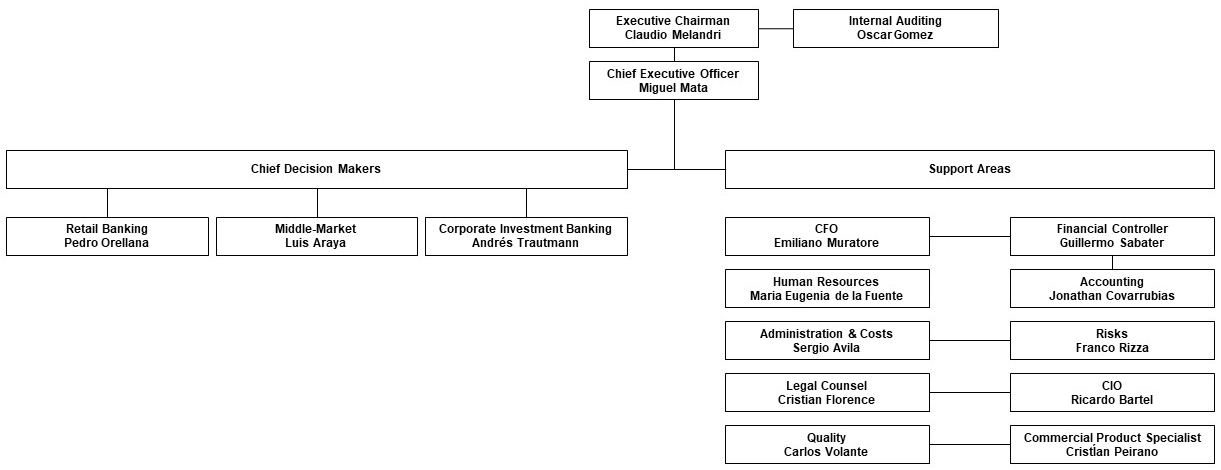
D. Property, plants and equipment
We are domiciled in Chile and own our principal executive offices located at Bandera 140, 20th floor, Santiago, Chile. At December 31, 2021, we owned the locations at which 35.9% of our branches were located. The remaining branches operate at rented locations. We believe that our existing physical facilities are adequate for our needs.
| Main Properties as of December 31, 2021 | Number | |||
| Central Offices | ||||
| Owned | 4 | |||
| Rented | 5 | |||
| Total | 9 | |||
| Branches | ||||
| Owned | 90 | |||
| Rented | 236 | |||
| Total | 326 | |||
| Other property(1) | ||||
| Owned | 45 | |||
| Rented | 15 | |||
| Total | 60 | |||
| (1) | Consists mainly of parking lots, mini-branches and property owned by our subsidiaries. |
ITEM 4A. UNRESOLVED STAFF COMMENTS
None.
ITEM 5. OPERATING AND FINANCIAL REVIEW AND PROSPECTS
Accounting Standards Applied in 2021
Santander-Chile is a Chilean bank and maintains its financial books and records in Chilean pesos and prepares its consolidated financial statements in accordance with IFRS as issued by the IASB in order to comply with requirements of the SEC. As required by the General Banking Law, which subjects Chilean banks to the regulatory supervision of the FMC, and which mandates that Chilean banks abide by the accounting standards stipulated by the FMC, our locally-filed consolidated financial statements have been prepared in accordance with Chilean Bank GAAP as issued by the FMC. The accounting principles issued by the FMC are substantially similar to IFRS but there are some exceptions, as described in Item 4. Therefore, our locally filed consolidated financial statements have been adjusted according to IFRS as issued by the IASB.
67
Critical Accounting Policies
Our consolidated financial statements include various estimates and assumptions, including but not limited to the adequacy of the allowance for loan losses, estimates of the fair value of certain financial instruments and the selection of useful lives of certain assets.
We evaluate these estimates and assumptions on an ongoing basis. Management bases its estimates and assumptions on historical experience and on various other factors that it believes to be reasonable under the circumstances. Actual results in future periods could differ from those estimates and assumptions, and if these differences were significant enough, our reported results of operations would be affected materially. We believe that the following are the most critical judgment areas or involve a higher degree of complexity in the application of the accounting policies that currently affect our financial condition and results of operations.
Allowance for Loan Losses under IFRS 9
The impairment model applies to all financial assets measured at amortized cost and fair value through other comprehensive income (“FVOCI”), including loan commitments and contingent loans. The Bank accounted the ECL related to financial assets measured at amortized cost and FVOCI as a loss allowance in the statement of financial position and the carrying amount of these assets is stated net of the loss allowance. The ECL related to contingent loans are accounted as a provision in the statement of financial position. For financial assets that are measured at fair value through other comprehensive income, the loss allowance is recognized in other comprehensive income and does not reduce the carrying amount of the financial asset in the statement of financial position. The new model uses a dual measurement approach, under which the loss allowance is measured as either: (a) 12-month expected credit losses or (b) lifetime expected credit losses.
Based on changes in credit quality since initial recognition, IFRS 9 outlines a “three-stage” impairment model as illustrated by the following chart:
 Change
in credit quality since initial recognition
Change
in credit quality since initial recognition

|
||
| Stage 1 | Stage 2 | Stage 3 |
| Initial recognition | Significant increase in credit risk since initial recognition | Credit impaired assets |
| 12-month expected credit losses | Lifetime expected credit losses | Lifetime expected credit losses |
The Bank, at the end of each reporting period, evaluates whether a financial instrument’s credit risk has increased since initial recognition, and consequently classifies the financial instrument in the relevant stage:
| ● | Stage 1: At initial recognition of a loan or when there has been an improved credit risk following a significant increase or impairment of assets, the Bank recognizes an allowance based on 12 months ECL. |
| ● | Stage 2: When a loan has shown a significant increase in credit risk since origination, the Bank records an allowance for the lifetime ECL. Stage 2 loans also include loans where the credit risk has improved following a Stage 3 classification. |
| ● | Stage 3: Loans considered credit-impaired. The Bank records an allowance for the lifetime ECL, setting the probability of default at 100%. |
The Bank considers reasonable and verifiable information available without undue cost or effort to it that may affect the credit risk on a financial instrument, including forward-looking information to determine whether there is or has been a significant increase in credit risk since initial recognition of a loan. Forward-looking information includes past events that affect future performance, current conditions and forecasts of future economic conditions.
68
Expected credit loss measurement
The expected credit losses is the probability-weighted estimate of credit losses, i.e., the present value of all cash shortfalls. A cash shortfall is the difference between the cash flows that are due to an entity in accordance with the contract and the cash flows that the entity expects to receive. The three main components in measuring expected credit losses are:
| ● | PD: The probability of default is an estimate of the likelihood of default over a given time period. A default may only happen at a certain time over the assessed period, if the facility has not been previously de-recognized and is still in the portfolio. |
| ● | LGD: The loss given default is an estimate of the loss arising after a specific default. It is based on the difference between the contractual cash flows due and those that the lender would expect to receive, including from the realization of any collateral. |
| ● | EAD: The exposure at default is an estimate of the exposure at a future default date, taking into account expected changes in the exposure after the reporting date, including repayments of principal and interest, whether scheduled by contract or otherwise, expected drawdown on committed facilities and accrued interest from missed payments. |
For measuring 12-month and lifetime expected credit losses, cash shortfalls are identified as follows:
| ● | 12-month expected credit losses: the portion of lifetime expected credit losses that represents the expected credit losses that result from default events on the financial instruments that are possible within the 12 months after the reporting date. |
| ● | Lifetime expected credit losses: the expected credit losses that result from all possible default events over the expected life of the financial instrument. |
Forward-looking information
The ECL model includes a broad range of forward-looking information as economic inputs, such as:
| ● | GDP growth; |
| ● | Unemployment rates; |
| ● | Central Bank interest rates; and |
| ● | Real estate prices. |
Interbank loans
According to the balance presentation required under IFRS 9, the Bank has grouped interbank loans with loans and accounts receivable since both are measured at amortized cost and are evaluated together for impairment purposes.
Contingent loans
The Bank enters into various irrevocable loan commitments and contingent liabilities. Even though these obligations may not be recognized on the statement of financial position, they contain credit risk and, therefore, form part of the overall risk of the Bank. When the Bank estimates the ECL for contingent loan commitments and letters of credit, it estimates the expected portion of the loan commitment that will be drawn down over its expected life.
Loans and account receivable measured at fair value through other comprehensive income
When the Bank enters into arrangements with its major customers for project finance and syndicated loans, the amount requested sometimes exceeds the Bank’s limit for single client exposure under credit risk policy, so these operations are approved under the condition that a portion of the loans be sold in the near term. The Bank also has loans that it expects to sell if market conditions are favorable to the Bank. These loans are measured at fair value through other comprehensive income and are subject to impairment requirements.
69
Valuation of Financial Instruments
Fair value is the price that would be received to sell an asset or that would be paid to transfer a liability in an orderly transaction between market participants at the measurement date. IFRS 13 provides a hierarchy that separates the inputs and/or valuation technique assumptions used to measure the fair value of financial instruments. The hierarchy reflects the significance of the inputs used in making the measurement.
The hierarchy gives the highest priority to (unadjusted) quoted prices in active markets for identical assets or liabilities and the lowest priority to unobservable inputs. The Bank uses valuation techniques appropriate in the circumstances and for which sufficient data are available to measure fair value, maximizing the use of relevant observable inputs and minimizing the use of unobservable inputs.
For financial instruments with no available market prices, fair values are estimated using recent transactions in analogous instruments, and in the absence thereof, the present values or other valuation techniques based on mathematical valuation models sufficiently accepted by the international financial community. In the use of these models, consideration is given to the specific particularities of the asset or liability to be valued, and especially to the different kinds of risks associated with the asset or liability.
These techniques are significantly influenced by the assumptions used, including the discount rate, the estimates of future cash flows and prepayment expectations. See “Note 37—Fair Value of Financial Assets and Liabilities” in our Audited Consolidated Financial Statements.
Derivative Activities
Derivatives are measured at fair value on the statement of financial position and the net unrealized gain (loss) on derivatives is classified as a separate line item within the income statement. Under IFRS, banks must mark-to-market derivatives. Within the fair value of derivatives are included Credit Valuation Adjustment (“CVA”) and Debit Valuation Adjustment (“DVA”), all with the objective that the fair value of each instrument includes the credit risk of its counterparty and the Bank’s own risk. The CVA is a valuation adjustment to OTC derivatives as a result of the risk associated with the credit exposure assumed by each counterparty in each future period. The DVA is a valuation adjustment similar to the CVA but, in this case, it arises as a result of the Bank’s own risk assumed by its counterparties. The following inputs are used to calculate the CVA and DVA:
| ● | Expected exposure: Including for each transaction the mark-to-market (MtM) value plus an add-on for the potential future exposure for each period. Mitigating factors such as collateral and netting agreements are taken into account, as well as a temporary impairment factor for derivatives with interim payments. |
| ● | LGD: percentage of final loss assumed in a counterparty credit event/default. |
| ● | Probability of default: for cases where there is no market information, proxies based on comparable companies in the same industry and with the same external rating as the counterparty, are used. |
| ● | Discount factor curve. |
Deferred Tax Assets and Liabilities
The Bank records, when appropriate, deferred tax assets and liabilities for the estimated future tax effects attributable to differences between the carrying amount of assets and liabilities and their tax bases. The measurement of deferred tax assets and liabilities is based on the tax rate, in accordance with the applicable tax laws, using the tax rate that applies to the period when the deferred asset and liability will be settled. The future effects of changes in tax legislation or tax rates are recorded in deferred taxes beginning on the date on which the law is enacted or substantially enacted. See “Note 15—Current and Deferred Taxes” of our Audited Consolidated Financial Statements.
70
Provisions – Contingent Liabilities
Provisions related to contingencies associated to pending signature of contracts, potential clients and other administrative claims, operational risk arise from financial transactions, potential property tax associated to leasing contracts are quantified using the best available information of uncertain future events that are not wholly within control of the Bank. These are reviewed and adjusted at each reporting date. See “Note 21—Provisions and Contingent Provisions” of our Audited Consolidated Financial Statements.
Adoption of IFRS 16 Leases
On January 1, 2019, IFRS 16 Leases has become effective; this standard sets out the principles for the recognition, measurement, presentation and disclosure of leases. The objective is to ensure that lessees and lessors provide relevant information in a manner that faithfully represents those transactions. IFRS 16 introduces a single lessee accounting model and requires a lessee to recognize assets and liabilities for all leases with a term of more than 12 months, thus a lessee is required to recognize a right-of-use asset representing its right to use the underlying leased asset and a lease liability representing its obligation to make lease payments.
The Bank has elected to adopt IFRS 16 using a modified retrospective approach at the date of initial application, therefore, it has recognized a right-of-use asset for an amount equal to the lease liability, which amounted to Ch$154,284 million. For more details, see Note 14 of our Audited Consolidated Financial Statements.
Covid-19 Support Measures
The Bank has conducted an exhaustive analysis of the measures implemented as a result of COVID-19, under the perspective of modified assets. The payment holiday program granted to our consumer loan portfolio included 3-month grace periods and modified terms and installments, and allowed modified interest rates, to the current lower market rate, and was considered a substantial modification of the original contractual conditions. Therefore, these consumer loans were accounted for as the termination of the original loan and the recognition of a new financial asset. In line with our internal guide, these modifications are classified as modifications for commercial reasons, because they are not attributable to the financial difficulty of the debtor, and a new loan operation has been originated under current market conditions.
For the mortgage loan portfolio, original contractual conditions were not modified, instead, the clients signed an addendum for the postponed installments, and a complementary operation was generated, with the mortgage guarantee covering both operations. Neither the monthly installments nor the rates were modified. This measure was granted only to clients with less than 30 days past due, and we have observed, once the postponed periods have ended, that 98% of our clients are meeting their obligations in a timely manner. In line with our internal guide, we have concluded that the modifications granted to customers with no past due days were classified as modifications for commercial reasons, while clients with any past due or that have had some restructuring (marked special risk), were classified as modifications for the financial difficulty of the debtor, and the Bank has calculated the difference between the gross carrying amount and the present value of the modified loans discounted at the original effective interest rate. The amount was not material to the Bank.
A. Operating Results
Chilean Economy
All of our operations and substantially all of our customers are located in Chile. Accordingly, our financial condition and results of operations are substantially dependent upon economic conditions prevailing in Chile. In 2020, the Chilean economy suffered due to the COVID-19 pandemic with extensive lockdowns in place, which led to an economic contraction of 5.8% in 2020. As of the date of this report, Chile has lifted many of its restrictions originally imposed as a consequence of the COVID-19 pandemic, and vaccination of the Chilean population against COVID-19 is well under way. During 2021, the Chilean economy started to recover as the extensive lockdowns where lifted, with the Central Bank expecting GDP to have grown approximately 12% in 2021. For 2022, GDP is expected to grow between 1.5% and 2.5%.
71
As of December 2021, the average unemployment rate for 2021 was 9.1%, compared to 10.8% in the same period of 2020. The higher unemployment rate in 2020 was due to the loss of jobs during the lockdowns caused by the pandemic that began to normalize in 2021.
The government also rolled out a series of measures to increase liquidity for households, including a new universal emergency fund (IFE) that was available for 90% of Chilean households, benefiting around 14.8 million people as of May 2021. These households received a monthly income for the months of June, July, and August, and then a further 50% of this expense for the months of September to December. However, the benefit was extended for the months of October and November to receive 100% of the monthly income once again. In total, the government spent around US$ 24,000 million in these direct government transfers.
In July 2020, a law was enacted permitting Chileans to withdraw a minimum of UF35 (US$1,269) and a maximum of UF150 (US$5,440) from their pension funds. For those that have funds below UF35, they were able to withdraw the entirety of their savings. The first draw down was tax-free and approximately US$18.6 billion was withdrawn. Then in December 2020, a second pension fund withdrawal was approved, although this time it was not tax-exempt. This added another US$16.1 billion in liquidity to the system. On April 27, 2021, a third withdrawal was approved and added a further US$13.9 billion of liquidity into the system. This immediate injection of cash to households contributed to higher consumption, higher inflation and positively impacted asset quality. A fourth pension fund withdrawal was discussed in Congress that would potentially have injected a further US$17 billion of liquidity to the system. However, on December 4, 2021, Congress rejected this proposal due to lack of quorum. On December 6, 2021, a fifth pension fund withdrawal was proposed as well as the withdrawal of 100% of the remaining pension fund money. Currently, these proposals do not have a set date to be discussed. The Chilean government has begun a process of discussing a tax reform and a pension reform to make-up for these pension withdrawals.
All this liquidity has increased inflation, with CPI inflation reaching 7.2% in 2021. In turn, overall GDP growth for 2021 is expected to reach 12%. The Central Bank has also begun increasing the MPR, after leaving it at the technical minimum of 0.5% throughout the pandemic. The Central Bank increased the MPR from 0.5% to 0.75% in July 2021, to 1.5% in August 2021, to 2.75% in October 2021 and to 4.0% in December 2021.
As a result of the social unrest in October 2019, the Chilean population decided to enact a new Constitution which is being drafted by a Constitutional Convention made up of 155 members. The election of the members of this convention was held in April 2021, with most of the members elected not affiliated to any political party. Each new article of the Constitution will have to be approved by two thirds of the convention. The Constitutional Convention has approximately one year from May 2021 to complete the drafting of the constitution. However, the Convention can extend the discussion process for an additional six month period. An exit referendum with compulsory participation will then be held to ratify the new Constitution. Presidential and parliamentary elections were held on November 21, 2021 and the presidential run-off election was held on December 19, 2021 with Gabriel Boric (a left-leaning candidate) winning the election.
The exchange rate appreciated by 4.5% in 2020 and depreciated by 19.5% in 2021. After a recovery of the Chilean peso following the social unrest in October 2019 and the beginning of the pandemic in 2020, in 2021 the peso depreciated mainly as a result of political uncertainty with the pandemic still ongoing as a backdrop.
The growth of the Chilean banking sector evolved in line with overall economic developments and the acquisition carried out by Chilean banks of loan portfolios previously owned by non-banks. Total loans as of December 31, 2021, in the Chilean financial system, excluding loans held abroad by Chilean banks, grew 10.4% year-over-year. Total customer deposits (defined as time deposits plus checking accounts), excluding amounts held by Chilean banks abroad, increased 8.4% year-over-year as of December 31, 2021. The non-performing loans (defined as loans with an installment that is at least 90 days past-due) to total loans ratio decreased from 1.6% at year-end 2020 to 1.2% at year-end 2021. This decrease occurred due to the high liquidity levels in the system after the government approved various initiatives to help the population during the COVID-19 pandemic.
72
Impact of Inflation
Our assets and liabilities are denominated in Chilean pesos, Unidades de Fomento (UF) and foreign currencies. Inflation impacts our results of operations as some loan and deposit products are contracted in UF. The UF is revalued in monthly cycles. Each day in the period beginning on the tenth day of the current month through the ninth day of the succeeding month, the nominal peso value of the UF is indexed up (or down in the event of deflation) in order to reflect a proportionate amount of the change in the Chilean Consumer Price Index during the prior calendar month. One UF equaled Ch$30,991.74 at December 31, 2021, Ch$29,070.33 at December 31, 2020 and Ch$28,309.94 at December 31, 2019. High levels of inflation in Chile could adversely affect the Chilean economy and could have an adverse effect on our business, financial condition and results of operations. Negative inflation rates also negatively impact our results. Inflation measured as the annual variation of the UF was 6.6% in 2021, 2.7% in 2020 and 2.7% in 2019. There can be no assurance that Chilean inflation will not change significantly from the current level. Due to the current structure of our assets and liabilities (i.e., a significant portion of our loans are indexed to the inflation rate, but there are significantly less features in deposits and other funding sources that would increase the size of our funding base), there can be no assurance that our business, financial condition and result of operations in the future will not be adversely affected by changing levels of inflation. In summary:
| ● | UF-denominated assets and liabilities. The effect of any changes in the nominal peso value of our UF-denominated interest earning assets and interest-bearing liabilities is reflected in our results of operations as an increase (or decrease, in the event of deflation) in interest income and expense, respectively. Our net interest income will be positively affected by an inflationary environment to the extent that our average UF-denominated interest earning assets exceed our average UF-denominated interest-bearing liabilities. Our net interest income will be positively affected by deflation in any period in which our average UF-denominated interest-bearing liabilities exceed our average UF-denominated interest earning assets. Our net interest income will be negatively affected in a deflationary environment if our average UF-denominated interest earning assets exceed our average UF-denominated interest-bearing liabilities. |
| ● | Inflation and interest rate hedge. A key component of our asset and liability policy is the management of interest rate risk. The Bank’s assets generally have a longer maturity than our liabilities. As the Bank’s mortgage portfolio grows, the maturity gap tends to rise as these loans, which are contracted in UF, have a longer maturity than the average maturity of our funding base. As most of our long-term financial instruments and mortgage loans are contracted in UF and most of our deposits are in nominal pesos, the rise in mortgage lending increases the Bank’s exposure to inflation and to interest rate risk. The size of this gap is limited by internal and regulatory guidelines in order to avoid excessive potential losses due to strong shifts in interest rates or inflation. In order to keep this duration gap below regulatory limits, the Bank issues long term bonds denominated in UF or interest rate swaps. The financial cost of the bonds and the efficient part of these hedges is recorded as net interest income. In 2021, the loss from the swaps taken in order to hedge mainly for inflation and interest rate risk and included in net interest income totaled Ch$449,122 compared to a loss of Ch$15,461 million in 2020 and a loss of Ch$31,346 million in 2019. The average gap between our interest earnings assets and total liabilities linked to the inflation, including hedging, was Ch$6,252,221 million in 2021, Ch$6,173,541 million in 2020 and Ch$4,279,082 million in 2019. Therefore, our sensitivity to a 100-basis point shift in UF inflation considering our year end gap would be approximately Ch$62.5 billion. |
| ● | The financial impact of the gap between our interest earning assets and liabilities denominated in UFs including hedges was Ch$410,249 million in 2021, Ch$173,668 million in 2020 and Ch$114,340 million in 2019. The 136.2% increase in these results was due to the higher UF inflation rate and a larger UF gap in 2021 compared to 2020. |
| As of December 31, | % Change | |||||||||||||||||||
| Impact of inflation on net interest income | 2021 | 2020 | 2019 | 2021/2020 | 2020/2019 | |||||||||||||||
| (in millions of Ch$) | ||||||||||||||||||||
| Results from UF GAP(1) | 410,249 | 173,668 | 114,340 | 136.2 | % | 51.9 | % | |||||||||||||
| Annual UF inflation | 6.6 | % | 2.7 | % | 2.7 | % | ||||||||||||||
| (1) | UF GAP is net interest income from asset and liabilities denominated in UFs and include the results from hedging the size of this gap via interest rate swaps. |
73
| ● | Peso-denominated assets and liabilities. Interest rates prevailing in Chile during any period primarily reflect the inflation rate during the period and the expectations of future inflation. The sensitivity of our peso-denominated interest earning assets and interest-bearing liabilities to changes to such prevailing rates varies. See “Item 5. Operating and Financial Review and Prospects—A. Operating Results—Interest Rates.” We maintain a substantial amount of non-interest-bearing peso-denominated demand deposits. Because such deposits are not sensitive to inflation, any decline in the rate of inflation would adversely affect our net interest margin on inflation indexed assets funded with such deposits, and any increase in the rate of inflation would increase the net interest margin on such assets. The ratio of the average of such demand deposits and average shareholder’s equity to average interest-earning assets was 38.9%, 33.5% and 30.5%, for the years ended December 31, 2021, 2020 and 2019, respectively. |
Interest Rates
Interest rates earned and paid on our assets and liabilities reflect, to a certain degree, inflation, expectations regarding inflation, changes in short term interest rates set by the Central Bank and movements in long term real rates. The Central Bank manages short term interest rates based on its objectives of balancing low inflation and economic growth. Because our liabilities are generally re-priced sooner than our assets, changes in the rate of inflation or short-term rates in the economy are reflected in the rates of interest paid by us on our liabilities before such changes are reflected in the rates of interest earned by us on our assets. Therefore, when short term interest rates fall, our net interest margin is positively impacted, but when short term rates increase, our interest margin is negatively affected. At the same time, our net interest margin tends to be adversely affected in the short term by a decrease in inflation rates since generally our UF-denominated assets exceed our UF-denominated liabilities. See “Item 5. Operating and Financial Review and Prospects—A. Operating Results—Impact of Inflation—Peso-denominated assets and liabilities.” An increase in long term rates has a positive effect on our net interest margin, because our interest earning assets generally have longer terms than our interest-bearing liabilities. A flattening of the yield curve (i.e. long-term rates falling quicker than short-term rates) negatively affects our margins by lowering loan yields at a greater pace than deposits costs. In addition, because our peso-denominated liabilities have relatively short re-pricing periods, they are generally more responsive to changes in inflation or short-term rates than our UF-denominated liabilities. As a result, during periods when or expected inflation exceeds the previous period’s inflation, customers often switch funds from UF-denominated deposits to peso-denominated deposits, which generally bear higher interest rates, thereby adversely affecting our net interest margin.
Foreign Exchange Fluctuations
The Chilean government’s economic policies and any future changes in the value of the Chilean peso against the U.S. dollar could adversely affect our financial condition and results of operations. The Chilean peso has been subject to significant devaluation in the past and may be subject to significant fluctuations in the future. The Central Bank exchange rate depreciated 19.5% in 2021 and appreciated 4.5% in 2020. A significant portion of our assets and liabilities are denominated in foreign currencies, principally the U.S. dollar, and we historically have maintained and may continue to maintain material gaps between the balances of such assets and liabilities. Our current strategy is not to maintain a significant difference between the balances of our assets and liabilities in foreign currencies. In 2021 and 2020, the Bank held significant short-term assets in US$ overnight deposits in order to maintain strong liquidity levels in this currency due to the COVID-19 pandemic. In either case, any differences are usually hedged using forwards and cross-currency swaps. Including derivatives, the Bank seeks to run no foreign currency risk in its non-trading balance sheet. Because such assets and liabilities, as well as interest earned or paid on such assets and liabilities, and gains and losses realized upon the sale of such assets, are translated to Chilean pesos in preparing our financial statements, our reported income is affected by changes in the value of the Chilean peso relative to foreign currencies (principally the U.S. dollar). The translation gain or loss over assets and liabilities (excluding derivatives held for trading) and derivatives accounted under hedge accounting standards are included as foreign exchange transactions in the income statement. The translation and mark-to-market of foreign currency derivatives held for trading is recognized as a gain or loss in the net results from mark-to-market and trading. The Bank also uses a sensitivity analysis with both internal limits and regulatory limits to seek to manage the potential loss in net interest income resulting from fluctuations of interest rates on U.S. dollar denominated assets and liabilities and a VaR model to limit foreign currency trading risk.
74
See “Item 11. Quantitative and Qualitative Disclosures About Market Risk—E. Market Risks—Foreign exchange fluctuations” for more detail on the Bank’s exposure to foreign currency.
Segmentation Criteria
The accounting policies used to determine the Bank’s income and expenses by reporting segment are the same as those described in the summary of accounting policies in “Note 1—Summary of Significant Accounting Policies” of the Bank’s Consolidated Financial Statements and are customized to meet the needs of the Bank’s management. The Bank earns most of its income in the form of interest income, fee and commission income and income from financial operations.
To evaluate a segment’s financial performance and make decisions regarding the resources to be assigned to segments, the Chief Operating Decision Maker (CODM) bases his or her assessment on the segment’s interest income, fee and commission income, and expenses. The Bank’s reporting segments have three Chief Operating Decision Makers: (i) the Director of Retail banking, (ii) the Director of the Middle-market segment and (iii) the Director of Corporate Investment Banking, each of which report to our Chief Executive Officer. All reporting segment information is presented following this structure.
Under IFRS 8, the Bank has aggregated operating segments with similar economic characteristics according to the aggregation criteria specified in the standard. A reporting segment consists of clients that are offered differentiated but, considering how their performance is measured, homogenous services based on IFRS 8 aggregation criteria. The clients included in each business segment are constantly revised and reclassified if a client no longer meets the criteria for the segment they are in and transferred to a different CODM. Therefore, variations of loan volumes and profit and loss items reflect business trends as well as client migration effects. Overall, this aggregation has no significant impact on the understanding of the nature and effects of the Bank’s business activities and the economic environment.
The Bank’s reportable segments are (i) Retail banking, (ii) Middle-market, (iii) Corporate Investment Banking and (iv) Corporate Activities (“Other”). See “Note 3—Reporting Segments” of our Audited Consolidated Financial Statements for more information.
75
Results of Operations for the Years Ended December 31, 2021 and 2020
In this section, we discuss the results of our operations for the year ended December 31, 2021 compared to the year ended December 31, 2020. For a discussion of the results of our operations for the year ended December 31, 2020 compared to the year ended December 31, 2019, please refer to “Item 5. – A. Operating Results – Results of Operations for the Year Ended December 31, 2020 Compared to the Year Ended December 31, 2019” in our Annual Report on Form 20-F for the year ended December 31, 2020.
The following discussion is based upon and should be read in conjunction with the Audited Consolidated Financial Statements. The Audited Consolidated Financial Statements have been prepared in accordance with IFRS as issued by the IASB. The following table sets forth the principal components of our net income for the years ended December 31, 2021 and 2020.
Consolidated Income Statement Data IFRS
|
2021 |
2021 |
2020 |
% Change 2021/2020 |
|||||||||||||
| (U.S.$ thousands) (1) | (Ch$ million) | |||||||||||||||
| Interest income and expense | ||||||||||||||||
| Interest income | 3,418,567 | 2,921,097 | 2,232,327 | 30.9 | % | |||||||||||
| Interest expense | (1,298,738 | ) | (1,109,746 | ) | (638,479 | ) | 73.8 | % | ||||||||
| Net interest income | 2,119,828 | 1,811,351 | 1,593,848 | 13.6 | % | |||||||||||
| Fees and income from services | ||||||||||||||||
| Fees and commission income | 677,142 | 578,604 | 451,162 | 28.2 | % | |||||||||||
| Fees and commission expense | (287,722 | ) | (245,853 | ) | (183,884 | ) | 33.7 | % | ||||||||
| Total net fees and commission income | 389,419 | 332,751 | 267,278 | 24.5 | % | |||||||||||
| Financial transactions, net | ||||||||||||||||
| Net income (expense) from financial operations | (7,493 | ) | (6,403 | ) | 90,800 | (107.1 | )% | |||||||||
| Net foreign exchange gain | 146,792 | 125,431 | 58,997 | 112.6 | % | |||||||||||
| Financial transactions, net | 139,299 | 119,028 | 149,797 | (20.5 | )% | |||||||||||
| Other operating income | 12,161 | 10,391 | 8,206 | 26.6 | % | |||||||||||
| Net operating profit before provision for loan losses | 2,660,707 | 2,273,521 | 2,019,129 | 12.6 | % | |||||||||||
| Provision for loan losses | (340,655 | ) | (291,083 | ) | (478,264 | ) | (39.1 | )% | ||||||||
| Net operating profit | 2,320,052 | 1,982,438 | 1,540,865 | 28.7 | % | |||||||||||
| Personnel salaries and expenses | (465,400 | ) | (397,675 | ) | (408,670 | ) | (2.7 | )% | ||||||||
| Administrative expenses | (327,841 | ) | (280,134 | ) | (250,450 | ) | 11.9 | % | ||||||||
| Depreciation and amortization | (142,841 | ) | (122,055 | ) | (109,426 | ) | 11.5 | % | ||||||||
| Impairment of property, plant and equipment | - | - | (638 | ) | (100.0 | )% | ||||||||||
| Other operating expenses | (126,181 | ) | (107,819 | ) | (77,806 | ) | 38.6 | % | ||||||||
| Total operating expenses | (1,062,264 | ) | (907,683 | ) | (846,990 | ) | 7.2 | % | ||||||||
| Net Operating income | 1,257,788 | 1,074,755 | 693,875 | 54.9 | % | |||||||||||
| Income from investments in associates and other companies (2) | (776 | ) | (663 | ) | 1,388 | (147.8 | )% | |||||||||
| Income before tax | 1,257,012 | 1,074,092 | 695,263 | 54.5 | % | |||||||||||
| Income tax expense | (259,414 | ) | (221,664 | ) | (142,533 | ) | 55.5 | % | ||||||||
| Income (loss) from continuous operations | 997,599 | 852,428 | 552,730 | 54.2 | % | |||||||||||
| Consolidated net income for the year | 997,599 | 852,428 | 552,730 | 54.2 | % | |||||||||||
| Net income for the year attributable to: | ||||||||||||||||
| Equity holders of the Bank | 985,941 | 842,467 | 547,614 | 53.8 | % | |||||||||||
| Non-controlling interests | 11,657 | 9,961 | 5,116 | 94.7 | % | |||||||||||
| (1) | Amounts stated in U.S. dollars at and for the year ended December 31, 2021 have been translated from Chilean pesos at the exchange rate of Ch$854.48 = U.S.$1.00 as of December 31, 2021. | |
| (2) | In 2018 the Bank announced that it was in the process of selling its share participation on Redbanc S.A. and Transbank S.A. As it has not been possible to find buyers for these companies due to the effects of COVID-19 pandemic and the current state of the Chilean economy, the Bank has reclassified those investments as Income from investments in associates and other companies. |
76
Results of Operations for the Years Ended December 31, 2021 and 2020
Net income for the year attributable to equity holders of the Bank increased 53.8% in 2021 compared to 2020 and totaled Ch$842.5 million. Our return on annualized average equity was 20.7% in 2021 compared to 14.8% in 2020.
In 2021, net operating profit before loan losses was Ch$2,273,521 million, an increase of 12.6% compared to 2020.
Our net interest income increased 13.6% in 2021 compared to 2020. This was mainly driven by loan growth, higher gains from inflation-indexed assets and lower cost of funds due to the high liquidity in the market and a lower rate environment. Overall, our net interest margin increased from 3.8% in 2020 to 3.9% in 2021.
Net fees and commission income increased 24.5% to Ch$332,751 million in the twelve-month period ended December 31, 2021 compared to the same period in 2020.
Fees from credit, debit and ATM cards increased 34.3% in 2021 due to higher usage of our cards from the growth of our client base, which reached 4,116,301 total clients, a 14.1% increase during the year. The switch to the four-part pricing model for credit card usage fees, which is based on interchange-fees also drove growth of net card fees. Insurance brokerage fees increased 10.4% due to an increase in the sale of car and life insurance, primarily due to advances in our digital platforms that enable clients to search for and purchase these products online more easily. Fees from checking accounts increased 13.7% in 2021 compared to 2020 due to the rise in the Bank’s checking account base. The number of checking accounts increased 44.8% to 2,184,012 driven by digital onboarding platforms such as Santander Life. Our corporate cash management services also continued to boost fee growth in this product.
Total financial transactions, net, which is the sum of net income from financial operations and foreign exchange gain (loss), totaled Ch$119,028 million in the year ended December 31, 2021, a decrease of 20.5% compared to the same period in 2020. These results include the results of our Treasury Division’s transactions with customers, as well as the results of our non-client treasury operations, mainly the Financial Management Division. The results from non-client treasury income totaled a loss of Ch$64,900 million in 2021. During 2021, as interest rates rose, the Bank realized some liability management exercises including the unwinding of rate and currency hedges. In some instances, this resulted in an initial loss recognized in this line item, but should contribute to controlling funding cost going forward. This was compensated by an increase of 26.7% of Client treasury services compared to 2020. In 2021, the results from client treasury products increased 18.9% as higher market volatility due to the COVID-19 pandemic led to higher demand for hedging from our Corporate and Middle-market clients. The results from market-making activities with client services increased 48.6% in 2021 compared to 2020, mainly due an improvement in business volumes of tailor-made treasury services and cash management sold to specific corporate clients, even after a strong year in this line item in 2020.
Total other operating income increased by 26.6% in 2021 compared to 2020 and totaled a gain of Ch$10,391 million. This was mainly due to higher income from recoveries from operational risk in 2021.
For the year ended December 31, 2021 provisions for expected credit loss totaled Ch$291,083 million and decreased 39.1% compared to 2020. This decrease was mainly due to the positive impact on asset quality of the reopening of the Chilean economy due to high vaccination levels as well as the positive impact on households and business of direct government transfers and pension fund withdrawals, which boosted economic activity in 2021.
As a result of the factors mentioned above, net operating profit increased 28.6% in 2021 compared to 2020 and totaled Ch$1,982,438 million.
Operating expenses in the year ended December 31, 2021 increased 7.2% compared to the corresponding period in 2020. The efficiency ratio was 39.9% in 2021 and 41.9% in 2020.
77
The 2.7% decrease in personnel salaries and expenses was mainly due to a decrease in salary costs as the headcount decreased 4.6% in 2021, ending the year at 9,988 employees in the Bank with severance costs increasing 15.6% in 2021.
Administrative expenses increased 11.9% in the year ended December 31, 2021 compared to the corresponding period in 2020, mainly due to higher IT and communications costs, as the Bank also continued to invest in IT to develop the Bank’s digital services and back-office platform, which is allowing the Bank to consolidate the branches and create efficiencies in the long-term. The higher inflation rate and the depreciation of the Chilean peso also resulted in the rise of administrative expenses as items such as rent are indexed to inflation and various outsourced IT related expenses are denominated in foreign currency.
Depreciation and amortization expense increased 11.5% in 2021 compared to 2020. This increase was mainly due to a higher amortization of intangible assets in the period.
There were no impairment charges in 2021, compared to Ch$638 million in 2020 when some fixed assets were impaired due to the social unrest that affected Chile in October and November 2019.
Other operating expenses were Ch$107,819 million in 2021, an increase of 38.6% compared to 2020. This is explained by the increase in insurance expenses the Bank must pay to cover cyber fraud losses as the number of clients increased. Auto sales and loans have been a bright spot in consumer lending, leading to a rise in Santander Consumer Finance net income by 67.2% YoY, totaling Ch$19,167 million in 2021. This includes the cost of the joint venture with SK Bergé, a key broker for auto loans, which is recognized as an Other operating expense.
Total income tax expense by the Bank in 2021 was Ch$221,664 million, a 55.5% increase compared to 2020, mainly driven by the 54.5% increase in net income before taxes.
Net Interest Income
| Year ended December 31, | % Change | |||||||||||
| 2021 | 2020 | 2021/2020 | ||||||||||
|
(in millions of Ch$,
except percentages) |
||||||||||||
| Retail banking | 1,044,730 | 1,049,543 | (0.5 | )% | ||||||||
| Middle-market | 334,768 | 346,225 | (3.3 | )% | ||||||||
| Corporate Investment banking | 97,817 | 114,229 | (14.4 | )% | ||||||||
| Total reporting segments | 1,477,315 | 1,509,997 | (2.2 | )% | ||||||||
| Other(1) | 334,036 | 83,851 | 298.4 | % | ||||||||
| Net interest income | 1,811,351 | 1,593,848 | 13.6 | % | ||||||||
| Average interest-earning assets | 46,529,096 | 42,239,387 | 10.2 | % | ||||||||
| Average non-interest-bearing demand deposits | 14,035,242 | 10,403,347 | 34.9 | % | ||||||||
| Net interest margin(2) | 3.9 | % | 3.8 | % | ||||||||
| Average shareholders’ equity and average non-interest-bearing demand deposits to total average interest-earning assets | 38.9 | % | 33.5 | % | ||||||||
| (1) | Consists mainly of net interest income from the Financial Management Division, including the inflation gap, and the cost of funding our financial assets held for trading. Each segment obtains funding from its clients. Any surplus deposits are transferred to the Financial Management Division, which in turn makes such excess available to other areas that need funding. The Financial Management Division also sells the funds it obtains in the institutional funding market at a transfer price equal to the market price of the funds. This segment also includes intra-segment income and activities not assigned to a given segment or product line. |
| (2) | Net interest margin is net interest income divided by average interest-earning assets. |
78
For the year ended December 31, 2021 our net interest income totaled Ch$1,811,351 million and increased 13.6% from Ch$1,593,848 million in 2020. Average interest earning assets increased 10.2% in the same period. During 2021, the loan portfolio grew 6.4%, but mainly in lower yielding commercial and mortgage loans. The higher growth from interest earning assets came from short-term assets as the Bank invested the higher liquidity in the system in low-risk and low-yielding assets. This caused the nominal yield earned on peso-denominated interest earning assets to decline from 6.2% in 2020 to 5.2% in 2021. However, this was offset by the high levels of UF inflation which caused the average interest rate earned on interest earning assets indexed to the UF to increase from 5.2% in 2020 to 8.8% in 2021 and led to an increase in the overall average interest earned over interest earning assets from 5.3% in 2020 to 6.3% in 2021.
| Average nominal interest rate earned on interest earning assets | 2021 | 2020 | ||||||
| Ch$ | 5.2 | % | 6.2 | % | ||||
| UF | 8.8 | % | 5.2 | % | ||||
| Foreign currencies | 1.4 | % | 2.7 | % | ||||
| Total | 6.3 | % | 5.3 | % | ||||
The average rate paid on our interest-bearing liabilities increased from 2.2% in 2020 to 3.8% in 2021. This was mainly due to a higher rate environment in 2021 triggered by the Central Bank’s tightening of monetary policy due to higher inflation. The increase in monetary policy rates led to an increase in the nominal rate paid on Ch$ interest bearing liabilities from 1.3% in 2020 to 3.5% in 2021, while higher UF inflation led to the nominal rate paid of UF interest bearing liabilities increasing from 5.3% to 9.9%.
| Average nominal interest rate paid on interest bearing liabilities | 2021 | 2020 | ||||||
| Ch$ | 3.5 | % | 1.3 | % | ||||
| UF | 9.9 | % | 5.4 | % | ||||
| Foreign currencies | 0.9 | % | 1.5 | % | ||||
| Total | 3.8 | % | 2.2 | % | ||||
Additionally, in 2021, average non-interest bearing demand deposits increased 34.9%, which helped mitigate the increase in funding costs.
In summary, the growth of lower yielding assets and the increase in the funding cost was offset by the increase in the UF inflation and the improved funding mix, leading to an increase in our net interest margin from 3.8% in 2020 to 3.9% in 2021.
Net interest income from our reporting segments totaled Ch$1,477,315 million and decreased 2.2% compared to 2020. This rise was mainly due to the growth of lower yielding assets and higher time deposit costs, partially offset by an improved funding mix. The changes in net interest income by segment in 2021 as compared to 2020 were as follows:
| ● | Net interest income from Retail banking decreased 0.5% in 2021, as the Bank grew in lower yielding loans. Mortgage loans continued to grow strongly in the year as rates were low for the first half of the year. In the second half of 2021, rates increased and demand for these loans diminished. Demand for consumer loans remained depressed in 2021 due to the government aid coupled with the access to private pension accounts. However, auto loans, which represent 14.5% of the consumer loan book, increased 53.7% in 2021 to due a general rise in car sales in Chile during the year. Net interest income from SMEs increased 7.0% despite the loan book contraction of 5.5% in 2021 after strong loan growth in 2020 due to the strong demand of FOGAPE government-guaranteed loans in the year. The interest rate on these FOGAPE loans were initially capped at the Central Bank MPR (at 0.5% at the launch of this program) plus a spread of 3.0%. However, in 2021 a FOGAPE 2.0 called FOGAPE Reactiva was rolled out, with less restrictions in terms of interest rates, terms, and use of proceeds. These loans also have a state guarantee, and can be used for investment and payment of debts, in addition to working capital. The maximum interest rate was also increased to the Central Bank MPR + 0.7% nominal per month. |
| ● | Net interest income from the Middle-market segment decreased 3.3% in 2021 mainly due to higher time deposit costs despite loan growth of 4.6% in 2021, which was mainly composed of foreign trade loans and factoring. |
| ● | Net interest income from the Corporate Investment Banking segment decreased 14.4% in 2021 compared to 2020. Loans increased 31.7%, but this was offset by an increase in time deposits, the main source of funding in this segment, with the tightening of MPR by the Central Bank. |
| ● | Other net interest income consists mainly of net interest income from the Bank’s ALCO, which includes the net interest income from the Bank’s debt instruments recorded at fair value through other comprehensive income, deposits in the Central Bank, and the financial cost of supporting our cash position and financial investments held for trading (the interest income from which is recognized as net income from financial operations and not interest income). The result of the Bank’s inflation gap is also included in this line. The net interest income included as “other” increased 298.4% to Ch$334,036 million in 2021 compared to 2020. This was mainly due to the higher average UF inflation gap in the year as management positioned the balance sheet to benefit from the higher inflation rate in 2021. |
79
The following table shows our balances of loans and accounts receivable from customers and interbank loans by segment at the dates indicated.
|
At December 31, |
% Change |
|||||||||||
|
2021 |
2020 |
2021/2020 |
||||||||||
| (in millions of Ch$) | ||||||||||||
| Retail banking | 25,784,719 | 24,279,248 | 6.2 | % | ||||||||
| Middle-market | 8,511,500 | 8,136,402 | 4.6 | % | ||||||||
| Corporate Investment banking | 2,154,325 | 1,635,217 | 31.7 | % | ||||||||
| Other (1) | 78,518 | 289,026 | 72.8 | % | ||||||||
| Total loans | 36,529,062 | 34,339,893 | 6.4 | % | ||||||||
| (1) | Includes interbank loans. |
The following table shows interest income of financial assets by valuation as of December 31, 2021 and 2020.
| At December 31, | % Change | |||||||||||
| 2021 | 2020 | 2021/2020 | ||||||||||
| (in millions of Ch$) | ||||||||||||
| Financial assets measured at amortized cost(1) | 2,858,338 | 2,114,620 | 35.2 | % | ||||||||
| Financial assets measured al FVOCI(2) | 94,657 | 105,417 | (10.2 | )% | ||||||||
| Other interest | 14,938 | 13,586 | 10.0 | % | ||||||||
| Interest income not including income from hedge accounting | 2,967,933 | 2,233,623 | 32.9 | % | ||||||||
| (1) | Financial assets measured at amortized cost include loans measured at amortized cost as described above and investments under resale agreements. The effective interest method is used in the calculation of the amortized cost of the financial asset and in the allocation and recognition of the interest revenue over the relevant period. |
| (2) | Financial assets measured at fair value through other comprehensive income include the interest income from debt instruments. These mainly consisted of securities and bonds of the Chilean Central Bank that contain contractual terms that give rise on specific dates to cash flows that are solely payments of principal and interest (SPPI), and are measured at FVOCI. |
Fee and Commission Income
Net fees and commission income increased 24.5% to Ch$332,751 million in the twelve-month period ended December 31, 2021 compared to the same period in 2020.
This increase was driven by higher fees from retail banking as a result of our digital strategy which led to a 44.8% increase in the number of checking account clients as of December 31, 2021 compared to the same date in 2020, with the number of digital clients growing 30.4% and number of total clients increasing 14.1%. This was led by our Santander Life digital checking account product. The following table shows client growth in our Retail banking and Middle-market segments for the periods indicated:
| Year ended December 31, | % Change | |||||||||||
| 2021 | 2020 | 2021/2020 | ||||||||||
| Total clients (1) | 4,116,301 | 3,607,609 | 14.1 | % | ||||||||
| Active clients (2) | 2,036,893 | 1,723,410 | 18.2 | % | ||||||||
| Loyal clients (3) | 832,405 | 764,104 | 8.9 | % | ||||||||
| Checking accounts (4) | 2,184,012 | 1,508,530 | 44.8 | % | ||||||||
80
| Year ended December 31, | % Change | |||||||||||
| 2021 | 2020 | 2021/2020 | ||||||||||
| Digital clients (5) | 2,016,947 | 1,546,524 | 30.4 | % | ||||||||
| (1) | Number of clients registered for at least one product. |
| (2) | Number of clients that have used at least one product at least one time in the past month. |
| (3) | Clients with four or more products plus a minimum profitability level and a minimum usage indicator, all differentiated by segment. SME and Middle-market cross-selling is differentiated by client size using a point system that depends on the number of products, usage of products and income net of risk. |
| (4) | Total checking accounts held by individuals and companies. |
| (5) | Number of clients that used at least one digital channel with password during the last month. |
The following table sets forth certain components of our income from services (net of fees paid to third parties directly connected to providing those services, principally fees relating to credit card processing and ATM network administration) in the years ended December 31, 2021 and 2020.
| Year ended December 31, | % Change | |||||||||||
| 2021 | 2020 | 2021/2020 | ||||||||||
| (in millions of Ch$) | ||||||||||||
| Credit, debit and ATM cards (1) | 98,445 | 73,297 | 34.3 | % | ||||||||
| Insurance brokerage | 43,898 | 39,764 | 10.4 | % | ||||||||
| Checking accounts | 39,581 | 34,825 | 13.7 | % | ||||||||
| Letters of credit | 39,010 | 36,277 | 7.5 | % | ||||||||
| Collections | 26,871 | 23,242 | 15.6 | % | ||||||||
| Lines of credit | 7,602 | 7,428 | 2.3 | % | ||||||||
| Getnet | 7,119 | - | -- | % | ||||||||
| Custody and brokerage services | 5,890 | 10,376 | (43.2 | )% | ||||||||
| Others | 64,335 | 42,069 | 52.9 | % | ||||||||
| Total fees and commission income, net | 332,751 | 267,278 | 24.5 | % | ||||||||
|
(1) |
Excludes Getnet, our acquiring business, which was launched in February 2021. |
Fees from credit, debit and ATM cards increased 34.3% in 2021 due to higher usage of our cards from the growth of our client base, which reached 4,116,301 total clients, a 14.1% increase during the year. The switch to the four-part pricing model for credit card usage fees, which is based on interchange-fees also drove growth of net card fees. We also increased the number of ATMs during the year, from 1,199 as of December 31, 2020 to 1,338 as of December 31, 2021, giving us higher fees from clients from other banks and financial institutions using our machines.
Insurance brokerage fees increased 10.4% due to an increase in the sale of car and life insurance, primarily due to advances in our digital platforms that enable clients to search for and purchase these products online more easily.
Fees from checking accounts increased 13.7% in 2021 compared to 2020 due to the rise in the Bank’s checking account base. The number of checking accounts increased 44.8% to 2,184,012 driven by digital onboarding platforms such as Santander Life. Our corporate cash management services also continued to boost fee growth in this product.
Fees from letters of credit and other contingent operations increased 7.5% in 2021 compared to 2020. This line corresponds to international and foreign trade financing business with clients. Business growth drove this revenue line in 2021 as activity started to recover as the risk of the COVID-19 pandemic receded.
Fees from collections increased 15.6% in 2021 compared to 2020. This line item includes, among other items, credit-related insurance collected on behalf of insurance companies, such as fire and earthquake insurance that are mandatory for mortgage loans. During 2021, the recovery of economic activity contributed to the increase in this line item.
81
Fees from lines of credit increased 2.3% in 2021 after a decrease in 2020 from the fall in consumption, the greater access to liquidity due to the withdrawal of pension fund savings and the rise in household savings rate during the pandemic. As household liquidity started to normalize in 2021, demand for lines of credit increased.
Brokerage and custody fees decreased 43.2% in 2021 as compared to 2020 due to lower activity in the local equity and fixed income market by Chilean institutional investors.
The 52.9% increase in other fee income in 2021 compared to 2020 was mainly due to higher fees earned by our Corporate Investment Banking segment for investment banking and advisory services for specific clients. Fees from the brokerage of mutual funds also increased 11.6% in 2021 compared to 2020 and totaled Ch$49,178 million. As rates increased, especially those earned by money market funds, average fees charged over these funds also increased. In December 2013, our Asset Management business was sold, but we continue to serve as an exclusive broker for Santander Asset Management, the acquirer of our asset management business.
The following table sets forth, for the periods indicated our fee income broken down by segment for the periods indicated:
| Year ended December 31, | % Change | |||||||||||
| 2021 | 2020 | 2021/2020 | ||||||||||
| (in millions of Ch$) | ||||||||||||
| Retail banking | 262,265 | 213,431 | 22.9 | % | ||||||||
| Middle-market | 43,903 | 38,335 | 14.5 | % | ||||||||
| Corporate Investment banking | 33,256 | 23,180 | 43.5 | % | ||||||||
| Other | (6,673 | ) | (7,668 | ) | (13.0 | )% | ||||||
| Total fees and commission income, net | 332,751 | 267,278 | 24.5 | % | ||||||||
Fees from Retail banking increased 22.9% in 2021 compared to 2020 mainly driven by card and checking account fees, increased by our digital initiatives such as Santander Life, which has helped increase the total number of checking accounts by 44.8% at December 31, 2021 as compared to the number of checking account as of December 31, 2020. Insurance brokerage fees increased 10.4% in 2021 compared to 2020 due to advances in our digital platforms that enable clients to search for and purchase insurance products online more easily.
The 14.5% increase in fees from the Middle-market segment was mainly due to the recovery of economic activity after the COVID-19 pandemic receded with greater fees generated from transactionality and some advisory services for foreign trade.
Fees from the Corporate Investment banking segment increased 43.5% in 2021 compared to 2020, mainly due to higher fees for cash management services and other fees generated from structured finance and other advisory services.
Fees in Other decreased from a loss of Ch$7,668 million in 2020 to a loss of Ch$6,673 million in 2021 mainly due to lower insurance fees paid to Zurich, our insurance partner.
Financial Transactions, Net
The following table sets forth information regarding our income (loss) from financial transactions for the years ended December 31, 2021 and 2020.
| Year ended December 31, | % Change | |||||||||||
| 2021 | 2020 | 2021/2020 | ||||||||||
| (in millions of Ch$) | ||||||||||||
| Net income from financial operations | (6,403 | ) | 90,800 | -- | % | |||||||
| Foreign exchange gain, net | 125,431 | 58,997 | 112.6 | % | ||||||||
| Total financial transactions, net | 119,028 | 149,797 | (20.5 | )% | ||||||||
Total financial transactions, net, which is the sum of net income from financial operations and foreign exchange gain, totaled Ch$119,028 million in the year ended December 31, 2021, a decrease of 20.5% compared to the same period in 2020. These results include the results of our Treasury Division’s trading business and financial transactions with customers, as well as the results of our Financial Management Division.
82
Internal Bank policy does not allow significant foreign currency mismatches and requires that the results included in Total financial transactions, net include not only the market-to-market of our foreign currency spot position, but also the results of the derivatives used to hedge currency risk. The mark-to-market of our spot position is included in the line item Foreign exchange gain, net along with the effect of those derivatives accounted for under hedge accounting rules. The derivatives used to hedge foreign currency risk, but which are classified as trading are included in the line item Net income from financial operations. For more details regarding our management and exposure to foreign currency risk, see “Item 11. Quantitative and Qualitative Disclosures About Market Risk—E. Market Risks—Market risk management— Market risk – local and foreign financial management.”
The results from net income (loss) from financial operations totaled a loss of Ch$6,403 million in 2021 compared to a gain of Ch$90,800 million in 2020.
|
For
the year ended
December 31, |
% Change | |||||||||||
|
2021
|
2020
|
2021/2020
|
||||||||||
| (in millions of Ch$) | ||||||||||||
| Net (loss) gains on trading derivatives | (24,592 | ) | 42,704 | -- | % | |||||||
| Net gains on financial assets at fair value through profit or loss | (4,816 | ) | 1,689 | -- | % | |||||||
| Net gains on derecognition of financial assets measured at amortized cost | 23,187 | 80,679 | (71.3 | )% | ||||||||
| Sale of loans and accounts receivables from customers | 2,731 | (62 | ) | -- | % | |||||||
| Current portfolio | (7 | ) | 48 | -- | % | |||||||
| Charged-off portfolio | 2,738 | (110 | ) | -- | % | |||||||
| Repurchase of issued bonds | (8,579 | ) | (24,973 | ) | (65.6 | )% | ||||||
| Other income (expense) from financial operations | 5,666 | (9,237 | ) |
-- |
% | |||||||
| Total income (expense) | (6,403 | ) | 90,800 |
-- |
% | |||||||
The loss from financial operations in 2021 compared to a gain in 2020 was mainly due to:
| (i) | A loss of Ch$24,592 million in 2021 compared to a gain of Ch$42,704 million in 2020 in the sub-item net gains on trading derivatives. Movements in foreign currency and interest rates affect this line item because it includes the valuation adjustments of our derivatives classified as trading. The Central Bank exchange rate depreciated 19.5% in 2021, which led to a net loss from trading of derivatives compared to an appreciation of 4.5% in 2020. Regarding rates, the withdrawals from the pension funds caused the local fixed income market to become subdued with pension funds not as active in the market. This, together with rising global long-term rates led to a rise in rates across the yield curve. This volatility resulted in significant movements in the net gain (loss) from trading derivatives. We use derivatives classified as trading, mainly forwards and cross-currency swaps, to hedge the net foreign currency spot position between short-term assets and short-term liabilities and it includes results from our client foreign currency business, such as the sale of currency derivatives, like forwards. |
| (ii) | Gains on the derecognition of financial assets measured at amortized cost, which totaled a gain of Ch$23,187 million in 2021 compared to Ch$80,679 million in 2020. This decrease was mainly due to an increase in local interest rates as yields rose along the whole nominal and UF peso yield curve, that decreased the realized gain from these investments. These investments are mainly comprised of fixed income instruments issued by the Central Bank of Chile and the Republic of Chile. |
| (iii) | A loss of Ch$4,816 million from financial assets at fair value through profit or loss in 2021 which compared to a gain of Ch$1,689 million in 2020. In this line item the mark-to-market and interest income of the trading fixed income portfolio are recognized. As interest rates began to rise quickly in 2021 this produced a loss from these investments compared to 2020. These investments are also mainly comprised of Chilean Central Bank instruments. |
| (iv) | In 2021, the Bank repurchased certain bonds at a price above par, resulting in the loss recorded in this line item. As high liquidity was maintained throughout the year from the high growth in demand deposits and the access to the Central Bank lines from 2020, the Bank continued to carry manage its liabilities, which in the medium term should help mitigate the increase in the cost of funds in a higher rate environment. See “Note 19—Issued Debt Instruments and Other Financial Liabilities—b) Senior Bonds” in the Audited Consolidated Financial Statements. |
83
This was partially offset by:
| (v) | The net gain of Ch$5,666 million in 2021 million in the sub-line item others compared to a loss of Ch$9,237 million in 2020 that was mainly due to a lower loss from credit value adjustment of our derivative portfolio. |
The net result from foreign exchange transactions totaled a gain of Ch$125,431 million in 2021 compared to Ch$58,997 million in 2020.
| Year ended December 31, | % Change | |||||||||||
| 2021 | 2020 | 2021/2020 | ||||||||||
| (in millions of Ch$) | ||||||||||||
| Net profit or loss from foreign currency exchange differences | (481,340 | ) | 90,133 | -- | % | |||||||
| Hedge-accounting derivatives | 587,976 | (27,624 | ) | -- | % | |||||||
| Translation gains and losses over assets and liabilities indexed to foreign currencies, net | 18,795 | (3,512 | ) | -- | % | |||||||
| Net results from foreign exchange gain | 125,431 | 58,997 | 112.6 | % | ||||||||
Included in these results is the sub-item Net profit or loss from foreign currency exchange differences which includes the mark-to-market of the Bank’s spot position and results from our client foreign currency business, such as currency transactions. The Central Bank exchange rate depreciated 19.5% in 2021 and appreciated 4.5% in 2020, which reflects the loss from our net liability spot position in 2021 versus a net gain for 2020. This is offset by the results from hedge-accounting derivatives.
Results from the sub-item hedge-accounting derivative are mainly comprised of the mark-to-market of derivatives that are used to mainly hedge the foreign currency risk of our long-term foreign currency funding. Therefore, we generally have a net foreign currency asset position in our hedge-accounting derivatives. These are mainly cross-currency swaps that are accounted under hedge accounting rules. These derivatives produced a gain of Ch$587,976 million in 2021, due to the depreciation of the peso in the 2021.
Finally, the Bank has some assets and liabilities that are in Chilean pesos, but indexed to foreign currency. This position produced a gain in 2021 of Ch$18,795 million.
In order to more easily compare the results from financial transactions, net, we present the following table that separates the results by lines of business for 2021 and 2020.
| Year ended December 31, | % Change | |||||||||||
| 2021 | 2020 | 2021/2020 | ||||||||||
| (in millions of Ch$) | ||||||||||||
| Client treasury products | 127,904 | 107,538 | 18.9 | % | ||||||||
| Market-making with clients | 56,025 | 37,703 | 48.6 | % | ||||||||
| Client treasury services | 183,928 | 145,222 | 26.7 | % | ||||||||
| Sale of loans and charged-off loans | 1,903 | (126 | ) | -- | % | |||||||
| CVA adjustments | (15,154 | ) | (23,216 | ) | (34.7 | )% | ||||||
| Financial Management Division and others(1) | (51,650 | ) | 27,918 |
-- |
% | |||||||
| Non-client treasury income (loss) | (64,900 | ) | 4,576 |
-- |
% | |||||||
| Total financial transactions, net | 119,028 | 149,798 | (20.5 | )% | ||||||||
| (1) | The Financial Management Division manages the structural interest rate risk, the structural position in inflation-indexed assets and liabilities, capital requirements and liquidity levels. The aim of the Financial Management Division is to provide stability and continuity in our net interest income from commercial activities, and to ensure that we comply with internal and regulatory limits regarding liquidity, regulatory capital, reserve requirements and market risk. |
84
Client treasury services totaled Ch$183,928 million, an increase of 26.7% compared to 2020. The results from client treasury products and market-making mainly include the results from the sale of derivatives, foreign exchange and fixed income instruments to our client base. In 2021, the results from client treasury products increased 18.9%. The higher market volatility due to the COVID-19 pandemic led to higher demand for hedging from our Corporate and Middle-market clients. The results from market-making with client services increasing 48.6% in 2021, mainly due an improvement in business volumes of tailor-made treasury services and cash management sold to specific corporate clients, even after a strong year in this line item in 2020. These results may vary year-to-year as some large operations with corporate clients may not be repeated in subsequent years.
The results from non-client treasury income totaled a loss of Ch$64,900 million in 2021 compared to a gain of Ch$4,576 million in 2020. These results include the income from sale of loans, including charged-off loans, CVA adjustments and the results from our Financial Management Division. The results of the Bank’s Financial Management Division totaled a loss of Ch$51,650 million compared to a gain of Ch$27,918 million in 2020. During 2021, as interest rates rose, the Bank realized some liability management exercises including the unwinding of rate and currency hedges. In some instances, this resulted in an initial loss recognized in this line item but should contribute to controlling the funding cost going forward.
The results from the sale of loans totaled a gain of Ch$1,903 million in 2021 compared to a loss of Ch$126 million in 2020 as demand for these sales recovered after the COVID-19 pandemic subsided.
The results from CVAs totaled a loss of Ch$15,154 million. This was mainly due to a loss from CVA adjustments of our derivative portfolio which is included in this line item, since the CVA generated by derivatives taken for hedging and on behalf of clients is not part of client income or part of Financial Management’s profit and loss. After an increase in counterparty risk in 2020, the CVA adjustment loss reduced in 2021.
Other Operating Income
| Year ended December 31, | % Change | |||||||||||
| 2021 | 2020 | 2021/2020 | ||||||||||
| (in millions of Ch$) | ||||||||||||
| Income from assets received in lieu of payment | 5,140 | 5,934 | (13.4 | )% | ||||||||
| Release of contingencies provisions | - | 503 | -- | % | ||||||||
| Other income | 4,912 | 1,769 | 177.7 | % | ||||||||
| Operational risk recovery | 2,389 | - | -- | % | ||||||||
| Income from sale of property, plant and equipment | 673 | 865 | (22.2 | )% | ||||||||
| Pension plan interest | 640 | - | -- | % | ||||||||
| Rental income | 286 | - | -- | % | ||||||||
| Compensation from insurance companies due to damages | 45 | 255 | (82.4 | )% | ||||||||
| Other | 879 | 396 | 122.0 | % | ||||||||
| Total | 10,391 | 8,206 | 26.6 | % | ||||||||
Total other operating income increased by 26.6% in 2021 compared to 2020 and totaled a gain of Ch$10,391 million. This was mainly due to higher income from recoveries from operational risk in 2021 as well as income from pension plan interest and rental income, compensated by lower compensation from insurance companies.
85
Expected Credit Loss Allowance
The following table sets forth certain information relating to our provision for expected credit losses for the years ended 2021 and 2020.
|
As of December 31, 2021 |
||||||||||||||||||||||||||||
|
Stage 1 |
Stage 2 |
Stage 3 |
||||||||||||||||||||||||||
|
Corporate |
Other (1) |
Corporate |
Other (1) |
Corporate |
Other (1) |
Total | ||||||||||||||||||||||
| (in millions of Ch$) | ||||||||||||||||||||||||||||
| Commercial loans | (1,469 | ) | 2,676 | (25,829 | ) | (415 | ) | (51,897 | ) | (63,398 | ) | (140,332 | ) | |||||||||||||||
| Mortgage loans | - | (357 | ) | - | (3,903 | ) | - | (31,489 | ) | (35,749 | ) | |||||||||||||||||
| Consumer loans | - | (35,532 | ) | - | (6,193 | ) | - | (65,429 | ) | (107,154 | ) | |||||||||||||||||
| Contingent loans | (1,088 | ) | (6,070 | ) | (4,098 | ) | 1,920 | 360 | 318 | (8,658 | ) | |||||||||||||||||
| Loans and AR at FVOCI | 1,086 | - | - | - | - | - | 1,086 | |||||||||||||||||||||
| Debt at FVOCI | - | 435 | - | - | - | - | 435 | |||||||||||||||||||||
| Debt at amortized cost | (711 | ) | - | (711 | ) | |||||||||||||||||||||||
| Total Expected credit losses allowance | (1,471 | ) | (39,558 | ) | (29,927 | ) | (8,591 | ) | (51,537 | ) | (159,999 | ) | (291,083 | ) | ||||||||||||||
| (1) | Includes Mortgages, Consumer and Other Commercial loans. |
|
As of December 31, 2020 |
||||||||||||||||||||||||||||
|
Stage 1 |
Stage 2 |
Stage 3 |
||||||||||||||||||||||||||
|
Corporate |
Other (1) |
Corporate |
Other (1) |
Corporate |
Other (1) |
Total | ||||||||||||||||||||||
| (in millions of Ch$) | ||||||||||||||||||||||||||||
| Commercial loans | (20,055 | ) | (9,617 | ) | (35,861 | ) | (23,410 | ) | (115,730 | ) | (86,016 | ) | (290,691 | ) | ||||||||||||||
| Mortgage loans | - | (16,603 | ) | - | 5,966 | - | (7,636 | ) | (18,273 | ) | ||||||||||||||||||
| Consumer loans | - | (19,024 | ) | - | 18,914 | - | (161,466 | ) | (161,576 | ) | ||||||||||||||||||
| Contingent loans | (1,335 | ) | 1,600 | (1,624 | ) | (4,023 | ) | 14 | (423 | ) | (5,789 | ) | ||||||||||||||||
| Loans and AR at FVOCI | (1,253 | ) | - | - | - | - | - | (1,253 | ) | |||||||||||||||||||
| Debt at FVOCI | - | (682 | ) | - | - | - | - | (682 | ) | |||||||||||||||||||
| Total Expected credit losses allowance | (22,643 | ) | (44,326 | ) | (37,485 | ) | (2,552 | ) | (115,716 | ) | (255,543 | ) | (478,264 | ) | ||||||||||||||
| (1) | Includes Mortgages, Consumer and Other Commercial loans. |
For the year ended December 31, 2021 provisions for expected credit loss totaled Ch$291,083 million and decreased 39.1% compared to 2020. This decrease was mainly due to higher expected losses in 2020 driven by the economic slowdown from the COVID-19 pandemic and continued high levels of uncertainty in the macro-economic outlook. To address a potential lag in defaults, the Bank’s management determined to record overlay or post-model adjustments overlays for an amount of Ch$59,000 million, wherein Ch$29,000 million addressed macroeconomics’ variables and Ch$30,000 million associated to expected behavior of Fogape loans in 2020. In April 2020, the Bank completed a calibration of parameters, resulting in additional allowance for Ch$2,066 million. In 2021, as economic activity recovered and payment behavior started to normalize, the macro economic scenario was updated, and these overlays were released. The table below breaks down these results by main product item:
| Year ended December 31, | % Change | |||||||||||
| 2021 | 2020 | 2021/2020 | ||||||||||
| (in millions of Ch$) | ||||||||||||
| Commercial loans | (140,332 | ) | (290,691 | ) | (51.7 | )% | ||||||
| Mortgage loans | (35,749 | ) | (18,273 | ) | 95.6 | % | ||||||
| Consumer loans | (107,154 | ) | (161,576 | ) | (33.7 | )% | ||||||
| Contingent loans | (8,658 | ) | (5,789 | ) | 49.6 | % | ||||||
| Loans and AR at FVOCI | 1,086 | (1,253 | ) | -- | % | |||||||
| Debt at FVOCI | 435 | (682 | ) | -- | % | |||||||
| Debt at amortized cost | (711 | ) | - | -- | % | |||||||
| Total Provision For Loan Losses | (291,083 | ) | (478,264 | ) | (39.1 | )% | ||||||
86
Provisions for expected credit losses of our commercial loans totaled Ch$140,332 million for the year ended December 31, 2021 and decreased 51.7% compared to 2020. This product was the most affected by the lockdowns in 2020; however, as economic activity started to recover, there was a larger transfer of clients from Stage 3 to Stage 2 and from Stage 2 to Stage 1. There was also a decrease in write-offs compared to 2021. During 2020 there was strong growth in loan growth in commercial loans mainly came from Fogape loans, which were state-guaranteed loans mainly given to SMEs in order to help them cope with the lower economic activity due to the Covid-19 pandemic. The Bank decided to be prudent and increased provisioning for these loans, with an overlay of Ch$30,000 million specifically for loans under Stage 2 in 2020. These overlays were released in 2021.
Provisions for expected credit losses for mortgage loans totaled an expense of Ch$35,749 million for the year ended December 31, 2021, compared to an expense of Ch$18,273 million in 2020. During the pandemic in 2020, almost half of this portfolio was under a grace period at the peak and in June 2020, the Bank decided to take an overlay due to the deterioration of macroeconomic variables, and assigned Ch$11,600 million under Stage 1. The majority of these grace periods ended in October and November 2020. In 2021, Mortgage loans increased 11.8% in 2021 compared to 2020, while write-offs of loans classified as Stage 3 increased from Ch$25,831 million to Ch$38,183 million. This was offset by the reversal of the overlays established in 2020.
The provisions for expected credit losses for consumer loans totaled a charge of Ch$107,154 million and decreased 33.7% in 2021 compared to 2020 as during 2021 our clients showed good payment behavior and loans classified as Stage 2 and 3 decreased compared to 2020. In 2021 the consumer loan book only grew 1.2% compared to 2020, as there was lower demand for these types of products due to the high liquidity of households after the government approved various initiatives, including pension fund withdrawals that contributed to the improved payment behavior. Regardless of other factors, if contractual payments are more than 30 days past due, the credit risk is deemed to have increased significantly since initial recognition and consumer loans are written off after 6 months. In 2021, write-off for this loan book totaled Ch$25,831 million compared to Ch$123,487 million in 2020. In June 2020 the Bank decided to take an overlay due to the deterioration of macroeconomic variables, and assigned a total of Ch$17,400 million to a specific group of operations in the following manner: Ch$10,700 million to specific operations under Stage 1 and $6,700 million to specific operations under Stage 2. These overlays were released in 2021 as the Bank updated its macro-economical scenarios.
The following table shows the success rate of renegotiated consumer and residential loans used for management purposes, for the periods indicated. The success rate for consumer loans is defined for each reported period as: (i) the total amount of loans renegotiated in that period minus the amount of such renegotiated loans that are classified as non-performing loans as of December 31, 2021, minus the amount of such renegotiated loans that have been charged off as of December 31, 2021, divided by (ii) the total amount of such renegotiated loans. The success rate for residential mortgage loans is defined for each reported period as: (i) the total amount of loans renegotiated in that period minus the amount of such renegotiated loans that are classified as non-performing loans as of December 31, 2021, divided by (ii) the total amount of such renegotiated loans. A charge-off of a residential mortgage loan is not generally included in measuring the success rate of mortgage renegotiations since the period to charge-off a mortgage loan is 48 months after an installment is past-due.
| Period of Renegotiation |
Success
Rate Consumer
Loans at December 31, 2021 |
Success
Rate Residential Mortgage
Loans at December 31, 2021 |
||||||
| First Quarter 2020 | 57.4 | % | 72.9 | % | ||||
| Second Quarter 2020 | 65.6 | % | 67.0 | % | ||||
| Third Quarter 2020 | 66.1 | % | 84.0 | % | ||||
| Fourth Quarter 2020 | 69.2 | % | 85.9 | % | ||||
| First Quarter 2021 | 70.5 | % | 83.7 | % | ||||
| Second Quarter 2021 | 81.5 | % | 84.5 | % | ||||
| Third Quarter 2021 | 98.1 | % | 91.7 | % | ||||
| Fourth Quarter 2021 | 99.4 | % | 92.5 | % | ||||
87
As a general rule, charge-offs should be done when all collection efforts have been exhausted. These charge- offs consist of de-recognition from the Consolidated Statements of Financial Position of the corresponding loans operations in its entirety, and, therefore, include portions not past-due of a loan in the case of installments loans or leasing operations (no partial charge-offs exists). Subsequent payments obtained from charged-off loans will be recognized in the Consolidated Statement of Income as a recovery of loans previously charged-off. Loan and accounts receivable charge-offs are recorded for overdue, past due, and current installments based on the time periods expired since reaching overdue status, as described below:
Any payment agreement of an already charged-off loan will not give rise to income-as long as the operation is still in an impaired status-and the effective payments received are accounted for as a recovery from loans previously charged-off. In general, legal collection proceedings are commenced with respect to consumer loans once they are past-due for at least 90 days and, with respect to mortgage loans, once they are past-due for at least 120 days. Legal collection proceedings are always commenced within one year of such loans becoming past-due, unless we determine that the size of the past-due amount does not warrant such proceedings. In addition, the majority of our commercial loans are short-term, with single payments at maturity. Past-due loans are required to be covered by individual loan loss reserves equivalent to 100.0% of any unsecured portion thereof.
Recoveries on loans previously charged-off increased 2.8% in 2021 compared to 2020 as increasing mobility after lockdowns facilitated recovery efforts. The following table shows recoveries of loans previously charged-off by type of loan.
| Year ended December 31, | % Change | |||||||||||
| 2021 | 2020 | 2021/2020 | ||||||||||
| (in millions of Ch$) | ||||||||||||
| Recovery of loans previously charged-off | ||||||||||||
| Consumer loans | 36,166 | 39,373 | (8.1 | )% | ||||||||
| Residential mortgage loans | 13,621 | 9,584 | 42.1 | % | ||||||||
| Commercial loans | 27,212 | 25,969 | 4.8 | % | ||||||||
| Total recoveries | 76,999 | 74,926 | 2.8 | % | ||||||||
In some instances, we will sell a portfolio of charged-off loans to a third party. Gain (loss) on these charged-off loans is recognized as net income from financial transactions as disclosed in “Note 28—Net Income (Expense) from Financial Operations” of our Audited Consolidated Financial Statements. The following table sets forth information about our sale of charged-off loans for the year ended December 31, 2021 and 2020.
| Year ended December 31, | % Change | |||||||||||
| 2021 | 2020 | 2021/2020 | ||||||||||
| (in millions of Ch$) | ||||||||||||
| Gains (losses) on sale of loans previously charged-off | 2,738 | (110 | ) | -- | % | |||||||
The following table sets forth, for the periods indicated, our net provision expense broken down by business segment:
| Year ended December 31, | % Change | |||||||||||
| 2021 | 2020 | 2021/2020 | ||||||||||
| (in millions of Ch$) | ||||||||||||
| Retail banking | (226,590 | ) | (317,050 | ) | (28.5 | )% | ||||||
| Middle-market | (48,578 | ) | (109,999 | ) | (55.8 | )% | ||||||
| Corporate Investment banking | (15,115 | ) | (51,097 | ) | (70.4 | )% | ||||||
| Other | (800 | ) | (118 | ) | 578.0 | % | ||||||
| Total provisions, net | (291,083 | ) | (478,264 | ) | (39.1 | )% | ||||||
Net provisions expense from retail banking decreased 28.5% in 2021 compared to 2020 despite a 6.2% increase in this loan portfolio. This was mainly driven by lower provisions for SMEs after strong loan growth in 2020 through FOGAPE loans and lower expense from consumer loans in 2021 due to an improvement in payment behavior as well as a reversal of the overlays taken in 2020.
Net provision expense from the Middle-market segment decreased 55.8% in 2021 despite a 4.6% increase in this loan portfolio due to better payment performance and as this segment started to recover from the COVID-19 pandemic lockdowns and lower economic growth in 2020.
88
Net provision expense from Corporate Investment banking decreased 70.4% in 2021 mainly due to the sale of particular corporate loans.
Total provisions, net included in Others totaled an expense of Ch$800 million, 578.0% greater than in 2020. This difference is explained by a change in the way the effects of the exchange rate over provision expenses are recognized. In 2021, the impact of foreign currency movements on provision expenses and the corresponding hedge was included in Financial Transactions, net.
We believe that our loan loss allowances are currently adequate for all known and expected credit losses.
Operating Expenses
The following table sets forth information regarding our operating expenses in the years ended December 31, 2021 and 2020.
| Year ended December 31, | % Change | |||||||||||
| 2021 | 2020 | 2021/2020 | ||||||||||
| (in millions of Ch$) | ||||||||||||
| Personnel salaries and expenses | (397,675 | ) | (408,670 | ) | (2.7 | )% | ||||||
| Administrative expenses | (280,134 | ) | (250,450 | ) | 11.9 | % | ||||||
| Depreciation and amortization | (122,055 | ) | (109,426 | ) | 11.5 | % | ||||||
| Impairment | - | (638 | ) | (100.0 | )% | |||||||
| Other operating expenses | (107,819 | ) | (77,806 | ) | 38.6 | % | ||||||
| Total operating expenses | (907,683 | ) | (846,990 | ) | 7.2 | % | ||||||
| Efficiency ratio(1) | 39.9 | % | 41.9 | % | ||||||||
| (1) | The efficiency ratio is the ratio of total operating expenses to total operating income. Total operating income consists of net interest income, fee income, financial transactions, net and other operating income. |
Operating expenses in the year ended December 31, 2021 increased 7.2% compared to the corresponding period in 2020. The efficiency ratio was 39.9% in 2021 and 41.9% in 2020.
The 2.7% decrease in personnel salaries and expenses was mainly due to a 6.2% decrease in salary costs as headcount decreased 4.6% in 2021, ending the year at 9,988 employees in the Bank compared to 10,470 in 2020. This was partially offset by severance costs which increased 15.6% in 2021.
Administrative expenses increased 11.9% in the year ended December 31, 2021 compared to the corresponding period in 2020, mainly due to higher IT and communications costs, as the Bank also continued to invest in IT to develop the Bank’s digital services and back-office platform, which is allowing the Bank to consolidate the branches and create efficiencies in the long-term. The higher inflation rate and the depreciation of the Chilean peso also resulted in the rise of administrative expenses as items such as rent are indexed to inflation and various outsourced IT-related expenses are denominated in foreign currencies.
Publicity costs increased 56.8% in 2021 due to the launch of Getnet and other publicity campaigns for our products. Client reception of Getnet has been high and approximately 68,000 POSs have already been sold to more than 55,000 clients, of which 93% are SMEs. As of December 31, 2021, the Bank had a total of 326 branches, 63 of which were in the WorkCafé format. In July 2021, the Bank reached an agreement with Servipag, a franchise with over 200 cash payment centers across the country, through which clients can cash and deposit checks and pay loans, among other cash services. This should free up our branches for more value-added services going forward. The table below provides a breakdown of the Bank’s branch network during the periods indicated.
| Year ended December 31, | % Change | |||||||||||
| 2021 | 2020 | 2021/2020 | ||||||||||
| Traditional branches | 242 | 273 | (11.4 | )% | ||||||||
| Middle-market centers | 7 | 7 | 0.0 | % | ||||||||
| Santander Select | 14 | 19 | (26.3 | )% | ||||||||
| WorkCafés | 63 | 59 | 6.8 | % | ||||||||
| Total branches | 326 | 358 | (8.9 | )% | ||||||||
| Total ATMs (including depositary ATMs) | 1,338 | 1,199 | 11.6 | % | ||||||||
89
Depreciation and amortization expense increased 11.5% in 2021 compared to 2020. This increase was mainly due to a higher amortization of intangible assets in the period.
There were no impairment charges up in 2021, compared to Ch$638 million in 2020 when some fixed assets were impaired due to the social unrest that affected Chile in October and November 2019.
Other operating expenses were Ch$107,819 million in 2021, an increase of 38.6 % compared to 2020. This is explained by the increase in the Bank’s client base, which increases the cost the Bank must pay to cover for the insurance policy it has contracted to cover cyber fraud losses. See “Note 34—Other Operating Income and Expenses” to our Audited Consolidated Financial Statements for more detail on Other operating expenses. Auto sales and loans have led consumer lending, resulting in an increase of Santander Consumer Finance’s net income by 67.2% year-over-year, totaling Ch$19,167 million in 2021. This includes the cost of the joint venture with SK Bergé, a key broker for auto loans, which is recognized in Other operating expenses.
The following table sets forth, for the periods indicated, our personnel salaries, administrative and depreciation and amortization expenses broken down by business segment. These amounts exclude impairment and other operating expenses.
| Year ended December 31, | % Change | |||||||||||
| 2021 | 2020 | 2021/2020 | ||||||||||
| (in millions of Ch$) | ||||||||||||
| Retail banking | (616,287 | ) | (596,464 | ) | 3.3 | % | ||||||
| Middle-market | (94,721 | ) | (91,132 | ) | 3.9 | % | ||||||
| Corporate Investment banking | (77,051 | ) | (72,715 | ) | 6.0 | % | ||||||
| Other | (11,805 | ) | (8,235 | ) | 43.4 | % | ||||||
| Total personnel, administrative expenses, depreciation and amortization(1) | (799,864 | ) | (768,546 | ) | 4.1 | % | ||||||
| (1) | Excludes impairment and other operating expenses. |
By business segment, the 4.1% increase in costs excluding impairment and other operating expenses in 2021 compared to the corresponding period in 2020 was mainly due to a rise in cost in the Retail and Corporate Investment Banking segments. This rise in costs was driven by the increase in administrative expenses driven by client growth, higher IT investments, the launch of Getnet, the costs of branch transformations in Retail banking and the impact of higher inflation and the depreciation of the Chilean peso over administrative expenses in each segment.
Income tax
| Year ended December 31, | % Change | |||||||||||
| 2021 | 2020 | 2021/2020 | ||||||||||
| (in millions of Ch$) | ||||||||||||
| Net income before tax | 1,074,092 | 695,263 | 54.6 | % | ||||||||
| Income tax expense | (221,664 | ) | (142,533 | ) | 55.5 | % | ||||||
| Effective tax rate(1) | 20.6 | % | 20.5 | % | ||||||||
| (1) | The effective tax rate is the income tax expense divided by net income before tax. |
Total income tax expense by the Bank in 2021 was Ch$221,664 million, an increase of 55.5% compared to 2020. Net income before tax increased 55.0%. The Bank paid an effective tax rate of 20.6% in 2021 compared to 20.5% in 2020. The statutory corporate tax rate in Chile in both 2021 and 2020 was 27%. The Bank usually pays a lower effective tax rate than the statutory rate since in our Chilean tax books we must re-measure capital each year for the variation in CPI inflation and this produces a tax loss. See “Note 15—Current and Deferred Taxes” of the Audited Consolidated Financial Statements for more detail on income tax expense.
90
B. Liquidity and Capital Resources
Short-term and long-term contractual cash flow needs
The following table sets forth Santander-Chile’s contractual obligations and commercial commitments by time remaining to maturity. As of the date of the filing of this Annual Report, the Bank does not have significant purchase obligations. As of December 31, 2021, the scheduled maturities of our contractual obligations and of other commercial commitments, including accrued interest, were as follows:
| Demand | Up to 1 month |
Between
1 and 3 months |
Between
3 and 12 months |
Subtotal
up to 1 year |
Between
1 and 3 years |
Between
3 and 5 years |
More
than 5 years |
Subtotal
after 1 year |
Total | |||||||||||||||||||||||||||||||
| As of December 31, 2021 | (in millions of Ch$) | |||||||||||||||||||||||||||||||||||||||
| Obligations under repurchase agreements | - | 86,634 | - | - | 86,634 | - | - | - | - | 86,634 | ||||||||||||||||||||||||||||||
| Checking accounts, time deposits and other time liabilities(1) | 18,485,420 | 5,211,798 | 2,642,651 | 1,902,664 | 28,242,533 | 108,510 | 39,728 | 21,156 | 169,394 | 28,411,927 | ||||||||||||||||||||||||||||||
| Financial derivatives contracts | - | 195,808 | 348,382 | 987,403 | 1,531,593 | 2,948,206 | 2,294,608 | 4,096,834 | 9,339,648 | 10,871,241 | ||||||||||||||||||||||||||||||
| Interbank borrowings | 100,135 | 218,528 | 606,255 | 2,290,225 | 3,215,143 | 5,611,440 | - | - | 5,611,440 | 8,826,583 | ||||||||||||||||||||||||||||||
| Issue debt instruments | - | 7,375 | 289,466 | 871,447 | 1,168,288 | 1,819,637 | 2,368,118 | 3,041,017 | 7,228,772 | 8,397,060 | ||||||||||||||||||||||||||||||
| Obligations for lease agreements | - | - | - | 23,391 | 23,391 | 45,121 | 35,248 | 36,035 | 116,404 | 139,795 | ||||||||||||||||||||||||||||||
| Other financial liabilities(2) | 182,442 | 69 | 101 | 34 | 182,646 | 101 | 115 | 45 | 261 | 182,907 | ||||||||||||||||||||||||||||||
| Subtotal | 18,767,997 | 5,720,212 | 3,886,855 | 6,075,164 | 34,450,228 | 10,533,015 | 4,737,817 | 7,195,087 | 22,465,919 | 56,916,147 | ||||||||||||||||||||||||||||||
| Contractual interest payments(3) | 459,066 | 20,628 | 129,592 | 661,757 | 1,271,043 | 104,943 | 100,828 | 51,200 | 256,971 | 1,528,014 | ||||||||||||||||||||||||||||||
| Total | 19,227,063 | 5,740,840 | 4,016,447 | 6,736,921 | 35,721,271 | 10,637,958 | 4,838,645 | 7,246,287 | 22,722,890 | 58,444,161 | ||||||||||||||||||||||||||||||
| (1) | Includes demand deposits and other demand liabilities, cash items in process of being cleared and time deposits and other time liabilities. |
| (2) | Mainly includes amounts owed to credit card processors and to the Chilean Production Development Corporation ( Corporación de Fomento de la Producción de Chile ), the state development agency. |
| (3) | The table above includes future cash interest payments. For variable rate obligations, we assume the same rate as the last rate known. Various of the payment obligations in the table above are variable debt instruments, since they are denominated in UF, for which we have estimated a long-term inflation rate equal to 3%, which is at the center of the Central Bank’s long-term inflation target. No exclusions requiring further explanation have been made in this table. |
The Bank has checking accounts, time deposits and other time saving accounts maturing within one year amounting to Ch$ 28,242,533 million as of December 31, 2021. Santander-Chile’s liquidity depends upon its (i) capital, (ii) reserves and (iii) financial investments, including investments in government securities. To cover any liquidity shortfalls and to augment its liquidity position, Santander-Chile has established lines of credit with foreign and domestic banks and also has access to Central Bank borrowings. The Bank has a liquidity portfolio of Ch$2,339,768 million as of December 31, 2021, including cash and liquid assets. For further discussion of the maturities of our liquid assets, see “Analysis of Investments”. Our general policy is to maintain liquidity adequate to ensure our ability to honor withdrawals of deposits, make repayments of other liabilities at maturity, extend loans and meet our own working capital needs. Our minimum amount of liquidity is determined by the statutory reserve requirements of the Central Bank.
Most instruments maturing after one year are financial derivative contracts and issued debt instruments. Our current funding strategy is to continue to utilize all sources of funding in accordance with their costs, their availability and our general asset and liability management strategy. Special emphasis is placed on lengthening the maturities of funding with institutional clients, diversifying our bondholder base. Overall the management of our liquidity and funding has led to an LCR ratio of 149% and a NSFR of 110%. Furthermore the Bank also has regulatory capital of Ch$5,776,831 million, representing 15.9% of our risk-weighted assets as of December 31, 2021.
91
Obligations for lease agreements
Certain bank premises and equipment are leased and the scheduled maturities of obligations for lease agreements as of December 31, 2021 were as follows:
|
As
of
December 31, 2021 |
||||
| (in millions of Ch$) | ||||
| Due within 1 year | 23,391 | |||
| Due after 1 year but within 2 years | 23,390 | |||
| Due after 2 years but within 3 years | 21,730 | |||
| Due after 3 years but within 4 years | 18,888 | |||
| Due after 4 years but within 5 years | 16,360 | |||
| Due after 5 years | 36,036 | |||
| Total | 139,795 | |||
Other Commercial Commitments
As of December 31, 2021, the scheduled maturities of other commercial commitments, including accrued interest, were as follows:
| Up to 1 month |
Between
1
and 3 months |
Between
3
and 12 months |
Between
1
and 3 years |
Between
3 and 5 years |
More
than
5 years |
Total | ||||||||||||||||||||||
| Other Commercial Commitments | (in millions of Ch$) | |||||||||||||||||||||||||||
| Performance guarantee | 93,792 | 178,894 | 649,643 | 423,555 | 37,463 | 7,063 | 1,390,410 | |||||||||||||||||||||
| Foreign letters of credit confirmed | 29,379 | 20,199 | 4,199 | - | - | - | 53,777 | |||||||||||||||||||||
| Letters of credit issued | 77,679 | 156,045 | 89,794 | 13 | - | - | 323,531 | |||||||||||||||||||||
| Personal guarantees | 29,336 | 44,479 | 442,801 | 52,665 | 798 | 8,972 | 579,051 | |||||||||||||||||||||
| Total other commercial commitments | 230,186 | 399,617 | 1,186,437 | 476,233 | 38,261 | 16,035 | 2,346,769 | |||||||||||||||||||||
Risk-Weighted Assets and Regulatory Capital
On October 9, 2020, the FMC published the final regulations on regulatory capital to comply with effective net worth rules in accordance with Basel III and the General Banking Law. The new regulation became effective on December 1, 2021 and will be gradually implemented and adjusted to be fully in place by December 1, 2025. Our regulatory capital exceeds the minimum requirement under the current Chilean regulations. For further details of capital requirements, please see “Item 4 Information on the Company—B. Business Overview-Regulation and Supervision—Minimum Capital.”
The following table sets forth our risk-weighted assets and regulatory capital as of December 31, 2021 under Basel III as required by the Chilean regulator as of this reporting date.
|
December 31,
2021 |
||||
| Risk-weighted assets Ch$mn | ||||
| Market risk | 4,089,283 | |||
| Operational risk | 3,316,895 | |||
| Credit risk | 29,019,932 | |||
| Total RWA | 36,426,110 | |||
92
| Ratio | ||||||||
|
December 31,
2021 |
December 31,
2021 |
|||||||
| (Ch$ million) | (% of RWA) | |||||||
| Core capital (1) | 3,494,580 | 9.6 | ||||||
| Additional Tier I | 956,666 | 2.6 | ||||||
| Tier I | 4,451,246 | 12.2 | ||||||
| Tier II | 1,325,585 | 3.6 | ||||||
| Regulatory capital (2) | 5,776,831 | 15.9 | ||||||
| (1) | Core capital as a percentage of total risk-weighted assets. |
| (2) | Regulatory capital as a percentage of total risk-weighted assets. |
Other equity instruments
On October 2021, the Bank issued a perpetual bond for US$700 million at an annual rate of 4.63% with no fixed maturity and that is not redeemable before five years from the date of issuance. The trigger (going concern) was set at 5.125% and the bond considers an expiration absorption mechanism. The amount outstanding in Ch$ million at year-end was as follows:
| As of December 31, 2021 | ||||||||||||
| Non-current | ||||||||||||
| Current | Ch$ million | Total | ||||||||||
| Perpetual bond | - | 598,136 | 598,136 | |||||||||
| Total | - | 598,136 | 598,136 | |||||||||
We believe our current capital levels are adequate, but we cannot rule out having to raise additional capital in the future in order to maintain our capital adequacy ratios above the minimum required by the FMC.
Financial Investments
On initial recognition, financial assets and financial liabilities are measured at the transaction price, i.e. the fair value of the consideration given or received (IFRS 13). In the case of financial instruments not at fair value through profit or loss, transaction costs are directly attributable to the acquisition or issue of the financial asset or financial liability. After initial recognition, an entity shall measure a financial liability at amortized cost and an entity shall measure a financial asset at:
(a) Amortized Cost
Financial assets that are held in a business model to collect the contractual cash flows and contain contractual terms that give rise on specific dates to cash flows that are SPPI, are measured at amortized cost.
The effective interest method is used in the calculation of the amortized cost of a financial asset or a financial liability and in the allocation and recognition of the interest revenue or interest expense in profit or loss over the relevant period. The effective interest rate (“EIR”) is the rate that exactly discounts estimated future cash payments or receipts through the expected life of the financial asset or financial liability to the gross carrying amount of a financial asset or to the amortized cost of a financial liability.
(b) Fair Value through Other Comprehensive Income (FVOCI)
Financial assets that are debt instruments held in a business model that is achieved by both collecting contractual cash flow and selling, and that contain contractual terms that give rise on specific dates to cash flows that are SPPI, are measured at FVOCI. They are subsequently remeasured at fair value and changes therein (except for those relating to impairment, interest income and foreign currency exchange gains and losses) are recognized in other comprehensive income, until the assets are sold. Upon disposal, the cumulative gain and losses in OCI are recognized in the income statement.
93
(c) Fair Value through Profit or Loss (FVTPL)
Financial assets that do not contain contractual terms that give rise on specified dates to cash flows that are SPPI, or if the financial assets, or if the financial asset is not held in a business model that is either (i) a business model to collect the contractual cash flows or (ii) a business model that is achieved by both collecting contractual cash flows and selling.
Financial assets held for trading are recognized at fair value through profit or loss, likewise derivatives contracts for trading purposes.
(d) Equity Instruments
For certain equity instruments, the Bank may make an irrevocable election to present subsequent changes in the fair value of the instrument in other comprehensive income, except for dividend income which is recognized in profit or loss. Gains or losses on derecognition of these equity instruments are not transferred to profit or loss.
a) Financial Assets Held For Trading
| As of December 31, | ||||||||||||
| 2021 | 2020 | 2019 | ||||||||||
| (in millions of Ch$) | ||||||||||||
| Central Bank and Government Securities | ||||||||||||
| Chilean Central Bank bonds | 713 | 419 | 1,952 | |||||||||
| Other Chilean Central Bank and government securities | 67,936 | 131,827 | 268,252 | |||||||||
| Subtotal | 68,649 | 132,246 | 270,204 | |||||||||
| Other Chilean Securities | ||||||||||||
| Chilean corporate bonds | 4,698 | 1,472 | — | |||||||||
| Subtotal | 4,698 | 1,472 | — | |||||||||
| Foreign securities | ||||||||||||
| Other foreign financial instruments | — | — | — | |||||||||
| Subtotal | — | — | — | |||||||||
| Investments in mutual funds | — | — | — | |||||||||
| Subtotal | — | — | — | |||||||||
| Total | 73,347 | 133,718 | 270,204 | |||||||||
b) Debt instruments at amortized cost
These instruments include high rated loans and Central Bank bonds and were initially classified as debt instruments at fair value through other comprehensive income. However, since they are being used for collateral for the Central Bank Credit Lines (FCIC) and for technical reserve in the Central Bank, a portion of Debt instruments at fair value through other comprehensive income (FVOCI) were reclassified to Debt instruments at amortized cost in 2021. The portion reclassified matches the estimated duration of our excess technical reserve and the duration of the FCIC lines with the Central Bank.
| As of December 31, | ||||||||||||
| 2021 | 2020 | 2019 | ||||||||||
| (in millions of Ch$) | ||||||||||||
| Central Bank and Government Securities | ||||||||||||
| Chilean Central Bank bonds | — | — | — | |||||||||
| Other Chilean Central Bank and government securities | 4,692,441 | — | — | |||||||||
| Subtotal | 4,692,441 | — | — | |||||||||
| Other Chilean Securities | ||||||||||||
| Chilean corporate bonds | — | — | — | |||||||||
| Subtotal | — | — | — | |||||||||
| Foreign securities | ||||||||||||
94
| As of December 31, | ||||||||||||
| 2021 | 2020 | 2019 | ||||||||||
| (in millions of Ch$) | ||||||||||||
| Other foreign financial instruments | — | — | — | |||||||||
| Subtotal | — | — | — | |||||||||
| Investments in mutual funds | — | — | — | |||||||||
| Subtotal | — | — | — | |||||||||
| Total | 4,692,441 | — | — | |||||||||
c) Debt instruments at fair value through other comprehensive income (FVOCI) - under IFRS 9
As of December 31, 2021, 2020 and 2019, the debt instruments at fair value through other comprehensive income (FVOCI) in accordance with IFRS 9 are as follows:
|
As
of
December 31, |
||||||||||||
| 2021 | 2020 | 2019 | ||||||||||
| (in millions of Ch$) | ||||||||||||
| Chilean central bank and government securities | ||||||||||||
| Chilean central bank bonds | — | — | 272,802 | |||||||||
| Chilean central bank notes | 3,258,417 | 1,008,450 | 1,186,724 | |||||||||
| Other Chilean central bank and government securities | 981,939 | 5,344,910 | 1,908,031 | |||||||||
| Subtotal | 4,240,356 | 6,353,360 | 3,367,557 | |||||||||
| 86,554 | 969,409 | 379,294 | ||||||||||
| of which sold under repurchase agreement | ||||||||||||
| Other Chilean securities | ||||||||||||
| Time deposits in Chilean financial institutions | 952 | 299 | 398 | |||||||||
| Mortgage finance bonds of Chilean financial institutions | 10,821 | 14,022 | 16,748 | |||||||||
| Other instruments issued in the country | 1,761 | 2,410 | 2,410 | |||||||||
| Subtotal | 13,534 | 16,731 | 19,556 | |||||||||
| 80 | 399 | 131 | ||||||||||
| of which sold under repurchase agreement | ||||||||||||
| Foreign financial securities | ||||||||||||
| Foreign Central Banks and Government securities | 1,438,155 | 269,803 | 197,685 | |||||||||
| Other foreign financial securities | 111,094 | 522,648 | 425,474 | |||||||||
| Subtotal | 1,549,249 | 792,451 | 623,159 | |||||||||
| — | — | — | ||||||||||
| of which sold under repurchase agreement | ||||||||||||
| Total | 5,803,139 | 7,162,542 | 4,010,272 | |||||||||
Analysis of investments
The following table sets forth an analysis of our investments as of December 31, 2021 by remaining maturity and the weighted average nominal rates of such investments.
| Within one year | Weighted average Nominal Rate | After one year but within five years | Weighted average Nominal Rate | After five years but within ten years | Weighted average Nominal Rate | After ten years | Weighted average Nominal Rate | Total | Weighted average Nominal Rate | |||||||||||||||||||||||||||||||
| As of December 31, 2021 | (in millions of Ch$, except rates) | |||||||||||||||||||||||||||||||||||||||
| Financial Assets Held For Trading | ||||||||||||||||||||||||||||||||||||||||
| Central Bank and Government Securities | ||||||||||||||||||||||||||||||||||||||||
| Central Bank bonds | 67 | 0.8 | — | — | 629 | 1.4 | 17 | 2.3 | 713 | 1.4 | ||||||||||||||||||||||||||||||
| Central Bank notes | — | — | — | — | — | — | — | — | — | — | ||||||||||||||||||||||||||||||
| Central Bank and government securities | 279 | 0.6 | 62,396 | 2.9 | 4,982 | 5.5 | 279 | 5.7 | 67,936 | 3.1 | ||||||||||||||||||||||||||||||
95
| Within one year |
Weighted
average Nominal
Rate |
After one year but within five years | Weighted average Nominal Rate | After five years but within ten years |
Weighted
average Nominal
Rate |
After ten years |
Weighted
average Nominal
Rate |
Total |
Weighted
average Nominal
Rate |
|||||||||||||||||||||||||||||||
| As of December 31, 2021 | (in millions of Ch$, except rates) | |||||||||||||||||||||||||||||||||||||||
| Subtotal | 346 | 62,396 | 5,611 | 296 | 68,649 | |||||||||||||||||||||||||||||||||||
| Other Chilean Securities | — | — | — | — | — | — | — | — | — | — | ||||||||||||||||||||||||||||||
| Time deposits in Chilean financial institutions | — | — | — | — | — | — | — | — | — | — | ||||||||||||||||||||||||||||||
| Mortgage bonds of Chilean financial institutions | — | — | — | — | — | — | — | — | — | — | ||||||||||||||||||||||||||||||
| Chilean financial institutions bonds | — | — | — | — | — | — | — | — | — | — | ||||||||||||||||||||||||||||||
| Chilean corporate bonds | 416 | 25.6 | 590 | 3.2 | 482 | 2.0 | 3,209 | 4.7 | 4,698 | 6.0 | ||||||||||||||||||||||||||||||
| Other Chilean securities | — | — | — | — | — | — | — | — | — | — | ||||||||||||||||||||||||||||||
| Subtotal | 416 | 590 | 482 | 3,209 | 4,698 | |||||||||||||||||||||||||||||||||||
| Foreign Financial Securities | — | — | — | — | — | — | — | — | — | — | ||||||||||||||||||||||||||||||
| Other foreign financial instruments | — | — | — | — | — | — | — | — | — | — | ||||||||||||||||||||||||||||||
| Subtotal | — | — | — | — | — | — | — | — | — | — | ||||||||||||||||||||||||||||||
| Investment in mutual funds | — | — | — | — | — | — | — | — | — | — | ||||||||||||||||||||||||||||||
| Mutual funds administered by related parties | — | — | — | — | — | — | — | — | — | — | ||||||||||||||||||||||||||||||
| Subtotal | — | — | — | — | — | — | — | — | — | — | ||||||||||||||||||||||||||||||
| Total | 762 | 62,986 | 6,093 | 3,506 | 73,347 | |||||||||||||||||||||||||||||||||||
| Debt instruments at amortized cost | ||||||||||||||||||||||||||||||||||||||||
| Central Bank bonds | — | — | — | — | — | — | — | — | — | — | ||||||||||||||||||||||||||||||
| Central Bank notes | — | — | — | — | — | — | — | — | — | — | ||||||||||||||||||||||||||||||
| Central Bank and government securities | — | — | 4,692,441 | 1.74 | — | — | — | — | 4,692,441 | 1.74 | ||||||||||||||||||||||||||||||
| Subtotal | — | — | 4,692,441 | 1.74 | — | — | — | — | 4,692,441 | 1.74 | ||||||||||||||||||||||||||||||
| Other Chilean Securities | ||||||||||||||||||||||||||||||||||||||||
| Time deposits in Chilean financial institutions | — | — | — | — | — | — | — | — | — | — | ||||||||||||||||||||||||||||||
| Mortgage bonds of Chilean financial institutions | — | — | — | — | — | — | — | — | — | — | ||||||||||||||||||||||||||||||
| Chilean financial institutions bonds | — | — | — | — | — | — | — | — | — | — | ||||||||||||||||||||||||||||||
| Chilean corporate bonds | — | — | — | — | — | — | — | — | — | — | ||||||||||||||||||||||||||||||
| Other Chilean securities | — | — | — | — | — | — | — | — | — | — | ||||||||||||||||||||||||||||||
| Subtotal | — | — | — | — | — | — | — | — | — | — | ||||||||||||||||||||||||||||||
| Other financial securities | — | — | — | — | — | — | — | — | — | — | ||||||||||||||||||||||||||||||
| Central Bank and Government Foreign Securities | — | — | — | — | — | — | — | — | — | — | ||||||||||||||||||||||||||||||
| Other Foreign financial securities | — | — | — | — | — | — | — | — | — | — | ||||||||||||||||||||||||||||||
| Subtotal | — | — | — | — | — | — | — | — | — | — | ||||||||||||||||||||||||||||||
| Total | 4,692,441 | 1.74 | — | — | — | — | — | — | 4,692,441 | 1.74 | ||||||||||||||||||||||||||||||
96
| Within one year | Weighted average Nominal Rate | After one year but within five years | Weighted average Nominal Rate | After five years but within ten years | Weighted average Nominal Rate | After ten years | Weighted average Nominal Rate | Total | Weighted average Nominal Rate | |||||||||||||||||||||||||||||||
| As of December 31, 2021 | (in millions of Ch$, except rates) | |||||||||||||||||||||||||||||||||||||||
| Debt instruments at FVOCI | ||||||||||||||||||||||||||||||||||||||||
| Central Bank bonds | — | — | — | — | — | — | — | — | — | — | ||||||||||||||||||||||||||||||
| Central Bank notes | 3,258,417 | 3.97 | — | — | — | — | — | — | 3,258,417 | 4.0 | ||||||||||||||||||||||||||||||
| Central Bank and government securities | 293,491 | 4.75 | 88,292 | 0.75 | 600,156 | 2.00 | — | — | 981,939 | 2.7 | ||||||||||||||||||||||||||||||
| Subtotal | 3,551,908 | 88,292 | 600,156 | 0 | 4,240,356 | |||||||||||||||||||||||||||||||||||
| Other Chilean Securities | ||||||||||||||||||||||||||||||||||||||||
| Time deposits in Chilean financial institutions | 952 | 4.68 | — | — | — | — | — | — | 952 | 4.7 | ||||||||||||||||||||||||||||||
| Mortgage bonds of Chilean financial institutions | 180 | 4.00 | 3,395 | 3.69 | 5,177 | 3.44 | 2,069 | 3.90 | 10,821 | 3.6 | ||||||||||||||||||||||||||||||
| Chilean financial institutions bonds | — | — | — | — | — | — | — | — | — | — | ||||||||||||||||||||||||||||||
| Chilean corporate bonds | — | — | — | — | — | — | — | — | — | — | ||||||||||||||||||||||||||||||
| Other Chilean securities | — | — | — | — | — | — | 1,761 | — | 1,761 | — | ||||||||||||||||||||||||||||||
| Subtotal | 1,132 | 3,395 | 5,177 | 3,830 | 13,534 | 1,132 | ||||||||||||||||||||||||||||||||||
| Other financial securities | ||||||||||||||||||||||||||||||||||||||||
| Central Bank and Government Foreign Securities | — | — | 226,979 | 2.83 | 1,211,176 | 1.28 | — | — | 1,438,155 | 1.5 | ||||||||||||||||||||||||||||||
| Other Foreign financial securities | 14,956 | 0.81 | 76,499 | 2.06 | 19,639 | 2.45 | — | — | 111,094 | 2.0 | ||||||||||||||||||||||||||||||
| Subtotal | 14,956 | 303,478 | 1,230,815 | 0 | 1,549,249 | |||||||||||||||||||||||||||||||||||
| Total | 3,567,996 | 395,165 | 1,836,148 | 3,830 | 5,803,139 | |||||||||||||||||||||||||||||||||||
Working Capital
As a bank, we satisfy our working capital needs through general funding, the majority of which derives from deposits and other borrowings from the public. (See “Item 5. Operating and Financial Review and Prospects—B. Liquidity and Capital Resources—Deposits and Other Borrowings”). In our opinion, our working capital is sufficient for our present needs.
97
Liquidity Management
Liquidity management seeks to ensure that, even under adverse conditions, we have access to the funds necessary to cover client needs, maturing liabilities and capital requirements. Liquidity risk arises in the general funding for our financing, trading and investment activities. It includes the risk of unexpected increases in the cost of funding the portfolio of assets at appropriate maturities and rates, the risk of being unable to liquidate a position in a timely manner at a reasonable price and the risk that we will be required to repay liabilities earlier than anticipated.
The following table sets forth the balance of our liquidity portfolio managed by our Financial Management Division in the manner in which it is presented to the Asset and Liability Committee (ALCO) and the Board. The ALCO now uses as its liquidity portfolio those defined by the FMC and the Chilean Central Bank, which are in line with those established in BIS III. As of December 31, 2021 and 2020, the breakdown of the Bank’s liquid assets by levels was the following:
|
December 31,
2021 |
December 31,
2020 |
|||||||
| (Ch$ million) | (Ch$ million) | |||||||
| Balance as of: | ||||||||
| Cash and cash equivalent | 1,106,152 | 988,320 | ||||||
| Level 1 liquid assets (1) | 1,223,824 | 2,490,810 | ||||||
| Level 2 liquid assets (2) | 9,792 | 12,681 | ||||||
| Total liquid assets | 2,339,768 | 3,491,811 | ||||||
| (1) | Includes available balances held in the Central Bank of Chile, financial instruments issued by the Chilean Treasury or Central Bank and other financial instruments issued or guaranteed by states, multilateral development banks or foreign central banks that have a first class rating, in accordance with international rating agencies. Collateral under the FCIC funding program with the Central Bank of Chile and technical reserve in the Central Bank are not included. |
| (2) | Includes instruments issued by governments, central banks and development banks of foreign countries with a risk rating of A- to AA+ and mortgage bonds issued by Chilean banks that are acceptable at the Chilean Central Bank’s repo window. |
|
December 31,
2021 |
December 31,
2020 |
|||||||
| (Ch$ million) | (Ch$ million) | |||||||
| Average balance as of: | ||||||||
| Cash and cash equivalent | 1,047,936 | 1,161,367 | ||||||
| Level 1 liquid assets (1) | 1,514,748 | 3,164,890 | ||||||
| Level 2 liquid assets (2) | 10,961 | 13,311 | ||||||
| Total liquid assets | 2,573,644 | 4,339,568 | ||||||
| (1) | Includes available balances held in the Central Bank of Chile, financial instruments issued by the Chilean Treasury or Central Bank and other financial instruments issued or guaranteed by states, multilateral development banks or foreign central banks that have a first class rating, in accordance with international rating agencies. Collateral under the FCIC funding program with the Central Bank of Chile and technical reserve in the Central Bank are not included. |
| (2) | Includes instruments issued by governments, central banks and development banks of foreign countries with a risk rating of A- to AA+ and mortgage bonds issued by Chilean banks that are acceptable at the Chilean Central Bank’s repo window. |
Our general policy is to maintain liquidity adequate to ensure our ability to honor withdrawals of deposits, make repayments of other liabilities at maturity, extend loans and meet our own working capital needs. Our minimum amount of liquidity is determined by the statutory reserve requirements of the Central Bank. Deposits are subject to a statutory reserve requirement of 9.0% for demand deposits and 3.6% for Chilean peso-, UF- and foreign currency denominated time deposits with a term of less than a year. See “Item 4. Information on the Company—B. Business Overview—Competition—Regulation and Supervision.” The Central Bank has statutory authority to increase these percentages to up to 40.0% for demand deposits and up to 20.0% for time deposits. In addition, a 100.0% special reserve ( reserva técnica ) applies to demand deposits, deposits in checking accounts, other demand deposits received or obligations payable on sight and incurred in the ordinary course of business, other than deposits unconditionally payable immediately. This special reserve requirement applies to the amount by which the total of such deposits exceeds 2.5 times the amount of a bank’s regulatory capital. Interbank loans are deemed to have a maturity of more than 30 days, even if payable within the following 10 days. The Central Bank has also set other liquidity limits and ratios that minimize liquidity risk. See “Item 11. Quantitative and Qualitative Disclosures About Market Risk.”
Cash Flow
The tables below set forth our main sources of cash. The subsidiaries are not an important source of cash flow for us and therefore have no impact on our ability to meet our cash obligations. No legal or economic restrictions exist on the ability of subsidiaries to transfer funds to us in the form of loans or cash dividends as long as these subsidiaries abide by the regulations of the Ley General de Bancos and the Ley de Sociedad Anónimas regarding loans to related parties and minimum dividend payments. See our Consolidated Statements of Cash Flows in our Audited Consolidated Financial Statements for a detailed breakdown of the Bank’s cash flow.
| Year ended December 31, | ||||||||||||
| 2021 | 2020 | 2019 | ||||||||||
| Millions of Ch$ | ||||||||||||
| Net cash (used in) provided by operating activities | (594,679 | ) | (819,993 | ) | 1,855,586 | |||||||
98
Our operating activities used cash for Ch$594,679 million in 2021, mainly derived from an increase in loans and financial investment, partially offset by an increase in deposits, principally demand deposits. The net cashed used in 2021 was lower than in 2020 mainly due to a decrease in redemption of senior bonds and payments of interest and an increase of obligations with foreign banks. Our operating activities generated cash of Ch$1,855,586 million in 2019, mainly due to the rise in debits in customer checking accounts and the issuance of senior bonds. This was compensated by the growth of loans and financial investments.
| Year ended December 31, | ||||||||||||
| 2021 | 2020 | 2019 | ||||||||||
| Millions of Ch$ | ||||||||||||
| Net cash (used in) provided by investment activities | (84,271 | ) | (70,105 | ) | (141,790 | ) | ||||||
In 2021 and 2020, the Bank’s investment activities consumed cash in an amount of Ch$84,271 million and Ch$70,105 million, respectively, mainly due to purchases of property, plant and equipment, as well as intangible assets. This was partly compensated by the sale of some fixed assets.
In 2019, the Bank’s investment activities consumed cash in an amount of Ch$141,790 million mainly due to the purchase of Santander Consumer Finance S.A.
| Year ended December 31, | ||||||||||||
| 2021 | 2020 | 2019 | ||||||||||
| Millions of Ch$ | ||||||||||||
| Net cash provided by (used in) financing activities | 238,661 | 102,090 | (385,286 | ) | ||||||||
In 2021, net cash in financing activities was Ch$238,661 million due to the placement of a perpetual bond, which amounted to a cash increase of Ch$595,175 million. This was partially offset by the annual dividend payment.
In 2020, net cash provided in financing activities was Ch$102,090 million due to the placement of subordinated bonds, which amounted to a cash increase of Ch$475,390 million. This was partially offset by the annual dividend payment. In 2019, the net cash used in financing activities can be explained by the Bank’s annual dividend payment each year.
Deposits and Other Borrowings
The following table sets forth our average balance of liabilities for the years ended December 31, 2021, 2020, and 2019, in each case together with the related average nominal interest rates paid thereon.
| 2021 | 2020 | 2019 | ||||||||||||||||||||||||||||||||||
| Average Balance | % of Total Average Liabilities |
Average
Nominal
Rate |
Average Balance | % of Total Average Liabilities |
Average
Nominal
Rate |
Average Balance | % of Total Average Liabilities |
Average
Nominal
Rate |
||||||||||||||||||||||||||||
| (in millions of Ch$, except percentages) | ||||||||||||||||||||||||||||||||||||
| Interest-bearing liabilities | ||||||||||||||||||||||||||||||||||||
| Savings accounts | 177,779 | 0.3 | % | 5.9 | % | 138,671 | 0.2 | % | 2.5 | % | 120,896 | 0.3 | % | 2.5 | % | |||||||||||||||||||||
| Time deposits | 13,174,290 | 22.8 | % | 0.8 | % | 14,248,478 | 25.5 | % | 1.2 | % | 13,779,534 | 31.9 | % | 2.6 | % | |||||||||||||||||||||
| Central Bank borrowings | 5,546,895 | 9.6 | % | 0.5 | % | 2,881,600 | 5.2 | % | 0.0 | % | - | --% | --% | |||||||||||||||||||||||
| Repurchase agreements | 135,078 | 0.2 | % | 0.7 | % | 243,280 | 0.4 | % | 0.8 | % | 414,951 | 1.0 | % | 2.5 | % | |||||||||||||||||||||
| Mortgage finance bonds | 9,105 | 0.0 | % | 10.9 | % | 14,580 | -- | % | 7.6 | % | 20,923 | -- | % | 7.7 | % | |||||||||||||||||||||
| Commercial paper | 277,666 | 0.5 | % | 0.3 | % | - |
-- |
% |
-- |
% | - |
-- |
% |
-- |
% | |||||||||||||||||||||
| Other interest bearing liabilities | 9,781,372 | 16.9 | % | 9.8 | % | 11,202,635 | 20.1 | % | 4.2 | % | 11,261,529 | 26.1 | % | 4.8 | % | |||||||||||||||||||||
| Subtotal interest-bearing liabilities | 29,102,186 | 50.3 | % | 3.8 | % | 28,729,244 | 51.5 | % | 2.2 | % | 25,597,833 | 59.2 | % | 3.5 | % | |||||||||||||||||||||
99
| 2021 | 2020 | 2019 | ||||||||||||||||||||||||||||||||||
| Average Balance | % of Total Average Liabilities |
Average Nominal
Rate |
Average Balance | % of Total Average Liabilities |
Average Nominal
Rate |
Average Balance | % of Total Average Liabilities |
Average Nominal
Rate |
||||||||||||||||||||||||||||
| (in millions of Ch$, except percentages) | ||||||||||||||||||||||||||||||||||||
| Non-interest bearing liabilities | ||||||||||||||||||||||||||||||||||||
| Non-interest bearing deposits | 14,035,242 | 24.3 | % | 10,403,347 | 18.6 | % | 7,466,991 | 17.3 | % | |||||||||||||||||||||||||||
| Derivatives | 7,666,801 | 13.3 | % | 9,793,162 | 17.5 | % | 4,165,330 | 9.6 | % | |||||||||||||||||||||||||||
| Other non-interest bearing liabilities | 7,666,801 | 13.2 | % | 3,171,540 | 5.7 | % | 2,549,130 | 5.9 | % | |||||||||||||||||||||||||||
| Shareholders’ equity | 3,000,598 | 5.2 | % | 3,734,243 | 6.7 | % | 3,450,729 | 8.0 | % | |||||||||||||||||||||||||||
| Subtotal non-interest bearing liabilities | 4,062,407 | 7.0 | % | 27,102,291 | 48.5 | % | 17,632,180 | 40.8 | % | |||||||||||||||||||||||||||
| Total liabilities | 28,765,048 | 49.7 | % | 55,831,535 | 100.0 | % | 43,230,013 | 100.0 | % | |||||||||||||||||||||||||||
Our most important source of funding is our deposits. Average time deposits plus non-interest bearing demand deposits represented 47.0% of our average total liabilities and shareholders’ equity in 2021. Our current funding strategy is to continue to utilize all sources of funding in accordance with their costs, their availability and our general asset and liability management strategy. Special emphasis is being placed on lengthening the maturities of funding with institutional clients, diversifying our bond holder base and broadening our core deposit funding. We believe that broadening our deposit base by increasing the number of account holders has created a more stable funding source.
Composition of Deposits
The following table sets forth the composition of our deposits and similar commitments at December 31, 2021, 2020, 2019, 2018 and 2017.
| 2021 | 2020 | 2019 | 2018 | 2017 | ||||||||||||||||
| (in millions of Ch$) | ||||||||||||||||||||
| Demand deposits and other demand obligations | ||||||||||||||||||||
| Current accounts | 14,385,633 | 11,342,648 | 8,093,108 | 6,794,132 | 6,272,656 | |||||||||||||||
| Other deposits and demand accounts | 1,773,233 | 1,583,183 | 741,103 | 709,711 | 590,221 | |||||||||||||||
| Other demand obligations | 1,742,072 | 1,635,062 | 1,463,221 | 1,237,574 | 905,289 | |||||||||||||||
| Subtotals | 17,900,938 | 14,560,893 | 10,297,432 | 8,741,417 | 7,768,166 | |||||||||||||||
| Time deposits and other time deposits | ||||||||||||||||||||
| Time deposits | 9,926,507 | 10,421,872 | 13,064,932 | 12,944,846 | 11,792,466 | |||||||||||||||
| Time saving accounts | 195,570 | 153,330 | 123,787 | 118,587 | 116,179 | |||||||||||||||
| Other time deposits | 8,978 | 6,589 | 4,098 | 4,386 | 5,300 | |||||||||||||||
| Subtotals | 10,131,055 | 10,581,791 | 13,192,817 | 13,067,819 | 11,913,945 | |||||||||||||||
| Total deposits and other commitments | 28,031,993 | 25,142,684 | 23,490,249 | 21,809,236 | 19,682,111 | |||||||||||||||
Maturity of Interest Bearing Deposits
The following table sets forth information regarding the currency and maturity of our interest bearing deposits as of December 31, 2021, expressed in percentages of our total deposits in each currency category. UF-denominated deposits are similar to peso-denominated deposits in all respects, except that the principal is readjusted periodically based on variations in the Chilean consumer price index.
100
| Ch$ | UF | Currencies | Total | |||||||||||||
| Demand deposits | 0.04 | % | 1.72 | % | 0.02 | % | 0.09 | % | ||||||||
| Savings accounts | 0.06 | % | 63.89 | % | 0.00 | % | 1.93 | % | ||||||||
| Time deposits: | ||||||||||||||||
| Maturing within 3 months | 93.69 | % | 3.71 | % | 86.07 | % | 89.18 | % | ||||||||
| Maturing after 3 but within 6 months | 4.76 | % | 1.62 | % | 13.46 | % | 6.78 | % | ||||||||
| Maturing after 6 but within 12 months | 1.30 | % | 3.52 | % | 0.45 | % | 1.16 | % | ||||||||
| Maturing after 12 months | 0.15 | % | 25.54 | % | 0.00 | % | 0.86 | % | ||||||||
| Total time deposits | 99.90 | % | 34.39 | % | 99.98 | % | 97.98 | % | ||||||||
| Total deposits | 100.00 | % | 100.00 | % | 100.00 | % | 100.00 | % | ||||||||
The following table sets forth information regarding the maturity of our outstanding time as of December 31, 2021.
| Ch$ | UF |
Foreign
Currencies |
Total | |||||||||||||
| (in millions of Ch$) | ||||||||||||||||
| Time deposits: | ||||||||||||||||
| Maturing within 3 months | 6,908,211 | 11,115 | 2,115,390 | 9,034,716 | ||||||||||||
| Maturing after 3 but within 6 months | 351,327 | 4,861 | 330,778 | 686,966 | ||||||||||||
| Maturing after 6 but within 12 months | 95,657 | 10,544 | 11,041 | 117,242 | ||||||||||||
| Maturing after 12 months | 10,943 | 76,540 | 100 | 87,583 | ||||||||||||
| Total time deposits | 7,366,138 | 103,060 | 2,457,309 | 9,926,507 | ||||||||||||
Short-term Borrowings
The principal categories of our short-term borrowings are repurchase agreements and interbank borrowings. The table below presents the amounts outstanding at each year-end indicated and the weighted-average nominal interest rate for each such year by type of short-term borrowing.
| 2021 | 2020 | 2019 | ||||||||||||||||||||||
| Balance | Weighted- Average Nominal Interest Rate | Balance | Weighted- Average Nominal Interest Rate | Balance | Weighted- Average Nominal Interest Rate | |||||||||||||||||||
| (in millions of Ch$, except percentages) | ||||||||||||||||||||||||
| Obligations arising from repurchase agreements | 86,634 | 0.7 | % | 969,808 | 0.9 | % | 380,055 | 2.4 | % | |||||||||||||||
| Obligations with the Central Bank | 5,611,439 | 0.5 | % | 4,959,260 | 0.5 | % | — | — | ||||||||||||||||
| Loans from domestic financial institutions | 1,226 | 0.6 | % | 217,102 | 1.0 | % | 143,865 | — | ||||||||||||||||
| Foreign obligations | 3,213,918 | 0.5 | % | 1,116,570 | 1.4 | % | 1,985,773 | 2.8 | % | |||||||||||||||
| Total short-term borrowings | 8,913,217 | 0.5 | % | 7,262,740 | 0.7 | % | 2,509,693 | 2.6 | % | |||||||||||||||
The following table shows the average balance and the average nominal rate for each short-term borrowing category for the years indicated.
| 2021 | 2020 | 2019 | ||||||||||||||||||||||
| Average Balance | Average Nominal Interest Rate | Average Balance | Average Nominal Interest Rate | Average Balance | Average Nominal Interest Rate | |||||||||||||||||||
| (in millions of Ch$, except percentages) | ||||||||||||||||||||||||
| Obligations arising from repurchase agreements | 135,078 | 0.7 | % | 243,280 | 0.8 | % | 414,951 | 2.5 | % | |||||||||||||||
| Obligations with the Central Bank | 5,546,895 | 0.0 | % | 2,881,600 | 0.0 | % | — | — | ||||||||||||||||
| Loans from domestic financial institutions | 98,425 | 0.0 | % | 120,002 | 0.0 | % | 270 | — | ||||||||||||||||
| Foreign obligations | 2,380,327 | 43.6 | % | 1,860,825 | 5.2 | % | 1,903,862 | 2.3 | % | |||||||||||||||
| Total short-term borrowings | 8,160,725 | 12.7 | % | 5,105,707 | 1.9 | % | 2,319,083 | 2.4 | % | |||||||||||||||
101
The following table presents the maximum month-end balances of our principal sources of short-term borrowings during the years indicated.
|
Maximum
2021 Month-End Balance |
Maximum
2020 Month-End Balance |
Maximum
2019 Month-End Balance |
||||||||||
| (in millions of Ch$) | ||||||||||||
| Obligations arising from repurchase agreements | 128,218 | 969,808 | 527,836 | |||||||||
| Obligations with the Central Bank | 6,025,781 | 4,974,125 | - | |||||||||
| Loans from domestic financial institutions | 187,000 | 217,102 | 271,620 | |||||||||
| Foreign obligations | 3,453,642 | 2,953,037 | 3,025,476 | |||||||||
| Total short-term borrowings | 9,794,641 | 9,114,072 | 3,824,932 | |||||||||
Total Borrowings
| As of December 31, 2021 | ||||||||||||
| Long-term | Short-term | Total | ||||||||||
| (in millions of Ch$) | ||||||||||||
| Central Bank credit lines for renegotiations of loans (a) | 5,611,439 | — | 5,611,439 | |||||||||
| Obligations under repurchase agreements | — | 86,634 | 86,634 | |||||||||
| Mortgage finance bonds (b) | 3,533 | 3,946 | 7,479 | |||||||||
| Senior bonds (c) | 5,688,533 | 1,158,301 | 6,846,834 | |||||||||
| Mortgage bonds(d) | 75,069 | 6,041 | 81,110 | |||||||||
| Subordinated bonds(e) | 1,461,637 | — | 1,461,637 | |||||||||
| Borrowings from domestic financial institutions | — | 1,226 | 1,226 | |||||||||
| Foreign borrowings(f) | — | 3,213,918 | 3,213,918 | |||||||||
| Other obligations(g) | 261 | 182,646 | 182,907 | |||||||||
| Perpetual bond (h) | 598,136 | — | 598,136 | |||||||||
| Total borrowings | 13,438,608 | 4,652,712 | 18,091,320 | |||||||||
| As of December 31, 2020 | ||||||||||||
| Long-term | Short-term | Total | ||||||||||
| (in millions of Ch$) | ||||||||||||
| Central Bank credit lines for renegotiations of loans (a) | 4,959,260 | — | 4,959,260 | |||||||||
| Obligations under repurchase agreements | — | 969,808 | 969,808 | |||||||||
| Mortgage finance bonds (b) | 78,870 | 5,465 | 84,335 | |||||||||
| Senior bonds (c) | 5,625,431 | 1,124,558 | 6,749,989 | |||||||||
| Mortgage bonds(d) | 5,137 | 84,787 | 89,924 | |||||||||
| Subordinated bonds(e) | 1,357,539 | — | 1,357,539 | |||||||||
| Borrowings from domestic financial institutions | 217,102 | — | 217,102 | |||||||||
| Foreign borrowings(f) | 35,667 | 1,116,570 | 1,152,237 | |||||||||
| Other obligations(g) | 290 | 184,028 | 184,318 | |||||||||
| Total borrowings | 7,320,036 | 3,485,216 | 10,805,252 | |||||||||
102
| As of December 31, 2019 | ||||||||||||
| Long-term | Short-term | Total | ||||||||||
| (in millions of Ch$) | ||||||||||||
| Central Bank credit lines for renegotiations of loans (a) | — | — | — | |||||||||
| Obligations under repurchase agreements | — | 380,055 | 380,055 | |||||||||
| Mortgage finance bonds (b) | 12,489 | 6,013 | 18,502 | |||||||||
| Senior bonds (c) | 6,496,011 | 2,078,202 | 8,574,213 | |||||||||
| Mortgage bonds(d) | 84,787 | 5,137 | 89,924 | |||||||||
| Subordinated bonds(e) | 818,084 | — | 818,084 | |||||||||
| Borrowings from domestic financial institutions | 127,748 | 158,855 | 286,603 | |||||||||
| Foreign borrowings(f) | 262,425 | 1,970,790 | 2,233,215 | |||||||||
| Other obligations(g) | 318 | 226,040 | 226,358 | |||||||||
| Total borrowings | 7,801,862 | 4,825,092 | 12,626,954 | |||||||||
(a) Central Bank credit lines for renegotiations of loans
In response to the COVID-19 pandemic, the Chilean Central Bank has made two lines of credit available to banks to reinforce their liquidity and to fund loans for SMEs with government guarantees. These lines of credit bear interest at the Central Bank’s monetary policy rate (MPR), which was 0.5% as of December 31, 2021.
|
As
of
December 31, 2021 |
||||
|
(in
millions
of Ch$) |
||||
| Due within 1 year | — | |||
| Due after 1 year but within 2 years | — | |||
| Due after 2 years but within 3 years | 5,611,439 | |||
| Due after 3 years but within 4 years | — | |||
| Due after 4 years but within 5 years | — | |||
| Due after 5 years | — | |||
| Central Bank credit lines for renegotiations of loans | 5,611,439 | |||
(b) Mortgage finance bonds
These bonds are used to finance mortgage loans. Their principal amounts are amortized on a quarterly basis. The range of maturities of these bonds is between five and twenty years. Loans are indexed to UF and pay a yearly interest rate.
|
As
of
December 31, 2021 |
||||
|
(in
millions
of Ch$) |
||||
| Due within 1 year | 3,946 | |||
| Due after 1 year but within 2 years | 2,395 | |||
| Due after 2 years but within 3 years | 980 | |||
| Due after 3 years but within 4 years | 158 | |||
| Due after 4 years but within 5 years | — | |||
| Due after 5 years | — | |||
| Total mortgage finance bonds | 7,479 | |||
(c) Senior bonds
The following table sets forth, at the dates indicated, our issued senior bonds. The bonds are denominated principally in UFs or U.S. dollars, and are principally used to fund assets with similar durations.
103
| As of December 31, | ||||||||||||
| 2021 | 2020 | 2019 | ||||||||||
| (in millions of Ch$) | ||||||||||||
| Senior Bonds in UF | 3,144,544 | 4,017,708 | 4,814,604 | |||||||||
| Senior Bonds in U.S.$ | 1,976,909 | 1,263,714 | 1,649,238 | |||||||||
| Senior Bonds in CHF | 850,924 | 466,738 | 499,485 | |||||||||
| Senior Bonds in Ch$ | 311,060 | 639,489 | 1,242,633 | |||||||||
| Current bonds in AUD | 143,030 | 125,781 | 124,748 | |||||||||
| Santander bonds in JPY | 234,667 | 68,093 | 77,797 | |||||||||
| Senior bonds in EUR | 185,700 | 168,466 | 165,708 | |||||||||
| Total senior bonds | 6,846,834 | 6,749,989 | 8,574,213 | |||||||||
The maturities of these bonds are as follows:
|
As
of December 31,
2021 |
||||
| (in millions of Ch$) | ||||
| Due within 1 year | 1,158,301 | |||
| Due after 1 year but within 2 years | 511,144 | |||
| Due after 2 years but within 3 years | 1,285,409 | |||
| Due after 3 years but within 4 years | 1,549,769 | |||
| Due after 4 years but within 5 years | 616,750 | |||
| Due after 5 years | 1,725,461 | |||
| Total bonds | 6,846,834 | |||
In 2021, the Bank issued bonds for UF 4,000,000, US$693,000,000, JPY 25,000,000,000 and CHF 340,000,000, detailed as follows:
| Series | Currency | Amount | Term | Issuance rate |
Series
approval date |
Series
maximum amount |
Maturity date | |||||||||||
| W1 | UF | 4,000,000 | 5 and 3 months | 1.55% annual | 02-04-2018 | 6,000,000 | 06-01-2025 | |||||||||||
| Total | UF | 4,000,000 | 6,000,000 | |||||||||||||||
| US Bonds | USD | 50,000,000 | 2 and 10 years | 0.71% annual | 02-25-2021 | 50,000,000 | 12-28-2023 | |||||||||||
| US Bonds | USD | 100,000,000 | 2 and 11 years | 0.72% annual | 02-25-2021 | 100,000,000 | 01-26-2024 | |||||||||||
| US Bonds | USD | 27,000,000 | 7 years | 2.05% annual | 06-09-2021 | 27,000,000 | 06-09-2028 | |||||||||||
| US Bonds | USD | 16,000,000 | 5 years | 1.64% annual | 07-15-2021 | 16,000,000 | 07-15-2026 | |||||||||||
| US Bonds | USD | 500,000,000 | 10 years | 3.18% annual | 10-21-2021 | 500,000,000 | 10-26-2031 | |||||||||||
| Total | 693,000,000 | 693,000,000 | ||||||||||||||||
| JPY Bonds | JPY | 10,000,000,000 | 5 years | 0.35% annual | 05-13-2021 | 10,000,000,000 | 05-13-2026 | |||||||||||
| JPY Bonds | JPY | 2,000,000,000 | 4 years | 0.40% annual | 07-12-2021 | 2,000,000,000 | 07-12-2025 | |||||||||||
| JPY Bonds | JPY | 10,000,000,000 | 4 years | 0.42% annual | 07-13-2021 | 10,000,000,000 | 07-28-2025 | |||||||||||
| JPY Bonds | JPY | 3,000,000,000 | 4 and 5 months | 0.48% annual | 11-08-2021 | 3,000,000 | 05-18-2026 | |||||||||||
| Total | 25,000,000,000 | 25,000,000,000 | ||||||||||||||||
| CHF Bonds | CHF | 150,000,000 | 6 years | 0.33 annual | 06-22-2021 | 150,000,000 | 06-22-2027 | |||||||||||
| CHF Bonds | CHF | 190,000,000 | 5 years | 0.30 annual | 10-12-2021 | 190,000,000 | 10-22-2026 | |||||||||||
| Total | 340,000,000 | 340,000,000 | ||||||||||||||||
In 2020, the Bank issued bonds for UF 1,996,000 and USD 742,500,000 detailed as follows:
| Series | Currency | Amount | Term | Issuance rate |
Series
approval date |
Series
maximum amount |
Maturity date | |||||||||||
| W1 | UF | 1,996,000 | 5 and 3 months | 1.55% annual | 02-04-2018 | 2,000,000 | 06-01-2025 | |||||||||||
| Total | UF | 1,996,000 | 2,000,000 | |||||||||||||||
| US Bonds | USD | 742,500,000 | 5 years | 2.70% annual | 01-07-2020 | 750,000,000 | 01-07-2025 | |||||||||||
| Total | USD | 742,500,000 | 750,000,000 | |||||||||||||||
104
(d) Mortgage bonds
These bonds are used to finance mortgage loans with certain characteristics such as loan-to-value ratios below 80.0% and a debt servicing ratio of the client lower than 20.0%. All outstanding mortgage bonds are UF denominated.
The maturities of our mortgage bonds are as follows:
| As of December 31, | ||||||||
| 2021 | 2020 | |||||||
| (in millions of Ch$) | ||||||||
| Due within 1 year | 6,041 | 5,465 | ||||||
| Due after 1 year but within 2 years | 9,698 | 8,773 | ||||||
| Due after 2 year but within 3 years | 10,011 | 9,056 | ||||||
| Due after 3 year but within 4 years | 10,334 | 9,348 | ||||||
| Due after 4 year but within 5 years | 10,667 | 9,649 | ||||||
| Due after 5 years | 34,359 | 42,044 | ||||||
| Total mortgage bonds | 81,110 | 84,335 | ||||||
During 2021 and 2020, the Bank did not place any mortgage bonds.
(e) Subordinated bonds
The following table sets forth, at the dates indicated, the balances of our subordinated bonds. The following table sets forth, at the dates indicated, our issued subordinated bonds. The bonds are denominated principally in UFs or U.S. dollars, and are principally used to fund the Bank’s mortgage portfolio and are considered to be a part of our regulatory capital.
| As of December 31, | ||||||||||||
| 2021 | 2020 | 2019 | ||||||||||
| (in millions of Ch$) | ||||||||||||
| Subordinated bonds linked to the Ch$ | 230,118 | 202,634 | — | |||||||||
| Subordinated bonds linked to the US$ | — | — | — | |||||||||
| Subordinated bonds linked to the UF | 1,231,519 | 1,154,905 | 818,084 | |||||||||
| Total subordinated bonds | 1,461,637 | 1,357,539 | 818,084 | |||||||||
The maturities of these bonds, which are considered long-term, are as follows.
|
As of December 31,
2021 |
||||
|
(in millions
of Ch$) |
||||
| Due within 1 year | — | |||
| Due after 1 year but within 2 years | — | |||
| Due after 2 years but within 3 years | — | |||
| Due after 3 years but within 4 years | — | |||
| Due after 4 years but within 5 years | 180,439 | |||
| Due after 5 years | 1,281,198 | |||
| Total subordinated bonds | 1,461,637 | |||
During 2021, the Bank did not issue subordinated bonds. During 2020, the Bank issued the following subordinated bonds.
105
| Series | Currency | Amount | Term | Issuance rate |
Series
approval date |
Series
maximum amount |
Maturity date | |||||||||||||
| USD Bond | USD | 200,000,000 | 10 yr. | 3.79 | % | 21-01-2020 | 200,000,000 | 21-01-2030 | ||||||||||||
| Total USD | 200,000,000 | 200,000,000 | ||||||||||||||||||
| USTDH20914 | UF | 3,000,000 | 14 yr. 5 months | 3.00 | % | 01-09-2014 | 3,000,000 | 01-09-2034 | ||||||||||||
| USTDH30914 | UF | 3,000,000 | 19 yr. 5 months | 3.15 | % | 01-09-2014 | 3,000,000 | 01-09-2039 | ||||||||||||
| USTDW20320 | UF | 5,000,000 | 15 yr. 3 months | 3.50 | % | 01-03-2020 | 5,000,000 | 01-09-2035 | ||||||||||||
| Total UF | 11,000,000 | 11,000,000 | ||||||||||||||||||
(f) Foreign borrowings
These are short-term and long-term borrowings from foreign banks used to fund our foreign trade business. The maturities of these borrowings are as follows.
|
As
of
December 31, 2021 |
||||
|
(in
millions
of Ch$) |
||||
| Due within 1 year | 3,213,918 | |||
| Due after 1 year but within 2 years | — | |||
| Due after 2 years but within 3 years | — | |||
| Due after 3 years but within 4 years | — | |||
| Due after 5 years | — | |||
| Total loans from foreign financial institutions | 3,213,918 | |||
(g) Other obligations
Other obligations are summarized as follows:
|
As of
December 31, 2021 |
||||
| Ch$ millions | ||||
| Long term obligations | ||||
| Due after 1 years but within 2 years | 48 | |||
| Due after 2 years but within 3 years | 53 | |||
| Due after 3 years but within 4 years | 58 | |||
| Due after 4 years but within 5 years | 57 | |||
| Due after 5 years | 45 | |||
| Long-term financial obligations subtotals | 261 | |||
| Short term obligations: | ||||
| Amounts due to credit card operators | 149,894 | |||
| Acceptance of letters of credit | 159 | |||
| Other long-term financial obligations, short-term portion | 32,593 | |||
| Short-term financial obligations subtotals | 182,646 | |||
| Other financial obligations totals | 182,907 | |||
Other Off-Balance Sheet Arrangements and Commitments
In the normal course of our business, we are party to transactions with off-balance sheet risk. These transactions expose us to credit risk in addition to amounts recognized in the consolidated financial statements. The most important off-balance sheet item is contingent loans. Contingent loans consist of guarantees granted by us in Ch$, UF and foreign currencies (principally U.S.$), unused letters of credit and commitments to extend credit such as overdraft protection and credit card lines of credit. Such commitments are agreements to lend to a customer at a future date, subject to the customer compliance with the contractual terms. Since a substantial portion of these commitments is expected to expire without being drawn upon, the total amount of commitments does not necessarily represent our actual future cash requirements. We use the same credit policies in making commitments to extend credit as we do for granting loans, therefore, in the opinion of our management, our outstanding commitments represent normal credit risk.
106
The following table presents the Bank’s outstanding contingent loans as of December 31, 2021, 2020 and 2019:
| As of December 31, | ||||||||||||
| 2021 | 2020 | 2019 | ||||||||||
| (in millions of Ch$) | ||||||||||||
| Letters of credit issued | 323,531 | 165,119 | 140,572 | |||||||||
| Foreign letters of credit confirmed | 53,777 | 82,779 | 70,192 | |||||||||
| Performance guarantee | 1,390,410 | 1,090,643 | 1,929,894 | |||||||||
| Personal guarantee | 579,051 | 441,508 | 451,950 | |||||||||
| Total contingent liabilities | 2,346,769 | 1,780,049 | 2,592,608 | |||||||||
| Lines of credit with immediate availability | 8,986,535 | 8,391,414 | 8,732,422 | |||||||||
| Other irrevocable obligation | 265,517 | 406,234 | 485,991 | |||||||||
| Total loan commitments | 9,252,052 | 8,797,648 | 9,218,413 | |||||||||
| Totals | 11,598,821 | 10,577,697 | 11,811,021 | |||||||||
Asset and Liability Management
Please refer to “Item 11. Quantitative and Qualitative Disclosures about Market Risk” for information regarding our policies with respect to asset and liability management.
Capital Expenditures
The following table reflects capital expenditures in each of the three years ended December 31, 2021, 2020 and 2019:
| Year Ended December 31, | ||||||||||||
| 2021 | 2020 | 2019 | ||||||||||
| (in millions of Ch$) | ||||||||||||
| Land and Buildings | 16,688 | 5,720 | 10,065 | |||||||||
| Machinery, Systems and Equipment | 37,275 | 25,237 | 33,302 | |||||||||
| Furniture, Vehicles, Other(1) | 4,032 | 7,586 | 7,602 | |||||||||
| Total | 57,995 | 38,543 | 50,969 | |||||||||
| (1) | Includes assets ceded under operating leases. |
The increase in capital expenditures in 2021 was due to higher fixed asset investments such as improvements to existing property as well as the continued investment in the digital transformation of the front and back offices, and new digital products and cybersecurity.
C. Selected Statistical Information
The following information is included for analytical purposes and should be read in conjunction with our Audited Consolidated Financial Statements, as well as the discussion in this “Item 5. Operating and Financial Review and Prospects.” The UF is linked to, and is adjusted daily to reflect changes in, the previous month’s Chilean consumer price index. See “Item 5. Operating and Financial Review and Prospects—A. Operating Results—Impact of Inflation.”
Average Balances, Income Earned from Interest-Earning Assets and Interest Paid on Interest-Bearing Liabilities
The average balances for interest-earning assets and interest-bearing liabilities, including interest and readjustments received and paid, have been calculated on the basis of daily balances for us on an unconsolidated basis. Such average balances are presented in Chilean pesos, UFs and in foreign currencies (principally U.S. dollars). Figures from our subsidiaries have been calculated on the basis of monthly balances. The average balances of our subsidiaries, except Sociedad Operadora de Tarjetas de Pago Santander Getnet Chile S.A., have not been categorized by currency. As such it is not possible to calculate average balances by currency for such subsidiaries on the basis of daily, weekly or monthly balances.
107
The nominal interest rate has been calculated by dividing the amount of interest and principal changes in the UF index (gain or loss) during the period by the related average balance, both amounts expressed in constant Chilean pesos.
Foreign exchange gains or losses on foreign currency-denominated assets and liabilities are not included in interest income or expense. When a financial asset becomes credit-impaired and is, therefore, regarded as “Stage 3”, the Bank suspends the interest income recognition in the income statement. Similarly, trading and mark-to-market gains or losses on investments are not included in interest income or expense. Interest is not recognized on non-performing loans. Non-performing loans that are past-due for 90 days or less have been included in each of the various categories of loans, and therefore affect the various averages. Non-performing loans consist of loans as to which either principal or interest is past-due ( i.e. , non-accrual loans) and restructured loans earning no interest.
Included in interbank deposits are checking accounts maintained in the Central Bank and foreign banks. Such assets have a distorting effect on the average interest rate earned on total interest-earning assets because currently balances maintained in Chilean peso amounts do not earn interest, and the only balances held in a foreign currency that earn interest are those maintained in U.S. dollars, but those only earn interest on the amounts that are legally required to be held for liquidity purposes. Additionally, this account includes interest earned by overnight investments. Consequently, the average interest earned on such assets is comparatively low. We maintain these deposits in these accounts to comply with statutory requirements and to facilitate international business, rather than to earn income. See Note 1—Summary of Significant Accounting Policies—(k) Recognizing Income and Expenses of our Audited Consolidated Financial Statements.
The following tables show, by currency of denomination, average balances and, where applicable, interest amounts and real rates for our assets and liabilities for the years ended December 31, 2021, 2020 and 2019.
| For the year ended December 31, | ||||||||||||||||||||||||||||||||||||
| 2021 | 2020 | 2019 | ||||||||||||||||||||||||||||||||||
|
Average
Balance |
Interest
Earned |
Average
Nominal Rate |
Average
Balance |
Interest
Earned |
Average
Nominal
Rate |
Average
Balance |
Interest
Earned |
Average
Nominal Rate |
||||||||||||||||||||||||||||
| Assets | ||||||||||||||||||||||||||||||||||||
| Interest earning assets | ||||||||||||||||||||||||||||||||||||
| Deposits in Central Bank | ||||||||||||||||||||||||||||||||||||
| Ch$ | 1,317,498 | 4,731 | 0.4 | % | 800,147 | 648 | 0.1 | % | 496,804 | 822 | 0.2 | % | ||||||||||||||||||||||||
| UF | — | — | — | % | — | — | — | % | — | — | — | % | ||||||||||||||||||||||||
| Foreign currency | — | — |
— |
% | — | — |
— |
% | — | — |
— |
% | ||||||||||||||||||||||||
| Total | 1,317,498 | 4,731 | 0.4 | % | 800,147 | 648 | 0.1 | % | 496,804 | 822 | 0.2 | % | ||||||||||||||||||||||||
| Financial investments (1) | ||||||||||||||||||||||||||||||||||||
| Ch$ | 4,134,617 | 55,623 | 1.3 | % | 3,181,194 | 55,005 | 1.7 | % | 1,571,480 | 36,695 | 2.3 | % | ||||||||||||||||||||||||
| UF | 1,634,550 | 103,390 | 6.3 | % | 1,246,124 | 33,941 | 2.7 | % | 877,872 | 17,547 | 2.0 | % | ||||||||||||||||||||||||
| Foreign currency | 3,398,637 | 9,311 | 0.3 | % | 1,735,842 | 18,099 | 1.0 | % | 958,466 | 10,519 | 1.1 | % | ||||||||||||||||||||||||
| Total | 9,167,803 | 168,323 | 1.8 | % | 6,163,159 | 107,044 | 1.7 | % | 3,407,818 | 64,761 | 1.9 | % | ||||||||||||||||||||||||
| Commercial Loans | ||||||||||||||||||||||||||||||||||||
| Ch$ | 7,927,561 | 406,497 | 5.1 | % | 7,484,216 | 414,119 | 5.5 | % | 6,668,248 | 459,659 | 6.9 | % | ||||||||||||||||||||||||
| UF | 6,470,164 | 590,482 | 9.1 | % | 6,625,490 | 368,774 | 5.6 | % | 6,075,706 | 374,361 | 6.2 | % | ||||||||||||||||||||||||
| Foreign currency | 2,763,604 | 90,482 | 3.3 | % | 3,239,259 | 131,554 | 4.1 | % | 2,974,697 | 134,925 | 4.5 | % | ||||||||||||||||||||||||
| Total | 17,161,329 | 1,087,460 | 6.3 | % | 17,348,965 | 914,447 | 5.3 | % | 15,718,651 | 968,945 | 6.2 | % | ||||||||||||||||||||||||
| Consumer loans | ||||||||||||||||||||||||||||||||||||
| Ch$ | 4,602,144 | 479,956 | 10.4 | % | 4,889,877 | 568,864 | 11.6 | % | 5,023,394 | 643,526 | 12.8 | % | ||||||||||||||||||||||||
| UF | 11,912 | 1,270 | 10.7 | % | 15,201 | 1,081 | 7.1 | % | 18,003 | 1,273 | 7.1 | % | ||||||||||||||||||||||||
| Foreign currency | 52,089 | — |
— |
% | 41,836 | — |
— |
% | 65,880 | — |
— |
% | ||||||||||||||||||||||||
| Total | 4,666,145 | 481,227 | 10.3 | % | 4,946,915 | 569,946 | 11.5 | % | 5,107,277 | 644,799 | 12.6 | % | ||||||||||||||||||||||||
108
| For the year ended December 31, | ||||||||||||||||||||||||||||||||||||
| 2021 | 2020 | 2019 | ||||||||||||||||||||||||||||||||||
|
Average
Balance |
Interest
Earned |
Average
Nominal Rate |
Average
Balance |
Interest
Earned |
Average
Nominal Rate |
Average
Balance |
Interest
Earned |
Average
Nominal Rate |
||||||||||||||||||||||||||||
| Mortgage loans | ||||||||||||||||||||||||||||||||||||
| Ch$ | 2,489 | 64 | 2.6 | % | 3,495 | 45 | 1.3 | % | 4,938 | 67 | 1.4 | % | ||||||||||||||||||||||||
| UF | 12,972,976 | 1,177,306 | 9.1 | % | 11,887,610 | 637,911 | 5.4 | % | 10,581,292 | 633,871 | 6.0 | % | ||||||||||||||||||||||||
| Foreign currency | — | — |
— |
% | — | — |
— |
% | — | — |
— |
% | ||||||||||||||||||||||||
| Total | 12,975,465 | 1,177,370 | 9.1 | % | 11,891,105 | 637,956 | 5.4 | % | 10,586,230 | 633,938 | 6.0 | % | ||||||||||||||||||||||||
| Interbank loans | ||||||||||||||||||||||||||||||||||||
| Ch$ | 19,060 | 429 | 2.2 | % | 3,709 | 36 | 1.0 | % | 35,415 | 1,263 | 3.6 | % | ||||||||||||||||||||||||
| UF | — | — | — | % | — | — | — | % | — | — | — | % | ||||||||||||||||||||||||
| Foreign currency | — | — |
— |
% | — | — |
— |
% | — | — |
— |
% | ||||||||||||||||||||||||
| Total | 19,060 | 429 | 2.2 | % | 3,709 | 36 | 1.0 | % | 35,415 | 1,263 | 3.6 | % | ||||||||||||||||||||||||
| Investment agreements to resell | ||||||||||||||||||||||||||||||||||||
| Ch$ | 6,185 | 355 | 5.7 | % | (3,069 | ) | 290 | (9.5 | )% | 14,638 | 1,481 | 10.1 | % | |||||||||||||||||||||||
| UF | 28 | 2 | 8.0 | % | 342 | — | — | % | 149 | 42 | 27.9 | % | ||||||||||||||||||||||||
| Foreign currency | — | — |
— |
% | 4,485 | — |
— |
% | — | — |
— |
% | ||||||||||||||||||||||||
| Total | 6,213 | 357 | 5.7 | % | 1,758 | 290 | 16.5 | % | 14,787 | 1,523 | 10.3 | % | ||||||||||||||||||||||||
| Threshold (2) | ||||||||||||||||||||||||||||||||||||
| Ch$ | 172,242 | 467 | 0.3 | % | 374,624 | 163 | 0.0 | % | 95,994 | 372 | 0.4 | % | ||||||||||||||||||||||||
| UF | 89,568 | — | — | % | 148,612 | — | — | % | 4 | — | — | % | ||||||||||||||||||||||||
| Foreign currency | 953,774 | 732 | 0.1 | % | 560,394 | 1,796 | 0.3 | % | 387,273 | 4,958 | 1.3 | % | ||||||||||||||||||||||||
| Total | 1,215,583 | 1,199 | 0.1 | % | 1,083,630 | 1,959 | 0.2 | % | 483,271 | 5,330 | 1.1 | % | ||||||||||||||||||||||||
| Total interest earning assets | ||||||||||||||||||||||||||||||||||||
| Ch$ | 18,181,795 | 948,122 | 5.2 | % | 16,734,192 | 1,039,172 | 6.2 | % | 13,910,911 | 1,143,885 | 8.2 | % | ||||||||||||||||||||||||
| UF | 21,179,197 | 1,872,450 | 8.8 | % | 19,923,379 | 1,041,707 | 5.2 | % | 17,553,026 | 1,027,094 | 5.9 | % | ||||||||||||||||||||||||
| Foreign currency | 7,168,103 | 100,525 | 1.4 | % | 5,581,816 | 151,448 | 2.7 | % | 4,386,316 | 150,402 | 3.4 | % | ||||||||||||||||||||||||
| Total | 46,529,096 | 2,921,097 | 6.3 | % | 42,239,387 | 2,232,327 | 5.3 | % | 35,850,253 | 2,321,381 | 6.5 | % | ||||||||||||||||||||||||
| Non-interest earning assets | ||||||||||||||||||||||||||||||||||||
| Cash | ||||||||||||||||||||||||||||||||||||
| Ch$ | 784,836 | 812,285 | 723,924 | |||||||||||||||||||||||||||||||||
| UF | — | — | — | |||||||||||||||||||||||||||||||||
| Foreign currency | 92,392 | 118,930 | 121,966 | |||||||||||||||||||||||||||||||||
| Total | 877,228 | 931,215 | 845,890 | |||||||||||||||||||||||||||||||||
| Allowance for loan losses | ||||||||||||||||||||||||||||||||||||
| Ch$ | (1,164,182 | ) | (1,031,368 | ) | (848,776 | ) | ||||||||||||||||||||||||||||||
| UF | — | — | — | |||||||||||||||||||||||||||||||||
| Foreign currency | (16,193 | ) | (10 | ) | (17 | ) | ||||||||||||||||||||||||||||||
| Total | (1,180,375 | ) | (1,031,378 | ) | (848,793 | ) | ||||||||||||||||||||||||||||||
| Fixed assets | ||||||||||||||||||||||||||||||||||||
| Ch$ | 201,730 | 205,251 | 90,157 | |||||||||||||||||||||||||||||||||
| UF | — | — | — | |||||||||||||||||||||||||||||||||
| Foreign currency | — | — | — | |||||||||||||||||||||||||||||||||
| Total | 201,730 | 205,251 | 90,157 | |||||||||||||||||||||||||||||||||
| Derivatives | ||||||||||||||||||||||||||||||||||||
| Ch$ | 7,231,880 | 10,474,854 | 4,617,101 | |||||||||||||||||||||||||||||||||
| UF | — | — | — | |||||||||||||||||||||||||||||||||
| Foreign currency | — | — | — | |||||||||||||||||||||||||||||||||
| Total | 7,231,880 | 10,474,854 | 4,617,101 | |||||||||||||||||||||||||||||||||
| Financial Investment (Trading) | ||||||||||||||||||||||||||||||||||||
| Ch$ | 1,086,865 | 260,368 | 133,743 | |||||||||||||||||||||||||||||||||
| UF | 46,127 | 90,303 | 75,187 | |||||||||||||||||||||||||||||||||
| Foreign currency | 344,063 | 101,224 | 114,922 | |||||||||||||||||||||||||||||||||
| Total | 1,477,055 | 451,895 | 323,852 | |||||||||||||||||||||||||||||||||
| Other assets | ||||||||||||||||||||||||||||||||||||
| Ch$ | 1,495,030 | 1,422,348 | 1,792,250 | |||||||||||||||||||||||||||||||||
| UF | 465,603 | 194,257 | 77,148 | |||||||||||||||||||||||||||||||||
| Foreign currency | 769,986 | 943,706 | 482,155 | |||||||||||||||||||||||||||||||||
| Total | 2,730,619 | 2,560,311 | 2,351,553 | |||||||||||||||||||||||||||||||||
109
| For the year ended December 31, | ||||||||||||||||||||||||||||||||||||
| 2021 | 2020 | 2019 | ||||||||||||||||||||||||||||||||||
|
Average
Balance |
Interest
Earned |
Average
Nominal Rate |
Average
Balance |
Interest
Earned |
Average
Nominal Rate |
Average
Balance |
Interest
Earned |
Average
Nominal Rate |
||||||||||||||||||||||||||||
| Total non-interest earning assets | ||||||||||||||||||||||||||||||||||||
| Ch$ | 9,636,160 | 12,143,738 | 6,508,399 | |||||||||||||||||||||||||||||||||
| UF | 511,730 | 284,560 | 152,335 | |||||||||||||||||||||||||||||||||
| Foreign currency | 1,190,249 | 1,163,850 | 719,026 | |||||||||||||||||||||||||||||||||
| Total | 11,338,138 | 13,592,148 | 7,379,760 | |||||||||||||||||||||||||||||||||
| Total assets | ||||||||||||||||||||||||||||||||||||
| Ch$ | 27,817,954 | 948,122 | 28,877,930 | 1,039,172 | 20,419,310 | 1,143,772 | ||||||||||||||||||||||||||||||
| UF | 21,690,927 | 1,872,450 | 20,207,940 | 1,041,707 | 17,705,361 | 1,027,094 | ||||||||||||||||||||||||||||||
| Foreign currency | 8,358,352 | 100,525 | 6,745,666 | 151,448 | 5,105,342 | 150,402 | ||||||||||||||||||||||||||||||
| Total | 57,867,233 | 2,921,097 | 55,831,535 | 2,232,327 | 43,230,013 | 2,321,268 | ||||||||||||||||||||||||||||||
| For the year ended December 31, | ||||||||||||||||||||||||||||||||||||
| 2021 | 2020 | 2019 | ||||||||||||||||||||||||||||||||||
|
Average
Balance |
Interest
Earned |
Average
Nominal
Rate |
Average
Balance |
Interest
Earned |
Average
Nominal
Rate |
Average
Balance |
Interest
Earned |
Average Nominal
Rate |
||||||||||||||||||||||||||||
| Liabilities And Shareholders’ Equity | ||||||||||||||||||||||||||||||||||||
| Interest bearing liabilities | ||||||||||||||||||||||||||||||||||||
| Savings accounts | ||||||||||||||||||||||||||||||||||||
| Ch$ | 3,656 | 9 | 0.3 | % | 2,224 | 6 | 0.3 | % | 1,874 | 5 | 0.3 | % | ||||||||||||||||||||||||
| UF | 174,124 | 10,506 | 6.0 | % | 136,447 | 3,438 | 2.5 | % | 119,022 | 3,043 | 2.6 | % | ||||||||||||||||||||||||
| Foreign currency | — | — |
— |
% | — | — |
— |
% | — | — |
— |
% | ||||||||||||||||||||||||
| Total | 177,779 | 10,515 | 5.9 | % | 138,671 | 3,443 | 2.5 | % | 120,896 | 3,048 | 2.5 | % | ||||||||||||||||||||||||
| Time deposits | ||||||||||||||||||||||||||||||||||||
| Ch$ | 8,464,907 | 86,689 | 1.0 | % | 10,237,170 | 121,926 | 1.2 | % | 10,674,547 | 291,100 | 2.7 | % | ||||||||||||||||||||||||
| UF | 180,258 | 14,495 | 8.0 | % | 655,923 | 23,321 | 3.6 | % | 1,004,456 | 33,744 | 3.4 | % | ||||||||||||||||||||||||
| Foreign currency | 4,529,125 | 5,784 | 0.1 | % | 3,355,384 | 19,119 | 0.6 | % | 2,100,531 | 27,612 | 1.3 | % | ||||||||||||||||||||||||
| Total | 13,174,290 | 106,968 | 0.8 | % | 14,248,478 | 164,367 | 1.2 | % | 13,779,534 | 352,456 | 2.6 | % | ||||||||||||||||||||||||
| Central bank borrowings | ||||||||||||||||||||||||||||||||||||
| Ch$ | 5,546,895 | 29,390 | 0.5 | % | 2,881,600 | 21 | 0.0 | % | — | — | — | % | ||||||||||||||||||||||||
| UF | — | — | — | % | — | — | — | % | — | — | — | % | ||||||||||||||||||||||||
| Foreign currency | — | — |
— |
% | — | — |
— |
% | — | — |
— |
% | ||||||||||||||||||||||||
| Total | 5,546,895 | 29,390 | 0.5 | % | 2,881,600 | 21 | 0.0 | % | — | — | — | % | ||||||||||||||||||||||||
| Repurchase Agreements | ||||||||||||||||||||||||||||||||||||
| Ch$ | 121,446 | 999 | 0.8 | % | 164,468 | 2,037 | 1.2 | % | 237,937 | 10,181 | 4.3 | % | ||||||||||||||||||||||||
| UF | — | 1 | — | % | — | 28 | 0.0 | % | — | 1 | — | % | ||||||||||||||||||||||||
| Foreign currency | 13,632 | — |
— |
% | 78,812 | — |
— |
% | 177,014 | 36 |
— |
% | ||||||||||||||||||||||||
| Total | 135,078 | 1,000 | 0.7 | % | 243,280 | 2,066 | 0.8 | % | 414,951 | 10,218 | 2.5 | % | ||||||||||||||||||||||||
| Mortgage finance bonds | ||||||||||||||||||||||||||||||||||||
| Ch$ | — | — | — | % | — | — | — | % | — | — | — | % | ||||||||||||||||||||||||
| UF | 9,105 | 991 | 10.9 | % | 14,580 | 1,112 | 7.6 | % | 20,923 | 1,611 | 7.7 | % | ||||||||||||||||||||||||
| Foreign currency | — | — |
— |
% | — | — |
— |
% | — | — |
— |
% | ||||||||||||||||||||||||
| Total | 9,105 | 991 | 10.9 | % | 14,580 | 1,112 | 7.6 | % | 20,923 | 1,611 | 7.7 | % | ||||||||||||||||||||||||
| Commercial paper | ||||||||||||||||||||||||||||||||||||
| Ch$ | — | — | — | % | — | — | — | % | — | — | — | % | ||||||||||||||||||||||||
110
| For the year ended December 31, | ||||||||||||||||||||||||||||||||||||
| 2021 | 2020 | 2019 | ||||||||||||||||||||||||||||||||||
|
Average
Balance |
Interest
Earned |
Average
Nominal Rate |
Average
Balance |
Interest
Earned |
Average
Nominal Rate |
Average
Balance |
Interest
Earned |
Average
Nominal Rate |
||||||||||||||||||||||||||||
| UF | — | — | — | % | — | — | — | % | — | — | — | % | ||||||||||||||||||||||||
| Foreign currency | 277,666 | 716 | 0.3 | % | 394,017 | 6,577 | 1.7 | % | 401,500 | 10,649 | 2.7 | % | ||||||||||||||||||||||||
| Total | 277,666 | 716 | 0.3 | % | 394,017 | 6,577 | 1.7 | % | 401,500 | 10,649 | 2.7 | % | ||||||||||||||||||||||||
| Other interest bearing liabilities | ||||||||||||||||||||||||||||||||||||
| Ch$ | 1,012,965 | 412,656 | 40.7 | % | 1,364,789 | 71,351 | 5.2 | % | 1,718,673 | 115,923 | 6.7 | % | ||||||||||||||||||||||||
| UF | 4,724,054 | 477,932 | 10.1 | % | 5,197,993 | 295,984 | 5.7 | % | 5,502,585 | 302,825 | 5.5 | % | ||||||||||||||||||||||||
| Foreign currency | 4,044,352 | 69,579 | 1.7 | % | 4,245,836 | 93,558 | 2.4 | % | 3,638,771 | 107,687 | 3.0 | % | ||||||||||||||||||||||||
| Total | 9,781,372 | 960,167 | 9.8 | % | 10,808,618 | 460,893 | 4.3 | % | 10,860,030 | 526,435 | 4.8 | % | ||||||||||||||||||||||||
| Total interest bearing liabilities | ||||||||||||||||||||||||||||||||||||
| Ch$ | 15,149,870 | 529,743 | 3.5 | % | 14,650,251 | 195,342 | 1.3 | % | 12,633,031 | 417,209 | 3.3 | % | ||||||||||||||||||||||||
| UF | 5,087,541 | 503,924 | 9.9 | % | 6,004,944 | 323,882 | 5.2 | % | 6,646,985 | 341,225 | 5.1 | % | ||||||||||||||||||||||||
| Foreign currency | 8,864,775 | 76,079 | 0.9 | % | 8,074,049 | 119,255 | 1.4 | % | 6,317,817 | 145,984 | 2.3 | % | ||||||||||||||||||||||||
| Total | 29,102,186 | 1,109,746 | 3.8 | % | 28,729,244 | 638,479 | 2.2 | % | 25,597,833 | 904,417 | 3.5 | % | ||||||||||||||||||||||||
| Non-interest bearing liabilities | ||||||||||||||||||||||||||||||||||||
| Non-interest bearing demand deposits | ||||||||||||||||||||||||||||||||||||
| Ch$ | 13,652,135 | 10,066,738 | 7,282,508 | |||||||||||||||||||||||||||||||||
| UF | 72,007 | 56,330 | 56,262 | |||||||||||||||||||||||||||||||||
| Foreign currency | 311,100 | 280,280 | 128,221 | |||||||||||||||||||||||||||||||||
| Total | 14,035,242 | 10,403,347 | 7,466,991 | |||||||||||||||||||||||||||||||||
| Derivatives | ||||||||||||||||||||||||||||||||||||
| Ch$ | 7,666,801 | 9,793,162 | 4,165,330 | |||||||||||||||||||||||||||||||||
| UF | — | — | — | |||||||||||||||||||||||||||||||||
| Foreign currency | — | — | — | |||||||||||||||||||||||||||||||||
| Total | 7,666,801 | 9,793,162 | 4,165,330 | |||||||||||||||||||||||||||||||||
| Other non-interest bearing liabilities | ||||||||||||||||||||||||||||||||||||
| Ch$ | 1,249,442 | 1,181,832 | 1,115,058 | |||||||||||||||||||||||||||||||||
| UF | 752,420 | 586,273 | 447,362 | |||||||||||||||||||||||||||||||||
| Foreign currency | 998,736 | 1,403,435 | 986,710 | |||||||||||||||||||||||||||||||||
| Total | 3,000,598 | 3,171,540 | 2,549,130 | |||||||||||||||||||||||||||||||||
| Shareholders’ equity | ||||||||||||||||||||||||||||||||||||
| Ch$ | 3,485,008 | 3,734,243 | 3,450,729 | |||||||||||||||||||||||||||||||||
| UF | 0 | — | — | |||||||||||||||||||||||||||||||||
| Foreign currency | 577,399 | — | — | |||||||||||||||||||||||||||||||||
| Total | 4,062,407 | 3,734,243 | 3,450,729 | |||||||||||||||||||||||||||||||||
| Total non-interest bearing liabilities and shareholders’ equity | ||||||||||||||||||||||||||||||||||||
| Ch$ | 26,053,386 | 24,775,974 | 16,013,625 | |||||||||||||||||||||||||||||||||
| UF | 824,426 | 642,602 | 503,624 | |||||||||||||||||||||||||||||||||
| Foreign currency | 1,887,236 | 1,683,715 | 1,114,931 | |||||||||||||||||||||||||||||||||
| Total | 28,765,048 | 27,102,291 | 17,632,180 | |||||||||||||||||||||||||||||||||
| Total Liabilities and Shareholders’ Equity | ||||||||||||||||||||||||||||||||||||
| Ch$ | 41,203,255 | 529,743 | 39,426,226 | 195,342 | 28,646,844 | 417,209 | ||||||||||||||||||||||||||||||
| UF | 5,911,968 | 503,924 | 6,647,546 | 323,882 | 7,151,377 | 341,224 | ||||||||||||||||||||||||||||||
| Foreign currency | 10,752,010 | 76,079 | 9,757,764 | 119,255 | 7,431,792 | 145,984 | ||||||||||||||||||||||||||||||
| Total | 57,867,233 | 1,109,746 | 55,831,535 | 638,479 | 43,230,013 | 904,417 | ||||||||||||||||||||||||||||||
| (1) | For the periods ending December 31, 2021, 2020 and 2019 this line item includes debt instruments at fair value through other comprehensive income according to IFRS 9. |
| (2) | Threshold is the asset generated when we post collateral for a derivative with a counterparty that has negative mark-to-market for us. Some Central Security Depository agreements permit this collateral to generate interest at the overnight rate and this is the source of interest income associated with this asset. |
111
Changes in Net Interest Revenue and Interest Expense: Volume and Rate Analysis
The following table allocates, by currency of denomination, changes in our net interest revenue and interest expense between changes in the average volume of interest-earning assets and interest-bearing liabilities and changes in their respective nominal interest rates for 2021 compared to 2020 and 2020 compared to 2019. Volume and rate variances have been calculated based on movements in average balances over the period and changes in nominal interest rates on average interest-earning assets and average interest-bearing liabilities.
|
Increase (Decrease) from 2020 to 2021
Due to Changes in |
Increase (Decrease) from 2019 to 2020
Due to Changes in |
|||||||||||||||||||||||
| Volume | Rate |
Net Change from
2020 to 2021 |
Volume | Rate |
Net Change from
2019 to 2020 |
|||||||||||||||||||
| Assets | ||||||||||||||||||||||||
| Interest earning assets | ||||||||||||||||||||||||
| Deposits in Central Bank | ||||||||||||||||||||||||
| Ch$ | 5,462 | (1,379 | ) | 4,083 | (177 | ) | 3 | (174 | ) | |||||||||||||||
| UF | — | — | — | — | — | — | ||||||||||||||||||
| Foreign currency | — | — | — | — | — | — | ||||||||||||||||||
| Subtotal | 5,462 | (1,379 | ) | 4,083 | (177 | ) | 3 | (174 | ) | |||||||||||||||
| Financial investments | ||||||||||||||||||||||||
| Ch$ | 272 | 346 | 618 | 19,621 | (1,311 | ) | 18,310 | |||||||||||||||||
| UF | (1,314 | ) | 70,763 | 69,449 | 14,382 | 2,012 | 16,394 | |||||||||||||||||
| Foreign currency | (7,086 | ) | (1,702 | ) | (8,788 | ) | 7,617 | (38 | ) | 7,580 | ||||||||||||||
| Subtotal | (8,128 | ) | 69,407 | 61,279 | 41,620 | 663 | 42,283 | |||||||||||||||||
| Commercial loans | ||||||||||||||||||||||||
| Ch$ | 1,706 | (9,328 | ) | (7,623 | ) | (98,615 | ) | 53,076 | (45,539 | ) | ||||||||||||||
| UF | (3,834 | ) | 225,543 | 221,708 | (8,234 | ) | 2,646 | (5,587 | ) | |||||||||||||||
| Foreign currency | 164,479 | (205,551 | ) | (41,072 | ) | (4,214 | ) | 844 | (3,371 | ) | ||||||||||||||
| Subtotal | 162,351 | 10,663 | 173,014 | (111,063 | ) | 56,565 | (54,497 | ) | ||||||||||||||||
| Consumer loans | ||||||||||||||||||||||||
| Ch$ | (27,025 | ) | (61,883 | ) | (88,908 | ) | (30,668 | ) | (43,994 | ) | (74,662 | ) | ||||||||||||
| UF | (86 | ) | 275 | 189 | (194 | ) | 2 | (192 | ) | |||||||||||||||
| Foreign currency | — | — | — | — | — | — | ||||||||||||||||||
| Subtotal | (27,111 | ) | (61,608 | ) | (88,719 | ) | (30,862 | ) | (43,992 | ) | (74,854 | ) | ||||||||||||
| Mortgage loans | ||||||||||||||||||||||||
| Ch$ | 6 | 13 | 19 | (21 | ) | (0 | ) | (21 | ) | |||||||||||||||
| UF | 26,902 | 512,493 | 539,395 | 5,435 | (1,395 | ) | 4,040 | |||||||||||||||||
| Foreign currency | — | — | — | — | — | — | ||||||||||||||||||
| Subtotal | 26,909 | 512,506 | 539,414 | 5,413 | (1,395 | ) | 4,019 | |||||||||||||||||
| Interbank loans | ||||||||||||||||||||||||
| Ch$ | 2,121 | (1,729 | ) | 392 | (1,208 | ) | (19 | ) | (1,227 | ) | ||||||||||||||
| UF | — | — | — | — | — | — | ||||||||||||||||||
| Foreign currency | — | — | — | — | — | — | ||||||||||||||||||
| Subtotal | 2,121 | (1,729 | ) | 392 | (1,208 | ) | (19 | ) | (1,227 | ) | ||||||||||||||
| Investment under agreement to resell | ||||||||||||||||||||||||
| Ch$ | 38 | 26 | 65 | (1,363 | ) | 172 | (1,191 | ) | ||||||||||||||||
| UF | 2 | — | 2 | 958 | (999 | ) | (42 | ) | ||||||||||||||||
| Foreign currency | — | — | — | 0 | 0 | 0 | ||||||||||||||||||
112
|
Increase (Decrease) from 2020 to 2021
Due to Changes in |
Increase (Decrease) from 2019 to 2020
Due to Changes in |
|||||||||||||||||||||||
| Volume | Rate |
Net Change from
2020 to 2021 |
Volume | Rate |
Net Change from
2019 to 2020 |
|||||||||||||||||||
| Subtotal | 40 | 27 | 67 | (405 | ) | (827 | ) | (1,233 | ) | |||||||||||||||
| Threshold | ||||||||||||||||||||||||
| Ch$ | 285 | 19 | 304 | (215 | ) | 6 | (209 | ) | ||||||||||||||||
| UF | — | — | — | — | — | — | ||||||||||||||||||
| Foreign currency | (982 | ) | (82 | ) | (1,064 | ) | (3,611 | ) | 449 | (3,162 | ) | |||||||||||||
| Subtotal | (698 | ) | (62 | ) | (760 | ) | (3,826 | ) | 455 | (3,371 | ) | |||||||||||||
| Total interest earnings assets | ||||||||||||||||||||||||
| Ch$ | (17,135 | ) | (73,915 | ) | (91,050 | ) | (112,646 | ) | 7,933 | (104,714 | ) | |||||||||||||
| UF | 21,670 | 809,073 | 830,744 | 12,347 | 2,266 | 14,613 | ||||||||||||||||||
| Foreign currency | 156,411 | (207,335 | ) | (50,924 | ) | (208 | ) | 1,255 | 1,047 | |||||||||||||||
| Total | 160,946 | 527,824 | 688,770 | (100,508 | ) | 11,453 | (89,055 | ) | ||||||||||||||||
| Liabilities and Shareholders’ Equity | ||||||||||||||||||||||||
| Interest bearing liabilities | ||||||||||||||||||||||||
| Savings accounts | ||||||||||||||||||||||||
| Ch$ | 4 | — | 4 | 1 | — | 1 | ||||||||||||||||||
| UF | (196 | ) | 7,264 | 7,068 | 401 | (6 | ) | 395 | ||||||||||||||||
| Foreign currency | — | — | — | — | — | — | ||||||||||||||||||
| Subtotal | (192 | ) | 7,264 | 7,072 | 402 | (6 | ) | 395 | ||||||||||||||||
| Time deposits | ||||||||||||||||||||||||
| Ch$ | (61,286 | ) | 26,049 | (35,237 | ) | (57,222 | ) | (111,951 | ) | (169,173 | ) | |||||||||||||
| UF | 3,989 | (12,815 | ) | (8,826 | ) | (10,628 | ) | 205 | (10,423 | ) | ||||||||||||||
| Foreign currency | (10,719 | ) | (2,617 | ) | (13,336 | ) | (9,226 | ) | 733 | (8,492 | ) | |||||||||||||
| Subtotal | (68,016 | ) | 10,617 | (57,399 | ) | (77,077 | ) | (111,013 | ) | (188,089 | ) | |||||||||||||
| Central bank borrowings | ||||||||||||||||||||||||
| Ch$ | 47,512 | (18,143 | ) | 29,369 | — | 21 | 21 | |||||||||||||||||
| UF | — | — | — | — | — | — | ||||||||||||||||||
| Foreign currency | — | — | — | — | — | — | ||||||||||||||||||
| Subtotal | 47,512 | (18,143 | ) | 29,369 | — | 21 | 21 | |||||||||||||||||
| Repurchase agreements | ||||||||||||||||||||||||
| Ch$ | (1,804 | ) | 766 | (1,038 | ) | (6,089 | ) | (2,055 | ) | (8,144 | ) | |||||||||||||
| UF | — | (27 | ) | (27 | ) | — | 27 | 27 | ||||||||||||||||
| Foreign currency | — | — | — | (35 | ) | (0 | ) | (35 | ) | |||||||||||||||
| Subtotal | (1,804 | ) | 739 | (1,066 | ) | (6,124 | ) | (2,028 | ) | (8,152 | ) | |||||||||||||
| Mortgage finance bonds | ||||||||||||||||||||||||
| Ch$ | — | — | — | — | — | — | ||||||||||||||||||
| UF | 609 | (730 | ) | (121 | ) | (496 | ) | (4 | ) | (499 | ) | |||||||||||||
| Foreign currency | — | — | — | — | — | — | ||||||||||||||||||
| Subtotal | 609 | (730 | ) | (121 | ) | (496 | ) | (4 | ) | (499 | ) | |||||||||||||
| Commercial paper | ||||||||||||||||||||||||
| Ch$ | — | — | — | — | — | — | ||||||||||||||||||
| UF | — | — | — | — | — | — | ||||||||||||||||||
| Foreign currency | — | (5,861 | ) | (5,861 | ) | (1,386 | ) | (2,686 | ) | (4,072 | ) | |||||||||||||
| Subtotal | — | (5,861 | ) | (5,861 | ) | (1,386 | ) | (2,686 | ) | (4,072 | ) | |||||||||||||
| Other interest bearing liabilities | ||||||||||||||||||||||||
| Ch$ | (7,073 | ) | 348,378 | 341,305 | (34,055 | ) | (10,516 | ) | (44,572 | ) | ||||||||||||||
| UF | (10,730 | ) | 192,678 | 181,948 | (6,776 | ) | (65 | ) | (6,841 | ) | ||||||||||||||
| Foreign currency | 17,994 | (41,972 | ) | (23,978 | ) | (22,643 | ) | 4,442 | (18,201 | ) | ||||||||||||||
| Subtotal | 191 | 499,083 | 499,274 | (63,475 | ) | (6,139 | ) | (69,614 | ) | |||||||||||||||
| Total interest bearing liabilities | ||||||||||||||||||||||||
113
|
Increase (Decrease) from 2020 to 2021
Due to Changes in |
Increase (Decrease) from 2019 to 2020
Due to Changes in |
|||||||||||||||||||||||
| Volume | Rate |
Net Change from
2020 to 2021 |
Volume | Rate |
Net Change from
2019 to 2020 |
|||||||||||||||||||
| Ch$ | (22,648 | ) | 357,049 | 334,402 | (85,951 | ) | (85,951 | ) | (221,867 | ) | ||||||||||||||
| UF | (6,328 | ) | 186,370 | 180,042 | (17,466 | ) | 124 | (17,343 | ) | |||||||||||||||
| Foreign currency | 7,275 | (44,589 | ) | (37,314 | ) | (31,897 | ) | 5,168 | (26,729 | ) | ||||||||||||||
| Total | (21,701 | ) | 498,830 | 477,129 | (135,314 | ) | (130,624 | ) | (265,938 | ) | ||||||||||||||
Interest-Earning Assets: Net Interest Margin
The following table analyzes, by currency of denomination, the levels of average interest-earning assets and net interest earned by Santander-Chile, and illustrates the comparative net interest margins obtained, for each of the years indicated in the table.
| Year ended December 31, | ||||||||||||
| 2021 | 2020 | 2019 | ||||||||||
| (in millions of Ch$) | ||||||||||||
| Total average interest-earning assets | ||||||||||||
| Ch$ | 18,181,795 | 16,734,192 | 13,910,911 | |||||||||
| UF | 21,179,197 | 19,923,379 | 17,553,026 | |||||||||
| Foreign currencies | 7,168,103 | 5,581,816 | 4,386,316 | |||||||||
| Total | 46,529,096 | 42,239,387 | 35,850,253 | |||||||||
| Net interest earned (1) | ||||||||||||
| Ch$ | 418,379 | 843,830 | 726,676 | |||||||||
| UF | 1,368,526 | 717,824 | 685,870 | |||||||||
| Foreign currencies | 24,446 | 32,194 | 4,418 | |||||||||
| Total | 1,811,351 | 1,593,848 | 1,416,964 | |||||||||
| Net interest margin (2) | ||||||||||||
| Ch$ | 2.3 | % | 5.0 | % | 5.2 | % | ||||||
| UF | 6.5 | % | 3.6 | % | 3.9 | % | ||||||
| Foreign currencies | 0.3 | % | 0.6 | % | 0.1 | % | ||||||
| Total | 3.9 | % | 3.8 | % | 4.0 | % | ||||||
| (1) | Net interest earned is defined as interest revenue earned less interest expense incurred. |
| (2) | Net interest margin is defined as net interest earned divided by total average interest-earning assets. |
114
Investment Portfolio
The following table shows as of December 31, 2021, the balances and weighted-average yields for our debt securities not held at fair value through earnings, for each range of maturities. The weighted average yields are calculated using the interest income from these instruments divided by the average balance of these instruments. The average balances have been calculated on the basis of daily balances for the Bank on an unconsolidated basis, while for subsidiaries the average balances have been calculated on the basis of monthly balances. None of these instruments are tax exempt.
Debt instruments at Fair Value through Other Comprehensive Income
| Weighted | After one | Weighted | After five | Weighted | Weighted | Weighted | ||||||||||||||||||||||||||||||||||
| average | year but | average | year but | average | average | Average | ||||||||||||||||||||||||||||||||||
| Within | Nominal | within five | Nominal | within ten | Nominal | After ten | Nominal | Nominal | ||||||||||||||||||||||||||||||||
| one year | Rate | years | Rate | years | Rate | years | Rate | Total | Rate | |||||||||||||||||||||||||||||||
| Central Bank and Government Securities | ||||||||||||||||||||||||||||||||||||||||
| Central Bank notes | 3,258,417 | 3.97 | — | — | — | — | — | — | 3,258,417 | 4.0 | ||||||||||||||||||||||||||||||
| Central Bank and government securities | 293,491 | 4.75 | 88,292 | 0.75 | 600,156 | 2.00 | — | — | 981,939 | 2.7 | ||||||||||||||||||||||||||||||
| Subtotal | 3,551,908 | 88,292 | 600,156 | 0 | 4,240,356 | |||||||||||||||||||||||||||||||||||
| Other Chilean Securities | ||||||||||||||||||||||||||||||||||||||||
| Time deposits in Chilean financial institutions | 952 | 4.68 | — | — | — | — | — | — | 952 | 4.7 | ||||||||||||||||||||||||||||||
| Mortgage bonds of Chilean financial institutions | 180 | 4.00 | 3,395 | 3.69 | 5,177 | 3.44 | 2,069 | 3.90 | 10,821 | 3.6 | ||||||||||||||||||||||||||||||
| Other Chilean securities | 1,761 | 1,761 | ||||||||||||||||||||||||||||||||||||||
| Subtotal | 1,132 | 3,395 | 5,177 | 3,830 | 13,534 | |||||||||||||||||||||||||||||||||||
| Others Financial Securities | ||||||||||||||||||||||||||||||||||||||||
| Central Bank and Government Foreign Securities | — | — | 226,979 | 2.83 | 1,211,176 | 1.28 | — | — | 1,438,155 | 1.5 | ||||||||||||||||||||||||||||||
| Other Foreign financial securities | 14,956 | 0.81 | 76,499 | 2.06 | 19,639 | 2.45 | — | — | 111,094 | 2.0 | ||||||||||||||||||||||||||||||
| Subtotal | 14,956 | 303,478 | 1,230,815 | — | 1,549,249 | |||||||||||||||||||||||||||||||||||
| Total | 3,567,996 | 395,165 | 1,836,148 | 3,830 | 5,803,139 | |||||||||||||||||||||||||||||||||||
| Chilean pesos | 3,552,524 | 4.01 | 91,687 | 0.20 | 605,333 | 0.66 | 3,830 | 2.10 | 4,253,374 | 2.69 | ||||||||||||||||||||||||||||||
| Foreign currency | 15,988 | — | 303,478 | 2.03 | 1,230,815 | 0.87 | — | — | 1,550,281 | 0.41 | ||||||||||||||||||||||||||||||
115
Debt instruments at amortized cost
| Weighted | After one | Weighted | After five | Weighted | Weighted | Weighted | ||||||||||||||||||||||||||||||||||
| average | year but | average | year but | average | average | average | ||||||||||||||||||||||||||||||||||
| Within | Nominal | within five | Nominal | within ten | Nominal | After ten | Nominal | Nominal | ||||||||||||||||||||||||||||||||
| one year | Rate | years | Rate | years | Rate | years | Rate | Total | Rate | |||||||||||||||||||||||||||||||
| Central Bank and Government Securities | ||||||||||||||||||||||||||||||||||||||||
| Central Bank and government securities | — | — | 4,692,441 | 1.74 | — | — | — | — | 4,692,441 | 1.74 | ||||||||||||||||||||||||||||||
| Subtotal | — | 4,692,441 | — | — | 4,692,441 | |||||||||||||||||||||||||||||||||||
| Total | — | 4,692,441 | — | — | 4,692,441 | |||||||||||||||||||||||||||||||||||
| Chilean Pesos | — | 4,692,441 | 1.74 | — | — | — | — | 4,692,441 | 1.74 | |||||||||||||||||||||||||||||||
| Foreign currency | — | — | — | — | — | — | — | — | — | — | ||||||||||||||||||||||||||||||
116
Loan Portfolio
Loan Categories
Our loan categories are as follows:
Commercial loans
Interbank loans are long-term and short-term loans made to other local or international banks, granted in Chilean pesos or foreign currencies, usually at a variable rate linked to LIBOR or other interbank rates.
Commercial loans are long-term and short-term loans, including checking overdraft lines for companies, granted in Chilean pesos, inflation linked, U.S.$ linked or denominated in U.S.$. The interest on these loans is fixed or variable and is used primarily to finance working capital or investments. General commercial loans also include factoring operations.
Foreign trade loans are fixed rate, short-term loans made in foreign currencies (principally U.S.$) to finance imports and exports.
Checking account debtors mainly include mortgage loans (fixed and variable rate) that are inflation-indexed long-term loans with monthly payments of principal and interest secured by a real property mortgage. These loans can be endorsed to a third party.
Factoring transactions mainly include short-term loans to companies with a fixed monthly nominal rate backed by a company invoice.
Student loans mainly include long-term loans made to finance tertiary education mainly in fixed real rates (UF) some of which some are guaranteed by the state. These loans, per Chilean regulations, must be classified as commercial loans since they are guaranteed by the Chilean State under Law 20.027 through CORFO, the government’s development agency.
Leasing transactions are agreements for the financial leasing of capital equipment and other property.
Other loans and accounts receivable loans include other loans and accounts payable.
Mortgage loans
Mortgage mutual loans mainly include mortgage loans (fixed and variable rate) that are inflation-indexed long-term loans with monthly payments of principal and interest secured by a real property mortgage. These are financed by issuing mortgage bonds.
Mortgage finance bond backed loans are inflation-indexed, fixed or variable rate, long-term loans with monthly payments of principal and interest secured by a real property mortgage that are financed with mortgage finance bonds. At the time of approval, these types of mortgage loans cannot be more than 75.0% of the lower of the purchase price or the appraised value of the mortgaged property or such loan will be classified as a commercial loan. Mortgage bonds are our general obligations, and we are liable for all principal and accrued interest on such bonds. In addition, if the issuer of a mortgage finance bond becomes insolvent, the General Banking Law’s liquidation procedures provide that these types of mortgage loans with their corresponding mortgage bonds shall be auctioned as a unit and the acquirer must continue paying the mortgage finance bonds under the same conditions as the original issuer.
Other mortgage mutual loans mainly include mortgage loans (fixed and variable rate) that are inflation-indexed long-term loans with monthly payments of principal and interest secured by a real property mortgage. These are financed by our general borrowings.
117
Consumer loans
Installment consumer loans are loans to individuals, granted in Chilean pesos, generally on a fixed rate nominal basis, to finance the purchase of consumer goods or to pay for services. This includes auto loans originated through Santander Consumer Chile.
Consumer loans through lines of credit are checking overdraft lines to individuals, granted in Chilean pesos, generally on a fixed rate nominal basis and linked to an individual’s checking account.
Credit card loans include credit card balances subject to nominal fixed rate interest charges.
Consumer leasing contracts are agreements for the financial leasing of automobiles and other property to individuals.
Other loans and accounts receivable from customers include draft lines for individuals.
Non-client loans
Interbank loans are fixed rate, short-term loans to financial institutions that operate in Chile.
Maturity and Interest Rate Sensitivity of Loans
The following table sets forth an analysis by type and time remaining to maturity of our loans at amortized cost as of December 31, 2021.
|
Due
in 1
year or less |
Due
after 1
year through 5 years |
Due
after 5
years through 15 years |
Due
after 15
years |
Total
balance as of December 31, 2021 |
||||||||||||||||
| (in millions of Ch$) | ||||||||||||||||||||
| General commercial loans (1) | 3,795,826 | 3,586,999 | 778,261 | 5,560,023 | 13,721,109 | |||||||||||||||
| Foreign trade loans | 1,421,448 | 38,633 | 15,816 | 58,895 | 1,534,792 | |||||||||||||||
| Leasing transactions | 41,104 | 307,024 | 145,885 | 843,685 | 1,337,698 | |||||||||||||||
| Other outstanding loans | 921,536 | 77,113 | 14,732 | 46,661 | 1,060,042 | |||||||||||||||
| Subtotal commercial loans | 6,179,914 | 4,009,769 | 954,694 | 6,509,264 | 17,653,641 | |||||||||||||||
| Residential loans backed by mortgage bonds | 270 | 2,966 | 1,065 | 0 | 4,301 | |||||||||||||||
| Other residential mortgage loans | 6,040 | 56,698 | 60,103 | 13,749,032 | 13,871,873 | |||||||||||||||
| Subtotal residential mortgage loans | 6,310 | 59,664 | 61,168 | 13,749,032 | 13,876,174 | |||||||||||||||
| Consumer loans | 1,058,542 | 1,672,970 | 654,431 | 1,613,304 | 4,999,247 | |||||||||||||||
| Total loans at amortized cost | 7,244,766 | 5,742,403 | 1,670,293 | 21,871,600 | 36,529,062 | |||||||||||||||
| (1) | Interbank loans for December 31, 2021 are included within commercial loans in accordance with disclosures for IFRS 9. See “Note 9—Loans and Account Receivable at Amortized Cost—under IFRS 9” of the Audited Consolidated Financial Statements. |
118
The following tables present the total amount of loans due after one year that have fixed and variable interest rates as of December 31, 2021 for each category of loans required to be disclosed under IFRS financial statements. See also “Item 5. Operating and Financial Review and Prospects—A. Operating Results—Interest Rates”.
|
As of December 31, 2021 (in millions of Ch$) |
||||||||
|
Variable
Interest Rates |
Fixed
Interest
Rates |
|||||||
| Commercial loans | ||||||||
| General commercial loans | 2,228,506 | 11,597,877 | ||||||
| Foreign trade loans | 73,294 | 1,461,499 | ||||||
| Checking accounts debtors | 107,032 | (4,671 | ) | |||||
| Factoring transactions | — | 678,501 | ||||||
| Student loans | — | 56,014 | ||||||
| Leasing transactions | 19,573 | 1,318,125 | ||||||
| Other loans and accounts receivable | 48 | 223,118 | ||||||
| Subtotals | 2,428,454 | 15,330,462 | ||||||
| Mortgage loans | ||||||||
| Loans with mortgage finance bonds | — | 4,302 | ||||||
| Endorsable mortgage mutual loans | — | 88,901 | ||||||
| Other mortgage mutual loans | 4,788,728 | 8,994,243 | ||||||
| Subtotals | 4,788,728 | 9,087,446 | ||||||
| Consumer loans | ||||||||
| Installment consumer loans | 1,505 | 3,591,409 | ||||||
| Credit card balances | — | 1,280,324 | ||||||
| Consumer leasing contracts | — | 3,200 | ||||||
| Other consumer loans | — | 122,810 | ||||||
| Subtotals | 1,505 | 4,997,743 | ||||||
| Totals loans to clients | 7,218,687 | 29,415,651 | ||||||
Analysis and Classification of Loan Portfolio Based on the Borrower’s Payment Performance
The following table analyzes our non-performing and impaired loans. Non-performing loans include the aggregate principal and accrued but unpaid interest of any loan with one installment that is at least 90 days past-due, and do not accrue interest. Loan information corresponds to loans at amortized cost in accordance with IFRS 9. See “Note 9— Loans and Account Receivable at Amortized Cost—under IFRS 9” of the Audited Consolidated Financial Statements.
| 2021 | 2020 | |||||||
| (Ch$ million) | ||||||||
| Total loans | 36,529,062 | 34,339,893 | ||||||
| Allowance for loan losses | 1,051,434 | 1,036,793 | ||||||
| Impaired loans | 1,674,129 | 1,676,296 | ||||||
| Impaired loans as a percentage of total loans | 4.58 | % | 4.88 | % | ||||
| Amounts non-performing | 449,835 | 486,435 | ||||||
| To the extent secured (1) | 269,176 | 285,731 | ||||||
| To the extent unsecured | 180,659 | 200,704 | ||||||
| Amounts non-performing as a percentage of total loans | 1.23 | % | 1.42 | % | ||||
| To the extent secured (1) | 0.74 | % | 0.83 | % | ||||
| To the extent unsecured | 0.49 | % | 0.58 | % | ||||
| Loans loss allowances as a percentage of: | ||||||||
| Total loans | 2.88 | % | 3.02 | % | ||||
| Total amounts non-performing | 233.74 | % | 213.14 | % | ||||
| Total amounts non-performing- unsecured | 582.00 | % | 516.58 | % | ||||
| (1) | Security generally consists of mortgages on real estate, pledges of marketable securities, letters of credit or cash. |
119
Credit Ratios
The following sets forth our credit ratios as of and for the years ended December 2021, 2020 and 2019 by loan category.
| As of and for the Year Ended December 31 | ||||||||||||
| 2021 | 2020 | 2019 | ||||||||||
| (in millions of Ch$) | ||||||||||||
| Allowance for credit losses to total loans outstanding | 2.88 | % | 3.02 | % | 2.74 | % | ||||||
| Allowance for credit losses | 1,051,434 | 1,036,793 | 896,095 | |||||||||
| Total loans outstanding | 36,529,062 | 34,339,893 | 32,671,515 | |||||||||
| Net write-offs during the period to average loans outstanding: | ||||||||||||
| Commercial | ||||||||||||
| Interbank Loans | ||||||||||||
| Net charge-off during the period | — | — | — | |||||||||
| Average amount outstanding | 19,060 | 3,709 | 35,415 | |||||||||
| Ratio of net charge-off/average amount outstanding | — | % | — | % | — | % | ||||||
| Commercial Loans | ||||||||||||
| Net charge-off during the period | 148,505 | 123,878 | 132,805 | |||||||||
| Average amount outstanding | 13,764,674 | 13,233,598 | 11,601,422 | |||||||||
| Ratio of net charge-off/average amount outstanding | 1.1 | % | 0.9 | % | 1.1 | % | ||||||
| Foreign Trade Loans | ||||||||||||
| Net charge-off during the period | 10,358 | 130 | 17,570 | |||||||||
| Average amount outstanding | 1,318,946 | 1,775,414 | 1,700,401 | |||||||||
| Ratio of net charge-off/average amount outstanding | 0.8 | % | 0.0 | % | 1.0 | % | ||||||
| Checking Account Debtors | ||||||||||||
| Net charge-off during the period | 6,341 | 24,619 | 8,353 | |||||||||
| Average amount outstanding | 120,034 | 165,001 | 259,731 | |||||||||
| Ratio of net charge-off/average amount outstanding | 5.3 | % | 14.9 | % | 3.2 | % | ||||||
| Factoring Transactions | ||||||||||||
| Net charge-off during the period | 1,417 | 1,526 | 2,351 | |||||||||
| Average amount outstanding | 454,273 | 475,571 | 479,872 | |||||||||
| Ratio of net charge-off/average amount outstanding | 0.3 | % | 0.3 | % | 0.5 | % | ||||||
| Student Loans | ||||||||||||
| Net charge-off during the period | 1,311 | 1,680 | 1,800 | |||||||||
| Average amount outstanding | 59,246 | 67,225 | 75,401 | |||||||||
| Ratio of net charge-off/average amount outstanding | 2.2 | % | 2.5 | % | 2.4 | % | ||||||
| Leasing Transactions | ||||||||||||
| Net charge-off during the period | 8,792 | 6,626 | 4,961 | |||||||||
| Average amount outstanding | 1,319,618 | 1,432,928 | 1,432,079 | |||||||||
| Ratio of net charge-off/average amount outstanding | 0.7 | % | 0.5 | % | 0.3 | % | ||||||
| Other Loans and Accounts Receivable | ||||||||||||
| Net charge-off during the period | 2 | 2 | 446 | |||||||||
| Average amount outstanding | 124,538 | 199,228 | 169,745 | |||||||||
| Ratio of net charge-off/average amount outstanding | 0.0 | % | 0.0 | % | 0.3 | % | ||||||
| Total Commercial | ||||||||||||
| Net charge-off during the period | 176,726 | 158,461 | 168,286 | |||||||||
| Average amount outstanding | 17,180,389 | 17,352,674 | 15,754,066 | |||||||||
| Ratio of net charge-off/average amount outstanding | 1.0 | % | 0.9 | % | 1.1 | % | ||||||
| Residential | ||||||||||||
| Loans with Mortgage Finance Bonds | ||||||||||||
| Net charge-off during the period | 23 | 20 | 51 | |||||||||
| Average amount outstanding | 5,976 | 9,993 | 14,736 | |||||||||
| Ratio of net charge-off/average amount outstanding | 0.4 | % | 0.2 | % | 0.3 | % | ||||||
| Mortgage Mutual Loans | ||||||||||||
| Net charge-off during the period | 907 | 1,558 | 1,602 | |||||||||
| Average amount outstanding | 88,349 | 95,196 | 103,522 | |||||||||
| Ratio of net charge-off/average amount outstanding | 1.0 | % | 1.6 | % | 1.5 | % | ||||||
| Other Mortgage Mutual Loans | ||||||||||||
| Net charge-off during the period | 18,870 | 15,054 | 17,292 | |||||||||
| Average amount outstanding | 12,881,140 | 11,785,916 | 10,467,972 | |||||||||
| Ratio of net charge-off/average amount outstanding | 0.1 | % | 0.1 | % | 0.2 | % | ||||||
| Total Residential | ||||||||||||
| Net charge-off during the period | 19,800 | 16,632 | 18,945 | |||||||||
| Average amount outstanding | 12,975,465 | 11,891,105 | 10,586,230 | |||||||||
| Ratio of net charge-off/average amount outstanding | 0.2 | % | 0.1 | % | 0.2 | % | ||||||
120
| As of and for the Year Ended December 31 | ||||||||||||
| 2021 | 2020 | 2019 | ||||||||||
| (in millions of Ch$) | ||||||||||||
| Consumer Loans | ||||||||||||
| Installment Consumer Loans | ||||||||||||
| Net charge-off during the period | 100,493 | 173,325 | 182,248 | |||||||||
| Average amount outstanding | 3,579,688 | 3,791,963 | 3,751,723 | |||||||||
| Ratio of net charge-off/average amount outstanding | 2.8 | % | 4.6 | % | 4.9 | % | ||||||
| Credit Card Balances | ||||||||||||
| Net charge-off during the period | 18,143 | 43,081 | 41,156 | |||||||||
| Average amount outstanding | 1,083,252 | 1,151,003 | 1,351,035 | |||||||||
| Ratio of net charge-off/average amount outstanding | 1.7 | % | 3.7 | % | 3.0 | % | ||||||
| Consumer Leasing Contracts | ||||||||||||
| Net charge-off during the period | 1 | 108 | 87 | |||||||||
| Average amount outstanding | 2,990 | 3,483 | 4,015 | |||||||||
| Ratio of net charge-off/average amount outstanding | 0.0 | % | 3.1 | % | 2.2 | % | ||||||
| Other Consumer Loans | ||||||||||||
| Net charge-off during the period | 4,848 | 3,206 | 4,487 | |||||||||
| Average amount outstanding | 215 | 466 | 504 | |||||||||
| Ratio of net charge-off/average amount outstanding | 2254.9 | % | 688.0 | % | 890.3 | % | ||||||
| Total Consumer | ||||||||||||
| Net charge-off during the period | 123,485 | 219,720 | 227,978 | |||||||||
| Average amount outstanding | 4,666,145 | 4,946,915 | 5,107,277 | |||||||||
| Ratio of net charge-off/average amount outstanding | 2.6 | % | 4.4 | % | 4.5 | % | ||||||
| Total Loans | ||||||||||||
| Net charge-off during the period | 320,011 | 394,813 | 415,209 | |||||||||
| Average amount outstanding | 34,821,999 | 34,190,694 | 31,447,573 | |||||||||
| Ratio of net charge-off/average amount outstanding | 0.9 | % | 1.2 | % | 1.3 | % | ||||||
Deposits
The principal components of our deposits are savings accounts and time deposits and non-interest bearing demand deposits. For an analysis of average deposits for 2021 and 2020, see “—Average Balances, Income Earned from Interest-Earning Assets and Interest Paid on Interest-Bearing Liabilities.” The following tables use an estimate of uninsured deposits which are not covered by the Chilean government guarantees as outlined in Item 4. Information on the Company - Deposit insurance.
| For the year ended December 31, | ||||||||
| 2021 | 2020 | |||||||
| (in millions of Ch$) | ||||||||
| Insured deposits | 120,828 | 100,657 | ||||||
| Uninsured deposits | 9,925,653 | 10,638,901 | ||||||
| Of which: | ||||||||
| Excess over guaranteed limit | 382,810 | 307,018 | ||||||
| Otherwise uninsured | 9,542,843 | 10,331,883 | ||||||
| Total | 10,046,482 | 10,739,558 | ||||||
| For the year ended December 31, 2021 | ||||||||||||
| Ch$ | Foreign currency | Total | ||||||||||
| (in millions of Ch$) | ||||||||||||
| Time deposits otherwise uninsured with a maturity of: | ||||||||||||
| 3 months or less | 5,821,269 | 1,342,479 | 7,163,747 | |||||||||
| Over 3 months through 6 months | 961,692 | 976,536 | 1,938,227 | |||||||||
| Over 6 months through 12 months | 535,704 | 89,067 | 624,772 | |||||||||
| Over 12 months | 192,429 | 6,478 | 198,907 | |||||||||
| Total | 7,511,094 | 2,414,560 | 9,925,653 | |||||||||
ITEM 6. DIRECTORS, SENIOR MANAGEMENT AND EMPLOYEES
A. Directors and Senior Management Directors
We are managed by our Board of Directors, which, in accordance with our by-laws, consists of 9 directors and two alternates who are elected at our ordinary shareholders’ meetings. The current members of the Board of Directors were elected by the shareholders in the ordinary shareholders’ meeting held on April 30, 2020. Members of the Board of Directors are elected for three-year terms. The term of the current Board members expires in April of 2023.
121
Cumulative voting is permitted for the election of directors. The Board of Directors may appoint replacements to fill any vacancies that occur during periods between elections. If any member of the Board of Directors resigns before his or her term has ended, and no other alternate director is available to take the position at the next annual ordinary shareholders’ meeting a new replacing member will be elected. Our executive officers are appointed by the Board of Directors and hold office at its discretion. Scheduled meetings of the Board of Directors are held monthly. Extraordinary meetings can be held when called in one of three ways: by the Chairman of the Board of Directors, by three directors with the consent of the Chairman of the Board of Directors or by the majority of directors. None of the members of our Board of Directors has a service contract which entitles any Director to any benefits upon termination of employment with Santander-Chile.
Our current directors are as follows:
|
Directors |
Position |
Committees |
Term
|
|||
| Claudio Melandri Hinojosa | President |
Asset and Liability Committee
Integral Risk Committee Management Appointment Committee Market Committee
|
Apr-23 | |||
| Rodrigo Vergara Montes | First Vice President |
Audit Committee
Asset and Liability Committee (President)
|
Apr-23 | |||
| Orlando Poblete Iturrate | Second Vice President |
Remuneration
Committee (President)
Audit Committee (President) |
Apr-23 | |||
| Felix de Vicente Mingo | Director |
Asset and Liability Committee
Integral Risk Committee
Strategy Committee
|
Apr-23 | |||
| Alfonso Gómez Morales | Director |
Integral
Risk Committee (President)
Strategy Committee Remuneration Committee Market Committee Asset and Liability Committee |
Apr-23 | |||
| Ana Dorrego | Director | – | Apr-23 | |||
| Rodrigo Echenique Gordillo | Director | – | Apr-23 | |||
| Lucia Santa Cruz Sutil | Director |
Strategy Committee
Integral Risk Committee
|
Apr-23 | |||
| Juan Pedro Santa Maria Perez | Director |
Audit Committee (Secretary)
Analysis and Resolution Committee (President)
|
Apr-23 | |||
| Blanca Bustamante Bravo | Alternate Director |
Integral
Risk Committee
|
Apr-23 | |||
| Oscar von Chrismar Carvajal | Alternate Director |
Integral
Risk Committee
Asset and Liability Committee Analysis and Resolution Committee |
Apr-23 |
122
Claudio Melandri Hinojosa became the Executive Chairman on February 27, 2018 and is country head of Grupo Santander in Chile. He is also President of Santander Chile Holding S.A. and Vice President of Universia Chile S.A.. He has more than 30 years of experience in the financial industry and was Chief Executive Officer of Santander Chile from January 2010 to March 2018. He started his career in Banco Concepción and joined Grupo Santander in 1990, where he has held various positions of responsibility, including Regional Manager, Manager of the branch network, Human Resources Manager and Manager of Commercial Banking. He was also a Vice President at Banco Santander Venezuela for three years in the commercial area of this country. Mr. Melandri has degrees in Business and Accounting and holds a Master of Business Administration from the Universidad Adolfo Ibañez.
Rodrigo Vergara became a director and First Vice President of the Board on July 12, 2018. He was President of the Central Bank of Chile between 2011 and 2016 and was a member of the Board of the Central Bank of Chile between 2009 and 2011. Mr. Vergara is an associate researcher at the Centre of Public Studies (CEP) and a research fellow at Harvard’s Mossavar-Rahmani Center for Business and Government (Kennedy School). He is a professor of Economics at Pontificia Universidad Católica de Chile and an economic consultant and board member for various companies. He graduated with an Economics Degree from the Pontificia Universidad Católica de Chile in 1985 and earned a Doctorate Degree in Economics from Harvard University in 1991. Between 1985 and 1995, he worked at the Central Bank of Chile where he was promoted to Chief Economist in 1992. He has been an economic consultant for central banks and governments within Latin America, Eastern Europe, Asia and Africa. He has also been an external consultant for the World Bank, the International Monetary Fund, the Inter-American Development Bank and the United Nations. He has served, among others, as a member in the Presidential Work and Equity Commission, the Advisory Commission on the Free Trade Agreement between Chile and the US, the National Savings Commission, the Fiscal Rule Commission and the Covid Economic Plan Commission. Mr. Vergara is the author of numerous articles published in specialized journals and has edited several books.
Orlando Poblete Iturrate is the Second Vice President and has served on the Board since April 22, 2014. Since 1991, Mr. Poblete has been a professor at the Universidad de los Andes. Between 1997 and 2004, he was Dean of the Law School at the Universidad de los Andes and until 2014 he served as Chancellor. He is also a partner at the law firm Orlando Poblete & Company. He is a member of the Counsel of the Arbitration and Mediation of Santiago of the Chamber of Commerce of Santiago. Previously, between 1979 and 1991, he was a professor of Procedural Law at the Universidad de Chile. Mr. Poblete is a lawyer from the University of Chile and has a Masters in Law from the same university. He is also a graduate of the Directive Management of Companies Program (PADE) of ESE Business School of the Universidad de los Andes.
Félix de Vicente Mingo became a director on March 27, 2018. He has a Business degree with a specialization in Economics from the Universidad de Chile. Between 2013 and 2014, he was Minister of Economy, Development and Tourism of Chile. Before this, he was a Trade Commissioner of ProChile, an institution of the Ministry of Foreign Affairs dedicated to promoting Chilean products abroad. His first position was in a fruit export company in the O’Higgins region of Chile and then Manager of Administration and Finance of Telemercados Europa, as well as being president and partner of various companies in Chile and abroad.
Alfonso Gómez became a director on March 27, 2018. He has a Civil Engineering degree from the Universidad Católica de Chile, a Ph.D. of the Royal College of Art of London and he is an advisor to the Innovation Center UC Anacleto Angelini. He started his career in the Industrial and System Engineering Department of Universidad Católica de Chile. He was founder of various companies, such as Apple Chile, Unlimited and Virtualia, the first social network developed in Latin America. He has been a director of numerous companies and institutions such as the National Council of Culture and the Arts and Fundación País Digital, and the National Council of Innovation. He was Dean of the Faculty of Engineering and later Dean of the Business School of the Adolfo Ibáñez University.
123
Ana Dorrego became a director on March 15, 2015. She has been working at the Santander Group since 2000, mainly in the Financial Planning and Corporate Development department, coordinating the Group’s planning processes and following up on the different Santander Group units and projects. She was director of E-business development for the Santander Group and previously she was a corporate client relationship manager and commercial director of transactional banking at Bankinter. Ms. Dorrego holds a degree in Business Administration from the Universidad Pontificia de Comillas ICAI-ICADE, and a master’s degrees in Business Administration from Deusto University – Bilbao, Spain, and Adolfo Ibañez, Miami/Chile.
Rodrigo Echenique Gordillo became a director on March 26, 2019. He currently serves as Vice President and Executive Director of Banco Santander, S.A. (Spain) and a member of the Board of Santander Mexico and has significant experience in international banking. In 1976 he joined Banco Exterior de España as Deputy General Director and Head of Legal Services. He was subsequently appointed Deputy General Manager and member of the Executive Committee, and served as Executive Director of Banco Santander, SA from 1988 to 1994. He was a member of the board of several industrial and financial companies such as Ebro Azúcares y Alcoholes, SA, and Industrias Agrícolas, SA, and chaired the advisory board of Accenture, SA. He was also a non-executive chairman of NH Hotels Group, S.A., Vocento, S.A., Vallehermoso, S.A. and Merlin Properties, SOCIMI, S.A. He has a law degree from the Universidad Complutense de Madrid.
Lucía Santa Cruz Sutil became a director on August 19, 2003. She is a Member of the Board of the Universidad Adolfo Ibañez. She is director of Compañía de Seguros Generales y de Vida La Chilena Consolidada (Zurich) and is a member of the Advisory Board of Nestle Chile. She is a member of the Self-Regulation Committee for Insurance Companies in Chile. Ms. Santa Cruz is a historian and holds a M.Phil. in Philosophy from Oxford University and holds a Doctor Honoris Causa degree in Social Sciences from King’s College, University of London.
Juan Pedro Santa María Pérez became a director on July 24, 2012 after having served as Corporate Legal Director for Grupo Santander in Chile, Legal Counsel for Santander-Chile, Banco O’Higgins and Banco Santiago. He has been President of the Legal Committee of the Asociación de Bancos e Instituciones Financieras de Chile for over 20 years and President Pro-Tempore of the Financial Law Committee of the Federación Latinoamericana de Bancos (FELABAN). He is a member of the Counsel of Arbitrage and Mediation of the Chamber of Commerce of Santiago. Mr. Santa María holds a degree in Law from the Pontificia Universidad Católica de Chile.
Blanca Bustamante Bravo became an alternate director on April 28, 2015. She holds a commercial engineering degree with mention in economics from Universidad Católica de Chile. Her professional experience includes the role of economic analyst for the Central Bank of Chile and research analyst for Oppenheimer & Co. in New York and IM Trust. In 1998, she joined Viña Concha y Toro as Head of Investor Relations, a position held until 2010. In 2001, she also became deputy manager of Corporate Communications and in 2017 became Director of Corporative Affairs. Currently she holds the position of Director of Corporate Relations, in charge of corporate communications and investor relations. Since 2013, she has been a director in the Center for Research & Innovation for Viña Concha y Toro.
Oscar von Chrismar Carvajal joined the Board on December 22, 2009 and is currently an alternate director. Mr. von Chrismar holds a Civil Engineering degree from the Universidad de Santiago de Chile with specialist studies in the US and Europe. He is a director of Sinacofi and the Stock Exchange since April 2012. He joined Banco Santander in 1990 as a manager of the finance division. Between 1995 and 1996 he was General Manager of Banco Santander Peru. In 1997, he became the General Manager of Santander Chile, a position he held until December 2009 when he joined the Board of Directors. Mr. von Chrismar was also a board member of Banco Santander Argentina, Peru and Colombia and the Santiago Stock Exchange. Prior to joining the Santander Group, he was Manager of the Finance Division for Morgan Bank and Manager of Finance of ING Bank. He has more than 25 years of experience in the banking industry.
124
Senior Management
Our senior managers are as follows:
|
Senior Manager |
Position |
Date Appointed |
||
| Miguel Mata | Chief Executive Officer | Mar-18 | ||
| Pedro Orellana | Director of Retail Banking | Apr-21 | ||
| Andres Trautmann | Director of Corporate and Investment Banking | May-21 | ||
| Luis Araya | Director of Middle-Market | Apr-21 | ||
| Emiliano Muratore | Chief Financial Officer | Apr-16 | ||
| Guillermo Sabater | Financial Controller | Nov-15 | ||
| Franco Rizza | Director of Risk | Feb-14 | ||
| Ricardo Bartel | Director of Technology and Operations | Jun-15 | ||
| María Eugenia de la Fuente | Director of Human Resources | Jun-15 | ||
| Sergio Avila | Director of Administration and Costs | Mar-15 | ||
| Carlos Volante | Director of Clients and Service Quality | Jan-14 | ||
| Cristian Florence | General Counsel | Sep-12 | ||
| Oscar Gomez | Director of Internal Audit | Jan-20 | ||
| Cristian Peirano | Director of Corporate Products | Apr-19 | ||
| Jonathan Covarrubias | Chief Accounting Officer | May-19 |
Miguel Mata became the Chief Executive Officer in March 2018. Previously, he was Deputy General Manager among other diverse roles related to the business strategy of Santander-Chile. Mr. Mata joined Santander-Chile in 2002 when Santander-Chile merged with Banco Santiago. He previously served as the Financial Controller of Banco Santiago. He has been working in the banking industry since 1990, when he joined Banco O’Higgins, one of the predecessors to Banco Santiago. He is also a Director of Santander Consumer Chile S.A. and was president of Santander Asset Management S.A., as well as a director of Redbanc and Transbank, representing Banco Santander. Mr. Mata holds a degree in Engineering from Universidad Católica de Chile.
Pedro Orellana became Director of Retail Banking in April 2021. He has been part of the Santander Group for 25 years. He began his career in the Bank in 1995, where he has had various responsibilities, including serving as Manager of the Individuals and SMEs segments. He was also Executive vice-president of Retail Banking in Colombia and then Head of Retail Banking of the Americas Division in Madrid. Mr. Orellana holds a degree in Civil Engineering from Universidad de Chile and a CFI from Stanford.
Andrés Trautmann became Director of Santander Corporate and Investment Banking in May 2021. He joined Grupo Santander in 2007, serving as Treasurer of Santander Chile between 2018 and 2021. Between 2013 and 2018 he was in charge of sales for the Andean region for Goldman Sachs in New York, and prior to that he was Head of Institutional and Corporate Sales at Santander Chile. He was also in charge of sales of structured products in London for Santander UK between 2010 and 2012. Mr. Trautmann is a Commercial Engineer from the University of Chile.
Luis Araya became Director of our Middle-market banking segment in April 2021. Prior to that, he held various responsibilities in different divisions throughout the 24 years he has worked in the Bank. Before becoming manager of this segment, he was manager of the Santander branch network for four years and Manager of Human Resources for the Individuals Division for two years. Before that, he was part of the Commercial Division as Manager of Products, Investments and the Individuals segment. He also worked for Santander Corporate and Investment Banking for nine years. Luis Araya holds a degree in Civil Engineering and has a Master of Science in Engineering, both from Pontificia Universidad Católica in Chile.
Emiliano Muratore became the Chief Financial Officer for Santander-Chile in April 2016. From Buenos Aires, Argentina, he has more than 22 years of experience in the Santander Group. He joined Santander Rio (Argentina) in 1999 and after four years he was moved to the Group headquarters in Madrid as part of a young talent development program, where he started his experience in the finance division. In 2006, he moved to Santander Chile where, in 2008, he was appointed as Manager of the Financial Division, bearing responsibility for the management of structural financial risks. After eight years, he was promoted to Chief Financial Officer. Mr. Muratore has a degree in business from Universidad Católica Argentina in Buenos Aires and a postgraduate degree in finance from Universidad de San Andrés in Buenos Aires. In 2018 he completed the Advanced Management Program at Harvard Business School. Currently, he is chairman of the financial management and infrastructure committee at Chile’s Banking Association (ABIF). He also serves as board member at Fundación Belén Educa, a non-for-profit organization that manages 12 schools targeted to disadvantaged families.
125
Guillermo Sabater is the Financial Controller of Santander-Chile and has been working for Santander Group and its affiliates for 28 years. Between 2009 and 2015, he was Senior Executive Vice President of Santander in the US and CFO and Controller of Sovereign Bank and Santander Holdings USA. Before that, he was the financial controller of Banco Santander Chile between 2006 and 2009. He also served for three years, between 2003 and 2006, as Financial Controller of the Consumer Finance Division in Madrid, Spain. Mr. Sabater also served as an internal auditor during his first ten years at the company. He has a degree in Economics and Business Administration from the University College of Financial Studies at the University Complutense de Madrid and completed a Program in Executive Development at the Institute of Business and has completed various courses at institutions such as Babson College and Boston University.
Franco Rizza became Chief Risk Officer in February 2014. Previously, he was director of Global Collections & Recoveries in the Madrid headquarters, covering all countries where the Group has commercial banking activities outside Spain. Between 2010 and 2013, he was the Chief Risk Officer of Banco Santander in Uruguay. He joined the Group in 1989 in Argentina, where he held various positions, including Regional Manager, Product Manager and Retail Credit Risk Manager. He has completed studies in Business and Risk Management in Argentina and Spain.
Ricardo Bartel became the Manager of Technology and Operation in June 2015 after joining Santander Chile in October 2014 as Manager of Operational Services of the same division. Mr. Bartel has both a Civil Engineering degree and a Master of Business Administration from Universidad Católica de Chile. He is also a graduate of the Directive Management of Companies Program (PADE) of ESE Business School of the Universidad de los Andes. He has previously held various management positions in product and service companies such as Chief Financial Officer at Madeco, Logistics and Distribution Manager and Chief Financial Officer of CCU SA. and Chief Executive Officer of Empresas Relsa S.A. and Laboratorio Maver.
María Eugenia de la Fuente is the Director of Human Resources and Communications. Ms. de la Fuente has a commercial engineering degree from the Universidad de Chile and a Master’s degree in tax planning from the Universidad Adolfo Ibañez. She has more than 30 years of experience in strategic planning and human resource management for both private and public companies. From March 2010 to February 2013, she was the Undersecretary to the Chief of Staff for the first government of President Sebastian Piñera. From 2013 to 2015, she was Managing Director of Transparency and Client Services for Corpbanca and Chief Executive Officer of BZD Consultores. She assumed her current role at Santander-Chile in June 2015.
Sergio Avila is Director of Administration and Costs. He has worked at Banco Santander Chile for 19 years in Asset Management, Corporate Finance, Retail banking, Middle-market and Risks. Mr. Avila has a Bachelor of Science and Master of Science in Civil Engineering Degree from the Universidad Católica de Chile.
Carlos Volante became Director of Clients’ and Service Quality of Santander Chile in January 2014. He joined the Santander Group in 1990, holding various responsibilities within the organization, including manager of the Branch Network, general manager of the Administrator of Mutual Funds, Mortgage Manager, Product Manager and Monitoring Commercial Banking. He was also Executive Vice President of Commercial Banking at Banco de Venezuela Grupo Santander. Between 2012 and 2013, he was general manager of the Corona Commercial Credit Group. Mr. Volante is an accountant auditor from the University of Talca and attended the DPA and has an MBA from the Universidad Adolfo Ibáñez and participated in the PADE program at the Universidad de los Andes.
Cristian Florence is our General Counsel, a position he has held since September 2012. Prior to that he served as Chief Lawyer at Santander-Chile. Mr. Florence joined Santander-Chile in 2002 when Santander-Chile merged with Banco Santiago. He started working in the banking industry in 1991, when he joined Centrobanco, a predecessor of Banco O’Higgins and Banco Santiago serving at several positions in the law departments. Mr. Florence is also a Director of Zurich Santander Seguros Generales Chile S.A., Zurich Santander Seguros de Vida Chile S.A. and Santander Asset Management S.A. Administradora General de Fondos. He has a degree in Law from the Universidad Gabriela Mistral and a Master of Laws (LLM) from the same university and is a professor of Civil Law.
Oscar Gómez is Director of Internal Audit a position he has held since January 2020. He has worked for Grupo Santander since 1997 in different positions in the Internal Audit Division, including serving as the Corporate Director for Financial Risk Information. Mr. Gómez has a degree in Economic and Business Science from Universidad de Cantabria and is certified by the IIA (Institute of Internal Auditors) as CIA (Certified Internal Auditor) and CRMA (Certification in Risk Management Assurance). He has also completed post graduate studies at Instituto de Empresa (Spain) and INSEAD.
126
Cristian Peirano became the Director of Corporate Products in April 2019, date on which he reintegrated to the Bank. He has more than 30 years of experience in the banking industry. He previously held the positions of manager of corporate products for 10 years at another institution. Between 1986 and 2002 he was responsible for the areas and divisions of Research, Commercial Corporates and Risk at Banco O-Higgins and Banco Santiago, as well as director of subsidiaries in Chile and abroad. Furthermore, between 1999 and 2009 he worked in Banco Santander, which merged with Banco Santiago, as manager of Middle-market Banking and manager of Products. He has a business degree from Universidad Católica de Chile.
Jonathan Covarrubias was named Chief Accounting Officer of Santander-Chile in May 2019. He has over 19 years of experience in the banking industry, having started at Santander Chile in 2001. Previously he has held managerial positions related to the Consolidation and Reporting Departments, overseeing our Chilean, U.S. and Spanish GAAP reporting requirements. Mr. Covarrubias is a public accountant from the University of Santiago. He has a Masters in International Management of Companies’ Administration from the University of Zaragoza and has participated in the ESE Business School Advanced Management Program. Mr. Covarrubias is also certified by the Comité de Acreditación de Conocimientos en el Mercado de Valores (CAMV) in Chile.
B. Compensation
For the year ended December 31, 2021, the aggregate amount of compensation paid by us to all of our directors, executive officers and management members was Ch$36,579 million (U.S.$42.8 million). For the year ended December 31, 2021, the aggregate amount of compensation paid by us to all of our directors was Ch$1,539 million (U.S.$1.8 million), in monthly stipends. At our annual shareholder meeting held on April 29, 2021, shareholders agreed to maintain the remunerations approved in the previous shareholders’ meeting in 2020. In addition, a monthly stipend per director of UF 250 (U.S.$9,067), UF 500 (U.S.$18,135) for the Chairman of the Board and UF 375 (U.S.$13,601) for the Vice-Chairman’s of the Board was set. This amount will be increased by UF 30 per month (U.S.$1,088) if a Board member is named to one or more committees of the Board. The additional amount will be UF 60 (U.S.$2,176) for the President of a committee and UF 15 (US$544) for the Vice-President of one or more committees. In the case of the Integral Risk Committee, which holds sessions twice a month, the remuneration received by a regular board member is UF 15 (U.S.$544) per session with the President of this committee receiving 30 UF (U.S.$1,088) per session. Remuneration will be limited to two sessions per month, even if more sessions are held. Shareholders also approved the Audit Committee remuneration for its members. The remuneration received by a regular board member is UF 115 (U.S.$4,171) with the President of this committee receiving 230 UF (U.S.$8,342). This remuneration is in line with Chilean corporate governance law. In addition, we can pay certain directors professional service fees for the consulting services that they render to us in their fields of expertise. For the year ended December 31, 2021, we did not make any such payments to our directors.
Santander-Chile and its affiliates have designed variable-compensation plans for their employees, based on performance targets and objectives, the achievement of which are evaluated and paid on a quarterly and/or annual basis.
Share-based compensation (settled in cash)
In accordance with IFRS 2, equity instruments settled in cash are allocated to executives of the Bank and its Subsidiaries as a form of compensation for their services. The Bank measures the services received and the cash obligation at fair value at the end of each reporting period and on the settlement date, recognizing any change in fair value in the income statement for the period. For the years ended December 31, 2021, 2020 and 2019, share-based compensation amounted to Ch$(315) million, Ch$(1,589) million and Ch$(315) million.
127
Pension Plans
The Bank has an additional benefit available to its principal executives, consisting of a pension plan. The purpose of the pension plan is to endow the executives with funds for a better supplementary pension upon their retirement. For this purpose, the Bank will match the voluntary contributions made by the beneficiaries for their future pensions with an equivalent contribution. The executives will be entitled to receive this benefit subject to the following terms:
| a. | The general requisite to apply for this benefit is that the employee must be carrying out his/her duties when turning 60 years old. |
| b. | The Bank will create a pension fund, with life insurance, for each beneficiary in the plan. Periodic contributions into this fund are made by the manager and matched by the Bank. |
| c. | The Bank will be responsible for granting the benefits directly. |
If the working relationship between the executive and the company ends, before she fulfills the abovementioned requirements, she will have no rights under this benefit plan. In the event of the executive’s death or total or partial disability, the executive or her family will be entitled to receive this benefit. The Bank will make contributions to this benefit plan on the basis of mixed collective insurance policies whose beneficiary is the Bank. The life insurance company with whom such policies are executed is not an entity linked or related to the Bank or any other Santander Group company. Plan Assets owned by the Bank at the end of 2021 totaled Ch$7,200 million (Ch$8,224 million, in 2020. The amount of the defined benefit plans has been quantified by the Bank, based on the following criteria:
Calculation method
We use the projected unit credit method, which considers each working year as generating an additional amount of rights over benefits and values each unit separately. It is calculated based primarily on fund contributions, as well as other factors such as the legal annual pension limit, seniority, age and yearly income for each unit valued individually.
128
Actuarial hypothesis assumptions
Actuarial assumptions with respect to demographic and financial variables are non-biased and mutually compatible with each other. The most significant actuarial hypotheses considered in the calculations were:
|
Plans
|
Plans
|
|||||||
| Mortality chart | RV-2014 | RV-2014 | ||||||
| Termination of contract rates | 5.0 | % | 5.0 | % | ||||
| Impairment chart | PDT 1985 | PDT 1985 | ||||||
Assets related to the pension fund contributed by the Bank into the Seguros Euroamerica insurance company with respect to defined benefit plans are presented as net of associated commitments. Activity for post-employment benefits is as follows:
| As of December 31, | ||||||||
| 2021 | 2020 | |||||||
| (in millions of Ch$) | ||||||||
| Plan assets | 7,200 | 8,224 | ||||||
| Commitments for defined-benefit plans | ||||||||
| For active personnel | (6,678 | ) | (7,551 | ) | ||||
| Incurred by inactive personnel | — | — | ||||||
| Minus: | ||||||||
| Unrealized actuarial (gain) losses | — | — | ||||||
| Balances at year end | 523 | 673 | ||||||
Year’s cash flow for post-employment benefits is as follows:
| For the years ended December 31, | ||||||||||||
| 2021 | 2020 | 2019 | ||||||||||
| (in millions of Ch$) | ||||||||||||
| a) Fair value of plan assets | ||||||||||||
| Opening balance | 8,224 | 7,195 | 6,804 | |||||||||
| Expected yield of insurance contracts | 640 | 3,985 | 333 | |||||||||
| Employer contributions | 995 | 870 | 859 | |||||||||
| Benefits paid | (2,659 | ) | (226 | ) | (801 | ) | ||||||
| Fair value of plan assets at year end | 7,200 | 8,224 | 7,195 | |||||||||
| b) Present value of obligations | ||||||||||||
| Opening balance | (7,551 | ) | (6,525 | ) | (5,958 | ) | ||||||
| Service cost | 873 | (1,026 | ) | (566 | ) | |||||||
| Present value of obligations at year end | (6,678 | ) | (7,551 | ) | (6,525 | ) | ||||||
| Net balance at year end | 523 | 673 | 670 | |||||||||
Plan expected profit:
|
As of December 31, |
|||||
|
2021 |
2020 |
2019 |
|||
| Type of expected yield from the plan’s assets | UF + 2.50% annual | UF + 2.50% annual | UF + 2.50% annual | ||
| Type of yield expected from the reimbursement rights | UF + 2.50% annual | UF + 2.50% annual | UF + 2.50% annual | ||
129
Plan associated expenses:
|
For the years ended December 31, |
||||||||||||
|
2021 |
2020 |
2019 |
||||||||||
| (in millions of Ch$) | ||||||||||||
| Current period service expenses | (873 | ) | 1,026 | 566 | ||||||||
| Expected yield from plan’s assets | (640 | ) | (385 | ) | (333 | ) | ||||||
| Total | (1,513 | ) | 641 | 223 | ||||||||
C. Board Practices
Audit Committee
The Audit Committee ( Comité de Directores y Auditoría ) is comprised of three independent members of the Board of Directors and the Committee Secretary is Juan Pedro Santa María. The Chief Executive Officer, General Counsel, General Auditor and other persons from the Bank can be invited to the meetings if necessary and are present when discussing specific matters. This Committee’s primary responsibility is to support the Board of Directors in the continuous improvement of our system of internal controls, which includes reviewing the work of both the independent registered public accounting firm and the Internal Audit Department. The committee is also responsible for analyzing observations made by regulatory entities of the Chilean financial system about us and for recommending measures to be taken by our management in response. The external auditors are recommended by this committee to our Board of Directors and appointed by our shareholders at the annual shareholders’ meeting.
This committee is also responsible for:
| ● | Presenting to the Board of Directors a list of candidates for the selection of an external auditor to be proposed at the Annual Shareholders’ Meeting. |
| ● | Presenting to the Board of Directors a list of candidates for the selection of rating agencies. |
| ● | Overseeing and analyzing the results of the external audit and the internal reviews. |
| ● | Overseeing and coordinating the Bank’s operational risk policies. |
| ● | Analyzing the interim and year-end financial statements and reporting the results to the Board of Directors. |
| ● | Analyzing the external auditors’ reports and their content, procedures and scope. |
| ● | Obtaining information regarding the effectiveness and reliability of the internal control systems and procedures. |
| ● | Analyzing the information systems performance, and its sufficiency, reliability and use in connection with decision-making processes. |
| ● | Obtaining information regarding compliance with the company’s policies regarding the due observance of laws, regulations and internal rules to which the company is subject. |
| ● | Investigating suspicious and fraudulent activities (including conflicts). |
| ● | Analyzing the reports of the inspection visits, instructions and presentations of the FMC. |
| ● | Obtaining information, analyzing and verifying the company’s compliance with the annual audit program prepared by the internal audit department. |
| ● | Informing the Board of Directors of accounting changes and their effects. |
The Board members of this committee are:
|
Board member |
Position in Committee |
|
| Orlando Poblete Iturrate | President | |
| Felix de Vicente Mingo | Member | |
| Rodrigo Vergara Montes | Member | |
| Juan Pedro Santa María Pérez | Secretary |
Integral Risk Committee
The Integral Risk Committee of the Board is responsible for reviewing and monitoring all risks that may affect us, allowing for an integral risk management. This committee serves as the governing body through which the Board supervises risk in general. It also evaluates the reasonability of the systems for measurement and control of the following risks: Credit risk, Market risk, Operational risk, Cybersecurity, Solvency risk (BIS), Legal risks, Compliance risks and Reputational risks.
130
This Committee includes six Board members. This committee also includes the Chief Executive Officer, the Director of Risk and other senior level executives from the risk and commercial side of our business. The Board members of this committee are:
|
Board member |
Position in Committee |
|
| Alfonso Gomez | President | |
| Oscar von Chrismar | Member | |
| Félix de Vicente | Member | |
| Blanca Bustamante | Member | |
| Juan Pedro Santa María Pérez | Member | |
| Claudio Melandri | Member | |
| Lucía Santa Cruz | Member |
Asset and Liability Committee (ALCO)
The ALCO includes the Chairman and Vice-Chairman of the Board and three additional members of the Board, the Chief Executive Officer, the Chief Financial Officer, the Corporate Financial Controller, the Manager of the Financial Management Division, the Manager of Market Risk, the Manager of the Treasury Division, and other senior members of management. The ALCO meets monthly. All limits reviewed by the ALCO are measured and prepared by the Market Risk Department. The non-Board members of the ALCO meet weekly to review liquidity, funding, capital and market risk related matters. The members of this committee are the following:
|
Board member |
Position in Committee |
|
| Rodrigo Vergara Montes | President | |
| Claudio Melandri | Member | |
| Oscar von Chrismar Carvajal | Member | |
| Félix de Vicente | Member | |
| Alfonso Gomez Morales | Member |
The main functions of the ALCO are:
| ● | Making the most important decisions, approving the risk appetite and limits regarding our exposure to inflation, interest rate risk, inflation risk, funding, capital and liquidity levels. |
| ● | Review of the evolution of the most relevant local and international markets and monetary policies. |
The main limits set and monitored by the ALCO (and measured by the Market Risk Department) are the following:
|
Risk |
Measure |
|
| Interest rates | Sensitivity Capital | |
| Sensitivity NIM | ||
| Regulatory limit (30 Days) | ||
| Regulatory limit (90 Days) | ||
| Inflation GAP | ||
| Liquidity | Liquidity coverage ratio | |
| Net stable funding ratio | ||
| Stress tests | ||
| Structural liquidity limit | ||
| Wholesale funding limits | ||
| Deposit concentration | ||
| Asset encumbrance | ||
| Capital | Leverage ratio | |
| Core capital ratio | ||
| BIS ratio | ||
| ROE - COE | ||
| RORAC - COE | ||
| Foreign exposures | Intergroup exposure: Derivatives, deposits, loans | |
| Foreign assets: Derivatives, Deposits, Loans | ||
131
Market Committee
The Market Committee includes the Chairman of the Board, the Vice Chairman of the Board, two additional members of the Board, the Chief Executive Officer, the Director of Corporate Investment Banking, the Chief Financial Officer, the Manager of the Treasury Division, the Manager of the Financial Management Division, the Manager of Market Risk, the Financial Controller, our Chief Economist and other senior members of management. The members of this committee are the following:
|
Board member |
Position in Committee |
|
| Oscar von Chrismar Carvajal | President | |
| Rodrigo Vergara Montes | Member | |
| Lucía Santa Cruz | Member | |
| Claudio Melandri Hinojosa | Member | |
| Alfonso Gomez Morales | Member |
The Market Committee is responsible for:
| ● | Establishing a strategy for the Bank’s trading investment portfolio. |
| ● | Establishing the Bank’s policies, procedures and limits with respect to its trading portfolio. The Bank’s Market Risk Department measures all risks and limits and reports these to the Market Committee. |
| ● | Reviewing the net foreign exchange exposure and limit. |
| ● | Reviewing the results of the Bank’s client treasury business |
| ● | Reviewing the evolution of the most relevant local and international markets and monetary policies. |
Strategy Committee
The Strategy Committee oversees our strategic planning process and follow-up, as well as the identification of broad business opportunities and threats. The members of this committee are the following:
|
Board member |
Position in Committee |
|
| Claudio Melandri | President | |
| Rodrigo Vergara Montes | Member | |
| Félix de Vicente | Member |
132
|
Board member |
Position in Committee |
|
| Alfonso Gomez | Member | |
| Lucía Santa Cruz | Member | |
| Blanca Bustamante | Member | |
| Oscar von Chrismar Carvajal | Member |
Analysis and Resolution Committee
The Analysis and Resolution Committee defines and controls the compliance of policies, regulations and general and specific objectives regarding the prevention of money laundering and the financing of terrorism, in accordance with local rules and regulations as well as with the Santander Group. The members of this committee are the following:
|
Board member |
Position in Committee |
|
| Juan Pedro Santa María Pérez | President | |
| Oscar von Chrismar Carvajal | Member | |
| Lucía Santa Cruz | Member |
Management Appointment Committee
The Management Appointment Committee oversees the revision and application of policies and procedures of roles defined as “key positions” and also the review of other positions within the organization in general. The members of this committee are the following:
|
Board member |
Position in Committee |
|
| Blanca Bustamante | President | |
| Claudio Melandri | Member | |
| Rodrigo Vergara Montes | Member |
Remuneration Committee
The Remuneration Committee reviews the documentation referring to the evaluation and remuneration of roles defined as “key positions” and other member of the organization in general. The members of this committee are the following:
|
Board member |
Position in Committee |
|
| Orlando Poblete | President | |
| Alfonso Gómez | Member | |
| Claudio Melandri | Member |
D. Employees
As of December 31, 2021, on a consolidated basis, we had 9,988 employees: 9,421 of whom were bank employees, 163 of which were employees of our subsidiaries and 404 of which were employees of entities controlled by the Bank through other considerations. We have traditionally enjoyed good relations with our employees and their unions. Of the total headcount of us and our subsidiaries, 7,311 or 73.2% were unionized. In February 2021, a new collective bargaining agreement was signed with the main unions ahead of schedule, which became effective as of September 1, 2021 and which expires on December 31, 2024. We generally apply the terms of our collective bargaining agreement to unionized and non-unionized employees. The following chart summarizes the number of employees employed by the bank.
|
Employees |
As of
|
|||
| Executives | 211 | |||
| Supervisors | 1,255 | |||
| Professionals | 5,983 | |||
| Administrative | 2,539 | |||
| Total | 9,988 | |||
133
E. Share Ownership
No director or executive officer owns more than 1% of the shares of Santander-Chile as of December 31, 2021. Santander-Chile currently does not have any arrangements for involving employees in its capital and there is no systematic arrangement for grant of options or shares or securities of Santander-Chile to them. In accordance with IFRS 2, equity instruments settled in cash are allocated to executives of the Bank and its Subsidiaries as a form of compensation for their services. See “Item 6—Directors, Senior Management and Employees—Compensation” for more details.
ITEM 7. MAJOR SHAREHOLDERS AND RELATED PARTY TRANSACTIONS
A. Major Shareholders
Santander Spain controls Santander-Chile through its holdings in Teatinos Siglo XXI Inversiones S.A. and Santander Chile Holding S.A., which are controlled subsidiaries. Santander Spain has control over 67.18% of our shares and actual participation, excluding non-controlling shareholders that participate in Santander Chile Holding, S.A. of 67.12%.
| Shareholder | Number of Shares | Percentage | ||||||
| Santander Chile Holding S.A. | 66,822,519,695 | 35.46 | % | |||||
| Teatinos Siglo XXI Inversiones S.A. | 59,770,481,573 | 31.72 | % | |||||
Santander Spain is in a position to elect of a majority of the members of Santander-Chile’s Board of Directors, to determine its dividend and other policies and to determine substantially all matters to be decided by a vote of shareholders. Santander Spain holds ordinary shares to which no special voting rights are attached. Each share represents one vote and there are no shareholders with different voting rights.
The number of outstanding shares of Santander-Chile (of which there is only one class, being ordinary shares) at December 31, 2021, was 188,446,126,794 shares, without par value. Santander-Chile’s shares are listed for trading on the Chilean Stock Exchange and on the NYSE in connection with the registration of ADRs. The market capitalization of Santander-Chile at December 31, 2021 on the Chilean Stock Exchange was Ch$6,454,280 million and U.S.$7,674 million on the NYSE. At December 31, 2021, Santander-Chile had 12,186 holders of its ordinary shares registered in Chile, including The Bank of New York Mellon as Depositary (the “Depositary”) of Santander-Chile’s ADS Program. Other than the information disclosed in this section, there are no arrangements to the knowledge of Santander-Chile that can result in a change of control of Santander-Chile. As of December 31, 2021, there were a total of 27 ADR holders on record. Since some of these ADRs are held by nominees, the number of record holders may not be representative of the number of beneficial holders.
B. Related Party Transactions
The Chilean Companies Law requires that our transactions with related parties be on a market basis, that is, on similar terms to those customarily prevailing in the market. We are required to compare the terms of any such transaction to those prevailing in the market at the date the transaction is to be entered into. Directors of companies that violate this provision are liable for losses resulting from such violations.
In addition, under the Chilean Companies Law, a company may not enter into a transaction with related parties unless (i) such transaction has received the prior approval of the company’s Board of Directors and (ii) the terms of such transaction are consistent with the terms of transactions of a similar type prevailing in the market. If it is not possible to make this determination, the board may appoint two independent evaluators. The evaluators’ final conclusions must be made available to shareholders and directors for a period of 20 business days, during which shareholders representing 5% or more of the issued voting shares may request the board to call a shareholders’ meeting to resolve the matter, with the agreement of two thirds of the issued voting shares required for approval. For purposes of this regulation, the law considers the amount of a proposed transaction to be material if (1) it exceeds 1% of the company’s net worth (provided that it also exceeds UF2,000) or (2) it exceeds UF20,000.
All resolutions approving such transactions must be reported to the company’s shareholders at the annual shareholders’ meeting. Violations of this provision may result in administrative or civil liability to the corporation, the shareholders and/or third parties who suffer losses as a result of such violation.
Loans granted to related parties
In addition to subsidiaries and associated entities, the Bank’s “related parties” include the “key personnel” of the Bank’s executive staff (members of the Bank’s Board of Directors and the Senior Managers of Santander-Chile and its subsidiaries, together with their close relatives), as well as the entities over which the key personnel could exert significant influence or control.
The Bank also considers the companies that are part of the Santander Group worldwide as related parties, given that all of them have a common parent, i.e. , Santander Spain. The table below shows loans and accounts receivable and contingent loans with related parties. For more information, see “Note 35—Transactions with Related Parties” in our Audited Consolidated Financial Statements appearing elsewhere in this Annual Report.
134
| As of December 31, | ||||||||||||||||||||||||||||||||||||||||||||||||
| 2021 | 2020 | 2019 | ||||||||||||||||||||||||||||||||||||||||||||||
| Companies of the Group | Associated companies | Key personnel | Other | Companies of the Group | Associated companies | Key personnel | Other | Companies of the Group | Associated companies | Key personnel | Other | |||||||||||||||||||||||||||||||||||||
| (in millions of Ch$) | ||||||||||||||||||||||||||||||||||||||||||||||||
| Loans and accounts receivable: | ||||||||||||||||||||||||||||||||||||||||||||||||
| Commercial loans | 592,992 | 192 | 2,611 | 219 | 352,590 | 265 | 3,939 | 900 | 246,868 | 375 | 2,986 | 685 | ||||||||||||||||||||||||||||||||||||
| Mortgage loans | - | - | 20,716 | - | - | - | 22,428 | - | - | - | 20,473 | - | ||||||||||||||||||||||||||||||||||||
| Consumer loans | - | - | 6,562 | - | - | - | 6,131 | - | - | - | 5,781 | - | ||||||||||||||||||||||||||||||||||||
| Loans and accounts receivable: | 592,992 | 192 | 29,889 | 219 | 352,590 | 265 | 32,498 | 900 | 246,868 | 375 | 29,240 | 685 | ||||||||||||||||||||||||||||||||||||
| Allowance for loan losses | (2,586 | ) | (30 | ) | (138 | ) | (6 | ) | (1,138 | ) | (9 | ) | (137 | ) | (14 | ) | (122 | ) | (182 | ) | (179 | ) | (10 | ) | ||||||||||||||||||||||||
| Net loans | 590,406 | 162 | 29,751 | 213 | 351,452 | 256 | 32,361 | 886 | 246,746 | 192 | 29,061 | 675 | ||||||||||||||||||||||||||||||||||||
| Guarantees | 2,039 | - | 25,545 | 117 | 3,323 | - | 27,203 | 442 | 462,513 | - | 23,918 | 288 | ||||||||||||||||||||||||||||||||||||
| Contingent loans: | ||||||||||||||||||||||||||||||||||||||||||||||||
| Personal guarantees | - | - | - | - | - | - | - | - | - | - | - | - | ||||||||||||||||||||||||||||||||||||
| Letters of credit | 13,848 | - | - | - | 3,447 | - | - | 93 | 4,112 | - | - | 63 | ||||||||||||||||||||||||||||||||||||
| Guarantees | 538 | - | - | - | 811 | - | - | - | 464,691 | - | - | - | ||||||||||||||||||||||||||||||||||||
| Contingent loans: | 14,386 | - | - | - | 4,258 | - | - | 93 | 468,803 | - | - | 63 | ||||||||||||||||||||||||||||||||||||
| Allowance for contingent loans | (32 | ) | - | - | - | (6 | ) | - | - | - | (835 | ) | - | - | - | |||||||||||||||||||||||||||||||||
| Net contingent loans | 14,354 | - | - | - | 4,252 | - | - | 93 | 467,968 | - | - | 63 | ||||||||||||||||||||||||||||||||||||
Loans (a) were made in the ordinary course of business, (b) were made on substantially the same terms, including interest rates and collateral, as those prevailing at the time for comparable transactions with unrelated persons, and (c) did not involve more than the normal collection risk.
Under the Chilean General Banking Law, Chilean banks are subject to certain lending limits, including the following:
| ● | a bank may not extend to any person or legal entity (or group of related entities), directly or indirectly, unsecured loans in an amount that exceeds 5.0% of the bank’s regulatory capital, or secured loans in an amount that exceeds 25.0% of its regulatory capital. In the case of foreign export trade finance, this 5.0% ceiling is raised to: 10.0% for unsecured financing, 30.0% for secured financing. This ceiling is raised to 15.0% for loans granted to finance public works under the concessions system contemplated in the Decree with Force of Law 164 of 1991, of the Ministry of Public Works, provided that either the loan is secured on the concession, or the loan is granted as part of a loan syndication; |
| ● | a bank may not grant loans bearing more favorable terms than those generally offered by banks in the same community to any entity (or group of related entities) that is directly or indirectly related to its owners or management; |
| ● | a bank may not extend loans to another bank in an aggregate amount exceeding 30.0% of its regulatory capital; |
| ● | a bank may not directly or indirectly grant a loan, the purpose of which is to allow the borrower to acquire shares in the lending bank; |
| ● | a bank may not lend, directly or indirectly, to a Director or any other person who has the power to act on behalf of the bank, or to certain related parties; and |
| ● | a bank may not grant loans to individuals or legal entities involved in the ownership or management of the bank, whether directly or indirectly (including holders of 1.0% or more of its shares), on more favorable terms than those generally offered to non-related parties. Loans may not be extended to senior executives and to companies in which such individuals have a participation of 5.0% or more of the equity or net earnings in such companies. The aggregate amount of loans to related parties may not exceed a bank’s regulatory capital. |
We are not aware of any loans to any related parties exceeding the above lending limits.
The table below shows all other assets and liabilities with related parties:
135
| As of December 31, | ||||||||||||||||||||||||||||||||||||||||||||||||
| 2021 | 2020 | 2019 | ||||||||||||||||||||||||||||||||||||||||||||||
|
Companies
of the Group |
Associated
companies |
Key
personnel |
Other |
Companies
of
the Group |
Associated
companies |
Key
personnel |
Other |
Companies
of the Group |
Associated
companies |
Key
personnel |
Other | |||||||||||||||||||||||||||||||||||||
| (in millions of Ch$) | ||||||||||||||||||||||||||||||||||||||||||||||||
| Assets | ||||||||||||||||||||||||||||||||||||||||||||||||
| Cash and deposits in banks | 1,069,468 | - | - | - | 703,069 | - | - | - | 171,816 | - | - | - | ||||||||||||||||||||||||||||||||||||
| Trading investments | - | - | - | - | - | - | - | - | - | - | - | - | ||||||||||||||||||||||||||||||||||||
| Obligations under repurchase agreements | - | - | - | - | - | - | 0 | - | - | - | - | - | ||||||||||||||||||||||||||||||||||||
| Financial derivative contracts | 1,164,660 | 298,997 | - | - | 978,696 | 186,038 | 33 | 7 | 2,058,715 | 218,610 | - | 55 | ||||||||||||||||||||||||||||||||||||
| Available-for-sale investments | - | - | - | - | - | - | - | - | - | - | - | - | ||||||||||||||||||||||||||||||||||||
| Other assets | 1,042,852 | 437,227 | - | - | 445,609 | 412,277 | - | - | 185,317 | 210,579 | - | - | ||||||||||||||||||||||||||||||||||||
| Liabilities | ||||||||||||||||||||||||||||||||||||||||||||||||
| Deposits and other demand liabilities | 16,190 | 2,486 | 4,760 | 1,003 | 1,146,273 | 4,484 | 5,997 | 3,242 | 25,261 | 93,761 | 4,624 | 566 | ||||||||||||||||||||||||||||||||||||
| Obligations under repurchase agreements | 57,771 | - | 181 | 5,807 | 961,718 | - | 101 | - | 138,498 | 5,000 | 270 | 80 | ||||||||||||||||||||||||||||||||||||
| Time deposits and other time liabilities | 900,830 | 1,677 | 3,066 | 948 | 1,221,893 | 100 | 4,706 | 864 | 1,183,235 | 282,171 | 4,246 | 2,204 | ||||||||||||||||||||||||||||||||||||
| Financial derivative contracts | 2,083,795 | 224,247 | - | - | 1,137,502 | 354,108 | - | - | 2,159,660 | 288,013 | - | 3 | ||||||||||||||||||||||||||||||||||||
| Interbank borrowings | 640,860 | - | - | - | - | - | - | - | - | - | - | - | ||||||||||||||||||||||||||||||||||||
| Issued debt instruments | 584,244 | 592,468 | - | - | 349,002 | - | - | - | 363,154 | - | - | - | ||||||||||||||||||||||||||||||||||||
| Other financial liabilities | - | - | - | - | - | - | - | - | 6,231 | - | - | - | ||||||||||||||||||||||||||||||||||||
| Other liabilities | 16,259 | 233,630 | - | - | 1,210 | 4,484 | 5,997 | 3,242 | 8,130 | 146,164 | - | - | ||||||||||||||||||||||||||||||||||||
Other transactions with related parties
During the years ended December 31, 2021, 2020 and 2019, the Bank had the following significant income (expenses) from services provided to (by) related parties:
| As of December 31, | ||||||||||||||||||||||||||||||||||||||||||||||||
| 2021 | 2020 | 2019 | ||||||||||||||||||||||||||||||||||||||||||||||
| Companies of the Group | Associated companies | Key personnel | Other | Companies of the Group | Associated companies | Key personnel | Other | Companies of the Group | Associated companies | Key personnel | Other | |||||||||||||||||||||||||||||||||||||
| (in millions of Ch$) | ||||||||||||||||||||||||||||||||||||||||||||||||
| Interest income and inflation-indexation adjustments | (24,428 | ) | 51 | 1,905 | 9 | (30,586 | ) | 21 | 1,202 | 10 | (41,181 | ) | (5,235 | ) | 1,151 | 26 | ||||||||||||||||||||||||||||||||
| Fee and commission income and expenses | 134,404 | 25,445 | 202 | 11 | 34,147 | 22,596 | 152 | 24 | 28,274 | 14,499 | 232 | 28 | ||||||||||||||||||||||||||||||||||||
| Net income (expense) from financial operations and net foreign exchange gain (loss) (1) | (751,605 | ) | 187,300 | - | - | (390,737 | ) | 240,565 | - | - | (586,318 | ) | (84,236 | ) | - | - | ||||||||||||||||||||||||||||||||
| Other operating income and expenses | 552 | (525 | ) | - | - | - | (522 | ) | - | - | 406 | (2,026 | ) | - | - | |||||||||||||||||||||||||||||||||
| Key personnel compensation and expenses | - | - | (36,579 | ) | - | - | - | (31,961 | ) | - | - | - | (9,548 | ) | - | |||||||||||||||||||||||||||||||||
| Administrative and other expenses | (66,895 | ) | (54,953 | ) | - | - | (45,478 | ) | (16,763 | ) | - | - | (11,877 | ) | (47,757 | ) | - | - | ||||||||||||||||||||||||||||||
| Total | (707,972 | ) | 157,318 | (34,472 | ) | 20 | (432,654 | ) | 245,897 | (30,607 | ) | 34 | (610,696 | ) | (124,755 | ) | (8,165 | ) | 54 | |||||||||||||||||||||||||||||
| (1) | Primarily relates to derivative contracts used to financially cover exchange risk of assets and liabilities that cover positions of the Bank and its subsidiaries. |
136
Only transactions with related parties equal to or greater than UF5,000 (Ch$155 million) are included individually in the table above. Transactions with related parties between UF1,000 (Ch$31 million) and up to UF5,000 are included in other transactions with related parties. All transactions were conducted at arm’s length.
C. Interests of Experts and Counsel
Not applicable.
ITEM 8. FINANCIAL INFORMATION
A. Consolidated Statements and Other Financial Information
Financial Information
See “Item 18. Financial Statements . ”
Legal Proceedings
We are subject to certain claims and are party to certain legal and arbitration proceedings in the normal course of our business, including claims for alleged operational errors. We do not believe that the liabilities related to such claims and proceedings are likely to have, in the aggregate, a material adverse effect on our consolidated financial condition or results of operations. There are no material proceedings in which any of our directors, any members of our senior management, or any of our affiliates is either a party adverse to us or our subsidiaries or has a material interest adverse to us or our subsidiaries.
Upon the recommendation of our legal advisors, we estimate that our aggregate liability if all legal proceedings were determined adversely to us could result in significant losses not estimated by us. As of the date of the Audited Consolidated Financial Statements, the Bank and its affiliates were subject to certain legal actions in the normal course of their business. As of December 31, 2021, the Bank has provisions for these legal actions of Ch$1,395 million (Ch$1,024 million as of December 31, 2020), which are included in “Provisions” in the Audited Consolidated Statements of Financial Position as provisions for contingencies.
Dividends and dividend policy
See “Item 3. Key Information—A. Selected Financial Data—Dividends.”
B. Significant Changes
None.
ITEM 9. THE OFFER AND LISTING
A. Plan of Distribution
Not applicable
B. Nature of Trading Market
Nature of Trading Market
Shares of our common stock are traded on the Chilean Stock Exchange. Each ADS represents 400 shares of common stock. ADRs have been issued pursuant to the amended and restated deposit agreement dated as of August 4, 2015. As of December 31, 2021, 51,775,847 ADSs were outstanding equivalent to 20,710,338,871 shares of common stock or 10.99% of the total number of issued shares of common stock.
C. Selling Shareholders
Not applicable.
D. Dilution
Not applicable.
E. Expenses of the Issue
Not applicable.
ITEM 10. ADDITIONAL INFORMATION
A. Share Capital
Not applicable.
137
B. Memorandum and Articles of Association
The legal predecessor of Santander-Chile was Banco Santiago (“Santiago”). Santiago was incorporated by public deed dated September 7, 1977 granted at the Notary Office of Alfredo Astaburuaga Gálvez. Santiago received its permission to incorporate and function as a bank by Resolution No. 118 of the FMC on October 27, 1977. The Bank’s by-laws were approved by Resolution No. 103 of the FMC on September 22, 1977. In January 1997, Santiago merged with Banco O’Higgins, with Santiago as the surviving entity. In 1999, Santiago became a controlled subsidiary of Santander Spain. On January 9, 2017 in an Extraordinary Shareholder Meeting, the shareholders’ approved an amendment of the Bank’s Articles of Incorporation.
Our official name is Banco Santander-Chile and Banco Santander and Santander can also be used (formerly Banco Santander Santiago and Santander Santiago could also be used, but these names were eliminated in the new Articles of Incorporation).
The Bank has a single series of capital stock, which amounts to Ch$891,302,881,691, divided into 188,446,126,794 registered shares with no par value. The capital stock is fully subscribed for, deposited, and paid up. Each share represents one vote and there are no special classes of shares with different rights. Our by-laws do not include any condition that is more significant than required by law to change the right of shareholders.
Shareholder rights in a Chilean bank that is also an open stock (public) corporation are governed by (1) the corporation’s estatutos , which effectively serve the purpose of both the articles or certificate of incorporation and the by-laws of a company incorporated in the United States, (2) the General Banking Law and (3) to the extent not inconsistent with the General Banking Law, by the provisions of Chilean Companies Law applicable to open stock corporations, except for certain provisions that are expressly excluded. Article 137 of the Chilean Companies Law provides that all provisions of the Chilean Companies Law take precedence over any contrary provision in a corporation’s estatutos . Both the Chilean Companies Law and our estatutos provide that legal actions by shareholders against us (or our officers or directors) to enforce their rights as shareholders or by one shareholder against another in their capacity as such are to be brought in Chile in arbitration proceedings.
The Chilean securities markets are principally regulated by the FMC under the Chilean Securities Market Law and the Chilean Companies Law. In the case of banks, compliance with these laws is supervised by the FMC. These two laws provide for disclosure requirements, restrictions on insider trading and price manipulation and protection of non-controlling investors. The Chilean Securities Market Law sets forth requirements relating to public offerings, stock exchanges and brokers, and outlines disclosure requirements for companies that issue publicly offered securities. The Chilean Companies Law sets forth the rules and requirements for establishing open stock corporations while eliminating government supervision of closed (closely-held) corporations. Open stock (public) corporations are those with 500 or more shareholders, or companies in which 100 or more shareholders own at least 10.0% of the subscribed capital (excluding those whose individual holdings exceed 10.0%), and all other companies that are registered in the Securities Registry of the FMC.
Santander-Chile is a bank providing a broad range of commercial and retail banking services, as well as a variety of financial services. Our objects and purposes can be found in Article 4 of our by-laws.
Board of Directors and Managers
Currently, the Board of Directors consists of nine directors and two alternates, elected by shareholder vote at Ordinary Shareholders’ Meetings. The directors may be either shareholders or non-shareholders of the Company. There is no age limit for directors. The directors may be shareholders or persons who are not members of the company.
The directors shall hold office for three years and may be indefinitely re-elected, and their terms of office shall be renewed in their entirety at the conclusion of each term of office. If the Ordinary Shareholders’ Meeting at which periodic elections of directors occur is not held at the stipulated time for any reason, the incumbency of those who have completed their terms shall be understood to be extended until their replacements are appointed, and the Board shall be obligated to summon a Shareholders’ Meeting to make said appointments within thirty days.
The directors shall be compensated for their service. The amount of their compensation shall be fixed annually at the Ordinary Shareholders’ Meeting. Such compensation shall be in addition to any salaries, fees, travel expenses, representation expenses, payments due as delegates of the Board, or other stipends in money, kind, or royalties of any class, whether assigned to particular directors at the Ordinary Shareholders’ Meeting or by Board approval, for specific functions or work above and beyond their obligations as directors which have been entrusted to them precisely at the Ordinary Shareholders’ Meeting or by the Board. A detailed and separate record of these special compensations must be made in the Annual Report, indicating the full name of each director who has received them.
138
Without prejudice to other legal disqualifications or conflicts of interest, the following persons cannot serve as directors: (a) a person who has been convicted or is on trial for crimes penalized with a principal or accessory penalty of temporary suspension or permanent disqualification to hold public positions or offices; (b) a debtor subject to a pending insolvency procedure for liquidation, (c) legislators; (d) directors or employees of any other financial institution; (e) employees of the Office of the President of Chile or employees or officials of the Treasury or of the Services, Fiscal or Semi-Fiscal Institutions, Autonomous Agencies, State-Owned Enterprises, and generally all the Public Services created by law, as well as those of companies, partnerships, or public or private entities to which the State or its companies, partnerships, or centralized or decentralized institutions have contributed the majority capital or a proportion equal thereto, or have a similar representation or participation, provided that the limitation prescribed in this letter (e) shall not apply to persons who hold teaching positions; and (f) Bank employees.
In the elections of directors, each shareholder shall have one vote per share held or represented, and may cast all such votes in favor a single candidate or distribute them as deemed convenient; those who receive the largest number of votes in an election shall be proclaimed as elected, until the number of persons to be elected is reached. Elections of principal and alternate directors must be held separately. To proceed to a vote, the Chairman and the Secretary, jointly with the persons who have previously been designated at the Ordinary Shareholders’ Meeting to sign the minutes thereof, must make a documentary record of the votes which are cast through voice vote by the shareholders present, according to the list of attendance. However, any shareholder shall be entitled to vote on a ballot signed by him, stating whether he signs on his own behalf or as a proxy. In any event, to facilitate the casting or speed of a vote, the Chairman of the Bank or the FMC, if applicable, may order an alternative procedure or permit either a voice vote or a ballot vote, or any other procedure stipulated as adequate for the purpose. In counting the results, the Chairman shall read out the votes cast aloud so that all the persons present can count the votes themselves and the truthfulness of the result can be verified. The Secretary shall add up the votes and the Chairman shall announce the candidates that receive the largest majorities and proclaim them thereby elected, until the number of persons to be elected is reached. The Secretary shall place the document reflecting the vote count, signed by the persons responsible for taking note of the votes cast, as well as the ballots delivered by the shareholders who did not vote by voice, in an envelope which shall be closed and sealed with the corporate seal, and shall be kept on file at the Bank for at least two years.
Every election to the Board, or every change to the composition of the Board, must be recorded in a public deed executed before a Notary, published in a Santiago newspaper, and reported to the FMC by sending an authorized copy of the respective public deed. The appointments of the General Manager and Assistant Deputy Manager must likewise be reported and converted into a public deed.
Vacancies that arise when a director ceases to be able to perform his or her duties, either because he becomes subject to any conflict of interest, limitation, or legal disqualification or because he is subject to a pending insolvency procedure for liquidation, or due to impossibility of serving, unjustified absence, death, resignation, or for another legal cause, shall be filled in the following manner: (a) vacancies of principal directors by alternate directors; and (b) in case of vacancies of alternate directors because of the application or circumstances not provided for in letter (a) above, or vacancies of principal directors which could not be filled as provided for in this letter because the alternate directors have become principal directors, the appropriate replacements shall be appointed at the first board of directors meeting to be held. The directors so designated shall remain in office until the next Ordinary Shareholders’ Meeting, at which the definitive appointments shall be made for the time remaining to complete the replaced directors’ terms.
The alternate directors may always take part in a Board meeting and have the right to speak at any such meeting. However, they shall have the right to vote only when they replace a principal director.
The Board shall separately elect a Chairman, a First Vice Chairman, and a Second Vice Chairman from among its members at the first meeting held after the Shareholders’ Meeting has appointed it or at its first meeting held after the persons in question have ceased to hold the position for any reason. In case of a tie vote, the person who chairs the meeting shall have the tie-breaking vote.
139
The Board shall appoint a General Manager who is responsible for the management of the Bank’s business and represents the Bank in all its offices. The General Manager has the right to participate in discussions at Board meetings but may not vote at such meetings. The Board shall also appoint one or more Managers who are responsible for the transactions and business of the Bank at the offices, branch offices, divisions and services placed under their management. The Directors, Managers and other employees of the Bank shall be personally responsible for non-compliance with the Bank’s by-laws and other legal or regulatory provisions arising from the performance of their duties, and liable for such infringements which are affected with their knowledge.
The Board meetings shall be held at the company’s domicile unless the directors unanimously resolve to hold a particular session at a different location, or all the directors participate in any such meeting held at a different location. The Board shall meet in ordinary session at least once a month, on the days and at the times the Board designates, and additionally, in extraordinary sessions from time to time when summoned by the Chairman at his or her own initiative or at the request of three or more directors, following the Chairman’s determination of the need for a meeting, unless it is requested by an absolute majority of the incumbent directors, in which case the meeting must necessarily be held without the need for a prior determination. Only the topics specifically stated in the notice of meeting may be addressed at extraordinary meetings, unless all the incumbent directors are present, and they unanimously agree otherwise. Summons to extraordinary meetings shall be made in accordance with and in the form prescribed by law.
The quorum for Board meetings shall be the absolute majority of the number of directors entitled to vote as prescribed in our by-laws. Resolutions shall be adopted by the absolute majority of the directors present who are entitled to vote. In case of a tie vote, the person who chairs the meeting shall have the tie-breaking vote. Directors who, though not present, are in simultaneous and permanent communication through technological means which have been authorized by the FMC shall be understood to participate in the meetings.
Directors who have an interest in a business dealing, legal act, contract, or operation or transaction not specifically of a banking nature, or as representatives of another person, must inform the other directors thereof. The respective resolutions shall be approved by the Board and must be in accordance with conditions of equity similar to those customarily prevailing in the market and they shall be disclosed at the next Ordinary Shareholders’ Meeting by the person who chairs such meeting.
A record of the Board’s deliberations and resolutions shall be made in a special minute book to be kept by the Secretary. The minutes must be consecutively numbered, with one numbering sequence assigned to ordinary meetings and another to extraordinary meetings, and they must be signed by the directors who took part in the meeting and the Secretary or the person who performs his or her functions. A director who believes certain minutes contain inaccuracies or omissions is entitled to record his or her reservations prior to signing them. Resolutions may be carried out without the need to approve the minutes at a subsequent meeting. If any of the persons present dies, refuses to sign the minutes, or is prevented from doing so for any reason, a record of said impediment shall be made at the foot thereof.
The directors shall be personally responsible or liable for all the legal acts they execute in the performance of their functions. A director who wishes to avoid responsibility or liability for any legal act or resolution of the Board must make a record of his or her opposition in the minutes and the Chairman shall be informed thereof at the next Ordinary Shareholders’ Meeting.
The Board shall represent the Bank judicially and extra-judicially and for the pursuit of its corporate purpose, which need not be demonstrated to third parties in any manner; it shall be vested with all the authorities and powers of administration that the law or the by-laws do not define as pertaining exclusively to Shareholders’ Meetings, without the need to confer any special power of attorney whatsoever, even for legal acts or contracts for which the laws so require. The foregoing does not impair the Bank’s judicial representation by the General Manager. The Board may delegate part of its powers to the General Manager, to one or more managers, assistant managers, or attorneys of the Bank, to a director, or to a committee of Directors, as well as to other persons for specific purposes.
The Board shall designate three Directors from among its members to serve on a Comité de Directores (Audit Committee) which shall be governed by the provisions of Article 50 bis of the Chilean Companies Law.
140
The Chairman/President
The Chairman of the Board shall likewise be the president of the company and the chairman of the Shareholders’ Meetings. He shall have the following obligations and authorities, in addition to those prescribed in the pertinent legal and regulatory provisions, in our by-laws, or by the Board: (a) chair the Board and Shareholders’ Meetings; (b) enforce strict compliance with the by-laws, the Board’s resolutions, and the resolutions of the Shareholders’ Meetings; (c) summon the Board meetings; and (d) sign the annual reports and the resolutions and communications of the Board and the Shareholders’ Meetings. In the absence or temporary impediment of the Chairman/President, the First Vice Chairman/First Vice President shall act in his or her stead, and in the latter’s absence, the Second Vice Chairman/Second Vice President shall act, or finally, the person designated by the Board from among its members or the shareholder designated at the Shareholders’ Meeting, as the case may be. Replacement is an internal company procedure that shall not require any formality, and it shall not be necessary to demonstrate its validity to third parties in order to assure the validity of the replacement’s actions; the sole fact of its occurrence suffices to make said actions effective.
Meetings and Voting Rights
The shareholders shall meet in Ordinary or Extraordinary Shareholders’ Meetings held in Santiago. The resolutions adopted at a validly summoned and convened Shareholders’ Meeting, in conformity with the by-laws, shall be binding on all of the shareholders.
The Ordinary Shareholders’ Meetings shall be held annually on the dates determined by the Board within the first four months following the date of the annual balance sheet. There shall be an Extraordinary Shareholders’ Meeting whenever the company’s needs so require. The meetings shall be summoned by the Board at its own initiative or at the request of shareholders representing at least 10% of the issued shares having a legal right to vote. If in this circumstance, the Board, and through it the Chairman, refuses to issue a summons, the FMC may be requested to do so.
The summons to a Shareholders’ Meeting shall be given through a prominent notice to be published three times on different days in the Santiago newspaper which has been chosen at the Ordinary Shareholders’ Meeting, and in the absence of agreement or in the event of a suspension or disappearance of the designated newspaper’s circulation, in the Official Journal, at the time, in the form, and under the conditions stipulated by the Regulations of the Chilean Companies Law. Summonses to Extraordinary Shareholders’ Meetings shall state the topics which will be submitted to them. The summons to a meeting shall likewise be announced through a letter sent to the shareholders a minimum of fifteen days in advance of the date set for the meeting, which must contain a reference to the topics to be addressed at it. Failure to send said letter shall not invalidate the summons, without prejudice to legal liabilities. On a date no later than that of the first notice of a summons for an Ordinary Shareholders’ Meeting, each shareholder must be sent a copy of the Bank’s Annual Report and Balance Sheet, including the auditors’ opinion and its respective notes.
Quorum for Shareholders’ Meetings shall be established by the presence of as many shareholders as represent, directly or by proxy, at least an absolute majority of the issued voting shares. If said quorum is not satisfied, a new summons shall be given, for a meeting which must be scheduled to be held in the manner prescribed in Article 37 of our by-laws, indicating that it is a second summons and scheduling the new meeting to be held within the forty five days subsequent to the date scheduled for the meeting that was not held due to a lack of quorum. A meeting called by a second summons shall lawfully convene with the number of issued voting shares present or represented thereat.
In the absence of a special rule, a Shareholders’ Meeting resolution shall be adopted by an absolute majority of the voting shares present or represented.
The Ordinary Shareholders’ Meetings have the following responsibilities: (a) deliberate and resolve on the Annual Report and Balance Sheet which must be submitted by the Board; (b) annually designate an external auditing firm in conformity with the provisions of law to report on the balance sheet and comply with the legal requirements; (c) elect the members of the Board when appropriate pursuant to our by-laws; (d) resolve the distribution of the liquid profits or earnings for each fiscal year, and at the Board’s request, order the distribution of a dividend to the shareholders as of the end of each fiscal year, as prescribed in the by-laws; and (e) in general, deliberate and pass resolutions on any other topic of corporate interest which is not reserved to an Extraordinary Shareholders’ Meeting. The revocation of all the Board members elected by the shareholders and the designation of their replacements may be resolved at an Ordinary or Extraordinary Shareholders’ Meeting, but any individual or collective revocation of one or more Board members would accordingly be invalid.
141
The Extraordinary Shareholders’ Meetings are reserved for certain topics indicated by law or by our by-laws. Resolutions on the topics indicated in the notice of meeting may be adopted at Extraordinary Shareholders’ Meetings.
The shareholders may have themselves represented at Meetings by another person, whether a shareholder or not, as is stipulated in the Chilean Companies Law.
A record of the deliberations and resolutions at any Shareholders’ Meeting shall be made in a special minute book to be kept by the Secretary, if any, or in his or her absence by the Bank’s General Manager. The minutes shall be signed by the Chairman or the person who performs his or her functions, by the Secretary and three shareholders elected by the Meeting, or by all the persons present if they number fewer than three. In the event of death, refusal, or impediment to signing the minutes on the part of any of the persons who must do so, a record of the impediment shall be made at the foot thereof. An extract of the minutes shall be made to record what happened at the meeting, and an official copy of the following data shall necessarily be made: the names of the shareholders present and the number of shares owned or represented by each of them (a brief summary of any objections may be omitted if it is attached to the same page or roll of attendance), a list of the proposals submitted for discussion and the results of the votes taken, and the list of the shareholders who voted for or against. Solely by the unanimous consent of the persons present may a record of any event occurring at the meeting that is related to the company’s interests be deleted from the minutes.
The persons present at any Shareholders’ Meetings shall sign a roll of attendance on which they shall indicate the number of shares the signatory holds, the number of shares he represents, and the name of the shareholder he represents.
In general, Chilean law does not require a Chilean open stock corporation to provide the level and type of information that U.S. securities laws require a reporting company to provide to its shareholders in connection with a solicitation of proxies. However, shareholders are entitled to examine the books of the bank within the 15-day period before the ordinary annual meeting. In addition to these requirements, we regularly provide, and management currently intends to continue to provide, together with the notice of shareholders’ meeting, a proposal for the final annual dividend.
Annual Report, Balance Sheet, and Distribution of Profits
A Balance Sheet shall be drawn up as of the thirty-first day of December of each year, to be submitted to the Ordinary Shareholders’ Meeting for its consideration, jointly with the Annual Report. The Balance Sheet and Statement of Income shall be published in conformity with the currently applicable legal and regulatory provisions. The approval or rejection of such financial statements is entirely within our shareholders’ discretion. If our shareholders reject our financial statements, our Board of Directors must submit new financial statements not later than 60 days from the date of such rejection. If our shareholders reject our new financial statements, our entire Board of Directors is deemed removed from office and a new Board of Directors is elected at the same meeting. Directors who individually approved such rejected financial statements are disqualified for re-election for the ensuing period.
The profits attributable to shareholders reflected in the Balance Sheet shall be applied preferentially to absorb prior-year losses. The balance which is earned shall be allocated as may be resolved by the Shareholders’ Meeting, at the Board’s recommendation, to: (a) an increase of the effective capital, the formation of a fund for future capitalizations or dividends, or other special reserve funds; these uses shall receive the amounts the Meeting deems convenient, in conformity with the limits and obligations prescribed by law; and (b) the distribution of dividends to the shareholders in proportion to their shareholdings.
Under the Chilean Corporations Law, Chilean companies are generally required to distribute at least 30.0% of their earnings as dividends. No dividends of a bank above the legal minimum can be distributed if doing so would result in the bank infringing its ratio of regulatory capital to risk-weighted assets and shareholders’ equity to total assets.
142
Dividends that are declared but not paid by the date set for payment at the time of declaration are adjusted from the date set for payment to the date such dividends are actually paid, and they accrue interest.
We may declare a dividend in cash or in shares. When a share dividend is declared above the legal minimum (which minimum must be paid in cash), our shareholders must be given the option to elect to receive cash. Our ADS holders may, in the absence of an effective registration statement under the Securities Act or an available exemption from the registration requirement thereunder, effectively be required to receive a dividend in cash. See “Item 10.B.—Memorandum and Articles of Association—Preemptive Rights and Increases of Share Capital.” A dividend entitlement lapses after 5 years and the funds go to the Chilean Treasury.
Liquidation and Appraisal Rights
The Bank may be dissolved and liquidated if it is so resolved at an Extraordinary Shareholders’ Meeting, with the favorable vote of at least two thirds of the issued voting shares, and approved by the Superintendent of Banks and Financial Institutions.
Once the voluntary dissolution to which the preceding article refers has been resolved, the Shareholders’ Meeting at which it is resolved shall appoint a committee of three shareholders to proceed to the company’s liquidation. The liquidating committee so created shall act with the powers and obligations which the by-laws confer on the Board, and it shall keep the shareholders informed of the liquidation’s progress, shall summon Ordinary Shareholders’ Meetings on the dates scheduled for them, being authorized to likewise summon Extraordinary Shareholders’ Meetings. In all other respects the provisions of the Commercial Code, the applicable provisions of the Chilean Companies Law, and the corporate regulations which govern the company shall be followed. In accordance with the General Banking Law, our shareholders do not have appraisal rights.
Arbitration
Any difficulty which may arise between the Bank and any of the shareholders or directors, or between such persons, in connection with the application of the by-laws or the recognition of the existence, nonexistence, validity, nullity, construction, performance or breach, dissolution, liquidation, or any other cause shall be submitted to resolution by two arbitrators at law and in equity, who shall rule without subsequent appeal, one of whom shall be appointed by each party. If they cannot reach agreement, the parties shall appoint a third arbitrator to resolve the discord. If there is no agreement for the third arbitrator’s appointment, the two previously appointed arbitrators shall make the designation. If either party refuses to participate in the appointment of arbitrators or, after they have been appointed, there is no agreement on the ruling and neither the parties nor the arbitrators have designated the third arbitrator to resolve the discord, the designation of said arbitrator, if any, or of the third participant in discord, shall be made by the Ordinary Court of Justice, and the person so designated must necessarily be one who has held or currently holds the position of attorney and member of the Honorable Supreme Court.
Capitalization
Under Chilean law, the shareholders of a company, acting at an extraordinary shareholders’ meeting, have the power to authorize an increase in such company’s capital. When an investor subscribes for issued shares, the shares are registered in such investor’s name, even if not paid for, and the investor is treated as a shareholder for all purposes except with regard to receipt of dividends and the return of capital, provided that the shareholders may, by amending the by-laws, also grant the right to receive dividends or distributions of capital. The investor becomes eligible to receive dividends and returns of capital once it has paid for the shares (if it has paid for only a portion of such shares, it is entitled to reserve a corresponding pro-rata portion of the dividends declared and/or returns of capital with respect to such shares unless the company’s by-laws provide otherwise). If an investor does not pay for shares for which it has subscribed on or prior to the date agreed upon for payment, the company is entitled under Chilean law to auction the shares on the stock exchange and collect the difference, if any, between the subscription price and the auction proceeds. However, until such shares are sold at auction, the subscriber continues to exercise all the rights of a shareholder (except the right to receive dividends and return of capital).
Article 22 of the Chilean Corporations Law states that the purchaser of shares of a company implicitly accepts its by-laws and any agreements adopted at shareholders’ meetings.
143
Registrations and Transfers
We act as our own registrar and transfer agent, as is customary among Chilean companies. In the case of jointly owned shares, an attorney-in-fact must be appointed to represent the joint owners in dealings with us.
Ownership Restrictions
Under Article 12 of the Chilean Securities Market Law and the regulations of the FMC, shareholders of open stock corporations are required to report the following to the FMC and the Chilean stock exchanges:
| ● | any direct or indirect acquisition or sale of shares that results in the holder’s acquiring or disposing, directly or indirectly, 10.0% or more of an open stock corporation’s share capital; and |
| ● | any direct or indirect acquisition or sale of shares or options to buy or sell shares, in any amount, if made by a holder of 10.0% or more of an open stock corporation’s capital or if made by a director, liquidator, main officer, general manager or manager of such corporation. |
In addition, majority shareholders must include in their report whether their purpose is to acquire control of the company or if they are making a financial investment. A beneficial owner of ADSs representing 10.0% or more of our share capital will be subject to these reporting requirements under Chilean law.
Under Article 54 of the Chilean Securities Market Law and the regulations of the FMC, persons or entities intending to acquire control, directly or indirectly, of an open stock corporation, regardless of the acquisition vehicle or procedure, and including acquisitions made through direct subscriptions or private transactions, are also required to inform the public of such acquisition at least 10 business days before the date on which the transaction is to be completed, but in any case, as soon as negotiations regarding the change of control begin ( i.e. , when information and documents concerning the target are delivered to the potential acquirer) through a filing with the FMC, the stock exchanges and the companies controlled by and that control the target and through a notice published in two Chilean newspapers, which notice must disclose, among other information, the person or entity purchasing or selling and the price and conditions of any negotiations.
Prior to such publication, a written communication to such effect must be sent to the target corporation, to the controlling corporation, to the corporations controlled by the target corporation, to the FMC, and to the Chilean stock exchanges on which the securities are listed.
In addition to the foregoing, Article 54A of the Chilean Securities Market Law requires that within two business days of the completion of the transactions pursuant to which a person has acquired control of a publicly traded company, a notice shall be published in the same newspapers in which the notice referred to above was published and notices shall be sent to the same persons mentioned in the preceding paragraphs.
The provisions of the aforementioned articles do not apply whenever the acquisition is being made through a tender or exchange offer.
Title XXV of the Chilean Securities Market Law on tender offers and the regulations of the FMC provide that the following transactions must be carried out through a tender offer:
| ● | an offer which allows a person to take control of a publicly traded company, unless (i) the shares are being sold by a controlling shareholder of such company at a price in cash which is not substantially higher than the market price and the shares of such company are actively traded on a stock exchange and (ii) those shares are acquired (a) through a capital increase, (b) as a consequence of a merger, (c) by inheritance or (d) through a forced sale; and |
| ● | an offer for a controlling percentage of the shares of a listed company if such person intends to take control of the parent company (whether listed or not) of such listed company, to the extent that the listed company represents 75.0% or more of the consolidated net worth of the parent company. |
In addition, Article 199 of the Chilean Securities Market Law requires that whenever a controlling shareholder acquires two thirds of the voting shares of a listed company, such controlling shareholder must offer to purchase the remaining shares from the non-controlling shareholders in a tender offer.
144
Article 200 of the Chilean Securities Market Law prohibits any shareholder that has taken control of a publicly traded company to acquire, for a period of 12 months from the date of the transaction in which it gained control of the publicly traded company, a number of shares equal to or greater than 3.0% of the outstanding issued shares of the target without making a tender offer at a price per share not lower than the price paid at the time of taking control. Should the acquisition from the other shareholders of the company be made on a stock exchange and on a pro rata basis, the controlling shareholder may purchase a higher percentage of shares, if so permitted by the regulations of the stock exchange.
Title XV of the Chilean Securities Market Law sets forth the basis to determine what constitutes a controlling power, a direct holding and a related party. The Chilean Securities Market Law defines control as the power of a person or group of persons acting (either directly or through other entities or persons) pursuant to a joint action agreement, to direct the majority of the votes at the shareholders’ meetings of the corporation, to elect the majority of members of its Board of Directors, or to influence the management of the corporation significantly. Significant influence is deemed to exist in respect of the person or group of persons with an agreement to act jointly that holds, directly or indirectly, at least 25.0% of the voting share capital, unless:
| ● | another person or group of persons acting pursuant to joint action agreement, directly or indirectly, controls a stake equal to or greater than the percentage controlled by such person or group of persons; |
| ● | the person or group does not control, directly or indirectly, more than 40.0% of the voting share capital and the percentage controlled is lower than the sum of the shares held by other shareholders holding more than 5.0% of the share capital (either directly or pursuant to a joint action agreement); or |
| ● | in cases where the Superintendency of Securities and Insurance (now the FMC) has ruled otherwise, based on the distribution or atomization of the overall shareholding. |
According to the Chilean Securities Market Law, a joint action agreement is an agreement among two or more parties which, directly or indirectly, own shares in a corporation at the same time and whereby they agree to participate with the same interest in the management of the corporation or in taking control of the same. The law presumes that such an agreement exists between:
| ● | a principal and its agents; |
| ● | spouses and relatives within certain degrees of kinship; |
| ● | entities within the same business group; and |
| ● | an entity and its controller or any of the members of the controller. |
Likewise, the FMC may determine that a joint action agreement exists between two or more entities considering, among other things, the number of companies in which they participate and the frequency with which they vote identically in the election of directors, appointment of managers and other resolutions passed at extraordinary shareholders’ meetings.
According to Article 96 of the Chilean Securities Market Law, a business group is a group of entities with such ties in their ownership, management or credit liabilities that it may be assumed that the economic and financial action of such members is directed by, or subordinated to, the joint interests of the group, or that there are common credit risks in the credits granted to, or in the acquisition of securities issued by, them. According to the Chilean Securities Market Law, the following entities are part of the same business group:
| ● | a company and its controller; |
| ● | all the companies with a common controller together with that controller; |
| ● | all the entities that the FMC declares to be part of the business group due to one or more of the following reasons: |
| ● | a substantial part of the assets of the company is involved in the business group, whether as investments in securities, equity rights, loans or guaranties; |
145
| ● | the company has a significant level of indebtedness and the business group has a material participation as a lender or guarantor; |
| ● | any member of a group of controlling entities of a company mentioned in the first two bullets above and there are grounds to include it in the business group; or |
| ● | the company is controlled by a member of a group of controlling entities and there are grounds to include it in the business group. |
Article 36 of the General Banking Law states that as a matter of public policy, no person or company may acquire, directly or indirectly, more than 10.0% of the shares of a bank without the prior authorization of the FMC, which may not be unreasonably withheld. The prohibition would also apply to beneficial owners of ADSs. In the absence of such authorization, any person or group of persons acting in concert would not be permitted to exercise voting rights with respect to the shares or ADSs acquired. In determining whether or not to issue such an authorization, the FMC considers a number of factors enumerated in Article 28 of the General Banking Law, including, among others (i) the financial stability of the purchasing party and (ii) the legitimacy of the purchasing party.
According to Article 35 bis of the General Banking Law, the prior authorization of the FMC is required for:
| ● | the merger of two or more banks; |
| ● | the acquisition of all or a substantial portion of a banks’ assets and liabilities by another bank; |
| ● | the control by the same person, or controlling group, of two or more banks; or |
| ● | a substantial increase in the existing control of a bank by a controlling shareholder of that bank. |
The FMC may deny its authorization with an accompanying resolution recording the specific reasons for denying the authorization and with the agreement of a majority of the Board of Directors of the Central Bank, provided there is notice of such agreement within 10 banking business days (which may be extended under Law 18,840).
According to the General Banking Law, a bank may not grant loans to related parties on terms more favorable than those generally offered to non-related parties. Article 84 No. 2 of the General Banking Law provides that the FMC will determine, by means of a general rule, who must be considered a related party of the bank. In addition, the FMC will establish rules to determine if certain persons constitute a group of related parties in one or more of the following circumstances: (i) business or administrative relationships that allow a person to exercise relevant and permanent influence over another’s decisions; (ii) an assumption will be made that the loans granted to one person will be used in benefit of the other; and (iii) an assumption will be made that diverse persons maintain relationships that create a unit of economic interests. Finally, according to the regulations of the FMC, Chilean banks that issue ADSs are required to inform the FMC if any person, directly or indirectly, acquires ADSs representing 5.0% or more of the total amount of shares of capital stock issued by such bank.
Article 16 bis of the General Banking Law provides that the individuals or legal entities that, individually or with other people, directly control a bank and who individually own more than 10.0% of its shares must send to the FMC reliable information on their financial situation with the content and in the opportunity set forth in a general rule issued by the FMC, which will not exceed the information required for open-stock corporations ( sociedad anónima abierta) .
There are no limitations for non-resident or foreign shareholders to hold or exercise voting rights on the securities.
Preemptive Rights and Increases of Share Capital
The Chilean Corporations Law provides that whenever a Chilean company issues new shares for cash, it must offer its existing shareholders the right to purchase a number of shares sufficient to maintain their existing ownership percentages in the company. According to our by-laws, options for subscription of capital increases must be offered on a preemptive basis to the shareholders, in proportion to the number of shares each shareholder owns, and the released shares which are issued shall be distributed in the same proportion.
146
Pursuant to this requirement, preemptive rights in connection with any future issue of shares will be offered by us to the Depositary as the registered owner of the shares underlying the ADRs. However, the Depositary will not be able to make such preemptive rights available to holders of ADSs unless a registration statement under the Securities Act is effective with respect to the underlying shares or an exemption from the registration requirements thereunder is available.
We intend to evaluate, at the time of any preemptive rights offering, the practicality under Chilean law and Central Bank regulations in effect at the time of making such rights available to our ADS holders, as well as the costs and potential liabilities associated with registration of such rights and the related shares of common stock under the Securities Act, and the indirect benefits to us of thereby enabling the exercise by all or certain holders of ADSs of their preemptive rights and any other factors we consider appropriate at the time, and then to make a decision as to whether to file such registration statement. We cannot assure you that any registration statement would be filed. If we do not file a registration statement and no exemption from the registration requirements under the Securities Act is available, the Depositary will sell such holders’ preemptive rights and distribute the proceeds thereof if a premium can be recognized over the cost of such sale. In the event that the Depositary is not able, or determines that it is not feasible, to sell such rights at a premium over the cost of any such sale, all or certain holders of ADSs may receive no value for such rights. Non-U.S. holders of ADSs may be able to exercise their preemptive rights regardless of whether a registration statement is filed. The inability of all or certain holders of ADSs to exercise preemptive rights in respect of shares of common stock underlying such ADSs could result in such holders not maintaining their percentage ownership of the common stock following such preemptive rights offering unless such holder made additional market purchases of ADSs or shares of common stock.
Under Chilean law, preemptive rights are exercisable or freely transferable by shareholders during a period that cannot be less than 30 days following the grant of such rights. During such period, and for an additional 30-day period thereafter, a Chilean corporation is not permitted to offer any unsubscribed shares for sale to third parties on terms which are more favorable than those offered to its shareholders. At the end of such additional 30-day period, a Chilean open stock corporation is authorized to sell unsubscribed shares to third parties on any terms, provided they are sold on a Chilean stock exchange. Unsubscribed shares that are not sold on a Chilean stock exchange can be sold to third parties only on terms no more favorable for the purchaser than those offered to shareholders.
C. Material Contracts
During the past two years, we were not a party to any material contract outside the ordinary course of business.
D. Exchange Controls
The Central Bank is responsible for, among other things, monetary policies and exchange controls in Chile. Appropriate registration of a foreign investment in Chile grants the investor access to the Formal Exchange Market. Foreign investments can be registered with the Foreign Investment Committee under Decree Law No. 600 or can be registered with the Central Bank under the Central Bank Act. The Central Bank Act is an organic constitutional law requiring a “special majority” vote of the Chilean Congress to be amended. Since April 18, 2001, all exchange controls in Chile have been eliminated.
Previously, Chilean law mandated that holders of shares of Chilean companies that were not residents of Chile register as foreign investors under one of the foreign investment regimes contemplated by Chilean law in order to receive dividends, sale proceeds or other amounts with respect to their shares remitted outside Chile through the Formal Exchange Market. Under the Foreign Investment Contract (as defined herein), the Depositary, on behalf of ADS holders, is granted access to the Formal Exchange Market to convert cash dividends from Chilean pesos to U.S. dollars and to pay such U.S. dollars to ADS holders outside Chile, net of taxes, and no separate registration by ADR holders is required. As of April 19, 2001, the Central Bank deregulated the Exchange Market, eliminating the need to obtain approval from the Central Bank in order to remit dividends, but at the same time eliminating the possibility of guaranteeing access to the Formal Exchange Market. However, this did not affect the current Foreign Investment Contract, which was signed prior to April 19, 2001, and which still permits access to the Formal Exchange Market based on the prior approval of the Central Bank. Therefore, the holders of ADRs of Santander-Chile are still subject to the Foreign Investment Contract, including its clauses referring to the prior exchange rules including the now extinct Chapter XXVI of the Compendium.
147
E. Taxation
The following discussion summarizes certain Chilean tax and United States federal income tax consequences to beneficial owners arising from the ownership and disposition of our common stock or ADSs. The summary does not purport to be a comprehensive description of all potential Chilean and United States federal income tax considerations that may be relevant to a decision to own or dispose of our common stock or ADSs and is not intended as tax advice to any particular investor. This summary does not describe any tax consequences arising under the laws of any state, locality or other taxing jurisdiction other than Chile and the United States. There is currently no income tax treaty between the United States and Chile. However, the U.S. government and the government of Chile signed on February 4, 2010 the Proposed Income Tax Treaty between the United States of America and the Republic of Chile (the “Proposed U.S.-Chile Treaty”), which is now subject to ratification by the U.S. Senate and Chilean Congress. If the Proposed U.S.-Chile Treaty becomes effective, U.S. investors should consult their tax advisers as to the applicability of the treaty in their particular circumstances.
Material Tax Consequences of Owning Shares of Our Common Stock or ADSs
Chilean Taxation
The following is a summary of certain Chilean tax consequences of the ownership and disposition of shares of our common stock or of ADSs evidenced by ADRs by Foreign Holders (as defined herein). The summary does not purport to be a comprehensive description of all of the tax considerations that may be relevant to a decision to own or dispose of shares of our common stock or ADSs and does not purport to address the tax consequences applicable to all categories of investors, some of whom may be subject to special rules. Holders of shares of our common stock or ADSs are advised to consult their tax advisers concerning the Chilean and other tax consequences of the ownership and disposition of shares of our common stock or of ADSs evidenced by ADRs.
The description of Chilean tax laws set forth below is based on Chilean laws in force as of the date of this Annual Report and can be subject to any changes in such laws occurring after the date of this Annual Report. Although it is uncommon, legal changes can be made on a retroactive basis. However, changes in regulations or interpretations held by the Chilean tax authorities may not be used retroactively against taxpayers who acted in good faith relying on such modified regulations or interpretations.
For purposes of this summary, the term “Foreign Holder” means either (1) in the case of an individual, a person who is not resident or domiciled in Chile; or (2) in the case of a legal entity, a legal entity that is not organized under the laws of Chile, unless the shares of our common stock or ADSs are assigned to a branch or a permanent establishment of such entity in Chile. For purposes of Chilean taxation, (a) an individual holder is resident in Chile if he or she has remained in Chile for a period of more than 183 days in any 12-month period (which need not be consecutive), and (b) an individual is domiciled in Chile if he or she resides in Chile with the actual or presumptive intent of staying in Chile (intention that can be evidenced by circumstances such as the acceptance of employment in Chile or the relocation to Chile of his or her family).
The Income Tax Law provides that a Foreign Holder is subject to income taxes on his or her Chilean-sourced income. For these purposes, Chilean source income means earnings from activities performed within Chilean territory or from sales, dispositions or other transactions in connection with assets or goods located in Chile. Indirect sale regulations may also attribute Chilean sourced income.
Taxation of Dividends
Cash dividends paid by us with respect to shares of our common stock held by a Foreign Holder, including shares represented by ADSs, will be subject to a 35% Chilean Withholding Tax (“WHT”), which is withheld, filed and paid over by us.
If we have paid Corporate Income Tax (“CIT”) on the income from which the dividend is paid, a credit for the CIT (reduced, in certain circumstances by a related fiscal debit, as described below) effectively reduces the rate of WHT.
148
When a credit is available, the WHT is computed by applying the 35% rate to the pre-tax amount needed to fund the dividend and then subtracting from the tentative WHT so determined the amount of CIT actually paid on the pre-tax income. For determining the pre-tax amount of the dividend, the CIT credit will depend on the amounts accumulated in the Accumulated Credit Balance (SAC), at the date of withdrawal or distribution.
In general, 35% of the CIT paid on the income from which a dividend is paid gives rise to a fiscal debit owed to the Chilean Treasury at the time the dividend distribution is made to a Foreign Holder. Accordingly, a Foreign Holder generally may apply a net credit equal to only 65% of the CIT to reduce WHT.
However, if the Foreign Holder is a resident of a country with which Chile has a tax treaty for the avoidance of double taxation (a “Double Tax Treaty”) in force, the Foreign Holder may be entitled to apply the entire CIT against WHT otherwise due. Moreover, if the Foreign Holder is a resident of a country with a signed Double Tax Treaty that has not entered into force on January 1, 2020, (as in the case of the United States) the Foreign Holder would also be entitled to a 100% CIT credit, without reduction by any related fiscal debit, until December 31, 2026. If by such date the treaty has not entered into force, the Foreign Holder will be subject to the general rules, and hence entitled only to a net credit of 65% of the CIT as described above. In accordance with the above, upon the distribution of profits to Foreign Holders, a 35% WHT applies, and only 65% of the CIT is creditable against such WHT, with the remaining 35% being paid back to the Chilean Treasury; thus, the combined tax rate on profits earned in Chile amounts to 44.45%. However, if the Foreign Holder resides in a country with which Chile has a Double Tax Treaty in force, the full 27% CIT is creditable, resulting in combined tax rate of 35%.
It is worth mentioning that, on February 24, 2020, the “Modernization Tax Law” was enacted and published in the Chilean Official Gazette, after a year and a half of discussion. The original bill went through substantial amendments both in the Chamber of Deputies and in the Senate of the Chilean Congress, incorporating the amendments agreed in the “Tax Agreement” between the Senate’s Finance Commission and the Government.
Regarding the corporate tax system, the Modernization Tax Law sets forth a single partially integrated tax regime, applicable to companies whose annual sales exceed 75,000 UF (approximately USD 2.8 million). Under this single regime, the CIT remains at 27%, which is partially creditable against the final taxation of Foreign Holders, unless they reside in a country with a Double Tax Treaty, in which case the CIT is fully creditable, as explained above.
Another relevant modification that was incorporated in the Modernization Tax Law relates to Foreign Holders that reside in a country with a signed Double Tax Treaty that has not entered into force as of January 1, 2020, (such as in the case of United States). In such case, the Foreign Holders would be entitled to a 100% CIT credit, without deduction, until December 31, 2026. Before the Modernization Tax Law, this tax benefit was effective only until December 31, 2021.
To prove residency in a country with which Chile has a Double Tax Treaty, whether signed or in force, a Foreign Holder must produce a government-issued residence certificate, recognizing the taxpayer as a resident of the corresponding country. Foreign Holders are urged to consult with their tax advisers regarding all requirements to be entitled to the 100% CIT credit.
The WHT applicable to withdrawals, remittances or distributions abroad must be determined taking into account an interim CIT credit, based on the corporate tax rate in force in the year of the remittance or distribution. Therefore, taxation of the withdrawal, remittance or distribution shall occur at year-end. Any withholding tax difference determined at year-end must: a) be paid in the annual tax return to be declared by the Chilean company in April of the following year or b) be requested as a refund by the Foreign Holder through an administrative process or through the annual tax return to be filed in April of the year following the distribution of the dividend.
The example below illustrates the effective Chilean WHT burden on a cash dividend received by a Foreign Holder, assuming a WHT rate of 35.0%, a statutory CIT rate of 27.0% and a distribution of all of the net proceeds available after payment of the CIT.
149
| 100% Credit available | ||||
| Taxable income | U.S.$100 | |||
| CIT (27.0% of U.S.$100) | (27.0 | ) | ||
| Net proceeds available | 73.0 | |||
| Dividend payment | 73.0 | |||
| Withholding Tax (35.0% of the sum of the dividend (U.S.$73.0) and the available CIT credit (U.S.$27.0)) | 35.0 | |||
| CIT credit | (27.0 | ) | ||
| Payable WHT | 8.0 | |||
| 65 | ||||
| Net dividend received | (73.0-8.0 | ) | ||
| 11.0 | % | |||
| Effective dividend withholding tax rate | (8.0/73.0 | ) | ||
| 65% Credit available | ||||
| Taxable income | U.S.$100 | |||
| CIT (27.0% of U.S.$100) | (27.0 | ) | ||
| Net proceeds available | 73.0 | |||
| Dividend payment | 73.0 | |||
| Withholding Tax (35.0% of the sum of the dividend (U.S.$73.0) and the available CIT credit (U.S.$27.5)) | 35.0 | |||
| CIT credit | (27.00 | ) | ||
| CIT debt | 9.45 | |||
| Payable WHT | 17.55 | |||
| 55.55 | ||||
| Net dividend received | (73.0-17.45 | ) | ||
| 24.0 | % | |||
| Effective dividend withholding tax rate | (17.45/73.0 | ) | ||
Dividend distributions made in kind would be subject to the same Chilean tax rules as cash dividends.
Stock dividends received by the Foreign Holder are not subject to Chilean taxation.
If the Proposed U.S.-Chile Treaty becomes effective, U.S. investors should consult their tax advisers as to the applicability of the treaty for their own circumstances.
Taxation of Capital Gains
Gain realized on the sale, exchange or other disposition by a Foreign Holder of ADSs will not be subject to Chilean taxation, provided that such sale or disposition occurs outside Chile or that it is performed under the rules of Title XXIV of the Chilean Securities Market Law, as amended by Law No. 19,601, dated January 18, 1999. The deposit and withdrawal of shares of common stock in exchange for ADSs will not be subject to any Chilean taxes.
Gain recognized on a sale or exchange of shares of common stock (as distinguished from sales or exchanges of ADSs representing such shares of common stock) by a Foreign Holder to an individual or entity that is not resident or domiciled in Chile will be subject to WHT. This tax must be withheld by the purchaser, with an interim rate of 10.0% of the total price without any deduction, unless the gain subject to taxation can be determined, in which case the withholding will be equal to 35.0% of the gain.
Notwithstanding the above, if the seller evidences that no capital gain was generated, the WHT would not be applicable. For tax purposes, the capital gain shall be the difference between the sales price and the acquisition cost of the stock.
The tax basis of shares of common stock received in exchange for ADSs will be the acquisition value of such shares. The valuation procedure set forth in the deposit agreement states that the highest price at which shares of common stock were exchanged on the Santiago Stock Exchange on the date of the exchange generally will determine the acquisition value for this purpose. Consequently, the conversion of ADSs into shares of common stock and sale of such shares of common stock for the value established under the deposit agreement made on the date of the exchange will not generate a capital gain subject to taxation in Chile. In the case where ADSs were exchanged for shares and the subsequent sale of the shares is made on a different day from the one on which the exchange is recorded in the shareholders’ registry of the issuer, capital gains subject to taxation in Chile may be generated, depending on the difference between the acquisition value and the sale price.
150
On October 1, 1999, the Chilean Internal Revenue Service issued Ruling N°3,708 whereby it allowed Chilean issuers of ADSs to amend the Deposit Agreements to which they are parties in order to include a clause that states that, in the case that the exchanged shares are sold by the ADSs’ holder on a Chilean stock exchange, either on the same day on which the exchange is recorded in the shareholders’ registry of the issuer or within the two prior business days to such date, the acquisition price of such exchanged shares shall be the price registered in the invoice issued by the stock broker that participated in the sale transaction.
Consequently, as we have included this clause in the form of ADRs attached to the deposit agreement, the capital gain that might be generated if the shares received in exchange for ADSs were sold within two days prior to the date on which the exchange is recorded in the shareholders’ registry of the issuer, will not be subject to Chilean taxation. Distribution and exercise of preemptive rights relating to the shares of common stock will not be subject to Chilean taxation.
Cash amounts received in exchange for the shares or assignment of preemptive rights relating to the shares will be subject to both the CIT and the WHT (the former being creditable against the latter to the extent described above). In certain cases, and provided certain requirements are met, capital gains realized on the sale of actively traded stock of Chilean public companies may be exempt from Chilean income taxes.
Our stock is currently considered to be an actively traded stock in the Santiago Stock Exchange, and Foreign Holders of the stock may qualify for an income tax exemption. Foreign Holders are urged to consult with their own tax advisers to determine whether an exemption applies to them.
If the Proposed U.S.-Chile Double Tax Treaty becomes effective, it may further restrict the amount of Chilean tax, if any, imposed on gains derived from the sale or exchange of shares of common stock by U.S. residents eligible for the benefits of the treaty. U.S. investors should consult their tax advisers as to the applicability of the treaty in their particular circumstances.
Other Chilean Taxes
No Chilean inheritance, donation or succession taxes apply to the transfer or disposition of the ADSs by a Foreign Holder, but such taxes generally will apply to the transfer at death or by donation of shares of our common stock by a Foreign Holder. No Chilean stamp, issue, registration or similar taxes or duties apply to Foreign Holders of shares or ADSs.
Withholding Tax Certificates
Upon request, we will provide to Foreign Holders appropriate documentation evidencing the payment of Withholding Taxes. For further information, the investor should contact: Robert Moreno, irelations@santander.cl . Dividends payable to holders of ADSs are net of foreign currency conversion expenses of the Depositary and will be subject to the Withholding Tax currently at the rate of 35% (subject to credits in certain cases as described above).
U.S. Federal Income Tax Considerations
The following is a discussion of material U.S. federal income tax consequences of owning and disposing of shares of our common stock or ADSs to U.S. holders described below, but it does not purport to be a comprehensive description of all of the tax considerations that may be relevant to a particular person’s decision to hold such common stock or ADSs. The discussion applies only if you are a U.S. holder holding shares of our common stock or ADSs as capital assets for U.S. federal income tax purposes. It does not address all aspects of U.S. federal income taxation that may be relevant to you in light of your particular circumstances, including the alternative minimum tax and the Medicare contribution tax, nor does it describe all tax consequences that may be relevant to U.S. holders subject to special rules, such as:
| ● | certain financial institutions; |
| ● | insurance companies; |
151
| ● | dealers and traders in securities who use a mark-to-market method of tax accounting; |
| ● | persons holding shares or ADSs as part of a hedge, “straddle,” conversion transaction, integrated transaction or similar transaction; |
| ● | persons whose functional currency for U.S. federal income tax purposes is not the U.S. dollar; |
| ● | partnerships or other entities classified as partnerships for U.S. federal income tax purposes; |
| ● | tax-exempt entities, including “individual retirement accounts” or “Roth IRAs”; |
| ● | persons holding shares of our common stock or ADSs that own or are deemed to own ten percent or more of the voting power or value of our stock; |
| ● | persons who acquired shares of our common stock or ADSs pursuant to the exercise of any employee stock option plan or otherwise as compensation; or |
| ● | persons whose shares or ADSs are held in connection with a trade or business conducted outside the United States. |
If an entity that is classified as a partnership for U.S. federal income tax purposes owns shares of our common stock or ADSs, the U.S. federal income tax treatment of a partner will generally depend on the status of the partner and upon the activities of the partnership. Partnerships owning shares of our common stock or ADSs and partners in such partnerships should consult their tax advisers as to the particular U.S. federal income tax consequences of owning and disposing of the shares of our common stock or ADSs.
This discussion is based on the Internal Revenue Code of 1986, as amended (the “Code”), administrative pronouncements, judicial decisions and final, temporary and proposed Treasury regulations, all as of the date hereof. These laws are subject to change, possibly on a retroactive basis. It is also based in part on representations by the Depositary and assumes that each obligation under the deposit agreement and any related agreement will be performed in accordance with its terms. In addition, this discussion does not address U.S. state, local and non-U.S. tax consequences. Please consult your tax advisers concerning the U.S. federal, state, local and non-U.S. tax consequences of owning and disposing of shares or ADSs in your particular circumstances.
As used herein, a “U.S. holder” is a person that for U.S. federal income tax purposes is a beneficial owner of shares of our common stock or ADSs and is:
| ● | a citizen or individual resident of the United States; |
| ● | a corporation, or other entity taxable as a corporation, created or organized in or under the laws of the United States, a state thereof or the District of Columbia; or |
| ● | an estate or trust the income of which is subject to U.S. federal income taxation regardless of its source. |
In general, if you own ADSs, you will be treated as the owner of the underlying shares represented by those ADSs for U.S. federal income tax purposes. Accordingly, no gain or loss will be recognized if you exchange ADSs for the underlying shares represented by those ADSs.
This discussion assumes that we are not, and will not become, a passive foreign investment company, as described below.
Taxation of Distributions
Distributions paid on shares of our common stock or ADSs, other than certain pro rata distributions of common shares or rights, will be treated as dividends to the extent paid out of our current or accumulated earnings and profits (as determined under U.S. federal income tax principles). Because we do not maintain calculations of our earnings and profits under U.S. federal income tax principles, it is expected that distributions generally will be reported to U.S. holders as dividends. Subject to applicable limitations, certain dividends paid by “qualified foreign corporations” to certain non-corporate U.S. holders may be taxable at rates applicable to long-term capital gains. A foreign corporation is treated as a qualified foreign corporation with respect to dividends paid on stock that is readily tradable on a securities market in the United States, such as the NYSE where our ADSs are traded. You should consult your tax advisers to determine whether favorable rates may apply to dividends you receive and whether you are subject to any special rules that limit your ability to be taxed at such favorable rates. The amount of the dividend will include any amounts withheld by us or our paying agent in respect of Chilean taxes at the effective rate (after credit for CIT) as described above under “ — Material Tax Consequences of Owning Shares of Our Common Stock or ADSs—Taxation of Dividends.” The amount of the dividend will be treated as foreign-source dividend income to you and will not be eligible for the dividends-received deduction generally allowed to U.S. corporations under the Code.
152
Dividends will be included in your income on the date of your (or in the case of ADSs, the Depositary’s) receipt of the dividend. The amount of any dividend income paid in Chilean pesos will be the U.S. dollar amount calculated by reference to the exchange rate in effect on the date of receipt regardless of whether the payment is in fact converted into U.S. dollars. If the dividend is converted into U.S. dollars on the date of receipt, you should not be required to recognize foreign currency gain or loss in respect of the dividend income. You may have foreign currency gain or loss if the dividend is converted into U.S. dollars after the date of receipt.
Subject to applicable limitations that may vary depending upon your circumstances, Chilean taxes withheld from cash dividends on shares of our common stock or ADSs, reduced by the credit for any CIT, as described above under “—Chilean Taxation—Taxation of Dividends,” generally will be creditable against your U.S. federal income tax liability. If the Proposed U.S.-Chile Treaty becomes effective, any Chilean income taxes withheld from dividends on shares or ADSs in excess of the rate provided by the treaty will not be creditable by a U.S. holder who is eligible for the benefits of the treaty. The rules governing foreign tax credits are complex and you should consult your tax advisers to determine whether you are subject to any special rules that limit your ability to make effective use of foreign tax credits. Instead of claiming a credit, you may, at your election, deduct such Chilean taxes in computing your taxable income, subject to generally applicable limitations under U.S. law. An election to deduct foreign taxes instead of claiming foreign tax credits must apply to all foreign taxes paid or accrued in the taxable year.
Sale or Other Disposition of Shares or ADSs
For U.S. federal income tax purposes, gain or loss you realize on the sale or other disposition of shares of our common stock or ADSs generally will be capital gain or loss, and will be long-term capital gain or loss if you held the shares of our common stock or ADSs for more than one year. The amount of your gain or loss will be equal to the difference between your tax basis in the shares of our common stock or ADSs disposed of and the amount realized on the disposition, in each case as determined in U.S. dollars. If a Chilean tax is withheld on the sale or disposition of the shares of our common stock or ADSs, your amount realized will include the gross amount of the proceeds of such sale or disposition before deduction of the Chilean tax. See “—Chilean Taxation—Taxation of Capital Gains” for a description of when a disposition may be subject to taxation by Chile. Such gain or loss generally will be U.S.-source gain or loss for foreign tax credit purposes. Consequently, you may not be able to credit any Chilean tax imposed on the disposition of shares of our common stock or ADSs against your taxable income unless you have other foreign-source income in the appropriate foreign tax credit category. If the Proposed U.S.-Chile Treaty becomes effective, however, a U.S. holder who is eligible for the benefits of the treaty and whose gain from the sale of shares is not exempt from Chilean tax under such treaty may elect to treat disposition gain that is subject to Chilean tax as foreign-source gain and claim a credit in respect of the tax. You should consult your tax advisers as to whether the Chilean tax on gains may be creditable against your U.S. federal income tax on foreign-source income from other sources. Alternatively, instead of claiming a credit, you may elect to deduct otherwise creditable taxes in computing your income, subject to generally applicable limitations under U.S. law. An election to deduct foreign taxes instead of claiming foreign tax credits must apply to all foreign taxes paid or accrued in the taxable year.
Passive Foreign Investment Company Rules
Based on proposed Treasury regulations (the “Proposed Regulations”), including those which are proposed to be effective for taxable years beginning after December 31, 1994, we believe that we were not a “passive foreign investment company” (a “PFIC”) for U.S. federal income tax purposes for the year ended December 31, 2021. However, since the Proposed Regulations may not be finalized in their current form and since PFIC status depends upon the composition of a company’s income and assets and the market value of its assets (including, among others, less than 25 percent owned equity investments) from time to time, and, if recently proposed Treasury regulations are finalized in their current form, the location of activities that produce active banking income and the location of our customers, there can be no assurance that we will not be a PFIC for any taxable year. If we were a PFIC for any taxable year during which you held an ADS or a share of our common stock, certain adverse tax consequences could apply to you.
153
If we were a PFIC for any taxable year during which you held shares of our common stock or ADSs, gain recognized by you on a sale or other disposition (including certain pledges) of a share of our common stock or an ADS would generally be allocated ratably over your holding period for the share of our common stock or ADS. The amounts allocated to the taxable year of the sale or other disposition and to any year before we became a PFIC would be taxed as ordinary income. The amount allocated to each other taxable year would be subject to tax at the highest rate in effect for individuals or corporations, as appropriate, for that taxable year, and an interest charge would be imposed on the resulting tax liability for that taxable year. Similar rules would apply to any distribution in respect of shares of our common stock or ADSs that exceeds 125% of the average of the annual distributions on shares of our common stock or ADSs received by you during the preceding three years or your holding period, whichever is shorter. Certain elections may be available that would result in alternative treatments of the shares of our common stock or ADSs (including, with respect to our ADSs, a mark-to-market election). In addition, if we were a PFIC for a taxable year in which we pay a dividend or the prior taxable year, the favorable rates discussed above with respect to dividends paid to non-corporate holders would not apply.
If we were to be treated as a PFIC in any taxable year, a U.S. holder may be required to file reports with the Internal Revenue Service containing such information as the Treasury Department may require.
Information Reporting and Backup Withholding
Payment of dividends and sales proceeds that are made within the United States or through certain U.S.-related financial intermediaries generally are subject to information reporting and may be subject to backup withholding, unless you are a corporation or other exempt recipient or in the case of backup withholding, you provide a correct taxpayer identification number and certify that you are not subject to backup withholding.
The amount of any backup withholding from a payment to you will be allowed as a credit against your U.S. federal income tax liability and may entitle you to a refund, provided that the required information is timely furnished to the Internal Revenue Service.
Certain U.S. holders may be required to report information relating to stock of a non-U.S. person, subject to certain exceptions (including an exception for stock held in custodial accounts maintained by a U.S. financial institution). You should consult your tax advisers regarding any reporting obligations you may have with respect to shares of our common stock or ADSs.
F. Dividends and Paying Agents
Not applicable.
G. Statement by Experts
Not applicable.
H. Documents on Display
The documents concerning us which are referred to in this Annual Report may be inspected at our offices at Bandera 140, 20 th floor, Santiago, Chile. We are subject to the information reporting requirements of the Exchange Act, except that, as a foreign issuer, we are not subject to the proxy rules or the short-swing profit and disclosure rules of the Exchange Act. The SEC maintains a website on the Internet at http://www.sec.gov that contains reports and information statements and other information about us. The reports and information statements and other information about us can be downloaded from the SEC’s website or our investor relations website https://santandercl.gcs-web.com. None of the information contained on our website is incorporated by reference into, or forms part of, this Annual Report.
154
I. Subsidiary Information
Not applicable.
ITEM 11. QUANTITATIVE AND QUALITATIVE DISCLOSURES ABOUT MARKET RISK
Introduction
The principal types of risk inherent in Santander-Chile’s business are market, liquidity, operational and credit risks. The effectiveness with which we are able to manage the balance between risk and reward is a significant factor in our ability to generate long term, stable earnings growth. Toward that end, our Board and senior management places great emphasis on risk management.
For more information on our Integral Risk Committee, Audit Committee, Asset and Liability Committee and Market Committee, see “Item 6. Directors, Senior Management and Employees.”
Risk Department
All issues regarding risk in the Bank are the responsibility of the Bank’s Risk Department. The Risk Department reports to the CEO but has full independence, and no risk decisions can be made without its approval. The following diagram illustrates the governance of our risk division including the committees with approval power:
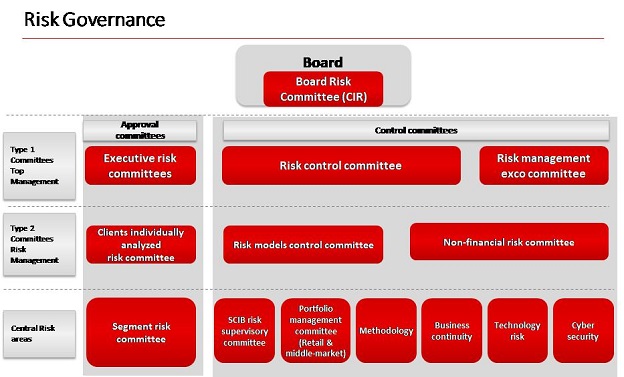
155
Below is an organizational chart of the Risk Department:
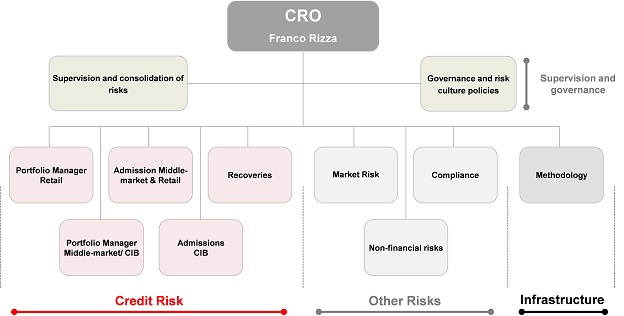
1. Credit Risk
The impairment model applies to all financial assets measured at amortized cost and fair value through other comprehensive income (FVOCI), including commitment and contingent loans. Investments in equity are outside of the scope of the new impairment requirements. For more information, see “Item 5 Operating and financial review and prospects—Critical Accounting Policies.”
The Bank has defined default on the following basis:
| ● | Corporate: when exposure is more than 89 days past due, it has been restructured, it is in judicial collection, it has been written off, drag effect defined as the entire outstanding amount on any loan which has an instalment 89 days or more past due. |
| ● | Other: when exposure is more than 89 days past due, it has been restructured, or has been identified as impaired by an internal risk committee). |
The Bank considers reasonable and supportable information that is available without undue cost or effort and that may affect the credit risk on a financial instrument, including forward looking information to determine a significant increase in credit risk since the initial recognition. Forward looking information includes past events, current conditions and forecasts or future economic conditions (macro-economic data). Credit risk assessments and forward-looking information (including macro-economic factors), include quantitative and qualitative information based on the Bank’s historical experience, including, among others, the following:
| a) | Financial or economic conditions that are expected to cause a significant change in the borrower’s ability to meet its debt obligations. |
| b) | An actual or expected internal credit rating downgrade for the borrower or decrease in behavioral scoring. |
| c) | An actual or expected significant change in the operating results of the borrower. |
| d) | Significant increases in credit risk on other financial instruments of the same borrower. |
| e) | Significant changes in the value of the collateral supporting the obligation or in the quality of third-party guarantees or credit enhancements. |
156
| f) | Reductions in financial support from a parent entity or other affiliate. |
| g) | Expected changes in the loan documentation including an expected breach of contract that may lead to covenant waivers or amendments, interest payment holidays, interest rate step-ups, requiring additional collateral or guarantees, or other changes to the contractual framework of the instrument. |
The Bank has considered that if contractual payments are more than 30 days past due, the credit risk is deemed to have increased significantly since the initial credit recognition but that is not deemed an absolute indicator. The bank did not rebut the backstop presumption of IFRS 9 relating to SICR or default.
Expected credit loss measurement
The ECL are the probability-weighted estimate of credit losses, i.e. the present value of all cash shortfalls. A cash shortfall is the difference between the cash flows that are due to an entity in accordance with the contract and the cash flows that the entity expects to receive.
The Bank considered a multi-factor analysis to perform credit risk analysis . The Bank conducts a corporate evaluation to assess whether objective evidence of impairment exists for loans that are individually significant, and then conducts a separate evaluation of loans that are not individually significant and loans which are significant but for which there is no objective evidence of impairment available under custom monitoring.
Credit Risk Governance
The Risk Division, our credit analysis and risk management group, is largely independent of our business areas. Risk evaluation teams interact regularly with our clients. For larger transactions, risk teams in our headquarters work directly with clients when evaluating credit risks and preparing credit applications. Various credit approval committees, all of which include Risk Division and Commercial Division personnel, must verify that the appropriate qualitative and quantitative parameters are met by each applicant. Each committee’s powers are defined by our Board of Directors.
Santander-Chile’s governance rules establish an Integral Risk Committee. This committee is responsible for revising and following all risks that may affect us, including reputational risk, allowing for an integral risk management. This committee serves as the governing body through which the Board supervises all risk functions. It also evaluates the reasonability of the systems for measurement and control of risks. This Committee includes the Vice Chairman of the Board and five Board members.
The Board has delegated the duty of credit risk management to the Risk Committee, as well as to the Bank’s risk departments, whose roles are summarized below:
| ● | Formulate credit policies by consulting with the business units, meeting requirements of guarantees, credit evaluation, risk rating and submitting reports, documentation and legal procedures in compliance with the regulatory, legal and internal requirements of the Bank. |
| ● | Establish the structure to approve and renew credit requests. The Bank structures credit risks by assigning limits to the concentration of credit risk in terms of individual debtor, debtor group, industry segment and country. Approval levels are assigned to the corresponding officials of the business unit (commercial, consumer, SMEs) to be exercised by that level of management. In addition, those limits are continually revised. Teams in charge of risk evaluation at the branch level interact on a regular basis with customers; however, for larger credit requests, the risk team from the head office and the Executive Risk Committee works directly with customers to assess credit risks and prepare risk requests. |
| ● | Limit concentrations of exposure to customers or counterparties in geographic areas or industries (for accounts receivable or loans), and by issuer, credit rating and liquidity. |
| ● | Develop and maintain the Bank’s credit risk classifications for the purpose of classifying risks according to the degree of exposure to financial loss that is exhibited by the respective financial instruments, with the aim of focusing risk management specifically on the associated risks. |
157
| ● | Revise and evaluate credit risk. Management’s risk divisions are largely independent of the Bank’s commercial division and evaluate all credit risks in excess of the specified limits prior to loan approvals for customers or prior to the acquisition of specific investments. Credit renewal and reviews are subject to similar processes. |
2. Non-financial risks
Following the Basel framework, the Bank defines operational risk as the risk of losses arising from defects or failures in its internal processes, people, systems or external events, thus covering risk categories such as fraud, technological, cyber, legal and conduct risk.
Operational risk is inherent to all products, activities, processes and systems and is generated in all business and support areas. For this reason, all employees are responsible for managing and controlling the operational risks generated in their sphere of action. The Bank’s goal in terms of operational risk management and control is focused on identifying, evaluating and mitigating sources of risk, regardless of whether they have materialized or not. The analysis of operational risk exposure contributes to the establishment of risk management priorities.
Governance
The risk management program contemplates that all relevant risk issues must be reported to the Board of Directors, the Integral Risk Committee and the Non-Financial Risk Committee.
Risk identification, measurement and assessment model
A series of quantitative and qualitative techniques and tools have been defined by the Bank to identify, measure and assess operational risk. The quantitative analysis of this risk assessment is carried out mainly with tools that record and quantify the level of potential losses associated with operational risk events. The qualitative analysis seeks to assess aspects of exposure and hedging (including the control environment). The most important operational risk tools used by Santander Chile are an internal events database, operational risk control self-assessment, analysis of operational risk scenarios, appetite of corporate and local indicators, internal audit and regulatory recommendations, among others.
Operational risk management
To accomplish our operational risk objectives, we have established a risk model based on three lines of defense, with the objective of continuously improving and developing our management and control of operational risks. The defense lines consist of: (i) the business and support areas (first line of defense), responsible for managing the risks related to their processes; (ii) the non-financial risk area (second line of defense), in charge of supporting the first line of defense in relation to the fulfillment of its direct responsibilities and; (iii) the internal audit function (third line of defense) responsible for verifying, independently and periodically, the adequacy of the risk identification and management processes and procedures, in accordance with the guidelines established in the Internal Audit Policy and submitting the results of its recommendations for improvement to the Audit Committee.
Our methodology consists of the evaluation of the risks and controls of a business from a broad perspective and includes a plan to monitor the effectiveness of such controls and the identification of eventual weaknesses. The main objectives of the Bank and its subsidiaries in terms of operational risk management are the following:
| ● | Identify, evaluate, inform, manage and monitor the operational risk in connection with activities, products, and processes carried out or commercialized by the Bank and its subsidiaries; |
| ● | Build a strong culture of operational risk management and internal controls, with clearly defined and adequately segregated responsibilities between business and support functions, whether these are internally-developed or outsourced to third parties; |
| ● | Generate effective internal reports in connection with issues related to operational risk management, with a clearly defined escalation protocol; and |
| ● | Control the design and application of effective plans to deal with contingencies that ensure business continuity and losses control. |
158
Cyber-security and data security plans
The Bank continuously monitors cyber-security risks and has implemented preventative measures to be prepared for any attack of this kind. The Bank has evolved its internal cyber-security model to reflect international standards, incorporating concepts which can be used to assess the degree of maturity in deployment. Based on this assessment model, individual in-situ analyses have been carried out to identify deficiencies and steps to remedy any such deficiencies have been identified in our cyber-security defense plans.
The Bank has a Cybersecurity Framework which defines the governance and policies on preventing and confronting cybercrime. The Chief of Cybersecurity or CISO (Chief Information Security Officer) has been defined as the officer responsible for cybersecurity, a function performed by the Manager of Technology and Operational Risk. Embedded in the Bank’s Technology and Operations division is the Cyber and Technology Risk Department, which is the front line of defense against cyber-security threats and data security. In addition, the Non-Financial Risk Department through the Cyber Risk (a specialized area) enforces the policies and controls that the different areas must follow regarding technology and cyber-security risks. In turn, there is a group of supervisory bodies that include the Cybersecurity Committee, the Non-Financial Risk Committee, the Chief Executive Officer’s Management Committee and the Board’s Integral Risk Committee. We also coordinate with Santander Spain’s headquarters and units in other countries regarding strategy, best practices and experience-sharing.
All this architecture has been created with the aim of identifying cyber risks, the development of a culture and education in cybersecurity, the creation of cyber scenarios to anticipate potential threats, and the fulfillment of the regulatory framework set by the authorities.
Finally, the intelligence and analysis function has also been reinforced by contracting a threat-monitoring service, and progress has been made in the incident registration, notification and escalation mechanisms for internal reporting and reporting to supervisors. In addition, observation and analytical assessment of the events in the sector and in other industries enable us to update and adapt our models for emerging threats.
During 2021 we completed the 4th year of the Global Cybersecurity Transformation Plan that has allowed us to reach advanced levels of maturity in Cybersecurity. The main initiatives considered in 2021 were the following:
| 1. | 3 rd Party Management: We have worked together with our main suppliers to strengthen their cybersecurity management. |
| 2. | Identity and Access Management (IAM): We extended the scope of our Business User Access Management Platform to include all critical applications existing in the Bank’s landscape, including the corresponding functional segregation exercises and automated recertification processes. In the field of high-privilege users (IT administrators), we continue to strengthen the governance of our PAM (Privileged Access Management) platform for server and database administrators. |
| 3. | Network Segregation: We reinforced access controls to the Bank’s networks and continued to segregate new critical areas in the internal network. |
| 4. | Insider Threat and Data Protection: We concluded the implementation of a complete Data Loss Prevention (DLP) platform that is now fully operational, increasing the organization’s sensitive data protection capabilities. |
| 5. | Vulnerability Management: We have advanced strongly in the Government and the Management of vulnerabilities, including servers, workstations and network devices. We also improved the level of compliance in the different technological platforms of the Bank. |
| 6. | Cloud Security: During the year we made significant progress on the governance of our advanced Compliance and Security monitoring systems for our Cloud environments. |
| 7. | IT Obsolescence: We continued with our initiatives to reduce obsolescence at the level of workstations, servers, applications, software components, communication devices, etc. |
159
| 8. | Robust Password in Retail: During the year we established a new standard in the level of security requirements for the access password of our customers in retail through its different channels. We expect to complete the migration process to this new security policy for the access password during the first half of 2022. |
| 9. | PCI Certification: During the first half of 2021 we became PCI (Payment Cards Industry) certified for the first time. This is a certification granted by the Security Standards Council, which ensures a high degree of maturity in information security issues related to the management of payment cards data in the organization. This certification is a continuous process of improvement that requires annual re-certifications. We expect to complete the PCI 2022 certification process during the first half of 2022. |
| 10. | Innovation in the authorization of transactions: In 2021 we made significant progress with the incorporation of our dynamic token for smartphones (Santander Pass) for retail banking. We have also started the incorporation of Santander Pass for the Middle-market and CIB digital channels. We expect to complete the incorporation process during 2022. |
| 11. | Fraud prevention: During 2021 we implemented new real-time reaction capabilities to better face new fraud methods, both for electronic transactions and cards. |
| 12. | Ongoing training: During the year we continuously carried out campaigns, ethical phishing and mandatory training exercises to increase the level of awareness regarding cyber-risks. |
During 2021, the Bank did not face material loss due to cybersecurity breaches. However, even though we have thorough cybersecurity practices and governance in place, we cannot assure that in the future a material event will not occur.
Business Continuity Management: Ensuring the realization of critical process during contingencies
The Bank has a Business Continuity Management System, which covers the entire organization in order to ensure the execution of the activities that may cause significant negative impacts (operational, reputation, consumer services, legal and operational losses) to the organization. The Non-financial Risk Department, through the Technological Risk Department (BCM specialized area, as part of the second line of defense), leads the control and implementation of the model and policies defining the roles and responsibilities of each line of defense, where the first line of defense has a main role that involves the identification of their process, the business impact analysis of each risk according to the methodology, the preparation of business continuity plans and strategies to respond to each contingency scenario and ensure the realization of the critical processes, the testing and continuous updating of the information to secure the resources needed (at least annually).
The Bank is constantly facing different types of contingencies (mainly natural disasters, but more recently, social movements and protests), which has proven to be effective in order to maintain and ensure the business continuity of the organization. We are constantly detecting new opportunities to improve the current mitigation actions and contingency plans allowing the critical departments to recover after the events that may occur in the future.
Role of Santander Group’s Global Risk Division: Operational Risk
In matters regarding operational risk, Santander Spain’s Global Risk Department’s role is to define certain global policies, guidelines and procedures regarding operational risk. The Corporate Operational Risk Committee is the main body in which the different units of Santander discuss and review the major operational risk events and policies.
160
Operational risk management during the COVID-19 pandemic
Overall, the COVID-19 pandemic has resulted in increased exposure to inherent operational risk, although the Bank has established greater oversight over controls in order to maintain pre-COVID-19 operational risk levels, in addition to reinforcing existing ones. The risk of transaction processing increases due to the volume of new loans and multiple changes in existing portfolios resulting from payment holidays and the FOGAPE program. Transactional volume also increased due to public assistance programs and the rise in the number of checking accounts and volumes as more clients searched for digital payment solutions. Close monitoring has been carried out on the following aspects:
| ● | Business continuity plans to effectively to support our employees, customers and businesses. |
| ● | The COVID-19 pandemic and remote work arrangements have a direct impact on the field of cyber threats and their associated risks as more employees work from home. We have strengthened patching, navigation control, data protection and other controls. |
| ● | Increased technological support to ensure adequate customer service and the correct provision of services, especially in online banking and call centers. |
| ● | The risk of transaction processing has increased due to the volume of new loans and multiple changes in existing portfolios resulting from public assistance programs and internal policies. |
The following table summarizes our net losses from operational risks in 2021 compared to 2020.
| As of December 31, | % Change | |||||||||||
| Net losses from operational risks | 2021 | 2020 | 2021/2020 | |||||||||
| (Ch$ millions) | ||||||||||||
| Fraud | 977 | 4,703 | (79.2 | )% | ||||||||
| Labor related | 3,215 | 443 | 625.7 | % | ||||||||
| Client / product related | 13 | 250 | (94.8 | )% | ||||||||
| Damage to fixed assets | 228 | (2,592 | ) | -- | % | |||||||
| Business continuity / Systems | 144 | 1,570 | (90.8 | )% | ||||||||
| Processing | 8,251 | 3,992 | 106.7 | % | ||||||||
| Total | 12,828 | 8,366 | 53.3 | % | ||||||||
3. Market Risks
This section describes the market risks that we are exposed to, the tools and methodology used to control these risks, the portfolios over which these market risk methods were applied and quantitative disclosure that demonstrate the level of exposure to market risk that we are assuming. This section also discloses the derivative instruments that we use to hedge exposures and offer to our clients.
Market risk is the risk of losses due to unexpected changes in interest rates, foreign exchange rates, inflation rates and other rates or prices. We are exposed to market risk mainly as a result of the following activities:
| ● | trading in financial instruments, which exposes us to interest rate and foreign exchange rate risk; | |
| ● | engaging in banking activities, which subjects us to interest rate risk, since a change in interest rates affected gross interest income, gross interest expense and customer behavior; | |
| ● | engaging in banking activities, which exposes us to inflation rate risk, since a change in expected inflation affects gross interest income, gross interest expense and customer behavior; | |
| ● | trading in the local equity market, which subjects us to potential losses caused by fluctuations of the stock market; and | |
| ● | investing in assets whose returns, or accounts are denominated in currencies other than the Chilean peso, which subjects us to foreign exchange risk between the Chilean peso and such other currencies. |
The main decisions that relate to market risk for the Bank and the limits regarding market risk are made in the Asset and Liability Committee and the Market Committee. The measurement and oversight of market risks is performed by the Market Risk Department. Santander-Chile’s governance rules have established the Asset and Liability Committee and the Market Committee to monitor and control market risks.
161
Role of Santander Group’s Global Risk Division: Market Risk
In matters regarding Market Risk, the role of Santander Spain’s Global Risk Department is to define certain global policies, guidelines and procedures regarding market risk. The information produced by our local Market Risk Department is standardized for the whole group in order to facilitate a consolidation of risks being taken on a global basis. They review daily the consumption of limits and provide valuable input on the evolution of markets, especially regarding the Eurozone.
4. Market Risk: Quantitative Disclosure
Impact of Inflation
Our assets and liabilities are denominated in Chilean pesos, Unidades de Fomento (UF) and foreign currencies. Inflation impacts our results of operations as some loan and deposit products are contracted in UF. The UF is revalued in monthly cycles. Each day in the period beginning on the tenth day of the current month through the ninth day of the succeeding month, the nominal peso value of the UF is indexed up (or down in the event of deflation) in order to reflect a proportionate amount of the change in the Chilean Consumer Price Index during the prior calendar month. One UF equaled Ch$30,991.74 at December 31, 2021, Ch$29,070.33 at December 31, 2020 and Ch$28,309.94 at December 31, 2019. High levels of inflation in Chile could adversely affect the Chilean economy and could have an adverse effect on our business, financial condition and results of operations. Negative inflation rates also negatively impact our results. Inflation measured as the annual variation of the UF was 6.6% in 2021, 2.7% in 2020 and 2.7% in 2019. There can be no assurance that Chilean inflation will not change significantly from the current level. Due to the current structure of our assets and liabilities (i.e., a significant portion of our loans are indexed to the inflation rate, but there are significantly less features in deposits and other funding sources that would increase the size of our funding base), there can be no assurance that our business, financial condition and result of operations in the future will not be adversely affected by changing levels of inflation. In summary:
| ● | UF-denominated assets and liabilities. The effect of any changes in the nominal peso value of our UF-denominated interest earning assets and interest-bearing liabilities is reflected in our results of operations as an increase (or decrease, in the event of deflation) in interest income and expense, respectively. Our net interest income will be positively affected by an inflationary environment to the extent that our average UF-denominated interest earning assets exceed our average UF-denominated interest-bearing liabilities. Our net interest income will be positively affected by deflation in any period in which our average UF-denominated interest-bearing liabilities exceed our average UF-denominated interest earning assets. Our net interest income will be negatively affected in a deflationary environment if our average UF-denominated interest earning assets exceed our average UF-denominated interest-bearing liabilities. |
| ● | Inflation and interest rate hedge. A key component of our asset and liability policy is the management of interest rate risk. The Bank’s assets generally have a longer maturity than our liabilities. As the Bank’s mortgage portfolio grows, the maturity gap tends to rise as these loans, which are contracted in UF, have a longer maturity than the average maturity of our funding base. As most of our long-term financial instruments and mortgage loans are contracted in UF and most of our deposits are in nominal pesos, the rise in mortgage lending increases the Bank’s exposure to inflation and to interest rate risk. The size of this gap is limited by internal and regulatory guidelines in order to avoid excessive potential losses due to strong shifts in interest rates or inflation. In order to keep this duration gap below regulatory limits, the Bank issues long term bonds denominated in UF or interest rate swaps. The financial cost of the bonds and the efficient part of these hedges is recorded as net interest income. In 2021, the loss from the swaps taken in order to hedge mainly for inflation and interest rate risk and included in net interest income totaled Ch$449,122 compared to a loss of Ch$15,461 million in 2020 and a loss of Ch$31,346 million in 2019. The average gap between our interest earnings assets and total liabilities linked to the inflation, including hedging, was Ch$6,252,221 million in 2021, Ch$6,173,541 million in 2020 and Ch$4,279,082 million in 2019. Therefore, our sensitivity to a 100-basis point shift in UF inflation considering our year end gap would be approximately Ch$62.5 billion. |
162
| ● | The financial impact of the gap between our interest earning assets and liabilities denominated in UFs including hedges was Ch$410,249 million in 2021, Ch$173,668 million in 2020 and Ch$114,340 million in 2019. The 136.2% increase in these results was due to the higher UF inflation rate and a larger UF gap in 2021 compared to 2020. |
| As of December 31, | % Change | |||||||||||||||||||
| Impact of inflation on net interest income | 2021 | 2020 | 2019 | 2021/2020 | 2020/2019 | |||||||||||||||
| (in millions of Ch$) | ||||||||||||||||||||
| Results from UF GAP(1) | 410,249 | 173,668 | 114,340 | 136.2 | % | 51.9 | % | |||||||||||||
| Annual UF inflation | 6.6 | % | 2.7 | % | 2.7 | % | ||||||||||||||
| (1) | UF GAP is net interest income from asset and liabilities denominated in UFs and include the results from hedging the size of this gap via interest rate swaps. |
Interest Rates
Interest rates earned and paid on our assets and liabilities reflect, to a certain degree, inflation, expectations regarding inflation, changes in short term interest rates set by the Central Bank and movements in long term real rates. See “Item 5. Operating and Financial Review and Prospects—A. Operating Results—Interest Rates.” The Central Bank manages short term interest rates based on its objectives of balancing low inflation and economic growth. Because our liabilities are generally re-priced sooner than our assets, changes in the rate of inflation or short-term rates in the economy are reflected in the rates of interest paid by us on our liabilities before such changes are reflected in the rates of interest earned by us on our assets. Therefore, when short term interest rates fall, our net interest margin is positively impacted, but when short term rates increase, our interest margin is negatively affected. At the same time, our net interest margin tends to be adversely affected in the short term by a decrease in inflation rates since generally our UF-denominated assets exceed our UF-denominated liabilities. See “Item 5. Operating and Financial Review and Prospects—A. Operating Results—Impact of Inflation—Peso-denominated assets and liabilities.” An increase in long term rates has a positive effect on our net interest margin, because our interest earning assets generally have longer terms than our interest-bearing liabilities. A flattening of the yield curve, i.e. long-term rates falling quicker than short-term rates, negatively affects our margins by lowering loan yields at a greater pace than deposits costs. In addition, because our peso-denominated liabilities have relatively short re-pricing periods, they are generally more responsive to changes in inflation or short-term rates than our UF-denominated liabilities. As a result, during periods when or expected inflation exceeds the previous period’s inflation, customers often switch funds from UF-denominated deposits to peso-denominated deposits, which generally bear higher interest rates, thereby adversely affecting our net interest margin.
We also maintain a substantial amount of non-interest-bearing peso-denominated demand deposits. Because such deposits are non-interest bearing and are not indexed to inflation the higher percentage of our funding that comes from this source positively impacts our net interest margin as interest rates or inflation rises and vice-versa. The ratio of the average of such demand deposits and average shareholder’s equity to average interest-earning assets was 38.9%, 33.5% and 30.5% for the years ended December 31, 2021, 2020 and 2019, respectively.
163
As of December 31, 2021, the detail of the maturities of assets and liabilities is as follows:
| As of December 31, 2021 | ||||||||||||||||||||||||||||||||||||||||
| Demand | Up to 1 month | Between 1 and 3 months | Between 3 and 12 months | Subtotal up to 1 year | Between 1 and 3 years | Between 3 and 5 years | More than 5 years | Subtotal More than 1 year | Total | |||||||||||||||||||||||||||||||
| (in millions Ch$) | ||||||||||||||||||||||||||||||||||||||||
| Financial assets | ||||||||||||||||||||||||||||||||||||||||
| Cash and deposits in banks | 2,881,558 | - | - | - | 2,881,558 | - | - | - | - | 2,881,558 | ||||||||||||||||||||||||||||||
| Cash items in process of collection | 390,271 | - | - | - | 390,271 | - | - | - | - | 390,271 | ||||||||||||||||||||||||||||||
| Financial assets held for trading | - | 698 | 67 | - | 765 | 24,341 | 38,644 | 9,597 | 72,582 | 73,347 | ||||||||||||||||||||||||||||||
| Investments under resale agreement | - | - | - | - | - | - | - | - | - | - | ||||||||||||||||||||||||||||||
| Financial derivative contracts | - | 186,546 | 318,606 | 1,185,220 | 1,690,372 | 2,222,851 | 2,172,208 | 4,038,176 | 8,433,235 | 10,123,607 | ||||||||||||||||||||||||||||||
| Loans and accounts receivables at amortized cost (1) | 194,086 | 1,563,103 | 1,695,151 | 3,792,426 | 7,244,766 | 5,077,346 | 665,057 | 23,541,893 | 29,284,296 | 36,529,062 | ||||||||||||||||||||||||||||||
| Loans and account receivable at FVOCI (2) | - | - | - | - | - | 429,630 | 4,262,811 | - | 4,692,441 | 4,692,441 | ||||||||||||||||||||||||||||||
| Debt instruments at amortized cost (3) | - | - | - | - | - | 61,993 | 32,756 | 4,894 | 99,643 | 99,643 | ||||||||||||||||||||||||||||||
| Debt instruments at FVOCI | - | 3,259,823 | 90 | 309,831 | 3,569,744 | 89,127 | 306,049 | 1,838,219 | 2,233,395 | 5,803,139 | ||||||||||||||||||||||||||||||
| Equity instruments at FVOCI | - | - | - | - | - | - | - | 189 | 189 | 189 | ||||||||||||||||||||||||||||||
| Guarantee deposits (margin accounts) | 1,988,410 | - | - | - | 1,988,410 | - | - | - | - | 1,988,410 | ||||||||||||||||||||||||||||||
| Total financial assets | 5,454,325 | 5,010,170 | 2,013,914 | 5,287,477 | 17,765,886 | 7,905,288 | 7,477,525 | 29,432,968 | 44,815,781 | 62,581,667 | ||||||||||||||||||||||||||||||
| Financial liabilities | ||||||||||||||||||||||||||||||||||||||||
| Deposits and other demand liabilities | 17,900,938 | - | - | - | 17,900,938 | - | - | - | - | 17,900,938 | ||||||||||||||||||||||||||||||
| Cash items in process of being cleared | 379,934 | - | - | - | 379,934 | - | - | - | - | 379,934 | ||||||||||||||||||||||||||||||
| Obligations under repurchase agreements | - | 86,634 | - | - | 86,634 | - | - | - | - | 86,634 | ||||||||||||||||||||||||||||||
| Time deposits and other time liabilities | 204,548 | 5,211,798 | 2,642,651 | 1,902,664 | 9,961,661 | 108,510 | 39,728 | 21,156 | 169,394 | 10,131,055 | ||||||||||||||||||||||||||||||
| Financial derivative contracts | - | 195,808 | 348,382 | 987,403 | 1,531,593 | 2,948,206 | 2,294,608 | 4,096,834 | 9,339,648 | 10,871,241 | ||||||||||||||||||||||||||||||
| Interbank borrowings | 100,135 | 218,528 | 606,255 | 2,290,225 | 3,215,143 | 5,611,440 | - | - | 5,611,440 | 8,826,583 | ||||||||||||||||||||||||||||||
| Issued debt instruments | - | 7,375 | 289,466 | 871,447 | 1,168,288 | 1,819,637 | 2,368,118 | 3,041,017 | 7,228,772 | 8,397,060 | ||||||||||||||||||||||||||||||
| Lease liabilities | 182,442 | 69 | 101 | 34 | 182,646 | 101 | 115 | 45 | 261 | 182,907 | ||||||||||||||||||||||||||||||
| Other financial liabilities | - | - | - | 23,391 | 23,391 | 45,121 | 35,248 | 36,035 | 116,404 | 139,795 | ||||||||||||||||||||||||||||||
| Guarantees received (margin accounts) | 857,679 | - | - | - | 857,679 | - | - | - | - | 857,679 | ||||||||||||||||||||||||||||||
| Total financial liabilities | 19,625,676 | 5,720,212 | 3,886,855 | 6,075,164 | 35,307,907 | 10,533,015 | 4,737,817 | 7,195,087 | 22,465,919 | 57,773,826 | ||||||||||||||||||||||||||||||
(1) Loans and accounts receivables at amortized cost are presented on a gross basis. The amount of allowance is Ch$1,051,434 million.
(2) Loans and accounts receivables at FVOCI are presented on a gross basis. The amount of allowance is Ch$268 million.
(3) Debt instruments at amortized cost are presented on a gross basis. The amount of allowance is Ch$711 million.
164
The following table sets forth our average daily balance of liabilities for the years ended December 31, 2021, 2020 and 2019, in each case together with the related average nominal interest rates paid thereon.
| 2021 | 2020 | 2019 | ||||||||||||||||||||||||||||||||||
| Average Balance | % of Total Average Liabilities |
Average
Nominal Rate |
Average Balance | % of Total Average Liabilities |
Average
Nominal Rate |
Average
Balance |
% of Total Average Liabilities |
Average
Nominal Rate |
||||||||||||||||||||||||||||
| Interest-bearing liabilities | ||||||||||||||||||||||||||||||||||||
| Savings accounts | 177,779 | 0.3 | % | 5.9 | % | 138,671 | 0.3 | % | 2.5 | % | 120,896 | 0.3 | % | 2.5 | % | |||||||||||||||||||||
| Time deposits | 13,174,290 | 22.8 | % | 0.8 | % | 14,248,478 | 25.5 | % | 1.2 | % | 13,779,534 | 31.9 | % | 2.6 | % | |||||||||||||||||||||
| Central Bank borrowings | 5,546,895 | 9.6 | % | 0.0 | % | 2,881,600 | 5.2 | % | 0.0 | % | - | 0.0 | % | 0.0 | % | |||||||||||||||||||||
| Repurchase agreements | 125,439 | 0.2 | % | 0.8 | % | 243,280 | 0.4 | % | 0.8 | % | 414,951 | 1.0 | % | 2.5 | % | |||||||||||||||||||||
| Mortgage finance bonds | 9,105 | 0.0 | % | 10.9 | % | 14,580 | 0.0 | % | 7.6 | % | 20,923 | 0.1 | % | 7.7 | % | |||||||||||||||||||||
| Commercial paper | 277,666 | 0.5 | % | 0.3 | % | 394,017 | 0.7 | % | 1.7 | % | 401,500 | 0.7 | % | 2.7 | % | |||||||||||||||||||||
| Other interest bearing liabilities | 9,781,372 | 16.9 | % | 9.8 | % | 10,808,618 | 19.4 | % | 4.3 | % | 10,860,030 | 19.5 | % | 4.8 | % | |||||||||||||||||||||
| Subtotal interest-bearing liabilities | 29,102,186 | 50.3 | % | 3.8 | % | 28,729,244 | 51.5 | % | 2.2 | % | 25,597,833 | 59.2 | % | 3.5 | % | |||||||||||||||||||||
| Non-interest bearing liabilities | ||||||||||||||||||||||||||||||||||||
| Non-interest bearing deposits | 14,035,242 | 24.3 | % | 10,403,347 | 18.6 | % | 7,466,991 | 17.3 | % | |||||||||||||||||||||||||||
| Derivatives | 7,666,801 | 13.3 | % | 9,793,162 | 17.5 | % | 4,165,330 | 9.6 | % | |||||||||||||||||||||||||||
| Other non-interest bearing liabilities | 3,000,598 | 5.2 | % | 3,171,540 | 5.7 | % | 2,549,130 | 5.9 | % | |||||||||||||||||||||||||||
| Shareholders’ equity | 4,062,407 | 7.0 | % | 3,734,243 | 6.7 | % | 3,450,729 | 8.0 | % | |||||||||||||||||||||||||||
| Subtotal non-interest bearing liabilities and equity | 28,765,048 | 49.7 | % | 27,102,291 | 48.5 | % | 17,632,180 | 40.8 | % | |||||||||||||||||||||||||||
| Total liabilities | 57,867,233 | 100.0 | % | 55,831,535 | 100.0 | % | 43,230,013 | 100.0 | % | |||||||||||||||||||||||||||
Foreign exchange fluctuations
The Chilean government’s economic policies and any future changes in the value of the Chilean peso against the U.S. dollar could adversely affect our financial condition and results of operations. The Chilean peso has been subject to significant devaluation in the past and may be subject to significant fluctuations in the future. The year-end Central Bank exchange rate depreciated 19.5% in 2021, appreciated 4.5% in 2020 and depreciated 7.0% in 2019.
A significant portion of our assets and liabilities are denominated in foreign currencies, principally the U.S. dollar, and we historically have maintained, and may continue to maintain, material gaps between the balances of such assets and liabilities. Because such assets and liabilities, as well as interest earned or paid on such assets and liabilities, and gains and losses realized upon the sale of such assets, are translated to Chilean pesos in preparing our financial statements, our reported income is affected by changes in the value of the Chilean peso relative to foreign currencies (principally the U.S. dollar).
165
In general, the Bank is not permitted, due to guidelines set by the ALCO and the Market Committee, to open a meaningful gap in foreign currency. Any significant difference between the spot asset position and the spot liability position in foreign currency is usually hedged using forwards and cross-currency swaps. Any remaining foreign currency risk is included as part of the trading portfolio We set an absolute limit on the size of Santander-Chile’s consolidated net foreign currency trading position, which is equivalent to the maximum differential allowed between assets and liabilities in foreign currencies, including hedging of this gap. The limit on the size of the net foreign currency position is determined by the Market Committee and is calculated and monitored by the Market Risk Department. At December 31, 2021, this was equal to US$350 million. This limit in various other currencies is as follows:
| Currency | Limit | |||
|
(in millions
of US$) |
||||
| U.S. dollars | 350 | |||
| Euros | 110 | |||
| Yen | 27 | |||
| British pound | 20 | |||
| Mexican peso | 30 | |||
| Brazilian real | 30 | |||
| Colombian peso | 30 | |||
| Peruvian Sol | 20 | |||
| Other European currencies | 30 | |||
| Other Latin American currencies | 30 | |||
| Other currencies | 47.5 | |||
| Total Limit | 350 | |||
Foreign currency risk included in the trading portfolio is also measured and controlled using VaR. The average VAR of our foreign currency position was US$0.8 million in 2021. The translation gains or loss over assets and liabilities (excluding derivatives held for trading) is included as foreign exchange transactions in the income statement. The translation and mark-to-market of foreign currency derivatives held for trading is recognized as a gain or loss in the net results from mark-to-market and trading.
Liquidity risk management
The Financial Management Division receives information from all the business units on the liquidity profile of their financial assets and liabilities, as well as breakdowns of other projected cash flows stemming from future businesses. On the basis of that information, the Financial Management Division maintains a portfolio of liquid short–term assets, comprised mainly of liquid investments, loans and advances to other banks, to make sure the Bank has sufficient liquidity. The business units’ liquidity needs are met through short–term transfers from the Financial Management Division to cover any short–term fluctuations and long–term financing to address all the structural liquidity requirements.
The Bank monitors its liquidity position every day, determining the future flows of its outlays and revenues. In addition, stress tests are performed at the close of each month, for which a variety of scenarios encompassing both normal market conditions and conditions of market fluctuation are used. The liquidity policy and procedures are subject to review and approval by the Bank’s Board. Periodic reports are generated by the Market Risk Department, providing a breakdown of the liquidity position of the Bank and its subsidiaries, including any exceptions and the corrective measures adopted, which are regularly submitted to the ALCO for review.
The Bank relies on demand deposits from Retail, Middle-Market and Corporates, obligations to banks, debt instruments, and time deposits as its main sources of funding. Although most obligations to banks, debt instruments and time deposits mature in over a year, customer (retail) and institutional deposits tend to have shorter maturities and a large proportion of them are payable within 90 days. The short–term nature of these deposits increases the Bank’s liquidity risk, and hence, the Bank actively manages this risk by continual supervision of the market trends and price management.
Liquidity Measures Implemented by the Central Bank of Chile as a Result of the COVID-19 Pandemic
In response to the COVID-19 pandemic, the Chilean Central Bank has made two lines of credit available to banks to reinforce their liquidity, amounting to a total of US$24 billion for the whole banking system. These lines of credit bear interest at the Central Bank’s monetary policy rate (MPR), which was 0.5% as of December 31, 2020 and 4.0% as of December 31, 2021. Pursuant to these lines of credit, a bank may borrow up to 3% of the aggregate amount of its consumer and commercial loan portfolios as of February 29, 2020 and may borrow up to an additional 12% if it uses the funds to provide loans to companies and individuals. The first line of credit is a facility available conditionally on loan growth (the “FCIC”) to ensure that banks continue to finance households and businesses in Chile. Loans provided under this line of credit may have maturities of up to 4 years and must be secured by government bonds, corporate bonds or highly rated large commercial loans as collateral. Loans provided under the second line of credit, the LCL, are unsecured and may have maturities of up to 2 years. In addition, borrowings by a bank under the LCL are limited to the aggregate amount of the liquidity reserve requirements of such bank. Ultimately, these lines of credit are intended to ensure banks have ample liquidity to enable them to continue financing Small to Mid-size Enterprises (“SMEs”) and Middle-market companies. As of December 31, 2021, we had borrowed Ch$5,611,439 million from the FCIC or 9.4% of our total liabilities and had no outstanding LCL loans. We cannot assure that in the event of a sudden or unexpected shortage of funds in the banking system, we will be able to maintain levels of funding without incurring higher funding costs, a reduction in the term of funding instruments or the liquidation of certain assets. If this were to happen, we could be materially adversely affected.
166
Liquidity risk management seeks to ensure that, even under adverse conditions, we have access to the funds necessary to cover client needs, maturing liabilities and capital requirements. Liquidity risk arises in the general funding for our financing, trading and investment activities. It includes the risk of unexpected increases in the cost of funding the portfolio of assets at appropriate maturities and rates, the risk of being unable to liquidate a position in a timely manner at a reasonable price and the risk that we will be required to repay liabilities earlier than anticipated. The ALCO now uses as its liquidity portfolio those defined by the FMC and the Chilean Central Bank, which are in line with those established in BIS III. As of December 31, 2021, and 2020, the breakdown of the Bank’s liquid assets by levels was the following:
|
December 31,
2021 |
December 31,
2020 |
|||||||
| (Ch$ million) | ||||||||
| Balance as of: | ||||||||
| Cash and cash equivalent | 1,106,152 | 988,320 | ||||||
| Level 1 liquid assets (1) | 1,223,824 | 2,490,810 | ||||||
| Level 2 liquid assets (2) | 9,792 | 12,681 | ||||||
| Total liquid assets | 2,339,768 | 3,491,811 | ||||||
| (1) | Includes available balances held in the Central Bank of Chile, financial instruments issued by the Chilean Treasury or Central Bank and other financial instruments issued or guaranteed by States, multilateral development banks or foreign central banks that have a first class rating, in accordance with international rating agencies. Collateral under the FCIC funding program with the Central Bank of Chile and technical reserves in the Central Bank are not included. |
| (2) | Includes instruments issued by governments, central banks and development banks of foreign countries with a risk rating of A- to AA+ and mortgage bonds issued by Chilean banks that are acceptable at the Chilean Central Bank’s repo window. |
|
December 31,
2021 |
December 31,
2020 |
|||||||
| (Ch$ million) | (Ch$ million) | |||||||
| Average balance as of: | ||||||||
| Cash and cash equivalent | 1,047,936 | 1,161,367 | ||||||
| Level 1 liquid assets (1) | 1,514,748 | 3,164,890 | ||||||
| Level 2 liquid assets (2) | 10,961 | 13,311 | ||||||
| Total liquid assets | 2,573,644 | 4,339,568 | ||||||
| (1) | Includes available balances held in the Central Bank of Chile, financial instruments issued by the Chilean Treasury or Central Bank and other financial instruments issued or guaranteed by States, multilateral development banks or foreign central banks that have a first class rating, in accordance with international rating agencies. Collateral under the FCIC funding program with the Central Bank of Chile and technical reserve in the Central Bank are not included. |
| (2) | Includes instruments issued by governments, central banks and development banks of foreign countries with a risk rating of A- to AA+ in accordance with international rating agencies and mortgage bonds issued by Chilean banks that are acceptable at the Chilean Central Bank’s repo window. |
The Central Bank and our ALCO also requires us to comply with the following liquidity limits:
| ● | Liquidity coverage ratio (LCR), which measures the percentage of Liquid Assets over Net Cash Outflows. As of April 2019, Chilean banks began reporting their local LCR figures with a minimum level of 60% in 2020, 80% in 2021 and 100% in 2022. As of December 31, 2021, this indicator for Banco Santander Chile was 149%. |
| ● | Net Stable Funding Ratio (NSFR) which measures a bank’s stable funding sources over required stable needs. Beginning in 2022, Chilean banks must have a minimum NSFR ratio of 60% with a gradual phase-in which will reach 100% by 2026. As of December 31, 2021, this indicator for Banco Santander Chile was 110.8% in compliance with the standard set for 2022. |
| ● | The sum of the liabilities with a maturity of less than 30 days may not exceed the sum of the assets with a maturity of less than 30 days by an amount greater than our capital. This limit must be calculated in local currency and foreign currencies together as one gap. At December 31, 2021, the percentage of (i) our liabilities with a maturity of less than 30 days in excess of our assets with a maturity of less than 30 days to (ii) our capital and reserves was 42%, thus resulting in our compliance. |
167
| ● | The sum of the liabilities in foreign currency with a maturity of less than 30 days may not exceed the sum of the assets in foreign currency with a maturity of less than 30 days by more than an amount greater than our capital. At December 31, 2021 the percentage of (i) our liabilities with a maturity of less than 30 days in foreign currency in excess of our assets in foreign currency with a maturity of less than 30 days to (ii) our capital and reserves was 4%, thus resulting in our compliance. |
| ● | The sum of the liabilities with a maturity of less than 90 days may not exceed the sum of the assets with a maturity of less than 90 days by more than 2 times our capital. This limit must be calculated in local currency and foreign currencies together as one gap. At December 31, 2021 the percentage of (i) our liabilities with a maturity of less than 90 days in excess of our assets with a maturity of less than 90 days to (ii) two times our capital and reserves was 21%, thus resulting in our compliance. |
Market risk management
The Bank’s internal management of market risk is based chiefly on the procedures and standards of Santander Spain, which are in turn based on analysis of management in three principal components:
| ● | trading portfolio; |
| ● | local financial management portfolio; and |
| ● | foreign financial management portfolio. |
The trading portfolio is comprised chiefly of investments valued at fair market value and free of any restriction on their immediate sale, which are often bought and sold by the Bank with the intention of selling them in the short term to benefit from short–term price fluctuations. The trading portfolio also includes the Bank’s exposure to foreign currency. The financial management portfolios include all the financial investments not considered to be part of trading portfolio.
Market risk – management of trading portfolio
The Bank applies VaR methodologies to measure the market risk of its trading portfolio. The Bank has a consolidated commercial position comprised of fixed–income investments and foreign currency trading. This portfolio is comprised mostly of Central Bank of Chile bonds, mortgage bonds, locally issued, low–risk corporate bonds and foreign currencies, mainly U.S. dollars. At the end of each year, the trading portfolio included no stock portfolio investments.
For the Bank, the VaR estimate is made under the historical simulation methodology, which consists of observing the behavior of the profits and losses that would have occurred in the current portfolio if the market conditions for a given historical period had been in force, in order to infer the maximum loss on the basis of that information, with a given degree of confidence. The methodology has the advantage of precisely reflecting the historical distribution of the market variables and not requiring any assumptions regarding the distribution of specific probabilities. All the VaR measures are intended to determine the distribution function for a change in the value of a given portfolio, and once that distribution is known, to calculate the percentile related to the necessary degree of confidence, which will be equal to the value at risk by virtue of those parameters. As calculated by the Bank, the VaR is an estimate of the maximum expected loss of market value for a given portfolio over a 1–day horizon, with a 99.00% confidence level. It is the maximum 1–day loss that the Bank could expect to experience in a given portfolio, with a 99.00% confidence level. In other words, it is the loss that the Bank would expect to experience only 1.0% of the time. The VaR provides a single estimate of market risk which is not comparable from one market risk to another. Returns are calculated through the use of a 2–year time window or at least 520 data points obtained since the last reference date for calculation of the VaR going backward in time.
We do not calculate three separate VaRs. We calculate a single VaR for the entire trading portfolio, which in addition is segregated by risk type. The VaR software performs a historical simulation and calculates a Profit and Loss Statement (P&L) for 520 data points (days) for each risk factor (fixed income, foreign currency and variable income.) The P&L of each risk factor is added and a consolidated VaR is calculated with 520 points or days of data. At the same time a VaR is calculated for each risk factor based on the individual P&L calculated for each individual risk factor. Furthermore, a weighted VaR is calculated in the manner described above, but which gives a greater weighting to the 30 most recent data points. The larger of the two VaRs is the one that is reported. In 2021, 2020, and 2019, we used the same VaR model and there has been no change in methodology or assumptions for subsequent periods.
168
The Bank uses the VaR estimates to provide a warning when the statistically estimated incurred losses in its trading portfolio would exceed prudent levels, and hence, there are certain predetermined limits.
Limitations of the VaR model
When applying a calculation methodology, no assumptions are made regarding the probability distribution of the changes in the risk factors; the historically observed changes are used for the risk factors on which each position in the portfolio will be valued.
It is necessary to define a valuation function fj(xi) for each instrument j, preferably the same one used to calculate the market value and income of the daily position. This valuation function will be applied in each scenario to generate simulated prices for all the instruments in each scenario.
In addition, the VaR methodology is subject to the following limitations:
| ● | Changes in market rates and prices may not be independent and identically distributed random variables, and may not have a normal distribution; in particular, the assumption of normal distribution may underestimate the probability of extreme market movements; |
| ● | The historical data used by the Bank may not provide the best estimate of the joint distribution of changes in the risk factors in the future, and any modification of the data may be inadequate; In particular, the use of historical data may fail to capture the risk of potential extreme and adverse market fluctuations, regardless of the time period used; |
| ● | A 1–day time horizon may not fully capture the market risk positions which cannot be liquidated or covered in a single day; it would not be possible to liquidate or cover all the positions in a single day; |
| ● | The VaR is calculated at the close of business, but trading positions may change substantially in the course of the trading day; |
| ● | The use of a 99% degree of confidence does not take account of, or make any statement about, the losses that could occur outside of that degree of confidence; and |
| ● | A model such as the VaR does not capture all the complex effects of the risk factors over the value of the positions or portfolios, and accordingly, it could underestimate potential losses. |
We perform back-testing daily and generally find that trading losses exceed our VaR estimate approximately one out of every 100 trading days. At the same time, we set a limit to the maximum VaR that we are willing to accept over our trading portfolio. We perform back-testing daily and generally find that trading losses exceed our VaR estimate approximately one out of every 100 trading days. At the same time, we set a limit to the maximum VaR that we are willing to accept over our trading portfolio. Also, a maximum VaR limit was established that can be applied over the trading portfolio. The VaR as of December 31, 2021 was US$1.96 million, which is below the total limit. The high, low, and average levels for each component and each year below were as follows:
| Consolidated | 2021 | 2020 | 2019 | |||||||||
| (in millions of U.S.$) | ||||||||||||
| VaR | ||||||||||||
| High | 3.43 | 12.82 | 15.78 | |||||||||
| Low | 1.11 | 1.94 | 1.33 | |||||||||
| Average | 1.96 | 4.45 | 3.06 | |||||||||
| Fixed-income investments | ||||||||||||
| High | 2.86 | 11.96 | 9.77 | |||||||||
| Low | 1.12 | 1.50 | 1.18 | |||||||||
| Average | 1.86 | 3.19 | 2.33 | |||||||||
| Variable-income investments | ||||||||||||
| High | 0.29 | 0.01 | 0.00 | |||||||||
| Low | - | - | 0.01 | |||||||||
| Average | 0.19 | - | 0.00 | |||||||||
| Foreign currency investments | ||||||||||||
| High | 2.33 | 6.47 | 6.05 | |||||||||
| Low | 0.09 | 0.71 | 0.10 | |||||||||
| Average | 0.77 | 2.85 | 1.60 | |||||||||
169
Market risk – local and foreign financial management
The Bank’s financial management portfolio includes most of the Bank’s non-trading assets and liabilities, including the credit/loan portfolio. For these portfolios, investment and financing decisions are strongly influenced by the Bank’s commercial strategies.
The Bank uses a sensitivity analysis to measure the market risk of local and foreign currencies (not included in the trading portfolio). The Bank performs a simulation of scenarios, which will be calculated as the difference between the present value of the flows in the chosen scenario (a curve with a parallel movement of 25 bps in all its segments) and their value in the base scenario (current market). All the positions in local currency, including the one indexed to inflation (UF), and also the positions in foreign currency are added together based on a historical correlation model existing between the currencies. The Bank has also established limits regarding the maximum loss that these types of movements in interest rates may have on capital and net financial income budgeted for the year.
Limitations of the sensitivity models
The most important assumption is using an exchange rate of 25 bps based on the yield curve. The Bank uses a 25 bps exchange rate since sudden changes of this magnitude are considered realistic. Prior to 2021, a model was used that considered a change of 100 basis points in the yield curve (57 basis points for real rates). Santander Spain Global Risk Department has also established comparable limits by country, to be able to compare, monitor and consolidate market risk by country in a realistic and orderly way. In addition, the sensitivity simulation methodology should be interpreted taking into consideration the following limitations:
| ● | The simulation of scenarios assumes that the volumes remain consistent in the Bank’s Consolidated Statements of Financial Position and are always renewed at maturity, also including certain credit risk and prepayment considerations that may affect the maturity of certain positions. | |
| ● | This model assumes an identical change along the entire length of the yield curve and does not take into account the different movements for different maturities. | |
| ● | The model does not take into account the sensitivity of volumes which results from interest rate changes. | |
| ● | The limits to losses of budgeted financial income are calculated based on the financial income foreseen for the year, which may not be actually earned, meaning that the real percentage of financial income at risk may be higher than the expected one. |
170
Market Risk – Financial management portfolio – December 31, 2021, 2020 and 2019
| 2021 | 2020 | 2019 | ||||||||||||||||||||||
| Effect on net interest income | Effect on equity | Effect on net interest income | Effect on equity | Effect on net interest income | Effect on equity | |||||||||||||||||||
| Financial management portfolio – local currency (in millions of Ch$) | ||||||||||||||||||||||||
| Loss limit | 32,865 | 84,864 | 100,000 | 329,275 | 100,000 | 275,000 | ||||||||||||||||||
| High | 31,233 | 80,097 | 66,504 | 302,263 | 32,719 | 273,473 | ||||||||||||||||||
| Low | 13,694 | 41,653 | 26,492 | 214,596 | 12,686 | 145,338 | ||||||||||||||||||
| Average | 24,018 | 62,916 | 45,380 | 255,070 | 24,719 | 228,772 | ||||||||||||||||||
| Financial management portfolio – foreign currency (in millions of U.S.$) | ||||||||||||||||||||||||
| Loss limit | 37 | 35 | 32 | 53 | 30 | 75 | ||||||||||||||||||
| High | 9 | 32 | 19 | 47 | 20 | 35 | ||||||||||||||||||
| Low | 1 | 1 | 2 | 12 | 5 | 1 | ||||||||||||||||||
| Average | 4 | 18 | 5 | 33 | 12 | 12 | ||||||||||||||||||
| Financial management portfolio – consolidated (in millions of Ch$) | ||||||||||||||||||||||||
| Loss limit | 32,865 | 84,864 | 100,000 | 329,275 | 100,000 | 275,000 | ||||||||||||||||||
| High | 25,709 | 78,259 | 67,584 | 286,436 | 34,462 | 271,989 | ||||||||||||||||||
| Low | 12,854 | 56,857 | 25,111 | 210,706 | 15,236 | 143,836 | ||||||||||||||||||
| Average | 21,041 | 69,577 | 46,044 | 246,292 | 27,918 | 227,303 | ||||||||||||||||||
Market risk –Regulatory method
The following table illustrates our market risk exposure according to the Chilean regulatory method, as of December 31, 2021. This information is sent to the FMC on a quarterly basis. Our maximum exposure to long-term interest rate fluctuations is set at 35% of regulatory capital and is approved by the Board of Directors. Our exposure to short-term interest rate risk plus inflation risk is set at 30% of net interest income plus fees sensitive to interest rates.
| Regulatory Market Risk |
As of
December 31, 2021 |
|||
| (Ch$ million) | ||||
| Market risk of trading portfolio (EMR) | ||||
| Interest rate risk of trading portfolio | 377,006 | |||
| Foreign currency risk of trading portfolio | 8,089 | |||
| Risk from interest rate options | - | |||
| Risk from foreign currency options | 1,429 | |||
| Total market risk of trading portfolio | 386,524 | |||
| 10% x Risk-weighted assets | 3,577,035 | |||
| Subtotal | 3,963,559 | |||
| Limit = Regulatory Capital | 5,114,609 | |||
| Available margin | 1,151,050 | |||
| Non-trading portfolio market risk | ||||
| Short-term interest rate risk | 217,045 | |||
| Inflation risk | 178,033 | |||
| Long-term interest rate risk | 529,542 | |||
| Total market risk of non-trading portfolio | 134,464 | |||
| Regulatory limit of exposure to short-term interest rate and inflation risk | ||||
| Short-term exposure to interest rate risk | 217,045 | |||
| Exposure to inflation risk | 178,033 | |||
| Limit: 30% of (net interest income + net fee income sensitive to interest rates) | 529,542 | |||
| Available margin | 134,464 | |||
| Regulatory limit of exposure to long-term interest rate risk | ||||
| Long-term exposure to interest rate risk | 1,221,762 | |||
| 35% of regulatory capital | 1,790,113 | |||
| Available margin | 568,351 | |||
171
Derivative activities
At December 31, 2021, 2020 and 2019, derivatives are valued at market price on the balance sheet and the net unrealized gain (loss) on derivatives is classified as a separate line item on the income statement. Notional amounts are not recorded on the balance sheet. Banks must mark to market derivatives. A derivative financial instrument held for trading purposes must be marked to market and the unrealized gain or loss recognized in the income statement. The FMC recognizes three kinds of hedge accounting: (i) cash flow hedges, (ii) fair value hedges and (iii) hedging of foreign investments.
| ● | When a cash flow hedge exists, the fair value movements on the part of the hedging instrument that is effective are recognized in equity. Any ineffective portion of the fair value movement on the hedging instrument is recognized in the income statement. |
| ● | When a fair value hedge exists, the fair value movements on the hedging instrument and the corresponding fair value movements on the hedged item are recognized in the income statement. Hedged items in the balance sheet are presented at their market value. |
| ● | When a hedge of foreign investment exposure exists ( i.e. investment in a foreign branch), the fair value movements on the part of the hedging instrument that is effective are recognized in equity. Any ineffective portion of the fair value movement on the hedging instrument is recognized in the income statement. |
In order to reduce the credit risk in its derivative contracts, the Bank has entered into Credit Support Annex (CSA) agreements with the majority of its counterparties, which include obligations to post daily cash collateral. The majority of the agreements include an obligation to post collateral with a threshold amount of zero. In the table below we identify those contracts with CSA and breakdown the fair value of our derivative portfolio by collateral threshold requirements for 2021 and 2020.
| Fair value of derivative contracts | ||||||||||||||||
| 2021 | 2020 | |||||||||||||||
| Assets | Liabilities | Assets | Liabilities | |||||||||||||
| Derivative contracts with zero threshold collateral amount in CSA | 8,696,994 | 9,280,079 | 8,127,263 | 7,900,539 | ||||||||||||
| Derivative contracts with threshold collateral amounts in CSA that are greater than zero | 1,124,413 | 906,479 | 471,529 | 606,661 | ||||||||||||
| Derivative contracts without CSA agreements | 302,200 | 684,683 | 433,293 | 511,460 | ||||||||||||
| Total | 10,123,607 | 10,871,241 | 9,302,085 | 9,018,660 | ||||||||||||
We classify some of our derivative financial instruments as being financial assets held for trading, due to the guidelines from the FMC. We enter into derivative contracts with some clients who seek hedging instruments. However, substantially all of our derivatives are not actually used for speculative purposes or trading. We also use derivatives to hedge our exposure to foreign exchange, interest rate and inflation risks. We had the following derivative financial instruments portfolio as of December 31, 2021, 2020 and 2019:
172
| Derivative financial instruments portfolio | ||||||||||||||||||||
| As of December 31, 2021 | ||||||||||||||||||||
| Notional amounts | Fair Value | |||||||||||||||||||
| Up to 3 months | More than 3 months to one year | More than one year | Assets | Liabilities | ||||||||||||||||
| (Ch$ million) | ||||||||||||||||||||
| Fair value hedge derivative instruments | ||||||||||||||||||||
| Interest rate swaps | 210,000 | 87,817 | 8,505,400 | 22,933 | 587,702 | |||||||||||||||
| Cross currency swaps | 338,475 | 3,056,063 | 5,026,463 | 493,175 | 118,199 | |||||||||||||||
| Subtotal | 548,475 | 3,143,880 | 13,531,863 | 516,108 | 705,901 | |||||||||||||||
| Cash Flow hedge derivative instruments | ||||||||||||||||||||
| Currency forwards | 359,062 | 920,278 | - | 3,497 | 1,590 | |||||||||||||||
| Cross currency swaps | 456,684 | 1,033,671 | 11,469,640 | 109,531 | 656,719 | |||||||||||||||
| Subtotal | 815,746 | 1,953,949 | 11,469,640 | 113,028 | 658,309 | |||||||||||||||
| Derivative instruments for trading | ||||||||||||||||||||
| Currency forwards | 20,194,866 | 12,383,299 | 11,511,386 | 1,088,194 | 1,199,062 | |||||||||||||||
| Interest rate swaps | 13,982,685 | 25,156,483 | 104,333,279 | 3,009,922 | 2,997,634 | |||||||||||||||
| Cross currency swaps | 4,920,123 | 14,514,848 | 164,061,282 | 5,392,946 | 5,308,260 | |||||||||||||||
| Call currency options | 37,321 | 45,852 | 427 | 3,232 | 1,137 | |||||||||||||||
| Put currency options | 35,482 | 174,910 | - | 177 | 892 | |||||||||||||||
| Subtotal | 39,170,477 | 52,275,392 | 280,410,374 | 9,494,471 | 9,507,031 | |||||||||||||||
| Total | 40,534,698 | 57,373,221 | 305,411,877 | 10,123,607 | 10,871,241 | |||||||||||||||
| Derivative financial instruments portfolio | ||||||||||||||||||||
| As of December 31, 2020 | ||||||||||||||||||||
| Notional amounts | Fair Value | |||||||||||||||||||
| Up to 3 months | More than 3 months to one year | More than one year | Assets | Liabilities | ||||||||||||||||
| (Ch$ million) | ||||||||||||||||||||
| Fair value hedge derivative instruments | ||||||||||||||||||||
| Interest rate swaps | 50,000 | 410,687 | 5,064,113 | 33,816 | 83,666 | |||||||||||||||
| Cross currency swaps | 317,400 | 601,987 | 5,634,700 | 294,562 | 178,529 | |||||||||||||||
| Subtotal | 367,400 | 1,012,674 | 10,698,813 | 328,378 | 262,195 | |||||||||||||||
| Cash Flow hedge derivative instruments | ||||||||||||||||||||
| Currency forwards | 2,121,326 | 503,280 | 601,582 | 2,985 | 3,556 | |||||||||||||||
| Cross currency swaps | 424,358 | 498,373 | 9,777,491 | 35,902 | 183,386 | |||||||||||||||
| Subtotal | 2,545,684 | 1,001,653 | 10,379,073 | 38,887 | 186,942 | |||||||||||||||
| Derivative instruments for trading | ||||||||||||||||||||
| Currency forwards | 22,729,787 | 12,175,074 | 8,215,576 | 1,085,327 | 1,158,904 | |||||||||||||||
| Interest rate swaps | 14,006,503 | 22,118,742 | 97,803,009 | 3,651,651 | 3,588,912 | |||||||||||||||
| Cross currency swaps | 6,719,065 | 15,138,056 | 138,352,345 | 3,921,440 | 3,819,446 | |||||||||||||||
| Call currency options | 129,339 | 31,641 | 57,581 | 1,527 | 909 | |||||||||||||||
| Put currency options | 112,145 | 16,173 | 58,276 | 4,875 | 1,352 | |||||||||||||||
| Subtotal | 43,696,839 | 49,479,686 | 244,486,787 | 8,664,820 | 8,569,523 | |||||||||||||||
| Total | 46,609,923 | 51,494,013 | 265,564,673 | 9,032,085 | 9,018,660 | |||||||||||||||
173
| Derivative financial instruments portfolio | ||||||||||||||||||||
| As of December 31, 2019 | ||||||||||||||||||||
| Notional amounts | Fair Value | |||||||||||||||||||
| Up to 3 months | More than 3 months to one year | More than one year | Assets | Liabilities | ||||||||||||||||
| (Ch$ million) | ||||||||||||||||||||
| Fair value hedge derivative instruments | ||||||||||||||||||||
| Interest rate swaps | 381,638 | 317,610 | 1,847,138 | 39,460 | 34,264 | |||||||||||||||
| Cross currency swaps | 407,008 | 863,984 | 13,357,058 | 226,870 | 295,281 | |||||||||||||||
| Subtotal | 788,646 | 1,181,594 | 15,204,196 | 266,330 | 329,545 | |||||||||||||||
| Cash Flow hedge derivative instruments | ||||||||||||||||||||
| Currency forwards | 99,105 | 1,018,656 | 768,256 | 4,131 | 3,505 | |||||||||||||||
| Cross currency swaps | 2,266,907 | 1,938,222 | 10,848,233 | 106,413 | 43,183 | |||||||||||||||
| Subtotal | 2,366,012 | 2,956,878 | 11,616,489 | 110,544 | 46,688 | |||||||||||||||
| Derivative instruments for trading | ||||||||||||||||||||
| Currency forwards | 28,472,586 | 18,508,702 | 7,679,464 | 1,023,684 | 1,137,496 | |||||||||||||||
| Interest rate swaps | 16,678,487 | 40,892,909 | 89,109,046 | 2,465,235 | 2,270,686 | |||||||||||||||
| Cross currency swaps | 7,726,724 | 20,457,463 | 113,206,678 | 4,277,450 | 3,605,516 | |||||||||||||||
| Call currency options | 17,971 | 47,012 | 81,804 | 5,176 | 240 | |||||||||||||||
| Call interest rate options | - | - | - | - | - | |||||||||||||||
| Put currency options | 16,409 | 41,872 | 80,655 | 190 | 483 | |||||||||||||||
| Subtotal | 52,912,177 | 79,947,958 | 210,157,647 | 7,771,735 | 7,014,421 | |||||||||||||||
| Total | 56,066,835 | 84,086,430 | 236,978,332 | 8,148,609 | 7,390,655 | |||||||||||||||
174
ITEM 12. DESCRIPTION OF SECURITIES OTHER THAN EQUITY SECURITIES
A. Debt Securities
Not applicable.
B. Warrants and Right
Not applicable.
C. Other Securities
Not applicable.
D. American Depositary Shares
Our Depositary is The Bank of New York Mellon, with its principal executive office located at 240 Greenwich Street, New York, N.Y. 10286.
Each ADS represents the right to receive 400 shares of Common Stock without par value.
|
Persons depositing or withdrawing shares or ADS holders must pay: |
||
| $5.00 (or less) per 100 ADSs | Issuance of ADSs, including issuances resulting from a distribution of shares or rights or other property Cancellation of ADSs for the purpose of withdrawal, including if the Deposit Agreement terminates | |
| $.05 (or less) per ADS (or a portion thereof) | Any cash distribution to ADS holders | |
| A fee equivalent to the fee that would be payable if securities distributed to you had been deposited with the Depositary | Distribution of securities distributed to holders of deposited securities (including rights) that are distributed by the Depositary to ADS holders | |
| $.05 (or less) per ADS (or a portion thereof) per calendar year | Depositary services | |
| Registration and transfer fees | Transfer and registration of shares on our share register to or from the name of the Depositary or its agent when you deposit or withdraw shares | |
| Expenses of the Depositary |
Cable (including SWIFT), telex and facsimile transmissions (when expressly provided in the Deposit Agreement) Converting foreign currency to U.S. dollars |
|
| Taxes and other governmental charges the Depositary or the custodian has to pay on any ADSs or shares underlying ADSs, such as stock transfer taxes, stamp duty or withholding taxes | As necessary | |
| Any other charges incurred by the Depositary or its agents for servicing the shares or other deposited securities | As necessary | |
The Depositary may collect any of its fees by deducting those fees from any cash distributions payable to owners, or by selling a portion of distributable property to pay the fees. The Depositary may also collect its annual fee for Depositary services and its fees for any other charges incurred by deducting those fees from any cash distributions or by directly billing ADS holders.
175
The Depositary may convert currency itself or through any of its affiliates and, in those cases, acts as principal for its own account and not as agent, advisor, broker or fiduciary on behalf of any other person and earns revenue, including, without limitation, transaction spreads, that it will retain for its own account. The revenue is based on, among other things, the difference between the exchange rate assigned to the currency conversion made under the Deposit Agreement and the rate that the Depositary or its affiliate receives when buying or selling foreign currency for its own account. The Depositary makes no representation that the exchange rate used or obtained in any currency conversion under the Deposit Agreement will be the most favorable rate that could be obtained at the time or that the method by which that rate will be determined will be the most favorable to ADS holders, subject to the Depositary’s obligations under the Deposit Agreement. The methodology used to determine exchange rates used in currency conversions is available upon request.
In performing its duties under the Deposit Agreement, the Depositary may use brokers, dealers, foreign currency dealers or other service providers that are owned by or affiliated with the Depositary and that may earn or share fees, spreads or commissions.
Direct and Indirect Payments
The Depositary has agreed to make payments to us to reimburse us for costs and expenses generally arising out of establishment and maintenance of the ADS program, waive fees and expenses for services provided to us by the Depositary or share revenue from the fees collected from ADS holders from time to time. Under certain circumstances, including termination of the program, we are required to repay to the Depositary amounts reimbursed in prior periods.
The reimbursements include direct payments (legal and accounting fees incurred in connection with preparation of Form 20-F and ongoing SEC compliance and listing requirements, listing fees, investor relations expenses, advertising and public relations expenses and fees payable to service providers for the distribution of hard copy materials to beneficial ADR holders in the Depositary Trust Company, such as information related to shareholders’ meetings and related voting instruction cards); and indirect payments (third-party expenses paid directly and fees waived).
In 2021, the Depositary made direct payments and reimbursements to us in the gross amount of U.S.$ 1,566,778.46 for expenses related to investor relations of which 28.4% was withheld for tax purposes in the U.S.
PART II
ITEM 13. DEFAULTS, DIVIDEND ARREARAGES AND DELINQUENCIES
Not applicable.
ITEM 14. MATERIAL MODIFICATIONS TO THE RIGHTS OF SECURITY HOLDERS AND USE OF PROCEEDS
Not applicable.
ITEM 15. CONTROLS AND PROCEDURES
Conclusion Regarding the Effectiveness of Disclosure Controls and Procedures
As of December 31, 2021, the Bank, under the supervision and with the participation of the Bank’s management, including its Disclosure Committee, the Chief Executive Officer, the Chief Financial Officer and the Chief Accounting Officer, performed an evaluation of the effectiveness of the design and operation of our disclosure controls and procedures (as defined in Rule 13a-15(e) under the Exchange Act). There are, as described below, inherent limitations to the effectiveness of any control system, including disclosure controls and procedures. Accordingly, even effective disclosure controls and procedures can provide only reasonable assurance of achieving their control objectives.
176
Based on such evaluation, as of December 31, 2021, the Bank’s Disclosure Committee, the Chief Executive Officer, the Chief Financial Officer and the Chief Accounting Officer concluded that the Bank’s disclosure controls and procedures were effective in ensuring that information relating to the Bank, including its consolidated subsidiaries, required to be disclosed in the reports it files under the Exchange Act is (1) recorded, processed, summarized and reported within the time periods specified in the SEC’s rules and forms, and (2) accumulated and communicated to the Bank’s management, including its Disclosure Committee and principal financial officers as appropriate to allow timely decisions regarding required disclosure.
Management’s Report on Internal Control Over Financial Reporting
The Bank’s management is responsible for establishing and maintaining adequate internal control over financial reporting as defined in Rule 13a-15(f) under the Exchange Act. The Bank’s internal control over financial reporting is a process designed by, or under the supervision of, the Bank’s principal executive and principal financial officers and effected by the Bank’s Board of Directors, management and other personnel, to provide reasonable assurance regarding the reliability of financial reporting and the preparation of financial statements for external purposes in accordance with IFRS-IASB and includes those policies and procedures that:
| ● | Pertain to the maintenance of records that, in reasonable detail, accurately and fairly reflect the transactions and dispositions of the assets of the Bank; | |
| ● | Provide reasonable assurance that transactions are recorded as necessary to permit preparation of financial statements in accordance with IFRS-IASB, and that our receipts and expenditures are being made only in accordance with authorizations of the Bank’s management and directors; and | |
| ● | Provide reasonable assurance regarding prevention or timely detection of unauthorized acquisition, use or disposition of our assets that could have a material effect on the financial statements. |
Because of its inherent limitations, internal control over financial reporting, no matter how well designed may not prevent or detect misstatements, due to the possibility that a control can be circumvented or overridden or that misstatements due to error or fraud may occur that are not detected. Also, projections of any evaluation of effectiveness to future periods are subject to the risk that controls may become inadequate because of changes in conditions, or that the degree of compliance with the policies or procedures may deteriorate.
We have adapted our internal control over financial reporting to international standards and comply with the guidelines set by the Committee of Sponsoring Organizations of the Treadway Commission in its Internal Control―Integrated Framework (2013). The general framework assigns to management specific responsibilities regarding the structure and effectiveness of the processes related directly and indirectly with the production of consolidated financial statements, as well as the controls needed to mitigate the risks inherent in these processes.
Under the supervision and with the participation of the Bank’s management, including the Disclosure Committee, the Chief Executive Officer, the Chief Financial Officer and the Chief Accounting Officer, we conducted an evaluation of the effectiveness of our internal control over financial reporting based on the criteria established in Internal Control—Integrated Framework (2013) issued by the Committee of Sponsoring Organizations of the Treadway Commission (“COSO”).
Based on this assessment, our management concluded that, as of December 31, 2021, our internal control over financial reporting was effective based on those criteria.
Changes in Internal Control Over Financial Reporting
There has been no change in the Bank’s internal control over financial reporting (as defined in Rule 13a-15(f) under the Exchange Act) that occurred during the period covered by this Annual Report that has materially affected, or is reasonably likely to materially affect, internal control over financial reporting.
Our internal control over financial reporting as of December 31, 2021 has been audited by an independent registered public accounting firm, as stated in its report, which is referenced below.
177
Report of Independent Registered Public Accounting Firm
For the report of PricewaterhouseCoopers Consultores Auditores SpA, independent registered public accounting firm, dated February 25, 2022, on the effectiveness of our internal control over financial reporting as of December 31, 2021, see page F-3 of our Audited Consolidated Financial Statements.
ITEM 16. [RESERVED]
ITEM 16A. AUDIT COMMITTEE FINANCIAL EXPERT
Our Board of Directors determined that one of the members of our Audit Committee, Rodrigo Vergara, met the requirements of an “audit committee financial expert” in accordance with SEC rules and regulations, in that he has an understanding of IFRS-IASB and financial statements, the ability to assess the general application of IFRS-IASB in connection with the accounting for estimates, accruals and reserves, experience analyzing and evaluating financial statements that present a breadth and level of complexity of accounting issues that are generally comparable to the breadth and complexity of issues that can reasonably be expected to be raised by our consolidated financial statements, an understanding of internal controls over financial reporting, and an understanding of audit committee functions. All three members of our Audit Committee have experience overseeing and assessing the performance of Santander-Chile and its consolidated subsidiaries and our external auditors with respect to the preparation, auditing and evaluation of our consolidated financial statements.
All three members of our Audit Committee are considered to be independent according to applicable NYSE criteria.
ITEM 16B. CODE OF ETHICS
The Bank has adopted a code of ethics that is applicable to all of the Bank’s employees and a copy is included as an exhibit hereto. We will provide to any person without charge, upon request, a copy of our code of ethics. Please email accionistas@santander.cl to request a copy. Our code of ethics is available on our website, which does not form part of this Annual Report on Form 20-F, at www.santander.cl under the heading “ Información Corporativa. ”
ITEM 16C. PRINCIPAL ACCOUNTANT FEES AND SERVICES
Amounts paid to the auditors for statutory audit and other services were as follows:
| 2021 | 2020 | |||||||
| (in millions of Ch$) | ||||||||
| Audit Fees | ||||||||
| Statutory audit | 621 | 561 | ||||||
| Audit-related regulatory reporting | 352 | 330 | ||||||
| Other audit-related fees | 368 | 26 | ||||||
| Tax Fees | ||||||||
| Compliance | - | - | ||||||
| Advisory Services | - | - | ||||||
| Total | 1,342 | 917 | ||||||
Statutory audit: Consists of fees billed for professional services rendered in connection with the audit of our consolidated financial statements that are provided by PricewaterhouseCoopers Consultores Auditores SpA (PCAOB ID: 1364) in 2021 and 2020 in connection with statutory and regulatory filings or engagements, and attest services.
Audit-related regulatory reporting: Consists of fees billed for assurance and related services that were specifically related to the performance of the audit and review of our filings under the Securities Act.
Tax fees: Consist of fees billed for related services that were specifically related to tax related matters such as assuring the Bank was in compliance with tax laws and other tax advisory services.
178
The Audit Committee is required to pre-approve the audit and non-audit services performed by the Bank auditors in order to assure that the provision of such services do not impair the audit firm’s independence.
In the first months of each year the Audit Committee proposes to the Board the appointment of the independent auditor. As a matter of policy, at that time, the Audit Committee pre-approves the audit and audit related services that the appointed auditors will be required to carry out during the year to comply with the applicable regulation. These services will be included in the corresponding audit contracts of the Bank with its principal auditing firm.
In addition, under such policy, non-recurring audit or audit-related services and all non-audit services provided by the Bank principal auditing firm or other auditing firms are subject to case-by-case approval by the Audit Committee.
The Chief Accounting Officer is in charge of managing the process and must report monthly to the Audit Committee detailing all services to be provided by auditors, and others requiring individual approval.
All services provided by the Bank principal auditing firm in 2021 detailed in the table above were approved by the Audit and Compliance Committee.
ITEM 16D. EXEMPTIONS FROM THE LISTING STANDARDS FOR AUDIT COMMITTEES
Not applicable.
ITEM 16E. PURCHASES OF EQUITY SECURITIES BY THE ISSUER AND AFFILIATED PURCHASERS
In 2021, neither Santander-Chile nor any of its affiliates purchased any of Santander-Chile’s equity securities.
ITEM 16F. CHANGE IN REGISTRANT’S CERTIFYING ACCOUNTANT
Not applicable.
ITEM 16G. CORPORATE GOVERNANCE
Summary Comparison of Corporate Governance Standards and NYSE Listed Company Standards
Our corporate governance standards, dictated by Chilean corporate law, differ from the standards followed by U.S. companies under the New York Stock Exchange (NYSE) listing standards in a number of ways. Consequently, you will not have the same protections afforded to shareholders of companies that are subject to all NYSE corporate governance requirements. The following is a non-exhaustive summary of a few key differences:
| ● | Whether a company’s executive officers may serve as its directors – the NYSE standards do not prohibit a U.S. company’s executive officer from also serving as a director, whereas our corporate governance standards prohibit this. |
| ● | Whether the shareholders must be given an opportunity to vote on equity-compensation plans – the NYSE standards require that shareholders be allowed to vote on all equity compensation plans of a U.S. company, whereas our corporate governance standards only require that shareholders be allowed to vote on director compensation. |
| ● | The adoption and disclosure of corporate governance guidelines – the NYSE standards require all U.S. companies listed on the NYSE to adopt the NYSE corporate governance guidelines, whereas we follow the corporate governance guidelines established under Chilean law. |
As more than 50% of our voting power is held by another company, Santander Spain, we would be permitted to elect for certain exemptions under NYSE corporate governance standards if we were a U.S. company. Specifically, as a U.S. company, we could elect to be exempted from the requirements (i) that we have a majority of independent directors (as defined by the NYSE), (ii) that we have a nominating/corporate governance committee meeting certain conditions, and (iii) that we have a compensation committee meeting certain requirements. Because we would not be required to follow these standards if we were a U.S. company, we have not summarized the differences, if any, between these provisions and our own corporate governance procedures.
179
Summary of Corporate Governance Standards
For a summary of our Board’s corporate governance practices please see “Item 6C—Board Practices” and “Item 10B—Memorandum and Articles of Association” which describe in detail the governing standards of the board committees. Santander-Chile has also adopted diverse measures to promote good corporate governance.
ITEM 16H. MINE SAFETY DISCLOSURE
Not applicable.
ITEM 16I. DISCLOSURE REGARDING FOREIGN JURISDICTIONS THAT PREVENT INSPECTIONS
Not applicable.
PART III
ITEM 17. FINANCIAL STATEMENTS
We have responded to Item 18 in lieu of this Item.
ITEM 18. FINANCIAL STATEMENTS
Reference is made to Item 19 for a list of all financial statements filed as part of this Annual Report.
180
ITEM 19. EXHIBITS
a)Index to Financial Statements
b) Index to Exhibits
We will furnish to the Securities and Exchange Commission, upon request, copies of any unfiled instruments that define the rights of holders of long-term debt of Banco Santander-Chile.
181
SIGNATURES
The registrant hereby certifies that it meets all of the requirements for filing on Form 20-F and that it has duly caused and authorized the undersigned to sign this Annual Report on its behalf.
| BANCO SANTANDER-CHILE | |||
| By: | /s/ Cristian Florence | ||
| Name: | Cristian Florence | ||
| Title: | General Counsel | ||
Date: February 25, 2022
182
CONTENT
F - 2
Report of Independent Registered Public Accounting Firm
To the Board of Directors and Shareholders of Banco Santander - Chile
Opinions on the Financial Statements and Internal Control over Financial Reporting
We have audited the accompanying consolidated statements of financial position of Banco Santander - Chile and its subsidiaries (the “Company”) as of December 31, 2021 and 2020, and the related consolidated statements of income, comprehensive income, changes in equity and cash flows for each of the three years in the period ended December 31, 2021, including the related notes (collectively referred to as the “consolidated financial statements”). We also have audited the Company's internal control over financial reporting as of December 31, 2021, based on criteria established in Internal Control - Integrated Framework (2013) issued by the Committee of Sponsoring Organizations of the Treadway Commission (COSO).
In our opinion, the consolidated financial statements referred to above present fairly, in all material respects, the financial position of the Company as of December 31, 2021 and 2020, and the results of its operations and its cash flows for each of the three years in the period ended December 31, 2021 in conformity with International Financial Reporting Standards as issued by the International Accounting Standards Board. Also in our opinion, the Company maintained, in all material respects, effective internal control over financial reporting as of December 31, 2021, based on criteria established in Internal Control - Integrated Framework (2013) issued by the COSO.
Basis for Opinions
The Company's management is responsible for these consolidated financial statements, for maintaining effective internal control over financial reporting, and for its assessment of the effectiveness of internal control over financial reporting, included in Management's Report on Internal Control over Financial Reporting, appearing under Item 15. Our responsibility is to express opinions on the Company’s consolidated financial statements and on the Company's internal control over financial reporting based on our audits. We are a public accounting firm registered with the Public Company Accounting Oversight Board (United States) (PCAOB) and are required to be independent with respect to the Company in accordance with the U.S. federal securities laws and the applicable rules and regulations of the Securities and Exchange Commission and the PCAOB.
We conducted our audits in accordance with the standards of the PCAOB. Those standards require that we plan and perform the audits to obtain reasonable assurance about whether the consolidated financial statements are free of material misstatement, whether due to error or fraud, and whether effective internal control over financial reporting was maintained in all material respects.
Our audits of the consolidated financial statements included performing procedures to assess the risks of material misstatement of the consolidated financial statements, whether due to error or fraud, and performing procedures that respond to those risks. Such procedures included examining, on a test basis, evidence regarding the amounts and disclosures in the consolidated financial statements. Our audits also included evaluating the accounting principles used and significant estimates made by management, as well as evaluating the overall presentation of the consolidated financial statements. Our audit of internal control over financial reporting included obtaining an understanding of internal control over financial reporting, assessing the risk that a material weakness exists, and testing and evaluating the design and operating effectiveness of internal control based on the assessed risk. Our audits also included performing such other procedures as we considered necessary in the circumstances. We believe that our audits provide a reasonable basis for our opinions.
Definition and Limitations of Internal Control over Financial Reporting
A company’s internal control over financial reporting is a process designed to provide reasonable assurance regarding the reliability of financial reporting and the preparation of financial statements for external purposes in accordance with generally accepted accounting principles. A company’s internal control over financial reporting includes those policies and procedures that (i) pertain to the maintenance of records that, in reasonable detail, accurately and fairly reflect the transactions and dispositions of the assets of the company; (ii) provide reasonable assurance that transactions are recorded as necessary to permit preparation of financial statements in accordance with generally accepted accounting principles, and that receipts and expenditures of the company are being made only in accordance with authorizations of management and directors of the company; and (iii) provide reasonable assurance regarding prevention or timely detection of unauthorized acquisition, use, or disposition of the company’s assets that could have a material effect on the financial statements.
Because of its inherent limitations, internal control over financial reporting may not prevent or detect misstatements. Also, projections of any evaluation of effectiveness to future periods are subject to the risk that controls may become inadequate because of changes in conditions, or that the degree of compliance with the policies or procedures may deteriorate.
F - 3
Critical Audit Matters
The critical audit matter communicated below is a matter arising from the current period audit of the consolidated financial statements that was communicated or required to be communicated to the audit committee and that (i) relates to accounts or disclosures that are material to the consolidated financial statements and (ii) involved our especially challenging, subjective, or complex judgments. The communication of critical audit matters does not alter in any way our opinion on the consolidated financial statements, taken as a whole, and we are not, by communicating the critical audit matter below, providing a separate opinion on the critical audit matter or on the accounts or disclosures to which it relates.
Expected Credit Loss Allowance for Commercial, Mortgage and Consumer Loans – Collective Basis
As described in Notes 1 and 38 to the consolidated financial statements, management assesses the adequacy of the collective basis expected credit loss allowance for commercial, mortgage and consumer loans using expected credit loss models. As of December 31, 2021, the collective basis expected credit loss allowance was Ch$ 964,016 million on total commercial, mortgage and consumer loans of Ch$ 36,155,556 million. As described by management, the estimation of the collective basis expected credit loss allowance considers qualitative and quantitative information that may affect the changes in credit risk and the development of assumptions related to the probabilities of default and loss given default, including forward looking information, multi-factor analysis such as type of portfolio or transaction and macroeconomic factors. Management subjectively assesses the adequacy of the qualitative information used to assess the significant increase in credit risk since initial recognition and the development of assumptions such as probabilities of default and loss given default.
The principal considerations for our determination that performing procedures relating to the collective basis expected credit loss allowance for commercial, mortgage and consumer loans is a critical audit matter are (i) the significant judgment by management in determining the collective basis expected credit loss allowance, which in turn led to a high degree of auditor judgement, subjectivity, and effort in performing procedures and evaluating audit evidence obtained relating to the assumptions used related to the probabilities of default and loss given default, including forward looking information, multi-factor analysis such as type of portfolio or transaction and macroeconomic factors; and (ii) the audit effort involved the use of professionals with specialized skill and knowledge to assist in evaluating the audit evidence obtained from these procedures.
Addressing the matter involved performing procedures and evaluating audit evidence in connection with forming our overall opinion on the consolidated financial statements. These procedures included testing the effectiveness of controls relating to the expected credit loss allowance for commercial, mortgage and consumer loans estimation process, which included controls over the assumptions used in the estimation of the collective basis expected credit loss allowance, within the qualitative information. These procedures also included, among others, (i) testing management’s process for estimating the collective basis expected credit loss allowance for commercial, mortgage and consumer loans; (ii) testing the completeness, accuracy, and relevance of underlying data used in the model and (iii) the involvement of professionals with specialized skill and knowledge to assist in testing management’s process for estimating the collective basis expected credit loss allowance for commercial, mortgage and consumer loans, including evaluating the appropriateness of the methodologies and models, testing data used in the estimate and evaluating the reasonableness of significant assumptions such as the probabilities of default and loss given default, including forward looking information, multi-factor analysis such as type of portfolio or transaction and macroeconomic factors.
/s/
February 25, 2022
We have served as the Company’s auditor since 2016.
F - 4
| Banco Santander-Chile and Subsidiaries |
| CONSOLIDATED STATEMENTS OF FINANCIAL POSITION |
| As of December 31, | ||||||||||||
| 2021 | 2020 | |||||||||||
| Note | MCh$ | MCh$ | ||||||||||
| ASSETS | ||||||||||||
| Cash and deposits in banks | 4 |
|
|
|||||||||
| Cash items in process of collection | 4 |
|
|
|||||||||
| Financial derivative contracts | 7 |
|
|
|||||||||
| Financial assets held for trading | 5 |
|
|
|||||||||
| Loans and account receivable at amortized cost | 8 |
|
|
|||||||||
| Debt instruments at amortized cost | 9 |
|
||||||||||
| Loans and account receivable at fair value through other comprehensive income | 10 |
|
|
|||||||||
| Debt instruments at fair value through other comprehensive income | 11 |
|
|
|||||||||
| Equity instruments at fair value through other comprehensive income | 12 |
|
|
|||||||||
| Investments in associates and other companies | 12 |
|
|
|||||||||
| Intangible assets | 13 |
|
|
|||||||||
| Property, plant, and equipment | 14 |
|
|
|||||||||
| Right of use assets | 14 |
|
|
|||||||||
| Current taxes | 15 |
|
||||||||||
| Deferred taxes | 15 |
|
|
|||||||||
| Other assets | 16 |
|
|
|||||||||
| TOTAL ASSETS |
|
|
||||||||||
| LIABILITIES | ||||||||||||
| Deposits and other demand liabilities | 17 |
|
|
|||||||||
| Cash items in process of being cleared | 4 |
|
|
|||||||||
| Obligations under repurchase agreements | 6 |
|
|
|||||||||
| Time deposits and other time liabilities | 17 |
|
|
|||||||||
| Financial derivative contracts | 7 |
|
|
|||||||||
| Interbank borrowings | 18 |
|
|
|||||||||
| Issued debt instruments | 19 |
|
|
|||||||||
| Other financial liabilities | 19 |
|
|
|||||||||
| Lease liabilities | 14 |
|
|
|||||||||
| Current taxes | 15 |
|
||||||||||
| Deferred taxes | 15 |
|
|
|||||||||
| Provisions | 21 |
|
|
|||||||||
| Other liabilities | 22 |
|
|
|||||||||
| TOTAL LIABILITIES |
|
|
||||||||||
| EQUITY | ||||||||||||
| Attributable to the shareholders of the Bank: |
|
|
||||||||||
| Capital | 24 |
|
|
|||||||||
| Reserves | 24 |
|
|
|||||||||
| Valuation adjustments | 24 |
(
|
) |
(
|
) | |||||||
| Others equity instruments issued other than capital | 24 |
|
||||||||||
| Retained earnings |
|
|
||||||||||
| Retained earnings from prior years |
|
|
||||||||||
| Income for the year |
|
|
||||||||||
| Minus: Provision for mandatory dividends | 21 |
(
|
) |
(
|
) | |||||||
| Non-controlling interest | 25 |
|
|
|||||||||
| TOTAL EQUITY |
|
|
||||||||||
| TOTAL LIABILITIES AND EQUITY |
|
|
||||||||||
The accompanying notes form integral part of these consolidated financial statements.
F - 5
| Banco Santander-Chile and Subsidiaries |
| CONSOLIDATED STATEMENTS OF INCOME |
| December 31, | ||||||||||||||||
| 2021 | 2020 | 2019 | ||||||||||||||
| Note | MCh$ | MCh$ | MCh$ | |||||||||||||
| OPERATING INCOME | ||||||||||||||||
| Interest income | 26 |
|
|
|
||||||||||||
| Interest expense | 26 |
(
|
) |
(
|
) |
(
|
) | |||||||||
| Net interest income |
|
|
|
|||||||||||||
| Fee and commission income | 27 |
|
|
|
||||||||||||
| Fee and commission expense | 27 |
(
|
) |
(
|
) |
(
|
) | |||||||||
| Net fee and commission income |
|
|
|
|||||||||||||
| Net income (expense) from financial operations | 28 |
(
|
) |
|
(
|
) | ||||||||||
| Net foreign exchange gain | 98 |
|
|
|
||||||||||||
| Other operating income | 34 |
|
|
|
||||||||||||
| Net operating profit before provision for loan losses |
|
|
|
|||||||||||||
| Provision for loan losses | 30 |
(
|
) |
(
|
) |
(
|
) | |||||||||
| NET OPERATING INCOME |
|
|
|
|||||||||||||
| Personnel salaries and expenses | 31 |
(
|
) |
(
|
) |
(
|
) | |||||||||
| Administrative expenses | 32 |
(
|
) |
(
|
) |
(
|
) | |||||||||
| Depreciation and amortization | 33 |
(
|
) |
(
|
) |
(
|
) | |||||||||
| Impairment of property, plant, and equipment | 33 |
(
|
) |
(
|
) | |||||||||||
| Other operating expenses | 34 |
(
|
) |
(
|
) |
(
|
) | |||||||||
| Total operating expenses |
(
|
) |
(
|
) |
(
|
) | ||||||||||
| OPERATING INCOME |
|
|
|
|||||||||||||
| Income from investments in associates and other companies | 12 |
(
|
) |
|
|
|||||||||||
| Income from continuing operations before tax |
|
|
|
|||||||||||||
| Income tax expense | 15 |
(
|
) |
(
|
) |
(
|
) | |||||||||
| Result of continuing operations |
|
|
|
|||||||||||||
| Result of discontinued operations | 39 |
|
||||||||||||||
| NET INCOME FOR THE YEAR |
|
|
|
|||||||||||||
| Attributable to: | ||||||||||||||||
| Shareholders of the Bank |
|
|
|
|||||||||||||
| Non-controlling interest | 25 |
|
|
|
||||||||||||
| Earnings per share from continued operations attributable to shareholders of the Bank: | ||||||||||||||||
| Basic earnings | 24 |
|
|
|
||||||||||||
| Diluted earnings | 24 |
|
|
|
||||||||||||
| Earnings per share from discontinued operations attributable to shareholders of the Bank: | ||||||||||||||||
| Basic earnings | 24 |
|
||||||||||||||
| Diluted earnings | 24 |
|
||||||||||||||
| Earnings per share attributable to shareholders of the Bank: | ||||||||||||||||
| Basic earnings | 24 |
|
|
|
||||||||||||
| Diluted earnings | 24 |
|
|
|
||||||||||||
The accompanying notes form integral part of these consolidated financial statements.
F - 6
| Banco Santander-Chile and Subsidiaries |
| CONSOLIDATED STATEMENTS OF COMPREHENSIVE INCOME |
| December 31, | ||||||||||||||||
| 2021 | 2020 | 2019 | ||||||||||||||
| Note | MCh$ | MCh$ | MCh$ | |||||||||||||
| NET INCOME FOR THE YEAR |
|
|
|
|||||||||||||
| Other comprehensive income that will not be reclassified to profit or loss | ||||||||||||||||
| Equity instruments at fair value through other comprehensive income |
(
|
) |
(
|
) |
(
|
) | ||||||||||
| Income tax related to the above |
|
|
||||||||||||||
| Total items that will not be reclassified to the income statements |
(
|
) |
(
|
) |
(
|
) | ||||||||||
|
Other comprehensive income that will be reclassified to profit or loss |
||||||||||||||||
| Debt instruments at fair value through other comprehensive income | 24 |
(
|
) |
|
|
|||||||||||
| Cash flow hedge | 24 |
(
|
) |
(
|
) |
(
|
) | |||||||||
| Income tax related to the above |
|
|
|
|||||||||||||
| Total items that will be reclassified to the income statements |
(
|
) |
(
|
) |
(
|
) | ||||||||||
| Other comprehensive income for the year, net of tax |
(
|
) |
(
|
) |
(
|
) | ||||||||||
| TOTAL COMPREHENSIVE INCOME FOR THE YEAR |
|
|
|
|||||||||||||
| Attributable to: | ||||||||||||||||
| Shareholders of the Bank |
|
|
|
|||||||||||||
| Non-controlling interests | 25 |
|
|
|
||||||||||||
The accompanying notes form integral part of these consolidated financial statements.
F - 7
| Banco Santander-Chile and Subsidiaries |
| CONSOLIDATED STATEMENTS OF CHANGES IN EQUITY |
| RESERVES | VALUATION ADJUSTMENTS | Other | RETAINED EARNINGS | |||||||||||||||||||||||||||||||||||||||||||||||||
| Capital | Reserves and other retained earnings | Effects of merger of companies under common control | Fair value reserve | Cash flow hedge | Income tax effects | Equity instruments | Retained earnings of prior years | Income for the year | Provision for mandatory dividends | Total attributable to shareholders of the Bank | Non-controlling interest | Total Equity | ||||||||||||||||||||||||||||||||||||||||
| MCh$ | MCh$ | MCh$ | MCh$ | MCh$ | MCh$ | MCh$ | MCh$ | MCh$ | MCh$ | MCh$ | MCh$ | MCh$ | ||||||||||||||||||||||||||||||||||||||||
| Equity as of December 31, 2018 |
|
|
(
|
) |
|
|
(
|
) |
(
|
) |
|
(
|
) | 3.199.297 |
|
|
||||||||||||||||||||||||||||||||||||
|
|
(
|
) |
(
|
) | ||||||||||||||||||||||||||||||||||||||||||||||||
| Equity as of January 1, 2019 |
|
|
(
|
) |
|
|
(
|
) | - |
|
- |
(
|
) | 3.199.297 |
|
|
||||||||||||||||||||||||||||||||||||
| Increase/decrease capital and reserves |
(
|
) |
(
|
) |
|
(
|
) | |||||||||||||||||||||||||||||||||||||||||||||
| Dividends distributions / withdrawals made |
(
|
) |
|
(
|
) |
(
|
) | |||||||||||||||||||||||||||||||||||||||||||||
| Transfer of retained earnings to reserves |
|
(
|
) | |||||||||||||||||||||||||||||||||||||||||||||||||
| Provision for mandatory dividends |
(
|
) |
(
|
) |
(
|
) | ||||||||||||||||||||||||||||||||||||||||||||||
| Subtotal |
|
(
|
) |
(
|
) |
(
|
) |
|
(
|
) | ||||||||||||||||||||||||||||||||||||||||||
| Other comprehensive income |
|
(
|
) |
|
(
|
) |
(
|
) |
(
|
) | ||||||||||||||||||||||||||||||||||||||||||
| Result of continuous operations |
|
|
|
|
||||||||||||||||||||||||||||||||||||||||||||||||
| Result of discontinuous operations |
|
|
|
|||||||||||||||||||||||||||||||||||||||||||||||||
| Subtotal |
|
(
|
) |
|
|
|
|
|
||||||||||||||||||||||||||||||||||||||||||||
| Equity as of December 31, 2019 |
|
|
(
|
) |
|
(
|
) |
|
(
|
) |
|
(
|
) |
|
|
|
||||||||||||||||||||||||||||||||||||
|
|
(
|
) | ||||||||||||||||||||||||||||||||||||||||||||||||||
| Equity as of January 1, 2020 |
|
|
(
|
) |
|
(
|
) |
|
|
(
|
) |
|
|
|
||||||||||||||||||||||||||||||||||||||
| Increase/decrease capital and reserves | ||||||||||||||||||||||||||||||||||||||||||||||||||||
| Dividends distributions / withdrawals made |
(
|
) |
|
(
|
) |
(
|
) |
(
|
) | |||||||||||||||||||||||||||||||||||||||||||
| Transfer of retained earnings to reserves |
|
(
|
) | |||||||||||||||||||||||||||||||||||||||||||||||||
| Provision for mandatory dividends |
(
|
) |
(
|
) |
(
|
) | ||||||||||||||||||||||||||||||||||||||||||||||
| Subtotal |
|
(
|
) |
|
(
|
) |
(
|
) |
(
|
) | ||||||||||||||||||||||||||||||||||||||||||
| Other comprehensive income |
|
(
|
) |
|
(
|
) |
|
(
|
) | |||||||||||||||||||||||||||||||||||||||||||
| Result of continuous operations |
|
|
|
|
||||||||||||||||||||||||||||||||||||||||||||||||
| Result of discontinuous operations | - | - | - | - | - | - | - | - | - | - | - | - | - | |||||||||||||||||||||||||||||||||||||||
| Subtotal |
|
(
|
) |
|
|
|
|
|
||||||||||||||||||||||||||||||||||||||||||||
| Equity as of December 31, 2020 |
|
|
(
|
) |
|
(
|
) |
|
|
|
(
|
) |
|
|
|
|||||||||||||||||||||||||||||||||||||
|
|
(
|
) | ||||||||||||||||||||||||||||||||||||||||||||||||||
| Equity as of January 1, 2021 |
|
|
(
|
) |
|
(
|
) |
|
|
(
|
) |
|
|
|
||||||||||||||||||||||||||||||||||||||
| Increase/decrease capital and reserves |
|
|
|
|||||||||||||||||||||||||||||||||||||||||||||||||
| Dividends distributions / withdrawals made |
(
|
) |
|
(
|
) |
(
|
) | |||||||||||||||||||||||||||||||||||||||||||||
| Transfer of retained earnings to reserves |
|
(
|
) | |||||||||||||||||||||||||||||||||||||||||||||||||
| Provision for mandatory dividends |
(
|
) |
(
|
) |
(
|
) | ||||||||||||||||||||||||||||||||||||||||||||||
| Subtotal |
|
|
(
|
) |
(
|
) |
|
|
||||||||||||||||||||||||||||||||||||||||||||
| Other comprehensive income |
(
|
) |
(
|
) |
|
(
|
) |
(
|
) |
(
|
) | |||||||||||||||||||||||||||||||||||||||||
| Result of continuous operations |
|
|
|
|
||||||||||||||||||||||||||||||||||||||||||||||||
| Result of discontinuous operations | ||||||||||||||||||||||||||||||||||||||||||||||||||||
| Subtotal |
(
|
) |
(
|
) |
|
|
|
|
|
|||||||||||||||||||||||||||||||||||||||||||
| Equity as of December 31, 2021 |
|
|
(
|
) |
(
|
) |
(
|
) |
|
|
|
|
(
|
) |
|
|
|
|||||||||||||||||||||||||||||||||||
The accompanying notes form integral part of these consolidated financial statements.
F - 8
| Banco Santander-Chile and Subsidiaries |
| CONSOLIDATED STATEMENTS OF CHANGES IN EQUITY |
| Period |
Total
attributable to
shareholders of the Bank |
Allocated to
reserves |
Allocated to dividends |
Percentage distributed |
Number
of
|
Dividend
per share
|
||||||||||||||||||
| MCh$ | MCh$ | MCh$ | % | |||||||||||||||||||||
| Year 2020 (Shareholders meeting April 2021) | 517,447 | 206,979 | 310,468 | 60 | 188,446,126,794 | 1.647 | ||||||||||||||||||
| Year 2019 (Extraordinary Shareholders meeting November 2020) | 552,093 | 220,838 | 165,628 | 30 | 188,446,126,794 | 0.879 | ||||||||||||||||||
| Year 2019 (Shareholders meeting April 2020) | 552,093 | 220,838 | 165,628 | 30 | 188,446,126,794 | 0.879 | ||||||||||||||||||
The accompanying notes form integral part of these consolidated financial statements.
F - 9
| Banco Santander-Chile and Subsidiaries |
| CONSOLIDATED STATEMENTS OF CASH FLOWS |
| December 31, | ||||||||||||||||
| 2021 | 2020 | 2019 | ||||||||||||||
| NOTE | MCh$ | MCh$ | MCh$ | |||||||||||||
| A - CASH FLOWS FROM OPERATING ACTIVITIES | ||||||||||||||||
| NET INCOME FOR THE YEAR |
|
|
|
|||||||||||||
| Adjustments for non-cash items included in net income |
(
|
) |
(
|
) |
(
|
) | ||||||||||
| Depreciation and amortization | 33 |
|
|
|
||||||||||||
| Impairment of property, plant, and equipment | 33 |
|
|
|||||||||||||
| Provision for loan losses | 30 |
|
|
|
||||||||||||
| Mark to market of trading investments |
(
|
) |
|
|
||||||||||||
| Income from investments in associates and other companies | 12 |
(
|
) |
(
|
) |
(
|
) | |||||||||
| Net gain on sale of assets received in lieu of payment | 34 |
(
|
) |
(
|
) |
(
|
) | |||||||||
| Provision on assets received in lieu of payment | 34 |
|
|
|
||||||||||||
| Loss on sale of associate |
|
|
||||||||||||||
| Net gain on sale of property, plant and equipment | 34 |
(
|
) |
(
|
) |
(
|
) | |||||||||
| Net interest income | 26 |
(
|
) |
(
|
) |
(
|
) | |||||||||
| Net fee and commission income | 27 |
(
|
) |
(
|
) |
(
|
) | |||||||||
| Changes in deferred taxes | 15 |
|
(
|
) |
|
|||||||||||
| Other non-cash items |
|
|
(
|
) | ||||||||||||
| (Increase)/ decrease in operating assets and liabilities |
|
|
|
|||||||||||||
| (Increase)/decrease of loans and accounts receivables from customers, net |
(
|
) |
(
|
) |
(
|
) | ||||||||||
| (Increase)/decrease of financial investments |
(
|
) |
(
|
) |
(
|
) | ||||||||||
| Decrease/ (increase) of interbank loans |
|
(
|
) |
|
||||||||||||
| Decrease/(increase) of assets received or awarded in lieu of payment |
|
|
(
|
) | ||||||||||||
| Increase/(decrease) of debits in customers checking accounts |
|
|
|
|||||||||||||
| (Decrease)/increase of time deposits and other time liabilities |
(
|
) |
(
|
) |
|
|||||||||||
| (Decrease)/increase of obligations with domestic banks |
(
|
) |
(
|
) |
|
|||||||||||
| Increase/(decrease) of other demand liabilities or time obligations |
|
|
|
|||||||||||||
| Increase/(decrease) of obligations with foreign banks |
|
(
|
) |
|
||||||||||||
| Increase/(decrease) increase of obligations with Central Bank of Chile |
|
|
||||||||||||||
| (Decrease)/increase of obligations under repurchase agreements |
(
|
) |
|
|
||||||||||||
| (Decrease)/increase in other financial liabilities |
(
|
) |
(
|
) |
|
|||||||||||
| (Decrease)/increase of other assets and liabilities |
(
|
) |
(
|
) |
|
|||||||||||
| Redemption of letters of credit |
(
|
) |
(
|
) |
(
|
) | ||||||||||
| Senior bond issuances |
|
|
|
|||||||||||||
| Redemption of mortgage bonds and payments of interest |
(
|
) |
(
|
) |
(
|
) | ||||||||||
| Redemption of senior bonds and payments of interest |
(
|
) |
(
|
) |
(
|
) | ||||||||||
| Interest received |
|
|
|
|||||||||||||
| Interest paid |
(
|
) |
(
|
) |
(
|
) | ||||||||||
| Dividends received from investments in other companies | 12 |
|
|
|
||||||||||||
| Fees and commissions received | 27 |
|
|
|
||||||||||||
| Fees and commissions paid | 27 |
(
|
) |
(
|
) |
(
|
) | |||||||||
| Total cash flow (used in) provided by operating activities |
(
|
) |
(
|
) |
|
|||||||||||
F - 10
| Banco Santander-Chile and Subsidiaries |
| CONSOLIDATED STATEMENTS OF CASH FLOWS |
| December 31, | ||||||||||||||||
| 2021 | 2020 | 2019 | ||||||||||||||
| NOTE | MCh$ | MCh$ | MCh$ | |||||||||||||
| B - CASH FLOWS FROM INVESTMENT ACTIVITIES: | ||||||||||||||||
| Purchases of property, plant, and equipment | 14 |
(
|
) |
(
|
) |
(
|
) | |||||||||
| Sales of property, plant, and equipment | 14 |
|
|
|
||||||||||||
| Sales of investments in associates |
|
|||||||||||||||
| Purchases of investments in associates | 12 |
(
|
) |
(
|
) | |||||||||||
| Purchases of intangible assets | 13 |
(
|
) |
(
|
) |
(
|
) | |||||||||
| Total cash flow used in investment activities |
(
|
) |
(
|
) |
(
|
) | ||||||||||
| C - CASH FLOW FROM FINANCING ACTIVITIES: | ||||||||||||||||
| Dividends paid |
(
|
) |
(
|
) |
(
|
) | ||||||||||
| Placement of subordinated bond |
|
|||||||||||||||
| Placement of perpetual bond |
|
|||||||||||||||
| Lease obligations paid |
(
|
) |
(
|
) |
(
|
) | ||||||||||
| Total cash flow used in financing activities |
|
|
(
|
) | ||||||||||||
| D – NET INCREASE (DECREASE) IN CASH AND CASH EQUIVALENTS DURING THE YEAR |
(
|
) |
(
|
) |
|
|||||||||||
| E – EFFECTS OF FOREIGN EXCHANGE RATE FLUCTUATIONS |
|
(
|
) |
|
||||||||||||
| F - INITIAL BALANCE OF CASH AND CASH EQUIVALENTS |
|
|
|
|||||||||||||
| FINAL BALANCE OF CASH AND CASH EQUIVALENTS | 4 |
|
|
|
||||||||||||
| Reconciliation of provisions for the Consolidated Statements of Cash Flow for the year ended | December 31, | |||||||||||||||
| 2021 | 2020 | 2019 | ||||||||||||||
| MCh$ | MCh$ | MCh$ | ||||||||||||||
| Provision for loan losses for cash flow purposes | 30 |
|
|
|
||||||||||||
| Recovery of loans previously charged off | 30 |
(
|
) |
(
|
) |
(
|
) | |||||||||
|
|
|
|
||||||||||||||
| Changes not related to cash flows | ||||||||||||||||||||||||||||
| Reconciliation of liabilities that arise from financing activities |
12.31.2020 |
Cash Flow | Acquisition |
Foreign
currency exchange |
UF Inflation
effect |
Fair value
changes |
12.31.2021
|
|||||||||||||||||||||
| MCh$ | MCh$ | MCh$ | MCh$ | MCh$ | MCh$ | MCh$ | ||||||||||||||||||||||
| Subordinated bonds | 1,357,539 | - | - | - | 104,098 | - | 1,461,637 | |||||||||||||||||||||
| Perpetual bond | - | 595,175 | - | (2,707 | ) | - | - | 592,468 | ||||||||||||||||||||
| Paid dividend | - | (310,468 | ) | - | - | - | - | (310,468 | ) | |||||||||||||||||||
| Lease obligations | 149,585 | (46,046 | ) | - | - | 36,256 | - | 139,795 | ||||||||||||||||||||
| Total liabilities related to financing activities | 1,507,124 | 238,661 | - | (2,707 | ) | 140,354 | - | 1,883,432 | ||||||||||||||||||||
The accompanying notes form integral part of these consolidated financial statements.
F - 11
| Banco Santander-Chile and Subsidiaries |
| Notes to the Consolidated Financial Statements |
| AS OF DECEMBER 31, 2021 AND 2020 AND FOR THE YEARS ENDED DECEMBER 31, 2021, 2020 AND 2019 |
NOTE 01
SUMMARY OF SIGNIFICANT ACCOUNTING POLICIES
CORPORATE INFORMATION
Banco Santander-Chile is a banking corporation
(limited company) operating under the laws of the Republic of Chile, headquartered at Bandera N°140, Santiago. The corporation provides
a broad range of general banking services to its customers, ranging from individuals to major corporations. Banco Santander-Chile and
its subsidiaries (collectively referred to herein as the “Bank” or “Banco Santander-Chile”) offers commercial and consumer
banking services, including (but not limited to) factoring, collection, leasing, securities and insurance brokering, mutual and investment
fund management brokering, and investment banking. Banco Santander Spain controls Banco Santander-Chile through its holdings in Teatinos
Siglo XXI Inversiones Ltda. and Santander Chile Holding S.A., which are controlled subsidiaries of Banco Santander Spain. As of December
31, 2021 Banco Santander Spain owns or controls directly and indirectly
| a) | Basis of preparation |
These Consolidated Financial Statements have been prepared in accordance with International Financial Reporting Standards (IFRS) as issued by the International Accounting Standards Board (IASB) (hereinafter referred to as IFRS).
For purposes of these financial statements we use certain terms and conventions. References to “US$”, “U.S. dollars” and “dollars” are to United States dollars, references to “EUR” are to European Economic Community Euro, references to “CNY” are to Chinese Yuan, reference to “JPY” are to Japanese Yuan, references to “CHF” are to Swiss franc, references to “Chilean pesos”, “pesos” or “Ch$” are to Chilean pesos, and references to “UF” are to Unidades de Fomento. The UF is an inflation-indexed Chilean monetary unit with a value in Chilean pesos that changes daily to reflect changes in the official Consumer Price Index (“CPI”) of the Instituto Nacional de Estadísticas (the Chilean National Institute of Statistics) for the previous month.
The UF is revalued in monthly cycles.
Each day in the period beginning on the tenth day of the current month through the ninth day of the succeeding month, the nominal peso
value of the UF is indexed up (or down in the event of deflation) in order to reflect a proportionate amount of the change in the Chilean
Consumer Price Index during the prior calendar month. One UF is equaled to Ch$
The Notes to the Consolidated Financial Statements contain additional information to support the figures submitted in the Consolidated Statements of Financial Position, Consolidated Statements of Income, Consolidated Statements of Comprehensive Income, Consolidated Statements of Changes in Equity and Consolidated Statements of Cash Flows for the period.
| b) | Basis of preparation for the Consolidated Financial Statements |
The Consolidated Financial Statements for the years ended December 31, 2021, 2020 and 2019, incorporate the financial statements of the entities over which the Bank has control (including structured entities); and includes the adjustments, reclassifications and eliminations needed to comply with the accounting and valuation criteria established by IFRS. Control is achieved when the Bank:
| I. | has power over the investee; |
| II. | is exposed, or has rights, to variable returns from its involvement with the investee; and |
| III. | has the ability to use its power to affect its returns. |
The Bank reassesses whether or not it controls an investee if facts and circumstances indicate that there are changes to one or more of the three elements of control listed above. When the Bank has less than a majority of the voting rights of an investee, it has power over the investee when the voting rights are sufficient to give it the practical ability to direct the relevant activities over the investee unilaterally. The Bank considers all relevant facts and circumstances in assessing whether or not the Bank’s voting rights in an investee are sufficient to give it power, including:
F - 12
| Banco Santander-Chile and Subsidiaries |
| Notes to the Consolidated Financial Statements |
| AS OF DECEMBER 31, 2021 AND 2020 AND FOR THE YEARS ENDED DECEMBER 31, 2021, 2020 AND 2019 |
NOTE 01
SUMMARY OF SIGNIFICANT ACCOUNTING POLICIES, continued
| ● | the size of the Bank’s holding of voting rights relative to the size and dispersion of holdings of the other vote holders; |
| ● | potential voting rights held by the Bank, other vote holders or other parties; |
| ● | rights arising from other agreements; and |
| ● | any additional facts and circumstances that indicate that the Bank has, or does not have, the current ability to direct the relevant activities at the time that decisions need to be made, including voting patterns at previous shareholders’ meetings. |
Consolidation of a subsidiary begins when the Bank obtains control over the subsidiary and ceases when the Bank loses control over the subsidiary. Specifically, income and expenses of a subsidiary acquired or disposed of during the year are included in the Consolidated Statements of Income and Comprehensive Income from the date the Bank gains control until the date when the Bank ceases to control the subsidiary.
Profit or loss and each component of other comprehensive income are attributed to the owners of the Bank and to the non-controlling interests. Total comprehensive income of subsidiaries is attributed to the owners of the Bank and to the non-controlling interests even if this results in the non-controlling interests having a deficit in certain circumstances.
When necessary, adjustments are made to the financial statements of the subsidiaries to ensure their accounting policies are consistent with the Bank’s accounting policies. All intragroup assets, liabilities, equity, income, expenses and cash flows relating to transactions between consolidated entities are eliminated in full on consolidation.
Changes in the consolidated entities ownership interests in subsidiaries that do not result in a loss of control over the subsidiaries are accounted for as equity transactions. The carrying values of the Bank’s equity and the non-controlling interests’ equity are adjusted to reflect the changes to their relative interests in the subsidiaries. Any difference between the amount by which the non-controlling interests are adjusted and the fair value of the consideration paid or received is recognized directly in equity and attributed to owners of the Bank.
In addition, third parties’ shares in the Bank’s consolidated equity are presented as “Non-controlling interests” in the Consolidated Statements of Changes in Equity. Their share in the income for the year is presented as “Attributable to non-controlling interest” in the Consolidated Statements of Income.
The following companies are considered entities controlled by the Bank and are therefore within the scope of consolidation:
i. Entities controlled by the Bank through participation in equity
|
Percent
ownership share
As of December 31, |
||||||||||||||||||||||||||||||||||||||||
| Place of | 2021 | 2020 | 2019 | |||||||||||||||||||||||||||||||||||||
| Name of the | Main | Incorporation | Direct | Indirect | Total | Direct | Indirect | Total | Direct | Indirect | Total | |||||||||||||||||||||||||||||
| Subsidiary | Activity | and operation | % | % | % | % | % | % | % | % | % | |||||||||||||||||||||||||||||
| Santander Corredora de Seguros Limitada |
|
|
|
|
|
|
|
|
|
|
|
|||||||||||||||||||||||||||||
| Santander Corredores de Bolsa Limitada |
|
|
|
|
|
|
|
|
|
|
|
|||||||||||||||||||||||||||||
| Santander Asesorias Financieras Limitada (1) |
|
|
|
|
|
|
|
|
||||||||||||||||||||||||||||||||
| Santander S.A. Sociedad Securitizadora |
|
|
|
- |
|
|
- |
|
|
- |
|
|||||||||||||||||||||||||||||
| Klare Corredora de Seguros S.A. (2) |
|
|
|
|
|
|
|
|
||||||||||||||||||||||||||||||||
| Santander Consumer Chile S.A. (3) |
|
|
|
|
|
|
|
|
||||||||||||||||||||||||||||||||
| Sociedad operadora de Tarjetas de Pago Santander Getnet Chile S.A. (4) |
|
|
|
|
|
|
|
|
||||||||||||||||||||||||||||||||
The detail of non-controlling participation on all the remaining subsidiaries can be seen in Note 24– Non-controlling interest.
|
|
|
| (2) | On October 19, 2019 Klare Corredora de Seguros S.A. was created as a digital insurance brokerage and supporting banking business company and thus is subject to banking regulations. The Banks owns the 50.10% of the company’s capital share. |
F - 13
| Banco Santander-Chile and Subsidiaries |
| Notes to the Consolidated Financial Statements |
| AS OF DECEMBER 31, 2021 AND 2020 AND FOR THE YEARS ENDED DECEMBER 31, 2021, 2020 AND 2019 |
NOTE 01
SUMMARY OF SIGNIFICANT ACCOUNTING POLICIES, continued
| (3) | On November 15, 2019, Financial Market Commission (FMC) authorized Banco Santander to acquire the 51% of the Santander Consumer Chile S.A. capital share from SK Berge (49%) and Banco Santander S.A. (2%). The sale was completed on November 27, 2019. |
| (4) | On July 6, 2020, Banco Santander registered as a new subsidiary and business support company named “Sociedad Operadora de Tarjeta de Pago Santander Getnet Chile S.A”. |
ii. Entities controlled by the Bank through other considerations
The following companies have been consolidated based on the determination that the Bank has control as previously defined above and in accordance with IFRS 10 “Consolidated Financial Statements” (IFRS 10):
| - | Santander Gestión de Recaudación y Cobranza Limitada (collection services) |
| - | Bansa Santander S.A. (financing revolving inventory lines to automotive dealers) (1) |
| - | Multiplica SpA (Development card incentive programs) (2) |
| (1) | Since December 2019, Bansa Santander S.A.(“Bansa”) modified it activity to financing revolving inventory lines to automotive dealers. Accordingly, Consumer has started to guide relevant activities of Bansa, and therefore it has begun to consolidate. |
| (2) | On October 4, 2019 Multiplica Spa was created as a supporting banking business company. In accordance with IFRS 10, the Bank controls the entity, since the relevant activities are addressed by the Bank, and the Bank is exposed, or has rights, to variable returns from its involvement with the investee. |
iii. Associates
An associate is an entity over which the Bank has significant influence. Significant influence, in this case, is defined as the power to participate in the financial and operating policy decisions of the investee but is not control or joint control over those policies. An investment in an associate is accounted for using the equity method from the date on which the investee becomes an associate.
The following companies are considered “Associates” in which the Bank accounts for its participation using the equity method:
| Place of | Percentage of ownership share | |||||||||||||||
|
Incorporation |
As of December 31, | |||||||||||||||
| and | 2021 | 2020 | 2019 | |||||||||||||
| Associates | Main activity | operation | % | % | % | |||||||||||
| Redbanc S.A. |
|
|
|
- | ||||||||||||
| Transbank S.A. |
|
|
|
- | ||||||||||||
| Centro de Compensación Automatizado S.A. |
|
|
|
|
|
|||||||||||
| Sociedad Interbancaria de Depósito de Valores S.A. |
|
|
|
|
|
|||||||||||
| Cámara Compensación de Alto Valor S.A. |
|
|
|
|
|
|||||||||||
| Administrador Financiero del Transantiago S.A. |
|
|
|
|
|
|||||||||||
| Sociedad Nexus S.A. (*) |
|
|
|
|||||||||||||
| Servicios de Infraestructura de Mercado OTC S.A. |
|
|
|
|
|
|||||||||||
| (*) | The Bank sold the investments in Nexus on December 31, 2020. See Note N°39. |
The Bank has re-evaluated the classification of Redbanc and Transbank, due to elapsed time since those companies were classified as held-for-sale, and the fact that it was not possible to find buyers, due to the economic effects of the COVID-19 pandemic and specifically the current Chilean economic situation. Thus, the Bank has reclassified those investments as Investments in associates and accounted using the equity method.
In the case of Cámara Compensación de Pagos Alto Valor S.A., Banco Santander-Chile has a representative on the Board of Directors. As per the definition of associates, the Bank has concluded that it exerts significant influence over those entities.
F - 14
| Banco Santander-Chile and Subsidiaries |
| Notes to the Consolidated Financial Statements |
| AS OF DECEMBER 31, 2021 AND 2020 AND FOR THE YEARS ENDED DECEMBER 31, 2021, 2020 AND 2019 |
NOTE 01
SUMMARY OF SIGNIFICANT ACCOUNTING POLICIES, continued
In the case of Servicios de Infraestructura de Mercado OTC S.A., the Bank actively participates, through its executives, in the administration and in the process of organization, which is why the Administration has concluded that it exerts significant influence on it.
| c) | Non-controlling interest |
Non-controlling interest represents the portion of net income and net assets which the Bank does not own, either directly or indirectly. It is presented as “Attributable to non-controlling interest” separately in the Consolidated Statements of Income, and separately from shareholders’ equity in the Consolidated Statements of Financial Position.
In the case of entities controlled by the Bank through other considerations, income and equity are presented in full as non-controlling interest, since the Bank controls them, but does not have any ownership expressed as a percentage.
| d) | Reporting segments |
Operating segments are components of an entity:
| i. | that engages in business activities from which it may earn revenues and incur expenses (including revenues and expenses from transactions with other components of the same entity); |
| ii. | whose operating results are regularly reviewed by the entity’s chief executive officer, who makes decisions about resources allocated to the segment and assess its performance; and |
| iii. | for which discrete financial information is available. |
Two or more segments can be combined only if aggregation is consistent with International Financial Reporting Standard 8 “Operating Segments” (IFRS 8) and the segments have similar economic characteristics and are similar in each of the following respects:
| i. | the nature of the products and services; |
| ii. | the nature of the production processes; |
| iii. | the type or class of customers that use their products and services; |
| iv. | the methods used to distribute their products or services; and |
| v. | if applicable, the nature of the regulatory environment, for example, banking, insurance, or public utilities. |
The Bank reports separately on each operating segment that exceeds any of the following quantitative thresholds:
| i. |
its reported revenue, from both external customers and intersegment sales or transfers, is
|
| ii. |
the absolute amount of its reported profit or loss is
|
| iii. |
its assets represent
|
Operating segments that do not meet any of the quantitative threshold may be treated as segments to be reported, in which case the information must be disclosed separately if management believes it could be useful for the users of the Consolidated Financial Statements.
Information about other business activities of the operating segments not separately reported is combined and disclosed in the “Other segments” category.
F - 15
| Banco Santander-Chile and Subsidiaries |
| Notes to the Consolidated Financial Statements |
| AS OF DECEMBER 31, 2021 AND 2020 AND FOR THE YEARS ENDED DECEMBER 31, 2021, 2020 AND 2019 |
NOTE 01
SUMMARY OF SIGNIFICANT ACCOUNTING POLICIES, continued
| e) | Functional and presentation currency |
According to International Accounting Standard (IAS) 21 “The Effects of Changes in Foreign Exchange Rates”, the Chilean peso, which is the currency of the primary economic environment in which the Bank operates and the currency which influences its costs and revenue structure, has been defined as the Bank’s functional and presentation currency.
Accordingly, all balances and transactions denominated in currencies other than the Chilean Peso are treated as “foreign currency”.
The Bank maintains its accounting records and prepares its financial statements in Chilean pesos.
| f) | Foreign currency transactions |
The Bank performs transactions in foreign
currencies, mainly in U.S. dollar. Assets and liabilities denominated in foreign currencies, held by the Bank and its subsidiaries are
translated to Chilean pesos at the representative market exchange rate of the month for the reported period; the rate used was Ch$854,48
as of December 31, 2021 (Ch$
The amounts of net foreign exchange gains and losses includes recognition of the effects that exchange rate variations have on assets and liabilities denominated in foreign currencies and the profits and losses on foreign exchange spot and forward transactions undertaken by the Bank.
| g) | Classification and measurement of financial instrument |
Financial instruments must be classified and measured in accordance with IFRS 9 starting from January 1, 2018, which established guidance for the financial reporting of financial assets and financial liabilities that will present relevant and useful information to users of financial statements for their assessment of the amounts, timing and uncertainty of an entity’s future cash flows.
I. Classification of financial instrument
i) Classification of financial assets
Financial assets are classified into a measurement category based on both the Bank’s business model for managing the financial asset and the contractual cash flow characteristics of the financial asset.
Contractual cash flow assessment determines if the cash flows from the financial asset meet the SPPI (solely payment of principal and interest) criterion, i.e., whether the contractual terms of the financial asset give rise, on specific dates, to cash flows that are solely payments of principal and interest. Principal is the fair value of the financial assets at initial recognition, and interest is the consideration for the time value of money, the credit risk associated with the principal outstanding, and also may include liquidity risk, administrative cost and profit margin.
For classification process the Bank perform the SPPI test, which assesses the contractual term to identify whether they meet SPI criterion, i.e., the contract is a basic lending arrangement. The Bank applies judgement and considers relevant factors such as currency in which the financial asset is denominated, and period for which the interest rate is set.
Business model refers to how the Bank manages its financial assets in order to generate cash flows. The Bank determined its business model on initial application of IFRS 9 at the level that best reflects how it manages groups of financial assets to achieve its business objective.
The Banks’s business model is not assessed on an instrument-by- instrument basis, but at a higher level of aggregated portfolio and is based on observable factors such as: performance of the financial assets, the risk that affect the performance, and the expected frequency, value and timing of sales.
F - 16
| Banco Santander-Chile and Subsidiaries |
| Notes to the Consolidated Financial Statements |
| AS OF DECEMBER 31, 2021 AND 2020 AND FOR THE YEARS ENDED DECEMBER 31, 2021, 2020 AND 2019 |
NOTE 01
SUMMARY OF SIGNIFICANT ACCOUNTING POLICIES, continued
In accordance with IFRS 9 the business models are:
| ● | Held to collect business model (HTC) - financial assets that are held within a business model whose objective is to hold assets in order to collect contractual cash flows are managed to realize cash flows by collecting contractual payments over the life of the instrument, under this business model sales made when there is an increase in the credit risk, or to manage credit concentration risk are not inconsistent with a business model whose objective is to hold financial assets to collect contractual cash flows. |
| ● | Held to collect and sell (HTC&S) - financial assets under this business model achieve the objective by both collecting contractual cash flows and selling financial assets, then involve a greater frequency and value of sales than HTC business model. |
| ● | Other business model - financial assets held in this business has the objective of realizing cash flows through the sale of the assets. The Bank makes decisions based on the assets’ fair values and manages the assets to realize those fair values. |
In accordance to the above mentioned, financial instruments are assigned to portfolios which represent specific business models. Each portfolio has its proper business objective and seek to face liquidity risk, inflation and interest rate risk effectively.
Due to exceptional changes arose in the liquidity market, changes that we expect to face in the short and middle term, the Bank is requiring to maintain certain collaterals with 2024-2026 maturity to guarantee a loan program led by the Chilean Central Bank (“FCIC”), and also is required to establishing greater Technical Reserves due to increase in currents accounts, time deposits and other on demand deposits from our clients. For this reason, the Bank has to create a new business model “Held-to-collect” whose objective is to manage properly the prevailing high level of liquidity, where additionally the Bank has the intention and the ability to hold them until maturity.
ii) Classification of financial liabilities
The Bank classified all financial liabilities as subsequently measured at amortized cost, except for derivatives that are liabilities, which are measured at fair value through profit or loss.
iii) Reclassification
Reclassification of financial assets is required if, and only if, the objective of the Bank’s business model for managing those financial assets changes. Financial liabilities cannot be reclassified.
II. Measurement of financial instruments
i) Initial measurement
On initial recognition, financial assets and financial liabilities are measured at the transaction price, i.e. the fair value of the consideration given or received (IFRS 13). In the case of financial instruments not at fair value through profit or loss are directly attributable to the acquisition or issue of the financial asset or financial liability.
ii) Subsequent measurement- financial assets
After initial recognition, the Bank shall measure a financial asset at:
(a) Amortized cost
Financial assets that are held in a business model to collect the contractual cash flows and contain contractual terms that give rise on specific dates to cash flows that are SPPI, are measured at amortized cost.
The effective interest method is used in the calculation of the amortized cost of a financial asset or a financial liability and in the allocation and recognition of the interest revenue or interest expense in profit or loss over the relevant period. The effective interest rate (EIR) is the rate that exactly discounts estimated future cash payments or receipts through the expected life of the financial asset or financial liability to the gross carrying amount of a financial asset or to the amortized cost of a financial liability.
F - 17
| Banco Santander-Chile and Subsidiaries |
| Notes to the Consolidated Financial Statements |
| AS OF DECEMBER 31, 2021 AND 2020 AND FOR THE YEARS ENDED DECEMBER 31, 2021, 2020 AND 2019 |
NOTE 01
SUMMARY OF SIGNIFICANT ACCOUNTING POLICIES, continued
(b) Fair value through other comprehensive income (FVOCI)
Financial assets that are debt instruments held in a business model that is achieved by both collecting contractual cash flows and selling, and that contain contractual terms that give rise on specific dates to cash flows that are SPPI, are measured at FVOCI. They are subsequently remeasured at fair value and changes therein (except for those relating to impairment, interest income and foreign currency exchange gains and losses) are recognized in other comprehensive income, until the assets are sold. Upon disposal, the cumulative gain and losses in OCI are recognized in the income statements.
(c) Fair value through profit or loss (FVTPL)
Financial assets that do not contain contractual terms that give rise on specified dates to cash flows that are SPPI, or if the financial assets, or if the financial asset is not held in a business model that is either (i) a business model to collect the contractual cash flows or (ii) a business model that is achieved by both collecting contractual cash flows and selling.
Financial assets held for trading are recognized at fair value through profit or loss, likewise derivatives contracts for trading purposes.
(d) Equity instruments
For certain equity instruments, the Bank may make an irrevocable election to present subsequent changes in the fair value of the instrument in other comprehensive income, except for dividend income which is recognized in profit or loss. Gains or losses on derecognition of these equity instruments are not transferred to profit or loss.
iii) Subsequent measurement- financial liabilities
After initial recognition, the Bank shall measure a financial liability at amortized cost.
III. Derecognition of financial assets and liabilities
Financial assets are derecognized when, and only when:
| ● | the contractual rights to the cash flows from the financial asset expire, or | |
| ● | the Bank transfers substantially all the risks and rewards of ownership of the financial asset, and therefore the Bank derecognizes the financial asset and recognize separately any rights and obligations created or retained in the transfer. |
In some cases, the Bank enters into transactions for which it retains the contractual rights to receive the cash flows of the financial asset, but assumes a contractual obligation to pay the cash flows in an arrangement that meets all the conditions required, i.e. the Bank only transfers collected amounts from original assets, selling or pledging original assets is prohibited, and the Bank has the obligation to remit cash flows collected without material delay.
When a financial asset is sold and the Bank simultaneously agrees to repurchase it (or an asset that is substantially the same) at a fixed price on a future date, the Bank continues to recognize the financial assets in their entirety in the statements of financial position because it retains substantially all of the risks and rewards of ownership. The cash consideration received is recognized as a financial asset and a financial liability is recognized for the obligation to pay the repurchase price.
Financial liabilities are derecognized when, and only when, they are extinguished, cancelled or expired.
IV. Contingent loan
The Bank issues contingent liabilities (including letters of credit, foreign letters of credit and performance guarantee) and loan commitments.
Contingent liabilities and undrawn loan commitments are commitments under which, over the duration of the commitment, the Bank is required to provide a loan with pre-specified term to the customer.
The nominal contractual loan value, when the loan agreed to be provided is on market terms, is not recorded in the statements of financial position. The related ECL allowances are disclosed in Note 23.
F - 18
| Banco Santander-Chile and Subsidiaries |
| Notes to the Consolidated Financial Statements |
| AS OF DECEMBER 31, 2021 AND 2020 AND FOR THE YEARS ENDED DECEMBER 31, 2021, 2020 AND 2019 |
NOTE 01
SUMMARY OF SIGNIFICANT ACCOUNTING POLICIES, continued
V. Offsetting of financial instruments
Financial asset and liability balances are offset, i.e., reported in the Consolidated Statements of Financial Position at their net amount, only if there is a legally enforceable right to offset the recorded amounts and the Bank intends either to settle them on a net basis or to realize the asset and settle the liability simultaneously. As of December 31, 2021 and 2020 the Bank does not have balance offsetting of financial instruments.
| h) | Derivatives and hedging activities |
The Bank has elected to continue applying the hedge accounting requirements of IAS 39 on adoption of IFRS 9.
A “financial derivative” is a financial instrument whose value changes in response to the changes in an underlying observable market variable (such as an interest rate, a foreign exchange rate, a financial instrument’s price, or a market index, including credit ratings), whose initial investment is very small compared with other financial instruments having a similar response to changes in market factors, and which is generally settled at a future date.
For presentation purposes, derivatives are presented in accordance with its positive or negative fair value as assets or liabilities, respectively, and include trading and hedging instruments separately (see Note 6).
Hedging transactions
The bank has elected to continue applying the hedge accounting requirements in IAS 39 instead of the requirements of IFRS 9, thus the Bank uses financial derivatives for the following purposes:
| i. | to sell to customers who request these instruments in the management of their market and credit risks; |
| ii. | to use these derivatives in the management of the risks of the Bank entities’ own positions and assets and liabilities (“hedging derivatives”), and |
| iii. | to obtain profits from changes in the price of these derivatives (trading derivatives). |
All financial derivatives that are not held for hedging purposes are accounted for as trading derivatives.
A derivative qualifies for hedge accounting if all the following conditions are met:
| 1. | The derivative hedges one of the following three types of exposure: |
a. Changes in the value of assets and liabilities due to fluctuations, among others, in the interest rate and/or exchange rate to which the position or balance to be hedged is subject (“fair value hedge”);
b. Changes in the estimated cash flows arising from financial assets and liabilities, and highly probable forecasted transactions (“cash flow hedge”);
c. The net investment in a foreign operation (“hedge of a net investment in a foreign operation”).
| 2. | It is effective in offsetting exposure inherent in the hedged item or position throughout the expected term of the hedge, which means that: |
a. At the date of arrangement the hedge is expected, under normal conditions, to be highly effective (“prospective effectiveness”).
b. There is sufficient evidence that the hedge was actually effective during the life of the hedged item or position (“retrospective effectiveness”).
F - 19
| Banco Santander-Chile and Subsidiaries |
| Notes to the Consolidated Financial Statements |
| AS OF DECEMBER 31, 2021 AND 2020 AND FOR THE YEARS ENDED DECEMBER 31, 2021, 2020 AND 2019 |
NOTE 01
SUMMARY OF SIGNIFICANT ACCOUNTING POLICIES, continued
| 3. | There must be adequate documentation evidencing the specific designation of the financial derivative to hedge certain balances or transactions and how this effective hedge was expected to be achieved and measured, provided that this is consistent with the Bank’s management of own risks. |
The changes in the value of financial instruments qualifying for hedge accounting are recorded as follows:
| a. | For fair value hedges, the gains or losses arising on both hedging instruments and the hedged items (attributable to the type of risk being hedged) are included as “Net income (expense) from financial operations” in the Consolidated Statements of Income. |
| b. | For fair value hedges of interest rate risk on a portfolio of financial instruments (macrohedges), gains or losses that arise in measuring hedging instruments within “Interest income and expense”, and other gains or losses due to changes in fair value of the underlying hedged item (attributable to the hedged risk) are recorded in the Consolidated Statements of Income under “Net income (expense) from financial operations”. |
| c. | For cash flow hedges, the change in fair value of the hedging instrument is included as “Cash flow hedge” in “Other comprehensive income”. |
| d. | The differences in valuation of the hedging instrument corresponding to the ineffective portion of the cash flow hedging transactions are recorded directly in the Consolidated Statements of Income under “Net income (expense) from financial operations”. |
If a derivative designated as a hedging instrument no longer meets the requirements described above due to expiration, ineffectiveness or for any other reason, hedge accounting treatment is discontinued. When “fair value hedging” is discontinued, the fair value adjustments to the carrying amount of the hedged item arising from the hedged risk are amortized to gain or loss from that date, where applicable.
When cash flow hedges are discontinued, any cumulative gain or loss of the hedging instrument recognized under “Other comprehensive income” (from the period when the hedge was effective) remains recorded in equity until the hedged transaction occurs, at which time it is recorded in the Consolidated Statements of Income, unless the transaction is no longer expected to occur, in which case any cumulative gain or loss is recorded immediately in the Consolidated Statements of Income.
| i) | Fair value measurement |
In general, financial assets and liabilities are initially recognized at fair value which, in the absence of evidence to the contrary, is deemed to be the transaction price. Financial instruments, other than those measured at fair value through profit or loss, are initially recognized at fair value plus transaction costs. Subsequently, and at the end of each reporting period, financial instruments are measured pursuant to the following criteria:
| i. | Valuation of financial instruments |
Financial assets are measured according to their fair value, gross of any transaction costs that may be incurred in the course of a sale, except for loans and accounts receivable from customers.
“Fair value” is defined as the price that would be received to sell an asset or paid to transfer a liability in an orderly transaction in the principal (or most advantageous) market at the measurement date under current market conditions (i.e. an exit price) regardless of whether that price is directly observable or estimated using another valuation technique. When measuring fair value an entity shall take into account the characteristics of the asset or liability if market participants would take those characteristics into account when pricing the asset or liability at the measurement date.
F - 20
| Banco Santander-Chile and Subsidiaries |
| Notes to the Consolidated Financial Statements |
| AS OF DECEMBER 31, 2021 AND 2020 AND FOR THE YEARS ENDED DECEMBER 31, 2021, 2020 AND 2019 |
NOTE 01
SUMMARY OF SIGNIFICANT ACCOUNTING POLICIES, continued
The fair value measurement assumes that the transaction to sell the asset or transfer the liability takes place either: (a) in the principal market for the asset or liability, or (b) in the absence of a principal market, the most advantageous market for the asset or liability. Even when there is no observable market to provide pricing information in connection with the sale of an asset or the transfer of a liability at the measurement date, the fair value measurement shall assume that the transaction takes place, considered from the perspective of a potential market participant who intends to maximize value associated with the asset or liability.
When using valuation techniques, the Bank shall maximize the use of relevant observable inputs and minimize the use of unobservable inputs as available. If an asset or a liability measured at fair value has a bid price and an ask price, the price within the bid-ask spread that is most representative of fair value in the circumstances shall be used to measure fair value regardless of where the input is categorized within the fair value hierarchy (i.e. Level 1, 2 or 3). IFRS 13 establishes a fair value hierarchy that categorizes into three levels the inputs to valuation techniques used to measure fair value. The fair value hierarchy gives the highest priority to quoted prices (unadjusted) in active markets for identical assets or liabilities (Level 1 inputs) and the lowest priority to unobservable inputs (Level 3 inputs).
All derivatives are recorded in the Consolidated Statements of Financial Position at the fair value previously described. This value is compared to the valuation as at the trade date. If the fair value is subsequently measured positive, this is recorded as an asset. If the fair value is subsequently measured negative, this is recorded as a liability. The fair value on the trade date is deemed, in the absence of evidence to the contrary, to be the transaction price. The changes in the fair value of derivatives from the trade date are recorded in “Net income (expense) from financial operations” in the Consolidated Statements of Income.
Specifically, the fair value of financial derivatives included in the portfolios of financial assets or liabilities held for trading is deemed to be their daily quoted price. If, for exceptional reasons, the quoted price cannot be determined on a given date, the fair value is determined using similar methods to those used to measure over the counter (OTC) derivatives. The fair value of OTC derivatives is the sum of the future cash flows resulting from the instrument, discounted to present value at the date of valuation (“present value” or “theoretical close”) using valuation techniques commonly used by the financial markets: “net present value” (NPV) and option pricing models, among other methods. Also, within the fair value of derivatives are included Credit Valuation Adjustment (CVA) and Debit Valuation Adjustment (DVA), all with the objective that the fair value of each instrument includes the credit risk of its counterparty and Bank´s own risk. The Credit valuation adjustment (CVA) is a valuation adjustment to OTC derivatives as a result of the risk associated with the credit exposure assumed by each counterparty. The CVA is calculated taking into account potential exposure to each counterparty in each future period. The debit valuation adjustment (DVA) is a valuation adjustment similar to the CVA but, in this case, it arises as a result of the Bank’s own risk assumed by its counterparties in OTC derivatives.
| ii. | Valuation techniques |
Financial instruments at fair value, determined on the basis of price quotations in active markets, include government debt securities, private sector debt securities, equity shares, short positions, and fixed-income securities issued.
In cases where price quotations cannot be observed in available markets, the Bank’s management determines a best estimate of the price that the market would set using its own internal models. In most cases, these models use data based on observable market parameters as significant inputs however for some valuations of financial instruments, significant inputs are unobservable in the market. To determine a value for those instruments, various techniques are employed to make these estimates, including the extrapolation of observable market data.
The most reliable evidence of the fair value of a financial instrument on initial recognition usually is the transaction price, however due to lack of availability of market information, the value of the instrument may be derived from other market transactions performed with the same or similar instruments or may be measured by using a valuation technique in which the variables used include only observable market data, mainly interest rates.
F - 21
| Banco Santander-Chile and Subsidiaries |
| Notes to the Consolidated Financial Statements |
| AS OF DECEMBER 31, 2021 AND 2020 AND FOR THE YEARS ENDED DECEMBER 31, 2021, 2020 AND 2019 |
NOTE 01
SUMMARY OF SIGNIFICANT ACCOUNTING POLICIES, continued
The main techniques used as of December 31, 2021 and 2020 by the Bank’s internal models to determine the fair value of the financial instruments are as follows:
| i. | In the valuation of financial instruments permitting static hedging (mainly forwards and swaps), the present value method is used. Estimated future cash flows are discounted using the interest rate curves of the related currencies. The interest rate curves are generally observable market data. | |
| ii. | In the valuation of financial instruments requiring dynamic hedging (mainly structured options and other structured instruments), the Black-Scholes model is normally used. Where appropriate, observable market inputs are used to obtain factors such as the bid-offer spread, exchange rates, volatility, correlation indexes and market liquidity. | |
| iii. | In the valuation of certain financial instruments exposed to interest rate risk, such as interest rate futures, caps and floors, the present value method (futures) and the Black-Scholes model (plain vanilla options) are used. The main inputs used in these models are observable market data, including the related interest rate curves, volatilities, correlations and exchange rates. |
The fair value of the financial instruments calculated by the aforementioned internal models considers contractual terms and observable market data, which include interest rates, credit risk, exchange rates, quoted market price of shares, volatility and prepayments, among others. The Bank’s management considers that its valuation models are not significantly subjective, since these methodologies can be adjusted and evaluated, as appropriate, through the internal calculation of fair value and the subsequent comparison with the related actively traded price.
| j) | Recognizing income and expenses |
The most significant criteria used by the Bank to recognize its revenues and expenses are summarized as follows:
| i. | Interest revenue, interest expense, and similar items |
Interest income is calculated by applying the effective interest rate to the gross carrying amount of financial assets, except for financial assets that have subsequently become credit-impaired (or ’stage 3’), for which interest revenue is calculated by applying the effective interest rate to their amortized cost (i.e. net of the ECL provision).
| ii. | Commissions, fees, and similar items |
Fee and commission income and expenses are recognized in the Consolidated Statements of Income using criteria established in IFRS 15 “Revenue from contracts with customers”.
Under IFRS 15, the Bank recognises revenue when (or as) satisfied a performance obligation by transferring a service (i.e. an asset) to a customer; under this definition an asset is transferred when (or as) the customer obtains control of that asset. The Bank considers the terms of the contract and its customary business practices to determine the transaction price. The transaction price is the amount of consideration to which an entity expects to be entitled in exchange for transferring promised goods or services to a customer, excluding amounts collected on behalf of third-parties.
The Bank transfers control of a good or service over time and, therefore, satisfies a performance obligation and recognises revenue over time, and/or the Bank satisfies the performance obligation at a point in time.
The main revenues arising from commissions, fees and similar items correspond to:
| - | Fees and commissions for lines of credits and overdrafts: includes accrued fees related to granting lines of credit and overdrafts in checking accounts. |
| - | Fees and commissions for guarantees and letters of credit: includes accrued fees in the period relating to granting of guarantee payment for current and contingent third party obligations. |
| - | Fees and commissions for card services: includes accrued and earned commissions in the period related to use of credit cards, debit cards and other cards |
| - | Fees and commissions for management of accounts: includes accrued commissions for the maintenance of checking, savings and other accounts |
| - | Fees and commissions for collections and payments: includes income arising from collections and payments services provided by the Bank. |
F - 22
| Banco Santander-Chile and Subsidiaries |
| Notes to the Consolidated Financial Statements |
| AS OF DECEMBER 31, 2021 AND 2020 AND FOR THE YEARS ENDED DECEMBER 31, 2021, 2020 AND 2019 |
NOTE 01
SUMMARY OF SIGNIFICANT ACCOUNTING POLICIES, continued
| - | Fees and commissions for intermediation and management of securities: includes income from brokerage, placements, administration and securities’ custody services. |
| - | Fees and commissions for insurance brokerage fees: includes income arising for insurances distribution. |
| - | Other fees and commissions: include income arising from currency changes, financial advisory, cashier check issuance, placement of financial products and online banking services. |
The main expenses arising from commissions, fees and similar items correspond to:
| - | Compensation for card operation: includes commission expenses for credit and debit card operations related to income commissions card services. |
| - | Fees and commissions for securities transactions: includes commissions expense for deposits, securities custody service and securities’ brokerage. |
| - | Other fees and commissions: include mainly expenses generated from online services. |
The Bank has incorporated disaggregated revenue and expense disclosures and reportable segment relationship in Note 28.
Additionally, the Bank maintains certain loyalty programs associated to its credit cards services, for which it has deferred a percentage of the consideration received in the statements of financial position to comply with its related performance obligation or has liquidated on a monthly basis as far they arise.
iii. Loan arrangement fees
Fees that arise as a result of the origination of a loan, mainly application and analysis-related fees, are deferred and charged to the Consolidated Statements of Income over the term of the loan.
| k) | Impairment of non-financial assets |
The Bank’s non-financial assets, are reviewed at the reporting date to determine whether they show signs of impairment (i.e. its carrying amount exceeds its recoverable amount). If any such evidence exists, the recoverable amount of the asset is estimated, in order to determine the extent of the impairment loss.
Recoverable amount is the higher of fair value less costs to sell and value in use. In assessing value in use, the estimated future cash flows are discounted to their present value using a pre-tax discount rate that reflects current market assessments of the time value of money and the risks specific to the asset for which the estimates of future cash flows have not been adjusted.
If the recoverable amount of an asset is estimated to be less than its carrying amount, the carrying amount of the asset is reduced to its recoverable amount. An impairment loss is recognized immediately in profit or loss.
In connection with other assets, impairment losses recorded in prior periods are assessed at each reporting date to determine whether the loss has decreased and should be reversed. The increased carrying amount of an asset other than goodwill attributable to a reversal of an impairment loss shall not exceed the carrying amount that would have been determined (net of amortization or depreciation) had no impairment loss been recognized for the asset in prior years. Goodwill impairment is not reversed.
| l) | Property, plant, and equipment |
This category includes the amount of buildings, land, furniture, vehicles, computer hardware and other fixtures owned by the consolidated entities or acquired under finance leases. Assets are classified according to their use as follows:
F - 23
| Banco Santander-Chile and Subsidiaries |
| Notes to the Consolidated Financial Statements |
| AS OF DECEMBER 31, 2021 AND 2020 AND FOR THE YEARS ENDED DECEMBER 31, 2021, 2020 AND 2019 |
NOTE 01
SUMMARY OF SIGNIFICANT ACCOUNTING POLICIES, continued
i. Property, plant and equipment for own use
Property, plant and equipment for own use includes but is not limited to tangible assets received by the consolidated entities in full or partial satisfaction of financial assets representing accounts receivable from third parties which are intended to be held for continuing own use and tangible assets acquired under finance leases. These assets are presented at acquisition cost less the related accumulated depreciation and, if applicable, any impairment losses (when net carrying amount was higher than recoverable amount).
Depreciation is calculated using the straight-line method over the acquisition cost of assets less their residual value, assuming that the land on which buildings and other structures stand has an indefinite life and, therefore, is not subject to depreciation.
The Bank applies the following useful lives for the tangible assets that comprise its assets:
| ITEM |
Useful life (Months) |
|||
| Land | ||||
| Paintings and works of art | ||||
| Carpets and curtains |
|
|||
| Computers and hardware |
|
|||
| Vehicles |
|
|||
| IT systems and software |
|
|||
| ATMs |
|
|||
| Other machines and equipment |
|
|||
| Office furniture |
|
|||
| Telephone and communication systems |
|
|||
| Security systems |
|
|||
| Rights over telephone lines |
|
|||
| Air conditioning systems |
|
|||
| Other installations |
|
|||
| Buildings | ||||
The consolidated entities assess at each reporting date whether there is any indication that the carrying amount of any tangible asset exceeds its recoverable amount. If this is the case, the carrying amount of the asset is reduced to its recoverable amount and future depreciation charges are adjusted in accordance with the revised carrying amount and to the new remaining useful life.
The estimated useful lives of the items of property, plant and equipment held for own use are reviewed at the end of each reporting period to detect significant changes. If changes are detected, the useful lives of the assets are adjusted by correcting the depreciation charge to be recorded in the Consolidated Statements of Income in future years on the basis of the new useful lives.
Maintenance expenses relating to tangible assets held for own use are recorded as an expense in the period in which they are incurred.
ii. Assets leased out under operating leases
The criteria used to record the acquisition cost of assets leased out under operating leases, to calculate their depreciation and their respective estimated useful lives, and to record the impairment losses thereof, are consistent with those described in relation to property, plant and equipment held for own use.
| m) | Leasing |
As of January 1, 2019, the Bank started to apply IFRS 16 “Leases”, using the modified retrospective method.
F - 24
| Banco Santander-Chile and Subsidiaries |
| Notes to the Consolidated Financial Statements |
| AS OF DECEMBER 31, 2021 AND 2020 AND FOR THE YEARS ENDED DECEMBER 31, 2021, 2020 AND 2019 |
NOTE 01
SUMMARY OF SIGNIFICANT ACCOUNTING POLICIES, continued
At inception of a contract the Bank assesses whether a contract contains a lease. A contract contains a lease if the contracts conveys the right to control the use of an identified asset for a period of time in exchange for consideration. To assess whether a contract conveys the right to control the use of an identified asset, the Bank assesses whether:
| ● | the contract involves the use of an identified asset – this may be specified explicitly or implicitly and should be physically distinct. If the supplier has a substantive substitution right, then the asset is not identified. |
| ● | the Bank has the right to obtain substantially all of the economic benefits from use of the asset throughout the period of use, and |
| ● | the Bank has the right to direct the use of the asset – this is decision-making purpose for which asset is use. |
a. As a Lessee
The Bank recognizes a right-of-use asset and a lease liability at the lease commencement date in accordance within IFRS 16 “Leases”. The main contracts that the Bank has are offices and branches related, which are necessary to carry out its activities.
At the beginning, the right-of-use asset
is equal to the lease liability and is calculated as the present value of the lease payments discounted using the incremental interest
rate at the commencement date, considering the lease term of each contract. The average incremental interest rate as of December 31, 2021
is
The term of the lease comprises non-cancelable periods established within each contract, while for lease contracts with an indefinite useful life, the Bank has determined to assign a useful life equal to the longer non-cancelable period of its lease agreements. The Bank has elected not to recognize right-of-use assets and lease liabilities for short term leases that have a lease term of 12 months or less and leases of low-value assets. The Bank recognizes lease payments associated with these leases as an expense on a straight-line basis over the lease term. Any modification in the terms or lease should be treated as a new measurement.
Initially, the Bank measures the right-of-use asset at cost. The rent of the lease agreements is agreed in UF and paid in pesos. According to that, monthly variation in UF should be treated as a new measurement, and therefore, readjustments should be recognized as a modification to the obligation and the right-of-use asset.
The Bank has not entered into lease agreements with residual value guarantee or variable lease payments.
In applying IFRS 16, the Bank has used the following practical expedients permitted by the standard:
| ● | accounting for operating leases with a remaining lease term of less than 12 months as at January 1, 2019 as short-term leases. |
| ● | excluding initial direct costs for the measurement of the right-of-use asset at the date of initial application. |
The Bank has also elected not to reassess whether a contract is or contains a lease at the date of initial application. Instead, for contracts entered into before the transition date the Bank relied on its assessment made applying IAS 17 and Interpretation 4 Determining whether an Arrangement contains a Lease.
b. As a lessor
When the Bank acts as a lessor, it determines at the beginning if it corresponds to a financial or operating lease. To do this, it evaluates whether it has substantially transferred all the risks and benefits of the asset. In the affirmative case, it corresponds to a financial lease, otherwise it is a financial lease.
The Bank recognizes the lease income on a straight-line basis over the lease term.
F - 25
| Banco Santander-Chile and Subsidiaries |
| Notes to the Consolidated Financial Statements |
| AS OF DECEMBER 31, 2021 AND 2020 AND FOR THE YEARS ENDED DECEMBER 31, 2021, 2020 AND 2019 |
NOTE 01
SUMMARY OF SIGNIFICANT ACCOUNTING POLICIES, continued
c. Third party financing
The Bank recognizes the loans with third parties under “Loans and accounts receivable from customers” in the Consolidated Statements of Financial Position, the sum of the present value of the lease payments receivable from the lessee, including the exercise price of the lessee’s purchase option at the end of the lease term, when at the inception of the lease it is reasonably certain that the lessee will exercise the option.
The finance income and expenses arising from these contracts are recorded under “Interest income” and “Interest expense” respectively, in Consolidated Statements of Income to achieve constant return rate over the lease term.
| n) | Intangible assets |
Intangible assets are identified as non-monetary assets (separately identifiable from other assets) without physical substance which arise as a result of legal or contractual rights. The Bank recognizes an intangible asset, whether purchased or self-created (at cost), when the cost of the asset can be measured reliably, and it is probable that the future economic benefits that are attributable to the asset will flow to the Bank.
Intangible assets are recorded initially at acquisition or production cost and are subsequently measured at cost less any accumulated amortization and any accumulated impairment losses.
Internally developed computer software is recorded as an intangible asset if, among other requirements (basically the Bank’s ability to use or sell it), it can be identified and its ability to generate future economic benefits can be demonstrated.
Intangible assets are amortized on a straight-line basis using the estimated useful life, which has been defined by default in 36 months, and can be modified to the extent that it is demonstrated that the Bank will benefit from the use of the intangible for a different period mentioned above.
Expenditure on research activities is recorded as an expense in the year in which it is incurred and cannot be subsequently capitalized.
| o) | Cash and cash equivalents |
For the preparation of the cash flow statements, the indirect method was used, starting with the Bank’s consolidated pre-tax income and incorporating non-cash transactions, as well as income and expenses associated with cash flows, which are classified as operating, investment or financing activities.
For the preparation of the cash flow statements, the following items are considered:
| i. | Cash flows: Inflows and outflows of cash and cash equivalents, such as deposits with the Central Bank of Chile, deposits in domestic banks, and deposits in foreign banks. |
| ii. | Operating activities: Principal revenue-producing activities performed by banks and other activities that cannot be classified as investing or financing activities. |
The Bank’s activity of granting loans encompasses not only the activities with its debtors but also the related activities that provide the funding to the loans granted. Since the funding for granting such loans is provided by, among other sources, senior bonds, mortgage bonds and subordinated bonds, the Bank presents the related cash flows as operating activities.
| iii. | Investing activities: The acquisition and disposal of long-term assets and other investments not included in cash and cash equivalents. |
| iv. | Financing Activities: Activities that result in changes in the size and composition of the equity and liabilities that are not operating activities. |
F - 26
| Banco Santander-Chile and Subsidiaries |
| Notes to the Consolidated Financial Statements |
| AS OF DECEMBER 31, 2021 AND 2020 AND FOR THE YEARS ENDED DECEMBER 31, 2021, 2020 AND 2019 |
NOTE 01
SUMMARY OF SIGNIFICANT ACCOUNTING POLICIES, continued
| p) | Expected credit losses allowance – under IFRS 9 |
Starting from January 1, 2018, the Bank replaced the “incurred loss” model of IAS 39 with an “expected credit loss (ECL)” model established by IFRS 9. The new single impairment model applies to all financial assets measured at amortized cost and fair value through other comprehensive income (FVOCI), including commitment and contingent loans. Investments in equity are outside of the scope of the new impairment requirements.
The Bank accounted ECL related to financial assets measured at amortized cost as a loss allowance in the statements of financial position, but the carrying amount of these assets is stated net of the loss allowance. ECL related to contingent loans is accounted as a provision in the statements of financial position. The Bank recognizes in profit or loss, as an impairment gain or loss, the amount of ECL (or reversal) that is required to adjust the loss allowance at the reporting date to the amount that is required to be recognized in accordance IFRS 9, for financial assets measured at amortized cost and contingent loans.
The new model uses a dual measurement approach, under which the loss allowance is measured as either:
| - | 12-month expected credit losses |
| - | Lifetime expected credit losses |
The Bank evaluates the clients within the corporate commercial loan portfolio, by preparing individual credit proposals, verifying debt servicing capacity (projected cash flow), client’s financial history and projections for economic sector. All proposal includes analysis of the client, rating and recommendation. For corporations, the evaluation includes subsidiaries and affiliates. Smaller commercial loans, mortgage loans and consumer loans are grouped into homogeneous portfolios, based on a combination of internal and external characteristics.
The Bank has defined default on the following basis:
| ● | corporate: when exposure is more than 89 days past due, it has been restructured, it is in judicial collection, it has been write-off, drag effect define as the entire outstanding amount on any loan which is 89 days or more past due. |
| ● | Smaller commercial, mortgage- and consumer loans : when exposure is more than 89 days past due, it has been restructured, or has been identified as impaired by an internal risk committee). |
The measurement basis depends on whether there has been a significant increase in credit risk since initial recognition. Based on changes in credit quality since initial recognition, IFRS 9 outlines a “three-stage” model impairment in accordance with the following diagram:
|
|
Change in credit quality since initial recognition |
|
| Stage 1 | Stage 2 | Stage 3 |
| Initial recognition | Significant increase in credit risk since initial recognition | Credit impaired assets |
| 12-month expected credit losses | Lifetime expected credit losses | Lifetime expected credit losses |
The Bank, at the end of each reporting period, evaluated whether financial instrument’s credit risk has significantly increased since initial recognition or whether an asset is considered to be credit-impaired, and consequently classified the financial instrument in the respective stage:
| ● | Stage 1: When loans are first recognized, the Bank recognizes an allowance based on 12 months ECL. Stage 1 loans also include facilities where the credit risk has improved, and the loan has been returned to Stage 1. |
| ● | Stage 2: When a loan has shown a significant increase in credit risk since origination, the Bank records an allowance for the lifetime ECL. Stage loans also include facilities, where the credit risk has improved, and the loan has been returned to stage 2. |
| ● |
Stage
3: Loans considered credit impaired. The Bank records an allowance for the lifetime ECL, setting the PD at
|
F - 27
| Banco Santander-Chile and Subsidiaries |
| Notes to the Consolidated Financial Statements |
| AS OF DECEMBER 31, 2021 AND 2020 AND FOR THE YEARS ENDED DECEMBER 31, 2021, 2020 AND 2019 |
NOTE 01
SUMMARY OF SIGNIFICANT ACCOUNTING POLICIES, continued
The Bank considers reasonable and supportable information that is available without undue cost or effort and that may affect the credit risk on a financial instrument, including forward looking information to determine a significant increase in credit risk since initial recognition. Forward looking information includes past events, current conditions and forecast or future economic conditions (macro-economic data).
Credit risk assessment and forward-looking information (including macro-economic factors), includes quantitative and qualitative information based on the Bank’s historical experience, some examples are:
| a. | Financial or economic conditions that are expected to cause a significant change in the borrower’s ability to meet its debt obligations. |
| b. | An actual or expected internal credit rating downgrade for the borrower or decrease in behavioral scoring. |
| c. | An actual or expected significant change in the operating results of the borrower. |
| d. | Significant increases in credit risk on other financial instruments of the same borrower. |
| e. | Significant changes in the value of the collateral supporting the obligation or in the quality of third-party guarantees or credit enhancements. |
| f. | Reductions in financial support from a parent entity or other affiliate. |
| g. | Expected changes in the loan documentation including an expected breach of contract that may lead to covenant waivers or amendments, interest payment holidays, interest rate step-ups, requiring additional collateral or guarantees, or other changes to the contractual framework of the instrument. |
The Bank has considered that if contractual payments are more than 30 days past due, the credit risk is deemed to have increased significantly since initial credit recognition but is not an absolute indicator. The bank did not rebut the backstop presumption of IFRS 9 relating to SICR or default.
| i. | Expected credit loss measurement (ECL) |
The Bank calculates the ECL allowance mainly through IFRS 9 models and using cash flow discounted methodology.
The ECL are the probability-weighted estimate of credit losses, i.e. the present value of all cash shortfalls. A cash shortfall is the difference between the cash flows that are due to an entity in accordance with the contract and the cash flows that the entity expects to receive. The three main components to measure the ECL are:
PD: The Probability of default is an estimate of the likelihood of default over a given time horizon. A default may only happen at a certain time over the assessed period, if the facility has not been previously derecognized and is still in the portfolio.
LGD: The loss given default is an estimate of the loss arising in the case where a default occurs at a given time. It is based on the difference between the contractual cash flows due and those that the lender would expect to receive, including from the realization of any collateral.
EAD: The Exposure at default is an estimate of the exposure at a future default date, taking into account expected changes in the exposure after the reporting date, including repayments of principal and interest, whether scheduled by contract or otherwise, expected drawdown on committed facilities, and accrued interest from missed payments.
For measuring 12-month and lifetime ECL, cash shortfalls are identified as follow:
| - | 12-month expected credit losses: the portion of lifetime expected credit losses that represents the expected credit losses that result from default events on the financial instruments that are possible within the 12 months after the reporting date. |
F - 28
| Banco Santander-Chile and Subsidiaries |
| Notes to the Consolidated Financial Statements |
| AS OF DECEMBER 31, 2021 AND 2020 AND FOR THE YEARS ENDED DECEMBER 31, 2021, 2020 AND 2019 |
NOTE 01
SUMMARY OF SIGNIFICANT ACCOUNTING POLICIES, continued
| - | Lifetime expected credit losses: the expected credit losses that result from all possible default events over the expected life of the financial instrument. |
The Bank considered a multi-factor analysis to perform credit risk analysis. T he type of portfolio or transactions, industry, collaterals and monitoring basis (corporate or smaller commercial, mortgage and consumer loans).
The Bank divides its portfolio as:
| i. | Commercial loans, |
| ii. | Mortgage loans, |
| iii. | Consumer loans, and |
| iv. | Contingent loans |
ECL allowance calculated on an Individual basis:
For financial assets
in the corporate portfolio that are (a) credit-impaired at the reporting date (classified in stage 3 with a PD equal to
ECL allowance calculated on a collective basis:
Commercial loans (except for those described within the "ECL allowance calculated on an Individual basis" description aforementioned), mortgage loans and consumer loans are grouped and assessed on a collective basis by using a credit loss allowance model. The estimation of the collective basis expected credit loss allowance considers qualitative and quantitative information that may affect the changes in credit risk and the development of assumptions related to the probabilities of default and loss given default, including forward looking information, multi-factor analysis such as type of portfolio or transaction and macroeconomic factors.
Contingent loans
The Bank has entered into various irrevocable loan commitments and contingent liabilities. Even though these obligations may not be recognized on the statements of financial position, they contain credit risk and, therefore, form part of the overall risk of the Bank.
When the Bank estimates the ECL for contingent loans, it estimates the expected portion of the loan commitment that will be drawn down over its expected life.
| ii. | Forward looking information |
The ECL model includes a broad range of forward-looking information as economic inputs, such as:
| ● | GDO growth |
| ● | Unemployment rates |
| ● | Central Banks interest rates |
| ● | Real estate prices |
| iii. | Modifications of financial assets |
When loan measured at amortized cost has been renegotiated or modified but not derecognized, the Bank recognizes the resulting gains or losses as the difference between the carrying amount of the original loans and modified contractual cash flows discounted using the EIR before modification.
For ECL estimation purposes on financial assets that have been modified, is required to distinguish between modification that result in derecognition from those that does not result in derecognition. If the modification does not result in derecognition, then the subsequent assessment of whether there is a significant increase in credit risk is made comparing the risk at the reporting date based on the modified contractual term and the risk at initial recognition based on the original, unmodified contractual term.
If the modification results in derecognition, then the modified asset is considered to be a new asset. Accordingly, the date of modification is treated as the date of initial recognition for the purposes of the impairment requirements.
| iv. | Collateral |
The Banks seeks to use collateral to mitigate its credit risks on financial assets, where possible. Types of collateral are: cash, securities, letters of credit, real estate and inventories. The Bank’s accounting policy for collateral assigned to it through its lending arrangements under IFRS 9 is the same is it was under IAS 39. Collateral, unless repossessed, is not recorded on the Bank’s statements of financial position. However, the fair value of collateral affects the calculation of ECLs. The main collateral associated to mortgage loans are real estate, which are valued based on data provided by specialized third parties.
F - 29
| Banco Santander-Chile and Subsidiaries |
| Notes to the Consolidated Financial Statements |
| AS OF DECEMBER 31, 2021 AND 2020 AND FOR THE YEARS ENDED DECEMBER 31, 2021, 2020 AND 2019 |
NOTE 01
SUMMARY OF SIGNIFICANT ACCOUNTING POLICIES, continued
The estimation of ECL reflects the cash flows expected from collateral and other credit enhancement that are part of the contractual terms of the financial instruments.
According to the Bank’s policy when an asset is repossessed, the assets are transferred to assets held for sale at their fair value less cost to sell as non-financial assets at the repossession date.
| v. | Write-offs |
The gross carrying amount of a financial asset is reduced when there is no reasonable expectation of recovery. A write-off constitutes a derecognition event of the corresponding loan transaction in its entirety, and therefore, include portions not past-due for installments loans or leasing operation (no partial write-off).
Subsequent recoveries of amounts previously written-off are credited to the income statements, as recovery of loans previously write-off, as a deduction from provisions for loan losses.
Loan and accounts receivable write-offs are recorded for overdue and current installments based on the time periods expired since reaching overdue status, as described below:
| Type of loan | Term | |
| Consumer loans with or without collateral |
|
|
| Other transactions without collateral |
|
|
| Commercial loans with collateral |
|
|
| Mortgage loans |
|
|
| Consumer leasing |
|
|
| Other non-mortgage leasing transactions |
|
|
| Mortgage leasing (household and business) |
|
| vi. | COVID-19 support measures |
The
COVID-19 pandemic has had a major impact on Chile and global economies. As a result, the Chilean government announced a series of measures
to support lending.
In 2020, the Bank in accordance with CMF’s instruction to facilitate access to credit for companies and household, provided payment holiday terms of up to three months to mortgage customers with no more 30 days past due. This was extended by a further three months for customers in need. For consumer loans, the Bank granted benefits such as a 3-month grace period to start paying, increases in terms, decreases in installments, and had even opted for lower market rates existing in 2020.
Customers who requested COVID-19 relief, including payment holidays, were not the subject of any wider SICR triggers, and did not have to be moved to Stage 2 for a lifetime ECL assessment unless they had other triggered SICR criteria. Additionally, payment holidays did not cause that such loans to become past due and therefore did not trigger a Stage 2 or Stage 3 lifetime ECL assessment.
F - 30
| Banco Santander-Chile and Subsidiaries |
| Notes to the Consolidated Financial Statements |
| AS OF DECEMBER 31, 2021 AND 2020 AND FOR THE YEARS ENDED DECEMBER 31, 2021, 2020 AND 2019 |
NOTE 01
SUMMARY OF SIGNIFICANT ACCOUNTING POLICIES, continued
The assessment of SICRs and the measurement of ECLs are required to be based on reasonable and supportable information that is available to an entity without undue cost or effort. The Bank has developed estimates based on the best available information about past events, current conditions and forecasts of economic conditions. During 2021, due to the continuing uncertainties caused by the new variants of COVID-19 virus and according to our corporate guidelines, our management has decided not to modify the thresholds for SICR. However, in assessing forecast conditions, the Bank has updated the macro economical forward-looking information and scenarios in 2021, increasing the ECL allowance in 2021 and releasing the overlay provision established at the end of 2020. See Note N°38, Risk management.
| q) | Provisions, contingent assets and contingent liabilities |
Provisions are liabilities of uncertain timing or amount. Provisions are recognized in the Consolidated Statements of Financial Position when the Bank:
| i. | has a present obligation (legal or constructive) as a result of past events, and |
| ii. | it is probable that an outflow of resources will be required to settle these obligations and the amount of these resources can be reliably measured. |
Contingent assets or contingent liabilities are any potential rights or obligations arising from past events whose existence will be confirmed only by the occurrence or non-occurrence if one or more uncertain future events that are not wholly within control of the Bank.
The Consolidated Statements of Financial Position and annual accounts reflect all significant provisions for which it is estimated that it is probable an outflow of resources will be required to meet the obligation where the probability of having to meet the obligation is more likely than not. Provisions are quantified using the best available information on the consequences of the event giving rise to them and are reviewed and adjusted at the end of each year. Provisions must specify the liabilities for which they were originally recognized. Partial or total reversals are recognized when such liabilities cease to exist or are reduced.
Provisions are classified according to the obligation covered as follows:
| - | Provision for employee salaries and expenses |
| - | Provision for mandatory dividends |
| - | Provision for contingent credit risks |
| - | Provisions for contingencies |
| r) | Deferred income taxes and other deferred taxes |
The Bank records, when appropriate, deferred tax assets and liabilities for the estimated future tax effects attributable to differences between the carrying amount of assets and liabilities and their tax bases. The measurement of deferred tax assets and liabilities is based on the tax rate, in accordance with the applicable tax laws, using the tax rate that applies to the period when the deferred asset and liability will be settled. The future effects of changes in tax legislation or tax rates are recorded in deferred taxes beginning on the date on which the law is enacted or substantially enacted.
| s) | Use of estimates |
The preparation of the financial statements requires the Bank’s management to make estimates and assumptions that affect the application of the accounting policies and the reported balances of assets, liabilities, revenues and expenses. Actual results may differ from these estimates.
In certain cases, International Financial Reporting Standards (IFRS) require that assets or liabilities be recorded or disclosed at their fair values. The fair value is the price that would be received to sell an asset or paid to transfer a liability in an orderly transaction between market participants at the measurement date. When available, quoted market prices in active markets have been used as the basis for measurement. When quoted market prices in active markets are not available, the Bank has estimated such values based on the best information available, including the use of modeling and other valuation techniques.
F - 31
| Banco Santander-Chile and Subsidiaries |
| Notes to the Consolidated Financial Statements |
| AS OF DECEMBER 31, 2021 AND 2020 AND FOR THE YEARS ENDED DECEMBER 31, 2021, 2020 AND 2019 |
NOTE 01
SUMMARY OF SIGNIFICANT ACCOUNTING POLICIES, continued
The Bank has established allowances to cover credit losses. These allowances must be regularly reviewed taking into consideration factors such as changes in the nature and volume of the loan portfolio, trends in forecasted portfolio quality, credit quality and economic conditions that may adversely affect the borrowers’ ability to pay. Increases in the allowances for loan losses are reflected as “Provision for loan losses” in the Consolidated Statements of Income. Loans are charged-off when the Bank’s management determines that a loan or a portion thereof is impaired. Charge-offs are recorded as a reduction of the allowance for loan losses.
The relevant estimates and assumptions made to calculate provisions are regularly reviewed by the Bank’s Management to quantify certain assets, liabilities, revenues, expenses, and commitments.
These estimates, made on the basis of the best available information, mainly refer to:
| - | Allowances for loan losses |
| - | Impairment losses of certain assets |
| - | The useful lives of tangible and intangible assets |
| - | The fair value of assets and liabilities |
| - | Commitments and contingencies |
| - | Current and deferred taxes |
| t) | Non-current assets held for sale (in “Other Assets”) |
As of December 31, 2021 the Bank reclassified its investments on Redbanc and Transbank from Investments held-for-sale to Investments in associates, due to the lack of potential buyers as a result of the ongoing effects caused by COVID-19 pandemic, in Chile and abroad.
The requirements established in IFRS 5 to classify assets (or disposal group) as held for sale are the following:
| ● | the assets are available for immediate sale in its present conditions and its sale must be highly probable. |
| ● | for the sale to be highly probable, the appropriate level of management is committed to a plan to sell the asset, and an active program to locate a buyer and complete the plan. |
| ● | additionally, the sale should be expected to qualify for recognition as a completed sale within one year from the date of classification. |
F - 32
| Banco Santander-Chile and Subsidiaries |
| Notes to the Consolidated Financial Statements |
| AS OF DECEMBER 31, 2021 AND 2020 AND FOR THE YEARS ENDED DECEMBER 31, 2021, 2020 AND 2019 |
NOTE 01
SUMMARY OF SIGNIFICANT ACCOUNTING POLICIES, continued
An entity shall measure a non-current asset (or disposal group) classified as held for sale at the lower of its carrying amount and fair value less sale costs.
Events or circumstances may extend the period to complete the sale beyond one year. An extension of the period required to complete a sale does not preclude an asset from being classified as held for sale if the delay is caused by events or circumstances beyond the entity’s control and there is sufficient evidence that the entity remains committed to its plan to sell the asset.
Assets received or awarded in lieu of payment
Assets received or awarded in lieu of payment of loans and accounts receivable from clients are recognized at their fair value (as determined by an independent appraisal). A price is agreed upon by the parties through negotiation or, when the parties do not reach an agreement, at the amount at which the Bank is awarded those assets at a judicial auction. In the both cases, an independent appraisal is performed. The excess of the outstanding loan balance over the fair value is charged to net income for the period, under “Provision for loan losses”. Any excess of the fair value over the outstanding loan balance, less costs to sell of the collateral, is returned to the client. These assets are subsequently adjusted to their net realizable value less cost to sale (assuming a forced sale).
The difference between the carrying value of the asset and the estimated fair value less costs to sell is charged to net income for the period, under “Other operating expenses”. The result obtained in the sale of the asset is subsequently recorded under “Other operating income”.
Independent appraisals are obtained at least every 18 months and fair values are adjusted accordingly. No adjustments have been made between appraisals with respect to the period covered by these financial statements considering the stability of the real estate market in Chile during past years and expected stability of the real estate market in the coming years.
At least once
a year, the Bank performs the necessary analysis to update the “cost to sale” of assets received or awarded in lieu of payments.
According to the Bank’s survey, as of December 31, 2021 the average cost to sale was estimated at
F - 33
| Banco Santander-Chile and Subsidiaries |
| Notes to the Consolidated Financial Statements |
| AS OF DECEMBER 31, 2021 AND 2020 AND FOR THE YEARS ENDED DECEMBER 31, 2021, 2020 AND 2019 |
NOTE 01
SUMMARY OF SIGNIFICANT ACCOUNTING POLICIES, continued
| u) | Earnings per share |
Basic earnings per share are determined by dividing the net income attributable to the shareholders of the Bank for the reported period by the weighted average number of shares outstanding during the reported period.
Diluted earnings per share are determined in the same way as basic earnings, but the weighted average number of outstanding shares is adjusted to take into consideration the potential diluting effect of stock options, warrants, and convertible debt.
As of December 31, 2021, 2020 and 2019 the Bank did not have any instruments that generated dilution.
| v) | Temporary acquisition (assignment) of assets and liabilities |
Purchases or sales of financial assets under non-optional repurchase agreements at a fixed price are recorded in the Consolidated Statements of Financial Position based on the nature of the debtor (creditor) under “Deposits in the Central Bank of Chile,” “Deposits in financial institutions” or “Loans and accounts receivable from customers” (“Central Bank of Chile deposits,” “Deposits from financial institutions” or “Customer deposits”), in Note 7.
Differences between the purchase and sale prices are recorded as financial interest over the term of the contract.
| w) | Provision for mandatory dividends |
As of December 31, 2021, 2020 and
2019 the Bank recorded a provision for mandatory dividends. This provision is made pursuant to Article 79 of the Corporations Act, which
is in accordance with the Bank’s internal policy, pursuant to which at least
| i. | Post-employment benefits – Defined Benefit Plan: |
According to current collective labor agreements and other agreements, the Bank has an additional benefit available to its principal executives, consisting of a pension plan whose purpose is to endow them with funds for a better supplementary pension upon their retirement.
Features of the Plan:
The main features of the Post-Employment Benefits Plan promoted by the Banco Santander-Chile are:
| a. | Aimed at the Bank’s management. |
| b. |
The general requirement to apply
for this benefit is that the employee must be carrying out his/her duties when turning
|
| c. | The Bank will create a pension fund, with life insurance, for each beneficiary in the plan. Periodic contributions into this fund are made by the manager and matched by the Bank. |
| d. | The Bank will be responsible for granting the benefits directly. |
The Bank uses the method of projected unit credit, to determine the present value of the defined benefit obligation and the current service cost.
F - 34
| Banco Santander-Chile and Subsidiaries |
| Notes to the Consolidated Financial Statements |
| AS OF DECEMBER 31, 2021 AND 2020 AND FOR THE YEARS ENDED DECEMBER 31, 2021, 2020 AND 2019 |
NOTE 01
SUMMARY OF SIGNIFICANT ACCOUNTING POLICIES, continued
Components of defined benefit cost include:
| - | current service cost and any past service cost, which are recognized in profit or loss for the period; |
| - | net interest on the liability (asset) for net defined benefit, which is recognized in profit or loss for the period; |
| - | new liability (asset) remeasurements for net defined benefit include: |
| (a) | actuarial gains and losses; |
| (b) | the difference between the actual return on plan assets and the interest on plan assets included in the net interest component and; |
| (c) | changes in the effect of the asset ceiling. |
The liability (asset) for net defined benefit is the deficit or surplus, determined as the difference between the present value of the defined benefit obligation less the fair value of plan assets.
Plan assets comprise the pension fund taken out by the Group with a third party that is not a related party. These assets are held by an entity legally separated from the Bank and exist solely to pay benefits to employees.
The Bank recognizes the present service cost and the net interest of the Personnel salaries and expenses on the Consolidated Statements of Income.
The post-employment benefits liability, recognized in the Consolidated Statements of Financial Position represents the deficit or surplus in the defined benefit plans of the Bank. Any surplus resulting from the calculation is limited to the present value of any economic benefits available in the form of refunds from the plan or reductions in future contributions.
When employees leave the plan before meeting the requirements to be eligible for the benefit, contributions made by the Bank are reduced.
| ii. | Cash-settled share-based compensation |
The Bank allocates cash-settled share-based compensation to executives of the Bank and its Subsidiaries in accordance with IFRS 2. The Bank measures the services received and the obligation incurred at fair value. Until the obligation is settled, the Bank determines the fair value at the end of each reporting period, as well as at the date of settlement, recognizing any change in fair value in the income statements of the period.
| x) | Application of new and revised International Financial Reporting Standards |
1. New and revised standards effective in current year
The following new and revised IFRS have been adopted in these financial statements:
Interest rate benchmark reform - phase 2 . Issued on August 27, 2020, and once IASB has finalized its response to the ongoing reform of inter-bank offered rates (IBOR) and other interest rate benchmarks by issuing a package of amendments to IFRS Standards.
The objectives of the Phase 2 amendments are to support companies when changes to contractual cash flow or hedging relationship are made and helping companies to provide investors with useful information.
The amendments complement those issued in 2019 and focus on the effects on financial statements when a company replaces the old interest rate benchmark with an alternative benchmark rate as a result of the reform.
The amendments in this final phase relate to:
| ● | changes to contractual cash flows—a company will not have to derecognize or adjust the carrying amount of financial instruments for changes required by the reform, but will instead update the effective interest rate to reflect the change to the alternative benchmark rate; |
| ● | hedge accounting—a company will not have to discontinue its hedge accounting solely because it makes changes required by the reform, if the hedge meets other hedge accounting criteria; and |
F - 35
| Banco Santander-Chile and Subsidiaries |
| Notes to the Consolidated Financial Statements |
| AS OF DECEMBER 31, 2021 AND 2020 AND FOR THE YEARS ENDED DECEMBER 31, 2021, 2020 AND 2019 |
NOTE 01
SUMMARY OF SIGNIFICANT ACCOUNTING POLICIES, continued
| ● | disclosures—a company will be required to disclose information about new risks arising from the reform and how it manages the transition to alternative benchmark rates. |
These amendments are effective for annual reporting periods beginning on or after January 1, 2021, with early adoption permitted. The Bank has already implemented this standard, since it has been working since 2019 in a “transition program”, under the defined road map, the Bank has identified impacted clients and areas, risks to which the Bank is exposed, determined working teams and has involved senior management in a strong governance plan and, additionally has established action´s plans for each impacted risk and impacted areas, which allow us face the challenges related to RFR elimination . See Note 38.
| 2. | New and revised IFRS issued but not effective |
As of the closing date of these financial statements, new International Financial Reporting Standards had been published as well as interpretations of them, which were not mandatory as of December 31, 2021. Although in some cases the early application is permitted by the IASB, the Bank has not taken that option.
Amendments to IFRS 10 and IAS 28 - Sale or Contributions of Assets between an Investor and its Associate or Joint Venture. Issued on September 11, 2014, the IASB has published ’Sale or Contribution of Assets between an Investor and its Associate or Joint Venture (Amendments to IFRS 10 and IAS 28)’. The amendments address a conflict between the requirements of IAS 28 ‘Investments in Associates and Joint Ventures’ and IFRS 10 ‘Consolidated Financial Statements’ and clarifies the treatment of the sale or contribution of assets from an investor to its associate or joint venture, as follows:
| ● | requires full recognition in the investor’s financial statements of gains and losses arising on the sale or contribution of assets that constitute a business (as defined in IFRS 3 Business Combinations); and |
| ● | requires the partial recognition of gains and losses where the assets do not constitute a business, i.e. a gain or loss is recognized only to the extent of the unrelated investors’ interests in that associate or joint venture. |
On December 17, 2015 the IASB has published final amendments to “Sale or Contribution of Assets between an Investor and its Associate or Joint Venture”. The amendments defer the effective date of the September 2014 amendments to these standards indefinitely until the research project on the equity method has been concluded. The Bank’s management has considered that these amendments will not have a material impact on the consolidated financial statements of the Bank.
Amendments to IAS 1 - Classification of liabilities as current or non-current . Issued on January 23, 2020, this amendment to provides a general approach to the classification of liabilities under IAS 1 based on the contractual arrangements in place at the reporting date. The amendments affect only the presentation of liabilities in the statement of financial position — not the amount or timing of recognition of any asset, liability income or expenses, or the information that entities disclose about those items. The Amendments:
| ● | clarify that the classification of liabilities should be based on rights that are in existence at the end of the reporting period and align the wording in all affected paragraphs to refer to the “right” to defer settlement by at least twelve months and make explicit that only rights in place “at the end of the reporting period” should affect the classification of a liability; |
| ● | clarify that classification is unaffected by expectations about whether an entity will exercise its right to defer settlement of a liability; and |
| ● | make clear that settlement refers to the transfer to the counterparty of cash, equity instruments, other assets or services. |
The amendments are effective for annual reporting periods beginning on or after January 1, 2023 and are to be applied retrospectively. Earlier application is permitted. The Bank’s management is evaluating the potential impact of these standards on the consolidated financial statements of the Bank.
F - 36
| Banco Santander-Chile and Subsidiaries |
| Notes to the Consolidated Financial Statements |
| AS OF DECEMBER 31, 2021 AND 2020 AND FOR THE YEARS ENDED DECEMBER 31, 2021, 2020 AND 2019 |
NOTE 01
SUMMARY OF SIGNIFICANT ACCOUNTING POLICIES, continued
Annual Improvements to IFRS Standards 2018–2020. Issued on May 15, 2020, the pronouncement contains amendments to four International Financial Reporting Standards (IFRSs) as result of the IASB’s annual improvements project:
| 1. | IFRS 1 First-time Adoption of International Financial Reporting Standards . Subsidiary as a first-time adopter. The amendment permits a subsidiary that applies paragraph D16(a) of IFRS 1 to measure cumulative translation differences using the amounts reported by its parent, based on the parent’s date of transition to IFRSs. |
| 2. | IFRS 9 Financial Instruments . Fees in the ’10 per cent’ test for derecognition of financial liabilities. The amendment clarifies which fees an entity includes when it applies the ’10 per cent’ test in paragraph B3.3.6 of IFRS 9 in assessing whether to derecognize a financial liability. An entity includes only fees paid or received between the entity (the borrower) and the lender, including fees paid or received by either the entity or the lender on the other’s behalf. |
| 3. | IFRS 16 Leases . Lease incentives. The amendment to Illustrative Example 13 accompanying IFRS 16 removes from the example the illustration of the reimbursement of leasehold improvements by the lessor in order to resolve any potential confusion regarding the treatment of lease incentives that might arise because of how lease incentives are illustrated in that example. |
| 4. | IAS 41 Agriculture . Taxation in fair value measurements. The amendment removes the requirement in paragraph 22 of IAS 41 for entities to exclude taxation cash flows when measuring the fair value of a biological asset using a present value technique. This will ensure consistency with the requirements in IFRS 13. |
The amendments to IFRS 1, IFRS 9, and IAS 41 are effective for annual periods beginning on or after January 1, 2022. Early application is permitted. The amendment to IFRS 16 only regards an illustrative example, so no effective date is stated. The Bank’s management is evaluating the potential impact of these standards.
Amendments to IAS 16 Property, Plant and Equipment — Proceeds before Intended Use. Issued on May 15, 2020, this amends the standard to prohibit deducting from the cost of an item of property, plant and equipment any proceeds from selling items produced while bringing that asset to the location and condition necessary for it to be capable of operating in the manner intended by management. Instead, an entity recognizes the proceeds from selling such items, and the cost of producing those items, in profit or loss. The amendments are effective for annual periods beginning on or after January 1, 2022. Early application is permitted. The Bank’s management is evaluating the potential impact of these standards.
Amendments to IAS 37 Onerous Contracts — Cost of Fulfilling a Contract . Issued on May 15, 2020, the changes specify that the ‘cost of fulfilling’ a contract comprises the ‘costs that relate directly to the contract’. Costs that relate directly to a contract can either be incremental costs of fulfilling that contract (examples would be direct labor, materials) or an allocation of other costs that relate directly to fulfilling contracts (an example would be the allocation of the depreciation charge for an item of property, plant and equipment used in fulfilling the contract). The amendments published today are effective for annual periods beginning on or after January 1, 2022. Early application is permitted. The Bank’s management is evaluating the potential impact of these standards.
Amendments to IFRS 3 - Reference to the Conceptual Framework . Issued on May 15, 2020, the changes include:
| ● | update IFRS 3 so that it refers to the 2018 Conceptual Framework instead of the 1989 Framework; |
| ● | add to IFRS 3 a requirement that, for transactions and other events within the scope of IAS 37 or IFRIC 21, an acquirer applies IAS 37 or IFRIC 21 (instead of the Conceptual Framework) to identify the liabilities it has assumed in a business combination; and |
| ● | add to IFRS 3 an explicit statement that an acquirer does not recognize contingent assets acquired in a business combination. |
The amendments are effective for annual periods beginning on or after January 1, 2022. Early application is permitted if an entity also applies all other updated references (published together with the updated Conceptual Framework) at the same time or earlier. The Bank’s management is evaluating the potential impact of these standards.
Amendments to IAS 8 - Definition of Accounting estimates. Issued on February 12, 2021, these amendments help entities to distinguish between accounting policies and accounting estimates. The changes to IAS 8 focus entirely on accounting estimates and clarify the following:
| ● | The definition of a change in accounting estimates is replaced with a definition of accounting estimates. Under the new definition, accounting estimates are “monetary amounts in financial statements that are subject to measurement uncertainty”. |
F - 37
| Banco Santander-Chile and Subsidiaries |
| Notes to the Consolidated Financial Statements |
| AS OF DECEMBER 31, 2021 AND 2020 AND FOR THE YEARS ENDED DECEMBER 31, 2021, 2020 AND 2019 |
NOTE 01
SUMMARY OF SIGNIFICANT ACCOUNTING POLICIES, continued
| ● | Entities develop accounting estimates if accounting policies require items in financial statements to be measured in a way that involves measurement uncertainty. |
| ● | The Board clarifies that a change in accounting estimate that results from new information or new developments is not the correction of an error. In addition, the effects of a change in an input or a measurement technique used to develop an accounting estimate are changes in accounting estimates if they do not result from the correction of prior period errors. |
| ● | A change in an accounting estimate may affect only the current period’s profit or loss, or the profit or loss of both the current period and future periods. The effect of the change relating to the current period is recognised as income or expense in the current period. The effect, if any, on future periods is recognised as income or expense in those future periods. |
The amendments are effective for annual periods beginning on or after 1 January 2023 and changes in accounting policies and changes in accounting estimates that occur on or after the start of that period. Earlier application is permitted. The Bank’s management is evaluating the potential impact of these standards.
Amendments to IAS 1 and IFRS Practice Statement 2 - Disclosure of Accounting Policies. Issued on February 12, 2021, these amendments intended to help preparers in deciding which accounting policies to disclose in their financial statements. Disclosure of Accounting Policies amends IAS 1 in the following ways:
| - | An entity is now required to disclose its material accounting policy information instead of its significant accounting policies; |
| - | several paragraphs are added to explain how an entity can identify material accounting policy information and to give examples of when accounting policy information is likely to be material; |
| - | the amendments clarify that accounting policy information may be material because of its nature, even if the related amounts are immaterial; the amendments clarify that accounting policy information is material if users of an entity’s financial statements would need it to understand other material information in the financial statements; and |
| - | the amendments clarify that if an entity discloses immaterial accounting policy information, such information shall not obscure material accounting policy information. |
In addition, IFRS Practice Statement 2 has been amended by adding guidance and examples to explain and demonstrate the application of the ‘four-step materiality process’ to accounting policy information in order to support the amendments to IAS 1.
The amendments are applied prospectively. The amendments to IAS 1 are effective for annual periods beginning on or after January 1, 2023. Earlier application is permitted. Once the entity applies the amendments to IAS 1, it is also permitted to apply the amendments to IFRS Practice Statement 2. The Bank’s management is evaluating the potential impact of these standards.
Deferred Tax related to Assets and Liabilities arising from a Single Transaction (Amendments to IAS 12). Issued on May 7, 2021, to clarify how companies account for deferred tax on transactions such as leases (when a lessee recognises an asset and a liability at the lease commencement) and decommissioning obligations (when an entity recognises a liability and includes the decommissioning costs in the cost of the item of property, plant and equipment).
The main change in Deferred Tax related to Assets and Liabilities arising from a Single Transaction (Amendments to IAS 12) is an exemption from the initial recognition exemption provided in IAS 12.15(b) and IAS 12.24. Accordingly, the initial recognition exemption does not apply to transactions in which equal amounts of deductible and taxable temporary differences arise on initial recognition. This is also explained in the newly inserted paragraph IAS 12.22A. The amendments are effective for annual reporting periods beginning on or after January 1, 2023. Early adoption is permitted. The Bank’s management is evaluating the potential impact of these standards.
Initial Application of IFRS 17 and IFRS 9—Comparative Information. Issued on December 9, 2021, the main amendment is a narrow-scope amendment to the transition requirements of IFRS 17 for entities that first apply IFRS 17 and IFRS 9 at the same time. The amendment regards financial assets for which comparative information is presented on initial application of IFRS 17 and IFRS 9, but where this information has not been restated for IFRS 9. Under the amendment, an entity is permitted to present comparative information about a financial asset as if the classification and measurement requirements of IFRS 9 had been applied to that financial asset before. The option is available on an instrument-by-instrument basis. In applying the classification overlay to a financial asset, an entity is not required to apply the impairment requirements of IFRS 9. There are no changes to the transition requirements in IFRS 9. The Bank’s management is evaluating the potential impact of these standards.
F - 38
| Banco Santander-Chile and Subsidiaries |
| Notes to the Consolidated Financial Statements |
| AS OF DECEMBER 31, 2021 AND 2020 AND FOR THE YEARS ENDED DECEMBER 31, 2021, 2020 AND 2019 |
NOTE 02
SIGNIFICANT EVENTS
As of December 31, 2021, the following significant events have occurred and affected the Bank’s operation and Consolidated Financial Statements.
| a) | The Board |
On March 30, 2021, in an extraordinary
session of the Board of Directors, it was agreed to summon an Ordinary Shareholders Meeting scheduled for April 29, 2021 with the intention
to propose a new distribution of profits and payment of dividends equivalent to
| b) | Shareholders’ meeting |
At the Ordinary Shareholders’ Meeting of Banco Santander-Chile held on April 29, 2021, along with the approval of the Consolidated Financial Statements for 2020, the shareholders agreed to distribute 60% of the net profits for the year (“Profit attributable to equity holders of the Bank”), which amounted to $517,447 million. Those profits represent a dividend of $1.64751729 Chilean pesos for each share. Likewise, the Board approved that the remaining 40% of the profits will increase the Bank’s reserves.
Nomination of external auditors: the members approved PricewaterhouseCoopers Consultores Auditores SpA as external auditors for the 2021 financial year.
| c) | Laws and Standards |
Chilean Central Bank
The Central Bank of Chile announced on January 27, 2021, the beginning of a third phase of its FCIC program (FCIC3). This new phase is aimed at: (i) completing the engaged execution of this monetary policy instrument, and (ii) deepening and extending commercial loans due to the extension of the sanitary emergency and the requirement to support the country’s economic reactivation process, answering to current financial requirements of the companies, complementing the recently issued Fogape-Reactiva program. FCIC 3 became effective on March 1, 2021 with a limit of US$ 2 billion per bank.
Ministry of Finance
The Fogape Reactiva program is a new economic support measure that includes financing for working capital, investment and refinancing for SMEs until December 31, 2021.
Others
On April 13, 2021, Law No. 21,314 was published in the Official Gazette, which, among other matters, establishes new transparency requirements and reinforces the responsibilities of market agents. The law requires that companies that issue public offering securities must publish, at least 30 days in advance, the date of issuance of the next financial statements, whether annual or quarterly. The Bank fulfills this requirement by posting an advance notice on its website.
| d) | Subsidiaries |
On January 7, 2021, at the Extraordinary Shareholders’ Meeting of Sociedad Operadora de Tarjetas de Pago Santander Getnet Chile S.A., the shareholders resolved to pay the subscribed and unpaid entirety equity, for an amount of Ch$ 3,727 million. Santander Asesorias Financieras, made its payment in cash for an amount of Ch$ 800 thousand. Banco Santander-Chile made its payment in cash for an amount of Ch$ 38 million and also contributing assets valued at Ch$ 3,689 million.
On January 29, 2021, by Resolution N°704, the Council of the Financial Market Commission, approved the authorization of operation required by Sociedad Operadora de Tarjetas de Pago Santander Getnet Chile S.A. to operate as a bank support company and its registration in the Payment Card Operators record of this Institution.
F - 39
| Banco Santander-Chile and Subsidiaries |
| Notes to the Consolidated Financial Statements |
| AS OF DECEMBER 31, 2021 AND 2020 AND FOR THE YEARS ENDED DECEMBER 31, 2021, 2020 AND 2019 |
NOTE 02
SIGNIFICANT EVENTS, continued
On March 22, 2021, Getnet, through an Extraordinary Shareholders’ Meeting, agreed to modify the company’s bylaws with regard to the number of Directors, increasing the number from 3 to 5.
| e) | Bonds issued at December 31, 2021 |
f.1 Senior bonds
| Series | Currency | Term (annual) | Issuance rate (annual) |
Issuance date |
Amount |
Maturity date |
||||||||||||
| USD Bonds |
|
|
|
% |
|
|
|
|||||||||||
| USD Bonds |
|
|
|
% |
|
|
|
|||||||||||
| USD Bonds |
|
|
|
% |
|
|
|
|||||||||||
| USD Bonds |
|
|
|
% |
|
|
|
|||||||||||
| USD Bonds |
|
|
|
% |
|
|
|
|||||||||||
| Total |
|
|
||||||||||||||||
| Bonds |
|
|
|
% |
|
|
|
|||||||||||
| Bonds |
|
|
|
% |
|
|
|
|||||||||||
| Bonds |
|
|
|
% |
|
|
|
|||||||||||
| Bonds |
|
|
|
% |
|
|
|
|||||||||||
| Total |
|
|
||||||||||||||||
| CHF Bonds |
|
|
|
% |
|
|
|
|||||||||||
| Total |
|
|
||||||||||||||||
| f) | Others |
At
the Ordinary meeting held on June 22, 2021, the Board of Directors of the Bank agreed to participate in the capital increase
of
Transbank S.A. Thus, the Bank made a capital contribution for Ch$
On
July 15, 2021, the Bank sold its equity stake in Banco Latinoamericano de Comercio Exterior (Bladex), whose book value was $
On
October 21, 2021, Banco Santander Chile issued a perpetual bond in foreign markets, which contributed to satisfy our level 1 capital requirement
(AT1). This perpetual bond was acquired by a related company for an amount of USD700.000.000 at a
F - 40
| Banco Santander-Chile and Subsidiaries |
| Notes to the Consolidated Financial Statements |
| AS OF DECEMBER 31, 2021 AND 2020 AND FOR THE YEARS ENDED DECEMBER 31, 2021, 2020 AND 2019 |
NOTE 03
REPORTING SEGMENTS
The Bank manages and measures the performance of its operations by business segments. The information disclosed in this note is not necessarily comparable to that of other financial institutions, since it is based on management’s internal information system by segment.
Inter-segment transactions are conducted under normal arm’s length commercial terms and conditions. Each segment’s assets, liabilities, and income include items directly attributable to the segment to which they can be allocated on a reasonable basis.
Under IFRS 8, the Bank has aggregated operating segments with similar economic characteristics according to the aggregation criteria specified in the standard. A reporting segment consists of clients that are offered differentiated but, considering how their performance is measured, are homogenous services based on IFRS 8 aggregation criteria, thus they form part of the same reporting segment. Overall, this aggregation has no significant impact on the understanding of the nature and effects of the Bank’s business activities and the economic environment.
The Bank has the reportable segments noted below:
Retail Banking
Consists of individuals and small to
middle-sized entities (SMEs) with annual income less than Ch$
Middle-market
This segment is made up of companies
and large corporations with annual sales exceeding Ch$
Corporate & Investment Banking (CIB)
This segment consists of foreign and
domestic multinational companies with sales over Ch$
This segment also consists of a Treasury Division which provides sophisticated financial products, mainly to companies in the Middle-market and Global Investment Banking segments. These include products such as short-term financing and fund raising, brokerage services, derivatives, securitization, and other tailor-made products, The Treasury area may act as brokers to transactions and also manages the Bank’s investment portfolio.
Corporate Activities (“Other”)
This segment mainly includes the results of our Financial Management Division, which develops global management functions, including managing inflation rate risk, foreign currency gaps, interest rate risk and liquidity risk. Liquidity risk is managed mainly through wholesale deposits, debt issuances and the Bank’s available for sale portfolio. This segment also manages capital allocation by unit. These activities usually result in a negative contribution to income.
F - 41
| Banco Santander-Chile and Subsidiaries |
| Notes to the Consolidated Financial Statements |
| AS OF DECEMBER 31, 2021 AND 2020 AND FOR THE YEARS ENDED DECEMBER 31, 2021, 2020 AND 2019 |
NOTE 03
REPORTING SEGMENTS, continued
In addition, this segment encompasses all the intra-segment income and all the activities not assigned to a given segment or product with customers.
The segments’ accounting policies are those described in the summary of accounting policies, The Bank earns most of its income in the form of interest income, fee and commission income and income from financial operations. To evaluate a segment’s financial performance and make decisions regarding the resources to be assigned to segments, the Chief Operating Decision Maker (CODM) bases his assessment on the segment’s interest income, fee and commission income, and expenses.
Below are the tables showing the Bank’s results by reporting segment for the years ended December 31, 2021, 2020 and 2019 in addition to the corresponding balances of loans and accounts receivable from customers:
| For the year ended December 31, 2021 | ||||||||||||||||||||||||||||||||
|
Loans
and
(1) |
Demand
deposits and time deposits |
Net
interest income |
Net
fee and commission
income |
Financial
(2) |
Expected
credit
losses |
Support
(3) |
Segment’s
net contribution |
|||||||||||||||||||||||||
| MCh$ | MCh$ | MCh$ | MCh$ | MCh$ | MCh$ | MCh$ | MCh$ | |||||||||||||||||||||||||
| Retail Banking |
|
|
|
|
|
(
|
) |
(
|
) |
|
||||||||||||||||||||||
| Middle-market |
|
|
|
|
|
(
|
) |
(
|
) |
|
||||||||||||||||||||||
| CIB |
|
|
|
|
|
(
|
) |
(
|
) |
|
||||||||||||||||||||||
| Other |
|
|
|
(
|
) |
(
|
) |
(
|
) |
(
|
) |
|
||||||||||||||||||||
| Total |
|
|
|
|
|
(
|
) |
(
|
) |
|
||||||||||||||||||||||
| Other operating income |
|
|||
| Other operating expenses and impairment |
(
|
) | ||
| Income from investments in associates and other companies |
(
|
) | ||
| Income tax expense |
(
|
) | ||
| Result of continuing operations |
|
|||
| Result of discontinued operations | ||||
| Net income for the year |
|
| (1) |
|
| (2) |
|
| (3) |
|
F - 42
| Banco Santander-Chile and Subsidiaries |
| Notes to the Consolidated Financial Statements |
| AS OF DECEMBER 31, 2021 AND 2020 AND FOR THE YEARS ENDED DECEMBER 31, 2021, 2020 AND 2019 |
NOTE 03
REPORTING SEGMENTS, continued
| For the year ended December 31, 2020 | ||||||||||||||||||||||||||||||||
|
Loans and
(1) |
Demand
deposits and time deposits |
Net
interest income |
Net fee and
commission income |
Financial
(2) |
Expected
credit losses |
Support
(3) |
Segment’s
net contribution |
|||||||||||||||||||||||||
| MCh$ | MCh$ | MCh$ | MCh$ | MCh$ | MCh$ | MCh$ | ||||||||||||||||||||||||||
| Retail Banking |
|
|
|
|
|
(
|
) |
(
|
) |
|
||||||||||||||||||||||
| Middle-market |
|
|
|
|
|
(
|
) |
(
|
) |
|
||||||||||||||||||||||
| CIB |
|
|
|
|
|
(
|
) |
(
|
) |
|
||||||||||||||||||||||
| Other |
|
|
|
(
|
) |
|
(
|
) |
(
|
) |
|
|||||||||||||||||||||
| Total |
|
|
|
|
|
(
|
) |
(
|
) |
|
||||||||||||||||||||||
| Other operating income |
|
|||
| Other operating expenses and impairment |
(
|
) | ||
| Income from investments in associates and other companies |
|
|||
| Income tax expense |
(
|
) | ||
| Result of continuing operations |
|
|||
| Result of discontinued operations | - | |||
| Net income for the year |
|
| (1) |
|
| (2) |
|
| (3) |
|
F - 43
| Banco Santander-Chile and Subsidiaries |
| Notes to the Consolidated Financial Statements |
| AS OF DECEMBER 31, 2021 AND 2020 AND FOR THE YEARS ENDED DECEMBER 31, 2021, 2020 AND 2019 |
NOTE 03
REPORTING SEGMENTS, continued
| For the year ended December 31, 2019 | ||||||||||||||||||||||||||||||||
|
Loans and
(1) |
Demand
deposits and time deposits |
Net
interest income |
Net fee and
commission income |
Financial
transactions, net (2) |
Expected
credit losses |
Support
expenses (3) |
Segment’s
net contribution |
|||||||||||||||||||||||||
| MCh$ | MCh$ | MCh$ | MCh$ | MCh$ | MCh$ | MCh$ | MCh$ | |||||||||||||||||||||||||
| Retail Banking |
|
|
|
|
|
(
|
) |
(
|
) |
|
||||||||||||||||||||||
| Middle-market |
|
|
|
|
|
(
|
) |
(
|
) |
|
||||||||||||||||||||||
| CIB |
|
|
|
|
|
|
(
|
) |
|
|||||||||||||||||||||||
| Other |
|
|
|
(
|
) |
|
(
|
) |
(
|
) |
|
|||||||||||||||||||||
| Total |
|
|
|
|
|
(
|
) |
(
|
) |
|
||||||||||||||||||||||
| Other operating income |
|
|||
| Other operating expenses and impairment |
(
|
) | ||
| Income from investments in associates and other companies |
|
|||
| Income tax expense |
(
|
) | ||
| Result of continuing operations |
|
|||
| Result of discontinued operations |
|
|||
| Net income for the year |
|
| (1) |
|
| (2) |
|
| (3) |
|
F - 44
| Banco Santander-Chile and Subsidiaries |
| Notes to the Consolidated Financial Statements |
| AS OF DECEMBER 31, 2021 AND 2020 AND FOR THE YEARS ENDED DECEMBER 31, 2021, 2020 AND 2019 |
NOTE 04
CASH AND CASH EQUIVALENTS
| a) | The detail of the balances included under cash and cash equivalents is as follows: |
| As of December 31, | ||||||||
| 2021 | 2020 | |||||||
| MCh$ | MCh$ | |||||||
| Cash and deposits in banks | ||||||||
| Cash |
|
|
||||||
| Deposits at the Central Bank of Chile |
|
|
||||||
| Deposits in local banks |
|
|
||||||
| Deposits in banks abroad |
|
|
||||||
| Subtotals – Cash and deposits in banks |
|
|
||||||
| Net cash items in process of collection |
|
|
||||||
| Cash and cash equivalents |
|
|
||||||
The balance of funds held in cash and at the Central Bank of Chile reflects the monthly average that the Bank must maintain in accordance with the regulations governing minimum reserves although the balance can be withdrawn on demand.
| b) | Cash in process of collection and in process of being cleared: |
Cash items in process of collection and in process of being cleared represent domestic transactions which have not been processed through the central domestic clearinghouse or international transactions which may be delayed in settlement due to timing differences. These transactions were as follows:
| As of December 31, | ||||||||
| 2021 | 2020 | |||||||
| MCh$ | MCh$ | |||||||
| Assets | ||||||||
| Documents held by other banks (documents to be cleared) |
|
|
||||||
| Funds receivable |
|
|
||||||
| Subtotal |
|
|
||||||
| Liabilities | ||||||||
| Funds payable |
|
|
||||||
| Subtotal |
|
|
||||||
| Cash in process of collection, net |
|
|
||||||
F - 45
| Banco Santander-Chile and Subsidiaries |
| Notes to the Consolidated Financial Statements |
| AS OF DECEMBER 31, 2021 AND 2020 AND FOR THE YEARS ENDED DECEMBER 31, 2021, 2020 AND 2019 |
NOTE 05
FINANCIAL ASSETS HELD FOR TRADING
The detail of instruments deemed as financial trading investments is as follows:
| As of December 31, | ||||||||
| 2021 | 2020 | |||||||
| MCh$ | MCh$ | |||||||
| Chilean Central Bank and Government securities | ||||||||
| Chilean Central Bank Bonds |
|
|
||||||
| Chilean Central Bank Notes | ||||||||
| Other Chilean Central Bank and Government securities |
|
|
||||||
| Subtotal |
|
|
||||||
| Other Chilean securities | ||||||||
| Time deposits in Chilean financial institutions | ||||||||
| Mortgage finance bonds of Chilean financial institutions | ||||||||
| Chilean financial institution bonds | ||||||||
| Chilean corporate bonds |
|
|
||||||
| Other Chilean securities | ||||||||
| Subtotal |
|
|
||||||
| Foreign financial securities | ||||||||
| Foreign Central Banks and Government securities | ||||||||
| Other foreign financial instruments | ||||||||
| Subtotal | ||||||||
| Investments in mutual funds | ||||||||
| Funds managed by related entities | ||||||||
| Funds managed by others | ||||||||
| Subtotal | ||||||||
| Total |
|
|
||||||
As of December 31, 2021 and 2020, there were no trading investments sold under contracts to resell to clients or financial institutions.
F - 46
| Banco Santander-Chile and Subsidiaries |
| Notes to the Consolidated Financial Statements |
| AS OF DECEMBER 31, 2021 AND 2020 AND FOR THE YEARS ENDED DECEMBER 31, 2021, 2020 AND 2019 |
NOTE 06
INVESTMENTS UNDER RESALE AGREEMENTS AND OBLIGATIONS UNDER REPURCHASE AGREEMENTS
| a) | As of December 31, 2021 and 2020, the Bank does not have investment under resale agreements. |
| b) | Obligations arising from repurchase agreements |
The Bank raises funds by selling financial instruments and committing itself to buy them back at future dates, plus interest at a predetermined rate. As of December 31, 2021 and 2020, obligations related to instruments sold under repurchase agreements are as follows:
| As of December 31, | ||||||||||||||||||||||||||||||||
| 2021 | 2020 | |||||||||||||||||||||||||||||||
|
From 1 day to less than 3 months |
More
than
less than 1 year |
More than 1 year |
Total |
From 1 day to less than 3 months |
More
than
less than 1 year |
More than 1 year |
Total | |||||||||||||||||||||||||
| MCh$ | MCh$ | MCh$ | MCh$ | MCh$ | MCh$ | MCh$ | MCh$ | |||||||||||||||||||||||||
| Securities from Chilean Government and the Chilean Central Bank: | ||||||||||||||||||||||||||||||||
| Chilean Central Bank Bonds | ||||||||||||||||||||||||||||||||
| Chilean Central Bank Notes |
|
|
|
|
||||||||||||||||||||||||||||
| Other securities from the Government and the Chilean Central Bank |
|
|
|
|
||||||||||||||||||||||||||||
| Subtotal |
|
|
|
|
||||||||||||||||||||||||||||
| Instruments from other domestic institutions: | ||||||||||||||||||||||||||||||||
| Time deposits in Chilean financial institutions |
|
|
|
|
||||||||||||||||||||||||||||
| Subtotal |
|
|
|
|
||||||||||||||||||||||||||||
| Instruments from other foreign institutions: | ||||||||||||||||||||||||||||||||
| Securities from Government or foreign Central Banks | ||||||||||||||||||||||||||||||||
| Subtotal | ||||||||||||||||||||||||||||||||
| Total |
|
|
|
|
||||||||||||||||||||||||||||
F - 47
| Banco Santander-Chile and Subsidiaries |
| Notes to the Consolidated Financial Statements |
| AS OF DECEMBER 31, 2021 AND 2020 AND FOR THE YEARS ENDED DECEMBER 31, 2021, 2020 AND 2019 |
NOTE 06
INVESTMENTS UNDER RESALE AGREEMENTS AND OBLIGATIONS UNDER REPURCHASE AGREEMENTS, continued
| c) | Below is the detail by portfolio of collateral associated with repurchase agreements as of December 31, 2021 and 2020, valued at fair value: |
| As of December 31, | ||||||||||||||||||||||||
| 2021 | 2020 | |||||||||||||||||||||||
| Debt instruments at FVOCI |
Financial
assets held for trading |
Total | Debt instruments at FVOCI |
Financial
assets held for trading |
Total | |||||||||||||||||||
| MCh$ | MCh$ | MCh$ | MCh$ | MCh$ | MCh$ | |||||||||||||||||||
| Chilean Central Bank and Government securities: | ||||||||||||||||||||||||
| Chilean Central Bank Bonds | ||||||||||||||||||||||||
| Chilean Central Bank Notes |
|
|
|
|
||||||||||||||||||||
|
Other securities from the Government and the Chilean Central Bank |
|
|
|
|
||||||||||||||||||||
| Subtotal |
|
|
|
|
||||||||||||||||||||
| Other Chilean securities: | ||||||||||||||||||||||||
| Time deposits in Chilean financial institutions |
|
|
|
|
||||||||||||||||||||
| Subtotal |
|
|
|
|
||||||||||||||||||||
| Instruments from other foreign institutions: | ||||||||||||||||||||||||
| Securities from Government or foreign Central Banks | ||||||||||||||||||||||||
| Subtotal | ||||||||||||||||||||||||
| Total |
|
|
|
|
||||||||||||||||||||
F - 48
| Banco Santander-Chile and Subsidiaries |
| Notes to the Consolidated Financial Statements |
| AS OF DECEMBER 31, 2021 AND 2020 AND FOR THE YEARS ENDED DECEMBER 31, 2021, 2020 AND 2019 |
NOTE 07
DERIVATIVE FINANCIAL INSTRUMENTS AND HEDGE ACCOUNTING
| a) | As of December 31, 2021 and 2020 the Bank holds the following portfolio of derivative instruments: |
| As of December 31, 2021 | ||||||||||||||||||||||||
| Notional amount | Fair value | |||||||||||||||||||||||
|
Up to
3 Months |
More
than
1 year |
More than 1 year |
Total | Assets | Liabilities | |||||||||||||||||||
| MCh$ | MCh$ | MCh$ | MCh$ | MCh$ | MCh$ | |||||||||||||||||||
| Fair value hedge derivatives | ||||||||||||||||||||||||
| Interest rate swaps |
|
|
|
|
|
|
||||||||||||||||||
| Cross currency swaps |
|
|
|
|
|
|
||||||||||||||||||
| Subtotal |
|
|
|
|
|
|
||||||||||||||||||
| Cash flow hedge derivatives | ||||||||||||||||||||||||
| Currency forwards |
|
|
|
|
|
|||||||||||||||||||
| Cross currency swaps |
|
|
|
|
|
|
||||||||||||||||||
| Subtotal |
|
|
|
|
|
|
||||||||||||||||||
| Trading derivatives | ||||||||||||||||||||||||
| Currency forwards |
|
|
|
|
|
|
||||||||||||||||||
| Interest rate swaps |
|
|
|
|
|
|
||||||||||||||||||
| Cross currency swaps |
|
|
|
|
|
|
||||||||||||||||||
| Call currency options |
|
|
|
|
|
|
||||||||||||||||||
| Put currency options |
|
|
|
|
|
|||||||||||||||||||
| Others |
|
|
|
|||||||||||||||||||||
| Subtotal |
|
|
|
|
|
|
||||||||||||||||||
| Total |
|
|
|
|
|
|
||||||||||||||||||
| As of December 31, 2020 | ||||||||||||||||||||||||
| Notional amount | Fair value | |||||||||||||||||||||||
|
Up to
|
More than
1 year |
More than 1 year |
Total | Assets | Liabilities | |||||||||||||||||||
| MCh$ | MCh$ | MCh$ | MCh$ | MCh$ | MCh$ | |||||||||||||||||||
| Fair value hedge derivatives | ||||||||||||||||||||||||
| Interest rate swaps |
|
|
|
|
|
|
||||||||||||||||||
| Cross currency swaps |
|
|
|
|
|
|
||||||||||||||||||
| Subtotal |
|
|
|
|
|
|
||||||||||||||||||
| Cash flow hedge derivatives | ||||||||||||||||||||||||
| Currency forwards |
|
|
|
|
|
|
||||||||||||||||||
| Cross currency swaps |
|
|
|
|
|
|
||||||||||||||||||
| Subtotal |
|
|
|
|
|
|
||||||||||||||||||
| Trading derivatives | ||||||||||||||||||||||||
| Currency forwards |
|
|
|
|
|
|
||||||||||||||||||
| Interest rate swaps |
|
|
|
|
|
|
||||||||||||||||||
| Cross currency swaps |
|
|
|
|
|
|
||||||||||||||||||
| Call currency options |
|
|
|
|
|
|
||||||||||||||||||
| Put currency options |
|
|
|
|
|
|
||||||||||||||||||
| Subtotal |
|
|
|
|
|
|
||||||||||||||||||
| Total |
|
|
|
|
|
|
||||||||||||||||||
F - 49
| Banco Santander-Chile and Subsidiaries |
| Notes to the Consolidated Financial Statements |
| AS OF DECEMBER 31, 2021 AND 2020 AND FOR THE YEARS ENDED DECEMBER 31, 2021, 2020 AND 2019 |
NOTE 07
DERIVATIVE FINANCIAL INSTRUMENTS AND HEDGE ACCOUNTING, continued
| b) | Micro-hedge accounting |
Fair value micro-hedge
The Bank uses cross-currency swaps and interest rate swaps to hedge its exposure to changes in fair value of hedged items attributable to interest rates. Those hedging instruments change the effective cost of long-term issuances from a fixed interest rate to a variable interest rate.
Below is a detail of the hedged elements and hedge instruments under fair value hedges as of December 31, 2021 and 2020, classified by term to maturity:
| As of December 31, 2021 | ||||||||||||||||||||
| Within 1 year |
Between 1 and
3 years |
Between 3 and
6 years |
Over 6
years |
Total | ||||||||||||||||
| MCh$ | MCh$ | MCh$ | MCh$ | MCh$ | ||||||||||||||||
| Hedged item | ||||||||||||||||||||
| Debt instruments at FVOCI | ||||||||||||||||||||
| Chilean sovereign bonds |
|
|
|
|
||||||||||||||||
| Mortgage financing bonds |
|
|
||||||||||||||||||
| US Treasury bonds |
|
|
|
|||||||||||||||||
| Chilean Treasury bonds |
|
|
||||||||||||||||||
| Time deposits and other time liabilities | ||||||||||||||||||||
| Time deposits |
|
|
||||||||||||||||||
| Issued debt instruments | ||||||||||||||||||||
| Senior bonds |
|
|
|
|
|
|||||||||||||||
| Subordinated bonds |
|
|
|
|||||||||||||||||
| Interbank borrowing | ||||||||||||||||||||
| Interbank loans |
|
|
|
|||||||||||||||||
| Total |
|
|
|
|
|
|||||||||||||||
| Hedging instrument | ||||||||||||||||||||
| Cross currency swaps |
|
|
|
|
||||||||||||||||
| Interest rate swaps |
|
|
|
|
|
|||||||||||||||
| Total |
|
|
|
|
|
|||||||||||||||
| As of December 31, 2020 | ||||||||||||||||||||
| Within 1 year |
Between 1 and
3 years |
Between 3 and
6 years |
Over 6
years |
Total | ||||||||||||||||
| MCh$ | MCh$ | MCh$ | MCh$ | MCh$ | ||||||||||||||||
| Hedged item | ||||||||||||||||||||
| Debt instruments at FVOCI | ||||||||||||||||||||
| Chilean sovereign bonds |
|
|
|
|
|
|||||||||||||||
| Mortgage financing bonds |
|
|
||||||||||||||||||
| US Treasury bonds |
|
|
||||||||||||||||||
| Time deposits and other time liabilities | ||||||||||||||||||||
| Time deposits |
|
|
|
|||||||||||||||||
| Issued debt instruments | ||||||||||||||||||||
| Senior bonds |
|
|
|
|
|
|||||||||||||||
| Subordinated bonds |
|
|
|
|||||||||||||||||
| Interbank borrowing | ||||||||||||||||||||
| Chilean Central Bank loans |
|
|
||||||||||||||||||
| Total |
|
|
|
|
|
|||||||||||||||
| Hedging instrument | ||||||||||||||||||||
| Cross currency swaps |
|
|
|
|
|
|||||||||||||||
| Interest rate swaps |
|
|
|
|
|
|||||||||||||||
| Total |
|
|
|
|
|
|||||||||||||||
F - 50
| Banco Santander-Chile and Subsidiaries |
| Notes to the Consolidated Financial Statements |
| AS OF DECEMBER 31, 2021 AND 2020 AND FOR THE YEARS ENDED DECEMBER 31, 2021, 2020 AND 2019 |
NOTE 07
DERIVATIVE FINANCIAL INSTRUMENTS AND HEDGE ACCOUNTING, continued
Cash flow micro-hedges
The Bank uses cross currency swaps to hedge the risk from variability of cash flows attributable to changes in the interest rates of bonds and interbank loans at a variable interest rate. The inflation risk that arises in some items is covered by both forwards as well as cross currency swaps.
Below is the notional amount of the hedged items as of December 31, 2021 and 2020, and the period when the cash flows will be generated:
| As of December 31, 2021 | ||||||||||||||||||||
|
Within 1
|
Between 1 and
3 years |
Between 3 and
6 Years |
Over 6
|
Total | ||||||||||||||||
| MCh$ | MCh$ | MCh$ | MCh$ | MCh$ | ||||||||||||||||
| Hedged item | ||||||||||||||||||||
| Loans and accounts receivable at amortized cost | ||||||||||||||||||||
| Mortgage loans |
|
|
|
|
|
|||||||||||||||
| Debt instruments at FVOCI | ||||||||||||||||||||
| Chilean Treasury bonds |
|
|
|
|||||||||||||||||
| Time deposits and other time liabilities | ||||||||||||||||||||
| Time deposits |
|
|
||||||||||||||||||
| Issued debt instruments | ||||||||||||||||||||
| Senior bonds (fixed rate) |
|
|
|
|
|
|||||||||||||||
| Interbank borrowings | ||||||||||||||||||||
| Interbank loans |
|
|
||||||||||||||||||
| Total |
|
|
|
|
|
|||||||||||||||
| Hedging instrument | ||||||||||||||||||||
| Cross currency swaps |
|
|
|
|
|
|||||||||||||||
| Currency forwards |
|
|
||||||||||||||||||
| Total |
|
|
|
|
|
|||||||||||||||
| As of December 31, 2020 | ||||||||||||||||||||
|
Within 1
year |
Between 1 and
3 years |
Between 3
and 6 Years |
Over 6
years |
Total | ||||||||||||||||
| MCh$ | MCh$ | MCh$ | MCh$ | MCh$ | ||||||||||||||||
| Hedged item | ||||||||||||||||||||
| Loans and accounts receivable at amortized cost | ||||||||||||||||||||
| Mortgage loans |
|
|
|
|
|
|||||||||||||||
| Debt instruments at FVOCI | ||||||||||||||||||||
| Chilean sovereign bonds |
|
|
||||||||||||||||||
| Chilean Treasury bonds |
|
|
|
|
||||||||||||||||
| Issued debt instruments | ||||||||||||||||||||
| Senior bonds (variable rate) |
|
|
||||||||||||||||||
| Senior bonds (fixed rate) |
|
|
|
|
|
|||||||||||||||
| Interbank borrowings | ||||||||||||||||||||
| Interbank loans |
|
|
|
|||||||||||||||||
| Total |
|
|
|
|
|
|||||||||||||||
| Hedging instrument | ||||||||||||||||||||
| Cross currency swaps |
|
|
|
|
|
|||||||||||||||
| Currency forwards |
|
|
|
|||||||||||||||||
| Total |
|
|
|
|
|
|||||||||||||||
F - 51
| Banco Santander-Chile and Subsidiaries |
| Notes to the Consolidated Financial Statements |
| AS OF DECEMBER 31, 2021 AND 2020 AND FOR THE YEARS ENDED DECEMBER 31, 2021, 2020 AND 2019 |
NOTE 07
DERIVATIVE FINANCIAL INSTRUMENTS AND HEDGE ACCOUNTING, continued
Below is an estimate of the periods in which cash flows are expected to be produced:
b.1 Forecasted cash flows for interest rate risk:
| As of December 31, 2021 | ||||||||||||||||||||
| Within 1 year |
Between 1 and
3 years |
Between 3 and
6 years |
Over 6
years |
Total | ||||||||||||||||
| MCh$ | MCh$ | MCh$ | MCh$ | MCh$ | ||||||||||||||||
| Hedged item | ||||||||||||||||||||
| Inflows |
|
|
|
|||||||||||||||||
| Outflows |
(
|
) |
(
|
) |
(
|
) |
(
|
) |
(
|
) | ||||||||||
| Net flows |
(
|
) |
(
|
) |
(
|
) |
(
|
) |
(
|
) | ||||||||||
| Hedging instrument | ||||||||||||||||||||
| Inflows |
|
|
|
|
|
|||||||||||||||
| Outflows (*) |
(
|
) |
(
|
) |
(
|
) | ||||||||||||||
| Net flows |
|
|
|
|
|
|||||||||||||||
| (*) |
|
| As of December 31, 2020 | ||||||||||||||||||||
| Within 1 year |
Between 1 and
3 years |
Between 3 and
6 years |
Over 6
years |
Total | ||||||||||||||||
| MCh$ | MCh$ | MCh$ | MCh$ | MCh$ | ||||||||||||||||
| Hedged item | ||||||||||||||||||||
| Inflows |
|
|
|
|
||||||||||||||||
| Outflows |
(
|
) |
(
|
) |
(
|
) |
(
|
) |
(
|
) | ||||||||||
| Net flows |
(
|
) |
(
|
) |
(
|
) |
(
|
) |
(
|
) | ||||||||||
| Hedging instrument | ||||||||||||||||||||
| Inflows |
|
|
|
|
|
|||||||||||||||
| Outflows (*) |
(
|
) |
(
|
) |
(
|
) |
(
|
) | ||||||||||||
| Net flows |
|
|
|
|
|
|||||||||||||||
| (*) |
|
F - 52
| Banco Santander-Chile and Subsidiaries |
| Notes to the Consolidated Financial Statements |
| AS OF DECEMBER 31, 2021 AND 2020 AND FOR THE YEARS ENDED DECEMBER 31, 2021, 2020 AND 2019 |
NOTE 07
DERIVATIVE FINANCIAL INSTRUMENTS AND HEDGE ACCOUNTING, continued
b.2 Forecasted cash flows for inflation risk:
| As of December 31, 2021 | ||||||||||||||||||||
| Within 1 year | Between 1 and 3 years | Between 3 and 6 years |
Over 6
years |
Total | ||||||||||||||||
| MCh$ | MCh$ | MCh$ | MCh$ | MCh$ | ||||||||||||||||
| Hedged item | ||||||||||||||||||||
| Inflows |
|
|
|
|
|
|||||||||||||||
| Outflows |
(
|
) |
(
|
) |
(
|
) |
(
|
) |
(
|
) | ||||||||||
| Net flows |
|
|
|
|
|
|||||||||||||||
| Hedging instrument | ||||||||||||||||||||
| Inflows |
|
|
|
|
|
|||||||||||||||
| Outflows |
(
|
) |
(
|
) |
(
|
) |
(
|
) |
(
|
) | ||||||||||
| Net flows |
(
|
) |
(
|
) |
(
|
) |
(
|
) |
(
|
) | ||||||||||
| As of December 31, 2020 | ||||||||||||||||||||
| Within 1 year | Between 1 and 3 years | Between 3 and 6 years |
Over 6
years |
Total | ||||||||||||||||
| MCh$ | MCh$ | MCh$ | MCh$ | MCh$ | ||||||||||||||||
| Hedged item | ||||||||||||||||||||
| Inflows |
|
|
|
|
|
|||||||||||||||
| Outflows |
(
|
) |
(
|
) |
(
|
) |
(
|
) |
(
|
) | ||||||||||
| Net flows |
|
|
|
|
|
|||||||||||||||
| Hedging instrument | ||||||||||||||||||||
| Inflows |
|
|
|
|
|
|||||||||||||||
| Outflows |
(
|
) |
(
|
) |
(
|
) |
(
|
) |
(
|
) | ||||||||||
| Net flows |
(
|
) |
(
|
) |
(
|
) |
(
|
) |
(
|
) | ||||||||||
b.3 Forecasted cash flows for exchange rate risk:
As of December 31, 2021 and 2020 the Bank has no forecasted cash flows for exchange rate risk.
F - 53
| Banco Santander-Chile and Subsidiaries |
| Notes to the Consolidated Financial Statements |
| AS OF DECEMBER 31, 2021 AND 2020 AND FOR THE YEARS ENDED DECEMBER 31, 2021, 2020 AND 2019 |
NOTE 07
DERIVATIVE FINANCIAL INSTRUMENTS AND HEDGE ACCOUNTING, continued
| c) | The accumulated effect of the mark to market adjustment of cash flow hedges generated by hedge instruments used in hedged cash flow was recorded in the Consolidated Statements of Changes in Equity, within Other comprehensive income, as of December 31, 2021 and 2020, is as follows: |
| As of December 31, | ||||||||
| 2021 | 2020 | |||||||
| Hedged item | MCh$ | MCh$ | ||||||
| Interbank loans |
|
(
|
) | |||||
| Time deposits and other time liabilities |
(
|
) | ||||||
| Issued debt instruments |
|
(
|
) | |||||
| Debt instruments at FVOCI |
(
|
) |
(
|
) | ||||
| Loans and accounts receivable at amortized cost |
(
|
) |
(
|
) | ||||
| Total |
(
|
) |
(
|
) | ||||
Since the inflows and outflows for both
the hedged element and the hedging instrument mirror each other, the hedges are nearly
During the current year, the Bank did not enter into any cash flow hedges relating to forecasted transactions.
| d) | The amounts reclassified from other comprehensive income to income for the year related to cash flow hedges are as follows: |
| For the years ended December 31, | ||||||||||||
| 2021 | 2020 | 2019 | ||||||||||
| MCh$ | MCh$ | MCh$ | ||||||||||
| Bond hedging derivatives |
(
|
) |
(
|
) |
(
|
) | ||||||
| Interbank loans hedging derivatives |
(
|
) |
|
(
|
) | |||||||
| Mortgage loans hedging derivatives |
(
|
) | ||||||||||
| Cash flow hedge net gain (loss) |
(
|
) |
(
|
) |
(
|
) | ||||||
See Note 24 - Equity, letter e), for other comprehensive income reconciliation
| e) | Net investment hedges in foreign operations |
As of December 31, 2021, and 2020, the Bank does not have any foreign net investment hedges nor hedge accounting.
F - 54
| Banco Santander-Chile and Subsidiaries |
| Notes to the Consolidated Financial Statements |
| AS OF DECEMBER 31, 2021 AND 2020 AND FOR THE YEARS ENDED DECEMBER 31, 2021, 2020 AND 2019 |
NOTE 07
DERIVATIVE FINANCIAL INSTRUMENTS AND HEDGE ACCOUNTING, continued
| f) | Fair value macro-hedges |
| Notional amount | ||||||||||||||||||||
|
Within 1
year |
Between 1 and
3 years |
Between 3 and
6 years |
Over 6
years |
Total | ||||||||||||||||
| As of December 31, 2021 | MCh$ | MCh$ | MCh$ | MCh$ | MCh$ | |||||||||||||||
| Hedge item | ||||||||||||||||||||
| Loans and account receivable at amortized cost | ||||||||||||||||||||
| Mortgage loans |
|
|
|
|||||||||||||||||
| Commercial loans |
|
|
|
|
||||||||||||||||
| Total |
|
|
|
|
||||||||||||||||
| Hedging instrument | ||||||||||||||||||||
| Cross currency swaps |
|
|
|
|||||||||||||||||
| Interest rate swaps |
|
|
|
|||||||||||||||||
| Total |
|
|
|
|
||||||||||||||||
| Notional amount | ||||||||||||||||||||
|
Within 1
year |
Between 1 and
3 years |
Between 3 and
6 years |
Over 6
years |
Total | ||||||||||||||||
| As of December 31, 2020 | MCh$ | MCh$ | MCh$ | MCh$ | MCh$ | |||||||||||||||
| Hedge item | ||||||||||||||||||||
| Loans and account receivable at amortized cost | ||||||||||||||||||||
| Mortgage loans |
|
|
|
|
||||||||||||||||
| Commercial loans |
|
|
|
|||||||||||||||||
| Total |
|
|
|
|
||||||||||||||||
| Hedging instrument | ||||||||||||||||||||
| Cross currency swaps |
|
|
|
|
||||||||||||||||
| Interest rate swaps |
|
|
|
|||||||||||||||||
| Total |
|
|
|
|
||||||||||||||||
As of December 31, 2021, and 2020, Other
Assets include MCh$
As of December 31, 2021, and 2020, Other
Liabilities include MCh$
F - 55
| Banco Santander-Chile and Subsidiaries |
| Notes to the Consolidated Financial Statements |
| AS OF DECEMBER 31, 2021 AND 2020 AND FOR THE YEARS ENDED DECEMBER 31, 2021, 2020 AND 2019 |
NOTE 08
LOANS AND ACCOUNTS RECEIVABLE AT AMORTIZED COST
As of December 31, 2021 the composition of the loan portfolio is as follows:
| Assets before allowances | ECL allowance (*) | |||||||||||||||||||||||||||||||||||
| Stage 1 | Stage 2 | Stage 3 | Total | Stage 1 | Stage 2 | Stage 3 | Total | Net Assets | ||||||||||||||||||||||||||||
| As of December 31, 2021 | MCh$ | MCh$ | MCh$ | MCh$ | MCh$ | MCh$ | MCh$ | MCh$ | MCh$ | |||||||||||||||||||||||||||
| Commercial loans | ||||||||||||||||||||||||||||||||||||
| Interbank loans |
|
|
|
|||||||||||||||||||||||||||||||||
| Commercial loans |
|
|
|
|
|
|
|
|
|
|||||||||||||||||||||||||||
| Foreign trade loans |
|
|
|
|
|
|
|
|
|
|||||||||||||||||||||||||||
| Checking accounts debtors |
|
|
|
|
|
|
|
|
|
|||||||||||||||||||||||||||
| Factoring transactions |
|
|
|
|
|
|
|
|
|
|||||||||||||||||||||||||||
| Student loans |
|
|
|
|
|
|
|
|
|
|||||||||||||||||||||||||||
| Leasing transactions |
|
|
|
|
|
|
|
|
|
|||||||||||||||||||||||||||
| Other loans and account receivable |
|
|
|
|
|
|
|
|
|
|||||||||||||||||||||||||||
| Subtotal |
|
|
|
|
|
|
|
|
|
|||||||||||||||||||||||||||
| Mortgage loans | ||||||||||||||||||||||||||||||||||||
| Loans with mortgage finance bonds |
|
|
|
|
|
|
|
|
|
|||||||||||||||||||||||||||
| Endorsable mortgage mutual loans |
|
|
|
|
|
|
|
|
|
|||||||||||||||||||||||||||
| Other mortgage mutual loans |
|
|
|
|
|
|
|
|
|
|||||||||||||||||||||||||||
| Subtotal |
|
|
|
|
|
|
|
|
|
|||||||||||||||||||||||||||
| Consumer loans | ||||||||||||||||||||||||||||||||||||
| Installment consumer loans |
|
|
|
|
|
|
|
|
|
|||||||||||||||||||||||||||
| Credit card balances |
|
|
|
|
|
|
|
|
|
|||||||||||||||||||||||||||
| Leasing transactions |
|
|
|
|
|
|
|
|
|
|||||||||||||||||||||||||||
| Other consumer loans |
|
|
|
|
|
|
|
|
|
|||||||||||||||||||||||||||
| Subtotal |
|
|
|
|
|
|
|
|
|
|||||||||||||||||||||||||||
| Total |
|
|
|
|
|
|
|
|
|
|||||||||||||||||||||||||||
F - 56
| Banco Santander-Chile and Subsidiaries |
| Notes to the Consolidated Financial Statements |
| AS OF DECEMBER 31, 2021 AND 2020 AND FOR THE YEARS ENDED DECEMBER 31, 2021, 2020 AND 2019 |
NOTE 08
LOANS AND ACCOUNTS RECEIVABLE AT AMORTIZED COST, continued
As of December 31, 2020 the composition of the loan portfolio is as follows:
| Assets before allowances | ECL allowance (*) | |||||||||||||||||||||||||||||||||||
| Stage 1 | Stage 2 | Stage 3 | Total | Stage 1 | Stage 2 | Stage 3 | Total | Net Assets | ||||||||||||||||||||||||||||
| As of December 31, 2020 | MCh$ | MCh$ | MCh$ | MCh$ | MCh$ | MCh$ | MCh$ | MCh$ | MCh$ | |||||||||||||||||||||||||||
| Commercial loans | ||||||||||||||||||||||||||||||||||||
| Interbank loans |
|
|
|
|
|
|||||||||||||||||||||||||||||||
| Commercial loans |
|
|
|
|
|
|
|
|
|
|||||||||||||||||||||||||||
| Foreign trade loans |
|
|
|
|
|
|
|
|
|
|||||||||||||||||||||||||||
| Checking accounts debtors |
|
|
|
|
|
|
|
|
|
|||||||||||||||||||||||||||
| Factoring transactions |
|
|
|
|
|
|
|
|
|
|||||||||||||||||||||||||||
| Student loans |
|
|
|
|
|
|
|
|
|
|||||||||||||||||||||||||||
| Leasing transactions | 1.015.298 |
|
|
1.355.157 |
|
|
|
|
|
|||||||||||||||||||||||||||
| Other loans and account receivable |
|
|
|
|
|
|
|
|
|
|||||||||||||||||||||||||||
| Subtotal | 14.258.798 | 1.818.306 |
|
16.987.189 |
|
|
|
|
|
|||||||||||||||||||||||||||
| Mortgage loans | ||||||||||||||||||||||||||||||||||||
| Loans with mortgage finance bonds |
|
|
|
|
|
|
|
|
|
|||||||||||||||||||||||||||
| Endorsable mortgage mutual loans |
|
|
|
|
|
|
|
|
|
|||||||||||||||||||||||||||
| Other mortgage mutual loans |
|
|
|
|
|
|
|
|
|
|||||||||||||||||||||||||||
| Subtotal |
|
|
|
|
|
|
|
|
|
|||||||||||||||||||||||||||
| Consumer loans | ||||||||||||||||||||||||||||||||||||
| Installment consumer loans |
|
|
|
|
|
|
|
|
|
|||||||||||||||||||||||||||
| Credit card balances |
|
|
|
|
|
|
|
|
|
|||||||||||||||||||||||||||
| Leasing transactions |
|
|
|
|
|
|
|
|
|
|||||||||||||||||||||||||||
| Other consumer loans |
|
|
|
|
|
|
|
|
|
|||||||||||||||||||||||||||
| Subtotal |
|
|
|
|
|
|
|
|
|
|||||||||||||||||||||||||||
| Total |
|
|
|
|
|
|
|
|
|
|||||||||||||||||||||||||||
| (*) |
|
F - 57
| Banco Santander-Chile and Subsidiaries |
| Notes to the Consolidated Financial Statements |
| AS OF DECEMBER 31, 2021 AND 2020 AND FOR THE YEARS ENDED DECEMBER 31, 2021, 2020 AND 2019 |
NOTE 08
LOANS AND ACCOUNTS RECEIVABLE AT AMORTIZED COST, continued
| a. | Commercial loans |
An analysis of changes in the gross carrying amount and the corresponding ECL allowance as of December 31, 2021, is as follows:
| Stage1 | Stage2 | Stage3 | ||||||||||||||||||||||||||
| Corporate |
Other
commercial |
Corporate |
Other
commercial |
Corporate |
Other
commercial |
TOTAL | ||||||||||||||||||||||
| MCh$ | MCh$ | MCh$ | MCh$ | MCh$ | MCh$ | MCh$ | ||||||||||||||||||||||
| Gross carrying amount at January 1, 2021 |
|
|
|
|
|
|
|
|||||||||||||||||||||
| Transfers: | ||||||||||||||||||||||||||||
| Transfers from stage 1 to stage 2 |
(
|
) |
(
|
) |
|
|
||||||||||||||||||||||
| Transfers from stage 1 to stage 3 |
(
|
) |
(
|
) |
|
|
||||||||||||||||||||||
| Transfers from stage 2 to stage 3 |
(
|
) |
(
|
) |
|
|
||||||||||||||||||||||
| Transfers from stage 2 to stage 1 |
|
|
(
|
) |
(
|
) | ||||||||||||||||||||||
| Transfers from stage 3 to stage 2 |
|
|
(
|
) |
(
|
) | ||||||||||||||||||||||
| Transfers from stage 3 to stage 1 |
|
(
|
) | |||||||||||||||||||||||||
| Net changes of financial assets |
|
(
|
) |
(
|
) |
(
|
) |
(
|
) |
(
|
) |
|
||||||||||||||||
| Write-off |
(
|
) |
(
|
) |
(
|
) | ||||||||||||||||||||||
| Other adjustments |
(
|
) |
|
|
(
|
) |
|
(
|
) | |||||||||||||||||||
| At December 31, 2021 |
|
|
|
|
|
|
|
|||||||||||||||||||||
| Stage 1 | Stage 2 | Stage 3 | TOTAL | |||||||||||||||||||||||||
| Corporate |
Other
commercial |
Corporate |
Other
commercial |
Corporate (*) |
Other
commercial |
|||||||||||||||||||||||
| MCh$ | MCh$ | MCh$ | MCh$ | MCh$ | MCh$ | MCh$ | ||||||||||||||||||||||
| ECL allowance at January 1, 2021 |
|
|
|
|
|
|
|
|||||||||||||||||||||
| Transfers | ||||||||||||||||||||||||||||
| Transfers to stage 2 |
(
|
) |
(
|
) |
|
|
|
|||||||||||||||||||||
| Transfers to stage 3 |
(
|
) |
(
|
) |
|
|
|
|||||||||||||||||||||
| Transfers to stage 3 |
(
|
) |
(
|
) |
|
|
|
|||||||||||||||||||||
| Transfers to stage 1 |
|
|
(
|
) |
(
|
) |
(
|
) | ||||||||||||||||||||
| Transfers to stage 2 |
|
|
(
|
) |
(
|
) |
(
|
) | ||||||||||||||||||||
| Transfers to stage 1 |
|
(
|
) |
(
|
) | |||||||||||||||||||||||
| Net changes of the exposure and modifications in credit risk |
|
|
|
(
|
) |
(
|
) |
|
|
|||||||||||||||||||
| Write-off |
(
|
) |
(
|
) |
(
|
) | ||||||||||||||||||||||
| Other adjustments |
|
|
(
|
) |
(
|
) |
|
|
||||||||||||||||||||
| At December 31, 2021 |
|
|
|
|
|
|
|
|||||||||||||||||||||
| (*) |
ECL allowance of corporate loans in stage 3, includes MCh$
|
F - 58
| Banco Santander-Chile and Subsidiaries |
| Notes to the Consolidated Financial Statements |
| AS OF DECEMBER 31, 2021 AND 2020 AND FOR THE YEARS ENDED DECEMBER 31, 2021, 2020 AND 2019 |
NOTE 08
LOANS AND ACCOUNTS RECEIVABLE AT AMORTIZED COST, continued
An analysis of changes in the gross carrying amount and the corresponding ECL allowance as of December 31, 2020, is as follows:
| Stage1 | Stage2 | Stage3 | ||||||||||||||||||||||||||
| Corporate |
Other
commercial |
Corporate |
Other
commercial |
Corporate |
Other
commercial |
TOTAL | ||||||||||||||||||||||
| MCh$ | MCh$ | MCh$ | MCh$ | MCh$ | MCh$ | MCh$ | ||||||||||||||||||||||
| Gross carrying amount at January 1, 2020 |
|
|
|
|
|
|
|
|||||||||||||||||||||
| Transfers: | ||||||||||||||||||||||||||||
| Transfers from stage 1 to stage 2 |
(
|
) |
(
|
) |
|
|
||||||||||||||||||||||
| Transfers from stage 1 to stage 3 |
(
|
) |
(
|
) |
|
|
||||||||||||||||||||||
| Transfers from stage 2 to stage 3 |
(
|
) |
(
|
) |
|
|
||||||||||||||||||||||
| Transfers from stage 2 to stage 1 |
|
|
(
|
) |
(
|
) | ||||||||||||||||||||||
| Transfers from stage 3 to stage 2 |
|
|
(
|
) |
(
|
) | ||||||||||||||||||||||
| Transfers from stage 3 to stage 1 |
|
(
|
) | |||||||||||||||||||||||||
| Net changes of financial assets |
|
|
(
|
) |
(
|
) |
(
|
) |
(
|
) |
|
|||||||||||||||||
| Write-off |
(
|
) |
(
|
) |
(
|
) | ||||||||||||||||||||||
| Other adjustments |
(
|
) |
|
(
|
) |
(
|
) |
(
|
) |
|
|
|||||||||||||||||
| At December 31, 2020 |
|
|
|
|
|
|
|
|||||||||||||||||||||
| Stage 1 | Stage 2 | Stage 3 | ||||||||||||||||||||||||||
| Corporate |
Other
commercial |
Corporate |
Other
commercial |
Corporate |
Other
commercial |
TOTAL | ||||||||||||||||||||||
| MCh$ | MCh$ | MCh$ | MCh$ | MCh$ | MCh$ | MCh$ | ||||||||||||||||||||||
| ECL allowance at January 1, 2020 |
|
|
|
|
|
|
|
|||||||||||||||||||||
| Transfers | ||||||||||||||||||||||||||||
| Transfers to stage 2 |
(
|
) |
(
|
) |
|
|
|
|||||||||||||||||||||
| Transfers to stage 3 |
(
|
) |
(
|
) |
|
|
|
|||||||||||||||||||||
| Transfers to stage 3 |
(
|
) |
(
|
) |
|
|
|
|||||||||||||||||||||
| Transfers to stage 1 |
|
|
(
|
) |
(
|
) |
(
|
) | ||||||||||||||||||||
| Transfers to stage 2 |
|
|
(
|
) |
(
|
) |
(
|
) | ||||||||||||||||||||
| Transfers to stage 1 |
|
(
|
) |
(
|
) | |||||||||||||||||||||||
| Net changes of the exposure and modifications in credit risk |
|
|
|
|
|
|
|
|||||||||||||||||||||
| Write-off |
(
|
) |
(
|
) |
(
|
) | ||||||||||||||||||||||
| Other adjustments |
(
|
) |
|
(
|
) |
|
|
(
|
) | |||||||||||||||||||
| At December 31, 2020 |
|
|
|
|
|
|
|
|||||||||||||||||||||
F - 59
| Banco Santander-Chile and Subsidiaries |
| Notes to the Consolidated Financial Statements |
| AS OF DECEMBER 31, 2021 AND 2020 AND FOR THE YEARS ENDED DECEMBER 31, 2021, 2020 AND 2019 |
NOTE 08
LOANS AND ACCOUNTS RECEIVABLE AT AMORTIZED COST, continued
| b. | Mortgage loans |
An analysis of changes in the gross carrying amount and the corresponding ECL allowance as of December 31, 2021, is as follows:
| Stage1 | Stage2 | Stage3 | TOTAL | |||||||||||||
| MCh$ | MCh$ | MCh$ | MCh$ | |||||||||||||
| Gross carrying amount at January 1, 2021 |
|
|
|
|
||||||||||||
| Transfers: | ||||||||||||||||
| Transfers from stage 1 to stage 2 |
(
|
) |
|
|||||||||||||
| Transfers from stage 1 to stage 3 |
(
|
) |
|
|||||||||||||
| Transfers from stage 2 to stage 3 |
(
|
) |
|
|||||||||||||
| Transfers from stage 2 to stage 1 |
|
(
|
) | |||||||||||||
| Transfers from stage 3 to stage 2 |
|
(
|
) | |||||||||||||
| Transfers from stage 3 to stage 1 |
|
(
|
) | |||||||||||||
| Net changes of financial assets |
|
(
|
) |
(
|
) |
|
||||||||||
| Write-off |
(
|
) |
(
|
) | ||||||||||||
| Other adjustments |
(
|
) |
|
(
|
) |
(
|
) | |||||||||
| At December 31, 2021 |
|
|
|
|
||||||||||||
| Stage1 | Stage2 | Stage3 | TOTAL | |||||||||||||
| MCh$ | MCh$ | MCh$ | MCh$ | |||||||||||||
| ECL allowance at January 1, 2021 |
|
|
|
|
||||||||||||
| Transfers | ||||||||||||||||
| Transfers from stage 1 to stage 2 |
(
|
) |
|
(
|
) | |||||||||||
| Transfers from stage 1 to stage 3 |
(
|
) |
|
|
||||||||||||
| Transfers from stage 2 to stage 3 |
(
|
) |
|
|
||||||||||||
| Transfers from stage 2 to stage 1 |
|
(
|
) |
(
|
) | |||||||||||
| Transfers from stage 3 to stage 2 |
|
(
|
) |
(
|
) | |||||||||||
| Transfers from stage 3 to stage 1 |
|
(
|
) |
(
|
) | |||||||||||
| Net changes of the exposure and modifications in credit risk |
|
|
|
|
||||||||||||
| Write-off |
(
|
) |
(
|
) | ||||||||||||
| Other adjustments |
(
|
) |
|
(
|
) |
(
|
) | |||||||||
| At December 31, 2021 |
|
|
|
|
||||||||||||
F - 60
| Banco Santander-Chile and Subsidiaries |
| Notes to the Consolidated Financial Statements |
| AS OF DECEMBER 31, 2021 AND 2020 AND FOR THE YEARS ENDED DECEMBER 31, 2021, 2020 AND 2019 |
NOTE 08
LOANS AND ACCOUNTS RECEIVABLE AT AMORTIZED COST, continued
An analysis of changes in the gross carrying amount and the corresponding ECL allowance as of December 31, 2020, is as follows:
| Stage1 | Stage2 | Stage3 | TOTAL | |||||||||||||
| MCh$ | MCh$ | MCh$ | MCh$ | |||||||||||||
| Gross carrying amount at January 1, 2020 |
|
|
|
|
||||||||||||
| Transfers: | ||||||||||||||||
| Transfers from stage 1 to stage 2 |
(
|
) |
|
|||||||||||||
| Transfers from stage 1 to stage 3 |
(
|
) |
|
|||||||||||||
| Transfers from stage 2 to stage 3 |
(
|
) |
|
|||||||||||||
| Transfers from stage 2 to stage 1 |
|
(
|
) | |||||||||||||
| Transfers from stage 3 to stage 2 |
|
(
|
) | |||||||||||||
| Transfers from stage 3 to stage 1 |
|
(
|
) | |||||||||||||
| Net changes of financial assets |
|
(
|
) |
(
|
) |
|
||||||||||
| Write-off |
(
|
) |
(
|
) | ||||||||||||
| Other adjustments |
(
|
) |
|
(
|
) |
|
||||||||||
| At December 31, 2020 |
|
|
|
|
||||||||||||
| Stage1 | Stage2 | Stage3 | TOTAL | |||||||||||||
| MCh$ | MCh$ | MCh$ | MCh$ | |||||||||||||
| ECL allowance at January 1, 2020 |
|
|
|
|
||||||||||||
| Transfers | ||||||||||||||||
| Transfers from stage 1 to stage 2 |
(
|
) |
|
|
||||||||||||
| Transfers from stage 1 to stage 3 |
(
|
) |
|
|
||||||||||||
| Transfers from stage 2 to stage 3 |
(
|
) |
|
|
||||||||||||
| Transfers from stage 2 to stage 1 |
|
(
|
) |
(
|
) | |||||||||||
| Transfers from stage 3 to stage 2 |
|
(
|
) |
(
|
) | |||||||||||
| Transfers from stage 3 to stage 1 |
|
(
|
) |
(
|
) | |||||||||||
| Net changes of the exposure and modifications in credit risk |
|
(
|
) |
|
|
|||||||||||
| Write-off |
(
|
) |
(
|
) | ||||||||||||
| Other adjustments |
(
|
) |
|
(
|
) |
|
||||||||||
| At December 31, 2020 |
|
|
|
|
||||||||||||
F - 61
| Banco Santander-Chile and Subsidiaries |
| Notes to the Consolidated Financial Statements |
| AS OF DECEMBER 31, 2021 AND 2020 AND FOR THE YEARS ENDED DECEMBER 31, 2021, 2020 AND 2019 |
NOTE 08
LOANS AND ACCOUNTS RECEIVABLE AT AMORTIZED COST, continued
| c. | Consumer loans |
An analysis of changes in the gross carrying amount and the corresponding ECL allowance as of December 31, 2021, is as follows:
| Stage1 | Stage2 | Stage3 | TOTAL | |||||||||||||
| MCh$ | MCh$ | MCh$ | MCh$ | |||||||||||||
| Gross carrying amount at January 1, 2021 |
|
|
|
|
||||||||||||
| Transfers: | ||||||||||||||||
| Transfers from stage 1 to stage 2 |
(
|
) |
|
|||||||||||||
| Transfers from stage 1 to stage 3 |
(
|
) |
|
|||||||||||||
| Transfers from stage 2 to stage 3 |
(
|
) |
|
|||||||||||||
| Transfers from stage 2 to stage 1 |
|
(
|
) | |||||||||||||
| Transfers from stage 3 to stage 2 |
|
(
|
) | |||||||||||||
| Transfers from stage 3 to stage 1 |
|
(
|
) | |||||||||||||
| Net changes of financial assets |
|
(
|
) |
(
|
) |
|
||||||||||
| Write-off |
(
|
) |
(
|
) | ||||||||||||
| Other adjustments |
|
|
(
|
) |
|
|||||||||||
| At December 31, 2021 |
|
|
|
|
||||||||||||
| Stage 1 | Stage 2 | Stage 3 | TOTAL | |||||||||||||
| MCh$ | MCh$ | MCh$ | MCh$ | |||||||||||||
| ECL allowance at January 1, 2021 |
|
|
|
|
||||||||||||
| Transfers: | ||||||||||||||||
| Transfers from stage 1 to stage 2 |
(
|
) |
|
|
||||||||||||
| Transfers from stage 1 to stage 3 |
(
|
) |
|
|
||||||||||||
| Transfers from stage 2 to stage 3 |
(
|
) |
|
|
||||||||||||
| Transfers from stage 2 to stage 1 |
|
(
|
) |
(
|
) | |||||||||||
| Transfers from stage 3 to stage 2 |
|
(
|
) |
(
|
) | |||||||||||
| Transfers from stage 3 to stage 1 |
|
(
|
) |
(
|
) | |||||||||||
| Net changes of the exposure and modifications in the credit risk |
|
|
|
|
||||||||||||
| Write-off |
(
|
) |
(
|
) | ||||||||||||
| Other adjustments |
(
|
) |
(
|
) |
(
|
) | ||||||||||
| At December 31, 2021 |
|
|
|
|
||||||||||||
F - 62
| Banco Santander-Chile and Subsidiaries |
| Notes to the Consolidated Financial Statements |
| AS OF DECEMBER 31, 2021 AND 2020 AND FOR THE YEARS ENDED DECEMBER 31, 2021, 2020 AND 2019 |
NOTE 08
LOANS AND ACCOUNTS RECEIVABLE AT AMORTIZED COST, continued
An analysis of changes in the gross carrying amount and the corresponding ECL allowance as of December 31, 2020, is as follows:
| Stage1 | Stage2 | Stage3 | TOTAL | |||||||||||||
| MCh$ | MCh$ | MCh$ | MCh$ | |||||||||||||
| Gross carrying amount at January 1, 2020 |
|
|
|
|
||||||||||||
| Transfers: | ||||||||||||||||
| Transfers from stage 1 to stage 2 |
(
|
) |
|
|||||||||||||
| Transfers from stage 1 to stage 3 |
(
|
) |
|
|||||||||||||
| Transfers from stage 2 to stage 3 |
(
|
) |
|
|||||||||||||
| Transfers from stage 2 to stage 1 |
|
(
|
) | |||||||||||||
| Transfers from stage 3 to stage 2 |
|
(
|
) | |||||||||||||
| Transfers from stage 3 to stage 1 |
|
(
|
) | |||||||||||||
| Net changes of financial assets |
(
|
) |
(
|
) |
|
(
|
) | |||||||||
| Write-off |
(
|
) |
(
|
) | ||||||||||||
| Other adjustments |
|
(
|
) |
(
|
) |
(
|
) | |||||||||
| At December 31, 2020 |
|
|
|
|
||||||||||||
| Stage 1 | Stage 2 | Stage 3 | TOTAL | |||||||||||||
| MCh$ | MCh$ | MCh$ | MCh$ | |||||||||||||
| ECL allowance at January 1, 2020 |
|
|
|
|
||||||||||||
| Transfers: | ||||||||||||||||
| Transfers from stage 1 to stage 2 |
(
|
) |
|
|
||||||||||||
| Transfers from stage 1 to stage 3 |
(
|
) |
|
|
||||||||||||
| Transfers from stage 2 to stage 3 |
(
|
) |
|
|
||||||||||||
| Transfers from stage 2 to stage 1 |
|
(
|
) |
(
|
) | |||||||||||
| Transfers from stage 3 to stage 2 |
|
(
|
) |
(
|
) | |||||||||||
| Transfers from stage 3 to stage 1 |
|
(
|
) |
(
|
) | |||||||||||
| Net changes of the exposure and modifications in the credit risk |
|
(
|
) |
|
|
|||||||||||
| Write-off |
(
|
) |
(
|
) | ||||||||||||
| Other adjustments |
(
|
) |
(
|
) |
(
|
) | ||||||||||
| At December 31, 2020 |
|
|
|
|
||||||||||||
In 2021, the Bank has updated the
macro-economic scenarios, resulting in an increase of ECL allowance of MCh$
For 2020, there were no changes in forward-looking
variables, however, the Bank established an overlay provision of MCh$
F - 63
| Banco Santander-Chile and Subsidiaries |
| Notes to the Consolidated Financial Statements |
| AS OF DECEMBER 31, 2021 AND 2020 AND FOR THE YEARS ENDED DECEMBER 31, 2021, 2020 AND 2019 |
NOTE 09
DEBT INSTRUMENTS AT AMORTIZED COST
As of December 31, 2021 and 2020, the detail of the instruments classified as Debt instruments at amortized cost is as follows:
| As of December 31, | ||||||||
| 2021 | 2020 | |||||||
| MCh$ | MCh$ | |||||||
| Chilean central bank and government securities | ||||||||
| Chilean Central Bank bonds | ||||||||
| Chilean Central Bank notes |
|
|||||||
| Other Chilean Central Bank and government securities | ||||||||
| Subtotal |
|
|||||||
| Other Chilean securities | ||||||||
| Time deposits in Chilean financial institutions | ||||||||
| Mortgage finance bonds of Chilean financial institutions | ||||||||
| Other instruments issued in the country | ||||||||
| Subtotal | ||||||||
| Foreign financial securities | ||||||||
| Foreign Central Banks and Government securities | ||||||||
| Other foreign financial securities | ||||||||
| Subtotal | ||||||||
| Total |
|
|||||||
The related credit
risk provision amounted to MCh$
An analysis of changes in the amortized value and the corresponding ECL as of December 31, 2021 is as follows:
| Stage1 | Stage2 | Stage3 | TOTAL | |||||||||||||
| Gross carrying amount at January 1, 2021 | ||||||||||||||||
| New assets purchased |
|
|
||||||||||||||
| Transfers to stage 1 | ||||||||||||||||
| Transfers to stage 2 | ||||||||||||||||
| Transfers to stage 3 | ||||||||||||||||
| Assets derecognized or matured (excluding write-off) | ||||||||||||||||
| Changes due to modifications not derecognized |
|
|
||||||||||||||
| Other adjustments | ||||||||||||||||
| At December 31, 2021 |
|
|
||||||||||||||
| Stage1 | Stage2 | Stage3 | TOTAL | |||||||||||||
| ECL at January 1, 2021 | ||||||||||||||||
| New assets purchased |
|
|
||||||||||||||
| Transfers to stage 1 | ||||||||||||||||
| Transfers to stage 2 | ||||||||||||||||
| Transfers to stage 3 | ||||||||||||||||
| Assets derecognized or matured (excluding write-off) | ||||||||||||||||
| Changes due to modifications not derecognized |
|
|
||||||||||||||
| Write-off | ||||||||||||||||
| Other adjustments | ||||||||||||||||
| At December 31, 2021 |
|
|
||||||||||||||
F - 64
| Banco Santander-Chile and Subsidiaries |
| Notes to the Consolidated Financial Statements |
| AS OF DECEMBER 31, 2021 AND 2020 AND FOR THE YEARS ENDED DECEMBER 31, 2021, 2020 AND 2019 |
NOTE 10
LOANS AND ACCOUNTS RECEIVABLE AT FAIR VALUE THROUGH OTHER COMPREHENSIVE INCOME
The Bank classifies certain loans at fair value through other comprehensive income (FVOCI), when a loan exceeds single client exposure under the Bank's credit risk policy. Initially, the risk committee approved the full operation but with the condition to sell a portion of the loan in the medium term.
Additionally, the Bank includes operations that expect to sell, for which an increase of the credit risk has been identified.
This portfolio is measured at fair value, recognizing the adjustment in other comprehensive income. The portfolio is assessed for impairment loss under the ECL model, same as loans at amortized cost.
An analysis of changes in the gross carrying amount and the corresponding ECL allowance is, as of December 31, 2021 is as follows:
| Stage1 | Stage2 | Stage3 | TOTAL | |||||||||||||
| MCh$ | MCh$ | MCh$ | MCh$ | |||||||||||||
| Gross carrying amount at January 1, 2021 |
|
|
||||||||||||||
| Transfers | ||||||||||||||||
| Transfers to stage 1 | ||||||||||||||||
| Transfers to stage 2 | ||||||||||||||||
| Transfers to stage 3 | ||||||||||||||||
| Net changes on financial assets |
|
|
||||||||||||||
| Write-off | ||||||||||||||||
| FX and other adjustments |
(
|
) |
(
|
) | ||||||||||||
| At December 31, 2021 |
|
|
||||||||||||||
| Stage 1 | Stage 2 | Stage 3 | TOTAL | |||||||||||||
| MCh$ | MCh$ | MCh$ | MCh$ | |||||||||||||
| ECL allowance at January 1, 2021 |
|
|
||||||||||||||
| Transfers | ||||||||||||||||
| Transfers to stage 1 | ||||||||||||||||
| Transfers to stage 2 | ||||||||||||||||
| Transfers to stage 3 | ||||||||||||||||
| Net changes of the exposure and modifications in the credit risk |
(
|
) |
(
|
) | ||||||||||||
| Write-off | ||||||||||||||||
| FX and other adjustments | ||||||||||||||||
| At December 31, 2021 |
|
|
||||||||||||||
F - 65
| Banco Santander-Chile and Subsidiaries |
| Notes to the Consolidated Financial Statements |
| AS OF DECEMBER 31, 2021 AND 2020 AND FOR THE YEARS ENDED DECEMBER 31, 2021, 2020 AND 2019 |
NOTE 10
LOANS AND ACCOUNTS RECEIVABLE AT FAIR VALUE THROUGH OTHER COMPREHENSIVE INCOME, continued
An analysis of changes in the gross carrying amount and the corresponding ECL allowance is, as of December 31, 2020 is as follows:
| Stage1 | Stage2 | Stage3 | TOTAL | |||||||||||||
| MCh$ | MCh$ | MCh$ | MCh$ | |||||||||||||
| Gross carrying amount at January 1, 2020 |
|
|
||||||||||||||
| Transfers | ||||||||||||||||
| Transfers to stage 1 | ||||||||||||||||
| Transfers to stage 2 | ||||||||||||||||
| Transfers to stage 3 | ||||||||||||||||
| Net changes on financial assets |
|
|
||||||||||||||
| Write-off | ||||||||||||||||
| FX and other adjustments |
|
|
||||||||||||||
| At December 31, 2020 |
|
|
||||||||||||||
| Stage 1 | Stage 2 | Stage 3 | TOTAL | |||||||||||||
| MCh$ | MCh$ | MCh$ | MCh$ | |||||||||||||
| ECL allowance at January 1, 2020 |
|
|
||||||||||||||
| Transfers | ||||||||||||||||
| Transfers to stage 1 | ||||||||||||||||
| Transfers to stage 2 | ||||||||||||||||
| Transfers to stage 3 | ||||||||||||||||
| Net changes of the exposure and modifications in the credit risk |
|
|
||||||||||||||
| Write-off | ||||||||||||||||
| FX and other adjustments |
|
|
||||||||||||||
| At December 31, 2020 |
|
|
||||||||||||||
F - 66
| Banco Santander-Chile and Subsidiaries |
| Notes to the Consolidated Financial Statements |
| AS OF DECEMBER 31, 2021 AND 2020 AND FOR THE YEARS ENDED DECEMBER 31, 2021, 2020 AND 2019 |
NOTE 11
DEBT INSTRUMENTS AT FAIR VALUE THROUGH OTHER COMPREHENSIVE INCOME
As of December 31, 2021 and 2020 detail of debt instruments is as follows:
| As of December 31, | ||||||||
| 2021 | 2020 | |||||||
| MCh$ | MCh$ | |||||||
| Chilean central bank and government securities | ||||||||
| Chilean Central Bank bonds | ||||||||
| Chilean Central Bank notes |
|
|
||||||
| Other Chilean Central Bank and government securities (*) |
|
|
||||||
| Subtotal |
|
|
||||||
| of which sold under repurchase agreement |
|
|
||||||
| Other Chilean securities | ||||||||
| Time deposits in Chilean financial institutions |
|
|
||||||
| Mortgage finance bonds of Chilean financial institutions |
|
|
||||||
| Other instruments issued in the country |
|
|
||||||
| Subtotal |
|
|
||||||
| of which sold under repurchase agreement |
|
|
||||||
| Foreign financial securities | ||||||||
| Foreign Central Banks and Government securities |
|
|
||||||
| Other foreign financial securities |
|
|
||||||
| Subtotal |
|
|
||||||
| of which sold under repurchase agreement | - | - | ||||||
| Total |
|
|
||||||
| (*) Includes Treasury bonds in Chilean pesos and UF. |
The Bank holds instruments, belonging
to “Chilean Central Bank and government securities”, which guarantee derivatives transactions through Comder Contraparte Central
S,A, in the local market as of December 31, 2021 and 2020 for an amount of Ch$
As
of December 31, 2021, debt instruments at FVOCI included a cumulative net unrealized loss of MCh$
As
of December 31, 2020, debt instruments at FVOCI included a cumulative net unrealized profit of MCh$
F - 67
| Banco Santander-Chile and Subsidiaries |
| Notes to the Consolidated Financial Statements |
| AS OF DECEMBER 31, 2021 AND 2020 AND FOR THE YEARS ENDED DECEMBER 31, 2021, 2020 AND 2019 |
NOTE 11
DEBT INSTRUMENTS AT FAIR VALUE THROUGH OTHER COMPREHENSIVE INCOME, continued
An analysis of changes in the fair value and the corresponding ECL as of December 31, 2021 is as follows:
| Stage1 | Stage2 | Stage3 | TOTAL | |||||||||||||
| Gross carrying amount at January 1, 2021 |
|
|
||||||||||||||
| New assets purchased |
|
|
||||||||||||||
| Transfers to stage 1 | ||||||||||||||||
| Transfers to stage 2 | ||||||||||||||||
| Transfers to stage 3 | ||||||||||||||||
| Assets derecognized or matured (excluding write-off) |
(
|
) |
(
|
) | ||||||||||||
| Changes due to modifications not derecognized |
(
|
) |
(
|
) | ||||||||||||
| Other adjustments | ||||||||||||||||
| At December 31, 2021 |
|
|
||||||||||||||
| Stage1 | Stage2 | Stage3 | TOTAL | |||||||||||||
| ECL at January 1, 2021 |
|
|
||||||||||||||
| New assets purchased |
|
|
||||||||||||||
| Transfers to stage 1 | ||||||||||||||||
| Transfers to stage 2 | ||||||||||||||||
| Transfers to stage 3 | ||||||||||||||||
| Assets derecognized or matured (excluding write-off) |
(
|
) |
(
|
) | ||||||||||||
| Changes due to modifications not derecognized |
(
|
) |
(
|
) | ||||||||||||
| Write-off | ||||||||||||||||
| Other adjustments | ||||||||||||||||
| At December 31, 2021 |
|
|
||||||||||||||
An analysis of changes in the fair value and the corresponding ECL as of December 31, 2020 is as follows:
| Stage1 | Stage2 | Stage3 | TOTAL | |||||||||||||
| Gross carrying amount at January 1, 2020 |
|
|
||||||||||||||
| New assets purchased |
|
|
||||||||||||||
| Transfers to stage 1 | ||||||||||||||||
| Transfers to stage 2 | ||||||||||||||||
| Transfers to stage 3 | ||||||||||||||||
| Assets derecognized or matured (excluding write-off) |
(
|
) |
(
|
) | ||||||||||||
| Changes due to modifications not derecognized |
|
|
||||||||||||||
| Other adjustments |
(
|
) |
(
|
) | ||||||||||||
| At December 31, 2020 |
|
|
||||||||||||||
| Stage1 | Stage2 | Stage3 | TOTAL | |||||||||||||
| ECL at January 1, 2020 |
|
|
||||||||||||||
| New assets purchased |
|
|
||||||||||||||
| Transfers to stage 1 | ||||||||||||||||
| Transfers to stage 2 | ||||||||||||||||
| Transfers to stage 3 | ||||||||||||||||
| Assets derecognized or matured (excluding write-off) |
(
|
) |
(
|
) | ||||||||||||
| Changes due to modifications not derecognized |
|
|
||||||||||||||
| Write-off | ||||||||||||||||
| Other adjustments |
(
|
) |
(
|
) | ||||||||||||
| At December 31, 2020 |
|
|
||||||||||||||
F - 68
| Banco Santander-Chile and Subsidiaries |
| Notes to the Consolidated Financial Statements |
| AS OF DECEMBER 31, 2021 AND 2020 AND FOR THE YEARS ENDED DECEMBER 31, 2021, 2020 AND 2019 |
NOTE 11
DEBT INSTRUMENTS AT FAIR VALUE THROUGH OTHER COMPREHENSIVE INCOME, continued
Gross profits and losses realized on the sale of available for sale investments as of December 31, 2021, 2020 and 2019 is as follows:
| As of December 31, | ||||||||||||
| 2021 | 2020 | 2019 | ||||||||||
| MCh$ | MCh$ | MCh$ | ||||||||||
| Sale of available for sale investments generating realized profits |
|
|
|
|||||||||
| Realized profits |
|
|
|
|||||||||
| Sale of available for sale investments generating realized losses |
|
|
|
|||||||||
| Realized losses |
|
|
|
|||||||||
The Bank evaluated those instruments with unrealized losses as of December 31, 2021 and 2020 and concluded they were not impaired. This review consisted of evaluating the economic reasons for any declines, the credit ratings of the securities’ issuers, and the Bank’s intention and ability to hold the securities until the unrealized loss is recovered. Based on this analysis, the Bank believes that there were no significant or prolonged declines nor changes in credit risk which would cause impairment in its investment portfolio, since most of the decline in fair value of these instruments was caused by market conditions which the Bank considers to be temporary. All of the instruments that have unrealized losses as of December 31, 2021 and 2020, were not in a continuing unrealized loss position for more than one year.
The following charts show debt instruments at fair value through other comprehensive income cumulative unrealized profit and loss, as of December 31, 2021:
| Less than 12 months | More than 12 months | Total | ||||||||||||||||||||||||||||||||||||||||||||||
|
Amortized
cost |
Fair
value |
Unrealized profit |
Unrealized
loss |
Amortized
cost |
Fair
value |
Unrealized profit |
Unrealized
loss |
Amortized
cost |
Fair
value |
Unrealized profit |
Unrealized
loss |
|||||||||||||||||||||||||||||||||||||
| 2021 | MCh$ | MCh$ | MCh$ | MCh$ | MCh$ | MCh$ | MCh$ | MCh$ | MCh$ | MCh$ | MCh$ | MCh$ | ||||||||||||||||||||||||||||||||||||
| Chilean central bank and government securities | - | - | - | - | ||||||||||||||||||||||||||||||||||||||||||||
| Chilean central bank Bonds | ||||||||||||||||||||||||||||||||||||||||||||||||
| Chilean central bank notes |
|
|
|
(
|
) | - |
|
|
|
(
|
) | |||||||||||||||||||||||||||||||||||||
| Other Chilean central bank and government securities |
|
|
|
(
|
) |
|
|
|
(
|
) | ||||||||||||||||||||||||||||||||||||||
| Subtotal |
|
|
|
(
|
) |
|
|
|
(
|
) | ||||||||||||||||||||||||||||||||||||||
| Other Chilean securities | - | - | - | - | ||||||||||||||||||||||||||||||||||||||||||||
| Time deposits in Chilean financial institutions |
|
|
- |
(
|
) |
|
|
(
|
) | |||||||||||||||||||||||||||||||||||||||
| Mortgage finance bonds of Chilean financial institutions |
|
|
|
(
|
) |
|
|
|
(
|
) | ||||||||||||||||||||||||||||||||||||||
| Chilean financial institution bonds | ||||||||||||||||||||||||||||||||||||||||||||||||
| Chilean corporate bonds | ||||||||||||||||||||||||||||||||||||||||||||||||
| Other Chilean securities |
|
|
(
|
) |
|
|
(
|
) | ||||||||||||||||||||||||||||||||||||||||
| Subtotal |
|
|
(
|
) |
(
|
) |
|
|
(
|
) |
(
|
) | ||||||||||||||||||||||||||||||||||||
| Foreign financial securities | - | - | - | - | ||||||||||||||||||||||||||||||||||||||||||||
| Foreign central banks and government securities |
|
|
|
(
|
) |
|
|
|
(
|
) | ||||||||||||||||||||||||||||||||||||||
| Other foreign financial securities |
|
|
|
|
|
|
||||||||||||||||||||||||||||||||||||||||||
| Subtotal |
|
|
|
(
|
) |
|
|
|
(
|
) | ||||||||||||||||||||||||||||||||||||||
| Total |
|
|
|
(
|
) |
|
|
|
(
|
) | ||||||||||||||||||||||||||||||||||||||
F - 69
| Banco Santander-Chile and Subsidiaries |
| Notes to the Consolidated Financial Statements |
| AS OF DECEMBER 31, 2021 AND 2020 AND FOR THE YEARS ENDED DECEMBER 31, 2021, 2020 AND 2019 |
NOTE 11
DEBT INSTRUMENTS AT FAIR VALUE THROUGH OTHER COMPREHENSIVE INCOME, continued
The following charts show debt instruments at fair value through other comprehensive income cumulative unrealized profit and loss, as of December 31, 2020:
| Less than 12 months | More than 12 months | Total | ||||||||||||||||||||||||||||||||||||||||||||||
|
Amortized
cost |
Fair
value |
Unrealized profit |
Unrealized
loss |
Amortized
cost |
Fair
value |
Unrealized profit |
Unrealized
loss |
Amortized
cost |
Fair
value |
Unrealized profit |
Unrealized
loss |
|||||||||||||||||||||||||||||||||||||
| 2020 | MCh$ | MCh$ | MCh$ | MCh$ | MCh$ | MCh$ | MCh$ | MCh$ | MCh$ | MCh$ | MCh$ | MCh$ | ||||||||||||||||||||||||||||||||||||
| Chilean central bank and government securities | ||||||||||||||||||||||||||||||||||||||||||||||||
| Chilean central bank Bonds | ||||||||||||||||||||||||||||||||||||||||||||||||
| Chilean central bank notes |
|
|
|
|
||||||||||||||||||||||||||||||||||||||||||||
| Other Chilean central bank and government securities |
|
|
|
(
|
) |
|
|
|
(
|
) | ||||||||||||||||||||||||||||||||||||||
| Subtotal |
|
|
|
(
|
) |
|
|
|
(
|
) | ||||||||||||||||||||||||||||||||||||||
| Other Chilean securities | ||||||||||||||||||||||||||||||||||||||||||||||||
| Time deposits in Chilean financial institutions |
|
|
|
|
||||||||||||||||||||||||||||||||||||||||||||
| Mortgage finance bonds of Chilean financial institutions |
|
|
|
|
|
|
||||||||||||||||||||||||||||||||||||||||||
| Chilean financial institution bonds | ||||||||||||||||||||||||||||||||||||||||||||||||
| Chilean corporate bonds | ||||||||||||||||||||||||||||||||||||||||||||||||
| Other Chilean securities |
|
|
|
|
|
|
||||||||||||||||||||||||||||||||||||||||||
| Subtotal |
|
|
|
|
|
|
||||||||||||||||||||||||||||||||||||||||||
| Foreign financial securities | ||||||||||||||||||||||||||||||||||||||||||||||||
| Foreign central banks and government securities |
|
|
|
(
|
) |
|
|
|
(
|
) | ||||||||||||||||||||||||||||||||||||||
| Other foreign financial securities |
|
|
|
|
|
|
||||||||||||||||||||||||||||||||||||||||||
| Subtotal |
|
|
|
(
|
) |
|
|
|
(
|
) | ||||||||||||||||||||||||||||||||||||||
| Total |
|
|
|
(
|
) |
|
|
|
(
|
) | ||||||||||||||||||||||||||||||||||||||
F - 70
| Banco Santander-Chile and Subsidiaries |
| Notes to the Consolidated Financial Statements |
| AS OF DECEMBER 31, 2021 AND 2020 AND FOR THE YEARS ENDED DECEMBER 31, 2021, 2020 AND 2019 |
NOTE 12
INVESTMENTS IN ASSOCIATES AND OTHER COMPANIES
| a) | Investments in associates and other, are shown in the following table: |
| Investment | ||||||||||||||||||||||||||||||||||||
|
Ownership interest As of December 31, |
Carrying value As of December 31, |
Profit
and loss
As of December 31, |
||||||||||||||||||||||||||||||||||
|
2021 % |
2020 % |
2019 % |
2021 MCh$ |
2020 MCh$ |
2019 MCh$ |
2021 MCh$ |
2020 MCh$ |
2019 MCh$ |
||||||||||||||||||||||||||||
| Redbanc S.A. (*) |
|
|
|
|||||||||||||||||||||||||||||||||
| Transbank S.A. (*) |
|
|
(
|
) | ||||||||||||||||||||||||||||||||
| Centro de Compensación Automatizado S.A. |
|
|
|
|
|
|
|
|
|
|||||||||||||||||||||||||||
| Sociedad Interbancaria de Depósito de Valores S.A. |
|
|
|
|
|
|
|
|
|
|||||||||||||||||||||||||||
| Cámara de Compensación de Alto Valor S.A. |
|
|
|
|
|
|
|
|
|
|||||||||||||||||||||||||||
| Administrador Financiero del Transantiago S.A. |
|
|
|
|
|
|
|
|
|
|||||||||||||||||||||||||||
| Servicios de Infraestructura de Mercado OTC S.A. |
|
|
|
|
|
|
|
(
|
) |
|
||||||||||||||||||||||||||
| Subtotal |
|
|
|
(
|
) |
|
|
|||||||||||||||||||||||||||||
| Shares or rights in other companies | ||||||||||||||||||||||||||||||||||||
| Bladex |
|
|
||||||||||||||||||||||||||||||||||
| Stock Exchanges |
|
|
|
|
|
|||||||||||||||||||||||||||||||
| Others |
|
|
|
|||||||||||||||||||||||||||||||||
| Total |
|
|
|
(
|
) |
|
|
|||||||||||||||||||||||||||||
| (*) |
|
In April 22, 2021, Transbank held an
extraordinary shareholders meeting, were the members approved a capital increase of MCh$
As described in Note 1 g), the Bank has irrevocably designated its participation in Stock exchanges at fair value through other comprehensive income (Equity instruments at FVOCI). Related dividends are recognized in the income statements under “Income from investments in associates and other companies”. In July 2021, the Bank sold its participation in Bladex. The fair value of these equity investments is as follows:
| December 31, | ||||||||
| 2021 | 2020 | |||||||
| MCh$ | MCh$ | |||||||
| Bladex |
|
|||||||
| Stock exchange |
|
|
||||||
| Others |
|
|
||||||
| Total |
|
|
||||||
F - 71
| Banco Santander-Chile and Subsidiaries |
| Notes to the Consolidated Financial Statements |
| AS OF DECEMBER 31, 2021 AND 2020 AND FOR THE YEARS ENDED DECEMBER 31, 2021, 2020 AND 2019 |
NOTE 12
INVESTMENTS IN ASSOCIATES AND OTHER COMPANIES, continued
| b) | Summary of financial information of associates as of and for the years ended December 31, 2021, 2020 and 2019: |
| As of December 31, | ||||||||||||||||||||||||||||||||||||||||||||||||
| 2021 | 2020 | 2019 | ||||||||||||||||||||||||||||||||||||||||||||||
|
Assets
MCh$ |
Liabilities
MCh$ |
Equity
MCh$ |
Net
income MCh$ |
Assets
MCh$ |
Liabilities
MCh$ |
Equity
MCh$ |
Net
income MCh$ |
Assets
MCh$ |
Liabilities
MCh$ |
Equity
MCh$ |
Net
|
|||||||||||||||||||||||||||||||||||||
| Redbanc S.A. |
|
|
|
|
|
|
|
|
||||||||||||||||||||||||||||||||||||||||
| Transbank S.A. |
|
|
|
(
|
) |
|
|
|
|
|||||||||||||||||||||||||||||||||||||||
| Centro de Compensación Automatizado S.A. |
|
|
|
|
|
|
|
|
|
|
|
|
||||||||||||||||||||||||||||||||||||
| Sociedad Interbancaria de Depósito de Valores S.A. |
|
|
|
|
|
|
|
|
|
|
|
|
||||||||||||||||||||||||||||||||||||
| Cámara de Compensación de Alto Valor S.A. |
|
|
|
|
|
|
|
|
|
|
|
|
||||||||||||||||||||||||||||||||||||
| Administrador Financiero del Transantiago S.A. |
|
|
|
|
|
|
|
|
|
|
|
|
||||||||||||||||||||||||||||||||||||
| Sociedad Nexus S.A. |
|
|
|
|
||||||||||||||||||||||||||||||||||||||||||||
| Servicios de Infraestructura de Mercado OTC S.A. |
|
|
|
|
|
|
|
(
|
) |
|
|
|
|
|||||||||||||||||||||||||||||||||||
| Total |
|
|
|
(
|
) |
|
|
|
|
|
|
|
|
|||||||||||||||||||||||||||||||||||
| c) | Restrictions over the ability of associated companies to transfer funds to investors. |
There are no significant restrictions regarding the capacity of associates to transfer funds, whether in cash dividends, refund of loans, or advance payments to the Bank.
| d) | Activity with respect to investments in other companies in 2021, 2020 and 2019 is as follows: |
| As of December 31, | ||||||||||||
| 2021 | 2020 | 2019 | ||||||||||
| MCh$ | MCh$ | MCh$ | ||||||||||
| Opening balance as of January 1, |
|
|
|
|||||||||
| Acquisition of investments |
|
|||||||||||
| Sale of investments |
(
|
) |
(
|
) | ||||||||
| Participation in income |
(
|
) |
|
|
||||||||
| Dividends received |
|
(
|
) |
(
|
) | |||||||
| Other adjustments |
(
|
) |
(
|
) |
(
|
) | ||||||
| Closing balances as of December 31, |
|
|
|
|||||||||
F - 72
| Banco Santander-Chile and Subsidiaries |
| Notes to the Consolidated Financial Statements |
| AS OF DECEMBER 31, 2021 AND 2020 AND FOR THE YEARS ENDED DECEMBER 31, 2021, 2020 AND 2019 |
NOTE 13
INTANGIBLE ASSETS
| a. | As of December 31, 2021 and 2020, the composition of intangible assets is as follows: |
| As of December 31, 2021 | |||||||||||||||||||
|
Average
remaining
|
Net
opening
|
Gross
balance |
Accumulated
amortization |
Net
balance |
|||||||||||||||
| life | MCh$ | MCh$ | MCh$ | MCh$ | |||||||||||||||
| Licenses | |||||||||||||||||||
| Software development |
|
|
|
(
|
) |
|
|||||||||||||
| Total |
|
|
(
|
) |
|
||||||||||||||
| As of December 31, 2020 | |||||||||||||||||||
|
Average
remaining
|
Net
opening
|
Gross
balance |
Accumulated
amortization |
Net
balance |
|||||||||||||||
| life | MCh$ | MCh$ | MCh$ | MCh$ | |||||||||||||||
| Licenses |
|
(
|
) | ||||||||||||||||
| Software development |
|
|
|
(
|
) |
|
|||||||||||||
| Total |
|
|
(
|
) |
|
||||||||||||||
| b. | The changes in the value of intangible assets during the periods ended December 31, 2021 and December 31, 2020 is as follows: |
| b.1 | Gross balance |
| Gross balances |
Software development |
Total | ||||||
| MCh$ | MCh$ | |||||||
| Balances as of January 1, 2021 |
|
|
||||||
| Acquisitions |
|
|
||||||
| Disposals and impairment |
(
|
) |
(
|
) | ||||
| Other | ||||||||
| Balances as of December 31, 2021 |
|
|
||||||
| Balances as of January 1, 2020 |
|
|
||||||
| Acquisitions |
|
|
||||||
| Disposals and impairment |
(
|
) |
(
|
) | ||||
| Other | ||||||||
| Balances as of December 31, 2020 |
|
|
||||||
F - 73
| Banco Santander-Chile and Subsidiaries |
| Notes to the Consolidated Financial Statements |
| AS OF DECEMBER 31, 2021 AND 2020 AND FOR THE YEARS ENDED DECEMBER 31, 2021, 2020 AND 2019 |
NOTE 13
INTANGIBLE ASSETS, continued
| b.2 | Accumulated amortization |
| Accumulated amortization |
Software
development |
Total | ||||||
| MCh$ | MCh$ | |||||||
| Balances as of January 1, 2021 |
(
|
) |
(
|
) | ||||
| Year’s amortization |
(
|
) |
(
|
) | ||||
| Other changes |
|
|
||||||
| Balances as of December 31, 2021 |
(
|
) |
(
|
) | ||||
| Balances as of January 1, 2020 |
(
|
) |
(
|
) | ||||
| Year’s amortization |
(
|
) |
(
|
) | ||||
| Other changes | ||||||||
| Balances as of December 31, 2020 |
(
|
) |
|
|||||
| c. | The Bank has no restriction on intangible assets as of December 31, 2021 and 2020. Additionally, intangible assets have not been pledged as guarantee for fulfillment of financial liabilities. Also, the Bank has no debt related to Intangible assets as of those dates. |
F - 74
| Banco Santander-Chile and Subsidiaries |
| Notes to the Consolidated Financial Statements |
| AS OF DECEMBER 31, 2021 AND 2020 AND FOR THE YEARS ENDED DECEMBER 31, 2021, 2020 AND 2019 |
NOTE 14
FIXED ASSETS AND RIGHT OF USE ASSETS AND OBLIGATION FOR LEASE CONTRACTS
| a. | As of December 31, 2021 and 2020, the composition of property, plant, and equipment balances are composed as follows: |
| As of December 31, 2021 | ||||||||||||||||
|
Net
opening
|
Gross
|
Accumulated
depreciation |
Net
|
|||||||||||||
| MCh$ | MCh$ | MCh$ | MCh$ | |||||||||||||
| Land and buildings |
|
|
(
|
) |
|
|||||||||||
| Equipment |
|
|
(
|
) |
|
|||||||||||
| Other |
|
|
(
|
) |
|
|||||||||||
| Total |
|
|
(
|
) |
|
|||||||||||
| As of December 31, 2020 | ||||||||||||||||
|
Net
opening
|
Gross
|
Accumulated
depreciation |
Net
|
|||||||||||||
| MCh$ | MCh$ | MCh$ | MCh$ | |||||||||||||
| Land and buildings |
|
|
(
|
) |
|
|||||||||||
| Equipment |
|
|
(
|
) |
|
|||||||||||
| Other |
|
|
(
|
) |
|
|||||||||||
| Total |
|
|
(
|
) |
|
|||||||||||
| b. | The changes in the value of property, plant, and equipment as of December 31, 2021 and 2020 is as follows: |
| b.1 | Gross balance |
|
Land and
buildings |
Equipment | Other | Total | |||||||||||||
| 2021 | MCh$ | MCh$ | MCh$ | MCh$ | ||||||||||||
| Balances as of January 1, 2021 |
|
|
|
|
||||||||||||
| Additions |
|
|
|
|
||||||||||||
| Disposals |
(
|
) |
(
|
) |
(
|
) |
(
|
) | ||||||||
| Impairment due to damage | ||||||||||||||||
| Other |
(
|
) |
(
|
) |
|
|
||||||||||
| Balances as of December 31, 2021 |
|
|
|
|
||||||||||||
F - 75
| Banco Santander-Chile and Subsidiaries |
| Notes to the Consolidated Financial Statements |
| AS OF DECEMBER 31, 2021 AND 2020 AND FOR THE YEARS ENDED DECEMBER 31, 2021, 2020 AND 2019 |
NOTE 14
FIXED ASSETS AND RIGHT OF USE ASSETS AND OBLIGATION FOR LEASE CONTRACTS, continued
|
Land and
buildings |
Equipment | Other | Total | |||||||||||||
| 2020 | MCh$ | MCh$ | MCh$ | MCh$ | ||||||||||||
| Balances as of January 1, 2020 |
|
|
|
|
||||||||||||
| Additions |
|
|
|
|
||||||||||||
| Disposals |
(
|
) |
(
|
) |
(
|
) |
(
|
) | ||||||||
| Impairment due to damage | ||||||||||||||||
| Other | ||||||||||||||||
| Balances as of December 31, 2020 |
|
|
|
|
||||||||||||
| b.2 | Accumulated depreciation |
|
Land and
buildings |
Equipment | Other | Total | |||||||||||||
| 2021 | MCh$ | MCh$ | MCh$ | MCh$ | ||||||||||||
| Balances as of January 1, 2021 |
(
|
) |
(
|
) |
(
|
) |
(
|
) | ||||||||
| Depreciation charges in the period |
(
|
) |
(
|
) |
(
|
) |
(
|
) | ||||||||
| Sales and disposals in the period |
|
|
|
|
||||||||||||
| Other |
|
|||||||||||||||
| Balances as of December 31, 2021 |
(
|
) |
(
|
) |
(
|
) |
(
|
) | ||||||||
|
Land and
buildings |
Equipment | Other | Total | |||||||||||||
| 2020 | MCh$ | MCh$ | MCh$ | MCh$ | ||||||||||||
| Balances as of January 1, 2020 |
(
|
) |
(
|
) |
(
|
) |
(
|
) | ||||||||
| Depreciation charges in the period |
(
|
) |
(
|
) |
(
|
) |
(
|
) | ||||||||
| Sales and disposals in the period |
|
|
|
|
||||||||||||
| Other |
(
|
) |
(
|
) | ||||||||||||
| Balances as of December 31, 2020 |
(
|
) |
(
|
) |
(
|
) |
(
|
) | ||||||||
F - 76
| Banco Santander-Chile and Subsidiaries |
| Notes to the Consolidated Financial Statements |
| AS OF DECEMBER 31, 2021 AND 2020 AND FOR THE YEARS ENDED DECEMBER 31, 2021, 2020 AND 2019 |
NOTE 14
FIXED ASSETS AND RIGHT OF USE ASSETS AND OBLIGATION FOR LEASE CONTRACTS, continued
| c. | The composition of the right of use assets as of December 31, 2021 and 2020 is as follows: |
| As of December 31, 2021 | ||||||||||||||||
|
Opening balances as of January 1, 2021 |
Gross balance |
Accumulated depreciation |
Net balance |
|||||||||||||
| 2021 | MCh$ | MCh$ | MCh$ | MCh$ | ||||||||||||
| Land and building |
|
|
(
|
) |
|
|||||||||||
| Other | ||||||||||||||||
| Total |
|
|
(
|
) |
|
|||||||||||
| As of December 31, 2020 | ||||||||||||||||
|
Opening balances as of January 1, 2020 |
Gross balance |
Accumulated depreciation |
Net balance |
|||||||||||||
| 2020 | MCh$ | MCh$ | MCh$ | MCh$ | ||||||||||||
| Land and building |
|
|
(
|
) |
|
|||||||||||
| Other | ||||||||||||||||
| Total |
|
|
(
|
) |
|
|||||||||||
| d. | The movement of the right of use assets under lease during the 2021 and 2020 period, is as follows: |
| d.1 | Gross balance |
| Land and building | Other | Total | ||||||||||
| 2021 | MCh$ | MCh$ | MCh$ | |||||||||
| Balances as of January 1, 2021 |
|
|
||||||||||
| Additions |
|
|
||||||||||
| Disposals |
(
|
) |
(
|
) | ||||||||
| Impairment | ||||||||||||
| Other | ||||||||||||
| Balances as of December 31, 2021 |
|
|
||||||||||
| Land and building | Other | Total | ||||||||||
| 2020 | MCh$ | MCh$ | MCh$ | |||||||||
| Balances as of January 1, 2020 |
|
|
||||||||||
| Additions |
|
|
||||||||||
| Disposals |
(
|
) |
(
|
) | ||||||||
| Impairment | ||||||||||||
| Other | ||||||||||||
| Balances as of December 31, 2020 |
|
|
||||||||||
F - 77
| Banco Santander-Chile and Subsidiaries |
| Notes to the Consolidated Financial Statements |
| AS OF DECEMBER 31, 2021 AND 2020 AND FOR THE YEARS ENDED DECEMBER 31, 2021, 2020 AND 2019 |
NOTE 14
FIXED ASSETS AND RIGHT OF USE ASSETS AND OBLIGATION FOR LEASE CONTRACTS, continued
| d.2 | Accumulated amortization |
| Land and building | Other | Total | ||||||||||
| 2021 | MCh$ | MCh$ | MCh$ | |||||||||
| Balances as of January 1, 2021 |
(
|
) |
(
|
) | ||||||||
| Amortization for the period |
(
|
) |
(
|
) | ||||||||
| Sales and disposals during the period |
|
|
||||||||||
| Transfers | ||||||||||||
| Others | ||||||||||||
| Balances as of December 31, 2021 |
(
|
) |
(
|
) | ||||||||
| Land and building | Other | Total | ||||||||||
| 2020 | MCh$ | MCh$ | MCh$ | |||||||||
| Balances as of January 1, 2020 |
(
|
) |
(
|
) | ||||||||
| Amortization for the period |
(
|
) |
(
|
) | ||||||||
| Sales and disposals during the period |
|
|
||||||||||
| Transfers | ||||||||||||
| Others |
(
|
) |
(
|
) | ||||||||
| Balances as of December 31, 2020 |
(
|
) |
(
|
) | ||||||||
| e. | Lease liability: |
As of December 31, 2021 and 2020, the composition of lease liability balances are composed as follows :
| As of December 31, | ||||||||
| 2021 | 2020 | |||||||
| MCh$ | MCh$ | |||||||
| Lease liability |
|
|
||||||
| Total |
|
|
||||||
| f. | Expenses associated with assets for the right of use leased assets and lease liability |
| As of December 31, | ||||||||
| 2021 | 2020 | |||||||
| MCh$ | MCh$ | |||||||
| Depreciation |
|
|
||||||
| Interests |
|
|
||||||
| Short term lease |
|
|
||||||
| Total |
|
|
||||||
F - 78
| Banco Santander-Chile and Subsidiaries |
| Notes to the Consolidated Financial Statements |
| AS OF DECEMBER 31, 2021 AND 2020 AND FOR THE YEARS ENDED DECEMBER 31, 2021, 2020 AND 2019 |
NOTE 14
FIXED ASSETS AND RIGHT OF USE ASSETS AND OBLIGATION FOR LEASE CONTRACTS, continued
| g. | As of December 31, 2021 and 2020, the maturity level of the lease liability, according to their contractual maturity is as follows: |
| As of December 31, | ||||||||
| 2021 | 2020 | |||||||
| MCh$ | MCh$ | |||||||
| Due within 1 year |
|
|
||||||
| Due after 1 year but within 2 years |
|
|
||||||
| Due after 2 years but within 3 years |
|
|
||||||
| Due after 3 years but within 4 years |
|
|
||||||
| Due after 4 years but within 5 years |
|
|
||||||
| Due after 5 years |
|
|
||||||
| Total |
|
|
||||||
| h. | Operational leases – lessor |
As of December 31, 2021 and 2020, the future minimum lease cash inflows under non-cancellable operating leases are as follows:
| As of December 31, | ||||||||
| 2021 | 2020 | |||||||
| MCh$ | MCh$ | |||||||
| Due within 1 year |
|
|
||||||
| Due after 1 year but within 2 years |
|
|
||||||
| Due after 2 years but within 3 years |
|
|
||||||
| Due after 3 years but within 4 years |
|
|
||||||
| Due after 4 years but within 5 years |
|
|
||||||
| Due after 5 years |
|
|
||||||
| Total |
|
|
||||||
| i. | As of December 31, 2021 and 2020, the Bank has no financial leases which cannot be unilaterally rescinded. |
| j. | The Bank has no restriction on property, plant and equipment as of December 31, 2021 and 2020. Additionally, the property, plant and equipment have not been provided as guarantees of financial liabilities. The Bank has no debt in connection with property, plant and equipment. |
F - 79
| Banco Santander-Chile and Subsidiaries |
| Notes to the Consolidated Financial Statements |
| AS OF DECEMBER 31, 2021 AND 2020 AND FOR THE YEARS ENDED DECEMBER 31, 2021, 2020 AND 2019 |
NOTE 15
CURRENT AND DEFERRED TAXES
| a) | Current taxes |
As of December 31, 2021 and 2020, the Bank recognizes taxes payable (recoverable), which is determined based on the currently applicable tax legislation. This amount is recorded net of recoverable taxes, and is shown as follows:
| As of December 31, | ||||||||
| 2021 | 2020 | |||||||
| MCh$ | MCh$ | |||||||
| Summary of current tax liabilities (assets) | ||||||||
| Current tax (assets) |
(
|
) | ||||||
| Current tax liabilities |
|
|||||||
| Total tax payable (recoverable) |
(
|
) |
|
|||||
| (Assets) liabilities current taxes detail (net) | ||||||||
| Income tax, tax rate |
|
|
||||||
| Minus: | ||||||||
| Provisional monthly payments |
(
|
) |
(
|
) | ||||
| Credit for training expenses |
(
|
) |
(
|
) | ||||
| Grant credits |
(
|
) | ||||||
| Other |
(
|
) |
(
|
) | ||||
| Total tax payable (recoverable) |
(
|
) |
|
|||||
| b) | Effect on income |
The effect of income tax expense on income for the years ended December 31, 2021, 2020 and 2019 is comprised of the following items:
| As of December 31, | ||||||||||||
| 2021 | 2020 | 2019 | ||||||||||
| MCh$ | MCh$ | MCh$ | ||||||||||
| Income tax expense | ||||||||||||
| Current tax |
|
|
|
|||||||||
| Credits (debits) for deferred taxes | ||||||||||||
| Origination and reversal of temporary differences |
|
(
|
) |
|
||||||||
| Valuation provision | ||||||||||||
| Subtotals |
|
|
|
|||||||||
| Tax for rejected expenses (Article No21) |
|
|
|
|||||||||
| Other |
(
|
) |
(
|
) |
(
|
) | ||||||
| Net charges for income tax expense |
|
|
|
|||||||||
F - 80
| Banco Santander-Chile and Subsidiaries |
| Notes to the Consolidated Financial Statements |
| AS OF DECEMBER 31, 2021 AND 2020 AND FOR THE YEARS ENDED DECEMBER 31, 2021, 2020 AND 2019 |
NOTE 15
CURRENT AND DEFERRED TAXES, continued
| c) | Effective tax rate reconciliation |
The reconciliation between the income tax rate and the effective rate applied in determining tax expenses as of December 31, 2021, 2020 and 2019, is as follows:
| For the year ended, | ||||||||||||||||||||||||
| 2021 | 2020 | 2019 | ||||||||||||||||||||||
| Tax rate | Amount | Tax rate | Amount | Tax rate | Amount | |||||||||||||||||||
| % | MCh$ | % | MCh$ | % | MCh$ | |||||||||||||||||||
| Tax calculated over profit before tax |
|
|
|
|
|
|
||||||||||||||||||
| Price level restatement for tax purposes (1) |
(
|
) |
(
|
) |
(
|
) |
(
|
) |
(
|
) |
(
|
) | ||||||||||||
| Single penalty tax (rejected expenses) |
(
|
) |
|
|
|
|
|
|||||||||||||||||
| Other |
|
|
(
|
) |
(
|
) |
|
|
||||||||||||||||
| Effective tax rates and expenses for income tax |
|
|
|
|
|
|
||||||||||||||||||
| (1) | Mainly corresponds to the permanent differences originated from the Own Tax Monetary Correction and the effect of the bonds received to article 104 of LIR. |
| d) | Effect of deferred taxes on comprehensive income |
Below is a summary of the separate effect of deferred tax on other comprehensive income, showing the asset and liability balances, for the years ended December 31, 2021 and 2020:
| As of December 31, | ||||||||
| 2021 | 2020 | |||||||
| MCh$ | MCh$ | |||||||
| Deferred tax assets | ||||||||
| Debt instruments at FVOCI |
|
|
||||||
| Cash flow hedges |
|
|
||||||
| Total deferred tax assets recognized through other comprehensive income |
|
|
||||||
| Deferred tax liabilities | ||||||||
| Debt instruments at FVOCI |
(
|
) |
(
|
) | ||||
| Cash flow hedges | ||||||||
| Total deferred tax liabilities recognized through other comprehensive income |
(
|
) |
(
|
) | ||||
| Net deferred tax balances in equity |
|
|
||||||
| Deferred taxes in equity attributable to shareholders of the Bank |
|
|
||||||
| Deferred tax in equity attributable to non-controlling interests |
(
|
) |
(
|
) | ||||
F - 81
| Banco Santander-Chile and Subsidiaries |
| Notes to the Consolidated Financial Statements |
| AS OF DECEMBER 31, 2021 AND 2020 AND FOR THE YEARS ENDED DECEMBER 31, 2021, 2020 AND 2019 |
NOTE 15
CURRENT AND DEFERRED TAXES, continued
| e) | Effect of deferred taxes on income |
As of December 31, 2021 and 2020, the Bank has recorded effects for deferred taxes in the financial statements:
| As of December 31, | ||||||||
| 2021 | 2020 | |||||||
| MCh$ | MCh$ | |||||||
| Deferred tax assets | ||||||||
| Interests and adjustments |
|
|
||||||
| Extraordinary charge-offs |
|
|
||||||
| Assets received in lieu of payment |
|
|
||||||
| Exchange rate adjustments |
|
|
||||||
| Property, plant and equipment valuation |
|
|||||||
| Allowance for loan losses |
|
|
||||||
| Provision for expenses |
|
|
||||||
| Leased assets |
|
|
||||||
| Subsidiaries tax losses |
|
|
||||||
| Right of use assets |
|
|
||||||
| Total deferred tax assets |
|
|
||||||
| Deferred tax liabilities | ||||||||
| Valuation of investments |
(
|
) |
(
|
) | ||||
| Fixed assets valuation |
(
|
) |
(
|
) | ||||
| Prepaid expenses |
(
|
) |
(
|
) | ||||
| Valuation provision |
(
|
) |
(
|
) | ||||
| Derivatives |
(
|
) |
(
|
) | ||||
| Exchange rate adjustments | ||||||||
| Other |
(
|
) |
(
|
) | ||||
| Total deferred tax liabilities |
(
|
) |
(
|
) | ||||
| f) | Summary of deferred tax assets and liabilities |
Below is a summary of the deferred taxes impact on equity and income:
| As of December 31, | ||||||||
| 2021 | 2020 | |||||||
| MCh$ | MCh$ | |||||||
| Deferred tax assets | ||||||||
| Recognized through other comprehensive income |
|
|
||||||
| Recognized through profit or loss |
|
|
||||||
| Total deferred tax assets |
|
|
||||||
| Deferred tax liabilities | ||||||||
| Recognized through other comprehensive income |
(
|
) |
(
|
) | ||||
| Recognized through profit or loss |
(
|
) |
(
|
) | ||||
| Total deferred tax liabilities |
(
|
) |
(
|
) | ||||
F - 82
| Banco Santander-Chile and Subsidiaries |
| Notes to the Consolidated Financial Statements |
| AS OF DECEMBER 31, 2021 AND 2020 AND FOR THE YEARS ENDED DECEMBER 31, 2021, 2020 AND 2019 |
NOTE 16
OTHER ASSETS
Other Assets includes the following:
| As of December 31, | ||||||||
| 2021 | 2020 | |||||||
| MCh$ | MCh$ | |||||||
| Assets for leasing (1) |
|
|
||||||
| Assets received or awarded in lieu of payment | ||||||||
| Assets received in lieu of payment |
|
|
||||||
| Assets awarded at judicial sale |
|
|
||||||
| Provision on assets received in lieu of payment or awarded |
(
|
) |
(
|
) | ||||
| Subtotal |
|
|
||||||
| Other assets | ||||||||
| Guarantee deposits (margin accounts) (2) |
|
|
||||||
| Non-current assets classified as held for sale (3) |
|
|||||||
| Gold investments |
|
|
||||||
| VAT credit |
|
|
||||||
| Income tax recoverable | ||||||||
| Prepaid expenses (4) |
|
|
||||||
| Assets recovered from leasing for sale |
|
|
||||||
| Valuation adjustments by macro hedge (5) |
|
|
||||||
| Pension plan assets |
|
|
||||||
| Accounts and notes receivable |
|
|
||||||
| Notes receivable through brokerage and simultaneous transactions |
|
|
||||||
| Other receivable assets |
|
|
||||||
| Other assets (6) |
|
|
||||||
| Subtotal |
|
|
||||||
| Total |
|
|
||||||
| (1) |
|
| (2) |
|
| (3) |
|
| (4) |
|
| (5) |
|
| (6) | Other assets mainly include settlement of derivatives and other financial transactions. |
F - 83
| Banco Santander-Chile and Subsidiaries |
| Notes to the Consolidated Financial Statements |
| AS OF DECEMBER 31, 2021 AND 2020 AND FOR THE YEARS ENDED DECEMBER 31, 2021, 2020 AND 2019 |
NOTE 17
TIME DEPOSITS AND OTHER TIME LIABILITIES
As of December 31, 2021, and 2020, the composition of the line item time deposits and other liabilities is as follows:
| As of December 31, | ||||||||
| 2021 | 2020 | |||||||
| MCh$ | MCh$ | |||||||
| Deposits and other demand liabilities | ||||||||
| Checking accounts |
|
|
||||||
| Other deposits and demand accounts |
|
|
||||||
| Other demand liabilities |
|
|
||||||
| Subtotal |
|
|
||||||
| Time deposits and other time liabilities | ||||||||
| Time deposits |
|
|
||||||
| Time savings account |
|
|
||||||
| Other time liabilities |
|
|
||||||
| Subtotal |
|
|
||||||
| Total |
|
|
||||||
F - 84
| Banco Santander-Chile and Subsidiaries |
| Notes to the Consolidated Financial Statements |
| AS OF DECEMBER 31, 2021 AND 2020 AND FOR THE YEARS ENDED DECEMBER 31, 2021, 2020 AND 2019 |
NOTE 18
INTERBANK BORROWINGS
As of December 31, 2021 and 2020 the line item Interbank borrowings is as follows:
| As of December 31, | ||||||||
|
2021
MCh$ |
2020
MCh$ |
|||||||
| Loans from financial institutions and the Central Bank of Chile |
|
|
||||||
| Loans from domestic financial institutions |
|
|
||||||
| Loans from foreign financial institutions | ||||||||
| Banco Santander España |
|
|
||||||
| Bank of America |
|
|
||||||
| Sumitomo Mitsui Banking Corporation |
|
|
||||||
| Wells Fargo Bank NA |
|
|
||||||
| Citibank NA |
|
|
||||||
| The Bank of Nova Scotia |
|
|
||||||
| The Toronto Dominion Bank |
|
|||||||
| The Bank of New York Mellon |
|
|
||||||
| Barclays Bank plc London |
|
|||||||
| Commerzbank Ag |
|
|||||||
| State Bank of India |
|
|
||||||
| HSBC Bank Plc |
|
|||||||
| Standard Chartered Bank |
|
|
||||||
| The Bank of Montreal |
|
|||||||
| Wachovia Bank NA |
|
|
||||||
| Banco Santander Singapur |
|
|||||||
| Dz Bank Ag Deutsche Zentral |
|
|||||||
| Bank of Communications |
|
|||||||
| Bank of China |
|
|
||||||
| Banco Santander Hong Kong |
|
|
||||||
| Banque Nationale De Paris |
|
|||||||
| Banco Santander Brasil |
|
|
||||||
| Korea Exchange Bank |
|
|
||||||
| Hong Kong and Shanghai Banking |
|
|
||||||
| Shanghai Pudong Development Bank |
|
|||||||
| Banco Comercial Portugues |
|
|||||||
| Banca Commerciale Italiana |
|
|
||||||
| Mizuho Bank |
|
|||||||
| Ningbo Commercial Bank |
|
|||||||
| Bank of Tokyo Mitsubishi |
|
|
||||||
| Deutsche Bank AG |
|
|||||||
| HSBC Bank USA |
|
|||||||
| Kookmin Bank |
|
|
||||||
| Banco Do Brasil |
|
|
||||||
| Yapi Ve Kredi Bankasi |
|
|||||||
| Banco De Bogota |
|
|||||||
| Commerce Bank Na |
|
|||||||
| Icici Bank Limited |
|
|
||||||
| BBVA Bancomer |
|
|||||||
| BBVA Uruguay |
|
|||||||
| Unicredit |
|
|||||||
| Bank of Baroda |
|
|
||||||
| Industrial and Commercial Bank |
|
|
||||||
| The Hongkong and Shanghai Bank |
|
|||||||
| Banca Nazionale Del Lavoro |
|
|||||||
| Bank of India |
|
|||||||
| Credit Agricole Reims |
|
|||||||
| Banco Santander Central Hispano |
|
|
||||||
| Industrial Bank Of Korea |
|
|||||||
| Intesa Sanpaolo |
|
|||||||
| Banco De La Nacion Argentina |
|
|
||||||
| Bank of East Asia |
|
|
||||||
| Turkiye Cumhuriyeti Ziraat Ban |
|
|||||||
| First Union National Bank |
|
|
||||||
| Banco Bilbao Vizcaya Argentaria |
|
|||||||
| Turkiye Is Bankasi |
|
|||||||
| Subtotal |
|
|
||||||
F - 85
| Banco Santander-Chile and Subsidiaries |
| Notes to the Consolidated Financial Statements |
| AS OF DECEMBER 31, 2021 AND 2020 AND FOR THE YEARS ENDED DECEMBER 31, 2021, 2020 AND 2019 |
NOTE 18
INTERBANK BORROWINGS, continued
| As of December 31, | ||||||||
| 2021 | 2020 | |||||||
| MCh$ | MCh$ | |||||||
| Loans from foreign financial institutions, continued | ||||||||
| China Construction Bank |
|
|
||||||
| Finans Bank |
|
|||||||
| Agricultural Bank of China |
|
|
||||||
| Taiwan Cooperative Bank |
|
|
||||||
| Nanjing City Commercial Bank |
|
|||||||
| Banco Itau Brasil |
|
|||||||
| Fortis Bank |
|
|
||||||
| Canara Bank |
|
|
||||||
| Indian Overseas Bank |
|
|
||||||
| Credit Agricole Italia |
|
|
||||||
| Shanghai Commercial and Saving |
|
|
||||||
| Shinhan Bank |
|
|||||||
| Banco De Credito Del Peru |
|
|||||||
| Citic Industrial Bank |
|
|||||||
| E. Sun Commercial Bank |
|
|
||||||
| Rabobank Nederland |
|
|||||||
| Hua Nan Commercial Bank |
|
|
||||||
| Caixabank |
|
|
||||||
| Iccrea Banca |
|
|||||||
| Turkiye Garanti Bankasi |
|
|||||||
| Bancolombia |
|
|||||||
| Banco Credicoop Cooperativo |
|
|||||||
| Bankers Trust USA | ||||||||
| Banca Monte Dei Paschi Di Siena |
|
|||||||
| Banco De La Republica Oriental |
|
|||||||
| Bank of East Asia, Limited | ||||||||
| Hdfc Bank Limited |
|
|||||||
| Kbc Bank Nv |
|
|||||||
| Keb Hana Bank |
|
|||||||
| Rabobank, Hong Kong Branch |
|
|||||||
| United Bank of India |
|
|||||||
| Woori Bank |
|
|||||||
| Caja Madrid - Caja de Ahorros |
|
|||||||
| Zurcher Kantonalbank |
|
|||||||
| Arab Bank plc |
|
|||||||
| Banco Bpm Spa |
|
|||||||
| Banco Interamericano de Finanzas |
|
|||||||
| Banco Popolare |
|
|||||||
| Banco Popular Español |
|
|||||||
| Bank Leumi Le Israel B.M. |
|
|||||||
| Bankinter |
|
|||||||
| Banque Bruxelles Lambert |
|
|||||||
| Bper Banca |
|
|||||||
| Caixa D’estalvis I Pensions de Barcelona |
|
|||||||
| China Merchants Bank |
|
|||||||
| Denizbank A.S. Istanbul |
|
|||||||
| Habib Bank Limited |
|
|||||||
| Habib Metropolitan Bank |
|
|||||||
| JP Morgan Chase |
|
|||||||
| Kotak Mahindra Bank Limited |
|
|||||||
| Nova Ljubljanska Banka |
|
|||||||
| U.S. Bank |
|
|||||||
| Unicredito Italiano |
|
|||||||
| Subtotal |
|
|
||||||
| Total |
|
|
||||||
F - 86
| Banco Santander-Chile and Subsidiaries |
| Notes to the Consolidated Financial Statements |
| AS OF DECEMBER 31, 2021 AND 2020 AND FOR THE YEARS ENDED DECEMBER 31, 2021, 2020 AND 2019 |
NOTE 18
INTERBANK BORROWINGS, continued
| a) | Loans from the Chilean Central Bank |
In response to the COVID-19 pandemic,
the Chilean Central Bank established two credit lines for banks to reinforce their liquidity: The first line of credit was the Credit
Facility Conditioned to Increase of Loans (FCIC), whose objective was for banks to continue financing households and companies’
loans.
| As of December 31, | ||||||||
| 2021 | 2020 | |||||||
| MCh$ | MCh$ | |||||||
| Due within 1 year | ||||||||
| Due within 1 and 2 year |
|
|||||||
| Due within 2 and 3 year |
|
|||||||
| Due within 3 and 4 year |
|
|||||||
| Due after 5 years | ||||||||
| Total loans from Chilean Central Bank |
|
|
||||||
| b) | Loans from domestic financial institutions |
These obligations’ maturities are as follows:
| As of December 31, | ||||||||
| 2021 | 2020 | |||||||
| MCh$ | MCh$ | |||||||
| Due within 1 year |
|
|
||||||
| Due within 1 and 2 year | ||||||||
| Due within 2 and 3 year | ||||||||
| Due within 3 and 4 year | ||||||||
| Due after 5 years | ||||||||
| Total loans from domestic financial institutions |
|
|
||||||
| c) | Foreign obligations |
| As of December 31, | ||||||||
| 2021 | 2020 | |||||||
| MCh$ | MCh$ | |||||||
| Due within 1 year |
|
|
||||||
| Due within 1 and 2 year |
|
|||||||
| Due within 2 and 3 year | ||||||||
| Due within 3 and 4 year | ||||||||
| Due after 5 years | ||||||||
| Total loans from foreign financial institutions |
|
|
||||||
F - 87
| Banco Santander-Chile and Subsidiaries |
| Notes to the Consolidated Financial Statements |
| AS OF DECEMBER 31, 2021 AND 2020 AND FOR THE YEARS ENDED DECEMBER 31, 2021, 2020 AND 2019 |
NOTE 19
ISSUED DEBT INSTRUMENTS AND OTHER FINANCIAL LIABILITIES
As of December 31, 2021 and 2020, composition of this item is as follows:
| As of December 31, | ||||||||
| 2021 | 2020 | |||||||
| MCh$ | MCh$ | |||||||
| Other financial liabilities | ||||||||
| Obligations to public sector | - | |||||||
| Other domestic obligations |
|
|
||||||
| Foreign obligations |
|
|
||||||
| Subtotals |
|
|
||||||
| Issued debt instruments | ||||||||
| Mortgage finance bonds |
|
|
||||||
| Senior bonds |
|
|
||||||
| Mortgage bond |
|
|
||||||
| Subordinated bonds |
|
|
||||||
| Subtotals |
|
|
||||||
| Total |
|
|
||||||
Debts classified as current are either demand obligations or will mature in one year or less. All other debts are classified as non-current, The Bank’s debts, both current and non-current, are summarized below:
| As of December 31, 2021 | ||||||||||||
|
Current
MCh$ |
Non-current
MCh$ |
Total
MCh$ |
||||||||||
| Mortgage finance bonds |
|
|
|
|||||||||
| Senior bonds |
|
|
|
|||||||||
| Mortgage bond |
|
|
|
|||||||||
| Subordinated bonds |
|
|
||||||||||
| Issued debt instruments |
|
|
|
|||||||||
| Other financial liabilities |
|
|
|
|||||||||
| Total |
|
|
|
|||||||||
F - 88
| Banco Santander-Chile and Subsidiaries |
| Notes to the Consolidated Financial Statements |
| AS OF DECEMBER 31, 2021 AND 2020 AND FOR THE YEARS ENDED DECEMBER 31, 2021, 2020 AND 2019 |
NOTE 19
ISSUED DEBT INSTRUMENTS AND OTHER FINANCIAL LIABILITIES, continued
| As of December 31, 2020 | ||||||||||||
| Current | Non-current | Total | ||||||||||
| MCh$ | MCh$ | MCh$ | ||||||||||
| Mortgage finance bonds |
|
|
|
|||||||||
| Senior bonds |
|
|
|
|||||||||
| Mortgage bond |
|
|
|
|||||||||
| Subordinated bonds |
|
|
||||||||||
| Issued debt instruments |
|
|
|
|||||||||
| Other financial liabilities |
|
|
|
|||||||||
| Total |
|
|
|
|||||||||
| a) | Mortgage finance bonds |
These bonds are used to finance mortgage
loans. Their principal amounts are amortized on a quarterly basis. The range of maturities of these bonds is between
| As of December 31, | ||||||||
| 2021 | 2020 | |||||||
| MCh$ | MCh$ | |||||||
| Due within 1 year |
|
|
||||||
| Due after 1 year but within 2 years |
|
|
||||||
| Due after 2 year but within 3 years |
|
|
||||||
| Due after 3 year but within 4 years |
|
|
||||||
| Due after 4 year but within 5 years |
|
|||||||
| Due after 5 years | ||||||||
| Total mortgage bonds |
|
|
||||||
| b) | Senior bonds |
The following table shows senior bonds by currency:
| As of December 31, | ||||||||
| 2021 | 2020 | |||||||
| MCh$ | MCh$ | |||||||
| Santander bonds in UF |
|
|
||||||
| Santander bonds in USD |
|
|
||||||
| Santander bonds in CHF |
|
|
||||||
| Santander bonds in Ch$ |
|
|
||||||
| Santander bonds in AUD |
|
|
||||||
| Current bonds in JPY |
|
|
||||||
| Santander bonds in EUR |
|
|
||||||
| Total senior bonds |
|
|
||||||
F - 89
| Banco Santander-Chile and Subsidiaries |
| Notes to the Consolidated Financial Statements |
| AS OF DECEMBER 31, 2021 AND 2020 AND FOR THE YEARS ENDED DECEMBER 31, 2021, 2020 AND 2019 |
NOTE 19
ISSUED DEBT INSTRUMENTS AND OTHER FINANCIAL LIABILITIES, continued
| i. | Placement of senior bonds: |
In 2021, the Bank issued bonds for UF
4,000,000, USD
| Series | Currency | Amount | Term | Issuance rate |
Series
approval date |
Series
maximum amount |
Maturity date | |||||||||||
| W1 | UF |
|
|
|
|
|
|
|||||||||||
| Total | UF |
|
|
|||||||||||||||
| US Bonds | USD |
|
|
|
|
|
|
|||||||||||
| US Bonds | USD |
|
|
|
|
|
|
|||||||||||
| US Bonds | USD |
|
|
|
|
|
|
|||||||||||
| US Bonds | USD |
|
|
|
|
|
|
|||||||||||
| US Bonds | USD |
|
|
|
|
|
|
|||||||||||
| Total |
|
|
||||||||||||||||
| JPY Bonds | JPY |
|
|
|
|
|
|
|||||||||||
| JPY Bonds | JPY |
|
|
|
|
|
|
|||||||||||
| JPY Bonds | JPY |
|
|
|
|
|
|
|||||||||||
| JPY Bonds | JPY |
|
|
|
|
|
|
|||||||||||
| Total |
|
|
||||||||||||||||
| CHF Bonds | CHF |
|
|
|
|
|
|
|||||||||||
| CHF Bonds | CHF |
|
|
|
|
|
|
|||||||||||
| Total |
|
|
||||||||||||||||
In 2020, the Bank issued bonds for UF
1,996,000 and USD
| Series | Currency | Amount | Term | Issuance rate |
Series
approval date |
Series
maximum amount |
Maturity date | |||||||||||
| W1 | UF |
|
|
|
|
|
|
|||||||||||
| Total | UF |
|
|
|||||||||||||||
| US Bonds | USD |
|
|
|
|
|
|
|||||||||||
| Total | USD |
|
|
|||||||||||||||
F - 90
| Banco Santander-Chile and Subsidiaries |
| Notes to the Consolidated Financial Statements |
| AS OF DECEMBER 31, 2021 AND 2020 AND FOR THE YEARS ENDED DECEMBER 31, 2021, 2020 AND 2019 |
NOTE 19
ISSUED DEBT INSTRUMENTS AND OTHER FINANCIAL LIABILITIES, continued
During 2021, the Bank repurchased the following bonds:
| Date | Type | Currency | Amount | |||||
| 02-18-2021 |
|
|
|
|||||
| 02-18-2021 |
|
|
|
|||||
| 02-22-2021 |
|
|
|
|||||
| 02-22-2021 |
|
|
|
|||||
| 02-24-2021 |
|
|
|
|||||
| 03-04-2021 |
|
|
|
|||||
| 03-05-2021 |
|
|
|
|||||
| 03-05-2021 |
|
|
|
|||||
| 03-22-2021 |
|
|
|
|||||
| 03-24-2021 |
|
|
|
|||||
| 03-24-2021 |
|
|
|
|||||
| 06-01-2021 |
|
|
|
|||||
| 06-15-2021 |
|
|
|
|||||
| 06-17-2021 |
|
|
|
|||||
| 06-23-2021 |
|
|
|
|||||
| 06-23-2021 |
|
|
|
|||||
| 06-24-2021 |
|
|
|
|||||
| 06-24-2021 |
|
|
|
|||||
| 06-24-2021 |
|
|
|
|||||
| 06-24-2021 |
|
|
|
|||||
| 07-06-2021 |
|
|
|
|||||
| 07-07-2021 |
|
|
|
|||||
| 07-09-2021 |
|
|
|
|||||
| 07-20-2021 |
|
|
|
|||||
| 07-21-2021 |
|
|
|
|||||
| 07-21-2021 |
|
|
|
|||||
| 07-22-2021 |
|
|
|
|||||
| 07-22-2021 |
|
|
|
|||||
| 07-22-2021 |
|
|
|
|||||
| 08-09-2021 |
|
|
|
|||||
| 08-10-2021 |
|
|
|
|||||
| 08-13-2021 |
|
|
|
|||||
| 10-01-2021 |
|
|
|
|||||
| 10-05-2021 |
|
|
|
|||||
| 10-05-2021 |
|
|
|
|||||
| 10-05-2021 |
|
|
|
|||||
| 10-05-2021 |
|
|
|
|||||
| 10-05-2021 |
|
|
|
|||||
| 10-06-2021 |
|
|
|
|||||
| 10-06-2021 |
|
|
|
|||||
| 10-06-2021 |
|
|
|
|||||
| 10-07-2021 |
|
|
|
|||||
| 10-26-2021 |
|
|
|
|||||
| 10-26-2021 |
|
|
|
|||||
| 10-26-2021 |
|
|
|
|||||
| 10-26-2021 |
|
|
|
|||||
| 10-26-2021 |
|
|
|
|||||
| 10-26-2021 |
|
|
|
|||||
| 10-27-2021 |
|
|
|
|||||
| 10-27-2021 |
|
|
|
|||||
| 10-28-2021 |
|
|
|
|||||
| 10-29-2021 |
|
|
|
|||||
| 11-15-2021 |
|
|
|
|||||
| 11-16-2021 |
|
|
|
|||||
| 12-06-2021 |
|
|
|
|||||
| 12-06-2021 |
|
|
|
|||||
| 12-07-2021 |
|
|
|
|||||
| 12-09-2021 |
|
|
|
|||||
| 12-15-2021 |
|
|
|
|||||
F - 91
| Banco Santander-Chile and Subsidiaries |
| Notes to the Consolidated Financial Statements |
| AS OF DECEMBER 31, 2021 AND 2020 AND FOR THE YEARS ENDED DECEMBER 31, 2021, 2020 AND 2019 |
NOTE 19
ISSUED DEBT INSTRUMENTS AND OTHER FINANCIAL LIABILITIES, continued
During 2020, the Bank performed a partial repurchase of the following bonds:
| Date | Type | Currency | Amount | |||||
| 01-02-2020 |
|
|
|
|||||
| 01-03-2020 |
|
|
|
|||||
| 01-09-2020 |
|
|
|
|||||
| 01-09-2020 |
|
|
|
|||||
| 01-13-2020 |
|
|
|
|||||
| 01-14-2020 |
|
|
|
|||||
| 01-14-2020 |
|
|
|
|||||
| 01-14-2020 |
|
|
|
|||||
| 01-14-2020 |
|
|
|
|||||
| 01-15-2020 |
|
|
|
|||||
| 01-15-2020 |
|
|
|
|||||
| 01-16-2020 |
|
|
|
|||||
| 01-16-2020 |
|
|
|
|||||
| 01-17-2020 |
|
|
|
|||||
| 01-20-2020 |
|
|
|
|||||
| 01-21-2020 |
|
|
|
|||||
| 01-21-2020 |
|
|
|
|||||
| 01-21-2020 |
|
|
|
|||||
| 01-22-2020 |
|
|
|
|||||
| 01-24-2020 |
|
|
|
|||||
| 01-29-2020 |
|
|
|
|||||
| 01-29-2020 |
|
|
|
|||||
| 01-30-2020 |
|
|
|
|||||
| 01-31-2020 |
|
|
|
|||||
| 02-06-2020 |
|
|
|
|||||
| 02-07-2020 |
|
|
|
|||||
| 02-11-2020 |
|
|
|
|||||
| 02-12-2020 |
|
|
|
|||||
| 02-13-2020 |
|
|
|
|||||
| 02-17-2020 |
|
|
|
|||||
| 02-17-2020 |
|
|
|
|||||
| 02-18-2020 |
|
|
|
|||||
| 02-18-2020 |
|
|
|
|||||
| 02-20-2020 |
|
|
|
|||||
| 02-20-2020 |
|
|
|
|||||
| 02-21-2020 |
|
|
|
|||||
| 02-21-2020 |
|
|
|
|||||
| 02-24-2020 |
|
|
|
|||||
| 02-24-2020 |
|
|
|
|||||
| 02-26-2020 |
|
|
|
|||||
| 02-26-2020 |
|
|
|
|||||
| 02-27-2020 |
|
|
|
|||||
| 02-27-2020 |
|
|
|
|||||
| 02-27-2020 |
|
|
|
|||||
| 03-02-2020 |
|
|
|
|||||
| 03-05-2020 |
|
|
|
|||||
| 03-09-2020 |
|
|
|
|||||
| 03-09-2020 |
|
|
|
|||||
| 03-11-2020 |
|
|
|
|||||
| 03-17-2020 |
|
|
|
|||||
| 03-18-2020 |
|
|
|
|||||
| 03-19-2020 |
|
|
|
|||||
| 03-23-2020 |
|
|
|
|||||
| 03-23-2020 |
|
|
|
|||||
| 03-24-2020 |
|
|
|
|||||
| 03-30-2020 |
|
|
|
|||||
| 03-31-2020 |
|
|
|
|||||
F - 92
| Banco Santander-Chile and Subsidiaries |
| Notes to the Consolidated Financial Statements |
| AS OF DECEMBER 31, 2021 AND 2020 AND FOR THE YEARS ENDED DECEMBER 31, 2021, 2020 AND 2019 |
NOTE 19
ISSUED DEBT INSTRUMENTS AND OTHER FINANCIAL LIABILITIES, continued
| Date | Type | Currency | Amount | |||||
| 03-31-2020 |
|
|
|
|||||
| 04-01-2020 |
|
|
|
|||||
| 04-02-2020 |
|
|
|
|||||
| 04-02-2020 |
|
|
|
|||||
| 04-03-2020 |
|
|
|
|||||
| 04-03-2020 |
|
|
|
|||||
| 04-06-2020 |
|
|
|
|||||
| 04-06-2020 |
|
|
|
|||||
| 04-06-2020 |
|
|
|
|||||
| 04-07-2020 |
|
|
|
|||||
| 04-07-2020 |
|
|
|
|||||
| 04-07-2020 |
|
|
|
|||||
| 04-08-2020 |
|
|
|
|||||
| 04-13-2020 |
|
|
|
|||||
| 04-14-2020 |
|
|
|
|||||
| 04-17-2020 |
|
|
|
|||||
| 05-05-2020 |
|
|
|
|||||
| 05-14-2020 |
|
|
|
|||||
| 06-02-2020 |
|
|
|
|||||
| 06-03-2020 |
|
|
|
|||||
| 06-03-2020 |
|
|
|
|||||
| 06-05-2020 |
|
|
|
|||||
| 06-08-2020 |
|
|
|
|||||
| 06-12-2020 |
|
|
|
|||||
| 06-16-2020 |
|
|
|
|||||
| 06-17-2020 |
|
|
|
|||||
| 06-19-2020 |
|
|
|
|||||
| 06-22-2020 |
|
|
|
|||||
| 06-26-2020 |
|
|
|
|||||
| 07-02-2020 |
|
|
|
|||||
| 07-10-2020 |
|
|
|
|||||
| 07-10-2020 |
|
|
|
|||||
| 07-15-2020 |
|
|
|
|||||
| 07-17-2020 |
|
|
|
|||||
| 07-17-2020 |
|
|
|
|||||
| 08-13-2020 |
|
|
|
|||||
| 08-14-2020 |
|
|
|
|||||
| 08-21-2020 |
|
|
|
|||||
| 08-21-2020 |
|
|
|
|||||
| 08-24-2020 |
|
|
|
|||||
| 08-25-2020 |
|
|
|
|||||
| 09-09-2020 |
|
|
|
|||||
| 09-09-2020 |
|
|
|
|||||
| 09-09-2020 |
|
|
|
|||||
| 09-10-2020 |
|
|
|
|||||
| 09-23-2020 |
|
|
|
|||||
| 09-28-2020 |
|
|
|
|||||
| 09-29-2020 |
|
|
|
|||||
| 09-30-2020 |
|
|
|
|||||
| 10-01-2020 |
|
|
|
|||||
| 10-06-2020 |
|
|
|
|||||
| 10-06-2020 |
|
|
|
|||||
| 10-06-2020 |
|
|
|
|||||
| 10-06-2020 |
|
|
|
|||||
| 10-06-2020 |
|
|
|
|||||
| 10-15-2020 |
|
|
|
|||||
| 10-20-2020 |
|
|
|
|||||
| 10-01-2020 |
|
|
|
|||||
F - 93
| Banco Santander-Chile and Subsidiaries |
| Notes to the Consolidated Financial Statements |
| AS OF DECEMBER 31, 2021 AND 2020 AND FOR THE YEARS ENDED DECEMBER 31, 2021, 2020 AND 2019 |
NOTE 19
ISSUED DEBT INSTRUMENTS AND OTHER FINANCIAL LIABILITIES, continued
| Date | Type | Currency | Amount | |||||
| 10-19-2020 |
|
|
|
|||||
| 11-16-2020 |
|
|
|
|||||
| 11-18-2020 |
|
|
|
|||||
| 11-15-2020 |
|
|
|
|||||
| ii. | The maturities of senior bonds are as follows: |
| As of December 31, | ||||||||
| 2021 | 2020 | |||||||
| MCh$ | MCh$ | |||||||
| Due within 1 year |
|
|
||||||
| Due after 1 year but within 2 years |
|
|
||||||
| Due after 2 year but within 3 years |
|
|
||||||
| Due after 3 year but within 4 years |
|
|
||||||
| Due after 4 year but within 5 years |
|
|
||||||
| Due after 5 years |
|
|
||||||
| Total senior bonds |
|
|
||||||
| c) | Mortgage bonds |
Detail of mortgage bonds per currency is as follows:
| As of December 31, | ||||||||
|
2021
MCh$ |
2020
MCh$ |
|||||||
| Mortgage bonds in UF |
|
|
||||||
| Total mortgage bonds |
|
|
||||||
| i. | Allocation of mortgage bonds |
During 2021 and 2020, the Bank has not placed any mortgage bonds.
| ii. | The maturities of Mortgage bonds are as follows: |
| As of December 31, | ||||||||
| 2021 | 2020 | |||||||
| MCh$ | MCh$ | |||||||
| Due within 1 year |
|
|
||||||
| Due after 1 year but within 2 years |
|
|
||||||
| Due after 2 year but within 3 years |
|
|
||||||
| Due after 3 year but within 4 years |
|
|
||||||
| Due after 4 year but within 5 years |
|
|
||||||
| Due after 5 years |
|
|
||||||
| Total Mortgage bonds |
|
|
||||||
F - 94
| Banco Santander-Chile and Subsidiaries |
| Notes to the Consolidated Financial Statements |
| AS OF DECEMBER 31, 2021 AND 2020 AND FOR THE YEARS ENDED DECEMBER 31, 2021, 2020 AND 2019 |
NOTE 19
ISSUED DEBT INSTRUMENTS AND OTHER FINANCIAL LIABILITIES, continued
| d) | Subordinated bonds |
Detail of the subordinated bonds per currency is as follows:
| As of December 31, | ||||||||
| 2021 | 2020 | |||||||
| MCh$ | MCh$ | |||||||
| Subordinated bonds denominated in USD |
|
|
||||||
| Subordinated bonds denominated in UF |
|
|
||||||
| Total subordinated bonds |
|
|
||||||
| i. | Placement of subordinated bonds |
During 2021, the Bank did not issue any subordinated bonds.
As of December 31, 2020, the Bank issued bonds for USD200,000,000 and UF11,000,000 detailed as follows:
| Series | Currency | Amount | Term | Issuance rate |
Series
approval date |
Series
maximum amount |
Maturity date | |||||||||||||
| USD Bond | USD |
|
|
|
|
|
|
|
||||||||||||
| Total USD |
|
|
||||||||||||||||||
| USTDH20914 | UF |
|
|
|
|
|
|
|
||||||||||||
| USTDH30914 | UF |
|
|
|
|
|
|
|
||||||||||||
| USTDW20320 | UF |
|
|
|
|
|
|
|
||||||||||||
| Total UF |
|
|
||||||||||||||||||
| ii. | The maturities of Subordinated bonds are as follows: |
| As of December 31, | ||||||||
| 2021 | 2020 | |||||||
| MCh$ | MCh$ | |||||||
| Due within 1 year | ||||||||
| Due after 1 year but within 2 years | ||||||||
| Due after 2 year but within 3 years | ||||||||
| Due after 3 year but within 4 years | ||||||||
| Due after 4 year but within 5 years |
|
|||||||
| Due after 5 years |
|
|
||||||
| Total subordinated bonds |
|
|
||||||
F - 95
| Banco Santander-Chile and Subsidiaries |
| Notes to the Consolidated Financial Statements |
| AS OF DECEMBER 31, 2021 AND 2020 AND FOR THE YEARS ENDED DECEMBER 31, 2021, 2020 AND 2019 |
NOTE 19
ISSUED DEBT INSTRUMENTS AND OTHER FINANCIAL LIABILITIES, continued
| e) | Other financial liabilities |
The composition of other financial obligations, by maturity, is detailed below:
| As of December 31, | ||||||||
| 2021 | 2020 | |||||||
| MCh$ | MCh$ | |||||||
| Non-current portion: | ||||||||
| Due after 1 year but within 2 years |
|
|
||||||
| Due after 2 year but within 3 years |
|
|
||||||
| Due after 3 year but within 4 years |
|
|
||||||
| Due after 4 year but within 5 years |
|
|
||||||
| Due after 5 years |
|
|
||||||
| Non-current portion subtotal |
|
|
||||||
| Current portion: | ||||||||
| Amounts due to credit card operators |
|
|
||||||
| Acceptance of letters of credit |
|
|
||||||
| Other long-term financial obligations, short-term portion |
|
|
||||||
| Current portion subtotal |
|
|
||||||
| Total other financial liabilities |
|
|
||||||
F - 96
| Banco Santander-Chile and Subsidiaries |
| Notes to the Consolidated Financial Statements |
| AS OF DECEMBER 31, 2021 AND 2020 AND FOR THE YEARS ENDED DECEMBER 31, 2021, 2020 AND 2019 |
NOTE 20
MATURITY OF FINANCIAL ASSETS AND LIABILITIES
As of December 31, 2021 and 2020, the detail of the maturities of assets and liabilities is as follows:
| Demand |
Up to 1 month |
Between 1
and
|
Between 3
and
|
Subtotal up to 1 year |
Between 1
and
|
Between 3
and
|
More than 5 years |
Subtotal
More than
|
Total | |||||||||||||||||||||||||||||||
| As of December 31, 2021 | MCh$ | MCh$ | MCh$ | MCh$ | MCh$ | MCh$ | MCh$ | MCh$ | MCh$ | MCh$ | ||||||||||||||||||||||||||||||
| Financial assets | ||||||||||||||||||||||||||||||||||||||||
| Cash and deposits in banks |
|
|
|
|||||||||||||||||||||||||||||||||||||
| Cash items in process of collection |
|
|
|
|||||||||||||||||||||||||||||||||||||
| Financial assets held for trading |
|
|
|
|
|
|
|
|
||||||||||||||||||||||||||||||||
| Investments under resale agreements | ||||||||||||||||||||||||||||||||||||||||
| Financial derivative contracts |
|
|
|
|
|
|
|
|
|
|||||||||||||||||||||||||||||||
| Loans and accounts receivables at amortized cost (1) |
|
|
|
|
|
|
|
|
|
|
||||||||||||||||||||||||||||||
| Debt instruments at amortized cost (2) |
|
|
|
|
||||||||||||||||||||||||||||||||||||
| Loans and account receivable at FVOCI (3) |
|
|
|
|
|
|||||||||||||||||||||||||||||||||||
| Debt instruments at FVOCI |
|
|
|
|
|
|
|
|
|
|||||||||||||||||||||||||||||||
| Equity instruments at FVOCI |
|
|
|
|||||||||||||||||||||||||||||||||||||
| Guarantee deposits (margin accounts) |
|
|
|
|||||||||||||||||||||||||||||||||||||
| Total financial assets |
|
|
|
|
|
|
|
|
|
|
||||||||||||||||||||||||||||||
| Financial liabilities | ||||||||||||||||||||||||||||||||||||||||
| Deposits and other demand liabilities |
|
|
|
|||||||||||||||||||||||||||||||||||||
| Cash items in process of being cleared |
|
|
|
|||||||||||||||||||||||||||||||||||||
| Obligations under repurchase agreements |
|
|
|
|||||||||||||||||||||||||||||||||||||
| Time deposits and other time liabilities |
|
|
|
|
|
|
|
|
|
|
||||||||||||||||||||||||||||||
| Financial derivative contracts |
|
|
|
|
|
|
|
|
|
|||||||||||||||||||||||||||||||
| Interbank borrowings |
|
|
|
|
|
|
|
|
||||||||||||||||||||||||||||||||
| Issued debt instruments |
|
|
|
|
|
|
|
|
|
|||||||||||||||||||||||||||||||
| Lease liabilities |
|
|
|
|
|
|
|
|
|
|
||||||||||||||||||||||||||||||
| Other financial liabilities |
|
|
|
|
|
|
|
|||||||||||||||||||||||||||||||||
| Guarantees received (margin accounts) |
|
|
|
|||||||||||||||||||||||||||||||||||||
| Total financial liabilities |
|
|
|
|
|
|
|
|
|
|
||||||||||||||||||||||||||||||
| (1) |
Loans and accounts receivables at amortized cost are presented
on a gross basis, the amount of allowance is Ch$
|
| (2) |
Debt instruments at amortized cost are presented on a gross
basis, the amount of allowance is Ch$
|
| (3) |
Loans and accounts receivables at FVOCI are presented on a gross
basis, the amount of allowance is Ch$
|
F - 97
| Banco Santander-Chile and Subsidiaries |
| Notes to the Consolidated Financial Statements |
| AS OF DECEMBER 31, 2021 AND 2020 AND FOR THE YEARS ENDED DECEMBER 31, 2021, 2020 AND 2019 |
NOTE 20
MATURITY OF FINANCIAL ASSETS AND LIABILITIES
| Demand |
Up to 1 month |
Between 1 and 3 months |
Between 3 and 12 months |
Subtotal up to 1 year |
Between 1 and 3 years |
Between 3 and 5 years |
More than 5 years |
Subtotal
More than
|
Total | |||||||||||||||||||||||||||||||
| As of December 31, 2020 | MCh$ | MCh$ | MCh$ | MCh$ | MCh$ | MCh$ | MCh$ | MCh$ | MCh$ | MCh$ | ||||||||||||||||||||||||||||||
| Financial assets | ||||||||||||||||||||||||||||||||||||||||
| Cash and deposits in banks |
|
|
|
|||||||||||||||||||||||||||||||||||||
| Cash items in process of collection |
|
|
|
|||||||||||||||||||||||||||||||||||||
| Financial assets held for trading |
|
|
|
|
|
|
|
|
|
|||||||||||||||||||||||||||||||
| Investments under resale agreements | ||||||||||||||||||||||||||||||||||||||||
| Financial derivative contracts |
|
|
|
|
|
|
|
|
|
|||||||||||||||||||||||||||||||
| Loans and accounts receivables at amortized cost (1) |
|
|
|
|
|
|
|
|
|
|
||||||||||||||||||||||||||||||
| Loans and account receivable at FVOCI (2) |
|
|
|
|
|
|
||||||||||||||||||||||||||||||||||
| Debt instruments at FVOCI |
|
|
|
|
|
|
|
|
|
|||||||||||||||||||||||||||||||
| Equity instruments at FVOCI |
|
|
|
|||||||||||||||||||||||||||||||||||||
| Guarantee deposits (margin accounts) |
|
|
|
|||||||||||||||||||||||||||||||||||||
| Total financial assets |
|
|
|
|
|
|
|
|
|
|
||||||||||||||||||||||||||||||
| Financial liabilities | ||||||||||||||||||||||||||||||||||||||||
| Deposits and other demand liabilities |
|
|
|
|||||||||||||||||||||||||||||||||||||
| Cash items in process of being cleared |
|
|
|
|||||||||||||||||||||||||||||||||||||
| Obligations under repurchase agreements |
|
|
|
|||||||||||||||||||||||||||||||||||||
| Time deposits and other time liabilities |
|
|
|
|
|
|
|
|
|
|
||||||||||||||||||||||||||||||
| Financial derivative contracts |
|
|
|
|
|
|
|
|
|
|||||||||||||||||||||||||||||||
| Interbank borrowings |
|
|
|
|
|
|
|
|
|
|||||||||||||||||||||||||||||||
| Issued debt instruments |
|
|
|
|
|
|
|
|
|
|||||||||||||||||||||||||||||||
| Lease liabilities |
|
|
|
|
|
|
|
|
|
|
||||||||||||||||||||||||||||||
| Other financial liabilities |
|
|
|
|
|
|
|
|||||||||||||||||||||||||||||||||
| Guarantees received (margin accounts) |
|
|
|
|||||||||||||||||||||||||||||||||||||
| Total financial liabilities |
|
|
|
|
|
|
|
|
|
|
||||||||||||||||||||||||||||||
| (1) |
Loans and accounts receivables at amortized cost are presented
on a gross basis, the amount of allowance is Ch$
|
| (2) |
Loans and accounts receivables at FVOCI are presented on a gross
basis, the amount of allowance is Ch$
|
F - 98
| Banco Santander-Chile and Subsidiaries |
| Notes to the Consolidated Financial Statements |
| AS OF DECEMBER 31, 2021 AND 2020 AND FOR THE YEARS ENDED DECEMBER 31, 2021, 2020 AND 2019 |
NOTE 21
PROVISIONS AND CONTINGENT PROVISIONS
| a) | As of December 31, 2021 and 2020, the composition is as follows: |
| As of December 31, | ||||||||
| 2021 | 2020 | |||||||
| MCh$ | MCh$ | |||||||
| Provisions for personnel salaries and expenses |
|
|
||||||
| Provisions for mandatory dividends |
|
|
||||||
| Provision for interest of perpetual bonds |
|
|||||||
| Provisions for contingent loan |
|
|
||||||
| Provision for contingencies |
|
|
||||||
| Total |
|
|
||||||
| b) | Below is the activity regarding provisions during the years ended December 31, 2021, 2020 and 2019: |
|
Personnel salaries and expenses |
Mandatory Dividend |
Interest of perpetual bonds |
Contingent loan | Contingencies | Total | |||||||||||||||||||
| MCh$ | MCh$ | MCh$ | MCh$ | MCh$ | MCh$ | |||||||||||||||||||
| Balances as of January 1, 2021 |
|
|
|
|
|
|||||||||||||||||||
| Provisions established |
|
|
|
|
|
|
||||||||||||||||||
| Application of provisions |
(
|
) |
(
|
) | ||||||||||||||||||||
| Provisions released |
(
|
) |
(
|
) |
(
|
) |
(
|
) |
(
|
) | ||||||||||||||
| Other |
(
|
) |
|
|
||||||||||||||||||||
| Balances as of December 31, 2021 |
|
|
|
|
|
|
||||||||||||||||||
| Balances as of January 1, 2020 |
|
|
|
|
|
|||||||||||||||||||
| Provisions established |
|
|
|
|
|
|||||||||||||||||||
| Application of provisions |
(
|
) |
(
|
) | ||||||||||||||||||||
| Provisions released |
(
|
) |
(
|
) |
(
|
) |
(
|
) |
(
|
) | ||||||||||||||
| Other |
|
|
||||||||||||||||||||||
| Balances as of December 31, 2020 |
|
|
|
|
|
|||||||||||||||||||
| Balances as of January 1, 2019 |
|
|
|
|
|
|||||||||||||||||||
| Provisions established |
|
|
|
|
|
|||||||||||||||||||
| Application of provisions |
(
|
) |
(
|
) |
(
|
) | ||||||||||||||||||
| Provisions released |
(
|
) |
(
|
) |
(
|
) |
(
|
) |
(
|
) | ||||||||||||||
| Other |
|
|
||||||||||||||||||||||
| Balances as of December 31, 2019 |
|
|
|
|
|
|||||||||||||||||||
F - 99
| Banco Santander-Chile and Subsidiaries |
| Notes to the Consolidated Financial Statements |
| AS OF DECEMBER 31, 2021 AND 2020 AND FOR THE YEARS ENDED DECEMBER 31, 2021, 2020 AND 2019 |
NOTE 21
PROVISIONS AND CONTINGENT PROVISIONS, continued
| c) | Provisions for personnel salaries and expenses includes: |
| As of December 31, | ||||||||
| 2021 | 2020 | |||||||
| MCh$ | MCh$ | |||||||
| Provision for seniority compensation |
|
|
||||||
| Provision for stock-based personnel benefits | ||||||||
| Provision for performance bonus |
|
|
||||||
| Provision for vacations |
|
|
||||||
| Provision for other personnel benefits |
|
|
||||||
| Total |
|
|
||||||
| d) | Provisions for contingent loan risk |
Provision for contingent loan arise from contingent liabilities and loan commitments. Provisions for ECL risks in respect of contingent loan are included in ECL allowance in the income statements for the year.
An analysis of changes in the corresponding ECL allowance as of December 31, 2021 and 2020 is as follows:
| December 31, 2021 | ||||||||||||||||
| Stage 1 | Stage 2 | Stage 3 | TOTAL | |||||||||||||
| ECL allowance at January 1, 2021 |
|
|
|
|
||||||||||||
| Transfer | ||||||||||||||||
| Transfers from stage 1 to stage 2 |
(
|
) |
|
|
||||||||||||
| Transfers from stage 1 to stage 3 |
(
|
) |
|
|
||||||||||||
| Transfers from stage 2 to stage 3 |
(
|
) |
|
|
||||||||||||
| Transfers from stage 2 to stage 1 |
|
(
|
) |
(
|
) | |||||||||||
| Transfers from stage 3 to stage 2 |
|
(
|
) |
(
|
) | |||||||||||
| Transfers from stage 3 to stage 1 |
|
(
|
) |
(
|
) | |||||||||||
| Net changes on financial assets |
|
|
(
|
) |
|
|||||||||||
| Write-off | ||||||||||||||||
| Other adjustments |
|
|
(
|
) |
|
|||||||||||
| At December 31, 2021 |
|
|
|
|
||||||||||||
| December 31, 2020 | ||||||||||||||||
| Stage 1 | Stage 2 | Stage 3 | TOTAL | |||||||||||||
| ECL allowance at January 1, 2020 |
|
|
|
|
||||||||||||
| Transfer | ||||||||||||||||
| Transfers from stage 1 to stage 2 |
(
|
) |
|
|
||||||||||||
| Transfers from stage 1 to stage 3 |
(
|
) |
|
|
||||||||||||
| Transfers from stage 2 to stage 3 |
(
|
) |
|
|
||||||||||||
| Transfers from stage 2 to stage 1 |
|
(
|
) |
(
|
) | |||||||||||
| Transfers from stage 3 to stage 2 |
|
(
|
) |
(
|
) | |||||||||||
| Transfers from stage 3 to stage 1 |
|
(
|
) |
(
|
) | |||||||||||
| Net changes on financial assets |
|
(
|
) |
(
|
) |
(
|
) | |||||||||
| Write-off | ||||||||||||||||
| Other adjustments |
(
|
) |
|
(
|
) |
(
|
) | |||||||||
| At December 31, 2020 |
|
|
|
|
||||||||||||
F - 100
| Banco Santander-Chile and Subsidiaries |
| Notes to the Consolidated Financial Statements |
| AS OF DECEMBER 31, 2021 AND 2020 AND FOR THE YEARS ENDED DECEMBER 31, 2021, 2020 AND 2019 |
NOTE 22
OTHER LIABILITIES
The other liabilities line item is as follows:
| As of December 31, | ||||||||
|
2021
MCh$ |
2020
MCh$ |
|||||||
| Accounts and notes payable |
|
|
||||||
| Income received in advance |
|
|
||||||
| Macro-hedge valuation adjustment (1) |
|
|
||||||
| Guarantees received (margin accounts) (2) |
|
|
||||||
| Notes payable through brokerage and simultaneous transactions |
|
|
||||||
| Other payable obligations |
|
|
||||||
| Withholding VAT |
|
|
||||||
| Accounts payable insurance companies |
|
|
||||||
| Other liabilities |
|
|
||||||
| Total |
|
|
||||||
| (1) | Valuation balances of net assets and liabilities at market value subject to macro-hedging. |
| (2) | Guarantee deposits (margin accounts) correspond to collateral associated to derivative financial contracts to mitigate the counterparty credit risk and are mainly established in cash. These guarantees operate when mark to market of derivative financial instruments exceed the levels of threshold agreed in the contracts, which could result in the Bank delivering or receiving collateral. |
F - 101
| Banco Santander-Chile and Subsidiaries |
| Notes to the Consolidated Financial Statements |
| AS OF DECEMBER 31, 2021 AND 2020 AND FOR THE YEARS ENDED DECEMBER 31, 2021, 2020 AND 2019 |
NOTE 23
CONTINGENCIES AND COMMITMENTS
| a) | Lawsuits and legal procedures |
As of the issuance date of these financial
statements, the Bank and its affiliates were subject to certain legal actions in the normal course of their business, As of December 31,
2021, the Bank and its subsidiaries have provisions for this item of Ch$
| b) | Contingent loans |
The following table shows the Bank’s contractual obligations to issue loans:
| As of December 31, | ||||||||
| 2021 | 2020 | |||||||
| MCh$ | MCh$ | |||||||
| Letters of credit issued |
|
|
||||||
| Foreign letters of credit confirmed |
|
|
||||||
| Performance guarantee |
|
|
||||||
| Personal guarantees |
|
|
||||||
| Total contingent liabilities |
|
|
||||||
| Available on demand credit lines |
|
|
||||||
| Other irrevocable credit commitments |
|
|
||||||
| Total loan commitment |
|
|
||||||
| Total |
|
|
||||||
| c) | Held securities |
The Bank holds securities in the normal course of its business as follows:
| As of December 31, | ||||||||
| 2021 | 2020 | |||||||
| MCh$ | MCh$ | |||||||
| Third party operations | ||||||||
| Collections |
|
|
||||||
| Transferred financial assets managed by the Bank |
|
|
||||||
| Assets from third parties managed by the Bank and its affiliates |
|
|
||||||
| Subtotal |
|
|
||||||
| Custody of securities | ||||||||
| Securities held in custody |
|
|
||||||
| Securities held in custody deposited in other entity |
|
|
||||||
| Issued securities held in custody |
|
|
||||||
| Subtotal |
|
|
||||||
| Total |
|
|
||||||
As of December 31, 2021, the Bank has
classified the portfolios managed by private banking into “Assets from third parties managed by the Bank and its affiliates”
(memo account). At the end of December 2021, the balance for this was Ch$
| d) | Guarantees |
| e) | Contingent loans and liabilities |
The Bank took on several contingent loans and liabilities, to satisfy its clients’ needs, that are not be recognized in the Consolidated Financial Statements of Financial Position; these contain loan risks and they are, therefore, part of the Bank’s global risk.
F - 102
| Banco Santander-Chile and Subsidiaries |
| Notes to the Consolidated Financial Statements |
| AS OF DECEMBER 31, 2021 AND 2020 AND FOR THE YEARS ENDED DECEMBER 31, 2021, 2020 AND 2019 |
NOTE 24
EQUITY
| a) | Capital |
As of December 31, 2021, and 2020 the
Bank had
The activity with respect to shares during 2021, 2020 and 2019 was as follows:
|
SHARES As of December 31, |
||||||||||||
| 2021 | 2020 | 2019 | ||||||||||
| Issued as of January 1 |
|
|
|
|||||||||
| Issuance of paid shares | ||||||||||||
| Issuance of outstanding shares | ||||||||||||
| Stock options exercised | ||||||||||||
| Issued as of December 31, |
|
|
|
|||||||||
As of December 31, 2021, 2020 and 2019 the Bank does not have any of its own shares in treasury, nor do any of the consolidated companies.
As of December 31, 2021, the shareholder composition was as follows:
| Corporate Name or Shareholder’s Name | Shares | ADRs (*) | Total |
% of equity holding |
||||||||||||
| Santander Chile Holding S.A. |
|
|
|
|||||||||||||
| Teatinos Siglo XXI Inversiones Limitada |
|
|
|
|||||||||||||
| The Bank New York Mellon |
|
|
|
|||||||||||||
| Banks on behalf of third parties |
|
|
|
|||||||||||||
| Pension funds (AFP) on behalf of third parties |
|
|
|
|||||||||||||
| Stock brokers on behalf of third parties |
|
|
|
|||||||||||||
| Other minority holders |
|
|
|
|||||||||||||
| Total |
|
|
|
|
||||||||||||
| (*) | American Depository Receipts (ADR) are certificates issued by a U.S. commercial bank to be traded on the U.S. securities markets. |
As of December 31, 2020, the shareholder composition was as follows:
| Corporate Name or Shareholder’s Name | Shares | ADRs (*) | Total |
% of equity holding |
||||||||||||
| Santander Chile Holding S.A. |
|
|
|
|||||||||||||
| Teatinos Siglo XXI Inversiones Limitada |
|
|
|
|||||||||||||
| The Bank New York Mellon |
|
|
|
|||||||||||||
| Banks on behalf of third parties |
|
|
|
|||||||||||||
| Pension funds (AFP) on behalf of third parties |
|
|
|
|||||||||||||
| Stock brokers on behalf of third parties |
|
|
|
|||||||||||||
| Other minority holders |
|
|
|
|||||||||||||
| Total |
|
|
|
|
||||||||||||
| (*) | American Depository Receipts (ADR) are certificates issued by a U.S. commercial bank to be traded on the U.S. securities markets. |
F - 103
| Banco Santander-Chile and Subsidiaries |
| Notes to the Consolidated Financial Statements |
| AS OF DECEMBER 31, 2021 AND 2020 AND FOR THE YEARS ENDED DECEMBER 31, 2021, 2020 AND 2019 |
NOTE 24
EQUITY, continued
As of December 31, 2019, the shareholder composition was as follows:
| Corporate Name or Shareholder’s Name | Shares | ADRs (*) | Total |
% of equity holding |
||||||||||||
| Santander Chile Holding S.A. |
|
|
|
|||||||||||||
| Teatinos Siglo XXI Inversiones Limitada |
|
|
|
|||||||||||||
| The Bank New York Mellon |
|
|
|
|||||||||||||
| Banks on behalf of third parties |
|
|
|
|||||||||||||
| Pension funds (AFP) on behalf of third parties |
|
|
|
|||||||||||||
| Stock brokers on behalf of third parties |
|
|
|
|||||||||||||
| Other minority holders |
|
|
|
|||||||||||||
| Total |
|
|
|
|
||||||||||||
| (*) | American Depository Receipts (ADR) are certificates issued by a U.S. commercial bank to be traded on the U.S. securities markets. |
| b) | Reserves |
During 2021, on the Shareholders Meeting
held in April, it was agreed to capitalize on reserves
| c) | Dividends |
The distribution of dividends is detailed in the Consolidated Statements of Changes in Equity.
| d) | As of December 31, 2021, 2020 and 2019 the basic and diluted earnings per share were as follows: |
| As of December 31, | ||||||||||||
| 2021 | 2020 | 2019 | ||||||||||
| MCh$ | MCh$ | MCh$ | ||||||||||
| a) Basic earnings per share | ||||||||||||
| Total attributable to the shareholders of the Bank |
|
|
|
|||||||||
| Weighted average number of outstanding shares |
|
|
|
|||||||||
| Basic earnings per share (in Ch$) |
|
|
|
|||||||||
| Basic earnings per share from continuing operations (in Ch$) |
|
|
|
|||||||||
| Basic earnings per share from discontinued operations (in Ch$) |
|
|||||||||||
| b) Diluted earnings per share | ||||||||||||
| Total attributable to the shareholders of the Bank |
|
|
|
|||||||||
| Weighted average number of outstanding shares |
|
|
|
|||||||||
| Adjusted number of shares |
|
|
|
|||||||||
| Diluted earnings per share (in Ch$) |
|
|
|
|||||||||
| Diluted earnings per share from continuing operations (in Ch$) |
|
|
|
|||||||||
| Diluted earnings per share from discontinued operations (in Ch$) |
|
|||||||||||
As of December 31, 2021, 2020 and 2019 the Bank does not own instruments with dilutive effects.
F - 104
| Banco Santander-Chile and Subsidiaries |
| Notes to the Consolidated Financial Statements |
| AS OF DECEMBER 31, 2021 AND 2020 AND FOR THE YEARS ENDED DECEMBER 31, 2021, 2020 AND 2019 |
NOTE 24
EQUITY, continued
| e) | Other comprehensive income from available for sale investments and cash flow hedges: |
| For the years ended December 31, | ||||||||||||
| 2021 | 2020 | 2019 | ||||||||||
| MCh$ | MCh$ | MCh$ | ||||||||||
| Debt instruments at FVOCI | ||||||||||||
| As of January 1, |
|
|
|
|||||||||
| Gain (losses) on the re-measurement of debt instruments at FVOCI, before tax |
(
|
) |
|
(
|
) | |||||||
| Recycling from other comprehensive income to income for the year |
|
|
|
|||||||||
| Subtotals |
(
|
) |
|
|
||||||||
| Total |
(
|
) |
|
|
||||||||
| Cash flow hedges | ||||||||||||
| As of January 1, |
(
|
) |
(
|
) |
|
|||||||
| Gains (losses) on the re-measurement of cash flow hedges, before tax |
(
|
) |
(
|
) |
(
|
) | ||||||
| Recycling adjustments on cash flow hedges, before tax |
(
|
) |
(
|
) |
(
|
) | ||||||
| Amounts removed from equity and included in carrying amount of non-financial asset (liability) which acquisition or incurrence was hedged as a highly probable transaction | ||||||||||||
| Subtotals |
(
|
) |
(
|
) |
(
|
) | ||||||
| Total |
(
|
) |
(
|
) |
(
|
) | ||||||
| Other comprehensive income, before taxes |
(
|
) |
(
|
) |
(
|
) | ||||||
| Income tax related to other comprehensive income components | ||||||||||||
| Income tax relating to debt instruments at FVOCI |
|
(
|
) |
(
|
) | |||||||
| Income tax relating to cash flow hedges |
|
|
|
|||||||||
| Total |
|
|
|
|||||||||
| Other comprehensive income, net of tax |
(
|
) |
(
|
) |
(
|
) | ||||||
| Attributable to: | ||||||||||||
| Shareholders of the Bank |
(
|
) |
(
|
) |
(
|
) | ||||||
| Non-controlling interest |
|
|
|
|||||||||
The Bank expects that the results included in “Other comprehensive income” will be reclassified to profit or loss when the specific conditions have been met.
| f) | Other equity instruments issued other than capital |
On October 2021, the Bank issued a perpetual bond. As of December 31, 2021, the amount was as follow:
| As of December 31, | ||||||||
| 2021 | 2020 | |||||||
| MCh$ | MCh$ | |||||||
| Perpetual bond |
|
|||||||
| Totals |
|
|||||||
F - 105
| Banco Santander-Chile and Subsidiaries |
| Notes to the Consolidated Financial Statements |
| AS OF DECEMBER 31, 2021 AND 2020 AND FOR THE YEARS ENDED DECEMBER 31, 2021, 2020 AND 2019 |
NOTE 24
EQUITY, continued
| As of December 31, 2021 | ||||||||||||
| Current | Non-current | Total | ||||||||||
| MCh$ | MCh$ | MCh$ | ||||||||||
| Perpetual bond |
|
|
||||||||||
| Total |
|
|
||||||||||
The detail of perpetual bond is as follows:
| As of December 31, | ||||||||
| 2021 | 2020 | |||||||
| MCh$ | MCh$ | |||||||
| US$ Bonds |
|
|||||||
| Total |
|
|||||||
The placement of perpetual bond is as follows:
| Series | Currency | Amount |
Terms
(years) |
Annual
|
Issuance
date |
Principal
Amount |
Maturity
date |
|||||||||||||||
| AT1 Bond | USD |
|
4.63 annual |
|
|
|||||||||||||||||
| Total USD |
|
|
||||||||||||||||||||
During 2021, no partial bond repurchases have been made.
As of December 31,
2021, the Bank accounted for transaction costs including issuance expenses for MCh$
F - 106
| Banco Santander-Chile and Subsidiaries |
| Notes to the Consolidated Financial Statements |
| AS OF DECEMBER 31, 2021 AND 2020 AND FOR THE YEARS ENDED DECEMBER 31, 2021, 2020 AND 2019 |
NOTE 25
NON-CONTROLLING INTEREST
| a) | The non-controlling interest included in the equity and the income from the subsidiaries is summarized as follows: |
| Other comprehensive income | ||||||||||||||||||||||||||||
|
As of
December 31, |
Non- controlling |
Equity | Income |
Debt
at FVOCI |
Deferred
tax |
Total other comprehensive income |
Comprehensive income |
|||||||||||||||||||||
| 2021 | % | MCh$ | MCh$ | MCh$ | MCh$ | MCh$ | MCh$ | |||||||||||||||||||||
| Subsidiaries: | ||||||||||||||||||||||||||||
| Santander Corredora de Seguros Limitada |
|
|
|
|
||||||||||||||||||||||||
| Santander Corredores de Bolsa Limitada |
|
|
|
(
|
) |
|
(
|
) |
|
|||||||||||||||||||
| Santander Asesorías Financieras Limitada |
|
|
|
(
|
) |
|
(
|
) |
(
|
) | ||||||||||||||||||
| Santander S.A. Sociedad Securitizadora |
|
|
||||||||||||||||||||||||||
| Klare Corredora de Seguros S.A. |
|
|
(
|
) |
(
|
) | ||||||||||||||||||||||
| Santander Consumer Chile S.A. |
|
|
|
|
||||||||||||||||||||||||
| Subtotal |
|
|
(
|
) |
|
(
|
) |
|
||||||||||||||||||||
| Santander Gestión de Recaudación y Cobranzas Limitada |
|
|
|
|
||||||||||||||||||||||||
| Bansa Santander S.A. |
|
|
|
|
||||||||||||||||||||||||
| Multiplica Spa |
|
|
(
|
) |
(
|
) | ||||||||||||||||||||||
| Subtotal |
|
|
|
|||||||||||||||||||||||||
| Total |
|
|
(
|
) |
|
(
|
) |
|
||||||||||||||||||||
| Other comprehensive income | ||||||||||||||||||||||||||||
| As of December 31, |
Non- controlling |
Equity | Income |
Debt
at FVOCI |
Deferred
tax |
Total other comprehensive income |
Comprehensive income |
|||||||||||||||||||||
| 2020 | % | MCh$ | MCh$ | MCh$ | MCh$ | MCh$ | MCh$ | |||||||||||||||||||||
| Subsidiaries: | ||||||||||||||||||||||||||||
| Santander Corredora de Seguros Limitada |
|
|
(
|
) |
(
|
) |
|
(
|
) |
(
|
) | |||||||||||||||||
| Santander Corredores de Bolsa Limitada |
|
|
|
(
|
) |
|
(
|
) |
|
|||||||||||||||||||
| Santander Asesorías Financieras Limitada |
|
|
(
|
) |
|
(
|
) |
|
|
|||||||||||||||||||
| Santander S.A. Sociedad Securitizadora |
|
|
||||||||||||||||||||||||||
| Klare Corredora de Seguros S.A. |
|
|
(
|
) |
(
|
) | ||||||||||||||||||||||
| Santander Consumer Chile S.A. |
|
|
|
|
||||||||||||||||||||||||
| Subtotal |
|
|
|
(
|
) |
|
|
|||||||||||||||||||||
| Entities controlled through other considerations: | ||||||||||||||||||||||||||||
| Santander Gestión de Recaudación y Cobranzas Limitada |
|
|
(
|
) |
(
|
) | ||||||||||||||||||||||
| Bansa Santander S.A. |
|
|
|
|
||||||||||||||||||||||||
| Multiplica Spa |
|
|
(
|
) |
(
|
) | ||||||||||||||||||||||
| Subtotal |
|
|
|
|||||||||||||||||||||||||
| Total |
|
|
|
(
|
) |
|
|
|||||||||||||||||||||
F - 107
| Banco Santander-Chile and Subsidiaries |
| Notes to the Consolidated Financial Statements |
| AS OF DECEMBER 31, 2021 AND 2020 AND FOR THE YEARS ENDED DECEMBER 31, 2021, 2020 AND 2019 |
NOTE 25
NON-CONTROLLING INTEREST, continued
| Other comprehensive income | ||||||||||||||||||||||||||||
| As of December 31, |
Non- controlling |
Equity | Income |
Debt
at FVOCI |
Deferred
tax |
Total other comprehensive income |
Comprehensive income |
|||||||||||||||||||||
| 2019 | % | MCh$ | MCh$ | MCh$ | MCh$ | MCh$ | MCh$ | |||||||||||||||||||||
| Subsidiaries: | ||||||||||||||||||||||||||||
| Santander Corredora de Seguros Limitada |
|
|
|
|
|
|||||||||||||||||||||||
| Santander Corredores de Bolsa Limitada |
|
|
(
|
) |
|
(
|
) |
|
||||||||||||||||||||
| Santander Asesorías Financieras Limitada (1) |
|
|
|
|||||||||||||||||||||||||
| Santander S.A. Sociedad Securitizadora |
|
|||||||||||||||||||||||||||
| Klare Corredora de Seguros S.A. |
|
(
|
) |
(
|
) | |||||||||||||||||||||||
| Santander Consumer Chile S.A. (2) |
|
|
|
|||||||||||||||||||||||||
| Subtotal |
|
|
(
|
) |
|
(
|
) |
|
||||||||||||||||||||
| Entities controlled through other considerations: | ||||||||||||||||||||||||||||
| Santander Gestión de Recaudación y Cobranzas Limitada |
|
|
|
|||||||||||||||||||||||||
| Bansa Santander S.A. |
|
(
|
) |
(
|
) | |||||||||||||||||||||||
| Multiplica Spa |
|
(
|
) |
(
|
) | |||||||||||||||||||||||
| Subtotal |
|
|
|
|||||||||||||||||||||||||
| Total |
|
|
(
|
) |
|
(
|
) |
|
||||||||||||||||||||
| (1) | Formerly Santander Agente de Valores Limitada. |
| (2) |
On November 27, 2019, the Bank acquired
|
F - 108
| Banco Santander-Chile and Subsidiaries |
| Notes to the Consolidated Financial Statements |
| AS OF DECEMBER 31, 2021 AND 2020 AND FOR THE YEARS ENDED DECEMBER 31, 2021, 2020 AND 2019 |
NOTE 25
NON-CONTROLLING INTEREST, continued
b) The overview of the financial information of the subsidiaries included in the consolidation of the Bank that possess non-controlling interests is as follows, which does not include consolidation or conforming accounting policy adjustments:
| As of December 31, | ||||||||||||||||||||||||||||||||||||||||||||||||
| 2021 | 2020 | 2019 | ||||||||||||||||||||||||||||||||||||||||||||||
| Assets | Liabilities | Capital |
Net income |
Assets | Liabilities | Capital |
Net income |
Assets | Liabilities | Capital |
Net income |
|||||||||||||||||||||||||||||||||||||
| MCh$ | MCh$ | MCh$ | MCh$ | MCh$ | MCh$ | MCh$ | MCh$ | MCh$ | MCh$ | MCh$ | MCh$ | |||||||||||||||||||||||||||||||||||||
| Santander Corredora de Seguros Limitada |
|
|
|
|
|
|
|
(
|
) |
|
|
|
|
|||||||||||||||||||||||||||||||||||
| Santander Corredores de Bolsa Limitada |
|
|
|
|
|
|
|
|
|
|
|
|
||||||||||||||||||||||||||||||||||||
| Santander Asesorias Financieras Limitada |
|
|
|
|
|
|
|
(
|
) |
|
|
|
|
|||||||||||||||||||||||||||||||||||
| Santander S.A. Sociedad Securitizadora |
|
|
|
(
|
) |
|
|
|
(
|
) |
|
|
|
(
|
) | |||||||||||||||||||||||||||||||||
| Klare Corredora de Seguros S.A. |
|
|
|
(
|
) |
|
|
|
(
|
) |
|
|
|
(
|
) | |||||||||||||||||||||||||||||||||
| Santander Consumer Chile S.A. |
|
|
|
|
|
|
|
|
|
|
|
|
||||||||||||||||||||||||||||||||||||
| Sociedad operadora de Tarjetas de Pago Santander Getnet Chile S.A. |
|
|
|
(
|
) |
|
|
|
(
|
) | ||||||||||||||||||||||||||||||||||||||
| Santander Gestión de Recaudación y Cobranzas Ltda. |
|
|
|
|
|
|
|
(
|
) |
|
|
|
|
|||||||||||||||||||||||||||||||||||
| Bansa Santander S.A. |
|
|
|
|
|
|
|
|
|
|
|
(
|
) | |||||||||||||||||||||||||||||||||||
| Multiplica Spa |
|
|
|
(
|
) |
|
|
|
(
|
) |
|
|
|
(
|
) | |||||||||||||||||||||||||||||||||
| TOTAL |
|
|
|
|
|
|
|
|
|
|
|
|
||||||||||||||||||||||||||||||||||||
F - 109
| Banco Santander-Chile and Subsidiaries |
| Notes to the Consolidated Financial Statements |
| AS OF DECEMBER 31, 2021 AND 2020 AND FOR THE YEARS ENDED DECEMBER 31, 2021, 2020 AND 2019 |
NOTE 26
INTEREST INCOME
This item refers to interest earned in the period from the financial assets whose return, whether implicitly or explicitly, is determined by applying the effective interest rate method, regardless of the value at fair value, as well as the effect of hedge accounting (see c).
| a) | For the years ended December 31, 2021, 2020 and 2019 the income from interest, was attributable to the following items: |
| For the years ended December 31, | ||||||||||||||||||||||||||||||||||||||||||||||||
| 2021 | 2020 | 2019 | ||||||||||||||||||||||||||||||||||||||||||||||
| Interest |
Inflation adjustments |
Prepaid fees | Total | Interest |
Inflation adjustments |
Prepaid fees | Total | Interest |
Inflation adjustments |
Prepaid fees | Total | |||||||||||||||||||||||||||||||||||||
| Items | MCh$ | MCh$ | MCh$ | MCh$ | MCh$ | MCh$ | MCh$ | MCh$ | MCh$ | MCh$ | MCh$ | MCh$ | ||||||||||||||||||||||||||||||||||||
| Resale agreements |
|
|
|
|
|
|
||||||||||||||||||||||||||||||||||||||||||
| Interbank loans |
|
|
|
|
|
|
||||||||||||||||||||||||||||||||||||||||||
| Commercial loans |
|
|
|
|
|
|
|
|
|
|
|
|
||||||||||||||||||||||||||||||||||||
| Mortgage loans |
|
|
|
|
|
|
|
|
|
|
|
|
||||||||||||||||||||||||||||||||||||
| Consumer loans |
|
|
|
|
|
|
|
|
|
|
|
|
||||||||||||||||||||||||||||||||||||
| Investment instruments |
|
|
|
|
|
|
|
|
|
|||||||||||||||||||||||||||||||||||||||
| Other interest income |
|
|
|
|
|
|
|
|
|
|||||||||||||||||||||||||||||||||||||||
|
Interest income not including income from hedge accounting |
|
|
|
|
|
|
|
|
|
|
|
|
||||||||||||||||||||||||||||||||||||
| b) | For the years ended December 31, 2021, 2020 and 2019, the expense from interest expense, excluding expense from hedge accounting, is as follows: |
| For the years ended December 31, | ||||||||||||||||||||||||||||||||||||
| 2021 | 2020 | 2019 | ||||||||||||||||||||||||||||||||||
| Interest |
Inflation adjustments |
Total | Interest |
Inflation adjustments |
Total | Interest |
Inflation adjustments |
Total | ||||||||||||||||||||||||||||
| Items | MCh$ | MCh$ | MCh$ | MCh$ | MCh$ | MCh$ | MCh$ | MCh$ | MCh$ | |||||||||||||||||||||||||||
| Demand deposits |
(
|
) |
(
|
) |
(
|
) |
(
|
) |
(
|
) |
(
|
) |
(
|
) |
(
|
) |
(
|
) | ||||||||||||||||||
| Repurchase agreements |
(
|
) |
(
|
) |
(
|
) |
(
|
) |
(
|
) |
(
|
) | ||||||||||||||||||||||||
| Time deposits and liabilities |
(
|
) |
(
|
) |
(
|
) |
(
|
) |
(
|
) |
(
|
) |
(
|
) |
(
|
) |
(
|
) | ||||||||||||||||||
| Interbank loans |
(
|
) |
(
|
) |
(
|
) |
(
|
) |
(
|
) |
(
|
) | ||||||||||||||||||||||||
| Issued debt instruments |
(
|
) |
(
|
) |
(
|
) |
(
|
) |
(
|
) |
(
|
) |
(
|
) |
(
|
) |
(
|
) | ||||||||||||||||||
| Other financial liabilities |
(
|
) |
(
|
) |
(
|
) |
(
|
) |
(
|
) |
(
|
) |
(
|
) |
(
|
) |
(
|
) | ||||||||||||||||||
| Lease contracts |
(
|
) |
(
|
) |
(
|
) |
(
|
) |
(
|
) |
(
|
) | ||||||||||||||||||||||||
| Other interest expense |
(
|
) |
(
|
) |
(
|
) |
(
|
) |
(
|
) |
(
|
) |
(
|
) |
(
|
) |
(
|
) | ||||||||||||||||||
|
Interest expense not including expenses from hedge accounting |
(
|
) |
(
|
) |
(
|
) |
(
|
) |
(
|
) |
(
|
) |
(
|
) |
(
|
) |
(
|
) | ||||||||||||||||||
F - 110
| Banco Santander-Chile and Subsidiaries |
| Notes to the Consolidated Financial Statements |
| AS OF DECEMBER 31, 2021 AND 2020 AND FOR THE YEARS ENDED DECEMBER 31, 2021, 2020 AND 2019 |
NOTE 26
INTEREST INCOME, continued
| c) | For the years ended December 31, 2021, 2020 and 2019, the income and expense from interest is as follows: |
| For the years ended December 31, | ||||||||||||
| 2021 | 2020 | 2019 | ||||||||||
| Items | MCh$ | MCh$ | MCh$ | |||||||||
| Interest income not including income from hedge accounting |
|
|
|
|||||||||
| Interest expense not including expense from hedge accounting |
(
|
) |
(
|
) |
(
|
) | ||||||
| Net Interest income (expense) from hedge accounting |
|
|
|
|||||||||
| Hedge accounting (net) |
(
|
) |
(
|
) |
(
|
) | ||||||
| Total net interest income |
|
|
|
|||||||||
F - 111
| Banco Santander-Chile and Subsidiaries |
| Notes to the Consolidated Financial Statements |
| AS OF DECEMBER 31, 2021 AND 2020 AND FOR THE YEARS ENDED DECEMBER 31, 2021, 2020 AND 2019 |
NOTE 27
FEES AND COMMISSIONS
This item includes the amount of fees earned and paid during the year, except for those which are an integral part of the financial instrument’s effective interest rate:
| For the years ended December 31, | ||||||||||||
| 2021 | 2020 | 2019 | ||||||||||
| MCh$ | MCh$ | MCh$ | ||||||||||
| Fee and commission income | ||||||||||||
| Fees and commissions for lines of credits and overdrafts |
|
|
|
|||||||||
| Fees and commissions for guarantees and letters of credit |
|
|
|
|||||||||
| Fees and commissions for card services |
|
|
|
|||||||||
| Fees and commissions for management of accounts |
|
|
|
|||||||||
| Fees and commissions for collections and payments |
|
|
|
|||||||||
| Fees and commissions for intermediation and management of securities |
|
|
|
|||||||||
| Insurance brokerage fees |
|
|
|
|||||||||
| Office banking |
|
|
|
|||||||||
| Fees for other services rendered |
|
|
|
|||||||||
| Other fees earned |
|
|
|
|||||||||
| Total |
|
|
|
|||||||||
| For the years ended December 31, | ||||||||||||
| 2021 | 2020 | 2019 | ||||||||||
| MCh$ | MCh$ | MCh$ | ||||||||||
| Fee and commission expense | ||||||||||||
| Compensation for card operation |
(
|
) |
(
|
) |
(
|
) | ||||||
| Fees and commissions for securities transactions |
(
|
) |
(
|
) |
(
|
) | ||||||
| Office banking |
(
|
) |
(
|
) |
(
|
) | ||||||
| Interbank services |
(
|
) |
(
|
) |
(
|
) | ||||||
| Other fees |
(
|
) |
(
|
) |
(
|
) | ||||||
| Total |
(
|
) |
(
|
) |
(
|
) | ||||||
| Net fees and commissions income |
|
|
|
|||||||||
The fees earned in transactions with letters of credit are presented in the Consolidated Statements of Income in the line item “Interest income”.
F - 112
| Banco Santander-Chile and Subsidiaries |
| Notes to the Consolidated Financial Statements |
| AS OF DECEMBER 31, 2021 AND 2020 AND FOR THE YEARS ENDED DECEMBER 31, 2021, 2020 AND 2019 |
NOTE 27
FEES AND COMMISSIONS, continued
The income and expenses for the commissions of the business segments and the calendar for the recognition of income from ordinary activities are presented below:
| Segments |
Revenue recognition calendar for ordinary activities |
|||||||||||||||||||||||||||||||
| As of December 31, | Individuals and PYMEs | Companies and Institutions | Global Investment Banking | Others |
Total |
Transferred over time |
Transferred at a point in time |
Accrual model |
||||||||||||||||||||||||
| 2021 | MCh$ | MCh$ | MCh$ | MCh$ | MCh$ | MCh$ | MCh$ | MCh$ | ||||||||||||||||||||||||
| Commission income | ||||||||||||||||||||||||||||||||
| Commissions for lines of credit and overdrafts |
|
|
|
|
|
|
||||||||||||||||||||||||||
| Commissions for guarantees and letters of credit |
|
|
|
|
|
|
||||||||||||||||||||||||||
| Commissions for card services |
|
|
|
|
|
|
|
- | ||||||||||||||||||||||||
| Commissions for account management |
|
|
|
|
|
|
||||||||||||||||||||||||||
| Commissions for collections, collections and payments |
|
|
|
|
|
|
|
|||||||||||||||||||||||||
| Commissions for intermediation and management of values |
|
|
|
|
|
|
||||||||||||||||||||||||||
| Remuneration for insurance commercialization |
|
- |
|
(
|
) |
|
|
|||||||||||||||||||||||||
| Office banking |
|
|
|
|
|
|||||||||||||||||||||||||||
| Other remuneration for services rendered |
|
|
|
|
|
|
||||||||||||||||||||||||||
| Other commissions earned |
|
|
|
(
|
) |
|
|
|||||||||||||||||||||||||
| Total |
|
|
|
|
|
|
|
|
||||||||||||||||||||||||
| Commission expenses | ||||||||||||||||||||||||||||||||
| Remuneration for card operation |
(
|
) |
(
|
) |
(
|
) |
(
|
) |
(
|
) |
(
|
) |
(
|
) | ||||||||||||||||||
| Commissions per transaction with securities |
(
|
) |
(
|
) |
(
|
) |
(
|
) | ||||||||||||||||||||||||
| Office banking |
(
|
) |
|
|
(
|
) |
(
|
) | ||||||||||||||||||||||||
| Interbank services |
(
|
) |
(
|
) |
(
|
) |
|
(
|
) |
(
|
) | |||||||||||||||||||||
| Other commissions |
(
|
) |
(
|
) |
(
|
) |
(
|
) |
(
|
) |
(
|
) | ||||||||||||||||||||
| Total |
(
|
) |
(
|
) |
(
|
) |
(
|
) |
(
|
) |
(
|
) |
(
|
) | ||||||||||||||||||
| Total Net commission income and expenses |
|
|
|
(
|
) |
|
|
|
(
|
) | ||||||||||||||||||||||
F - 113
| Banco Santander-Chile and Subsidiaries |
| Notes to the Consolidated Financial Statements |
| AS OF DECEMBER 31, 2021 AND 2020 AND FOR THE YEARS ENDED DECEMBER 31, 2021, 2020 AND 2019 |
NOTE 27
FEES AND COMMISSIONS, continued
| Segments |
Revenue recognition calendar for ordinary activities |
|||||||||||||||||||||||||||||||
| As of December 31, | Individuals and PYMEs | Companies and Institutions | Global Investment Banking | Others |
Total |
Transferred over time |
Transferred at a point in time |
Accrual model |
||||||||||||||||||||||||
| 2020 | MCh$ | MCh$ | MCh$ | MCh$ | MCh$ | MCh$ | MCh$ | MCh$ | ||||||||||||||||||||||||
| Commission income | ||||||||||||||||||||||||||||||||
| Commissions for lines of credit and overdrafts |
|
|
|
|
|
|
||||||||||||||||||||||||||
| Commissions for guarantees and letters of credit |
|
|
|
|
|
|
||||||||||||||||||||||||||
| Commissions for card services |
|
|
|
|
|
|
|
- | ||||||||||||||||||||||||
| Commissions for account management |
|
|
|
|
|
|
||||||||||||||||||||||||||
| Commissions for collections, collections and payments |
|
|
|
|
|
|
|
|||||||||||||||||||||||||
| Commissions for intermediation and management of values |
|
|
|
(
|
) |
|
|
|||||||||||||||||||||||||
| Remuneration for insurance commercialization |
|
|
|
|||||||||||||||||||||||||||||
| Office banking |
|
|
|
|
|
|||||||||||||||||||||||||||
| Other remuneration for services rendered |
|
|
|
|
|
|
||||||||||||||||||||||||||
| Other commissions earned |
|
|
|
(
|
) |
|
|
|||||||||||||||||||||||||
| Total |
|
|
|
(
|
) |
|
|
|
|
|||||||||||||||||||||||
| Commission expenses | ||||||||||||||||||||||||||||||||
| Remuneration for card operation |
(
|
) |
(
|
) |
(
|
) |
(
|
) |
(
|
) |
(
|
) |
(
|
) | ||||||||||||||||||
| Commissions per transaction with securities |
(
|
) |
(
|
) |
(
|
) |
(
|
) | ||||||||||||||||||||||||
| Office banking |
(
|
) |
(
|
) |
(
|
) |
(
|
) |
(
|
) |
(
|
) | ||||||||||||||||||||
| Interbank services |
(
|
) |
(
|
) |
(
|
) |
(
|
) |
(
|
) |
(
|
) | ||||||||||||||||||||
| Other commissions |
(
|
) |
(
|
) |
(
|
) |
(
|
) |
(
|
) |
(
|
) | ||||||||||||||||||||
| Total |
(
|
) |
(
|
) |
(
|
) |
(
|
) |
(
|
) |
(
|
) |
(
|
) | ||||||||||||||||||
| Total Net commission income and expenses |
|
|
|
(
|
) |
|
|
|
(
|
) | ||||||||||||||||||||||
F - 114
| Banco Santander-Chile and Subsidiaries |
| Notes to the Consolidated Financial Statements |
| AS OF DECEMBER 31, 2021 AND 2020 AND FOR THE YEARS ENDED DECEMBER 31, 2021, 2020 AND 2019 |
NOTE 27
FEES AND COMMISSIONS, continued
| Segments | Revenue recognition calendar for ordinary activities | |||||||||||||||||||||||||||||||
|
As of December 31, |
Individuals and PYMEs | Companies and Institutions | Global Investment Banking | Others |
Total |
Transferred over time |
Transferred at a point in time |
Accrual model |
||||||||||||||||||||||||
| 2019 | MCh$ | MCh$ | MCh$ | MCh$ | MCh$ | MCh$ | MCh$ | MCh$ | ||||||||||||||||||||||||
|
Commission income |
||||||||||||||||||||||||||||||||
| Commissions for lines of credit and overdrafts |
|
|
|
|
|
|
- | - | ||||||||||||||||||||||||
| Commissions for guarantees and letters of credit |
|
|
|
|
|
|
- | - | ||||||||||||||||||||||||
| Commissions for card services |
|
|
|
|
|
|
|
- | ||||||||||||||||||||||||
| Commissions for account management |
|
|
|
|
|
|
- | - | ||||||||||||||||||||||||
| Commissions for collections, collections and payments |
|
|
|
(
|
) |
|
- |
|
|
|||||||||||||||||||||||
| Commissions for intermediation and management of values |
|
|
|
(
|
) |
|
- |
|
- | |||||||||||||||||||||||
| Remuneration for insurance commercialization |
|
- | - | - |
|
- | - |
|
||||||||||||||||||||||||
| Office banking |
|
|
|
(
|
) |
|
- |
|
- | |||||||||||||||||||||||
| Other remuneration for services rendered |
|
|
|
|
|
- |
|
- | ||||||||||||||||||||||||
| Other commissions earned |
|
|
|
|
|
- |
|
- | ||||||||||||||||||||||||
| Total |
|
|
|
(
|
) |
|
|
|
|
|||||||||||||||||||||||
|
Commission expenses |
||||||||||||||||||||||||||||||||
| Remuneration for card operation |
(
|
) |
(
|
) |
(
|
) |
|
(
|
) | - |
(
|
) | - | |||||||||||||||||||
| Commissions per transaction with securities | - | - |
(
|
) |
(
|
) |
(
|
) | - |
(
|
) | - | ||||||||||||||||||||
| Office banking |
(
|
) |
(
|
) |
(
|
) |
(
|
) |
(
|
) | - |
(
|
) | - | ||||||||||||||||||
| Interbank services |
(
|
) |
(
|
) |
(
|
) |
(
|
) |
(
|
) |
(
|
) | ||||||||||||||||||||
| Other commissions |
(
|
) |
(
|
) |
(
|
) |
(
|
) |
(
|
) | - |
(
|
) | - | ||||||||||||||||||
| Total |
(
|
) |
(
|
) |
(
|
) |
(
|
) |
(
|
) | - |
(
|
) | - | ||||||||||||||||||
| Total Net commission income and expenses |
|
|
|
(
|
) |
|
|
|
|
|||||||||||||||||||||||
F - 115
| Banco Santander-Chile and Subsidiaries |
| Notes to the Consolidated Financial Statements |
| AS OF DECEMBER 31, 2021 AND 2020 AND FOR THE YEARS ENDED DECEMBER 31, 2021, 2020 AND 2019 |
NOTE 28
NET INCOME (EXPENSE) FROM FINANCIAL OPERATIONS
The detail of income (expense) from financial operations is as follows:
| For the years ended December 31, | ||||||||||||
| 2021 | 2020 | 2019 | ||||||||||
| MCh$ | MCh$ | MCh$ | ||||||||||
| Net (losses)/gains on trading derivatives |
(
|
) |
|
(
|
) | |||||||
| Net (losses)/gains on financial assets at fair value through profit or loss |
(
|
) |
|
|
||||||||
| Net gains on financial assets measured at fair value through other comprehensive income |
|
|
|
|||||||||
| Sale of loans and accounts receivables from customers | ||||||||||||
| Current portfolio |
(
|
) |
|
|
||||||||
| Charged-off portfolio |
|
(
|
) |
|
||||||||
| Repurchase of issued bonds (*) |
(
|
) |
(
|
) |
|
|||||||
| Other income (expense) from financial operations |
|
(
|
) |
|
||||||||
| Total income (expense) |
(
|
) |
|
(
|
) | |||||||
| (*) | The Bank repurchased its own bonds, see Note 2 for details. |
F - 116
| Banco Santander-Chile and Subsidiaries |
| Notes to the Consolidated Financial Statements |
| AS OF DECEMBER 31, 2021 AND 2020 AND FOR THE YEARS ENDED DECEMBER 31, 2021, 2020 AND 2019 |
NOTE 29
NET FOREIGN EXCHANGE GAIN (LOSS)
Net foreign exchange income includes the income earned from foreign currency trading, differences arising from converting monetary items in a foreign currency to the functional currency, and those generated by non-monetary assets in a foreign currency at the time of their sale,
For the years ended December 31, 2021, 2020 and 2019 net foreign exchange income is as follows:
| For the years ended December 31, | ||||||||||||
| 2021 | 2020 | 2019 | ||||||||||
| MCh$ | MCh$ | MCh$ | ||||||||||
| Net foreign exchange gain (loss) | ||||||||||||
| Net (losses)/gains from currency exchange differences |
(
|
) |
|
(
|
) | |||||||
| Hedging derivatives |
|
(
|
) |
|
||||||||
| Gain/(loss) from assets indexed to foreign currency |
|
(
|
) |
|
||||||||
| Total |
|
|
|
|||||||||
F - 117
| Banco Santander-Chile and Subsidiaries |
| Notes to the Consolidated Financial Statements |
| AS OF DECEMBER 31, 2021 AND 2020 AND FOR THE YEARS ENDED DECEMBER 31, 2021, 2020 AND 2019 |
NOTE 30
EXPECTED CREDIT LOSSES ALLOWANCE
As of December 31, 2021, 2020 and 2019, under the credit risk model established by IFRS 9 the ECL allowance by stage recorded at income statements is as follows:
| For the year ended December 31, 2021 | Stage1 | Stage2 | Stage3 | |||||||||||||||||||||||||
| Corporate | Others(**) | Corporate | Others | Corporate | Others | TOTAL | ||||||||||||||||||||||
| MCh$ | MCh$ | MCh$ | MCh$ | MCh$ | MCh$ | MCh$ | ||||||||||||||||||||||
| Commercial loans |
|
(
|
) |
|
|
|
|
|
||||||||||||||||||||
| Mortgage loans |
|
|
|
|
||||||||||||||||||||||||
| Consumer loans |
|
|
|
|
||||||||||||||||||||||||
| Contingent loans |
|
|
|
(
|
) |
(
|
) |
(
|
) |
|
||||||||||||||||||
| Loans and account receivable at FVOCI |
(
|
) |
(
|
) | ||||||||||||||||||||||||
| Debt at FVOCI |
(
|
) |
(
|
) | ||||||||||||||||||||||||
| Debt at amortized cost |
|
|
||||||||||||||||||||||||||
| Total |
|
|
|
|
|
|
|
|||||||||||||||||||||
| For the year ended December 31, 2020 (*) | Stage1 | Stage2 | Stage3 | |||||||||||||||||||||||||
| Corporate | Others(**) | Corporate | Others | Corporate | Others | TOTAL | ||||||||||||||||||||||
| MCh$ | MCh$ | MCh$ | MCh$ | MCh$ | MCh$ | MCh$ | ||||||||||||||||||||||
| Commercial loans |
|
|
|
|
|
|
|
|||||||||||||||||||||
| Mortgage loans |
|
(
|
) |
|
|
|||||||||||||||||||||||
| Consumer loans |
|
(
|
) |
|
|
|||||||||||||||||||||||
| Contingent loans |
|
(
|
) |
|
|
(
|
) |
|
|
|||||||||||||||||||
| Loans and account receivable at FVOCI |
|
|
||||||||||||||||||||||||||
| Debt at FVOCI |
|
|
||||||||||||||||||||||||||
| Total |
|
|
|
|
|
|
|
|||||||||||||||||||||
| (*) |
Includes overlays for an amount of MCh$
|
| (**) | Includes Mortgages, Consumer and Other Commercial loans. |
| For the year ended December 31, 2019 | Stage1 | Stage2 | Stage3 | |||||||||||||||||||||||||
| Corporate | Others | Corporate | Others | Corporate | Others | TOTAL | ||||||||||||||||||||||
| MCh$ | MCh$ | MCh$ | MCh$ | MCh$ | MCh$ | MCh$ | ||||||||||||||||||||||
| Commercial loans |
(
|
) |
(
|
) |
(
|
) |
(
|
) |
(
|
) |
(
|
) |
(
|
) | ||||||||||||||
| Mortgage loans |
(
|
) |
(
|
) |
(
|
) |
(
|
) | ||||||||||||||||||||
| Consumer loans |
(
|
) |
(
|
) |
(
|
) |
(
|
) | ||||||||||||||||||||
| Contingent loans |
|
|
|
|
|
|
|
|||||||||||||||||||||
| Loans and account receivable at FVOCI |
|
|
||||||||||||||||||||||||||
| Debt at FVOCI |
(
|
) |
(
|
) | ||||||||||||||||||||||||
| Total |
(
|
) |
(
|
) |
(
|
) |
(
|
) |
(
|
) |
(
|
) |
(
|
) | ||||||||||||||
F - 118
| Banco Santander-Chile and Subsidiaries |
| Notes to the Consolidated Financial Statements |
| AS OF DECEMBER 31, 2021 AND 2020 AND FOR THE YEARS ENDED DECEMBER 31, 2021, 2020 AND 2019 |
NOTE 31
PERSONNEL SALARIES AND EXPENSES
For the years ended December 31, 2021, 2020 and 2019, the composition of personnel salaries and expenses is as follows:
| For the years ended December 31, | ||||||||||||
| 2021 | 2020 | 2019 | ||||||||||
| MCh$ | MCh$ | MCh$ | ||||||||||
| Personnel compensation |
|
|
|
|||||||||
| Bonuses or gratifications |
|
|
|
|||||||||
| Stock-based benefits |
(
|
) |
(
|
) |
(
|
) | ||||||
| Seniority compensation |
|
|
|
|||||||||
| Pension plans |
(
|
) |
|
|
||||||||
| Training expenses |
|
|
|
|||||||||
| Day care and kindergarten |
|
|
|
|||||||||
| Welfare funds |
|
|
|
|||||||||
| Other personnel expenses |
|
|
|
|||||||||
| Total |
|
|
|
|||||||||
F - 119
| Banco Santander-Chile and Subsidiaries |
| Notes to the Consolidated Financial Statements |
| AS OF DECEMBER 31, 2021 AND 2020 AND FOR THE YEARS ENDED DECEMBER 31, 2021, 2020 AND 2019 |
NOTE 32
ADMINISTRATIVE EXPENSES
For the years ended December 31, 2021, 2020 and 2019, the composition of the item is as follows:
| For the years ended December 31, | ||||||||||||
| 2021 | 2020 | 2019 | ||||||||||
| MCh$ | MCh$ | MCh$ | ||||||||||
| General administrative expenses |
|
|
|
|||||||||
| Maintenance and repair of property, plant and equipment |
|
|
|
|||||||||
| Short term leases contracts |
|
|
|
|||||||||
| Insurance payments |
|
|
|
|||||||||
| Office supplies |
|
|
|
|||||||||
| IT and communication expenses |
|
|
|
|||||||||
| Heating, and other utilities |
|
|
|
|||||||||
| Security and valuables transport services |
|
|
|
|||||||||
| Representation and personnel travel expenses |
|
|
|
|||||||||
| Judicial and notarial expenses |
|
|
|
|||||||||
| Fees for technical reports and auditing |
|
|
|
|||||||||
| Other general administrative expenses |
|
|
|
|||||||||
| Outsourced services |
|
|
|
|||||||||
| Data processing |
|
|
|
|||||||||
| Archive services |
|
|
|
|||||||||
| Valuation services |
|
|
|
|||||||||
| Outsourcing |
|
|
|
|||||||||
| Other |
|
|
|
|||||||||
| Board expenses |
|
|
|
|||||||||
| Marketing expenses |
|
|
|
|||||||||
| Taxes, payroll taxes, and contributions |
|
|
|
|||||||||
| Real estate taxes |
|
|
|
|||||||||
| Patents |
|
|
|
|||||||||
| Other taxes |
|
|
|
|||||||||
| Contributions to FMC |
|
|
|
|||||||||
| Total |
|
|
|
|||||||||
F - 120
| Banco Santander-Chile and Subsidiaries |
| Notes to the Consolidated Financial Statements |
| AS OF DECEMBER 31, 2021 AND 2020 AND FOR THE YEARS ENDED DECEMBER 31, 2021, 2020 AND 2019 |
NOTE 33
DEPRECIATION, AMORTIZATION, AND IMPAIRMENT
Depreciation, amortization and impairment charges for the years ended December 31, 2021, 2020 and 2019, are detailed below:
| For the years ended December 31, | ||||||||||||
| 2021 | 2020 | 2019 | ||||||||||
| MCh$ | MCh$ | MCh$ | ||||||||||
| Depreciation and amortization | ||||||||||||
| Depreciation of property, plant, and equipment |
(
|
) |
(
|
) |
(
|
) | ||||||
| Amortization of Intangible assets |
(
|
) |
(
|
) |
(
|
) | ||||||
| Depreciation right of use assets |
(
|
) |
(
|
) |
(
|
) | ||||||
| Total depreciation and amortization |
(
|
) |
(
|
) |
(
|
) | ||||||
| Impairment of property, plant, and equipment |
(
|
) | ||||||||||
| Impairment of right of use assets |
(
|
) |
(
|
) | ||||||||
| Impairment of intangibles | ||||||||||||
| Total impairment |
(
|
) |
(
|
) | ||||||||
| Total |
(
|
) |
(
|
) |
(
|
) | ||||||
F - 121
| Banco Santander-Chile and Subsidiaries |
| Notes to the Consolidated Financial Statements |
| AS OF DECEMBER 31, 2021 AND 2020 AND FOR THE YEARS ENDED DECEMBER 31, 2021, 2020 AND 2019 |
NOTE 34
OTHER OPERATING INCOME AND EXPENSES
| a) | Other operating income is comprised of the following components: |
| For the years ended December 31, | ||||||||||||
| 2021 | 2020 | 2019 | ||||||||||
| MCh$ | MCh$ | MCh$ | ||||||||||
| Income from assets received in lieu of payment |
|
|
|
|||||||||
| Release of contingencies provisions | - |
|
- | |||||||||
| Other income |
|
|
|
|||||||||
| Income from sale of property, plant and equipment |
|
|
|
|||||||||
| Pension plan interest |
|
- | - | |||||||||
| Compensation from insurance companies due to damages (1) |
|
|
|
|||||||||
| Rental income |
|
|
- | |||||||||
| Operational risk expense recovery |
|
- | - | |||||||||
| Tax recovery |
|
|
- | |||||||||
| Income from business alliance |
|
|
- | |||||||||
| Other |
|
|
|
|||||||||
| Total |
|
|
|
|||||||||
| (1) | Mainly related to recoveries from fraud claims. |
| b) | Other operating expenses are detailed as follows: |
| For the years ended December 31, | ||||||||||||
| 2021 | 2020 | 2019 | ||||||||||
| MCh$ | MCh$ | MCh$ | ||||||||||
| Allowances and expenses for assets received in lieu of payment |
|
|
|
|||||||||
| Provision on assets received in lieu of payment |
|
|
|
|||||||||
| Expenses for maintenance of assets received in lieu of payment |
|
|
|
|||||||||
| Credit card expenses |
|
|
|
|||||||||
| Customer services |
|
|
|
|||||||||
| Other expenses |
|
|
|
|||||||||
| Operating charge-offs and provision |
|
|
|
|||||||||
| Life insurance and general product insurance policies (1) |
|
|
|
|||||||||
| Commercial representation expenses |
|
|
|
|||||||||
| Customer services |
|
|
|
|||||||||
| Expenses associated leasing operations (2) |
|
|
|
|||||||||
| Expenses associated factoring operations |
|
|
|
|||||||||
| Commercial alliance expenses |
|
- | - | |||||||||
| Lawsuits provision |
|
|
|
|||||||||
| Donations |
|
|
- | |||||||||
| Retail association payment |
|
|
|
|||||||||
| Sale of property plant and equipment | - | - |
|
|||||||||
| Sale of participation on associates | - |
|
|
|||||||||
| Expense on social commotion event | - | - |
|
|||||||||
| Non-recurrent expenses | - |
|
- | |||||||||
| Other |
|
|
|
|||||||||
| Total |
|
|
|
|||||||||
| (1) | New Fraud Law became effective on 2020, under which the Bank assumes responsibility against card fraud and electronic transactions. |
| (2) | Includes leasing land taxes, which were modified in 2020 (Tax Modernization Law). |
F - 122
| Banco Santander-Chile and Subsidiaries |
| Notes to the Consolidated Financial Statements |
| AS OF DECEMBER 31, 2021 AND 2020 AND FOR THE YEARS ENDED DECEMBER 31, 2021, 2020 AND 2019 |
NOTE 35
TRANSACTIONS WITH RELATED PARTIES
In addition to affiliates and associated entities, the Bank’s “related parties” include its “key personnel” from the executive staff (members of the Bank’s Board of Directors and Managers of Banco Santander-Chile and its affiliates, together with their close relatives), as well as the entities over which the key personnel could exercise significant influence or control.
The Bank also considers the companies that are part of the Santander Group worldwide as related parties, given that all of them have a common parent, i.e., Banco Santander S.A. (located in Spain).
Transactions between the Bank and its related parties are specified below. To facilitate comprehension, we have divided the information into four categories:
Santander Group Companies
This category includes all the companies that are controlled by the Santander Group around the world, and hence, it also includes the companies over which the Bank exercises any degree of control (affiliates and special-purpose entities).
Associated companies
This category includes the entities over which the Bank, in accordance with section b) of Note 1 to these Financial Statements, exercises a significant degree of influence and which generally belong to the group of entities known as “business support companies”.
Key personnel
This category includes members of the Bank’s Board of Directors and managers of Banco Santander-Chile and its affiliates, together with their close relatives.
Other
This category encompasses the related parties that are not included in the groups identified above and which are, in general, entities over which the key personnel could exercise significant influence or control.
The terms for transactions with related parties are equivalent to those which prevail in transactions made under market conditions or to which the corresponding considerations in kind have been attributed.
F - 123
| Banco Santander-Chile and Subsidiaries |
| Notes to the Consolidated Financial Statements |
| AS OF DECEMBER 31, 2021 AND 2020 AND FOR THE YEARS ENDED DECEMBER 31, 2021, 2020 AND 2019 |
NOTE 35
TRANSACTIONS WITH RELATED PARTIES, continued
| a) | Loans to related parties: |
Below are loans and accounts receivable as well as contingent loans that correspond to related entities:
| As of December 31, | ||||||||||||||||||||||||||||||||||||||||||||||||
| 2021 | 2020 | 2019 | ||||||||||||||||||||||||||||||||||||||||||||||
| Group entities | Associates entities |
Key personnel |
Other | Group entities | Associates entities |
Key personnel |
Other | Group entities | Associates entities |
Key personnel |
Other | |||||||||||||||||||||||||||||||||||||
| MCh$ | MCh$ | MCh$ | MCh$ | MCh$ | MCh$ | MCh$ | MCh$ | MCh$ | MCh$ | MCh$ | MCh$ | |||||||||||||||||||||||||||||||||||||
| Loans and accounts receivable: | ||||||||||||||||||||||||||||||||||||||||||||||||
| Commercial loans |
|
|
|
|
|
|
|
|
|
|
|
|
||||||||||||||||||||||||||||||||||||
| Mortgage loans |
|
|
|
|||||||||||||||||||||||||||||||||||||||||||||
| Consumer loans |
|
|
||||||||||||||||||||||||||||||||||||||||||||||
| Loans and accounts receivable: |
|
|
|
|
|
|
|
|
|
|
|
|
||||||||||||||||||||||||||||||||||||
| Allowance for loan losses |
(
|
) |
(
|
) |
(
|
) |
(
|
) |
(
|
) |
(
|
) |
(
|
) |
(
|
) |
(
|
) |
(
|
) |
(
|
) |
(
|
) | ||||||||||||||||||||||||
| Net loans |
|
|
|
|
|
|
|
|
|
|
|
|
||||||||||||||||||||||||||||||||||||
| Guarantees |
|
|
|
|
|
|
|
|
|
|||||||||||||||||||||||||||||||||||||||
| Contingent loans: | ||||||||||||||||||||||||||||||||||||||||||||||||
| Personal guarantees | ||||||||||||||||||||||||||||||||||||||||||||||||
| Letters of credit |
|
|
|
|
|
|||||||||||||||||||||||||||||||||||||||||||
| Guarantees |
|
|
|
|||||||||||||||||||||||||||||||||||||||||||||
| Contingent loans: |
|
|
|
|
|
|||||||||||||||||||||||||||||||||||||||||||
| Allowance for contingent loans |
(
|
) |
(
|
) |
(
|
) | ||||||||||||||||||||||||||||||||||||||||||
| Net contingent loans |
|
|
|
|
|
|||||||||||||||||||||||||||||||||||||||||||
F - 124
| Banco Santander-Chile and Subsidiaries |
| Notes to the Consolidated Financial Statements |
| AS OF DECEMBER 31, 2021 AND 2020 AND FOR THE YEARS ENDED DECEMBER 31, 2021, 2020 AND 2019 |
NOTE 35
TRANSACTIONS WITH RELATED PARTIES, continued
Loan activity to related parties during 2021, 2020 and 2019 is shown below:
| As of December 31, | ||||||||||||||||||||||||||||||||||||||||||||||||
| 2021 | 2020 | 2019 | ||||||||||||||||||||||||||||||||||||||||||||||
| Group entities | Associates entities | Key Personnel |
Other |
Group entities (*) | Associates entities | Key Personnel |
Other |
Group entities (*) | Associates entities | Key Personnel |
Other |
|||||||||||||||||||||||||||||||||||||
| MCh$ | MCh$ | MCh$ | MCh$ | MCh$ | MCh$ | MCh$ | MCh$ | MCh$ | MCh$ | MCh$ | MCh$ | |||||||||||||||||||||||||||||||||||||
| Opening balances as of January 1, |
|
|
|
|
|
|
|
|
|
|
|
|
||||||||||||||||||||||||||||||||||||
| Loans granted |
|
|
|
|
- |
|
|
|
|
|
|
|||||||||||||||||||||||||||||||||||||
| Loans payments |
(
|
) |
(
|
) |
(
|
) |
(
|
) |
(
|
) |
(
|
) |
(
|
) |
(
|
) |
(
|
) |
(
|
) |
(
|
) |
(
|
) | ||||||||||||||||||||||||
| Total |
|
|
|
|
|
|
|
|
|
|
|
|
||||||||||||||||||||||||||||||||||||
| (*) |
Loans with non-controlled companies (not-consolidated) amount MCh$
|
| b) | Assets and liabilities with related parties |
| As of December 31, | ||||||||||||||||||||||||||||||||||||||||||||||||
| 2021 | 2020 | 2019 | ||||||||||||||||||||||||||||||||||||||||||||||
| Group entities | Associates entities | Key personnel | Other | Group entities | Associates entities |
Key personnel |
Other | Group entities | Associates entities |
Key personnel |
Other | |||||||||||||||||||||||||||||||||||||
| MCh$ | MCh$ | MCh$ | MCh$ | MCh$ | MCh$ | MCh$ | MCh$ | MCh$ | MCh$ | MCh$ | MCh$ | |||||||||||||||||||||||||||||||||||||
| Assets | ||||||||||||||||||||||||||||||||||||||||||||||||
| Cash and deposits in banks |
|
|
|
|||||||||||||||||||||||||||||||||||||||||||||
| Trading investments | ||||||||||||||||||||||||||||||||||||||||||||||||
|
Obligations under repurchase
agreements
Loans |
||||||||||||||||||||||||||||||||||||||||||||||||
| Financial derivative contracts |
|
|
|
|
|
|
|
|
|
|||||||||||||||||||||||||||||||||||||||
| Debt instrument at FVOCI | ||||||||||||||||||||||||||||||||||||||||||||||||
| Other assets |
|
|
|
|
|
|
||||||||||||||||||||||||||||||||||||||||||
| Liabilities | ||||||||||||||||||||||||||||||||||||||||||||||||
| Deposits and other demand liabilities |
|
|
|
|
|
|
|
|
|
|
|
|
||||||||||||||||||||||||||||||||||||
|
Obligations under repurchase
agreements
Loans |
|
|
|
|
|
|
|
|
|
|||||||||||||||||||||||||||||||||||||||
| Time deposits and other time liabilities |
|
|
|
|
|
|
|
|
|
|
|
|
||||||||||||||||||||||||||||||||||||
| Financial derivative contracts |
|
|
|
|
|
|
|
|||||||||||||||||||||||||||||||||||||||||
| Interbank borrowing |
|
|
||||||||||||||||||||||||||||||||||||||||||||||
| Issued debt instruments |
|
|
|
|
||||||||||||||||||||||||||||||||||||||||||||
| Other financial liabilities |
|
|||||||||||||||||||||||||||||||||||||||||||||||
| Other liabilities |
|
|
|
|
|
|
|
|
||||||||||||||||||||||||||||||||||||||||
F - 125
| Banco Santander-Chile and Subsidiaries |
| Notes to the Consolidated Financial Statements |
| AS OF DECEMBER 31, 2021 AND 2020 AND FOR THE YEARS ENDED DECEMBER 31, 2021, 2020 AND 2019 |
NOTE 35
TRANSACTIONS WITH RELATED PARTIES, continued
| c) | Income (expense) recorded due to transactions with related parties |
| For the years ended December 31, | ||||||||||||||||||||||||||||||||||||||||||||||||
| 2021 | 2020 | 2019 | ||||||||||||||||||||||||||||||||||||||||||||||
| Group entities | Associates entities | Key personnel | Other | Group entities | Associates entities | Key personnel | Other | Group entities | Associates entities | Key personnel | Other | |||||||||||||||||||||||||||||||||||||
| MCh$ | MCh$ | MCh$ | MCh$ | MCh$ | MCh$ | MCh$ | MCh$ | MCh$ | MCh$ | MCh$ | MCh$ | |||||||||||||||||||||||||||||||||||||
| Income (expense) recorded | ||||||||||||||||||||||||||||||||||||||||||||||||
| Interest income and inflation-indexation adjustments |
(
|
) |
|
|
|
(
|
) |
|
|
|
(
|
) |
(
|
) |
|
|
||||||||||||||||||||||||||||||||
| Fee and commission income and expenses |
|
|
|
|
|
|
|
|
|
|
|
|
||||||||||||||||||||||||||||||||||||
| Net income (expense) from financial operations and net foreign exchange gain (loss) (*) |
(
|
) |
|
(
|
) |
|
(
|
) |
(
|
) | ||||||||||||||||||||||||||||||||||||||
| Other operating income and expenses |
|
(
|
) |
|
(
|
) |
|
(
|
) | |||||||||||||||||||||||||||||||||||||||
| Key personnel compensation and expenses |
(
|
) |
(
|
) |
(
|
) | ||||||||||||||||||||||||||||||||||||||||||
| Administrative and other expenses |
(
|
) |
(
|
) |
(
|
) |
(
|
) |
(
|
) |
(
|
) | ||||||||||||||||||||||||||||||||||||
| Total |
(
|
) |
|
(
|
) |
|
(
|
) |
|
(
|
) |
|
(
|
) |
(
|
) |
(
|
) |
|
|||||||||||||||||||||||||||||
| (*) | Primarily relates to derivative contracts used to financial hedge of exchange risk of assets and liabilities that cover positions of the Bank and its subsidiaries, |
F - 126
| Banco Santander-Chile and Subsidiaries |
| Notes to the Consolidated Financial Statements |
| AS OF DECEMBER 31, 2021 AND 2020 AND FOR THE YEARS ENDED DECEMBER 31, 2021, 2020 AND 2019 |
NOTE 35
TRANSACTIONS WITH RELATED PARTIES, continued
| d) | Payments to Board members and key management personnel |
The compensation received by key management personnel, including Board members and all the executives holding manager positions shown in the “Personnel salaries and expenses” and/or “Administrative expenses” items of the Consolidated Statements of Income, corresponds to the following categories:
| For the years ended December 31, | ||||||||||||
| 2021 | 2020 | 2019 | ||||||||||
| MCh$ | MCh$ | MCh$ | ||||||||||
| Personnel compensation |
|
|
|
|||||||||
| Board members’ salaries and expenses |
|
|
|
|||||||||
| Bonuses or gratifications |
|
|
|
|||||||||
| Stock-based benefits (*) |
(
|
) |
(
|
) |
(
|
) | ||||||
| Seniority compensation |
|
|
|
|||||||||
| Pension plans |
(
|
) |
|
|
||||||||
| Training expenses |
|
|
|
|||||||||
| Health funds |
|
|
|
|||||||||
| Other personnel expenses |
|
|
|
|||||||||
| Total |
|
|
|
|||||||||
| (*) | Some of the executives that qualified for this benefit left the Group for different reasons, without complying with the requirements to receive the benefit, therefore the obligation amount decreased, which generated the reversal of provisions. |
| e) | Composition of key personnel |
As of December 31, 2021, 2020 and 2019, the composition of the Bank’s key personnel is as follows:
| Position | N° of executives | |||||||||||
| As of December 31, | ||||||||||||
| 2021 | 2020 | 2019 | ||||||||||
| Director |
|
|
|
|||||||||
| Manager |
|
|
|
|||||||||
| Total key personnel |
|
|
|
|||||||||
F - 127
| Banco Santander-Chile and Subsidiaries |
| Notes to the Consolidated Financial Statements |
| AS OF DECEMBER 31, 2021 AND 2020 AND FOR THE YEARS ENDED DECEMBER 31, 2021, 2020 AND 2019 |
NOTE 36
PENSION PLANS
The Bank has an additional benefit available to its principal executives, consisting of a pension plan. The purpose of the pension plan is to endow the executives with funds for a better supplementary pension upon their retirement.
For this purpose, the Bank will match the voluntary contributions made by the beneficiaries for their future pensions with an equivalent contribution. The executives will be entitled to receive this benefit only when they fulfill the following conditions:
| a. | Aimed at the Bank’s management |
| b. |
The general requisite to apply
for this benefit is that the employee must be carrying out his/her duties when turning
|
| c. | The Bank will create a pension fund, with life insurance, for each beneficiary in the plan. Periodic contributions into this fund are made by the manager and matched by the Bank |
| d. | The Bank will be responsible for granting the benefits directly |
If the working relationship between the manager and the respective company ends, before s/he fulfills the abovementioned requirements, s/he will have no rights under this benefit plan.
In the event of the executive’s death or total or partial disability, s/he will be entitled to receive this benefit.
The Bank will make contributions to this benefit plan on the basis of mixed collective insurance policies whose beneficiary is the Bank. The life insurance company with whom such policies are executed is not an entity linked or related to the Bank or any other Santander Group company.
Plan Assets owned by the Bank at the
end of 2021 totaled MCh$
The amount of the defined benefit plans has been quantified by the Bank, based on the following criteria:
Calculation method:
Use of the projected unit credit method which considers each working year as generating an additional amount of rights over benefits and values each unit separately. It is calculated based primarily on fund contributions, as well as other factors such as the legal annual pension limit, seniority, age and yearly income for each unit valued individually.
Assets related to the pension fund contributed by the Bank into the Seguros Euroamérica insurance company with respect to defined benefit plans are presented as net of associated commitments.
Actuarial hypothesis assumptions:
Actuarial assumptions with respect to demographic and financial variables are non-biased and mutually compatible with each other. The most significant actuarial hypotheses considered in the calculations were:
|
Post-employment
plans |
Post-employment
plans |
|||||||
| 2021 | 2020 | |||||||
| Mortality chart |
|
|
||||||
| Termination of contract rates |
|
|
||||||
| Impairment chart |
|
|
||||||
F - 128
| Banco Santander-Chile and Subsidiaries |
| Notes to the Consolidated Financial Statements |
| AS OF DECEMBER 31, 2021 AND 2020 AND FOR THE YEARS ENDED DECEMBER 31, 2021, 2020 AND 2019 |
NOTE 36
PENSION PLANS, continued
Activity for post-employment benefits is as follows:
| As of December 31, | ||||||||
| 2021 | 2020 | |||||||
| MCh$ | MCh$ | |||||||
| Plan assets |
|
|
||||||
| Commitments for defined-benefit plans | ||||||||
| For active personnel |
(
|
) |
(
|
) | ||||
| Incurred by inactive personnel | ||||||||
| Minus: | ||||||||
| Unrealized actuarial (gain) losses | ||||||||
| Balances at year end |
|
|
||||||
Year’s cash flow for post-employment benefits is as follows:
| For the years ended December 31, | ||||||||||||
| 2021 | 2020 | 2019 | ||||||||||
| MCh$ | MCh$ | MCh$ | ||||||||||
| a) Fair value of plan assets | ||||||||||||
| Opening balance |
|
|
|
|||||||||
| Expected yield of insurance contracts |
|
|
|
|||||||||
| Employer contributions |
|
|
|
|||||||||
| Actuarial (gain) losses | ||||||||||||
| Premiums paid | ||||||||||||
| Benefits paid |
(
|
) |
(
|
) |
(
|
) | ||||||
| Fair value of plan assets at year end |
|
|
|
|||||||||
| b) Present value of obligations | ||||||||||||
| Present value of obligations opening balance |
(
|
) |
(
|
) |
(
|
) | ||||||
| Net incorporation of Group companies | ||||||||||||
| Service cost |
|
(
|
) |
(
|
) | |||||||
| Interest cost | ||||||||||||
| Curtailment/settlement effect | ||||||||||||
| Benefits paid | ||||||||||||
| Past service cost | ||||||||||||
| Actuarial (gain) losses | ||||||||||||
| Other | ||||||||||||
| Present value of obligations at year end |
(
|
) |
(
|
) |
(
|
) | ||||||
| Net balance at year end |
|
|
|
|||||||||
F - 129
| Banco Santander-Chile and Subsidiaries |
| Notes to the Consolidated Financial Statements |
| AS OF DECEMBER 31, 2021 AND 2020 AND FOR THE YEARS ENDED DECEMBER 31, 2021, 2020 AND 2019 |
NOTE 36
PENSION PLANS, continued
Plan expected profit:
| As of December 31, | ||||||
| 2021 | 2020 | 2019 | ||||
| Type of expected yield from the plan’s assets |
|
|
|
|||
| Type of yield expected from the reimbursement rights |
|
|
|
|||
Plan associated expenses:
| For the years ended December 31, | ||||||||||||
| 2021 | 2020 | 2019 | ||||||||||
| MCh$ | MCh$ | MCh$ | ||||||||||
| Current period service expenses |
(
|
) |
|
|
||||||||
| Interest cost | ||||||||||||
| Expected yield from plan’s assets |
(
|
) |
(
|
) |
(
|
) | ||||||
| Expected yield of insurance contracts linked to the Plan: | - | |||||||||||
| Extraordinary allocations | ||||||||||||
| Actuarial (gain)/ losses recorded in the period | ||||||||||||
| Past service cost | ||||||||||||
| Other | ||||||||||||
| Total |
(
|
) |
|
|
||||||||
F - 130
| Banco Santander-Chile and Subsidiaries |
| Notes to the Consolidated Financial Statements |
| AS OF DECEMBER 31, 2021 AND 2020 AND FOR THE YEARS ENDED DECEMBER 31, 2021, 2020 AND 2019 |
NOTE 37
FAIR VALUE OF FINANCIAL ASSETS AND LIABILITIES
Fair value is the price that would be received to sell an asset or paid to transfer a liability in an orderly transaction between market participants at the measurement date. The measurement of fair value assumes the sale transaction of an asset or the transference of the liability happens within the main asset or liability market, or the most advantageous market for the asset or liability.
For financial instruments with no available market prices, fair values have been estimated by using recent transactions in analogous instruments, and in the absence thereof, the present values or other valuation techniques based on mathematical valuation models sufficiently accepted by the international financial community. In the use of these models, consideration is given to the specific particularities of the asset or liability to be valued, and especially to the different kinds of risks associated with the asset or liability.
These techniques are significantly influenced by the assumptions used, including the discount rate, the estimates of future cash flows and prepayment expectations. Hence, the fair value estimated for an asset or liability may not coincide exactly with the price at which that asset or liability could be delivered or settled on the date of its valuation and may not be justified in comparison with independent markets.
Except as detailed in the following table, management considers that the carrying amounts of financial assets and financial liabilities recognized in the consolidated financial statements approximate their fair values.
Determination of fair value of financial instruments
Below is a comparison between the value at which the Bank’s financial assets and liabilities are recorded and their fair value as of December 31, 2021 and 2020:
| As of December 31, | ||||||||||||||||
| 2021 | 2020 | |||||||||||||||
| Book value | Fair value | Book value | Fair value | |||||||||||||
| MCh$ | MCh$ | MCh$ | MCh$ | |||||||||||||
| Assets | ||||||||||||||||
| Financial derivative contracts |
|
|
|
|
||||||||||||
| Financial assets held for trading |
|
|
9.032.085 |
|
||||||||||||
| Loans and accounts receivable at amortized cost, net |
|
|
|
|
||||||||||||
| Loans and accounts receivable at FVOCI, net |
|
|
|
|
||||||||||||
| Debt instrument at FVOCI |
|
|
|
|
||||||||||||
| Debt instrument at amortized cost |
|
|
||||||||||||||
| Guarantee deposits (margin accounts) |
|
|
|
|
||||||||||||
| Liabilities | ||||||||||||||||
| Deposits and interbank borrowings |
|
|
|
|
||||||||||||
| Financial derivative contracts |
|
|
|
|
||||||||||||
| Issued debt instruments and other financial liabilities |
|
|
|
|
||||||||||||
| Guarantees received (margin accounts) |
|
|
|
|
||||||||||||
The fair value approximates the carrying amount of the following line items due to their short-term nature: cash and deposits-banks, cash items in process of collection and investments under resale or repurchase agreements.
In addition, the fair value estimates presented above do not attempt to estimate the value of the Bank’s profits generated by its business activity, nor its future activities, and accordingly, they do not represent the Bank’s value as a going concern. Below is a detail of the methods used to estimate the financial instruments’ fair value.
F - 131
| Banco Santander-Chile and Subsidiaries |
| Notes to the Consolidated Financial Statements |
| AS OF DECEMBER 31, 2021 AND 2020 AND FOR THE YEARS ENDED DECEMBER 31, 2021, 2020 AND 2019 |
NOTE 37
FAIR VALUE OF FINANCIAL ASSETS AND LIABILITIES, continued
| a) | Financial assets held for trading and Debt instruments at FVOCI |
The estimated fair value of these financial instruments was established using market values or estimates from an available dealer, or quoted market prices of similar financial instruments. Investments are evaluated at recorded value since they are considered as having a fair value not significantly different from their recorded value. To estimate the fair value of debt investments or representative values in these lines of businesses, we take into consideration additional variables and elements, as long as they apply, including the estimate of prepayment rates and credit risk of issuers.
| b) | Loans and accounts receivable at amortized cost |
Fair value of commercial, mortgage and consumer loans and credit cards are measured through a discounted cash flow (DCF) analysis. To do so, we use current market interest rates considering product, term, amount and similar loan quality. Fair value of loans with 90 days or more of delinquency are measured by means of the market value of the associated guarantee, minus the rate and term of expected payment. For variable rate loans whose interest rates change frequently (monthly or quarterly) and that are not subjected to any significant credit risk change, the estimated fair value is based on their book value.
| c) | Deposits |
Disclosed fair value of deposits that do not bear interest and saving accounts is the amount payable at the reporting date and, therefore, equals the recorded amount. Fair value of time deposits is calculated through a discounted cash flow calculation that applies current interest rates from a monthly calendar of scheduled maturities in the market.
| d) | Short and long term issued debt instruments |
The fair value of these financial instruments is calculated by using a discounted cash flow analysis based on the current incremental lending rates for similar types of loans having similar maturities.
| e) | Financial derivative contracts |
The estimated fair value of financial derivative contracts is calculated using the prices quoted on the market for financial instruments having similar characteristics.
The fair value of interest rate swaps represents the estimated amount that the Bank determines as exit price in accordance with IFRS 13.
If there are no quoted prices from the market (either direct or indirect) for any derivative instrument, the respective fair value estimates have been calculated by using models and valuation techniques such as Black-Scholes, Hull, and Monte Carlo simulations, taking into consideration the relevant inputs/outputs such as volatility of options, observable correlations between underlying assets, counterparty credit risk, implicit price volatility, the velocity with which the volatility reverts to its average value, and the straight-line relationship (correlation) between the value of a market variable and its volatility, among others.
Measurement of fair value and hierarchy
IFRS 13 - Fair Value Measurement, provides a hierarchy of reasonable values which separates the inputs and/or valuation technique assumptions used to measure the fair value of financial instruments. The hierarchy reflects the significance of the inputs used in making the measurement. The three levels of the hierarchy of fair values are the following:
| ● | Level 1: the inputs are quoted prices (unadjusted) on active markets for identical assets and liabilities that the Bank can access on the measurement date |
F - 132
| Banco Santander-Chile and Subsidiaries |
| Notes to the Consolidated Financial Statements |
| AS OF DECEMBER 31, 2021 AND 2020 AND FOR THE YEARS ENDED DECEMBER 31, 2021, 2020 AND 2019 |
NOTE 37
FAIR VALUE OF FINANCIAL ASSETS AND LIABILITIES, continued
| ● | Level 2: inputs other than the quoted prices included within Level 1 that are observable for the asset or liability, either directly or indirectly |
| ● | Level 3: inputs are unobservable inputs for the asset or liability i.e. they are not based on observable market data |
The hierarchy level within which the fair value measurement is categorized in its entirety is determined based on the lowest level of input that is significant to the fair value measurement in its entirety.
The best evidence of a financial instrument’s fair value at the initial time is the transaction price.
In cases where quoted market prices cannot be observed, Management makes its best estimate of the price that the market would set using its own internal models which in most cases use data based on observable market parameters as a significant input (Level 2) and, in very specific cases, significant inputs not observable in market data (Level 3), various techniques are employed to make these estimates, including the extrapolation of observable market data.
Financial instruments at fair value and determined by quotations published in active markets (Level 1) include:
| - | Chilean Government and Department of Treasury bonds |
| - | Mutual funds |
Instruments which cannot be
The following financial instruments are classified under Level 2:
|
Type of financial instrument |
Model used in valuation |
Description of unobservable inputs | ||
| Mortgage and private bonds | Present Value of Cash Flows Model |
Internal Rates of Return (“IRRs”) are provided by RiskAmerica, according to the following criterion: If, at the valuation day, there are one or more valid transactions at the Santiago Stock Exchange for a given nemotechnic, the reported rate is the weighted average amount of the observed rates. In the case there are no valid transactions for a given mnemonic on the valuation day, the reported rate is the IRR base from a reference structure, plus a spread model based on historical spread for the same item or similar ones. |
||
| Time deposits | Present Value of Cash Flows Model |
IRRs are provided by RiskAmerica, according to the following criterion: If, at the valuation day, there are one or more valid transactions at the Santiago Stock Exchange for a given mnemonic, the reported rate is the weighted average amount of the observed rates. In the case there are no valid transactions for a given mnemonic on the valuation day, the reported rate is the IRR base from a reference structure, plus a spread model based on issuer curves. |
||
| Constant Maturity Swaps (CMS), FX and Inflation Forward (Fwd), Cross Currency Swaps (CCS), Interest Rate Swap (IRS) | Present Value of Cash Flows Model |
IRRs are provided by ICAP, GFI, Tradition, and Bloomberg according to this criterion: With published market prices, a valuation curve is created by the bootstrapping method and is then used to value different derivative instruments. |
||
| FX Options | Black-Scholes |
Formula adjusted by the volatility simile (implicit volatility), Prices (volatility) are provided by BGC Partners, according to this criterion: With published market prices, a volatility parameter is created by interpolation and then these volatilities are used to value options. |
||
| Guarantee deposits, guarantee received (Threshold) | Present Value of Cash Flows Model | Collateral associated to derivatives financial contracts: Average trading swap (CMS), FX and inflation Forward, Cross Currency Swap (CCS), Interest Rate Swap (IRS) y FX options. |
F - 133
| Banco Santander-Chile and Subsidiaries |
| Notes to the Consolidated Financial Statements |
| AS OF DECEMBER 31, 2021 AND 2020 AND FOR THE YEARS ENDED DECEMBER 31, 2021, 2020 AND 2019 |
NOTE 37
FAIR VALUE OF FINANCIAL ASSETS AND LIABILITIES, continued
In limited occasions significant inputs not observable in market data are used (Level 3). Several techniques are used to perform these estimates, including extrapolation of observable market data or a mix of observable data.
The following financial instruments are classified under Level 3:
|
Type of financial instrument |
Model used in valuation |
Description of no observable inputs |
| Caps/ Floors/ Swaptions | Black Normal Model for Cap/Floors and Swaptions | There is no observable input of implicit volatility. |
| UF options | Black – Scholes | There is no observable input of implicit volatility. |
| Cross currency swap with window | Hull-White | Hybrid HW model for rates and Brownian motion for FX There is no observable input of implicit volatility. |
| CCS (special contracts) | Implicit Forward Rate Agreement (FRA) | Start Fwd unsupported by MUREX (platform) due to the UF forward estimate. |
| Cross currency swap, Interest rate swap, Call money swap in Tasa Activa Bancaria (Active Bank Rate) TAB, | Present Value of Cash Flows Model | Validation obtained by using the interest curve and interpolating flow maturities, but TAB is not a directly observable variable and is not correlated to any market input. |
| Debt instruments (in our case, low liquidity bonds) | Present Value of Cash Flows Model | Valued by using similar instrument prices plus a charge-off rate by liquidity. |
| Loans and account receivable at FVOCI | Present Value of Cash Flows Model | Measured by discounting estimated cash flow using the interest rate of new contracts. |
The Bank does not believe that any change in unobservable inputs with respect to level 3 instruments would result in a significantly different fair value measurement.
The following table presents the assets and liabilities that are measured at fair value on a recurrent basis:
| Fair value measurement | ||||||||||||||||
| As of December 31, | 2021 | Level 1 | Level 2 | Level 3 | ||||||||||||
| MCh$ | MCh$ | MCh$ | MCh$ | |||||||||||||
| Assets | ||||||||||||||||
| Financial assets held for trading |
|
|
|
|||||||||||||
| Loans and accounts receivable at FVOCI, net |
|
|
||||||||||||||
| Debt instruments at FVOCI |
|
|
|
|
||||||||||||
| Derivatives |
|
|
|
|||||||||||||
| Guarantee deposits (margin accounts) |
|
|
||||||||||||||
| Total |
|
|
|
|
||||||||||||
| Liabilities | ||||||||||||||||
| Derivatives |
|
|
||||||||||||||
| Guarantees received (margin accounts) |
|
|
||||||||||||||
| Total |
|
|
||||||||||||||
| Fair value measurement | ||||||||||||||||
| As of December 31, | 2020 | Level 1 | Level 2 | Level 3 | ||||||||||||
| MCh$ | MCh$ | MCh$ | MCh$ | |||||||||||||
| Assets | ||||||||||||||||
| Financial assets held for trading |
|
|
|
|||||||||||||
| Loans and accounts receivable at FVOCI, net |
|
|
||||||||||||||
| Debt instruments at FVOCI |
|
|
|
|
||||||||||||
| Derivatives |
|
|
|
|||||||||||||
| Guarantee deposits (margin accounts) |
|
|
||||||||||||||
| Total |
|
|
|
|
||||||||||||
| Liabilities | ||||||||||||||||
| Derivatives |
|
|
|
|||||||||||||
| Guarantees received (margin accounts) |
|
|
||||||||||||||
| Total |
|
|
|
|||||||||||||
F - 134
| Banco Santander-Chile and Subsidiaries |
| Notes to the Consolidated Financial Statements |
| AS OF DECEMBER 31, 2021 AND 2020 AND FOR THE YEARS ENDED DECEMBER 31, 2021, 2020 AND 2019 |
NOTE 37
FAIR VALUE OF FINANCIAL ASSETS AND LIABILITIES, continued
The following table presents assets or liabilities which are not measured at fair value in the statements of financial position but for which the fair value is disclosed:
| Fair value measurement | ||||||||||||||||
| As of December 31, | 2021 | Level 1 | Level 2 | Level 3 | ||||||||||||
| MCh$ | MCh$ | MCh$ | MCh$ | |||||||||||||
| Assets | ||||||||||||||||
| Loans and accounts receivable at amortized cost, net |
|
|
||||||||||||||
| Debt instrument at amortized cost |
|
|
||||||||||||||
| Total |
|
|
|
|||||||||||||
| Liabilities | ||||||||||||||||
| Deposits and interbank borrowings |
|
|
|
|||||||||||||
| Issued debt instruments and other financial liabilities |
|
|
||||||||||||||
| Total |
|
|
|
|||||||||||||
| Fair value measurement | ||||||||||||||||
| As of December 31, | 2020 | Level 1 | Level 2 | Level 3 | ||||||||||||
| MCh$ | MCh$ | MCh$ | MCh$ | |||||||||||||
| Assets | ||||||||||||||||
| Loans and accounts receivable at amortized cost, net |
|
|
||||||||||||||
| Total |
|
|
||||||||||||||
| Liabilities | ||||||||||||||||
| Deposits and interbank borrowings |
|
|
|
|||||||||||||
| Issued debt instruments and other financial liabilities |
|
|
||||||||||||||
| Total |
|
|
|
|||||||||||||
The fair values of other assets and other liabilities approximate their carrying values.
The methods and assumptions to estimate the fair value are defined below:
| - | Loans and amounts due from credit institutions and from customers – Fair value are estimated for groups of loans with similar characteristics. The fair value was measured by discounting estimated cash flow using the interest rate of new contracts. That is, the future cash flow of the current loan portfolio is estimated using the contractual rates, and then the new loans spread over the risk-free interest rate are incorporated to the risk-free yield curve in order to calculate the loan portfolio fair value. In terms of behavior assumptions, it is important to underline that a prepayment rate is applied to the loan portfolio, thus a more realistic future cash flow is achieved. |
| - | Deposits and interbank borrowings – The fair value of deposits was calculated by discounting the difference between the cash flows on a contractual basis and current market rates for instruments with similar maturities. For variable-rate deposits, the carrying amount was considered to approximate fair value. |
| - | Issued debt instruments and other financial liabilities – The fair value of long-term loans was estimated by cash flow discounted at the interest rate offered on the market with similar terms and maturities. |
The valuation techniques used to estimate each level are defined in Note 1,i)
There were no transfers between levels 1 and 2 for the year ended December 31, 2021 and 2020.
F - 135
| Banco Santander-Chile and Subsidiaries |
| Notes to the Consolidated Financial Statements |
| AS OF DECEMBER 31, 2021 AND 2020 AND FOR THE YEARS ENDED DECEMBER 31, 2021, 2020 AND 2019 |
NOTE 37
FAIR VALUE OF FINANCIAL ASSETS AND LIABILITIES, continued
The table below shows the effect, at December 31, 2021 and 2020, on the fair value of the main financial instruments classified as Level 3 of a reasonable change in the assumptions used in the valuation. This effect was determined by a sensitivity analysis under a 1bp scenario, detailed in the following table:
| As of December 31, 2021 | ||||||||||||
| Instrument Level 3 | Valuation technique |
Main unobservable
inputs |
Impacts (in MCh$) Sens, -1bp Unfavorable scenario |
Impacts (in MCh$) Sens, +1bp Favorable scenario |
||||||||
| Derivatives | Present Value method |
|
) | |||||||||
| Debt instruments at FVOCI | Internal rate of return method |
|
||||||||||
| As of December 31, 2020 | ||||||||||||
| Instrument Level 3 | Valuation technique |
Main unobservable
inputs |
Impacts (in MCh$) Sens, -1bp Unfavorable scenario |
Impacts (in MCh$) Sens, +1bp Favorable scenario |
||||||||
| Derivatives | Present Value method |
|
(
|
) |
|
|||||||
| Debt instruments at FVOCI | Internal rate of return method |
|
||||||||||
| (1) | TAB: “Tasa Activa Bancaria” (Active Bank Rate). Average interest rates on 30, 90, 180 and 360 day deposits published by the Chilean Association of Banks and Financial Institutions (ABIF) in nominal currency (Chilean peso) and in real terms, adjusted for inflation (in Chilean unit of account (Unidad de Fomento - UF)). |
| (2) | BR: “Bonos de Reconocimiento” (Recognition Bonds). The Recognition Bond is an instrument of money provided by the State of Chile to workers who joined the new pension system, which began operating since 1981. |
The following table presents the Bank’s activity for assets and liabilities measured at fair value on a recurrent basis using unobserved significant inputs (Level 3) as of December 31, 2021, 2020 and 2019:
| Assets | Liabilities | |||||||
| MCh$ | MCh$ | |||||||
| As of January 1, 2021 |
|
|
||||||
| Total realized and unrealized profits (losses) | ||||||||
| Included in statements of income |
(
|
) | ||||||
| Included in other comprehensive income |
|
|||||||
| Purchases, issuances, and loans (net) | ||||||||
| Level transfer |
(
|
) |
(
|
) | ||||
| As of December 31, 2021 |
|
|||||||
| Total profits or losses included in comprehensive income for 2021 that are attributable to change in unrealized profit (losses) related to assets or liabilities as of December 31, 2021 |
|
(
|
) | |||||
| Assets | Liabilities | |||||||
| MCh$ | MCh$ | |||||||
| As of January 1, 2020 |
|
|
||||||
| Total realized and unrealized profits (losses) | ||||||||
| Included in statements of income |
(
|
) |
|
|||||
| Included in other comprehensive income |
|
|||||||
| Purchases, issuances, and loans (net) | ||||||||
| Level transfer |
(
|
) |
(
|
) | ||||
| As of December 31, 2020 |
|
|
||||||
| Total profits or losses included in comprehensive income for 2020 that are attributable to change in unrealized profit (losses) related to assets or liabilities as of December 31, 2020 |
(
|
) |
(
|
) | ||||
F - 136
| Banco Santander-Chile and Subsidiaries |
| Notes to the Consolidated Financial Statements |
| AS OF DECEMBER 31, 2021 AND 2020 AND FOR THE YEARS ENDED DECEMBER 31, 2021, 2020 AND 2019 |
NOTE 37
FAIR VALUE OF FINANCIAL ASSETS AND LIABILITIES, continued
| Assets | Liabilities | |||||||
| MCh$ | MCh$ | |||||||
| As of January 1, 2019 |
|
|
||||||
| Total realized and unrealized profits (losses) | ||||||||
| Included in statements of income |
|
|
||||||
| Included in other comprehensive income |
|
|||||||
| Purchases, issuances, and loans (net) | ||||||||
| Level transfer | ||||||||
| As of December 31, 2019 |
|
|
||||||
| Total profits or losses included in comprehensive income for 2019 that are attributable to change in unrealized profit (losses) related to assets or liabilities as of December 31, 2019 |
|
|
||||||
The realized and unrealized profits (losses) included in comprehensive income for 2021, 2020 and 2019, in the assets and liabilities measured at fair value on a recurrent basis through unobservable market data (Level 3) are recorded in the Statements of Comprehensive Income.
The potential effect as of December 31, 2021 and 2020 on the valuation of assets and liabilities valued at fair value on a recurrent basis through unobservable significant inputs (level 3), generated by changes in the principal assumptions if other reasonably possible assumptions that are less or more favorable were used, is not considered by the Bank to be significant.
The following tables show the financial instruments subject to compensation in accordance with IAS 32, for 2021 and 2020:
| As of December 31, 2021 | ||||||||||||||||||||
| On-balance sheet amounts with netting agreements | ||||||||||||||||||||
| Financial instruments |
Gross
amounts |
Compensated in balance |
Net
amount
presented in balance |
Remaining
financial instruments not subject to netting agreements |
Amount
in
Statements of Financial Position |
|||||||||||||||
| Assets | Ch$ Million | Ch$ Million | Ch$ Million | Ch$ Million | Ch$ Million | |||||||||||||||
| Financial derivative contracts (*) |
|
|
|
|
||||||||||||||||
| Investments under resale agreements | ||||||||||||||||||||
| Loans and accounts receivable at amortized cost, net |
|
|
||||||||||||||||||
| Total |
|
|
|
|
||||||||||||||||
| Liabilities | ||||||||||||||||||||
| Financial derivative contracts (*) |
|
|
|
|
||||||||||||||||
| Investments under resale agreements |
|
|
|
|||||||||||||||||
| Deposits and interbank borrowings |
|
|
||||||||||||||||||
| Total |
|
|
|
|
||||||||||||||||
| (*) |
Derivatives contract have guarantees associated for Ch$
|
| As of December 31, 2020 | ||||||||||||||||||||
| On-balance sheet amounts with netting agreements | ||||||||||||||||||||
| Financial instruments |
Gross amounts |
Compensated in balance |
Net
amount
presented in balance |
Remaining
financial instruments not subject to netting agreements |
Amount
in
|
|||||||||||||||
| Assets | Ch$ Million | Ch$ Million | Ch$ Million | Ch$ Million | Ch$ Million | |||||||||||||||
| Financial derivative contracts (*) |
|
|
|
|
||||||||||||||||
| Investments under resale agreements | ||||||||||||||||||||
| Loans and accounts receivable at amortized cost, net |
|
|
||||||||||||||||||
| Total |
|
|
|
|
||||||||||||||||
| Liabilities | ||||||||||||||||||||
| Financial derivative contracts (*) |
|
|
|
|
||||||||||||||||
| Investments under resale agreements |
|
|
|
|||||||||||||||||
| Deposits and interbank borrowings |
|
|
||||||||||||||||||
| Total |
|
|
|
|
||||||||||||||||
| (*) |
Derivatives contract have guarantees associated for Ch$
|
F - 137
| Banco Santander-Chile and Subsidiaries |
| Notes to the Consolidated Financial Statements |
| AS OF DECEMBER 31, 2021 AND 2020 AND FOR THE YEARS ENDED DECEMBER 31, 2021, 2020 AND 2019 |
NOTE 37
FAIR VALUE OF FINANCIAL ASSETS AND LIABILITIES, continued
The Bank, in order to reduce its credit exposure in its financial derivative operations, has entered into collateral contracts with its counterparties, in which it establishes the terms and conditions under which they operate. In terms collateral (received/delivered) operates when the net of the fair value of the financial instruments held exceed the thresholds defined in the respective contracts.
| As of December 31, 2021 | As of December 31, 2020 | |||||||||||||||
| Financial derivative contracts | Assets | Liability | Assets | Liability | ||||||||||||
| MCh$ | MCh$ | MCh$ | MCh$ | |||||||||||||
| Financial derivative contracts with collateral agreement threshold equal to zero |
|
|
|
|
||||||||||||
| Financial derivative contracts with non-zero threshold collateral agreement |
|
|
|
|
||||||||||||
| Financial derivative contracts without collateral agreement |
|
|
|
|
||||||||||||
| Total |
|
|
|
|
||||||||||||
NOTE 38
RISK MANAGEMENT
Introduction and general description
The Bank, due to its activities with financial instruments is exposed to several types of risks. The main risks related to financial instruments that apply to the Bank are as follows:
| - | Market risk: rises from holding financial instruments whose value may be affected by fluctuations in market conditions, generally including the following types of risk: |
| ● | Foreign exchange risk: this arises as a consequence of exchange rate fluctuations among currencies. |
| ● | Interest rate risk: this arises as a consequence of fluctuations in market interest rates. |
| ● | Price risk: this arises as a consequence of changes in market prices, either due to factors specific to the instrument itself or due to factors that affect all the instruments negotiated in the market. |
| ● | Inflation risk: this arises as a consequence of changes in Chile’s inflation rate, whose effect would be mainly applicable to financial instruments denominated in UFs. |
| - | Credit risk : this is the risk that one of the parties to a financial instrument fails to meet its contractual obligations for reasons of insolvency or inability of the individuals or legal entities in question to continue as a going concern, causing a financial loss to the other party. |
| - | Liquidity risk : is the possibility that an entity may be unable to meet its payment commitments, or that in order to meet them, it may have to raise funds with onerous terms or risk damage to its image and reputation. |
| - | Operational risk: the risk of loss due to inadequate or failed internal processes, people or systems or external events, and have legal, regulatory and reputational effect. |
| - | Capital risk : this is the risk that the Bank may have an insufficient amount and/or quality of capital to meet the minimum regulatory requirement to operate as a bank, respond to market expectations regarding its creditworthiness, and support its business growth and any strategic possibilities that might arise, in accordance with its strategic plan. |
This note includes information on the Bank’s exposure to these risks and on its objectives, policies, and processes involved in their measurement and management.
Risk management structure
The Board is responsible for the establishment and monitoring of the Bank’s risk management structure, for which purpose it has an on-line corporate governance system which incorporates international recommendations and trends, adapted to Chilean regulatory conditions and given it the ability to apply the most advanced practices in the markets in which the Bank operates.
The effectiveness with which we are able to manage the balance between risk and reward is a significant factor in our ability to generate long term, stable earnings growth. Toward that end, our Board and senior management places great emphasis on risk management.
A. Integral Risk Committee
The Integral Risk Committee of the Board is responsible for reviewing and monitoring all risks that may affect us, allowing for an integral risk management. This committee serves as the governing body through which the Board supervises risk in general. It also evaluates the reasonability of the systems for measurement and control of risks.
F - 138
| Banco Santander-Chile and Subsidiaries |
| Notes to the Consolidated Financial Statements |
| AS OF DECEMBER 31, 2021 AND 2020 AND FOR THE YEARS ENDED DECEMBER 31, 2021, 2020 AND 2019 |
NOTE 38
RISK MANAGEMENT, continued
| ● | Credit risk |
| ● | Market risk |
| ● | Operational risk |
| ● | Cybersecurity |
| ● | Solvency risk (BIS) |
| ● | Legal risks |
| ● | Compliance risks |
| ● | Reputational risks |
This Committee includes six Board members. This committee also includes the CEO, the Director of Risk and other senior level executives from the risk and commercial side of our business.
B. Audit Committee
The Audit Committee ( Comité de Directores y Auditoría ) is comprised of three members of the Board of Directors. The Chief Executive Officer, General Counsel, General Auditor and other persons from the Bank can be invited to the meetings if necessary and are present on specific matters. This Committee’s primary responsibility is to support the Board of Directors in the continuous improvement of our system of internal controls, which includes reviewing the work of both the external auditors and the Internal Audit Department. The committee is also responsible for analyzing observations made by regulatory entities of the Chilean financial system about us and for recommending measures to be taken by our management in response. The external auditors are recommended by this committee to our Board of Directors and appointed by our shareholders at the annual shareholders’ meeting.
C. Asset and Liability Committee
The ALCO includes the Vice-President of the Board and three additional members of the Board, the Chief Executive Officer, the Chief Financial Officer, the Corporate Financial Controller, the Manager of the Financial Management Division, the Manager of Market Risk, the Manager of the Treasury Division, and other senior members of management. The ALCO meets monthly. All limits reviewed by the ALCO are measured and prepared by the Market Risk Department. The non-Board members of the ALCO meet weekly to review liquidity, funding, capital and market risk related matters.
The main functions of the ALCO are:
| ● | Making the most important decisions, approving the risk appetite and limits regarding our exposure to inflation, interest rate risk, funding, capital and liquidity levels. |
| ● | Review of the evolution of the most relevant local and international markets and monetary policies. |
D. Market Committee
The Market Committee includes the Chairman of the Board, the Vice Chairman of the Board, two additional members of the Board, the Chief Executive Officer, the Director of Corporate Investment Banking, the Chief Financial Officer, the Manager of the Treasury Division, the Manager of the Financial Management Division, the Manager of Market Risk, the Financial Controller and other senior members of management.
The Market Committee is responsible for:
| ● | Establishing a strategy for the Bank’s trading investment portfolio. |
| ● | Establishing the Bank’s policies, procedures and limits with respect to its trading portfolio. The Bank’s Market Risk Department measures all risks and limits and reports these to the Market Committee. |
| ● | Reviewing the net foreign exchange exposure and limit. |
| ● | Reviewing the results of the Bank’s client treasury business. |
| ● | Reviewing the evolution of the most relevant local and international markets and monetary policies. |
F - 139
| Banco Santander-Chile and Subsidiaries |
| Notes to the Consolidated Financial Statements |
| AS OF DECEMBER 31, 2021 AND 2020 AND FOR THE YEARS ENDED DECEMBER 31, 2021, 2020 AND 2019 |
NOTE 38
RISK MANAGEMENT, continued
E. Risk Department
All issues regarding risk in the Bank are the responsibility of the Bank’s Risk Department. The Risk Department reports to the CEO but has full independence, and no risk decisions can be made without its approval.
Market risk
Market risk arises as a consequence of the market activity, by means of financial instruments whose value can be affected by market variations, reflected in different assets and financial risk factors. The risk can be diminished by means of hedging through other products (assets/liabilities or derivative instruments) or terminating the open transaction/position. The objective of market risk management is to manage and control market risk exposure within acceptable parameters.
There are four major risk factors that affect the market prices: type of interest, type of exchange, price, and inflation. In addition and for certain positions, it is necessary to consider other risks as well, such as spread risk, base risk, commodity risk, volatility or correlation risk.
Market risk management
The Bank’s internal management measures market risk based mainly on the procedures and standards of Banco Santander Spain, which are in turn based on an analysis of three principal components:
| - | trading portfolio |
| - | local financial management portfolio |
| - | foreign financial management portfolio |
The trading portfolio is comprised chiefly of investments valued at fair market value and free of any restriction on their immediate sale, which are often bought and sold by the Bank with the intention of selling them in the short term to benefit from short–term price fluctuations. The trading portfolio also includes the Bank’s exposure to foreign currency. The financial management portfolios include all the financial investments not considered to be part of trading portfolio.
The main decisions that relate to market risk for the Bank and the limits regarding market risk are made in the Asset and Liability Committee and the Market Committee. The measurement and oversight of market risks is performed by the Market Risk Department. The Bank’s governance rules have established the existence of two high-level committees that, among other things, function to monitor and control market risks: the Asset and Liability Committee and the Market Committee.
The Market Risk department’s functions in connection with trading portfolio include the following:
| i. | applies the “Value at Risk” (VaR) techniques to measure interest rate risk, |
| ii. | adjust the trading portfolios to market and measure the daily income and loss from commercial activities, |
| iii. | compare the real VaR with the established limits, |
| iv. | establish procedures to prevent losses in excess of predetermined limits, and |
| v. | furnishes information on the trading activities to the ALCO, other members of the Bank’s management, and the Global Risk Department of Banco Santander Spain. |
The Market Risk department’s functions in connection with financial management portfolios include the following:
| i. | performs sensitivity simulations (as explained below) to measure interest rate risk for activities denominated in local currency and the potential losses forecasted by these simulations. |
| ii. | provide daily reports thereon to the ALCO, other members of the Bank’s management, and the Global Risk Department of Banco Santander Spain. |
F - 140
| Banco Santander-Chile and Subsidiaries |
| Notes to the Consolidated Financial Statements |
| AS OF DECEMBER 31, 2021 AND 2020 AND FOR THE YEARS ENDED DECEMBER 31, 2021, 2020 AND 2019 |
NOTE 38
RISK MANAGEMENT, continued
Market risk – management of trading portfolio
The Bank applies VaR methodologies to measure the market risk of its trading portfolio. The Bank has a consolidated commercial position comprised of fixed–income investments and foreign currency trading. This portfolio is comprised mostly of Central Bank of Chile bonds, mortgage bonds, locally issued, low–risk corporate bonds and foreign currencies, mainly U.S. dollars. At the end of each year, the trading portfolio included no stock portfolio investments.
For the Bank, the VaR estimate is made under the historical simulation methodology, which consists of observing the behavior of the profits and losses that would have occurred in the current portfolio if the market conditions for a given historical period had been in force, in order to infer the maximum loss on the basis of that information, with a given degree of confidence. The methodology has the advantage of precisely reflecting the historical distribution of the market variables and not requiring any assumptions regarding the distribution of specific probabilities. All the VaR measures are intended to determine the distribution function for a change in the value of a given portfolio, and once that distribution is known, to calculate the percentile related to the necessary degree of confidence, which will be equal to the value at risk by virtue of those parameters. As calculated by the Bank, the VaR is an estimate of the maximum expected loss of market value for a given portfolio over a 1–day horizon, with a 99.00% confidence level. It is the maximum 1–day loss that the Bank could expect to experience in a given portfolio, with a 99.00% confidence level. In other words, it is the loss that the Bank would expect to experience only 1.0% of the time. The VaR provides a single estimate of market risk which is not comparable from one market risk to another. Returns are calculated through the use of a 2–year time window or at least 520 data points obtained since the last reference date for calculation of the VaR going backward in time.
We do not calculate three separate VaRs. We calculate a single VaR for the entire trading portfolio, which in addition is segregated by risk type. The VaR software performs a historical simulation and calculates a Profit and Loss Statement (P&L) for 520 data points (days) for each risk factor (fixed income, foreign currency and variable income.) The P&L of each risk factor is added together and a consolidated VaR is calculated with 520 points or days of data. At the same time a VaR is calculated for each risk factor based on the individual P&L calculated for each individual risk factor. Furthermore, a weighted VaR is calculated in the manner described above, but which gives a greater weighting to the 30 most recent data points. The larger of the two VaRs is the one that is reported. In 2021, 2020 and 2019, we used the same VaR model and there has been no change in methodology or assumptions for subsequent periods.
The Bank uses the VaR estimates to provide a warning when the statistically estimated incurred losses in its trading portfolio would exceed prudent levels, and hence, there are certain predetermined limits.
Limitations of the VaR model
When applying a calculation methodology, no assumptions are made regarding the probability distribution of the changes in the risk factors; the historically observed changes are used for the risk factors on which each position in the portfolio will be valued.
It is necessary to define a valuation function fj(xi) for each instrument, preferably the same one used to calculate the market value and income of the daily position, This valuation function will be applied in each scenario to generate simulated prices for all the instruments in each scenario.
In addition, the VaR methodology should be interpreted taking into consideration the following limitations:
| - | Changes in market rates and prices may not be independent and identically distributed random variables and may not have a normal distribution. In particular, the assumption of normal distribution may underestimate the probability of extreme market movements; |
| - | The historical data used by the Bank may not provide the best estimate of the joint distribution of changes in the risk factors in the future, and any modification of the data may be inadequate. In particular, the use of historical data may fail to capture the risk of potential extreme and adverse market fluctuations, regardless of the time period used; |
F - 141
| Banco Santander-Chile and Subsidiaries |
| Notes to the Consolidated Financial Statements |
| AS OF DECEMBER 31, 2021 AND 2020 AND FOR THE YEARS ENDED DECEMBER 31, 2021, 2020 AND 2019 |
NOTE 38
RISK MANAGEMENT, continued
| - | A 1-day time horizon may not fully capture the market risk positions which cannot be liquidated or covered in a single day, It would not be possible to liquidate or cover all the positions in a single day; |
| - | The VaR is calculated at the close of business, but trading positions may change substantially in the course of the trading day; |
| - | The use of a 99% level of confidence does not take account of, or make any statement about, the losses that could occur outside of that degree of confidence; and |
| - | A model such as the VaR does not capture all the complex effects of the risk factors over the value of the positions or portfolios, and accordingly, it could underestimate potential losses, |
We perform back-testing daily and generally find that trading losses exceed our VaR estimate approximately one out of every 100 trading days. At the same time, we set a limit to the maximum VaR that we are willing to accept over our trading portfolio. In both 2021and 2020, the Bank has remained within the maximum limit established for the VaR, even in those circumstances in which actual VaR exceed the estimated VaR.
High, low and average levels for each component for 2021 and 2020 were as follows:
| VaR |
2021 USDMM |
2020 USDMM |
||||||
| Consolidated: | ||||||||
| High |
|
|
||||||
| Low |
|
|
||||||
| Average |
|
|
||||||
| Fixed-income investments: | ||||||||
| High |
|
|
||||||
| Low |
|
|
||||||
| Average |
|
|
||||||
| Variable-income investments | ||||||||
| High |
|
|
||||||
| Low | ||||||||
| Average |
|
|||||||
| Foreign currency investments | ||||||||
| High |
|
|
||||||
| Low |
|
|
||||||
| Average |
|
|
||||||
Market risk - local and foreign financial management
The Bank’s financial management portfolio includes most of the Bank’s non-trading assets and liabilities, including the credit/loan portfolio. For these portfolios, investment and financing decisions are strongly influenced by the Bank’s commercial strategies.
The Bank uses a sensitivity analysis to measure the market risk of local and foreign currencies (not included in the trading portfolio). The Bank performs a simulation of scenarios, which will be calculated as the difference between the present value of the flows in the chosen scenario (a curve with a parallel movement of 100 bps in all its segments) and their value in the base scenario (current market). All the inflation–indexed local currency (UF) positions are adjusted by a sensitivity factor of 0.57, which represents a 57-basis point change in the rate curve for the real rates and a 100 basis point change for the nominal rates. The same scenario is performed for the net foreign currency positions and the interest rates in U.S. dollars. The Bank has also established limits in regard to the maximum loss which these interest rate movements could impose on the capital and net financial income budgeted for the year.
F - 142
| Banco Santander-Chile and Subsidiaries |
| Notes to the Consolidated Financial Statements |
| AS OF DECEMBER 31, 2021 AND 2020 AND FOR THE YEARS ENDED DECEMBER 31, 2021, 2020 AND 2019 |
NOTE 38
RISK MANAGEMENT, continued
To establish the consolidated limit, we add the foreign currency limit to the domestic currency limit and multiple by 2 the sum of the multiplication of them together both for net financial loss limit as well as for the capital and reserves loss limit, using the following formula:
Consolidated limit = square root of a2 + b2 + 2ab
a: domestic currency limit
b: foreign currency limit
Since we assume the correlation is 0; 2ab = 0, 2ab = 0
Limitations of the sensitivity models
The most important assumption is using an exchange rate of 100 bp based on yield curve (57 bp for real rates). The Bank uses a 100 bp exchange since sudden changes of this magnitude are considered realistic. Santander Spain Global Risk Department has also established comparable limits by country, to be able to compare, monitor and consolidate market risk by country in a realistic and orderly way. In addition, the sensitivity simulation methodology should be interpreted taking into consideration the following limitations:
| - | The simulation of scenarios assumes that the volumes remain consistent in the Bank’s Consolidated Statements of Financial Position and are always renewed at maturity, thereby omitting the fact that certain credit risk and prepayment considerations may affect the maturity of certain positions. |
| - | This model assumes an identical change along the entire length of the yield curve and does not take into account the different movements for different maturities. |
| - | The model does not take into account the sensitivity of volumes which results from interest rate changes. |
| - | The limits to losses of budgeted financial income are calculated based on the financial income foreseen for the year, which may not be actually earned, meaning that the real percentage of financial income at risk may be higher than the expected one. |
Market risk – Financial management portfolio – December 31, 2021 and 2020
| 2021 | 2020 | |||||||||||||||
| Effect on financial income | Effect on capital | Effect on financial income | Effect on capital | |||||||||||||
| Financial management portfolio – local currency (MCh$) | ||||||||||||||||
| Loss limit |
|
|
|
|
||||||||||||
| High |
|
|
|
|
||||||||||||
| Low |
|
|
|
|
||||||||||||
| Average |
|
|
|
|
||||||||||||
| Financial management portfolio – foreign currency (Th$US) | ||||||||||||||||
| Loss limit |
|
|
|
|
||||||||||||
| High |
|
|
|
|
||||||||||||
| Low |
|
|
|
|
||||||||||||
| Average |
|
|
|
|
||||||||||||
| Financial management portfolio – consolidated (in MCh$) | ||||||||||||||||
| Loss limit |
|
|
|
|
||||||||||||
| High |
|
|
|
|
||||||||||||
| Low |
|
|
|
|
||||||||||||
| Average |
|
|
|
|
||||||||||||
F - 143
| Banco Santander-Chile and Subsidiaries |
| Notes to the Consolidated Financial Statements |
| AS OF DECEMBER 31, 2021 AND 2020 AND FOR THE YEARS ENDED DECEMBER 31, 2021, 2020 AND 2019 |
NOTE 38
RISK MANAGEMENT, continued
IBOR – reform
In March 5, 2021, the Financial Conduct Authority (FCA) announced the cessation or loss of representativeness of the LIBOR benchmarks, published by ICE Benchmark Administration (IBA), as follows:
| - | Publication of euro LIBOR, Swiss franc LIBOR, Japanese yen LIBOR, sterling LIBOR, and US dollar LIBOR (1-week and 2-month) will cease immediately after 31 December 2021 . |
| - | Publication of the overnight and 12-month US dollar LIBOR will cease immediately after 30 June 2023. |
| - | Changing methodology calculation to obtain synthetic LIBOR for sterling LIBOR and Japanese yen LIBOR for a further period after end-2021. |
In October 2020, the ISDA launched the IBOR Fallbacks Supplement and IBOR Fallbacks Protocol. The fallbacks for a particular currency apply following a permanent cessation of the IBOR/LIBOR in that currency. In each case, the fallbacks will be adjusted versions of the risk-free rates identified in each currency. The fallbacks coming into effect on January 25, 2021. Additionally, on August 19, 2021, the ISDA has published ISDA 2021 EONIA Collateral Agreement Fallbacks offering an efficient way to amend the terms of certain ISDA collateral agreements incorporating a fallback upon the cessation of EONIA.
The main risks to which Banco Santander is exposed are: (i) legal risks derived from potential changes in required documentation for new or existing operations; (ii) financial and accounting risks from market risk models (valuation, hedge, offset and recognition); (iii) business risk, revenue from products linked to the LIBOR decline; (iv) derivatives price risk, how changes could impact the mechanisms of price determination for certain instruments; (v) operational risk, to adapt computer systems, reporting systems or operational processes; (vi) reputational risk derived from relationship with clients during transition period and; (vii) litigation risk from product and services offered by the Bank, which could have negative impact on our profitability.
The Bank has been working since 2019 in a “transition program” to manage the identified risks and address the challenges arise in the transition period. Following the road map established, the Bank identified impacted clients and areas, the risks to which the Bank is exposed, determined working teams and involved senior management in a strong governance plan and, additionally establishing action’s plans for each impacted risk and impacted areas, which we expect will allow us to face the challenges related to RFR elimation.
In this process, CIR (Integral Rick Committee) has been closely monitoring, because is the primarily responsible for monitoring compliance with the Bank’s risk management policies and procedures and reviewing the adequacy of the risk management framework.
During 2021, the IBOR Transition Program has focused on performing contractual, commercial, operational, and technology required changes. In 2022, the program will continue to address the next step of the transition related to management of the contract history and cessation of the US dollar LIBOR on June 2023.
At December 31, 2021 and 2020, the exposures of financial assets and liabilities impacted by the IBOR reform is presented below:
| As of December 31, 2021 | ||||||||||||||||||
| Loans and advances | Deposits | Debt instruments |
Financial derivative contracts (Assets) |
Financial derivative
(Liabilities) |
||||||||||||||
| MCh$ | MCh$ | MCh$ | MCh$ | MCh$ | ||||||||||||||
|
|
|
|
|
|
||||||||||||||
| As of December 31, 2020 | ||||||||||||||||||
| Loans and advances | Deposits | Debt instruments |
Financial derivative contracts (Assets) |
Financial derivative
(Liabilities) |
||||||||||||||
| MCh$ | MCh$ | MCh$ | MCh$ | MCh$ | ||||||||||||||
|
|
- |
|
|
|
||||||||||||||
F - 144
| Banco Santander-Chile and Subsidiaries |
| Notes to the Consolidated Financial Statements |
| AS OF DECEMBER 31, 2021 AND 2020 AND FOR THE YEARS ENDED DECEMBER 31, 2021, 2020 AND 2019 |
NOTE 38
RISK MANAGEMENT, continued
Credit risk
Credit risk is the risk that one of the parties to a financial instrument fails to meet its contractual obligations for reasons of insolvency or inability of the individuals or legal entities in question to continue as a going concern, causing a financial loss to the other party. The Bank consolidates all elements and components of credit risk exposure to manage credit risk (i.e., individual delinquency risk, inherent risk of a business line or segment, and/or geographical risk).
Credit Risk Governance
The Risk Division, our credit analysis and risk management group, is largely independent of our business areas, Risk evaluation teams interact regularly with our clients. For larger transactions, risk teams in our headquarters work directly with clients when evaluating credit risks and preparing credit applications. Various credit approval committees, all of which include Risk Division and Commercial Division personnel, must verify that the appropriate qualitative and quantitative parameters are met by each applicant. Each committee’s powers are defined by our Board of Directors.
The Bank’s governance rules have established the existence of the Integral Risk Committee. This committee is responsible for revising and following all risks that may affect us, including reputational risk, allowing for an integral risk management.
This committee serves as the governing body through which the Board supervises all risk functions. It also evaluates the reasonability of the systems for measurement and control of risks. This Committee includes the Vice Chairman of the Board and five Board members.
The Board has delegated the duty of credit risk management to the Integral Risk Committee, as well as to the Bank’s risk departments, whose roles are summarized below:
| ● | Formulate credit policies by consulting with the business units, meeting requirements of guarantees, credit evaluation, risk rating and submitting reports, documentation and legal procedures in compliance with the regulatory, legal and internal requirements of the Bank. |
| ● | Establish the structure to approve and renew credit requests. The Bank structures credit risks by assigning limits to the concentration of credit risk in terms of individual debtor, debtor group, industry segment and country. Approval levels are assigned to the corresponding officials of the business unit (commercial, consumer, SMEs) to be exercised by that level of management. In addition, those limits are continually revised. Teams in charge of risk evaluation at the branch level interact on a regular basis with customers; however, for larger credit requests, the risk team from the head office and the Executive Risk Committee works directly with customers to assess credit risks and prepare risk requests. |
| ● | Limit concentrations of exposure to customers or counterparties in geographic areas or industries (for accounts receivable or loans), and by issuer, credit rating and liquidity. |
| ● | Develop and maintain the Bank’s credit risk classifications for the purpose of classifying risks according to the degree of exposure to financial loss that is exhibited by the respective financial instruments, with the aim of focusing risk management specifically on the associated risks. |
| ● | Revise and evaluate credit risk. Management’s risk divisions are largely independent of the Bank’s commercial division and evaluate all credit risks in excess of the specified limits prior to loan approvals for customers or prior to the acquisition of specific investments. Credit renewal and reviews are subject to similar processes. |
F - 145
| Banco Santander-Chile and Subsidiaries |
| Notes to the Consolidated Financial Statements |
| AS OF DECEMBER 31, 2021 AND 2020 AND FOR THE YEARS ENDED DECEMBER 31, 2021, 2020 AND 2019 |
NOTE 38
RISK MANAGEMENT, continued
The following diagram illustrates the governance of our credit risk division including the committees with approval power:
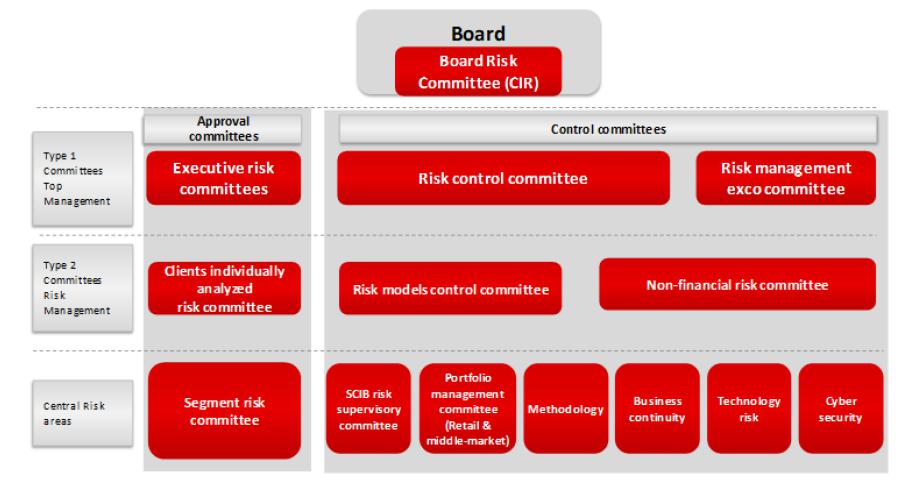
Credit Approval: Loans approved on an individual basis
In preparing a credit proposal for a corporate client whose loans are approved on an individual basis, Santander-Chile’s personnel verifies such parameters as debt servicing capacity (typically including projected cash flows), the company’s financial history and projections for the economic sector in which it operates. The Risk Division is closely involved in this process and prepares the credit application for the client. All proposals contain an analysis of the client, a rating and a recommendation. Credit limits are determined not on the basis of outstanding balances of individual clients, but on the direct and indirect credit risk of entire financial groups. For example, a corporation will be evaluated together with its subsidiaries and affiliates.
Credit Approval: Loans approved on a group basis
The majority of loans to individuals and small and mid-sized companies are approved by the Standardized Risk Area through an automated credit scoring system. This system is decentralized, automated and based on multiple parameters, including demographic and information regarding credit behavior from external sources and the FMC.
Impairment assessment
In accordance with the requirements of IFRS 9 the Bank has developed a new credit risk model, applicable from January 1, 2018.
| a. | Definition of default and cure |
The Bank considers a financial instrument defaulted and therefore Stage 3 for ECL calculations in all cases when the borrower becomes 90 days past due on its contractual payments.
F - 146
| Banco Santander-Chile and Subsidiaries |
| Notes to the Consolidated Financial Statements |
| AS OF DECEMBER 31, 2021 AND 2020 AND FOR THE YEARS ENDED DECEMBER 31, 2021, 2020 AND 2019 |
NOTE 38
RISK MANAGEMENT, continued
As a part of a qualitative assessment of whether a customer is in default, the Bank also considers a variety of instances that may indicate unlikeliness to pay. Such events include:
| ● | Internal rating of the borrower indicating default or near default |
| ● | The borrower requesting emergency funding from the Bank |
| ● | The borrower having past due liabilities to public creditors or employees |
| ● | The borrower is deceased |
| ● | A material decreases in the underlying collateral value where the recovery of the loan is expected from the sale of the collateral |
| ● | A material decreases in the borrower’s turnover or the loss of a major customer |
| ● | A covenant breach not waived by the Bank |
| ● | The debtor (or any legal entity within the debtor’s group) filing for bankruptcy application/protection |
| ● | Debtor’s listed debt or equity suspended at the primary exchange because of rumors or facts about financial difficulties |
| b. | Internal rating and PD estimation |
The Bank’s Credit Risk Department operates its internal rating models. The models incorporate both qualitative and quantitative information and, in addition to information specific to the borrower utilize supplemental external information that could affect the borrower’s behavior. The internal credit grades are assigned based on the internal scoring policy, PDs are then adjusted for IFRS 9 ECL calculations to incorporate forward looking information and the IFRS 9 Stage classification of the exposure.
F - 147
| Banco Santander-Chile and Subsidiaries |
| Notes to the Consolidated Financial Statements |
| AS OF DECEMBER 31, 2021 AND 2020 AND FOR THE YEARS ENDED DECEMBER 31, 2021, 2020 AND 2019 |
NOTE 38
RISK MANAGEMENT, continued
The following table shows quality assets and its related provision, based on our internal scoring policy as of December 31, 2021 and 2020:
| December 31, 2021 | ||||||||||||||||||||||||||||||||||||||||
| Corporate | ||||||||||||||||||||||||||||||||||||||||
|
Commercial
|
Stage 1 | Stage 2 | Stage 3 |
Total
|
Percentage | Stage 1 | Stage 2 | Stage 3 |
Total ECL
Allowance |
Percentage | ||||||||||||||||||||||||||||||
| Portfolio | MCh$ | MCh$ | MCh$ | MCh$ | % | MCh$ | MCh$ | MCh$ | MCh$ | % | ||||||||||||||||||||||||||||||
| A1 |
|
|
|
% |
|
% | ||||||||||||||||||||||||||||||||||
| A2 |
|
|
|
|
% |
|
|
|
% | |||||||||||||||||||||||||||||||
| A3 |
|
|
|
|
|
% |
|
|
|
|
|
% | ||||||||||||||||||||||||||||
| A4 |
|
|
|
|
% |
|
|
|
|
% | ||||||||||||||||||||||||||||||
| A5 |
|
|
|
|
% |
|
|
|
|
% | ||||||||||||||||||||||||||||||
| A6 |
|
|
|
|
|
% |
|
|
|
|
|
% | ||||||||||||||||||||||||||||
| B1 |
|
|
|
|
% |
|
|
|
|
% | ||||||||||||||||||||||||||||||
| B2 |
|
|
|
% |
|
|
|
% | ||||||||||||||||||||||||||||||||
| B3 |
|
|
|
|
% |
|
|
|
|
% | ||||||||||||||||||||||||||||||
| B4 |
|
|
|
|
% |
|
|
|
|
% | ||||||||||||||||||||||||||||||
| C1 |
|
|
|
|
% |
|
|
|
|
% | ||||||||||||||||||||||||||||||
| C2 |
|
|
|
|
% |
|
|
|
|
% | ||||||||||||||||||||||||||||||
| C3 |
|
|
|
|
% |
|
|
|
|
% | ||||||||||||||||||||||||||||||
| C4 |
|
|
|
|
% |
|
|
|
|
% | ||||||||||||||||||||||||||||||
| C5 |
|
|
|
|
% |
|
|
|
|
% | ||||||||||||||||||||||||||||||
| C6 |
|
|
|
|
% |
|
|
|
|
% | ||||||||||||||||||||||||||||||
| Subtotal |
|
|
|
|
|
% |
|
|
|
|
|
% | ||||||||||||||||||||||||||||
| Overall monitoring | ||||||||||||||||||||||||||||||||||||||||
| Stage 1 | Stage 2 | Stage 3 | Total | Percentage | Stage 1 | Stage 2 | Stage 3 |
Total ECL
Allowance |
Percentage | |||||||||||||||||||||||||||||||
| MCh$ | MCh$ | MCh$ | MCh$ | % | MCh$ | MCh$ | MCh$ | MCh$ | % | |||||||||||||||||||||||||||||||
| Other Commercial |
|
|
|
|
|
% |
|
|
|
|
% | |||||||||||||||||||||||||||||
| Mortgage |
|
|
|
|
|
% |
|
|
|
|
% | |||||||||||||||||||||||||||||
| Consumer |
|
|
|
|
|
% |
|
|
|
|
% | |||||||||||||||||||||||||||||
| Subtotal |
|
|
|
|
|
% |
|
|
|
|
% | |||||||||||||||||||||||||||||
| Total |
|
|
|
|
|
% |
|
|
|
1.051.434 | % | |||||||||||||||||||||||||||||
F - 148
| Banco Santander-Chile and Subsidiaries |
| Notes to the Consolidated Financial Statements |
| AS OF DECEMBER 31, 2021 AND 2020 AND FOR THE YEARS ENDED DECEMBER 31, 2021, 2020 AND 2019 |
NOTE 38
RISK MANAGEMENT, continued
| December 31, 2020 | ||||||||||||||||||||||||||||||||||||||||
| Corporate | ||||||||||||||||||||||||||||||||||||||||
|
Commercial |
Stage 1 | Stage 2 | Stage 3 |
Total
|
Percentage | Stage 1 | Stage 2 | Stage 3 |
Total ECL
Allowance |
Percentage | ||||||||||||||||||||||||||||||
| Portfolio | MCh$ | MCh$ | MCh$ | MCh$ | % | MCh$ | MCh$ | MCh$ | MCh$ | % | ||||||||||||||||||||||||||||||
| A1 |
|
|
|
% |
|
|
|
% | ||||||||||||||||||||||||||||||||
| A2 |
|
|
|
|
% |
|
|
|
|
% | ||||||||||||||||||||||||||||||
| A3 |
|
|
|
|
% |
|
|
|
|
% | ||||||||||||||||||||||||||||||
| A4 |
|
|
|
|
% |
|
|
|
|
% | ||||||||||||||||||||||||||||||
| A5 |
|
|
|
|
|
% |
|
|
|
|
|
% | ||||||||||||||||||||||||||||
| A6 |
|
|
|
|
|
% |
|
|
|
|
|
% | ||||||||||||||||||||||||||||
| B1 |
|
|
|
% |
|
|
|
% | ||||||||||||||||||||||||||||||||
| B2 |
|
|
|
|
% |
|
|
|
|
% | ||||||||||||||||||||||||||||||
| B3 |
|
|
|
|
% |
|
|
|
|
% | ||||||||||||||||||||||||||||||
| B4 |
|
|
|
|
% |
|
|
|
|
% | ||||||||||||||||||||||||||||||
| C1 |
|
|
|
|
% |
|
|
|
|
% | ||||||||||||||||||||||||||||||
| C2 |
|
|
|
|
% |
|
|
|
|
% | ||||||||||||||||||||||||||||||
| C3 |
|
|
|
|
% |
|
|
|
|
% | ||||||||||||||||||||||||||||||
| C4 |
|
|
|
|
% |
|
|
|
|
% | ||||||||||||||||||||||||||||||
| C5 |
|
|
|
|
% |
|
|
|
|
% | ||||||||||||||||||||||||||||||
| C6 |
|
|
|
|
% |
|
|
|
|
% | ||||||||||||||||||||||||||||||
| Subtotal |
|
|
|
|
|
% |
|
|
|
|
|
% | ||||||||||||||||||||||||||||
| Overall monitoring | ||||||||||||||||||||||||||||||||||||||||
| Stage 1 | Stage 2 | Stage 3 | Total | Percentage | Stage 1 | Stage 2 | Stage 3 |
Total ECL
Allowance |
Percentage | |||||||||||||||||||||||||||||||
| MCh$ | MCh$ | MCh$ | MCh$ | % | MCh$ | MCh$ | MCh$ | MCh$ | % | |||||||||||||||||||||||||||||||
| Other Commercial |
|
|
|
|
|
% |
|
|
|
|
|
% | ||||||||||||||||||||||||||||
| Mortgage |
|
|
|
|
|
% |
|
|
|
|
|
% | ||||||||||||||||||||||||||||
| Consumer |
|
|
|
|
|
% |
|
|
|
|
|
% | ||||||||||||||||||||||||||||
| Subtotal |
|
|
|
|
|
% |
|
|
|
|
|
% | ||||||||||||||||||||||||||||
| Total |
|
|
|
|
|
% |
|
|
|
|
|
% | ||||||||||||||||||||||||||||
In relation to the credit quality of the investment portfolio, local regulations establish that banks are able to hold only local and foreign fixed–income securities except in certain cases. Additionally, Banco Santander-Chile has internal policies to ensure that only securities approved by the Market Risk department, which are stated in the documents “APS” – Products and underlying Approval, are acquired. The Credit Risk Department sets the exposure limits to those approved APS’s. The APS is updated on daily basis.
As
of December 31, 2021,
F - 149
| Banco Santander-Chile and Subsidiaries |
| Notes to the Consolidated Financial Statements |
| AS OF DECEMBER 31, 2021 AND 2020 AND FOR THE YEARS ENDED DECEMBER 31, 2021, 2020 AND 2019 |
NOTE 38
RISK MANAGEMENT, continued
| c. | Exposure at default |
The exposure at default (EAD) represents the gross carrying amount of the financial instruments subject to the impairment calculation, addressing both the client’s ability to increase its exposure while approaching default and potential early repayments too.
To calculate the EAD for a Stage 1 loan, the Bank assesses the possible default events within 12 months for the calculation of the 12mECL. However, if a Stage 1 loan that is expected to default in the 12 months from the balance sheet date and is also expected to cure and subsequently default again, then all linked default events are taken into account. For Stage 2, Stage 3 the exposure at default is considered for events over the lifetime of the instruments.
| d. | Loss given default |
The credit risk assessment is based on a standardized LGD assessment framework that results in a certain LGD rate. These LGD rates take into account the expected EAD in comparison to the amount expected to be recovered or realized from any collateral held.
The Bank segments its retail lending products into smaller homogeneous portfolios (other commercial), based on key characteristics that are relevant to the estimation of future cash flows. The applied data is based on historically collected loss data and involves a wider set of transaction characteristics (i.e., product type, wider range of collateral types) as well as borrower characteristics.
Further recent data and forward-looking economic scenarios are used in order to determine the IFRS 9 LGD rate for each group of financial instruments. Under IFRS 9, LGD rates are estimated for the Stage 1, Stage 2, Stage 3 IFRS 9 segment of each asset class. The inputs for these LGD rates are estimated and, where possible, calibrated through back testing against recent recoveries. These are repeated for each economic scenario as appropriate.
| e. | Significant increase in credit risk (SICR) |
The Bank continuously monitors all assets subject to ECLs. In order to determine whether an instrument or a portfolio of instruments is subject to 12-month ECL or Lifetime ECL, the Bank assesses whether there has been a significant increase in credit risk since initial recognition.
The Bank also applies a secondary qualitative method for triggering a significant increase in credit risk for an asset, such as moving a customer/facility to the watch list (Special vigilance). The Bank may also consider that events explained in letter a) above are a significant increase in credit risk as opposed to a default. Regardless of the change in credit grades, if contractual payments are more than 30 days past due, the credit risk is deemed to have increased significantly since initial recognition.
When estimating ECLs on other loan basis for a group of similar assets (Mortgages, Consumer and other commercial loans), the Bank applies the same principles for assessing whether there has been a significant increase in credit risk since initial recognition.
Quantitative criteria for SICR Stage 2:
The quantitative criteria are used to identify where an exposure has increased in credit risk and it is applied based on whether an increase in the lifetime PD since the recognition date exceeds the threshold set in absolute terms. The following formula is used to determine such threshold:
Threshold = Lifetime PD (at reporting date) – Lifetime PD (at origination)
F - 150
| Banco Santander-Chile and Subsidiaries |
| Notes to the Consolidated Financial Statements |
| AS OF DECEMBER 31, 2021 AND 2020 AND FOR THE YEARS ENDED DECEMBER 31, 2021, 2020 AND 2019 |
NOTE 38
RISK MANAGEMENT, continued
| Corporate | ||||||||||||||||||||||||
| Mortgages | Other loans |
Revolving (Credit cards) |
Overall monitoring SME | Corporate SME | Middle market | Corporate and Investment Banking | ||||||||||||||||||
|
|
% |
|
% |
|
% |
|
% |
|
% |
|
% |
|
||||||||||||
There is also a relative threshold of
Qualitative criteria for SICR Stage 2:
The qualitative criteria are based on the existence of evidence that leads to an automatic classification of financial instruments in stage 2, mainly 30 days overdue and restructured. Thresholds of SICR are calibrated based on the average ECL of exposures that are 30 days overdue or with a level of credit risk considered to be “significant”.
| Corporate | |||||||
| Mortgages | Other loans |
Revolving
|
Overall
monitoring SME |
Corporate SME | Middle market |
Corporate
and
Investment Banking |
|
|
|
|
|
|
|
|
|
|
|
|
|
|
|
|
|
|
|
|
|
|
|
|||||
These thresholds are defined by the Model Committee and the Integral Risk Committee and are evaluated annually with updates made depending on impacts and definitions of the risk models associated to each portfolio.
As of December 31, 2021 and 2020, due to the continuing uncertainties caused by the new variants of the COVID-19 virus and according to our corporate guidelines, our management has decided not to modify the thresholds for SICR defined above.
| f. | Measurement of expected credit losses |
The Bank calculates the ECL allowance mainly through IFRS 9 models and using cash flow discounted methodology.
Expected credit losses are a probability-weighted estimate of credit losses over the expected life of the financial instrument. A cash shortfall is the difference between the cash flows that are due to an entity in accordance with the contract and the cash flows that the entity expects to receive. Because expected credit losses consider the amount and timing of payments, a credit loss arises even if the entity expects to be paid in full but later than when contractually due.
For financial assets, a credit loss is the present value of the difference between: the contractual cash flows that are due under the contract; and the cash flows that the Bank expects to receive. For undrawn loan commitments, a credit loss is the present value of the difference between: the contractual cash flows that are due if the holder of the loan commitment draws down the loan; and the cash flows that the Bank expects to receive if the loan is drawn down.
F - 151
| Banco Santander-Chile and Subsidiaries |
| Notes to the Consolidated Financial Statements |
| AS OF DECEMBER 31, 2021 AND 2020 AND FOR THE YEARS ENDED DECEMBER 31, 2021, 2020 AND 2019 |
NOTE 38
RISK MANAGEMENT, continued
ECL allowance calculated on an Individual basis:
For financial assets in the corporate portfolio that are (a) credit-impaired at the reporting date (classified in stage 3 with a PD equal to 100%), and (b) is individually significant, the Bank calculates allowance for expected credit losses on an individual basis by using a "Cash flow discounted Methodology". In this instance, the Bank measures the expected credit losses as the difference between the asset’s gross carrying amount and the present value of estimated future cash flows discounted at the financial asset’s original effective interest rate. Any adjustment is recognized in profit or loss as an impairment gain or loss. The following table sets up the allowance and exposure at default (EAD) of the loans that meet the two conditions:
| 2021 | 2020 | |||||||
| MCh$ | MCh$ | |||||||
| Loans and account receivable |
|
|
||||||
| Allowance for ECL |
|
|
||||||
As of December 31, 2021, the expected credit losses related to corporate commercial loans includes MCh$87,418 measured from cash flow discounted methodology (MCh$119,537 in 2020).
ECL allowance calculated on a collective basis:
Commercial loans (except for those described within the "ECL allowance calculated on an Individual basis" description aforementioned), mortgage loans and consumer loans are grouped and assessed on a collective basis by using a credit loss allowance model. The estimation of the collective basis expected credit loss allowance considers qualitative and quantitative information that may affect the changes in credit risk and the development of assumptions related to the probabilities of default and loss given default, including forward looking information, multi-factor analysis such as type of portfolio or transaction and macroeconomic factors.
As of December 31, 2021 the collective basis expected credit loss allowance
was MCh$
In April 2020, the Bank
completed a calibration of parameters, resulting in an additional allowance for MCh$
As of December 31, 2021, the
Bank has released the post-model adjustment (overlay) recorded at the end of 2020 (MCh$
| g. | Corporate and Other loans (smaller commercial, mortgage and consumer) portfolio |
In order to meet the objective of recognizing lifetime expected credit losses for significant increases in credit risk since initial recognition, it is necessary to group or sub-group financial instruments, even if evidence of such significant increases in credit risk at the individual instrument level is not yet available.
Considering to the aforementioned, the Bank evaluates on corporate basis, commercial loans for which prepares individual credit proposals, where it verifies debt servicing capacity (projected cash flow), client’s financial history, evidence of impairment and projections for economic sector. All proposals include an analysis of the client, a rating and a recommendation. For corporations, the evaluation includes subsidiaries and affiliates. Smaller commercial loans, mortgage loans and consumer loans are grouped into other homogeneous portfolios (mortgages, consumer and smaller commercial loans), based on a combination of instrument type, credit risk ratings, collateral type, date of initial recognition, remaining term to maturity, industry and others.
| h. | Modified loans |
When a loan measured at amortized cost has been renegotiated or modified but not derecognized, the Bank assesses whether the transaction should be treated as a modified asset or a derecognition. If the transaction does not result in derecognition the Bank must recognize the resulting gains or losses as the difference between the carrying amount of the original loans and modified contractual cash flows discounted using the EIR before modification.
F - 152
| Banco Santander-Chile and Subsidiaries |
| Notes to the Consolidated Financial Statements |
| AS OF DECEMBER 31, 2021 AND 2020 AND FOR THE YEARS ENDED DECEMBER 31, 2021, 2020 AND 2019 |
NOTE 38
RISK MANAGEMENT, continued
If the modification results in derecognition, then the modified asset is a new asset.
| As of December 31, 2021 | As of December 31, 2020 | |||||||||||||||||||||||||||||||
| Stage 1 | Stage 2 | Stage 3 | Total | Stage 1 | Stage 2 | Stage 3 | Total | |||||||||||||||||||||||||
| MCh$ | MCh$ | MCh$ | MCh$ | MCh$ | MCh$ | MCh$ | MCh$ | |||||||||||||||||||||||||
| Gross carrying amount |
|
|
|
|
|
|
|
|
||||||||||||||||||||||||
| Modified loans |
|
|
|
|
|
|
||||||||||||||||||||||||||
| % |
|
% |
|
% |
|
% |
|
% |
|
% | % | |||||||||||||||||||||
| ECL allowance |
|
|
|
|
|
|
|
|
||||||||||||||||||||||||
| Modified loans |
|
|
|
|
|
|
||||||||||||||||||||||||||
| % |
|
% |
|
% |
|
% |
|
% |
|
% |
|
% | ||||||||||||||||||||
| i. | COVID-19 support measures |
For
2021, the Bank continued granting loans under government guarantees program. In fact, in February 2021, the government approved the FOGAPE
2.0 – or FOGAPE Reactiva - program. The maximum rate was set at a monthly rate of TPM (overnight rate) plus
For the 2020, the Bank provided payment holidays and loans granted by government (Fogape Loans). The payment holiday program granted to our consumer 3-month grace periods, modified terms and installments, and allowed modified interest rate to the current market lower rate in 2020. These amendments were considered a substantial modification of the original contractual terms and conditions. The 3-month installment deferred were added after the original maturity of the loan and recognized as new financial assets. In line with our internal guide, these modifications are classified as modifications for commercial reasons, because they are not attributable to the financial difficulty of the debtor, and a new loan operation has been originated under current market conditions.
For mortgage loan portfolio, original contractual conditions were not modified, instead, the clients signed an addendum for the postponed installments, and a complementary operation was generated, with the mortgage guarantee covering both operations. Neither the monthly installments nor the rates were modified. This relief was granted only to clients with less than 30 days past due, and we observed that our clients are meeting their obligations properly. In line with our internal guide, these modifications granted to customers with no past due days, and were classified as modifications for commercial reasons, meanwhile clients with any past due or that have had some restructuring (marked special risk), were classified as modifications for financial difficulty of the debtor, and the Bank has calculated the difference between the gross carrying amount and the present value of the modified loans discounted at the original effective interest rate. The amount was not material to the Bank.
The summary of the support relief measures is as follows:
| COVID-19 measures |
As
of December 31,
2021 |
As
of December 31,
2020 |
||||||
| MCh$ | MCh$ | |||||||
| Fogape loans |
|
|
||||||
| Fogape Reactiva |
|
- | ||||||
| Payment holiday |
|
|
||||||
| Payment holiday – current |
|
|
||||||
| Payment holiday - expired |
|
|
||||||
F - 153
| Banco Santander-Chile and Subsidiaries |
| Notes to the Consolidated Financial Statements |
| AS OF DECEMBER 31, 2021 AND 2020 AND FOR THE YEARS ENDED DECEMBER 31, 2021, 2020 AND 2019 |
NOTE 38
RISK MANAGEMENT, continued
The payment holiday mainly granted mortgage loan agreements, and postponed monthly installment which comprises principal, interest, inflation and related insurances. The following table show residual maturity of payment holidays that have not expired as of December 31, 2021:
|
<= 6
months |
<= 12
months |
<= 2
years |
> 2 year
<= 5 year |
|||||||||||||||||
| MCh$ | MCh$ | MCh$ | MCh$ | MCh$ | ||||||||||||||||
| Payment holiday – current |
|
|
|
|
- | |||||||||||||||
From
the expired payment holidays, MCh$
| Stage 1 | Stage 2 | Stage 3 | ||||||||||||||
| MCh$ | MCh$ | MCh$ | MCh$ | |||||||||||||
| Payment holiday – expired |
|
|
|
|
||||||||||||
| j. | Macro economical forward-looking information and scenarios |
The annual growth forecasts for the most relevant macroeconomic variables for each of our scenarios are as follows:
| Average estimates 2021 - 2022 | ||||||||||||||||||||
|
Unfavorable
scenario 2 |
Unfavorable
scenario 1 |
Base
scenario |
Favorable
scenario 1 |
Favorable
scenario 2 |
||||||||||||||||
| Official interest rate |
|
% |
|
% |
|
% |
|
% |
|
% | ||||||||||
| Unemployment rate |
|
% |
|
% |
|
% |
|
% |
|
% | ||||||||||
| Housing Price growth |
|
% | % |
|
% |
|
% |
|
% | |||||||||||
| GDP growth |
(
|
)% |
(
|
)% |
|
% |
|
% |
|
% | ||||||||||
| Consumer Price Index |
|
% |
|
% |
|
% |
|
% |
|
% | ||||||||||
The highest probability of occurrence is associated to the base scenario, while the extreme scenarios have a lower probability than the more moderate scenarios.
The methodology used for the generation of the local scenarios is based on the Methodology Framework of the Corporate Research Service and is applied to the loan portfolio with the exception of loans from the Corporate and Investment Banking segment which uses global scenarios as defined by the Santander Group. The probabilities for the scenarios must total 100% and be symmetrical.
| Local scenario | Global scenario | |||||||||
| Probability weighting | Probability weighting | |||||||||
| Favorable scenario 2 |
|
% | Favorable scenario 1 |
|
% | |||||
| Favorable scenario 1 |
|
% | Base scenario |
|
% | |||||
| Base scenario |
|
% | Unfavorable scenario 1 |
|
% | |||||
| Unfavorable scenario 1 |
|
% | ||||||||
| Unfavorable scenario 2 |
|
% |
F - 154
| Banco Santander-Chile and Subsidiaries |
| Notes to the Consolidated Financial Statements |
| AS OF DECEMBER 31, 2021 AND 2020 AND FOR THE YEARS ENDED DECEMBER 31, 2021, 2020 AND 2019 |
NOTE 38
RISK MANAGEMENT, continued
The ECL allowance sensibility to future macro-economic conditions is as follows:
| As of December 31, | ||||||||
| 2021 | 2020 | |||||||
| MCh$ | MCh$ | |||||||
| Reported ECL allowance |
|
|
||||||
| Gross carrying amount |
|
|
||||||
| Reported ECL Coverage |
|
% |
|
% | ||||
| ECL amount by scenarios | ||||||||
| Favorable scenarios 2 |
|
|
||||||
| Favorable scenarios 1 |
|
|
||||||
| Base scenarios |
|
|
||||||
| Unfavorable scenarios 2 |
|
|
||||||
| Unfavorable scenarios 2 |
|
|
||||||
| Coverage ratio by scenarios | ||||||||
| Favorable scenarios 2 |
|
% |
|
% | ||||
| Favorable scenarios 1 |
|
% |
|
% | ||||
| Base scenarios |
|
% |
|
% | ||||
| Unfavorable scenarios 2 |
|
% |
|
% | ||||
| Unfavorable scenarios 2 |
|
% |
|
% | ||||
During the 2021, the Bank has updated the macro-economical scenarios, and for hence, the post-model adjustment (overlays) established for 2020 were released in the second half of 2021.
F - 155
| Banco Santander-Chile and Subsidiaries |
| Notes to the Consolidated Financial Statements |
| AS OF DECEMBER 31, 2021 AND 2020 AND FOR THE YEARS ENDED DECEMBER 31, 2021, 2020 AND 2019 |
NOTE 38
RISK MANAGEMENT, continued
| k. | Analysis of risk concentration |
The following table shows the risk concentration by industry, and by stage before ECL allowance of loans and account receivable at amortized cost:
| As of December 31, | ||||||||||||||||||||||||||||||||
| 2021 | 2020 | |||||||||||||||||||||||||||||||
| Stage 1 | Stage 2 | Stage 3 | Total | Stage 1 | Stage 2 | Stage 3 | Total | |||||||||||||||||||||||||
| MCh$ | MCh$ | MCh$ | MCh$ | MCh$ | MCh$ | MCh$ | MCh$ | |||||||||||||||||||||||||
| Commercial loans | ||||||||||||||||||||||||||||||||
| Agriculture and livestock |
|
|
|
|
|
|
|
|
||||||||||||||||||||||||
| Fruit cultivation |
|
|
|
|
|
|
|
|
||||||||||||||||||||||||
| Forest |
|
|
|
|
|
|
|
|
||||||||||||||||||||||||
| Fishing |
|
|
|
|
|
|
|
|
||||||||||||||||||||||||
| Mining |
|
|
|
|
|
|
|
|
||||||||||||||||||||||||
| Oil and natural gas |
|
- |
|
|
|
- |
|
|
||||||||||||||||||||||||
| Manufacturing Industry: | ||||||||||||||||||||||||||||||||
| Food, beverages and tobacco |
|
|
|
|
|
|
|
|
||||||||||||||||||||||||
| Textile, leather and footwear |
|
|
|
|
|
|
|
|
||||||||||||||||||||||||
| Wood and furniture |
|
|
|
|
|
|
|
|
||||||||||||||||||||||||
| Cellulose, paper and printing |
|
|
|
|
|
|
|
|
||||||||||||||||||||||||
| Chemicals and petroleum derivatives |
|
|
|
|
|
|
|
|
||||||||||||||||||||||||
| Metallic, non-metallic, machinery, or other |
|
|
|
|
|
|
|
|
||||||||||||||||||||||||
| Other manufacturing industries |
|
|
|
|
||||||||||||||||||||||||||||
| Electricity, gas, and wáter |
|
|
|
|
|
|
|
|
||||||||||||||||||||||||
| Home building |
|
|
|
|
|
|
|
|
||||||||||||||||||||||||
| Non-residential construction |
|
|
|
|
|
|
|
|
||||||||||||||||||||||||
| Wholesale trade |
|
|
|
|
|
|
|
|
||||||||||||||||||||||||
| Retail trade, restaurants and hotels |
|
|
|
|
|
|
|
|
||||||||||||||||||||||||
| Transport and storage |
|
|
|
|
|
|
|
|
||||||||||||||||||||||||
| Telecommunications |
|
|
|
|
|
|
|
|
||||||||||||||||||||||||
| Financial services |
|
|
|
|
|
|
|
|
||||||||||||||||||||||||
| Real estate services |
|
|
|
|
|
|
|
|
||||||||||||||||||||||||
| Social services and other community services |
|
|
|
|
|
|
|
|
||||||||||||||||||||||||
| Subtotal |
|
|
|
|
|
|
|
|
||||||||||||||||||||||||
| Mortgage loans |
|
|
|
|
|
|
|
|
||||||||||||||||||||||||
| Consumer loans |
|
|
|
|
|
|
|
|
||||||||||||||||||||||||
| Total |
|
|
|
|
|
|
|
|
||||||||||||||||||||||||
F - 156
| Banco Santander-Chile and Subsidiaries |
| Notes to the Consolidated Financial Statements |
| AS OF DECEMBER 31, 2021 AND 2020 AND FOR THE YEARS ENDED DECEMBER 31, 2021, 2020 AND 2019 |
NOTE 38
RISK MANAGEMENT, continued
| l. | Collateral and other credit enhancement |
Banco Santander controls the credit risk using collateral in its operations. Each business unit is responsible for credit risk management and formalizes the use of collateral in its lending policies. Guidelines are in place covering the acceptability and valuation of each type of collateral.
Banco Santander uses guarantees in order to increase their resilience in the subject to credit risk operation. The guarantees can be used fiduciary, real, legal structures with power mitigation and compensation agreements. The Bank periodically reviews its policy guarantees by technical parameters, normative and also its historical basis, to determine whether the guarantee is legally valid and enforceable.
Credit limits are continually monitored and changed in customer behavior function. Thus, the potential loss values represent a fraction of the amount available.
Collateral refers to the assets pledged by the customer or a third party to secure the performance of an obligation. The main type of collateral obtained are the following:
| ● | For securities lending and reverse repurchase transactions, cash or securities |
| ● | For corporate and small business lending, charges over real estate properties, inventory and trade receivables and, in special circumstances, government guarantees |
| ● | For retail lending, mortgages over residential properties |
The following table show the maximum exposure to credit risk by class of financial asset, associated collateral and the net exposure to credit risk:
| As of December 31, | ||||||||||||||||||||||||||||||||
| 2021 | 2020 | |||||||||||||||||||||||||||||||
| Maximum exposure to credit risk | Collateral | Net exposure | Associated ECL | Maximum exposure to credit risk | Collateral | Net exposure | Associated ECL | |||||||||||||||||||||||||
| MCh$ | MCh$ | MCh$ | MCh$ | MCh$ | MCh$ | MCh$ | MCh$ | |||||||||||||||||||||||||
| Commercial loans |
|
|
|
|
|
|
|
|
||||||||||||||||||||||||
| Mortgage loans |
|
|
|
|
|
|
|
|
||||||||||||||||||||||||
| Consumer Loans |
|
|
|
|
|
|
|
|
||||||||||||||||||||||||
| Total |
|
|
|
|
|
|
|
|
||||||||||||||||||||||||
(*) Includes Loans and account receivable at FVOCI
One very important example of financial collateral is the collateral agreement. Collateral agreements comprise a set of highly liquid instruments with a certain economic value that are deposited or transferred by a counterparty in favor of another party in order to guarantee or reduce any counterparty credit risk that might arise from the portfolios of derivative transactions between the parties in which there is exposure to risk.
Collateral agreements vary in nature but, whichever the specific form of collateralization may be, the ultimate aim, as with the netting technique, is to reduce counterparty risk.
Transactions subject to a collateral agreement are assessed periodically (normally on a daily basis). The agreed-upon parameters defined in the agreement are applied to the net balance arising from these assessments, from which the collateral amount (normally cash or securities) payable to or receivable from the counterparty is obtained.
For real estate collateral periodic re-appraisal processes are in place, based on the actual market values for the different types of real estate, which meet all the requirements established by the regulator.
Specifically, mortgage loans are secured by a real property mortgage, and threshold mitigate counterparty credit risk of derivative instruments.
F - 157
| Banco Santander-Chile and Subsidiaries |
| Notes to the Consolidated Financial Statements |
| AS OF DECEMBER 31, 2021 AND 2020 AND FOR THE YEARS ENDED DECEMBER 31, 2021, 2020 AND 2019 |
NOTE 38
RISK MANAGEMENT, continued
Personal guarantees and credit derivatives
Personal guarantees are guarantees that make a third party liable for another party’s obligations to the Bank. They include, for example, security deposits and standby letters of credit. Only guarantees provided by third parties that meet the minimum requirements established by the supervisor can be recognized for capital calculation purposes.
Credit derivatives are financial instruments whose main purpose is to hedge credit risk by buying protection from a third party, whereby the Bank transfers the risk of the issuer of the underlying instrument. Credit derivatives are OTC instruments, i.e. they are not traded in organized markets.
Credit derivative hedges, mainly credit default swaps, are entered into with leading financial institutions. According to the Bank’s policy when an asset (real state) is repossessed are transferred to assets held for sale at their fair value less cost to sell as non-financial assets at the repossession date (assets received in lieu of payments).
Assets Received in Lieu of Payment
Assets received or awarded in lieu of payment of loans and accounts receivable from clients are recognized at their fair value (as determined by an independent appraisal). The excess of the outstanding loan balance over the fair value is charged to net income for the period, under “Provision for loan losses”. Any excess of the fair value over the outstanding loan balance, less costs to sell of the collateral, is returned to the client. These assets are subsequently adjusted to their net realizable value less cost to sale (assuming a forced sale).
At December 31, 2021, assets received
or awarded in lieu of payment amounted to Ch$
| m. | Maximum exposure to credit risk |
Financial assets and off-balance sheet commitments
For financial assets recognized in the Consolidated Statements of Financial Position, maximum credit risk exposure equals their carrying value. Below is the distribution by financial asset and off-balance sheet commitments of the Bank’s maximum exposure to credit risk as of December 31, 2021 and 2020, without deduction of collateral, security interests or credit improvements received:
| As of December 31, | ||||||||||||
| 2021 | 2020 | |||||||||||
| Amount of exposure | Amount of exposure | |||||||||||
| Note | MCh$ | MCh$ | ||||||||||
| Deposits in banks | 4 |
|
|
|||||||||
| Cash items in process of collection | 4 |
|
|
|||||||||
| Financial derivative contracts | 7 |
|
|
|||||||||
| Financial assets held for trading | 5 |
|
|
|||||||||
| Loans and account receivable at amortized cost / Loans and account receivable at FVOCI | 8/ 10 |
|
|
|||||||||
| Debt instrument at fair value through other comprehensive income | 11 |
|
|
|||||||||
| Debt instruments at amortized cost | 9 |
|
- | |||||||||
| Off-balance commitments: | ||||||||||||
| Letters of credit issued |
|
|
||||||||||
| Foreign letters of credit confirmed |
|
|
||||||||||
| Performance guarantees |
|
|
||||||||||
| Available credit lines |
|
|
||||||||||
| Personal guarantees |
|
|
||||||||||
| Other irrevocable credit commitments |
|
|
||||||||||
| Total |
|
|
||||||||||
F - 158
| Banco Santander-Chile and Subsidiaries |
| Notes to the Consolidated Financial Statements |
| AS OF DECEMBER 31, 2021 AND 2020 AND FOR THE YEARS ENDED DECEMBER 31, 2021, 2020 AND 2019 |
NOTE 38
RISK MANAGEMENT, continued
Foreign derivative contracts
As of December 31, 2021, the Bank’s
foreign exposure -including counterparty risk in the derivative instruments’ portfolio- was USD
Below, there are additional details regarding our exposure for those countries classified above 1 and represents our majority of exposure to categories other than 1, as of December 31, 2021, considering fair value of derivative instruments.
| Country | Classification |
Derivative
Instruments
(adjusted to market) |
Deposits | Loans | Financial investments |
Total
Exposure |
||||||||||||||||||
| US$ millions | ||||||||||||||||||||||||
| China |
|
|
||||||||||||||||||||||
| Italy |
|
|
|
|
||||||||||||||||||||
| Mexico |
|
|
|
|
||||||||||||||||||||
| Panama |
|
|
|
|||||||||||||||||||||
| Peru |
|
|
|
|||||||||||||||||||||
| Uruguay |
|
|
|
|||||||||||||||||||||
| Total |
|
|
|
|
||||||||||||||||||||
Our exposure to the group is as follows:
| Counterpart | Country | Classification | Derivative instruments (market adjusted) |
Deposits MUSD |
Loans MUSD |
Financial Investments MUSD |
Exposure MUSD |
|||||||||||||||||||
| US$ millions | ||||||||||||||||||||||||||
| Banco Santander Hong Kong | Hong Kong |
|
|
|
||||||||||||||||||||||
| Banco Santander Mexico | Mexico |
|
|
|
||||||||||||||||||||||
| Banco Santander EEUU | EEUU |
|
|
|
|
|||||||||||||||||||||
| Banco Santander España | Spain |
|
|
|
|
|||||||||||||||||||||
The total amount of this exposure to derivative instruments must be compensated daily with collateral and, therefore, there is no credit exposure.
As of December 31, 2021, we had no applicable sovereign exposure, no unfunded exposure, no credit default protection and no current developments.
Security interests and credit improvements
The maximum exposure to credit risk is reduced in some cases by security interests, credit improvements, and other actions which mitigate the Bank’s exposure. Based on the foregoing, the creation of security interests are a necessary but not a sufficient condition for granting a loan; accordingly, the Bank’s acceptance of risks requires the verification of other variables and parameters, such as the ability to pay or generate funds in order to mitigate the risk being taken on.
The procedures used for the valuation of security interests utilize the prevailing market practices, which provide for the use of appraisals for mortgage securities, market prices for stock securities, fair value of the participating interest for investment funds, etc. All security interests received must be instrumented properly and registered on the relevant register, as well as have the approval of legal divisions of the Bank.
F - 159
| Banco Santander-Chile and Subsidiaries |
| Notes to the Consolidated Financial Statements |
| AS OF DECEMBER 31, 2021 AND 2020 AND FOR THE YEARS ENDED DECEMBER 31, 2021, 2020 AND 2019 |
NOTE 38
RISK MANAGEMENT, continued
The risk management model includes assessing the existence of adequate and sufficient guarantees that allow recovering the credit when the debtor’s circumstances prevent them from fulfilling their obligations.
The Bank has classification tools that allow it to group the credit quality of transactions or customers. Additionally, the Bank has historical databases that keep this internally generated information to study how this probability varies. Classification tools vary according to the analyzed customer (commercial, consumer, SMEs, etc.).
Below is the detail of security interests, collateral, or credit improvements provided to the Bank as of December 31, 2021 and 2020:
| As of December 31, | ||||||||
| 2021 | 2020 | |||||||
| MCh$ | MCh$ | |||||||
| Non-impaired financial assets: | ||||||||
| Properties/mortgages |
|
|
||||||
| Investments and others |
|
|
||||||
| Impaired financial assets: | ||||||||
| Properties/ mortgages |
|
|
||||||
| Investments and others |
|
|
||||||
| Total |
|
|
||||||
Credit risk mitigation techniques
The Bank applies various methods of reducing credit risk, depending on the type of customer and product. As we shall see, some of these methods are specific to a particular type of transaction (i.e., real estate guarantees) while others apply to groups of transactions (i.e., netting and collateral arrangements).
Liquidity risk
Liquidity risk is the risk that the Bank may have difficulty meeting the obligations associated with its financial obligations.
Liquidity risk management
The Bank is exposed on a daily basis to requirements for cash funds from various banking activities, such as wires from checking accounts, fixed-term deposit payments, guarantee payments, disbursements on derivatives transactions, etc. As typical in the banking industry, the Bank does not hold cash funds to cover the balance of all the positions, as experience shows that only a minimum level of these funds will be withdrawn, which can be accurately predicted with a high degree of certainty.
The Bank’s approach to liquidity management is to ensure-- whenever possible--to have enough liquidity on hand to fulfill its obligations at maturity, in both normal and stressed conditions, without entering into unacceptable debts or risking the Bank’s reputation. The Board establishes limits on the minimal part of available funds close to maturity to fulfill payments as well as over a minimum level of interbank operations and other loan facilities that should be available to cover transfers at unexpected demand levels. This is constantly reviewed. Additionally, the Bank must comply with the regulation limits established by the FMC for maturity mismatches.
These limits affect the mismatches of future flows of income and expenditures of the Bank on an individual basis. They are:
| i. | mismatches of up to 30 days for all currencies, up to the amount of basic capital |
| ii. | mismatches of up to 30 days for foreign currencies, up to the amount of basic capital |
| iii. | mismatches of up to 90 days for all currencies, twice the basic capital |
F - 160
| Banco Santander-Chile and Subsidiaries |
| Notes to the Consolidated Financial Statements |
| AS OF DECEMBER 31, 2021 AND 2020 AND FOR THE YEARS ENDED DECEMBER 31, 2021, 2020 AND 2019 |
NOTE 38
RISK MANAGEMENT, continued
The Financial Management Division receives information from all the business units on the liquidity profile of their financial assets and liabilities, as well as breakdowns of other projected cash flows stemming from future businesses. On the basis of that information, the Financial Management Division maintains a portfolio of liquid short–term assets, comprised mainly of liquid investments, loans and advances to other banks, to make sure the Bank has sufficient liquidity. The business units’ liquidity needs are met through short–term transfers from the Financial Management Division to cover any short–term fluctuations and long–term financing to address all the structural liquidity requirements.
The Bank monitors its liquidity position every day, determining the future flows of its outlays and revenues. In addition, stress tests are performed at the close of each month, for which a variety of scenarios encompassing both normal market conditions and conditions of market fluctuation are used. The liquidity policy and procedures are subject to review and approval by the Bank’s Board. Periodic reports are generated by the Market Risk Department, providing a breakdown of the liquidity position of the Bank and its subsidiaries, including any exceptions and the corrective measures adopted, which are regularly submitted to the ALCO for review.
The Bank relies on demand deposits from Retail, Middle-Market and Corporates, obligations to banks (including the Central Bank), debt instruments, and time deposits as its main sources of funding. Although most obligations to banks, debt instruments and time deposits mature in over a year, customer (retail) and institutional deposits tend to have shorter maturities and a large proportion of them are payable within 90 days. The short–term nature of these deposits increases the Bank’s liquidity risk, and hence, the Bank actively manages this risk by continual supervision of the market trends and price management.
Liquidity risk management seeks to ensure that, even under adverse conditions, we have access to the funds necessary to cover client needs, maturing liabilities and capital requirements. Liquidity risk arises in the general funding for our financing, trading and investment activities. It includes the risk of unexpected increases in the cost of funding the portfolio of assets at appropriate maturities and rates, the risk of being unable to liquidate a position in a timely manner at a reasonable price and the risk that we will be required to repay liabilities earlier than anticipated.
The following table sets forth the balance of our liquidity portfolio managed by our Financial Management Division in the manner in which it is presented to the Asset and Liability Committee (ALCO) and the Board. The ALCO now uses as its liquidity portfolio those defined by the FMC and the Chilean Central Bank, which are in line with those established in BIS III. As of December 31, 2021 and 2020, the breakdown of the Bank’s liquid assets by levels was the following:
| As of December 31, | ||||||||
| 2021 | 2020 | |||||||
| MCh$ | MCh$ | |||||||
| Balance as of: | ||||||||
| Cash and cash equivalent |
|
|
||||||
| Level 1 liquid assets (1) |
|
|
||||||
| Level 2 liquid assets (2) |
|
|
||||||
| Total liquid assets |
|
|
||||||
| (1) | Includes available balances held in the Central Bank of Chile, financial instruments issued by the Chilean Treasury or Central Bank and other financial instruments issued or guaranteed by States, multilateral development banks or foreign central banks that have a first-class rating. Collateral under the FCIC funding program with the Central Bank of Chile and technical reserves in the Central Bank are not included |
| (2) | Includes instruments issued by governments, central banks and development banks of foreign countries with a risk rating of A- to AA+ and mortgage bonds issued by Chilean banks that are acceptable at the Chilean Central Bank’s repo window. |
F - 161
| Banco Santander-Chile and Subsidiaries |
| Notes to the Consolidated Financial Statements |
| AS OF DECEMBER 31, 2021 AND 2020 AND FOR THE YEARS ENDED DECEMBER 31, 2021, 2020 AND 2019 |
NOTE 38
RISK MANAGEMENT, continued
Central Bank of Chile liquidity measures during the pandemic
In response to the COVID-19 pandemic, the Chilean Central Bank established two credit lines for banks to reinforce their liquidity: The first is the Credit Facility Conditioned to Increase of Loans (FCIC1), whose objective was for banks to continue financing households and companies’ loans. The FCIC1 amounted to US$24 billion for the whole banking system and have maturities of up to 4 years and must be secured by government bonds, corporate bonds or highly rated large commercial loans as collateral. The FCIC2 amounted US$16 billion and was available only for banks who must have previously drawn upon FCIC1. The FCIC3 was announced in January 2021 and amounted to US$10 billion. The second credit line was the Liquidity Credit line (LCL) and it was an unsecured loan facility that had maturities of up to 2 years. In addition, the LCL was limited to the aggregate amount of the liquidity reserve requirements of each bank. As of December 31, 2021, and 2020, we had borrowed Ch$5,611,439 and Ch$4,959,260, respectively, under these lines of credit.
Exposure to liquidity risk
A similar, but not identical, measure is the calculation used to measure the Bank´s liquidity limit as established by the FMC. The Bank determines a mismatch percentage for purposes of calculating such liquidity limit which is calculated by dividing its benefits (assets) by its obligations (liabilities) according to maturity based on estimated repricing. The mismatch amount permitted for the 30 day and under period is 1-time regulatory capital and for the 90 day and under period – 2 times regulatory capital.
The following table displays the actual derived percentages as calculated per above:
| As of December 31, | ||||||||
|
2021 % |
2020 % |
|||||||
| 30 days |
|
|
||||||
| 30 days foreign currency |
|
|
||||||
| 90 days |
|
|
||||||
The maturity of financial assets and liabilities, and other commercial commitments (including accrued interest) is as follows:
| As of December 31, | Demand | Up to 1 month | Between 1 and 3 months | Between 3 and 12 months | Between 1 and 3 years | Between 3 and 5 years | More than 5 years | Total | ||||||||||||||||||||||||
| 2021 | MCh$ | MCh$ | MCh$ | MCh$ | MCh$ | MCh$ | MCh$ | MCh$ | ||||||||||||||||||||||||
| Maturity of financial assets (Note N°20) |
|
|
|
|
|
|
|
|
||||||||||||||||||||||||
| Maturity of financial liabilities (Note N°20) |
(
|
) |
(
|
) |
(
|
) |
(
|
) |
(
|
) |
(
|
) |
(
|
) |
(
|
) | ||||||||||||||||
| Net maturity financial assets/(liabilities) |
(
|
) |
(
|
) |
(
|
) |
(
|
) |
(
|
) |
|
|
|
|||||||||||||||||||
| Other Commercial Commitments | ||||||||||||||||||||||||||||||||
| Pledges and other commercial commitments |
(
|
) |
(
|
) |
(
|
) |
(
|
) |
(
|
) |
(
|
) |
(
|
) | ||||||||||||||||||
| Confirmed foreign letters of credit |
(
|
) |
(
|
) |
(
|
) |
(
|
) | ||||||||||||||||||||||||
| Letters of credit issued |
(
|
) |
(
|
) |
(
|
) |
(
|
) |
(
|
) | ||||||||||||||||||||||
| Performance guarantee |
(
|
) |
(
|
) |
(
|
) |
(
|
) |
(
|
) |
(
|
) |
(
|
) | ||||||||||||||||||
| Net maturity including commitments |
(
|
) |
(
|
) |
(
|
) |
(
|
) |
(
|
) |
|
|
|
|||||||||||||||||||
F - 162
| Banco Santander-Chile and Subsidiaries |
| Notes to the Consolidated Financial Statements |
| AS OF DECEMBER 31, 2021 AND 2020 AND FOR THE YEARS ENDED DECEMBER 31, 2021, 2020 AND 2019 |
NOTE 38
RISK MANAGEMENT, continued
| As of December 31, | Demand | Up to 1 month | Between 1 and 3 months | Between 3 and 12 months | Between 1 and 3 years | Between 3 and 5 years | More than 5 years | Total | ||||||||||||||||||||||||
| 2020 | MCh$ | MCh$ | MCh$ | MCh$ | MCh$ | MCh$ | MCh$ | MCh$ | ||||||||||||||||||||||||
| Maturity of financial assets (Note N°20) |
|
|
|
|
|
|
|
|
||||||||||||||||||||||||
| Maturity of financial liabilities (Note N°20) |
(
|
) |
(
|
) |
(
|
) |
(
|
) |
(
|
) |
(
|
) |
(
|
) |
(
|
) | ||||||||||||||||
| Net maturity financial assets/(liabilities) |
(
|
) |
(
|
) |
(
|
) |
|
|
(
|
) |
|
|
||||||||||||||||||||
| Other Commercial Commitments | ||||||||||||||||||||||||||||||||
| Pledges and other commercial commitments |
(
|
) |
(
|
) |
(
|
) |
(
|
) |
(
|
) | ||||||||||||||||||||||
| Confirmed foreign letters of credit |
(
|
) |
(
|
) |
(
|
) |
(
|
) |
(
|
) | ||||||||||||||||||||||
| Letters of credit issued |
(
|
) |
(
|
) |
(
|
) |
(
|
) |
(
|
) | ||||||||||||||||||||||
| Performance guarantee |
(
|
) |
(
|
) |
(
|
) |
(
|
) |
(
|
) |
(
|
) |
(
|
) | ||||||||||||||||||
| Net maturity including commitments |
(
|
) |
(
|
) |
(
|
) |
|
|
(
|
) |
|
|
||||||||||||||||||||
Operational risk
The Bank defines operational risk as the risk of losses arising from defects or failures in its internal processes, people, systems or external events, thus covering risk categories such as fraud, technological, cyber, legal and conduct risk.
Operational risk is inherent to all products, activities, processes and systems and is generated in all business and support areas. For this reason, all employees are responsible for managing and controlling the operational risks generated in their sphere of action. The Bank’s goal in terms of operational risk management and control is focused on identifying, evaluating and mitigating sources of risk, regardless of whether they have materialized or not. The analysis of operational risk exposure contributes to the establishment of risk management priorities.
Operational risk governance
The risk management program contemplates that all relevant risk issues must be reported to the Board of Directors, the Integral Risk
Committee and the Non-Financial Risk Committee.
Risk identification, measurement and assessment model
A series of quantitative and qualitative techniques and tools have been defined by the Bank to identify, measure and assess operational risk. The quantitative analysis of this risk assessment is carried out mainly with tools that record and quantify the level of potential losses associated with operational risk events. The qualitative analysis seeks to assess aspects of exposure and hedging (including the control environment). The most important operational risk tools used by the Bank are an internal events database, operational risk control self-assessment, analysis of operational risk scenarios, appetite of corporate and local indicators, internal audit and regulatory recommendations, among others.
Operational risk management
To accomplish our operational risk objectives, we have established a risk model based on three lines of defense, with the objective of continuously improving and developing our management and control of operational risks. The defense lines consist of: (i) the business and support areas (first line of defense), responsible for managing the risks related to their processes; (ii) the non-financial risk area (second line of defense), in charge of supporting the first line of defense in relation to the fulfillment of its direct responsibilities and; (iii) the internal audit function (third line of defense) responsible for verifying, independently and periodically, the adequacy of the risk identification and management processes and procedures, in accordance with the guidelines established in the Internal Audit Policy and submitting the results of its recommendations for improvement to the Audit Committee.
F - 163
| Banco Santander-Chile and Subsidiaries |
| Notes to the Consolidated Financial Statements |
| AS OF DECEMBER 31, 2021 AND 2020 AND FOR THE YEARS ENDED DECEMBER 31, 2021, 2020 AND 2019 |
NOTE 38
RISK MANAGEMENT, continued
Our methodology consists of the evaluation of the risks and controls of a business from a broad perspective and includes a plan to monitor the effectiveness of such controls and the identification of eventual weaknesses. The main objectives of the Bank and its subsidiaries in terms of operational risk management are the following:
| • | Identify, evaluate, inform, manage and monitor the operational risk in connection with activities, products, and processes carried out or commercialized by the Bank and its subsidiaries; |
| • | Build a strong culture of operational risk management and internal controls, with clearly defined and adequately segregated responsibilities between business and support functions, whether these are internally-developed or outsourced to third parties; |
| • | Generate effective internal reports in connection with issues related to operational risk management, with a clearly defined escalation protocol; and |
| • | Control the design and application of effective plans to deal with contingencies that ensure business continuity and losses control. |
Cyber-security and data security plans
The Bank continuously monitors cyber-security risks and has implemented preventative measures to be prepared for any attack of this kind. The Bank has evolved its internal cyber-security model to reflect international standards, incorporating concepts which can be used to assess the degree of maturity in deployment. Based on this assessment model, individual in-situ analyses have been carried out to identify deficiencies and steps to remedy any such deficiencies have been identified in our cyber-security defense plans.
The Bank has a Cybersecurity Framework which defines the governance and policies on preventing and confronting cybercrime. The Chief of Cybersecurity or CISO (Chief Information Security Officer) has been defined as the officer responsible for cybersecurity, a function performed by the Manager of Technology and Operational Risk. Embedded in the Bank’s Technology and Operations division is the Cyber and Technology Risk Department, which is the front line of defense against cyber-security threats and data security. In addition, the Non-Financial Risk Department through the Cyber Risk (a specialized area) enforces the policies and controls that the different areas must follow regarding technology and cyber-security risks. In turn, there is a group of supervisory bodies that include the Cybersecurity Committee, the Non-Financial Risk Committee, the Chief Executive Officer’s Management Committee and the Board’s Integral Risk Committee. We also coordinate with Santander Spain’s headquarters and units in other countries regarding strategy, best practices and experience-sharing.
All this architecture has been created with the aim of identifying cyber risks, the development of a culture and education in cybersecurity, the creation of cyber scenarios to anticipate potential threats, and the fulfillment of the regulatory framework set by the authorities.
Finally, the intelligence and analysis function has also been reinforced by contracting a threat-monitoring service, and progress has been made in the incident registration, notification and escalation mechanisms for internal reporting and reporting to supervisors. In addition, observation and analytical assessment of the events in the sector and in other industries enable us to update and adapt our models for emerging threats.
During 2021 we completed the 4th year of the Global Cybersecurity Transformation Plan that has allowed us to reach advanced levels of maturity in cybersecurity.
During 2021, the Bank did not face a material loss due to cybersecurity breaches. However, even though we have thorough cybersecurity practices and governance in place, we cannot assure that in the future a material adverse event will not occur.
F - 164
| Banco Santander-Chile and Subsidiaries |
| Notes to the Consolidated Financial Statements |
| AS OF DECEMBER 31, 2021 AND 2020 AND FOR THE YEARS ENDED DECEMBER 31, 2021, 2020 AND 2019 |
NOTE 38
RISK MANAGEMENT, continued
Operational risk management during the COVID-19 pandemic
Overall, the pandemic situation has resulted in increased exposure to inherent operational risk, although the Bank has established greater oversight over controls in order to maintain pre-COVID-19 operational risk levels, in addition to reinforce existing ones. The risk of transaction processing increases due to the volume of new loans and multiple changes in existing portfolios resulting from payment holidays and the FOGAPE program. Transactional volume also increased due to public assistance programs and the rise in the number of checking accounts and volumes as more clients searched for digital payment solutions. Close monitoring has been carried out on the following aspects:
| ● | Business continuity plans to effectively to support our employees, customers and businesses. |
| ● | The scenario of the pandemic and remote work has a direct impact on the field of cyber threats and their associated risks as more employees work from home. We have strengthened patching, navigation control, data protection and other controls. |
| ● | Increase in technological support to ensure adequate customer service and the correct provision of services, especially in online banking and call centers. |
| ● | The risk of transaction processing increases due to the volume of new loans and multiple changes in existing portfolios resulting from public assistance programs and internal policies. |
The following table summarizes our net losses from operational risks in 2021 compared to 2020.
| As of December 31, | ||||||||
| Net losses from operational risks | 2021 | 2020 | ||||||
| Fraud |
|
|
||||||
| Labor related |
|
|
||||||
| Client / product related |
|
|
||||||
| Damage to fixed assets |
|
(
|
) | |||||
| Business continuity / Systems |
|
|
||||||
| Processing |
|
|
||||||
| Total |
|
|
||||||
Capital risk
The Bank defines capital risk as the risk that the Bank or any of its companies may have an insufficient amount and/or quality of capital to: meet the minimum regulatory requirements in order to operate as a bank; respond to market expectations regarding its creditworthiness; and support its business growth and any strategic possibilities that might arise, in accordance with its strategic plan.
The objectives in this connection include most notably:
| ● | To meet the internal capital and capital adequacy targets | |
| ● | To meet the regulatory requirements | |
| ● | To align the Bank’s strategic plan with the capital expectations of external agents (rating agencies, shareholders and investors, customers, supervisors, etc.) | |
| ● | To support the growth of the businesses and any strategic opportunities that may arise |
The Bank has a capital adequacy position that surpasses the levels required by regulations.
Capital management seeks to optimize value creation at the Bank an at its different business segment. The Bank continuously evaluates it risk-return ratios through its basic capital, effective net equity, economic capital and return on equity. With regard to capital adequacy, the Banks conducts its internal process based on the FMC standards which are based on Basel Capital Accord (Basel I), Economic capital is the capital required to support all the risk of the business activity with a given solvency level.
F - 165
| Banco Santander-Chile and Subsidiaries |
| Notes to the Consolidated Financial Statements |
| AS OF DECEMBER 31, 2021 AND 2020 AND FOR THE YEARS ENDED DECEMBER 31, 2021, 2020 AND 2019 |
NOTE 38
RISK MANAGEMENT, continued
Capital is managed according to the risk environment, the economic performance of Chile and the business cycle, Board may modify our current equity policies to address changes in the mentioned risk environment,
Minimum Capital
Under the General Banking Law, a bank
is required to have a minimum of UF800,000 (approximately Ch$
Capital adequacy requirement
Chilean banks are required by the General
Banking Law to maintain regulatory capital of at least
Regulatory capital is defined as the aggregate of:
| ● | a bank’s paid-in capital and reserves, excluding capital attributable to subsidiaries and foreign branches or basic capital; |
| ● | its subordinated bonds, valued at their placement price (but decreasing by 20.0% for each year during the period commencing six years prior to maturity), for an amount up to 50.0% of its basic capital; and |
|
|
|
The levels of basic capital and effective net equity at the close of each period are as follows:
| Ratio | ||||||||||||||||
| As of December 31, | As of December 31, | |||||||||||||||
| 2021 | 2020 | 2021 | 2020 | |||||||||||||
| MCh$ | MCh$ | % | % | |||||||||||||
| Basic capital |
|
|
|
|
||||||||||||
| Regulatory capital |
|
|
|
|
||||||||||||
Basel III Implementation in Chile
The new General Banking Law (updated through Law 21.130) defines general guidelines to establish a capital adequacy system in line with the international standards of Basel III, giving the FMC the power to dictate the capital framework in a prudential way through regulations. In particular, the FMC has been empowered, with the prior favorable agreement of the Central Bank of Chile, to define through regulation, the new methodologies for calculating credit, market and operational risk weighted assets; the condition for hybrid instruments AT1, and the determination and capital charges for banks of local systemic importance. It also introduced the conservation and counter-cyclical buffers and expanded the FMC’s powers to make prudential discounts to regulatory capital and additional requirements, including higher capital, from banks that show deficiencies in the supervisory evaluation process (Pillar 2). The implementation of Basel III makes possible to focus risk management towards more comprehensive vision of them, with a focus on capital adequacy.
F - 166
| Banco Santander-Chile and Subsidiaries |
| Notes to the Consolidated Financial Statements |
| AS OF DECEMBER 31, 2021 AND 2020 AND FOR THE YEARS ENDED DECEMBER 31, 2021, 2020 AND 2019 |
NOTE 38
RISK MANAGEMENT, continued
The FMC completed the process of issuance of regulatory capital framework of Basel III at the end of 2020. However, the FMC in coordination with the Central Bank of Chile and in line with the measures adopted by international regulators has decided to postpone the implementation of the APR calculation for one year (until December 2021). Additionally, it has disposed to advance a capital mitigation mechanism to facilitate the development of the debt agreement market (Credit Risk Weighted Assets) and complements a similar treatment of government guarantees granted by the FMC. In the case of Pillar 3, implementation was postponed until 2023.
The Bank is working in the implementation of these capital regulations through a multidisciplinary team, which are performing the exercises and required developments, including the implementation of the required files designed by the FMC in accordance with a gradual implementation (2021- 2025 implementation scheme). As of December 31, 2021, the Bank was required to calculate the Common Equity Tier 1 capital and Regulatory capital under Basel III is as follows:
| As of December 31, 2021 | ||||||||
| MCh$ | % | |||||||
| Common Equity Tier 1 capital (CET1) |
|
|
||||||
| Regulatory capital |
|
|
||||||
F - 167
| Banco Santander-Chile and Subsidiaries |
| Notes to the Consolidated Financial Statements |
| AS OF DECEMBER 31, 2021 AND 2020 AND FOR THE YEARS ENDED DECEMBER 31, 2021, 2020 AND 2019 |
NOTE 39
NON CURRENT ASSETS HELD FOR SALE
Banco Santander decided to implement its own acquiring network, and therefore the Bank decided to sell the participation in the companies that provided those services. At that time, the Bank classified investment in Redbanc and Transbank as held-for-sale and senior management was engaged in an active program to locate buyers.
In accordance with facts and circumstances arising from the social unrest in Chile and the global pandemic due to COVID-19 (situations beyond the Bank’s control), and the absence of suitable buyers, the process of selling its equity has failed. According to the above, our management has re-evaluated the situation and decided to reclassify the stakes as Investment in associates. See Note 12.
As of December 31, 2020, the Bank has sold its participation in Nexus.
F - 168
| Banco Santander-Chile and Subsidiaries |
| Notes to the Consolidated Financial Statements |
| AS OF DECEMBER 31, 2021 AND 2020 AND FOR THE YEARS ENDED DECEMBER 31, 2021, 2020 AND 2019 |
NOTE 40
SUBSEQUENT EVENTS
Since December 31, 2021, the Bank has issued the following subordinated bonds:
| Series | Currency | Annual interest rate | Issuance date | Issuance amount | Maturity date | |||||||||
| USTDW70320 | UF |
|
% |
|
|
|
||||||||
| USTDW70320 | UF |
|
% |
|
|
|
||||||||
| USTDW70320 | UF |
|
% |
|
|
|
||||||||
| USTDW70320 | UF |
|
% |
|
|
|
||||||||
On
February 4, 2022, an autonomous and technical committee, conformed by four members designated by each of the Central Bank, the FMC, the
National Economic Prosecutor
(Fiscalía Nacional Económica)
and the Ministry of Finance, announced new limits for
interchange fees with a maximum fee of
No other subsequent events that need to be disclosed occurred between January 1, 2022 and the date of issuance of these Consolidated Financial Statements (February 25, 2022).
| /s/ Jonathan Covarrubias Hernandez | /s/ Miguel Mata Huerta | |
|
JONATHAN COVARRUBIAS HERNANDEZ Chief Accounting Officer |
MIGUEL MATA HUERTA Chief Executive Officer |
F - 169