|
|
|
|
|
|
|
|
|
|
|
|
|
|
|
|
|
|
|
|
|
|
|
|
|
|
|
|
|
|
|
|
|
|
|
|
|
|
|
|
|
|
|
|
|
|
|
|
|
|
Table of Contents
UNITED STATES
SECURITIES AND EXCHANGE COMMISSION
Washington, D.C. 20549
FORM 10-K
(Mark One)
| x | ANNUAL REPORT PURSUANT TO SECTION 13 OR 15(d) OF THE SECURITIES EXCHANGE ACT OF 1934 |
For the fiscal year ended December 31, 2014
OR
| ¨ | TRANSITION REPORT PURSUANT TO SECTION 13 OR 15(d) OF THE SECURITIES EXCHANGE ACT OF 1934 |
For the transition period from to
Commission File Number 001-34658
THE BABCOCK & WILCOX COMPANY
(Exact name of registrant as specified in its charter)
| DELAWARE | 80-0558025 | |
|
(State or Other Jurisdiction of Incorporation or Organization) |
(I.R.S. Employer Identification No.) |
|
|
THE HARRIS BUILDING 13024 BALLANTYNE CORPORATE PLACE SUITE 700 CHARLOTTE, NORTH CAROLINA |
28277 | |
| (Address of Principal Executive Offices) | (Zip Code) | |
Registrant’s Telephone Number, Including Area Code: (704) 625-4900
Securities Registered Pursuant to Section 12(b) of the Act:
|
Title of each class |
Name of each Exchange on which registered |
|
| Common Stock, $0.01 par value | New York Stock Exchange |
Securities registered pursuant to Section 12(g) of the Act: None
Indicate by check mark if the registrant is a well-known seasoned issuer, as defined in Rule 405 of the Securities Act. Yes þ No ¨
Indicate by check mark if the registrant is not required to file reports pursuant to Section 13 or Section 15(d) of the Exchange Act. Yes ¨ No þ
Indicate by check mark whether the registrant (1) has filed all reports required to be filed by Section 13 or 15(d) of the Securities Exchange Act of 1934 during the preceding 12 months (or for such shorter period that the registrant was required to file such reports), and (2) has been subject to such filing requirements for the past 90 days. Yes þ No ¨
Indicate by check mark whether the registrant has submitted electronically and posted on its corporate Web site, if any, every Interactive Data File required to be submitted and posted pursuant to Rule 405 of Regulation S-T (§232.405 of this chapter) during the preceding 12 months (or for such shorter period that the registrant was required to submit and post such files). Yes þ No ¨
Indicate by check mark if disclosure of delinquent filers pursuant to Item 405 of Regulation S-K is not contained herein and will not be contained, to the best of registrant’s knowledge, in definitive proxy or information statements incorporated by reference in Part III of this Form 10-K or any amendment to this Form 10-K. þ
Indicate by check mark whether the registrant is a large accelerated filer, an accelerated filer, a non-accelerated filer, or a smaller reporting company. See definition of “large accelerated filer,” “accelerated filer” and “smaller reporting company” in Rule 12b-2 of the Exchange Act. (Check one):
| Large accelerated filer | þ | Accelerated filer | ¨ | |||
| Non-accelerated filer | ¨ | Smaller reporting company | ¨ |
Indicate by check mark whether the registrant is a shell company (as defined in Rule 12b-2 of the Exchange Act). Yes ¨ No þ
The aggregate market value of the registrant’s common stock held by nonaffiliates of the registrant on the last business day of the registrant’s most recently completed second fiscal quarter (based on the closing sales price on the New York Stock Exchange on June 30, 2014) was approximately $3.6 billion.
The number of shares of the registrant’s common stock outstanding at January 31, 2015 was 121,586,254.
DOCUMENTS INCORPORATED BY REFERENCE
Portions of the registrant’s proxy statement for the 2014 Annual Meeting of Stockholders are incorporated by reference into Part III of this Form 10-K.
Table of Contents
INDEX - FORM 10-K
| PAGE | ||||||
| PART I | ||||||
|
Item 1. |
||||||
| 1 | ||||||
| 1 | ||||||
| 4 | ||||||
| 5 | ||||||
| 6 | ||||||
| 7 | ||||||
| 8 | ||||||
| 10 | ||||||
| 10 | ||||||
| 11 | ||||||
| 11 | ||||||
| 11 | ||||||
| 11 | ||||||
| 12 | ||||||
| 13 | ||||||
| 16 | ||||||
| 18 | ||||||
|
Item 1A. |
18 | |||||
|
Item 1B. |
36 | |||||
|
Item 2. |
37 | |||||
|
Item 3. |
38 | |||||
|
Item 4. |
38 | |||||
| P A R T I I | ||||||
|
Item 5. |
39 | |||||
|
Item 6. |
42 | |||||
|
Item 7. |
Management’s Discussion and Analysis of Financial Condition and Results of Operations |
43 | ||||
| 43 | ||||||
| 46 | ||||||
|
Results of Operations – Years Ended December 31, 2014, 2013 and 2012 |
51 | |||||
| 57 | ||||||
| 57 | ||||||
| 57 | ||||||
|
Item 7A. |
61 | |||||
|
Item 8. |
||||||
| 63 | ||||||
|
Consolidated Balance Sheets – December 31, 2014 and December 31, 2013 |
64 | |||||
|
Consolidated Statements of Income for the Years Ended December 31, 2014, 2013 and 2012 |
66 | |||||
i
Table of Contents
|
Consolidated Statements of Comprehensive Income for the Years Ended December 31, 2014, 2013 and 2012 |
67 | |||||
|
Consolidated Statement of Stockholders’ Equity for the Years Ended December 31, 2014, 2013 and 2012 |
68 | |||||
|
Consolidated Statements of Cash Flows for the Years Ended December 31, 2014, 2013 and 2012 |
69 | |||||
| 70 | ||||||
|
Item 9. |
Changes In and Disagreements With Accountants on Accounting and Financial Disclosure |
122 | ||||
|
Item 9A. |
||||||
| 122 | ||||||
|
Management’s Report on Internal Control Over Financial Reporting |
122 | |||||
| 123 | ||||||
| 123 | ||||||
|
Item 9B. |
124 | |||||
| PART III | ||||||
|
Item 10. |
125 | |||||
|
Item 11. |
125 | |||||
|
Item 12. |
Security Ownership of Certain Beneficial Owners and Management and Related Stockholder Matters |
125 | ||||
|
Item 13. |
Certain Relationships and Related Transactions, and Director Independence |
125 | ||||
|
Item 14. |
125 | |||||
| PART IV | ||||||
|
Item 15. |
126 | |||||
| 131 | ||||||
ii
Table of Contents
Statements we make in this Annual Report on Form 10-K, which express a belief, expectation or intention, as well as those that are not historical fact, are forward-looking statements within the meaning of the Private Securities Litigation Reform Act of 1995. These forward-looking statements are subject to various risks, uncertainties and assumptions, including those to which we refer under the headings “Cautionary Statement Concerning Forward-Looking Statements” and “Risk Factors” in Items 1 and 1A of Part I of this report. In this annual report on Form 10-K, unless the context otherwise indicates, “we,” “us” and “our” mean The Babcock & Wilcox Company (“B&W” or “Company”) and its consolidated subsidiaries.
| Item 1. | BUSINESS |
B&W is a leading technology innovator in power generation systems, a specialty constructor of nuclear components and a premier service provider, with an operating history of more than 145 years. We provide a variety of products and services to customers in the power and other steam-using industries, including electric utilities and other power generators, industrial customers in various other industries, and the United States Government. While we provide a wide range of products and services, our business segments are heavily focused on major projects. At any given time, a relatively small number of projects can represent a significant part of our operations.
We are a successor to a business founded in 1867, which was acquired by McDermott International, Inc. (“MII”) in 1978. In July 2010, MII spun-off the businesses that comprised its then power generation systems and government operations segments into B&W, a separate independent public company that was incorporated in Delaware, through the distribution of shares of B&W common stock to holders of MII common stock. B&W’s common stock is listed on the New York Stock Exchange under the trading symbol BWC.
We operate in five business segments: Power Generation, Nuclear Operations, Technical Services, Nuclear Energy and mPower. For financial information regarding each of our segments, financial information regarding geographic areas and additional information regarding the change to our segments, see Note 16 to our consolidated financial statements included in this report. For further details regarding each segment’s facilities, see Item 2, “Properties.” In general, we operate in capital-intensive industries and rely on large contracts for a substantial amount of our revenues.
Power Generation
Through this segment, we provide advanced fossil and renewable power generation equipment for capital projects with a broad suite of boiler products and environmental systems. In addition, we provide a comprehensive platform of aftermarket services to a large installed base of power generation facilities. On June 20, 2014, we acquired MEGTEC Holdings, Inc. (“MEGTEC”). MEGTEC designs, engineers, manufactures and services air pollution control systems and coating / drying equipment for a variety of industrial applications and complements our environmental products and solutions offerings. As a result of this acquisition, we now provide technology and services in the growing market for industrial environmental systems.
This segment specializes in engineering, manufacturing, procurement, erection of equipment and technology used in the power generation industry and various other industries, as well as the provision of related services, including:
| • |
heavy-pressure equipment for energy conversion, such as boilers fueled by coal, oil, bitumen, natural gas, and renewables including municipal solid waste and biomass fuels; |
| • |
environmental control systems for both power generation and industrial applications to incinerate, filter, recover and/or purify air, liquid and vapor-phase effluents from a variety of power generation and manufacturing processes; |
| • |
aftermarket support for the global installed base of operating plants with a wide variety of products and technical services including replacement parts, retrofit and upgrade capabilities, field engineering, construction, inspection, operations and maintenance, condition assessment and other technical support; and |
1
Table of Contents
| • |
engineered-to-order services, products and systems for energy conversion worldwide and related auxiliary equipment, such as burners, pulverizers, soot blowers and ash handling systems; design and manufacture of ovens and dryers, specialized coating lines and material handling systems for energy storage, membranes, digital printing and other advanced manufacturing processes. |
Our Power Generation segment’s overall activity depends significantly on the capital expenditures and operations and maintenance expenditures of global electric power generating companies, other steam-using industries and industrial facilities with environmental compliance needs. Several factors influence these expenditures, including:
| • |
prices for electricity, along with the cost of production and distribution including the cost of fuel (coal and natural gas in particular) within the United States or internationally; |
| • |
demand for electricity and other end products of steam-generating facilities, including growth of coal-fired electricity demand in China; |
| • |
requirements for environmental improvements; |
| • |
impact of potential U.S. and international requirements to significantly limit or reduce greenhouse gas emissions in the future; |
| • |
environmental policies which include waste-to-energy or biomass as options to meet legislative requirements and clean energy portfolio standards; |
| • |
level of capacity utilization at operating power plants, and other industrial uses of steam production; |
| • |
requirements for maintenance and upkeep at operating power plants to combat the accumulated effects of usage; and |
| • |
ability of electric power generating companies and other steam users to raise capital. |
Customer demand is heavily affected by the variations in our customers’ business cycles and by the overall economies and energy and environmental policies of the countries in which they operate.
Nuclear Operations
Through this segment, we engineer, design and manufacture precision naval nuclear components and reactors for the U.S. Department of Energy (“DOE”)/National Nuclear Security Administration’s (“NNSA”) Naval Nuclear Propulsion Program.
Our Nuclear Operations segment specializes in the design and manufacture of close-tolerance and high-quality equipment for nuclear applications. In addition, we are a leading manufacturer of critical nuclear components, fuels and assemblies for government and limited other uses. We have supplied nuclear components for DOE programs since the 1950s, and we are the largest domestic supplier of research reactor fuel elements for colleges, universities and national laboratories. We also convert or downblend high-enriched uranium into low-enriched fuel for use in commercial reactors to generate electricity. In addition, we have over 100 years of experience in supplying components for defense applications.
We work closely with the DOE-supported nuclear non-proliferation program. Currently, this program is assisting in the development of a high-density, low-enriched uranium fuel required for high-enriched uranium test reactor conversions. We have also been a leader in the receipt, storage, characterization, dissolution, recovery and purification of a variety of uranium-bearing materials. All phases of uranium downblending and uranium recovery are performed at our Lynchburg, Virginia and Erwin, Tennessee sites.
The demand for nuclear components by the U.S. Government determines a substantial portion of this segment’s backlog. We expect that orders for nuclear components will continue to be a significant part of backlog for the foreseeable future; however, such orders may be subject to Department of Defense budget constraints.
On June 13, 2014, a uranium conversion company filed suit against the Secretary of Energy seeking, among other things, to enjoin the DOE from transferring portions of its excess uranium stockpile to support non-proliferation and other national security initiatives, as well as fund environmental clean-up work and other initiatives. On July 29, 2014, a motion for preliminary injunction was denied. However, the suit may still be successful in preventing the DOE’s transfer of excess uranium, which could adversely impact results in our Nuclear Operations and Technical Services segments. These activities contributed approximately $16.2 million and $4.6 million of operating income to our Nuclear Operations and Technical Services segments, respectively, during the year ended December 31, 2014.
2
Table of Contents
Technical Services
Through this segment, we provide various services to the U.S. Government, including uranium processing, environmental site restoration services and management and operating services for various U.S. Government-owned facilities. These services are provided to the Department of Defense and the DOE, including the NNSA, the Office of Nuclear Energy, the Office of Science and the Office of Environmental Management.
This segment’s principal operations include:
| • |
managing and operating nuclear weapons production facilities; |
| • |
managing and operating environmental management sites; |
| • |
managing spent nuclear fuel and transuranic waste for the DOE; and |
| • |
providing critical skills and resources for DOE sites. |
Our Technical Services segment’s overall activity primarily depends on authorized spending levels of the Department of Defense and the DOE, including the NNSA, the Office of Nuclear Energy, the Office of Science and the Office of Environmental Management. We manage and operate complex, high-consequence nuclear and national security operations for the DOE and the NNSA, primarily through our joint ventures, as further discussed under the caption “Joint Ventures” below.
On January 8, 2013, we were notified that our joint venture, Nuclear Production Partners, LLC, was not selected to lead the NNSA’s combined Management and Operating contract for the Y-12 National Security Complex and Pantex Plant. Subsequently, we filed multiple protests with the Government Accountability Office in relation to the selection decision. On February 27, 2014, we received notification that our last protest was dismissed. As of June 30, 2014, the transition of these facilities to the NNSA’s new contractor was completed.
Nuclear Energy
Through this segment, we design, license, manufacture and deliver commercial nuclear steam generators, pressure vessels, reactor components, heat exchangers and other auxiliary equipment, including containers for the storage of spent nuclear fuel. In addition, this segment offers a full spectrum of services for steam generators and balance of plant equipment, as well as nondestructive examination and tooling/repair solutions for other plant systems and components. This segment also offers engineering and licensing services for new nuclear plant designs.
This segment specializes in performing full scope, prototype design work coupled with manufacturing integration. The design, engineering and other capabilities of this segment include:
| • |
steam separation equipment design and development; |
| • |
thermal-hydraulic design of reactor plant components; |
| • |
structural component design for precision manufacturing; |
| • |
materials expertise in high-strength, low-alloy steels and nickel-based materials; |
| • |
material procurement of tubing, forgings and weld wire; and |
| • |
metallographic and chemical analysis. |
Our Nuclear Energy segment’s overall activity primarily depends on the demand and competitiveness of nuclear energy. A significant portion of our Nuclear Energy segment’s operations depend on the timing of maintenance outages primarily in the Canadian market and the cyclical nature of capital expenditures and major refurbishments for nuclear utility customers which could cause variability in our financial results.
mPower
This segment is developing the B&W mPower TM reactor and the associated mPower Plant through its majority-owned joint venture, Generation mPower LLC (“GmP”). Its activity is a function of research and development efforts for the B&W mPower™ reactor and the potential orders to be generated from various mPower Plant deployment initiatives. It also depends on the continued demand for and competitiveness of nuclear energy and
3
Table of Contents
identification of additional investors and funding sources. As part of this initiative, we were selected to receive funding and signed a Cooperative Agreement with the DOE under its Small Modular Reactor Licensing Technical Support Program (the “Funding Program”). The Funding Program is a cost-sharing award that allowed us to use the DOE funds to cover small modular reactor (“SMR”) licensing and engineering development costs associated with SMR design certification and generic design activities. At December 31, 2014, the DOE had provided $111 million of the $150 million in financial assistance originally awarded to us in the Cooperative Agreement.
On April 14, 2014, we announced our plans to restructure the mPower program to reduce spending and focus on technology development. Beginning in the third quarter of 2014, we slowed the pace of development and intend to invest no more than $15 million on an annual basis while we continue to search for additional investors in the mPower program. We intend to continue working with the DOE to further the program. At this time, the latest extension to the Cooperative Agreement has expired and the DOE funding has been suspended. If a mutually agreeable plan is not identified, future amounts may not be made available to us under the Funding Program.
Spin-off
On November 5, 2014, we announced plans to separate our Power Generation business from our Government & Nuclear Operations business, which includes the Nuclear Operations, Technical Services, Nuclear Energy and mPower segments, through a spin-off, creating a new independent, publicly traded power generation company, Babcock & Wilcox Enterprises, Inc. (“BW”). Concurrent with the spin-off, the Company will change its name to BWX Technologies, Inc. (“BWXT”). We plan to effect the separation through a tax-free spin-off transaction.
Global Competitiveness Initiative and Other Restructuring Activities
We launched the Global Competitiveness Initiative (“GCI”) in the third quarter of 2012 to enhance competitiveness, better position B&W for growth, and improve profitability. We have identified a wide range of cost reduction activities, including operational and functional efficiency improvements, organizational design changes and manufacturing optimization. Once fully executed, these actions are expected to produce at least $75 million in annual savings. The majority of the annual savings are expected to result from efficiency improvements that were completed in 2013 and 2014. The balance of the cost savings relates to manufacturing initiatives that are expected to be completed in 2015. In order to achieve these savings, we expect to incur total restructuring charges (cash and non-cash) of approximately $60 million. We incurred $3.3 million and $39.6 million of costs associated with GCI for the years ended December 31, 2014 and 2013, respectively.
We continue to focus on structural changes in our Power Generation and Nuclear Energy segments’ operating models to drive significant margin improvement. We are targeting initiatives that we expect, in conjunction with our GCI initiatives, to drive margin improvement in our Power Generation segment by 200 to 300 basis points and allow us to achieve a minimum 10% operating margin in our Nuclear Energy segment by the end of 2015. We expect to incur total restructuring charges (cash and non-cash), as well as produce annual savings once these initiatives are fully implemented, in the range of $35 million to $50 million. We incurred $26.8 million of costs associated with these initiatives for the year ended December 31, 2014. We expect these actions to result in additional restructuring charges.
In addition, in the year ended December 31, 2014, we incurred $10.6 million and $0.4 million of costs associated with the restructuring of our mPower program and our Technical Services segment, respectively.
We are currently exploring growth strategies across our segments through acquisitions to expand and complement our existing businesses. As we pursue these opportunities, we expect they would be funded by cash on hand, external financing (including debt), equity or some combination thereof.
4
Table of Contents
Acquisitions
MEGTEC Holdings, Inc. On June 20, 2014, we completed the acquisition of MEGTEC for $142.8 million, net of cash acquired. MEGTEC designs, engineers, manufactures and services air pollution control systems and coating/drying equipment for a variety of industrial applications and complements our environmental products and solutions offerings.
Ebensburg Power Company. On May 21, 2014, we acquired the remaining outstanding interest in Ebensburg Power Company for a purchase price of $1.3 million. As part of the transaction, we acquired cash of $16.4 million and property, plant and equipment with a fair value of $16.1 million.
Dispositions
Nuclear Projects Business Disposition. In the first quarter of 2014, we announced that we would exit our Nuclear Energy segment’s Nuclear Projects business as it had lower margins and higher financial risks. Run-off operations for remaining projects were completed during the second quarter of 2014.
We execute our contracts through a variety of methods, including fixed-price, cost-plus, target price cost incentive, cost-reimbursable or some combination of these methods. Contracts are usually awarded through a competitive bid process. Factors that customers may consider include price, plant or equipment availability, technical capabilities of equipment and personnel, efficiency, safety record and reputation.
Fixed-price contracts are for a fixed amount to cover all costs and any profit element for a defined scope of work. Fixed-price contracts entail more risk to us because they require us to predetermine both the quantities of work to be performed and the costs associated with executing the work. For further specification see “Risk Factors Related to Our Business – We are subject to risks associated with contractual pricing in our industries, including the risk that, if our actual costs exceed the costs we estimate on our fixed-price contracts, our profitability will decline, and we may suffer losses” as outlined in Item 1A of this report.
We have contracts that extend beyond one year. Most of our long-term contracts have provisions for progress payments. We attempt to cover anticipated increases in labor, material and service costs of our long-term contracts either through an estimate of such changes, which is reflected in the original price, or through risk-sharing mechanisms, such as escalation or price adjustments for items such as labor and commodity prices.
We generally recognize our contract revenues and related costs on a percentage-of-completion basis. Accordingly, we review contract price and cost estimates regularly as the work progresses and reflect adjustments in profit proportionate to the percentage of completion in the period when we revise those estimates. To the extent that these adjustments result in a reduction or an elimination of previously reported profits with respect to a project, we would recognize a charge against current earnings, which could be material. For parts orders and certain aftermarket services activities, we recognize revenues as goods are delivered and work is performed.
Our contracts with the U.S. Government are subject to annual funding determinations. In addition, contracts between the U.S. Government and its prime contractors usually contain standard provisions for termination at the convenience of the U.S. Government or the prime contractor. As a U.S. Government contractor, we are subject to federal regulations under which our right to receive future awards of new federal contracts would be unilaterally suspended or barred if we were convicted of a crime or indicted based on allegations of a violation of specific federal statutes. In addition, some of our contracts with the U.S. Government require us to provide advance notice in connection with any contemplated sale or shut down of the relevant facility. In each of those situations, the U.S. Government has an exclusive right to negotiate a mutually acceptable purchase of the facility. The contracts for the management and operation of U.S. Government facilities are awarded through a complex and protracted procurement process. These contracts are generally structured as five-year contracts with five-year renewal options, which are exercisable by the customer, or include provisions whereby the contract durations can be extended as a result of the achievement of certain performance metrics. These are cost-reimbursement contracts with a U.S.
5
Table of Contents
Government credit line with some corporate-funded working capital required. However, many new contracts currently in the bidding process and recently awarded have a different structure. While such contracts remain cost-reimbursement contracts, the contractor may be required to supply working capital and be reimbursed by the U.S. Government through regular invoicing. These contracts include a fee primarily based on performance, which is evaluated annually.
Our arrangements with customers frequently require us to provide letters of credit, bid and performance bonds or guarantees to secure bids or performance under contracts, which may involve significant amounts for contract security.
In the event of a contract deferral or cancellation, we generally would be entitled to recover costs incurred, settlement expenses and profit on work completed prior to deferral or termination. Significant or numerous cancellations could adversely affect our business, financial condition, results of operations and cash flows.
Backlog represents the dollar amount of revenue we expect to recognize in the future from contracts awarded and in progress. Not all of our expected revenue from a contract award is recorded in backlog for a variety of reasons, including that some projects are awarded and completed within the same fiscal quarter.
Backlog is not a measure defined by generally accepted accounting principles. It is possible that our methodology for determining backlog may not be comparable to methods used by other companies. We are subject to the budgetary and appropriations cycle of the U.S. Government as it relates to our Nuclear Operations and Technical Services segments. Backlog may not be indicative of future operating results, and projects in our backlog may be cancelled, modified or otherwise altered by customers.
We generally include expected revenue from contracts in our backlog when we receive written confirmation from our customers authorizing the performance of work and committing the customer to payment for work performed. Accordingly, we exclude from backlog orders or arrangements that have been awarded but that we have not been authorized to begin performance.
Our backlog at December 31, 2014 and 2013 was as follows:
|
December 31,
2014 |
December 31,
2013 |
|||||||||||||||
| (Dollars in millions) | ||||||||||||||||
|
Power Generation |
$ | 2,247 | 42 | % | $ | 2,072 | 45 | % | ||||||||
|
Nuclear Operations |
2,778 | 53 | % | 2,369 | 52 | % | ||||||||||
|
Technical Services |
3 | 0 | % | 5 | 0 | % | ||||||||||
|
Nuclear Energy |
264 | 5 | % | 142 | 3 | % | ||||||||||
|
mPower |
— | 0 | % | 2 | 0 | % | ||||||||||
|
|
|
|
|
|
|
|
|
|||||||||
|
Total Backlog |
$ | 5,292 | 100 | % | $ | 4,590 | 100 | % | ||||||||
|
|
|
|
|
|
|
|
|
|||||||||
We do not include the value of our unconsolidated joint venture contracts in backlog. These unconsolidated joint ventures are primarily included in our Power Generation and Technical Services segments. See Note 3 to our consolidated financial statements included in this report for financial information on our equity method investments.
6
Table of Contents
Of the December 31, 2014 backlog, we expect to recognize revenues as follows:
| 2015 | 2016 | Thereafter | Total | |||||||||||||
| (In approximate millions) | ||||||||||||||||
|
Power Generation |
$ | 990 | $ | 445 | $ | 812 | $ | 2,247 | ||||||||
|
Nuclear Operations |
1,076 | 701 | 1,001 | 2,778 | ||||||||||||
|
Technical Services |
3 | — | — | 3 | ||||||||||||
|
Nuclear Energy |
87 | 56 | 121 | 264 | ||||||||||||
|
mPower |
— | — | — | — | ||||||||||||
|
|
|
|
|
|
|
|
|
|||||||||
|
Total Backlog |
$ | 2,156 | $ | 1,202 | $ | 1,934 | $ | 5,292 | ||||||||
|
|
|
|
|
|
|
|
|
|||||||||
As of December 31, 2014, Power Generation backlog with the U.S. Government was $20.2 million, all of which was fully funded.
As of December 31, 2014, Nuclear Operations backlog with the U.S. Government was $2,776.8 million, of which $242.6 million had not yet been funded.
As of December 31, 2014, Technical Services backlog with the U.S. Government was $2.6 million, all of which was fully funded.
As of December 31, 2014, Nuclear Energy and mPower had no backlog with the U.S. Government.
During the year ended December 31, 2014, the U.S. Government awarded us new orders of approximately $1,692.9 million, $1,617.3 million of which pertains to our Nuclear Operations segment. Major new awards from the U.S. Government are typically received during the fourth quarter of each year, following congressional approval of the budget for the government’s next fiscal year, which starts October 1. Due to events associated with the government shutdown and delayed budget approvals, approximately $700 million of awards anticipated in the fourth quarter of 2013 were delayed until the first quarter of 2014.
The competitive environments in which each segment operates are described below.
Power Generation . With more than 145 years of experience, we provide advanced steam generating equipment, emissions control equipment and services. Having supplied worldwide capacity of more than 300,000 MW and some of the world’s largest and most efficient steam generating systems, we have a competitive advantage in our experience and technical capability to reliably convert a wide range of fuels to steam. Our strong, installed base in North America also yields competitive advantages in after-market services, although this segment of the market is highly competitive and price sensitive. Through this segment, we compete with a number of domestic and foreign-based companies specializing in steam generating systems technology, equipment and services, including Alstom S.A., Doosan Babcock, Babcock Power, Inc., Amec Foster Wheeler plc, and Hitachi, Ltd.; a variety of engineering and construction companies with respect to the installation of steam-generating systems; a number of additional companies in the markets for environmental control equipment and related specialized industrial equipment and in the independent power-producing business; and other suppliers of replacement parts, repair and alteration services and other services required to retrofit and maintain existing steam systems. The primary bases of competition for this segment are price, technical capabilities, quality, timeliness of performance, breadth of products and services and willingness to accept project risks.
Nuclear Operations. We have specialized technical capabilities that have allowed us to be a valued supplier of nuclear components and fuel for the U.S. Government’s naval nuclear fleet since the 1950s. Because of the technical standards required to meet U.S. Government contracting requirements for nuclear components and the barriers to entry present in this type of environment, competition in this segment is limited. The primary bases of limited competition for this segment are price, high capital investment, technical capabilities and quality of products and services.
7
Table of Contents
Technical Services. Through this segment, we are engaged in the management and operation of U.S. Government facilities. Many of our government contracts are bid as a joint venture with one or more companies, in which we may have a majority or a minority position. The performance of the prime or lead contractor can impact our reputation and our future competitive position with respect to that particular project and customer. Our primary competitors in the delivery of goods and services to the U.S. Government and the operation of U.S. Government facilities include Bechtel National, Inc., AECOM, CH2M Hill, Inc., Fluor Corporation, Lockheed Martin Corporation, Jacobs Engineering Group, Inc. and Northrop Grumman Corporation. The primary bases of competition for this segment are experience, past performance, availability of key personnel and technical capabilities.
Nuclear Energy. Our Nuclear Energy segment supplies commercial nuclear steam generators and components. B&W has supplied the nuclear industry with more than 1,300 large, heavy components worldwide. This segment is the only heavy nuclear component manufacturer in North America. Our Nuclear Energy segment fabricates pressure vessels, reactors, steam generators, heat exchangers and other auxiliary equipment. This segment also provides specialized engineering and maintenance services, including services for plant outages. Through this segment, we compete with a number of companies specializing in nuclear capabilities including AREVA Inc., Chicago Bridge & Iron Company N.V. and Westinghouse Electric Corporation. The primary bases of competition for this segment are price, technical capabilities, quality, timeliness of performance, breadth of products and services and willingness to accept project risks.
mPower. Our mPower segment is designing the modular and scalable B&W mPower™ reactor. The B&W mPower™ reactor has the capacity to provide output of greater than 180 MW and is designed to produce clean, near-zero emission operations. While the activity in this segment is currently a function of research and development activity, we expect mPower to ultimately compete against other nuclear equipment manufacturers, as well as manufacturers of other power generation fuel source technologies.
We participate in the ownership of a variety of entities with third parties, primarily through corporations, limited liability companies and partnerships, which we refer to as “joint ventures.” Our Power Generation segment enters into joint ventures primarily to enhance its manufacturing, design and global production operations. Through several joint venture arrangements, our Technical Services segment manages and operates nuclear facilities and associated plant infrastructure, manufactures components and assembles/dismantles nuclear devices, constructs large capital facilities, provides safeguards and security for inventory and assets, supports and conducts research and development for advanced energy technology and manages environmental programs for the DOE and the NNSA. We generally account for our investments in joint ventures under the equity method of accounting. Certain of our unconsolidated joint ventures are described below.
Power Generation
| • |
Halley & Mellowes Pty. Ltd. Diamond Power International, Inc. (“DPII”), one of our wholly owned subsidiaries, owns an interest in this Australian company, which was formed in 1984. Halley & Mellowes Pty. Ltd. manufactures, services and sells soot blowers, boiler cleaning equipment, valves and material handling equipment, primarily in Australian markets, all of which are complementary to DPII’s product lines. |
| • |
Babcock & Wilcox Beijing Company, Ltd. We own equal interests in this entity with Beijing Jingcheng Machinery Electric Holding Company, Ltd. Babcock & Wilcox Beijing Company, Ltd. was formed in 1986 and is located in Beijing, China. Its main activities are the design, manufacture, production and sale of various power plant and industrial boilers. It operates the largest heavy drum shop in northern China. This entity expands our markets internationally and provides additional capacity to our Power Generation segment’s boiler business. |
| • |
Thermax Babcock & Wilcox Energy Solutions Private Limited. In June 2010, one of our subsidiaries and Thermax Ltd., a boiler manufacturer based in India, formed a joint venture to build |
8
Table of Contents
|
subcritical and highly efficient supercritical boilers and pulverizers for the Indian utility boiler market. We have licensed to the joint venture our technology for subcritical boilers 300 MW and larger, highly efficient supercritical boilers and coal pulverizers. In 2013, the joint venture finalized construction of a facility in India designed to produce parts for up to 3,000 MW of utility boiler capacity per year. |
| • |
BWM Ottumwa Environmental Partners. Through our subsidiary Babcock & Wilcox Construction Co., Inc., we formed BWM Ottumwa Environmental Partners, a joint venture with Burns & McDonnell Engineering Company, Inc., to engineer, procure, and construct environmental control systems for the Ottumwa Generating Station located in Ottumwa, Iowa. This project is nearing completion. |
Technical Services
| • |
Los Alamos National Laboratory . Since 2006, Los Alamos National Security, LLC, a limited liability company formed in 2005 with the University of California, Bechtel National, Inc., URS Corporation and BWX Technologies, Inc. (“BWXT”), has managed and operated the Los Alamos National Laboratory, a premier national security research institution, delivering scientific and engineering solutions for the nation’s most crucial and complex problems. Located in Los Alamos, New Mexico, the Los Alamos National Laboratory conducts ongoing research and development on the measures necessary for certifying the safety and reliability of nuclear devices without the use of nuclear testing for the U.S. Government. |
| • |
Lawrence Livermore National Laboratory. Lawrence Livermore National Security, LLC, a limited liability company formed in 2006 with the University of California, Bechtel National, Inc., URS Corporation and BWXT, manages and operates Lawrence Livermore National Laboratory located in Livermore, California. The laboratory serves as a national resource in science and engineering, focused on national security, energy, the environment and bioscience, with special responsibility for nuclear devices. |
| • |
Savannah River Liquid Waste Disposition Program. In July 2009, Savannah River Remediation LLC, a limited liability company formed by URS Corporation, Bechtel National, Inc., CH2M Hill Constructors, Inc. and Babcock & Wilcox Technical Services Group, Inc. (“B&W TSG”) became the liquid waste contractor for the DOE’s Savannah River Site located in Aiken, South Carolina. The objective of this program is to achieve closure of the Savannah River Site liquid waste tanks in compliance with the Federal Facilities Agreement, utilizing the Defense Waste Processing Facility and Saltstone Facility. |
| • |
Nevada National Security Site. National Security Technologies, LLC (“NSTec”), a limited liability company formed by Northrop Grumman Corporation, AECOM Technology Corporation, CH2M Hill and B&W TSG, manages and operates the Nevada National Security Site and its related facilities and laboratories for the DOE. Located in Las Vegas, Nevada, NSTec works on projects for other federal agencies such as the Defense Threat Reduction Agency, the National Aeronautics and Space Administration, the U.S. Nuclear Regulatory Commission (the “NRC”) and the U.S. Air Force, Army, and Navy. Missions include defense experimentation and stockpile stewardship, homeland security and defense applications and environmental management. |
| • |
Portsmouth Gaseous Diffusion Plant D&D. Fluor-B&W Portsmouth, LLC is a limited liability company formed by Fluor Federal Services, Inc. and B&W TSG, to provide nuclear operations, decontamination and decommissioning services at the Portsmouth Gaseous Diffusion Plant in Portsmouth, Ohio. |
| • |
Paducah and Portsmouth Gaseous Diffusion Plant Uranium Conversion Operations. Babcock & Wilcox Conversion Services, LLC is a limited liability company formed by B&W TSG and URS Corporation to perform uranium conversion operations at the Paducah Gaseous Diffusion Plant in Paducah, Kentucky and the Portsmouth Gaseous Diffusion Plant in Ohio. |
9
Table of Contents
| • |
Advanced Mixed Waste Treatment Project (“AMWTP”). Idaho Treatment Group, LLC (“ITG”) is a limited liability company formed by B&W TSG, URS Energy & Constructions, Inc. and EnergySolutions Federal Services, Inc. ITG is responsible for management and operations at the DOE’s AMWTP located in Idaho Falls, Idaho. The purpose of the AMWTP is to safely process and dispose of transuranic waste and mixed low-level waste at the DOE’s Idaho Site Transuranic Storage Area while maintaining a fully operational facility. |
| • |
West Valley Demonstration Project Phase I Decommissioning and Facility Disposition. CH2M Hill-B&W West Valley, LLC is a limited liability company formed by CH2M Hill Constructors, Inc., B&W TSG and Environmental Chemical Corporation. Services provided include project management and support services, site operations, maintenance, utilities, high-level waste canister relocation, facility disposition, waste tank farm management, NRC-licensed disposal area management, waste management and nuclear materials disposition and safeguards and security. |
| • |
Waste Isolation Pilot Plant. Nuclear Waste Partnership, LLC is a limited liability company formed by B&W TSG, URS Corporation and Areva Federal Services, LLC as the major subcontractor that manages and operates DOE’s Waste Isolation Pilot Plant in Carlsbad, New Mexico. |
We have foreign operations in our Power Generation and Nuclear Energy segments. Our Canadian operations serve the North American and global electric utility, industrial power, oil production and global nuclear utility markets. Our operations in Denmark provide comprehensive services to companies in the waste-to-energy and biomass sector of the power generation market, primarily in eastern and western Europe. Our joint venture in China primarily serves the power generation needs of its domestic and other utility markets. Our joint venture in India serves as a low cost manufacturing and engineering facility to support our Power Generation segment, as well as serving the power generation needs of its domestic market. The functional currency of these entities is not the U.S. dollar, and as a result, we are subject to exchange rate fluctuations that impact our financial position, results of operations and cash flows. Our combined Power Generation and Nuclear Energy segment revenues, net of intersegment revenues, and income derived from operations located outside of the United States, as well as the approximate percentages of our total segment revenues and total segment operating income, respectively, for each of the last three years were as follows (dollars in thousands):
| Revenues | Operating Income | |||||||||||||||
| Amount | Percent | Amount | Percent | |||||||||||||
|
Year ended December 31, 2014 |
$ | 498,603 | 17 | % | $ | 35,592 | 11 | % | ||||||||
|
Year ended December 31, 2013 |
$ | 634,347 | 19 | % | $ | 98,041 | 26 | % | ||||||||
|
Year ended December 31, 2012 |
$ | 684,886 | 21 | % | $ | 97,389 | 24 | % | ||||||||
Our revenues exclude revenues attributable to our joint ventures accounted for under the equity method of accounting, while our operating income includes results from joint ventures accounted for under the equity method.
For additional information on the geographic distribution of our revenues, see Note 16 to our consolidated financial statements included in this report.
We provide our products and services to a diverse customer base, including utilities and other power producers, businesses in various process industries, such as pulp and paper mills, petrochemical plants, oil refineries and steel mills and the U.S. Government. Our largest customer during the years ended December 31, 2014, 2013 and 2012 was the U.S. Government, which represented 45%, 38% and 34% of our total consolidated revenues, respectively. No individual non-U.S. Government customer accounted for more than 5% of our consolidated revenues in the years ended December 31, 2014, 2013 or 2012.
10
Table of Contents
The U.S. Government is the primary customer of our Nuclear Operations and Technical Services segments. Revenues from U.S. Government contracts comprised 99% of revenues for the years ended December 31, 2014, 2013 and 2012, respectively, in our Nuclear Operations segment. Revenues from the U.S. Government contracts comprised 87%, 77% and 72% of revenues for the years ended December 31, 2014, 2013 and 2012, respectively, in our Technical Services segment.
Our operations use raw materials, such as carbon and alloy steels in various forms and components and accessories for assembly, which are available from numerous sources. We generally purchase these raw materials and components as needed for individual contracts. Our Power Generation and Nuclear Energy segments do not depend on a single source of supply for any significant raw materials. Our Nuclear Operations segment relies on several single-source suppliers for materials used in its products. We believe these suppliers are viable, and we and the U.S. Government expend significant effort to monitor and maintain the supplier base for our Nuclear Operations segment.
Although shortages of some raw materials have existed from time to time, no serious shortage exists at the present time.
At December 31, 2014, we employed approximately 11,000 persons worldwide. Approximately 2,700 of our employees were members of labor unions at December 31, 2014. Many of our operations are subject to union contracts, which we customarily renew periodically. We consider our relationships with our employees to be satisfactory.
We currently hold a large number of U.S. and foreign patents and have patent applications pending. We have acquired patents and technology licenses and granted technology licenses to others when we have considered it advantageous for us to do so. Although in the aggregate our patents and licenses are important to us, we do not regard any single patent or license or group of related patents or licenses as critical or essential to our business as a whole. In general, we depend on our technological capabilities and the application of know-how, rather than patents and licenses, in the conduct of our various businesses.
Research and Development Activities
Our research and development activities are related to the development and improvement of new and existing products and equipment, as well as conceptual and engineering evaluation for translation into practical applications. We charge to research and development cost the costs of research and development unrelated to specific contracts as incurred. Substantially all of these costs are in our Power Generation and mPower segments, the majority of which are related to the development of our B&W mPower™ technology. Contractual arrangements for customer-sponsored research and development can vary on a case-by-case basis and include contracts, cooperative agreements and grants.
Research and development activities totaled $142.8 million, $200.8 million and $173.9 million in the years ended December 31, 2014, 2013 and 2012, respectively. These activities include amounts paid for by our customers of $41.8 million, $43.2 million and $53.4 million, in the years ended December 2014, 2013 and 2012, respectively and DOE funds provided under the Funding Program of $27.8 million and $78.4 million in the years ended December 31, 2014 and 2013, respectively. Amounts provided under the Funding Program in the year ended December 31, 2013, include $21.5 million of pre-award cost reimbursement, $9.7 million of which related to research and development costs incurred in the year ended December 31, 2012.
During the years ended December 31, 2014, 2013 and 2012, we recognized $5.8 million, $15.8 million and $17.9 million, respectively, of non-cash in-kind research and development costs (included above) related to services contributed by our minority partner to GmP, our majority-owned subsidiary formed in 2011 to oversee the program to develop the small modular nuclear power plant based on B&W mPower™ technology.
11
Table of Contents
Our operations present risks of injury to or death of people, loss of or damage to property and damage to the environment. We have created loss control systems to assist us in the identification and treatment of the hazard risks presented by our operations, and we endeavor to make sure these systems are effective.
As loss control measures will not always be successful, we seek to establish various means of funding losses and liability related to incidents or occurrences. We primarily seek to do this through contractual protections, including waivers of consequential damages, indemnities, caps on liability, liquidated damage provisions, and access to the insurance of other parties. We also procure insurance, operate our own captive insurance company and/or establish funded or unfunded reserves. However, none of these methods will eliminate all risks.
Depending on competitive conditions, the nature of the work, industry custom and other factors, we may not be successful in obtaining adequate contractual protection from our customers and other parties against losses and liabilities arising out of or related to the performance of our work. The scope of the protection may be limited, may be subject to conditions and may not be supported by adequate insurance or other means of financing. In addition, we sometimes have difficulty enforcing our contractual rights with others following a material loss.
Similarly, insurance for certain potential losses or liabilities may not be available or may only be available at a cost or on terms we consider not to be economical. Insurers frequently react to market losses by ceasing to write or severely limiting coverage for certain exposures. Risks that we have frequently found difficult to cost-effectively insure against include, but are not limited to, business interruption, property losses from wind, flood and earthquake events, nuclear hazards, war and confiscation or seizure of property in some areas of the world, pollution liability, liabilities related to occupational health exposures (including asbestos), liability related to our executives participating in the management of certain outside entities, professional liability/errors and omissions coverage, the failure, misuse or unavailability of our information systems, the failure of security measures designed to protect our information systems from security breaches and liability related to risk of loss of our work in progress and customer-owned materials in our care, custody and control. In cases where we place insurance, we are subject to the credit worthiness of the relevant insurer(s), the available limits of the coverage, our retention under the relevant policy, exclusions in the policy and gaps in coverage.
Our operations in designing, engineering, manufacturing, constructing and servicing nuclear power equipment and components for our commercial nuclear utility customers subject us to various risks, including, without limitation, damage to our customers’ property and third party claims for personal injury, environmental liability, death and property damage. To protect against liability for damage to a customer’s property, we endeavor to obtain waivers of liability and subrogation from the customer and its insurer and are usually named as an additional insured under the utility customer’s nuclear property policy. We also attempt to cap our overall liability in our contracts. To protect against liability from claims brought by third parties, we seek to be insured under the utility customer’s nuclear liability policies and have the benefit of the indemnity and limitation of any applicable liability provision of the Price-Anderson Act. The Price-Anderson Act limits the public liability of U.S. manufacturers and operators of licensed nuclear facilities and other parties who may be liable in respect of, and indemnifies them against, all claims in excess of a certain amount. This amount is determined by the sum of commercially available liability insurance plus certain retrospective premium assessments payable by operators of commercial nuclear reactors. For those sites where we provide environmental remediation services, we seek the same protection from our customers as we do for our other nuclear activities. The Price-Anderson Act, as amended, includes a sunset provision and requires renewal each time that it expires. Contracts that were entered into during a period of time that Price-Anderson was in full force and effect continue to receive the benefit of the Price-Anderson Act’s nuclear indemnity. The Price-Anderson Act is set to expire on December 31, 2025. We also provide nuclear fabrication and other services to the nuclear power industry in Canada. Canada’s Nuclear Liability Act generally conforms to international conventions and is conceptually similar to the Price-Anderson Act in the United States. Accordingly, indemnification protections and the possibility of exclusions under Canada’s Nuclear Liability Act are similar to those under the Price-Anderson Act in the United States.
12
Table of Contents
Although we do not own or operate any nuclear reactors, we have some coverage under commercially available nuclear liability and property insurance for our facilities that are currently licensed to possess special nuclear materials. Substantially all of our Nuclear Operations segment contracts involving nuclear materials are covered by and subject to the nuclear indemnity provisions of either the Price-Anderson Act or Public Law 85-804 which, among other things, authorizes the DOE to indemnify certain contractors when such acts would facilitate national defense. However, to the extent the value of the nuclear materials in our care, custody or control exceeds the commercially available limits of our insurance, we potentially have underinsured risk of loss for such nuclear material.
Our Technical Services segment participates in the management and operation of various U.S. Government facilities. This participation is customarily accomplished through the participation in joint ventures with other contractors for any given facility. These activities involve, among other things, handling nuclear devices and their components for the U.S. Government. Insurable liabilities arising from these sites are rarely protected by our or our partners’ corporate insurance programs. Instead, we rely on government contractual agreements, insurance purchased specifically for a site and certain specialized self-insurance programs funded by the U.S. Government. The U.S. Government has historically fulfilled its contractual agreement to reimburse its contractors for covered claims, and we expect it to continue this process during our participation in the administration of these facilities. However, in most of these situations in which the U.S. Government is contractually obligated to pay, the payment obligation is subject to the availability of authorized government funds. The reimbursement obligation of the U.S. Government is also conditional, and provisions of the relevant contract or applicable law may preclude reimbursement.
Our wholly owned captive insurance subsidiary provides workers’ compensation, employer’s liability, commercial general liability and automotive liability insurance to support our operations. We may also have business reasons in the future to have our insurance subsidiary accept other risks that we cannot or do not wish to transfer to outside insurance companies. These risks may be considerable in any given year or cumulatively. Our insurance subsidiary has not provided significant amounts of insurance to unrelated parties. Claims, as a result of our operations, could adversely impact the ability of our insurance subsidiary to respond to all claims presented.
Additionally, upon the February 22, 2006 effectiveness of the settlement relating to the Chapter 11 proceedings involving several of our subsidiaries, most of our subsidiaries contributed substantial insurance rights to the asbestos personal injury trust, including rights to (1) certain pre-1979 primary and excess insurance coverages and (2) certain of our 1979-1986 excess insurance coverage. These insurance rights provided coverage for, among other things, asbestos and other personal injury claims, subject to the terms and conditions of the policies. The contribution of these insurance rights was made in exchange for the agreement on the part of the representatives of the asbestos claimants, including the representative of future claimants, to the entry of a permanent injunction, pursuant to Section 524(g) of the U.S. Bankruptcy Code, to channel to the asbestos trust all asbestos-related claims against our subsidiaries and former subsidiaries arising out of, resulting from or attributable to their operations, and the implementation of related releases and indemnification provisions protecting those subsidiaries and their affiliates from future liability for such claims. Although we are not aware of any significant, unresolved claims against our subsidiaries and former subsidiaries that are not subject to the channeling injunction and that relate to the periods during which such excess insurance coverage related, with the contribution of these insurance rights to the asbestos personal injury trust, it is possible that we could have underinsured or uninsured exposure for non-derivative asbestos claims or other personal injury or other claims that would have been insured under these coverages had the insurance rights not been contributed to the asbestos personal injury trust.
Governmental Regulations and Environmental Matters
General
Many aspects of our operations and properties are affected by political developments and are subject to both domestic and foreign governmental regulations, including those relating to:
| • |
constructing and equipping electric power and other industrial facilities; |
| • |
possessing and processing special nuclear materials; |
| • |
workplace health and safety; |
| • |
currency conversions and repatriation; |
13
Table of Contents
| • |
taxation of foreign earnings and earnings of expatriate personnel; and |
| • |
protecting the environment. |
We are required by various governmental and quasi-governmental agencies to obtain certain permits, licenses and certificates with respect to our operations. The kinds of permits, licenses and certificates required in our operations depend upon a number of factors.
We cannot determine the extent to which new legislation, new regulations or changes in existing laws or regulations may affect our future operations.
Environmental
Our operations and properties are subject to a wide variety of increasingly complex and stringent foreign, federal, state and local environmental laws and regulations, including those governing discharges into the air and water, the handling and disposal of solid and hazardous wastes, the remediation of soil and groundwater contaminated by hazardous substances and the health and safety of employees. Sanctions for noncompliance may include revocation of permits, corrective action orders, administrative or civil penalties and criminal prosecution. Some environmental laws provide for strict, joint and several liability for remediation of spills and other releases of hazardous substances, as well as damage to natural resources. In addition, companies may be subject to claims alleging personal injury or property damage as a result of alleged exposure to hazardous substances. Such laws and regulations may also expose us to liability for the conduct of or conditions caused by others or for our acts that were in compliance with all applicable laws at the time such acts were performed.
These laws and regulations include the Comprehensive Environmental Response, Compensation, and Liability Act of 1980, as amended (“CERCLA”), the Clean Air Act, the Clean Water Act, the Resource Conservation and Recovery Act and similar laws that provide for responses to, and liability for, releases of hazardous substances into the environment. These laws and regulations also include similar foreign, state or local counterparts to these federal laws, which regulate air emissions, water discharges, hazardous substances and waste and require public disclosure related to the use of various hazardous substances. Our operations are also governed by laws and regulations relating to workplace safety and worker health, including the U.S. Occupational Safety and Health Act and regulations promulgated thereunder.
We are currently in the process of investigating and remediating some of our current and former operating sites. Although we have recorded reserves in connection with certain of these matters, due to the uncertainties associated with environmental remediation, we cannot assure you that the actual costs resulting from these remediation matters will not exceed the recorded reserves.
Our compliance with U.S. federal, state and local environmental control and protection regulations resulted in pretax charges of approximately $13.6 million, $13.1 million and $15.3 million in the years ended December 31, 2014, 2013 and 2012 respectively. In addition, compliance with existing environmental regulations necessitated capital expenditures of $0.3 million, $1.1 million and $3.2 million in the years ended December 31, 2014, 2013 and 2012, respectively. We expect to spend another $3.2 million on such capital expenditures over the next five years. We cannot predict all of the environmental requirements or circumstances that will exist in the future but anticipate that environmental control and protection standards will become increasingly stringent and costly. Based on our experience to date, we do not currently anticipate any material adverse effect on our business or consolidated financial condition as a result of future compliance with existing environmental laws and regulations. However, future events, such as changes in existing laws and regulations or their interpretation, more vigorous enforcement policies of regulatory agencies or stricter or different interpretations of existing laws and regulations, may require additional expenditures by us, which may be material. Accordingly, we can provide no assurance that we will not incur significant environmental compliance costs in the future.
We have been identified as a potentially responsible party at various cleanup sites under CERCLA. CERCLA and other environmental laws can impose liability for the entire cost of cleanup on any of the potentially responsible parties, regardless of fault or the lawfulness of the original conduct. Generally, however, where there are multiple responsible parties, a final allocation of costs is made based on the amount and type of wastes disposed of by each party and the number of financially viable parties, although this may not be the case with respect to any particular site. We have not
14
Table of Contents
been determined to be a major contributor of wastes to any of these sites. On the basis of our relative contribution of waste to each site, we expect our share of the ultimate liability for the various sites will not have a material adverse effect on our consolidated financial condition, results of operations or cash flows in any given year.
Environmental remediation projects have been and continue to be undertaken at certain of our current and former plant sites. In 2002, Congress directed the United States Army Corps of Engineers (“Army Corps”) to clean up radioactive waste at the Shallow Land Disposal Area located in Parks Township, Armstrong County, Pennsylvania (the “SLDA”), consistent with the Memorandum of Understanding between the NRC and the Army Corps for Coordination on Cleanup and Decommissioning of the Formerly Utilized Sites Remedial Action Program Sites with NRC-Licensed Facilities, dated July 5, 2001 (the “MOU”). From 1961 to 1970, the SLDA was operated by the Nuclear Materials and Equipment Corporation (“NUMEC”) pursuant to Atomic Energy Commission (“AEC”) License SNM-145. The AEC was the predecessor to the NRC. The SLDA was used for the disposal of waste from NUMEC’s nuclear fuels fabrication facility in Apollo, Pennsylvania. Both radioactive and non-radioactive waste was disposed in a series of trenches at the SLDA. NUMEC, a former subsidiary of Atlantic Richfield Company (“ARCO”) was acquired by B&W in November 1971. After the Army Corps’ contractor commenced cleanup operations, the Army Corps ceased excavation activities because the contractor deviated from accepted field procedures, and the excavated material was found to be complex and beyond the Army Corps’ characterization and management procedures. The MOU was modified in late 2014 to add the DOE and the NNSA as parties to deal with “special nuclear materials.” In December 2014, the Army Corps issued a Proposed Record of Decision Amendment which reflects a revised cost estimate of $350 million, in addition to the $62 million expended through September 2014, to implement the selected remedy. The Army Corps expects to award a new remediation contract in 2015, and cleanup operations are expected to re-commence in 2016. The federal legislation directing the Army Corps to clean up the SLDA also directs the Army Corps to seek to recover response costs from appropriate responsible parties in accordance with CERCLA. In connection with B&W’s acquisition of NUMEC from ARCO in November 1971, ARCO assumed and agreed to indemnify and hold harmless B&W with respect to claims and liabilities arising as a result of transactions or operations of NUMEC prior to the acquisition date. Although this ARCO indemnity would cover claims by the Army Corps to seek recovery from B&W, no assurance can be given that such indemnity will be available or sufficient in the event liability claims are asserted for SLDA cleanup costs against B&W.
We perform significant amounts of work for the U.S. Government under both prime contracts and subcontracts and operate certain facilities that are licensed to possess and process special nuclear materials. As a result of these activities, we are subject to continuing reviews by governmental agencies, including the U.S. Environmental Protection Agency (the “EPA”) and the NRC.
The NRC’s decommissioning regulations require our Nuclear Operations segment to provide financial assurance that it will be able to pay the expected cost of decommissioning each of its licensed facilities at the end of its service life. We provided financial assurance aggregating $44.2 million during the year ended December 31, 2014 with existing letters of credit for the ultimate decommissioning of these licensed facilities. These two facilities have provisions in their government contracts pursuant to which substantially all of our decommissioning costs and financial assurance obligations are covered by the DOE, including the costs to complete the decommissioning projects underway at the Erwin, Tennessee facility. These letters of credit are to cover decommissioning required pursuant to work not subject to this DOE obligation.
The demand for power generation services and products can be influenced by state and federal governmental legislation setting requirements for utilities related to operations, emissions and environmental impacts. The legislative process is unpredictable and includes a platform that continuously seeks to increase the restrictions on power producers. Potential legislation limiting emissions from power plants, including carbon dioxide, could affect our markets and the demand for our products and services in our Power Generation segment.
At December 31, 2014 and 2013, we had total environmental accruals, including provisions for the facilities discussed above, of $59.9 million and $58.1 million, respectively. Of our total environmental accruals at December 31, 2014 and 2013, $3.6 million and $4.7 million, respectively, were included in current liabilities. Inherent in the estimates of those accruals and recoveries are our expectations regarding the levels of contamination, decommissioning costs and recoverability from other parties, which may vary significantly as decommissioning activities progress. Accordingly, changes in estimates could result in material adjustments to our operating results, and the ultimate loss may differ materially from the amounts we have provided for in our consolidated financial statements.
15
Table of Contents
Cautionary Statement Concerning Forward-Looking Statements
We are including the following discussion to inform our existing and potential security holders generally of some of the risks and uncertainties that can affect our company and to take advantage of the “safe harbor” protection for forward-looking statements that applicable federal securities law affords.
From time to time, our management or persons acting on our behalf make forward-looking statements to inform existing and potential security holders about our company. These statements may include projections and estimates concerning the timing and success of specific projects and our future backlog, revenues, income and capital spending. Forward-looking statements are generally accompanied by words such as “estimate,” “project,” “predict,” “believe,” “expect,” “anticipate,” “plan,” “seek,” “goal,” “could,” “intend,” “may,” “should” or other words that convey the uncertainty of future events or outcomes. In addition, sometimes we will specifically describe a statement as being a forward-looking statement and refer to this cautionary statement.
In addition, various statements in this annual report on Form 10-K, including those that express a belief, expectation or intention, as well as those that are not statements of historical fact, are forward-looking statements. Those forward-looking statements appear in Item 1 – “Business” and Item 3 – “Legal Proceedings” in Part I of this report and in Item 7 – “Management’s Discussion and Analysis of Financial Condition and Results of Operations” and in the notes to our consolidated financial statements in Item 8 of Part II of this report and elsewhere in this report.
These forward-looking statements include, but are not limited to, statements that relate to, or statements that are subject to risks, contingencies or uncertainties that relate to:
| • |
our business strategy; |
| • |
future levels of revenues (including our backlog and projected claims to the extent either may be viewed as an indicator of future revenues), operating margins, income from operations, net income or earnings per share; |
| • |
anticipated levels of demand for our products and services; |
| • |
future levels of research and development, capital, environmental or maintenance expenditures; |
| • |
our beliefs regarding the timing and effects on our businesses of certain environmental and tax legislation, rules or regulations; |
| • |
the success or timing of completion of ongoing or anticipated capital or maintenance projects; |
| • |
expectations regarding the acquisition or divestiture of assets and businesses; |
| • |
our share repurchase or other return of capital activities; |
| • |
our ability to maintain appropriate insurance and indemnities; |
| • |
the potential effects of judicial or other proceedings, including tax audits, on our business or businesses, financial condition, results of operations and cash flows; |
| • |
the anticipated effects of actions of third parties such as competitors, or federal, foreign, state or local regulatory authorities, or plaintiffs in litigation; |
| • |
the effective date and expected impact of accounting pronouncements; |
| • |
the planned spin-off of our Power Generation business; |
| • |
our plans regarding the design, research and development, financing and deployment of the B&W mPower™ reactor and related Funding Program; and |
| • |
anticipated benefits, timing, charges and changes associated with cost reduction and margin improvement activities. |
We have based our forward-looking statements on our current expectations, estimates and projections about our industries and our company. We caution that these statements are not guarantees of future performance and you should not rely unduly on them, as they involve risks, uncertainties and assumptions that we cannot predict. In addition, we have based many of these forward-looking statements on assumptions about future events that may prove to be inaccurate. While our management considers these assumptions to be reasonable, they are inherently subject to significant business, economic, competitive, regulatory and other risks, contingencies and uncertainties, most of which are difficult to predict and many of which are beyond our control. Accordingly, our actual results may differ materially from the future performance that we have expressed or forecast in our forward-looking statements. Differences between actual results and any future performance suggested in our forward-looking statements could result from a variety of factors, including the following:
| • |
decisions on spending and trends by power-generating companies and by the U.S. Government, including continuing appropriations by Congress and the automatic budget cuts (or sequestration) established by the Budget Control Act of 2011 (“the Budget Control Act”); |
16
Table of Contents
| • |
the highly competitive nature of our businesses; |
| • |
general economic and business conditions, including changes in interest rates and currency exchange rates; |
| • |
general developments in the industries in which we are involved; |
| • |
cancellations of and adjustments to backlog and the resulting impact from using backlog as an indicator of future earnings; |
| • |
our ability to perform projects on time and on budget, in accordance with the schedules and terms established by the applicable contracts with customers; |
| • |
changes in our effective tax rate and tax positions; |
| • |
our ability to maintain operational support for our information systems against service outages and data corruption, as well as protection against cyber-based network security breaches and theft of data; |
| • |
our ability to protect our intellectual property and renew licenses to use intellectual property of third parties; |
| • |
changes in estimates used in the percentage-of-completion method of accounting; |
| • |
our ability to obtain and maintain surety bonds, letters of credit and similar financing; |
| • |
the operating risks normally incident to our lines of business, including the potential impact of project losses, liquidated damages and professional liability, product liability, warranty and other claims against us; |
| • |
our ability to manage our capital structure, including our access to capital, credit ratings, debt and ability to raise additional financing; |
| • |
our ability to comply with covenants in our credit agreements and other debt instruments and the availability, terms and deployment of capital; |
| • |
volatility and uncertainty of the credit markets; |
| • |
our ability to successfully manage research and development projects and costs, including our efforts to successfully develop and commercialize new technologies and products; |
| • |
risks associated with our restructuring of the mPower program, including the risk that we do not receive or experience delays in receiving funding from the DOE and the risk of exposure to claims of contractual and other liability from our current partner, customer or others; |
| • |
the risks associated with integrating businesses we acquire; |
| • |
our ability to obtain and maintain builder’s risk, liability, property and other insurance in amounts and on terms we consider adequate and at rates that we consider economical; |
| • |
the aggregated risks retained in our captive insurance subsidiary; |
| • |
the effects of asserted and unasserted claims; |
| • |
results of tax audits, including a determination by the Internal Revenue Service that our spin-off from McDermott International, Inc. or certain other transactions should be treated as a taxable transaction, and the realization of deferred tax assets; |
| • |
changes in, and liabilities relating to, existing or future environmental matters and regulations, including with respect to our operations that involve the handling, transportation and disposal of radioactive or hazardous materials; |
| • |
changes in, or our failure or inability to comply with, laws and governmental regulations; |
| • |
difficulties we may encounter in obtaining regulatory or other necessary permits or approvals; |
| • |
adverse outcomes from legal and regulatory proceedings; |
| • |
our limited ability to influence and direct the operations of our joint ventures; |
| • |
potential violations of the Foreign Corrupt Practices Act; |
| • |
our ability to successfully compete with current and future competitors; |
| • |
the loss of key personnel and the continued availability of qualified personnel; |
| • |
our inability to realize expected benefits from our Global Competitiveness Initiative and other cost reduction initiatives; |
| • |
our ability to negotiate and maintain good relationships with labor unions; |
| • |
changes in pension and medical expenses associated with our retirement benefit programs; |
| • |
potentially insufficient systems of internal controls over financial reporting; |
| • |
the ability of our suppliers to deliver raw materials in sufficient quantities and in a timely manner; |
| • |
social, political and economic situations in foreign countries where we do business; |
| • |
the possibilities of natural disasters, war, other armed conflicts or terrorist attacks; and |
17
Table of Contents
| • |
our ability to complete the spin-off of our Power Generation business within the expected time frame or at all, and without significant disruption to our business. |
We believe the items we have outlined above are important factors that could cause estimates in our financial statements to differ materially from actual results and those expressed in a forward-looking statement made in this report or elsewhere by us or on our behalf. We have discussed many of these factors in more detail elsewhere in this report. These factors are not necessarily all the factors that could affect us. Unpredictable or unanticipated factors we have not discussed in this report could also have material adverse effects on actual results of matters that are the subject of our forward-looking statements. We do not intend to update our description of important factors each time a potential important factor arises, except as required by applicable securities laws and regulations. We advise our security holders that they should (1) be aware that factors not referred to above could affect the accuracy of our forward-looking statements and (2) use caution and common sense when considering our forward-looking statements.
Our website address is www.babcock.com . We make available through the Investor Relations section of this website under “SEC Filings,” free of charge, our annual reports on Form 10-K, quarterly reports on Form 10-Q, current reports on Form 8-K, our proxy statement, statements of beneficial ownership of securities on Forms 3, 4 and 5 and amendments to those reports as soon as reasonably practicable after we electronically file those materials with, or furnish those materials to, the Securities and Exchange Commission (the “SEC”). You may read and copy any materials we file with the SEC at the SEC’s Public Reference Room at 100 F Street, NE, Washington, DC 20549. You may obtain information regarding the Public Reference Room by calling the SEC at 1-800-SEC-0330. In addition, the SEC maintains a website at www.sec.gov that contains reports, proxy and information statements, and other information regarding issuers that file electronically with the SEC. We have also posted on our website our: Corporate Governance Principles; Code of Business Conduct; Code of Ethics for our Chief Executive Officer and Senior Financial Officers; Board of Directors Conflicts of Interest Policies and Procedures; Management, Board Members and Independent Director Contact Information; By-laws; and charters for the Audit & Finance, Governance, Compensation and Safety & Security Committees of our Board.
| Item 1A. | RISK FACTORS |
Risk Factors Related to Our Business
We derive substantial revenues from electric power generating companies and other steam-using industries, with demand for our products and services depending on spending in these historically cyclical industries. Additionally, recent legislative and regulatory developments relating to clean air legislation are impacting plans for spending on coal-fired power plants within the United States.
The demand for power generation products and services depends primarily on the spending of electric power generating companies and other steam-using industries and expenditures by original equipment manufacturers. These expenditures are influenced by such factors as:
| • |
prices for electricity, along with the cost of production and distribution; |
| • |
prices for natural resources such as coal and natural gas; |
| • |
demand for electricity and other end products of steam-generating facilities; |
| • |
availability of other sources of electricity, paper or other end products; |
| • |
requirements of environmental legislation and regulations, including potential requirements applicable to carbon dioxide emissions; |
| • |
impact of potential regional, state, national and/or global requirements to significantly limit or reduce greenhouse gas emissions in the future; |
| • |
level of capacity utilization at operating power plants and other steam-using facilities; |
| • |
requirements for maintenance and upkeep at operating power plants and other steam-using facilities to combat the accumulated effects of wear and tear; |
| • |
ability of electric generating companies and other steam users to raise capital; and |
| • |
relative prices of fuels used in boilers, compared to prices for fuels used in gas turbines and other alternative forms of generation. |
18
Table of Contents
A material decline in spending by electric power generating companies and other steam-using industries over a sustained period of time could materially and adversely affect the demand for our power generation products and services and, therefore, our financial condition, results of operations and cash flows.
U.S. coal-fired power plants have been scrutinized by environmental groups and government regulators over the emissions of potentially harmful pollutants. The recent economic environment and uncertainty concerning new environmental legislation or replacement rules or regulations has caused many of our major customers, principally electric utilities, to delay making substantial expenditures for new plants, as well as upgrades to existing power plants.
We rely on U.S. Government contracts for a large percentage of our revenue, and some of those contracts are subject to continued appropriations by Congress and may be terminated or delayed if future funding is not made available. In addition, the U.S. Government may not renew or may seek to modify or terminate our existing contracts.
For the year ended December 31, 2014, we relied on U.S. Government contracts for approximately 45% of our revenue. Government contracts are subject to various uncertainties, restrictions and regulations, including oversight audits, which could result in withholding or delaying of payments to us, and termination or modification at the U.S. Government’s convenience. In addition, some of our large, multi-year contracts with the U.S. Government are subject to annual funding determinations and the continuing availability of Congressional appropriations. Although multi-year operations may be planned in connection with major procurements, Congress generally appropriates funds on a fiscal-year basis even though a program may continue for several years. Consequently, programs often are only partially funded initially, and additional funds are committed only as Congress makes further appropriations. In years when the U.S. Government does not complete its budget process before the end of its fiscal year on September 30, government operations typically are funded through a continuing resolution that authorizes agencies of the U.S. Government to continue to operate, but does not authorize new spending initiatives. When the U.S. Government operates under a continuing resolution, delays can occur in the procurement of products and services. As a result, we are subject to ongoing uncertainties associated with U.S. Government budget restraints and other factors affecting government funding.
The U.S. Government typically can terminate or modify any of its contracts with us either for its convenience or if we default by failing to perform under the terms of the applicable contract. A termination arising out of our default could expose us to liability and have an adverse effect on our ability to compete for future contracts and orders. If any of our contracts reflected in backlog are terminated by the U.S. Government, our backlog would be reduced by the expected value of the remaining work under such contracts. In addition, on those contracts for which we are teamed with others and are not the prime contractor, the U.S. Government could terminate a prime contract under which we are a subcontractor, irrespective of the quality of our products and services as a subcontractor. The reduction or termination of funding, or changes in the timing of funding, for a U.S. Government program in which we provide products or services would result in a reduction or loss of anticipated future revenues attributable to that program and could have a negative impact on our results of operations.
We also have several significant contracts with the U.S. Government that are subject to periodic renewal and rebidding through a competitive process. If the U.S. Government fails to renew these contracts, our results of operations and cash flows would be adversely affected.
As a result of these and other factors, the termination of one or more of our significant government contracts, our suspension from government contract work, the failure of the U.S. Government to renew our existing contracts or the disallowance of the payment of our contract costs could have a material adverse effect on our financial condition, results of operations and cash flows.
Federal sequestration and other delays or reductions in government spending could adversely impact government spending for the products and services we provide.
In August 2011, Congress enacted the Budget Control Act, which committed the U.S. Government to significantly reducing the federal deficit over ten years. The Budget Control Act established caps on discretionary spending through 2021. It also called for substantial automatic spending cuts split between defense and non-defense programs scheduled to start in March 2013 and continue over a nine-year period.
19
Table of Contents
Federal government spending reductions, including through sequestration, could adversely impact U.S. Government programs for which we provide products or services. Additionally, while we believe many of our programs are well aligned with national defense and other strategic priorities, and we supply high-end equipment for submarines and aircraft carriers for the U.S. Navy, the outcome of efforts underway regarding sequestration is uncertain and it is possible that spending cuts may be applied to U.S. Government programs across the board, regardless of how programs align with those priorities. There are many variables in how budget reductions could be implemented that will determine its specific impact; however, reductions in federal government spending and sequestration, as currently provided for under the Budget Control Act, could adversely impact programs in which we provide products or services. In addition, these cuts could adversely affect the viability of the suppliers and subcontractors under our programs. We may also be required to maintain operations of our joint ventures if the government can no longer meet its funding obligations.
The Bipartisan Budget Act of 2013 was approved in December 2013. This budget agreement replaces $63 billion in sequester cuts over two years split evenly between defense and non-defense programs. Both defense and non-defense programs received approximately $22.4 billion more in government fiscal year 2014 than would have been allocated under sequestration. The discretionary spending levels for government fiscal years 2014 and 2015 have been set. While this budget agreement provides some near-term relief, sequestration, reduction in government spending in lieu of sequestration or fiscal issues raised by negotiations over the federal debt ceiling remain a long-term concern.
Demand for our products and services is vulnerable to economic downturns, reductions in government spending and industry conditions.
Demand for our products and services has been, and we expect that demand will continue to be, subject to significant fluctuations due to a variety of factors beyond our control, including economic and industry conditions. These factors include, but are not limited to: the cyclical nature of the power generation industry, inflation, geopolitical issues, the availability and cost of credit, volatile oil and natural gas prices, low business and consumer confidence, high unemployment and energy conservation measures.
Unfavorable economic conditions may lead customers to delay, curtail or cancel proposed or existing projects, which may decrease the overall demand for our products and services and adversely affect our results of operations.
In addition, our Nuclear Operations and Technical Services segments depend on U.S. Government funding, particularly funding levels at the DOE. Significant changes in the level of funding (for example, the annual budget of the DOE) or specifically mandated levels for individual programs that are important to our business could have an unfavorable impact on us. In addition, if Congress does not pass annual appropriations bills in a timely fashion, spending delays under our U.S. Government contracts may result. Any reduction in the level of U.S. Government funding, particularly at the DOE, may result in, among other things, a reduction in the number and scope of projects put out for bid by the U.S. Government or the curtailment of existing U.S. Government programs, either of which may result in a reduction in the number of contract award opportunities available to us, a reduction of activities at DOE sites and an increase in costs, including the costs of obtaining contract awards.
In addition, our customers may find it more difficult to raise capital in the future due to limitations on the availability of credit, increases in interest rates and other factors affecting the federal, municipal and corporate credit markets. Also, our customers may demand more favorable pricing terms and find it increasingly difficult to timely pay invoices for our products and services, which would impact our future cash flows and liquidity. Inflation or significant changes in interest rates could reduce the demand for our products and services. Any inability to timely collect our invoices may lead to an increase in our accounts receivables and potentially to increased write-offs of uncollectible invoices. If the economy weakens, or customer spending declines, then our backlog, revenues, net income and overall financial condition could deteriorate.
20
Table of Contents
Our backlog is subject to unexpected adjustments and cancellations and may not be a reliable indicator of future revenues or earnings.
There can be no assurance that the revenues projected in our backlog will be realized or, if realized, will result in profits. Because of project cancellations or changes in project scope and schedule, we cannot predict with certainty when or if backlog will be performed. In addition, even where a project proceeds as scheduled, it is possible that contracted parties may default and fail to pay amounts owed to us or poor project performance could increase the cost associated with a project. Delays, suspensions, cancellations, payment defaults, scope changes and poor project execution could materially reduce or eliminate the revenues and profits that we actually realize from projects in backlog.
Reductions in our backlog due to cancellation or modification by a customer or for other reasons may adversely affect, potentially to a material extent, the revenues and earnings we actually receive from contracts included in our backlog. Many of the contracts in our backlog provide for cancellation fees in the event customers cancel projects. These cancellation fees usually provide for reimbursement of our out-of-pocket costs, revenues for work performed prior to cancellation and a varying percentage of the profits we would have realized had the contract been completed. However, we typically have no contractual right upon cancellation to the total revenues reflected in our backlog. Projects may remain in our backlog for extended periods of time. If we experience significant project terminations, suspensions or scope adjustments to contracts reflected in our backlog, our financial condition, results of operations and cash flows may be adversely impacted.
We are subject to risks associated with contractual pricing in our industries, including the risk that, if our actual costs exceed the costs we estimate on our fixed-price contracts, our profitability will decline, and we may suffer losses.
We are engaged in highly competitive industries, and we have priced a number of our projects on a fixed-price basis. Our actual costs could exceed our projections. We attempt to cover the increased costs of anticipated changes in labor, material and service costs of long-term contracts, either through estimates of cost increases, which are reflected in the original contract price, or through price escalation clauses. Despite these attempts, however, the cost and gross profit we realize on a fixed-price contract could vary materially from the estimated amounts because of supplier, contractor and subcontractor performance, changes in job conditions, variations in labor and equipment productivity and increases in the cost of labor and raw materials, particularly steel, over the term of the contract. These variations and the risks generally inherent in our industries may result in actual revenues or costs being different from those we originally estimated and may result in reduced profitability or losses on projects. Some of these risks include:
| • |
difficulties encountered on our large-scale projects related to the procurement of materials or due to schedule disruptions, equipment performance failures, unforeseen site conditions, rejection clauses in customer contracts or other factors that may result in additional costs to us, reductions in revenue, claims or disputes; |
| • |
our inability to obtain compensation for additional work we perform or expenses we incur as a result of our customers providing deficient design or engineering information or equipment or materials; |
| • |
requirements to pay liquidated damages upon our failure to meet schedule or performance requirements of our contracts; and |
| • |
difficulties in engaging third party subcontractors, equipment manufacturers or materials suppliers or failures by third party subcontractors, equipment manufacturers or materials suppliers to perform could result in project delays and cause us to incur additional costs. |
Changes in our effective tax rate and tax positions may vary.
We are subject to income taxes in the United States and numerous foreign jurisdictions. A change in tax laws, treaties or regulations, or their interpretation, in any country in which we operate could result in a higher tax rate on our earnings, which could have a material impact on our earnings and cash flows from operations. In addition, significant judgment is required in determining our worldwide provision for income taxes. In the ordinary course of our business, there are many transactions and calculations where the ultimate tax determination is uncertain, and we are regularly subject to audit by tax authorities. Although we believe that our tax estimates and tax positions are reasonable, they could be materially affected by many factors including the final outcome of tax audits and related
21
Table of Contents
litigation, the introduction of new tax accounting standards, legislation, regulations and related interpretations, our global mix of earnings, the realizability of deferred tax assets and changes in uncertain tax positions. A significant increase in our tax rate could have a material adverse effect on our profitability and liquidity.
Our business could be negatively impacted by security threats, including physical and cybersecurity threats, and other disruptions.
We face various security threats, including cyber threats, threats to the physical security of our facilities and infrastructure (including those that we manage and operate for our customers), and threats from terrorist acts, as well as the potential for business disruptions associated with these threats. Although we utilize a combination of tailored and industry standard security measures and technology to monitor and mitigate these threats, we cannot guarantee that these measures and technology will be sufficient to prevent security threats from materializing.
We have been, and will likely continue to be, subject to cyber-based attacks and other attempts to threaten our information technology systems, including attempts to gain unauthorized access to our proprietary or classified information and attacks from computer hackers, viruses, malicious code and other security problems. As a U.S. Government contractor, we may be prone to a greater number of those threats than companies in other industries. From time to time, we experience system interruptions and delays; however, prior cyber-based attacks directed at us have not had a material adverse impact on our results of operations. Due to the evolving nature of these security threats, however, the impact of any future incident cannot be predicted.
The costs related to cyber or other security threats or disruptions may not be fully insured or indemnified by other means. Occurrence of any of these events could adversely affect our internal operations, the services we provide to customers, the value of our investment in research and development efforts and other intellectual property, our future financial results, our reputation or our stock price.
In addition, from time to time we may replace and/or upgrade current financial, human resources and other information technology systems. These activities subject us to inherent costs and risks associated with replacing and updating these systems, including potential disruption of our internal control structure, substantial capital expenditures, demands on management time and other risks of delays or difficulties in transitioning to new systems or of integrating new systems into our current systems. Our systems implementations and upgrades may not result in productivity improvements at the levels anticipated, or at all. In addition, the implementation of new technology systems may cause disruptions in our business operations. Such disruption and any other information technology system disruptions, and our ability to mitigate those disruptions, if not anticipated and appropriately mitigated, could have a material adverse effect on us.
We rely on intellectual property law and confidentiality agreements to protect our intellectual property. We also rely on intellectual property we license from third parties. Our failure to protect our intellectual property rights, or our inability to obtain or renew licenses to use intellectual property of third parties, could adversely affect our business.
Our success depends, in part, on our ability to protect our proprietary information and other intellectual property. Our intellectual property could be stolen, challenged, invalidated, circumvented or rendered unenforceable. In addition, effective intellectual property protection may be limited or unavailable in some foreign countries where we operate.
Our failure to protect our intellectual property rights may result in the loss of valuable technologies or adversely affect our competitive business position. We rely significantly on proprietary technology, information, processes and know-how that are not subject to patent or copyright protection. We seek to protect this information through trade secret or confidentiality agreements with our employees, consultants, subcontractors or other parties, as well as through other security measures. These agreements and security measures may be inadequate to deter or prevent misappropriation of our confidential information. In the event of an infringement of our intellectual property rights, a breach of a confidentiality agreement or divulgence of proprietary information, we may not have adequate legal remedies to protect our intellectual property. Litigation to determine the scope of intellectual property rights, even if ultimately successful, could be costly and could divert management’s attention away from other aspects of our business. In addition, our trade secrets may otherwise become known or be independently developed by competitors.
22
Table of Contents
In some instances, we have augmented our technology base by licensing the proprietary intellectual property of third parties. In the future, we may not be able to obtain necessary licenses on commercially reasonable terms, which could have a material adverse effect on our operations.
Our use of the percentage-of-completion method of accounting could result in volatility in our results of operations.
We generally recognize revenues and profits under our long-term contracts on a percentage-of-completion basis. Accordingly, we review contract price and cost estimates regularly as the work progresses and reflect adjustments proportionate to the percentage of completion in income in the period when we revise those estimates. To the extent these adjustments result in a reduction or an elimination of previously reported profits with respect to a project, we would recognize a charge against current earnings, which could be material. Our current estimates of our contract costs and the profitability of our long-term projects, although reasonably reliable when made, could change as a result of the uncertainties associated with these types of contracts, and if adjustments to overall contract costs are significant, the reductions or reversals of previously recorded revenue and profits could be material in future periods.
Maintaining adequate bonding and letter of credit capacity is necessary for us to successfully bid on and win various contracts.
In line with industry practice, we are often required to post standby letters of credit and surety bonds to support contractual obligations to customers as well as other obligations. These letters of credit and bonds generally indemnify customers should we fail to perform our obligations under the applicable contracts. If a letter of credit or bond is required for a particular project and we are unable to obtain it due to insufficient liquidity or other reasons, we will not be able to pursue that project. We utilize bonding facilities, but, as is typically the case, the issuance of bonds under each of those facilities is at the surety’s sole discretion. In addition, we have capacity limits under our credit facility for letters of credit. Moreover, due to events that affect the insurance and bonding and credit markets generally, bonding and letters of credit may be more difficult to obtain in the future or may only be available at significant additional cost. There can be no assurance that letters of credit or bonds will continue to be available to us on reasonable terms. Our inability to obtain adequate letters of credit and bonding and, as a result, to bid on new work could have a material adverse effect on our business, financial condition and results of operations. As of December 31, 2014, we had $273.4 million in letters of credit and bank guarantees and $437.9 million in surety bonds outstanding.
Our credit facility could restrict our operations.
The terms of our credit agreement impose various restrictions and covenants on us that could have adverse consequences, including:
| • |
limiting our ability to react to changing economic, regulatory and industry conditions; |
| • |
limiting our ability to compete and our flexibility in planning for, or reacting to, changes in our business and the industry; |
| • |
limiting our ability to invest in joint ventures or acquire other companies; |
| • |
limiting our ability to pay dividends to our stockholders; and |
| • |
limiting our ability to borrow additional funds. |
23
Table of Contents
Our business strategy includes acquisitions to support our growth. Acquisitions of other businesses can create certain risks and uncertainties.
We intend to pursue growth through the acquisition of businesses or assets that we believe will enable us to strengthen our existing businesses and expand into adjacent industries and regions. We may be unable to continue this growth strategy if we cannot identify suitable businesses or assets, reach agreement on potential strategic acquisitions on acceptable terms or for other reasons. Moreover, business acquisitions involve certain risks, including:
| • |
difficulties relating to the assimilation of personnel, services and systems of an acquired business and the assimilation of marketing and other operational capabilities; |
| • |
challenges resulting from unanticipated changes in customer relationships after the acquisition; |
| • |
additional financial and accounting challenges and complexities in areas such as tax planning, treasury management, financial reporting and internal controls; |
| • |
assumption of liabilities of an acquired business, including liabilities that were unknown at the time the acquisition transaction was negotiated; |
| • |
diversion of management’s attention from day-to-day operations; |
| • |
failure to realize anticipated benefits, such as cost savings and revenue enhancements; |
| • |
potentially substantial transaction costs associated with business combinations; and |
| • |
potential impairment of goodwill or other intangible assets resulting from the overpayment for an acquisition. |
Acquisitions may be funded by the issuance of additional equity or debt financing, which may not be available on attractive terms. Our ability to secure such financing will depend in part on prevailing capital market conditions, as well as conditions in our business and operating results. Moreover, to the extent an acquisition transaction financed by non-equity consideration results in goodwill, it will reduce our tangible net worth, which might have an adverse effect on potential credit and bonding capacity.
Additionally, an acquisition may bring us into businesses we have not previously conducted and expose us to additional business risks that are different than those we have historically experienced.
Our business strategy also includes development and commercialization of new technologies to support our growth, which requires significant investment and involves various risks and uncertainties. These new technologies may not achieve desired commercial or financial results.
Our future growth will depend on our ability to continue to innovate by developing and commercializing new product and service offerings. Investments in new technologies involve varying degrees of uncertainties and risk. Commercial success depends on many factors, including the levels of innovation, the development costs and the availability of capital resources to fund those costs, the levels of competition from others developing similar or other competing technologies, our ability to obtain or maintain government permits or certifications, the effectiveness of production, distribution and marketing efforts, and the costs to customers to deploy and provide support for the new technologies. We may not achieve significant revenue from new product and service investments for a number of years, if at all. Moreover, new products and services may not be profitable, and, even if they are profitable, our operating margins from new products and services may not be as high as the margins we have experienced historically. In addition, new technologies may not be patentable and, as a result, we may face increased competition.
Among our opportunities involving new technologies, we are developing the B&W mPower™ reactor. The costs to develop and commercialize this technology will require a substantial amount of investment over a period of years, and the funding requirements may vary significantly from period to period. Commercialization of this technology will require certification from the NRC. There can be no assurance that we will be successful in addressing all of the technological challenges to developing and commercializing this technology or in obtaining the required NRC certification. Furthermore, while there currently are various small reactor competitors with limited capability, the potential exists for other competitors to emerge with competing technologies, in some cases with funding readily available, and we can provide no assurance that those competitors will not develop and commercialize similar or superior technologies sooner than we can or at a significant cost or price advantage.
24
Table of Contents
On April 12, 2013, Babcock &Wilcox mPower, Inc., a wholly owned subsidiary of B&W, entered into a Cooperative Agreement with the DOE establishing the terms and conditions of a funding award totaling $150 million under the Funding Program. This cost sharing award allowed us to use the DOE funds to cover licensing and engineering development costs associated with the SMR design certification and generic design activities. At December 31, 2014, the DOE had provided $111 million of the $150 million in financial assistance originally awarded to us in the Cooperative Agreement.
On April 14, 2014, we announced our plans to restructure the mPower program to reduce spending and focus on technology development. Beginning in the third quarter of 2014, we slowed the pace of development and intend to invest no more than $15 million on an annual basis while we continue to search for additional investors in the mPower program. We intend to continue working with the DOE to further the program. At this time, the latest extension to the Cooperative Agreement has expired and the DOE funding has been suspended. If a mutually agreeable plan is not identified, future amounts may not be made available to us under the Funding Program. This may cause us to not realize any return on our investment, impact the timing and likelihood of achieving program development milestones and possibly expose us to claims of contractual and other liability from our current partner, customer or others.
Our operations are subject to operating risks, which could expose us to potentially significant professional liability, product liability, warranty and other claims. Our insurance coverage may be inadequate to cover all of our significant risks or our insurers may deny coverage of material losses we incur, which could adversely affect our profitability and overall financial condition.
We engineer, construct and perform services in large industrial facilities where accidents or system failures can have significant consequences. Risks inherent in our operations include:
| • |
accidents resulting in injury or the loss of life or property; |
| • |
environmental or toxic tort claims, including delayed manifestation claims for personal injury or loss of life; |
| • |
pollution or other environmental mishaps; |
| • |
adverse weather conditions; |
| • |
mechanical failures; |
| • |
property losses; |
| • |
business interruption due to political action in foreign countries or other reasons; and |
| • |
labor stoppages. |
Any accident or failure at a site where we have provided products or services could result in significant professional liability, product liability, warranty and other claims against us, regardless of whether our products or services caused the incident. We have been, and in the future we may be, named as defendants in lawsuits asserting large claims as a result of litigation arising from events such as those listed above.
We endeavor to identify and obtain in established markets insurance agreements to cover significant risks and liabilities. Insurance against some of the risks inherent in our operations is either unavailable or available only at rates or on terms that we consider uneconomical. Also, catastrophic events customarily result in decreased coverage limits, more limited coverage, additional exclusions in coverage, increased premium costs and increased deductibles and self-insured retentions. Risks that we have frequently found difficult to cost-effectively insure against include, but are not limited to, business interruption, property losses from wind, flood and earthquake events, nuclear hazards, war and confiscation or seizure of property in some areas of the world, pollution liability, liabilities related to occupational health exposures (including asbestos), professional liability/errors and omissions coverage, the failure, misuse or unavailability of our information systems, the failure of security measures designed to protect our information systems from security breaches, and liability related to risk of loss of our work in progress and customer-owned materials in our care, custody and control. Depending on competitive conditions and other factors, we endeavor to obtain contractual protection against certain uninsured risks from our customers. When obtained, such contractual indemnification protection may not be as broad as we desire or may not be supported by adequate insurance maintained by the customer. Such insurance or contractual indemnity protection may not be sufficient or effective under all circumstances or against all hazards to which we may be subject. A successful claim for which we are not insured or for which we are underinsured could have a material adverse effect on us. Additionally, disputes with insurance carriers over coverage may affect the timing of cash flows and, if litigation with the carrier becomes necessary, an outcome unfavorable to us may have a material adverse effect on our results of operations.
25
Table of Contents
We are also involved in management and operating activities for the U.S. Government where we are the prime contractor. These activities involve, among other things, handling nuclear devices and their components for the U.S. Government. Most insurable liabilities arising from these sites are not protected in our corporate insurance program. Instead, we rely on government contractual agreements, some insurance purchased specifically for the sites and certain specialized self-insurance programs funded by the U.S. Government. The U.S. Government has historically fulfilled its contractual agreement to reimburse for insurable claims, and we expect it to continue this process during our administration of these two facilities. However, it should be noted that, in most situations, the U.S. Government is contractually obligated to pay subject to the availability of authorized government funds. The reimbursement obligation of the U.S. Government is also conditional, and provisions of the relevant contract or applicable law may preclude reimbursement.
We have a captive insurance company subsidiary that provides us with various insurance coverages. Claims, as a result of our operations, could adversely impact the ability of our captive insurance company subsidiary to respond to all claims presented.
Additionally, upon the February 22, 2006 effectiveness of the settlement relating to the Chapter 11 proceedings involving several of our subsidiaries, most of our subsidiaries contributed substantial insurance rights providing coverage for, among other things, asbestos and other personal injury claims, to an asbestos personal injury trust. With the contribution of these insurance rights to the asbestos personal injury trust, we may have underinsured or uninsured exposure for non-derivative asbestos claims or other personal injury or other claims that would have been insured under these coverages had the insurance rights not been contributed to the asbestos personal injury trust.
Our nuclear operations subject us to various environmental, regulatory, financial and other risks.
Our operations in designing, engineering, manufacturing, supplying, constructing and maintaining nuclear fuel and nuclear power equipment and components subject us to various risks, including:
| • |
potential liabilities relating to harmful effects on the environment and human health resulting from nuclear operations and the storage, handling and disposal of radioactive materials; |
| • |
unplanned expenditures relating to maintenance, operation, security, upgrades and repairs required by the NRC and other government agencies; |
| • |
limitations on the amounts and types of insurance commercially available to cover losses that might arise in connection with nuclear operations; and |
| • |
potential liabilities arising out of a nuclear incident, whether or not it is within our control. |
Our nuclear operations are subject to various safety-related requirements imposed by the U.S. Government, the DOE and the NRC. In the event of non-compliance, these agencies might increase regulatory oversight, impose fines or shut down our operations, depending upon the assessment of the severity of the situation. Revised security and safety requirements promulgated by these agencies could necessitate substantial capital and other expenditures.
Limitations or modifications to indemnification regulations of the United States or foreign countries could adversely affect our business.
The Price-Anderson Act partially indemnifies the nuclear industry against liability arising from nuclear incidents in the United States, while ensuring compensation for the general public. The Price-Anderson Act comprehensively regulates the manufacture, use and storage of radioactive materials, while promoting the nuclear industry by offering broad indemnification to commercial nuclear power plant operators and DOE contractors. Because we provide nuclear fabrication and other services to the DOE relating to its nuclear devices, facilities and other programs and the nuclear power industry in the ongoing maintenance and modifications of its nuclear power plants, including the manufacture of equipment and other components for use in such nuclear power plants, we may be entitled to some of the indemnification protections under the Price-Anderson Act against liability arising from nuclear incidents in the United States. The indemnification authority under the Price-Anderson Act was extended through December 2025 by the Energy Policy Act of 2005. We also provide nuclear fabrication and other services to the nuclear power industry in Canada. Canada’s Nuclear Liability Act generally conforms to international
26
Table of Contents
conventions and is conceptually similar to the Price-Anderson Act in the United States. Accordingly, indemnification protections and the possibility of exclusions under Canada’s Nuclear Liability Act are similar to those under the Price-Anderson Act in the United States.
The Price-Anderson Act’s indemnification provisions may not apply to all liabilities that we might incur while performing services as a contractor for the DOE and the nuclear power industry. If an incident or evacuation is not covered under the Price-Anderson Act’s indemnification provisions, we could be held liable for damages, regardless of fault, which could have an adverse effect on our results of operations and financial condition. In connection with the international transportation of toxic, hazardous and radioactive materials, it is possible for a claim to be asserted which may not fall within the indemnification provided by the Price-Anderson Act. If such indemnification authority is not applicable in the future, our business could be adversely affected if the owners and operators of nuclear power plants fail to retain our services in the absence of commercially adequate insurance and indemnification.
Moreover, because we manufacture nuclear components for the U.S. Government’s defense program, we may be entitled to some of the indemnification protections afforded by Public Law 85-804 for certain of our nuclear operations risks. Public Law 85-804 authorizes certain agencies of the U.S. Government, such as the DOE and the U.S. Department of Defense, to indemnify their contractors against unusually hazardous or nuclear risks when such action would facilitate the national defense. However, because the indemnification protections afforded by Public Law 85-804 are granted on a discretionary basis, situations could arise where the U.S. Government elects not to offer such protections. In such situations, our business could be adversely affected by either our inability to obtain commercially adequate insurance or indemnification or our refusal to pursue such operations in the absence of such protections.
We are subject to government regulations that may adversely affect our future operations.
Many aspects of our operations and properties are affected by political developments and are subject to both domestic and foreign governmental regulations, including those relating to:
| • |
constructing and manufacturing power generation products and nuclear components; |
| • |
currency conversions and repatriation; |
| • |
clean air and other environmental protection legislation; |
| • |
taxation of foreign earnings and earnings of expatriate personnel; |
| • |
transactions in or with foreign countries or officials; and |
| • |
use of local employees and suppliers. |
In addition, a substantial portion of the demand for our products and services is from electric power generating companies and other steam-using customers. The demand for power generation products and services can be influenced by state and federal governmental legislation setting requirements for utilities related to operations, emissions and environmental impacts. The legislative process is unpredictable and includes a platform that continuously seeks to increase the restrictions on power producers. Potential legislation limiting emissions from power plants, including carbon dioxide, could affect our markets and the demand for our products and services related to power generation.
We cannot determine the extent to which our future operations and earnings may be affected by new legislation, new regulations or changes in existing regulations.
Regulations related to “conflict minerals” may force us to incur additional expenses, may make our supply chain more complex and may result in damage to our reputation with customers.
On August 22, 2012, under the Dodd-Frank Wall Street Reform and Consumer Protection Act of 2010, the SEC adopted new requirements for companies that use certain minerals and metals, known as conflict minerals, in their products, whether or not these products are manufactured by third parties. Under these requirements, companies that are subject to the rules conduct due diligence and disclose and report whether or not such minerals originate from the Democratic Republic of Congo and adjoining countries. The implementation of these new requirements could adversely affect the sourcing, availability and pricing of minerals used in the manufacture of certain components incorporated in our products. In addition, we will incur additional costs to comply with the disclosure requirements,
27
Table of Contents
including costs related to determining the source of any of the relevant minerals and metals used in our products. Since our supply chain is complex, we may not be able to sufficiently verify the origins for these minerals and metals used in our products through the diligence procedures that we implement, which may harm our reputation. In such event, we may also face difficulties in satisfying customers who require that the components of our products either may not originate from the Democratic Republic of Congo and adjoining countries or must be certified as conflict free.
Our business requires us to obtain, and to comply with, national, state and local government permits and approvals.
Our business is required to obtain, and to comply with, national, state and local government permits and approvals. Any of these permits or approvals may be subject to denial, revocation or modification under various circumstances. Failure to obtain or comply with the conditions of permits or approvals may adversely affect our operations by temporarily suspending our activities or curtailing our work and may subject us to penalties and other sanctions. Although existing licenses are routinely renewed by various regulators, renewal could be denied or jeopardized by various factors, including:
| • |
failure to provide adequate financial assurance for decommissioning or closure; |
| • |
failure to comply with environmental and safety laws and regulations or permit conditions; |
| • |
local community, political or other opposition; |
| • |
executive action; and |
| • |
legislative action. |
In addition, if new environmental legislation or regulations are enacted or implemented, or existing laws or regulations are amended or are interpreted or enforced differently, we may be required to obtain additional operating permits or approvals. Our inability to obtain, and to comply with, the permits and approvals required for our business could have a material adverse effect on us.
Our operations involve the handling, transportation and disposal of radioactive and hazardous materials, and environmental laws and regulations and civil liability for contamination of the environment or related personal injuries may result in increases in our operating costs and capital expenditures and decreases in our earnings and cash flows.
Our operations involve the handling, transportation and disposal of radioactive and hazardous materials, including nuclear devices and their components. Failure to properly handle these materials could pose a health risk to humans or wildlife and could cause personal injury and property damage (including environmental contamination). If an accident were to occur, its severity could be significantly affected by the volume of the materials and the speed of corrective action taken by emergency response personnel, as well as other factors beyond our control, such as weather and wind conditions. Actions taken in response to an accident could result in significant costs.
Governmental requirements relating to the protection of the environment, including solid waste management, air quality, water quality, the decontamination and decommissioning of nuclear manufacturing and processing facilities and cleanup of contaminated sites, have had a substantial impact on our operations. These requirements are complex and subject to frequent change. In some cases, they can impose liability for the entire cost of cleanup on any responsible party without regard to negligence or fault and impose liability on us for the conduct of others or conditions others have caused, or for our acts that complied with all applicable requirements when we performed them. Our compliance with amended, new or more stringent requirements, stricter interpretations of existing requirements or the future discovery of contamination may require us to make material expenditures or subject us to liabilities that we currently do not anticipate. Such expenditures and liabilities may adversely affect our business, financial condition, results of operations and cash flows. In addition, some of our operations and the operations of predecessor owners of some of our properties have exposed us to civil claims by third parties for liability resulting from alleged contamination of the environment or personal injuries caused by releases of hazardous substances into the environment. See “Business—Governmental Regulations and Environmental Matters.”
In our contracts, we seek to protect ourselves from liability associated with accidents, but there can be no assurance that such contractual limitations on liability will be effective in all cases or that our or our customers’
28
Table of Contents
insurance will cover all the liabilities we have assumed under those contracts. The costs of defending against a claim arising out of a nuclear incident or precautionary evacuation, and any damages awarded as a result of such a claim, could adversely affect our results of operations and financial condition.
We maintain insurance coverage as part of our overall risk management strategy and due to requirements to maintain specific coverage in our financing agreements and in many of our contracts. These policies do not protect us against all liabilities associated with accidents or for unrelated claims. In addition, comparable insurance may not continue to be available to us in the future at acceptable prices, or at all.
We conduct a portion of our operations through joint venture entities, over which we may have limited ability to influence.
We currently have equity interests in several significant joint ventures and may enter into additional joint venture arrangements in the future. Our influence over some of these entities may be limited. Even in those joint ventures over which we do exercise significant influence, we are often required to consider the interests of our joint venture partners in connection with major decisions concerning the operations of the joint ventures. In any case, differences in views among the joint venture participants may result in delayed decisions or disputes. We also cannot control the actions of our joint venture participants. We sometimes have joint and several liabilities with our joint venture partners under the applicable contracts for joint venture projects and we cannot be certain that our partners will be able to satisfy any potential liability that could arise. These factors could potentially harm the business and operations of a joint venture and, in turn, our business and operations.
Operating through joint ventures in which we are minority holders results in us having limited control over many decisions made with respect to projects and internal controls relating to projects. These joint ventures may not be subject to the same requirements regarding internal controls and internal control over financial reporting that we follow. As a result, internal control problems may arise with respect to the joint ventures that could adversely affect our ability to respond to requests or contractual obligations to customers or to meet the internal control requirements to which we are otherwise subject.
In addition, our arrangements involving joint ventures may restrict us from gaining access to the cash flows or assets of these entities. In some cases, our joint ventures have governmentally imposed restrictions on their abilities to transfer funds to us.
If our co-venturers fail to perform their contractual obligations on a project or if we fail to coordinate effectively with our co-venturers, we could be exposed to legal liability, loss of reputation and reduced profit on the project.
We often perform projects jointly with third parties. For example, we enter into contracting consortia and other contractual arrangements to bid for and perform jointly on large projects. Success on these joint projects depends in part on whether our co-venturers fulfill their contractual obligations satisfactorily. If any one or more of these third parties fail to perform their contractual obligations satisfactorily, we may be required to make additional investments and provide added services in order to compensate for that failure. If we are unable to adequately address any such performance issues, then our customer may exercise its right to terminate a joint project, exposing us to legal liability, loss of reputation and reduced profit.
Our collaborative arrangements also involve risks that participating parties may disagree on business decisions and strategies. These disagreements could result in delays, additional costs and risks of litigation. Our inability to successfully maintain existing collaborative relationships or enter into new collaborative arrangements could have a material adverse effect on our results of operations.
Employee, agent or partner misconduct or our overall failure to comply with laws, regulations or government contracts could weaken our ability to win contracts, lead to the suspension of our operations and result in reduced revenues and profits.
Misconduct, fraud, or other improper activities by one or more of our employees, agents or partners as well as our failure to comply with applicable laws and regulations, could have a significant negative impact on our business
29
Table of Contents
and reputation. Such misconduct could include the failure to comply with government procurement regulations, regulations regarding the protection of classified information, regulations regarding the pricing of labor and other costs in government contracts, regulations on lobbying or similar activities, regulations pertaining to the internal controls over financial reporting and various other applicable laws or regulations. For example, we regularly provide services that may be highly sensitive or that are related to critical national security matters; if a security breach were to occur, our ability to procure future government contracts could be severely limited. The precautions we take to prevent and detect these activities may not be effective, and we could face unknown risks or losses.
We are routinely audited and reviewed by the U.S. Government and its agencies. These agencies review our performance under our contracts, our cost structure and our compliance with applicable laws, regulations and standards, as well as the adequacy of, and our compliance with, our internal control systems and policies. Systems that are subject to review include our purchasing systems, billing systems, property management and control systems, cost estimating systems, compensation systems and management information systems. Any costs found to be improperly allocated to a specific contract will not be reimbursed or must be refunded if already reimbursed. If an audit or review uncovers improper or illegal activities, we could be subject to civil and criminal penalties and administrative sanctions, including termination of contracts, forfeiture of profits, suspension of payments, fines, loss of security clearance and suspension or debarment from contracting with the U.S. Government. In addition, we could suffer serious reputational harm if allegations of impropriety were made against us.
We could be adversely affected by violations of the U.S. Foreign Corrupt Practices Act.
The U.S. Foreign Corrupt Practices Act (the “FCPA”) generally prohibits companies and their intermediaries from making improper payments to non-U.S. officials. Our training program and policies mandate compliance with the FCPA. We operate in some parts of the world that have experienced governmental corruption to some degree, and, in certain circumstances, strict compliance with anti-bribery laws may conflict with local customs and practices. If we are found to be liable for violations of the FCPA (either due to our own acts or our inadvertence, or due to the acts or inadvertence of others, including employees of our joint ventures), we could suffer from civil and criminal penalties or other sanctions.
We may not be able to compete successfully against current and future competitors.
Some of our competitors or potential competitors have greater financial or other resources than we have and in some cases are government supported. Our operations may be adversely affected if our current competitors or new market entrants introduce new products or services with better features, performance, prices or other characteristics than those of our products and services. Furthermore, we operate in industries where capital investment is critical. We may not be able to obtain as much purchasing and borrowing leverage and access to capital for investment as other public companies, which may impair our ability to compete against competitors or potential competitors.
The loss of the services of one or more of our key personnel, or our failure to attract, assimilate and retain trained personnel in the future, could disrupt our operations and result in loss of revenues.
Our success depends on the continued active participation of our executive officers and key operating personnel. The unexpected loss of the services of any one of these persons could adversely affect our operations.
Our operations require the services of employees having the technical training and experience necessary to obtain the proper operational results. As such, our operations depend, to a considerable extent, on the continuing availability of such personnel. If we should suffer any material loss of personnel to competitors, retirement or other reasons, or be unable to employ additional or replacement personnel with the requisite level of training and experience to adequately operate our business, our operations could be adversely affected. While we believe our wage rates are competitive and our relationships with our employees are satisfactory, a significant increase in the wages paid by other employers could result in a reduction in our workforce, increases in wage rates, or both. Additionally, we have announced plans to freeze pension plan benefit accruals at the end of 2015 and to spin off our Power Generation business by mid-summer 2015, which could also result in turnover in our workforce.
30
Table of Contents
We may be unable to realize expected benefits from our Global Competitiveness Initiative and other restructuring actions, and our profitability or our business otherwise might be adversely affected.
In order to operate more efficiently and control costs, in 2012 we launched B&W’s Global Competitiveness Initiative, which includes operational and functional efficiency improvements, organizational design changes and manufacturing optimization. These plans are intended to generate operating expense savings through direct and indirect overhead expense reductions as well as other savings. We continue to focus on structural changes in our operating model to drive significant margin improvement. These types of cost reduction and restructuring activities are complex. If we do not successfully manage our current restructuring activities, or any other restructuring activities that we may undertake in the future, expected efficiencies and benefits might be delayed or not realized, and our operations and business could be disrupted. Risks associated with these actions and other workforce management issues include delays, additional unexpected costs, implementation cost overruns, changes in restructuring plans that increase or decrease the number of employees affected, adverse effects on employee morale and the failure to meet operational targets due to the loss of employees, any of which may impair our ability to achieve anticipated cost reductions or may otherwise harm our business, which could have a material adverse effect on our competitive position, results of operations, cash flows or financial condition.
Negotiations with labor unions and possible work stoppages and other labor problems could divert management’s attention and disrupt operations. In addition, new collective bargaining agreements or amendments to agreements could increase our labor costs and operating expenses.
A significant number of our employees are members of labor unions. If we are unable to negotiate acceptable new contracts with our unions from time to time, we could experience strikes or other work stoppages by the affected employees. If any such strikes or other work stoppages were to occur, we could experience a significant disruption of operations. In addition, negotiations with unions could divert management attention. New union contracts could result in increased operating costs, as a result of higher wages or benefit expenses, for both union and nonunion employees. If nonunion employees were to unionize, we would experience higher ongoing labor costs.
Pension and medical expenses associated with our retirement benefit plans may fluctuate significantly depending on changes in actuarial assumptions, future market performance of plan assets, future trends in health care costs and legislative or other regulatory actions.
A substantial portion of our current and retired employee population is covered by pension and postretirement benefit plans, the costs and funding requirements of which depend on our various assumptions, including estimates of rates of return on benefit-related assets, discount rates for future payment obligations, rates of future cost growth, mortality assumptions and trends for future costs. Variances from these estimates could have a material adverse effect on us. In addition, our policy to recognize these variances annually through mark to market accounting could result in volatility in our results of operations, which could be material. Funding requirements for benefit obligations of our pension and postretirement benefit plans also are subject to legislative and other government regulatory actions. As of December 31, 2014, our defined benefit pension and postretirement benefit plans were underfunded by approximately $629.2 million.
Our internal controls over financial reporting may not be sufficient to achieve all stated goals and objectives.
Our internal controls and procedures were developed through a process in which our management applied its judgment in assessing the costs and benefits of such controls and procedures, which, by their nature, can provide only reasonable assurance regarding the control objectives. The design of any system of internal controls and procedures is based in part upon various assumptions about the likelihood of future events, and we cannot provide assurance that any design will succeed in achieving its stated goals under all potential future conditions, regardless of how remote.
Our Nuclear Operations segment relies on several single-source suppliers, which could, under certain circumstances, adversely affect our revenues and operating results.
Our Nuclear Operations segment relies on several single-source suppliers for materials used in its products. If the supply of a single-sourced material is delayed or ceases, we may not be able to produce the related product in a timely manner or in sufficient quantities, if at all, which could adversely affect our revenues and operating results. In addition, a single-source supplier of a key component could potentially exert significant bargaining power over price, quality, warranty claims, or other terms relating to the single-sourced materials.
31
Table of Contents
Our international operations are subject to political, economic and other uncertainties not generally encountered in our domestic operations.
We derive a portion of our revenues and equity in income of investees from international operations. Operating in international markets requires significant resources and management attention and subjects us to political, economic and regulatory risks that are not generally encountered in our U.S. operations. These include:
| • |
risks of war, terrorism and civil unrest; |
| • |
expropriation, confiscation or nationalization of our assets; |
| • |
renegotiation or nullification of our existing contracts; |
| • |
changing political conditions and changing laws and policies affecting trade and investment; |
| • |
overlap of different tax structures; and |
| • |
changes in foreign currency exchange rates. |
Various foreign jurisdictions have laws limiting the right and ability of foreign subsidiaries and joint ventures to pay dividends and remit earnings to affiliated companies. Our international operations sometimes face the additional risks of fluctuating currency values, hard currency shortages and controls of foreign currency exchange.
Natural disasters or other events beyond our control could adversely impact our business.
Natural disasters, such as earthquakes, tsunamis, hurricanes, floods, tornados, or other events could adversely impact demand for or supply of our products. In addition, natural disasters could also cause disruption to our facilities, systems or projects, which could interrupt operational processes and performance on our contracts and adversely impact our ability to manufacture our products and provide services and support to our customers. We operate facilities in areas of the world that are exposed to natural disasters, such as, but not limited to, hurricanes, floods and tornados.
War, other armed conflicts or terrorist attacks could have a material adverse effect on our business.
War, terrorist attacks and unrest have caused and may continue to cause instability in the world’s financial and commercial markets and have significantly increased political and economic instability in some of the geographic areas in which we operate. Threats of war or other armed conflict may cause further disruption to financial and commercial markets. In addition, continued unrest could lead to acts of terrorism in the United States or elsewhere, and acts of terrorism could be directed against companies such as ours. Also, acts of terrorism and threats of armed conflicts in or around various areas in which we operate could limit or disrupt our markets and operations, including disruptions from evacuation of personnel, cancellation of contracts or the loss of personnel or assets. Armed conflicts, terrorism and their effects on us or our markets may significantly affect our business and results of operations in the future.
We are subject to continuing contingent liabilities of MII as a result of our spin-off from MII.
With completion of our spin-off from MII in 2010 (“the MII spin-off”), there are several significant areas where the liabilities of MII may become our obligations. For example, under the Internal Revenue Code of 1986, as amended (the “Code”) and the related rules and regulations, each corporation that was a member of our consolidated tax reporting group during any taxable period or portion of any taxable period ending on or before the effective time of the spin-off is jointly and severally liable for the federal income tax liability of our entire consolidated tax reporting group for that taxable period. We have entered into a tax sharing agreement with a subsidiary of MII that allocates the responsibility for prior period taxes of our consolidated tax reporting group between us and MII and its subsidiaries. However, if the subsidiary of MII were unable to pay, we could be required to pay the entire amount of such taxes. Other provisions of federal law establish similar liability for other matters, including laws governing tax-qualified pension plans as well as other contingent liabilities.
32
Table of Contents
Our spin-off from MII could result in substantial tax liability.
MII obtained a private letter ruling from the IRS substantially to the effect that, for U.S. federal income tax purposes, the spin-off qualified under Section 355 of the Code and certain transactions related to the MII spin-off qualified under Sections 355 and/or 368 of the Code. If the factual assumptions or representations made in the private letter ruling request are inaccurate or incomplete in any material respect, then we will not be able to rely on the ruling. Furthermore, the IRS will not rule on whether a distribution such as the MII spin-off satisfies certain requirements necessary to obtain tax-free treatment under Section 355 of the Code. Rather, the private letter ruling is based on representations by MII that those requirements have been satisfied, and any inaccuracy in those representations could invalidate the ruling.
Under the terms of the tax sharing agreement we entered into in connection with the MII spin-off, we are generally responsible for any taxes imposed on us or MII and its subsidiaries in the event that the MII spin-off and/or certain related preparatory transactions were to fail to qualify for tax-free treatment. However, if the MII spin-off and/or certain related preparatory transactions were to fail to qualify for tax-free treatment because of actions or failures to act by MII or its subsidiaries, a subsidiary of MII would be responsible for all such taxes. If we are liable for taxes under the tax sharing agreement, that liability could have a material adverse effect on us.
Potential indemnification liabilities to MII pursuant to the master separation agreement could materially adversely affect our company.
The master separation agreement with MII provides for, among other things, the principal corporate transactions required to effect the MII spin-off, certain conditions to the MII spin-off and provisions governing the relationship between our company and MII with respect to and resulting from the MII spin-off. Among other things, the master separation agreement provides for indemnification obligations designed to make our company financially responsible for substantially all liabilities that may exist relating to our business activities, whether incurred prior to or after the MII spin-off, as well as those obligations of MII assumed by us pursuant to the master separation agreement. If we are required to indemnify MII under the circumstances set forth in the master separation agreement, we may be subject to substantial liabilities.
In connection with our separation from MII, MII will indemnify us for certain liabilities. However, there can be no assurance that the indemnity will be sufficient to insure us against the full amount of such liabilities, or that MII’s ability to satisfy its indemnification obligation will not be impaired in the future.
Pursuant to the master separation agreement, MII has agreed to indemnify us for certain liabilities. However, third parties could seek to hold us responsible for any of the liabilities that MII has agreed to retain, and there can be no assurance that the indemnity from MII will be sufficient to protect us against the full amount of such liabilities, or that MII will be able to fully satisfy its indemnification obligations. Moreover, even if we ultimately succeed in recovering from MII any amounts for which we are held liable, we may be temporarily required to bear these losses, which could have a material adverse effect on our liquidity.
Risks Relating to the Proposed Spin-Off of Our Power Generation Business
The proposed spin-off of our Power Generation business is contingent upon the satisfaction of a number of conditions, may require significant time and attention of our management and may not achieve the intended results, and difficulties in connection with the spin-off could have an adverse effect on our operations, profitability and cash flow.
We are pursuing a spin-off of our Power Generation business through a pro-rata distribution to our stockholders of the common stock of a subsidiary that would hold, directly or indirectly, the assets and liabilities of our Power Generation businesses. The spin-off will create a new, independent publicly traded power generation company, Babcock & Wilcox Enterprises, Inc. (“BW”). Concurrent with the spin-off, the Company will change its name to BWX Technologies, Inc. (“BWXT”). The spin-off will be contingent upon various conditions, including the approval of our Board of Directors, review by the NRC, the effectiveness of a Form 10 registration statement filed with the SEC, an opinion of tax counsel regarding the tax treatment of the transaction and other conditions. For these and other reasons, the spin-off may not be completed. Additionally, execution of the proposed spin-off will likely
33
Table of Contents
require significant time and attention of our management, which could distract management from the operation of our business and the execution of our other strategic initiatives. Some of our employees may also be uncertain about their future roles within the separate companies pending the completion of the spin-off. Further, although we believe separating the Power Generation business from our Government & Nuclear Operations business by means of the spin-off will provide financial, operational, managerial and other benefits to us and our shareholders, the spin-off may not provide such results on the scope or scale we anticipate, and we may not realize the assumed benefits of the spin-off. In addition, we will incur one-time costs in connection with the spin-off that may exceed our estimates or could negate some of the benefits we expect to realize as a result of the spin-off. If we do not realize the assumed benefits of the spin-off or if our costs exceed our estimates, then we could suffer a material adverse effect on our financial condition. Any such difficulties could have an adverse effect on our business, results of operations or financial condition.
Following the spin-off, the value of your shares of common stock in: (a) BWXT and (b) BW may collectively trade at an aggregate price less than what the Company’s common stock might trade at had the spin-off not occurred.
While we believe the spin-off will benefit our shareholders, the common stock of: (a) BWXT and (b) BW that you may hold following the spin-off may collectively trade at a value less than the price at which the Company’s common stock might have traded at had the spin-off not occurred. The reason for this includes the future performance of either BWXT or BW as separate, independent companies, and the future shareholder base and market for BWXT’s common shares and BW’s common stock and the prices at which these stocks individually trade.
Potential indemnification liabilities relating to the spin-off could materially adversely affect us.
We expect to enter into agreements with BW to provide for, among other things, the principal corporate transactions required to effect the planned spin-off, certain conditions to the spin-off and provisions governing the relationship between us and BW with respect to and resulting from the planned spin-off. Among other things, we expect these agreements to provide for indemnification obligations designed to make us financially responsible for substantially all liabilities that may exist relating to our business activities, whether incurred prior to or after the spin-off. If we are required to indemnify BW, we may be subject to substantial liabilities.
In connection with the proposed spin-off, we expect BW to agree to indemnify us for certain liabilities. However, there can be no assurance that the indemnity will be sufficient to insure us against the full amount of such liabilities, or that BW will be able to satisfy its indemnification obligations.
We expect BW will agree to indemnify us for certain liabilities. However, third parties could seek to hold us responsible for any of the liabilities that BW will agree to retain, and there can be no assurance that the indemnity from BW will be sufficient to protect us against the full amount of such liabilities, or that BW will be able to fully satisfy its indemnification obligations. Moreover, even if we ultimately succeed in recovering from BW any amounts for which we are held liable, we may be temporarily required to bear these losses.
The spin-off could result in substantial tax liability.
The planned spin-off is conditioned on our receipt of an opinion of counsel, in form and substance satisfactory to us, substantially to the effect that, for U.S. federal income tax purposes, the spin-off will qualify under Section 355 of the Code and certain transactions related to the spin-off will qualify under Sections 355 and/or 368 of the Code. The opinion will rely on, among other things, various assumptions and representations as to factual matters made by us and BW which, if inaccurate or incomplete in any material respect, could jeopardize the conclusions reached by such counsel in its opinion. The opinion will not be binding on the IRS or the courts, and there can be no assurance that the IRS or the courts will not challenge the conclusions stated in the opinion or that any such challenge would not prevail.
We are not aware of any facts or circumstances that would cause the assumptions or representations that will be relied on in the opinion to be inaccurate or incomplete in any material respect. If, notwithstanding receipt of the opinion, the spin-off were subsequently determined not to qualify under Section 355 of the Code, each U.S. holder of our common stock who receives shares of BW common stock in the spin-off would generally be treated as receiving a taxable distribution of property in an amount equal to the fair market value of the shares of BW common stock
34
Table of Contents
received. That distribution would be taxable to each such stockholder as a dividend to the extent of our current and accumulated earnings and profits. For each such stockholder, any amount that exceeded our earnings and profits would be treated first as a non-taxable return of capital to the extent of such stockholder’s tax basis in its shares of our common stock with any remaining amount being taxed as a capital gain. In addition, if certain related preparatory transactions were to fail to qualify for tax-free treatment, they would be treated as taxable asset sales and/or distributions to the Company.
We expect to enter into a tax sharing agreement in connection with the spin-off. Pursuant to this agreement, we will agree with BW on the allocation of spin-off related tax liabilities and the indemnification provisions relating to these liabilities. If we are liable for taxes under the tax sharing agreement, that liability could have a material adverse effect on us. Additionally, there can be no assurance that any indemnities from BW will be sufficient to protect us against any potential tax liabilities.
Risks Relating to Ownership of Our Common Stock
Provisions in our corporate documents and Delaware law could delay or prevent a change in control of our company, even if that change may be considered beneficial by some stockholders.
The existence of some provisions of our certificate of incorporation and bylaws and Delaware law could discourage, delay or prevent a change in control of our company that a stockholder may consider favorable. These include provisions:
| • |
providing that our Board of Directors fixes the number of members of the board; |
| • |
providing for the division of our board of directors into three classes with staggered terms; |
| • |
limiting who may call special meetings of stockholders; |
| • |
prohibiting stockholder action by written consent, thereby requiring stockholder action to be taken at a meeting of the stockholders; |
| • |
establishing advance notice requirements for nominations of candidates for election to our Board of Directors or for proposing matters that can be acted on by stockholders at stockholder meetings; |
| • |
establishing supermajority vote requirements for certain amendments to our certificate of incorporation and bylaws; |
| • |
limiting the right of stockholders to remove directors; |
| • |
authorizing a large number of shares of common stock that are not yet issued, which would allow our Board of Directors to issue shares to persons friendly to current management, thereby protecting the continuity of our management, or which could be used to dilute the stock ownership of persons seeking to obtain control of us; and |
| • |
authorizing the issuance of “blank check” preferred stock, which could be issued by our Board of Directors to increase the number of outstanding shares and thwart a takeover attempt. |
In addition, we are subject to Section 203 of the Delaware General Corporation Law, which may have an anti-takeover effect with respect to transactions not approved in advance by our Board of Directors, including discouraging takeover attempts that might result in a premium over the market price for shares of our common stock.
We believe these provisions protect our stockholders from coercive or otherwise unfair takeover tactics by requiring potential acquirers to negotiate with our Board of Directors and by providing our Board of Directors with more time to assess any acquisition proposal, and are not intended to make our company immune from takeovers. However, these provisions apply even if the offer may be considered beneficial by some stockholders and could delay or prevent an acquisition that our Board of Directors determines is not in the best interests of our company and our stockholders.
We may issue preferred stock that could dilute the voting power or reduce the value of our common stock.
Our certificate of incorporation authorizes us to issue, without the approval of our stockholders, one or more classes or series of preferred stock having such designation, powers, preferences and relative, participating, optional and other special rights, including preferences over our common stock respecting dividends and distributions, as our Board of Directors generally may determine. The terms of one or more classes or series of preferred stock could
35
Table of Contents
dilute the voting power or reduce the value of our common stock. For example, we could grant holders of preferred stock the right to elect some number of our directors in all events or on the happening of specified events or the right to veto specified transactions. Similarly, the repurchase or redemption rights or liquidation preferences we could assign to holders of preferred stock could affect the residual value of the common stock.
| Item 1B. | UNRESOLVED STAFF COMMENTS |
None
36
Table of Contents
| Item 2. | PROPERTIES |
The following table provides the segment name, location and general use of each of our principal properties at December 31, 2014 that we own or lease.
|
Business Segment and Location |
Principal Use |
Owned/Leased
(Lease Expiration) |
||
|
Power Generation |
||||
|
Barberton, Ohio |
Manufacturing facility / administrative office | Owned (1) | ||
|
West Point, Mississippi |
Manufacturing facility | Owned (1) | ||
|
Lancaster, Ohio |
Manufacturing facility | Owned (1) | ||
|
Copley, Ohio |
Warehouse / service center | Owned (1) | ||
|
De Pere, Wisconsin |
Manufacturing facility / administrative office | Owned (1) | ||
|
Cambridge, Ontario, Canada |
Manufacturing facility | Owned | ||
|
Esbjerg, Denmark |
Manufacturing facility | Owned | ||
|
Dumbarton, Scotland |
Manufacturing facility | Owned | ||
|
Straubing, Germany |
Manufacturing facility | Leased (2021) | ||
|
Guadalupe, NL, Mexico |
Manufacturing facility | Leased (2024) | ||
|
Melville, Saskatchewan, Canada |
Manufacturing facility | Owned | ||
|
Jingshan, Hubei, China |
Manufacturing facility | Owned | ||
|
Shanghai, China |
Manufacturing facility | Owned | ||
|
Nuclear Operations |
||||
|
Lynchburg, Virginia |
Manufacturing facility (3) | Owned | ||
|
Barberton, Ohio |
Manufacturing facility | Owned | ||
|
Euclid, Ohio |
Manufacturing facility | Owned /Leased (2) | ||
|
Mount Vernon, Indiana |
Manufacturing facility | Owned | ||
|
Erwin, Tennessee |
Manufacturing facility | Owned | ||
|
Technical Services |
||||
|
Charlotte, North Carolina |
Administrative office | Leased (2018) | ||
|
Nuclear Energy |
||||
|
Charlotte, North Carolina |
Administrative office | Leased (2019) | ||
|
Lynchburg, Virginia |
Engineering office | Leased (2018) | ||
|
Cambridge, Ontario, Canada |
Manufacturing facility | Owned | ||
|
mPower |
||||
|
Charlotte, North Carolina |
Administrative office | Leased (2019) | ||
|
Lynchburg, Virginia |
Engineering and design facility | Leased (2015) | ||
|
Corporate |
||||
|
Charlotte, North Carolina |
Administrative office | Leased (2019) |
| 1) | These properties are encumbered by liens under existing credit facilities. |
| 2) | We acquired the Euclid facilities through a bond/lease transaction facilitated by the Cleveland Cuyahoga County Port Authority (the “Port”), whereby we acquired a ground parcel and the Port issued bonds, the proceeds of which were used to acquire, improve and equip the facilities, including the acquisition of the larger facility and a 40-year prepaid ground lease for the smaller facility. We are leasing the facilities from the Port with an expiration date of 2019 but subject to certain extension options. |
| 3) | The Lynchburg, Virginia facility is our Nuclear Operations segment’s primary manufacturing plant and is the nation’s largest commercial high-enriched uranium processing facility. The site is the recipient of the highest rating given by the NRC for licensee performance. The performance review determines the safe and secure conduct of operations of the facility. The site is also the largest commercial International Atomic Energy Agency-certified facility in the U.S. |
We also own or lease a number of sales, administrative and field construction offices, warehouses and equipment maintenance centers strategically located throughout the world. We consider each of our significant properties to be suitable and adequate for its intended use.
For further details regarding our properties, see Item 1, “Business.”
37
Table of Contents
| Item 3. | LEGAL PROCEEDINGS |
The information set forth under the heading “Investigations and Litigation” in Note 10 to our consolidated financial statements included in this report is incorporated by reference into this Item 3.
| Item 4. | MINE SAFETY DISCLOSURES |
We own, manage and operate Ebensburg Power Company, an independent power company that produces alternative electrical energy. Through one of our subsidiaries, Revloc Reclamation Service, Inc., Ebensburg Power Company operates multiple coal refuse sites in Western Pennsylvania (collectively, the “Revloc Sites”). At the Revloc Sites, Ebensburg Power Company utilizes coal refuse from abandoned surface mine lands to produce energy. Beyond converting the coal refuse to energy, Ebensburg Power Company is also taking steps to reclaim the former surface mine lands to make the land and streams more attractive for wildlife and human uses.
The Revloc Sites are subject to regulation by the federal Mine Safety and Health Administration under the Federal Mine Safety and Health Act of 1977. Information concerning mine safety violations or other regulatory matters required by Section 1503(a) of the Dodd-Frank Wall Street Reform and Consumer Protection Act and this Item is included in exhibit 95 to this annual report on Form 10-K.
38
Table of Contents
P A R T I I
| Item 5. | MARKET FOR REGISTRANT’S COMMON EQUITY, RELATED STOCKHOLDER MATTERS AND ISSUER PURCHASES OF EQUITY SECURITIES |
Our common stock is traded on the New York Stock Exchange under the symbol BWC.
High and low common stock prices by quarter in the years ended December 31, 2014 and 2013 were as follows:
YEAR ENDED DECEMBER 31, 2014
| SHARE PRICE | DIVIDENDS | |||||||||||
|
QUARTER ENDED |
HIGH | LOW | PER SHARE | |||||||||
|
March 31, 2014 |
$ | 35.40 | $ | 32.39 | $ | 0.10 | ||||||
|
June 30, 2014 |
$ | 36.00 | $ | 31.58 | $ | 0.10 | ||||||
|
September 30, 2014 |
$ | 33.57 | $ | 27.52 | $ | 0.10 | ||||||
|
December 31, 2014 |
$ | 30.90 | $ | 27.42 | $ | 0.10 | ||||||
YEAR ENDED DECEMBER 31, 2013
| SHARE PRICE | DIVIDENDS | |||||||||||
|
QUARTER ENDED |
HIGH | LOW | PER SHARE | |||||||||
|
March 31, 2013 |
$ | 29.97 | $ | 24.84 | $ | 0.08 | ||||||
|
June 30, 2013 |
$ | 30.84 | $ | 25.55 | $ | 0.08 | ||||||
|
September 30, 2013 |
$ | 34.45 | $ | 29.95 | $ | 0.08 | ||||||
|
December 31, 2013 |
$ | 34.67 | $ | 30.07 | $ | 0.10 | ||||||
On November 5, 2012, our Board of Directors approved an annual cash dividend, payable quarterly, of $0.32 per share. On November 8, 2013, our Board of Directors approved an increase to the annual cash dividend, payable quarterly, to $0.40 per share. Our ability to pay dividends may be limited by certain restrictions in our credit agreement. Our Board of Directors will continue to evaluate our cash dividend policy from time to time.
As of January 31, 2015, there were approximately 2,234 record holders of our common stock.
39
Table of Contents
The following table provides information on our equity compensation plans as of December 31, 2014:
Equity Compensation Plan Information
|
Plan Category |
Number of securities
to be issued upon exercise of outstanding options and rights |
Weighted-average
exercise price of outstanding options and rights |
Number of
securities remaining available for future issuance |
|||||||||
|
Equity compensation plans approved by security holders |
2,547,004 | $ | 29.15 | 5,120,559 | ||||||||
|
|
|
|
|
|
|
|||||||
In November 2012, we announced that a share repurchase program was authorized by our Board of Directors. The following table provides information on our purchases of equity securities during the quarter ended December 31, 2014. Any shares purchased that were not part of a publicly announced plan or program are related to repurchases of common stock pursuant to the provisions of employee benefit plans that permit the repurchase of shares to satisfy statutory tax withholding obligations.
Issuer Purchases of Equity Securities
|
Period |
Total number
of shares purchased (1) |
Average
price paid per share |
Total number of
shares purchased as part of publicly announced plans or programs |
Approximate dollar
value of shares that may yet be purchased under the plans or programs (in millions) (2) |
||||||||||||
|
October 1, 2014 – October 31, 2014 |
— | $ | — | — | $ | 346.6 | ||||||||||
|
November 1, 2014 – November 30, 2014 |
4,778 | $ | 29.77 | — | $ | 346.6 | ||||||||||
|
December 1, 2014 – December 31, 2014 |
940 | $ | 29.17 | — | $ | 346.6 | ||||||||||
|
|
|
|
|
|
|
|
|
|||||||||
|
Total |
5,718 | $ | 29.67 | — | ||||||||||||
|
|
|
|
|
|
|
|
|
|||||||||
| (1) |
Includes 4,778 and 940 shares repurchased during November and December, respectively, pursuant to the provisions of employee benefit plans that permit the repurchase of shares to satisfy statutory tax withholding obligations. |
| (2) |
On November 7, 2012, we announced that our Board of Directors authorized us to repurchase an indeterminate number of shares of our common stock at an aggregate market value of up to $250 million in the open market during a two-year period ending on November 5, 2014. On May 7, 2013, we announced that our Board of Directors authorized us to repurchase an indeterminate number of shares of our common stock at an aggregate market value of up to $250 million. On February 26, 2014, we announced that our Board of Directors authorized us to repurchase an indeterminate number of shares of our common stock at an aggregate market value of up to $250 million. The May 2013 and February 2014 authorizations are in addition to the initial $250 million share repurchase amount authorized in November 2012. On December 9, 2013, we completed the repurchase of shares using our initial $250 million authorization. We may repurchase shares in the open market using the additional repurchase amounts authorized in May 2013 and February 2014 during a two-year period that expires February 25, 2016. |
40
Table of Contents
The following graph provides a comparison of our four-year and five-month cumulative total shareholder return through December 31, 2014 to the return of the S&P 500 and our custom peer group. The following graph shall not be deemed to be “soliciting material” or “filed” with the SEC or be subject to Regulation 14A or 14C (other than as provided in Item 201 of Regulation S-K) or to the liabilities of Section 18 of the Securities Exchange Act of 1934, as amended (the “Exchange Act”), nor shall such information be incorporated by reference into any future filing under the Securities Act of 1933, as amended, or the Exchange Act, except to the extent that B&W specifically incorporates it by reference into such filing.
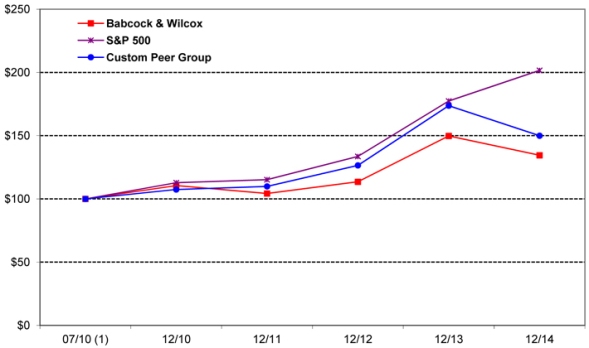
| (1) | Assumes initial investment of $100 on July 31, 2010. |
The peer group used for the four-year and five-month comparison beginning with July 2010 is comprised of the following companies:
| • |
AECOM Technology Corporation |
| • |
Chicago Bridge & Iron Company N.V. |
| • |
Curtiss-Wright Corporation |
| • |
Emcor Group, Inc. |
| • |
Fluor Corporation |
| • |
Amec Foster Wheeler |
| • |
Jacobs Engineering Group, Inc. |
| • |
KBR, Inc. |
| • |
MasTec, Inc. |
| • |
Quanta Services, Inc. |
| • |
Tetra Tech, Inc. |
| • |
URS Corporation (through acquisition by AECOM Technology Corporation on October 17, 2014) |
41
Table of Contents
| Item 6. | SELECTED FINANCIAL DATA |
| For the Years Ended | ||||||||||||||||||||
| 2014 | 2013 | 2012 | 2011 | 2010 (1) | ||||||||||||||||
| (In thousands, except for per share amounts) | ||||||||||||||||||||
|
Revenues |
$ | 2,923,019 | $ | 3,269,208 | $ | 3,291,359 | $ | 2,952,040 | $ | 2,688,811 | ||||||||||
|
Income (Loss) before Provision for Income Taxes |
$ | 5,466 | $ | 517,173 | $ | 319,418 | $ | 94,498 | $ | 220,208 | ||||||||||
|
Net Income Attributable to The Babcock & Wilcox Company |
$ | 29,388 | $ | 346,078 | $ | 227,695 | $ | 78,319 | $ | 139,939 | ||||||||||
|
Basic Earnings per Common Share (1) : |
||||||||||||||||||||
|
Net Income Attributable to The Babcock & Wilcox Company |
$ | 0.27 | $ | 3.09 | $ | 1.92 | $ | 0.67 | $ | 1.20 | ||||||||||
|
Diluted Earnings per Common Share (1) : |
||||||||||||||||||||
|
Net Income Attributable to The Babcock & Wilcox Company |
$ | 0.27 | $ | 3.07 | $ | 1.91 | $ | 0.66 | $ | 1.19 | ||||||||||
|
Cash Dividends Per Common Share |
$ | 0.40 | $ | 0.34 | $ | 0.08 | — | — | ||||||||||||
|
Total Assets |
$ | 2,856,936 | $ | 2,609,153 | $ | 2,840,355 | $ | 2,789,111 | $ | 2,500,510 | ||||||||||
|
Current Maturities of Long-Term Debt |
$ | 18,215 | $ | 4,671 | $ | 4,062 | $ | 4,653 | $ | 4,790 | ||||||||||
|
Long-Term Debt |
$ | 285,000 | $ | 225 | $ | 430 | $ | 633 | $ | 855 | ||||||||||
| (1) | On July 30, 2010, 116,225,732 shares of our common stock were distributed to MII shareholders to complete our spin-off from MII. For comparative purposes, and to provide a more meaningful calculation of weighted average shares, we have assumed this amount to be outstanding as of the beginning of each period presented prior to our spin-off in our calculation of basic weighted average shares. In addition, for our dilutive weighted average share calculations, we have assumed the dilutive securities outstanding at July 30, 2010 were also outstanding at each of the periods presented prior to our spin-off. |
We immediately recognize actuarial gains (losses) for our pension and postretirement benefit plans into earnings in the fourth quarter each year as a component of net periodic benefit cost. The effect of this adjustment for 2014, 2013, 2012, 2011 and 2010 on pre-tax income was $(241.6) million, $222.9 million, $(32.0) million, $(215.8) million, and $(91.8) million, respectively.
In the year ended December 31, 2014, the MEGTEC acquisition, which was completed on June 20, 2014, contributed $105.4 million of revenues and $5.3 million of operating income for the year ended December 31, 2014. Additionally, we recorded contract losses totaling $11.6 million for additional estimated costs to complete our Power Generation segment’s Berlin Station project. This project experienced unforeseen worksite conditions and fuel specification issues that caused schedule delays, resulting in us filing suit against the customer in January 2014. This project has now reached substantial completion. We also incurred $41.1 million of charges related to restructuring activities. In addition, we recorded a gain in other income of $14.2 million for the receipt and related fair value adjustment of the Centrus Energy Corp. common stock and notes that we received in the bankruptcy settlement in exchange for our investment in USEC Inc. (“USEC”).
In the year ended December 31, 2013, we recorded contract losses totaling $35.6 million for additional estimated costs to complete our Power Generation segment’s Berlin Station project. We also incurred $39.6 million of charges related to restructuring activities. In addition, we recorded an impairment charge totaling $19.1 million associated with our investment in USEC.
In the year ended December 31, 2012, we recorded contract losses totaling $16.9 million, net of claims, for additional estimated costs to complete our Power Generation segment’s Berlin Station project. We also entered into an agreement with the customer of a Nuclear Energy project to settle contract claims resulting in recognition of revenues totaling approximately $18.4 million. In addition, we recorded an impairment charge totaling $27.0 million associated with our investment in USEC.
42
Table of Contents
In the year ended December 31, 2011, we recorded additional costs totaling approximately $61.8 million ($50.7 million in our Nuclear Energy segment and $11.1 in our Nuclear Operations segment) to complete certain projects attributable to changes in estimate due to productivity and scheduling issues. In addition, we recognized a gain totaling approximately $10.9 million attributable to a settlement with the sellers of Nuclear Fuel Services, Inc. (“NFS”), a wholly owned subsidiary in our Nuclear Operations segment, related to adverse operating conditions in existence at the acquisition date.
Our historical financial information prior to July 2010 reflects the performance of a combined reporting entity comprised primarily of the assets and liabilities involved in managing and operating what was previously the Power Generation Systems and Government Operations segments of MII and may not provide a useful indicator of future performance.
| Item 7. | MANAGEMENT’S DISCUSSION AND ANALYSIS OF FINANCIAL CONDITION AND RESULTS OF OPERATIONS |
Statements we make in the following discussion, which express a belief, expectation or intention, as well as those that are not historical fact, are forward-looking statements that are subject to risks, uncertainties and assumptions. Our actual results, performance or achievements, or industry results, could differ materially from those we express in the following discussion as a result of a variety of factors, including the risks and uncertainties we have referred to under the headings “Cautionary Statement Concerning Forward-Looking Statements” and “Risk Factors” in Items 1 and 1A of Part I of this report.
We operate in five business segments: Power Generation, Nuclear Operations, Technical Services, Nuclear Energy and mPower. In general, we operate in capital-intensive industries and rely on large contracts for a substantial amount of our revenues. We are currently exploring growth strategies across our segments through acquisitions to expand and complement our existing businesses. We would expect to fund these opportunities by cash on hand, external financing, including debt, equity or some combination thereof.
On November 5, 2014, we announced plans to separate our Power Generation business from our Government & Nuclear Operations business, which includes the Nuclear Operations, Technical Services, Nuclear Energy and mPower segments, through a spin-off, creating a new independent, publicly traded power generation company, Babcock & Wilcox Enterprises, Inc. (“BW”). Concurrent with the spin-off, the Company will change its name to BWX Technologies, Inc. (“BWXT”). We plan to effect the separation through a tax-free spin-off transaction. Our Board of Directors and management believe that this proposed separation will provide the following benefits:
| • |
the flexibility to allocate resources and deploy capital internally in a manner consistent with the strategic priorities of each business; |
| • |
increased opportunities to pursue external growth strategies as independent companies; |
| • |
the ability to attract an investor base suited to the particular operational and financial characteristics of each company; and |
| • |
greater management focus on the distinct businesses of power generation and government and nuclear operations. |
43
Table of Contents
Before the distribution date, BW and BWXT are expected to enter into a master separation agreement that will contain the key provisions relating to the separation. The master separation agreement will identify the assets to be transferred, liabilities to be assumed and contracts to be assigned, if any, either to BW by BWXT or by BWXT to BW in the spin-off and describe when and how these transfers, assumptions and assignments will occur. In addition, before the distribution BW and BWXT or certain of their respective subsidiaries are also expected to enter into agreements to define various continuing relationships between them in various contexts. These are expected to include transition services agreements under which the parties will provide each other certain transition services on an interim basis, as well as an agreement providing for the sharing of taxes incurred before and after the distribution, various indemnification rights with respect to tax matters and restrictions to preserve the tax-free status of the distribution.
In connection with the spin-off, we expect to incur one-time, non-recurring after-tax separation costs between $45 million and $55 million. These one-time costs are expected to consist of, among other things: financial, legal, tax, accounting and other advisory fees; and regulatory fees incurred as part of the planned spin-off of our Power Generation business; and retention and severance costs.
We expect that the spin-off will be effective by mid-summer 2015. The spin-off, however, is subject to the completion of several customary conditions required to be satisfied to the sole and absolute discretion of our Board of Directors prior to the distribution including, but not limited to, the receipt of an opinion of tax counsel regarding tax treatment of the spin-off as of the distribution date and certain regulatory approvals. However, even if all of the conditions have been satisfied, we may amend, modify or abandon any and all terms of the distribution and the related transactions at any time prior to the distribution date.
Outlook
Power Generation
We expect the backlog of our Power Generation segment of approximately $2.2 billion at December 31, 2014 to produce revenues of approximately $1.0 billion in 2015, not including any change orders or new contracts that may be awarded during the year. Through this segment, we are actively bidding on and, in some cases, beginning preliminary work on projects that we expect will be awarded to us in 2015 subject to successful contract negotiations. These projects are not currently reflected in backlog.
Our Power Generation segment’s overall activity depends significantly on the capital expenditures and operations and maintenance expenditures of global electric power generating companies, other steam-using industries and industrial facilities with environmental compliance needs, the demand for electricity and capacity utilization of operating power plants, the price of natural gas in the United States, industrial plants and other steam-using industries and an increased emphasis on environmental emissions globally across a broad range of industries and markets.
We continue to seek opportunities to optimize our profitability within all our markets through an operating model that is designed to be strategically efficient and cost competitive; to expand international offerings through increased marketing, manufacturing and operational presence in regions around the world where we expect continued demand growth and increased need for services; and to seek partnering arrangements and acquisitions to expand our market presence and capabilities. On June 20, 2014, we completed the acquisition of MEGTEC. MEGTEC designs, engineers, manufactures and services air pollution control systems and coating / drying equipment for a variety of industrial applications and complements our existing environmental products and solutions offerings.
Globally, efforts to reduce the environmental impact of burning fossil fuels may create opportunities and risks as existing generating capacity is replaced with cleaner technologies. We are actively researching, developing and deploying a range of products to serve this opportunity, including lower-carbon technologies that enable clean use of fossil fuels, such as ultra-supercritical boilers; carbon-neutral technologies, such as biomass-fueled boilers and gasifiers; gas-fired package boiler technologies; and select carbon dioxide capture technologies. Additionally, our significant installed base provides a consistent and recurring aftermarket stream of parts, retrofits and services. Economic recovery, particularly in the United States, as well as major investments in global markets have
44
Table of Contents
strengthened demand, while tightening environmental regulations in China, India and developing countries are creating new opportunities. We foresee long-term trends toward increased environmental controls for global electric power generating companies, other steam-using industries and industrial facilities with environmental compliance needs around the world. However, downturns in regional economies adversely impact demand in the short-term.
Nuclear Operations
We expect the backlog of our Nuclear Operations segment of approximately $2.8 billion at December 31, 2014 to produce revenues of approximately $1.1 billion in 2015, not including any change orders or new contracts that may be awarded during the year.
The revenues of our Nuclear Operations segment are largely a function of defense spending by the U.S. Government. As a supplier of major nuclear components for certain U.S. Government programs, we are a significant participant in the defense industry and have not been negatively impacted by sequestration or federal budget reductions to date. We believe many of our programs are well aligned with national defense and other strategic priorities as we supply high-end equipment for submarines and aircraft carriers for the U.S. Navy. However, it is possible that reductions in federal government spending and sequestration could have an adverse impact on the operating results and cash flows of our Nuclear Operations and Technical Services segments in the future.
Technical Services
A significant portion of this segment’s operations are conducted through joint ventures, which typically earn fees and we account for them following the equity method of accounting. See Note 3 to our consolidated financial statements included in this report for financial information on our equity method investments. As a result, this segment reports minimal backlog and revenues.
On January 8, 2013, we were notified that our joint venture, Nuclear Production Partners, LLC, was not selected to lead the National Nuclear Safety Administration’s (“NNSA”) combined Management and Operating contract for the Y-12 National Security Complex and Pantex Plant. The transition of these facilities to the new contractor was completed on June 30, 2014. These joint ventures contributed $21.5 million, $34.0 million and $37.7 million to our operating income in the years ended December 31, 2014, 2013 and 2012, respectively. However, with our specialized capabilities of full life-cycle management of special nuclear materials, facilities and technologies, we believe our Technical Services segment is well-positioned to continue to participate in the continuing cleanup, operation and management of the nuclear sites, laboratories and weapons complexes maintained by the DOE, Atomic Energy of Canada Limited and the U.K. Nuclear Decommissioning Authority.
Nuclear Energy
We expect the backlog of our Nuclear Energy segment of approximately $264 million at December 31, 2014 to produce revenues of approximately $87 million in 2015, not including any change orders or new contracts that may be awarded during the year. The revenues in this segment primarily depend on the demand and competitiveness of nuclear energy. The activity of this segment depends on the timing of maintenance outages primarily in the Canadian market and the cyclical nature of capital expenditures and major refurbishments for nuclear utility customers which could cause variability in our financial results.
mPower
The development, general and administrative and capital costs to develop and commercialize our B&W mPower™ technology will require a substantial amount of investment over a period of years, and the funding requirements may vary significantly from period to period.
On April 14, 2014, we announced our plans to restructure the mPower program to reduce spending and focus on technology development. Beginning in the third quarter of 2014, we slowed the pace of development and continued to search for additional investors in the mPower program. Going forward, we plan to invest no more than $15 million per year, net of amounts reimbursed from the Funding Program. As a result of our plans to restructure the mPower program, our operating income was negatively impacted by $23.9 million for the year ended December 31,
45
Table of Contents
2014, consisting of $10.6 million of special charges for restructuring activities as further discussed below and $13.3 million of unrecognized cost-share due to restrictions on additional authorized funding by the DOE under the Funding Program. We intend to continue working with the DOE to further the program. At this time, the latest extension to the Cooperative Agreement has expired and the DOE funding has been suspended. If a mutually agreeable plan is not identified, future amounts may not be made available to us under the Funding Program.
CRITICAL ACCOUNTING POLICIES AND ESTIMATES
Our financial statements and accompanying notes are prepared in accordance with accounting principles generally accepted in the United States. Preparing financial statements requires management to make estimates and assumptions that affect the reported amounts of assets, liabilities, revenues and expenses. These estimates and assumptions are affected by management’s application of accounting policies. We believe the following are our most critical accounting policies that we apply in the preparation of our financial statements. These policies require our most difficult, subjective and complex judgments, often as a result of the need to make estimates of matters that are inherently uncertain.
Contracts and Revenue Recognition. We determine the appropriate accounting method for each of our long-term contracts before work on the project begins. We generally recognize contract revenues and related costs on a percentage-of-completion method for individual contracts or combinations of contracts based on work performed, man hours or a cost-to-cost method, as applicable to the product or activity involved . We recognize estimated contract revenue and resulting income based on costs incurred to date as a percentage of total estimated costs. Certain costs may be excluded from the cost-to-cost method of measuring progress, such as significant costs for materials and major third-party subcontractors, if it appears that such exclusion would result in a more meaningful measurement of actual contract progress and resulting periodic allocation of income. For all contracts, if a current estimate of total contract cost indicates a loss on a contract, the projected loss is recognized in full when determined. It is possible that current estimates could materially change for various reasons, including, but not limited to, fluctuations in forecasted labor productivity or steel and other raw material prices. We routinely review estimates related to our contracts, and revisions to profitability are reflected in the quarterly and annual earnings we report. In the years ended December 31, 2014, 2013 and 2012, we recognized net favorable changes in estimate related to long-term contracts accounted for on the percentage-of-completion basis that increased operating income by approximately $61.4 million, $21.9 million and $93.1 million, respectively. The 2014 and 2013 amounts include contract losses totaling $11.6 million and $35.6 million, respectively, for additional estimated costs to complete our Power Generation segment’s Berlin Station project. This is in addition to approximately $16.9 million of contract losses, net of claims, recorded on this project in 2012. This project has now reached substantial completion.
For contracts as to which we are unable to estimate the final profitability except to assure that no loss will ultimately be incurred, we recognize equal amounts of revenue and cost until the final results can be estimated more precisely. For these deferred profit recognition contracts, we recognize revenue and cost equally and only recognize gross margin when probable and reasonably estimable, which we generally determine to be when the contract is approximately 70% complete. We treat long-term construction contracts that contain such a level of risk and uncertainty that estimation of the final outcome is impractical except to assure that no loss will be incurred as deferred profit recognition contracts. We did not enter into any contracts that we have accounted for as deferred profit recognition contracts during 2014, 2013 or 2012.
Our policy is to account for fixed-price contracts under the completed-contract method if we believe that we are unable to reasonably forecast cost to complete at start-up. For example, if we have no experience in performing the type of work on a particular project and are unable to develop reasonably dependable estimates of total costs to complete, we would follow the completed-contract method of accounting for such projects. Generally, our management’s policy is not to enter into fixed-price contracts without an accurate estimate of cost to complete. However, it is possible that in the time between contract execution and the start of work on a project, we could lose confidence in our ability to forecast cost to complete based on intervening events, including, but not limited to, experience on similar projects, civil unrest, strikes and volatility in our expected costs. In such a situation, we would use the completed-contract method of accounting for that project. We did not enter into any contracts that we have accounted for under the completed-contract method during 2014, 2013 or 2012.
46
Table of Contents
For parts orders and certain aftermarket services activities, we recognize revenues as goods are delivered and work is performed.
Although we continually strive to improve our ability to estimate our contract costs and profitability, adjustments to overall contract costs due to unforeseen events could be significant in future periods. We recognize claims for extra work or for changes in scope of work in contract revenues, to the extent of costs incurred, when we believe collection is probable and can be reasonably estimated. We recognize income from contract change orders or claims when formally agreed with the customer. We regularly assess the collectability of contract revenues and receivables from customers.
Property, Plant and Equipment. We carry our property, plant and equipment at depreciated cost, reduced by provisions to recognize economic impairment when we determine impairment has occurred. Property, plant and equipment amounts are reviewed for impairment whenever events or changes in circumstances indicate that the carrying amount of an asset, or asset group, may not be recoverable. An impairment loss would be recognized when the carrying amount of an asset exceeds the estimated undiscounted future cash flows expected to result from the use of the asset and its eventual disposition. The amount of the impairment loss to be recorded is calculated by the excess of the asset carrying value over its fair value. Fair value is generally determined using a discounted cash flow analysis. Our estimates of cash flow may differ from actual cash flow due to, among other things, technological changes, economic conditions or changes in operating performance. Any changes in such factors may negatively affect our business segments and result in future asset impairments.
We depreciate our property, plant and equipment using the straight-line method, over estimated economic useful lives of eight to 33 years for buildings and three to 28 years for machinery and equipment. We expense the costs of maintenance, repairs and renewals, which do not materially prolong the useful life of an asset, as we incur them.
Investments in Unconsolidated Affiliates. We use the equity method of accounting for affiliates in which our investment ownership ranges from 20% to 50%, unless significant economic or governance considerations indicate that we are unable to exert significant influence, in which case the cost method is used. The equity method is also used for affiliates in which our investment ownership is greater than 50% but we do not have a controlling interest. Currently, all of our material investments in affiliates that are not included in our consolidated results are recorded using the equity method. Affiliates in which our investment ownership is less than 20% and where we are unable to exert significant influence are carried at cost.
Self-Insurance. We have a wholly owned insurance subsidiary that provides employer’s liability, general and automotive liability and workers’ compensation insurance and, from time to time, builder’s risk insurance within certain limits to our companies. We may also have business reasons in the future to have our insurance subsidiary accept other risks that we cannot or do not wish to transfer to outside insurance companies. When estimating our self-insurance liabilities, we consider a number of factors, including historical claims experience and trend lines, projected growth patterns, inflation and exposure forecasts. The assumptions we make with respect to each of these factors represent our judgment as to the most probable cumulative impact of each factor on our future obligations. Our calculation of self-insurance liabilities requires us to apply judgment to estimate the ultimate cost to settle reported claims and claims incurred but not yet reported as of the balance sheet date. We engage the services of an actuarial firm to assist us in the calculation of our liabilities for self-insurance. While the actual outcome of insured claims could differ significantly from estimated amounts, these loss estimates and accruals recorded in our financial statements for claims have historically been reasonable in light of the actual amount of claims paid. Provisions for exposure to self-insurance claims and the related payments of claims have historically not had a material adverse impact on our consolidated financial position, results of operations and cash flows, and we do not expect these provisions to have a material impact on our self-insurance programs in the future.
Pension Plans and Postretirement Benefits. We utilize actuarial and other assumptions in calculating the cost and benefit obligations of our pension and postretirement benefits. The assumptions utilized in the determination of our benefit cost and obligations include assumptions regarding discount rates, expected returns on plan assets, mortality and health care cost trends. The assumptions utilized represent our best estimates based on historical experience and other factors.
Actual experience that differs from these assumptions or future changes in assumptions will affect our recognized benefit obligations and related costs. We immediately recognize net actuarial gains and losses into earnings in the
47
Table of Contents
fourth quarter as a component of net periodic benefit cost. Net actuarial gains and losses occur when actual experience differs from any of the various assumptions used to value our pension and postretirement benefit plans or when assumptions, which are revisited annually through our update of our actuarial valuations, change due to current market conditions or underlying demographic changes. The primary factors contributing to net actuarial gains and losses are changes in the discount rate used to value the obligations as of the measurement date each year, the difference between the actual return on plan assets and the expected return on plan assets and changes in health care cost trends. The effect of changes in the discount rate and expected rate of return on plan assets assumptions in combination with the actual return on plan assets can result in significant changes in our estimated pension and postretirement benefit cost and our consolidated financial condition. Additionally, in the current year, we adjusted our mortality assumption to reflect mortality improvements identified by the Society of Actuaries, adjusted for the Company’s experience. The impact of the change in this assumption caused a $117.7 million increase in our pension liability.
The following sensitivity analysis shows the impact of a 25 basis point change in the assumed discount rate, return on assets, and health care cost trend rate on our pension and postretirement benefit plan obligations and expense for the year ended December 31, 2014:
| .25% Increase | .25% Decrease | |||||||
| (in millions) | ||||||||
|
Pension Plans |
||||||||
|
Discount Rate : |
||||||||
|
Effect on ongoing net periodic benefit cost (1) |
$ | 2.5 | $ | (4.8 | ) | |||
|
Effect on project benefit obligation |
(86.9 | ) | 91.6 | |||||
|
Return on Assets: |
||||||||
|
Effect on ongoing net periodic benefit cost |
$ | (5.3 | ) | $ | 5.3 | |||
|
Postretirement Plans |
||||||||
|
Discount Rate: |
||||||||
|
Effect on ongoing net periodic benefit cost (1) |
$ | — | $ | — | ||||
|
Effect on project benefit obligation |
(2.6 | ) | 2.9 | |||||
|
Return on Assets: |
||||||||
|
Effect on ongoing net periodic benefit cost |
$ | (0.1 | ) | $ | 0.1 | |||
|
Health Care Cost Trend Rate: |
||||||||
|
Effect on ongoing net periodic benefit cost |
$ | 0.1 | $ | (0.1 | ) | |||
|
Effect on project benefit obligation |
1.9 | (1.7 | ) | |||||
| (1) | Excludes effect of annual mark-to-market adjustment. |
Loss Contingencies. We estimate liabilities for loss contingencies when it is probable that a liability has been incurred and the amount of loss is reasonably estimable. We provide disclosure when there is a reasonable possibility that the ultimate loss will exceed the recorded provision or if such probable loss is not reasonably estimable. We are currently involved in some significant litigation, as discussed in Note 10 to our consolidated financial statements included in this report. We have accrued our estimates of the probable losses associated with these matters. However, our losses are typically resolved over long periods of time and are often difficult to estimate due to the possibility of multiple actions by third parties. Therefore, it is possible that future earnings could be affected by changes in our estimates related to these matters.
Goodwill and Intangible Assets. Each year, we evaluate goodwill at each reporting unit to assess recoverability, and impairments, if any, are recognized in earnings. We perform a qualitative analysis when we believe that there is sufficient excess fair value over carrying value based on our most recent quantitative assessment, adjusted for relevant facts and circumstances that could affect fair value. Deterioration in macroeconomic, industry and market conditions, cost factors, overall financial performance, share price decline or entity and reporting unit specific events could cause us to believe a qualitative test is no longer appropriate.
When we determine that it is appropriate to test goodwill for impairment utilizing a quantitative test, the first step of the test compares the fair value of a reporting unit to its carrying amount, including goodwill. We utilize both the income and market valuation approaches to provide inputs into the estimate of the fair value of our reporting units, which would be considered by market participants.
48
Table of Contents
Under the income valuation approach, we employ a discounted cash flow model to estimate the fair value of each reporting unit. This model requires the use of significant estimates and assumptions regarding future revenues, costs, margins, capital expenditures, changes in working capital, terminal year growth rate and cost of capital. Our cash flow models are based on our forecasted results for the applicable reporting units. Actual results could differ materially from our projections. Some assumptions, such as future revenues, costs and changes in working capital are company driven and could be affected by a loss of one or more significant contracts or customers, failure to control costs on certain contracts; a decline in U.S. Government funding or a decline in demand based on changing economic or regulatory conditions. Changes in external market conditions may affect certain other assumptions, such as the cost of capital. Market conditions can be volatile and are outside of our control.
Under the market valuation approach, we employ the guideline publicly traded company method, which indicates the fair value of the equity of each reporting unit by comparing it to publicly traded companies in similar lines of business. After identifying and selecting guideline companies, we analyze their business and financial profiles for relative similarity. Factors such as size, growth, risk and profitability are analyzed and compared to each of our reporting units. Assumptions include the selection of our peer companies and use of market multiples, which could deteriorate or increase based on the profitability of our competitors and performance of their stock, which is often dependent on the performance of the stock market and general economy as a whole.
Adverse changes in these assumptions utilized within the first step of our impairment test could cause a reduction or elimination of excess fair value over carrying value, resulting in potential recognition of impairment. If the carrying amount of a reporting unit exceeds its fair value, the second step of the goodwill impairment test is performed to measure the amount of the impairment loss, if any. The second step compares the implied fair value of the reporting unit’s goodwill with the carrying amount of that goodwill.
We completed our annual review of goodwill for each of our reporting units for the year ended December 31, 2014, which indicated that we had no impairment of goodwill. The fair value of our reporting units was substantially in excess of carrying value.
Each year, we evaluate indefinite lived intangible assets to assess recoverability, and impairments, if any, are recognized in earnings. We perform a qualitative assessment when testing indefinite lived intangible assets for impairment to determine whether events or circumstances that could affect the significant inputs used in determining fair value have occurred that indicate that it is more likely than not that the indefinite lived intangible asset is impaired. Deterioration in macroeconomic, industry and market conditions, cost factors or overall financial performance could cause us to believe a qualitative test is no longer appropriate. When quantitative assessments are performed, we primarily utilize income-based valuation approaches. Under the income-based valuation approach, we employ a relief from royalty method of valuation. This method requires significant assumptions, including assumed royalty rate, future revenues and cost of capital. Assumptions related to operating performance, such as future revenues, could be affected by loss of a customer contract, a decline in U.S. Government funding or a decline in demand based on changing economic or regulatory conditions. Changes in external market conditions may affect certain other assumptions, such as the cost of capital. Market conditions can be volatile and are outside of our control.
Adverse changes in these assumptions utilized within our indefinite lived intangible asset impairment test could cause a reduction or elimination of excess fair value over carrying value, resulting in potential recognition of impairment.
We have completed our annual review of our indefinite lived intangible assets for the year ended December 31, 2014, which indicated that we had no impairment. The fair value of our indefinite lived intangible assets was substantially in excess of carrying value.
Asset Retirement Obligations and Environmental Clean-up Costs. We accrue for future decommissioning of our nuclear facilities that will permit the release of these facilities to unrestricted use at the end of each facility’s life, which is a requirement of our licenses from the NRC. In accordance with the FASB Topic Asset Retirement and Environmental Obligations , we record the fair value of a liability for an asset retirement obligation in the period in
49
Table of Contents
which it is incurred. In estimating fair value, we use present value of cash flows expected to be incurred in settling our obligations. To the extent possible, we perform a marketplace assessment of the cost and timing of performing the retirement activities. We apply a credit-adjusted risk-free interest rate to our expected cash flows in our determination of fair value. When we initially record such a liability, we capitalize a cost by increasing the carrying amount of the related long-lived asset. Over time, the liability is accreted to its present value each period, and the capitalized cost is depreciated over the useful life of the related asset. Upon settlement of a liability, we will settle the obligation for its recorded amount or incur a gain or loss. This topic applies to environmental liabilities associated with assets that we currently operate and are obligated to remove from service. For environmental liabilities associated with assets that we no longer operate, we have accrued amounts based on the estimated costs of clean-up activities, net of the anticipated effect of any applicable cost-sharing arrangements. We adjust the estimated costs as further information develops or circumstances change. An exception to this accounting treatment relates to the work we perform for two facilities for which the U.S. Government is obligated to pay substantially all the decommissioning costs.
Income Taxes. Income tax expense for federal, foreign, state and local income taxes are calculated on pre-tax income based on current tax law and includes the cumulative effect of any changes in tax rates from those used previously in determining deferred tax assets and liabilities. We record a valuation allowance to reduce our deferred tax assets to the amount that is more likely than not to be realized. We assess deferred taxes and the adequacy of the valuation allowance on a quarterly basis. In the ordinary course of business there is inherent uncertainty in quantifying our income tax positions. We assess our income tax positions and record tax benefits for all years subject to examination based upon management’s evaluation of the facts, circumstances, and information available at the reporting date. For those tax positions where it is more likely than not that a tax benefit will be sustained, we have recorded the largest amount of tax benefit with a greater than 50% likelihood of being realized upon ultimate settlement with a taxing authority that has full knowledge of all relevant information. For those income tax positions where it is not more likely than not that a tax benefit will be sustained, no tax benefit has been recognized in the financial statements. We record interest and penalties (net of any applicable tax benefit) related to income taxes as a component of provision for income taxes on our consolidated statements of income.
Warranty. We accrue estimated expense included in cost of operations on our consolidated statements of income to satisfy contractual warranty requirements when we recognize the associated revenue on the related contracts. In addition, we record specific provisions or reductions when we expect the actual warranty costs to significantly differ from the accrued estimates. Factors that impact our estimate of warranty costs include prior history of warranty claims and our estimates of future costs of materials and labor. Such changes could have a material effect on our consolidated financial condition, results of operations and cash flows.
Stock-Based Compensation. We account for stock-based compensation in accordance with FASB Topic Compensation – Stock Compensation . Under the fair value recognition provisions of this statement, the cost of employee services received in exchange for an award of equity instruments is measured at the grant date based on the fair value of the award. Stock-based compensation expense is recognized on a straight-line basis over the requisite service periods of the awards, which is generally equivalent to the vesting term. We use a Black-Scholes model to determine the fair value of certain share-based awards, such as stock options and stock appreciation rights. For performance shares or units granted in the year ended December 31, 2014 that contain a Relative Total Shareholder Return vesting criteria, we utilize a Monte Carlo simulation to determine the grant date fair value, which determines the probability of satisfying the market condition included in the award. The determination of the fair value of a share-based payment award using an option-pricing model requires the input of highly subjective assumptions, such as the expected life of the award and stock price volatility. For liability-classified awards, such as cash-settled restricted stock units and performance units, fair values are determined at grant date using the closing price of our common stock and are remeasured at the end of each reporting period through the date of settlement.
Business Combinations. We account for acquisitions in accordance with FASB Topic Business Combinations. This topic broadens the fair value measurements and recognition of assets acquired, liabilities assumed and interests transferred as a result of business combinations. It also provides disclosure requirements to assist users of the financial statements in evaluating the nature and financial effects of business combinations.
For further discussion of recently adopted accounting standards, see Note 1 to our consolidated financial statements included in this report.
50
Table of Contents
RESULTS OF OPERATIONS – YEARS ENDED DECEMBER 31, 2014, 2013 and 2012
Selected financial highlights are presented in the table below:
| Year Ended December 31, | ||||||||||||
| 2014 | 2013 | 2012 | ||||||||||
| (In thousands) | ||||||||||||
|
REVENUES: |
||||||||||||
|
Power Generation |
$ | 1,486,029 | $ | 1,767,651 | $ | 1,785,959 | ||||||
|
Nuclear Operations |
1,220,952 | 1,167,683 | 1,098,031 | |||||||||
|
Technical Services |
84,834 | 104,254 | 107,851 | |||||||||
|
Nuclear Energy |
154,721 | 283,857 | 325,655 | |||||||||
|
mPower |
278 | 1,523 | 326 | |||||||||
|
Adjustments and Eliminations |
(23,795 | ) | (55,760 | ) | (26,463 | ) | ||||||
|
|
|
|
|
|
|
|||||||
| $ | 2,923,019 | $ | 3,269,208 | $ | 3,291,359 | |||||||
|
|
|
|
|
|
|
|||||||
|
OPERATING INCOME: |
||||||||||||
|
Power Generation |
$ | 98,557 | $ | 155,837 | $ | 183,387 | ||||||
|
Nuclear Operations |
270,536 | 237,855 | 226,269 | |||||||||
|
Technical Services |
35,203 | 58,234 | 59,655 | |||||||||
|
Nuclear Energy |
(23,211 | ) | 8,641 | 50,649 | ||||||||
|
mPower |
(68,946 | ) | (81,304 | ) | (113,528 | ) | ||||||
|
|
|
|
|
|
|
|||||||
| $ | 312,139 | $ | 379,263 | $ | 406,432 | |||||||
|
|
|
|
|
|
|
|||||||
|
Unallocated Corporate |
(32,514 | ) | (26,039 | ) | (27,953 | ) | ||||||
|
Special Charges for Restructuring Activities |
(41,091 | ) | (39,599 | ) | — | |||||||
|
Mark to Market Adjustment |
(241,156 | ) | 222,737 | (31,890 | ) | |||||||
|
|
|
|
|
|
|
|||||||
|
Total Operating Income |
$ | (2,622 | ) | $ | 536,362 | $ | 346,589 | |||||
|
|
|
|
|
|
|
|||||||
Consolidated Results of Operations
Year Ended December 31, 2014 vs. 2013
Consolidated revenues decreased 10.6%, or $346.2 million, to $2.9 billion in the year ended December 31, 2014 compared to $3.3 billion for the corresponding period in 2013 due to decreases in revenues from our Power Generation, Technical Services and Nuclear Energy segments totaling $281.6 million, $19.4 million and $129.1 million, respectively. These decreases were partially offset by increased revenues in our Nuclear Operations segment totaling $53.3 million.
Consolidated operating income decreased $539.0 million to a loss of $2.6 million in the year ended December 31, 2014 compared to income of $536.4 million for the corresponding period in 2013. Operating income includes actuarial gains and losses (“MTM charges”) related to our pension and postretirement plans, which reflected a non-cash gain (loss) of $(241.2) million and $222.7 million in 2014 and 2013, respectively. In addition, operating income for the years ended December 31, 2014 and 2013 includes special charges for restructuring activities totaling $41.1 million and $39.6 million, respectively. Excluding MTM charges and special charges for restructuring activities, operating income of our reportable segments and unallocated corporate expenses decreased $73.6 million for the year ended December 31, 2014 compared to 2013. Operating income in our Power Generation, Technical Services and Nuclear Energy segments declined $57.3 million, $23.0 million and $31.9 million, respectively. These decreases were partially offset by increased operating income in our Nuclear Operations and mPower segment totaling $32.7 million and $12.4 million, respectively.
Year Ended December 31, 2013 vs. 2012
Consolidated revenues decreased 0.7%, or $22.2 million, to $3.27 billion in the year ended December 31, 2013 compared to $3.29 billion in 2012 due to decreases in revenues from our Power Generation, Technical Services and Nuclear Energy segments totaling $18.3 million, $3.6 million and $41.8 million, respectively. These decreases were partially offset by increased revenues in our Nuclear Operations segment totaling $69.7 million.
51
Table of Contents
Consolidated operating income increased $189.8 million to $536.4 million in the year ended December 31, 2013 from $346.6 million in 2012. Operating income includes MTM charges, which reflected a non-cash gain (loss) of $222.7 million and $(31.9) million in 2013 and 2012, respectively. In addition, operating income for the year ended December 31, 2013 includes special charges for restructuring activities totaling $39.6 million related to GCI initiatives. Excluding MTM charges and GCI charges, operating income of our reportable segments and unallocated corporate expenses decreased $25.3 million for the year ended December 31, 2013 compared to 2012. Operating income in our Power Generation, Technical Services and Nuclear Energy segments declined $27.6 million, $1.5 million and $42.0 million, respectively. These decreases were partially offset by increased operating income in our Nuclear Operations and mPower segment totaling $11.6 million and $32.2 million, respectively.
Power Generation
| Year Ended December 31, | Year Ended December 31, | |||||||||||||||||||||||
| 2014 | 2013 | $ Change | 2013 | 2012 | $ Change | |||||||||||||||||||
|
Revenues |
$ | 1,486,029 | $ | 1,767,651 | $ | (281,622 | ) | $ | 1,767,651 | $ | 1,785,959 | $ | (18,308 | ) | ||||||||||
|
Operating Income |
98,557 | 155,837 | (57,280 | ) | 155,837 | 183,387 | (27,550 | ) | ||||||||||||||||
|
% of Revenues |
6.6 | % | 8.8 | % | 8.8 | % | 10.3 | % | ||||||||||||||||
Year Ended December 31, 2014 vs. 2013
Revenues decreased 15.9%, or $281.6 million, to $1,486.0 million in the year ended December 31, 2014, compared to $1,767.7 million in 2013. The decrease was primarily attributable to a $199.8 million decline in revenues from our new build environmental equipment business revenues, principally driven by lower levels of engineering, procurement and construction activities as projects related to the previously enacted environmental rules and regulations near completion and uncertainties continue regarding the ultimate outcome of environmental regulations. We also experienced a $95.7 million decrease in revenues from our new build steam generation systems business due to a lower level of activity on our Berlin Station project and other renewable energy projects. In addition, we experienced a decrease in revenues of $89.1 million in our aftermarket services business related to lower service projects revenues, primarily due to a large boiler retrofit and construction project that was completed in 2013. The MEGTEC acquisition, which was completed on June 20, 2014, contributed $105.4 million of revenues for the year ended December 31, 2014.
Operating income decreased $57.3 million to $98.6 million in the year ended December 31, 2014 compared to $155.8 million in 2013, primarily due to the lower revenues discussed above, partially offset by a $24.0 million lower loss provision recorded on the Berlin Station project as compared to the prior period. In addition, lower levels of warranty improvements in the current year had a negative impact on gross margins when compared to the prior year period. The MEGTEC acquisition contributed $5.3 million of operating income for the year ended December 31, 2014, net of $7.4 million of expense related to amortization of intangible assets. In addition, equity income from our joint ventures decreased by $9.7 million primarily due to market pressures in China and Australia, new facility costs in India and the near completion of a U.S. environmental project joint venture that generated more operating income in the corresponding period in 2013. These decreases were partially offset by a $7.1 million reduction in selling, general and administrative expenses associated with cost savings initiatives and a $3.6 million reduction in research and development expenditures, both of which are net of MEGTEC activity.
Year Ended December 31, 2013 vs. 2012
Revenues decreased 1.0%, or $18.3 million, to $1,767.7 million in the year ended December 31, 2013, compared to $1,786.0 million in 2012. The net decrease is primarily attributable to a $56.9 million decrease in our new build steam generation systems business due to a lower level of activity on waste-to-energy and industrial boiler projects. We also experienced a $12.3 million decrease in our new build environmental equipment business principally driven by lower levels of engineering, procurement and construction activities as projects related to the previously enacted environmental rules and regulations near completion and uncertainties continue regarding the ultimate outcome of environmental regulations. These decreases were partially offset by an increase in revenues of $43.6 million in our aftermarket services business as increases in boiler-related construction and maintenance services more than offset a decrease in environmental retrofit activity.
52
Table of Contents
Operating income decreased $27.6 million to $155.8 million in the year ended December 31, 2013 compared to $183.4 million in 2012, due to contract losses totaling $35.6 million recorded for additional estimated costs to complete the Berlin Station project. These losses are in addition to $16.9 million of contract losses, net of claims, recorded for this project during the fourth quarter of 2012. In addition to the lower revenues discussed above, we also experienced more competitive profit margins and a lower level of net favorable project close-outs compared to the prior period. These decreases in income were partially offset by decreased overhead costs and a $12.5 million reduction in selling, general and administrative expenses due to ongoing cost reduction initiatives.
Nuclear Operations
| Year Ended December 31, | Year Ended December 31, | |||||||||||||||||||||||
| 2014 | 2013 | $ Change | 2013 | 2012 | $ Change | |||||||||||||||||||
|
Revenues |
$ | 1,220,952 | $ | 1,167,683 | $ | 53,269 | $ | 1,167,683 | $ | 1,098,031 | $ | 69,652 | ||||||||||||
|
Operating Income |
270,536 | 237,855 | 32,681 | 237,855 | 226,269 | 11,586 | ||||||||||||||||||
|
% of Revenues |
22.2 | % | 20.4 | % | 20.4 | % | 20.6 | % | ||||||||||||||||
Year Ended December 31, 2014 vs. 2013
Revenues increased by 4.6%, or $53.3 million, to $1,221.0 million in the year ended December 31, 2014 compared to $1,167.7 million in the corresponding period of 2013. This increase in revenues is primarily attributable to the $46.4 million cumulative effect impact of a contract change order that increased the value of existing contracts. In addition, increased activity in the manufacturing of nuclear components for U.S. Government programs resulted in increased revenues totaling $11.2 million in 2014 as compared to 2013. These increases were partially offset by a decrease in revenues in our naval nuclear fuel and downblending activities totaling $4.2 million due to lower downblending activities.
Operating income increased $32.7 million to $270.5 million in the year ended December 31, 2014 compared to $237.9 million in the corresponding period of 2013, primarily attributable to $20.6 million impact of the change order discussed above, partially offset by the recognition of the associated costs being recovered, as well as positive performance on our naval nuclear fuel and downblending activities.
Year Ended December 31, 2013 vs. 2012
Revenues increased 6.3%, or $69.7 million, to $1,167.7 million in the year ended December 31, 2013 compared to $1,098.0 million in the corresponding period of 2012, primarily attributable to increased activity related to the manufacturing of nuclear components for U.S. Government programs totaling $55.9 million and increased activity in our naval nuclear fuel and downblending activities totaling $13.8 million as compared to the corresponding period of 2012.
Operating income increased $11.6 million to $237.9 million in the year ended December 31, 2013 compared to $226.3 million in the corresponding period in 2012 primarily attributable to increased activity related to the manufacturing of nuclear components for U.S. Government programs totaling $9.6 million and increased activity in our naval nuclear fuel and downblending activities totaling $2.0 million.
53
Table of Contents
Technical Services
| Year Ended December 31, | Year Ended December 31, | |||||||||||||||||||||||
| 2014 | 2013 | $ Change | 2013 | 2012 | $ Change | |||||||||||||||||||
|
Revenues |
$ | 84,834 | $ | 104,254 | $ | (19,420 | ) | $ | 104,254 | $ | 107,851 | $ | (3,597 | ) | ||||||||||
|
Operating Income |
35,203 | 58,234 | (23,031 | ) | 58,234 | 59,655 | (1,421 | ) | ||||||||||||||||
Year Ended December 31, 2014 vs. 2013
Revenues decreased 18.6%, or $19.4 million, to $84.8 million in the year ended December 31, 2014 compared to $104.3 million for the corresponding period of 2013, primarily attributable to a decrease in specialty manufacturing associated with the termination of our work scope for the American Centrifuge Program that occurred in the second quarter of 2014.
Operating income decreased $23.0 million to $35.2 million in the year ended December 31, 2014 compared to $58.2 million in the corresponding period of 2013. The loss of fee income on the Pantex and Y-12 contracts contributed $12.5 million of this decrease. We also earned lower fee income due to the contamination and shutdown incident at the Waste Isolation Pilot Plant. In addition, selling, general, and administrative expenses were $3.3 higher compared to the corresponding period of 2013 primarily due to increased business development activities.
Year Ended December 31, 2013 vs. 2012
Revenues decreased 3.3%, or $3.6 million, to $104.3 million in the year ended December 31, 2013 compared to $107.9 million for the corresponding period of 2012, primarily attributable to lower reimbursable costs at our Naval Reactor decommissioning and decontamination project.
Operating income decreased $1.5 million, to $58.2 million in the year ended December 31, 2013 compared to $59.7 million for the corresponding period of 2012. This decrease is principally due to net lower fees for NNSA projects totaling $2.7 million and lower income associated with a restructured contract totaling $3.7 million. These amounts were offset by lower selling, general and administrative expenses of $4.8 million compared to 2012 primarily due to timing of new proposals resulting in lower business development expenses.
Nuclear Energy
| Year Ended December 31, | Year Ended December 31, | |||||||||||||||||||||||
| 2014 | 2013 | $ Change | 2013 | 2012 | $ Change | |||||||||||||||||||
|
Revenues |
$ | 154,721 | $ | 283,857 | $ | (129,136 | ) | $ | 283,857 | $ | 325,655 | $ | (41,798 | ) | ||||||||||
|
Operating Income (Loss) |
(23,211 | ) | 8,641 | (31,852 | ) | 8,641 | 50,649 | (42,008 | ) | |||||||||||||||
|
% of Revenues |
(15.0 | )% | 3.0 | % | 3.0 | % | 15.6 | % | ||||||||||||||||
Year Ended December 31, 2014 vs. 2013
Revenues decreased 45.5%, or $129.1 million, to $154.7 million in the year ended December 31, 2014 compared to $283.9 million in the corresponding period of 2013. This decrease is primarily attributable to the exit of our low margin nuclear projects business resulting in a $78.7 million decrease in revenues. In addition, we experienced a decrease in revenues from our nuclear equipment business totaling $42.1 million largely due to the completion of a replacement steam generator contract that was ongoing in the prior year period.
Operating income decreased $31.9 million to a loss of $23.2 million in the year ended December 31, 2014 compared to income of $8.6 million in the corresponding period of 2013, primarily attributable to the $16.1 million loss recognition resulting from an adverse jury verdict in a lawsuit involving commercial nuclear contracts. We also experienced reduced operating income from our nuclear equipment business related to the decrease in revenues noted above. In addition, during the year ended December 31, 2013, we recognized $7.1 million of warranty improvements associated with favorable warranty experience. This decline in operating income was partially offset by $5.4 million of reduced selling, general and administrative expenses associated with cost savings from GCI and margin improvement initiatives.
54
Table of Contents
Year Ended December 31, 2013 vs. 2012
Revenues decreased 12.8%, or $41.8 million, to $283.9 million in the year ended December 31, 2013 compared to $325.7 million in the corresponding period of 2012. The decrease in revenues is primarily attributable to decreased activity in our nuclear services and nuclear equipment businesses of $95.8 million associated with the completion of several large contracts that were ongoing in the prior period and $18.4 million of revenue recorded in the prior year related to the settlement agreement reached with Energy Northwest related to a condenser replacement project at Columbia Generating Station in 2011. This decline in revenue was partially offset by increased project activities associated with an ongoing long-term project in our nuclear projects business.
Operating income decreased $42.0 million to $8.6 million in the year ended December 31, 2013 compared to $50.6 million in the corresponding period of 2012. This decrease is primarily attributable to the decline in revenues noted above, lower margins due to unfavorable project mix compared to the prior period, and $18.1 million (net of related expenses) recognized in 2012 associated with the Energy Northwest settlement agreement discussed above. These decreases were partially offset by $7.1 million of favorable warranty experience.
mPower
| Year Ended December 31, | Year Ended December 31, | |||||||||||||||||||||||
| 2014 | 2013 | $ Change | 2013 | 2012 | $ Change | |||||||||||||||||||
|
Revenues |
$ | 278 | $ | 1,523 | $ | (1,245 | ) | $ | 1,523 | $ | 326 | $ | 1,197 | |||||||||||
|
Operating Income (Loss) |
(68,946 | ) | (81,304 | ) | 12,358 | (81,304 | ) | (113,528 | ) | 32,224 | ||||||||||||||
Year Ended December 31, 2014 vs. 2013
Operating income increased $12.4 million to a loss of $68.9 million in the year ended December 31, 2014 compared to a loss of $81.3 million in the corresponding period of 2013, due to the slowing of the pace of development related to our announced plans to restructure the mPower program. Research and development activities related to the development of the B&W mPower™ reactor decreased by $52.1 million with a related decrease in the recognition of the cost-sharing award from the DOE under our Cooperative Agreement totaling $50.6 million. The year ended December 31, 2013 included the recognition of $9.7 million related to cost reimbursement for the 2012 pre-award period. Selling, general and administrative expenses also decreased $10.5 million.
Year Ended December 31, 2013 vs. 2012
Operating income increased $32.2 million to a loss of $81.3 million in the year ended December 31, 2013 compared to a loss of $113.5 million in the corresponding period of 2012. Research and development activities related to the continued development of the B&W mPower™ reactor increased by $40.8 million, offset by the recognition of $78.4 million of the cost-sharing award from the DOE under our Cooperative Agreement as a reduction of research and development costs. The cost-sharing amount recognized includes $21.5 million of pre-award cost reimbursement for the period from October 2012 through March 2013. Selling, general, and administrative expenses increased by $5.0 million compared to the corresponding period of 2012 primarily due to increased business development activity.
Unallocated Corporate
Unallocated corporate expenses increased $6.5 million to $32.5 million for the year ended December 31, 2014, as compared to $26.0 million for the corresponding period in 2013, mainly related to $6.1 million of costs associated with the Company’s decision to pursue a separation of its Power Generation business and Government & Nuclear Operations businesses through a tax-free spin-off.
Unallocated corporate expenses decreased $2.0 million to $26.0 million in the year ended December 31, 2013, as compared to $28.0 million in 2012, due to GCI cost savings, partially offset by increased corporate development costs.
55
Table of Contents
Special Charges for Restructuring Activities
Special charges for restructuring activities increased $1.5 million to $41.1 million in the year ended December 31, 2014, as compared to $39.6 million in 2013, due to charges associated with our margin improvement program and restructuring of our mPower program, offset by a decline in charges related to our GCI initiative as this initiative nears completion.
Mark to Market Adjustment
We immediately recognize actuarial gains (losses) for our pension and postretirement benefit plans into earnings as a component of net periodic benefit cost. The effect of this adjustment on operating income was $(241.2) million in 2014, as compared to $222.7 million in 2013, mainly related to a $117.5 million loss recognized on the adoption of a new mortality assumption and a decline in discount rates, offset by actual return on assets that exceeded expected return.
The effect of the mark to market adjustment on operating income was $222.7 million in 2013 as compared to $(31.9) million in 2012, mainly related to an increase in interest rates and actual return on assets that exceeded our expected return.
Other – net increased by $32.2 million to a gain of $14.6 million in the year ended December 31, 2014, as compared to a loss of $17.5 million for the corresponding period in 2013, primarily due to the receipt and related fair market value adjustment of Centrus Energy Corp. shares and notes received on USEC’s emergence from bankruptcy in the year ended December 31, 2014 totaling $14.2 million. We recognized a $19.1 million loss on our previous investment in USEC in the year ended December 31, 2013.
Other – net increased $7.4 million to a loss of $17.5 million in the year ended December 31, 2013, as compared to a loss of $24.9 million for the corresponding period in 2012, primarily due to the impairment of the remainder of our previous USEC investment in 2013 totaling $19.1 million compared to a $27.0 million impairment of our previous USEC investment in 2012.
Net Loss Attributable to Noncontrolling Interest
Net loss attributable to noncontrolling interest decreased $5.6 million in the year ended December 31, 2014 compared to 2013, primarily attributable to a decline in recognition of our partner’s share of losses incurred in connection with B&W mPower™ reactor development efforts as a result of the restructuring of the mPower program.
Net loss attributable to noncontrolling interest increased $3.4 million in the year ended December 31, 2013 compared to 2012, primarily attributable to recognition of our partner’s share of losses incurred in connection with B&W mPower™ reactor development efforts.
Provision for Income Taxes
| Year Ended December 31, | ||||||||||||
| 2014 | 2013 | 2012 | ||||||||||
|
Income from Continuing Operations before Provision for Income Taxes |
$ | 5,466 | $ | 517,173 | $ | 319,418 | ||||||
|
Income Tax Provision |
(15,991 | ) | 184,583 | 101,861 | ||||||||
|
Effective Tax Rate |
(292.6 | )% | 35.7 | % | 31.9 | % | ||||||
For the year ended December 31, 2014, our provision for income taxes decreased $200.6 million to a benefit of $16.0 million, while income before provision for income taxes decreased $511.7 million to $5.5 million. Our effective tax rate was approximately (292.6)% for 2014, as compared to 35.7% for 2013. The decrease in our
56
Table of Contents
effective tax rate is primarily related to the receipt of a favorable ruling from the Internal Revenue Service that enabled us to amend prior year U.S. income tax returns to exclude distributions of several of our foreign joint ventures from domestic taxable income and the impact of an $14.2 million gain and related fair market value adjustment from the exchange of our USEC investment for which the related tax provision was offset by the reversal of a previously established valuation allowance related to the prior impairment of the USEC investment, as well as the significant decrease in income before provision for income taxes attributable to our mark to market pension adjustments and the effect that had on the overall jurisdictional mix of our pre-tax earnings in 2014 as compared to 2013.
For the year ended December 31, 2013, our provision for income taxes increased $82.7 million to $184.6 million, while income before provision for income taxes increased $197.8 million to $517.2 million. Our effective tax rate was approximately 35.7% for 2013, as compared to 31.9% for 2012. The increase in our effective tax rate is primarily related to the significant increase in income before provision for income taxes attributable to MTM charges and the effect that had on the overall jurisdictional mix of our pre-tax earnings in 2013 as compared to 2012, as well as the recognition of previously unrecognized tax benefits associated with the lapse in 2012 of applicable statutes of limitation. In addition, our provision for income taxes in 2013 was benefited by the American Taxpayer Relief Act of 2012, enacted on January 2, 2013, which retroactively extended the U.S. research and development tax credit for two years, offset by a change in our assertion with respect to some of our undistributed foreign earnings.
We are subject to U.S. federal income tax at a statutory rate of 35% on our U.S. operations plus the applicable state income taxes on our profitable U.S. subsidiaries. Our non-U.S. earnings are subject to tax at various tax rates and under various tax regimes, including deemed profits tax regimes.
See Note 5 to our consolidated financial statements included in this report for further information on income taxes.
ADJUSTED RESULTS OF OPERATIONS
In the results of operations discussion above, we have disclosed operating income changes excluding MTM charges and special charges for restructuring activities, which have been recorded in accordance with generally accepted accounting principles. We disclose this non-GAAP financial measure because we believe it provides an enhanced understanding of the relationship between our reported results of operations and our segment operating performance.
EFFECTS OF INFLATION AND CHANGING PRICES
Our financial statements are prepared in accordance with generally accepted accounting principles in the United States, using historical U.S. dollar accounting (“historical cost”). Statements based on historical cost, however, do not adequately reflect the cumulative effect of increasing costs and changes in the purchasing power of the U.S. dollar, especially during times of significant and continued inflation.
In order to minimize the negative impact of inflation on our operations, we attempt to cover the increased cost of anticipated changes in labor, material and service costs, either through an estimate of those changes, which we reflect in the original price, or through price escalation clauses in our contracts. However, there can be no assurance we will be able to cover all changes in cost using this strategy.
LIQUIDITY AND CAPITAL RESOURCES
Our overall liquidity position, which we generally define as our unrestricted cash and investments plus amounts available for borrowings under our credit facility, remained strong in 2014. Our liquidity position at December 31, 2014 increased by approximately $255.3 million to $1,153.5 million from $898.2 million at December 31, 2013, mainly due to the refinancing of our credit facility that increased our aggregate borrowing capacity by $600 million, offset by the factors discussed below and due to the changes in our cash flows from operating, investing and financing activities. We experienced net cash generated from operations in each of the years ended December 31, 2014, 2013 and 2012. Typically, the fourth quarter has been the period of highest cash flows from operating activities because of the timing of payments received from the U.S. Government on accounts receivable retainages and cash dividends received from our joint ventures.
57
Table of Contents
Credit Facility
On June 24, 2014, B&W entered into a Second Amended and Restated Credit Agreement (the “New Credit Agreement”) with a syndicate of lenders and letter of credit issuers, and Bank of America, N.A., as administrative agent, which amends and restates our previous Credit Agreement dated June 8, 2012. The New Credit Agreement provides for revolving credit borrowings and issuances of letters of credit in an aggregate amount of up to $1.0 billion and a term loan facility of up to $300 million. The New Credit Agreement is scheduled to mature on June 24, 2019. The proceeds of the New Credit Agreement are available for the issuance of letters of credit, working capital needs and other general corporate purposes. The New Credit Agreement includes provisions that allow for additional financial institutions to become lenders, or for any existing lender to increase its commitment thereunder, subject to an aggregate maximum of $400 million for all incremental term loan, revolving credit borrowings and letter of credit commitments.
The New Credit Agreement is guaranteed by substantially all of B&W’s wholly owned domestic subsidiaries. Obligations under the New Credit Agreement are secured by first-priority liens on certain assets owned by B&W and the guarantors (other than our subsidiaries comprising our Nuclear Operations and Technical Services segments). If the corporate family rating of B&W and its subsidiaries from Moody’s is Baa3 or better (with a stable outlook or better), the corporate rating of B&W and its subsidiaries from S&P is BBB- or better (with a stable outlook or better), and other conditions are met, the liens securing obligations under the New Credit Agreement will be released, subject to reinstatement upon the terms set forth in the New Credit Agreement. B&W’s current corporate family rating from Moody’s is Ba1 and its current corporate rating from S&P is BB+.
The New Credit Agreement requires interest payments on revolving loans on a periodic basis until maturity. Beginning with the first quarter of 2015, we are also required to make quarterly amortization payments on the term loan portion of the New Credit Agreement in an amount equal to 1.25% of the aggregate principal amount of the term loan facility. We may prepay all loans under the New Credit Agreement at any time without premium or penalty (other than customary LIBOR breakage costs), subject to notice requirements. We are also required to make certain prepayments on any outstanding term loans under the New Credit Agreement after receipt of cash proceeds from certain asset sales or other events, subject to certain exceptions and our right to reinvest such proceeds in certain circumstances, all as more particularly set forth in the New Credit Agreement.
The New Credit Agreement contains financial covenants relating to leverage and interest coverage and includes covenants that restrict, among other things, debt incurrence, liens, investments, acquisitions, asset dispositions, dividends, prepayments of subordinated debt and mergers. At December 31, 2014, we were in compliance with all of the covenants set forth in the New Credit Agreement.
Loans outstanding under the New Credit Agreement bear interest at our option at either the Eurocurrency rate plus a margin ranging from 1.25% to 2.00% per year or the base rate (the highest of the Federal Funds rate plus 0.50%, the one month Eurocurrency rate plus 1.00%, or the administrative agent’s prime rate) plus a margin ranging from 0.25% to 1.00% per year. The applicable margin for loans varies depending on the credit ratings of the New Credit Agreement. Under the New Credit Agreement, we are charged a commitment fee on the unused portions of the New Credit Agreement, and that fee varies between 0.200% and 0.350% per year depending on the credit ratings of the New Credit Agreement. Additionally, we are charged a letter of credit fee of between 1.250% and 2.000% per year with respect to the amount of each financial letter of credit issued under the New Credit Agreement and a letter of credit fee of between 0.725% and 1.125% per year with respect to the amount of each performance letter of credit issued under the New Credit Agreement, in each case depending on the credit ratings of the New Credit Agreement. We also pay customary fronting fees and other fees and expenses in connection with the issuance of letters of credit under the New Credit Agreement. In connection with entering into the New Credit Agreement, we paid upfront fees to the lenders thereunder, and arrangement and other fees to the arrangers and agents of the New Credit Agreement. At December 31, 2014, borrowings outstanding totaled $300.0 million under our term loan. Letters of credit issued under the New Credit Agreement totaled $171.9 million, resulting in $828.1 million available for borrowings or to meet letter of credit requirements.
Based on the current credit ratings of the New Credit Agreement, the applicable margin for Eurocurrency rate loans is 1.375%, the applicable margin for base rate loans is 0.375%, the letter of credit fee for financial letters of
58
Table of Contents
credit is 1.375%, the letter of credit fee for performance letters of credit is 0.80%, and the commitment fee for unused portions of the New Credit Agreement is 0.225%. The New Credit Agreement does not have a floor for the base rate or the Eurocurrency rate. As of December 31, 2014, the interest rate on our term loan borrowings was 1.54%.
The New Credit Agreement generally includes customary events of default for a secured credit facility. If any default occurs under the New Credit Agreement, or if we are unable to make any of the representations and warranties in the New Credit Agreement, we will be unable to borrow funds or have letters of credit issued under the New Credit Agreement.
Other Arrangements
Certain subsidiaries within our Power Generation segment have credit arrangements with various commercial banks and other financial institutions for the issuance of letters of credit and bank guarantees in association with contracting activity. The aggregate value of all such letters of credit and bank guarantees as of December 31, 2014 was $101.5 million.
We have posted surety bonds to support contractual obligations to customers relating to certain projects. We utilize bonding facilities to support such obligations, but the issuance of bonds under those facilities is typically at the surety’s discretion. Although there can be no assurance that we will maintain our surety bonding capacity, we believe our current capacity is adequate to support our existing project requirements for the next twelve months. In addition, these bonds generally indemnify customers should we fail to perform our obligations under the applicable contracts. We, and certain of our subsidiaries, have jointly executed general agreements of indemnity in favor of surety underwriters relating to surety bonds those underwriters issue in support of some of our contracting activity. As of December 31, 2014, bonds issued and outstanding under these arrangements in support of contracts totaled approximately $437.9 million.
OTHER
Cash, Cash Equivalents, Restricted Cash and Investments
In the aggregate, our cash and cash equivalents, restricted cash and cash equivalents and investments decreased by approximately $27.4 million to $382.6 million at December 31, 2014 from $410.0 million at December 31, 2013, primarily due to the items discussed below. Our domestic and foreign cash and cash equivalents, restricted cash and cash equivalents and investments as of December 31, 2014 and 2013 were as follows:
| December 31, | ||||||||
| 2014 | 2013 | |||||||
| (In thousands) | ||||||||
|
Domestic |
$ | 183,651 | $ | 212,032 | ||||
|
Foreign |
198,979 | 197,989 | ||||||
|
|
|
|
|
|||||
|
Total |
$ | 382,630 | $ | 410,021 | ||||
|
|
|
|
|
|||||
Our working capital increased by approximately $144.0 million to $654.2 million at December 31, 2014 from $510.2 million at December 31, 2013, attributable primarily to a reduction in advance billings on contracts associated with the decline in contract activity in our Power Generation segment. We also experienced increased working capital associated with accounts payable movement caused by the timing of payments of vendor and subcontractor invoices in relation to the collection of billings on certain contracts.
Our net cash provided by operating activities was approximately $74.9 million in the year ended December 31, 2014 compared to $137.9 million in the year ended December 31, 2013. This decrease was primarily attributable to changes in net contracts in progress and advance billings due to timing of project billings and a reduction in accounts payable as discussed above.
59
Table of Contents
Our net cash used in investing activities decreased by approximately $219.9 million to cash used in investing activities of approximately $199.8 million in the year ended December 31, 2014 from cash provided in investing activities of approximately $20.1 million in the year ended December 31, 2013. This increase in net cash used in investing activities was primarily attributable to the acquisition of MEGTEC.
Our net cash provided by financing activities was $104.6 million in the year ended December 31, 2014, as compared to cash used in financing activities of $190.9 million in the year ended December 31, 2013. This increase in cash provided by financing activities was primarily attributable to an increase in borrowings on our credit facility, primarily to fund the acquisition of MEGTEC, common share repurchase activity and working capital needs.
At December 31, 2014, we had restricted cash and cash equivalents totaling $57.2 million, $3.7 million of which was held in restricted foreign cash accounts, $2.7 million of which was held for future decommissioning of facilities (which we include in other assets on our consolidated balance sheets), and $50.8 million of which was held to meet reinsurance reserve requirements of our captive insurer.
At December 31, 2014, we had short-term and long-term investments with a fair value of $12.4 million. Our investment portfolio consists primarily of investments in highly liquid money market instruments. Additionally, we currently hold Centrus Energy Corp. bonds and equities received upon USEC Inc.’s emergence from bankruptcy. Our investments are carried at fair value and are either classified as trading, with unrealized gains and losses reported in earnings, or as available-for-sale, with unrealized gains and losses, net of tax, being reported as a component of other comprehensive income. Our net unrealized gain/loss on investments in accumulated other comprehensive income is currently in an unrealized gain position totaling approximately $0.1 million at December 31, 2014. At December 31, 2013, we had unrealized gains on our investments totaling approximately $0.2 million. Based on our analysis of these investments, we believe that none of our securities were permanently impaired as of December 31, 2014.
Based on our liquidity position, we believe we have sufficient cash and letter of credit and borrowing capacity to fund our operating requirements for at least the next twelve months.
Foreign Operations
Included in our total unrestricted cash and cash equivalents is approximately $199.0 million or 63.6% related to foreign operations and subsidiaries. In general, these resources are not available to fund our U.S. operations unless the funds are repatriated to the U.S., which would expose us to taxes we presently have not accrued in our results of operations. We presently have no plans to repatriate these funds to the U.S. in a taxable manner as the liquidity related to our U.S. operations is sufficient to meet the cash requirements of our U.S. operations.
CONTRACTUAL OBLIGATIONS
Our cash requirements as of December 31, 2014 under current contractual obligations were as follows:
| Total |
Less than
1 Year |
1-3
Years |
3-5
Years |
After
5 Years |
||||||||||||||||
| (In thousands) | ||||||||||||||||||||
|
Long-term debt principal |
$ | 303,215 | $ | 18,215 | $ | 30,000 | $ | 255,000 | $ | — | ||||||||||
|
Interest payments |
$ | 33,442 | $ | 5,629 | $ | 16,618 | $ | 11,195 | $ | — | ||||||||||
|
Lease payments |
$ | 32,678 | $ | 9,896 | $ | 13,116 | $ | 8,445 | $ | 1,221 | ||||||||||
We expect cash requirements totaling approximately $18.8 million for contributions to our pension plans in 2015. In addition, we anticipate cash requirements totaling approximately $11.0 million for contributions to our other postretirement benefit plans in 2015.
60
Table of Contents
Our contingent commitments under letters of credit, bank guarantees and surety bonds currently outstanding expire as follows:
|
Total |
Less than
1 Year |
1-3
Years |
3-5
Years |
Thereafter | ||||||||||||
| (In thousands) | ||||||||||||||||
|
$711,310 |
$ | 160,649 | $ | 459,345 | $ | 88,437 | $ | 2,879 | ||||||||
| Item 7A. | QUANTITATIVE AND QUALITATIVE DISCLOSURES ABOUT MARKET RISK |
Our exposure to market risk from changes in interest rates relates primarily to our cash equivalents and our investment portfolio, which primarily consists of investments in highly liquid money market instruments denominated in U.S. dollars. Additionally, we currently hold Centrus Energy Corp. bonds and equities received upon USEC Inc.’s emergence from bankruptcy. We are averse to principal loss and seek to ensure the safety and preservation of our invested funds by limiting default risk, market risk and reinvestment risk. Our investments are primarily classified as available-for-sale.
We have exposure to changes in interest rates on the Credit Agreement (see Item 7 – “Management’s Discussion and Analysis of Financial Condition and Results of Operations – Liquidity and Capital Resources”). At December 31, 2014, we had $300 million in outstanding borrowings under this facility, which has a capacity of $1.3 billion. We have no material future earnings or cash flow exposures from changes in interest rates on our other long-term debt obligations.
We have operations in many foreign locations, and, as a result, our financial results could be significantly affected by factors such as changes in foreign currency exchange (“FX”) rates or weak economic conditions in those foreign markets. In order to manage the risks associated with FX rate fluctuations, we attempt to hedge those risks with FX derivative instruments. Historically, we have hedged those risks with FX forward contracts. We do not enter into speculative derivative positions.
Interest Rate Sensitivity
The following tables provide information about our financial instruments that are sensitive to changes in interest rates. The tables present principal cash flows and related weighted-average interest rates by expected maturity dates.
| Principal Amount by Expected Maturity | ||||||||||||||||||||||||||||||||
| (In thousands) | ||||||||||||||||||||||||||||||||
| At December 31, 2014: |
Fair Value
at
December 31, 2014 |
|||||||||||||||||||||||||||||||
| Years Ending December 31, | ||||||||||||||||||||||||||||||||
| 2015 | 2016 | 2017 | 2018 | 2019 | Thereafter | Total | ||||||||||||||||||||||||||
|
Investments |
$ | 2,398 | — | — | — | $ | 2,628 | $ | 7,364 | $ | 12,390 | $ | 12,443 | |||||||||||||||||||
|
Average Interest Rate |
0.22 | % | — | — | — | 8.00 | % | 0.13 | % | |||||||||||||||||||||||
|
Long-term Debt |
$ | 18,215 | $ | 15,000 | $ | 15,000 | $ | 15,000 | $ | 240,000 | $ | — | $ | 303,215 | $ | 307,141 | ||||||||||||||||
|
Average Interest Rate |
2.6 | % | 2.7 | % | 3.4 | % | 3.6 | % | 3.9 | % | — | |||||||||||||||||||||
| At December 31, 2013: |
Fair Value
at
December 31, 2013 |
|||||||||||||||||||||||||||||||
| Years Ending December 31, | ||||||||||||||||||||||||||||||||
| 2014 | 2015 | 2016 | 2017 | 2018 | Thereafter | Total | ||||||||||||||||||||||||||
|
Investments |
$ | 10,747 | — | — | — | — | $ | 4,224 | $ | 14,971 | $ | 15,174 | ||||||||||||||||||||
|
Average Interest Rate |
0.18 | % | — | — | — | — | 0.25 | % | ||||||||||||||||||||||||
|
Long-term Debt |
$ | 4,671 | $ | 225 | — | — | — | — | $ | 4,896 | $ | 4,917 | ||||||||||||||||||||
|
Average Interest Rate |
6.31 | % | 0.46 | % | — | — | — | — | ||||||||||||||||||||||||
61
Table of Contents
Exchange Rate Sensitivity
The following table provides information about our FX forward contracts outstanding at December 31, 2014 and presents such information in U.S. dollar equivalents. The table presents notional amounts and related weighted-average FX rates by expected (contractual) maturity dates and constitutes a forward-looking statement. These notional amounts generally are used to calculate the contractual payments to be exchanged under the contract. The average contractual FX rates are expressed using market convention, which is dependent on the currencies being bought and sold under the forward contract.
|
Forward Contracts to Purchase Foreign Currencies in U.S. Dollars (in thousands) |
||||||||||||
| Year Ending | Fair Value at | Average Contractual | ||||||||||
| Foreign Currency | December 31, 2015 | December 31, 2014 | Exchange Rate | |||||||||
|
British Pound Sterling |
$ | 3,835 | $ | (233 | ) | 1.6452 | ||||||
|
British Pound Sterling (selling Euros) |
$ | 2,788 | $ | 89 | 0.8131 | |||||||
|
Canadian Dollars |
$ | 32,513 | $ | (2,655 | ) | 1.0805 | ||||||
|
Chinese Renminbi |
$ | 1,695 | $ | (28 | ) | 6.2681 | ||||||
|
Euros |
$ | 721 | $ | (30 | ) | 1.2666 | ||||||
|
Euros (selling British Pound Sterling) |
$ | 1,474 | $ | (21 | ) | 0.7952 | ||||||
|
Swedish Krona (selling Danish Krona) |
$ | 1,309 | $ | (62 | ) | 1.2253 | ||||||
|
U.S. Dollars (selling British Pound Sterling) |
$ | 276 | $ | 13 | 1.6240 | |||||||
|
U.S. Dollars (selling Canadian Dollars) |
$ | 7,482 | $ | 541 | 1.0909 | |||||||
|
U.S. Dollars (selling Danish Krona) |
$ | 6,557 | $ | 27 | 6.0999 | |||||||
|
U.S. Dollars (selling Euro) |
$ | 511 | $ | 46 | 1.3272 | |||||||
| Year Ending | Fair Value at | Average Contractual | ||||||||||
| Foreign Currency | December 31, 2016 | December 31, 2014 | Exchange Rate | |||||||||
|
Canadian Dollars |
$ | 15,085 | $ | (743 | ) | 1.1180 | ||||||
| ITEM 8. | FINANCIAL STATEMENTS AND SUPPLEMENTARY DATA |
62
Table of Contents
Report of Independent Registered Public Accounting Firm
To the Board of Directors and Stockholders of The Babcock & Wilcox Company:
We have audited the accompanying consolidated balance sheets of The Babcock & Wilcox Company and subsidiaries (the “Company”) as of December 31, 2014 and 2013, and the related consolidated statements of income, comprehensive income, stockholders’ equity, and cash flows for each of the three years in the period ended December 31, 2014. These consolidated financial statements are the responsibility of the Company’s management. Our responsibility is to express an opinion on these financial statements based on our audits.
We conducted our audits in accordance with the standards of the Public Company Accounting Oversight Board (United States). Those standards require that we plan and perform the audit to obtain reasonable assurance about whether the financial statements are free of material misstatement. An audit includes examining, on a test basis, evidence supporting the amounts and disclosures in the financial statements. An audit also includes assessing the accounting principles used and significant estimates made by management, as well as evaluating the overall financial statement presentation. We believe that our audits provide a reasonable basis for our opinion.
In our opinion, such consolidated financial statements present fairly, in all material respects, the financial position of The Babcock & Wilcox Company and subsidiaries as of December 31, 2014 and 2013, and the results of their operations and their cash flows for each of the three years in the period ended December 31, 2014, in conformity with accounting principles generally accepted in the United States of America.
We have also audited, in accordance with the standards of the Public Company Accounting Oversight Board (United States), the Company’s internal control over financial reporting as of December 31, 2014, based on the criteria established in Internal Control — Integrated Framework (2013) issued by the Committee of Sponsoring Organizations of the Treadway Commission and our report dated February 25, 2015 expressed an unqualified opinion on the Company’s internal control over financial reporting.
/S/ DELOITTE & TOUCHE LLP
Charlotte, North Carolina
February 25, 2015
63
Table of Contents
| December 31, | ||||||||
| 2014 | 2013 | |||||||
| (In thousands) | ||||||||
| ASSETS | ||||||||
|
Current Assets: |
||||||||
|
Cash and cash equivalents |
$ | 312,969 | $ | 346,116 | ||||
|
Restricted cash and cash equivalents |
54,497 | 45,945 | ||||||
|
Investments |
4,837 | 10,748 | ||||||
|
Accounts receivable – trade, net |
430,600 | 360,323 | ||||||
|
Accounts receivable – other |
44,299 | 45,480 | ||||||
|
Contracts in progress |
398,373 | 370,820 | ||||||
|
Inventories |
108,637 | 113,058 | ||||||
|
Deferred income taxes |
73,479 | 97,170 | ||||||
|
Other current assets |
46,111 | 47,764 | ||||||
|
|
|
|
|
|||||
|
Total Current Assets |
1,473,802 | 1,437,424 | ||||||
|
|
|
|
|
|||||
|
Property, Plant and Equipment |
1,167,581 | 1,126,683 | ||||||
|
Less accumulated depreciation |
730,946 | 679,604 | ||||||
|
|
|
|
|
|||||
|
Net Property, Plant and Equipment |
436,635 | 447,079 | ||||||
|
|
|
|
|
|||||
|
Investments |
7,606 | 4,426 | ||||||
|
|
|
|
|
|||||
|
Goodwill |
379,192 | 281,708 | ||||||
|
|
|
|
|
|||||
|
Deferred Income Taxes |
245,766 | 127,076 | ||||||
|
|
|
|
|
|||||
|
Investments in Unconsolidated Affiliates |
140,504 | 184,831 | ||||||
|
|
|
|
|
|||||
|
Intangible Assets |
110,873 | 81,521 | ||||||
|
|
|
|
|
|||||
|
Other Assets |
62,558 | 45,088 | ||||||
|
|
|
|
|
|||||
|
TOTAL |
$ | 2,856,936 | $ | 2,609,153 | ||||
|
|
|
|
|
|||||
See accompanying notes to consolidated financial statements.
64
Table of Contents
THE BABCOCK & WILCOX COMPANY
CONSOLIDATED BALANCE SHEETS
| December 31, | ||||||||
| 2014 | 2013 | |||||||
| (In thousands) | ||||||||
| LIABILITIES AND STOCKHOLDERS’ EQUITY | ||||||||
|
Current Liabilities: |
||||||||
|
Notes payable and current maturities of long-term debt |
$ | 18,215 | $ | 4,671 | ||||
|
Accounts payable |
247,629 | 319,774 | ||||||
|
Accrued employee benefits |
124,897 | 163,833 | ||||||
|
Accrued liabilities – other |
97,207 | 58,192 | ||||||
|
Advance billings on contracts |
255,535 | 317,771 | ||||||
|
Accrued warranty expense |
53,624 | 56,436 | ||||||
|
Income taxes payable |
22,529 | 6,551 | ||||||
|
|
|
|
|
|||||
|
Total Current Liabilities |
819,636 | 927,228 | ||||||
|
|
|
|
|
|||||
|
Long-term Debt |
285,000 | 225 | ||||||
|
|
|
|
|
|||||
|
Accumulated Postretirement Benefit Obligation |
58,213 | 43,194 | ||||||
|
|
|
|
|
|||||
|
Environmental Liabilities |
56,259 | 53,391 | ||||||
|
|
|
|
|
|||||
|
Pension Liability |
563,990 | 336,878 | ||||||
|
|
|
|
|
|||||
|
Other Liabilities |
59,637 | 65,296 | ||||||
|
|
|
|
|
|||||
|
Commitments and Contingencies (Note 10) |
||||||||
|
Stockholders’ Equity: |
||||||||
|
Common stock, par value $0.01 per share, authorized 325,000,000 shares; issued 121,604,332 and 120,536,910 shares at December 31, 2014 and December 31, 2013, respectively |
1,216 | 1,205 | ||||||
|
Preferred stock, par value $0.01 per share, authorized 75,000,000 shares; no shares issued |
— | — | ||||||
|
Capital in excess of par value |
775,393 | 747,189 | ||||||
|
Retained earnings |
642,489 | 656,916 | ||||||
|
Treasury stock at cost, 14,915,776 and 10,068,731 shares at December 31, 2014 and December 31, 2013, respectively |
(423,990 | ) | (268,971 | ) | ||||
|
Accumulated other comprehensive income |
3,596 | 28,348 | ||||||
|
|
|
|
|
|||||
|
Stockholders’ Equity – The Babcock & Wilcox Company |
998,704 | 1,164,687 | ||||||
|
Noncontrolling interest |
15,497 | 18,254 | ||||||
|
|
|
|
|
|||||
|
Total Stockholders’ Equity |
1,014,201 | 1,182,941 | ||||||
|
|
|
|
|
|||||
|
TOTAL |
$ | 2,856,936 | $ | 2,609,153 | ||||
|
|
|
|
|
|||||
See accompanying notes to consolidated financial statements.
65
Table of Contents
CONSOLIDATED STATEMENTS OF INCOME
| Year Ended December 31, | ||||||||||||
| 2014 | 2013 | 2012 | ||||||||||
| (In thousands, except per share amounts) | ||||||||||||
|
Revenues |
$ | 2,923,019 | $ | 3,269,208 | $ | 3,291,359 | ||||||
|
|
|
|
|
|
|
|||||||
|
Costs and Expenses: |
||||||||||||
|
Cost of operations |
2,409,376 | 2,301,648 | 2,461,205 | |||||||||
|
Research and development costs |
73,234 | 79,226 | 120,562 | |||||||||
|
Losses on asset disposals and impairments, net |
1,081 | 1,049 | 1,419 | |||||||||
|
Selling, general and administrative expenses |
442,615 | 379,382 | 428,293 | |||||||||
|
Special charges for restructuring activities |
41,091 | 39,599 | — | |||||||||
|
|
|
|
|
|
|
|||||||
|
Total Costs and Expenses |
2,967,397 | 2,800,904 | 3,011,479 | |||||||||
|
|
|
|
|
|
|
|||||||
|
Equity in Income of Investees |
41,756 | 68,058 | 66,709 | |||||||||
|
|
|
|
|
|
|
|||||||
|
Operating Income (Loss) |
(2,622 | ) | 536,362 | 346,589 | ||||||||
|
|
|
|
|
|
|
|||||||
|
Other Income (Expense): |
||||||||||||
|
Interest income |
1,028 | 1,443 | 1,491 | |||||||||
|
Interest expense |
(7,579 | ) | (3,115 | ) | (3,735 | ) | ||||||
|
Other – net |
14,639 | (17,517 | ) | (24,927 | ) | |||||||
|
|
|
|
|
|
|
|||||||
|
Total Other Income (Expense) |
8,088 | (19,189 | ) | (27,171 | ) | |||||||
|
|
|
|
|
|
|
|||||||
|
Income before Provision for Income Taxes |
5,466 | 517,173 | 319,418 | |||||||||
|
Provision for (Benefit from) Income Taxes |
(15,991 | ) | 184,583 | 101,861 | ||||||||
|
|
|
|
|
|
|
|||||||
|
Net Income |
$ | 21,457 | $ | 332,590 | $ | 217,557 | ||||||
|
|
|
|
|
|
|
|||||||
|
Net Loss Attributable to Noncontrolling Interest |
7,931 | 13,488 | 10,138 | |||||||||
|
|
|
|
|
|
|
|||||||
|
Net Income Attributable to The Babcock & Wilcox Company |
$ | 29,388 | $ | 346,078 | $ | 227,695 | ||||||
|
|
|
|
|
|
|
|||||||
|
Earnings per Common Share: |
||||||||||||
|
Basic: |
||||||||||||
|
Net Income Attributable to The Babcock & Wilcox Company |
$ | 0.27 | $ | 3.09 | $ | 1.92 | ||||||
|
Diluted: |
||||||||||||
|
Net Income Attributable to The Babcock & Wilcox Company |
$ | 0.27 | $ | 3.07 | $ | 1.91 | ||||||
|
|
|
|
|
|
|
|||||||
|
Shares used in the computation of earnings per share (Note 18): |
||||||||||||
|
Basic |
108,477,262 | 111,901,750 | 118,418,930 | |||||||||
|
Diluted |
108,761,092 | 112,685,417 | 119,021,324 | |||||||||
|
|
|
|
|
|
|
|||||||
See accompanying notes to consolidated financial statements.
66
Table of Contents
CONSOLIDATED STATEMENTS OF
COMPREHENSIVE INCOME
| Year Ended December 31, | ||||||||||||
| 2014 | 2013 | 2012 | ||||||||||
| (In thousands) | ||||||||||||
|
Net Income |
$ | 21,457 | $ | 332,590 | $ | 217,557 | ||||||
|
|
|
|
|
|
|
|||||||
|
Other Comprehensive Income: |
||||||||||||
|
Currency translation adjustments |
(26,905 | ) | (2,518 | ) | 4,284 | |||||||
|
Derivative financial instruments: |
||||||||||||
|
Unrealized gains (losses) arising during the period, net of tax benefit (provision) of $824, $1,518 and $(622), respectively |
(2,360 | ) | (4,418 | ) | 1,409 | |||||||
|
Reclassification adjustment for (gains) losses included in net income, net of tax (benefit) provision of $(559), $(973) and $704, respectively |
1,610 | 2,942 | (2,023 | ) | ||||||||
|
Benefit obligations: |
||||||||||||
|
Unrecognized losses arising during the period, net of tax benefit of $511, $1,177 and $221, respectively |
(840 | ) | (1,928 | ) | (434 | ) | ||||||
|
Recognition of benefit plan costs, net of tax benefit of $(1,547), $(1,035) and $(1,159), respectively |
3,681 | 1,975 | 2,281 | |||||||||
|
Investments: |
||||||||||||
|
Unrealized gains arising during the period, net of tax provision of $(75), $(103) and $0, respectively |
136 | 302 | 431 | |||||||||
|
Reclassification adjustment for gains included in net income, net of tax provision of $61, $30 and $0, respectively |
(111 | ) | (769 | ) | (35 | ) | ||||||
|
|
|
|
|
|
|
|||||||
|
Other Comprehensive Income (Loss) |
(24,789 | ) | (4,414 | ) | 5,913 | |||||||
|
|
|
|
|
|
|
|||||||
|
Total Comprehensive Income (Loss) |
(3,332 | ) | 328,176 | 223,470 | ||||||||
|
|
|
|
|
|
|
|||||||
|
Comprehensive Loss Attributable to Noncontrolling Interest |
7,968 | 13,522 | 10,127 | |||||||||
|
|
|
|
|
|
|
|||||||
|
Comprehensive Income Attributable to The Babcock & Wilcox Company |
$ | 4,636 | $ | 341,698 | $ | 233,597 | ||||||
|
|
|
|
|
|
|
|||||||
See accompanying notes to consolidated financial statements.
67
Table of Contents
CONSOLIDATED STATEMENT OF STOCKHOLDERS’ EQUITY
|
Capital In
Excess of Par Value |
Retained
Earnings |
Accumulated
Other Comprehensive Income (Loss) |
Treasury
Stock |
Stockholders’
Equity |
Noncontrolling
Interest |
Total
Stockholders’ Equity |
||||||||||||||||||||||||||||||
| Common Stock | ||||||||||||||||||||||||||||||||||||
| Shares | Par Value | |||||||||||||||||||||||||||||||||||
| (In thousands, except share and per share amounts) | ||||||||||||||||||||||||||||||||||||
|
Balance December 31, 2011 |
118,458,911 | $ | 1,185 | $ | 676,952 | $ | 130,890 | $ | 26,826 | $ | (10,059 | ) | $ | 825,794 | $ | 9,179 | $ | 834,973 | ||||||||||||||||||
|
Net income |
— | — | — | 227,695 | — | — | 227,695 | (10,138 | ) | 217,557 | ||||||||||||||||||||||||||
|
Dividends declared ($.08 per share) |
— | — | — | (9,522 | ) | — | — | (9,522 | ) | — | (9,522 | ) | ||||||||||||||||||||||||
|
Defined benefit obligations |
— | — | — | — | 1,847 | — | 1,847 | — | 1,847 | |||||||||||||||||||||||||||
|
Available-for-sale investments |
— | — | — | — | 396 | — | 396 | — | 396 | |||||||||||||||||||||||||||
|
Currency translation adjustments |
— | — | — | — | 4,273 | — | 4,273 | 11 | 4,284 | |||||||||||||||||||||||||||
|
Derivative financial instruments |
— | — | — | — | (614 | ) | — | (614 | ) | — | (614 | ) | ||||||||||||||||||||||||
|
Exercise of stock options |
261,784 | 3 | 4,511 | — | — | — | 4,514 | — | 4,514 | |||||||||||||||||||||||||||
|
Contributions to thrift plan |
549,121 | 5 | 13,788 | — | — | — | 13,793 | — | 13,793 | |||||||||||||||||||||||||||
|
Shares placed in treasury |
— | — | — | — | — | (99,750 | ) | (99,750 | ) | — | (99,750 | ) | ||||||||||||||||||||||||
|
Stock-based compensation charges |
338,210 | 3 | 18,006 | — | — | — | 18,009 | — | 18,009 | |||||||||||||||||||||||||||
|
Contribution of in-kind services |
— | — | — | — | — | — | — | 17,942 | 17,942 | |||||||||||||||||||||||||||
|
Distributions to noncontrolling interests |
— | — | — | — | — | — | — | (513 | ) | (513 | ) | |||||||||||||||||||||||||
|
|
|
|
|
|
|
|
|
|
|
|
|
|
|
|
|
|
|
|||||||||||||||||||
|
Balance December 31, 2012 |
119,608,026 | $ | 1,196 | $ | 713,257 | $ | 349,063 | $ | 32,728 | $ | (109,809 | ) | $ | 986,435 | $ | 16,481 | $ | 1,002,916 | ||||||||||||||||||
|
|
|
|
|
|
|
|
|
|
|
|
|
|
|
|
|
|
|
|||||||||||||||||||
|
Net income |
— | — | — | 346,078 | — | — | 346,078 | (13,488 | ) | 332,590 | ||||||||||||||||||||||||||
|
Dividends declared ($.34 per share) |
— | — | — | (38,225 | ) | — | — | (38,225 | ) | — | (38,225 | ) | ||||||||||||||||||||||||
|
Defined benefit obligations |
— | — | — | — | 47 | — | 47 | — | 47 | |||||||||||||||||||||||||||
|
Available-for-sale investments |
— | — | — | — | (467 | ) | — | (467 | ) | — | (467 | ) | ||||||||||||||||||||||||
|
Currency translation adjustments |
— | — | — | — | (2,484 | ) | — | (2,484 | ) | (34 | ) | (2,518 | ) | |||||||||||||||||||||||
|
Derivative financial instruments |
— | — | — | — | (1,476 | ) | — | (1,476 | ) | — | (1,476 | ) | ||||||||||||||||||||||||
|
Exercise of stock options |
241,561 | 2 | 4,928 | — | — | — | 4,930 | — | 4,930 | |||||||||||||||||||||||||||
|
Contributions to thrift plan |
464,451 | 5 | 13,934 | — | — | — | 13,939 | — | 13,939 | |||||||||||||||||||||||||||
|
Shares placed in treasury |
— | — | — | — | — | (159,162 | ) | (159,162 | ) | — | (159,162 | ) | ||||||||||||||||||||||||
|
Stock-based compensation charges |
222,872 | 2 | 15,070 | — | — | — | 15,072 | — | 15,072 | |||||||||||||||||||||||||||
|
Contribution of in-kind services |
— | — | — | — | — | — | — | 15,794 | 15,794 | |||||||||||||||||||||||||||
|
Distributions to noncontrolling interests |
— | — | — | — | — | — | — | (499 | ) | (499 | ) | |||||||||||||||||||||||||
|
|
|
|
|
|
|
|
|
|
|
|
|
|
|
|
|
|
|
|||||||||||||||||||
|
Balance December 31, 2013 |
120,536,910 | $ | 1,205 | $ | 747,189 | $ | 656,916 | $ | 28,348 | $ | (268,971 | ) | $ | 1,164,687 | $ | 18,254 | $ | 1,182,941 | ||||||||||||||||||
|
|
|
|
|
|
|
|
|
|
|
|
|
|
|
|
|
|
|
|||||||||||||||||||
|
Net income |
— | — | — | 29,388 | — | — | 29,388 | (7,931 | ) | 21,457 | ||||||||||||||||||||||||||
|
Dividends declared ($.40 per share) |
— | — | — | (43,815 | ) | — | — | (43,815 | ) | — | (43,815 | ) | ||||||||||||||||||||||||
|
Defined benefit obligations |
— | — | — | — | 2,841 | — | 2,841 | — | 2,841 | |||||||||||||||||||||||||||
|
Available-for-sale investments |
— | — | — | — | 25 | — | 25 | — | 25 | |||||||||||||||||||||||||||
|
Currency translation adjustments |
— | — | — | — | (26,868 | ) | — | (26,868 | ) | (37 | ) | (26,905 | ) | |||||||||||||||||||||||
|
Derivative financial instruments |
— | — | — | — | (750 | ) | — | (750 | ) | — | (750 | ) | ||||||||||||||||||||||||
|
Exercise of stock options |
193,595 | 2 | 4,748 | — | — | — | 4,750 | — | 4,750 | |||||||||||||||||||||||||||
|
Contributions to thrift plan |
436,246 | 4 | 13,721 | — | — | — | 13,725 | — | 13,725 | |||||||||||||||||||||||||||
|
Shares placed in treasury |
— | — | — | — | — | (155,019 | ) | (155,019 | ) | — | (155,019 | ) | ||||||||||||||||||||||||
|
Stock-based compensation charges |
437,581 | 5 | 9,735 | — | — | — | 9,740 | — | 9,740 | |||||||||||||||||||||||||||
|
Contribution of in-kind services |
— | — | — | — | — | — | — | 5,831 | 5,831 | |||||||||||||||||||||||||||
|
Distributions to noncontrolling interests |
— | — | — | — | — | — | — | (620 | ) | (620 | ) | |||||||||||||||||||||||||
|
|
|
|
|
|
|
|
|
|
|
|
|
|
|
|
|
|
|
|||||||||||||||||||
|
Balance December 31, 2014 |
121,604,332 | $ | 1,216 | $ | 775,393 | $ | 642,489 | $ | 3,596 | $ | (423,990 | ) | $ | 998,704 | $ | 15,497 | $ | 1,014,201 | ||||||||||||||||||
|
|
|
|
|
|
|
|
|
|
|
|
|
|
|
|
|
|
|
|||||||||||||||||||
See accompanying notes to consolidated financial statements.
68
Table of Contents
| Year Ended December 31, | ||||||||||||
| 2014 | 2013 | 2012 | ||||||||||
| (In thousands) | ||||||||||||
|
CASH FLOWS FROM OPERATING ACTIVITIES: |
||||||||||||
|
Net Income |
$ | 21,457 | $ | 332,590 | $ | 217,557 | ||||||
|
Non-cash items included in net income: |
||||||||||||
|
Depreciation and amortization |
105,798 | 70,525 | 69,697 | |||||||||
|
Income of investees, net of dividends |
18,763 | 11,537 | (15,115 | ) | ||||||||
|
Losses on asset disposals and impairments |
12,543 | 1,049 | 1,419 | |||||||||
|
Impairment of USEC investment |
— | 19,139 | 27,000 | |||||||||
|
Gain on exchange of USEC investment |
(18,647 | ) | — | — | ||||||||
|
In-kind research and development costs |
5,831 | 15,794 | 17,942 | |||||||||
|
Provision for (benefit from) deferred taxes |
(95,697 | ) | 94,068 | 43,038 | ||||||||
|
Recognition of (gains) losses for pension and postretirement plans |
244,136 | (219,915 | ) | 35,480 | ||||||||
|
Stock-based compensation and thrift plan expense |
23,461 | 29,006 | 31,797 | |||||||||
|
Excess tax benefits from stock-based compensation |
(588 | ) | (177 | ) | (1,571 | ) | ||||||
|
Changes in assets and liabilities, net of effects from acquisitions: |
||||||||||||
|
Accounts receivable |
(50,080 | ) | 19,726 | (52,034 | ) | |||||||
|
Accounts payable |
(81,044 | ) | 54,895 | 30,391 | ||||||||
|
Contracts in progress and advance billings on contracts |
(98,400 | ) | (210,582 | ) | 32,527 | |||||||
|
Inventories |
5,044 | 11,971 | (16,448 | ) | ||||||||
|
Income taxes |
(1,259 | ) | (6,364 | ) | 5,522 | |||||||
|
Accrued and other current liabilities |
18,557 | (28,499 | ) | (30,553 | ) | |||||||
|
Pension liability, accrued postretirement benefit obligation and employee benefits |
(42,264 | ) | (68,961 | ) | (168,004 | ) | ||||||
|
Other, net |
7,314 | 12,084 | (43,718 | ) | ||||||||
|
|
|
|
|
|
|
|||||||
|
NET CASH PROVIDED BY OPERATING ACTIVITIES |
74,925 | 137,886 | 184,927 | |||||||||
|
|
|
|
|
|
|
|||||||
|
CASH FLOWS FROM INVESTING ACTIVITIES: |
||||||||||||
|
Decrease (increase) in restricted cash and cash equivalents |
(8,552 | ) | 15,016 | 229 | ||||||||
|
Purchases of property, plant and equipment |
(76,029 | ) | (64,950 | ) | (86,635 | ) | ||||||
|
Acquisition of businesses, net of cash acquired |
(127,703 | ) | — | (318 | ) | |||||||
|
Purchase of intangible assets |
(722 | ) | (2,200 | ) | — | |||||||
|
Purchases of securities |
(23,622 | ) | (90,836 | ) | (268,929 | ) | ||||||
|
Sales and maturities of securities |
40,725 | 168,879 | 247,649 | |||||||||
|
Proceeds from asset disposals |
997 | 1,028 | 580 | |||||||||
|
Proceeds from sale of an unconsolidated affiliate |
— | — | 2,091 | |||||||||
|
Investment in equity and cost method investees |
(4,900 | ) | (6,884 | ) | (6,064 | ) | ||||||
|
|
|
|
|
|
|
|||||||
|
NET CASH PROVIDED BY (USED IN) INVESTING ACTIVITIES |
(199,806 | ) | 20,053 | (111,397 | ) | |||||||
|
|
|
|
|
|
|
|||||||
|
CASH FLOWS FROM FINANCING ACTIVITIES: |
||||||||||||
|
Payment of short-term borrowing and long-term debt |
(4,539 | ) | (211 | ) | (4,643 | ) | ||||||
|
Payment of debt issuance costs |
(5,473 | ) | — | (4,902 | ) | |||||||
|
Borrowings under short-term arrangements |
2,967 | 484 | 3,815 | |||||||||
|
Borrowings under Credit Agreement |
1,156,100 | — | — | |||||||||
|
Repayments under Credit Agreement |
(856,100 | ) | — | — | ||||||||
|
Repurchase of common shares |
(149,774 | ) | (157,093 | ) | (96,774 | ) | ||||||
|
Dividends paid to common shareholders |
(43,469 | ) | (38,011 | ) | (9,485 | ) | ||||||
|
Exercise of stock options |
4,604 | 4,275 | 2,926 | |||||||||
|
Excess tax benefits from stock-based compensation |
588 | 177 | 1,571 | |||||||||
|
Other |
(305 | ) | (499 | ) | (514 | ) | ||||||
|
|
|
|
|
|
|
|||||||
|
NET CASH (USED IN) PROVIDED BY FINANCING ACTIVITIES |
104,599 | (190,878 | ) | (108,006 | ) | |||||||
|
|
|
|
|
|
|
|||||||
|
EFFECTS OF EXCHANGE RATE CHANGES ON CASH |
(12,865 | ) | (4,492 | ) | 2,814 | |||||||
|
|
|
|
|
|
|
|||||||
|
NET (DECREASE) INCREASE IN CASH AND CASH EQUIVALENTS |
(33,147 | ) | (37,431 | ) | (31,662 | ) | ||||||
|
|
|
|
|
|
|
|||||||
|
CASH AND CASH EQUIVALENTS AT BEGINNING OF PERIOD |
346,116 | 383,547 | 415,209 | |||||||||
|
|
|
|
|
|
|
|||||||
|
CASH AND CASH EQUIVALENTS AT END OF PERIOD |
$ | 312,969 | $ | 346,116 | $ | 383,547 | ||||||
|
|
|
|
|
|
|
|||||||
|
SUPPLEMENTAL DISCLOSURES OF CASH FLOW INFORMATION: |
||||||||||||
|
Cash paid during the period for: |
||||||||||||
|
Interest |
$ | 6,061 | $ | 1,790 | $ | 2,049 | ||||||
|
Income taxes (net of refunds) |
$ | 74,734 | $ | 86,924 | $ | 83,062 | ||||||
|
SCHEDULE OF NONCASH INVESTING ACTIVITY: |
||||||||||||
|
Accrued capital expenditures included in accounts payable |
$ | 7,219 | $ | 8,141 | $ | 7,902 | ||||||
|
|
|
|
|
|
|
|||||||
See accompanying notes to consolidated financial statements.
69
Table of Contents
NOTES TO CONSOLIDATED FINANCIAL STATEMENTS
DECEMBER 31, 2014
We have presented the consolidated financial statements of The Babcock & Wilcox Company (“B&W”) in U.S. dollars in accordance with accounting principles generally accepted in the United States (“GAAP”).
We use the equity method to account for investments in entities that we do not control, but over which we have the ability to exercise significant influence. We generally refer to these entities as “joint ventures.” We have eliminated all intercompany transactions and accounts. We have reclassified certain amounts previously reported to conform to the presentation at December 31, 2014 and for the year ended December 31, 2014. We present the notes to our consolidated financial statements on the basis of continuing operations, unless otherwise stated.
Unless the context otherwise indicates, “we,” “us” and “our” mean B&W and its consolidated subsidiaries.
Reportable Segments
We operate in five reportable segments: Power Generation, Nuclear Operations, Technical Services, Nuclear Energy and mPower. Our reportable segments are further described as follows:
| • |
Our Power Generation segment provides advanced fossil and renewable power generation equipment that includes a broad suite of boiler products and environmental systems and related services for power and industrial uses. We specialize in engineering, manufacturing, procurement, and erection of equipment and technologies used in the power generation industry and various other industries, and the provision of related services, including steam generating equipment, proven emissions control systems for environmental regulations, renewable energy solutions (biomass, combined heat and power, waste-to-energy and concentrating solar power), boiler cleaning systems, material transport equipment, fuel handling systems, cogeneration and combined cycle installations, and carbon capture and sequestration technologies. For this full range of product offerings, we offer complete aftermarket, operation and maintenance and construction project services. We provide products and services to electric utilities, municipalities, EPC contractors, architect engineers, independent power producers, international trading firms, electric power cooperatives and state electricity boards. Our markets include electric power generation, industrial, chemical, oil refinery, cement, institutional, municipal and government customers worldwide. We have an extensive North American and global footprint including engineering, design, service, manufacturing, sales, business development, regional service centers, manufacturers’ representatives and joint venture facilities located in more than 30 countries around the globe. Our installed base represents more than 300,000 MW of equivalent steam-generating capacity in more than 800 facilities in over 90 countries. |
Our steam generating equipment operates on a range of traditional fossil fuels including coal, natural gas and oil along with renewable, unconventional and other typical waste fuel streams. We have commercialized many advanced emissions technologies to control nitrogen oxide, sulfur dioxide, sulfur trioxide, coarse and fine particulate matter, mercury, acid gases and other hazardous air emissions.
On June 20, 2014, we completed the acquisition of MEGTEC Holdings, Inc. (“MEGTEC”). MEGTEC designs, engineers, manufactures and services air pollution control systems and coating/drying equipment for a variety of industrial applications and complements our environmental products and solutions offerings.
| • |
Our Nuclear Operations segment manufactures naval nuclear reactors for the U.S. Department of Energy (“DOE”)/National Nuclear Security Administration’s (“NNSA”) Naval Nuclear Propulsion Program, which in turn supplies them to the U.S. Navy for use in submarines and aircraft carriers. Through this segment, we own and operate manufacturing facilities located in Lynchburg, Virginia; Mount Vernon, Indiana; Euclid, Ohio; Barberton, Ohio; and Erwin, Tennessee. The Barberton and Mount Vernon locations specialize in the design and manufacture of heavy components. These two locations are N-Stamp certified by the American Society of Mechanical Engineers (“ASME”), making them two of only a few North American suppliers of large, heavy-walled nuclear components and vessels. The Euclid facility, which is also ASME N-Stamp |
70
Table of Contents
|
certified, fabricates electro-mechanical equipment for the U.S. Government, and performs design, manufacturing, inspection, assembly and testing activities. The Lynchburg operations fabricate fuel-bearing precision components that range in weight from a few grams to hundreds of tons. In-house capabilities also include wet chemistry uranium processing, advanced heat treatment to optimize component material properties and a controlled, clean-room environment with the capacity to assemble railcar-size components. Fuel for the naval nuclear reactors is provided by Nuclear Fuel Services, Inc. (“NFS”), one of our wholly owned subsidiaries. Located in Erwin, NFS also converts Cold War-era government stockpiles of highly enriched uranium into material suitable for further processing into commercial nuclear reactor fuel. |
| • |
Our Technical Services segment provides various services to the U.S. Government, including uranium processing, environmental site restoration services and management and operating services for various U.S. Government-owned facilities. These services are provided to the Department of Defense and the DOE, including the NNSA, the Office of Nuclear Energy, the Office of Science, and the Office of Environmental Management. Through this segment we deliver products and management solutions to nuclear operations and high-consequence manufacturing facilities. A significant portion of this segment’s operations are conducted through joint ventures. |
| • |
Our Nuclear Energy segment supplies commercial nuclear steam generators and components to nuclear utility customers. B&W has supplied the nuclear industry with more than 1,300 large, heavy components worldwide. This segment is the only heavy nuclear component, N-Stamp certified manufacturer in North America. Our Nuclear Energy segment fabricates pressure vessels, reactors, steam generators, heat exchangers and other auxiliary equipment. This segment also provides specialized engineering services that include structural component design, 3-D thermal-hydraulic engineering analysis, weld and robotic process development and metallurgy and materials engineering. In addition, this segment offers services for nuclear steam generators and balance of plant equipment, as well as nondestructive examination and tooling/repair solutions for other plant systems and components. This segment also offers engineering and licensing services for new nuclear plant designs. |
| • |
Our mPower segment is designing the B&W mPower™ reactor, a small modular reactor (“SMR”) design generally based on proven light-water nuclear technology. Through our majority-owned joint venture, Generation mPower LLC (“GmP”), we are developing the associated mPower Plant power generating facility, which will use two B&W mPower™ reactors to generate greater than 360 MW within an advanced passively safe and secure plant architecture. As part of this initiative, we were selected to receive funding pursuant to a Cooperative Agreement with the DOE under its Small Modular Reactor Licensing Technical Support Program (the “Funding Program”) for SMR deployment. This Funding Program provided financial assistance for our mPower Plant licensing and engineering development costs associated with SMR design certification and generic design activities. On April 14, 2014, we announced our plans to restructure the mPower program to reduce spending and focus on technology development. Beginning in the third quarter of 2014, we slowed the pace of development and intend to invest no more than $15 million on an annual basis while we continue to search for additional investors in the mPower program. We intend to continue working with the DOE to further the program. At this time, the latest extension to the Cooperative Agreement has expired and the DOE funding has been suspended. If a mutually agreeable plan is not identified, future amounts may not be made available to us under the Funding Program. |
For financial information about our segments, see Note 16 to our consolidated financial statements included in this report.
Spin-off
On November 5, 2014, we announced plans to separate our Power Generation business from our Government & Nuclear Operations business, which includes the Nuclear Operations, Technical Services, Nuclear Energy and mPower segments, through a spin-off, creating a new independent, publicly traded company, Babcock & Wilcox Enterprises, Inc. (“BW”). We expect the spin-off will be effective by mid-summer 2015, subject to several customary conditions, including final approval of the transaction by our Board of Directors. Concurrent with the spin-off, the Company will change its name to BWX Technologies, Inc. (“BWXT”). We plan to effect the separation through a tax-free spin-off transaction.
71
Table of Contents
Use of Estimates
We use estimates and assumptions to prepare our financial statements in conformity with GAAP. Some of our more significant estimates include our estimate of costs to complete long-term construction contracts, estimates of costs to be incurred to satisfy contractual warranty requirements, estimates of the value of acquired intangible assets and estimates we make in selecting assumptions related to the valuations of our pension and postretirement plans, including the selection of our discount rates, mortality and expected rates of return on our pension plan assets. These estimates and assumptions affect the amounts we report in our financial statements and accompanying notes. Our actual results could differ from these estimates. Variances could result in a material effect on our financial condition and results of operations in future periods.
Earnings Per Share
We have computed earnings per common share on the basis of the weighted average number of common shares, and, where dilutive, common share equivalents, outstanding during the indicated periods. We have a number of forms of stock-based compensation, including incentive and non-qualified stock options, restricted stock, restricted stock units and performance shares and performance units, subject to satisfaction of specific performance goals. We include the shares applicable to these plans in dilutive earnings per share when related performance criteria have been met.
Investments
Our investment portfolio consists primarily of highly liquid money market instruments. Additionally, we currently hold Centrus Energy Corp. bonds and equities received upon USEC Inc.’s emergence from bankruptcy. Our investments are carried at fair value and are either classified as trading, with unrealized gains and losses reported in earnings, or as available-for-sale, with the unrealized gains and losses, net of tax, reported as a component of accumulated other comprehensive income. We classify investments available for current operations in the consolidated balance sheets as current assets, while we classify investments held for long-term purposes as noncurrent assets. We adjust the amortized cost of debt securities for amortization of premiums and accretion of discounts to maturity. That amortization is included in interest income. We include realized gains and losses on our investments in other – net. The cost of securities sold is based on the specific identification method. We include interest on securities in interest income.
Foreign Currency Translation
We translate assets and liabilities of our foreign operations into U.S. dollars at current exchange rates, and we translate income statement items at average exchange rates for the periods presented. We record adjustments resulting from the translation of foreign currency financial statements as a component of accumulated other comprehensive income. We report foreign currency transaction gains and losses in income. We have included in other - net transaction gains (losses) of $1.9 million, $0.5 million and $(0.6) million for the years ended December 31, 2014, 2013 and 2012, respectively.
Contracts and Revenue Recognition
We generally recognize contract revenues and related costs on a percentage-of-completion method for individual contracts or combinations of contracts based on work performed, man hours or a cost-to-cost method, as applicable to the product or activity involved. We recognize estimated contract revenue and resulting income based on the measurement of the extent of progress completion as a percentage of the total project. Certain costs may be excluded from the cost-to-cost method of measuring progress, such as significant costs for materials and major third-party subcontractors, if it appears that such exclusion would result in a more meaningful measurement of actual contract progress and resulting periodic allocation of income. We include revenues and related costs so recorded, plus accumulated contract costs that exceed amounts invoiced to customers under the terms of the contracts, in contracts in progress. We include in advance billings on contracts billings that exceed accumulated contract costs and revenues and costs recognized under the percentage-of-completion method. Most long-term contracts contain provisions for progress payments. Our unbilled receivables do not contain an allowance for credit losses as we expect to invoice customers and collect all amounts for unbilled revenues. We review contract price and cost estimates periodically as the
72
Table of Contents
work progresses and reflect adjustments proportionate to the percentage-of-completion in income in the period when those estimates are revised. For all contracts, if a current estimate of total contract cost indicates a loss on a contract, the projected loss is recognized in full when determined.
For contracts as to which we are unable to estimate the final profitability except to assure that no loss will ultimately be incurred, we recognize equal amounts of revenue and cost until the final results can be estimated more precisely. For these deferred profit recognition contracts, we recognize revenue and cost equally and only recognize gross margin when probable and reasonably estimable, which we generally determine to be when the contract is approximately 70% complete. We treat long-term construction contracts that contain such a level of risk and uncertainty that estimation of the final outcome is impractical, except to assure that no loss will be incurred, as deferred profit recognition contracts.
Our policy is to account for fixed-price contracts under the completed-contract method if we believe that we are unable to reasonably forecast cost to complete at start-up. Under the completed-contract method, income is recognized only when a contract is completed or substantially complete.
For parts orders and certain aftermarket services activities, we recognize revenues as goods are delivered and work is performed.
Variations from estimated contract performance could result in material adjustments to operating results for any fiscal quarter or year. We include claims for extra work or changes in scope of work to the extent of costs incurred in contract revenues when we believe collection is probable. In the year ended December 31, 2014, we executed a change order in our Nuclear Operations segment that increased the value of existing contracts by $70.5 million. We recognized $46.4 million of revenue for the cumulative effect of this contract change, as well as $25.8 million in cost of operations for the recognition of the associated costs being recovered.
In the year ended December 31, 2014, we recorded a contract loss totaling approximately $11.6 million for additional estimated costs to complete our Power Generation segment’s Berlin Station project. These losses are in addition to contract losses recorded on this project of $35.6 million and $16.9 million in 2013 and 2012, respectively. We previously asserted that substantial completion had been achieved on this project in early 2014 and that any further delays to complete this project were the result of the customer’s failure to supply fuel complying with the contract specifications. The customer certified that we achieved substantial completion on the project effective July 19, 2014, following which we believe the customer has no further claims for liquidated damages associated with the delays. See Note 10 for legal proceedings associated with this matter.
The following represent the components of our contracts in progress and advance billings on contracts included in our consolidated balance sheets:
| December 31, | ||||||||
| 2014 | 2013 | |||||||
| (In thousands) | ||||||||
|
Included in Contracts in Progress: |
||||||||
|
Costs incurred less costs of revenue recognized |
$ | 183,312 | $ | 150,724 | ||||
|
Revenues recognized less billings to customers |
215,061 | 220,096 | ||||||
|
|
|
|
|
|||||
|
Contracts In Progress |
$ | 398,373 | $ | 370,820 | ||||
|
|
|
|
|
|||||
|
Included In Advance Billings on Contracts: |
||||||||
|
Billings to customers less revenues recognized |
$ | 274,151 | $ | 411,156 | ||||
|
Costs incurred less costs of revenue recognized |
(18,616 | ) | (93,385 | ) | ||||
|
|
|
|
|
|||||
|
Advance Billings on Contracts |
$ | 255,535 | $ | 317,771 | ||||
|
|
|
|
|
|||||
73
Table of Contents
The following amounts represent retainages on contracts:
| December 31, | ||||||||
| 2014 | 2013 | |||||||
| (In thousands) | ||||||||
|
Retainages expected to be collected within one year |
$ | 103,867 | $ | 84,389 | ||||
|
Retainages expected to be collected after one year |
9,092 | 12,820 | ||||||
|
|
|
|
|
|||||
|
Total retainages |
$ | 112,959 | $ | 97,209 | ||||
|
|
|
|
|
|||||
We have included retainages expected to be collected in 2015 in accounts receivable – trade, net. Retainages expected to be collected after one year are included in other assets. Of the long-term retainages at December 31, 2014, we anticipate collecting $1.8 million in 2016, $5.9 million in 2017 and $1.4 million in 2018.
Comprehensive Income
The components of accumulated other comprehensive income included in stockholders’ equity are as follows:
| December 31, | ||||||||
| 2014 | 2013 | |||||||
| (In thousands) | ||||||||
|
Currency translation adjustments |
$ | 11,547 | $ | 38,415 | ||||
|
Net unrealized gain on available-for-sale investments |
155 | 130 | ||||||
|
Net unrealized gain (loss) on derivative financial instruments |
(123 | ) | 627 | |||||
|
Unrecognized prior service cost on benefit obligations |
(7,983 | ) | (10,824 | ) | ||||
|
|
|
|
|
|||||
|
Accumulated other comprehensive income |
$ | 3,596 | $ | 28,348 | ||||
|
|
|
|
|
|||||
The amounts reclassified out of accumulated other comprehensive income by component and the affected consolidated statements of income line items are as follows:
| Year ended December 31, | ||||||||||||||
| 2014 | 2013 | 2012 | ||||||||||||
|
Accumulated Other Comprehensive Income Component Recognized |
(In thousands) |
Line Item Presented |
||||||||||||
| Realized (loss) gain on derivative financial instruments | $ | 620 | $ | (1,885 | ) | $ | (1,082 | ) | Revenues | |||||
| (2,793 | ) | (2,174 | ) | 3,833 | Cost of operations | |||||||||
| 4 | 144 | (24 | ) | Other-net | ||||||||||
|
|
|
|
|
|
|
|||||||||
| (2,169 | ) | (3,915 | ) | 2,727 | Total before tax | |||||||||
| 559 | 973 | (704 | ) | Provision for Income Taxes | ||||||||||
|
|
|
|
|
|
|
|||||||||
| $ | (1,610 | ) | $ | (2,942 | ) | $ | 2,023 | Net Income | ||||||
| Amortization of prior service cost on benefit obligations | $ | (3,433 | ) | $ | (2,813 | ) | $ | (3,271 | ) | Cost of operations | ||||
| (1,795 | ) | (197 | ) | (169 | ) | Selling, general and administrative expenses | ||||||||
|
|
|
|
|
|
|
|||||||||
| (5,228 | ) | (3,010 | ) | (3,440 | ) | Total before tax | ||||||||
| 1,547 | 1,035 | 1,159 | Provision for Income Taxes | |||||||||||
|
|
|
|
|
|
|
|||||||||
| $ | (3,681 | ) | $ | (1,975 | ) | $ | (2,281 | ) | Net Income | |||||
| Realized gains on investments | $ | 172 | $ | 799 | $ | 35 | Other-net | |||||||
| (61 | ) | (30 | ) | — | Provision for Income Taxes | |||||||||
|
|
|
|
|
|
|
|||||||||
| $ | 111 | $ | 769 | $ | 35 | Net Income | ||||||||
|
|
|
|
|
|
|
|||||||||
| Total reclassification for the period | $ | (5,180 | ) | $ | (4,148 | ) | $ | (223 | ) | |||||
|
|
|
|
|
|
|
|||||||||
74
Table of Contents
Warranty Expense
We accrue estimated expense included in cost of operations on our consolidated statements of income to satisfy contractual warranty requirements when we recognize the associated revenue on the related contracts. In addition, we record specific provisions or reductions where we expect the actual warranty costs to significantly differ from the accrued estimates. Such changes could have a material effect on our consolidated financial condition, results of operations and cash flows.
The following summarizes the changes in the carrying amount of accrued warranty expense:
| Year Ended December 31, | ||||||||||||
| 2014 | 2013 | 2012 | ||||||||||
| (In thousands) | ||||||||||||
|
Balance at beginning of period |
$ | 56,436 | $ | 83,682 | $ | 97,209 | ||||||
|
Additions |
14,993 | 18,486 | 20,972 | |||||||||
|
Acquisition of MEGTEC |
4,693 | — | — | |||||||||
|
Expirations and other changes |
(6,393 | ) | (24,801 | ) | (24,766 | ) | ||||||
|
Payments |
(14,807 | ) | (20,250 | ) | (10,217 | ) | ||||||
|
Translation and other |
(1,298 | ) | (681 | ) | 484 | |||||||
|
|
|
|
|
|
|
|||||||
|
Balance at end of period |
$ | 53,624 | $ | 56,436 | $ | 83,682 | ||||||
|
|
|
|
|
|
|
|||||||
Asset Retirement Obligations and Environmental Clean-up Costs
We accrue for future decommissioning of our nuclear facilities that will permit the release of these facilities to unrestricted use at the end of each facility’s life, which is a requirement of our licenses from the NRC. In accordance with the FASB Topic Asset Retirement and Environmental Obligations, we record the fair value of a liability for an asset retirement obligation in the period in which it is incurred. When we initially record such a liability, we capitalize a cost by increasing the carrying amount of the related long-lived asset. Over time, the liability is accreted to its present value each period and the capitalized cost is depreciated over the useful life of the related asset. Upon settlement of a liability, we will settle the obligation for its recorded amount or incur a gain or loss. This topic applies to environmental liabilities associated with assets that we currently operate and are obligated to remove from service. For environmental liabilities associated with assets that we no longer operate, we have accrued amounts based on the estimated costs of clean-up activities for which we are responsible, net of any cost-sharing arrangements. We adjust the estimated costs as further information develops or circumstances change. An exception to this accounting treatment relates to the work we perform for two facilities for which the U.S. Government is obligated to pay substantially all of the decommissioning costs.
Substantially all of our asset retirement obligations relate to the remediation of our nuclear analytical laboratory and the NFS facility in our Nuclear Operations segment. The following table reflects our asset retirement obligations:
| Year Ended December 31, | ||||||||||||
| 2014 | 2013 | 2012 | ||||||||||
| (In thousands) | ||||||||||||
|
Balance at beginning of period |
$ | 44,771 | $ | 42,366 | $ | 35,885 | ||||||
|
Costs incurred |
— | — | — | |||||||||
|
Additions/Adjustments |
418 | (109 | ) | 3,422 | ||||||||
|
Accretion |
2,622 | 2,514 | 3,059 | |||||||||
|
|
|
|
|
|
|
|||||||
|
Balance at end of period |
$ | 47,811 | $ | 44,771 | $ | 42,366 | ||||||
|
|
|
|
|
|
|
|||||||
Research and Development
Our research and development activities are related to the development and improvement of new and existing products and equipment, as well as conceptual and engineering evaluation for translation into practical applications. We charge the costs of research and development unrelated to specific contracts as incurred. Substantially all of these costs are in our Power Generation and mPower segments, the majority of which are related to the development
75
Table of Contents
of our B&W mPower™ reactor and the associated mPower Plant. Contractual arrangements for customer-sponsored research and development can vary on a case-by-case basis and include contracts, cooperative agreements and grants. Research and development activities totaled $142.8 million, $200.8 million and $173.9 million in the years ended December 31, 2014, 2013 and 2012, respectively. This includes amounts paid for by our customers of $41.8 million, $43.2 million and $53.4 million, in the years ended December 31, 2014, 2013 and 2012, respectively, and DOE funds provided under the Funding Program of $27.8 million and $78.4 million in the years ended December 31, 2014 and 2013, respectively. Amounts provided under the Funding Program in the year ended December 31, 2013 include $21.5 million of pre-award cost reimbursement, $9.7 million of which related to research and development costs incurred in the year ended December 31, 2012.
During the years ended December 31, 2014, 2013 and 2012, we recognized $5.8 million, $15.8 million and $17.9 million, respectively, of non-cash in-kind research and development costs (included above) related to services contributed by our minority partner to GmP, our majority-owned subsidiary formed in 2011 to oversee the program to develop the small modular nuclear power plant based on B&W mPower™ technology.
Pension Plans and Postretirement Benefits
We sponsor various defined benefit pension and postretirement plans covering certain employees of our U.S. and international subsidiaries. We utilize actuarial valuations to calculate the cost and benefit obligations of our pension and postretirement benefits. The actuarial valuations utilize significant assumptions in the determination of our benefit cost and obligations, including assumptions regarding discount rates, expected returns on plan assets, mortality and health care cost trends. We determine our discount rate based on a review of published financial data and discussions with our actuary regarding rates of return on high-quality, fixed-income investments currently available and expected to be available during the period to maturity of our pension and postretirement plan obligations. The expected rate of return on plan assets assumption is based on capital market assumptions of the long-term expected returns for the investment mix of assets currently in the portfolio. The expected rate of return on plan assets is determined to be the weighted average of the nominal returns based on the weightings of the classes within the total asset portfolio. Expected health care cost trends represent expected annual rates of change in the cost of health care benefits and are estimated based on analysis of health care cost inflation. For the year ended December 31, 2014, we adjusted the mortality assumption for our domestic plans to reflect mortality improvements identified by the Society of Actuaries, adjusted for the Company’s experience.
The components of benefit cost related to service cost, interest cost, expected return on plan assets and prior service cost amortization are recorded on a quarterly basis based on actuarial assumptions. In the fourth quarter of each year, or as interim remeasurements are required, we immediately recognize net actuarial gains and losses into earnings as a component of net periodic benefit cost. Recognized net actuarial gains and losses consist primarily of our reported actuarial gains and losses and the difference between the actual return on plan assets and the expected return on plan assets.
We recognize the funded status of each plan as either an asset or a liability in the consolidated balance sheets. The funded status is the difference between the fair value of plan assets and the present value of its benefit obligation, determined on a plan-by-plan basis. Our pension plan assets can include assets that are difficult to value. See Note 7 for a detailed description of our plan assets.
Income Taxes
Income tax expense for federal, foreign, state and local income taxes are calculated on pre-tax income based on current tax law and includes the cumulative effect of any changes in tax rates from those used previously in determining deferred tax assets and liabilities. We record a valuation allowance to reduce our deferred tax assets to the amount that is more likely than not to be realized. We assess deferred taxes and the adequacy of the valuation allowance on a quarterly basis. In the ordinary course of business there is inherent uncertainty in quantifying our income tax positions. We assess our income tax positions and record tax benefits for all years subject to examination based upon management’s evaluation of the facts, circumstances and information available at the reporting date. For those tax positions where it is more likely than not that a tax benefit will be sustained, we have recorded the largest amount of tax benefit with a greater than 50% likelihood of being realized upon ultimate settlement with a taxing authority that has full knowledge of all relevant information. For those income tax positions where it is not more likely than not that a tax benefit will be sustained, no tax benefit has been recognized in the financial statements. We record interest and penalties (net of any applicable tax benefit) related to income taxes as a component of provision for income taxes on our consolidated statements of income.
76
Table of Contents
Inventories
We carry our inventories at the lower of cost or market. We determine cost principally on the first-in, first-out basis, except for certain materials inventories of our Power Generation segment, for which we use the last-in, first-out (“LIFO”) method. We determined the cost of approximately 17% and 18% of our total inventories using the LIFO method at December 31, 2014 and 2013, respectively, and our total LIFO reserve at December 31, 2014 and 2013 was approximately $7.9 million and $7.7 million, respectively. Inventories are summarized below:
| December 31, | ||||||||
| 2014 | 2013 | |||||||
| (In thousands) | ||||||||
|
Raw Materials and Supplies |
$ | 81,530 | $ | 85,455 | ||||
|
Work in Progress |
9,831 | 10,872 | ||||||
|
Finished Goods |
17,276 | 16,731 | ||||||
|
|
|
|
|
|||||
|
Total Inventories |
$ | 108,637 | $ | 113,058 | ||||
|
|
|
|
|
|||||
Property, Plant and Equipment
We carry our property, plant and equipment at depreciated cost, less any impairment provisions. We depreciate our property, plant and equipment using the straight-line method over estimated economic useful lives of eight to 33 years for buildings and three to 28 years for machinery and equipment. Our depreciation expense was $92.9 million, $62.2 million and $59.4 million for the years ended December 31, 2014, 2013 and 2012, respectively. We expense the costs of maintenance, repairs and renewals that do not materially prolong the useful life of an asset as we incur them.
Property, plant and equipment is stated at cost and is set forth below:
| December 31, | ||||||||
| 2014 | 2013 | |||||||
| (In thousands) | ||||||||
|
Land |
$ | 15,506 | $ | 11,718 | ||||
|
Buildings |
253,338 | 249,614 | ||||||
|
Machinery and equipment |
827,029 | 782,633 | ||||||
|
Property under construction |
71,708 | 82,718 | ||||||
|
|
|
|
|
|||||
| 1,167,581 | 1,126,683 | |||||||
|
Less accumulated depreciation |
730,946 | 679,604 | ||||||
|
|
|
|
|
|||||
|
Net Property, Plant and Equipment |
$ | 436,635 | $ | 447,079 | ||||
|
|
|
|
|
|||||
Investments in Unconsolidated Affiliates
We use the equity method of accounting for affiliates in which we are able to exert significant influence. Currently, substantially all of our material investments in affiliates that are not consolidated are recorded using the equity method. Affiliates in which our investment ownership is less than 20% and where we are unable to exert significant influence are carried at cost.
Goodwill
Goodwill represents the excess of the cost of our acquired businesses over the fair value of the net assets acquired. We perform testing of goodwill for impairment annually. We may elect to perform a qualitative test when we believe that there is sufficient excess fair value over carrying value based on our most recent quantitative assessment, adjusted for relevant events and circumstances that could affect fair value during the current year. If we conclude based on this assessment that it is more likely than not that the reporting unit is not impaired, we do not perform a quantitative impairment test. In all other circumstances, we utilize a two-step quantitative impairment test
77
Table of Contents
to identify potential goodwill impairment and measure the amount of any goodwill impairment. The first step of the test compares the fair value of a reporting unit with its carrying amount, including goodwill. If the carrying amount of a reporting unit exceeds its fair value, the second step of the goodwill impairment test is performed to measure the amount of the impairment loss, if any. The second step compares the implied fair value of the reporting unit’s goodwill with the carrying amount of that goodwill.
The following summarizes the changes in the carrying amount of goodwill:
|
Power
Generation |
Nuclear
Operations |
Technical
Services |
Nuclear
Energy |
Total | ||||||||||||||||
| (In thousands) | ||||||||||||||||||||
|
Balance at December 31, 2012 |
$ | 103,702 | $ | 118,103 | $ | 45,000 | $ | 13,975 | $ | 280,780 | ||||||||||
|
Currency translation adjustments and other |
928 | — | — | — | 928 | |||||||||||||||
|
|
|
|
|
|
|
|
|
|
|
|||||||||||
|
Balance at December 31, 2013 |
$ | 104,630 | $ | 118,103 | $ | 45,000 | $ | 13,975 | $ | 281,708 | ||||||||||
|
Purchase price adjustment for acquisition of MEGTEC (Note 2) |
108,800 | — | — | — | 108,800 | |||||||||||||||
|
Currency translation adjustments and other (1) |
(4,152 | ) | (7,164 | ) | — | — | (11,316 | ) | ||||||||||||
|
|
|
|
|
|
|
|
|
|
|
|||||||||||
|
Balance at December 31, 2014 |
$ | 209,278 | $ | 110,939 | $ | 45,000 | $ | 13,975 | $ | 379,192 | ||||||||||
|
|
|
|
|
|
|
|
|
|
|
|||||||||||
| (1) | Includes adjustments resulting from acquisitions occurring prior to December 31, 2012 of $(7.2) million and changes from foreign currency translation adjustments of $(4.2) million and $0.9 million for the years ended December 31, 2013 and 2012, respectively. |
78
Table of Contents
Intangible Assets
Intangible assets are recognized at fair value when acquired. Intangible assets with definite lives are amortized to operating expense using the straight-line method over their estimated useful lives and tested for impairment when events or changes in circumstances indicate that their carrying amounts may not be recoverable. Intangible assets with indefinite lives are not amortized and are subject to annual impairment testing. We may elect to perform a qualitative assessment when testing indefinite lived intangible assets for impairment to determine whether events or circumstances affecting significant inputs related to the most recent quantitative evaluation have occurred, indicating that it is more likely than not that the indefinite lived intangible asset is impaired. Otherwise, we test indefinite lived intangible assets for impairment by quantitatively determining the fair value of the indefinite lived intangible asset and comparing the fair value of the intangible asset to its carrying amount. If the carrying amount of the intangible asset exceeds its fair value, we recognize impairment for the amount of the difference. Our intangible assets are as follows:
| Year Ended December 31, | ||||||||||||
| 2014 | 2013 | 2012 | ||||||||||
| (In thousands) | ||||||||||||
|
Amortized intangible assets: |
||||||||||||
|
Gross cost: |
||||||||||||
|
Customer relationships |
$ | 57,539 | $ | 35,383 | $ | 36,644 | ||||||
|
Acquired backlog |
10,600 | — | 2,979 | |||||||||
|
Tradename |
11,457 | 11,945 | 11,945 | |||||||||
|
Unpatented technology |
8,472 | 6,422 | 6,422 | |||||||||
|
Patented technology |
2,521 | 2,521 | 6,961 | |||||||||
|
All other |
9,765 | 9,755 | 7,912 | |||||||||
|
|
|
|
|
|
|
|||||||
|
Total |
$ | 100,354 | $ | 66,026 | $ | 72,863 | ||||||
|
|
|
|
|
|
|
|||||||
|
Accumulated amortization: |
||||||||||||
|
Customer relationships |
$ | (17,011 | ) | $ | (13,490 | ) | $ | (11,173 | ) | |||
|
Acquired backlog |
(5,300 | ) | — | (1,457 | ) | |||||||
|
Tradename |
(2,959 | ) | (8,015 | ) | (6,422 | ) | ||||||
|
Unpatented technology |
(3,442 | ) | (3,335 | ) | (2,682 | ) | ||||||
|
Patented technology |
(1,122 | ) | (806 | ) | (4,235 | ) | ||||||
|
All other |
(4,782 | ) | (3,994 | ) | (4,343 | ) | ||||||
|
|
|
|
|
|
|
|||||||
|
Total |
$ | (34,616 | ) | $ | (29,640 | ) | $ | (30,312 | ) | |||
|
|
|
|
|
|
|
|||||||
|
Net amortized intangible assets |
$ | 65,738 | $ | 36,386 | $ | 42,551 | ||||||
|
|
|
|
|
|
|
|||||||
|
Unamortized intangible assets: |
||||||||||||
|
NRC category 1 license |
$ | 43,830 | $ | 43,830 | $ | 43,830 | ||||||
|
Trademarks and trade names |
1,305 | 1,305 | 1,305 | |||||||||
|
|
|
|
|
|
|
|||||||
|
Total unamortized intangible assets |
$ | 45,135 | $ | 45,135 | $ | 45,135 | ||||||
|
|
|
|
|
|
|
|||||||
The following summarizes the changes in the carrying amount of intangible assets:
| Year Ended December 31, | ||||||||||||
| 2014 | 2013 | 2012 | ||||||||||
| (In thousands) | ||||||||||||
|
Balance at beginning of period |
$ | 81,521 | $ | 87,686 | $ | 103,041 | ||||||
|
Business acquisitions and adjustments |
44,972 | 2,200 | (1,746 | ) | ||||||||
|
Amortization expense |
(12,923 | ) | (8,324 | ) | (11,010 | ) | ||||||
|
Impairment charge |
(1,730 | ) | (1,260 | ) | (3,216 | ) | ||||||
|
Currency translation adjustments and other |
(967 | ) | 1,219 | 617 | ||||||||
|
|
|
|
|
|
|
|||||||
|
Balance at end of period |
$ | 110,873 | $ | 81,521 | $ | 87,686 | ||||||
|
|
|
|
|
|
|
|||||||
We recognized impairment charges totaling $1.7 million and $1.3 million in the years ended December 31, 2014 and 2013, respectively, related to the cancellation of operations and maintenance services contracts and the sale of a subsidiary in our Power Generation segment.
Estimated amortization expense for the next five fiscal years is as follows (in thousands):
|
Year Ending December 31, |
Amount | |||
|
2015 |
$ | 13,360 | ||
|
2016 |
$ | 8,006 | ||
|
2017 |
$ | 7,912 | ||
|
2018 |
$ | 7,262 | ||
|
2019 |
$ | 6,908 | ||
79
Table of Contents
Other Non-Current Assets
We have included deferred debt issuance costs in other assets. We amortize deferred debt issuance costs as interest expense over the life of the related debt. The following summarizes the changes in the carrying amount of these assets:
| Year Ended December 31, | ||||||||||||
| 2014 | 2013 | 2012 | ||||||||||
| (In thousands) | ||||||||||||
|
Balance at beginning of period |
$ | 6,518 | $ | 8,468 | $ | 5,723 | ||||||
|
Additions |
5,473 | — | 4,902 | |||||||||
|
Interest expense – debt issuance costs |
(2,070 | ) | (1,950 | ) | (2,157 | ) | ||||||
|
|
|
|
|
|
|
|||||||
|
Balance at end of period |
$ | 9,921 | $ | 6,518 | $ | 8,468 | ||||||
|
|
|
|
|
|
|
|||||||
Capitalization of Interest Cost
We capitalize interest in accordance with FASB Topic Interest . We incurred total interest of $9.5 million, $4.8 million and $4.9 million in the years ended December 31, 2014, 2013 and 2012, respectively, of which we capitalized $1.9 million, $1.7 million and $1.2 million in the years ended December 31, 2014, 2013 and 2012, respectively.
Cash and Cash Equivalents and Restricted Cash
Our cash equivalents are highly liquid investments, with maturities of three months or less when we purchase them.
We record cash and cash equivalents as restricted when we are unable to freely use such cash and cash equivalents for our general operating purposes. At December 31, 2014, we had restricted cash and cash equivalents totaling $57.2 million, $3.7 million of which was held in restricted foreign cash accounts, $2.7 million of which was held for future decommissioning of facilities (which is included in other assets on our consolidated balance sheets), and $50.8 million of which was held to meet reinsurance reserve requirements of our captive insurer.
Derivative Financial Instruments
Our global operations give rise to exposure to market risks from changes in foreign currency exchange (“FX”) rates. We use derivative financial instruments, primarily FX forward contracts, to reduce the impact of changes in FX rates on our operating results. We use these instruments primarily to hedge our exposure associated with revenues or costs on our long-term contracts that are denominated in currencies other than our operating entities’ functional currencies. We do not hold or issue derivative financial instruments for trading or other speculative purposes.
We enter into derivative financial instruments primarily as hedges of certain firm purchase and sale commitments denominated in foreign currencies. We record these contracts at fair value on our consolidated balance sheets and defer the related gains and losses in stockholders’ equity as a component of accumulated other comprehensive income until the hedged item is recognized in earnings. Any ineffective portion of a derivative’s change in fair value and any portion excluded from the assessment of effectiveness is immediately recognized in other – net on our consolidated statements of income. The gain or loss on a derivative instrument not designated as a hedging instrument is also immediately recognized in earnings. Gains and losses on derivative financial instruments that require immediate recognition are included as a component of other – net in our consolidated statements of income.
Self-Insurance
We have a wholly owned insurance subsidiary that provides employer’s liability, general and automotive liability and workers’ compensation insurance and, from time to time, builder’s risk insurance (within certain limits) to our companies. We may also, in the future, have this insurance subsidiary accept other risks that we cannot or do not wish to transfer to outside insurance companies. Included in other liabilities on our consolidated balance sheets are reserves for self-insurance totaling $32.8 million and $37.8 million at December 31, 2014 and 2013, respectively. The reduction in 2014 was primarily attributable to a change in estimate based on historical loss experience recognized in cost of operations in our consolidated statements of income.
80
Table of Contents
Loss Contingencies
We estimate liabilities for loss contingencies when it is probable that a liability has been incurred and the amount of loss is reasonably estimable. We provide disclosure when there is a reasonable possibility that the ultimate loss will exceed the recorded provision or if such probable loss is not reasonably estimable. We are currently involved in some significant litigation, as discussed in Note 10. Our losses are typically resolved over long periods of time and are often difficult to assess and estimate due to, among other reasons, the possibility of multiple actions by third parties; the attribution of damages, if any, among multiple defendants; plaintiffs, in most cases involving personal injury claims, do not specify the amount of damages claimed; the discovery process may take multiple years to complete; during the litigation process, it is common to have multiple complex unresolved procedural and substantive issues; the potential availability of insurance and indemnity coverages; the wide-ranging outcomes reached in similar cases, including the variety of damages awarded; the likelihood of settlements for de minimus amounts prior to trial; the likelihood of success at trial; and the likelihood of success on appeal. Consequently, it is possible future earnings could be affected by changes in our assessments of the probability that a loss has been incurred in a material pending litigation against us and/or changes in our estimates related to such matters.
Stock-Based Compensation
We expense stock-based compensation in accordance with FASB Topic Compensation – Stock Compensation. Under this topic, the fair value of equity-classified awards, such as restricted stock, performance shares and stock options, is determined on the date of grant and is not remeasured. The fair value of liability-classified awards, such as cash-settled stock appreciation rights, restricted stock units and performance units, is determined on the date of grant and is remeasured at the end of each reporting period through the date of settlement. Grant date fair values for restricted stock, restricted stock units, performance shares and performance units are determined using the closing price of our common stock on the date of grant. Grant date fair values for stock options and stock appreciation rights are determined using a Black-Scholes option-pricing model (“Black-Scholes”). For performance shares or units granted in the year ended December 31, 2014 that contain a Relative Total Shareholder Return vesting criteria, we utilize a Monte Carlo simulation to determine the grant date fair value, which determines the probability of satisfying the market condition included in the award. The determination of the fair value of a share-based payment award using an option-pricing model requires the input of significant assumptions, such as the expected life of the award and stock price volatility.
Under the provisions of this FASB topic, we recognize expense, net of an estimated forfeiture rate, for all share-based awards granted on a straight-line basis over the requisite service periods of the awards, which is generally equivalent to the vesting term. This topic requires compensation expense to be recognized, net of an estimate for forfeitures, such that compensation expense is recorded only for those awards expected to vest. We review the estimate for forfeitures periodically and record any adjustments deemed necessary for each reporting period. If our actual forfeiture rate is materially different from our estimate, the stock-based compensation expense could be significantly different from what we have recorded in the current period.
Additionally, this FASB topic amended FASB Topic Statement of Cash Flows , to require excess tax benefits to be reported as a financing cash flow, rather than as a reduction of taxes paid. These excess tax benefits result from tax deductions in excess of the cumulative compensation expense recognized for options exercised and other equity-classified awards.
See Note 9 for a further discussion of stock-based compensation.
Recently Adopted Accounting Standards
In February 2013, the FASB issued an update to the Topic Liabilities. This update requires an entity to recognize obligations resulting from joint and several liability arrangements for which the total amount of the obligation is fixed at the reporting date. On January 1, 2014, we adopted this update. The adoption of these provisions did not have an impact on our financial statements.
In July 2013, the FASB issued an update to the Topic Income Taxes. This update relates to the financial statement presentation of an unrecognized tax benefit when a net operating loss carryforward, similar tax loss, or tax credit carryforward exists. On January 1, 2014, we adopted this update. The adoption of these provisions did not have an impact on our financial statements.
81
Table of Contents
In April 2014, the FASB issued an update to the Topics Presentation of Financial Statements and Property, Plant and Equipment . This update changes the criteria for reporting discontinued operations such that a disposal of a component of an entity will be required to be reported in discontinued operations if the disposal represents a strategic shift that has (or will have) a major effect on an entity’s operations and financial results. We early adopted this pronouncement in the second quarter of 2014. The disposal of our Nuclear Projects business in the second quarter of 2014 did not qualify as a discontinued operation under the new guidance due to its relative insignificance to B&W’s operations and financial results. See Note 2 for additional information related to this disposal.
New Accounting Standards
In May 2014, the FASB issued Revenue from Contracts with Customers , which supersedes the revenue recognition requirements in the Topic Revenue Recognition and most industry specific guidance. The core principle of this guidance is that an entity should recognize revenue to depict the transfer of promised goods or services to customers in an amount that reflects the consideration to which the entity expects to be entitled in exchange for those goods and services. This update is effective in 2017 and early adoption is not permitted. The update may be adopted either retrospectively to each prior period or as a cumulative-effect adjustment on the date of adoption. We are currently evaluating the impact of the adoption of this standard on our financial statements.
In August 2014, the FASB issued an update to the Topic Presentation of Financial Statements . This update requires an entity to evaluate whether there are conditions or events that raise substantial doubt about a company’s ability to continue as a going concern within one year from the date the financial statements are issued. If there is substantial doubt about an entity’s ability to continue as a going concern, certain disclosures are required. This update will be effective for us in 2017. We do not expect the adoption of this update to have a material impact on our financial statements.
MEGTEC Acquisition
On June 20, 2014, we acquired the outstanding stock of industrial processes solutions provider MEGTEC for $142.8 million, net of cash acquired. MEGTEC designs, engineers, manufactures and services air pollution control systems and coating/drying equipment for a variety of industrial applications and complements our Power Generation segment’s environmental products and solutions offerings that serves utility markets.
82
Table of Contents
The purchase price of the acquisition has been allocated among assets acquired and liabilities assumed at preliminary estimates of fair value based on information currently available with the excess purchase price recorded as goodwill. Our preliminary purchase price allocation, as follows, is subject to change upon receipt of additional information and completion of further analysis, including, but not limited to, finalization of long-lived and intangible asset valuations:
| MEGTEC | ||||
| (in thousands) | ||||
|
Cash and cash equivalents |
$ | 14,232 | ||
|
Accounts receivable |
23,054 | |||
|
Inventories |
5,395 | |||
|
Other current assets |
9,200 | |||
|
Property, plant and equipment |
5,090 | |||
|
Goodwill |
108,800 | |||
|
Intangible assets |
44,250 | |||
|
|
|
|||
|
Total assets acquired |
$ | 210,021 | ||
|
|
|
|||
|
Accounts payable |
13,402 | |||
|
Advance billings on contracts |
11,144 | |||
|
Other current liabilities |
18,089 | |||
|
Pension liability |
5,041 | |||
|
Deferred income taxes |
5,202 | |||
|
Other liabilities |
130 | |||
|
|
|
|||
|
Total liabilities assumed |
$ | 53,008 | ||
|
|
|
|||
|
Net assets acquired |
$ | 157,013 | ||
|
Cash and cash equivalents acquired |
14,232 | |||
|
|
|
|||
|
Net assets acquired, net of unrestricted cash acquired |
$ | 142,781 | ||
|
|
|
|||
|
Amount of tax deductible goodwill |
$ | 34,583 | ||
|
|
|
|||
The preliminary intangible assets included above consist of the following (dollar amounts in thousands):
| Amount |
Amortization
Period |
|||||||
|
Customer relationships |
$ | 24,400 | 7 years | |||||
|
Backlog |
$ | 10,600 | 1 year | |||||
|
Trade names / trademarks |
$ | 6,000 | 15 years | |||||
|
Developed technology |
$ | 3,250 | 10 years | |||||
Our consolidated financial statements for the year ended December 31, 2014 includes $105.4 million of revenues and $3.3 million of net income related to MEGTEC operations occurring from the acquisition date to December 31, 2014. Additionally, the following unaudited pro forma financial information presents our results of operations for the years ended December 31, 2014 and 2013 had the acquisition of MEGTEC occurred on January 1, 2013. The unaudited pro forma financial information below is not intended to represent or be indicative of our actual consolidated results had we completed the acquisition at January 1, 2013. This information is presented for comparative purposes only and should not be taken as representative of our future consolidated results of operations.
|
Year Ended December 31, |
||||||||
| 2014 | 2013 | |||||||
|
Revenues |
$ | 3,003,351 | $ | 3,445,597 | ||||
|
Net Income Attributable to The Babcock & Wilcox Company |
$ | 36,357 | $ | 341,774 | ||||
|
Basic Earnings per Common Share |
$ | 0.34 | $ | 3.05 | ||||
|
Diluted Earnings per Common Share |
$ | 0.33 | $ | 3.03 | ||||
83
Table of Contents
The unaudited pro forma results include the following pre-tax adjustments to the historical results presented above:
| • |
Increase (decrease) in amortization expense related to timing of amortization of the fair value of identifiable intangible assets acquired of approximately $(3.9) million and $12.6 million for the years ended December 31, 2014 and 2013, respectively. |
| • |
Elimination of historical interest expense of approximately $0.9 million and $2.4 million for the years ended December 31, 2014 and 2013, respectively. |
| • |
Additional interest expense associated with the incremental borrowings that would have been incurred to acquire MEGTEC as of January 1, 2013 of approximately $1.2 million and $2.5 million for the years ended December 31, 2014 and 2013, respectively. |
| • |
Elimination of $14.4 million in acquisition related costs recognized in the year ended December 31, 2014 that are not expected to be recurring. |
Ebensburg Acquisition
On May 21, 2014, we acquired the remaining outstanding interest in Ebensburg Power Company for a purchase price of $1.3 million. As part of the transaction, we acquired cash of $16.4 million and property, plant and equipment with a fair value of $16.1 million.
Nuclear Projects Business Disposition
In the first quarter of 2014, we announced that we would exit our Nuclear Energy segment’s Nuclear Projects business as it had lower margins and higher financial risks. Run-off operations for remaining projects were completed during the quarter ended June 30, 2014. Income (loss) before provision for income taxes for the Nuclear Projects business was $(4.5) million and $(2.7) million in the years ended December 31, 2014 and 2013, respectively.
At December 31, 2014, we had outstanding accounts receivable recorded within the consolidated financial statements for the Nuclear Projects business totaling $45.4 million. This amount relates to a reimbursable target cost subcontract pursuant to which we performed steam generator replacement installation services for the prime contractor at the Prairie Island Nuclear Generating Plant. See Note 10 for further discussion of this matter.
We have investments in entities that we account for using the equity method. The undistributed earnings of our equity method investees were $104.6 million and $113.0 million at December 31, 2014 and 2013, respectively.
84
Table of Contents
Summarized below is combined balance sheet and income statement information for investments accounted for under the equity method:
| December 31, | ||||||||
| 2014 | 2013 | |||||||
| (In thousands) | ||||||||
|
Current assets |
$ | 706,845 | $ | 800,704 | ||||
|
Noncurrent assets |
181,517 | 252,430 | ||||||
|
|
|
|
|
|||||
|
Total Assets |
$ | 888,362 | $ | 1,053,134 | ||||
|
|
|
|
|
|||||
|
Current liabilities |
$ | 507,616 | $ | 610,329 | ||||
|
Noncurrent liabilities |
97,419 | 72,742 | ||||||
|
Owners’ equity |
283,327 | 370,063 | ||||||
|
|
|
|
|
|||||
|
Total Liabilities and Owners’ Equity |
$ | 888,362 | $ | 1,053,134 | ||||
|
|
|
|
|
|||||
| Year Ended December 31, | ||||||||||||
| 2014 | 2013 | 2012 | ||||||||||
| (In thousands) | ||||||||||||
|
Revenues |
$ | 2,109,159 | $ | 2,832,202 | $ | 2,758,159 | ||||||
|
Gross profit |
$ | 157,472 | $ | 208,714 | $ | 210,425 | ||||||
|
Income before provision for income taxes |
$ | 95,013 | $ | 150,511 | $ | 146,911 | ||||||
|
Provision for income taxes |
6,160 | 8,603 | 9,000 | |||||||||
|
|
|
|
|
|
|
|||||||
|
Net Income |
$ | 88,853 | $ | 141,908 | $ | 137,911 | ||||||
|
|
|
|
|
|
|
|||||||
Reimbursable costs recorded in revenues by the unconsolidated joint ventures in our Technical Services segment totaled $1,386.6 million, $2,121.0 million and $2,222.4 million for the years ended December 31, 2014, 2013 and 2012, respectively. Our investment in equity method investees was $4.5 million more than our underlying equity in net assets of those investees based on stated ownership percentages at December 31, 2014. These differences were primarily related to the timing of distribution of dividends and various adjustments under GAAP.
On January 8, 2013, we were notified that our joint venture, Nuclear Production Partners, LLC, was not selected to lead the NNSA’s combined Management and Operating contract for the Y-12 National Security Complex and Pantex Plant. Subsequently, we filed multiple protests with the Government Accountability Office in relation to the selection decision. On February 27, 2014, we received notification that our latest protest was dismissed. The transition of these facilities to the new contractor was completed on June 30, 2014, and is the primary cause of the decline in our equity method investments as of and for the period ended December 31, 2014.
The provision for income taxes is based on the tax laws and rates in the countries in which our investees operate. The taxation regimes vary not only by their nominal rates, but also by the allowability of deductions, credits and other benefits. For some of our U.S. investees, U.S. income taxes are the responsibility of the respective owners, which is primarily the reason for the provision for income taxes being low in relation to income before provision for income taxes.
85
Table of Contents
Reconciliation of net income per combined income statement information of our investees to equity in income of investees per our consolidated statements of income is as follows:
| Year Ended December 31, | ||||||||||||
| 2014 | 2013 | 2012 | ||||||||||
| (In thousands) | ||||||||||||
|
Equity income based on stated ownership percentages |
$ | 43,263 | $ | 68,305 | $ | 66,064 | ||||||
|
All other adjustments due to amortization of basis differences, timing of GAAP adjustments and other adjustments |
(1,507 | ) | (247 | ) | 645 | |||||||
|
|
|
|
|
|
|
|||||||
|
Equity in income of investees |
$ | 41,756 | $ | 68,058 | $ | 66,709 | ||||||
|
|
|
|
|
|
|
|||||||
Our transactions with unconsolidated affiliates were as follows:
| Year Ended December 31, | ||||||||||||
| 2014 | 2013 | 2012 | ||||||||||
| (In thousands) | ||||||||||||
|
Sales to |
$ | 87,722 | $ | 99,443 | $ | 42,538 | ||||||
|
Purchases from |
$ | 5,623 | $ | 4,645 | $ | 1,814 | ||||||
|
Dividends received |
$ | 60,519 | $ | 79,595 | $ | 51,594 | ||||||
|
Capital contributions, net of returns |
$ | 4,900 | $ | 6,884 | $ | 6,289 | ||||||
We recognized a $1.2 million gain in the year ended December 31, 2012 from the sale of our interest in a joint venture associated with the management and operations of the Strategic Petroleum Reserve.
Global Competitiveness Initiative
In the third quarter of 2012, we announced the Global Competitiveness Initiative (“GCI”) to enhance competitiveness, better position B&W for growth, and improve profitability. In conjunction with GCI, during the year ended December 31, 2014, we incurred $0.2 million of expenses related to employee termination benefits and $3.1 million of expenses related to facility consolidation. During the year ended December 31, 2013, we reduced our workforce and initiated other actions, resulting in $23.7 million of expenses related to employee termination benefits, $8.5 million of expenses related to consulting and GCI administrative costs, and $7.4 million of expenses related to facility consolidation.
Other Restructuring Actions
In the first quarter of 2014, we announced a margin improvement program in our Power Generation and Nuclear Energy segments. In the year ended December 31, 2014, we incurred $26.8 million of expenses related to this project, including $12.8 million of expenses related to employee termination benefits, $3.2 million of expenses related to consulting and administrative costs and $10.8 million of expenses related to facility consolidation.
In the year ended December 31, 2014, we also incurred $10.6 million of expenses related to the restructuring of our mPower program, including $7.3 million of expenses related to employee termination benefits, $3.0 million of expenses related to consulting and administrative costs and $0.3 million of expenses related to facility consolidation.
Additionally, we incurred expenses related to employee termination benefits totaling $0.4 million for the year ended December 31, 2014 related to restructuring of our Technical Services segment.
86
Table of Contents
| Year Ended December 31, | ||||||||
| 2014 | 2013 | |||||||
| (In thousands) | ||||||||
|
Liability balance at the beginning of the period |
$ | 10,054 | $ | — | ||||
|
Special charges for restructuring activities (1) |
30,298 | 36,150 | ||||||
|
Payments |
(30,321 | ) | (26,096 | ) | ||||
|
Translation and other |
(366) | — | ||||||
|
Liability balance at the end of the period |
$ | 9,665 | $ | 10,054 | ||||
|
|
|
|
|
|||||
| (1) | Excludes non-cash charges of $10.8 million and $3.4 million for the years ended December 31, 2014 and 2013, respectively, which did not impact the restructuring liability. |
At December 31, 2014, unpaid restructuring charges totaled $8.8 million for employee termination benefits and $0.9 million related to consulting and administrative costs.
B&W and its subsidiaries are subject to U.S. federal income tax and income tax of multiple state and international jurisdictions. We provide for income taxes based on the tax laws and rates in the jurisdictions in which we conduct our operations. These jurisdictions may have regimes of taxation that vary with respect to nominal rates and with respect to the basis on which these rates are applied. This variation, along with the changes in our mix of income within these jurisdictions, can contribute to shifts in our effective tax rate from period to period.
The results of the U.S. operations of McDermott International, Inc. (“MII”) and/or certain of its subsidiaries were reflected in our consolidated return for U.S. federal income tax purposes and/or certain consolidated, combined and unitary returns for state, local and foreign tax purposes through June 7, 2010. The Statute of Limitations is closed for 2009 and prior U.S. federal income tax return years.
We are currently under audit by various state and international authorities. With few exceptions, we do not have any returns under examination for years prior to 2010.
We apply the provisions of FASB Topic Income Taxes regarding the treatment of uncertain tax positions. A reconciliation of unrecognized tax benefits follows:
| Year Ended December 31, | ||||||||||||
| 2014 | 2013 | 2012 | ||||||||||
| (In thousands) | ||||||||||||
|
Balance at beginning of period |
$ | 5,730 | $ | 4,487 | $ | 32,357 | ||||||
|
Increases based on tax positions taken in the current year |
868 | 732 | 980 | |||||||||
|
Increases based on tax positions taken in the prior years |
3,536 | 1,546 | 65 | |||||||||
|
Decreases based on tax positions taken in the prior years |
(260 | ) | (167 | ) | (3,114 | ) | ||||||
|
Decreases due to settlements with tax authorities |
(350 | ) | — | (1,101 | ) | |||||||
|
Decreases due to lapse of applicable statute of limitation |
— | (868 | ) | (24,700 | ) | |||||||
|
|
|
|
|
|
|
|||||||
|
Balance at end of period |
$ | 9,524 | $ | 5,730 | $ | 4,487 | ||||||
|
|
|
|
|
|
|
|||||||
Of the $9.5 million balance of unrecognized tax benefits at December 31, 2014, $7.3 million would reduce our effective tax rate if recognized.
We recognize interest and penalties related to unrecognized tax benefits in our provision for income taxes. During the year ended December 31, 2014, we recorded an increase in our accruals of $0.5 million, resulting in recorded liabilities of approximately $0.9 million for the payment of tax-related interest and penalties. At December 31, 2013 and 2012, our recorded liabilities for the payment of tax-related interest and penalties totaled approximately $0.4 million and $0.3 million, respectively.
We believe that, within the next 12 months, it is reasonably possible that our previously unrecognized tax benefits could decrease by $3.0 million.
87
Table of Contents
Deferred income taxes reflect the net tax effects of temporary differences between the financial and tax bases of assets and liabilities. Significant components of deferred tax assets and liabilities as of December 31, 2014 and 2013 were as follows:
| December 31, | ||||||||
| 2014 | 2013 | |||||||
| (In thousands) | ||||||||
|
Deferred tax assets: |
||||||||
|
Pension liability |
$ | 210,580 | $ | 105,370 | ||||
|
Accrued warranty expense |
16,116 | 18,003 | ||||||
|
Accrued vacation pay |
12,968 | 12,865 | ||||||
|
Accrued liabilities for self-insurance (including postretirement health care benefits) |
27,881 | 33,349 | ||||||
|
Accrued liabilities for executive and employee incentive compensation |
26,731 | 45,413 | ||||||
|
Environmental and products liabilities |
22,353 | 8,858 | ||||||
|
Investments in joint ventures and affiliated companies |
23,285 | 23,780 | ||||||
|
Long-term contracts |
13,885 | 37,684 | ||||||
|
Net operating loss carryforward |
13,931 | 12,539 | ||||||
|
State tax net operating loss carryforward |
19,417 | 21,252 | ||||||
|
Foreign tax credit carryforward |
2,959 | 320 | ||||||
|
Other |
24,362 | 7,135 | ||||||
|
|
|
|
|
|||||
|
Total deferred tax assets |
414,468 | 326,568 | ||||||
|
Valuation allowance for deferred tax assets |
(22,196 | ) | (24,872 | ) | ||||
|
|
|
|
|
|||||
|
Deferred tax assets |
392,272 | 301,696 | ||||||
|
|
|
|
|
|||||
|
Deferred tax liabilities: |
||||||||
|
Property, plant and equipment |
20,004 | 35,797 | ||||||
|
Long-term contracts |
27,707 | 27,628 | ||||||
|
Intangibles |
32,220 | 29,388 | ||||||
|
Other |
9,716 | 8,631 | ||||||
|
|
|
|
|
|||||
|
Total deferred tax liabilities |
89,647 | 101,444 | ||||||
|
|
|
|
|
|||||
|
Net deferred tax assets |
$ | 302,625 | $ | 200,252 | ||||
|
|
|
|
|
|||||
Income before provision for income taxes was as follows:
| Year Ended December 31, | ||||||||||||
| 2014 | 2013 | 2012 | ||||||||||
| (In thousands) | ||||||||||||
|
U.S. |
$ | (4,705 | ) | $ | 399,263 | $ | 222,840 | |||||
|
Other than U.S. |
10,171 | 117,910 | 96,578 | |||||||||
|
|
|
|
|
|
|
|||||||
|
Income before provision for income taxes |
$ | 5,466 | $ | 517,173 | $ | 319,418 | ||||||
|
|
|
|
|
|
|
|||||||
88
Table of Contents
The provision for income taxes consisted of:
| Year Ended December 31, | ||||||||||||
| 2014 | 2013 | 2012 | ||||||||||
| (In thousands) | ||||||||||||
|
Current: |
||||||||||||
|
U.S. – federal |
$ | 67,010 | $ | 70,660 | $ | 39,784 | ||||||
|
U.S. – state and local |
5,955 | 6,388 | 7,979 | |||||||||
|
Other than U.S. |
6,741 | 13,467 | 11,060 | |||||||||
|
|
|
|
|
|
|
|||||||
|
Total current |
79,706 | 90,515 | 58,823 | |||||||||
|
|
|
|
|
|
|
|||||||
|
Deferred: |
||||||||||||
|
U.S. – Federal |
(86,022 | ) | 69,810 | 24,560 | ||||||||
|
U.S. – State and local |
(3,945 | ) | 6,546 | 6,545 | ||||||||
|
Other than U.S. |
(5,730 | ) | 17,712 | 11,933 | ||||||||
|
|
|
|
|
|
|
|||||||
|
Total deferred (benefit) provision |
(95,697 | ) | 94,068 | 43,038 | ||||||||
|
|
|
|
|
|
|
|||||||
|
Provision for income taxes |
$ | (15,991 | ) | $ | 184,583 | $ | 101,861 | |||||
|
|
|
|
|
|
|
|||||||
The following is a reconciliation of the U.S. statutory federal tax rate (35%) to the consolidated effective tax rate:
| Year Ended December 31, | ||||||||||||
| 2014 | 2013 | 2012 | ||||||||||
|
U.S. federal statutory (benefit) rate |
35.0 | % | 35.0 | % | 35.0 | % | ||||||
|
State and local income taxes |
(10.1 | ) | 2.5 | 4.3 | ||||||||
|
Foreign rate differential |
(72.5 | ) | (2.5 | ) | (4.1 | ) | ||||||
|
Foreign operations |
19.5 | — | 0.5 | |||||||||
|
Tax credits |
(75.0 | ) | (2.0 | ) | (2.5 | ) | ||||||
|
Dividends and deemed dividends from affiliates |
(70.0 | ) | 1.2 | 2.3 | ||||||||
|
Valuation allowances |
(49.0 | ) | 0.9 | 3.4 | ||||||||
|
Uncertain tax positions |
25.2 | 0.3 | (9.0 | ) | ||||||||
|
Non-deductible expenses |
52.7 | 0.4 | 1.3 | |||||||||
|
Manufacturing deduction |
(169.9 | ) | (1.4 | ) | (1.3 | ) | ||||||
|
Minority interest |
28.0 | 1.0 | 1.1 | |||||||||
|
Other |
(6.5 | ) | 0.3 | 0.9 | ||||||||
|
|
|
|
|
|
|
|||||||
|
Effective tax rate |
(292.6 | )% | 35.7 | % | 31.9 | % | ||||||
|
|
|
|
|
|
|
|||||||
At December 31, 2014, we had a valuation allowance of $22.2 million for deferred tax assets, which we expect cannot be realized through carrybacks, future reversals of existing taxable temporary differences and our estimate of future taxable income. We believe that our remaining deferred tax assets are more likely than not realizable through carrybacks, future reversals of existing taxable temporary differences and our estimate of future taxable income. Any changes to our estimated valuation allowance could be material to our consolidated financial statements.
The following is an analysis of our valuation allowance for deferred tax assets:
|
Beginning
Balance |
Charges To
Costs and Expenses |
Charged To
Other Accounts |
Ending
Balance |
|||||||||||||
| (In thousands) | ||||||||||||||||
|
Year Ended December 31, 2014 |
$ | (24,872 | ) | 2,676 | — | $ | (22,196 | ) | ||||||||
|
Year Ended December 31, 2013 |
$ | (19,979 | ) | (4,893 | ) | — | $ | (24,872 | ) | |||||||
|
Year Ended December 31, 2012 |
$ | (9,354 | ) | (10,625 | ) | — | $ | (19,979 | ) | |||||||
We have foreign net operating loss benefits of $11.1 million available to offset future taxable income in foreign jurisdictions. Of the foreign net operating loss benefits, $0.9 million is scheduled to expire in 2017 to 2033. We have foreign tax credit carryovers of $2.9 million which will not expire until 2018. We have state net operating losses of $29.9 million available to offset future taxable income in various states. Our state net operating loss carryforwards begin to expire in the year 2015. We are carrying a valuation allowance of $18.7 million against the deferred tax asset related to the state loss carryforwards.
89
Table of Contents
We would be subject to withholding taxes if we were to distribute earnings from certain foreign subsidiaries. For the year ended December 31, 2014, the undistributed earnings of these subsidiaries were $347.1 million. Unrecognized deferred income tax liabilities, including withholding taxes, of approximately $44.1 million would be payable upon distribution of these earnings. We have provided tax of $0.6 million on earnings we intend to remit. All other earnings are considered permanently reinvested.
| December 31, | ||||||||
| 2014 | 2013 | |||||||
| (In thousands) | ||||||||
|
Long-term debt consists of: |
||||||||
|
Secured Debt: |
||||||||
|
Credit Facility |
$ | 300,000 | $ | — | ||||
|
Power Generation – various notes payable |
— | 444 | ||||||
|
Other |
— | 3 | ||||||
|
|
|
|
|
|||||
| 300,000 | 447 | |||||||
|
Less: Amounts due within one year |
15,000 | 222 | ||||||
|
|
|
|
|
|||||
|
Long-term debt |
$ | 285,000 | $ | 225 | ||||
|
|
|
|
|
|||||
|
Notes payable and current maturities of long-term debt consist of: |
||||||||
|
Short-term lines of credit |
$ | 3,215 | $ | 4,449 | ||||
|
Current maturities of long-term debt |
15,000 | 222 | ||||||
|
|
|
|
|
|||||
|
Total |
$ | 18,215 | $ | 4,671 | ||||
|
|
|
|
|
|||||
|
Weighted average interest rate on short term borrowings |
2.6 | % | 6.6 | % | ||||
|
|
|
|
|
|||||
Our short-term lines of credit represent borrowings by one of our subsidiaries. We have included this amount in notes payable and current maturities of long-term debt on our consolidated balance sheets. This facility is renewable annually and the interest rate associated with this line of credit was 6.3% per annum at December 31, 2014.
Maturities of long-term debt during the five years subsequent to December 31, 2014 are as follows: 2015 – $18.2 million; 2016 – $15.0 million; 2017 – $15.0 million; 2018 – $15.0 million; and 2019 – $240.0 million.
Credit Facility
On June 24, 2014, B&W entered into a Second Amended and Restated Credit Agreement (the “New Credit Agreement”) with a syndicate of lenders and letter of credit issuers, and Bank of America, N.A., as administrative agent, which amends and restates our previous Credit Agreement dated June 8, 2012. The New Credit Agreement provides for revolving credit borrowings and issuances of letters of credit in an aggregate amount of up to $1.0 billion and a term loan facility of $300 million. The New Credit Agreement is scheduled to mature on June 24, 2019. The proceeds of the New Credit Agreement are available for the issuance of letters of credit, working capital needs and other general corporate purposes. The New Credit Agreement includes provisions that allow for additional financial institutions to become lenders, or for any existing lender to increase its commitment thereunder, subject to an aggregate maximum of $400 million for all incremental term loan, revolving credit borrowings and letter of credit commitments.
The New Credit Agreement is guaranteed by substantially all of B&W’s wholly owned domestic subsidiaries. Obligations under the New Credit Agreement are secured by first-priority liens on certain assets owned by B&W and the guarantors (other than our subsidiaries comprising our Nuclear Operations and Technical Services segments). If the corporate family rating of B&W and its subsidiaries from Moody’s is Baa3 or better (with a stable outlook or better), the corporate rating of B&W and its subsidiaries from S&P is BBB- or better (with a stable outlook or better), and other conditions are met, the liens securing obligations under the New Credit Agreement will be released, subject to reinstatement upon the terms set forth in the New Credit Agreement. B&W’s current corporate family rating from Moody’s is Ba1 and its current corporate rating from S&P is BB+.
90
Table of Contents
The New Credit Agreement requires interest payments on revolving loans on a periodic basis until maturity. Beginning with the first quarter of 2015, we are also required to make quarterly amortization payments on the term loan portion of the New Credit Agreement in an amount equal to 1.25% of the aggregate principal amount of the term loan facility. We may prepay all loans under the New Credit Agreement at any time without premium or penalty (other than customary LIBOR breakage costs), subject to notice requirements. We are also required to make certain prepayments on any outstanding term loans under the New Credit Agreement after receipt of cash proceeds from certain asset sales or other events, subject to certain exceptions and our right to reinvest such proceeds in certain circumstances, all as more particularly set forth in the New Credit Agreement.
The New Credit Agreement contains financial covenants relating to leverage and interest coverage and includes covenants that restrict, among other things, debt incurrence, liens, investments, acquisitions, asset dispositions, dividends, prepayments of subordinated debt and mergers. At December 31, 2014, we were in compliance with all covenants set forth in the New Credit Agreement.
Loans outstanding under the New Credit Agreement bear interest at our option at either the Eurocurrency rate plus a margin ranging from 1.25% to 2.00% per year or the base rate (the highest of the Federal Funds rate plus 0.50%, the one month Eurocurrency rate plus 1.00%, or the administrative agent’s prime rate) plus a margin ranging from 0.25% to 1.00% per year. The applicable margin for loans varies depending on the credit ratings of the New Credit Agreement. Under the New Credit Agreement, we are charged a commitment fee on the unused portions of the New Credit Agreement, and that fee varies between 0.200% and 0.350% per year depending on the credit ratings of the New Credit Agreement. Additionally, we are charged a letter of credit fee of between 1.250% and 2.000% per year with respect to the amount of each financial letter of credit issued under the New Credit Agreement and a letter of credit fee of between 0.725% and 1.125% per year with respect to the amount of each performance letter of credit issued under the New Credit Agreement, in each case depending on the credit ratings of the New Credit Agreement. We also pay customary fronting fees and other fees and expenses in connection with the issuance of letters of credit under the New Credit Agreement. In connection with entering into the New Credit Agreement, we paid upfront fees to the lenders thereunder, and arrangement and other fees to the arrangers and agents of the New Credit Agreement. At December 31, 2014, borrowings outstanding totaled $300.0 million under our term loan. Letters of credit issued under the New Credit Agreement totaled $171.9 million, resulting in $828.1 million available for borrowings or to meet letter of credit requirements.
Based on the current credit ratings of the New Credit Agreement, the applicable margin for Eurocurrency rate loans is 1.375%, the applicable margin for base rate loans is 0.375%, the letter of credit fee for financial letters of credit is 1.375%, the letter of credit fee for performance letters of credit is 0.80%, and the commitment fee for unused portions of the New Credit Agreement is 0.225%. The New Credit Agreement does not have a floor for the base rate or the Eurocurrency rate. As of December 31, 2014, the interest rate on our term loan borrowings was 1.54%.
The New Credit Agreement generally includes customary events of default for a secured credit facility. If any default occurs under the New Credit Agreement, or if we are unable to make any of the representations and warranties in the New Credit Agreement, we will be unable to borrow funds or have letters of credit issued under the New Credit Agreement.
Other Arrangements
Certain subsidiaries within our Power Generation segment have credit arrangements with various commercial banks and other financial institutions for the issuance of letters of credit and bank guarantees in association with contracting activity. The aggregate value of all such letters of credit and bank guarantees as of December 31, 2014 was $101.5 million.
We have posted surety bonds to support contractual obligations to customers relating to certain projects. We utilize bonding facilities to support such obligations, but the issuance of bonds under those facilities is typically at the surety’s discretion. Although there can be no assurance that we will maintain our surety bonding capacity, we believe our current capacity is adequate to support our existing project requirements for the next twelve months. In addition, these bonds generally indemnify customers should we fail to perform our obligations under the applicable contracts. We, and certain of our subsidiaries, have jointly executed general agreements of indemnity in favor of
91
Table of Contents
surety underwriters relating to surety bonds those underwriters issue in support of some of our contracting activity. As of December 31, 2014, bonds issued and outstanding under these arrangements in support of contracts totaled approximately $437.9 million.
We have historically provided defined benefit retirement benefits, primarily through noncontributory pension plans, for most of our regular employees. As of 2006, our retirement plans for U.S.-based employees were closed to new entrants for our corporate employees and were closed to new salaried plan entrants for our existing plans within our Power Generation and Nuclear Operations segments.
In October 2012, we notified employees that, effective December 31, 2015, benefit accruals for those salaried employees covered by, and continuing to accrue service and salary adjusted benefits under our major U.S. and Canadian defined benefit qualified pension plans will cease. Furthermore, effective January 1, 2016, we will make service-based, cash contributions to The Babcock & Wilcox Company Thrift Plan (the “Thrift Plan”) for those employees impacted by the plan freeze.
Effective January 1, 2012, a defined contribution component was adopted applicable to Babcock & Wilcox Canada, Ltd. (the “Canadian Plans”). Any employee with less than two years of continuous service as of December 31, 2011 was required to enroll in the defined contribution component of the Canadian Plans as of January 1, 2012 or upon the completion of six months of continuous service, whichever is later. These and future employees will not be eligible to enroll in the defined benefit component of the Canadian Plans. Additionally, during the third quarter of 2014, benefit accruals under certain hourly Canadian pension plans were ceased with an effective date of January 1, 2015. This amendment to the Canadian Plans is reflected as a curtailment in 2014.
We do not provide retirement benefits to certain non-resident alien employees of foreign subsidiaries. Retirement benefits for salaried employees who accrue benefits in a defined benefit plan are based on final average compensation and years of service, while benefits for hourly paid employees are based on a flat benefit rate and years of service. Our funding policy is to fund the plans as recommended by the respective plan actuaries and in accordance with the Employee Retirement Income Security Act of 1974, as amended, or other applicable law. The Pension Protection Act of 2006 became effective in 2008. Funding provisions under the Pension Protection Act accelerate funding requirements to ensure full funding of benefits accrued. Assuming we continue as a government contractor, our contractual arrangements with the U.S. Government provide for the recovery of contributions to our pension and other postretirement benefit plans covering employees working primarily in our Nuclear Operations segment.
We make available other benefits which include postretirement health care and life insurance benefits to certain salaried and union retirees based on their union contracts. Certain subsidiaries provide these benefits to unionized and salaried future retirees.
92
Table of Contents
Obligations and Funded Status
|
Pension Benefits Year Ended December 31, |
Other Benefits Year
Ended December 31, |
|||||||||||||||
| 2014 | 2013 | 2014 | 2013 | |||||||||||||
| (In thousands) | ||||||||||||||||
|
Change in benefit obligation: |
||||||||||||||||
|
Benefit obligation at beginning of period |
$ | 2,570,095 | $ | 2,779,990 | $ | 95,906 | $ | 116,256 | ||||||||
|
Service cost |
37,878 | 46,417 | 777 | 975 | ||||||||||||
|
Interest cost |
119,368 | 111,200 | 3,827 | 3,745 | ||||||||||||
|
Plan participants’ contributions |
264 | 266 | 1,546 | 1,055 | ||||||||||||
|
Curtailments |
772 | — | — | — | ||||||||||||
|
Amendments |
305 | 3,105 | — | — | ||||||||||||
|
Acquisition |
5,108 | — | — | — | ||||||||||||
|
Settlements |
(23,339 | ) | (21,862 | ) | — | — | ||||||||||
|
Actuarial loss (gain) |
366,146 | (195,290 | ) | 12,974 | (16,335 | ) | ||||||||||
|
Foreign currency exchange rate changes |
(20,709 | ) | (17,465 | ) | (691 | ) | (655 | ) | ||||||||
|
Benefits paid |
(146,900 | ) | (136,266 | ) | (7,902 | ) | (9,135 | ) | ||||||||
|
|
|
|
|
|
|
|
|
|||||||||
|
Benefit obligation at end of period |
$ | 2,908,988 | $ | 2,570,095 | $ | 106,437 | $ | 95,906 | ||||||||
|
|
|
|
|
|
|
|
|
|||||||||
|
Change in plan assets: |
||||||||||||||||
|
Fair value of plan assets at beginning of period |
$ | 2,181,323 | $ | 2,127,694 | $ | 43,274 | $ | 37,324 | ||||||||
|
Actual return on plan assets |
288,630 | 155,071 | (415 | ) | 6,056 | |||||||||||
|
Plan participants’ contributions |
264 | 266 | 1,546 | 1,055 | ||||||||||||
|
Company contributions |
63,649 | 70,681 | 5,248 | 7,974 | ||||||||||||
|
Settlements |
(23,339 | ) | (21,862 | ) | — | — | ||||||||||
|
Foreign currency exchange rate changes |
(19,183 | ) | (14,261 | ) | — | — | ||||||||||
|
Benefits paid |
(146,900 | ) | (136,266 | ) | (7,902 | ) | (9,135 | ) | ||||||||
|
|
|
|
|
|
|
|
|
|||||||||
|
Fair value of plan assets at the end of period |
2,344,444 | 2,181,323 | 41,751 | 43,274 | ||||||||||||
|
|
|
|
|
|
|
|
|
|||||||||
|
Funded status |
$ | (564,544 | ) | $ | (388,772 | ) | $ | (64,686 | ) | $ | (52,632 | ) | ||||
|
|
|
|
|
|
|
|
|
|||||||||
|
Amounts recognized in the balance sheet consist of: |
||||||||||||||||
|
Accrued employee benefits |
$ | (4,051 | ) | $ | (54,391 | ) | $ | (6,473 | ) | $ | (9,438 | ) | ||||
|
Accumulated postretirement benefit obligation |
— | — | (58,213 | ) | (43,194 | ) | ||||||||||
|
Pension liability |
(562,176 | ) | (334,538 | ) | — | — | ||||||||||
|
Prepaid pension |
1,683 | 157 | — | — | ||||||||||||
|
|
|
|
|
|
|
|
|
|||||||||
|
Accrued benefit liability, net |
$ | (564,544 | ) | $ | (388,772 | ) | $ | (64,686 | ) | $ | (52,632 | ) | ||||
|
|
|
|
|
|
|
|
|
|||||||||
|
Amount recognized in accumulated comprehensive income (before taxes): |
||||||||||||||||
|
Prior service cost (credit) |
$ | 14,204 | $ | 18,237 | $ | (2,181 | ) | $ | (2,338 | ) | ||||||
|
|
|
|
|
|
|
|
|
|||||||||
|
Supplemental information: |
||||||||||||||||
|
Plans with accumulated benefit obligation in excess of plan assets |
||||||||||||||||
|
Projected benefit obligation |
$ | 2,789,053 | $ | 2,433,369 | N/A | N/A | ||||||||||
|
Accumulated benefit obligation |
$ | 2,770,436 | $ | 2,406,269 | $ | 106,437 | $ | 95,906 | ||||||||
|
Fair value of plan assets |
$ | 2,222,825 | $ | 2,047,507 | $ | 41,751 | $ | 43,274 | ||||||||
|
Plans with plan assets in excess of accumulated benefit obligation |
||||||||||||||||
|
Projected benefit obligation |
$ | 119,935 | $ | 136,726 | N/A | N/A | ||||||||||
|
Accumulated benefit obligation |
$ | 117,503 | $ | 132,221 | $ | — | $ | — | ||||||||
|
Fair value of plan assets |
$ | 121,619 | $ | 133,816 | $ | — | $ | — | ||||||||
|
|
|
|
|
|
|
|
|
|||||||||
93
Table of Contents
|
Pension Benefits Year Ended December 31, |
Other Benefits Year Ended
December 31, |
|||||||||||||||||||||||
| 2014 | 2013 | 2012 | 2014 | 2013 | 2012 | |||||||||||||||||||
| (In thousands) | ||||||||||||||||||||||||
|
Components of net periodic benefit cost: |
||||||||||||||||||||||||
|
Service cost |
$ | 37,878 | $ | 46,417 | $ | 46,828 | $ | 777 | $ | 975 | $ | 1,138 | ||||||||||||
|
Interest cost |
119,368 | 111,200 | 122,605 | 3,827 | 3,745 | 5,124 | ||||||||||||||||||
|
Expected return on plan assets |
(149,231 | ) | (147,621 | ) | (136,913 | ) | (2,295 | ) | (2,116 | ) | (1,930 | ) | ||||||||||||
|
Amortization of prior service cost |
2,672 | 3,158 | 3,579 | (163 | ) | (148 | ) | (139 | ) | |||||||||||||||
|
Recognized net actuarial loss (gain) |
229,053 | (202,442 | ) | 34,496 | 12,574 | (20,483 | ) | (2,456 | ) | |||||||||||||||
|
|
|
|
|
|
|
|
|
|
|
|
|
|||||||||||||
|
Net periodic benefit cost (income) |
$ | 239,740 | $ | (189,288 | ) | $ | 70,595 | $ | 14,720 | $ | (18,027 | ) | $ | 1,737 | ||||||||||
|
|
|
|
|
|
|
|
|
|
|
|
|
|||||||||||||
Recognized net actuarial loss (gain) consists primarily of our reported actuarial loss (gain), curtailments, and the difference between the actual return on plan assets and the expected return on plan assets. Additionally, we adjusted our mortality assumption in the year ended December 31, 2014, resulting in a $117.7 million increase in our pension liability. As discussed in Note 16, we have excluded the recognized net actuarial loss (gain) from our reportable segments and such amount has been reflected in Note 16 as the Mark to Market Adjustment in the reconciliation of reportable segment income to consolidated operating income. The recognized net actuarial loss (gain) and the affected consolidated statements of income line items are as follows:
| Year Ended December 31, | ||||||||||||
| 2014 | 2013 | 2012 | ||||||||||
| (In thousands) | ||||||||||||
|
Cost of operations |
$ | 223,269 | $ | (191,352 | ) | $ | 23,893 | |||||
|
Selling, general and administrative expenses |
17,887 | (31,384 | ) | 7,997 | ||||||||
|
Other-net |
471 | (189 | ) | 150 | ||||||||
|
|
|
|
|
|
|
|||||||
|
Total |
$ | 241,627 | $ | (222,925 | ) | $ | 32,040 | |||||
|
|
|
|
|
|
|
|||||||
Additional Information
|
Pension Benefits Year Ended December 31, |
Other Benefits Year Ended December 31, |
|||||||||||||||
| 2014 | 2013 | 2014 | 2013 | |||||||||||||
| (In thousands) | ||||||||||||||||
|
Increase (decrease) in accumulated other comprehensive income due to actuarial losses - before taxes |
$ | (1,351 | ) | $ | (3,105 | ) | $ | — | $ | — | ||||||
In the current fiscal year, we have recognized expense (income) in other comprehensive income as a component of net periodic benefit cost of approximately $2.7 million and $(0.2) million for our pension benefits and other benefits, respectively. In the next fiscal year, we expect to recognize expense (income) in other comprehensive income as a component of net periodic benefit cost of approximately $2.2 million and $(0.2) million for our pension benefits and other benefits, respectively.
94
Table of Contents
Assumptions
| Pension Benefits | Other Benefits | |||||||||||||||
| 2014 | 2013 | 2014 | 2013 | |||||||||||||
|
Weighted average assumptions used to determine net periodic benefit obligations at December 31: |
||||||||||||||||
|
Discount rate |
3.99 | % | 4.78 | % | 3.74 | % | 4.23 | % | ||||||||
|
Rate of compensation increase |
2.57 | % | 2.56 | % | — | — | ||||||||||
|
Weighted average assumptions used to determine net periodic benefit cost for the years ended December 31: |
||||||||||||||||
|
Discount rate |
4.78 | % | 4.09 | % | 4.23 | % | 3.43 | % | ||||||||
|
Expected return on plan assets |
7.00 | % | 7.06 | % | 5.73 | % | 5.74 | % | ||||||||
|
Rate of compensation increase |
2.56 | % | 2.57 | % | — | — | ||||||||||
The expected rate of return on plan assets assumption is based on the long-term expected returns for the investment mix of assets currently in the portfolio. In setting this rate, we use a building-block approach. Historic real return trends for the various asset classes in the plan’s portfolio are combined with anticipated future market conditions to estimate the real rate of return for each class. These rates are then adjusted for anticipated future inflation to determine estimated nominal rates of return for each class. The expected rate of return on plan assets is determined to be the weighted average of the nominal returns based on the weightings of the classes within the total asset portfolio. We are using an expected return on plan assets assumption of 7.2% for the majority of our existing pension plan assets (approximately 90% of our total pension assets at December 31, 2014).
Our existing other benefit plans are unfunded, with the exception of the NFS postretirement benefit plans. These plans provide health benefits to certain salaried and hourly employees, as well as retired employees, of NFS. Approximately 87% of total assets for these postretirement benefit plans are contributed into a Voluntary Employees’ Beneficiary Association trust.
| 2014 | 2013 | |||||||
|
Assumed health care cost trend rates at December 31 |
||||||||
|
Health care cost trend rate assumed for next year |
7.50 | % | 8.00 | % | ||||
|
Rates to which the cost trend rate is assumed to decline (ultimate trend rate) |
4.50 | % | 4.50 | % | ||||
|
Year that the rate reaches ultimate trend rate |
2021 | 2021 | ||||||
Assumed health care cost trend rates have a significant effect on the amounts we report for our health care plan. A one-percentage-point change in our assumed health care cost trend rates would have the following effects:
|
One-Percentage-
Point Increase |
One-Percentage-
Point Decrease |
|||||||
| (In thousands) | ||||||||
|
Effect on total of service and interest cost |
$ | 425 | $ | (331 | ) | |||
|
Effect on postretirement benefit obligation |
$ | 8,802 | $ | (7,400 | ) | |||
Investment Goals
General
The overall investment strategy of the pension trusts is to achieve long-term growth of principal, while avoiding excessive risk and to minimize the probability of loss of principal over the long term. The specific investment goals that have been set for the pension trusts in the aggregate are (1) to ensure that plan liabilities are met when due and (2) to achieve an investment return on trust assets consistent with a reasonable level of risk.
95
Table of Contents
Allocations to each asset class for both domestic and foreign plans are reviewed periodically and rebalanced, if appropriate, to assure the continued relevance of the goals, objectives and strategies. The pension trusts for both our domestic and foreign plans employ a professional investment advisor and a number of professional investment managers whose individual benchmarks are, in the aggregate, consistent with the plan’s overall investment objectives. The goals of each investment manager are (1) to meet (in the case of passive accounts) or exceed (for actively managed accounts) the benchmark selected and agreed upon by the manager and the pension trust and (2) to display an overall level of risk in its portfolio that is consistent with the risk associated with the agreed upon benchmark.
The investment performance of total portfolios, as well as asset class components, is periodically measured against commonly accepted benchmarks, including the individual investment manager benchmarks. In evaluating investment manager performance, consideration is also given to personnel, strategy, research capabilities, organizational and business matters, adherence to discipline and other qualitative factors that may impact the ability to achieve desired investment results.
Domestic Plans
We sponsor the following domestic defined benefit plans:
| • |
Retirement Plan for Employees of Babcock & Wilcox Commercial Operations (covering Power Generation and Nuclear Energy segment employees); |
| • |
Retirement Plan for Employees of Babcock & Wilcox Governmental Operations (covering Nuclear Operations and Technical Services segment employees and Corporate employees); |
| • |
Nuclear Fuel Services, Inc. Retirement Plan for Salaried Employees; and |
| • |
Nuclear Fuel Services, Inc. Retirement Plan for Hourly Employees. |
The assets of the domestic pension plans are commingled for investment purposes and held by the trustee in The Babcock & Wilcox Company Master Trust (the “Master Trust”). For the years ended December 31, 2014 and 2013, the investment return on domestic plan assets of the Master Trust (net of deductions for management fees) was approximately 14% and 7%, respectively.
The following is a summary of the asset allocations for the Master Trust at December 31, 2014 and 2013 by asset category:
| 2014 | 2013 | |||||||
|
Asset Category: |
||||||||
|
Fixed Income (excluding U. S. Government Securities) |
38 | % | 30 | % | ||||
|
Commingled and Mutual Funds |
33 | % | 36 | % | ||||
|
U.S. Government Securities |
15 | % | 18 | % | ||||
|
Equity Securities |
7 | % | 7 | % | ||||
|
Partnerships with Security Holdings |
5 | % | 6 | % | ||||
|
Real Estate |
1 | % | 1 | % | ||||
|
Other |
1 | % | 2 | % | ||||
|
|
|
|
|
|||||
|
Total |
100 | % | 100 | % | ||||
|
|
|
|
|
|||||
The target allocation for 2015 for the domestic plans, by asset class, is as follows:
|
Asset Class: |
||||
|
Fixed Income |
55 | % | ||
|
Equities |
45 | % |
96
Table of Contents
Foreign Plans
We sponsor various plans through certain of our foreign subsidiaries. These plans are the Canadian Plans and the Diamond Power Specialty Limited Retirement Benefits Plan (the “Diamond UK Plan”).
The combined weighted average asset allocations of these plans at December 31, 2014 and 2013 by asset category were as follows:
| 2014 | 2013 | |||||||
|
Asset Category: |
||||||||
|
Equity Securities and Commingled Mutual Funds |
55 | % | 58 | % | ||||
|
Fixed Income |
43 | % | 39 | % | ||||
|
Other |
2 | % | 3 | % | ||||
|
|
|
|
|
|||||
|
Total |
100 | % | 100 | % | ||||
|
|
|
|
|
|||||
The target allocation for 2015 for the foreign plans, by asset class, is as follows:
|
Canadian
Plans |
Diamond
UK Plan |
|||||||
|
Asset Class: |
||||||||
|
U. S. Equity |
17 | % | 12 | % | ||||
|
Global Equity |
38 | % | 15 | % | ||||
|
Fixed Income |
45 | % | 73 | % | ||||
Fair Value
See Note 15 for a detailed description of fair value measurements and the hierarchy established for valuation inputs. The following is a summary of total investments for our plans measured at fair value at December 31, 2014:
| 12/31/14 | Level 1 | Level 2 | Level 3 | |||||||||||||
| (In thousands) | ||||||||||||||||
|
Pension and Other Benefits: |
||||||||||||||||
|
Fixed Income |
$ | 907,046 | $ | — | $ | 907,046 | $ | — | ||||||||
|
Equities |
141,471 | 141,471 | — | — | ||||||||||||
|
Commingled and Mutual Funds |
839,472 | 24,852 | 814,620 | — | ||||||||||||
|
U.S. Government Securities |
324,169 | 308,867 | 15,302 | — | ||||||||||||
|
Partnerships with Security Holdings |
110,565 | — | — | 110,565 | ||||||||||||
|
Real Estate |
4,831 | — | — | 4,831 | ||||||||||||
|
Cash and Accrued Items |
58,641 | 51,700 | 6,941 | — | ||||||||||||
|
|
|
|
|
|
|
|
|
|||||||||
|
Total Assets |
$ | 2,386,195 | $ | 526,890 | $ | 1,743,909 | $ | 115,396 | ||||||||
|
|
|
|
|
|
|
|
|
|||||||||
The following is a summary of total investments for our plans measured at fair value at December 31, 2013:
| 12/31/13 | Level 1 | Level 2 | Level 3 | |||||||||||||
| (In thousands) | ||||||||||||||||
|
Pension and Other Benefits: |
||||||||||||||||
|
Fixed Income |
$ | 682,028 | $ | — | $ | 682,028 | $ | — | ||||||||
|
Equities |
144,438 | 144,438 | — | — | ||||||||||||
|
Commingled and Mutual Funds |
861,354 | 31,083 | 830,271 | — | ||||||||||||
|
U.S. Government Securities |
355,245 | 355,245 | — | — | ||||||||||||
|
Partnerships with Security Holdings |
116,154 | — | — | 116,154 | ||||||||||||
|
Real Estate |
6,214 | — | — | 6,214 | ||||||||||||
|
Cash and Accrued Items |
59,164 | 48,087 | 11,077 | — | ||||||||||||
|
|
|
|
|
|
|
|
|
|||||||||
|
Total Assets |
$ | 2,224,597 | $ | 578,853 | $ | 1,523,376 | $ | 122,368 | ||||||||
|
|
|
|
|
|
|
|
|
|||||||||
97
Table of Contents
The following is a summary of the changes in the Plans’ Level 3 instruments measured on a recurring basis for the years ended December 31, 2014 and 2013:
| Year ended December 31, | ||||||||
| 2014 | 2013 | |||||||
| (In thousands) | ||||||||
|
Balance at beginning of period |
$ | 122,368 | $ | 127,400 | ||||
|
Issuances and acquisitions |
10,387 | 6,016 | ||||||
|
Dispositions |
(34,471 | ) | (31,471 | ) | ||||
|
Realized gain |
24,835 | 18,058 | ||||||
|
Unrealized gain |
(7,723 | ) | 2,365 | |||||
|
|
|
|
|
|||||
|
Balance at end of period |
$ | 115,396 | $ | 122,368 | ||||
|
|
|
|
|
|||||
Our Level 3 instruments include assets with no market price but rather calculations of net asset values per share or its equivalent. When appropriate, we adjust these net asset values for contributions and distributions, if any, made during the period beginning on the latest net asset value valuation date and ending on our measurement date. We also consider available market data, relevant index returns, preliminary estimates from our investees and other data obtained through research and consultation with third party advisors in determining the fair value of our Level 3 instruments.
Cash Flows
| Domestic Plans | Foreign Plans | |||||||||||||||
|
Pension
Benefits |
Other
Benefits |
Pension
Benefits |
Other
Benefits |
|||||||||||||
| (In thousands) | ||||||||||||||||
|
Expected employer contributions to trusts of defined benefit plans: |
||||||||||||||||
|
2015 |
$ | 330 | $ | 2,271 | $ | 14,618 | N/A | |||||||||
|
Expected benefit payments: |
||||||||||||||||
|
2015 |
$ | 140,258 | $ | 8,245 | $ | 10,538 | $ | 513 | ||||||||
|
2016 |
145,703 | 7,832 | 10,832 | 501 | ||||||||||||
|
2017 |
150,335 | 7,428 | 11,144 | 519 | ||||||||||||
|
2018 |
154,417 | 7,258 | 11,536 | 544 | ||||||||||||
|
2019 |
157,714 | 7,233 | 11,909 | 545 | ||||||||||||
|
2020-2024 |
813,034 | 32,172 | 64,854 | 2,873 | ||||||||||||
Defined Contribution Plans
We provide benefits under The Babcock & Wilcox Company Supplemental Executive Retirement Plan (the “SERP Plan”), which is a defined contribution plan. We recorded expense related to the SERP Plan of approximately $0.5 million, $0.7 million and $0.6 million in the years ended December 31, 2014, 2013 and 2012, respectively.
We also provide benefits under the Thrift Plan. The Thrift Plan generally provides for matching employer contributions of 50% of participants’ contributions up to 6% of compensation. These matching employer contributions are typically made in shares of B&W common stock. We also provide service-based cash contributions under the Thrift Plan to employees not accruing benefits under our defined benefit plans. Amounts charged to expense for employer contributions under the Thrift Plan totaled approximately $25.5 million, $24.3 million and $24.2 million in the years ended December 31, 2014, 2013 and 2012, respectively.
Effective January 1, 2012, we adopted The Babcock & Wilcox Company Defined Contribution Restoration Plan (the “Restoration Plan”) to restore benefits that would be provided to participants in the Thrift Plan but are precluded by the application of certain sections of the Internal Revenue Code of 1986, as amended (the “Code”). Each participant who is precluded from receiving the full amount of service-based contributions otherwise provided under the Thrift Plan in a plan year by the application of Code Section 401(a)(17) or 415(c) shall be credited with an employer service-based contribution for such plan year equal to the excess of the amount of service-based contributions that would have been made to the participant’s Thrift Plan account without the application of Code Section 401(a)(17) and 415(c) for the plan year over the amount of service-based contribution actually made to such participant’s Thrift Plan account for the plan year. In addition, the Restoration Plan permits participants who are
98
Table of Contents
precluded from making the full amount of employee contributions to the Thrift Plan and receiving associated employer matching contributions by the application of Code Sections 401(a)(17) and 415(c) to elect to make deferral contributions and receive associated employer matching contributions under the Restoration Plan. Amounts charged to expense under the Restoration Plan totaled approximately $0.2 million, $0.2 million and $0.1 million in the years ended December 31, 2014, 2013 and 2012, respectively.
Effective January 1, 2012, a defined contribution component was added to those Canadian Plans previously offering defined benefits to salaried employees. As of January 1, 2012, we made cash, service-based contributions under this arrangement. The amount charged to expense for employer contributions was approximately $0.6 million, $0.6 million and $0.5 million in the years ended December 31, 2014, 2013 and 2012, respectively.
Multiemployer Plans
One of our subsidiaries in the Power Generation segment contributes to various multiemployer plans. The plans generally provide defined benefits to substantially all unionized workers in this subsidiary.
The following table summarizes our contributions to multiemployer plans for the years covered by this report:
|
Pension Fund |
EIN/PIN |
Pension Protection
Act Zone Zone Status |
FIP/RP
Status
Pending/ Implemented |
Contributions |
Expiration Date
Of Collective Bargaining Agreement |
|||||||||||||||||||||||
| 2014 | 2013 | 2012 |
Surcharge
Imposed |
|||||||||||||||||||||||||
| 2014 | 2013 | (in millions) | ||||||||||||||||||||||||||
|
Boilermaker-Blacksmith National Pension Trust |
|
48-6168020/
001 |
|
Yellow | Yellow | Yes | $ | 16.0 | $ | 19.0 | $ | 18.9 | No |
Described
Below |
||||||||||||||
|
All Other |
4.6 | 11.9 | 5.3 | |||||||||||||||||||||||||
|
|
|
|
|
|
|
|||||||||||||||||||||||
| $ | 20.6 | $ | 30.9 | $ | 24.2 | |||||||||||||||||||||||
|
|
|
|
|
|
|
|||||||||||||||||||||||
The Boilermaker-Blacksmith National Pension Trust (the “Boilermaker Plan”) is, by plan, the only significant contribution of our total contributions to these funds. Our collective bargaining agreements with the Boilermaker Plan are under a National Maintenance Agreement platform which is evergreen in terms of expiration. However, the agreement allows for termination by either party with a 90-day written notice. Our contributions to the Boilermaker Plan constitute less than 5% of total contributions to the plan. All other contributions expense for all periods included in this report represents multiple amounts to various plans that, individually, are deemed to be insignificant.
In November 2012, our Board of Directors authorized us to repurchase an indeterminate number of shares of our common stock at an aggregate value of up to $250 million. In addition, in May 2013 our Board of Directors authorized us to repurchase an additional $250 million of aggregate value of common stock. On February 26, 2014, we announced that our Board of Directors authorized us to repurchase an indeterminate number of shares of our common stock at an aggregate market value of up to $250 million. The May 2013 and February 2014 authorizations are in addition to the initial $250 million share repurchase amount authorized in November 2012. On December 9, 2013, we completed the repurchase of shares using our initial $250 million authorization. We may repurchase shares in the open market using the additional repurchase amounts authorized in May 2013 and February 2014 during a two-year period that expires February 25, 2016.
In the year ended December 31, 2014, we repurchased 4,687,500 shares of common stock for approximately $149.7 million. In the year ended December 31, 2013, we repurchased 5,620,690 shares of common stock for approximately $157.0 million, and in the year ended December 31, 2012, we repurchased 3,908,684 shares of common stock for approximately $96.7 million.
99
Table of Contents
2010 Long-Term Incentive Plan of The Babcock & Wilcox Company
We established the 2010 Long-Term Incentive Plan of The Babcock & Wilcox Company (the “Plan”) allowing members of the Board of Directors, executive officers, key employees and consultants eligibility to participate in the Plan. The Compensation Committee of the Board of Directors selects the participants for the Plan. The Plan provides for a number of forms of stock-based compensation, including incentive and non-qualified stock options, restricted stock, restricted stock units, performance shares and performance units, subject to satisfaction of specific performance goals. Shares subject to awards under the Plan that are cancelled, forfeited, terminated or expire unexercised, shall immediately become available for the granting of awards under this Plan. As part of the approval of the Plan, 10,000,000 shares of common stock were initially authorized for issuance through the Plan, with an additional 2,300,000 authorized for issuance during the year ended December 31, 2014. Options to purchase shares are granted at not less than 100% of the fair market value closing price on the date of grant, become exercisable at such time or times as determined when granted and expire not more than seven years after the date of grant.
At December 31, 2014, we had awarded 7,179,441 shares under the Plan and had a total of 5,120,559 shares of our common stock available for future awards. In the event of a change in control of our company, the terms of the awards under the Plan contain provisions that may cause restrictions to lapse and accelerate the vesting of plan awards.
2012 Long-Term Incentive Plan of Babcock & Wilcox Technical Services Group, Inc.
In June 2012, we established the 2012 Long-Term Incentive Plan of Babcock & Wilcox Technical Services Group, Inc., a cash-settled plan for employees of certain subsidiaries and unconsolidated affiliates as selected by the plan committee. The cash-settled plan provides for a number of forms of stock-based compensation, including stock appreciation rights, restricted stock units and performance units, subject to satisfaction of specific performance goals. Stock appreciation rights are granted at not less than 100% of the fair market value closing price of a share of B&W common stock on the date of grant, become exercisable at such time or times as determined when granted and expire not more than seven years after the date of grant. Stock appreciation rights are cash settled for the excess of the market price of B&W common stock on the exercise date minus the exercise price. Restricted stock units and performance units are cash settled upon vesting as determined when granted. We will not issue any shares of B&W common stock under this plan, as all awards are cash settled.
In the event of a change in control of our company, the terms of the awards under the cash-settled plan contain provisions that may cause restrictions to lapse and accelerate the vesting of plan awards.
Total stock-based compensation expense for all of our plans recognized for the years ended December 31, 2014, 2013 and 2012 totaled $9.8 million, $16.5 million and $18.3 million, respectively, with associated tax benefit recognized for the years ended December 31, 2014, 2013 and 2012 totaling $3.2 million, $6.2 million and $6.9 million, respectively.
As of December 31, 2014, unrecognized estimated compensation expense related to nonvested awards was $24.5 million, which is expected to be recognized over a weighted-average period of 1.9 years.
100
Table of Contents
B&W Stock Options
The fair value of each option grant was estimated at the date of grant using Black-Scholes, with the following weighted-average assumptions:
|
Year Ended December 31, |
||||||||||||
| 2014 | 2013 | 2012 | ||||||||||
|
Risk-free interest rate |
0.97 | % | 0.56 | % | 0.65 | % | ||||||
|
Expected volatility |
.30 | .33 | .36 | |||||||||
|
Expected life of the option in years |
3.76 | 3.93 | 3.98 | |||||||||
|
Expected dividend yield |
1.22 | % | 1.19 | % | 0 | % | ||||||
The risk-free interest rate is based on the implied yield on a U.S. Treasury zero-coupon issue with a remaining term equal to the expected life of the option. The expected volatility is based on implied volatility from publicly traded options on our common stock, historical volatility of the price of our common stock and other factors. The expected life of the option is based on observed historical patterns. The expected dividend yield is based on the projected annual dividend payment per share divided by the stock price at the date of grant. This amount was zero prior to 2013 because we did not expect to pay dividends at the grant dates for those stock options awarded.
The following table summarizes activity for our stock options for the year ended December 31, 2014 (share data in thousands):
|
Number
of Shares |
Weighted-
Average Exercise Price |
Weighted-
Average Remaining Contractual Term |
Aggregate
Intrinsic Value (in millions) |
|||||||||||||
|
Outstanding at beginning of period |
1,974 | $ | 26.87 | |||||||||||||
|
Granted |
943 | 32.66 | ||||||||||||||
|
Exercised |
(194 | ) | 21.50 | |||||||||||||
|
Cancelled/expired/forfeited |
(176 | ) | 30.88 | |||||||||||||
|
|
|
|
|
|
|
|
|
|||||||||
|
Outstanding at end of period |
2,547 | $ | 29.15 | 4.9 Years | $ | 6.3 | ||||||||||
|
|
|
|
|
|
|
|
|
|||||||||
|
Exercisable at end of period |
989 | $ | 27.76 | 3.7 Years | $ | 3.8 | ||||||||||
|
|
|
|
|
|
|
|
|
|||||||||
The aggregate intrinsic value included in the table above represents the total pretax intrinsic value that would have been received by the option holders had all option holders exercised their options on December 31, 2014. The intrinsic value is calculated as the total number of option shares multiplied by the difference between the closing price of our common stock on the last trading day of the period and the exercise price of the options. This amount changes based on the price of our common stock.
The weighted-average fair value of the stock options granted in the years ended December 31, 2014, 2013 and 2012 was $7.03, $6.41 and $7.30, respectively.
During the years ended December 31, 2014, 2013 and 2012, the total intrinsic value of stock options exercised was $2.1 million, $2.3 million and $3.8 million, respectively. The actual tax benefits realized related to the stock options exercised during the year ended December 31, 2014 were $0.8 million.
101
Table of Contents
B&W Performance Shares
Nonvested performance shares as of December 31, 2014 and changes during the year ended December 31, 2014 were as follows (share data in thousands):
|
Number
of Shares |
Weighted-
Average Grant Date Fair Value |
|||||||
|
Nonvested at beginning of period |
834 | $ | 29.07 | |||||
|
Adjustment to assumed vesting percentage |
(294 | ) | 27.38 | |||||
|
Granted |
365 | 32.79 | ||||||
|
Vested |
(270 | ) | 32.77 | |||||
|
Cancelled/forfeited |
(100 | ) | 29.38 | |||||
|
|
|
|
|
|||||
|
Nonvested at end of period |
535 | $ | 30.64 | |||||
|
|
|
|
|
|||||
For performance shares granted prior to 2014, the actual number of shares in which each participant vests is dependent upon achievement of certain Return on Invested Capital and Diluted Earnings Per Share targets over three-year performance periods. With respect to performance shares granted during 2014, the actual number of shares in which each participant vests is dependent upon those same targets as well as an additional Relative Total Shareholder Return target comparing B&W stock price performance to that of a custom peer group, over a three-year performance period. The number of shares in which participants can vest ranges from zero to 200% of the initial performance shares granted, to be determined upon completion of the three-year performance period. The nonvested shares at the end of the period in the table above assumes weighted-average vesting of 56%.
The actual tax benefits realized related to the performance shares vested during the year ended December 31, 2014 were $3.3 million.
B&W Restricted Stock Units
Nonvested restricted stock units as of December 31, 2014 and changes during the year ended December 31, 2014 were as follows (share data in thousands):
|
Number
of Shares |
Weighted-
Average Grant Date Fair Value |
|||||||
|
Nonvested at beginning of period |
385 | $ | 26.78 | |||||
|
Granted |
225 | 32.84 | ||||||
|
Vested |
(206 | ) | 28.43 | |||||
|
Cancelled/forfeited |
(28 | ) | 29.02 | |||||
|
|
|
|
|
|||||
|
Nonvested at end of period |
376 | $ | 29.33 | |||||
|
|
|
|
|
|||||
The actual tax benefits realized related to the restricted stock units vested during the year ended December 31, 2014 were $2.3 million.
102
Table of Contents
Cash-Settled Stock Appreciation Rights
The fair value of each stock appreciation right grant was calculated at the grant date using Black-Scholes and was remeasured at the end of the reporting period with the following weighted-average assumptions:
|
Year Ended December 31, |
||||||||||||
| 2014 | 2013 | 2012 | ||||||||||
|
Risk-free interest rate |
1.12 | % | 0.77 | % | 0.50 | % | ||||||
|
Expected volatility |
.25 | 0.30 | 0.32 | |||||||||
|
Expected life of the option in years |
3.21 | 3.21 | 3.55 | |||||||||
|
Expected dividend yield |
1.42 | % | 1.19 | % | 1.23 | % | ||||||
The risk-free interest rate is based on the implied yield on a U.S. Treasury zero-coupon issue with a remaining term equal to the expected life of the stock appreciation right. The expected volatility is based on implied volatility from publicly traded options on our common stock, historical volatility of the price of our common stock and other factors. The expected life of the stock appreciation right is based on observed historical patterns and the length of time each award has been outstanding as of each measurement date. The expected dividend yield is based on the projected annual dividend payment per share divided by the stock price at the date of measurement.
The following table summarizes activity for our stock appreciation rights for the year ended December 31, 2014 (unit data in thousands):
|
Number
of Units |
Weighted-
Average Exercise Price |
Weighted-
Average Remaining Contractual Term |
Aggregate
Intrinsic Value (in millions) |
|||||||||||||
|
Outstanding at beginning of period |
96 | $ | 26.35 | |||||||||||||
|
Granted |
66 | 32.69 | ||||||||||||||
|
Exercised |
(15 | ) | 26.07 | |||||||||||||
|
Cancelled/expired/forfeited |
(44 | ) | 30.28 | |||||||||||||
|
|
|
|
|
|
|
|
|
|||||||||
|
Outstanding at end of period |
103 | $ | 28.72 | 5.4 Years | $ | 0.3 | ||||||||||
|
|
|
|
|
|
|
|
|
|||||||||
|
Exercisable at end of period |
40 | $ | 26.35 | 5.0 Years | $ | 0.2 | ||||||||||
|
|
|
|
|
|
|
|
|
|||||||||
The aggregate intrinsic value included in the table above represents the total pretax intrinsic value that would have been received by the stock appreciation rights holders had all holders exercised their rights on December 31, 2014. The intrinsic value is calculated as the total number of stock appreciation rights multiplied by the difference between the closing price of our common stock on the last trading day of the period and the exercise price of the stock appreciation rights. This amount changes based on the price of our common stock.
The weighted-average fair value as of December 31, 2014 for stock appreciation rights granted for the years ended December 31, 2014, 2013 and 2012 was $3.21, $3.95 and $4.16, respectively. The fair value is re-determined at the end of each reporting period for purposes of remeasuring compensation expense associated with these cash-settled awards.
103
Table of Contents
Cash-Settled Performance Units
Nonvested cash-settled performance units as of December 31, 2014 and changes during the year ended December 31, 2014 were as follows (unit data in thousands):
|
Number
of Units |
Weighted-
Average Fair Value |
|||||||
|
Nonvested at beginning of period |
51 | |||||||
|
Adjustment to assumed vesting percentage |
(21 | ) | ||||||
|
Granted |
34 | |||||||
|
Vested |
— | |||||||
|
Cancelled/forfeited |
(27 | ) | ||||||
|
|
|
|
|
|||||
|
Nonvested at end of period |
37 | $ | 30.30 | |||||
|
|
|
|
|
|||||
For performance units granted prior to 2014, the actual number of units in which each participant vests is dependent upon achievement of certain Return on Invested Capital and Diluted Earnings Per Share targets over three-year performance periods. With respect to performance units granted during 2014, the actual number of units in which each participant vests is dependent upon those same targets as well as an additional Relative Total Shareholder Return target comparing B&W stock price performance to that of a custom peer group, over a three-year performance period. The number of units in which participants can vest ranges from zero to 200% of the initial performance units granted, to be determined upon completion of the three-year performance period. The nonvested shares at the end of the period in the table above assumes weighted-average vesting of 58%.
The weighted-average fair value for these cash-settled awards is based on our closing stock price as of December 31, 2014. The fair value is re-determined at the end of each reporting period for purposes of remeasuring compensation expense associated with these cash-settled awards.
Cash-Settled Restricted Stock Units
Nonvested restricted stock units as of December 31, 2014 and changes during the year ended December 31, 2014 were as follows (unit data in thousands):
|
Number
of Units |
Weighted-
Average Fair Value |
|||||||
|
Nonvested at beginning of period |
23 | |||||||
|
Granted |
12 | |||||||
|
Vested |
(13 | ) | ||||||
|
Cancelled/forfeited |
(9 | ) | ||||||
|
|
|
|
|
|||||
|
Nonvested at end of period |
13 | $ | 30.30 | |||||
|
|
|
|
|
|||||
The weighted-average fair value for these cash-settled awards is based on our closing stock price as of December 31, 2014. The fair value is re-determined at the end of each reporting period for purposes of remeasuring compensation expense associated with these cash-settled awards.
Thrift Plan
On August 13, 2010, 5,000,000 of the authorized and unissued shares of B&W common stock were reserved for issuance for the employer match to the Thrift Plan. Those matching employer contributions equal 50% of the first 6% of compensation, as defined in the Thrift Plan, contributed by participants, and fully vest and are nonforfeitable after three years of service or upon retirement, death, lay-off or approved disability. The Thrift Plan allows employees to sell their interest in B&W’s common stock fund at any time, except as limited by applicable securities laws and regulations. During the year ended December 31, 2014, we issued 436,246 shares of B&W’s common stock as employer contributions pursuant to the Thrift Plan. At December 31, 2014, 2,820,973 shares of B&W’s common stock remained available for issuance under the Thrift Plan.
104
Table of Contents
Investigations and Litigation
Apollo and Parks Township
In January 2010, Michelle McMunn, Cara D. Steele and Yvonne Sue Robinson filed suit against Babcock & Wilcox Power Generation Group, Inc. (“B&W PGG”), Babcock & Wilcox Technical Services Group, Inc., formerly known as B&W Nuclear Environmental Services, Inc. (the “B&W Parties”) and Atlantic Richfield Company (“ARCO”) in the United States District Court for the Western District of Pennsylvania. Since January 2010, additional suits have been filed by additional plaintiffs and there are currently sixteen lawsuits pending in the U.S. District Court for the Western District of Pennsylvania against the B&W Parties and ARCO, including the most recent claim filed in January 2015. In total, the suits presently involve approximately 94 primary claimants. The primary claimants allege, among other things, personal injuries and property damage as a result of alleged releases of radioactive material relating to the operation, remediation, and/or decommissioning of two former nuclear fuel processing facilities located in the Borough of Apollo and Parks Township, Pennsylvania (collectively, the “Apollo and Parks Litigation”). Those facilities previously were owned by Nuclear Materials and Equipment Company, a former subsidiary of ARCO (“NUMEC”), which was acquired by B&W PGG. The plaintiffs in the Apollo and Parks Litigation seek compensatory and punitive damages, and in November 2014 delivered a demand of $125.0 million for the settlement of all then-filed actions. All of the suits, except for the most recent filing, have been consolidated for non-dispositive pre-trial matters. Fact discovery in the Apollo and Parks Litigation is now closed for all claims other than the most recent claim in January 2015, but no trial date has been set.
At the time of ARCO’s sale of NUMEC stock to B&W PGG, B&W PGG received an indemnity and hold harmless agreement from ARCO with respect to claims and liabilities arising prior to or as a result of conduct or events predating the acquisition.
Insurance coverage and/or the ARCO indemnity currently provides coverage for the claims alleged in the Apollo and Parks Litigation, although no assurance can be given that insurance and/or the indemnity will be available or sufficient in the event of liability, if any.
The B&W Parties and ARCO were defendants in a prior litigation filed in 1994 relating to the operation of the Apollo Borough and Parks Township facilities in the matter of Donald F. Hall and Mary Ann Hall, et al., v. Babcock & Wilcox Company, et al. (the “Hall Litigation”). In 1998, the B&W Parties settled all then-pending and future punitive damage claims in the Hall Litigation for $8.0 million and sought reimbursement from third parties, including its insurers, American Nuclear Insurers and Mutual Atomic Energy Liability Underwriters (“ANI”). In 2008, ARCO settled the Hall Litigation with the plaintiffs for $27.5 million. The B&W Parties then settled the Hall Litigation in 2009 for $52.5 million, settling approximately 250 personal injury and wrongful death claims, as well as approximately 125 property damage claims, alleging damages as a result of alleged releases involving the facilities. ARCO and the B&W Parties retained their insurance rights against ANI in their respective settlements; however, under a related settlement regarding ARCO’s indemnification of B&W PGG relating to the two facilities, ARCO assigned to the B&W Parties 58.33% of the total of all ARCO’s proceeds/amounts recovered against ANI on account of the Hall Litigation.
The B&W Parties sought recovery from ANI for amounts paid by the B&W Parties to settle the Hall Litigation, along with unreimbursed attorney fees, allocated amounts assigned by ARCO to the B&W Parties, and applicable interest based upon ANI’s breach of contract and bad faith conduct in the matter of The Babcock & Wilcox Company et al. v. American Nuclear Insurers, et al. (the “ANI Litigation”). ARCO also sought recovery against ANI in the ANI Litigation, which has been pending before the Court of Common Pleas of Allegheny County, Pennsylvania.
In September 2011, a jury returned a verdict in the ANI Litigation, finding that the B&W Parties’ settlement of the Hall Litigation for $52.5 million and ARCO’s settlement for $27.5 million were fair and reasonable. Following the verdict, in February 2012, the B&W Parties, ARCO and ANI entered into an agreement in which the parties
105
Table of Contents
agreed to the dismissal with prejudice of all remaining claims pending in the ANI Litigation, excluding the B&W Parties’ and ARCO’s claims seeking reimbursement from ANI for the $52.5 million and $27.5 million settlements (plus interest) (the “Settlement Claims”). By agreement, ANI also waived: (1) any and all rights to appeal the September 2011 jury verdict on the basis of the trial court’s evidentiary rulings; and (2) any defenses and arguments of any kind except ANI’s position that it was not required to reimburse the B&W Parties’ and ARCO for their settlements under the provisions of the ANI policies. In February 2012, the Court granted the parties’ proposed order implementing their agreement and entered final judgment in favor of the B&W Parties and ARCO on the Settlement Claims. As part of the final order and judgment, the Court ruled that the B&W Parties and ARCO are entitled to pre-judgment interest on their $52.5 million and $27.5 million settlements, in the amounts of approximately $8.8 million and $6.2 million, respectively. In addition, post-verdict interest from the date of the jury verdict was awarded at 6%. In March 2012, ANI filed a notice of appeal as to the final judgment and a supersedeas appeal bond in the amount of 120% of the total final judgment amount. The parties filed their respective briefs with the Superior Court and oral arguments were held October 31, 2012.
In July 2013, the Superior Court reversed the judgment of the trial court with instructions to reconsider the issue of the Settlement Claims under a different standard. In August 2013, B&W and ARCO filed a request for appeal of the Superior Court’s decision to the Pennsylvania Supreme Court. On January 24, 2014, the Supreme Court of Pennsylvania granted B&W and ARCO’s request for appeal. The parties’ briefs on the appeal have been filed and oral arguments were held October 7, 2014. B&W has not recognized any amounts claimed in the ANI Litigation in its financial statements due to the uncertainty surrounding the ultimate amount to be realized.
Berlin Station
Our subsidiary, Babcock & Wilcox Construction Co., Inc. (“BWCC”), is currently in a dispute with a customer in connection with a 75MW biomass-energy power plant that BWCC designed and built in Berlin, New Hampshire. The dispute primarily concerns material claims by BWCC against its customer for contract changes relating to schedule delays, delay costs, extra work, withheld payments, improper draws on letters of credit and withheld contract-retention amounts. The customer has made nine partial draws totaling approximately $11.0 million under letters of credit that were outstanding in connection with the project. These draws correspond to a total of approximately $11.9 million in alleged liquidated damages for delay (“Delay LDs”) on the project.
Following the customer’s denial of BWCC’s change order request relating to schedule delays, delay costs and extra work incurred up to that time, on January 16, 2014, BWCC filed suit against the customer in the Court of Common Pleas, Summit County, Ohio, Case No. 2014 01 0208, seeking damages in excess of $37 million (the “Ohio suit”). On or about January 30, 2014, BWCC’s customer filed suit against BWCC in the Superior Court of Coos County, New Hampshire, Case No. 214-2014-CV-14 alleging breach of contract and seeking unspecified amounts (the “New Hampshire suit”). On June 26, 2014, the Ohio suit was dismissed on jurisdictional and forum non conveniens grounds. On August 29, 2014, BWCC filed its Answer, Affirmative Defenses and Counterclaim in the New Hampshire suit seeking recovery of damages incurred to date of at least $66 million in connection with all matters currently in dispute.
There is a risk that the customer will attempt to call all or part of the remaining $21.9 million of letters of credit during the pendency of this matter. We believe any such call would be wrongful and entitle us to return of the funds and other damages. We have made provisions in our financial statements as disclosed in Note 1 for Delay LDs called to date against the letters of credit and have not recorded offsetting claims revenue related to these calls in our financial statements.
We believe BWCC has sound legal and factual bases for its claims. BWCC intends to aggressively pursue recovery on its claims, including recovery of the wrongful calls against BWCC’s letters of credit. However, it is premature to predict the outcome of this matter. The litigation could be lengthy, and if BWCC’s customer were to prevail completely or substantially in this matter, the outcome could have a material adverse effect on our financial statements.
Prairie Island
On November 12, 2014, one of our subsidiaries, Babcock & Wilcox Nuclear Energy, Inc. (“B&W NE”), filed suit in the District Court, 1st JDC, Goodhue County Minnesota, Docket No. 25.cv.14.2626, against both Northern States
106
Table of Contents
Power Co. d/b/a Xcel Energy (“Xcel”) and SNC-Lavalin claiming $45.4 million in damages along with interest and attorneys’ fees for breach of contract and pursuant to a previously filed mechanic’s lien on Xcel’s property. The suit arises from a steam generator replacement project at Xcel’s Prairie Island Nuclear Generating Plant in Red Wing, Minnesota in which B&W NE served as subcontractor to SNC-Lavalin. B&W NE’s claims assert, among other things, that amounts owed to B&W NE have been improperly withheld and that Xcel was not entitled to impose certain liquidated damages for delay under the terms of B&W NE’s contract. As of December 31, 2014, Xcel and SNC-Lavalin have filed answers and limited counterclaims, but B&W NE believes the counterclaims are without merit.
New Mexico Environment Department
One of our subsidiaries owns a 30% interest in a joint venture, Nuclear Waste Partnership, LLC (“NWP”), which is executing a prime contract with the DOE for the management and operation of the DOE’s Waste Isolation Pilot Plant in Carlsbad, New Mexico (the “WIPP”). Another of our subsidiaries owns a 13% interest in a separate joint venture, Los Alamos National Security, LLC (“LANS”), which is executing a prime contract with the DOE/NNSA for the management and operation of the DOE’s Los Alamos National Laboratory (“Los Alamos”). On December 6, 2014, the DOE and each of its contractors, NWP and LANS, received Administrative Compliance Orders from the New Mexico Environment Department alleging violations of New Mexico environmental laws and regulations at both WIPP and Los Alamos associated with radiological incidents that occurred at the WIPP in February 2014. The Administrative Compliance Orders assessed civil penalties of approximately $17.75 million on the DOE and NWP and approximately $36.6 million on the DOE and LANS for the alleged violations at both the WIPP and Los Alamos. The DOE and the two joint ventures are pursuing negotiations with the New Mexico Environment Department over the alleged violations and proposed penalties. If civil penalties are ultimately imposed on the DOE, NWP and LANS for these incidents, either NWP or LANS, or both, may be required to pay civil penalties to the State of New Mexico and may be required to reimburse the DOE for a portion of such penalties assessed against the DOE by the State of New Mexico under the terms of their respective contracts with the DOE, in which case our subsidiaries may be required to make additional contributions to these joint ventures.
Other Litigation and Settlements
On December 17, 2014, an unfavorable jury verdict was delivered against The Babcock & Wilcox Company, Babcock & Wilcox Power Generation Group, Inc. Babcock & Wilcox Nuclear Energy and Babcock & Wilcox Canada Ltd. in a case entitled AREVA NP, INC. f/k/a Framatome ANP, Inc. v. The Babcock & Wilcox Company, et. al. in the amount of approximately $16 million. We strongly disagree with the verdict and believe the plaintiff’s claims are without merit. We have filed a post-trial motion requesting that the verdict be set aside or a new trial granted. Depending on the outcome of that proceeding we are evaluating our additional remedies, including a possible appeal to the Supreme Court of Virginia.
The case was filed August 26, 2011 in the Circuit Court for the City of Lynchburg, Commonwealth of Virginia and alleged that the B&W parties to the suit owed royalties on certain commercial nuclear contracts performed by the Company and certain of its subsidiaries since 2004. As a result of the jury’s decision and notwithstanding our evaluation of post-trial remedies, we have made provisions in our financial statements for the full amount of the jury award.
Additionally, due to the nature of our business, we are, from time to time, involved in routine litigation or subject to disputes or claims related to our business activities, including, among other things:
| • |
performance- or warranty-related matters under our customer and supplier contracts and other business arrangements; and |
| • |
workers’ compensation claims, premises liability claims and other claims. |
Based upon our prior experience, we do not expect that any of these other litigation proceedings, disputes and claims will have a material adverse effect on our consolidated financial condition, results of operations or cash flows.
Environmental Matters
We have been identified as a potentially responsible party at various cleanup sites under the Comprehensive Environmental Response, Compensation, and Liability Act, as amended (“CERCLA”). CERCLA and other environmental laws can impose liability for the entire cost of cleanup on any of the potentially responsible parties, regardless of fault or the lawfulness of the original conduct. Generally, however, where there are multiple responsible
107
Table of Contents
parties, a final allocation of costs is made based on the amount and type of wastes disposed of by each party and the number of financially viable parties, although this may not be the case with respect to any particular site. We have not been determined to be a major contributor of wastes to any of these sites. On the basis of our relative contribution of waste to each site, we expect our share of the ultimate liability for the various sites will not have a material adverse effect on our consolidated financial condition, results of operations or cash flows in any given year.
The Department of Environmental Protection of the Commonwealth of Pennsylvania (“PADEP”) advised us in March 1994 that it would seek monetary sanctions and remedial and monitoring relief related to the former production facility located in Parks Township, Pennsylvania (the “Parks Facility”). The relief sought was related to potential groundwater contamination resulting from previous operations at the facility. The Parks Facility was decommissioned in the 1990s, including facilities dismantlement and soil restoration. The NRC terminated the Parks Facility license in 2004 and released the facility for unrestricted use. What remains of the Parks Facility is currently owned by a subsidiary in our Nuclear Operations segment. Based on favorable results from groundwater sampling completed by our Nuclear Operations segment, we have sought approval by PADEP for release of the property, subject to limitations on future use, under Pennsylvania’s voluntary clean-up program.
We perform significant amounts of work for the U.S. Government under both prime contracts and subcontracts and operate certain facilities that are licensed to possess and process special nuclear materials. As a result of these activities, we are subject to continuing reviews by governmental agencies, including the U.S. Environmental Protection Agency and the NRC.
The NRC’s decommissioning regulations require our Nuclear Operations segment to provide financial assurance that it will be able to pay the expected cost of decommissioning each of its licensed facilities at the end of its service life. We provided financial assurance aggregating $44.2 million during the year ended December 31, 2014 with existing letters of credit for the ultimate decommissioning of these licensed facilities. These two facilities have provisions in their government contracts pursuant to which substantially all of our decommissioning costs and financial assurance obligations are covered by the DOE, including the costs to complete the decommissioning projects underway at the facility in Erwin, Tennessee. These letters of credit are to cover decommissioning required pursuant to work not subject to this DOE obligation.
Our compliance with U.S. federal, state and local environmental control and protection regulations resulted in pretax charges of approximately $13.6 million in the year ended December 31, 2014. In addition, compliance with existing environmental regulations necessitated capital expenditures of $0.3 million in the year ended December 31, 2014. At December 31, 2014 and 2013, we had total environmental accruals (including provisions for the facilities discussed above) of $59.9 million and $58.1 million, respectively. Of our total environmental accruals at December 31, 2014 and 2013, $3.6 million and $4.7 million, respectively, were included in current liabilities. Inherent in the estimates of those accruals and recoveries are our expectations regarding the levels of contamination, decommissioning costs and recoverability from other parties, which may vary significantly as decommissioning activities progress. Accordingly, changes in estimates could result in material adjustments to our operating results, and the ultimate loss may differ materially from the amounts that we have provided for in our consolidated financial statements.
Operating Leases
Future minimum payments required under operating leases that have initial or remaining noncancellable lease terms in excess of one year at December 31, 2014 are as follows (in thousands):
|
Fiscal Year Ending December 31, |
Amount | |||
|
2015 |
$ | 9,896 | ||
|
2016 |
$ | 7,049 | ||
|
2017 |
$ | 6,067 | ||
|
2018 |
$ | 4,956 | ||
|
2019 |
$ | 3,489 | ||
|
Thereafter |
$ | 1,221 | ||
Total rental expense for the years ended December 31, 2014, 2013 and 2012 was $12.5 million, $11.6 million and $12.1 million, respectively. These expense amounts include contingent rentals and are net of sublease income, neither of which is material.
108
Table of Contents
Percentage-of-Completion Accounting
As of December 31, 2014, in accordance with the percentage-of-completion method of accounting, we have provided for our estimated costs to complete all of our ongoing contracts. However, it is possible that current estimates could change due to unforeseen events, which could result in adjustments to overall contract costs. The risk on fixed-priced contracts is that revenue from the customer does not cover increases in our costs. It is possible that current estimates could materially change for various reasons, including, but not limited to, fluctuations in forecasted labor productivity or steel and other raw material prices. Increases in costs on our fixed-price contracts could have a material adverse impact on our consolidated financial condition, results of operations and cash flows. Alternatively, reductions in overall contract costs at completion could materially improve our consolidated financial condition, results of operations and cash flows.
Insurance
Upon the February 22, 2006 effectiveness of the settlement relating to the Chapter 11 proceedings involving several of our subsidiaries, most of our subsidiaries contributed substantial insurance rights to the asbestos personal injury trust, including rights to (1) certain pre-1979 primary and excess insurance coverages and (2) certain of our 1979-1986 excess insurance coverage. These insurance rights provided coverage for, among other things, asbestos and other personal injury claims, subject to the terms and conditions of the policies. The contribution of these insurance rights was made in exchange for the agreement on the part of the representatives of the asbestos claimants, including the representative of future claimants, to the entry of a permanent injunction, pursuant to Section 524(g) of the U.S. Bankruptcy Code, to channel to the asbestos trust all asbestos-related claims against our subsidiaries and former subsidiaries arising out of, resulting from or attributable to their operations, and the implementation of related releases and indemnification provisions protecting those subsidiaries and their affiliates from future liability for such claims. Although we are not aware of any significant, unresolved claims against our subsidiaries and former subsidiaries that are not subject to the channeling injunction and that relate to the periods during which such excess insurance coverage related, with the contribution of these insurance rights to the asbestos personal injury trust, it is possible that we could have underinsured or uninsured exposure for non-derivative asbestos claims or other personal injury or other claims that would have been insured under these coverages had the insurance rights not been contributed to the asbestos personal injury trust.
Our Power Generation and Nuclear Energy segments’ major customers are large utilities. The primary customer of our Nuclear Operations segment is the U.S. Government, including some of its contractors. These concentrations of customers may impact our overall exposure to credit risk, either positively or negatively, in that our customers may be similarly affected by changes in economic or other conditions. In the years ended December 31, 2014, 2013 and 2012, the U.S. Government accounted for approximately 45%, 38% and 34%, respectively, of our total revenues. Accounts receivable due directly or indirectly from the U.S. Government represented 25% and 20% of net receivables at December 31, 2014 and December 31, 2013, respectively. See Note 16 for additional information about our operations in different geographic areas.
We believe that our provision for possible losses on uncollectible accounts receivable is adequate for our credit loss exposure. At December 31, 2014 and 2013, the allowance for possible losses that we deducted from accounts receivable – trade on the accompanying consolidated balance sheets was $13.7 million and $3.6 million, respectively.
109
Table of Contents
The following is a summary of our investments at December 31, 2014:
|
Amortized
Cost |
Gross
Unrealized Gains |
Gross
Unrealized Losses |
Estimated
Fair Value |
|||||||||||||
| (In thousands) | ||||||||||||||||
|
Trading securities |
||||||||||||||||
|
Corporate bonds – Centrus Energy Corp. |
$ | 2,628 | $ | — | $ | (189 | ) | $ | 2,439 | |||||||
|
Available-for-sale securities |
||||||||||||||||
|
Equities – Centrus Energy Corp. |
$ | 3,088 | $ | — | $ | — | $ | 3,088 | ||||||||
|
Mutual funds |
3,906 | 293 | — | 4,199 | ||||||||||||
|
Asset-backed securities and collateralized mortgage obligations |
370 | — | (51 | ) | 319 | |||||||||||
|
Commercial paper |
2,398 | — | — | 2,398 | ||||||||||||
|
|
|
|
|
|
|
|
|
|||||||||
|
Total |
$ | 12,390 | $ | 293 | $ | (240 | ) | $ | 12,443 | |||||||
|
|
|
|
|
|
|
|
|
|||||||||
The following is a summary of our available-for-sale securities at December 31, 2013:
|
Amortized
Cost |
Gross
Unrealized Gains |
Gross
Unrealized Losses |
Estimated
Fair Value |
|||||||||||||
| (In thousands) | ||||||||||||||||
|
U.S. Government and agency securities |
$ | 2,999 | $ | 1 | $ | — | $ | 3,000 | ||||||||
|
Mutual funds |
3,752 | 249 | — | 4,001 | ||||||||||||
|
Asset-backed securities and collateralized mortgage obligations |
472 | 8 | (55 | ) | 425 | |||||||||||
|
Commercial paper |
7,748 | — | — | 7,748 | ||||||||||||
|
|
|
|
|
|
|
|
|
|||||||||
|
Total |
$ | 14,971 | $ | 258 | $ | (55 | ) | $ | 15,174 | |||||||
|
|
|
|
|
|
|
|
|
|||||||||
Proceeds, gross realized gains and gross realized losses on sales of available-for-sale securities is as follows:
| Proceeds |
Gross
Realized Gains |
Gross
Realized Losses |
||||||||||
| (In thousands) | ||||||||||||
|
Year Ended December 31, 2014 |
$ | 32,089 | $ | 172 | $ | — | ||||||
|
Year Ended December 31, 2013 |
$ | 168,879 | $ | 1,127 | $ | — | ||||||
|
Year Ended December 31, 2012 |
$ | 247,649 | $ | 35 | $ | — | ||||||
We have designated all of our FX forward contracts that qualify for hedge accounting as cash flow hedges. The hedged risk is the risk of changes in functional-currency-equivalent cash flows attributable to changes in FX spot rates of forecasted transactions related to long-term contracts. We exclude from our assessment of effectiveness the portion of the fair value of the FX forward contracts attributable to the difference between FX spot rates and FX forward rates. At December 31, 2014, we had deferred approximately $0.1 million of net losses on these derivative financial instruments in accumulated other comprehensive income. Assuming market conditions continue, we expect to recognize substantially all of this amount in the next twelve months.
110
Table of Contents
At December 31, 2014, our derivative financial instruments consisted of FX forward contracts. The notional value of our FX forward contracts totaled $74.2 million at December 31, 2014, with maturities extending to December 2016. These instruments consist primarily of contracts to purchase or sell Canadian Dollars. We are exposed to credit-related losses in the event of nonperformance by counterparties to derivative financial instruments. We attempt to mitigate this risk by using major financial institutions with high credit ratings. The counterparties to all of our FX forward contracts are financial institutions included in our credit facility. Our hedge counterparties have the benefit of the same collateral arrangements and covenants as described under our credit facility.
The following tables summarize our derivative financial instruments at December 31, 2014 and 2013:
| Asset and Liability Derivatives | ||||||||
| December 31, | ||||||||
| 2014 | 2013 | |||||||
| (In thousands) | ||||||||
|
Derivatives Designated as Hedges: |
||||||||
|
Foreign Exchange Contracts: |
||||||||
|
Location |
||||||||
|
Accounts receivable-other |
$ | 541 | $ | 1,139 | ||||
|
Other assets |
$ | — | $ | 94 | ||||
|
Accounts payable |
$ | 2,744 | $ | 581 | ||||
|
Other liabilities |
$ | 743 | $ | 603 | ||||
|
Derivatives Not Designated as Hedges: |
||||||||
|
Foreign Exchange Contracts: |
||||||||
|
Location |
||||||||
|
Accounts receivable-other |
$ | 176 | $ | 464 | ||||
|
Other assets |
$ | — | $ | 50 | ||||
|
Accounts payable |
$ | 284 | $ | 10 | ||||
111
Table of Contents
The effects of derivatives on our financial statements are outlined below:
| December 31, | ||||||||
| 2014 | 2013 | |||||||
| (In thousands) | ||||||||
|
Derivatives Designated as Hedges: |
||||||||
|
Cash Flow Hedges: |
||||||||
|
Foreign Exchange Contracts: |
||||||||
|
Amount of loss recognized in other comprehensive income |
$ | (3,184 | ) | $ | (5,936 | ) | ||
|
Gain (loss) reclassified from accumulated other comprehensive income into earnings: effective portion |
||||||||
| Location | ||||||||
|
Revenues |
$ | 620 | $ | (1,885 | ) | |||
|
Cost of operations |
$ | (2,793 | ) | $ | (2,174 | ) | ||
|
Other-net |
$ | 4 | $ | 144 | ||||
|
Loss recognized in income: portion excluded from effectiveness testing |
||||||||
| Location | ||||||||
|
Other-net |
$ | (104 | ) | $ | (349 | ) | ||
|
Derivatives Not Designated as Hedges: |
||||||||
|
Forward Contracts: |
||||||||
|
Gain (loss) recognized in income |
||||||||
| Location | ||||||||
|
Other-net |
$ | (184 | ) | $ | 96 | |||
FASB Topic Fair Value Measurements and Disclosures defines fair value as the price that would be received to sell an asset or paid to transfer a liability (an exit price) in an orderly transaction between market participants at the measurement date. This topic also sets forth the disclosure requirements regarding fair value and establishes a hierarchy for valuation inputs that emphasizes the use of observable inputs when measuring fair value. A financial instrument’s categorization within the fair value hierarchy is based upon the lowest level of input that is significant to the fair value measurement. The fair value hierarchy established by this topic is as follows:
| • |
Level 1 – inputs are based upon quoted prices for identical instruments traded in active markets. |
| • |
Level 2 – inputs are based upon quoted prices for similar instruments in active markets, quoted prices for similar or identical instruments in inactive markets and model-based valuation techniques for which all significant assumptions are observable in the market or can be corroborated by observable market data for substantially the full term of the assets and liabilities. |
| • |
Level 3 – inputs are generally unobservable and typically reflect management’s estimates of assumptions that market participants would use in pricing the asset or liability. The fair values are therefore determined using model-based techniques that include option pricing models, discounted cash flow models and similar valuation techniques. |
The following sections describe the valuation methodologies we use to measure the fair values of our investments, derivatives and nonrecurring fair value measurements.
112
Table of Contents
Investments
Investments primarily include U.S. Government and agency securities, money-market funds, mortgage-backed securities and shares of Centrus Energy Corp. common stock and bonds acquired through the reorganization of USEC Inc., as discussed below.
In general, and where applicable, we principally use a composite of observable prices and quoted prices in active markets for identical assets or liabilities to determine fair value. This pricing methodology applies to our Level 1 and Level 2 investments.
Our investments are currently in an unrealized gain position totaling approximately $0.1 million at December 31, 2014. At December 31, 2013, we had an unrealized gain on our investments totaling approximately $0.2 million. Based on our analysis of these investments, we believe that none of our investments were other than temporarily impaired at December 31, 2014.
Centrus Energy Corp. Transaction
On September 5, 2014, the Bankruptcy Court for the District of Delaware approved and confirmed the proposed voluntary Chapter 11 pre-packaged or pre-arranged plan of reorganization of USEC Inc. (the “Plan”). USEC Inc. completed the final steps necessary to emerge from its Chapter 11 bankruptcy on September 30, 2014. The reorganized company is called Centrus Energy Corp. and trades on the New York Stock Exchange under the trading symbol LEU. Under the Plan, B&W received 7.98% of the Centrus Energy Corp. common stock and approximately $20.2 million in principal amount of 8.0% PIK Toggle Notes due 2019/2024 in exchange for its investment in USEC Series B-1 12.75% Convertible Preferred Stock and Warrants that we wrote off through impairments of $19.1 million and $27.0 million in the years ended December 31, 2013 and 2012, respectively. We recorded a gain in other income of $18.6 million in the third quarter of 2014 for the fair value of the Centrus Energy Corp. common stock and notes, which were trading at a discount to par value. We recognized an other than temporary impairment of $4.2 million on our Centrus Energy Corp. common stock in the fourth quarter of 2014 due to the severity of its decline in market value since its emergence from bankruptcy on September 30, 2014.
Fair Value Measurements
The following is a summary of our investments measured at fair value at December 31, 2014:
| 12/31/14 | Level 1 | Level 2 | Level 3 | |||||||||||||
| (In thousands) | ||||||||||||||||
|
Trading securities |
||||||||||||||||
|
Corporate bonds – Centrus Energy Corp. |
$ | 2,439 | $ | 2,439 | $ | — | $ | — | ||||||||
|
Available-for-sale securities |
||||||||||||||||
|
Equities – Centrus Energy Corp. |
$ | 3,088 | $ | — | $ | 3,088 | $ | — | ||||||||
|
Mutual funds |
4,199 | — | 4,199 | — | ||||||||||||
|
Asset-backed securities and collateralized mortgage obligations |
319 | 319 | — | |||||||||||||
|
Commercial paper |
2,398 | 2,398 | — | |||||||||||||
|
|
|
|
|
|
|
|
|
|||||||||
|
Total |
$ | 12,443 | $ | 2,439 | $ | 10,004 | $ | — | ||||||||
|
|
|
|
|
|
|
|
|
|||||||||
The following is a summary of our available-for-sale securities measured at fair value at December 31, 2013:
| 12/31/13 | Level 1 | Level 2 | Level 3 | |||||||||||||
| (In thousands) | ||||||||||||||||
|
Mutual funds |
$ | 4,001 | $ | — | $ | 4,001 | $ | — | ||||||||
|
U.S. Government and agency securities |
3,000 | 3,000 | — | — | ||||||||||||
|
Asset-backed securities and collateralized mortgage obligations |
425 | — | 425 | — | ||||||||||||
|
Commercial paper |
7,748 | — | 7,748 | — | ||||||||||||
|
|
|
|
|
|
|
|
|
|||||||||
|
Total |
$ | 15,174 | $ | 3,000 | $ | 12,174 | $ | — | ||||||||
|
|
|
|
|
|
|
|
|
|||||||||
113
Table of Contents
Derivatives
Level 2 derivative assets and liabilities currently consist of FX forward contracts. Where applicable, the value of these derivative assets and liabilities is computed by discounting the projected future cash flow amounts to present value using market-based observable inputs, including FX forward and spot rates, interest rates and counterparty performance risk adjustments. At December 31, 2014 and 2013, we had forward contracts outstanding to purchase or sell foreign currencies, primarily Canadian Dollars, with a total fair value of $(3.1) million and $0.6 million, respectively.
Other Financial Instruments
We used the following methods and assumptions in estimating our fair value disclosures for our other financial instruments, as follows:
Cash and cash equivalents and restricted cash and cash equivalents . The carrying amounts that we have reported in the accompanying consolidated balance sheets for cash and cash equivalents and restricted cash and cash equivalents approximate their fair values due to their highly liquid nature.
Long- and short-term debt . We base the fair values of debt instruments on quoted market prices. Where quoted prices are not available, we base the fair values on the present value of future cash flows discounted at estimated borrowing rates for similar debt instruments or on estimated prices based on current yields for debt issues of similar quality and terms. The fair value of our debt instruments approximated their carrying value at December 31, 2014 and December 31, 2013.
Guarantee . In the third quarter of 2014, B&W issued a letter of credit with a four year term totaling approximately $10 million in support of a bank loan borrowed by Thermax Babcock & Wilcox Energy Solutions Private Limited (“TBWES”). TBWES is an unconsolidated affiliate and the letter of credit can be drawn if TBWES defaults on the loan. We recognized the fair value of this guarantee totaling $1.7 million in other liabilities on our consolidated balance sheet at December 31, 2014 with an associated increase to our investments in unconsolidated affiliates.
Our reportable segments are Power Generation, Nuclear Operations, Technical Services, Nuclear Energy and mPower, as described in Note 1.
The operations of our segments are managed separately and each has unique technology, services and customer class. We account for intersegment sales at prices that we generally establish by reference to similar transactions with unaffiliated customers. Reportable segments are measured based on operating income exclusive of general corporate expenses, contract and insurance claims provisions, legal expenses, gains (losses) on sales of corporate assets, special charges for restructuring activities and mark to market charges related to our pension and postretirement benefit plans.
114
Table of Contents
1. Information about Operations in our Different Industry Segments:
| Year Ended December 31, | ||||||||||||
| 2014 | 2013 | 2012 | ||||||||||
| (In thousands) | ||||||||||||
|
REVENUES (1) : |
||||||||||||
|
Power Generation |
$ | 1,486,029 | $ | 1,767,651 | $ | 1,785,959 | ||||||
|
Nuclear Operations |
1,220,952 | 1,167,683 | 1,098,031 | |||||||||
|
Technical Services |
84,834 | 104,254 | 107,851 | |||||||||
|
Nuclear Energy |
154,721 | 283,857 | 325,655 | |||||||||
|
mPower |
278 | 1,523 | 326 | |||||||||
|
Adjustments and Eliminations |
(23,795 | ) | (55,760 | ) | (26,463 | ) | ||||||
|
|
|
|
|
|
|
|||||||
| $ | 2,923,019 | $ | 3,269,208 | $ | 3,291,359 | |||||||
|
|
|
|
|
|
|
|||||||
| (1) |
Segment revenues are net of the following intersegment transfers and other adjustments: |
|
Power Generation Transfers |
$ | 5,896 | $ | 37,552 | $ | 7,932 | ||||||
|
Nuclear Operations Transfers |
9,922 | 6,773 | 6,015 | |||||||||
|
Technical Services Transfers |
57 | 3,817 | 3,496 | |||||||||
|
Nuclear Energy Transfers |
7,920 | 7,618 | 8,992 | |||||||||
|
mPower Transfers |
— | — | 28 | |||||||||
|
|
|
|
|
|
|
|||||||
| $ | 23,795 | $ | 55,760 | $ | 26,463 | |||||||
|
|
|
|
|
|
|
115
Table of Contents
| Year Ended December 31, | ||||||||||||
| 2014 | 2013 | 2012 | ||||||||||
| (In thousands) | ||||||||||||
|
OPERATING INCOME: |
||||||||||||
|
Power Generation |
$ | 98,557 | $ | 155,837 | $ | 183,387 | ||||||
|
Nuclear Operations |
270,536 | 237,855 | 226,269 | |||||||||
|
Technical Services |
35,203 | 58,234 | 59,655 | |||||||||
|
Nuclear Energy |
(23,211 | ) | 8,641 | 50,649 | ||||||||
|
mPower |
(68,946 | ) | (81,304 | ) | (113,528 | ) | ||||||
|
|
|
|
|
|
|
|||||||
| $ | 312,139 | $ | 379,263 | $ | 406,432 | |||||||
|
|
|
|
|
|
|
|||||||
|
Unallocated Corporate (1) |
(32,514 | ) | (26,039 | ) | (27,953 | ) | ||||||
|
Special Charges for Restructuring Activities |
(41,091 | ) | (39,599 | ) | — | |||||||
|
Mark to Market Adjustment |
(241,156 | ) | 222,737 | (31,890 | ) | |||||||
|
|
|
|
|
|
|
|||||||
|
Total Operating Income (2) |
$ | (2,622 | ) | $ | 536,362 | $ | 346,589 | |||||
|
|
|
|
|
|
|
|||||||
|
Other Income (Expense) : |
||||||||||||
|
Interest income |
1,028 | 1,443 | 1,491 | |||||||||
|
Interest expense |
(7,579 | ) | (3,115 | ) | (3,735 | ) | ||||||
|
Other - net |
14,639 | (17,517 | ) | (24,927 | ) | |||||||
|
|
|
|
|
|
|
|||||||
|
Total Other Expense |
8,088 | (19,189 | ) | (27,171 | ) | |||||||
|
|
|
|
|
|
|
|||||||
|
Income before Provision for Income Taxes |
$ | 5,466 | $ | 517,173 | $ | 319,418 | ||||||
|
|
|
|
|
|
|
|||||||
|
(1) Unallocated corporate includes general corporate overhead not allocated to segments |
||||||||||||
|
(2) Included in operating income is the following: |
||||||||||||
|
(Gains) Losses on Asset Disposals – Net: |
||||||||||||
|
Power Generation |
$ | 1,752 | $ | 1,181 | $ | 3,276 | ||||||
|
Nuclear Operations |
— | 163 | (339 | ) | ||||||||
|
Technical Services |
— | — | (1,517 | ) | ||||||||
|
Nuclear Energy |
(665 | ) | (28 | ) | (1 | ) | ||||||
|
mPower |
— | — | — | |||||||||
|
Unallocated Corporate |
(6 | ) | (267 | ) | — | |||||||
|
|
|
|
|
|
|
|||||||
| $ | 1,081 | $ | 1,049 | $ | 1,419 | |||||||
|
|
|
|
|
|
|
|||||||
|
Equity in Income of Investees : |
||||||||||||
|
Power Generation |
$ | 8,682 | $ | 18,388 | $ | 17,402 | ||||||
|
Nuclear Operations |
— | — | — | |||||||||
|
Technical Services |
33,042 | 50,281 | 49,621 | |||||||||
|
Nuclear Energy |
32 | (611 | ) | (314 | ) | |||||||
|
mPower |
— | — | — | |||||||||
|
|
|
|
|
|
|
|||||||
| $ | 41,756 | $ | 68,058 | $ | 66,709 | |||||||
|
|
|
|
|
|
|
|||||||
116
Table of Contents
| Year Ended December 31, | ||||||||||||
| 2014 | 2013 | 2012 | ||||||||||
| (In thousands) | ||||||||||||
|
SEGMENT ASSETS: |
||||||||||||
|
Power Generation |
$ | 1,018,149 | $ | 970,718 | $ | 1,059,824 | ||||||
|
Nuclear Operations |
770,359 | 778,203 | 708,607 | |||||||||
|
Technical Services |
114,581 | 120,559 | 125,494 | |||||||||
|
Nuclear Energy |
427,412 | 439,325 | 391,096 | |||||||||
|
mPower |
17,233 | 21,790 | 10,137 | |||||||||
|
|
|
|
|
|
|
|||||||
|
Total Segment Assets |
2,347,734 | 2,330,595 | 2,295,158 | |||||||||
|
Corporate Assets |
509,202 | 278,558 | 545,197 | |||||||||
|
|
|
|
|
|
|
|||||||
|
Total Assets |
$ | 2,856,936 | $ | 2,609,153 | $ | 2,840,355 | ||||||
|
|
|
|
|
|
|
|||||||
|
CAPITAL EXPENDITURES: |
||||||||||||
|
Power Generation |
$ | 15,449 | $ | 15,280 | $ | 24,592 | ||||||
|
Nuclear Operations |
34,777 | 31,572 | 44,810 | |||||||||
|
Technical Services |
66 | 98 | — | |||||||||
|
Nuclear Energy |
14,358 | 5,506 | 5,881 | |||||||||
|
mPower |
1,983 | 2,854 | 2,554 | |||||||||
|
|
|
|
|
|
|
|||||||
|
Segment Capital Expenditures |
66,633 | 55,310 | 77,837 | |||||||||
|
Corporate Capital Expenditures |
9,396 | 9,640 | 8,798 | |||||||||
|
|
|
|
|
|
|
|||||||
|
Total Capital Expenditures |
$ | 76,029 | $ | 64,950 | $ | 86,635 | ||||||
|
|
|
|
|
|
|
|||||||
|
DEPRECIATION AND AMORTIZATION: |
||||||||||||
|
Power Generation |
$ | 30,661 | $ | 23,892 | $ | 19,126 | ||||||
|
Nuclear Operations |
54,524 | 26,975 | 32,013 | |||||||||
|
Technical Services |
3 | 185 | 244 | |||||||||
|
Nuclear Energy |
6,564 | 6,520 | 5,923 | |||||||||
|
mPower |
974 | 554 | 279 | |||||||||
|
|
|
|
|
|
|
|||||||
|
Segment Depreciation and Amortization |
92,726 | 58,126 | 57,585 | |||||||||
|
Corporate Depreciation and Amortization |
13,072 | 12,399 | 12,112 | |||||||||
|
|
|
|
|
|
|
|||||||
|
Total Depreciation and Amortization |
$ | 105,798 | $ | 70,525 | $ | 69,697 | ||||||
|
|
|
|
|
|
|
|||||||
|
INVESTMENT IN UNCONSOLIDATED AFFILIATES: |
||||||||||||
|
Power Generation |
$ | 109,248 | $ | 144,475 | $ | 139,399 | ||||||
|
Nuclear Operations |
— | — | — | |||||||||
|
Technical Services |
31,229 | 40,329 | 46,928 | |||||||||
|
Nuclear Energy |
27 | 27 | 27 | |||||||||
|
mPower |
— | — | — | |||||||||
|
|
|
|
|
|
|
|||||||
|
Total Investment in Unconsolidated Affiliates |
$ | 140,504 | 184,831 | $ | 186,354 | |||||||
|
|
|
|
|
|
|
|||||||
117
Table of Contents
2. Information about our Product and Service Lines:
| Year Ended December 31, | ||||||||||||
| 2014 | 2013 | 2012 | ||||||||||
| (In thousands) | ||||||||||||
|
REVENUES: |
||||||||||||
|
Power Generation: |
||||||||||||
|
New Build Environmental Equipment |
$ | 234,475 | $ | 434,228 | $ | 446,514 | ||||||
|
New Build Steam Generation Systems |
358,539 | 454,277 | 511,201 | |||||||||
|
Aftermarket Services |
796,061 | 885,185 | 841,571 | |||||||||
|
Industrial Environmental |
105,400 | — | — | |||||||||
|
Eliminations/Other |
(8,446 | ) | (6,039 | ) | (13,327 | ) | ||||||
|
|
|
|
|
|
|
|||||||
| 1,486,029 | 1,767,651 | 1,785,959 | ||||||||||
|
|
|
|
|
|
|
|||||||
|
Nuclear Operations: |
||||||||||||
|
Nuclear Component Program |
1,208,505 | 1,153,216 | 1,086,081 | |||||||||
|
Commercial Operations |
773 | 7,681 | 5,908 | |||||||||
|
Eliminations/Other |
11,674 | 6,786 | 6,042 | |||||||||
|
|
|
|
|
|
|
|||||||
| 1,220,952 | 1,167,683 | 1,098,031 | ||||||||||
|
|
|
|
|
|
|
|||||||
|
Technical Services: |
||||||||||||
|
Commercial Operations |
10,897 | 21,227 | 20,819 | |||||||||
|
Nuclear Environmental Services |
70,998 | 73,043 | 78,228 | |||||||||
|
Management & Operation Contracts of U.S. Government Facilities |
2,939 | 9,984 | 8,804 | |||||||||
|
Eliminations/Other |
— | — | — | |||||||||
|
|
|
|
|
|
|
|||||||
| 84,834 | 104,254 | 107,851 | ||||||||||
|
|
|
|
|
|
|
|||||||
|
Nuclear Energy: |
||||||||||||
|
Nuclear Services |
105,078 | 113,180 | 158,365 | |||||||||
|
Nuclear Equipment |
41,354 | 83,449 | 134,011 | |||||||||
|
Nuclear Projects |
8,289 | 87,002 | 33,319 | |||||||||
|
Eliminations/Other |
— | 226 | (40 | ) | ||||||||
|
|
|
|
|
|
|
|||||||
| 154,721 | 283,857 | 325,655 | ||||||||||
|
|
|
|
|
|
|
|||||||
|
mPower: |
278 | 1,523 | 326 | |||||||||
|
|
|
|
|
|
|
|||||||
|
Eliminations |
(23,795 | ) | (55,760 | ) | (26,463 | ) | ||||||
|
|
|
|
|
|
|
|||||||
| $ | 2,923,019 | $ | 3,269,208 | $ | 3,291,359 | |||||||
|
|
|
|
|
|
|
|||||||
118
Table of Contents
3. Information about our Consolidated Operations in Different Geographic Areas:
| Year Ended December 31, | ||||||||||||
| 2014 | 2013 | 2012 | ||||||||||
| (In thousands) | ||||||||||||
|
REVENUES (1) : |
||||||||||||
|
United States |
$ | 2,308,987 | $ | 2,589,521 | $ | 2,615,387 | ||||||
|
Canada |
193,786 | 313,881 | 288,246 | |||||||||
|
Denmark |
65,436 | 56,336 | 18,504 | |||||||||
|
United Kingdom |
61,972 | 20,927 | 6,653 | |||||||||
|
China |
59,841 | 58,775 | 45,830 | |||||||||
|
Sweden |
29,786 | 37,823 | 101,688 | |||||||||
|
Dominican Republic |
27,399 | 473 | 687 | |||||||||
|
Germany |
22,792 | 22,869 | 34,364 | |||||||||
|
Chile |
15,686 | 9,240 | 11,582 | |||||||||
|
Korea |
14,149 | 9,033 | 14,461 | |||||||||
|
Thailand |
8,113 | 2,650 | 3,041 | |||||||||
|
Colombia |
8,037 | 44,622 | 1,163 | |||||||||
|
Saudi Arabia |
8,003 | 8,200 | 7,973 | |||||||||
|
Singapore |
7,527 | 2,507 | 171 | |||||||||
|
France |
7,057 | 3,930 | 2,384 | |||||||||
|
Indonesia |
5,324 | 6,227 | 7,828 | |||||||||
|
India |
5,070 | 4,670 | 13,306 | |||||||||
|
Finland |
4,926 | — | — | |||||||||
|
Vietnam |
3,829 | 1,946 | 459 | |||||||||
|
Italy |
3,540 | 4,156 | 8,477 | |||||||||
|
Poland |
3,343 | 1,748 | 415 | |||||||||
|
Norway |
3,199 | 2,594 | 9,939 | |||||||||
|
Brazil |
3,156 | 2,751 | 2,585 | |||||||||
|
South Africa |
3,137 | 2,208 | 2,993 | |||||||||
|
Argentina |
3,100 | 5,737 | 23,529 | |||||||||
|
Trinidad |
2,546 | 3,264 | 2,401 | |||||||||
|
Australia |
2,540 | 1,854 | 1,251 | |||||||||
|
Mexico |
2,344 | 3,461 | 3,384 | |||||||||
|
Israel |
2,088 | 2,919 | 2,502 | |||||||||
|
Venezuela |
2,041 | 448 | 832 | |||||||||
|
Other Countries |
34,265 | 44,438 | 59,324 | |||||||||
|
|
|
|
|
|
|
|||||||
| $ | 2,923,019 | $ | 3,269,208 | $ | 3,291,359 | |||||||
|
|
|
|
|
|
|
|||||||
| (1) |
We allocate geographic revenues based on the location of the customer’s operations. |
|
NET PROPERTY, PLANT AND EQUIPMENT: |
|
|||||||||||
|
United States |
$ | 366,288 | $ | 367,672 | $ | 363,447 | ||||||
|
Canada |
27,480 | 38,738 | 45,402 | |||||||||
|
China |
12,356 | 10,980 | 7,926 | |||||||||
|
Mexico |
12,106 | 8,312 | 8,302 | |||||||||
|
United Kingdom |
8,638 | 9,414 | 9,714 | |||||||||
|
Denmark |
6,963 | 8,715 | 8,565 | |||||||||
|
Germany |
1,536 | 2,060 | 2,284 | |||||||||
|
Other Countries |
1,268 | 1,188 | 1,381 | |||||||||
|
|
|
|
|
|
|
|||||||
| $ | 436,635 | $ | 447,079 | $ | 447,021 | |||||||
|
|
|
|
|
|
|
|||||||
4. Information about our Major Customers:
In the years ended December 31, 2014, 2013 and 2012, the U.S. Government accounted for approximately 45%, 38% and 34% of our total revenues, respectively. Substantially, these revenues are included in our Nuclear Operations and Technical Services segments.
119
Table of Contents
The following tables set forth selected unaudited quarterly financial information for the years ended December 31, 2014 and 2013:
|
Year Ended December 31,
2014
Quarter Ended |
||||||||||||||||
|
March 31,
2014 |
June 30,
2014 |
Sept. 30,
2014 |
Dec. 31,
2014 |
|||||||||||||
| (In thousands, except per share amounts) | ||||||||||||||||
|
Revenues |
$ | 662,017 | $ | 686,006 | $ | 737,902 | $ | 837,094 | ||||||||
|
Operating income (1) |
$ | 53,640 | $ | 35,118 | $ | 65,160 | $ | (156,540 | ) | |||||||
|
Equity in income of investees |
$ | 15,269 | $ | 13,183 | $ | 7,308 | $ | 5,996 | ||||||||
|
Net income attributable to The Babcock & Wilcox Company |
$ | 45,044 | $ | 26,437 | $ | 61,214 | $ | (103,307 | ) | |||||||
|
Earnings per common share: |
||||||||||||||||
|
Basic: |
||||||||||||||||
|
Net income attributable to The Babcock & Wilcox Company |
$ | 0.41 | $ | 0.24 | $ | 0.57 | $ | (0.97 | ) | |||||||
|
Diluted: |
||||||||||||||||
|
Net income attributable to The Babcock & Wilcox Company |
$ | 0.41 | $ | 0.24 | $ | 0.57 | $ | (0.97 | ) | |||||||
| (1) |
Includes equity in income of investees. |
|
Year Ended December 31,
2013
Quarter Ended |
||||||||||||||||
|
March 31,
2013 |
June 30,
2013 |
Sept. 30,
2013 |
Dec. 31,
2013 |
|||||||||||||
| (In thousands, except per share amounts) | ||||||||||||||||
|
Revenues |
$ | 805,423 | $ | 886,136 | $ | 774,834 | $ | 802,815 | ||||||||
|
Operating income (1) |
$ | 60,213 | $ | 98,706 | $ | 82,121 | $ | 295,322 | ||||||||
|
Equity in income of investees |
$ | 14,787 | $ | 18,775 | $ | 18,151 | $ | 16,345 | ||||||||
|
Net income attributable to The Babcock & Wilcox Company |
$ | 47,174 | $ | 72,870 | $ | 60,446 | $ | 165,588 | ||||||||
|
Earnings per common share: |
||||||||||||||||
|
Basic: |
||||||||||||||||
|
Net income attributable to The Babcock & Wilcox Company |
$ | 0.41 | $ | 0.65 | $ | 0.54 | $ | 1.50 | ||||||||
|
Diluted: |
||||||||||||||||
|
Net income attributable to The Babcock & Wilcox Company |
$ | 0.41 | $ | 0.65 | $ | 0.54 | $ | 1.48 | ||||||||
| (1) |
Includes equity in income of investees. |
Our March 31, 2014 quarter included contract losses of $7.6 million for additional costs to complete our Berlin Station project. Our September 30, 2014 quarter included a gain in other income of $18.6 million, with no related tax provision, for the receipt of Centrus Energy Corp. common stock and notes, which we received in exchange for our investment in USEC Inc. upon its emergence from Chapter 11 bankruptcy.
Our June 30, 2013 quarter included contract losses of $30.2 million for additional estimated costs to complete our Berlin Station project. Our December 31, 2013 quarter included a $19.1 million impairment of our investment in USEC Inc. with no related tax benefit.
120
Table of Contents
We immediately recognize actuarial gains and losses for our pension and postretirement benefit plans into earnings in the fourth quarter of each year as a component of net periodic benefit cost. The effect of this adjustment, recorded in the quarters ended December 31, 2014 and 2013 on pre-tax income was $(230.5) million and $222.9 million, respectively. Additionally, in the quarter ended September 30, 2014, we recognized approximately $(11.1) million in pre-tax income because of the interim remeasurement requirements resulting from settlements of certain Canadian pension obligations. Included in the adjustment for the quarter ended December 31, 2013 is approximately $23 million ($17 million net of tax) of pension gains that should have been recognized in the quarter ended September 30, 2013 because of the interim remeasurement requirements resulting from settlements of certain Canadian pension obligations. The recognition of this amount in the quarter ended December 31, 2013 is not material to any interim period presented.
The following table sets forth the computation of basic and diluted earnings per share:
| Year Ended December 31, | ||||||||||||
| 2014 | 2013 | 2012 | ||||||||||
|
(In thousands, except shares and per share amounts) |
||||||||||||
|
Basic: |
||||||||||||
|
Net income attributable to The Babcock & Wilcox Company |
$ | 29,388 | $ | 346,078 | $ | 227,695 | ||||||
|
|
|
|
|
|
|
|||||||
|
Weighted average common shares |
108,477,262 | 111,901,750 | 118,418,930 | |||||||||
|
|
|
|
|
|
|
|||||||
|
Basic earnings per common share: |
||||||||||||
|
Net income attributable to The Babcock & Wilcox Company |
$ | 0.27 | $ | 3.09 | $ | 1.92 | ||||||
|
|
|
|
|
|
|
|||||||
|
Diluted: |
||||||||||||
|
Net income attributable to The Babcock & Wilcox Company |
$ | 29,388 | $ | 346,078 | $ | 227,695 | ||||||
|
|
|
|
|
|
|
|||||||
|
Weighted average common shares (basic) |
108,477,262 | 111,901,750 | 118,418,930 | |||||||||
|
Effect of dilutive securities: |
||||||||||||
|
Stock options, restricted stock and performance shares (1) |
283,830 | 783,667 | 602,394 | |||||||||
|
|
|
|
|
|
|
|||||||
|
Adjusted weighted average common shares |
108,761,092 | 112,685,417 | 119,021,324 | |||||||||
|
|
|
|
|
|
|
|||||||
|
Diluted earnings per common share: |
||||||||||||
|
Net income attributable to The Babcock & Wilcox Company |
$ | 0.27 | $ | 3.07 | $ | 1.91 | ||||||
|
|
|
|
|
|
|
|||||||
| (1) | At December 31, 2014, 2013 and 2012, we excluded from the diluted share calculation 1,698,106, 442,226, and 1,082,904 shares, respectively, related to stock options, as their effect would have been antidilutive. |
121
Table of Contents
None
Disclosure Controls and Procedures
As of the end of the period covered by this annual report, we carried out an evaluation, under the supervision and with the participation of our management, including our Chief Executive Officer and Chief Financial Officer, of the effectiveness of the design and operation of our disclosure controls and procedures (as that term is defined in Rules 13a-15(e) and 15d-15(e) adopted by the SEC under the Securities Exchange Act of 1934, as amended (the “Exchange Act”)). Our disclosure controls and procedures were developed through a process in which our management applied its judgment in assessing the costs and benefits of such controls and procedures, which, by their nature, can provide only reasonable assurance regarding the control objectives. You should note that the design of any system of disclosure controls and procedures is based in part upon various assumptions about the likelihood of future events, and we cannot assure you that any design will succeed in achieving its stated goals under all potential future conditions, regardless of how remote. Based on the evaluation referred to above, our Chief Executive Officer and Chief Financial Officer concluded that the design and operation of our disclosure controls and procedures are effective as of December 31, 2014 to provide reasonable assurance that information required to be disclosed by us in the reports that we file or submit under the Exchange Act is recorded, processed, summarized and reported within the time periods specified in the rules and forms of the SEC and such information is accumulated and communicated to management, including its principal executives and principal financial officers or persons performing similar functions, as appropriate to allow timely decisions regarding required disclosure.
Management’s Report on Internal Control Over Financial Reporting
Our management is responsible for establishing and maintaining adequate internal control over financial reporting (as that term is defined in Rules 13a-15(f) and 15d-15(f) under the Exchange Act) and for our assessment of the effectiveness of internal control over financial reporting.
Our internal control over financial reporting includes policies and procedures that (1) pertain to the maintenance of records that, in reasonable detail, accurately and fairly reflect the transactions and dispositions of our assets; (2) provide reasonable assurance that transactions are recorded as necessary to permit preparation of our consolidated financial statements in accordance with generally accepted accounting principles, and that receipts and expenditures are being made only in accordance with authorizations of our management and Board of Directors; and (3) provide reasonable assurance regarding prevention or timely detection of unauthorized acquisition, use or disposition of our assets that could have a material effect on the consolidated financial statements.
Because of its inherent limitations, internal control over financial reporting may not prevent or detect misstatements. Also, projections of any evaluation of effectiveness to future periods are subject to the risk that controls may become inadequate because of changes in conditions, or that the degree of compliance with the policies or procedures may deteriorate.
Our management, including our Chief Executive Officer and Chief Financial Officer, has conducted an assessment of the effectiveness of our internal control over financial reporting as of December 31, 2014, based on the framework established in Internal Control — Integrated Framework (2013) issued by the Committee of Sponsoring Organizations of the Treadway Commission. We have excluded from our assessment the internal control over financial reporting at MEGTEC Holdings, Inc., which was acquired on June 20, 2014 and whose financial statements constitute 16% and 7% of net and total assets, respectively, 4% of revenues and 11% of net income of the our consolidated financial statement amounts as of and for the year ended December 31, 2014. This assessment included an evaluation of the design of our internal control over financial reporting and testing of the operational effectiveness of those controls. Based on our assessment under the criteria described above, management has concluded that our internal control over financial reporting was effective as of December 31, 2014. Deloitte & Touche LLP has audited our internal control over financial reporting as of December 31, 2014, and their report is included in Item 9A.
122
Table of Contents
Changes in Internal Control Over Financial Reporting
There has been no change in our internal control over financial reporting during the quarter ended December 31, 2014 that has materially affected, or is reasonably likely to materially affect, our internal control over financial reporting.
Report of Independent Registered Public Accounting Firm
To the Board of Directors and Stockholders of The Babcock & Wilcox Company:
We have audited the internal control over financial reporting of The Babcock & Wilcox Company and subsidiaries (the “Company”) as of December 31, 2014, based on the criteria established in Internal Control — Integrated Framework (2013) issued by the Committee of Sponsoring Organizations of the Treadway Commission. The Company’s management is responsible for maintaining effective internal control over financial reporting and for its assessment of the effectiveness of internal control over financial reporting, included in the accompanying Management’s Report on Internal Control over Financial Reporting . Our responsibility is to express an opinion on the Company’s internal control over financial reporting based on our audit.
As described in Management’s Report on Internal Control Over Financial Reporting, management excluded from its assessment the internal control over financial reporting at MEGTEC Holdings, Inc. (“MEGTEC”), which was acquired on June 20, 2014 and whose financial statements constitute 16% and 7% of net and total assets, respectively, 4% of revenues, and 11% of net income of the consolidated financial statement amounts as of and for the year ended December 31, 2014. Accordingly, our audit did not include the internal control over financial reporting at MEGTEC.
We conducted our audit in accordance with the standards of the Public Company Accounting Oversight Board (United States). Those standards require that we plan and perform the audit to obtain reasonable assurance about whether effective internal control over financial reporting was maintained in all material respects. Our audit included obtaining an understanding of internal control over financial reporting, assessing the risk that a material weakness exists, testing and evaluating the design and operating effectiveness of internal control based on the assessed risk, and performing such other procedures as we considered necessary in the circumstances. We believe that our audit provides a reasonable basis for our opinion.
A company’s internal control over financial reporting is a process designed by, or under the supervision of, the company’s principal executive and principal financial officers, or persons performing similar functions, and effected by the company’s board of directors, management, and other personnel to provide reasonable assurance regarding the reliability of financial reporting and the preparation of financial statements for external purposes in accordance with generally accepted accounting principles. A company’s internal control over financial reporting includes those policies and procedures that (1) pertain to the maintenance of records that, in reasonable detail, accurately and fairly reflect the transactions and dispositions of the assets of the company; (2) provide reasonable assurance that transactions are recorded as necessary to permit preparation of financial statements in accordance with generally accepted accounting principles, and that receipts and expenditures of the company are being made only in accordance with authorizations of management and directors of the company; and (3) provide reasonable assurance regarding prevention or timely detection of unauthorized acquisition, use, or disposition of the company’s assets that could have a material effect on the financial statements.
Because of the inherent limitations of internal control over financial reporting, including the possibility of collusion or improper management override of controls, material misstatements due to error or fraud may not be prevented or detected on a timely basis. Also, projections of any evaluation of the effectiveness of the internal control over financial reporting to future periods are subject to the risk that the controls may become inadequate because of changes in conditions, or that the degree of compliance with the policies or procedures may deteriorate.
In our opinion, the Company maintained, in all material respects, effective internal control over financial reporting as of December 31, 2014, based on the criteria established in Internal Control — Integrated Framework (2013) issued by the Committee of Sponsoring Organizations of the Treadway Commission.
123
Table of Contents
We have also audited, in accordance with the standards of the Public Company Accounting Oversight Board (United States), the consolidated financial statements as of and for the year ended December 31, 2014 of the Company and our report dated February 25, 2015 expressed an unqualified opinion on those financial statements.
/S/ DELOITTE & TOUCHE LLP
Charlotte, North Carolina
February 25, 2015
None
124
Table of Contents
P A R T I I I
| Item 10. | DIRECTORS, EXECUTIVE OFFICERS AND CORPORATE GOVERNANCE |
The information required by this item with respect to directors and executive officers is incorporated by reference to the material appearing under the headings “Election of Directors,” “Named Executive Profiles,” and “Executive Officers” in the Proxy Statement for our 2015 Annual Meeting of Stockholders. The information required by this item with respect to compliance with section 16(a) of the Securities and Exchange Act of 1934, as amended, is incorporated by reference to the material appearing under the heading “Section 16(a) Beneficial Ownership Compliance” in the Proxy Statement for our 2015 Annual Meeting of Stockholders. The information required by this item with respect to the Audit Committee and Audit and Finance Committee financial experts is incorporated by reference to the material appearing in the “Director Independence” and “Audit and Finance Committee” sections under the heading “Corporate Governance – Board of Directors and Its Committees” in the Proxy Statement for our 2015 Annual Meeting of Stockholders.
We have adopted a Code of Business Conduct for our employees and directors, including, specifically, our chief executive officer, our chief financial officer, our chief accounting officer, and our other executive officers. Our code satisfies the requirements for a “code of ethics” within the meaning of SEC rules. A copy of the code is posted on our web site, www.babcock.com under “Investor Relations – Corporate Governance – Highlights.”
| Item 11. | EXECUTIVE COMPENSATION |
The information required by this item is incorporated by reference to the material appearing under the headings “Compensation Discussion and Analysis,” “Compensation of Directors,” “Compensation of Executive Officers,” “Compensation Committee Interlocks and Insider Participation” and “Compensation Committee Report” in the Proxy Statement for our 2015 Annual Meeting of Stockholders.
| Item 12. | SECURITY OWNERSHIP OF CERTAIN BENEFICIAL OWNERS AND MANAGEMENT AND RELATED STOCKHOLDER MATTERS |
The information required by this item is incorporated by reference to (1) the Equity Compensation Plan Information table appearing in Item 5 – “Market for the Registrant’s Common Equity, Related Stockholder Matters and Issuer Purchases of Equity Securities” in Part II of this report and (2) the material appearing under the headings “Security Ownership of Directors and Executive Officers” and “Security Ownership of Certain Beneficial Owners” in the Proxy Statement for our 2015 Annual Meeting of Stockholders.
| Item 13. | CERTAIN RELATIONSHIPS AND RELATED TRANSACTIONS, AND DIRECTOR INDEPENDENCE |
Information required by this item is incorporated by reference to the material appearing under the headings “Corporate Governance – Director Independence” and “Certain Relationships and Related Transactions” in the Proxy Statement for our 2015 Annual Meeting of Stockholders.
| Item 14. | PRINCIPAL ACCOUNTANT FEES AND SERVICES |
The information required by this item is incorporated by reference to the material appearing under the heading “Ratification of Appointment of Independent Registered Public Accounting Firm for Year Ending December 31, 2015” in the Proxy Statement for our 2015 Annual Meeting of Stockholders.
125
Table of Contents
P A R T IV
| Item 15. | EXHIBITS, FINANCIAL STATEMENT SCHEDULES |
The following documents are filed as part of this Annual Report or incorporated by reference:
| 1. | CONSOLIDATED FINANCIAL STATEMENTS |
Report of Independent Registered Public Accounting Firm
Consolidated Balance Sheets as of December 31, 2014 and 2013
Consolidated Statements of Income for the Years Ended December 31, 2014, 2013 and 2012
Consolidated Statements of Comprehensive Income for the Years Ended December 31, 2014, 2013 and 2012
Consolidated Statements of Stockholders’ Equity for the Years Ended December 31, 2014, 2013 and 2012
Consolidated Statements of Cash Flows for the Years Ended December 31, 2014, 2013 and 2012
Notes to Consolidated Financial Statements for the Years Ended December 31, 2014, 2013 and 2012
| 2. | CONSOLIDATED FINANCIAL STATEMENT SCHEDULES |
All schedules for which provision is made of the applicable regulations of the SEC have been omitted because they are not required under the relevant instructions or because the required information is included in the financial statements or the related footnotes contained in this report.
| 3. | EXHIBITS |
|
Exhibit Number |
Description |
|
| 2.1 | Master Separation Agreement dated as of July 2, 2010 between McDermott International, Inc. and The Babcock & Wilcox Company (incorporated by reference to Exhibit 2.1 to The Babcock & Wilcox Company’s Quarterly Report on Form 10-Q for the quarter ended June 30, 2010 (File no. 1-34658)). | |
| 3.1 | Restated Certificate of Incorporation of The Babcock & Wilcox Company (incorporated by reference to Exhibit 3.1 to The Babcock & Wilcox Company’s Quarterly Report on Form 10-Q for the quarter ended June 30, 2010 (File No. 1-34658)). | |
| 3.2 | Amended and Restated Bylaws of The Babcock & Wilcox Company effective September 9, 2013 (incorporated by reference to Exhibit 3.1 to The Babcock & Wilcox Company’s Current Report on Form 8-K dated September 11, 2013 (File No. 1-34658)). | |
| 4.1 | Second Amended and Restated Credit Agreement, dated as of June 24, 2014, entered into by and among The Babcock & Wilcox Company, certain lenders and letter of credit issuers executing the signature pages thereto and Bank of America, N.A., as administrative agent (incorporated by reference to Exhibit 10.1 to The Babcock & Wilcox Company’s Current Report on Form 8-K dated June 24, 2014 (File No. 1-34658)). | |
| 4.2 | Second Amended and Restated Pledge and Security Agreement, dated as of June 24, 2014, entered into by and among The Babcock & Wilcox Company and certain of its subsidiaries in favor of Bank of America, N.A., as administrative agent (incorporated by reference to Exhibit 10.2 to The Babcock & Wilcox Company’s Current Report on Form 8-K dated June 24, 2014 (File No. 1-34658)). | |
126
Table of Contents
|
10.1 |
Tax Sharing Agreement dated as of June 7, 2010 between J. Ray Holdings, Inc. and Babcock & Wilcox Holdings, Inc. (incorporated by reference to Exhibit 10.2 to The Babcock & Wilcox Company’s Quarterly Report on Form 10-Q for the quarter ended June 30, 2010 (File No. 1-34658)). | |
|
10.2 |
Cooperative Agreement, dated as of April 12, 2013, between Babcock & Wilcox mPower, Inc. and the United States Department of Energy (incorporated by reference to Exhibit 10.1 to The Babcock & Wilcox Company’s Current Report on Form 8-K dated April 15, 2013 (File No. 1-34658)). | |
|
10.3* |
The Babcock & Wilcox Executive Incentive Compensation Plan, as amended and restated as of February 22, 2011, (incorporated by reference to Appendix B to The Babcock & Wilcox Company’s Proxy Statement dated April 1, 2011 (File No. 1-34658)). | |
|
10.4* |
Supplemental Executive Retirement Plan of The Babcock & Wilcox Company, as amended and restated December 8, 2010, (incorporated by reference to Exhibit 10.1 to The Babcock & Wilcox Company’s Current Report on Form 8-K dated December 8, 2010 (File No. 1-34658)). | |
|
10.5* |
The Babcock & Wilcox Company Defined Contribution Restoration Plan, effective January 1, 2012 (incorporated by reference to Exhibit 10.1 to The Babcock & Wilcox Company’s Quarterly Report on Form 10-Q for the quarter ended September 30, 2011 (File No. 1-34658)). | |
|
10.6* |
Change In Control Agreement between E. James Ferland and The Babcock & Wilcox Company effective November 8, 2013. | |
|
10.7* |
Form of Change in Control Agreement entered into among The Babcock & Wilcox Company and executive officers (other than Mr. Ferland) effective as of November 8, 2013. | |
|
10.8* |
Form of Change in Control Agreement entered into among The Babcock & Wilcox Company and selected officers (other than executive officers) effective as of November 8, 2013. | |
|
10.9* |
Form of Director and Officer Indemnification Agreement entered into between The Babcock & Wilcox Company and each of its directors and executive officers (incorporated by reference to Exhibit 10.4 to The Babcock & Wilcox Company’s Quarterly Report on Form 10-Q for the quarter ended June 30, 2013 (File No. 1-34658)). | |
|
10.10* |
Form of Non-Employee Director Grant Letter (incorporated by reference to Exhibit 10.2 to The Babcock & Wilcox Company’s Quarterly Report on Form 10-Q for the quarter ended March 31, 2013 (File No. 1-34658)). | |
|
10.11* |
Form of Non-Employee Director Grant Letter (incorporated by reference to Exhibit 10.3 to The Babcock & Wilcox Company’s Quarterly Report on Form 10-Q for the quarter ended March 31, 2014 (File No. 1-34658)). | |
|
10.12* |
2015 Notice of Grant under Amended and Restated 2010 Long-Term Incentive Plan of The Babcock & Wilcox Company | |
|
10.13* |
Form of 2015 Stock Option Grant Agreement for Employees | |
|
10.14* |
Form of 2015 Restricted Stock Unit Grant Agreement for Employees (Ratable Vesting) | |
127
Table of Contents
|
10.15* |
Form of 2015 Restricted Stock Unit Grant Agreement for Employees (Cliff Vesting) |
|
|
10.16* |
2014 Notice of Grant under Amended and Restated 2010 Long-Term Incentive Plan of The Babcock & Wilcox Company (incorporated by reference to Exhibit 10.17 to The Babcock & Wilcox Company’s Annual Report on Form 10-K for the year ended December 31, 2013 (File No. 1-34658)). | |
|
10.17* |
Form of 2014 Stock Option Grant Agreement for Employees (incorporated by reference to Exhibit 10.18 to The Babcock & Wilcox Company’s Annual Report on Form 10-K for the year ended December 31, 2013 (File No. 1-34658)). | |
|
10.18* |
Form of 2014 Restricted Stock Unit Grant Agreement for Employees (incorporated by reference to Exhibit 10.19 to The Babcock & Wilcox Company’s Annual Report on Form 10-K for the year ended December 31, 2013 (File No. 1-34658)). | |
|
10.19* |
Form of 2014 Performance Restricted Stock Units Grant Agreement for Employees (incorporated by reference to Exhibit 10.20 to The Babcock & Wilcox Company’s Annual Report on Form 10-K for the year ended December 31, 2013 (File No. 1-34658)). | |
|
10.20* |
2013 Notice of Grant under Amended and Restated 2010 Long-Term Inventive Plan of The Babcock & Wilcox Company (incorporated by reference to Exhibit 10.16 to The Babcock & Wilcox Company’s Annual Report on Form 10-K for the year ended December 31, 2012 (File No. 1-34658)). | |
|
10.21* |
Form of 2013 Stock Option Grant Agreement for Employees (incorporated by reference to Exhibit 10.17 to The Babcock & Wilcox Company’s Annual Report on Form 10-K for the year ended December 31, 2012 (File No. 1-34658)). | |
|
10.22* |
Form of 2013 Restricted Stock Unit Grant Agreement for Employees (incorporated by reference to Exhibit 10.18 to The Babcock & Wilcox Company’s Annual Report on Form 10-K for the year ended December 31, 2012 (File No. 1-34658)). | |
|
10.23* |
Form of 2013 Performance Restricted Stock Units Grant Agreement for Employees (incorporated by reference to Exhibit 10.19 to The Babcock & Wilcox Company’s Annual Report on Form 10-K for the year ended December 31, 2012 (File No. 1-34658)). | |
|
10.24* |
2012 Notice of Grant under Amended and Restated 2010 Long-Term Incentive Plan of The Babcock & Wilcox Company (incorporated by reference to Exhibit 10.27 to The Babcock & Wilcox Company’s Annual Report on Form 10-K for the year ended December 31, 2011 (File No. 1-34658)). | |
|
10.25* |
Form of 2012 Stock Option Grant Agreement for Employees (incorporated by reference to Exhibit 10.28 to The Babcock & Wilcox Company’s Annual Report on Form 10-K for the year ended December 31, 2011 (File No. 1-34658)). | |
|
10.26* |
Form of 2012 Restricted Stock Unit Grant Agreement for Employees (incorporated by reference to Exhibit 10.29 to The Babcock & Wilcox Company’s Annual Report on Form 10-K for the year ended December 31, 2011 (File No. 1-34658)). | |
|
10.27* |
Form of 2012 Performance Share Grant Agreement for Employees (incorporated by reference to Exhibit 10.30 to The Babcock & Wilcox Company’s Annual Report on Form 10-K for the year ended December 31, 2011 (File No. 1-34658)). | |
128
Table of Contents
|
10.28* |
2011 Notice of Grant under Amended and Restated 2010 Long-Term Incentive Plan of The Babcock & Wilcox Company (incorporated by reference to Exhibit 10.23 to The Babcock & Wilcox Company’s Annual Report on Form 10-K for the year ended December 31, 2011 (File No. 1-34658)). | |
|
10.29* |
Form of 2011 Stock Option Grant Agreement for Employees (incorporated by reference to Exhibit 10.24 to The Babcock & Wilcox Company’s Annual Report on Form 10-K for the year ended December 31, 2010 (File No. 1-34658)). | |
|
10.30* |
Form of 2011 Restricted Stock Unit Grant Agreement for Employees (incorporated by reference to Exhibit 10.25 to The Babcock & Wilcox Company’s Annual Report on Form 10-K for the year ended December 31, 2010 (File No. 1-34658)). | |
|
10.31* |
Form of 2011 Performance Share Grant Agreement for Employees (incorporated by reference to Exhibit 10.26 to The Babcock & Wilcox Company’s Annual Report on Form 10-K for the year ended December 31, 2010 (File No. 1-34658)). | |
|
10.32* |
Form of 2010 Stock Option Grant Agreement for Employees (incorporated by reference to Exhibit 10.28 to The Babcock & Wilcox Company’s Annual Report on Form 10-K for the year ended December 31, 2010 (File No. 1-34658)). | |
|
10.33* |
Form of 2010 Stock Option Grant Agreement for Employees converted on the spin-off from awards of stock options to purchase shares of McDermott International, Inc. common stock (incorporated by reference to Exhibit 10.30 to The Babcock & Wilcox Company’s Annual Report on Form 10-K for the year ended December 31, 2010 (File No. 1-34658)). | |
|
10.34* |
The Babcock & Wilcox Company Executive Severance Plan dated November 5, 2012 (incorporated by reference to Exhibit 10.1 to The Babcock & Wilcox Company’s Current Report on Form 8-K dated November 5, 2012 (File No. 1-34658)). | |
|
10.35* |
Separation Agreement between Mary Pat Salomone and The Babcock & Wilcox Company, dated May 6, 2013 (incorporated by reference to Exhibit 10.1 to The Babcock & Wilcox Company’s Current Report on Form 8-K dated May 6, 2013 (File No. 1-34658)). | |
|
10.36* |
Retention Agreement by and between The Babcock & Wilcox Company and Christofer M. Mowry, dated as of December 17, 2013 (incorporated by reference to Exhibit 10.1 to The Babcock & Wilcox Company’s Current Report on Form 8-K dated December 19, 2013 (File No. 1-34658)). | |
|
10.37 |
Cooperation Agreement among The Babcock & Wilcox Company and Starboard Value LP, and certain of its affiliates, dated March 12, 2014 (incorporated by reference to Exhibit 10.1 to The Babcock & Wilcox Company’s Current Report on Form 8-K dated March 12, 2014 (File No. 1-34658)). | |
|
10.38* |
Amended and Restated 2010 Long-Term Incentive Plan of The Babcock & Wilcox Company, dated as of February 25, 2014 (incorporated by reference to Appendix A to the Company’s Definitive Proxy Statement dated March 28, 2014 (File No. 1-34658)). | |
129
Table of Contents
|
10.39* |
Restructuring Transaction Severance Agreement between The Babcock & Wilcox Company and John A. Fees, dated November 5, 2014 (incorporated by reference to Exhibit 10.1 to the Company’s Current Report on Form 8-K dated October 31, 2014 (File No. 1-34658)). | |
|
10.40* |
Restructuring Transaction Retention Agreement between The Babcock & Wilcox Company and E. James Ferland, dated November 5, 2014 (incorporated by reference to Exhibit 10.2 to the Company’s Current Report on Form 8-K dated October 31, 2014 (File No. 1-34658)). | |
|
10.41* |
Employment Agreement among The Babcock & Wilcox Company, Babcock & Wilcox Power Generation Group, Inc. and E. James Ferland, dated November 5, 2014 (incorporated by reference to Exhibit 10.3 to the Company’s Current Report on Form 8-K dated October 31, 2014 (File No. 1-34658)). | |
|
10.42* |
Form of Restructuring Transaction Retention Agreement between The Babcock & Wilcox Company and certain of our executive officers, dated November 5, 2014 (incorporated by reference to Exhibit 10.4 to the Company’s Current Report on Form 8-K dated October 31, 2014 (File No. 1-34658)). | |
|
10.43* |
Form of Restructuring Transaction Severance Agreement between The Babcock & Wilcox Company and certain of our executive officers, dated November 5, 2014 (incorporated by reference to Exhibit 10.5 to the Company’s Current Report on Form 8-K dated October 31, 2014 (File No. 1-34658)). | |
|
10.44* |
Restructuring Transaction Severance Agreement between The Babcock & Wilcox Company and J. Randall Data, dated November 5, 2014. | |
|
21.1 |
Significant Subsidiaries of the Registrant. | |
|
23.1 |
Consent of Deloitte & Touche LLP. | |
|
31.1 |
Rule 13a-14(a)/15d-14(a) certification of Chief Executive Officer. | |
|
31.2 |
Rule 13a-14(a)/15d-14(a) certification of Chief Financial Officer. | |
|
32.1 |
Section 1350 certification of Chief Executive Officer. | |
|
32.2 |
Section 1350 certification of Chief Financial Officer. | |
|
95 |
Mine Safety | |
|
101.INS |
XBRL Instance Document | |
|
101.SCH |
XBRL Taxonomy Extension Schema Document | |
|
101.CAL |
XBRL Taxonomy Extension Calculation Linkbase Document | |
|
101.LAB |
XBRL Taxonomy Extension Label Linkbase Document | |
|
101.PRE |
XBRL Taxonomy Extension Presentation Linkbase Document | |
|
101.DEF |
XBRL Taxonomy Extension Definition Linkbase Document | |
| * | Management contract or compensatory plan or arrangement. |
130
Table of Contents
Pursuant to the requirements of Section 13 or 15(d) of the Securities Exchange Act of 1934, the registrant has duly caused this report to be signed on its behalf by the undersigned, thereunto duly authorized.
| THE BABCOCK & WILCOX COMPANY | ||||
| /s/ E. James Ferland | ||||
| February 25, 2015 | By: | E. James Ferland | ||
| President and Chief Executive Officer | ||||
Pursuant to the requirements of the Securities Exchange Act of 1934, this report has been signed below by the following persons on behalf of the registrant and in the capacities indicated and on the date indicated.
|
Signature |
Title |
|
|
/s/ E. James Ferland |
President and Chief Executive Officer (Principal Executive Officer) |
|
| E. James Ferland | ||
|
/s/ Anthony S. Colatrella |
Senior Vice President and Chief Financial Officer (Principal Financial Officer and Duly Authorized Representative) |
|
| Anthony S. Colatrella | ||
|
/s/ David S. Black |
Vice President and Chief Accounting Officer (Principal Accounting Officer and Duly Authorized Representative) |
|
| David S. Black | ||
|
/s/ John A. Fees |
Chairman of the Board and Director | |
| John A. Fees | ||
|
/s/ Jan A. Bertsch |
Director | |
| Jan A. Bertsch | ||
|
/s/ Thomas A. Christopher |
Director | |
| Thomas A. Christopher | ||
|
/s/ Brian K. Ferraioli |
Director | |
| Brian K. Ferraioli | ||
|
/s/ Stephen G. Hanks |
Director | |
| Stephen G. Hanks | ||
|
/s/ Richard W. Mies |
Director | |
| Richard W. Mies | ||
|
/s/ Robert L. Nardelli |
Director | |
| Robert L. Nardelli | ||
|
/s/ Larry L. Weyers |
Director | |
| Larry L. Weyers | ||
February 25, 2015
131
Table of Contents
INDEX TO EXHIBITS
|
Exhibit Number |
Description |
Sequentially Numbered Pages |
||
| 2.1 | Master Separation Agreement dated as of July 2, 2010 between McDermott International, Inc. and The Babcock & Wilcox Company (incorporated by reference to Exhibit 2.1 to The Babcock & Wilcox Company’s Quarterly Report on Form 10-Q for the quarter ended June 30, 2010 (File no. 1-34658)). | |||
| 3.1 | Restated Certificate of Incorporation of The Babcock & Wilcox Company (incorporated by reference to Exhibit 3.1 to The Babcock & Wilcox Company’s Quarterly Report on Form 10-Q for the quarter ended June 30, 2010 (File No. 1-34658)). | |||
| 3.2 | Amended and Restated Bylaws of The Babcock & Wilcox Company effective September 9, 2013 (incorporated by reference to Exhibit 3.1 to The Babcock & Wilcox Company’s Current Report on Form 8-K dated September 11, 2013 (File No. 1-34658)). | |||
| 4.1 | Second Amended and Restated Credit Agreement, dated as of June 24, 2014, entered into by and among The Babcock & Wilcox Company, certain lenders and letter of credit issuers executing the signature pages thereto and Bank of America, N.A., as administrative agent (incorporated by reference to Exhibit 10.1 to The Babcock & Wilcox Company’s Current Report on Form 8-K dated June 24, 2014 (File No. 1-34658)). | |||
| 4.2 | Second Amended and Restated Pledge and Security Agreement, dated as of June 24, 2014, entered into by and among The Babcock & Wilcox Company and certain of its subsidiaries in favor of Bank of America, N.A., as administrative agent (incorporated by reference to Exhibit 10.2 to The Babcock & Wilcox Company’s Current Report on Form 8-K dated June 24, 2014 (File No. 1-34658)). | |||
| 10.1 | Tax Sharing Agreement dated as of June 7, 2010 between J. Ray Holdings, Inc. and Babcock & Wilcox Holdings, Inc. (incorporated by reference to Exhibit 10.2 to The Babcock & Wilcox Company’s Quarterly Report on Form 10-Q for the quarter ended June 30, 2010 (File No. 1-34658)). | |||
| 10.2 | Cooperative Agreement, dated as of April 12, 2013, between Babcock & Wilcox mPower, Inc. and the United States Department of Energy (incorporated by reference to Exhibit 10.1 to The Babcock & Wilcox Company’s Current Report on Form 8-K dated April 15, 2013 (File No. 1-34658)). | |||
| 10.3* | The Babcock & Wilcox Executive Incentive Compensation Plan, as amended and restated as of February 22, 2011, (incorporated by reference to Appendix B to The Babcock & Wilcox Company’s Proxy Statement dated April 1, 2011 (File No. 1-34658)). | |||
| 10.4* | Supplemental Executive Retirement Plan of The Babcock & Wilcox Company, as amended and restated December 8, 2010, (incorporated by reference to Exhibit 10.1 to The Babcock & Wilcox Company’s Current Report on Form 8-K dated December 8, 2010 (File No. 1-34658)). | |||
| 10.5* | The Babcock & Wilcox Company Defined Contribution Restoration Plan, effective January 1, 2012 (incorporated by reference to Exhibit 10.1 to The Babcock & Wilcox Company’s Quarterly Report on Form 10-Q for the quarter ended September 30, 2011 (File No. 1-34658)). | |||
| 10.6* | Change In Control Agreement between E. James Ferland and The Babcock & Wilcox Company effective November 8, 2013. | |||
| 10.7* |
Form of Change in Control Agreement entered into among The Babcock & Wilcox Company and executive officers (other than Mr. Ferland) effective as of November 8, 2013.
|
|||
Table of Contents
| 10.8* | Form of Change in Control Agreement entered into among The Babcock & Wilcox Company and selected officers (other than executive officers) effective as of November 8, 2013. | |||
| 10.9* | Form of Director and Officer Indemnification Agreement entered into between The Babcock & Wilcox Company and each of its directors and executive officers (incorporated by reference to Exhibit 10.4 to The Babcock & Wilcox Company’s Quarterly Report on Form 10-Q for the quarter ended June 30, 2013 (File No. 1-34658)). | |||
| 10.10* | Form of Non-Employee Director Grant Letter (incorporated by reference to Exhibit 10.2 to The Babcock & Wilcox Company’s Quarterly Report on Form 10-Q for the quarter ended March 31, 2013 (File No. 1-34658)). | |||
| 10.11* | Form of Non-Employee Director Grant Letter (incorporated by reference to Exhibit 10.3 to The Babcock & Wilcox Company’s Quarterly Report on Form 10-Q for the quarter ended March 31, 2014 (File No. 1-34658)). | |||
| 10.12* | 2015 Notice of Grant under Amended and Restated 2010 Long-Term Incentive Plan of The Babcock & Wilcox Company | |||
| 10.13* | Form of 2015 Stock Option Grant Agreement for Employees | |||
| 10.14* | Form of 2015 Restricted Stock Unit Grant Agreement for Employees (Ratable Vesting) | |||
| 10.15* | Form of 2015 Restricted Stock Unit Grant Agreement for Employees (Cliff Vesting) | |||
| 10.16* | 2014 Notice of Grant under Amended and Restated 2010 Long-Term Incentive Plan of The Babcock & Wilcox Company (incorporated by reference to Exhibit 10.17 to The Babcock & Wilcox Company’s Annual Report on Form 10-K for the year ended December 31, 2013 (File No. 1-34658)). | |||
| 10.17* | Form of 2014 Stock Option Grant Agreement for Employees (incorporated by reference to Exhibit 10.18 to The Babcock & Wilcox Company’s Annual Report on Form 10-K for the year ended December 31, 2013 (File No. 1-34658)). | |||
| 10.18* | Form of 2014 Restricted Stock Unit Grant Agreement for Employees (incorporated by reference to Exhibit 10.19 to The Babcock & Wilcox Company’s Annual Report on Form 10-K for the year ended December 31, 2013 (File No. 1-34658)). | |||
| 10.19* | Form of 2014 Performance Restricted Stock Units Grant Agreement for Employees (incorporated by reference to Exhibit 10.20 to The Babcock & Wilcox Company’s Annual Report on Form 10-K for the year ended December 31, 2013 (File No. 1-34658)). | |||
| 10.20* | 2013 Notice of Grant under Amended and Restated 2010 Long-Term Inventive Plan of The Babcock & Wilcox Company (incorporated by reference to Exhibit 10.16 to The Babcock & Wilcox Company’s Annual Report on Form 10-K for the year ended December 31, 2012 (File No. 1-34658)). | |||
| 10.21* | Form of 2013 Stock Option Grant Agreement for Employees (incorporated by reference to Exhibit 10.17 to The Babcock & Wilcox Company’s Annual Report on Form 10-K for the year ended December 31, 2012 (File No. 1-34658)). | |||
| 10.22* |
Form of 2013 Restricted Stock Unit Grant Agreement for Employees (incorporated by reference to Exhibit 10.18 to The Babcock & Wilcox Company’s Annual Report on Form 10-K for the year ended December 31, 2012 (File No. 1-34658)).
|
|||
Table of Contents
| 10.23* | Form of 2013 Performance Restricted Stock Units Grant Agreement for Employees (incorporated by reference to Exhibit 10.19 to The Babcock & Wilcox Company’s Annual Report on Form 10-K for the year ended December 31, 2012 (File No. 1-34658)). | |||
| 10.24* | 2012 Notice of Grant under Amended and Restated 2010 Long-Term Incentive Plan of The Babcock & Wilcox Company (incorporated by reference to Exhibit 10.27 to The Babcock & Wilcox Company’s Annual Report on Form 10-K for the year ended December 31, 2011 (File No. 1-34658)). | |||
| 10.25* | Form of 2012 Stock Option Grant Agreement for Employees (incorporated by reference to Exhibit 10.28 to The Babcock & Wilcox Company’s Annual Report on Form 10-K for the year ended December 31, 2011 (File No. 1-34658)). | |||
| 10.26* | Form of 2012 Restricted Stock Unit Grant Agreement for Employees (incorporated by reference to Exhibit 10.29 to The Babcock & Wilcox Company’s Annual Report on Form 10-K for the year ended December 31, 2011 (File No. 1-34658)). | |||
| 10.27* | Form of 2012 Performance Share Grant Agreement for Employees (incorporated by reference to Exhibit 10.30 to The Babcock & Wilcox Company’s Annual Report on Form 10-K for the year ended December 31, 2011 (File No. 1-34658)). | |||
| 10.28* | 2011 Notice of Grant under Amended and Restated 2010 Long-Term Incentive Plan of The Babcock & Wilcox Company (incorporated by reference to Exhibit 10.23 to The Babcock & Wilcox Company’s Annual Report on Form 10-K for the year ended December 31, 2011 (File No. 1-34658)). | |||
| 10.29* | Form of 2011 Stock Option Grant Agreement for Employees (incorporated by reference to Exhibit 10.24 to The Babcock & Wilcox Company’s Annual Report on Form 10-K for the year ended December 31, 2010 (File No. 1-34658)). | |||
| 10.30* | Form of 2011 Restricted Stock Unit Grant Agreement for Employees (incorporated by reference to Exhibit 10.25 to The Babcock & Wilcox Company’s Annual Report on Form 10-K for the year ended December 31, 2010 (File No. 1-34658)). | |||
| 10.31* | Form of 2011 Performance Share Grant Agreement for Employees (incorporated by reference to Exhibit 10.26 to The Babcock & Wilcox Company’s Annual Report on Form 10-K for the year ended December 31, 2010 (File No. 1-34658)). | |||
| 10.32* | Form of 2010 Stock Option Grant Agreement for Employees (incorporated by reference to Exhibit 10.28 to The Babcock & Wilcox Company’s Annual Report on Form 10-K for the year ended December 31, 2010 (File No. 1-34658)). | |||
| 10.33* | Form of 2010 Stock Option Grant Agreement for Employees converted on the spin-off from awards of stock options to purchase shares of McDermott International, Inc. common stock (incorporated by reference to Exhibit 10.30 to The Babcock & Wilcox Company’s Annual Report on Form 10-K for the year ended December 31, 2010 (File No. 1-34658)). | |||
| 10.34* | The Babcock & Wilcox Company Executive Severance Plan dated November 5, 2012 (incorporated by reference to Exhibit 10.1 to The Babcock & Wilcox Company’s Current Report on Form 8-K dated November 5, 2012 (File No. 1-34658)). | |||
| 10.35* | Separation Agreement between Mary Pat Salomone and The Babcock & Wilcox Company, dated May 6, 2013 (incorporated by reference to Exhibit 10.1 to The Babcock & Wilcox Company’s Current Report on Form 8-K dated May 6, 2013 (File No. 1-34658)). | |||
| 10.36* |
Retention Agreement by and between The Babcock & Wilcox Company and Christofer M. Mowry, dated as of December 17, 2013 (incorporated by reference to Exhibit 10.1 to The Babcock & Wilcox Company’s Current Report on Form 8-K dated December 19, 2013 (File No. 1-34658)).
|
|||
Table of Contents
| 10.37 | Cooperation Agreement among The Babcock & Wilcox Company and Starboard Value LP, and certain of its affiliates, dated March 12, 2014 (incorporated by reference to Exhibit 10.1 to The Babcock & Wilcox Company’s Current Report on Form 8-K dated March 12, 2014 (File No. 1-34658)). | |||
| 10.38* | Amended and Restated 2010 Long-Term Incentive Plan of The Babcock & Wilcox Company, dated as of February 25, 2014 (incorporated by reference to Appendix A to the Company’s Definitive Proxy Statement dated March 28, 2014 (File No. 1-34658)). | |||
| 10.39* | Restructuring Transaction Severance Agreement between The Babcock & Wilcox Company and John A. Fees, dated November 5, 2014 (incorporated by reference to Exhibit 10.1 to the Company’s Current Report on Form 8-K dated October 31, 2014 (File No. 1-34658)). | |||
| 10.40* | Restructuring Transaction Retention Agreement between The Babcock & Wilcox Company and E. James Ferland, dated November 5, 2014 (incorporated by reference to Exhibit 10.2 to the Company’s Current Report on Form 8-K dated October 31, 2014 (File No. 1-34658)). | |||
| 10.41* | Employment Agreement among The Babcock & Wilcox Company, Babcock & Wilcox Power Generation Group, Inc. and E. James Ferland, dated November 5, 2014 (incorporated by reference to Exhibit 10.3 to the Company’s Current Report on Form 8-K dated October 31, 2014 (File No. 1-34658)). | |||
| 10.42* | Form of Restructuring Transaction Retention Agreement between The Babcock & Wilcox Company and certain of our executive officers, dated November 5, 2014 (incorporated by reference to Exhibit 10.4 to the Company’s Current Report on Form 8-K dated October 31, 2014 (File No. 1-34658)). | |||
| 10.43* | Form of Restructuring Transaction Severance Agreement between The Babcock & Wilcox Company and certain of our executive officers, dated November 5, 2014 (incorporated by reference to Exhibit 10.5 to the Company’s Current Report on Form 8-K dated October 31, 2014 (File No. 1-34658)). | |||
| 10.44* | Restructuring Transaction Severance Agreement between The Babcock & Wilcox Company and J. Randall Data, dated November 5, 2014. | |||
| 21.1 | Significant Subsidiaries of the Registrant. | |||
| 23.1 | Consent of Deloitte & Touche LLP. | |||
| 31.1 | Rule 13a-14(a)/15d-14(a) certification of Chief Executive Officer. | |||
| 31.2 | Rule 13a-14(a)/15d-14(a) certification of Chief Financial Officer. | |||
| 32.1 | Section 1350 certification of Chief Executive Officer. | |||
| 32.2 | Section 1350 certification of Chief Financial Officer. | |||
| 95 | Mine Safety | |||
| 101.INS | XBRL Instance Document | |||
| 101.SCH | XBRL Taxonomy Extension Schema Document | |||
| 101.CAL | XBRL Taxonomy Extension Calculation Linkbase Document | |||
| 101.LAB | XBRL Taxonomy Extension Label Linkbase Document | |||
| 101.PRE | XBRL Taxonomy Extension Presentation Linkbase Document | |||
| 101.DEF | XBRL Taxonomy Extension Definition Linkbase Document | |||
| * | Management contract or compensatory plan or arrangement. |