Table of Contents
UNITED STATES
SECURITIES AND EXCHANGE COMMISSION
WASHINGTON, D.C. 20549
FORM 10-Q
(Mark One)
| ☒ | QUARTERLY REPORT PURSUANT TO SECTION 13 OR 15(d) OF THE SECURITIES EXCHANGE ACT OF 1934 FOR THE QUARTERLY PERIOD ENDED MARCH 31, 2018 |
OR
| ☐ | TRANSITION REPORT PURSUANT TO SECTION 13 OR 15(d) OF THE SECURITIES EXCHANGE ACT OF 1934 FOR THE TRANSITION PERIOD FROM TO |
Commission File Number: 001-33551

The Blackstone Group L.P.
(Exact name of Registrant as specified in its charter)
| Delaware | 20-8875684 | |
|
(State or other jurisdiction of incorporation or organization) |
(I.R.S. Employer Identification No.) |
345 Park Avenue
New York, New York 10154
(Address of principal executive offices)(Zip Code)
(212) 583-5000
(Registrant’s telephone number, including area code)
Indicate by check mark whether the Registrant (1) has filed all reports required to be filed by Section 13 or 15(d) of the Securities Exchange Act of 1934 during the preceding 12 months (or for such shorter period that the Registrant was required to file such reports), and (2) has been subject to such filing requirements for the past 90 days. Yes ☒ No ☐
Indicate by check mark whether the registrant has submitted electronically and posted on its corporate Web site, if any, every Interactive Data File required to be submitted and posted pursuant to Rule 405 of Regulation S-T (§232.405 of this chapter) during the preceding 12 months (or for such shorter period that the registrant was required to submit and post such files). Yes ☒ No ☐
Indicate by check mark whether the Registrant is a large accelerated filer, an accelerated filer, a non-accelerated filer, a smaller reporting company, or an emerging growth company. See the definitions of “large accelerated filer,” “accelerated filer,” “smaller reporting company,” and “emerging growth company” in Rule 12b-2 of the Exchange Act.
|
Large accelerated filer ☒ |
Accelerated filer ☐ | |
|
Non-accelerated filer ☐ |
Smaller reporting company ☐ | |
|
(Do not check if a smaller reporting company) |
Emerging growth company ☐ |
If an emerging growth company, indicate by check mark if the registrant has elected not to use the extended transition period for complying with any new or revised financial accounting standards provided pursuant to Section 13(a) of the Exchange Act. ☐
Indicate by check mark whether the Registrant is a shell company (as defined in Rule 12b-2 of the Exchange Act). Yes ☐ No ☒
The number of the Registrant’s voting common units representing limited partner interests outstanding as of May 2, 2018 was 661,530,630.
Table of Contents
| Page | ||||||
| PART I. | ||||||
| ITEM 1. | 5 | |||||
|
Unaudited Condensed Consolidated Financial Statements — March 31, 2018 and 2017: |
||||||
|
Condensed Consolidated Statements of Financial Condition as of March 31, 2018 and December 31, 2017 |
5 | |||||
|
Condensed Consolidated Statements of Operations for the Three Months Ended March 31, 2018 and 2017 |
7 | |||||
| 8 | ||||||
| 9 | ||||||
|
Condensed Consolidated Statements of Cash Flows for the Three Months Ended March 31, 2018 and 2017 |
11 | |||||
| 14 | ||||||
| ITEM 1A. |
UNAUDITED SUPPLEMENTAL PRESENTATION OF STATEMENTS OF FINANCIAL CONDITION |
59 | ||||
| ITEM 2. |
MANAGEMENT’S DISCUSSION AND ANALYSIS OF FINANCIAL CONDITION AND RESULTS OF OPERATIONS |
61 | ||||
| ITEM 3. | 124 | |||||
| ITEM 4. | 128 | |||||
| PART II. | ||||||
| ITEM 1. | 129 | |||||
| ITEM 1A. | 129 | |||||
| ITEM 2. | 129 | |||||
| ITEM 3. | 130 | |||||
| ITEM 4. | 130 | |||||
| ITEM 5. | 130 | |||||
| ITEM 6. | 130 | |||||
| 131 | ||||||
1
Table of Contents
Forward-Looking Statements
This report may contain forward-looking statements within the meaning of Section 27A of the Securities Act of 1933 and Section 21E of the Securities Exchange Act of 1934 which reflect our current views with respect to, among other things, our operations, financial performance and unit repurchases and distribution activities. You can identify these forward-looking statements by the use of words such as “outlook,” “indicator,” “believes,” “expects,” “potential,” “continues,” “may,” “will,” “should,” “seeks,” “approximately,” “predicts,” “intends,” “plans,” “estimates,” “anticipates” or the negative version of these words or other comparable words. Such forward-looking statements are subject to various risks and uncertainties. Accordingly, there are or will be important factors that could cause actual outcomes or results to differ materially from those indicated in these statements. We believe these factors include but are not limited to those described under the section entitled “Risk Factors” in our Annual Report on Form 10-K for the year ended December 31, 2017 and in this report, as such factors may be updated from time to time in our periodic filings with the United States Securities and Exchange Commission (“SEC”), which are accessible on the SEC’s website at www.sec.gov. These factors should not be construed as exhaustive and should be read in conjunction with the other cautionary statements that are included in this report and in our other periodic filings. The forward-looking statements speak only as of the date of this report, and we undertake no obligation to publicly update or review any forward-looking statement, whether as a result of new information, future developments or otherwise.
Website and Social Media Disclosure
We use our website (www.blackstone.com), Facebook page (www.facebook.com/blackstone), Twitter (www.twitter.com/blackstone), LinkedIn (www.linkedin.com/company/blackstonegroup), Instagram (www.instagram.com/blackstone), SoundCloud (www.soundcloud.com/blackstone-300250613), PodBean (www.blackstone.podbean.com) and YouTube (www.youtube.com/user/blackstonegroup) accounts as channels of distribution of company information. The information we post through these channels may be deemed material. Accordingly, investors should monitor these channels, in addition to following our press releases, SEC filings and public conference calls and webcasts. In addition, you may automatically receive e-mail alerts and other information about Blackstone when you enroll your e-mail address by visiting the “Contact Us/Email Alerts” section of our website at http://ir.blackstone.com. The contents of our website, any alerts and social media channels are not, however, a part of this report.
In this report, references to “Blackstone,” the “Partnership,” “we,” “us” or “our” refer to The Blackstone Group L.P. and its consolidated subsidiaries. Unless the context otherwise requires, references in this report to the ownership of Mr. Stephen A. Schwarzman, our founder, and other Blackstone personnel include the ownership of personal planning vehicles and family members of these individuals.
“Blackstone Funds,” “our funds” and “our investment funds” refer to the private equity funds, real estate funds, funds of hedge funds, credit-focused funds, collateralized loan obligation (“CLO”), real estate investment trusts and registered investment companies that are managed by Blackstone. “Our carry funds” refers to the private equity funds, real estate funds and certain of the hedge fund solutions and credit-focused funds (with multi-year drawdown, commitment-based structures that only pay carry on the realization of an investment) that are managed by Blackstone. We refer to our general corporate private equity funds as Blackstone Capital Partners (“BCP”) funds, our energy-focused private equity funds as Blackstone Energy Partners (“BEP”) funds, our core private equity fund as Blackstone Core Equity Partners (“BCEP”), our opportunistic investment platform that invests globally across asset classes, industries and geographies as Blackstone Tactical Opportunities (“Tactical Opportunities”), our secondary private equity fund of funds business as Strategic Partners Fund Solutions (“Strategic Partners”), our multi-asset investment program for eligible high net worth investors offering exposure to certain of our key illiquid investment strategies through a single commitment as Blackstone Total Alternatives Solution (“BTAS”) and our capital markets services business as Blackstone Capital Markets (“BXCM”). We refer to our real estate opportunistic funds as Blackstone Real Estate Partners (“BREP”) funds and our real estate debt investment funds as
2
Table of Contents
Blackstone Real Estate Debt Strategies (“BREDS”) funds. We refer to our core+ real estate funds, which target substantially stabilized assets in prime markets, as Blackstone Property Partners (“BPP”) funds. We refer to our real estate investment trusts as “REITs”, to Blackstone Mortgage Trust, Inc., our NYSE-listed REIT, as “BXMT”, and to Blackstone Real Estate Income Trust, Inc., our non-exchange traded REIT, as “BREIT”. “Our hedge funds” refers to our funds of hedge funds, certain of our real estate debt investment funds, including a registered investment company, and certain other credit-focused funds which are managed by Blackstone. “BIS” refers to Blackstone Insurance Solutions, our business that develops, distributes and manages tailored solutions for insurance companies worldwide.
“Assets Under Management” refers to the assets we manage. Our Assets Under Management equals the sum of:
| (a) | the fair value of the investments held by our carry funds and our side-by-side and co-investment entities managed by us, plus (1) the capital that we are entitled to call from investors in those funds and entities pursuant to the terms of their respective capital commitments, including capital commitments to funds that have yet to commence their investment periods, or (2) for certain credit-oriented funds the amounts available to be borrowed under asset based credit facilities, |
| (b) | the net asset value of (1) our hedge funds, real estate debt carry funds, open ended core+ real estate fund, certain co-investments managed by us, and our Hedge Fund Solutions carry and drawdown funds (plus, in each case, the capital that we are entitled to call from investors in those funds, including commitments yet to commence their investment periods), and (2) our funds of hedge funds, our Hedge Fund Solutions registered investment companies, and our non-exchange traded REIT, |
| (c) | the invested capital, fair value or net asset value of assets we manage pursuant to separately managed accounts, |
| (d) | the amount of debt and equity outstanding for our CLOs during the reinvestment period, |
| (e) | the aggregate par amount of collateral assets, including principal cash, for our CLOs after the reinvestment period, |
| (f) | the gross or net amount of assets (including leverage where applicable) for our credit-focused registered investment companies, and |
| (g) | the fair value of common stock, preferred stock, convertible debt, or similar instruments issued by BXMT. |
Our carry funds are commitment-based drawdown structured funds that do not permit investors to redeem their interests at their election. Our funds of hedge funds, hedge funds, funds structured like hedge funds and other open ended funds in our Hedge Fund Solutions, Credit and Real Estate segments generally have structures that afford an investor the right to withdraw or redeem their interests on a periodic basis (for example, annually or quarterly), typically with 30 to 95 days’ notice, depending on the fund and the liquidity profile of the underlying assets. Investment advisory agreements related to certain separately managed accounts in our Hedge Fund Solutions and Credit segments, excluding our BIS separately managed accounts, may generally be terminated by an investor on 30 to 90 days’ notice.
“Fee-Earning Assets Under Management” refers to the assets we manage on which we derive management fees and/or performance revenues. Our Fee-Earning Assets Under Management equals the sum of:
| (a) | for our Private Equity segment funds and Real Estate segment carry funds including certain real estate debt investment funds and certain of our Hedge Fund Solutions funds, the amount of capital commitments, remaining invested capital, fair value, net asset value or par value of assets held, depending on the fee terms of the fund, |
| (b) | for our credit-focused carry funds, the amount of remaining invested capital (which may include leverage) or net asset value, depending on the fee terms of the fund, |
3
Table of Contents
| (c) | the remaining invested capital or fair value of assets held in co-investment vehicles managed by us on which we receive fees, |
| (d) | the net asset value of our funds of hedge funds, hedge funds, open ended core+ real estate fund, certain co-investments managed by us, certain registered investment companies, our non-exchange traded REIT, and certain of our Hedge Fund Solutions drawdown funds, |
| (e) | the invested capital, fair value of assets or the net asset value we manage pursuant to separately managed accounts, |
| (f) | the net proceeds received from equity offerings and accumulated core earnings of BXMT, subject to certain adjustments, |
| (g) | the aggregate par amount of collateral assets, including principal cash, of our CLOs, and |
| (h) | the gross amount of assets (including leverage) or the net assets (plus leverage where applicable) for certain of our credit-focused registered investment companies. |
Each of our segments may include certain Fee-Earning Assets Under Management on which we earn performance revenues but not management fees.
Our calculations of assets under management and fee-earning assets under management may differ from the calculations of other asset managers, and as a result this measure may not be comparable to similar measures presented by other asset managers. In addition, our calculation of assets under management includes commitments to, and the fair value of, invested capital in our funds from Blackstone and our personnel, regardless of whether such commitments or invested capital are subject to fees. Our definitions of assets under management and fee-earning assets under management are not based on any definition of assets under management and fee-earning assets under management that is set forth in the agreements governing the investment funds that we manage.
For our carry funds, total assets under management includes the fair value of the investments held, whereas fee-earning assets under management includes the amount of capital commitments, the remaining amount of invested capital at cost depending on whether the investment period has or has not expired or the fee terms of the fund. As such, fee-earning assets under management may be greater than total assets under management when the aggregate fair value of the remaining investments is less than the cost of those investments.
This report does not constitute an offer of any Blackstone Fund.
4
Table of Contents
| ITEM 1. | FINANCIAL STATEMENTS |
THE BLACKSTONE GROUP L.P.
(Dollars in Thousands, Except Unit Data)
|
March 31,
2018 |
December 31,
2017 |
|||||||
|
Assets |
||||||||
|
Cash and Cash Equivalents |
$ | 1,746,948 | $ | 1,992,497 | ||||
|
Cash Held by Blackstone Funds and Other |
703,182 | 1,929,531 | ||||||
|
Investments (including assets pledged of $171,182 and $169,746 at March 31, 2018 and December 31, 2017, respectively) |
19,763,563 | 24,434,049 | ||||||
|
Accounts Receivable |
738,912 | 875,018 | ||||||
|
Due from Affiliates |
1,852,396 | 2,028,137 | ||||||
|
Intangible Assets, Net |
395,336 | 409,828 | ||||||
|
Goodwill |
1,778,192 | 1,778,192 | ||||||
|
Other Assets |
236,406 | 242,697 | ||||||
|
Deferred Tax Assets |
718,440 | 725,970 | ||||||
|
|
|
|
|
|||||
|
Total Assets |
$ | 27,933,375 | $ | 34,415,919 | ||||
|
|
|
|
|
|||||
|
Liabilities and Partners’ Capital |
||||||||
|
Loans Payable |
$ | 9,307,266 | $ | 14,815,436 | ||||
|
Due to Affiliates |
930,350 | 937,158 | ||||||
|
Accrued Compensation and Benefits |
2,608,743 | 2,623,492 | ||||||
|
Securities Sold, Not Yet Purchased |
167,457 | 154,380 | ||||||
|
Repurchase Agreements |
142,519 | 118,840 | ||||||
|
Accounts Payable, Accrued Expenses and Other Liabilities |
1,252,231 | 2,043,522 | ||||||
|
|
|
|
|
|||||
|
Total Liabilities |
14,408,566 | 20,692,828 | ||||||
|
|
|
|
|
|||||
|
Commitments and Contingencies |
||||||||
|
Redeemable Non-Controlling Interests in Consolidated Entities |
209,010 | 210,944 | ||||||
|
|
|
|
|
|||||
|
Partners’ Capital |
||||||||
|
The Blackstone Group L.P. Partners’ Capital |
||||||||
|
Partners’ Capital (common units: 666,812,752 issued and outstanding as of March 31, 2018; 659,526,093 issued and outstanding as of December 31, 2017) |
6,541,409 | 6,668,511 | ||||||
|
Accumulated Other Comprehensive Loss |
(27,203 | ) | (34,018 | ) | ||||
|
|
|
|
|
|||||
|
Total The Blackstone Group L.P. Partners’ Capital |
6,514,206 | 6,634,493 | ||||||
|
Non-Controlling Interests in Consolidated Entities |
3,333,954 | 3,253,148 | ||||||
|
Non-Controlling Interests in Blackstone Holdings |
3,467,639 | 3,624,506 | ||||||
|
|
|
|
|
|||||
|
Total Partners’ Capital |
13,315,799 | 13,512,147 | ||||||
|
|
|
|
|
|||||
|
Total Liabilities and Partners’ Capital |
$ | 27,933,375 | $ | 34,415,919 | ||||
|
|
|
|
|
|||||
5
continued
See notes to condensed consolidated financial statements.
Table of Contents
THE BLACKSTONE GROUP L.P.
Condensed Consolidated Statements of Financial Condition (Unaudited)
(Dollars in Thousands)
The following presents the portion of the consolidated balances presented above attributable to consolidated Blackstone Funds which are variable interest entities. The following assets may only be used to settle obligations of these consolidated Blackstone Funds and these liabilities are only the obligations of these consolidated Blackstone Funds and they do not have recourse to the general credit of Blackstone.
|
March 31,
2018 |
December 31,
2017 |
|||||||
|
Assets |
||||||||
|
Cash Held by Blackstone Funds |
$ | 700,567 | $ | 1,580,296 | ||||
|
Investments |
7,556,384 | 12,948,653 | ||||||
|
Accounts Receivable |
296,348 | 470,156 | ||||||
|
Due from Affiliates |
6,759 | 46,112 | ||||||
|
Other Assets |
4,845 | 5,189 | ||||||
|
|
|
|
|
|||||
|
Total Assets |
$ | 8,564,903 | $ | 15,050,406 | ||||
|
|
|
|
|
|||||
|
Liabilities |
||||||||
|
Loans Payable |
$ | 5,765,189 | $ | 11,300,621 | ||||
|
Due to Affiliates |
121,294 | 86,393 | ||||||
|
Securities Sold, Not Yet Purchased |
98,378 | 89,907 | ||||||
|
Repurchase Agreements |
142,519 | 118,840 | ||||||
|
Accounts Payable, Accrued Expenses and Other Liabilities |
696,403 | 1,562,534 | ||||||
|
|
|
|
|
|||||
|
Total Liabilities |
$ | 6,823,783 | $ | 13,158,295 | ||||
|
|
|
|
|
|||||
See notes to condensed consolidated financial statements.
6
Table of Contents
THE BLACKSTONE GROUP L.P.
(Dollars in Thousands, Except Unit and Per Unit Data)
|
Three Months Ended
March 31, |
||||||||
| 2018 | 2017 | |||||||
|
Revenues |
||||||||
|
Management and Advisory Fees, Net |
$ | 728,849 | $ | 645,484 | ||||
|
|
|
|
|
|||||
|
Incentive Fees |
12,566 | 46,511 | ||||||
|
|
|
|
|
|||||
|
Investment Income (Loss) |
||||||||
|
Performance Allocations |
||||||||
|
Realized |
269,640 | 1,111,905 | ||||||
|
Unrealized |
628,089 | (124,621 | ) | |||||
|
Principal Investments |
||||||||
|
Realized |
42,145 | 251,344 | ||||||
|
Unrealized |
111,774 | (40,188 | ) | |||||
|
|
|
|
|
|||||
|
Total Investment Income |
1,051,648 | 1,198,440 | ||||||
|
|
|
|
|
|||||
|
Interest and Dividend Revenue |
35,385 | 28,495 | ||||||
|
Other |
(59,317 | ) | (4,212 | ) | ||||
|
|
|
|
|
|||||
|
Total Revenues |
1,769,131 | 1,914,718 | ||||||
|
|
|
|
|
|||||
|
Expenses |
||||||||
|
Compensation and Benefits |
||||||||
|
Compensation |
389,403 | 351,589 | ||||||
|
Incentive Fee Compensation |
6,662 | 22,465 | ||||||
|
Performance Allocations Compensation |
||||||||
|
Realized |
112,062 | 366,478 | ||||||
|
Unrealized |
254,435 | 7,533 | ||||||
|
|
|
|
|
|||||
|
Total Compensation and Benefits |
762,562 | 748,065 | ||||||
|
General, Administrative and Other |
126,713 | 109,386 | ||||||
|
Interest Expense |
38,671 | 40,246 | ||||||
|
Fund Expenses |
54,985 | 24,076 | ||||||
|
|
|
|
|
|||||
|
Total Expenses |
982,931 | 921,773 | ||||||
|
|
|
|
|
|||||
|
Other Income |
||||||||
|
Net Gains from Fund Investment Activities |
110,599 | 66,132 | ||||||
|
|
|
|
|
|||||
|
Income Before Provision for Taxes |
896,799 | 1,059,077 | ||||||
|
Provision for Taxes |
54,495 | 57,437 | ||||||
|
|
|
|
|
|||||
|
Net Income |
842,304 | 1,001,640 | ||||||
|
Net Income (Loss) Attributable to Redeemable Non-Controlling Interests in Consolidated Entities |
(1,275 | ) | 2,000 | |||||
|
Net Income Attributable to Non-Controlling Interests in Consolidated Entities |
155,499 | 138,685 | ||||||
|
Net Income Attributable to Non-Controlling Interests in Blackstone Holdings |
320,208 | 409,046 | ||||||
|
|
|
|
|
|||||
|
Net Income Attributable to The Blackstone Group L.P. |
$ | 367,872 | $ | 451,909 | ||||
|
|
|
|
|
|||||
|
Net Income Per Common Unit |
||||||||
|
Common Units, Basic |
$ | 0.55 | $ | 0.68 | ||||
|
|
|
|
|
|||||
|
Common Units, Diluted |
$ | 0.53 | $ | 0.68 | ||||
|
|
|
|
|
|||||
|
Weighted-Average Common Units Outstanding |
||||||||
|
Common Units, Basic |
674,479,140 | 660,939,708 | ||||||
|
|
|
|
|
|||||
|
Common Units, Diluted |
1,210,573,854 | 1,199,506,983 | ||||||
|
|
|
|
|
|||||
|
Distributions Declared Per Common Unit |
$ | 0.85 | $ | 0.47 | ||||
|
|
|
|
|
|||||
See notes to condensed consolidated financial statements.
7
Table of Contents
THE BLACKSTONE GROUP L.P.
Condensed Consolidated Statements of Comprehensive Income (Unaudited)
|
Three Months Ended
March 31, |
||||||||
| 2018 | 2017 | |||||||
|
Net Income |
$ | 842,304 | $ | 1,001,640 | ||||
|
Other Comprehensive Income, Net of Tax — Currency Translation Adjustment |
4,426 | 11,504 | ||||||
|
|
|
|
|
|||||
|
Comprehensive Income |
846,730 | 1,013,144 | ||||||
|
Less: |
||||||||
|
Comprehensive Income (Loss) Attributable to Redeemable Non-Controlling Interests in Consolidated Entities |
(1,275 | ) | 2,000 | |||||
|
Comprehensive Income Attributable to Non-Controlling Interests in Consolidated Entities |
153,110 | 142,503 | ||||||
|
Comprehensive Income Attributable to Non-Controlling Interests in Blackstone Holdings |
320,208 | 409,046 | ||||||
|
|
|
|
|
|||||
|
Comprehensive Income Attributable to The Blackstone Group L.P. |
$ | 374,687 | $ | 459,595 | ||||
|
|
|
|
|
|||||
See notes to condensed consolidated financial statements.
8
Table of Contents
THE BLACKSTONE GROUP L.P.
Condensed Consolidated Statements of Changes in Partners’ Capital (Unaudited)
(Dollars in Thousands, Except Unit Data)
| The Blackstone Group L.P. | ||||||||||||||||||||||||||||||||
|
Common
Units |
Partners’
Capital |
Accumulated
Other Compre- hensive Income (Loss) |
Total |
Non-
Controlling Interests in Consolidated Entities |
Non-
Controlling Interests in Blackstone Holdings |
Total
Partners’ Capital |
Redeemable
Non- Controlling Interests in Consolidated Entities |
|||||||||||||||||||||||||
|
Balance at December 31, 2017 |
659,526,093 | $ | 6,668,511 | $ | (34,018 | ) | $ | 6,634,493 | $ | 3,253,148 | $ | 3,624,506 | $ | 13,512,147 | $ | 210,944 | ||||||||||||||||
|
Transfer Out Due to Deconsolidation of Fund Entities |
— | — | — | — | (197,091 | ) | — | (197,091 | ) | — | ||||||||||||||||||||||
|
Net Income (Loss) |
— | 367,872 | — | 367,872 | 155,499 | 320,208 | 843,579 | (1,275 | ) | |||||||||||||||||||||||
|
Currency Translation Adjustment |
— | — | 6,815 | 6,815 | (2,389 | ) | — | 4,426 | — | |||||||||||||||||||||||
|
Capital Contributions |
— | — | — | — | 223,509 | — | 223,509 | 1,100 | ||||||||||||||||||||||||
|
Capital Distributions |
— | (570,570 | ) | — | (570,570 | ) | (121,711 | ) | (492,159 | ) | (1,184,440 | ) | (1,759 | ) | ||||||||||||||||||
|
Transfer of Non-Controlling Interests in Consolidated Entities |
— | — | — | — | 22,989 | — | 22,989 | — | ||||||||||||||||||||||||
|
Deferred Tax Effects Resulting from Acquisition of Ownership Interests from Non-Controlling Interest Holders |
— | 3,520 | — | 3,520 | — | — | 3,520 | — | ||||||||||||||||||||||||
|
Equity-Based Compensation |
— | 41,439 | — | 41,439 | — | 33,102 | 74,541 | — | ||||||||||||||||||||||||
|
Net Delivery of Vested Blackstone Holdings Partnership Units and Blackstone Common Units |
3,077,431 | (11,870 | ) | — | (11,870 | ) | — | (481 | ) | (12,351 | ) | — | ||||||||||||||||||||
|
Change in The Blackstone Group L.P.’s Ownership Interest |
— | (6,124 | ) | — | (6,124 | ) | — | 6,124 | — | — | ||||||||||||||||||||||
|
Conversion of Blackstone Holdings Partnership Units to Blackstone Common Units |
3,458,489 | 23,661 | — | 23,661 | — | (23,661 | ) | — | — | |||||||||||||||||||||||
|
Issuance of Common Units |
750,739 | 24,970 | — | 24,970 | — | — | 24,970 | — | ||||||||||||||||||||||||
|
|
|
|
|
|
|
|
|
|
|
|
|
|
|
|
|
|||||||||||||||||
|
Balance at March 31, 2018 |
666,812,752 | $ | 6,541,409 | $ | (27,203 | ) | $ | 6,514,206 | $ | 3,333,954 | $ | 3,467,639 | $ | 13,315,799 | $ | 209,010 | ||||||||||||||||
|
|
|
|
|
|
|
|
|
|
|
|
|
|
|
|
|
|||||||||||||||||
9
continued
See notes to condensed consolidated financial statements.
Table of Contents
THE BLACKSTONE GROUP L.P.
Condensed Consolidated Statements of Changes in Partners’ Capital (Unaudited)
(Dollars in Thousands, Except Unit Data)
| The Blackstone Group L.P. | ||||||||||||||||||||||||||||||||
|
Common
Units |
Partners’
Capital |
Accumulated
Other Compre- hensive Income (Loss) |
Total |
Non-
Controlling Interests in Consolidated Entities |
Non-
Controlling Interests in Blackstone Holdings |
Total
Partners’ Capital |
Redeemable
Non- Controlling Interests in Consolidated Entities |
|||||||||||||||||||||||||
|
Balance at December 31, 2016 |
643,459,542 | $ | 6,521,531 | $ | (62,887 | ) | $ | 6,458,644 | $ | 2,428,964 | $ | 3,434,483 | $ | 12,322,091 | $ | 185,390 | ||||||||||||||||
|
Net Income |
— | 451,909 | — | 451,909 | 138,685 | 409,046 | 999,640 | 2,000 | ||||||||||||||||||||||||
|
Currency Translation Adjustment |
— | — | 7,686 | 7,686 | 3,818 | — | 11,504 | — | ||||||||||||||||||||||||
|
Capital Contributions |
— | — | — | — | 238,203 | — | 238,203 | 11,484 | ||||||||||||||||||||||||
|
Capital Distributions |
— | (308,925 | ) | — | (308,925 | ) | (156,819 | ) | (284,636 | ) | (750,380 | ) | (10,216 | ) | ||||||||||||||||||
|
Transfer of Non-Controlling Interests in Consolidated Entities |
— | — | — | — | (2,062 | ) | — | (2,062 | ) | — | ||||||||||||||||||||||
|
Deferred Tax Effects Resulting from Acquisition of Ownership Interests from Non-Controlling Interest Holders |
— | 2,297 | — | 2,297 | — | — | 2,297 | — | ||||||||||||||||||||||||
|
Equity-Based Compensation |
— | 43,703 | — | 43,703 | — | 36,355 | 80,058 | — | ||||||||||||||||||||||||
|
Net Delivery of Vested Blackstone Holdings Partnership Units and Blackstone Common Units |
3,780,081 | (11,940 | ) | — | (11,940 | ) | — | (790 | ) | (12,730 | ) | — | ||||||||||||||||||||
|
Change in The Blackstone Group L.P.’s Ownership Interest |
— | (10,789 | ) | — | (10,789 | ) | — | 10,789 | — | — | ||||||||||||||||||||||
|
Conversion of Blackstone Holdings Partnership Units to Blackstone Common Units |
2,112,784 | 13,522 | — | 13,522 | — | (13,522 | ) | — | — | |||||||||||||||||||||||
|
|
|
|
|
|
|
|
|
|
|
|
|
|
|
|
|
|||||||||||||||||
|
Balance at March 31, 2017 |
649,352,407 | $ | 6,701,308 | $ | (55,201 | ) | $ | 6,646,107 | $ | 2,650,789 | $ | 3,591,725 | $ | 12,888,621 | $ | 188,658 | ||||||||||||||||
|
|
|
|
|
|
|
|
|
|
|
|
|
|
|
|
|
|||||||||||||||||
See notes to condensed consolidated financial statements.
10
Table of Contents
THE BLACKSTONE GROUP L.P.
(Dollars in Thousands)
|
Three Months Ended
March 31, |
||||||||
| 2018 | 2017 | |||||||
|
Operating Activities |
||||||||
|
Net Income |
$ | 842,304 | $ | 1,001,640 | ||||
|
Adjustments to Reconcile Net Income to Net Cash Provided by (Used in) Operating Activities |
||||||||
|
Blackstone Funds Related |
||||||||
|
Net Realized Gains on Investments |
(306,440 | ) | (1,464,126 | ) | ||||
|
Changes in Unrealized Gains on Investments |
(209,015 | ) | 63,480 | |||||
|
Non-Cash Performance Allocations |
(628,089 | ) | 129,872 | |||||
|
Non-Cash Performance Allocations and Incentive Fee Compensation |
373,159 | 396,476 | ||||||
|
Equity-Based Compensation Expense |
92,223 | 91,269 | ||||||
|
Amortization of Intangibles |
14,492 | 10,964 | ||||||
|
Other Non-Cash Amounts Included in Net Income |
86,332 | 53,161 | ||||||
|
Cash Flows Due to Changes in Operating Assets and Liabilities |
||||||||
|
Cash Acquired with Consolidation of Fund Entity |
31,422 | — | ||||||
|
Cash Relinquished with Deconsolidation of Fund Entities |
(899,959 | ) | — | |||||
|
Accounts Receivable |
132,711 | 352,788 | ||||||
|
Reverse Repurchase Agreements |
— | 73,860 | ||||||
|
Due from Affiliates |
(186,713 | ) | (146,750 | ) | ||||
|
Other Assets |
(5,918 | ) | 2,335 | |||||
|
Accrued Compensation and Benefits |
(403,634 | ) | (523,779 | ) | ||||
|
Securities Sold, Not Yet Purchased |
16,003 | (37,632 | ) | |||||
|
Accounts Payable, Accrued Expenses and Other Liabilities |
(391,003 | ) | (657,002 | ) | ||||
|
Repurchase Agreements |
23,678 | 19,415 | ||||||
|
Due to Affiliates |
11,469 | (65,935 | ) | |||||
|
Investments Purchased |
(5,007,608 | ) | (2,330,873 | ) | ||||
|
Cash Proceeds from Sale of Investments |
4,644,753 | 3,583,318 | ||||||
|
|
|
|
|
|||||
|
Net Cash Provided by (Used in) Operating Activities |
(1,769,833 | ) | 552,481 | |||||
|
|
|
|
|
|||||
|
Investing Activities |
||||||||
|
Purchase of Furniture, Equipment and Leasehold Improvements |
(4,686 | ) | (10,007 | ) | ||||
|
|
|
|
|
|||||
|
Net Cash Used in Investing Activities |
(4,686 | ) | (10,007 | ) | ||||
|
|
|
|
|
|||||
11
continued
See notes to condensed consolidated financial statements.
Table of Contents
THE BLACKSTONE GROUP L.P.
Condensed Consolidated Statements of Cash Flows (Unaudited)
(Dollars in Thousands)
|
Three Months Ended
March 31, |
||||||||
| 2018 | 2017 | |||||||
|
Financing Activities |
||||||||
|
Distributions to Non-Controlling Interest Holders in Consolidated Entities |
$ | (123,422 | ) | $ | (139,059 | ) | ||
|
Contributions from Non-Controlling Interest Holders in Consolidated Entities |
221,578 | 246,274 | ||||||
|
Payments Under Tax Receivable Agreement |
— | (59,667 | ) | |||||
|
Net Settlement of Vested Common Units and Repurchase of Common and Blackstone Holdings Partnership Units |
(12,351 | ) | (12,730 | ) | ||||
|
Proceeds from Loans Payable |
2,248,376 | 996,892 | ||||||
|
Repayment and Repurchase of Loans Payable |
(1,004,660 | ) | (125,425 | ) | ||||
|
Distributions to Unitholders |
(1,062,729 | ) | (593,561 | ) | ||||
|
|
|
|
|
|||||
|
Net Cash Provided by Financing Activities |
266,792 | 312,724 | ||||||
|
|
|
|
|
|||||
|
Effect of Exchange Rate Changes on Cash and Cash Equivalents, Cash Held by Blackstone Funds and Other, and Restricted Cash |
21,368 | 15,954 | ||||||
|
|
|
|
|
|||||
|
Cash and Cash Equivalents, Cash Held by Blackstone Funds and Other, and Restricted Cash |
||||||||
|
Net Increase (Decrease) |
(1,486,359 | ) | 871,152 | |||||
|
Beginning of Period |
3,936,489 | 2,860,955 | ||||||
|
|
|
|
|
|||||
|
End of Period |
$ | 2,450,130 | $ | 3,732,107 | ||||
|
|
|
|
|
|||||
|
Supplemental Disclosure of Cash Flows Information |
||||||||
|
Payments for Interest |
$ | 41,764 | $ | 57,339 | ||||
|
|
|
|
|
|||||
|
Payments for Income Taxes |
$ | 20,201 | $ | 16,849 | ||||
|
|
|
|
|
|||||
|
Supplemental Disclosure of Non-Cash Investing and Financing Activities |
||||||||
|
Non-Cash Contributions from Non-Controlling Interest Holders |
$ | — | $ | 1,738 | ||||
|
|
|
|
|
|||||
|
Non-Cash Distributions to Non-Controlling Interest Holders |
$ | — | $ | (27,976 | ) | |||
|
|
|
|
|
|||||
|
Transfer of Interests to Non-Controlling Interest Holders |
$ | 22,989 | $ | (2,062 | ) | |||
|
|
|
|
|
|||||
|
Change in The Blackstone Group L.P.’s Ownership Interest |
$ | (6,124 | ) | $ | (10,789 | ) | ||
|
|
|
|
|
|||||
|
Net Settlement of Vested Common Units |
$ | 98,870 | $ | 60,853 | ||||
|
|
|
|
|
|||||
|
Conversion of Blackstone Holdings Units to Common Units |
$ | 23,661 | $ | 13,522 | ||||
|
|
|
|
|
|||||
|
Acquisition of Ownership Interests from Non-Controlling Interest Holders |
||||||||
|
Deferred Tax Asset |
$ | (23,818 | ) | $ | (15,129 | ) | ||
|
|
|
|
|
|||||
|
Due to Affiliates |
$ | 20,298 | $ | 12,832 | ||||
|
|
|
|
|
|||||
|
Partners’ Capital |
$ | 3,520 | $ | 2,297 | ||||
|
|
|
|
|
|||||
|
Issuance of Common Units |
$ | 24,970 | $ | — | ||||
|
|
|
|
|
|||||
12
continued
See notes to condensed consolidated financial statements.
Table of Contents
THE BLACKSTONE GROUP L.P.
Condensed Consolidated Statements of Cash Flows (Unaudited)
(Dollars in Thousands)
The following table provides a reconciliation of Cash and Cash Equivalents, Cash Held by Blackstone Funds and Other, and Restricted Cash reported within the Condensed Consolidated Statements of Financial Condition:
|
March 31,
2018 |
December 31,
2017 |
|||||||
|
Cash and Cash Equivalents |
$ | 1,746,948 | $ | 1,992,497 | ||||
|
Cash Held by Blackstone Funds and Other |
703,182 | 1,929,531 | ||||||
|
Restricted Cash included in Other Assets |
— | 14,461 | ||||||
|
|
|
|
|
|||||
| $ | 2,450,130 | $ | 3,936,489 | |||||
|
|
|
|
|
|||||
See notes to condensed consolidated financial statements.
13
Table of Contents
THE BLACKSTONE GROUP L.P.
Notes to Condensed Consolidated Financial Statements
(All Dollars Are in Thousands, Except Unit and Per Unit Data, Except Where Noted)
| 1. | ORGANIZATION |
The Blackstone Group L.P., together with its subsidiaries (“Blackstone” or the “Partnership”), is a leading global manager of private capital. The alternative asset management business includes the management of private equity funds, real estate funds, real estate investment trusts (“REITs”), funds of hedge funds, hedge funds, credit-focused funds, collateralized loan obligation (“CLO”) vehicles, separately managed accounts and registered investment companies (collectively referred to as the “Blackstone Funds”). Blackstone’s business is organized into four segments: private equity, real estate, hedge fund solutions and credit.
The Partnership was formed as a Delaware limited partnership on March 12, 2007. The Partnership is managed and operated by its general partner, Blackstone Group Management L.L.C., which is in turn wholly owned by Blackstone’s senior managing directors and controlled by one of Blackstone’s founders, Stephen A. Schwarzman (the “Founder”). The activities of the Partnership are conducted through its holding partnerships: Blackstone Holdings I L.P., Blackstone Holdings AI L.P., Blackstone Holdings II L.P., Blackstone Holdings III L.P. and Blackstone Holdings IV L.P. (collectively, “Blackstone Holdings”, “Blackstone Holdings Partnerships” or the “Holding Partnerships”). The Partnership, through its wholly owned subsidiaries, is the sole general partner in each of these Holding Partnerships.
Generally, holders of the limited partner interests in the Holding Partnerships may, four times each year, exchange their limited partnership interests (“Partnership Units”) for Blackstone common units, on a one-to-one basis, exchanging one Partnership Unit from each of the Holding Partnerships for one Blackstone common unit.
| 2. | SUMMARY OF SIGNIFICANT ACCOUNTING POLICIES |
Basis of Presentation
The accompanying unaudited condensed consolidated financial statements of the Partnership have been prepared in accordance with accounting principles generally accepted in the United States of America (“GAAP”) for interim financial information and the instructions to Form 10-Q. The condensed consolidated financial statements, including these notes, are unaudited and exclude some of the disclosures required in audited financial statements. Management believes it has made all necessary adjustments (consisting of only normal recurring items) so that the condensed consolidated financial statements are presented fairly and that estimates made in preparing its condensed consolidated financial statements are reasonable and prudent. The operating results presented for interim periods are not necessarily indicative of the results that may be expected for any other interim period or for the entire year. These condensed consolidated financial statements should be read in conjunction with the audited consolidated financial statements included in the Partnership’s Annual Report on Form 10-K for the year ended December 31, 2017 filed with the Securities and Exchange Commission.
The condensed consolidated financial statements include the accounts of the Partnership, its wholly owned or majority-owned subsidiaries, the consolidated entities which are considered to be variable interest entities and for which the Partnership is considered the primary beneficiary, and certain partnerships or similar entities which are not considered variable interest entities but in which the general partner is presumed to have control.
All intercompany balances and transactions have been eliminated in consolidation.
Restructurings within consolidated CLOs are treated as investment purchases or sales, as applicable, in the Condensed Consolidated Statements of Cash Flows.
14
Table of Contents
THE BLACKSTONE GROUP L.P.
Notes to Condensed Consolidated Financial Statements—Continued
(All Dollars Are in Thousands, Except Unit and Per Unit Data, Except Where Noted)
Consolidation
The Partnership consolidates all entities that it controls through a majority voting interest or otherwise, including those Blackstone Funds in which the general partner has a controlling financial interest. The Partnership has a controlling financial interest in Blackstone Holdings because the limited partners do not have the right to dissolve the partnerships or have substantive kick out rights or participating rights that would overcome the control held by the Partnership. Accordingly, the Partnership consolidates Blackstone Holdings and records non-controlling interests to reflect the economic interests of the limited partners of Blackstone Holdings.
In addition, the Partnership consolidates all variable interest entities (“VIE”) in which it is the primary beneficiary. An enterprise is determined to be the primary beneficiary if it holds a controlling financial interest. A controlling financial interest is defined as (a) the power to direct the activities of a VIE that most significantly impact the entity’s economic performance and (b) the obligation to absorb losses of the entity or the right to receive benefits from the entity that could potentially be significant to the VIE. The consolidation guidance requires an analysis to determine (a) whether an entity in which the Partnership holds a variable interest is a VIE and (b) whether the Partnership’s involvement, through holding interests directly or indirectly in the entity or contractually through other variable interests (for example, management and performance related fees), would give it a controlling financial interest. Performance of that analysis requires the exercise of judgment.
The Partnership determines whether it is the primary beneficiary of a VIE at the time it becomes involved with a variable interest entity and continuously reconsiders that conclusion. In determining whether the Partnership is the primary beneficiary, Blackstone evaluates its control rights as well as economic interests in the entity held either directly or indirectly by the Partnership. The consolidation analysis can generally be performed qualitatively; however, if it is not readily apparent that the Partnership is not the primary beneficiary, a quantitative analysis may also be performed. Investments and redemptions (either by the Partnership, affiliates of the Partnership or third parties) or amendments to the governing documents of the respective Blackstone Funds could affect an entity’s status as a VIE or the determination of the primary beneficiary. At each reporting date, the Partnership assesses whether it is the primary beneficiary and will consolidate or deconsolidate accordingly.
Assets of consolidated VIEs that can only be used to settle obligations of the consolidated VIE and liabilities of a consolidated VIE for which creditors (or beneficial interest holders) do not have recourse to the general credit of Blackstone are presented in a separate section in the Condensed Consolidated Statements of Financial Condition.
Blackstone’s other disclosures regarding VIEs are discussed in Note 9. “Variable Interest Entities”.
Revenue Recognition
Revenues primarily consist of management and advisory fees, incentive fees, investment income, interest and dividend revenue and other.
Management and advisory fees and incentive fees are accounted for as contracts with customers. Under the guidance for contracts with customers, an entity is required to (a) identify the contract(s) with a customer, (b) identify the performance obligations in the contract, (c) determine the transaction price, (d) allocate the transaction price to the performance obligations in the contract, and (e) recognize revenue when (or as) the entity satisfies a performance obligation. In determining the transaction price, an entity may include variable consideration only to the extent that it is probable that a significant reversal in the amount of cumulative revenue recognized would not occur when the uncertainty associated with the variable consideration is resolved. See Note 18, “Segment Reporting” for a disaggregated presentation of revenues from contracts with customers.
15
Table of Contents
THE BLACKSTONE GROUP L.P.
Notes to Condensed Consolidated Financial Statements—Continued
(All Dollars Are in Thousands, Except Unit and Per Unit Data, Except Where Noted)
Investment Income represents the unrealized and realized gains and losses on the Partnership’s Performance Allocations and Principal Investments. Interest and Dividend Revenue comprises primarily interest and dividend income earned on principal investments held by the Partnership. Other Revenue consists of miscellaneous income and foreign exchange gains and losses arising on transactions denominated in currencies other than U.S. dollars.
Management and Advisory Fees, Net — Management and Advisory Fees, Net are comprised of management fees, including base management fees, transaction and other fees and advisory fees net of management fee reductions and offsets.
The Partnership earns base management fees from limited partners of funds in each of its managed funds, at a fixed percentage of assets under management, net asset value, total assets, committed capital or invested capital. These customer contracts require the Partnership to provide investment management services, which represents a performance obligation that the Partnership satisfies over time. Management fees are a form of variable consideration because the fees the Partnership is entitled to vary based on fluctuations in the basis for the management fee. The amount recorded as revenue is generally determined at the end of the period because these management fees are payable on a regular basis (typically quarterly) and are not subject to clawback once paid.
Transaction, advisory and other fees (including monitoring fees) are principally fees charged to the limited partners of funds indirectly through the managed funds and portfolio companies. The investment advisory agreements generally require that the investment adviser reduce the amount of management fees payable by the limited partners to the Partnership (“management fee reductions”) by an amount equal to a portion of the transaction and other fees paid to the Partnership by the portfolio companies. The amount of the reduction varies by fund, the type of fee paid by the portfolio company and the previously incurred expenses of the fund. These fees and associated management fee reductions are a component of the transaction price for the Partnership’s performance obligation to provide investment management services to the limited partners of funds and are recognized as changes to the transaction price in the period in which they are charged and the services are performed.
Management fee offsets are reductions to management fees payable by the limited partners of the Blackstone Funds, which are based on the amount such limited partners reimburse the Blackstone Funds or the Partnership primarily for placement fees. Providing investment management services requires the Partnership to arrange for services on behalf of its customers. In those situations where the Partnership is acting as an agent on behalf of the limited partners of funds, it presents the cost of services as net against management fee revenue. In all other situations, the cost of those services is presented gross as an expense with any reimbursement from the limited partners of the funds recorded as revenue.
Accrued but unpaid Management and Advisory Fees, net of management fee reductions and management fee offsets, as of the reporting date are included in Accounts Receivable or Due from Affiliates in the Condensed Consolidated Statements of Financial Condition.
Incentive Fees — Contractual fees earned based on the performance of Blackstone Funds (“Incentive Fees”) are a form of variable consideration in their contracts with customers to provide investment management services. Incentive Fees are earned based on fund performance during the period, subject to the achievement of minimum return levels, or high water marks, in accordance with the respective terms set out in each fund’s governing agreements. Incentive Fees will not be recognized as revenue until (a) it is probable that a significant reversal in the amount of cumulative revenue recognized will not occur, or (b) the uncertainty associated with the variable consideration is subsequently resolved. Incentive Fees are typically recognized as revenue when realized at the end of the measurement period. Once realized, such fees are not subject to clawback or reversal. Accrued but unpaid Incentive Fees charged directly to investors in Blackstone Funds as of the reporting date are recorded within Due from Affiliates in the Condensed Consolidated Statements of Financial Condition.
16
Table of Contents
THE BLACKSTONE GROUP L.P.
Notes to Condensed Consolidated Financial Statements—Continued
(All Dollars Are in Thousands, Except Unit and Per Unit Data, Except Where Noted)
Investment Income (Loss) — Investment Income (Loss) represents the unrealized and realized gains and losses on the Partnership’s Performance Allocations and Principal Investments.
In certain fund structures across private equity, real estate, hedge fund solutions and credit-focused funds (“carry funds”), Blackstone, through its subsidiaries, invests alongside its limited partners in a partnership and is entitled to its pro-rata share of the results of the fund (a “pro-rata allocation”). In addition to a pro-rata allocation, and assuming certain investment returns are achieved, Blackstone is entitled to a disproportionate allocation of the income otherwise allocable to the limited partners, commonly referred to as carried interest (“Performance Allocations”).
Performance Allocations are made to the general partner based on cumulative fund performance to date, subject to a preferred return to limited partners. At the end of each reporting period, the Partnership calculates the balance of accrued Performance Allocations (“Accrued Performance Allocations”) that would be due to the Partnership for each fund, pursuant to the fund agreements, as if the fair value of the underlying investments were realized as of such date, irrespective of whether such amounts have been realized. As the fair value of underlying investments varies between reporting periods, it is necessary to make adjustments to amounts recorded as Accrued Performance Allocations to reflect either (a) positive performance resulting in an increase in the Accrued Performance Allocation to the general partner or (b) negative performance that would cause the amount due to the Partnership to be less than the amount previously recognized as revenue, resulting in a negative adjustment to the Accrued Performance Allocation to the general partner. In each scenario, it is necessary to calculate the Accrued Performance Allocation on cumulative results compared to the Accrued Performance Allocation recorded to date and make the required positive or negative adjustments. The Partnership ceases to record negative Performance Allocations once previously Accrued Performance Allocations for such fund have been fully reversed. The Partnership is not obligated to pay guaranteed returns or hurdles, and therefore, cannot have negative Performance Allocations over the life of a fund. Accrued Performance Allocations as of the reporting date are reflected in Investments in the Condensed Consolidated Statements of Financial Condition.
Performance Allocations are realized when an underlying investment is profitably disposed of and the fund’s cumulative returns are in excess of the preferred return or, in limited instances, after certain thresholds for return of capital are met. Performance Allocations are subject to clawback to the extent that the Performance Allocation received to date exceeds the amount due to Blackstone based on cumulative results. As such, the accrual for potential repayment of previously received Performance Allocations, which is a component of Due to Affiliates, represents all amounts previously distributed to Blackstone Holdings and non-controlling interest holders that would need to be repaid to the Blackstone carry funds if the Blackstone carry funds were to be liquidated based on the current fair value of the underlying funds’ investments as of the reporting date. The actual clawback liability, however, generally does not become realized until the end of a fund’s life except for certain funds, including certain Blackstone real estate funds, multi-asset class investment funds and credit-focused funds, which may have an interim clawback liability.
Principal Investments include the unrealized and realized gains and losses on the Partnership’s principal investments, including its investments in Blackstone Funds that are not consolidated and receive pro-rata allocations, its equity method investments, and other principal investments. Income (Loss) on Principal Investments is realized when the Partnership redeems all or a portion of its investment or when the Partnership receives cash income, such as dividends or distributions. Unrealized Income (Loss) on Principal Investments results from changes in the fair value of the underlying investment as well as the reversal of unrealized gain (loss) at the time an investment is realized.
17
Table of Contents
THE BLACKSTONE GROUP L.P.
Notes to Condensed Consolidated Financial Statements—Continued
(All Dollars Are in Thousands, Except Unit and Per Unit Data, Except Where Noted)
Interest and Dividend Revenue — Interest and Dividend Revenue comprises primarily interest and dividend income earned on principal investments held by Blackstone.
Other Revenue — Other Revenue consists of miscellaneous income and foreign exchange gains and losses arising on transactions denominated in currencies other than U.S. dollars.
Fair Value of Financial Instruments
GAAP establishes a hierarchical disclosure framework which prioritizes and ranks the level of market price observability used in measuring financial instruments at fair value. Market price observability is affected by a number of factors, including the type of financial instrument, the characteristics specific to the financial instrument and the state of the marketplace, including the existence and transparency of transactions between market participants. Financial instruments with readily available quoted prices in active markets generally will have a higher degree of market price observability and a lesser degree of judgment used in measuring fair value.
Financial instruments measured and reported at fair value are classified and disclosed based on the observability of inputs used in the determination of fair values, as follows:
| • |
Level I — Quoted prices are available in active markets for identical financial instruments as of the reporting date. The types of financial instruments in Level I include listed equities, listed derivatives and mutual funds with quoted prices. The Partnership does not adjust the quoted price for these investments, even in situations where Blackstone holds a large position and a sale could reasonably impact the quoted price. |
| • |
Level II — Pricing inputs are other than quoted prices in active markets, which are either directly or indirectly observable as of the reporting date, and fair value is determined through the use of models or other valuation methodologies. Financial instruments which are generally included in this category include corporate bonds and loans, including corporate bonds and loans held within CLO vehicles, government and agency securities, less liquid and restricted equity securities, and certain over-the-counter derivatives where the fair value is based on observable inputs. Senior and subordinated notes issued by CLO vehicles are classified within Level II of the fair value hierarchy. |
| • |
Level III — Pricing inputs are unobservable for the financial instruments and includes situations where there is little, if any, market activity for the financial instrument. The inputs into the determination of fair value require significant management judgment or estimation. Financial instruments that are included in this category generally include general and limited partnership interests in private equity and real estate funds, credit-focused funds, distressed debt and non-investment grade residual interests in securitizations, certain corporate bonds and loans held within CLO vehicles, and certain over-the-counter derivatives where the fair value is based on unobservable inputs. |
In certain cases, the inputs used to measure fair value may fall into different levels of the fair value hierarchy. In such cases, the determination of which category within the fair value hierarchy is appropriate for any given financial instrument is based on the lowest level of input that is significant to the fair value measurement. The Partnership’s assessment of the significance of a particular input to the fair value measurement in its entirety requires judgment and considers factors specific to the financial instrument.
Transfers between levels of the fair value hierarchy are recognized at the beginning of the reporting period.
18
Table of Contents
THE BLACKSTONE GROUP L.P.
Notes to Condensed Consolidated Financial Statements—Continued
(All Dollars Are in Thousands, Except Unit and Per Unit Data, Except Where Noted)
Level II Valuation Techniques
Financial instruments classified within Level II of the fair value hierarchy comprise debt instruments, including certain corporate loans and bonds held by Blackstone’s consolidated CLO vehicles and debt securities sold, not yet purchased. Certain equity securities and derivative instruments valued using observable inputs are also classified as Level II.
The valuation techniques used to value financial instruments classified within Level II of the fair value hierarchy are as follows:
| • |
Debt Instruments and Equity Securities are valued on the basis of prices from an orderly transaction between market participants provided by reputable dealers or pricing services. In determining the value of a particular investment, pricing services may use certain information with respect to transactions in such investments, quotations from dealers, pricing matrices and market transactions in comparable investments and various relationships between investments. The valuation of certain equity securities is based on an observable price for an identical security adjusted for the effect of a restriction. |
| • |
Freestanding Derivatives are valued using contractual cash flows and observable inputs comprising yield curves, foreign currency rates and credit spreads. |
| • |
Senior and subordinate notes issued by CLO vehicles are classified based on the more observable fair value of CLO assets less (a) the fair value of any beneficial interests held by Blackstone, and (b) the carrying value of any beneficial interests that represent compensation for services. |
Level III Valuation Techniques
In the absence of observable market prices, Blackstone values its investments using valuation methodologies applied on a consistent basis. For some investments little market activity may exist; management’s determination of fair value is then based on the best information available in the circumstances, and may incorporate management’s own assumptions and involves a significant degree of judgment, taking into consideration a combination of internal and external factors, including the appropriate risk adjustments for non-performance and liquidity risks. Investments for which market prices are not observable include private investments in the equity of operating companies, real estate properties, certain funds of hedge funds and credit-focused investments.
Private Equity Investments — The fair values of private equity investments are determined by reference to projected net earnings, earnings before interest, taxes, depreciation and amortization (“EBITDA”), the discounted cash flow method, public market or private transactions, valuations for comparable companies and other measures which, in many cases, are based on unaudited information at the time received. Valuations may be derived by reference to observable valuation measures for comparable companies or transactions (for example, multiplying a key performance metric of the investee company, such as EBITDA, by a relevant valuation multiple observed in the range of comparable companies or transactions), adjusted by management for differences between the investment and the referenced comparables, and in some instances by reference to option pricing models or other similar methods. Where a discounted cash flow method is used, a terminal value is derived by reference to EBITDA or price/earnings exit multiples.
Real Estate Investments — The fair values of real estate investments are determined by considering projected operating cash flows, sales of comparable assets, if any, and replacement costs, among other measures. The methods used to estimate the fair value of real estate investments include the discounted cash flow method and/or capitalization rates (“cap rates”) analysis. Valuations may be derived by reference to observable valuation measures
19
Table of Contents
THE BLACKSTONE GROUP L.P.
Notes to Condensed Consolidated Financial Statements—Continued
(All Dollars Are in Thousands, Except Unit and Per Unit Data, Except Where Noted)
for comparable companies or assets (for example, multiplying a key performance metric of the investee company or asset, such as EBITDA, by a relevant valuation multiple observed in the range of comparable companies or transactions), adjusted by management for differences between the investment and the referenced comparables, and in some instances by reference to option pricing models or other similar methods. Where a discounted cash flow method is used, a terminal value is derived by reference to an exit EBITDA multiple or capitalization rate. Additionally, where applicable, projected distributable cash flow through debt maturity will be considered in support of the investment’s fair value.
Credit-Focused Investments — The fair values of credit-focused investments are generally determined on the basis of prices between market participants provided by reputable dealers or pricing services. For credit-focused investments that are not publicly traded or whose market prices are not readily available, Blackstone may utilize other valuation techniques, including the discounted cash flow method or a market approach. The discounted cash flow method projects the expected cash flows of the debt instrument based on contractual terms, and discounts such cash flows back to the valuation date using a market-based yield. The market-based yield is estimated using yields of publicly traded debt instruments issued by companies operating in similar industries as the subject investment, with similar leverage statistics and time to maturity.
The market approach is generally used to determine the enterprise value of the issuer of a credit investment, and considers valuation multiples of comparable companies or transactions. The resulting enterprise value will dictate whether or not such credit investment has adequate enterprise value coverage. In cases of distressed credit instruments, the market approach may be used to estimate a recovery value in the event of a restructuring.
Level III Valuation Process
Investments classified within Level III of the fair value hierarchy are valued on a quarterly basis, taking into consideration factors including any changes in Blackstone’s weighted-average cost of capital assumptions, discounted cash flow projections and exit multiple assumptions, as well as any changes in economic and other relevant conditions, and valuation models are updated accordingly. The valuation process also includes a review by an independent valuation party, at least annually for all investments, and quarterly for certain investments, to corroborate the values determined by management. The valuations of Blackstone’s investments are reviewed quarterly by a valuation committee chaired by Blackstone’s Vice Chairman and includes senior heads of each of Blackstone’s businesses, as well as representatives of legal and finance. Each quarter, the valuations of Blackstone’s investments are also reviewed by the Audit Committee in a meeting attended by the chairman of the valuation committee. The valuations are further tested by comparison to actual sales prices obtained on disposition of the investments.
Investments, at Fair Value
The Blackstone Funds are accounted for as investment companies under the American Institute of Certified Public Accountants Accounting and Auditing Guide, Investment Companies , and reflect their investments, including majority-owned and controlled investments (the “Portfolio Companies”), at fair value. Such consolidated funds’ investments are reflected in Investments on the Condensed Consolidated Statements of Financial Condition at fair value, with unrealized gains and losses resulting from changes in fair value reflected as a component of Net Gains from Fund Investment Activities in the Condensed Consolidated Statements of Operations. Fair value is the amount that would be received to sell an asset or paid to transfer a liability, in an orderly transaction between market participants at the measurement date, at current market conditions (i.e., the exit price).
20
Table of Contents
THE BLACKSTONE GROUP L.P.
Notes to Condensed Consolidated Financial Statements—Continued
(All Dollars Are in Thousands, Except Unit and Per Unit Data, Except Where Noted)
Blackstone’s principal investments are presented at fair value with unrealized appreciation or depreciation and realized gains and losses recognized in the Condensed Consolidated Statements of Operations within Investment Income (Loss).
For certain instruments, the Partnership has elected the fair value option. Such election is irrevocable and is applied on an investment by investment basis at initial recognition. The Partnership has applied the fair value option for certain loans and receivables and certain investments in private debt securities that otherwise would not have been carried at fair value with gains and losses recorded in net income. The methodology for measuring the fair value of such investments is consistent with the methodology applied to private equity, real estate, credit-focused and funds of hedge funds investments. Changes in the fair value of such instruments are recognized in Investment Income (Loss) in the Condensed Consolidated Statements of Operations. Interest income on interest bearing loans and receivables and debt securities on which the fair value option has been elected is based on stated coupon rates adjusted for the accretion of purchase discounts and the amortization of purchase premiums. This interest income is recorded within Interest and Dividend Revenue.
The Partnership has elected the fair value option for the assets of consolidated CLO vehicles. As permitted under GAAP, the Partnership measures the liabilities of consolidated CLO vehicles as (a) the sum of the fair value of the consolidated CLO assets and the carrying value of any nonfinancial assets held temporarily, less (b) the sum of the fair value of any beneficial interests retained by the Partnership (other than those that represent compensation for services) and the Partnership’s carrying value of any beneficial interests that represent compensation for services. As a result of this measurement alternative, there is no attribution of amounts to Non-Controlling Interests for consolidated CLO vehicles. Assets of the consolidated CLOs are presented within Investments within the Condensed Consolidated Statements of Financial Condition and Liabilities within Loans Payable for the amounts due to unaffiliated third parties and Due to Affiliates for the amounts held by non-consolidated affiliates. Changes in the fair value of consolidated CLO assets and liabilities and related interest, dividend and other income are presented within Net Gains from Fund Investment Activities. Expenses of consolidated CLO vehicles are presented in Fund Expenses.
The Partnership has elected the fair value option for certain proprietary investments that would otherwise have been accounted for using the equity method of accounting. The fair value of such investments is based on quoted prices in an active market or using the discounted cash flow method. Changes in fair value are recognized in Investment Income (Loss) in the Condensed Consolidated Statements of Operations.
Further disclosure on instruments for which the fair value option has been elected is presented in Note 7. “Fair Value Option”.
The investments of consolidated Blackstone Funds in funds of hedge funds (“Investee Funds”) are valued at net asset value (“NAV”) per share of the Investee Fund. In limited circumstances, the Partnership may determine, based on its own due diligence and investment procedures, that NAV per share does not represent fair value. In such circumstances, the Partnership will estimate the fair value in good faith and in a manner that it reasonably chooses, in accordance with the requirements of GAAP.
Certain investments of Blackstone and of the consolidated Blackstone funds of hedge funds and credit-focused funds measure their investments in underlying funds at fair value using NAV per share without adjustment. The terms of the investee’s investment generally provide for minimum holding periods or lock-ups, the institution of gates on redemptions or the suspension of redemptions or an ability to side pocket investments, at the discretion of the investee’s fund manager, and as a result, investments may not be redeemable at, or within three months of, the
21
Table of Contents
THE BLACKSTONE GROUP L.P.
Notes to Condensed Consolidated Financial Statements—Continued
(All Dollars Are in Thousands, Except Unit and Per Unit Data, Except Where Noted)
reporting date. A side pocket is used by hedge funds and funds of hedge funds to separate investments that may lack a readily ascertainable value, are illiquid or are subject to liquidity restriction. Redemptions are generally not permitted until the investments within a side pocket are liquidated or it is deemed that the conditions existing at the time that required the investment to be included in the side pocket no longer exist. As the timing of either of these events is uncertain, the timing at which the Partnership may redeem an investment held in a side pocket cannot be estimated. Further disclosure on instruments for which fair value is measured using NAV per share is presented in Note 5. “Net Asset Value as Fair Value”.
Security and loan transactions are recorded on a trade date basis.
Equity Method Investments
Investments in which the Partnership is deemed to exert significant influence, but not control, are accounted for using the equity method of accounting except in cases where the fair value option has been elected. Under the equity method of accounting, the Partnership’s share of earnings (losses) from equity method investments is included in Investment Income (Loss) in the Condensed Consolidated Statements of Operations.
In cases where the Partnership’s equity method investments provide for a disproportionate allocation of the profits and losses (as is the case with carry funds that include a Performance Allocation), the Partnership’s share of earnings (losses) from equity method investments is determined using a balance sheet approach referred to as the hypothetical liquidation at book value (“HLBV”) method. Under the HLBV method, at the end of each reporting period the Partnership calculates the Accrued Performance Allocations that would be due to the Partnership for each fund pursuant to the fund agreements as if the fair value of the underlying investments were realized as of such date, irrespective of whether such amounts have been realized. As the fair value of underlying investments varies between reporting periods, it is necessary to make adjustments to amounts recorded as Accrued Performance Allocations to reflect either (a) positive performance resulting in an increase in the Accrued Performance Allocation to the general partner, or (b) negative performance that would cause the amount due to the Partnership to be less than the amount previously recognized as revenue, resulting in a negative adjustment to the Accrued Performance Allocation to the general partner. In each scenario, it is necessary to calculate the Accrued Performance Allocation on cumulative results compared to the Accrued Performance Allocation recorded to date and make the required positive or negative adjustments. The Partnership ceases to record negative Performance Allocations once previously Accrued Performance Allocations for such fund have been fully reversed. The Partnership is not obligated to pay guaranteed returns or hurdles, and therefore, cannot have negative Performance Allocations over the life of a fund. The carrying amounts of equity method investments are reflected in Investments in the Condensed Consolidated Statements of Financial Condition.
Compensation and Benefits
Compensation and Benefits — Compensation — Compensation and Benefits consists of (a) employee compensation, comprising salary and bonus, and benefits paid and payable to employees and senior managing directors and (b) equity-based compensation associated with the grants of equity-based awards to employees and senior managing directors. Compensation cost relating to the issuance of equity-based awards to senior managing directors and employees is measured at fair value at the grant date, taking into consideration expected forfeitures, and expensed over the vesting period on a straight-line basis, except in the case of (a) equity-based awards that do not require future service, which are expensed immediately, and (b) certain awards to recipients that meet specified criteria making them eligible for retirement treatment (allowing such recipient to keep a percentage of those awards upon departure from Blackstone after becoming eligible for retirement), for which the expense for the portion of the
22
Table of Contents
THE BLACKSTONE GROUP L.P.
Notes to Condensed Consolidated Financial Statements—Continued
(All Dollars Are in Thousands, Except Unit and Per Unit Data, Except Where Noted)
award that would be retained in the event of retirement is either expensed immediately or amortized to the retirement date. Cash settled equity-based awards are classified as liabilities and are remeasured at the end of each reporting period.
Compensation and Benefits — Incentive Fee Compensation — Incentive Fee Compensation consists of compensation paid based on Incentive Fees.
Compensation and Benefits — Performance Allocations Compensation — Performance Allocation Compensation consists of compensation paid based on Performance Allocations (which may be distributed in cash or in-kind). Such compensation expense is subject to both positive and negative adjustments. Unlike Performance Allocations, compensation expense is based on the performance of individual investments held by a fund rather than on a fund by fund basis. These amounts may also include allocations of investment income from Blackstone’s principal investments, to senior managing directors and employees participating in certain profit sharing initiatives.
Repurchase Agreements
Securities sold under agreements to repurchase (“repurchase agreements”), comprised primarily of U.S. and non-U.S. government and agency securities are asset-backed securities and corporate debt and represent collateralized financing transactions. Such transactions are recorded in the Condensed Consolidated Statements of Financial Condition at their contractual amounts and include accrued interest. The carrying value of repurchase agreements approximates fair value.
The Partnership manages credit exposure arising from repurchase agreements by, in appropriate circumstances, entering into master netting agreements and collateral arrangements with counterparties that provide the Partnership, in the event of a counterparty default, the right to liquidate collateral and the right to offset a counterparty’s rights and obligations.
The Partnership also pledges its financial instruments to counterparties to collateralize repurchase agreements. Financial instruments pledged that can be repledged, delivered or otherwise used by the counterparty are recorded in Investments in the Condensed Consolidated Statements of Financial Condition. Additional disclosures relating to repurchase agreements are discussed in Note 10. “Repurchase Agreements”.
Blackstone does not offset assets and liabilities relating to repurchase agreements in its Condensed Consolidated Statements of Financial Condition. Additional disclosures relating to offsetting are discussed in Note 11. “Offsetting of Assets and Liabilities”.
Securities Sold, Not Yet Purchased
Securities Sold, Not Yet Purchased consist of equity and debt securities that the Partnership has borrowed and sold. The Partnership is required to “cover” its short sale in the future by purchasing the security at prevailing market prices and delivering it to the counterparty from which it borrowed the security. The Partnership is exposed to loss in the event that the price at which a security may have to be purchased to cover a short sale exceeds the price at which the borrowed security was sold short.
Securities Sold, Not Yet Purchased are recorded at fair value in the Condensed Consolidated Statements of Financial Condition.
23
Table of Contents
THE BLACKSTONE GROUP L.P.
Notes to Condensed Consolidated Financial Statements—Continued
(All Dollars Are in Thousands, Except Unit and Per Unit Data, Except Where Noted)
Derivative Instruments
The Partnership recognizes all derivatives as assets or liabilities on its Condensed Consolidated Statements of Financial Condition at fair value. On the date the Partnership enters into a derivative contract, it designates and documents each derivative contract as one of the following: (a) a hedge of a recognized asset or liability (“fair value hedge”), (b) a hedge of a forecasted transaction or of the variability of cash flows to be received or paid related to a recognized asset or liability (“cash flow hedge”), (c) a hedge of a net investment in a foreign operation, or (d) a derivative instrument not designated as a hedging instrument (“freestanding derivative”). For a fair value hedge, Blackstone records changes in the fair value of the derivative and, to the extent that it is highly effective, changes in the fair value of the hedged asset or liability attributable to the hedged risk, in current period earnings in General, Administrative and Other in the Condensed Consolidated Statements of Operations. Changes in the fair value of derivatives designated as hedging instruments caused by factors other than changes in the risk being hedged, which are excluded from the assessment of hedge effectiveness, are recognized in current period earnings. Gains or losses on a derivative instrument that is designated as, and is effective as, an economic hedge of a net investment in a foreign operation are reported in the cumulative translation adjustment section of other comprehensive income to the extent it is effective as a hedge. The ineffective portion of a net investment hedge is recognized in current period earnings.
The Partnership formally documents at inception its hedge relationships, including identification of the hedging instruments and the hedged items, its risk management objectives, strategy for undertaking the hedge transaction and the Partnership’s evaluation of effectiveness of its hedged transaction. At least monthly, the Partnership also formally assesses whether the derivative it designated in each hedging relationship is expected to be, and has been, highly effective in offsetting changes in estimated fair values or cash flows of the hedged items using either the regression analysis or the dollar offset method. For net investment hedges, the Partnership uses a method based on changes in spot rates to measure effectiveness. If it is determined that a derivative is not highly effective at hedging the designated exposure, hedge accounting is discontinued. The Partnership may also at any time remove a designation of a fair value hedge. The fair values of hedging derivative instruments are reflected within Other Assets in the Condensed Consolidated Statements of Financial Condition.
For freestanding derivative contracts, the Partnership presents changes in fair value in current period earnings. Changes in the fair value of derivative instruments held by consolidated Blackstone Funds are reflected in Net Gains from Fund Investment Activities or, where derivative instruments are held by the Partnership, within Investment Income (Loss) in the Condensed Consolidated Statements of Operations. The fair value of freestanding derivative assets of the consolidated Blackstone Funds are recorded within Investments, the fair value of freestanding derivative assets that are not part of the consolidated Blackstone Funds are recorded within Other Assets and the fair value of freestanding derivative liabilities are recorded within Accounts Payable, Accrued Expenses and Other Liabilities in the Condensed Consolidated Statements of Financial Condition.
The Partnership has elected to not offset derivative assets and liabilities or financial assets in its Condensed Consolidated Statements of Financial Condition, including cash, that may be received or paid as part of collateral arrangements, even when an enforceable master netting agreement is in place that provides the Partnership, in the event of counterparty default, the right to liquidate collateral and the right to offset a counterparty’s rights and obligations.
Blackstone’s other disclosures regarding derivative financial instruments are discussed in Note 6. “Derivative Financial Instruments”.
Blackstone’s disclosures regarding offsetting are discussed in Note 11. “Offsetting of Assets and Liabilities”.
24
Table of Contents
THE BLACKSTONE GROUP L.P.
Notes to Condensed Consolidated Financial Statements—Continued
(All Dollars Are in Thousands, Except Unit and Per Unit Data, Except Where Noted)
Affiliates
Blackstone considers its Founder, senior managing directors, employees, the Blackstone Funds and the Portfolio Companies to be affiliates.
Distributions
Distributions are reflected in the condensed consolidated financial statements when declared.
Recent Accounting Developments
In May 2014, the Financial Accounting Standards Board (“FASB”) issued amended guidance on revenue from contracts with customers. The new guidance was effective for Blackstone beginning January 1, 2018 and was adopted on a full retrospective basis. The guidance requires that an entity should recognize revenue to depict the transfer of promised goods or services to customers in an amount that reflects the consideration to which the entity expects to be entitled in exchange for those goods or services. An entity is required to (a) identify the contract(s) with a customer, (b) identify the performance obligations in the contract, (c) determine the transaction price, (d) allocate the transaction price to the performance obligations in the contract, and (e) recognize revenue when (or as) the entity satisfies a performance obligation. In determining the transaction price, an entity may include variable consideration only to the extent that it is probable that a significant reversal in the amount of cumulative revenue recognized would not occur when the uncertainty associated with the variable consideration is resolved.
Blackstone has concluded that its Management and Advisory Fees and Incentive Fees are within the scope of the amended revenue recognition guidance. The adoption of the amended guidance did not have a material impact on the recognition of Management and Advisory Fees. For Incentive Fees, the amended guidance changes the presentation and delays the recognition of revenues compared to the prior accounting treatment. These amounts were previously recognized within Realized and Unrealized Performance Fees — Incentive Fees in the Condensed Consolidated Statements of Operations. Under the amended guidance, these amounts will be recognized separately within Incentive Fees. Blackstone recorded a net reduction to Partners’ Capital of $2.4 million and $1.9 million as of December 31, 2016 and December 31, 2017, respectively, as a result of adopting the amended guidance. For the three months ended March 31, 2017, the impact on Total Revenues, Net Income Attributable to The Blackstone Group L.P., Net Income Per Common Unit — Basic, and Net Income Per Common Unit — Diluted was a reduction of $26.0 million, $9.9 million, $0.02 per common unit, and $0.01 per common unit, respectively. Also, the reimbursement of certain costs incurred in the process of providing investment management services, primarily travel costs, that were previously presented net in the Condensed Consolidated Statements of Operations are presented gross under the amended guidance. For the three months ended March 31, 2017, these costs were $3.3 million and are presented in General, Administrative and Other Expenses with the related reimbursement presented in Management and Advisory Fees, Net in the Condensed Consolidated Statements of Operations.
Blackstone has concluded that investments made alongside its limited partners in a partnership which entitle Blackstone to a pro-rata allocation and a disproportionate Performance Allocation represent equity method investments that are not in the scope of the amended revenue recognition guidance. Therefore, effective January 1, 2018, Blackstone amended the recognition and measurement of Performance Allocations. This accounting change will not change the timing or amount of revenue recognized related to Performance Allocation arrangements. These amounts were previously recognized within Realized and Unrealized Performance Fees — Carried Interest and Incentive Fees in the Condensed Consolidated Statements of Operations. Under the equity method of accounting Blackstone recognizes Performance Allocations within Investment Income along with the allocations proportionate to Blackstone’s ownership interests in the Blackstone Funds. Blackstone applied a retrospective application consistent with the requirements for presentation of a change in accounting principle.
25
Table of Contents
THE BLACKSTONE GROUP L.P.
Notes to Condensed Consolidated Financial Statements—Continued
(All Dollars Are in Thousands, Except Unit and Per Unit Data, Except Where Noted)
In January 2016, the FASB issued amended guidance on the classification and measurement of financial instruments. The new guidance was effective for Blackstone beginning on January 1, 2018 and was adopted on a modified retrospective basis. However, changes to the accounting for equity securities without a readily determinable fair value will be applied prospectively as permitted under the guidance. This amended guidance did not have an impact on Blackstone’s financial statements as of and for the three months ended March 31, 2018.
In February 2016, the FASB issued amended guidance on the accounting for leases. The guidance requires the recognition of lease assets and lease liabilities for those leases classified as operating leases under previous GAAP. The guidance retains a distinction between finance leases and operating leases. The classification criteria for distinguishing between finance leases and operating leases are substantially similar to the classification criteria for distinguishing between capital leases and operating leases under previous GAAP. The recognition, measurement and presentation of expenses and cash flows arising from a lease by a lessee have not changed significantly from previous GAAP.
For operating leases, a lessee is required to do the following: (a) recognize a right-of-use asset and a lease liability, initially measured at the present value of the lease payments, in the Statement of Financial Condition, (b) recognize a single lease cost, calculated so that the cost of the lease is allocated over the lease term on a generally straight-line basis, and (c) classify all cash payments within operating activities in the statement of cash flows.
The guidance is effective for fiscal periods beginning after December 15, 2018. Early application is permitted. Blackstone is evaluating the impact of the amended guidance on the Condensed Consolidated Statement of Financial Condition. It is not expected to have a material impact on the Condensed Consolidated Statements of Operations or the Condensed Consolidated Statements of Cash Flows.
In November 2016, the FASB issued amended guidance on classification and presentation of restricted cash on the statement of cash flows. The new guidance was effective for Blackstone beginning on January 1, 2018 and was adopted on a retrospective basis. Under the new guidance, reporting entities are required to explain the changes in the combined total of restricted and unrestricted balances in the statement of cash flows. Therefore, amounts generally described as restricted cash or restricted cash equivalents (hereinafter referred to as “restricted cash”) should be combined with unrestricted cash and cash equivalents when reconciling the beginning and end of period balances on the statement of cash flows. Reporting entities are also required to disclose how the statement of cash flows reconciles to the balance sheet in any situation in which the balance sheet includes more than one line item of cash, cash equivalents, and restricted cash. For the three months ended March 31, 2017 the new guidance resulted in an increase in Net Cash Provided by Operating Activities of $401.4 million, an increase in Net Cash Used In Investing Activities of $8.0 million, and an increase in Effect of Exchange Rate Changes on Cash and Cash Equivalents, Cash Held by Blackstone Funds, and Restricted Cash of $11.4 million. Additionally, the new guidance increased the December 31, 2016 Beginning of Period and March 31, 2017 End of Period balances by $1.0 billion and $1.4 billion, respectively, in the Condensed Consolidated Statement of Cash Flows for the three months ended March 31, 2017.
| 3. | INTANGIBLE ASSETS |
Intangible Assets, Net consists of the following:
|
March 31,
2018 |
December 31,
2017 |
|||||||
|
Finite-Lived Intangible Assets / Contractual Rights |
$ | 1,594,876 | $ | 1,594,876 | ||||
|
Accumulated Amortization |
(1,199,540 | ) | (1,185,048 | ) | ||||
|
|
|
|
|
|||||
|
Intangible Assets, Net |
$ | 395,336 | $ | 409,828 | ||||
|
|
|
|
|
|||||
26
Table of Contents
THE BLACKSTONE GROUP L.P.
Notes to Condensed Consolidated Financial Statements—Continued
(All Dollars Are in Thousands, Except Unit and Per Unit Data, Except Where Noted)
Amortization expense associated with Blackstone’s intangible assets was $14.5 million and $11.0 million for the three months ended March 31, 2018 and 2017, respectively.
Amortization of Intangible Assets held at March 31, 2018 is expected to be $57.9 million, $57.9 million, $57.9 million, $57.9 million, and $50.2 million for each of the years ending December 31, 2018, 2019, 2020, 2021, and 2022, respectively. Blackstone’s intangible assets as of March 31, 2018 are expected to amortize over a weighted-average period of 9.0 years.
| 4. | INVESTMENTS |
Investments consist of the following:
|
March 31,
2018 |
December 31,
2017 |
|||||||
|
Investments of Consolidated Blackstone Funds |
$ | 7,560,831 | $ | 12,954,121 | ||||
|
Equity Method Investments |
||||||||
|
Partnership Investments |
3,511,982 | 3,263,131 | ||||||
|
Accrued Performance Allocations |
5,914,150 | 5,328,280 | ||||||
|
Corporate Treasury Investments |
2,449,863 | 2,566,043 | ||||||
|
Other Investments |
326,737 | 322,474 | ||||||
|
|
|
|
|
|||||
| $ | 19,763,563 | $ | 24,434,049 | |||||
|
|
|
|
|
|||||
Blackstone’s share of Investments of Consolidated Blackstone Funds totaled $348.7 million and $488.4 million at March 31, 2018 and December 31, 2017, respectively.
Investments of Consolidated Blackstone Funds
The following table presents the Realized and Net Change in Unrealized Gains (Losses) on investments held by the consolidated Blackstone Funds and a reconciliation to Other Income — Net Gains from Fund Investment Activities in the Condensed Consolidated Statements of Operations:
|
Three Months Ended
March 31, |
||||||||
| 2018 | 2017 | |||||||
|
Realized Gains (Losses) |
$ | (17,858 | ) | $ | 55,908 | |||
|
Net Change in Unrealized Gains (Losses) |
97,241 | (28,522 | ) | |||||
|
|
|
|
|
|||||
|
Realized and Net Change in Unrealized Gains from Consolidated Blackstone Funds |
79,383 | 27,386 | ||||||
|
Interest and Dividend Revenue Attributable to Consolidated Blackstone Funds |
31,216 | 38,746 | ||||||
|
|
|
|
|
|||||
|
Other Income — Net Gains from Fund Investment Activities |
$ | 110,599 | $ | 66,132 | ||||
|
|
|
|
|
|||||
Equity Method Investments
Blackstone’s equity method investments include Partnership Investments, which represent the pro-rata investments, and any associated Accrued Performance Allocations in private equity funds, real estate funds, funds of
27
Table of Contents
THE BLACKSTONE GROUP L.P.
Notes to Condensed Consolidated Financial Statements—Continued
(All Dollars Are in Thousands, Except Unit and Per Unit Data, Except Where Noted)
hedge funds and credit-focused funds. Partnership Investments also includes the 40% non-controlling interest in Pátria Investments Limited and Pátria Investimentos Ltda. (collectively, “Pátria”).
Blackstone evaluates each of its equity method investments, excluding Accrued Performance Allocations, to determine if any were significant as defined by guidance from the United States Securities and Exchange Commission. As of and for the three months ended March 31, 2018 and 2017, no individual equity method investment held by Blackstone met the significance criteria. As such, Blackstone is not required to present separate financial statements for any of its equity method investments.
Partnership Investments
Blackstone recognized net gains related to its Partnership Investments accounted for under the equity method of $162.5 million and $168.5 million for the three months ended March 31, 2018 and 2017, respectively.
Accrued Performance Allocations
Accrued Performance Allocations to the Partnership in respect of performance of certain Blackstone Funds were as follows:
| Private | Real | Hedge Fund | ||||||||||||||||||
| Equity | Estate | Solutions | Credit | Total | ||||||||||||||||
|
Accrued Performance Allocations, December 31, 2017 |
$ | 1,916,971 | $ | 2,859,307 | $ | 13,802 | $ | 538,200 | $ | 5,328,280 | ||||||||||
|
Performance Allocations as a Result of Changes in Fund Fair Values |
474,439 | 357,680 | 7,072 | 38,724 | 877,915 | |||||||||||||||
|
Foreign Exchange Gain |
— | 19,814 | — | — | 19,814 | |||||||||||||||
|
Fund Distributions |
(76,203 | ) | (168,717 | ) | (5,977 | ) | (60,962 | ) | (311,859 | ) | ||||||||||
|
|
|
|
|
|
|
|
|
|
|
|||||||||||
|
Accrued Performance Allocations, March 31, 2018 |
$ | 2,315,207 | $ | 3,068,084 | $ | 14,897 | $ | 515,962 | $ | 5,914,150 | ||||||||||
|
|
|
|
|
|
|
|
|
|
|
|||||||||||
Corporate Treasury Investments
The portion of corporate treasury investments included in Investments represents the Partnership’s investments into primarily fixed income securities, mutual fund interests, and other fund interests. These strategies are managed by a combination of Blackstone personnel and third party advisors. The following table presents the Realized and Net Change in Unrealized Gains (Losses) on these investments:
|
Three Months Ended
March 31, |
||||||||
| 2018 | 2017 | |||||||
|
Realized Gains (Losses) |
$ | 2,339 | $ | (5,681 | ) | |||
|
Net Change in Unrealized Gains (Losses) |
(8,194 | ) | 30,480 | |||||
|
|
|
|
|
|||||
| $(5,855) | $24,799 | |||||||
|
|
|
|
|
|||||
28
Table of Contents
THE BLACKSTONE GROUP L.P.
Notes to Condensed Consolidated Financial Statements—Continued
(All Dollars Are in Thousands, Except Unit and Per Unit Data, Except Where Noted)
Other Investments
Other Investments consist primarily of proprietary investment securities held by Blackstone. The following table presents Blackstone’s Realized and Net Change in Unrealized Gains (Losses) in other investments:
| Three Months Ended March 31, | ||||||||
| 2018 | 2017 | |||||||
|
Realized Gains |
$ | 112 | $ | 5 | ||||
|
Net Change in Unrealized Gains (Losses) |
(4,232 | ) | 5,488 | |||||
|
|
|
|
|
|||||
| $ | (4,120 | ) | $ | 5,493 | ||||
|
|
|
|
|
|||||
| 5. | NET ASSET VALUE AS FAIR VALUE |
A summary of fair value by strategy type alongside the remaining unfunded commitments and ability to redeem such investments as of March 31, 2018 is presented below:
|
Strategy |
Fair Value |
Unfunded
Commitments |
Redemption
Frequency (if currently eligible) |
Redemption
Notice Period |
||||||||||||
|
Diversified Instruments |
$ | 270,119 | $ | 135 | (a | ) | (a | ) | ||||||||
|
Credit Driven |
135,370 | 268 | (b | ) | (b | ) | ||||||||||
|
Equity |
55,082 | — | (c | ) | (c | ) | ||||||||||
|
Commodities |
1,865 | — | (d | ) | (d | ) | ||||||||||
|
|
|
|
|
|||||||||||||
| $ | 462,436 | $ | 403 | |||||||||||||
|
|
|
|
|
|||||||||||||
| (a) | Diversified Instruments include investments in funds that invest across multiple strategies. Investments representing 3% of the fair value of the investments in this category may not be redeemed at, or within three months of, the reporting date. The remaining 97% of investments in this category are redeemable as of the reporting date. |
| (b) | The Credit Driven category includes investments in hedge funds that invest primarily in domestic and international bonds. Investments representing 51% of the fair value of the investments in this category may not be redeemed at, or within three months of, the reporting date. The remaining 49% of investments in this category are redeemable as of the reporting date. |
| (c) | The Equity category includes investments in hedge funds that invest primarily in domestic and international equity securities. Investments representing 100% of the fair value of the investments in this category may not be redeemed at, or within three months of, the reporting date. |
| (d) | The Commodities category includes investments in commodities-focused funds that primarily invest in futures and physical-based commodity driven strategies. Investments representing 100% of the fair value of the investments in this category may not be redeemed at, or within three months of, the reporting date. |
| 6. | DERIVATIVE FINANCIAL INSTRUMENTS |
Blackstone and the consolidated Blackstone Funds enter into derivative contracts in the normal course of business to achieve certain risk management objectives and for general investment purposes. Blackstone may enter into derivative contracts in order to hedge its interest rate risk exposure against the effects of interest rate changes. Additionally, Blackstone may also enter into derivative contracts in order to hedge its foreign currency risk exposure against the effects of a portion of its non-U.S. dollar denominated currency net investments. As a result of
29
Table of Contents
THE BLACKSTONE GROUP L.P.
Notes to Condensed Consolidated Financial Statements—Continued
(All Dollars Are in Thousands, Except Unit and Per Unit Data, Except Where Noted)
the use of derivative contracts, Blackstone and the consolidated Blackstone Funds are exposed to the risk that counterparties will fail to fulfill their contractual obligations. To mitigate such counterparty risk, Blackstone and the consolidated Blackstone Funds enter into contracts with certain major financial institutions, all of which have investment grade ratings. Counterparty credit risk is evaluated in determining the fair value of derivative instruments.
Net Investment Hedges
To manage the potential exposure from adverse changes in currency exchange rates arising from Blackstone’s net investment in foreign operations, during December 2014, Blackstone entered into several foreign currency forward contracts to hedge a portion of the net investment in Blackstone’s non-U.S. dollar denominated foreign operations.
Blackstone uses foreign currency forward contracts to hedge portions of Blackstone’s net investments in foreign operations. The gains and losses due to change in fair value attributable to changes in spot exchange rates on foreign currency derivatives designated as net investment hedges were recognized in Other Comprehensive Income, Net of Tax — Currency Translation Adjustment. For the three months ended March 31, 2018 the resulting loss was $1.4 million. During the three months ended March 31, 2018, Blackstone deconsolidated the foreign investment vehicle for which the foreign currency derivatives were designated as net investment hedges. As a result, $0.8 million was reclassified from Accumulated Other Comprehensive Loss on the Condensed Consolidated Statement of Financial Condition to Other Revenue on the Condensed Consolidated Statement of Operations. Following their de-designation, these foreign currency derivatives will be presented as freestanding derivatives.
Freestanding Derivatives
Freestanding derivatives are instruments that Blackstone and certain of the consolidated Blackstone Funds have entered into as part of their overall risk management and investment strategies. These derivative contracts are not designated as hedging instruments for accounting purposes. Such contracts may include interest rate swaps, foreign exchange contracts, equity swaps, options, futures and other derivative contracts.
30
Table of Contents
THE BLACKSTONE GROUP L.P.
Notes to Condensed Consolidated Financial Statements—Continued
(All Dollars Are in Thousands, Except Unit and Per Unit Data, Except Where Noted)
The table below summarizes the aggregate notional amount and fair value of the derivative financial instruments. The notional amount represents the absolute value amount of all outstanding derivative contracts.
| March 31, 2018 | December 31, 2017 | |||||||||||||||||||||||||||||||
| Assets | Liabilities | Assets | Liabilities | |||||||||||||||||||||||||||||
| Notional |
Fair
Value |
Notional |
Fair
Value |
Notional |
Fair
Value |
Notional |
Fair
Value |
|||||||||||||||||||||||||
|
Net Investment Hedges |
||||||||||||||||||||||||||||||||
|
Foreign Currency Contracts |
$ | — | $ | — | $ | — | $ | — | $ | — | $ | — | $ | 50,857 | $ | 453 | ||||||||||||||||
|
|
|
|
|
|
|
|
|
|
|
|
|
|
|
|
|
|||||||||||||||||
|
Freestanding Derivatives |
||||||||||||||||||||||||||||||||
|
Blackstone |
||||||||||||||||||||||||||||||||
|
Interest Rate Contracts |
404,005 | 570 | 1,599,198 | 63,103 | 225,550 | 2,042 | 1,530,751 | 27,275 | ||||||||||||||||||||||||
|
Foreign Currency Contracts |
465,677 | 2,151 | 345,181 | 1,093 | 279,050 | 2,097 | 296,252 | 2,975 | ||||||||||||||||||||||||
|
Credit Default Swaps |
446 | 50 | 1,852 | 264 | 2,073 | 304 | 2,073 | 304 | ||||||||||||||||||||||||
|
Investments of Consolidated Blackstone Funds |
||||||||||||||||||||||||||||||||
|
Foreign Currency Contracts |
101,863 | 2,922 | 33,380 | 1,014 | 493,181 | 24,087 | 264,693 | 5,628 | ||||||||||||||||||||||||
|
Credit Default Swaps |
35,768 | 1,819 | 40,570 | 4,319 | 45,670 | 3,731 | 45,582 | 5,163 | ||||||||||||||||||||||||
|
Total Return Swaps |
27,520 | 772 | — | — | 25,645 | 526 | — | — | ||||||||||||||||||||||||
|
|
|
|
|
|
|
|
|
|
|
|
|
|
|
|
|
|||||||||||||||||
| 1,035,279 | 8,284 | 2,020,181 | 69,793 | 1,071,169 | 32,787 | 2,139,351 | 41,345 | |||||||||||||||||||||||||
|
|
|
|
|
|
|
|
|
|
|
|
|
|
|
|
|
|||||||||||||||||
| $ | 1,035,279 | $ | 8,284 | $ | 2,020,181 | $ | 69,793 | $ | 1,071,169 | $ | 32,787 | $ | 2,190,208 | $ | 41,798 | |||||||||||||||||
|
|
|
|
|
|
|
|
|
|
|
|
|
|
|
|
|
|||||||||||||||||
31
Table of Contents
THE BLACKSTONE GROUP L.P.
Notes to Condensed Consolidated Financial Statements—Continued
(All Dollars Are in Thousands, Except Unit and Per Unit Data, Except Where Noted)
The table below summarizes the impact to the Condensed Consolidated Statements of Operations from derivative financial instruments:
|
Three Months Ended
March 31, |
||||||||
| 2018 | 2017 | |||||||
|
Net Investment Hedges — Foreign Currency Contracts |
||||||||
|
Hedge Ineffectiveness |
$ | (8 | ) | $ | (22 | ) | ||
|
|
|
|
|
|||||
|
Freestanding Derivatives |
||||||||
|
Realized Gains (Losses) |
||||||||
|
Interest Rate Contracts |
$ | 1,621 | $ | (940 | ) | |||
|
Foreign Currency Contracts |
(4,083 | ) | 1,420 | |||||
|
Credit Default Swaps |
(401 | ) | 5 | |||||
|
Total Return Swaps |
1 | — | ||||||
|
|
|
|
|
|||||
| $ | (2,862 | ) | $ | 485 | ||||
|
|
|
|
|
|||||
|
Net Change in Unrealized Gains (Losses) |
||||||||
|
Interest Rate Contracts |
$ | (37,300 | ) | $ | (217 | ) | ||
|
Foreign Currency Contracts |
(3,728 | ) | (1,960 | ) | ||||
|
Credit Default Swaps |
(127 | ) | 1,947 | |||||
|
Total Return Swaps |
57 | — | ||||||
|
|
|
|
|
|||||
| $ | (41,098 | ) | $ | (230 | ) | |||
|
|
|
|
|
|||||
As of March 31, 2018 and December 31, 2017, the Partnership had not designated any derivatives as cash flow hedges.
32
Table of Contents
THE BLACKSTONE GROUP L.P.
Notes to Condensed Consolidated Financial Statements—Continued
(All Dollars Are in Thousands, Except Unit and Per Unit Data, Except Where Noted)
| 7. | FAIR VALUE OPTION |
The following table summarizes the financial instruments for which the fair value option has been elected:
|
March 31,
2018 |
December 31,
2017 |
|||||||
|
Assets |
||||||||
|
Loans and Receivables |
$ | 163,135 | $ | 239,659 | ||||
|
Equity and Preferred Securities |
476,499 | 475,485 | ||||||
|
Debt Securities |
489,950 | 418,061 | ||||||
|
Assets of Consolidated CLO Vehicles |
||||||||
|
Corporate Loans |
6,057,153 | 10,825,759 | ||||||
|
Corporate Bonds |
— | 690,125 | ||||||
|
Other |
— | 458 | ||||||
|
|
|
|
|
|||||
| $ | 7,186,737 | $ | 12,649,547 | |||||
|
|
|
|
|
|||||
|
Liabilities |
||||||||
|
Liabilities of Consolidated CLO Vehicles |
||||||||
|
Senior Secured Notes |
||||||||
|
Loans Payable |
$ | 5,612,150 | $ | 10,594,656 | ||||
|
Due to Affiliates |
3,269 | 996 | ||||||
|
Subordinated Notes |
||||||||
|
Loans Payable |
150,220 | 703,164 | ||||||
|
Due to Affiliates |
65,334 | 40,390 | ||||||
|
|
|
|
|
|||||
| $ | 5,830,973 | $ | 11,339,206 | |||||
|
|
|
|
|
|||||
The following table presents the Realized and Net Change in Unrealized Gains (Losses) on financial instruments on which the fair value option was elected:
| Three Months Ended March 31, | ||||||||||||||||
| 2018 | 2017 | |||||||||||||||
|
Realized
Gains (Losses) |
Net Change
in Unrealized Gains |
Realized
Gains |
Net Change
in Unrealized Gains (Losses) |
|||||||||||||
|
Assets |
||||||||||||||||
|
Loans and Receivables |
$ | — | $ | — | $ | — | $ | 7,418 | ||||||||
|
Equity and Preferred Securities |
— | 228 | — | 13,109 | ||||||||||||
|
Debt Securities |
812 | 581 | — | — | ||||||||||||
|
Assets of Consolidated CLO Vehicles |
||||||||||||||||
|
Corporate Loans |
(5,473 | ) | 18,850 | 1,872 | (11,389 | ) | ||||||||||
|
Corporate Bonds |
(24,056 | ) | 9,693 | 5,634 | (5,874 | ) | ||||||||||
|
Other |
— | 6 | — | — | ||||||||||||
|
|
|
|
|
|
|
|
|
|||||||||
| $ | (28,717 | ) | $ | 29,358 | $ | 7,506 | $ | 3,264 | ||||||||
|
|
|
|
|
|
|
|
|
|||||||||
|
Liabilities |
||||||||||||||||
|
Liabilities of Consolidated CLO Vehicles |
||||||||||||||||
|
Subordinated Notes |
$ | — | $ | 43,614 | $ | — | $ | 7,912 | ||||||||
|
|
|
|
|
|
|
|
|
|||||||||
33
Table of Contents
THE BLACKSTONE GROUP L.P.
Notes to Condensed Consolidated Financial Statements—Continued
(All Dollars Are in Thousands, Except Unit and Per Unit Data, Except Where Noted)
The following table presents information for those financial instruments for which the fair value option was elected:
| March 31, 2018 | December 31, 2017 | |||||||||||||||||||||||
| For Financial Assets Past Due (a) |
For Financial Assets
Past Due (a) |
|||||||||||||||||||||||
|
Excess
of Fair Value Over Principal |
Fair Value |
Excess
of Fair Value Over Principal |
Excess
(Deficiency) of Fair Value Over Principal |
Fair
Value |
(Deficiency)
of Fair Value Over Principal |
|||||||||||||||||||
|
Loans and Receivables |
$ | 1,215 | $ | — | $ | — | $ | 1,207 | $ | — | $ | — | ||||||||||||
|
Debt Securities |
78 | — | — | (372 | ) | — | — | |||||||||||||||||
|
Assets of Consolidated CLO Vehicles |
||||||||||||||||||||||||
|
Corporate Loans |
19,027 | — | — | (13,495 | ) | 57,778 | (19,633 | ) | ||||||||||||||||
|
Corporate Bonds |
— | — | — | (21,455 | ) | — | — | |||||||||||||||||
|
|
|
|
|
|
|
|
|
|
|
|
|
|||||||||||||
| $ | 20,320 | $ | — | $ | — | $ | (34,115 | ) | $ | 57,778 | $ | (19,633 | ) | |||||||||||
|
|
|
|
|
|
|
|
|
|
|
|
|
|||||||||||||
| (a) | Corporate Loans and Corporate Bonds within CLO assets are classified as past due if contractual payments are more than one day past due. |
As of March 31, 2018 and December 31, 2017, no Loans and Receivables for which the fair value option was elected were past due or in non-accrual status. As of March 31, 2018 and December 31, 2017, no Corporate Bonds included within the Assets of Consolidated CLO Vehicles for which the fair value option was elected were past due or in non-accrual status.
34
Table of Contents
THE BLACKSTONE GROUP L.P.
Notes to Condensed Consolidated Financial Statements—Continued
(All Dollars Are in Thousands, Except Unit and Per Unit Data, Except Where Noted)
| 8. | FAIR VALUE MEASUREMENTS OF FINANCIAL INSTRUMENTS |
The following tables summarize the valuation of the Partnership’s financial assets and liabilities by the fair value hierarchy:
| March 31, 2018 | ||||||||||||||||||||
| Level I | Level II | Level III | NAV | Total | ||||||||||||||||
|
Assets |
||||||||||||||||||||
|
Cash and Cash Equivalents — Money Market Funds |
$ | 492,345 | $ | — | $ | — | $ | — | $ | 492,345 | ||||||||||
|
|
|
|
|
|
|
|
|
|
|
|||||||||||
|
Investments |
||||||||||||||||||||
|
Investments of Consolidated Blackstone Funds (a) |
||||||||||||||||||||
|
Investment Funds |
— | — | — | 124,736 | 124,736 | |||||||||||||||
|
Equity Securities |
57,381 | 52,225 | 140,272 | — | 249,878 | |||||||||||||||
|
Partnership and LLC Interests |
— | 1,956 | 327,949 | — | 329,905 | |||||||||||||||
|
Debt Instruments |
— | 709,597 | 84,049 | — | 793,646 | |||||||||||||||
|
Freestanding Derivatives |
||||||||||||||||||||
|
Foreign Currency Contracts |
— | 2,922 | — | — | 2,922 | |||||||||||||||
|
Credit Default Swaps |
— | 1,819 | — | — | 1,819 | |||||||||||||||
|
Total Return Swaps |
— | 772 | — | — | 772 | |||||||||||||||
|
Assets of Consolidated CLO Vehicles — Corporate Loans |
— | 5,646,272 | 410,881 | — | 6,057,153 | |||||||||||||||
|
|
|
|
|
|
|
|
|
|
|
|||||||||||
|
Total Investments of Consolidated Blackstone Funds |
57,381 | 6,415,563 | 963,151 | 124,736 | 7,560,831 | |||||||||||||||
|
|
|
|
|
|
|
|
|
|
|
|||||||||||
|
Corporate Treasury Investments |
||||||||||||||||||||
|
Equity Securities |
281,273 | — | — | — | 281,273 | |||||||||||||||
|
Debt Instruments |
— | 1,830,676 | 19,946 | — | 1,850,622 | |||||||||||||||
|
Other |
— | — | — | 317,968 | 317,968 | |||||||||||||||
|
|
|
|
|
|
|
|
|
|
|
|||||||||||
|
Total Corporate Treasury Investments |
281,273 | 1,830,676 | 19,946 | 317,968 | 2,449,863 | |||||||||||||||
|
|
|
|
|
|
|
|
|
|
|
|||||||||||
|
Other Investments |
195,685 | 13,917 | 97,403 | 19,732 | 326,737 | |||||||||||||||
|
|
|
|
|
|
|
|
|
|
|
|||||||||||
|
Total Investments |
534,339 | 8,260,156 | 1,080,500 | 462,436 | 10,337,431 | |||||||||||||||
|
|
|
|
|
|
|
|
|
|
|
|||||||||||
|
Accounts Receivable — Loans and Receivables |
— | — | 163,135 | — | 163,135 | |||||||||||||||
|
|
|
|
|
|
|
|
|
|
|
|||||||||||
|
Other Assets |
||||||||||||||||||||
|
Freestanding Derivatives |
||||||||||||||||||||
|
Interest Rate Contracts |
303 | 267 | — | — | 570 | |||||||||||||||
|
Foreign Currency Contracts |
— | 2,151 | — | — | 2,151 | |||||||||||||||
|
Credit Default Swaps |
— | 50 | — | — | 50 | |||||||||||||||
|
|
|
|
|
|
|
|
|
|
|
|||||||||||
|
Total Other Assets |
303 | 2,468 | — | — | 2,771 | |||||||||||||||
|
|
|
|
|
|
|
|
|
|
|
|||||||||||
| $ | 1,026,987 | $ | 8,262,624 | $ | 1,243,635 | $ | 462,436 | $ | 10,995,682 | |||||||||||
|
|
|
|
|
|
|
|
|
|
|
|||||||||||
35
Table of Contents
THE BLACKSTONE GROUP L.P.
Notes to Condensed Consolidated Financial Statements—Continued
(All Dollars Are in Thousands, Except Unit and Per Unit Data, Except Where Noted)
| March 31, 2018 | ||||||||||||||||
| Level I | Level II | Level III | Total | |||||||||||||
|
Liabilities |
||||||||||||||||
|
Loans Payable — Liabilities of Consolidated CLO Vehicles (a) |
||||||||||||||||
|
Senior Secured Notes (b) |
$ | — | $ | 5,612,150 | $ | — | $ | 5,612,150 | ||||||||
|
Subordinated Notes (b) |
— | 150,220 | — | 150,220 | ||||||||||||
|
|
|
|
|
|
|
|
|
|||||||||
|
Total Loans Payable |
— | 5,762,370 | — | 5,762,370 | ||||||||||||
|
|
|
|
|
|
|
|
|
|||||||||
|
Due to Affiliates — Liabilities of Consolidated CLO Vehicles (a) |
||||||||||||||||
|
Senior Secured Notes (b) |
— | 3,269 | — | 3,269 | ||||||||||||
|
Subordinated Notes (b) |
— | 65,334 | — | 65,334 | ||||||||||||
|
|
|
|
|
|
|
|
|
|||||||||
|
Total Due to Affiliates |
— | 68,603 | — | 68,603 | ||||||||||||
|
|
|
|
|
|
|
|
|
|||||||||
|
Securities Sold, Not Yet Purchased |
— | 167,457 | — | 167,457 | ||||||||||||
|
|
|
|
|
|
|
|
|
|||||||||
|
Accounts Payable, Accrued Expenses and Other Liabilities |
||||||||||||||||
|
Liabilities of Consolidated Blackstone Funds — Freestanding Derivatives (a) |
||||||||||||||||
|
Foreign Currency Contracts |
— | 1,014 | — | 1,014 | ||||||||||||
|
Credit Default Swaps |
— | 4,319 | — | 4,319 | ||||||||||||
|
|
|
|
|
|
|
|
|
|||||||||
|
Total Liabilities of Consolidated Blackstone Funds |
— | 5,333 | — | 5,333 | ||||||||||||
|
|
|
|
|
|
|
|
|
|||||||||
|
Freestanding Derivatives |
||||||||||||||||
|
Interest Rate Contracts |
1,369 | 61,734 | — | 63,103 | ||||||||||||
|
Foreign Currency Contracts |
— | 1,093 | — | 1,093 | ||||||||||||
|
Credit Default Swaps |
— | 264 | — | 264 | ||||||||||||
|
|
|
|
|
|
|
|
|
|||||||||
|
Total Freestanding Derivatives |
1,369 | 63,091 | — | 64,460 | ||||||||||||
|
|
|
|
|
|
|
|
|
|||||||||
|
Total Accounts Payable, Accrued Expenses and Other Liabilities |
1,369 | 68,424 | — | 69,793 | ||||||||||||
|
|
|
|
|
|
|
|
|
|||||||||
| $ | 1,369 | $ | 6,066,854 | $ | — | $ | 6,068,223 | |||||||||
|
|
|
|
|
|
|
|
|
|||||||||
36
Table of Contents
THE BLACKSTONE GROUP L.P.
Notes to Condensed Consolidated Financial Statements—Continued
(All Dollars Are in Thousands, Except Unit and Per Unit Data, Except Where Noted)
| December 31, 2017 | ||||||||||||||||||||
| Level I | Level II | Level III | NAV | Total | ||||||||||||||||
|
Assets |
||||||||||||||||||||
|
Cash and Cash Equivalents — Money Market Funds |
$ | 853,680 | $ | — | $ | — | $ | — | $ | 853,680 | ||||||||||
|
|
|
|
|
|
|
|
|
|
|
|||||||||||
|
Investments |
||||||||||||||||||||
|
Investments of Consolidated Blackstone Funds (a) |
||||||||||||||||||||
|
Investment Funds |
— | — | — | 130,339 | 130,339 | |||||||||||||||
|
Equity Securities |
67,443 | 44,026 | 131,867 | — | 243,336 | |||||||||||||||
|
Partnership and LLC Interests |
— | 2,549 | 331,448 | — | 333,997 | |||||||||||||||
|
Debt Instruments |
— | 643,608 | 58,155 | — | 701,763 | |||||||||||||||
|
Freestanding Derivatives Foreign Currency Contracts |
— | 101 | — | — | 101 | |||||||||||||||
|
Credit Default Swaps |
— | 3,731 | — | — | 3,731 | |||||||||||||||
|
Total Return Swaps |
— | 526 | — | — | 526 | |||||||||||||||
|
Assets of Consolidated CLO Vehicles |
||||||||||||||||||||
|
Corporate Loans |
— | 10,318,316 | 507,443 | — | 10,825,759 | |||||||||||||||
|
Corporate Bonds |
— | 690,125 | — | — | 690,125 | |||||||||||||||
|
Freestanding Derivatives — Foreign Currency Contracts |
— | 23,986 | — | — | 23,986 | |||||||||||||||
|
Other |
— | — | 458 | — | 458 | |||||||||||||||
|
|
|
|
|
|
|
|
|
|
|
|||||||||||
|
Total Investments of Consolidated Blackstone Funds |
67,443 | 11,726,968 | 1,029,371 | 130,339 | 12,954,121 | |||||||||||||||
|
|
|
|
|
|
|
|
|
|
|
|||||||||||
|
Corporate Treasury Investments |
||||||||||||||||||||
|
Equity Securities |
282,866 | — | — | — | 282,866 | |||||||||||||||
|
Debt Instruments |
— | 1,943,654 | 24,249 | — | 1,967,903 | |||||||||||||||
|
Other |
— | — | — | 315,274 | 315,274 | |||||||||||||||
|
|
|
|
|
|
|
|
|
|
|
|||||||||||
|
Total Corporate Treasury Investments |
282,866 | 1,943,654 | 24,249 | 315,274 | 2,566,043 | |||||||||||||||
|
|
|
|
|
|
|
|
|
|
|
|||||||||||
|
Other Investments |
193,072 | 14,162 | 95,393 | 19,847 | 322,474 | |||||||||||||||
|
|
|
|
|
|
|
|
|
|
|
|||||||||||
|
Total Investments |
543,381 | 13,684,784 | 1,149,013 | 465,460 | 15,842,638 | |||||||||||||||
|
|
|
|
|
|
|
|
|
|
|
|||||||||||
|
Accounts Receivable — Loans and Receivables |
— | — | 239,659 | — | 239,659 | |||||||||||||||
|
|
|
|
|
|
|
|
|
|
|
|||||||||||
|
Other Assets |
||||||||||||||||||||
|
Freestanding Derivatives |
||||||||||||||||||||
|
Interest Rate Contracts |
575 | 1,467 | — | — | 2,042 | |||||||||||||||
|
Foreign Currency Contracts |
— | 2,097 | — | — | 2,097 | |||||||||||||||
|
Credit Default Swaps |
— | 304 | — | — | 304 | |||||||||||||||
|
|
|
|
|
|
|
|
|
|
|
|||||||||||
|
Total Other Assets |
575 | 3,868 | — | — | 4,443 | |||||||||||||||
|
|
|
|
|
|
|
|
|
|
|
|||||||||||
| $ | 1,397,636 | $ | 13,688,652 | $ | 1,388,672 | $ | 465,460 | $ | 16,940,420 | |||||||||||
|
|
|
|
|
|
|
|
|
|
|
|||||||||||
37
Table of Contents
THE BLACKSTONE GROUP L.P.
Notes to Condensed Consolidated Financial Statements—Continued
(All Dollars Are in Thousands, Except Unit and Per Unit Data, Except Where Noted)
| December 31, 2017 | ||||||||||||||||
| Level I | Level II | Level III | Total | |||||||||||||
|
Liabilities |
||||||||||||||||
|
Loans Payable — Liabilities of Consolidated CLO Vehicles (a) |
||||||||||||||||
|
Senior Secured Notes (b) |
$ | — | $ | 10,594,656 | $ | — | $ | 10,594,656 | ||||||||
|
Subordinated Notes (b) |
— | 703,164 | — | 703,164 | ||||||||||||
|
|
|
|
|
|
|
|
|
|||||||||
|
Total Loans Payable |
— | 11,297,820 | — | 11,297,820 | ||||||||||||
|
|
|
|
|
|
|
|
|
|||||||||
|
Due to Affiliates — Liabilities of Consolidated CLO Vehicles (a) |
||||||||||||||||
|
Senior Secured Notes (b) |
— | 996 | — | 996 | ||||||||||||
|
Subordinated Notes (b) |
— | 40,390 | — | 40,390 | ||||||||||||
|
|
|
|
|
|
|
|
|
|||||||||
|
Total Due to Affiliates |
— | 41,386 | — | 41,386 | ||||||||||||
|
|
|
|
|
|
|
|
|
|||||||||
|
Securities Sold, Not Yet Purchased |
— | 154,380 | — | 154,380 | ||||||||||||
|
|
|
|
|
|
|
|
|
|||||||||
|
Accounts Payable, Accrued Expenses and Other Liabilities |
||||||||||||||||
|
Liabilities of Consolidated Blackstone Funds — Freestanding Derivatives (a) |
||||||||||||||||
|
Foreign Currency Contracts |
— | 5,628 | — | 5,628 | ||||||||||||
|
Credit Default Swaps |
— | 5,163 | — | 5,163 | ||||||||||||
|
|
|
|
|
|
|
|
|
|||||||||
|
Total Liabilities of Consolidated Blackstone Funds |
— | 10,791 | — | 10,791 | ||||||||||||
|
|
|
|
|
|
|
|
|
|||||||||
|
Freestanding Derivatives |
||||||||||||||||
|
Interest Rate Contracts |
415 | 26,860 | — | 27,275 | ||||||||||||
|
Foreign Currency Contracts |
— | 2,975 | — | 2,975 | ||||||||||||
|
Credit Default Swaps |
— | 304 | — | 304 | ||||||||||||
|
|
|
|
|
|
|
|
|
|||||||||
|
Total Freestanding Derivatives |
415 | 30,139 | — | 30,554 | ||||||||||||
|
|
|
|
|
|
|
|
|
|||||||||
|
Net Investment Hedges — Foreign Currency Contracts |
— | 453 | — | 453 | ||||||||||||
|
|
|
|
|
|
|
|
|
|||||||||
|
Total Accounts Payable, Accrued Expenses and Other Liabilities |
415 | 41,383 | — | 41,798 | ||||||||||||
|
|
|
|
|
|
|
|
|
|||||||||
| $ | 415 | $ | 11,534,969 | $ | — | $ | 11,535,384 | |||||||||
|
|
|
|
|
|
|
|
|
|||||||||
| (a) | Pursuant to GAAP consolidation guidance, the Partnership is required to consolidate all VIEs in which it has been identified as the primary beneficiary, including certain CLO vehicles and other funds in which a consolidated entity of the Partnership, as the general partner of the fund, has a controlling financial interest. While the Partnership is required to consolidate certain funds, including CLO vehicles, for GAAP purposes, the Partnership has no ability to utilize the assets of these funds and there is no recourse to the Partnership for their liabilities since these are client assets and liabilities. |
| (b) | Senior and subordinate notes issued by CLO vehicles are classified based on the more observable fair value of CLO assets less (a) the fair value of any beneficial interests held by Blackstone, and (b) the carrying value of any beneficial interests that represent compensation for services. |
The following table summarizes the fair value transfers between Level I and Level II for positions that existed as of March 31, 2018 and 2017, respectively:
|
Three Months Ended
March 31, |
||||||||||||
| 2018 | 2017 | |||||||||||
|
Transfers from Level I into Level II (a) |
$ | — | $ | — | ||||||||
|
Transfers from Level II into Level I (b) |
$ | 447 | $ | — | ||||||||
38
Table of Contents
THE BLACKSTONE GROUP L.P.
Notes to Condensed Consolidated Financial Statements—Continued
(All Dollars Are in Thousands, Except Unit and Per Unit Data, Except Where Noted)
| (a) | Transfers out of Level I represent those financial instruments for which restrictions exist and adjustments were made to an otherwise observable price to reflect fair value at the reporting date. |
| (b) | Transfers into Level I represent those financial instruments for which an unadjusted quoted price in an active market became available for the identical asset. |
The following table summarizes the quantitative inputs and assumptions used for items categorized in Level III of the fair value hierarchy as of March 31, 2018:
| Fair Value |
Valuation
Techniques |
Unobservable
Inputs |
Ranges |
Weighted-
Average (a) |
||||||||||||||||
|
Financial Assets |
||||||||||||||||||||
|
Investments of Consolidated Blackstone Funds |
||||||||||||||||||||
|
Equity Securities |
$ | 100,064 | Discounted Cash Flows | Discount Rate | 7.1% - 32.1% | 12.8% | ||||||||||||||
| Revenue CAGR | -1.2% - 41.0% | 7.3% | ||||||||||||||||||
| Book Value Multiple | 1.0x - 9.5x | 7.9x | ||||||||||||||||||
| Exit Capitalization Rate | 5.0% - 11.4% | 8.2% | ||||||||||||||||||
| Exit Multiple - EBITDA | 2.8x - 16.0x | 10.0x | ||||||||||||||||||
| Exit Multiple - NOI | 8.8x - 12.5x | 10.5x | ||||||||||||||||||
| Exit Multiple - P/E | 10.0x - 17.0x | 14.3x | ||||||||||||||||||
| 851 | Market Comparable Companies |
|
Book Value Multiple
Exit Multiple - EBITDA |
|
|
0.8x - 0.9x
8.0x |
|
|
0.9x
N/A |
|
||||||||||
| 23,468 | Other | N/A | N/A | N/A | ||||||||||||||||
| 15,889 | Transaction Price | N/A | N/A | N/A | ||||||||||||||||
|
Partnership and LLC Interests |
298,692 | Discounted Cash Flows | Discount Rate | 4.6% - 26.5% | 9.8% | |||||||||||||||
| Revenue CAGR | -2.1% - 54.4% | 7.6% | ||||||||||||||||||
| Book Value Multiple | 8.5x - 9.3x | 9.1x | ||||||||||||||||||
| Exit Capitalization Rate | 1.5% - 25.0% | 5.7% | ||||||||||||||||||
| Exit Multiple - EBITDA | 0.1x - 16.6x | 9.6x | ||||||||||||||||||
| Exit Multiple - NOI | 12.5x | N/A | ||||||||||||||||||
| 530 | Market Comparable Companies | Book Value Multiple | 1.0x | N/A | ||||||||||||||||
| 20,122 | Other | N/A | N/A | N/A | ||||||||||||||||
| 677 | Third Party Pricing | N/A | N/A | N/A | ||||||||||||||||
| 7,928 | Transaction Price | N/A | N/A | N/A | ||||||||||||||||
|
Debt Instruments |
19,567 | Discounted Cash Flows | Discount Rate | 8.2% - 20.0% | 9.9% | |||||||||||||||
| Revenue CAGR | 6.6% | N/A | ||||||||||||||||||
| Exit Capitalization Rate | 4.2% - 8.3% | 6.6% | ||||||||||||||||||
| Exit Multiple - NOI | 12.0x | N/A | ||||||||||||||||||
| 62,392 | Third Party Pricing | N/A | N/A | N/A | ||||||||||||||||
| 2,090 | Transaction Price | N/A | N/A | N/A | ||||||||||||||||
|
Assets of Consolidated CLO Vehicles |
38 | Discounted Cash Flows | Discount Rate | 9.0% | N/A | |||||||||||||||
| 410,843 | Third Party Pricing | N/A | N/A | N/A | ||||||||||||||||
|
|
|
|||||||||||||||||||
|
Total Investments of Consolidated Blackstone Funds |
963,151 | |||||||||||||||||||
continued
39
Table of Contents
THE BLACKSTONE GROUP L.P.
Notes to Condensed Consolidated Financial Statements—Continued
(All Dollars Are in Thousands, Except Unit and Per Unit Data, Except Where Noted)
| Fair Value |
Valuation
Techniques |
Unobservable
Inputs |
Ranges |
Weighted-
Average (a) |
||||||||||||||||
|
Corporate Treasury
|
$ | 11,092 | Discounted Cash Flows | Discount Rate | 0.3% - 5.9% | 4.8% | ||||||||||||||
| Default Rate | 2.0% | N/A | ||||||||||||||||||
| Pre-payment Rate | 20.0% | N/A | ||||||||||||||||||
| Recovery Lag | 12 Months | N/A | ||||||||||||||||||
| Recovery Rate | 30.0% - 70.0% | 67.3% | ||||||||||||||||||
| Reinvestment Rate | LIBOR + 400 bps | N/A | ||||||||||||||||||
| 8,854 | Third Party Pricing | N/A | N/A | N/A | ||||||||||||||||
|
Loans and Receivables |
163,135 | Discounted Cash Flows | Discount Rate | 8.4% - 10.1% | 9.1% | |||||||||||||||
|
Other Investments |
66,973 | Discounted Cash Flows | Discount Rate | 0.0% - 15.0% | 2.0% | |||||||||||||||
| Default Rate | 2.0% | N/A | ||||||||||||||||||
| Pre-payment Rate | 20.0% | N/A | ||||||||||||||||||
| Recovery Lag | 12 Months | N/A | ||||||||||||||||||
| Recovery Rate | 70.0% | N/A | ||||||||||||||||||
| Reinvestment Rate | LIBOR + 400 bps | N/A | ||||||||||||||||||
| 30,430 | Transaction Price | N/A | N/A | N/A | ||||||||||||||||
|
|
|
|||||||||||||||||||
| $ | 1,243,635 | |||||||||||||||||||
|
|
|
|||||||||||||||||||
40
Table of Contents
THE BLACKSTONE GROUP L.P.
Notes to Condensed Consolidated Financial Statements—Continued
(All Dollars Are in Thousands, Except Unit and Per Unit Data, Except Where Noted)
The following table summarizes the quantitative inputs and assumptions used for items categorized in Level III of the fair value hierarchy as of December 31, 2017:
| Fair Value |
Valuation
Techniques |
Unobservable
Inputs |
Ranges |
Weighted-
Average (a) |
||||||||||
|
Financial Assets |
||||||||||||||
|
Investments of Consolidated Blackstone Funds |
||||||||||||||
|
Equity Securities |
$ | 91,753 | Discounted Cash Flows | Discount Rate | 7.1% - 31.4% | 12.6% | ||||||||
| Revenue CAGR | 1.0% - 49.4% | 7.1% | ||||||||||||
| Exit Capitalization Rate | 5.0% - 11.4% | 8.5% | ||||||||||||
| Exit Multiple - EBITDA | 4.0x - 16.0x | 9.9x | ||||||||||||
| Exit Multiple - NOI | 8.8x - 12.5x | 10.5x | ||||||||||||
| Exit Multiple - P/E | 9.5x - 17.0x | 11.0x | ||||||||||||
| 862 | Market Comparable Companies | Book Value Multiple | 0.8x - 0.9x | 0.9x | ||||||||||
| Exit Multiple - EBITDA | 8.0x | N/A | ||||||||||||
| 17,536 | Other | N/A | N/A | N/A | ||||||||||
| 21,716 | Transaction Price | N/A | N/A | N/A | ||||||||||
|
Partnership and LLC Interests |
293,744 | Discounted Cash Flows | Discount Rate | 4.6% - 26.5% | 9.8% | |||||||||
| Revenue CAGR | -22.2% - 71.5% | 8.4% | ||||||||||||
| Exit Capitalization Rate | 3.1% - 10.0% | 5.7% | ||||||||||||
| Exit Multiple - EBITDA | 0.1x - 15.0x | 8.6x | ||||||||||||
| Exit Multiple - NOI | 12.5x | N/A | ||||||||||||
| 530 | Market Comparable Companies | Book Value Multiple | 1.0x | N/A | ||||||||||
| 22,346 | Other | N/A | N/A | N/A | ||||||||||
| 758 | Third Party Pricing | N/A | N/A | N/A | ||||||||||
| 14,070 | Transaction Price | N/A | N/A | N/A | ||||||||||
|
Debt Instruments |
6,122 | Discounted Cash Flows | Discount Rate | 6.6% - 18.4% | 9.6% | |||||||||
| Revenue CAGR | 7.7% | N/A | ||||||||||||
| Exit Capitalization Rate | 8.3% | N/A | ||||||||||||
| Exit Multiple - NOI | 12.0x | N/A | ||||||||||||
| 50,136 | Third Party Pricing | N/A | N/A | N/A | ||||||||||
| 1,897 | Transaction Price | N/A | N/A | N/A | ||||||||||
|
Assets of Consolidated CLO Vehicles |
8,277 | Market Comparable Companies | EBITDA Multiple | 7.0x | N/A | |||||||||
| 499,624 | Third Party Pricing | N/A | N/A | N/A | ||||||||||
|
|
|
|||||||||||||
|
Total Investments of Consolidated Blackstone Funds |
1,029,371 | |||||||||||||
|
Corporate Treasury Investments |
8,886 | Discounted Cash Flows | Discount Rate | 5.1% - 6.3% | 5.4% | |||||||||
| Default Rate | 2.0% | N/A | ||||||||||||
| Pre-payment Rate | 20% | N/A | ||||||||||||
| Recovery Lag | 12 Months | N/A | ||||||||||||
| Recovery Rate | 30.0% - 70.0% | 68.1% | ||||||||||||
| Reinvestment Rate | LIBOR + 400 bps | N/A | ||||||||||||
| 15,363 | Third Party Pricing | N/A | N/A | N/A | ||||||||||
|
Loans and Receivables |
239,659 | Discounted Cash Flows | Discount Rate | 7.1% - 10.3% | 8.8% | |||||||||
|
Other Investments |
65,821 | Discounted Cash Flows | Discount Rate | 0.7% - 13.0% | 2.2% | |||||||||
| Default Rate | 2.0% | N/A | ||||||||||||
| Pre-payment Rate | 20.0% | N/A | ||||||||||||
| Recovery Lag | 12 Months | N/A | ||||||||||||
| Recovery Rate | 70.0% | N/A | ||||||||||||
| Reinvestment Rate | LIBOR + 400 bps - | LIBOR + 401 | ||||||||||||
| LIBOR + 413 bps | bps | |||||||||||||
| 29,572 | Transaction Price | N/A | N/A | N/A | ||||||||||
|
|
|
|||||||||||||
| $ | 1,388,672 | |||||||||||||
|
|
|
|||||||||||||
41
Table of Contents
THE BLACKSTONE GROUP L.P.
Notes to Condensed Consolidated Financial Statements—Continued
(All Dollars Are in Thousands, Except Unit and Per Unit Data, Except Where Noted)
| N/A | Not applicable. | |
| CAGR | Compound annual growth rate. | |
| EBITDA | Earnings before interest, taxes, depreciation and amortization. | |
| Exit Multiple | Ranges include the last twelve months EBITDA, forward EBITDA and price/earnings exit multiples. | |
| NOI | Net operating income. | |
| P/E | Price-earnings ratio. | |
| Third Party Pricing | Third Party Pricing is generally determined on the basis of unadjusted prices between market participants provided by reputable dealers or pricing services. | |
| Transaction Price | Includes recent acquisitions or transactions. | |
| (a) | Unobservable inputs were weighted based on the fair value of the investments included in the range. |
The significant unobservable inputs used in the fair value measurement of corporate treasury investments, debt instruments and other investments are discount rates, default rates, recovery rates, recovery lag, pre-payment rates and reinvestment rates. Increases (decreases) in any of the discount rates, default rates, recovery lag and pre-payment rates in isolation would result in a lower (higher) fair value measurement. Increases (decreases) in any of the recovery rates and reinvestment rates in isolation would result in a higher (lower) fair value measurement. Generally, a change in the assumption used for default rates may be accompanied by a directionally similar change in the assumption used for recovery lag and a directionally opposite change in the assumption used for recovery rates and pre-payment rates.
The significant unobservable inputs used in the fair value measurement of equity securities, partnership and limited liability company (“LLC”) interests, debt instruments, assets of consolidated CLO vehicles and loans and receivables are discount rates, exit capitalization rates, exit multiples, EBITDA multiples and revenue compound annual growth rates. Increases (decreases) in any of discount rates and exit capitalization rates in isolation can result in a lower (higher) fair value measurement. Increases (decreases) in any of exit multiples and revenue compound annual growth rates in isolation can result in a higher (lower) fair value measurement.
Since December 31, 2017, there have been no changes in valuation techniques within Level II and Level III that have had a material impact on the valuation of financial instruments.
The following tables summarize the changes in financial assets and liabilities measured at fair value for which the Partnership has used Level III inputs to determine fair value and does not include gains or losses that were reported in Level III in prior years or for instruments that were transferred out of Level III prior to the end of the respective reporting period. Total realized and unrealized gains and losses recorded for Level III investments are reported in either
42
Table of Contents
THE BLACKSTONE GROUP L.P.
Notes to Condensed Consolidated Financial Statements—Continued
(All Dollars Are in Thousands, Except Unit and Per Unit Data, Except Where Noted)
Investment Income (Loss) or Net Gains from Fund Investment Activities in the Condensed Consolidated Statements of Operations.
|
Level III Financial Assets at Fair
Value
Three Months Ended March 31, |
||||||||||||||||||||||||||||||||
| 2018 | 2017 | |||||||||||||||||||||||||||||||
|
Investments
of Consolidated Funds |
Loans and
Receivables |
Other
Investments (a) |
Total |
Investments
of Consolidated Funds |
Loans and
Receivables |
Other
Investments (a) |
Total | |||||||||||||||||||||||||
|
Balance, Beginning of Period |
$ | 1,029,371 | $ | 239,659 | $ | 119,642 | $ | 1,388,672 | $ | 685,873 | $ | 211,359 | $ | 130,588 | $ | 1,027,820 | ||||||||||||||||
|
Transfer In Due to Consolidation and Acquisition |
50,043 | — | — | 50,043 | — | — | — | — | ||||||||||||||||||||||||
|
Transfer Out Due to Deconsolidation |
(217,182 | ) | — | — | (217,182 | ) | — | — | — | — | ||||||||||||||||||||||
|
Transfer In to Level III (b) |
117,089 | — | — | 117,089 | 47,866 | — | 9,923 | 57,789 | ||||||||||||||||||||||||
|
Transfer Out of Level III (b) |
(101,336 | ) | — | (8,068 | ) | (109,404 | ) | (121,193 | ) | — | (6,080 | ) | (127,273 | ) | ||||||||||||||||||
|
Purchases |
193,859 | 76,663 | 4,486 | 275,008 | 157,904 | 69,483 | 12,447 | 239,834 | ||||||||||||||||||||||||
|
Sales |
(133,311 | ) | (153,194 | ) | (175 | ) | (286,680 | ) | (112,814 | ) | (176,160 | ) | (10,032 | ) | (299,006 | ) | ||||||||||||||||
|
Settlements |
— | (3,683 | ) | (4 | ) | (3,687 | ) | — | (2,491 | ) | (100 | ) | (2,591 | ) | ||||||||||||||||||
|
Changes in Gains Included in Earnings and Other Comprehensive Income |
24,618 | 3,690 | 1,468 | 29,776 | 28,330 | 9,865 | 1,687 | 39,882 | ||||||||||||||||||||||||
|
|
|
|
|
|
|
|
|
|
|
|
|
|
|
|
|
|||||||||||||||||
|
Balance, End of Period |
$ | 963,151 | $ | 163,135 | $ | 117,349 | $ | 1,243,635 | $ | 685,966 | $ | 112,056 | $ | 138,433 | $ | 936,455 | ||||||||||||||||
|
|
|
|
|
|
|
|
|
|
|
|
|
|
|
|
|
|||||||||||||||||
|
Changes in Unrealized Gains (Losses) Included in Earnings Related to Investments Still Held at the Reporting Date |
$ | 19,119 | $ | 3,691 | $ | (251 | ) | $ | 22,559 | $ | 3,197 | $ | 9,864 | $ | 339 | $ | 13,400 | |||||||||||||||
|
|
|
|
|
|
|
|
|
|
|
|
|
|
|
|
|
|||||||||||||||||
| (a) | Represents corporate treasury investments and Other Investments. |
| (b) | Transfers in and out of Level III financial assets and liabilities were due to changes in the observability of inputs used in the valuation of such assets and liabilities. |
There were no Level III financial liabilities as of and for the three months ended March 31, 2018 and 2017.
| 9. | VARIABLE INTEREST ENTITIES |
Pursuant to GAAP consolidation guidance, the Partnership consolidates certain VIEs in which it is determined that the Partnership is the primary beneficiary either directly or indirectly, through a consolidated entity or affiliate. VIEs include certain private equity, real estate, credit-focused or funds of hedge funds entities and CLO vehicles. The purpose of such VIEs is to provide strategy specific investment opportunities for investors in exchange for management and performance based fees. The investment strategies of the Blackstone Funds differ by product; however, the fundamental risks of the Blackstone Funds have similar characteristics, including loss of invested capital and loss of management fees and performance based fees. In Blackstone’s role as general partner, collateral manager or investment adviser, it generally considers itself the sponsor of the applicable Blackstone Fund. The Partnership does not provide performance guarantees and has no other financial obligation to provide funding to consolidated VIEs other than its own capital commitments.
43
Table of Contents
THE BLACKSTONE GROUP L.P.
Notes to Condensed Consolidated Financial Statements—Continued
(All Dollars Are in Thousands, Except Unit and Per Unit Data, Except Where Noted)
The assets of consolidated variable interest entities may only be used to settle obligations of these consolidated Blackstone Funds. In addition, there is no recourse to the Partnership for the consolidated VIEs’ liabilities including the liabilities of the consolidated CLO vehicles.
During the three months ended March 31, 2018, the Partnership’s ownership interest in certain CLO and other vehicles originated outside of the U.S. was diluted such that the Partnership determined that it was no longer the primary beneficiary of these VIEs and deconsolidated these vehicles. As of the date of deconsolidation, the Partnership’s Total Assets, Total Liabilities and Non-Controlling Interests in Consolidated Entities were reduced by $8.9 billion, $8.7 billion and $196.1 million, respectively. The Partnership will continue to receive management fees and Performance Allocations from these vehicles following the dilution of its ownership interest.
The Partnership holds variable interests in certain VIEs which are not consolidated as it is determined that the Partnership is not the primary beneficiary. The Partnership’s involvement with such entities is in the form of direct equity interests and fee arrangements. The maximum exposure to loss represents the loss of assets recognized by Blackstone relating to non-consolidated entities, any amounts due to non-consolidated entities and any clawback obligation relating to previously distributed Performance Allocations. The assets and liabilities recognized in the Partnership’s Condensed Consolidated Statements of Financial Condition related to the Partnership’s interest in these non-consolidated VIEs and the Partnership’s maximum exposure to loss relating to non-consolidated VIEs were as follows:
|
March 31,
2018 |
December 31,
2017 |
|||||||
|
Investments |
$ | 942,102 | $ | 805,501 | ||||
|
Accounts Receivable |
17,736 | 15,760 | ||||||
|
Due from Affiliates |
211,763 | 81,465 | ||||||
|
|
|
|
|
|||||
|
Total VIE Assets |
1,171,601 | 902,726 | ||||||
|
Due to Affiliates |
80 | 179 | ||||||
|
Potential Clawback Obligation |
102,907 | 98,331 | ||||||
|
|
|
|
|
|||||
|
Maximum Exposure to Loss |
$ | 1,274,588 | $ | 1,001,236 | ||||
|
|
|
|
|
|||||
| 10. | REPURCHASE AGREEMENTS |
At March 31, 2018, the Partnership pledged securities with a carrying value of $171.2 million and cash to collateralize its repurchase agreements. Such securities can be repledged, delivered or otherwise used by the counterparty.
At December 31, 2017, the Partnership pledged securities with a carrying value of $169.7 million and cash to collateralize its repurchase agreements. Such securities can be repledged, delivered or otherwise used by the counterparty.
44
Table of Contents
THE BLACKSTONE GROUP L.P.
Notes to Condensed Consolidated Financial Statements—Continued
(All Dollars Are in Thousands, Except Unit and Per Unit Data, Except Where Noted)
The following tables provide information regarding the Partnership’s Repurchase Agreements obligation by type of collateral pledged:
| March 31, 2018 | ||||||||||||||||||||
| Remaining Contractual Maturity of the Agreements | ||||||||||||||||||||
|
Overnight and
Continuous |
Up to 30
Days |
30 - 90
Days |
Greater than
90 days |
Total | ||||||||||||||||
|
Repurchase Agreements |
||||||||||||||||||||
|
Asset-Backed Securities |
$ | — | $ | 25,185 | $ | 69,960 | $ | 47,374 | $ | 142,519 | ||||||||||
|
|
|
|
|
|
|
|
|
|
|
|||||||||||
|
Gross Amount of Recognized Liabilities for Repurchase Agreements in Note 11. “Offsetting of Assets and Liabilities” |
|
$ | 142,519 | |||||||||||||||||
|
|
|
|||||||||||||||||||
|
Amounts Related to Agreements Not Included in Offsetting Disclosure in Note 11. “Offsetting of Assets and Liabilities” |
|
$ | — | |||||||||||||||||
|
|
|
|||||||||||||||||||
| December 31, 2017 | ||||||||||||||||||||
| Remaining Contractual Maturity of the Agreements | ||||||||||||||||||||
|
Overnight and
Continuous |
Up to 30
Days |
30 - 90
Days |
Greater than
90 days |
Total | ||||||||||||||||
|
Repurchase Agreements |
||||||||||||||||||||
|
Asset-Backed Securities |
$ | — | $ | 22,756 | $ | 96,084 | $ | — | $ | 118,840 | ||||||||||
|
|
|
|
|
|
|
|
|
|
|
|||||||||||
|
Gross Amount of Recognized Liabilities for Repurchase Agreements in Note 11. “Offsetting of Assets and Liabilities” |
|
$ | 118,840 | |||||||||||||||||
|
|
|
|||||||||||||||||||
|
Amounts Related to Agreements Not Included in Offsetting Disclosure in Note 11. “Offsetting of Assets and Liabilities” |
|
$ | — | |||||||||||||||||
|
|
|
|||||||||||||||||||
| 11. | OFFSETTING OF ASSETS AND LIABILITIES |
The following tables present the offsetting of assets and liabilities as of March 31, 2018:
|
Gross and Net
Amounts of Assets Presented in the Statement of Financial Condition |
Gross Amounts Not Offset in
the Statement of Financial Condition |
|||||||||||||||
|
Financial
Instruments |
Cash Collateral
Received |
Net Amount | ||||||||||||||
|
Assets |
||||||||||||||||
|
Freestanding Derivatives |
$ | 5,591 | $ | 3,135 | $ | — | $ | 2,456 | ||||||||
|
|
|
|
|
|
|
|
|
|||||||||
|
Gross and Net
Amounts of Liabilities Presented in the Statement of Financial Condition |
Gross Amounts Not Offset in
the Statement of Financial Condition |
|||||||||||||||
|
Financial
Instruments |
Cash Collateral
Pledged |
Net Amount | ||||||||||||||
|
Liabilities |
||||||||||||||||
|
Freestanding Derivatives |
$ | 69,793 | $ | 3,135 | $ | 3,783 | $ | 62,875 | ||||||||
|
Repurchase Agreements |
142,519 | 142,519 | — | — | ||||||||||||
|
|
|
|
|
|
|
|
|
|||||||||
| $ | 212,312 | $ | 145,654 | $ | 3,783 | $ | 62,875 | |||||||||
|
|
|
|
|
|
|
|
|
|||||||||
45
Table of Contents
THE BLACKSTONE GROUP L.P.
Notes to Condensed Consolidated Financial Statements—Continued
(All Dollars Are in Thousands, Except Unit and Per Unit Data, Except Where Noted)
The following tables present the offsetting of assets and liabilities as of December 31, 2017:
|
Gross and Net
Amounts of Assets Presented in the Statement of Financial Condition |
Gross Amounts Not Offset in
the Statement of Financial Condition |
|||||||||||||||
|
Financial
Instruments |
Cash Collateral
Received |
Net Amount | ||||||||||||||
|
Assets |
||||||||||||||||
|
Freestanding Derivatives |
$ | 8,801 | $ | 3,279 | $ | — | $ | 5,522 | ||||||||
|
|
|
|
|
|
|
|
|
|||||||||
|
Gross and Net
Amounts of Liabilities Presented in the Statement of Financial Condition |
Gross Amounts Not Offset in
the Statement of Financial Condition |
|||||||||||||||
|
Financial
Instruments |
Cash Collateral
Pledged |
Net Amount | ||||||||||||||
|
Liabilities |
||||||||||||||||
|
Net Investment Hedges |
$ | 453 | $ | — | $ | — | $ | 453 | ||||||||
|
Freestanding Derivatives |
36,234 | 3,279 | 32,405 | 550 | ||||||||||||
|
Repurchase Agreements |
118,840 | 118,840 | — | — | ||||||||||||
|
|
|
|
|
|
|
|
|
|||||||||
| $ | 155,527 | $ | 122,119 | $ | 32,405 | $ | 1,003 | |||||||||
|
|
|
|
|
|
|
|
|
|||||||||
Repurchase Agreements are presented separately on the Condensed Consolidated Statements of Financial Condition. Freestanding Derivative assets are included in Other Assets in the Condensed Consolidated Statements of Financial Condition. The following table presents the components of Other Assets:
| March 31, 2018 | December 31, 2017 | |||||||
|
Furniture, Equipment and Leasehold Improvements, Net |
$ | 123,973 | $ | 126,566 | ||||
|
Prepaid Expenses |
90,104 | 78,723 | ||||||
|
Other Assets |
19,558 | 32,965 | ||||||
|
Freestanding Derivatives |
2,771 | 4,443 | ||||||
|
|
|
|
|
|||||
| $ | 236,406 | $ | 242,697 | |||||
|
|
|
|
|
|||||
Freestanding Derivative liabilities are included in Accounts Payable, Accrued Expenses and Other Liabilities in the Condensed Consolidated Statements of Financial Condition and are not a significant component thereof.
Notional Pooling Arrangement
Blackstone has a notional cash pooling arrangement with a financial institution for cash management purposes. This arrangement allows for cash withdrawals based upon aggregate cash balances on deposit at the same financial institution. Cash withdrawals cannot exceed aggregate cash balances on deposit. The net balance of cash on deposit and overdrafts is used as a basis for calculating net interest expense or income. As of March 31, 2018, the aggregate cash balance on deposit relating to the cash pooling arrangement was $1.1 billion, which was offset with an accompanying overdraft of $1.1 billion.
46
Table of Contents
THE BLACKSTONE GROUP L.P.
Notes to Condensed Consolidated Financial Statements—Continued
(All Dollars Are in Thousands, Except Unit and Per Unit Data, Except Where Noted)
| 12. | BORROWINGS |
The following table presents the general characteristics of each of our Notes, as well as their carrying value and fair value. The Notes are included in Loans Payable within the Condensed Consolidated Statements of Financial Condition. All of the Notes were issued at a discount. All of the Notes accrue interest from the Issue Date and all pay interest in arrears on a semi-annual basis or annual basis as indicated by the Interest Payment Dates.
| March 31, 2018 | December 31, 2017 | |||||||||||||||
|
Senior Notes |
Carrying
Value |
Fair
Value (a) |
Carrying
Value |
Fair
Value (a) |
||||||||||||
|
5.875%, Due 3/15/2021 |
$ | 398,620 | $ | 429,480 | $ | 398,514 | $ | 438,320 | ||||||||
|
4.750%, Due 2/15/2023 |
394,389 | 422,080 | 394,137 | 434,200 | ||||||||||||
|
6.250%, Due 8/15/2042 |
238,069 | 314,100 | 238,019 | 328,200 | ||||||||||||
|
5.000%, Due 6/15/2044 |
488,588 | 551,700 | 488,536 | 574,100 | ||||||||||||
|
4.450%, Due 7/15/2045 |
343,953 | 358,610 | 343,925 | 372,575 | ||||||||||||
|
2.000%, Due 5/19/2025 |
364,305 | 392,099 | 355,425 | 385,433 | ||||||||||||
|
1.000%, Due 10/5/2026 |
727,645 | 720,657 | 709,871 | 711,440 | ||||||||||||
|
3.150%, Due 10/2/2027 |
296,477 | 286,590 | 296,399 | 295,320 | ||||||||||||
|
4.000%, Due 10/2/2047 |
290,031 | 286,710 | 289,989 | 296,940 | ||||||||||||
|
|
|
|
|
|
|
|
|
|||||||||
| $ | 3,542,077 | $ | 3,762,026 | $ | 3,514,815 | $ | 3,836,528 | |||||||||
|
|
|
|
|
|
|
|
|
|||||||||
| (a) | Fair value is determined by broker quote and these notes would be classified as Level II within the fair value hierarchy. |
Included within Loans Payable and Due to Affiliates within the Condensed Consolidated Statements of Financial Condition are amounts due to holders of debt securities issued by Blackstone’s consolidated CLO vehicles. Borrowings through the consolidated CLO vehicles consisted of the following:
| March 31, 2018 | December 31, 2017 | |||||||||||||||||||||||
|
Borrowing
Outstanding |
Weighted-
Average Interest Rate |
Weighted-
Average Remaining Maturity in Years |
Borrowing
Outstanding |
Weighted-
Average Interest Rate |
Weighted-
Average Remaining Maturity in Years |
|||||||||||||||||||
|
Senior Secured Notes |
$ | 5,615,425 | 3.41 | % | 5.4 | $ | 10,689,240 | 2.35 | % | 4.1 | ||||||||||||||
|
Subordinated Notes |
284,735 | (a | ) | N/A | 894,367 | (a) | N/A | |||||||||||||||||
|
|
|
|
|
|||||||||||||||||||||
| $ | 5,900,160 | $ | 11,583,607 | |||||||||||||||||||||
|
|
|
|
|
|||||||||||||||||||||
| (a) | The Subordinated Notes do not have contractual interest rates but instead receive distributions from the excess cash flows of the CLO vehicles. |
47
Table of Contents
THE BLACKSTONE GROUP L.P.
Notes to Condensed Consolidated Financial Statements—Continued
(All Dollars Are in Thousands, Except Unit and Per Unit Data, Except Where Noted)
Senior Secured Notes and Subordinated Notes comprise the following amounts:
| March 31, 2018 | December 31, 2017 | |||||||||||||||||||||||
| Fair Value |
Amounts Due to Non-
Consolidated Affiliates |
Fair Value |
Amounts Due to Non-
Consolidated Affiliates |
|||||||||||||||||||||
|
Borrowing
Outstanding |
Fair Value |
Borrowing
Outstanding |
Fair Value | |||||||||||||||||||||
|
Senior Secured Notes |
$ | 5,615,419 | $ | 3,250 | $ | 3,269 | $ | 10,595,652 | $ | 1,000 | $ | 996 | ||||||||||||
|
Subordinated Notes |
215,554 | 111,659 | 65,334 | 743,554 | 53,400 | 40,390 | ||||||||||||||||||
|
|
|
|
|
|
|
|
|
|
|
|
|
|||||||||||||
| $ | 5,830,973 | $ | 114,909 | $ | 68,603 | $ | 11,339,206 | $ | 54,400 | $ | 41,386 | |||||||||||||
|
|
|
|
|
|
|
|
|
|
|
|
|
|||||||||||||
The Loans Payable of the consolidated CLO vehicles are collateralized by assets held by each respective CLO vehicle and assets of one vehicle may not be used to satisfy the liabilities of another. As of March 31, 2018 and December 31, 2017, the fair value of the consolidated CLO assets was $6.8 billion and $13.4 billion, respectively. This collateral consisted of Cash, Corporate Loans, Corporate Bonds and other securities.
Scheduled principal payments for borrowings as of March 31, 2018 were as follows:
|
Operating
Borrowings |
Blackstone Fund
Facilities/CLO Vehicles |
Total
Borrowings |
||||||||||
|
2018 |
$ | — | $ | 2,819 | $ | 2,819 | ||||||
|
2019 |
— | — | — | |||||||||
|
2020 |
— | — | — | |||||||||
|
2021 |
400,000 | — | 400,000 | |||||||||
|
2022 |
— | — | — | |||||||||
|
Thereafter |
3,207,000 | 5,900,160 | 9,107,160 | |||||||||
|
|
|
|
|
|
|
|||||||
| $ | 3,607,000 | $ | 5,902,979 | $ | 9,509,979 | |||||||
|
|
|
|
|
|
|
|||||||
| 13. | INCOME TAXES |
Blackstone’s effective tax rate was 6.1% and 5.4% for the three months ended March 31, 2018 and 2017, respectively. Blackstone’s income tax provision was $54.5 million and $57.4 million for the three months ended March 31, 2018 and 2017, respectively.
The Blackstone Group L.P. and certain of its subsidiaries operate in the U.S. as partnerships for income tax purposes (partnerships generally are not subject to federal income taxes) and generally as corporate entities in non-U.S. jurisdictions. Blackstone’s effective tax rate for the three months ended March 31, 2018 and 2017 was substantially due to the fact that certain corporate subsidiaries are subject to federal, state, local and foreign income taxes (as applicable) and other subsidiaries are subject to New York City unincorporated business taxes.
48
Table of Contents
THE BLACKSTONE GROUP L.P.
Notes to Condensed Consolidated Financial Statements—Continued
(All Dollars Are in Thousands, Except Unit and Per Unit Data, Except Where Noted)
| 14. | NET INCOME PER COMMON UNIT |
Basic and diluted net income per common unit for the three months ended March 31, 2018 and March 31, 2017 was calculated as follows:
|
Three Months
Ended
March 31, |
||||||||
| 2018 | 2017 | |||||||
|
Net Income for Per Common Unit Calculations |
||||||||
|
Net Income Attributable to The Blackstone Group L.P., Basic |
$ | 367,872 | $ | 451,909 | ||||
|
Incremental Net Income from Assumed Exchange of Blackstone Holdings Partnership Units |
278,746 | 363,753 | ||||||
|
|
|
|
|
|||||
|
Net Income Attributable to The Blackstone Group L.P., Diluted |
$ | 646,618 | $ | 815,662 | ||||
|
|
|
|
|
|||||
|
Units Outstanding |
||||||||
|
Weighted-Average Common Units Outstanding, Basic |
674,479,140 | 660,939,708 | ||||||
|
Weighted-Average Unvested Deferred Restricted Common Units |
198,934 | 809,184 | ||||||
|
Weighted-Average Blackstone Holdings Partnership Units |
535,895,780 | 537,758,091 | ||||||
|
|
|
|
|
|||||
|
Weighted-Average Common Units Outstanding, Diluted |
1,210,573,854 | 1,199,506,983 | ||||||
|
|
|
|
|
|||||
|
Net Income Per Common Unit, Basic |
$ | 0.55 | $ | 0.68 | ||||
|
|
|
|
|
|||||
|
Net Income Per Common Unit, Diluted |
$ | 0.53 | $ | 0.68 | ||||
|
|
|
|
|
|||||
|
Distributions Declared Per Common Unit (a) |
$ | 0.85 | $ | 0.47 | ||||
|
|
|
|
|
|||||
| (a) | Distributions declared reflects the calendar date of the declaration for each distribution. |
Unit Repurchase Program
In January 2008, Blackstone announced that the Board of Directors of its general partner, Blackstone Group Management L.L.C., had authorized the repurchase by Blackstone of up to $500 million of Blackstone common units and Blackstone Holdings Partnership Units.
During the three month periods ended March 31, 2018 and 2017, no units were repurchased. As of March 31, 2018, the amount remaining available for repurchases under this program was $335.8 million.
On April 16, 2018 Blackstone announced that its Board of Directors authorized the repurchase of up to $1.0 billion of common units and Blackstone Holdings partnership units, increasing the $335.8 million of repurchase authorization remaining under the prior authorization. Under the unit repurchase program, units may be repurchased from time to time in open market transactions, in privately negotiated transactions or otherwise. The timing and the actual number of units repurchased will depend on a variety of factors, including legal requirements, price and economic and market conditions. The unit repurchase program may be changed, suspended or discontinued at any time and does not have a specified expiration date.
| 15. | EQUITY-BASED COMPENSATION |
The Partnership has granted equity-based compensation awards to Blackstone’s senior managing directors, non-partner professionals, non-professionals and selected external advisers under the Partnership’s 2007 Equity
49
Table of Contents
THE BLACKSTONE GROUP L.P.
Notes to Condensed Consolidated Financial Statements—Continued
(All Dollars Are in Thousands, Except Unit and Per Unit Data, Except Where Noted)
Incentive Plan (the “Equity Plan”), the majority of which to date were granted in connection with Blackstone’s initial public offering (“IPO”). The Equity Plan allows for the granting of options, unit appreciation rights or other unit-based awards (units, restricted units, restricted common units, deferred restricted common units, phantom restricted common units or other unit-based awards based in whole or in part on the fair value of the Blackstone common units or Blackstone Holdings Partnership Units) which may contain certain service or performance requirements. As of January 1, 2018, the Partnership had the ability to grant 172,155,134 units under the Equity Plan.
For the three months ended March 31, 2018 and March 31, 2017, the Partnership recorded compensation expense of $92.2 million and $91.3 million, respectively, in relation to its equity-based awards with corresponding tax benefits of $14.5 million and $14.1 million, respectively.
As of March 31, 2018, there was $944.6 million of estimated unrecognized compensation expense related to unvested awards. This cost is expected to be recognized over a weighted-average period of 4.2 years.
Total vested and unvested outstanding units, including Blackstone common units, Blackstone Holdings Partnership Units and deferred restricted common units, were 1,205,550,044 as of March 31, 2018. Total outstanding unvested phantom units were 44,850 as of March 31, 2018.
A summary of the status of the Partnership’s unvested equity-based awards as of March 31, 2018 and of changes during the period January 1, 2018 through March 31, 2018 is presented below:
| Blackstone Holdings | The Blackstone Group L.P. | |||||||||||||||||||||||
| Equity Settled Awards | Cash Settled Awards | |||||||||||||||||||||||
|
Unvested Units |
Partnership
Units |
Weighted-
Average Grant Date Fair Value |
Deferred
Restricted Common Units and Options |
Weighted-
Average Grant Date Fair Value |
Phantom
Units |
Weighted-
Average Grant Date Fair Value |
||||||||||||||||||
|
Balance, December 31, 2017 |
30,023,189 | $ | 35.26 | 9,019,974 | $ | 30.03 | 44,196 | $ | 31.85 | |||||||||||||||
|
Granted |
1,976,399 | 32.02 | 3,248,577 | 32.52 | 117 | 33.43 | ||||||||||||||||||
|
Vested |
(2,091,413 | ) | 36.64 | (3,240,593 | ) | 30.51 | (151 | ) | 32.99 | |||||||||||||||
|
Forfeited |
— | — | (59,235 | ) | 30.20 | — | — | |||||||||||||||||
|
|
|
|
|
|
|
|||||||||||||||||||
|
Balance, March 31, 2018 |
29,908,175 | $ | 34.95 | 8,968,723 | $ | 30.74 | 44,162 | $ | 33.16 | |||||||||||||||
|
|
|
|
|
|
|
|||||||||||||||||||
Units Expected to Vest
The following unvested units, after expected forfeitures, as of March 31, 2018, are expected to vest:
| Units |
Weighted-Average
Service Period in Years |
|||||||
|
Blackstone Holdings Partnership Units |
26,046,981 | 3.7 | ||||||
|
Deferred Restricted Blackstone Common Units |
7,729,930 | 2.3 | ||||||
|
|
|
|
|
|||||
|
Total Equity-Based Awards |
33,776,911 | 3.4 | ||||||
|
|
|
|
|
|||||
|
Phantom Units |
36,235 | 2.7 | ||||||
|
|
|
|
|
|||||
50
Table of Contents
THE BLACKSTONE GROUP L.P.
Notes to Condensed Consolidated Financial Statements—Continued
(All Dollars Are in Thousands, Except Unit and Per Unit Data, Except Where Noted)
| 16. | RELATED PARTY TRANSACTIONS |
Affiliate Receivables and Payables
Due from Affiliates and Due to Affiliates consisted of the following:
|
March 31,
2018 |
December 31,
2017 |
|||||||
|
Due from Affiliates |
||||||||
|
Advances Made on Behalf of Certain Non-Controlling Interest Holders and Blackstone Employees Principally for Investments in Blackstone Funds |
$ | 407,496 | $ | 410,877 | ||||
|
Amounts Due from Portfolio Companies and Funds |
389,233 | 587,955 | ||||||
|
Management Fees and Performance Allocations Due from Non-Consolidated Funds |
574,214 | 594,484 | ||||||
|
Payments Made on Behalf of Non-Consolidated Entities |
475,313 | 355,766 | ||||||
|
Investments Redeemed in Non-Consolidated Funds of Hedge Funds |
5,027 | 77,943 | ||||||
|
Accrual for Potential Clawback of Previously Distributed |
1,113 | 1,112 | ||||||
|
|
|
|
|
|||||
| $ | 1,852,396 | $ | 2,028,137 | |||||
|
|
|
|
|
|||||
|
March 31,
2018 |
December 31,
2017 |
|||||||
|
Due to Affiliates |
||||||||
|
Due to Certain Non-Controlling Interest Holders in Connection with the Tax Receivable Agreements |
$ | 736,509 | $ | 715,734 | ||||
|
Distributions Received on Behalf of Certain Non-Controlling Interest Holders and Blackstone Employees |
52,464 | 87,829 | ||||||
|
Distributions Received on Behalf of Blackstone Entities |
1,181 | 38,789 | ||||||
|
Payments Made by Non-Consolidated Entities |
69,421 | 51,249 | ||||||
|
Due to Note Holders of Consolidated CLO Vehicles |
68,603 | 41,386 | ||||||
|
Accrual for Potential Repayment of Previously Received Performance Allocations |
2,172 | 2,171 | ||||||
|
|
|
|
|
|||||
| $ | 930,350 | $ | 937,158 | |||||
|
|
|
|
|
|||||
Interests of the Founder, Senior Managing Directors, Employees and Other Related Parties
The Founder, senior managing directors, employees and certain other related parties invest on a discretionary basis in the consolidated Blackstone Funds both directly and through consolidated entities. These investments generally are subject to preferential management fee and performance allocation or incentive fee arrangements. As of March 31, 2018 and December 31, 2017, such investments aggregated $840.9 million and $813.2 million, respectively. Their share of the Net Income Attributable to Redeemable Non-Controlling and Non-Controlling Interests in Consolidated Entities aggregated $28.9 million and $30.6 million for the three months ended March 31, 2018 and 2017, respectively.
Loans to Affiliates
Loans to affiliates consist of interest bearing advances to certain Blackstone individuals to finance their investments in certain Blackstone Funds. These loans earn interest at Blackstone’s cost of borrowing and such interest totaled $1.3 million and $0.2 million for the three months ended March 31, 2018 and 2017, respectively.
51
Table of Contents
THE BLACKSTONE GROUP L.P.
Notes to Condensed Consolidated Financial Statements—Continued
(All Dollars Are in Thousands, Except Unit and Per Unit Data, Except Where Noted)
Contingent Repayment Guarantee
Blackstone and its personnel who have received Performance Allocation distributions have guaranteed payment on a several basis (subject to a cap) to the carry funds of any clawback obligation with respect to the excess Performance Allocation allocated to the general partners of such funds and indirectly received thereby to the extent that either Blackstone or its personnel fails to fulfill its clawback obligation, if any. The Accrual for Potential Repayment of Previously Received Performance Allocations represents amounts previously paid to Blackstone Holdings and non-controlling interest holders that would need to be repaid to the Blackstone Funds if the carry funds were to be liquidated based on the fair value of their underlying investments as of March 31, 2018. See Note 17. “Commitments and Contingencies — Contingencies — Contingent Obligations (Clawback)”.
Aircraft and Other Services
In the normal course of business, Blackstone personnel make use of aircraft owned as personal assets by Stephen A. Schwarzman; an aircraft owned jointly as a personal asset by Hamilton E. James, Blackstone’s Executive Vice Chairman and a Director of Blackstone, and another senior managing director; an aircraft owned as a personal asset by Jonathan D. Gray, Blackstone’s President and Chief Operating Officer and a Director of Blackstone; and an aircraft owned jointly as a personal asset by Bennett J. Goodman, Co-Founder of GSO Capital and a Director of Blackstone, and another senior managing director (each such aircraft, “Personal Aircraft”). Mr. Schwarzman paid for his purchases of his Personal Aircraft himself. Mr. James paid for his interest in his jointly owned Personal Aircraft. Mr. Goodman paid for his interest in his jointly owned Personal Aircraft. Mr. Gray paid for his purchase of his Personal Aircraft himself. Mr. Schwarzman, Mr. James, Mr. Goodman and Mr. Gray respectively bear operating, personnel and maintenance costs associated with the operation of such Personal Aircraft. Payment by Blackstone for the use of the Personal Aircraft by Blackstone employees is made based on market rates.
In addition, on occasion, certain of Blackstone’s executive officers and employee directors and their families may make personal use of aircraft in which Blackstone owns a fractional interest, as well as other assets of Blackstone. Any such personal use of Blackstone assets is charged to the executive officer or employee director based on market rates and usage. Personal use of Blackstone resources is also reimbursed to Blackstone based on market rates.
The transactions described herein are not material to the Condensed Consolidated Financial Statements.
Tax Receivable Agreements
Blackstone used a portion of the proceeds from the IPO and the sale of non-voting common units to Beijing Wonderful Investments to purchase interests in the predecessor businesses from the predecessor owners. In addition, holders of Blackstone Holdings Partnership Units may exchange their Blackstone Holdings Partnership Units for Blackstone common units on a one-for-one basis. The purchase and subsequent exchanges are expected to result in increases in the tax basis of the tangible and intangible assets of Blackstone Holdings and therefore reduce the amount of tax that Blackstone’s wholly owned subsidiaries would otherwise be required to pay in the future.
One of the subsidiaries of the Partnership which is a corporate taxpayer has entered into tax receivable agreements with each of the predecessor owners and additional tax receivable agreements have been executed, and will continue to be executed, with newly-admitted senior managing directors and others who acquire Blackstone Holdings Partnership Units. The agreements provide for the payment by the corporate taxpayer to such owners of 85% of the amount of cash savings, if any, in U.S. federal, state and local income tax that the corporate taxpayers
52
Table of Contents
THE BLACKSTONE GROUP L.P.
Notes to Condensed Consolidated Financial Statements—Continued
(All Dollars Are in Thousands, Except Unit and Per Unit Data, Except Where Noted)
actually realize as a result of the aforementioned increases in tax basis and of certain other tax benefits related to entering into these tax receivable agreements. For purposes of the tax receivable agreements, cash savings in income tax will be computed by comparing the actual income tax liability of the corporate taxpayers to the amount of such taxes that the corporate taxpayers would have been required to pay had there been no increase to the tax basis of the tangible and intangible assets of Blackstone Holdings as a result of the exchanges and had the corporate taxpayers not entered into the tax receivable agreements.
Assuming no future material changes in the relevant tax law and that the corporate taxpayers earn sufficient taxable income to realize the full tax benefit of the increased amortization of the assets, the expected future payments under the tax receivable agreements (which are taxable to the recipients) will aggregate $736.5 million over the next 15 years. The after-tax net present value of these estimated payments totals $265.3 million assuming a 15% discount rate and using Blackstone’s most recent projections relating to the estimated timing of the benefit to be received. Future payments under the tax receivable agreements in respect of subsequent exchanges would be in addition to these amounts. The payments under the tax receivable agreements are not conditioned upon continued ownership of Blackstone equity interests by the pre-IPO owners and the others mentioned above.
Amounts related to the deferred tax asset resulting from the increase in tax basis from the exchange of Blackstone Holdings Partnership Units to Blackstone common units, the resulting remeasurement of net deferred tax assets at the Blackstone ownership percentage at the balance sheet date, the due to affiliates for the future payments resulting from the tax receivable agreements and resulting adjustment to partners’ capital are included as Acquisition of Ownership Interests from Non-Controlling Interest Holders in the Supplemental Disclosure of Non-Cash Investing and Financing Activities in the Condensed Consolidated Statements of Cash Flows.
Other
Blackstone does business with and on behalf of some of its Portfolio Companies; all such arrangements are on a negotiated basis.
Additionally, please see Note 17. “Commitments and Contingencies — Contingencies — Guarantees” for information regarding guarantees provided to a lending institution for certain loans held by employees.
| 17. | COMMITMENTS AND CONTINGENCIES |
Commitments
Investment Commitments
Blackstone had $2.3 billion of investment commitments as of March 31, 2018 representing general partner capital funding commitments to the Blackstone Funds, limited partner capital funding to other funds and Blackstone principal investment commitments. The consolidated Blackstone Funds had signed investment commitments of $397.3 million as of March 31, 2018 which includes $52.3 million of signed investment commitments for portfolio company acquisitions in the process of closing.
Contingencies
Guarantees
Certain of Blackstone’s consolidated real estate funds guarantee payments to third parties in connection with the on-going business activities and/or acquisitions of their Portfolio Companies. There is no direct recourse to the
53
Table of Contents
THE BLACKSTONE GROUP L.P.
Notes to Condensed Consolidated Financial Statements—Continued
(All Dollars Are in Thousands, Except Unit and Per Unit Data, Except Where Noted)
Partnership to fulfill such obligations. To the extent that underlying funds are required to fulfill guarantee obligations, the Partnership’s invested capital in such funds is at risk. Total investments at risk in respect of guarantees extended by consolidated real estate funds was $12.4 million as of March 31, 2018.
The Blackstone Holdings Partnerships provided guarantees to a lending institution for certain loans held by employees either for investment in Blackstone Funds or for members’ capital contributions to Blackstone International Partners LLP. The amount guaranteed as of March 31, 2018 was $178.4 million.
Litigation
From time to time, Blackstone is named as a defendant in legal actions relating to transactions conducted in the ordinary course of business. Although there can be no assurance of the outcome of such legal actions, in the opinion of management, Blackstone does not have a potential liability related to any current legal proceeding or claim that would individually or in the aggregate materially affect its results of operations, financial position or cash flows.
Contingent Obligations (Clawback)
Performance Allocations are subject to clawback to the extent that the Performance Allocations received to date with respect to a fund exceeds the amount due to Blackstone based on cumulative results of that fund. The actual clawback liability, however, generally does not become realized until the end of a fund’s life except for certain Blackstone real estate funds, multi-asset class investment funds and credit-focused funds, which may have an interim clawback liability. The lives of the carry funds, including available contemplated extensions, for which a liability for potential clawback obligations has been recorded for financial reporting purposes, are currently anticipated to expire at various points through 2028. Further extensions of such terms may be implemented under given circumstances.
For financial reporting purposes, when applicable, the general partners record a liability for potential clawback obligations to the limited partners of some of the carry funds due to changes in the unrealized value of a fund’s remaining investments and where the fund’s general partner has previously received Performance Allocation distributions with respect to such fund’s realized investments.
The following table presents the clawback obligations by segment:
| March 31, 2018 | December 31, 2017 | |||||||||||||||||||||||
|
Segment |
Blackstone
Holdings |
Current and
Former Personnel |
Total |
Blackstone
Holdings |
Current and
Former Personnel |
Total | ||||||||||||||||||
|
Credit |
$ | 1,059 | $ | 1,113 | $ | 2,172 | $ | 1,059 | $ | 1,112 | $ | 2,171 | ||||||||||||
|
|
|
|
|
|
|
|
|
|
|
|
|
|||||||||||||
For Private Equity, Real Estate, and certain Credit Funds, a portion of the Performance Allocations paid to current and former Blackstone personnel is held in segregated accounts in the event of a cash clawback obligation. These segregated accounts are not included in the Condensed Consolidated Financial Statements of the Partnership, except to the extent a portion of the assets held in the segregated accounts may be allocated to a consolidated Blackstone fund of hedge funds. At March 31, 2018, $669.3 million was held in segregated accounts for the purpose of meeting any clawback obligations of current and former personnel if such payments are required.
In the Credit segment, payment of Performance Allocations to the Partnership by the majority of the stressed/distressed, mezzanine and credit alpha strategies funds is substantially deferred under the terms of the partnership
54
Table of Contents
THE BLACKSTONE GROUP L.P.
Notes to Condensed Consolidated Financial Statements—Continued
(All Dollars Are in Thousands, Except Unit and Per Unit Data, Except Where Noted)
agreements. This deferral mitigates the need to hold funds in segregated accounts in the event of a cash clawback obligation.
If, at March 31, 2018, all of the investments held by our carry funds were deemed worthless, a possibility that management views as remote, the amount of Performance Allocations subject to potential clawback would be $6.5 billion, on an after-tax basis where applicable, of which Blackstone Holdings is potentially liable for $5.9 billion if current and former Blackstone personnel default on their share of the liability, a possibility that management also views as remote.
| 18. | SEGMENT REPORTING |
Blackstone transacts its primary business in the United States and substantially all of its revenues are generated domestically.
Blackstone conducts its alternative asset management businesses through four segments:
| • |
Private Equity — Blackstone’s Private Equity segment primarily comprises its management of flagship corporate private equity funds, sector-focused corporate private equity funds, including energy-focused funds, a core private equity fund, an opportunistic investment platform, a secondary private equity fund of funds business, a multi-asset investment program for eligible high net worth investors and a capital markets services business. |
| • |
Real Estate — Blackstone’s Real Estate segment primarily comprises its management of global, European-focused and Asian-focused opportunistic real estate funds, high yield real estate debt funds, liquid real estate debt funds, core+ real estate funds, a NYSE-listed REIT and a non-exchange traded REIT. |
| • |
Hedge Fund Solutions — Blackstone’s Hedge Fund Solutions segment is comprised principally of Blackstone Alternative Asset Management (“BAAM”), which manages a broad range of commingled and customized hedge fund of fund solutions and also includes investment platforms that seed new hedge fund businesses, purchase minority ownership interests in more established hedge funds, invest in special situation opportunities, create alternative solutions in regulated structures and trade directly. |
| • |
Credit — Blackstone’s Credit segment consists principally of GSO Capital Partners LP (“GSO”), which is organized into performing credit strategies (which include mezzanine lending funds, middle market direct lending funds and other performing credit strategies), distressed strategies (which include credit alpha strategies, stressed/distressed funds and energy strategies), long only strategies (which consist of CLOs, closed end funds, commingled funds and separately managed accounts), Harvest (which invests in publicly traded master limited partnerships holding primarily midstream energy assets in the U.S.), and Blackstone Insurance Solutions (which partners with insurers to deliver customizable and diversified portfolios of Blackstone products across asset classes, as well as the option for full management of insurance companies’ investment portfolios). |
These business segments are differentiated by their various sources of income. The Private Equity, Real Estate, Hedge Fund Solutions and Credit segments primarily earn their income from management fees and investment returns on assets under management.
Blackstone uses Economic Income as a key measure of value creation, a benchmark of its performance and in making resource deployment and compensation decisions across its four segments. Economic Income represents segment net income before taxes excluding transaction-related charges. Transaction-related charges arise from Blackstone’s IPO and certain long-term retention programs outside of annual deferred compensation and other
55
Table of Contents
THE BLACKSTONE GROUP L.P.
Notes to Condensed Consolidated Financial Statements—Continued
(All Dollars Are in Thousands, Except Unit and Per Unit Data, Except Where Noted)
corporate actions, including acquisitions. Transaction-related charges include certain equity-based compensation charges, the amortization of intangible assets and contingent consideration associated with acquisitions. For segment reporting purposes, Performance Allocations and Incentive Fees are presented together and referred to collectively as Performance Revenues.
Senior management makes operating decisions and assesses the performance of each of Blackstone’s business segments based on financial and operating metrics and data that is presented without the consolidation of any of the Blackstone Funds that are consolidated into the Condensed Consolidated Financial Statements. Consequently, all segment data excludes the assets, liabilities and operating results related to the Blackstone Funds.
The following table presents the financial data for Blackstone’s four segments as of and for the three months ended March 31, 2018 and 2017.
| March 31, 2018 and the Three Months Then Ended | ||||||||||||||||||||
|
Private
Equity |
Real
Estate |
Hedge Fund
Solutions |
Credit |
Total
Segments |
||||||||||||||||
|
Revenues |
||||||||||||||||||||
|
Management and Advisory Fees, Net |
||||||||||||||||||||
|
Base Management Fees |
$ | 182,961 | $ | 226,526 | $ | 129,228 | $ | 168,441 | $ | 707,156 | ||||||||||
|
Transaction, Advisory and Other Fees, Net |
11,094 | 23,088 | 345 | 2,539 | 37,066 | |||||||||||||||
|
Management Fee Offsets |
(3,193 | ) | (1,668 | ) | — | (3,317 | ) | (8,178 | ) | |||||||||||
|
|
|
|
|
|
|
|
|
|
|
|||||||||||
|
Total Management and Advisory Fees, Net |
190,862 | 247,946 | 129,573 | 167,663 | 736,044 | |||||||||||||||
|
|
|
|
|
|
|
|
|
|
|
|||||||||||
|
Performance Revenues |
||||||||||||||||||||
|
Realized Incentive Fees |
— | 4,375 | 8,171 | 20 | 12,566 | |||||||||||||||
|
Realized Performance Allocations |
77,123 | 151,309 | 2,006 | 39,204 | 269,642 | |||||||||||||||
|
Unrealized Performance Allocations |
397,316 | 226,442 | 5,061 | (480 | ) | 628,339 | ||||||||||||||
|
|
|
|
|
|
|
|
|
|
|
|||||||||||
|
Total Performance Revenues |
474,439 | 382,126 | 15,238 | 38,744 | 910,547 | |||||||||||||||
|
|
|
|
|
|
|
|
|
|
|
|||||||||||
|
Principal Investment Income (Loss) |
||||||||||||||||||||
|
Realized |
6,338 | 14,690 | 640 | 7,025 | 28,693 | |||||||||||||||
|
Unrealized |
17,368 | 2,687 | 440 | (6,517 | ) | 13,978 | ||||||||||||||
|
|
|
|
|
|
|
|
|
|
|
|||||||||||
|
Total Principal Investment Income |
23,706 | 17,377 | 1,080 | 508 | 42,671 | |||||||||||||||
|
Interest and Dividend Revenue |
8,543 | 15,128 | 4,812 | 7,902 | 36,385 | |||||||||||||||
|
Other |
(16,408 | ) | (21,497 | ) | (10,288 | ) | (12,701 | ) | (60,894 | ) | ||||||||||
|
|
|
|
|
|
|
|
|
|
|
|||||||||||
|
Total Revenues |
681,142 | 641,080 | 140,415 | 202,116 | 1,664,753 | |||||||||||||||
|
|
|
|
|
|
|
|
|
|
|
|||||||||||
|
Expenses |
||||||||||||||||||||
|
Compensation |
99,729 | 112,824 | 50,300 | 73,474 | 336,327 | |||||||||||||||
|
Performance Compensation |
||||||||||||||||||||
|
Realized Incentive Fees |
— | 2,210 | 4,034 | 418 | 6,662 | |||||||||||||||
|
Realized Performance Allocations |
33,045 | 54,183 | 2,415 | 22,419 | 112,062 | |||||||||||||||
|
Unrealized Performance Allocations |
178,802 | 79,170 | 2,186 | (5,723 | ) | 254,435 | ||||||||||||||
|
|
|
|
|
|
|
|
|
|
|
|||||||||||
|
Total Compensation and Benefits |
311,576 | 248,387 | 58,935 | 90,588 | 709,486 | |||||||||||||||
|
Interest Expense |
10,133 | 14,149 | 6,271 | 7,685 | 38,238 | |||||||||||||||
|
Other Operating Expenses |
31,151 | 29,417 | 18,785 | 27,739 | 107,092 | |||||||||||||||
|
|
|
|
|
|
|
|
|
|
|
|||||||||||
|
Total Expenses |
352,860 | 291,953 | 83,991 | 126,012 | 854,816 | |||||||||||||||
|
|
|
|
|
|
|
|
|
|
|
|||||||||||
|
Economic Income |
$ | 328,282 | $ | 349,127 | $ | 56,424 | $ | 76,104 | $ | 809,937 | ||||||||||
|
|
|
|
|
|
|
|
|
|
|
|||||||||||
|
Segment Assets |
$ | 6,579,983 | $ | 7,569,600 | $ | 2,092,808 | $ | 3,777,269 | $ | 20,019,660 | ||||||||||
|
|
|
|
|
|
|
|
|
|
|
|||||||||||
56
Table of Contents
THE BLACKSTONE GROUP L.P.
Notes to Condensed Consolidated Financial Statements—Continued
(All Dollars Are in Thousands, Except Unit and Per Unit Data, Except Where Noted)
| Three Months Ended March 31, 2017 | ||||||||||||||||||||
|
Private
Equity |
Real Estate |
Hedge Fund
Solutions |
Credit |
Total
Segments |
||||||||||||||||
|
Revenues |
||||||||||||||||||||
|
Management and Advisory Fees, Net |
||||||||||||||||||||
|
Base Management Fees |
$ | 176,706 | $ | 197,879 | $ | 128,468 | $ | 139,905 | $ | 642,958 | ||||||||||
|
Transaction, Advisory and Other Fees, Net |
16,176 | 21,279 | 259 | 2,508 | 40,222 | |||||||||||||||
|
Management Fee Offsets |
(12,190 | ) | (3,550 | ) | — | (17,859 | ) | (33,599 | ) | |||||||||||
|
|
|
|
|
|
|
|
|
|
|
|||||||||||
|
Total Management and Advisory Fees, Net |
180,692 | 215,608 | 128,727 | 124,554 | 649,581 | |||||||||||||||
|
|
|
|
|
|
|
|
|
|
|
|||||||||||
|
Performance Revenues |
||||||||||||||||||||
|
Realized Incentive Fees |
— | 2,882 | 14,087 | 29,542 | 46,511 | |||||||||||||||
|
Realized Performance Allocations |
582,681 | 519,873 | 597 | 8,797 | 1,111,948 | |||||||||||||||
|
Unrealized Performance Allocations |
(184,478 | ) | (8,046 | ) | 18,815 | 49,631 | (124,078 | ) | ||||||||||||
|
|
|
|
|
|
|
|
|
|
|
|||||||||||
|
Total Performance Revenues |
398,203 | 514,709 | 33,499 | 87,970 | 1,034,381 | |||||||||||||||
|
|
|
|
|
|
|
|
|
|
|
|||||||||||
|
Principal Investment Income (Loss) |
||||||||||||||||||||
|
Realized |
81,294 | 119,579 | (632 | ) | 2,653 | 202,894 | ||||||||||||||
|
Unrealized |
(40,522 | ) | (83,853 | ) | 18,293 | 7,147 | (98,935 | ) | ||||||||||||
|
|
|
|
|
|
|
|
|
|
|
|||||||||||
|
Total Principal Investment Income |
40,772 | 35,726 | 17,661 | 9,800 | 103,959 | |||||||||||||||
|
Interest and Dividend Revenue |
6,661 | 12,094 | 3,997 | 5,744 | 28,496 | |||||||||||||||
|
Other |
(1,800 | ) | (3,150 | ) | (1,610 | ) | (1,727 | ) | (8,287 | ) | ||||||||||
|
|
|
|
|
|
|
|
|
|
|
|||||||||||
|
Total Revenues |
624,528 | 774,987 | 182,274 | 226,341 | 1,808,130 | |||||||||||||||
|
|
|
|
|
|
|
|
|
|
|
|||||||||||
|
Expenses |
||||||||||||||||||||
|
Compensation |
83,603 | 102,702 | 47,604 | 55,118 | 289,027 | |||||||||||||||
|
Performance Compensation |
||||||||||||||||||||
|
Realized Incentive Fees |
— | 1,333 | 7,014 | 14,118 | 22,465 | |||||||||||||||
|
Realized Performance Allocations |
181,633 | 179,956 | 303 | 4,586 | 366,478 | |||||||||||||||
|
Unrealized Performance Allocations |
(39,356 | ) | 17,792 | 6,422 | 22,675 | 7,533 | ||||||||||||||
|
|
|
|
|
|
|
|
|
|
|
|||||||||||
|
Total Compensation and Benefits |
225,880 | 301,783 | 61,343 | 96,497 | 685,503 | |||||||||||||||
|
Interest Expense |
10,427 | 14,635 | 6,543 | 7,845 | 39,450 | |||||||||||||||
|
Other Operating Expenses |
27,761 | 30,864 | 16,379 | 21,458 | 96,462 | |||||||||||||||
|
|
|
|
|
|
|
|
|
|
|
|||||||||||
|
Total Expenses |
264,068 | 347,282 | 84,265 | 125,800 | 821,415 | |||||||||||||||
|
|
|
|
|
|
|
|
|
|
|
|||||||||||
|
Economic Income |
$ | 360,460 | $ | 427,705 | $ | 98,009 | $ | 100,541 | $ | 986,715 | ||||||||||
|
|
|
|
|
|
|
|
|
|
|
|||||||||||
The following table reconciles the Total Segments to Blackstone’s Income Before Provision for Taxes and Total Assets as of and for the three months ended March 31, 2018 and 2017:
| Three Months Ended March 31, 2018 | Three Months Ended March 31, 2017 | |||||||||||||||||||||||
|
Total
Segments |
Consolidation
Adjustments and Reconciling Items |
Blackstone
Consolidated |
Total
Segments |
Consolidation
Adjustments and Reconciling Items |
Blackstone
Consolidated |
|||||||||||||||||||
|
Revenues |
$ | 1,664,753 | $ | 104,378(a) | $ | 1,769,131 | $ | 1,808,130 | $ | 106,588(a) | $ | 1,914,718 | ||||||||||||
|
Expenses |
$ | 854,816 | $ | 128,115(b) | $ | 982,931 | $ | 821,415 | $ | 100,358(b) | $ | 921,773 | ||||||||||||
|
Other Income |
$ | — | $ | 110,599(c) | $ | 110,599 | $ | — | $ | 66,132(c) | $ | 66,132 | ||||||||||||
|
Economic Income |
$ | 809,937 | $ | 86,862(d) | $ | 896,799 | $ | 986,715 | $ | 72,362(d) | $ | 1,059,077 | ||||||||||||
|
Total Assets |
$ | 20,019,660 | $ | 7,913,715(e) | $ | 27,933,375 | ||||||||||||||||||
57
Table of Contents
THE BLACKSTONE GROUP L.P.
Notes to Condensed Consolidated Financial Statements—Continued
(All Dollars Are in Thousands, Except Unit and Per Unit Data, Except Where Noted)
| (a) | The Revenues adjustment represents management fees and performance revenues earned from Blackstone Funds that were eliminated in consolidation to arrive at Blackstone consolidated revenues and non-segment related Investment Income (Loss), which is included in Blackstone consolidated revenues. |
| (b) | The Expenses adjustment represents the addition of expenses of the consolidated Blackstone Funds to the Blackstone unconsolidated expenses, amortization of intangibles and expenses related to transaction-related equity-based compensation. |
| (c) | The Other Income adjustment results from the following: |
| Three Months Ended March 31, | ||||||||
| 2018 | 2017 | |||||||
|
Fund Management Fees and Performance Revenues Eliminated in Consolidation and Transactional Investment Loss |
$ | (100,203 | ) | $ | (102,701 | ) | ||
|
Fund Expenses Added in Consolidation |
54,985 | 24,872 | ||||||
|
Income Associated with Non-Controlling Interests of Consolidated Entities |
154,224 | 140,685 | ||||||
|
Transaction-Related Other Income |
1,593 | 3,276 | ||||||
|
|
|
|
|
|||||
|
Total Consolidation Adjustments and Reconciling Items |
$ | 110,599 | $ | 66,132 | ||||
|
|
|
|
|
|||||
| (d) | The reconciliation of Economic Income to Income Before Provision for Taxes as reported in the Condensed Consolidated Statements of Operations consists of the following: |
| Three Months Ended March 31, | ||||||||
| 2018 | 2017 | |||||||
|
Economic Income |
$ | 809,937 | $ | 986,715 | ||||
|
|
|
|
|
|||||
|
Adjustments |
||||||||
|
Amortization of Intangibles |
(14,873 | ) | (11,344 | ) | ||||
|
Transaction-Related Charges |
(52,489 | ) | (56,979 | ) | ||||
|
Income Associated with Non-Controlling Interests of Consolidated Entities |
154,224 | 140,685 | ||||||
|
|
|
|
|
|||||
|
Total Consolidation Adjustments and Reconciling Items |
86,862 | 72,362 | ||||||
|
|
|
|
|
|||||
|
Income Before Provision for Taxes |
$ | 896,799 | $ | 1,059,077 | ||||
|
|
|
|
|
|||||
| (e) | The Total Assets adjustment represents the addition of assets of the consolidated Blackstone Funds to the Blackstone unconsolidated assets to arrive at Blackstone consolidated assets. |
| 19. | SUBSEQUENT EVENTS |
On April 9, 2018, Blackstone concluded its investment sub-advisory relationship with FS Investments’ funds, as previously announced. As part of the transaction, Blackstone received proceeds from FS Investments of $580.9 million which will be recorded as Revenues within the Condensed Consolidated Statement of Operations for the three months ending June 30, 2018.
58
Table of Contents
| ITEM 1A. | UNAUDITED SUPPLEMENTAL PRESENTATION OF STATEMENTS OF FINANCIAL CONDITION |
THE BLACKSTONE GROUP L.P.
Unaudited Consolidating Statements of Financial Condition
(Dollars in Thousands)
| March 31, 2018 | ||||||||||||||||
|
Consolidated
Operating Partnerships |
Consolidated
Blackstone Funds (a) |
Reclasses and
Eliminations |
Consolidated | |||||||||||||
|
Assets |
||||||||||||||||
|
Cash and Cash Equivalents |
$ | 1,746,948 | $ | — | $ | — | $ | 1,746,948 | ||||||||
|
Cash Held by Blackstone Funds and Other |
— | 703,182 | — | 703,182 | ||||||||||||
|
Investments |
12,815,795 | 7,557,321 | (609,553 | ) | 19,763,563 | |||||||||||
|
Accounts Receivable |
442,316 | 296,596 | — | 738,912 | ||||||||||||
|
Due from Affiliates |
1,891,073 | 8,050 | (46,727 | ) | 1,852,396 | |||||||||||
|
Intangible Assets, Net |
395,336 | — | — | 395,336 | ||||||||||||
|
Goodwill |
1,778,192 | — | — | 1,778,192 | ||||||||||||
|
Other Assets |
231,560 | 4,846 | — | 236,406 | ||||||||||||
|
Deferred Tax Assets |
718,440 | — | — | 718,440 | ||||||||||||
|
|
|
|
|
|
|
|
|
|||||||||
|
Total Assets |
$ | 20,019,660 | $ | 8,569,995 | $ | (656,280 | ) | $ | 27,933,375 | |||||||
|
|
|
|
|
|
|
|
|
|||||||||
|
Liabilities and Partners’ Capital |
||||||||||||||||
|
Loans Payable |
$ | 3,542,077 | $ | 5,765,189 | $ | — | $ | 9,307,266 | ||||||||
|
Due to Affiliates |
810,399 | 485,580 | (365,629 | ) | 930,350 | |||||||||||
|
Accrued Compensation and Benefits |
2,608,743 | — | — | 2,608,743 | ||||||||||||
|
Securities Sold, Not Yet Purchased |
69,079 | 98,378 | — | 167,457 | ||||||||||||
|
Repurchase Agreements |
— | 142,519 | — | 142,519 | ||||||||||||
|
Accounts Payable, Accrued Expenses and Other Liabilities |
555,439 | 696,792 | — | 1,252,231 | ||||||||||||
|
|
|
|
|
|
|
|
|
|||||||||
|
Total Liabilities |
7,585,737 | 7,188,458 | (365,629 | ) | 14,408,566 | |||||||||||
|
|
|
|
|
|
|
|
|
|||||||||
|
Redeemable Non-Controlling Interests in Consolidated Entities |
22,511 | 186,499 | — | 209,010 | ||||||||||||
|
|
|
|
|
|
|
|
|
|||||||||
|
Partners’ Capital |
||||||||||||||||
|
Partners’ Capital |
6,541,409 | 290,651 | (290,651 | ) | 6,541,409 | |||||||||||
|
Accumulated Other Comprehensive Loss |
(27,203 | ) | — | — | (27,203 | ) | ||||||||||
|
Non-Controlling Interests in Consolidated Entities |
2,429,567 | 904,387 | — | 3,333,954 | ||||||||||||
|
Non-Controlling Interests in Blackstone Holdings |
3,467,639 | — | — | 3,467,639 | ||||||||||||
|
|
|
|
|
|
|
|
|
|||||||||
|
Total Partners’ Capital |
12,411,412 | 1,195,038 | (290,651 | ) | 13,315,799 | |||||||||||
|
|
|
|
|
|
|
|
|
|||||||||
|
Total Liabilities and Partners’ Capital |
$ | 20,019,660 | $ | 8,569,995 | $ | (656,280 | ) | $ | 27,933,375 | |||||||
|
|
|
|
|
|
|
|
|
|||||||||
continued
59
Table of Contents
THE BLACKSTONE GROUP L.P.
Unaudited Consolidating Statements of Financial Condition
(Dollars in Thousands)
| December 31, 2017 | ||||||||||||||||
|
Consolidated
Operating Partnerships |
Consolidated
Blackstone Funds (a) |
Reclasses and
Eliminations |
Consolidated | |||||||||||||
|
Assets |
||||||||||||||||
|
Cash and Cash Equivalents |
$ | 1,992,497 | $ | — | $ | — | $ | 1,992,497 | ||||||||
|
Cash Held by Blackstone Funds and Other |
345,668 | 1,583,863 | — | 1,929,531 | ||||||||||||
|
Investments |
12,087,525 | 13,093,670 | (747,146 | ) | 24,434,049 | |||||||||||
|
Accounts Receivable |
404,071 | 470,947 | — | 875,018 | ||||||||||||
|
Due from Affiliates |
2,009,866 | 47,325 | (29,054 | ) | 2,028,137 | |||||||||||
|
Intangible Assets, Net |
409,828 | — | — | 409,828 | ||||||||||||
|
Goodwill |
1,778,192 | — | — | 1,778,192 | ||||||||||||
|
Other Assets |
234,603 | 8,094 | — | 242,697 | ||||||||||||
|
Deferred Tax Assets |
725,970 | — | — | 725,970 | ||||||||||||
|
|
|
|
|
|
|
|
|
|||||||||
|
Total Assets |
$ | 19,988,220 | $ | 15,203,899 | $ | (776,200 | ) | $ | 34,415,919 | |||||||
|
|
|
|
|
|
|
|
|
|||||||||
|
Liabilities and Partners’ Capital |
||||||||||||||||
|
Loans Payable |
$ | 3,514,815 | $ | 11,300,621 | $ | — | $ | 14,815,436 | ||||||||
|
Due to Affiliates |
852,123 | 339,138 | (254,103 | ) | 937,158 | |||||||||||
|
Accrued Compensation and Benefits |
2,623,492 | — | — | 2,623,492 | ||||||||||||
|
Securities Sold, Not Yet Purchased |
64,473 | 89,907 | — | 154,380 | ||||||||||||
|
Repurchase Agreements |
— | 118,840 | — | 118,840 | ||||||||||||
|
Accounts Payable, Accrued Expenses and Other Liabilities |
477,615 | 1,565,907 | — | 2,043,522 | ||||||||||||
|
|
|
|
|
|
|
|
|
|||||||||
|
Total Liabilities |
7,532,518 | 13,414,413 | (254,103 | ) | 20,692,828 | |||||||||||
|
|
|
|
|
|
|
|
|
|||||||||
|
Redeemable Non-Controlling Interests in Consolidated Entities |
22,000 | 188,944 | — | 210,944 | ||||||||||||
|
|
|
|
|
|
|
|
|
|||||||||
|
Partners’ Capital |
||||||||||||||||
|
Partners’ Capital |
6,669,327 | 378,030 | (378,846 | ) | 6,668,511 | |||||||||||
|
Accumulated Other Comprehensive Income (Loss) |
(34,836 | ) | — | 818 | (34,018 | ) | ||||||||||
|
Non-Controlling Interests in Consolidated Entities |
2,174,705 | 1,222,512 | (144,069 | ) | 3,253,148 | |||||||||||
|
Non-Controlling Interests in Blackstone Holdings |
3,624,506 | — | — | 3,624,506 | ||||||||||||
|
|
|
|
|
|
|
|
|
|||||||||
|
Total Partners’ Capital |
12,433,702 | 1,600,542 | (522,097 | ) | 13,512,147 | |||||||||||
|
|
|
|
|
|
|
|
|
|||||||||
|
Total Liabilities and Partners’ Capital |
$ | 19,988,220 | $ | 15,203,899 | $ | (776,200 | ) | $ | 34,415,919 | |||||||
|
|
|
|
|
|
|
|
|
|||||||||
| (a) | The Consolidated Blackstone Funds consisted of the following: |
Blackstone / GSO Global Dynamic Credit Feeder Fund (Cayman) LP
Blackstone / GSO Global Dynamic Credit Funding Designated Activity Company
Blackstone / GSO Global Dynamic Credit Master Fund
Blackstone / GSO Global Dynamic Credit USD Feeder Fund (Ireland)
Blackstone / GSO Loan Financing Limited*
Blackstone Real Estate Partners VI.C — ESH L.P.*
Blackstone Real Estate Special Situations Fund L.P.
Blackstone Real Estate Special Situations Offshore Fund Ltd.
Blackstone Strategic Alliance Fund L.P.
BSSF I AIV L.P.
60
Table of Contents
BTD CP Holdings LP
Collateralized loan obligation vehicles
GSO Legacy Associates 2 LLC*
GSO Legacy Associates LLC*
Mezzanine side-by-side investment vehicles
Private equity side-by-side investment vehicles
Real estate side-by-side investment vehicles
| * | Consolidated as of December 31, 2017 only. |
| ITEM 2. | MANAGEMENT’S DISCUSSION AND ANALYSIS OF FINANCIAL CONDITION AND RESULTS OF OPERATIONS |
The following discussion and analysis should be read in conjunction with The Blackstone Group L.P.’s condensed consolidated financial statements and the related notes included within this Quarterly Report on Form 10-Q.
Our Business
Blackstone is one of the largest independent managers of private capital in the world. Our business is organized into four segments:
| • |
Private Equity. We are a world leader in private equity investing, having managed seven general private equity funds, as well as three sector-focused funds, since we established this business in 1987. Our Private Equity segment includes our corporate private equity business, which consists of our flagship private equity funds (Blackstone Capital Partners (“BCP”) funds), our sector-focused private equity funds, including our energy-focused funds (Blackstone Energy Partners (“BEP”) funds), and our new Asia-focused fund. In addition, our Private Equity segment includes our core private equity fund, Blackstone Core Equity Partners (“BCEP”), our opportunistic investment platform that invests globally across asset classes, industries and geographies, Blackstone Tactical Opportunities (“Tactical Opportunities”), our secondary private equity fund of funds business, Strategic Partners Fund Solutions (“Strategic Partners”), a multi-asset investment program for eligible high net worth investors offering exposure to certain of Blackstone’s key illiquid investment strategies through a single commitment, Blackstone Total Alternatives Solution (“BTAS”) and our capital markets services business, Blackstone Capital Markets (“BXCM”). |
Our corporate private equity business pursues transactions throughout the world across a variety of transaction types, including large buyouts, mid-cap buyouts, buy and build platforms (which involve multiple acquisitions behind a single management team and platform) and growth equity/development projects (which involve significant minority investments in mature companies and greenfield development projects in energy and power). Tactical Opportunities invests globally across asset classes, industries and geographies, seeking to identify and execute on attractive, differentiated investment opportunities, leveraging the intellectual capital across our various businesses while continuously optimizing its approach in the face of ever changing market conditions. Strategic Partners focuses on delivering access to a range of opportunities, leveraging its proprietary database to acquire single fund interests or complex portfolios in an efficient and timely manner.
| • |
Real Estate. Our Real Estate group is one of the largest real estate investment managers in the world. We operate as one globally integrated business, with investments in North America, Europe, Asia and Latin America. Our Real Estate investment team seeks to establish a differentiated view and capitalizes on our scale and proprietary information advantages to invest with conviction and generate attractive risk-adjusted returns for our investors over the long term. |
61
Table of Contents
Our Blackstone Real Estate Partners (“BREP”) funds are geographically diversified and target a broad range of “opportunistic” real estate and real estate-related investments. The BREP funds include global funds as well as funds focused specifically on Europe or Asia investments. We seek to acquire high quality, well-located yet undermanaged assets at an attractive basis, address any property or business issues through active asset management and sell the assets once our business plan is accomplished. BREP has made significant investments in hotels, office buildings, shopping centers, residential and industrial assets, as well as a variety of real estate operating companies.
Our core+ real estate business, Blackstone Property Partners (“BPP”) has assembled a global portfolio of high quality core+ investments across the U.S., Europe and Asia. We manage several core+ real estate funds, which target substantially stabilized assets in prime markets with a focus on office, multifamily, industrial and retail assets.
BREIT, a non-exchange traded REIT, is focused on investing primarily in stabilized income-oriented commercial real estate in the U.S. and to a lesser extent, investing in real estate-related securities.
Our Blackstone Real Estate Debt Strategies (“BREDS”) vehicles target debt investment opportunities collateralized by commercial real estate in both public and private markets, primarily in the U.S. and Europe. BREDS’ scale and investment mandates enable it to provide a variety of lending and investment options including mezzanine loans, senior loans and liquid securities. The BREDS platform includes a number of high yield real estate debt funds, liquid real estate debt funds and BXMT, a NYSE-listed real estate investment trust (“REIT”).
| • |
Hedge Fund Solutions. Blackstone’s Hedge Fund Solutions segment is comprised principally of Blackstone Alternative Asset Management (“BAAM”). BAAM is the world’s largest discretionary allocator to hedge funds, managing a broad range of commingled and customized fund solutions since its inception in 1990. The Hedge Fund Solutions segment also includes investment platforms that seed new hedge fund businesses, purchase minority ownership interests in more established hedge funds, invest in special situation opportunities, create alternative solutions in regulated structures and trade directly. |
| • |
Credit. Our credit segment consists principally of GSO Capital Partners LP (“GSO”) which was founded in 2005 and subsequently acquired by Blackstone in 2008. GSO is one of the largest leveraged finance-focused alternative asset managers in the world and is the largest manager of collateralized loan obligations (“CLOs”) globally. The investment portfolios of the funds we manage or sub-advise predominantly consist of loans and securities of non-investment grade companies spread across the capital structure including senior debt, subordinated debt, preferred stock and common equity. |
The GSO business is organized into three overarching strategies: performing credit, distressed and long only. Our performing credit strategies include mezzanine lending funds, middle market direct lending funds (which would include the business development companies sub-advisory business (“BDCs”)), and other performing credit strategy funds. Our distressed strategies include credit alpha strategies, stressed/distressed funds and energy strategies. GSO’s long only strategies consist of CLOs, closed end funds, commingled funds and separately managed accounts.
In addition, our credit business includes our publicly traded master limited partnership (“MLP”) and investment platform, which are managed by Harvest. Harvest, which was founded in 2005 and subsequently acquired by Blackstone in 2017, primarily invests capital raised from institutional investors in separately managed accounts and pooled vehicles, investing in publicly traded MLPs holding primarily midstream energy assets in the U.S.
Our insurer-focused platform, BIS, partners with insurers to deliver customizable and diversified portfolios of Blackstone products across asset classes, as well as the option for full management of insurance companies’ investment portfolios.
We generate revenue from fees earned pursuant to contractual arrangements with funds, fund investors and fund portfolio companies (including management, transaction and monitoring fees), and from capital markets
62
Table of Contents
services. We invest in the funds we manage and we are entitled to a pro-rata share of the results of the fund (a “pro-rata allocation”). In addition to a pro-rata allocation, and assuming certain investment returns are achieved, we are entitled to a disproportionate allocation of the income otherwise allocable to the limited partners, commonly referred to as carried interest (“Performance Allocations”). In certain structures, we receive a contractual incentive fee from an investment fund in the event that specified cumulative investment returns are achieved (an “Incentive Fee”, and together with Performance Allocations, “Performance Revenues”). The composition of our revenues will vary based on market conditions and the cyclicality of the different businesses in which we operate. Net investment gains and investment income generated by the Blackstone Funds, principally private equity and real estate funds, are driven by value created by our operating and strategic initiatives as well as overall market conditions. Fair values are affected by changes in the fundamentals of the portfolio company, the portfolio company’s industry, the overall economy and other market conditions.
Business Environment
Blackstone’s businesses are materially affected by conditions in the financial markets and economic conditions in the U.S., Europe, Asia and, to a lesser extent, elsewhere in the world.
The first quarter of 2018 was characterized by increased market volatility driven by concerns over rising interest rates, firming inflation and escalating trade tension between the U.S. and China. The Chicago Board Options Exchange (“CBOE”) volatility index more than doubled in February, ending the quarter up 81%. Major global indices rose meaningfully in the first three weeks of 2018, before reversing to end the first quarter flat or slightly down. After reaching an all-time high in January 2018, the S&P 500 declined 8%, ending the first quarter down 1%. The MSCI World and Europe indices declined 2% and 3%, respectively, while the MSCI Asia index ended the quarter flat. As trade concerns weighed on developed markets, emerging market equities experienced moderate outperformance, with the MSCI Emerging Markets Index ending the quarter up 1%.
The global economy continues to show strong momentum, with growth in most major markets. In the U.S., the Bureau of Economic Analysis’ initial report on first-quarter 2018 GDP indicated growth of 2.3%, down from 2.9% in the prior quarter, but with most analysts expecting a pick-up in subsequent quarters. Monetary policy continues to tighten as expected, and the U.S. Federal Reserve raised interest rates in March for the sixth time since December 2015, with the current target range set to 1.5% to 1.75%. 10-year U.S. Treasury yields rose to 2.7% in the first quarter of 2018, and increased further subsequent to quarter end, furthering investor concerns over the potential negative impact to values of fixed income and longer duration assets. The Bloomberg Barclays U.S. Aggregate index declined 1.5%, U.S. investment grade corporates were down 2.3% and high yield corporates declined 0.9% in the first quarter of 2018. High yield spreads were largely flat during the quarter and issuance fell 32% year over year.
Global equity issuance for both initial public offerings and follow-on offerings remained strong in the first quarter of 2018, with activity up 4% year over year. Global merger and acquisition (“M&A”) volume increased 67% to $1.2 trillion in the first quarter, the strongest start to a year ever, due to a strong deal backlog and clarity on U.S. tax reform. Despite healthy deal activity in the first quarter of 2018, market volatility and a less accomodating U.S. trade and antitrust policy may adversely impact future global transaction activity.
Energy and commodity markets experienced increased volatility in the first quarter of 2018, with the S&P 500 Energy Index down 7% and the Bloomberg Commodity Index down 1%. Spot prices for commodities were mixed. The Henry Hub Natural Gas spot price declined 7% in the quarter, while the price of crude oil increased, with West Texas Intermediate Crude up 7% to $65 per barrel. However, oil prices remain well below historical averages.
In the near term, most economists expect the normalization of monetary policy to continue, coupled with healthy economic growth. The economic backdrop remains stable, with strong corporate earnings growth, low inflation levels and gradually increasing interest rates.
63
Table of Contents
Notable Transactions
On January 1, 2018, Blackstone adopted new GAAP guidance on revenue recognition and implemented a change in accounting principle related to carried interest and incentive allocations, which will be accounted for under the GAAP guidance for equity method investments. This adjustment did not have a material impact on Blackstone’s historical financial results, but resulted in changes to previously reported GAAP Net Income Attributable to The Blackstone Group L.P. and Economic Income. All historical results presented have been recast to reflect these changes. This adjustment did not result in any change to Fee Related Earnings or Distributable Earnings. A complete description of the changes can be found in in Note 2. “Summary of Significant Accounting Policies — Recent Accounting Developments” in the “Notes to Condensed Consolidated Financial Statements” in “Part I. Item 1. Financial Statements” of this filing.
On April 9, 2018, Blackstone concluded its investment sub-advisory relationship with FS Investments’ funds (the “FS Funds”), as previously announced. At March 31, 2018, the FS Funds represented $20.0 billion of Total Assets Under Management. Over time, we believe we will replace and ultimately overtake the prior level of revenue and earnings associated with our sub-advisory relations with FS Investments. As part of the transaction, Blackstone received proceeds from FS Investments of $580.9 million which will be recorded as Revenues within the Condensed Consolidated Statement of Operations for the three months ending June 30, 2018. This amount is transaction-related and will not be included in Economic Income, Fee Related Earnings, or Distributable Earnings for the three months ending June 30, 2018. Blackstone intends to distribute a portion of the after-tax proceeds to unitholders resulting in an anticipated incremental $0.30 per common unit and per Blackstone Holdings Partnership unit over the next three quarters.
On April 16, 2018, Blackstone announced that its Board of Directors authorized the repurchase of up to $1.0 billion of common units and Blackstone Holdings partnership units, increasing the $335.8 million of repurchase authorization remaining under the prior authorization. Under the unit repurchase program, units may be repurchased from time to time in open market transactions, in privately negotiated transactions or otherwise. The timing and the actual number of units repurchased will depend on a variety of factors, including legal requirements, price and economic and market conditions. The unit repurchase program may be changed, suspended or discontinued at any time and does not have a specified expiration date.
64
Table of Contents
Organizational Structure
The simplified diagram below depicts our current organizational structure. The diagram does not depict all of our subsidiaries, including intermediate holding companies through which certain of the subsidiaries depicted are held.
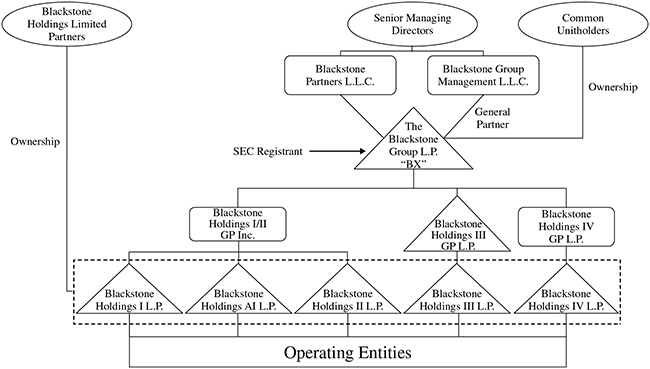
Key Financial Measures and Indicators
We manage our business using traditional financial measures and key operating metrics since we believe these metrics measure the productivity of our investment activities. Our key financial measures and indicators are discussed below.
Revenues
Revenues primarily consist of management and advisory fees, incentive fees, investment income, interest and dividend revenue and other. Please refer to “Part I. Item 1. Business — Incentive Arrangements / Fee Structure” in our Annual Report on Form 10-K for the year ended December 31, 2017 and “— Critical Accounting Policies — Revenue Recognition” for additional information regarding the manner in which Base Management Fees and Incentive Fees are generated.
Management and advisory fees and incentive fees are accounted for as contracts with customers. Under the guidance for contracts with customers, an entity is required to (a) identify the contract(s) with a customer, (b) identify the performance obligations in the contract, (c) determine the transaction price, (d) allocate the transaction price to the performance obligations in the contract, and (e) recognize revenue when (or as) the entity satisfies a performance obligation. In determining the transaction price, an entity may include variable consideration only to the extent that it is probable that a significant reversal in the amount of cumulative revenue recognized would not occur when the uncertainty associated with the variable consideration is resolved. See Note 18. “Segment Reporting” in the “Notes to Condensed Consolidated Financial Statements” in “Part I. Item 1. Financial Statements” for a disaggregated presentation of revenues from contracts with customers.
65
Table of Contents
Investment Income represents the unrealized and realized gains and losses on the Partnership’s Performance Allocations and Principal Investments. Interest and Dividend Revenue comprises primarily interest and dividend income earned on principal investments held by us. Other Revenue consists of miscellaneous income and foreign exchange gains and losses arising on transactions denominated in currencies other than U.S. dollars.
Management and Advisory Fees, Net — Management and Advisory Fees, Net are comprised of management fees, including base management fees, transaction and other fees and advisory fees net of management fee reductions and offsets.
The Partnership earns base management fees from limited partners of funds in each of its managed funds, at a fixed percentage of assets under management, net asset value, total assets, committed capital or invested capital. These customer contracts require the Partnership to provide investment management services, which represents a performance obligation that the Partnership satisfies over time. Management fees are a form of variable consideration because the fees the Partnership is entitled to vary based on fluctuations in the basis for the management fee. The amount recorded as revenue is generally determined at the end of the period because these management fees are payable on a regular basis (typically quarterly) and are not subject to clawback once paid.
Transaction, advisory and other fees (including monitoring fees) are principally fees charged to the limited partners of funds indirectly through the managed funds and portfolio companies. The investment advisory agreements generally require that the investment adviser reduce the amount of management fees payable by the limited partners to the Partnership (“management fee reductions”) by an amount equal to a portion of the transaction and other fees paid to the Partnership by the portfolio companies. The amount of the reduction varies by fund, the type of fee paid by the portfolio company and the previously incurred expenses of the fund. These fees and associated management fee reductions are a component of the transaction price for our performance obligation to provide investment management services to the limited partners of funds and are recognized as changes to the transaction price in the period in which they are charged and the services are performed.
Management fee offsets are reductions to management fees payable by the limited partners of the Blackstone Funds, which are based on the amount such limited partners reimburse the Blackstone Funds or the Partnership primarily for placement fees. Providing investment management services requires the Partnership to arrange for services on behalf of its customers. In those situations where we are acting as an agent on behalf of the limited partners of funds, it presents the cost of services as net against management fee revenue. In all other situations, the cost of those services is presented gross as an expense with any reimbursement from the limited partners of the funds recorded as revenue.
Accrued but unpaid Management and Advisory Fees, net of management fee reductions and management fee offsets, as of the reporting date are included in Accounts Receivable or Due from Affiliates in the Condensed Consolidated Statements of Financial Condition.
Incentive Fees — Contractual fees earned based on the performance of Blackstone Funds (“Incentive Fees”) are a form of variable consideration in their contracts with customers to provide investment management services. Incentive Fees are earned based on fund performance during the period, subject to the achievement of minimum return levels, or high water marks, in accordance with the respective terms set out in each fund’s governing agreements. Incentive Fees will not be recognized as revenue until (a) it is probable that a significant reversal in the amount of cumulative revenue recognized will not occur, or (b) the uncertainty associated with the variable consideration is subsequently resolved. Incentive Fees are typically recognized as revenue when realized at the end of the measurement period. Once realized, such fees are not subject to clawback or reversal. Accrued but unpaid Incentive Fees charged directly to investors in Blackstone Funds as of the reporting date are recorded within Due from Affiliates in the Condensed Consolidated Statements of Financial Condition.
Investment Income (Loss) — Investment Income (Loss) represents the unrealized and realized gains and losses on the Partnership’s Performance Allocations and Principal Investments.
66
Table of Contents
In certain fund structures across private equity, real estate, hedge fund solutions and credit-focused funds, which we refer to as carry funds, Blackstone, through its subsidiaries, invests alongside its limited partners in a partnership and is entitled to its pro-rata share of the results of the fund (a “pro-rata allocation”). In addition to a pro-rata allocation, and assuming certain investment returns are achieved, Blackstone is entitled to a disproportionate allocation of the income otherwise allocable to the limited partners, commonly referred to as carried interest, or Performance Allocations.
Performance Allocations are made to the general partner based on cumulative fund performance to date, subject to a preferred return to limited partners. At the end of each reporting period, the Partnership calculates the balance of accrued Performance Allocations (“Accrued Performance Allocations”) that would be due to the Partnership for each fund, pursuant to the fund agreements, as if the fair value of the underlying investments were realized as of such date, irrespective of whether such amounts have been realized. As the fair value of underlying investments varies between reporting periods, it is necessary to make adjustments to amounts recorded as Accrued Performance Allocations to reflect either (a) positive performance resulting in an increase in the Accrued Performance Allocation to the general partner or (b) negative performance that would cause the amount due to the Partnership to be less than the amount previously recognized as revenue, resulting in a negative adjustment to the Accrued Performance Allocation to the general partner. In each scenario, it is necessary to calculate the Accrued Performance Allocation on cumulative results compared to the Accrued Performance Allocation recorded to date and make the required positive or negative adjustments. The Partnership ceases to record negative Performance Allocations once previously Accrued Performance Allocations for such fund have been fully reversed. The Partnership is not obligated to pay guaranteed returns or hurdles, and therefore, cannot have negative Performance Allocations over the life of a fund. Accrued Performance Allocations as of the reporting date are reflected in Investments in the Condensed Consolidated Statements of Financial Condition.
Performance Allocations are realized when an underlying investment is profitably disposed of and the fund’s cumulative returns are in excess of the preferred return or, in limited instances, after certain thresholds for return of capital are met. Performance Allocations are subject to clawback to the extent that the Performance Allocation received to date exceeds the amount due to Blackstone based on cumulative results. As such, the accrual for potential repayment of previously received Performance Allocations, which is a component of Due to Affiliates, represents all amounts previously distributed to Blackstone Holdings and non-controlling interest holders that would need to be repaid to the Blackstone carry funds if the Blackstone carry funds were to be liquidated based on the current fair value of the underlying funds’ investments as of the reporting date. The actual clawback liability, however, generally does not become realized until the end of a fund’s life except for certain funds, including certain Blackstone real estate funds, multi-asset class investment funds and credit-focused funds, which may have an interim clawback liability.
Principal Investments include the unrealized and realized gains and losses on the Partnership’s principal investments, including its investments in Blackstone Funds that are not consolidated and receive pro-rata allocations, its equity method investments, and other principal investments. Income (Loss) on Principal Investments is realized when the Partnership redeems all or a portion of its investment or when the Partnership receives cash income, such as dividends or distributions. Unrealized Income (Loss) on Principal Investments results from changes in the fair value of the underlying investment as well as the reversal of unrealized gain (loss) at the time an investment is realized.
Interest and Dividend Revenue — Interest and Dividend Revenue comprises primarily interest and dividend income earned on principal investments held by Blackstone.
Other Revenue — Other Revenue consists of miscellaneous income and foreign exchange gains and losses arising on transactions denominated in currencies other than U.S. dollars.
67
Table of Contents
Expenses
Compensation and Benefits — Compensation — Compensation and Benefits consists of (a) employee compensation, comprising salary and bonus, and benefits paid and payable to employees and senior managing directors and (b) equity-based compensation associated with the grants of equity-based awards to employees and senior managing directors. Compensation cost relating to the issuance of equity-based awards to senior managing directors and employees is measured at fair value at the grant date, taking into consideration expected forfeitures, and expensed over the vesting period on a straight-line basis, except in the case of (a) equity-based awards that do not require future service, which are expensed immediately, and (b) certain awards to recipients that meet specified criteria making them eligible for retirement treatment (allowing such recipient to keep a percentage of those awards upon departure from Blackstone after becoming eligible for retirement), for which the expense for the portion of the award that would be retained in the event of retirement is either expensed immediately or amortized to the retirement date. Cash settled equity-based awards are classified as liabilities and are remeasured at the end of each reporting period.
Compensation and Benefits — Incentive Fee Compensation — Incentive Fee Compensation consists of compensation paid based on Incentive Fees.
Compensation and Benefits — Performance Allocations Compensation — Performance Allocation Compensation consists of compensation paid based on Performance Allocations (which may be distributed in cash or in-kind). Such compensation expense is subject to both positive and negative adjustments. Unlike Performance Allocations, compensation expense is based on the performance of individual investments held by a fund rather than on a fund by fund basis. These amounts may also include allocations of investment income from Blackstone’s principal investments, to senior managing directors and employees participating in certain profit sharing initiatives.
Other Operating Expenses — Other Operating Expenses represents general and administrative expenses including interest expense, occupancy and equipment expenses and other expenses, which consist principally of professional fees, public company costs, travel and related expenses, communications and information services and depreciation and amortization.
Fund Expenses — The expenses of our consolidated Blackstone Funds consist primarily of interest expense, professional fees and other third party expenses.
Non-Controlling Interests in Consolidated Entities
Non-Controlling Interests in Consolidated Entities represent the component of Partners’ Capital in consolidated Blackstone Funds held by third party investors and employees. The percentage interests held by third parties and employees is adjusted for general partner allocations and by subscriptions and redemptions in funds of hedge funds and certain credit-focused funds which occur during the reporting period. In addition, all non-controlling interests in consolidated Blackstone Funds are attributed a share of income (loss) arising from the respective funds and a share of other comprehensive income, if applicable. Income (Loss) is allocated to non-controlling interests in consolidated entities based on the relative ownership interests of third party investors and employees after considering any contractual arrangements that govern the allocation of income (loss) such as fees allocable to The Blackstone Group L.P.
Redeemable Non-Controlling Interests in Consolidated Entities
Non-controlling interests related to funds of hedge funds are subject to annual, semi-annual or quarterly redemption by investors in these funds following the expiration of a specified period of time, or may be withdrawn subject to a redemption fee during the period when capital may not be withdrawn. As limited partners in these types of funds have been granted redemption rights, amounts relating to third party interests in such consolidated funds are presented as Redeemable Non-Controlling Interests in Consolidated Entities within the Condensed Consolidated Statements of Financial Condition. When redeemable amounts become legally payable to investors, they are
68
Table of Contents
classified as a liability and included in Accounts Payable, Accrued Expenses and Other Liabilities in the Condensed Consolidated Statements of Financial Condition. For all consolidated funds in which redemption rights have not been granted, non-controlling interests are presented within Partners’ Capital in the Condensed Consolidated Statements of Financial Condition as Non-Controlling Interests in Consolidated Entities.
Non-Controlling Interests in Blackstone Holdings
Non-Controlling Interests in Blackstone Holdings represent the component of Partners’ Capital in the consolidated Blackstone Holdings Partnerships held by Blackstone personnel and others who are limited partners of the Blackstone Holdings Partnerships.
Certain costs and expenses are borne directly by the Holdings Partnerships. Income (Loss), excluding those costs directly borne by and attributable to the Holdings Partnerships, is attributable to Non-Controlling Interests in Blackstone Holdings. This residual attribution is based on the year to date average percentage of Blackstone Holdings Partnership Units held by Blackstone personnel and others who are limited partners of the Blackstone Holdings Partnerships.
Income Taxes
The Blackstone Holdings Partnerships and certain of their subsidiaries operate in the U.S. as partnerships for U.S. federal income tax purposes and generally as corporate entities in non-U.S. jurisdictions. Accordingly, these entities in some cases are subject to New York City unincorporated business taxes or non-U.S. income taxes. In addition, certain of the wholly owned subsidiaries of the Partnership and the Blackstone Holdings Partnerships will be subject to federal, state and local corporate income taxes at the entity level and the related tax provision attributable to the Partnership’s share of this income tax is reflected in the Condensed Consolidated Financial Statements.
Income taxes are accounted for using the asset and liability method of accounting. Under this method, deferred tax assets and liabilities are recognized for the expected future tax consequences of differences between the carrying amounts of assets and liabilities and their respective tax basis, using tax rates in effect for the year in which the differences are expected to reverse. The effect on deferred assets and liabilities of a change in tax rates is recognized in income in the period when the change is enacted. Deferred tax assets are reduced by a valuation allowance when it is more likely than not that some portion or all of the deferred tax assets will not be realized. Current and deferred tax liabilities are recorded within Accounts Payable, Accrued Expenses and Other Liabilities in the Condensed Consolidated Statements of Financial Condition.
Blackstone uses the flow-through method to account for investment tax credits. Under this method, the investment tax credits are recognized as a reduction to income tax expense.
Blackstone analyzes its tax filing positions in all of the U.S. federal, state, local and foreign tax jurisdictions where it is required to file income tax returns, as well as for all open tax years in these jurisdictions. Blackstone records uncertain tax positions on the basis of a two-step process: (a) a determination is made whether it is more likely than not that the tax positions will be sustained based on the technical merits of the position and (b) those tax positions that meet the more-likely-than-not threshold are recognized as the largest amount of tax benefit that is greater than 50 percent likely to be realized upon ultimate settlement with the related tax authority. Blackstone recognizes accrued interest and penalties related to uncertain tax positions in General, Administrative, and Other expenses within the Condensed Consolidated Statements of Operations.
Certain past legislative proposals by members of the U.S. Congress would treat carried interest as not meeting the qualifying income requirements under the publicly traded partnership rules (after a transition period in the case of existing publicly traded partnerships). If similar legislation were enacted and applied to us, we would not qualify as a partnership for U.S. federal income tax purposes unless we held carried interest through corporations. If we
69
Table of Contents
were taxed as a corporation or held carried interest through taxable subsidiary corporations, our effective tax rate could increase significantly.
States and other jurisdictions have also considered legislation to increase taxes with respect to carried interest. For example, New York State has considered legislation, which could cause a non-resident of New York State who holds our common units to be subject to New York State income tax on carried interest earned by entities in which we hold an indirect interest, thereby requiring the non-resident to file a New York State income tax return reporting such carried interest income. As part of that same proposal, New York State also considered state tax surcharge of 17% on carried interest in addition to the personal income tax. Similar proposals are under consideration in other jurisdictions such as California. Whether or when similar legislation will be enacted is unclear. Finally, several state and local jurisdictions have evaluated ways to subject partnerships to entity level taxation through the imposition of state or local income, franchise or other forms of taxation or to increase the amount of such taxation. These and other proposals have recently been under heightened consideration in light of U.S. federal income tax legislation, known as the Tax Cuts and Jobs Act, which was signed into law on December 22, 2017 (the “Tax Reform Bill”).
Meaningfully quantifying the potential impact on Blackstone of this potential future legislation or any similar legislation is not possible at this time. Multiple versions of legislation in this area have been proposed over the last few years that have included significantly different provisions regarding effective dates and the treatment of invested capital, tiered entities and cross-border operations, among other matters. Depending upon what version of the legislation, if any, were enacted, the potential impact on a public company such as Blackstone in a given year could differ significantly and could be material. In addition, even if these legislative proposals would not themselves impose a tax on a publicly traded partnership such as Blackstone, they could force Blackstone and other publicly traded partnerships to restructure their operations so as to prevent disqualifying income from reaching the publicly traded partnership in amounts that would disqualify the partnership from treatment as a partnership for U.S. federal income tax purposes. Such a restructuring could result in more income being earned in corporate subsidiaries, thereby increasing corporate income tax liability indirectly borne by the publicly traded partnership. In addition, we, and our common unitholders, could be taxed on any such restructuring. The nature of any such restructuring would depend on the precise provisions of the legislation that was ultimately enacted, as well as the particular facts and circumstances of Blackstone’s operations at the time any such legislation were to take effect, making the task of predicting the amount of additional tax highly speculative.
The recently enacted Tax Reform Bill has resulted in fundamental changes to the Internal Revenue Code. Changes to U.S. tax laws resulting from the Tax Reform Bill, including reduction to the federal corporate income tax rate, partial limitation on the deductibility of business interest expense, and a longer three-year holding period requirement for carried interest to be treated as long-term capital gain could have a material effect on our business operations and our funds’ investment activities. These and other changes from the Tax Reform Bill — including limitations on the use, carryback and carryforward of net operating losses and changes relating to the scope and timing of U.S. taxation on earnings from international business operations — could also have a significant effect on the business of our portfolio companies. The exact impact of the Tax Reform Bill for future years is still unclear and difficult to quantify, but these changes could have a material adverse effect on our business, results of operations and financial condition. In addition, other changes could be enacted in the future to increase the corporate tax rate, limit further the deductibility of interest, subject carried interest to more onerous taxation or effect other changes that could have a material adverse effect on our business, results of operations and financial condition.
Congress, the Organization for Economic Co-operation and Development (“OECD”) and other government agencies in jurisdictions in which we and our affiliates invest or do business have maintained a focus on issues related to the taxation of multinational companies. The OECD, which represents a coalition of member countries, is contemplating changes to numerous long-standing tax principles through its base erosion and profit shifting (“BEPS”) project, which is focused on a number of issues, including the shifting of profits between affiliated entities in different tax jurisdictions, interest deductibility and eligibility for the benefits of double tax treaties. Several of the proposed measures are potentially relevant to some of our structures and could have an adverse tax impact on our funds, investors and/or our portfolio companies. Some member countries have been moving forward on the BEPS agenda but, because timing of implementation and the specific measures adopted will vary among
70
Table of Contents
participating states, significant uncertainty remains regarding the impact of BEPS proposals. If implemented, these proposals could result in a loss of tax treaty benefits and increased taxes on income from our investments.
A number of European jurisdictions have enacted taxes on financial transactions, and the European Commission has proposed legislation to harmonize these taxes under the so-called “enhanced cooperation procedure,” which provides for adoption of EU-level legislation applicable to some but not all EU Member States. These contemplated changes, if adopted by individual countries, could increase tax uncertainty and/or costs faced by us, our portfolio companies and our investors, change our business model and cause other adverse consequences. The timing or impact of these proposals is unclear at this point. In addition, tax laws, regulations and interpretations are subject to continual changes, which could adversely affect our structures or returns to our investors. For instance, various countries have adopted or proposed tax legislation that may adversely affect portfolio companies and investment structures in countries in which our funds have invested and may limit the benefits of additional investments in those countries.
In addition, legislation enacted in 2015 significantly changed the rules for U.S. federal income tax audits of partnerships. Such audits will be conducted at the partnership level, and unless a partnership qualifies for and affirmatively elects an alternative procedure, any adjustments to the amount of tax due (including interest and penalties) will be payable by the partnership. Under an elective alternative procedure, a partnership would issue information returns to persons who were partners in the audited year, who would then be required to take the adjustments into account in calculating their own tax liability, and the partnership would not be liable for the adjustments. If a partnership elects the alternative procedure for a given adjustment, the amount of taxes for which its partners would be liable would be increased by any applicable penalties and a special interest charge. There can be no assurance that we will be eligible to make such an election or that we will, in fact, make such an election for any given adjustment. If we do not or are not able to make such an election, then (a) our then-current common unitholders, in the aggregate, could indirectly bear income tax liabilities in excess of the aggregate amount of taxes that would have been due had we elected the alternative procedure, and (b) a given common unitholder may indirectly bear taxes attributable to income allocable to other common unitholders or former common unitholders, including taxes (as well as interest and penalties) with respect to periods prior to such holder’s ownership of common units. Amounts available for distribution to our common unitholders may be reduced as a result of our obligation to pay any taxes associated with an adjustment. Many issues with respect to, and the overall effect of, this legislation on us are uncertain, and common unitholders should consult their own tax advisors regarding all aspects of this legislation as it affects their particular circumstances.
Economic Income
Blackstone uses Economic Income as a key measure of value creation, a benchmark of its performance and in making resource deployment and compensation decisions across its four segments. Economic Income represents segment net income before taxes excluding transaction-related charges. Transaction-related charges arise from Blackstone’s IPO and certain long-term retention programs outside of annual deferred compensation and other corporate actions, including acquisitions. Transaction-related charges include certain equity-based compensation charges, the amortization of intangible assets and contingent consideration associated with acquisitions. Economic Income presents revenues and expenses on a basis that deconsolidates the investment funds Blackstone manages. For segment reporting purposes, Performance Allocations and Incentive Fees are presented together and referred to collectively as Performance Revenues. Economic Income, our principal segment measure, is derived from and reconciled to, but not equivalent to, its most directly comparable GAAP measure of Income (Loss) Before Provision for Taxes. See Note 18. “Segment Reporting” in the “Notes to Condensed Consolidated Financial Statements” in “Part I. Item 1. Financial Statements”.
Economic Net Income
Economic Net Income (“ENI”) represents Economic Income adjusted to include current period taxes. Current period taxes represent the total tax provision calculated under accounting principles generally accepted in the
71
Table of Contents
United States of America (“GAAP”) adjusted to include only the current tax provision (benefit) calculated on Income (Loss) Before Provision for Taxes and adjusted to exclude the tax impact of any divestitures.
Fee Related Earnings
Blackstone uses Fee Related Earnings, which is derived from Economic Income, as a measure to highlight earnings from operations excluding: (a) the income related to performance revenues and related performance compensation, (b) income earned from Blackstone’s investments in the Blackstone Funds, (c) net interest income (loss), (d) equity-based compensation, and (e) Other Revenue. Management uses Fee Related Earnings as a measure to assess whether recurring revenue from our businesses is sufficient to adequately cover all of our operating expenses and generate profits. Fee Related Earnings equals contractual management fee revenues, less (a) compensation expenses (which excludes amortization of equity-based awards, and Performance compensation), and (b) other operating expenses. See “— Liquidity and Capital Resources — Sources and Uses of Liquidity” for our discussion of Fee Related Earnings.
Distributable Earnings
Distributable Earnings, which is derived from our segment reported results, is a supplemental measure to assess performance and amounts available for distributions to Blackstone unitholders, including Blackstone personnel and others who are limited partners of the Blackstone Holdings partnerships. Distributable Earnings, which is a measure not prepared under GAAP (a “non-GAAP” measure), is intended to show the amount of net realized earnings without the effects of the consolidation of the Blackstone Funds. Distributable Earnings is derived from and reconciled to, but not equivalent to, its most directly comparable GAAP measure of Income (Loss) Before Provision for Taxes. See “ — Liquidity and Capital Resources — Sources and Uses of Liquidity” for our discussion of Distributable Earnings.
Distributable Earnings, which is a component of Economic Net Income, is the sum across all segments of: (a) Total Management, Advisory and Other Fees, Net, (b) Interest and Dividend Revenue, (c) Realized Incentive Fees, (d) Realized Performance Allocations and (e) Realized Principal Investment Income (Loss); less (a) Compensation, excluding the expense of equity-based awards, (b) Realized Incentive Fee Compensation, (c) Realized Performance Allocations Compensation, (d) Interest Expense, (e) Other Operating Expenses, and (f) Taxes and Related Payables Under the Tax Receivable Agreement.
Adjusted Earnings Before Interest, Taxes and Depreciation and Amortization
Adjusted Earnings Before Interest, Taxes and Depreciation and Amortization (“Adjusted EBITDA”), is a supplemental non-GAAP measure derived from our segment reported results and may be used to assess our ability to service our borrowings. Adjusted EBITDA represents Distributable Earnings plus the addition of (a) Interest Expense, (b) Taxes and Related Payables Including Payable Under Tax Receivable Agreement, and (c) Depreciation and Amortization. See “— Liquidity and Capital Resources — Sources and Uses of Liquidity” for our calculation of Adjusted EBITDA.
72
Table of Contents
Summary Walkdown of GAAP to Non-GAAP Financial Metrics
The relationship of our GAAP to non-GAAP financial measures is presented in the summary walkdown below. The summary walkdown shows how each non-GAAP financial measure is related to the other non-GAAP financial measures. This presentation is not meant to be a detailed calculation of each measure, but to show the relationship between the measures. For the calculation of each of these non-GAAP financial measures and a full reconciliation of Income Before Provision for Taxes to Distributable Earnings, please see “ — Liquidity and Capital Resources — Distributable Earnings, Fee Related Earnings and Economic Net Income”.

73
Table of Contents
Operating Metrics
The alternative asset management business is a complex business that is primarily based on managing third party capital and does not require substantial capital investment to support rapid growth. However, there also can be volatility associated with its earnings and cash flows. Since our inception, we have developed and used various key operating metrics to assess and monitor the operating performance of our various alternative asset management businesses in order to monitor the effectiveness of our value creating strategies.
Assets Under Management. Assets Under Management refers to the assets we manage. Our Assets Under Management equals the sum of:
| (a) | the fair value of the investments held by our carry funds and our side-by-side and co-investment entities managed by us, plus (1) the capital that we are entitled to call from investors in those funds and entities pursuant to the terms of their respective capital commitments, including capital commitments to funds that have yet to commence their investment periods, or (2) for certain credit-oriented funds the amounts available to be borrowed under asset based credit facilities, |
| (b) | the net asset value of (1) our hedge funds, real estate debt carry funds, open ended core+ real estate fund, certain co-investments managed by us, and our Hedge Fund Solutions carry and drawdown funds (plus, in each case, the capital that we are entitled to call from investors in those funds, including commitments yet to commence their investment periods), and (2) our funds of hedge funds, our Hedge Fund Solutions registered investment companies, and our non-exchange traded REIT, |
| (c) | the invested capital, fair value or net asset value of assets we manage pursuant to separately managed accounts, |
| (d) | the amount of debt and equity outstanding for our CLOs during the reinvestment period, |
| (e) | the aggregate par amount of collateral assets, including principal cash, for our CLOs after the reinvestment period, |
| (f) | the gross or net amount of assets (including leverage where applicable) for our credit-focused registered investment companies, and |
| (g) | the fair value of common stock, preferred stock, convertible debt, or similar instruments issued by BXMT. |
Our carry funds are commitment-based drawdown structured funds that do not permit investors to redeem their interests at their election. Our funds of hedge funds, hedge funds, funds structured like hedge funds and other open ended funds in our Hedge Fund Solutions, Credit and Real Estate segments generally have structures that afford an investor the right to withdraw or redeem their interests on a periodic basis (for example, annually or quarterly), typically with 30 to 95 days’ notice, depending on the fund and the liquidity profile of the underlying assets. Investment advisory agreements related to certain separately managed accounts in our Hedge Fund Solutions and Credit segments, excluding our BIS separately managed accounts, may generally be terminated by an investor on 30 to 90 days’ notice.
Fee-Earning Assets Under Management . Fee-Earning Assets Under Management refers to the assets we manage on which we derive management fees and/or performance revenues. Our Fee-Earning Assets Under Management equals the sum of:
| (a) | for our Private Equity segment funds and Real Estate segment carry funds including certain real estate debt investment funds and certain of our Hedge Fund Solutions funds, the amount of capital commitments, remaining invested capital, fair value, net asset value or par value of assets held, depending on the fee terms of the fund, |
| (b) | for our credit-focused carry funds, the amount of remaining invested capital (which may include leverage) or net asset value, depending on the fee terms of the fund, |
74
Table of Contents
| (c) | the remaining invested capital or fair value of assets held in co-investment vehicles managed by us on which we receive fees, |
| (d) | the net asset value of our funds of hedge funds, hedge funds, open ended core+ real estate fund, certain co-investments managed by us, certain registered investment companies, our non-exchange traded REIT, and certain of our Hedge Fund Solutions drawdown funds, |
| (e) | the invested capital, fair value of assets or the net asset value we manage pursuant to separately managed accounts, |
| (f) | the net proceeds received from equity offerings and accumulated core earnings of BXMT, subject to certain adjustments, |
| (g) | the aggregate par amount of collateral assets, including principal cash, of our CLOs, and |
| (h) | the gross amount of assets (including leverage) or the net assets (plus leverage where applicable) for certain of our credit-focused registered investment companies. |
Each of our segments may include certain Fee-Earning Assets Under Management on which we earn performance revenues but not management fees.
Our calculations of assets under management and fee-earning assets under management may differ from the calculations of other asset managers, and as a result this measure may not be comparable to similar measures presented by other asset managers. In addition, our calculation of assets under management includes commitments to, and the fair value of, invested capital in our funds from Blackstone and our personnel, regardless of whether such commitments or invested capital are subject to fees. Our definitions of assets under management and fee-earning assets under management are not based on any definition of assets under management and fee-earning assets under management that is set forth in the agreements governing the investment funds that we manage.
For our carry funds, total assets under management includes the fair value of the investments held, whereas fee-earning assets under management includes the amount of capital commitments, the remaining amount of invested capital at cost depending on whether the investment period has or has not expired or the fee terms of the fund. As such, fee-earning assets under management may be greater than total assets under management when the aggregate fair value of the remaining investments is less than the cost of those investments.
Limited Partner Capital Invested. Limited Partner Capital Invested represents the amount of Limited Partner capital commitments which were invested by our carry and drawdown funds during each period presented, plus the capital invested through co-investments arranged by us that were made by limited partners in investments of our carry funds on which we receive management fees, Performance Allocations or Incentive Fees.
The amount of committed undrawn capital available for investment, including general partner and employee commitments, is known as dry powder and is an indicator of the capital we have available for future investments.
75
Table of Contents
Consolidated Results of Operations
Following is a discussion of our consolidated results of operations for the three months ended March 31, 2018 and 2017. For a more detailed discussion of the factors that affected the results of our four business segments (which are presented on a basis that deconsolidates the investment funds we manage) in these periods, see “— Segment Analysis”.
The following table sets forth information regarding our consolidated results of operations and certain key operating metrics for the three months ended March 31, 2018 and 2017:
|
Three Months Ended
March 31, |
2018 vs. 2017 | |||||||||||||||
| 2018 | 2017 | $ | % | |||||||||||||
| (Dollars in Thousands) | ||||||||||||||||
|
Revenues |
||||||||||||||||
|
Management and Advisory Fees, Net |
$ | 728,849 | $ | 645,484 | $ | 83,365 | 13 | % | ||||||||
|
|
|
|
|
|
|
|
|
|||||||||
|
Incentive Fees |
12,566 | 46,511 | (33,945 | ) | -73 | % | ||||||||||
|
|
|
|
|
|
|
|
|
|||||||||
|
Investment Income (Loss) |
||||||||||||||||
|
Performance Allocations |
||||||||||||||||
|
Realized |
269,640 | 1,111,905 | (842,265 | ) | -76 | % | ||||||||||
|
Unrealized |
628,089 | (124,621 | ) | 752,710 | N/M | |||||||||||
|
Principal Investments |
||||||||||||||||
|
Realized |
42,145 | 251,344 | (209,199 | ) | -83 | % | ||||||||||
|
Unrealized |
111,774 | (40,188 | ) | 151,962 | N/M | |||||||||||
|
|
|
|
|
|
|
|
|
|||||||||
|
Total Investment Income |
1,051,648 | 1,198,440 | (146,792 | ) | -12 | % | ||||||||||
|
Interest and Dividend Revenue |
35,385 | 28,495 | 6,890 | 24 | % | |||||||||||
|
Other |
(59,317 | ) | (4,212 | ) | (55,105 | ) | N/M | |||||||||
|
|
|
|
|
|
|
|
|
|||||||||
|
Total Revenues |
1,769,131 | 1,914,718 | (145,587 | ) | -8 | % | ||||||||||
|
|
|
|
|
|
|
|
|
|||||||||
|
Expenses |
||||||||||||||||
|
Compensation and Benefits |
||||||||||||||||
|
Compensation |
389,403 | 351,589 | 37,814 | 11 | % | |||||||||||
|
Incentive Fee Compensation |
6,662 | 22,465 | (15,803 | ) | -70 | % | ||||||||||
|
Performance Allocations Compensation |
||||||||||||||||
|
Realized |
112,062 | 366,478 | (254,416 | ) | -69 | % | ||||||||||
|
Unrealized |
254,435 | 7,533 | 246,902 | N/M | ||||||||||||
|
|
|
|
|
|
|
|
|
|||||||||
|
Total Compensation and Benefits |
762,562 | 748,065 | 14,497 | 2 | % | |||||||||||
|
General, Administrative and Other |
126,713 | 109,386 | 17,327 | 16 | % | |||||||||||
|
Interest Expense |
38,671 | 40,246 | (1,575 | ) | -4 | % | ||||||||||
|
Fund Expenses |
54,985 | 24,076 | 30,909 | 128 | % | |||||||||||
|
|
|
|
|
|
|
|
|
|||||||||
|
Total Expenses |
982,931 | 921,773 | 61,158 | 7 | % | |||||||||||
|
|
|
|
|
|
|
|
|
|||||||||
|
Other Income |
||||||||||||||||
|
Net Gains from Fund Investment Activities |
110,599 | 66,132 | 44,467 | 67 | % | |||||||||||
|
|
|
|
|
|
|
|
|
|||||||||
|
Income Before Provision for Taxes |
896,799 | 1,059,077 | (162,278 | ) | -15 | % | ||||||||||
|
Provision for Taxes |
54,495 | 57,437 | (2,942 | ) | -5 | % | ||||||||||
|
|
|
|
|
|
|
|
|
|||||||||
|
Net Income |
842,304 | 1,001,640 | (159,336 | ) | -16 | % | ||||||||||
|
Net Income (Loss) Attributable to Redeemable Non-Controlling Interests in Consolidated Entities |
(1,275 | ) | 2,000 | (3,275 | ) | N/M | ||||||||||
|
Net Income Attributable to Non-Controlling Interests in Consolidated Entities |
155,499 | 138,685 | 16,814 | 12 | % | |||||||||||
|
Net Income Attributable to Non-Controlling Interests in Blackstone Holdings |
320,208 | 409,046 | (88,838 | ) | -22 | % | ||||||||||
|
|
|
|
|
|
|
|
|
|||||||||
|
Net Income Attributable to The Blackstone Group L.P. |
$ | 367,872 | $ | 451,909 | $ | (84,037 | ) | -19 | % | |||||||
|
|
|
|
|
|
|
|
|
|||||||||
N/M Not meaningful.
76
Table of Contents
Three Months Ended March 31, 2018 Compared to Three Months Ended March 31, 2017
Revenues
Total Revenues were $1.8 billion for the three months ended March 31, 2018, a decrease of $145.6 million compared to $1.9 billion for the three months ended March 31, 2017. The decrease in Total Revenues was primarily attributable to decreases of $146.8 million in Investment Income, $55.1 million in Other Revenue, and $33.9 million in Incentive Fees, partially offset by an increase in Management and Advisory Fees, Net of $83.4 million.
The decrease in Investment Income was primarily attributable to decreases in our Real Estate, Credit and Hedge Fund Solutions segments of $152.4 million, $29.0 million and $28.9 million, respectively, partially offset by an increase in our Private Equity segment of $59.2 million. The decrease in our Real Estate segment was primarily attributable to lower net appreciation of investment holdings in our BREP opportunistic funds compared to the comparable quarter in 2017. The carrying value of investments for our opportunistic funds increased 3.5% versus 5.7% in the comparable quarter in 2017. The decrease in our Credit segment was primarily attributable to lower returns in our performing credit strategies and distressed strategies. The decrease in our Hedge Fund Solutions segment was due to lower returns across the segment compared to the first three months of 2017. The increase in our Private Equity segment was due to Strategic Partners and Tactical Opportunities. Strategic Partners carrying value increased 6.9% in the three months ended March 31, 2018 compared to 4.6% in the three months ended March 31, 2017. Tactical Opportunities carrying value increased 5.2% in the three months ended March 31, 2018 versus 3.6% in the three months ended March 31, 2017.
The decrease in Other Revenue was primarily the result of foreign exchange loss on our euro denominated bonds.
The decrease in Incentive Fees was primarily attributable to a decrease in our Credit segment of $29.5 million. The decrease in our Credit segment was primarily attributable to a decrease in Incentive Fees due to a contractual agreement with FS Investments pursuant to which, in connection with the conclusion of our sub-advisory relationship with respect to our BDCs, we received a fixed payment in the quarter and did not otherwise receive Incentive Fees.
The increase in Management and Advisory Fees, Net was primarily due to increases in our Credit and Real Estate segments of $43.1 million and $32.3 million, respectively. The increase in our Credit segment was primarily attributable to an increase in Management Fees due to a contractual agreement with FS Investments pursuant to which, in connection with the conclusion of our sub-advisory relationship with respect to our BDCs, we received a fixed payment in the quarter, as well as the acquisition of Harvest. The increase in our Real Estate segment was primarily due to growth in our core+ real estate funds and the launch of BREP Europe V in the fourth quarter of 2016 (and the corresponding expiration of its fee holiday in the second quarter of 2017).
Expenses
Expenses were $982.9 million for the three months ended March 31, 2018, an increase of $61.2 million compared to $921.8 million for the three months ended March 31, 2017. The increase was primarily attributable to increases in Compensation and Fund Expenses, partially offset by a decrease in Incentive Fee Compensation. The increase of $37.8 million in Compensation was primarily due to the increase in Management and Advisory Fees, Net, on which a portion of compensation is based. The increase of $30.9 million in Fund Expenses was due to an increase of $30.2 million in our Credit segment primarily from newly launched CLOs and certain long only strategies. The decrease of $15.8 million in Incentive Fee Compensation was primarily due to the decrease in Realized Incentive Fees in our Credit segment, on which a portion of Incentive Fee Compensation is based.
Other Income
Other Income was $110.6 million for the three months ended March 31, 2018, an increase of $44.5 million compared to $66.1 million for the three months ended March 31, 2017. The increase in Other Income was due to an
77
Table of Contents
increase in Net Gains from Fund Investment Activities. The increase in Other Income — Net Gains from Fund Investment Activities was principally driven by an increase in our Credit segment of $52.3 million primarily from newly launched CLOs and certain long only strategies.
Provision for Taxes
The following table summarizes Blackstone’s tax position:
|
Three Months Ended
March 31, |
||||||||
| 2018 | 2017 | |||||||
|
Income Before Provision for Taxes |
$ | 896,799 | $ | 1,059,077 | ||||
|
Provision for Taxes |
$ | 54,495 | $ | 57,437 | ||||
|
Effective Income Tax Rate |
6.1 | % | 5.4 | % | ||||
The following table reconciles the effective income tax rate to the U.S. federal statutory tax rate:
|
Three Months Ended
March 31, |
2018
vs. |
|||||||||||
| 2018 | 2017 | 2017 | ||||||||||
|
Statutory U.S. Federal Income Tax Rate |
21.0 | % | 35.0 | % | -14.0 | % | ||||||
|
Income Passed Through to Common Unitholders and Non-Controlling Interest Holders (a) |
-16.3 | % | -30.3 | % | 14.0 | % | ||||||
|
State and Local Income Taxes |
1.7 | % | 1.2 | % | 0.5 | % | ||||||
|
Other |
-0.3 | % | -0.5 | % | 0.2 | % | ||||||
|
|
|
|
|
|
|
|||||||
|
Effective Income Tax Rate |
6.1 | % | 5.4 | % | 0.7 | % | ||||||
|
|
|
|
|
|
|
|||||||
| (a) | Includes income that is not taxable to the Partnership and its subsidiaries. Such income is directly taxable to the Partnership’s unitholders and the non-controlling interest holders. |
Blackstone’s Provision for Taxes for the three months ended March 31, 2018 and 2017 was $54.5 million and $57.4 million, respectively. This resulted in an effective tax rate of 6.1% and 5.4%, respectively.
The increase in Blackstone’s effective tax rate for the three months ended March 31, 2018, compared to the three months ended March 31, 2017 resulted primarily from an unrecognized tax benefit included in the three months ended March 31, 2018 related to an ongoing tax audit.
All factors are expected to impact the effective tax rate for future years.
Additional information regarding our income taxes can be found in Note 14. “Income Taxes” in the “Notes to Condensed Consolidated Financial Statements” in “Part I. Item 1. Financial Statements” of this filing.
Non-Controlling Interests in Consolidated Entities
The Net Income Attributable to Redeemable Non-Controlling Interests in Consolidated Entities and Net Income Attributable to Non-Controlling Interests in Consolidated Entities is attributable to the consolidated Blackstone Funds. The amounts of these items vary directly with the performance of the consolidated Blackstone Funds and largely eliminate the amount of Other Income — Net Gains from Fund Investment Activities from the Net Income Attributable to The Blackstone Group L.P.
Net Income Attributable to Non-Controlling Interests in Blackstone Holdings is derived from the Income Before Provision for Taxes, excluding the Net Gains from Fund Investment Activities and the percentage allocation of the income between Blackstone Holdings and The Blackstone Group L.P. after considering any contractual
78
Table of Contents
arrangements that govern the allocation of income such as fees allocable to The Blackstone Group L.P.
For the three months ended March 31, 2018 and 2017, the Net Income Before Taxes allocated to Blackstone Holdings was 44.4% and 45.3%, respectively. The decrease of 0.9% was primarily due to conversions of Blackstone Holdings Partnership Units to Blackstone common units and the vesting of common units.
The Other Income — Reduction of Tax Receivable Agreement Liability was entirely allocated to The Blackstone Group L.P.
Operating Metrics
The following graphs and tables summarize the Fee-Earning Assets Under Management by Segment and Total Assets Under Management by Segment, followed by a rollforward of activity for the three months ended March 31, 2018 and 2017. For a description of how Assets Under Management and Fee-Earning Assets Under Management are determined, please see “— Key Financial Measures and Indicators — Operating Metrics — Assets Under Management and Fee-Earning Assets Under Management”:
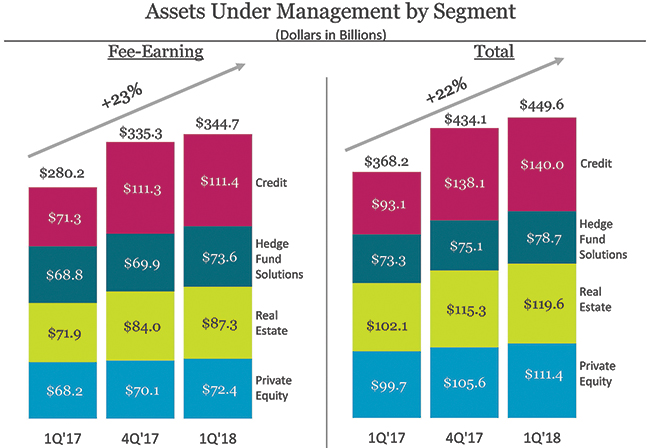
| Note: | Totals may not add due to rounding. |
79
Table of Contents
| Three Months Ended | ||||||||||||||||||||||||||||||||||||||||
| March 31, 2018 | March 31, 2017 | |||||||||||||||||||||||||||||||||||||||
|
Private
Equity |
Real
Estate |
Hedge Fund
Solutions |
Credit | Total |
Private
Equity |
Real
Estate |
Hedge Fund
Solutions |
Credit | Total | |||||||||||||||||||||||||||||||
| (Dollars in Thousands) | ||||||||||||||||||||||||||||||||||||||||
|
Fee-Earning Assets Under Management |
||||||||||||||||||||||||||||||||||||||||
|
Balance, Beginning of Period |
$ | 70,140,883 | $ | 83,984,824 | $ | 69,914,061 | $ | 111,304,230 | $ | 335,343,998 | $ | 69,110,457 | $ | 72,030,054 | $ | 66,987,553 | $ | 68,964,608 | $ | 277,092,672 | ||||||||||||||||||||
|
Inflows, including Commitments (a) |
3,404,314 | 3,550,277 | 3,816,386 | 5,552,133 | 16,323,110 | 1,109,529 | 2,125,293 | 3,183,304 | 5,446,145 | 11,864,271 | ||||||||||||||||||||||||||||||
|
Outflows, including Distributions (b) |
(469,395 | ) | (210,591 | ) | (902,301 | ) | (2,044,670 | ) | (3,626,957 | ) | (4,693 | ) | (96,512 | ) | (2,269,260 | ) | (811,194 | ) | (3,181,659 | ) | ||||||||||||||||||||
|
Realizations (c) |
(736,274 | ) | (1,494,226 | ) | (55,755 | ) | (1,994,576 | ) | (4,280,831 | ) | (2,163,020 | ) | (2,779,662 | ) | (447,124 | ) | (2,796,816 | ) | (8,186,622 | ) | ||||||||||||||||||||
|
|
|
|
|
|
|
|
|
|
|
|
|
|
|
|
|
|
|
|
|
|||||||||||||||||||||
|
Net Inflows (Outflows) |
2,198,645 | 1,845,460 | 2,858,330 | 1,512,887 | 8,415,322 | (1,058,184 | ) | (750,881 | ) | 466,920 | 1,838,135 | 495,990 | ||||||||||||||||||||||||||||
|
Market Appreciation (Depreciation) (d)(f) |
58,887 | 1,454,294 | 798,107 | (1,419,811 | ) | 891,477 | 175,013 | 625,568 | 1,358,055 | 468,253 | 2,626,889 | |||||||||||||||||||||||||||||
|
|
|
|
|
|
|
|
|
|
|
|
|
|
|
|
|
|
|
|
|
|||||||||||||||||||||
|
Balance, End of Period |
$ | 72,398,415 | $ | 87,284,578 | $ | 73,570,498 | $ | 111,397,306 | $ | 344,650,797 | $ | 68,227,286 | $ | 71,904,741 | $ | 68,812,528 | $ | 71,270,996 | $ | 280,215,551 | ||||||||||||||||||||
|
|
|
|
|
|
|
|
|
|
|
|
|
|
|
|
|
|
|
|
|
|||||||||||||||||||||
|
Increase (Decrease) |
$ | 2,257,532 | $ | 3,299,754 | $ | 3,656,437 | $ | 93,076 | $ | 9,306,799 | $ | (883,171 | ) | $ | (125,313 | ) | $ | 1,824,975 | $ | 2,306,388 | $ | 3,122,879 | ||||||||||||||||||
|
Increase (Decrease) |
3 | % | 4 | % | 5 | % | 0 | % | 3 | % | -1 | % | -0 | % | 3 | % | 3 | % | 1 | % | ||||||||||||||||||||
|
Annualized Base Management Fee Rate (e) |
1.01 | % | 1.04 | % | 0.70 | % | 0.60 | % | 0.82 | % | 1.04 | % | 1.10 | % | 0.75 | % | 0.79 | % | 0.92 | % | ||||||||||||||||||||
| Three Months Ended | ||||||||||||||||||||||||||||||||||||||||
| March 31, 2018 | March 31, 2017 | |||||||||||||||||||||||||||||||||||||||
|
Private
Equity |
Real
Estate |
Hedge Fund
Solutions |
Credit | Total |
Private
Equity |
Real
Estate |
Hedge Fund
Solutions |
Credit | Total | |||||||||||||||||||||||||||||||
| (Dollars in Thousands) | ||||||||||||||||||||||||||||||||||||||||
|
Total Assets Under Management |
||||||||||||||||||||||||||||||||||||||||
|
Balance, Beginning of Period |
$ | 105,560,576 | $ | 115,340,363 | $ | 75,090,834 | $ | 138,136,470 | $ | 434,128,243 | $ | 100,189,994 | $ | 101,963,652 | $ | 71,119,718 | $ | 93,280,101 | $ | 366,553,465 | ||||||||||||||||||||
|
Inflows, including Commitments (a) |
3,534,463 | 3,622,876 | 3,940,614 | 7,081,405 | 18,179,358 | 2,623,672 | 3,329,484 | 3,640,680 | 4,363,214 | 13,957,050 | ||||||||||||||||||||||||||||||
|
Outflows, including Distributions (b) |
(378,660 | ) | (148,161 | ) | (1,126,689 | ) | (1,960,217 | ) | (3,613,727 | ) | (222,876 | ) | (210,125 | ) | (2,501,738 | ) | (2,087,192 | ) | (5,021,931 | ) | ||||||||||||||||||||
|
Realizations (c) |
(1,041,784 | ) | (2,666,715 | ) | (56,072 | ) | (2,492,284 | ) | (6,256,855 | ) | (6,167,300 | ) | (6,684,804 | ) | (503,191 | ) | (3,262,535 | ) | (16,617,830 | ) | ||||||||||||||||||||
|
|
|
|
|
|
|
|
|
|
|
|
|
|
|
|
|
|
|
|
|
|||||||||||||||||||||
|
Net Inflows (Outflows) |
2,114,019 | 808,000 | 2,757,853 | 2,628,904 | 8,308,776 | (3,766,504 | ) | (3,565,445 | ) | 635,751 | (986,513 | ) | (7,682,711 | ) | ||||||||||||||||||||||||||
|
Market Appreciation (Depreciation) (d)(g) |
3,739,619 | 3,427,521 | 808,864 | (799,197 | ) | 7,176,807 | 3,283,567 | 3,672,723 | 1,547,912 | 821,961 | 9,326,163 | |||||||||||||||||||||||||||||
|
|
|
|
|
|
|
|
|
|
|
|
|
|
|
|
|
|
|
|
|
|||||||||||||||||||||
|
Balance, End of Period |
$ | 111,414,214 | $ | 119,575,884 | $ | 78,657,551 | $ | 139,966,177 | $ | 449,613,826 | $ | 99,707,057 | $ | 102,070,930 | $ | 73,303,381 | $ | 93,115,549 | $ | 368,196,917 | ||||||||||||||||||||
|
|
|
|
|
|
|
|
|
|
|
|
|
|
|
|
|
|
|
|
|
|||||||||||||||||||||
|
Increase (Decrease) |
$ | 5,853,638 | $ | 4,235,521 | $ | 3,566,717 | $ | 1,829,707 | $ | 15,485,583 | $ | (482,937 | ) | $ | 107,278 | $ | 2,183,663 | $ | (164,552 | ) | $ | 1,643,452 | ||||||||||||||||||
|
Increase (Decrease) |
6 | % | 4 | % | 5 | % | 1 | % | 4 | % | 0 | % | 0 | % | 3 | % | 0 | % | 0 | % | ||||||||||||||||||||
80
Table of Contents
| (a) | Inflows represent contributions in our hedge funds and closed-end mutual funds, increases in available capital for our carry funds (capital raises, recallable capital and increased side-by-side commitments) and CLOs, increases in the capital we manage pursuant to separately managed account programs, allocations from multi-asset products to other strategies and acquisitions. |
| (b) | Outflows represent redemptions in our hedge funds and closed-end mutual funds, client withdrawals from our separately managed account programs and decreases in available capital for our carry funds (expired capital, expense drawdowns and decreased side-by-side commitments). |
| (c) | Realizations represent realizations from the disposition of assets, capital returned to investors from CLOs. |
| (d) | Market appreciation (depreciation) includes realized and unrealized gains (losses) on portfolio investments and the impact of foreign exchange rate fluctuations. |
| (e) | Represents the annualized current quarter’s Base Management Fee divided by period end Fee-Earning Assets Under Management. |
| (f) | For the three months ended March 31, 2018, the impact to Fee-Earning Assets Under Management due to foreign exchange rate fluctuations was $632.5 million, $396.9 million and $1.0 billion for the Real Estate, Credit and Total segments, respectively. For the three months ended March 31, 2017, such impact was $1.7 million, $275.5 million, $160.8 million and $438.0 million for the Private Equity, Real Estate, Credit and Total segments, respectively. |
| (g) | For the three months ended March 31, 2018, the impact to Total Assets Under Management due to foreign exchange rate fluctuations was $473.1 million, $1.1 billion, $442.8 million and $2.1 billion for the Private Equity, Real Estate, Credit and Total segments, respectively. For the three months ended March 31, 2017, such impact was $242.1 million, $546.2 million, $203.8 million and $992.1 million for the Private Equity, Real Estate, Credit and Total segments, respectively. |
Fee-Earning Assets Under Management
Fee-Earning Assets Under Management were $344.7 billion at March 31, 2018, an increase of $9.3 billion, compared to $335.3 billion at December 31, 2017. The net increase was due to:
| • |
Inflows of $16.3 billion related to: |
| • |
$5.6 billion in our Credit segment driven by $1.8 billion from long only and MLP strategies, $1.6 billion of capital raised from new CLO launches, $1.2 billion from BIS and $609.8 million from our distressed strategies, |
| • |
$3.8 billion in our Hedge Fund Solutions segment mainly related to growth in customized solutions of $1.8 billion, individual investor and specialized solutions of $1.5 billion and commingled products of $423.8 million, |
| • |
$3.6 billion in our Real Estate segment primarily driven by $985.1 million from the second Asian opportunistic fund, $810.5 million from BPP Europe and co-investment, $622.5 million from BREIT, $399.6 million from BREDS, $367.1 million from other BREP opportunistic funds and co-investment and $242.3 million from BPP U.S., and |
| • |
$3.4 billion in our Private Equity segment primarily due to $1.7 billion from Tactical Opportunities, and $1.0 billion from multi-asset products. |
| • |
Market appreciation of $891.5 million due to: |
| • |
$1.5 billion in our Real Estate segment primarily due to $1.1 billion of appreciation from core+ real estate funds ($742.1 million from market appreciation and $348.5 million from foreign exchange appreciation) and $284.1 million of appreciation from BREP opportunistic funds and co-investment, all of which was from foreign exchange appreciation, |
| • |
$798.1 million appreciation in our Hedge Fund Solutions segment due to returns from BAAM’s Principal Solutions Composite of 1.3% gross (1.1% net), and |
81
Table of Contents
| • |
Partially offset by $1.4 billion depreciation in our Credit segment due to $724.0 million of depreciation from certain long only and MLP strategies ($878.0 million from market depreciation and $154.0 million from foreign exchange appreciation) and $554.8 million of depreciation from BIS, all of which was from market activity. |
Offsetting these increases were:
| • |
Realizations of $4.3 billion primarily driven by: |
| • |
$2.0 billion in our Credit segment primarily due to $1.0 billion of realizations from distressed strategies, $559.2 million of capital returned to investors from CLOs that are post their re-investment periods and $227.5 million of realizations from mezzanine funds, |
| • |
$1.5 billion in our Real Estate segment primarily due to $779.2 million from BREP opportunistic funds and co-investment, $485.5 million from BREDS and $221.9 million from core+ real estate funds, and |
| • |
$736.3 million in our Private Equity segment primarily due to $470.9 million from Strategic Partners and $176.6 million from Tactical Opportunities. |
| • |
Outflows of $3.6 billion primarily attributable to: |
| • |
$2.0 billion in our Credit segment primarily driven by investor liquidity needs and a shift in investor sentiment on credit. The primary outflows were $1.2 billion from certain long only and MLP strategies, and |
| • |
$902.3 million in our Hedge Fund Solutions segment, reflecting investors’ liquidity needs and certain strategic shifts in their programs, with outflows of $644.0 million from individual investor and specialized solutions and $230.8 million from customized solutions. |
BAAM had net inflows of $833.3 million from April 1 through May 1, 2018.
Total Assets Under Management
Total Assets Under Management were $449.6 billion at March 31, 2018, an increase of $15.5 billion, compared to $434.1 billion at December 31, 2017. The net increase was due to:
| • |
Inflows of $18.2 billion primarily related to: |
| • |
$7.1 billion in our Credit segment primarily due to $2.0 billion from distressed strategies, $2.0 billion from long only and MLP strategies, $1.6 billion of capital raised from CLO launches and $1.2 billion from BIS, |
| • |
$3.9 billion in our Hedge Fund Solutions segment mainly related to growth in customized solutions of $1.8 billion, individual investor and specialized solutions of $1.7 billion and commingled products of $430.4 million, |
| • |
$3.6 billion in our Real Estate segment primarily related to $1.2 billion from the second Asian opportunistic fund, $690.9 million from BPP Europe and co-investment, $622.5 million from BREIT, $459.5 million from BPP U.S. and $361.7 million from BREDS, and |
| • |
$3.5 billion in our Private Equity segment primarily related to $1.9 billion from Tactical Opportunities, $786.1 million from Strategic Partners, $460.1 million from multi-asset products and $398.2 million from corporate private equity. |
82
Table of Contents
| • |
Market appreciation of $7.2 billion due to: |
| • |
$3.7 billion appreciation in our Private Equity segment primarily due to carrying value increases in corporate private equity, Strategic Partners and Tactical Opportunities of 6.4%, 6.9% and 5.2%, respectively, which includes $473.1 million of foreign exchange appreciation across the segment, |
| • |
$3.4 billion appreciation in our Real Estate segment due to a carrying value increase in our opportunistic and core+ real estate funds of 3.5% and 3.4%, respectively, which includes $1.1 billion of foreign exchange appreciation across the segment, |
| • |
$808.9 million appreciation in our Hedge Fund Solutions segment primarily due to reasons noted above in Fee-Earning Assets Under Management, and |
| • |
Partially offset by $799.2 million depreciation in our Credit segment due to $708.3 million of depreciation from certain long only and MLP strategies ($881.8 million from market deprecation and $173.5 million from foreign exchange appreciation) and $554.8 million of depreciation from BIS, all of which was from market activity. |
Total Assets Under Management market appreciation (depreciation) in our Private Equity and Real Estate segments generally represents the change in fair value of the investments held and typically exceeds the Fee-Earning Assets Under Management market appreciation (depreciation).
Offsetting these increases were:
| • |
Realizations of $6.3 billion driven by: |
| • |
$2.7 billion in our Real Estate segment due to realizations of $1.9 billion from BREP opportunistic and co-investment, $477.6 million from BREDS and $256.4 million from core+ real estate funds, |
| • |
$2.5 billion in our Credit segment due to realizations of $1.3 billion from our distressed strategies, $559.2 million from capital returned to investors from CLOs that are post their re-investment periods and $380.9 million from our mezzanine strategies, and |
| • |
$1.0 billion in our Private Equity segment primarily due to continued disposition activity across the segment, mainly $465.8 million from Strategic Partners, $354.5 million from corporate private equity and $221.5 million from Tactical Opportunities. |
Total Assets Under Management realizations in our Private Equity and Real Estate segments generally represents the total proceeds and typically exceeds the Fee-Earning Assets Under Management realizations which generally represents only the invested capital.
| • |
Outflows of $3.6 billion primarily attributable to: |
| • |
$2.0 billion in our Credit segment primarily due to $1.3 billion from our long only and MLP strategies and $385.2 million from distressed strategies, and |
| • |
$1.1 billion in our Hedge Fund Solutions segment, reflecting investors’ liquidity needs and certain strategic shifts in their programs, with outflows of $817.9 million from individual investor and specialized solutions and $279.6 million from customized solutions. |
83
Table of Contents
Limited Partner Capital Invested
The following presents the limited partner capital invested for each of respective three month periods:

| Note: | Totals may not add due to rounding. |
|
Three Months Ended
March 31, |
||||||||
| 2017 | 2018 | |||||||
| (Dollars in Thousands) | ||||||||
|
Limited Partner Capital Invested |
||||||||
|
Private Equity |
$ | 4,736,388 | $ | 3,301,949 | ||||
|
Real Estate |
2,590,419 | 4,254,201 | ||||||
|
Hedge Fund Solutions (a) |
121,857 | 755,818 | ||||||
|
Credit |
2,261,266 | 1,011,361 | ||||||
|
|
|
|
|
|||||
| $ | 9,709,930 | $ | 9,323,329 | |||||
|
|
|
|
|
|||||
| (a) | Limited Partner Capital Invested for the Hedge Fund Solutions segment has been updated for an adjustment applicable to the three months ended March 31, 2017. |
84
Table of Contents
The following presents the dry powder as of quarter end of each period:

| Note: | Totals may not add due to rounding. |
| (a) | Represents illiquid drawdown funds only; excludes marketable vehicles; includes both Fee-Earning (third party) capital and general partner and employee commitments that do not earn fees. Amounts are reduced by outstanding commitments to invest, but for which capital has not been called. |
| March 31, | ||||||||
| 2017 | 2018 | |||||||
| (Dollars in Thousands) | ||||||||
|
Dry Powder Available for Investment |
||||||||
|
Private Equity |
$ | 40,563,929 | $ | 34,664,602 | ||||
|
Real Estate |
32,303,375 | 31,897,502 | ||||||
|
Hedge Fund Solutions |
4,630,434 | 3,375,255 | ||||||
|
Credit |
16,823,380 | 22,813,365 | ||||||
|
|
|
|
|
|||||
| $ | 94,321,118 | $ | 92,750,724 | |||||
|
|
|
|
|
|||||
85
Table of Contents
Net Accrued Performance Revenues
The following table presents the Accrued Performance Revenues, net of performance compensation, of the Blackstone Funds as of March 31, 2018 and 2017. Net Accrued Performance Revenues presented do not include clawback amounts, if any, which are disclosed in Note 17. “Commitments and Contingencies — Contingencies — Contingent Obligations (Clawback)” in the “Notes to Condensed Consolidated Financial Statements” in “Part I. Item 1. Financial Statements” of this filing. The Net Accrued Performance Revenues as of each reporting date is principally unrealized; if realized, such amount can be a significant component of Distributable Earnings.
| March 31, | ||||||||
| 2018 | 2017 | |||||||
| (Dollars in Millions) | ||||||||
|
Private Equity |
||||||||
|
BCP IV |
$ | 70 | $ | 109 | ||||
|
BCP V |
70 | 128 | ||||||
|
BCP VI |
783 | 560 | ||||||
|
BCP VII |
59 | — | ||||||
|
BEP I |
91 | 99 | ||||||
|
BEP II |
34 | 11 | ||||||
|
Tactical Opportunities |
138 | 104 | ||||||
|
Strategic Partners |
81 | 38 | ||||||
|
BTAS |
19 | 21 | ||||||
|
Other |
3 | 3 | ||||||
|
|
|
|
|
|||||
|
Total Private Equity (a) |
1,348 | 1,073 | ||||||
|
|
|
|
|
|||||
|
Real Estate |
||||||||
|
BREP IV |
10 | 7 | ||||||
|
BREP V |
205 | 265 | ||||||
|
BREP VI |
184 | 316 | ||||||
|
BREP VII |
606 | 552 | ||||||
|
BREP VIII |
288 | 179 | ||||||
|
BREP Europe III |
61 | 161 | ||||||
|
BREP Europe IV |
220 | 289 | ||||||
|
BREP Europe V |
41 | — | ||||||
|
BREP Asia I |
112 | 96 | ||||||
|
BPP |
174 | 105 | ||||||
|
BREIT |
14 | — | ||||||
|
BREDS |
32 | 19 | ||||||
|
BTAS |
25 | — | ||||||
|
|
|
|
|
|||||
|
Total Real Estate (a) |
1,972 | 1,989 | ||||||
|
|
|
|
|
|||||
|
Hedge Fund Solutions |
19 | 21 | ||||||
|
|
|
|
|
|||||
|
Credit |
266 | 221 | ||||||
|
|
|
|
|
|||||
|
Total Blackstone Net Accrued Performance Revenues |
$ | 3,605 | $ | 3,304 | ||||
|
|
|
|
|
|||||
| (a) | Private Equity and Real Estate include Co-Investments, as applicable. |
Net Accrued Performance Revenues receivable was increased by net Performance Revenues of $2.1 billion for the three months ended March 31, 2018 and decreased by net realized distributions of $1.8 billion for the three months ended March 31, 2018.
86
Table of Contents
Performance Revenue Eligible Assets Under Management
The following represents our Performance Revenue Eligible Assets Under Management as of March 31, 2018:

| Note: | Totals may not add due to rounding. |
| (a) | Represents invested and to be invested capital at fair value, including closed commitments for funds whose investment period has not yet commenced, on which Performance Revenue could be earned if certain hurdles are met. |
| (b) | Represents dry powder exclusive of non-revenue earning general partner and employee commitments. |
Investment Record
Fund returns information for our significant funds is included throughout this discussion and analysis to facilitate an understanding of our results of operations for the periods presented. The fund returns information reflected in this discussion and analysis is not indicative of the financial performance of The Blackstone Group L.P. and is also not necessarily indicative of the future performance of any particular fund. An investment in The Blackstone Group L.P. is not an investment in any of our funds. There can be no assurance that any of our funds or our other existing and future funds will achieve similar returns.
87
Table of Contents
The following table presents the investment record of our significant drawdown funds from inception through March 31, 2018:
| Unrealized Investments | Realized Investments | Total Investments | Net IRRs (c) | |||||||||||||||||||||||||||||||||||||||||
|
Fund (Investment Period Beginning Date / Ending Date) |
Committed
Capital |
Available
Capital (a) |
Value | MOIC (b) |
%
Public |
Value | MOIC (b) | Value | MOIC (b) | Realized | Total | |||||||||||||||||||||||||||||||||
| (Dollars in Thousands, Except Where Noted) | ||||||||||||||||||||||||||||||||||||||||||||
|
Private Equity |
||||||||||||||||||||||||||||||||||||||||||||
|
BCP I (Oct 1987 / Oct 1993) |
$ | 859,081 | $ | — | $ | — | N/A | — | $ | 1,741,738 | 2.6x | $ | 1,741,738 | 2.6x | 19 | % | 19 | % | ||||||||||||||||||||||||||
|
BCP II (Oct 1993 / Aug 1997) |
1,361,100 | — | — | N/A | — | 3,256,819 | 2.5x | 3,256,819 | 2.5x | 32 | % | 32 | % | |||||||||||||||||||||||||||||||
|
BCP III (Aug 1997 / Nov 2002) |
3,967,422 | — | — | N/A | — | 9,184,688 | 2.3x | 9,184,688 | 2.3x | 14 | % | 14 | % | |||||||||||||||||||||||||||||||
|
BCOM (Jun 2000 / Jun 2006) |
2,137,330 | 24,575 | 17,393 | 1.4x | — | 2,953,649 | 1.4x | 2,971,042 | 1.4x | 7 | % | 6 | % | |||||||||||||||||||||||||||||||
|
BCP IV (Nov 2002 / Dec 2005) |
6,773,182 | 209,294 | 702,682 | 0.7x | 48 | % | 20,677,725 | 3.2x | 21,380,407 | 2.8x | 42 | % | 36 | % | ||||||||||||||||||||||||||||||
|
BCP V (Dec 2005 / Jan 2011) |
21,026,008 | 1,056,606 | 2,256,174 | 1.1x | 42 | % | 35,892,518 | 2.0x | 38,148,692 | 1.9x | 9 | % | 8 | % | ||||||||||||||||||||||||||||||
|
BCP VI (Jan 2011 / May 2016) |
15,190,284 | 1,807,564 | 16,676,954 | 1.7x | 31 | % | 8,567,871 | 2.0x | 25,244,825 | 1.8x | 22 | % | 14 | % | ||||||||||||||||||||||||||||||
|
BEP I (Aug 2011 / Feb 2015) |
2,437,617 | 159,896 | 2,513,248 | 1.5x | 31 | % | 1,384,179 | 2.0x | 3,897,427 | 1.6x | 29 | % | 12 | % | ||||||||||||||||||||||||||||||
|
BEP II (Feb 2015 / Feb 2021) (d) |
4,868,538 | 1,831,339 | 2,621,584 | 1.3x | — | 55,898 | 2.5x | 2,677,482 | 1.3x | N/M | 13 | % | ||||||||||||||||||||||||||||||||
|
BCP VII (May 2016 / May 2022) |
18,551,468 | 12,824,126 | 5,233,973 | 1.3x | — | 282,579 | 1.1x | 5,516,552 | 1.3x | N/M | 15 | % | ||||||||||||||||||||||||||||||||
|
BCP Asia (Dec 2017 / Dec 2023) (e) |
1,797,100 | 1,627,752 | 103 | N/M | — | — | N/A | 103 | N/M | N/A | N/M | |||||||||||||||||||||||||||||||||
|
|
|
|
|
|
|
|
|
|
|
|
|
|
|
|
|
|
|
|
|
|
|
|||||||||||||||||||||||
|
Total Corporate Private Equity |
$ | 78,969,130 | $ | 19,541,152 | $ | 30,022,111 | 1.4x | 24 | % | $ | 83,997,664 | 2.2x | $ | 114,019,775 | 1.9x | 17 | % | 15 | % | |||||||||||||||||||||||||
|
|
|
|
|
|
|
|
|
|
|
|
|
|
|
|
|
|
|
|
|
|
|
|||||||||||||||||||||||
|
Tactical Opportunities |
$ | 17,551,322 | $ | 7,729,918 | $ | 10,003,228 | 1.2x | — | $ | 4,653,915 | 1.7x | $ | 14,657,143 | 1.4x | 23 | % | 12 | % | ||||||||||||||||||||||||||
|
Tactical Opportunities Co-Investment and Other |
5,257,448 | 1,449,306 | 3,823,716 | 1.2x | — | 1,130,175 | 1.6x | 4,953,891 | 1.2x | N/A | 15 | % | ||||||||||||||||||||||||||||||||
|
Strategic Partners I-V and Co-Investment (f) |
11,862,592 | 1,743,623 | 2,154,396 | N/M | — | 15,360,143 | N/M | 17,514,539 | 1.5x | N/A | 13 | % | ||||||||||||||||||||||||||||||||
|
Strategic Partners VI LBO, RE and SMA (f) |
7,402,171 | 2,345,359 | 3,362,791 | N/M | — | 2,540,056 | N/M | 5,902,847 | 1.4x | N/A | 21 | % | ||||||||||||||||||||||||||||||||
|
Strategic Partners VII (f) |
7,669,970 | 2,685,945 | 4,204,924 | N/M | — | 281,924 | N/M | 4,486,848 | 1.3x | N/A | 63 | % | ||||||||||||||||||||||||||||||||
|
Strategic Partners RA II (f) |
1,806,807 | 1,465,246 | 251,324 | N/M | — | 5,582 | N/M | 256,906 | 1.2x | N/A | N/M | |||||||||||||||||||||||||||||||||
|
BCEP (Jan 2017 / Jan 2021) (g) |
4,755,133 | 3,376,278 | 1,451,222 | 1.1x | — | — | N/A | 1,451,222 | 1.1x | N/A | 4 | % | ||||||||||||||||||||||||||||||||
|
Other Funds and Co-Investment (h) |
1,129,258 | 513 | 66,087 | 0.9x | — | 639,492 | 0.9x | 705,579 | 0.9x | N/M | N/M | |||||||||||||||||||||||||||||||||
|
Real Estate |
||||||||||||||||||||||||||||||||||||||||||||
|
Pre-BREP |
$ | 140,714 | $ | — | $ | — | N/A | — | $ | 345,190 | 2.5x | $ | 345,190 | 2.5x | 33 | % | 33 | % | ||||||||||||||||||||||||||
|
BREP I (Sep 1994 / Oct 1996) |
380,708 | — | — | N/A | — | 1,327,708 | 2.8x | 1,327,708 | 2.8x | 40 | % | 40 | % | |||||||||||||||||||||||||||||||
|
BREP II (Oct 1996 / Mar 1999) |
1,198,339 | — | — | N/A | — | 2,531,614 | 2.1x | 2,531,614 | 2.1x | 19 | % | 19 | % | |||||||||||||||||||||||||||||||
|
BREP III (Apr 1999 / Apr 2003) |
1,522,708 | — | — | N/A | — | 3,330,406 | 2.4x | 3,330,406 | 2.4x | 21 | % | 21 | % | |||||||||||||||||||||||||||||||
|
BREP IV (Apr 2003 / Dec 2005) |
2,198,694 | — | 356,962 | 0.4x | 39 | % | 4,193,319 | 2.2x | 4,550,281 | 1.7x | 35 | % | 12 | % | ||||||||||||||||||||||||||||||
|
BREP V (Dec 2005 / Feb 2007) |
5,539,418 | — | 1,757,545 | 2.0x | 30 | % | 11,571,333 | 2.4x | 13,328,878 | 2.3x | 13 | % | 11 | % | ||||||||||||||||||||||||||||||
|
BREP VI (Feb 2007 / Aug 2011) |
11,060,444 | 556,442 | 2,031,419 | 2.0x | 26 | % | 25,400,275 | 2.6x | 27,431,694 | 2.5x | 14 | % | 13 | % | ||||||||||||||||||||||||||||||
|
BREP VII (Aug 2011 / Apr 2015) |
13,495,014 | 2,063,162 | 12,300,534 | 1.7x | 18 | % | 16,197,932 | 2.1x | 28,498,466 | 1.9x | 29 | % | 18 | % | ||||||||||||||||||||||||||||||
|
BREP VIII (Apr 2015 / Oct 2020) |
16,411,403 | 8,884,917 | 10,308,128 | 1.4x | 1 | % | 3,700,071 | 1.5x | 14,008,199 | 1.4x | 28 | % | 17 | % | ||||||||||||||||||||||||||||||
|
|
|
|
|
|
|
|
|
|
|
|
|
|
|
|
|
|
|
|
|
|
|
|||||||||||||||||||||||
|
Total Global BREP |
$ | 51,947,442 | $ | 11,504,521 | $ | 26,754,588 | 1.5x | 13 | % | $ | 68,597,848 | 2.3x | $ | 95,352,436 | 2.0x | 20 | % | 16 | % | |||||||||||||||||||||||||
|
|
|
|
|
|
|
|
|
|
|
|
|
|
|
|
|
|
|
|
|
|
|
|||||||||||||||||||||||
|
BREP Int’l (Jan 2001 / Sep 2005) |
€ | 824,172 | € | — | € | — | N/A | — | € | 1,369,016 | 2.1x | € | 1,369,016 | 2.1x | 23 | % | 23 | % | ||||||||||||||||||||||||||
|
BREP Int’l II (Sep 2005 / Jun 2008) (i) |
1,629,748 | — | 178,866 | 0.7x | 24 | % | 2,242,404 | 2.0x | 2,421,270 | 1.7x | 10 | % | 8 | % | ||||||||||||||||||||||||||||||
|
BREP Europe III (Jun 2008 / Sep 2013) |
3,205,167 | 454,762 | 1,402,919 | 1.5x | — | 4,965,527 | 2.5x | 6,368,446 | 2.2x | 22 | % | 16 | % | |||||||||||||||||||||||||||||||
|
BREP Europe IV (Sep 2013 / Dec 2016) |
6,709,008 | 1,296,578 | 5,053,183 | 1.5x | 9 | % | 5,855,191 | 2.0x | 10,908,374 | 1.7x | 28 | % | 18 | % | ||||||||||||||||||||||||||||||
|
BREP Europe V (Dec 2016 / Jun 2022) |
7,855,508 | 4,494,806 | 3,571,217 | 1.2x | — | 12,559 | 2.5x | 3,583,776 | 1.2x | N/M | 20 | % | ||||||||||||||||||||||||||||||||
|
|
|
|
|
|
|
|
|
|
|
|
|
|
|
|
|
|
|
|
|
|
|
|||||||||||||||||||||||
|
Total Euro BREP |
€ | 20,223,603 | € | 6,246,146 | € | 10,206,185 | 1.3x | 5 | % | € | 14,444,697 | 2.1x | € | 24,650,882 | 1.7x | 18 | % | 14 | % | |||||||||||||||||||||||||
|
|
|
|
|
|
|
|
|
|
|
|
|
|
|
|
|
|
|
|
|
|
|
|||||||||||||||||||||||
|
BREP Asia I (Jun 2013 / Dec 2017) |
$ | 5,095,494 | $ | 1,893,763 | $ | 4,268,941 | 1.4x | — | $ | 2,435,863 | 1.8x | $ | 6,704,804 | 1.5x | 23 | % | 17 | % | ||||||||||||||||||||||||||
|
BREP Asia II (Dec 2017 / Jun 2023) |
6,911,267 | 6,755,702 | 323,200 | 1.0x | — | — | N/A | 323,200 | 1.0x | N/A | N/A | |||||||||||||||||||||||||||||||||
|
BREP Co-Investment (j) |
6,892,347 | 146,573 | 2,311,814 | 1.8x | 55 | % | 11,510,361 | 2.1x | 13,822,175 | 2.0x | 16 | % | 16 | % | ||||||||||||||||||||||||||||||
|
|
|
|
|
|
|
|
|
|
|
|
|
|
|
|
|
|
|
|
|
|
|
|||||||||||||||||||||||
|
Total BREP |
$ | 95,605,403 | $ | 28,073,264 | $ | 45,861,628 | 1.5x | 12 | % | $ | 101,124,888 | 2.2x | $ | 146,986,516 | 1.9x | 19 | % | 16 | % | |||||||||||||||||||||||||
|
|
|
|
|
|
|
|
|
|
|
|
|
|
|
|
|
|
|
|
|
|
|
|||||||||||||||||||||||
|
BPP (k) |
$ | 23,755,472 | $ | 3,425,136 | $ | 23,531,250 | 1.2x | — | $ | 1,947,913 | N/M | $ | 25,479,163 | 1.2x | N/M | 12 | % | |||||||||||||||||||||||||||
|
BREDS (l) |
$ | 13,242,063 | $ | 5,244,979 | $ | 3,094,557 | 1.1x | — | $ | 8,872,128 | 1.3x | $ | 11,966,685 | 1.3x | 12 | % | 11 | % | ||||||||||||||||||||||||||
|
Hedge Fund Solutions |
||||||||||||||||||||||||||||||||||||||||||||
|
BSCH (Dec 2013 / Jun 2020) (m) |
$ | 3,298,575 | $ | 2,351,974 | $ | 950,535 | 1.0x | — | $ | 246,864 | N/A | $ | 1,197,399 | 1.3x | N/A | 6 | % | |||||||||||||||||||||||||||
|
BSCH Co-Investment |
276,000 | 164,903 | 104,812 | 0.9x | — | 22,953 | N/A | 127,765 | 1.1x | N/A | 11 | % | ||||||||||||||||||||||||||||||||
|
|
|
|
|
|
|
|
|
|
|
|
|
|
|
|
|
|
|
|
|
|
|
|||||||||||||||||||||||
|
Total Hedge Fund Solutions |
$ | 3,574,575 | $ | 2,516,877 | $ | 1,055,347 | 1.0x | — | $ | 269,817 | N/A | $ | 1,325,164 | 1.3x | N/A | 6 | % | |||||||||||||||||||||||||||
|
|
|
|
|
|
|
|
|
|
|
|
|
|
|
|
|
|
|
|
|
|
|
|||||||||||||||||||||||
| continued ... | ||||||||||||||||||||||||||||||||||||||||||||
88
Table of Contents
| Unrealized Investments | Realized Investments | Total Investments | Net IRRs (c) | |||||||||||||||||||||||||||||||||||||||||
|
Fund (Investment Period Beginning Date / Ending Date) |
Committed
Capital |
Available
Capital (a) |
Value | MOIC (b) |
%
Public |
Value | MOIC (b) | Value | MOIC (b) | Realized | Total | |||||||||||||||||||||||||||||||||
| (Dollars in Thousands, Except Where Noted) | ||||||||||||||||||||||||||||||||||||||||||||
|
Credit (n) |
||||||||||||||||||||||||||||||||||||||||||||
|
Mezzanine I (Jul 2007 / Oct 2011) |
$ | 2,000,000 | $ | 97,114 | $ | 44,779 | 0.8x | — | $ | 4,769,092 | 1.6x | $ | 4,813,871 | 1.6x | N/A | 17 | % | |||||||||||||||||||||||||||
|
Mezzanine II (Nov 2011 / Nov 2016) |
4,120,000 | 1,159,450 | 2,539,622 | 1.1x | — | 3,938,808 | 1.5x | 6,478,430 | 1.3x | N/A | 13 | % | ||||||||||||||||||||||||||||||||
|
Mezzanine III (Sep 2016 / Sep 2021) |
6,639,133 | 4,074,443 | 2,546,836 | 1.1x | — | 548,379 | 1.5x | 3,095,215 | 1.1x | N/A | 13 | % | ||||||||||||||||||||||||||||||||
|
Stressed / Distressed Investing I (Sep 2009 / May 2013) |
3,253,143 | 175,000 | 382,975 | 0.6x | — | 5,541,392 | 1.5x | 5,924,367 | 1.4x | N/A | 11 | % | ||||||||||||||||||||||||||||||||
|
Stressed / Distressed Investing II (Jun 2013 / Jun 2018) |
5,125,000 | 704,060 | 2,979,367 | 1.1x | — | 2,670,978 | 1.4x | 5,650,345 | 1.2x | N/A | 13 | % | ||||||||||||||||||||||||||||||||
|
Stressed / Distressed Investing III (Dec 2017 / Dec 2022) |
7,331,130 | 6,876,354 | 454,546 | 1.1x | — | 10,482 | N/A | 465,028 | 1.1x | N/A | N/A | |||||||||||||||||||||||||||||||||
|
Energy Select Opportunities (Nov 2015 / Nov 2018) |
2,856,867 | 1,382,309 | 1,583,917 | 1.2x | — | 383,558 | 1.7x | 1,967,475 | 1.2x | N/A | 19 | % | ||||||||||||||||||||||||||||||||
|
Euro |
||||||||||||||||||||||||||||||||||||||||||||
|
European Senior Debt Fund (Feb 2015 / Feb 2019) |
€ | 1,964,689 | € | 1,636,988 | € | 1,712,615 | 1.0x | — | € | 556,585 | 1.6x | € | 2,269,200 | 1.1x | N/A | 11 | % | |||||||||||||||||||||||||||
|
|
|
|
|
|
|
|
|
|
|
|
|
|
|
|
|
|
|
|
|
|
|
|||||||||||||||||||||||
|
Total Credit |
$ | 33,591,683 | $ | 16,482,061 | $ | 12,638,301 | 1.1x | — | $ | 18,496,740 | 1.5x | $ | 31,135,041 | 1.3x | N/A | 14 | % | |||||||||||||||||||||||||||
|
|
|
|
|
|
|
|
|
|
|
|
|
|
|
|
|
|
|
|
|
|
|
|||||||||||||||||||||||
The returns herein represent those of the applicable Blackstone Funds and not those of The Blackstone Group L.P.
| N/M | Not meaningful. |
| N/A | Not applicable. |
| (a) | Available Capital represents total investable capital commitments, including side-by-side, adjusted for certain expenses and expired or recallable capital and may include leverage, less invested capital. This amount is not reduced by outstanding commitments to investments. |
| (b) | Multiple of Invested Capital (“MOIC”) represents carrying value, before management fees, expenses and carried interest, divided by invested capital. |
| (c) | Net Internal Rate of Return (“IRR”) represents the annualized inception to March 31, 2018 IRR on total invested capital based on realized proceeds and unrealized value, as applicable, after management fees, expenses and carried interest. |
| (d) | Total Net IRR represents the compound annual rate of return based on actual limited partner cash flows and valuations after management fees (excluding management fees funded using the funds’ revolving credit facility), expenses and the general partner’s allocation of profits. Including management fees funded using the revolving credit facility, BEP II’s Total Net IRR would have been 13%. BEP II’s Realized Net IRR is not meaningful. |
| (e) | Includes foreign currency gain or loss on invested undrawn capital, if any. |
| (f) | Realizations are treated as return of capital until fully recovered and therefore unrealized and realized MOICs are not meaningful. |
| (g) | BCEP, or Blackstone Core Equity Partners, is a core private equity fund which invests with a more modest risk profile and longer hold period. |
| (h) | Returns for Other Funds and Co-Investment are not meaningful as these funds have limited transaction activity. |
| (i) | The 10% Realized Net IRR and 8% Total Net IRR exclude investors that opted out of the Hilton investment opportunity. Overall BREP International II performance reflects a 9% Realized Net IRR and a 6% Total Net IRR. |
| (j) | BREP Co-Investment represents co-investment capital raised for various BREP investments. The Net IRR reflected is calculated by aggregating each co-investment’s realized proceeds and unrealized value, as applicable, after management fees, expenses and carried interest. |
| (k) | BPP represents the core+ real estate funds which invest with a more modest risk profile and lower leverage. Excludes BREIT. |
| (l) | Excludes Capital Trust drawdown funds. |
| (m) | BSCH, or Blackstone Strategic Capital Holdings, is a permanent capital vehicle focused on acquiring strategic minority positions in alternative asset managers. |
| (n) | Funds presented represent the flagship credit drawdown funds only. The Total Credit Net IRR is the combined IRR of the eight credit drawdown funds presented. |
89
Table of Contents
Segment Analysis
Discussed below is our Economic Income for each of our segments. This information is reflected in the manner utilized by our senior management to make operating decisions, assess performance and allocate resources. References to “our” sectors or investments may also refer to portfolio companies and investments of the underlying funds that we manage.
For segment reporting purposes, revenues and expenses are presented on a basis that deconsolidates the investment funds we manage. As a result, segment revenues are greater than those presented on a consolidated GAAP basis because fund management fees recognized in certain segments are received from the Blackstone Funds and eliminated in consolidation when presented on a consolidated GAAP basis. Furthermore, segment expenses are lower than related amounts presented on a consolidated GAAP basis due to the exclusion of fund expenses that are paid by Limited Partners and the elimination of non-controlling interests.
Private Equity
The following table presents the results of operations for our Private Equity segment:
|
Three Months Ended
March 31, |
2018 vs. 2017 | |||||||||||||||
| 2018 | 2017 | $ | % | |||||||||||||
| (Dollars in Thousands) | ||||||||||||||||
|
Revenues |
||||||||||||||||
|
Management and Advisory Fees, Net |
||||||||||||||||
|
Base Management Fees |
$ | 182,961 | $ | 176,706 | $ | 6,255 | 4 | % | ||||||||
|
Transaction, Advisory and Other Fees, Net |
11,094 | 16,176 | (5,082 | ) | -31 | % | ||||||||||
|
Management Fee Offsets |
(3,193 | ) | (12,190 | ) | 8,997 | -74 | % | |||||||||
|
|
|
|
|
|
|
|
|
|||||||||
|
Total Management and Advisory Fees, Net |
190,862 | 180,692 | 10,170 | 6 | % | |||||||||||
|
|
|
|
|
|
|
|
|
|||||||||
|
Performance Revenues |
||||||||||||||||
|
Realized Performance Allocations |
77,123 | 582,681 | (505,558 | ) | -87 | % | ||||||||||
|
Unrealized Performance Allocations |
397,316 | (184,478 | ) | 581,794 | N/M | |||||||||||
|
|
|
|
|
|
|
|
|
|||||||||
|
Total Performance Revenues |
474,439 | 398,203 | 76,236 | 19 | % | |||||||||||
|
|
|
|
|
|
|
|
|
|||||||||
|
Principal Investment Income (Loss) |
||||||||||||||||
|
Realized |
6,338 | 81,294 | (74,956 | ) | -92 | % | ||||||||||
|
Unrealized |
17,368 | (40,522 | ) | 57,890 | N/M | |||||||||||
|
|
|
|
|
|
|
|
|
|||||||||
|
Total Principal Investment Income |
23,706 | 40,772 | (17,066 | ) | -42 | % | ||||||||||
|
Interest and Dividend Revenue |
8,543 | 6,661 | 1,882 | 28 | % | |||||||||||
|
Other |
(16,408 | ) | (1,800 | ) | (14,608 | ) | 812 | % | ||||||||
|
|
|
|
|
|
|
|
|
|||||||||
|
Total Revenues |
681,142 | 624,528 | 56,614 | 9 | % | |||||||||||
|
|
|
|
|
|
|
|
|
|||||||||
|
Expenses |
||||||||||||||||
|
Compensation |
99,729 | 83,603 | 16,126 | 19 | % | |||||||||||
|
Performance Compensation |
||||||||||||||||
|
Realized Performance Allocations |
33,045 | 181,633 | (148,588 | ) | -82 | % | ||||||||||
|
Unrealized Performance Allocations |
178,802 | (39,356 | ) | 218,158 | N/M | |||||||||||
|
|
|
|
|
|
|
|
|
|||||||||
|
Total Compensation and Benefits |
311,576 | 225,880 | 85,696 | 38 | % | |||||||||||
|
Interest Expense |
10,133 | 10,427 | (294 | ) | -3 | % | ||||||||||
|
Other Operating Expenses |
31,151 | 27,761 | 3,390 | 12 | % | |||||||||||
|
|
|
|
|
|
|
|
|
|||||||||
|
Total Expenses |
352,860 | 264,068 | 88,792 | 34 | % | |||||||||||
|
|
|
|
|
|
|
|
|
|||||||||
|
Economic Income |
$ | 328,282 | $ | 360,460 | $ | (32,178 | ) | -9 | % | |||||||
|
|
|
|
|
|
|
|
|
|||||||||
N/M Not meaningful.
90
Table of Contents
Three Months Ended March 31, 2018 Compared to Three Months Ended March 31, 2017
Revenues
Revenues were $681.1 million for the three months ended March 31, 2018, an increase of $56.6 million compared to $624.5 million for the three months ended March 31, 2017. The increase in revenues was primarily attributable to increases of $76.2 million in Performance Revenues and $10.2 million in Total Management and Advisory Fees, Net, partially offset by a decrease of $17.1 million in Principal Investment Income.
Revenues in our Private Equity segment in the first quarter of 2018 were higher compared to the first quarter of 2017, primarily driven by increased Performance Revenues largely due to appreciation in Strategic Partners and Tactical Opportunities, as well as positive performance in our corporate private equity private investments. The market environment in early 2018 continues to be generally characterized by high prices and as a result, the market for new investments remains challenging. Nonetheless, in the first quarter of 2018 our Private Equity funds were able to deploy $4.0 billion of capital. U.S. tax reform is expected to have a neutral to slightly positive impact for our U.S. private equity investments. Volatility was also a factor in fewer realizations in the quarter and could be a factor going forward. Although we and our portfolio companies are operating against a backdrop of continuing economic strength and improving fundamentals that we expect will benefit our businesses, interest rates are expected to rise throughout 2018 and will likely increase the cost of debt financing for us and our portfolio companies. Revenues in the Private Equity segment would likely be negatively impacted if the costs of wages and other inputs and rising interest rates increasingly pressure profit margins, we experience a period of high inflation without corresponding economic growth or global, regional or sector economic conditions were to deteriorate. See “Item 1A. Risk Factors — Risks Related to Our Business — Difficult market conditions can adversely affect our business in many ways, including by reducing the value or performance of the investments made by our investment funds and reducing the ability of our investment funds to raise or deploy capital, each of which could materially reduce our revenue, earnings and cash flow and adversely affect our financial prospects and condition.” in our Annual Report on Form 10-K for the year ended December 31, 2017.
Performance Revenues were $474.4 million for the three months ended March 31, 2018, an increase of $76.2 million, compared to $398.2 million for the three months ended March 31, 2017, driven primarily by Strategic Partners and Tactical Opportunities. Strategic Partners carrying value increased 6.9% in the three months ended March 31, 2018 versus 4.6% in the three months ended March 31, 2017. Tactical Opportunities carrying value increased 5.2% in the three months ended March 31, 2018 versus 3.6% in the three months ended March 31, 2017.
Total Management and Advisory Fees, Net were $190.9 million for the three months ended March 31, 2018, an increase of $10.2 million compared to $180.7 million for the three months ended March 31, 2017, driven primarily by an increase in Base Management Fees, partially offset by a decrease in Transaction, Advisory and Other Fees, Net. Base Management Fees were $183.0 million for the three months ended March 31, 2018, an increase of $6.3 million compared to $176.7 million for the three months ended March 31, 2017, primarily due to the increase in fee-earning assets across the segment. Transaction, Advisory and Other Fees, Net were $11.1 million for the three months ended March 31, 2018, a decrease of $5.1 million compared to $16.2 million for the three months ended March 31, 2017, principally due to decreased capital market deal activity.
Principal Investment Income was $23.7 million for the three months ended March 31, 2018, a decrease of $17.1 million compared to $40.8 million for the three months ended March 31, 2017, driven primarily by a decrease in the appreciation of our investment holdings.
Expenses
Expenses were $352.9 million for the three months ended March 31, 2018, an increase of $88.8 million, compared to $264.1 million for the three months ended March 31, 2017. The increase was primarily attributable to an increase of $85.7 million in Total Compensation and Benefits. The increase in Total Compensation and Benefits was attributable to increases of $69.6 million in Performance Compensation and $16.1 million in Compensation.
91
Table of Contents
The increase in Performance Compensation was primarily due to the increase in Performance Revenues. The increase in Compensation was primarily due to the increase in Management and Advisory Fees, Net as well as the development of new business lines.
Fund Returns
Fund returns information for our significant funds is included throughout this discussion and analysis to facilitate an understanding of our results of operations for the periods presented. The fund returns information reflected in this discussion and analysis is not indicative of the financial performance of The Blackstone Group L.P. and is also not necessarily indicative of the future performance of any particular fund. An investment in The Blackstone Group L.P. is not an investment in any of our funds. There can be no assurance that any of our funds or our other existing and future funds will achieve similar returns.
The following table presents the internal rates of return of our significant private equity funds:
|
Three Months Ended
March 31, |
March 31, 2018
Inception to Date |
|||||||||||||||||||||||||||||||
| 2018 | 2017 | Realized | Total | |||||||||||||||||||||||||||||
|
Fund (a) |
Gross | Net | Gross | Net | Gross | Net | Gross | Net | ||||||||||||||||||||||||
|
BCP IV |
-7 | % | -6 | % | -2 | % | -2 | % | 56 | % | 42 | % | 50 | % | 36 | % | ||||||||||||||||
|
BCP V |
-1 | % | -1 | % | 3 | % | 2 | % | 11 | % | 9 | % | 10 | % | 8 | % | ||||||||||||||||
|
BCP VI |
8 | % | 7 | % | 9 | % | 7 | % | 29 | % | 22 | % | 19 | % | 14 | % | ||||||||||||||||
|
BCP VII |
11 | % | 7 | % | N/A | N/A | N/M | N/M | 35 | % | 15 | % | ||||||||||||||||||||
|
BEP I |
0 | % | 0 | % | 10 | % | 9 | % | 37 | % | 29 | % | 16 | % | 12 | % | ||||||||||||||||
|
BEP II (b) |
9 | % | 6 | % | 13 | % | 13 | % | N/M | N/M | 28 | % | 13 | % | ||||||||||||||||||
|
BCOM |
3 | % | 3 | % | 3 | % | 3 | % | 13 | % | 7 | % | 13 | % | 6 | % | ||||||||||||||||
|
Tactical Opportunities |
5 | % | 4 | % | 4 | % | 3 | % | 31 | % | 23 | % | 16 | % | 12 | % | ||||||||||||||||
|
Tactical Opportunities Co-Investment and Other |
6 | % | 6 | % | 6 | % | 6 | % | N/A | N/A | 19 | % | 15 | % | ||||||||||||||||||
|
Strategic Partners I-V and Co-Investment (c) |
2 | % | 2 | % | 2 | % | 2 | % | N/A | N/A | 16 | % | 13 | % | ||||||||||||||||||
|
Strategic Partners VI LBO, RE and SMA (c) |
6 | % | 5 | % | 4 | % | 4 | % | N/A | N/A | 26 | % | 21 | % | ||||||||||||||||||
|
Strategic Partners VII (c) |
11 | % | 9 | % | N/M | N/M | N/A | N/A | 82 | % | 63 | % | ||||||||||||||||||||
The returns presented herein represent those of the applicable Blackstone Funds and not those of The Blackstone Group L.P.
N/M Not meaningful.
N/A Not applicable.
| (a) | Net returns are based on the change in carrying value (realized and unrealized) after management fees, expenses and carried interest allocations. |
| (b) | Total Net IRR represents the compound annual rate of return based on actual limited partner cash flows and valuations after management fees (excluding management fees funded using its revolving credit facility), expenses and the general partner’s allocation of profits. Including management fees funded using the revolving credit facility, BEP II’s Total Net IRR would have been 13%. BEP II’s Realized Net IRR is not meaningful. |
| (c) | Realizations are treated as return of capital until fully recovered and therefore inception to date realized returns are not applicable. |
The corporate private equity funds within the Private Equity segment have five funds with closed investment periods: BCP IV, BCP V, BCP VI, BCOM and BEP I. As of March 31, 2018, BCP IV was above its carried interest threshold (i.e., the preferred return payable to its limited partners before the general partner is eligible to receive carried interest) and would still be above its carried interest threshold even if all remaining investments were valued at zero. BCP V is comprised of two fund classes based on the timings of fund closings, the BCP V “main fund” and BCP V-AC fund. Within these fund classes, the general partner is subject to equalization such that (a) the general partner accrues carried interest when the respective carried interest for either fund class is positive and (b) the
92
Table of Contents
general partner realizes carried interest so long as clawback obligations, if any, for either of the respective fund classes are fully satisfied. During the quarter, both fund classes in aggregate were above their respective carried interest thresholds. BCP VI is currently above its carried interest threshold. BCOM is currently above its carried interest threshold and has generated inception to date positive returns. We are entitled to retain previously realized carried interest up to 20% of BCOM’s net gains. As a result, Performance Revenues are recognized from BCOM on current period gains and losses. BEP I is currently above its carried interest threshold.
Real Estate
The following table presents the results of operations for our Real Estate segment:
|
Three Months Ended
March 31, |
2018 vs. 2017 | |||||||||||||||
| 2018 | 2017 | $ | % | |||||||||||||
| (Dollars in Thousands) | ||||||||||||||||
|
Revenues |
||||||||||||||||
|
Management Fees, Net |
||||||||||||||||
|
Base Management Fees |
$ | 226,526 | $ | 197,879 | $ | 28,647 | 14 | % | ||||||||
|
Transaction and Other Fees, Net |
23,088 | 21,279 | 1,809 | 9 | % | |||||||||||
|
Management Fee Offsets |
(1,668 | ) | (3,550 | ) | 1,882 | -53 | % | |||||||||
|
|
|
|
|
|
|
|
|
|||||||||
|
Total Management Fees, Net |
247,946 | 215,608 | 32,338 | 15 | % | |||||||||||
|
|
|
|
|
|
|
|
|
|||||||||
|
Performance Revenues |
||||||||||||||||
|
Realized Incentive Fees |
4,375 | 2,882 | 1,493 | 52 | % | |||||||||||
|
Realized Performance Allocations |
151,309 | 519,873 | (368,564 | ) | -71 | % | ||||||||||
|
Unrealized Performance Allocations |
226,442 | (8,046 | ) | 234,488 | N/M | |||||||||||
|
|
|
|
|
|
|
|
|
|||||||||
|
Total Performance Revenues |
382,126 | 514,709 | (132,583 | ) | -26 | % | ||||||||||
|
|
|
|
|
|
|
|
|
|||||||||
|
Principal Investment Income (Loss) |
||||||||||||||||
|
Realized |
14,690 | 119,579 | (104,889 | ) | -88 | % | ||||||||||
|
Unrealized |
2,687 | (83,853 | ) | 86,540 | N/M | |||||||||||
|
|
|
|
|
|
|
|
|
|||||||||
|
Total Principal Investment Income |
17,377 | 35,726 | (18,349 | ) | -51 | % | ||||||||||
|
Interest and Dividend Revenue |
15,128 | 12,094 | 3,034 | 25 | % | |||||||||||
|
Other |
(21,497 | ) | (3,150 | ) | (18,347 | ) | 582 | % | ||||||||
|
|
|
|
|
|
|
|
|
|||||||||
|
Total Revenues |
641,080 | 774,987 | (133,907 | ) | -17 | % | ||||||||||
|
|
|
|
|
|
|
|
|
|||||||||
|
Expenses |
||||||||||||||||
|
Compensation |
112,824 | 102,702 | 10,122 | 10 | % | |||||||||||
|
Performance Compensation |
||||||||||||||||
|
Realized Incentive Fees |
2,210 | 1,333 | 877 | 66 | % | |||||||||||
|
Realized Performance Allocations |
54,183 | 179,956 | (125,773 | ) | -70 | % | ||||||||||
|
Unrealized Performance Allocations |
79,170 | 17,792 | 61,378 | 345 | % | |||||||||||
|
|
|
|
|
|
|
|
|
|||||||||
|
Total Compensation and Benefits |
248,387 | 301,783 | (53,396 | ) | -18 | % | ||||||||||
|
Interest Expense |
14,149 | 14,635 | (486 | ) | -3 | % | ||||||||||
|
Other Operating Expenses |
29,417 | 30,864 | (1,447 | ) | -5 | % | ||||||||||
|
|
|
|
|
|
|
|
|
|||||||||
|
Total Expenses |
291,953 | 347,282 | (55,329 | ) | -16 | % | ||||||||||
|
|
|
|
|
|
|
|
|
|||||||||
|
Economic Income |
$ | 349,127 | $ | 427,705 | $ | (78,578 | ) | -18 | % | |||||||
|
|
|
|
|
|
|
|
|
|||||||||
N/M Not meaningful.
93
Table of Contents
Three Months Ended March 31, 2018 Compared to Three Months Ended March 31, 2017
Revenues
Revenues were $641.1 million for the three months ended March 31, 2018, a decrease of $133.9 million compared to $775.0 million for the three months ended March 31, 2017. The decrease in revenues was primarily attributable to decreases of $132.6 million in Performance Revenues and $18.3 million in Principal Investment Income, partially offset by an increase of $32.3 million in Total Management Fees, Net.
Revenues in our Real Estate segment in the first quarter of 2018 were lower compared to the first quarter of 2017, primarily driven by lower Performance Revenues resulting from slower appreciation in private investments and depreciation in public investments in our real estate opportunistic funds compared to the first quarter of 2017. Overall, operating trends in our Real Estate portfolio remain stable and supply-demand fundamentals remain positive in most markets, although we see decelerating growth in certain sectors, notably retail. As a result of less distress and rising asset values compared to prior years in the United States, the first quarter of 2018 was a more challenging opportunistic investment environment. Nonetheless, our Real Estate funds deployed $4.3 billion of capital in the quarter, including significant investments in Europe. Volatility was also a factor in fewer realizations in the quarter and could be a factor going forward. Overall, we believe U.S. tax reform will have a neutral to slightly positive impact for our real estate investments. Although we are operating against a backdrop of continuing economic strength and improving fundamentals that we expect will benefit our businesses, interest rates are expected to rise throughout 2018 and will likely increase the cost of debt financing for our real estate businesses and assets. If interest rates go up or we experience a period of higher inflation, such rise would likely negatively impact revenues in our Real Estate segment unless occurring against a backdrop of economic strength and improving fundamentals. See “Item 1A. Risk Factors — Risks Related to Our Business — Difficult market conditions can adversely affect our business in many ways, including by reducing the value or performance of the investments made by our investment funds and reducing the ability of our investment funds to raise or deploy capital, each of which could materially reduce our revenue, earnings and cash flow and adversely affect our financial prospects and condition.” in our Annual Report on Form 10-K for the year ended December 31, 2017.
Performance Revenues were $382.1 million for the three months ended March 31, 2018, a decrease of $132.6 million compared to $514.7 million for the three months ended March 31, 2017. Performance Revenues decreased due to the lower net appreciation of investment holdings in our BREP opportunistic funds compared to the comparable quarter in 2017. The carrying value of investments for our opportunistic funds increased 3.5% versus 5.7% in the comparable quarter in 2017. Our core+ real estate funds, real estate debt drawdown and hedge funds appreciated 3.4%, 4.4% and 1.9%, respectively.
Principal Investment Income was $17.4 million for the three months ended March 31, 2018, a decrease of $18.3 million compared to $35.7 million for the three months ended March 31, 2017. The decrease in Investment Income was primarily due to lower net appreciation of the Partnership’s principal investments.
Total Management Fees, Net were $247.9 million for the three months ended March 31, 2018, an increase of $32.3 million compared to $215.6 million for the three months ended March 31, 2017, driven primarily by an increase in Base Management Fees. Base Management Fees were $226.5 million for the three months ended March 31, 2018, an increase of $28.6 million compared to $197.9 million for the three months ended March 31, 2017, primarily due to growth in our core+ real estate funds and the launch of BREP Europe V in the fourth quarter of 2016 (and the corresponding expiration of its fee holiday in the second quarter of 2017).
Expenses
Expenses were $292.0 million for the three months ended March 31, 2018, a decrease of $55.3 million, compared to $347.3 million for the three months ended March 31, 2017. The decrease was primarily due to a decrease of $53.4 million in Total Compensation and Benefits. The decrease in Total Compensation and Benefits was primarily due to a decrease of $63.5 million in Performance Compensation, partially offset by an increase of
94
Table of Contents
$10.1 million in Compensation. The decrease in Performance Compensation was primarily due to the decrease in Performance Revenues. The increase in Compensation was primarily due to the increase in Management Fees Revenues.
Fund Returns
Fund return information for our significant funds is included throughout this discussion and analysis to facilitate an understanding of our results of operations for the periods presented. The fund returns information reflected in this discussion and analysis is not indicative of the financial performance of The Blackstone Group L.P. and is also not necessarily indicative of the future performance of any particular fund. An investment in The Blackstone Group L.P. is not an investment in any of our funds. There can be no assurance that any of our funds or our other existing and future funds will achieve similar returns.
The following table presents the internal rates of return of our significant real estate funds:
|
Three Months Ended
March 31, |
March 31, 2018
Inception to Date |
|||||||||||||||||||||||||||||||
| 2018 | 2017 | Realized | Total | |||||||||||||||||||||||||||||
|
Fund (a) |
Gross | Net | Gross | Net | Gross | Net | Gross | Net | ||||||||||||||||||||||||
|
BREP IV |
1 | % | 1 | % | -2 | % | -1 | % | 60 | % | 35 | % | 22 | % | 12 | % | ||||||||||||||||
|
BREP V |
1 | % | 1 | % | 1 | % | 1 | % | 17 | % | 13 | % | 14 | % | 11 | % | ||||||||||||||||
|
BREP VI |
-1 | % | -1 | % | 3 | % | 3 | % | 18 | % | 14 | % | 17 | % | 13 | % | ||||||||||||||||
|
BREP VII |
4 | % | 3 | % | 4 | % | 4 | % | 40 | % | 29 | % | 25 | % | 18 | % | ||||||||||||||||
|
BREP VIII |
5 | % | 4 | % | 6 | % | 4 | % | 44 | % | 28 | % | 27 | % | 17 | % | ||||||||||||||||
|
BREP International II (b)(c) |
5 | % | 4 | % | -1 | % | -1 | % | 12 | % | 10 | % | 9 | % | 8 | % | ||||||||||||||||
|
BREP Europe III (b) |
2 | % | 1 | % | 8 | % | 7 | % | 32 | % | 22 | % | 24 | % | 16 | % | ||||||||||||||||
|
BREP Europe IV (b) |
5 | % | 3 | % | 13 | % | 10 | % | 38 | % | 28 | % | 25 | % | 18 | % | ||||||||||||||||
|
BREP Europe V (b) |
7 | % | 4 | % | N/A | N/A | N/M | N/M | 38 | % | 20 | % | ||||||||||||||||||||
|
BREP Asia I |
3 | % | 2 | % | 7 | % | 5 | % | 32 | % | 23 | % | 25 | % | 17 | % | ||||||||||||||||
|
BREP Co-Investment (d) |
-0 | % | -1 | % | 2 | % | 2 | % | 18 | % | 16 | % | 18 | % | 16 | % | ||||||||||||||||
|
BPP (e) |
3 | % | 3 | % | 3 | % | 3 | % | N/M | N/M | 14 | % | 12 | % | ||||||||||||||||||
|
BREDS Drawdown |
5 | % | 3 | % | 4 | % | 3 | % | 16 | % | 12 | % | 16 | % | 11 | % | ||||||||||||||||
|
BREDS Liquid |
2 | % | 2 | % | 4 | % | 3 | % | N/A | N/A | 12 | % | 8 | % | ||||||||||||||||||
The returns presented herein represent those of the applicable Blackstone Funds and not those of The Blackstone Group L.P.
N/A Not applicable.
| (a) | Net returns are based on the change in carrying value (realized and unrealized) after management fees, expenses and performance revenues. |
| (b) | Euro-based internal rates of return. |
| (c) | The 10% Realized Net IRR and 8% Total Net IRR exclude investors that opted out of the Hilton investment opportunity. Overall BREP International II Performance reflects a 9% Realized Net IRR and a 6% Total Net IRR. |
| (d) | Excludes fully realized co-investments prior to Blackstone’s IPO. |
| (e) | BPP represents the core+ real estate funds which invest with a more modest risk profile and lower leverage. Excludes BREIT. |
95
Table of Contents
The following table presents the carried interest status of our real estate carry funds with expired investment periods which are currently not generating performance revenues as of March 31, 2018:
| Gain to Cross Carried Interest Threshold (a) | ||||||||||||
|
Fully Invested Funds |
Amount |
% Change in
Total Enterprise Value (b) |
% Change in
Equity Value |
|||||||||
| (Amounts in Millions) | ||||||||||||
|
BREP International II (Sep 2005 / Jun 2008) |
€ | 859 | 147 | % | 506 | % | ||||||
| (a) | The general partner of each fund is allocated carried interest when the annualized returns, net of management fees and expenses, exceed the preferred return as dictated by the fund agreements. The preferred return is calculated for each limited partner individually. The Gain to Cross Carried Interest Threshold represents the increase in equity at the fund level (excluding our side-by-side investments) that is required for the general partner to begin accruing carried interest, assuming the gain is earned pro-rata across the fund’s investments and is achieved at the reporting date. |
| (b) | Total Enterprise Value is the respective fund’s pro-rata ownership of the privately held portfolio companies’ Enterprise Value. |
The Real Estate segment has three funds in their investment period, which were above their respective carried interest thresholds as of March 31, 2018: BREP VIII, BREP Europe V and BREDS III.
96
Table of Contents
Hedge Fund Solutions
The following table presents the results of operations for our Hedge Fund Solutions segment:
|
Three Months Ended
March 31, |
2018 vs. 2017 | |||||||||||||||
| 2018 | 2017 | $ | % | |||||||||||||
| (Dollars in Thousands) | ||||||||||||||||
|
Revenues |
||||||||||||||||
|
Management Fees, Net |
||||||||||||||||
|
Base Management Fees |
$ | 129,228 | $ | 128,468 | $ | 760 | 1 | % | ||||||||
|
Transaction and Other Fees, Net |
345 | 259 | 86 | 33 | % | |||||||||||
|
|
|
|
|
|
|
|
|
|||||||||
|
Total Management Fees, Net |
129,573 | 128,727 | 846 | 1 | % | |||||||||||
|
|
|
|
|
|
|
|
|
|||||||||
|
Performance Revenues |
||||||||||||||||
|
Realized Incentive Fees |
8,171 | 14,087 | (5,916 | ) | -42 | % | ||||||||||
|
Realized Performance Allocations |
2,006 | 597 | 1,409 | 236 | % | |||||||||||
|
Unrealized Performance Allocations |
5,061 | 18,815 | (13,754 | ) | -73 | % | ||||||||||
|
|
|
|
|
|
|
|
|
|||||||||
|
Total Performance Revenues |
15,238 | 33,499 | (18,261 | ) | -55 | % | ||||||||||
|
|
|
|
|
|
|
|
|
|||||||||
|
Principal Investment Income (Loss) |
||||||||||||||||
|
Realized |
640 | (632 | ) | 1,272 | N/M | |||||||||||
|
Unrealized |
440 | 18,293 | (17,853 | ) | -98 | % | ||||||||||
|
|
|
|
|
|
|
|
|
|||||||||
|
Total Principal Investment Income |
1,080 | 17,661 | (16,581 | ) | -94 | % | ||||||||||
|
Interest and Dividend Revenue |
4,812 | 3,997 | 815 | 20 | % | |||||||||||
|
Other |
(10,288 | ) | (1,610 | ) | (8,678 | ) | 539 | % | ||||||||
|
|
|
|
|
|
|
|
|
|||||||||
|
Total Revenues |
140,415 | 182,274 | (41,859 | ) | -23 | % | ||||||||||
|
|
|
|
|
|
|
|
|
|||||||||
|
Expenses |
||||||||||||||||
|
Compensation |
50,300 | 47,604 | 2,696 | 6 | % | |||||||||||
|
Performance Compensation |
||||||||||||||||
|
Realized Incentive Fees |
4,034 | 7,014 | (2,980 | ) | -42 | % | ||||||||||
|
Realized Performance Allocations |
2,415 | 303 | 2,112 | 697 | % | |||||||||||
|
Unrealized Performance Allocations |
2,186 | 6,422 | (4,236 | ) | -66 | % | ||||||||||
|
|
|
|
|
|
|
|
|
|||||||||
|
Total Compensation and Benefits |
58,935 | 61,343 | (2,408 | ) | -4 | % | ||||||||||
|
Interest Expense |
6,271 | 6,543 | (272 | ) | -4 | % | ||||||||||
|
Other Operating Expenses |
18,785 | 16,379 | 2,406 | 15 | % | |||||||||||
|
|
|
|
|
|
|
|
|
|||||||||
|
Total Expenses |
83,991 | 84,265 | (274 | ) | -0 | % | ||||||||||
|
|
|
|
|
|
|
|
|
|||||||||
|
Economic Income |
$ | 56,424 | $ | 98,009 | $ | (41,585 | ) | -42 | % | |||||||
|
|
|
|
|
|
|
|
|
|||||||||
N/M Not meaningful.
Three Months Ended March 31, 2018 Compared to Three Months Ended March 31, 2017
Revenues
Revenues were $140.4 million for the three months ended March 31, 2018, a decrease of $41.9 million compared to $182.3 million for the three months ended March 31, 2017. The decrease in revenues was primarily attributable to decreases of $18.3 million in Performance Revenues and $16.6 million in Principal Investment Income.
Revenues in our Hedge Fund Solutions segment in the first quarter of 2018 decreased compared to the first quarter of 2017 primarily driven by a decrease in Performance Revenues across multiple strategies largely as a
97
Table of Contents
result of higher appreciation in the comparable 2017 quarter. In addition, a larger concentration of Hedge Fund Solutions’ Fee-Earnings Assets Under Management eligible for Incentive Fees was above the high water mark during the first quarter of 2017 compared to the first quarter of 2018. Although we are operating against a backdrop of continuing economic strength and improving fundamentals that we expect will benefit our businesses, interest rates are expected to rise throughout 2018 and will likely increase our cost of debt financing. Hedge Fund Solutions revenues would likely be negatively impacted if we failed to anticipate a significant or sustained decline in global, regional or sector asset prices, global market conditions deteriorated, or liquidity needs, performance or other reasons caused investors to withdraw assets. See “Item 1A. Risk Factors — Risks Related to Our Business — Difficult market conditions can adversely affect our business in many ways, including by reducing the value or performance of the investments made by our investment funds and reducing the ability of our investment funds to raise or deploy capital, each of which could materially reduce our revenue, earnings and cash flow and adversely affect our financial prospects and condition” and “— Hedge fund investments are subject to numerous additional risks.” in our Annual Report on Form 10-K for the year ended December 31, 2017. The segment operates multiple business lines, manages strategies that are both long and short asset classes and generates a majority of its revenue through management fees, all of which we believe provide a level of downside protection to Hedge Fund Solutions revenues.
Performance Revenues were $15.2 million for the three months ended March 31, 2018, a decrease of $18.3 million compared to $33.5 million for the three months ended March 31, 2017. The decrease was primarily driven by lower returns across a number of strategies, including customized solutions, commingled products, individual investor solutions and specialized solutions compared to the first three months of 2017.
Principal Investment Income was $1.1 million for the three months ended March 31, 2018, a decrease of $16.6 million compared to $17.7 million for the three months ended March 31, 2017, primarily due to lower returns in investments of which Blackstone owns a share compared to the first three months of 2017.
Expenses
Expenses were $84.0 million for the three months ended March 31, 2018, a decrease of $0.3 million compared to $84.3 million for the three months ended March 31, 2017. While the overall change was flat, Total Compensation and Benefits decreased $2.4 million. The decrease in Total Compensation and Benefits was primarily due to a decrease of $5.1 million in Performance Compensation, partially offset by an increase of $2.7 million in Compensation. Performance Compensation decreased due to the decrease in Performance Revenues. Compensation increased due to the increase in Management Fees Revenues, on which a portion of compensation is based.
Operating Metrics
The following table presents information regarding our Incentive Fee-Earning Assets Under Management:
|
Fee-Earning
Assets Under
Management Eligible for Incentive Fees |
Estimated % Above
High Water Mark / Benchmark (a) |
|||||||||||||||
| As of March 31, | As of March 31, | |||||||||||||||
| 2017 | 2018 | 2017 | 2018 | |||||||||||||
| (Dollars in Thousands) | ||||||||||||||||
|
BAAM-Managed Funds (b) |
$ | 36,953,493 | $ | 44,211,985 | 84 | % | 76 | % | ||||||||
| (a) | Estimated % Above High Water Mark/Benchmark represents the percentage of Fee-Earning Assets Under Management Eligible for Incentive Fees that as of the dates presented would earn incentive fees when the applicable BAAM-managed fund has positive investment performance relative to a benchmark, where applicable. Incremental positive performance in the applicable Blackstone Funds may cause additional assets to reach their respective High Water Mark or clear a benchmark return, thereby resulting in an increase in Estimated % Above High Water Mark/Benchmark. |
98
Table of Contents
| (b) | For the BAAM-managed funds, at March 31, 2018 the incremental appreciation needed for the 24% of Fee-Earning Assets Under Management below their respective High Water Marks/Benchmarks to reach their respective High Water Marks/Benchmarks was $495.8 million, an increase of $58.5 million, compared to $437.3 million at March 31, 2017. Of the Fee-Earning Assets Under Management below their respective High Water Marks/Benchmarks as of March 31, 2018, 76% were within 5% of reaching their respective High Water Mark. |
Composite Returns
Composite returns information is included throughout this discussion and analysis to facilitate an understanding of our results of operations for the periods presented. The composite returns information reflected in this discussion and analysis is not indicative of the financial performance of The Blackstone Group L.P. and is also not necessarily indicative of the future results of any particular fund. An investment in The Blackstone Group L.P. is not an investment in any of our funds or composites. There can be no assurance that any of our funds or composites or our other existing and future funds or composites will achieve similar returns.
The following table presents the return information of the BAAM Principal Solutions Composite:
|
Three
Months Ended March 31, |
Average Annual Returns (a) | |||||||||||||||||||||||||||||||||||||||||||||||
|
Periods Ended
March 31, 2018 |
||||||||||||||||||||||||||||||||||||||||||||||||
| 2018 | 2017 |
One
Year |
Three
Year |
Five
Year |
Historical | |||||||||||||||||||||||||||||||||||||||||||
|
Composite |
Gross | Net | Gross | Net | Gross | Net | Gross | Net | Gross | Net | Gross | Net | ||||||||||||||||||||||||||||||||||||
|
BAAM Principal Solutions Composite (b) |
1 | % | 1 | % | 3 | % | 2 | % | 7 | % | 6 | % | 4 | % | 4 | % | 6 | % | 5 | % | 7 | % | 6 | % | ||||||||||||||||||||||||
The returns presented represent those of the applicable Blackstone Funds and not those of The Blackstone Group L.P.
| (a) | Composite returns present a summarized asset-weighted return measure to evaluate the overall performance of the applicable class of Blackstone Funds. |
| (b) | BAAM’s Principal Solutions (“BPS”) Composite covers the period from January 2000 to present, although BAAM’s inception date is September 1990. The BPS Composite includes only BAAM-managed commingled and customized multi-manager funds and accounts. None of the other platforms/strategies managed through the Blackstone Hedge Fund Solutions Group are included in the composite (except for investments by BPS funds/accounts directly into those platforms/strategies). BAAM-managed funds in liquidation and non-fee-paying assets (in the case of net returns) are excluded from the composite. The historical return is from January 1, 2000. |
99
Table of Contents
Credit
The following table presents the results of operations for our Credit segment:
|
Three Months Ended
March 31, |
2018 vs. 2017 | |||||||||||||||
| 2018 | 2017 | $ | % | |||||||||||||
| (Dollars in Thousands) | ||||||||||||||||
|
Revenues |
||||||||||||||||
|
Management Fees, Net |
||||||||||||||||
|
Base Management Fees |
$ | 168,441 | $ | 139,905 | $ | 28,536 | 20 | % | ||||||||
|
Transaction and Other Fees, Net |
2,539 | 2,508 | 31 | 1 | % | |||||||||||
|
Management Fee Offsets |
(3,317 | ) | (17,859 | ) | 14,542 | -81 | % | |||||||||
|
|
|
|
|
|
|
|
|
|||||||||
|
Total Management Fees, Net |
167,663 | 124,554 | 43,109 | 35 | % | |||||||||||
|
|
|
|
|
|
|
|
|
|||||||||
|
Performance Revenues |
||||||||||||||||
|
Realized Incentive Fees |
20 | 29,542 | (29,522 | ) | -100 | % | ||||||||||
|
Realized Performance Allocations |
39,204 | 8,797 | 30,407 | 346 | % | |||||||||||
|
Unrealized Performance Allocations |
(480 | ) | 49,631 | (50,111 | ) | N/M | ||||||||||
|
|
|
|
|
|
|
|
|
|||||||||
|
Total Performance Revenues |
38,744 | 87,970 | (49,226 | ) | -56 | % | ||||||||||
|
|
|
|
|
|
|
|
|
|||||||||
|
Principal Investment Income (Loss) |
||||||||||||||||
|
Realized |
7,025 | 2,653 | 4,372 | 165 | % | |||||||||||
|
Unrealized |
(6,517 | ) | 7,147 | (13,664 | ) | N/M | ||||||||||
|
|
|
|
|
|
|
|
|
|||||||||
|
Total Principal Investment Income |
508 | 9,800 | (9,292 | ) | -95 | % | ||||||||||
|
Interest and Dividend Revenue |
7,902 | 5,744 | 2,158 | 38 | % | |||||||||||
|
Other |
(12,701 | ) | (1,727 | ) | (10,974 | ) | 635 | % | ||||||||
|
|
|
|
|
|
|
|
|
|||||||||
|
Total Revenues |
202,116 | 226,341 | (24,225 | ) | -11 | % | ||||||||||
|
|
|
|
|
|
|
|
|
|||||||||
|
Expenses |
||||||||||||||||
|
Compensation |
73,474 | 55,118 | 18,356 | 33 | % | |||||||||||
|
Performance Compensation |
||||||||||||||||
|
Realized Incentive Fees |
418 | 14,118 | (13,700 | ) | -97 | % | ||||||||||
|
Realized Performance Allocations |
22,419 | 4,586 | 17,833 | 389 | % | |||||||||||
|
Unrealized Performance Allocations |
(5,723 | ) | 22,675 | (28,398 | ) | N/M | ||||||||||
|
|
|
|
|
|
|
|
|
|||||||||
|
Total Compensation and Benefits |
90,588 | 96,497 | (5,909 | ) | -6 | % | ||||||||||
|
Interest Expense |
7,685 | 7,845 | (160 | ) | -2 | % | ||||||||||
|
Other Operating Expenses |
27,739 | 21,458 | 6,281 | 29 | % | |||||||||||
|
|
|
|
|
|
|
|
|
|||||||||
|
Total Expenses |
126,012 | 125,800 | 212 | 0 | % | |||||||||||
|
|
|
|
|
|
|
|
|
|||||||||
|
Economic Income |
$ | 76,104 | $ | 100,541 | $ | (24,437 | ) | -24 | % | |||||||
|
|
|
|
|
|
|
|
|
|||||||||
N/M Not meaningful.
Three Months Ended March 31, 2018 Compared to Three Months Ended March 31, 2017
Revenues
Revenues were $202.1 million for the three months ended March 31, 2018, a decrease of $24.2 million, compared to $226.3 million for the three months ended March 31, 2017. The decrease in revenues was primarily attributable to decreases of $49.2 million in Performance Revenues, $11.0 million in Other Revenue and $9.3 million in Principal Investment Income, partially offset by an increase of $43.1 million in Total Management Fees, Net.
Revenues in our Credit segment in the first quarter of 2018 were lower compared to the first quarter of 2017, primarily driven by lower Performance Revenues as a result of a decrease in Incentive Fees due to a contractual
100
Table of Contents
agreement with FS Investments to conclude our investment sub-advisory relationship with respect to our BDCs and lower appreciation in our Performing Credit Strategies and Distressed Strategies. While the conclusion of our investment sub-advisory relationship with FS Investments will adversely affect revenues in the near term, we believe we will replace and ultimately overtake the prior level of revenue associated with such sub-advisory relationship. The lower Performance Revenues were partially offset by higher Management Fees due to the addition of Management Fees generated by Harvest and the receipt of a fixed payment pursuant to a contractual agreement with FS Investments in connection with the conclusion of our sub-advisory relationship with respect to our BDCs. Despite the low interest rate environment, our Credit funds were able to identify attractive investment opportunities, particularly in Europe and floating rate credit, deploying or committing a total of $1.7 billion in the first quarter of 2018. We believe the impact of U.S. tax reform is a net positive for our Credit segment’s U.S.-based portfolio companies with the exception of highly levered companies where the new limits on interest expense deductibility may offset the law’s other benefits. While interest rates are expected to rise in the course of 2018, we believe our current portfolio is somewhat insulated because much of our debt portfolio is floating rate, short duration and/or held to maturity. Moreover, such increases are expected to be against a backdrop of continuing economic strength and improving fundamentals, and the rise in interest rates may create investment opportunities. Our Credit segment revenues may, however, be negatively impacted by our failure to accurately assess and react to risk; a sustained period of depressed energy and commodity prices; and weakened market fundamentals that may lead to, among other things, ratings downgrades. See “Item 1A. Risk Factors — Risks Related to Our Business — Difficult market conditions can adversely affect our business in many ways, including by reducing the value or performance of the investments made by our investment funds and reducing the ability of our investment funds to raise or deploy capital, each of which could materially reduce our revenue, earnings and cash flow and adversely affect our financial prospects and condition.” in our Annual Report on Form 10-K for the year ended December 31, 2017.
Performance Revenues were $38.7 million for the three months ended March 31, 2018, a decrease of $49.2 million, compared to $88.0 million for the three months ended March 31, 2017. This change was primarily attributable to a decrease in Incentive Fees due to a contractual agreement with FS Investments pursuant to which, in connection with the conclusion of our sub-advisory relationship with respect to our BDCs, we received a fixed payment in the quarter and did not otherwise receive Incentive Fees, as well as lower returns in our performing credit strategies and distressed strategies.
Other Revenue was $(12.7) million for the three months ended March 31, 2018, a decrease of $11.0 million, compared to $(1.7) million for the three months ended March 31, 2017, primarily due to foreign exchange loss on our euro denominated bonds.
Principal Investment Income was $0.5 million for the three months ended March 31, 2018, a decrease of $9.3 million, compared to $9.8 million for the three months ended March 31, 2017, primarily due to the unrealized investment losses in Blackstone’s investments in GSO funds, as well as our long only funds.
Total Management Fees, Net were $167.7 million for the three months ended March 31, 2018, an increase of $43.1 million, compared to $124.6 million for the three months ended March 31, 2017. The increase was primarily attributable to an increase in Management Fees due to a contractual agreement with FS Investments pursuant to which, in connection with the conclusion of our sub-advisory relationship with respect to our BDCs, we received a fixed payment in the quarter, as well as the acquisition of Harvest.
The Annualized Base Management Fee Rate decreased from 0.79% at March 31, 2017 to 0.60% at March 31, 2018. The decrease was principally due to the inclusion of our insurance solutions initiative and the related fee ramp-up period in the first quarter of 2018.
Expenses
Expenses were $126.0 million for the three months ended March 31, 2018, an increase of $0.2 million, compared to $125.8 million for the three months ended March 31, 2017. The increase in expenses was primarily attributable to an increase of $6.3 million in Other Operating Expenses, partially offset by a decrease of $5.9 million
101
Table of Contents
in Total Compensation and Benefits. The increase in Other Operating Expenses was due to an increase in professional fees, business development and communication and information services. The decrease in Total Compensation and Benefits was primarily due to a decrease of $24.3 million in Performance Compensation, partially offset by an increase of $18.4 million in Compensation. The decrease in Performance Compensation was primarily due to the decrease in Performance Revenues. The increase in Compensation was primarily due to the increase in Management Fees Revenues.
Fund Returns
Fund return information for our significant businesses is included throughout this discussion and analysis to facilitate an understanding of our results of operations for the periods presented. The fund returns information reflected in this discussion and analysis is not indicative of the financial performance of The Blackstone Group L.P. and is also not necessarily indicative of the future results of any particular fund. An investment in The Blackstone Group L.P. is not an investment in any of our funds. There can be no assurance that any of our funds or our other existing and future funds will achieve similar returns.
The following table presents combined internal rates of return of the segment’s performing credit and distressed strategies funds:
|
Three Months Ended
March 31, |
March 31,
2018
Inception to Date |
|||||||||||||||||||||||
| 2018 | 2017 | |||||||||||||||||||||||
|
Composite (a) |
Gross | Net | Gross | Net | Gross | Net | ||||||||||||||||||
|
Performing Credit Strategies (b) |
3 | % | 2 | % | 3 | % | 2 | % | 15 | % | 9 | % | ||||||||||||
|
Distressed Strategies (c) |
— | -1 | % | 3 | % | 2 | % | 11 | % | 7 | % | |||||||||||||
The returns presented herein represent those of the applicable Blackstone Funds and not those of The Blackstone Group L.P.
| (a) | Net returns are based on the change in carrying value (realized and unrealized) after management fees, expenses and performance revenues, net of tax advances. |
| (b) | Performing Credit Strategies include mezzanine lending funds, BDCs and other performing credit strategy funds. Performing Credit Strategies’ returns represent the IRR of the combined cash flows of the fee-earning funds exceeding $100 million of fair value at each respective quarter end excluding the Blackstone Funds that were contributed to GSO as part of Blackstone’s acquisition of GSO in March 2008. The inception to date returns are from July 16, 2007. |
| (c) | Distressed Strategies include stressed/distressed funds, credit alpha strategies and energy strategies. Distressed Strategies’ returns represent the IRR of the combined cash flows of the fee-earning funds exceeding $100 million of fair value at each respective quarter end. The inception to date returns are from August 1, 2005. |
As of March 31, 2018, there was $14.4 billion of Performance Revenue eligible assets under management invested in Credit strategies that were above the hurdle necessary to generate Incentive Fees or carried interest. This represented 36% of the total Performance Revenue eligible assets at fair value across all Credit strategies.
Liquidity and Capital Resources
General
Blackstone’s business model derives revenue primarily from third party assets under management. Blackstone is not a capital or balance sheet intensive business and targets operating expense levels such that total management and advisory fees exceed total operating expenses each period. As a result, we require limited capital resources to support the working capital or operating needs of our businesses. We draw primarily on the long-term committed capital of our limited partner investors to fund the investment requirements of the Blackstone Funds and use our own realizations and cash flows to invest in growth initiatives, make commitments to our own funds, where our
102
Table of Contents
minimum general partner commitments are generally less than 5% of the limited partner commitments of a fund, and pay distributions to unitholders.
Fluctuations in our statement of financial condition result primarily from activities of the Blackstone Funds which are consolidated as well as business transactions, such as the issuance of senior notes described below. The majority economic ownership interests of the Blackstone Funds are reflected as Redeemable Non-Controlling Interests in Consolidated Entities and Non-Controlling Interests in Consolidated Entities in the Condensed Consolidated Financial Statements. The consolidation of these Blackstone Funds has no net effect on the Partnership’s Net Income or Partners’ Capital. Additionally, fluctuations in our statement of financial condition also include appreciation or depreciation in Blackstone investments in the Blackstone Funds, additional investments and redemptions of such interests in the Blackstone Funds and the collection of receivables related to management and advisory fees.
Total assets were $28.0 billion as of March 31, 2018, a decrease of $6.5 billion from December 31, 2017. The decrease in total assets was principally due to a decrease of $8.9 billion from the deconsolidation of CLOs and other fund entities, partially offset by an increase of $1.6 billion from the launch of new CLOs.
Total liabilities were $14.4 billion as of March 31, 2018, a decrease of $6.3 billion from December 31, 2017. The decrease in total liabilities was principally due to a decrease of $8.7 billion from the deconsolidation of CLOs and other fund entities, partially offset by an increase of $1.6 billion from the launch of new CLOs.
The deconsolidation of the CLOs and fund vehicles was the result of the dilution of Blackstone’s ownership interests in these vehicles during the three months ended March 31, 2018. As a result of the dilution, Blackstone determined that it was no longer the primary beneficiary of these VIEs under GAAP guidance and deconsolidated these vehicles. See Note 9. “Variable Interest Entities” in the “Notes to Condensed Consolidated Financial Statements” in “Part I. Item 1. Financial Statements” of this filing.
For the three months ended March 31, 2018, we had Total Fee Related Revenues of $736.0 million and related expenses of $403.2 million, generating Fee Related Earnings of $332.9 million and Distributable Earnings of $502.1 million.
Sources and Uses of Liquidity
We have multiple sources of liquidity to meet our capital needs, including annual cash flows, accumulated earnings in the businesses, the proceeds from our issuances of senior notes, liquid investments we hold on our balance sheet for our own use and access to our $1.5 billion committed revolving credit facility. As of March 31, 2018, Blackstone had $1.7 billion in cash and cash equivalents, $2.7 billion invested in corporate treasury investments, $2.0 billion invested in Blackstone Funds and other investments, against $3.6 billion in borrowings from our bond issuances, and no borrowings outstanding under our revolving credit facility.
In addition to the cash we received from our debt offerings and availability under our committed revolving credit facility, we expect to receive (a) cash generated from operating activities, (b) carried interest and incentive fee realizations, and (c) realizations on the carry and hedge fund investments that we make. The amounts received from these three sources in particular may vary substantially from year to year and quarter to quarter depending on the frequency and size of realization events or net returns experienced by our investment funds. Our available capital could be adversely affected if there are prolonged periods of few substantial realizations from our investment funds accompanied by substantial capital calls for new investments from those investment funds. Therefore, Blackstone’s commitments to our funds are taken into consideration when managing our overall liquidity and cash position.
We expect that our primary liquidity needs will be cash to (a) provide capital to facilitate the growth of our existing businesses which principally includes funding our general partner and co-investment commitments to our funds, (b) provide capital to facilitate our expansion into new businesses that are complementary, (c) pay operating expenses, including cash compensation to our employees and other obligations as they arise, (d) fund modest capital expenditures, (e) repay borrowings and related interest costs, (f) pay income taxes, and (g) make distributions to our
103
Table of Contents
unitholders and the holders of Blackstone Holdings Partnership Units. Our own capital commitments to our funds, the funds we invest in and our investment strategies as of March 31, 2018 consisted of the following:
|
Blackstone and General
Partner |
Senior Managing Directors
and Certain Other Professionals (a) |
|||||||||||||||
|
Fund |
Original
Commitment |
Remaining
Commitment |
Original
Commitment |
Remaining
Commitment |
||||||||||||
| (Dollars in Thousands) | ||||||||||||||||
|
Private Equity |
||||||||||||||||
|
BCP V |
$ | 629,356 | $ | 30,730 | $ | — | $ | — | ||||||||
|
BCP VI |
719,718 | 106,079 | 250,000 | 36,847 | ||||||||||||
|
BCP VII |
500,000 | 386,073 | 225,000 | 173,733 | ||||||||||||
|
BEP I |
50,000 | 4,703 | — | — | ||||||||||||
|
BEP II |
80,000 | 45,096 | 26,667 | 15,032 | ||||||||||||
|
BCEP |
120,000 | 86,023 | 18,992 | 13,615 | ||||||||||||
|
BCP Asia |
34,719 | 34,719 | 11,573 | 11,573 | ||||||||||||
|
Tactical Opportunities |
366,359 | 161,372 | 104,386 | 53,791 | ||||||||||||
|
Strategic Partners |
409,688 | 249,051 | 58,627 | 32,870 | ||||||||||||
|
Other (b) |
248,592 | 27,661 | — | — | ||||||||||||
|
Real Estate |
||||||||||||||||
|
BREP VI |
750,000 | 36,809 | 150,000 | 7,362 | ||||||||||||
|
BREP VII |
300,000 | 45,426 | 100,000 | 15,142 | ||||||||||||
|
BREP VIII |
300,000 | 162,287 | 100,000 | 54,096 | ||||||||||||
|
BREP Europe III |
100,000 | 13,231 | 35,000 | 4,410 | ||||||||||||
|
BREP Europe IV |
130,000 | 23,966 | 43,333 | 7,989 | ||||||||||||
|
BREP Europe V |
150,000 | 90,745 | 43,333 | 26,215 | ||||||||||||
|
BREP Asia I |
50,000 | 16,421 | 16,667 | 5,474 | ||||||||||||
|
BREP Asia II |
68,684 | 65,614 | 22,895 | 21,871 | ||||||||||||
|
BREDS II |
50,000 | 11,311 | 16,667 | 3,770 | ||||||||||||
|
BREDS III |
50,000 | 32,528 | 16,667 | 10,843 | ||||||||||||
|
Other (b) |
186,811 | 41,074 | — | — | ||||||||||||
|
Hedge Fund Solutions |
||||||||||||||||
|
Strategic Alliance |
50,000 | 2,033 | — | — | ||||||||||||
|
Strategic Alliance II |
50,000 | 1,482 | — | — | ||||||||||||
|
Strategic Alliance III |
22,000 | 19,769 | — | — | ||||||||||||
|
Strategic Holdings LP |
154,610 | 110,266 | — | — | ||||||||||||
|
Other (b) |
3,320 | 2,016 | — | — | ||||||||||||
|
Credit |
||||||||||||||||
|
Capital Opportunities Fund II LP |
120,000 | 34,439 | 110,527 | 31,720 | ||||||||||||
|
Capital Opportunities Fund III LP |
130,783 | 98,285 | 29,854 | 22,410 | ||||||||||||
|
GSO Euro Senior Debt Fund LP |
63,000 | 31,176 | 57,216 | 28,314 | ||||||||||||
|
BMezz II |
17,692 | 160 | — | — | ||||||||||||
|
GSO Capital Solutions |
50,000 | 6,398 | 27,666 | 3,540 | ||||||||||||
|
GSO Capital Solutions II |
125,000 | 59,718 | 120,534 | 57,584 | ||||||||||||
|
GSO Capital Solutions III |
151,000 | 151,000 | 29,785 | 29,785 | ||||||||||||
|
GSO Energy Select Opportunities Fund |
80,000 | 49,451 | 74,803 | 46,239 | ||||||||||||
|
GSO Credit Alpha Fund LP |
52,102 | 7,815 | 50,285 | 7,543 | ||||||||||||
|
Other (b) |
128,938 | 43,183 | 33,663 | 8,476 | ||||||||||||
|
Other |
||||||||||||||||
|
Treasury |
115,715 | 33,709 | — | — | ||||||||||||
|
|
|
|
|
|
|
|
|
|||||||||
| $ | 6,608,087 | $ | 2,321,819 | $ | 1,774,140 | $ | 730,244 | |||||||||
|
|
|
|
|
|
|
|
|
|||||||||
104
Table of Contents
| (a) | For some of the general partner commitments shown in the table above, we require our senior managing directors and certain other professionals to fund a portion of the commitment even though the ultimate obligation to fund the aggregate commitment is ours pursuant to the governing agreements of the respective funds. The amounts of the aggregate applicable general partner original and remaining commitment are shown in the table above. In addition, certain senior managing directors and other professionals are required to fund a de minimis amount of the commitment in the other private equity, real estate and credit-focused carry funds. We expect our commitments to be drawn down over time and to be funded by available cash and cash generated from operations and realizations. Taking into account prevailing market conditions and both the liquidity and cash or liquid investment balances, we believe that the sources of liquidity described above will be more than sufficient to fund our working capital requirements. |
| (b) | Represents capital commitments to a number of other funds in each respective segment. |
As of March 31, 2018, Blackstone Holdings Finance Co. L.L.C. (the “Issuer”), an indirect subsidiary of the Partnership, had issued and outstanding the following senior notes (collectively the “Notes”):
|
Senior Notes (a) |
Aggregate
Principal Amount (Dollars/Euros in Thousands) |
|||
|
5.875%, Due 3/15/2021 |
$ | 400,000 | ||
|
4.750%, Due 2/15/2023 |
$ | 400,000 | ||
|
6.250%, Due 8/15/2042 |
$ | 250,000 | ||
|
5.000%, Due 6/15/2044 |
$ | 500,000 | ||
|
4.450%, Due 7/15/2045 |
$ | 350,000 | ||
|
2.000%, Due 5/19/2025 |
€ | 300,000 | ||
|
1.000%, Due 10/5/2026 |
€ | 600,000 | ||
|
3.150%, Due 10/2/2027 |
$ | 300,000 | ||
|
4.000%, Due 10/2/2047 |
$ | 300,000 | ||
| (a) | The Notes are unsecured and unsubordinated obligations of the Issuer and are fully and unconditionally guaranteed, jointly and severally, by The Blackstone Group L.P. and each of the Blackstone Holdings Partnerships. The Notes contain customary covenants and financial restrictions that, among other things, limit the Issuer and the guarantors’ ability, subject to certain exceptions, to incur indebtedness secured by liens on voting stock or profit participating equity interests of their subsidiaries or merge, consolidate or sell, transfer or lease assets. The Notes also contain customary events of default. All or a portion of the Notes may be redeemed at our option, in whole or in part, at any time and from time to time, prior to their stated maturity, at the make-whole redemption price set forth in the Notes. If a change of control repurchase event occurs, the Notes are subject to repurchase at the repurchase price as set forth in the Notes. |
Blackstone, through indirect subsidiaries, has a $1.5 billion unsecured revolving credit facility (the “Credit Facility”) with Citibank, N.A., as Administrative Agent with a maturity date of August 31, 2021. Borrowings may also be made in U.K. sterling, euros, Swiss francs or Japanese yen, in each case subject to certain sub-limits. The Credit Facility contains customary representations, covenants and events of default. Financial covenants consist of a maximum net leverage ratio and a requirement to keep a minimum amount of fee-earning assets under management, each tested quarterly.
In January 2008, the Board of Directors of our general partner, Blackstone Group Management L.L.C., had authorized the repurchase of up to $500 million of our common units and Blackstone Holdings Partnership Units. During the three months ended March 31, 2018, no units were repurchased. As of March 31, 2018, the amount remaining under this program available for repurchases was $335.8 million.
On April 16, 2018, Blackstone announced that its Board of Directors authorized the repurchase of up to $1.0 billion of common units and Blackstone Holdings partnership units, increasing the $335.8 million of
105
Table of Contents
repurchase authorization remaining under the prior authorization. Under the unit repurchase program, units may be repurchased from time to time in open market transactions, in privately negotiated transactions or otherwise. The timing and the actual number of units repurchased will depend on a variety of factors, including legal requirements, price and economic and market conditions. The unit repurchase program may be changed, suspended or discontinued at any time and does not have a specified expiration date.
Distributable Earnings, Fee Related Earnings and Economic Net Income
We use Distributable Earnings, which is derived from our segment reported results, as a supplemental non-GAAP measure to assess performance and amounts available for distributions to Blackstone unitholders, including Blackstone personnel and others who are limited partners of the Blackstone Holdings partnerships. Distributable Earnings is intended to show the amount of net realized earnings without the effects of the consolidation of the Blackstone Funds. Distributable Earnings is derived from and reconciled to, but not equivalent to, its most directly comparable GAAP measure of Income (Loss) Before Provision for Taxes. Distributable Earnings, which is a component of Economic Net Income, is the sum across all segments of: (a) Total Management, Advisory and Other Fees, Net, (b) Interest and Dividend Revenue, (c) Realized Incentive Fees, (d) Realized Performance Allocations, and (e) Realized Principal Investment Income (Loss); less (a) Compensation, excluding the expense of equity-based awards, (b) Realized Incentive Fee Compensation, (c) Realized Performance Allocations Compensation, (d) Interest Expense, (e) Other Operating Expenses, and (f) Taxes and Related Payables Under the Tax Receivable Agreement.
106
Table of Contents
The following table calculates Blackstone’s Fee Related Earnings, Distributable Earnings and Economic Net Income:
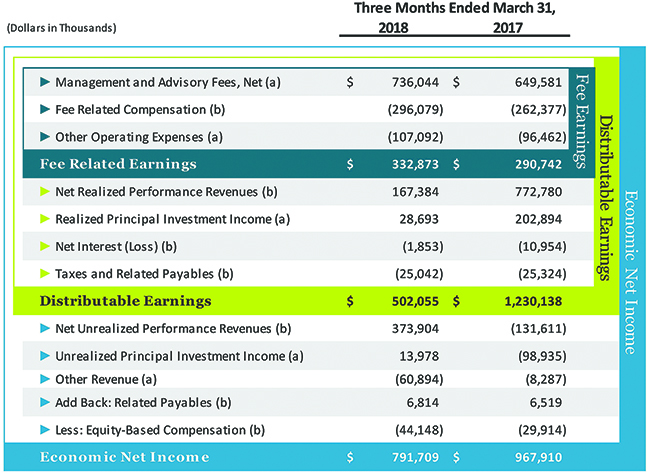
| (a) | Represents the total segment amounts of the respective captions. See Note 18. “Segment Reporting” in the “Notes to Condensed Consolidated Financial Statements” in “Part I. Item 1. Financial Statements” of this filing. |
| (b) | Detail on this amount is included in the table below. |
107
Table of Contents
The following calculates the components of Fee Related Earnings, Distributable Earnings and Economic Net Income in the above table identified by note (b):

| (a) | Represents the total segment amounts of the respective captions. See Note 18. “Segment Reporting” in the “Notes to Condensed Consolidated Financial Statements” in “Part I. Item 1. Financial Statements” of this filing. |
| (b) | Represents equity-based award expense included in Economic Income, which excludes all transaction-related equity-based charges. |
| (c) | Taxes and Related Payables represent the total GAAP tax provision adjusted to include only the current tax provision (benefit) calculated on Income (Loss) Before Provision for Taxes and to exclude the tax impact on any divestitures and the Payable Under Tax Receivable Agreement. |
| (d) | Represents tax-related payables including the Payable Under Tax Receivable Agreement, which is a component of Taxes and Related Payables. |
The following table is a reconciliation of Net Income Attributable to The Blackstone Group L.P. to Economic Income, of Economic Income to Economic Net Income, of Economic Net Income to Fee Related Earnings, of Fee Related Earnings to Distributable Earnings and of Distributable Earnings to Adjusted Earnings Before Interest, Taxes and Depreciation and Amortization:
108
Table of Contents
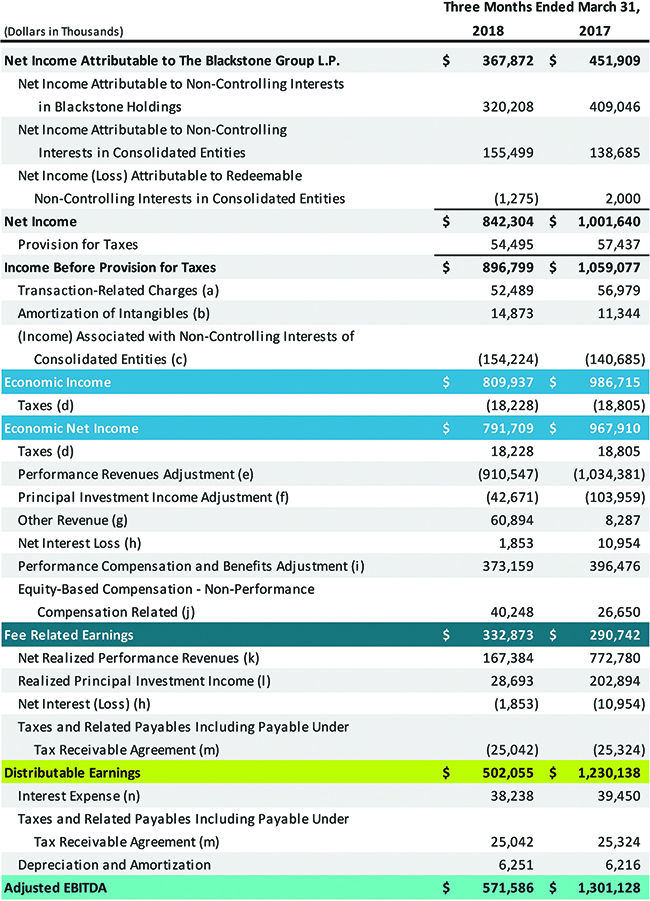
109
Table of Contents
| (a) | This adjustment adds back to Income (Loss) Before Provision (Benefit) for Taxes amounts for Transaction-Related Charges which include principally equity-based compensation charges associated with Blackstone’s initial public offering and certain long-term retention programs outside of annual deferred compensation, adjustments to the Tax Receivable Agreement Liability and other corporate actions. |
| (b) | This adjustment adds back to Income (Loss) Before Provision (Benefit) for Taxes amounts for the Amortization of Intangibles which are associated with Blackstone’s initial public offering and other corporate actions. |
| (c) | This adjustment adds back to Income (Loss) Before Provision (Benefit) for Taxes the amount of (Income) Loss Associated with Non-Controlling Interests of Consolidated Entities. |
| (d) | Taxes represent the total GAAP tax provision adjusted to include only the current tax provision (benefit) calculated on Income (Loss) Before Provision for Taxes and adjusted to exclude the tax impact on any divestitures. |
| (e) | This adjustment removes from Economic Income the total segment amount of Performance Revenues, comprised of Incentive Fees and Performance Allocations. |
| (f) | This adjustment removes from Economic Income the total segment amount of Principal Investment Income (Loss). |
| (g) | This adjustment removes from Economic Income the total segment amount of Other Revenue. |
| (h) | This adjustment represents Interest Income and Dividend Revenue less Interest Expense. |
| (i) | This adjustment removes from expenses the compensation and benefit amounts related to Blackstone’s profit sharing plans related to Performance Revenues, including Performance Compensation Related equity-based award expense. |
| (j) | Represents Non-Performance Compensation Related equity-based award expense and excludes all transaction-related equity-based charges. |
| (k) | Represents the adjustment for realized Performance Revenues net of corresponding actual amounts due under Blackstone’s profit sharing plans related thereto. |
| (l) | Represents the adjustment for Blackstone’s Realized Principal Investment Income (Loss). |
| (m) | Taxes and Related Payables Including Payable Under Tax Receivable Agreement represent the total GAAP tax provision adjusted to include only the current tax provision (benefit) calculated on Income (Loss) Before Provision for Taxes and to exclude the tax impact on any divestitures and the Payable Under Tax Receivable Agreement. |
| (n) | Represents Total Segment Interest Expense. |
Distributions
Distributable Earnings, which is derived from Blackstone’s segment reported results, is a supplemental measure to assess performance and amounts available for distributions to Blackstone unitholders, including Blackstone personnel and others who are limited partners of the Blackstone Holdings Partnerships. Distributable Earnings is intended to show the amount of net realized earnings without the effects of the consolidation of the Blackstone Funds. Distributable Earnings, which is a component of Economic Net Income, is the sum across all segments of: (a) Total Management, Advisory and Other Fees, Net, (b) Interest and Dividend Revenue, (c) Realized Incentive Fees, (d) Realized Performance Allocations, and (e) Realized Principal Investment Income (Loss); less (a) Compensation, excluding the expense of equity-based awards, (b) Realized Incentive Fee Compensation, (c) Realized Performance Allocations Compensation, (d) Interest Expense, (e) Other Operating Expenses, and (f) Taxes and Related Payables Including the Payable Under Tax Receivable Agreement.
Our intention is to distribute quarterly to common unitholders approximately 85% of The Blackstone Group L.P.’s share of Distributable Earnings, subject to adjustment by amounts determined by Blackstone’s general partner to be necessary or appropriate to provide for the conduct of its business, to make appropriate investments in its business and funds, to comply with applicable law, any of its debt instruments or other agreements, or to provide for future cash requirements such as tax-related payments, clawback obligations and distributions to unitholders for any ensuing quarter. The amount to be distributed could also be adjusted upward in any one quarter.
110
Table of Contents
All of the foregoing is subject to the qualification that the declaration and payment of any distributions are at the sole discretion of our general partner and our general partner may change our distribution policy at any time, including, without limitation, to reduce the quarterly distribution payable to our common unitholders or even to eliminate such distributions entirely.
Because the subsidiaries of The Blackstone Group L.P. must pay taxes and make payments under the tax receivable agreements, the amounts ultimately distributed by The Blackstone Group L.P. to its common unitholders in respect of each fiscal year are generally expected to be less, on a per unit basis, than the amounts distributed by the Blackstone Holdings Partnerships to the Blackstone personnel and others who are limited partners of the Blackstone Holdings Partnerships in respect of their Blackstone Holdings Partnership Units.
The following graph shows fiscal quarterly and annual per common unitholder distributions for 2017 and 2018. Distributions are declared and paid in the quarter subsequent to the quarter in which they are earned.
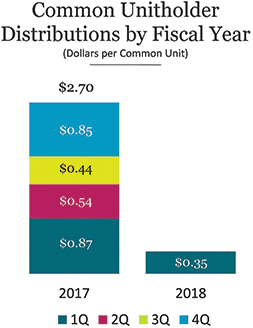
With respect to the first quarter of fiscal year 2018, we have paid to common unitholders a distribution of $0.35 per common unit. With respect to fiscal year 2017, we paid common unitholders aggregate distributions of $2.70 per common unit.
Blackstone intends to distribute a portion of the after-tax proceeds received from the April 9, 2018 conclusion of its sub-advisor relationship with FS Investments to unitholders resulting in an anticipated incremental $0.30 per common unit and per Blackstone Holdings Partnership unit over the next three quarters. See “—Notable Transactions”.
Leverage
We may under certain circumstances use leverage opportunistically and over time to create the most efficient capital structure for Blackstone and our public common unitholders. In addition to the borrowings from our bond issuances and our revolving credit facility, we may use reverse repurchase agreements, repurchase agreements and securities sold, not yet purchased. All of these positions are held in a separately managed portfolio. Reverse
111
Table of Contents
repurchase agreements are entered into primarily to take advantage of opportunistic yields otherwise absent in the overnight markets and also to use the collateral received to cover securities sold, not yet purchased. Repurchase agreements are entered into primarily to opportunistically yield higher spreads on purchased securities. The balances held in these financial instruments fluctuate based on Blackstone’s liquidity needs, market conditions and investment risk profiles.
Generally our funds in our private equity segment, our opportunistic real estate funds, funds of hedge funds and certain credit-focused funds have not utilized substantial leverage at the fund level other than for (a) short-term borrowings between the date of an investment and the receipt of capital from the investing fund’s investors, and (b) long-term borrowings for certain investments in aggregate amounts which are generally 1% to 25% of the capital commitments of the respective fund. Our carry funds make direct or indirect investments in companies that utilize leverage in their capital structure. The degree of leverage employed varies among portfolio companies.
Certain of our Real Estate debt hedge funds, Hedge Fund Solutions funds and credit-focused funds use leverage in order to obtain additional market exposure, enhance returns on invested capital and/or to bridge short-term cash needs. The forms of leverage primarily employed by these funds include purchasing securities on margin, utilizing collateralized financing and using derivative instruments.
The following table presents information regarding these financial instruments in our Condensed Consolidated Statements of Financial Condition:
|
Repurchase
Agreements |
Securities
Sold, Not Yet Purchased |
|||||||
| (Dollars in Millions) | ||||||||
|
Balance, March 31, 2018 |
$ | 142.5 | $ | 167.5 | ||||
|
Balance, December 31, 2017 |
$ | 118.8 | $ | 154.4 | ||||
|
Three Months Ended March 31, 2018 |
||||||||
|
Average Daily Balance |
$ | 131.3 | $ | 170.0 | ||||
|
Maximum Daily Balance |
$ | 145.9 | $ | 174.7 | ||||
112
Table of Contents
Contractual Obligations, Commitments and Contingencies
The following table sets forth information relating to our contractual obligations as of March 31, 2018 on a consolidated basis and on a basis deconsolidating the Blackstone Funds:
|
Contractual Obligations |
April 1, 2018 to
December 31, 2018 |
2019-2020 | 2021-2022 | Thereafter | Total | |||||||||||||||
| (Dollars in Thousands) | ||||||||||||||||||||
|
Operating Lease Obligations (a) |
$ | 59,488 | $ | 143,575 | $ | 156,476 | $ | 345,144 | $ | 704,683 | ||||||||||
|
Purchase Obligations |
28,456 | 21,077 | 1,799 | — | 51,332 | |||||||||||||||
|
Blackstone Issued Notes and Revolving Credit Facility (b) |
— | — | 400,000 | 3,207,000 | 3,607,000 | |||||||||||||||
|
Interest on Blackstone Issued Notes and Revolving Credit Facility (c) |
98,064 | 269,820 | 234,570 | 1,616,635 | 2,219,089 | |||||||||||||||
|
Blackstone Funds and CLO Vehicles Debt Obligations Payable (d) |
2,819 | — | — | 5,900,160 | 5,902,979 | |||||||||||||||
|
Interest on Blackstone Funds and CLO Vehicles Debt Obligations Payable (e) |
143,507 | 382,540 | 382,540 | 1,411,733 | 2,320,320 | |||||||||||||||
|
Blackstone Funds Capital Commitments to Investee Funds (f) |
397,329 | — | — | — | 397,329 | |||||||||||||||
|
Due to Certain Non-Controlling Interest Holders in Connection with Tax Receivable Agreements (g) |
— | 152,885 | 132,205 | 461,397 | 746,487 | |||||||||||||||
|
Unrecognized Tax Benefits, Including Interest and Penalties (h) |
2,625 | — | — | — | 2,625 | |||||||||||||||
|
Blackstone Operating Entities Capital Commitments to Blackstone Funds and Other (i) |
2,321,819 | — | — | — | 2,321,819 | |||||||||||||||
|
|
|
|
|
|
|
|
|
|
|
|||||||||||
|
Consolidated Contractual Obligations |
3,054,107 | 969,897 | 1,307,590 | 12,942,069 | 18,273,663 | |||||||||||||||
|
Blackstone Funds and CLO Vehicles Debt Obligations Payable (d) |
(2,819 | ) | — | — | (5,900,160 | ) | (5,902,979 | ) | ||||||||||||
|
Interest on Blackstone Funds and CLO Vehicles Debt Obligations Payable (e) |
(143,507 | ) | (382,540 | ) | (382,540 | ) | (1,411,733 | ) | (2,320,320 | ) | ||||||||||
|
Blackstone Funds Capital Commitments to Investee Funds (f) |
(397,329 | ) | — | — | — | (397,329 | ) | |||||||||||||
|
|
|
|
|
|
|
|
|
|
|
|||||||||||
|
Blackstone Operating Entities Contractual Obligations |
$ | 2,510,452 | $ | 587,357 | $ | 925,050 | $ | 5,630,176 | $ | 9,653,035 | ||||||||||
|
|
|
|
|
|
|
|
|
|
|
|||||||||||
| (a) | We lease our primary office space and certain office equipment under agreements that expire through 2030. In connection with certain office space lease agreements, we are responsible for escalation payments. The contractual obligation table above includes only guaranteed minimum lease payments for such leases and does not project potential escalation or other lease-related payments. These leases are classified as operating leases for financial statement purposes and as such are not recorded as liabilities on the Condensed Consolidated Statements of Financial Condition. The amounts are presented net of contractual sublease commitments. |
| (b) | Represents the principal amount due on the senior notes we issued. As of March 31, 2018, we had no outstanding borrowings under our revolver. |
| (c) | Represents interest to be paid over the maturity of our senior notes and borrowings under our revolving credit facility which has been calculated assuming no pre-payments are made and debt is held until its final maturity date. These amounts exclude commitment fees for unutilized borrowings under our revolver. |
| (d) | These obligations are those of the Blackstone Funds including the consolidated CLO vehicles. |
| (e) |
Represents interest to be paid over the maturity of the related consolidated Blackstone Funds’ and CLO vehicles’ debt obligations which has been calculated assuming no pre-payments will be made and debt will be |
113
Table of Contents
| held until its final maturity date. The future interest payments are calculated using variable rates in effect as of March 31, 2018, at spreads to market rates pursuant to the financing agreements, and range from 2.1% to 8.5%. The majority of the borrowings are due on demand and for purposes of this schedule are assumed to mature within one year. Interest on the majority of these borrowings rolls over into the principal balance at each reset date. |
| (f) | These obligations represent commitments of the consolidated Blackstone Funds to make capital contributions to investee funds and portfolio companies. These amounts are generally due on demand and are therefore presented in the less than one year category. |
| (g) | Represents obligations by the Partnership’s corporate subsidiary to make payments under the Tax Receivable Agreements to certain non-controlling interest holders for the tax savings realized from the taxable purchases of their interests in connection with the reorganization at the time of Blackstone’s IPO in 2007 and subsequent purchases. The obligation represents the amount of the payments currently expected to be made, which are dependent on the tax savings actually realized as determined annually without discounting for the timing of the payments. As required by GAAP, the amount of the obligation included in the Condensed Consolidated Financial Statements and shown in Note 16. “Related Party Transactions” (see “Part I. Item 1. Financial Statements”) differs to reflect the net present value of the payments due to certain non-controlling interest holders. |
| (h) | The total represents gross unrecognized tax benefits of $1.2 million and interest and penalties of $1.4 million. In addition, Blackstone is not able to make a reasonably reliable estimate of the timing of payments in individual years in connection with gross unrecognized benefits of $15.5 million and interest of $1.5 million; therefore, such amounts are not included in the above contractual obligations table. |
| (i) | These obligations represent commitments by us to provide general partner capital funding to the Blackstone Funds, limited partner capital funding to other funds and Blackstone principal investment commitments. These amounts are generally due on demand and are therefore presented in the less than one year category; however, a substantial amount of the capital commitments are expected to be called over the next three years. We expect to continue to make these general partner capital commitments as we raise additional amounts for our investment funds over time. |
Guarantees
Blackstone and certain of its consolidated funds provide financial guarantees. The amounts and nature of these guarantees are described in Note 17. “Commitments and Contingencies — Contingencies — Guarantees” in the “Notes to Condensed Consolidated Financial Statements” in “Part I. Item 1. Financial Statements” of this filing.
Indemnifications
In many of its service contracts, Blackstone agrees to indemnify the third party service provider under certain circumstances. The terms of the indemnities vary from contract to contract and the amount of indemnification liability, if any, cannot be determined and has not been included in the table above or recorded in our Condensed Consolidated Financial Statements as of March 31, 2018.
Clawback Obligations
Performance Allocations are subject to clawback to the extent that the Performance Allocations received to date with respect to a fund exceeds the amount due to Blackstone based on cumulative results of that fund. The actual clawback liability, however, generally does not become realized until the end of a fund’s life except for certain Blackstone real estate funds, multi-asset class investment funds and credit-focused funds, which may have an interim clawback liability. The lives of the carry funds, including available contemplated extensions, for which a liability for potential clawback obligations has been recorded for financial reporting purposes, are currently anticipated to expire at various points through 2028. Further extensions of such terms may be implemented under given circumstances.
114
Table of Contents
For financial reporting purposes, when applicable, the general partners record a liability for potential clawback obligations to the limited partners of some of the carry funds due to changes in the unrealized value of a fund’s remaining investments and where the fund’s general partner has previously received Performance Allocation distributions with respect to such fund’s realized investments.
As of March 31, 2018, the total clawback obligations were $2.2 million, of which $1.1 million related to Blackstone Holdings and $1.1 million related to current and former Blackstone personnel. If, at March 31, 2018, all of the investments held by our carry funds were deemed worthless, a possibility that management views as remote, the amount of Performance Allocations subject to potential clawback would be $6.5 billion, on an after tax basis where applicable, of which Blackstone Holdings is potentially liable for $5.9 billion if current and former Blackstone personnel default on their share of the liability, a possibility that management also views as remote. See Note 16. “Related Party Transactions” and Note 17. “Commitments and Contingencies” in the “Notes to Condensed Consolidated Financial Statements” in “Part I. Item 1. Financial Statements” of this filing.
Critical Accounting Policies
We prepare our Condensed Consolidated Financial Statements in accordance with GAAP. In applying many of these accounting principles, we need to make assumptions, estimates and/or judgments that affect the reported amounts of assets, liabilities, revenues and expenses in our condensed consolidated financial statements. We base our estimates and judgments on historical experience and other assumptions that we believe are reasonable under the circumstances. These assumptions, estimates and/or judgments, however, are often subjective. Actual results may be affected negatively based on changing circumstances. If actual amounts are ultimately different from our estimates, the revisions are included in our results of operations for the period in which the actual amounts become known. We believe the following critical accounting policies could potentially produce materially different results if we were to change underlying assumptions, estimates and/or judgments. See Note 2. “Summary of Significant Accounting Policies” in the “Notes to Condensed Consolidated Financial Statements” in “Part I. Item 1. Financial Statements” of this filing.
Principles of Consolidation
The Partnership consolidates all entities that it controls through a majority voting interest or otherwise, including those Blackstone Funds in which the general partner has a controlling financial interest. The Partnership has a controlling financial interest in Blackstone Holdings because the limited partners do not have the right to dissolve the partnerships or have substantive kick out rights or participating rights that would overcome the control held by the Partnership. Accordingly, the Partnership consolidates Blackstone Holdings and records non-controlling interests to reflect the economic interests of the limited partners of Blackstone Holdings.
In addition, the Partnership consolidates all variable interest entities (“VIE”) in which it is the primary beneficiary. An enterprise is determined to be the primary beneficiary if it holds a controlling financial interest. A controlling financial interest is defined as (a) the power to direct the activities of a VIE that most significantly impact the entity’s economic performance and (b) the obligation to absorb losses of the entity or the right to receive benefits from the entity that could potentially be significant to the VIE. The consolidation guidance requires an analysis to determine (a) whether an entity in which the Partnership holds a variable interest is a VIE and (b) whether the Partnership’s involvement, through holding interests directly or indirectly in the entity or contractually through other variable interests (for example, management and performance related fees), would give it a controlling financial interest. Performance of that analysis requires the exercise of judgment.
The Partnership determines whether it is the primary beneficiary of a VIE at the time it becomes involved with a variable interest entity and continuously reconsiders that conclusion. In determining whether the Partnership is the primary beneficiary, Blackstone evaluates its control rights as well as economic interests in the entity held either directly or indirectly by the Partnership. The consolidation analysis can generally be performed qualitatively; however, if it is not readily apparent that the Partnership is not the primary beneficiary, a quantitative analysis may
115
Table of Contents
also be performed. Investments and redemptions (either by the Partnership, affiliates of the Partnership or third parties) or amendments to the governing documents of the respective Blackstone Funds could affect an entity’s status as a VIE or the determination of the primary beneficiary. At each reporting date, the Partnership assesses whether it is the primary beneficiary and will consolidate or deconsolidate accordingly.
Assets of consolidated VIEs that can only be used to settle obligations of the consolidated VIE and liabilities of a consolidated VIE for which creditors (or beneficial interest holders) do not have recourse to the general credit of Blackstone are presented in a separate section in the Condensed Consolidated Statements of Financial Condition.
Revenue Recognition
Revenues primarily consist of management and advisory fees, incentive fees, investment income, interest and dividend revenue and other. Please refer to “Part I. Item 1. Business — Incentive Arrangements / Fee Structure” in our Annual Report on Form 10-K for the year ended December 31, 2017 for additional information regarding the manner in which Base Management Fees and Incentive Fees are generated.
Management and advisory fees and incentive fees are accounted for as contracts with customers. Under the guidance for contracts with customers, an entity is required to (a) identify the contract(s) with a customer, (b) identify the performance obligations in the contract, (c) determine the transaction price, (d) allocate the transaction price to the performance obligations in the contract, and (e) recognize revenue when (or as) the entity satisfies a performance obligation. In determining the transaction price, an entity may include variable consideration only to the extent that it is probable that a significant reversal in the amount of cumulative revenue recognized would not occur when the uncertainty associated with the variable consideration is resolved. See Note 18. “Segment Reporting” in the “Notes to Condensed Consolidated Financial Statements” in “Part I. Item 1. Financial Statements” for a disaggregated presentation of revenues from contracts with customers.
Investment Income represents the unrealized and realized gains and losses on the Partnership’s Performance Allocations and Principal Investments. Interest and Dividend Revenue comprises primarily interest and dividend income earned on principal investments held by us. Other Revenue consists of miscellaneous income and foreign exchange gains and losses arising on transactions denominated in currencies other than U.S. dollars.
Management and Advisory Fees, Net — Management and Advisory Fees, Net are comprised of management fees, including base management fees, transaction and other fees and advisory fees net of management fee reductions and offsets.
The Partnership earns base management fees from limited partners of funds in each of its managed funds, at a fixed percentage of assets under management, net asset value, total assets, committed capital or invested capital. These customer contracts require the Partnership to provide investment management services, which represents a performance obligation that the Partnership satisfies over time. Management fees are a form of variable consideration because the fees the Partnership is entitled to vary based on fluctuations in the basis for the management fee. The amount recorded as revenue is generally determined at the end of the period because these management fees are payable on a regular basis (typically quarterly) and are not subject to clawback once paid. The range of management fee rates and the calculation base from which they are earned, generally, are as follows:
On private equity, real estate, and certain of our hedge fund solutions and credit-focused funds:
| • |
0.25% to 1.75% of committed capital or invested capital during the investment period, |
| • |
0.25% to 1.50% of invested capital, committed capital and investment fair value subsequent to the investment period for private equity and real estate funds, and |
| • |
0.75% to 1.50% of invested capital or net asset value subsequent to the investment period for certain of our hedge fund solutions and credit-focused funds. |
116
Table of Contents
On real estate, credit and MLP-focused funds structured like hedge funds:
| • |
0.50% to 1.50% of net asset value. |
On credit and MLP-focused separately managed accounts:
| • |
0.25% to 1.50% of net asset value or total assets. |
On real estate separately managed accounts:
| • |
0.50% to 2.00% of invested capital, net operating income or net asset value. |
On funds of hedge funds, certain hedge funds and separately managed accounts invested in hedge funds:
| • |
0.50% to 1.25% of net asset value. |
On CLO vehicles:
| • |
0.40% to 0.65% of the aggregate par amount of collateral assets, including principal cash. |
On credit-focused registered and non-registered investment companies:
| • |
0.35% to 1.50% of total assets or net asset value. |
The investment adviser of BXMT receives annual management fees based upon 1.50% of BXMT’s net proceeds received from equity offerings and accumulated “core earnings” (which is generally equal to its GAAP net income excluding certain non-cash and other items), subject to certain adjustments. The investment adviser of our non-exchange traded REIT receives a management fee of 1.25% per annum of net asset value, payable monthly.
Transaction, advisory and other fees (including monitoring fees) are principally fees charged to the limited partners of funds indirectly through the managed funds and portfolio companies. The investment advisory agreements generally require that the investment adviser reduce the amount of management fees payable by the limited partners to the Partnership (“management fee reductions”) by an amount equal to a portion of the transaction and other fees paid to the Partnership by the portfolio companies. The amount of the reduction varies by fund, the type of fee paid by the portfolio company and the previously incurred expenses of the fund. These fees and associated management fee reductions are a component of the transaction price for our performance obligation to provide investment management services to the limited partners of funds and are recognized as changes to the transaction price in the period in which they are charged and the services are performed.
Management fee offsets are reductions to management fees payable by the limited partners of the Blackstone Funds, which are based on the amount such limited partners reimburse the Blackstone Funds or the Partnership primarily for placement fees. Providing investment management services requires the Partnership to arrange for services on behalf of its customers. In those situations where we are acting as an agent on behalf of the limited partners of funds, it presents the cost of services as net against management fee revenue. In all other situations, the cost of those services is presented gross as an expense with any reimbursement from the limited partners of the funds recorded as revenue.
Accrued but unpaid Management and Advisory Fees, net of management fee reductions and management fee offsets, as of the reporting date are included in Accounts Receivable or Due from Affiliates in the Condensed Consolidated Statements of Financial Condition.
Incentive Fees — Contractual fees earned based on the performance of Blackstone Funds (“Incentive Fees”) are a form of variable consideration in their contracts with customers to provide investment management services. Incentive Fees are earned based on fund performance during the period, subject to the achievement of minimum return levels, or high water marks, in accordance with the respective terms set out in each fund’s governing
117
Table of Contents
agreements. Incentive Fees will not be recognized as revenue until (a) it is probable that a significant reversal in the amount of cumulative revenue recognized will not occur, or (b) the uncertainty associated with the variable consideration is subsequently resolved. Incentive Fees are typically recognized as revenue when realized at the end of the measurement period. Once realized, such fees are not subject to clawback or reversal. Accrued but unpaid Incentive Fees charged directly to investors in Blackstone Funds as of the reporting date are recorded within Due from Affiliates in the Condensed Consolidated Statements of Financial Condition.
Investment Income (Loss) — Investment Income (Loss) represents the unrealized and realized gains and losses on the Partnership’s Performance Allocations and Principal Investments.
In certain fund structures across private equity, real estate, hedge fund solutions and credit-focused funds, which we refer to as carry funds, Blackstone, through its subsidiaries, invests alongside its limited partners in a partnership and is entitled to its pro-rata share of the results of the fund (a “pro-rata allocation”). In addition to a pro-rata allocation, and assuming certain investment returns are achieved, Blackstone is entitled to a disproportionate allocation of the income otherwise allocable to the limited partners, commonly referred to as carried interest or Performance Allocations.
Performance Allocations are made to the general partner based on cumulative fund performance to date, subject to a preferred return to limited partners. At the end of each reporting period, the Partnership calculates the balance of Accrued Performance Allocations that would be due to the Partnership for each fund, pursuant to the fund agreements, as if the fair value of the underlying investments were realized as of such date, irrespective of whether such amounts have been realized. As the fair value of underlying investments varies between reporting periods, it is necessary to make adjustments to amounts recorded as Accrued Performance Allocations to reflect either (a) positive performance resulting in an increase in the Accrued Performance Allocation to the general partner or (b) negative performance that would cause the amount due to the Partnership to be less than the amount previously recognized as revenue, resulting in a negative adjustment to the Accrued Performance Allocation to the general partner. In each scenario, it is necessary to calculate the Accrued Performance Allocation on cumulative results compared to the Accrued Performance Allocation recorded to date and make the required positive or negative adjustments. The Partnership ceases to record negative Performance Allocations once previously Accrued Performance Allocations for such fund have been fully reversed. The Partnership is not obligated to pay guaranteed returns or hurdles, and therefore, cannot have negative Performance Allocations over the life of a fund. Accrued Performance Allocations as of the reporting date are reflected in Investments in the Condensed Consolidated Statements of Financial Condition.
Performance Allocations are realized when an underlying investment is profitably disposed of and the fund’s cumulative returns are in excess of the preferred return or, in limited instances, after certain thresholds for return of capital are met. Performance Allocations are subject to clawback to the extent that the Performance Allocation received to date exceeds the amount due to Blackstone based on cumulative results. As such, the accrual for potential repayment of previously received Performance Allocations, which is a component of Due to Affiliates, represents all amounts previously distributed to Blackstone Holdings and non-controlling interest holders that would need to be repaid to the Blackstone carry funds if the Blackstone carry funds were to be liquidated based on the current fair value of the underlying funds’ investments as of the reporting date. The actual clawback liability, however, generally does not become realized until the end of a fund’s life except for certain funds, including certain Blackstone real estate funds, multi-asset class investment funds and credit-focused funds, which may have an interim clawback liability.
Principal Investments include the unrealized and realized gains and losses on the Partnership’s principal investments, including its investments in Blackstone Funds that are not consolidated and receive pro-rata allocations, its equity method investments, and other principal investments. Income (Loss) on Principal Investments is realized when the Partnership redeems all or a portion of its investment or when the Partnership receives cash income, such as dividends or distributions. Unrealized Income (Loss) on Principal Investments results from changes in the fair value of the underlying investment as well as the reversal of unrealized gain (loss) at the time an investment is realized.
118
Table of Contents
Interest and Dividend Revenue — Interest and Dividend Revenue comprises primarily interest and dividend income earned on principal investments held by Blackstone.
Other Revenue — Other Revenue consists of miscellaneous income and foreign exchange gains and losses arising on transactions denominated in currencies other than U.S. dollars.
Expenses
Our expenses include compensation and benefits expense and general and administrative expenses. Our accounting policies related thereto are as follows:
Compensation and Benefits — Compensation — Compensation and Benefits consists of (a) employee compensation, comprising salary and bonus, and benefits paid and payable to employees and senior managing directors and (b) equity-based compensation associated with the grants of equity-based awards to employees and senior managing directors. Compensation cost relating to the issuance of equity-based awards to senior managing directors and employees is measured at fair value at the grant date, taking into consideration expected forfeitures, and expensed over the vesting period on a straight-line basis, except in the case of (a) equity-based awards that do not require future service, which are expensed immediately and (b) certain awards to recipients that meet specified criteria making them eligible for retirement treatment (allowing such recipient to keep a percentage of those awards upon departure from Blackstone after becoming eligible for retirement), for which the expense for the portion of the award that would be retained in the event of retirement is either expensed immediately or amortized to the retirement date. Cash settled equity-based awards are classified as liabilities and are remeasured at the end of each reporting period.
Compensation and Benefits — Incentive Fee Compensation — Incentive Fee Compensation consists of compensation paid based on Incentive Fees.
Compensation and Benefits — Performance Allocations Compensation — Performance Allocation Compensation consists of compensation paid based on Performance Allocations (which may be distributed in cash or in-kind). Such compensation expense is subject to both positive and negative adjustments. Unlike Performance Allocations, compensation expense is based on the performance of individual investments held by a fund rather than on a fund by fund basis. These amounts may also include allocations of investment income from Blackstone’s principal investments, to senior managing directors and employees participating in certain profit sharing initiatives.
Other Operating Expenses — Other Operating Expenses represents general and administrative expenses including interest expense, occupancy and equipment expenses and other expenses, which consist principally of professional fees, public company costs, travel and related expenses, communications and information services and depreciation and amortization.
Fund Expenses — The expenses of our consolidated Blackstone Funds consist primarily of interest expense, professional fees and other third party expenses.
Fair Value of Financial Instruments
GAAP establishes a hierarchical disclosure framework which prioritizes and ranks the level of market price observability used in measuring financial instruments at fair value. Market price observability is affected by a number of factors, including the type of financial instrument, the characteristics specific to the financial instrument and the state of the marketplace, including the existence and transparency of transactions between market participants. Financial instruments with readily available quoted prices in active markets generally will have a higher degree of market price observability and a lesser degree of judgment used in measuring fair value.
119
Table of Contents
Financial instruments measured and reported at fair value are classified and disclosed based on the observability of inputs used in the determination of fair values, as follows:
| • |
Level I — Quoted prices are available in active markets for identical financial instruments as of the reporting date. The types of financial instruments in Level I include listed equities, listed derivatives and mutual funds with quoted prices. The Partnership does not adjust the quoted price for these investments, even in situations where Blackstone holds a large position and a sale could reasonably impact the quoted price. |
| • |
Level II — Pricing inputs are other than quoted prices in active markets, which are either directly or indirectly observable as of the reporting date, and fair value is determined through the use of models or other valuation methodologies. Financial instruments which are generally included in this category include corporate bonds and loans, including corporate bonds and loans held within CLO vehicles, government and agency securities, less liquid and restricted equity securities, and certain over-the-counter derivatives where the fair value is based on observable inputs. Senior and subordinated notes issued by CLO vehicles are classified within Level II of the fair value hierarchy. |
| • |
Level III — Pricing inputs are unobservable for the financial instruments and includes situations where there is little, if any, market activity for the financial instrument. The inputs into the determination of fair value require significant management judgment or estimation. Financial instruments that are included in this category generally include general and limited partnership interests in private equity and real estate funds, credit-focused funds, distressed debt and non-investment grade residual interests in securitizations, certain corporate bonds and loans held within CLO vehicles, and certain over-the-counter derivatives where the fair value is based on unobservable inputs. |
In certain cases, the inputs used to measure fair value may fall into different levels of the fair value hierarchy. In such cases, the determination of which category within the fair value hierarchy is appropriate for any given financial instrument is based on the lowest level of input that is significant to the fair value measurement. The Partnership’s assessment of the significance of a particular input to the fair value measurement in its entirety requires judgment and considers factors specific to the financial instrument.
Transfers between levels of the fair value hierarchy are recognized at the beginning of the reporting period.
Level II Valuation Techniques
Financial instruments classified within Level II of the fair value hierarchy comprise debt instruments, including certain corporate loans and bonds held by Blackstone’s consolidated CLO vehicles and debt securities sold, not yet purchased. Certain equity securities and derivative instruments valued using observable inputs are also classified as Level II.
The valuation techniques used to value financial instruments classified within Level II of the fair value hierarchy are as follows:
| • |
Debt Instruments and Equity Securities are valued on the basis of prices from an orderly transaction between market participants provided by reputable dealers or pricing services. In determining the value of a particular investment, pricing services may use certain information with respect to transactions in such investments, quotations from dealers, pricing matrices and market transactions in comparable investments and various relationships between investments. The valuation of certain equity securities is based on an observable price for an identical security adjusted for the effect of a restriction. |
| • |
Freestanding Derivatives are valued using contractual cash flows and observable inputs comprising yield curves, foreign currency rates and credit spreads. |
| • |
Senior and subordinate notes issued by CLO vehicles are classified based on the more observable fair value of CLO assets less (a) the fair value of any beneficial interests held by Blackstone, and (b) the carrying value of any beneficial interests that represent compensation for services. |
120
Table of Contents
Level III Valuation Techniques
In the absence of observable market prices, Blackstone values its investments using valuation methodologies applied on a consistent basis. For some investments little market activity may exist; management’s determination of fair value is then based on the best information available in the circumstances, and may incorporate management’s own assumptions and involves a significant degree of judgment, taking into consideration a combination of internal and external factors, including the appropriate risk adjustments for non-performance and liquidity risks. Investments for which market prices are not observable include private investments in the equity of operating companies, real estate properties, certain funds of hedge funds and credit-focused investments.
Private Equity Investments — The fair values of private equity investments are determined by reference to projected net earnings, earnings before interest, taxes, depreciation and amortization (“EBITDA”), the discounted cash flow method, public market or private transactions, valuations for comparable companies and other measures which, in many cases, are based on unaudited information at the time received. Valuations may be derived by reference to observable valuation measures for comparable companies or transactions (for example, multiplying a key performance metric of the investee company, such as EBITDA, by a relevant valuation multiple observed in the range of comparable companies or transactions), adjusted by management for differences between the investment and the referenced comparables, and in some instances by reference to option pricing models or other similar methods. Where a discounted cash flow method is used, a terminal value is derived by reference to EBITDA or price/earnings exit multiples.
Real Estate Investments — The fair values of real estate investments are determined by considering projected operating cash flows, sales of comparable assets, if any, and replacement costs, among other measures. The methods used to estimate the fair value of real estate investments include the discounted cash flow method and/or capitalization rates (“cap rates”) analysis. Valuations may be derived by reference to observable valuation measures for comparable companies or assets (for example, multiplying a key performance metric of the investee company or asset, such as EBITDA, by a relevant valuation multiple observed in the range of comparable companies or transactions), adjusted by management for differences between the investment and the referenced comparables, and in some instances by reference to option pricing models or other similar methods. Where a discounted cash flow method is used, a terminal value is derived by reference to an exit EBITDA multiple or capitalization rate. Additionally, where applicable, projected distributable cash flow through debt maturity will be considered in support of the investment’s fair value.
Credit-Focused Investments — The fair values of credit-focused investments are generally determined on the basis of prices between market participants provided by reputable dealers or pricing services. For credit-focused investments that are not publicly traded or whose market prices are not readily available, Blackstone may utilize other valuation techniques, including the discounted cash flow method or a market approach. The discounted cash flow method projects the expected cash flows of the debt instrument based on contractual terms, and discounts such cash flows back to the valuation date using a market-based yield. The market-based yield is estimated using yields of publicly traded debt instruments issued by companies operating in similar industries as the subject investment, with similar leverage statistics and time to maturity.
The market approach is generally used to determine the enterprise value of the issuer of a credit investment, and considers valuation multiples of comparable companies or transactions. The resulting enterprise value will dictate whether or not such credit investment has adequate enterprise value coverage. In cases of distressed credit instruments, the market approach may be used to estimate a recovery value in the event of a restructuring.
Level III Valuation Process
Investments classified within Level III of the fair value hierarchy are valued on a quarterly basis, taking into consideration factors including any changes in Blackstone’s weighted-average cost of capital assumptions, discounted cash flow projections and exit multiple assumptions, as well as any changes in economic and other
121
Table of Contents
relevant conditions, and valuation models are updated accordingly. The valuation process also includes a review by an independent valuation party, at least annually for all investments, and quarterly for certain investments, to corroborate the values determined by management. The valuations of Blackstone’s investments are reviewed quarterly by a valuation committee chaired by Blackstone’s Vice Chairman and includes senior heads of each of Blackstone’s businesses, as well as representatives of legal and finance. Each quarter, the valuations of Blackstone’s investments are also reviewed by the Audit Committee in a meeting attended by the chairman of the valuation committee. The valuations are further tested by comparison to actual sales prices obtained on disposition of the investments.
Investments, at Fair Value
The Blackstone Funds are accounted for as investment companies under the American Institute of Certified Public Accountants Accounting and Auditing Guide, Investment Companies , and reflect their investments, including majority-owned and controlled investments (the “Portfolio Companies”), at fair value. Such consolidated funds’ investments are reflected in Investments on the Condensed Consolidated Statements of Financial Condition at fair value, with unrealized gains and losses resulting from changes in fair value reflected as a component of Net Gains from Fund Investment Activities in the Condensed Consolidated Statements of Operations. Fair value is the amount that would be received to sell an asset or paid to transfer a liability, in an orderly transaction between market participants at the measurement date, at current market conditions (i.e., the exit price).
Blackstone’s principal investments are presented at fair value with unrealized appreciation or depreciation and realized gains and losses recognized in the Condensed Consolidated Statements of Operations within Investment Income (Loss).
For certain instruments, the Partnership has elected the fair value option. Such election is irrevocable and is applied on an investment by investment basis at initial recognition. The Partnership has applied the fair value option for certain loans and receivables and certain investments in private debt securities that otherwise would not have been carried at fair value with gains and losses recorded in net income. The methodology for measuring the fair value of such investments is consistent with the methodology applied to private equity, real estate, credit-focused and funds of hedge funds investments. Changes in the fair value of such instruments are recognized in Investment Income (Loss) in the Condensed Consolidated Statements of Operations. Interest income on interest bearing loans and receivables and debt securities on which the fair value option has been elected is based on stated coupon rates adjusted for the accretion of purchase discounts and the amortization of purchase premiums. This interest income is recorded within Interest and Dividend Revenue.
The Partnership has elected the fair value option for the assets of consolidated CLO vehicles. As permitted under GAAP, the Partnership measures the liabilities of consolidated CLO vehicles as (a) the sum of the fair value of the consolidated CLO assets and the carrying value of any nonfinancial assets held temporarily, less (b) the sum of the fair value of any beneficial interests retained by the Partnership (other than those that represent compensation for services) and the Partnership’s carrying value of any beneficial interests that represent compensation for services. As a result of this measurement alternative, there is no attribution of amounts to Non-Controlling Interests for consolidated CLO vehicles. Assets of the consolidated CLOs are presented within Investments within the Condensed Consolidated Statements of Financial Condition and Liabilities within Loans Payable for the amounts due to unaffiliated third parties and Due to Affiliates for the amounts held by non-consolidated affiliates. Changes in the fair value of consolidated CLO assets and liabilities and related interest, dividend and other income are presented within Net Gains from Fund Investment Activities. Expenses of consolidated CLO vehicles are presented in Fund Expenses.
The Partnership has elected the fair value option for certain proprietary investments that would otherwise have been accounted for using the equity method of accounting. The fair value of such investments is based on quoted prices in an active market or using the discounted cash flow method. Changes in fair value are recognized in Investment Income (Loss) in the Condensed Consolidated Statements of Operations.
122
Table of Contents
Further disclosure on instruments for which the fair value option has been elected is presented in Note 7. “Fair Value Option” in the “Notes to Condensed Consolidated Financial Statements” in “Part I. Item 1. Financial Statements” of this filing.
The investments of consolidated Blackstone Funds in funds of hedge funds (“Investee Funds”) are valued at net asset value (“NAV”) per share of the Investee Fund. In limited circumstances, the Partnership may determine, based on its own due diligence and investment procedures, that NAV per share does not represent fair value. In such circumstances, the Partnership will estimate the fair value in good faith and in a manner that it reasonably chooses, in accordance with the requirements of GAAP.
Certain investments of Blackstone and of the consolidated Blackstone funds of hedge funds and credit-focused funds measure their investments in underlying funds at fair value using NAV per share without adjustment. The terms of the investee’s investment generally provide for minimum holding periods or lock-ups, the institution of gates on redemptions or the suspension of redemptions or an ability to side pocket investments, at the discretion of the investee’s fund manager, and as a result, investments may not be redeemable at, or within three months of, the reporting date. A side pocket is used by hedge funds and funds of hedge funds to separate investments that may lack a readily ascertainable value, are illiquid or are subject to liquidity restriction. Redemptions are generally not permitted until the investments within a side pocket are liquidated or it is deemed that the conditions existing at the time that required the investment to be included in the side pocket no longer exist. As the timing of either of these events is uncertain, the timing at which the Partnership may redeem an investment held in a side pocket cannot be estimated. Further disclosure on instruments for which fair value is measured using NAV per share is presented in Note 5. “Net Asset Value as Fair Value” in the “Notes to Condensed Consolidated Financial Statements” in “Part I. Item 1. Financial Statements” of this filing.
Intangibles and Goodwill
Blackstone’s intangible assets consist of contractual rights to earn future fee income, including management and advisory fees, Incentive Fees and Performance Allocations. Identifiable finite-lived intangible assets are amortized on a straight-line basis over their estimated useful lives, ranging from three to twenty years, reflecting the contractual lives of such assets. Amortization expense is included within General, Administrative and Other in the Condensed Consolidated Statements of Operations. The Partnership does not hold any indefinite-lived intangible assets. Intangible assets are reviewed for impairment when events or changes in circumstances indicate that the carrying amount may not be recoverable.
Goodwill comprises goodwill arising from the contribution and reorganization of the Partnership’s predecessor entities in 2007 immediately prior to its IPO, the acquisition of GSO in 2008 and the acquisition of Strategic Partners in 2013 and the acquisition of Harvest in 2017. Goodwill is reviewed for impairment at least annually utilizing a qualitative or quantitative approach, and more frequently if circumstances indicate impairment may have occurred. The impairment testing for goodwill under the qualitative approach is based first on a qualitative assessment to determine if it is more likely than not that the fair value of Blackstone’s operating segments is less than their respective carrying values. The operating segment is the reporting level for testing the impairment of goodwill. If it is determined that it is more likely than not that an operating segment’s fair value is less than its carrying value or when the quantitative approach is used, a two-step quantitative assessment is performed to (a) calculate the fair value of the operating segment and compare it to its carrying value, and (b) if the carrying value exceeds its fair value, to measure an impairment loss.
Senior management has organized the firm into four operating segments. All of the components in each segment have similar economic characteristics and senior management makes key operating decisions based on the performance of each segment. Therefore, we believe that operating segment is the appropriate reporting level for testing the impairment of goodwill.
123
Table of Contents
The carrying value of goodwill was $1.8 billion as of March 31, 2018 and December 31, 2017. At March 31, 2018 and December 31, 2017, we determined that there was no evidence of goodwill impairment.
Off-Balance Sheet Arrangements
In the normal course of business, we enter into various off-balance sheet arrangements including sponsoring and owning limited or general partner interests in consolidated and non-consolidated funds, entering into derivative transactions, entering into operating leases and entering into guarantee arrangements. We also have ongoing capital commitment arrangements with certain of our consolidated and non-consolidated drawdown funds. We do not have any off-balance sheet arrangements that would require us to fund losses or guarantee target returns to investors in our funds.
Further disclosure on our off-balance sheet arrangements is presented in the “Notes to Condensed Consolidated Financial Statements” in “Part I. Item 1. Financial Statements” of this filing as follows:
| • |
|
| • |
|
| • |
|
Recent Accounting Developments
Information regarding recent accounting developments and their impact on Blackstone can be found in Note 2. “Summary of Significant Accounting Policies” in the “Notes to Condensed Consolidated Financial Statements” in “Part I. Item 1. Financial Statements” of this filing.
| ITEM 3. | QUANTITATIVE AND QUALITATIVE DISCLOSURES ABOUT MARKET RISK |
Our predominant exposure to market risk is related to our role as general partner or investment adviser to the Blackstone Funds and the sensitivities to movements in the fair value of their investments, including the effect on management fees, performance revenues and investment income.
Although the Blackstone Funds share many common themes, each of our alternative asset management operations runs its own investment and risk management processes, subject to our overall risk tolerance and philosophy:
| • |
The investment process of our carry funds involves a detailed analysis of potential investments, and asset management teams are assigned to oversee the operations, strategic development, financing and capital deployment decisions of each portfolio investment. Key investment decisions are subject to approval by the applicable investment committee, which is comprised of Blackstone senior managing directors and senior management. |
| • |
In our capacity as adviser to certain funds in our Hedge Fund Solutions and Credit segments, we continuously monitor a variety of markets for attractive trading opportunities, applying a number of traditional and customized risk management metrics to analyze risk related to specific assets or portfolios. In addition, we perform extensive credit and cash flow analyses of borrowers, credit-based assets and underlying hedge fund managers, and have extensive asset management teams that monitor covenant compliance by, and relevant financial data of, borrowers and other obligors, asset pool performance statistics, tracking of cash payments relating to investments and ongoing analysis of the credit status of investments. |
124
Table of Contents
Effect on Fund Management Fees
Our management fees are based on (a) third parties’ capital commitments to a Blackstone Fund, (b) third parties’ capital invested in a Blackstone Fund or (c) the net asset value, or NAV, of a Blackstone Fund, as described in our Condensed Consolidated Financial Statements. Management fees will only be directly affected by short-term changes in market conditions to the extent they are based on NAV or represent permanent impairments of value. These management fees will be increased (or reduced) in direct proportion to the effect of changes in the fair value of our investments in the related funds. The proportion of our management fees that are based on NAV is dependent on the number and types of Blackstone Funds in existence and the current stage of each fund’s life cycle. For the three months ended March 31, 2018 and March 31, 2017, the percentages of our fund management fees based on the NAV of the applicable funds or separately managed accounts, were as follows:
|
Three Months Ended
March 31, |
||||||||
| 2018 | 2017 | |||||||
|
Fund Management Fees Based on the NAV of the Applicable Funds or Separately Managed Accounts |
34 | % | 34 | % | ||||
Market Risk
The Blackstone Funds hold investments which are reported at fair value. Based on the fair value as of March 31, 2018 and March 31, 2017, we estimate that a 10% decline in fair value of the investments would result in the following declines in Management Fees, Performance Revenues, Net of Related Compensation Expense and Investment Income:
| March 31, | ||||||||||||||||||||||||
| 2018 | 2017 | |||||||||||||||||||||||
|
Management
Fees (a) |
Performance
Revenues, Net of Related Compensation Expense (b) |
Investment
Income (b) |
Management
Fees (a) |
Performance
Revenues, Net of Related Compensation Expense (b) |
Investment
Income (b) |
|||||||||||||||||||
| (Dollars in Thousands) | ||||||||||||||||||||||||
|
10% Decline in Fair Value of the Investments |
$ | 79,791 | $ | 1,427,077 | $ | 196,308 | $ | 88,945 | $ | 1,177,531 | $ | 235,607 | ||||||||||||
| (a) | Represents the annualized effect of the 10% decline. |
| (b) | Represents the reporting date effect of the 10% decline. |
Total Assets Under Management, excluding undrawn capital commitments and the amount of capital raised for our CLOs, by segment, and the percentage amount classified as Level III investments as defined within the fair value standards of GAAP, are as follows:
| March 31, 2018 | ||||||||
|
Total Assets Under Management,
Excluding Undrawn Capital Commitments and the Amount of Capital Raised for CLOs |
Percentage Amount
Classified as Level III Investments |
|||||||
| (Dollars in Thousands) | ||||||||
|
Private Equity |
$ | 62,422,958 | 70 | % | ||||
|
Real Estate |
$ | 81,744,380 | 84 | % | ||||
|
Credit |
$ | 92,015,978 | 40 | % | ||||
The fair value of our investments and securities can vary significantly based on a number of factors that take into consideration the diversity of the Blackstone Funds’ investment portfolio and on a number of factors and inputs such as similar transactions, financial metrics, and industry comparatives, among others. See “Part I. Item 1A. Risk
125
Table of Contents
Factors” in our Annual Report on Form 10-K for the year ended December 31, 2017. Also see “Part I. Item 2. Management’s Discussion and Analysis of Financial Condition and Results of Operations — Critical Accounting Policies — Investments, at Fair Value”. We believe these fair value amounts should be utilized with caution as our intent and strategy is to hold investments and securities until prevailing market conditions are beneficial for investment sales.
Investors in all of our carry funds (and certain of our credit-focused funds and funds of hedge funds) make capital commitments to those funds that we are entitled to call from those investors at any time during prescribed periods. We depend on investors fulfilling their commitments when we call capital from them in order for those funds to consummate investments and otherwise pay their related obligations when due, including management fees. We have not had investors fail to honor capital calls to any meaningful extent and any investor that did not fund a capital call would be subject to having a significant amount of its existing investment forfeited in that fund; however, if investors were to fail to satisfy a significant amount of capital calls for any particular fund or funds, those funds could be materially and adversely affected.
Exchange Rate Risk
The Blackstone Funds hold investments that are denominated in non-U.S. dollar currencies that may be affected by movements in the rate of exchange between the U.S. dollar and non-U.S. dollar currencies. Additionally, a portion of our management fees are denominated in non-U.S. dollar currencies. We estimate that as of March 31, 2018 and March 31, 2017, a 10% decline in the rate of exchange of all foreign currencies against the U.S. dollar would result in the following declines in Management Fees, Performance Revenues, Net of Related Compensation Expense and Investment Income:
| March 31, | ||||||||||||||||||||||||
| 2018 | 2017 | |||||||||||||||||||||||
|
Management
Fees (a) |
Performance
Revenues, Net of Related Compensation Expense (b) |
Investment
Income (b) |
Management
Fees (a) |
Performance
Revenues, Net of Related Compensation Expense (b) |
Investment
Income (b) |
|||||||||||||||||||
| (Dollars in Thousands) | ||||||||||||||||||||||||
|
10% Decline in the Rate of Exchange of All Foreign Currencies Against the U.S. Dollar |
$ | 21,035 | $ | 349,169 | $ | 26,591 | $ | 14,297 | $ | 269,236 | $ | 29,883 | ||||||||||||
| (a) | Represents the annualized effect of the 10% decline. |
| (b) | Represents the reporting date effect of the 10% decline. |
Interest Rate Risk
Blackstone has debt obligations payable that accrue interest at variable rates. Interest rate changes may therefore affect the amount of our interest payments, future earnings and cash flows. Based on our debt obligations payable as of March 31, 2018 and March 31, 2017, we estimate that interest expense relating to variable rates would increase on an annual basis, in the event interest rates were to increase by one percentage point, as follows:
| March 31, | ||||||||
| 2018 | 2017 | |||||||
| (Dollars in Thousands) | ||||||||
|
Annualized Increase in Interest Expense Due to a One Percentage Point Increase in Interest Rates |
$ | 28 | $ | 28 | ||||
126
Table of Contents
Blackstone has a diversified portfolio of liquid assets to meet the liquidity needs of various businesses. This portfolio includes cash, open ended money market mutual funds, open ended bond mutual funds, marketable investment securities, freestanding derivative contracts, repurchase and reverse repurchase agreements and other investments. If interest rates were to increase by one percentage point, we estimate that our annualized investment income would decrease, offset by an estimated increase in interest income on an annual basis from interest on floating rate assets, as follows:
| March 31, | ||||||||||||||||
| 2018 | 2017 | |||||||||||||||
|
Annualized
Decrease in Investment Income |
Annualized
Increase in Interest Income from Floating Rate Assets |
Annualized
Decrease in Investment Income |
Annualized
Increase in Interest Income from Floating Rate Assets |
|||||||||||||
| (Dollars in Thousands) | ||||||||||||||||
|
One Percentage Point Increase in Interest Rates |
$ | 12,911 | (a) | $ | 19,068 | $ | 10,240 | (a) | $ | 26,036 | ||||||
| (a) | As of March 31, 2018 and 2017, this represents 0.3% and 0.2% of our portfolio of liquid assets, respectively. |
Blackstone has U.S. dollar and non-U.S. dollar based interest rate derivatives whose future cash flows and present value may be affected by movement in their respective underlying yield curves. We estimate that as of March 31, 2018, a one percentage increase parallel shift in global yield curves would result in the following impact on Other Revenue:
| March 31, | ||||||||
| 2018 | 2017 | |||||||
| (Dollars in Thousands) | ||||||||
|
Annualized Increase in Other Revenue Due to a One Percentage Point Increase in Interest Rates |
$ | 25,019 | $ | — | (a) | |||
| (a) | Blackstone held no interest rate risk derivatives as of March 31, 2017 which impact Other Revenue. |
Credit Risk
Certain Blackstone Funds and the Investee Funds are subject to certain inherent risks through their investments.
Our portfolio of liquid assets contain certain credit risks including, but not limited to, exposure to uninsured deposits with financial institutions, unsecured corporate bonds and mortgage-backed securities. These exposures are actively monitored on a continuous basis and positions are reallocated based on changes in risk profile, market or economic conditions.
We estimate that our annualized investment income would decrease, if credit spreads were to increase by one percentage point, as follows:
| March 31, | ||||||||
| 2018 | 2017 | |||||||
| (Dollars in Thousands) | ||||||||
|
Decrease in Annualized Investment Income Due to a One Percentage Point Increase in Credit Spreads (a) |
$ | 32,724 | $ | 39,531 | ||||
| (a) | As of March 31, 2018 and 2017, this represents 0.7% and 0.8% of our portfolio of liquid assets, respectively. |
Certain of our entities hold derivative instruments that contain an element of risk in the event that the counterparties may be unable to meet the terms of such agreements. We minimize our risk exposure by limiting the counterparties with which we enter into contracts to banks and investment banks that meet established credit and
127
Table of Contents
capital guidelines. We do not expect any counterparty to default on its obligations and therefore do not expect to incur any loss due to counterparty default.
| ITEM 4. | CONTROLS AND PROCEDURES |
We maintain “disclosure controls and procedures,” as such term is defined in Rules 13a-15(e) and 15d-15(e) under the Securities Exchange Act of 1934 (the “Exchange Act”), that are designed to ensure that information required to be disclosed by us in reports that we file or submit under the Exchange Act is recorded, processed, summarized and reported within the time periods specified in Securities and Exchange Commission rules and forms, and that such information is accumulated and communicated to our management, including our Chief Executive Officer and Chief Financial Officer, as appropriate, to allow timely decisions regarding required disclosure. In designing disclosure controls and procedures, our management necessarily was required to apply its judgment in evaluating the cost-benefit relationship of possible disclosure controls and procedures. The design of any disclosure controls and procedures also is based in part upon certain assumptions about the likelihood of future events, and there can be no assurance that any design will succeed in achieving its stated goals under all potential future conditions. Any controls and procedures, no matter how well designed and operated, can provide only reasonable assurance of achieving the desired objectives.
Our management, including our Chief Executive Officer and Chief Financial Officer, evaluated the effectiveness of our disclosure controls and procedures pursuant to Rule 13a-15 under the Exchange Act as of the end of the period covered by this report. Based on that evaluation, our Chief Executive Officer and Chief Financial Officer have concluded that, as of the end of the period covered by this report, our disclosure controls and procedures (as defined in Rule 13a-15(e) under the Exchange Act) are effective at the reasonable assurance level to accomplish their objectives of ensuring that information we are required to disclose in reports that we file or submit under the Exchange Act is recorded, processed, summarized and reported within the time periods specified in Securities and Exchange Commission rules and forms, and that such information is accumulated and communicated to our management, including our Chief Executive Officer and Chief Financial Officer, as appropriate, to allow timely decisions regarding required disclosure.
No change in our internal control over financial reporting (as such term is defined in Rules 13a-15(f) and 15d-15(f) under the Exchange Act) occurred during our most recent quarter, that has materially affected, or is reasonably likely to materially affect, our internal control over financial reporting.
128
Table of Contents
| ITEM 1. | LEGAL PROCEEDINGS |
We may from time to time be involved in litigation and claims incidental to the conduct of our business. Our businesses are also subject to extensive regulation, which may result in regulatory proceedings against us. See “Part I. Item 1A. Risk Factors” in our Annual Report on Form 10-K for the year ended December 31, 2017. We are not currently subject to any pending judicial, administrative or arbitration proceedings that we expect to have a material impact on our consolidated financial statements. However, given the inherent unpredictability of these types of proceedings and the potentially large and/or indeterminate amounts that could be sought, an adverse outcome in certain matters could have a material effect on Blackstone’s financial results in any particular period.
| ITEM 1A. | RISK FACTORS |
For a discussion of our potential risks and uncertainties, see the information under the heading “Risk Factors” in our Annual Report on Form 10-K for the year ended December 31, 2017 and in our subsequently filed Quarterly Reports on Form 10-Q, all of which are accessible on the Securities and Exchange Commission’s website at www.sec.gov.
See “Part I. Item 2. Management’s Discussion and Analysis of Financial Condition and Results of Operations — Business Environment” in this report for a discussion of the conditions in the financial markets and economic conditions affecting our businesses. This discussion updates, and should be read together with, the risk factor entitled “Difficult market conditions can adversely affect our business in many ways, including by reducing the value or performance of the investments made by our investment funds and reducing the ability of our investment funds to raise or deploy capital, each of which could materially reduce our revenue, earnings and cash flow and adversely affect our financial prospects and condition.” in our Annual Report on Form 10-K for the year ended December 31, 2017.
The risks described in our Annual Report on Form 10-K and in our subsequently filed Quarterly Reports on Form 10-Q are not the only risks facing us. Additional risks and uncertainties not currently known to us or that we currently deem to be immaterial also may materially adversely affect our business, financial condition and/or operating results.
| ITEM 2. | UNREGISTERED SALES OF EQUITY SECURITIES AND USE OF PROCEEDS |
In January 2008, the Board of Directors of our general partner, Blackstone Group Management L.L.C., authorized the repurchase of up to $500 million of Blackstone common units and Blackstone Holdings Partnership Units. During the three months ended March 31, 2018, no units were repurchased. As of March 31, 2018, the amount remaining available for repurchases was $335.8 million under this program.
On April 16, 2018, Blackstone announced that its Board of Directors authorized the repurchase of up to $1.0 billion of common units and Blackstone Holdings partnership units, increasing the $335.8 million of repurchase authorization remaining under the prior authorization. Under the unit repurchase program, units may be repurchased from time to time in open market transactions, in privately negotiated transactions or otherwise. The timing and the actual number of units repurchased will depend on a variety of factors, including legal requirements, price and economic and market conditions. The unit repurchase program may be changed, suspended or discontinued at any time and does not have a specified expiration date. See “Part I. Item 1. Financial Statements — Notes to Condensed Consolidated Financial Statements — Note 14. Net Income Per Common Unit” and “Part I. Item 2. Management’s Discussion and Analysis of Financial Condition and Results of Operations — Liquidity and Capital Resources — Sources and Uses of Liquidity” for further information regarding this unit repurchase program.
129
Table of Contents
As permitted by our policies and procedures governing transactions in our securities by our directors, executive officers and other employees, from time to time some of these persons may establish plans or arrangements complying with Rule 10b5-1 under the Exchange Act, and similar plans and arrangements relating to our common units and Blackstone Holdings Partnership Units.
| ITEM 3. | DEFAULTS UPON SENIOR SECURITIES |
Not applicable.
| ITEM 4. | MINE SAFETY DISCLOSURES |
Not applicable.
| ITEM 5. | OTHER INFORMATION |
On May 8, 2018, Sir John Antony Hood was appointed to the board of directors of Blackstone Group Management L.L.C., the general partner (the “General Partner”) of the Partnership, and its Audit and Conflicts Committees, effective May 14, 2018.
Sir John will receive an annual cash retainer of $150,000. In addition, Sir John will receive, effective May 14, 2018, a grant of deferred restricted common units with a value of $150,000 under The Blackstone Group L.P. Amended and Restated 2007 Equity Incentive Plan. These deferred restricted common units will vest, and the underlying common units will be delivered, on the first anniversary of the date of grant, subject to Sir John’s continued service on the board of directors of the General Partner.
| ITEM 6. | EXHIBITS |
|
Exhibit
|
Exhibit Description |
|
| 31.1* | Certification of the Chief Executive Officer pursuant to Rule 13a-14(a). | |
| 31.2* | Certification of the Chief Financial Officer pursuant to Rule 13a-14(a). | |
| 32.1* | Certification of the Chief Executive Officer pursuant to 18 U.S.C. Section 1350, as adopted pursuant to Section 906 of the Sarbanes-Oxley Act of 2002 (furnished herewith). | |
| 32.2* | Certification of the Chief Financial Officer pursuant to 18 U.S.C. Section 1350, as adopted pursuant to Section 906 of the Sarbanes-Oxley Act of 2002 (furnished herewith). | |
| 101.INS* | XBRL Instance Document. | |
| 101.SCH* | XBRL Taxonomy Extension Schema Document. | |
| 101.CAL* | XBRL Taxonomy Extension Calculation Linkbase Document. | |
| 101.DEF* | XBRL Taxonomy Extension Definition Linkbase Document. | |
| 101.LAB* | XBRL Taxonomy Extension Label Linkbase Document. | |
| 101.PRE* | XBRL Taxonomy Extension Presentation Linkbase Document. | |
| * | Filed herewith. |
The agreements and other documents filed as exhibits to this report are not intended to provide factual information or other disclosure other than with respect to the terms of the agreements or other documents themselves, and you should not rely on them for that purpose. In particular, any representations and warranties made by us in these agreements or other documents were made solely within the specific context of the relevant agreement or document and may not describe the actual state of affairs as of the date they were made or at any other time.
130
Table of Contents
Pursuant to the requirements of the Securities Exchange Act of 1934, the Registrant has duly caused this report to be signed on its behalf by the undersigned thereunto duly authorized.
Date: May 8, 2018
| The Blackstone Group L.P. | ||
| By: |
Blackstone Group Management L.L.C., its General Partner |
|
|
/s/ Michael S. Chae |
||
| Name: | Michael S. Chae | |
| Title: | Chief Financial Officer | |
| (Principal Financial Officer and Authorized Signatory) | ||
131