|
|
|
|
|
|
|
|
|
|
|
|
|
|
|
|
|
|
|
|
|
|
|
|
|
|
|
|
|
|
|
|
|
|
|
|
|
|
|
|
|
|
|
|
|
|
|
|
|
|
UNITED STATES
SECURITIES AND EXCHANGE COMMISSION
WASHINGTON, D.C. 20549
FORM 10-Q
QUARTERLY REPORT PURSUANT TO SECTION 13 OR 15(d) OF
THE SECURITIES EXCHANGE ACT OF 1934
For the quarterly period ended June 30, 2011
Commission file number 1-9924
Citigroup Inc.
(Exact name of registrant as specified in its charter)
|
Delaware
(State or other jurisdiction of incorporation or organization) |
52-1568099
(I.R.S. Employer Identification No.) |
|
|
399 Park Avenue, New York, NY (Address of principal executive offices) |
|
10043 (Zip code) |
|
(212) 559-1000 (Registrant's telephone number, including area code) |
||
Indicate by check mark whether the registrant (1) has filed all reports required to be filed by Section 13 or 15(d) of the Securities Exchange Act of 1934 during the preceding 12 months (or for such shorter period that the registrant was required to file such reports), and (2) has been subject to such filing requirements for the past 90 days. Yes ý No o
Indicate by check mark whether the registrant has submitted electronically and posted on its corporate Web site, if any, every Interactive Data File required to be submitted and posted pursuant to Rule 405 of Regulation S-T (§232.405 of this chapter) during the preceding 12 months (or for such shorter period that the registrant was required to submit and post such files). Yes ý No o
Indicate by check mark whether the registrant is a large accelerated filer, an accelerated filer, a non-accelerated filer, or a smaller reporting company. See the definitions of "large accelerated filer," "accelerated filer" and "smaller reporting company" in Rule 12b-2 of the Exchange Act.
| Large accelerated filer ý | Accelerated filer o |
Non-accelerated filer
o
(Do not check if a smaller reporting company) |
Smaller reporting company o |
Indicate by check mark whether the registrant is a shell company (as defined in Rule 12b-2 of the Exchange Act). Yes o No ý
Indicate the number of shares outstanding of each of the issuer's classes of common stock as of the latest practicable date:
Common stock outstanding as of June 30, 2011: 2,917,949,115
Available on the web at www.citigroup.com
1
CITIGROUP INC.
SECOND QUARTER 2011—FORM 10-Q
2
Introduction
Citigroup operates, for management reporting purposes, via two primary business segments: Citicorp, consisting of Citi's Regional Consumer Banking businesses and Institutional Clients Group ; and Citi Holdings, consisting of Citi's Brokerage and Asset Management and Local Consumer Lending businesses, and a Special Asset Pool . There is also a third segment, Corporate/Other . For a further description of the business segments and the products and services they provide, see "Citigroup Segments" below, "Management's Discussion and Analysis of Financial Condition and Results of Operations" and Note 3 to the Consolidated Financial Statements.
Throughout this report, "Citigroup," "Citi" and "the Company" refer to Citigroup Inc. and its consolidated subsidiaries.
This Quarterly Report on Form 10-Q should be read in conjunction with Citigroup's Annual Report on Form 10-K for the year ended December 31, 2010 (2010 Annual Report on Form 10-K) and Citigroup's Quarterly Report on Form 10-Q for the quarter ended March 31, 2011. Additional information about Citigroup is available on the company's Web site at www.citigroup.com . Citigroup's recent annual reports on Form 10-K, quarterly reports on Form 10-Q, current reports on Form 8-K, as well as its other filings with the SEC are available free of charge through the company's Web site by clicking on the "Investors" page and selecting "All SEC Filings." The SEC's Web site also contains periodic and current reports, proxy and information statements, and other information regarding Citi at www.sec.gov .
Certain reclassifications have been made to the prior periods' financial statements to conform to the current period's presentation. All per share amounts and Citigroup shares outstanding for the second quarter of 2011 and all prior periods reflect Citigroup's 1-for-10 reverse stock split, which was effective May 6, 2011.
Within this Form 10-Q, please refer to the tables of contents on pages 2 and 94 for page references to Management's Discussion and Analysis of Financial Condition and Results of Operations and Notes to Consolidated Financial Statements, respectively.
3
As described above, Citigroup is managed pursuant to the following segments:
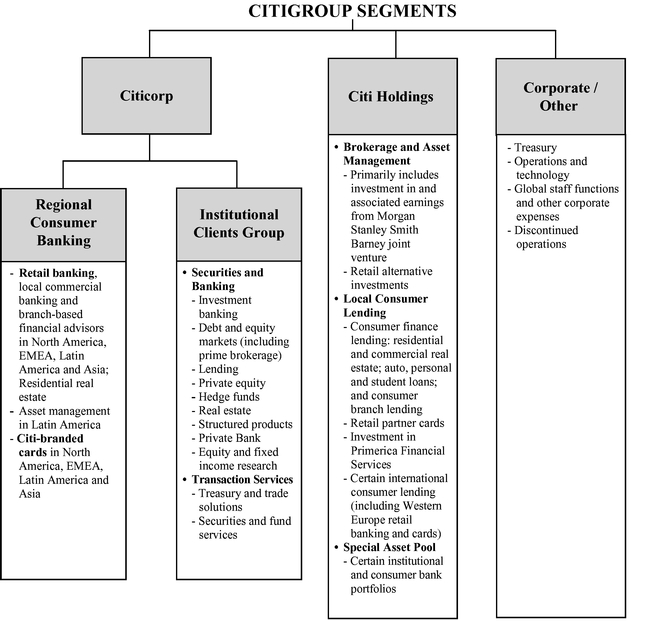
The following are the four regions in which Citigroup operates. The regional results are fully reflected in the segment results above.

- (1)
- Asia includes Japan, Latin America includes Mexico, and North America comprises the U.S., Canada and Puerto Rico.
4
MANAGEMENT'S DISCUSSION AND ANALYSIS OF FINANCIAL CONDITION AND RESULTS OF OPERATIONS
SECOND QUARTER 2011 EXECUTIVE SUMMARY
Citigroup
Citigroup reported second quarter of 2011 net income of $3.3 billion, or $1.09 per diluted share. Citigroup's income increased by 24%, or $644 million, from the second quarter of 2010, as a significant decline in credit costs more than offset the impact of lower revenues and an increase in operating expenses as compared to the prior-year period.
Citigroup revenues, net of interest expense, were $20.6 billion, down $1.4 billion, or 7%, from the second quarter of 2010 as growth in international Regional Consumer Banking and Transaction Services was more than offset by lower revenues in Citi Holdings, Securities and Banking and North America Regional Consumer Banking . Net interest revenues of $12.1 billion were 13% lower than the prior-year period, largely due to continued declining loan balances and lower interest-earnings assets in Citi Holdings. Non-interest revenues were $8.5 billion, up 4% from the prior-year period, principally driven by realized gains on asset sales in the Special Asset Pool in Citi Holdings, including $511 million of pre-tax gains realized in the second quarter of 2011 on the sale of assets transferred out of held-to-maturity in the first quarter of 2011.
Operating Expenses
Citigroup expenses increased $1.1 billion, or 9%, year-over-year to $12.9 billion. Excluding the impact of the UK bonus tax of approximately $400 million in the second quarter of 2010, expenses increased by nearly $1.5 billion, or 13%, year-over-year. Approximately one-third of this 13% increase resulted from the impact of foreign exchange in the translation of local currency results into U.S. dollars (as used throughout this Form 10-Q, FX translation) and another one-third was related to higher legal and related costs. The remaining one-third was driven by the net impact of investment spending, which was partially offset by ongoing productivity savings.
For the first half of 2011, Citigroup expenses were $25.3 billion, up $2.3 billion from the prior-year period, excluding the impact of the UK bonus tax in the second quarter of 2010. Nearly 70% of this increase, or approximately $1.6 billion, resulted from the impact of FX translation and higher legal and related costs in the first half of 2011, as compared to the first half of 2010. The remaining increase of roughly $700 million was primarily driven by investment spending, partially offset by continued productivity savings. The impact of FX translation and legal and related costs will likely continue to affect Citigroup's operating expenses in the second half of 2011 and will remain difficult to predict. Citi currently believes, however, that operating expenses will remain elevated for the remainder of 2011.
Citicorp expenses of $10.1 billion in the second quarter of 2011 grew 10% from the second quarter of 2010. Excluding the UK bonus tax in the second quarter of 2010, expenses were up 14% year-over-year. Over a quarter of this 14% increase resulted from the impact of FX translation, and the remainder was primarily driven by investment spending as Citi continues to execute its strategy to increase revenues and operating income in its business units.
Citi Holdings expenses were down 9% year-over-year to $2.2 billion, principally due to the continued decline in assets and thus lowered operating expenses, offset by an increase in legal and related costs.
Credit Costs
Citigroup total provisions for credit losses and for benefits and claims of $3.4 billion declined $3.3 billion, or 49%, from the prior-year period. Net credit losses of $5.1 billion were down $2.8 billion, or 35%, from the second quarter of 2010. Consumer net credit losses declined $2.7 billion, or 36%, to $4.8 billion, driven by continued improvement in credit in North America Citi-branded cards in Citicorp, and retail partner cards and residential real estate lending in Citi Holdings. Corporate net credit losses decreased $123 million year-over-year to $349 million, due in part to lower volume of loan sales.
The net release of allowance for loan losses and unfunded lending commitments was $2.0 billion in the second quarter of 2011, compared to a net release of $1.5 billion in the second quarter of 2010. More than half of the net credit reserve release in the second quarter of 2011, or $1.1 billion, was attributable to Citi Holdings. The $914 million net credit release in Citicorp was up from $665 million in the prior-year period and was due primarily to higher net releases in Citi-branded cards, partially offset by lower releases in international Regional Consumer Banking and the Corporate portfolio. Citi continues to expect international Regional Consumer Banking and Corporate credit costs in Citicorp to increase, reflecting growing loan portfolios.
Of the $2.0 billion net reserve release in the second quarter of 2011, $1.5 billion related to Consumer and was mainly driven by North America Citi-branded cards and retail partner cards. The $456 million net Corporate reserve release reflected continued improvement in Corporate credit trends, partially offset by the growth in the Corporate loan portfolio. The release reflected lower expected loan losses inherent in the remaining loan portfolios.
Capital and Loan Loss Reserve Positions
Citigroup's Tier 1 Capital ratio was 13.6% at quarter-end, and its Tier 1 Common ratio was 11.6%.
Citigroup's total allowance for loan losses was $34.4 billion at quarter-end, or 5.35%, of total loans, down from $46.2 billion, or 6.72%, in the prior-year period. The decline in the total allowance for loan losses reflected asset sales, lower non-accrual loans, and overall continued improvement in the credit quality of the loan portfolio.
5
The Consumer allowance for loan losses was $31.0 billion, or 7.01%, of total Consumer loans, at quarter-end, compared to $39.6 billion, or 7.87%, at June 30, 2010.
Citigroup's non-accrual loans of $13.2 billion declined 47% from the prior-year period. At the end of the second quarter of 2011, the allowance for loan losses was 260% of non-accrual loans.
Citicorp
Citicorp net income of $3.7 billion in the second quarter of 2011 declined 2% from the prior-year period. Year-over-year, revenues declined less than 1%, and lower net credit losses and a higher net loan loss reserve release more than offset an increase in operating expenses. Citicorp's international operations accounted for over 68% of second quarter 2011 net income from continuing operations.
Citicorp revenues were $16.3 billion, down $141 million from the second quarter of 2010, driven by a positive credit valuation adjustment (CVA) of $147 million in the second quarter of 2011, compared to a positive CVA of $255 million in the prior-year period. Excluding CVA, Citicorp revenues were flat year-over-year, as growth in international Regional Consumer Banking and Transaction Services was offset by lower revenues in North America Regional Consumer Banking and Securities and Banking . Sequentially, Citicorp revenues, excluding CVA, were down 3% as growth in Regional Consumer Banking and Transaction Services was more than offset by lower revenues in Securities and Banking . Net interest revenues of $9.5 billion declined 1% from the prior-year period, and non-interest revenues were flat versus the prior year at $6.8 billion.
Regional Consumer Banking revenues of $8.2 billion were 2% higher year-over-year, mostly due to continued growth in business volumes across international regions as well as the impact of FX translation. This growth was partly offset by lower credit card balances in North America, the impact of The Credit Card Accountability Responsibility and Disclosure Act (CARD Act), and continued spread compression in Asia and Latin America. Average retail banking loans increased 18% year-over-year to $129.0 billion, and average deposits increased 8% to $314.5 billion, both driven by Asia and Latin America. Citi-branded cards average loans increased 1% year-over-year to $110.1 billion, as growth in Asia and Latin America was offset by lower balances in North America. Cards purchase sales grew 12% from the prior-year period to $71.3 billion, and international investment sales increased 5% to $24.5 billion.
Securities and Banking revenues of $5.5 billion declined 8% year-over-year, driven principally by lower revenues in fixed income markets. Sequentially, revenues declined 9%, driven by lower revenues in fixed income and equity markets, partially offset by a strong quarter in investment banking. Excluding CVA, revenues of $5.3 billion were down 7% from the prior-year period and down 15% sequentially. Fixed income markets revenues of $2.9 billion, excluding CVA, decreased 16% year-over-year, largely due to lower revenues in G10 rates and currencies, partially offset by growth in emerging markets, and 27% sequentially, driven by credit-related and securitized products. Equity markets revenues of $776 million, excluding CVA, were 25% higher year-over-year, mainly driven by derivatives, but down 30% sequentially, mainly due to lower market volumes and a challenging trading environment as compared to the first quarter of 2011, particularly in derivatives. Investment banking revenues were $1.1 billion, up 61% from the prior-year period and 27% sequentially, reflecting increased activity in both advisory and underwriting activities.
Transaction Services revenues were $2.7 billion, up 6% from the prior-year period, driven by growth in Treasury and Trade Solutions as well as Securities and Fund Services. Revenues grew year-over-year in all international regions, as strong growth in business volumes was partially offset by continued spread compression. Average deposits and other customer liabilities grew 14% year-over-year to $365 billion, while assets under custody grew 19% to $13.5 trillion.
Citicorp end of period loans increased 16% year-over-year to $440 billion, with 11% growth in Consumer loans and 22% growth in Corporate loans.
Citi Holdings
Citi Holdings net loss of $218 million in the second quarter of 2011 was 82% less than the net loss of $1.2 billion in the second quarter of 2010, as lower operating expenses, a continued improvement in net credit losses and a higher net loan loss reserve release offset lower revenues.
Citi Holdings revenues declined 18% to $4.0 billion from the prior-year period. Net interest revenues declined 33% year-over-year to $2.7 billion, largely driven by declining loan balances in Local Consumer Lending and lower interest-earning assets in the Special Asset Pool . Non-interest revenues increased 43% to $1.4 billion from the prior-year period, mostly reflecting the $511 million of pre-tax gains realized in the second quarter of 2011 on the sale of assets transferred out of held-to-maturity in the first quarter of 2011.
Citi Holdings assets declined 34% from the second quarter of 2010 to $308 billion at the end of the second quarter of 2011. The decline reflected $108 billion in asset sales and business dispositions (including the sale of the previously-disclosed $12.7 billion of assets transferred out of held-to-maturity in the Special Asset Pool in the first quarter of 2011), $42 billion in net run-off and amortization, and $7 billion in net cost of credit and net asset marks. Local Consumer Lending continues to represent the largest segment within Citi Holdings, with $228 billion of assets at the end of the second quarter of 2011. Over half of Local Consumer Lending assets, or approximately $119 billion, were related to North America real estate lending. As of the end of the second quarter of 2011, there were approximately $10 billion of loan loss reserves allocated to North America real estate lending in Citi Holdings, representing over 27 months of coincident net credit loss coverage. At the end of the second quarter of 2011, Citi Holdings assets comprised approximately 16% of total Citigroup GAAP assets and 28% of risk-weighted assets.
6
SUMMARY OF SELECTED FINANCIAL DATA
Citigroup Inc. and Consolidated Subsidiaries
|
|
Second Quarter |
|
Six Months Ended |
|
|||||||||||||||
|---|---|---|---|---|---|---|---|---|---|---|---|---|---|---|---|---|---|---|---|
| In millions of dollars, except per-share amounts, ratios and direct staff |
|
|
|||||||||||||||||
| 2011 | 2010 | % Change | 2011 | 2010 | % Change | ||||||||||||||
|
Net interest revenue |
$ | 12,148 | $ | 13,927 | (13 | )% | $ | 24,250 | $ | 28,368 | (15 | )% | |||||||
|
Non-interest revenue |
8,474 | 8,144 | 4 | 16,098 | 19,124 | (16 | ) | ||||||||||||
|
Revenues, net of interest expense |
$ | 20,622 | $ | 22,071 | (7 | )% | $ | 40,348 | $ | 47,492 | (15 | )% | |||||||
|
Operating expenses |
12,936 | 11,866 | 9 | 25,262 | 23,384 | 8 | |||||||||||||
|
Provisions for credit losses and for benefits and claims |
3,387 | 6,665 | (49 | ) | 6,571 | 15,283 | (57 | ) | |||||||||||
|
Income from continuing operations before income taxes |
$ | 4,299 | $ | 3,540 | 21 | % | $ | 8,515 | $ | 8,825 | (4 | )% | |||||||
|
Income taxes |
967 | 812 | 19 | 2,152 | 1,848 | 16 | |||||||||||||
|
Income from continuing operations |
$ | 3,332 | $ | 2,728 | 22 | % | $ | 6,363 | $ | 6,977 | (9 | )% | |||||||
|
Income (loss) from discontinued operations, net of taxes(1) |
71 | (3 | ) | NM | 111 | 208 | (47 | ) | |||||||||||
|
Net income before attribution of noncontrolling interests |
$ | 3,403 | $ | 2,725 | 25 | % | $ | 6,474 | $ | 7,185 | (10 | )% | |||||||
|
Net income attributable to noncontrolling interests |
62 | 28 | NM | 134 | 60 | NM | |||||||||||||
|
Citigroup's net income |
$ | 3,341 | $ | 2,697 | 24 | % | $ | 6,340 | $ | 7,125 | (11 | )% | |||||||
|
Less: Preferred dividends–Basic |
$ | 9 | $ | — | NM | $ | 13 | $ | — | NM | |||||||||
|
Less: Dividends and undistributed earnings allocated to employee restricted and deferred shares that contain nonforfeitable rights to dividends, applicable to Basic EPS |
62 | 26 | NM | 96 | 57 | 68 | % | ||||||||||||
|
Income allocated to unrestricted common shareholders for basic EPS |
$ | 3,270 | $ | 2,671 | 22 | % | $ | 6,231 | $ | 7,068 | (12 | )% | |||||||
|
Add: Incremental dividends and undistributed earnings allocated to employee restricted and deferred shares that contain nonforfeitable rights to dividends, applicable to Diluted EPS |
6 | 1 | NM | 7 | 2 | NM | |||||||||||||
|
Income allocated to unrestricted common shareholders for diluted EPS |
$ | 3,276 | $ | 2,672 | 23 | % | $ | 6,238 | $ | 7,070 | (12 | )% | |||||||
|
Earnings per share(2) |
|||||||||||||||||||
|
Basic |
|||||||||||||||||||
|
Income from continuing operations |
$ | 1.10 | $ | 0.93 | 18 | % | $ | 2.11 | $ | 2.40 | (12 | )% | |||||||
|
Net income |
1.12 | 0.93 | 20 | 2.14 | 2.47 | (13 | ) | ||||||||||||
|
Diluted |
|||||||||||||||||||
|
Income from continuing operations |
$ | 1.07 | $ | 0.90 | 19 | % | $ | 2.05 | $ | 2.32 | (12 | )% | |||||||
|
Net income |
1.09 | 0.90 | 21 | 2.08 | 2.39 | (13 | ) | ||||||||||||
|
At June 30: |
|||||||||||||||||||
|
Total assets |
$ | 1,956,626 | $ | 1,937,656 | 1 | % | |||||||||||||
|
Total deposits |
866,310 | 813,951 | 6 | ||||||||||||||||
|
Long-term debt |
352,458 | 413,297 | (15 | ) | |||||||||||||||
|
Mandatorily redeemable securities of subsidiary trusts (included in long-term debt) |
16,077 | 20,218 | (20 | ) | |||||||||||||||
|
Common stockholders' equity |
176,052 | 154,494 | 14 | ||||||||||||||||
|
Total stockholders' equity |
176,364 | 154,806 | 14 | ||||||||||||||||
|
Direct staff (in thousands) |
263 | 259 | 2 | ||||||||||||||||
|
Ratios: |
|||||||||||||||||||
|
Return on average common stockholders' equity(3) |
7.7 | % | 7.0 | % | 7.5 | % | 9.5 | % | |||||||||||
|
Return on average total stockholders' equity(3) |
7.7 | 7.0 | 7.5 | 9.5 | |||||||||||||||
|
Tier 1 Common(4) |
11.62 | % | 9.71 | % | |||||||||||||||
|
Tier 1 Capital |
13.55 | 11.99 | |||||||||||||||||
|
Total Capital |
17.18 | 15.59 | |||||||||||||||||
|
Leverage(5) |
7.05 | 6.31 | |||||||||||||||||
|
Common stockholders' equity to assets |
9.00 | % | 7.97 | % | |||||||||||||||
|
Total stockholders' equity to assets |
9.01 | 7.99 | |||||||||||||||||
|
Book value per common share(2) |
$ | 60.34 | $ | 53.32 | |||||||||||||||
|
Tangible book value per share(2)(6) |
48.75 | 41.86 | |||||||||||||||||
|
Ratio of earnings to fixed charges and preferred stock dividends |
1.65 | 1.54 | 1.67 | 1.68 | |||||||||||||||
- (1)
- Discontinued operations primarily reflects the sale of Nikko Cordial Securities, the sale of Citigroup's German retail banking operations, the sale of CitiCapital's equipment finance unit to General Electric, and the sale of the Egg Banking PLC credit card business. See Note 2 to the Consolidated Financial Statements.
7
- (2)
-
All
per share amounts and Citigroup shares outstanding for all periods reflect Citigroup's 1-for-10 reverse stock split, which was
effective May 6, 2011.
- (3)
-
The
return on average common stockholders' equity is calculated using net income less preferred stock dividends divided by average common stockholders'
equity. The return on total stockholders' equity is calculated using net income divided by average stockholders' equity.
- (4)
-
As
defined by the banking regulators, the Tier 1 Common ratio represents Tier 1 Capital less qualifying perpetual preferred stock, qualifying
noncontrolling interests in subsidiaries and qualifying mandatorily redeemable securities of subsidiary trusts divided by risk-weighted assets.
- (5)
-
The
Leverage ratio represents Tier 1 Capital divided by adjusted average total assets.
- (6)
- Tangible book value per share is a non-GAAP financial measure for SEC purposes. For additional information and a reconciliation of this measure to the most directly comparable GAAP measure, see "Capital Resources and Liquidity—Capital Resources—Tangible Common Equity and Tangible Book Value Per Share" below.
NM Not meaningful
8
SEGMENT AND BUSINESS—INCOME (LOSS) AND REVENUES
The following tables show the income (loss) and revenues for Citigroup on a segment and business view:
CITIGROUP INCOME (LOSS)
|
|
Second Quarter |
|
Six Months |
|
|||||||||||||||||
|---|---|---|---|---|---|---|---|---|---|---|---|---|---|---|---|---|---|---|---|---|---|
| In millions of dollars | 2011 | 2010(1) | % Change | 2011 | 2010(1) | % Change | |||||||||||||||
|
Income (loss) from continuing operations |
|||||||||||||||||||||
|
CITICORP |
|||||||||||||||||||||
|
Regional Consumer Banking |
|||||||||||||||||||||
|
North America |
$ | 684 | $ | 52 | NM | $ | 1,235 | $ | 67 | NM | |||||||||||
|
EMEA |
29 | 48 | (40 | )% | 78 | 72 | 8 | % | |||||||||||||
|
Latin America |
412 | 473 | (13 | ) | 896 | 840 | 7 | ||||||||||||||
|
Asia |
484 | 566 | (14 | ) | 945 | 1,133 | (17 | ) | |||||||||||||
|
Total |
$ | 1,609 | $ | 1,139 | 41 | % | $ | 3,154 | $ | 2,112 | 49 | ||||||||||
|
Securities and Banking |
|||||||||||||||||||||
|
North America |
$ | 339 | $ | 816 | (58 | )% | $ | 797 | $ | 2,238 | (64 | )% | |||||||||
|
EMEA |
343 | 355 | (3 | ) | 1,108 | 1,376 | (19 | ) | |||||||||||||
|
Latin America |
292 | 200 | 46 | 564 | 469 | 20 | |||||||||||||||
|
Asia |
212 | 301 | (30 | ) | 422 | 770 | (45 | ) | |||||||||||||
|
Total |
$ | 1,186 | $ | 1,672 | (29 | )% | $ | 2,891 | $ | 4,853 | (40 | )% | |||||||||
|
Transaction Services |
|||||||||||||||||||||
|
North America |
$ | 137 | $ | 158 | (13 | )% | $ | 250 | $ | 319 | (22 | )% | |||||||||
|
EMEA |
289 | 320 | (10 | ) | 567 | 623 | (9 | ) | |||||||||||||
|
Latin America |
157 | 154 | 2 | 327 | 306 | 7 | |||||||||||||||
|
Asia |
290 | 296 | (2 | ) | 574 | 615 | (7 | ) | |||||||||||||
|
Total |
$ | 873 | $ | 928 | (6 | )% | $ | 1,718 | $ | 1,863 | (8 | )% | |||||||||
|
Institutional Clients Group |
$ | 2,059 | $ | 2,600 | (21 | )% | $ | 4,609 | $ | 6,716 | (31 | )% | |||||||||
|
Total Citicorp |
$ | 3,668 | $ | 3,739 | (2 | )% | $ | 7,763 | $ | 8,828 | (12 | )% | |||||||||
|
CITI HOLDINGS |
|||||||||||||||||||||
|
Brokerage and Asset Management |
$ | (100 | ) | $ | (94 | ) | (6 | )% | $ | (110 | ) | $ | (18 | ) | NM | ||||||
|
Local Consumer Lending |
(746 | ) | (1,226 | ) | 39 | (1,345 | ) | (3,055 | ) | 56 | % | ||||||||||
|
Special Asset Pool |
678 | 116 | NM | 740 | 994 | (26 | ) | ||||||||||||||
|
Total Citi Holdings |
$ | (168 | ) | $ | (1,204 | ) | 86 | % | $ | (715 | ) | $ | (2,079 | ) | 66 | % | |||||
|
Corporate/Other |
$ | (168 | ) | $ | 193 | NM | $ | (685 | ) | $ | 228 | NM | |||||||||
|
Income from continuing operations |
$ | 3,332 | $ | 2,728 | 22 | % | $ | 6,363 | $ | 6,977 | (9 | )% | |||||||||
|
Income loss (from) discontinued operations |
$ | 71 | $ | (3 | ) | $ | 111 | $ | 208 | ||||||||||||
|
Net income attributable to noncontrolling interests |
62 | 28 | 134 | 60 | |||||||||||||||||
|
Citigroup's net income |
$ | 3,341 | $ | 2,697 | 24 | % | $ | 6,340 | $ | 7,125 | (11 | )% | |||||||||
- (1)
- The prior period balances reflect reclassifications to conform the presentation in those periods to the current period's presentation. These reclassifications related to Citi's re-allocation of certain expenses between businesses and segments.
NM Not meaningful
9
CITIGROUP REVENUES
|
|
Second Quarter |
|
Six Months |
|
|||||||||||||||||
|---|---|---|---|---|---|---|---|---|---|---|---|---|---|---|---|---|---|---|---|---|---|
| In millions of dollars | 2011 | 2010 | % Change | 2011 | 2010 | % Change | |||||||||||||||
|
CITICORP |
|||||||||||||||||||||
|
Regional Consumer Banking |
|||||||||||||||||||||
|
North America |
$ | 3,366 | $ | 3,693 | (9 | )% | $ | 6,700 | $ | 7,494 | (11 | )% | |||||||||
|
EMEA |
391 | 376 | 4 | 789 | 781 | 1 | |||||||||||||||
|
Latin America |
2,426 | 2,118 | 15 | 4,735 | 4,194 | 13 | |||||||||||||||
|
Asia |
2,031 | 1,845 | 10 | 3,932 | 3,645 | 8 | |||||||||||||||
|
Total |
$ | 8,214 | $ | 8,032 | 2 | % | $ | 16,156 | $ | 16,114 | — | % | |||||||||
|
Securities and Banking |
|||||||||||||||||||||
|
North America |
$ | 2,125 | $ | 2,627 | (19 | )% | $ | 4,453 | $ | 6,180 | (28 | )% | |||||||||
|
EMEA |
1,640 | 1,762 | (7 | ) | 3,699 | 4,277 | (14 | ) | |||||||||||||
|
Latin America |
675 | 558 | 21 | 1,257 | 1,165 | 8 | |||||||||||||||
|
Asia |
1,031 | 1,008 | 2 | 2,074 | 2,336 | (11 | ) | ||||||||||||||
|
Total |
$ | 5,471 | $ | 5,955 | (8 | )% | $ | 11,483 | $ | 13,958 | (18 | )% | |||||||||
|
Transaction Services |
|||||||||||||||||||||
|
North America |
$ | 609 | $ | 636 | (4 | )% | $ | 1,219 | $ | 1,275 | (4 | )% | |||||||||
|
EMEA |
898 | 848 | 6 | 1,734 | 1,681 | 3 | |||||||||||||||
|
Latin America |
428 | 356 | 20 | 836 | 700 | 19 | |||||||||||||||
|
Asia |
728 | 662 | 10 | 1,424 | 1,283 | 11 | |||||||||||||||
|
Total |
$ | 2,663 | $ | 2,502 | 6 | % | $ | 5,213 | $ | 4,939 | 6 | % | |||||||||
|
Institutional Clients Group |
$ | 8,134 | $ | 8,457 | (4 | )% | $ | 16,696 | $ | 18,897 | (12 | )% | |||||||||
|
Total Citicorp |
$ | 16,348 | $ | 16,489 | (1 | )% | $ | 32,852 | $ | 35,011 | (6 | )% | |||||||||
|
CITI HOLDINGS |
|||||||||||||||||||||
|
Brokerage and Asset Management |
$ | 47 | $ | 141 | (67 | )% | $ | 184 | $ | 481 | (62 | )% | |||||||||
|
Local Consumer Lending |
2,949 | 4,206 | (30 | ) | 6,102 | 8,876 | (31 | ) | |||||||||||||
|
Special Asset Pool |
1,015 | 572 | 77 | 1,008 | 2,112 | (52 | ) | ||||||||||||||
|
Total Citi Holdings |
$ | 4,011 | $ | 4,919 | (18 | ) | $ | 7,294 | $ | 11,469 | (36 | )% | |||||||||
|
Corporate/Other |
$ | 263 | $ | 663 | (60 | )% | $ | 202 | $ | 1,012 | (80 | )% | |||||||||
|
Total net revenues |
$ | 20,622 | $ | 22,071 | (7 | )% | $ | 40,348 | $ | 47,492 | (15 | )% | |||||||||
10
Citicorp is the Company's global bank for consumers and businesses and represents Citi's core franchises. Citicorp is focused on providing best-in-class products and services to customers and leveraging Citigroup's unparalleled global network. Citicorp is physically present in approximately 100 countries, many for over 100 years, and offers services in over 160 countries and jurisdictions. Citi believes this global network provides a strong foundation for servicing the broad financial services needs of large multinational clients and for meeting the needs of retail, private banking, commercial, public sector and institutional clients around the world. Citigroup's global footprint provides coverage of the world's emerging economies, which Citi believes represent a strong area of growth. At June 30, 2011, Citicorp had approximately $1.4 trillion of assets and $788 billion of deposits, representing approximately 71% of Citi's total assets and approximately 91% of its deposits.
Citicorp consists of the following businesses: Regional Consumer Banking (which includes retail banking and Citi-branded cards in four regions— North America, EMEA, Latin America and Asia ) and Institutional Clients Group (which includes Securities and Banking and Transaction Services ).
|
|
Second Quarter |
|
Six Months |
|
|||||||||||||||||
|---|---|---|---|---|---|---|---|---|---|---|---|---|---|---|---|---|---|---|---|---|---|
| In millions of dollars | 2011 | 2010 | % Change | 2011 | 2010 | % Change | |||||||||||||||
|
Net interest revenue |
$ | 9,546 | $ | 9,680 | (1 | )% | $ | 19,007 | $ | 19,480 | (2 | )% | |||||||||
|
Non-interest revenue |
6,802 | 6,809 | — | 13,845 | 15,531 | (11 | ) | ||||||||||||||
|
Total revenues, net of interest expense |
$ | 16,348 | $ | 16,489 | (1 | )% | $ | 32,852 | $ | 35,011 | (6 | )% | |||||||||
|
Provisions for credit losses and for benefits and claims |
|||||||||||||||||||||
|
Net credit losses |
$ | 2,153 | $ | 2,965 | (27 | )% | $ | 4,471 | $ | 6,107 | (27 | )% | |||||||||
|
Credit reserve build (release) |
(909 | ) | (639 | ) | (42 | ) | (2,167 | ) | (999 | ) | NM | ||||||||||
|
Provision for loan losses |
$ | 1,244 | $ | 2,326 | (47 | )% | $ | 2,304 | $ | 5,108 | (55 | )% | |||||||||
|
Provision for benefits and claims |
26 | 27 | (4 | ) | 70 | 71 | (1 | ) | |||||||||||||
|
Provision for unfunded lending commitments |
(5 | ) | (26 | ) | 81 | (1 | ) | (33 | ) | 97 | |||||||||||
|
Total provisions for credit losses and for benefits and claims |
$ | 1,265 | $ | 2,327 | (46 | )% | $ | 2,373 | $ | 5,146 | (54 | )% | |||||||||
|
Total operating expenses |
$ | 10,062 | $ | 9,176 | 10 | % | $ | 19,663 | $ | 17,771 | 11 | % | |||||||||
|
Income from continuing operations before taxes |
$ | 5,021 | $ | 4,986 | 1 | % | $ | 10,816 | $ | 12,094 | (11 | )% | |||||||||
|
Provisions for income taxes |
1,353 | 1,247 | 9 | 3,053 | 3,266 | (7 | ) | ||||||||||||||
|
Income from continuing operations |
$ | 3,668 | $ | 3,739 | (2 | )% | $ | 7,763 | $ | 8,828 | (12 | )% | |||||||||
|
Net income attributable to noncontrolling interests |
12 | 20 | (40 | ) | 23 | 41 | (44 | ) | |||||||||||||
|
Citicorp's net income |
$ | 3,656 | $ | 3,719 | (2 | ) | $ | 7,740 | $ | 8,787 | (12 | )% | |||||||||
|
Balance sheet data (in billions of dollars) |
|||||||||||||||||||||
|
Total EOP assets |
$ | 1,380 | $ | 1,211 | 14 | % | |||||||||||||||
|
EOP Loans: |
|||||||||||||||||||||
|
Consumer |
244 | 219 | 11 | ||||||||||||||||||
|
Corporate |
197 | 161 | 22 | ||||||||||||||||||
|
Average assets |
1,381 | 1,250 | 10 | $ | 1,352 | $ | 1,242 | 9 | % | ||||||||||||
|
Total EOP deposits |
788 | 719 | 10 | ||||||||||||||||||
NM Not meaningful
11
Regional Consumer Banking (RCB) consists of Citigroup's four RCB businesses that provide traditional banking services to retail customers. RCB also contains Citigroup's branded cards business and Citi's local commercial banking business. RCB is a globally diversified business with over 4,200 branches in 39 countries around the world. At June 30, 2011, RCB had $344 billion of assets and $316 billion of deposits.
|
|
Second Quarter |
|
Six Months |
|
|||||||||||||||||
|---|---|---|---|---|---|---|---|---|---|---|---|---|---|---|---|---|---|---|---|---|---|
| In millions of dollars | 2011 | 2010 | % Change | 2011 | 2010 | % Change | |||||||||||||||
|
Net interest revenue |
$ | 5,815 | $ | 5,774 | 1 | % | $ | 11,566 | $ | 11,691 | (1 | )% | |||||||||
|
Non-interest revenue |
2,399 | 2,258 | 6 | 4,590 | 4,423 | 4 | |||||||||||||||
|
Total revenues, net of interest expense |
$ | 8,214 | $ | 8,032 | 2 | % | $ | 16,156 | $ | 16,114 | — | % | |||||||||
|
Total operating expenses |
$ | 4,774 | $ | 4,039 | 18 | % | $ | 9,256 | $ | 8,037 | 15 | % | |||||||||
|
Net credit losses |
$ | 2,002 | $ | 2,922 | (31 | )% | $ | 4,110 | $ | 5,962 | (31 | )% | |||||||||
|
Credit reserve build (release) |
(850 | ) | (408 | ) | NM | (1,712 | ) | (588 | ) | NM | |||||||||||
|
Provisions for unfunded lending commitments |
3 | (4 | ) | NM | 3 | (4 | ) | NM | |||||||||||||
|
Provision for benefits and claims |
26 | 27 | (4 | ) | 70 | 71 | (1 | ) | |||||||||||||
|
Provisions for credit losses and for benefits and claims |
$ | 1,181 | $ | 2,537 | (53 | )% | $ | 2,471 | $ | 5,441 | (55 | )% | |||||||||
|
Income from continuing operations before taxes |
$ | 2,259 | $ | 1,456 | 55 | % | $ | 4,429 | $ | 2,636 | 68 | % | |||||||||
|
Income taxes |
650 | 317 | NM | 1,275 | 524 | NM | |||||||||||||||
|
Income from continuing operations |
$ | 1,609 | $ | 1,139 | 41 | % | $ | 3,154 | $ | 2,112 | 49 | % | |||||||||
|
Net income (loss) attributable to noncontrolling interests |
3 | — | — | 1 | (5 | ) | NM | ||||||||||||||
|
Net income |
$ | 1,606 | $ | 1,139 | 41 | % | $ | 3,153 | $ | 2,117 | 49 | % | |||||||||
|
Average assets (in billions of dollars) |
$ | 339 | $ | 306 | 11 | % | $ | 333 | $ | 307 | 8 | % | |||||||||
|
Return on assets |
1.90 | % | 1.49 | % | 1.91 | % | 1.39 | % | |||||||||||||
|
Total EOP assets (in billions of dollars) |
$ | 344 | $ | 309 | 11 | ||||||||||||||||
|
Average deposits (in billions of dollars) |
315 | 291 | 8 | 311 | 290 | 7 | |||||||||||||||
|
Net credit losses as a percentage of average loans |
3.36 | % | 5.38 | % | |||||||||||||||||
|
Revenue by business |
|||||||||||||||||||||
|
Retail banking |
$ | 4,120 | $ | 3,916 | 5 | % | $ | 8,027 | $ | 7,730 | 4 | % | |||||||||
|
Citi-branded cards |
4,094 | 4,116 | (1 | ) | 8,129 | 8,384 | (3 | ) | |||||||||||||
|
Total |
$ | 8,214 | $ | 8,032 | 2 | % | $ | 16,156 | $ | 16,114 | — | % | |||||||||
|
Income from continuing operations by business |
|||||||||||||||||||||
|
Retail banking |
$ | 641 | $ | 843 | (24 | )% | $ | 1,322 | $ | 1,642 | (19 | )% | |||||||||
|
Citi-branded cards |
968 | 296 | NM | 1,832 | 470 | NM | |||||||||||||||
|
Total |
$ | 1,609 | $ | 1,139 | 41 | % | $ | 3,154 | $ | 2,112 | 49 | % | |||||||||
- NM
- Not meaningful
12
NORTH AMERICA REGIONAL CONSUMER BANKING
North America Regional Consumer Banking (NA RCB) provides traditional banking and Citi-branded card services to retail customers and small to mid-size businesses in the U.S. NA RCB 's approximate 1,000 retail bank branches and 12.9 million retail customer accounts are largely concentrated in the greater metropolitan areas of New York, Los Angeles, San Francisco, Chicago, Miami, Washington, D.C., Boston, Philadelphia and certain larger cities in Texas. At June 30, 2011, NA RCB had $34.5 billion of retail banking and residential real estate loans and $144.4 billion of average deposits. In addition, NA RCB had 21.2 million Citi-branded credit card accounts, with $73.7 billion in outstanding card loan balances.
|
|
Second Quarter |
|
Six Months |
|
|||||||||||||||||
|---|---|---|---|---|---|---|---|---|---|---|---|---|---|---|---|---|---|---|---|---|---|
| In millions of dollars | 2011 | 2010 | % Change | 2011 | 2010 | % Change | |||||||||||||||
|
Net interest revenue |
$ | 2,589 | $ | 2,778 | (7 | )% | $ | 5,212 | $ | 5,732 | (9 | )% | |||||||||
|
Non-interest revenue |
777 | 915 | (15 | ) | 1,488 | 1,762 | (16 | ) | |||||||||||||
|
Total revenues, net of interest expense |
$ | 3,366 | $ | 3,693 | (9 | )% | $ | 6,700 | $ | 7,494 | (11 | )% | |||||||||
|
Total operating expenses |
$ | 1,773 | $ | 1,513 | 17 | % | $ | 3,462 | $ | 3,134 | 10 | % | |||||||||
|
Net credit losses |
$ | 1,305 | $ | 2,126 | (39 | )% | $ | 2,745 | $ | 4,283 | (36 | )% | |||||||||
|
Credit reserve build (release) |
(757 | ) | (9 | ) | NM | (1,406 | ) | (5 | ) | NM | |||||||||||
|
Provisions for benefits and claims |
4 | 5 | (20 | ) | 10 | 13 | (23 | ) | |||||||||||||
|
Provisions for loan losses and for benefits and claims |
$ | 552 | $ | 2,122 | (74 | )% | $ | 1,349 | $ | 4,291 | (69 | )% | |||||||||
|
Income from continuing operations before taxes |
$ | 1,041 | $ | 58 | NM | $ | 1,889 | $ | 69 | NM | |||||||||||
|
Income taxes (benefits) |
357 | 6 | NM | 654 | 2 | NM | |||||||||||||||
|
Income from continuing operations |
$ | 684 | $ | 52 | NM | $ | 1,235 | $ | 67 | NM | |||||||||||
|
Net income attributable to noncontrolling interests |
— | — | — | — | — | — | |||||||||||||||
|
Net income |
$ | 684 | $ | 52 | NM | $ | 1,235 | $ | 67 | NM | |||||||||||
|
Average assets (in billions of dollars) |
$ | 120 | $ | 117 | 3 | % | $ | 120 | $ | 119 | 1 | % | |||||||||
|
Average deposits (in billions of dollars) |
144 | 146 | (1 | ) | 144 | 145 | (1 | ) | |||||||||||||
|
Net credit losses as a percentage of average loans |
4.94 | % | 7.98 | % | |||||||||||||||||
|
Revenue by business |
|||||||||||||||||||||
|
Retail banking |
$ | 1,249 | $ | 1,323 | (6 | )% | $ | 2,436 | $ | 2,603 | (6 | )% | |||||||||
|
Citi-branded cards |
2,117 | 2,370 | (11 | ) | 4,264 | 4,891 | (13 | ) | |||||||||||||
|
Total |
$ | 3,366 | $ | 3,693 | (9 | )% | $ | 6,700 | $ | 7,494 | (11 | )% | |||||||||
|
Income (loss) from continuing operations by business |
|||||||||||||||||||||
|
Retail banking |
$ | 100 | $ | 206 | (51 | )% | $ | 191 | $ | 371 | (49 | )% | |||||||||
|
Citi-branded cards |
584 | (154 | ) | NM | 1,044 | (304 | ) | NM | |||||||||||||
|
Total |
$ | 684 | $ | 52 | NM | $ | 1,235 | $ | 67 | NM | |||||||||||
- NM
- Not meaningful
2Q11 vs. 2Q10
Revenues, net of interest expense decreased 9% to $3.4 billion, mainly due to lower volumes in branded cards and the net impact of the CARD Act on cards revenues, as well as lower mortgage-related revenues.
Net interest revenue was down 7% to $2.6 billion, driven primarily by lower volumes in cards, with average loans down 5% from the prior-year period. In addition, cards net interest revenue was negatively impacted by the CARD Act.
Non-interest revenue decreased 15% to $777 million from the prior-year period, mainly due to lower gains from mortgage loan sales and lower net mortgage servicing revenues.
Operating expenses increased 17% to $1.8 billion from the prior-year period, primarily driven by higher investment spending, particularly in marketing and technology.
Provisions for loan losses and for benefits and claims decreased 74% to $552 million, primarily due to lower net credit losses in Citi-branded cards and a net loan loss reserve release of $757 million in the current quarter, which also was a primary driver of the increase in net income year-over-year. Cards net credit losses were down $819 million, or 40%, from the prior-year period, and the net credit loss ratio decreased 397 basis points to 6.80%.
2Q11 YTD vs. 2Q10 YTD
Revenues, net of interest expense decreased 11% to $6.7 billion, mainly due to lower volumes in branded cards and the net impact of the CARD Act on cards revenues, as well as lower mortgage-related revenues.
Net interest revenue was down 9% to $5.2 billion, driven primarily by lower volumes in cards, with average loans down 6% from the first half of 2010. In addition, cards net interest revenue was negatively impacted by the CARD Act.
Non-interest revenue decreased 16% to $1.5 billion from the prior-year period, mainly due to lower gains from mortgage loan sales and lower net mortgage servicing revenues.
Operating expenses increased 10% to $3.5 billion from the prior-year period, primarily driven by higher investment spending, particularly in marketing and technology.
13
Provisions for loan losses and for benefits and claims decreased 69% to $1.3 billion, primarily due to a net loan loss reserve release of $1.4 billion in the current year-to-date period, which also drove the increase in net income year-over-year, and lower net credit losses in the Citi-branded cards portfolio. Cards net credit losses were down $1.6 billion, or 38%, from the prior year-to-date period, and the net credit loss ratio decreased 362 basis points to 7.11%.
14
EMEA REGIONAL CONSUMER BANKING
EMEA Regional Consumer Banking (EMEA RCB) provides traditional banking and Citi-branded card services to retail customers and small to mid-size businesses, primarily in Central and Eastern Europe, the Middle East and Africa. Remaining retail banking and cards activities in Western Europe are included in Citi Holdings. The countries in which EMEA RCB has the largest presence are Poland, Turkey, Russia and the United Arab Emirates. At June 30, 2011, EMEA RCB had 296 retail bank branches with 3.6 million customer accounts, $4.9 billion in retail banking loans and $9.9 billion in average deposits. In addition, the business had 2.5 million Citi-branded card accounts with $3.0 billion in outstanding card loan balances.
|
|
Second Quarter |
|
Six Months |
|
|||||||||||||||||
|---|---|---|---|---|---|---|---|---|---|---|---|---|---|---|---|---|---|---|---|---|---|
| In millions of dollars | 2011 | 2010 | % Change | 2011 | 2010 | % Change | |||||||||||||||
|
Net interest revenue |
$ | 235 | $ | 230 | 2 | % | $ | 463 | $ | 478 | (3 | )% | |||||||||
|
Non-interest revenue |
156 | 146 | 7 | 326 | 303 | 8 | |||||||||||||||
|
Total revenues, net of interest expense |
$ | 391 | $ | 376 | 4 | % | $ | 789 | $ | 781 | 1 | % | |||||||||
|
Total operating expenses |
$ | 340 | $ | 270 | 26 | % | $ | 648 | $ | 552 | 17 | % | |||||||||
|
Net credit losses |
$ | 47 | $ | 85 | (45 | )% | $ | 96 | $ | 182 | (47 | )% | |||||||||
|
Credit reserve build (release) |
(55 | ) | (46 | ) | (20 | ) | (88 | ) | (56 | ) | (57 | ) | |||||||||
|
Provision for unfunded lending commitments |
3 | (4 | ) | NM | 3 | (4 | ) | NM | |||||||||||||
|
Provisions for loan losses |
$ | (5 | ) | $ | 35 | NM | $ | 11 | $ | 122 | (91 | )% | |||||||||
|
Income from continuing operations before taxes |
$ | 56 | $ | 71 | (21 | )% | $ | 130 | $ | 107 | 21 | % | |||||||||
|
Income taxes |
27 | 23 | 17 | 52 | 35 | 49 | |||||||||||||||
|
Income from continuing operations |
$ | 29 | $ | 48 | (40 | )% | $ | 78 | $ | 72 | 8 | % | |||||||||
|
Net income attributable to noncontrolling interests |
2 | — | — | 2 | — | — | |||||||||||||||
|
Net income |
$ | 27 | $ | 48 | (44 | )% | $ | 76 | $ | 72 | 6 | % | |||||||||
|
Average assets (in billions of dollars) |
$ | 11 | $ | 10 | 10 | % | $ | 11 | $ | 10 | 10 | % | |||||||||
|
Return on assets |
0.98 | % | 1.93 | % | 1.39 | % | 1.45 | % | |||||||||||||
|
Average deposits (in billions of dollars) |
$ | 10 | $ | 9 | 11 | 10 | 9 | 11 | |||||||||||||
|
Net credit losses as a percentage of average loans |
2.45 | % | 4.74 | % | |||||||||||||||||
|
Revenue by business |
|||||||||||||||||||||
|
Retail banking |
$ | 215 | $ | 205 | 5 | % | $ | 434 | $ | 427 | 2 | % | |||||||||
|
Citi-branded cards |
176 | 171 | 3 | 355 | 354 | — | |||||||||||||||
|
Total |
$ | 391 | $ | 376 | 4 | % | $ | 789 | $ | 781 | 1 | % | |||||||||
|
Income (loss) from continuing operations by business |
|||||||||||||||||||||
|
Retail banking |
$ | (16 | ) | $ | 6 | NM | $ | (12 | ) | $ | (3 | ) | NM | ||||||||
|
Citi-branded cards |
45 | 42 | 7 | % | 90 | 75 | 20 | % | |||||||||||||
|
Total |
$ | 29 | $ | 48 | (40 | )% | $ | 78 | $ | 72 | 8 | % | |||||||||
- NM
- Not meaningful
2Q11 vs. 2Q10
Revenues, net of interest expense increased 4% to $391 million from the prior-year period due to improved underlying revenue and the impact of FX translation, offset by lower lending revenues on the continued liquidation of non-strategic customer portfolios and lower contributions from an equity investment in Turkey.
Net interest revenue was $235 million, or 2% higher than the prior-year period, due to improved underlying revenue and 11% growth in average deposit balances, offset by the continued decline in the non-strategic portfolios and spread compression in the cards portfolio.
Non-interest revenue increased by 7% to $156 million, reflecting higher investment sales and cards fees, offset by lower contributions from an equity investment in Turkey. Investment sales grew 43% year-over-year and assets under management grew 32%.
Operating expenses increased 26% to $340 million, reflecting continued account acquisition-focused investment spending, expansion of the sales force, higher transactional expenses and the impact of FX translation.
Provisions for loan losses and for benefits and claims was a benefit of $5 million in the second quarter of 2011, compared to a loss of $35 million in the second quarter of 2010. Net credit losses decreased 45% to $47 million, while the loan loss reserve release, including the provision for unfunded lending commitments, increased 4% to $52 million, reflecting the ongoing improvement in credit quality during the period.
2Q11 YTD vs. 2Q10 YTD
Revenues, net of interest expense of $789 million increased 1% from the prior year-to-date period due to improved underlying revenue and the impact of FX translation, offset by lower lending revenues on the continued liquidation of non-strategic portfolios, unrest in the Middle East markets in the first quarter of 2011 and lower contributions from an equity investment in Turkey.
Net interest revenue was $463 million, or 3% lower than the prior year-to-date period due to the continued decline in the non-strategic portfolio, Middle East unrest and spread compression in the cards portfolio.
Non-interest revenue increased by 8% to $326 million, reflecting higher investment sales and cards fees offset by lower contributions from an equity investment in Turkey.
15
Investment sales grew 43% from the prior year-to-date period, and assets under management grew 32%.
Operating expenses increased 17% to $648 million, reflecting account acquisition-focused investment spending, expansion of the sales force, higher transactional expenses and the impact of FX translation.
Provisions for loan losses and for benefits and claims was lower by $111 million, or 91%, as compared to the prior year-to-date period. Net credit losses decreased 47% to $96 million, while the loan loss reserve release, including the provision for unfunded lending commitments, increased 42% to $85 million, reflecting the ongoing improvement in credit quality during the period.
16
LATIN AMERICA REGIONAL CONSUMER BANKING
Latin America Regional Consumer Banking (LATAM RCB) provides traditional banking and Citi-branded card services to retail customers and small to mid-size businesses, with the largest presence in Mexico and Brazil. LATAM RCB includes branch networks throughout Latin America as well as Banco Nacional de Mexico, or Banamex, Mexico's second largest bank, with over 1,700 branches. At June 30, 2011, LATAM RCB had 2,210 retail branches, with 26.9 million customer accounts, $25.5 billion in retail banking loan balances and $48.3 billion in average deposits. In addition, the business had 13.0 million Citi-branded card accounts with $14.2 billion in outstanding loan balances.
|
|
Second Quarter |
|
Six Months |
|
|||||||||||||||||
|---|---|---|---|---|---|---|---|---|---|---|---|---|---|---|---|---|---|---|---|---|---|
| In millions of dollars | 2011 | 2010 | % Change | 2011 | 2010 | % Change | |||||||||||||||
|
Net interest revenue |
$ | 1,639 | $ | 1,471 | 11 | % | $ | 3,213 | $ | 2,929 | 10 | % | |||||||||
|
Non-interest revenue |
787 | 647 | 22 | 1,522 | 1,265 | 20 | |||||||||||||||
|
Total revenues, net of interest expense |
$ | 2,426 | $ | 2,118 | 15 | % | $ | 4,735 | $ | 4,194 | 13 | % | |||||||||
|
Total operating expenses |
$ | 1,493 | $ | 1,294 | 15 | % | $ | 2,858 | $ | 2,469 | 16 | % | |||||||||
|
Net credit losses |
$ | 425 | $ | 457 | (7 | )% | $ | 832 | $ | 966 | (14 | )% | |||||||||
|
Credit reserve build (release) |
(23 | ) | (241 | ) | 90 | (169 | ) | (377 | ) | 55 | |||||||||||
|
Provision for benefits and claims |
22 | 22 | — | 60 | 58 | 3 | |||||||||||||||
|
Provisions for loan losses and for benefits and claims |
$ | 424 | $ | 238 | 78 | % | $ | 723 | $ | 647 | 12 | % | |||||||||
|
Income from continuing operations before taxes |
$ | 509 | $ | 586 | (13 | )% | $ | 1,154 | $ | 1,078 | 7 | % | |||||||||
|
Income taxes |
97 | 113 | (14 | ) | 258 | 238 | 8 | ||||||||||||||
|
Income from continuing operations |
$ | 412 | $ | 473 | (13 | )% | $ | 896 | $ | 840 | 7 | % | |||||||||
|
Net income (loss) attributable to noncontrolling interests |
1 | — | — | (1 | ) | (5 | ) | 80 | |||||||||||||
|
Net income |
$ | 411 | $ | 473 | (13 | )% | $ | 897 | $ | 845 | 6 | % | |||||||||
|
Average assets (in billions of dollars) |
$ | 85 | $ | 74 | 15 | % | $ | 82 | $ | 73 | 12 | % | |||||||||
|
Return on assets |
1.94 | % | 2.56 | % | 2.21 | % | 2.33 | % | |||||||||||||
|
Average deposits (in billions of dollars) |
$ | 48 | $ | 40 | 21 | 17 | 40 | 18 | |||||||||||||
|
Net credit losses as a percentage of average loans |
4.39 | % | 5.84 | % | |||||||||||||||||
|
Revenue by business |
|||||||||||||||||||||
|
Retail banking |
$ | 1,416 | $ | 1,236 | 15 | % | $ | 2,764 | $ | 2,432 | 14 | % | |||||||||
|
Citi-branded cards |
1,010 | 882 | 15 | 1,971 | 1,762 | 12 | |||||||||||||||
|
Total |
$ | 2,426 | $ | 2,118 | 15 | % | $ | 4,735 | $ | 4,194 | 13 | % | |||||||||
|
Income from continuing operations by business |
|||||||||||||||||||||
|
Retail banking |
$ | 252 | $ | 257 | (2 | )% | $ | 557 | $ | 491 | 13 | % | |||||||||
|
Citi-branded cards |
160 | 216 | (26 | ) | 339 | 349 | (3 | ) | |||||||||||||
|
Total |
$ | 412 | $ | 473 | (13 | )% | $ | 896 | $ | 840 | 7 | % | |||||||||
2Q11 vs. 2Q10
Revenues, net of interest expense , increased 15% to $2.4 billion, mainly due to higher loans and deposits as well as the impact of FX translation, partially offset by spread compression in retail banking.
Net interest revenue increased 11% to $1.6 billion due to loan growth in retail banking and cards as well as deposit growth and the impact of FX translation, partially offset by spread compression in retail banking.
Non-interest revenue increased 22% to $787 million, primarily due to higher fees in cards resulting from an increase in purchase sales, higher fees and commissions in insurance and retirement services and the impact of FX translation.
Operating expenses increased 15% to $1.5 billion due to the impact of FX translation, higher business volumes and higher marketing investments.
Provisions for loan losses and for benefits and claims increased 78% to $424 million, mainly due to the absence of a prior-year period loan loss reserve release of $241 million, compared to a $23 million release in the current quarter, partially offset by a 7% decline in net credit losses, reflecting continued improved credit conditions, particularly in Mexico cards. The cards net credit loss ratio declined across the region year-over-year, from 12.1% to 8.8%, reflecting continued portfolio improvement. The retail banking net credit loss ratio remained fairly consistent year-over-year, reflecting more stable credit conditions.
2Q11 YTD vs. 2Q10 YTD
Revenues, net of interest expense , increased 13% to $4.7 billion, mainly due to higher lending and deposit volumes in retail banking, higher lending volumes and higher purchase sales in cards and the impact of FX translation.
Net interest revenue increased 10% to $3.2 billion, driven by higher lending and higher deposit volumes in retail banking, higher loan volume in cards and the impact of FX translation.
Non-interest revenue increased 20% to $1.5 billion, mainly due to higher fees in the cards business driven by an increase in purchase sales and higher fees and commissions in insurance and retirement services, as well as the impact of FX translation.
Operating expenses increased 16% to $2.9 billion, driven by the impact of FX translation, incremental business volumes driven by incremental accounts, loans and new branches and higher marketing and investment initiatives.
Provisions for loan losses and for benefits and claims increased 12% to $723 million, mainly due to lower loan loss reserve releases of $169 million partly offset by a decline in net credit losses of $134 million. The decline in net credit
17
losses was driven primarily by cards due to continued improving credit conditions, notably in Mexico. The increase in net credit losses in retail banking primarily reflected portfolio growth.
18
ASIA REGIONAL CONSUMER BANKING
Asia Regional Consumer Banking (Asia RCB) provides traditional banking and Citi-branded card services to retail customers and small to mid-size businesses, with the largest Citi presence in South Korea, Japan, Taiwan, Singapore, Australia, Hong Kong, India and Indonesia. At June 30, 2011, Asia RCB had 699 retail branches, 16.3 million retail banking accounts, $111.9 billion in average customer deposits and $66.7 billion in retail banking loans. In addition, the business had 15.6 million Citi-branded card accounts with $21.0 billion in outstanding loan balances.
|
|
Second Quarter |
|
Six Months |
|
|||||||||||||||||
|---|---|---|---|---|---|---|---|---|---|---|---|---|---|---|---|---|---|---|---|---|---|
| In millions of dollars | 2011 | 2010 | % Change | 2011 | 2010 | % Change | |||||||||||||||
|
Net interest revenue |
$ | 1,352 | $ | 1,295 | 4 | % | $ | 2,678 | $ | 2,552 | 5 | % | |||||||||
|
Non-interest revenue |
679 | 550 | 23 | 1,254 | 1,093 | 15 | |||||||||||||||
|
Total revenues, net of interest expense |
$ | 2,031 | $ | 1,845 | 10 | % | $ | 3,932 | $ | 3,645 | 8 | % | |||||||||
|
Total operating expenses |
$ | 1,168 | $ | 962 | 21 | % | $ | 2,288 | $ | 1,882 | 22 | % | |||||||||
|
Net credit losses |
$ | 225 | $ | 254 | (11 | )% | $ | 437 | $ | 531 | (18 | )% | |||||||||
|
Credit reserve build (release) |
(15 | ) | (112 | ) | 87 | (49 | ) | (150 | ) | 67 | |||||||||||
|
Provisions for loan losses and for benefits and claims |
$ | 210 | $ | 142 | 48 | % | $ | 388 | $ | 381 | 2 | % | |||||||||
|
Income from continuing operations before taxes |
$ | 653 | $ | 741 | (12 | )% | $ | 1,256 | $ | 1,382 | (9 | )% | |||||||||
|
Income taxes |
169 | 175 | (3 | ) | 311 | 249 | 25 | ||||||||||||||
|
Income from continuing operations |
$ | 484 | $ | 566 | (14 | )% | $ | 945 | $ | 1,133 | (17 | )% | |||||||||
|
Net income attributable to noncontrolling interests |
— | — | — | — | — | — | |||||||||||||||
|
Net income |
$ | 484 | $ | 566 | (14 | )% | $ | 945 | $ | 1,133 | (17 | )% | |||||||||
|
Average assets (in billions of dollars) |
$ | 123 | $ | 105 | 17 | % | $ | 121 | 105 | 15 | % | ||||||||||
|
Return on assets |
1.58 | % | 2.16 | % | 1.57 | % | 2.18 | % | |||||||||||||
|
Average deposits (in billions of dollars) |
$ | 112 | $ | 97 | 15 | 110 | 96 | 15 | |||||||||||||
|
Net credit losses as a percentage of average loans |
1.04 | % | 1.41 | % | |||||||||||||||||
|
Revenue by business |
|||||||||||||||||||||
|
Retail banking |
$ | 1,240 | $ | 1,152 | 8 | % | $ | 2,393 | $ | 2,268 | 6 | % | |||||||||
|
Citi-branded cards |
791 | 693 | 14 | 1,539 | 1,377 | 12 | |||||||||||||||
|
Total |
$ | 2,031 | $ | 1,845 | 10 | % | $ | 3,932 | $ | 3,645 | 8 | % | |||||||||
|
Income from continuing operations by business |
|||||||||||||||||||||
|
Retail banking |
$ | 305 | $ | 374 | (18 | )% | $ | 586 | $ | 783 | (25 | )% | |||||||||
|
Citi-branded cards |
179 | 192 | (7 | ) | 359 | 350 | 3 | ||||||||||||||
|
Total |
$ | 484 | $ | 566 | (14 | )% | $ | 945 | $ | 1,133 | (17 | )% | |||||||||
2Q11 vs. 2Q10
Revenues, net of interest expense increased 10% to $2.0 billion, driven by higher cards purchase sales, investment sales, loan and deposit volumes and the impact of FX translation. This was partially offset by spread compression, particularly in retail banking.
Net interest revenue increased 4% to $1.4 billion, mainly due to higher lending and deposit volumes and the impact of FX translation, partially offset by spread compression.
Non-interest revenue increased 23% to $679 million, primarily due to higher investment revenues, higher cards purchase sales and the impact of FX translation.
Operating expenses increased 21% to $1.2 billion, due to continued investment spending, the impact of FX translation and an increase in business volumes, partially offset by ongoing productivity savings.
Provisions for loan losses and for benefits and claims increased 48% to $210 million, mainly due to a lower net credit reserve release in the current quarter and the impact of FX translation, partially offset by lower net credit losses. The increase in provision for loan losses and for benefits and claims also reflected increased volumes, partially offset by continued credit quality improvement, particularly in India.
2Q11 YTD vs. 2Q10 YTD
Revenues, net of interest expense increased 8% to $3.9 billion, driven by higher cards purchase sales, investment sales, loan and deposit volumes and the impact of FX translation, partially offset by lower spreads and a $80 million charge for the anticipated repurchase of certain securities in the current year-to-date period.
Net interest revenue increased 5% to $2.7 billion, mainly due to higher lending and deposit volumes and the impact of FX translation, partially offset by spread compression.
Non-interest revenue increased 15% to $1.3 billion, primarily due to higher investment revenues, higher cards purchase sales and the impact of FX translation, partially offset by the charge for the anticipated repurchase of certain securities.
Operating expenses increased 22% to $2.3 billion, due to continued investment spending, incremental legal and related expenses and the impact of FX translation. Higher operating expenses also reflected an increase in business volumes, partially offset by ongoing productivity savings.
Provisions for loan losses and for benefits and claims increased 2% to $388 million, mainly due to a lower net credit reserve release in the current quarter and the impact of FX translation, partially offset by lower net credit losses. The
19
increase in provision for loan losses and for benefits and claims also reflected increased volumes, partially offset by continued credit quality improvement, particularly in India.
20
Institutional Clients Group (ICG) includes Securities and Banking and Transaction Services . ICG provides corporate, institutional, public sector and high-net-worth clients around the world with a full range of products and services, including cash management, foreign exchange, trade finance and services, securities services, sales and trading, institutional brokerage, underwriting, lending and advisory services. ICG 's international presence is supported by trading floors in approximately 75 countries and jurisdictions and a proprietary network within Transaction Services in over 95 countries and jurisdictions. At June 30, 2011, ICG had $1,036 billion of assets and $472 billion of deposits.
|
|
Second Quarter |
|
Six Months |
|
||||||||||||||||
|---|---|---|---|---|---|---|---|---|---|---|---|---|---|---|---|---|---|---|---|---|
| In millions of dollars | 2011 | 2010 | % Change | 2011 | 2010 | % Change | ||||||||||||||
|
Commissions and fees |
$ | 1,132 | $ | 1,086 | 4 | % | $ | 2,264 | $ | 2,194 | 3 | % | ||||||||
|
Administration and other fiduciary fees |
730 | 615 | 19 | 1,474 | 1,336 | 10 | ||||||||||||||
|
Investment banking |
1,001 | 592 | 69 | 1,794 | 1,545 | 16 | ||||||||||||||
|
Principal transactions |
1,288 | 1,777 | (28 | ) | 3,548 | 5,084 | (30 | ) | ||||||||||||
|
Other |
252 | 481 | (48 | ) | 175 | 949 | (82 | ) | ||||||||||||
|
Total non-interest revenue |
$ | 4,403 | $ | 4,551 | (3 | )% | $ | 9,255 | $ | 11,108 | (17 | )% | ||||||||
|
Net interest revenue (including dividends) |
3,731 | 3,906 | (4 | ) | 7,441 | 7,789 | (4 | ) | ||||||||||||
|
Total revenues, net of interest expense |
$ | 8,134 | $ | 8,457 | (4 | )% | $ | 16,696 | $ | 18,897 | (12 | )% | ||||||||
|
Total operating expenses |
5,288 | 5,137 | 3 | 10,407 | 9,734 | 7 | ||||||||||||||
|
Net credit losses |
151 | 43 | NM | 361 | 145 | NM | ||||||||||||||
|
Provision (release) for unfunded lending commitments |
(8 | ) | (22 | ) | 64 | (4 | ) | (29 | ) | 86 | ||||||||||
|
Credit reserve build (release) |
(59 | ) | (231 | ) | 74 | (455 | ) | (411 | ) | (11 | ) | |||||||||
|
Provisions for loan losses and benefits and claims |
$ | 84 | $ | (210 | ) | NM | $ | (98 | ) | $ | (295 | ) | 67 | % | ||||||
|
Income from continuing operations before taxes |
$ | 2,762 | $ | 3,530 | (22 | )% | $ | 6,387 | $ | 9,458 | (32 | )% | ||||||||
|
Income taxes |
703 | 930 | (24 | ) | 1,778 | 2,742 | (35 | ) | ||||||||||||
|
Income from continuing operations |
$ | 2,059 | $ | 2,600 | (21 | )% | $ | 4,609 | $ | 6,716 | (31 | )% | ||||||||
|
Net income attributable to noncontrolling interests |
9 | 20 | (55 | ) | 22 | 46 | (52 | ) | ||||||||||||
|
Net income |
$ | 2,050 | $ | 2,580 | (21 | )% | $ | 4,587 | $ | 6,670 | (31 | )% | ||||||||
|
Average assets (in billions of dollars) |
$ | 1,042 | $ | 944 | 10 | % | $ | 1,019 | $ | 935 | 9 | % | ||||||||
|
Return on assets |
0.79 | % | 1.10 | % | 0.91 | % | 1.44 | % | ||||||||||||
|
Revenues by region |
||||||||||||||||||||
|
North America |
$ | 2,734 | $ | 3,263 | (16 | )% | $ | 5,672 | $ | 7,455 | (24 | )% | ||||||||
|
EMEA |
2,538 | 2,610 | (3 | ) | 5,433 | 5,958 | (9 | ) | ||||||||||||
|
Latin America |
1,103 | 914 | 21 | 2,093 | 1,865 | 12 | ||||||||||||||
|
Asia |
1,759 | 1,670 | 5 | 3,498 | 3,619 | (3 | ) | |||||||||||||
|
Total |
$ | 8,134 | $ | 8,457 | (4 | )% | $ | 16,696 | $ | 18,897 | (12 | )% | ||||||||
|
Income from continuing operations by region |
||||||||||||||||||||
|
North America |
$ | 476 | $ | 974 | (51 | )% | $ | 1,047 | $ | 2,557 | (59 | )% | ||||||||
|
EMEA |
632 | 675 | (6 | ) | 1,675 | 1,999 | (16 | ) | ||||||||||||
|
Latin America |
449 | 354 | 27 | 891 | 775 | 15 | ||||||||||||||
|
Asia |
502 | 597 | (16 | ) | 996 | 1,385 | (28 | ) | ||||||||||||
|
Total |
$ | 2,059 | $ | 2,600 | (21 | )% | $ | 4,609 | $ | 6,716 | (31 | )% | ||||||||
|
Average loans by region (in billions of dollars) |
||||||||||||||||||||
|
North America |
$ | 68 | $ | 68 | — | % | $ | 67 | $ | 68 | (1 | )% | ||||||||
|
EMEA |
48 | 37 | 30 | 45 | 37 | 22 | ||||||||||||||
|
Latin America |
27 | 21 | 29 | 26 | 22 | 18 | ||||||||||||||
|
Asia |
48 | 34 | 41 | 46 | 32 | 44 | ||||||||||||||
|
Total |
$ | 191 | $ | 160 | 19 | % | $ | 184 | $ | 159 | 16 | % | ||||||||
- NM
- Not meaningful
21
Securities and Banking (S&B) offers a wide array of investment and commercial banking services and products for corporations, governments, institutional and retail investors, and high-net-worth individuals. S&B transacts with clients in both cash instruments and derivatives, including fixed income, foreign currency, equity, and commodity products. S&B includes investment banking and advisory services, lending, debt and equity sales and trading, institutional brokerage, derivative services and private banking.
S&B revenue is generated primarily from fees and spreads associated with these activities. S&B earns fee income for assisting clients in clearing transactions, providing brokerage services and other such activities. Revenue generated from these activities is recorded in Commissions and fees . In addition, as a market maker, S&B facilitates transactions, including by holding product inventory to meet client demand, and earns the differential between the price at which it buys and sells the products. The price differential between the buys and sells, and the unrealized gains and losses on the inventory, are recorded in Principal transactions. S&B interest income earned on inventory held is recorded as a component of Net interest revenue .
|
|
Second Quarter |
|
Six Months |
|
||||||||||||||||
|---|---|---|---|---|---|---|---|---|---|---|---|---|---|---|---|---|---|---|---|---|
| In millions of dollars | 2011 | 2010 | % Change | 2011 | 2010 | % Change | ||||||||||||||
|
Net interest revenue |
$ | 2,261 | $ | 2,508 | (10 | )% | $ | 4,541 | $ | 5,003 | (9 | )% | ||||||||
|
Non-interest revenue |
3,210 | 3,447 | (7 | ) | 6,942 | 8,955 | (22 | ) | ||||||||||||
|
Revenues, net of interest expense |
$ | 5,471 | $ | 5,955 | (8 | )% | $ | 11,483 | $ | 13,958 | (18 | )% | ||||||||
|
Total operating expenses |
3,899 | 3,958 | (1 | ) | 7,701 | 7,395 | 4 | |||||||||||||
|
Net credit losses |
152 | 42 | NM | 356 | 143 | NM | ||||||||||||||
|
Provisions for unfunded lending commitments |
(8 | ) | (22 | ) | 64 | (4 | ) | (29 | ) | 86 | ||||||||||
|
Credit reserve build (release) |
(85 | ) | (196 | ) | 57 | (482 | ) | (358 | ) | (35 | ) | |||||||||
|
Provisions for loan losses and benefits and claims |
$ | 59 | $ | (176 | ) | NM | $ | (130 | ) | $ | (244 | ) | 47 | % | ||||||
|
Income before taxes and noncontrolling interests |
$ | 1,513 | $ | 2,173 | (30 | )% | $ | 3,912 | $ | 6,807 | (43 | )% | ||||||||
|
Income taxes |
327 | 501 | (35 | ) | 1,021 | 1,954 | (48 | ) | ||||||||||||
|
Income from continuing operations |
1,186 | 1,672 | (29 | ) | 2,891 | 4,853 | (40 | ) | ||||||||||||
|
Net income attributable to noncontrolling interests |
4 | 15 | (73 | ) | 13 | 36 | (64 | ) | ||||||||||||
|
Net income |
$ | 1,182 | $ | 1,657 | (29 | )% | $ | 2,878 | $ | 4,817 | (40 | )% | ||||||||
|
Average assets (in billions of dollars) |
$ | 913 | $ | 845 | 8 | % | $ | 894 | $ | 836 | 7 | % | ||||||||
|
Return on assets |
0.52 | % | 0.79 | % | 0.65 | % | 1.16 | % | ||||||||||||
|
Revenues by region |
||||||||||||||||||||
|
North America |
$ | 2,125 | $ | 2,627 | (19 | )% | $ | 4,453 | $ | 6,180 | (28 | )% | ||||||||
|
EMEA |
1,640 | 1,762 | (7 | ) | 3,699 | 4,277 | (14 | ) | ||||||||||||
|
Latin America |
675 | 558 | 21 | 1,257 | 1,165 | 8 | ||||||||||||||
|
Asia |
1,031 | 1,008 | 2 | 2,074 | 2,336 | (11 | ) | |||||||||||||
|
Total revenues |
$ | 5,471 | $ | 5,955 | (8 | )% | $ | 11,483 | $ | 13,958 | (18 | )% | ||||||||
|
Net income from continuing operations by region |
||||||||||||||||||||
|
North America |
$ | 339 | $ | 816 | (58 | )% | $ | 797 | $ | 2,238 | (64 | )% | ||||||||
|
EMEA |
343 | 355 | (3 | ) | 1,108 | 1,376 | (19 | ) | ||||||||||||
|
Latin America |
292 | 200 | 46 | 564 | 469 | 20 | ||||||||||||||
|
Asia |
212 | 301 | (30 | ) | 422 | 770 | (45 | ) | ||||||||||||
|
Total net income from continuing operations |
$ | 1,186 | $ | 1,672 | (29 | )% | $ | 2,891 | $ | 4,853 | (40 | )% | ||||||||
|
Securities and Banking revenue details |
||||||||||||||||||||
|
Total investment banking |
$ | 1,085 | $ | 674 | 61 | % | $ | 1,936 | $ | 1,731 | 12 | % | ||||||||
|
Lending |
346 | 522 | (34 | ) | 590 | 765 | (23 | ) | ||||||||||||
|
Equity markets |
812 | 652 | 25 | 1,882 | 1,865 | 1 | ||||||||||||||
|
Fixed income markets |
3,033 | 3,713 | (18 | ) | 6,828 | 9,093 | (25 | ) | ||||||||||||
|
Private bank |
555 | 512 | 8 | 1,070 | 1,006 | 6 | ||||||||||||||
|
Other |
(360 | ) | (118 | ) | NM | (823 | ) | (502 | ) | (64 | ) | |||||||||
|
Total Securities and Banking revenues |
$ | 5,471 | $ | 5,955 | (8 | )% | $ | 11,483 | $ | 13,958 | (18 | )% | ||||||||
NM Not meaningful
22
2Q11 vs. 2Q10
Revenues, net of interest expense , of $5.5 billion decreased 8% as compared to the prior-year period, primarily driven by lower results in fixed income markets, partly offset by an increase in investment banking and equity markets revenues. Fixed income markets revenues decreased 16% to $2.9 billion (excluding CVA, net of hedges, of positive $0.1 billion and positive $0.2 billion in the current quarter and prior-year quarter, respectively), reflecting weaker results in G10 rates and currencies, partly offset by emerging markets and credit products. Investment banking revenues grew 61% to $1.1 billion, as activity levels across advisory and debt and equity underwriting increased from the second quarter of 2010. Equity markets revenues increased 25% to $776 million (excluding CVA, net of hedges, of positive $36 million and positive $32 million in the current quarter and prior-year quarter, respectively), reflecting stronger results in derivatives and prime finance that offset weaker results in cash equities.
Operating expenses decreased 1% to $3.9 billion from the prior-year period. Excluding the impact of the U.K. bonus tax in the prior-year period, operating expenses grew 9%, mainly due to continued investment spending, higher business volumes, and the impact of FX translation, partially offset by productivity saves.
Provisions for loan losses and for benefits and claims increased by $235 million to $59 million, primarily attributable to lower loan loss reserve releases due to growth in the Corporate portfolio. Net credit losses also grew by $110 million to $152 million.
2Q11 YTD vs. 2Q10 YTD
Revenues, net of interest expense, were $11.5 billion, a decrease of 18% as compared to the prior-year period, primarily driven by lower fixed income markets revenues and negative CVA. Fixed income markets revenues decreased 19% to $6.9 billion (excluding CVA, net of hedges, of negative $0.1 billion and positive $0.5 billion, in the current period and prior-year period, respectively), reflecting lower results in rates and currencies, securitized products, and credit products. CVA decreased $0.6 billion to negative $0.1 billion in the current period, mainly due to the absence of gains from the widening of Citigroup spreads in the prior-year period. The decrease in S&B revenues year-over-year is due to lower fixed-income revenues and negative CVA and was partially offset by an increase in investment banking revenues, driven by higher levels of client activity.
Operating expenses increased 4% to $7.7 billion. Excluding the impact of the U.K. bonus tax and a litigation reserve release in the first half of 2010, operating expenses grew 7%, primarily due to continued investment spending, increased business volumes, and the impact of FX translation, partially offset by productivity saves.
Provision for credit losses and for benefits and claims increased by $114 million to a negative $130 million, primarily due to net credit losses related to specific write-offs in the current period and the absence of one-time recoveries that were realized in the prior-year period. The net loan loss reserve release, including provisions for unfunded lending commitments, grew by $99 million to $486 million.
23
Transaction Services is composed of Treasury and Trade Solutions (TTS) and Securities and Fund Services (SFS). TTS provides comprehensive cash management and trade finance and services for corporations, financial institutions and public sector entities worldwide. SFS provides securities services to investors, such as global asset managers, custody and clearing services to intermediaries such as broker-dealers, and depository and agency/trust services to multinational corporations and governments globally. Revenue is generated from net interest revenue on deposits in TTS and SFS, as well as from trade loans and fees for transaction processing and fees on assets under custody and administration in SFS.
|
|
Second Quarter |
|
Six Months |
|
||||||||||||||||
|---|---|---|---|---|---|---|---|---|---|---|---|---|---|---|---|---|---|---|---|---|
| In millions of dollars | 2011 | 2010 | % Change | 2011 | 2010 | % Change | ||||||||||||||
|
Net interest revenue |
$ | 1,470 | $ | 1,398 | 5 | % | $ | 2,900 | $ | 2,786 | 4 | % | ||||||||
|
Non-interest revenue |
1,193 | 1,104 | 8 | 2,313 | 2,153 | 7 | ||||||||||||||
|
Total revenues, net of interest expense |
$ | 2,663 | $ | 2,502 | 6 | % | $ | 5,213 | $ | 4,939 | 6 | % | ||||||||
|
Total operating expenses |
1,389 | 1,179 | 18 | 2,706 | 2,339 | 16 | ||||||||||||||
|
Provisions (releases) for credit losses and for benefits and claims |
25 | (34 | ) | NM | 32 | (51 | ) | NM | ||||||||||||
|
Income before taxes and noncontrolling interests |
$ | 1,249 | $ | 1,357 | (8 | )% | $ | 2,475 | $ | 2,651 | (7 | )% | ||||||||
|
Income taxes |
376 | 429 | (12 | ) | 757 | 788 | (4 | ) | ||||||||||||
|
Income from continuing operations |
873 | 928 | (6 | ) | 1,718 | 1,863 | (8 | ) | ||||||||||||
|
Net income attributable to noncontrolling interests |
5 | 5 | — | 9 | 10 | (10 | ) | |||||||||||||
|
Net income |
$ | 868 | $ | 923 | (6 | )% | $ | 1,709 | $ | 1,853 | (8 | )% | ||||||||
|
Average assets (in billions of dollars) |
$ | 129 | $ | 99 | 30 | % | $ | 125 | $ | 99 | 26 | % | ||||||||
|
Return on assets |
2.70 | % | 3.74 | % | 2.76 | % | 3.77 | % | ||||||||||||
|
Revenues by region |
||||||||||||||||||||
|
North America |
$ | 609 | $ | 636 | (4 | )% | $ | 1,219 | $ | 1,275 | (4 | )% | ||||||||
|
EMEA |
898 | 848 | 6 | 1,734 | 1,681 | 3 | ||||||||||||||
|
Latin America |
428 | 356 | 20 | 836 | 700 | 19 | ||||||||||||||
|
Asia |
728 | 662 | 10 | 1,424 | 1,283 | 11 | ||||||||||||||
|
Total revenues |
$ | 2,663 | $ | 2,502 | 6 | % | $ | 5,213 | $ | 4,939 | 6 | % | ||||||||
|
Income from continuing operations by region |
||||||||||||||||||||
|
North America |
$ | 137 | $ | 158 | (13 | )% | $ | 250 | $ | 319 | (22 | )% | ||||||||
|
EMEA |
289 | 320 | (10 | ) | 567 | 623 | (9 | ) | ||||||||||||
|
Latin America |
157 | 154 | 2 | 327 | 306 | 7 | ||||||||||||||
|
Asia |
290 | 296 | (2 | ) | 574 | 615 | (7 | ) | ||||||||||||
|
Total net income from continuing operations |
$ | 873 | $ | 928 | (6 | )% | $ | 1,718 | $ | 1,863 | (8 | )% | ||||||||
|
Key indicators (in billions of dollars) |
||||||||||||||||||||
|
Average deposits and other customer liability balances |
$ | 365 | $ | 320 | 14 | % | $ | 360 | $ | 320 | 13 | % | ||||||||
|
EOP assets under custody(1) (in trillions of dollars) |
13.5 | 11.3 | 19 | |||||||||||||||||
- (1)
- Includes assets under custody, assets under trust and assets under administration.
NM Not meaningful
2Q11 vs. 2Q10
Revenues, net of interest expense grew 6% to $2.7 billion, as improvement in fees and increased customer liability balances in both the TTS and SFS businesses more than offset spread compression. Asset growth was driven by trade loans, with average trade assets up 70% from the prior-year period. Average deposits grew 14% year-over-year to $365 billion with a favorable shift to core operating balances. Assets under custody were up 19% to $13.5 billion as a result of market and client activity.
Treasury and Trade Solutions revenue increased 6% to $1.9 billion, driven primarily by growth in the trade and commercial cards businesses, partially offset by spread compression.
Securities and Fund Services revenues increased 6% to $741 million, driven by growth in custody and securities lending on new client mandates as well as market activity.
Operating expenses increased 18% to $1.4 billion, related primarily to higher business volumes and increased investment spending required to support future business growth, as well as the impact of FX translation.
Provisions for credit losses and for benefits and claims increased by $59 million to a positive $25 million, primarily attributable to a reserve release in the prior-year period compared to a build of $26 million in the current period, reflecting growth in trade finance.
2Q11 YTD vs. 2Q10 YTD
Revenues, net of interest expense grew 6% to $5.2 billion, as improvement in fees and increased customer liability balances in both the TTS and SFS businesses more than offset spread compression.
Treasury and Trade Solutions revenue increased 5% to $3.8 billion, driven primarily by growth in the trade and commercial cards businesses, partially offset by spread compression.
Securities and Fund Services revenues increased 8% to $1.5 billion, driven by higher volumes and client activity.
Operating expenses increased 16% to $2.7 billion, related to higher business volumes and increased investment spending required to support future business growth, as well as the impact of FX translation.
24
Provisions for credit losses and for benefits and claims increased by $83 million to a positive $32 million, primarily attributable to a reserve release in the prior-year period.
25
Citi Holdings contains businesses and portfolios of assets that Citigroup has determined are not central to its core Citicorp businesses. Citi Holdings consists of the following: Brokerage and Asset Management, Local Consumer Lending and Special Asset Pool. Consistent with its strategy, Citi intends to continue to exit these businesses as quickly as practicable in an economically rational manner. To date, the decrease in Citi Holdings assets has been primarily driven by asset sales and business dispositions, as well as portfolio run-off and pay-downs. Asset levels have also been impacted, and will continue to be impacted, by charge-offs and revenue marks, when appropriate.
During the second quarter of 2011, the assets in Citi Holdings declined by approximately $29 billion, composed of nearly $21 billion of asset sales and business dispositions, over $7 billion of net run-off and pay-downs and approximately $1 billion of net cost of credit and net asset marks. As previously disclosed, Citi's ability to continue to decrease the assets in Citi Holdings through the methods discussed above, including sales and dispositions, may not occur at the same pace or level as in the past.
Citi Holdings' GAAP assets of approximately $308 billion at June 30, 2011 have been reduced by approximately $157 billion from June 30, 2010 and $519 billion from the peak in the first quarter of 2008. Citi Holdings represented approximately 16% of Citi's assets as of June 30, 2011, while Citi Holdings' risk-weighted assets of approximately $281 billion at June 30, 2011 represented approximately 28% of Citi's risk-weighted assets as of such date.
|
|
Second Quarter |
|
Six Months |
|
|||||||||||||||
|---|---|---|---|---|---|---|---|---|---|---|---|---|---|---|---|---|---|---|---|
| In millions of dollars | 2011 | 2010 | % Change | 2011 | 2010 | % Change | |||||||||||||
|
Net interest revenue |
$ | 2,652 | $ | 3,971 | (33 | )% | $ | 5,282 | $ | 8,346 | (37 | )% | |||||||
|
Non-interest revenue |
1,359 | 948 | 43 | 2,012 | 3,123 | (36 | ) | ||||||||||||
|
Total revenues, net of interest expense |
$ | 4,011 | $ | 4,919 | (18 | )% | $ | 7,294 | $ | 11,469 | (36 | )% | |||||||
|
Provisions for credit losses and for benefits and claims |
|||||||||||||||||||
|
Net credit losses |
$ | 2,995 | $ | 4,998 | (40 | )% | $ | 6,945 | $ | 10,239 | (32 | )% | |||||||
|
Credit reserve build (release) |
(1,057 | ) | (800 | ) | (32 | ) | (3,169 | ) | (460 | ) | NM | ||||||||
|
Provision for loan losses |
$ | 1,938 | $ | 4,198 | (54 | )% | $ | 3,776 | $ | 9,779 | (61 | )% | |||||||
|
Provision for benefits and claims |
193 | 185 | 4 | 409 | 428 | (4 | ) | ||||||||||||
|
Provision (release) for unfunded lending commitments |
(8 | ) | (45 | ) | 82 | 13 | (71 | ) | NM | ||||||||||
|
Total provisions for credit losses and for benefits and claims |
$ | 2,123 | $ | 4,338 | (51 | )% | $ | 4,198 | $ | 10,136 | (59 | )% | |||||||
|
Total operating expenses |
$ | 2,204 | $ | 2,435 | (9 | )% | $ | 4,223 | 5,008 | (16 | )% | ||||||||
|
Loss from continuing operations before taxes |
$ | (316 | ) | $ | (1,854 | ) | 83 | % | $ | (1,127 | ) | $ | (3,675 | ) | 69 | % | |||
|
Benefits for income taxes |
(148 | ) | (650 | ) | 77 | (412 | ) | (1,596 | ) | 74 | |||||||||
|
Loss from continuing operations |
$ | (168 | ) | $ | (1,204 | ) | 86 | % | $ | (715 | ) | $ | (2,079 | ) | 66 | % | |||
|
Net income attributable to noncontrolling interests |
50 | 8 | NM | 111 | 19 | NM | |||||||||||||
|
Citi Holdings net loss |
$ | (218 | ) | $ | (1,212 | ) | 82 | % | $ | (826 | ) | $ | (2,098 | ) | 61 | % | |||
|
Balance sheet data (in billions of dollars) |
|||||||||||||||||||
|
Total EOP assets |
$ | 308 | $ | 465 | (34 | )% | |||||||||||||
|
Total EOP deposits |
$ | 73 | $ | 82 | (11 | )% | |||||||||||||
NM Not meaningful
26
BROKERAGE AND ASSET MANAGEMENT
Brokerage and Asset Management (BAM) , which constituted approximately 9% of Citi Holdings by assets as of June 30, 2011, consists of Citi's global retail brokerage and asset management businesses. At June 30, 2011, BAM had approximately $27 billion of assets, primarily consisting of Citi's investment in, and assets related to, the Morgan Stanley Smith Barney joint venture (MSSB JV). As more fully described in Forms 8-K filed with the SEC on January 14, 2009 and June 3, 2009, Morgan Stanley has options to purchase Citi's remaining stake in the MSSB JV over three years starting in 2012.
|
|
Second Quarter |
|
Six Months |
|
||||||||||||||||
|---|---|---|---|---|---|---|---|---|---|---|---|---|---|---|---|---|---|---|---|---|
| In millions of dollars | 2011 | 2010 | % Change | 2011 | 2010 | % Change | ||||||||||||||
|
Net interest revenue (expense) |
$ | (44 | ) | $ | (71 | ) | 38 | % | $ | (90 | ) | $ | (136 | ) | 34 | % | ||||
|
Non-interest revenue |
91 | 212 | (57 | ) | 274 | 617 | (56 | ) | ||||||||||||
|
Total revenues, net of interest expense |
$ | 47 | $ | 141 | (67 | )% | $ | 184 | $ | 481 | (62 | )% | ||||||||
|
Total operating expenses |
$ | 230 | $ | 267 | (14 | )% | $ | 404 | $ | 540 | (25 | )% | ||||||||
|
Net credit losses |
$ | — | $ | 1 | (100 | )% | $ | 1 | $ | 12 | (92 | )% | ||||||||
|
Credit reserve build (release) |
(2 | ) | (3 | ) | 33 | (3 | ) | (10 | ) | 70 | ||||||||||
|
Provision (release)for unfunded lending commitments |
1 | (6 | ) | NM | 1 | (6 | ) | NM | ||||||||||||
|
Provision for benefits and claims |
9 | 9 | — | 17 | 18 | (6 | ) | |||||||||||||
|
Provisions for credit losses and for benefits and claims |
$ | 8 | $ | 1 | NM | $ | 16 | $ | 14 | 14 | % | |||||||||
|
Income (loss) from continuing operations before taxes |
$ | (191 | ) | $ | (127 | ) | (50 | )% | $ | (236 | ) | $ | (73 | ) | NM | |||||
|
(Benefits) for taxes |
(91 | ) | (33 | ) | NM | (126 | ) | (55 | ) | NM | ||||||||||
|
Income (loss) from continuing operations |
$ | (100 | ) | $ | (94 | ) | (6 | )% | $ | (110 | ) | $ | (18 | ) | NM | |||||
|
Net income attributable to noncontrolling interests |
1 | 7 | (86 | ) | 3 | 2 | 50 | % | ||||||||||||
|
Net income (loss) |
$ | (101 | ) | $ | (101 | ) | — | % | $ | (113 | ) | $ | (20 | ) | NM | |||||
|
EOP assets (in billions of dollars) |
$ | 27 | $ | 30 | (10 | )% | ||||||||||||||
|
EOP deposits (in billions of dollars) |
55 | 57 | (4 | ) | ||||||||||||||||
NM Not meaningful
2Q11 vs. 2Q10
Revenues, net of interest expense decreased 67% to $47 million versus the prior-year period, mainly driven by lower revenues from the MSSB JV, given the continued challenging market environment and the impact of the increased FDIC assessment in the current quarter.
Operating expenses decreased 14% to $230 million from the prior-year period, mainly driven by the sale of the Citi private equity business which was partially offset by higher legal expenses.
Provisions for credit losses and for benefits and claims increased to $8 million, compared to $1 million in the prior-year period, mainly due to lower credit losses.
Assets decreased 10% versus the prior-year period to $27 billion, mostly driven by the sale of the Citi private equity business and the run-off of tailored loan portfolios.
2Q11 YTD vs. 2Q10 YTD
Revenues, net of interest expense, decreased 62% to $184 million, primarily driven by the sale of the Habitat and Colfondos businesses (including a $78 million pretax gain on sale related to the transactions) in the first quarter of 2010 and lower revenues from the MSSB JV.
Operating expenses decreased 25% to $404 million from the prior-year period, primarily driven by the sale of the Colfondos and the Citi private equity businesses, which were partially offset by higher legal expenses.
Provisions for credit losses and for benefits and claims increased 14% to $16 million, due to lower reserve releases.
27
Local Consumer Lending (LCL) , which constituted approximately 74% of Citi Holdings assets as of June 30, 2011, includes a portion of Citigroup's North American mortgage business, retail partner cards, CitiFinancial North America (consisting of the OneMain and CitiFinancial Servicing businesses), student and auto loans, Citi's remaining interest in Primerica and other local Consumer finance businesses globally (including Western European cards and retail banking and Japan Consumer Finance). At June 30, 2011, LCL had approximately $228 billion of assets (approximately $205 billion in North America ). The North American assets consist of residential mortgages (residential first mortgages and home equity loans), retail partner card loans, personal loans, commercial real estate, and other consumer loans and assets. Approximately $116 billion of assets in LCL consisted of North America mortgages in Citi's CitiMortgage and CitiFinancial operations.
|
|
Second Quarter |
|
Six Months |
|
||||||||||||||||
|---|---|---|---|---|---|---|---|---|---|---|---|---|---|---|---|---|---|---|---|---|
| In millions of dollars | 2011 | 2010 | % Change | 2011 | 2010 | % Change | ||||||||||||||
|
Net interest revenue |
$ | 2,831 | $ | 3,688 | (23 | )% | $ | 5,448 | $ | 7,708 | (29 | )% | ||||||||
|
Non-interest revenue |
118 | 518 | (77 | ) | 654 | 1,168 | (44 | ) | ||||||||||||
|
Total revenues, net of interest expense |
$ | 2,949 | $ | 4,206 | (30 | )% | $ | 6,102 | $ | 8,876 | (31 | )% | ||||||||
|
Total operating expenses |
$ | 1,879 | $ | 2,039 | (8 | )% | $ | 3,642 | $ | 4,204 | (13 | )% | ||||||||
|
Net credit losses |
$ | 2,776 | $ | 4,535 | (39 | )% | $ | 6,055 | $ | 9,473 | (36 | )% | ||||||||
|
Credit reserve build (release) |
(664 | ) | (421 | ) | (58 | ) | (1,774 | ) | (35 | ) | NM | |||||||||
|
Provision for benefits and claims |
184 | 176 | 5 | 392 | 410 | (4 | ) | |||||||||||||
|
Provisions for credit losses and for benefits and claims |
$ | 2,296 | $ | 4,290 | (46 | )% | $ | 4,673 | $ | 9,848 | (53 | )% | ||||||||
|
Loss from continuing operations before taxes |
$ | (1,226 | ) | $ | (2,123 | ) | 42 | % | $ | (2,213 | ) | $ | (5,176 | ) | 57 | % | ||||
|
Benefits for income taxes |
(480 | ) | (897 | ) | 46 | (868 | ) | (2,121 | ) | 59 | ||||||||||
|
Loss from continuing operations |
$ | (746 | ) | $ | (1,226 | ) | 39 | % | $ | (1,345 | ) | $ | (3,055 | ) | 56 | % | ||||
|
Net income attributable to noncontrolling interests |
— | 7 | (100 | ) | — | 7 | (100 | ) | ||||||||||||
|
Net loss |
$ | (746 | ) | $ | (1,233 | ) | 39 | % | $ | (1,345 | ) | $ | (3,062 | ) | 56 | % | ||||
|
Average assets (in billions of dollars) |
$ | 233 | $ | 333 | (30 | )% | $ | 240 | $ | 344 | (30 | )% | ||||||||
|
Net credit losses as a percentage of average loans |
5.43 | % | 6.03 | % | ||||||||||||||||
NM Not meaningful
2Q11 vs. 2Q10
Revenues, net of interest expense, declined 30% to $2.9 billion from the prior-year period, driven by continued declining loan balances. Net interest revenue decreased 23% to $2.8 billion, driven by lower balances due to portfolio run-off, asset sales and divestitures. Non-interest revenue declined 77% to $118 million, primarily due to lower net servicing revenues in real estate lending and a markdown of Citi's equity investment in Primerica.
Operating expenses declined 8% to $1.9 billion, due to the continued impact of divestitures, lower volumes and re-engineering benefits, offset by higher legal and related regulatory expenses in the current quarter.
Provisions for credit losses and for benefits and claims decreased 46% to $2.3 billion from the prior quarter, reflecting a decline in net credit losses of $1.8 billion and an increase in loan loss reserve release of $243 million. The year-over-year decline in net credit losses was primarily driven by U.S. retail partner cards and real estate lending.
Average assets declined 30% to $233 million versus the prior-year period, primarily driven by the continued impact of asset sales and portfolio run-off.
2Q11 YTD vs. 2Q10 YTD
Revenues, net of interest expense, decreased 31% to $6.1 billion from the prior-year period, driven by continued declining loan balances. Net interest revenue decreased 29% to $5.4 billion, driven by the impact of lower balances due to portfolio run-off and asset sales. Non-interest revenue declined 44% to $654 million, due to the continued impact of divestitures and lower net servicing revenues in real estate lending.
Operating expenses decreased 13% to $3.6 billion, primarily due to the continued impact of divestitures, lower volumes and re-engineering actions, offset by higher legal and related regulatory expenses in the current period.
Provisions for credit losses and for benefits and claims decreased 53% to $4.7 billion, reflecting a net $1.8 billion reserve release in the first half of 2011 compared to a smaller release in the first half of 2010, driven by higher releases in U.S. retail partner cards and CitiFinancial North America. Net credit losses declined by $3.4 billion, primarily due to credit improvements in the U.S. retail partner cards and real estate lending businesses.
28
Special Asset Pool (SAP) had approximately $53 billion of assets as of June 30, 2011, which constituted approximately 17% of Citi Holdings assets as of such date. SAP consists of a portfolio of securities, loans and other assets that Citigroup intends to continue to reduce over time through asset sales and portfolio run-off. SAP assets have declined by approximately $275 billion, or 84%, from peak levels in 2007, reflecting cumulative write-downs, asset sales and portfolio run-off.
|
|
Second Quarter |
|
Six Months |
|
||||||||||||||||
|---|---|---|---|---|---|---|---|---|---|---|---|---|---|---|---|---|---|---|---|---|
| In millions of dollars | 2011 | 2010 | % Change | 2011 | 2010 | % Change | ||||||||||||||
|
Net interest revenue (expense) |
$ | (135 | ) | $ | 354 | NM | $ | (76 | ) | $ | 774 | NM | ||||||||
|
Non-interest revenue |
1,150 | 218 | NM | 1,084 | 1,338 | (19 | )% | |||||||||||||
|
Revenues, net of interest expense |
$ | 1,015 | $ | 572 | 77 | % | $ | 1,008 | $ | 2,112 | (52 | )% | ||||||||
|
Total operating expenses |
$ | 95 | $ | 129 | (26 | )% | $ | 177 | $ | 264 | (33 | )% | ||||||||
|
Net credit losses |
$ | 219 | $ | 462 | (53 | )% | $ | 889 | $ | 754 | 18 | % | ||||||||
|
Provision (releases) for unfunded lending commitments |
(9 | ) | (39 | ) | 77 | 12 | (65 | ) | NM | |||||||||||
|
Credit reserve builds (releases) |
(391 | ) | (376 | ) | (4 | ) | (1,392 | ) | (415 | ) | NM | |||||||||
|
Provisions for credit losses and for benefits and claims |
$ | (181 | ) | $ | 47 | NM | $ | (491 | ) | $ | 274 | NM | ||||||||
|
Income from continuing operations before taxes |
$ | 1,101 | $ | 396 | NM | $ | 1,322 | $ | 1,574 | (16 | )% | |||||||||
|
Income taxes |
423 | 280 | 51 | % | 582 | 580 | — | |||||||||||||
|
Net income from continuing operations |
$ | 678 | $ | 116 | NM | $ | 740 | $ | 994 | (26 | )% | |||||||||
|
Net income (loss) attributable to noncontrolling interests |
49 | (6 | ) | NM | 108 | 10 | NM | |||||||||||||
|
Net income |
$ | 629 | $ | 122 | NM | $ | 632 | $ | 984 | (36 | )% | |||||||||
|
EOP assets (in billions of dollars) |
$ | 53 | $ | 112 | (53 | )% | ||||||||||||||
NM Not meaningful
2Q11 vs. 2Q10
Revenues, net of interest expense increased 77% to $1.0 billion as compared to the prior-year period, primarily in non-interest revenue. This increase was primarily driven by approximately $511 million (pretax) of gains realized in the second quarter of 2011 from the sale of the previously-disclosed approximately $12.7 billion of securities which were transferred out of Investments held-to-maturity during the first quarter of 2011. The increase was also due to the absence of negative revenues of approximately $176 million as a result of the reclassification of assets in held-to-maturity to available-for-sale recorded in the prior-year period. Net interest expense decreased to $135 million, compared to net interest revenues of $354 million in the prior-year period, primarily due to the continued decline in interest-earning SAP assets. Citi expects Net interest revenue in SAP to continue to remain under pressure as the overall level of assets, including higher-yielding assets, continues to decline. Non-interest revenue increased to $1.2 billion, compared to $218 million in the prior-year period. This increase was primarily due to the realized gain from the sale of securities mentioned above.
Operating expenses decreased 26% to $95 million, mainly driven by lower volumes.
Provisions for credit losses and for benefits and claims was a negative $181 million, compared to $47 million in the prior-year period, driven by lower net credit losses.
Assets declined 53% to $53 billion versus the prior-year period, primarily due to continued asset sales, amortization and prepayments.
2Q11 YTD vs. 2Q10 YTD
Revenues, net of interest expense, decreased 52% to $1.0 billion, primarily due to lower net interest revenue, primarily reflecting the continued decline in interest-earning assets.
Operating expenses decreased 33% to $177 million, mainly driven by a decrease in transaction expenses, compensation expenses and lower volumes.
Provisions for credit losses and for benefits and claims decreased $765 million to a negative $491 million, primarily driven by an increase in the net loan loss reserve release, including the provision for unfunded lending commitments of $900 million in the current year-to-date period, partially offset by a $135 million increase in net credit losses versus the prior-year period.
29
The following table provides details of the composition of SAP assets as of June 30, 2011.
|
|
Assets within Special Asset Pool as of
June 30, 2011 |
||||||||||
|---|---|---|---|---|---|---|---|---|---|---|---|
| In billions of dollars |
Carrying
value of assets |
Face value |
Carrying value
as % of face value |
||||||||
|
Securities in available-for-sale (AFS) |
|||||||||||
|
Corporates |
$ | 4.4 | $ | 4.4 | 100 | % | |||||
|
Auction rate securities (ARS) |
1.6 | 2.0 | 80 | ||||||||
|
Other securities |
0.1 | 0.1 | 62 | ||||||||
|
Total securities in AFS |
$ | 6.1 | $ | 6.5 | 93 | % | |||||
|
Securities in held-to-maturity (HTM) |
|||||||||||
|
Prime and non-U.S. MBS |
$ | 4.7 | $ | 5.7 | 84 | % | |||||
|
Alt-A mortgages |
4.0 | 7.0 | 53 | ||||||||
|
Corporates |
2.4 | 2.5 | 97 | ||||||||
|
Other securities(1) |
2.1 | 2.6 | 82 | ||||||||
|
Total securities in HTM |
$ | 13.3 | $ | 17.7 | 73 | % | |||||
|
Loans, leases and letters of credit (LCs) in held-for-investment (HFI)/held-for-sale (HFS)(2) |
|||||||||||
|
Corporates |
$ | 4.1 | $ | 4.3 | 95 | % | |||||
|
Commercial real estate (CRE) |
2.3 | 2.3 | 99 | ||||||||
|
Other(3) |
1.2 | 1.1 | 107 | ||||||||
|
Loan loss reserves |
(0.6 | ) | — | NM | |||||||
|
Total loans, leases and LCs in HFI/HFS |
$ | 6.9 | $ | 7.7 | 90 | % | |||||
|
Mark to market (trading) |
|||||||||||
|
Subprime securities |
$ | 0.1 | $ | 2.1 | 5 | % | |||||
|
Other securities(4) |
4.4 | 17.5 | 25 | ||||||||
|
Derivatives |
4.2 | NM | NM | ||||||||
|
Loans, leases and LCs |
2.2 | 2.8 | 78 | ||||||||
|
Repurchase agreements |
2.4 | NM | NM | ||||||||
|
Total mark to market (trading) |
$ | 13.3 | NM | NM | |||||||
|
Highly leveraged finance commitments |
$ | 0.5 | $ | 0.6 | 77 | % | |||||
|
Equities (excludes ARS in AFS) |
7.3 | NM | NM | ||||||||
|
Consumer and other(5) |
5.9 | NM | NM | ||||||||
|
Total |
$ | 53.2 | |||||||||
- (1)
-
Includes
assets previously held by structured investment vehicles (SIVs) ($1.9 billion of asset-backed securities, collateralized debt obligations
(CDOs)/collateralized loan obligations (CLOs) and government bonds).
- (2)
-
HFS
accounts for approximately $1.1 billion of the total.
- (3)
-
Includes
$0.1 billion of subprime assets and $0.3 billion of leases.
- (4)
-
Includes
$0.4 billion of equities, $0.8 billion of Corporate securities, $2.2 billion of ARS, $0.4 billion of subprime and
$0.3 billion of CLOs.
- (5)
- Includes $1.1 billion of small business banking and finance loans and $0.8 billion of personal loans.
Excludes Discontinued Operations.
Totals may not sum due to rounding.
NM Not meaningful
Note: Assets previously held by the Citi-advised SIVs have been allocated to the corresponding asset categories above. SAP had total CRE exposures of $4.4 billion at June 30, 2011, which included unfunded commitments of $1.5 billion. SAP had total subprime assets of $1.1 billion at June 30, 2011, including assets of $0.6 billion of subprime-related direct exposures and $0.5 billion of trading account positions, which includes securities purchased from CDO liquidations.
30
Corporate/Other includes global staff functions (including finance, risk, human resources, legal and compliance) and other corporate expense, global operations and technology, unallocated Corporate Treasury and Corporate items. At June 30, 2011, this segment had approximately $269 billion of assets, or 14% of Citigroup's total assets, consisting primarily of Citi's liquidity portfolio, including $78 billion of cash and deposits with banks and $130 billion of liquid available-for-sale securities.
|
|
Second Quarter | Six Months | |||||||||||
|---|---|---|---|---|---|---|---|---|---|---|---|---|---|
| In millions of dollars | 2011 | 2010 | 2011 | 2010 | |||||||||
|
Net interest revenue (expense) |
$ | (50 | ) | $ | 276 | $ | (39 | ) | $ | 542 | |||
|
Non-interest revenue |
313 | 387 | 241 | 470 | |||||||||
|
Total revenues, net of interest expense |
$ | 263 | $ | 663 | $ | 202 | $ | 1,012 | |||||
|
Total operating expenses |
$ | 670 | $ | 255 | $ | 1,376 | $ | 605 | |||||
|
Provisions for loan losses and for benefits and claims |
(1 | ) | — | — | 1 | ||||||||
|
Income (loss) from continuing operations before taxes |
$ | (406 | ) | $ | 408 | $ | (1,174 | ) | $ | 406 | |||
|
Provision (benefits) for income taxes |
(238 | ) | 215 | (489 | ) | 178 | |||||||
|
Income (loss) from continuing operations |
$ | (168 | ) | $ | 193 | $ | (685 | ) | $ | 228 | |||
|
Income (loss) from discontinued operations, net of taxes |
71 | (3 | ) | 111 | 208 | ||||||||
|
Net income (loss) before attribution of noncontrolling interests |
$ | (97 | ) | $ | 190 | $ | (574 | ) | $ | 436 | |||
|
Net income (loss) attributable to noncontrolling interests |
— | — | — | — | |||||||||
|
Net Income (loss) |
$ | (97 | ) | $ | 190 | $ | (574 | ) | $ | 436 | |||
2Q11 vs. 2Q10
Revenues, net of interest expense declined by $400 million to $263 million, primarily due to lower net investment yields in Corporate Treasury and the impact of hedging activities, partially offset by a gain on the sale of a portion of Citi's holdings in the Housing Development Finance Corp (HDFC) during the current quarter (approximately $200 million pretax). Given the size of Citi's current liquidity portfolio (see "Capital Resources and Liquidity—Funding and Liquidity" below), lower net investment yields can have a material impact on overall Citigroup revenues.
Operating Expenses increased by $415 million to $670 million, primarily due to legal and related costs.
2Q11 YTD vs. 2Q10 YTD
Revenues, net of interest expense declined $810 million to $202 million, primarily due to lower net investment yields in Corporate Treasury and the impact of hedging activities, partially offset by the gain on sale of the HDFC stake.
Operating Expenses increased $771 million to $1.4 billion, primarily due to legal and related costs.
31
| In millions of dollars |
Regional
Consumer Banking |
Institutional
Clients Group |
Subtotal
Citicorp |
Citi
Holdings |
Corporate/Other,
Discontinued Operations and Consolidating Eliminations |
Total Citigroup
Consolidated |
||||||||||||||
|---|---|---|---|---|---|---|---|---|---|---|---|---|---|---|---|---|---|---|---|---|
|
Assets |
||||||||||||||||||||
|
Cash and due from banks |
$ | 7,571 | $ | 18,807 | $ | 26,378 | $ | 1,124 | $ | 264 | $ | 27,766 | ||||||||
|
Deposits with banks |
9,096 | 65,366 | 74,462 | 3,983 | 77,736 | 156,181 | ||||||||||||||
|
Federal funds sold and securities borrowed or purchased under agreements to resell |
899 | 278,947 | 279,846 | 4,130 | — | 283,976 | ||||||||||||||
|
Brokerage receivables |
4 | 28,602 | 28,606 | 10,857 | 1,232 | 40,695 | ||||||||||||||
|
Trading account assets |
12,825 | 296,799 | 309,624 | 12,725 | — | 322,349 | ||||||||||||||
|
Investments |
34,365 | 102,618 | 136,983 | 36,392 | 136,199 | 309,574 | ||||||||||||||
|
Loans, net of unearned income |
||||||||||||||||||||
|
Consumer |
243,464 | — | 243,464 | 199,580 | — | 443,044 | ||||||||||||||
|
Corporate |
— | 196,535 | 196,535 | 7,921 | — | 204,456 | ||||||||||||||
|
Loans, net of unearned income |
$ | 243,464 | $ | 196,535 | $ | 439,999 | $ | 207,501 | — | $ | 647,500 | |||||||||
|
Allowance for loan losses |
(11,813 | ) | (2,909 | ) | (14,722 | ) | (19,640 | ) | — | (34,362 | ) | |||||||||
|
Total loans, net |
$ | 231,651 | $ | 193,626 | $ | 425,277 | $ | 187,861 | $ | — | $ | 613,138 | ||||||||
|
Goodwill |
11,053 | 11,071 | 22,124 | 4,497 | — | 26,621 | ||||||||||||||
|
Intangible assets (other than MSRs) |
2,165 | 919 | 3,084 | 4,052 | — | 7,136 | ||||||||||||||
|
Mortgage servicing rights (MSRs) |
2,127 | 81 | 2,208 | 2,050 | — | 4,258 | ||||||||||||||
|
Other assets |
32,332 | 39,020 | 71,352 | 40,212 | 53,368 | 164,932 | ||||||||||||||
|
Total assets |
$ | 344,088 | $ | 1,035,856 | $ | 1,379,944 | $ | 307,883 | $ | 268,799 | $ | 1,956,626 | ||||||||
|
Liabilities and equity |
||||||||||||||||||||
|
Total deposits |
$ | 315,854 | $ | 472,086 | $ | 787,940 | $ | 73,304 | $ | 5,066 | $ | 866,310 | ||||||||
|
Federal funds purchased and securities loaned or sold under agreements to repurchase |
7,419 | 196,423 | 203,842 | 1 | — | 203,843 | ||||||||||||||
|
Brokerage payables |
3 | 54,913 | 54,916 | 2 | 2,327 | 57,245 | ||||||||||||||
|
Trading account liabilities |
29 | 150,597 | 150,626 | 1,681 | — | 152,307 | ||||||||||||||
|
Short-term borrowings |
270 | 53,986 | 54,256 | 868 | 17,765 | 72,889 | ||||||||||||||
|
Long-term debt |
3,269 | 70,947 | 74,216 | 11,754 | 266,488 | 352,458 | ||||||||||||||
|
Other liabilities |
17,339 | 23,441 | 40,780 | 9,876 | 22,273 | 72,929 | ||||||||||||||
|
Net inter-segment funding (lending) |
(95 | ) | 13,463 | 13,368 | 210,397 | (223,765 | ) | — | ||||||||||||
|
Total Citigroup stockholders' equity |
— | — | — | — | 176,364 | 176,364 | ||||||||||||||
|
Noncontrolling interest |
— | — | — | — | 2,281 | 2,281 | ||||||||||||||
|
Total equity |
— | — | — | — | 178,645 | 178,645 | ||||||||||||||
|
Total liabilities and equity |
$ | 344,088 | $ | 1,035,856 | $ | 1,379,944 | $ | 307,883 | $ | 268,799 | $ | 1,956,626 | ||||||||
The supplemental information presented above reflects Citigroup's consolidated GAAP balance sheet by reporting segment as of June 30, 2011. The respective segment information depicts the assets and liabilities managed by each segment as of such date. While this presentation is not defined by GAAP, Citi believes that these non-GAAP financial measures enhance investors' understanding of the balance sheet components managed by the underlying business segments, as well as the beneficial inter-relationship of the asset and liability dynamics of the balance sheet components among Citi's business segments.
32
CAPITAL RESOURCES AND LIQUIDITY
Overview
Citi generates capital through earnings from its operating businesses. However, Citi may augment its capital through issuances of common stock, convertible preferred stock, preferred stock and equity issued through awards under employee benefit plans. Citi has also augmented its regulatory capital through the issuance of subordinated debt underlying trust preferred securities, although the treatment of such instruments as regulatory capital will be phased out under Basel III and the Dodd-Frank Wall Street Reform and Consumer Protection Act of 2010 (see "Capital Resources and Liquidity—Capital Resources—Regulatory Capital Standards Developments" and the "Risk Factors" section of Citi's 2010 Annual Report on Form 10-K). Further, the impact of future events on Citi's business results, such as corporate and asset dispositions, as well as changes in regulatory and accounting standards may also affect Citi's capital levels.
Capital is used primarily to support assets in Citi's businesses and to absorb market, credit or operational losses. Capital may be used for other purposes, such as to pay dividends or repurchase common stock. However, Citi's ability to pay regular quarterly cash dividends of more than $0.01 per share, or to redeem or repurchase equity securities or trust preferred securities, is currently restricted (which such restriction may be waived) due to Citi's agreements with certain U.S. government entities, generally for so long as the U.S. government continues to hold any Citi trust preferred securities acquired in connection with the exchange offers consummated in 2009. In the second quarter of 2011, Citigroup reinstated a quarterly dividend on its common stock of $0.01 per share.
For an overview of Citigroup's capital management framework, including Citi's Finance and Asset and Liability Committee (FinALCO), see "Capital Resources and Liquidity—Capital Resources—Overview" in Citigroup's 2010 Annual Report on Form 10-K.
Capital Ratios
Citigroup is subject to the risk-based capital guidelines issued by the Federal Reserve Board. Historically, capital adequacy has been measured, in part, based on two risk-based capital ratios, the Tier 1 Capital and Total Capital (Tier 1 Capital + Tier 2 Capital) ratios. Tier 1 Capital consists of the sum of "core capital elements," such as qualifying common stockholders' equity, as adjusted, qualifying noncontrolling interests, and qualifying mandatorily redeemable securities of subsidiary trusts, principally reduced by goodwill, other disallowed intangible assets, and disallowed deferred tax assets. Total Capital also includes "supplementary" Tier 2 Capital elements, such as qualifying subordinated debt and a limited portion of the allowance for credit losses. Both measures of capital adequacy are stated as a percentage of risk-weighted assets.
In 2009, the U.S. banking regulators developed a new measure of capital termed "Tier 1 Common," which is defined as Tier 1 Capital less non-common elements, including qualifying perpetual preferred stock, qualifying noncontrolling interests, and qualifying mandatorily redeemable securities of subsidiary trusts. For more detail on all of these capital metrics, see "Components of Capital Under Regulatory Guidelines" below.
Citigroup's risk-weighted assets are principally derived from application of the risk-based capital guidelines related to the measurement of credit risk. Pursuant to these guidelines, on-balance-sheet assets and the credit equivalent amount of certain off-balance-sheet exposures (such as financial guarantees, unfunded lending commitments and letters of credit and derivatives) are assigned to one of several prescribed risk-weight categories based upon the perceived credit risk associated with the obligor, or if relevant, the guarantor, the nature of the collateral, or external credit ratings. Risk-weighted assets also incorporate a measure for market risk on covered trading account positions and all foreign exchange and commodity positions whether or not carried in the trading account. Excluded from risk-weighted assets are any assets, such as goodwill and deferred tax assets, to the extent required to be deducted from regulatory capital. See "Components of Capital Under Regulatory Guidelines" below.
Citigroup is also subject to a Leverage ratio requirement, a non-risk-based measure of capital adequacy, which is defined as Tier 1 Capital as a percentage of quarterly adjusted average total assets.
To be "well capitalized" under current federal bank regulatory agency definitions, a bank holding company must have a Tier 1 Capital ratio of at least 6%, a Total Capital ratio of at least 10% and a Leverage ratio of at least 3%, and not be subject to a Federal Reserve Board directive to maintain higher capital levels. The following table sets forth Citigroup's regulatory capital ratios as of June 30, 2011 and December 31, 2010:
Citigroup Regulatory Capital Ratios
| At period end |
Jun. 30,
2011 |
Dec. 31,
2010 |
|||||
|---|---|---|---|---|---|---|---|
|
Tier 1 Common |
11.62 | % | 10.75 | % | |||
|
Tier 1 Capital |
13.55 | 12.91 | |||||
|
Total Capital (Tier 1 Capital + Tier 2 Capital) |
17.18 | 16.59 | |||||
|
Leverage ratio |
7.05 | 6.60 | |||||
As noted in the table above, Citigroup was "well capitalized" under the current federal bank regulatory agency definitions as of June 30, 2011 and December 31, 2010.
33
Components of Capital Under Regulatory Guidelines
| In millions of dollars |
June 30,
2011 |
December 31,
2010 |
||||||
|---|---|---|---|---|---|---|---|---|
|
Tier 1 Common |
||||||||
|
Citigroup common stockholders' equity |
$ | 176,052 | $ | 163,156 | ||||
|
Less: Net unrealized losses on securities available-for-sale, net of tax(1) |
(603 | ) | (2,395 | ) | ||||
|
Less: Accumulated net losses on cash flow hedges, net of tax |
(2,567 | ) | (2,650 | ) | ||||
|
Less: Pension liability adjustment, net of tax(2) |
(4,065 | ) | (4,105 | ) | ||||
|
Less: Cumulative effect included in fair value of financial liabilities attributable to the change in own credit worthiness, net of tax(3) |
243 | 164 | ||||||
|
Less: Disallowed deferred tax assets(4) |
35,392 | 34,946 | ||||||
|
Less: Intangible assets: |
||||||||
|
Goodwill |
26,621 | 26,152 | ||||||
|
Other disallowed intangible assets |
5,023 | 5,211 | ||||||
|
Other |
(649 | ) | (698 | ) | ||||
|
Total Tier 1 Common |
$ | 115,359 | $ | 105,135 | ||||
|
Qualifying perpetual preferred stock |
$ | 312 | $ | 312 | ||||
|
Qualifying mandatorily redeemable securities of subsidiary trusts |
15,949 | 18,003 | ||||||
|
Qualifying noncontrolling interests |
965 | 868 | ||||||
|
Other |
1,875 | 1,875 | ||||||
|
Total Tier 1 Capital |
$ | 134,460 | $ | 126,193 | ||||
|
Tier 2 Capital |
||||||||
|
Allowance for credit losses(5) |
$ | 12,716 | $ | 12,627 | ||||
|
Qualifying subordinated debt(6) |
22,449 | 22,423 | ||||||
|
Net unrealized pretax gains on available-for-sale equity securities(1) |
851 | 976 | ||||||
|
Total Tier 2 Capital |
$ | 36,016 | $ | 36,026 | ||||
|
Total Capital (Tier 1 Capital and Tier 2 Capital) |
$ | 170,476 | $ | 162,219 | ||||
|
Risk-weighted assets (RWA)(7) |
$ | 992,567 | $ | 977,629 | ||||
- (1)
-
Tier 1
Capital excludes net unrealized gains (losses) on available-for-sale debt securities and net unrealized gains on
available-for-sale equity securities with readily determinable fair values, in accordance with risk-based capital guidelines. In arriving at Tier 1 Capital,
banking organizations are required to deduct net unrealized losses on available-for-sale equity securities with readily determinable fair values, net of tax. Banking
organizations are permitted to include in Tier 2 Capital up to 45% of net unrealized pretax gains on available-for-sale equity securities with readily determinable fair
values.
- (2)
-
The
Federal Reserve Board granted interim capital relief for the impact of ASC 715-20,
Compensation—Retirement Benefits—Defined Benefits Plans
(formerly SFAS 158).
- (3)
-
The
impact of including Citigroup's own credit rating in valuing financial liabilities for which the fair value option has been elected is excluded from
Tier 1 Capital, in accordance with risk-based capital guidelines.
- (4)
-
Of
Citi's approximately $51 billion of net deferred tax assets at June 30, 2011, approximately $12 billion of such assets were
includable without limitation in regulatory capital pursuant to risk-based capital guidelines, while approximately $35 billion of such assets exceeded the limitation imposed by
these guidelines and, as "disallowed deferred tax assets," were deducted in arriving at Tier 1 Capital. Citigroup's approximately $4 billion of other net deferred tax assets primarily
represented approximately $1 billion of deferred tax effects of unrealized gains and losses on available-for-sale debt securities and approximately $3 billion of
deferred tax effects of the pension liability adjustment, which are permitted to be excluded prior to deriving the amount of net deferred tax assets subject to limitation under the guidelines.
- (5)
-
Includable
up to 1.25% of risk-weighted assets. Any excess allowance for credit losses is deducted in arriving at risk-weighted
assets.
- (6)
-
Includes
qualifying subordinated debt in an amount not exceeding 50% of Tier 1 Capital.
- (7)
- Includes risk-weighted credit equivalent amounts, net of applicable bilateral netting agreements, of $63.9 billion for interest rate, commodity and equity derivative contracts, foreign exchange contracts, and credit derivatives as of June 30, 2011, compared with $62.1 billion as of December 31, 2010. Market risk equivalent assets included in risk-weighted assets amounted to $46.4 billion at June 30, 2011 and $51.4 billion at December 31, 2010. Risk-weighted assets also include the effect of certain other off-balance-sheet exposures, such as unused lending commitments and letters of credit, and reflect deductions such as certain intangible assets and any excess allowance for credit losses.
34
Common Stockholders' Equity
Citigroup's common stockholders' equity increased during the six months ended June 30, 2011 by $12.9 billion to $176.1 billion, and represented 9% of total assets as of June 30, 2011. The table below summarizes the change in Citigroup's common stockholders' equity during the first six months of 2011:
| In billions of dollars |
|
|||
|---|---|---|---|---|
|
Common stockholders' equity, December 31, 2010 |
$ | 163.2 | ||
|
Citigroup's net income(1) |
6.3 | |||
|
Employee benefit plans and other activities(2) |
0.6 | |||
|
Conversion of ADIA Upper DECs equity units purchase contract to common stock |
1.9 | |||
|
Net change in accumulated other comprehensive income (loss), net of tax(1) |
4.1 | |||
|
Common stockholders' equity, June 30, 2011 |
$ | 176.1 | ||
- (1)
-
Numbers
reflect the net impact of the transfer of certain assets in
SAP
from
Investments
held-to-maturity to
Trading account
assets
during the first six
months of 2011. See "Citi Holdings—
Special Asset Pool
" above and Note 11 to the Consolidated Financial Statements.
- (2)
- As of June 30, 2011, $6.7 billion of stock repurchases remained under Citi's authorized repurchase programs. No material repurchases were made in the first six months of 2011 and the year ended December 31, 2010.
Tangible Common Equity and Tangible Book Value Per Share
Tangible common equity ( TCE), as defined by Citigroup, represents Common equity less Goodwill , Intangible assets (other than Mortgage Servicing Rights (MSRs)), and related net deferred tax assets. Other companies may calculate TCE in a manner different from that of Citigroup. Citi's TCE was $142.2 billion at June 30, 2011 and $129.4 billion at December 31, 2010.
The TCE ratio (TCE divided by risk-weighted assets) was 14.3% at June 30, 2011 and 13.2% at December 31, 2010.
TCE and tangible book value per share, as well as related ratios, are capital adequacy metrics used and relied upon by investors and industry analysts; however, they are non-GAAP financial measures for SEC purposes. A reconciliation of Citigroup's total stockholders' equity to TCE and book value per share to tangible book value per share, follows:
| In millions at period end, except ratios and per share data |
Jun. 30,
2011 |
Dec. 31,
2010 |
|||||||
|---|---|---|---|---|---|---|---|---|---|
|
Total Citigroup stockholders' equity |
$ | 176,364 | $ | 163,468 | |||||
|
Less: |
|||||||||
|
Preferred stock |
312 | 312 | |||||||
|
Common equity |
$ | 176,052 | $ | 163,156 | |||||
|
Less: |
|||||||||
|
Goodwill |
26,621 | 26,152 | |||||||
|
Intangible assets (other than MSRs) |
7,136 | 7,504 | |||||||
|
Related net deferred tax assets |
50 | 56 | |||||||
|
Tangible common equity (TCE) |
$ | 142,245 | $ | 129,444 | |||||
|
Tangible assets |
|||||||||
|
GAAP assets |
$ | 1,956,626 | $ | 1,913,902 | |||||
|
Less: |
|||||||||
|
Goodwill |
26,621 | 26,152 | |||||||
|
Intangible assets (other than MSRs) |
7,136 | 7,504 | |||||||
|
Related deferred tax assets |
355 | 359 | |||||||
|
Tangible assets (TA) |
$ | 1,922,514 | $ | 1,879,887 | |||||
|
Risk-weighted assets (RWA) |
$ | 992,567 | $ | 977,629 | |||||
|
TCE/TA ratio |
7.40 | % | 6.89 | % | |||||
|
TCE/RWA ratio |
14.33 | % | 13.24 | % | |||||
|
Common shares outstanding (CSO) |
2,917.9 | 2,905.8 | |||||||
|
Book value per share (common equity/CSO) |
$ | 60.34 | $ | 56.15 | |||||
|
Tangible book value per share (TCE/CSO) |
$ | 48.75 | $ | 44.55 | |||||
35
Capital Resources of Citigroup's Depository Institutions
Citigroup's U.S. subsidiary depository institutions are also subject to risk-based capital guidelines issued by their respective primary federal bank regulatory agencies, which are similar to the guidelines of the Federal Reserve Board.
The following table sets forth the capital ratios of Citibank, N.A., Citi's primary subsidiary depository institution, as of June 30, 2011 and December 31, 2010:
Citibank, N.A. Components of Capital and Ratios Under Regulatory Guidelines
| In billions of dollars at period end, except ratios |
Jun. 30,
2011 |
Dec. 31,
2010 |
|||||
|---|---|---|---|---|---|---|---|
|
Tier 1 Common |
$ | 100.3 | $ | 103.9 | |||
|
Tier 1 Capital |
101.0 | 104.6 | |||||
|
Total Capital (Tier 1 Capital + Tier 2 Capital) |
114.3 | 117.7 | |||||
|
Tier 1 Common ratio |
14.07 | % | 15.07 | % | |||
|
Tier 1 Capital ratio |
14.18 | 15.17 | |||||
|
Total Capital ratio |
16.05 | 17.06 | |||||
|
Leverage ratio |
8.63 | 8.88 | |||||
The change in the ratios above reflect the impact of a dividend paid by Citibank, N.A. to Citigroup during the second quarter of 2011.
Impact of Changes on Capital Ratios
The following table presents the estimated sensitivity of Citigroup's and Citibank, N.A.'s capital ratios to changes of $100 million in Tier 1 Common, Tier 1 Capital or Total Capital (numerator), or changes of $1 billion in risk-weighted assets or adjusted average total assets (denominator), based on financial information as of June 30, 2011. This information is provided for the purpose of analyzing the impact that a change in Citigroup's or Citibank, N.A.'s financial position or results of operations could have on these ratios. These sensitivities only consider a single change to either a component of capital, risk-weighted assets, or adjusted average total assets. Accordingly, an event that affects more than one factor may have a larger basis point impact than is reflected in this table.
|
|
Tier 1 Common ratio | Tier 1 Capital ratio | Total Capital ratio | Leverage ratio | |||||||||||||||||||||
|---|---|---|---|---|---|---|---|---|---|---|---|---|---|---|---|---|---|---|---|---|---|---|---|---|---|
|
|
Impact of $100
million change in Tier 1 Common |
Impact of $1
billion change in risk-weighted assets |
Impact of $100
million change in Tier 1 Capital |
Impact of $1
billion change in risk-weighted assets |
Impact of $100
million change in Total Capital |
Impact of $1
billion change in risk-weighted assets |
Impact of $100
million change in Tier 1 Capital |
Impact of $1
billion change in adjusted average total assets |
|||||||||||||||||
|
Citigroup |
1.0 bps | 1.2 bps | 1.0 bps | 1.4 bps | 1.0 bps | 1.7 bps | 0.5 bps | 0.4 bps | |||||||||||||||||
|
Citibank, N.A. |
1.4 bps | 2.0 bps | 1.4 bps | 2.0 bps | 1.4 bps | 2.3 bps | 0.9 bps | 0.7 bps | |||||||||||||||||
36
Broker-Dealer Subsidiaries
At June 30, 2011, Citigroup Global Markets Inc., a broker-dealer registered with the SEC that is an indirect wholly owned subsidiary of Citigroup Global Markets Holdings Inc., had net capital, computed in accordance with the SEC's net capital rule, of $7.0 billion, which exceeded the minimum requirement by $6.3 billion.
In addition, certain of Citi's other broker-dealer subsidiaries are subject to regulation in the countries in which they do business, including requirements to maintain specified levels of net capital or its equivalent. Citigroup's broker-dealer subsidiaries were in compliance with their capital requirements at June 30, 2011.
Regulatory Capital Standards Developments
The prospective regulatory capital standards for financial institutions are currently subject to significant debate, rulemaking activity and uncertainty both in the U.S. and internationally. For a discussion of these developments, see "Capital Resources and Liquidity—Capital Resources—Regulatory Capital Standards Developments" in Citi's 2010 Annual Report on Form 10-K.
In addition, in July 2011, the Basel Committee on Banking Supervision (Basel Committee) issued a proposal setting forth measures for global systemically important banks (G-SIBs), including the methodology for assessing global systemic importance, the related additional loss absorbency capital requirements, and the phase-in period regarding such requirements.
Based on Citi's understanding of the Basel Committee's proposal, the methodology for assessing G-SIBs would be based principally on quantitative measurement indicators comprising five, equally weighted, broad categories: size, cross-jurisdictional activity, interconnectedness, substitutability, and complexity. Citi would be a G-SIB under the Basel Committee's proposal. G-SIBs would be subject to a progressive minimum additional Tier 1 Common capital requirement ranging from 1% to 2.5% of risk-weighted assets, depending upon the systemic importance of each individual bank. A potential minimum additional 1% Tier 1 Common capital requirement could also be imposed on those banks assessed to be the most systemically important globally (resulting in a total minimum additional Tier 1 Common capital requirement of 3.5%).
The higher Tier 1 Common capital requirement for G-SIBs would be phased-in, parallel with the Basel III capital conservation buffer and any countercyclical capital buffer, commencing on January 1, 2016 and becoming fully effective on January 1, 2019. Accordingly, based on Citi's current understanding, under Basel III, on a fully phased-in basis, the effective minimum Tier 1 Common ratio requirement for those banks deemed to be the most global systemically important would be at least 9.5% (consisting of the aggregate of the 4.5% stated minimum Tier 1 Common ratio requirement, the 2.5% capital conservation buffer, and the 2.5% G-SIB capital charge).
These measures have not yet been adopted by the U.S. banking agencies.
37
Overview
Citi's funding and liquidity objectives generally are to maintain liquidity to fund its existing asset base as well as grow its core businesses in Citicorp, while at the same time maintain sufficient excess liquidity, structured appropriately, so that it can operate under a wide variety of market conditions, including market disruptions for both short- and long-term periods.
Due to various constraints that limit the free transfer of liquidity between Citi-affiliated entities (as discussed below), Citigroup's primary liquidity objectives are established by entity, and in aggregate, across:
- (i)
- the non-bank, which is largely composed of the parent holding company (Citigroup), Citigroup Funding Inc. (CFI) and Citi's broker-dealer subsidiaries (collectively referred to in this section as "non-bank"); and
(ii) Citi's bank subsidiaries, such as Citibank, N.A.
At an aggregate level, Citigroup's goal is to ensure that there is sufficient funding in amount and tenor to ensure that aggregate liquidity resources are available for these entities. The liquidity framework requires that entities be self-sufficient or net providers of liquidity in their designated stress tests and have excess cash capital. For additional information on Citigroup's liquidity management and stress testing, see "Capital Resources and Liquidity—Funding and Liquidity" in Citi's 2010 Annual Report on Form 10-K.
Citi's primary sources of funding include (i) deposits via Citi's bank subsidiaries, which are Citi's most stable and lowest-cost source of long-term funding, (ii) long-term debt (including trust preferred securities and other long-term collateralized financing) issued at the non-bank level and certain bank subsidiaries, and (iii) stockholders' equity. These sources are supplemented by short-term borrowings, primarily in the form of commercial paper and secured financing (securities loaned or sold under agreements to repurchase) at the non-bank level.
As referenced above, Citigroup works to ensure that the structural tenor of these funding sources is sufficiently long in relation to the tenor of its asset base. The key goal of Citi's asset-liability management is to ensure that there is excess tenor in the liability structure so as to provide excess liquidity to fund the assets. The excess liquidity resulting from a longer-term tenor profile can effectively offset potential decreases in liquidity that may occur under stress. This excess funding is held in the form of aggregate liquidity resources, as described below.
Aggregate Liquidity Resources
|
|
Non-bank | Significant bank entities | Total | |||||||||||||||||||||||||
|---|---|---|---|---|---|---|---|---|---|---|---|---|---|---|---|---|---|---|---|---|---|---|---|---|---|---|---|---|
| In billions of dollars |
June 30,
2011 |
March 31,
2011 |
June 30,
2010 |
June 30,
2011 |
March 31,
2011 |
June 30,
2010 |
June 30,
2011 |
March 31,
2011 |
June 30,
2010 |
|||||||||||||||||||
|
Cash at major central banks |
$ | 17.5 | $ | 12.1 | $ | 24.7 | $ | 75.0 | $ | 85.5 | $ | 86.0 | $ | 92.5 | $ | 97.6 | $ | 110.7 | ||||||||||
|
Unencumbered liquid securities |
78.7 | 83.4 | 56.8 | 162.4 | 167.6 | 143.4 | 241.1 | 251.0 | 200.2 | |||||||||||||||||||
|
Total |
$ | 96.2 | $ | 95.5 | $ | 81.5 | $ | 237.4 | $ | 253.1 | $ | 229.4 | $ | 333.6 | $ | 348.6 | $ | 310.9 | ||||||||||
As noted in the table above, Citigroup's aggregate liquidity resources totaled $333.6 billion at June 30, 2011, compared with $348.6 billion at March 31, 2011 and $310.9 billion at June 30, 2010. These amounts are as of period-end, and may increase or decrease intra-period in the ordinary course of business. During the quarter ended June 30, 2011, the intra-quarter amounts did not fluctuate materially from the quarter-end amounts noted above.
At June 30, 2011, Citigroup's non-bank "cash box" totaled $96.2 billion, compared with $95.5 billion at March 31, 2011 and $81.5 billion at June 30, 2010. This amount includes the liquidity portfolio and "cash box" held in the United States as well as government bonds and cash held by Citigroup's broker-dealer entities in the United Kingdom and Japan.
Citigroup's bank subsidiaries had an aggregate of approximately $75.0 billion of cash on deposit with major central banks (including the U.S. Federal Reserve Bank, European Central Bank, Bank of England, Swiss National Bank, Bank of Japan, the Monetary Authority of Singapore and the Hong Kong Monetary Authority) at June 30, 2011, compared with $85.5 billion at March 31, 2011 and $86 billion at June 30, 2010.
Citigroup's bank subsidiaries also have significant additional liquidity resources through unencumbered highly liquid government and government-backed securities. These securities are available for sale or secured funding through private markets or by pledging to the major central banks. The liquidity value of these liquid securities was $162.4 billion at June 30, 2011, compared with $167.6 billion at March 31, 2011 and $143.4 billion at June 30, 2010. In addition to these highly liquid securities, Citigroup's bank subsidiaries also maintain additional unencumbered securities and loans, which are currently pledged to the U.S. Federal Home Loan Banks (FHLB) and the U.S. Federal Reserve Bank's discount window. As shown in the table above, overall, bank liquidity was down modestly at June 30, 2011, as compared to the first quarter of 2011, as Citi deployed some of its excess bank liquidity into loan growth.
Citi has been monitoring the potential impact on its liquidity and funding resulting from the issues surrounding the level of U.S. government debt, as well as the possible downgrade of the credit rating of U.S. government obligations by one or more rating agencies. These issues have created a significant amount of uncertainty, not just for Citi but for financial institutions, businesses, consumers and the markets generally, which has been compounded by the continued uncertainty resulting from certain European sovereign issues.
While the impact of these issues remains uncertain, as set forth in the table above, Citi has a significant amount of liquidity resources available to it as of June 30, 2011. In
38
addition, as a result of its global business model, Citi believes its liquidity base is well-diversified. The $241.1 billion of unencumbered liquid securities set forth in the table above includes liquid U.S. Treasury and agency securities, foreign government securities, foreign government guaranteed securities and securities purchased under agreement to resell, or reverse repos. As of June 30, 2011, foreign government securities, foreign government guaranteed securities and foreign reverse repos comprised approximately 33% of these unencumbered liquid securities.
Notwithstanding the above, Citi will continue to monitor these largely unprecedented issues and events and any future potential market disruptions related thereto, which could similarly negatively impact Citi's liquidity and funding.
Citi's liquidity resources are generally transferable within the non-bank, subject to regulatory restrictions (if any) and standard legal terms. Similarly, the non-bank can generally transfer excess liquidity into Citi's bank subsidiaries, such as Citibank, N.A. In addition, Citigroup's bank subsidiaries, including Citibank, N.A., can lend to the Citigroup parent and broker-dealer in accordance with Section 23A of the Federal Reserve Act. As of June 30, 2011, the amount available for lending under Section 23A was approximately $23 billion, provided the funds are collateralized appropriately.
Deposits
As referenced above, deposits represent the primary funding source for Citi's bank subsidiaries. As of June 30, 2011, deposits comprised approximately 78% of Citi's bank liabilities.
Citi's deposit base stood at $866 billion at June 30, 2011, flat as compared to March 31, 2011, and up $52 billion, or 6%, as compared to June 30, 2010. The year-over-year growth in deposits was largely due to the impact of FX translation and higher deposit volumes in Transaction Services and Regional Consumer Banking .
Deposits can be interest-bearing or non-interest bearing. Of Citi's $866 billion of deposits at June 30, 2011, $149 billion were non-interest bearing, compared to $144 billion at March 31, 2011 and $106 billion at June 30, 2010. The remainder, or $718 billion, was interest-bearing, compared to $722 billion at March 31, 2011 and $708 billion at June 30, 2010.
While Citi's deposits have grown year-over-year, Citi's overall cost of funds on its deposits has been relatively stable. Citi's average rate on total deposits was 1.03% at June 30, 2011, compared with 0.96% at March 31, 2011 and 1.00% at June 30, 2010. Excluding the impact of the higher FDIC assessment effective beginning in the second quarter of 2011 and deposit insurance, the average rate on Citi's total deposits was 0.86% at June 30, 2011, as compared with 0.85% at March 31, 2011 and 0.88% at June 30, 2010. One factor impacting Citi's ability to maintain its relatively stable cost of funds, despite the increase in total deposits, has been the increase of non-interest bearing deposits which increased $43 billion year-over-year. However, if interest rates increase, Citi would expect to see pressure on its overall deposit rates.
During the second quarter of 2011, Citigroup continued to focus on maintaining a geographically diverse retail and corporate deposit base. At June 30, 2011, approximately 65% of deposits were located outside of the United States.
Long-term debt is an important funding source, primarily for the non-bank, because of its multi-year maturity structure. At June 30, 2011, March 31, 2011 and June 30, 2010, long-term debt outstanding for Citigroup was as follows:
| In billions of dollars |
June 30,
2011 |
Mar. 31,
2011 |
June 30,
2010 |
|||||||
|---|---|---|---|---|---|---|---|---|---|---|
|
Non-bank |
$ | 256.7 | $ | 267.4 | $ | 264.8 | ||||
|
Bank(1) |
95.8 | 109.1 | 148.5 | |||||||
|
Total(2)(3) |
$ | 352.5 | (4) | $ | 376.5 | $ | 413.3 | |||
- (1)
-
Collateralized
advances from the FHLB were approximately $16.0 billion, $17.5 billion, and $18.6 billion, respectively, at
June 30, 2011, March 31, 2011 and June 30, 2010.
- (2)
-
Long-term
debt is defined as original maturities of one year or more.
- (3)
-
Includes
long-term debt related to consolidated VIEs of approximately $55.3 billion, $67.6 billion, and $101.0 billion,
respectively, at June 30, 2011, March 31, 2011 and June 30, 2010.
- (4)
- Of this amount, approximately $50.5 billion is guaranteed by the FDIC under the Temporary Liquidity Guarantee Program (TLGP) with approximately $12.5 billion maturing during the remainder of 2011 (approximately $7.8 billion of TLGP debt has matured during 2011 as of June 30, 2011) and approximately $38 billion maturing in 2012.
As set forth in the table above, Citi's overall long-term debt has decreased by approximately $61 billion year-over-year. In the non-bank, the decrease has been primarily due to TLGP run-off. In the bank, the decrease also included TLGP run-off as well as the tendering of credit card securitization debt, particularly as Citi has grown its overall deposit base. Citi currently expects a continued decline in its overall long-term debt over the remainder of 2011, particularly within its bank entities.
39
The table below details the long-term debt issuances of Citigroup during the past five quarters:
| In billions of dollars | 2Q10 | 3Q10 | 4Q10 | 1Q11 | 2Q11 | ||||||||||||
|---|---|---|---|---|---|---|---|---|---|---|---|---|---|---|---|---|---|
|
Total Issuances |
$ | 6.2 | $ | 9.7 | $ | 10.6 | $ | 8.1 | $ | 12.9 | |||||||
|
Structural long-term debt(1) |
5.1 | (2) | 6.7 | 5.0 | (3) | 5.3 | 3.9 | (4) | |||||||||
|
Local country level, FHLB and other |
1.1 | 3.0 | 3.1 | 2.8 | (5) | 8.3 | (5) | ||||||||||
|
Secured debt and securitizations |
— | — | 2.5 | — | 0.7 | ||||||||||||
- (1)
-
Structural
long-term debt is a non-GAAP measure. Citi defines "structural long-term debt" as its long-term
debt (original maturities of one year or more), excluding certain structured notes, such as equity-linked and credit-linked notes, with early redemption features effective within one year. Citigroup
believes that the structural long-term debt measure provides useful information to its investors as it excludes long-term debt that could in fact be redeemed by the holders
thereof within one year.
- (2)
-
Includes
the issuance of $1.9 billion of senior debt pursuant to the remarketing of the second tranche of trust preferred securities held by ADIA.
- (3)
-
Includes
the issuance of $1.9 billion of senior debt pursuant to the remarketing of the third tranche of trust preferred securities held by ADIA.
- (4)
-
Includes
the issuance of $1.9 billion of senior debt pursuant to the remarketing of the fourth and final tranche of trust preferred securities held
by ADIA.
- (5)
- Includes $0.5 billion of long-term FHLB issuance in the first quarter of 2011 and $5.5 billion in the second quarter of 2011.
As set forth in the table above, during the first half of 2011, Citi issued approximately $9.2 billion of structural long-term debt (see note 1 to the table above). Citi continues to expect to refinance an aggregate of approximately $20 billion of its maturing long-term debt during 2011, meaning it currently anticipates approximately $11 billion of issuance during the remainder of 2011. However, Citi continually reviews its funding and liquidity needs, and may adjust its expected issuances due to market conditions or regulatory requirements, among other factors.
The table below shows the aggregate annual maturities of Citi's long-term debt obligations:
|
|
Expected Long-Term Debt Maturities as of June 30, 2011 | |||||||||||||||||||||
|---|---|---|---|---|---|---|---|---|---|---|---|---|---|---|---|---|---|---|---|---|---|---|
| In billions of dollars | 2011 | 2012 | 2013 | 2014 | 2015 | Thereafter | Total | |||||||||||||||
|
Senior/subordinated debt |
$ | 44.8 | $ | 62.5 | $ | 30.3 | $ | 25.3 | $ | 16.4 | $ | 92.6 | $ | 271.9 | ||||||||
|
Trust preferred securities |
1.9 | 0.0 | 0.0 | 0.0 | 0.0 | 16.1 | 18.0 | |||||||||||||||
|
Securitized debt and securitizations |
15.2 | 19.8 | 5.6 | 7.9 | 5.4 | 13.4 | 67.3 | |||||||||||||||
|
Local country and FHLB borrowings |
20.6 | 7.6 | 8.5 | 3.3 | 1.8 | 7.8 | 49.6 | |||||||||||||||
|
Total long-term debt |
$ | 82.5 | (1) | $ | 89.9 | $ | 44.4 | $ | 36.5 | $ | 23.6 | $ | 129.9 | $ | 406.8 | |||||||
- (1)
- Includes $54.3 billion of first half of 2011 maturities.
Structural Liquidity and Cash Capital
The structural liquidity ratio, which is defined as the sum of deposits, aggregate long-term debt and stockholders' equity as a percentage of total assets, measures whether Citi's asset base is funded by sufficiently long-dated liabilities. Citi's structural liquidity ratio was 71% at June 30, 2011, 73% at March 31, 2011 and 71% at June 30, 2010.
Another measure of Citi's structural liquidity is cash capital. Cash capital is a more detailed measure of the ability to fund the structurally illiquid portion of Citigroup's balance sheet. Cash capital measures the amount of long-term funding—or core customer deposits, long-term debt and equity—available to fund illiquid assets. Illiquid assets generally include loans (net of securitization adjustments), securities haircuts and other assets (i.e., goodwill, intangibles, fixed assets). At June 30, 2011, both the non-bank and the aggregate bank subsidiaries had cash capital in excess of Citi's liquidity requirements. In addition, as of June 30, 2011, the non-bank maintained liquidity to meet all maturing obligations in excess of a one-year period without access to the unsecured wholesale markets.
40
Short-Term Borrowings
As referenced above, Citi supplements its primary sources of funding with short-term borrowings. Short-term borrowings generally include (i) secured financing (securities loaned or sold under agreements to repurchase) and (ii) short-term borrowings consisting of commercial paper and borrowings from banks and other market participants.
Secured Financing
Secured financing is primarily conducted through Citi's broker-dealer subsidiaries to facilitate customer matched-book activity and to efficiently fund a portion of the trading inventory. Secured financing appears as a liability on Citi's Consolidated Balance Sheet ("Federal Funds Purchased and Securities Loaned or Sold Under Agreements to Repurchase"). As of June 30, 2011, secured financing was $203.8 billion and averaged approximately $222 billion during the quarter. Secured financing at June 30, 2011 increased by $7.7 billion from $196.1 billion at June 30, 2010 and by $16 billion from $187.8 billion at March 31, 2011. Year-over-year, federal funds sold, reverse repos and securities borrowing (which are the source of much of Citi's secured financing activities) increased by $53.2 billion to $284.0 billion at June 30, 2011, and increased by $22.9 billion as compared to the first quarter of 2011.
For additional information on Citi's secured financing activities, including the collateralization of such activity, see "Capital Resources and Liquidity—Funding and Liquidity" in Citigroup's 2010 Annual Report on Form 10-K.
Commercial Paper
At June 30, 2011 and March 31, 2011, commercial paper outstanding for Citigroup's non-bank entities and bank subsidiaries, respectively, was as follows:
| In millions of dollars |
June 30,
2011 |
March 31,
2011 |
|||||
|---|---|---|---|---|---|---|---|
|
Commercial paper |
|||||||
|
Bank |
$ | 14,299 | $ | 15,096 | |||
|
Non-bank |
9,345 | 9,481 | |||||
|
Total |
$ | 23,644 | $ | 24,577 | |||
Other Short-Term Borrowings
At June 30, 2011, Citi's other short-term borrowings were $49.2 billion, compared with $54.0 billion at March 31, 2011 and $56.4 billion at June 30, 2010. The average balances for the quarters were materially consistent with the quarter ending balances. This amount included $41.3 billion of borrowings from banks and other market participants, which includes borrowings from the FHLB. The average balance of borrowings from banks and other market participants for the quarter ended June 30, 2011 was generally consistent with the quarter-ending balance. Other short-term borrowings also included $7.2 billion of broker borrowings at June 30, 2011, which averaged approximately $8.5 billion during the second quarter of 2011.
See Note 15 to the Consolidated Financial Statements for further information on Citigroup's and its affiliates' outstanding long-term debt and short-term borrowings.
41
Credit Ratings
Citigroup's ability to access the capital markets and other sources of funds, as well as the cost of these funds and its ability to maintain certain deposits, is dependent on its credit ratings. The table below indicates the current ratings for Citigroup and Citibank, N.A as of June 30, 2011.
Citigroup's Debt Ratings as of June 30, 2011
|
|
Citigroup Inc./Citigroup
Funding Inc.(1) |
Citibank, N.A. | |||||||||
|---|---|---|---|---|---|---|---|---|---|---|---|
|
|
Senior
debt |
Commercial
paper |
Long-
term |
Short-
term |
|||||||
|
Fitch Ratings (Fitch) |
A+ | F1+ | A+ | F1+ | |||||||
|
Moody's Investors Service (Moody's) |
A3 | P-1 | A1 | P-1 | |||||||
|
Standard & Poor's (S&P) |
A | A-1 | A+ | A-1 | |||||||
- (1)
- As a result of the Citigroup guarantee, the ratings of, and changes in ratings for, CFI are the same as those of Citigroup.
Potential Impact of Ratings Downgrades
Ratings downgrades by Fitch, Moody's or S&P could have material impacts on funding and liquidity through cash obligations, reduced funding capacity, and due to collateral triggers. On June 2, 2011, Moody's placed Citi, as well as certain of its peer institutions, under review for downgrade due to the reassessment of their government support assumptions. At the same time, Moody's stated that it would also assess improvements in Citi's standalone financial strength, which could potentially offset any actions from the review of Citi's supported ratings, although the timing and outcome of such reviews remains uncertain.
In addition, while unprecedented and largely uncertain, a downgrade of the credit rating of U.S. government obligations could generate potential market disruptions and negatively impact Citi as well as the banking industry. See "Aggregate Liquidity Resources" above.
Because of the current credit ratings of Citigroup, a one-notch downgrade of its senior debt/long-term rating may or may not impact Citigroup's commercial paper/short-term rating by one notch. As of June 30, 2011, Citi currently estimates that a one-notch downgrade of both the senior debt/long-term rating of Citigroup and a one-notch downgrade of Citigroup's commercial paper/short-term rating could result in the assumed loss of unsecured commercial paper ($8.6 billion) and tender option bonds funding ($0.2 billion), as well as derivative triggers and additional margin requirements ($0.8 billion). Other funding sources, such as secured financing and other margin requirements for which there are no explicit triggers, could also be adversely affected.
As set forth in the table above, the aggregate liquidity resources of Citigroup's non-bank entities stood at approximately $96 billion as of June 30, 2011, in part as a contingency for such an event, and a broad range of mitigating actions are currently included in Citigroup's detailed contingency funding plans. These mitigating factors include, but are not limited to, accessing surplus funding capacity from existing clients, tailoring levels of secured lending, adjusting the size of select trading books, and collateralized borrowings from significant bank subsidiaries.
Citi currently believes that a more severe ratings downgrade scenario, such as a two-notch downgrade of the senior debt/long-term rating of Citigroup, accompanied by a one-notch downgrade of Citigroup's commercial paper/short-term rating, could result in an additional $1.5 billion in funding requirements in the form of cash obligations and collateral.
Further, as of June 30, 2011, a one-notch downgrade of the senior debt/long-term ratings of Citibank, N.A. could result in an approximate $3.3 billion funding requirement in the form of collateral and cash obligations. Because of the current credit ratings of Citibank, N.A., a one-notch downgrade of its senior debt/long-term rating is unlikely to have any impact on its commercial paper/short-term rating. Citi's significant bank entities, including Citibank, N.A., had aggregate liquidity resources of approximately $237 billion at June 30, 2011, and also have detailed contingency funding plans that encompass a broad range of mitigating actions.
For additional information on Citigroup's ratings, see "Capital Resources and Liquidity—Funding and Liquidity—Credit Ratings" and the "Risk Factors" section in Citi's 2010 Annual Report on Form 10-K.
42
OFF-BALANCE-SHEET ARRANGEMENTS
Citigroup enters into various types of off-balance-sheet arrangements in the ordinary course of business. Citi's involvement in these arrangements can take many different forms, including without limitation:
- •
-
purchasing or retaining residual and other interests
- •
-
in special purpose entities, such as credit card receivables and mortgage-backed and other asset-backed securitization
vehicles;
- •
-
holding senior and subordinated debt, interests in limited and general partnerships and equity interests in other
unconsolidated vehicles; and
- •
- providing guarantees, indemnifications, loan commitments, letters of credit and representations and warranties.
Citi enters into these arrangements for a variety of business purposes. These securitization vehicles offer investors access to specific cash flows and risks created through the securitization process. The securitization arrangements also assist Citi and Citi's customers in monetizing their financial assets at more favorable rates than Citi or the customers could otherwise obtain.
The table below presents where a discussion of Citi's various off-balance-sheet arrangements may be found in this Form 10-Q. In addition, see "Significant Accounting Policies and Significant Estimates—Securitizations" in Citigroup's 2010 Annual Report on Form 10-K, as well as Notes 1, 22 and 28 to the Consolidated Financial Statements in the 2010 Annual Report on Form 10-K.
Type of Off-Balance-Sheet Arrangements Disclosure in Form 10-Q
| Variable interests and other obligations, including contingent obligations, arising from variable interests in nonconsolidated VIEs | See Note 17 to the Consolidated Financial Statements | |
| Leases, letters of credit, and lending and other commitments | See Note 22 to the Consolidated Financial Statements | |
| Guarantees | See Note 22 to the Consolidated Financial Statements |
43
Citigroup's risk management framework balances strong corporate oversight with well-defined independent risk management functions for each business and region, as well as cross-business product expertise. The Citigroup risk management framework is more fully described in Citigroup's 2010 Annual Report on Form 10-K.
| In millions of dollars |
2nd Qtr.
2011 |
1st Qtr.
2011 |
4th Qtr.
2010 |
3rd Qtr.
2010 |
2nd Qtr.
2010 |
||||||||||||
|---|---|---|---|---|---|---|---|---|---|---|---|---|---|---|---|---|---|
|
Consumer loans |
|||||||||||||||||
|
In U.S. offices |
|||||||||||||||||
|
Mortgage and real estate(1) |
$ | 143,002 | $ | 147,301 | $ | 151,469 | $ | 158,986 | $ | 171,102 | |||||||
|
Installment, revolving credit, and other |
23,693 | 26,346 | 28,291 | 29,455 | 61,867 | ||||||||||||
|
Cards |
114,149 | 113,763 | 122,384 | 120,781 | 125,337 | ||||||||||||
|
Commercial and industrial |
5,737 | 4,929 | 5,021 | 4,952 | 5,540 | ||||||||||||
|
Lease financing |
2 | 2 | 2 | 3 | 6 | ||||||||||||
|
|
$ | 286,583 | $ | 292,341 | $ | 307,167 | $ | 314,177 | $ | 363,852 | |||||||
|
In offices outside the U.S. |
|||||||||||||||||
|
Mortgage and real estate(1) |
$ | 54,283 | $ | 53,030 | $ | 52,175 | $ | 50,692 | $ | 47,921 | |||||||
|
Installment, revolving credit, and other |
38,954 | 38,624 | 38,024 | 39,755 | 38,115 | ||||||||||||
|
Cards |
40,354 | 36,848 | 40,948 | 39,466 | 37,510 | ||||||||||||
|
Commercial and industrial |
22,350 | 19,632 | 18,584 | 17,653 | 16,420 | ||||||||||||
|
Lease financing |
643 | 626 | 665 | 639 | 677 | ||||||||||||
|
|
$ | 156,584 | $ | 148,760 | $ | 150,396 | $ | 148,205 | $ | 140,643 | |||||||
|
Total consumer loans |
$ | 443,167 | $ | 441,101 | $ | 457,563 | $ | 462,382 | $ | 504,495 | |||||||
|
Unearned income |
(123 | ) | 112 | 69 | 722 | 951 | |||||||||||
|
Consumer loans, net of unearned income |
$ | 443,044 | $ | 441,213 | $ | 457,632 | $ | 463,104 | $ | 505,446 | |||||||
|
Corporate loans |
|||||||||||||||||
|
In U.S. offices |
|||||||||||||||||
|
Commercial and industrial |
$ | 16,343 | $ | 15,426 | $ | 14,334 | $ | 11,750 | $ | 11,656 | |||||||
|
Loans to financial institutions |
28,905 | 29,361 | 29,813 | 29,518 | 31,450 | ||||||||||||
|
Mortgage and real estate(1) |
20,596 | 19,397 | 19,693 | 21,479 | 22,453 | ||||||||||||
|
Installment, revolving credit, and other |
14,105 | 13,712 | 12,640 | 16,182 | 14,812 | ||||||||||||
|
Lease financing |
1,498 | 1,395 | 1,413 | 1,255 | 1,244 | ||||||||||||
|
|
$ | 81,447 | $ | 79,291 | $ | 77,893 | $ | 80,184 | $ | 81,615 | |||||||
|
In offices outside the U.S. |
|||||||||||||||||
|
Commercial and industrial |
$ | 73,594 | $ | 71,381 | $ | 69,718 | $ | 67,531 | $ | 63,355 | |||||||
|
Installment, revolving credit, and other |
12,964 | 13,551 | 11,829 | 10,586 | 11,174 | ||||||||||||
|
Mortgage and real estate(1) |
$ | 6,529 | 6,086 | 5,899 | 6,272 | 7,301 | |||||||||||
|
Loans to financial institutions |
27,361 | 22,965 | 22,620 | 24,019 | 20,646 | ||||||||||||
|
Lease financing |
$ | 491 | 511 | 531 | 568 | 582 | |||||||||||
|
Governments and official institutions |
2,727 | 2,838 | 3,644 | 3,179 | 3,306 | ||||||||||||
|
|
$ | 123,666 | $ | 117,332 | $ | 114,241 | $ | 112,155 | $ | 106,364 | |||||||
|
Total corporate loans |
$ | 205,113 | $ | 196,623 | $ | 192,134 | $ | 192,339 | $ | 187,979 | |||||||
|
Unearned income |
(657 | ) | (700 | ) | (972 | ) | (1,132 | ) | (1,259 | ) | |||||||
|
Corporate loans, net of unearned income |
$ | 204,456 | $ | 195,923 | $ | 191,162 | $ | 191,207 | $ | 186,720 | |||||||
|
Total loans—net of unearned income |
$ | 647,500 | $ | 637,136 | $ | 648,794 | $ | 654,311 | $ | 692,166 | |||||||
|
Allowance for loan losses—on drawn exposures |
(34,362 | ) | (36,568 | ) | (40,655 | ) | (43,674 | ) | (46,197 | ) | |||||||
|
Total loans—net of unearned income and allowance for credit losses |
$ | 613,138 | $ | 600,568 | $ | 608,139 | $ | 610,637 | $ | 645,969 | |||||||
|
Allowance for loan losses as a percentage of total loans—net of unearned income(2) |
5.35 | % | 5.79 | % | 6.31 | % | 6.73 | % | 6.72 | % | |||||||
|
Allowance for consumer loan losses as a percentage of total consumer loans—net of unearned income(2) |
7.01 | % | 7.47 | % | 7.77 | % | 8.16 | % | 7.87 | % | |||||||
|
Allowance for corporate loan losses as a percentage of total corporate loans—net of unearned income(2) |
1.69 | % | 1.99 | % | 2.76 | % | 3.22 | % | 3.59 | % | |||||||
- (1)
-
Loans
secured primarily by real estate.
- (2)
- All periods exclude loans which are carried at fair value.
44
Details of Credit Loss Experience
| In millions of dollars |
2nd Qtr.
2011 |
1st Qtr.
2011 |
4th Qtr.
2010 |
3rd Qtr.
2010 |
2nd Qtr.
2010 |
||||||||||||||
|---|---|---|---|---|---|---|---|---|---|---|---|---|---|---|---|---|---|---|---|
|
Allowance for loan losses at beginning of period |
$ | 36,568 | $ | 40,655 | $ | 43,674 | $ | 46,197 | $ | 48,746 | |||||||||
|
Provision for loan losses |
|||||||||||||||||||
|
Consumer |
$ | 3,272 | $ | 3,444 | $ | 4,858 | $ | 5,345 | $ | 6,672 | |||||||||
|
Corporate |
(91 | ) | (545 | ) | (219 | ) | 321 | (149 | ) | ||||||||||
|
|
$ | 3,181 | $ | 2,899 | $ | 4,639 | $ | 5,666 | $ | 6,523 | |||||||||
|
Gross credit losses |
|||||||||||||||||||
|
Consumer |
|||||||||||||||||||
|
In U.S. offices |
$ | 4,095 | $ | 4,704 | $ | 5,231 | $ | 5,727 | $ | 6,379 | |||||||||
|
In offices outside the U.S. |
1,409 | 1,429 | 1,620 | 1,701 | 1,774 | ||||||||||||||
|
Corporate |
|||||||||||||||||||
|
In U.S. offices |
208 | 291 | 677 | 806 | 563 | ||||||||||||||
|
In offices outside the U.S. |
194 | 707 | 256 | 265 | 290 | ||||||||||||||
|
|
$ | 5,906 | $ | 7,131 | $ | 7,784 | $ | 8,499 | $ | 9,006 | |||||||||
|
Credit recoveries |
|||||||||||||||||||
|
Consumer |
|||||||||||||||||||
|
In U.S. offices |
$ | 372 | $ | 396 | $ | 314 | $ | 341 | $ | 345 | |||||||||
|
In offices outside the U.S. |
334 | 317 | 347 | 350 | 318 | ||||||||||||||
|
Corporate |
|||||||||||||||||||
|
In U.S. offices |
37 | 51 | 159 | 78 | 307 | ||||||||||||||
|
In offices outside the U.S. |
16 | 98 | 110 | 71 | 74 | ||||||||||||||
|
|
$ | 759 | $ | 862 | $ | 930 | $ | 840 | $ | 1,044 | |||||||||
|
Net credit losses |
|||||||||||||||||||
|
In U.S. offices |
$ | 3,894 | $ | 4,548 | $ | 5,435 | $ | 6,114 | $ | 6,290 | |||||||||
|
In offices outside the U.S. |
1,253 | 1,721 | 1,419 | 1,545 | 1,672 | ||||||||||||||
|
Total |
$ | 5,147 | $ | 6,269 | $ | 6,854 | $ | 7,659 | $ | 7,962 | |||||||||
|
Other—net(1)(2)(3)(4)(5) |
$ | (240 | ) | $ | (717 | ) | $ | (804 | ) | $ | (530 | ) | $ | (1,110 | ) | ||||
|
Allowance for loan losses at end of period(6) |
$ | 34,362 | $ | 36,568 | $ | 40,655 | $ | 43,674 | $ | 46,197 | |||||||||
|
Allowance for loan losses as a % of total loans |
5.35 | % | 5.79 | % | 6.31 | % | 6.73 | % | 6.72 | % | |||||||||
|
Allowance for unfunded lending commitments(7) |
$ | 1,097 | $ | 1,105 | $ | 1,066 | $ | 1,102 | $ | 1,054 | |||||||||
|
Total allowance for loan losses and unfunded lending commitments |
$ | 35,459 | $ | 37,673 | $ | 41,721 | $ | 44,776 | $ | 47,251 | |||||||||
|
Net consumer credit losses |
$ | 4,798 | $ | 5,420 | $ | 6,190 | $ | 6,737 | $ | 7,490 | |||||||||
|
As a percentage of average consumer loans |
4.31 | % | 4.89 | % | 5.35 | % | 5.78 | % | 5.75 | % | |||||||||
|
Net corporate credit losses |
$ | 349 | $ | 849 | $ | 664 | $ | 922 | $ | 472 | |||||||||
|
As a percentage of average corporate loans |
0.17 | % | 0.45 | % | 0.35 | % | 0.49 | % | 0.25 | % | |||||||||
|
Allowance for loan losses at end of period(8) |
|||||||||||||||||||
|
Citicorp |
$ | 14,722 | $ | 15,597 | $ | 17,075 | $ | 17,371 | $ | 17,524 | |||||||||
|
Citi Holdings |
19,640 | 20,971 | 23,580 | 26,303 | 28,673 | ||||||||||||||
|
Total Citigroup |
$ | 34,362 | $ | 36,568 | $ | 40,655 | $ | 43,674 | $ | 46,197 | |||||||||
|
Allowance by type |
|||||||||||||||||||
|
Consumer(9) |
$ | 30,959 | $ | 32,726 | $ | 35,445 | $ | 37,607 | $ | 39,578 | |||||||||
|
Corporate |
3,403 | 3,842 | 5,210 | 6,067 | 6,619 | ||||||||||||||
|
Total Citigroup |
$ | 34,362 | $ | 36,568 | $ | 40,655 | $ | 43,674 | $ | 46,197 | |||||||||
- (1)
-
The
second quarter of 2011 includes a reduction of approximately $370 million related to the sale or transfer to
held-for-sale of various U.S. loan portfolios.
- (2)
-
The
first quarter of 2011 includes a reduction of approximately $560 million related to the sale or transfer to held-for-sale
of various U.S. loan portfolios and a reduction of $240 million related to the announced sale of the Egg Banking PLC credit card business.
- (3)
-
The
fourth quarter of 2010 includes a reduction of approximately $600 million related to the sale or transfer to
held-for-sale of various U.S. loan portfolios.
- (4)
-
The
third quarter of 2010 includes a reduction of approximately $54 million related to the announced sale of The Student Loan Corporation.
Additionally, the third quarter of 2010 includes a reduction of approximately $950 million related to the sale or transfer to held-for-sale of various U.S. loan
portfolios.
- (5)
-
The
second quarter of 2010 includes a reduction of approximately $237 million related to the transfer to held-for-sale of the
Canada cards portfolio and an auto portfolio. Additionally, second quarter of 2010 includes a reduction of approximately $480 million related to the sale or transfer to
held-for-sale of U.S. real estate lending loans.
- (6)
-
Included
in the allowance for loan losses are reserves for loans which have been modified subject to troubled debt restructurings (TDRs) of
$8,751 million, $8,417 million, $7,609 million, $7,090 million and $7,320 million as of June 30, 2011, March 31, 2011, December 31, 2010,
September 30, 2010 and June 30, 2010, respectively.
- (7)
-
Represents
additional credit loss reserves for unfunded corporate lending commitments and letters of credit recorded in
Other
Liabilities
on the Consolidated Balance Sheet.
- (8)
-
Allowance
for loan losses represents management's best estimate of probable losses inherent in the portfolio, as well as probable losses related to large
individually evaluated impaired loans and TDRs. Attribution of the allowance is made for analytical purposes only and the entire allowance is available to absorb probable credit losses inherent in the
overall portfolio.
- (9)
- Included in the second quarter of 2011 Consumer loan loss reserve is $15.2 billion related to Citi's global credit card portfolio.
45
Impaired Loans, Non-Accrual Loans and Assets, and Renegotiated Loans
The following pages include information on Citi's "Impaired Loans," "Non-Accrual Loans and Assets" and "Renegotiated Loans." There is a certain amount of overlap among these categories. The following general summary provides a basic description of each category:
Impaired Loans:
- •
-
Corporate loans are identified as impaired when they are placed on non-accrual status; that is, when it is
determined that the payment of interest or principal is doubtful.
- •
-
Consumer impaired loans include: (i) Consumer loans modified in troubled debt restructurings (TDRs) where a
long-term concession has been granted to a borrower in financial difficulty; and (ii) non-accrual Consumer (commercial market) loans.
- •
- Consumer impaired loans exclude smaller-balance homogeneous loans that have not been modified and are carried on a non-accrual basis, as well as substantially all loans modified for periods of 12 months or less.
Non-Accrual Loans and Assets:
- •
-
Corporate and Consumer (commercial market) non-accrual status is based on the determination that payment of
interest or principal is doubtful. These loans are also included in Impaired Loans.
- •
-
Consumer non-accrual status is based on aging, i.e., the borrower has fallen behind in payments.
- •
- North America, Citi-branded and retail partner cards are not included as, under industry standards, they accrue interest until charge-off.
Renegotiated Loans:
- •
-
Both Corporate and Consumer loans whose terms have been modified in a TDR.
- •
- Includes both accrual and non-accrual TDRs.
Impaired Loans
Impaired loans are those where Citigroup believes it is probable that it will not collect all amounts due according to the original contractual terms of the loan. Impaired loans include Corporate and Consumer (commercial market) non-accrual loans as well as smaller-balance homogeneous loans whose terms have been modified due to the borrower's financial difficulties and Citigroup has granted a concession to the borrower. Such modifications may include interest rate reductions and/or principal forgiveness.
Valuation allowances for impaired loans are determined in accordance with ASC 310-10-35 and estimated considering all available evidence including, as appropriate, the present value of the expected future cash flows discounted at the loan's original contractual effective rate, the secondary market value of the loan and the fair value of collateral less disposal costs. The original contractual effective rate for credit card loans is the pre-modification rate, which may include interest rate increases under the original contractual agreement with the borrower.
As of June 30, 2011, Consumer smaller-balance homogeneous loans included in short-term modification programs amounted to approximately $4 billion. The allowance for loan losses for these loans is materially consistent with the requirements of ASC 310-10-35.
The following table presents information about impaired loans as of June 30, 2011 and December 31, 2010:
| In millions of dollars |
June 30,
2011 |
Dec. 31,
2010 |
||||||
|---|---|---|---|---|---|---|---|---|
|
Non-accrual corporate loans |
||||||||
|
Commercial and industrial |
$ | 1,326 | $ | 5,125 | ||||
|
Loans to financial institutions |
1,119 | 1,258 | ||||||
|
Mortgage and real estate |
1,911 | 1,782 | ||||||
|
Lease financing |
24 | 45 | ||||||
|
Other |
439 | 400 | ||||||
|
Total non-accrual corporate loans |
$ | 4,819 | $ | 8,610 | ||||
|
Impaired consumer loans(1) |
||||||||
|
Mortgage and real estate |
$ | 20,342 | $ | 17,677 | ||||
|
Installment and other |
3,079 | 3,745 | ||||||
|
Cards |
6,326 | 5,906 | ||||||
|
Total impaired consumer loans |
$ | 29,747 | $ | 27,328 | ||||
|
Total(2)(3) |
$ | 34,566 | $ | 35,938 | ||||
|
Non-accrual corporate loans with valuation allowances |
$ | 2,444 | $ | 6,324 | ||||
|
Impaired consumer loans with valuation allowances |
28,726 | 25,949 | ||||||
|
Non-accrual corporate valuation allowance |
$ | 617 | $ | 1,689 | ||||
|
Impaired consumer valuation allowance |
8,874 | 7,735 | ||||||
|
Total valuation allowances(4) |
$ | 9,491 | $ | 9,424 | ||||
- (1)
-
Prior
to 2008, Citi's financial accounting systems did not separately track impaired smaller-balance, homogeneous Consumer loans whose terms were modified
due to the borrowers' financial difficulties and it was determined that a concession was granted to the borrower. Smaller-balance Consumer loans modified since January 1, 2008 amounted to
$29.1 billion and $26.6 billion at June 30, 2011 and December 31, 2010, respectively. However, information derived from Citi's risk management systems indicates that the
amounts of outstanding modified loans, including those modified prior to 2008, approximated $30.4 billion and $28.2 billion at June 30, 2011 and December 31, 2010,
respectively.
- (2)
-
Excludes
deferred fees/costs.
- (3)
-
Excludes
loans purchased for investment purposes.
- (4)
- Included in the Allowance for loan losses .
46
Non-Accrual Loans and Assets
The table below summarizes Citigroup's non-accrual loans as of the periods indicated. Non-accrual loans are loans in which the borrower has fallen behind in interest payments or, for Corporate and Consumer (commercial market) loans, where Citi has determined that the payment of interest or principal is doubtful and which are therefore considered impaired. In situations where Citi reasonably expects that only a portion of the principal and/or interest owed will ultimately be collected, all payments received are reflected as a reduction of principal and not as interest income. There is no industry-wide definition of non-accrual assets, however, and as such, analysis across the industry is not always comparable.
Corporate non-accrual loans may still be current on interest payments but are considered non-accrual as Citi has determined that the future payment of interest and/or principal is doubtful. Consistent with industry conventions, Citi generally accrues interest on credit card loans until such loans are charged-off, which typically occurs at 180 days contractual delinquency. As such, the non-accrual loan disclosures in this section do not include North America credit card loans.
Non-accrual loans
| In millions of dollars |
2nd Qtr.
2011 |
1st Qtr.
2011 |
4th Qtr.
2010 |
3rd Qtr.
2010 |
2nd Qtr.
2010 |
||||||||||||
|---|---|---|---|---|---|---|---|---|---|---|---|---|---|---|---|---|---|
|
Citicorp |
$ | 4,846 | $ | 5,102 | $ | 4,909 | $ | 4,928 | $ | 4,510 | |||||||
|
Citi Holdings |
8,387 | 9,710 | 14,498 | 17,491 | 20,302 | ||||||||||||
|
Total non-accrual loans (NAL) |
$ | 13,233 | $ | 14,812 | $ | 19,407 | $ | 22,419 | $ | 24,812 | |||||||
|
Corporate NAL(1) |
|||||||||||||||||
|
North America |
$ | 1,899 | $ | 1,997 | $ | 2,112 | $ | 3,299 | $ | 4,411 | |||||||
|
EMEA (2) |
1,951 | 2,427 | 5,327 | 5,473 | 5,508 | ||||||||||||
|
Latin America |
527 | 606 | 701 | 658 | 570 | ||||||||||||
|
Asia |
442 | 451 | 470 | 517 | 547 | ||||||||||||
|
|
$ | 4,819 | $ | 5,481 | $ | 8,610 | $ | 9,947 | $ | 11,036 | |||||||
|
Citicorp |
$ | 2,973 | $ | 3,256 | $ | 3,081 | $ | 2,961 | $ | 2,573 | |||||||
|
Citi Holdings |
1,846 | 2,225 | 5,529 | 6,986 | 8,463 | ||||||||||||
|
|
$ | 4,819 | $ | 5,481 | $ | 8,610 | $ | 9,947 | $ | 11,036 | |||||||
|
Consumer NAL(1) |
|||||||||||||||||
|
North America |
$ | 6,125 | $ | 7,068 | $ | 8,540 | $ | 9,978 | $ | 11,289 | |||||||
|
EMEA |
647 | 667 | 662 | 758 | 690 | ||||||||||||
|
Latin America |
1,084 | 1,034 | 1,019 | 1,150 | 1,218 | ||||||||||||
|
Asia |
558 | 562 | 576 | 586 | 579 | ||||||||||||
|
|
$ | 8,414 | $ | 9,331 | $ | 10,797 | $ | 12,472 | $ | 13,776 | |||||||
|
Citicorp |
$ | 1,873 | $ | 1,846 | $ | 1,828 | $ | 1,967 | $ | 1,937 | |||||||
|
Citi Holdings |
6,541 | 7,485 | 8,969 | 10,505 | 11,839 | ||||||||||||
|
|
$ | 8,414 | $ | 9,331 | $ | 10,797 | $ | 12,472 | $ | 13,776 | |||||||
- (1)
-
Excludes
purchased distressed loans as they are generally accreting interest until write-off. The carrying value of these loans was
$461 million at June 30, 2011, $453 million at March 31, 2011, $469 million at December 31, 2010, $568 million at September 30, 2010 and
$672 million at June 30, 2010.
- (2)
- Reflects the recapitalization of Maltby Acquisitions Limited, the holding company that controls EMI Group Ltd., during the first quarter of 2011.
47
Non-Accrual Loans and Assets (continued)
The table below summarizes Citigroup's other real estate owned (OREO) assets as of the periods indicated. This represents the carrying value of all real estate property acquired by foreclosure or other legal proceedings when Citi has taken possession of the collateral.
Non-Accrual Assets
| OREO (in millions of dollars) |
2nd Qtr.
2011 |
1st Qtr.
2011 |
4th Qtr.
2010 |
3rd Qtr.
2010 |
2nd Qtr.
2010 |
||||||||||||
|---|---|---|---|---|---|---|---|---|---|---|---|---|---|---|---|---|---|
|
Citicorp |
$ | 810 | $ | 776 | $ | 826 | $ | 879 | $ | 866 | |||||||
|
Citi Holdings |
608 | 787 | 863 | 855 | 800 | ||||||||||||
|
Corporate/Other |
16 | 14 | 14 | 7 | 7 | ||||||||||||
|
Total OREO |
$ | 1,434 | $ | 1,577 | $ | 1,703 | $ | 1,741 | $ | 1,673 | |||||||
|
North America |
$ | 1,245 | $ | 1,331 | $ | 1,440 | $ | 1,470 | $ | 1,422 | |||||||
|
EMEA |
133 | 140 | 161 | 164 | 146 | ||||||||||||
|
Latin America |
55 | 52 | 47 | 53 | 49 | ||||||||||||
|
Asia |
1 | 54 | 55 | 54 | 56 | ||||||||||||
|
|
$ | 1,434 | $ | 1,577 | $ | 1,703 | $ | 1,741 | $ | 1,673 | |||||||
|
Other repossessed assets |
$ | 18 | $ | 21 | $ | 28 | $ | 38 | $ | 55 | |||||||
| Non-accrual assets (NAA)—Total Citigroup |
2nd Qtr.
2011 |
1st Qtr.
2011 |
4th Qtr.
2010 |
3rd Qtr.
2010 |
2nd Qtr.
2010 |
||||||||||||
|---|---|---|---|---|---|---|---|---|---|---|---|---|---|---|---|---|---|
|
Corporate NAL |
$ | 4,819 | $ | 5,481 | $ | 8,610 | $ | 9,947 | $ | 11,036 | |||||||
|
Consumer NAL |
8,414 | 9,331 | 10,797 | 12,472 | 13,776 | ||||||||||||
|
NAL |
$ | 13,233 | $ | 14,812 | $ | 19,407 | $ | 22,419 | $ | 24,812 | |||||||
|
OREO |
$ | 1,434 | $ | 1,577 | $ | 1,703 | $ | 1,741 | $ | 1,673 | |||||||
|
Other repossessed assets |
18 | 21 | 28 | 38 | 55 | ||||||||||||
|
NAA |
$ | 14,685 | $ | 16,410 | $ | 21,138 | $ | 24,198 | $ | 26,540 | |||||||
|
NAL as a percentage of total loans |
2.04 | % | 2.32 | % | 2.99 | % | 3.43 | % | 3.58 | % | |||||||
|
NAA as a percentage of total assets |
0.75 | % | 0.84 | % | 1.10 | % | 1.22 | % | 1.37 | % | |||||||
|
Allowance for loan losses as a percentage of NAL(1) |
260 | % | 247 | % | 209 | % | 195 | % | 186 | % | |||||||
| NAA—Total Citicorp |
2nd Qtr.
2011 |
1
st
Qtr.
2011 |
4th Qtr.
2010 |
3rd Qtr.
2010 |
2nd Qtr.
2010 |
||||||||||||
|---|---|---|---|---|---|---|---|---|---|---|---|---|---|---|---|---|---|
|
NAL |
$ | 4,846 | $ | 5,102 | $ | 4,909 | $ | 4,928 | $ | 4,510 | |||||||
|
OREO |
810 | 776 | 826 | 879 | 866 | ||||||||||||
|
Other repossessed assets |
N/A | N/A | N/A | N/A | N/A | ||||||||||||
|
NAA |
$ | 5,656 | $ | 5,878 | $ | 5,735 | $ | 5,807 | $ | 5,376 | |||||||
|
NAA as a percentage of total assets |
0.41 | % | 0.44 | % | 0.45 | % | 0.45 | % | 0.44 | % | |||||||
|
Allowance for loan losses as a percentage of NAL(1) |
304 | % | 306 | % | 348 | % | 352 | % | 389 | % | |||||||
|
NAA—Total Citi Holdings |
|||||||||||||||||
|
NAL |
$ | 8,387 | $ | 9,710 | $ | 14,498 | $ | 17,491 | $ | 20,302 | |||||||
|
OREO |
608 | 787 | 863 | 855 | 800 | ||||||||||||
|
Other repossessed assets |
N/A | N/A | N/A | N/A | N/A | ||||||||||||
|
NAA |
$ | 8,995 | $ | 10,497 | $ | 15,361 | $ | 18,346 | $ | 21,102 | |||||||
|
NAA as a percentage of total assets |
2.92 | % | 3.11 | % | 4.28 | % | 4.36 | % | 4.54 | % | |||||||
|
Allowance for loan losses as a percentage of NAL(1) |
234 | % | 216 | % | 163 | % | 150 | % | 141 | % | |||||||
- (1)
- The allowance for loan losses includes the allowance for credit card ($15.2 billion at June 30, 2011) and purchased distressed loans, while the non-accrual loans exclude North America credit card balances and purchased distressed loans, as these generally continue to accrue interest until write-off.
N/A Not available at the Citicorp or Citi Holdings level.
48
Renegotiated Loans
The following table presents Citi's renegotiated loans, which represent loans modified in TDRs at June 30, 2011 and December 31, 2010.
| In millions of dollars |
Jun. 30,
2011 |
Dec. 31,
2010 |
||||||
|---|---|---|---|---|---|---|---|---|
|
Corporate renegotiated loans(1) |
||||||||
|
In U.S. offices |
||||||||
|
Commercial and industrial(2) |
$ | 201 | $ | 240 | ||||
|
Mortgage and real estate(3) |
290 | 61 | ||||||
|
Other |
597 | 699 | ||||||
|
|
$ | 1,088 | $ | 1,000 | ||||
|
In offices outside the U.S. |
||||||||
|
Commercial and industrial(2) |
$ | 166 | $ | 207 | ||||
|
Mortgage and real estate(3) |
74 | 90 | ||||||
|
Other |
21 | 18 | ||||||
|
|
$ | 261 | $ | 315 | ||||
|
Total corporate renegotiated loans |
$ | 1,349 | $ | 1,315 | ||||
|
Consumer renegotiated loans(4)(5)(6)(7) |
||||||||
|
In U.S. offices |
||||||||
|
Mortgage and real estate |
$ | 20,215 | $ | 17,717 | ||||
|
Cards |
5,275 | 4,747 | ||||||
|
Installment and other |
1,602 | 1,986 | ||||||
|
|
$ | 27,092 | $ | 24,450 | ||||
|
In offices outside the U.S. |
||||||||
|
Mortgage and real estate |
$ | 925 | $ | 927 | ||||
|
Cards |
1,052 | 1,159 | ||||||
|
Installment and other |
1,530 | 1,875 | ||||||
|
|
$ | 3,507 | $ | 3,961 | ||||
|
Total consumer renegotiated loans |
$ | 30,599 | $ | 28,411 | ||||
- (1)
-
Includes
$603 million and $553 million of non-accrual loans included in the non-accrual assets table above, at
June 30, 2011 and December 31, 2010, respectively. The remaining loans are accruing interest.
- (2)
-
In
addition to modifications reflected as TDRs at June 30, 2011, Citi also modified $1 million and $390 million of commercial loans
risk rated "Substandard Non-Performing" or worse (asset category defined by banking regulators) in U.S. offices and in offices outside the U.S., respectively. These modifications were not
considered TDRs because the modifications did not involve a concession (a required element of a TDR for accounting purposes).
- (3)
-
In
addition to modifications reflected as TDRs, at June 30, 2011, Citi also modified $202 million and $81 million of commercial real
estate loans risk rated "Substandard Non-Performing" or worse (asset category defined by banking regulators) in U.S. offices and in offices outside the U.S., respectively. These
modifications were not considered TDRs because the modifications did not involve a concession (a required element of a TDR for accounting purposes).
- (4)
-
Includes
$2,082 million and $2,751 million of non-accrual loans included in the non-accrual assets table above at
June 30, 2011 and December 31, 2010, respectively. The remaining loans are accruing interest.
- (5)
-
Includes
$12 million and $22 million of commercial real estate loans at June 30, 2011 and December 31, 2010, respectively.
- (6)
-
Includes
$172 million and $177 million of commercial loans at June 30, 2011 and December 31, 2010, respectively.
- (7)
- Smaller-balance homogeneous loans were derived from Citi's risk management systems.
In certain circumstances, Citigroup modifies certain of its Corporate loans involving a non-troubled borrower. These modifications are subject to Citi's normal underwriting standards for new loans and are made in the normal course of business to match customers' needs with available Citi products or programs (these modifications are not included in the table above). In other cases, loan modifications involve a troubled borrower to whom Citi may grant a concession (modification). Modifications involving troubled borrowers may include extension of maturity date, reduction in the stated interest rate, rescheduling of future cash flows, reduction in the face amount of the debt or reduction of past accrued interest. In cases where Citi grants a concession to a troubled borrower, Citi accounts for the modification as a TDR under ASC 310-40 and the related allowance under ASC 310-10-35.
49
North America Consumer Mortgage Lending
Overview
Citi's North America Consumer mortgage portfolio consists of both residential first mortgages and home equity loans. Home equity loans include both fixed rate home equity loans and loans extended under home equity lines of credit which are typically in junior lien positions. As of June 30, 2011, Citi's North America Consumer residential first mortgage portfolio totaled $96.8 billion, while the home equity loan portfolio was $46.4 billion. Of the first mortgages, $73.2 billion are recorded in LCL within Citi Holdings, with the remaining $23.6 billion recorded in Citicorp. Similarly, with respect to the home equity loan portfolio, $42.8 billion are recorded in LCL , and $3.6 billion are reported in Citicorp.
In addition, Citi's residential first mortgage portfolio included $9.2 billion of loans with FHA or VA guarantees as of June 30, 2011. This portfolio consists of loans originated to low-to-moderate-income borrowers with lower FICO (Fair Isaac Corporation) scores and generally has higher loan-to-value ratios (LTVs). Losses on FHA loans are borne by the sponsoring agency, provided that the insurance has not been breached as a result of an origination defect. The VA establishes a loan-level loss cap, beyond which Citi is liable for loss. FHA and VA loans have high delinquency rates but, given the guarantees, Citi has experienced negligible credit losses on these loans.
Also as of June 30, 2011, the residential first mortgage portfolio included $1.7 billion of loans with LTVs above 80%, which have insurance through private mortgage insurance (PMI) companies and $1.3 billion of loans subject to long-term standby commitments (LTSC) with U.S. government-sponsored entities (GSEs), for which Citi has limited exposure to credit losses. Citi's home equity loan portfolio also included $0.5 billion of loans subject to LTSCs with GSEs, for which Citi has limited exposure to credit losses.
Citi's allowance for loan loss calculations takes into consideration the impact of the guarantees and commitments referenced above.
North America Consumer Mortgage Quarterly Trends—Delinquencies and Net Credit Losses
The following charts detail the quarterly trends in delinquencies and net credit losses for Citi's residential first mortgage and home equity loan portfolios (both Citi Holdings and Citicorp) in North America .
As set forth in the charts below, delinquencies of 90 days or more and net credit losses, in both residential first mortgages and home equity loans, continued to improve during the second quarter of 2011.
For residential first mortgages, delinquencies of 90 days or more declined year-over-year by close to 50% to $4.1 billion. Sequentially, 90 days or more delinquencies were down by approximately 13%. For home equity loans, delinquencies of 90 days or more declined by approximately 24% year-over-year to $1 billion, and down 12% sequentially.
The sequential decline in residential first mortgage delinquencies was primarily due to Citi's continued asset sales. During the second quarter of 2011, Citi sold approximately $800 million in delinquent mortgages and has sold approximately $6.8 billion of delinquent mortgages since the beginning of 2010.
Net credit losses in residential first mortgages were down approximately 32% year-over-year to $477 million, and down 16% sequentially. For home equity loans, net credit losses were down approximately 26% year-over-year to $634 million, and down 11% sequentially.
50
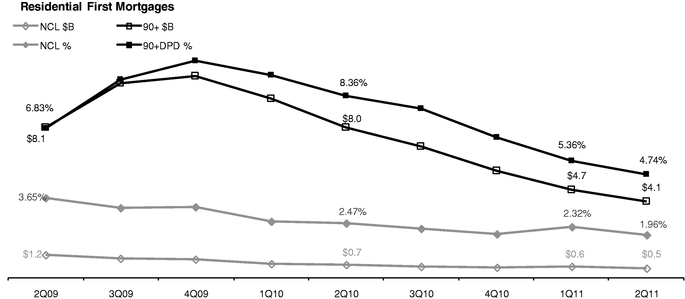
Note: Includes loans for Canada and Puerto Rico. Excludes loans that are guaranteed by U.S. government agencies. Excludes loans recorded at fair value from 1Q'10.
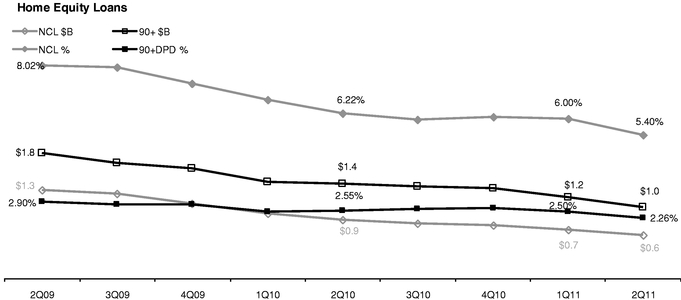
Note: Includes loans for Canada and Puerto Rico.
51
As previously disclosed, to date, management actions, including asset sales and modification programs, have been the primary drivers of improved asset performance within Citi's North America Consumer mortgage portfolios. If Citi is not able to continue its asset sales or continue such sales at historical levels, whether due to competitive pressures, lack of demand, remaining inventory or otherwise, this could negatively impact Citi's residential first mortgage delinquency and net credit loss trends. With respect to modification activities, over the past nine quarters, Citi has converted approximately $5.7 billion of trial modifications into permanent modifications, of which more than three-quarters were modifications under the U.S. Treasury's Home Affordable Modification Program (HAMP). (For additional information on Citi's loan modification programs regarding mortgages, see "Consumer Loan Modification Programs" below.) However, in recent quarters, the pace of modification activity has slowed, generally due to the decrease in the inventory of loans available for modification given the significant levels of modifications in prior periods. As a result, Citi currently expects fewer new modifications, and it is likely a portion of prior modifications will re-default, which could also cause mortgage delinquency and net credit loss trends to deteriorate. The potential for re-defaults has been factored into Citi's net loan loss reserve balances.
In addition, while Citi's active foreclosures in process decreased during the second quarter of 2011, foreclosures in process for two years or more continued to increase. The lengthening of the foreclosure process has broader implications for Citigroup's U.S. Consumer mortgage portfolios, particularly when combined with continued pressure on home prices, high unemployment rates and continued uncertainty surrounding potential governmental actions in the foreclosure area. Specifically, the lengthening of the foreclosure process:
- •
-
subjects Citi to increased "severity" risk, or the loss on the amount ultimately realized for property subject to
foreclosure given the continued pressure on home prices in particular markets, thus potentially increasing Citi's net credit losses;
- •
-
inflates the amount of 180+ day delinquencies in Citigroup's mortgage statistics and Consumer non-accrual
loans (90+ day delinquencies);
- •
-
creates a dampening effect on Citi's net interest margin as non-accrual assets build on the balance sheet; and
- •
- causes additional costs to be incurred given the longer process.
Citi has factored these continued uncertainties into its loan loss reserves. At June 30, 2011, approximately $10 billion of Citi's total loan loss reserves of $34.4 billion was allocated to North America real estate lending in Citi Holdings, representing over 27 months of coincident net credit loss coverage as of such date. With respect to Citi's aggregate North America Consumer mortgage portfolio, including Citi Holdings as well as the approximately $27 billion of residential first mortgages and home equity loans in Citicorp, Citi's loan loss reserves at June 30, 2011 also represented over 27 months of net credit loss coverage.
52
Consumer Mortgage FICO and LTV
Data appearing in the tables below have been sourced from Citigroup's risk systems and, as such, may not reconcile with disclosures elsewhere generally due to differences in methodology or variations in the manner in which information is captured. Citi has noted such variations in instances where it believes they could be material to reconcile to the information presented elsewhere.
Citi does not offer option adjustable rate mortgages (ARMs)/negative amortizing mortgage products to its customers. As a result, option ARMs/negative amortizing mortgages represent an insignificant portion of total balances, since they were acquired only incidentally as part of prior portfolio and business purchases.
A portion of loans in the U.S. Consumer mortgage portfolio currently requires a payment to satisfy only the current accrued interest for the payment period or an interest-only payment. As of June 30, 2011, Citi's home equity loan portfolio included approximately $26 billion of home equity lines of credit (HELOCs) that are still within their revolving period and have not commenced amortization. The interest-only payment feature during the revolving period is standard for the HELOC product across the industry. The residential first mortgage portfolio contains approximately $18 billion of ARMs that are currently required to make an interest-only payment. These loans will be required to make a fully amortizing payment upon expiration of their interest-only payment period, and most will do so within a few years of origination. Borrowers that are currently required to make an interest-only payment cannot select a lower payment that would negatively amortize the loan. Residential first mortgages with this payment feature are primarily to high-credit-quality borrowers that have on average significantly higher origination and refreshed FICO scores than other loans in the residential first mortgage portfolio.
Loan Balances
Residential First Mortgages—Loan Balances. As a consequence of the economic environment and the decrease in housing prices, LTV and FICO scores have generally deteriorated since origination, although the negative migration has generally stabilized. On a refreshed basis, approximately 31% of residential first mortgages had a LTV ratio above 100%, compared to approximately 0% at origination. Approximately 26% of residential first mortgages had FICO scores less than 620 on a refreshed basis, compared to 15% at origination.
Balances: June 30, 2011—Residential First Mortgages
|
At Origination
|
FICO ³ 660 | 620 £ FICO<660 | FICO<620 | |||||||
|---|---|---|---|---|---|---|---|---|---|---|
|
LTV £ 80% |
59 | % | 6 | % | 7 | % | ||||
|
80% < LTV £ 100% |
13 | % | 7 | % | 8 | % | ||||
|
LTV > 100% |
NM | NM | NM | |||||||
|
Refreshed
|
FICO ³ 660 | 620 £ FICO<660 | FICO<620 | |||||||
|---|---|---|---|---|---|---|---|---|---|---|
|
LTV £ 80% |
29 | % | 4 | % | 8 | % | ||||
|
80% < LTV £ 100% |
17 | % | 3 | % | 8 | % | ||||
|
LTV > 100% |
17 | % | 4 | % | 10 | % | ||||
Note: NM—Not meaningful. Residential first mortgages table excludes loans in Canada and Puerto Rico. Table excludes loans guaranteed by U.S. government agencies, loans recorded at fair value and loans subject to LTSCs. Table also excludes $0.4 billion from At Origination balances and $0.4 billion from Refreshed balances for which FICO or LTV data was unavailable. Balances exclude deferred fees/costs. Refreshed FICO scores based on updated credit scores obtained from Fair Isaac Corporation. Refreshed LTV ratios are derived from data at origination updated using mainly the Core Logic Housing Price Index (HPI) or the Federal Housing Finance Agency Price Index.
Home Equity—Loan Balances. In the home equity loan portfolio, the majority of loans are in the higher FICO categories. Economic conditions and the decrease in housing prices generally caused a migration towards lower FICO scores and higher LTV ratios, although the negative migration has slowed. Approximately 45% of home equity loans had refreshed LTVs above 100%, compared to approximately 0% at origination. Approximately 17% of home equity loans had FICO scores less than 620 on a refreshed basis, compared to 4% at origination.
Balances: June 30, 2011—Home Equity Loans
|
At Origination
|
FICO ³ 660 | 620 £ FICO<660 | FICO<620 | |||||||
|---|---|---|---|---|---|---|---|---|---|---|
|
LTV £ 80% |
56 | % | 2 | % | 2 | % | ||||
|
80% < LTV £ 100% |
35 | % | 3 | % | 2 | % | ||||
|
LTV > 100% |
NM | NM | NM | |||||||
|
Refreshed
|
FICO ³ 660 | 620 £ FICO<660 | FICO<620 | |||||||
|---|---|---|---|---|---|---|---|---|---|---|
|
LTV £ 80% |
26 | % | 2 | % | 3 | % | ||||
|
80% < LTV £ 100% |
18 | % | 2 | % | 5 | % | ||||
|
LTV > 100% |
31 | % | 4 | % | 9 | % | ||||
Note: NM—Not meaningful. Home equity loans table excludes loans in Canada and Puerto Rico. Table excludes loans subject to LTSCs. Table also excludes $0.7 billion from At Origination balances and $0.2 billion from Refreshed balances for which FICO or LTV data was unavailable. Balances exclude deferred fees/costs. Refreshed FICO scores are based on updated credit scores obtained from Fair Isaac Corporation. Refreshed LTV ratios are derived from data at origination updated using mainly the Core Logic Housing Price Index (HPI) or the Federal Housing Finance Agency Price Index.
53
Delinquencies
The tables below provide delinquency statistics for loans 90 or more days past due (90+DPD) as a percentage of outstandings in each of the FICO/LTV combinations, in both the residential first mortgage and home equity loan portfolios, at June 30, 2011. For example, loans with FICO ³ 660 and LTV £ 80% at origination have a 90+DPD rate of 2.7%.
As evidenced by the tables below, loans with FICO scores of less than 620 continue to exhibit significantly higher delinquencies than in any other FICO band. Similarly, loans with LTVs greater than 100% have higher delinquencies than LTVs of less than or equal to 100%. The dollar balances and percentages of loans 90+DPD have generally declined for both the residential first mortgage and home equity loan portfolios from March 31, 2011.
Delinquencies: 90+DPD Rates—Residential First Mortgages
|
At Origination
|
FICO ³ 660 | 620 £ FICO<660 | FICO<620 | |||||||
|---|---|---|---|---|---|---|---|---|---|---|
|
LTV £ 80% |
2.7 | % | 7.0 | % | 8.8 | % | ||||
|
80% < LTV £ 100% |
5.1 | % | 8.6 | % | 11.1 | % | ||||
|
LTV > 100% |
NM | NM | NM | |||||||
|
Refreshed
|
FICO ³ 660 | 620 £ FICO<660 | FICO<620 | |||||||
|---|---|---|---|---|---|---|---|---|---|---|
|
LTV = 80% |
0.2 | % | 3.0 | % | 11.0 | % | ||||
|
80% < LTV £ 100% |
0.5 | % | 4.7 | % | 13.9 | % | ||||
|
LTV > 100% |
1.1 | % | 8.2 | % | 18.1 | % | ||||
Note: NM—Not meaningful. 90+DPD are based on balances referenced in the tables above.
Delinquencies: 90+DPD Rates—Home Equity Loans
|
At Origination
|
FICO ³ 660 | 620 £ FICO<660 | FICO<620 | |||||||
|---|---|---|---|---|---|---|---|---|---|---|
|
LTV £ 80% |
1.5 | % | 4.1 | % | 4.8 | % | ||||
|
80% < LTV £ 100% |
2.8 | % | 4.4 | % | 5.4 | % | ||||
|
LTV > 100% |
NM | NM | NM | |||||||
|
Refreshed
|
FICO ³ 660 | 620 £ FICO<660 | FICO<620 | |||||||
|---|---|---|---|---|---|---|---|---|---|---|
|
LTV = 80% |
0.0 | % | 1.5 | % | 9.1 | % | ||||
|
80% < LTV £ 100% |
0.1 | % | 1.7 | % | 10.3 | % | ||||
|
LTV > 100% |
0.1 | % | 2.5 | % | 13.9 | % | ||||
Note: NM—Not meaningful. 90+DPD are based on balances referenced in the tables above.
Origination Channel, Geographic Distribution and Origination Vintage
The following tables detail Citi's residential first mortgage and home equity loan portfolios by origination channel, geographic distribution and origination vintage.
By Origination Channel
Citi's U.S. Consumer mortgage portfolio has been originated from three main channels: retail, broker and correspondent.
- •
-
Retail: loans originated through a direct relationship with the borrower.
- •
-
Broker: loans originated through a mortgage broker, where Citi underwrites the loan directly with the borrower.
- •
- Correspondent: loans originated and funded by a third party, where Citi purchases the closed loans after the correspondent has funded the loan. This channel includes loans acquired in large bulk purchases from other mortgage originators primarily in 2006 and 2007. Such bulk purchases were discontinued in 2007.
Residential First Mortgages: June 30, 2011
As of June 30, 2011, approximately 50% of the residential first mortgage portfolio was originated through third-party channels. Given that loans originated through correspondents have historically exhibited higher 90+DPD delinquency rates than retail originated mortgages, Citi terminated business with a number of correspondent sellers in 2007 and 2008. During 2008, Citi also severed relationships with a number of brokers, maintaining only those who have produced strong, high-quality and profitable volume. 90+DPD delinquency amounts have generally improved from March 31, 2011.
|
CHANNEL
($ in billions) |
Residential
First Mortgages |
Channel
% Total |
90+DPD % | *FICO < 620 | *LTV > 100% | |||||||||||
|---|---|---|---|---|---|---|---|---|---|---|---|---|---|---|---|---|
|
Retail |
$ | 41.4 | 50.4 | % | 4.0 | % | $ | 11.7 | $ | 8.8 | ||||||
|
Broker |
$ | 12.9 | 15.7 | % | 4.3 | % | $ | 2.0 | $ | 4.8 | ||||||
|
Correspondent |
$ | 27.9 | 33.9 | % | 6.4 | % | $ | 8.0 | $ | 12.2 | ||||||
- *
- Refreshed FICO and LTV.
Note: Residential first mortgages table excludes Canada and Puerto Rico, deferred fees/costs, loans recorded at fair value, loans guaranteed by U.S. government agencies and loans subject to LTSCs.
54
Home Equity Loans: June 30, 2011
For home equity loans, approximately 42% of the loans were originated through third-party channels. As these loans have demonstrated a higher incidence of delinquencies, Citi no longer originates home equity loans through third-party channels. 90+DPD delinquency amounts marginally improved from March 31, 2011.
|
CHANNEL
($ in billions) |
Home
Equity |
Channel
% Total |
90+DPD % | *FICO < 620 | *LTV > 100% | |||||||||||
|---|---|---|---|---|---|---|---|---|---|---|---|---|---|---|---|---|
|
Retail |
$ | 25.7 | 58.5 | % | 1.8 | % | $ | 4.1 | $ | 7.3 | ||||||
|
Broker |
$ | 10.2 | 23.2 | % | 3.2 | % | $ | 1.6 | $ | 6.0 | ||||||
|
Correspondent |
$ | 8.1 | 18.3 | % | 2.6 | % | $ | 1.7 | $ | 6.2 | ||||||
- *
- Refreshed FICO and LTV.
Note: Excludes Canada and Puerto Rico, deferred fees/costs and loans subject to LTSCs.
By State
Approximately half of Citi's U.S. Consumer mortgage portfolio is located in five states: California, New York, Florida, Illinois and Texas. These states represent 50% of Citi's residential first mortgages and 56% of home equity loans.
With respect to residential first mortgages, Florida and Illinois had above average 90+DPD delinquency rates relative to the overall portfolio as of June 30, 2011. Florida has 59% of its residential first mortgage portfolio with refreshed LTV > 100%, compared to 31% overall for residential first mortgages. Illinois has 50% of its loan portfolio with refreshed LTV > 100%. Texas, despite having 38% of its portfolio with FICO < 620, had a lower delinquency rate relative to the overall portfolio. Texas had 6% of its loan portfolio with refreshed LTV > 100%.
In the home equity loan portfolio, Florida continued to experience above-average delinquencies at 3.4% as of June 30, 2011, with approximately 68% of its loans with refreshed LTV > 100%, compared to 44% overall for the home equity loan portfolio.
By Vintage
For Citigroup's combined U.S. Consumer mortgage portfolio (residential first mortgages and home equity loans), as of June 30, 2011, 44% of the portfolio consisted of 2006 and 2007 vintages, which demonstrate above average delinquencies. In residential first mortgages, approximately 37% of the portfolio is of 2006 and 2007 vintages, which had 90+DPD rates well above the overall portfolio rate, at 6.0% for 2006 and 6.8% for 2007. In home equity loans, 59% of the portfolio is of 2006 and 2007 vintages, which again had higher delinquencies compared to the overall portfolio rate, at 2.7% for 2006 and 2.5% for 2007.
55
FICO and LTV Trend Information—U.S. Consumer Mortgage Lending
| Residential First Mortgages (in billions of dollars) | Home Equity Loans (in billions of dollars) | |
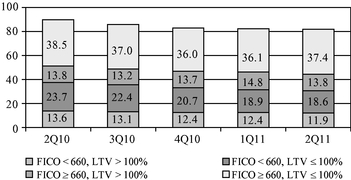
|
|

|

|
|

|
|
Note: Residential first mortgages chart/table excludes loans in Canada and Puerto Rico, loans guaranteed by U.S. government agencies, loans recorded at fair value and loans subject to LTSCs. Balances exclude deferred fees/costs. Balances based on refreshed FICO and LTV ratios. Chart/table also excludes balances for which FICO or LTV data was unavailable ($0.4 billion in 2Q10, $0.4 billion in 3Q10, $0.4 billion in 4Q10, and $0.4 billion in 1Q11, $0.4 billion in 2Q11). |
|
Note: Home equity loan chart/table excludes loans in Canada and Puerto Rico, and loans subject to LTSCs. Balances exclude deferred fees/costs. Balances based on refreshed FICO and LTV ratios. Chart/table also excludes balances for which FICO or LTV data was unavailable ($0.3 billion in 2Q10, $0.3 billion in 3Q10, $0.3 billion in 4Q10, and $0.3 billion in 1Q11, $0.3 billion in 2Q11). |
56
As of June 30, 2011, the residential first mortgage portfolio was approximately $82 billion (excluding loans which are guaranteed by U.S. government agencies and loans recorded at fair value), a reduction of $8 billion, or 9%, from June 30, 2010. Residential first mortgages with refreshed FICO scores below 660 and refreshed LTV above 100% were $11.9 billion as of June 30, 2011, $1.7 billion, or 13%, lower than the balance as of June 30, 2010. Similarly, the home equity loan portfolio was approximately $44 billion as of June 30, 2011, a reduction of $8 billion, or 16%, from June 30, 2010. Home equity loans with refreshed FICO scores below 660 and refreshed LTV above 100% were $5.8 billion as of June 30, 2011, $1.1 billion, or 15%, lower than the balance as of June 30, 2010. Across both portfolios, 90+ DPD rates have generally improved since June 30, 2010 across each of the FICO/LTV segments outlined above, particularly those segments with refreshed FICO scores below 660.
Overview
Citi's North America cards portfolio consists of its Citi-branded and retail partner cards portfolios reported in Citicorp — Regional Consumer Banking and Citi Holdings — Local Consumer Lending , respectively. As of June 30, 2011, the Citi-branded portfolio totaled $74 billion, while the retail partner cards portfolio was $42 billion.
See "Consumer Loan Modification Programs" below for a discussion of Citi's modification programs for card loans.
North America Cards Quarterly Trends — Delinquencies and Net Credit Losses
The following charts detail the quarterly trends in delinquencies and net credit losses for Citigroup's North America Citi-branded and retail partner cards portfolios, which continued to reflect the improving credit quality of these portfolios during the second quarter of 2011.
In Citi-branded cards, net credit losses decreased by approximately 9% sequentially, to $1.2 billion, and 90 days or more delinquencies were down 16% to $1.2 billion. Year-over year, net credit losses decreased by approximately 40%, and 90 days or more delinquencies were down approximately 43%. In retail partner cards, net credit losses decreased by approximately 14% sequentially to $956 million, and 90 days or more delinquencies declined by 18% to $1.1 billion. Year-over-year, net credit losses decreased by approximately 46%, and 90 days or more delinquencies were down 46%.
For both portfolios, early-stage delinquencies also continued to show improvement on both a dollar and a rate basis.
57

Note: Includes Puerto Rico.

Note: Includes Canada, Puerto Rico and Installment Lending.
58
North America Cards — FICO Information
As set forth in the table below, approximately 85% of the Citi-branded portfolio had FICO credit scores of at least 660 on a refreshed basis as of June 30, 2011, while 74% of the retail partner cards portfolio had scores of 660 or above.
Balances: June 30, 2011
|
Refreshed
|
Citi-Branded | Retail Partner | |||||
|---|---|---|---|---|---|---|---|
|
FICO ³ 660 |
85 | % | 74 | % | |||
|
620 £ FICO < 660 |
8 | % | 13 | % | |||
|
FICO < 620 |
7 | % | 13 | % | |||
Note: Based on balances of $110 billion (flat to balances at March 31, 2011). Balances include interest and fees. Excludes Canada, Puerto Rico and Installment and Classified portfolios. Excludes balances where FICO was unavailable ($1.1 billion for Citi-branded, $1.7 billion for retail partner cards).
The table below provides delinquency statistics for loans 90+DPD for both the Citi-branded and retail partner cards portfolios as of June 30, 2011. As customers roll through the delinquency buckets, they materially damage their credit score and may ultimately go to charge-off. Loans 90+DPD are more likely to be associated with low refreshed FICO scores, both because low scores are indicative of repayment risk and because their delinquency has been reported by Citigroup to the credit bureaus. Loans with FICO scores less than 620, which constituted 7% of the Citi-branded portfolio as of June 30, 2011, have a 90+DPD rate of 20.6%. In the retail partner cards portfolio, loans with FICO scores less than 620 constituted 13% of the portfolio as of June 30, 2011 and have a 90+DPD rate of 17.1%.
90+DPD Delinquency Rate: June 30, 2011
|
Refreshed
|
Citi-Branded
90+DPD% |
Retail Partner
90+DPD% |
|||||
|---|---|---|---|---|---|---|---|
|
FICO ³ 660 |
0.1 | % | 0.2 | % | |||
|
620 £ FICO < 660 |
1.2 | % | 1.3 | % | |||
|
FICO < 620 |
20.6 | % | 17.1 | % | |||
Note: Based on balances of $110 billion (flat to balances at March 31, 2011). Balances include interest and fees. Excludes Canada, Puerto Rico and Installment and Classified portfolios. Excludes balances where FICO was unavailable ($1.1 billion for Citi-branded, $1.7 billion for retail partner cards).
U.S. Installment and Other Revolving Loans
The U.S. Installment portfolio consists of Consumer loans in the following businesses: consumer finance, retail banking, auto, student lending and cards. Other Revolving consists of Consumer loans (ready credit and checking plus products) in the Consumer retail banking business. Commercial-related loans are not included. As of June 30, 2011, the U.S. Installment portfolio totaled approximately $20 billion, while the U.S. Other Revolving portfolio was approximately $800 million.
Substantially all of the U.S. Installment portfolio is reported in LCL within Citi Holdings. As of June 30, 2011, approximately 41% of the Installment portfolio had FICO scores less than 620 on a refreshed basis. On a refreshed basis, loans with FICO scores of less than 620 exhibit significantly higher delinquencies than in any other FICO band and will drive the majority of the losses. The 90+DPD delinquency rate for Installment loans with FICO score less than 620 on a refreshed basis was 4.76% at June 30, 2011.
For information on Citi's loan modification programs regarding Installment loans, see "Consumer Loan Modification Programs" below.
59
Consumer Loan Delinquency Amounts and Ratios
|
|
Total loans(1) | 90+ days past due(2) | 30-89 days past due(2) | |||||||||||||||||||||
|---|---|---|---|---|---|---|---|---|---|---|---|---|---|---|---|---|---|---|---|---|---|---|---|---|
| In millions of dollars, except EOP loan amounts in billions |
Jun.
2011 |
Jun.
2011 |
Mar.
2011 |
Jun.
2010 |
Jun.
2011 |
Mar.
2011 |
Jun.
2010 |
|||||||||||||||||
|
Citicorp(3)(4) |
||||||||||||||||||||||||
|
Total |
$ | 243.5 | $ | 2,800 | $ | 2,983 | $ | 3,806 | $ | 3,115 | $ | 3,362 | $ | 3,934 | ||||||||||
|
Ratio |
1.15 | % | 1.27 | % | 1.74 | % | 1.28 | % | 1.44 | % | 1.80 | % | ||||||||||||
|
Retail banking |
||||||||||||||||||||||||
|
Total |
$ | 131.6 | $ | 829 | $ | 811 | $ | 877 | $ | 1,091 | $ | 1,145 | $ | 1,207 | ||||||||||
|
Ratio |
0.63 | % | 0.65 | % | 0.80 | % | 0.83 | % | 0.92 | % | 1.11 | % | ||||||||||||
|
North America |
34.5 | 211 | 241 | 245 | 209 | 185 | 241 | |||||||||||||||||
|
Ratio |
0.63 | % | 0.75 | % | 0.81 | % | 0.62 | % | 0.58 | % | 0.80 | % | ||||||||||||
|
EMEA |
4.9 | 84 | 86 | 117 | 132 | 143 | 158 | |||||||||||||||||
|
Ratio |
1.71 | % | 1.83 | % | 2.72 | % | 2.69 | % | 3.04 | % | 3.67 | % | ||||||||||||
|
Latin America |
25.5 | 259 | 249 | 308 | 304 | 326 | 338 | |||||||||||||||||
|
Ratio |
1.02 | % | 1.06 | % | 1.57 | % | 1.19 | % | 1.39 | % | 1.72 | % | ||||||||||||
|
Asia |
66.7 | 275 | 235 | 207 | 446 | 491 | 470 | |||||||||||||||||
|
Ratio |
0.41 | % | 0.37 | % | 0.38 | % | 0.67 | % | 0.77 | % | 0.85 | % | ||||||||||||
|
Citi-branded cards |
||||||||||||||||||||||||
|
Total |
$ | 111.9 | $ | 1,971 | $ | 2,172 | $ | 2,929 | $ | 2,024 | $ | 2 ,217 | 2,727 | |||||||||||
|
Ratio |
1.76 | % | 1.98 | % | 2.68 | % | 1.81 | % | 2.02 | % | 2.49 | % | ||||||||||||
|
North America |
73.7 | 1,205 | 1,432 | 2,130 | 1,132 | 1,327 | 1,828 | |||||||||||||||||
|
Ratio |
1.64 | % | 1.96 | % | 2.76 | % | 1.54 | % | 1.81 | % | 2.37 | % | ||||||||||||
|
EMEA |
3.0 | 54 | 60 | 72 | 72 | 78 | 90 | |||||||||||||||||
|
Ratio |
1.80 | % | 2.07 | % | 2.77 | % | 2.40 | % | 2.69 | % | 3.46 | % | ||||||||||||
|
Latin America |
14.2 | 462 | 445 | 481 | 469 | 454 | 485 | |||||||||||||||||
|
Ratio |
3.25 | % | 3.30 | % | 4.01 | % | 3.30 | % | 3.36 | % | 4.04 | % | ||||||||||||
|
Asia |
21.0 | 250 | 235 | 246 | 351 | 358 | 324 | |||||||||||||||||
|
Ratio |
1.19 | % | 1.18 | % | 1.40 | % | 1.67 | % | 1.79 | % | 1.84 | % | ||||||||||||
|
Citi Holdings— Local Consumer Lending (3)(5)(6) |
||||||||||||||||||||||||
|
Total |
$ | 198.0 | $ | 7,103 | $ | 8,541 | $ | 14,371 | $ | 7,381 | $ | 7,624 | $ | 11,201 | ||||||||||
|
Ratio |
3.77 | % | 4.33 | % | 5.24 | % | 3.92 | % | 3.86 | % | 4.08 | % | ||||||||||||
|
International |
16.6 | 530 | 571 | 724 | 726 | 815 | 939 | |||||||||||||||||
|
Ratio |
3.19 | % | 3.15 | % | 2.94 | % | 4.37 | % | 4.50 | % | 3.82 | % | ||||||||||||
|
North America retail partner cards |
41.9 | 1,080 | 1,310 | 2,004 | 1,454 | 1,515 | 2,150 | |||||||||||||||||
|
Ratio |
2.58 | % | 3.17 | % | 3.99 | % | 3.47 | % | 3.67 | % | 4.28 | % | ||||||||||||
|
North America (excluding cards) |
139.5 | 5,493 | 6,660 | 11,643 | 5,201 | 5,294 | 8,112 | |||||||||||||||||
|
Ratio |
4.23 | % | 4.83 | % | 5.84 | % | 4.01 | % | 3.84 | % | 4.07 | % | ||||||||||||
|
Total Citigroup (excluding Special Asset Pool ) |
$ | 441.5 | $ | 9,903 | $ | 11,524 | $ | 18,177 | $ | 10,496 | $ | 10,986 | $ | 15,135 | ||||||||||
|
Ratio |
2.30 | % | 2.67 | % | 3.69 | % | 2.44 | % | 2.55 | % | 3.07 | % | ||||||||||||
- (1)
-
Total
loans include interest and fees on credit cards.
- (2)
-
The
ratios of 90+ days past due and 30-89 days past due are calculated based on end-of-period (EOP) loans.
- (3)
-
The
90+ days past due balances for Citi-branded cards and retail partner cards are generally still accruing interest. Citigroup's policy is
generally to accrue interest on credit card loans until 180 days past due, unless notification of bankruptcy filing has been received earlier.
- (4)
-
The
90+ days and 30-89 days past due and related ratios for
NA RCB
exclude U.S. mortgage
loans that are guaranteed by U.S. government sponsored agencies since the potential loss predominantly resides within the U.S. agencies. The amounts excluded for loans 90+ days past due and
(end-of-period loans) are $400 million ($0.9 billion) and $352 million ($0.9 billion) and at June 30, 2011 and March 31, 2011,
respectively. The amount excluded for loans 30-89 days past due (end-of-period loans have the same adjustment as above) is $77 million and
$52 million as of June 30, 2011 and March 31, 2011, respectively.
- (5)
-
The
90+ days and 30-89 days past due and related ratios for
North America LCL
(excluding
cards) exclude U.S. mortgage loans that are guaranteed by U.S. government sponsored agencies since the potential loss predominantly resides within the U.S. agencies. The amounts excluded for loans 90+
days past due and (end-of-period loans) for each period are $4.6 billion ($8.3 billion), $4.9 billion ($8.3 billion) and $5.0 billion
($9.4 billion), as of June 30, 2011, March 31, 2011, and June 30, 2010, respectively. The amounts excluded for loans 30-89 days past due
(end-of-period loans have the same adjustment as above) for each period are $1.6 billion, $1.4 billion and $1.6 billion as of June 30, 2011,
March 31, 2011and June 30, 2010, respectively.
- (6)
- The June 30, 2011, March 31, 2011 and June 30, 2010 loans 90+ days past due and 30-89 days past due and related ratios for North America (excluding Cards) exclude $1.4 billion, $1.5 billion and $2.6 billion, respectively, of loans that are carried at fair value.
60
Consumer Loan Net Credit Losses and Ratios
|
|
Average
loans(1) |
Net credit losses(2) | |||||||||||||
|---|---|---|---|---|---|---|---|---|---|---|---|---|---|---|---|
| In millions of dollars, except average loan amounts in billions | 2Q11 | 2Q11 | 1Q11 | 2Q10 | |||||||||||
|
Citicorp |
|||||||||||||||
|
Total |
$ | 239.1 | $ | 2,002 | $ | 2,108 | $ | 2,922 | |||||||
|
Ratio |
3.36 | % | 3.69 | % | 5.38 | % | |||||||||
|
Retail banking |
|||||||||||||||
|
Total |
$ | 129.0 | $ | 298 | $ | 277 | $ | 304 | |||||||
|
Ratio |
0.93 | % | 0.93 | % | 1.12 | % | |||||||||
|
North America |
33.6 | 77 | 88 | 79 | |||||||||||
|
Ratio |
0.92 | % | 1.12 | % | 1.03 | % | |||||||||
|
EMEA |
4.7 | 24 | 23 | 46 | |||||||||||
|
Ratio |
2.05 | % | 2.07 | % | 4.10 | % | |||||||||
|
Latin America |
24.8 | 117 | 103 | 96 | |||||||||||
|
Ratio |
1.89 | % | 1.86 | % | 1.98 | % | |||||||||
|
Asia |
65.9 | 80 | 63 | 83 | |||||||||||
|
Ratio |
0.49 | % | 0.41 | % | 0.61 | % | |||||||||
|
Citi-branded cards |
|||||||||||||||
|
Total |
$ | 110.1 | $ | 1,704 | $ | 1,831 | $ | 2,618 | |||||||
|
Ratio |
6.21 | % | 6.73 | % | 9.68 | % | |||||||||
|
North America |
72.4 | 1,228 | 1,352 | 2,047 | |||||||||||
|
Ratio |
6.80 | % | 7.42 | % | 10.77 | % | |||||||||
|
EMEA |
3.0 | 23 | 26 | 39 | |||||||||||
|
Ratio |
3.08 | % | 3.64 | % | 5.79 | % | |||||||||
|
Latin America |
14.0 | 308 | 304 | 361 | |||||||||||
|
Ratio |
8.82 | % | 9.20 | % | 12.07 | % | |||||||||
|
Asia |
20.7 | 145 | 149 | 171 | |||||||||||
|
Ratio |
2.81 | % | 3.01 | % | 3.90 | % | |||||||||
|
Citi Holdings— Local Consumer Lending |
|||||||||||||||
|
Total |
$ | 204.9 | $ | 2,776 | $ | 3,279 | $ | 4,535 | |||||||
|
Ratio |
5.43 | % | 6.15 | % | 6.03 | % | |||||||||
|
International |
17.9 | 286 | 341 | 495 | |||||||||||
|
Ratio |
6.41 | % | 7.32 | % | 7.61 | % | |||||||||
|
North America retail partner cards |
41.8 | 956 | 1,111 | 1,775 | |||||||||||
|
Ratio |
9.17 | % | 10.29 | % | 13.41 | % | |||||||||
|
North America (excluding cards) |
145.2 | 1,534 | 1,827 | 2,265 | |||||||||||
|
Ratio |
4.24 | % | 4.82 | % | 4.08 | % | |||||||||
|
Total Citigroup (excluding Special Asset Pool ) |
$ | 444.0 | $ | 4,778 | $ | 5,387 | $ | 7,457 | |||||||
|
Ratio |
4.32 | % | 4.88 | % | 5.76 | % | |||||||||
- (1)
-
Average
loans include interest and fees on credit cards.
- (2)
- The ratios of net credit losses are calculated based on average loans, net of unearned income.
61
Consumer Loan Modification Programs
Citigroup has instituted a variety of long-term and short-term modification programs to assist its mortgage, credit card (Citi-branded and retail partner cards) and installment loan borrowers with financial difficulties. These programs include modifying the original loan terms, reducing interest rates, reducing or waiving fees, extending the remaining loan duration and/or waiving a portion of the remaining principal balance. At June 30, 2011, Citi's significant modification programs consisted of the U.S. Treasury's Home Affordable Modification Program (HAMP), as well as short-term and long-term modification programs in the U.S., as set forth in the tables below. For a more detailed description of these significant modification programs, see "Managing Global Risk—Credit Risk—Consumer Loans Modification Programs" in Citi's 2010 Annual Report on Form 10-K.
The policy for re-aging modified U.S. Consumer loans to current status varies by product. Generally, one of the conditions to qualify for these modifications is that a minimum number of payments (typically ranging from one to three) be made. Upon modification, the loan is re-aged to current status. However, re-aging practices for certain open-ended Consumer loans, such as credit cards, are governed by Federal Financial Institutions Examination Council (FFIEC) guidelines. For open-ended Consumer loans subject to FFIEC guidelines, one of the conditions for the loan to be re-aged to current status is that at least three consecutive minimum monthly payments, or the equivalent amount, must be received. In addition, under FFIEC guidelines, the number of times that such a loan can be re-aged is subject to limitations (generally once in 12 months and twice in five years). Furthermore, FHA and VA loans are modified under those respective agencies' guidelines, and payments are not always required in order to re-age a modified loan to current status.
HAMP and Other Long-Term Programs. Long-term modification programs or TDRs occur when the terms of a loan have been modified due to the borrower's financial difficulties and a long-term concession has been granted to the borrower. Substantially all long-term programs in place provide interest rate reductions. See Note 1 to the Consolidated Financial Statements in Citi's 2010 Annual Report on Form 10-K for a discussion of the allowance for loan losses for such modified loans.
The following table presents Citigroup's Consumer loan TDRs as of June 30, 2011 and December 31, 2010. These TDRs are predominantly concentrated in the U.S. HAMP loans whose terms are contractually modified after successful completion of the trial period and are included in the balances below.
|
|
Accrual | Non-accrual | |||||||||||
|---|---|---|---|---|---|---|---|---|---|---|---|---|---|
| In millions of dollars |
Jun. 30,
2011 |
Dec. 31,
2010 |
Jun. 30,
2011 |
Dec. 31,
2010 |
|||||||||
|
Mortgage and real estate |
$ | 18,379 | $ | 15,140 | $ | 1,692 | $ | 2,290 | |||||
|
Cards |
6,290 | 5,869 | 36 | 38 | |||||||||
|
Installment and other |
2,531 | 3,015 | 209 | 271 | |||||||||
62
Long-Term Modification Programs—Summary
The following table sets forth, as of June 30, 2011, information relating to Citi's significant long-term U.S. mortgage, credit card and installment loan modification programs:
| In millions of dollars |
Program
balance |
Program
start date(1) |
Average
interest rate reduction |
Average %
payment relief |
Average
tenor of modified loans |
Deferred
principal |
Principal
forgiveness |
|||||||||||||||
|---|---|---|---|---|---|---|---|---|---|---|---|---|---|---|---|---|---|---|---|---|---|---|
|
U.S. Consumer mortgage lending |
||||||||||||||||||||||
|
HAMP |
$ | 4,018 | 3Q09 | 4 | % | 41 | % | 31 years | $ | 508 | $ | 3 | ||||||||||
|
Citi Supplemental |
2,119 | 4Q09 | 3 | 23 | 27 years | 88 | 1 | |||||||||||||||
|
HAMP Re-age |
282 | 1Q10 | N/A | N/A | 23 years | 6 | — | |||||||||||||||
|
2nd FDIC |
637 | 2Q09 | 6 | 45 | 20 years | 40 | 5 | |||||||||||||||
|
FHA/VA |
3,774 | 2 | 20 | 28 years | — | — | ||||||||||||||||
|
CFNA Adjustment of terms (AOT) |
3,757 | 3 | 23 | 29 years | ||||||||||||||||||
|
Responsible Lending |
1,290 | 4Q10 | 2 | 17 | 29 years | — | — | |||||||||||||||
|
HAMP 2nd Mortgage |
284 | 4Q10 | 6 | 56 | 22 years | 16 | — | |||||||||||||||
|
Other |
2,901 | 4 | 40 | 27 years | 45 | 42 | ||||||||||||||||
|
North America cards |
||||||||||||||||||||||
|
Paydown |
3,087 | 17 | — | 5 years | ||||||||||||||||||
|
Credit Counseling Group Program |
1,711 | 11 | — | 5 years | ||||||||||||||||||
|
Interest Reversal Paydown |
300 | 20 | — | 5 years | ||||||||||||||||||
|
U.S. installment loans |
||||||||||||||||||||||
|
CFNA Adjustment of Terms |
775 | 7 | 33 | 9 years | ||||||||||||||||||
- (1)
- Provided if program was introduced after 2008.
63
Short-Term Programs.
Citigroup has also instituted short-term programs (primarily in the U.S.) to assist borrowers experiencing temporary hardships. These programs include short-term (12 months or less) interest rate reductions and deferrals of past due payments. See Note 1 to the Consolidated Financial Statements in Citi's 2010 Annual Report on Form 10-K for a discussion of the allowance for loan losses for such modified loans.
The following table presents the amounts of gross loans modified under short-term interest rate reduction programs in the U.S. as of June 30, 2011:
|
|
June 30, 2011 | ||||||
|---|---|---|---|---|---|---|---|
| In millions of dollars | Accrual | Non-accrual | |||||
|
Cards |
$ | 1,605 | $ | — | |||
|
Mortgage and real estate |
1,463 | 166 | |||||
|
Installment and other |
905 | 81 | |||||
Short-Term Modification Programs—Summary
The following table sets forth, as of June 30, 2011, information related to Citi's significant short-term U.S. credit cards, mortgage, and installment loan modification programs:
| In millions of dollars |
Program
balance |
Program
start date(1) |
Average
interest rate reduction |
Average
time period for reduction |
|||||||
|---|---|---|---|---|---|---|---|---|---|---|---|
|
Universal Payment Program (UPP) |
$ | 1,605 | 19 | % | 12 months | ||||||
|
Mortgage Temporary AOT |
1,629 | 1Q09 | 2 | 9 months | |||||||
|
Installment Temporary AOT |
986 | 1Q09 | 4 | 7 months | |||||||
- (1)
- Provided if program was introduced after 2008.
Payment deferrals that do not continue to accrue interest (extensions) primarily occur in the U.S. residential mortgage business. Under an extension, payments that are contractually due are deferred to a later date, thereby extending the maturity date by the number of months of payments being deferred. Extensions assist delinquent borrowers who have experienced short-term financial difficulties that have been resolved by the time the extension is granted. An extension can only be offered to borrowers who are past due on their monthly payments but have since demonstrated the ability and willingness to pay as agreed. Other payment deferrals continue to accrue interest and are not deemed to offer concessions to the customer. Other types of concessions are not material.
Impact of Modification Programs
Citi considers various metrics in analyzing the success of U.S. modification programs. Payment behavior of customers during the modification (both short-term and long-term) is monitored. For short-term modifications, performance is also measured for an additional period of time after the expiration of the concession. Balance reductions and annualized loss rates are also important metrics that are monitored. Based on actual experience, program terms, including eligibility criteria, interest charged and loan tenor, may be refined. The main objective of the modification programs is to reduce the payment burden for the borrower and improve the net present value of Citi's expected cash flows.
Mortgage Modification Programs
With respect to HAMP, from inception through June 30, 2011, approximately $10.3 billion of residential first mortgages have been enrolled in the HAMP trial period, while $4.3 billion have successfully completed the trial period. As of June 30, 2011, 37% of the loans in the HAMP trial period were successfully modified, 15% were modified under the Citi Supplemental program, 2% were in HAMP or Citi Supplemental trial, 2% subsequently received other Citi modifications, 11% received HAMP Re-Age, and 33% have not received any modification from Citi to date.
As of June 30, 2011, Citi continued to experience re-default rates of less than 15% of active HAMP-modified loans at 12 months after modification. For HAMP, as of June 30, 2011, at 12 months after modification, the average total balance reduction on modified loans has been approximately 5% (as a percentage of the balance at the time of modification), consisting of approximately 4% from paydowns and the remaining from net credit losses. At 12 months after modification, the Citi Supplemental Mortgage (CSM) program has exhibited re-default rates of less than 25% of active modified loans as of June 30, 2011. In addition, as of June 30, 2011, at 12 months after modification, the average total balance reduction on loans modified under the CSM program has been approximately 9%, with approximately 6% from paydowns and the remaining from net credit losses.
For mortgage modifications under CFNA's long-term AOT program, as of June 30, 2011, the average total balance reduction has been approximately 13% (as a percentage of the balance at the time of modification), consisting of approximately 4% of paydowns and 9% of net credit losses, 24 months after modification. For long-term mortgage modifications in the "Other" category, as of June 30, 2011, the average total balance reduction has been approximately 33% (as a percentage of the balance at the time of modification), consisting of approximately 23% of paydowns and 10% of net credit losses, 24 months after modification. The Responsible Lending program is in its first 12 months and due to the short period since modification, performance data is limited and thus not yet considered meaningful.
For the short-term AOT program, as of June 30, 2011, the average total balance reduction has been 4% at 12 months after modification, with approximately half coming from paydowns and the remaining from net credit losses.
64
Cards Modification Programs
As previously disclosed, Citigroup implemented certain changes to its credit card modification programs beginning in the fourth quarter of 2010, including revisions to the eligibility criteria for such programs. As a result of these changes, as well as the overall improving portfolio trends, in the second quarter of 2011, the overall volume of new entrants to Citi's card modification programs (both long- and short-term) decreased by approximately 31% compared to the first quarter of 2011. New entrants to Citi's short-term card modification programs decreased by approximately 64% in the second quarter of 2011 as compared to the prior quarter. On a year-over-year basis, the volume reductions are larger, reflecting the cumulative impact of eligibility changes and portfolio improvement. Citi considered these changes to its card modification programs and their potential effect on net credit losses in determining the loan loss reserves as of June 30, 2011.
Generally, as of June 30, 2011, at 36 months after modification, the average total balance reduction for long-term card modification programs is approximately 82% (as a percentage of the balance at the time of modification), consisting of approximately 47% of paydowns and 35% of net credit losses. In addition, these net credit losses have been approximately 40% lower, depending upon the individual program and vintage, than those of similar card accounts that were not modified.
For short-term modifications, as of June 30, 2011, 24 months after starting a short-term modification, balances are reduced by an average of approximately 64% (as a percentage of the balance at the time of modification), consisting of approximately 25% of paydowns and 39% of net credit losses. In addition, these net credit losses have been approximately 25%–35% lower, depending upon the individual program and vintage, than those of similar accounts that were not modified.
Installment Loan Modification Programs
With respect to the long-term CFNA AOT program, as of June 30, 2011, 36 months after modification, the average total balance reduction is approximately 67%, consisting of approximately 18% of paydowns and 49% of net credit losses. The short-term Temporary AOT program has less vintage history and limited loss data. In this program, as of June 30, 2011, 12 months after modification, the average total balance reduction is approximately 16% (as a percentage of the balance at the time of modification), consisting of approximately 5% of paydowns and 11% of net credit losses.
65
Consumer Mortgage Representations and Warranties
The majority of Citi's exposure to representation and warranty claims relates to its U.S. Consumer mortgage business.
Representation and Warranties
As of June 30, 2011, Citi services loans previously sold as follows:
|
|
June 30, 2011(1) | |||||||
|---|---|---|---|---|---|---|---|---|
| In millions |
Number of
loans |
Unpaid principal
balance |
||||||
|
Vintage sold: |
||||||||
|
2005 and prior |
0.8 | $ | 84,704 | |||||
|
2006 |
0.2 | 30,440 | ||||||
|
2007 |
0.2 | 38,368 | ||||||
|
2008 |
0.3 | 45,695 | ||||||
|
2009 |
0.3 | 52,366 | ||||||
|
2010 |
0.3 | 50,199 | ||||||
|
2011 |
0.2 | 39,390 | ||||||
|
Indemnifications(2) |
0.8 | 91,786 | ||||||
|
Total |
3.1 | $ | 432,948 | |||||
- (1)
-
Excludes
the fourth quarter of 2010 sale of servicing rights on 0.1 million loans with remaining unpaid principal balances of approximately
$27,652 million. Citi continues to be exposed to representation and warranty claims on those loans.
- (2)
- Represents loans serviced by CitiMortgage pursuant to prior acquisitions of mortgage servicing rights which are covered by indemnification agreements from third parties in favor of CitiMortgage. Substantially all of these indemnifications expire prior to March 1, 2012. The expiration of these indemnifications is considered in determining the repurchase reserve.
In addition, since 2000, Citi has sold $96 billion of loans to private investors, of which $49 billion were sold through securitizations. As of June 30, 2011, $34 billion of these loans (including $13 billion sold through securitizations) continue to be serviced by Citi and are included in the $433 billion of serviced loans above.
When selling a loan, Citi (through its CitiMortgage business) makes various representations and warranties relating to, among other things, the following:
- •
-
Citi's ownership of the loan;
- •
-
the validity of the lien securing the loan;
- •
-
the absence of delinquent taxes or liens against the property securing the loan;
- •
-
the effectiveness of title insurance on the property securing the loan;
- •
-
the process used in selecting the loans for inclusion in a transaction;
- •
-
the loan's compliance with any applicable loan criteria established by the buyer; and
- •
- the loan's compliance with applicable local, state and federal laws.
The specific representations and warranties made by Citi depend on the nature of the transaction and the requirements of the buyer. Market conditions and credit-rating agency requirements may also affect representations and warranties and the other provisions to which Citi may agree in loan sales.
Repurchases or "Make-Whole" Payments
In the event of a breach of these representations and warranties, Citi may be required to either repurchase the mortgage loans (generally at unpaid principal balance plus accrued interest) with the identified defects, or indemnify ("make-whole") the investors for their losses. Citi's representations and warranties are generally not subject to stated limits in amount or time of coverage. However, contractual liability arises only when the representations and warranties are breached and generally only when a loss results from the breach.
For the three and six months ended June 30, 2011, 68% and 71%, respectively, and for both the three and six months ended June 30, 2010, 76% of Citi's repurchases and make-whole payments were attributable to misrepresentation of facts by either the borrower or a third party (e.g., income, employment, debts, FICO, etc.), appraisal issues (e.g., an error or misrepresentation of value), or program requirements (e.g., a loan that does not meet investor guidelines, such as contractual interest rate). To date, there has not been a meaningful difference in incurred or estimated loss for each type of defect.
In the case of a repurchase, Citi will bear any subsequent credit loss on the mortgage loan and the loan is typically considered a credit-impaired loan and accounted for under SOP 03-3, "Accounting for Certain Loans and Debt Securities, Acquired in a Transfer" (now incorporated into ASC 310-30, Receivables—Loans and Debt Securities Acquired with Deteriorated Credit Quality ). These repurchases have not had a material impact on Citi's non-performing loan statistics because credit-impaired purchased SOP 03-3 loans are not included in non-accrual loans, since they generally continue to accrue interest until write-off.
The unpaid principal balance of loans repurchased due to representation and warranty claims for the three months ended June 30, 2011 and 2010, respectively, was as follows:
|
|
June 30, 2011 | June 30, 2010 | |||||
|---|---|---|---|---|---|---|---|
| In millions of dollars |
Unpaid principal
balance |
Unpaid principal
balance |
|||||
|
GSEs |
$ | 162 | $ | 63 | |||
|
Private investors |
5 | 8 | |||||
|
Total |
$ | 167 | $ | 71 | |||
The unpaid principal balance of loans repurchased due to representation and warranty claims for the six months ended June 30, 2011 and 2010, respectively, was as follows:
|
|
June 30, 2011 | June 30, 2010 | |||||
|---|---|---|---|---|---|---|---|
| In millions of dollars |
Unpaid principal
balance |
Unpaid principal
balance |
|||||
|
GSEs |
$ | 235 | $ | 150 | |||
|
Private investors |
6 | 12 | |||||
|
Total |
$ | 241 | $ | 162 | |||
As evidenced in the tables above, Citi's repurchases have primarily been from the U.S. government sponsored entities (GSEs). In addition to the amounts set forth in the tables above, Citi recorded make-whole payments of $121 million
66
and $43 million for the three months ended June 30, 2011 and 2010, respectively, and $214 million and $66 million for the six months ended June 30, 2011 and 2010, respectively.
Repurchase Reserve
Citi has recorded a reserve for its exposure to losses from the obligation to repurchase previously sold loans (referred to as the repurchase reserve) that is included in Other liabilities in the Consolidated Balance Sheet. In estimating the repurchase reserve, Citi considers reimbursements estimated to be received from third-party correspondent lenders and indemnification agreements relating to previous acquisitions of mortgage servicing rights. Citi aggressively pursues collection from any correspondent lender that it believes has the financial ability to pay. The estimated reimbursements are based on Citi's analysis of its most recent collection trends and the financial solvency of the correspondents.
In the case of a repurchase of a credit-impaired SOP 03-3 loan, the difference between the loan's fair value and unpaid principal balance at the time of the repurchase is recorded as a utilization of the repurchase reserve. Make-whole payments to the investor are also treated as utilizations and charged directly against the reserve. The repurchase reserve is estimated when Citi sells loans (recorded as an adjustment to the gain on sale, which is included in Other revenue in the Consolidated Statement of Income) and is updated quarterly. Any change in estimate is recorded in Other revenue .
The repurchase reserve is calculated by individual sales vintage (i.e., the year the loans were sold) and is based on various assumptions. While substantially all of Citi's current loan sales are with GSEs, with which Citi has considerable historical experience, these assumptions contain a level of uncertainty and risk that, if different from actual results, could have a material impact on the reserve amounts. The most significant assumptions used to calculate the reserve levels are as follows:
- •
-
Loan documentation requests:
Assumptions regarding future
expected loan documentation requests exist as a means to predict future repurchase claim trends. These assumptions are based on recent historical trends in loan documentation requests, recent trends
in historical delinquencies, forecasted delinquencies and general industry knowledge about the current repurchase environment (e.g., the level of staffing and focus by the GSEs to "put" more
loans back to servicers). During the second quarter of 2011, the actual number of loan documentation requests was generally stable as compared to the first quarter of 2011, but down from the levels in
the second half of 2010. Despite the improvement from 2010, however, the level of requests continues to be elevated and Citi believes it will likely remain volatile. Accordingly, as a result of the
impact of this uncertainty and volatility, in assessing the long-term outlook, the estimated future loan documentation requests increased during the second quarter of 2011.
- •
-
Repurchase claims as a percentage of loan documentation
requests:
Given that loan documentation requests are an indicator of future repurchase claims, an assumption is made regarding the
conversion rate from loan documentation requests to repurchase claims. This assumption is based on historical performance and has been generally stable in recent periods, but slightly increased during
the second quarter of 2011.
- •
-
Claims appeal success rate:
This assumption represents
Citi's expected success at rescinding a claim by satisfying the demand for more information, disputing the claim validity, or similar matters. This assumption is based on recent historical successful
appeals rates, which can fluctuate based on changes in the validity or composition of claims. During the second quarter of 2011, Citi's appeal success rate remained stable, similar to recent periods.
Based on Citi's recent experience, approximately half of the repurchase claims have been successfully appealed and have resulted in no loss to Citi.
- •
- Estimated loss per repurchase or make-whole: The assumption of the estimated loss per repurchase or make-whole payment is based on actual and estimated losses of recent historical repurchases/make-whole payments calculated for each sales vintage year in order to capture volatile housing price highs and lows. The estimated loss per repurchase or make-whole payment assumption is also impacted by estimates of loan size at the time of repurchase or make-whole payment. Recent periods have seen the actual loss per repurchase or make-whole payment increase, and this trend continued with a further modest increase in the second quarter of 2011. However, during the second quarter of 2011, the overall estimated loss per repurchase or make-whole payment declined due to a decrease in the estimated loan size of future repurchases.
Accordingly, as set forth in the tables below, during the second quarter of 2011, the increased estimates for future loan documentation requests and the slight increase in repurchase claims as a percentage of loan documentation requests, partially offset by a decrease in the estimated loss per repurchase or make-whole, were the primary drivers of the change in estimate for the repurchase reserve amounting to $224 million. During the first quarter of 2011, the increased loss severity estimates primarily contributed to the change in estimate for the repurchase reserve amounting to $122 million, which combined with the second quarter of 2011 amounted to a $346 million change in estimate for the six months ended June 30, 2011. The $347 million increase to the repurchase reserve during the second quarter of 2010 was due to an increase in loan documentation package requests and the level of outstanding claims, as well as an overall deterioration in the other key assumptions due to the impact of macroeconomic factors and Citi's continued experience with actual losses.
67
The table below sets forth the activity in the repurchase reserve for the three months ended June 30, 2011 and 2010:
| In millions of dollars |
June 30,
2011 |
June 30,
2010 |
|||||
|---|---|---|---|---|---|---|---|
|
Balance, beginning of period |
$ | 944 | $ | 450 | |||
|
Additions for new sales |
4 | 4 | |||||
|
Change in estimate |
224 | 347 | |||||
|
Utilizations |
(171 | ) | (74 | ) | |||
|
Balance, end of period |
$ | 1,001 | $ | 727 | |||
The activity in the repurchase reserve for the six months ended June 30, 2011 and 2010 was as follows:
| In millions of dollars |
June 30,
2011 |
June 30,
2010 |
|||||
|---|---|---|---|---|---|---|---|
|
Balance, beginning of period |
$ | 969 | $ | 482 | |||
|
Additions for new sales |
8 | 9 | |||||
|
Change in estimate |
346 | 347 | |||||
|
Utilizations |
(322 | ) | (111 | ) | |||
|
Balance, end of period |
$ | 1,001 | $ | 727 | |||
As referenced above, the repurchase reserve is calculated by sales vintage. To date, the majority of Citi's repurchases have been from the 2006 through 2008 sales vintages, which also represented the vintages with the largest loss severity. An insignificant percentage of repurchases have been from vintages prior to 2006, and Citi continues to believe that this percentage will continue to decrease, as those vintages are later in the credit cycle. Although still early in the credit cycle, Citi has also experienced lower repurchases and loss severity from sales vintages after 2008.
Sensitivity of Repurchase Reserve
As discussed above, the repurchase reserve estimation process is subject to numerous estimates and judgments. The assumptions used to calculate the repurchase reserve contain a level of uncertainty and risk that, if different from actual results, could have a material impact on the reserve amounts. For example, Citi estimates that if there were a simultaneous 10% adverse change in each of the significant assumptions noted above, the repurchase reserve would increase by approximately $427 million as of June 30, 2011. This potential change is hypothetical and intended to indicate the sensitivity of the repurchase reserve to changes in the key assumptions. Actual changes in the key assumptions may not occur at the same time or to the same degree (i.e., an adverse change in one assumption may be offset by an improvement in another). Citi does not believe it has sufficient information to estimate a range of reasonably possible loss (as defined under ASC 450) relating to its Consumer representations and warranties.
Representation and Warranty Claims—By Claimant
The representation and warranty claims by claimant for the three-month periods ended June 30, 2011 and 2010, respectively, were as follows:
|
|
June 30, 2011 | June 30, 2010 | |||||||||||
|---|---|---|---|---|---|---|---|---|---|---|---|---|---|
| Dollars in millions |
Number of
claims |
Original
principal balance |
Number of
claims |
Original
principal balance |
|||||||||
|
GSEs |
3,818 | $ | 830 | 3,030 | $ | 627 | |||||||
|
Private investors |
494 | 111 | 462 | 136 | |||||||||
|
Mortgage insurers(1) |
180 | 39 | 85 | 18 | |||||||||
|
Total(2) |
4,492 | $ | 980 | 3,577 | $ | 781 | |||||||
- (1)
-
Represents
the insurer's rejection of a claim for loss reimbursement that has yet to be resolved. To the extent that mortgage insurance will not cover the
claim on a loan, Citi may have to make the GSE or private investor whole.
- (2)
- Includes 475 and 809 claims, and $79 million and $196 million of original principal balance, for the three-month periods ended June 30, 2011 and 2010, respectively, pursuant to prior acquisitions of mortgage servicing rights which are covered by indemnification agreements from third parties in favor of Citi.
The representation and warranty claims by claimant for the six-month periods ended June 30, 2011 and 2010, respectively, were as follows:
|
|
June 30, 2011 | June 30, 2010 | |||||||||||
|---|---|---|---|---|---|---|---|---|---|---|---|---|---|
| Dollars in millions |
Number of
claims |
Original
principal balance |
Number of
claims |
Original
principal balance |
|||||||||
|
GSEs |
7,009 | $ | 1,545 | 5,815 | $ | 1,210 | |||||||
|
Private investors |
1,089 | 226 | 620 | 175 | |||||||||
|
Mortgage insurers(1) |
337 | 75 | 127 | 27 | |||||||||
|
Total(2) |
8,435 | $ | 1,846 | 6,562 | $ | 1,412 | |||||||
- (1)
-
Represents
the insurer's rejection of a claim for loss reimbursement that has yet to be resolved. To the extent that mortgage insurance will not cover the
claim on a loan, Citi may have to make the GSE or private investor whole.
- (2)
- Includes 962 and 1,447 claims, and $152 million and $316 million of original principal balance, for the six-month periods ended June 30, 2011 and 2010, respectively, pursuant to prior acquisitions of mortgage servicing rights which are covered by indemnification agreements from third parties in favor of Citi.
68
The number of unresolved claims by type of claimant as of June 30, 2011 and December 31, 2010, respectively, was as follows:
|
|
June 30, 2011 | December 31, 2010 | |||||||||||
|---|---|---|---|---|---|---|---|---|---|---|---|---|---|
| Dollars in millions |
Number of
claims(1) |
Original
principal balance |
Number of
claims |
Original
principal balance |
|||||||||
|
GSEs |
6,238 | $ | 1,359 | 5,257 | $ | 1,123 | |||||||
|
Private investors |
1,063 | 203 | 581 | 128 | |||||||||
|
Mortgage insurers |
137 | 29 | 78 | 17 | |||||||||
|
Total(2) |
7,438 | $ | 1,591 | 5,916 | $ | 1,268 | |||||||
- (1)
-
For
GSEs, the response to the repurchase claim is required within 90 days of the claim receipt. If Citi does not respond within 90 days, the
claim would then be discussed between Citi and the GSE. For private investors, the time period for responding is governed by the individual sale agreement. If the specified timeframe is exceeded, the
investor may choose to initiate legal action.
- (2)
- Includes 909 and 1,333 claims, and $142 million and $267 million of original principal balance, as of June 30, 2011 and December 31, 2010, respectively, pursuant to prior acquisitions of mortgage servicing rights which are covered by indemnification agreements from third parties in favor of Citi.
69
Securities and Banking -Sponsored Private Label Residential Mortgage Securitizations—Representations and Warranties
Over the years, S&B has been a sponsor of private-label mortgage-backed securitizations. Mortgage securitizations sponsored by Citi's S&B business represent a much smaller portion of Citi's mortgage business than Citi's Consumer business discussed above.
During the period 2005 through 2008, S&B sponsored approximately $66 billion in private-label mortgage-backed securitization transactions which were backed by loan collateral composed of approximately $15.5 billion prime, $12.4 billion Alt-A and $38.6 billion subprime residential mortgage loans. Of this amount, approximately $25 billion remained outstanding as of June 30, 2011. These outstanding transactions are backed by loan collateral composed of approximately $6.7 billion prime, $5.4 billion Alt-A and $13.2 billion subprime residential mortgage loans. As of June 30, 2011, Citi estimates the actual cumulative losses incurred by the issuing trusts on the $66 billion total transactions referenced above have been approximately $7.8 billion, of which approximately $6.1 billion related to subprime loans. The mortgages included in these securitizations were purchased from parties outside of S&B , and fewer than 3% of the mortgages currently outstanding were originated by Citi. In addition, fewer than 10% of the currently outstanding mortgage loans underlying these securitization transactions are serviced by Citi. The loans serviced by Citi are included in the $433 billion of residential mortgage loans referenced under "Consumer Mortgage Representations and Warranties" above.
In connection with such transactions, representations and warranties (representations) relating to the mortgage loans included in each trust issuing the securities were made either by Citi, by third-party sellers (Selling Entities, which were also often the originators of the loans), or both. These representations were generally made or assigned to the issuing trust.
The representations in these securitization transactions generally related to, among other things, the following:
- •
-
the absence of fraud on the part of the mortgage loan borrower, the seller or any appraiser, broker or other party
involved in the origination of the mortgage loan (which was sometimes wholly or partially limited to the knowledge of the representation provider);
- •
-
whether the mortgage property was occupied by the borrower as his or her principal residence;
- •
-
the mortgage loan's compliance with applicable federal, state and local laws;
- •
-
whether the mortgage loan was originated in conformity with the originator's underwriting guidelines;
and
- •
- the detailed data concerning the mortgage loans that were included on the mortgage loan schedule.
The specific representations relating to the mortgage loans in each securitization may vary, however, depending on various factors such as the Selling Entity, rating agency requirements and whether the mortgage loans were considered prime, Alt-A or subprime in credit quality.
In the event of a breach of its representations, Citi may be required either to repurchase the mortgage loans with the identified defects (generally at unpaid principal balance plus accrued interest) or indemnify the investors for their losses.
For securitizations in which Citi made representations, Citi generally also received from the Selling Entities similar representations, with the exception of certain limited representations required by, among others, the rating agencies. In cases where Citi made representations and also received the same representations from the Selling Entity for that loan, if Citi receives a claim based on breach of those representations in respect of that loan, it may have a contractual right to pursue a similar (back-to-back) claim against the Selling Entity. If only the Selling Entity made representations, then only the Selling Entity should be responsible for a claim based on breach of these representations in respect of that loan. (This discussion only relates to contractual claims based on breaches of representations.)
For the majority of the prime and Alt-A collateral where Citi made representations and received similar representations from Selling Entities, Citi currently believes that if it received a repurchase claim for those loans it would have back-to-back claims against the Selling Entities that the Selling Entities would likely be in a position to honor. However, for the majority of the subprime collateral where Citi has back-to-back claims against Selling Entities, Citi believes that those Selling Entities would be unlikely to honor back-to-back claims because they are in bankruptcy, liquidation, or financial distress. In those situations, in the event that claims for breaches of representations were made against Citi, the Selling Entities' financial condition might preclude Citi from obtaining back-to-back recoveries against them.
In addition to securitization transactions, during the period 2005 through 2008, S&B sold approximately $5.9 billion in whole loan mortgages, primarily to private investors. These loans were generally sold on a "servicer released" basis and, as a result, S&B is not able to determine the current outstanding balances of these loans. Only a small percentage of these loans were sold with representations by S&B that remain in effect.
To date, S&B has received claims based on breaches of representations relating to only a small percentage of the unpaid principal balance of the mortgage loans included in its securitization transactions or whole loan sales. Citi continues to monitor this claim activity closely.
In addition to the activities described above, S&B engages in other residential mortgage-related activities, including underwriting of residential mortgage-backed securities. S&B participated in the underwriting of the above-referenced S&B -sponsored securitizations, as well as underwritings of other residential mortgage-backed securities sponsored and issued by third parties. For additional information on litigation claims relating to these activities, see Note 23 to the Consolidated Financial Statements.
70
Corporate Credit Portfolio
The following table represents the Corporate credit portfolio (excluding Private Banking), before consideration of collateral, by maturity at June 30, 2011. The Corporate portfolio is broken out by direct outstandings, which include drawn loans, overdrafts, interbank placements, bankers' acceptances and leases, and unfunded commitments, which include unused commitments to lend, letters of credit and financial guarantees.
|
|
At June 30, 2011 | At December 31, 2010 | |||||||||||||||||||||||
|---|---|---|---|---|---|---|---|---|---|---|---|---|---|---|---|---|---|---|---|---|---|---|---|---|---|
| In billions of dollars |
Due
within 1 year |
Greater
than 1 year but within 5 years |
Greater
than 5 years |
Total
exposure |
Due
within 1 year |
Greater
than 1 year but within 5 years |
Greater
than 5 years |
Total
exposure |
|||||||||||||||||
|
Direct outstandings |
$ | 190 | $ | 52 | $ | 11 | $ | 253 | $ | 191 | $ | 43 | $ | 8 | $ | 242 | |||||||||
|
Unfunded lending commitments |
173 | 118 | 20 | 311 | 174 | 94 | 19 | 287 | |||||||||||||||||
|
Total |
$ | 363 | $ | 170 | $ | 31 | $ | 564 | $ | 365 | $ | 137 | $ | 27 | $ | 529 | |||||||||
Portfolio Mix
The Corporate credit portfolio is diverse across geography, counterparty and industry. The following table shows the percentage of direct outstandings and unfunded commitments by region:
|
|
June 30,
2011 |
December 31,
2010 |
|||||
|---|---|---|---|---|---|---|---|
|
North America |
46 | % | 47 | % | |||
|
EMEA |
28 | 28 | |||||
|
Latin America |
8 | 7 | |||||
|
Asia |
18 | 18 | |||||
|
Total |
100 | % | 100 | % | |||
The maintenance of accurate and consistent risk ratings across the Corporate credit portfolio facilitates the comparison of credit exposure across all lines of business, geographic regions and products.
Obligor risk ratings reflect an estimated probability of default for an obligor and are derived primarily through the use of statistical models (which are validated periodically), external rating agencies (under defined circumstances) or approved scoring methodologies. Facility risk ratings are assigned, using the obligor risk rating, and then factors that affect the loss-given default of the facility, such as support or collateral, are taken into account. Citigroup also has incorporated climate risk assessment criteria for certain obligors, as necessary. In such cases, factors evaluated include consideration of the business impact, impact of regulatory requirements, or lack thereof, and impact of physical effects on obligors and their assets.
These factors may adversely affect the ability of some obligors to perform and thus increase the risk of lending activities to these obligors. Internal obligor ratings equivalent to BBB and above are considered investment grade. Ratings below the equivalent of the BBB category are considered non-investment grade.
The following table presents the Corporate credit portfolio by facility risk rating at June 30, 2011 and December 31, 2010, as a percentage of the total portfolio:
|
|
Direct outstandings and
unfunded commitments |
||||||
|---|---|---|---|---|---|---|---|
|
|
June 30,
2011 |
December 31,
2010 |
|||||
|
AAA/AA/A |
55 | % | 56 | % | |||
|
BBB |
27 | 26 | |||||
|
BB/B |
14 | 13 | |||||
|
CCC or below |
3 | 5 | |||||
|
Unrated |
1 | — | |||||
|
Total |
100 | % | 100 | % | |||
71
The Corporate credit portfolio is diversified by industry, with a concentration in the financial sector, including banks, other financial institutions, insurance companies, investment banks and government and central banks. The following table shows the allocation of direct outstandings and unfunded commitments to industries as a percentage of the total Corporate portfolio:
|
|
Direct outstandings and
unfunded commitments |
||||||
|---|---|---|---|---|---|---|---|
|
|
June 30,
2011 |
December 31,
2010 |
|||||
|
Public sector |
18 | % | 19 | % | |||
|
Transportation and industrial |
16 | 16 | |||||
|
Petroleum, energy, chemical and metal |
15 | 15 | |||||
|
Banks/broker-dealers |
14 | 14 | |||||
|
Consumer retail and health |
13 | 12 | |||||
|
Technology, media and telecom |
8 | 8 | |||||
|
Insurance and special purpose vehicles |
5 | 5 | |||||
|
Real estate |
3 | 4 | |||||
|
Hedge funds |
3 | 3 | |||||
|
Other industries(1) |
5 | 4 | |||||
|
Total |
100 | % | 100 | % | |||
- (1)
- Includes all other industries, none of which exceeds 2% of total outstandings.
Credit Risk Mitigation
As part of its overall risk management activities, Citigroup uses credit derivatives and other risk mitigants to hedge portions of the credit risk in its Corporate credit portfolio, in addition to outright asset sales. The purpose of these transactions is to transfer credit risk to third parties. The results of the mark to market and any realized gains or losses on credit derivatives are reflected in the Principal transactions line on the Consolidated Statement of Income.
At June 30, 2011 and December 31, 2010, $47.6 billion and $49.0 billion, respectively, of credit risk exposures were economically hedged. Citigroup's expected loss model used in the calculation of its loan loss reserve does not include the favorable impact of credit derivatives and other risk mitigants. In addition, the reported amounts of direct outstandings and unfunded commitments above do not reflect the impact of these hedging transactions. At June 30, 2011 and December 31, 2010, the credit protection was economically hedging underlying credit exposure with the following risk rating distribution, respectively:
Rating of Hedged Exposure
|
|
June 30,
2011 |
December 31,
2010 |
|||||
|---|---|---|---|---|---|---|---|
|
AAA/AA/A |
50 | % | 53 | % | |||
|
BBB |
34 | 32 | |||||
|
BB/B |
14 | 11 | |||||
|
CCC or below |
2 | 4 | |||||
|
Total |
100 | % | 100 | % | |||
At June 30, 2011 and December 31, 2010, the credit protection was economically hedging underlying credit exposures with the following industry distribution:
Industry of Hedged Exposure
|
|
June 30,
2011 |
December 31,
2010 |
|||||
|---|---|---|---|---|---|---|---|
|
Petroleum, energy, chemical and metal |
23 | % | 24 | % | |||
|
Transportation and industrial |
23 | 19 | |||||
|
Consumer retail and health |
17 | 19 | |||||
|
Technology, media and telecom |
12 | 10 | |||||
|
Public sector |
11 | 13 | |||||
|
Banks/broker-dealers |
8 | 7 | |||||
|
Insurance and special purpose vehicles |
4 | 4 | |||||
|
Other industries(1) |
2 | 4 | |||||
|
Total |
100 | % | 100 | % | |||
- (1)
- Includes all other industries, none of which is greater than 2% of the total hedged amount.
72
EXPOSURE TO COMMERCIAL REAL ESTATE
ICG and the SAP , through their business activities and as capital markets participants, incur exposures that are directly or indirectly tied to the commercial real estate (CRE) market, and LCL and RCB hold loans that are collateralized by CRE. These exposures are represented primarily by the following three categories:
- (1)
- Assets held at fair value included approximately $5.9 billion at June 30, 2011, of which approximately $4.6 billion are securities, loans and other items linked to CRE that are carried at fair value as trading account assets, approximately $1.2 billion are securities backed by CRE carried at fair value as available-for-sale (AFS) investments and approximately $0.1 billion are other exposures classified as other assets. Changes in fair value for trading account assets are reported in current earnings, while AFS investments are reported in Accumulated other comprehensive income (loss) with credit-related other-than-temporary impairments reported in current earnings.
The majority of these exposures is classified as Level 3 in the fair value hierarchy. Over the last several years, weakened activity in the trading markets for some of these instruments resulted in reduced liquidity, thereby decreasing the observable inputs for such valuations, and could continue to have an adverse impact on how these instruments are valued in the future. See Note 19 to the Consolidated Financial Statements.
- (2)
-
Assets held at amortized cost
included approximately $1.4 billion of securities classified as
held-to-maturity (HTM) and approximately $27.2 billion of loans and commitments, each as of June 30, 2011. HTM securities are accounted for at amortized cost,
subject to other-than-temporary impairment evaluation. Loans and commitments are recorded at amortized cost, less loan loss reserves. The impact from changes in credit is
reflected in the calculation of the allowance for loan losses and in net credit losses.
- (3)
- Equity and other investments included approximately $3.6 billion of equity and other investments (such as limited partner fund investments) at June 30, 2011 that are accounted for under the equity method, which recognizes gains or losses based on the investor's share of the net income of the investee.
The following table provides a summary of Citigroup's global CRE funded and unfunded exposures at June 30, 2011 and December 31, 2010:
| In billions of dollars |
June 30,
2011 |
December 31,
2010 |
||||||
|---|---|---|---|---|---|---|---|---|
|
Institutional Clients Group |
||||||||
|
CRE exposures carried at fair value (including AFS securities) |
$ | 4.8 | $ | 4.4 | ||||
|
Loans and unfunded commitments |
18.8 | 17.5 | ||||||
|
HTM securities |
1.4 | 1.5 | ||||||
|
Equity method investments |
3.4 | 3.5 | ||||||
|
Total ICG |
$ | 28.4 | $ | 26.9 | ||||
|
Special Asset Pool |
||||||||
|
CRE exposures carried at fair value (including AFS) |
$ | 0.6 | $ | 0.8 | ||||
|
Loans and unfunded commitments |
3.6 | 5.1 | ||||||
|
HTM securities |
— | 0.1 | ||||||
|
Equity method investments |
0.2 | 0.2 | ||||||
|
Total SAP |
$ | 4.4 | $ | 6.2 | ||||
|
Regional Consumer Banking |
||||||||
|
Loans and unfunded commitments |
$ | 2.8 | $ | 2.7 | ||||
|
Local Consumer Lending |
||||||||
|
Loans and unfunded commitments |
$ | 2.0 | $ | 4.0 | ||||
|
Brokerage and Asset Management |
||||||||
|
CRE exposures carried at fair value |
$ | 0.5 | $ | 0.5 | ||||
|
Total Citigroup |
$ | 38.1 | $ | 40.3 | ||||
The above table represents the vast majority of Citi's direct exposure to CRE. There may be other transactions that have indirect exposures to CRE that are not reflected in this table.
73
Market risk encompasses liquidity risk and price risk, both of which arise in the normal course of business of a global financial intermediary. Liquidity risk is the risk that an entity may be unable to meet a financial commitment to a customer, creditor, or investor when due. Liquidity risk is discussed in "Capital Resources and Liquidity" above. Price risk is the earnings risk from changes in interest rates, foreign exchange rates, equity and commodity prices, and in their implied volatilities. Price risk arises in non-trading portfolios, as well as in trading portfolios.
Interest Rate Exposure (IRE) for Non-Trading Portfolios
The exposures in the following table represent the approximate annualized risk to net interest revenue (NIR), assuming an unanticipated parallel instantaneous 100 basis points change, as well as a more gradual 100 basis points (25 basis points per quarter) parallel change in rates compared with the market forward interest rates in selected currencies.
|
|
June 30, 2011 | March 31, 2011 | June 30, 2010 | ||||||||||||||||
|---|---|---|---|---|---|---|---|---|---|---|---|---|---|---|---|---|---|---|---|
| In millions of dollars | Increase | Decrease | Increase | Decrease | Increase | Decrease | |||||||||||||
|
U.S. dollar |
|||||||||||||||||||
|
Instantaneous change |
$ | 166 | NM | $ | 139 | NM | $ | (264 | ) | NM | |||||||||
|
Gradual change |
110 | NM | 36 | NM | (179 | ) | NM | ||||||||||||
|
Mexican peso |
|||||||||||||||||||
|
Instantaneous change |
$ | 123 | $ | (123 | ) | $ | 93 | $ | (93 | ) | $ | 60 | $ | (60 | ) | ||||
|
Gradual change |
79 | (79 | ) | 59 | $ | (59 | ) | 33 | (33 | ) | |||||||||
|
Euro |
|||||||||||||||||||
|
Instantaneous change |
$ | 50 | (48 | ) | $ | 38 | NM | $ | 13 | NM | |||||||||
|
Gradual change |
30 | (30 | ) | 23 | NM | 3 | NM | ||||||||||||
|
Japanese yen |
|||||||||||||||||||
|
Instantaneous change |
$ | 87 | NM | $ | 83 | NM | $ | 133 | NM | ||||||||||
|
Gradual change |
51 | NM | 49 | NM | 89 | NM | |||||||||||||
|
Pound sterling |
|||||||||||||||||||
|
Instantaneous change |
$ | 45 | NM | $ | 13 | NM | $ | 16 | NM | ||||||||||
|
Gradual change |
25 | NM | 5 | NM | 8 | NM | |||||||||||||
NM Not meaningful. A 100 basis point decrease in interest rates would imply negative rates for the yield curve.
The changes in the U.S. dollar IRE from the previous quarter reflect changes in the customer-related asset and liability mix, asset sales, the expected impact of market rates on customer behavior and purchases in the liquidity portfolio. The changes from the prior-year quarter primarily reflected modeling of mortgages and deposits based on lower rates, pricing changes due to the CARD Act, debt issuance and swapping activities, offset by repositioning of the liquidity portfolio.
Certain trading-oriented businesses within Citi have accrual-accounted positions. The U.S. dollar IRE associated with these businesses is ($41) million for a 100 basis point instantaneous increase in interest rates.
The following table shows the risk to NIR from six different changes in the implied-forward rates. Each scenario assumes that the rate change will occur on a gradual basis every three months over the course of one year.
|
|
Scenario 1 | Scenario 2 | Scenario 3 | Scenario 4 | Scenario 5 | Scenario 6 | |||||||||||||
|---|---|---|---|---|---|---|---|---|---|---|---|---|---|---|---|---|---|---|---|
|
Overnight rate change (bps) |
— | 100 | 200 | (200 | ) | (100 | ) | — | |||||||||||
|
10-year rate change (bps) |
(100 | ) | — | 100 | (100 | ) | — | 100 | |||||||||||
|
Impact to net interest revenue
|
$ | (332 | ) | $ | 146 | $ | 197 | NM | NM | $ | (112 | ) | |||||||
NM Not meaningful. A 100 basis point or more decrease in the overnight rate would imply negative rates for the yield curve.
74
Value at Risk for Trading Portfolios
For Citigroup's major trading centers, the aggregate pretax value at risk (VAR) in the trading portfolios was $202 million, $204 million, $191 million and $214 million at June 30, 2011, March 31, 2011, December 31, 2010 and June 30, 2010, respectively. Daily Citigroup trading VAR averaged $184 million and ranged from $148 million to $243 million during the second quarter of 2011.
The following table summarizes VAR for Citigroup trading portfolios at June 30, 2011, March 31, 2011 and June 30, 2010, including the total VAR, the specific risk-only component of VAR, the isolated general market factor VARs, along with the quarterly averages.
| In million of dollars |
June 30,
2011 |
Second
Quarter 2011 Average |
March 31,
2011 |
First
Quarter 2011 Average |
June 30,
2010 |
Second
Quarter 2010 Average |
|||||||||||||
|---|---|---|---|---|---|---|---|---|---|---|---|---|---|---|---|---|---|---|---|
|
Interest rate |
$ | 258 | $ | 230 | $ | 256 | $ | 233 | $ | 244 | $ | 224 | |||||||
|
Foreign exchange |
53 | 60 | 62 | 53 | 57 | 57 | |||||||||||||
|
Equity |
42 | 46 | 34 | 49 | 71 | 64 | |||||||||||||
|
Commodity |
20 | 25 | 27 | 23 | 24 | 21 | |||||||||||||
|
Diversification benefit |
(171 | ) | (177 | ) | (175 | ) | (163 | ) | (182 | ) | (178 | ) | |||||||
|
Total—All market risk factors, including general and specific risk |
$ | 202 | $ | 184 | $ | 204 | $ | 195 | $ | 214 | $ | 188 | |||||||
|
Specific risk-only component(1) |
$ | 21 | $ | 16 | $ | 16 | $ | 15 | $ | 17 | $ | 16 | |||||||
|
Total—General market factors only |
$ | 181 | $ | 168 | $ | 188 | $ | 180 | $ | 197 | $ | 172 | |||||||
- (1)
- The specific risk-only component represents the level of equity and debt issuer-specific risk embedded in VAR.
The table below provides the range of market factor VARs, inclusive of specific risk, across the quarters ended:
|
|
June 30, 2011 | March 31, 2011 | June 30, 2010 | ||||||||||||||||
|---|---|---|---|---|---|---|---|---|---|---|---|---|---|---|---|---|---|---|---|
| In millions of dollars | Low | High | Low | High | Low | High | |||||||||||||
|
Interest rate |
$ | 190 | $ | 322 | $ | 187 | $ | 274 | $ | 198 | $ | 270 | |||||||
|
Foreign exchange |
35 | 92 | 34 | 81 | 36 | 94 | |||||||||||||
|
Equity |
27 | 82 | 29 | 74 | 48 | 89 | |||||||||||||
|
Commodity |
19 | 33 | 16 | 36 | 15 | 27 | |||||||||||||
The following table provides the VAR for S&B for the second and first quarter of 2011:
| In millions of dollars |
June 30,
2011 |
March 31,
2011 |
|||||
|---|---|---|---|---|---|---|---|
|
Total—All market risk factors, including general and specific risk |
$ | 143 | $ | 113 | |||
|
Average—during quarter |
$ | 139 | $ | 149 | |||
|
High—during quarter |
188 | 174 | |||||
|
Low—during quarter |
104 | 107 | |||||
75
INTEREST REVENUE/EXPENSE AND YIELDS
Average Rates—Interest Revenue, Interest Expense, and Net Interest Margin

| In millions of dollars |
2nd Qtr.
2011 |
1st Qtr.
2011 |
2nd Qtr.
2010 |
Change
2Q11 vs. 2Q10 |
|||||||||
|---|---|---|---|---|---|---|---|---|---|---|---|---|---|
|
Interest revenue |
$ | 18,706 | $ | 18,277 | $ | 20,492 | (9 | )% | |||||
|
Interest expense |
6,436 | 6,051 | 6,429 | — | |||||||||
|
Net interest revenue(1)(2)(3) |
$ | 12,270 | $ | 12,226 | $ | 14,063 | (13 | )% | |||||
|
Interest revenue—average rate |
4.29 | % | 4.31 | % | 4.59 | % | (30 | )bps | |||||
|
Interest expense—average rate |
1.69 | % | 1.62 | % | 1.61 | % | 8 | bps | |||||
|
Net interest margin |
2.82 | % | 2.88 | % | 3.15 | % | (33 | )bps | |||||
|
Interest-rate benchmarks |
|||||||||||||
|
Federal Funds rate—end of period |
0.00-0.25 | % | 0.00-0.25 | % | 0.00-0.25 | % | — | ||||||
|
Federal Funds rate—average rate |
0.00-0.25 | % | 0.00-0.25 | % | 0.00-0.25 | % | — | ||||||
|
Two-year U.S. Treasury note—average rate |
0.56 | % | 0.69 | % | 0.87 | % | (31 | )bps | |||||
|
10-year U.S. Treasury note—average rate |
3.20 | % | 3.46 | % | 3.49 | % | (29 | )bps | |||||
|
10-year vs. two-year spread |
264 | bps | 277 | bps | 262 | bps | |||||||
- (1)
-
Net
interest revenue includes the taxable equivalent adjustments (based on the U.S. federal statutory tax rate of 35%) of $122 million,
$124 million and $136 million for the three-months ended June 30, 2011, March 31, 2011 and June 30, 2010, respectively.
- (2)
-
Excludes
expenses associated with hybrid financial instruments and beneficial interest in consolidated VIEs. These obligations are classified as
Long-term debt
and accounted for at fair value with changes
recorded in
Principal
transactions
.
- (3)
- Net interest revenue includes the FDIC assessment and deposit insurance fees and charges of $367 million, $220 million and $242 million for the three months ended June 30, 2011, March 31, 2011 and June 30, 2010, respectively.
A significant portion of Citi's business activities are based upon gathering deposits and borrowing money and then lending or investing those funds, or participating in market making activities in tradable securities. The net interest margin (NIM) is calculated by dividing gross interest revenue less gross interest expense by average interest earning assets.
During the second quarter of 2011, similar to the first quarter of 2011, Citi's NIM decreased by approximately 6 basis points. The sequential decrease in NIM was primarily driven by the previously-disclosed impact of Citi's increased FDIC assessment and the continued run-off and sales of higher-yielding assets in Citi Holdings, including the sale of $12.7 billion of SAP securities transferred from held-to-maturity at the end of the first quarter of 2011, combined with the lower-yielding net loan growth in Citicorp. These decreases were partially offset by the absence of the $245 million increase in reserves related to customer refunds for the charging of gray zone interest in Citi's Japan Consumer Finance business in the first quarter of 2011 and the run-off and buy-backs of approximately $16 billion of Citi long-term debt during the second quarter of 2011.
Year-over-year, Citi's NIM decreased by 33 basis points, primarily driven by lower investment yields and the continued run-off and sales of higher-yielding assets in Citi Holdings.
Absent any further significant portfolio sale out of Citi Holdings, Citi currently expects NIM to generally stabilize during the second half of 2011. NIM will continue to be driven by the pace of run-off and asset sales in Citi Holdings and loan growth in Citicorp, as well as the continued run-off of Citigroup long-term debt.
76
AVERAGE BALANCES AND INTEREST RATES—ASSETS (1)(2)(3)(4)
Taxable Equivalent Basis
|
|
Average volume | Interest revenue | % Average rate | ||||||||||||||||||||||||||
|---|---|---|---|---|---|---|---|---|---|---|---|---|---|---|---|---|---|---|---|---|---|---|---|---|---|---|---|---|---|
| In millions of dollars |
2nd Qtr.
2011 |
1st Qtr.
2011 |
2nd Qtr.
2010 |
2nd Qtr.
2011 |
1st Qtr.
2011 |
2nd Qtr.
2010 |
2nd Qtr.
2011 |
1st Qtr.
2011 |
2nd Qtr.
2010 |
||||||||||||||||||||
|
Assets |
|||||||||||||||||||||||||||||
|
Deposits with banks(5) |
$ | 173,728 | $ | 179,510 | $ | 168,330 | $ | 460 | $ | 459 | $ | 291 | 1.06 | % | 1.04 | % | 0.69 | % | |||||||||||
|
Federal funds sold and securities borrowed or purchased under agreements to resell(6) |
|||||||||||||||||||||||||||||
|
In U.S. offices |
$ | 166,793 | $ | 151,041 | $ | 186,283 | $ | 360 | $ | 392 | $ | 452 | 0.87 | % | 1.05 | % | 0.97 | % | |||||||||||
|
In offices outside the U.S.(5) |
113,356 | 104,170 | 83,055 | 543 | 446 | 329 | 1.92 | 1.74 | 1.59 | ||||||||||||||||||||
|
Total |
$ | 280,149 | $ | 255,211 | $ | 269,338 | $ | 903 | $ | 838 | $ | 781 | 1.29 | % | 1.33 | % | 1.16 | % | |||||||||||
|
Trading account assets(7)(8) |
|||||||||||||||||||||||||||||
|
In U.S. offices |
$ | 124,366 | $ | 132,016 | $ | 130,475 | $ | 1,107 | $ | 1,133 | $ | 1,046 | 3.57 | % | 3.48 | % | 3.22 | % | |||||||||||
|
In offices outside the U.S.(5) |
154,170 | 144,408 | 149,628 | 1,128 | 900 | 992 | 2.93 | 2.53 | 2.66 | ||||||||||||||||||||
|
Total |
$ | 278,536 | $ | 276,424 | $ | 280,103 | $ | 2,235 | $ | 2,033 | $ | 2,038 | 3.22 | % | 2.98 | % | 2.92 | % | |||||||||||
|
Investments |
|||||||||||||||||||||||||||||
|
In U.S. offices |
|||||||||||||||||||||||||||||
|
Taxable |
$ | 175,106 | $ | 175,870 | $ | 157,621 | $ | 818 | $ | 950 | $ | 1,301 | 1.87 | % | 2.19 | % | 3.31 | % | |||||||||||
|
Exempt from U.S. income tax |
13,319 | 12,996 | 15,305 | 219 | 273 | 232 | 6.60 | 8.52 | 6.08 | ||||||||||||||||||||
|
In offices outside the U.S.(5) |
129,960 | 131,540 | 138,477 | 1,181 | 1,285 | 1,488 | 3.64 | 3.96 | 4.31 | ||||||||||||||||||||
|
Total |
$ | 318,385 | $ | 320,406 | $ | 311,403 | $ | 2,218 | $ | 2,508 | $ | 3,021 | 2.79 | % | 3.17 | % | 3.89 | % | |||||||||||
|
Loans (net of unearned income)(9) |
|||||||||||||||||||||||||||||
|
In U.S. offices |
$ | 370,513 | $ | 376,710 | $ | 460,147 | $ | 7,302 | $ | 7,445 | $ | 9,165 | 7.90 | % | 8.02 | % | 7.99 | % | |||||||||||
|
In offices outside the U.S.(5) |
275,681 | 262,320 | 249,353 | 5,472 | 4,843 | 5,074 | 7.96 | 7.49 | 8.16 | ||||||||||||||||||||
|
Total |
$ | 646,194 | $ | 639,030 | $ | 709,500 | $ | 12,774 | $ | 12,288 | $ | 14,239 | 7.93 | % | 7.80 | % | 8.05 | % | |||||||||||
|
Other interest-earning assets |
$ | 50,432 | $ | 49,493 | $ | 51,519 | $ | 116 | $ | 151 | $ | 122 | 0.92 | % | 1.24 | % | 0.95 | % | |||||||||||
|
Total interest-earning assets |
$ | 1,747,424 | $ | 1,720,074 | $ | 1,790,193 | $ | 18,706 | $ | 18,277 | $ | 20,492 | 4.29 | % | 4.31 | % | 4.59 | % | |||||||||||
|
Non-interest-earning assets(7) |
234,882 | 231,083 | 226,902 | ||||||||||||||||||||||||||
|
Total assets from discontinued operations |
— | 2,672 | — | ||||||||||||||||||||||||||
|
Total assets |
$ | 1,982,306 | $ | 1,953,829 | $ | 2,017,095 | |||||||||||||||||||||||
- (1)
-
Net
interest revenue includes the taxable equivalent adjustments (based on the U.S. federal statutory tax rate of 35%) of $122 million,
$124 million and $136 million for the three-months ended June 30, 2011, March 31, 2011 and June 30, 2010, respectively.
- (2)
-
Interest
rates and amounts include the effects of risk management activities associated with the respective asset and liability categories.
- (3)
-
Monthly
or quarterly averages have been used by certain subsidiaries where daily averages are unavailable.
- (4)
-
Detailed
average volume, interest revenue and interest expense exclude discontinued operations. See Note 2 to the Consolidated Financial Statements.
- (5)
-
Average
rates reflect prevailing local interest rates, including inflationary effects and monetary corrections in certain countries.
- (6)
-
Average
volumes of securities borrowed or purchased under agreements to resell are reported net pursuant to FIN 41 (ASC
210-20-45). However, Interest revenue excludes the impact of FIN 41 (ASC 210-20-45).
- (7)
-
The
fair value carrying amounts of derivative contracts are reported in non-interest-earning assets and other non-interest-bearing
liabilities.
- (8)
-
Interest
expense on
Trading account liabilities
of
ICG
is
reported as a reduction of
Interest Revenue
. Interest revenue and interest expense on cash collateral positions are reported in interest on
Trading account assets
and
Trading account liabilities
, respectively.
- (9)
- Includes cash-basis loans.
77
AVERAGE BALANCES AND INTEREST RATES—LIABILITIES AND EQUITY, AND NET INTEREST REVENUE(1)(2)(3)(4)
Taxable Equivalent Basis
|
|
Average volume | Interest expense | % Average rate | ||||||||||||||||||||||||||
|---|---|---|---|---|---|---|---|---|---|---|---|---|---|---|---|---|---|---|---|---|---|---|---|---|---|---|---|---|---|
| In millions of dollars |
2nd Qtr.
2011 |
1st Qtr.
2011 |
2nd Qtr.
2010 |
2nd Qtr.
2011 |
1st Qtr.
2011 |
2nd Qtr.
2010 |
2nd Qtr.
2011 |
1st Qtr.
2011 |
2nd Qtr.
2010 |
||||||||||||||||||||
|
Liabilities |
|||||||||||||||||||||||||||||
|
Deposits |
|||||||||||||||||||||||||||||
|
In U.S. offices |
|||||||||||||||||||||||||||||
|
Savings deposits(5) |
$ | 194,337 | $ | 192,298 | $ | 186,070 | $ | 518 | $ | 391 | $ | 461 | 1.07 | % | 0.82 | % | 0.99 | % | |||||||||||
|
Other time deposits |
29,624 | 32,859 | 48,171 | 77 | 109 | 100 | 1.04 | 1.35 | 0.83 | ||||||||||||||||||||
|
In offices outside the U.S.(6) |
499,800 | 490,525 | 475,562 | 1,635 | 1,514 | 1,475 | 1.31 | 1.25 | 1.24 | ||||||||||||||||||||
|
Total |
$ | 723,761 | $ | 715,682 | $ | 709,803 | $ | 2,230 | $ | 2,014 | $ | 2,036 | 1.24 | % | 1.14 | % | 1.15 | % | |||||||||||
|
Federal funds purchased and securities loaned or sold under agreements to repurchase(7) |
|||||||||||||||||||||||||||||
|
In U.S. offices |
$ | 118,376 | $ | 118,314 | $ | 137,610 | $ | 241 | $ | 175 | $ | 237 | 0.82 | % | 0.60 | % | 0.69 | % | |||||||||||
|
In offices outside the U.S.(6) |
103,323 | 97,302 | 100,759 | 692 | 562 | 560 | 2.69 | 2.34 | 2.23 | ||||||||||||||||||||
|
Total |
$ | 221,699 | $ | 215,616 | $ | 238,369 | $ | 933 | $ | 737 | $ | 797 | 1.69 | % | 1.39 | % | 1.34 | % | |||||||||||
|
Trading account liabilities(8)(9) |
|||||||||||||||||||||||||||||
|
In U.S. offices |
$ | 37,731 | $ | 34,861 | $ | 39,709 | $ | 114 | $ | 51 | $ | 88 | 1.21 | % | 0.59 | % | 0.89 | % | |||||||||||
|
In offices outside the U.S.(6) |
54,114 | 45,914 | 43,528 | 54 | 33 | 18 | 0.40 | 0.29 | 0.17 | ||||||||||||||||||||
|
Total |
$ | 91,845 | $ | 80,775 | $ | 83,237 | $ | 168 | $ | 84 | $ | 106 | 0.73 | % | 0.42 | % | 0.51 | % | |||||||||||
|
Short-term borrowings |
|||||||||||||||||||||||||||||
|
In U.S. offices |
$ | 91,339 | $ | 94,028 | $ | 122,260 | $ | 27 | $ | 69 | $ | 181 | 0.12 | % | 0.30 | % | 0.59 | % | |||||||||||
|
In offices outside the U.S.(6) |
38,055 | 40,229 | 33,630 | 141 | 101 | 34 | 1.49 | 1.02 | 0.41 | ||||||||||||||||||||
|
Total |
$ | 129,394 | $ | 134,257 | $ | 155,890 | $ | 168 | $ | 170 | $ | 215 | 0.52 | % | 0.51 | % | 0.55 | % | |||||||||||
|
Long-term debt(10) |
|||||||||||||||||||||||||||||
|
In U.S. offices |
$ | 339,033 | $ | 347,559 | $ | 391,524 | $ | 2,735 | $ | 2,849 | $ | 3,061 | 3.24 | % | 3.32 | % | 3.14 | % | |||||||||||
|
In offices outside the U.S.(6) |
19,348 | 20,290 | 23,369 | 202 | 197 | 214 | 4.19 | 3.94 | 3.67 | ||||||||||||||||||||
|
Total |
$ | 358,381 | $ | 367,849 | $ | 414,893 | $ | 2,937 | $ | 3,046 | $ | 3,275 | 3.29 | % | 3.36 | % | 3.17 | % | |||||||||||
|
Total interest-bearing liabilities |
$ | 1,525,080 | $ | 1,514,179 | $ | 1,602,192 | $ | 6,436 | $ | 6,051 | $ | 6,429 | 1.69 | % | 1.62 | % | 1.61 | % | |||||||||||
|
Demand deposits in U.S. offices |
19,644 | 18,815 | 14,986 | ||||||||||||||||||||||||||
|
Other non-interest-bearing liabilities(8) |
260,873 | 251,663 | 243,892 | ||||||||||||||||||||||||||
|
Total liabilities from discontinued operations |
— | 39 | — | ||||||||||||||||||||||||||
|
Total liabilities |
$ | 1,805,597 | $ | 1,784,696 | $ | 1,861,070 | |||||||||||||||||||||||
|
Citigroup equity(11) |
$ | 174,628 | $ | 166,777 | $ | 153,798 | |||||||||||||||||||||||
|
Noncontrolling interest |
$ | 2,081 | $ | 2,356 | $ | 2,227 | |||||||||||||||||||||||
|
Total stockholders' equity(11) |
$ | 176,709 | $ | 169,133 | $ | 156,025 | |||||||||||||||||||||||
|
Total liabilities and stockholders' equity |
$ | 1,982,306 | $ | 1,953,829 | $ | 2,017,095 | |||||||||||||||||||||||
|
Net interest revenue as a percentage of average interest-earning assets(12) |
|||||||||||||||||||||||||||||
|
In U.S. offices |
$ | 992,942 | $ | 985,985 | $ | 1,087,675 | $ | 6,265 | $ | 6,709 | $ | 8,160 | 2.53 | % | 2.76 | % | 3.01 | % | |||||||||||
|
In offices outside the U.S.(6) |
754,482 | 734,089 | 702,518 | 6,005 | 5,517 | 5,903 | 3.19 | 3.05 | 3.37 | ||||||||||||||||||||
|
Total |
$ | 1,747,424 | $ | 1,720,074 | $ | 1,790,193 | $ | 12,270 | $ | 12,226 | $ | 14,063 | 2.82 | % | 2.88 | % | 3.15 | % | |||||||||||
- (1)
-
Net
interest revenue includes the taxable equivalent adjustments (based on the U.S. federal statutory tax rate of 35%) of $122 million,
$124 million and $136 million for the three-months ended June 30, 2011, March 31, 2011 and June 30, 2010, respectively.
- (2)
-
Interest
rates and amounts include the effects of risk management activities associated with the respective asset and liability categories.
- (3)
-
Monthly
or quarterly averages have been used by certain subsidiaries where daily averages are unavailable.
- (4)
-
Detailed
average volume, interest revenue and interest expense exclude discontinued operations. See Note 2 to the Consolidated Financial Statements.
- (5)
-
Savings
deposits consist of Insured Money Market accounts, NOW accounts and other savings deposits. The interest expense includes the FDIC assessment and
deposit insurance fees and charges of $367 million, $220 million and $242 million for the three months ended June 30, 2011, March 31, 2011 and June 30, 2010,
respectively.
- (6)
-
Average
rates reflect prevailing local interest rates, including inflationary effects and monetary corrections in certain countries.
- (7)
-
Average
volumes of securities loaned or sold under agreements to repurchase are reported net pursuant to FIN 41 (ASC
210-20-45). However, interest expense excludes the impact of FIN 41 (ASC 210-20-45).
- (8)
-
The
fair value carrying amounts of derivative contracts are reported in non-interest-earning assets and other non-interest-bearing
liabilities.
- (9)
-
Interest
expense on
Trading account liabilities
of
ICG
is
reported as a reduction of
Interest Revenue
. Interest revenue and interest expense on cash collateral positions are reported in interest on
Trading account assets
and
Trading account liabilities
, respectively.
- (10)
-
Excludes
hybrid financial instruments and beneficial interests in consolidated VIEs that are classified as
Long-term
debt
, as these obligations are accounted for at fair value with changes recorded in
Principal transactions
.
- (11)
-
Includes
stockholders' equity from discontinued operations.
- (12)
- Includes allocations for capital and funding costs based on the location of the asset.
78
AVERAGE BALANCES AND INTEREST RATES—ASSETS(1)(2)(3)(4)
|
|
Average Volume | Interest Revenue | % Average Rate | |||||||||||||||||
|---|---|---|---|---|---|---|---|---|---|---|---|---|---|---|---|---|---|---|---|---|
| In millions of dollars |
Six Months
2011 |
Six Months
2010 |
Six Months
2011 |
Six Months
2010 |
Six Months
2011 |
Six Months
2010 |
||||||||||||||
|
Assets |
||||||||||||||||||||
|
Deposits with banks(5) |
$ | 176,619 | $ | 167,354 | $ | 919 | $ | 581 | 1.05 | % | 0.70 | % | ||||||||
|
Federal funds sold and securities borrowed or purchased under agreements to resell(6) |
||||||||||||||||||||
|
In U.S. offices |
$ | 158,917 | $ | 173,158 | $ | 752 | $ | 923 | 0.95 | % | 1.07 | % | ||||||||
|
In offices outside the U.S.(5) |
108,763 | 80,554 | 989 | 610 | 1.83 | 1.53 | ||||||||||||||
|
Total |
$ | 267,680 | $ | 253,712 | $ | 1,741 | $ | 1,533 | 1.31 | % | 1.22 | % | ||||||||
|
Trading account assets(7)(8) |
||||||||||||||||||||
|
In U.S. offices |
$ | 128,191 | $ | 131,126 | $ | 2,240 | $ | 2,142 | 3.52 | % | 3.29 | % | ||||||||
|
In offices outside the U.S.(5) |
149,289 | 151,015 | 2,028 | 1,795 | 2.74 | 2.40 | ||||||||||||||
|
Total |
$ | 277,480 | $ | 282,141 | $ | 4,268 | $ | 3,937 | 3.10 | % | 2.81 | % | ||||||||
|
Investments(1) |
||||||||||||||||||||
|
In U.S. offices |
||||||||||||||||||||
|
Taxable |
$ | 175,488 | $ | 154,239 | $ | 1,768 | $ | 2,690 | 2.03 | % | 3.52 | % | ||||||||
|
Exempt from U.S. income tax |
13,158 | 15,438 | 492 | 438 | 7.54 | 5.72 | ||||||||||||||
|
In offices outside the U.S.(5) |
130,750 | 141,685 | 2,466 | 3,035 | 3.80 | 4.32 | ||||||||||||||
|
Total |
$ | 319,396 | $ | 311,362 | $ | 4,726 | $ | 6,163 | 2.98 | % | 3.99 | % | ||||||||
|
Loans (net of unearned income)(9) |
||||||||||||||||||||
|
In U.S. offices |
$ | 373,612 | $ | 469,765 | $ | 14,747 | $ | 18,688 | 7.96 | % | 8.02 | % | ||||||||
|
In offices outside the U.S.(5) |
269,000 | 253,921 | 10,315 | 10,237 | 7.73 | 8.13 | ||||||||||||||
|
Total |
$ | 642,612 | $ | 723,686 | $ | 25,062 | $ | 28,925 | 7.86 | % | 8.06 | % | ||||||||
|
Other interest-earning assets |
$ | 49,963 | $ | 48,707 | $ | 267 | $ | 278 | 1.08 | % | 1.15 | % | ||||||||
|
Total interest-earning assets |
$ | 1,733,750 | $ | 1,786,962 | $ | 36,983 | $ | 41,417 | 4.30 | % | 4.67 | % | ||||||||
|
Non-interest-earning assets(7) |
232,982 | 228,122 | ||||||||||||||||||
|
Total assets from discontinued operations |
1,336 | — | ||||||||||||||||||
|
Total assets |
$ | 1,968,068 | $ | 2,015,084 | ||||||||||||||||
- (1)
-
Net
interest revenue includes the taxable equivalent adjustments (based on the U.S. federal statutory tax rate of 35%) of $246 million and
$278 million for the six- months ended June 30, 2011 and 2010, respectively.
- (2)
-
Interest
rates and amounts include the effects of risk management activities associated with the respective asset and liability categories.
- (3)
-
Monthly
or quarterly averages have been used by certain subsidiaries where daily averages are unavailable.
- (4)
-
Detailed
average volume, interest revenue and interest expense exclude discontinued operations.
- (5)
-
Average
rates reflect prevailing local interest rates, including inflationary effects and monetary correction in certain countries.
- (6)
-
Average
volumes of securities borrowed or purchased under agreements to resell are reported net pursuant to (ASC 210-20-45)
FIN 41 and interest revenue excludes the impact of (ASC 210-20-45) FIN 41.
- (7)
-
The
fair value carrying amounts of derivative and foreign exchange contracts are reported in non-interest-earning assets and other
non-interest bearing liabilities.
- (8)
-
Interest
expense on
Trading account liabilities
of
ICG
is
reported as a reduction of
Interest revenue
. Interest revenue and interest expense on cash collateral positions are reported in
Trading account assets
and
Trading account liabilities
, respectively.
- (9)
- Includes cash-basis loans.
79
AVERAGE BALANCES AND INTEREST RATES—LIABILITIES AND EQUITY, AND NET INTEREST REVENUE(1)(2)(3)(4)
|
|
Average Volume | Interest Expense | % Average Rate | |||||||||||||||||
|---|---|---|---|---|---|---|---|---|---|---|---|---|---|---|---|---|---|---|---|---|
| In millions of dollars |
Six Months
2011 |
Six Months
2010 |
Six Months
2011 |
Six Months
2010 |
Six Months
2011 |
Six Months
2010 |
||||||||||||||
|
Liabilities |
||||||||||||||||||||
|
Deposits |
||||||||||||||||||||
|
In U. S. offices |
||||||||||||||||||||
|
Savings deposits(5) |
$ | 193,318 | $ | 182,168 | $ | 909 | $ | 919 | 0.95 | % | 1.02 | % | ||||||||
|
Other time deposits |
31,242 | 51,281 | 186 | 243 | 1.20 | 0.96 | ||||||||||||||
|
In offices outside the U.S.(6) |
495,162 | 478,282 | 3,149 | 2,954 | 1.28 | 1.25 | ||||||||||||||
|
Total |
$ | 719,722 | $ | 711,731 | $ | 4,244 | $ | 4,116 | 1.19 | % | 1.17 | % | ||||||||
|
Federal funds purchased and securities loaned or sold under agreements to repurchase(7) |
||||||||||||||||||||
|
In U.S. offices |
$ | 118,345 | $ | 129,153 | $ | 416 | $ | 416 | 0.71 | % | 0.65 | % | ||||||||
|
In offices outside the U.S.(6) |
100,313 | 90,103 | 1,254 | 1,035 | 2.52 | 2.32 | ||||||||||||||
|
Total |
$ | 218,658 | $ | 219,256 | $ | 1,670 | $ | 1,451 | 1.54 | % | 1.33 | % | ||||||||
|
Trading account liabilities(8)(9) |
||||||||||||||||||||
|
In U.S. offices |
$ | 36,296 | $ | 36,176 | $ | 165 | $ | 132 | 0.92 | % | 0.74 | % | ||||||||
|
In offices outside the U.S.(6) |
50,014 | 45,216 | 87 | 37 | 0.35 | 0.17 | ||||||||||||||
|
Total |
$ | 86,310 | $ | 81,392 | $ | 252 | $ | 169 | 0.59 | % | 0.42 | % | ||||||||
|
Short-term borrowings |
||||||||||||||||||||
|
In U.S. offices |
$ | 92,684 | $ | 137,522 | $ | 96 | $ | 385 | 0.21 | % | 0.56 | % | ||||||||
|
In offices outside the U.S.(6) |
39,142 | 30,645 | 242 | 106 | 1.25 | 0.70 | ||||||||||||||
|
Total |
$ | 131,826 | $ | 168,167 | $ | 338 | $ | 491 | 0.52 | % | 0.59 | % | ||||||||
|
Long-term debt(10) |
||||||||||||||||||||
|
In U.S. offices |
$ | 343,296 | $ | 394,318 | $ | 5,584 | $ | 6,117 | 3.28 | % | 3.13 | % | ||||||||
|
In offices outside the U.S.(6) |
19,819 | 24,662 | 399 | 427 | 4.06 | 3.49 | ||||||||||||||
|
Total |
$ | 363,115 | $ | 418,980 | $ | 5,983 | $ | 6,544 | 3.32 | % | 3.15 | % | ||||||||
|
Total interest-bearing liabilities |
$ | 1,519,631 | $ | 1,599,526 | $ | 12,487 | $ | 12,771 | 1.66 | % | 1.61 | % | ||||||||
|
Demand deposits in U.S. offices |
19,230 | 15,831 | ||||||||||||||||||
|
Other non-interest bearing liabilities(8) |
256,266 | 245,629 | ||||||||||||||||||
|
Total liabilities from discontinued operations |
20 | — | ||||||||||||||||||
|
Total liabilities |
$ | 1,795,147 | $ | 1,860,986 | ||||||||||||||||
|
Total Citigroup equity(11) |
$ | 170,702 | $ | 151,895 | ||||||||||||||||
|
Noncontrolling interest |
2,219 | 2,203 | ||||||||||||||||||
|
Total Equity |
$ | 172,921 | $ | 154,098 | ||||||||||||||||
|
Total liabilities and stockholders' equity |
$ | 1,968,068 | $ | 2,015,084 | ||||||||||||||||
|
Net interest revenue as a percentage of average interest-earning assets(12) |
||||||||||||||||||||
|
In U.S. offices |
$ | 989,464 | $ | 1,084,175 | $ | 12,974 | $ | 16,842 | 2.64 | % | 3.13 | % | ||||||||
|
In offices outside the U.S.(6) |
744,286 | 702,787 | 11,522 | 11,804 | 3.12 | 3.39 | ||||||||||||||
|
Total |
$ | 1,733,750 | $ | 1,786,962 | $ | 24,496 | $ | 28,646 | 2.85 | % | 3.23 | % | ||||||||
- (1)
-
Net
interest revenue includes the taxable equivalent adjustments (based on the U.S. federal statutory tax rate of 35%) of $246 million and
$278 million for the six- months ended June 30, 2011 and 2010, respectively.
- (2)
-
Interest
rates and amounts include the effects of risk management activities associated with the respective asset and liability categories.
- (3)
-
Monthly
or quarterly averages have been used by certain subsidiaries where daily averages are unavailable.
- (4)
-
Detailed
average volume, interest revenue and interest expense exclude discontinued operations.
- (5)
-
Savings
deposits consist of Insured Money Market Rate accounts, NOW accounts, and other savings deposits. The interest expense includes the FDIC assessment
and deposit insurance fees and charges of $587 million and $465 million for the six months ended June 30, 2011 and June 30, 2010, respectively.
- (6)
-
Average
rates reflect prevailing local interest rates, including inflationary effects and monetary corrections in certain countries.
- (7)
-
Average
volumes of securities loaned or sold under agreements to repurchase are reported net pursuant to (ASC 210-20-45)
FIN 41 and interest expense excludes the impact of (ASC 210-20-45) FIN 41.
- (8)
-
The
fair value carrying amounts of derivative and foreign exchange contracts are reported in non-interest-earning assets and other
non-interest bearing liabilities.
- (9)
-
Interest
expense on
Trading account liabilities
of
ICG
is
reported as a reduction of
Interest revenue
. Interest revenue and interest expense on cash collateral positions are reported in
Trading account assets
and
Trading account liabilities
, respectively.
- (10)
-
Excludes
hybrid financial instruments and beneficial interests in consolidated VIEs that are classified as
Long-term
debt
as these obligations are accounted for at fair value with changes recorded in
Principal Transactions
. In addition, the
majority of the funding provided by Corporate Treasury to CitiCapital is excluded from this line.
- (11)
-
Includes
stockholders' equity from discontinued operations.
- (12)
- Includes allocations for capital and funding costs based on the location of the asset.
80
ANALYSIS OF CHANGES IN INTEREST REVENUE(1)(2)(3)
|
|
2nd Qtr. 2011 vs. 1st Qtr. 2011 | 2nd Qtr. 2011 vs. 2nd Qtr. 2010 | |||||||||||||||||
|---|---|---|---|---|---|---|---|---|---|---|---|---|---|---|---|---|---|---|---|
|
|
Increase (Decrease)
Due to Change in: |
|
Increase (Decrease)
Due to Change in: |
|
|||||||||||||||
| In millions of dollars |
Average
Volume |
Average
Rate |
Net
Change |
Average
Volume |
Average
Rate |
Net
Change |
|||||||||||||
|
Deposits with banks(4) |
$ | (15 | ) | $ | 16 | $ | 1 | $ | 10 | $ | 159 | $ | 169 | ||||||
|
Federal funds sold and securities borrowed or purchased under agreements to resell |
|||||||||||||||||||
|
In U.S. offices |
$ | 38 | $ | (70 | ) | $ | (32 | ) | $ | (45 | ) | $ | (47 | ) | $ | (92 | ) | ||
|
In offices outside the U.S.(4) |
41 | 56 | 97 | 136 | 78 | 214 | |||||||||||||
|
Total |
$ | 79 | $ | (14 | ) | $ | 65 | $ | 91 | $ | 31 | $ | 122 | ||||||
|
Trading account assets(5) |
|||||||||||||||||||
|
In U.S. offices |
$ | (67 | ) | $ | 41 | $ | (26 | ) | $ | (51 | ) | $ | 112 | $ | 61 | ||||
|
In offices outside the U.S.(4) |
64 | 164 | 228 | 31 | 105 | 136 | |||||||||||||
|
Total |
$ | (3 | ) | $ | 205 | $ | 202 | $ | (20 | ) | $ | 217 | $ | 197 | |||||
|
Investments(1) |
|||||||||||||||||||
|
In U.S. offices |
$ | (3 | ) | $ | (183 | ) | $ | (186 | ) | $ | 127 | $ | (623 | ) | $ | (496 | ) | ||
|
In offices outside the U.S.(4) |
(15 | ) | (89 | ) | (104 | ) | (87 | ) | (220 | ) | (307 | ) | |||||||
|
Total |
$ | (18 | ) | $ | (272 | ) | $ | (290 | ) | $ | 40 | $ | (843 | ) | $ | (803 | ) | ||
|
Loans (net of unearned income)(6) |
|||||||||||||||||||
|
In U.S. offices |
$ | (122 | ) | $ | (21 | ) | $ | (143 | ) | $ | (1,767 | ) | $ | (96 | ) | $ | (1,863 | ) | |
|
In offices outside the U.S.(4) |
254 | 375 | 629 | 525 | (127 | ) | 398 | ||||||||||||
|
Total |
$ | 132 | $ | 354 | $ | 486 | $ | (1,242 | ) | $ | (223 | ) | $ | (1,465 | ) | ||||
|
Other interest-earning assets |
3 | (38 | ) | (35 | ) | (3 | ) | (3 | ) | (6 | ) | ||||||||
|
Total interest revenue |
$ | 178 | $ | 251 | $ | 429 | $ | (1,124 | ) | $ | (662 | ) | $ | (1,786 | ) | ||||
- (1)
-
The
taxable equivalent adjustment is based on the U.S. federal statutory tax rate of 35% and is included in this presentation.
- (2)
-
Rate/volume
variance is allocated based on the percentage relationship of changes in volume and changes in rate to the total net change.
- (3)
-
Detailed
average volume, interest revenue and interest expense exclude discontinued operations. See Note 2 to the Consolidated Financial Statements.
- (4)
-
Changes
in average rates reflect changes in prevailing local interest rates, including inflationary effects and monetary corrections in certain countries.
- (5)
-
Interest
expense on
Trading account liabilities
of
ICG
is
reported as a reduction of interest revenue.
Interest revenue
and interest expense on cash collateral positions are reported in interest on
Trading account assets
and
Trading account liabilities
, respectively.
- (6)
- Includes cash-basis loans.
81
ANALYSIS OF CHANGES IN INTEREST EXPENSE AND NET INTEREST REVENUE
(1)(2)(3)
|
|
2nd Qtr. 2011 vs. 1st Qtr. 2011 | 2nd Qtr. 2011 vs. 2nd Qtr. 2010 | |||||||||||||||||
|---|---|---|---|---|---|---|---|---|---|---|---|---|---|---|---|---|---|---|---|
|
|
Increase (Decrease)
Due to Change in: |
|
Increase (Decrease)
Due to Change in: |
|
|||||||||||||||
| In millions of dollars |
Average
Volume |
Average
Rate |
Net
Change |
Average
Volume |
Average
Rate |
Net
Change |
|||||||||||||
|
Deposits(4) |
|||||||||||||||||||
|
In U.S. offices |
$ | (3 | ) | 98 | $ | 95 | $ | (25 | ) | $ | 59 | $ | 34 | ||||||
|
In offices outside the U.S.(5) |
29 | 92 | 121 | 77 | 83 | 160 | |||||||||||||
|
Total |
$ | 26 | 190 | $ | 216 | $ | 52 | $ | 142 | $ | 194 | ||||||||
|
Federal funds purchased and securities loaned or sold under agreements to repurchase |
|||||||||||||||||||
|
In U.S. offices |
$ | — | 66 | $ | 66 | $ | (36 | ) | $ | 40 | $ | 4 | |||||||
|
In offices outside the U.S.(5) |
36 | 94 | 130 | 15 | 117 | 132 | |||||||||||||
|
Total |
$ | 36 | 160 | $ | 196 | $ | (21 | ) | $ | 157 | $ | 136 | |||||||
|
Trading account liabilities(6) |
|||||||||||||||||||
|
In U.S. offices |
$ | 5 | 58 | $ | 63 | $ | (5 | ) | $ | 31 | $ | 26 | |||||||
|
In offices outside the U.S.(5) |
7 | 14 | 21 | 5 | 31 | 36 | |||||||||||||
|
Total |
$ | 12 | 72 | $ | 84 | $ | — | $ | 62 | $ | 62 | ||||||||
|
Short-term borrowings |
|||||||||||||||||||
|
In U.S. offices |
$ | (2 | ) | (40 | ) | $ | (42 | ) | $ | (37 | ) | $ | (117 | ) | $ | (154 | ) | ||
|
In offices outside the U.S.(5) |
(6 | ) | 46 | 40 | 5 | 102 | 107 | ||||||||||||
|
Total |
$ | (8 | ) | 6 | $ | (2 | ) | $ | (32 | ) | $ | (15 | ) | $ | (47 | ) | |||
|
Long-term debt |
|||||||||||||||||||
|
In U.S. offices |
$ | (69 | ) | (45 | ) | $ | (114 | ) | $ | (421 | ) | $ | 95 | $ | (326 | ) | |||
|
In offices outside the U.S.(5) |
(9 | ) | 14 | 5 | (40 | ) | 28 | (12 | ) | ||||||||||
|
Total |
$ | (78 | ) | (31 | ) | $ | (109 | ) | $ | (461 | ) | $ | 123 | $ | (338 | ) | |||
|
Total interest expense |
$ | (12 | ) | 397 | $ | 385 | $ | (462 | ) | $ | 469 | $ | 7 | ||||||
|
Net interest revenue |
$ | 190 | (146 | ) | $ | 44 | $ | (662 | ) | $ | (1,131 | ) | $ | (1,793 | ) | ||||
- (1)
-
The
taxable equivalent adjustment is based on the U.S. federal statutory tax rate of 35% and is included in this presentation.
- (2)
-
Rate/volume
variance is allocated based on the percentage relationship of changes in volume and changes in rate to the total net change.
- (3)
-
Detailed
average volume, interest revenue and interest expense exclude discontinued operations. See Note 2 to the Consolidated Financial Statements.
- (4)
-
The
interest expense on deposits includes the FDIC assessment and deposit insurance fees and charges of $367 million, $220 million and
$242 million for the three months ended June 30, 2011, March 31, 2011 and June 30, 2010, respectively.
- (5)
-
Changes
in average rates reflect changes in prevailing local interest rates, including inflationary effects and monetary corrections in certain countries.
- (6)
- Interest expense on Trading account liabilities of ICG is reported as a reduction of Interest revenue . Interest revenue and interest expense on cash collateral positions are reported in interest on Trading account assets and Trading account liabilities , respectively.
82
ANALYSIS OF CHANGES IN INTEREST REVENUE, INTEREST EXPENSE, AND NET INTEREST REVENUE(1)(2)(3)
|
|
Six Months 2011 vs. Six Months 2010 | |||||||||
|---|---|---|---|---|---|---|---|---|---|---|
|
|
Increase (Decrease)
Due to Change in: |
|
||||||||
| In millions of dollars |
Average
Volume |
Average
Rate |
Net
Change(2) |
|||||||
|
Deposits at interest with banks(4) |
$ | 34 | $ | 304 | $ | 338 | ||||
|
Federal funds sold and securities borrowed or purchased under agreements to resell |
||||||||||
|
In U.S. offices |
$ | (72 | ) | $ | (99 | ) | $ | (171 | ) | |
|
In offices outside the U.S.(4) |
241 | 138 | 379 | |||||||
|
Total |
$ | 169 | $ | 39 | $ | 208 | ||||
|
Trading account assets(5) |
||||||||||
|
In U.S. offices |
$ | (49 | ) | $ | 147 | $ | 98 | |||
|
In offices outside the U.S.(4) |
(21 | ) | 254 | 233 | ||||||
|
Total |
$ | (70 | ) | $ | 401 | $ | 331 | |||
|
Investments(1) |
||||||||||
|
In U.S. offices |
$ | 320 | $ | (1,188 | ) | $ | (868 | ) | ||
|
In offices outside the U.S.(4) |
(223 | ) | (346 | ) | (569 | ) | ||||
|
Total |
$ | 97 | $ | (1,534 | ) | $ | (1,437 | ) | ||
|
Loans (net of unearned income)(6) |
||||||||||
|
In U.S. offices |
$ | (3,796 | ) | $ | (145 | ) | $ | (3,941 | ) | |
|
In offices outside the U.S.(4) |
592 | (514 | ) | 78 | ||||||
|
Total |
$ | (3,204 | ) | $ | (659 | ) | $ | (3,863 | ) | |
|
Other interest-earning assets |
$ | 7 | $ | (18 | ) | $ | (11 | ) | ||
|
Total interest revenue |
$ | (2,967 | ) | $ | (1,467 | ) | $ | (4,434 | ) | |
|
Deposits(7) |
||||||||||
|
In U.S. offices |
$ | (44 | ) | $ | (23 | ) | $ | (67 | ) | |
|
In offices outside the U.S.(4) |
106 | 89 | 195 | |||||||
|
Total |
$ | 62 | $ | 66 | $ | 128 | ||||
|
Federal funds purchased and securities loaned or sold under agreements to repurchase |
||||||||||
|
In U.S. offices |
$ | (36 | ) | $ | 36 | $ | — | |||
|
In offices outside the U.S.(4) |
123 | 96 | 219 | |||||||
|
Total |
$ | 87 | $ | 132 | $ | 219 | ||||
|
Trading account liabilities(5) |
||||||||||
|
In U.S. offices |
$ | — | $ | 33 | $ | 33 | ||||
|
In offices outside the U.S.(4) |
4 | 46 | 50 | |||||||
|
Total |
$ | 4 | $ | 79 | $ | 83 | ||||
|
Short-term borrowings |
||||||||||
|
In U.S. offices |
$ | (99 | ) | $ | (190 | ) | $ | (289 | ) | |
|
In offices outside the U.S.(4) |
35 | 101 | 136 | |||||||
|
Total |
$ | (64 | ) | $ | (89 | ) | $ | (153 | ) | |
|
Long-term debt |
||||||||||
|
In U.S. offices |
$ | (819 | ) | $ | 286 | $ | (533 | ) | ||
|
In offices outside the U.S.(4) |
(91 | ) | 63 | (28 | ) | |||||
|
Total |
$ | (910 | ) | $ | 349 | $ | (561 | ) | ||
|
Total interest expense |
$ | (821 | ) | $ | 537 | $ | (284 | ) | ||
|
Net interest revenue |
$ | (2,146 | ) | $ | (2,004 | ) | $ | (4,150 | ) | |
- (1)
-
The
taxable equivalent adjustment is based on the U.S. Federal statutory tax rate of 35% and is included in this presentation.
- (2)
-
Rate/volume
variance is allocated based on the percentage relationship of changes in volume and changes in rate to the total net change.
- (3)
-
Detailed
average volume, interest revenue and interest expense exclude discontinued operations.
- (4)
-
Changes
in average rates reflect changes in prevailing local interest rates, including inflationary effects and monetary corrections in certain countries.
- (5)
-
Interest
expense on
Trading account liabilities
of
ICG
is
reported as a reduction of
Interest revenue
. Interest revenue and Interest expense on cash collateral positions are reported in
Trading account assets
and
Trading account liabilities
, respectively.
- (6)
-
Includes
cash-basis loans.
- (7)
- The interest expense on deposits includes the FDIC assessment and deposit insurance fees and charges of $587 million and $465 million for the six months ended June 30, 2011 and June 30, 2010, respectively.
83
Country Risk
Country risk is the risk that an event in a country (precipitated by developments within or external to a country) will impair the value of Citi's franchise or will adversely affect the ability of obligors within that country to honor their obligations to Citi. Country risk events may include sovereign defaults, banking crises, currency crises and/or political events.
Several European countries, including Greece, Ireland, Italy, Portugal and Spain, have been the subject of credit deterioration due to weaknesses in their economic and fiscal situations. Citigroup continues to actively monitor its exposures to these, as well as other, countries.
As of June 30, 2011, Citi's current net funded exposure to the sovereign entities of Greece, Ireland, Italy, Portugal and Spain (GIIPS), as well as financial institutions and corporations domiciled in these countries, totaled approximately $13.5 billion based on Citi's internal risk management measures.
The country designation is based on the country to which the client relationship, taken as a whole, is most directly exposed to economic, financial, socio-political or legal risks. This includes exposure to subsidiaries within the client relationship that are domiciled outside of the country.
| In billions of U.S. dollars | June 30, 2011 | ||||||
|---|---|---|---|---|---|---|---|
|
Trading/AFS Exposure |
$ | 1.6 | |||||
|
Net Credit Exposure |
|||||||
|
Sovereigns |
$ | 1.6 | |||||
|
Financial Institutions |
6.4 | ||||||
|
Corporations |
3.9 | ||||||
|
Subtotal |
$ | 11.9 | |||||
|
Total |
$ | 13.5 | |||||
Citi currently believes that the risk of loss associated with these exposures is materially lower than the exposure levels.
Of the $13.5 billion in existing net funded exposure, approximately $1.6 billion is in assets held in trading portfolios and available-for-sale portfolios, which are marked to market daily, and where Citi's trading exposure levels vary as it maintains inventory consistent with customer needs. The remaining $11.9 billion is net credit exposure, mostly in the form of funded loans composed of approximately $1.6 billion to sovereigns; approximately $6.4 billion to financial institutions, of which approximately 70% represents short-term, off-shore placements with these financial institutions' non-GIIPS subsidiaries or is fully collateralized by high quality, primarily non-GIIPS collateral; and approximately $3.9 billion to corporations, of which approximately 2/3rds is to multi-national corporations domiciled in the GIIPS, and includes Citi's lending to their non-GIIPS subsidiaries.
The $13.5 billion in existing net funded exposure has been reduced by approximately $2.0 billion in non-GIIPS margin posted under legally-enforceable margin agreements, as well as approximately $7.0 billion in hedge positions (approximately 60% sovereigns and 40% corporates), consisting of purchased credit protection from non-GIIPS financial institutions.
In addition, the $13.5 billion in existing net funded exposure has not been reduced by approximately $3.6 billion in additional collateral held, which takes a variety of forms, from securities, to receivables, to hard assets, and is held under a variety of collateral arrangements. It has also not been reduced by established SFAS 5 or SFAS 114 credit loss reserves associated with these exposures.
Citi also has $9.2 billion of unfunded exposure, primarily to multinational corporations headquartered in the GIIPS. These unfunded lines generally have standard conditions that must be met before they can be drawn. Like other banks, Citi also provides settlement and clearing facilities for a variety of clients in these countries, and is actively monitoring and managing these intra-day exposures.
Citi also has additional, locally-funded exposure in the GIIPS to retail customers and small businesses, as part of its local lending activities. The vast majority of this exposure is in Citi Holdings (Spain and Greece).
The sovereign entities of Greece, Ireland, Italy, Portugal and Spain, as well as the financial institutions and corporations in these countries, are important clients in the global Citi franchise. Citi fully expects to maintain its presence in these markets to service all of its global customers. As such, Citi's exposure in these countries may vary over time, based upon client needs and transaction structures.
84
Cross-Border Risk
Cross-border risk is the risk that actions taken by a non-U.S. government may prevent the conversion of local currency into non-local currency and/or the transfer of funds outside the country, among other risks, thereby impacting the ability of Citigroup and its customers to transact business across borders. Examples of cross-border risk include actions taken by foreign governments such as exchange controls and restrictions on the remittance of funds. These actions might restrict the transfer of funds or the ability of Citigroup to obtain payment from customers on their contractual obligations.
Under Federal Financial Institutions Examination Council (FFIEC) regulatory guidelines, total reported cross-border outstandings include cross-border claims on third parties, as well as investments in and funding of local franchises. Cross-border claims on third parties (trade and short-, medium- and long-term claims) include cross-border loans, securities, deposits with banks, investments in affiliates, and other monetary assets, as well as net revaluation gains on foreign exchange and derivative products.
FFIEC cross-border risk measures exposure to the immediate obligors or counterparties domiciled in the given country or, if applicable, by the location of collateral or guarantors of the legally-binding guarantees. Cross-border outstandings are reported based on the country of the obligor or guarantor. Outstandings backed by cash collateral are assigned to the country in which the collateral is held. For securities received as collateral, cross-border outstandings are reported in the domicile of the issuer of the securities. Cross-border resale agreements are presented based on the domicile of the counterparty.
Investments in and funding of local franchises represent the excess of local country assets over local country liabilities. Local country assets are claims on local residents recorded by branches and majority-owned subsidiaries of Citigroup domiciled in the country, adjusted for externally guaranteed claims and certain collateral. Local country liabilities are obligations of non-U.S. branches and majority-owned subsidiaries of Citigroup for which no cross-border guarantee has been issued by another Citigroup office.
The table below sets forth the countries where Citigroup's total cross-border outstandings and commitments, as defined by FFIEC guidelines, exceeded 0.75% of total Citigroup assets as of June 30, 2011 and December 31, 2010:
|
|
June 30, 2011 |
|
|
||||||||||||||||||||||||||||
|---|---|---|---|---|---|---|---|---|---|---|---|---|---|---|---|---|---|---|---|---|---|---|---|---|---|---|---|---|---|---|---|
|
|
Cross-Border Claims on Third Parties |
|
|
December 31, 2010 | |||||||||||||||||||||||||||
| In billions of U.S. dollars | Banks | Public | Private | Total |
Trading and
short-term claims(1) |
Investments
in and funding of local franchises |
Total
cross-border outstandings |
Commitments(2) |
Total
cross-border outstandings |
Commitments(2) | |||||||||||||||||||||
|
France |
$ | 15.7 | $ | 12.1 | $ | 15.8 | $ | 43.6 | $ | 36.3 | $ | 0.4 | $ | 44.0 | $ | 64.9 | $ | 36.8 | $ | 54.3 | |||||||||||
|
United Kingdom |
18.3 | 0.4 | 21.8 | 40.5 | 37.2 | — | 40.5 | 115.8 | 31.8 | 106.3 | |||||||||||||||||||||
|
Germany |
13.3 | 20.0 | 4.5 | 37.8 | 33.1 | — | 37.8 | 49.4 | 32.7 | 44.3 | |||||||||||||||||||||
|
India |
3.9 | 0.8 | 5.6 | 10.3 | 9.8 | 20.4 | 30.7 | 5.7 | 28.5 | 4.5 | |||||||||||||||||||||
|
Brazil |
1.9 | 1.2 | 7.7 | 10.8 | 8.4 | 8.5 | 19.3 | 24.5 | 16.2 | 22.1 | |||||||||||||||||||||
|
Cayman Islands |
1.4 | 0.1 | 17.0 | 18.5 | 18.1 | 0.1 | 18.6 | 3.6 | 19.7 | 3.2 | |||||||||||||||||||||
|
Mexico |
2.7 | 0.4 | 4.2 | 7.3 | 4.6 | 10.9 | 18.2 | 13.4 | 16.1 | 11.9 | |||||||||||||||||||||
|
Spain |
3.2 | 3.3 | 4.3 | 10.8 | 7.6 | 5.0 | 15.8 | 23.3 | 11.3 | 15.2 | |||||||||||||||||||||
- (1)
-
Included
in total cross-border claims on third parties.
- (2)
- Commitments (not included in total cross-border outstandings) include legally-binding cross-border letters of credit and other commitments and contingencies as defined by the FFIEC. The FFIEC definition of commitments includes commitments to local residents to be funded with local currency local liabilities.
85
Differences Between Country and Cross-Border Risk
As described in more detail in the sections above, there are significant differences between the reporting of country risk and cross-border risk. A general summary of the more significant differences is as follows:
- •
-
Country risk is the risk that an event within a country will impair the value of Citi's franchise or adversely affect the
ability of obligors within the country to honor their obligations to Citi. Country risk reporting is based on the identification of the country where the client relationship, taken as a whole, is most
directly exposed to the economic, financial, socio-political or legal risks. Generally, country risk includes the benefit of margin received as well as offsetting exposures and hedge positions. As
such, country risk, which is reported based on Citi's internal risk management standards, measures net exposure to a credit or market risk event.
- •
-
Cross-border risk, as defined by the FFIEC, focuses on the potential exposure if foreign governments take actions, such as
enacting exchange controls, that prevent the conversion of local currency to non-local currency or restrict the remittance of funds outside the country. Unlike country risk, FFIEC
cross-border risk measures exposure to the immediate obligors or counterparties domiciled in the given country or, if applicable, by the location of collateral or guarantors of the legally-binding
guarantees, generally without the benefit of margin received or hedge positions, and recognizes offsetting exposures only for certain products.
- •
-
The differences between the presentation of country risk and cross-border risk can be substantial, including the
identification of the country of risk, as described above. In addition, some of the more significant differences by product, are described below:
- —
-
For country risk, net derivative receivables are generally reported based on fair value, netting receivables and payables
under the same legally-binding netting agreement, and recognizing the benefit of margin received and any hedge positions in place. For cross-border risk, these items are also reported based on fair
value and allow for netting of receivables and payables if a legally-binding netting agreement is in place, but only with the same specific counterparty, and do not recognize the benefit of margin
received or hedges in place.
- —
-
For country risk, loans are reported net of hedges. For cross-border risk, loans are reported without taking hedges into
account.
- —
-
For country risk, securities in AFS and trading portfolios are reported on a net basis, netting long positions against
short positions. For cross-border risk, securities in AFS and trading portfolios are not netted.
- —
-
For country risk, credit default swaps (CDS) are reported based on the net notional amount of CDS purchased and sold,
assuming zero recovery from the underlying entity, and adjusted for any mark-to-market receivable or payable position. For cross-border risk, CDS are included based on the
gross notional amount sold, and do not include any offsetting purchased CDS on the same underlying entity.
- —
- For country risk, repos and reverse repos, as well as securities lent and borrowed, are reported on a net basis, based on their notional amounts reduced by any collateral. For cross-border risk, reverse repos and securities borrowed are reported based on notional amounts and do not include the value of any collateral received (repos and securities lent are not included in cross-border risk reporting).
86
See Note 18 to the Consolidated Financial Statements for a discussion and disclosures related to Citigroup's derivative activities. The following discussions relate to the fair valuation adjustments for derivatives, credit derivatives activities and derivative obligor information.
Fair Valuation Adjustments for Derivatives
The fair value adjustments applied by Citigroup to its derivative carrying values consist of the following items:
- •
-
Liquidity adjustments are applied to items in Level 2 or Level 3 of the fair-value hierarchy
(see Note 19 to the Consolidated Financial Statements for more details) to ensure that the fair value reflects the price at which the entire position could be liquidated. The liquidity reserve
is based on the bid/offer spread for an instrument, adjusted to take into account the size of the position.
- •
- Credit valuation adjustments (CVA) are applied to over-the-counter derivative instruments, in which the base valuation generally discounts expected cash flows using LIBOR interest rate curves. Because not all counterparties have the same credit risk as that implied by the relevant LIBOR curve, a CVA is necessary to incorporate the market view of both counterparty credit risk and Citi's own credit risk in the valuation.
Citigroup CVA methodology comprises two steps. First, the exposure profile for each counterparty is determined using the terms of all individual derivative positions and a Monte Carlo simulation or other quantitative analysis to generate a series of expected cash flows at future points in time. The calculation of this exposure profile considers the effect of credit risk mitigants, including pledged cash or other collateral and any legal right of offset that exists with a counterparty through arrangements such as netting agreements. Individual derivative contracts that are subject to an enforceable master netting agreement with a counterparty are aggregated for this purpose, since it is those aggregate net cash flows that are subject to nonperformance risk. This process identifies specific, point-in-time future cash flows that are subject to nonperformance risk, rather than using the current recognized net asset or liability as a basis to measure the CVA.
Second, market-based views of default probabilities derived from observed credit spreads in the credit default swap market are applied to the expected future cash flows determined in step one. Own-credit CVA is determined using Citi-specific credit default swap (CDS) spreads for the relevant tenor. Generally, counterparty CVA is determined using CDS spread indices for each credit rating and tenor. For certain identified facilities where individual analysis is practicable (for example, exposures to monoline counterparties), counterparty-specific CDS spreads are used.
The CVA adjustment is designed to incorporate a market view of the credit risk inherent in the derivative portfolio. However, most derivative instruments are negotiated bilateral contracts and are not commonly transferred to third parties. Derivative instruments are normally settled contractually or, if terminated early, are terminated at a value negotiated bilaterally between the counterparties. Therefore, the CVA (both counterparty and own-credit) may not be realized upon a settlement or termination in the normal course of business. In addition, all or a portion of the credit valuation adjustments may be reversed or otherwise adjusted in future periods in the event of changes in the credit risk of Citi or its counterparties, or changes in the credit mitigants (collateral and netting agreements) associated with the derivative instruments.
The table below summarizes the CVA applied to the fair value of derivative instruments as of June 30, 2011 and December 31, 2010:
|
|
Credit valuation adjustment
contra-liability (contra-asset) |
||||||
|---|---|---|---|---|---|---|---|
| In millions of dollars |
June 30,
2011 |
December 31,
2010 |
|||||
|
Non-monoline counterparties |
$ | (2,606 | ) | $ | (3,015 | ) | |
|
Citigroup (own) |
1,134 | 1,285 | |||||
|
Net non-monoline CVA |
$ | (1,472 | ) | $ | (1,730 | ) | |
|
Monoline counterparties(1) |
(1 | ) | (1,548 | ) | |||
|
Total CVA—derivative instruments |
$ | (1,473 | ) | $ | (3,278 | ) | |
- (1)
- The reduction in CVA on derivative instruments with monoline counterparties includes $1.4 billion of utilizations/releases in the first quarter of 2011.
The table below summarizes pretax gains (losses) related to changes in credit valuation adjustments on derivative instruments, net of hedges:
|
|
Credit valuation adjustment gain (loss) | ||||||||||||
|---|---|---|---|---|---|---|---|---|---|---|---|---|---|
| In millions of dollars |
Second
Quarter 2011 |
Second
Quarter 2010 |
Six months
ended June 30, 2011 |
Six months
ended June 30, 2010 |
|||||||||
|
CVA on derivatives, excluding monolines |
$ | (77 | ) | $ | (247 | ) | $ | (220 | ) | $ | 67 | ||
|
CVA related to monoline counterparties |
1 | 35 | 180 | 433 | |||||||||
|
Total CVA—derivative instruments |
$ | (76 | ) | $ | (212 | ) | $ | (40 | ) | $ | 500 | ||
The credit valuation adjustment amounts shown above relate solely to the derivative portfolio, and do not include:
- •
-
Own-credit adjustments for non-derivative liabilities measured at fair value under the fair value
option. See Note 19 to the Consolidated Financial Statements for further information.
- •
- The effect of counterparty credit risk embedded in non-derivative instruments. Losses on non-derivative instruments, such as bonds and loans, related to counterparty credit risk are not included in the table above.
87
Credit Derivatives
Citigroup makes markets in and trades a range of credit derivatives, both on behalf of clients as well as for its own account. Through these contracts, Citigroup either purchases or writes protection on either a single-name or portfolio basis. Citi primarily uses credit derivatives to help mitigate credit risk in its corporate loan portfolio and other cash positions and to facilitate client transactions.
Credit derivatives generally require that the seller of credit protection make payments to the buyer upon the occurrence of predefined events (settlement triggers). These settlement triggers, which are defined by the form of the derivative and the referenced credit, are generally limited to the market standard of failure to pay indebtedness and bankruptcy (or comparable events) of the reference credit and, in a more limited range of transactions, debt restructuring.
Credit derivative transactions referring to emerging market reference credits will also typically include additional settlement triggers to cover the acceleration of indebtedness and the risk of repudiation or a payment moratorium. In certain transactions on a portfolio of referenced credits or asset-backed securities, the seller of protection may not be required to make payment until a specified amount of losses has occurred with respect to the portfolio and/or may only be required to pay for losses up to a specified amount.
88
The following tables summarize the key characteristics of Citi's credit derivatives portfolio by counterparty and derivative form as of June 30, 2011 and December 31, 2010:
June 30, 2011
|
|
Fair values | Notionals | |||||||||||
|---|---|---|---|---|---|---|---|---|---|---|---|---|---|
| In millions of dollars | Receivable | Payable | Beneficiary | Guarantor | |||||||||
|
By industry/counterparty |
|||||||||||||
|
Bank |
$ | 40,498 | $ | 37,444 | $ | 943,851 | $ | 896,051 | |||||
|
Broker-dealer |
14,564 | 15,203 | 327,899 | 305,309 | |||||||||
|
Monoline |
13 | — | 241 | — | |||||||||
|
Non-financial |
116 | 129 | 2,690 | 3,137 | |||||||||
|
Insurance and other financial institutions |
8,953 | 8,488 | 197,796 | 148,288 | |||||||||
|
Total by industry/counterparty |
$ | 64,144 | $ | 61,264 | $ | 1,472,477 | $ | 1,352,785 | |||||
|
By instrument |
|||||||||||||
|
Credit default swaps and options |
$ | 63,933 | $ | 59,697 | $ | 1,447,831 | $ | 1,351,146 | |||||
|
Total return swaps and other |
211 | 1,567 | 24,646 | 1,639 | |||||||||
|
Total by instrument |
$ | 64,144 | $ | 61,264 | $ | 1,472,477 | $ | 1,352,785 | |||||
|
By rating |
|||||||||||||
|
Investment grade |
$ | 16,836 | $ | 16,496 | $ | 668,703 | $ | 605,034 | |||||
|
Non-investment grade(1) |
47,308 | 44,768 | 803,774 | 747,751 | |||||||||
|
Total by rating |
$ | 64,144 | $ | 61,264 | $ | 1,472,477 | $ | 1,352,785 | |||||
|
By maturity |
|||||||||||||
|
Within 1 year |
$ | 2,344 | $ | 1,977 | $ | 200,544 | $ | 181,442 | |||||
|
From 1 to 5 years |
36,456 | 36,760 | 1,033,116 | 952,825 | |||||||||
|
After 5 years |
25,344 | 22,527 | 238,817 | 218,518 | |||||||||
|
Total by maturity |
$ | 64,144 | $ | 61,264 | $ | 1,472,477 | $ | 1,352,785 | |||||
December 31, 2010
|
|
Fair values | Notionals | |||||||||||
|---|---|---|---|---|---|---|---|---|---|---|---|---|---|
| In millions of dollars | Receivable | Payable | Beneficiary | Guarantor | |||||||||
|
By industry/counterparty |
|||||||||||||
|
Bank |
$ | 37,586 | $ | 35,727 | $ | 820,211 | $ | 784,080 | |||||
|
Broker-dealer |
15,428 | 16,239 | 319,625 | 312,131 | |||||||||
|
Monoline |
1,914 | 2 | 4,409 | — | |||||||||
|
Non-financial |
93 | 70 | 1,277 | 1,463 | |||||||||
|
Insurance and other financial institutions |
10,108 | 7,760 | 177,171 | 125,442 | |||||||||
|
Total by industry/counterparty |
$ | 65,129 | $ | 59,798 | $ | 1,322,693 | $ | 1,223,116 | |||||
|
By instrument |
|||||||||||||
|
Credit default swaps and options |
$ | 64,840 | $ | 58,225 | $ | 1,301,514 | $ | 1,221,211 | |||||
|
Total return swaps and other |
289 | 1,573 | 21,179 | 1,905 | |||||||||
|
Total by instrument |
$ | 65,129 | $ | 59,798 | $ | 1,322,693 | $ | 1,223,116 | |||||
|
By rating |
|||||||||||||
|
Investment grade |
$ | 18,427 | $ | 15,368 | $ | 547,171 | $ | 487,270 | |||||
|
Non-investment grade(1) |
46,702 | 44,430 | 775,522 | 735,846 | |||||||||
|
Total by rating |
$ | 65,129 | $ | 59,798 | $ | 1,322,693 | $ | 1,223,116 | |||||
|
By maturity |
|||||||||||||
|
Within 1 year |
$ | 1,716 | $ | 1,817 | $ | 164,735 | $ | 162,075 | |||||
|
From 1 to 5 years |
33,853 | 34,298 | 935,632 | 853,808 | |||||||||
|
After 5 years |
29,560 | 23,683 | 222,326 | 207,233 | |||||||||
|
Total by maturity |
$ | 65,129 | $ | 59,798 | $ | 1,322,693 | $ | 1,223,116 | |||||
- (1)
- Also includes not rated credit derivative instruments.
89
The fair values shown are prior to the application of any netting agreements, cash collateral, and market or credit valuation adjustments.
Citigroup actively participates in trading a variety of credit derivatives products as both an active two-way market-maker for clients and to manage credit risk. The majority of this activity was transacted with other financial intermediaries, including both banks and broker-dealers. Citigroup generally has a mismatch between the total notional amounts of protection purchased and sold and it may hold the reference assets directly, rather than entering into offsetting credit derivative contracts as and when desired. The open risk exposures from credit derivative contracts are largely matched after certain cash positions in reference assets are considered and after notional amounts are adjusted, either to a duration-based equivalent basis or to reflect the level of subordination in tranched structures.
Citi actively monitors its counterparty credit risk in credit derivative contracts. Approximately 92% and 89% of the gross receivables are from counterparties with which Citi maintains collateral agreements as of June 30, 2011 and December 31, 2010, respectively. A majority of Citi's top 15 counterparties (by receivable balance owed to the company) are banks, financial institutions or other dealers. Contracts with these counterparties do not include ratings-based termination events. However, counterparty ratings downgrades may have an incremental effect by lowering the threshold at which Citigroup may call for additional collateral.
Deferred Tax Assets
Deferred tax assets (DTAs) are recorded for the future consequences of events that have been recognized in the financial statements or tax returns, based upon enacted tax laws and rates. DTAs are recognized subject to management's judgment that realization is more likely than not. For additional information, see "Significant Accounting Policies and Significant Estimates—Income Taxes" in Citi's 2010 Annual Report on Form 10-K.
At June 30, 2011, Citigroup had recorded net DTAs of approximately $50.6 billion, a decrease of $1.5 billion from December 31, 2010 and $0.5 billion sequentially.
Although realization is not assured, Citi believes that the realization of the recognized net deferred tax asset of $50.6 billion at June 30, 2011 is more likely than not based on expectations as to future taxable income in the jurisdictions in which the DTAs arise, and based on available tax planning strategies as defined in ASC 740, Income Taxes, that could be implemented if necessary to prevent a carryforward from expiring.
The following table summarizes Citi's net DTAs balance at June 30, 2011 and December 31, 2010:
Jurisdiction/Component
| In billions of dollars |
DTAs balance
June 30, 2011 |
DTAs balance
December 31, 2010 |
|||||
|---|---|---|---|---|---|---|---|
|
U.S. federal |
$ | 40.7 | $ | 41.6 | |||
|
State and local |
4.2 | 4.6 | |||||
|
Foreign |
5.7 | 5.9 | |||||
|
Total |
$ | 50.6 | $ | 52.1 | |||
Approximately $12 billion of the net deferred tax asset was included in Citi's Tier 1 Capital and Tier 1 Common regulatory capital as of June 30, 2011.
Other
Citi could conclude its IRS audit for the years 2006-2008 within the next 12 months. Due to the level of the issues that remain unresolved in this audit as of June 30, 2011, however, it is not currently possible to reasonably estimate the change in the amount of the unrecognized tax benefits that would result or the impact, if any, on Citi's effective tax rate.
90
DISCLOSURE CONTROLS AND PROCEDURES
Citigroup's disclosure controls and procedures are designed to ensure that information required to be disclosed under the Securities Exchange Act of 1934 is recorded, processed, summarized and reported within the time periods specified in the SEC's rules and forms, including without limitation that information required to be disclosed by Citi in its SEC filings, is accumulated and communicated to management, including the Chief Executive Officer (CEO) and Chief Financial Officer (CFO), as appropriate to allow for timely decisions regarding required disclosure.
Citi's Disclosure Committee assists the CEO and CFO in their responsibilities to design, establish, maintain and evaluate the effectiveness of Citi's disclosure controls and procedures. The Disclosure Committee is responsible for, among other things, the oversight, maintenance and implementation of the disclosure controls and procedures, subject to the supervision and oversight of the CEO and CFO.
Citigroup's management, with the participation of its CEO and CFO, has evaluated the effectiveness of Citigroup's disclosure controls and procedures (as defined in Rule 13a-15(e) under the Exchange Act) as of June 30, 2011 and, based on that evaluation, the CEO and CFO have concluded that at that date Citigroup's disclosure controls and procedures were effective.
Certain statements in this Form 10-Q including but not limited to statements included within the Management's Discussion and Analysis of Financial Condition and Results of Operations, are "forward-looking statements" within the meaning of the rules and regulations of the SEC. In addition, Citigroup also may make forward-looking statements in its other documents filed or furnished with the SEC, and its management may make forward-looking statements orally to analysts, investors, representatives of the media and others.
Generally, forward-looking statements are not based on historical facts but instead represent only Citigroup's and management's beliefs regarding future events. Such statements may be identified by words such as believe, expect, anticipate, intend, estimate, may increase, may fluctuate , and similar expressions, or future or conditional verbs such as will, should, would and could .
Such statements are based on management's current expectations and are subject to uncertainty and changes in circumstances. Actual results and capital and other financial condition may differ materially from those included in these statements due to a variety of factors, including without limitation the precautionary statements included in this Form 10-Q, the factors listed and described under "Risk Factors" in Citi's 2010 Annual Report on Form 10-K, and the factors described below:
- •
-
the potential impact resulting from the issues surrounding the level of U.S. government debt, as well as the possible
downgrade of the credit rating of U.S. obligations by one or more rating agencies, on Citigroup's liquidity and funding as well as its businesses and the markets in general;
- •
-
the impact of the ongoing implementation of the Dodd-Frank Wall Street Reform and Consumer Protection Act of
2010 (Financial Reform Act) on Citi's business activities and practices, costs of operations and overall results of operations;
- •
-
the impact of increases in FDIC insurance premiums on Citi's earnings, net interest margin (NIM) and competitive position,
in the U.S. and globally;
- •
-
Citi's ability to maintain, or the increased cost of maintaining, adequate capital in light of changing regulatory capital
requirements pursuant to the Financial Reform Act, the capital standards adopted by the Basel Committee on Banking Supervision (including as implemented by U.S. regulators) or otherwise;
- •
-
disruption to, and potential adverse impact to the results of operations of, certain areas of Citi's derivatives business
structures and practices as result of the central clearing, exchange trading and "push-out" provisions of the Financial Reform Act;
- •
-
the potential negative impacts to Citi of regulatory requirements aimed at facilitation of the orderly resolution of large
financial institutions, as required under the Financial Reform Act or overseas regulations;
- •
- risks arising from Citi's extensive operations outside the U.S., including the continued economic and financial conditions affecting certain countries in Europe (both sovereign entities and institutions located within such countries), and the continued volatile political environment in certain emerging markets, as well as Citi's
91
- •
-
the impact of recently enacted and potential future regulations on Citi's ability and costs to participate in
securitization transactions;
- •
-
a reduction in Citi's or its subsidiaries' credit ratings, including in response to the passage of the Financial Reform
Act, and the potential impact on Citi's funding and liquidity, borrowing costs and access to the capital markets, among other factors;
- •
-
the impact of restrictions imposed on proprietary trading and funds-related activities by the Financial Reform Act,
including the potential negative impact on Citi's market-making activities and its global competitive position with respect to its trading activities and the possibility that Citi will be required to
divest certain of its investments at less than fair market value;
- •
-
increased compliance costs and possible changes to Citi's practices and operations with respect to a number of its U.S.
Consumer businesses as a result of the Financial Reform Act and the establishment of the new Bureau of Consumer Financial Protection;
- •
-
the continued impact of The Credit Card Accountability Responsibility and Disclosure Act of 2009 as well as other
regulatory requirements on Citi's credit card businesses and business models;
- •
-
the exposure of Citi, as originator of residential mortgage loans, servicer or seller of such loans, sponsor or
underwriter of residential mortgage-backed securitization transactions or in other capacities, to government sponsored enterprises (GSEs), investors, mortgage insurers, or other third parties as a
result of representations and warranties made in connection with the transfer, sale or securitization of such loans;
- •
-
the outcome of inquiries and proceedings by governmental entities or state attorneys general, or judicial and regulatory
decisions, regarding practices in the residential mortgage industry, including among other things the processes followed for foreclosing residential mortgages and mortgage transfer and securitization
processes, and any potential impact on Citi's results of operations or financial condition;
- •
-
the continued uncertainty about the sustainability and pace of the economic recovery and the potential impact on Citi's
businesses and results of operations, including the delinquency rates and net credit losses within its Consumer mortgage portfolios;
- •
-
Citi's ability to maintain adequate liquidity in light of changing liquidity standards in the U.S. or abroad, and the
continued impact of maintaining adequate liquidity on Citi's NIM;
- •
-
an "ownership change" under the Internal Revenue Code and its effect on Citi's ability to utilize its deferred tax assets
(DTAs) to offset future taxable income;
- •
-
the potential negative impact on the value of Citi's DTAs if corporate tax rates in the U.S., or certain foreign
jurisdictions, are decreased;
- •
-
the expiration of a provision of the U.S. tax law allowing Citi to defer U.S. taxes on certain active financial services
income and its effect on Citi's tax expense;
- •
-
Citi's ability to continue to wind down Citi Holdings at the same pace or level as in the past and its ability to reduce
risk-weighted assets and limit its expenses as a result;
- •
-
Citi's ability to continue to control expenses, particularly as it continues to invest in the businesses in Citicorp with
the continued uncertainty of the impact of FX translation and legal and regulatory expenses from quarter-to-quarter;
- •
-
Citi's ability to hire and retain qualified employees as a result of regulatory uncertainty regarding compensation
practices or otherwise, both in the U.S. and abroad;
- •
-
Citi's ability to predict or estimate the outcome or exposure of the extensive legal and regulatory proceedings to which
it is subject, and the potential for the "whistleblower" provisions of the Financial Reform Act to further increase Citi's number of, and exposure to, legal and regulatory proceedings;
- •
-
potential future changes in key accounting standards utilized by Citi and their impact on how Citi records and reports its
financial condition and results of operations;
- •
-
the accuracy of Citi's assumptions and estimates, including in determining credit loss reserves, litigation and regulatory
exposures, mortgage representation and warranty claims and the fair value of certain assets, used to prepare its financial statements;
- •
-
Citi's ability to maintain effective risk management processes and strategies to protect against losses, which can be
increased by concentration of risk, particularly with Citi's counterparties in the financial sector;
- •
-
a failure in Citi's operational systems or infrastructure, or those of third parties;
- •
-
Citi's ability to maintain the value of the Citi brand; and
- •
- the continued volatility and uncertainty relating to Citi's Japan Consumer Finance business, including the type, number and amount of customer refund claims received.
ability to comply with conflicting or inconsistent regulations across markets;
Any forward-looking statements made by or on behalf of Citigroup speak only as of the date they are made, and Citi does not undertake to update forward-looking statements to reflect the impact of circumstances or events that arise after the date the forward-looking statements were made.
92
[This page intentionally left blank.]
93
FINANCIAL STATEMENTS AND NOTES
TABLE OF CONTENTS
94
CONSOLIDATED FINANCIAL STATEMENTS
Citigroup Inc. and Subsidiaries
|
|
Three months ended June 30, | Six months ended June 30, | ||||||||||||
|---|---|---|---|---|---|---|---|---|---|---|---|---|---|---|
| In millions of dollars, except per-share amounts | 2011 | 2010 | 2011 | 2010 | ||||||||||
|
Revenues |
||||||||||||||
|
Interest revenue |
$ | 18,586 | $ | 20,356 | $ | 36,741 | $ | 41,139 | ||||||
|
Interest expense |
6,438 | 6,429 | 12,491 | 12,771 | ||||||||||
|
Net interest revenue |
$ | 12,148 | $ | 13,927 | $ | 24,250 | $ | 28,368 | ||||||
|
Commissions and fees |
$ | 3,557 | $ | 3,229 | $ | 6,925 | $ | 6,874 | ||||||
|
Principal transactions |
2,616 | 2,362 | 5,783 | 6,478 | ||||||||||
|
Administration and other fiduciary fees |
1,068 | 910 | 2,165 | 1,932 | ||||||||||
|
Realized gains (losses) on sales of investments, net |
583 | 523 | 1,163 | 1,061 | ||||||||||
|
Other-than-temporary impairment losses on investments |
||||||||||||||
|
Gross impairment losses |
(190 | ) | (457 | ) | (1,923 | ) | (1,007 | ) | ||||||
|
Less: Impairments recognized in OCI |
19 | 3 | 45 | 46 | ||||||||||
|
Net impairment losses recognized in earnings |
$ | (171 | ) | $ | (454 | ) | $ | (1,878 | ) | $ | (961 | ) | ||
|
Insurance premiums |
$ | 684 | $ | 636 | $ | 1,356 | $ | 1,384 | ||||||
|
Other revenue |
137 | 938 | 584 | 2,356 | ||||||||||
|
Total non-interest revenues |
$ | 8,474 | $ | 8,144 | $ | 16,098 | $ | 19,124 | ||||||
|
Total revenues, net of interest expense |
$ | 20,622 | $ | 22,071 | $ | 40,348 | $ | 47,492 | ||||||
|
Provisions for credit losses and for benefits and claims |
||||||||||||||
|
Provision for loan losses |
$ | 3,181 | $ | 6,523 | $ | 6,080 | $ | 14,889 | ||||||
|
Policyholder benefits and claims |
219 | 213 | 479 | 500 | ||||||||||
|
Provision (release) for unfunded lending commitments |
(13 | ) | (71 | ) | 12 | (106 | ) | |||||||
|
Total provisions for credit losses and for benefits and claims |
$ | 3,387 | $ | 6,665 | $ | 6,571 | $ | 15,283 | ||||||
|
Operating expenses |
||||||||||||||
|
Compensation and benefits |
$ | 6,669 | $ | 5,961 | $ | 13,078 | $ | 12,123 | ||||||
|
Premises and equipment |
832 | 824 | 1,657 | 1,654 | ||||||||||
|
Technology/communication |
1,275 | 1,195 | 2,489 | 2,394 | ||||||||||
|
Advertising and marketing |
627 | 367 | 1,024 | 669 | ||||||||||
|
Other operating |
3,533 | 3,519 | 7,014 | 6,544 | ||||||||||
|
Total operating expenses |
$ | 12,936 | $ | 11,866 | $ | 25,262 | $ | 23,384 | ||||||
|
Income from continuing operations before income taxes |
$ | 4,299 | $ | 3,540 | $ | 8,515 | $ | 8,825 | ||||||
|
Provision for income taxes |
967 | 812 | 2,152 | 1,848 | ||||||||||
|
Income from continuing operations |
$ | 3,332 | $ | 2,728 | $ | 6,363 | $ | 6,977 | ||||||
|
Discontinued operations |
||||||||||||||
|
Income (loss) from discontinued operations |
$ | (17 | ) | $ | (3 | ) | $ | 43 | $ | (8 | ) | |||
|
Gain on sale |
126 | — | 130 | 94 | ||||||||||
|
Provision (benefit) for income taxes |
38 | — | 62 | (122 | ) | |||||||||
|
Income (loss) from discontinued operations, net of taxes |
$ | 71 | $ | (3 | ) | $ | 111 | $ | 208 | |||||
|
Net income before attribution of noncontrolling interests |
$ | 3,403 | $ | 2,725 | $ | 6,474 | $ | 7,185 | ||||||
|
Net income attributable to noncontrolling interests |
62 | 28 | 134 | 60 | ||||||||||
|
Citigroup's net income |
$ | 3,341 | $ | 2,697 | $ | 6,340 | $ | 7,125 | ||||||
|
Basic earnings per share(1)(2) |
||||||||||||||
|
Income from continuing operations |
$ | 1.10 | $ | 0.93 | $ | 2.11 | $ | 2.40 | ||||||
|
Income from discontinued operations, net of taxes |
0.02 | — | 0.04 | 0.07 | ||||||||||
|
Net income |
$ | 1.12 | $ | 0.93 | $ | 2.14 | $ | 2.47 | ||||||
|
Weighted average common shares outstanding |
2,908.6 | 2,884.9 | 2,906.5 | 2,864.7 | ||||||||||
|
Diluted earnings per share(1)(2) |
||||||||||||||
|
Income from continuing operations |
$ | 1.07 | $ | 0.90 | $ | 2.05 | $ | 2.32 | ||||||
|
Income from discontinued operations, net of taxes |
0.02 | — | 0.04 | 0.07 | ||||||||||
|
Net income |
$ | 1.09 | $ | 0.90 | $ | 2.08 | $ | 2.39 | ||||||
|
Adjusted weighted average common shares outstanding(2) |
2,997.0 | 2,975.3 | 2,996.8 | 2,954.4 | ||||||||||
- (1)
-
Due
to rounding, earnings per share on continuing operations and discontinued operations may not sum to earnings per share amount on net income.
- (2)
- Earnings per share and adjusted weighted average common shares outstanding for all periods reflect Citigroup's 1-for-10 reverse stock split, which was effective May 6, 2011.
See Notes to the Consolidated Financial Statements.
95
[This page intentionally left blank.]
96
Citigroup Inc. and Subsidiaries
| In millions of dollars, except shares |
June 30,
2011 |
December 31,
2010 |
||||||
|---|---|---|---|---|---|---|---|---|
|
|
(Unaudited)
|
|
||||||
|
Assets |
||||||||
|
Cash and due from banks (including segregated cash and other deposits) |
$ | 27,766 | $ | 27,972 | ||||
|
Deposits with banks |
156,181 | 162,437 | ||||||
|
Federal funds sold and securities borrowed or purchased under agreements to resell (including $147,401 and $87,512 as of June 30, 2011 and December 31, 2010, respectively, at fair value) |
283,976 | 246,717 | ||||||
|
Brokerage receivables |
40,695 | 31,213 | ||||||
|
Trading account assets (including $139,080 and $117,554 pledged to creditors at June 30, 2011 and December 31, 2010, respectively) |
322,349 | 317,272 | ||||||
|
Investments (including $16,229 and $12,546 pledged to creditors at June 30, 2011 and December 31, 2010, respectively, and $286,642 and $281,174 as of June 30, 2011 and December 31, 2010, respectively, at fair value) |
309,574 | 318,164 | ||||||
|
Loans, net of unearned income |
||||||||
|
Consumer (including $1,422 and $1,745 as of June 30, 2011 and December 31, 2010, respectively, at fair value) |
443,044 | 457,632 | ||||||
|
Corporate (including $3,418 and $2,627 as of June 30, 2011 and December 31, 2010, respectively, at fair value) |
204,456 | 191,162 | ||||||
|
Loans, net of unearned income |
$ | 647,500 | $ | 648,794 | ||||
|
Allowance for loan losses |
(34,362 | ) | (40,655 | ) | ||||
|
Total loans, net |
$ | 613,138 | $ | 608,139 | ||||
|
Goodwill |
26,621 | 26,152 | ||||||
|
Intangible assets (other than MSRs) |
7,136 | 7,504 | ||||||
|
Mortgage servicing rights (MSRs) |
4,258 | 4,554 | ||||||
|
Other assets (including $14,317 and $19,319 as of June 30, 2011 and December 31, 2010, respectively, at fair value) |
164,932 | 163,778 | ||||||
|
Total assets |
$ | 1,956,626 | $ | 1,913,902 | ||||
The following table presents certain assets of consolidated variable interest entities (VIEs), which are included in the Consolidated Balance Sheet above. The assets in the table below include only those assets that can be used to settle obligations of consolidated VIEs on the following page, and are in excess of those obligations.
|
|
June 30,
2011 |
December 31,
2010 |
||||||
|---|---|---|---|---|---|---|---|---|
|
Assets of consolidated VIEs that can only be used to settle obligations of consolidated VIEs |
||||||||
|
Cash and due from banks |
$ | 996 | $ | 799 | ||||
|
Trading account assets |
843 | 6,509 | ||||||
|
Investments |
7,946 | 7,946 | ||||||
|
Loans, net of unearned income |
||||||||
|
Consumer (including $1,395 and $1,718 as of June 30, 2011 and December 31, 2010, respectively, at fair value) |
104,466 | 117,768 | ||||||
|
Corporate (including $303 and $425 as of June 30, 2011 and December 31, 2010, respectively, at fair value) |
22,016 | 23,537 | ||||||
|
Loans, net of unearned income |
$ | 126,482 | $ | 141,305 | ||||
|
Allowance for loan losses |
(8,994 | ) | (11,346 | ) | ||||
|
Total loans, net |
$ | 117,488 | $ | 129,959 | ||||
|
Other assets |
1,708 | 680 | ||||||
|
Total assets of consolidated VIEs that can only be used to settle obligations of consolidated VIEs |
$ | 128,981 | $ | 145,893 | ||||
[Statement Continues on the next page]
97
CONSOLIDATED BALANCE SHEET
(Continued)
Citigroup Inc. and Subsidiaries
| In millions of dollars, except shares |
June 30,
2011 |
December 31,
2010 |
|||||
|---|---|---|---|---|---|---|---|
|
|
(Unaudited)
|
|
|||||
|
Liabilities |
|||||||
|
Non-interest-bearing deposits in U.S. offices |
$ | 86,631 | $ | 78,268 | |||
|
Interest-bearing deposits in U.S. offices (including $960 and $665 as of June 30, 2011 and December 31, 2010, respectively, at fair value) |
220,436 | 225,731 | |||||
|
Non-interest-bearing deposits in offices outside the U.S. |
61,898 | 55,066 | |||||
|
Interest-bearing deposits in offices outside the U.S. (including $791 and $600 as of June 30, 2011 and December 31, 2010, respectively, at fair value) |
497,345 | 485,903 | |||||
|
Total deposits |
$ | 866,310 | $ | 844,968 | |||
|
Federal funds purchased and securities loaned or sold under agreements to repurchase (including $125,072 and $121,193 as of June 30, 2011 and December 31, 2010, respectively, at fair value) |
203,843 | 189,558 | |||||
|
Brokerage payables |
57,245 | 51,749 | |||||
|
Trading account liabilities |
152,307 | 129,054 | |||||
|
Short-term borrowings (including $1,938 and $2,429 as of June 30, 2011 and December 31, 2010, respectively, at fair value) |
72,889 | 78,790 | |||||
|
Long-term debt (including $26,999 and $25,997 as of June 30, 2011 and December 31, 2010, respectively, at fair value) |
352,458 | 381,183 | |||||
|
Other liabilities (including $8,008 and $9,710 as of June 30, 2011 and December 31, 2010, respectively, at fair value) |
72,929 | 72,811 | |||||
|
Total liabilities |
$ | 1,777,981 | $ | 1,748,113 | |||
|
Stockholders' equity |
|||||||
|
Preferred stock ($1.00 par value; authorized shares: 30 million), issued shares: 12,038 at June 30, 2011 and December 31, 2010, at aggregate liquidation value |
$ | 312 | $ | 312 | |||
|
Common stock ($0.01 par value; authorized shares: 60 billion), issued shares: 2,931,850,680 at June 30, 2011 and 2,922,401,623 at December 31, 2010 |
293 | 292 | |||||
|
Additional paid-in capital |
103,211 | 101,024 | |||||
|
Retained earnings |
85,857 | 79,559 | |||||
|
Treasury stock, at cost: 2011—13,901,565 shares and 2010—16,565,572 shares |
(1,087 | ) | (1,442 | ) | |||
|
Accumulated other comprehensive income (loss) |
(12,222 | ) | (16,277 | ) | |||
|
Total Citigroup stockholders' equity |
$ | 176,364 | $ | 163,468 | |||
|
Noncontrolling interest |
2,281 | 2,321 | |||||
|
Total equity |
$ | 178,645 | $ | 165,789 | |||
|
Total liabilities and equity |
$ | 1,956,626 | $ | 1,913,902 | |||
The following table presents certain liabilities of consolidated VIEs, which are included in the Consolidated Balance Sheet above. The liabilities in the table below include third-party liabilities of consolidated VIEs only, and exclude intercompany balances that eliminate in consolidation. The liabilities also exclude amounts where creditors or beneficial interest holders have recourse to the general credit of Citigroup.
|
|
June 30,
2011 |
December 31,
2010 |
|||||
|---|---|---|---|---|---|---|---|
|
Liabilities of consolidated VIEs for which creditors or beneficial interest holders do not have recourse to the general credit of Citigroup |
|||||||
|
Short-term borrowings |
$ | 20,500 | $ | 22,046 | |||
|
Long-term debt (including $1,756 and $3,942 as of June 30, 2011 and December 31, 2010, respectively, at fair value) |
55,254 | 69,710 | |||||
|
Other liabilities |
551 | 813 | |||||
|
Total liabilities of consolidated VIEs for which creditors or beneficial interest holders do not have recourse to the general credit of Citigroup |
$ | 76,305 | $ | 92,569 | |||
See Notes to the Consolidated Financial Statements.
98
CONSOLIDATED STATEMENT OF CHANGES IN STOCKHOLDERS' EQUITY (Unaudited)
Citigroup Inc. and Subsidiaries
|
|
Six months ended June 30, | ||||||
|---|---|---|---|---|---|---|---|
| In millions of dollars, except shares in thousands | 2011 | 2010 | |||||
|
Preferred stock at aggregate liquidation value |
|||||||
|
Balance, beginning of year |
$ | 312 | $ | 312 | |||
|
Balance, end of period |
$ | 312 | $ | 312 | |||
|
Common stock and additional paid-in capital |
|||||||
|
Balance, beginning of year |
$ | 101,316 | $ | 98,428 | |||
|
Employee benefit plans |
314 | (913 | ) | ||||
|
Conversion of ADIA Upper Decs Equity Units Purchase Contract to common stock |
1,875 | 1,875 | |||||
|
Other |
(1 | ) | (84 | ) | |||
|
Balance, end of period |
$ | 103,504 | $ | 99,306 | |||
|
Retained earnings |
|||||||
|
Balance, beginning of year |
$ | 79,559 | $ | 77,440 | |||
|
Adjustment to opening balance, net of taxes(1) |
— | (8,442 | ) | ||||
|
Adjusted balance, beginning of period |
$ | 79,559 | $ | 68,998 | |||
|
Citigroup's net income |
6,340 | 7,125 | |||||
|
Common dividends(2) |
(29 | ) | 7 | ||||
|
Preferred dividends |
(13 | ) | — | ||||
|
Balance, end of period |
$ | 85,857 | $ | 76,130 | |||
|
Treasury stock, at cost |
|||||||
|
Balance, beginning of year |
$ | (1,442 | ) | $ | (4,543 | ) | |
|
Issuance of shares pursuant to employee benefit plans |
355 | 2,774 | |||||
|
Treasury stock acquired(3) |
— | (5 | ) | ||||
|
Other |
— | 2 | |||||
|
Balance, end of period |
$ | (1,087 | ) | $ | (1,772 | ) | |
|
Accumulated other comprehensive income (loss) |
|||||||
|
Balance, beginning of year |
$ | (16,277 | ) | $ | (18,937 | ) | |
|
Net change in unrealized gains and losses on investment securities, net of taxes |
1,792 | 2,088 | |||||
|
Net change in cash flow hedges, net of taxes |
83 | (2 | ) | ||||
|
Net change in foreign currency translation adjustment, net of taxes |
2,140 | (2,315 | ) | ||||
|
Pension liability adjustment, net of taxes(4) |
40 | (4 | ) | ||||
|
Net change in Accumulated other comprehensive income (loss) |
$ | 4,055 | $ | (233 | ) | ||
|
Balance, end of period |
$ | (12,222 | ) | $ | (19,170 | ) | |
|
Total Citigroup common stockholders' equity (shares outstanding: 2,917,949 at June 30, 2011 and 2,905,836 at December 31, 2010) |
$ | 176,052 | $ | 154,494 | |||
|
Total Citigroup stockholders' equity |
$ | 176,364 | $ | 154,806 | |||
|
Noncontrolling interest |
|||||||
|
Balance, beginning of year |
$ | 2,321 | $ | 2,273 | |||
|
Initial origination of a noncontrolling interest |
28 | 286 | |||||
|
Transactions between noncontrolling-interest shareholders and the related consolidated subsidiary |
— | (26 | ) | ||||
|
Transactions between Citigroup and the noncontrolling-interest shareholders |
(261 | ) | — | ||||
|
Net income attributable to noncontrolling-interest shareholders |
134 | 60 | |||||
|
Dividends paid to noncontrolling-interest shareholders |
— | (54 | ) | ||||
|
Accumulated other comprehensive income—net change in unrealized gains and losses on investment securities, net of tax |
3 | 6 | |||||
|
Accumulated other comprehensive income—net change in FX translation adjustment, net of tax |
50 | (105 | ) | ||||
|
All other |
6 | 84 | |||||
|
Net change in noncontrolling interests |
$ | (40 | ) | $ | 251 | ||
|
Balance, end of period |
$ | 2,281 | $ | 2,524 | |||
|
Total equity |
$ | 178,645 | $ | 157,330 | |||
|
Comprehensive income (loss) |
|||||||
|
Net income before attribution of noncontrolling interests |
$ | 6,474 | $ | 7,185 | |||
|
Net change in Accumulated other comprehensive income (loss) before attribution of noncontrolling interest |
4,108 | (332 | ) | ||||
|
Total comprehensive income before attribution of noncontrolling interest |
$ | 10,582 | $ | 6,853 | |||
|
Comprehensive income (loss) attributable to the noncontrolling interests |
$ | 187 | $ | (39 | ) | ||
|
Comprehensive income attributable to Citigroup |
$ | 10,395 | $ | 6,892 | |||
- (1)
-
The
adjustment to the opening balance for
Retained earnings
in 2010 represents the cumulative effect of
initially adopting ASC 810,
Consolidation
(SFAS 167).
- (2)
-
Common
dividends in 2010 represent a reversal of dividends accrued on forfeitures of previously issued but unvested employee stock awards related to
employees who have left Citigroup.
- (3)
-
All
open market repurchases were transacted under an existing authorized share repurchase plan and relate to customer fails/errors.
- (4)
- Reflects adjustments to the funded status of pension and postretirement plans, which is the difference between the fair value of the plan assets and the projected benefit obligation. See Note 8 to the Consolidated Financial Statements.
See Notes to the Consolidated Financial Statements.
99
Citigroup Inc. and Subsidiaries
|
|
Six Months Ended June 30, | |||||||
|---|---|---|---|---|---|---|---|---|
| In millions of dollars | 2011 | 2010 | ||||||
|
Cash flows from operating activities of continuing operations |
||||||||
|
Net income before attribution of noncontrolling interests |
$ | 6,474 | $ | 7,185 | ||||
|
Net income attributable to noncontrolling interests |
134 | 60 | ||||||
|
Citigroup's net income |
$ | 6,340 | $ | 7,125 | ||||
|
Income from discontinued operations, net of taxes |
23 | 144 | ||||||
|
Gain on sale, net of taxes |
88 | 64 | ||||||
|
Income from continuing operations—excluding noncontrolling interests |
$ | 6,229 | $ | 6,917 | ||||
|
Adjustments to reconcile net income to net cash provided by operating activities of continuing operations |
||||||||
|
Amortization of deferred policy acquisition costs and present value of future profits |
$ | 131 | $ | 168 | ||||
|
(Additions)/reductions to deferred policy acquisition costs |
(39 | ) | 1,966 | |||||
|
Depreciation and amortization |
1,391 | 1,243 | ||||||
|
Provision for credit losses |
6,092 | 14,783 | ||||||
|
Change in trading account assets |
(5,077 | ) | 23,461 | |||||
|
Change in trading account liabilities |
23,253 | (6,511 | ) | |||||
|
Change in federal funds sold and securities borrowed or purchased under agreements to resell |
(37,259 | ) | (8,762 | ) | ||||
|
Change in federal funds purchased and securities loaned or sold under agreements to repurchase |
14,285 | 41,831 | ||||||
|
Change in brokerage receivables net of brokerage payables |
(3,986 | ) | (9,310 | ) | ||||
|
Realized gains from sales of investments |
(1,163 | ) | (1,061 | ) | ||||
|
Change in loans held-for-sale |
(2,555 | ) | (1,694 | ) | ||||
|
Other, net |
3,543 | (21,430 | ) | |||||
|
Total adjustments |
$ | (1,384 | ) | $ | 34,684 | |||
|
Net cash provided by operating activities of continuing operations |
$ | 4,845 | $ | 41,601 | ||||
|
Cash flows from investing activities of continuing operations |
||||||||
|
Change in deposits with banks |
$ | 6,256 | $ | 6,634 | ||||
|
Change in loans |
(1,336 | ) | 55,314 | |||||
|
Proceeds from sales and securitizations of loans |
4,483 | 3,752 | ||||||
|
Purchases of investments |
(171,093 | ) | (200,847 | ) | ||||
|
Proceeds from sales of investments |
83,415 | 78,983 | ||||||
|
Proceeds from maturities of investments |
87,315 | 95,806 | ||||||
|
Capital expenditures on premises and equipment and capitalized software |
(1,530 | ) | (528 | ) | ||||
|
Proceeds from sales of premises and equipment, subsidiaries and affiliates, and repossessed assets |
745 | 1,164 | ||||||
|
Net cash provided by investing activities of continuing operations |
$ | 8,255 | $ | 40,278 | ||||
|
Cash flows from financing activities of continuing operations |
||||||||
|
Dividends paid |
$ | (42 | ) | $ | — | |||
|
Issuance of common stock |
— | — | ||||||
|
Conversion of ADIA Upper Decs equity units purchase contract to common stock |
1,875 | 1,875 | ||||||
|
Treasury stock acquired |
— | (5 | ) | |||||
|
Stock tendered for payment of withholding taxes |
(223 | ) | (724 | ) | ||||
|
Issuance of long-term debt |
21,256 | 13,153 | ||||||
|
Payments and redemptions of long-term debt |
(54,304 | ) | (41,765 | ) | ||||
|
Change in deposits |
21,355 | (21,952 | ) | |||||
|
Change in short-term borrowings |
(6,801 | ) | (33,227 | ) | ||||
|
Net cash used in financing activities of continuing operations |
$ | (16,884 | ) | $ | (82,645 | ) | ||
|
Effect of exchange rate changes on cash and cash equivalents |
$ | 909 | $ | (48 | ) | |||
|
Discontinued operations |
||||||||
|
Net cash provided by discontinued operations |
$ | 2,669 | $ | 51 | ||||
|
Change in cash and due from banks |
$ | (206 | ) | $ | (763 | ) | ||
|
Cash and due from banks at beginning of period |
27,972 | 25,472 | ||||||
|
Cash and due from banks at end of period |
$ | 27,766 | $ | 24,709 | ||||
|
Supplemental disclosure of cash flow information for continuing operations |
||||||||
|
Cash paid during the period for income taxes |
$ | 1,916 | $ | 2,769 | ||||
|
Cash paid during the period for interest |
10,121 | 12,101 | ||||||
|
Non-cash investing activities |
||||||||
|
Transfers to OREO and other repossessed assets |
$ | 751 | $ | 1,498 | ||||
|
Transfers to trading account assets from investments (held-to-maturity) |
12,700 | — | ||||||
See Notes to the Consolidated Financial Statements.
100
NOTES TO CONSOLIDATED FINANCIAL STATEMENTS
The accompanying unaudited Consolidated Financial Statements as of June 30, 2011 and for the three- and six-month periods ended June 30, 2011 and 2010 include the accounts of Citigroup Inc. (Citigroup) and its subsidiaries (collectively, the Company). In the opinion of management, all adjustments, consisting of normal recurring adjustments, necessary for a fair presentation have been reflected. The accompanying unaudited Consolidated Financial Statements should be read in conjunction with the Consolidated Financial Statements and related notes included in Citigroup's Annual Report on Form 10-K for the fiscal year ended December 31, 2010 (2010 Annual Report on Form 10-K) and Citigroup's Quarterly Report on Form 10-Q for the quarter ended March 31, 2011.
Certain financial information that is normally included in annual financial statements prepared in accordance with U.S. generally accepted accounting principles, but is not required for interim reporting purposes, has been condensed or omitted.
Management must make estimates and assumptions that affect the Consolidated Financial Statements and the related footnote disclosures. While management makes its best judgment, actual results could differ from those estimates. Current market conditions increase the risk and complexity of the judgments in these estimates.
Certain reclassifications have been made to the prior-period's financial statements and notes to conform to the current period's presentation.
As noted above, the Notes to Consolidated Financial Statements are unaudited.
Significant Accounting Policies
The Company's accounting policies are fundamental to understanding management's discussion and analysis of results of operations and financial condition. The Company has identified six policies as being significant because they require management to make subjective and/or complex judgments about matters that are inherently uncertain. These policies relate to Valuations of Financial Instruments, Allowance for Credit Losses, Securitizations, Goodwill, Income Taxes and Legal Reserves. The Company, in consultation with the Audit Committee of the Board of Directors, has reviewed and approved these significant accounting policies, which are further described under "Significant Accounting Policies and Significant Estimates" and Note 1 to the Consolidated Financial Statements in the Company's 2010 Annual Report on Form 10-K.
Principles of Consolidation
The Consolidated Financial Statements include the accounts of the Company. The Company consolidates subsidiaries in which it holds, directly or indirectly, more than 50% of the voting rights or where it exercises control. Entities where the Company holds 20% to 50% of the voting rights and/or has the ability to exercise significant influence, other than investments of designated venture capital subsidiaries, or investments accounted for at fair value under the fair value option, are accounted for under the equity method, and the pro rata share of their income (loss) is included in Other revenue . Income from investments in less than 20%-owned companies is recognized when dividends are received. Citigroup consolidates entities deemed to be variable interest entities when Citigroup is determined to be the primary beneficiary. Gains and losses on the disposition of branches, subsidiaries, affiliates, buildings, and other investments and charges for management's estimate of impairment in their value that is other than temporary, such that recovery of the carrying amount is deemed unlikely, are included in Other revenue .
Repurchase and Resale Agreements
Securities sold under agreements to repurchase (repos) and securities purchased under agreements to resell (reverse repos) generally do not constitute a sale for accounting purposes of the underlying securities, and so are treated as collateralized financing transactions. Where certain conditions are met under ASC 860-10, Transfers and Servicing (formerly FASB Statement No. 166, Accounting for Transfers of Financial Assets ), the Company accounts for certain repurchase agreements and securities lending agreements as sales. The key distinction resulting in these agreements being accounted for as sales is a reduction in initial margin or restriction in daily maintenance margin. At June 30, 2011 and December 31, 2010, a nominal amount of these transactions were accounted for as sales that reduced trading account assets.
101
ACCOUNTING CHANGES
Change in Accounting for Embedded Credit Derivatives
In March 2010, the FASB issued ASU 2010-11, Scope Exception Related to Embedded Credit Derivatives . The ASU clarifies that certain embedded derivatives, such as those contained in certain securitizations, CDOs and structured notes, should be considered embedded credit derivatives subject to potential bifurcation and separate fair value accounting. The ASU allows any beneficial interest issued by a securitization vehicle to be accounted for under the fair value option at transition on July 1, 2010.
The Company has elected to account for certain beneficial interests issued by securitization vehicles under the fair value option that are included in the table below. Beneficial interests previously classified as held-to-maturity (HTM) were reclassified to available-for-sale (AFS) on June 30, 2010, because, as of that reporting date, the Company did not have the intent to hold the beneficial interests until maturity.
The following table also shows the gross gains and gross losses that make up the pretax cumulative-effect adjustment to retained earnings for reclassified beneficial interests, recorded on July 1, 2010:
|
|
|
July 1, 2010 |
|
|||||||||||
|---|---|---|---|---|---|---|---|---|---|---|---|---|---|---|
|
|
|
Pretax cumulative effect adjustment to Retained earnings |
|
|||||||||||
| In millions of dollars at June 30, 2010 | Amortized cost |
Gross unrealized losses
recognized in AOCI(1) |
Gross unrealized gains
recognized in AOCI |
Fair value | ||||||||||
|
Mortgage-backed securities |
||||||||||||||
|
Prime |
$ | 390 | $ | — | $ | 49 | $ | 439 | ||||||
|
Alt-A |
550 | — | 54 | 604 | ||||||||||
|
Subprime |
221 | — | 6 | 227 | ||||||||||
|
Non-U.S. residential |
2,249 | — | 38 | 2,287 | ||||||||||
|
Total mortgage-backed securities |
$ | 3,410 | $ | — | $ | 147 | $ | 3,557 | ||||||
|
Asset-backed securities |
||||||||||||||
|
Auction rate securities |
$ | 4,463 | $ | 401 | $ | 48 | $ | 4,110 | ||||||
|
Other asset-backed |
4,189 | 19 | 164 | 4,334 | ||||||||||
|
Total asset-backed securities |
$ | 8,652 | $ | 420 | $ | 212 | $ | 8,444 | ||||||
|
Total reclassified debt securities |
$ | 12,062 | $ | 420 | $ | 359 | $ | 12,001 | ||||||
- (1)
- All reclassified debt securities with gross unrealized losses were assessed for other-than-temporary-impairment as of June 30, 2010, including an assessment of whether the Company intends to sell the security. For securities that the Company intends to sell, impairment charges of $176 million were recorded in earnings in the second quarter of 2010.
Beginning July 1, 2010, the Company elected to account for these beneficial interests under the fair value option for various reasons, including:
- •
-
To reduce the operational burden of assessing beneficial interests for bifurcation under the guidance in the ASU;
- •
-
Where bifurcation would otherwise be required under the ASU, to avoid the complicated operational requirements of
bifurcating the embedded derivatives from the host contracts and accounting for each separately. The Company reclassified substantially all beneficial interests where bifurcation would otherwise be
required under the ASU; and
- •
- To permit more economic hedging strategies while minimizing volatility in reported earnings.
Credit Quality and Allowance for Credit Losses Disclosures
In July 2010, the FASB issued ASU No. 2010-20, Disclosures about Credit Quality of Financing Receivables and Allowance for Credit Losses . The ASU requires a greater level of disaggregated information about the allowance for credit losses and the credit quality of financing receivables. The period-end balance disclosure requirements for loans and the allowance for loans losses were effective for reporting periods ending on or after December 15, 2010 and were included in the Company's 2010 Annual Report on Form 10-K, while disclosures for activity during a reporting period in the loan and allowance for loan losses accounts were effective for reporting periods beginning on or after December 15, 2010 and are included in this quarterly report (see Notes 12 and 13 to the Consolidated Financial Statements). The FASB has deferred the troubled debt restructuring (TDR) disclosure requirements that were part of this ASU to be concurrent with the effective date of recently issued guidance for identifying a TDR (discussed below), in the third quarter of 2011.
102
FUTURE APPLICATION OF ACCOUNTING STANDARDS
Troubled Debt Restructurings (TDRs)
In April 2011, the FASB issued ASU No. 2011-02, Receivables (Topic 310): A Creditor's Determination of whether a Restructuring is a Troubled Debt Restructuring , to clarify the guidance for accounting for troubled debt restructurings (TDRs). The ASU clarifies the guidance on a creditor's evaluation of whether it has granted a concession and whether a debtor is experiencing financial difficulties, such as:
- •
-
Creditors cannot assume that debt extensions at or above a borrower's original contractual rate do not constitute troubled
debt restructurings.
- •
-
If a borrower doesn't have access to funds at a market rate for debt with characteristics similar to the restructured
debt, that may indicate that the creditor has granted a concession.
- •
- A borrower that is not currently in default may still be considered to be experiencing financial difficulty when payment default is considered "probable in the foreseeable future."
The guidance will be effective for the Company's third quarter 2011 Form 10-Q and is to be applied retrospectively to restructurings occurring on or after January 1, 2011. The impact of the adopting the ASU is expected to be immaterial.
Repurchase Agreements—Assessment of Effective Control
In April 2011, the FASB issued ASU No. 2011-03, Transfers and Servicing (Topic 860)—Reconsideration of Effective Control for Repurchase Agreements . The amendments in the ASU remove from the assessment of effective control: (1) the criterion requiring the transferor to have the ability to repurchase or redeem the financial assets on substantially the agreed terms, even in the event of default by the transferee, and (2) the collateral maintenance implementation guidance related to that criterion. Other criteria applicable to the assessment of effective control are not changed by the amendments in the ASU.
The ASU is effective for Citigroup on January 1, 2012. The guidance should be applied prospectively to transactions or modifications of existing transactions that occur on or after the effective date. Early adoption is not permitted. The ASU will not have a material effect on the Company's financial statements. A nominal amount of transactions currently accounted for as sales, because of a reduction in initial margin or restriction in daily maintenance margin, would be accounted for as financing transactions if executed on or after January 1, 2012.
Fair Value Measurement
In May 2011, the FASB issued ASU No. 2011-04, Fair Value Measurement (Topic 820) : Amendments to Achieve Common Fair Value Measurement and Disclosure Requirements in U.S. GAAP and IFRS . The amendment creates a common definition of fair value for U.S. GAAP and IFRS and aligns the measurement and disclosure requirements. It requires significant additional disclosures both of a qualitative and quantitative nature, particularly on those instruments measured at fair value that are classified in level 3 of the fair value hierarchy. Additionally, the amendment provides guidance on when it is appropriate to measure fair value on a portfolio basis and expands the prohibition on valuation adjustments that result from the size of a position from Level 1 to all levels of the fair value hierarchy. The amendment is effective for Citigroup beginning January 1, 2012. The Company is evaluating the impact of this amendment.
Loss-Contingency Disclosures
In July 2010, the FASB issued a second exposure draft proposing expanded disclosures regarding loss contingencies. This proposal increases the number of loss contingencies subject to disclosure and requires substantial quantitative and qualitative information to be provided about those loss contingencies. The proposal will have no impact on the Company's accounting for loss contingencies.
Potential Amendments to Current Accounting Standards
The FASB and IASB are currently working on several joint projects, including amendments to existing accounting standards governing financial instruments and lease accounting. Upon completion of the standards, the Company will need to re-evaluate its accounting and disclosures. The FASB is proposing sweeping changes to the classification and measurement of financial instruments, hedging and impairment guidance. The FASB is also working on a project that would require all leases to be capitalized on the balance sheet. These projects will have significant impacts for the Company. However, due to ongoing deliberations of the standard setters, the Company is currently unable to determine the effect of future amendments or proposals.
103
Sale of Egg Banking PLC Credit Card Business
On March 1, 2011, the Company announced that Egg Banking PLC (Egg), an indirect subsidiary which is part of the Citi Holdings segment, entered into a definitive agreement to sell its credit card business to Barclays PLC. The sale closed on April 28, 2011.
This sale is reported as discontinued operations for the six months of 2011 only. Prior periods were not reclassified due to the immateriality of the impact in those periods. The total gain on sale of $126 million was recognized upon closing.
The following is a summary, as of June 30, 2011, of the income from Discontinued operations for the credit card operations related to Egg:
| In millions of dollars |
Three Months
June 30, 2011 |
Six Months Ended
June 30, 2011 |
|||||
|---|---|---|---|---|---|---|---|
|
Total revenues, net of interest expense |
$ | 167 | $ | 293 | |||
|
Income (loss) from discontinued operations |
$ | (17 | ) | $ | 44 | ||
|
Gain on sale |
126 | 126 | |||||
|
Provision for income taxes and noncontrolling interest, net of taxes |
38 | 59 | |||||
|
Income from discontinued operations, net of taxes |
$ | 71 | $ | 111 | |||
| In millions of dollars |
Six Months Ended
June 30, 2011 |
|||
|---|---|---|---|---|
|
Cash flows from operating activities |
$ | (146 | ) | |
|
Cash flows from investing activities |
2,827 | |||
|
Cash flows from financing activities |
(12 | ) | ||
|
Net cash provided by discontinued operations |
$ | 2,669 | ||
104
Combined Results for Discontinued Operations
The following is summarized financial information for the Egg credit card business, Nikko Cordial business, German retail banking operations and CitiCapital business. The SLC business, which was sold on December 31, 2010, is not included as this sale was reported as discontinued operations for the third and fourth quarters of 2010 only due to the immateriality of the impact of that presentation in other periods. The Nikko Cordial business, which was sold on October 1, 2009, the German retail banking operations, which was sold on December 5, 2008, and the CitiCapital business, which was sold on July 31, 2008, continue to have minimal residual costs associated with the sales.
|
|
Three Month
Ended June 30, |
Six Months
Ended June 30, |
|||||||||||
|---|---|---|---|---|---|---|---|---|---|---|---|---|---|
| In millions of dollars | 2011 | 2010 | 2011 | 2010 | |||||||||
|
Total revenues, net of interest expense |
$ | 167 | $ | 18 | $ | 297 | $ | 135 | |||||
|
Income (loss) from discontinued operations |
$ | (17 | ) | $ | (3 | ) | $ | 43 | $ | (8 | ) | ||
|
Gain on sale |
126 | — | 130 | 94 | |||||||||
|
Provision (benefit) for income taxes and noncontrolling interest, net of taxes |
38 | — | 62 | (122 | ) | ||||||||
|
Income (loss) from discontinued operations, net of taxes |
$ | 71 | $ | (3 | ) | $ | 111 | $ | 208 | ||||
Cash flows from discontinued operations
|
|
Six Months
Ended June 30, |
||||||
|---|---|---|---|---|---|---|---|
| In millions of dollars | 2011 | 2010 | |||||
|
Cash flows from operating activities |
$ | (146 | ) | $ | (132 | ) | |
|
Cash flows from investing activities |
2,827 | 186 | |||||
|
Cash flows from financing activities |
(12 | ) | (3 | ) | |||
|
Net cash provided by discontinued operations |
$ | 2,669 | $ | 51 | |||
105
Citigroup is a diversified bank holding company whose businesses provide a broad range of financial services to Consumer and Corporate customers around the world. The Company's activities are conducted through the Regional Consumer Banking, Institutional Clients Group (ICG), Citi Holdings and Corporate/Other business segments.
The Regional Consumer Banking segment includes a global, full-service Consumer franchise delivering a wide array of banking, credit card lending, and investment services through a network of local branches, offices and electronic delivery systems.
The Company's ICG segment is composed of Securities and Banking and Transaction Services and provides corporations, governments, institutions and investors in approximately 100 countries with a broad range of banking and financial products and services.
The Citi Holdings segment is composed of the Brokerage and Asset Management, Local Consumer Lending and Special Asset Pool.
Corporate/Other includes net treasury results, unallocated corporate expenses, offsets to certain line-item reclassifications (eliminations), the results of discontinued operations and unallocated taxes.
The prior-period balances reflect reclassifications to conform the presentation in those periods to the current period's presentation. These reclassifications related to Citi's re-allocation of certain expenses between businesses and segments.
The following tables present certain information regarding the Company's continuing operations by segment for the three- and six-month periods ended June 30, 2011 and 2010, respectively:
|
|
Revenues, net
of interest expense(1) |
Provision (benefit)
for income taxes |
Income (loss) from
continuing operations(1)(2) |
Identifiable assets | ||||||||||||||||||||||
|---|---|---|---|---|---|---|---|---|---|---|---|---|---|---|---|---|---|---|---|---|---|---|---|---|---|---|
|
|
Three Months Ended June 30, |
|
|
|||||||||||||||||||||||
|
In millions of dollars, except
identifiable assets in billions |
June 30,
2011 |
Dec. 31,
2010 |
||||||||||||||||||||||||
| 2011 | 2010 | 2011 | 2010 | 2011 | 2010 | |||||||||||||||||||||
|
Regional Consumer Banking |
$ | 8,214 | $ | 8,032 | $ | 650 | $ | 317 | $ | 1,609 | $ | 1,139 | $ | 344 | $ | 331 | ||||||||||
|
Institutional Clients Group |
8,134 | 8,457 | 703 | 930 | 2,059 | 2,600 | 1,036 | 953 | ||||||||||||||||||
|
Subtotal Citicorp |
$ | 16,348 | $ | 16,489 | $ | 1,353 | $ | 1,247 | $ | 3,668 | $ | 3,739 | $ | 1,380 | $ | 1,284 | ||||||||||
|
Citi Holdings |
4,011 | 4,919 | (148 | ) | (650 | ) | (168 | ) | (1,204 | ) | 308 | 359 | ||||||||||||||
|
Corporate/Other |
263 | 663 | (238 | ) | 215 | (168 | ) | 193 | 269 | 271 | ||||||||||||||||
|
Total |
$ | 20,622 | $ | 22,071 | $ | 967 | $ | 812 | $ | 3,332 | $ | 2,728 | $ | 1,957 | $ | 1,914 | ||||||||||
|
|
Revenues, net
of interest expense(1) |
Provision (benefit)
for income taxes |
Income (loss) from
continuing operations(1)(2) |
|||||||||||||||||
|---|---|---|---|---|---|---|---|---|---|---|---|---|---|---|---|---|---|---|---|---|
|
|
Six Months Ended June 30, | |||||||||||||||||||
| In millions of dollars | 2011 | 2010 | 2011 | 2010 | 2011 | 2010 | ||||||||||||||
|
Regional Consumer Banking |
$ | 16,156 | $ | 16,114 | $ | 1,275 | $ | 524 | $ | 3,154 | $ | 2,112 | ||||||||
|
Institutional Clients Group |
16,696 | 18,897 | 1,778 | 2,742 | 4,609 | 6,716 | ||||||||||||||
|
Subtotal Citicorp |
$ | 32,852 | $ | 35,011 | $ | 3,053 | $ | 3,266 | $ | 7,763 | $ | 8,828 | ||||||||
|
Citi Holdings |
7,294 | 11,469 | (412 | ) | (1,596 | ) | (715 | ) | (2,079 | ) | ||||||||||
|
Corporate/Other |
202 | 1,012 | (489 | ) | 178 | (685 | ) | 228 | ||||||||||||
|
Total |
$ | 40,348 | $ | 47,492 | $ | 2,152 | $ | 1,848 | $ | 6,363 | $ | 6,977 | ||||||||
- (1)
-
Includes
Citicorp total revenues, net of interest expense, in
North America
of $6.1 billion and
$7.0 billion; in
EMEA
of $2.9 billion and $3.0 billion; in
Latin America
of
$3.5 billion and $3.0 billion; and in
Asia
of $3.8 billion and $3.5 billion for the three months ended June 30, 2011
and 2010, respectively. Includes Citicorp total revenues, net of interest expense, in
North America
of $12.4 billion and $14.9 billion; in
EMEA
of $6.2 billion and $6.7 billion; in
Latin America
of $6.8 billion and
$6.1 billion; and in
Asia
of $7.5 billion and $7.3 billion for the six months ended June 30, 2011 and 2010, respectively.
Regional numbers exclude Citi Holdings and
Corporate/Other
, which largely operate within the U.S.
- (2)
- Includes pretax provisions (credits) for credit losses and for benefits and claims in the Regional Consumer Banking results of $1.2 billion and $2.5 billion; in the ICG results of $84 million and $(0.2) billion; and in the Citi Holdings results of $2.1 billion and $4.3 billion for the three months ended June 30, 2011 and 2010, respectively. Includes pretax provisions (credits) for credit losses and for benefits and claims in the Regional Consumer Banking results of $2.5 billion and $5.4 billion; in the ICG results of $(98) million and $(0.3) billion; and in the Citi Holdings results of $4.2 billion and $10.1 billion for the six months ended June 30, 2011 and 2010, respectively.
106
4. INTEREST REVENUE AND EXPENSE
For the three- and six-month periods ended June 30, 2011 and 2010, respectively, interest revenue and expense consisted of the following:
|
|
Three Months
Ended June 30, |
Six Months
Ended June 30, |
|||||||||||
|---|---|---|---|---|---|---|---|---|---|---|---|---|---|
| In millions of dollars | 2011 | 2010 | 2011 | 2010 | |||||||||
|
Interest revenue |
|||||||||||||
|
Loan interest, including fees |
$ | 12,771 | $ | 14,227 | $ | 25,057 | $ | 28,900 | |||||
|
Deposits with banks |
460 | 291 | 919 | 581 | |||||||||
|
Federal funds sold and securities purchased under agreements to resell |
903 | 781 | 1,741 | 1,533 | |||||||||
|
Investments, including dividends |
2,126 | 2,924 | 4,537 | 5,964 | |||||||||
|
Trading account assets(1) |
2,210 | 2,011 | 4,220 | 3,883 | |||||||||
|
Other interest |
176 | 122 | 267 | 278 | |||||||||
|
Total interest revenue |
$ | 18,586 | $ | 20,356 | $ | 36,741 | $ | 41,139 | |||||
|
Interest expense |
|||||||||||||
|
Deposits(2) |
$ | 2,230 | $ | 2,036 | $ | 4,244 | $ | 4,116 | |||||
|
Federal funds purchased and securities loaned or sold under agreements to repurchase |
933 | 797 | 1,670 | 1,451 | |||||||||
|
Trading account liabilities(1) |
168 | 106 | 252 | 169 | |||||||||
|
Short-term borrowings |
168 | 215 | 338 | 491 | |||||||||
|
Long-term debt |
2,939 | 3,275 | 5,987 | 6,544 | |||||||||
|
Total interest expense |
$ | 6,438 | $ | 6,429 | $ | 12,491 | $ | 12,771 | |||||
|
Net interest revenue |
$ | 12,148 | $ | 13,927 | $ | 24,250 | $ | 28,368 | |||||
|
Provision for loan losses |
3,181 | 6,523 | 6,080 | 14,889 | |||||||||
|
Net interest revenue after provision for loan losses |
$ | 8,967 | $ | 7,404 | $ | 18,170 | $ | 13,479 | |||||
- (1)
-
Interest
expense on
Trading account liabilities
of
ICG
is
reported as a reduction of interest revenue from
Trading account assets
.
- (2)
- Includes deposit insurance fees and charges of $367 million and $242 million for the three months ended June 30, 2011 and 2010, respectively, and $587 million and $465 million for the six months ended June 30, 2011 and 2010, respectively.
107
The table below sets forth Citigroup's Commissions and fees revenue for the three and six months ended June 30, 2011 and 2010, respectively. The primary components of Commissions and fees revenue for the three months ended June 30, 2011 were credit card and bank card fees, investment banking fees and trading-related fees.
Credit card and bank card fees are substantially composed of interchange revenue, and certain card fees, including annual fees, reduced by reward program costs. Interchange revenue and fees are recognized when earned, except for annual card fees, which are deferred and amortized on a straight-line basis over a 12-month period. Reward costs are recognized when points are earned by the customers.
Investment banking fees are substantially composed of underwriting and advisory revenues. Investment banking fees are recognized when Citi's performance under the terms of the contractual arrangements is completed, which is typically at the closing of the transaction. Underwriting revenue is recorded in Commissions and fees net of both reimbursable and non-reimbursable expenses, consistent with the AICPA Audit and Accounting Guide for Brokers and Dealers in Securities (codified in ASC 940-605-05-1). Expenses associated with advisory transactions are recorded in Other operating expenses , net of client reimbursements. Out-of-pocket expenses are deferred and recognized at the time the related revenue is recognized. In general, expenses incurred related to investment banking transactions that fail to close (are not consummated) are recorded gross in Other operating expenses .
Trading-related fees generally include commissions and fees from the following: executing transactions for clients on exchanges and over-the-counter markets; sale of mutual funds, insurance and other annuity products; and assisting clients in clearing transactions, providing brokerage services and other such activities. Trading-related fees are recognized when earned in Commissions and fees . Gains or losses, if any, on these transactions are included in Principal transactions .
The following table presents commissions and fees revenue for the three and six months ended June 30, 2011 and 2010:
|
|
Three Months
Ended June 30, |
Six Months
Ended June 30, |
|||||||||||
|---|---|---|---|---|---|---|---|---|---|---|---|---|---|
| In millions of dollars | 2011 | 2010 | 2011 | 2010 | |||||||||
|
Credit cards and bank cards |
$ | 944 | $ | 999 | $ | 1,809 | $ | 1,964 | |||||
|
Investment banking |
812 | 473 | 1,459 | 1,318 | |||||||||
|
Trading-related |
667 | 621 | 1,358 | 1,220 | |||||||||
|
Transaction services |
387 | 364 | 761 | 711 | |||||||||
|
Checking-related |
246 | 260 | 471 | 533 | |||||||||
|
Other Consumer |
213 | 293 | 430 | 605 | |||||||||
|
Primerica |
— | — | — | 91 | |||||||||
|
Corporate finance(1) |
171 | 87 | 299 | 183 | |||||||||
|
Loan servicing |
104 | 143 | 250 | 282 | |||||||||
|
Other |
13 | (11 | ) | 88 | (33 | ) | |||||||
|
Total commissions and fees |
$ | 3,557 | $ | 3,229 | $ | 6,925 | $ | 6,874 | |||||
- (1)
- Consists primarily of fees earned from structuring and underwriting loan syndications.
108
Principal transactions revenue consists of realized and unrealized gains and losses from trading activities. Trading activities include revenues from fixed income, equities, credit and commodities products, as well as foreign exchange transactions. Not included in the table below is the impact of net interest revenue related to trading activities, which is an integral part of trading activities' profitability. See Note 4 to the Consolidated Financial Statements for information on net interest revenue related to trading activity. The following table presents principal transactions revenue for the three and six months ended June 30, 2011 and 2010:
|
|
Three Months
Ended June 30, |
Six Months
Ended June 30, |
||||||||||||
|---|---|---|---|---|---|---|---|---|---|---|---|---|---|---|
| In millions of dollars | 2011 | 2010 | 2011 | 2010 | ||||||||||
|
Regional Consumer Banking |
$ | 156 | $ | 79 | $ | 249 | $ | 238 | ||||||
|
Institutional Clients Group |
1,288 | 1,777 | 3,548 | 5,084 | ||||||||||
|
Subtotal Citicorp |
$ | 1,444 | $ | 1,856 | $ | 3,797 | $ | 5,322 | ||||||
|
Local Consumer Lending |
(29 | ) | (19 | ) | (46 | ) | (143 | ) | ||||||
|
Brokerage and Asset Management |
3 | (2 | ) | 15 | (28 | ) | ||||||||
|
Special Asset Pool |
1,105 | 603 | 1,737 | 1,750 | ||||||||||
|
Subtotal Citi Holdings |
$ | 1,079 | $ | 582 | $ | 1,706 | $ | 1,579 | ||||||
|
Corporate/Other |
93 | (76 | ) | 280 | (423 | ) | ||||||||
|
Total Citigroup |
$ | 2,616 | $ | 2,362 | $ | 5,783 | $ | 6,478 | ||||||
|
|
Three Months
Ended June 30, |
Six Months
Ended June 30, |
|||||||||||
|---|---|---|---|---|---|---|---|---|---|---|---|---|---|
| In millions of dollars | 2011 | 2010 | 2011 | 2010 | |||||||||
|
Interest rate contracts(1) |
$ | 1,722 | $ | 2,376 | $ | 3,346 | $ | 3,750 | |||||
|
Foreign exchange contracts(2) |
595 | 262 | 1,382 | 503 | |||||||||
|
Equity contracts(3) |
147 | (250 | ) | 575 | 315 | ||||||||
|
Commodity and other contracts(4) |
49 | 121 | 24 | 230 | |||||||||
|
Credit derivatives(5) |
103 | (147 | ) | 456 | 1,680 | ||||||||
|
Total Citigroup |
$ | 2,616 | $ | 2,362 | $ | 5,783 | $ | 6,478 | |||||
- (1)
-
Includes
revenues from government securities and corporate debt, municipal securities, preferred stock, mortgage securities and other debt instruments. Also
includes spot and forward trading of currencies and exchange-traded and over-the-counter (OTC) currency options, options on fixed income securities, interest rate swaps,
currency swaps, swap options, caps and floors, financial futures, OTC options and forward contracts on fixed income securities.
- (2)
-
Includes
revenues from foreign exchange spot, forward, option and swap contracts, as well as transaction gains and losses.
- (3)
-
Includes
revenues from common, preferred and convertible preferred stock, convertible corporate debt, equity-linked notes, and exchange-traded and OTC
equity options and warrants.
- (4)
-
Primarily
includes revenues from crude oil, refined oil products, natural gas and other commodities trades.
- (5)
- Includes revenues from structured credit products.
109
Stock-Based Incentive Compensation
The Company has adopted a number of equity compensation plans under which it currently administers award programs involving grants of stock options, restricted or deferred stock awards, and stock payments. The award programs are used to attract, retain and motivate officers, employees and non-employee directors, to provide incentives for their contributions to the long-term performance and growth of the Company, and to align their interests with those of stockholders. Certain of these equity issuances also increase the Company's stockholders' equity. The plans and award programs are administered by the Personnel and Compensation Committee of the Citigroup Board of Directors (the Committee), which is composed entirely of independent non-employee directors. Since April 19, 2005, all equity awards have been pursuant to stockholder-approved plans.
Stock Award and Stock Option Programs
The Company recognized compensation expense related to stock award and stock option programs of $448 million for the three months ended June 30, 2011, and $902 million for the six months ended June 30, 2011.
Profit Sharing Plan
The Company recognized $97 million of expense related to its Key Employee Profit Sharing Plans (KEPSP) for the three months ended June 30, 2011, and $183 million for the six months ended June 30, 2011.
110
The Company has several non-contributory defined benefit pension plans covering certain U.S. employees and has various defined benefit pension and termination indemnity plans covering employees outside the United States. The U.S. qualified defined benefit plan provides benefits to eligible participants. Effective January 1, 2008, the U.S. qualified pension plan was frozen for most employees. Accordingly, no additional compensation-based contributions were credited to the cash balance portion of the plan for existing plan participants after 2007. However, certain employees covered under a prior final pay plan formula continue to accrue benefits. The Company also offers postretirement health care and life insurance benefits to certain eligible U.S. retired employees, as well as to certain eligible employees outside the United States.
The following tables summarize the components of net (benefit) expense recognized in the Consolidated Statement of Income for the Company's U.S. qualified and nonqualified pension plans, postretirement plans and plans outside the United States.
Net (Benefit) Expense
|
|
Three Months Ended June 30, | |||||||||||||||||||||||||
|---|---|---|---|---|---|---|---|---|---|---|---|---|---|---|---|---|---|---|---|---|---|---|---|---|---|---|
|
|
Pension plans | Postretirement benefit plans | ||||||||||||||||||||||||
|
|
U.S. plans | Non-U.S. plans | U.S. plans | Non-U.S. plans | ||||||||||||||||||||||
| In millions of dollars | 2011 | 2010 | 2011 | 2010 | 2011 | 2010 | 2011 | 2010 | ||||||||||||||||||
|
Qualified Plans |
||||||||||||||||||||||||||
|
Benefits earned during the year |
$ | 4 | $ | 5 | $ | 59 | $ | 41 | $ | — | $ | — | $ | 9 | $ | 6 | ||||||||||
|
Interest cost on benefit obligation |
155 | 160 | 110 | 86 | 14 | 15 | 35 | 26 | ||||||||||||||||||
|
Expected return on plan assets |
(222 | ) | (212 | ) | (122 | ) | (93 | ) | (2 | ) | (2 | ) | (36 | ) | (25 | ) | ||||||||||
|
Amortization of unrecognized |
||||||||||||||||||||||||||
|
Net transition obligation |
— | — | (1 | ) | — | — | — | — | — | |||||||||||||||||
|
Prior service cost (benefit) |
— | (1 | ) | 1 | 1 | (1 | ) | 2 | — | — | ||||||||||||||||
|
Net actuarial loss |
17 | 11 | 23 | 14 | 5 | 1 | 7 | 5 | ||||||||||||||||||
|
Curtailment loss |
— | — | (3 | ) | — | — | — | — | — | |||||||||||||||||
|
Net qualified (benefit) expense |
$ | (46 | ) | $ | (37 | ) | $ | 67 | $ | 49 | $ | 16 | $ | 16 | $ | 15 | $ | 12 | ||||||||
|
Nonqualified expense |
$ | 10 | $ | 11 | $ | — | $ | — | $ | — | $ | — | $ | — | $ | — | ||||||||||
|
Total net (benefit) expense |
$ | (36 | ) | $ | (26 | ) | $ | 67 | $ | 49 | $ | 16 | $ | 16 | $ | 15 | $ | 12 | ||||||||
|
|
Six Months Ended June 30, | |||||||||||||||||||||||||
|---|---|---|---|---|---|---|---|---|---|---|---|---|---|---|---|---|---|---|---|---|---|---|---|---|---|---|
|
|
Pension plans | Postretirement benefit plans | ||||||||||||||||||||||||
|
|
U.S. plans | Non-U.S. plans | U.S. plans | Non-U.S. plans | ||||||||||||||||||||||
| In millions of dollars | 2011 | 2010 | 2011 | 2010 | 2011 | 2010 | 2011 | 2010 | ||||||||||||||||||
|
Qualified Plans |
||||||||||||||||||||||||||
|
Benefits earned during the year |
$ | 8 | $ | 9 | $ | 101 | $ | 82 | $ | — | $ | — | $ | 15 | $ | 12 | ||||||||||
|
Interest cost on benefit obligation |
310 | 319 | 195 | 170 | 29 | 29 | 61 | 52 | ||||||||||||||||||
|
Expected return on plan assets |
(444 | ) | (423 | ) | (216 | ) | (187 | ) | (4 | ) | (4 | ) | (61 | ) | (50 | ) | ||||||||||
|
Amortization of unrecognized |
||||||||||||||||||||||||||
|
Net transition obligation |
— | — | (1 | ) | (1 | ) | — | — | — | — | ||||||||||||||||
|
Prior service cost (benefit) |
— | (1 | ) | 2 | 2 | (2 | ) | 2 | — | — | ||||||||||||||||
|
Net actuarial loss |
34 | 22 | 37 | 28 | 8 | 2 | 12 | 10 | ||||||||||||||||||
|
Net qualified (benefit) expense |
$ | (92 | ) | $ | (74 | ) | $ | 118 | $ | 94 | $ | 31 | $ | 29 | $ | 27 | $ | 24 | ||||||||
|
Nonqualified expense |
$ | 20 | $ | 22 | $ | — | $ | — | $ | — | $ | — | $ | — | $ | — | ||||||||||
|
Total net (benefit) expense |
$ | (72 | ) | $ | (52 | ) | $ | 118 | $ | 94 | $ | 31 | $ | 29 | $ | 27 | $ | 24 | ||||||||
111
Contributions
Citigroup's pension funding policy for U.S. plans and non-U.S. plans is generally to fund to applicable minimum funding requirements rather than to the amounts of accumulated benefit obligations. For the U.S. plans, the Company may increase its contributions above the minimum required contribution under Employee Retirement Income Security Act of 1974, as amended, if appropriate to its tax and cash position and the plans' funded position. For the U.S. qualified pension plan, as of June 30, 2011, there were no minimum required cash contributions and no discretionary cash or non-cash contributions are currently planned. For the U.S. non-qualified pension plans, the Company contributed $21 million in benefits paid directly as of June 30, 2011 and expects to contribute an additional $21 million during the remainder of 2011. For the non-U.S. pension plans, the Company contributed $97 million in cash and benefits paid directly as of June 30, 2011 and expects to contribute an additional $126 million during the remainder of 2011. For the non-U.S. postretirement plans, the Company contributed $0.4 million in cash and benefits paid directly as of June 30, 2011 and expects to contribute $75 million during the remainder of 2011. These estimates are subject to change, since contribution decisions are affected by various factors, such as market performance and regulatory requirements. In addition, management has the ability to change funding policy.
112
The following is a reconciliation of the income and share data used in the basic and diluted earnings per share (EPS) computations for the three and six months ended June 30, 2011 and 2010:
|
|
Three Months Ended June 30, | Six Months Ended June 30, | ||||||||||||
|---|---|---|---|---|---|---|---|---|---|---|---|---|---|---|
| In millions, except per-share amounts | 2011(1) | 2010(1) | 2011(1) | 2010(1) | ||||||||||
|
Income from continuing operations before attribution of noncontrolling interests |
$ | 3,332 | $ | 2,728 | $ | 6,363 | $ | 6,977 | ||||||
|
Less: Noncontrolling interests from continuing operations |
62 | 28 | 134 | 60 | ||||||||||
|
Net income from continuing operations (for EPS purposes) |
$ | 3,270 | $ | 2,700 | $ | 6,229 | $ | 6,917 | ||||||
|
Income (loss) from discontinued operations, net of taxes |
71 | (3 | ) | 111 | 208 | |||||||||
|
Citigroup's net income |
$ | 3,341 | $ | 2,697 | $ | 6,340 | $ | 7,125 | ||||||
|
Less: Preferred dividends |
9 | — | 13 | — | ||||||||||
|
Net income available to common shareholders |
$ | 3,332 | $ | 2,697 | $ | 6,327 | $ | 7,125 | ||||||
|
Less: Dividends and undistributed earnings allocated to employee restricted and deferred shares that contain nonforfeitable rights to dividends |
62 | 26 | 96 | 57 | ||||||||||
|
Net income allocated to common shareholders for basic EPS |
$ | 3,270 | $ | 2,671 | $ | 6,231 | $ | 7,068 | ||||||
|
Add: Incremental dividends and undistributed earnings allocated to employee restricted and deferred shares that contain nonforfeitable rights to dividends |
6 | 1 | 7 | 2 | ||||||||||
|
Net income allocated to common shareholders for diluted EPS |
$ | 3,276 | $ | 2,672 | $ | 6,238 | $ | 7,070 | ||||||
|
Weighted-average common shares outstanding applicable to basic EPS |
2,908.6 | 2,884.9 | 2,906.5 | 2,864.7 | ||||||||||
|
Effect of dilutive securities |
||||||||||||||
|
TDECs |
87.6 | 87.6 | 87.6 | 88.0 | ||||||||||
|
Options |
0.6 | 0.4 | 1.5 | 0.2 | ||||||||||
|
Other employee plans |
0.1 | 2.3 | 1.1 | 1.4 | ||||||||||
|
Convertible securities |
0.1 | 0.1 | 0.1 | 0.1 | ||||||||||
|
Adjusted weighted-average common shares outstanding applicable to diluted EPS |
2,997.0 | 2,975.3 | 2,996.8 | 2,954.4 | ||||||||||
|
Basic earnings per share(2) |
||||||||||||||
|
Income from continuing operations |
$ | 1.10 | $ | 0.93 | $ | 2.11 | $ | 2.40 | ||||||
|
Discontinued operations |
0.02 | — | 0.04 | 0.07 | ||||||||||
|
Net income |
$ | 1.12 | $ | 0.93 | $ | 2.14 | $ | 2.47 | ||||||
|
Diluted earnings per share(2) |
||||||||||||||
|
Income from continuing operations |
$ | 1.07 | $ | 0.90 | $ | 2.05 | $ | 2.32 | ||||||
|
Discontinued operations |
0.02 | — | 0.04 | 0.07 | ||||||||||
|
Net income |
$ | 1.09 | $ | 0.90 | $ | 2.08 | $ | 2.39 | ||||||
- (1)
-
All
per share amounts and Citigroup shares outstanding for all periods reflect Citigroup's 1-for-10 reverse stock split, which was
effective May 6, 2011.
- (2)
- Due to rounding, earnings per share on continuing operations and discontinued operations may not sum to earnings per share on net income.
During the second quarters of 2011 and 2010, weighted-average options to purchase 10.8 million and 9.8 million shares of common stock, respectively, were outstanding but not included in the computation of earnings per share, because the weighted-average exercise prices of $160.86 and $283.53 respectively, were greater than the average market price of the Company's common stock.
Warrants issued to the U.S. Treasury as part of the Troubled Asset Relief Program (TARP) and the loss-sharing agreement (all of which were subsequently sold to the public in January 2011), with exercise prices of $178.50 and $106.10 for approximately 21.0 million and 25.5 million shares of common stock, respectively, were not included in the computation of earnings per share in the second quarters of 2011 and 2010 because the exercise price was greater than the average market price of the Company's common stock.
Equity units convertible into approximately 5.9 million shares and 17.7 million shares of Citigroup common stock held by the Abu Dhabi Investment Authority (ADIA) were not included in the computation of earnings per share in the second quarters of 2011 and 2010, respectively, because the exercise price of $318.30 was greater than the average market price of the Company's common stock.
113
10. TRADING ACCOUNT ASSETS AND LIABILITIES
Trading account assets and Trading account liabilities , at fair value, consisted of the following at June 30, 2011 and December 31, 2010:
| In millions of dollars |
June 30,
2011 |
December 31,
2010 |
||||||
|---|---|---|---|---|---|---|---|---|
|
Trading account assets |
||||||||
|
Mortgage-backed securities(1) |
||||||||
|
U.S. government-sponsored agency guaranteed |
$ | 28,648 | $ | 27,127 | ||||
|
Prime |
1,399 | 1,514 | ||||||
|
Alt-A |
1,321 | 1,502 | ||||||
|
Subprime |
1,433 | 2,036 | ||||||
|
Non-U.S. residential |
936 | 1,052 | ||||||
|
Commercial |
2,281 | 1,758 | ||||||
|
Total mortgage-backed securities |
$ | 36,018 | $ | 34,989 | ||||
|
U.S. Treasury and federal agency securities |
||||||||
|
U.S. Treasury |
$ | 14,326 | $ | 20,168 | ||||
|
Agency obligations |
3,072 | 3,418 | ||||||
|
Total U.S. Treasury and federal agencies |
$ | 17,398 | $ | 23,586 | ||||
|
State and municipal securities |
$ | 6,581 | $ | 7,493 | ||||
|
Foreign government securities |
98,696 | 88,311 | ||||||
|
Corporate |
53,445 | 52,269 | ||||||
|
Derivatives(2) |
47,870 | 50,213 | ||||||
|
Equity securities |
39,170 | 37,436 | ||||||
|
Asset-backed securities(1) |
5,876 | 7,759 | ||||||
|
Other debt securities |
17,295 | 15,216 | ||||||
|
Total trading account assets |
$ | 322,349 | $ | 317,272 | ||||
|
Trading account liabilities |
||||||||
|
Securities sold, not yet purchased |
$ | 93,483 | $ | 69,324 | ||||
|
Derivatives(2) |
58,824 | 59,730 | ||||||
|
Total trading account liabilities |
$ | 152,307 | $ | 129,054 | ||||
- (1)
-
The
Company invests in mortgage-backed securities and asset-backed securities. These securitization entities are generally considered VIEs. The Company's
maximum exposure to loss from these VIEs is equal to the carrying amount of the securities, which is reflected in the table above. For mortgage-backed and asset-backed securitizations in which the
Company has other involvement, information is provided in Note 17 to the Consolidated Financial Statements.
- (2)
- Presented net, pursuant to master netting agreements. See Note 18 to the Consolidated Financial Statements for a discussion regarding the accounting and reporting for derivatives.
114
Overview
| In millions of dollars |
June 30,
2011 |
December 31,
2010 |
|||||
|---|---|---|---|---|---|---|---|
|
Securities available-for-sale |
$ | 278,297 | $ | 274,572 | |||
|
Debt securities held-to-maturity(1) |
14,910 | 29,107 | |||||
|
Non-marketable equity securities carried at fair value(2) |
8,345 | 6,602 | |||||
|
Non-marketable equity securities carried at cost(3) |
8,022 | 7,883 | |||||
|
Total investments |
$ | 309,574 | $ | 318,164 | |||
- (1)
-
Recorded
at amortized cost less impairment on securities that have credit-related impairment.
- (2)
-
Unrealized
gains and losses for non-marketable equity securities carried at fair value are recognized in earnings.
- (3)
- Non-marketable equity securities carried at cost primarily consist of shares issued by the Federal Reserve Bank, the Federal Home Loan Banks, foreign central banks and various clearing houses of which Citigroup is a member.
Securities Available-for-Sale
The amortized cost and fair value of securities available-for-sale (AFS) at June 30, 2011 and December 31, 2010 were as follows:
|
|
June 30, 2011 | December 31, 2010 | ||||||||||||||||||||||||
|---|---|---|---|---|---|---|---|---|---|---|---|---|---|---|---|---|---|---|---|---|---|---|---|---|---|---|
| In millions of dollars |
Amortized
cost |
Gross
unrealized gains |
Gross
unrealized losses |
Fair
value |
Amortized
cost |
Gross
unrealized gains |
Gross
unrealized losses |
Fair
value |
||||||||||||||||||
|
Debt securities AFS |
||||||||||||||||||||||||||
|
Mortgage-backed securities(1) |
||||||||||||||||||||||||||
|
U.S. government-sponsored agency guaranteed |
$ | 35,708 | $ | 621 | $ | 123 | $ | 36,206 | $ | 23,433 | $ | 425 | $ | 235 | $ | 23,623 | ||||||||||
|
Prime |
186 | 2 | 4 | 184 | 1,985 | 18 | 177 | 1,826 | ||||||||||||||||||
|
Alt-A |
23 | 1 | 13 | 11 | 46 | 2 | — | 48 | ||||||||||||||||||
|
Subprime |
— | — | — | — | 119 | 1 | 1 | 119 | ||||||||||||||||||
|
Non-U.S. residential |
1,637 | 6 | — | 1,643 | 315 | 1 | — | 316 | ||||||||||||||||||
|
Commercial |
510 | 19 | 7 | 522 | 592 | 21 | 39 | 574 | ||||||||||||||||||
|
Total mortgage-backed securities(1) |
$ | 38,064 | $ | 649 | $ | 147 | $ | 38,566 | $ | 26,490 | $ | 468 | $ | 452 | $ | 26,506 | ||||||||||
|
U.S. Treasury and federal agency securities |
||||||||||||||||||||||||||
|
U.S. Treasury |
42,668 | 743 | 31 | 43,380 | 58,069 | 435 | 56 | 58,448 | ||||||||||||||||||
|
Agency obligations |
46,465 | 509 | 4 | 46,970 | 43,294 | 375 | 55 | 43,614 | ||||||||||||||||||
|
Total U.S. Treasury and federal agency securities |
$ | 89,133 | $ | 1,252 | $ | 35 | $ | 90,350 | $ | 101,363 | $ | 810 | $ | 111 | $ | 102,062 | ||||||||||
|
State and municipal |
15,527 | 69 | 2,265 | 13,331 | 15,660 | 75 | 2,500 | 13,235 | ||||||||||||||||||
|
Foreign government |
101,723 | 784 | 424 | 102,083 | 99,110 | 984 | 415 | 99,679 | ||||||||||||||||||
|
Corporate |
16,350 | 355 | 38 | 16,667 | 15,910 | 319 | 59 | 16,170 | ||||||||||||||||||
|
Asset-backed securities(1) |
9,646 | 47 | 39 | 9,654 | 9,085 | 31 | 68 | 9,048 | ||||||||||||||||||
|
Other debt securities |
2,218 | 22 | 55 | 2,185 | 1,948 | 24 | 60 | 1,912 | ||||||||||||||||||
|
Total debt securities AFS |
$ | 272,661 | $ | 3,178 | $ | 3,003 | $ | 272,836 | $ | 269,566 | $ | 2,711 | $ | 3,665 | $ | 268,612 | ||||||||||
|
Marketable equity securities AFS |
$ | 3,570 | $ | 2,099 | $ | 208 | $ | 5,461 | $ | 3,791 | $ | 2,380 | $ | 211 | $ | 5,960 | ||||||||||
|
Total securities AFS |
$ | 276,231 | $ | 5,277 | $ | 3,211 | $ | 278,297 | $ | 273,357 | $ | 5,091 | $ | 3,876 | $ | 274,572 | ||||||||||
- (1)
- The Company invests in mortgage-backed and asset-backed securities. These securitizations are generally considered VIEs. The Company's maximum exposure to loss from these VIEs is equal to the carrying amount of the securities, which is reflected in the table above. For mortgage-backed and asset-backed securitizations in which the Company has other involvement, information is provided in Note 17 to the Consolidated Financial Statements.
As discussed in more detail below, the Company conducts and documents periodic reviews of all securities with unrealized losses to evaluate whether the impairment is other than temporary. Any credit-related impairment related to debt securities the Company does not plan to sell and is not likely to be required to sell is recognized in the Consolidated Statement of Income, with the non-credit-related impairment recognized in AOCI. For other impaired debt securities, the entire impairment is recognized in the Consolidated Statement of Income.
115
The table below shows the fair value of AFS securities that have been in an unrealized loss position for less than 12 months or for 12 months or longer as of June 30, 2011 and December 31, 2010:
|
|
Less than 12 months | 12 months or longer | Total | |||||||||||||||||
|---|---|---|---|---|---|---|---|---|---|---|---|---|---|---|---|---|---|---|---|---|
| In millions of dollars |
Fair
value |
Gross
unrealized losses |
Fair
value |
Gross
unrealized losses |
Fair
value |
Gross
unrealized losses |
||||||||||||||
|
June 30, 2011 |
||||||||||||||||||||
|
Securities AFS |
||||||||||||||||||||
|
Mortgage-backed securities |
||||||||||||||||||||
|
U.S. government-sponsored agency guaranteed |
$ | 8,721 | $ | 114 | $ | 419 | $ | 9 | $ | 9,140 | $ | 123 | ||||||||
|
Prime |
26 | — | 66 | 4 | 92 | 4 | ||||||||||||||
|
Alt-A |
1 | — | 10 | 13 | 11 | 13 | ||||||||||||||
|
Subprime |
— | — | — | — | — | — | ||||||||||||||
|
Non-U.S. residential |
— | — | 240 | — | 240 | — | ||||||||||||||
|
Commercial |
59 | — | 35 | 7 | 94 | 7 | ||||||||||||||
|
Total mortgage-backed securities |
$ | 8,807 | $ | 114 | $ | 770 | $ | 33 | $ | 9,577 | $ | 147 | ||||||||
|
U.S. Treasury and federal agency securities |
||||||||||||||||||||
|
U.S. Treasury |
3,195 | 8 | 558 | 23 | 3,753 | 31 | ||||||||||||||
|
Agency obligations |
4,161 | 4 | — | — | 4,161 | 4 | ||||||||||||||
|
Total U.S. Treasury and federal agency securities |
$ | 7,356 | $ | 12 | $ | 558 | $ | 23 | $ | 7,914 | $ | 35 | ||||||||
|
State and municipal |
17 | 1 | 11,995 | 2,264 | 12,012 | 2,265 | ||||||||||||||
|
Foreign government |
34,850 | 232 | 8,022 | 192 | 42,872 | 424 | ||||||||||||||
|
Corporate |
665 | 12 | 724 | 26 | 1,389 | 38 | ||||||||||||||
|
Asset-backed securities |
2,190 | 31 | 184 | 8 | 2,374 | 39 | ||||||||||||||
|
Other debt securities |
— | — | 536 | 55 | 536 | 55 | ||||||||||||||
|
Marketable equity securities AFS |
57 | 7 | 1,615 | 201 | 1,672 | 208 | ||||||||||||||
|
Total securities AFS |
$ | 53,942 | $ | 409 | $ | 24,404 | $ | 2,802 | $ | 78,346 | $ | 3,211 | ||||||||
|
December 31, 2010 |
||||||||||||||||||||
|
Securities AFS |
||||||||||||||||||||
|
Mortgage-backed securities |
||||||||||||||||||||
|
U.S. government-sponsored agency guaranteed |
$ | 8,321 | $ | 214 | $ | 38 | $ | 21 | $ | 8,359 | $ | 235 | ||||||||
|
Prime |
89 | 3 | 1,506 | 174 | 1,595 | 177 | ||||||||||||||
|
Alt-A |
10 | — | — | — | 10 | — | ||||||||||||||
|
Subprime |
118 | 1 | — | — | 118 | 1 | ||||||||||||||
|
Non-U.S. residential |
— | — | 135 | — | 135 | — | ||||||||||||||
|
Commercial |
81 | 9 | 53 | 30 | 134 | 39 | ||||||||||||||
|
Total mortgage-backed securities |
$ | 8,619 | $ | 227 | $ | 1,732 | $ | 225 | $ | 10,351 | $ | 452 | ||||||||
|
U.S. Treasury and federal agency securities |
||||||||||||||||||||
|
U.S. Treasury |
9,229 | 21 | 725 | 35 | 9,954 | 56 | ||||||||||||||
|
Agency obligations |
9,680 | 55 | — | — | 9,680 | 55 | ||||||||||||||
|
Total U.S. Treasury and federal agency securities |
$ | 18,909 | $ | 76 | $ | 725 | $ | 35 | $ | 19,634 | $ | 111 | ||||||||
|
State and municipal |
626 | 60 | 11,322 | 2,440 | 11,948 | 2,500 | ||||||||||||||
|
Foreign government |
32,731 | 271 | 6,609 | 144 | 39,340 | 415 | ||||||||||||||
|
Corporate |
1,128 | 30 | 860 | 29 | 1,988 | 59 | ||||||||||||||
|
Asset-backed securities |
2,533 | 64 | 14 | 4 | 2,547 | 68 | ||||||||||||||
|
Other debt securities |
— | — | 559 | 60 | 559 | 60 | ||||||||||||||
|
Marketable equity securities AFS |
68 | 3 | 2,039 | 208 | 2,107 | 211 | ||||||||||||||
|
Total securities AFS |
$ | 64,614 | $ | 731 | $ | 23,860 | $ | 3,145 | $ | 88,474 | $ | 3,876 | ||||||||
116
The following table presents the amortized cost and fair value of AFS debt securities by contractual maturity dates as of June 30, 2011 and December 31, 2010:
|
|
June 30, 2011 | December 31, 2010 | |||||||||||
|---|---|---|---|---|---|---|---|---|---|---|---|---|---|
| In millions of dollars |
Amortized
Cost |
Fair
value |
Amortized
cost |
Fair
value |
|||||||||
|
Mortgage-backed securities(1) |
|||||||||||||
|
Due within 1 year |
$ | — | $ | — | $ | — | $ | — | |||||
|
After 1 but within 5 years |
313 | 321 | 403 | 375 | |||||||||
|
After 5 but within 10 years |
1,341 | 1,355 | 402 | 419 | |||||||||
|
After 10 years(2) |
36,410 | 36,890 | 25,685 | 25,712 | |||||||||
|
Total |
$ | 38,064 | $ | 38,566 | $ | 26,490 | $ | 26,506 | |||||
|
U.S. Treasury and federal agencies |
|||||||||||||
|
Due within 1 year |
$ | 5,569 | $ | 5,575 | $ | 36,411 | $ | 36,443 | |||||
|
After 1 but within 5 years |
73,818 | 74,849 | 52,558 | 53,118 | |||||||||
|
After 5 but within 10 years |
8,863 | 9,009 | 10,604 | 10,647 | |||||||||
|
After 10 years(2) |
883 | 917 | 1,790 | 1,854 | |||||||||
|
Total |
$ | 89,133 | $ | 90,350 | $ | 101,363 | $ | 102,062 | |||||
|
State and municipal |
|||||||||||||
|
Due within 1 year |
$ | 88 | $ | 88 | $ | 9 | $ | 9 | |||||
|
After 1 but within 5 years |
178 | 179 | 145 | 149 | |||||||||
|
After 5 but within 10 years |
210 | 211 | 230 | 235 | |||||||||
|
After 10 years(2) |
15,051 | 12,853 | 15,276 | 12,842 | |||||||||
|
Total |
$ | 15,527 | $ | 13,331 | $ | 15,660 | $ | 13,235 | |||||
|
Foreign government |
|||||||||||||
|
Due within 1 year |
$ | 41,061 | $ | 40,951 | $ | 41,856 | $ | 41,387 | |||||
|
After 1 but within 5 years |
53,142 | 53,404 | 49,983 | 50,739 | |||||||||
|
After 5 but within 10 years |
6,879 | 6,936 | 6,143 | 6,264 | |||||||||
|
After 10 years(2) |
641 | 792 | 1,128 | 1,289 | |||||||||
|
Total |
$ | 101,723 | $ | 102,083 | $ | 99,110 | $ | 99,679 | |||||
|
All other(3) |
|||||||||||||
|
Due within 1 year |
$ | 9,745 | $ | 9,720 | $ | 2,162 | $ | 2,164 | |||||
|
After 1 but within 5 years |
9,650 | 9,808 | 17,838 | 17,947 | |||||||||
|
After 5 but within 10 years |
4,103 | 4,245 | 2,610 | 2,714 | |||||||||
|
After 10 years(2) |
4,716 | 4,733 | 4,333 | 4,305 | |||||||||
|
Total |
$ | 28,214 | $ | 28,506 | $ | 26,943 | $ | 27,130 | |||||
|
Total debt securities AFS |
$ | 272,661 | $ | 272,836 | $ | 269,566 | $ | 268,612 | |||||
- (1)
-
Includes
mortgage-backed securities of U.S. government-sponsored agencies.
- (2)
-
Investments
with no stated maturities are included as contractual maturities of greater than 10 years. Actual maturities may differ due to call or
prepayment rights.
- (3)
- Includes corporate, asset-backed and other debt securities.
The following table presents interest and dividends on all investments for the three- and six-month periods ended June 30, 2011 and 2010:
|
|
Three months ended | Six months ended | |||||||||||
|---|---|---|---|---|---|---|---|---|---|---|---|---|---|
| In millions of dollars |
June 30,
2011 |
June 30,
2010 |
June 30,
2011 |
June 30,
2010 |
|||||||||
|
Taxable interest |
$ | 1,881 | $ | 2,675 | $ | 4,057 | $ | 5,543 | |||||
|
Interest exempt from U.S. federal income tax |
127 | 135 | 293 | 239 | |||||||||
|
Dividends |
117 | 114 | 186 | 182 | |||||||||
|
Total interest and dividends |
$ | 2,125 | $ | 2,924 | $ | 4,536 | $ | 5,964 | |||||
117
The following table presents realized gains and losses on all investments for the three- and six-month periods ended June 30, 2011 and 2010. The gross realized investment losses exclude losses from other-than-temporary impairment:
|
|
Three months ended | Six months ended | |||||||||||
|---|---|---|---|---|---|---|---|---|---|---|---|---|---|
| In millions of dollars |
June 30,
2011 |
June 30,
2010 |
June 30,
2011 |
June 30,
2010 |
|||||||||
|
Gross realized investment gains |
$ | 624 | $ | 554 | $ | 1,304 | $ | 1,147 | |||||
|
Gross realized investment losses(1) |
(41 | ) | (31 | ) | (141 | ) | (86 | ) | |||||
|
Net realized gains |
$ | 583 | $ | 523 | $ | 1,163 | $ | 1,061 | |||||
- (1)
- During the first quarter of 2010, the Company sold four corporate debt securities that were classified as held-to-maturity. These sales were in response to a significant deterioration in the creditworthiness of the issuers. The securities sold had a carrying value of $413 million, and the Company recorded a realized loss of $49 million. During the second quarter of 2011, the Company sold several mortgage-backed securities that were classified as held-to-maturity. These sales were in response to a significant deterioration in the creditworthiness of the mortgage-backed securities. The securities sold had a carrying value of $82 million and the Company recorded a realized loss of $15 million.
Debt Securities Held-to-Maturity
The carrying value and fair value of securities held-to-maturity (HTM) at June 30, 2011 and December 31, 2010 were as follows:
| In millions of dollars |
Amortized
cost(1) |
Net unrealized
loss recognized in AOCI |
Carrying
value(2) |
Gross
unrealized gains |
Gross
unrealized losses |
Fair
value |
||||||||||||||
|---|---|---|---|---|---|---|---|---|---|---|---|---|---|---|---|---|---|---|---|---|
|
June 30, 2011 |
||||||||||||||||||||
|
Debt securities held-to-maturity |
||||||||||||||||||||
|
Mortgage-backed securities(3) |
||||||||||||||||||||
|
Prime |
$ | 1,098 | $ | 210 | $ | 888 | $ | 28 | $ | 3 | $ | 913 | ||||||||
|
Alt-A |
5,641 | 1,697 | 3,944 | 19 | 175 | 3,788 | ||||||||||||||
|
Subprime |
445 | 48 | 397 | — | 60 | 337 | ||||||||||||||
|
Non-U.S. residential |
4,758 | 725 | 4,033 | 215 | 93 | 4,155 | ||||||||||||||
|
Commercial |
744 | 2 | 742 | 1 | 53 | 690 | ||||||||||||||
|
Total mortgage-backed securities |
$ | 12,686 | $ | 2,682 | $ | 10,004 | $ | 263 | $ | 384 | $ | 9,883 | ||||||||
|
State and municipal |
1,547 | 96 | 1,451 | 128 | 199 | 1,380 | ||||||||||||||
|
Corporate |
2,269 | 8 | 2,261 | 7 | 142 | 2,126 | ||||||||||||||
|
Asset-backed securities(3) |
1,245 | 51 | 1,194 | 24 | 15 | 1,203 | ||||||||||||||
|
Total debt securities held-to-maturity |
$ | 17,747 | $ | 2,837 | $ | 14,910 | $ | 422 | $ | 740 | $ | 14,592 | ||||||||
|
December 31, 2010 |
||||||||||||||||||||
|
Debt securities held-to-maturity |
||||||||||||||||||||
|
Mortgage-backed securities(3) |
||||||||||||||||||||
|
Prime |
$ | 4,748 | $ | 794 | $ | 3,954 | $ | 379 | $ | 11 | $ | 4,322 | ||||||||
|
Alt-A |
11,816 | 3,008 | 8,808 | 536 | 166 | 9,178 | ||||||||||||||
|
Subprime |
708 | 75 | 633 | 9 | 72 | 570 | ||||||||||||||
|
Non-U.S. residential |
5,010 | 793 | 4,217 | 259 | 72 | 4,404 | ||||||||||||||
|
Commercial |
908 | 21 | 887 | 18 | 96 | 809 | ||||||||||||||
|
Total mortgage-backed securities |
$ | 23,190 | $ | 4,691 | $ | 18,499 | $ | 1,201 | $ | 417 | $ | 19,283 | ||||||||
|
State and municipal |
2,523 | 127 | 2,396 | 11 | 104 | 2,303 | ||||||||||||||
|
Corporate |
6,569 | 145 | 6,424 | 447 | 267 | 6,604 | ||||||||||||||
|
Asset-backed securities(3) |
1,855 | 67 | 1,788 | 57 | 54 | 1,791 | ||||||||||||||
|
Total debt securities held-to-maturity |
$ | 34,137 | $ | 5,030 | $ | 29,107 | $ | 1,716 | $ | 842 | $ | 29,981 | ||||||||
- (1)
-
For
securities transferred to HTM from
Trading account assets
in 2008, amortized cost is defined as the fair
value of the securities at the date of transfer plus any accretion income and less any impairments recognized in earnings subsequent to transfer. For securities transferred to HTM from AFS in 2008,
amortized cost is defined as the original purchase cost, plus or minus any accretion or amortization of a purchase discount or premium, less any impairment recognized in earnings.
- (2)
-
HTM
securities are carried on the Consolidated Balance Sheet at amortized cost less any unrealized gains and losses recognized in AOCI. The changes in the
values of these securities are not reported in the financial statements, except for other-than-temporary impairments. For HTM securities, only the credit loss component of the
impairment is recognized in earnings, while the remainder of the impairment is recognized in AOCI.
- (3)
- The Company invests in mortgage-backed and asset-backed securities. These securitizations are generally considered VIEs. The Company's maximum exposure to loss from these VIEs is equal to the carrying amount of the securities, which is reflected in the table above. For mortgage-backed and asset-backed securitizations in which the Company has other involvement, information is provided in Note 17 to the Consolidated Financial Statements.
The Company has the positive intent and ability to hold these securities to maturity absent any unforeseen further significant changes in circumstances, including deterioration in credit or with regard to regulatory capital requirements.
The net unrealized losses classified in AOCI relate to debt securities reclassified from AFS investments to HTM investments in a prior year. Additionally, for HTM securities that have suffered credit impairment, declines in fair value for reasons other than credit losses are recorded in AOCI. The AOCI balance was $2.8 billion as of June 30, 2011, compared to $5.0 billion as of December 31, 2010. The AOCI balance for HTM securities is amortized over the remaining life of the related securities as an adjustment of yield in a manner consistent with the accretion of discount on the same debt securities. This will have no impact on the Company's net income because the amortization of the unrealized holding loss reported in equity will offset the effect on interest income of the accretion of the discount on these securities.
Any credit-related impairment on HTM securities is recognized in earnings.
118
The table below shows the fair value of investments in HTM that have been in an unrecognized loss position for less than 12 months or for 12 months or longer as of June 30, 2011 and December 31, 2010:
|
|
Less than 12 months | 12 months or longer | Total | ||||||||||||||||
|---|---|---|---|---|---|---|---|---|---|---|---|---|---|---|---|---|---|---|---|
| In millions of dollars |
Fair
value |
Gross
unrecognized losses |
Fair
value |
Gross
unrecognized losses |
Fair
value |
Gross
unrecognized losses |
|||||||||||||
|
June 30, 2011 |
|||||||||||||||||||
|
Debt securities held-to-maturity |
|||||||||||||||||||
|
Mortgage-backed securities |
$ | — | $ | — | $ | 7,061 | $ | 384 | $ | 7,061 | $ | 384 | |||||||
|
State and municipal |
— | — | 805 | 199 | 805 | 199 | |||||||||||||
|
Corporate |
— | — | 2,074 | 142 | 2,074 | 142 | |||||||||||||
|
Asset-backed securities |
— | — | 523 | 15 | 523 | 15 | |||||||||||||
|
Total debt securities held-to-maturity |
$ | — | $ | — | $ | 10,463 | $ | 740 | $ | 10,463 | $ | 740 | |||||||
|
December 31, 2010 |
|||||||||||||||||||
|
Debt securities held-to-maturity |
|||||||||||||||||||
|
Mortgage-backed securities |
$ | 339 | $ | 30 | $ | 14,410 | $ | 387 | $ | 14,749 | $ | 417 | |||||||
|
State and municipal |
24 | — | 1,273 | 104 | 1,297 | 104 | |||||||||||||
|
Corporate |
1,584 | 143 | 1,579 | 124 | 3,163 | 267 | |||||||||||||
|
Asset-backed securities |
159 | 11 | 494 | 43 | 653 | 54 | |||||||||||||
|
Total debt securities held-to-maturity |
$ | 2,106 | $ | 184 | $ | 17,756 | $ | 658 | $ | 19,862 | $ | 842 | |||||||
Excluded from the gross unrecognized losses presented in the above table are the $2.8 billion and $5.0 billion of gross unrealized losses recorded in AOCI as of June 30, 2011 and December 31, 2010, respectively, mainly related to the HTM securities that were reclassified from AFS investments. Virtually all of these unrealized losses relate to securities that have been in a loss position for 12 months or longer at both June 30, 2011 and December 31, 2010.
The following table presents the carrying value and fair value of HTM debt securities by contractual maturity dates as of June 30, 2011 and December 31, 2010:
|
|
June 30, 2011 | December 31, 2010 | |||||||||||
|---|---|---|---|---|---|---|---|---|---|---|---|---|---|
| In millions of dollars | Carrying value | Fair value | Carrying value | Fair value | |||||||||
|
Mortgage-backed securities |
|||||||||||||
|
Due within 1 year |
$ | 89 | $ | 81 | $ | 21 | $ | 23 | |||||
|
After 1 but within 5 years |
249 | 231 | 321 | 309 | |||||||||
|
After 5 but within 10 years |
428 | 401 | 493 | 434 | |||||||||
|
After 10 years(1) |
9,238 | 9,170 | 17,664 | 18,517 | |||||||||
|
Total |
$ | 10,004 | $ | 9,883 | $ | 18,499 | $ | 19,283 | |||||
|
State and municipal |
|||||||||||||
|
Due within 1 year |
$ | 3 | $ | 3 | $ | 12 | $ | 12 | |||||
|
After 1 but within 5 years |
41 | 42 | 55 | 55 | |||||||||
|
After 5 but within 10 years |
32 | 32 | 86 | 85 | |||||||||
|
After 10 years(1) |
1,375 | 1,303 | 2,243 | 2,151 | |||||||||
|
Total |
$ | 1,451 | $ | 1,380 | $ | 2,396 | $ | 2,303 | |||||
|
All other(2) |
|||||||||||||
|
Due within 1 year |
$ | 51 | $ | 53 | $ | 351 | $ | 357 | |||||
|
After 1 but within 5 years |
357 | 346 | 1,344 | 1,621 | |||||||||
|
After 5 but within 10 years |
2,039 | 1,916 | 4,885 | 4,765 | |||||||||
|
After 10 years(1) |
1,008 | 1,014 | 1,632 | 1,652 | |||||||||
|
Total |
$ | 3,455 | $ | 3,329 | $ | 8,212 | $ | 8,395 | |||||
|
Total debt securities held-to-maturity |
$ | 14,910 | $ | 14,592 | $ | 29,107 | $ | 29,981 | |||||
- (1)
-
Investments
with no stated maturities are included as contractual maturities of greater than 10 years. Actual maturities may differ due to call or
prepayment rights.
- (2)
- Includes corporate and asset-backed securities.
119
Evaluating Investments for Other-Than-Temporary Impairments
The Company conducts and documents periodic reviews of all securities with unrealized losses to evaluate whether the impairment is other than temporary.
Under the guidance for debt securities, other-than-temporary impairment (OTTI) is recognized in earnings for debt securities that the Company has an intent to sell or that the Company believes it is more-likely-than-not that it will be required to sell prior to recovery of the amortized cost basis. For those securities that the Company does not intend to sell or expect to be required to sell, credit-related impairment is recognized in earnings, with the non-credit-related impairment recorded in AOCI.
An unrealized loss exists when the current fair value of an individual security is less than its amortized cost basis. Unrealized losses that are determined to be temporary in nature are recorded, net of tax, in AOCI for AFS securities, while such losses related to HTM securities are not recorded, as these investments are carried at their amortized cost. For securities transferred to HTM from Trading account assets , amortized cost is defined as the fair value of the securities at the date of transfer, plus any accretion income and less any impairment recognized in earnings subsequent to transfer. For securities transferred to HTM from AFS, amortized cost is defined as the original purchase cost, plus or minus any accretion or amortization of a purchase discount or premium, less any impairment recognized in earnings.
Regardless of the classification of the securities as AFS or HTM, the Company has assessed each position with an unrealized loss for other-than-temporary impairment.
Factors considered in determining whether a loss is temporary include:
- •
-
the length of time and the extent to which fair value has been below cost;
- •
-
the severity of the impairment;
- •
-
the cause of the impairment and the financial condition and near-term prospects of the issuer;
- •
-
activity in the market of the issuer that may indicate adverse credit conditions; and
- •
- the Company's ability and intent to hold the investment for a period of time sufficient to allow for any anticipated recovery.
The Company's review for impairment generally entails:
- •
-
identification and evaluation of investments that have indications of possible impairment;
- •
-
analysis of individual investments that have fair values less than amortized cost, including consideration of the length
of time the investment has been in an unrealized loss position and the expected recovery period;
- •
-
discussion of evidential matter, including an evaluation of factors or triggers that could cause individual investments to
qualify as having other-than-temporary impairment and those that would not support other-than-temporary impairment; and
- •
- documentation of the results of these analyses, as required under business policies.
For equity securities, management considers the various factors described above, including its intent and ability to hold the equity security for a period of time sufficient for recovery to cost. Where management lacks that intent or ability, the security's decline in fair value is deemed to be other than temporary and is recorded in earnings. AFS equity securities deemed other-than-temporarily impaired are written down to fair value, with the full difference between fair value and cost recognized in earnings.
For debt securities that are not deemed to be credit impaired, management assesses whether it intends to sell or whether it is more-likely-than-not that it would be required to sell the investment before the expected recovery of the amortized cost basis. In most cases, management has asserted that it has no intent to sell and that it believes it is not likely to be required to sell the investment before recovery of its amortized cost basis. Where such an assertion has not been made, the security's decline in fair value is deemed to be other than temporary and is recorded in earnings.
For debt securities, a critical component of the evaluation for OTTI is the identification of credit impaired securities, where management does not expect to receive cash flows sufficient to recover the entire amortized cost basis of the security. For securities purchased and classified as AFS with the expectation of receiving full principal and interest cash flows as of the date of purchase, this analysis considers the likelihood of receiving all contractual principal and interest. For securities reclassified out of the trading category in the fourth quarter of 2008, the analysis considers the likelihood of receiving the expected principal and interest cash flows anticipated as of the date of reclassification in the fourth quarter of 2008. The extent of the Company's analysis regarding credit quality and the stress on assumptions used in the analysis have been refined for securities where the current fair value or other characteristics of the security warrant. The paragraphs below describe the Company's process for identifying credit impairment in security types with the most significant unrealized losses as of June 30, 2011.
120
Mortgage-backed securities
For U.S. mortgage-backed securities (and in particular for Alt-A and other mortgage-backed securities that have significant unrealized losses as a percentage of amortized cost), credit impairment is assessed using a cash flow model that estimates the cash flows on the underlying mortgages, using the security-specific collateral and transaction structure. The model estimates cash flows from the underlying mortgage loans and distributes those cash flows to various tranches of securities, considering the transaction structure and any subordination and credit enhancements that exist in that structure. The cash flow model incorporates actual cash flows on the mortgage-backed securities through the current period and then projects the remaining cash flows using a number of assumptions, including default rates, prepayment rates and recovery rates (on foreclosed properties).
Management develops specific assumptions using as much market data as possible and includes internal estimates as well as estimates published by rating agencies and other third-party sources. Default rates are projected by considering current underlying mortgage loan performance, generally assuming the default of (1) 10% of current loans, (2) 25% of 30-59 day delinquent loans, (3) 70% of 60-90 day delinquent loans and (4) 100% of 91+ day delinquent loans. These estimates are extrapolated along a default timing curve to estimate the total lifetime pool default rate. Other assumptions used contemplate the actual collateral attributes, including geographic concentrations, rating agency loss projections, rating actions and current market prices.
The key assumptions for mortgage-backed securities as of June 30, 2011 are in the table below:
|
|
June 30, 2011 | |||
|---|---|---|---|---|
|
Prepayment rate(1) |
3%-8% CRR | |||
|
Loss severity(2) |
45%-85% | |||
- (1)
-
Conditional
Repayment Rate (CRR) represents the annualized expected rate of voluntary prepayment of principal for mortgage-backed securities over a certain
period of time.
- (2)
- Loss severity rates are estimated considering collateral characteristics and generally range from 45%-60% for prime bonds, 50%-85% for Alt-A bonds and 65%-85% for subprime bonds.
The valuation as of June 30, 2011 assumes that U.S. housing prices will decrease 4% in 2011, 1% in 2012, remain flat in 2013 and increase 3% per year from 2014 onwards, while unemployment decreases to 8.5% by the end of the fourth quarter of 2011.
In addition, cash flow projections are developed using more stressful parameters. Management assesses the results of those stress tests (including the severity of any cash shortfall indicated and the likelihood of the stress scenarios actually occurring based on the underlying pool's characteristics and performance) to assess whether management expects to recover the amortized cost basis of the security. If cash flow projections indicate that the Company does not expect to recover its amortized cost basis, the Company recognizes the estimated credit loss in earnings.
State and municipal securities
Citigroup's AFS state and municipal bonds consist mainly of bonds that are financed through Tender Option Bond programs or were previously financed in this program. The process for identifying credit impairment for these bonds is largely based on third-party credit ratings. Individual bond positions were required to meet minimum ratings requirements, which vary based on the sector of the bond issuer.
Citigroup monitors the bond issuer and insurer ratings on a daily basis. The average portfolio rating, ignoring any insurance, is Aa3/AA-. In the event of a downgrade of the bond below Aa3/AA-, the subject bond is specifically reviewed for potential shortfall in contractual principal and interest. Citigroup has not recorded any credit impairments on bonds held as part of the Tender Option Bond program or on bonds that were previously held as part of the Tender Option Bond program.
The remainder of Citigroup's AFS and HTM state and municipal bonds are specifically reviewed for credit impairment based on instrument-specific estimates of cash flows, probability of default and loss given default.
Because Citigroup does not intend to sell the AFS state and municipal bond securities or expect to be required to sell them prior to recovery, the unrealized losses associated with the AFS state and municipal bond portfolio (other than credit-related losses) remain classified in Accumulated other comprehensive income and are not reclassified into earnings as other-than-temporary impairment.
Recognition and Measurement of OTTI
The following table presents the total OTTI recognized in earnings during the three and six months ended June 30, 2011:
| OTTI on Investments |
Three months ended
June 30, 2011 |
Six months ended
June 30, 2011 |
||||||||||||||||||
|---|---|---|---|---|---|---|---|---|---|---|---|---|---|---|---|---|---|---|---|---|
| In millions of dollars | AFS | HTM | Total | AFS | HTM | Total | ||||||||||||||
|
Impairment losses related to securities that the Company does not intend to sell nor will likely be required to sell: |
||||||||||||||||||||
|
Total OTTI losses recognized during the periods ended June 30, 2011 |
$ | 23 | $ | 122 | $ | 145 | $ | 68 | $ | 240 | $ | 308 | ||||||||
|
Less: portion of OTTI loss recognized in AOCI (before taxes) |
19 | — | 19 | 45 | — | 45 | ||||||||||||||
|
Net impairment losses recognized in earnings for securities that the Company does not intend to sell nor will likely be required to sell |
$ | 4 | $ | 122 | $ | 126 | $ | 23 | $ | 240 | $ | 263 | ||||||||
|
OTTI losses recognized in earnings for securities that the Company intends to sell or more-likely-than-not will be required to sell before recovery |
45 | — | 45 | 228 | 1,387 | 1,615 | ||||||||||||||
|
Total impairment losses recognized in earnings |
$ | 49 | $ | 122 | $ | 171 | $ | 251 | $ | 1,627 | $ | 1,878 | ||||||||
121
The following is a three month roll-forward of the credit-related impairments recognized in earnings for AFS and HTM debt securities held as of June 30, 2011 that the Company does not intend to sell nor likely will be required to sell:
|
|
Cumulative OTTI Credit Losses Recognized in Earnings | ||||||||||||||||
|---|---|---|---|---|---|---|---|---|---|---|---|---|---|---|---|---|---|
| In millions of dollars |
March 31, 2011
balance |
Credit impairments
recognized in earnings on securities not previously impaired |
Credit impairments
recognized in earnings on securities that have been previously impaired |
Reductions due to
credit impaired securities sold, transferred or matured |
June 30, 2011
balance |
||||||||||||
|
AFS debt securities |
|||||||||||||||||
|
Mortgage-backed securities |
|||||||||||||||||
|
Prime |
$ | 292 | $ | — | $ | — | $ | — | $ | 292 | |||||||
|
Alt-A |
2 | — | — | — | 2 | ||||||||||||
|
Commercial real estate |
2 | — | — | — | 2 | ||||||||||||
|
Total mortgage-backed securities |
$ | 296 | $ | — | $ | — | $ | — | $ | 296 | |||||||
|
State and municipal |
3 | — | — | — | 3 | ||||||||||||
|
U.S. Treasury |
66 | — | — | — | 66 | ||||||||||||
|
Foreign government |
159 | — | 4 | — | 163 | ||||||||||||
|
Corporate |
155 | — | — | — | 155 | ||||||||||||
|
Asset-backed securities |
10 | — | — | — | 10 | ||||||||||||
|
Other debt securities |
52 | — | — | — | 52 | ||||||||||||
|
Total OTTI credit losses recognized for AFS debt securities |
$ | 741 | $ | — | $ | 4 | $ | — | $ | 745 | |||||||
|
HTM debt securities |
|||||||||||||||||
|
Mortgage-backed securities |
|||||||||||||||||
|
Prime |
$ | 84 | $ | — | $ | — | $ | — | $ | 84 | |||||||
|
Alt-A |
1,845 | 15 | 105 | (13 | ) | 1,952 | |||||||||||
|
Subprime |
250 | 1 | 1 | — | 252 | ||||||||||||
|
Non-U.S. residential |
96 | — | — | — | 96 | ||||||||||||
|
Commercial real estate |
10 | — | — | — | 10 | ||||||||||||
|
Total mortgage-backed Securities |
$ | 2,285 | $ | 16 | $ | 106 | $ | (13 | ) | $ | 2,394 | ||||||
|
State and municipal |
9 | — | — | — | 9 | ||||||||||||
|
Corporate |
351 | — | — | — | 351 | ||||||||||||
|
Asset-backed securities |
113 | — | — | — | 113 | ||||||||||||
|
Other debt securities |
5 | — | — | — | 5 | ||||||||||||
|
Total OTTI credit losses recognized for HTM debt securities |
$ | 2,763 | $ | 16 | $ | 106 | $ | (13 | ) | $ | 2,872 | ||||||
122
The following is a six month roll-forward of the credit-related impairments recognized in earnings for AFS and HTM debt securities held as of June 30, 2011 that the Company does not intend to sell nor likely will be required to sell:
|
|
Cumulative OTTI Credit Losses Recognized in Earnings | ||||||||||||||||
|---|---|---|---|---|---|---|---|---|---|---|---|---|---|---|---|---|---|
| In millions of dollars |
December 31, 2010
balance |
Credit impairments
recognized in earnings on securities not previously impaired |
Credit impairments
recognized in earnings on securities that have been previously impaired |
Reductions due to
credit impaired securities sold, transferred or matured |
June 30, 2011
balance |
||||||||||||
|
AFS debt securities |
|||||||||||||||||
|
Mortgage-backed securities |
|||||||||||||||||
|
Prime |
$ | 292 | $ | — | $ | — | $ | — | $ | 292 | |||||||
|
Alt-A |
2 | — | — | — | 2 | ||||||||||||
|
Commercial real estate |
2 | — | — | — | 2 | ||||||||||||
|
Total mortgage-backed securities |
$ | 296 | $ | — | $ | — | $ | — | $ | 296 | |||||||
|
State and municipal |
3 | — | — | — | 3 | ||||||||||||
|
U.S. Treasury |
48 | 18 | — | — | 66 | ||||||||||||
|
Foreign government |
159 | — | 4 | — | 163 | ||||||||||||
|
Corporate |
154 | 1 | — | — | 155 | ||||||||||||
|
Asset-backed securities |
10 | — | — | — | 10 | ||||||||||||
|
Other debt securities |
52 | — | — | — | 52 | ||||||||||||
|
Total OTTI credit losses recognized for AFS debt securities |
$ | 722 | $ | 19 | $ | 4 | $ | — | $ | 745 | |||||||
|
HTM debt securities |
|||||||||||||||||
|
Mortgage-backed securities |
|||||||||||||||||
|
Prime |
$ | 308 | $ | — | $ | 2 | $ | (226 | ) | $ | 84 | ||||||
|
Alt-A |
3,149 | 18 | 194 | (1,409 | ) | 1,952 | |||||||||||
|
Subprime |
232 | 2 | 22 | (4 | ) | 252 | |||||||||||
|
Non-U.S. residential |
96 | — | — | — | 96 | ||||||||||||
|
Commercial real estate |
10 | — | — | — | 10 | ||||||||||||
|
Total mortgage-backed securities |
$ | 3,795 | $ | 20 | $ | 218 | $ | (1,639 | ) | $ | 2,394 | ||||||
|
State and municipal |
7 | 2 | — | — | 9 | ||||||||||||
|
Corporate |
351 | — | — | — | 351 | ||||||||||||
|
Asset-backed securities |
113 | — | — | — | 113 | ||||||||||||
|
Other debt securities |
5 | — | — | — | 5 | ||||||||||||
|
Total OTTI credit losses recognized for HTM debt securities |
$ | 4,271 | $ | 22 | $ | 218 | $ | (1,639 | ) | $ | 2,872 | ||||||
123
Investments in Alternative Investment Funds that Calculate Net Asset Value per Share
The Company holds investments in certain alternative investment funds that calculate net asset value (NAV) per share, including hedge funds, private equity funds, fund of funds and real estate funds. The Company's investments include co-investments in funds that are managed by the Company and investments in funds that are managed by third parties. Investments in funds are generally classified as non-marketable equity securities carried at fair value.
The fair values of these investments are estimated using the NAV per share of the Company's ownership interest in the funds, where it is not probable that the Company will sell an investment at a price other than NAV.
| In millions of dollars at June 30, 2011 |
Fair
value |
Unfunded commitments |
Redemption frequency
(if currently eligible) |
Redemption notice
period |
|||||||||
|---|---|---|---|---|---|---|---|---|---|---|---|---|---|
|
Hedge funds |
$ | 989 | $ | 9 | Monthly, quarterly, annually | 10-95 days | |||||||
|
Private equity funds(1)(2) |
2,767 | 2,376 | — | — | |||||||||
|
Real estate funds(3) |
386 | 163 | — | — | |||||||||
|
Total |
$ | 4,142 | (4) | $ | 2,548 | — | — | ||||||
- (1)
-
Includes
investments in private equity funds carried at cost with a carrying value of $250 million.
- (2)
-
Private
equity funds include funds that invest in infrastructure, leveraged buyout transactions, emerging markets and venture capital.
- (3)
-
This
category includes several real estate funds that invest primarily in commercial real estate in the U.S., Europe and Asia. These investments can never
be redeemed with the funds. Distributions from each fund will be received as the underlying assets of the funds are liquidated. It is estimated that the underlying assets of the fund will be
liquidated over a period of several years as market conditions allow.
- (4)
- Included in the total fair values of investments above is $0.8 billion of fund assets that are valued using NAVs provided by third-party asset managers.
124
Citigroup loans are reported in two categories—Consumer and Corporate. These categories are classified primarily according to the segment and sub-segment that manages the loans.
Consumer Loans
Consumer loans represent loans and leases managed primarily by the Regional Consumer Banking and Local Consumer Lending businesses. The following table provides information by loan type:
| In millions of dollars |
June 30,
2011 |
December 31,
2010 |
||||||
|---|---|---|---|---|---|---|---|---|
|
Consumer loans |
||||||||
|
In U.S. offices |
||||||||
|
Mortgage and real estate(1) |
$ | 143,002 | $ | 151,469 | ||||
|
Installment, revolving credit, and other |
23,693 | 28,291 | ||||||
|
Cards |
114,149 | 122,384 | ||||||
|
Commercial and industrial |
5,737 | 5,021 | ||||||
|
Lease financing |
2 | 2 | ||||||
|
|
$ | 286,583 | $ | 307,167 | ||||
|
In offices outside the U.S. |
||||||||
|
Mortgage and real estate(1) |
$ | 54,283 | $ | 52,175 | ||||
|
Installment, revolving credit, and other |
38,954 | 38,024 | ||||||
|
Cards |
40,354 | 40,948 | ||||||
|
Commercial and industrial |
22,350 | 18,584 | ||||||
|
Lease financing |
643 | 665 | ||||||
|
|
$ | 156,584 | $ | 150,396 | ||||
|
Total Consumer loans |
$ | 443,167 | $ | 457,563 | ||||
|
Net unearned income |
(123 | ) | 69 | |||||
|
Consumer loans, net of unearned income |
$ | 443,044 | $ | 457,632 | ||||
- (1)
- Loans secured primarily by real estate.
During the six and three months ended June 30, 2011, the Company sold and/or reclassified $10.9 billion and $4.0 billion, respectively, of Consumer loans. The Company did not have significant purchases of Consumer loans during the six months ended June 30, 2011.
Citigroup has a comprehensive risk management process to monitor, evaluate and manage the principal risks associated with its Consumer loan portfolio. Included in the loan table above are lending products whose terms may give rise to additional credit issues. Credit cards with below-market introductory interest rates and interest-only loans are examples of such products. However, these products are not material to Citigroup's financial position and are closely managed via credit controls that mitigate their additional inherent risk.
Credit quality indicators that are actively monitored include delinquency status, consumer credit scores, and loan to value ratios:
Delinquency Status
Delinquency status is carefully monitored and considered a key indicator of credit quality. Substantially all of the U.S. residential first mortgage loans use the MBA method of reporting delinquencies, which considers a loan delinquent if a monthly payment has not been received by the end of the day immediately preceding the loan's next due date. All other loans use the OTS method of reporting delinquencies, which considers a loan delinquent if a monthly payment has not been received by the close of business on the loan's next due date. As a general rule, residential first mortgages, home equity loans and installment loans are classified as non-accrual when loan payments are 90 days contractually past due. Credit cards and unsecured revolving loans generally accrue interest until payments are 180 days past due. Commercial market loans are placed on a cash (non-accrual) basis when it is determined, based on actual experience and a forward-looking assessment of the collectability of the loan in full, that the payment of interest or principal is doubtful or when interest or principal is 90 days past due.
125
The following tables provide details on Citigroup's Consumer loan delinquency and non-accrual loans as of June 30, 2011 and December 31, 2010:
Consumer Loan Delinquency and Non-Accrual Details at June 30, 2011
| In millions of dollars |
30-89 days
past due(1) |
³
90 days
past due(2) |
90 days past due
and accruing |
Total
non-accrual |
Total
current(3)(4) |
Total
loans(4)(6) |
||||||||||||||
|---|---|---|---|---|---|---|---|---|---|---|---|---|---|---|---|---|---|---|---|---|
|
In North America offices |
||||||||||||||||||||
|
Residential first mortgages |
$ | 3,585 | $ | 4,080 | $ | 4,986 | $ | 4,085 | $ | 82,458 | $ | 96,780 | ||||||||
|
Home equity loans(5) |
902 | 1,053 | — | 996 | 44,469 | 46,424 | ||||||||||||||
|
Credit cards |
2,586 | 2,285 | 2,285 | — | 110,682 | 115,553 | ||||||||||||||
|
Installment and other |
889 | 420 | 16 | 782 | 22,623 | 23,932 | ||||||||||||||
|
Commercial market loans |
34 | 151 | 8 | 262 | 6,818 | 7,003 | ||||||||||||||
|
Total |
$ | 7,996 | $ | 7,989 | $ | 7,295 | $ | 6,125 | $ | 267,050 | $ | 289,692 | ||||||||
|
In offices outside North America |
||||||||||||||||||||
|
Residential first mortgages |
$ | 587 | $ | 560 | $ | — | $ | 787 | $ | 44,066 | $ | 45,213 | ||||||||
|
Home equity loans(5) |
— | 1 | — | 2 | 9 | 10 | ||||||||||||||
|
Credit cards |
1,065 | 903 | 567 | 572 | 39,598 | 41,566 | ||||||||||||||
|
Installment and other |
771 | 289 | 15 | 659 | 31,654 | 32,714 | ||||||||||||||
|
Commercial market loans |
77 | 161 | — | 269 | 32,059 | 32,297 | ||||||||||||||
|
Total |
$ | 2,500 | $ | 1,914 | $ | 582 | $ | 2,289 | $ | 147,386 | $ | 151,800 | ||||||||
|
Total Citigroup |
$ | 10,496 | $ | 9,903 | $ | 7,877 | $ | 8,414 | $ | 414,436 | $ | 441,492 | ||||||||
- (1)
-
Excludes
$1.7 billion of residential first mortgages that are guaranteed by U.S. government agencies.
- (2)
-
Excludes
$5.0 billion of residential first mortgages that are guaranteed by U.S. government agencies.
- (3)
-
Loans
less than 30 days past due are presented as current.
- (4)
-
Includes
$1.4 billion of residential first mortgages recorded at fair value.
- (5)
-
Fixed
rate home equity loans and loans extended under home equity lines of credit which are typically in junior lien positions.
- (6)
- Excludes $1.6 billion of Consumer loans in SAP for which delinquency information is not available.
Consumer Loan Delinquency and Non-Accrual Details at December 31, 2010
| In millions of dollars |
30-89 days
past due(1) |
³
90 days
past due(2) |
90 days past due
and accruing |
Total
non-accrual |
Total
current(3)(4) |
Total
loans(4) |
||||||||||||||
|---|---|---|---|---|---|---|---|---|---|---|---|---|---|---|---|---|---|---|---|---|
|
In North America offices |
||||||||||||||||||||
|
Residential first mortgages |
$ | 4,311 | $ | 5,668 | $ | 5,405 | $ | 5,679 | $ | 81,597 | $ | 98,579 | ||||||||
|
Home equity loans(5) |
1,137 | 1,279 | — | 1,273 | 43,814 | 46,230 | ||||||||||||||
|
Credit cards |
3,290 | 3,207 | 3,207 | — | 117,496 | 123,993 | ||||||||||||||
|
Installment and other |
1,500 | 1,126 | 344 | 1,014 | 29,665 | 32,291 | ||||||||||||||
|
Commercial market loans |
172 | 157 | — | 574 | 9,952 | 10,281 | ||||||||||||||
|
Total |
$ | 10,410 | $ | 11,437 | $ | 8,956 | $ | 8,540 | $ | 282,524 | $ | 311,374 | ||||||||
|
In offices outside North America |
||||||||||||||||||||
|
Residential first mortgages |
$ | 657 | $ | 573 | $ | — | $ | 774 | $ | 41,852 | $ | 43,082 | ||||||||
|
Home equity loans(5) |
2 | 4 | — | 6 | 188 | 194 | ||||||||||||||
|
Credit cards |
1,116 | 974 | 409 | 564 | 40,806 | 42,896 | ||||||||||||||
|
Installment and other |
823 | 291 | 41 | 635 | 30,790 | 31,904 | ||||||||||||||
|
Commercial market loans |
61 | 186 | 1 | 278 | 27,935 | 28,182 | ||||||||||||||
|
Total |
$ | 2,659 | $ | 2,028 | $ | 451 | $ | 2,257 | $ | 141,571 | $ | 146,258 | ||||||||
- (1)
-
Excludes
$1.6 billion of residential first mortgages that are guaranteed by U.S. government agencies.
- (2)
-
Excludes
$5.4 billion of residential first mortgages that are guaranteed by U.S. government agencies.
- (3)
-
Loans
less than 30 days past due are presented as current.
- (4)
-
Includes
$1.7 billion of residential first mortgages recorded at fair value.
- (5)
- Fixed rate home equity loans and loans extended under home equity lines of credit which are typically in junior lien positions.
126
Consumer Credit Scores (FICOs)
In the U.S., independent credit agencies rate an individual's risk for assuming debt based on the individual's credit history and assign every consumer a credit score. These scores are often called "FICO scores" because most credit bureau scores used in the U.S. are produced from software developed by Fair Isaac Corporation. Scores range from a high of 900 (which indicates high credit quality) to 300. These scores are continually updated by the agencies based upon an individual's credit actions (e.g., taking out a loan, missed or late payments, etc.).
The following table provides details on the FICO scores attributable to Citi's U.S. Consumer loan portfolio as of June 30, 2011 and December 31, 2010 (commercial market loans are not included in the table since they are business-based and FICO scores are not a primary driver in their credit evaluation). FICO scores are updated monthly for substantially all of the portfolio or, otherwise, on a quarterly basis. As previously disclosed, during the first quarter of 2011, the cards businesses in the U.S. began using a more updated FICO model version to score customer accounts for substantially all of their loans. The change was made to incorporate a more recent version of FICO in order to improve the predictive strength of the score and to enhance Citi's ability to manage risk. In the first quarter, this change resulted in an increase in the percentage of balances with FICO scores equal to or greater than 660 and conversely lowered the percentage of balances with FICO scores lower than 620.
|
FICO Score Distribution in
U.S. Portfolio(1)(2) |
June 30, 2011 | ||||||||||
|---|---|---|---|---|---|---|---|---|---|---|---|
| In millions of dollars | FICO | ||||||||||
|
|
Less than
620 |
³
620 but less
than 660 |
Equal to or
greater than 660 |
||||||||
|
Residential first mortgages |
$ | 21,790 | $ | 8,932 | $ | 51,486 | |||||
|
Home equity loans |
7,780 | 4,014 | 30,947 | ||||||||
|
Credit cards |
10,318 | 10,758 | 89,299 | ||||||||
|
Installment and other |
7,188 | 3,582 | 10,070 | ||||||||
|
Total |
$ | 47,076 | $ | 27,286 | $ | 181,802 | |||||
- (1)
-
Excludes
loans guaranteed by U.S. government agencies, loans subject to LTSCs with U.S. government sponsored agencies, and loans recorded at fair value.
- (2)
- Excludes balances where FICO was not available. Such amounts are not material.
|
FICO Score Distribution in
U.S. Portfolio(1)(2) |
December 31, 2010 | ||||||||||
|---|---|---|---|---|---|---|---|---|---|---|---|
| In millions of dollars | FICO | ||||||||||
|
|
Less than
620 |
³
620 but less
than 660 |
Equal to or
greater than 660 |
||||||||
|
Residential first mortgages |
$ | 24,794 | $ | 9,095 | $ | 50,589 | |||||
|
Home equity loans |
7,531 | 3,413 | 33,363 | ||||||||
|
Credit cards |
18,341 | 12,592 | 88,332 | ||||||||
|
Installment and other |
11,320 | 3,760 | 10,743 | ||||||||
|
Total |
$ | 61,986 | $ | 28,860 | $ | 183,027 | |||||
- (1)
-
Excludes
loans guaranteed by U.S. government agencies, loans subject to LTSCs, and loans recorded at fair value.
- (2)
- Excludes balances where FICO was not available. Such amounts are not material.
Loan to Value (LTV) Ratios
Loan to value (LTV) ratios are important credit indicators for U.S. mortgage loans. These ratios (loan balance divided by appraised value) are calculated at origination and updated by applying market price data.
The following tables provide details on the LTV ratios attributable to Citi's U.S. Consumer mortgage portfolios as of June 30, 2011 and December 31, 2010. LTV ratios are updated monthly using the most recent Core Logic HPI data available for substantially all of the portfolio applied at the Metropolitan Statistical Area level, if available; otherwise, at the state level. The remainder of the portfolio is updated in a similar manner using the Office of Federal Housing Enterprise Oversight indices.
|
LTV Distribution in
U.S. Portfolio(1)(2) |
June 30, 2011 | ||||||||||
|---|---|---|---|---|---|---|---|---|---|---|---|
| In millions of dollars | LTV | ||||||||||
|
|
Less than or
equal to 80% |
> 80% but less
than or equal to 100% |
Greater
than 100% |
||||||||
|
Residential first mortgages |
$ | 33,772 | $ | 22,601 | $ | 25,800 | |||||
|
Home equity loans |
11,897 | 11,260 | 19,439 | ||||||||
|
Total |
$ | 45,669 | $ | 33,861 | $ | 45,239 | |||||
- (1)
-
Excludes
loans guaranteed by U.S. government agencies, loans subject to LTSCs, and loans recorded at fair value.
- (2)
- Excludes balances where LTV was not available. Such amounts are not material.
|
LTV Distribution in
U.S. Portfolio(1)(2) |
December 31, 2010 | ||||||||||
|---|---|---|---|---|---|---|---|---|---|---|---|
| In millions of dollars | LTV | ||||||||||
|
|
Less than or
equal to 80% |
> 80% but less
than or equal to 100% |
Greater
than 100% |
||||||||
|
Residential first mortgages |
$ | 32,408 | $ | 25,311 | $ | 26,636 | |||||
|
Home equity loans |
12,698 | 10,940 | 20,670 | ||||||||
|
Total |
$ | 45,106 | $ | 36,251 | $ | 47,306 | |||||
- (1)
-
Excludes
loans guaranteed by U.S. government agencies, loans subject to LTSCs, and loans recorded at fair value.
- (2)
- Excludes balances where LTV was not available. Such amounts are not material.
127
Impaired Consumer Loans
Impaired loans are those where Citigroup believes it is probable that it will not collect all amounts due according to the original contractual terms of the loan. Impaired Consumer loans include non-accrual commercial market loans as well as smaller-balance homogeneous loans whose terms have been modified due to the borrower's financial difficulties and Citigroup has granted a concession to the borrower. These modifications may include interest rate reductions and/or principal forgiveness. Impaired Consumer loans exclude smaller-balance homogeneous loans that have not been modified and are carried on a non-accrual basis, as well as substantially all loans modified pursuant to Citi's short-term modification programs (i.e., for periods of 12 months or less). At June 30, 2011, loans included in these short-term programs amounted to approximately $4 billion.
Valuation allowances for impaired Consumer are determined in accordance with ASC 310-10-35 considering all available evidence including, as appropriate, the present value of the expected future cash flows discounted at the loan's original contractual effective rate, the secondary market value of the loan and the fair value of collateral less disposal costs. The original contractual effective rate for credit card loans is the pre-modification rate, which may include interest rate increases under the original contractual agreement with the borrower.
The following tables present information about total impaired Consumer loans at June 30, 2011 and December 31, 2010, and for three- and six-month periods ended June 30, 2011 and June 30, 2010 for interest income recognized on impaired Consumer loans:
Impaired Consumer Loans
|
|
June 30, 2011 |
Three Months
Ended June 30, 2011(5)(6) |
Six Months
Ended June 30, 2011(5)(6) |
||||||||||||||||||
|---|---|---|---|---|---|---|---|---|---|---|---|---|---|---|---|---|---|---|---|---|---|
| In millions of dollars |
Recorded
investment(1)(2) |
Unpaid
principal balance |
Related specific
allowance(3) |
Average
carrying value(4) |
Interest
income recognized |
Interest
income recognized |
|||||||||||||||
|
Mortgage and real estate |
|||||||||||||||||||||
|
Residential first mortgages |
$ | 18,358 | $ | 19,499 | $ | 3,414 | $ | 16,330 | $ | 253 | $ | 454 | |||||||||
|
Home equity loans |
1,714 | 1,762 | 1,061 | 1,301 | 18 | 30 | |||||||||||||||
|
Credit cards |
6,326 | 6,394 | 2,984 | 5,767 | 101 | 198 | |||||||||||||||
|
Installment and other |
|||||||||||||||||||||
|
Individual installment and other |
2,739 | 2,782 | 1,335 | 3,288 | 82 | 152 | |||||||||||||||
|
Commercial market loans |
610 | 854 | 80 | 737 | 7 | 17 | |||||||||||||||
|
Total (7) |
$ | 29,747 | $ | 31,291 | $ | 8,874 | $ | 27,423 | $ | 461 | $ | 851 | |||||||||
- (1)
-
Recorded
investment in a loan includes net deferred loan fees and costs, unamortized premium or discount and direct write-downs and includes accrued
interest only on credit card loans.
- (2)
-
$797 million
of residential first mortgages, $7 million of home equity loans and $217 million of commercial market loans do not have a
specific allowance.
- (3)
-
Included
in the
Allowance for loan losses
.
- (4)
-
Average
carrying value does not include related specific allowance.
- (5)
-
Includes
amounts recognized on both an accrual and cash basis.
- (6)
-
Cash
interest receipts on smaller-balance homogeneous loans are generally recorded as revenue. The interest recognition policy for commercial market loans
is identical to that for Corporate loans, as described below.
- (7)
- Prior to 2008, the Company's financial accounting systems did not separately track impaired smaller-balance, homogeneous Consumer loans whose terms were modified due to the borrowers' financial difficulties and it was determined that a concession was granted to the borrower. Smaller-balance consumer loans modified since January 1, 2008 amounted to $29.1 billion at June 30, 2011. However, information derived from Citi's risk management systems indicates that the amounts of outstanding modified loans, including those modified prior to 2008, approximated $30.4 billion at June 30, 2011.
| In millions of dollars |
Three Months
Ended June 30, 2010(1)(2) |
Six Months
Ended June 30, 2010(1)(2) |
|||||
|---|---|---|---|---|---|---|---|
|
Interest income recognized |
$ | 500 | $ | 881 | |||
- (1)
-
Includes
amounts recognized on both an accrual and cash basis.
- (2)
- Cash interest receipts on smaller-balance homogeneous loans are generally recorded as revenue. The interest recognition policy for commercial market loans is identical to that for Corporate loans, as described below.
128
|
|
December 31, 2010 | ||||||||||||||
|---|---|---|---|---|---|---|---|---|---|---|---|---|---|---|---|
| In millions of dollars |
Recorded
investment(1)(2) |
Unpaid
principal balance |
Related specific
allowance(3) |
Average
carrying value(4) |
|||||||||||
|
Mortgage and real estate |
|||||||||||||||
|
Residential first mortgages |
$ | 16,225 | $ | 17,287 | $ | 2,783 | $ | 13,606 | |||||||
|
Home equity loans |
1,205 | 1,256 | 393 | 1,010 | |||||||||||
|
Credit cards |
5,906 | 5,906 | 3,237 | 5,314 | |||||||||||
|
Installment and other |
|||||||||||||||
|
Individual installment and other |
3,286 | 3,348 | 1,172 | 3,627 | |||||||||||
|
Commercial market loans |
706 | 934 | 145 | 909 | |||||||||||
|
Total(5) |
$ | 27,328 | $ | 28,731 | $ | 7,730 | $ | 24,466 | |||||||
- (1)
-
Recorded
investment in a loan includes net deferred loan fees and costs, unamortized premium or discount and direct write-downs and includes accrued
interest only on credit card loans.
- (2)
-
$1,050 million
of residential first mortgages, $6 million of home equity loans and $323 million of commercial market loans do not have
a specific allowance.
- (3)
-
Included
in the
Allowance for loan losses
.
- (4)
-
Average
carrying value does not include related specific allowance.
- (5)
- Prior to 2008, the Company's financial accounting systems did not separately track impaired smaller-balance, homogeneous Consumer loans whose terms were modified due to the borrowers' financial difficulties and it was determined that a concession was granted to the borrower. Smaller-balance consumer loans modified since January 1, 2008 amounted to $26.6 billion at December 31, 2010. However, information derived from Citi's risk management systems indicates that the amounts of outstanding modified loans, including those modified prior to 2008, approximated $28.2 billion at December 31, 2010.
Corporate Loans
Corporate loans represent loans and leases managed by ICG or the SAP . The following table presents information by Corporate loan type as of June 30, 2011 and December 31, 2010:
| In millions of dollars |
June 30,
2011 |
December 31,
2010 |
||||||
|---|---|---|---|---|---|---|---|---|
|
Corporate |
||||||||
|
In U.S. offices |
||||||||
|
Commercial and industrial |
$ | 16,343 | $ | 14,334 | ||||
|
Loans to financial institutions |
28,905 | 29,813 | ||||||
|
Mortgage and real estate(1) |
20,596 | 19,693 | ||||||
|
Installment, revolving credit and other(2) |
14,105 | 12,640 | ||||||
|
Lease financing |
1,498 | 1,413 | ||||||
|
|
$ | 81,447 | $ | 77,893 | ||||
|
In offices outside the U.S. |
||||||||
|
Commercial and industrial |
$ | 73,594 | $ | 69,718 | ||||
|
Installment, revolving credit and other(2) |
12,964 | 11,829 | ||||||
|
Mortgage and real estate(1) |
6,529 | 5,899 | ||||||
|
Loans to financial institutions |
27,361 | 22,620 | ||||||
|
Lease financing |
491 | 531 | ||||||
|
Governments and official institutions |
2,727 | 3,644 | ||||||
|
|
$ | 123,666 | $ | 114,241 | ||||
|
Total Corporate loans |
$ | 205,113 | $ | 192,134 | ||||
|
Net unearned income |
(657 | ) | (972 | ) | ||||
|
Corporate loans, net of unearned income |
$ | 204,456 | $ | 191,162 | ||||
- (1)
-
Loans
secured primarily by real estate.
- (2)
- Includes loans not otherwise separately categorized.
During the six and three months ended June 30, 2011, the Company sold and/or reclassified $3.7 billion and $1.6 billion, respectively, of held-for-investment Corporate loans. The Company did not have significant purchases of loans classified as held-for-investment during the six and three months ended June 30, 2011.
Corporate loans are identified as impaired and placed on a cash (non-accrual) basis when it is determined, based on actual experience and a forward-looking assessment of the collectability of the loan in full, that the payment of interest or principal is doubtful or when interest or principal is 90 days past due, except when the loan is well collateralized and in the process of collection. Any interest accrued on impaired Corporate loans and leases is reversed at 90 days and charged against current earnings, and interest is thereafter included in earnings only to the extent actually received in cash. When there is doubt regarding the ultimate collectability of principal, all cash receipts are thereafter applied to reduce the recorded investment in the loan. While Corporate loans are generally managed based on their internally assigned risk rating (see further discussion below), the following tables present delinquency information by Corporate loan type as of June 30, 2011 and December 31, 2010:
129
Corporate Loan Delinquency and Non-Accrual Details at June 30, 2011
| In millions of dollars |
30-89 days
past due and accruing(1) |
³
90 days
past due and accruing(1) |
Total past due
and accruing |
Total
non-accrual(2) |
Total
current(3) |
Total
loans |
||||||||||||||
|---|---|---|---|---|---|---|---|---|---|---|---|---|---|---|---|---|---|---|---|---|
|
Commercial and industrial |
$ | 170 | $ | 14 | $ | 184 | $ | 1,326 | $ | 87,069 | $ | 88,579 | ||||||||
|
Financial institutions |
8 | — | 8 | 1,119 | 54,020 | 55,147 | ||||||||||||||
|
Mortgage and real estate |
435 | 85 | 520 | 1,911 | 24,569 | 27,000 | ||||||||||||||
|
Leases |
7 | 11 | 18 | 24 | 1,947 | 1,989 | ||||||||||||||
|
Other |
395 | 12 | 407 | 439 | 27,477 | 28,323 | ||||||||||||||
|
Loans at fair value |
3,418 | |||||||||||||||||||
|
Total |
$ | 1,015 | $ | 122 | $ | 1,137 | $ | 4,819 | $ | 195,082 | $ | 204,456 | ||||||||
- (1)
-
Corporate
loans that are greater than 90 days past due are generally classified as non-accrual. Corporate loans are considered past due
when principal or interest is contractually due but unpaid.
- (2)
-
Citi
generally does not manage Corporate loans on a delinquency basis. Non-accrual loans generally include those loans that are
³
90 days past due or those loans for which Citi believes, based on actual experience and a forward-looking assessment of the collectability of the
loan in full that the payment of interest or principal is doubtful.
- (3)
- Corporate loans are past due when principal or interest is contractually due but unpaid. Loans less than 30 days past due are presented as current.
Corporate Loan Delinquency and Non-Accrual Details at December 31, 2010
| In millions of dollars |
30-89 days
past due and accruing(1) |
³
90 days
past due and accruing(1) |
Total past due
and accruing |
Total
non-accrual(2) |
Total
current(3) |
Total
loans |
||||||||||||||
|---|---|---|---|---|---|---|---|---|---|---|---|---|---|---|---|---|---|---|---|---|
|
Commercial and industrial |
$ | 94 | $ | 39 | $ | 133 | $ | 5,125 | $ | 76,862 | $ | 82,120 | ||||||||
|
Financial institutions |
2 | — | 2 | 1,258 | 50,648 | 51,908 | ||||||||||||||
|
Mortgage and real estate |
376 | 20 | 396 | 1,782 | 22,892 | 25,070 | ||||||||||||||
|
Leases |
9 | — | 9 | 45 | 1,890 | 1,944 | ||||||||||||||
|
Other |
100 | 52 | 152 | 400 | 26,941 | 27,493 | ||||||||||||||
|
Loans at fair value |
2,627 | |||||||||||||||||||
|
Total |
$ | 581 | $ | 111 | $ | 692 | $ | 8,610 | $ | 179,233 | $ | 191,162 | ||||||||
- (1)
-
Corporate
loans that are greater than 90 days past due are generally classified as non-accrual. Corporate loans are considered past due
when principal or interest is contractually due but unpaid.
- (2)
-
Citi
generally does not manage Corporate loans on a delinquency basis. Non-accrual loans generally include those loans that are
³
90 days past due or those loans for which Citi believes, based on actual experience and a forward-looking assessment of the collectability of the
loan in full, that the payment of interest or principal is doubtful.
- (3)
- Corporate loans are past due when principal or interest is contractually due but unpaid. Loans less than 30 days past due are presented as current.
Citigroup has established a risk management process to monitor, evaluate and manage the principal risks associated with its Corporate loan portfolio. As part of its risk management process, Citi assigns numeric risk ratings to its Corporate loan facilities based on quantitative and qualitative assessments of the obligor and facility. These risk ratings are reviewed at least annually or more often if material events related to the obligor or facility warrant. Factors considered in assigning the risk ratings include: financial condition of the borrower, qualitative assessment of management and strategy, amount and sources of repayment, amount and type of collateral and guarantee arrangements, amount and type of any contingencies associated with the borrower, and the borrower's industry and geography.
The obligor risk ratings are defined by ranges of default probabilities. The facility risk ratings are defined by ranges of loss norms, which are the product of the probability of default and the loss given default. The investment grade rating categories are similar to the category BBB-/Baa3 and above as defined by S&P and Moody's. Loans classified according to the bank regulatory definitions as special mention, substandard and doubtful will have risk ratings within the non-investment grade categories.
130
Corporate Loans Credit Quality Indicators at June 30, 2011 and December 31, 2010
| In millions of dollars |
Recorded
investment in loans(1) June 30, 2011 |
Recorded
investment in loans(1) December 31, 2010 |
|||||||
|---|---|---|---|---|---|---|---|---|---|
|
Investment grade(2) |
|||||||||
|
Commercial and industrial |
$ | 59,731 | $ | 51,042 | |||||
|
Financial institutions |
49,136 | 47,310 | |||||||
|
Mortgage and real estate |
9,494 | 8,119 | |||||||
|
Leases |
1,099 | 1,204 | |||||||
|
Other |
23,322 | 21,844 | |||||||
|
Total investment grade |
$ | 142,782 | $ | 129,519 | |||||
|
Non-investment grade(2) |
|||||||||
|
Accrual |
|||||||||
|
Commercial and industrial |
$ | 27,521 | $ | 25,992 | |||||
|
Financial institutions |
4,892 | 3,412 | |||||||
|
Mortgage and real estate |
3,638 | 3,329 | |||||||
|
Leases |
866 | 695 | |||||||
|
Other |
4,563 | 4,316 | |||||||
|
Non-accrual |
|||||||||
|
Commercial and industrial |
1,326 | 5,125 | |||||||
|
Financial institutions |
1,119 | 1,258 | |||||||
|
Mortgage and real estate |
1,911 | 1,782 | |||||||
|
Leases |
24 | 45 | |||||||
|
Other |
439 | 400 | |||||||
|
Total non-investment grade |
$ | 46,299 | $ | 46,354 | |||||
|
Private Banking loans managed on a delinquency basis(2) |
$ | 11,957 | $ | 12,662 | |||||
|
Loans at fair value |
3,418 | 2,627 | |||||||
|
Corporate loans, net of unearned income |
$ | 204,456 | $ | 191,162 | |||||
- (1)
-
Recorded
investment in a loan includes, net of deferred loan fees and costs, unamortized premium or discount, and less any direct write-downs.
- (2)
- Held-for-investment loans accounted for on an amortized cost basis.
Corporate loans and leases identified as impaired and placed on non-accrual status are written down to the extent that principal is judged to be uncollectible. Impaired collateral-dependent loans and leases, where repayment is expected to be provided solely by the sale of the underlying collateral and there are no other available and reliable sources of repayment, are written down to the lower of cost or collateral value. Cash-basis loans are returned to an accrual status when all contractual principal and interest amounts are reasonably assured of repayment and there is a sustained period of repayment performance, generally six months, in accordance with the contractual terms of the loan.
131
The following tables present non-accrual loan information by Corporate loan type at June 30, 2011 and December 31, 2010, respectively, and for the three- and six-month periods ended June 30, 2011 and June 30, 2010 for interest income recognized on non-accrual Corporate loans:
Non-Accrual Corporate Loans
|
|
June 30, 2011 |
Three Months Ended
June 30, 2011 |
Six Months Ended
June 30, 2011 |
|||||||||||||||||
|---|---|---|---|---|---|---|---|---|---|---|---|---|---|---|---|---|---|---|---|---|
| In millions of dollars |
Recorded
investment(1) |
Principal
balance |
Related
specific allowance |
Average
carrying value(2) |
Interest
income recognized |
Interest
income recognized |
||||||||||||||
|
Non-accrual corporate loans |
||||||||||||||||||||
|
Commercial and industrial |
$ | 1,326 | $ | 1,845 | $ | 247 | $ | 3,498 | $ | 16 | $ | 24 | ||||||||
|
Loans to financial institutions |
1,119 | 1,862 | 47 | 1,055 | — | — | ||||||||||||||
|
Mortgage and real estate |
1,911 | 2,138 | 204 | 1,914 | 4 | 7 | ||||||||||||||
|
Lease financing |
24 | 33 | — | 42 | 1 | 2 | ||||||||||||||
|
Other |
439 | 922 | 119 | 705 | 12 | 13 | ||||||||||||||
|
Total non-accrual Corporate loans |
$ | 4,819 | $ | 6,800 | $ | 617 | $ | 7,214 | $ | 33 | $ | 46 | ||||||||
| In millions of dollars |
Three Months Ended
June 30, 2010 |
Six Months Ended
June 30, 2010 |
|||||
|---|---|---|---|---|---|---|---|
|
Interest income recognized |
$ | 30 | $ | 42 | |||
|
|
December 31, 2010 | |||||||||||||
|---|---|---|---|---|---|---|---|---|---|---|---|---|---|---|
| In millions of dollars |
Recorded
investment(1) |
Principal
balance |
Related
specific allowance |
Average
carrying value(2) |
||||||||||
|
Non-accrual corporate loans |
||||||||||||||
|
Commercial and industrial |
$ | 5,125 | $ | 8,021 | $ | 843 | $ | 6,016 | ||||||
|
Loans to financial institutions |
1,258 | 1,835 | 259 | 883 | ||||||||||
|
Mortgage and real estate |
1,782 | 2,328 | 369 | 2,474 | ||||||||||
|
Lease financing |
45 | 71 | — | 55 | ||||||||||
|
Other |
400 | 948 | 218 | 1,205 | ||||||||||
|
Total non-accrual Corporate loans |
$ | 8,610 | $ | 13,203 | $ | 1,689 | $ | 10,633 | ||||||
|
|
June 30, 2011 | December 31, 2010 | ||||||||||||
|---|---|---|---|---|---|---|---|---|---|---|---|---|---|---|
| In millions of dollars |
Recorded
investment(1) |
Related
specific allowance |
Recorded
investment(1) |
Related
specific allowance |
||||||||||
|
Non-accrual Corporate loans with valuation allowances |
||||||||||||||
|
Commercial and industrial |
$ | 686 | $ | 247 | $ | 4,257 | $ | 843 | ||||||
|
Loans to financial institutions |
532 | 47 | 818 | 259 | ||||||||||
|
Mortgage and real estate |
956 | 204 | 1,008 | 369 | ||||||||||
|
Other |
270 | 119 | 241 | 218 | ||||||||||
|
Total non-accrual Corporate loans with specific allowance |
$ | 2,444 | $ | 617 | $ | 6,324 | $ | 1,689 | ||||||
|
Non-accrual Corporate loans without specific allowance |
||||||||||||||
|
Commercial and industrial |
$ | 640 | $ | 868 | ||||||||||
|
Loans to financial institutions |
587 | 440 | ||||||||||||
|
Mortgage and real estate |
955 | 774 | ||||||||||||
|
Lease financing |
24 | 45 | ||||||||||||
|
Other |
169 | 159 | ||||||||||||
|
Total non-accrual Corporate loans without specific allowance |
$ | 2,375 | N/A | $ | 2,286 | N/A | ||||||||
- (1)
-
Recorded
investment in a loan includes net deferred loan fees and costs, unamortized premium or discount, less any direct write-downs.
- (2)
- Average carrying value does not include related specific allowance.
N/A Not Applicable
132
Included in the Corporate and Consumer loan outstanding tables above are purchased distressed loans, which are loans that have evidenced significant credit deterioration subsequent to origination but prior to acquisition by Citigroup. In accordance with SOP 03-3 (codified as ASC 310-30), the difference between the total expected cash flows for these loans and the initial recorded investment is recognized in income over the life of the loans using a level yield. Accordingly, these loans have been excluded from the impaired loan table information presented above. In addition, per SOP 03-3, subsequent decreases in the expected cash flows for a purchased distressed loan require a build of an allowance so the loan retains its level yield. However, increases in the expected cash flows are first recognized as a reduction of any previously established allowance and then recognized as income prospectively over the remaining life of the loan by increasing the loan's level yield. Where the expected cash flows cannot be reliably estimated, the purchased distressed loan is accounted for under the cost recovery method.
133
13. ALLOWANCE FOR CREDIT LOSSES
|
|
Three Months Ended June 30, | Six Months Ended June 30, | ||||||||||||
|---|---|---|---|---|---|---|---|---|---|---|---|---|---|---|
| In millions of dollars | 2011 | 2010 | 2011 | 2010 | ||||||||||
|
Allowance for loan losses at beginning of period |
$ | 36,568 | $ | 48,746 | $ | 40,655 | $ | 36,033 | ||||||
|
Gross credit losses |
(5,906 | ) | (9,006 | ) | (13,037 | ) | (18,208 | ) | ||||||
|
Gross recoveries |
759 | 1,044 | 1,621 | 1,862 | ||||||||||
|
Net credit (losses) recoveries (NCLs) |
$ | (5,147 | ) | $ | (7,962 | ) | $ | (11,416 | ) | $ | (16,346 | ) | ||
|
NCLs |
$ | 5,147 | $ | 7,962 | $ | 11,416 | $ | 16,346 | ||||||
|
Net reserve builds (releases) |
(1,950 | ) | (1,752 | ) | (5,432 | ) | (2,634 | ) | ||||||
|
Net specific reserve builds (releases) |
(16 | ) | 313 | 96 | 1,177 | |||||||||
|
Total provision for credit losses |
$ | 3,181 | $ | 6,523 | $ | 6,080 | $ | 14,889 | ||||||
|
Other, net(1) |
(240 | ) | (1,110 | ) | (957 | ) | 11,621 | |||||||
|
Allowance for loan losses at end of period |
$ | 34,362 | $ | 46,197 | $ | 34,362 | $ | 46,197 | ||||||
|
Allowance for credit losses on unfunded lending commitments at beginning of period(2) |
$ | 1,105 | $ | 1,122 | $ | 1,066 | $ | 1,157 | ||||||
|
Provision for unfunded lending commitments |
(13 | ) | (71 | ) | 12 | (106 | ) | |||||||
|
Allowance for credit losses on unfunded lending commitments at end of period(2) |
$ | 1,097 | $ | 1,054 | $ | 1,097 | $ | 1,054 | ||||||
|
Total allowance for loans, leases, and unfunded lending commitments at end of period |
$ | 35,459 | $ | 47,251 | $ | 35,459 | $ | 47,251 | ||||||
- (1)
-
The
six months ended June 30, 2011 includes a reduction of approximately $930 million related to the sale or transfers to
held-for-sale of various U.S. loan portfolios and a reduction of $240 million related to the sale of the Egg Banking PLC credit card business. The six months
ended June 30, 2010 primarily includes an increase of $13.4 billion related to the impact of consolidating entities in connection with Citi's adoption of SFAS 167 on
January 1, 2010 offset by reductions related to sales or transfers to held-for-sale for U.S. real estate lending loans of approximately $825 million, U.K. real
estate lending loans of approximately $290 million, the Canada Cards portfolio of approximately $107 million, and an auto portfolio of approximately $130 million.
- (2)
- Represents additional credit loss reserves for unfunded lending commitments and letters of credit recorded in Other Liabilities on the Consolidated Balance Sheet.
Allowance for Credit Losses and Investment in Loans
|
|
Three Months Ended June 30, 2011 | ||||||||||
|---|---|---|---|---|---|---|---|---|---|---|---|
| In millions of dollars | Corporate | Consumer | Total | ||||||||
|
Allowance for loan losses |
|||||||||||
|
Beginning balance March 31, 2011 |
$ | 3,842 | $ | 32,726 | $ | 36,568 | |||||
|
Charge-offs |
(402 | ) | (5,504 | ) | (5,906 | ) | |||||
|
Recoveries |
53 | 706 | 759 | ||||||||
|
Replenishment of net charge-offs |
349 | 4,798 | 5,147 | ||||||||
|
Net reserve builds (releases) |
(157 | ) | (1,793 | ) | (1,950 | ) | |||||
|
Net specific reserve builds (releases) |
(283 | ) | 267 | (16 | ) | ||||||
|
Other |
1 | (241 | ) | (240 | ) | ||||||
|
Ending balance |
$ | 3,403 | $ | 30,959 | $ | 34,362 | |||||
|
|
Six Months Ended June 30, 2011 | ||||||||||
|---|---|---|---|---|---|---|---|---|---|---|---|
|
|
Corporate | Consumer | Total | ||||||||
|
Allowance for loan losses |
|||||||||||
|
Beginning balance December 31, 2010 |
$ | 5,210 | $ | 35,445 | $ | 40,655 | |||||
|
Charge-offs |
(1,400 | ) | (11,637 | ) | (13,037 | ) | |||||
|
Recoveries |
202 | 1,419 | 1,621 | ||||||||
|
Replenishment of net charge-offs |
1,198 | 10,218 | 11,416 | ||||||||
|
Net reserve builds (releases) |
(757 | ) | (4,675 | ) | (5,432 | ) | |||||
|
Net specific reserve builds (releases) |
(1,077 | ) | 1,173 | 96 | |||||||
|
Other |
27 | (984 | ) | (957 | ) | ||||||
|
Ending balance |
$ | 3,403 | $ | 30,959 | $ | 34,362 | |||||
134
|
|
June 30, 2011 | December 31, 2010 | ||||||||||||||||||
|---|---|---|---|---|---|---|---|---|---|---|---|---|---|---|---|---|---|---|---|---|
| In millions of dollars | Corporate | Consumer(1) | Total | Corporate | Consumer(1) | Total | ||||||||||||||
|
Allowance for loan losses |
||||||||||||||||||||
|
Determined in accordance with ASC 450-20 |
$ | 2,727 | $ | 22,068 | $ | 24,795 | $ | 3,471 | $ | 27,683 | $ | 31,154 | ||||||||
|
Determined in accordance with ASC 310-10-35 |
617 | 8,874 | 9,491 | 1,689 | 7,735 | 9,424 | ||||||||||||||
|
Determined in accordance with ASC 310-30 |
59 | 17 | 76 | 50 | 27 | 77 | ||||||||||||||
|
Total allowance for loan losses |
$ | 3,403 | $ | 30,959 | $ | 34,362 | $ | 5,210 | $ | 35,445 | $ | 40,655 | ||||||||
|
Loans, net of unearned income |
||||||||||||||||||||
|
Loans collectively evaluated for impairment in accordance with ASC 450-20(2) |
$ | 195,466 | $ | 411,657 | $ | 607,123 | $ | 179,162 | $ | 428,334 | $ | 607,496 | ||||||||
|
Loans evaluated for impairment in accordance with ASC 310-10-35 |
5,329 | 29,747 | 35,076 | 9,129 | 27,328 | 36,457 | ||||||||||||||
|
Loans acquired with deteriorated credit quality in accordance with ASC 310-30 |
243 | 218 | 461 | 244 | 225 | 469 | ||||||||||||||
|
Loans held at fair value |
3,418 | 1,422 | 4,840 | 2,627 | 1,745 | 4,372 | ||||||||||||||
|
Total loans, net of unearned income |
$ | 204,456 | $ | 443,044 | $ | 647,500 | $ | 191,162 | $ | 457,632 | $ | 648,794 | ||||||||
- (1)
-
Classifiably
managed Consumer loans are evaluated for impairment in a manner consistent with that for Corporate loans. That is, an asset-specific component
is calculated under ASC 310-10-35 on an individual basis for larger-balance, non-homogeneous loans which are considered impaired and the allowance for the remainder
of the classifiably managed Consumer loan portfolio is calculated under ASC 450 using a statistical methodology, supplemented by management adjustment.
- (2)
- Only considers contractual principal amounts due, except for credit card loans where estimated loss amounts related to accrued interest receivable are also included.
135
14. GOODWILL AND INTANGIBLE ASSETS
Goodwill
The changes in Goodwill during the first six months of 2011 were as follows:
| In millions of dollars |
|
|||
|---|---|---|---|---|
|
Balance at December 31, 2010 |
$ | 26,152 | ||
|
Foreign exchange translation |
$ | 345 | ||
|
Smaller acquisitions/divestitures, purchase accounting adjustments and other |
(11 | ) | ||
|
Discontinued operations |
(147 | ) | ||
|
Balance at March 31, 2011 |
$ | 26,339 | ||
|
Foreign exchange translation |
292 | |||
|
Smaller acquisitions/divestitures and other |
(10 | ) | ||
|
Balance at June 30, 2011 |
$ | 26,621 | ||
During the second quarter of 2011, no goodwill was written off due to impairment and no interim impairment test on goodwill was performed. Goodwill is tested for impairment annually during the third quarter at the reporting unit level and between annual tests if an event occurs or circumstances change that would more likely than not reduce the fair value of a reporting unit below its carrying amount. There were no triggering events present during the second quarter of 2011 for any reporting unit and an interim goodwill impairment test was not required.
While no goodwill was written off during the second quarter of 2011, the Company will continue to monitor the Local Consumer Lending—Cards reporting unit for triggering events in the interim as the goodwill present in this reporting unit may be sensitive to further deterioration because the valuation of the reporting unit is particularly dependent upon economic conditions that affect consumer credit risk and behavior. The fair value as a percentage of allocated book value for Local Consumer Lending—Cards is 120%, based on the results of the goodwill impairment test performed during the third quarter of 2010. Small deterioration in the assumptions used in the valuations, in particular the discount rate, expected recovery, and expected loss rates, could significantly affect Citigroup's impairment evaluation and, hence, results. If the future were to differ adversely from management's best estimate of key economic assumptions, and associated cash flows were to decrease by a small margin, the Company could potentially experience future material impairment charges with respect to the $4,429 million of goodwill remaining in its Local Consumer Lending—Cards reporting unit. Any such charges, by themselves, would not negatively affect the Company's Tier 1 Common, Tier 1 Capital or Total Capital regulatory ratios, its Tangible Common Equity or the Company's liquidity position.
The following tables present the Company's goodwill balances by reporting unit and by segment at June 30, 2011:
| In millions of dollars | |||||
|---|---|---|---|---|---|
| Reporting unit(1) | Goodwill | ||||
|
North America Regional Consumer Banking |
$ | 2,530 | |||
|
EMEA Regional Consumer Banking |
355 | ||||
|
Asia Regional Consumer Banking |
6,303 | ||||
|
Latin America Regional Consumer Banking |
1,865 | ||||
|
Securities and Banking |
9,492 | ||||
|
Global Transaction Services |
1,579 | ||||
|
Brokerage and Asset Management |
68 | ||||
|
Local Consumer Lending—Cards |
4,429 | ||||
|
Total |
$ | 26,621 | |||
|
By Segment |
|||||
|
Regional Consumer Banking |
$ | 11,053 | |||
|
Institutional Clients Group |
11,071 | ||||
|
Citi Holdings |
4,497 | ||||
|
Total |
$ | 26,621 | |||
- (1)
- Local Consumer Lending—Other is excluded from the table as there is no goodwill allocated to such unit.
136
Intangible Assets
The components of intangible assets as of June 30, 2011 and December 31, 2010 were as follows:
|
|
June 30, 2011 | December 31, 2010 | |||||||||||||||||
|---|---|---|---|---|---|---|---|---|---|---|---|---|---|---|---|---|---|---|---|
| In millions of dollars |
Gross
carrying amount |
Accumulated
amortization |
Net
carrying amount |
Gross
carrying amount |
Accumulated
amortization |
Net
carrying amount |
|||||||||||||
|
Purchased credit card relationships |
$ | 7,757 | $ | 5,218 | $ | 2,539 | $ | 7,796 | $ | 5,048 | $ | 2,748 | |||||||
|
Core deposit intangibles |
1,431 | 989 | 442 | 1,442 | 959 | 483 | |||||||||||||
|
Other customer relationships |
804 | 312 | 492 | 796 | 289 | 507 | |||||||||||||
|
Present value of future profits |
244 | 123 | 121 | 241 | 114 | 127 | |||||||||||||
|
Indefinite-lived intangible assets |
581 | — | 581 | 550 | — | 550 | |||||||||||||
|
Other(1) |
4,744 | 1,783 | 2,961 | 4,723 | 1,634 | 3,089 | |||||||||||||
|
Intangible assets (excluding MSRs) |
$ | 15,561 | $ | 8,425 | $ | 7,136 | $ | 15,548 | $ | 8,044 | $ | 7,504 | |||||||
|
Mortgage servicing rights (MSRs) |
4,258 | — | 4,258 | 4,554 | — | 4,554 | |||||||||||||
|
Total intangible assets |
$ | 19,819 | $ | 8,425 | $ | 11,394 | $ | 20,102 | $ | 8,044 | $ | 12,058 | |||||||
- (1)
- Includes contract-related intangible assets.
The changes in intangible assets during the first six months of 2011 were as follows:
| In millions of dollars |
Net carrying
amount at December 31, 2010 |
Acquisitions/
divestitures |
Amortization | Impairments |
FX
and other(1) |
Discontinued
Operations |
Net carrying
amount at June 30, 2011 |
|||||||||||||||
|---|---|---|---|---|---|---|---|---|---|---|---|---|---|---|---|---|---|---|---|---|---|---|
|
Purchased credit card relationships |
$ | 2,748 | $ | 6 | $ | (221 | ) | $ | — | $ | 6 | $ | — | $ | 2,539 | |||||||
|
Core deposit intangibles |
483 | — | (49 | ) | — | 8 | — | 442 | ||||||||||||||
|
Other customer relationships |
507 | — | (26 | ) | — | 11 | — | 492 | ||||||||||||||
|
Present value of future profits |
127 | — | (7 | ) | — | 1 | — | 121 | ||||||||||||||
|
Indefinite-lived intangible assets |
550 | — | — | — | 31 | — | 581 | |||||||||||||||
|
Other |
3,089 | 47 | (153 | ) | (16 | ) | 12 | (18 | ) | 2,961 | ||||||||||||
|
Intangible assets (excluding MSRs) |
$ | 7,504 | $ | 53 | $ | (456 | ) | $ | (16 | ) | $ | 69 | $ | (18 | ) | $ | 7,136 | |||||
|
Mortgage servicing rights (MSRs)(2) |
4,554 | 4,258 | ||||||||||||||||||||
|
Total intangible assets |
$ | 12,058 | $ | 11,394 | ||||||||||||||||||
- (1)
-
Includes
foreign exchange translation and purchase accounting adjustments.
- (2)
- See Note 17 to the Consolidated Financial Statements for the roll-forward of MSRs.
137
Short-Term Borrowings
Short-term borrowings consist of commercial paper and other borrowings at June 30, 2011 and December 31, 2010 as follows:
| In millions of dollars |
June 30,
2011 |
December 31,
2010 |
|||||
|---|---|---|---|---|---|---|---|
|
Commercial paper |
|||||||
|
Bank |
$ | 14,299 | $ | 14,987 | |||
|
Non-bank |
9,345 | 9,670 | |||||
|
|
$ | 23,644 | $ | 24,657 | |||
|
Other borrowings (1) |
49,245 | 54,133 | |||||
|
Total |
$ | 72,889 | $ | 78,790 | |||
- (1)
- At June 30, 2011 and December 31, 2010, includes collateralized advances from the Federal Home Loan Banks of $8 billion and $10 billion, respectively.
Borrowings under bank lines of credit may be at interest rates based on LIBOR, CD rates, the prime rate, or bids submitted by the banks. Citigroup pays commitment fees for its lines of credit.
Some of Citigroup's non-bank subsidiaries have credit facilities with Citigroup's subsidiary depository institutions, including Citibank, N.A. Borrowings under these facilities must be secured in accordance with Section 23A of the Federal Reserve Act.
Citigroup Global Markets Holdings Inc. (CGMHI) has substantial borrowing agreements consisting of facilities that CGMHI has been advised are available, but where no contractual lending obligation exists. These arrangements are reviewed on an ongoing basis to ensure flexibility in meeting CGMHI's short-term requirements.
Long-Term Debt
| In millions of dollars |
June 30,
2011 |
December 31,
2010 |
|||||
|---|---|---|---|---|---|---|---|
|
Citigroup parent company |
$ | 185,846 | $ | 191,944 | |||
|
Bank(1) |
95,751 | 113,234 | |||||
|
Non-bank |
70,861 | 76,005 | |||||
|
Total (2)(3) |
$ | 352,458 | $ | 381,183 | |||
- (1)
-
At
June 30, 2011 and December 31, 2010, includes collateralized advances from the Federal Home Loan Banks of $16.0 billion and
$18.2 billion, respectively.
- (2)
-
Of
this amount, approximately $50.5 billion is guaranteed by the FDIC under the TLGP with $12.5 billion maturing in 2011 and
$38 billion maturing in 2012.
- (3)
- Includes Principal-Protected Trust Securities (Safety First Trust Securities) with carrying values of $302 million issued by Safety First Trust Series 2007-3, 2007-4, 2008-1, 2008-2, 2008-3, 2008-4, 2008-5, 2008-6, 2009-1, 2009-2, and 2009-3 at June 30, 2011 and $364 million issued by Safety First Trust Series 2007-2, 2007-3, 2007-4, 2008-1, 2008-2, 2008-3, 2008-4, 2008-5, 2008-6, 2009-1, 2009-2, and 2009-3 (collectively, the Safety First Trusts) at December 31, 2010. Citigroup Funding Inc. (CFI) owns all of the voting securities of the Safety First Trusts. The Safety First Trusts have no assets, operations, revenues or cash flows other than those related to the issuance, administration and repayment of the Safety First Trust Securities and the Safety First Trusts' common securities. The Safety First Trusts' obligations under the Safety First Trust Securities are fully and unconditionally guaranteed by CFI, and CFI's guarantee obligations are fully and unconditionally guaranteed by Citigroup.
CGMHI has committed long-term financing facilities with unaffiliated banks. At June 30, 2011, CGMHI had drawn down the full $600 million available under these facilities, of which $150 million is guaranteed by Citigroup. Generally, a bank can terminate these facilities by giving CGMHI one-year prior notice.
Long-term debt at June 30, 2011 and December 31, 2010 includes $16,077 million and $18,131 million, respectively, of junior subordinated debt. The Company has formed statutory business trusts under the laws of the State of Delaware. The trusts exist for the exclusive purposes of (i) issuing trust securities representing undivided beneficial interests in the assets of the trust; (ii) investing the gross proceeds of the trust securities in junior subordinated deferrable interest debentures (subordinated debentures) of their parent; and (iii) engaging in only those activities necessary or incidental thereto. Citigroup owns all of the voting securities of these subsidiary trusts, and the subsidiary trusts' obligations are fully and unconditionally guaranteed by Citigroup. Subject to regulatory approval, Citigroup generally has the right to redeem the junior subordinated debentures, as set forth in the table below.
138
The following table summarizes the trust securities and accompanying subordinated debentures at June 30, 2011:
|
|
|
|
|
|
|
Junior subordinated debentures
owned by trust |
|||||||||||||||||||
|---|---|---|---|---|---|---|---|---|---|---|---|---|---|---|---|---|---|---|---|---|---|---|---|---|---|
|
Trust securities with distributions guaranteed by Citigroup
In millions of dollars, except share amounts |
Issuance
date |
Securities
issued |
Liquidation
value |
Coupon
rate |
Common
shares issued to parent |
Amount(1) | Maturity |
Redeemable
by issuer beginning |
|||||||||||||||||
|
Citigroup Capital III |
Dec. 1996 | 194,053 | $ | 194 | 7.625 | % | 6,003 | $ | 200 | Dec. 1, 2036 | Not redeemable | ||||||||||||||
|
Citigroup Capital VII |
July 2001 | 35,885,898 | 897 | 7.125 | % | 1,109,874 | 925 | July 31, 2031 | July 31, 2006 | ||||||||||||||||
|
Citigroup Capital VIII |
Sept. 2001 | 43,651,597 | 1,091 | 6.950 | % | 1,350,050 | 1,125 | Sept. 15, 2031 | Sept. 17, 2006 | ||||||||||||||||
|
Citigroup Capital IX |
Feb. 2003 | 33,874,813 | 847 | 6.000 | % | 1,047,675 | 873 | Feb. 14, 2033 | Feb. 13, 2008 | ||||||||||||||||
|
Citigroup Capital X |
Sept. 2003 | 14,757,823 | 369 | 6.100 | % | 456,428 | 380 | Sept. 30, 2033 | Sept. 30, 2008 | ||||||||||||||||
|
Citigroup Capital XI |
Sept. 2004 | 18,387,128 | 460 | 6.000 | % | 568,675 | 474 | Sept. 27, 2034 | Sept. 27, 2009 | ||||||||||||||||
|
Citigroup Capital XII |
Mar. 2010 | 92,000,000 | 2,300 | 8.500 | % | 25 | 2,300 | Mar. 30, 2040 | Mar. 30, 2015 | ||||||||||||||||
|
Citigroup Capital XIII |
Sept. 2010 | 89,840,000 | 2,246 | 7.875 | % | 25 | 2,246 | Oct. 30, 2040 | Oct. 30, 2015 | ||||||||||||||||
|
Citigroup Capital XIV |
June 2006 | 12,227,281 | 306 | 6.875 | % | 40,000 | 307 | June 30, 2066 | June 30, 2011 | ||||||||||||||||
|
Citigroup Capital XV |
Sept. 2006 | 25,210,733 | 630 | 6.500 | % | 40,000 | 631 | Sept. 15, 2066 | Sept. 15, 2011 | ||||||||||||||||
|
Citigroup Capital XVI |
Nov. 2006 | 38,148,947 | 954 | 6.450 | % | 20,000 | 954 | Dec. 31, 2066 | Dec. 31, 2011 | ||||||||||||||||
|
Citigroup Capital XVII |
Mar. 2007 | 28,047,927 | 701 | 6.350 | % | 20,000 | 702 | Mar. 15, 2067 | Mar. 15, 2012 | ||||||||||||||||
|
Citigroup Capital XVIII |
June 2007 | 99,901 | 160 | 6.829 | % | 50 | 160 | June 28, 2067 | June 28, 2017 | ||||||||||||||||
|
Citigroup Capital XIX |
Aug. 2007 | 22,771,968 | 569 | 7.250 | % | 20,000 | 570 | Aug. 15, 2067 | Aug. 15, 2012 | ||||||||||||||||
|
Citigroup Capital XX |
Nov. 2007 | 17,709,814 | 443 | 7.875 | % | 20,000 | 443 | Dec. 15, 2067 | Dec. 15, 2012 | ||||||||||||||||
|
Citigroup Capital XXI |
Dec. 2007 | 2,345,801 | 2,346 | 8.300 | % | 500 | 2,346 | Dec. 21, 2077 | Dec. 21, 2037 | ||||||||||||||||
|
Citigroup Capital XXXIII |
July 2009 | 3,025,000 | 3,025 | 8.000 | % | 100 | 3,025 | July 30, 2039 | July 30, 2014 | ||||||||||||||||
|
Adam Capital Trust III |
Dec. 2002 | 17,500 | 18 |
3 mo. LIB
+335 bp. |
542 | 18 | Jan. 7, 2033 | Jan. 7, 2008 | |||||||||||||||||
|
Adam Statutory Trust III |
Dec. 2002 | 25,000 | 25 |
3 mo. LIB
+325 bp. |
774 | 26 | Dec. 26, 2032 | Dec. 26, 2007 | |||||||||||||||||
|
Adam Statutory Trust IV |
Sept. 2003 | 40,000 | 40 |
3 mo. LIB
+295 bp. |
1,238 | 41 | Sept. 17, 2033 | Sept. 17, 2008 | |||||||||||||||||
|
Adam Statutory Trust V |
Mar. 2004 | 35,000 | 35 |
3 mo. LIB
+279 bp. |
1,083 | 36 | Mar. 17, 2034 | Mar. 17, 2009 | |||||||||||||||||
|
Total obligated |
$ | 17,656 | $ | 17,782 | |||||||||||||||||||||
- (1)
- Represents the proceeds received from the Trust at the date of issuance.
In each case, the coupon rate on the debentures is the same as that on the trust securities. Distributions on the trust securities and interest on the debentures are payable quarterly, except for Citigroup Capital III, Citigroup Capital XVIII and Citigroup Capital XXI on which distributions are payable semiannually.
In connection with the fourth and final remarketing of trust securities held by the Abu Dhabi Investment Authority (ADIA), during the second quarter of 2011, Citigroup exchanged Citigroup Capital Trust XXXII for $1.875 billion of senior notes with a coupon of 3.953%, payable semiannually. The senior notes mature on June 15, 2016.
139
16. CHANGES IN ACCUMULATED OTHER COMPREHENSIVE INCOME (LOSS)
Changes in each component of Accumulated other comprehensive income (loss) for the six-month periods ended June 30, 2011 and 2010 are as follows:
Six months ended June 30, 2011:
| In millions of dollars |
Net unrealized
gains (losses) on investment securities |
Foreign
currency translation adjustment, net of hedges |
Cash flow
hedges |
Pension
liability adjustments |
Accumulated other
comprehensive income (loss) |
|||||||||||
|---|---|---|---|---|---|---|---|---|---|---|---|---|---|---|---|---|
|
Balance, December 31, 2010 |
$ | (2,395 | ) | $ | (7,127 | ) | $ | (2,650 | ) | $ | (4,105 | ) | $ | (16,277 | ) | |
|
Change in net unrealized gains (losses) on investment securities, net of taxes(1) |
740 | — | — | — | 740 | |||||||||||
|
Foreign currency translation adjustment, net of taxes(2) |
— | 1,364 | — | — | 1,364 | |||||||||||
|
Cash flow hedges, net of taxes(3) |
— | — | 152 | — | 152 | |||||||||||
|
Pension liability adjustment, net of taxes(4) |
— | — | — | 37 | 37 | |||||||||||
|
Change |
$ | 740 | $ | 1,364 | $ | 152 | $ | 37 | $ | 2,293 | ||||||
|
Balance, March 31, 2011 |
$ | (1,655 | ) | $ | (5,763 | ) | $ | (2,498 | ) | $ | (4,068 | ) | $ | (13,984 | ) | |
|
Change in net unrealized gains (losses) on investment securities, net of taxes(1) |
1,052 | — | — | — | 1,052 | |||||||||||
|
Foreign currency translation adjustment, net of taxes(2) |
— | 776 | — | — | 776 | |||||||||||
|
Cash flow hedges, net of taxes(3) |
— | — | (69 | ) | — | (69 | ) | |||||||||
|
Pension liability adjustment, net of taxes(4) |
— | — | — | 3 | 3 | |||||||||||
|
Change |
$ | 1,052 | $ | 776 | $ | (69 | ) | $ | 3 | $ | 1,762 | |||||
|
Balance, June 30, 2011 |
$ | (603 | ) | $ | (4,987 | ) | $ | (2,567 | ) | $ | (4,065 | ) | $ | (12,222 | ) | |
Six months ended June 30, 2010:
| In millions of dollars |
Net unrealized
gains (losses) on investment securities |
Foreign currency
translation adjustment, net of hedges |
Cash flow
hedges |
Pension liability
adjustments |
Accumulated other
comprehensive income (loss) |
|||||||||||
|---|---|---|---|---|---|---|---|---|---|---|---|---|---|---|---|---|
|
Balance, December 31, 2009 |
$ | (4,347 | ) | $ | (7,947 | ) | $ | (3,182 | ) | $ | (3,461 | ) | $ | (18,937 | ) | |
|
Change in net unrealized gains (losses) on investment securities, net of taxes(1) |
1,182 | — | — | — | 1,182 | |||||||||||
|
Foreign currency translation adjustment, net of taxes(2) |
— | (279 | ) | — | — | (279 | ) | |||||||||
|
Cash flow hedges, net of taxes(3) |
— | — | 223 | — | 223 | |||||||||||
|
Pension liability adjustment, net of taxes(4) |
— | — | — | (48 | ) | (48 | ) | |||||||||
|
Change |
$ | 1,182 | $ | (279 | ) | $ | 223 | $ | (48 | ) | $ | 1,078 | ||||
|
Balance, March 31, 2010 |
$ | (3,165 | ) | $ | (8,226 | ) | $ | (2,959 | ) | $ | (3,509 | ) | $ | (17,859 | ) | |
|
Change in net unrealized gains (losses) on investment securities, net of taxes(1) |
906 | — | — | — | 906 | |||||||||||
|
Foreign currency translation adjustment, net of taxes(2) |
— | (2,036 | ) | — | — | (2,036 | ) | |||||||||
|
Cash flow hedges, net of taxes(3) |
— | — | (225 | ) | — | (225 | ) | |||||||||
|
Pension liability adjustment, net of taxes(4) |
— | — | — | 44 | 44 | |||||||||||
|
Change |
$ | 906 | $ | (2,036 | ) | $ | (225 | ) | $ | 44 | $ | (1,311 | ) | |||
|
Balance, June 30, 2010 |
$ | (2,259 | ) | $ | (10,262 | ) | $ | (3,184 | ) | $ | (3,465 | ) | $ | (19,170 | ) | |
- (1)
-
The
after tax realized gains (losses) on sales and impairments of securities during the six months ended June 30, 2011 and 2010 were
$(414) million and $89 million, respectively. For details of the unrealized gains and losses on Citigroup's available-for-sale and
held-to-maturity securities, and the net gains (losses) included in income, see Note 11 to the Consolidated Financial Statements.
- (2)
-
Reflects,
among other items: the movements in the Brazilian real, British pound, Euro, Japanese yen, Korean won, Mexican peso, Polish zloty and Turkish lira
against the U.S. dollar, and changes in related tax effects and hedges.
- (3)
-
Primarily
driven by Citigroup's pay fixed/receive floating interest rate swap programs that are hedging the floating rates on deposits and
long-term debt.
- (4)
- Reflects adjustments to the funded status of pension and postretirement plans, which is the difference between the fair value of the plan assets and the projected benefit obligation.
140
17. SECURITIZATIONS AND VARIABLE INTEREST ENTITIES
Uses of SPEs
A special purpose entity (SPE) is an entity designed to fulfill a specific limited need of the company that organized it. The principal uses of SPEs are to obtain liquidity and favorable capital treatment by securitizing certain of Citigroup's financial assets, to assist clients in securitizing their financial assets, and to create investment products for clients. SPEs may be organized in many legal forms including trusts, partnerships or corporations. In a securitization, the company transferring assets to an SPE converts all (or a portion) of those assets into cash before they would have been realized in the normal course of business through the SPE's issuance of debt and equity instruments, certificates, commercial paper and other notes of indebtedness, which are recorded on the balance sheet of the SPE and not reflected in the transferring company's balance sheet, assuming applicable accounting requirements are satisfied.
Investors usually have recourse to the assets in the SPE and often benefit from other credit enhancements, such as a collateral account or over-collateralization in the form of excess assets in the SPE, a line of credit, or from a liquidity facility, such as a liquidity put option or asset purchase agreement. The SPE can typically obtain a more favorable credit rating from rating agencies than the transferor could obtain for its own debt issuances, resulting in less expensive financing costs than unsecured debt. The SPE may also enter into derivative contracts in order to convert the yield or currency of the underlying assets to match the needs of the SPE investors or to limit or change the credit risk of the SPE. Citigroup may be the provider of certain credit enhancements as well as the counterparty to any related derivative contracts.
Most of Citigroup's SPEs are now VIEs, as described below.
Variable Interest Entities
VIEs are entities that have either a total equity investment that is insufficient to permit the entity to finance its activities without additional subordinated financial support, or whose equity investors lack the characteristics of a controlling financial interest (i.e., ability to make significant decisions through voting rights, and right to receive the expected residual returns of the entity or obligation to absorb the expected losses of the entity). Investors that finance the VIE through debt or equity interests or other counterparties that provide other forms of support, such as guarantees, subordinated fee arrangements, or certain types of derivative contracts, are variable interest holders in the entity.
The variable interest holder, if any, that has a controlling financial interest in a VIE is deemed to be the primary beneficiary and must consolidate the VIE. Citigroup would be deemed to have a controlling financial interest and be the primary beneficiary if it has both of the following characteristics:
- •
-
power to direct activities of a VIE that most significantly impact the entity's economic performance; and
- •
- obligation to absorb losses of the entity that could potentially be significant to the VIE or right to receive benefits from the entity that could potentially be significant to the VIE.
The Company must evaluate its involvement in each VIE and understand the purpose and design of the entity, the role the Company had in the entity's design, and its involvement in the VIE's ongoing activities. The Company then must evaluate which activities most significantly impact the economic performance of the VIE and who has the power to direct such activities.
For those VIEs where the Company determines that it has the power to direct the activities that most significantly impact the VIE's economic performance, the Company then must evaluate its economic interests, if any, and determine whether it could absorb losses or receive benefits that could potentially be significant to the VIE. When evaluating whether the Company has an obligation to absorb losses that could potentially be significant, it considers the maximum exposure to such loss without consideration of probability. Such obligations could be in various forms, including but not limited to, debt and equity investments, guarantees, liquidity agreements, and certain derivative contracts.
In various other transactions, the Company may act as a derivative counterparty (for example, interest rate swap, cross-currency swap, or purchaser of credit protection under a credit default swap or total return swap where the Company pays the total return on certain assets to the SPE); may act as underwriter or placement agent; may provide administrative, trustee, or other services; or may make a market in debt securities or other instruments issued by VIEs. The Company generally considers such involvement, by itself, not to be variable interests and thus not an indicator of power or potentially significant benefits or losses.
141
[This page intentionally left blank]
142
Citigroup's involvement with consolidated and unconsolidated VIEs with which the Company holds significant variable interests or has continuing involvement through servicing a majority of the assets in a VIE as of June 30, 2011 and December 31, 2010 is presented below:
| As of June 30, 2011 | ||||||||||||||||||||||||||
|---|---|---|---|---|---|---|---|---|---|---|---|---|---|---|---|---|---|---|---|---|---|---|---|---|---|---|
|
|
|
|
|
Maximum exposure to loss in significant unconsolidated VIEs(1) | ||||||||||||||||||||||
|
|
|
|
|
Funded exposures(2) | Unfunded exposures(3) |
|
||||||||||||||||||||
|
|
Total
involvement with SPE assets |
|
|
|
||||||||||||||||||||||
|
In millions of dollars
|
Consolidated
VIE / SPE assets |
Significant
unconsolidated VIE assets(4) |
Debt
investments |
Equity
investments |
Funding
commitments |
Guarantees
and derivatives |
Total | |||||||||||||||||||
|
Citicorp |
||||||||||||||||||||||||||
|
Credit card securitizations |
$ | 56,547 | $ | 56,547 | $ | — | $ | — | $ | — | $ | — | $ | — | $ | — | ||||||||||
|
Mortgage securitizations (5) |
||||||||||||||||||||||||||
|
U.S. agency-sponsored |
229,475 | — | 229,475 | 5,005 | — | — | 29 | 5,034 | ||||||||||||||||||
|
Non-agency-sponsored |
12,585 | 2,083 | 10,502 | 486 | — | — | — | 486 | ||||||||||||||||||
|
Citi-administered asset-backed commercial paper conduits (ABCP) |
29,615 | 20,078 | 9,537 | — | — | 9,537 | — | 9,537 | ||||||||||||||||||
|
Third-party commercial paper conduits |
8,011 | 220 | 7,791 | 466 | — | 298 | — | 764 | ||||||||||||||||||
|
Collateralized debt obligations (CDOs) |
4,410 | — | 4,410 | 51 | — | — | — | 51 | ||||||||||||||||||
|
Collateralized loan obligations (CLOs) |
5,866 | — | 5,866 | 56 | — | — | — | 56 | ||||||||||||||||||
|
Asset-based financing |
17,713 | 1,505 | 16,208 | 5,896 | — | 3,057 | 178 | 9,131 | ||||||||||||||||||
|
Municipal securities tender option bond trusts (TOBs) |
16,098 | 7,822 | 8,276 | 707 | — | 5,258 | 54 | 6,019 | ||||||||||||||||||
|
Municipal investments |
13,568 | 192 | 13,376 | 2,224 | 2,803 | 1,745 | — | 6,772 | ||||||||||||||||||
|
Client intermediation |
4,747 | 157 | 4,590 | 788 | — | — | — | 788 | ||||||||||||||||||
|
Investment funds |
3,855 | 100 | 3,755 | — | 95 | 63 | — | 158 | ||||||||||||||||||
|
Trust preferred securities |
17,889 | — | 17,889 | — | 128 | — | — | 128 | ||||||||||||||||||
|
Other |
6,733 | 138 | 6,595 | 366 | 62 | 135 | 82 | 645 | ||||||||||||||||||
|
Total |
$ | 427,112 | $ | 88,842 | $ | 338,270 | $ | 16,045 | $ | 3,088 | $ | 20,093 | $ | 343 | $ | 39,569 | ||||||||||
|
Citi Holdings |
||||||||||||||||||||||||||
|
Credit card securitizations |
$ | 28,549 | $ | 28,271 | $ | 278 | $ | — | $ | — | $ | — | $ | — | $ | — | ||||||||||
|
Mortgage securitizations |
||||||||||||||||||||||||||
|
U.S. agency-sponsored |
186,269 | — | 186,269 | 2,453 | — | — | 153 | 2,606 | ||||||||||||||||||
|
Non-agency-sponsored |
19,441 | 1,878 | 17,563 | 131 | — | — | — | 131 | ||||||||||||||||||
|
Student loan securitizations |
2,765 | 2,765 | — | — | — | — | — | — | ||||||||||||||||||
|
Collateralized debt obligations (CDOs) |
7,441 | — | 7,441 | 146 | — | — | 137 | 283 | ||||||||||||||||||
|
Collateralized loan obligations (CLOs) |
13,480 | — | 13,480 | 1,533 | — | 7 | 98 | 1,638 | ||||||||||||||||||
|
Asset-based financing |
15,669 | 123 | 15,546 | 6,340 | 3 | 399 | — | 6,742 | ||||||||||||||||||
|
Municipal investments |
5,286 | — | 5,286 | 438 | 259 | 98 | — | 795 | ||||||||||||||||||
|
Client intermediation |
199 | 164 | 35 | 35 | — | — | — | 35 | ||||||||||||||||||
|
Investment funds |
1,483 | 16 | 1,467 | 29 | 106 | — | — | 135 | ||||||||||||||||||
|
Other |
7,543 | 6,922 | 621 | 160 | 69 | 135 | — | 364 | ||||||||||||||||||
|
Total |
$ | 288,125 | $ | 40,139 | $ | 247,986 | $ | 11,265 | $ | 437 | $ | 639 | $ | 388 | $ | 12,729 | ||||||||||
|
Total Citigroup |
$ | 715,237 | $ | 128,981 | $ | 586,256 | $ | 27,310 | $ | 3,525 | $ | 20,732 | $ | 731 | $ | 52,298 | ||||||||||
- (1)
-
The
definition of maximum exposure to loss is included in the text that follows.
- (2)
-
Included
in Citigroup's June 30, 2011 Consolidated Balance Sheet.
- (3)
-
Not
included in Citigroup's June 30, 2011 Consolidated Balance Sheet.
- (4)
-
A
significant unconsolidated VIE is an entity where the Company has any variable interest considered to be significant, regardless of the likelihood of loss
or the notional amount of exposure.
- (5)
- Citicorp mortgage securitizations also include agency and non-agency (private label) re-securitization activities. These SPE entities are not consolidated. See "Re-Securitizations" below for further discussion.
143
| As of December 31, 2010 | ||||||||||||||||||||||||||
|---|---|---|---|---|---|---|---|---|---|---|---|---|---|---|---|---|---|---|---|---|---|---|---|---|---|---|
|
|
|
|
|
Maximum exposure to loss in significant unconsolidated VIEs(1) | ||||||||||||||||||||||
|
|
|
|
|
Funded exposures(2) | Unfunded exposures(3) |
|
||||||||||||||||||||
|
|
Total
involvement with SPE assets |
|
|
|
||||||||||||||||||||||
| In millions of dollars |
Consolidated
VIE / SPE assets |
Significant
unconsolidated VIE assets(4) |
Debt
investments |
Equity
investments |
Funding
commitments |
Guarantees
and derivatives |
Total | |||||||||||||||||||
|
Citicorp |
||||||||||||||||||||||||||
|
Credit card securitizations |
$ | 62,061 | $ | 62,061 | $ | — | $ | — | $ | — | $ | — | $ | — | $ | — | ||||||||||
|
Mortgage securitizations (5) |
||||||||||||||||||||||||||
|
U.S. agency-sponsored |
211,178 | — | 211,178 | 3,331 | — | — | 27 | 3,358 | ||||||||||||||||||
|
Non-agency-sponsored |
16,441 | 1,454 | 14,987 | 718 | — | — | — | 718 | ||||||||||||||||||
|
Citi-administered asset-backed commercial paper conduits (ABCP) |
30,941 | 21,312 | 9,629 | — | — | 9,629 | — | 9,629 | ||||||||||||||||||
|
Third-party commercial paper conduits |
4,845 | 308 | 4,537 | 415 | — | 298 | — | 713 | ||||||||||||||||||
|
Collateralized debt obligations (CDOs) |
5,379 | — | 5,379 | 103 | — | — | — | 103 | ||||||||||||||||||
|
Collateralized loan obligations (CLOs) |
6,740 | — | 6,740 | 68 | — | — | — | 68 | ||||||||||||||||||
|
Asset-based financing |
17,571 | 1,421 | 16,150 | 5,641 | — | 5,596 | 11 | 11,248 | ||||||||||||||||||
|
Municipal securities tender option bond trusts (TOBs) |
17,047 | 8,105 | 8,942 | — | — | 6,454 | 423 | 6,877 | ||||||||||||||||||
|
Municipal investments |
13,720 | 178 | 13,542 | 2,057 | 2,929 | 1,836 | — | 6,822 | ||||||||||||||||||
|
Client intermediation |
6,612 | 1,899 | 4,713 | 1,312 | 8 | — | — | 1,320 | ||||||||||||||||||
|
Investment funds |
3,741 | 259 | 3,482 | 2 | 82 | 66 | 19 | 169 | ||||||||||||||||||
|
Trust preferred securities |
19,776 | — | 19,776 | — | 128 | — | — | 128 | ||||||||||||||||||
|
Other |
5,085 | 1,412 | 3,673 | 467 | 32 | 119 | 80 | 698 | ||||||||||||||||||
|
Total |
$ | 421,137 | $ | 98,409 | $ | 322,728 | $ | 14,114 | $ | 3,179 | $ | 23,998 | $ | 560 | $ | 41,851 | ||||||||||
|
Citi Holdings |
||||||||||||||||||||||||||
|
Credit card securitizations |
$ | 33,606 | $ | 33,196 | $ | 410 | $ | — | $ | — | $ | — | $ | — | $ | — | ||||||||||
|
Mortgage securitizations(5) |
||||||||||||||||||||||||||
|
U.S. agency-sponsored |
207,729 | — | 207,729 | 2,701 | — | — | 108 | 2,809 | ||||||||||||||||||
|
Non-agency-sponsored |
22,274 | 2,727 | 19,547 | 160 | — | — | — | 160 | ||||||||||||||||||
|
Student loan securitizations |
2,893 | 2,893 | — | — | — | — | — | — | ||||||||||||||||||
|
Third-party commercial paper conduits |
3,365 | — | 3,365 | — | — | 252 | — | 252 | ||||||||||||||||||
|
Collateralized debt obligations (CDOs) |
8,452 | 755 | 7,697 | 189 | — | — | 141 | 330 | ||||||||||||||||||
|
Collateralized loan obligations (CLOs) |
12,234 | — | 12,234 | 1,754 | — | 29 | 401 | 2,184 | ||||||||||||||||||
|
Asset-based financing |
22,756 | 136 | 22,620 | 8,626 | 3 | 300 | — | 8,929 | ||||||||||||||||||
|
Municipal investments |
5,241 | — | 5,241 | 561 | 200 | 196 | — | 957 | ||||||||||||||||||
|
Client intermediation |
659 | 195 | 464 | 62 | — | — | 345 | 407 | ||||||||||||||||||
|
Investment funds |
1,961 | 627 | 1,334 | — | 70 | 45 | — | 115 | ||||||||||||||||||
|
Other |
8,444 | 6,955 | 1,489 | 276 | 112 | 91 | — | 479 | ||||||||||||||||||
|
Total |
$ | 329,614 | $ | 47,484 | $ | 282,130 | $ | 14,329 | $ | 385 | $ | 913 | $ | 995 | $ | 16,622 | ||||||||||
|
Total Citigroup |
$ | 750,751 | $ | 145,893 | $ | 604,858 | $ | 28,443 | $ | 3,564 | $ | 24,911 | $ | 1,555 | $ | 58,473 | ||||||||||
- (1)
-
The
definition of maximum exposure to loss is included in the text that follows.
- (2)
-
Included
in Citigroup's December 31, 2010 Consolidated Balance Sheet.
- (3)
-
Not
included in Citigroup's December 31, 2010 Consolidated Balance Sheet.
- (4)
-
A
significant unconsolidated VIE is an entity where the Company has any variable interest considered to be significant, regardless of the likelihood of loss
or the notional amount of exposure.
- (5)
-
Citicorp
mortgage securitizations also include agency and non-agency (private label) re-securitization activities. These SPE
entities are not consolidated. See "Re-Securitizations" below for further discussion.
- (6)
- Restated to conform to the current period's presentation.
144
The previous tables do not include:
- •
-
certain venture capital investments made by some of the Company's private equity subsidiaries, as the Company accounts for
these investments in accordance with the Investment Company Audit Guide;
- •
-
certain limited partnerships that are investment funds that qualify for the deferral from the requirements of ASC 810
where the Company is the general partner and the limited partners have the right to replace the general partner or liquidate the funds;
- •
-
certain investment funds for which the Company provides investment management services and personal estate trusts for
which the Company provides administrative, trustee and/or investment management services;
- •
-
VIEs structured by third parties where the Company holds securities in inventory. These investments are made on
arm's-length terms;
- •
-
certain positions in mortgage-backed and asset-backed securities held by the Company, which are classified as
Trading account assets
or
Investments
, where the Company has no other involvement with the related
securitization entity. For more information on these positions, see Notes 10 and 11 to the Consolidated Financial Statements;
- •
-
certain representations and warranties exposures in
Securities and Banking
mortgage-backed and asset-backed securitizations, where the Company has no variable interest or continuing involvement as servicer. The outstanding balance of the loans securitized was approximately
$24 billion at June 30, 2011, related to transactions sponsored by
Securities and Banking
during the period 2005 to 2008; and
- •
- certain representations and warranties exposures in Consumer mortgage securitizations, where the original mortgage loan balances are no longer outstanding.
The asset balances for consolidated VIEs represent the carrying amounts of the assets consolidated by the Company. The carrying amount may represent the amortized cost or the current fair value of the assets depending on the legal form of the asset (e.g., security or loan) and the Company's standard accounting policies for the asset type and line of business.
The asset balances for unconsolidated VIEs where the Company has significant involvement represent the most current information available to the Company. In most cases, the asset balances represent an amortized cost basis without regard to impairments in fair value, unless fair value information is readily available to the Company. For VIEs that obtain asset exposures synthetically through derivative instruments (for example, synthetic CDOs), the tables include the full original notional amount of the derivative as an asset.
The maximum funded exposure represents the balance sheet carrying amount of the Company's investment in the VIE. It reflects the initial amount of cash invested in the VIE plus any accrued interest and is adjusted for any impairments in value recognized in earnings and any cash principal payments received. The maximum exposure of unfunded positions represents the remaining undrawn committed amount, including liquidity and credit facilities provided by the Company, or the notional amount of a derivative instrument considered to be a variable interest, adjusted for any declines in fair value recognized in earnings. In certain transactions, the Company has entered into derivative instruments or other arrangements that are not considered variable interests in the VIE (e.g., interest rate swaps, cross-currency swaps, or where the Company is the purchaser of credit protection under a credit default swap or total return swap where the Company pays the total return on certain assets to the SPE). Receivables under such arrangements are not included in the maximum exposure amounts.
145
Funding Commitments for Significant Unconsolidated VIEs—Liquidity Facilities and Loan Commitments
The following table presents the notional amount of liquidity facilities and loan commitments that are classified as funding commitments in the VIE tables above as of June 30, 2011:
| In millions of dollars | Liquidity Facilities | Loan Commitments | |||||
|---|---|---|---|---|---|---|---|
|
Citicorp |
|||||||
|
Citi-administered asset-backed commercial paper conduits (ABCP) |
$ | 9,537 | $ | — | |||
|
Third-party commercial paper conduits |
298 | — | |||||
|
Asset-based financing |
5 | 3,052 | |||||
|
Municipal securities tender option bond trusts (TOBs) |
5,258 | — | |||||
|
Municipal investments |
— | 1,745 | |||||
|
Investment Funds |
— | 63 | |||||
|
Other |
— | 135 | |||||
|
Total Citicorp |
$ | 15,098 | $ | 4,995 | |||
|
Citi Holdings |
|||||||
|
Collateralized loan obligations (CLOs) |
$ | — | $ | 7 | |||
|
Asset-based financing |
— | 399 | |||||
|
Municipal investments |
— | 98 | |||||
|
Other |
— | 135 | |||||
|
Total Citi Holdings |
$ | — | $ | 639 | |||
|
Total Citigroup funding commitments |
$ | 15,098 | $ | 5,634 | |||
Citicorp & Citi Holdings Consolidated VIEs
The Company engages in on-balance-sheet securitizations which are securitizations that do not qualify for sales treatment; thus, the assets remain on the Company's balance sheet. The consolidated VIEs included in the tables below represent hundreds of separate entities with which the Company is involved. In general, the third-party investors in the obligations of consolidated VIEs have legal recourse only to the assets of the VIEs and do not have such recourse to the Company, except where the Company has provided a guarantee to the investors or is the counterparty to certain derivative transactions involving the VIE. In addition, the assets are generally restricted only to pay such liabilities.
Thus, the Company's maximum legal exposure to loss related to consolidated VIEs is significantly less than the carrying value of the consolidated VIE assets due to outstanding third-party financing. Intercompany assets and liabilities are excluded from the table. All assets are restricted from being sold or pledged as collateral. The cash flows from these assets are the only source used to pay down the associated liabilities, which are non-recourse to the Company's general assets.
The following table presents the carrying amounts and classifications of consolidated assets that are collateral for consolidated VIE and SPE obligations.
|
|
June 30, 2011 | December 31, 2010 | |||||||||||||||||
|---|---|---|---|---|---|---|---|---|---|---|---|---|---|---|---|---|---|---|---|
| In billions of dollars | Citicorp | Citi Holdings | Citigroup | Citicorp | Citi Holdings | Citigroup | |||||||||||||
|
Cash |
$ | 0.2 | $ | 0.8 | $ | 1.0 | $ | 0.2 | $ | 0.6 | $ | 0.8 | |||||||
|
Trading account assets |
0.6 | 0.2 | 0.8 | 4.9 | 1.6 | 6.5 | |||||||||||||
|
Investments |
7.8 | 0.2 | 8.0 | 7.9 | — | 7.9 | |||||||||||||
|
Total loans, net |
79.6 | 37.8 | 117.4 | 85.3 | 44.7 | 130.0 | |||||||||||||
|
Other |
0.6 | 1.1 | 1.7 | 0.1 | 0.6 | 0.7 | |||||||||||||
|
Total assets |
$ | 88.8 | $ | 40.1 | $ | 128.9 | $ | 98.4 | $ | 47.5 | $ | 145.9 | |||||||
|
Short-term borrowings |
$ | 21.8 | $ | 0.8 | $ | 22.6 | $ | 23.1 | $ | 2.2 | $ | 25.3 | |||||||
|
Long-term debt |
35.8 | 19.5 | 55.3 | 47.6 | 22.1 | 69.7 | |||||||||||||
|
Other liabilities |
0.1 | 0.4 | 0.5 | 0.6 | 0.2 | 0.8 | |||||||||||||
|
Total liabilities |
$ | 57.7 | $ | 20.7 | $ | 78.4 | $ | 71.3 | $ | 24.5 | $ | 95.8 | |||||||
146
Citicorp & Citi Holdings Significant Variable Interests in Unconsolidated VIEs—Balance Sheet Classification
The following tables present the carrying amounts and classification of significant variable interests in unconsolidated VIEs as of June 30, 2011 and December 31, 2010:
|
|
June 30, 2011 | December 31, 2010 | |||||||||||||||||
|---|---|---|---|---|---|---|---|---|---|---|---|---|---|---|---|---|---|---|---|
| In billions of dollars | Citicorp | Citi Holdings | Citigroup | Citicorp | Citi Holdings | Citigroup | |||||||||||||
|
Trading account assets |
$ | 3.6 | $ | 1.5 | $ | 5.1 | $ | 3.6 | $ | 2.7 | $ | 6.3 | |||||||
|
Investments |
3.4 | 5.5 | 8.9 | 3.8 | 5.9 | 9.7 | |||||||||||||
|
Loans |
9.9 | 3.0 | 12.9 | 7.3 | 5.0 | 12.3 | |||||||||||||
|
Other |
2.3 | 1.7 | 4.0 | 2.7 | 2.0 | 4.7 | |||||||||||||
|
Total assets |
$ | 19.2 | $ | 11.7 | $ | 30.9 | $ | 17.4 | $ | 15.6 | $ | 33.0 | |||||||
|
Long-term debt |
$ | 0.3 | $ | — | $ | 0.3 | $ | 0.4 | $ | 0.5 | $ | 0.9 | |||||||
|
Other liabilities |
— | — | — | — | — | — | |||||||||||||
|
Total liabilities |
$ | 0.3 | $ | — | $ | 0.3 | $ | 0.4 | $ | 0.5 | $ | 0.9 | |||||||
Credit Card Securitizations
The Company securitizes credit card receivables through trusts that are established to purchase the receivables. Citigroup transfers receivables into the trusts on a non-recourse basis. Credit card securitizations are revolving securitizations; that is, as customers pay their credit card balances, the cash proceeds are used to purchase new receivables and replenish the receivables in the trust. The trusts are treated as consolidated entities, because, as servicer, Citigroup has the power to direct the activities that most significantly impact the economic performance of the trusts and also holds a seller's interest and certain securities issued by the trusts, and provides liquidity facilities to the trusts, which could result in potentially significant losses or benefits from the trusts. Accordingly, the transferred credit card receivables are required to remain on the Consolidated Balance Sheet with no gain or loss recognized. The debt issued by the trusts to third parties is included in the Consolidated Balance Sheet.
The Company relies on securitizations to fund a significant portion of its credit card businesses in North America . The following table reflects amounts related to the Company's securitized credit card receivables as of June 30, 2011 and December 31, 2010:
|
|
Citicorp | Citi Holdings | ||||||||||||
|---|---|---|---|---|---|---|---|---|---|---|---|---|---|---|
| In billions of dollars |
June 30,
2011 |
December 31,
2010 |
June 30,
2011 |
December 31,
2010 |
||||||||||
|
Principal amount of credit card receivables in trusts |
$ | 61.3 | $ | 67.5 | $ | 30.2 | $ | 34.1 | ||||||
|
Ownership interests in principal amount of trust credit card receivables |
||||||||||||||
|
Sold to investors via trust-issued securities |
$ | 32.2 | $ | 42.0 | $ | 13.1 | $ | 16.4 | ||||||
|
Retained by Citigroup as trust-issued securities |
8.5 | 3.4 | 7.1 | 7.1 | ||||||||||
|
Retained by Citigroup via non-certificated interests |
20.6 | 22.1 | 10.0 | 10.6 | ||||||||||
|
Total ownership interests in principal amount of trust credit card receivables |
$ | 61.3 | $ | 67.5 | $ | 30.2 | $ | 34.1 | ||||||
147
Credit Card Securitizations — Citicorp
The following table summarizes selected cash flow information related to Citicorp's credit card securitizations for the three and six months ended June 30, 2011 and 2010:
|
|
Three months ended
June 30, |
||||||
|---|---|---|---|---|---|---|---|
| In billions of dollars | 2011 | 2010 | |||||
|
Proceeds from new securitizations |
$ | — | $ | — | |||
|
Pay down of maturing notes |
(10.8 | ) | (6.9 | ) | |||
|
|
Six months ended
June 30, |
||||||
|---|---|---|---|---|---|---|---|
| In billions of dollars | 2011 | 2010 | |||||
|
Proceeds from new securitizations |
$ | — | $ | — | |||
|
Pay down of maturing notes |
(10.8 | ) | (17.4 | ) | |||
Credit Card Securitizations — Citi Holdings
The following table summarizes selected cash flow information related to Citi Holdings' credit card securitizations for the three and six months ended June 30, 2011 and 2010:
|
|
Three months ended
June 30, |
||||||
|---|---|---|---|---|---|---|---|
| In billions of dollars | 2011 | 2010 | |||||
|
Proceeds from new securitizations |
$ | 3.0 | $ | 2.1 | |||
|
Pay down of maturing notes |
(4.8 | ) | (4.0 | ) | |||
|
|
Six months ended
June 30, |
||||||
|---|---|---|---|---|---|---|---|
| In billions of dollars | 2011 | 2010 | |||||
|
Proceeds from new securitizations |
$ | 3.9 | $ | 3.8 | |||
|
Pay down of maturing notes |
(7.2 | ) | (13.8 | ) | |||
Managed Loans
After securitization of credit card receivables, the Company continues to maintain credit card customer account relationships and provides servicing for receivables transferred to the trusts. As a result, the Company considers the securitized credit card receivables to be part of the business it manages. As Citigroup consolidates the credit card trusts, all managed securitized card receivables are on-balance sheet.
Funding, Liquidity Facilities and Subordinated Interests
Citigroup securitizes credit card receivables through two securitization trusts — Citibank Credit Card Master Trust (Master Trust), which is part of Citicorp, and the Citibank OMNI Master Trust (Omni Trust), which is part of Citi Holdings. The liabilities of the trusts are included in the Consolidated Balance Sheet, excluding those retained by Citigroup.
Master Trust issues fixed- and floating-rate term notes. Some of the term notes are issued to multi-seller commercial paper conduits. The weighted average maturity of the term notes issued by the Master Trust was 3.4 years as of June 30, 2011 and 3.4 years as of December 31, 2010.
Master Trust Liabilities (at par value)
| In billions of dollars |
June 30,
2011 |
December 31,
2010 |
|||||
|---|---|---|---|---|---|---|---|
|
Term notes issued to multi- seller CP conduits |
$ | — | $ | 0.3 | |||
|
Term notes issued to third parties |
32.2 | 41.8 | |||||
|
Term notes retained by Citigroup affiliates |
8.5 | 3.4 | |||||
|
Total Master Trust Liabilities |
$ | 40.7 | $ | 45.5 | |||
The Omni Trust issues fixed- and floating-rate term notes, some of which are purchased by multi-seller commercial paper conduits.
The weighted average maturity of the third-party term notes issued by the Omni Trust was 2.0 years as of June 30, 2011 and 1.8 years as of December 31, 2010.
Omni Trust Liabilities (at par value)
| In billions of dollars |
June 30,
2011 |
December 31,
2010 |
|||||
|---|---|---|---|---|---|---|---|
|
Term notes issued to multi-seller commercial paper conduits |
$ | 3.9 | $ | 7.2 | |||
|
Term notes issued to third parties |
9.2 | 9.2 | |||||
|
Term notes retained by Citigroup affiliates |
7.1 | 7.1 | |||||
|
Total Omni Trust Liabilities |
$ | 20.2 | $ | 23.5 | |||
148
Mortgage Securitizations
The Company provides a wide range of mortgage loan products to a diverse customer base.
Once originated, the Company often securitizes these loans through the use of SPEs. These SPEs are funded through the issuance of Trust Certificates backed solely by the transferred assets. These certificates have the same average life as the transferred assets. In addition to providing a source of liquidity and less expensive funding, securitizing these assets also reduces the Company's credit exposure to the borrowers. These mortgage loan securitizations are primarily non-recourse, thereby effectively transferring the risk of future credit losses to the purchasers of the securities issued by the trust. However, the Company's Consumer business generally retains the servicing rights and in certain instances retains investment securities, interest-only strips and residual interests in future cash flows from the trusts and also provides servicing for a limited number of Securities and Banking securitizations. Securities and Banking and Special Asset Pool do not retain servicing for their mortgage securitizations.
The Company securitizes mortgage loans generally through either a government-sponsored agency, such as Ginnie Mae, FNMA or Freddie Mac (U.S. agency-sponsored mortgages), or private label (Non-agency-sponsored mortgages) securitization. The Company is not the primary beneficiary of its U.S. agency-sponsored mortgage securitizations, because Citigroup does not have the power to direct the activities of the SPE that most significantly impact the entity's economic performance. Therefore, Citi does not consolidate these U.S. agency-sponsored mortgage securitizations.
The Company does not consolidate certain non-agency-sponsored mortgage securitizations because Citi is either not the servicer with the power to direct the significant activities of the entity or Citi is the servicer but the servicing relationship is deemed to be a fiduciary relationship and, therefore, Citi is not deemed to be the primary beneficiary of the entity.
In certain instances, the Company has (1) the power to direct the activities and (2) the obligation to either absorb losses or right to receive benefits that could be potentially significant to its non-agency-sponsored mortgage securitizations and therefore, is the primary beneficiary and consolidates the SPE.
Mortgage Securitizations — Citicorp
The following tables summarize selected cash flow information related to mortgage securitizations for the three and six months ended June 30, 2011 and 2010:
|
|
Three months ended June 30, | |||||||||
|---|---|---|---|---|---|---|---|---|---|---|
|
|
2011 | 2010 | ||||||||
| In billions of dollars |
U.S. agency-
sponsored mortgages |
Non-agency-
sponsored mortgages |
Agency- and non-agency-
sponsored mortgages |
|||||||
|
Proceeds from new securitizations |
$ | 11.1 | — | $ | 12.0 | |||||
|
Contractual servicing fees received |
0.1 | — | 0.1 | |||||||
|
|
Six months ended June 30, | |||||||||
|---|---|---|---|---|---|---|---|---|---|---|
|
|
2011 | 2010 | ||||||||
| In billions of dollars |
U.S. agency-
sponsored mortgages |
Non-agency-
sponsored mortgages |
Agency- and non-agency-
sponsored mortgages |
|||||||
|
Proceeds from new securitizations |
$ | 25.8 | $ | 0.1 | $ | 24.3 | ||||
|
Contractual servicing fees received |
0.3 | — | 0.3 | |||||||
Gains (losses) recognized on the securitization of U.S. agency-sponsored mortgages were $(6.2) million and $(7.0) million for the three and six months ended June 30, 2011, respectively. For the three and six months ended June 30, 2011, gains (losses) recognized on the securitization of non-agency-sponsored mortgages were $(0.2) million and $(0.7) million, respectively.
Agency and non-agency mortgage securitization gains (losses) for the three and six months ended June 30, 2010 were $(1.0) million and $3.0 million, respectively.
149
Key assumptions used in measuring the fair value of retained interests at the date of sale or securitization of mortgage receivables for the three and six months ended June 30, 2011 and 2010 are as follows:
|
|
Three months ended
June 30, 2011 |
Three months ended
June 30, 2010 |
|||||||||
|---|---|---|---|---|---|---|---|---|---|---|---|
|
|
|
Non-agency-sponsored mortgages(1) |
|
||||||||
|
|
U.S. agency-
sponsored mortgages |
Senior
Interests |
Subordinated
Interests |
Agency- and non-agency-
sponsored mortgages |
|||||||
|
Discount rate |
0.6% to 23.7% | 10.0 | % | — | 0.9% to 39.8% | ||||||
|
Weighted average discount rate |
10.4% | 10.0 | % | — | |||||||
|
Constant prepayment rate |
3.6% to 22.6% | 1.0 | % | — | 3.0% to 25.0% | ||||||
|
Weighted average constant prepayment rate |
7.3% | 1.0 | % | — | |||||||
|
Anticipated net credit losses(2) |
NM | 72.0 | % | — | 40.0% to 75.0% | ||||||
|
Weighted average anticipated net credit losses |
NM | 72.0 | % | — | |||||||
|
|
Six months ended
June 30, 2011 |
Six months ended
June 30, 2010 |
||||||||
|---|---|---|---|---|---|---|---|---|---|---|
|
|
|
Non-agency-sponsored mortgages(1) |
|
|||||||
|
|
U.S. agency-
sponsored mortgages |
Senior
Interests |
Subordinated
Interests |
Agency- and non-agency-
sponsored mortgages |
||||||
|
Discount rate |
0.6% to 28.3% | 2.4% to 10.0% | 8.4 | % | 0.9% to 39.8% | |||||
|
Weighted average discount rate |
10.6% | 4.5% | 8.4 | % | ||||||
|
Constant prepayment rate |
2.2% to 22.6% | 1.0% to 2.2% | 22.1 | % | 3.0% to 25.0% | |||||
|
Weighted average constant prepayment rate |
5.7% | 1.9% | 22.1 | % | ||||||
|
Anticipated net credit losses(2) |
NM | 35.0% to 72.0% | 11.4 | % | 40.0% to 75.0% | |||||
|
Weighted average anticipated net credit losses |
NM | 45.3% | 11.4 | % | ||||||
- (1)
-
Disclosure
of non-agency-sponsored mortgages as senior and subordinated interests is indicative of the interests' position in the capital
structure of the securitization.
- (2)
-
Anticipated
net credit losses represent estimated loss severity associated with defaulted mortgage loans underlying the mortgage securitizations disclosed
above. Anticipated net credit losses, in this instance, does not represent total credit losses incurred to date, nor does it represent credit losses expected on retained interests in mortgage
securitzations.
NM Not meaningful. Anticipated net credit losses are not meaningful due to U.S. agency guarantees.
The range in the key assumptions is due to the different characteristics of the interests retained by the Company. The interests retained range from highly rated and/or senior in the capital structure to unrated and/or residual interests.
The effect of adverse changes of 10% and 20% in each of the key assumptions used to determine the fair value of retained interests is disclosed below. The negative effect of each change is calculated independently, holding all other assumptions constant. Because the key assumptions may not in fact be independent, the net effect of simultaneous adverse changes in the key assumptions may be less than the sum of the individual effects shown below.
At June 30, 2011, the key assumptions used to value retained interests and the sensitivity of the fair value to adverse changes of 10% and 20% in each of the key assumptions were as follows:
|
|
June 30, 2011 | ||||||
|---|---|---|---|---|---|---|---|
|
|
|
Non-agency-sponsored mortgages(1) | |||||
|
|
U.S. agency-
sponsored mortgages |
Senior
Interests |
Subordinated
Interests |
||||
|
Discount rate |
0.6% to 23.7% | 3.5% to 20.1% | 0.1% to 12.7% | ||||
|
Weighted average discount rate |
9.8% | 10.1% | 8.0% | ||||
|
Constant prepayment rate |
9.5% to 22.6% | 0.8% to 20.2% | 0.5% to 27.0% | ||||
|
Weighted average constant prepayment rate |
9.9% | 7.4% | 4.7% | ||||
|
Anticipated net credit losses(2) |
NM | 0.0% to 85.0% | 35.0% to 90.0% | ||||
|
Weighted average anticipated net credit losses |
NM | 38.1% | 52.5% | ||||
- (1)
-
Disclosure
of non-agency-sponsored mortgages as senior and subordinated interests is indicative of the interests' position in the capital
structure of the securitization.
- (2)
- Anticipated net credit losses represent estimated loss severity associated with defaulted mortgage loans underlying the mortgage securitizations disclosed above. Anticipated net credit losses, in this instance, does not represent total credit losses incurred to date, nor does it represent credit losses expected on retained interests in mortgage securitzations.
NM Not meaningful. Anticipated net credit losses are not meaningful due to U.S. agency guarantees.
150
|
|
|
Non-agency- sponsored mortgages | |||||||||
|---|---|---|---|---|---|---|---|---|---|---|---|
| In millions of dollars |
U.S. agency-
sponsored mortgages |
Senior
Interests |
Subordinated
Interests |
||||||||
|
Carrying value of retained interests |
$ | 3,146 | $ | 276 | $ | 275 | |||||
|
Discount rates |
|||||||||||
|
Adverse change of 10% |
$ | (104 | ) | $ | (10 | ) | $ | (12 | ) | ||
|
Adverse change of 20% |
(206 | ) | (20 | ) | (23 | ) | |||||
|
Constant prepayment rate |
|||||||||||
|
Adverse change of 10% |
$ | (94 | ) | $ | (8 | ) | $ | (4 | ) | ||
|
Adverse change of 20% |
(185 | ) | (16 | ) | (9 | ) | |||||
|
Anticipated net credit losses |
|||||||||||
|
Adverse change of 10% |
$ | (9 | ) | $ | (18 | ) | $ | (21 | ) | ||
|
Adverse change of 20% |
(18 | ) | (29 | ) | (38 | ) | |||||
Mortgage Securitizations—Citi Holdings
The following tables summarize selected cash flow information related to Citi Holdings mortgage securitizations for the three and six months ended June 30, 2011 and 2010:
|
|
Three months ended June 30, | |||||||||
|---|---|---|---|---|---|---|---|---|---|---|
|
|
2011 | 2010 | ||||||||
| In billions of dollars |
U.S. agency-
sponsored mortgages |
Non-agency-
sponsored mortgages |
Agency- and Non-agency-
sponsored mortgages |
|||||||
|
Proceeds from new securitizations |
$ | 0.3 | $ | — | $ | — | ||||
|
Contractual servicing fees received |
0.1 | — | 0.3 | |||||||
|
Cash flows received on retained interests and other net cash flows |
— | — | 0.1 | |||||||
|
|
Six months ended June 30, | |||||||||
|---|---|---|---|---|---|---|---|---|---|---|
|
|
2011 | 2010 | ||||||||
| In billions of dollars |
U.S. agency-
sponsored mortgages |
Non-agency-
sponsored mortgages |
Agency- and Non-agency-
sponsored mortgages |
|||||||
|
Proceeds from new securitizations |
$ | 0.6 | $ | — | $ | — | ||||
|
Contractual servicing fees received |
0.3 | 0.1 | 0.5 | |||||||
|
Cash flows received on retained interests and other net cash flows |
— | — | 0.1 | |||||||
The Company did not recognize gains (losses) on the securitization of U.S. agency- and non-agency-sponsored mortgages in the quarters ended June 30, 2011 and 2010.
The range in the key assumptions is due to the different characteristics of the interests retained by the Company. The interests retained range from highly rated and/or senior in the capital structure to unrated and/or residual interests.
The effect of adverse changes of 10% and 20% in each of the key assumptions used to determine the fair value of retained interests is disclosed below. The negative effect of each change is calculated independently, holding all other assumptions constant. Because the key assumptions may not in fact be independent, the net effect of simultaneous adverse changes in the key assumptions may be less than the sum of the individual effects shown below.
At June 30, 2011, the key assumptions used to value retained interests and the sensitivity of the fair value to adverse changes of 10% and 20% in each of the key assumptions were as follows:
|
|
June 30, 2011 | ||||||
|---|---|---|---|---|---|---|---|
|
|
|
Non-agency-sponsored mortgages(1) | |||||
|
|
U.S. agency-
sponsored mortgages |
Senior
Interests |
Subordinated Interests | ||||
|
Discount rate |
13.3% | 4.7% to 15.8% | 0.1% to 10.0% | ||||
|
Weighted average discount rate |
13.3% | 6.8% | 3.4% | ||||
|
Constant prepayment rate |
14.0% | 8.0% to 100.0% | 2.0% to 3.0% | ||||
|
Weighted average constant prepayment rate |
14.0% | 18.6% | 0.8% | ||||
|
Anticipated net credit losses |
NM | 0.3% to 60.0% | 40.0% to 95.0% | ||||
|
Weighted average anticipated net credit losses |
NM | 3.5% | 34.7% | ||||
|
Weighted average life |
6.2 years | 4.3-5.6 years | 0.6-8.2 years | ||||
- (1)
- Disclosure of non-agency-sponsored mortgages as senior and subordinated interests is indicative of the interests' position in the capital structure of the securitization.
NM Not meaningful. Anticipated net credit losses are not meaningful due to U.S. agency guarantees.
151
|
|
|
Non-agency- sponsored mortgages | |||||||||
|---|---|---|---|---|---|---|---|---|---|---|---|
| In millions of dollars |
U.S. agency-
sponsored mortgages |
Senior
Interests |
Subordinated Interests | ||||||||
|
Carrying value of retained interests |
$ | 1,979 | $ | 316 | $ | 12 | |||||
|
Discount rates |
|||||||||||
|
Adverse change of 10% |
$ | (83 | ) | $ | (7 | ) | $ | (3 | ) | ||
|
Adverse change of 20% |
(160 | ) | (13 | ) | (3 | ) | |||||
|
Constant prepayment rate |
|||||||||||
|
Adverse change of 10% |
$ | (103 | ) | $ | (24 | ) | $ | — | |||
|
Adverse change of 20% |
(199 | ) | (47 | ) | — | ||||||
|
Anticipated net credit losses |
|||||||||||
|
Adverse change of 10% |
$ | (34 | ) | $ | (16 | ) | $ | (3 | ) | ||
|
Adverse change of 20% |
(68 | ) | (29 | ) | (4 | ) | |||||
- (1)
- Disclosure of non-agency-sponsored mortgages as senior and subordinated interests is indicative of the interests' position in the capital structure of the securitization.
NM Not meaningful. Anticipated net credit losses are not meaningful due to U.S. agency guarantees.
Mortgage Servicing Rights
In connection with the securitization of mortgage loans, the Company's U.S. Consumer mortgage business retains the servicing rights, which entitle the Company to a future stream of cash flows based on the outstanding principal balances of the loans and the contractual servicing fee. Failure to service the loans in accordance with contractual requirements may lead to a termination of the servicing rights and the loss of future servicing fees.
The fair value of capitalized mortgage servicing rights (MSRs) was $4.3 billion and $4.9 billion at June 30, 2011 and 2010, respectively. The MSRs correspond to principal loan balances of $433 billion and $509 billion as of June 30, 2011 and 2010, respectively. The following table summarizes the changes in capitalized MSRs for the three and six months ended June 30, 2011 and 2010:
|
|
Three months ended
June 30, |
||||||
|---|---|---|---|---|---|---|---|
| In millions of dollars | 2011 | 2010 | |||||
|
Balance, as of March 31 |
$ | 4,690 | $ | 6,439 | |||
|
Originations |
105 | 117 | |||||
|
Changes in fair value of MSRs due to changes in inputs and assumptions |
(277 | ) | (1,384 | ) | |||
|
Other changes(1) |
(260 | ) | (278 | ) | |||
|
Balance, as of June 30 |
$ | 4,258 | $ | 4,894 | |||
|
|
Six months ended
June 30, |
||||||
|---|---|---|---|---|---|---|---|
| In millions of dollars | 2011 | 2010 | |||||
|
Balance, as of the beginning of year |
$ | 4,554 | $ | 6,530 | |||
|
Originations |
299 | 269 | |||||
|
Changes in fair value of MSRs due to changes in inputs and assumptions |
(105 | ) | (1,294 | ) | |||
|
Other changes(1) |
(490 | ) | (611 | ) | |||
|
Balance, as of June 30 |
$ | 4,258 | $ | 4,894 | |||
- (1)
- Represents changes due to customer payments and passage of time.
The market for MSRs is not sufficiently liquid to provide participants with quoted market prices. Therefore, the Company uses an option-adjusted spread valuation approach to determine the fair value of MSRs. This approach consists of projecting servicing cash flows under multiple interest rate scenarios and discounting these cash flows using risk-adjusted discount rates. The key assumptions used in the valuation of MSRs include mortgage prepayment speeds and discount rates. The model assumptions and the MSRs' fair value estimates are compared to observable trades of similar MSR portfolios and interest-only security portfolios, as available, as well as to MSR broker valuations and industry surveys. The cash flow model and underlying prepayment and interest rate models used to value these MSRs are subject to validation in accordance with the Company's model validation policies.
The fair value of the MSRs is primarily affected by changes in prepayments that result from shifts in mortgage interest rates. In managing this risk, the Company economically hedges a significant portion of the value of its MSRs through the use of interest rate derivative contracts, forward purchase commitments of mortgage-backed securities and purchased securities classified as trading.
The Company receives fees during the course of servicing previously securitized mortgages. The amounts of these fees for the three and six months ended June 30, 2011 and 2010 were as follows:
|
|
Three months ended
June 30, |
Six months ended
June 30, |
|||||||||||
|---|---|---|---|---|---|---|---|---|---|---|---|---|---|
| In millions of dollars | 2011 | 2010 | 2011 | 2010 | |||||||||
|
Servicing fees |
$ | 301 | $ | 344 | $ | 605 | $ | 713 | |||||
|
Late fees |
18 | 21 | 39 | 44 | |||||||||
|
Ancillary fees |
25 | 53 | 53 | 92 | |||||||||
|
Total MSR fees |
$ | 344 | $ | 418 | $ | 697 | $ | 849 | |||||
These fees are classified in the Consolidated Statement of Income as Other revenue .
Re-securitizations
The Company engages in re-securitization transactions in which debt securities are transferred to a VIE in exchange for new beneficial interests. During the six months ended June 30, 2011, Citi transferred non-agency (private label) securities with an original par value of approximately $136 million to re-securitization entities. These securities are backed by either residential or commercial mortgages and are often structured on behalf of clients. As of June 30, 2011, the fair value of Citi-retained interests in private-label re-securitization transactions structured by Citi totaled approximately $361 million ($30
152
million of which relates to re-securitization transactions executed in 2011) and are recorded in trading assets. Of this amount, approximately $83 million and $278 million related to senior and subordinated beneficial interests, respectively. The original par value of private label re-securitization transactions in which Citi holds a retained interest as of June 30, 2011 was approximately $8.0 billion.
The Company also re-securitizes U.S. government-agency guaranteed mortgage-backed (agency) securities. During the six months ended June 30, 2011, Citi transferred agency securities with a fair value of approximately $21.3 billion to re-securitization entities. As of June 30, 2011, the fair value of Citi-retained interests in agency re-securitization transactions structured by Citi totaled approximately $2.6 billion ($2.2 billion of which related to re-securitization transactions executed in 2011) and are recorded in trading assets. The original fair value of agency re-securitization transactions in which Citi holds a retained interest as of June 30, 2011 was approximately $49.4 billion.
As of June 30, 2011, the Company did not consolidate any private-label or agency re-securitization entities.
Citi-Administered Asset-Backed Commercial Paper Conduits
The Company is active in the asset-backed commercial paper conduit business as administrator of several multi-seller commercial paper conduits and also as a service provider to single-seller and other commercial paper conduits sponsored by third parties.
The multi-seller commercial paper conduits are designed to provide the Company's clients access to low-cost funding in the commercial paper markets. The conduits purchase assets from or provide financing facilities to clients and are funded by issuing commercial paper to third-party investors. The conduits generally do not purchase assets originated by the Company. The funding of the conduits is facilitated by the liquidity support and credit enhancements provided by the Company.
As administrator to the conduits, the Company is generally responsible for selecting and structuring assets purchased or financed by the conduits, making decisions regarding the funding of the conduits, including determining the tenor and other features of the commercial paper issued, monitoring the quality and performance of the conduits' assets, and facilitating the operations and cash flows of the conduits. In return, the Company earns structuring fees from customers for individual transactions and earns an administration fee from the conduit, which is equal to the income from client program and liquidity fees of the conduit after payment of interest costs and other fees. This administration fee is fairly stable, since most risks and rewards of the underlying assets are passed back to the clients and, once the asset pricing is negotiated, most ongoing income, costs and fees are relatively stable as a percentage of the conduit's size.
The conduits administered by the Company do not generally invest in liquid securities that are formally rated by third parties. The assets are privately negotiated and structured transactions that are designed to be held by the conduit, rather than actively traded and sold. The yield earned by the conduit on each asset is generally tied to the rate on the commercial paper issued by the conduit, thus passing interest rate risk to the client. Each asset purchased by the conduit is structured with transaction-specific credit enhancement features provided by the third-party client seller, including over collateralization, cash and excess spread collateral accounts, direct recourse or third-party guarantees. These credit enhancements are sized with the objective of approximating a credit rating of A or above, based on the Company's internal risk ratings.
Substantially all of the funding of the conduits is in the form of short-term commercial paper, with a weighted average life generally ranging from 30 to 60 days. As of June 30, 2011 and December 31, 2010, the weighted average lives of the commercial paper issued by consolidated and unconsolidated conduits were approximately 40 days and 41 days, respectively.
The primary credit enhancement provided to the conduit investors is in the form of transaction-specific credit enhancement described above. In addition, there are generally two additional forms of credit enhancement that protect the commercial paper investors from defaulting assets. First, the subordinate loss notes issued by each conduit absorb any credit losses up to their full notional amount. Second, each conduit has obtained a letter of credit from the Company, which needs to be sized to be at least 8-10% of the conduit's assets with a floor of $200 million. The letters of credit provided by the Company to the consolidated conduits total approximately $1.8 billion. The net result across all multi-seller conduits administered by the Company is that, in the event defaulted assets exceed the transaction-specific credit enhancement described above, any losses in each conduit are allocated in the following order:
- •
-
subordinate loss note holders,
- •
-
the Company, and
- •
- the commercial paper investors.
The Company also provides the conduits with two forms of liquidity agreements that are used to provide funding to the conduits in the event of a market disruption, among other events. Each asset of the conduit is supported by a transaction-specific liquidity facility in the form of an asset purchase agreement (APA). Under the APA, the Company has agreed to purchase non-defaulted eligible receivables from the conduit at par. Any assets purchased under the APA are subject to increased pricing. The APA is not designed to provide credit support to the conduit, as it generally does not permit the purchase of defaulted or impaired assets and generally reprices the assets purchased to consider potential increased credit risk. The APA covers all assets in the conduits and is considered in the Company's maximum exposure to loss. In addition, the Company provides the conduits with program-wide liquidity in the form of short-term lending commitments. Under these commitments, the Company has agreed to lend to the conduits in the event of a short-term disruption in the commercial paper market, subject to specified conditions. The total notional exposure under the program-wide liquidity agreement for the Company's unconsolidated administered conduit as of June 30, 2011, is $0.6 billion and is considered in the Company's maximum exposure to loss. The Company receives fees for providing both types of liquidity agreements and considers these fees to be on fair market terms.
Finally, the Company is one of several named dealers in the commercial paper issued by the conduits and earns a market-based fee for providing such services. Along with
153
third-party dealers, the Company makes a market in the commercial paper and may from time to time fund commercial paper pending sale to a third party. On specific dates with less liquidity in the market, the Company may hold in inventory commercial paper issued by conduits administered by the Company, as well as conduits administered by third parties. The amount of commercial paper issued by its administered conduits held in inventory fluctuates based on market conditions and activity. As of June 30, 2011, the Company owned none of the commercial paper issued by its unconsolidated administered conduit.
With the exception of the government-guaranteed loan conduit described below, the asset-backed commercial paper conduits were consolidated by the Company. The Company determined that through its role as administrator it had the power to direct the activities that most significantly impacted the entities' economic performance. These powers included its ability to structure and approve the assets purchased by the conduits, its ongoing surveillance and credit mitigation activities, and its liability management. In addition, as a result of all the Company's involvement described above, it was concluded that the Company had an economic interest that could potentially be significant. However, the assets and liabilities of the conduits are separate and apart from those of Citigroup. No assets of any conduit are available to satisfy the creditors of Citigroup or any of its other subsidiaries.
The Company administers one conduit that originates loans to third-party borrowers and those obligations are fully guaranteed primarily by AAA-rated government agencies that support export and development financing programs. The economic performance of this government-guaranteed loan conduit is most significantly impacted by the performance of its underlying assets. The guarantors must approve each loan held by the entity and the guarantors have the ability (through establishment of the servicing terms to direct default mitigation and to purchase defaulted loans) to manage the conduit's loans that become delinquent to improve the economic performance of the conduit. Because the Company does not have the power to direct the activities of this government-guaranteed loan conduit that most significantly impact the economic performance of the entity, it was concluded that the Company should not consolidate the entity. As of June 30, 2011, this unconsolidated government-guaranteed loan conduit held assets of approximately $9.5 billion.
Third-Party Commercial Paper Conduits
The Company also provides liquidity facilities to single- and multi-seller conduits sponsored by third parties. These conduits are independently owned and managed and invest in a variety of asset classes, depending on the nature of the conduit. The facilities provided by the Company typically represent a small portion of the total liquidity facilities obtained by each conduit, and are collateralized by the assets of each conduit. As of June 30, 2011, the notional amount of these facilities was approximately $764 million, of which $466 million was funded under these facilities. The Company is not the party that has the power to direct the activities of these conduits that most significantly impact their economic performance and thus does not consolidate them.
Collateralized Debt and Loan Obligations
A securitized collateralized debt obligation (CDO) is an SPE that purchases a pool of assets consisting of asset-backed securities and synthetic exposures through derivatives on asset-backed securities and issues multiple tranches of equity and notes to investors. A third-party asset manager is typically retained by the CDO to select the pool of assets and manage those assets over the term of the CDO. The Company earns fees for warehousing assets prior to the creation of a CDO, structuring CDOs and placing debt securities with investors. In addition, the Company has retained interests in many of the CDOs it has structured and makes a market in those issued notes.
A cash CDO, or arbitrage CDO, is a CDO designed to take advantage of the difference between the yield on a portfolio of selected assets, typically residential mortgage-backed securities, and the cost of funding the CDO through the sale of notes to investors. "Cash flow" CDOs are vehicles in which the CDO passes on cash flows from a pool of assets, while "market value" CDOs pay to investors the market value of the pool of assets owned by the CDO at maturity. Both types of CDOs are typically managed by a third-party asset manager. In these transactions, all of the equity and notes issued by the CDO are funded, as the cash is needed to purchase the debt securities. In a typical cash CDO, a third-party investment manager selects a portfolio of assets, which the Company funds through a warehouse financing arrangement prior to the creation of the CDO. The Company then sells the debt securities to the CDO in exchange for cash raised through the issuance of notes. The Company's continuing involvement in cash CDOs is typically limited to investing in a portion of the notes or loans issued by the CDO and making a market in those securities, and acting as derivative counterparty for interest rate or foreign currency swaps used in the structuring of the CDO.
A synthetic CDO is similar to a cash CDO, except that the CDO obtains exposure to all or a portion of the referenced assets synthetically through derivative instruments, such as credit default swaps. Because the CDO does not need to raise cash sufficient to purchase the entire referenced portfolio, a substantial portion of the senior tranches of risk is typically passed on to CDO investors in the form of unfunded liabilities or derivative instruments. Thus, the CDO writes credit protection on select referenced debt securities to the Company or third parties and the risk is then passed on to the CDO investors in the form of funded notes or purchased credit protection through derivative instruments. Any cash raised from investors is invested in a portfolio of collateral securities or investment contracts. The collateral is then used to support the obligations of the CDO on the credit default swaps written to counterparties. The Company's continuing involvement in synthetic CDOs generally includes purchasing credit protection through credit default swaps with the CDO, owning a portion of the capital structure of the CDO in the form of both unfunded derivative positions (primarily super-senior exposures discussed below) and funded notes, entering into interest-rate swap and total-return swap transactions with the CDO, lending to the CDO, and making a market in those funded notes.
A securitized collateralized loan obligation (CLO) is substantially similar to the CDO transactions described above, except that the assets owned by the SPE (either cash
154
instruments or synthetic exposures through derivative instruments) are corporate loans and to a lesser extent corporate bonds, rather than asset-backed debt securities.
Where a CDO vehicle issues preferred shares, the preferred shares generally represent an insufficient amount of equity (less than 10%) and create the presumption that the preferred shares are insufficient to finance the entity's activities without subordinated financial support. In addition, although the preferred shareholders generally have full exposure to expected losses on the collateral and uncapped potential to receive expected residual rewards, it is not always clear whether they have the ability to make decisions about the entity that have a significant effect on the entity's financial results because of their limited role in making day-to-day decisions and their limited ability to remove the third-party asset manager. Because one or both of the above conditions will generally be met, we have assumed that, even where a CDO vehicle issued preferred shares, the vehicle should be classified as a VIE.
Substantially all of the CDOs that the Company is involved with are managed by a third-party asset manager. In general, the third-party asset manager, through its ability to purchase and sell assets or—where the reinvestment period of a CDO has expired—the ability to sell assets, will have the power to direct the activities of the vehicle that most significantly impact the economic performance of the CDO. However, where a CDO has experienced an event of default, the activities of the third-party asset manager may be curtailed and certain additional rights will generally be provided to the investors in a CDO vehicle, including the right to direct the liquidation of the CDO vehicle.
The Company has retained significant portions of the "super-senior" positions issued by certain CDOs. These positions are referred to as "super-senior" because they represent the most senior positions in the CDO and, at the time of structuring, were senior to tranches rated AAA by independent rating agencies. These positions include facilities structured in the form of short-term commercial paper, where the Company wrote put options ("liquidity puts") to certain CDOs. Under the terms of the liquidity puts, if the CDO was unable to issue commercial paper at a rate below a specified maximum (generally LIBOR + 35 bps to LIBOR + 40 bps), the Company was obligated to fund the senior tranche of the CDO at a specified interest rate. As of June 30, 2011, the Company no longer had exposure to this commercial paper as all of the underlying CDOs had been liquidated.
Since the inception of many CDO transactions, the subordinate tranches of the CDOs have diminished significantly in value and in rating. The declines in value of the subordinate tranches and in the super-senior tranches indicate that the super-senior tranches are now exposed to a significant portion of the expected losses of the CDOs, based on current market assumptions.
The Company does not generally have the power to direct the activities of the vehicle that most significantly impact the economic performance of the CDOs as this power is held by the third-party asset manager of the CDO. As such, those CDOs are not consolidated.
Where: (i) an event of default has occurred for a CDO vehicle, (ii) the Company has the unilateral ability to remove the third-party asset manager without cause or liquidate the CDO, and (iii) the Company has exposure to the vehicle that is potentially significant to the vehicle, the Company will consolidate the CDO. In addition, where the Company is the asset manager of the CDO vehicle and has exposure to the vehicle that is potentially significant, the Company will generally consolidate the CDO.
The Company continues to monitor its involvement in unconsolidated CDOs. If the Company were to acquire additional interests in these vehicles, be provided the right to direct the activities of a CDO (if the Company obtains the unilateral ability to remove the third-party asset manager without cause or liquidate the CDO), or if the CDOs' contractual arrangements were to be changed to reallocate expected losses or residual returns among the various interest holders, the Company may be required to consolidate the CDOs. For cash CDOs, the net result of such consolidation would be to gross up the Company's balance sheet by the current fair value of the subordinate securities held by third parties, which amounts are not considered material. For synthetic CDOs, the net result of such consolidation may reduce the Company's balance sheet by eliminating intercompany derivative receivables and payables in consolidation.
155
Key Assumptions and Retained Interests—Citi Holdings
The key assumptions, used for the securitization of CDOs and CLOs during the quarter ended June 30, 2011, in measuring the fair value of retained interests at the date of sale or securitization are as follows:
|
|
CDOs | CLOs | ||
|---|---|---|---|---|
|
Discount rate |
42.0% to 45.8% | 4.5% to 5.0% | ||
The effect of two negative changes in discount rates used to determine the fair value of retained interests is disclosed below.
| In millions of dollars | CDOs | CLOs | ||||||
|---|---|---|---|---|---|---|---|---|
|
Carrying value of retained interests |
$ | 14 | $ | 251 | ||||
|
Discount rates |
||||||||
|
Adverse change of 10% |
$ | (2 | ) | $ | (1 | ) | ||
|
Adverse change of 20% |
(3 | ) | (1 | ) | ||||
Asset-Based Financing
The Company provides loans and other forms of financing to VIEs that hold assets. Those loans are subject to the same credit approvals as all other loans originated or purchased by the Company. Financings in the form of debt securities or derivatives are, in most circumstances, reported in Trading account assets and accounted for at fair value through earnings. The Company does not have the power to direct the activities that most significantly impact these VIEs' economic performance and thus it does not consolidate them.
Asset-Based Financing—Citicorp
The primary types of Citicorp's asset-based financings, total assets of the unconsolidated VIEs with significant involvement and the Company's maximum exposure to loss at June 30, 2011 are shown below. For the Company to realize that maximum loss, the VIE (borrower) would have to default with no recovery from the assets held by the VIE.
| In billions of dollars |
Total
assets |
Maximum
exposure |
|||||
|---|---|---|---|---|---|---|---|
|
Type |
|||||||
|
Commercial and other real estate |
$ | 2.4 | $ | 0.8 | |||
|
Hedge funds and equities |
6.7 | 2.7 | |||||
|
Airplanes, ships and other assets |
7.1 | 5.6 | |||||
|
Total |
$ | 16.2 | $ | 9.1 | |||
Asset-Based Financing—Citi Holdings
The primary types of Citi Holdings' asset-based financings, total assets of the unconsolidated VIEs with significant involvement and the Company's maximum exposure to loss at June 30, 2011 are shown below. For the Company to realize that maximum loss, the VIE (borrower) would have to default with no recovery from the assets held by the VIE.
| In billions of dollars |
Total
assets |
Maximum
exposure |
|||||
|---|---|---|---|---|---|---|---|
|
Type |
|||||||
|
Commercial and other real estate |
$ | 5.4 | $ | 0.7 | |||
|
Corporate loans |
5.3 | 4.4 | |||||
|
Airplanes, ships and other assets |
4.8 | 1.6 | |||||
|
Total |
$ | 15.5 | $ | 6.7 | |||
The following table summarizes selected cash flow information related to asset-based financings for the three and six months ended June 30, 2011 and 2010:
|
|
Three months ended
June 30, |
||||||
|---|---|---|---|---|---|---|---|
| In billions of dollars | 2011 | 2010 | |||||
|
Cash flows received on retained interests and other net cash flows |
$ | 0.5 | $ | 0.4 | |||
|
|
Six months ended
June 30, |
||||||
|---|---|---|---|---|---|---|---|
| In billions of dollars | 2011 | 2010 | |||||
|
Cash flows received on retained interests and other net cash flows |
$ | 0.9 | $ | 0.9 | |||
The effect of two negative changes in discount rates used to determine the fair value of retained interests is disclosed below.
| In millions of dollars |
Asset-based
financing |
||||
|---|---|---|---|---|---|
|
Carrying value of retained interests |
$ | 4,387 | |||
|
Value of underlying portfolio |
|||||
|
Adverse change of 10% |
$ | — | |||
|
Adverse change of 20% |
(35 | ) | |||
Municipal Securities Tender Option Bond (TOB) Trusts
The Company sponsors TOB trusts that hold fixed- and floating-rate, tax-exempt securities issued by state and local municipalities. The trusts are typically single-issuer trusts whose assets are purchased from the Company and from the market. The trusts are referred to as Tender Option Bond trusts because the senior interest holders have the ability to tender their interests periodically back to the issuing trust, as described further below.
The TOB trusts fund the purchase of their assets by issuing long-term senior floating rate notes (floaters) and junior residual securities (residuals). Floaters and residuals have a tenor equal to the maturity of the trust, which is equal to or shorter than the tenor of the underlying municipal bond. Residuals are frequently less than 1% of a trust's total funding and entitle their holder to residual cash flows from the issuing trust. Residuals are generally rated based on the long-term rating of the underlying municipal bond. Floaters bear interest rates that are typically reset weekly to a new market rate (based on the SIFMA index: a seven-day high-grade market index of tax-exempt, variable-rate municipal bonds). Floater holders have an option to tender their floaters back to the trust periodically. Floaters have a long-term rating based on the long-term rating of the underlying municipal bond, including any credit enhancement provided by monoline insurance companies, and a short-term rating based on that of the liquidity provider to the trust.
The Company sponsors two kinds of TOB trusts: customer TOB trusts and non-customer TOB trusts. Customer TOB trusts are trusts through which customers finance investments in municipal securities. Residuals are held by customers, and floaters by third-party investors. Non-customer TOB trusts are trusts through which the Company finances its own
156
investments in municipal securities. The Company holds residuals in non-customer TOB trusts.
The Company serves as remarketing agent to the trusts, facilitating the sale of floaters to third parties at inception and facilitating the reset of the floater coupon and tenders of floaters. If floaters are tendered and the Company (in its role as remarketing agent) is unable to find a new investor within a specified period of time, it can declare a failed remarketing (in which case the trust is unwound) or it may choose to buy floaters into its own inventory and may continue to try to sell them to a third-party investor. While the level of the Company's inventory of floaters fluctuates, the Company held $76 million of the floater inventory related to the customer and non-customer TOB programs as of June 30, 2011.
Approximately $0.3 billion of the municipal bonds owned by TOB trusts have a credit guarantee provided by the Company. In all other cases, the assets are either unenhanced or are insured with a monoline insurance company.
If a trust is unwound early due to an event other than a credit event on the underlying municipal bond, the underlying municipal bond is sold in the market. If there is an accompanying shortfall in the trust's cash flows to fund the redemption of floaters after the sale of the underlying municipal bond, the trust draws on a liquidity agreement in an amount equal to the shortfall. Liquidity agreements are generally provided to the trust directly by the Company. For customer TOBs where the residual is less than 25% of the trust's capital structure, the Company has a reimbursement agreement with the residual holder under which the residual holder reimburses the Company for any payment made under the liquidity arrangement. Through this reimbursement agreement, the residual holder remains economically exposed to fluctuations in the value of the municipal bond. These reimbursement agreements are actively margined based on changes in the value of the underlying municipal bond to mitigate the Company's counterparty credit risk. In cases where a third party provides liquidity to a non-customer TOB trust, a similar reimbursement arrangement is made whereby the Company (or a consolidated subsidiary of the Company) as residual holder absorbs any losses incurred by the liquidity provider. As of June 30, 2011, liquidity agreements provided with respect to customer TOB trusts, and other non-consolidated, customer-sponsored municipal investment funds, totaled $9.7 billion, offset by reimbursement agreements in place with a notional amount of $8.3 billion. The remaining exposure relates to TOB transactions where the residual owned by the customer is at least 25% of the bond value at the inception of the transaction and no reimbursement agreement is executed. In addition, the Company has provided liquidity arrangements with a notional amount of $20 million for other unconsolidated non-customer TOB trusts described below.
The Company considers the customer and non-customer TOB trusts to be VIEs. Customer TOB trusts are not consolidated by the Company. Because third-party investors hold residual and floater interests in the customer TOB trusts, the Company's involvement includes only its role as remarketing agent and liquidity provider. The Company has concluded that the power over customer TOB trusts is primarily held by the customer residual holder, who may unilaterally cause the sale of the trust's bonds. Because the Company does not hold the residual interest and thus does not have the power to direct the activities that most significantly impact the trust's economic performance, it does not consolidate the customer TOB trusts.
Non-customer TOB trusts generally are consolidated. The Company's involvement with the non-customer TOB trusts includes holding the residual interests as well as the remarketing and liquidity agreements with the trusts. Similar to customer TOB trusts, the Company has concluded that the power over the non-customer TOB trusts is primarily held by the residual holder, who may unilaterally cause the sale of the trust's bonds. Because the Company holds the residual interest and thus has the power to direct the activities that most significantly impact the trust's economic performance, it consolidates the non-customer TOB trusts.
Total assets in non-customer TOB trusts also include $76 million of assets where residuals are held by hedge funds that are consolidated and managed by the Company. The assets and the associated liabilities of these TOB trusts are not consolidated by the hedge funds (and, thus, are not consolidated by the Company) under the application of ASC 946, Financial Services—Investment Companies , which precludes consolidation of owned investments. The Company consolidates the hedge funds, because the Company holds controlling financial interests in the hedge funds. Certain of the Company's equity investments in the hedge funds are hedged with derivatives transactions executed by the Company with third parties referencing the returns of the hedge fund.
The proceeds from new securitizations from Citi's municipal bond securitizations for the six months ended June 30, 2011 were $0.1 billion.
Municipal Investments
Municipal investment transactions include debt and equity interests in partnerships that finance the construction and rehabilitation of low-income housing, facilitate lending in new or underserved markets, or finance the construction or operation of renewable municipal energy facilities. The Company generally invests in these partnerships as a limited partner and earns a return primarily through the receipt of tax credits and grants earned from the investments made by the partnership. The Company may also provide construction loans or permanent loans to the development or continuation of real estate properties held by partnerships. These entities are generally considered VIEs. The power to direct the activities of these entities is typically held by the general partner. Accordingly, these entities are not consolidated by the Company.
157
Client Intermediation
Client intermediation transactions represent a range of transactions designed to provide investors with specified returns based on the returns of an underlying security, referenced asset or index. These transactions include credit-linked notes and equity-linked notes. In these transactions, the VIE typically obtains exposure to the underlying security, referenced asset or index through a derivative instrument, such as a total-return swap or a credit-default swap. In turn the VIE issues notes to investors that pay a return based on the specified underlying security, referenced asset or index. The VIE invests the proceeds in a financial asset or a guaranteed insurance contract (GIC) that serves as collateral for the derivative contract over the term of the transaction. The Company's involvement in these transactions includes being the counterparty to the VIE's derivative instruments and investing in a portion of the notes issued by the VIE. In certain transactions, the investor's maximum risk of loss is limited and the Company absorbs risk of loss above a specified level. The Company does not have the power to direct the activities of the VIEs that most significantly impact their economic performance and thus it does not consolidate them.
The Company's maximum risk of loss in these transactions is defined as the amount invested in notes issued by the VIE and the notional amount of any risk of loss absorbed by the Company through a separate instrument issued by the VIE. The derivative instrument held by the Company may generate a receivable from the VIE (for example, where the Company purchases credit protection from the VIE in connection with the VIE's issuance of a credit-linked note), which is collateralized by the assets owned by the VIE. These derivative instruments are not considered variable interests and any associated receivables are not included in the calculation of maximum exposure to the VIE.
Investment Funds
The Company is the investment manager for certain investment funds that invest in various asset classes including private equity, hedge funds, real estate, fixed income and infrastructure. The Company earns a management fee, which is a percentage of capital under management, and may earn performance fees. In addition, for some of these funds the Company has an ownership interest in the investment funds. The Company has also established a number of investment funds as opportunities for qualified employees to invest in private equity investments. The Company acts as investment manager to these funds and may provide employees with financing on both recourse and non-recourse bases for a portion of the employees' investment commitments.
The Company has determined that a majority of the investment vehicles managed by Citigroup are provided a deferral from the requirements of SFAS 167, Amendments to FASB Interpretation No. 46 (R) , because they meet the criteria in Accounting Standards Update No. 2010-10, Consolidation (Topic 810), Amendments for Certain Investment Funds (ASU 2010-10). These vehicles continue to be evaluated under the requirements of ASC 810-10, prior to the implementation of SFAS 167 (FIN 46(R), Consolidation of Variable Interest Entities), which required that a VIE be consolidated by the party with a variable interest that will absorb a majority of the entity's expected losses or residual returns, or both.
Where the Company has determined that certain investment vehicles are subject to the consolidation requirements of SFAS 167, the consolidation conclusions reached upon initial application of SFAS 167 are consistent with the consolidation conclusions reached under the requirements of ASC 810-10, prior to the implementation of SFAS 167.
Trust Preferred Securities
The Company has raised financing through the issuance of trust preferred securities. In these transactions, the Company forms a statutory business trust and owns all of the voting equity shares of the trust. The trust issues preferred equity securities to third-party investors and invests the gross proceeds in junior subordinated deferrable interest debentures issued by the Company. These trusts have no assets, operations, revenues or cash flows other than those related to the issuance, administration and repayment of the preferred equity securities held by third-party investors. These trusts' obligations are fully and unconditionally guaranteed by the Company.
Because the sole asset of the trust is a receivable from the Company and the proceeds to the Company from the receivable exceed the Company's investment in the VIE's equity shares, the Company is not permitted to consolidate the trusts, even though it owns all of the voting equity shares of the trust, has fully guaranteed the trusts' obligations, and has the right to redeem the preferred securities in certain circumstances. The Company recognizes the subordinated debentures on its Consolidated Balance Sheet as long-term liabilities.
158
In the ordinary course of business, Citigroup enters into various types of derivative transactions. These derivative transactions include:
- •
-
Futures and forward contracts,
which are commitments to buy or sell at a
future date a financial instrument, commodity or currency at a contracted price and may be settled in cash or through delivery.
- •
-
Swap contracts,
which are commitments to settle in cash at a future date
or dates that may range from a few days to a number of years, based on differentials between specified financial indices, as applied to a notional principal amount.
- •
- Option contracts, which give the purchaser, for a fee, the right, but not the obligation, to buy or sell within a specified time a financial instrument, commodity or currency at a contracted price that may also be settled in cash, based on differentials between specified indices or prices.
Citigroup enters into these derivative contracts relating to interest rate, foreign currency, commodity, and other market/credit risks for the following reasons:
- •
-
Trading Purposes—Customer Needs:
Citigroup
offers its customers derivatives in connection with their risk-management actions to transfer, modify or reduce their interest rate, foreign exchange and other market/credit risks or for
their own trading purposes. As part of this process, Citigroup considers the customers' suitability for the risk involved and the business purpose for the transaction. Citigroup also manages its
derivative-risk positions through offsetting trade activities, controls focused on price verification, and daily reporting of positions to senior managers.
- •
-
Trading Purposes—Own Account:
Citigroup
trades derivatives for its own account and as an active market maker. Trading limits and price verification controls are key aspects of this activity.
- •
- Hedging: Citigroup uses derivatives in connection with its risk-management activities to hedge certain risks or reposition the risk profile of the Company. For example, Citigroup issues fixed-rate long-term debt and then enter into a receive-fixed, pay-variable-rate interest rate swap with the same tenor and notional amount to convert the interest payments to a net variable-rate basis. This strategy is the most common form of an interest rate hedge, as it minimizes interest cost in certain yield curve environments. Derivatives are also used to manage risks inherent in specific groups of on-balance-sheet assets and liabilities, including AFS securities and deposit liabilities, as well as other interest-sensitive assets and liabilities. In addition, foreign-exchange contracts are used to hedge non-U.S.-dollar-denominated debt, foreign-currency-denominated available-for-sale securities and net investment exposures.
Derivatives may expose Citigroup to market, credit or liquidity risks in excess of the amounts recorded on the Consolidated Balance Sheet. Market risk on a derivative product is the exposure created by potential fluctuations in interest rates, foreign-exchange rates and other factors and is a function of the type of product, the volume of transactions, the tenor and terms of the agreement, and the underlying volatility. Credit risk is the exposure to loss in the event of nonperformance by the other party to the transaction where the value of any collateral held is not adequate to cover such losses. The recognition in earnings of unrealized gains on these transactions is subject to management's assessment as to collectability. Liquidity risk is the potential exposure that arises when the size of the derivative position may not be able to be rapidly adjusted in periods of high volatility and financial stress at a reasonable cost.
Information pertaining to the volume of derivative activity is provided in the tables below. The notional amounts, for both long and short derivative positions, of Citigroup's derivative instruments as of June 30, 2011 and December 31, 2010 are presented in the table below.
159
Derivative Notionals
|
|
Hedging instruments under
ASC 815 (SFAS 133)(1)(2) |
Other derivative instruments | ||||||||||||||||||
|---|---|---|---|---|---|---|---|---|---|---|---|---|---|---|---|---|---|---|---|---|
|
|
|
|
Trading derivatives | Management hedges(3) | ||||||||||||||||
| In millions of dollars |
June 30,
2011 |
December 31,
2010 |
June 30,
2011 |
December 31,
2010 |
June 30,
2011 |
December 31,
2010 |
||||||||||||||
|
Interest rate contracts |
||||||||||||||||||||
|
Swaps |
$ | 155,645 | $ | 155,972 | $ | 29,577,006 | $ | 27,084,014 | $ | 129,319 | $ | 135,979 | ||||||||
|
Futures and forwards |
— | — | 4,895,690 | 4,874,209 | 44,092 | 46,140 | ||||||||||||||
|
Written options |
— | — | 4,294,253 | 3,431,608 | 9,639 | 8,762 | ||||||||||||||
|
Purchased options |
— | — | 4,298,897 | 3,305,664 | 17,481 | 18,030 | ||||||||||||||
|
Total interest rate contract notionals |
$ | 155,645 | $ | 155,972 | $ | 43,065,846 | $ | 38,695,495 | $ | 200,531 | $ | 208,911 | ||||||||
|
Foreign exchange contracts |
||||||||||||||||||||
|
Swaps |
$ | 30,117 | $ | 29,599 | $ | 1,215,696 | $ | 1,118,610 | $ | 25,815 | $ | 27,830 | ||||||||
|
Futures and forwards |
79,866 | 79,168 | 3,648,631 | 2,745,922 | 27,572 | 28,191 | ||||||||||||||
|
Written options |
1,602 | 1,772 | 705,968 | 599,025 | 234 | 50 | ||||||||||||||
|
Purchased options |
33,694 | 16,559 | 647,561 | 536,032 | 57 | 174 | ||||||||||||||
|
Total foreign exchange contract notionals |
$ | 145,279 | $ | 127,098 | $ | 6,217,856 | $ | 4,999,589 | $ | 53,678 | $ | 56,245 | ||||||||
|
Equity contracts |
||||||||||||||||||||
|
Swaps |
$ | — | $ | — | $ | 93,129 | $ | 67,637 | $ | — | $ | — | ||||||||
|
Futures and forwards |
— | — | 22,071 | 19,816 | — | — | ||||||||||||||
|
Written options |
— | — | 708,789 | 491,519 | — | — | ||||||||||||||
|
Purchased options |
— | — | 672,880 | 473,621 | — | — | ||||||||||||||
|
Total equity contract notionals |
$ | — | $ | — | $ | 1,496,869 | $ | 1,052,593 | $ | — | $ | — | ||||||||
|
Commodity and other contracts |
||||||||||||||||||||
|
Swaps |
$ | — | $ | — | $ | 23,748 | $ | 19,213 | $ | — | $ | — | ||||||||
|
Futures and forwards |
— | — | 133,634 | 115,578 | — | — | ||||||||||||||
|
Written options |
— | — | 83,687 | 61,248 | — | — | ||||||||||||||
|
Purchased options |
— | — | 86,169 | 61,776 | — | — | ||||||||||||||
|
Total commodity and other contract notionals |
$ | — | $ | — | $ | 327,238 | $ | 257,815 | $ | — | $ | — | ||||||||
|
Credit derivatives(4) |
||||||||||||||||||||
|
Protection sold |
$ | — | $ | — | $ | 1,352,785 | $ | 1,223,116 | $ | — | $ | — | ||||||||
|
Protection purchased |
4,437 | 4,928 | 1,442,803 | 1,289,239 | 25,237 | 28,526 | ||||||||||||||
|
Total credit derivatives |
$ | 4,437 | $ | 4,928 | $ | 2,795,588 | $ | 2,512,355 | $ | 25,237 | $ | 28,526 | ||||||||
|
Total derivative notionals |
$ | 305,361 | $ | 287,998 | $ | 53,903,397 | $ | 47,517,847 | $ | 279,446 | $ | 293,682 | ||||||||
- (1)
-
The
notional amounts presented in this table do not include hedge accounting relationships under ASC 815 (SFAS 133) where Citigroup is hedging the
foreign currency risk of a net investment in a foreign operation by issuing a foreign-currency-denominated debt instrument. The notional amount of such debt is $7,705 million and
$8,023 million at June 30, 2011 and December 31, 2010, respectively.
- (2)
-
Derivatives
in hedge accounting relationships accounted for under ASC 815 (SFAS 133) are recorded in either
Other
assets/liabilities
or
Trading account assets/liabilities
on the Consolidated Balance Sheet.
- (3)
-
Management
hedges represent derivative instruments used in certain economic hedging relationships that are identified for management purposes, but for which
hedge accounting is not applied. These derivatives are recorded in
Other assets/liabilities
on the Consolidated Balance Sheet.
- (4)
- Credit derivatives are arrangements designed to allow one party (protection buyer) to transfer the credit risk of a "reference asset" to another party (protection seller). These arrangements allow a protection seller to assume the credit risk associated with the reference asset without directly purchasing that asset. The Company has entered into credit derivative positions for purposes such as risk management, yield enhancement, reduction of credit concentrations and diversification of overall risk.
160
Derivative Mark-to-Market (MTM) Receivables/Payables
|
|
Derivatives classified in Trading
account assets/liabilities(1) |
Derivatives classified in Other
assets/liabilities |
|||||||||||
|---|---|---|---|---|---|---|---|---|---|---|---|---|---|
| In millions of dollars at June 30, 2011 | Assets | Liabilities | Assets | Liabilities | |||||||||
|
Derivative instruments designated as ASC 815 (SFAS 133) hedges |
|||||||||||||
|
Interest rate contracts |
$ | 819 | $ | 45 | $ | 5,230 | $ | 3,008 | |||||
|
Foreign exchange contracts |
243 | 749 | 2,455 | 1,412 | |||||||||
|
Total derivative instruments designated as ASC 815 (SFAS 133) hedges |
$ | 1,062 | $ | 794 | $ | 7,685 | $ | 4,420 | |||||
|
Other derivative instruments |
|||||||||||||
|
Interest rate contracts |
$ | 451,078 | $ | 446,336 | $ | 2,589 | $ | 2,336 | |||||
|
Foreign exchange contracts |
79,494 | 81,439 | 1,552 | 796 | |||||||||
|
Equity contracts |
18,122 | 38,980 | — | — | |||||||||
|
Commodity and other contracts |
12,560 | 13,629 | — | — | |||||||||
|
Credit derivatives(2) |
64,069 | 60,886 | 75 | 378 | |||||||||
|
Total other derivative instruments |
$ | 625,323 | $ | 641,270 | $ | 4,216 | $ | 3,510 | |||||
|
Total derivatives |
$ | 626,385 | $ | 642,064 | $ | 11,901 | $ | 7,930 | |||||
|
Cash collateral paid/received |
47,768 | 39,852 | 241 | 4,262 | |||||||||
|
Less: Netting agreements and market value adjustments |
(626,283 | ) | (623,092 | ) | (4,183 | ) | (4,183 | ) | |||||
|
Net receivables/payables |
$ | 47,870 | $ | 58,824 | $ | 7,959 | $ | 8,009 | |||||
- (1)
-
The
trading derivatives fair values are presented in Note 10 to the Consolidated Financial Statements.
- (2)
- The credit derivatives trading assets are composed of $40,922 million related to protection purchased and $23,147 million related to protection sold as of June 30, 2011. The credit derivatives trading liabilities are composed of $23,487 million related to protection purchased and $37,399 million related to protection sold as of June 30, 2011.
|
|
Derivatives classified in Trading
account assets/liabilities(1) |
Derivatives classified in Other
assets/liabilities |
|||||||||||
|---|---|---|---|---|---|---|---|---|---|---|---|---|---|
| In millions of dollars at December 31, 2010 | Assets | Liabilities | Assets | Liabilities | |||||||||
|
Derivative instruments designated as ASC 815 (SFAS 133) hedges |
|||||||||||||
|
Interest rate contracts |
$ | 867 | $ | 72 | $ | 6,342 | $ | 2,437 | |||||
|
Foreign exchange contracts |
357 | 762 | 1,656 | 2,603 | |||||||||
|
Total derivative instruments designated as ASC 815 (SFAS 133) hedges |
$ | 1,224 | $ | 834 | $ | 7,998 | $ | 5,040 | |||||
|
Other derivative instruments |
|||||||||||||
|
Interest rate contracts |
$ | 475,805 | $ | 476,667 | $ | 2,756 | $ | 2,474 | |||||
|
Foreign exchange contracts |
84,144 | 87,512 | 1,401 | 1,433 | |||||||||
|
Equity contracts |
16,146 | 33,434 | — | — | |||||||||
|
Commodity and other contracts |
12,608 | 13,518 | — | — | |||||||||
|
Credit derivatives(2) |
65,041 | 59,461 | 88 | 337 | |||||||||
|
Total other derivative instruments |
$ | 653,744 | $ | 670,592 | $ | 4,245 | $ | 4,244 | |||||
|
Total derivatives |
$ | 654,968 | $ | 671,426 | $ | 12,243 | $ | 9,284 | |||||
|
Cash collateral paid/received |
50,302 | 38,319 | 211 | 3,040 | |||||||||
|
Less: Netting agreements and market value adjustments |
(655,057 | ) | (650,015 | ) | (2,615 | ) | (2,615 | ) | |||||
|
Net receivables/payables |
$ | 50,213 | $ | 59,730 | $ | 9,839 | $ | 9,709 | |||||
- (1)
-
The
trading derivatives fair values are presented in Note 10 to the Consolidated Financial Statements.
- (2)
- The credit derivatives trading assets are composed of $42,403 million related to protection purchased and $22,638 million related to protection sold as of December 31, 2010. The credit derivatives trading liabilities are composed of $23,503 million related to protection purchased and $35,958 million related to protection sold as of December 31, 2010.
161
All derivatives are reported on the balance sheet at fair value. In addition, where applicable, all such contracts covered by master netting agreements are reported net. Gross positive fair values are netted with gross negative fair values by counterparty pursuant to a valid master netting agreement. In addition, payables and receivables in respect of cash collateral received from or paid to a given counterparty are included in this netting. However, non-cash collateral is not included.
The amount of payables in respect of cash collateral received that was netted with unrealized gains from derivatives was $33 billion and $31 billion as of June 30, 2011 and December 31, 2010, respectively. The amount of receivables in respect of cash collateral paid that was netted with unrealized losses from derivatives was $42 billion as of June 30, 2011 and $45 billion as of December 31, 2010.
The amounts recognized in Principal transactions in the Consolidated Statement of Income for the three and six months ended June 30, 2011 and June 30, 2010 related to derivatives not designated in a qualifying hedging relationship as well as the underlying non-derivative instruments are included in the table below. Citigroup presents this disclosure by business classification, showing derivative gains and losses related to its trading activities together with gains and losses related to non-derivative instruments within the same trading portfolios, as this represents the way these portfolios are risk managed.
|
|
Principal transactions gains (losses) | ||||||||||||
|---|---|---|---|---|---|---|---|---|---|---|---|---|---|
|
|
Three Months Ended June 30, | Six Months Ended June 30, | |||||||||||
| In millions of dollars | 2011 | 2010 | 2011 | 2010 | |||||||||
|
Interest rate contracts |
$ | 1,722 | $ | 2,376 | $ | 3,346 | $ | 3,750 | |||||
|
Foreign exchange contracts |
595 | 262 | 1,382 | 503 | |||||||||
|
Equity contracts |
147 | (250 | ) | 575 | 315 | ||||||||
|
Commodity and other contracts |
49 | 121 | 24 | 230 | |||||||||
|
Credit derivatives |
103 | (147 | ) | 456 | 1,680 | ||||||||
|
Total Citigroup(1) |
$ | 2,616 | $ | 2,362 | $ | 5,783 | $ | 6,478 | |||||
- (1)
- Also see Note 6 to the Consolidated Financial Statements.
The amounts recognized in Other revenue in the Consolidated Statement of Income for the three and six months ended June 30, 2011 and June 30, 2010 related to derivatives not designated in a qualifying hedging relationship and not recorded in Trading account assets or Trading account liabilities are shown below. The table below does not include the offsetting gains/losses on the hedged items, which amounts are also recorded in Other revenue .
|
|
Gains (losses) included in Other revenue | ||||||||||||
|---|---|---|---|---|---|---|---|---|---|---|---|---|---|
|
|
Three Months Ended June 30, | Six Months Ended June 30, | |||||||||||
| In millions of dollars | 2011 | 2010 | 2011 | 2010 | |||||||||
|
Interest rate contracts |
$ | 173 | $ | (155 | ) | $ | (63 | ) | $ | (198 | ) | ||
|
Foreign exchange contracts |
951 | (3,008 | ) | 2,672 | (5,825 | ) | |||||||
|
Credit derivatives |
(39 | ) | 141 | (224 | ) | 141 | |||||||
|
Total Citigroup(1) |
$ | 1,085 | $ | (3,022 | ) | $ | 2,385 | $ | (5,882 | ) | |||
- (1)
- Non-designated derivatives are derivative instruments not designated in qualifying hedging relationships.
162
Accounting for Derivative Hedging
Citigroup accounts for its hedging activities in accordance with ASC 815, Derivatives and Hedging (formerly SFAS 133). As a general rule, hedge accounting is permitted where the Company is exposed to a particular risk, such as interest-rate or foreign-exchange risk, that causes changes in the fair value of an asset or liability or variability in the expected future cash flows of an existing asset, liability or a forecasted transaction that may affect earnings.
Derivative contracts hedging the risks associated with the changes in fair value are referred to as fair value hedges, while contracts hedging the risks affecting the expected future cash flows are called cash flow hedges. Hedges that utilize derivatives or debt instruments to manage the foreign exchange risk associated with equity investments in non-U.S.-dollar functional currency foreign subsidiaries (net investment in a foreign operation) are called net investment hedges.
If certain hedging criteria specified in ASC 815 are met, including testing for hedge effectiveness, special hedge accounting may be applied. The hedge effectiveness assessment methodologies for similar hedges are performed in a similar manner and are used consistently throughout the hedging relationships. For fair value hedges, the changes in value of the hedging derivative, as well as the changes in value of the related hedged item due to the risk being hedged, are reflected in current earnings. For cash flow hedges and net investment hedges, the changes in value of the hedging derivative are reflected in Accumulated other comprehensive income (loss) in Citigroup's stockholders' equity, to the extent the hedge is effective. Hedge ineffectiveness, in either case, is reflected in current earnings.
For asset/liability management hedging, the fixed-rate long-term debt would be recorded at amortized cost under current U.S. GAAP. However, by electing to use ASC 815 (SFAS 133) hedge accounting, the carrying value of the debt is adjusted for changes in the benchmark interest rate, with any such changes in value recorded in current earnings. The related interest-rate swap is also recorded on the balance sheet at fair value, with any changes in fair value reflected in earnings. Thus, any ineffectiveness resulting from the hedging relationship is recorded in current earnings. Alternatively, a management hedge, which does not meet the ASC 815 hedging criteria, would involve recording only the derivative at fair value on the balance sheet, with its associated changes in fair value recorded in earnings. The debt would continue to be carried at amortized cost and, therefore, current earnings would be impacted only by the interest rate shifts and other factors that cause the change in the swap's value and the underlying yield of the debt. This type of hedge is undertaken when hedging requirements cannot be achieved or management decides not to apply ASC 815 hedge accounting. Another alternative for the Company would be to elect to carry the debt at fair value under the fair value option. Once the irrevocable election is made upon issuance of the debt, the full change in fair value of the debt would be reported in earnings. The related interest rate swap, with changes in fair value, would also be reflected in earnings, and provides a natural offset to the debt's fair value change. To the extent the two offsets are not exactly equal, the difference would be reflected in current earnings.
Key aspects of achieving ASC 815 hedge accounting are documentation of hedging strategy and hedge effectiveness at the hedge inception and substantiating hedge effectiveness on an ongoing basis. A derivative must be highly effective in accomplishing the hedge objective of offsetting either changes in the fair value or cash flows of the hedged item for the risk being hedged. Any ineffectiveness in the hedge relationship is recognized in current earnings. The assessment of effectiveness excludes changes in the value of the hedged item that are unrelated to the risks being hedged. Similarly, the assessment of effectiveness may exclude changes in the fair value of a derivative related to time value that, if excluded, are recognized in current earnings.
Fair Value Hedges
Hedging of benchmark interest rate risk
Citigroup hedges exposure to changes in the fair value of outstanding fixed-rate issued debt and certificates of deposit. The fixed cash flows from those financing transactions are converted to benchmark variable-rate cash flows by entering into receive-fixed, pay-variable interest rate swaps. Some of these fair value hedge relationships use dollar-offset ratio analysis to determine whether the hedging relationships are highly effective at inception and on an ongoing basis, while others use regression.
Citigroup also hedges exposure to changes in the fair value of fixed-rate assets, including available-for-sale debt securities and loans. The hedging instruments used are receive-variable, pay-fixed interest rate swaps. Some of these fair value hedging relationships use dollar-offset ratio analysis to determine whether the hedging relationships are highly effective at inception and on an ongoing basis, while others use regression analysis.
Hedging of foreign exchange risk
Citigroup hedges the change in fair value attributable to foreign-exchange rate movements in available-for-sale securities that are denominated in currencies other than the functional currency of the entity holding the securities, which may be within or outside the U.S. The hedging instrument employed is a forward foreign-exchange contract. In this type of hedge, the change in fair value of the hedged available-for-sale security attributable to the portion of foreign exchange risk hedged is reported in earnings and not Accumulated other comprehensive income —a process that serves to offset substantially the change in fair value of the forward contract that is also reflected in earnings. Citigroup considers the premium associated with forward contracts (differential between spot and contractual forward rates) as the cost of hedging; this is excluded from the assessment of hedge effectiveness and reflected directly in earnings. The dollar-offset method is used to assess hedge effectiveness. Since that assessment is based on changes in fair value attributable to changes in spot rates on both the available-for-sale securities and the forward contracts for the portion of the relationship hedged, the amount of hedge ineffectiveness is not significant.
163
The following table summarizes the gains (losses) on the Company's fair value hedges for the three and six months ended June 30, 2011 and June 30, 2010:
|
|
Gains (losses) on fair value hedges(1) | ||||||||||||
|---|---|---|---|---|---|---|---|---|---|---|---|---|---|
|
|
Three Months ended
June 30, |
Six Months ended
June 30, |
|||||||||||
| In millions of dollars | 2011 | 2010 | 2011 | 2010 | |||||||||
|
Gain (loss) on fair value designated and qualifying hedges |
|||||||||||||
|
Interest rate contracts |
$ | 780 | $ | 1,427 | $ | (465 | ) | $ | 2,365 | ||||
|
Foreign exchange contracts |
(506 | ) | 1,916 | (995 | ) | 1,674 | |||||||
|
Total gain (loss) on fair value designated and qualifying hedges |
$ | 274 | $ | 3,343 | $ | (1,460 | ) | $ | 4,039 | ||||
|
Gain (loss) on the hedged item in designated and qualifying fair value hedges |
|||||||||||||
|
Interest rate hedges |
$ | (820 | ) | $ | (1,543 | ) | $ | 294 | $ | (2,448 | ) | ||
|
Foreign exchange hedges |
457 | (1,860 | ) | 931 | (1,591 | ) | |||||||
|
Total gain (loss) on the hedged item in designated and qualifying fair value hedges |
$ | (363 | ) | $ | (3,403 | ) | $ | 1,225 | $ | (4,039 | ) | ||
|
Hedge ineffectiveness recognized in earnings on designated and qualifying fair value hedges |
|||||||||||||
|
Interest rate hedges |
$ | (25 | ) | $ | (120 | ) | $ | (134 | ) | $ | (87 | ) | |
|
Foreign exchange hedges |
2 | 26 | (3 | ) | 27 | ||||||||
|
Total hedge ineffectiveness recognized in earnings on designated and qualifying fair value hedges |
$ | (23 | ) | $ | (94 | ) | $ | (137 | ) | $ | (60 | ) | |
|
Net gain (loss) excluded from assessment of the effectiveness of fair value hedges |
|||||||||||||
|
Interest rate contracts |
$ | (15 | ) | $ | 4 | $ | (37 | ) | $ | 4 | |||
|
Foreign exchange contracts |
(51 | ) | 30 | (61 | ) | 56 | |||||||
|
Total net gain (loss) excluded from assessment of the effectiveness of fair value hedges |
$ | (66 | ) | $ | 34 | $ | (98 | ) | $ | 60 | |||
- (1)
- Amounts are included in Other revenue on the Consolidated Statement of Income. The accrued interest income on fair value hedges is recorded in Net interest revenue and is excluded from this table.
164
Cash Flow Hedges
Hedging of benchmark interest rate risk
Citigroup hedges variable cash flows resulting from floating-rate liabilities and rollover (re-issuance) of short-term liabilities. Variable cash flows from those liabilities are converted to fixed-rate cash flows by entering into receive-variable, pay-fixed interest rate swaps and receive-variable, pay-fixed forward-starting interest rate swaps. These cash-flow hedging relationships use either regression analysis or dollar-offset ratio analysis to assess whether the hedging relationships are highly effective at inception and on an ongoing basis. Since efforts are made to match the terms of the derivatives to those of the hedged forecasted cash flows as closely as possible, the amount of hedge ineffectiveness is not significant.
Hedging of foreign exchange risk
Citigroup locks in the functional currency equivalent cash flows of long-term debt and short-term borrowings that are denominated in a currency other than the functional currency of the issuing entity. Depending on the risk management objectives, these types of hedges are designated as either cash flow hedges of only foreign exchange risk or cash flow hedges of both foreign exchange and interest rate risk, and the hedging instruments used are foreign exchange cross-currency swaps and forward contracts. These cash flow hedge relationships use dollar-offset ratio analysis to determine whether the hedging relationships are highly effective at inception and on an ongoing basis.
Hedging total return
Citigroup generally manages the risk associated with highly leveraged financing it has entered into by seeking to sell a majority of its exposures to the market prior to or shortly after funding. The portion of the highly leveraged financing that is retained by Citigroup is hedged with a total return swap.
The amount of hedge ineffectiveness on the cash flow hedges recognized in earnings for the three and six months ended June 30, 2011 and June 30, 2010 is not significant.
The pretax change in Accumulated other comprehensive income (loss) from cash flow hedges for the three and six months ended June 30, 2011 and June 30, 2010 is presented below:
|
|
Three Months
ended June 30, |
Six Months
ended June 30, |
|||||||||||
|---|---|---|---|---|---|---|---|---|---|---|---|---|---|
| In millions of dollars | 2011 | 2010 | 2011 | 2010 | |||||||||
|
Effective portion of cash flow hedges included in AOCI |
|||||||||||||
|
Interest rate contracts |
$ | (519 | ) | $ | (384 | ) | $ | (557 | ) | $ | (625 | ) | |
|
Foreign exchange contracts |
8 | (398 | ) | (101 | ) | (389 | ) | ||||||
|
Total effective portion of cash flow hedges included in AOCI |
$ | (511 | ) | $ | (782 | ) | $ | (658 | ) | $ | (1,014 | ) | |
|
Effective portion of cash flow hedges reclassified from AOCI to earnings |
|||||||||||||
|
Interest rate contracts |
(329 | ) | $ | (364 | ) | $ | (666 | ) | $ | (734 | ) | ||
|
Foreign exchange contracts |
(64 | ) | (103 | ) | (138 | ) | (281 | ) | |||||
|
Total effective portion of cash flow hedges reclassified from AOCI to earnings(1) |
$ | (393 | ) | $ | (467 | ) | $ | (804 | ) | $ | (1,015 | ) | |
- (1)
- Included primarily in Other revenue and Net interest revenue on the Consolidated Income Statement.
For cash flow hedges, any changes in the fair value of the end-user derivative remaining in Accumulated other comprehensive income (loss) on the Consolidated Balance Sheet will be included in earnings of future periods to offset the variability of the hedged cash flows when such cash flows affect earnings. The net loss associated with cash flow hedges expected to be reclassified from Accumulated other comprehensive income (loss) within 12 months of June 30, 2011 is approximately $1.3 billion. The maximum length of time over which forecasted cash flows are hedged is 10 years.
The impact of cash flow hedges on AOCI is also shown in Note 16 to the Consolidated Financial Statements.
165
Net Investment Hedges
Consistent with ASC 830-20, Foreign Currency Matters—Foreign Currency Transactions ( formerly SFAS 52, Foreign Currency Translation) , ASC 815 allows hedging of the foreign currency risk of a net investment in a foreign operation. Citigroup uses foreign currency forwards, options, swaps and foreign-currency denominated debt instruments to manage the foreign exchange risk associated with Citigroup's equity investments in several non-U.S. dollar functional currency foreign subsidiaries. Citigroup records the change in the carrying amount of these investments in the Foreign currency translation adjustment account within Accumulated other comprehensive income (loss) . Simultaneously, the effective portion of the hedge of this exposure is also recorded in the Foreign currency translation adjustment account and the ineffective portion, if any, is immediately recorded in earnings.
For derivatives used in net investment hedges, Citigroup follows the forward-rate method from FASB Derivative Implementation Group Issue H8 (now ASC 815-35-35-16 through 35-26), "Foreign Currency Hedges: Measuring the Amount of Ineffectiveness in a Net Investment Hedge." According to that method, all changes in fair value, including changes related to the forward-rate component of the foreign currency forward contracts and the time value of foreign currency options, are recorded in the foreign currency translation adjustment account within Accumulated other comprehensive income (loss) .
For foreign currency denominated debt instruments that are designated as hedges of net investments, the translation gain or loss that is recorded in the foreign currency translation adjustment account is based on the spot exchange rate between the functional currency of the respective subsidiary and the U.S. dollar, which is the functional currency of Citigroup. To the extent the notional amount of the hedging instrument exactly matches the hedged net investment and the underlying exchange rate of the derivative hedging instrument relates to the exchange rate between the functional currency of the net investment and Citigroup's functional currency (or, in the case of a non-derivative debt instrument, such instrument is denominated in the functional currency of the net investment), no ineffectiveness is recorded in earnings.
The pretax loss recorded in the Foreign currency translation adjustment account within Accumulated other comprehensive income (loss) , related to the effective portion of the net investment hedges, is $(990) million and $(1,874) million for the three and six months ended June 30, 2011, respectively, and $666 million and $476 million for the three and six months ended June 30, 2010, respectively.
Credit Derivatives
A credit derivative is a bilateral contract between a buyer and a seller under which the seller agrees to provide protection to the buyer against the credit risk of a particular entity ("reference entity" or "reference credit"). Credit derivatives generally require that the seller of credit protection make payments to the buyer upon the occurrence of predefined credit events (commonly referred to as "settlement triggers"). These settlement triggers are defined by the form of the derivative and the reference credit and are generally limited to the market standard of failure to pay on indebtedness and bankruptcy of the reference credit and, in a more limited range of transactions, debt restructuring. Credit derivative transactions referring to emerging market reference credits will also typically include additional settlement triggers to cover the acceleration of indebtedness and the risk of repudiation or a payment moratorium. In certain transactions, protection may be provided on a portfolio of referenced credits or asset-backed securities. The seller of such protection may not be required to make payment until a specified amount of losses has occurred with respect to the portfolio and/or may only be required to pay for losses up to a specified amount.
The Company makes markets in and trades a range of credit derivatives, both on behalf of clients as well as for its own account. Through these contracts, the Company either purchases or writes protection on either a single name or a portfolio of reference credits. The Company uses credit derivatives to help mitigate credit risk in its Corporate and Consumer loan portfolios and other cash positions, to take proprietary trading positions, and to facilitate client transactions.
166
The range of credit derivatives sold includes credit default swaps, total return swaps, credit options and credit-linked notes.
A credit default swap is a contract in which, for a fee, a protection seller agrees to reimburse a protection buyer for any losses that occur due to a credit event on a reference entity. If there is no credit default event or settlement trigger, as defined by the specific derivative contract, then the protection seller makes no payments to the protection buyer and receives only the contractually specified fee. However, if a credit event occurs as defined in the specific derivative contract sold, the protection seller will be required to make a payment to the protection buyer.
A total return swap transfers the total economic performance of a reference asset, which includes all associated cash flows, as well as capital appreciation or depreciation. The protection buyer receives a floating rate of interest and any depreciation on the reference asset from the protection seller and, in return, the protection seller receives the cash flows associated with the reference asset plus any appreciation. Thus, according to the total return swap agreement, the protection seller will be obligated to make a payment any time the floating interest rate payment and any depreciation of the reference asset exceed the cash flows associated with the underlying asset. A total return swap may terminate upon a default of the reference asset subject to the provisions of the related total return swap agreement between the protection seller and the protection buyer.
A credit option is a credit derivative that allows investors to trade or hedge changes in the credit quality of the reference asset. For example, in a credit spread option, the option writer assumes the obligation to purchase or sell the reference asset at a specified "strike" spread level. The option purchaser buys the right to sell the reference asset to, or purchase it from, the option writer at the strike spread level. The payments on credit spread options depend either on a particular credit spread or the price of the underlying credit-sensitive asset. The options usually terminate if the underlying assets default.
A credit-linked note is a form of credit derivative structured as a debt security with an embedded credit default swap. The purchaser of the note writes credit protection to the issuer, and receives a return which will be negatively affected by credit events on the underlying reference credit. If the reference entity defaults, the purchaser of the credit-linked note may assume the long position in the debt security and any future cash flows from it, but will lose the amount paid to the issuer of the credit-linked note. Thus the maximum amount of the exposure is the carrying amount of the credit-linked note. As of June 30, 2011 and December 31, 2010, the amount of credit-linked notes held by the Company in trading inventory was immaterial.
The following tables summarize the key characteristics of the Company's credit derivative portfolio as protection seller as of June 30, 2011 and December 31, 2010:
| In millions of dollars as of June 30, 2011 |
Maximum potential
amount of future payments |
Fair value
payable(1) |
|||||
|---|---|---|---|---|---|---|---|
|
By industry/counterparty |
|||||||
|
Bank |
$ | 896,051 | $ | 22,364 | |||
|
Broker-dealer |
305,309 | 9,626 | |||||
|
Non-financial |
3,137 | 86 | |||||
|
Insurance and other financial institutions |
148,288 | 5,323 | |||||
|
Total by industry/counterparty |
$ | 1,352,785 | $ | 37,399 | |||
|
By instrument |
|||||||
|
Credit default swaps and options |
$ | 1,351,146 | $ | 37,263 | |||
|
Total return swaps and other |
1,639 | 136 | |||||
|
Total by instrument |
$ | 1,352,785 | $ | 37,399 | |||
|
By rating |
|||||||
|
Investment grade |
$ | 605,034 | $ | 5,912 | |||
|
Non-investment grade |
249,876 | 17,539 | |||||
|
Not rated |
497,875 | 13,948 | |||||
|
Total by rating |
$ | 1,352,785 | $ | 37,399 | |||
|
By maturity |
|||||||
|
Within 1 year |
$ | 181,442 | $ | 603 | |||
|
From 1 to 5 years |
952,825 | 18,899 | |||||
|
After 5 years |
218,518 | 17,897 | |||||
|
Total by maturity |
$ | 1,352,785 | $ | 37,399 | |||
- (1)
- In addition, fair value amounts receivable under credit derivatives sold were $23,147 million.
| In millions of dollars as of December 31, 2010 |
Maximum potential
amount of future payments |
Fair value
payable(1) |
|||||
|---|---|---|---|---|---|---|---|
|
By industry/counterparty |
|||||||
|
Bank |
$ | 784,080 | $ | 20,718 | |||
|
Broker-dealer |
312,131 | 10,232 | |||||
|
Non-financial |
1,463 | 54 | |||||
|
Insurance and other financial institutions |
125,442 | 4,954 | |||||
|
Total by industry/counterparty |
1,223,116 | 35,958 | |||||
|
By instrument |
|||||||
|
Credit default swaps and options |
$ | 1,221,211 | $ | 35,800 | |||
|
Total return swaps and other |
1,905 | 158 | |||||
|
Total by instrument |
1,223,116 | 35,958 | |||||
|
By rating |
|||||||
|
Investment grade |
$ | 487,270 | $ | 6,124 | |||
|
Non-investment grade |
218,296 | 11,364 | |||||
|
Not rated |
517,550 | 18,470 | |||||
|
Total by rating |
$ | 1,223,116 | $ | 35,958 | |||
|
By maturity |
|||||||
|
Within 1 year |
$ | 162,075 | $ | 353 | |||
|
From 1 to 5 years |
853,808 | 16,524 | |||||
|
After 5 years |
207,233 | 19,081 | |||||
|
Total by maturity |
$ | 1,223,116 | $ | 35,958 | |||
- (1)
- In addition, fair value amounts receivable under credit derivatives sold were $22,638 million.
167
Citigroup evaluates the payment/performance risk of the credit derivatives for which it stands as a protection seller based on the credit rating assigned to the underlying referenced credit. Where external ratings by nationally recognized statistical rating organizations (such as Moody's and S&P) are used, investment grade ratings are considered to be Baa/BBB or above, while anything below is considered non-investment grade. The Citigroup internal ratings are in line with the related external credit rating system. On certain underlying reference credits, mainly related to over-the-counter credit derivatives, ratings are not available, and these are included in the not-rated category. Credit derivatives written on an underlying non-investment grade reference credit represent greater payment risk to the Company. The non-investment grade category in the table above primarily includes credit derivatives where the underlying referenced entity has been downgraded subsequent to the inception of the derivative.
The maximum potential amount of future payments under credit derivative contracts presented in the table above is based on the notional value of the derivatives. The Company believes that the maximum potential amount of future payments for credit protection sold is not representative of the actual loss exposure based on historical experience. This amount has not been reduced by the Company's rights to the underlying assets and the related cash flows. In accordance with most credit derivative contracts, should a credit event (or settlement trigger) occur, the Company is usually liable for the difference between the protection sold and the recourse it holds in the value of the underlying assets. Thus, if the reference entity defaults, Citi will generally have a right to collect on the underlying reference credit and any related cash flows, while being liable for the full notional amount of credit protection sold to the buyer. Furthermore, this maximum potential amount of future payments for credit protection sold has not been reduced for any cash collateral paid to a given counterparty as such payments would be calculated after netting all derivative exposures, including any credit derivatives with that counterparty in accordance with a related master netting agreement. Due to such netting processes, determining the amount of collateral that corresponds to credit derivative exposures only is not possible. The Company actively monitors open credit risk exposures, and manages this exposure by using a variety of strategies including purchased credit derivatives, cash collateral or direct holdings of the referenced assets. This risk mitigation activity is not captured in the table above.
Credit-Risk-Related Contingent Features in Derivatives
Certain derivative instruments contain provisions that require the Company to either post additional collateral or immediately settle any outstanding liability balances upon the occurrence of a specified credit-risk-related event. These events, which are defined by the existing derivative contracts, are primarily downgrades in the credit ratings of the Company and its affiliates. The fair value (excluding CVA) of all derivative instruments with credit-risk-related contingent features that are in a liability position at June 30, 2011 and December 31, 2010 is $20 billion and $23 billion, respectively. The Company has posted $15 billion and $18 billion as collateral for this exposure in the normal course of business as of June 30, 2011 and December 31, 2010, respectively. Each downgrade would trigger additional collateral requirements for the Company and its affiliates. In the event that each legal entity was downgraded a single notch as of June 30, 2011, the Company would be required to post additional collateral of $2.7 billion.
168
SFAS 157 (now ASC 820-10) defines fair value, establishes a consistent framework for measuring fair value and expands disclosure requirements about fair value measurements. Fair value is defined as the price that would be received to sell an asset or paid to transfer a liability in an orderly transaction between market participants at the measurement date. Among other things the standard requires the Company to maximize the use of observable inputs and minimize the use of unobservable inputs when measuring fair value. In addition, the use of block discounts is precluded when measuring the fair value of instruments traded in an active market. It also requires recognition of trade-date gains related to certain derivative transactions whose fair values have been determined using unobservable market inputs.
Under SFAS 157, the probability of default of a counterparty is factored into the valuation of derivative positions and includes the impact of Citigroup's own credit risk on derivatives and other liabilities measured at fair value.
Fair Value Hierarchy
ASC 820-10, Fair Value Measurement , specifies a hierarchy of valuation techniques based on whether the inputs to those valuation techniques are observable or unobservable. Observable inputs reflect market data obtained from independent sources, while unobservable inputs reflect the Company's market assumptions. These two types of inputs have created the following fair value hierarchy:
- •
-
Level 1: Quoted prices for
identical
instruments in active markets.
- •
-
Level 2: Quoted prices for
similar
instruments in active markets;
quoted prices for identical or similar instruments in markets that are not active; and model-derived valuations in which all significant inputs and significant value drivers are
observable
in active
markets.
- •
- Level 3: Valuations derived from valuation techniques in which one or more significant inputs or significant value drivers are unobservable .
This hierarchy requires the use of observable market data when available. The Company considers relevant and observable market prices in its valuations where possible. The frequency of transactions, the size of the bid-ask spread and the amount of adjustment necessary when comparing similar transactions are all factors in determining the liquidity of markets and the relevance of observed prices in those markets.
The Company's policy with respect to transfers between levels of the fair value hierarchy is to recognize transfers into and out of each level as of the end of the reporting period.
169
Determination of Fair Value
For assets and liabilities carried at fair value, the Company measures such value using the procedures set out below, irrespective of whether these assets and liabilities are carried at fair value as a result of an election or whether they were previously carried at fair value.
When available, the Company generally uses quoted market prices to determine fair value and classifies such items as Level 1. In some cases where a market price is available, the Company will make use of acceptable practical expedients (such as matrix pricing) to calculate fair value, in which case the items are classified as Level 2.
If quoted market prices are not available, fair value is based upon internally developed valuation techniques that use, where possible, current market-based or independently sourced market parameters, such as interest rates, currency rates, option volatilities, etc. Items valued using such internally generated valuation techniques are classified according to the lowest level input or value driver that is significant to the valuation. Thus, an item may be classified in Level 3 even though there may be some significant inputs that are readily observable.
Where available, the Company may also make use of quoted prices for recent trading activity in positions with the same or similar characteristics to that being valued. The frequency and size of transactions and the amount of the bid-ask spread are among the factors considered in determining the liquidity of markets and the relevance of observed prices from those markets. If relevant and observable prices are available, those valuations would be classified as Level 2. If prices are not available, other valuation techniques would be used and the item would be classified as Level 3.
Fair value estimates from internal valuation techniques are verified, where possible, to prices obtained from independent vendors or brokers. Vendors and brokers' valuations may be based on a variety of inputs ranging from observed prices to proprietary valuation models.
The following section describes the valuation methodologies used by the Company to measure various financial instruments at fair value, including an indication of the level in the fair value hierarchy in which each instrument is generally classified. Where appropriate, the description includes details of the valuation models, the key inputs to those models and any significant assumptions.
Securities purchased under agreements to resell and securities sold under agreements to repurchase
No quoted prices exist for such instruments and so fair value is determined using a discounted cash-flow technique. Cash flows are estimated based on the terms of the contract, taking into account any embedded derivative or other features. Expected cash flows are discounted using market rates appropriate to the maturity of the instrument as well as the nature and amount of collateral taken or received. Generally, when such instruments are held at fair value, they are classified within Level 2 of the fair value hierarchy as the inputs used in the valuation are readily observable.
Trading account assets and liabilities—trading securities and trading loans
When available, the Company uses quoted market prices to determine the fair value of trading securities; such items are classified as Level 1 of the fair value hierarchy. Examples include some government securities and exchange-traded equity securities.
For bonds and secondary market loans traded over the counter, the Company generally determines fair value utilizing internal valuation techniques. Fair value estimates from internal valuation techniques are verified, where possible, to prices obtained from independent vendors. Vendors compile prices from various sources and may apply matrix pricing for similar bonds or loans where no price is observable. If available, the Company may also use quoted prices for recent trading activity of assets with similar characteristics to the bond or loan being valued. Trading securities and loans priced using such methods are generally classified as Level 2. However, when less liquidity exists for a security or loan, a quoted price is stale or prices from independent sources vary, a loan or security is generally classified as Level 3.
Where the Company's principal market for a portfolio of loans is the securitization market, the Company uses the securitization price to determine the fair value of the portfolio. The securitization price is determined from the assumed proceeds of a hypothetical securitization in the current market, adjusted for transformation costs (i.e., direct costs other than transaction costs) and securitization uncertainties such as market conditions and liquidity. As a result of the severe reduction in the level of activity in certain securitization markets since the second half of 2007, observable securitization prices for certain directly comparable portfolios of loans have not been readily available. Therefore, such portfolios of loans are generally classified as Level 3 of the fair value hierarchy. However, for other loan securitization markets, such as those related to conforming prime fixed-rate and conforming adjustable-rate mortgage loans, pricing verification of the hypothetical securitizations has been possible, since these markets have remained active. Accordingly, these loan portfolios are classified as Level 2 in the fair value hierarchy.
Trading account assets and liabilities—derivatives
Exchange-traded derivatives are generally fair valued using quoted market (i.e., exchange) prices and so are classified as Level 1 of the fair value hierarchy.
The majority of derivatives entered into by the Company are executed over the counter and so are valued using internal valuation techniques as no quoted market prices exist for such instruments. The valuation techniques and inputs depend on the type of derivative and the nature of the underlying instrument. The principal techniques used to value these instruments are discounted cash flows, Black-Scholes and Monte Carlo simulation. The fair values of derivative contracts reflect cash the Company has paid or received (for example, option premiums paid and received).
The key inputs depend upon the type of derivative and the nature of the underlying instrument and include interest rate yield curves, foreign-exchange rates, the spot price of the
170
underlying volatility and correlation. The item is placed in either Level 2 or Level 3 depending on the observability of the significant inputs to the model. Correlation and items with longer tenors are generally less observable.
Subprime-related direct exposures in CDOs
The valuation of high-grade and mezzanine asset-backed security (ABS) CDO positions uses trader prices based on the underlying assets of each high-grade and mezzanine ABS CDO. The high-grade and mezzanine positions are now largely hedged through the ABX and bond short positions, which are trader priced. This results in closer symmetry in the way these long and short positions are valued by the Company. Citigroup uses trader marks to value this portion of the portfolio and will do so as long as it remains largely hedged.
For most of the lending and structuring direct subprime exposures, fair value is determined utilizing observable transactions where available, other market data for similar assets in markets that are not active and other internal valuation techniques.
Investments
The investments category includes available-for-sale debt and marketable equity securities, whose fair value is determined using the same procedures described for trading securities above or, in some cases, using vendor prices as the primary source.
Also included in investments are nonpublic investments in private equity and real estate entities held by the S&B business. Determining the fair value of nonpublic securities involves a significant degree of management resources and judgment as no quoted prices exist and such securities are generally very thinly traded. In addition, there may be transfer restrictions on private equity securities. The Company uses an established process for determining the fair value of such securities, using commonly accepted valuation techniques, including the use of earnings multiples based on comparable public securities, industry-specific non-earnings-based multiples and discounted cash flow models. In determining the fair value of nonpublic securities, the Company also considers events such as a proposed sale of the investee company, initial public offerings, equity issuances or other observable transactions. As discussed in Note 11 to the Consolidated Financial Statements, the Company uses NAV to value certain of these entities.
Private equity securities are generally classified as Level 3 of the fair value hierarchy.
Short-term borrowings and long-term debt
Where fair value accounting has been elected, the fair values of non-structured liabilities are determined by discounting expected cash flows using the appropriate discount rate for the applicable maturity. Such instruments are generally classified as Level 2 of the fair value hierarchy as all inputs are readily observable.
The Company determines the fair values of structured liabilities (where performance is linked to structured interest rates, inflation or currency risks) and hybrid financial instruments (performance linked to risks other than interest rates, inflation or currency risks) using the appropriate derivative valuation methodology (described above) given the nature of the embedded risk profile. Such instruments are classified as Level 2 or Level 3 depending on the observability of significant inputs to the model.
Market valuation adjustments
Liquidity adjustments are applied to items in Level 2 and Level 3 of the fair value hierarchy to ensure that the fair value reflects the price at which the entire position could be liquidated in an orderly manner. The liquidity reserve is based on the bid-offer spread for an instrument, adjusted to take into account the size of the position consistent with what Citi believes a market participant would consider.
Counterparty credit-risk adjustments are applied to derivatives, such as over-the-counter derivatives, where the base valuation uses market parameters based on the LIBOR interest rate curves. Not all counterparties have the same credit risk as that implied by the relevant LIBOR curve, so it is necessary to consider the market view of the credit risk of a counterparty in order to estimate the fair value of such an item.
Bilateral or "own" credit-risk adjustments are applied to reflect the Company's own credit risk when valuing derivatives and liabilities measured at fair value. Counterparty and own credit adjustments consider the expected future cash flows between Citi and its counterparties under the terms of the instrument and the effect of credit risk on the valuation of those cash flows, rather than a point-in-time assessment of the current recognized net asset or liability. Furthermore, the credit-risk adjustments take into account the effect of credit-risk mitigants, such as pledged collateral and any legal right of offset (to the extent such offset exists) with a counterparty through arrangements such as netting agreements.
Auction rate securities
Auction rate securities (ARS) are long-term municipal bonds, corporate bonds, securitizations and preferred stocks with interest rates or dividend yields that are reset through periodic auctions. The coupon paid in the current period is based on the rate determined by the prior auction. In the event of an auction failure, ARS holders receive a "fail rate" coupon, which is specified in the original issue documentation of each ARS.
Where insufficient orders to purchase all of the ARS issue to be sold in an auction were received, the primary dealer or auction agent would traditionally have purchased any residual unsold inventory (without a contractual obligation to do so). This residual inventory would then be repaid through subsequent auctions, typically in a short time. Due to this auction mechanism and generally liquid market, ARS have historically traded and were valued as short-term instruments.
Citigroup acted in the capacity of primary dealer for approximately $72 billion of ARS and continued to purchase residual unsold inventory in support of the auction mechanism until mid-February 2008. After this date, liquidity in the ARS market deteriorated significantly, auctions failed due to a lack of bids from third-party investors, and Citigroup ceased to purchase unsold inventory. Following a number of ARS
171
refinancings, at June 30, 2011, Citigroup continued to act in the capacity of primary dealer for approximately $18 billion of outstanding ARS.
The Company classifies its ARS as trading and available-for-sale securities. Trading ARS include primarily securitization positions and are classified as Asset-backed securities within Trading securities in the table below. Available-for-sale ARS include primarily preferred instruments (interests in closed-end mutual funds) and are classified as Equity securities within Investments.
Prior to the Company's first auction failing in the first quarter of 2008, Citigroup valued ARS based on observation of auction market prices, because the auctions had a short maturity period (7, 28 or 35 days). This generally resulted in valuations at par. Once the auctions failed, ARS could no longer be valued using observation of auction market prices. Accordingly, the fair values of ARS are currently estimated using internally developed discounted cash flow valuation techniques specific to the nature of the assets underlying each ARS.
For ARS with student loans as underlying assets, future cash flows are estimated based on the terms of the loans underlying each individual ARS, discounted at an appropriate rate in order to estimate the current fair value. The key assumptions that impact the ARS valuations are the expected weighted average life of the structure, estimated fail rate coupons, the amount of leverage in each structure and the discount rate used to calculate the present value of projected cash flows. The discount rate used for each ARS is based on rates observed for basic securitizations with similar maturities to the loans underlying each ARS being valued. In order to arrive at the appropriate discount rate, these observed rates were adjusted upward to factor in the specifics of the ARS structure being valued, such as callability, and the illiquidity in the ARS market.
During the first quarter of 2008, ARS for which the auctions failed and where no secondary market had developed were moved to Level 3, as the assets were subject to valuation using significant unobservable inputs. The majority of ARS continue to be classified as Level 3.
Alt-A mortgage securities
The Company classifies its Alt-A mortgage securities as held-to-maturity, available-for-sale and trading investments. The securities classified as trading and available-for-sale are recorded at fair value with changes in fair value reported in current earnings and AOCI, respectively. For these purposes, Citi defines Alt-A mortgage securities as non-agency residential mortgage-backed securities (RMBS) where (1) the underlying collateral has weighted average FICO scores between 680 and 720 or (2) for instances where FICO scores are greater than 720, RMBS have 30% or less of the underlying collateral composed of full documentation loans.
Similar to the valuation methodologies used for other trading securities and trading loans, the Company generally determines the fair values of Alt-A mortgage securities utilizing internal valuation techniques. Fair value estimates from internal valuation techniques are verified, where possible, to prices obtained from independent vendors. Vendors compile prices from various sources. Where available, the Company may also make use of quoted prices for recent trading activity in securities with the same or similar characteristics to the security being valued.
The internal valuation techniques used for Alt-A mortgage securities, as with other mortgage exposures, consider estimated housing price changes, unemployment rates, interest rates and borrower attributes. They also consider prepayment rates as well as other market indicators.
Alt-A mortgage securities that are valued using these methods are generally classified as Level 2. However, Alt-A mortgage securities backed by Alt-A mortgages of lower quality or more recent vintages are mostly classified as Level 3 due to the reduced liquidity that exists for such positions, which reduces the reliability of prices available from independent sources.
172
Commercial real estate exposure
Citigroup reports a number of different exposures linked to commercial real estate at fair value with changes in fair value reported in earnings, including securities, loans and investments in entities that hold commercial real estate loans or commercial real estate directly. The Company also reports securities backed by commercial real estate as available-for-sale investments, which are carried at fair value with changes in fair value reported in AOCI.
Similar to the valuation methodologies used for other trading securities and trading loans, the Company generally determines the fair value of securities and loans linked to commercial real estate utilizing internal valuation techniques. Fair value estimates from internal valuation techniques are verified, where possible, to prices obtained from independent vendors. Vendors compile prices from various sources. Where available, the Company may also make use of quoted prices for recent trading activity in securities or loans with the same or similar characteristics to that being valued. Securities and loans linked to commercial real estate valued using these methodologies are generally classified as Level 3 as a result of the current reduced liquidity in the market for such exposures.
The fair value of investments in entities that hold commercial real estate loans or commercial real estate directly is determined using a similar methodology to that used for other non-public investments in real estate held by the S&B business. The Company uses an established process for determining the fair value of such securities, using commonly accepted valuation techniques, including the use of earnings multiples based on comparable public securities, industry-specific non-earnings-based multiples and discounted cash flow models. In determining the fair value of such investments, the Company also considers events, such as a proposed sale of the investee company, initial public offerings, equity issuances, or other observable transactions. Such investments are generally classified as Level 3 of the fair value hierarchy.
173
Items Measured at Fair Value on a Recurring Basis
The following tables present for each of the fair value hierarchy levels the Company's assets and liabilities that are measured at fair value on a recurring basis at June 30, 2011 and December 31, 2010. The Company often hedges positions that have been classified in the Level 3 category with financial instruments that have been classified as Level 1 or Level 2. In addition, the Company also hedges items classified in the Level 3 category with instruments classified in Level 3 of the fair value hierarchy. The effects of these hedges are presented gross in the following table.
|
In millions of dollars at
June 30, 2011 |
Level 1 | Level 2 | Level 3 |
Gross
inventory |
Netting(1) |
Net
balance |
|||||||||||||||
|---|---|---|---|---|---|---|---|---|---|---|---|---|---|---|---|---|---|---|---|---|---|
|
Assets |
|||||||||||||||||||||
|
Federal funds sold and securities borrowed or purchased under agreements to resell |
$ | — | $ | 205,319 | $ | 3,431 | $ | 208,750 | $ | (61,349 | ) | $ | 147,401 | ||||||||
|
Trading securities |
|||||||||||||||||||||
|
Trading mortgage-backed securities |
|||||||||||||||||||||
|
U.S. government-sponsored agency guaranteed |
— | 27,701 | 947 | 28,648 | — | 28,648 | |||||||||||||||
|
Prime |
— | 748 | 651 | 1,399 | — | 1,399 | |||||||||||||||
|
Alt-A |
— | 1,092 | 229 | 1,321 | — | 1,321 | |||||||||||||||
|
Subprime |
— | 710 | 723 | 1,433 | — | 1,433 | |||||||||||||||
|
Non-U.S. residential |
— | 613 | 323 | 936 | — | 936 | |||||||||||||||
|
Commercial |
— | 1,731 | 550 | 2,281 | — | 2,281 | |||||||||||||||
|
Total trading mortgage- backed securities |
$ | — | $ | 32,595 | $ | 3,423 | $ | 36,018 | $ | — | $ | 36,018 | |||||||||
|
U.S. Treasury and federal agencies securities |
|||||||||||||||||||||
|
U.S. Treasury |
$ | 11,128 | $ | 3,198 | $ | — | $ | 14,326 | $ | — | $ | 14,326 | |||||||||
|
Agency obligations |
7 | 3,019 | 46 | 3,072 | — | 3,072 | |||||||||||||||
|
Total U.S. Treasury and federal agencies securities |
$ | 11,135 | $ | 6,217 | $ | 46 | $ | 17,398 | $ | — | $ | 17,398 | |||||||||
|
State and municipal |
$ | — | $ | 6,335 | $ | 246 | $ | 6,581 | $ | — | $ | 6,581 | |||||||||
|
Foreign government |
72,151 | 25,642 | 903 | 98,696 | — | 98,696 | |||||||||||||||
|
Corporate |
49 | 46,723 | 6,673 | 53,445 | — | 53,445 | |||||||||||||||
|
Equity securities |
32,918 | 5,604 | 648 | 39,170 | — | 39,170 | |||||||||||||||
|
Asset-backed securities |
— | 1,260 | 4,616 | 5,876 | — | 5,876 | |||||||||||||||
|
Other debt securities |
— | 15,600 | 1,695 | 17,295 | — | 17,295 | |||||||||||||||
|
Total trading securities |
$ | 116,253 | $ | 139,976 | $ | 18,250 | $ | 274,479 | $ | — | $ | 274,479 | |||||||||
|
Derivatives |
|||||||||||||||||||||
|
Interest rate contracts |
$ | 143 | $ | 449,455 | $ | 2,299 | $ | 451,897 | |||||||||||||
|
Foreign exchange contracts |
12 | 78,831 | 894 | 79,737 | |||||||||||||||||
|
Equity contracts |
2,694 | 13,552 | 1,876 | 18,122 | |||||||||||||||||
|
Commodity contracts |
922 | 10,814 | 824 | 12,560 | |||||||||||||||||
|
Credit derivatives |
— | 55,598 | 8,471 | 64,069 | |||||||||||||||||
|
Total gross derivatives |
$ | 3,771 | $ | 608,250 | $ | 14,364 | $ | 626,385 | |||||||||||||
|
Cash collateral paid |
47,768 | ||||||||||||||||||||
|
Netting agreements and market value adjustments |
$ | (626,283 | ) | ||||||||||||||||||
|
Total derivatives |
$ | 3,771 | $ | 608,250 | $ | 14,364 | $ | 674,153 | $ | (626,283 | ) | $ | 47,870 | ||||||||
|
Investments |
|||||||||||||||||||||
|
Mortgage-backed securities |
|||||||||||||||||||||
|
U.S. government-sponsored agency guaranteed |
$ | 66 | $ | 36,081 | $ | 59 | $ | 36,206 | $ | — | $ | 36,206 | |||||||||
|
Prime |
— | 161 | 23 | 184 | — | 184 | |||||||||||||||
|
Alt-A |
— | 10 | 1 | 11 | — | 11 | |||||||||||||||
|
Subprime |
— | — | — | — | — | — | |||||||||||||||
|
Non-U.S. residential |
— | 1,643 | — | 1,643 | — | 1,643 | |||||||||||||||
|
Commercial |
— | 522 | — | 522 | — | 522 | |||||||||||||||
|
Total investment mortgage-backed securities |
$ | 66 | $ | 38,417 | $ | 83 | $ | 38,566 | $ | — | $ | 38,566 | |||||||||
|
U.S. Treasury and federal agency securities |
|||||||||||||||||||||
|
U.S. Treasury |
$ | 13,668 | $ | 29,712 | $ | — | $ | 43,380 | $ | — | $ | 43,380 | |||||||||
|
Agency obligations |
— | 46,970 | — | 46,970 | — | 46,970 | |||||||||||||||
|
Total U.S. Treasury and federal agency |
$ | 13,668 | $ | 76,682 | $ | — | $ | 90,350 | $ | — | $ | 90,350 | |||||||||
|
State and municipal |
$ | — | $ | 12,976 | $ | 355 | $ | 13,331 | — | $ | 13,331 | ||||||||||
|
Foreign government |
47,397 | 54,357 | 329 | 102,083 | — | 102,083 | |||||||||||||||
|
Corporate |
— | 15,151 | 1,516 | 16,667 | — | 16,667 | |||||||||||||||
|
Equity securities |
3,582 | 258 | 1,621 | 5,461 | — | 5,461 | |||||||||||||||
|
Asset-backed securities |
— | 5,179 | 4,475 | 9,654 | — | 9,654 | |||||||||||||||
|
Other debt securities |
— | 1,532 | 653 | 2,185 | — | 2,185 | |||||||||||||||
|
Non-marketable equity securities |
— | 687 | 7,658 | 8,345 | — | 8,345 | |||||||||||||||
|
Total investments |
$ | 64,713 | $ | 205,239 | $ | 16,690 | $ | 286,642 | $ | — | $ | 286,642 | |||||||||
174
| In millions of dollars at June 30, 2011 | Level 1 | Level 2 | Level 3 |
Gross
inventory |
Netting(1) |
Net
balance |
|||||||||||||||
|---|---|---|---|---|---|---|---|---|---|---|---|---|---|---|---|---|---|---|---|---|---|
|
Loans(2) |
$ | — | $ | 1,250 | $ | 3,590 | $ | 4,840 | $ | — | $ | 4,840 | |||||||||
|
Mortgage servicing rights |
— | — | 4,258 | 4,258 | — | 4,258 | |||||||||||||||
|
Other financial assets measured on a recurring basis |
— | 16,051 | 2,449 | 18,500 | (4,183 | ) | 14,317 | ||||||||||||||
|
Total assets |
$ | 184,737 | $ | 1,176,085 | $ | 63,032 | $ | 1,471,622 | $ | (691,815 | ) | $ | 779,807 | ||||||||
|
Total as a percentage of gross assets(3) |
13.0 | % | 82.6 | % | 4.4 | % | 100 | % | |||||||||||||
|
Liabilities |
|||||||||||||||||||||
|
Interest-bearing deposits |
$ | — | $ | 1,165 | $ | 586 | $ | 1,751 | $ | — | $ | 1,751 | |||||||||
|
Federal funds purchased and securities loaned or sold under agreements to repurchase |
— | 185,343 | 1,078 | 186,421 | (61,349 | ) | 125,072 | ||||||||||||||
|
Trading account liabilities |
|||||||||||||||||||||
|
Securities sold, not yet purchased |
80,262 | 12,774 | 447 | 93,483 | 93,483 | ||||||||||||||||
|
Derivatives |
|||||||||||||||||||||
|
Interest rate contracts |
131 | 444,152 | 2,098 | 446,381 | |||||||||||||||||
|
Foreign exchange contracts |
9 | 81,267 | 912 | 82,188 | |||||||||||||||||
|
Equity contracts |
3,422 | 31,837 | 3,721 | 38,980 | |||||||||||||||||
|
Commodity contracts |
804 | 10,942 | 1,883 | 13,629 | |||||||||||||||||
|
Credit derivatives |
— | 52,625 | 8,261 | 60,886 | |||||||||||||||||
|
Total gross derivatives |
$ | 4,366 | $ | 620,823 | $ | 16,875 | $ | 642,064 | |||||||||||||
|
Cash collateral received |
39,852 | ||||||||||||||||||||
|
Netting agreements and market value adjustments |
$ | (623,092 | ) | ||||||||||||||||||
|
Total derivatives |
$ | 4,366 | $ | 620,823 | $ | 16,875 | $ | 681,916 | $ | (623,092 | ) | $ | 58,824 | ||||||||
|
Short-term borrowings |
— | 1,327 | 611 | 1,938 | — | 1,938 | |||||||||||||||
|
Long-term debt |
— | 20,126 | 6,873 | 26,999 | — | 26,999 | |||||||||||||||
|
Other financial liabilities measured on a recurring basis |
— | 12,175 | 16 | 12,191 | (4,183 | ) | 8,008 | ||||||||||||||
|
Total liabilities |
$ | 84,628 | $ | 853,733 | $ | 26,486 | $ | 1,004,699 | $ | (688,624 | ) | $ | 316,075 | ||||||||
|
Total as a percentage of gross liabilities(3) |
8.8 | % | 88.5 | % | 2.7 | % | 100 | % | |||||||||||||
- (1)
-
Represents
netting of: (i) the amounts due under securities purchased under agreements to resell and the amounts owed under securities sold under
agreements to repurchase and (ii) derivative exposures covered by a qualifying master netting agreement, cash collateral, and the market value adjustment.
- (2)
-
There
is no allowance for loan losses recorded for loans reported at fair value.
- (3)
- Percentage is calculated based on total assets and liabilities at fair value, excluding collateral paid/received on derivatives.
| In millions of dollars at December 31, 2010 | Level 1 | Level 2 | Level 3 |
Gross
inventory |
Netting(1) |
Net
balance |
|||||||||||||||
|---|---|---|---|---|---|---|---|---|---|---|---|---|---|---|---|---|---|---|---|---|---|
|
Assets |
|||||||||||||||||||||
|
Federal funds sold and securities borrowed or purchased under agreements to resell |
$ | — | $ | 131,831 | $ | 4,911 | $ | 136,742 | $ | (49,230 | ) | $ | 87,512 | ||||||||
|
Trading securities |
|||||||||||||||||||||
|
Trading mortgage-backed securities |
|||||||||||||||||||||
|
U.S. government-sponsored agency guaranteed |
— | 26,296 | 831 | 27,127 | — | 27,127 | |||||||||||||||
|
Prime |
— | 920 | 594 | 1,514 | — | 1,514 | |||||||||||||||
|
Alt-A |
— | 1,117 | 385 | 1,502 | — | 1,502 | |||||||||||||||
|
Subprime |
— | 911 | 1,125 | 2,036 | — | 2,036 | |||||||||||||||
|
Non-U.S. residential |
— | 828 | 224 | 1,052 | — | 1,052 | |||||||||||||||
|
Commercial |
— | 1,340 | 418 | 1,758 | — | 1,758 | |||||||||||||||
|
Total trading mortgage-backed securities |
$ | — | $ | 31,412 | $ | 3,577 | $ | 34,989 | $ | — | $ | 34,989 | |||||||||
|
U.S. Treasury and federal agencies securities |
|||||||||||||||||||||
|
U.S. Treasury |
$ | 18,449 | $ | 1,719 | $ | — | $ | 20,168 | $ | — | $ | 20,168 | |||||||||
|
Agency obligations |
6 | 3,340 | 72 | 3,418 | — | 3,418 | |||||||||||||||
|
Total U.S. Treasury and federal agencies securities |
$ | 18,455 | $ | 5,059 | $ | 72 | $ | 23,586 | $ | — | $ | 23,586 | |||||||||
|
State and municipal |
$ | — | $ | 7,285 | $ | 208 | $ | 7,493 | $ | — | $ | 7,493 | |||||||||
|
Foreign government |
64,096 | 23,649 | 566 | 88,311 | — | 88,311 | |||||||||||||||
|
Corporate |
— | 46,263 | 6,006 | 52,269 | — | 52,269 | |||||||||||||||
|
Equity securities |
33,509 | 3,151 | 776 | 37,436 | — | 37,436 | |||||||||||||||
|
Asset-backed securities |
— | 1,141 | 6,618 | 7,759 | — | 7,759 | |||||||||||||||
|
Other debt securities |
— | 13,911 | 1,305 | 15,216 | — | 15,216 | |||||||||||||||
|
Total trading securities |
$ | 116,060 | $ | 131,871 | $ | 19,128 | $ | 267,059 | $ | — | $ | 267,059 | |||||||||
|
Derivatives |
|||||||||||||||||||||
|
Interest rate contracts |
$ | 509 | $ | 473,579 | $ | 2,584 | $ | 476,672 | |||||||||||||
|
Foreign exchange contracts |
11 | 83,465 | 1,025 | 84,501 | |||||||||||||||||
|
Equity contracts |
2,581 | 11,807 | 1,758 | 16,146 | |||||||||||||||||
|
Commodity contracts |
590 | 10,973 | 1,045 | 12,608 | |||||||||||||||||
|
Credit derivatives |
— | 51,819 | 13,222 | 65,041 | |||||||||||||||||
|
Total gross derivatives |
$ | 3,691 | $ | 631,643 | $ | 19,634 | $ | 654,968 | |||||||||||||
|
Cash collateral paid |
50,302 | ||||||||||||||||||||
|
Netting agreements and market value adjustments |
$ | (655,057 | ) | ||||||||||||||||||
|
Total derivatives |
$ | 3,691 | $ | 631,643 | $ | 19,634 | $ | 705,270 | $ | (655,057 | ) | $ | 50,213 | ||||||||
175
| In millions of dollars at December 31, 2010 | Level 1 | Level 2 | Level 3 |
Gross
inventory |
Netting(1) |
Net
balance |
|||||||||||||||
|---|---|---|---|---|---|---|---|---|---|---|---|---|---|---|---|---|---|---|---|---|---|
|
Investments |
|||||||||||||||||||||
|
Mortgage-backed securities |
|||||||||||||||||||||
|
U.S. government-sponsored agency guaranteed |
$ | 70 | $ | 23,531 | $ | 22 | $ | 23,623 | $ | — | $ | 23,623 | |||||||||
|
Prime |
— | 1,660 | 166 | 1,826 | — | 1,826 | |||||||||||||||
|
Alt-A |
— | 47 | 1 | 48 | — | 48 | |||||||||||||||
|
Subprime |
— | 119 | — | 119 | — | 119 | |||||||||||||||
|
Non-U.S. residential |
— | 316 | — | 316 | — | 316 | |||||||||||||||
|
Commercial |
— | 47 | 527 | 574 | — | 574 | |||||||||||||||
|
Total investment mortgage-backed securities |
$ | 70 | $ | 25,720 | $ | 716 | $ | 26,506 | $ | — | $ | 26,506 | |||||||||
|
U.S. Treasury and federal agency securities |
|||||||||||||||||||||
|
U.S. Treasury |
$ | 14,031 | $ | 44,417 | $ | — | $ | 58,448 | $ | — | $ | 58,448 | |||||||||
|
Agency obligations |
— | 43,597 | 17 | 43,614 | — | 43,614 | |||||||||||||||
|
Total U.S. Treasury and federal agency |
$ | 14,031 | $ | 88,014 | $ | 17 | $ | 102,062 | $ | — | $ | 102,062 | |||||||||
|
State and municipal |
$ | — | $ | 12,731 | $ | 504 | $ | 13,235 | $ | — | $ | 13,235 | |||||||||
|
Foreign government |
51,419 | 47,902 | 358 | 99,679 | — | 99,679 | |||||||||||||||
|
Corporate |
— | 15,152 | 1,018 | 16,170 | — | 16,170 | |||||||||||||||
|
Equity securities |
3,721 | 184 | 2,055 | 5,960 | — | 5,960 | |||||||||||||||
|
Asset-backed securities |
— | 3,624 | 5,424 | 9,048 | — | 9,048 | |||||||||||||||
|
Other debt securities |
— | 1,185 | 727 | 1,912 | — | 1,912 | |||||||||||||||
|
Non-marketable equity securities |
— | 135 | 6,467 | 6,602 | — | 6,602 | |||||||||||||||
|
Total investments |
$ | 69,241 | $ | 194,647 | $ | 17,286 | $ | 281,174 | $ | — | $ | 281,174 | |||||||||
|
Loans(2) |
$ | — | $ | 1,159 | $ | 3,213 | $ | 4,372 | $ | — | $ | 4,372 | |||||||||
|
Mortgage servicing rights |
— | — | 4,554 | 4,554 | — | 4,554 | |||||||||||||||
|
Other financial assets measured on a recurring basis |
— | 19,425 | 2,509 | 21,934 | (2,615 | ) | 19,319 | ||||||||||||||
|
Total assets |
$ | 188,992 | $ | 1,110,576 | $ | 71,235 | $ | 1,421,105 | $ | (706,902 | ) | $ | 714,203 | ||||||||
|
Total as a percentage of gross assets(3) |
13.8 | % | 81.0 | % | 5.2 | % | 100 | % | |||||||||||||
|
Liabilities |
|||||||||||||||||||||
|
Interest-bearing deposits |
$ | — | $ | 988 | $ | 277 | $ | 1,265 | $ | — | $ | 1,265 | |||||||||
|
Federal funds purchased and securities loaned or sold under agreements to repurchase |
— | 169,162 | 1,261 | 170,423 | (49,230 | ) | 121,193 | ||||||||||||||
|
Trading account liabilities |
|||||||||||||||||||||
|
Securities sold, not yet purchased |
59,968 | 9,169 | 187 | 69,324 | — | 69,324 | |||||||||||||||
|
Derivatives |
|||||||||||||||||||||
|
Interest rate contracts |
489 | 472,936 | 3,314 | 476,739 | |||||||||||||||||
|
Foreign exchange contracts |
2 | 87,411 | 861 | 88,274 | |||||||||||||||||
|
Equity contracts |
2,551 | 27,486 | 3,397 | 33,434 | |||||||||||||||||
|
Commodity contracts |
482 | 10,968 | 2,068 | 13,518 | |||||||||||||||||
|
Credit derivatives |
— | 48,535 | 10,926 | 59,461 | |||||||||||||||||
|
Total gross derivatives |
$ | 3,524 | $ | 647,336 | $ | 20,566 | $ | 671,426 | |||||||||||||
|
Cash collateral received |
38,319 | ||||||||||||||||||||
|
Netting agreements and market value adjustments |
(650,015 | ) | |||||||||||||||||||
|
Total derivatives |
$ | 3,524 | $ | 647,336 | $ | 20,566 | $ | 709,745 | $ | (650,015 | ) | $ | 59,730 | ||||||||
|
Short-term borrowings |
— | 1,627 | 802 | 2,429 | — | 2,429 | |||||||||||||||
|
Long-term debt |
— | 17,612 | 8,385 | 25,997 | — | 25,997 | |||||||||||||||
|
Other financial liabilities measured on a recurring basis |
— | 12,306 | 19 | 12,325 | (2,615 | ) | 9,710 | ||||||||||||||
|
Total liabilities |
$ | 63,492 | $ | 858,200 | $ | 31,497 | $ | 991,508 | $ | (701,860 | ) | $ | 289,648 | ||||||||
|
Total as a percentage of gross liabilities(3) |
6.7 | % | 90.0 | % | 3.3 | % | 100 | % | |||||||||||||
- (1)
-
Represents
netting of: (i) the amounts due under securities purchased under agreements to resell and the amounts owed under securities sold under
agreements to repurchase and (ii) derivative exposures covered by a qualifying master netting agreement, cash collateral, and the market value adjustment.
- (2)
-
There
is no allowance for loan losses recorded for loans reported at fair value.
- (3)
- Percentage is calculated based on total assets and liabilities at fair value, excluding collateral paid/received on derivatives.
176
Changes in Level 3 Fair Value Category
The following tables present the changes in the Level 3 fair value category for the three and six months ended June 30, 2011 and June 30, 2010. The Company classifies financial instruments in Level 3 of the fair value hierarchy when there is reliance on at least one significant unobservable input to the valuation model. In addition to these unobservable inputs, the valuation models for Level 3 financial instruments typically also rely on a number of inputs that are readily observable either directly or indirectly. Thus, the gains and losses presented below include changes in the fair value related to both observable and unobservable inputs.
The Company often hedges positions with offsetting positions that are classified in a different level. For example, the gains and losses for assets and liabilities in the Level 3 category presented in the tables below do not reflect the effect of offsetting losses and gains on hedging instruments that have been classified by the Company in the Level 1 and Level 2 categories. In addition, the Company hedges items classified in the Level 3 category with instruments also classified in Level 3 of the fair value hierarchy. The effects of these hedges are presented gross in the following tables.
|
|
|
Net realized/unrealized
gains (losses) included in |
|
|
|
|
|
|
|
||||||||||||||||||||||||
|---|---|---|---|---|---|---|---|---|---|---|---|---|---|---|---|---|---|---|---|---|---|---|---|---|---|---|---|---|---|---|---|---|---|
|
|
|
Transfers
in and/or out of Level 3 |
|
|
|
|
|
Unrealized
gains (losses) still held(3) |
|||||||||||||||||||||||||
| In millions of dollars |
March 31,
2011 |
Principal
transactions |
Other(1)(2) | Purchases | Issuances | Sales | Settlements |
June 30,
2011 |
|||||||||||||||||||||||||
|
Assets |
|||||||||||||||||||||||||||||||||
|
Fed funds sold and securities borrowed or purchased under agreements to resell |
$ | 3,266 | $ | 23 | $ | — | $ | 142 | $ | — | $ | — | $ | — | $ | — | $ | 3,431 | $ | — | |||||||||||||
|
Trading securities |
|||||||||||||||||||||||||||||||||
|
Trading mortgage-backed securities |
|||||||||||||||||||||||||||||||||
|
U.S. government-sponsored agency guaranteed |
$ | 1,024 | $ | 28 | $ | — | $ | (147 | ) | $ | 261 | $ | (162 | ) | $ | (57 | ) | $ | 947 | $ | 22 | ||||||||||||
|
Prime |
1,602 | (14 | ) | — | (27 | ) | 162 | — | (1,066 | ) | (6 | ) | 651 | (53 | ) | ||||||||||||||||||
|
Alt-A |
1,946 | (1 | ) | — | (87 | ) | 26 | — | (1,643 | ) | (12 | ) | 229 | (2 | ) | ||||||||||||||||||
|
Subprime |
1,116 | (48 | ) | — | 50 | 142 | — | (499 | ) | (38 | ) | 723 | 57 | ||||||||||||||||||||
|
Non-U.S. residential |
290 | 5 | — | (53 | ) | 169 | — | (88 | ) | — | 323 | (2 | ) | ||||||||||||||||||||
|
Commercial |
585 | 32 | — | 69 | 99 | — | (235 | ) | — | 550 | 22 | ||||||||||||||||||||||
|
Total trading mortgage-backed securities |
$ | 6,563 | $ | 2 | $ | — | $ | (195 | ) | $ | 859 | $ | — | $ | (3,693 | ) | $ | (113 | ) | $ | 3,423 | $ | 44 | ||||||||||
|
U.S. Treasury and federal agencies securities |
|||||||||||||||||||||||||||||||||
|
U.S. Treasury |
$ | — | $ | — | $ | — | $ | — | $ | — | $ | — | $ | — | $ | — | $ | — | $ | — | |||||||||||||
|
Agency obligations |
31 | 1 | — | 17 | 2 | — | (5 | ) | — | 46 | 2 | ||||||||||||||||||||||
|
Total U.S. Treasury and federal agencies securities |
$ | 31 | $ | 1 | $ | — | $ | 17 | $ | 2 | $ | — | $ | (5 | ) | $ | — | $ | 46 | $ | 2 | ||||||||||||
|
State and municipal |
$ | 1,115 | $ | (10 | ) | $ | — | $ | 112 | $ | 76 | $ | — | $ | (1,047 | ) | $ | — | $ | 246 | $ | 40 | |||||||||||
|
Foreign government |
907 | 6 | — | 165 | 341 | — | (129 | ) | (387 | ) | 903 | 5 | |||||||||||||||||||||
|
Corporate |
6,086 | 83 | — | 1,941 | 1,939 | — | (1,792 | ) | (1,584 | ) | 6,673 | (153 | ) | ||||||||||||||||||||
|
Equity securities |
305 | 15 | — | 342 | 23 | — | (37 | ) | — | 648 | 17 | ||||||||||||||||||||||
|
Asset-backed securities |
5,725 | 221 | — | 41 | 1,129 | — | (1,568 | ) | (932 | ) | 4,616 | (60 | ) | ||||||||||||||||||||
|
Other debt securities |
1,415 | (11 | ) | — | 286 | 188 | — | (183 | ) | — | 1,695 | (9 | ) | ||||||||||||||||||||
|
Total trading securities |
$ | 22,147 | $ | 307 | $ | — | $ | 2,709 | $ | 4,557 | $ | — | $ | (8,454 | ) | $ | (3,016 | ) | $ | 18,250 | $ | (114 | ) | ||||||||||
|
Derivatives, net(4) |
|||||||||||||||||||||||||||||||||
|
Interest rate contracts |
$ | 4 | $ | 128 | $ | — | $ | (15 | ) | $ | 4 | $ | — | $ | (11 | ) | $ | 91 | $ | 201 | $ | (4 | ) | ||||||||||
|
Foreign exchange contracts |
239 | (28 | ) | — | (93 | ) | — | — | — | (136 | ) | (18 | ) | (62 | ) | ||||||||||||||||||
|
Equity contracts |
(2,568 | ) | 173 | — | 678 | 56 | — | (160 | ) | (24 | ) | (1,845 | ) | (390 | ) | ||||||||||||||||||
|
Commodity contracts |
(1,296 | ) | 212 | — | (12 | ) | 2 | — | (60 | ) | 95 | (1,059 | ) | 66 | |||||||||||||||||||
|
Credit derivatives |
164 | (45 | ) | — | (89 | ) | — | — | — | 180 | 210 | 39 | |||||||||||||||||||||
|
Total derivatives, net(4) |
$ | (3,457 | ) | $ | 440 | $ | — | $ | 469 | $ | 62 | $ | — | $ | (231 | ) | $ | 206 | $ | (2,511 | ) | $ | (351 | ) | |||||||||
|
Investments |
|||||||||||||||||||||||||||||||||
|
Mortgage-backed securities |
|||||||||||||||||||||||||||||||||
|
U.S. government-sponsored agency guaranteed |
$ | 362 | $ | — | $ | 11 | $ | (307 | ) | $ | — | $ | — | $ | (7 | ) | $ | — | $ | 59 | $ | 4 | |||||||||||
|
Prime |
150 | — | (1 | ) | (122 | ) | 7 | — | (11 | ) | — | 23 | — | ||||||||||||||||||||
|
Alt-A |
2 | — | — | (1 | ) | — | — | — | — | 1 | — | ||||||||||||||||||||||
|
|
|||||||||||||||||||||||||||||||||
177
|
|
|
Net realized/unrealized
gains (losses) included in |
|
|
|
|
|
|
|
||||||||||||||||||||||||
|---|---|---|---|---|---|---|---|---|---|---|---|---|---|---|---|---|---|---|---|---|---|---|---|---|---|---|---|---|---|---|---|---|---|
|
|
|
Transfers
in and/or out of Level 3 |
|
|
|
|
|
Unrealized
gains (losses) still held(3) |
|||||||||||||||||||||||||
| In millions of dollars |
March 31,
2011 |
Principal
transactions |
Other(1)(2) | Purchases | Issuances | Sales | Settlements |
June 30,
2011 |
|||||||||||||||||||||||||
|
Subprime |
— | — | — | — | — | — | — | — | — | — | |||||||||||||||||||||||
|
Commercial |
527 | — | — | (539 | ) | 24 | — | (12 | ) | — | — | — | |||||||||||||||||||||
|
Total investment mortgage-backed debt securities |
$ | 1,041 | $ | — | $ | 10 | $ | (969 | ) | $ | 31 | $ | — | $ | (30 | ) | $ | — | $ | 83 | $ | 4 | |||||||||||
|
U.S. Treasury and federal agencies securities |
$ | 16 | $ | — | $ | — | $ | (15 | ) | $ | — | $ | — | $ | (1 | ) | $ | — | $ | — | $ | — | |||||||||||
|
State and municipal |
381 | — | (23 | ) | 38 | 12 | — | (53 | ) | — | 355 | (27 | ) | ||||||||||||||||||||
|
Foreign government |
426 | — | (10 | ) | (40 | ) | 56 | — | (10 | ) | (93 | ) | 329 | (7 | ) | ||||||||||||||||||
|
Corporate |
1,085 | — | 21 | (13 | ) | 444 | — | (5 | ) | (16 | ) | 1,516 | 3 | ||||||||||||||||||||
|
Equity securities |
1,829 | — | (28 | ) | — | — | — | (9 | ) | (171 | ) | 1,621 | (16 | ) | |||||||||||||||||||
|
Asset-backed securities |
5,002 | — | (5 | ) | 10 | 51 | — | (204 | ) | (379 | ) | 4,475 | (1 | ) | |||||||||||||||||||
|
Other debt securities |
672 | — | 22 | — | 2 | — | (2 | ) | (41 | ) | 653 | 26 | |||||||||||||||||||||
|
Non-marketable equity securities |
8,942 | — | 101 | (518 | ) | 158 | — | (273 | ) | (752 | ) | 7,658 | 106 | ||||||||||||||||||||
|
Total investments |
$ | 19,394 | $ | — | $ | 88 | $ | (1,507 | ) | $ | 754 | $ | — | $ | (587 | ) | $ | (1,452 | ) | $ | 16,690 | $ | 88 | ||||||||||
|
Loans |
$ | 3,152 | $ | — | $ | (66 | ) | $ | (226 | ) | $ | 248 | $ | 688 | $ | — | $ | (206 | ) | $ | 3,590 | $ | 59 | ||||||||||
|
Mortgage servicing rights |
4,690 | — | (307 | ) | — | — | — | — | (125 | ) | 4,258 | (307 | ) | ||||||||||||||||||||
|
Other financial assets measured on a recurring basis |
2,485 | — | 7 | (25 | ) | 57 | 142 | (58 | ) | (159 | ) | 2,449 | 14 | ||||||||||||||||||||
|
Liabilities |
|||||||||||||||||||||||||||||||||
|
Interest-bearing deposits |
$ | 585 | $ | — | $ | 7 | $ | (9 | ) | $ | — | $ | 29 | $ | — | $ | (12 | ) | $ | 586 | $ | (41 | ) | ||||||||||
|
Federal funds purchased and securities loaned or sold under agreements to repurchase |
1,168 | (7 | ) | — | 10 | — | — | — | (107 | ) | 1,078 | — | |||||||||||||||||||||
|
Trading account liabilities |
|||||||||||||||||||||||||||||||||
|
Securities sold, not yet purchased |
109 | 30 | — | 281 | — | — | 147 | (60 | ) | 447 | 28 | ||||||||||||||||||||||
|
Short-term borrowings |
391 | (34 | ) | — | 163 | — | 143 | — | (120 | ) | 611 | (13 | ) | ||||||||||||||||||||
|
Long-term debt |
8,568 | — | 70 | (441 | ) | — | 330 | — | (1,514 | ) | 6,873 | 13 | |||||||||||||||||||||
|
Other financial liabilities measured on a recurring basis |
9 | — | (13 | ) | — | 1 | 8 | (1 | ) | (14 | ) | 16 | (19 | ) | |||||||||||||||||||
|
|
|
Net realized/unrealized
gains (losses) included in |
|
|
|
|
|
|
|
||||||||||||||||||||||||
|---|---|---|---|---|---|---|---|---|---|---|---|---|---|---|---|---|---|---|---|---|---|---|---|---|---|---|---|---|---|---|---|---|---|
|
|
|
Transfers
in and/or out of Level 3 |
|
|
|
|
|
Unrealized
gains (losses) still held(3) |
|||||||||||||||||||||||||
| In millions of dollars |
Dec. 31,
2010 |
Principal
transactions |
Other(1)(2) | Purchases | Issuances | Sales | Settlements |
June 30,
2011 |
|||||||||||||||||||||||||
|
Assets |
|||||||||||||||||||||||||||||||||
|
Fed funds sold and securities borrowed or purchased under agreements to resell |
$ | 4,911 | $ | (129 | ) | $ | — | $ | (1,351 | ) | $ | — | $ | — | $ | — | $ | — | $ | 3,431 | $ | — | |||||||||||
|
Trading securities |
|||||||||||||||||||||||||||||||||
|
Trading mortgage-backed securities |
|||||||||||||||||||||||||||||||||
|
U.S. government-sponsored agency guaranteed |
$ | 831 | $ | 81 | $ | — | $ | 89 | $ | 355 | $ | — | $ | (352 | ) | $ | (57 | ) | $ | 947 | $ | 63 | |||||||||||
|
Prime |
594 | 84 | — | (3 | ) | 1,315 | — | (1,333 | ) | (6 | ) | 651 | (24 | ) | |||||||||||||||||||
|
Alt-A |
385 | 11 | — | (16 | ) | 1,577 | — | (1,716 | ) | (12 | ) | 229 | 2 | ||||||||||||||||||||
|
Subprime |
1,125 | (12 | ) | — | 63 | 451 | — | (866 | ) | (38 | ) | 723 | 31 | ||||||||||||||||||||
|
Non-U.S. residential |
224 | 37 | — | 32 | 291 | — | (261 | ) | — | 323 | 1 | ||||||||||||||||||||||
|
Commercial |
418 | 96 | — | 64 | 339 | — | (367 | ) | — | 550 | 65 | ||||||||||||||||||||||
|
Total trading mortgage-backed securities |
$ | 3,577 | $ | 297 | $ | — | $ | 229 | $ | 4,328 | $ | — | $ | (4,895 | ) | $ | (113 | ) | $ | 3,423 | $ | 138 | |||||||||||
|
U.S. Treasury and federal agencies securities |
|||||||||||||||||||||||||||||||||
|
U.S. Treasury |
$ | — | $ | — | $ | — | $ | — | $ | — | $ | — | $ | — | $ | — | $ | — | $ | — | |||||||||||||
|
|
|||||||||||||||||||||||||||||||||
178
|
|
|
Net realized/unrealized
gains (losses) included in |
|
|
|
|
|
|
|
||||||||||||||||||||||||
|---|---|---|---|---|---|---|---|---|---|---|---|---|---|---|---|---|---|---|---|---|---|---|---|---|---|---|---|---|---|---|---|---|---|
|
|
|
Transfers
in and/or out of Level 3 |
|
|
|
|
|
Unrealized
gains (losses) still held(3) |
|||||||||||||||||||||||||
| In millions of dollars |
Dec. 31,
2010 |
Principal
transactions |
Other(1)(2) | Purchases | Issuances | Sales | Settlements |
June 30,
2011 |
|||||||||||||||||||||||||
|
Agency obligations |
72 | 2 | — | 3 | 5 | — | (36 | ) | — | 46 | 1 | ||||||||||||||||||||||
|
Total U.S. Treasury and federal agencies securities |
$ | 72 | $ | 2 | $ | — | $ | 3 | $ | 5 | $ | — | $ | (36 | ) | $ | — | $ | 46 | 1 | |||||||||||||
|
State and municipal |
$ | 208 | $ | 52 | $ | — | $ | 107 | $ | 969 | $ | — | $ | (1,090 | ) | $ | — | $ | 246 | $ | 44 | ||||||||||||
|
Foreign government |
566 | 7 | — | 161 | 859 | — | (303 | ) | (387 | ) | 903 | 8 | |||||||||||||||||||||
|
Corporate |
6,006 | 252 | — | 1,457 | 3,788 | — | (3,034 | ) | (1,796 | ) | 6,673 | (201 | ) | ||||||||||||||||||||
|
Equity securities |
776 | 71 | — | (169 | ) | 128 | — | (158 | ) | — | 648 | 54 | |||||||||||||||||||||
|
Asset-backed securities |
6,618 | 439 | — | (18 | ) | 2,428 | — | (3,469 | ) | (1,382 | ) | 4,616 | (117 | ) | |||||||||||||||||||
|
Other debt securities |
1,305 | (13 | ) | — | 317 | 452 | — | (366 | ) | — | 1,695 | 12 | |||||||||||||||||||||
|
Total trading securities |
$ | 19,128 | $ | 1,107 | $ | — | $ | 2,087 | $ | 12,957 | $ | — | $ | (13,351 | ) | $ | (3,678 | ) | $ | 18,250 | $ | (61 | ) | ||||||||||
|
Derivatives, net(4) |
|||||||||||||||||||||||||||||||||
|
Interest rate contracts |
$ | (730 | ) | $ | (115 | ) | $ | — | $ | 709 | $ | 4 | $ | — | $ | (11 | ) | $ | 344 | $ | 201 | $ | 117 | ||||||||||
|
Foreign exchange contracts |
164 | 113 | — | (135 | ) | — | — | — | (160 | ) | (18 | ) | (82 | ) | |||||||||||||||||||
|
Equity contracts |
(1,639 | ) | 197 | — | (65 | ) | 56 | — | (160 | ) | (234 | ) | (1,845 | ) | (781 | ) | |||||||||||||||||
|
Commodity contracts |
(1,023 | ) | 153 | — | (100 | ) | 2 | — | (60 | ) | (31 | ) | (1,059 | ) | (49 | ) | |||||||||||||||||
|
Credit derivatives |
2,296 | (583 | ) | — | (267 | ) | — | — | — | (1,236 | ) | 210 | (714 | ) | |||||||||||||||||||
|
Total derivatives, net(4) |
$ | (932 | ) | $ | (235 | ) | $ | — | $ | 142 | $ | 62 | $ | — | $ | (231 | ) | $ | (1,317 | ) | $ | (2,511 | ) | $ | (1,509 | ) | |||||||
|
Investments |
|||||||||||||||||||||||||||||||||
|
Mortgage-backed securities |
|||||||||||||||||||||||||||||||||
|
U.S. government-sponsored agency guaranteed |
$ | 22 | $ | — | $ | 2 | $ | 37 | $ | 5 | $ | — | $ | (7 | ) | $ | — | $ | 59 | $ | (14 | ) | |||||||||||
|
Prime |
166 | — | 1 | (122 | ) | 7 | — | (29 | ) | — | 23 | — | |||||||||||||||||||||
|
Alt-A |
1 | — | — | — | — | — | — | — | 1 | — | |||||||||||||||||||||||
|
Subprime |
— | — | — | — | — | — | — | — | — | — | |||||||||||||||||||||||
|
Commercial |
527 | — | 3 | (539 | ) | 39 | — | (30 | ) | — | — | — | |||||||||||||||||||||
|
Total investment mortgage-backed debt securities |
$ | 716 | $ | — | $ | 6 | $ | (624 | ) | $ | 51 | $ | — | $ | (66 | ) | $ | — | $ | 83 | $ | (14 | ) | ||||||||||
|
U.S. Treasury and federal agencies securities |
$ | 17 | $ | — | $ | — | $ | (15 | ) | $ | — | $ | — | $ | (2 | ) | $ | — | $ | — | $ | — | |||||||||||
|
State and municipal |
504 | — | (47 | ) | (55 | ) | 33 | — | (80 | ) | — | 355 | (58 | ) | |||||||||||||||||||
|
Foreign government |
358 | — | (3 | ) | 24 | 106 | — | (63 | ) | (93 | ) | 329 | (4 | ) | |||||||||||||||||||
|
Corporate |
1,018 | — | 36 | 24 | 471 | — | (17 | ) | (16 | ) | 1,516 | — | |||||||||||||||||||||
|
Equity securities |
2,055 | — | (57 | ) | (29 | ) | — | — | (9 | ) | (339 | ) | 1,621 | 11 | |||||||||||||||||||
|
Asset-backed securities |
5,424 | — | 41 | 53 | 87 | — | (447 | ) | (683 | ) | 4,475 | 5 | |||||||||||||||||||||
|
Other debt securities |
727 | — | (11 | ) | 67 | 35 | — | (2 | ) | (163 | ) | 653 | (7 | ) | |||||||||||||||||||
|
Non-marketable equity securities |
6,467 | — | 550 | (838 | ) | 3,348 | — | (1,117 | ) | (752 | ) | 7,658 | 641 | ||||||||||||||||||||
|
Total investments |
$ | 17,286 | $ | — | $ | 515 | $ | (1,393 | ) | $ | 4,131 | $ | — | $ | (1,803 | ) | $ | (2,046 | ) | $ | 16,690 | $ | 574 | ||||||||||
|
Loans |
$ | 3,213 | $ | — | $ | (153 | ) | $ | (245 | ) | $ | 248 | $ | 1,029 | $ | — | $ | (502 | ) | $ | 3,590 | $ | (49 | ) | |||||||||
|
Mortgage servicing rights |
4,554 | — | (99 | ) | — | — | — | — | (197 | ) | 4,258 | (99 | ) | ||||||||||||||||||||
|
Other financial assets measured on a recurring basis |
2,509 | — | (9 | ) | (44 | ) | 57 | 343 | (58 | ) | (349 | ) | 2,449 | 18 | |||||||||||||||||||
|
Liabilities |
|||||||||||||||||||||||||||||||||
|
Interest-bearing deposits |
$ | 277 | $ | — | $ | (27 | ) | $ | 51 | $ | — | $ | 244 | $ | — | $ | (13 | ) | $ | 586 | $ | (218 | ) | ||||||||||
|
Federal funds purchased and securities loaned or sold under agreements to repurchase |
1,261 | 11 | — | 100 | — | — | (165 | ) | (107 | ) | 1,078 | — | |||||||||||||||||||||
|
Trading account liabilities |
|||||||||||||||||||||||||||||||||
|
Securities sold, not yet purchased |
187 | 93 | — | 199 | — | — | 147 | 7 | 447 | 15 | |||||||||||||||||||||||
|
Short-term borrowings |
802 | 144 | — | 122 | — | 168 | — | (337 | ) | 611 | (50 | ) | |||||||||||||||||||||
|
Long-term debt |
8,385 | (99 | ) | 166 | (416 | ) | — | 650 | — | (1,679 | ) | 6,873 | 62 | ||||||||||||||||||||
|
Other financial liabilities measured on a recurring basis |
19 | — | (17 | ) | 7 | 1 | 12 | (1 | ) | (39 | ) | 16 | (19 | ) | |||||||||||||||||||
179
|
|
|
Net realized/ unrealized
gains (losses) included in |
|
|
|
|
|||||||||||||||||||
|---|---|---|---|---|---|---|---|---|---|---|---|---|---|---|---|---|---|---|---|---|---|---|---|---|---|
|
|
|
Transfers
in and/or out of Level 3 |
Purchases,
issuances and settlements |
|
Unrealized
gains (losses) still held(3) |
||||||||||||||||||||
| In millions of dollars |
March 31,
2010 |
Principal
transactions |
Other(1)(2) |
June 30,
2010 |
|||||||||||||||||||||
|
Assets |
|||||||||||||||||||||||||
|
Federal funds sold and securities borrowed or purchased under agreements to resell |
$ | 1,907 | $ | 446 | $ | — | $ | 4,165 | $ | — | $ | 6,518 | $ | — | |||||||||||
|
Trading securities |
|||||||||||||||||||||||||
|
Trading mortgage-backed securities |
|||||||||||||||||||||||||
|
U.S. government sponsored |
$ | 947 | $ | (107 | ) | $ | — | $ | 71 | $ | (153 | ) | $ | 758 | $ | (123 | ) | ||||||||
|
Prime |
399 | (2 | ) | — | 67 | 146 | 610 | (20 | ) | ||||||||||||||||
|
Alt-A |
321 | 15 | — | 100 | 15 | 451 | 45 | ||||||||||||||||||
|
Subprime |
6,525 | (697 | ) | — | 126 | (4,069 | ) | 1,885 | (1,890 | ) | |||||||||||||||
|
Non-U.S. residential |
243 | 14 | — | 20 | (43 | ) | 234 | (4 | ) | ||||||||||||||||
|
Commercial |
2,215 | 1 | — | (142 | ) | 110 | 2,184 | 2 | |||||||||||||||||
|
Total trading mortgage-backed securities |
$ | 10,650 | $ | (776 | ) | $ | — | $ | 242 | $ | (3,994 | ) | $ | 6,122 | $ | (1,990 | ) | ||||||||
|
State and municipal |
$ | 453 | $ | 8 | $ | — | $ | (129 | ) | $ | (275 | ) | $ | 57 | $ | — | |||||||||
|
Foreign government |
644 | (15 | ) | — | 11 | (254 | ) | 386 | (20 | ) | |||||||||||||||
|
Corporate |
7,950 | (74 | ) | — | (144 | ) | (1,521 | ) | 6,211 | (114 | ) | ||||||||||||||
|
Equity securities |
905 | 10 | — | (338 | ) | (44 | ) | 533 | 26 | ||||||||||||||||
|
Asset-backed securities |
4,200 | (16 | ) | — | 74 | (56 | ) | 4,202 | (242 | ) | |||||||||||||||
|
Other debt securities |
1,129 | (72 | ) | — | (48 | ) | 38 | 1,047 | (4 | ) | |||||||||||||||
|
Total trading securities |
$ | 25,931 | $ | (935 | ) | $ | — | $ | (332 | ) | $ | (6,106 | ) | $ | 18,558 | $ | (2,344 | ) | |||||||
|
Derivatives, net(4) |
|||||||||||||||||||||||||
|
Interest rate contracts |
$ | 339 | $ | 190 | $ | — | $ | (175 | ) | $ | 221 | $ | 575 | $ | 481 | ||||||||||
|
Foreign exchange contracts |
33 | 206 | — | (1 | ) | 12 | 250 | 249 | |||||||||||||||||
|
Equity contracts |
(1,420 | ) | (48 | ) | — | (51 | ) | 286 | (1,233 | ) | (307 | ) | |||||||||||||
|
Commodity and other contracts |
(645 | ) | 85 | — | 38 | (2 | ) | (524 | ) | 22 | |||||||||||||||
|
Credit derivatives |
5,029 | (1,421 | ) | — | (358 | ) | (1,177 | ) | 2,073 | (1,546 | ) | ||||||||||||||
|
Total derivatives, net(4) |
$ | 3,336 | $ | (988 | ) | $ | — | $ | (547 | ) | $ | (660 | ) | $ | 1,141 | $ | (1,101 | ) | |||||||
|
Investments |
|||||||||||||||||||||||||
|
Mortgage-backed securities |
|||||||||||||||||||||||||
|
U.S. government-sponsored agency guaranteed |
$ | 1 | $ | — | $ | — | $ | — | $ | — | $ | 1 | $ | — | |||||||||||
|
Prime |
276 | — | (16 | ) | 575 | (63 | ) | 772 | (2 | ) | |||||||||||||||
|
Alt-A |
30 | — | — | 190 | (15 | ) | 205 | — | |||||||||||||||||
|
Subprime |
1 | — | (1 | ) | 14 | — | 14 | — | |||||||||||||||||
|
Non-U.S. Residential |
— | — | — | 814 | — | 814 | 5 | ||||||||||||||||||
|
Commercial |
546 | — | 13 | 1 | (2 | ) | 558 | — | |||||||||||||||||
|
Total investment mortgage-backed debt securities |
$ | 854 | $ | — | $ | (4 | ) | $ | 1,594 | $ | (80 | ) | $ | 2,364 | $ | 3 | |||||||||
|
U.S. Treasury and federal agencies securities |
|||||||||||||||||||||||||
|
Agency obligations |
$ | 19 | $ | — | $ | — | $ | — | $ | — | $ | 19 | $ | — | |||||||||||
|
Total U.S. Treasury and federal agencies securities |
$ | 19 | $ | — | $ | — | $ | — | $ | — | $ | 19 | $ | — | |||||||||||
|
State and municipal |
$ | 262 | $ | — | $ | 6 | $ | 233 | $ | (44 | ) | $ | 457 | $ | — | ||||||||||
|
Foreign government |
287 | — | (1 | ) | (27 | ) | 23 | 282 | (14 | ) | |||||||||||||||
|
Corporate |
1,062 | — | (5 | ) | 295 | (81 | ) | 1,271 | (8 | ) | |||||||||||||||
|
Equity securities |
2,468 | — | 14 | 1 | (245 | ) | 2,238 | — | |||||||||||||||||
|
Asset-backed securities |
7,936 | — | (6 | ) | 4,802 | (429 | ) | 12,303 | (41 | ) | |||||||||||||||
|
Other debt securities |
1,007 | — | 20 | (42 | ) | (94 | ) | 891 | 31 | ||||||||||||||||
|
Non-marketable equity securities |
8,613 | — | (2 | ) | (2,077 | ) | 27 | 6,561 | (60 | ) | |||||||||||||||
|
Total investments |
$ | 22,508 | $ | — | $ | 22 | $ | 4,779 | $ | (923 | ) | $ | 26,386 | $ | (89 | ) | |||||||||
|
Loans |
$ | 4,395 | $ | — | $ | (296 | ) | $ | (5 | ) | $ | (426 | ) | $ | 3,668 | $ | (288 | ) | |||||||
|
MSRs |
6,439 | — | (1,342 | ) | — | (203 | ) | 4,894 | (1,342 | ) | |||||||||||||||
|
Other financial assets measured on a recurring basis |
907 | — | (35 | ) | 1,996 | 221 | 3,089 | (35 | ) | ||||||||||||||||
|
Liabilities |
|||||||||||||||||||||||||
|
Interest-bearing deposits |
$ | 158 | $ | — | $ | (4 | ) | $ | (4 | ) | $ | 25 | $ | 183 | $ | 36 | |||||||||
|
Federal funds purchased and securities loaned or sold under agreements to repurchase |
975 | (99 | ) | — | 76 | (59 | ) | 1,091 | (110 | ) | |||||||||||||||
|
|
|||||||||||||||||||||||||
180
|
|
|
Net realized/ unrealized
gains (losses) included in |
|
|
|
|
|||||||||||||||||
|---|---|---|---|---|---|---|---|---|---|---|---|---|---|---|---|---|---|---|---|---|---|---|---|
|
|
|
Transfers
in and/or out of Level 3 |
Purchases,
issuances and settlements |
|
Unrealized
gains (losses) still held(3) |
||||||||||||||||||
| In millions of dollars |
March 31,
2010 |
Principal
transactions |
Other(1)(2) |
June 30,
2010 |
|||||||||||||||||||
|
Trading account liabilities |
|||||||||||||||||||||||
|
Securities sold, not yet purchased |
148 | 33 | — | 509 | (3 | ) | 621 | 103 | |||||||||||||||
|
Short-term borrowings |
258 | 18 | — | 12 | 193 | 445 | (13 | ) | |||||||||||||||
|
Long-term debt |
12,836 | 126 | 290 | (150 | ) | (1,529 | ) | 10,741 | 184 | ||||||||||||||
|
Other financial liabilities measured on a recurring basis |
2 | — | (14 | ) | — | (9 | ) | 7 | (7 | ) | |||||||||||||
|
|
|
Net realized/ unrealized
gains (losses) included in |
|
|
|
|
|||||||||||||||||||
|---|---|---|---|---|---|---|---|---|---|---|---|---|---|---|---|---|---|---|---|---|---|---|---|---|---|
|
|
|
Transfers
in and/or out of Level 3 |
Purchases,
issuances and settlements |
|
Unrealized
gains (losses) still held(3) |
||||||||||||||||||||
| In millions of dollars |
December 31,
2009 |
Principal
transactions |
Other(1)(2) |
June 30,
2010 |
|||||||||||||||||||||
|
Assets |
|||||||||||||||||||||||||
|
Federal funds sold and securities borrowed or purchased under agreements to resell |
$ | 1,127 | $ | 509 | $ | — | $ | 4,165 | $ | 717 | $ | 6,518 | $ | — | |||||||||||
|
Trading securities |
|||||||||||||||||||||||||
|
Trading mortgage-backed securities |
|||||||||||||||||||||||||
|
U.S. government sponsored |
$ | 972 | $ | (158 | ) | $ | — | $ | 169 | $ | (225 | ) | $ | 758 | $ | (120 | ) | ||||||||
|
Prime |
384 | 33 | — | 150 | 43 | 610 | (7 | ) | |||||||||||||||||
|
Alt-A |
387 | 30 | — | 160 | (126 | ) | 451 | 54 | |||||||||||||||||
|
Subprime |
8,998 | 36 | — | (625 | ) | (6,524 | ) | 1,885 | (1,861 | ) | |||||||||||||||
|
Non-U.S. residential |
572 | (27 | ) | — | (259 | ) | (52 | ) | 234 | 1 | |||||||||||||||
|
Commercial |
2,451 | (11 | ) | — | (183 | ) | (73 | ) | 2,184 | 48 | |||||||||||||||
|
Total trading mortgage-backed securities |
$ | 13,764 | $ | (97 | ) | $ | — | $ | (588 | ) | $ | (6,957 | ) | $ | 6,122 | $ | (1,885 | ) | |||||||
|
State and municipal |
$ | 222 | $ | 11 | $ | — | $ | 56 | (232 | ) | $ | 57 | $ | — | |||||||||||
|
Foreign government |
459 | 11 | — | (186 | ) | 102 | 386 | (5 | ) | ||||||||||||||||
|
Corporate |
8,620 | (75 | ) | — | (483 | ) | (1,851 | ) | 6,211 | (107 | ) | ||||||||||||||
|
Equity securities |
640 | 16 | — | (12 | ) | (111 | ) | 533 | 50 | ||||||||||||||||
|
Asset-backed securities |
3,006 | (77 | ) | — | 44 | 1,229 | 4,202 | (266 | ) | ||||||||||||||||
|
Other debt securities |
13,231 | 23 | — | (255 | ) | (11,952 | ) | 1,047 | (3 | ) | |||||||||||||||
|
Total trading securities |
$ | 39,942 | $ | (188 | ) | $ | — | $ | (1,424 | ) | $ | (19,772 | ) | $ | 18,558 | $ | (2,216 | ) | |||||||
|
Derivatives, net(4) |
|||||||||||||||||||||||||
|
Interest rate contracts |
$ | (374 | ) | $ | 665 | $ | — | $ | 337 | $ | (53 | ) | $ | 575 | $ | 447 | |||||||||
|
Foreign exchange contracts |
(38 | ) | 344 | — | (98 | ) | 42 | 250 | 362 | ||||||||||||||||
|
Equity contracts |
(1,110 | ) | (227 | ) | — | (282 | ) | 386 | (1,233 | ) | (558 | ) | |||||||||||||
|
Commodity and other contracts |
(529 | ) | (116 | ) | — | 68 | 53 | (524 | ) | (444 | ) | ||||||||||||||
|
Credit derivatives |
5,159 | (1,275 | ) | — | (875 | ) | (936 | ) | 2,073 | (1,922 | ) | ||||||||||||||
|
Total derivatives, net(4) |
$ | 3,108 | $ | (609 | ) | $ | — | $ | (850 | ) | $ | (508 | ) | $ | 1,141 | $ | (2,115 | ) | |||||||
|
Investments |
|||||||||||||||||||||||||
|
Mortgage-backed securities |
|||||||||||||||||||||||||
|
U.S. government-sponsored agency guaranteed |
$ | 2 | $ | — | $ | (1 | ) | $ | — | $ | — | $ | 1 | $ | — | ||||||||||
|
Prime |
736 | — | (113 | ) | 70 | 79 | 772 | 23 | |||||||||||||||||
|
Alt-A |
55 | — | (23 | ) | 190 | (17 | ) | 205 | 17 | ||||||||||||||||
|
Subprime |
1 | — | (1 | ) | 14 | — | 14 | — | |||||||||||||||||
|
Non-U.S. Residential |
— | — | 814 | — | 814 | 8 | |||||||||||||||||||
|
Commercial |
746 | — | (449 | ) | 2 | 259 | 558 | — | |||||||||||||||||
|
Total investment mortgage-backed debt securities |
$ | 1,540 | $ | — | $ | (587 | ) | $ | 1,090 | $ | 321 | $ | 2,364 | $ | 48 | ||||||||||
|
U.S. Treasury and federal agencies securities Agency obligations |
$ | 21 | $ | — | $ | (21 | ) | $ | — | $ | 19 | $ | 19 | $ | (1 | ) | |||||||||
|
Total U.S. Treasury and federal agencies securities |
$ | 21 | $ | — | $ | (21 | ) | $ | — | $ | 19 | $ | 19 | $ | (1 | ) | |||||||||
|
State and municipal |
$ | 217 | $ | — | $ | 7 | $ | 233 | $ | — | $ | 457 | $ | — | |||||||||||
|
Foreign government |
270 | — | 7 | (10 | ) | 15 | 282 | 2 | |||||||||||||||||
|
Corporate |
1,257 | — | (79 | ) | 236 | (143 | ) | 1,271 | 20 | ||||||||||||||||
|
Equity securities |
2,513 | — | 26 | 90 | (391 | ) | 2,238 | — | |||||||||||||||||
|
|
|||||||||||||||||||||||||
181
|
|
|
Net realized/ unrealized
gains (losses) included in |
|
|
|
|
|||||||||||||||||
|---|---|---|---|---|---|---|---|---|---|---|---|---|---|---|---|---|---|---|---|---|---|---|---|
|
|
|
Transfers
in and/or out of Level 3 |
Purchases,
issuances and settlements |
|
Unrealized
gains (losses) still held(3) |
||||||||||||||||||
| In millions of dollars |
December 31,
2009 |
Principal
transactions |
Other(1)(2) |
June 30,
2010 |
|||||||||||||||||||
|
Asset-backed securities |
8,272 | — | (36 | ) | 4,818 | (751 | ) | 12,303 | (95 | ) | |||||||||||||
|
Other debt securities |
560 | — | 27 | (36 | ) | 340 | 891 | 40 | |||||||||||||||
|
Non-marketable equity securities |
6,753 | — | 15 | (108 | ) | (99 | ) | 6,561 | (53 | ) | |||||||||||||
|
Total investments |
$ | 21,403 | $ | — | $ | (641 | ) | $ | 6,313 | $ | (689 | ) | $ | 26,386 | $ | (39 | ) | ||||||
|
Loans |
$ | 213 | $ | — | $ | (140 | ) | $ | 615 | $ | 2,980 | $ | 3,668 | $ | (144 | ) | |||||||
|
MSRs |
6,530 | — | (1,198 | ) | — | (438 | ) | 4,894 | (1,198 | ) | |||||||||||||
|
Other financial assets measured on a recurring basis |
1,101 | — | (27 | ) | 1,983 | 32 | 3,089 | (27 | ) | ||||||||||||||
|
Liabilities |
|||||||||||||||||||||||
|
Interest-bearing deposits |
$ | 28 | $ | — | $ | 2 | $ | (6 | ) | $ | 163 | $ | 183 | $ | (13 | ) | |||||||
|
Federal funds purchased and securities loaned or sold under agreements to repurchase |
929 | (98 | ) | — | 76 | (12 | ) | 1,091 | (166 | ) | |||||||||||||
|
Trading account liabilities |
|||||||||||||||||||||||
|
Securities sold, not yet purchased |
774 | 52 | — | (69 | ) | (32 | ) | 621 | 56 | ||||||||||||||
|
Short-term borrowings |
231 | 8 | — | (106 | ) | 328 | 445 | 14 | |||||||||||||||
|
Long-term debt |
9,654 | 272 | 145 | 332 | 1,172 | 10,741 | 74 | ||||||||||||||||
|
Other financial liabilities measured on a recurring basis |
13 | — | (19 | ) | — | (25 | ) | 7 | (7 | ) | |||||||||||||
- (1)
-
Changes
in fair value for available-for-sale investments (debt securities) are recorded in
Accumulated other
comprehensive income
, while gains and losses from sales are recorded in
Realized gains (losses) from sales of investments
on the
Consolidated Statement of Income.
- (2)
-
Unrealized
gains (losses) on MSRs are recorded in
Other revenue
on the Consolidated Statement of Income.
- (3)
-
Represents
the amount of total gains or losses for the period, included in earnings (and
Accumulated other comprehensive
income
for changes in fair value for available-for-sale investments), attributable to the change in fair value relating to assets and liabilities
classified as Level 3 that are still held at June 30, 2011 and 2010.
- (4)
- Total Level 3 derivative assets and liabilities have been netted in these tables for presentation purposes only.
182
The following is a discussion of the changes to the Level 3 balances for each of the roll-forward tables presented above:
The significant changes from March 31, 2011 to June 30, 2011 in Level 3 assets and liabilities were due to:
- •
-
A net decrease in Trading securities of $3.9 billion that included:
- —
-
Sales of certain securities that were reclassified from
Investments
held-to-maturity to
Trading account assets
during the first quarter of 2011, which included $2.8 billion of trading
mortgage-backed securities ($1.5 billion of which were Alt-A, $1.0 billion of prime, $0.2 billion of subprime and $0.1 billion of commercial),
$0.9 billion of state and municipal debt securities, $0.3 billion of corporate debt securities and $0.2 billion of asset-backed securities.
- —
-
Purchases of corporate debt trading securities of $1.9 billion and sales of $1.8 billion, reflecting strong
trading activity.
- —
-
Purchases of asset-backed securities of $1.1 billion and sales of $1.3 billion which included trading in CLO
and CDO positions.
- •
-
A net decrease in Level 3
Investments
of $2.7 billion, which
included a net decrease in mortgage-backed securities of $1.0 billion, mainly driven by transfers from Level 3 to Level 2. Non-marketable equity securities decreased
$1.3 billion, which was driven by sales of $0.3 billion and settlements of $0.8 billion related primarily to sales and redemptions by the Company of investments in private equity
and hedge funds.
- •
- A net decrease in Level 3 Long-term debt of $1.7 billion, which included settlements of $1.5 billion, $1.2 billion of which relates to the scheduled termination of a structured transaction during the second quarter of 2011, with a corresponding decrease in corporate debt trading securities.
The significant changes from December 31, 2010 to June 30, 2011 in Level 3 assets and liabilities were due to:
- •
-
A decrease in
Federal funds sold and securities borrowed or purchased under agreements to
resell
of $1.5 billion, driven primarily by transfers of $1.4 billion from Level 3 to Level 2 due to a decrease in expected maturities on certain
structured reverse repos resulting in more observable pricing.
- •
-
A net decrease in Trading securities of $0.9 billion that included:
- —
-
The reclassification of $4.3 billion of securities from
Investments
held-to-maturity to
Trading account assets
during the first quarter of 2011. These reclassifications have been included in
purchases in the Level 3 roll-forward table above. The Level 3 assets reclassified, and subsequently sold, included $2.8 billion of trading mortgage-backed securities
($1.5 billion of which were Alt-A, $1.0 billion of prime, $0.2 billion of subprime and $0.1 billion of commercial), $0.9 billion of state and municipal
debt securities, $0.3 billion of corporate debt securities and $0.2 billion of asset-backed securities.
- —
-
Purchases of corporate debt trading securities of $3.5 billion and sales of $2.7 billion, reflecting strong
trading activity.
- —
-
Purchases of asset-backed securities of $2.2 billion and sales of $3.3 billion of asset-backed securities,
reflecting trading in CLO and CDO positions.
- •
-
A decrease in Credit derivatives of $2.1 billion which included settlements of $1.2 billion, relating
primarily to the settlement of certain contracts under which the Company had purchased credit protection on commercial mortgage-backed securities from a single counterparty.
- •
-
A net decrease in Level 3
Investments
of $0.6 billion, which
included a net increase in non-marketable equity securities of $1.2 billion. Purchases of non-marketable equity securities of $3.3 billion included Citi's
acquisition of the share capital of Maltby Acquisitions Limited, the holding company that controls EMI Group Ltd., in the first quarter of 2011. Sales of $1.1 billion and settlements of
$0.8 billion related primarily to sales and redemptions by the Company of investments in private equity and hedge funds.
- •
- A net decrease in Level 3 Long-term debt of $1.5 billion, which included settlements of $1.7 billion, $1.2 billion of which relates to the scheduled termination of a structured transaction during the second quarter of 2011, with a corresponding decrease in corporate debt trading securities.
The significant changes from March 31, 2010 to June 30, 2010 in Level 3 assets and liabilities were due to:
- •
-
A net increase in
Federal funds sold and securities borrowed or purchased under agreements to
resell
of $4.6 billion, which included transfers from Level 2 to Level 3 of $4.2 billion, due to an increase in the expected maturities on these
instruments.
- •
-
A net decrease in trading securities of $7.4 billion that was mainly driven by:
- —
-
A decrease of $4.6 billion in subprime trading mortgage-backed securities, due primarily to the liquidation of
super-senior subprime exposures during the second quarter of 2010.
- —
-
A decrease of $1.7 billion in corporate trading debt securities, primarily due to paydowns and sales of
$1.5 billion.
- •
-
The decrease in derivatives of $2.2 billion included a decrease in credit derivatives of $3 billion. Losses
of $1.4 billion on Level 3 credit derivatives during the second quarter related to the unwind of CDS hedging high grade mezzanine synthetic CDOs, which were terminated during the second
quarter of 2010, and for which an offsetting gain was recognized upon the release of related CVA. Settlements of $1.2 billion related to the unwind of these contracts.
- •
- The increase in Investments of $3.9 billion included transfers to Level 3 of asset-backed securities of $6.1 billion, related to the transfer of securities from HTM to AFS at June 30, 2010, relating to the adoption of ASU 2010-11.
183
- •
-
The decrease in
MSRs
of $1.5 billion is due to losses of
$1.3 billion during the second quarter, due to a reduction in interest rates.
- •
- The decrease in Long-term debt of $2.1 billion is due primarily to paydowns and maturities during the second quarter of 2010.
The significant changes from December 31, 2009 to June 30, 2010 in Level 3 assets and liabilities are due to:
- •
-
A net increase in
Federal funds sold and securities borrowed or purchased under agreements to
resell
of $5.4 billion, due to transfers from Level 2 to Level 3.
- •
-
A net decrease in trading securities of $21.4 billion that was mainly driven by:
- —
-
A decrease of $7.1 billion in subprime trading mortgage-backed securities, due primarily to the liquidation of
super-senior subprime exposures, as discussed above.
- —
-
A decrease of $12.2 billion in other debt trading securities, due primarily to the impact of the consolidation of
the credit card securitization trusts by the Company upon the adoption of SFAS 166/167 on January 1, 2010. Upon consolidation of the trusts, the Company's investments in the trusts and
other intercompany balances are eliminated. At January 1, 2010, the Company's investment in these newly consolidated VIEs included certificates issued by the trusts of $11.1 billion that
were classified as Level 3. The impact of the elimination of these certificates has been reflected as net settlements in the Level 3 roll-forward above.
- •
-
The increase in
Investments
of $5.0 billion included transfers to
Level 3 of asset-backed securities of $6.1 billion, related to the transfer of securities from HTM to AFS at June 30, 2010.
- •
-
The increase in
Loans
of $3.5 billion is due primarily to the
Company's consolidation of certain VIEs upon the adoption of SFAS 166/167 on January 1, 2010, for which the fair value option was elected. The impact from consolidation of these VIEs on
Level 3 loans has been reflected as purchases in the roll-forward table above.
- •
- The increase in Long-term debt of $1.1 billion is due to the impact of the consolidation of certain VIEs upon the adoption of SFAS 166/167 on January 1, 2010, partially offset by paydowns and maturities.
Transfers between Level 1 and Level 2 of the Fair Value Hierarchy
The Company did not have any significant transfers of assets or liabilities between Levels 1 and 2 of the fair value hierarchy during the three and six months ended June 30, 2011 and June 30, 2010.
Items Measured at Fair Value on a Nonrecurring Basis
Certain assets and liabilities are measured at fair value on a nonrecurring basis and therefore are not included in the tables above.
These include assets measured at cost that have been written down to fair value during the periods as a result of an impairment. In addition, these assets include loans held-for-sale that are measured at the lower of cost or market (LOCOM) that were recognized at fair value below cost at the end of the period.
The fair value of loans measured on a LOCOM basis is determined where possible using quoted secondary-market prices. Such loans are generally classified as Level 2 of the fair value hierarchy given the level of activity in the market and the frequency of available quotes. If no such quoted price exists, the fair value of a loan is determined using quoted prices for a similar asset or assets, adjusted for the specific attributes of that loan.
The following table presents all assets that are carried at LOCOM as of June 30, 2011 and December 31, 2010:
| In billions of dollars | Fair value | Level 2 | Level 3 | |||||||
|---|---|---|---|---|---|---|---|---|---|---|
|
June 30, 2011 |
$ | 5.5 | $ | 2.6 | $ | 2.9 | ||||
|
December 31, 2010 |
$ | 3.1 | $ | 0.9 | $ | 2.2 | ||||
184
The Company may elect to report most financial instruments and certain other items at fair value on an instrument-by-instrument basis with changes in fair value reported in earnings. The election is made upon the acquisition of an eligible financial asset, financial liability or firm commitment or when certain specified reconsideration events occur. The fair value election may not be revoked once an election is made. The changes in fair value are recorded in current earnings. Additional discussion regarding the applicable areas in which fair value elections were made is presented in Note 19 to the Consolidated Financial Statements.
All servicing rights must now be recognized initially at fair value. The Company has elected fair value accounting for its class of mortgage servicing rights. See Note 17 to the Consolidated Financial Statements for further discussions regarding the accounting and reporting of MSRs.
The following table presents, as of June 30, 2011 and December 31, 2010, the fair value of those positions selected for fair value accounting, as well as the changes in fair value for the six months ended June 30, 2011 and 2010:
|
|
Fair value at |
Changes in fair value gains
(losses) for the six months ended June 30, |
|||||||||||||
|---|---|---|---|---|---|---|---|---|---|---|---|---|---|---|---|
| In millions of dollars |
June 30,
2011 |
December 31,
2010(1) |
2011 | 2010(1) | |||||||||||
|
Assets |
|||||||||||||||
|
Federal funds sold and securities borrowed or purchased under agreements to resell |
|||||||||||||||
|
Selected portfolios of securities purchased under agreements to resell and securities borrowed(2) |
$ | 147,401 | $ | 87,512 | $ | (375 | ) | $ | 528 | ||||||
|
Trading account assets |
15,106 | 14,289 | 68 | 17 | |||||||||||
|
Investments |
843 | 646 | 299 | (9 | ) | ||||||||||
|
Loans |
|||||||||||||||
|
Certain Corporate loans(3) |
3,418 | 2,627 | 29 | (137 | ) | ||||||||||
|
Certain Consumer loans(3) |
1,422 | 1,745 | (167 | ) | 70 | ||||||||||
|
Total loans |
$ | 4,840 | $ | 4,372 | $ | (138 | ) | $ | (67 | ) | |||||
|
Other assets |
|||||||||||||||
|
MSRs |
$ | 4,258 | $ | 4,554 | $ | (99 | ) | $ | (1,198 | ) | |||||
|
Certain mortgage loans (HFS) |
4,198 | 7,230 | 73 | 147 | |||||||||||
|
Certain equity method investments |
172 | 229 | (10 | ) | (31 | ) | |||||||||
|
Total other assets |
$ | 8,628 | $ | 12,013 | $ | (36 | ) | $ | (1,082 | ) | |||||
|
Total assets |
$ | 176,818 | $ | 118,832 | $ | (182 | ) | $ | (613 | ) | |||||
|
Liabilities |
|||||||||||||||
|
Interest-bearing deposits |
$ | 1,751 | $ | 1,265 | $ | 29 | $ | 2 | |||||||
|
Federal funds purchased and securities loaned or sold under agreements to repurchase |
|||||||||||||||
|
Selected portfolios of securities sold under agreements to repurchase and securities loaned(2) |
125,072 | 121,193 | 20 | 91 | |||||||||||
|
Trading account liabilities |
3,231 | 3,953 | 105 | 145 | |||||||||||
|
Short-term borrowings |
1,938 | 2,429 | 65 | 57 | |||||||||||
|
Long-term debt |
26,999 | 25,997 | 49 | 563 | |||||||||||
|
Total |
$ | 158,991 | $ | 154,837 | $ | 268 | $ | 858 | |||||||
- (1)
-
Reclassified
to conform to current period's presentation.
- (2)
-
Reflects
netting of the amounts due from securities purchased under agreements to resell and the amounts owed under securities sold under agreements to
repurchase.
- (3)
- Includes mortgage loans held by consolidated VIEs .
185
Own Credit Valuation Adjustment
The fair value of debt liabilities for which the fair value option was elected (other than non-recourse and similar liabilities) is impacted by the narrowing or widening of the Company's credit spreads. The estimated change in the fair value of these debt liabilities due to such changes in the Company's own credit risk (or instrument-specific credit risk) was a gain of $241 million and $455 million for the three months ended June 30, 2011 and 2010, respectively, and a gain of $128 million and $450 million for the six months ended June 30, 2011 and 2010, respectively. Changes in fair value resulting from changes in instrument-specific credit risk were estimated by incorporating the Company's current observable credit spreads into the relevant valuation technique used to value each liability as described above.
The Fair Value Option for Financial Assets and Financial Liabilities
Selected portfolios of securities purchased under agreements to resell, securities borrowed, securities sold under agreements to repurchase, securities loaned and certain non-collateralized short-term borrowings
The Company elected the fair value option for certain portfolios of fixed-income securities purchased under agreements to resell and fixed-income securities sold under agreements to repurchase (and certain non-collateralized short-term borrowings) on broker-dealer entities in the United States, United Kingdom and Japan. In each case, the election was made because the related interest-rate risk is managed on a portfolio basis, primarily with derivative instruments that are accounted for at fair value through earnings.
Changes in fair value for transactions in these portfolios are recorded in Principal transactions . The related interest revenue and interest expense are measured based on the contractual rates specified in the transactions and are reported as interest revenue and expense in the Consolidated Statement of Income.
Selected letters of credit and revolving loans hedged by credit default swaps or participation notes
The Company has elected the fair value option for certain letters of credit that are hedged with derivative instruments or participation notes. Citigroup elected the fair value option for these transactions because the risk is managed on a fair value basis and mitigates accounting mismatches.
The notional amount of these unfunded letters of credit was $0.6 billion as of June 30, 2011 and $1.1 billion as of December 31, 2010. The amount funded was insignificant with no amounts 90 days or more past due or on non-accrual status at June 30, 2011 and December 31, 2010.
These items have been classified in Trading account assets or Trading account liabilities on the Consolidated Balance Sheet. Changes in fair value of these items are classified in Principal transactions in the Company's Consolidated Statement of Income.
Certain loans and other credit products
Citigroup has elected the fair value option for certain originated and purchased loans, including certain unfunded loan products, such as guarantees and letters of credit, executed by Citigroup's trading businesses. None of these credit products is a highly leveraged financing commitment. Significant groups of transactions include loans and unfunded loan products that are expected to be either sold or securitized in the near term, or transactions where the economic risks are hedged with derivative instruments such as purchased credit default swaps or total return swaps where the Company pays the total return on the underlying loans to a third party. Citigroup has elected the fair value option to mitigate accounting mismatches in cases where hedge accounting is complex and to achieve operational simplifications. Fair value was not elected for most lending transactions across the Company.
The following table provides information about certain credit products carried at fair value at June 30, 2011 and December 31, 2010:
|
|
June 30, 2011 | December 31, 2010 | |||||||||||
|---|---|---|---|---|---|---|---|---|---|---|---|---|---|
| In millions of dollars |
Trading
assets |
Loans |
Trading
assets |
Loans | |||||||||
|
Carrying amount reported on the Consolidated Balance Sheet |
$ | 15,049 | $ | 3,108 | $ | 14,241 | $ | 1,748 | |||||
|
Aggregate unpaid principal balance in excess of fair value |
232 | (76 | ) | 167 | (88 | ) | |||||||
|
Balance of non-accrual loans or loans more than 90 days past due |
41 | — | 221 | — | |||||||||
|
Aggregate unpaid principal balance in excess of fair value for non-accrual loans or loans more than 90 days past due |
47 | — | 57 | — | |||||||||
In addition to the amounts reported above, $721 million and $621 million of unfunded loan commitments related to certain credit products selected for fair value accounting was outstanding as of June 30, 2011 and December 31, 2010, respectively.
Changes in fair value of funded and unfunded credit products are classified in Principal transactions in the Company's Consolidated Statement of Income. Related interest revenue is measured based on the contractual interest rates and reported as Interest revenue on Trading account assets or loan interest depending on the balance sheet classifications of the credit products. The changes in fair value for the six months ended June 30, 2011 and 2010 due to instrument-specific credit risk totaled to a gain of $34 million and $27 million, respectively.
186
Certain investments in private equity and real estate ventures and certain equity method investments
Citigroup invests in private equity and real estate ventures for the purpose of earning investment returns and for capital appreciation. The Company has elected the fair value option for certain of these ventures, because such investments are considered similar to many private equity or hedge fund activities in Citi's investment companies, which are reported at fair value. The fair value option brings consistency in the accounting and evaluation of these investments. All investments (debt and equity) in such private equity and real estate entities are accounted for at fair value. These investments are classified as Investments on Citigroup's Consolidated Balance Sheet.
Citigroup also holds various non-strategic investments in leveraged buyout funds and other hedge funds for which the Company elected fair value accounting to reduce operational and accounting complexity. Since the funds account for all of their underlying assets at fair value, the impact of applying the equity method to Citigroup's investment in these funds was equivalent to fair value accounting. These investments are classified as Other assets on Citigroup's Consolidated Balance Sheet.
Changes in the fair values of these investments are classified in Other revenue in the Company's Consolidated Statement of Income.
Certain mortgage loans (HFS)
Citigroup has elected the fair value option for certain purchased and originated prime fixed-rate and conforming adjustable-rate first mortgage loans HFS. These loans are intended for sale or securitization and are hedged with derivative instruments. The Company has elected the fair value option to mitigate accounting mismatches in cases where hedge accounting is complex and to achieve operational simplifications. The following table provides information about certain mortgage loans HFS carried at fair value at June 30, 2011 and December 31, 2010:
| In millions of dollars | June 30, 2011 | December 31, 2010 | |||||
|---|---|---|---|---|---|---|---|
|
Carrying amount reported on the Consolidated Balance Sheet |
$ | 4,198 | $ | 7,230 | |||
|
Aggregate fair value in excess of unpaid principal balance |
146 | 81 | |||||
|
Balance of non-accrual loans or loans more than 90 days past due |
— | 1 | |||||
|
Aggregate unpaid principal balance in excess of fair value for non-accrual loans or loans more than 90 days past due |
— | 1 | |||||
The changes in fair values of these mortgage loans are reported in Other revenue in the Company's Consolidated Statement of Income. The changes in fair value during the six months ended June 30, 2011 and 2010 due to instrument-specific credit risk resulted in a loss of $0.2 million and $1 million, respectively. Related interest income continues to be measured based on the contractual interest rates and reported as such in the Consolidated Statement of Income.
Certain consolidated VIEs
The Company has elected the fair value option for all qualified assets and liabilities of certain VIEs that were consolidated beginning January 1, 2010, including certain private label mortgage securitizations, mutual fund deferred sales commissions and collateralized loan obligation VIEs. The Company elected the fair value option for these VIEs as the Company believes this method better reflects the economic risks, since substantially all of the Company's retained interests in these entities are carried at fair value.
With respect to the consolidated mortgage VIEs, the Company determined the fair value for the mortgage loans and long-term debt utilizing internal valuation techniques. The fair value of the long-term debt measured using internal valuation techniques is verified, where possible, to prices obtained from independent vendors. Vendors compile prices from various sources and may apply matrix pricing for similar securities when no price is observable. Security pricing associated with long-term debt that is verified is classified as Level 2 and non-verified debt is classified as Level 3. The fair value of mortgage loans of each VIE is derived from the security pricing. When substantially all of the long-term debt of a VIE is valued using Level 2 inputs, the corresponding mortgage loans are classified as Level 2. Otherwise, the mortgage loans of a VIE are classified as Level 3.
With respect to the consolidated mortgage VIEs for which the fair value option was elected, the mortgage loans are classified as Loans on Citigroup's Consolidated Balance Sheet. The changes in fair value of the loans are reported as Other revenue in the Company's Consolidated Statement of Income. Related interest revenue is measured based on the contractual interest rates and reported as Interest revenue in the Company's Consolidated Statement of Income. Information about these mortgage loans is included in the table below. The change in fair value of these loans due to instrument-specific credit risk was a loss of $169 million and a gain of $64 million for the six months ended June 30, 2011 and 2010, respectively.
The debt issued by these consolidated VIEs is classified as long-term debt on Citigroup's Consolidated Balance Sheet. The changes in fair value for the majority of these liabilities are reported in Other revenue in the Company's Consolidated Statement of Income. Related interest expense is measured based on the contractual interest rates and reported as such in the Consolidated Statement of Income. The aggregate unpaid principal balance of long-term debt of these consolidated VIEs exceeded the aggregate fair value by $945 and $857 million as of June 30, 2011 and December 31, 2010, respectively.
187
The following table provides information about Corporate and Consumer loans of consolidated VIEs carried at fair value at June 30, 2011 and December 31, 2010:
|
|
June 30, 2011 | December 31, 2010 | |||||||||||
|---|---|---|---|---|---|---|---|---|---|---|---|---|---|
| In millions of dollars |
Corporate
loans |
Consumer
loans |
Corporate
loans |
Consumer
loans |
|||||||||
|
Carrying amount reported on the Consolidated Balance Sheet |
$ | 303 | $ | 1,395 | $ | 425 | $ | 1,718 | |||||
|
Aggregate unpaid principal balance in excess of fair value |
420 | 474 | 357 | 527 | |||||||||
|
Balance of non-accrual loans or loans more than 90 days past due |
37 | 106 | 45 | 133 | |||||||||
|
Aggregate unpaid principal balance in excess of fair value for non- accrual loans or loans more than 90 days past due |
41 | 113 | 43 | 139 | |||||||||
Mortgage servicing rights
The Company accounts for mortgage servicing rights (MSRs) at fair value. Fair value for MSRs is determined using an option-adjusted spread valuation approach. This approach consists of projecting servicing cash flows under multiple interest-rate scenarios and discounting these cash flows using risk-adjusted rates. The model assumptions used in the valuation of MSRs include mortgage prepayment speeds and discount rates. The fair value of MSRs is primarily affected by changes in prepayments that result from shifts in mortgage interest rates. In managing this risk, the Company hedges a significant portion of the values of its MSRs through the use of interest-rate derivative contracts, forward-purchase commitments of mortgage-backed securities, and purchased securities classified as trading. See Note 17 to the Consolidated Financial Statements for further discussions regarding the accounting and reporting of MSRs.
These MSRs, which totaled $4.258 billion and $4.554 billion as of June 30, 2011 and December 31, 2010, respectively, are classified as Mortgage servicing rights on Citigroup's Consolidated Balance Sheet. Changes in fair value of MSRs are recorded in Other revenue in the Company's Consolidated Statement of Income.
Certain structured liabilities
The Company has elected the fair value option for certain structured liabilities whose performance is linked to structured interest rates, inflation, currency, equity, referenced credit or commodity risks (structured liabilities). The Company elected the fair value option, because these exposures are considered to be trading-related positions and, therefore, are managed on a fair value basis. These positions will continue to be classified as debt, deposits or derivatives ( Trading account liabilities ) on the Company's Consolidated Balance Sheet according to their legal form.
The change in fair value for these structured liabilities is reported in Principal transactions in the Company's Consolidated Statement of Income. Changes in fair value for structured debt with embedded equity, referenced credit or commodity underlying includes an economic component for accrued interest. For structured debt that contains embedded interest rate, inflation or currency risks, related interest expense is measured based on the contracted interest rates and reported as such in the Consolidated Statement of Income.
Certain non-structured liabilities
The Company has elected the fair value option for certain non-structured liabilities with fixed and floating interest rates (non-structured liabilities). The Company has elected the fair value option where the interest-rate risk of such liabilities is economically hedged with derivative contracts or the proceeds are used to purchase financial assets that will also be accounted for at fair value through earnings. The election has been made to mitigate accounting mismatches and to achieve operational simplifications. These positions are reported in Short-term borrowings and Long-term debt on the Company's Consolidated Balance Sheet. The change in fair value for these non-structured liabilities is reported in Principal transactions in the Company's Consolidated Statement of Income.
Related interest expense continues to be measured based on the contractual interest rates and reported as such in the Consolidated Statement of Income.
The following table provides information about long-term debt carried at fair value, excluding the debt issued by the consolidated VIEs, at June 30, 2011 and December 31, 2010:
| In millions of dollars | June 30, 2011 | December 31, 2010 | |||||
|---|---|---|---|---|---|---|---|
|
Carrying amount reported on the Consolidated Balance Sheet |
$ | 25,243 | $ | 22,055 | |||
|
Aggregate unpaid principal balance in excess of fair value |
36 | 477 | |||||
The following table provides information about short-term borrowings carried at fair value:
| In millions of dollars | June 30, 2011 | December 31, 2010 | |||||
|---|---|---|---|---|---|---|---|
|
Carrying amount reported on the Consolidated Balance Sheet |
$ | 1,938 | $ | 2,429 | |||
|
Aggregate unpaid principal balance in excess of fair value |
125 | 81 | |||||
188
21. FAIR VALUE OF FINANCIAL INSTRUMENTS
Estimated Fair Value of Financial Instruments
The table below presents the carrying value and fair value of Citigroup's financial instruments. The disclosure excludes leases, affiliate investments, pension and benefit obligations and insurance policy claim reserves. In addition, contract-holder fund amounts exclude certain insurance contracts. Also as required, the disclosure excludes the effect of taxes, any premium or discount that could result from offering for sale at one time the entire holdings of a particular instrument, excess fair value associated with deposits with no fixed maturity and other expenses that would be incurred in a market transaction. In addition, the table excludes the values of non-financial assets and liabilities, as well as a wide range of franchise, relationship and intangible values (but includes mortgage servicing rights), which are integral to a full assessment of Citigroup's financial position and the value of its net assets.
The fair value represents management's best estimates based on a range of methodologies and assumptions. The carrying value of short-term financial instruments not accounted for at fair value, as well as receivables and payables arising in the ordinary course of business, approximates fair value because of the relatively short period of time between their origination and expected realization. Quoted market prices are used when available for investments and for both trading and end-user derivatives, as well as for liabilities, such as long-term debt, with quoted prices. For loans not accounted for at fair value, cash flows are discounted at quoted secondary market rates or estimated market rates if available. Otherwise, sales of comparable loan portfolios or current market origination rates for loans with similar terms and risk characteristics are used. Expected credit losses are either embedded in the estimated future cash flows or incorporated as an adjustment to the discount rate used. The value of collateral is also considered. For liabilities such as long-term debt not accounted for at fair value and without quoted market prices, market borrowing rates of interest are used to discount contractual cash flows.
|
|
June 30, 2011 | December 31, 2010 | |||||||||||
|---|---|---|---|---|---|---|---|---|---|---|---|---|---|
| In billions of dollars |
Carrying
value |
Estimated
fair value |
Carrying
value |
Estimated
fair value |
|||||||||
|
Assets |
|||||||||||||
|
Investments |
$ | 309.6 | $ | 309.3 | $ | 318.2 | $ | 319.0 | |||||
|
Federal funds sold and securities borrowed or purchased under agreements to resell |
284.0 | 284.0 | 246.7 | 246.7 | |||||||||
|
Trading account assets |
322.3 | 322.3 | 317.3 | 317.3 | |||||||||
|
Loans(1) |
610.5 | 600.8 | 605.5 | 584.3 | |||||||||
|
Other financial assets(2) |
283.8 | 283.4 | 280.5 | 280.2 | |||||||||
|
|
June 30, 2011 | December 31, 2010 | |||||||||||
|---|---|---|---|---|---|---|---|---|---|---|---|---|---|
| In billions of dollars |
Carrying
value |
Estimated
fair value |
Carrying
value |
Estimated
fair value |
|||||||||
|
Liabilities |
|||||||||||||
|
Deposits |
$ | 866.3 | $ | 864.8 | $ | 845.0 | $ | 843.2 | |||||
|
Federal funds purchased and securities loaned or sold under agreements to repurchase |
203.8 | 203.8 | 189.6 | 189.6 | |||||||||
|
Trading account liabilities |
152.3 | 152.3 | 129.1 | 129.1 | |||||||||
|
Long-term debt |
352.5 | 360.0 | 381.2 | 384.5 | |||||||||
|
Other financial liabilities(3) |
172.9 | 172.9 | 171.2 | 171.2 | |||||||||
- (1)
-
The
carrying value of loans is net of the
Allowance for loan losses
of $34.4 billion for
June 30, 2011 and $40.7 billion for December 31, 2010. In addition, the carrying values exclude $2.6 billion and $2.6 billion of lease finance receivables at
June 30, 2011 and December 31, 2010, respectively.
- (2)
-
Includes
cash and due from banks, deposits with banks, brokerage receivables, reinsurance recoverable, mortgage servicing rights, separate and variable
accounts and other financial instruments included in
Other assets
on the Consolidated Balance Sheet, for all of which the carrying value is a reasonable
estimate of fair value.
- (3)
- Includes brokerage payables, separate and variable accounts, short-term borrowings and other financial instruments included in Other liabilities on the Consolidated Balance Sheet, for all of which the carrying value is a reasonable estimate of fair value.
Fair values vary from period to period based on changes in a wide range of factors, including interest rates, credit quality, and market perceptions of value and as existing assets and liabilities run off and new transactions are entered into.
The estimated fair values of loans reflect changes in credit status since the loans were made, changes in interest rates in the case of fixed-rate loans, and premium values at origination of certain loans. The carrying values (reduced by the Allowance for loan losses ) exceeded the estimated fair values of Citigroup's loans, in aggregate, by $9.7 billion and by $21.2 billion at June 30, 2011 and December 31, 2010, respectively. At June 30, 2011, the carrying values, net of allowances, exceeded the estimated fair values by $7.8 billion and $1.9 billion for Consumer loans and Corporate loans, respectively.
The estimated fair values of the Company's corporate unfunded lending commitments at June 30, 2011 and December 31, 2010 were liabilities of $5.0 billion and $5.6 billion, respectively. The Company does not estimate the fair values of consumer unfunded lending commitments, which are generally cancelable by providing notice to the borrower.
189
22. GUARANTEES AND COMMITMENTS
Guarantees
The Company provides a variety of guarantees and indemnifications to Citigroup customers to enhance their credit standing and enable them to complete a wide variety of business transactions. For certain contracts meeting the definition of a guarantee, the guarantor must recognize, at inception, a liability for the fair value of the obligation undertaken in issuing the guarantee.
In addition, the guarantor must disclose the maximum potential amount of future payments the guarantor could be required to make under the guarantee, if there were a total default by the guaranteed parties. The determination of the maximum potential future payments is based on the notional amount of the guarantees without consideration of possible recoveries under recourse provisions or from collateral held or pledged. Such amounts bear no relationship to the anticipated losses, if any, on these guarantees.
The following tables present information about the Company's guarantees at June 30, 2011 and December 31, 2010:
|
|
Maximum potential amount of future payments |
|
|||||||||||
|---|---|---|---|---|---|---|---|---|---|---|---|---|---|
| In billions of dollars at June 30, 2011 except carrying value in millions |
Expire within
1 year |
Expire after
1 year |
Total amount
outstanding |
Carrying value
(in millions) |
|||||||||
|
2011 |
|||||||||||||
|
Financial standby letters of credit |
$ | 29.5 | $ | 69.3 | $ | 98.8 | $ | 240.6 | |||||
|
Performance guarantees |
9.0 | 3.8 | 12.8 | 46.1 | |||||||||
|
Derivative instruments considered to be guarantees |
3.6 | 3.4 | 7.0 | 715.1 | |||||||||
|
Loans sold with recourse |
— | 0.5 | 0.5 | 114.0 | |||||||||
|
Securities lending indemnifications(1) |
85.5 | — | 85.5 | — | |||||||||
|
Credit card merchant processing(1) |
70.8 | — | 70.8 | — | |||||||||
|
Custody indemnifications and other |
— | 44.6 | 44.6 | — | |||||||||
|
Total |
$ | 198.4 | $ | 121.6 | $ | 320.0 | $ | 1,115.8 | |||||
- (1)
- The carrying values of securities lending indemnifications and credit card merchant processing are not material, as the Company has determined that the amount and probability of potential liabilities arising from these guarantees are not significant.
|
|
Maximum potential amount of future payments |
|
|||||||||||
|---|---|---|---|---|---|---|---|---|---|---|---|---|---|
| In billions of dollars at December 31, 2010 except carrying value in millions |
Expire within
1 year |
Expire after
1 year |
Total amount
outstanding |
Carrying value
(in millions) |
|||||||||
|
2010 |
|||||||||||||
|
Financial standby letters of credit |
$ | 26.4 | $ | 68.4 | $ | 94.8 | $ | 225.9 | |||||
|
Performance guarantees |
9.1 | 4.6 | 13.7 | 35.8 | |||||||||
|
Derivative instruments considered to be guarantees |
3.1 | 5.0 | 8.1 | 850.4 | |||||||||
|
Loans sold with recourse |
— | 0.4 | 0.4 | 117.3 | |||||||||
|
Securities lending indemnifications(1) |
70.4 | — | 70.4 | — | |||||||||
|
Credit card merchant processing(1) |
65.0 | — | 65.0 | — | |||||||||
|
Custody indemnifications and other |
— | 40.2 | 40.2 | 253.8 | |||||||||
|
Total |
$ | 174.0 | $ | 118.6 | $ | 292.6 | $ | 1,483.2 | |||||
- (1)
- The carrying values of guarantees of collections of contractual cash flows, securities lending indemnifications and credit card merchant processing are not material, as the Company has determined that the amount and probability of potential liabilities arising from these guarantees are not significant.
Financial standby letters of credit
Citigroup issues standby letters of credit which substitute its own credit for that of the borrower. If a letter of credit is drawn down, the borrower is obligated to repay Citigroup. Standby letters of credit protect a third party from defaults on contractual obligations. Financial standby letters of credit include guarantees of payment of insurance premiums and reinsurance risks that support industrial revenue bond underwriting and settlement of payment obligations to clearing houses, and also support options and purchases of securities or are in lieu of escrow deposit accounts. Financial standbys also backstop loans, credit facilities, promissory notes and trade acceptances.
Performance guarantees
Performance guarantees and letters of credit are issued to guarantee a customer's tender bid on a construction or systems-installation project or to guarantee completion of such projects in accordance with contract terms. They are also issued to support a customer's obligation to supply specified products, commodities, or maintenance or warranty services to a third party.
190
Derivative instruments considered to be guarantees
Derivatives are financial instruments whose cash flows are based on a notional amount and an underlying, where there is little or no initial investment, and whose terms require or permit net settlement. Derivatives may be used for a variety of reasons, including risk management, or to enhance returns. Financial institutions often act as intermediaries for their clients, helping clients reduce their risks. However, derivatives may also be used to take a risk position.
The derivative instruments considered to be guarantees, which are presented in the tables above, include only those instruments that require Citi to make payments to the counterparty based on changes in an underlying instrument that is related to an asset, a liability, or an equity security held by the guaranteed party. More specifically, derivative instruments considered to be guarantees include certain over-the-counter written put options where the counterparty is not a bank, hedge fund or broker-dealer (such counterparties are considered to be dealers in these markets and may, therefore, not hold the underlying instruments). However, credit derivatives sold by the Company are excluded from this presentation, as they are disclosed separately in Note 18 to the Consolidated Financial Statements. In addition, non-credit derivative contracts that are cash settled and for which the Company is unable to assert that it is probable the counterparty held the underlying instrument at the inception of the contract also are excluded from the disclosure above.
In instances where the Company's maximum potential future payment is unlimited, the notional amount of the contract is disclosed.
Loans sold with recourse
Loans sold with recourse represent the Company's obligations to reimburse the buyers for loan losses under certain circumstances. Recourse refers to the clause in a sales agreement under which a lender will fully reimburse the buyer/investor for any losses resulting from the purchased loans. This may be accomplished by the seller's taking back any loans that become delinquent.
In addition to the amounts shown in the table above, the repurchase reserve for Consumer mortgages representations and warranties was $1,001 million and $969 million at June 30, 2011 and December 31, 2010, respectively, and these amounts are included in Other liabilities on the Consolidated Balance Sheet.
The repurchase reserve estimation process is subject to numerous estimates and judgments. The assumptions used to calculate the repurchase reserve contain a level of uncertainty and risk that, if different from actual results, could have a material impact on the reserve amounts. The key assumptions are:
- •
-
loan documentation requests;
- •
-
repurchase claims as a percentage of loan documentation requests;
- •
-
claims appeal success rate; and
- •
- estimated loss given repurchase or make-whole.
For example, Citi estimates that if there were a simultaneous 10% adverse change in each of the significant assumptions, the repurchase reserve would increase by approximately $427 million as of June 30, 2011. This potential change is hypothetical and intended to indicate the sensitivity of the repurchase reserve to changes in the key assumptions. Actual changes in the key assumptions may not occur at the same time or to the same degree (i.e., an adverse change in one assumption may be offset by an improvement in another). Citi does not believe it has sufficient information to estimate a range of reasonably possible loss (as defined under ASC 450) relating to its Consumer representations and warranties.
Securities lending indemnifications
Owners of securities frequently lend those securities for a fee to other parties who may sell them short or deliver them to another party to satisfy some other obligation. Banks may administer such securities lending programs for their clients. Securities lending indemnifications are issued by the bank to guarantee that a securities lending customer will be made whole in the event that the security borrower does not return the security subject to the lending agreement and collateral held is insufficient to cover the market value of the security.
Credit card merchant processing
Credit card merchant processing guarantees represent the Company's indirect obligations in connection with the processing of private label and bankcard transactions on behalf of merchants.
Citigroup's primary credit card business is the issuance of credit cards to individuals. In addition, the Company: (a) provides transaction processing services to various merchants with respect to its private-label cards and (b) has potential liability for transaction processing services provided by a third-party related to previously transferred merchant credit card processing contracts. The nature of the liability in either case arises as a result of a billing dispute between a merchant and a cardholder that is ultimately resolved in the cardholder's favor. The merchant is liable to refund the amount to the cardholder. In general, if the credit card processing company is unable to collect this amount from the merchant the credit card processing company bears the loss for the amount of the credit or refund paid to the cardholder.
With regard to (a) above, the Company continues to have the primary contingent liability with respect to its portfolio of private-label merchants. The risk of loss is mitigated as the cash flows between the Company and the merchant are settled on a net basis and the Company has the right to offset any payments with cash flows otherwise due to the merchant. To further mitigate this risk the Company may delay settlement, require a merchant to make an escrow deposit, include event triggers to provide the Company with more financial and operational control in the event of the financial deterioration of the merchant, or require various credit enhancements (including letters of credit and bank guarantees). In the unlikely event that a private-label merchant is unable to deliver products, services or a refund to its private-label cardholders, the Company is contingently liable to credit or refund cardholders.
With regard to (b) above, the Company has a potential liability for bankcard transactions with merchants whose
191
contracts were previously transferred by the Company to a third-party credit card processor, should that processor fail to perform.
The Company's maximum potential contingent liability related to both bankcard and private-label merchant processing services is estimated to be the total volume of credit card transactions that meet the requirements to be valid chargeback transactions at any given time. At June 30, 2011 and December 31, 2010, this maximum potential exposure was estimated to be $71 billion and $65 billion, respectively.
However, the Company believes that the maximum exposure is not representative of the actual potential loss exposure based on the Company's historical experience and its position as a secondary guarantor (in the case of previously transferred merchant credit card processing contracts). In both cases, this contingent liability is unlikely to arise, as most products and services are delivered when purchased and amounts are refunded when items are returned to merchants. The Company assesses the probability and amount of its contingent liability related to merchant processing based on the financial strength of the primary guarantor, the extent and nature of unresolved charge-backs and its historical loss experience. At June 30, 2011 and December 31, 2010, the estimated losses incurred and the carrying amounts of the Company's contingent obligations related to merchant processing activities were immaterial.
Custody indemnifications
Custody indemnifications are issued to guarantee that custody clients will be made whole in the event that a third-party subcustodian or depository institution fails to safeguard clients' assets.
Other guarantees and indemnifications
Credit Card Protection Programs
The Company, through its credit card business, provides various cardholder protection programs on several of its card products, including programs that provide insurance coverage for rental cars, coverage for certain losses associated with purchased products, price protection for certain purchases and protection for lost luggage. These guarantees are not included in the table, since the total outstanding amount of the guarantees and the Company's maximum exposure to loss cannot be quantified. The protection is limited to certain types of purchases and certain types of losses and it is not possible to quantify the purchases that would qualify for these benefits at any given time. The Company assesses the probability and amount of its potential liability related to these programs based on the extent and nature of its historical loss experience. At June 30, 2011 and December 31, 2010, the actual and estimated losses incurred and the carrying value of the Company's obligations related to these programs were immaterial.
Other Representation and Warranty Indemnifications
In the normal course of business, the Company provides standard representations and warranties to counterparties in contracts in connection with numerous transactions and also provides indemnifications, including indemnifications that protect the counterparties to the contracts in the event that additional taxes are owed due either to a change in the tax law or an adverse interpretation of the tax law. Counterparties to these transactions provide the Company with comparable indemnifications. While such representations, warranties and indemnifications are essential components of many contractual relationships, they do not represent the underlying business purpose for the transactions. The indemnification clauses are often standard contractual terms related to the Company's own performance under the terms of a contract and are entered into in the normal course of business based on an assessment that the risk of loss is remote. Often these clauses are intended to ensure that terms of a contract are met at inception. No compensation is received for these standard representations and warranties, and it is not possible to determine their fair value because they rarely, if ever, result in a payment. In many cases, there are no stated or notional amounts included in the indemnification clauses and the contingencies potentially triggering the obligation to indemnify have not occurred and are not expected to occur. These indemnifications are not included in the tables above.
Value-Transfer Networks
The Company is a member of, or shareholder in, hundreds of value-transfer networks (VTNs) (payment clearing and settlement systems as well as securities exchanges) around the world. As a condition of membership, many of these VTNs require that members stand ready to backstop the net effect on the VTNs of a member's default on its obligations. The Company's potential obligations as a shareholder or member of VTN associations are excluded from the scope of FIN 45, since the shareholders and members represent subordinated classes of investors in the VTNs. Accordingly, the Company's participation in VTNs is not reported in the Company's guarantees tables above and there are no amounts reflected on the Consolidated Balance Sheet as of June 30, 2011 or December 31, 2010 for potential obligations that could arise from the Company's involvement with VTN associations.
Long-Term Care Insurance Indemnification
In the sale of an insurance subsidiary, the Company provided an indemnification to an insurance company for policyholder claims and other liabilities relating to a book of long-term care (LTC) business (for the entire term of the LTC policies) that is fully reinsured by another insurance company. The reinsurer has funded two trusts with securities whose fair value (approximately $4.1 billion at June 30, 2011 and $3.6 billion at December 31, 2010) is designed to cover the insurance company's statutory liabilities for the LTC policies. The assets in these trusts are evaluated and adjusted periodically to ensure that the fair value of the assets continues to cover the estimated statutory liabilities related to the LTC policies, as those statutory liabilities change over time. If the reinsurer fails to perform under the reinsurance agreement for any reason, including insolvency, and the assets in the two trusts are insufficient or unavailable to the ceding insurance company, then Citigroup must indemnify the ceding insurance company for any losses actually incurred in connection with the LTC policies. Since both events would have to occur before Citi would become responsible for any payment to the ceding insurance company pursuant to its indemnification obligation and the likelihood of such events occurring is currently not probable, there is no liability reflected in the Consolidated Balance Sheet as of June 30, 2011 related to this
192
indemnification. However, Citi continues to closely monitor its potential exposure under this indemnification obligation.
Carrying Value—Guarantees and Indemnifications
At June 30, 2011 and December 31, 2010, the total carrying amounts of the liabilities related to the guarantees and indemnifications included in the tables above amounted to approximately $1.1 billion and $1.5 billion, respectively. The carrying value of derivative instruments is included in either Trading liabilities or Other liabilities , depending upon whether the derivative was entered into for trading or non-trading purposes. The carrying value of financial and performance guarantees is included in Other liabilities . For loans sold with recourse, the carrying value of the liability is included in Other liabilities . In addition, at June 30, 2011 and December 31, 2010, Other liabilities on the Consolidated Balance Sheet include an allowance for credit losses of $1,097 million and $1,066 million, respectively, relating to letters of credit and unfunded lending commitments.
Collateral
Cash collateral available to the Company to reimburse losses realized under these guarantees and indemnifications amounted to $35 billion at June 30, 2011 and December 31, 2010. Securities and other marketable assets held as collateral amounted to $56 billion and $41 billion at June 30, 2011 and December 31, 2010, respectively, the majority of which collateral is held to reimburse losses realized under securities lending indemnifications. Additionally, letters of credit in favor of the Company held as collateral amounted to $1.4 billion and $2.0 billion at June 30, 2011 and December 31, 2010, respectively. Other property may also be available to the Company to cover losses under certain guarantees and indemnifications; however, the value of such property has not been determined.
Performance risk
Citigroup evaluates the performance risk of its guarantees based on the assigned referenced counterparty internal or external ratings. Where external ratings are used, investment-grade ratings are considered to be Baa/BBB and above, while anything below is considered non-investment grade. The Citigroup internal ratings are in line with the related external rating system. On certain underlying referenced credits or entities, ratings are not available. Such referenced credits are included in the not rated category. The maximum potential amount of the future payments related to guarantees and credit derivatives sold is determined to be the notional amount of these contracts, which is the par amount of the assets guaranteed.
Presented in the tables below are the maximum potential amounts of future payments that are classified based upon internal and external credit ratings as of June 30, 2011 and December 31, 2010. As previously mentioned, the determination of the maximum potential future payments is based on the notional amount of the guarantees without consideration of possible recoveries under recourse provisions or from collateral held or pledged. Such amounts bear no relationship to the anticipated losses, if any, on these guarantees.
|
|
Maximum potential amount of future payments | ||||||||||||
|---|---|---|---|---|---|---|---|---|---|---|---|---|---|
| In billions of dollars as of June 30, 2011 |
Investment
grade |
Non-investment
grade |
Not
rated |
Total | |||||||||
|
Financial standby letters of credit |
$ | 69.3 | $ | 20.7 | $ | 8.8 | $ | 98.8 | |||||
|
Performance guarantees |
7.3 | 3.0 | 2.5 | 12.8 | |||||||||
|
Derivative instruments deemed to be guarantees |
— | — | 7.0 | 7.0 | |||||||||
|
Loans sold with recourse |
— | — | 0.5 | 0.5 | |||||||||
|
Securities lending indemnifications |
— | — | 85.5 | 85.5 | |||||||||
|
Credit card merchant processing |
— | — | 70.8 | 70.8 | |||||||||
|
Custody indemnifications and other |
44.6 | — | — | 44.6 | |||||||||
|
Total |
$ | 121.2 | $ | 23.7 | $ | 175.1 | $ | 320.0 | |||||
|
|
Maximum potential amount of future payments | ||||||||||||
|---|---|---|---|---|---|---|---|---|---|---|---|---|---|
| In billions of dollars as of December 31, 2010 |
Investment
grade |
Non-investment
grade |
Not
rated |
Total | |||||||||
|
Financial standby letters of credit |
$ | 58.7 | $ | 13.2 | $ | 22.9 | $ | 94.8 | |||||
|
Performance guarantees |
7.0 | 3.4 | 3.3 | 13.7 | |||||||||
|
Derivative instruments deemed to be guarantees |
— | — | 8.1 | 8.1 | |||||||||
|
Loans sold with recourse |
— | — | 0.4 | 0.4 | |||||||||
|
Securities lending indemnifications |
— | — | 70.4 | 70.4 | |||||||||
|
Credit card merchant processing |
— | — | 65.0 | 65.0 | |||||||||
|
Custody indemnifications and other |
40.2 | — | — | 40.2 | |||||||||
|
Total |
$ | 105.9 | $ | 16.6 | $ | 170.1 | $ | 292.6 | |||||
193
Credit Commitments and Lines of Credit
The table below summarizes Citigroup's credit commitments as of June 30, 2011 and December 31, 2010:
| In millions of dollars | U.S. |
Outside of
U.S. |
June 30,
2011 |
December 31,
2010 |
|||||||||
|---|---|---|---|---|---|---|---|---|---|---|---|---|---|
|
Commercial and similar letters of credit |
$ | 1,528 | $ | 8,104 | $ | 9,632 | $ | 8,974 | |||||
|
One- to four-family residential mortgages |
1,566 | 459 | 2,025 | 2,980 | |||||||||
|
Revolving open-end loans secured by one- to four-family residential properties |
17,520 | 3,052 | 20,572 | 20,934 | |||||||||
|
Commercial real estate, construction and land development |
1,826 | 321 | 2,147 | 2,407 | |||||||||
|
Credit card lines |
564,834 | 126,075 | 690,909 | 698,673 | |||||||||
|
Commercial and other consumer loan commitments |
141,561 | 91,828 | 233,389 | 210,404 | |||||||||
|
Total |
$ | 728,835 | $ | 229,839 | $ | 958,674 | $ | 944,372 | |||||
The majority of unused commitments are contingent upon customers' maintaining specific credit standards. Commercial commitments generally have floating interest rates and fixed expiration dates and may require payment of fees. Such fees (net of certain direct costs) are deferred and, upon exercise of the commitment, amortized over the life of the loan or, if exercise is deemed remote, amortized over the commitment period.
Commercial and similar letters of credit
A commercial letter of credit is an instrument by which Citigroup substitutes its credit for that of a customer to enable the customer to finance the purchase of goods or to incur other commitments. Citigroup issues a letter on behalf of its client to a supplier and agrees to pay the supplier upon presentation of documentary evidence that the supplier has performed in accordance with the terms of the letter of credit. When a letter of credit is drawn, the customer is then required to reimburse Citigroup.
One- to four-family residential mortgages
A one- to four-family residential mortgage commitment is a written confirmation from Citigroup to a seller of a property that the bank will advance the specified sums enabling the buyer to complete the purchase.
Revolving open-end loans secured by one- to four-family residential properties
Revolving open-end loans secured by one- to four-family residential properties are essentially home equity lines of credit. A home equity line of credit is a loan secured by a primary residence or second home to the extent of the excess of fair market value over the debt outstanding for the first mortgage.
Commercial real estate, construction and land development
Commercial real estate, construction and land development include unused portions of commitments to extend credit for the purpose of financing commercial and multifamily residential properties as well as land development projects. Both secured-by-real-estate and unsecured commitments are included in this line, as well as undistributed loan proceeds, where there is an obligation to advance for construction progress payments. However, this line only includes those extensions of credit that, once funded, will be classified as Total loans, net on the Consolidated Balance Sheet.
Credit card lines
Citigroup provides credit to customers by issuing credit cards. The credit card lines are unconditionally cancellable by the issuer.
Commercial and other consumer loan commitments
Commercial and other consumer loan commitments include overdraft and liquidity facilities, as well as commercial commitments to make or purchase loans, to purchase third-party receivables, to provide note issuance or revolving underwriting facilities and to invest in the form of equity. Amounts include $80 billion and $79 billion with an original maturity of less than one year at June 30, 2011 and December 31, 2010, respectively.
In addition, included in this line item are highly leveraged financing commitments, which are agreements that provide funding to a borrower with higher levels of debt (measured by the ratio of debt capital to equity capital of the borrower) than is generally considered normal for other companies. This type of financing is commonly employed in corporate acquisitions, management buy-outs and similar transactions.
194
The following information supplements and amends, as applicable, the disclosures in Note 29 to the Consolidated Financial Statements of Citigroup's 2010 Annual Report on Form 10-K and Note 23 to the Consolidated Financial Statements of Citigroup's Quarterly Report on Form 10-Q for the quarter ended March 31, 2011. For purposes of this Note, Citigroup and its affiliates and subsidiaries, as well as their current and former officers, directors and employees, are sometimes collectively referred to as Citigroup and Related Parties.
In accordance with ASC 450 (formerly SFAS 5), Citigroup establishes accruals for litigation and regulatory matters when Citigroup believes it is probable that a loss has been incurred and the amount of the loss can be reasonably estimated. Once established, accruals are adjusted from time to time, as appropriate, in light of additional information. The amount of loss ultimately incurred in relation to matters for which an accrual has been established may be substantially higher or lower than the amounts accrued for those matters.
If Citigroup has not accrued for a matter because the matter does not meet the criteria for accrual (as set forth above), or Citigroup believes an exposure to loss exists in excess of the amount accrued for a particular matter, in each case assuming a material loss is reasonably possible, Citigroup discloses the matter. In addition, for such matters, Citigroup discloses an estimate of the aggregate reasonably possible loss or range of loss in excess of the amounts accrued for those matters as to which an estimate can be made. At June 30, 2011, Citigroup's estimate was materially unchanged from its estimate of approximately $4 billion at December 31, 2010, as more fully described in Note 29 to the Consolidated Financial Statements in the 2010 Annual Report on Form 10-K.
As available information changes, the matters for which Citigroup is able to estimate, and the estimates themselves, will change. In addition, while many estimates presented in financial statements and other financial disclosure involve significant judgment and may be subject to significant uncertainty, estimates of the range of reasonably possible loss arising from litigation and regulatory proceedings are subject to particular uncertainties. For example, at the time of making an estimate, Citigroup may have only preliminary, incomplete or inaccurate information about the facts underlying the claim; its assumptions about the future rulings of the court or other tribunal on significant issues, or the behavior and incentives of adverse parties or regulators, may prove to be wrong; and the outcomes it is attempting to predict are often not amenable to the use of statistical or other quantitative analytical tools. In addition, from time to time an outcome may occur that Citigroup had not accounted for in its estimates because it had deemed such an outcome to be remote. For all these reasons, the amount of loss in excess of accruals ultimately incurred for the matters as to which an estimate has been made could be substantially higher or lower than the range of loss included in the estimate.
Subject to the foregoing, it is the opinion of Citigroup's management, based on current knowledge and after taking into account its current legal accruals, that the eventual outcome of all matters described in this Note would not be likely to have a material adverse effect on the consolidated financial condition of Citigroup. Nonetheless, given the substantial or indeterminate amounts sought in certain of these matters, and the inherent unpredictability of such matters, an adverse outcome in certain of these matters could, from time to time, have a material adverse effect on Citigroup's consolidated results of operations or cash flows in particular quarterly or annual periods.
For further information on ASC 450 and Citigroup's accounting and disclosure framework for litigation and regulatory matters, see Note 29 to the Consolidated Financial Statements in the 2010 Annual Report on Form 10-K.
Subprime Mortgage—Related Litigation and Other Matters
Regulatory Actions: The Civil Division of the U.S. Attorney's Office for the Southern District of New York is investigating issues related to the conduct of certain mortgage origination and servicing companies, including Citigroup affiliates, in connection with the origination, servicing, sale, and/or securitization of mortgage loans. Citigroup is cooperating fully with this inquiry.
The U.S. Department of Justice, certain federal agencies, and a number of state Attorneys General are engaged in discussions with several major mortgage servicers, including Citigroup affiliates, concerning the resolution of certain potential claims relating to mortgage servicing and other mortgage-related issues. The proposals under discussion would entail both monetary and non-monetary consideration.
Securities Actions: On March 11, 2011, lead plaintiffs in IN RE CITIGROUP INC. BOND LITIGATION filed a motion seeking class certification. Additional information relating to this action is publicly available in court filings under consolidated lead docket number 08 Civ. 9522 (S.D.N.Y) (Stein, J).
On July 12, 2011, additional individual investors who purchased equity securities issued by Citigroup filed an action on their own behalf in the Southern District of New York, asserting claims similar to those asserted in the IN RE CITIGROUP INC. SECURITIES LITIGATION. Additional information relating to this action is publicly available in court filings under the docket number 11 Civ. 4788 (S.D.N.Y.) (Stein, J.).
On July 15, 2011, lead plaintiffs in IN RE CITIGROUP INC. SECURITIES LITIGATION filed a motion seeking class certification. Additional information relating to this action is publicly available in court filings under consolidated lead docket number 07 Civ. 9901 (S.D.N.Y.) (Stein, J).
Underwriting Matters: On May 6, 2011, plaintiffs and the underwriter defendants, including Citigroup, in IN RE AMBAC FINANCIAL GROUP, INC. SECURITIES LITIGATION signed formal stipulations of settlement, which were submitted to the court for preliminary approval. On June 14, 2011, the court entered an order preliminarily approving the proposed settlement. The settlement remains subject to final court approval. Additional information relating to this action is publicly available in court filings under docket number 08 Civ. 0411 (S.D.N.Y.) (Buchwald, J.).
Subprime Counterparty and Investor Actions: The hearing in the arbitration brought by the Abu Dhabi Investment Authority took place in May 2011, and post-hearing proceedings are ongoing.
Residential Mortgage-Backed Securities Investor Actions and Repurchase Claims: During the period 2005 through 2008, Citigroup affiliates (including both S&B and Consumer
195
mortgage entities) sponsored approximately $91 billion in private-label mortgage-backed securitization transactions, of which approximately $37 billion remained outstanding at June 30, 2011. Losses to date on these issuances are estimated to be approximately $8.7 billion. From time to time, investors or other parties to such securitizations have contended, or may in the future contend, that Citigroup affiliates involved in the securitizations are responsible for such losses because of misstatements or omissions in connection with the issuance and underwriting of the securities, breaches of representations and warranties with respect to the underlying mortgage loans, or for other reasons.
As discussed in Note 29 to the Consolidated Financial Statements of Citigroup's 2010 Annual Report on Form 10-K, and Note 23 to the Consolidated Financial Statements of Citigroup's Quarterly Report on Form 10-Q for the quarter ended March 31, 2011, several investors, including Cambridge Place Investment Management Inc., The Charles Schwab Corporation, the Federal Home Loan Bank of Chicago, the Federal Home Loan Bank of Indianapolis, the Federal Home Loan Bank of Boston, Allstate Insurance Company and affiliated entities, and the Union Central Life Insurance Co. and affiliated entities, have filed lawsuits against Citigroup and certain of its affiliates alleging actionable misstatements or omissions in connection with the issuance and underwriting of residential mortgage-backed securities. Each of the plaintiffs in these actions has asserted similar claims against other financial institutions. As a general matter, plaintiffs in these actions seek rescission of their investments or other damages. These actions, which are in their early procedural stages, allege claims against Citigroup and certain of its affiliates in connection with approximately $1.5 billion of residential mortgage-backed securities. Additional information relating to these actions is publicly available in court filings under the docket numbers 10 Civ. 11376 (D. Mass.), CGC-10-501610 (Cal. Super. Ct.), 10-CH-45033 (Ill. Cir. Ct.), LC-091499 (Cal. Super. Ct.), 49D05-1010-PL-045071 (Ind. Super. Ct.), 11 Civ. 10992 (D. Mass.), 11 Civ. 1927 (S.D.N.Y.), 11 Civ. 10952 (D. Mass.), and 11 Civ. 2890 (S.D.N.Y.). Additional similar actions may be filed against Citigroup and its affiliates in the future.
On July 14, 2011, plaintiff filed an amended complaint in FEDERAL HOME LOAN BANK OF INDIANAPOLIS v. BANC OF AMERICA MORTGAGE SECURITIES, INC., ET AL., which no longer names Citigroup or any of its affiliates as defendants.
Separately, at various times, parties to residential mortgage-backed securitizations, among others, have asserted that certain Citigroup affiliates breached representations and warranties made in connection with mortgage loans placed into securitization trusts and have sought repurchase of the affected mortgage loans or indemnification from resulting losses, among other remedies. The frequency of such demands may increase in the future, and some such demands may result in litigation.
ASTA/MAT- and Falcon-Related Litigation and Other Matters
On April 12, 2011, Claimants Jerry Murdock Jr., Gerald Hosier, and related entities moved in the United States District Court for the District of Colorado to confirm the arbitration award they obtained against Citigroup. Citigroup has opposed that motion and cross-moved to vacate the arbitration award. Additional information relating to this action is publicly available in court filings under docket number 11 Civ. 0971 (D. Colo.) (Arguello, J.).
Auction Rate Securities-Related Litigation and Other Matters
Securities Actions: Plaintiffs-appellants have appealed to the United States Court of Appeals for the Second Circuit from the order entered on March 1, 2011 by the United States District Court for the Southern District of New York in IN RE CITIGROUP AUCTION RATE SECURITIES LITIGATION dismissing their fourth consolidated amended complaint. Additional information relating to this action is publicly available in court filings under district court docket number 11 Civ. 3095 (S.D.N.Y.) (Swain, J.), and circuit court docket number 11 Civ. 1270 (2d Cir.).
On May 17, 2011, the District Court of Dallas County, Texas, dismissed plaintiff's complaint in TEXAS INSTRUMENTS INC. v. CITIGROUP GLOBAL MARKETS INC., ET AL, following the settlement of the matter. Additional information relating to this action is publicly available in court filings under docket number 09-03774-1 (Tex. Dist. Ct.).
Interbank Offered Rates-Related Litigation and Other Matters
Government agencies in the U.S., including the Department of Justice, the Commodity Futures Trading Commission, and the Securities and Exchange Commission, as well as agencies in other countries, are conducting investigations or making inquiries regarding submissions made by panel banks to bodies that publish various interbank offered rates. As members of a number of such panels, Citigroup subsidiaries have received requests for information and documents. Citigroup is cooperating with the investigations and inquiries and is responding to the requests.
In addition, several banks that served on the London interbank offered rate (LIBOR) panel and their affiliates, including certain Citigroup subsidiaries, have been named as defendants in a number of purported class action lawsuits filed in the Southern District of New York, the Northern District of Illinois, the District of New Jersey and the District of Minnesota. These actions allege various federal and state law claims relating to LIBOR. A motion seeking consolidation and transfer of all such related actions to a single district is currently pending before the Judicial Panel on Multidistrict Litigation. Additional information relating to these actions is publicly available in court filings under docket number MDL 2262 (J.P.M.L.).
196
Lehman Structured Notes Matters
In Hong Kong, a Citigroup subsidiary (CHKL) reached a settlement with securities and banking regulators regarding the distribution to retail customers of structured notes issued by Lehman entities in 2007 and 2008. Under the terms of the settlement, without admitting liability, CHKL agreed to repurchase $136 million of these notes from eligible clients.
Lehman Brothers Bankruptcy Proceedings
On June 28, 2011, Citigroup and Related Parties entered into a settlement agreement with Lehman Brothers International (Europe) (LBIE) resolving the parties' disputes with respect to LBIE's proprietary assets and cash held by Citigroup and Related Parties as custodians. Under the terms of the settlement, Citigroup and Related Parties will return LBIE's proprietary assets and cash and release all claims in respect of those assets and cash in exchange for releases, the payment of fees, and preservation of certain claims asserted by Citigroup and Related Parties in LBIE's insolvency proceedings in the United Kingdom. Additional information relating to the U.K. administration of LBIE is available at www.pwc.co.uk.eng/issues/lehman_updates.html .
KIKOs
As of June 30, 2011, there were 82 civil lawsuits filed by small and medium-sized enterprises in Korea against a Citigroup subsidiary (CKI) relating to foreign exchange derivative products with "knock-in, knock-out" features (KIKOs). To date, 77 decisions have been rendered at the district court level, and CKI has prevailed in 61 of these decisions. In the other 16 decisions, plaintiffs were awarded only a portion of the damages sought. The damage awards total approximately $19.5 million. CKI is appealing these 16 adverse decisions. A significant number of plaintiffs that had decisions rendered against them are also filing appeals, including plaintiffs that were awarded less than all of the damages they sought.
Tribune Company Bankruptcy
The Bankruptcy Court confirmation hearing concluded on June 27, 2011. Additional information relating to this matter is publicly available in court filings under docket number 08-13141 (Bankr. D. Del.) (Carey, J.).
Certain Citigroup entities have been named as defendants in two actions brought by creditors of Tribune alleging state law constructive fraudulent conveyance claims relating to the Tribune LBO. Additional information relating to these actions is publicly available in court filings under docket numbers 11 Civ. 4522 (S.D.N.Y.) (Buchwald, J.) and 11 Civ. 4538 (S.D.N.Y.) (Daniels, J.).
Settlement Payments
Payments required in settlement agreements described above have been made or are covered by existing litigation accruals.
* * *
Additional matters asserting claims similar to those described above may be filed in the future.
197
The Company has evaluated subsequent events through August 5, 2011, which is the date its Consolidated Financial Statements were issued.
25. CONDENSED CONSOLIDATING FINANCIAL STATEMENTS SCHEDULES
These condensed Consolidating Financial Statements schedules are presented for purposes of additional analysis, but should be considered in relation to the Consolidated Financial Statements of Citigroup taken as a whole.
Citigroup Parent Company
The holding company, Citigroup Inc.
Citigroup Global Markets Holdings Inc. (CGMHI)
Citigroup guarantees various debt obligations of CGMHI as well as all of the outstanding debt obligations under CGMHI's publicly-issued debt.
Citigroup Funding Inc. (CFI)
CFI is a first-tier subsidiary of Citigroup and issues commercial paper, medium-term notes and structured equity-linked and credit-linked notes, all of which are guaranteed by Citigroup.
CitiFinancial Credit Company (CCC)
An indirect wholly owned subsidiary of Citigroup. CCC is a wholly owned subsidiary of Associates (see below). Citigroup has issued a full and unconditional guarantee of the outstanding indebtedness of CCC.
Associates First Capital Corporation (Associates)
A wholly owned subsidiary of Citigroup. Citigroup has issued a full and unconditional guarantee of the outstanding long-term debt securities and commercial paper of Associates. In addition, Citigroup guaranteed various debt obligations of Citigroup Finance Canada Inc. (CFCI), a wholly owned subsidiary of Associates. CFCI continues to issue debt in the Canadian market supported by a Citigroup guarantee. Associates is the immediate parent company of CCC (see above).
Other Citigroup Subsidiaries
Includes all other subsidiaries of Citigroup, intercompany eliminations, and income (loss) from discontinued operations.
Consolidating Adjustments
Includes Citigroup parent company elimination of distributed and undistributed income of subsidiaries, investment in subsidiaries and the elimination of CCC, which is included in the Associates column.
198
Condensed Consolidating Statements of Income
|
|
Three months ended June 30, 2011 | ||||||||||||||||||||||||
|---|---|---|---|---|---|---|---|---|---|---|---|---|---|---|---|---|---|---|---|---|---|---|---|---|---|
| In millions of dollars |
Citigroup
parent company |
CGMHI | CFI | CCC | Associates |
Other
Citigroup subsidiaries, eliminations and income from discontinued operations |
Consolidating
adjustments |
Citigroup
consolidated |
|||||||||||||||||
|
Revenues |
|||||||||||||||||||||||||
|
Dividends from subsidiaries |
$ | 6,645 | $ | — | $ | — | $ | — | $ | — | $ | — | $ | (6,645 | ) | $ | — | ||||||||
|
Interest revenue |
$ | 53 | $ | 1,493 | $ | — | $ | 1,034 | $ | 1,196 | $ | 15,844 | $ | (1,034 | ) | $ | 18,586 | ||||||||
|
Interest revenue—intercompany |
819 | 540 | 589 | 25 | 93 | (2,041 | ) | (25 | ) | — | |||||||||||||||
|
Interest expense |
2,110 | 731 | 503 | 23 | 72 | 3,022 | (23 | ) | 6,438 | ||||||||||||||||
|
Interest expense—intercompany |
(94 | ) | 762 | 107 | 382 | 320 | (1,095 | ) | (382 | ) | — | ||||||||||||||
|
Net interest revenue |
$ | (1,144 | ) | $ | 540 | $ | (21 | ) | $ | 654 | $ | 897 | $ | 11,876 | $ | (654 | ) | $ | 12,148 | ||||||
|
Commissions and fees |
$ | — | $ | 1,274 | $ | — | $ | 1 | $ | 20 | $ | 2,263 | $ | (1 | ) | $ | 3,557 | ||||||||
|
Commissions and fees—intercompany |
— | 26 | — | 28 | 31 | (57 | ) | (28 | ) | — | |||||||||||||||
|
Principal transactions |
10 | 1,687 | 229 | — | (7 | ) | 697 | — | 2,616 | ||||||||||||||||
|
Principal transactions—intercompany |
— | (1,071 | ) | (62 | ) | — | — | 1,133 | — | — | |||||||||||||||
|
Other income |
(1,433 | ) | 166 | (44 | ) | 108 | 118 | 3,494 | (108 | ) | 2,301 | ||||||||||||||
|
Other income—intercompany |
1,442 | 61 | 73 | (3 | ) | 7 | (1,583 | ) | 3 | — | |||||||||||||||
|
Total non-interest revenues |
$ | 19 | $ | 2,143 | $ | 196 | $ | 134 | $ | 169 | $ | 5,947 | $ | (134 | ) | $ | 8,474 | ||||||||
|
Total revenues, net of interest expense |
$ | 5,520 | $ | 2,683 | $ | 175 | $ | 788 | $ | 1,066 | $ | 17,823 | $ | (7,433 | ) | $ | 20,622 | ||||||||
|
Provisions for credit losses and for benefits and claims |
$ | — | $ | (4 | ) | $ | — | $ | 376 | $ | 405 | $ | 2,986 | $ | (376 | ) | $ | 3,387 | |||||||
|
Expenses |
|||||||||||||||||||||||||
|
Compensation and benefits |
$ | 22 | $ | 1,562 | $ | — | $ | 112 | $ | 162 | $ | 4,923 | $ | (112 | ) | $ | 6,669 | ||||||||
|
Compensation and benefits—intercompany |
2 | 59 | — | 30 | 30 | (91 | ) | (30 | ) | — | |||||||||||||||
|
Other expense |
267 | 657 | — | 128 | 161 | 5,182 | (128 | ) | 6,267 | ||||||||||||||||
|
Other expense—intercompany |
93 | 102 | 1 | 96 | 104 | (300 | ) | (96 | ) | — | |||||||||||||||
|
Total operating expenses |
$ | 384 | $ | 2,380 | $ | 1 | $ | 366 | $ | 457 | $ | 9,714 | $ | (366 | ) | $ | 12,936 | ||||||||
|
Income (loss) before taxes and equity in undistributed income of subsidiaries |
$ | 5,136 | $ | 307 | $ | 174 | $ | 46 | $ | 204 | $ | 5,123 | $ | (6,691 | ) | $ | 4,299 | ||||||||
|
Provision (benefit) for income taxes |
(693 | ) | 99 | 58 | 7 | 61 | 1,442 | (7 | ) | 967 | |||||||||||||||
|
Equity in undistributed income of subsidiaries |
(2,488 | ) | — | — | — | — | — | 2,488 | — | ||||||||||||||||
|
Income (loss) from continuing operations |
$ | 3,341 | $ | 208 | $ | 116 | $ | 39 | $ | 143 | $ | 3,681 | $ | (4,196 | ) | $ | 3,332 | ||||||||
|
Income (loss) from discontinued operations, net of taxes |
— | — | — | — | — | 71 | — | 71 | |||||||||||||||||
|
Net income (loss) before attribution of noncontrolling interests |
$ | 3,341 | $ | 208 | $ | 116 | $ | 39 | $ | 143 | $ | 3,752 | $ | (4,196 | ) | $ | 3,403 | ||||||||
|
Net income (loss) attributable to noncontrolling interests |
— | 19 | — | — | — | 43 | — | 62 | |||||||||||||||||
|
Net income (loss) after attribution of noncontrolling interests |
$ | 3,341 | $ | 189 | $ | 116 | $ | 39 | $ | 143 | $ | 3,709 | $ | (4,196 | ) | $ | 3,341 | ||||||||
199
Condensed Consolidating Statements of Income
|
|
Three months ended June 30, 2010 | ||||||||||||||||||||||||
|---|---|---|---|---|---|---|---|---|---|---|---|---|---|---|---|---|---|---|---|---|---|---|---|---|---|
| In millions of dollars |
Citigroup
parent company |
CGMHI | CFI | CCC | Associates |
Other
Citigroup subsidiaries, eliminations and income from discontinued operations |
Consolidating
adjustments |
Citigroup
consolidated |
|||||||||||||||||
|
Revenues |
|||||||||||||||||||||||||
|
Dividends from subsidiaries |
$ | 8,827 | $ | — | $ | — | $ | — | $ | — | $ | — | $ | (8,827 | ) | $ | — | ||||||||
|
Interest revenue |
$ | 68 | $ | 1,561 | $ | — | $ | 1,329 | $ | 1,523 | $ | 17,204 | $ | (1,329 | ) | $ | 20,356 | ||||||||
|
Interest revenue—intercompany |
539 | 431 | 813 | 20 | 95 | (1,878 | ) | (20 | ) | — | |||||||||||||||
|
Interest expense |
2,163 | 575 | 467 | 23 | 53 | 3,171 | (23 | ) | 6,429 | ||||||||||||||||
|
Interest expense—intercompany |
(206 | ) | 618 | 74 | 508 | 332 | (818 | ) | (508 | ) | — | ||||||||||||||
|
Net interest revenue |
$ | (1,350 | ) | $ | 799 | $ | 272 | $ | 818 | $ | 1,233 | $ | 12,973 | $ | (818 | ) | $ | 13,927 | |||||||
|
Commissions and fees |
$ | — | $ | 925 | $ | — | $ | 12 | $ | 42 | $ | 2,262 | $ | (12 | ) | $ | 3,229 | ||||||||
|
Commissions and fees—intercompany |
— | 23 | — | 37 | 42 | (65 | ) | (37 | ) | — | |||||||||||||||
|
Principal transactions |
48 | 2,226 | 212 | — | (4 | ) | (120 | ) | — | 2,362 | |||||||||||||||
|
Principal transactions—intercompany |
1 | (1,277 | ) | 116 | — | (105 | ) | 1,265 | — | — | |||||||||||||||
|
Other income |
(1,357 | ) | 49 | 200 | 110 | 232 | 3,429 | (110 | ) | 2,553 | |||||||||||||||
|
Other income—intercompany |
1,330 | (25 | ) | (218 | ) | — | 7 | (1,094 | ) | — | — | ||||||||||||||
|
Total non-interest revenues |
$ | 22 | $ | 1,921 | $ | 310 | $ | 159 | $ | 214 | $ | 5,677 | $ | (159 | ) | $ | 8,144 | ||||||||
|
Total revenues, net of interest expense |
$ | 7,499 | $ | 2,720 | $ | 582 | $ | 977 | $ | 1,447 | $ | 18,650 | $ | (9,804 | ) | $ | 22,071 | ||||||||
|
Provisions for credit losses and for benefits and claims |
$ | — | $ | 23 | $ | — | $ | 618 | $ | 702 | $ | 5,940 | $ | (618 | ) | $ | 6,665 | ||||||||
|
Expenses |
|||||||||||||||||||||||||
|
Compensation and benefits |
$ | (2 | ) | $ | 1,367 | $ | — | $ | 158 | $ | 209 | $ | 4,387 | $ | (158 | ) | $ | 5,961 | |||||||
|
Compensation and benefits—intercompany |
1 | 52 | — | 33 | 33 | (86 | ) | (33 | ) | — | |||||||||||||||
|
Other expense |
65 | 1,023 | — | 123 | 167 | 4,650 | (123 | ) | 5,905 | ||||||||||||||||
|
Other expense—intercompany |
91 | (257 | ) | 2 | 141 | 153 | 11 | (141 | ) | — | |||||||||||||||
|
Total operating expenses |
$ | 155 | $ | 2,185 | $ | 2 | $ | 455 | $ | 562 | $ | 8,962 | $ | (455 | ) | $ | 11,866 | ||||||||
|
Income (loss) before taxes and equity in undistributed income of subsidiaries |
$ | 7,344 | $ | 512 | $ | 580 | $ | (96 | ) | $ | 183 | $ | 3,748 | $ | (8,731 | ) | $ | 3,540 | |||||||
|
Provision (benefit) for income taxes |
(406 | ) | 165 | 199 | (30 | ) | 47 | 807 | 30 | 812 | |||||||||||||||
|
Equity in undistributed income of subsidiaries |
(5,053 | ) | — | — | — | — | — | 5,053 | — | ||||||||||||||||
|
Income (loss) from continuing operations |
$ | 2,697 | $ | 347 | $ | 381 | $ | (66 | ) | $ | 136 | $ | 2,941 | $ | (3,708 | ) | $ | 2,728 | |||||||
|
Income (loss) from discontinued operations, net of taxes |
— | — | — | — | — | (3 | ) | — | (3 | ) | |||||||||||||||
|
Net income (loss) before attribution of noncontrolling interests |
$ | 2,697 | $ | 347 | $ | 381 | $ | (66 | ) | $ | 136 | $ | 2,938 | $ | (3,708 | ) | $ | 2,725 | |||||||
|
Net income (loss) attributable to noncontrolling interests |
— | 2 | — | — | — | 26 | — | 28 | |||||||||||||||||
|
Net income (loss) after attribution of noncontrolling interests |
$ | 2,697 | $ | 345 | $ | 381 | $ | (66 | ) | $ | 136 | $ | 2,912 | $ | (3,708 | ) | $ | 2,697 | |||||||
200
Condensed Consolidating Statements of Income
|
|
Six months ended June 30, 2011 | ||||||||||||||||||||||||
|---|---|---|---|---|---|---|---|---|---|---|---|---|---|---|---|---|---|---|---|---|---|---|---|---|---|
| In millions of dollars |
Citigroup
parent company |
CGMHI | CFI | CCC | Associates |
Other
Citigroup subsidiaries, eliminations and income from discontinued operations |
Consolidating
adjustments |
Citigroup
consolidated |
|||||||||||||||||
|
Revenues |
|||||||||||||||||||||||||
|
Dividends from subsidiaries |
$ | 7,170 | $ | — | $ | — | $ | — | $ | — | $ | — | $ | (7,170 | ) | $ | — | ||||||||
|
Interest revenue |
$ | 105 | $ | 2,961 | $ | — | $ | 2,085 | $ | 2,421 | $ | 31,254 | $ | (2,085 | ) | $ | 36,741 | ||||||||
|
Interest revenue—intercompany |
1,763 | 1,082 | 1,193 | 51 | 190 | (4,228 | ) | (51 | ) | — | |||||||||||||||
|
Interest expense |
4,158 | 1,282 | 1,037 | 52 | 148 | 5,866 | (52 | ) | 12,491 | ||||||||||||||||
|
Interest expense—intercompany |
(281 | ) | 1,573 | 301 | 778 | 644 | (2,237 | ) | (778 | ) | — | ||||||||||||||
|
Net interest revenue |
$ | (2,009 | ) | $ | 1,188 | $ | (145 | ) | $ | 1,306 | $ | 1,819 | $ | 23,397 | $ | (1,306 | ) | $ | 24,250 | ||||||
|
Commissions and fees |
$ | — | $ | 2,422 | $ | — | $ | 3 | $ | 43 | $ | 4,460 | $ | (3 | ) | $ | 6,925 | ||||||||
|
Commissions and fees—intercompany |
— | 25 | — | 56 | 63 | (88 | ) | (56 | ) | — | |||||||||||||||
|
Principal transactions |
53 | 1,516 | 463 | — | (6 | ) | 3,757 | — | 5,783 | ||||||||||||||||
|
Principal transactions—intercompany |
1 | 152 | (291 | ) | — | — | 138 | — | — | ||||||||||||||||
|
Other income |
(1,418 | ) | 481 | 11 | 219 | 257 | 4,059 | (219 | ) | 3,390 | |||||||||||||||
|
Other income—intercompany |
1,267 | (14 | ) | (92 | ) | (3 | ) | 17 | (1,178 | ) | 3 | — | |||||||||||||
|
Total non-interest revenues |
$ | (97 | ) | $ | 4,582 | $ | 91 | $ | 275 | $ | 374 | $ | 11,148 | $ | (275 | ) | $ | 16,098 | |||||||
|
Total revenues, net of interest expense |
$ | 5,064 | $ | 5,770 | $ | (54 | ) | $ | 1,581 | $ | 2,193 | $ | 34,545 | $ | (8,751 | ) | $ | 40,348 | |||||||
|
Provisions for credit losses and for benefits and claims |
$ | — | $ | 6 | $ | — | $ | 773 | $ | 861 | $ | 5,704 | $ | (773 | ) | $ | 6,571 | ||||||||
|
Expenses |
|||||||||||||||||||||||||
|
Compensation and benefits |
$ | 66 | $ | 3,021 | $ | — | $ | 219 | $ | 310 | $ | 9,681 | $ | (219 | ) | $ | 13,078 | ||||||||
|
Compensation and benefits—intercompany |
4 | 116 | — | 60 | 60 | (180 | ) | (60 | ) | — | |||||||||||||||
|
Other expense |
577 | 1,337 | 1 | 328 | 399 | 9,870 | (328 | ) | 12,184 | ||||||||||||||||
|
Other expense—intercompany |
202 | 181 | 2 | 187 | 204 | (589 | ) | (187 | ) | — | |||||||||||||||
|
Total operating expenses |
$ | 849 | $ | 4,655 | $ | 3 | $ | 794 | $ | 973 | $ | 18,782 | $ | (794 | ) | $ | 25,262 | ||||||||
|
Income (loss) before taxes and equity in undistributed income of subsidiaries |
$ | 4,215 | $ | 1,109 | $ | (57 | ) | $ | 14 | $ | 359 | $ | 10,059 | $ | (7,184 | ) | $ | 8,515 | |||||||
|
Provision (benefit) for income taxes |
(1,333 | ) | 471 | (71 | ) | (21 | ) | 101 | 2,984 | 21 | 2,152 | ||||||||||||||
|
Equity in undistributed income of subsidiaries |
792 | — | — | — | — | — | (792 | ) | — | ||||||||||||||||
|
Income (loss) from continuing operations |
$ | 6,340 | $ | 638 | $ | 14 | $ | 35 | $ | 258 | $ | 7,075 | $ | (7,997 | ) | $ | 6,363 | ||||||||
|
Income (loss) from discontinued operations, net of taxes |
— | — | — | — | — | 111 | — | 111 | |||||||||||||||||
|
Net income (loss) before attribution of noncontrolling interests |
$ | 6,340 | $ | 638 | $ | 14 | $ | 35 | $ | 258 | $ | 7,186 | $ | (7,997 | ) | $ | 6,474 | ||||||||
|
Net income (loss) attributable to noncontrolling interests |
— | 30 | — | — | — | 104 | — | 134 | |||||||||||||||||
|
Net income (loss) after attribution of noncontrolling interests |
$ | 6,340 | $ | 608 | $ | 14 | $ | 35 | $ | 258 | $ | 7,082 | $ | (7,997 | ) | $ | 6,340 | ||||||||
201
Condensed Consolidating Statements of Income
|
|
Six months ended June 30, 2010 | ||||||||||||||||||||||||
|---|---|---|---|---|---|---|---|---|---|---|---|---|---|---|---|---|---|---|---|---|---|---|---|---|---|
| In millions of dollars |
Citigroup
parent company |
CGMHI | CFI | CCC | Associates |
Other
Citigroup subsidiaries, eliminations and income from discontinued operations |
Consolidating
adjustments |
Citigroup
consolidated |
|||||||||||||||||
|
Revenues |
|||||||||||||||||||||||||
|
Dividends from subsidiaries |
$ | 11,604 | $ | — | $ | — | $ | — | $ | — | $ | — | $ | (11,604 | ) | $ | — | ||||||||
|
Interest revenue |
$ | 143 | $ | 3,051 | $ | — | $ | 2,728 | $ | 3,129 | $ | 34,816 | $ | (2,728 | ) | $ | 41,139 | ||||||||
|
Interest revenue—intercompany |
1,047 | 996 | 1,637 | 40 | 191 | (3,871 | ) | (40 | ) | — | |||||||||||||||
|
Interest expense |
4,351 | 1,097 | 1,266 | 47 | 147 | 5,910 | (47 | ) | 12,771 | ||||||||||||||||
|
Interest expense—intercompany |
(405 | ) | 1,327 | (208 | ) | 1,025 | 640 | (1,354 | ) | (1,025 | ) | — | |||||||||||||
|
Net interest revenue |
$ | (2,756 | ) | $ | 1,623 | $ | 579 | $ | 1,696 | $ | 2,533 | $ | 26,389 | $ | (1,696 | ) | $ | 28,368 | |||||||
|
Commissions and fees |
$ | — | $ | 2,212 | $ | — | $ | 23 | $ | 75 | $ | 4,587 | $ | (23 | ) | $ | 6,874 | ||||||||
|
Commissions and fees—intercompany |
— | 81 | — | 77 | 86 | (167 | ) | (77 | ) | — | |||||||||||||||
|
Principal transactions |
(69 | ) | 6,047 | 501 | — | (6 | ) | 5 | — | 6,478 | |||||||||||||||
|
Principal transactions—intercompany |
(3 | ) | (2,945 | ) | (157 | ) | — | (123 | ) | 3,228 | — | — | |||||||||||||
|
Other income |
(338 | ) | 401 | — | 214 | 373 | 5,336 | (214 | ) | 5,772 | |||||||||||||||
|
Other income—intercompany |
505 | 5 | — | — | 16 | (526 | ) | — | — | ||||||||||||||||
|
Total non-interest revenues |
$ | 95 | $ | 5,801 | $ | 344 | $ | 314 | $ | 421 | $ | 12,463 | $ | (314 | ) | $ | 19,124 | ||||||||
|
Total revenues, net of interest expense |
$ | 8,943 | $ | 7,424 | $ | 923 | $ | 2,010 | $ | 2,954 | $ | 38,852 | $ | (13,614 | ) | $ | 47,492 | ||||||||
|
Provisions for credit losses and for benefits and claims |
$ | — | $ | 27 | $ | — | $ | 1,303 | $ | 1,452 | $ | 13,804 | $ | (1,303 | ) | $ | 15,283 | ||||||||
|
Expenses |
|||||||||||||||||||||||||
|
Compensation and benefits |
$ | 100 | $ | 2,863 | $ | — | $ | 284 | $ | 389 | $ | 8,771 | $ | (284 | ) | $ | 12,123 | ||||||||
|
Compensation and benefits—intercompany |
3 | 106 | — | 67 | 67 | (176 | ) | (67 | ) | — | |||||||||||||||
|
Other expense |
205 | 1,517 | — | 235 | 319 | 9,220 | (235 | ) | 11,261 | ||||||||||||||||
|
Other expense—intercompany |
155 | (59 | ) | 4 | 320 | 340 | (440 | ) | (320 | ) | — | ||||||||||||||
|
Total operating expenses |
$ | 463 | $ | 4,427 | $ | 4 | $ | 906 | $ | 1,115 | $ | 17,375 | $ | (906 | ) | $ | 23,384 | ||||||||
|
Income (loss) before taxes and equity in undistributed income of subsidiaries |
$ | 8,480 | $ | 2,970 | $ | 919 | $ | (199 | ) | $ | 387 | $ | 7,673 | $ | (11,405 | ) | $ | 8,825 | |||||||
|
Provision (benefit) for income taxes |
(1,476 | ) | 985 | 318 | (72 | ) | 114 | 1,907 | 72 | 1,848 | |||||||||||||||
|
Equity in undistributed income of subsidiaries |
(2,831 | ) | — | — | — | — | — | 2,831 | — | ||||||||||||||||
|
Income (loss) from continuing operations |
$ | 7,125 | $ | 1,985 | $ | 601 | $ | (127 | ) | $ | 273 | $ | 5,766 | $ | (8,646 | ) | $ | 6,977 | |||||||
|
Income (loss) from discontinued operations, net of taxes |
— | — | — | — | — | 208 | — | 208 | |||||||||||||||||
|
Net income (loss) before attribution of noncontrolling interests |
$ | 7,125 | $ | 1,985 | $ | 601 | $ | (127 | ) | $ | 273 | $ | 5,974 | $ | (8,646 | ) | $ | 7,185 | |||||||
|
Net income (loss) attributable to noncontrolling interests |
— | 16 | — | — | — | 44 | — | 60 | |||||||||||||||||
|
Net income (loss) after attribution of noncontrolling interests |
$ | 7,125 | $ | 1,969 | $ | 601 | $ | (127 | ) | $ | 273 | $ | 5,930 | $ | (8,646 | ) | $ | 7,125 | |||||||
202
Condensed Consolidating Balance Sheet
|
|
June 30, 2011 | ||||||||||||||||||||||||
|---|---|---|---|---|---|---|---|---|---|---|---|---|---|---|---|---|---|---|---|---|---|---|---|---|---|
| In millions of dollars |
Citigroup
parent company |
CGMHI | CFI | CCC | Associates |
Other
Citigroup subsidiaries and eliminations |
Consolidating
adjustments |
Citigroup
consolidated |
|||||||||||||||||
|
Assets |
|||||||||||||||||||||||||
|
Cash and due from banks |
$ | — | $ | 3,007 | $ | — | $ | 343 | $ | 464 | $ | 24,295 | $ | (343 | ) | $ | 27,766 | ||||||||
|
Cash and due from banks—intercompany |
95 | 2,929 | 72 | 167 | 180 | (3,276 | ) | (167 | ) | — | |||||||||||||||
|
Federal funds sold and resale agreements |
— | 222,473 | — | -— | — | 61,503 | — | 283,976 | |||||||||||||||||
|
Federal funds sold and resale agreements—intercompany |
18,000 | 20,005 | — | — | — | (38,005 | ) | — | — | ||||||||||||||||
|
Trading account assets |
12 | 149,026 | 54 | — | 13 | 173,244 | — | 322,349 | |||||||||||||||||
|
Trading account assets—intercompany |
24 | 10,616 | 70 | — | — | (10,710 | ) | — | — | ||||||||||||||||
|
Investments |
18,142 | 168 | — | 2,086 | 2,165 | 289,099 | (2,086 | ) | 309,574 | ||||||||||||||||
|
Loans, net of unearned income |
— | 199 | — | 30,051 | 34,169 | 613,132 | (30,051 | ) | 647,500 | ||||||||||||||||
|
Loans, net of unearned income—intercompany |
— | — | 63,913 | 3,665 | 9,083 | (72,996 | ) | (3,665 | ) | — | |||||||||||||||
|
Allowance for loan losses |
— | (54 | ) | — | (2,704 | ) | (2,959 | ) | (31,349 | ) | 2,704 | (34,362 | ) | ||||||||||||
|
Total loans, net |
$ | — | $ | 145 | $ | 63,913 | $ | 31,012 | $ | 40,293 | $ | 508,787 | $ | (31,012 | ) | $ | 613,138 | ||||||||
|
Advances to subsidiaries |
109,737 | — | — | — | — | (109,737 | ) | — | — | ||||||||||||||||
|
Investments in subsidiaries |
209,091 | — | — | — | — | — | (209,091 | ) | — | ||||||||||||||||
|
Other assets |
20,075 | 75,007 | 330 | 4,057 | 7,171 | 297,240 | (4,057 | ) | 399,823 | ||||||||||||||||
|
Other assets—intercompany |
18,536 | 34,637 | 2,189 | — | 2,763 | (58,125 | ) | — | — | ||||||||||||||||
|
Total assets |
$ | 393,712 | $ | 518,013 | $ | 66,628 | $ | 37,665 | $ | 53,049 | $ | 1,134,315 | $ | (246,756 | ) | $ | 1,956,626 | ||||||||
|
Liabilities and equity |
|||||||||||||||||||||||||
|
Deposits |
$ | — | $ | — | $ | — | $ | — | $ | — | $ | 866,310 | $ | — | $ | 866,310 | |||||||||
|
Federal funds purchased and securities loaned or sold |
— | 165,425 | — | — | — | 38,418 | — | 203,843 | |||||||||||||||||
|
Federal funds purchased and securities loaned or sold—intercompany |
185 | 29,671 | — | — | — | (29,856 | ) | — | — | ||||||||||||||||
|
Trading account liabilities |
— | 100,510 | 52 | — | — | 51,745 | — | 152,307 | |||||||||||||||||
|
Trading account liabilities—intercompany |
24 | 9,491 | 40 | — | — | (9,555 | ) | — | — | ||||||||||||||||
|
Short-term borrowings |
16 | 2,556 | 10,133 | 750 | 1,504 | 58,680 | (750 | ) | 72,889 | ||||||||||||||||
|
Short-term borrowings—intercompany |
— | 41,005 | 5,246 | 6,451 | 4,431 | (50,682 | ) | (6,451 | ) | — | |||||||||||||||
|
Long-term debt |
185,846 | 8,605 | 47,586 | 2,742 | 6,023 | 104,398 | (2,742 | ) | 352,458 | ||||||||||||||||
|
Long-term debt—intercompany |
25 | 66,474 | 1,857 | 22,439 | 32,324 | (100,680 | ) | (22,439 | ) | — | |||||||||||||||
|
Advances from subsidiaries |
19,378 | — | — | — | — | (19,378 | ) | — | — | ||||||||||||||||
|
Other liabilities |
6,175 | 62,299 | 208 | 1,733 | 2,173 | 59,319 | (1,733 | ) | 130,174 | ||||||||||||||||
|
Other liabilities—intercompany |
5,700 | 16,417 | 273 | 653 | 216 | (22,606 | ) | (653 | ) | ||||||||||||||||
|
Total liabilities |
$ | 217,349 | $ | 502,453 | $ | 65,395 | $ | 34,768 | $ | 46,671 | $ | 946,113 | $ | (34,768 | ) | $ | 1,777,981 | ||||||||
|
Citigroup stockholders' equity |
176,363 | 15,094 | 1,233 | 2,897 | 6,378 | 186,387 | (211,988 | ) | 176,364 | ||||||||||||||||
|
Noncontrolling interests |
— | 466 | — | — | — | 1,815 | — | 2,281 | |||||||||||||||||
|
Total equity |
$ | 176,363 | $ | 15,560 | $ | 1,233 | $ | 2,897 | $ | 6,378 | $ | 188,202 | $ | (211,988 | ) | $ | 178,645 | ||||||||
|
Total liabilities and equity |
$ | 393,712 | $ | 518,013 | $ | 66,628 | $ | 37,665 | $ | 53,049 | $ | 1,134,315 | $ | (246,756 | ) | $ | 1,956,626 | ||||||||
203
Condensed Consolidating Balance Sheet
|
|
December 31, 2010 | ||||||||||||||||||||||||
|---|---|---|---|---|---|---|---|---|---|---|---|---|---|---|---|---|---|---|---|---|---|---|---|---|---|
| In millions of dollars |
Citigroup
parent company |
CGMHI | CFI | CCC | Associates |
Other
Citigroup subsidiaries and eliminations |
Consolidating
adjustments |
Citigroup
consolidated |
|||||||||||||||||
|
Assets |
|||||||||||||||||||||||||
|
Cash and due from banks |
$ | — | $ | 2,553 | $ | — | $ | 170 | $ | 221 | $ | 25,198 | $ | (170 | ) | $ | 27,972 | ||||||||
|
Cash and due from banks—intercompany |
11 | 2,667 | — | 153 | 177 | (2,855 | ) | (153 | ) | — | |||||||||||||||
|
Federal funds sold and resale agreements |
— | 191,963 | — | — | — | 54,754 | — | 246,717 | |||||||||||||||||
|
Federal funds sold and resale agreements—intercompany |
— | 14,530 | — | — | — | (14,530 | ) | — | — | ||||||||||||||||
|
Trading account assets |
15 | 135,224 | 60 | — | 9 | 181,964 | — | 317,272 | |||||||||||||||||
|
Trading account assets—intercompany |
55 | 11,195 | 426 | — | — | (11,676 | ) | — | — | ||||||||||||||||
|
Investments |
21,982 | 263 | — | 2,008 | 2,093 | 293,826 | (2,008 | ) | 318,164 | ||||||||||||||||
|
Loans, net of unearned income |
— | 216 | — | 32,948 | 37,803 | 610,775 | (32,948 | ) | 648,794 | ||||||||||||||||
|
Loans, net of unearned income—intercompany |
— | — | 95,507 | 3,723 | 6,517 | (102,024 | ) | (3,723 | ) | — | |||||||||||||||
|
Allowance for loan losses |
— | (46 | ) | — | (3,181 | ) | (3,467 | ) | (37,142 | ) | 3,181 | (40,655 | ) | ||||||||||||
|
Total loans, net |
$ | — | $ | 170 | $ | 95,507 | $ | 33,490 | $ | 40,853 | $ | 471,609 | $ | (33,490 | ) | $ | 608,139 | ||||||||
|
Advances to subsidiaries |
133,320 | — | — | — | — | (133,320 | ) | — | — | ||||||||||||||||
|
Investments in subsidiaries |
205,043 | — | — | — | — | — | (205,043 | ) | — | ||||||||||||||||
|
Other assets |
19,572 | 66,467 | 561 | 4,318 | 8,311 | 300,727 | (4,318 | ) | 395,638 | ||||||||||||||||
|
Other assets—intercompany |
10,609 | 46,856 | 2,549 | — | 1,917 | (61,931 | ) | — | — | ||||||||||||||||
|
Total assets |
$ | 390,607 | $ | 471,888 | $ | 99,103 | $ | 40,139 | $ | 53,581 | $ | 1,103,766 | $ | (245,182 | ) | $ | 1,913,902 | ||||||||
|
Liabilities and equity |
|||||||||||||||||||||||||
|
Deposits |
$ | — | $ | — | $ | — | $ | — | $ | — | $ | 844,968 | $ | — | $ | 844,968 | |||||||||
|
Federal funds purchased and securities loaned or sold |
— | 156,312 | — | — | — | 33,246 | — | 189,558 | |||||||||||||||||
|
Federal funds purchased and securities loaned or sold—intercompany |
185 | 7,537 | — | — | — | (7,722 | ) | — | — | ||||||||||||||||
|
Trading account liabilities |
— | 75,454 | 45 | — | — | 53,555 | — | 129,054 | |||||||||||||||||
|
Trading account liabilities—intercompany |
55 | 10,265 | 88 | — | — | (10,408 | ) | — | — | ||||||||||||||||
|
Short-term borrowings |
16 | 2,296 | 11,024 | 750 | 1,491 | 63,963 | (750 | ) | 78,790 | ||||||||||||||||
|
Short-term borrowings—intercompany |
— | 66,838 | 33,941 | 4,208 | 2,797 | (103,576 | ) | (4,208 | ) | — | |||||||||||||||
|
Long-term debt |
191,944 | 9,566 | 50,629 | 3,396 | 6,603 | 122,441 | (3,396 | ) | 381,183 | ||||||||||||||||
|
Long-term debt—intercompany |
389 | 60,088 | 1,705 | 26,339 | 33,224 | (95,406 | ) | (26,339 | ) | — | |||||||||||||||
|
Advances from subsidiaries |
22,698 | — | — | — | — | (22,698 | ) | — | — | ||||||||||||||||
|
Other liabilities |
5,841 | 58,056 | 175 | 1,922 | 3,104 | 57,384 | (1,922 | ) | 124,560 | ||||||||||||||||
|
Other liabilities—intercompany |
6,011 | 9,883 | 277 | 668 | 295 | (16,466 | ) | (668 | ) | — | |||||||||||||||
|
Total liabilities |
$ | 227,139 | $ | 456,295 | $ | 97,884 | $ | 37,283 | $ | 47,514 | $ | 919,281 | $ | (37,283 | ) | $ | 1,748,113 | ||||||||
|
Citigroup stockholders' equity |
$ | 163,468 | $ | 15,178 | $ | 1,219 | $ | 2,856 | $ | 6,067 | $ | 182,579 | $ | (207,899 | ) | $ | 163,468 | ||||||||
|
Noncontrolling interests |
— | 415 | — | — | — | 1,906 | — | 2,321 | |||||||||||||||||
|
Total equity |
$ | 163,468 | $ | 15,593 | $ | 1,219 | $ | 2,856 | $ | 6,067 | $ | 184,485 | $ | (207,899 | ) | $ | 165,789 | ||||||||
|
Total liabilities and equity |
$ | 390,607 | $ | 471,888 | $ | 99,103 | $ | 40,139 | $ | 53,581 | $ | 1,103,766 | $ | (245,182 | ) | $ | 1,913,902 | ||||||||
204
Condensed Consolidating Statements of Cash Flows
|
|
Six Months Ended June 30, 2011 | ||||||||||||||||||||||||
|---|---|---|---|---|---|---|---|---|---|---|---|---|---|---|---|---|---|---|---|---|---|---|---|---|---|
| In millions of dollars |
Citigroup
parent company |
CGMHI | CFI | CCC | Associates |
Other
Citigroup subsidiaries and eliminations |
Consolidating
adjustments |
Citigroup
Consolidated |
|||||||||||||||||
|
Net cash (used in) provided by operating activities |
$ | 1,209 | $ | 9,414 | $ | 714 | $ | 1,124 | $ | 297 | $ | (6,789 | ) | $ | (1,124 | ) | $ | 4,845 | |||||||
|
Cash flows from investing activities |
|||||||||||||||||||||||||
|
Change in loans |
$ | — | $ | — | $ | 27,657 | $ | 1,372 | $ | 1,966 | $ | (30,959 | ) | $ | (1,372 | ) | $ | (1,336 | ) | ||||||
|
Proceeds from sales and securitizations of loans |
— | 3 | — | 2 | — | 4,480 | (2 | ) | 4,483 | ||||||||||||||||
|
Purchases of investments |
(13,820 | ) | — | — | (246 | ) | (246 | ) | (157,027 | ) | 246 | (171,093 | ) | ||||||||||||
|
Proceeds from sales of investments |
2,878 | 19 | — | 36 | 36 | 80,482 | (36 | ) | 83,415 | ||||||||||||||||
|
Proceeds from maturities of investments |
15,701 | — | — | 152 | 152 | 71,462 | (152 | ) | 87,315 | ||||||||||||||||
|
Changes in investments and advances—intercompany |
6,949 | (405 | ) | — | 58 | (2,566 | ) | (3,978 | ) | (58 | ) | — | |||||||||||||
|
Business acquisitions |
(10 | ) | — | — | — | — | 10 | — | — | ||||||||||||||||
|
Other investing activities |
— | 12,814 | — | — | — | (7,343 | ) | — | 5,471 | ||||||||||||||||
|
Net cash provided by (used in) investing activities |
$ | 11,698 | $ | 12,431 | $ | 27,657 | $ | 1,374 | $ | (658 | ) | $ | (42,873 | ) | $ | (1,374 | ) | $ | 8,255 | ||||||
|
Cash flows from financing activities |
|||||||||||||||||||||||||
|
Dividends paid |
$ | (42 | ) | $ | — | $ | — | $ | — | $ | — | $ | — | $ | — | $ | (42 | ) | |||||||
|
Proceeds/(Repayments) from issuance of long-term debt—third-party, net |
(11,083 | ) | (1,225 | ) | (3,355 | ) | (654 | ) | (140 | ) | (17,245 | ) | 654 | (33,048 | ) | ||||||||||
|
Proceeds/(Repayments) from issuance of long-term debt—intercompany, net |
— | 6,444 | — | (3,900 | ) | (900 | ) | (5,544 | ) | 3,900 | — | ||||||||||||||
|
Change in deposits |
— | — | — | — | — | 21,355 | — | 21,355 | |||||||||||||||||
|
Net change in short-term borrowings and other investment banking and brokerage borrowings—third-party |
— | 260 | (617 | ) | — | 13 | (6,457 | ) | — | (6,801 | ) | ||||||||||||||
|
Net change in short-term borrowings and other advances—intercompany |
(3,350 | ) | (25,833 | ) | (24,327 | ) | 2,243 | 1,634 | 51,876 | (2,243 | ) | — | |||||||||||||
|
Capital contributions from parent |
— | (775 | ) | — | — | — | 775 | — | — | ||||||||||||||||
|
Other financing activities |
1,652 | — | — | — | — | — | — | 1,652 | |||||||||||||||||
|
Net cash used in financing activities |
$ | (12,823 | ) | $ | (21,129 | ) | $ | (28,299 | ) | $ | (2,311 | ) | $ | 607 | $ | 44,760 | $ | 2,311 | $ | (16,884 | ) | ||||
|
Effect of exchange rate changes on cash and due from banks |
$ | — | $ | — | $ | — | $ | — | $ | — | $ | 909 | $ | — | $ | 909 | |||||||||
|
Net cash used in discontinued operations |
$ | — | $ | — | $ | — | $ | — | $ | — | $ | 2,669 | $ | — | $ | 2,669 | |||||||||
|
Net increase (decrease) in cash and due from banks |
$ | 84 | $ | 716 | $ | 72 | $ | 187 | $ | 246 | $ | (1,324 | ) | $ | (187 | ) | $ | (206 | ) | ||||||
|
Cash and due from banks at beginning of period |
11 | 5,220 | — | 323 | 398 | 22,343 | (323 | ) | 27,972 | ||||||||||||||||
|
Cash and due from banks at end of period |
$ | 95 | $ | 5,936 | $ | 72 | $ | 510 | $ | 644 | $ | 21,019 | $ | (510 | ) | $ | 27,766 | ||||||||
|
Supplemental disclosure of cash flow information |
|||||||||||||||||||||||||
|
Cash paid during the year for: |
|||||||||||||||||||||||||
|
Income taxes |
$ | 9 | $ | 146 | $ | (171 | ) | $ | 2 | $ | 72 | $ | 1,860 | $ | (2 | ) | $ | 1,916 | |||||||
|
Interest |
4,747 | 1,134 | 324 | 906 | 810 | 3,106 | (906 | ) | 10,121 | ||||||||||||||||
|
Non-cash investing activities: |
|||||||||||||||||||||||||
|
Transfers to repossessed assets |
$ | — | $ | 39 | $ | — | $ | 370 | $ | 397 | $ | 315 | $ | (370 | ) | $ | 751 | ||||||||
205
Condensed Consolidating Statements of Cash Flows
|
|
Six Months Ended June 30, 2010 | ||||||||||||||||||||||||
|---|---|---|---|---|---|---|---|---|---|---|---|---|---|---|---|---|---|---|---|---|---|---|---|---|---|
| In millions of dollars |
Citigroup
parent company |
CGMHI | CFI | CCC | Associates |
Other
Citigroup subsidiaries and eliminations |
Consolidating
adjustments |
Citigroup
Consolidated |
|||||||||||||||||
|
Net cash provided by (used in) operating activities |
$ | 3,845 | $ | 20,709 | $ | 1,277 | $ | (3,652 | ) | $ | (3,356 | ) | $ | 19,126 | $ | 3,652 | $ | 41,601 | |||||||
|
Cash flows from investing activities |
|||||||||||||||||||||||||
|
Change in loans |
$ | — | $ | 32 | $ | 47,497 | $ | 7,382 | $ | 8,040 | $ | (255 | ) | $ | (7,382 | ) | $ | 55,314 | |||||||
|
Proceeds from sales and securitizations of loans |
— | 68 | — | 126 | 126 | 3,558 | (126 | ) | 3,752 | ||||||||||||||||
|
Purchases of investments |
(2,796 | ) | (4 | ) | — | (342 | ) | (348 | ) | (197,699 | ) | 342 | (200,847 | ) | |||||||||||
|
Proceeds from sales of investments |
874 | 32 | — | 109 | 220 | 77,857 | (109 | ) | 78,983 | ||||||||||||||||
|
Proceeds from maturities of investments |
5,079 | — | — | 143 | 152 | 90,575 | (143 | ) | 95,806 | ||||||||||||||||
|
Changes in investments and advances—intercompany |
2,643 | 3,475 | — | (138 | ) | (731 | ) | (5,387 | ) | 138 | — | ||||||||||||||
|
Business acquisitions |
(20 | ) | — | — | — | — | 20 | — | — | ||||||||||||||||
|
Other investing activities |
— | 588 | — | — | — | 6,682 | — | 7,270 | |||||||||||||||||
|
Net cash provided by (used in) investing activities |
$ | 5,780 | $ | 4,191 | $ | 47,497 | $ | 7,280 | $ | 7,459 | $ | (24,649 | ) | $ | (7,280 | ) | $ | 40,278 | |||||||
|
Cash flows from financing activities |
|||||||||||||||||||||||||
|
Dividends paid—intercompany |
— | (5,500 | ) | (1,500 | ) | — | — | 7,000 | — | — | |||||||||||||||
|
Treasury stock acquired |
(5 | ) | — | — | — | — | — | — | (5 | ) | |||||||||||||||
|
Proceeds/(Repayments) from issuance of long-term debt—third-party, net |
(6,821 | ) | (2,065 | ) | (3,773 | ) | (530 | ) | (1,752 | ) | (14,201 | ) | 530 | (28,612 | ) | ||||||||||
|
Proceeds/(Repayments) from issuance of long-term debt—intercompany, net |
— | (3,882 | ) | — | (8,088 | ) | (2,279 | ) | 6,161 | 8,088 | — | ||||||||||||||
|
Change in deposits |
— | — | — | — | — | (21,952 | ) | — | (21,952 | ) | |||||||||||||||
|
Net change in short-term borrowings and other investment banking and brokerage borrowings—third-party |
11 | (1,205 | ) | 1,734 | — | 277 | (34,044 | ) | — | (33,227 | ) | ||||||||||||||
|
Net change in short-term borrowings and other advances—intercompany |
(3,960 | ) | (12,368 | ) | (45,235 | ) | 4,993 | (377 | ) | 61,940 | (4,993 | ) | — | ||||||||||||
|
Capital contributions from parent |
— | — | — | — | — | — | — | — | |||||||||||||||||
|
Other financing activities |
1,151 | — | — | — | — | — | — | 1,151 | |||||||||||||||||
|
Net cash used in financing activities |
$ | (9,624 | ) | $ | (25,020 | ) | $ | (48,774 | ) | $ | (3,625 | ) | $ | (4,131 | ) | $ | 4,904 | $ | 3,625 | $ | (82,645 | ) | |||
|
Effect of exchange rate changes on cash and due from banks |
$ | — | $ | — | $ | — | $ | — | $ | — | $ | (48 | ) | $ | — | $ | (48 | ) | |||||||
|
Net cash provided by discontinued operations |
$ | — | $ | — | $ | — | $ | — | $ | — | $ | 51 | $ | — | $ | 51 | |||||||||
|
Net increase (decrease) in cash and due from banks |
$ | 1 | $ | (120 | ) | $ | — | $ | 3 | $ | (28 | ) | $ | (616 | ) | $ | (3 | ) | $ | (763 | ) | ||||
|
Cash and due from banks at beginning of period |
5 | 4,947 | 1 | 343 | 464 | 20,055 | (343 | ) | 25,472 | ||||||||||||||||
|
Cash and due from banks at end of period |
$ | 6 | $ | 4,827 | $ | 1 | $ | 346 | $ | 436 | $ | 19,439 | $ | (346 | ) | $ | 24,709 | ||||||||
|
Supplemental disclosure of cash flow information |
|||||||||||||||||||||||||
|
Cash paid during the year for: |
|||||||||||||||||||||||||
|
Income taxes |
$ | (308 | ) | $ | 117 | $ | 259 | $ | (142 | ) | $ | 181 | $ | 2,520 | $ | 142 | $ | 2,769 | |||||||
|
Interest |
4,703 | 2,430 | 642 | 1,145 | 781 | 3,545 | (1,145 | ) | 12,101 | ||||||||||||||||
|
Non-cash investing activities: |
|||||||||||||||||||||||||
|
Transfers to repossessed assets |
$ | — | $ | 193 | $ | — | $ | 683 | $ | 714 | $ | 591 | $ | (683 | ) | $ | 1,498 | ||||||||
206
See Note 23 to the Consolidated Financial Statements for disclosure relating to Citigroup's litigation and regulatory matters. The information included in Note 23 supplements and amends, as applicable, the disclosures in Note 29 to the Consolidated Financial Statements of Citigroup's 2010 Annual Report on Form 10-K and Note 23 to the Consolidated Financial Statements of Citigroup's Quarterly Report on Form 10-Q for the quarter ended March 31, 2011.
For a discussion of the risk factors affecting Citigroup, see "Risk Factors" in Part I, Item 1A of Citi's 2010 Annual Report on Form 10-K.
Unregistered Sales of Equity Securities
None.
Share Repurchases
Under its long-standing repurchase program, Citigroup may buy back common shares in the market or otherwise from time to time. This program is used for many purposes, including offsetting dilution from stock-based compensation programs.
The following table summarizes Citigroup's share repurchases during the first six months of 2011:
| In millions, except per share amounts |
Total shares
purchased(1) |
Average
price paid per share |
Approximate dollar
value of shares that may yet be purchased under the plan or programs |
|||||||
|---|---|---|---|---|---|---|---|---|---|---|
|
First quarter 2011 |
||||||||||
|
Open market repurchases(1) |
— | $ | — | $ | 6,731 | |||||
|
Employee transactions(2) |
1.1 | 48.07 | N/A | |||||||
|
Total first quarter 2011 |
1.1 | $ | 48.07 | $ | 6,731 | |||||
|
April 2011 |
||||||||||
|
Open market repurchases(1) |
— | $ | — | $ | 6,731 | |||||
|
Employee transactions(2) |
— | — | N/A | |||||||
|
May 2011 |
||||||||||
|
Open market repurchases(1) |
— | $ | — | $ | 6,731 | |||||
|
Employee transactions(2) |
— | — | N/A | |||||||
|
June 2011 |
||||||||||
|
Open market repurchases(1) |
— | $ | — | $ | 6,731 | |||||
|
Employee transactions(2) |
0.1 | 41.58 | N/A | |||||||
|
Second quarter 2011 |
||||||||||
|
Open market repurchases(1) |
— | $ | — | $ | 6,731 | |||||
|
Employee transactions(2) |
0.1 | 41.58 | N/A | |||||||
|
Total Second quarter 2011 |
0.1 | $ | 41.58 | $ | 6,731 | |||||
|
Year-to-date 2011 |
||||||||||
|
Open market repurchases(1) |
— | $ | — | $ | 6,731 | |||||
|
Employee transactions(2) |
1.2 | 47.81 | N/A | |||||||
|
Total year-to-date 2011 |
1.2 | $ | 47.81 | $ | 6,731 | |||||
- (1)
-
Open
market repurchases are transacted under an existing authorized share repurchase plan. Since 2000, the Board of Directors has authorized the repurchase
of shares in the aggregate amount of $40 billion under Citi's existing share repurchase plan.
- (2)
- Consists of shares added to treasury stock related to activity on employee stock option program exercises, where the employee delivers existing shares to cover the option exercise, or under Citi's employee restricted or deferred stock program, where shares are withheld to satisfy tax requirements.
N/A Not applicable
For so long as the U.S. government continues to hold any Citigroup trust preferred securities acquired pursuant to the exchange offers consummated in 2009, Citigroup is, subject to certain exemptions, generally restricted from redeeming or repurchasing any of its equity or trust preferred securities, or paying regular cash dividends in excess of $0.01 per share of common stock per quarter, which such restriction may be waived. In the second quarter of 2011, Citigroup reinstated a quarterly dividend on its common stock of $0.01 per share.
207
See Exhibit Index.
208
Pursuant to the requirements of the Securities Exchange Act of 1934, the Registrant has duly caused this report to be signed on its behalf by the undersigned, thereunto duly authorized, on the 5th day of August, 2011.
|
|
|
CITIGROUP INC. (Registrant) |
||
|
|
|
By |
|
/s/ JOHN C. GERSPACH John C. Gerspach Chief Financial Officer (Principal Financial Officer) |
|
|
|
By |
|
/s/ JEFFREY R. WALSH Jeffrey R. Walsh Controller and Chief Accounting Officer (Principal Accounting Officer) |
209
| 2.01 | Amended and Restated Joint Venture Contribution and Formation Agreement, dated May 29, 2009, by and among Citigroup Inc. (the Company), Morgan Stanley and Morgan Stanley Smith Barney Holdings LLC, incorporated by reference to Exhibit 10.1 to the Company's Current Report on Form 8-K filed June 3, 2009 (File No. 1-9924). | ||
|
|
2.02 |
|
Share Purchase Agreement, dated May 1, 2009, by and among Nikko Citi Holdings Inc., Nikko Cordial Securities Inc., Nikko Citi Business Services Inc., Nikko Citigroup Limited, and Sumitomo Mitsui Banking Corporation, incorporated by reference to Exhibit 2.02 to the Company's Quarterly Report on Form 10-Q for the fiscal quarter ended June 30, 2009 (File No. 1-9924). |
|
|
2.03 |
|
Share Purchase Agreement, dated July 11, 2008, by and between Citigroup Global Markets Finance Corporation & Co. Beschrankt Haftende KG, CM Akquisitions GmbH, and Banque Federative du Credit Mutuel S.A., incorporated by reference to Exhibit 2.01 to the Company's Quarterly Report on Form 10-Q for the fiscal quarter ended September 30, 2008 (File No. 1-9924). |
|
|
3.01.1 |
|
Restated Certificate of Incorporation of the Company, incorporated by reference to Exhibit 3.01 to the Company's Quarterly Report on Form 10-Q for the fiscal quarter ended September 30, 2009 (File No. 1-9924). |
|
|
3.01.2 |
|
Certificate of Amendment of the Restated Certificate of Incorporation of the Company, dated May 6, 2011, incorporated by reference to Exhibit 3.1 to the Company's Current Report on Form 8-K filed May 9, 2011 (File No. 1-9924). |
|
|
3.02 |
|
By-Laws of the Company, as amended, effective December 15, 2009, incorporated by reference to Exhibit 3.1 to the Company's Current Report on Form 8-K filed December 16, 2009 (File No. 1-9924). |
|
|
4.01 |
|
Warrant Agreement (relating to Warrants (expiring January 4, 2019)), dated as of January 25, 2011, between the Company and Computershare Inc. and Computershare Trust Company, N.A., as Warrant Agent, incorporated by reference to Exhibit 4.1 to the Company's Form 8-A filed January 26, 2011 (File No. 1-9924; Acc. No. 0000950123-11-005308). |
|
|
4.02 |
|
Specimen Warrant for 255,033,142 Warrants, incorporated by reference to Exhibit 4.2 to the Company's Form 8-A filed January 26, 2011 (File No. 1-9924; Acc. No. 0000950123-11-005308). |
|
|
4.03 |
|
Warrant Agreement (relating to Warrants (expiring October 28, 2018)), dated as of January 25, 2011, between the Company and Computershare Inc. and Computershare Trust Company, N.A., as Warrant Agent, incorporated by reference to Exhibit 4.1 to the Company's Form 8-A filed January 26, 2011 (File No. 1-9924; Acc. No. 0000950123-11-005381). |
|
|
4.04 |
|
Specimen Warrant for 210,084,034 Warrants, incorporated by reference to Exhibit 4.2 to the Company's Form 8-A filed January 26, 2011 (File No. 1-9924; Acc. No. 0000950123-11-005381). |
|
|
4.05 |
|
Termination of the Capital Replacement Covenants agreement, dated April 1, 2011, between the Company and The Bank of New York Mellon, as Institutional Trustee of Citigroup Capital XI, incorporated by reference to Exhibit 4.1 to the Company's Current Report on Form 8-K filed April 4, 2011 (File No. 1-9924). |
|
|
4.06 |
|
Tax Benefits Preservation Plan, dated June 9, 2009, between the Company and Computershare Trust Company, N.A., incorporated by reference to Exhibit 4.1 to the Company's Current Report on Form 8-K filed June 10, 2009 (File No. 1-9924). |
|
|
4.07 |
|
Capital Securities Guarantee Agreement, dated as of July 30, 2009, between the Company, as Guarantor, and The Bank of New York Mellon, as Guarantee Trustee, incorporated by reference to Exhibit 4.03 to the Company's Current Report on Form 8-K filed July 30, 2009 (File No. 1-9924). |
|
|
4.08 |
|
Specimen Physical Common Stock Certificate of the Company, incorporated by reference to Exhibit 4.1 to the Company's Current Report on Form 8-K filed May 9, 2011 (File No. 1-9924). |
|
|
10.01+ |
|
Form of Citigroup Inc. Employee Option Grant Agreement (this Exhibit supersedes Exhibit 10.03 filed with Citigroup's Quarterly Report on Form 10-Q for the quarter ended March 31, 2011). |
|
|
10.02+ |
|
Citigroup Inc. 2011 Key Employee Profit Sharing Plan Award Agreement, dated May 17, 2011, between the Company and Vikram S. Pandit. |
|
|
10.03+ |
|
Citigroup Inc. Equity Award Agreement, dated May 17, 2011, between the Company and Vikram S. Pandit. |
|
|
|
|
|
210
| 10.04+ | Citigroup Inc. Executive Option Grant Agreement, dated May 17, 2011, between the Company and Vikram S. Pandit. | ||
|
|
10.05 |
|
Citigroup 2009 Stock Incentive Plan (as amended and restated effective April 21, 2011), incorporated by reference to Exhibit 4.1 to the Company's Registration Statement on Form S-8 filed April 22, 2011 (No. 333-173683). |
|
|
10.06 |
|
2011 Citigroup Executive Performance Plan, incorporated by reference to Exhibit 10.2 to the Company's Current Report on Form 8-K filed April 26, 2011 (File No. 1-9924). |
|
|
12.01+ |
|
Calculation of Ratio of Income to Fixed Charges. |
|
|
12.02+ |
|
Calculation of Ratio of Income to Fixed Charges (including preferred stock dividends). |
|
|
31.01+ |
|
Certification of principal executive officer pursuant to Section 302 of the Sarbanes-Oxley Act of 2002. |
|
|
31.02+ |
|
Certification of principal financial officer pursuant to Section 302 of the Sarbanes-Oxley Act of 2002. |
|
|
32.01+ |
|
Certification pursuant to 18 U.S.C. Section 1350, as adopted pursuant to Section 906 of the Sarbanes-Oxley Act of 2002. |
|
|
101.01+ |
|
Financial statements from the Quarterly Report on Form 10-Q of Citigroup Inc. for the quarter ended June 30, 2011, filed on August 5, 2011, formatted in XBRL: (i) the Consolidated Statement of Income, (ii) the Consolidated Balance Sheet, (iii) the Consolidated Statement of Changes in Equity, (iv) the Consolidated Statement of Cash Flows and (v) the Notes to Consolidated Financial Statements. |
The total amount of securities authorized pursuant to any instrument defining rights of holders of long-term debt of the Company does not exceed 10% of the total assets of the Company and its consolidated subsidiaries. The Company will furnish copies of any such instrument to the Securities and Exchange Commission upon request.
- +
- Filed herewith
211